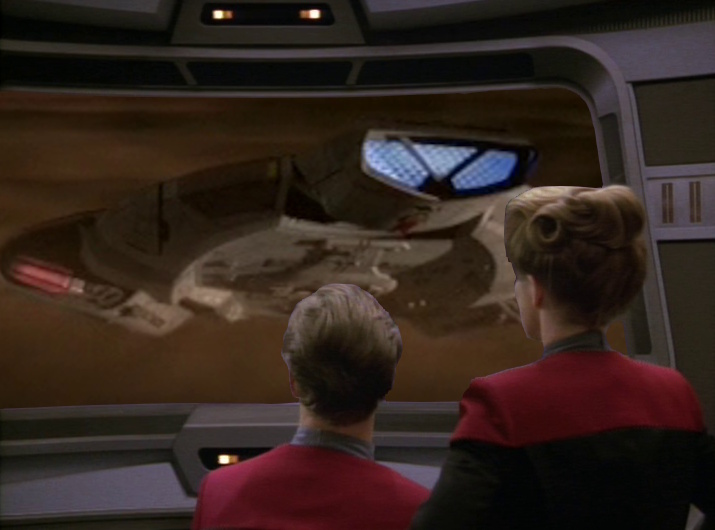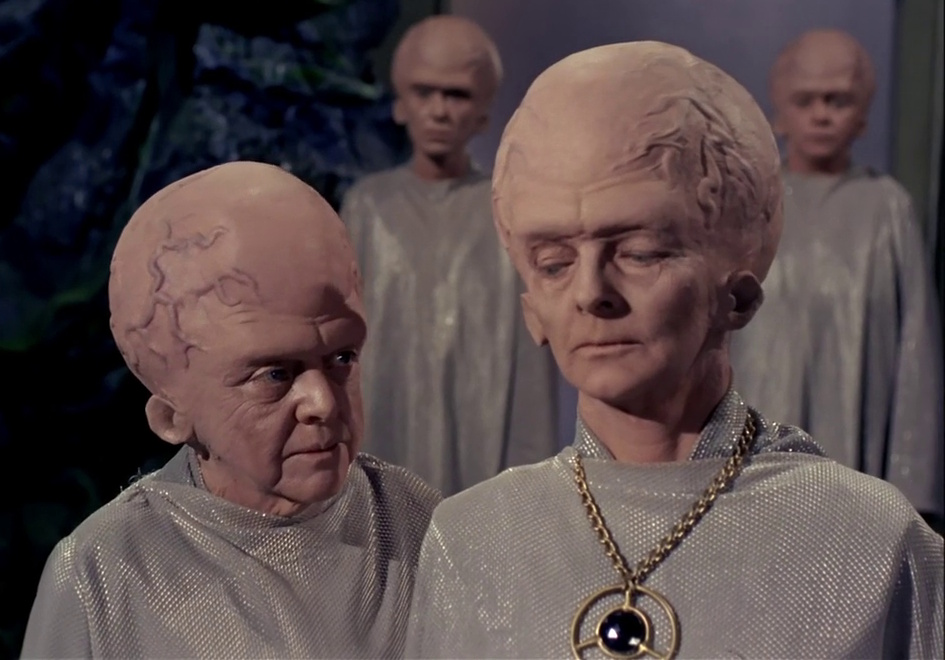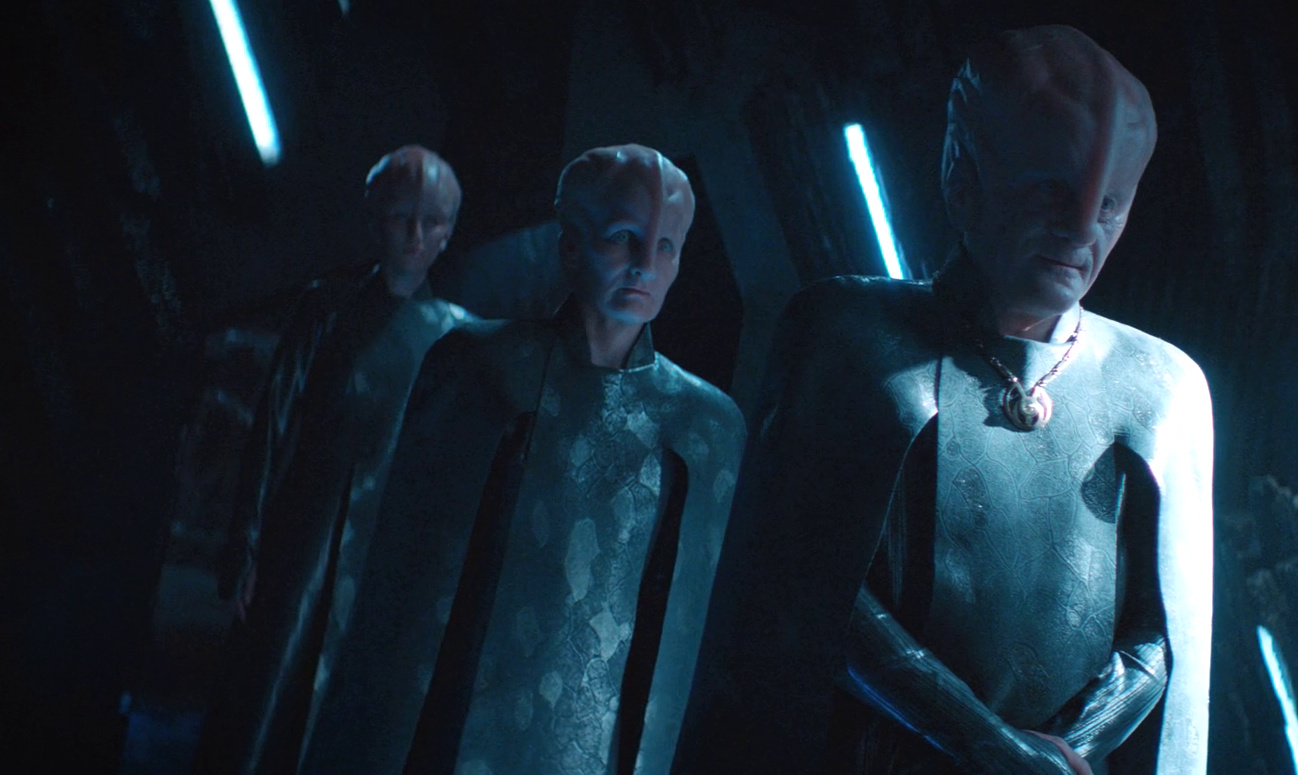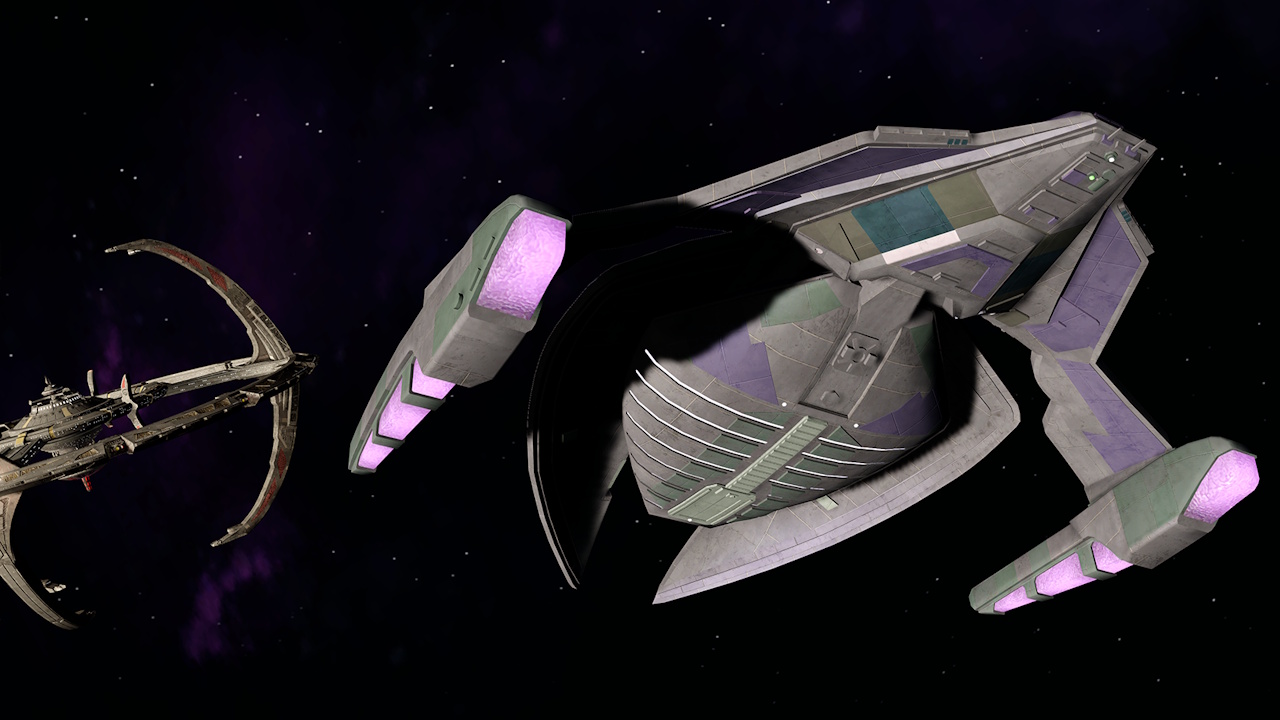

Spoiler Warning: Beware of spoilers for Star Trek: Voyager – Across The Unknown and Star Trek: Voyager.
A new video game based on Star Trek: Voyager, titled Across The Unknown, was announced only a few weeks ago. I didn’t think we’d see it until at least next year – but to my surprise, I received a notification that a demo version is available on Steam. I jumped into the game as soon as it had finished downloading, eager to try it out for myself, and I thought it could be fun to preview the upcoming title together.
I enjoyed the demo for the hour or so that it lasted, and playing through a modified version of Voyager’s premiere – Caretaker – was generally a fun experience. I think Across The Unknown still has work to do – there were a couple of issues that I picked up on in my brief playthrough – but by and large, the game seems poised to deliver more or less what I’d been expecting.
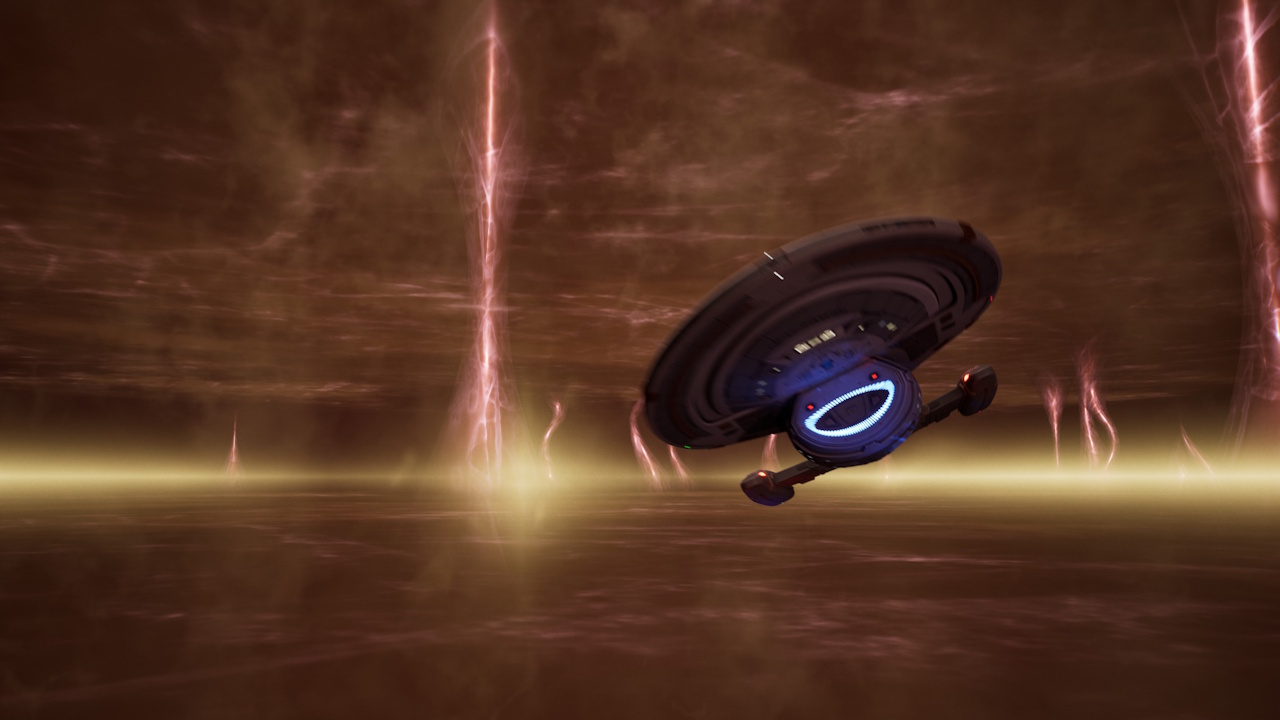
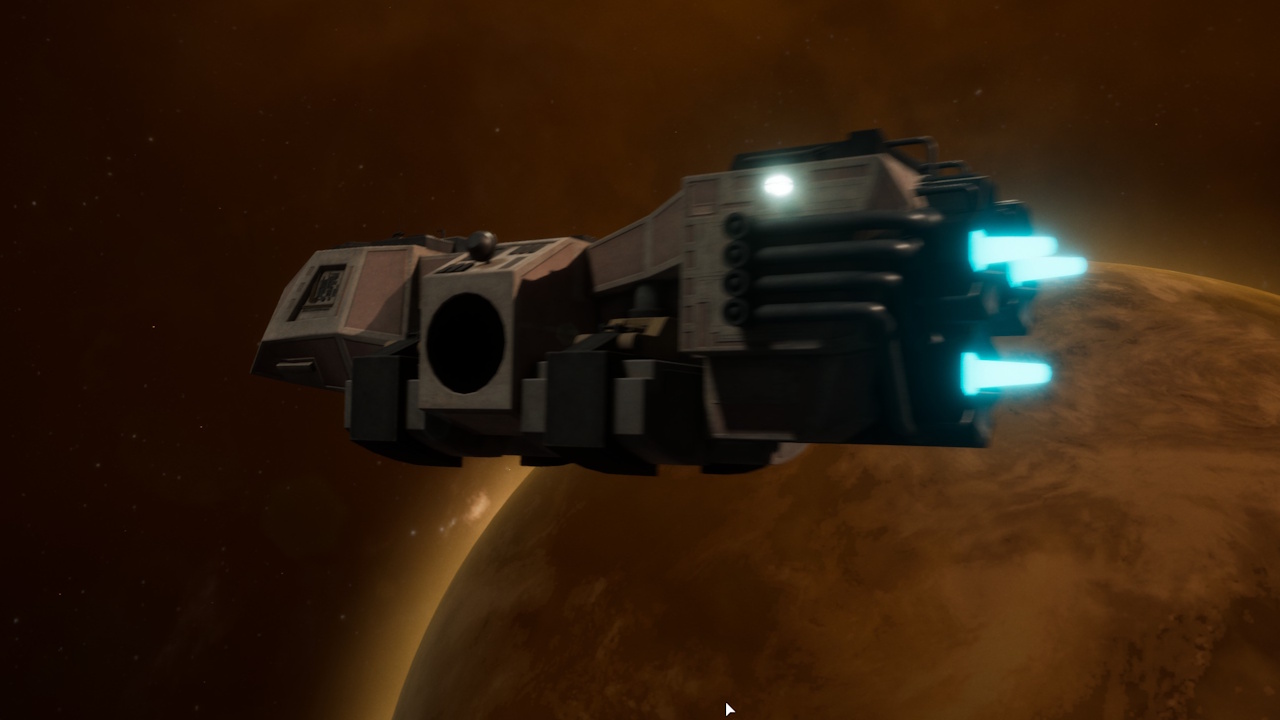
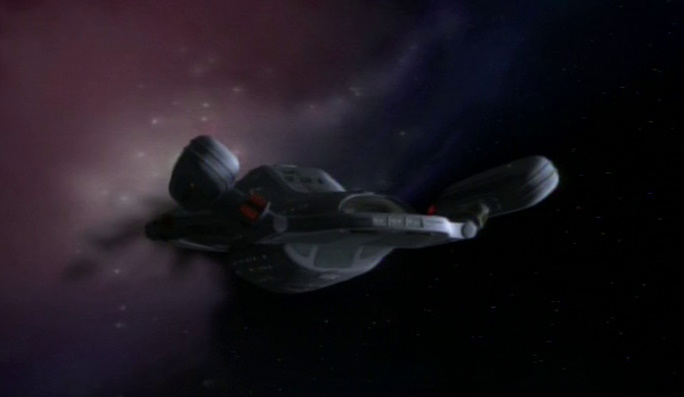
Voyager in the Badlands.
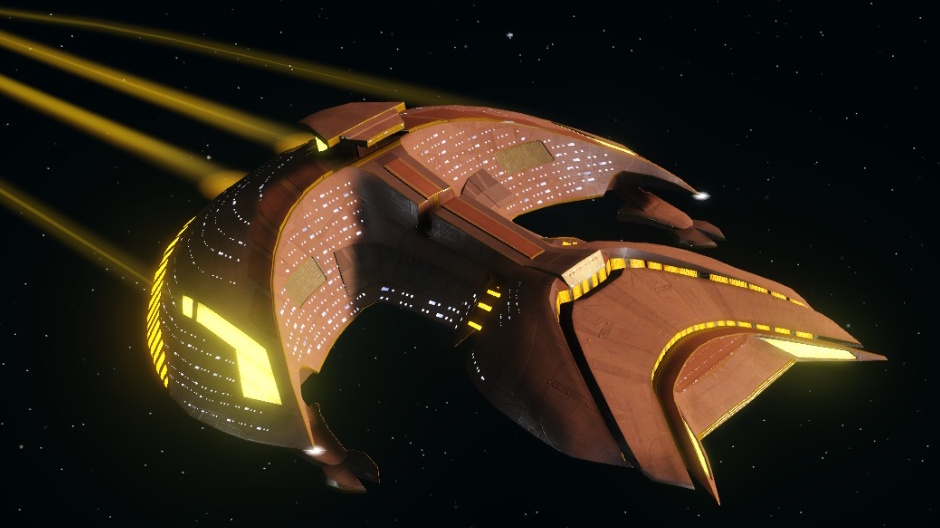
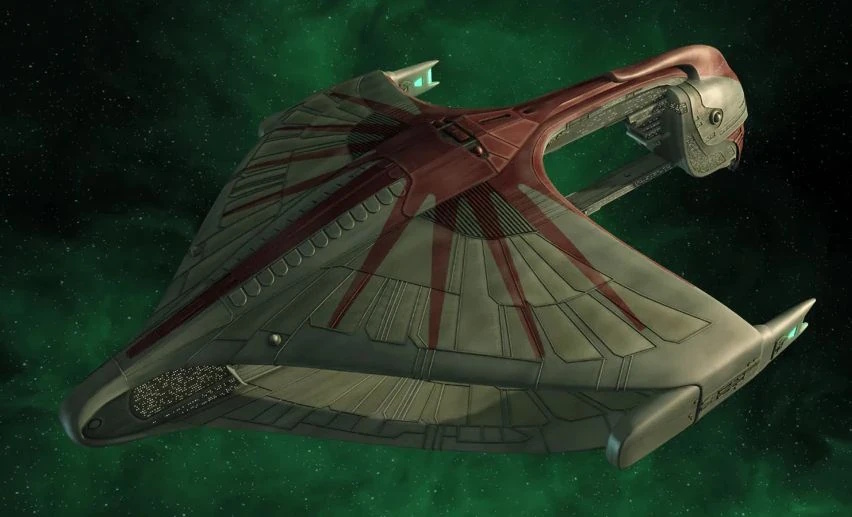
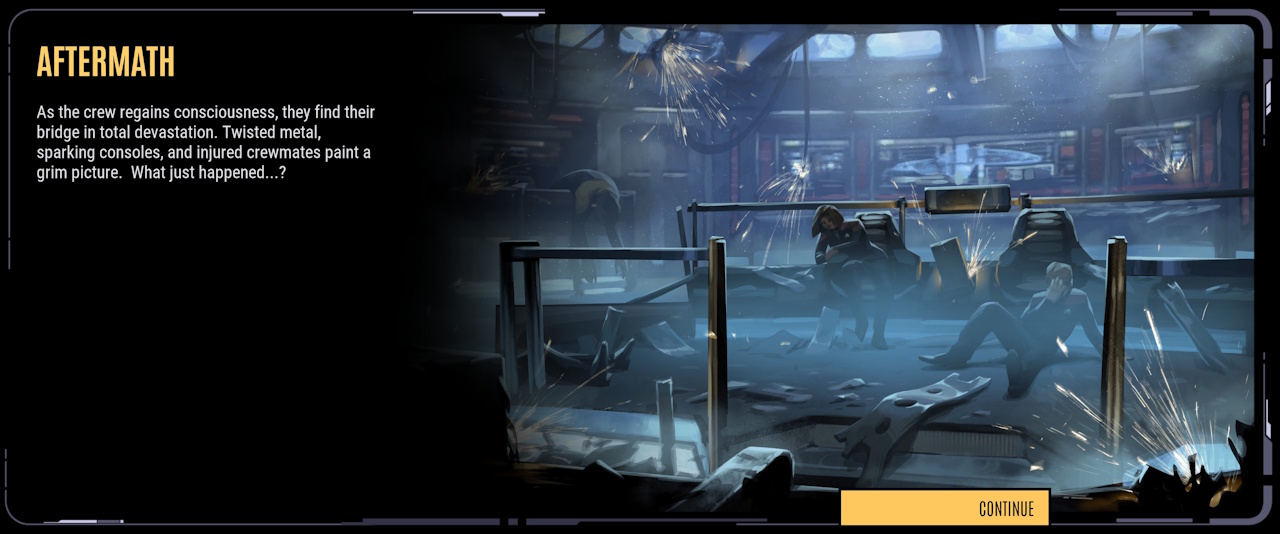
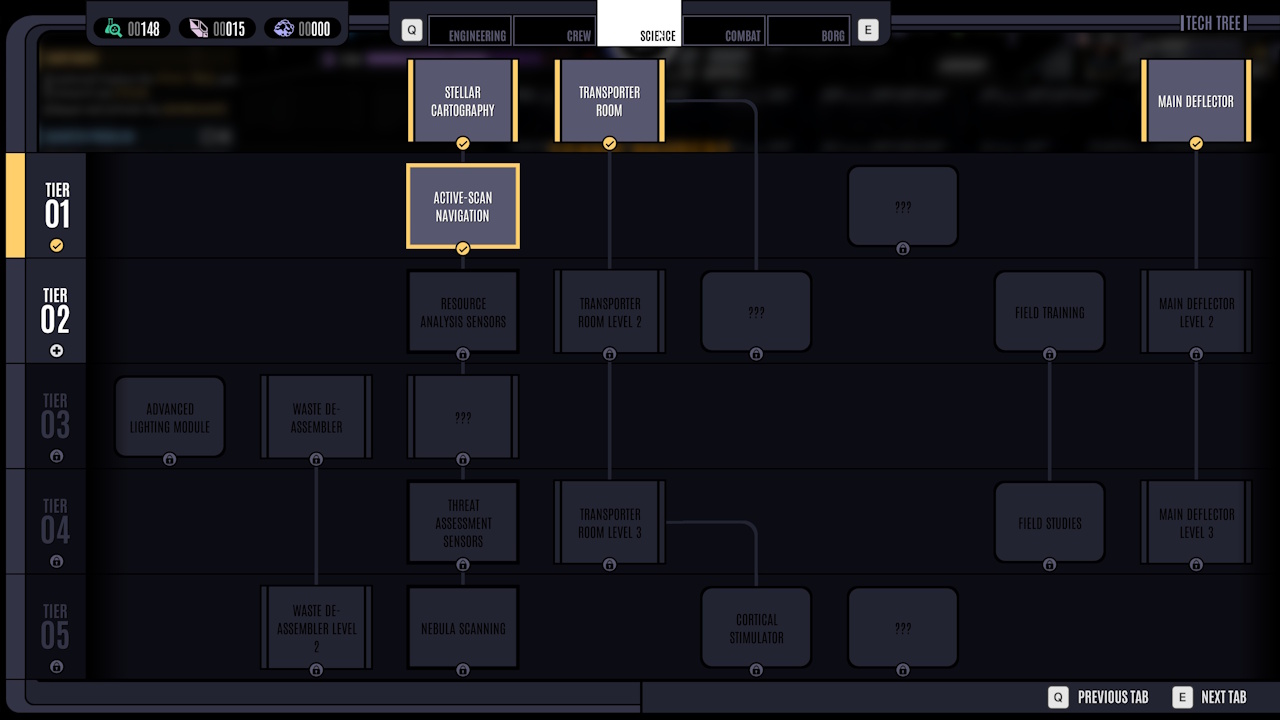
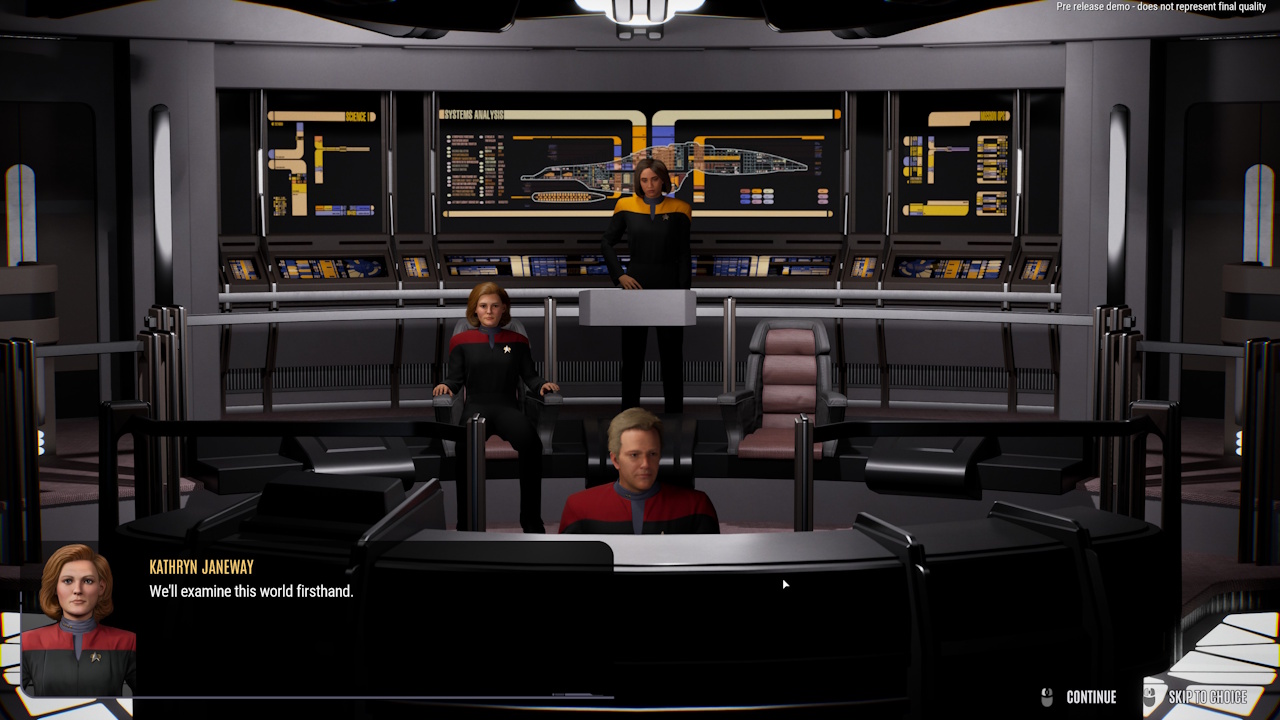
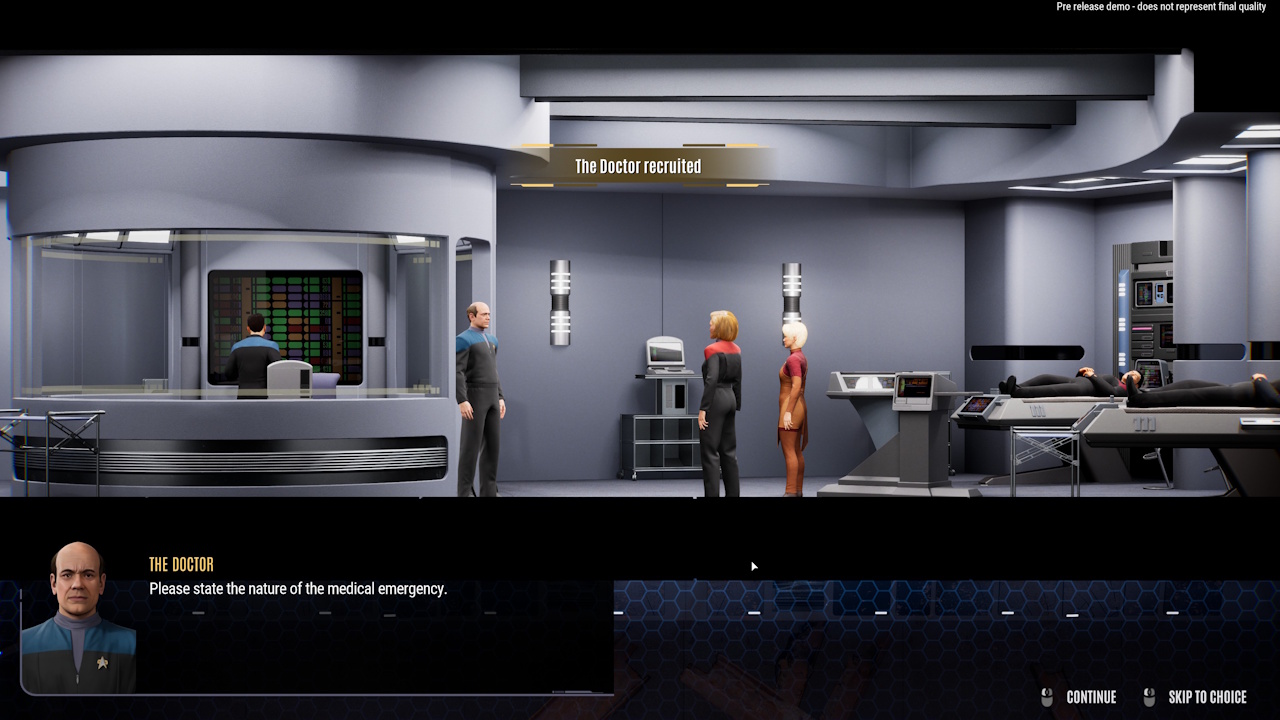
That idea of expectations, though, is going to be important to how you approach Across The Unknown. The tl;dr is this: this isn’t a big-budget, high production values, “triple-A” type of game. And if you go into it expecting ultra-sharp graphics, fully-voiced characters, detailed cut-scenes, and the like… you’re going to be disappointed, because this isn’t that type of game. What you get instead is a strategic starship management game, one with a tech tree to unlock upgrades, rooms to build, crew members to move around, and so on. There are no voiced characters; Across The Unknown is text-based. And while there are some starship cut-scenes and a pretty fun combat system, most of the time you’ll be treated to static images to convey key storylines.
I believe that if you set appropriate expectations, there’s going to be fun to be had here. The game’s core premise of “what if you were Captain Janeway and made different choices?” is a genuinely fun and appealing one, and Across The Unknown provided several points at which I could make what seemed to be defining choices for the ship and crew.
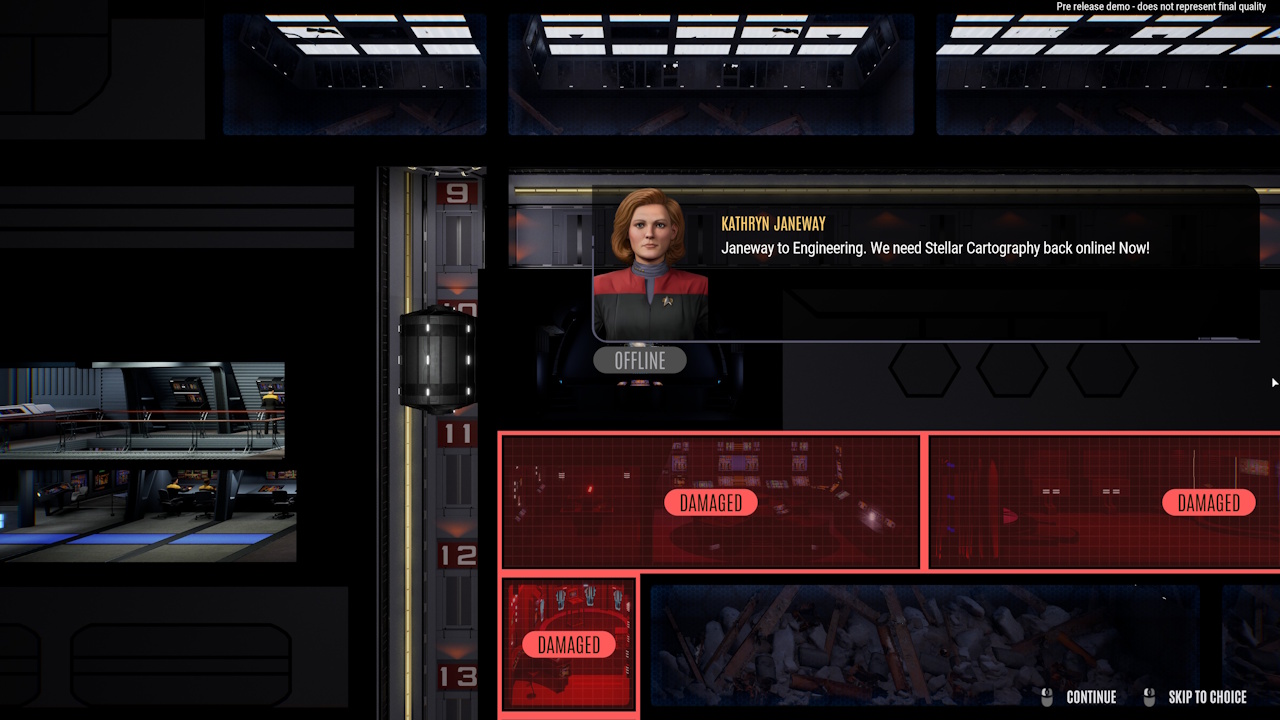
Captain Janeway issues an order.
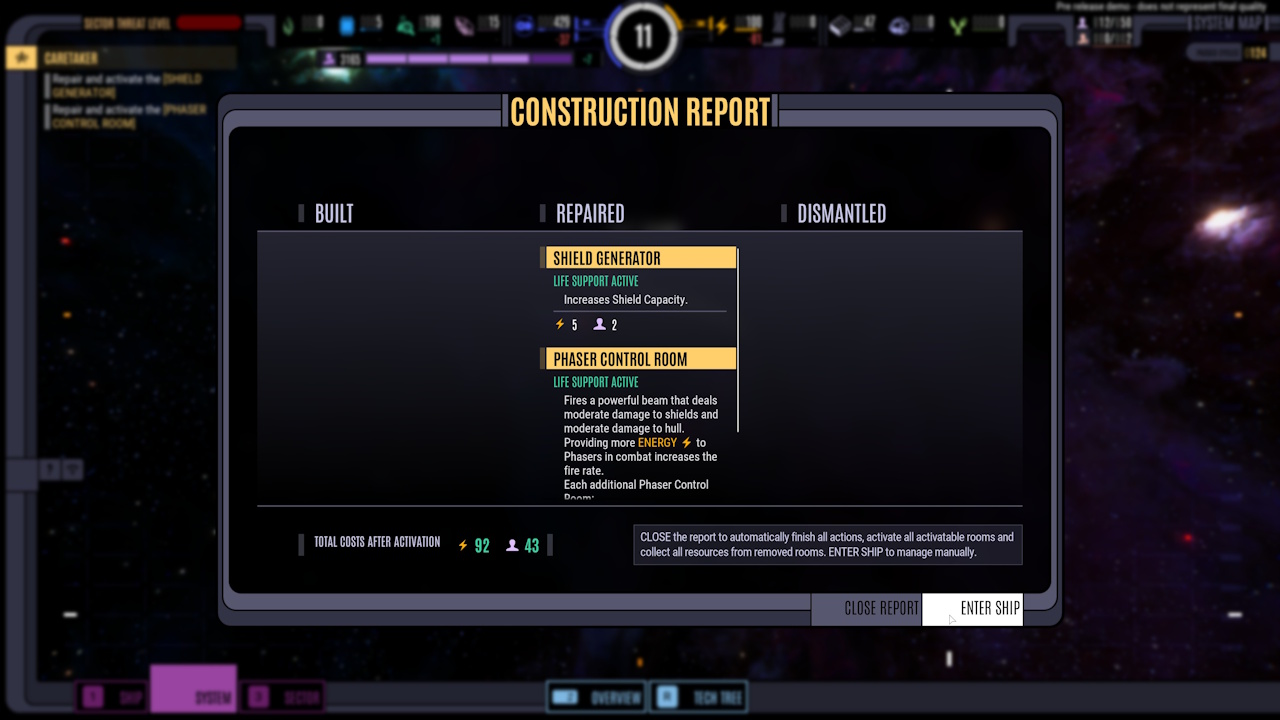
An appropriate point of comparison is probably Fallout Shelter. The games use a similar point-of-view for managing your base/starship, and you get similar choices for where to construct different rooms, who to recruit, who to send on away missions, and so on. That’s a good starting point for understanding what Across The Unknown felt like to play.
Obviously, when you’re looking at a demo version, there are going to be limitations! So I don’t want to judge Across The Unknown too harshly based solely on the first hour-ish of gameplay. Just from looking at the tech tree and the amount of empty rooms aboard Voyager, there’s clearly a lot more to the game that I didn’t get to try out on this occasion. And I also suspect that, of all the missions/story arcs in the game, Caretaker is probably one of the most linear: certain events have to pan out in order for Chakotay, B’Elanna, Neelix, and Kes to join the crew – and that’s just for starters.
The demo is based on the episode Caretaker.
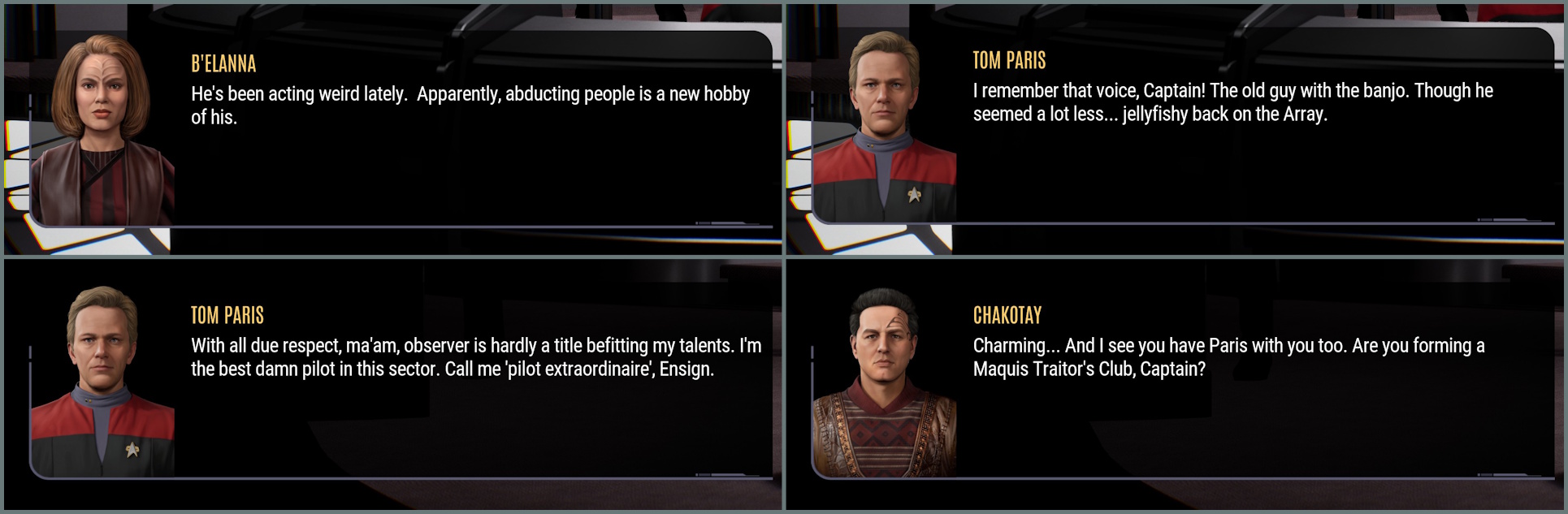
There were, however, some diversions from the story of Caretaker that felt unnecessary to me. Some lines of dialogue – particularly between characters like Chakotay and Tuvok, and Harry and Tom – felt really “off;” I know what these characters sound like, how they talk, and what they said to each other in the beginning – and this ain’t that!
In fact, I’d go so far as to say that some (but by no means all) of Across The Unknown’s dialogue reads like it’s been written by an AI chat bot. I’m not saying that’s what happened – and there could be issues with translation, for example, as the game is being developed in Germany. But that’s how some of these lines felt to me. Subjectively speaking.
A selection of the “awkward” dialogue lines.
The tutorial was solid, and I felt that Across The Unknown communicated some of its pretty in-depth systems in a concise and understandable way. I didn’t play the game perfectly on my first outing; I failed one optional assignment when I didn’t build enough crew quarters in time! But that failure helped me learn more about the optional assignments and how the “cycles” (Across The Unknown’s timekeeping) work, so it wasn’t a total loss. And considering that I did fail one of these optional tasks, Across The Unknown was forgiving enough that it wasn’t fatal to my playthrough – which I did appreciate on my first time out!
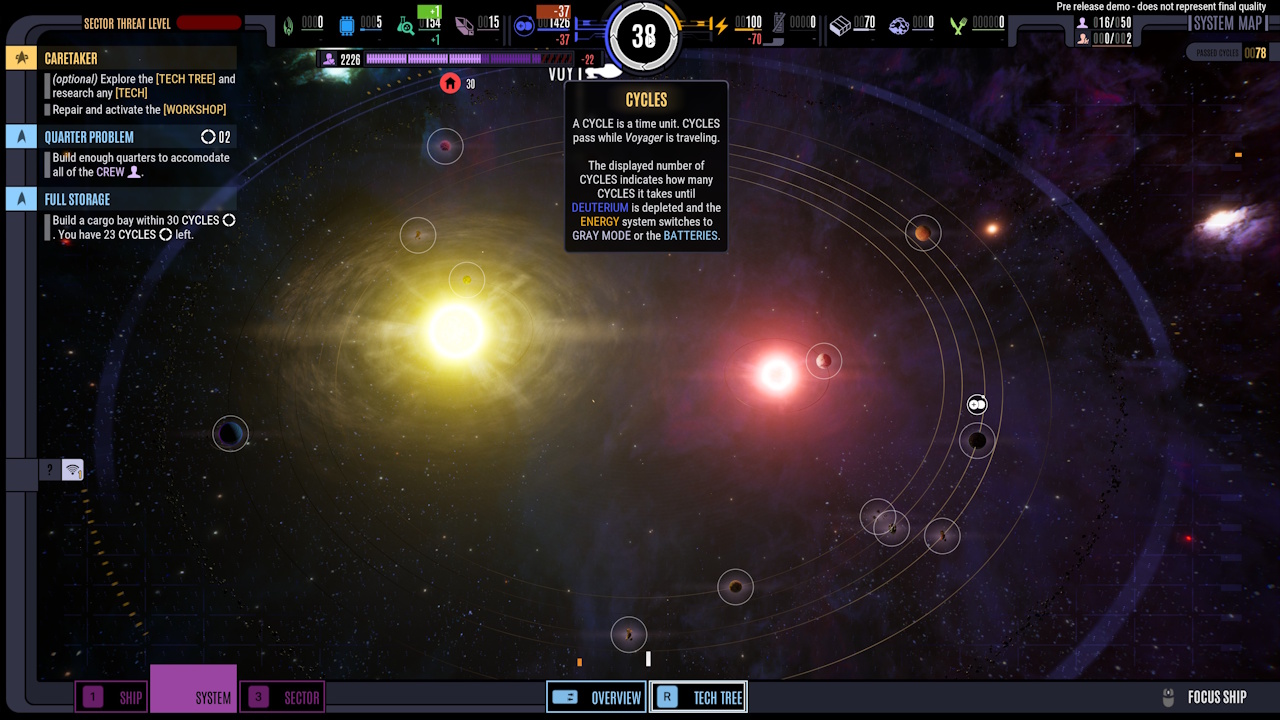
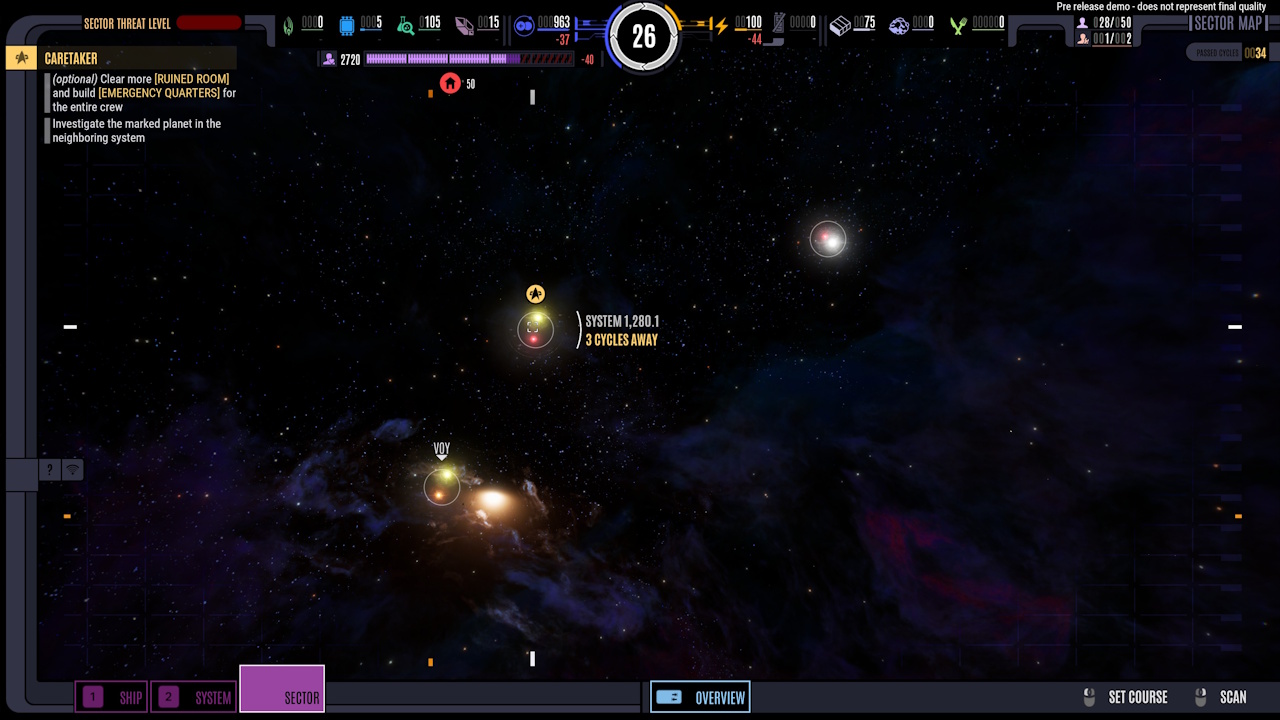
There are resource limitations, though. At one point, I was running dangerously low on deuterium – which is necessary to keep the ship running. I was only a couple of cycles away from completely running out, and having exhausted all of the planets and points of interest in the two available star systems, there was a bit of a time crunch to get back to the Caretaker’s Array! This is clearly part of the experience – Voyager’s journey home, especially in the early days, was one of scavenging resources where possible, and running close to the line on more than one occasion. It served as a great motivator, I found, to move the story along!
The system map (and a tool-tip showing details about cycles).
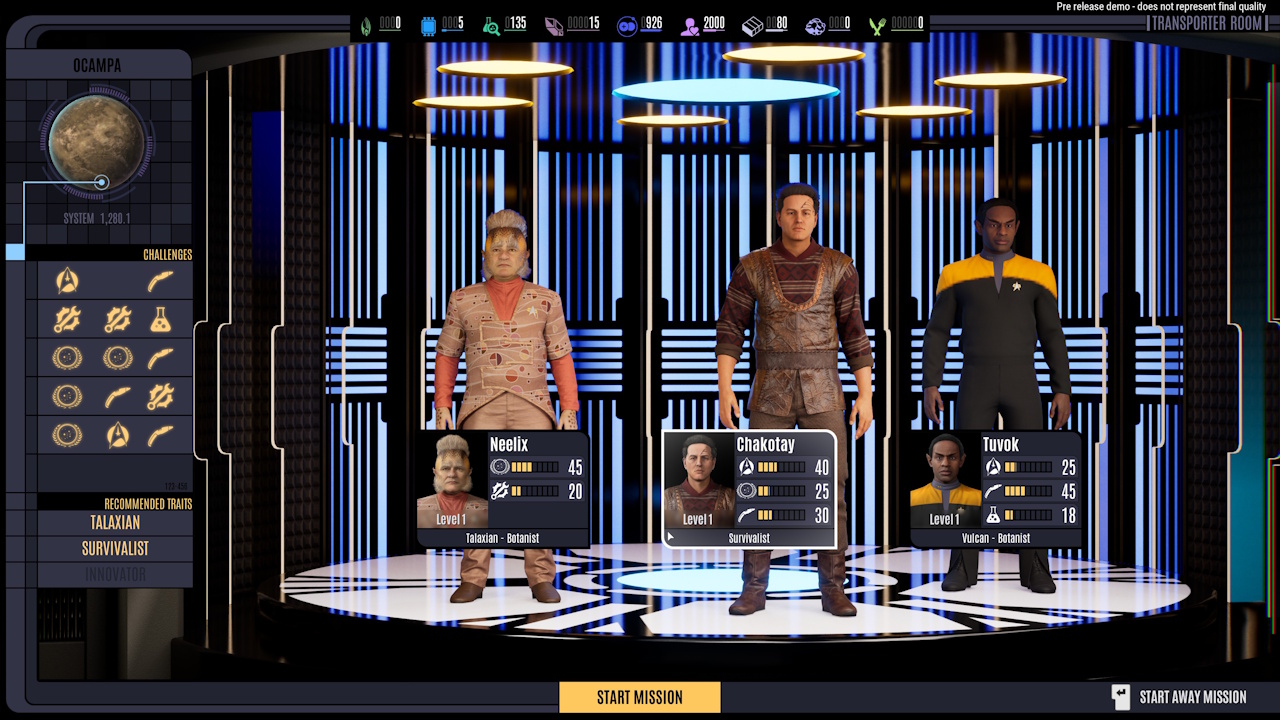
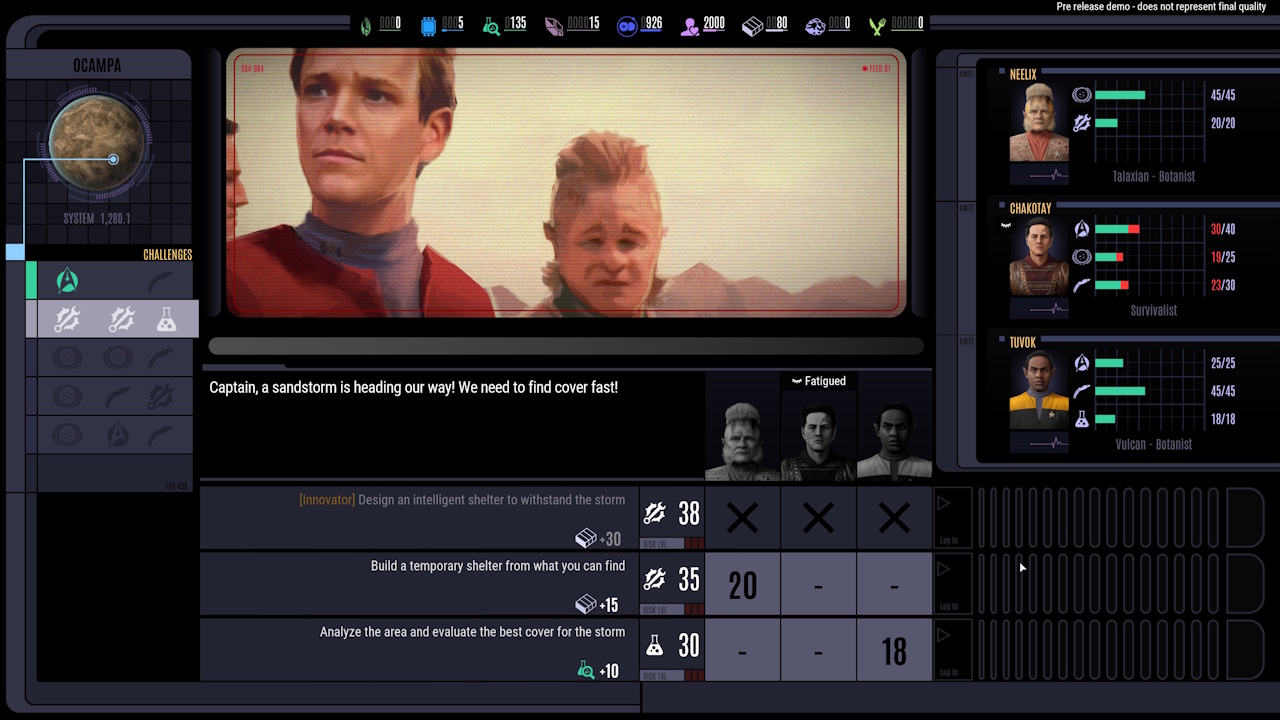
Away missions provide one of the ways to make a lot of different choices. Given that the demo is based on Caretaker, I was surprised that Captain Janeway wasn’t able to join any of the away missions to the Array or to Ocampa, and I wonder if that’s going to be a limitation throughout the game. I hope not, but I thought it was worth mentioning. I tried to use a selection of different characters when I could, just to get a different experience with the away missions that I had available.
Each away mission gives individual characters a chance to gain experience and level up – meaning they’ll be better the longer they stick around and the further into the game you get. The tutorial mentioned that some choices, if they go awry, can be fatal. That wasn’t something I experienced in the demo, but it’s interesting to know that even some named characters can, potentially, be killed off at a very early stage – or at any point throughout the run.
Selecting crew members for an away mission.
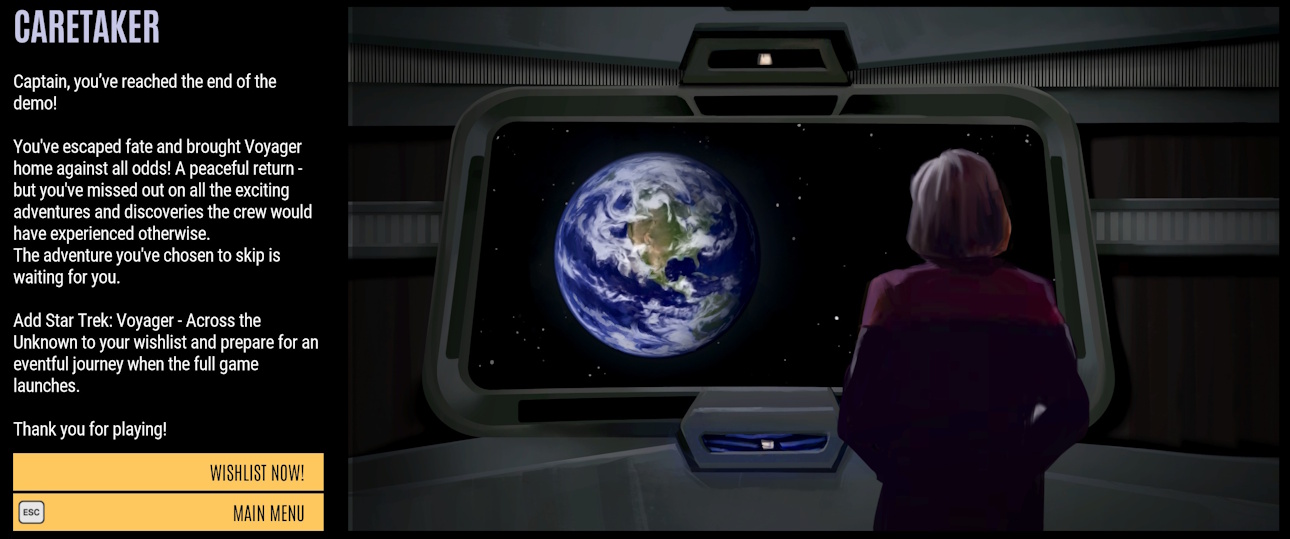
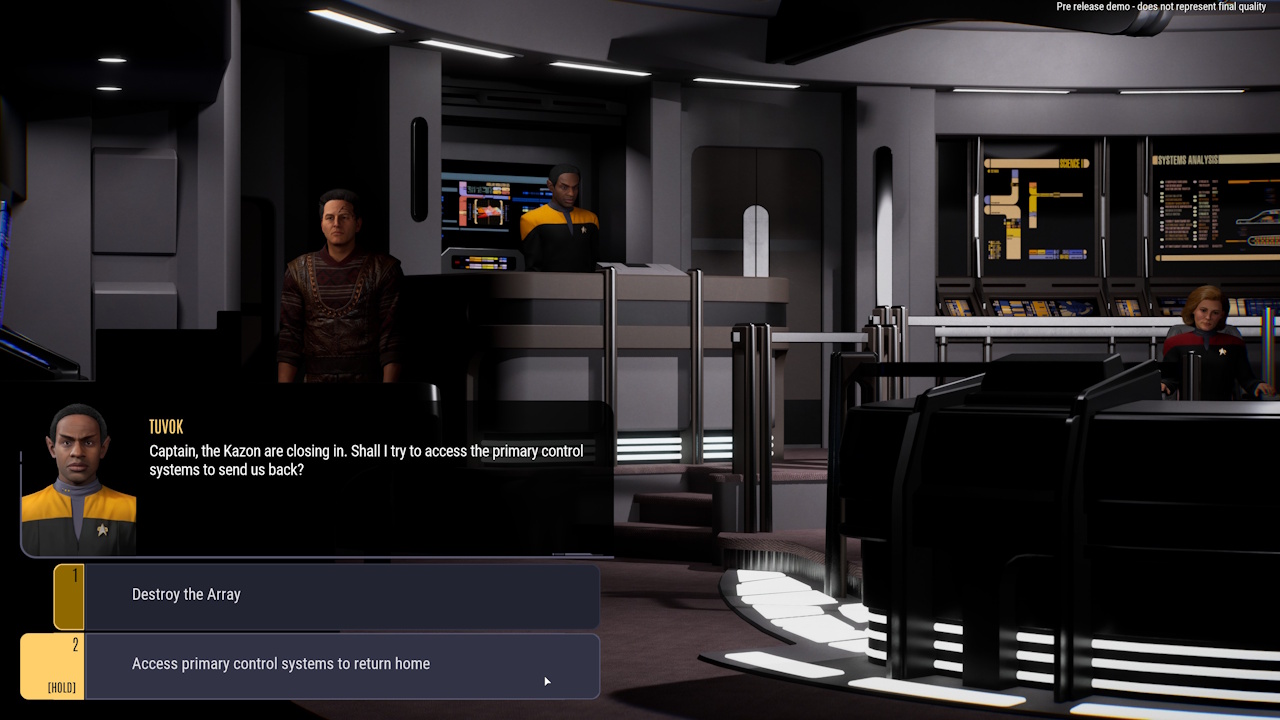
I want to touch on one story point that I’ve seen Trekkies talking about since Across The Unknown was announced. This is spoiler-y, so skip past the next screenshot if you really don’t want to know anything ahead of trying the demo for yourself! When it comes to Voyager and crucial choices… Across The Unknown does give you the option to use the Caretaker’s Array to send Voyager and her crew home seven years early! Obviously, this will cut off the entire rest of the game, but I thought it was a ton of fun that the option to do this was included.
And I think that speaks volumes about the kind of big decisions that we’ll get to experience in the full game. The blurb promises twelve sectors to explore – each of which, apparently, can be comprised of at least three star systems, which is neat. I would imagine each sector will provide one of these key inflection points – perhaps more than one. Being able to send the ship and crew home, though, using the Array… I gotta admit, that was pretty cathartic after all these years!
Home in time for tea!
There’s quite a lot of random chance (a.k.a. random number generation) in Across The Unknown, which isn’t atypical for this type of game. You can mitigate some of that by choosing characters and actions that have a higher chance of success, or when on away missions, by combining the efforts of more than one character to increase the odds. But it’s still possible that RNG will go against you at any point, and even an option that looks statistically solid could result in a negative outcome. Again, though: it’s that kind of game.
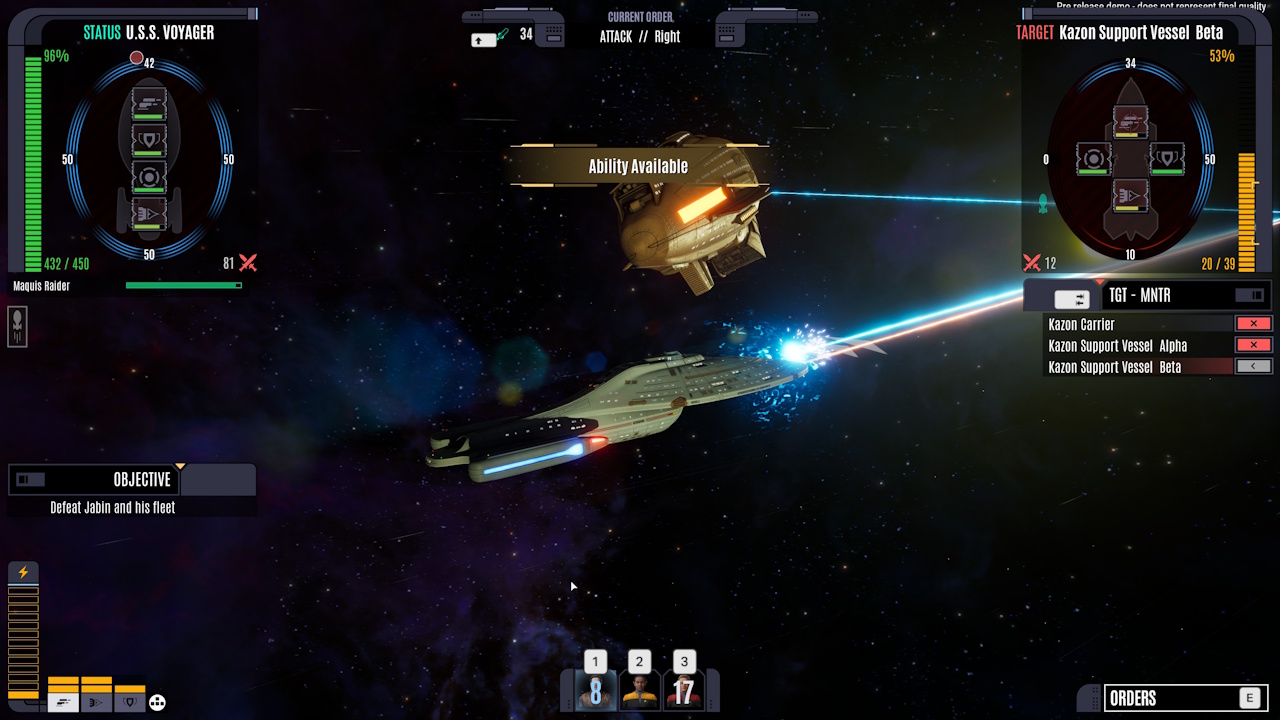
The ship-to-ship combat was interesting. Unlike exploration, which is measured in “cycles,” and away missions, which play out through a series of decision points, combat in space is close to real-time. Phasers fire automatically, but you get to choose when to fire torpedoes and when to issue other orders to members of the crew. There are a limited number of slots for characters to participate in ship-to-ship combat – which feels like a bit of a double-edged sword.
Ship combat.
On the one hand, this adds another element of strategy: do you want to pick Paris for his evasive manoeuvres, or Tuvok for his finesse with the phasers? It also makes each combat encounter potentially different, as you can choose a different crop of people every time. However… part of the captain’s chair fantasy experience, surely, is being able to issue orders to the entire crew in situations like this. Being able to divert extra power to the phasers by calling up B’Elanna in engineering, or telling the Doctor to prepare sickbay for casualties… that’s all part of sitting (metaphorically) in the captain’s chair. By reducing the number of characters who can participate, part of the combat just felt a bit… small, I guess.
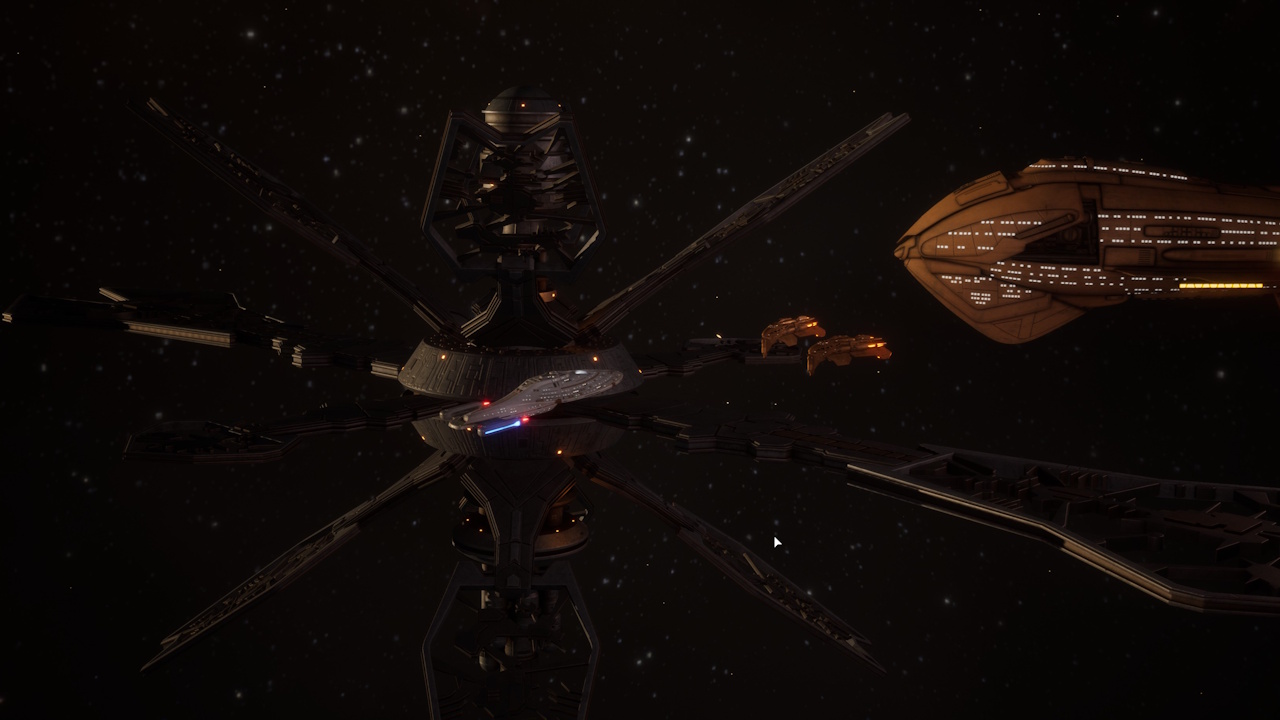
That’s not to say it was bad. I actually had fun taking on the Kazon in my combat encounter! And after spending most of my time looking at a master systems display or a zoomed-out solar system, seeing Voyager moving around in real-time, up close… that was something special.
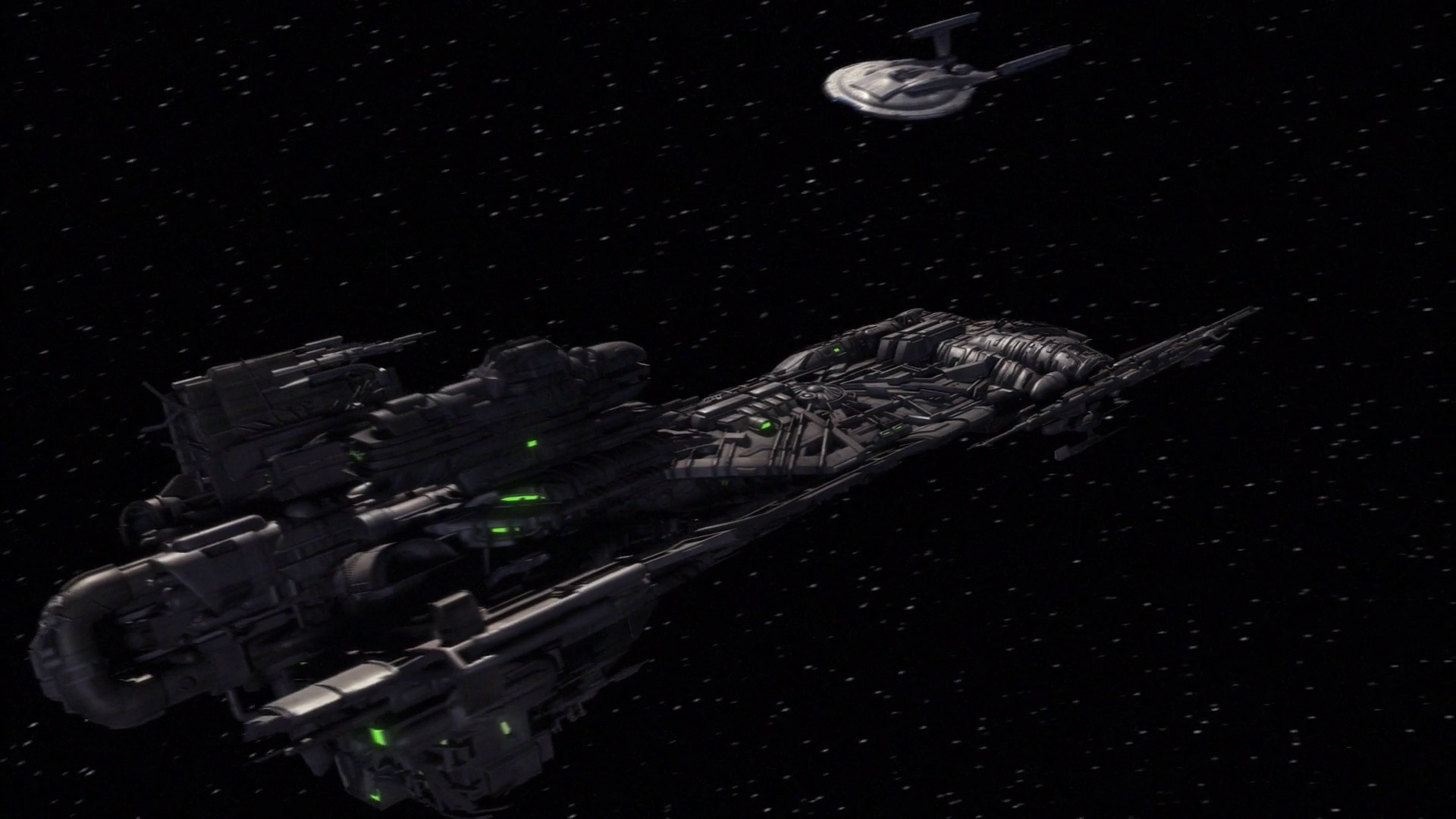
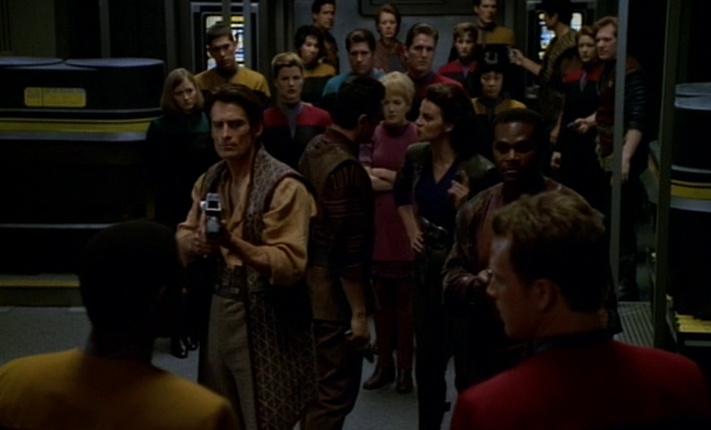
Voyager and Kazon ships at the Caretaker’s Array.
Across The Unknown needs some more polish. There were a few places where I saw a typo or missing punctuation, and another where Neelix popped up to tell me something before I’d even met him or invited him aboard. My PC also seemed to struggle, with the graphics card working overtime and the game still occasionally lagging – despite the fact that, as mentioned, the graphics really aren’t anything special. Performance when zooming in and out of the MSD could really use some improvement. I wasn’t even running Across The Unknown at its maximum settings.
That being said, I came away from my hour with the demo more excited to play the finished game than I was before I started. Voyager is such a great series, and it feels perfectly-suited to this kind of strategic management title. Being able to make radically different choices to those that Captain Janeway made during the show is going to be a lot of fun, and if the rest of the game is as good as the demo in terms of narrative and gameplay, I can see myself sinking many hours into it when it’s ready.
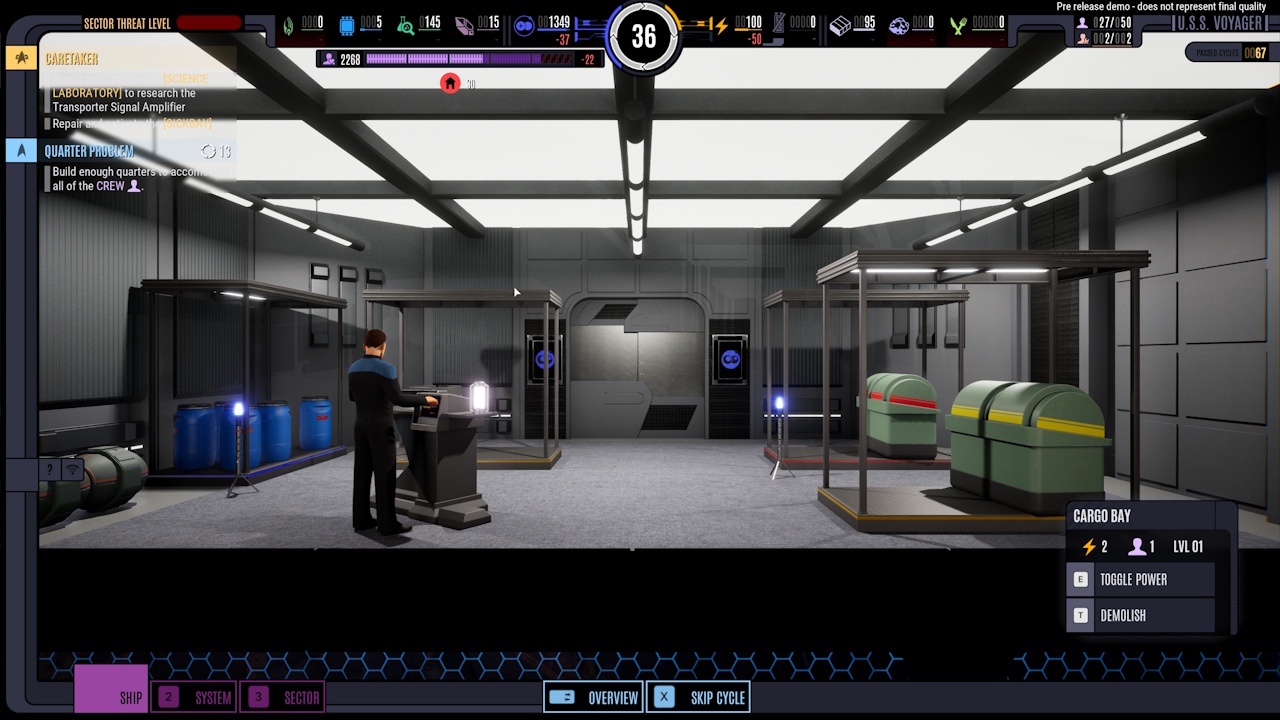
A cargo bay.
If you want to wait for the finished game, that’s a completely valid decision. I usually don’t play pre-release demos, and there are a few issues with Across The Unknown that I’d hope will be smoothed out before the full game releases. But it’s hard not to recommend a completely free demo of a game like this. It only took me an hour to play through the events of Caretaker and get a feel for what Across The Unknown is like, so if you’re like me and Across The Unknown is a guaranteed day-one purchase for you, I think trying out the demo is an easy recommendation.
I’ll end by saying that Across The Unknown is clearly a game made for fans. And that’s okay. Not every game is going to reach a broad audience; Across The Unknown knows what it is, knows who its target audience is, and seems to be leaning into that in a big way. It’s not going to blow up and win hundreds of awards, nor is it going to expand the Star Trek fan community in a meaningful way. But given that it’s Voyager’s thirtieth anniversary this year, I’m just pleased that a game like this was greenlit at all. Stepping back into that world – even with some last-gen graphics, odd facial expressions, and occasionally janky dialogue – was a lot of fun.
The demo is free on Steam at time of writing… so why not try it? All you have to lose is 6 and a bit gigabytes of disc space and an hour or so of your time!
Star Trek: Voyager – Across The Unknown will be released (in full) in the future. The demo version is available now on Steam. The Star Trek franchise – including Voyager and Across The Unknown – is the copyright of Skydance/Paramount. Star Trek: Voyager – Across The Unknown is developed by GameXcite and published by Daedalic Entertainment. This article contains the thoughts and opinions of one person only and is not intended to cause any offence.
A selection of screenshots from my time with the Across The Unknown demo that didn’t fit in the article above:
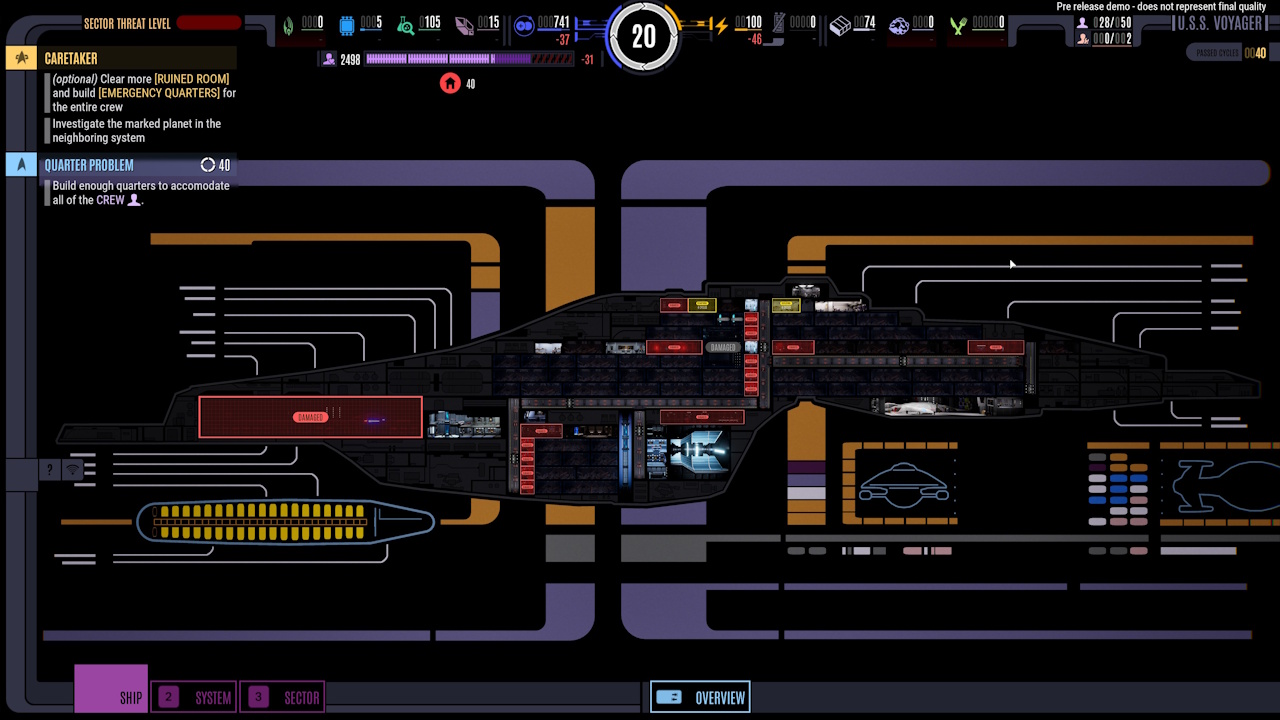
The main MSD/ship display (zoomed out).
An away mission.
Part of the tech tree.
Breaking a promise (a.k.a. failing an optional quest).A view of the sector, including three star systems.
Spoiler Warning: Beware of spoilers for upcoming seasons of Starfleet Academy and Strange New Worlds. Spoilers are also present for the following Star Trek productions: The Undiscovered Country, Voyager, Discovery, Prodigy, and Picard.
The Star Trek franchise popped up at New York’s Comic-Con event this week, building up the hype for Starfleet Academy and the next season of Strange New Worlds. I thought we could take a look at them together, as we begin to get excited for next year’s Star Trek projects.
First of all, it does seem, based on the release of the teaser clip and Starfleet Academy’s mid-January premiere, that Strange New Worlds Season 4 is on the schedule for 2026. That’s good news! After the two-year gap in between Seasons 2 and 3, and with Starfleet Academy still in post-production, I wasn’t sure if Strange New Worlds would manage a 2026 broadcast, but it’s good news in my book that we don’t have to wait too long for the next instalment in what is still my favourite modern Star Trek series.
Starfleet Academy will be on our screens in just over three months!
Since we’re talking Strange New Worlds, let’s take a look at the teaser clip first.
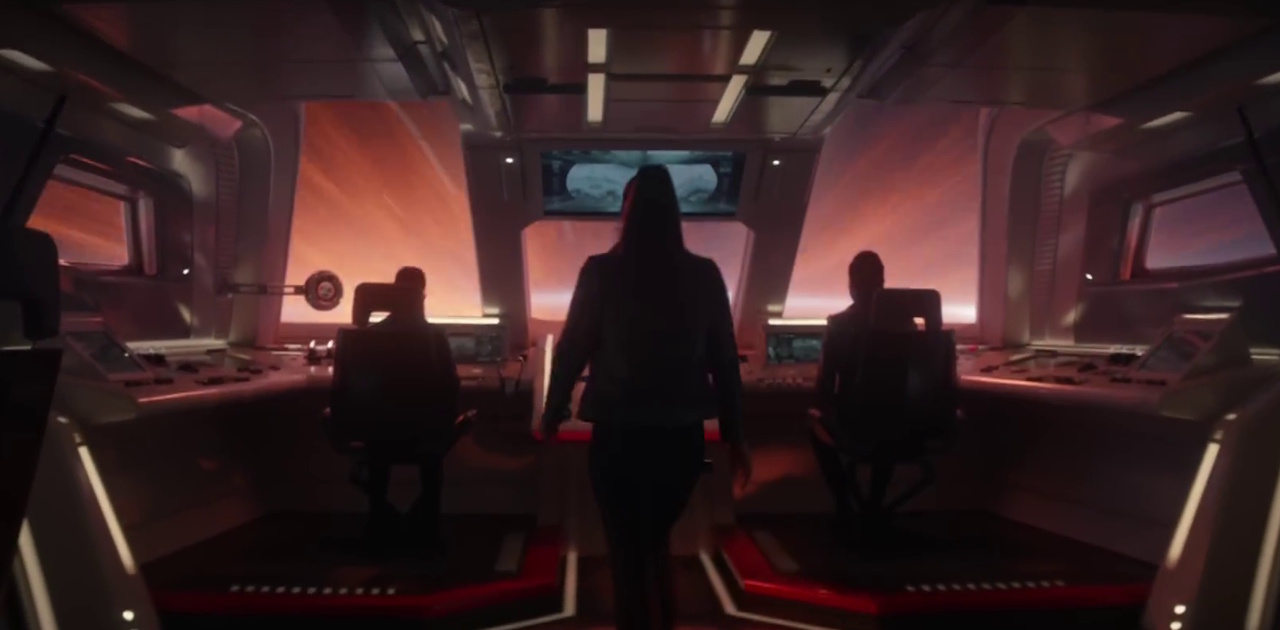
Firstly, I’m not 100% sure if this was one continuous sequence, or if there wasn’t at least one cut somewhere in the middle. It kind of feels, to me, like a scene or two might be missing… but that could also be where the title sequence will appear in the finished episode, I guess! In any case, the Strange New Worlds teaser was taken from a single episode, and it shows Pike and the crew getting into trouble with what looked somewhat like a plasma storm or ion storm.
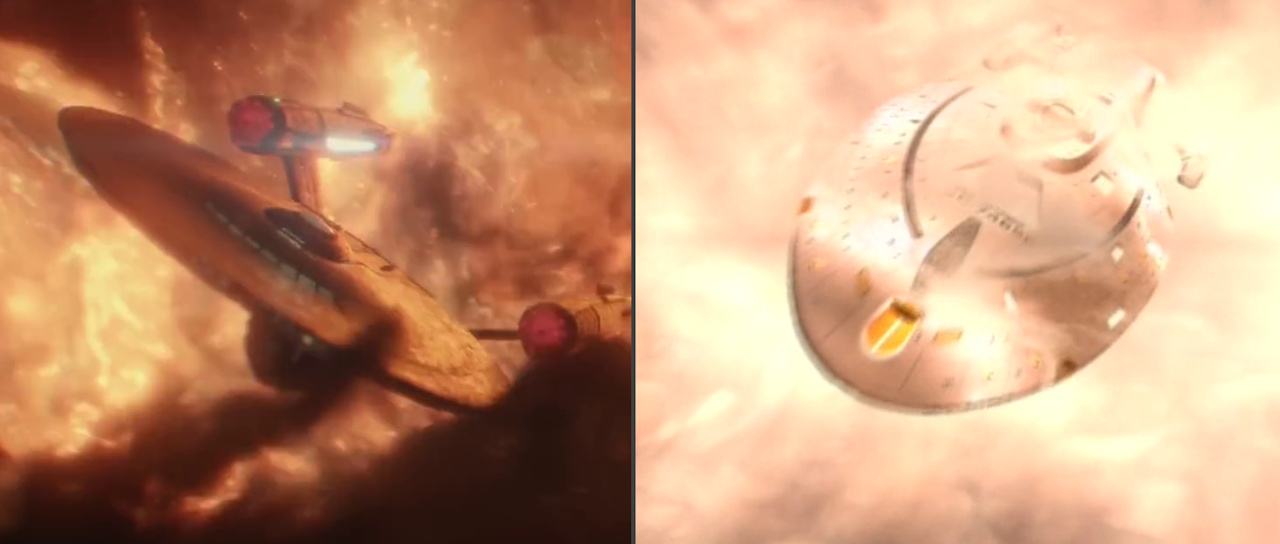
How, exactly, a plasma storm might’ve thrown the Enterprise to a different point in space is… debatable! But we’ve seen similar things happen before; I actually got a “Caretaker” vibe from that part of the clip, as the ship got caught in an expanding space storm and ended up somewhere different. I’m not saying this will be the Delta Quadrant, of course! But as I’ve said before, sometimes Star Trek stories kind of rhyme, and this clip was definitely reminiscent of Voyager’s premiere for me.
The USS Enterprise in the Season 4 teaser and the USS Voyager in Caretaker.
I’m glad that we got to see Ortegas back at the helm after her Gorn encounter. I think, having sat with it for a month or so, that Terrarium might be the best episode of Season 3, and I’m definitely excited to spend more time with Ortegas (and some of the show’s other original characters) before Strange New Worlds wraps up. Ortegas was also present on the shuttle mission at the end of the clip, and really seems to be back in her element in the pilot’s seat.
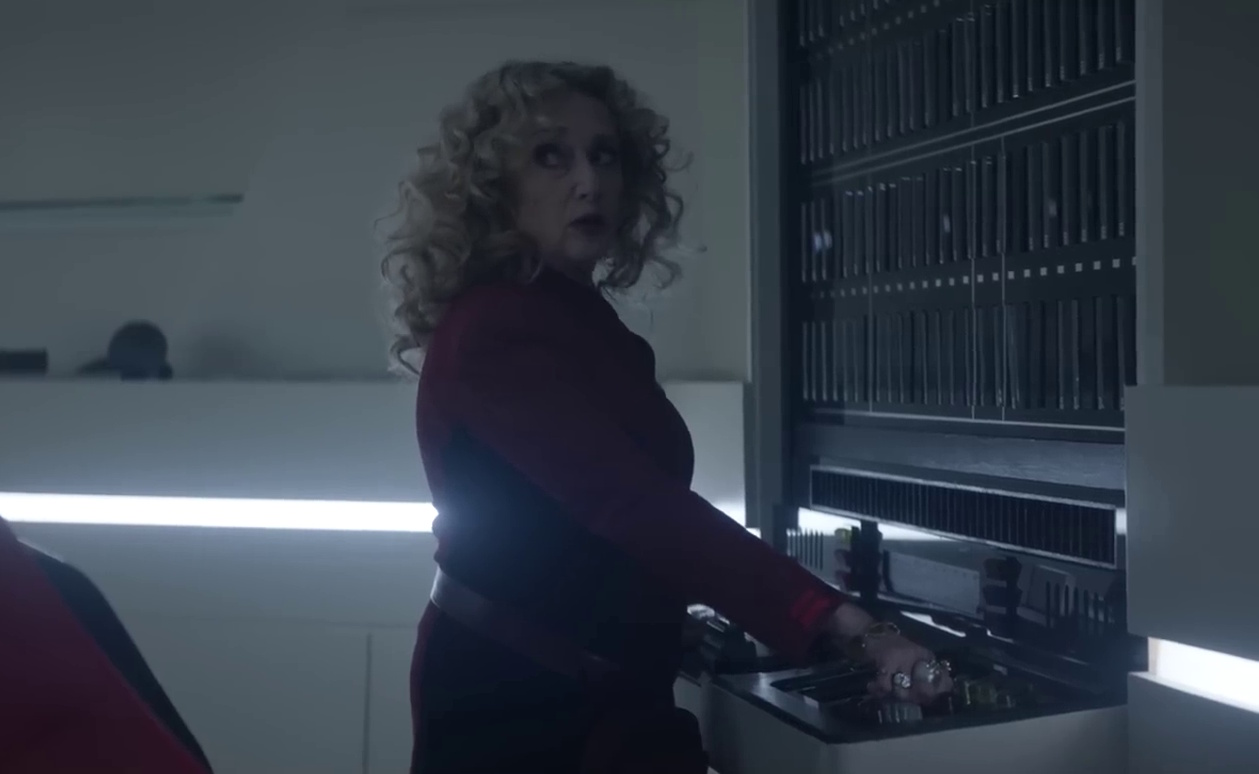
Another character I was pleased to see was Pelia! Pelia seemed to draw the short straw in Season 3, with Scotty taking over key engineering storylines in episodes like A Space Adventure Hour, but she’s at least going to be present in Season 4 and hasn’t just been unceremoniously shuffled off-stage. That makes me happy; Pelia is a great comic relief character and has had some of the best and funniest lines in Seasons 2 and 3. Getting the right balance between Pelia and Scotty – the chief engineer and the deputy – is something Strange New Worlds still needs to work on, but I think Pelia’s presence in the teaser clip is promising, at least.
Pelia.
Spock and La’an were seen together in the clip – though not in a romantic setting! La’an did seem to be looking at Spock, though, and I suspect that their relationship will continue at least at the beginning of Season 4. As I said, though, when Season 3 was on the air: I kind of need a break from that. I don’t want more “Spock comedy,” or “Spock romance,” not with only a few episodes remaining before Strange New Worlds will be over. So I hope the writers aren’t going to push for more of those things in Season 4. Hard to tell from just this one clip, of course!
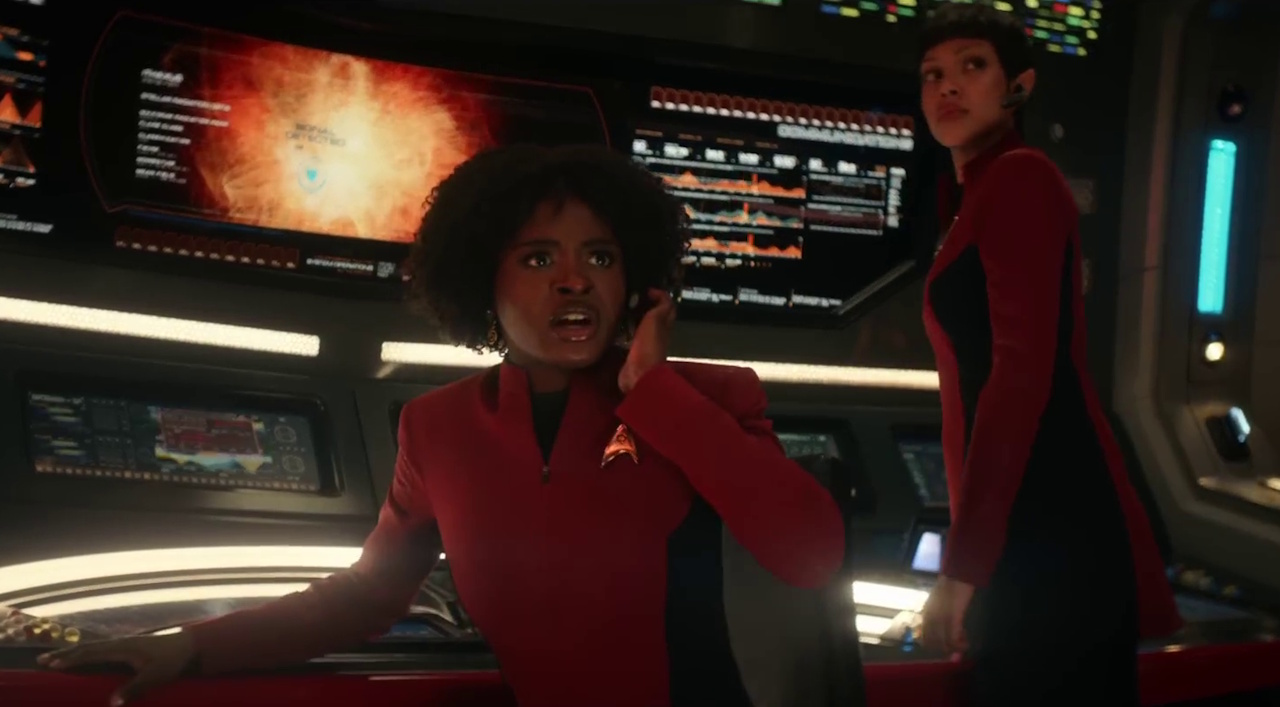
We also caught a glimpse of a new Vulcan character – a cadet, who seems to be shadowing Uhura on the bridge. Giving Uhura a mentorship role could be a fun way to extend her character arc, so I’m on board with that! Part of me wonders if this character is intended to be someone familiar: perhaps Tuvok’s wife, T’Pel, who we saw briefly in Voyager, or even someone like Saavik or Valeris. Given Valeris’ later role in The Undiscovered Country, that could be interesting.
Uhura with the Vulcan cadet.
Pike’s line to Una, asking her if she’d miss space exploration if she had to give it up, felt poignant – and could be related to Pike’s impending accident and disability. Perhaps his knowledge of the future is weighing on him during this mission, maybe he’s still mourning Captain Batel after losing her at the end of Season 3, or it could be connected to the fantasy life we saw in the Season 3 finale. In any case, the line stuck out to me, and clearly indicates that Pike has a lot on his mind beyond just the mission at hand.
This aspect of Pike’s characterisation – his knowledge of what lies in store for him – has made this iteration of the character incredibly impactful and relatable to me personally. I read his story through the lens of my own poor health; I’ve been Captain Pike, hearing bad news about my health and future prospects, knowing there isn’t anything I can do, and the way Anson Mount brings that to the screen has always been nothing short of fantastic. Given that it will probably be a big plot point in the cut-down fifth season, I’m not sure how important Pike’s imminent accident will be this time around, but this clip seems to hint at it being important for him in at least one episode.
Pike’s line to Una really stood out to me.
I don’t remember the element iridium being mentioned a lot in previous Star Trek stories, but I like this little expansion of the lore of Star Trek. According to Scotty, iridium is necessary to “ignite” the warp engines – presumably meaning it’s important to the antimatter reaction along with dilithium. In any case, missing iridium seems like a suitable driving force for a story that looks set to take Una, La’an, and Ortegas to – as Captain Pike put it in a kind of too on-the-nose line – a “strange new world.”
Not sure what else to say about the Strange New Worlds clip. I think the episode looks like it’ll get off to a solid start, it was nice to see most of the crew getting a line of dialogue or something to do, and there were enough little teases to get me excited. Pike’s story looks like it could be complex, a new Vulcan cadet could be a fun addition to the bridge, even if she’s only present for an episode or two, and I’m genuinely curious to learn more about this mysterious storm in space and where it might’ve taken Pike and the Enterprise. Could I be about to get my “Pike versus the Borg” story that I’ve been harping on about for years? Erm… no!
Destination: unknown.
Next, let’s talk about Starfleet Academy.
In a frankly bizarre move, comedian and late-night talk show host Stephen Colbert was announced as having a voice-only role in the series. Apparently, Colbert is a bit of a Star Trek fan, and he’ll be providing the voice of the “Digital Dean of Students” at the Academy. Colbert treated us to what he said was one of the actual lines from the show – and it was… fine, I guess?
I’ll be honest: this feels like stunt casting; hiring a big-name star for no other reason than, well, they’re a big-name star. However… if it helps draw a few more eyes to Star Trek, that’s not necessarily a bad thing. I’m just not convinced it’ll be as big of a deal as Paramount/Skydance would’ve liked, and I’m not sure it was the best possible way to close out the Comic-Con revelations and news. Maybe this is because I’m from the UK, and perhaps to an American audience, someone like Stephen Colbert is much more of a draw. I just wasn’t blown away by it, and my feelings toward the announcement were more like “erm, okay?” rather than “woah, what a great idea!”
Stephen Colbert is joining Starfleet Academy for a voice role.
I’ve said this before, but I don’t think a show like Starfleet Academy benefits from having a main villain. I had hoped that Starfleet Academy could’ve adopted the Strange New Worlds model and done something a lot more episodic – that kind of thing feels like it’s well-suited to a show about younger characters learning about serving in Starfleet. It’s still my hope that we’ll get some of that, but it’s seemed for a while like the series is going down a serialised route similar to Discovery.
In fact, I felt echoes of Discovery in the connection between the villain, Nus Braka, and the young cadet Caleb. Every season of Discovery seemed to follow a very familiar pattern: there’s a villain who’s threatening the Federation or the entire galaxy, and somehow, that villain has a connection to one of our heroes. We had it with Lorca, Voq, and Tyler in Season 1, the Red Angel in Season 2, the Emerald Chain and the Burn in Season 3, the DMA and Tarka in Season 4, and the Breen and Moll in Season 5. Picard even got in on the action with Q and the Borg Queen in Season 2, and Vadic and Jack in Season 3, and so did Prodigy with Gwyn and the Diviner.
And I’m just so thoroughly burned out on that repetitive story concept at this point.
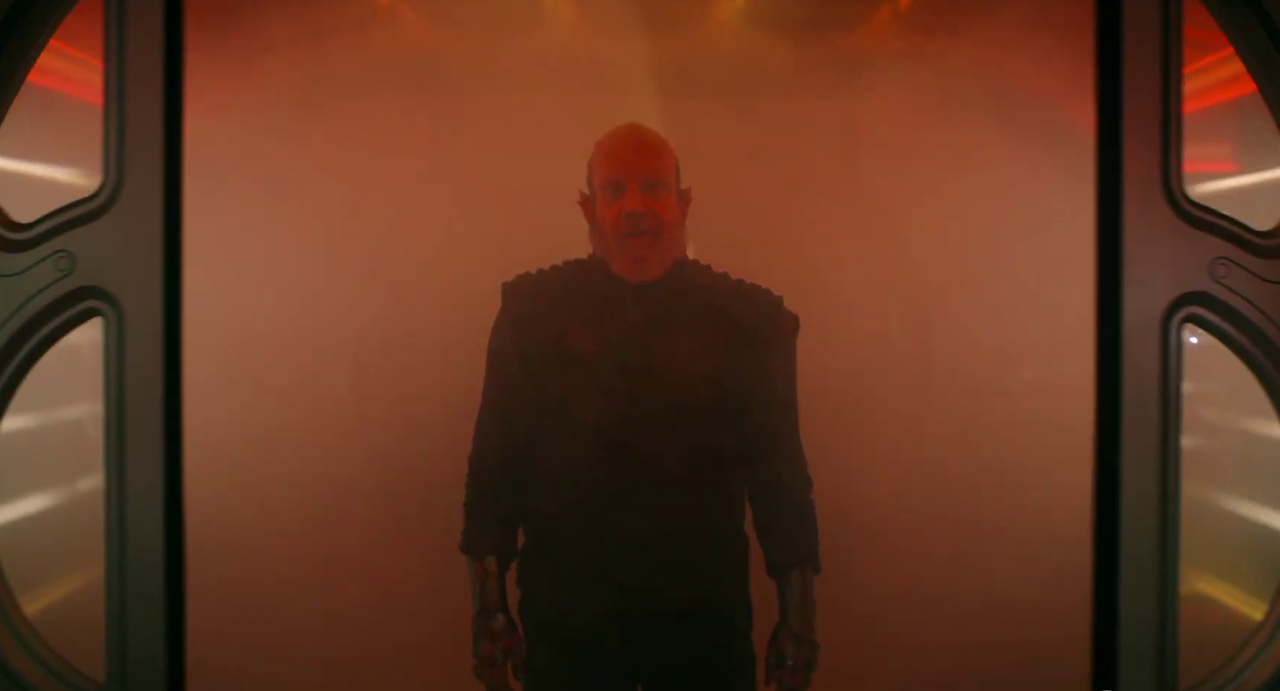
Nus Braka: Starfleet Academy’s villain.
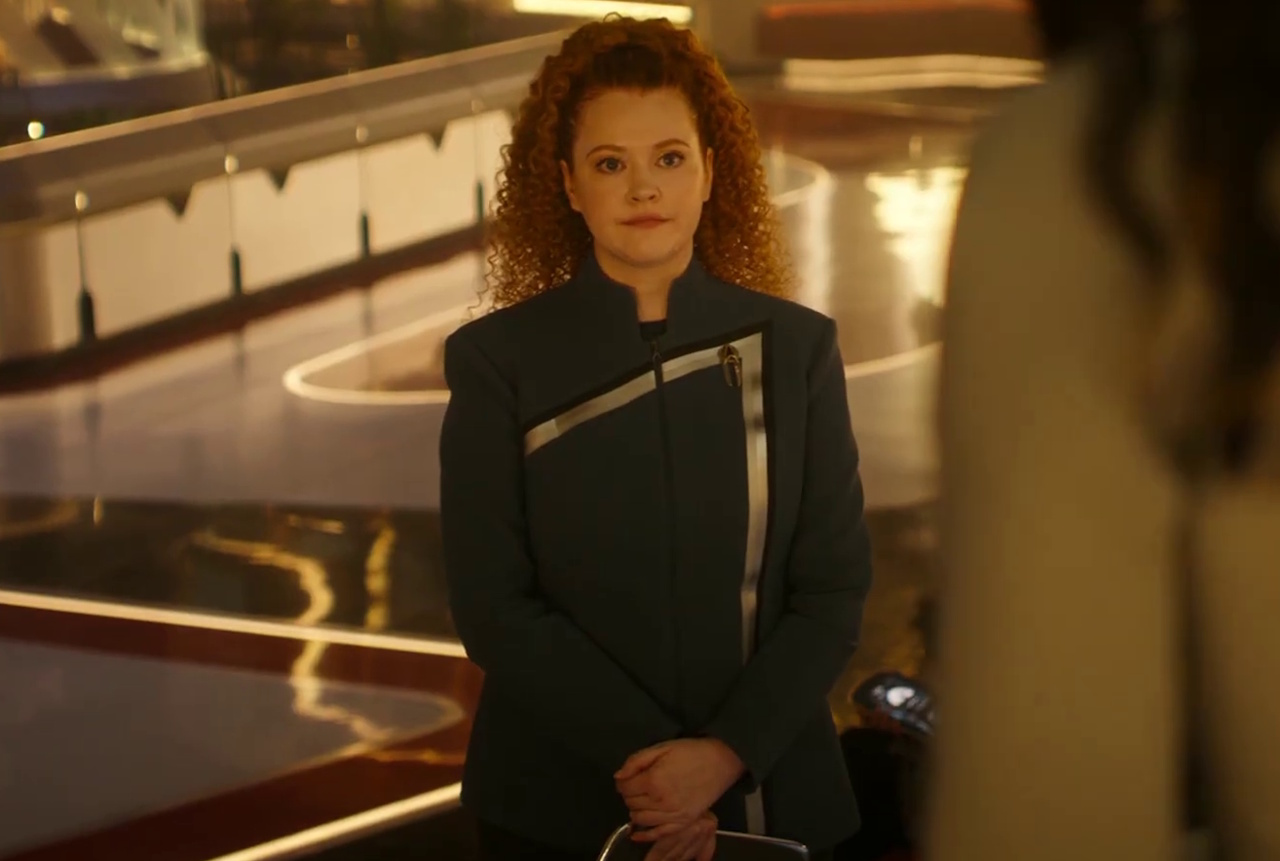
However! It wasn’t all doom and gloom in the Starfleet Academy trailer. We caught a glimpse of Mary Wiseman’s Tilly for the first time in any Starfleet Academy material, which is great news. Tilly was a fun character in Discovery, and it seemed – for a time, at least – as if Starfleet Academy might be being constructed around her as a central character. There was even that backdoor pilot in Season 4 – though none of the cadet characters seem to have shown up in the new series, for some reason.
But with Tilly having been absent from all of Starfleet Academy’s marketing so far, I can’t’ve been the only one who was beginning to wonder whether she’d show up at all! Rumours suggest that Tilly may only be a guest-star for a single episode in the show’s first season, but I’m sure she’ll still be a welcome addition to the cast. It was great to catch sight of her for the first time, in any case.
It’s Tilly!
The rest of the Starfleet Academy trailer looked… well, it looked “teenager-y.” Which makes sense, of course, given the show’s younger characters and target audience! Plenty of shows and films aimed at a younger audience or featuring younger characters still have a lot to offer to the rest of us – look at the likes of Wednesday or Stranger Things (neither of which I’ve actually seen, but they’re good examples nevertheless!) Some of the clips in the trailer seemed to show characters at the Academy falling in love, going on dates, and talking in that kind of angsty way you sometimes get in teen dramas. I’m not sure whether all of that (or any of it) will be to my taste, but I’m content to give the show and these characters a chance to impress me.
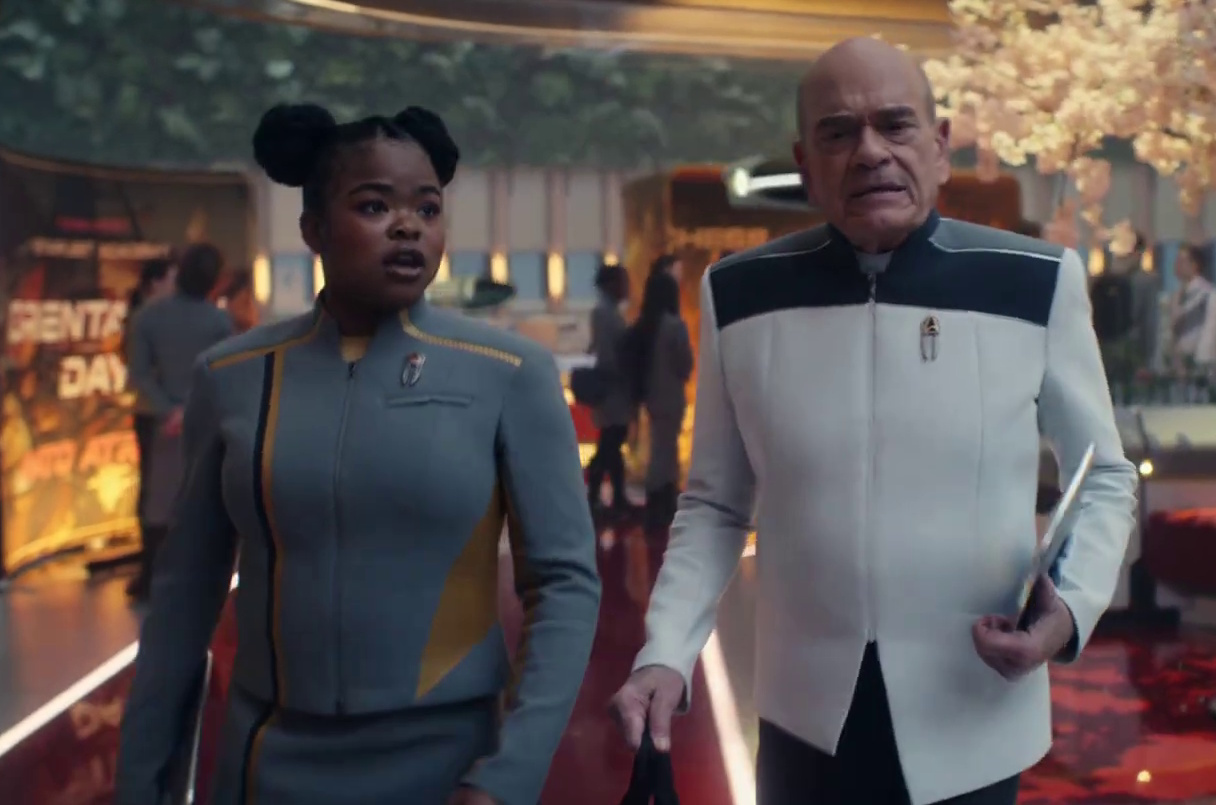
One thing I hadn’t clocked until recently was that Sam – one of the new cadets – is a hologram. I think this is really interesting given that Voyager’s Doctor is also going to be present in the series, and I can already see the two of them developing a connection over a shared (or similar) heritage. That’s something that could be really interesting, and I wonder if we’ll get an exploration of how holographic rights developed in the years after Voyager.
Sam and the Doctor.
Nahla Ake, the captain and Chancellor of the Academy, is sure to be one of the series’ breakout characters. She’s brought to life by Academy Award-winner Holly Hunter, and the Star Trek franchise really lucked out to land a performer of such calibre. Though I’m not sure her personal connection with Caleb is the right move narratively, I’m really excited to see what this new character will be like, how her style of command will be, and how the rest of the cadets will respond to her. I think there’s a ton of potential there.
It was a deliberate choice to make Starfleet Academy a spin-off from Discovery, set in that same far-future time period. I’ll be curious to see how the show will lean into that, and whether the “post-apocalyptic” setting caused by the Burn and its lingering aftershocks will be a big part of the main storyline. In a way, I hope that Starfleet Academy will be able to do something more meaningful with that idea than Discovery managed… but I won’t lie: a big part of me regrets that this show couldn’t have been set in the Picard era instead.
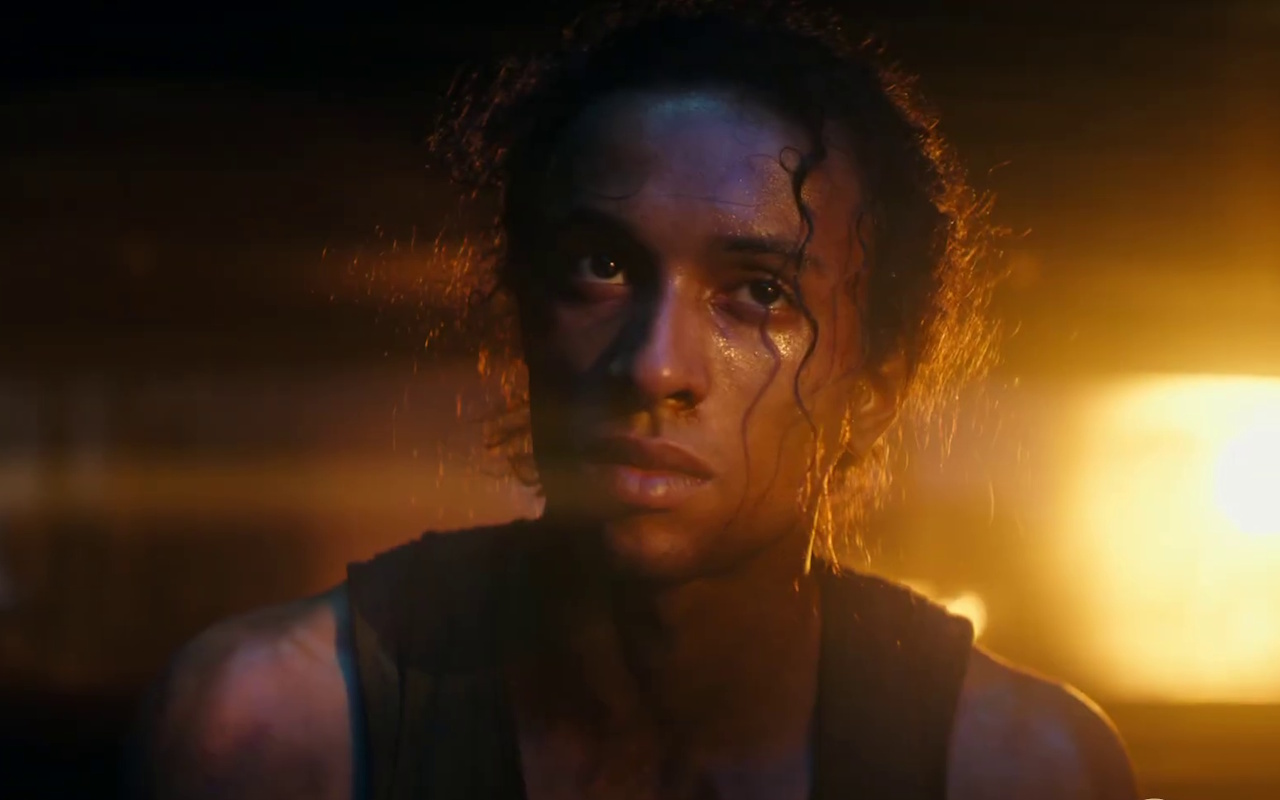
Caleb.
It seems like Starfleet Academy is setting up Caleb, Captain Ake, and Nus Braka to be the principal characters, all tied up together in a “mystery box” type of story surrounding Caleb’s missing mother. I’m still not convinced that this was the right approach, but maybe if it’s a solid enough story it will at least be worth following to its conclusion. Based on what we saw of him in the trailer, I wasn’t actually wowed by veteran actor Paul Giamatti’s performance – he felt too over-the-top for my liking. And that’s a shame; Giamatti is a fine actor, and someone I’ve been looking forward to seeing in Star Trek. Hopefully it’s just a consequence of the way the trailer was cut; in context, those moments might feel better and make a lot more sense.
I hope Starfleet Academy isn’t going to do the clichéd (and also played-out) trope of “everyone has a hidden secret backstory.” We seemed to get hints at at least two of the other cadets – Genesis and Darem – having some kind of issues with their families or in their past that are driving them to seek positions in Starfleet. I don’t think every character needs that kind of motivation – especially not young, school/university-aged characters. Isn’t it enough to say they’re looking to make something of themselves, or that Starfleet appealed to them because they wanted to be scientists or explorers? Complexity can make a character great in any work of fiction – but not every complex character needs to have some kind of mysterious or traumatising past to explain why they are the way they are. I’m just a little concerned that Starfleet Academy is leaning too much into that kind of storytelling.
Why does Genesis say she “needs” to be a captain?
I hope this has been an interesting glimpse at both Starfleet Academy and Strange New Worlds. I still haven’t decided yet whether I’m going to review every Starfleet Academy episode or not – I think, at the very least, I’ll review the premiere, just to see how the series is starting off! But whether I do individual episode reviews or review the rest of the season in one hit, I hope you’ll join me for that in January. And I’m hopeful that Strange New Worlds Season 4 will debut later in 2026, too – and I will definitely write up individual episode reviews there, as I did for Season 3 earlier this year.
Obviously, Strange New Worlds remains the Star Trek project I’m most excited for; nothing in the Starfleet Academy trailer convinced me that I should change my mind about that! But, despite what I’d consider to be some narrative red flags, I’m still hopeful that Starfleet Academy will be fun. Even if it’s not “my thing,” perhaps it will finally be the series that reaches out to a new generation of viewers, turning them into Trekkies and kick-starting a renaissance for the franchise that the fan community arguably needs.
In any case… we don’t have much longer to wait!
Star Trek: Starfleet Academy will premiere on Paramount+ in January 2026. Star Trek: Strange New Worlds Seasons 1-3 are available to stream now on Paramount+ and Season 4 looks set to premiere later in 2026. The Star Trek franchise – including all shows and properties discussed above – is the copyright of Skydance/Paramount. This article contains the thoughts and opinions of one person only and is not intended to cause any offence.
Spoiler Warning: There are spoilers ahead for Star Trek: Voyager and Star Trek: Prodigy.
In 1996, the Star Trek: Voyager episode Flashback was broadcast as part of the Star Trek franchise’s thirtieth anniversary celebrations. Today – and I can scarcely believe I’m writing these words – we’re marking Voyager’s own thirtieth anniversary!
That’s right: it was on the 16th of January 1995 that Caretaker, the premiere episode of Star Trek: Voyager, debuted in the United States. I thought it could be worth taking a few minutes to look back at not only the premiere, but Voyager as a whole – and try to assess its legacy and its place in the history of Star Trek. That’s what we’re going to talk about today, so I hope you’ll join me on a rose-tinted look back at Star Trek’s fourth live-action series!
Caretaker premiered on this day in 1995.
When Voyager premiered in 1995, the Star Trek franchise was arguably at the absolute peak of its “golden age.” The Next Generation cast had started making feature films, Deep Space Nine was well into its third season, and it felt like Star Trek had well and truly made it; a franchise that was dominating the sci-fi world. I remember at the time hearing some criticism of launching another series, but with The Next Generation having explored strange new worlds in the Alpha and Beta Quadrants, and Deep Space Nine tackling the Gamma Quadrant… I gotta admit that I was excited to see Voyager head to the unexplored and mysterious Delta Quadrant!
Having read a preview of the series (I think in the Radio Times; a UK TV magazine) I was also intrigued by this “one ship, two crews” idea that Voyager seemed to be promoting. Seeing Starfleet officers having to work hand-in-hand with the Maquis seemed like a really interesting concept, and one that could’ve given Voyager a unique selling point and a way to stand out from the pack as Star Trek continued its growth and expansion. I don’t think Voyager’s writers ever really made good on that promise – but more on that in a moment!
An early placeholder logo for the show circa 1994.
Stories about long journeys, people from different backgrounds having to work together in common cause, and having a small “island of safety” in a dangerous and unexplored environment are all things I absolutely adore in fiction – so Voyager seemed to be bringing together a bundle of elements that might as well have been tailor-made for me! And across its seven-season run, all of those things came to the fore in different ways. Voyager was a fun series.
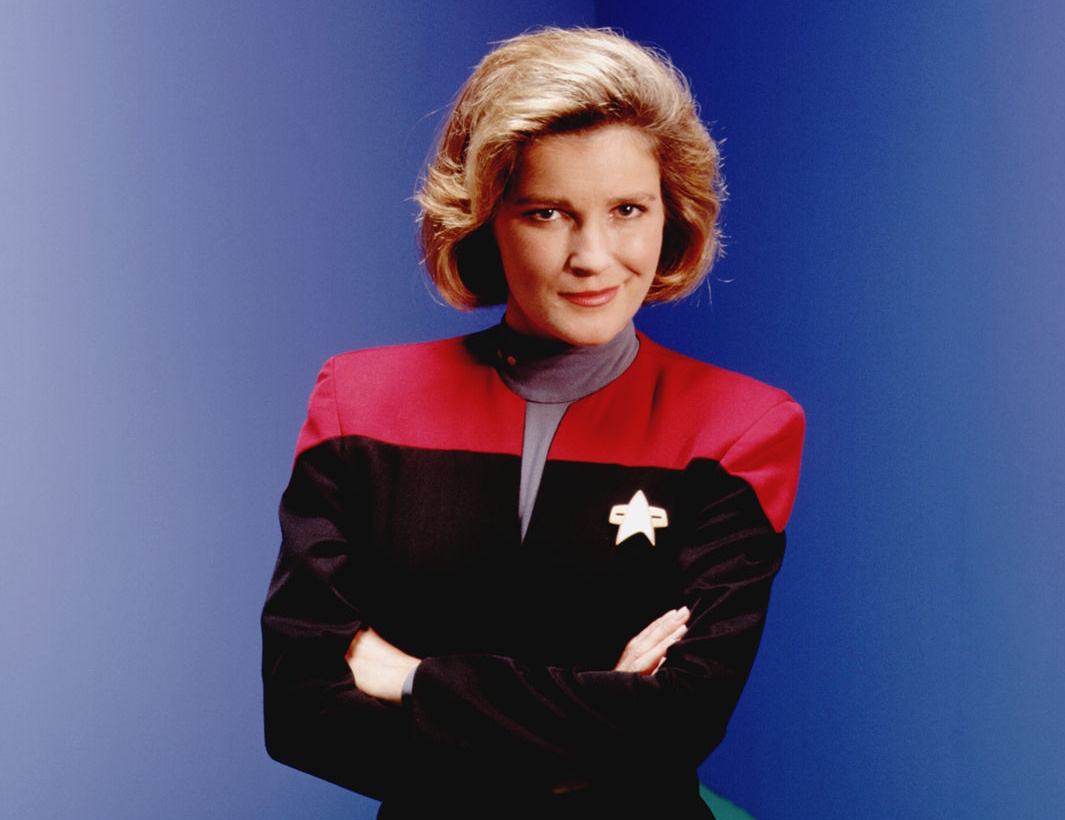
Of course, one of the most-discussed things leading up to Voyager’s premiere was the show’s new captain: Kathryn Janeway, played by Kate Mulgrew, became Star Trek’s first woman captain. I remember this news being received positively at the time, at least in the Star Trek fan groups I was aware of. No one in 1995 knew what the word “woke” would come to mean, so Janeway’s announcement didn’t get the same kind of negative reaction and whining as we might expect in 2025! That’s not to say there wasn’t some degree of pushback, of course. There have always been toxic individuals within the fan community.
Captain Kathryn Janeway.
I remember the days leading up to Voyager’s premiere being ones of positivity and anticipation. I was absolutely thrilled at the prospect of Star Trek’s expansion, at getting a new exploration-focused series after The Next Generation’s finale, and at meeting a whole new crew and cast of characters. There was a lot to be excited about as Voyager’s premiere got closer!
Star Trek: Voyager was almost a very different show, though, and I think it’s worth taking a diversion to acknowledge that. As work began on the series, the question of who should sit in the captain’s chair was perhaps the biggest individual casting decision that befell casting directors Nan Dutton and Kathryn Eisenstein… and they fucked it up. Kate Mulgrew was considered for the role of Janeway, along with several others, but the role was given to Oscar-nominated actress Geneviève Bujold instead.
What might’ve been…
Bujold was a terrible fit for the role of Janeway – as evidenced by the scenes she shot for Caretaker, which were included as a bonus in Voyager’s DVD box set – and seriously struggled with working on the show. Thankfully, Winrich Kolbe – who directed Caretaker – and executive producer Rick Berman recognised this before it was too late, and Bujold was replaced with Kate Mulgrew after only a couple of days. Still, this near-miss could’ve derailed Voyager before the show had a chance to get started.
As an aside, I don’t think Geneviève Bujold is in any way a bad actress or performer. But the idea to cast a character closer in style and tone to Jean-Luc Picard would’ve been wrong for Voyager, and that’s how I interpret her performance in those few scenes that have been revealed. Voyager needed a dynamic, energetic captain – someone who could make incredibly tough decisions under pressure while retaining the support of her crew. I didn’t see any of that in Bujold’s performance, so replacing her was unquestionably the right call.
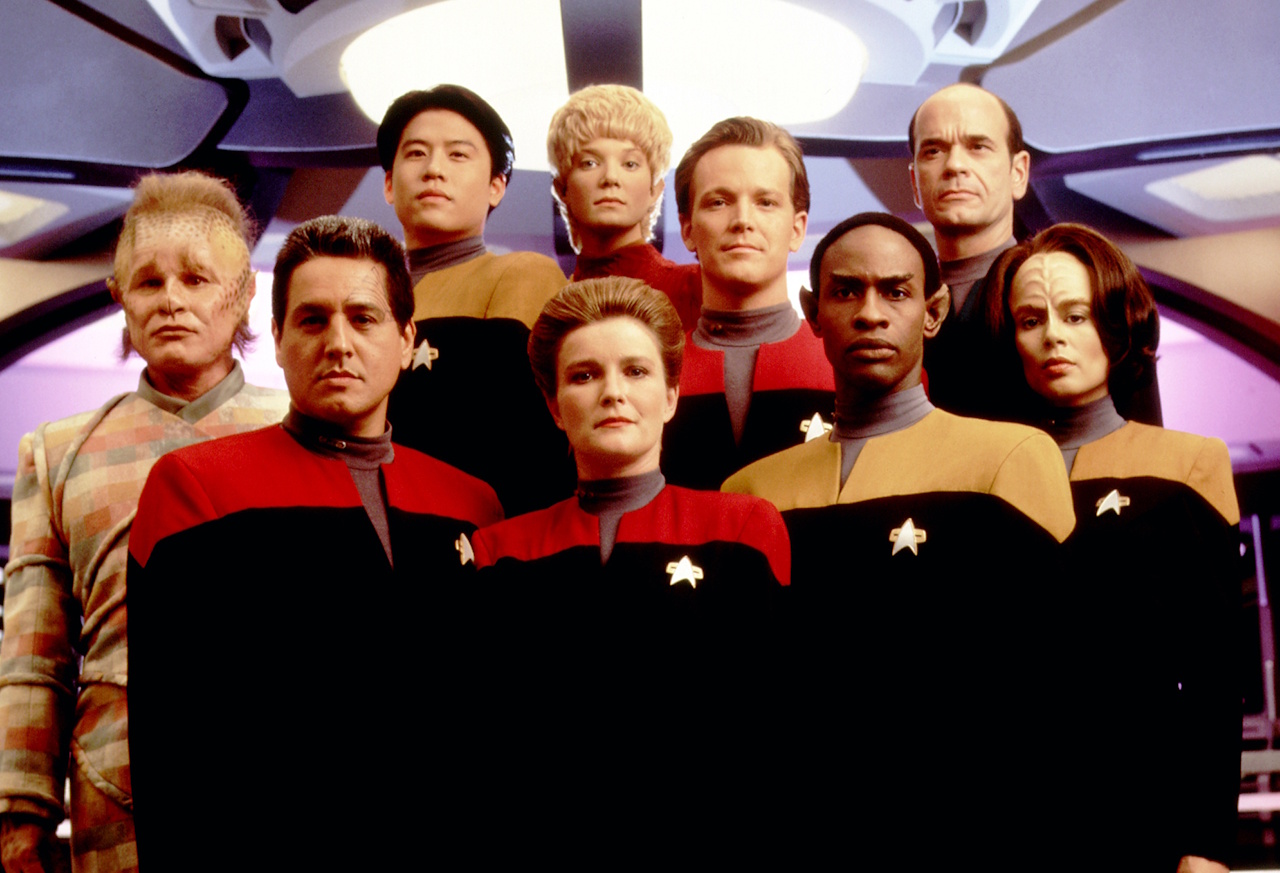
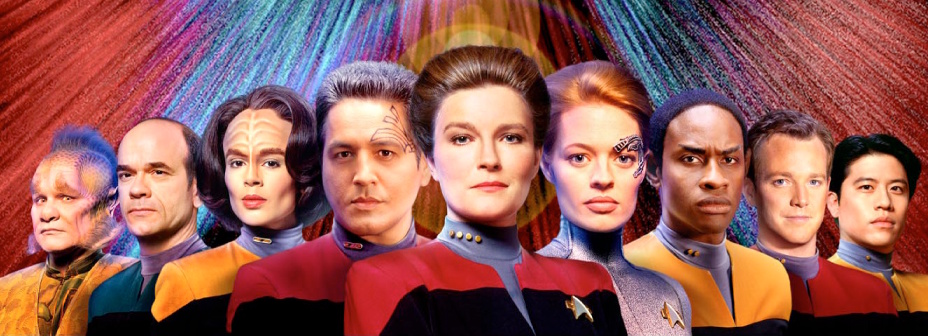
The main cast in Season 1.
Having to re-cast your lead role after filming has already started isn’t a great look for any television series, but Voyager was able to recover. Caretaker kicked off the show in style – and put a very interesting twist on a story premise that we’ve seen before in other episodes of Star Trek.
Several times in The Original Series, The Next Generation, and Deep Space Nine, our crews found themselves apparently stranded – perhaps on an alien planet, or else far away from Federation space. But in all of these, they found their way home again by the time the credits rolled. To me, Voyager always felt like it was taking one of those episodes and asking the obvious question: what if there wasn’t an instant way home? I really loved that idea, even in 1995 it felt subversive and creative; a unique and different take on a Star Trek story concept that we’d seen before.
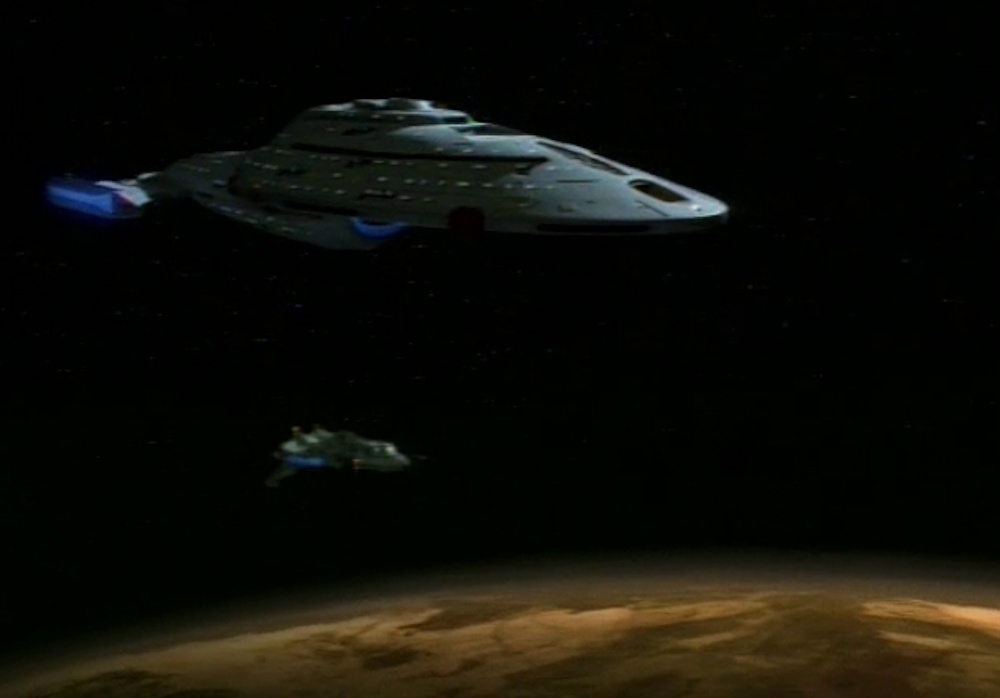
The USS Voyager (and Chakotay’s ship) in orbit of the Ocampa homeworld.
Caretaker was also a fantastic crossover episode, bringing in characters and locations from Deep Space Nine. A couple of years earlier, the two-part episode Birthright had brought The Next Generation to DS9, too – so launching the show in this way felt like a real thread of continuity between all three extant Star Trek projects. Star Trek was doing the whole “shared universe” thing decades before the likes of Marvel!
Quark, Morn, and Gul Evek returned from past iterations of Star Trek, further tying Voyager into the franchise before striking out on its own. These three characters – along with Q – are the only ones to have appeared in all three of The Next Generation-era Star Trek shows, which is a fun little bit of trivia for your next Star Trek quiz night! Having that connection to the rest of the franchise was important, though, and it continued the trend of characters from Star Trek’s past appearing in the premiere of a new series.
Morn in Caretaker.
Caretaker gave Captain Janeway a moral dilemma, one that tied into the idea of the Prime Directive and Starfleet’s core mission of peaceful exploration. Janeway ultimately decided to intervene, destroying the Caretaker’s array to prevent it from falling into the hands of the aggressive Kazon – but stranding her ship and crew in the Delta Quadrant in the process. This kicked off a story that would run for seven seasons, blending Star Trek’s normal episodic format with an underlying quest: Voyager’s journey home.
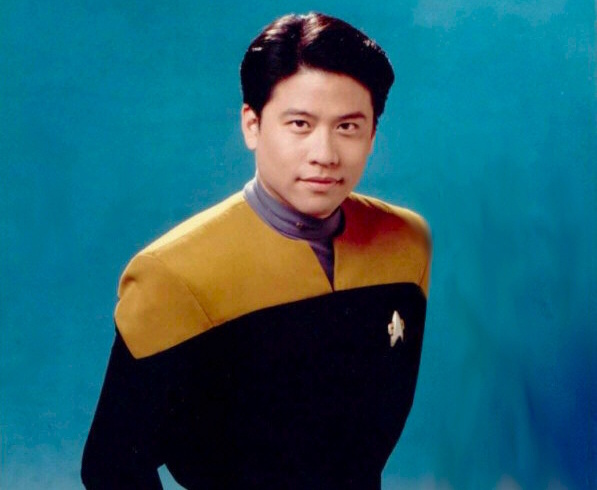
Harry Kim made a fine addition to the crew, and also filled an important role for Voyager in a narrative sense. Kim was always the first character to jump on the idea of finding a shortcut home, and the most eager (of the main characters, at least) to make it back to the Alpha Quadrant. I wouldn’t say it was his sole defining character trait, but it was an important one. Voyager needed at least one character like this to keep the voyage home at the top of the agenda.
Garrett Wang portrayed Harry Kim in all seven seasons.
More recently, Kim has become best-remembered in the fan community for never receiving a promotion! And I can kind of understand that; particularly as the show wore on and Kim gained more experience, it began to stretch belief to think that he’d remain a mere ensign. Again, though, Voyager was a semi-episodic show, and a show that needed at least one “young and eager” junior officer to fulfil that narrative role and occupy that space.
I was a big fan of Kes in Voyager’s early days; her gentle bedside manner and strong sense of empathy stood in contrast to the brash and often impolite Doctor in scenes set in sickbay. The idea of a short-lived species (Ocampa typically had a lifespan of around nine years) was also a unique one at this point in Star Trek’s history. Kes had close relationships with Neelix, Tom Paris, and of course the Doctor, too, all of which gave her plenty to do.
A promotional photo of Kes.
I was disappointed when I learned that Kes was going to be dropped from Voyager heading into the show’s fourth season, particularly as she’d just begun developing her telepathic powers under the tutelage of Tuvok. I felt there was still more to explore with her character, and it was a shame that she was booted off the show before this potential could really be reached… especially because of who replaced her.
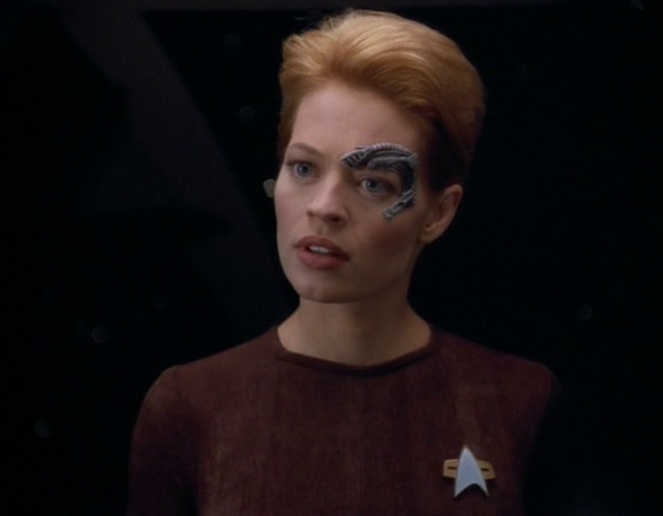
I know I’m in the minority here… but during the back half of Voyager’s run, I came to really dislike Seven of Nine. This character felt so boring and repetitive, but due to her popularity with at least a portion of the show’s audience she was prominently featured in many different episodes from Season 4 onwards. Seven always seemed to learn some lesson in “how to be human” in an episode… only to forget it all a week later and have to re-learn the same stuff over and over again. I really burned out on her character pretty quickly.
Seven of Nine wasn’t my favourite character.
But there’s no denying that Star Trek’s first ex-Borg main character (not counting Picard, of course) shook up Voyager and added something new to the show. Seven’s introduction also kicked off a succession of Borg-centric episodes… which, I’m afraid, were more miss than hit in my opinion, and went a long way to damaging the fear factor that a villain like the Borg needs to have. However, recent Seven of Nine appearances in Star Trek: Picard rehabilitated the character for me, resolved many of the issues I had with her, and generally left me with a much more positive view of Seven as a whole. Here’s hoping she might return one day!
I’ve said this before, but Tom Paris was the Star Trek franchise’s first proper pilot – the first helmsman to really seem like he loved being in the chair. Paris was a fun character – an ex-Maquis and ex-Starfleet officer who seemed to attract the ire of both halves of the combined crew, but came to be seen as a dependable fixture on Voyager’s bridge. Paris’ arc took him from a failure and a criminal to a rehabilitated Starfleet officer and family man, and it was great to see it play out.
Tom Paris had a great character arc across Voyager’s run.
Paris’ love for the holodeck also led to some fun diversions across Voyager’s run. I was less enthusiastic about the likes of Captain Proton – though it could be fun for an episode or two – but his creations of Sandrine’s bar, the town of Fair Haven, and the Maquis insurrection holo-programmes all led to fun and exciting stories.
How can we talk about Tom Paris without mentioning B’Elanna Torres? Torres became – at Chakotay’s insistence – Voyager’s chief engineer, and had the challenge of standing out as both the second Maquis main character and (after Worf in The Next Generation) the second character with Klingon heritage. Voyager didn’t always know how to define and handle Torres, with some early episodes presenting her as angry and belligerent… but she soon settled into the role of chief engineer.
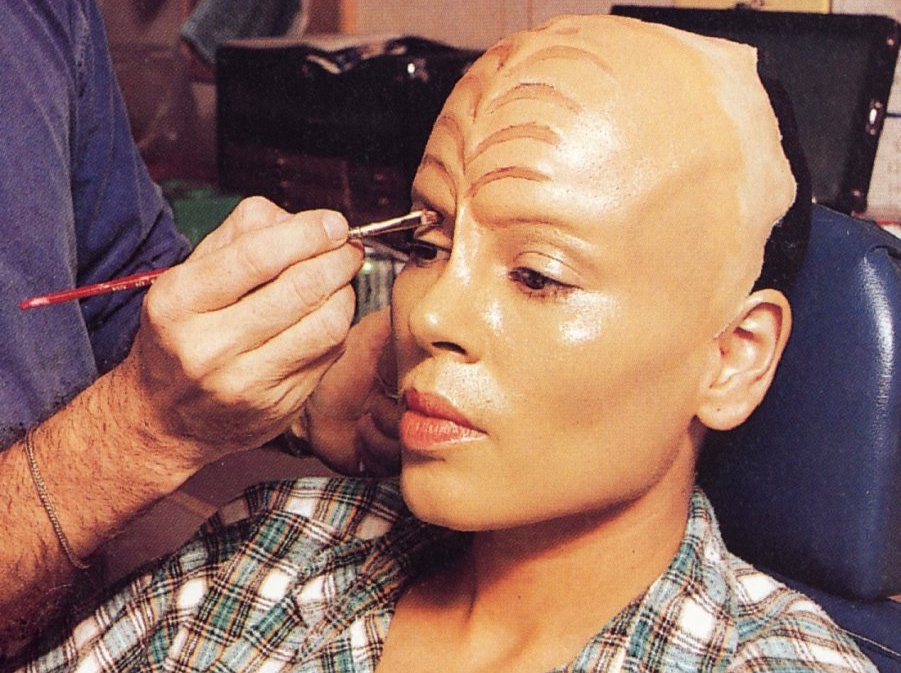
Roxann Dawson in the makeup chair.
B’Elanna, for me, is defined by two key relationships that would develop later in Voyager’s run: her antagonistic stance against Seven of Nine and her relationship and later marriage to Tom Paris. B’Elanna often stood as the voice of reason against Seven’s “Borg-ification” of parts of the ship, but her relationship with Tom went a long way to settling both characters down and giving them purpose. We’d also see several episodes featuring B’Elanna’s Klingon side – and these could be fun changes of direction for a show set thousands of light-years away from Klingon space.
Chakotay feels like the embodiment of Voyager’s missed opportunities. Voyager’s writers never made good on the “one ship, two crews” idea, meaning Chakotay basically became a Starfleet officer and Janeway’s confidante within a couple of episodes, robbing him of more than one potential character arc. His relationships with most of the crew besides Janeway and B’Elanna were never really explored in much depth, and he just feels like… a presence. Chakotay was on the bridge the whole time, but can you think of many episodes where he drove the plot or was otherwise in focus? Because I can’t!
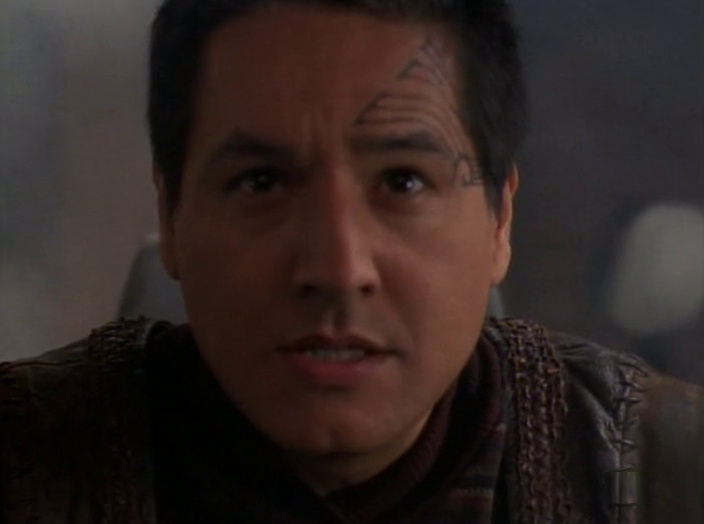
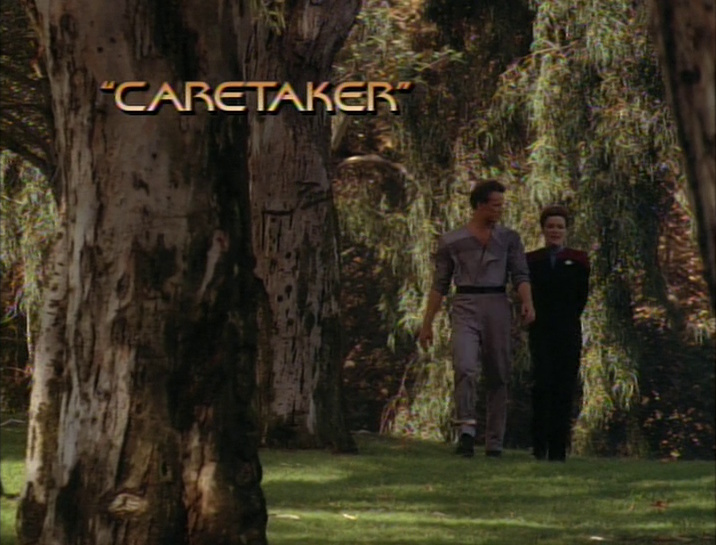
Chakotay was the first character we saw at the very beginning of Star Trek: Voyager.
I must get caught up with Prodigy, because Chakotay may get the kind of cathartic redemption arc that we were discussing with Seven of Nine, and that’s something I need to see! And across the show’s seven years, Chakotay did get a few spotlight episodes and storylines – notably exploring his Native American heritage and his relationship with Seska. I just feel there was more that Voyager could have done with this character – he was the first officer, after all, and it would be weird if the likes of Spock, Riker, or Major Kira had been similarly sidelined in their respective shows.
I remember feeling confused on learning that Voyager’s doctor was going to be a hologram! “How could that work?” I remember thinking to myself. “Exceptionally well” seems to be the answer, because Voyager’s Doctor was an incredibly fun character – and one who experienced growth over the course of the series. Starting out as a holo-programme with relatively little personality and no interests, the Doctor changed and evolved over the course of the show, taking on new challenges and new interests, and that was a really fun thing to see play out.
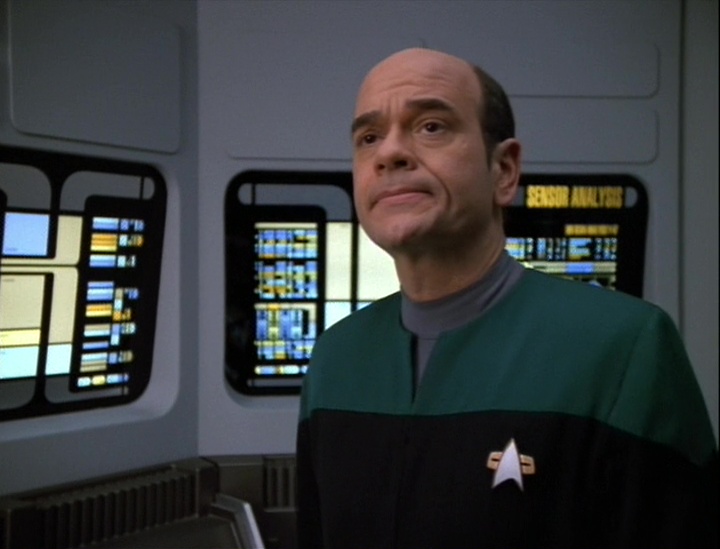
The Doctor – the first holographic main character in Star Trek.
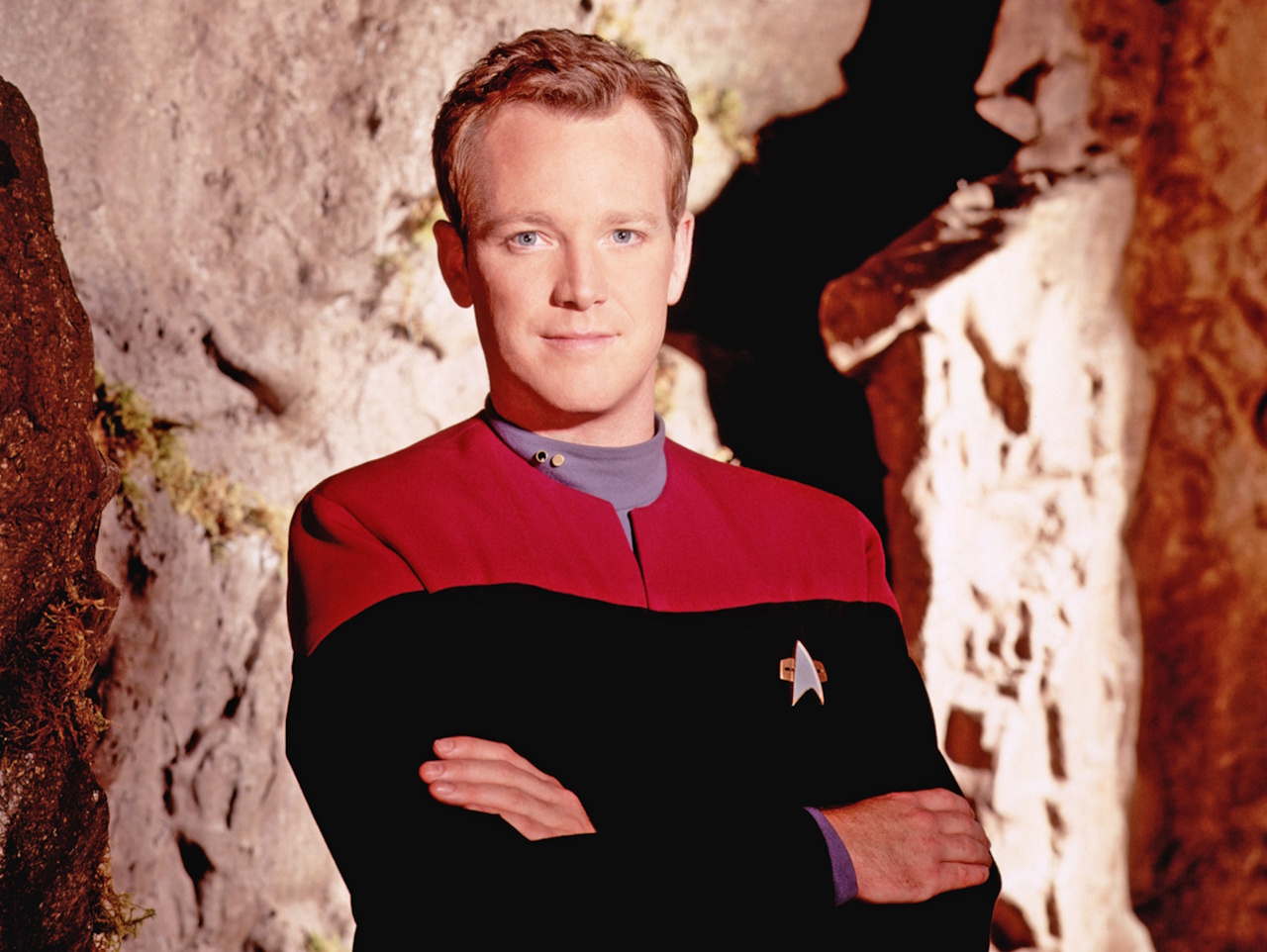
When the Doctor got his mobile emitter – a piece of 29th Century technology – in the third season, I was sceptical. But allowing him to leave the confines of sickbay and the holodeck turned out to be a great decision, leading to more involvement from this fun and enjoyable character across the second half of the show’s run. The Doctor could be great comic relief, and actor Robert Picardo has excellent comedic timing, but there’s much more to the character than that. We got some great emotional moments with him, too, such as losing his holographic family or sitting in court arguing for his rights as a sentient life-form.
Speaking of comic relief, we have Neelix! Star Trek shows had had barkeeps before – Guinan in The Next Generation and Quark in Deep Space Nine – but never a cook. Neelix took broad liberties with that role, serving first as a guide to the area around Ocampa, then as a “morale officer” for the ship – while cooking up a selection of interesting dishes to feed a hungry crew! I bought a copy of Ethan Phillips’ Star Trek Cookbook and even tried a few of them for myself… with terrestrial ingredients, of course.
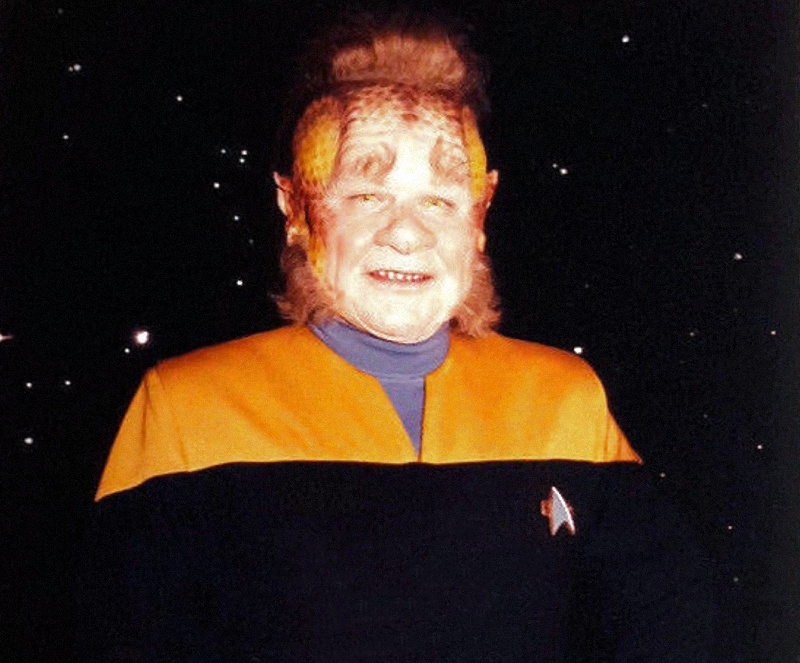
A promo photo of Neelix… in a Starfleet uniform.
Neelix’s relationship with Kes could feel a little uncomfortable, but fortunately it wasn’t in focus all that much outside of a few early episodes. As Neelix settled in aboard the ship, he became an important character – and would often serve as a bridge between characters who didn’t always get much interaction. His largely one-sided friendship with Tuvok – though often played for laughs – was great to see, too, and showed Neelix’s way of accepting people different from him.
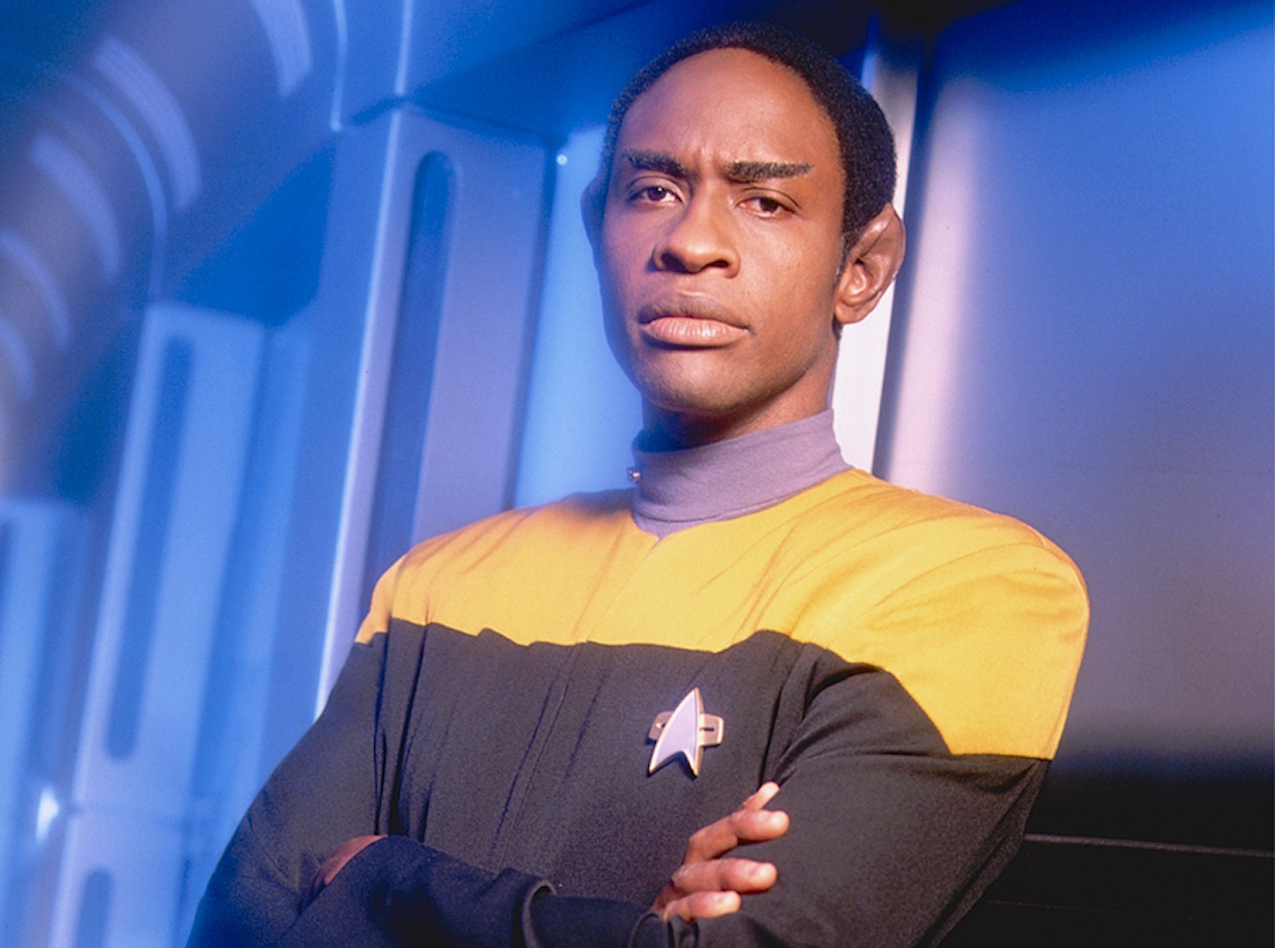
And speaking of Tuvok, Star Trek’s second Vulcan main character made quite an impact! Spock was always going to be a hard act to follow, but taking the calm and logical Tuvok as far away from science and exploration as possible was undeniably the right call. A Vulcan security and tactical officer makes a lot of sense when you stop to think about it – and Tuvok demonstrates exactly why. Calm and stoic under pressure is just what that job requires!
Tuvok.
Tuvok also served as Janeway’s friend and confidante – arguably treading on the toes of the traditional first officer role, in that sense. I wish we’d gotten more of an examination of his relationship with Chakotay, though that’s more from Chakotay’s side, as mentioned above. Tuvok also bridged the gap between The Original Series era and Voyager in the most unexpected of ways – check out the episode Flashback, that I mentioned at the beginning, for more on that!
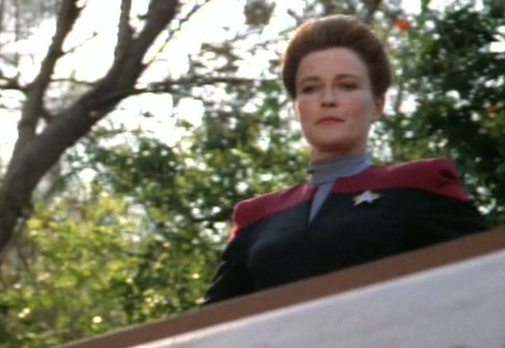
So that leaves us with Captain Janeway. Janeway was the captain that Voyager needed on a quest like this, and she had the strength to guide her crew home. She also had some fun character quirks, like her love of coffee, that kept her feeling grounded and real. The first woman to sit in the captain’s chair for a Star Trek series embodied elements of all three of her predecessors: Kirk’s toughness, Picard’s diplomacy and tact, and Sisko’s dedication to doing the right thing. But she was always her own woman, never feeling overshadowed by any of the captains that had come before.
Captain Janeway in Caretaker.
As mentioned above, Kate Mulgrew was the perfect choice for this role, and she delivered a masterful performance across all seven seasons of the show. Voyager’s journey home wouldn’t have been the same without her, in fact, and across the show’s run we got several great episodes that shone a spotlight on the captain. Stories pitted her against villains like the Krenim and the Borg Queen, and Janeway always found a way to come out on top!
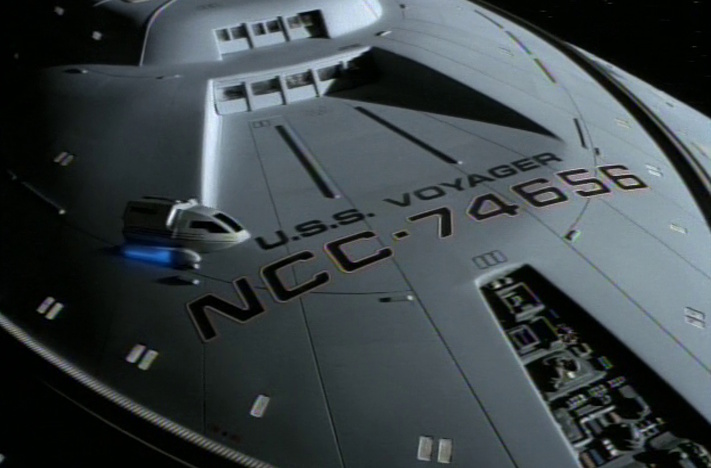
The USS Voyager still feels like a futuristic design to me even thirty years on from its debut! Something about the more angled saucer section makes it feel more modern than the circular hull of Kirk’s Enterprise and the Enterprise-D, and the sleeker lines also scream “speed!” Voyager was a long-range tactical ship made for exploration and combat, and the ship’s design philosophy reflects that. I will never tire of the sequence in Caretaker of Paris being flown in by shuttlecraft, seeing Voyager for the first time.
Our first introduction to this wonderful starship.
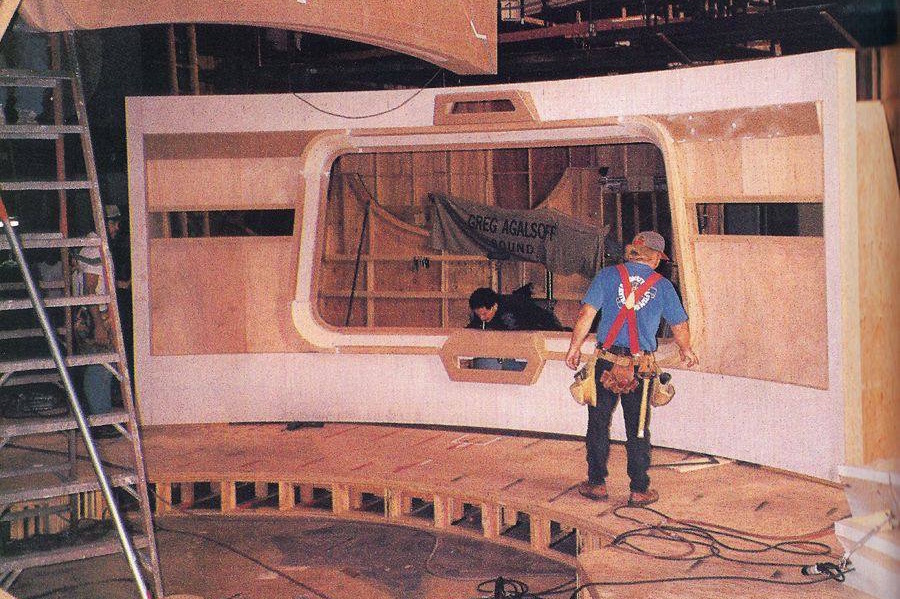
On the inside, we got a continuation of the Starfleet aesthetic that debuted in The Motion Picture and has been a mainstay in the franchise since. Voyager’s bridge is larger and wider, though – or at least it feels larger and wider – than anything we’d seen before. This expansive space was the perfect stage for interactions between all of our favourite crew members! Again, the bridge felt more modern than that of the Enterprise-D, while at the same time continuing the design trends that we saw in The Next Generation.
Janeway’s ready-room was an interesting area, giving her a large desk but also a couch that could act as a social space. Engineering had a really neat effect for its warp core, and the expansive entryway was often where intense conversations played out. The Doctor had sickbay as his domain, but he also got an office and a small lab off to one side that were fun inclusions. Voyager also had a shuttlebay, holodecks, crew quarters, corridors, and the mess hall – all of which would get moments where they were in focus!
Voyager’s bridge set under construction circa 1994. Image Credit: Forgotten Treks/TrekDocs
As an aside, being able to virtually explore Voyager in the game Elite Force was one of my absolute favourite things about that game! In 2000, being able to wander through the bridge, sickbay, and some of the ship’s corridors felt absolutely magical as a Star Trek fan, and while Elite Force wasn’t the only game to offer that experience (the adaptation of Generations had a mission set on the Enterprise-D, and there were probably others around the same time), it was certainly one of the most memorable for me personally.
One thing Voyager didn’t really have was an expansive secondary cast. Deep Space Nine gradually gave more time and attention to characters like Rom and Martok, but Voyager, by and large, kept its focus on its main cast of characters. The Borg children – and Icheb in particular – were really the only ones to break through in more than a handful of episodes, though some, like Seska and The Next Generation’s Reg Barclay, would go on to make multiple appearances. Deep Space Nine showed what Star Trek could do with a wider and more expansive cast… and it’s something the franchise has yet to return to. Voyager had the opportunity to build out some of its secondary characters, but never really went there. I think that’s a bit of a shame – but it is what it is!
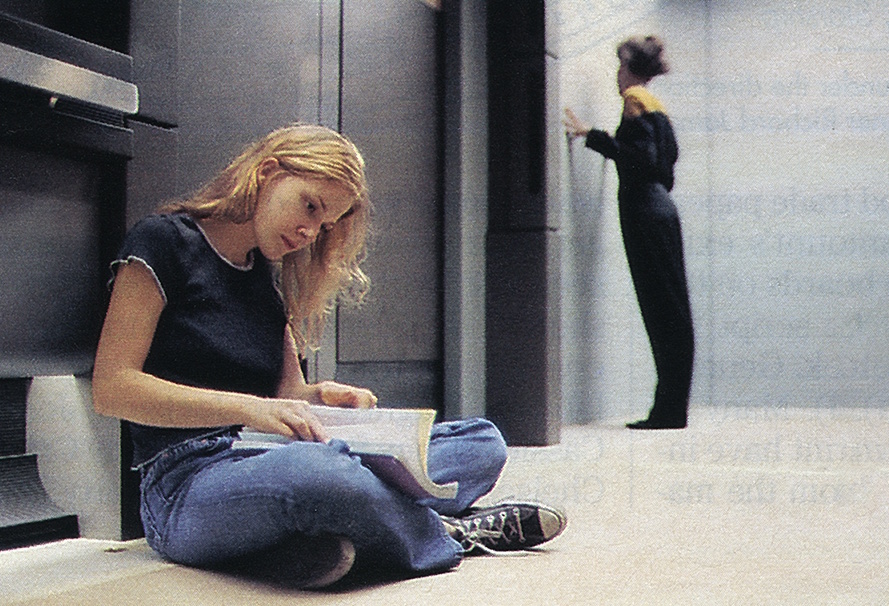
Jennifer Lien (Kes) reading her script on the set of Caretaker.
For a variety of reasons, Voyager never really made good on its “one ship, two crews” idea, and by about halfway through Season 1, the main Maquis characters were basically entirely integrated with the Starfleet crew. With the exception of plot-relevant moments, such as stories involving Seska, the fact that almost one-third of Voyager’s complement were Maquis never really came to the fore in a big way, and I think that’s a bit of a missed opportunity.
Don’t get me wrong, a story about people from different backgrounds finding a way to work together for the common good is something I absolutely adore, and there were times where Voyager absolutely nailed that feeling. I guess I’ve just always felt that I would’ve liked to see more tension, scepticism, and disagreement as the two crews began the process of integrating. I never really felt as much of that as I would’ve liked – and that’s perhaps Voyager’s biggest sore spot for me, thirty years on.
Voyager struggled to make good on its “one ship, two crews” premise.
That being said, Voyager was a great show all around, and a welcome addition to Star Trek. With The Next Generation’s crew off making feature films and Deep Space Nine occupying a space station, there was plenty of room for a new series set aboard a starship. Voyager embodied Star Trek’s ethos of peaceful exploration… but set that exploration against a new backdrop of trying, against the odds, to make it home. It was both familiar and different at the same time; a really interesting blend of storytelling styles.
Voyager was also a much more episodic series than Deep Space Nine – despite its voyage home story being omnipresent and frequently referred to. There were plenty of one-off stories featuring a wide range of alien races, factions, and wacky premises. It was a Star Trek series through and through, one that brought a fantastic cast of characters to the table and threw them into plenty of fun, exciting, and occasionally emotional situations.
The cast on a promotional poster.
The excitement I felt thirty years ago was more than rewarded! Voyager was an outstanding show, and I got thoroughly invested in the crew and their quest to return to the Alpha Quadrant. There were some episodes that were wide of the mark – as there are bound to be in any show that runs to 168 episodes across seven seasons! But even at its worst, there were things to enjoy, fun lines of dialogue, entertaining character moments, or creative decisions that made Voyager well worth watching for any Trekkie or fan of sci-fi in general.
As the final show of what I consider to be Star Trek’s “golden age,” I’ve long had a soft spot for Voyager. Of course I watched every single episode during the show’s run – I would tune in when they made their debut on terrestrial TV here in the UK, and I very rarely missed a week. I later bought all seven seasons when they were released on DVD and enjoyed the series all over again.
The USS Voyager set course for the Alpha Quadrant thirty years ago today.
So I hope this has been an interesting look back! I wanted to do something to acknowledge Voyager’s milestone anniversary, but it’s hard to summarise my thoughts on 168 episodes and seven years’ worth of television in a single article! Stay tuned, though, because I’ll be writing up my thoughts on some of my favourite episodes in the days ahead as we continue to celebrate Voyager’s thirtieth anniversary.
I hope that Paramount and the folks in charge of Star Trek plan to do something to mark this momentous occasion, so I’ll definitely be checking out the official Star Trek website and social media pages over the next couple of days. With Seven of Nine, Janeway, Chakotay, and others all having returned to the Star Trek franchise in the last few years, Voyager’s legacy is very much alive. The documentary To The Journey: Looking Back at Star Trek: Voyager has had its official premieres, too, though I don’t think it’s available to stream just yet. Still, another thing to keep an eye on.
All that remains to say is this: happy thirtieth anniversary, Star Trek: Voyager! Thanks for all the memories.
Star Trek: Voyager is available to stream now on Paramount+ in countries and territories where the platform is available. The series is also available on DVD. The Star Trek franchise – including Voyager and all other properties discussed above – is the copyright of Paramount Global. Some images courtesy of TrekCore and Paramount. This article contains the thoughts and opinions of one person only and is not intended to cause any offence.