Star Trek: The Next Generation Episode Re-Watch: Season 1, Episode 22: Skin of Evil

A Star Trek-themed spoiler warning.

Spoiler Warning: There are spoilers ahead for Star Trek: The Next Generation. Spoilers are also present for the following Star Trek productions: The Wrath of Khan, The Search for Spock, Deep Space Nine, Enterprise, Picard Season 3, and Star Trek Online.

This past weekend, I had the opportunity to meet Denise Crosby at a Star Trek convention here in the UK! So what better way to celebrate than by returning to what is arguably Tasha Yar’s most iconic episode: Skin of Evil?

I haven’t written up a full article on this year’s Destination Star Trek convention, by the way; much of what I said last year about the organisation, great accessibility, and so on still applies, and I didn’t really want to repeat myself. If you join me later in the year for my “year in review” piece, I daresay I’ll discuss Destination a bit more then. And if you want to see what I made of last year’s event, you can find out by clicking or tapping here!

For now, suffice to say that it was wonderful to meet Denise Crosby, share a fist-bump, and pose for a photo. And that meeting is what convinced me to return to this episode for the first time in… well, a while, I guess!

Still frame from a video clip of Denise Crosby at Destination Star Trek 2026
Denise Crosby faces off against “Armus” at a Star Trek convention in the UK.
Image: Destination Fan Events via Facebook

If you’re a Trekkie and a big fan of TNG, I daresay you already know the story of how Skin of Evil came about. In brief, Crosby became dissatisfied relatively early on, feeling that the character of Tasha Yar wasn’t being given much to do or getting much time on screen. As a result, she asked to leave the series while production on Season 1 was still ongoing; by January 1988, the script for what would become Skin of Evil had been drafted.

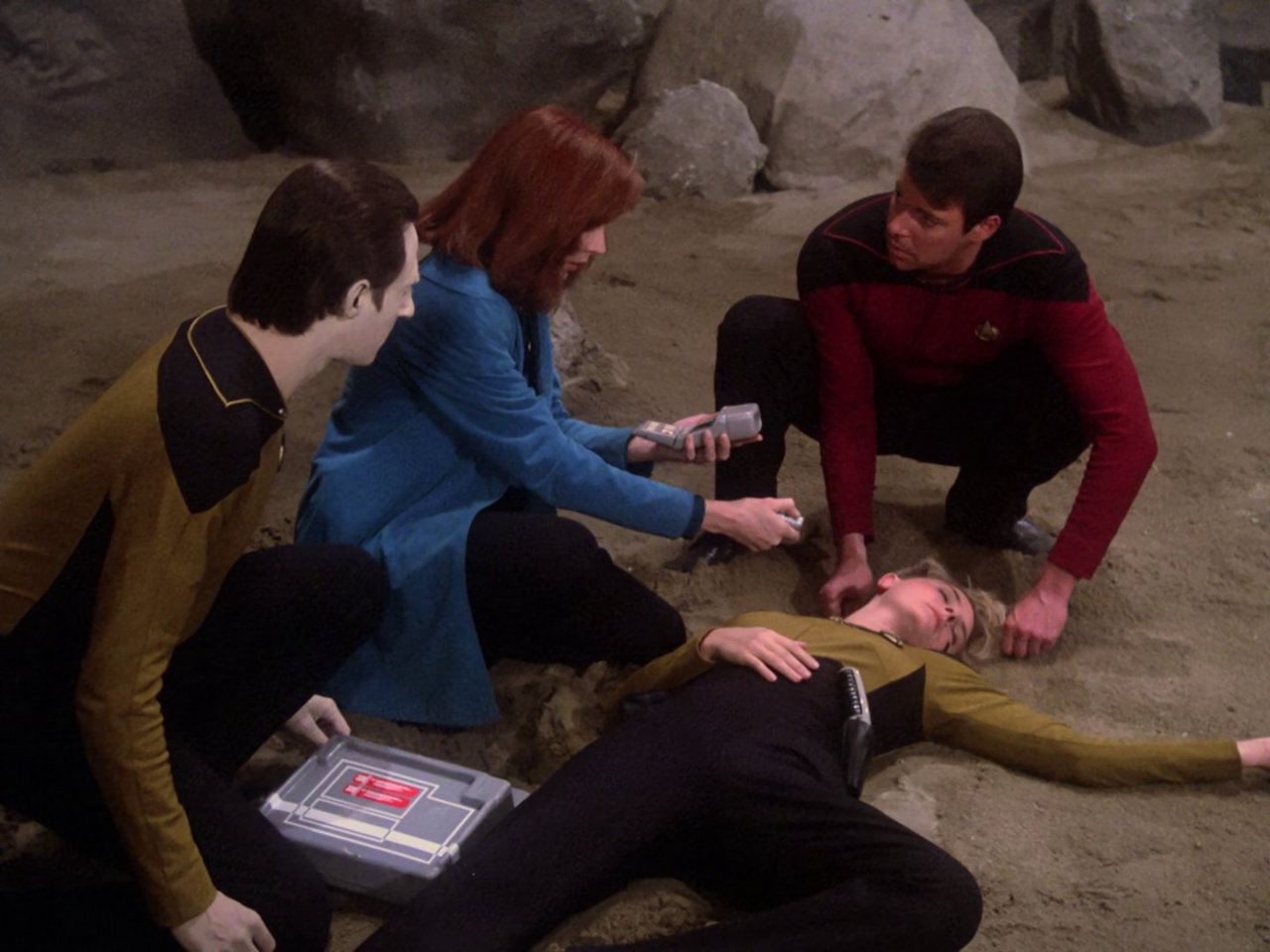
This is, in a very real sense, a landmark episode – not only for The Next Generation, but for Star Trek as a whole. We’d seen plenty of redshirts killed off before, and villains, too – but this was the first time that a *main* character had been killed (and stayed dead, so Spock doesn’t count!). Not only was that new for Star Trek, but it was a relative rarity in prime-time television at the time, too.
Still frame from Star Trek TNG 1x22 showing Tasha's death
Tasha’s death was a first for Star Trek.

I’d argue that Tasha’s death set the stage for Worf to grow into the character we’ve come to know and love. Worf took over the security and tactical roles that had initially been hers; it’s hard to envision Worf’s subsequent development across both The Next Generation and Deep Space Nine if he’d remained a roving presence on the Enterprise-D. Tying him down to a role that both suited his skillset and – arguably – kept him in a pretty narrow lane defined his character. And as Worf is the character with the most appearances in Star Trek (285, according to Memory Alpha), that’s kind of a big deal! In that sense, Skin of Evil arguably did more for Worf than for any other character – including Tasha Yar.

For her part, I think it’s fair to say that Denise Crosby quickly came to recognise that leaving the show was a mistake. As The Next Generation “grew the beard” and went from strength to strength, missing out on that must’ve stung. Crosby would return to the series in guest-starring roles as an alternate timeline’s version of Tasha Yar, and then as Yar’s half-Romulan daughter, Sela, for a pretty successful story arc. But Tasha Yar is not as big a character as she could’ve been, and I’ve always felt that there’s some regret from Denise Crosby because of that. Crosby has remained involved with the Star Trek fan community, though – not only making convention appearances, like the one I attended, but also producing the documentary Trekkies and its sequel, as well as appearing in the video game Star Trek Online.
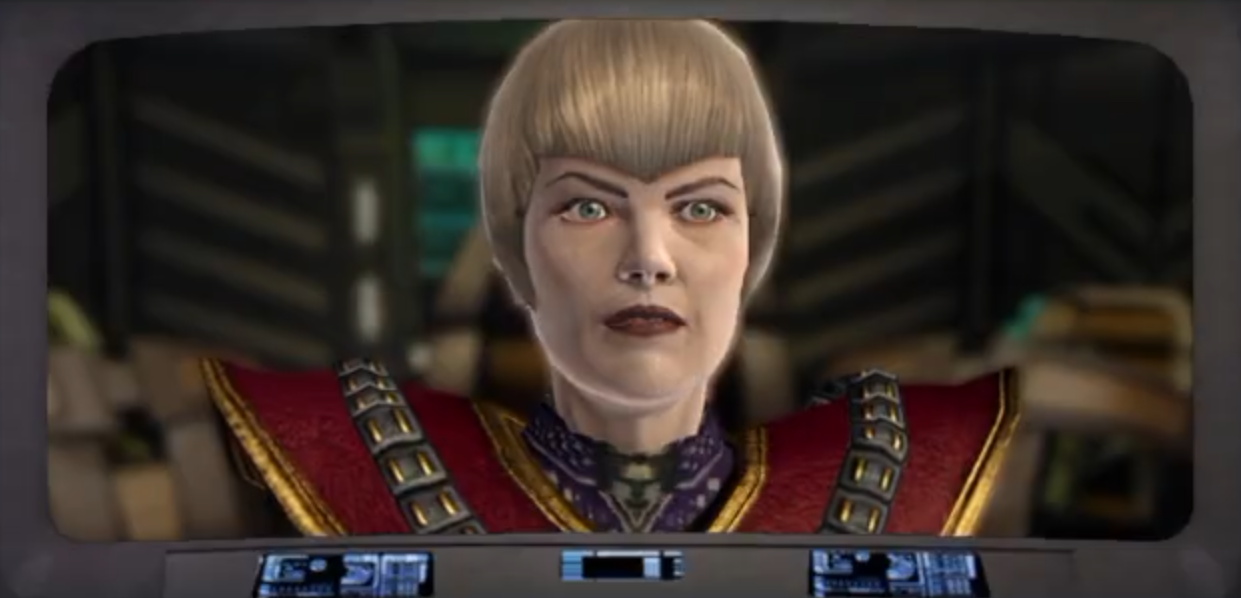
Screenshot from Star Trek Online showing Sela
Denise Crosby has returned to Star Trek on multiple occasions since Tasha was killed off.
Pictured: Star Trek Online

I first came to The Next Generation (and Star Trek as a whole) during the show’s second season, so it was only when episodes of Season 1 were repeated that I would’ve encountered Skin of Evil – and Tasha Yar as a character. That being said, it must’ve been sometime in the early ’90s, because I don’t have a particularly strong memory of watching Season 1 and thinking “wait, who’s that character standing at Worf’s post?” So I think my younger self just kind of rolled with it! I also couldn’t tell you exactly when I first watched Skin of Evil or what I made of it… though I do seem to have a fragment of a memory, wondering why – with all the 24th Century medical technology present in the show – Tasha’s life couldn’t be saved and Dr Crusher simply pronounced her dead.

We’ll get into all of that in a minute, though, because I definitely have some thoughts about the way this episode implemented its main storyline!

One thing I really wasn’t sure of, all these years later, is whether – or to what extent – Tasha’s funeral would still hit those emotional notes. Knowing what’s coming in a story can rob it of its impact, and having seen Skin of Evil more times than I can remember… well, I just didn’t know how I’d feel, I guess. Tasha’s death on Vagra II was expected on a re-watch, naturally, and the shock of the moment wasn’t there. But in her funeral scene? I still teared up.
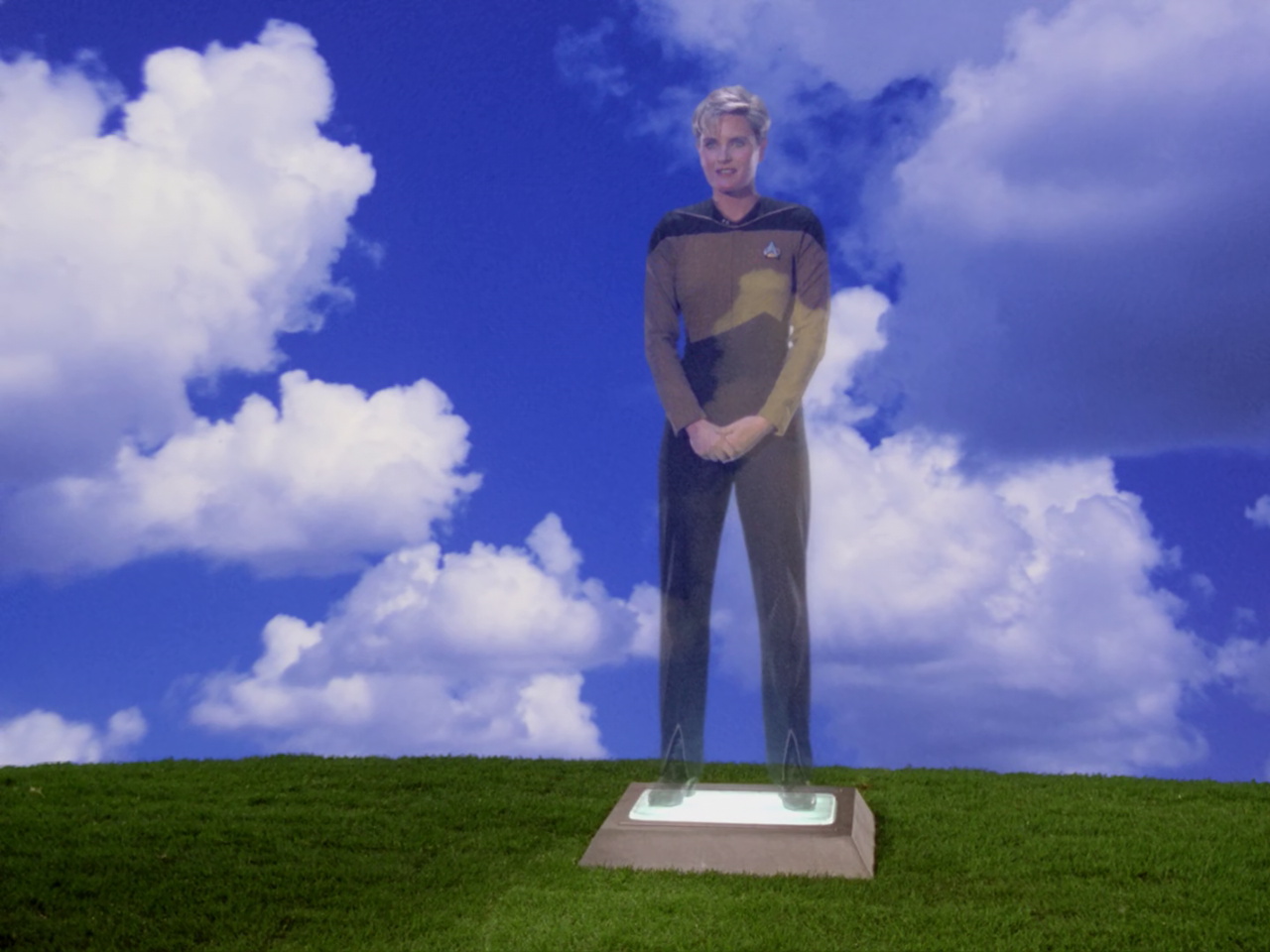
Still frame from Star Trek TNG 1x22 showing Tasha's hologram at her funeral
Tasha at her own funeral.

On the technical side of things, I’d forgotten just how great Skin of Evil’s musical score is. As the ship races to Vagra II we get a tense, tension-building piece of music. On the planet, and in scenes with Armus, the music conveys a very real sense of danger. And finally, at Tasha’s funeral, the music changes again to take on an emotional, almost bittersweet tone as Picard and the crew listen to her final message. Ron Jones, the show’s regular composer for Seasons 1-4, wrote the episode’s score.

This is my personal bias coming through, but I’ve always liked what The Next Generation did with indoor sound stages – especially in the first season. Some of these settings feel much closer in visual terms to planets and locales from The Original Series than even to places we’d encounter just a couple of seasons later. For me, there’s a real charm to the way Vagra II (and similar places) are presented; it’s something Star Trek literally hasn’t done for decades. And while it may be less “realistic” in an objective sense, with fairly plain, flat terrain, scattered rocks, and a clear stage backdrop that, in this case, was an incredibly basic colour gradient… I really like the way these places look. It’s a limitation of both budget and technology, as well as a product of its time – and I think if one of Star Trek’s modern shows saw an away team land on a planet that looked like Vagra II, we’d criticise it! But… I just find it charming in episodes like this one.
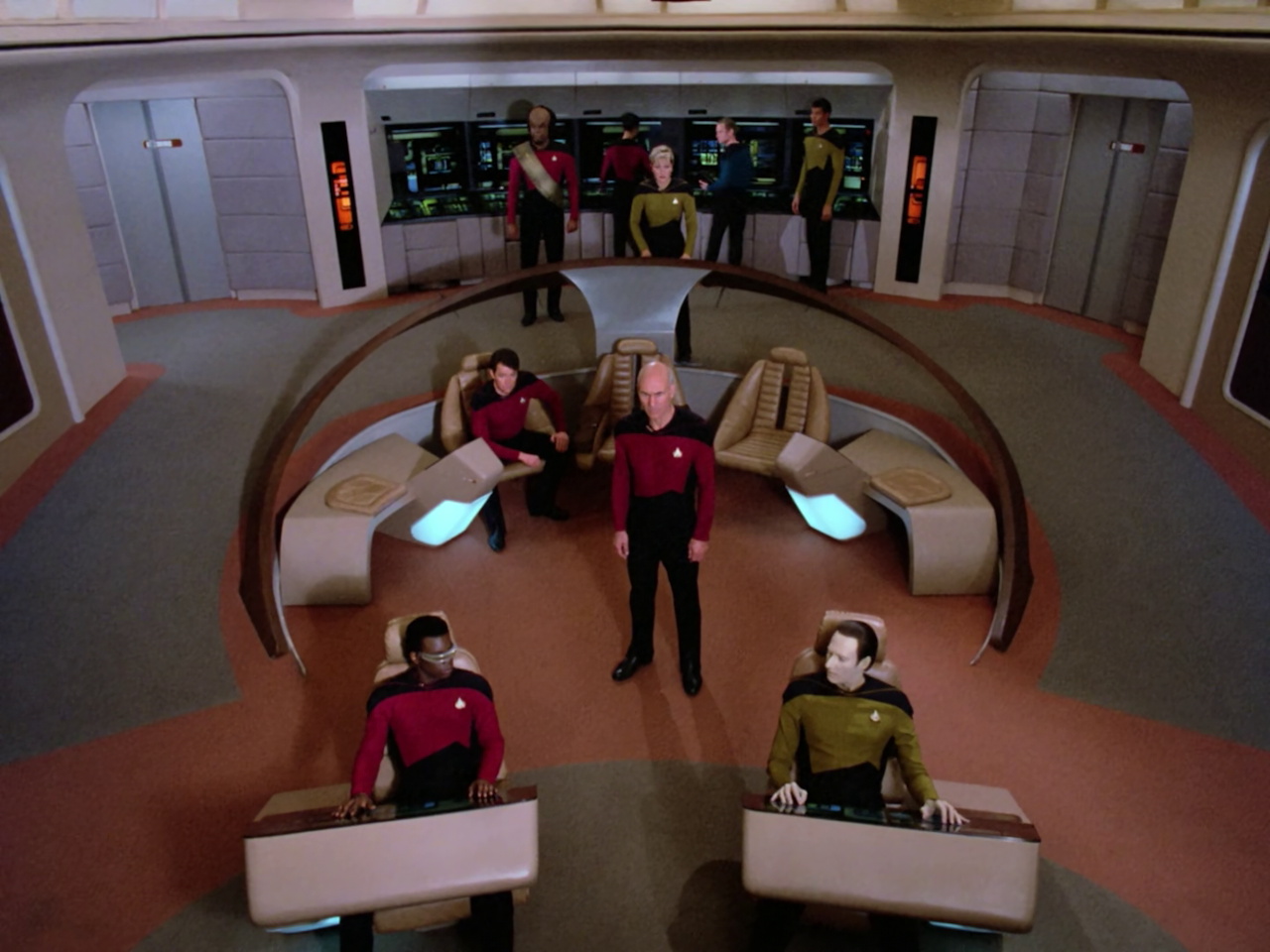
Still frame from Star Trek TNG 1x22 showing the Enterprise-D bridge set
I like this overhead shot.

Skin of Evil also had some creative camera shots. The close-up on Picard, at the end of the funeral, lingered in such a way as to convey his emotional state, even as he didn’t really show a lot of emotion on his face. There was a great overhead shot of the bridge that we’d occasionally see in the show’s first season but very rarely thereafter. And some of the shots of Armus (and Riker submerged in the Armus goop) were also well-framed.

The wreck of the shuttle looked great on the surface of Vagra II. The damaged nacelles and the back section of the shuttle made for a striking visual effect when we first saw them – comparable, perhaps, to earlier Star Trek episodes like The Galileo Seven. The damaged shuttle interior, where Troi and the injured Ben spent most of the episode, was also brought to life well, and the red emergency lighting really set the tone.
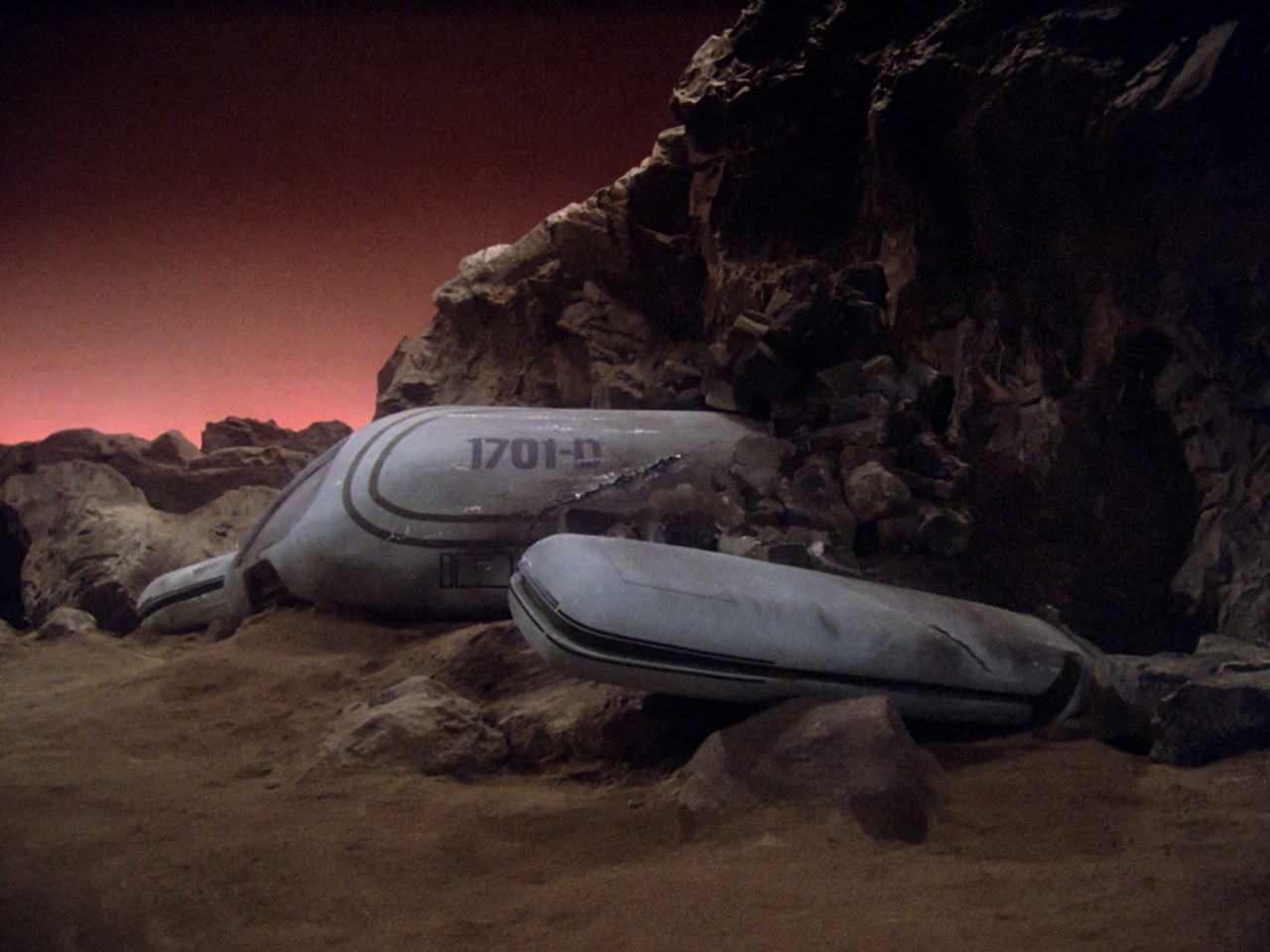
till frame from Star Trek TNG 1x22 showing the wrecked shuttle
The shuttle crash site.

We should also talk about the difficulties the team had in creating Armus, since we’re talking about sets and such.

The costume used to depict Armus’ humanoid form wasn’t compatible with the liquid that enveloped it, and the glue used to hold parts of it together repeatedly came unstuck during filming. The viscous liquid – a mixture of printer’s ink and a thickening agent – was infamously unpleasant to work with, not least for Jonathan Frakes, who performed his own stunts in the episode, including being submerged in the stuff.

It sounds like working on that side of the episode was more of a challenge than the crew expected, but I think the finished product works about as well as it could! I don’t think anyone’s out there hailing Armus as one of Star Trek’s best or most iconic villains – which is a shame, given his role in killing off a main character – but the way he comes across on screen, dripping, jet black, oozing, and unpleasant… it made for a suitably menacing and intimidating effect. Seeing Armus rise taller than Riker – the tallest of the main cast – hammered that home.
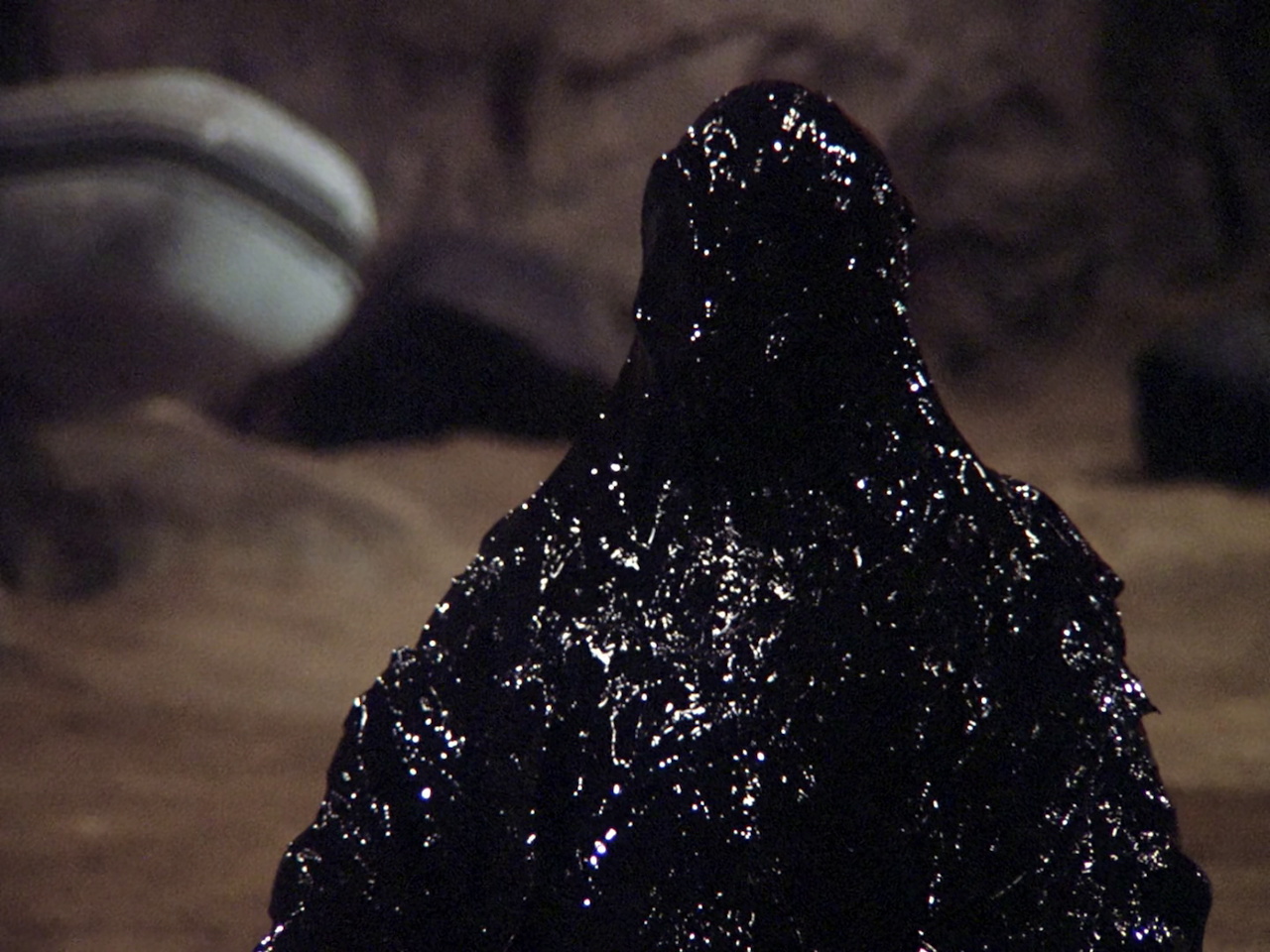
till frame from Star Trek TNG 1x22 showing Armus
Armus.

Armus is, though, a pretty one-note villain, if you think about it. Partly that’s by design: if he’s an entity composed *entirely* of an entire alien race’s worst and most negative qualities, well… there isn’t a lot of room for nuance, I guess. And partly, it should be said, it’s because this single forty-five-minute episode had other things to do. Worf had to accept his new role and play a major part on the bridge when Picard, Riker, and Data were all away. We had a sequence in Sickbay trying to save Tasha’s life. And then the funeral, at the end of the episode, needed sufficient time to hit those emotional notes. There wasn’t more time, sadly, for Armus to be much more than he was.

That also means that the resolution to the episode’s core problem – the need to save the shuttle crew – felt quite abrupt. After Picard and Troi hit on the idea of basically making Armus as upset as possible to weaken his forcefield… that was it. We got a short conversation as Picard pushed his buttons, leading to a pretty stereotypical “roar of anger,” before the away team were all beamed away to safety. A bit anticlimactic, perhaps, given what Armus had done earlier in the story.
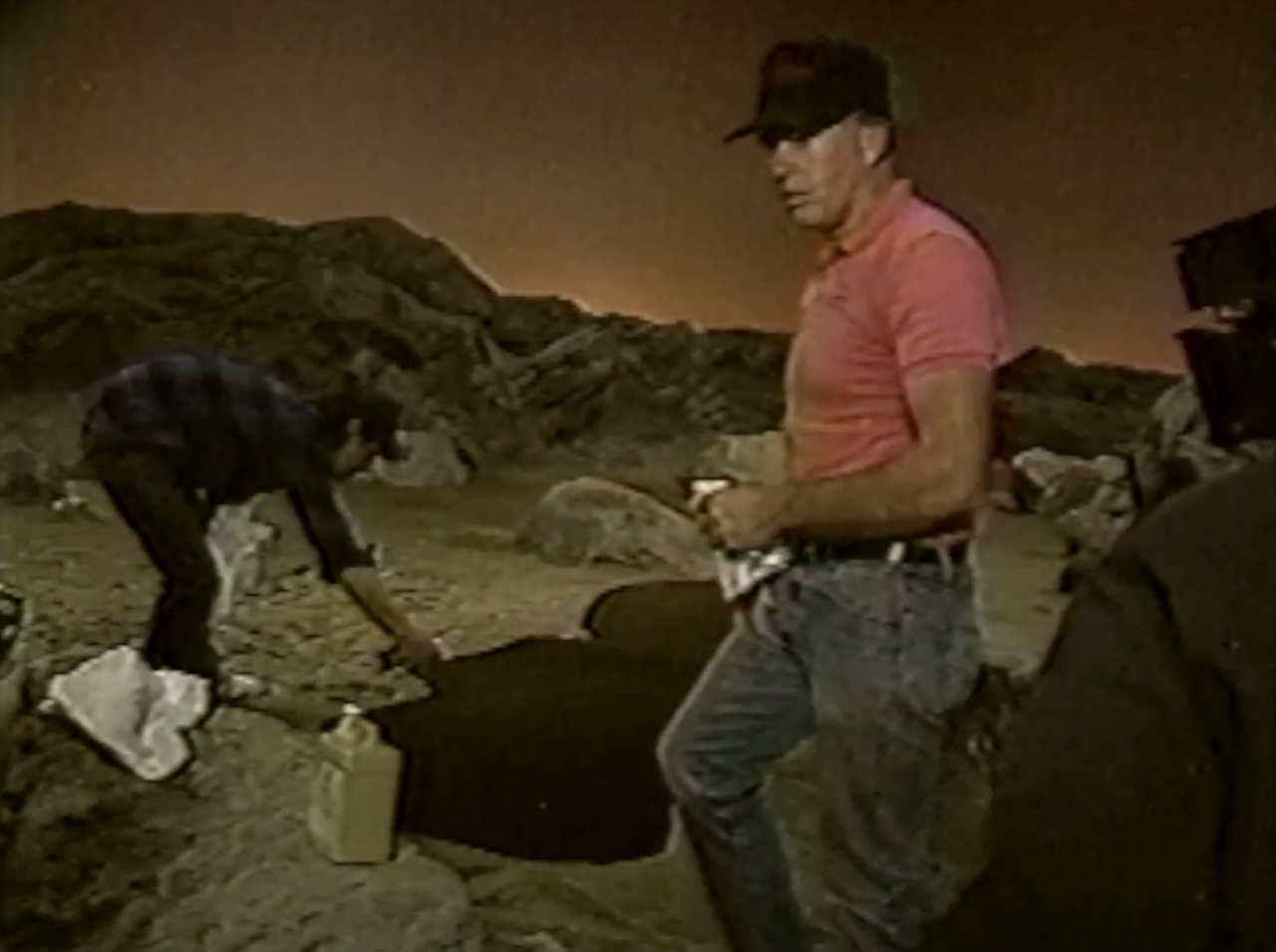
Behind-the-scenes still from Star Trek TNG 1x22 showing production crew on set
Members of the production crew on the set of Skin of Evil.

In some ways, Armus feels like a different take on a familiar character from TNG’s first season: Q. They exhibit some of the same traits – a need to be amused or to have attention focused on them, trickster-like, teasing qualities, and powers that go far beyond what Starfleet in this era was able to counter. But while Q, even in his first appearances, had both a curiosity about humans and even, dare I suggest, a helpful streak… Armus is purely malevolent.

I liked Troi’s line about pity; how this creature, powerful and deadly though it could be, was still a tragic and sad figure. Armus represents one of the oldest warnings about immortality, in one sense: how one would feel after aeons alone, trapped with no one to talk to or nothing to do. That isn’t meant to justify or excuse his behaviour, but it does go some way to giving it an explanation or at least some context. To choose a real-world parallel: Armus is akin to the criminal who comes from a troubled past. Their past doesn’t give them free rein to do the bad things they’ve done, but it can go some way to explaining why those things happened, where they came from, and even why we should pity, rather than *hate*, someone in that position.
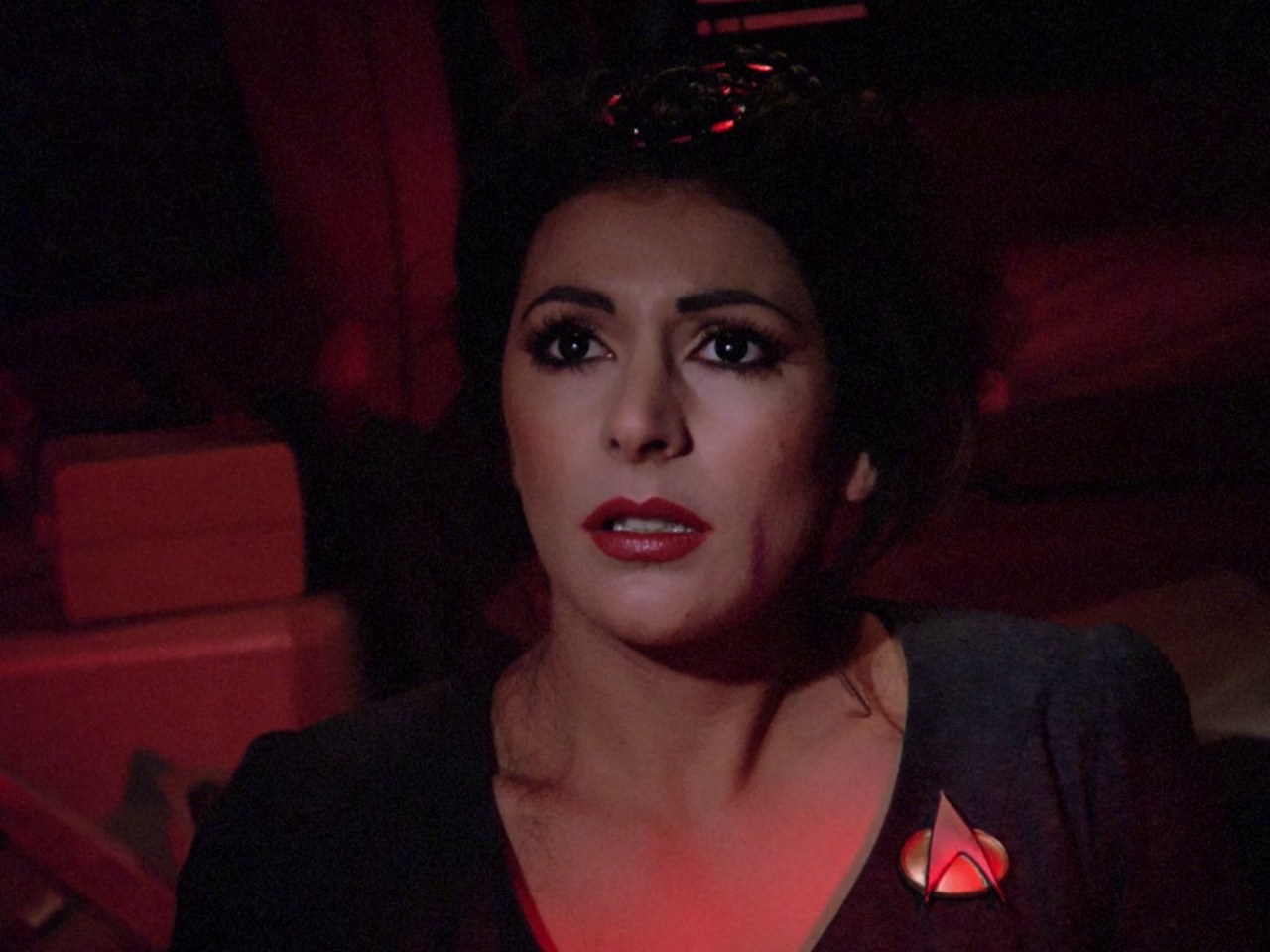
till frame from Star Trek TNG 1x22 showing Troi
Troi.

Troi was arguably Skin of Evil’s real star. This episode must be one of Marina Sirtis’ best and most challenging performances in the role, having not only to display very strong emotions, but doing so with no other physical performer to bounce them off. Every conversation Troi has with Armus, unlike those of the rest of the away team, takes place inside the shuttle with only Armus’ voice. It’s a tricky acting challenge, but Sirtis rose to the occasion wonderfully.

Troi was also the character who figured out how to beat Armus, laying the groundwork for the resolution to this storyline. It might’ve been possible, based on what we saw of their earlier conversations, for Troi to have single-handedly defeated Armus without Picard’s intervention; that’s a fun little “what-if” idea, I guess. But again, this was a good episode for both character and performer, and Troi really excelled – despite spending most of the episode trapped in a wrecked shuttle, barely moving.
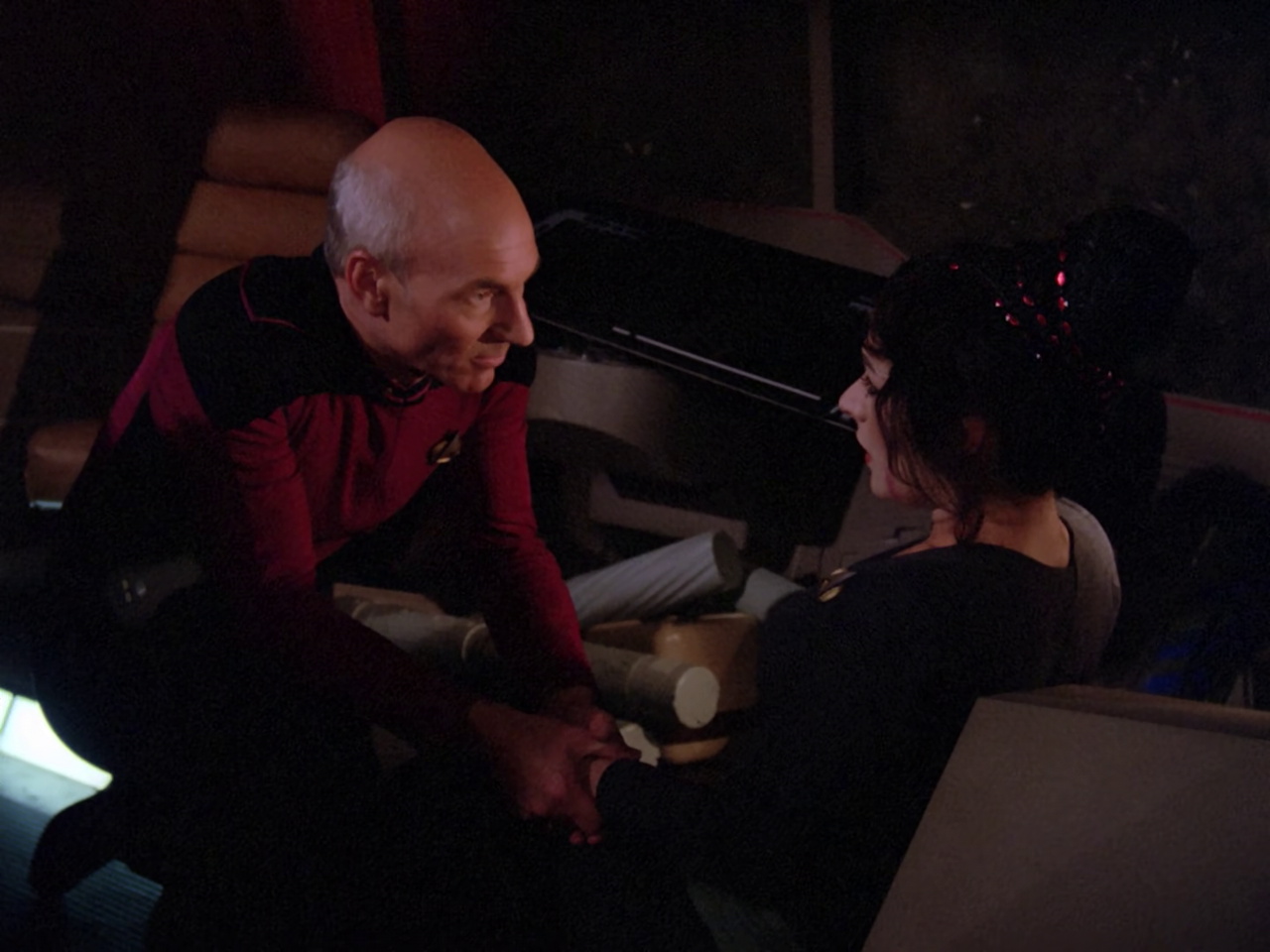
till frame from Star Trek TNG 1x22 showing Picard with Troi in the shuttle
This was a good episode for Troi.

At this point in The Next Generation’s run, we had seen Picard on a handful of away missions, but we’re also aware that he’s a very different kind of captain from Kirk – taking a much more hands-off approach, with Riker usually leading the charge. So to see Picard volunteer to beam down to the planet himself was something a bit different, and I think it emphasised the severity of the situation. As I said above, Picard’s ultimate role *might* not have been totally necessary, but as the captain, it makes sense for him to play a leading role in this kind of story.

Picard’s dedication to helping his crew – the away team, Riker, Tasha, and the survivors of the shuttle crash – was on full display, and it’s one of the best early-season indications of this, in my opinion. We also get to see Picard having to wrangle with the emotional toll of losing someone under his command, someone he personally recruited, as well as someone he’d become friends with, while also having to remain in control of his emotions and guide the rest of the crew. Tasha’s death was cruel, and they were all suffering – but there was still a mission at hand and two injured crewmates to rescue. Picard had to be the one to tell them to keep their emotions in check long enough to help the shuttle crew, and that can’t have been easy.
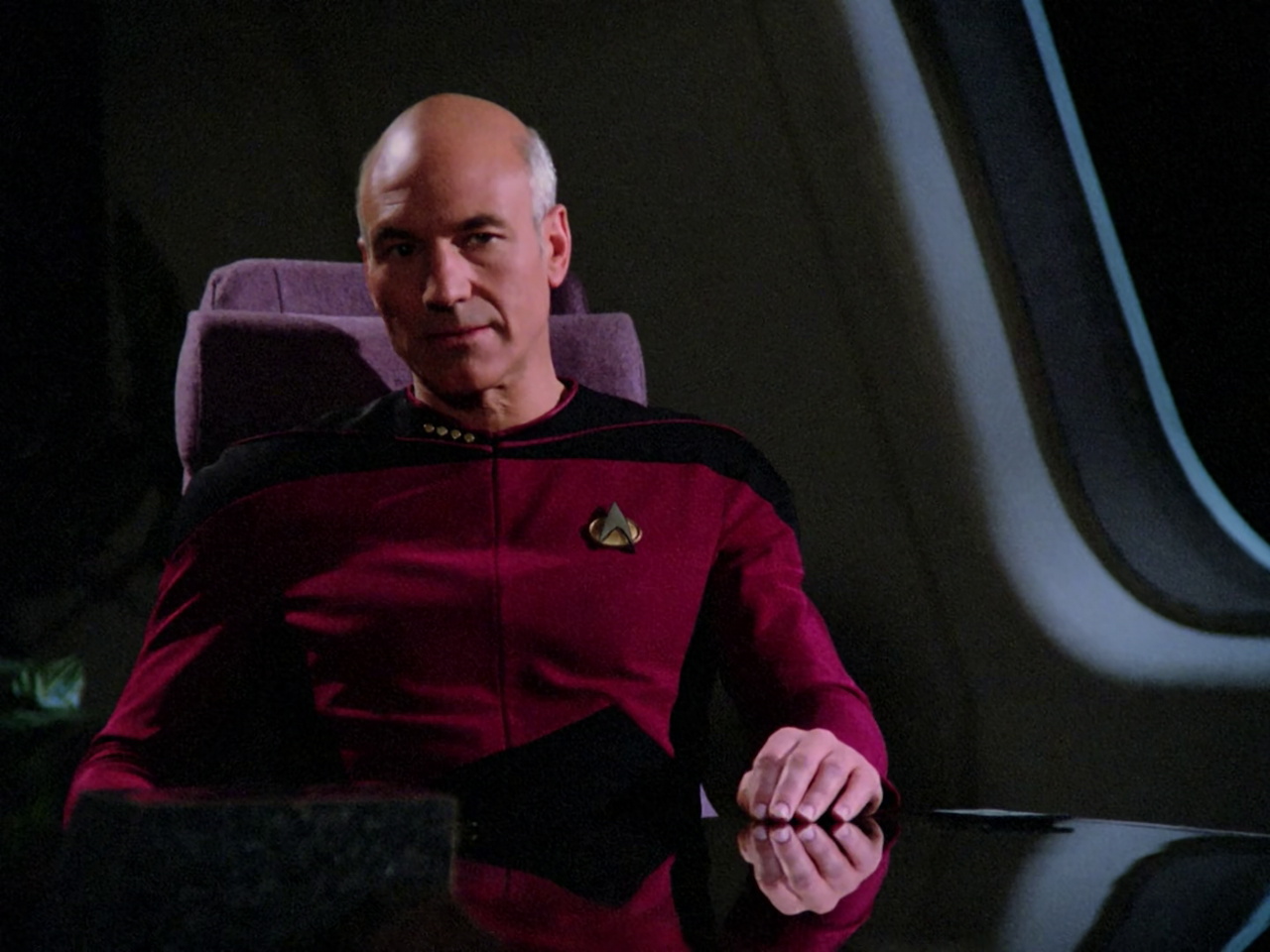
till frame from Star Trek TNG 1x22 showing Picard in the Briefing Lounge
Picard in the Briefing Room.

I mentioned Worf above, and for me, Skin of Evil feels like *the* inflection point for his character; the moment the version of Worf we’re most familiar with came into being. With Tasha’s death, Worf is given her roles at tactical and security by Picard, and we see a flicker of emotion on his face at that moment as he absorbs both the loss of a friend and the responsibility of assuming her dual roles aboard the ship. Worf instantly puts his own stamp on things, though – declining to join the away team, despite clearly wanting to avenge Tasha’s loss, because he believed his skills were better-utilised on the bridge.

Worf feels like a natural fit for the security and tactical roles – though that’s admittedly with the bias of hindsight! As I revisit Skin of Evil, though, I can’t help but wonder what might’ve been – what other role or roles would Worf have found aboard the Enterprise-D had Tasha remained a part of the series? It’s another of those interesting “what-ifs,” eh?
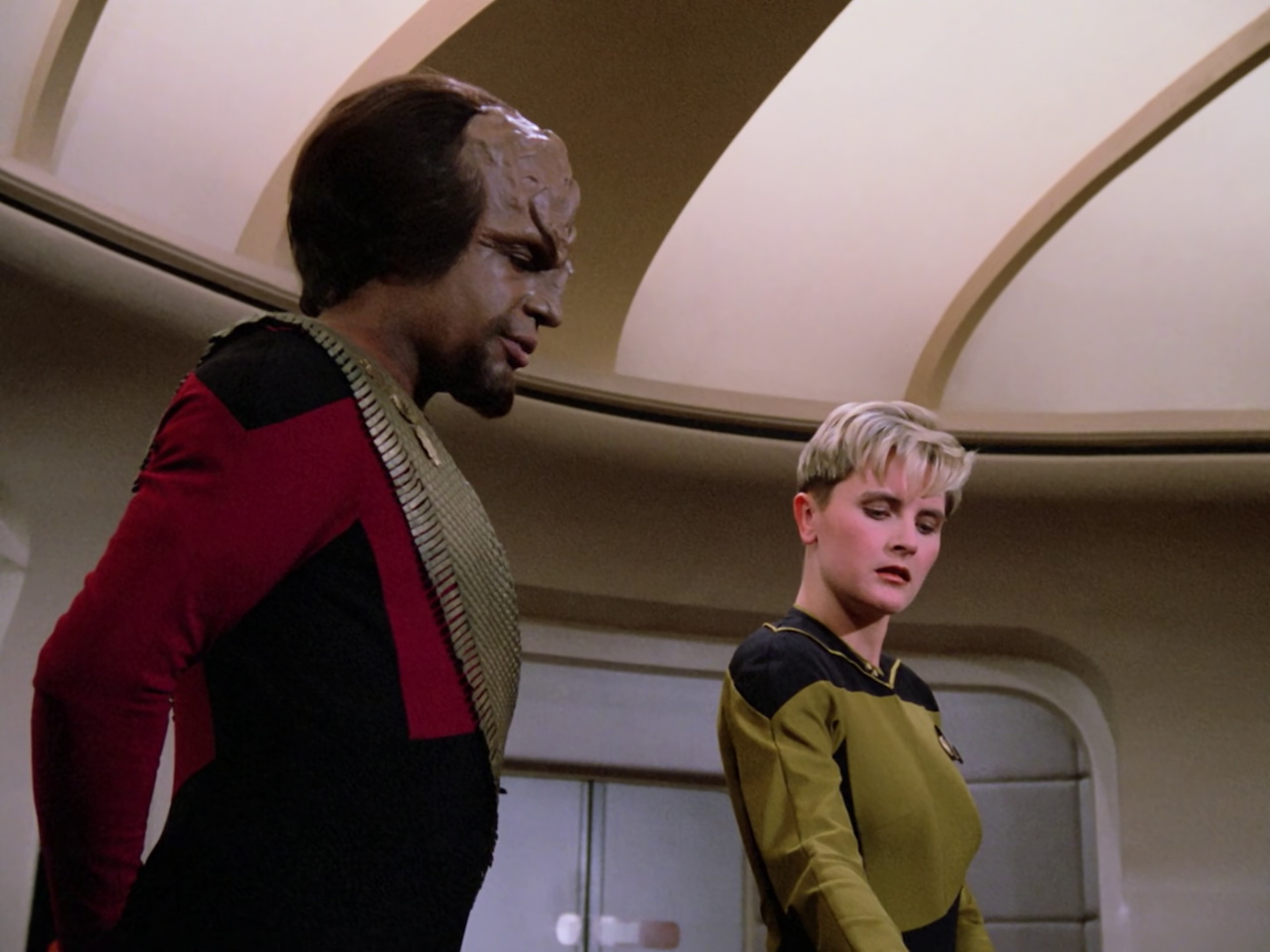
till frame from Star Trek TNG 1x22 showing Worf and Tasha Yar
Worf and Tasha together at the beginning of the episode.

I was also reminded of how, even a full season into the show’s run, TNG lacked a chief engineer! Geordi wouldn’t take over that role until Season 2, and Season 1 showed off a succession of one-off characters in the engineering role. In this case, we meet (briefly) Leland T. Lynch, who was responsible for recalibrating the ship’s dilithium crystals at the start of the story. Lynch was a very minor part of the episode, and didn’t return after Skin of Evil, but he’s just a reminder, really, of how – despite having a successful formula from The Original Series to adapt – The Next Generation was still finding its feet, even a full season into its run. As with Worf above, we’ve come to see Geordi as inseparable from his role in engineering… but that wasn’t where he started.

Although Engineer Lynch’s work on the dilithium crystals kind of feels like padding to stretch out the episode’s runtime a little, it did lead to one cool visual moment: seeing the Enterprise-D in flight but without its nacelles illuminated. This made for a fun and different look, albeit just for a moment, and the need to reach Vagra II added a little tension to those opening moments after the shuttle crash, too.
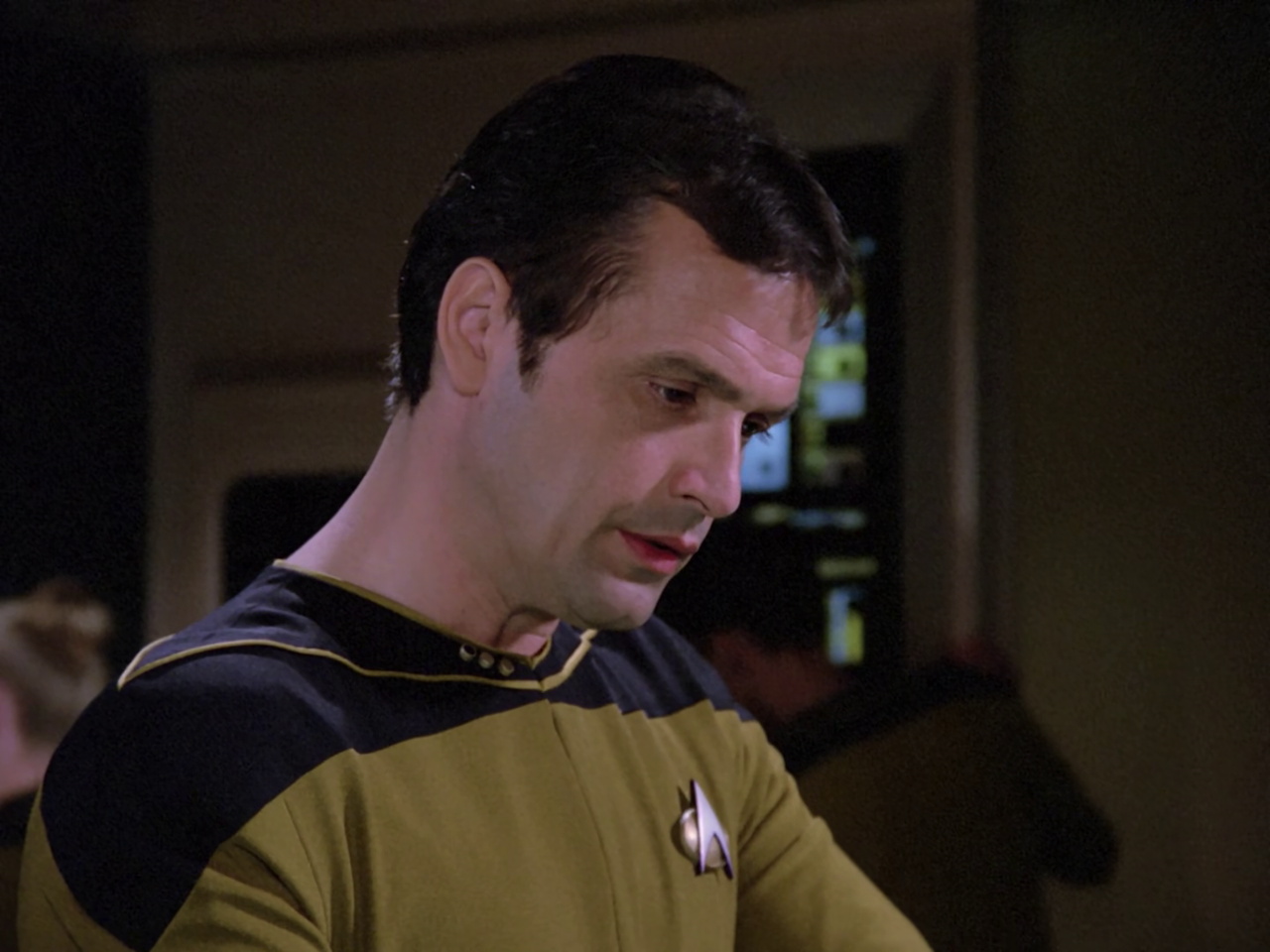
till frame from Star Trek TNG 1x22 showing Leland T Lynch
It’s Leland T. Lynch!

So let’s talk Tasha.

Skin of Evil is remembered not for Armus, nor Worf’s new role, nor even Troi’s struggle against Armus, but because it’s the episode where Tasha Yar was killed off. Although Star Trek had killed off Spock a mere six years earlier, that doesn’t really count because the next film brought him back to life again! So this was Star Trek’s first real encounter with death, if you think about it. Combine Tasha’s death here with Dr Crusher’s departure at the start of Season 2 (something caused by behind-the-scenes shenanigans), and it definitely felt like TNG was going through a shake-up.

This is something that Star Trek still doesn’t really do very often. If you remember my reviews of Discovery and Picard in recent years, you might remember me saying words to the effect of characters seeming to have “plot armour” even in seemingly impossible situations! And that’s because, to be blunt, I don’t think the franchise has *ever* done death particularly well. Spock’s was emotional and impactful… but was undone in the very next story. Jadzia’s, which came a decade after Skin of Evil, is arguably the most impactful… but others, like Kirk’s or Tucker’s, have proven incredibly controversial. And don’t get me started on redshirts and “glorified redshirts!”
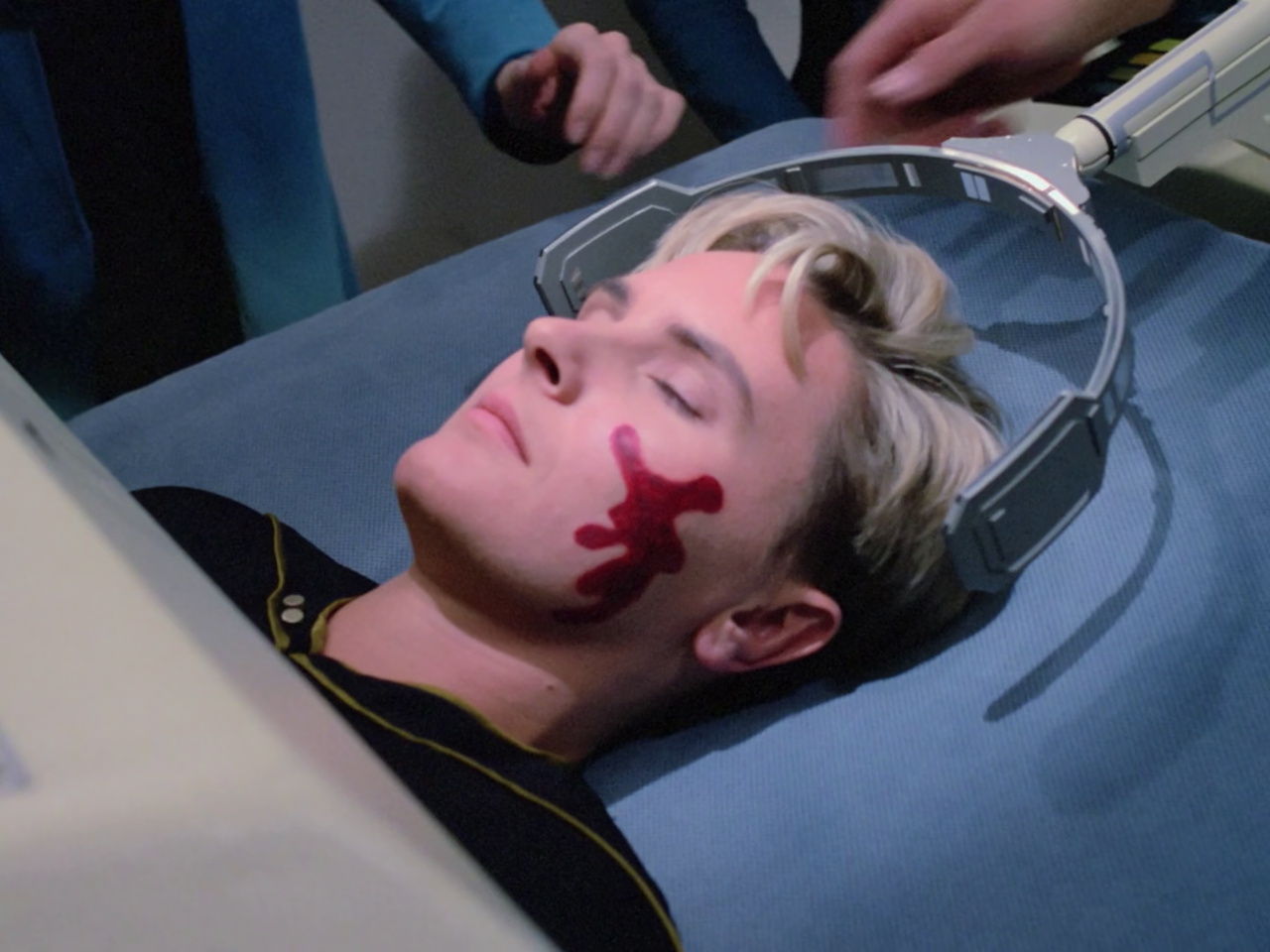
till frame from Star Trek TNG 1x22 showing Tasha on a bio-bed
Tasha Yar was Star Trek’s first major death.

So this moment… it still matters to Star Trek, even as we close in on Skin of Evil’s fortieth anniversary. This is the moment where main characters could no longer be considered safe, where someone other than a redshirt went on an away mission… and didn’t come back. A character fans had gotten to know over more than twenty episodes, who had relationships with practically everyone else on the Enterprise-D just… straight-up died. And the show made a creditable effort to celebrate Tasha’s life and legacy in a funeral scene that still hits hard all these years later.

The contrast between the dim, desolate surface of Vagra II and Tasha’s funeral – in a sunlit, grassy meadow – is stark, and the visual impact of the two sequences is incredibly striking. At first, the moment felt less funereal than Spock’s had done aboard Kirk’s Enterprise, but this memorial service was for a different character, and a different *kind* of character, too. In my head canon, Tasha chose such a bright, sunlit, pastoral setting because it represented everything she got away from when she escaped to join Starfleet. And there’s something about the bright blue sky, white clouds, and natural grassland that feels, well… heavenly, at least if you buy into western or American depictions of the afterlife.
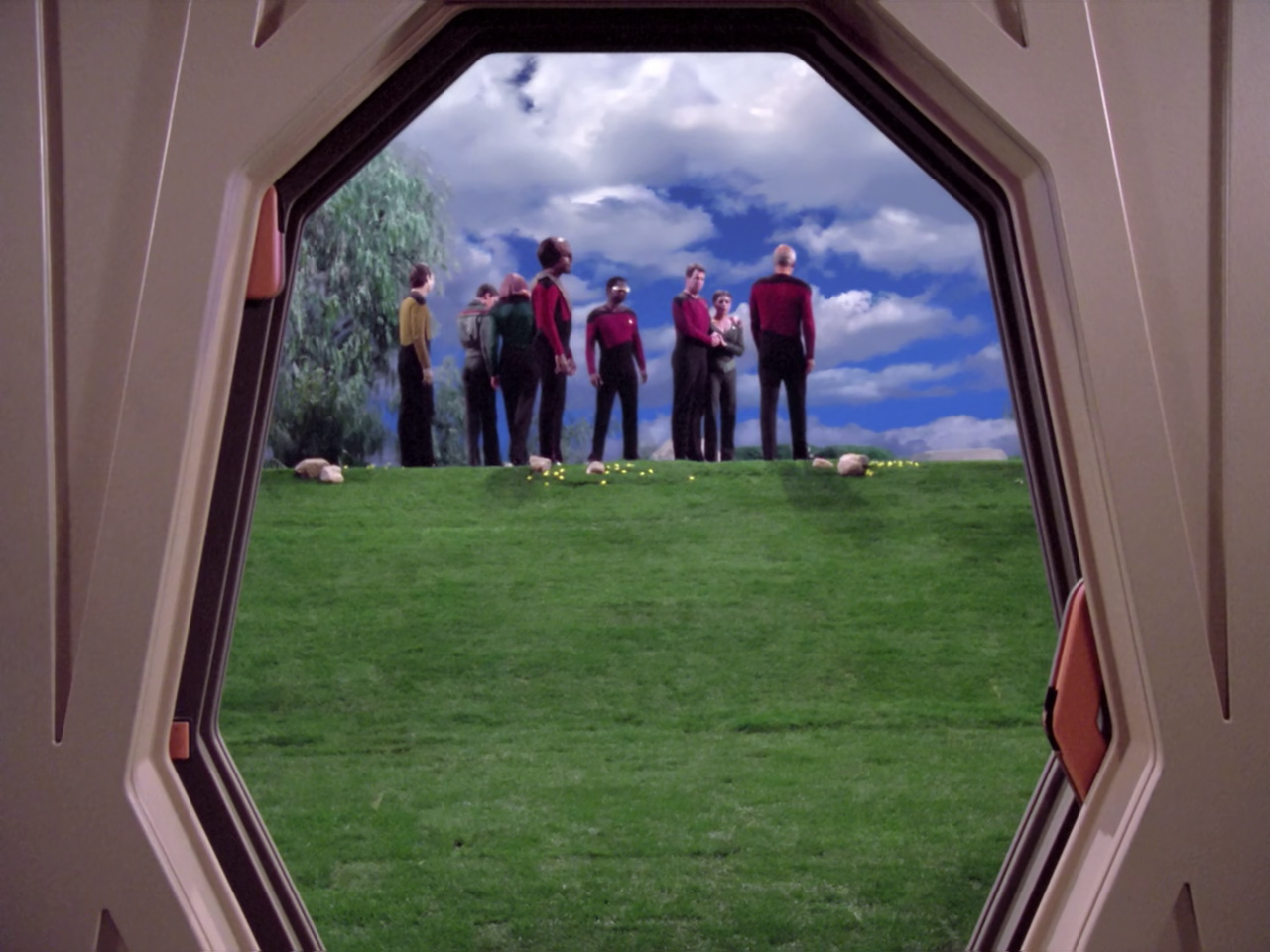
till frame from Star Trek TNG 1x22 showing the funeral and the holodeck doors
The characters gather for Tasha’s funeral.

Skin of Evil needed this epilogue. If Tasha was going to be killed off – and not exit the show by some other means – then her death needed more than just expiring on a bio-bed in Sickbay. The funeral, and particularly Tasha’s own address to the gathered characters, was her swansong; the end of her time on the show. It mattered to those involved – the cast as well as the characters they played – but also to us as the audience. The funeral underlines that there is no technobabble solution – Tasha isn’t coming back and there will be no last-second reprieve. It allows us to bid a fond farewell to the Enterprise-D’s first tactical officer, and to draw somewhat of a line under the first iteration of the show’s principal cast.

Tasha Yar was always an enjoyable character. Her tragic backstory informed why she wanted to join Starfleet, and why she had the tactical and combat skills that she possessed, but it didn’t define her. She may not have been front-and-centre across Season 1, but just like most of the rest of the main characters, she had her moments, made connections with her shipmates, and took part in some iconic moments and storylines. Her loss in Skin of Evil would go on to define – and, I would argue, refine – The Next Generation going into Season 2.
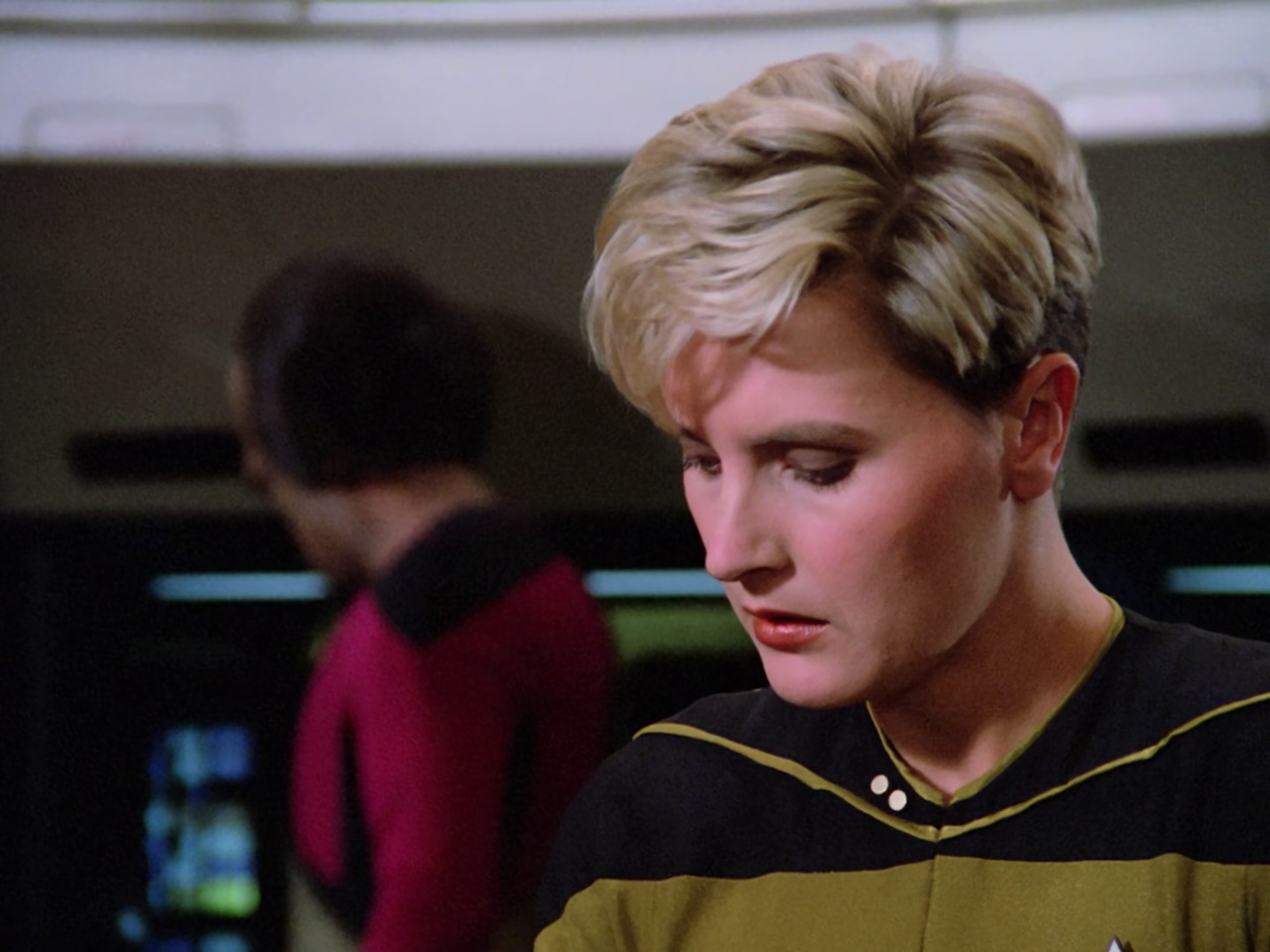
till frame from Star Trek TNG 1x22 showing Tasha on the bridge
Tasha at her post on the bridge.

And, of course, Tasha would be back! Yesterday’s Enterprise introduced an alternate timeline version, she returned again in All Good Things right at the end of the show’s run, and her daughter – Sela – was an important character, too. Tasha even appeared, albeit only briefly, in Picard’s third season, proving that her legacy and importance lived on well past the events of this one episode. She would prove important to Data in particular (thanks in no small part to their… y’know… *encounter* in the episode The Naked Now). And all these years later, we’re still talking about Tasha Yar and her place in the series.

So I think that’s all for now.

Thanks for joining me on this re-watch. It was fun to revisit Skin of Evil, even though I wouldn’t necessarily consider it a personal favourite episode, or anything! Skin of Evil is more so an inflection point; a key moment in the history of The Next Generation, moving one character aside and arguably making room for others to step up. Slimming down what was arguably a slightly overladen cast probably helped the series going into the next part of its run, and for Worf in particular – an incredibly important character in all of Star Trek’s history – this moment cleared a pathway for him to become the character we know and love.
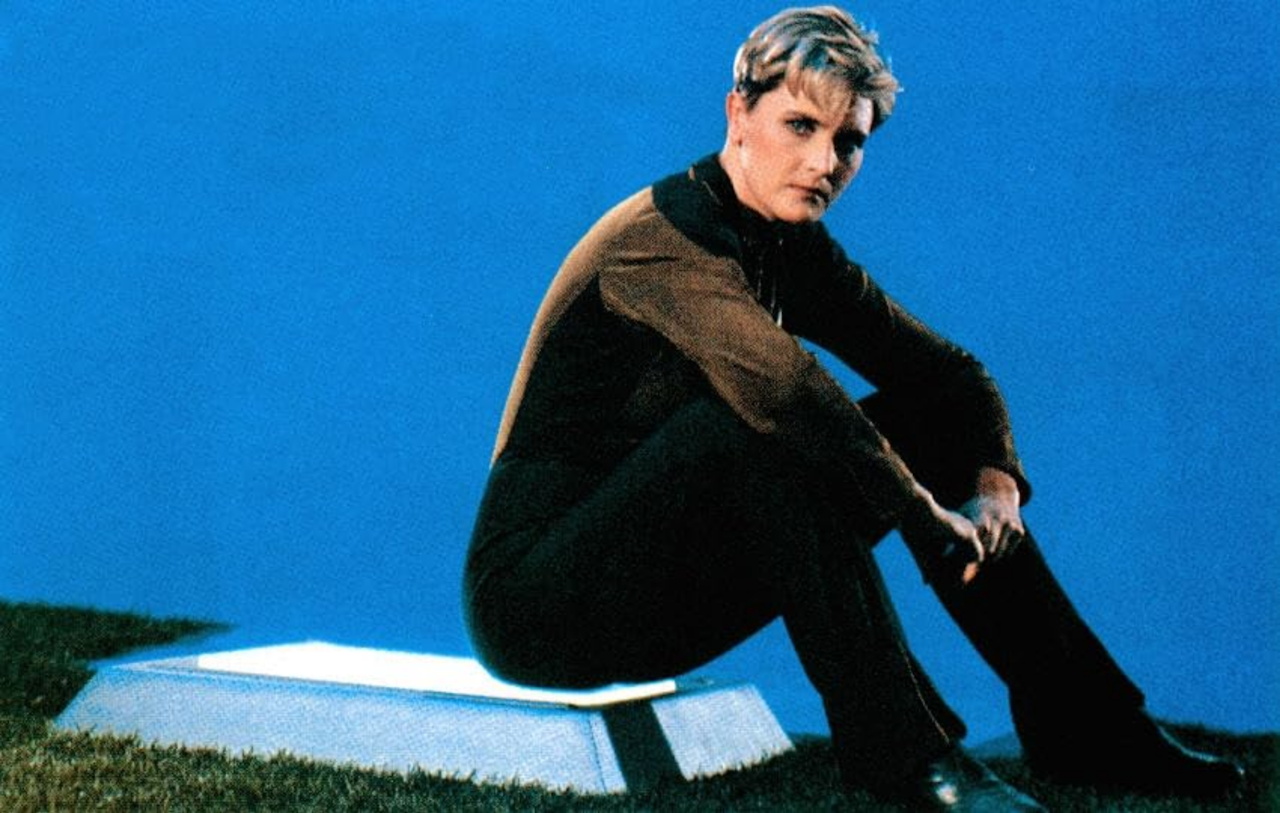
Behind-the-scenes photo from Star Trek TNG 1x22 showing Denise Crosby
Denise Crosby during a break in production.

If you missed them, earlier this year I wrote up re-watches of The First Duty and The Royale, from Seasons 5 and 2 respectively, and I’d love to get around to more episode re-watches soon, too. I’ve also been reviewing Season 4 of Strange New Worlds, I reviewed Season 1 of Starfleet Academy, and the video game Across The Unknown. I hope you’ll check out some of those if you have the time!

Star Trek’s sixtieth anniversary is upon us, and it was wonderful to be able to celebrate that milestone at a convention. Meeting Denise Crosby was a wonderful experience, and it’s what prompted me to step back to Skin of Evil and write this piece. I hope this has been interesting, and I hope it wasn’t too controversial a pick for a Tasha Yar episode to revisit!

Thanks for joining me, and as always… Live Long and Prosper, friends!


Star Trek: The Next Generation is available to stream now on Paramount+ in countries and territories where the service is available, and is also available to buy on DVD/Blu-ray. The Star Trek franchise – including The Next Generation and all other properties discussed above – is the copyright of Skydance/Paramount. This article contains the thoughts and opinions of one person only and is not intended to cause any offence.

Star Trek: Picard Season 3 theory – the “rogues’ gallery”

Spoiler Warning: There are spoilers ahead for Star Trek: Picard Seasons 1-2 and the trailers, teasers, and announcements for Season 3. Spoilers are also present for the following Star Trek productions: The Next Generation, Deep Space Nine, Voyager, Discovery, and Lower Decks.

Last time we talked about Captain Vadic – the mysterious villain who will appear in Picard’s third and final season next year. We considered a few possibilities as to who she might be and what her grievance might be with Admiral Picard, so if you want to check out those theories – some of which are more plausible than others – you can do so by clicking or tapping here.

This time I want to move beyond Captain Vadic. Taking the most recent trailer as a starting point, I thought it could be fun to look back at other characters from The Next Generation and beyond who might have a bone to pick with Admiral Picard. The most recent trailer for Season 3 included two pretty big surprises: the return of Lore and Professor Moriarty, both of whom seem to be allied with Captain Vadic. So here’s my theory: those two won’t be the only villains on her team!

Professor Moriarty in the recent Season 3 trailer.

Could Captain Vadic have put together what I’ve termed a “rogues’ gallery” of Star Trek villains? If so, it could make for an even more explosive and exiting final season – and there’s certainly no shortage of candidates for such a team. Like Marvel’s HYDRA or DC Comics’ Legion of Doom, perhaps Captain Vadic has managed to create her very own rogues’ gallery!

So today, I thought it could be fun to consider which other characters could be included – if indeed this is part of Captain Vadic’s scheme. During his adventures aboard the Enterprise-D, it’s not unfair to say that Picard made more than his share of enemies, and it stands to reason that many of them would jump at the chance to seek revenge.

As always, a caveat: this is just for fun! I don’t have any “sources” or “insider information,” and I’m not trying to claim that any of the characters below definitely will appear in Season 3 of Picard. I don’t even know for sure that there will be any other villainous characters besides those we’ve already glimpsed, so please take all of this with a healthy pinch of salt! With that out of the way, let’s get started!

Rogue #1:
Toral, son of Duras

Toral, son of Duras, after his attempted coup failed.

The two-part episode Redemption, which closed out Season 4 of The Next Generation and kicked off Season 5, introduced us to Toral, son of Duras. The House of Duras made several attempts to take over the Klingon Empire and to cover up their family’s collaboration with the Romulans, including at the attack on Khitomer in which Worf’s family was killed. Although Toral was relatively young during the events of Redemption, and was merely being used by his more powerful and manipulative aunts, there’s no denying his ambition.

Toral’s father and his aunts were killed by the crew of the Enterprise-D, and both Toral and his house were left disgraced and without a future in Klingon politics. If given the chance, Toral – or perhaps another member of the House of Duras – would surely be on board with a mission to destroy Admiral Picard and the crew of the Enterprise-D.

Rogue #2:
Ro Laren

Ro Laren in Season 7 of The Next Generation.

Although Ro Laren, a former Starfleet officer and Maquis defector, didn’t hate Picard the last time they met, subsequent events could certainly have changed her opinion. In the years before the Dominion War, Picard was very much in favour of maintaining peace with the Cardassians at all costs – even if that included abandoning Federation colonies in Cardassian space. The former Ensign Ro took a different approach, ultimately defecting to the Maquis and abandoning Starfleet.

As we learned in Deep Space Nine, following their alliance with the Dominion the Cardassians were able to wipe out nearly all of the Maquis, leaving only a few survivors. Starfleet was unable to help, and given how bad relations had got between the Federation and the breakaway Maquis, it stands to reason that any survivors would carry a deep hatred for the Federation. If Ro Laren survived the Dominion War, maybe she’d try to seek revenge on her former captain and the organisation that abandoned her friends to their fate.

Rogue #3:
The Remans

The Reman Viceroy.

The Romulans treated the native Remans horribly, essentially using them as a class of slave labourers. The Remans’ only real chance to overturn this came when Shinzon – a Romulan-created clone of Picard – seized power on Romulus and uplifted many Remans, putting them into positions of power. Picard defeated Shinzon and his Reman Viceroy, potentially restoring the status quo on Romulus and relegating the Remans once again to their enslavement.

Not only that, but Starfleet’s decision to abandon the Romulan rescue armada that Picard was in charge of arguably cost Reman lives. The Romulans would surely have prioritised saving their own citizens ahead of saving Remans, so it stands to reason that many Remans were killed during the supernova. Although there are no remaining Reman main characters (the Viceroy was killed in Nemesis) I think it’s possible that we could see a Reman figure who wants to get revenge on Picard.

Rogue #4:
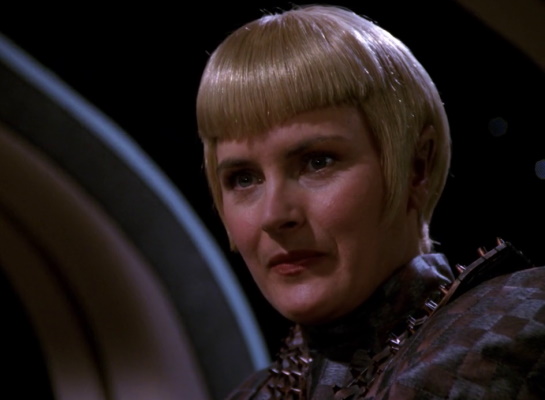
Sela

Sela aboard the Enterprise-D.

The half-Romulan daughter of an alternate timeline’s Tasha Yar was an adversary for Picard and the crew of the Enterprise-D on more than one occasion. Picard prevented her from interfering on behalf of the House of Duras during the Klingon succession crisis, and then thwarted her plans again when she tried to use Ambassador Spock’s peace process to invade and conquer Vulcan. Sela survived – but her authority within the Romulan hierarchy was surely undermined by these major defeats.

Sela would almost certainly want revenge on Picard for those incidents, and I could absolutely see her teaming up with someone like Captain Vadic. Assuming that Sela survived the Romulan supernova, Picard must be right at the top of her enemies’ list! Furthermore, Picard disrupted yet another Romulan scheme back in Season 1, and while we can’t say that Sela was involved with the Zhat Vash, it’s possible that she was privy to their plans or involved, to some degree, in the mission to Coppelius.

Sela and Tasha Yar actress Denise Crosby has teased a possible appearance in Season 3, too… so I think Sela showing up is a distinct possibility!

Rogue #5:
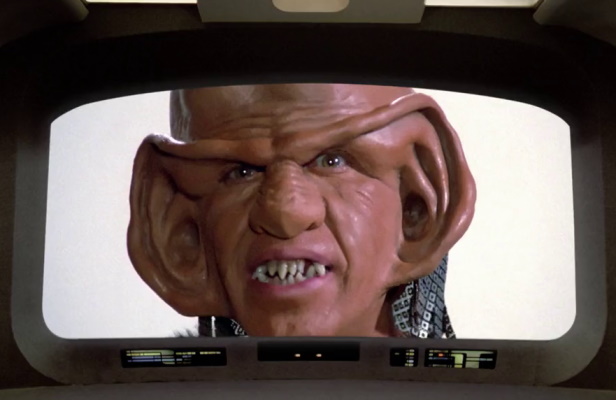
DaiMon Bok

DaiMon Bok on the Enterprise-D’s viewscreen.

While in command of the USS Stargazer – about ten years before the events of The Next Generation – Picard defeated a Ferengi vessel, and in doing so killed the son of DaiMon Bok, a Ferengi captain. Bok attempted to get his revenge on Picard on two subsequent occasions, firstly by sabotaging the wreck of the Stargazer, which he had salvaged, and secondly by convincing Picard that he had a son. Both times, Bok was defeated.

However, Bok survived his run-ins with Picard, and as I noted last time, the grudge he carried is deeply personal and feels like it would be something he would never be able to let go of. Like Sela above, Bok has a personal vendetta against Picard, and if the opportunity were to arise to join a mission to kill or defeat him, I could see Bok signing up in a heartbeat!

Rogue #6:
The Conspiracy parasite-aliens

One of the parasite-aliens outside of a host body.

After thirty-five years, could a continuation of the story begun in The Next Generation first season episode Conspiracy finally be on the agenda? Anything’s possible, right?!

The Conspiracy parasite-aliens attempted to take over Starfleet and the Federation before being thwarted by Picard and the crew of the Enterprise-D. Although their “mother creature” was killed, before it died it was able to send a message, presumably to its home world or others of its species… but the story was never continued (although the parasite-aliens were recently referenced in an episode of Lower Decks).

The parasite-aliens were originally conceived as part of the storyline that would eventually lead to the introduction of the Borg in Season 2, but this connection was written out of the series before Q Who entered production. So the parasite-aliens have remained a mystery ever since – but would surely want to gain revenge on the people most responsible for foiling their plans. Maybe Captain Vadic and others on her crew have been taken over by these parasitic beings.

Rogue #7:
Norah Satie

Norah Satie overseeing a sham trial.

Rear Admiral Norah Satie was sent to the Enterprise-D to investigate an apparent act of sabotage. However, she massively overstepped her brief and became paranoid, treating the entire crew with suspicion and using her power to drag innocent officers before a hastily-arranged “drumhead” trial. Picard was eventually able to outmanoeuvre her at the trial, ending her investigation – and possibly her career as well.

We don’t know what became of Norah Satie after her humiliation, but it’s at least possible that she would hate Picard as a result. Perhaps her actions led to her being kicked out of Starfleet, or at least losing her investigative position, and after having had years in which to build up resentment, she might be ready to seek revenge.

Bringing a Federation officer into the “rogues’ gallery” (if Captain Vadic is not a former member of Starfleet herself) could lead to some really interesting and complex storytelling.

Rogue #8:
Altan Inigo Soong and/or the Coppelius synths

The Coppelius synths.

Although we’ve seen Brent Spiner as Lore in the most recent trailer, could he also be back as Season 1’s Altan Inigo Soong? One line from the first teaser trailer really stood out to me (as I flagged up at the time) and that line came from one of Spiner’s characters: “evolution is not an act of preservation; it’s addition.” I’ve wondered ever since if that line could be Dr Soong – or one of his synths – arguing in favour of some kind of organic-synthetic synthesis.

Connected to this idea is something we touched on last time – my theory that Captain Vadic could be motivated by the Season 1 super-synths. Both of the characters we know of so far in her “rogues’ gallery” are synthetic: Lore is an android and Moriarty is a hologram. If her crusade against Picard and the Federation is somehow connected to the super-synths from Season 1, perhaps other synthetics will join her cause, such as the ones on Coppelius.

Rogue #9:
Captain Benjamin Maxwell

Captain Maxwell shortly before his arrest.

Captain Maxwell was a fascinating character in his sole appearance. A renegade Starfleet officer who took his ship on an unsanctioned mission into Cardassian space, Maxwell held a personal grudge against the Cardassians for the deaths of his family. He found it hard to adjust to peace with the Cardassians, and sought to expose their secret military build-up – something that he was, in the end, right about.

Picard was sent after him, and with the help of Miles O’Brien, Maxwell was taken into custody before peace between the Cardassians and Federation could be jeopardised. But Maxwell wasn’t exactly wrong about the Cardassians – something that feels even more significant in the aftermath of the Dominion War. Would someone like Maxwell – an otherwise upstanding Starfleet officer – want to get revenge on Picard and his crew? It’s got to be at least a possibility!

Rogue #10:
T’Paal (also known as Tallera)

T’Paal on Vulcan.

T’Paal used the assumed identity of “Tallera” to track down an ancient Vulcan weapon called the Stone of Gol. She hoped to use the weapon to purge Vulcan of all alien influence, believing that contact with non-Vulcans was “polluting” her planet and culture. Picard, on an undercover mission of his own, managed to stop her, and she was taken into custody by the Vulcan authorities.

I’d consider T’Paal to be a real zealot, someone completely dedicated to her cause and her scheme. When Picard thwarted her attempts to use the Stone of Gol to rid Vulcan of all alien influence, she became enraged – and someone like that could hold a grudge for a very long time indeed. Though perhaps not as iconic or well-remembered as some of The Next Generation’s other adversaries, T’Paal could certainly make a return and join Captain Vadic’s mission.

Rogue #11:
Kelsey the mercenary

Kelsey on board the Enterprise-D.

Known only by her first name, Kelsey was presumed to have been killed when her ship was destroyed near Arkaria Base – but maybe there’s some way she could have survived! Picard thwarted her plot to steal a valuable and highly dangerous substance called trilithium resin from the Enterprise-D when it was undergoing maintenance at the base, allowing her to escape with a sabotaged canister that caused her ship to explode moments later.

If Kelsey survived somehow – such as by boarding an escape pod – it stands to reason that she’d be furious with Picard. Not only did he prevent her from getting the trilithium resin, he was responsible for the deaths of several of her friends, and the destruction of her ship. Although we’ve considered her dead ever since Starship Mine aired, it’s possible that there might be an unexpected resurrection!

Rogue #12:
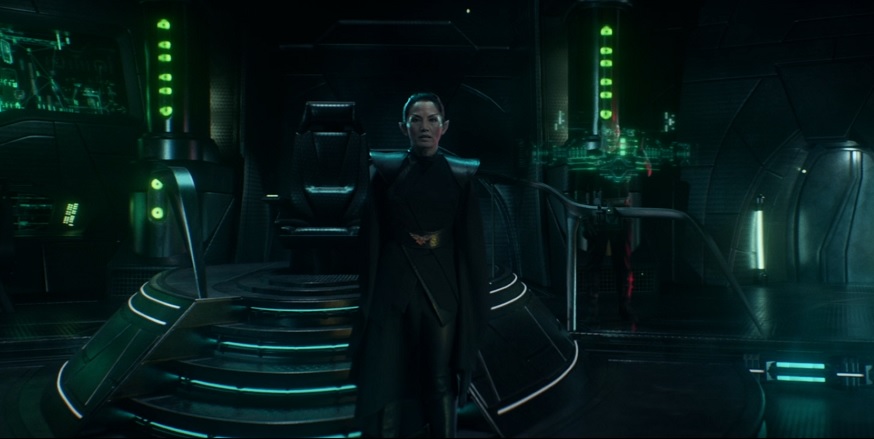
Commodore Oh

Commodore Oh on the bridge of her ship.

One of the primary antagonists in Season 1 was the Romulan spy Commodore Oh. Oh infiltrated Starfleet shortly after the discovery of Data, playing a very long game to sabotage the Federation’s work on developing synthetic life. She was responsible for the attack on Mars, the death of Chris Rios’ captain aboard the USS Ibn Majid, and the attack that claimed Dahj’s life.

Commodore Oh was also a zealot, completely dedicated the Zhat Vash mission to prevent and exterminate synthetic life. Although she was convinced to withdraw from Coppelius, I see no evidence whatsoever that she or the Zhat Vash would abandon their anti-synthetic crusade. Having been exposed, the Zhat Vash may be on a quest for revenge – and as the person who stopped them and exposed their secrets, Picard would surely be at the top of Oh’s list.

Rogue #13:
The Control AI

The Control AI took over Captain Leland’s body.

Returning to the theme of artificial life that we discussed above, one other “evil” AI that springs to mind is Control, which was the primary antagonist for much of Discovery’s second season. Control wanted to evolve and become fully sentient, so if it had the opportunity to contact a race of super-synths, that seems like something it would have tried to do! Although the end of Discovery Season 2 implied that Control was completely and utterly dead (or shut down), it’s not implausible to think that it could be revived.

One thing that I’ve been disappointed with in modern Star Trek has been a lack of major points of connection between the franchise’s main live-action shows. Discovery and Picard have run alongside one another since 2020, and four seasons of television have been produced in that time. But aside from a couple of blink-and-you’ll-miss-it references, there haven’t been any major connections or crossovers. If Captain Vadic is on a mission connected to the Season 1 super-synths, synthetic life, or building a crew of artificial life forms, including Control would be a way of rectifying that.

Rogue #14:
The impostor known as “Ardra”

“Ardra” realises she’s been caught.

“Ardra” – whose real name remains unknown – was a con artist who attempted to prey on the Ventaxian civilisation in The Next Generation Season 4 episode Devil’s Due. She claimed to be the Ventaxian devil, and tried to force the entire population into slavery to enforce a “contract” that they had signed in the distant past.

Picard and the crew of the Enterprise-D were able to expose “Ardra” for what she really was, denying her the chance to rule over the Ventaxians. She was subsequently arrested – and I’m sure she’d hold a grudge against Picard for that! Although “Ardra” isn’t one of the most iconic Star Trek villains, I could entertain the idea of bringing her back as part of a team-up against Picard.

Rogue #15:
Nicholas Locarno

Cadet Locarno.

Nicholas Locarno is probably best-known to Trekkies nowadays because he was portrayed by future Tom Paris actor Robert Duncan McNeill. But he was a complex and interesting character in The First Duty, an episode of the fifth season of The Next Generation, and I could conceivably see him holding Picard responsible for his expulsion from Starfleet Academy.

Locarno was the head of Nova Squadron – an elite flight performance team at the Academy – when he covered up the death of a fellow cadet. Wesley Crusher, after a major dressing-down from Captain Picard, eventually told the truth at an inquiry into the cadet’s death, leading to Locarno’s expulsion.

Rogue #16:
Narek

Narek aboard the Artifact in Season 1.

I was disappointed that Narek’s story was abandoned partway through the Season 1 finale of Picard. Could Season 3 bring back Narek in some form – if for no other reason than to bring some kind of closure to his narrative arc? I’m not sure… but if we’re considering characters from within Picard who might want to join a crusade against the retired Admiral, Narek has to be in contention.

Like Commodore Oh above, Narek was a true believer in the Zhat Vash cause to the very end – and while I know some fans didn’t like his storyline, for me it was at least interesting that he stuck to his mission and didn’t fall into the clichéd trap of being the “spy with a heart of gold” who falls in love with his target. I’d quite like to see Narek again, and if Captain Vadic is putting together a squad, his unique skillset could make him an invaluable addition.

Rogue #17:
The Ux-Mal prisoners

The Ux-Mal prisoners.

After more than five hundred years imprisoned on a moon, stripped of their physical bodies, a group of prisoners belonging to a race called the Ux-Mal came very close to escaping. Using the bodies of several Enterprise-D officers and crew, they hoped to transport their fellow prisoners away from the torturous moon that they had been confined to – until the rest of the Enterprise-D’s crew thwarted their plans.

If some of the Ux-Mal prisoners were able to escape the moon of Mab-Bu VI, it’s at least possible that they would want to get revenge on Picard and the others who stopped their earlier escape attempt. Captain Vadic could even turn out to be “possessed” by one of the prisoners in the same way as they took over the bodies of Data, Troi, and O’Brien.

Rogue #18:
Thomas Riker

Thomas Riker on Nervala IV.

Like Ro Laren above, Thomas Riker was a Starfleet officer who defected to the Maquis in the years before the Dominion War. A transporter clone of William Riker, Thomas spent years in isolation on the planet Nervala IV before being rescued by the crew of the Enterprise-D and resuming his Starfleet career. He would later attempt to steal the USS Defiant from Deep Space Nine – exposing a fleet of ships that the Obsidian Order had been building in secret.

Thomas Riker was arrested by the Cardassians and sent to a labor camp – with the approval of the Federation. It’s unclear what happened to him during and after the Dominion War, but if he survived he may very well hold a grudge against the Federation and his doppelgänger – as well as Picard.

Rogue #19:
Jev

Jev attempting to perform his telepathic attack.

Jev was an Ullian, a member of a telepathic race whose job was to gather memories. However, he abused his powers, telepathically assaulting dozens of people across multiple star systems. His crimes were brought to light when he tried to attack Deanna Troi and other members of the Enterprise-D’s crew. Jev was arrested by the Ullians and was expected to receive a harsh punishment for his crimes.

As a classic narcissist who put his own pleasure ahead of the basic rights of others, Jev may well blame Picard and others for his downfall rather than being able to admit his own wrongdoings. Although the episode in which he appeared, Violations from Season 5, may not be as well-remembered as some others, Jev is certainly a slimy, nasty villain who could be interesting to revisit.

Rogue #20:
Admiral Erik Pressman

Admiral Pressman in Ten-Forward on the Enterprise-D.

In the late 2350s, before Picard assumed command of the Enterprise-D, Admiral Pressman was in charge of a secret project to design and test a cloaking device – despite the Federation being prohibited from doing so under the terms of a treaty with the Romulans. The mission went wrong and a young Ensign Will Riker was one of the few survivors. Years later, Pressman came aboard the Enterprise-D to go looking for his old ship, the Pegasus, and recover or destroy its prototype cloak.

Riker, along with Picard, was instrumental in exposing Pressman to both Starfleet and the Romulans, and he was taken into custody to face a court-martial. Although we don’t know what became of Pressman after the events of The Pegasus, it stands to reason that he lost his reputation, and possibly his position in Starfleet as well. If he suffered major repercussions, he could blame Picard and Riker for his troubles and want to get his revenge.

So that’s it!

Who else might join Captain Vadic on her mission?

We’ve considered quite a few candidates for Captain Vadic’s “rogues’ gallery” – some of whom, I freely admit, are more likely to appear than others! But it was a bit of fun to put together this list and to speculate about what kind of team Captain Vadic might have put together, as well as what her criteria could be for choosing people.

As I said at the start, I’m not convinced that we’ve seen every member of what I’m calling the “rogues’ gallery” just yet, and there may be more surprise casting announcements to come either before Season 3 premieres or saved for surprises after it kicks off. I quite like the idea of a team-up of some of Picard’s enemies from his many Star Trek appearances, as that’s something that has the potential to be explosive and exciting.

Could some of the people on this list be the obscured characters in this still from the most recent trailer?

Last time we talked about Captain Vadic as having a Khan-esque obsession with Picard and the crew of the Enterprise-D. While we still don’t know why that is, there are many events that we’ve seen on screen that could connect to the story of the new season, and while it’s still possible that Vadic is someone new whose grudge against Picard and the crew originates with some hitherto-unseen occurrence, it would be an absolute blast if it turned out that something we’re already familiar with from a past episode or story was her driving force.

I hope this was a bit of fun while we wait for Season 3, if nothing else! Please remember what I said at the beginning: all of this is pure speculation and the opinion of just one person. It’s quite likely that none of the characters discussed above will appear in Season 3, and that’s totally fine. As much fun as it is to speculate – and to occasionally get things right – it’s also fantastic when Star Trek can take us on adventures to truly unexpected places.

Star Trek: Picard Season 3 will stream on Paramount+ in the United States and on Amazon Prime Video around the world beginning on the 16th of February 2023. Seasons 1 and 2 are available to stream now and are also available on DVD and Blu-ray. The Star Trek franchise – including Picard and all other properties mentioned above – is the copyright of Paramount Global. This article contains the thoughts and opinions of one person only and is not intended to cause any offence.