Et in Arcadia Ego: What went wrong?

Spoiler Warning: There are spoilers ahead for Star Trek: Picard Season 1, in particular the two-part episode Et in Arcadia Ego.

With Star Trek: Picard Season 2 approaching, I wanted to take a moment to step back to the Season 1 finale. Et in Arcadia Ego was the two-part ending to the show’s first season, and after the preceding eight episodes had masterfully and slowly built up an engaging story, it unfortunately ended in a way that was, at best, underwhelming. On this occasion I want to look back at Et in Arcadia Ego and ask “what went wrong?”

I think we can summarise the finale’s issues in a single word: rushed. The two parts of Et in Arcadia Ego were overstuffed with plot, partly as a result of the deliberately slow pace of the rest of the season, but also in part because of the decision to introduce new characters, a new faction, and whole new storylines at the last minute. As a result, Et in Arcadia Ego had to rush through far too much narrative in far too little time, leaving significant chunks of it on the table by the time the credits rolled on Part 2.
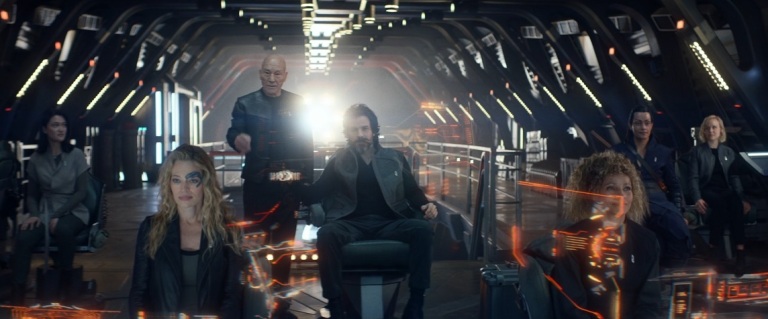
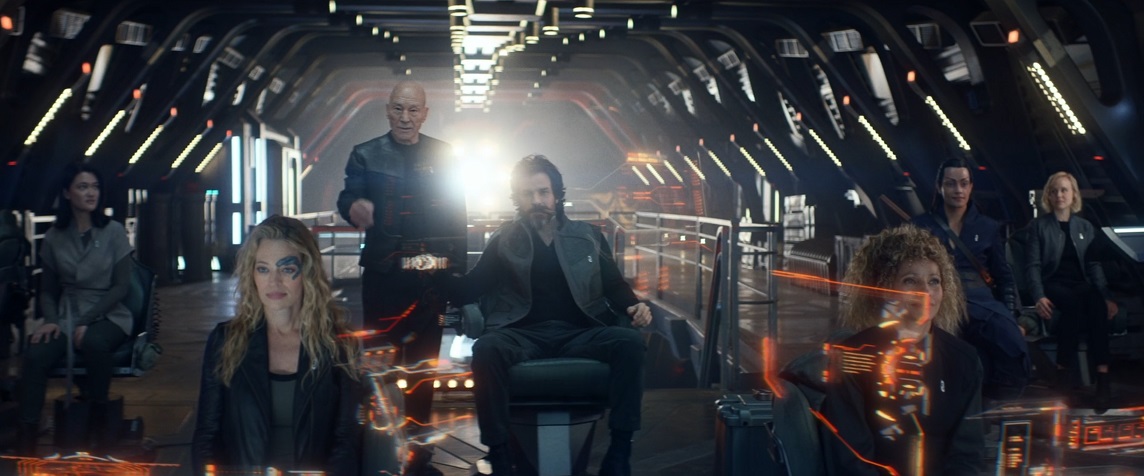
The final scene of Et in Arcadia Ego, Part 2.

In my view, most of the damage was done in Part 1 and the first half of Part 2. By the time we got into Picard’s speech over Coppelius and his stint with Data in the digital afterlife, Et in Arcadia Ego picked up, and the issues with pacing and the editing of certain scenes abated. Those latter emotional sequences went a long way to salvaging the finale, and Picard’s time with Data – giving the character the proper send-off that he hadn’t got in Nemesis – meant that the story found a second purpose, one which I think many Trekkies appreciated.

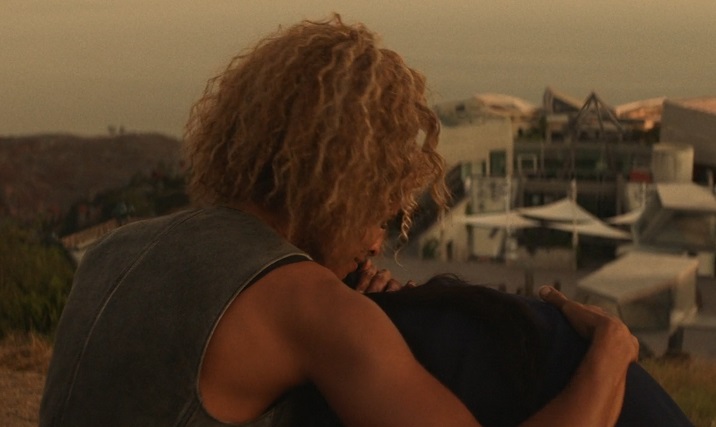
There was also some fantastic acting in the second part of Part 2, with Evan Evagora, Michelle Hurd, Santiago Cabrera, and Jeri Ryan all putting in exceptional, deeply emotional performances as their characters dealt with the apparent death of Admiral Picard in different ways. The way Elnor broke down crying at the loss of his surrogate father figure is one of the most emotional moments in the entire season, and both Evagora and Hurd excelled in that moment.

A heartbreaking moment.

But as the credits rolled on Part 2, after Picard had laid Data to rest and been reborn in a new synthetic body of his own, I was left feeling that, despite the emotional high points as the finale drew to a close, the nicest thing I’d be able to say about Et in Arcadia Ego is that it was a mixed bag; an underwhelming end to what had been an otherwise excellent first season. At worst, I might even call the entire finale disappointing because of its underdeveloped characters and storylines that seemed to go nowhere.

The basic premise of Et in Arcadia Ego was interesting on the surface. After discovering that there are more synths than just Soji, we as the audience had been led to assume that they’re a peaceful civilisation who are being unfairly targetted by fanatical Romulan zealots. But instead we learn that the Zhat Vash were, in a sense, right. The beacon they discovered on Aia did warn of a powerful civilisation of super-synths who would murder organics, and not only that, but Soji’s evil twin Sutra planned to contact them. The synths turned from damsels in distress needing to be saved into a civilisation acting out of self-preservation, but nevertheless needing to be stopped from inflicting mass murder – or possibly even mass genocide – on the galaxy.
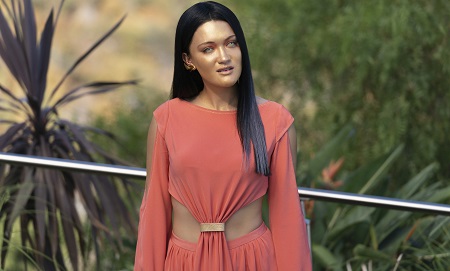
Soji’s “evil twin,” Sutra.

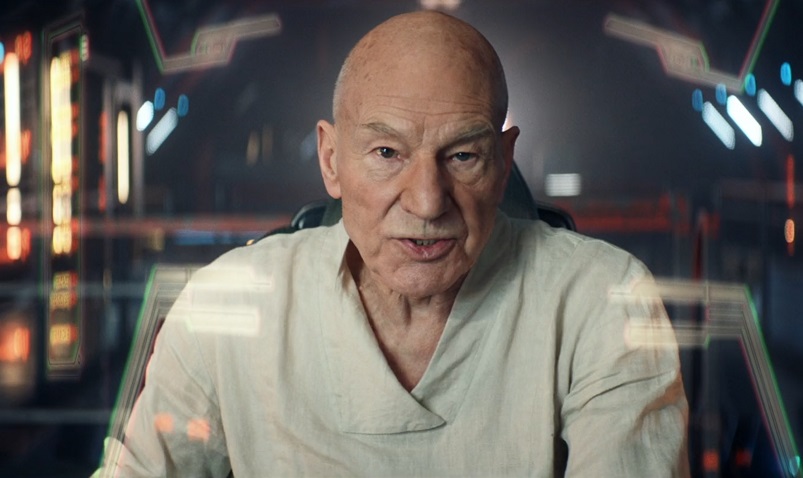
It fell to Picard to try to dissuade the synths, to show them that not every organic is hostile to them, and that if they would trust him – and trust the Federation to do the right thing – they would be safe. After a season in which the Federation was not painted in the best possible light this was a cathartic moment, and I understand what Et in Arcadia Ego was trying to do here.

Particularly in Part 2, Et in Arcadia Ego successfully hit some of those story beats, and the emotional high points surrounding Picard’s death, Data’s second death, and the desperate last stand over Coppelius felt great. In fact, I’d argue that the second half of Part 2 came close to rivalling the rest of the season in terms of the emotional side of its storytelling, and if we were looking at that part of the finale in isolation – or if the rest of the two-part story had been up to that level – we wouldn’t be having this conversation today!

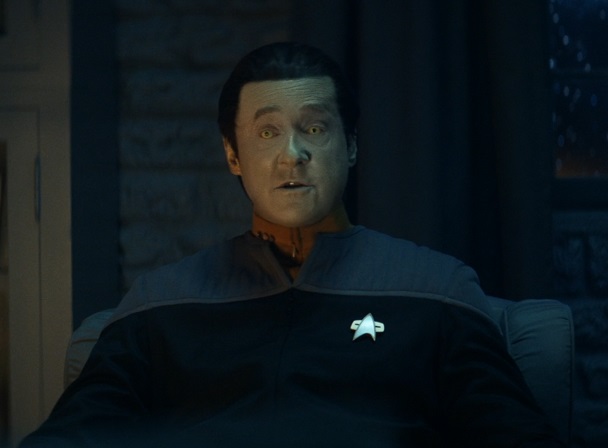
Data in the digital afterlife.

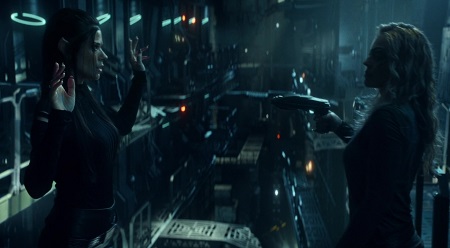
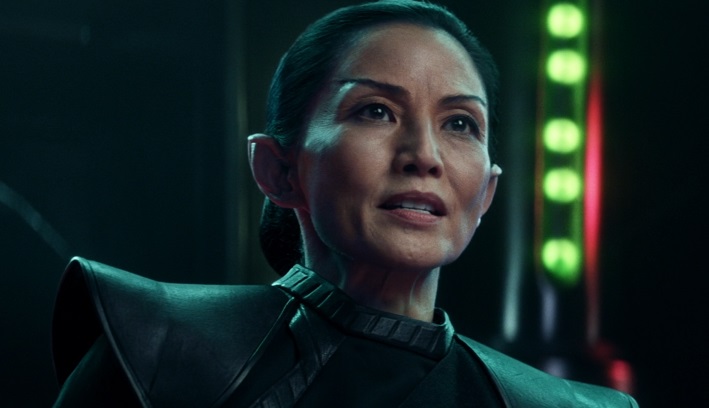
On the technical side of things, before we get into story complaints, Et in Arcadia Ego was a very rushed, poorly paced episode. As a result of trying to cram several episodes’ worth of story into not enough runtime, there were some utterly ridiculous editing choices. At one point, Commodore Oh was stood on the bridge of her Romulan vessel, and appeared to speak a line to absolutely no one.

This line was very generic, too, and the entire scene – if we can be so generous as to call a clip that lasted a few seconds a “scene” – just came across as laughable, not intimidating or concerning. There were also a couple of places where two scenes were very poorly spliced together – at the beginning of Part 2, for example, a speech Picard made to Soji was heard only in voiceover, with Dr Jurati on screen silently watching the synths building their beacon.

Commodore Oh’s generic “evil villain” moment.

The gold makeup used for the Coppelius synths – Sutra in particular, as she was featured most prominently – was just awful. It looked like something out of The Original Series, and I don’t mean that in any way as a compliment. If I’d seen characters on The Original Series so poorly made-up I’d have written it off as a limitation of the medium at the time, and tried to get on with the story. Characters like Bele and Lokai from Let That Be Your Last Battlefield look similarly ridiculous by today’s standards, but with all of the improvements made over the last fifty years… I can’t excuse how poor practically all of the synths looked.

The problem of a lack of diversity in outdoor filming locations plagued Picard Season 1, but it came to a head in Et in Arcadia Ego because it was the finale. In short, the ten-episode season attempted to depict locations on Earth, including France and Japan, as well as the planets of Vashti, Nepenthe, Aia, and Coppelius using outdoor filming locations within a few miles of Los Angeles. And this was painfully obvious as the season wore on, leading Picard Season 1 to feel smaller and less visually interesting as a result. If Coppelius needed an expansive outdoor filming shoot, then other worlds could – and should – have been created on indoor sound stages if long-distance location shoots were out of the question.
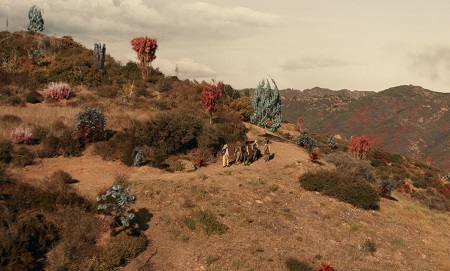
Look, it’s California… oops, I mean Coppelius!

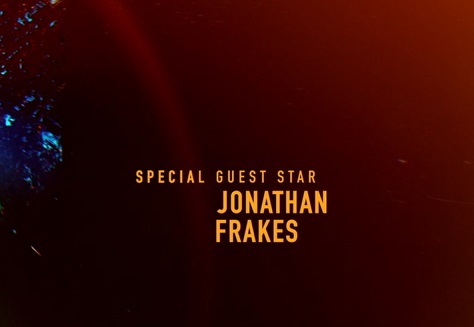
Both parts of Et in Arcadia Ego ruined the surprise appearance of a returning actor from The Next Generation. Brent Spiner’s role in Part 1 was telegraphed in the opening credits before his character had appeared on screen, but most egregiously the mistake was repeated in Part 2, where the return of Jonathan Frakes’ Acting Captain Riker was spoiled in the opening credits. The scene where Riker arrived at the head of a massive Starfleet armada to defend Coppelius was treated on screen like a huge surprise, but the fact that he was coming had been telegraphed in advance by the opening credits.

How difficult would it have been to credit special guest stars at the end instead of at the beginning? This also happened with Jeri Ryan’s Seven of Nine in the episode Absolute Candor earlier in the season – a character who appeared right at the end of the episode, in that case, and whose arrival was also treated as a surprise. For fans who don’t follow all of the ins and outs of Star Trek, the fact that any of these characters were coming back was supposed to be a total surprise, and both halves of Et in Arcadia Ego treated their returning guest stars in this way. But their unnecessary inclusions in the opening titles detracted from it. Riker’s arrival in particular felt far less impactful than it should’ve been; by the time the story reached the point of Picard standing alone against the Romulan armada, it was obvious that Riker was coming to save the day.

This shouldn’t have happened in the opening titles.

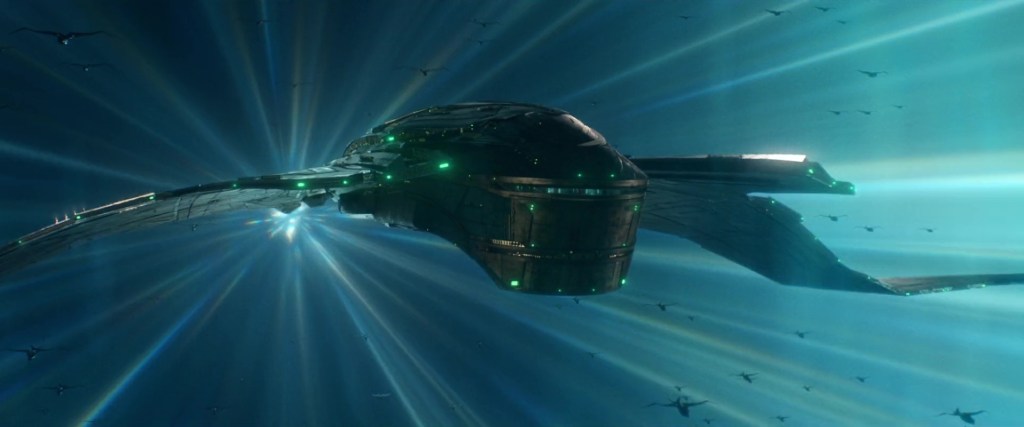
Speaking of the two fleets, the fact that both the Romulan and Starfleet armadas were comprised of a single starship design each seriously detracted from the way they looked. The copy-and-paste fleets were big, which was visually impressive at first glance, but the longer they remained on screen the more obvious it was that the CGI animators had literally copied and pasted each ship dozens of times.

Fleets seen in past iterations of Star Trek were almost always comprised of a variety of different starship types, and there was the potential to use this moment as fun fan-service, perhaps bringing back Romulan warbirds and scout ships from The Next Generation era, as well as Federation starship types like the Defiant-class, Sovereign-class, and Galaxy-class. Heck, Picard Season 1 had already made a brand-new CGI Galaxy-class model for the premiere, so it couldn’t have been too much extra work to include it here.

The Romulan and Federation fleets were copy-and-paste jobs and looked the worse for it.

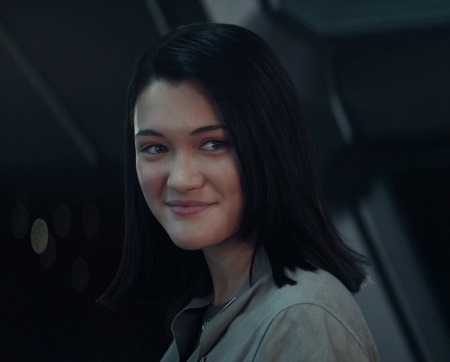
As a final point on the technical side of things, I’m sorry to say that, despite a great performance as Soji across the rest of the season (and as Dahj in the premiere), Isa Briones was not convincing as Sutra, the central synth villain. Her performance was incredibly hammy, and while the character was written sufficiently well that her basic motivation – to protect the Coppelius synths from an outside attack – should have been understandable and even potentially sympathetic, the “I’m evil for no reason and I love it” performance was so bad that it detracted from the character.

Although Sutra being so easily shut down in Part 2 meant that the character as a whole felt like a waste, and was not the angle I would’ve wanted the show to take, in a way I was glad that we were spared too much more of what has to be the entire season’s single worst acting performance.

Sutra with Admiral Picard.

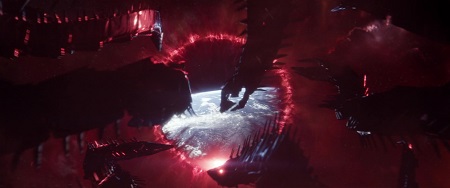
In terms of story, let’s talk about the big picture first of all before we get into smaller narrative complaints. The super-synths that Sutra and Soji planned to contact were so barebones as a faction that they don’t even have a proper name. Their “admonition” – i.e. the vision that the Zhat Vash encountered from their beacon – was superficially intimidating, and the mechanical tentacles that we saw approaching the beacon at the climax of the story likewise looked frightening… but without knowing more about this faction, it was difficult to remain invested in this story.

We didn’t know what the super-synths would’ve done had they arrived. Would they have sought to exterminate all organic life everywhere, or just in the vicinity of Coppelius? Having exterminated, would they have taken the super-synths to live with them in “dark space?” Was their offer to help even genuine or was it an elaborate trap to conquer the Coppelius synths and steal their technology? We have so many open questions, and because it seems that Star Trek won’t be returning to the super-synths any time soon, they’ll be left open and this aspect of the story will remain less than it could have been.
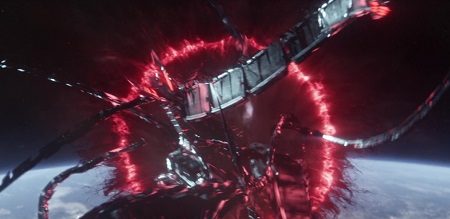
Some mechanical noodles were all we got to see of the super-synths.

In monster movies – which Et in Arcadia Ego’s super-synths were, to an extent, trying to emulate – we don’t always know everything about the monster. We might not know where Godzilla came from or why the Xenomorph in Alien is going on the rampage, but we at least have some perspective or frame of reference to understand why they should frighten or unnerve us – we’ve seen for ourselves how destructive and deadly the monster can be. The super-synths were barely glimpsed, and while their beacon was interpreted by the Zhat Vash as being dangerous, what we as the audience saw of it on screen was ambiguous at best. Because of that, the super-synths are more mysterious than frightening, and with no frame of reference to go on to showcase their level of technology, weapons, or danger, they’re less interesting and less frightening than they should’ve been.

During my first watch of Et in Arcadia Ego, I referred to the super-synths as the “Mass Effect Reapers” because of their similarities to a faction from the Mass Effect video game series. On re-watching the episodes, those similarities are really hammered home, even to the point where the vision contained in the Zhat Vash’s beacon and the beacon encountered by Commander Shepard in the first Mass Effect game contain striking visual similarities. I can’t believe that this is entirely a coincidence, and while I don’t want to accuse anyone of “ripping off” anyone else… it’s at the very least noteworthy that this aspect of the storyline of Et in Arcadia Ego – and thus of Picard Season 1 as a whole – is not original.

We could play a game called “Mass Effect or Star Trek: Picard?” with some of these sequences.

In the episode The Impossible Box, Narek walked Soji through a complicated series of steps to help her understand a dream she’d been having. His motive was to find out the location of her homeworld – Ghoulion IV or Coppelius. At the end of Soji’s dream, she looked up to the sky and saw two red moons and a lightning storm, leading Narek and Rizzo to conclude that they had enough information to locate Soji’s homeworld.

We subsequently learned that the Romulans had a fairly narrow search area and only needed to look within a few different star systems, so it seems reasonable that only a couple of pieces of information might be enough to go on if there aren’t that many possibilities. But when we finally reached Coppelius a couple of episodes later, the red moons were present – but where were the thunderstorms? This had been an absolutely essential part of the plot of The Impossible Box, yet the weather on Coppelius was sunlit and beautiful – some might say almost California-like. There were literally only two bits of information conveyed in The Impossible Box that Narek and Rizzo used to pinpoint Soji’s home planet… and one of them was completely disregarded in Et in Arcadia Ego.
This moment told us two things about Soji’s homeworld. Et in Arcadia Ego ignored one of them.

Speaking of being completely disregarded… what happened to poor Narek? I know Narek wasn’t everybody’s favourite character in Season 1, but I felt he was interesting as a character who didn’t fall into the obvious trap of being a clichéd “spy with a heart of gold” who falls in love with his target. Narek remained loyal to the Zhat Vash cause, even though his relationship with Rizzo was complicated and despite his feelings for Soji.

For Narek to simply be abandoned by the story of Et in Arcadia Ego is disrespectful – not only to actor Harry Treadaway, who had put in a great performance – but to us as the audience. We’d been following Narek’s story since the second episode of the season, and as he approached what should’ve been his moment of triumph, and then his moment of defeat, he just vanished from the story altogether.

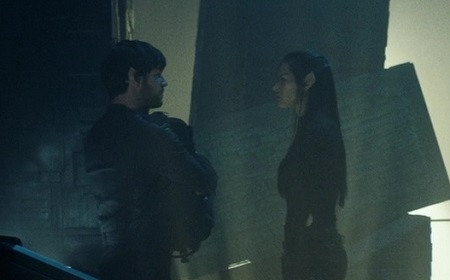
This was the last we saw of Narek.

At the very least it would’ve been worth following Narek’s story to some kind of conclusion. I’d have liked to see how he reacted to Soji shutting down the beacon – would seeing that have finally broken his Zhat Vash brainwashing? Would he have tried to apologise to her and the rest of the synths? Or would he have stayed true to his mission even while being taken into custody by Starfleet or the synths?

We don’t know the answer to any of these questions, and while there is supposedly a scripted but unfilmed scene in which Narek was handed over to the Federation, that hardly seems like rock-solid “canon,” does it? Picard Season 1 didn’t actually feature that many characters in a big way, so for one of the principals to simply be dropped with no explanation midway through the finale is indicative of the fact that this two-parter had far too much narrative to cram into its runtime. It was poor, and whatever viewers might’ve thought of Narek and the earlier scenes and sequences in which he starred, getting some closure on one of the season’s most important characters was necessary.
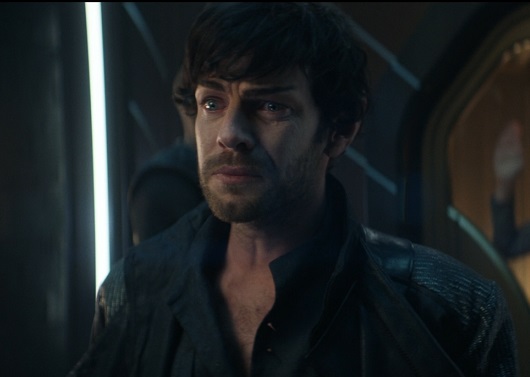
Narek had been a major character throughout the season.

In an overstuffed story with some very serious themes, there were some very odd choices. Dr Jurati and Picard making jokes while launching La Sirena into orbit felt out-of-place, but thankfully that didn’t last very long. What did last a long time, though, in the context of the story, was the very odd campfire scene with Narek, Raffi, and Rios.

This scene was a complete waste of time. As the audience, we already knew what the Zhat Vash prophecy and philosophy was by this point, so re-telling it in a “ghost stories by the campfire” cliché was unnecessary fluff in an episode that simply didn’t have so much as a second to spare. Secondly, this scene messes with the timing of the entire episode. Narek seemed to be in a mad rush to attack the synths’ compound and stop their beacon, and if we’re to believe that Raffi and Rios had been persuaded too – which appears to have happened in a very short scene aboard La Sirena that really needed to be extended – then the characters themselves shouldn’t be wasting time camping out. It’s also the only scene in the entire episode to take place after dark, which was obviously done to make the campfire more visually dramatic… but the rest of the story seems to have taken place over the course of less than one day, so when did this night occur and why didn’t anyone else on Coppelius experience it? In short, it wasn’t just an unnecessary scene, but one that breaks the continuity of the whole story.

The campfire.

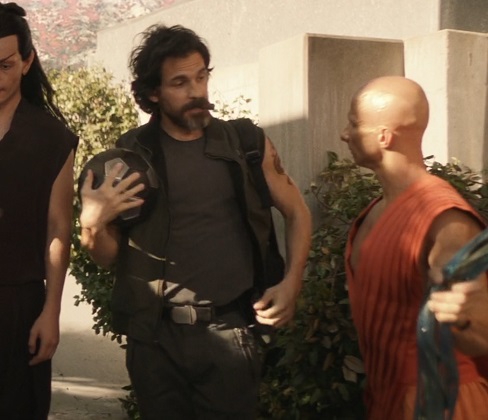
After the campfire scene we came to the poorly-scripted bomb plot. Using grenades donated by Narek and a football that Rios had aboard La Sirena, the trio planned to smuggle a bomb into the synths’ compound and blow up the beacon. I didn’t understand why the synths’ compound was suddenly being guarded as the group approached – except, of course, to ramp up the drama. From the synths’ point of view Raffi and Rios were no threat; they’d been on friendly terms when they parted, so why hassle them?

Dr Soong joined in after they arrived at Coppelius Station, but even he couldn’t salvage what was an illogical and stupid “plan.” Dr Soong had two aces up his sleeve: the video evidence that proved Sutra, not Narek, was responsible for murdering Saga, and his “magic wand” weapon that could apparently disable synths at the push of a button. He used the latter once, on Sutra, and then disappeared entirely from the plot until after Picard’s “rebirth.”

Dr Soong was able to “shut down” Sutra… but then made no further contributions to the plan to attack the beacon.

After the remaining trio made a stupid full-frontal attack against the much larger group of synths, it fell to Rios to try to throw the bomb-ball into position… but, naturally, Soji was able to clear it with seconds to spare.

This entire operation was so stupid, and was clearly written to ensure that the heroes’ plan would fail, meaning it would be up to Soji and Picard to save the day. And I won’t dismiss Picard’s speech and the emotional impact of Soji’s decision to stand down – both of those aspects felt great. But they were, unfortunately, sabotaged by this awfully-scripted bomb plot which made no sense, and the immediate disappearance of everyone involved in its aftermath.

Soji was able to easily stop the bomb plot.

Here are just a few of the questions this sequence raised: why didn’t Dr Soong show the footage of Sutra to the other synths? Why didn’t Dr Soong use his “magic wand” on Soji? Why didn’t Rios and Raffi try to talk to Soji and explain the dangers of the super-synths? There was so much wrong in this one sequence, and it was contrived in such a way as to skip over any and all of these points to get to the standoff between Soji and Picard, and Picard’s convincing speech. Unfortunately the route to that otherwise powerful moment felt so unnatural that it detracted from it.

After the bomb plot and the speech, things took a turn for the better, and much of the remainder of Et in Arcadia Ego hit those emotional high points, and as the rushed, almost panicked pacing and editing gave way to a slower-paced story of laying Data to rest and restoring Picard to life, things did improve.

Picard’s “death” marked a turning point in the story.

Unfortunately, though, Et in Arcadia Ego ended with many questions left on the table. Having arrived just in time to save the day, is the Federation now committed to leaving an entire fleet in the Ghoulion system to defend Coppelius? If not, it seems like there’s nothing to prevent the Romulans from returning next week and obliterating the synths from orbit. Or perhaps the synths will need to be evacuated and taken to a new, safer location. If so, we saw no indication that Starfleet plans to help with that.

There was also no attempt made to explain Bruce Maddox’s visit to Freecloud, which had been a huge story point in the first half of the season. Maddox’s lab on Coppelius clearly hadn’t been “raided by the Tal Shiar,” and if we’re to understand he set up a second lab somewhere else for some unknown reason, why didn’t he return to Coppelius if it was destroyed; why go to Freecloud instead? This opens up a pretty big plot hole in the entire season, as Maddox now has no reason to go to Bjayzl – a dangerous woman to whom he owed money – other than “because plot.” Maddox was there simply to allow the rest of the story to unfold, and that just isn’t satisfying at all.
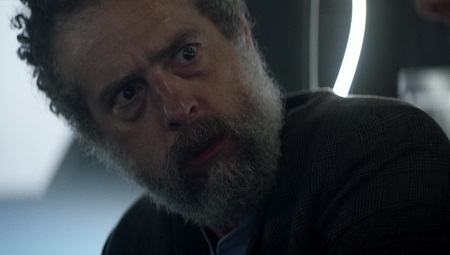
Why did Dr Maddox go to Freecloud?

And this is just one way in which Et in Arcadia Ego damages the entire first season of the show. With so much rushing around in the final two episodes, with brand-new characters, new civilisations, new factions, new antagonists, and whole new storylines being dumped into the show with two episodes remaining, it makes going back and reflecting on the rest of the season somewhat difficult. Was the deliberately slow pace of episodes like Maps and Legends too much? Should the side-stories on Vashti and Nepenthe have been cut down… or skipped altogether?

Nepenthe was, for me, one of the most enjoyable episodes of Star Trek that I’ve seen in a very long time, and spending time with Picard, Riker, and Troi after so long felt absolutely magical. We caught a glimpse of their retirement, the family life that they deserved to have after their rollercoaster relationship and the tragedy of the loss of their first child. And it was wonderful. But in retrospect, all of that time with Kestra and Soji bonding and Picard catching up with his old friends, cooking pizza in an outdoor oven and hanging out in a cabin in the woods just feels wasted. There was too much plot left for Picard Season 1 to get through, so either stories like Nepenthe needed to be cut down or, realistically, the season needed to be extended. One of the advantages of streaming over traditional broadcast television is that things like schedules don’t mean much – it’s far easier to add an extra episode or a few minutes here and there if necessary. Discovery did exactly that in its first season… why couldn’t Picard?

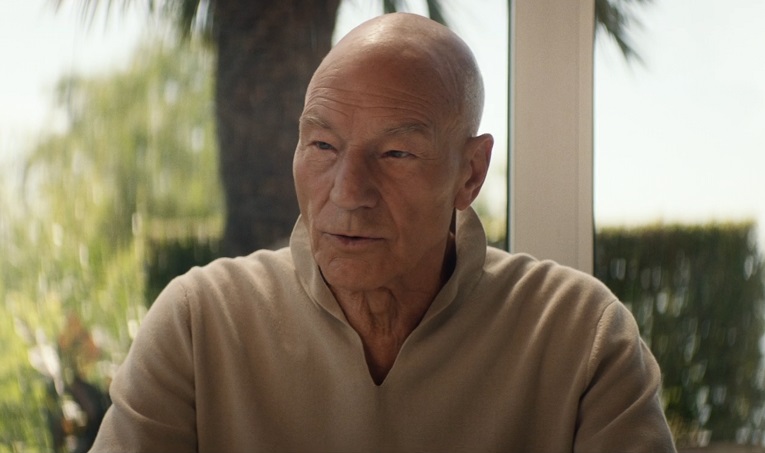
Picard and Riker’s reunion in Nepenthe.

That’s the real tragedy of Et in Arcadia Ego: the way it makes eight genuinely wonderful episodes feel worse in retrospect. We aren’t quite at the level of something like Game of Thrones, where a truly awful ending has made going back to re-watch earlier seasons feel downright unpleasant, but we’re in the same ballpark.

The sad thing is that the synths’ storyline wasn’t bad. Dr Soong wasn’t a bad character, and if he’d had more time on screen I think we could have got more of a nuanced portrayal that showed us a man doing his best to work around the synth ban and keep his people safe. We could’ve learned why he wanted to build a golem for himself – was he dying? Was he trying to become immortal? What drove him to pick up his father’s work? All questions that Et in Arcadia Ego left on the table.
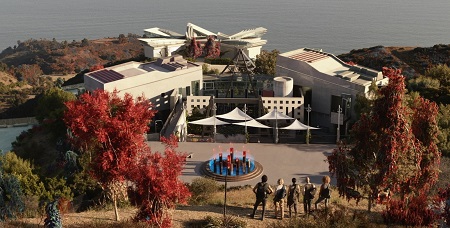
Coppelius Station – home of the synths.

Likewise with Sutra. Despite the crappy makeup and the poor, hammy performance, there was the kernel of an interesting character at Sutra’s core. Her presence turned the synths from a group in need of rescue into a potential danger, and that concept – had it been executed better over a longer span of episodes – could have been interesting.

The super-synths, despite their similarities to the Reapers from Mass Effect and their blink-and-you’ll-miss-it appearances on screen, had been the driving force for the entire season’s plot, and learning more about who they were and what drove them, whether their offer to help was genuine, and whether they had any connection to other Star Trek factions were all points that could’ve been explored. The super-synths, while hardly an original faction in a broader sci-fi environment, were something new to Star Trek, and as Trekkies I think we have a great curiosity about the Star Trek galaxy and the races present within it. Finding out more about the super-synths would have been fun.
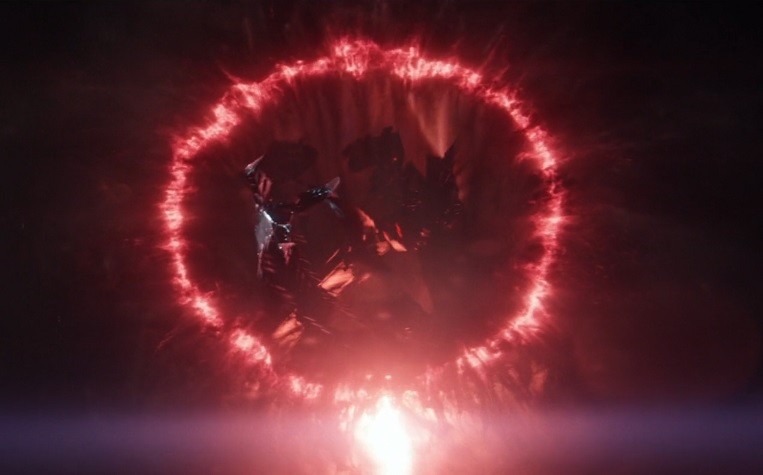
I’d like to know more about the super-synths.

There was also the standoff over Coppelius itself. We’ve already covered how the copy-and-paste ships didn’t look great, but as a story beat this entire sequence was rushed. After Picard and Dr Jurati made their “last stand,” Acting Captain Riker showed up at the last second, positioning his fleet in between the Romulans and Coppelius. And then he opened hailing frequencies to talk to Commodore Oh.

Within moments, the zealous Zhat Vash commander had been convinced to withdraw rather than fight it out… and I think that fails as a convincing narrative beat. The Zhat Vash had been portrayed for the entire season as having an almost-religious zeal; a crusade against synthetic life born out of fear of total annihilation. And in mere seconds, Commodore Oh appeared to abandon that crusade. When faced with opposition, she chose not to fight but to withdraw.

Riker’s appearance – and the entire standoff – was too short.

The two fleets looked surprisingly well-matched, and I would have thought that Commodore Oh would have had a chance, at least, of going toe-to-toe with Acting Captain Riker. It wasn’t like the Federation armada had the Romulans horribly outnumbered. And all it would have taken, from her point of view, was for one ship to break through the blockade and fire on Coppelius Station – a single quantum torpedo would probably have done the job.

Commodore Oh and the Zhat Vash simply don’t seem like the types who would come this close to achieving their life’s ambitions – and remember that Oh had been embedded in Starfleet for literally decades – only to be scared away by a few Starfleet ships or convinced to change their lifelong aims by one speech and the beacon being shut down. At the very least, this was yet another sequence which needed much more time to unfold. Heck, I could have happily spent an entire episode on the standoff, with negotiations taking place between Federation and Zhat Vash representatives. The Zhat Vash needed to be talked into withdrawing; I don’t believe that seeing Picard’s speech and Riker’s fleet was anywhere near enough motivation for Oh to take her entire fleet and withdraw, and if it was, we needed to spend a lot longer getting to that point, seeing her agonise over the decision, perhaps facing down mutinous members of her own organisation, and so on.

Commodore Oh’s decision to withdraw was horribly rushed.

So we come back to the crux of why Et in Arcadia Ego didn’t succeed as a finale: it contained plenty of interesting characters and storylines, but didn’t have enough time to pay off most of them in anywhere close to a meaningful way. And as a result, it doesn’t feel like most of Picard Season 1’s storylines came to an end at all. Some, like Narek’s, were just completely abandoned; unceremoniously dumped with no explanation given. Others, like Dr Soong’s, were completely undeveloped, leaving him along with Sutra and several other characters feeling like one-dimensional plot devices instead of real people.

The disappointing thing, at the end of the day, isn’t that the ideas and storylines here were bad, it’s that none of them were allowed to play out in sufficient depth. With the possible exception of laying Data to rest, every single storyline that Et in Arcadia Ego brought into play or introduced for the first time were underdeveloped, cut short, and/or not sufficiently detailed. Some individual scenes and elements were less successful in their own right – like the performance of Sutra or the campfire sequence – but taken as a whole, what I wanted from Et in Arcadia Ego was more – more time for these characters, ideas, and narrative elements to play out. It feels like practically nothing in Et in Arcadia Ego saw justice done, and when I had been invested in the story, the characters, and this return to the 24th Century after such a long wait, that was disappointing.
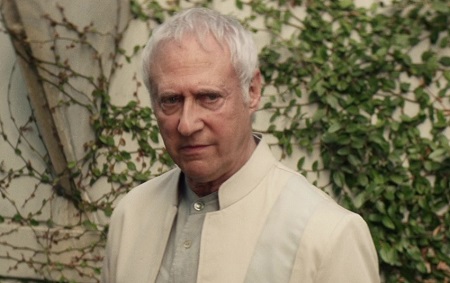
Dr Soong.

As we approach Season 2 of Picard, which kicks off in just one week from today, I hope that the show’s writers and producers have taken on board the feedback that they surely received about Et in Arcadia Ego. The show’s second season can’t afford to repeat the mistakes made by the ending of its first, and if Picard is to end with Season 3, as some news outlets have been reporting, then it’s going to be even more important for the creative team to consider the problems of Et in Arcadia Ego and make sure that the series as a whole won’t end in such disappointing fashion.

There were successes along the way – great moments of characterisation with Admiral Picard, the “heroic last stand” story that always gets me no matter how it’s told, and of course saying a proper goodbye to Data after eighteen years. The emotional moments present in the latter half of Part 2 went some way to making up for earlier disappointments.

I can’t call Et in Arcadia Ego a failure. It brought together storylines that, even two years later, I find fascinating. The disappointment stems from the fact that those stories weren’t able to play out properly due to unnecessary time constraints, a rushed pace, and, in retrospect, eight preceding episodes that spent too long reaching this point. With Season 2 now upon us, I’m hoping for much better things from Star Trek: Picard!

Star Trek: Picard Season 1 is available to stream now on Paramount+ in the United States and on Amazon Prime Video in the United Kingdom and around the world. The Star Trek franchise – including Picard and all other properties mentioned above – is the copyright of Paramount Global. This article contains the thoughts and opinions of one person only and is not intended to cause any offence.

Star Trek: Picard review – Season 1, Episode 10: Et in Arcadia Ego, Part 2

Spoiler Warning: There will be spoilers ahead for Et in Arcadia Ego, Part 2, and for the entirety of Star Trek: Picard Season 1. There may also be spoilers for other iterations of the Star Trek franchise.

I’m in two minds about Et in Arcadia Ego, Part 2. On the one hand, the entire second half of the episode was incredibly emotional, with hit after hit after hit that left me in tears. But on the other hand, much of the first half of the episode followed on directly from Et in Arcadia Ego, Part 1 and was a waste of space.

I think overall, I stand by what I said in my review last week: that many of the story points in this two-part season finale were rushed and underdeveloped. Et in Arcadia Ego, Part 2 had, at points, the same issue of blitzing through potentially interesting story beats, and the disappointing thing isn’t that any of the storylines were bad, it’s that they had potential to be so much more than they were. Despite the second half of the episode going a long way toward redeeming the entire two-part finale, I think when the dust settles and I’m thinking more clearly and less emotionally, the overall picture will be, at best, mixed. There just wasn’t enough time remaining for many of these points to be fully explored, and realistically that meant that either some story threads needed to be cut entirely, or the season needed another couple of episodes to explore them fully.

Where the second half of Et in Arcadia Ego, Part 2 succeeded was that it slowed down, and the rushed pacing, the jumping between storylines, and the obviously-cut down scenes did largely abate. This gave way for a more emotional story to develop and play out over several slower, touching sequences, which brilliantly played on elements of the story that had been spread out over the preceding nine episodes – beginning right back in the first episode of the season, and indeed the first sequence of the first episode.

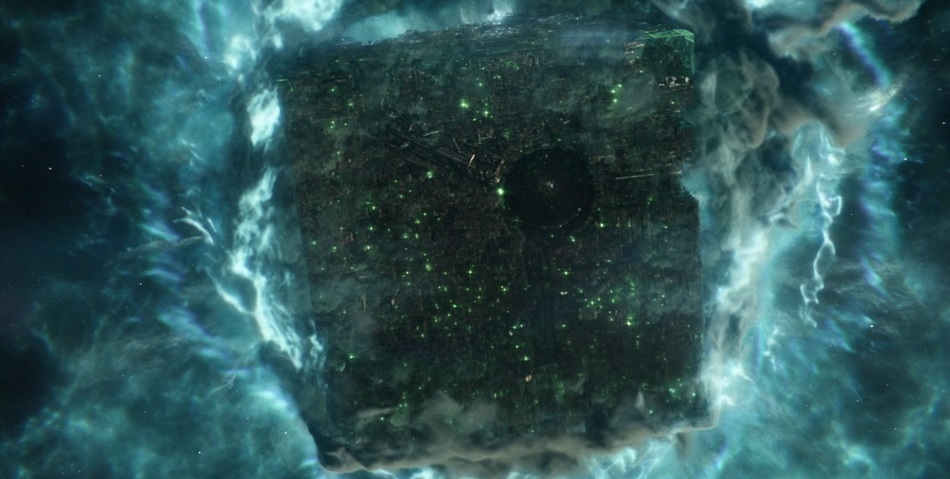
But we’re getting ahead of ourselves. Et in Arcadia Ego, Part 2 begins right where Part 1 left off last week, where Sutra let Narek escape and locked Picard up. Narek travels to the Artifact’s crash site and manages to sneak aboard, passing Seven of Nine, Elnor, and a handful of xBs who seem to be working on repairing the crashed vessel. The establishing shot of the Artifact was actually really pretty, and the closest the planet of Coppelius or Ghoulion IV came to not looking like California for the whole episode.

This shot of the Artifact was great.

Narek is searching for something on the Artifact when Rizzo appears from nowhere and surprises him. I’ve mentioned several times that Rizzo has grown on me as a character in her appearances over the course of the season. Her transformation from an uninteresting and one-dimensional villain into an actual fleshed-out character has been great to see, and it’s hard to imagine the story of Star Trek: Picard’s first season without Peyton List’s occasionally over-the-top performance. Seeing Rizzo and Narek reunited showed us that they were real people underneath it all, and given it was almost sure to be Narek’s last meeting with his sister, their hug was strangely touching. After being attacked by the xBs at the end of Broken Pieces, I’d assumed Rizzo had beamed over to one of the Romulan ships near the Artifact, but it seems that she remained aboard during its short-lived mission to Coppelius and survived the crash-landing. I hadn’t expected that – partly because it wasn’t communicated clearly, it must be said – so it was a surprise to see her. But we did get to see a brief moment of vulnerability and emotion from Rizzo – in that moment, she was genuinely relieved, happy, and even slightly overwhelmed to see Narek, and that moment played out perfectly.

The next scene has to be one of my least-favourites. Not for its dialogue, which was a conversation between Picard and Soji as he tries to convince her to try things his way instead of following Sutra, but for the editing. The best moments with Picard, both in this series and in his previous Star Trek appearances, have been a combination of what he said and his presence while saying it. With this scene cutting away from Picard and Soji in large part, with what should’ve been one of his trademark speeches heard only in voiceover, something significant was missing that made the words he said far less impactful to us as the audience. We needed to see Picard as well as hear him for his speech to have its full effect. And back to what I said at the beginning, this feels like a consequence of both parts of the finale having just too much to cram in to two episodes. Before the opening titles, the episode needed to show this conversation, as well as convey – through Dr Jurati seeing it firsthand – the construction of the beacon that Sutra planned to use to contact the “Mass Effect Reapers”. Instead of there being enough time for both scenes, they ended up smashed together, with the voices of Picard and Soji on top of Dr Jurati silently watching the beacon. For me it simply didn’t work, and both scenes were the worse for being amalgamated.

The opening titles once again ruined the surprise appearance of a character. For the third time this season, an actor’s name was included which telegraphed the arrival of a character whose appearance was supposed to be unexpected: this time it was Jonathan Frakes, who reprised his role as Riker. What was the point of that? In all three cases where this has happened – Seven of Nine in Stardust City Rag, Dr Soong in Et in Arcadia Ego, Part 1, and Riker this time – the appearance of the character was treated in the episode as a surprise. Everything from the camera work to the music built up the suspense of who we were about to meet – yet the opening titles had already spoilt it. Riker’s appearance at the head of Starfleet’s armada was supposed to be something that would make the audience go “wow!”, but instead it was telegraphed ahead of time, so the arrival of his fleet and then seeing him in person when he hailed the Romulans had lost the crucial element of surprise. I just do not understand this decision. How hard would it have been to credit Jonathan Frakes at the end and leave Riker’s appearance a genuine surprise? It was poor, and it detracted from what should’ve been one of the episode’s more powerful moments. It was still nice to see Riker on screen and back in uniform – we’ll deal with that scene in more detail later – but it was such a shame that it wasn’t the surprise it should’ve been.

This shouldn’t have happened.

After the opening titles we see why Narek went to the Artifact – among the many things the Romulans didn’t have time to evacuate were a set of bombs, and he plans to use them to destroy the orchid-ships before the Romulan fleet arrives. This is a pretty tense scene in contrast to his reunion with Rizzo, as we see that there’s still tension between them and they’re of unequal status – despite being very shaken by recent events, Rizzo is still the superior officer. She really doesn’t have a choice in letting Narek go, as there are two jobs to do – destroying the orchids and activating the Artifact’s weapons – and two of them. Narek called himself a “Zhat Vash washout”, and clearly his history with the secretive organisation is complicated. We’d seen a couple of hints at that in earlier episodes, but nothing as major as what we got here. Unfortunately, as with many points across the two-part finale, it was left undeveloped. Narek has had multiple appearances across Star Trek: Picard’s first season for this aspect of his background to be explored, and given that we’re less likely to see him return for Season 2 than anyone else at this point, I would have thought that if the series wanted to properly explore his Zhat Vash background that this would’ve been the last opportunity. As it is, we got a couple of throwaway lines about Narek and Rizzo’s family: their parents, apparently, died as a result of working for the Zhat Vash, but again, how or why is not explained in any detail. Narek and Rizzo part for what would be the final time.

Out of all of Star Trek: Picard’s villains, the dynamic between Rizzo and Narek was by far the most interesting. As brother and sister there’s always going to be an element of sibling rivalry to what they’re trying to do, and Rizzo made clear in every scene together where the power lay in that dynamic. They played off each other well, with Rizzo pushing Narek to the brink of mutiny at times. But throughout it all, his commitment to the cause never wavered, and was stronger than both his fear of and disdain for Rizzo, as well as his clear feelings for Soji.

Narek and Rizzo at the Artifact’s crash site.

Technology in Star Trek has always been flexible to suit the needs of the story, and I appreciate that’s something that has happened going back to The Original Series. Even with that caveat, I didn’t like like the magical do-anything macguffin that’s used in the next scene by Raffi and Rios to fix La Sirena’s engine. It strayed too far into the realm of magic for me, especially with its “just believe it will work” spiel. While we’ve seen similar things in Star Trek before, and perhaps in some contexts it could’ve worked, it just felt forced at this moment; a way to send Raffi and Rios on a mission to La Sirena so they could be there for other story elements to unfold, but done in such a way that they didn’t need to spend more than thirty seconds fixing the engine – which they went back to do.

In fact, at several points in Et in Arcadia Ego, Part 2 did I get this feeling that the story was being forced down a particular path. Scenes would be included not because they fit the natural flow of the story, but because they either looked “cool” from a visual standpoint, or because they moved characters around to get them to be in the right place for other things to happen. In this example, Raffi and Rios had to leave Coppelius Station – under the guise of fixing La Sirena, they were moved out of the way so Picard could be apprehended, and placed in the right location for Narek to find them later, so they could plan their (stupid) attack on the synths’ beacon. It all felt just a little too much like it was driven by a room full of writers, and not a natural way for the characters to go. We’d also see the attack I mentioned be done in a very stupid way to get the plot to a specific climax, as well as the campfire scene with Narek which will come later as other examples of characters being forced into specific situations which didn’t really make sense in the context of the episode. It was constructed in such a way as to allow the plot to unfold, and unfortunately we’re supposed to just brush off some of the contrivances to make it happen.

Rios with the magical macguffin.

While we’re talking about contrivances, I can’t wait any longer to talk about Star Trek: Picard Season 1’s big plot hole. I’ve been flagging this up for several weeks as a potential issue, and unfortunately it was left unresolved at the end of the season. So a plot hole is what it’s become: why was Maddox on Freecloud? Finding Bruce Maddox was the driving force behind the first half of the season’s story, and when Picard finally encountered him on Freecloud, he made it very clear that the reason he was there, and had put himself in danger by contacting Bjayzl, was because his lab had been destroyed by the Tal Shiar. With nowhere else to go and no one to turn to, he went to see Bjayzl as a last resort – and ended up paying for it with his life. Yet Maddox’s lab clearly wasn’t destroyed. He wasn’t kicked out by Dr Soong and the synths, who continued to speak very highly of him. If he’d set up a lab elsewhere that had been destroyed, he could’ve returned to Coppelius. And as it sits right now, there’s no reason for Maddox going to Freecloud other than “because plot”. And that’s a mistake – Maddox was such an important figure, especially in those early episodes, that the reason he put himself in danger should have been given a proper explanation. It’s disappointing that the story and the season have ended with this gaping hole left unexplained.

After Raffi and Rios have used the magical macguffin, we get a scene with Dr Jurati and Dr Soong. At the end of last week’s episode, Dr Jurati had promised to aid the synths – but this was clearly a ploy to avoid being locked up and to be able to help Picard. I liked the dynamic between Soong and Jurati – he clearly hates her for killing Maddox, yet he needs her help. And his barely-contained loathing breaks the surface in the way he talks to her, as Brent Spiner delivers the lines in a style not dissimilar to how he portrayed Lore in The Next Generation. Again, though, as with too many points in the finale, this didn’t really have time to properly develop, and this scene between them, and one brief moment last week, is all the time they had alone together.

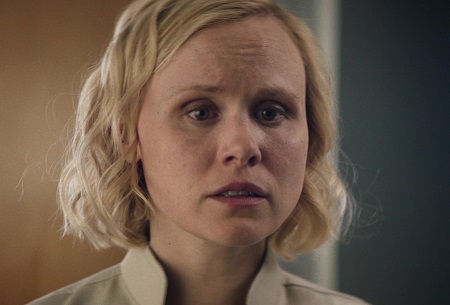
Dr Jurati.

Both Brent Spiner and Alison Pill delivered amazing performances with the limited material they had – I especially liked Dr Jurati’s “I’m not their mother, asshole” line – but I would have liked to have seen more of this relationship. There was the potential for it to go from bad to worse, then for the two of them to form a hate-filled unlikely alliance, before finally coming to terms with what happened. Dr Jurati had been essentially brainwashed by Commodore Oh, and they had both lost someone they cared about in Maddox – I would have liked to see that explored some more, especially because the on screen presence and chemistry the two actors had was definitely one of the finale’s high points.

Back at La Sirena, Narek has arrived and is trying to get the attention of Raffi and Rios by throwing rocks. He shows off his grenade collection and insists on meeting with them. At the meeting, Elnor arrives – we’d seen him following Narek as he left the Artifact. Speaking as we had been of two characters who loathe one another, Elnor and Narek feel that even more strongly. Elnor’s anger at Hugh’s death was on full display, but everyone had to stow their feelings as they discussed the synth problem. Narek is still in Zhat Vash mode, seeking out allies for his mission to blow up the synths’ ships. Staying with the theme of parts of the story being rushed, Raffi and Rios’ decision to believe him almost straightaway wasn’t great. While it was nice to see Narek finally interacting with someone other than Soji or Rizzo – the only two characters we’d seen him spend any significant time with – it came too late in the story to really have much impact, and like other points in the finale, was rushed. Narek really didn’t have to do much at all to convince the others that the synths – who they’d just met and were on friendly terms with – were a galaxy-ending threat, and they didn’t consider any other possibilities for why they couldn’t contact Picard at Coppelius Station other than Narek’s reasoning that the synths were jamming their commuications. It’s just another part of the finale where more time was needed – time to allow the three non-Zhat Vash characters to come around to Narek’s way of thinking. As it is, it felt like an instant turnaround – 180 degrees from trying to save the synths to trying to blow up their ships and beacon.

Narek finally got a chance to talk to other characters.

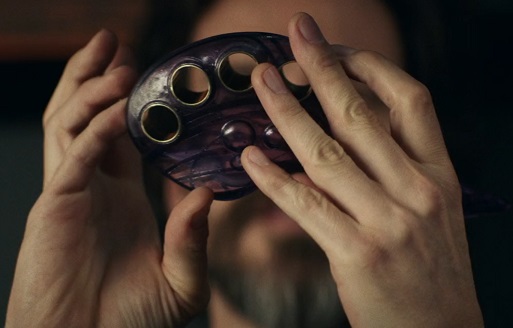
At the beginning of Stardust City Rag, we got a fairly brutal scene where Icheb has his eye torn out. The graphic sequence was shown in full, and it was grotesque but at the same time it was something that as the audience, we couldn’t look away from. In the next scene in Et in Arcadia Ego, Part 2, Dr Jurati takes the eye out of Saga, the deceased synth from last week, in order to use it to unlock a door and spring Picard from his captivity. But we didn’t get to see the eye removal, as the camera instead cut to Dr Jurati’s face for the majority of the scene. And unfortunately, this didn’t look great. Alison Pill undoubtedly gave it her best shot, trying to look both disgusted and like someone who was trying to figure out how to disconnect sensitive electronics, but it would’ve been better to either see the entire process or to jump-cut from her starting the procedure to having the eye successfully removed. As a story point I did like using the eye, and I liked the eyeball prop when we saw her use it later, but the removal itself was just a bit of a waste in my opinion.

The campfire scene where Rios, Raffi, and Elnor sit and listen to Narek’s Zhat Vash stories wasn’t great. In principle it was good to have them together, but by this point in the story, we as the audience are familiar with the Zhat Vash prophecy. And ghost stories around the campfire is just such a cliché that the scene felt so forced. And it didn’t make sense in context. The ship had been fixed – why sit around outside it? And with such urgency to get to Coppelius Station to destroy the beacon, couldn’t they have talked en route? Or flown La Sirena closer to the synths’ compound? It was just so obvious that the director or creators of the show had decided that a campfire scene would look cool that they shoehorned it in, even though doing so made little sense.

This scene made no sense.

The campfire story itself was fine, but as I said there wasn’t much in there that we as the audience didn’t already know. In an episode with so much story left to conclude, and thus where every minute matters, a lot of this campfire scene was really just wasted time. Conversely to that, the next scene with Commodore Oh – which barely even qualifies as a “scene” because of how short it was – had been very obviously and badly edited down to just a few seconds, and simply fell flat in the moment. Who was she supposed to be talking to when she said “At last, our great work is nearly at an end”? There was no one else present in the scene, she was just standing on the bridge of her ship in her evil villain cloak doing an evil villain pose spouting a generic evil villain line. Given how tightly it was cut, there was almost certainly more to this scene that didn’t make it into the final episode, but this line simply did not work on its own.

The visual effect of the Romulan fleet at warp was good, however, and I did enjoy seeing that. The design of the new style of Romulan vessel was great, and I could see it being a natural evolution of the Romulan Warbirds from The Next Generation and the advanced warship used by Shinzon in Nemesis, and the fact that some elements of those designs made it into the new Romulan ships was good and shows that the show’s creators were paying attention to past iterations of Star Trek. However, one thing I didn’t like – and this also applies to the Federation fleet that we see later in the episode – was that all of the ships were identical. Past fleets that we’ve seen, while arguably smaller in scale, were almost always comprised of multiple classes of ships, and the fact that the animators and CGI artists had essentially copied-and-pasted the ships meant that the large fleet was less visually impressive that it could’ve been. It was good to see the number of Romulan ships en route, though.

The Romulan fleet.

Narek is back in the next scene, a mere few seconds later, showing off the bombs he retrieved from the Artifact. While the episode hasn’t communicated this very well, it seems that a significant amount of time has passed. When Narek arrived it was daylight outside La Sirena, but then the campfire scene seemed to take place after sunset. Yet this scene is in daylight again – and as I said before, considering the urgency of the mission to stop the synths bringing about the end of the galaxy, which everyone seems to agree on, they don’t seem to be moving very fast toward that goal as they’re still talking aboard La Sirena.

I did like the creative way that they were able to sneak the bombs into Coppelius Station; that was a fun story beat, especially when Rios seemed to be playing with the ball in front of the synths. There was a second where it felt like he might kick it too hard and it would explode! The scene a few episodes ago where Rios had been kicking a ball around on La Sirena also paid off here. And if I’m not mistaken, at least one of the synths on guard duty looked like F8 – the synth from the flashbacks to Mars that we saw earlier in the season. However, the next part of this is yet another example of a plot contrivance – the guards let Raffi, Elnor, and Rios into their compound with Narek, but then seem to leave them alone to do their own thing instead of following them or taking Narek back into custody. It would’ve been better to skip the part about hiding the bombs in the football and have them sneak in another way, or leave the compound unguarded altogether (who are they guarding it from, after all?)

I’ve already mentioned that the eyeball was a neat prop, and the way Dr Jurati figured out how to use it to access Picard’s room and spring him from custody was great. Picard is clearly suffering here from the unnamed brain condition that we saw the first real indication of last week. And while I liked that this had been set up way back in the second episode of the season, it was really only in the two parts of the finale that Picard goes from experiencing no symptoms to full-on dead in a matter of hours or a couple of days. And while we have no frame of reference for how futuristic diseases might run their course, as a story point I feel this would’ve worked better if we’d seen a couple of other instances of his health starting to fail in previous episodes. I know we’ve seen him snap and seem to be quicker to anger at a couple of points, and that we saw his PTSD-breakdown when he first arrived aboard the Artifact, but for the most part Picard has seemed in good health for his age – until the finale, when his condition seemed to rapidly accelerate from nowhere.

Rios with the bomb-ball.

Dr Soong learns, in the next scene, that it was Sutra and not Narek who killed Saga, and is visually shocked and heartbroken at the revelation. I’m glad that Dr Soong turned out to be someone who was on Picard’s side in the end. Brent Spiner can portray villains wonderfully, as he did with Lore and another Dr Soong in Star Trek: Enterprise, but as a fan, seeing his new character at odds with Picard wouldn’t have been my preference, given that it’s been so long since we saw the two actors together in Star Trek.

The guards of Coppelius Station seem to have just allowed Raffi, Rios, Elnor, and Narek free rein inside the compound, and they’re planning their attack on the beacon when Dr Soong intervenes. For a moment they thought they’d been caught, but Dr Soong plans to help take down the beacon having learned of Sutra’s betrayal.

Picard and Dr Jurati made it back to La Sirena – though how the two groups managed not to cross paths or spot each other isn’t clear. I mean, there can only be one direct route to the ship after all. But that is a minor nitpick compared to others in the episode. This scene, between Picard and Dr Jurati, was very powerful, and the first point in the episode where I really started to feel things turn around. I loved Picard’s line that “fear is an incompetent teacher”, and their plan – to launch La Sirena into space and make a last stand against the Romulans as a way to show Soji and Sutra that not all organics are evil is a good move – perhaps their only possible plan under the circumstances short of using La Sirena’s weapons to destroy the beacon. They’re banking their hopes on Starfleet having received Picard’s message and already being en route, because at best they’ll be able to stall the Romulans for a few minutes. This is basically a suicide mission, and they both know it. The genius of putting these two characters together, as opposed to say, having Picard teamed up with Rios or Elnor, is that they both have nothing to lose. Picard’s at death’s door, and Dr Jurati is facing a lengthy spell in prison, so of all the characters who could try to make a last stand, it makes sense for them more so than any others – except perhaps Raffi.

Picard and Dr Jurati back aboard La Sirena.

The Romulan fleet is only seven minutes away, so Picard launches La Sirena and shakily leads the ship into orbit, with Dr Jurati along for the ride. The action then cuts to Coppelius Station, where the rest of the crew are planning to attack the beacon.

Attacking the beacon makes sense in the story, but the way it was executed was so bad, and the plan was clearly designed to fail. They storm in and make a huge fuss, then Dr Soong uses another macguffin to deactivate Sutra, but because the other synths are still all-in on using the beacon and summoning the “Mass Effect Reapers”, the rest of the crew scramble around, punching and kicking before being wrestled to the ground. Dr Soong, having deactivated Sutra with his magic wand, doesn’t do anything. He stands motionless in the background while Rios makes a desperate throw to get the bomb into position, but Soji catches it and throws it away.

So many things wrong here, but the overall problem is this – the fight was clearly written in such a way that the “heroes” lose. And that was painfully obvious in the way it was carried out on screen. But let’s break down some individual failings. Why did Dr Soong not show the assembled synths the video of Sutra killing Saga? That single piece of evidence would have swayed most of them to his side. Why did he not use his magic wand on Soji after disabling Sutra? Why did the crew launch a full-frontal attack against a force of massively superior synths instead of sneaking around or causing a distraction? Why try to fight the synths at all? And finally, probably my biggest complaint about the synth storyline in the finale as a whole: what was the point of Sutra?

Sutra was shut down.

Don’t get me wrong, I’m not arguing that we should’ve seen more of Sutra this episode. The awful makeup and hammy performance meant I wanted to see as little of her as possible – in that sense I got my wish – but for an antagonist who’d played such a large role last week, and who did have, as I pointed out, a motive that was at least partly understandable, she was just completely sidelined by a story that raced through far too many points and left her completely undeveloped. Sutra had the potential to be interesting, at least in theory. Her presence turned the synths from damsels in distress needing to be saved to antagonists needing to be dissuaded or defeated, and that concept, if executed better, could have been interesting. Unfortunately, as I’ve already said, it would’ve needed several more episodes to work effectively – and a better performance from the central synth villain.

Given that Star Trek: Picard has been at least as much Soji’s story as Picard’s, I feel it would have been better on the whole to ditch Sutra and simply have Soji and Dr Soong be the principle drivers behind contacting the “Mass Effect Reapers”. It would have cut an extraneous character, allowed more time for some of the others to be explored, and we wouldn’t have had to sit through that awful performance last week. Soji did need someone to guide her turnaround last week, to allow her to convincingly side with the synths. But I don’t think that needed to be Sutra, and with a few tweaks here and there the story could’ve arrived at the same place without her – and it would have been better for it, especially considering she did nothing whatsoever this week.

Soji working on the beacon.

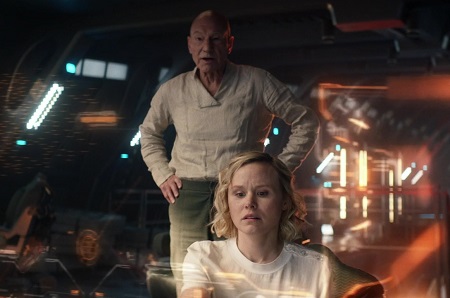
The next scene with Dr Jurati and Picard was hit-and-miss for me. The jumps in tone from deadly serious suicide mission to cracking dumb jokes just didn’t work, and while Dr Jurati has occasionally provided moments of comic relief throughout the season, this was not the moment for humour and it just ended up detracting from what could’ve been a much more powerful scene. I did like, however, that La Sirena was not flying smoothly in the exterior shots we saw, indicating that Picard is still getting back into the swing of things. We have seen him pilot spacecraft before – shuttlecraft most often, but also the Enterprise-D itself in the episode Booby Trap from the third season of The Next Generation – so we know he’s at least basically capable and should understand the principles involved.

Seven of Nine and Rizzo fight aboard the Artifact as Rizzo has tried to bring the Cube’s weapons online. She’s targeting La Sirena, which does raise the stakes somewhat, and the fight itself was decently exciting. There was never any real doubt as to who the victor would be, however, and Rizzo finally gets her comeuppance for killing Hugh as Seven of Nine sends her falling to her death with a well-placed kick. The two traded barbs during the fight, and we really saw Rizzo in a way that I talked about a couple of weeks ago: as a racist. That aspect of the Zhat Vash and Romulans – that their actions are a veiled analogy for hating another group of people because they’re different – is something the show found a balance between hinting at and overplaying, and I think, taken as a whole, the balance was probably about right.

Rizzo and Seven had a fight.

The visual effects and CGI in the episode were great, as we’ve already discussed, and the sight of the orchid ships launching to meet the Romulans, and overtaking La Sirena, was visually impressive. I still feel that the way the orchids operated last week was pretty dumb, but this time they don’t seem to be dragging intact ships to the planet’s surface; what exactly they’re doing in the fight other than getting shot at and serving as a huge distraction isn’t really clear.

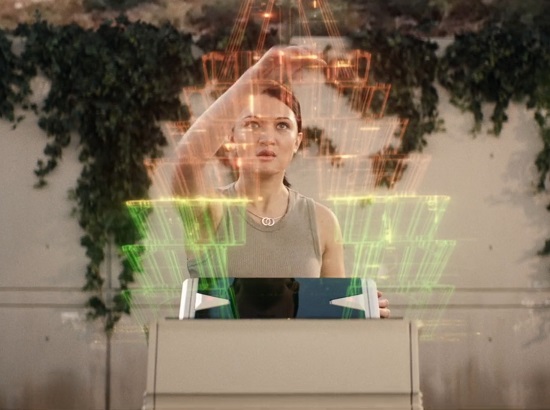
The magical macguffin is back; Rios and Raffi apparently left it aboard La Sirena. Dr Jurati figures out that it can be used to produce holographic duplicates of the ship, which they can use to distract the Romulan fleet. Again, I really didn’t like this tool, and the fact that it seems to be magical and can be used for anything one’s heart desires was not great, even by the standards of Star Trek technobabble. While in principle what Dr Jurati hoped to do was a good idea, and I did like the name-check of the Picard manouvre from The Next Generation, the macguffin spoilt it really. And I felt that the moment where it created holo-duplicates of Dr Jurati’s face was a rare miss in the episode’s visuals.

However, Picard’s conversation with Soji, in which he explains that he’s basically laying down his own life to defend the synths was incredible and very powerful – the first of those emotional hits I mentioned at the beginning of the review. There’s something about a noble last stand that always gets to me, and this was a great example of it! It was an absolute desperation play, as Picard hopes against hope that Starfleet will arrive in time. If Starfleet didn’t get there, the “Mass Effect Reapers” would be the synths’ only hope of survival.

Picard speaks to Soji and asks her to reconsider.

The shot of La Sirena standing alone against the Romulan fleet was incredibly powerful too – part of that last stand feeling that I mentioned. The next part of the story has hits and misses, though. And I know this is kind of a nitpick, but what were the other synths and Dr Soong doing while Soji was activating the beacon? Did no one try to stop her or at least question what she was doing – especially given that they all heard what Picard had to say – nor try to contact the Romulans and reason with them? Several of the next few scenes played out as if Soji were the only one there, yet there were a dozen or more synths plus all of the other main characters.

Soji succeeds in activating the beacon just as the Romulans finish dealing with Picard and Dr Jurati’s last stand. The timely arrival of Starfleet – led, as the opening credits made clear, by Riker – prevented them from attacking the planet, and the two fleets enter a tense standoff. It was great to see Riker back in uniform again, and the last-minute arrival of the fleet saved Picard as well as the synths. However, as with the Romulan fleet earlier, all of the ships were the same type and I do feel that the copy-and-paste look detracted somewhat from the otherwise-impressive sight of so many Starfleet vessels – which, I believe, are based on a design from the Star Trek Online video game (but I could be mistaken in that). Until we’d seen his name in the credits, I wasn’t sure if we’d see Riker back in action this season. I was pleased that we did, and it definitely felt good to see Starfleet as the good guys again, after Picard had been forced to work around their obstinance for the majority of the season.

Acting Captain Riker, back in uniform.

Though this moment had been telegraphed ahead of time and sadly was robbed of some of its impact as a result, the musical score as the ships emerged from warp, coupled with Riker’s appearance a few moments later, did still feel good – just not as good as if it had been a genuine surprise.

We got to see a better look at the command variant of the new Starfleet uniforms – which still have that Starfleet logo pattern in the coloured section – and again, as I said at the start of the season I do like the new uniforms. Especially compared to Star Trek: Discovery’s all-blue look I think they look great, and the combadges complement the look nicely.

Commodore Oh, throughout her appearances this season, hasn’t seemed like someone who would listen to reason. The Zhat Vash have been presented as the most committed of all Romulans to the anti-synthetic cause; both she and the organisation are zealots. And zealots seldom back down, even when facing significant opposition. Picard uses what is basically his dying breath to talk Soji down from summoning the “Mass Effect Reapers”, who hadn’t yet emerged through the aperture created by the beacon. This speech was really the climax of the episode, and the emotional hit of the words Picard spoke, combined with knowing he was suffering greatly as he spoke them, matched the high points other episodes of the season hit. It was the kind of speech Picard could’ve given at any time in The Next Generation as he focused on the rights of all life to exist, and for the need to demonstrate that the synths aren’t what the Zhat Vash feared them to be.

Commodore Oh decides to withdraw.

It was enough to sway Soji, who closes the aperture before the “Mass Effect Reapers” could come through or even send a message. Their mechanical tentacles did look menacing, but that’s all we go to see of them. Faced with Soji having stood down and Riker staring her down with a large fleet, Commodore Oh withdraws, and this is something which I feel was out of character. Are we supposed to believe Picard’s speech swayed her? Or simply seeing Soji stand down one time would be enough to override years of Zhat Vash indoctrination? Even if it was good enough for Oh, did everyone on the fleet agree? From her point of view, what is there to prevent the synths rebuilding the beacon in twenty years – or twenty minutes? While Picard’s climactic speech was beautiful, Commodore Oh’s decision to withdraw, like so many other points in the finale, felt rushed. And no sooner had he arrived than Riker, too, was gone – warping out of the system accompanying Oh’s fleet. Couldn’t they have left a ship or two behind? Considering what came next, Riker’s presence would have been incredibly emotional.

Picard bids Riker a solemn “adieu”, before succumbing to the effects of his condition – perhaps combined with whatever medication he was given earlier by Dr Jurati.

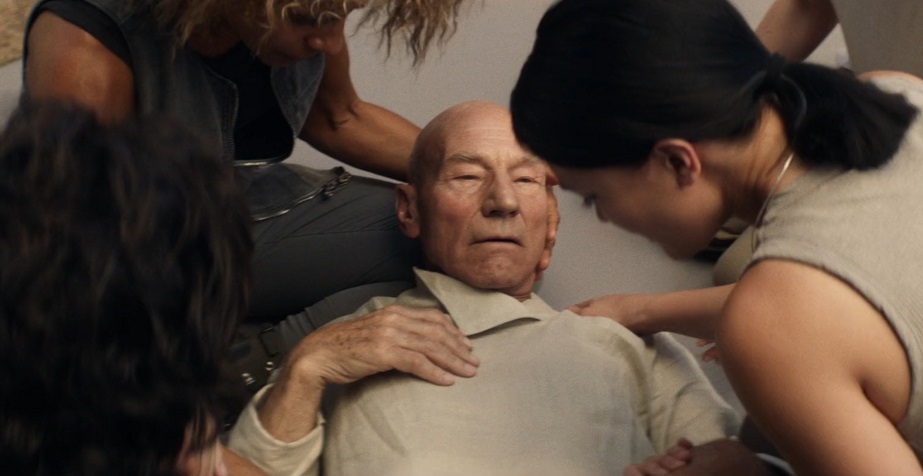
Picard’s death – or rather, his “death” – in this moment was the emotional climax of the story, after the plot had reached its own zenith a moment earlier. And it was a very powerful sequence. Soji transports Picard and Dr Jurati to the synths’ location, and Picard dies, surrounded by his crew and knowing that he did right by Soji and her people. His final act was one of sacrifice – making a last stand to defend the synths, righting a wrong from fourteen years ago where he had been unable to prevent the ban or aid the Romulans. The emotion on the faces of the characters – especially Raffi, as Michelle Hurd put in her best performance of the season – was heart-wrenching to witness. Surrounded by his friends, and with a few last words to (most) of them, he passes away, killed by the nameless condition that we assume to be Irumodic Syndrome.

Picard succumbs to his condition.

Of all the characters we’ve met across the season, Rios and Seven of Nine arguably had the least connection to Picard on a personal level. Aside from a few scenes when they first met, I can’t recall a significant moment with Rios and Picard together. While there’s always sadness when someone passes away, especially under such circumstances, putting Seven of Nine and Rios together wouldn’t have been my first choice in the immediate aftermath, simply because they didn’t have the connection that, say, Raffi or Soji had with Picard. Nevertheless, the scene between them was touching, and they both spoke highly of the fallen Admiral. I liked the idea of sharing a bad drink because it was all they had access to, and it emphasised that they’re both a long way from home and that this is, for the moment at least, the end of the journey.

The real heartbreaking scene was when Elnor broke down and was comforted by Raffi. Elnor, who had been so strong and powerful, was weak and vulnerable having regained and then lost his surrogate father figure, and Raffi, who was devastated too, trying to comfort him was just incredibly emotional. Both actors put in amazing performances here, and as sad as this scene was, I loved it.

Raffi and Elnor grieve for Picard.

When Picard awoke, for a moment I was half-expecting to see Q! That was never going to happen, of course – it would be a complete bolt from the blue for anyone who hadn’t seen The Next Generation, for one thing – but it would have bookended Picard’s story in the Star Trek franchise if this had been his final appearance and he was to stay dead, tying into themes from Encounter at Farpoint. Instead, Picard finds himself sat opposite Data. And I know there will be criticism of Data’s appearance given Brent Spiner’s age, but a combination of lighting, makeup, and what I assume are digital effects made him look decent here, and I didn’t find the way he looked offputting, especially when compared to the way the gold synths had looked last week.

At no point was I convinced that Picard would stay dead, but that in itself didn’t rob any of the scenes surrounding his death of any of their drama or emotion. As a story point, though, killing a character in such a dramatic and emotional way only to immediately revive them can end up feeling like a bit of an anticlimax, and there was an element of that here I’m afraid. Not in the moment, and not in Picard’s scene with Data in the digital afterlife, but certainly after his revival there was part of me left thinking “well, what was all that for?” In a sense, restoring Data’s mortality and finally providing him with the closest thing to humanity that he could get, Picard did have a reason to travel to the digital afterlife. No one could have known that Data was trapped in a kind of purgatory, nor that saving parts of his mind from the information transferred to B4 would mean that some essence or facet of his personality would be forever entombed in this realm. That action – saving Data and finally laying him to rest – gives Picard a reason for this temporary death, and as a story it was, overall, a success.

Shutting down Data.

Data takes on the role of what I guess you’d say was a god or grim reaper figure from classical literature, explaining to Picard that he’s in the afterlife and that he died. This was another incredibly emotional scene, as Picard got to express twenty years’ worth of sadness and regret to his long-lost friend. Maybe I’m seeing what I want to see, but I seemed to get hints at Data’s study in the set design, notably the room he occupied in All Good Things, the finale of The Next Generation, in which he was still alive and working as a professor. In fact, while we’re talking about set design, I felt that this room was one of Star Trek: Picard’s best and most evocative. I’ve written before that the outdoor filming scenes, supposedly taking place in France, in Japan, and on several alien worlds, all looked suspiciously like California, and that has been a let-down at points. But the interior sets have been fantastic. I love the way La Sirena looks – inside and out, in that case! – and the Troi-Riker cabin was everything it needed to be. The Artifact is something I really haven’t written about as often as I should’ve, because the subtle updates to the Borg vessel have been fantastic. I loved the shifting walls that were present at times, and the way that, despite being claimed by Romulans and some area being declared “safe”, it was still definitely a Borg vessel. Bjayzl’s club on Freecloud was maybe a tad cliché, but it still did a great job feeling like a futuristic, alien club. The nunnery on Vashti was incredibly reminiscent of something from Japan, and I loved that style when it appeared in Absolute Candor. And finally, Coppelius Station and the Daystrom Institute both conveyed the look of being futuristic in a similar but not identical way to locations in previous iterations of Star Trek.

Data in the digital afterlife.

In this case, the room was clearly artificial, but in a way that conveyed a sense of limbo or purgatory. By the furniture and decor being greyed out, there was the sense that, like in a computer when a file or programme is inaccessible, things weren’t quite right. And the fact that the only colour came from the two figures of Picard and Data, our focus as the audience was drawn to them and all attention focused on them – in the same way as you might expect if seeing a very minimalist stage production.

Part of the criticism of Star Trek: Nemesis at the time it was released surrounded how Data’s death was handled in the story. Aside from the criticisms of the story beat itself, the main ones were that he didn’t really get a chance for any goodbyes, and that in a relatively short space of time, Picard and the crew were laughing and joking on the way to their next adventures. We saw earlier in the season – indeed, from the very beginning – that Data’s loss weighed heavily on Picard, and that his friends Riker and Troi remembered him fondly and held his legacy dear, but in this moment, the second criticism was addressed, as Data got to say goodbye properly. Partly this was to Picard, but partly it was to the audience – to us. In a way, this righted what some fans had considered an eighteen-year wrong.

Data’s final goodbye.

The conversation they had about dying was interesting – and it did, in a way, capture that elusive sense of “Star Trek-ness” that Star Trek: Picard has been so keen to restore to the franchise in the aftermath of Discovery and the JJverse films. Both of those, despite what some have argued, had moments where they “felt like Star Trek”, but not every moment. For all my criticisms of the plot and various scenes in Star Trek: Picard’s finale, it did always feel like Star Trek – and this scene with Data, talking about life and death, was just one part of that, but it was a particularly powerful part.

Picard walks out of the room into a bright white light, and awakens in a new synthetic body, donated by Dr Soong. I wish we’d seen more of Dr Soong and learned why he built himself a synthetic body. There seemed to be hints last week that he was sick or possibly dying, but these were vague and underdeveloped – like many points in the finale – so we don’t really know the stakes or what kind of sacrifice Dr Soong may have made. Did he condemn himself to death by giving Picard the “golem”, or will he just build another one next week now he knows how to do the mind-transfer?

Picard is reborn in a new synthetic body.

Soji, Dr Soong, and Dr Jurati explain to Picard a number of caveats – his new body is the same as his old one, he won’t have any enhanced strength, speed, brainpower, or anything that would change him in any way. He’ll be identical to how he was, just without the terminal brain condition. And it was around here that the sense of “well what was the point of all that?” kicked in. The Data storyline was great, and I loved that Picard got to say goodbye, that we as the audience got to say goodbye to Data, and that Picard got to do his friend a final favour of letting him die properly. But for Picard’s own character, the death-and-rebirth story didn’t really do much of anything. He’s back to how he was before he died a few minutes later, and all of the emotion from his goodbye to Riker to the reaction of all of the characters was, in retrospect, at least slightly wasted.

We get a touching sequence as Picard fulfils his promise, unplugging Data and letting him finally die. Data prepares his room in the digital afterlife, and lies down to await the inevitable. Picard appears to him in his old uniform – whether Data was imagining him or dreaming isn’t clear, but it is clear that his final thoughts were of his friend. Getting a proper goodbye with Data wasn’t even something I knew that I wanted – but now that I’ve seen it, I can see how it was missing from Nemesis and that it really was something cathartic and beautiful to see. Picard’s speech, the music, the change in lighting in the digital afterlife, and finally Data fading away were all amazing to see, and it was another deeply emotional moment. Picard may have come back to life, but Data won’t – he can’t. This marks the final goodbye to a character we first met in 1987, and who we spent a lot of time with.

The crew reassembles aboard La Sirena – and they’ve had to find extra chairs for the bridge. Seven of Nine seems to have joined the crew, though whether that’s temporary isn’t clear at this stage. They set off to destinations unknown, and we learn that the ban on synthetic life has been overturned. The season ends with Picard giving the order to “engage!”, and La Sirena jumps to warp. The familiar Star Trek music sting kicked in at this moment, making the final scene of the episode another stirring and emotional moment.

The assembled crew of La Sirena – ready for Season 2!

Taken as a whole, the episode was certainly mixed. There were high points which equalled or even went beyond the heights reached by other episodes of the season – even Remembrance right at the beginning. And there were some beautiful, deeply emotional moments which still pack a punch on a third, fourth, and fifth viewing. But there were some mistakes and disappointments too, and too much undeveloped story that was left behind as La Sirena warps off to a new destination and – presumably – a new story in Season 2.

There are key points left hanging as of the end of the episode. The first is: what happened to Narek? He obviously wasn’t present aboard La Sirena at the end, but he’d been a major character who we’d spent a lot of time with and he just seems to have been abandoned by the story about halfway through the episode. It’s not clear if he returned to Romulus, remained in captivity with the synths, was handed over to Starfleet, or even if he joined La Sirena but just didn’t sit with the others on the bridge. I don’t expect to see him return for Season 2 at this point, but just ditching him with no goodbye and no end to his story was just a bit strange.

Narek disappeared after this point in the story.

Obviously I’ve already mentioned the Bruce Maddox plot hole that was left unresolved, but that’s a major annoyance so it’s worth bringing up again. There’s also Dr Jurati – she did still murder someone, so why is she free to go with Picard? Was her conviction expunged? Is she a fugitive? Will this come back to haunt her in future? It would have been nice to see some resolution to that point – unless, of course, it’s something planned for next season, in which case I’m content to wait.

Next are the “Mass Effect Reapers”. The Zhat Vash were right, in a roundabout way. The relic on Aia does tell of a race of synthetic monsters from far beyond the stars. That race are out there – is Starfleet going to try to contact them and make peace? Will the synths from Coppelius contact them and tell them not to hurt anyone? Are the “Mass Effect Reapers” content to just go back to waiting for someone else to contact them, or are they now aware of Starfleet, the Romulans, and the Milky Way galaxy’s various species? What steps will everyone have to take in case they return? What’s to stop another synthetic race from contacting them, or even the Coppelius synths changing their minds and asking for their help after all? Building a beacon didn’t look too hard or time-consuming. And what of the relic on Aia? Is it still active? Will it be shut down? Are the Zhat Vash still hell-bent on killing other synths, even if they leave Coppelius alone?

The “Mass Effect Reapers” are still out there.

Finally, we have Dr Soong and the synths. They’re under Federation protection now, but what will happen to them? Will they stay on Coppelius? Will they continue to make more copies of themselves? Without Data’s neurons, can they make more synths? And without Dr Maddox and Dr Jurati, can Dr Soong continue to work? What’s to stop the Romulans coming back next week and nuking their settlement from orbit? Are they protected in any way? Will they have to leave Coppelius and settle somewhere safer? I didn’t expect every single one of these points to be addressed, but some hint and what’s to come next for the synths would’ve been nice given how they were such a large part of the finale and the story of the season overall.

If I had been tasked with salvaging the story of the finale, the first thing I’d have done would have been to get at least one more episode for the season – perhaps two. Then I’d have interspersed some of the storylines present on Coppelius with the other active stories much earlier in the season, allowing more time for the development of characters like Dr Soong, Sutra, and even Saga. Beginning with perhaps episode six or seven – roughly the halfway point of a twelve-episode extended season – I’d have introduced the audience to Coppelius and everyone resident there. I’d have done more to build up the stakes by exploring the “Mass Effect Reapers” in more detail, too. A name for the faction would have been good, but also a basic motivation as well as some indication of their level of technology. Finally, I’d have spent more time on the climactic stand-off between Commodore Oh’s fleet and Riker’s Starfleet armada, and tried to find a convincing way to end the Zhat Vash threat, like having other Romulans mutiny against Oh when the synths deactivated the beacon. I think that by spending some more time with some of the characters, and by introducing them earlier, the finale would have been more enjoyable. But there’s no salvaging that awful gold makeup. That would have to go!

A group of synths.

I guess what I’d say about the two parts of Et in Arcadia Ego is this: it did provide a satisfactory conclusion to many parts of the story of Star Trek: Picard’s first season, but it left a lot on the table and it was rushed, poorly paced, and incomplete. When I think about the season as a whole, Et in Arcadia Ego, Part 1 is by far the worst episode, and while Part 2 went some way to rectifying that, and did manage to pull out a passable end to the story, it wasn’t an especially great episode either, with some definite low points to counteract the emotional highs.

Star Trek: Picard Season 1 stumbled across the finish line, scraping together the bare bones of a conclusion, but leaving a lot of unanswered questions and at least one gaping plot hole. That doesn’t mean that Et in Arcadia Ego, Part 2 was a failure; it did manage to elicit some powerful feelings and bring together some of the dangling story threads. But I don’t think we can call it a rousing success either, and a story that started out incredibly strongly ten weeks ago has finished with a weaker and less enjoyable pair of episodes than I would’ve wanted.

All that being said, I’m satisfied with the season as a whole. My gripes about specific points in both parts of the finale don’t detract from what has been, overall, a wonderful story and a great return to the Star Trek universe as the 25th Century is about to begin. I hope that Star Trek: Picard can now serve as a jumping-off point for other Star Trek shows set in and around the same era, moving the franchise forward into the future – where it should always have been trying to go.

Soji in the episode’s closing moments.

Stay tuned for the conclusion to my Star Trek: Picard theories for Season 1, as well as later in the year when I hope to do a retrospective look at the season. When some time has passed and the dust has settled, it should be a good to go back and take a second look. Rewatching earlier episodes while keeping in mind some of the story elements from the finale should be an interesting experience, and I will undoubtedly see more hints and foreshadowing that I missed when I first saw them.

Now that Star Trek: Picard has concluded, don’t think that the blog is going away! There will be lots more to come as I have numerous articles in the pipeline. I half-expected to see a release date for Star Trek: Discovery Season 3 announced, but despite all the hype around Star Trek: Picard, ViacomCBS have chosen not to take advantage of this opportunity to plug Discovery. Even if the release date isn’t for a couple of months, putting it out there now would have been a great move. Regardless, whenever it airs, I hope you’ll come back to see me review and break down those episodes too.

See you next time!

All ten episodes of Star Trek: Picard’s first season are available to stream now on CBS All Access in the United States, and on Amazon Prime Video in the United Kingdom and other countries and territories. The Star Trek franchise – including Star Trek: Picard – is the copyright of ViacomCBS. This article contains the thoughts and opinions of one person only and is not intended to cause any offence.

Star Trek: Picard review – Season 1, Episode 9: Et in Arcadia Ego, Part 1

Spoiler Warning: There will be spoilers ahead for Et in Arcadia Ego, Part 1 and the preceding eight episodes of Star Trek: Picard Season 1. There may also be spoilers for other iterations of the Star Trek franchise.

So I suppose I should just come right out and say it: Et in Arcadia Ego, Part 1 is my least-favourite episode of Star Trek: Picard so far. We’ve had some great episodes this season which really hooked me in, took me on a rollercoaster journey, and got me feeling happy, nervous, excited, nostalgic, tense, and emotional. This week I really didn’t get any of that for the bulk of the episode. There were a handful of good moments sprinkled throughout, but the pacing of the episode as a whole felt off – it seemed to rush from point to point with no time permitted for any story thread to properly develop or be explored.

For an episode that was supposed to be the first part of the culmination of the entire season, it ended up falling flat on its face. And that is pretty disappointing. Every Star Trek series – and every season of every series – has had duds: episodes which misfired, told bad stories, or for various reasons failed to hit the mark. The problem that Star Trek shows have today is that when the whole season is one continuous story, a dud episode can have ramifications for the entire season instead of being a one-off rotten egg. I hope that Et in Arcadia Ego, Part 2 next week manages to pull things back – and there is precedent for that, as Star Trek: Discovery’s second season episode Perpetual Infinity pulled off a great recovery from The Red Angel a week prior, which is my personal pick for Discovery’s worst episode.

The Artifact emerges from transwarp.

Aside from the pacing and rushed feel to the story, my second main point of criticism is the aesthetic of parts of the episode. I’ve mentioned before that every location in Star Trek: Picard so far has been a barely-disguised California, and Soji’s homeworld – variously called Coppelius and Ghoulion IV – was another example. I come back to what I said last week about the use of indoor sound stages: with special effects and CGI being so good nowadays, a lot more can be done with that format than in previous decades. If it’s a choice between seeing five planets that all look the same because they were all filmed within fifty miles of Los Angeles, and seeing different-looking planets that were perhaps smaller in scale because they were filmed on sound stages I’ll always prefer the latter.

The second visual aspect that I felt simply did not work was the makeup used for most of the synths. The yellowish-gold tinted skin the actors were sporting didn’t make them look like Data-type androids; they looked like humans wearing cheap and bad makeup. It was something that would’ve felt at home in The Original Series, and if I’d seen those characters in an episode from the 1960s I’d have dismissed the amateurish look as a product of the limitations of the time. But Star Trek: Picard’s aesthetic has been so good until now overall that I legitimately wonder how they managed to make the synths look so bad. Was it because they were largely filmed outdoors in natural sunlight? Because earlier looks at Data in Picard’s dreams or F8 and the other synths in flashbacks to Mars looked far better. Whatever it was, the makeup ended up being a huge distraction, because every time Evil Soji or any other synth was on screen it was all I could look at. I actually had to rewind the episode a few times because I’d missed some line of dialogue or other.

I found the makeup used for the synths (Sutra pictured) to be of poor quality and a significant distraction.

I wish we’d seen something, either this week or last week, to make it obvious that Seven of Nine and Elnor were on their way, because the Artifact arriving at Coppelius mere moments after La Sirena was a story beat that I felt didn’t work in the moment. Ironically, after last week’s scenes on the Artifact being some of my least-favourite, I greatly enjoyed seeing Picard and the crew return there this week – albeit that the sequence was far too short. I wanted to spend more time there as Picard learned of Hugh’s death – which actually didn’t even appear on screen – and mourned him. But even in what I suppose was my favourite sequence there were issues – the length, as I mentioned, is one. But what was up with the ex-Borg calling Picard by his Borg designation of “Locutus”, which is the second time that’s happened now, only for Picard to basically ignore it and get back to what he was doing?

Elnor learned of Picard’s illness off screen too, which would have been another scene I’d have wanted to see – one which could have added some genuine emotion to an episode which was largely devoid of it. Some more time spent on Hugh’s death would’ve been nice too; Picard mentioned it in a single line of dialogue but Soji didn’t even acknowledge his sacrifice, despite their friendship and despite his death being a direct consequence of aiding her escape.

We could’ve spent more time here.

When we learned last week of the “Mass Effect Reapers” hiding out somewhere beyond the galaxy, waiting to show up and destroy all life, it seemed for sure that the climax of the story couldn’t simply involve hiding from that and avoiding pulling the trigger – somehow, Picard and co. would have to confront the wider threat. And we saw in Et in Arcadia Ego, Part 1 the way in which that trigger will be pulled: Soji’s evil twin, Sutra.

Villains can be hard to get right. Rizzo, for example, took a while to hit her stride after coming across as a fairly one-dimensional character in her earlier appearances. The story has since fleshed her out a little more, providing her with background and motivation, as well as even the smallest shred of pity for what she’s been through. Sutra has very little of that, and unfortunately Isa Briones, who had done an admirable job portraying Soji and Dahj, didn’t really manage to pull off a convincing performance as an antagonist. Sutra’s motivations are understandable, sure – she wants to save her people from what seems to be an existential threat. But overall, the way she was portrayed strayed way too far into the kind of “I’m evil and I love it” attitude that felt so awkward and inauthentic about Rizzo in her earlier appearances.

I called this phenomenon the “24th Century Heinz Doofenshmirtz” – and I get that that’s a niche reference, so let me explain. In the cartoon show Phineas and Ferb, Heinz Doofenshmirtz is a wannabe evil scientist. He builds machines usually designed to get petty revenge on his brother or other people he feels wronged him, and he’s tied his entire identity to being evil for the sake of being evil. That’s what Rizzo felt like, and that’s what Sutra feels like now – she hasn’t bothered to consider any other options, she went straight into arbitrary arrests and plotting genocide. Perhaps she’s meant to be a parallel for Rizzo and Commodore Oh, but both of those characters feel far more complex. And I’m afraid the point must be reiterated: both of those acting performances were much better.

This is basically Sutra.

The premise for her actions is understandable, though – just as Rizzo, Narek, and Commodore Oh being motivated by their interpretation of the vision is understandable too. As a story point, I’m not really criticising Sutra’s basic motivation and desire to protect her people from harm. And the way it has been established that both Starfleet as an organisation and Picard as an individual are people she and the synths might find difficult to trust was well-established over the course of the prior eight episodes.

Et in Arcadia Ego, Part 1 has tried to pull off a last-minute plot twist with Sutra. Instead of the synths needing to be rescued from Romulan aggression, Sutra’s plan is to summon the “Mass Effect Reapers” and become the aggressor herself. But if the story of Star Trek: Picard has wanted to say that the ban on synths was wrong, and that even Starfleet and the Federation need to be more accepting of different kinds of life besides their own, what message does it send when the Romulans, who have been the season’s antagonists the whole way, are actually right?

The entire premise of the Romulans’ desire to exterminate synthetic life is that if they don’t, the synths will trigger this apocalyptic event – the arrival of the “Mass Effect Reapers” – and kill everyone in the galaxy. That’s a powerful motivation, and covers all manner of sins because, as the episode itself tried to address, there’s a calculus involved even when dealing with matters of life and death. If one’s intention is to save a trillion lives, it can be easy to justify ending 90,000. This is what the Romulans did on Mars. Star Trek: Picard – and Picard himself within the show – are trying to present this kind of ends-justify-the-means thinking as abhorrent, but that message has become incredibly confused thanks to the insertion of the character of Sutra and the revelation that she plans to do exactly what the Romulans fear that synths will do.

Sutra plans to do exactly what the Romulans fear.

In yet another example of the episode racing from point to point, the name of this faction Sutra is planning to summon is not even mentioned. I’m calling them the “Mass Effect Reapers”, because, as I mentioned last time, they serve a very similar purpose to the antagonists in that video game series. But who are they? There’s only one episode left not only to find out who they are and what motivates them, but also to defeat them.

One visual element that I loved were the “orchids” – some kind of planetary defence system which resembles giant flowers. It wasn’t clear whether they were crewed ships or just automated, but they looked absolutely stunning and the CGI work to bring them to life was fantastic. However, as a concept I’m not sure they really make sense. Firstly, they seem to be single-use things, which seems like waste of time and resources. Secondly, and most importantly, they don’t actually serve a useful purpose when it comes to defence – in fact, they achieve quite the opposite. By capturing ships and dragging them – intact – to the surface of the planet, all the orchids manage to do is bring any enemies directly to the planet’s surface. If the ambition is to disable an attacking ship that plans to strike from orbit then that could be useful in the short-term, but all it really does is shift the problem for the synths to one they have to deal with on the ground. In the case of the Artifact, for example, it was dragged out of orbit and crashed on the planet’s surface – but if it were a fully-operational Borg cube the synths would then have to deal with tens of thousands of drones literally on their planet. Not to mention that no synths showed up at the crash sites of either La Sirena or the Artifact to apprehend their crews.

This would be a very bad outcome in the event of an invasion, yet it’s what the orchids are designed to do.

If the aim was to demonstrate that the Coppelius synths are basically unprotected, then why not leave them unarmed? Picard and his crew were going to land or beam down anyway, and it would’ve been possible within the story to get everyone to the planet’s surface without the use of a kind of planetary defence system that really doesn’t achieve what it should. At best it moves the problem from space to the ground, and at worst it could actually aid the synths’ enemies in a potential invasion event. In short: cool visuals, but an illogical concept.

I’m okay with the idea of Dr Soong – Data’s creator from The Next Generation – having a son, and that character following in his father’s footsteps to work on building synths. It might not have been my first choice of storyline, but there’s nothing inherently wrong with it. However, not for the first time, the presence of the actor’s name in the credits telegraphed the arrival of the character before we knew he would be appearing on screen. This happened in Absolute Candor, when Jeri Ryan’s name showed up in the credits, despite her character only appearing in the final thirty seconds of the episode. Spoilers are commonplace online, and because in the UK we get Star Trek: Picard 24 hours after its US premiere I have learned to be careful where I go online on Thursdays and Friday mornings! But for a show to spoil itself in its own opening titles is just plain silly – what would be wrong with crediting Brent Spiner in the end credits and making his inclusion in the episode and the reveal of his new character a genuine surprise? This has happened twice now, and it’s just not nice to know someone is coming before they show up on screen.

This shouldn’t happen – it’s a massive spoiler.

There’s also the question of the payoff to Soji’s dream – is Dr Soong supposed to be the figure in her dreams? There was the tiniest flicker of a hint at that: Dr Soong is wearing a similar outfit to the faceless figure Soji has dreamed about, and Soji seemed to do a double-take on seeing him, almost as if she recognised something about him. Yet neither of those things were acknowledged.

I did like, however, that Dr Soong is not a synth. When we’d heard of the existence of other synths I speculated that maybe some would share Data’s appearance in the way that some shared Soji’s appearance, but I’m glad to have gotten a human character instead. It was unexpected and interesting – and hopefully the plot thread of Dr Soong transferring himself into a synthetic body will be explored further.

Unfortunately, like all of the various competing stories in Et in Arcadia Ego, Part 1, this was barely touched on and needed much more development. In a way, this encapsulates the problem with introducing a whole new civilisation and cast of characters in the final two episodes. There simply isn’t enough time remaining for Dr Soong and Sutra and the other synths to all have their own stories that are as detailed and interesting as those stories we’ve already seen playing out for the past eight episodes. Given how rushed this episode felt, and how it tried to cram so much into a 45-minute runtime, some elements – like Dr Soong’s desire to become a synth – could’ve been dropped to give more screen time to other, more important story beats.

And I think we’ve come to the crux of my complaints about Et in Arcadia Ego, Part 1. The episode introduced several new major characters, a new antagonist, a new location, new obstacles for Picard and his crew to overcome. Yet it’s supposed to be the first part of the finale, and finales are meant to bring everything that’s already happened to a head and begin to wrap up the story. It’s simply too late now to open up whole new plotlines and for dumping whole news sets of characters onto the audience. The only story thread that feels somewhat concluded is Picard’s redemption in the eyes of Elnor – and that had arguably already happened in The Impossible Box.
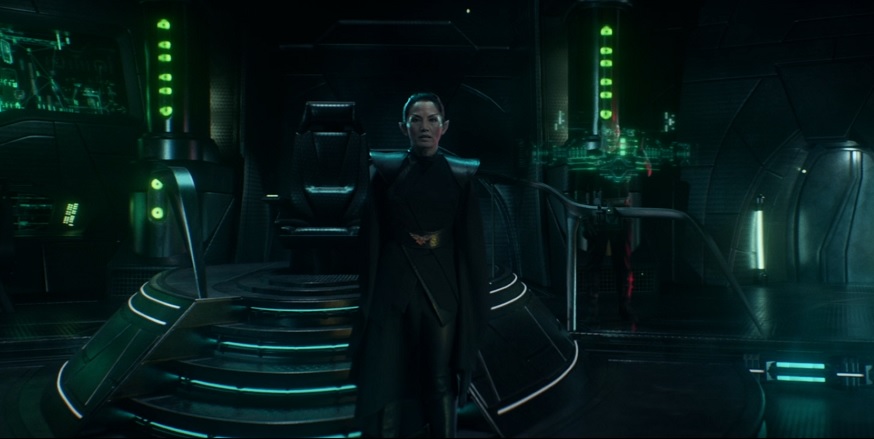
Elnor and Picard are reunited… briefly.

The story of Star Trek: Picard has been, at points, meandering. The diversions to Vashti and Nepenthe in particular were close to standalone stories, taking Picard on a personal journey through parts of his past. And they were good stories, giving Picard the chance to redeem himself with Elnor, a character he’d been a kind of substitute father to, and to draw on the advice of two of his former crew: Riker and Troi. And of course for us as the audience to see those characters return was a nostalgic treat. Yet the revelations in Et in Arcadia Ego, Part 1 that Sutra actually wants to fulfil the Romulans’ prophecy and bring about the end of days, and that Dr Soong is hoping to transfer himself to a new body make those episodes feel, in retrospect, like wasted time. If there was all this important plot to get through before the season ended, we should have been spending our time here, having Picard and his crew arrive on Coppelius earlier to allow more time for these “main” story beats to be properly and fully explored.

As it is, Et in Arcadia Ego, Part 1 feels like an episode that should mark the halfway point in the story and in the season. Sutra needs time to explore the vision in more detail, figure out who to contact and how to contact them, rally her people to her newfound cause, demonstrate to the audience precisely what the implications of summoning the “Mass Effect Reapers” will be, who that faction even is, work out a plan, and above all, develop as a character and let us get to know her. Dr Soong needs more screen time too – he needs to explain what this vaguely-hinted-at illness is that means he needs a new body, show how and why he’s failed at successfully building it so far despite being surrounded by hyper-intelligent synths, demonstrate what Dr Jurati can do to help that means he needs her support, and show us as the audience whether he’s a “good guy” or a “bad guy” because right now he’s ambiguous. Ambiguity in characters is fine, and it’s even good in some cases as it ramps up the tension and mystery. But when a character’s motivations and goals are unclear simply because they haven’t had sufficient time in the story for us to know anything about them, well that just isn’t very interesting. Worse, it can be frustrating.

Instead of taking its time, Et in Arcadia Ego, Part 1 tried to cram everything I listed above into about thirty minutes of screen time. I’d absolutely argue, based on what we saw this week, that there’s several episodes’ worth of story there, and that’s what I mean when I say the episode felt so poorly-paced and rushed.

It’s unclear whether Dr Soong will turn out to be an ally or an enemy.

There were several other moments that could have been spread out across multiple episodes. Picard and his crew trekking from La Sirena to the Artifact and then to Coppelius Station, for example. Instead we got a single drone shot of them walking and that was it. For an older man hiking over rough terrain, initially several kilometres away from where he needed to go, Picard isn’t exactly going to be speedy and we could have had several scenes with ample time for character development both on the way to the Artifact and on the way from the Artifact to Coppelius Station. There was certainly scope for more time spent with Seven of Nine, Elnor, and the xBs. It’s totally unclear what will happen to them now – are they marooned on Coppelius? Can the Artifact be repaired again and get back into space? What are their objectives? Is Seven of Nine their leader? Are the xBs even thinking for themselves? Have they got over their assimilation experiences? How many survived? So many unanswered questions, and given how much time we spent on the Artifact in earlier episodes, to just try to brush it all away and move on to this new story about Sutra, Dr Soong, and the attempts to trigger armaggeddon and/or fight the Romulans leaves a lot of things unresolved.

There’s also a point of consistency, and it connects to something I wrote in my review of The Impossible Box. When Narek finally got Soji to explore her memories, she provided two clues to the location of her homeworld: electrical storms and two red moons. We saw the red moons in the episode, but where was the storm? Narek and Rizzo took it to mean that the planet had “constant” storms, and even Kestra used this information to ask Capt. Crandall to find the planet’s location in Nepenthe. I felt that two clues did not provide much information to go on when locating a planet, especially as lots of locations can have occasional lightning storms rather than suffer from them continuously, but for one of the two established features of Coppelius to be ignored entirely – and for that point, which had been important in earlier episodes, to not even be given lip service just adds to the sense that there was too much to cram into Et in Arcadia Ego, Part 1. Otherwise the show’s creators are being inconsistent – setting up story points that work in one episode but are ignored in others. Another example of this is from Stardust City Rag where Maddox said his lab had been destroyed. Picard was literally sat in Maddox’s room this week, and it didn’t look destroyed to me. Is that going to be explained properly, or are we just going to have to live with the fact that these inconsistencies exist and only served to drive the plot and get the characters to the right place at the right time for other story beats to unfold?

Picard’s illness was something that the story had set up way back in Maps and Legends that I’d been waiting to see some development on. We finally got that this week, as Picard suffered a blackout. His scene explaining to the crew that he had been diagnosed was one of the few emotional moments in the episode, and in particular I was moved by the reactions of Dr Jurati and Raffi. The “I love you” moment with Raffi later in the episode was both awkwardly funny and touching – and the pay-off to a relationship that had been built up and explored over multiple episodes. That scene was probably my favourite; a diamond in the rough.

Commodore Oh on the bridge of her ship.

Other points I liked were: seeing Commodore Oh on the bridge of her ship at the end of the episode, the Artifact emerging from transwarp, seeing Picard and the crew all together on the bridge of La Sirena, Picard’s speech about his illness, Raffi calling Narek Soji’s “asshole Romulan ex”, the synthetic cat and butterflies, and the costumes the crew of La Sirena wore after leaving the ship. None of these moments, however, could redeem a bad episode.

So I know this hasn’t been a typical review. I usually like to spend more time on each episode and break down more of the scenes in detail than I have here, but honestly I just want to see the back of Et in Arcadia Ego, Part 1, and going back and re-watching it several times in order to pull out a few more points just doesn’t hold much appeal to me right now. I’m looking forward to the finale with nervous anticipation. I’m hopeful that the story can be concluded in a satisfactory manner, and that the currently-unresolved plot points will be wrapped up. Just because Part 1 didn’t hit the mark, that doesn’t mean Part 2 will necessarily be a disappointment as well, and I remain hopeful that I’ll enjoy next week’s outing a lot more.

Remember to stay tuned for the theory post in the next few days, as I check a few more off the list!

The first nine episodes of Star Trek: Picard’s first season are available to stream now on CBS All Access in the United States, and on Amazon Prime Video in the United Kingdom and other countries and territories. The Star Trek franchise – including Star Trek: Picard – is the copyright of ViacomCBS. This article contains the thoughts and opinions of one person only and is not intended to cause any offence.