


Spoiler Warning: There are spoilers ahead for Star Trek: Strange New Worlds Seasons 1-3. Minor spoilers are also present for Star Trek: The Original Series.
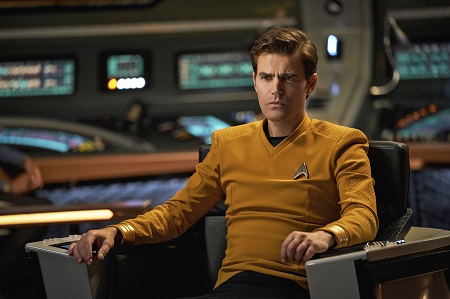
When Strange New Worlds was first announced over five years ago, I wrote that, were I in charge, I’d plan ahead for the series finale. The final episode I envisioned would’ve seen Captain Pike handing over the Enterprise to someone we’re all familiar with: Captain James T. Kirk. Kirk’s arrival on the Enterprise’s transporter pad would’ve been his first on-screen appearance… and the final shot of the series. But ever since the end of Season 1, where a younger version of Kirk appeared, it’s been clear that Strange New Worlds’ writers want to bring in the character in a much larger way. We got to see that this week, in what was in large part a Kirk episode.
The Sehlat Who Ate Its Tail was interesting and, for the most part, an enjoyable romp. We got to see the first mission Kirk undertook with several members of his iconic crew – Spock, Uhura, Scotty, and Chapel. And it was set against the backdrop of a massive villainous starship that was simultaneously terrifying and ridiculous in its appearance. Most of this side of the episode stuck the landing, but it was also a busy story with a lot going on. That meant the villains weren’t as well-developed as I’d have liked, and a couple of characters aboard the Enterprise drew the short straw in terms of screen time.
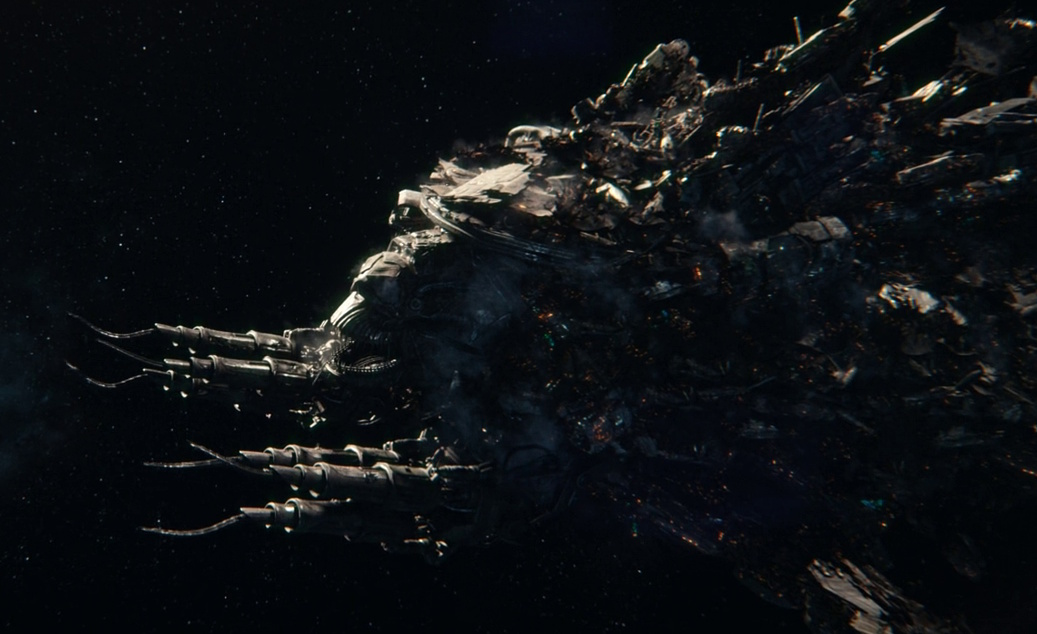
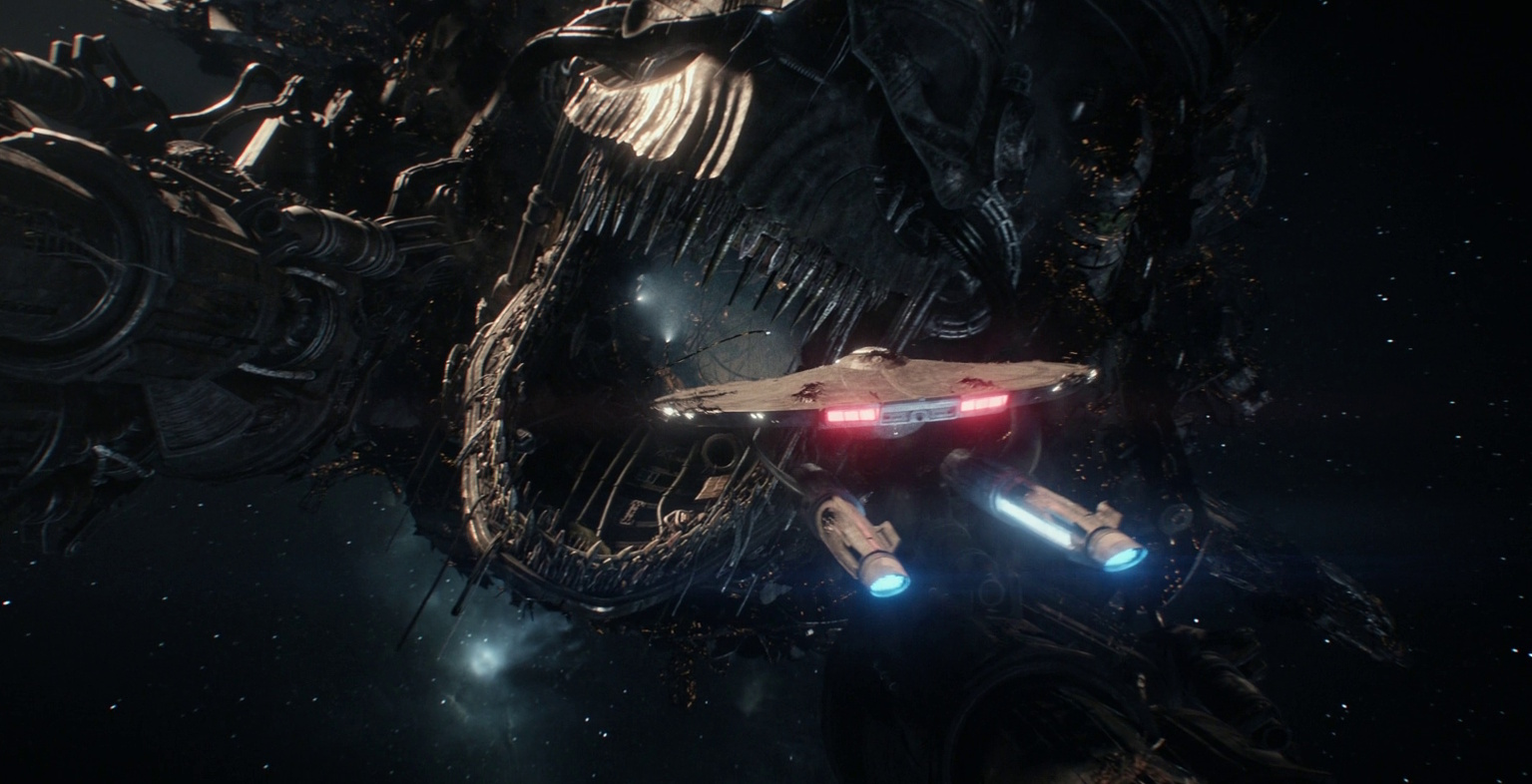
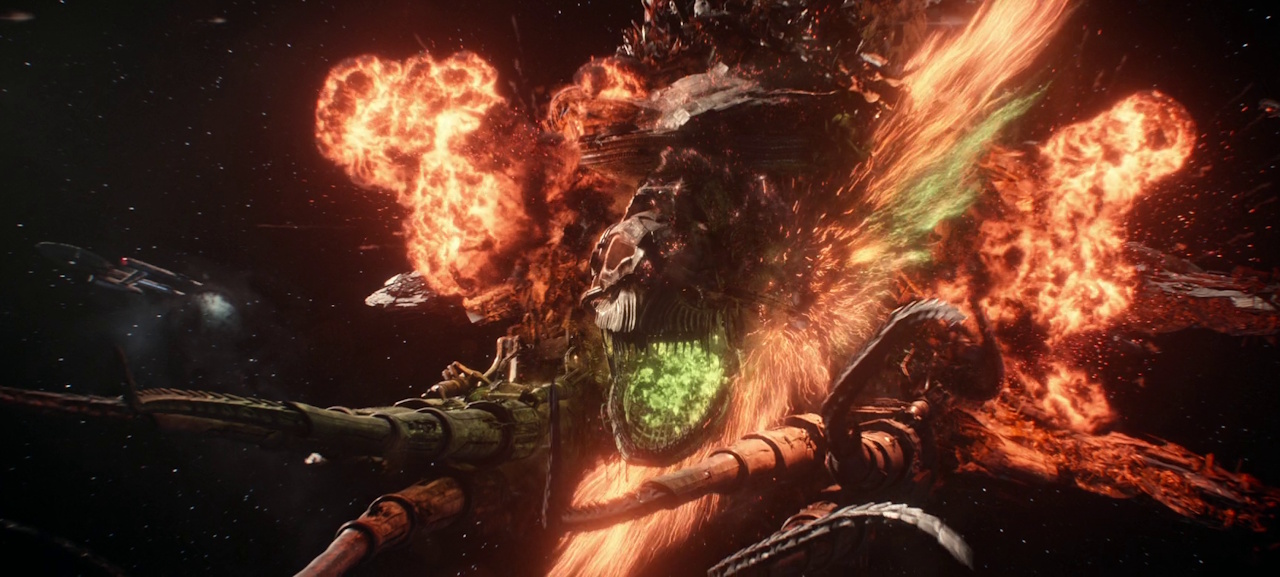
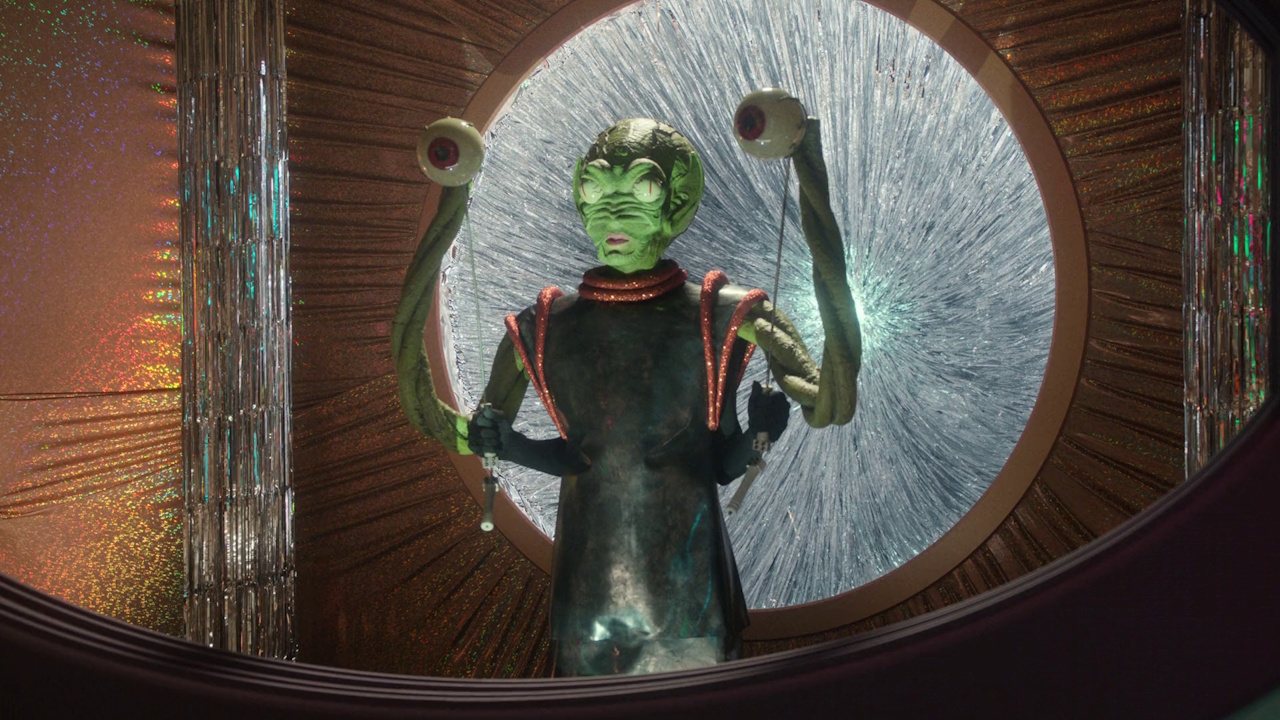
I think I’ll start with the negative points and criticisms before moving into the positives. The design of the scavenger ship was just plain silly. Its “face” with a gaping, monstrous maw was supposed to be intimidating or frightening – but it absolutely failed, and the visual impact of this floating mouth made the whole thing look ridiculous. At the beginning of the episode, when the scavenger ship went unseen, the reactions from Kirk and others definitely sold the illusion that they were seeing something terrifying. But when we saw the ship for ourselves… it just looked really bad.
The best way I could describe the design of the scavenger ship would be to say it’s the kind of thing a seven-year-old might draw if you told them to make you a picture of a “space monster.” It was equal parts cliché, over-the-top, childish, and silly – leading to one of the absolute worst starship reveals that I can remember in any Star Trek story. The design of the scavenger ship ended up detracting from some genuinely great performances; I could scarcely believe that the likes of Kirk, Scotty, and Uhura would be frightened of this ship because of how amateurish and silly it looked.
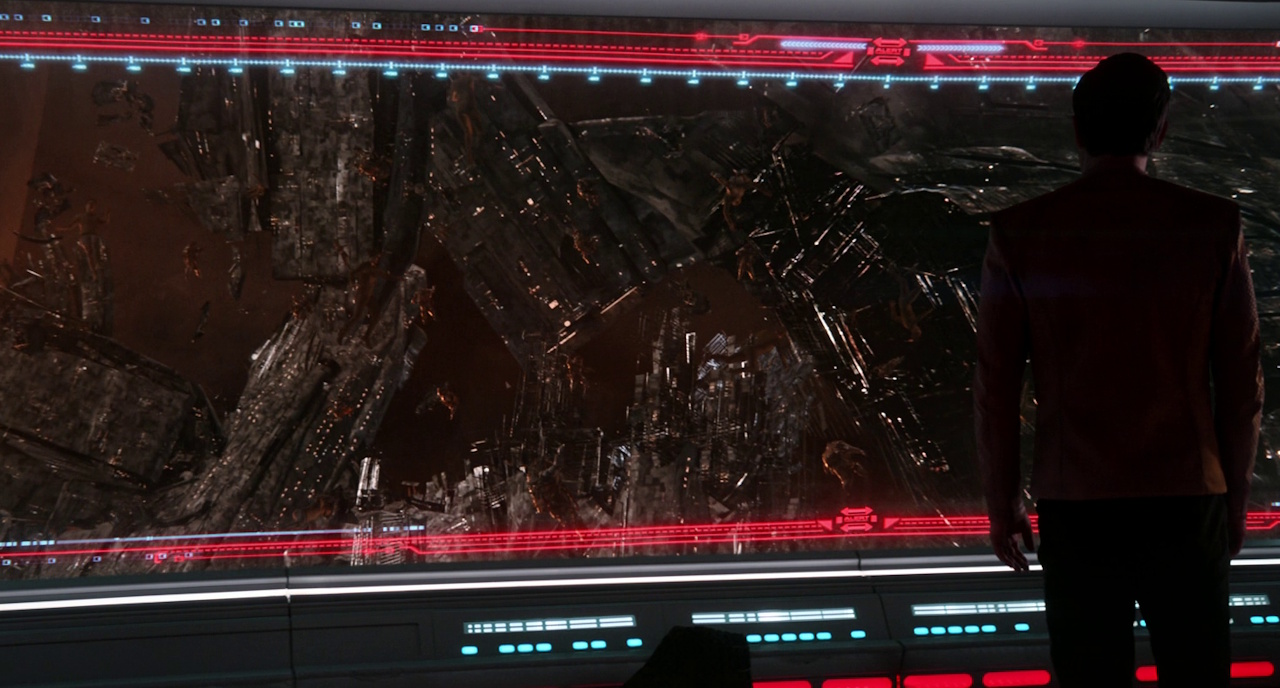
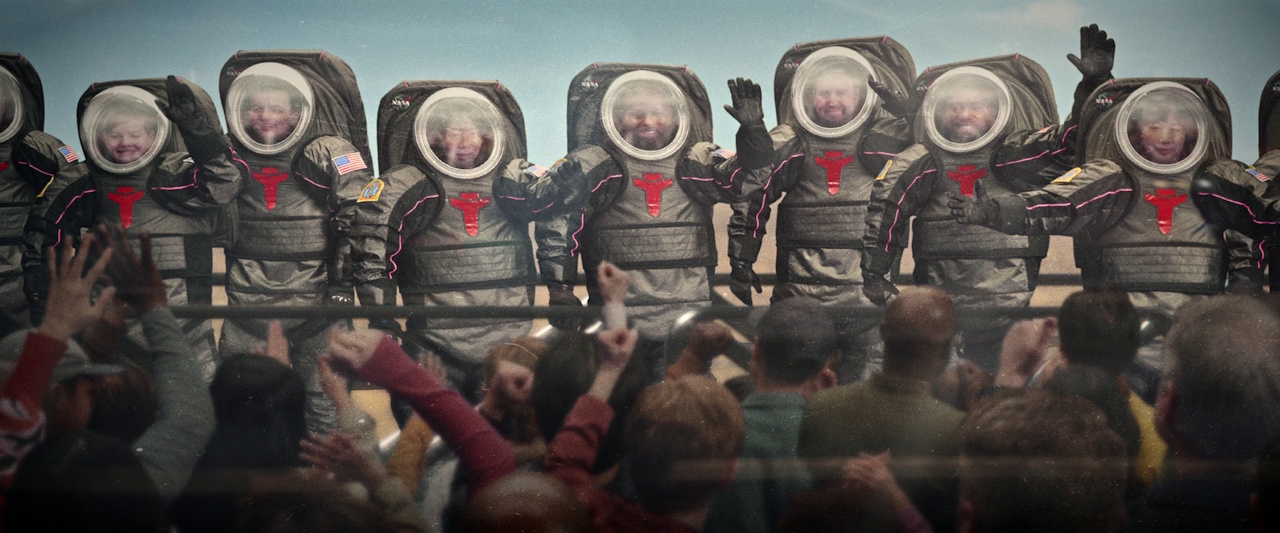
Star Trek stories often have a broader point they want to make, and aliens or villainous factions can be seen as metaphors for events, issues, and even people out here in the real world. For the most part, The Sehlat Who Ate Its Tail was a story about Kirk – about how he had to come to terms with firing the shot that killed thousands of people. And that part of it genuinely worked and stuck the landing; we’ll talk about it more in a moment. But I felt the episode’s writing was very muddled with the revelation that the scavengers were humans. What was the point the writers wanted to make – except that Kirk needed more of a reason to feel bad?
If we’re returning to the well of environmentalism, climate change, and the state of the world today… then I’m afraid this really didn’t work. The scavengers’ ancestors may have left Earth because the environment was suffering and they felt the need to lead humanity to the stars, but that doesn’t explain how, over the intervening centuries, they became twisted into genocidal murderers. Nothing in the story explained this transformation – and the episode didn’t really know what it wanted to say, either. Is the point that well-meaning people can end up doing awful things? Is it that we shouldn’t take the “Elon Musk” approach of fleeing Earth in a spaceship and instead try to fix the climate crisis? Is it that humans are, fundamentally, absolute trash without a strong government to guide us? I genuinely don’t get what – if anything – the scavengers are meant to represent, other than a reason for Kirk to sulk.
There are plenty of aliens or villains in Star Trek who only appear once, but still manage to feel believable, fleshed-out, and real within the confines of a single episode. Whether we’re talking about the First Federation, the Sheliak, or the Abronians, there are literally hundreds of one-off aliens or adversaries who still manage to feel real and well-rounded. Because The Sehlat Who Ate Its Tail didn’t have a lot of time to explore who the scavengers were or what their driving force might’ve been… the end result was that they feel pretty flat, one-dimensional, and just not very interesting.
I absolutely adore how Strange New Worlds has largely returned Star Trek to a more episodic format. But for me, these scavengers fall into a trap that can sometimes hamper episodic storytelling: we just don’t know enough about them to feel much of anything. The big reveal – that they were actually humans all along – didn’t land as hard as it should’ve because we just hadn’t spent enough time with them, heard any of them speak, or come to know them at all. They were your bog-standard aggressive monsters for basically the entire story, so the revelation at the end didn’t really feel as impactful as I think the writers wanted it to be.
Episodic storytelling is by far my favourite, not just in the Star Trek franchise but on TV in general. But not every episode ends up feeling as strong or as well put-together, and for me, the scavengers in The Sehlat Who Ate Its Tail just don’t really stand up to even other one-off villains in past iterations of Star Trek. And it’s such a shame, because I can see most of the pieces to build such a faction hiding just beneath the surface – and a more focused episode could have done a lot more with the scavengers, making the ending hit harder.
Some of the dialogue dedicated to setting up the scavengers felt like naked exposition, with characters claiming they’d heard rumours of something deadly and dangerous in this part of space. This setup felt pretty weak. It isn’t easy to establish a villain, show how dangerous they are, and come up with a plan to take them down all inside of forty-five minutes – and I get that. But that kind of storyline has been done before, and done way better, in other Star Trek shows.
There is something uniquely frightening about an incomprehensible enemy. This is what made the Borg so scary in their initial appearances in The Next Generation – they weren’t someone you could reason with or dissuade; they saw the Federation as a resource to be acquired, and nothing more. The scavengers, with their single-minded desire to harvest resources, could have leaned into that. But it would have required a different ending to the episode, and almost certainly a less-silly starship design, too.
In short, by trying to explain that the scavengers were human – but not having enough time to properly dissect the implications of that, nor really consider why the scavengers were acting in that way – The Sehlat Who Ate Its Tail gets the worst of both worlds. It removes any ambiguity or mystique from the scavengers, but what replaces it isn’t strong enough in the way it was handled – and didn’t get enough screen time – to balance that out. The ending of the episode, while really well-played from a character standpoint, ends up feeling pretty muddled as a result. And for us as the audience, the revelation that these nameless scavengers – not one of whom did we actually meet, let alone get to know – are humans… it just didn’t have much of an impact.
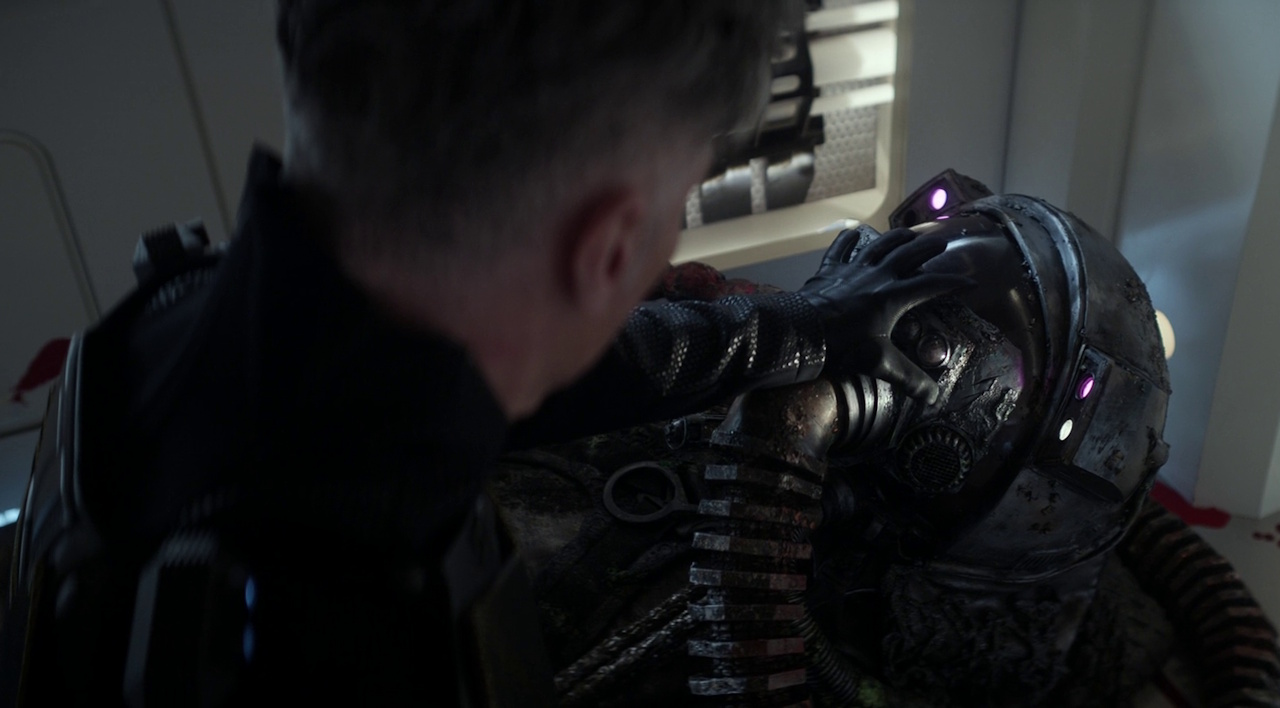
Then there was Pike and La’an’s run-in with the scavenger boarding party. This part just felt under-developed, as Pike seemed to sense hesitation in the scavenger when he had the upper hand in their fight. So… why didn’t the scavenger fire? Is it because he recognised Pike as human? In a galaxy populated by humanoid aliens (some of whom, like Betazoids, are completely indistinguishable from humans) would they even make the connection? If this was supposed to set up the ending of the story, adding to Kirk’s feelings about what he did… then shouldn’t Kirk have found out about the scavenger’s hesitation to fire? Was that supposed to set up a storyline about a possible peaceful resolution?
A lot of Star Trek stories are about communication and connection – finding a non-violent solution, even when an enemy or alien seems to be impossibly aggressive. Perhaps The Sehlat Who Ate Its Tail wanted to make a comment on that – either that some enemies can’t be talked down or reasoned with… or that Kirk and Pike didn’t even try. But this idea wasn’t in focus for long enough to matter, and I can’t even tell what – if anything – the writers were going for here. The sequence at the end – where Kirk and Pike found out about the scavengers – was cleverly edited and put together, though, and I liked seeing them both come to the realisation at the exact same moment.
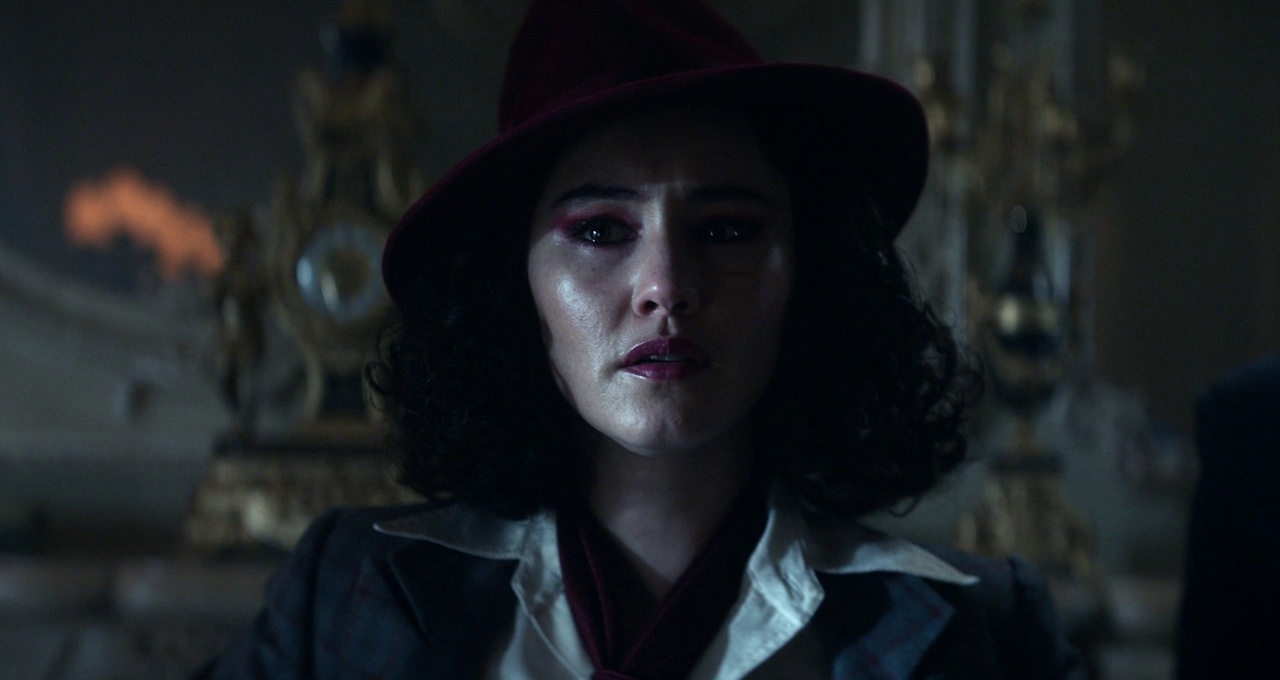
Earlier in the season, Strange New Worlds threatened to give Lieutenant Ortegas a significant storyline for the first time. After her injury in the season premiere, Ortegas seemed to be suffering from some kind of PTSD-like condition related to her Gorn captivity and near-death experience. That was a great setup, and I was keen to see it progress. But this is now Ortegas’ third appearance since being relieved of duty for misbehaving where none of that was even alluded to. It’s reaching a point where, if Ortegas’ mental health ever does come back into play, it’ll feel like a significantly weaker story.
Although we haven’t spent a ton of time with Ortegas in recent weeks, she’s been present – and most importantly, she seems to be doing okay. No one’s asked her how she is, the story hasn’t lingered on how she’s feeling or what she might be going through… she just gets on with the job. The danger here is that, if the writers remember their earlier setup in a future episode, it won’t land in the same way any more. There are definitely stories to tell about how people put on “the mask,” as I used to call it, and pretend to be okay while they’re suffering on the inside. But do we think that’s what Strange New Worlds’ writers are going for? Or is it just a case of Ortegas being put on the back burner so we can get stories featuring Kirk, Spock, and other TOS characters?
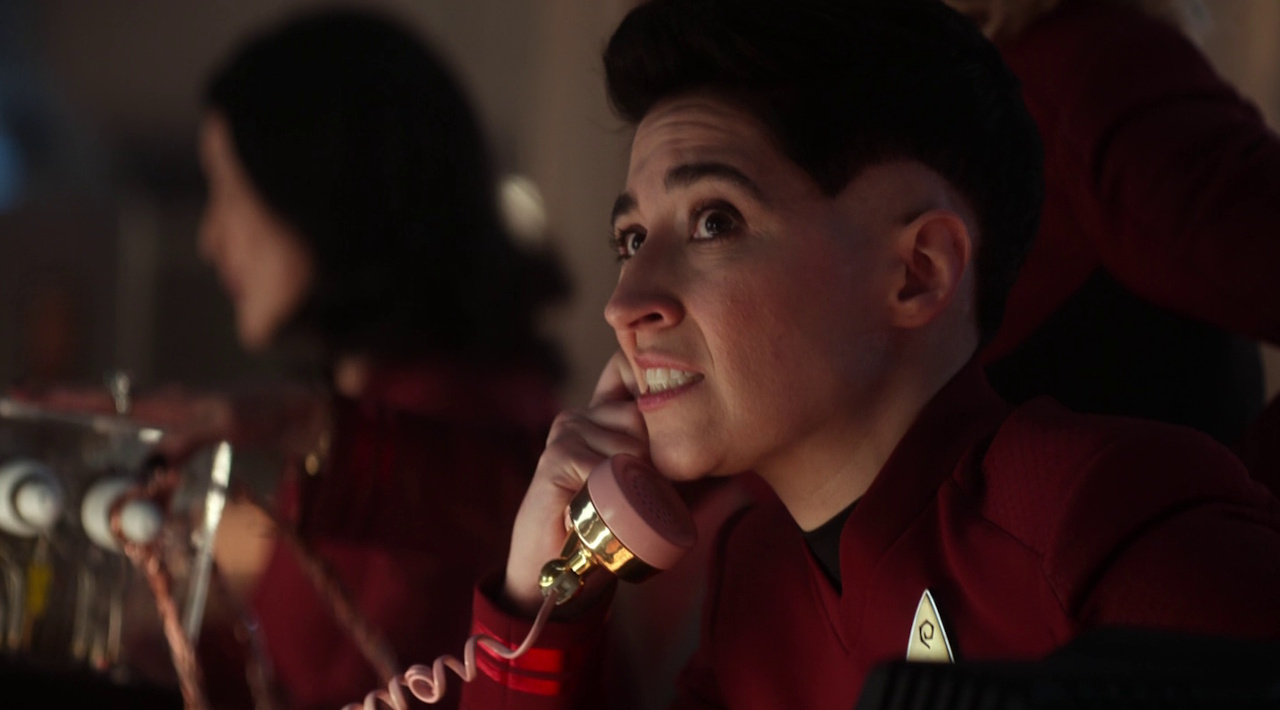
This is, I admit, less to do with this week’s episode. And it’s absolutely possible that Ortegas’ mental health/PTSD story will come back and absolutely nail it. I’m rooting for that to happen! But it’s at least notable that Strange New Worlds set up this storyline for Ortegas but hasn’t returned to it for several episodes in a row. And her appearance here – taking her job seriously, working well under immense pressure, and basically saving the day with her piloting skills – risks detracting from that kind of story if what the writers want to do is show Ortegas struggling with her mental health.
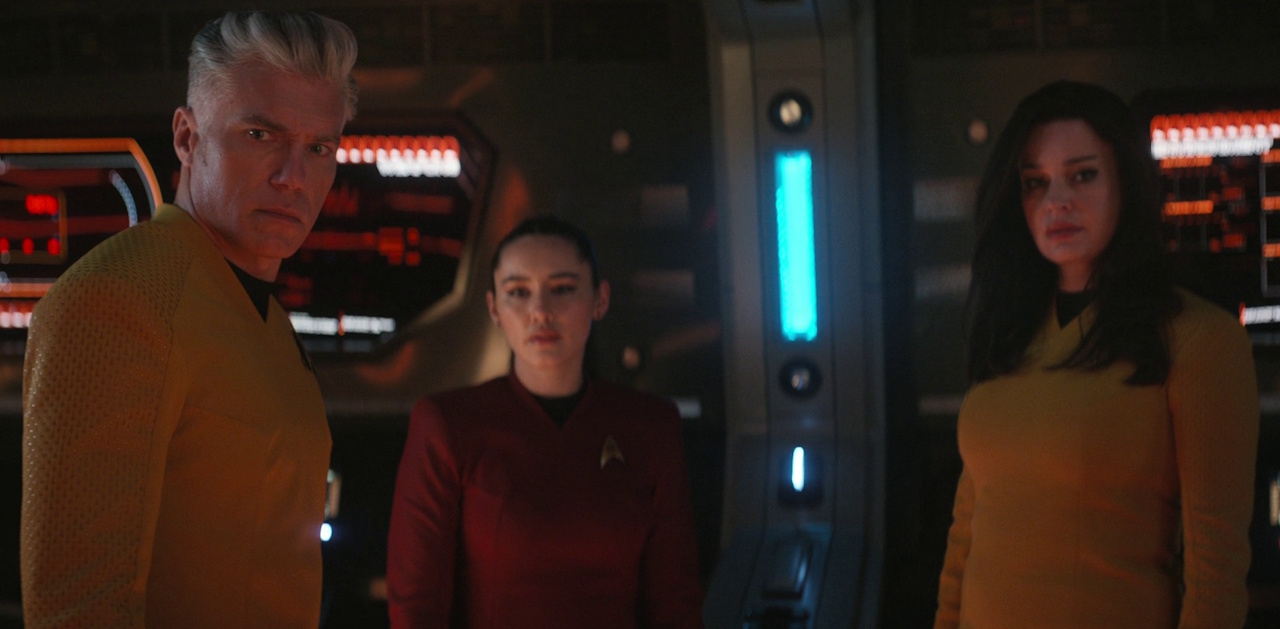
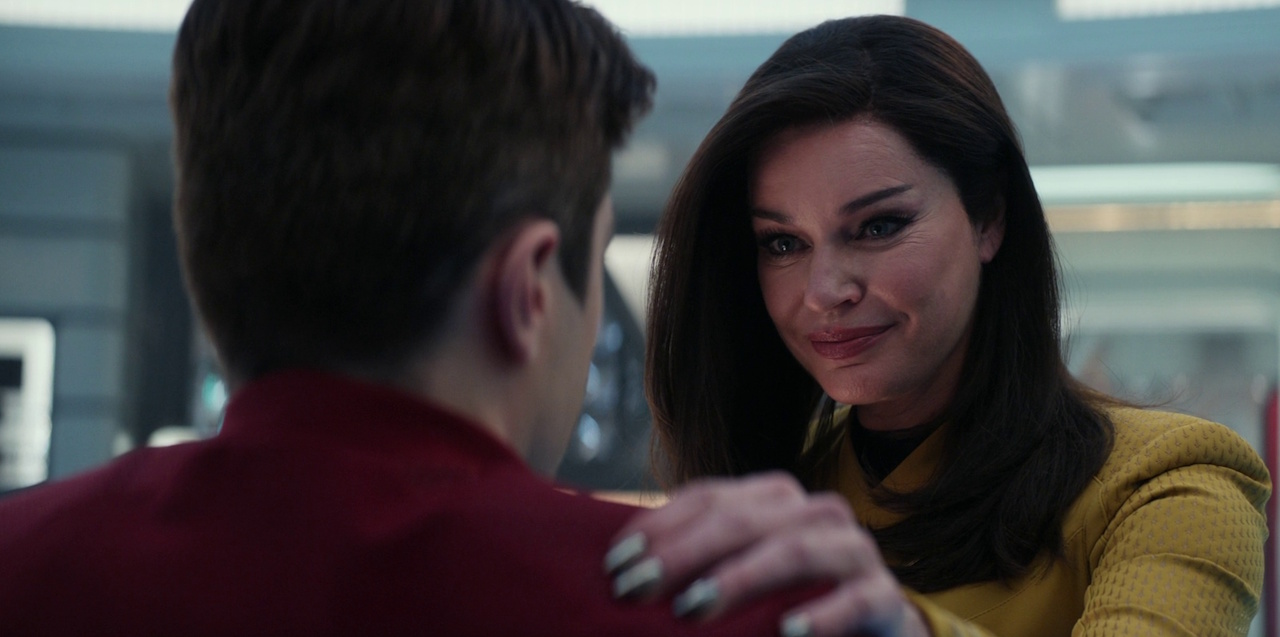
The Farragut’s captain (whose name I had to look up because of how generic and forgettable she was) didn’t wow me in this week’s episode. There are plenty of ways to create memorable secondary or one-off characters, but this Captain V’Rel didn’t leave much of an impression. As a minor character I guess you can say that’s okay, but her command style was supposed to be something Kirk was butting heads with, and it just didn’t really seem to matter all that much. Also, given the unimportance of this character (at least so far), was there a lot of point in making her a Vulcan? Part of the fun of Kirk and Spock’s friendship was that it transcended that particular cultural divide; seeing Kirk paired up with another Vulcan a few years prior risks detracting from that, I fear.

Although I felt the exposition was handled pretty poorly, the scavengers and their ship were supposed to be a kind of “boogeyman,” prowling this region of space and frightening everyone from the Gorn to the Klingons. So… does it make sense that their extremely powerful ship could be blown up so easily right at the end? The badly-damaged Farrgut – with no warp drive, a skeleton crew, and an array of damaged systems – fired three torpedoes, and that was it.
This ship was supposed to have been haunting this part of space for centuries, preying on even strong and powerful vessels like Klingon battle-cruisers – and had the capability to devastate entire planets. I know that Scotty and Kirk came up with a great plan to lure the scavengers in and disable their defences… but even so. Three torpedoes was all it took to take down this supposedly legendary ship.
Okay, I think that’s enough negativity.
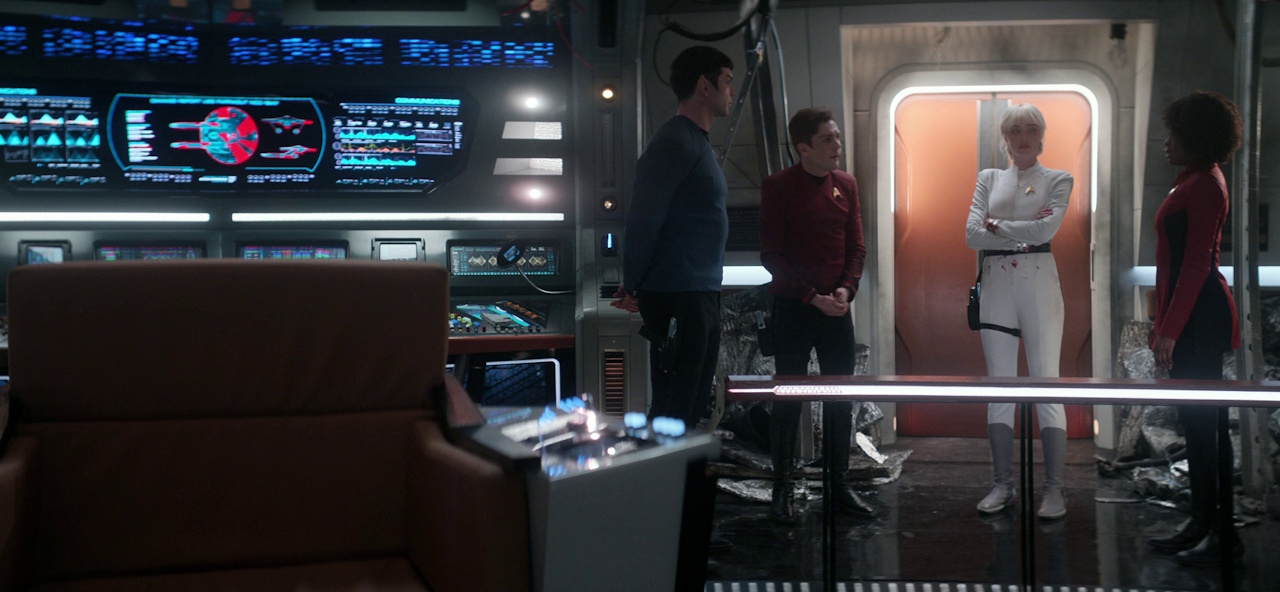
When you boil it down, The Sehlat Who Ate Its Tail is an ensemble episode – which I love – and a character piece with a focus on Kirk. Both of those elements work well, and it was nice to see most of the main characters in action. At the climax we had three different storylines on the go at once: Pike and La’an on the Enterprise’s lower decks, Pelia and Ortegas coordinating the ship’s sensor-less escape, and Kirk and the away team attacking the scavenger ship. All three stories came together magnificently, and it took all three groups of characters to aid in the Enterprise’s escape and the scavengers’ ultimate defeat.
That isn’t an easy thing to pull off. The Sehlat Who Ate Its Tail was a busy episode, but its main story arcs all felt like they mattered. In order to escape, the Enterprise needed a distraction and damage to the scavengers’ ship, which the Farrgut and away team provided, it needed the fuel-siphoning pipe thing disabled, which La’an and Pike managed, it needed communication between the thruster control panels and the bridge, which Pelia set up with help from M’Bena and Una, and it needed someone on the bridge to fly out – which Pelia and Ortegas managed with help from Mitchell. Practically everyone got something significant to do at the episode’s climax, and it takes some skill to pull that off in a short runtime.
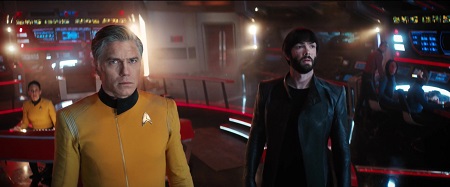
Of these storylines, obviously we spent the longest with Kirk and the away team. Though this was clearly pitched as a Kirk-Spock story, I genuinely enjoyed the rapport Kirk built up with the others, too. This was his first canonical meeting with Scotty, and I liked how it wasn’t a smooth start for them. If Strange New Worlds plans to follow this up and develop Kirk more with the episodes remaining, there’s a foundation for the Kirk-Scotty relationship to build on.
They may not have gotten off to the best start, but Kirk genuinely tried to make up for it later on, and we got a storyline full of technobabble that felt like classic Star Trek in the best possible way! All that talk of anti-protons and making the Farragut a tempting target for the scavengers felt like something straight out of The Original Series, as did Scotty’s earlier line about pushing the wrecked ship too hard. These characters do genuinely feel like younger versions of the people we remember, and that’s not always an easy feeling to conjure up. I wouldn’t have suspected Kirk’s first mission with Scotty would’ve been so high-stakes – or would’ve gone so awry – but it was really fun to see them working together in this way. It expands our understanding of both men and the bond they had during the events of The Original Series.

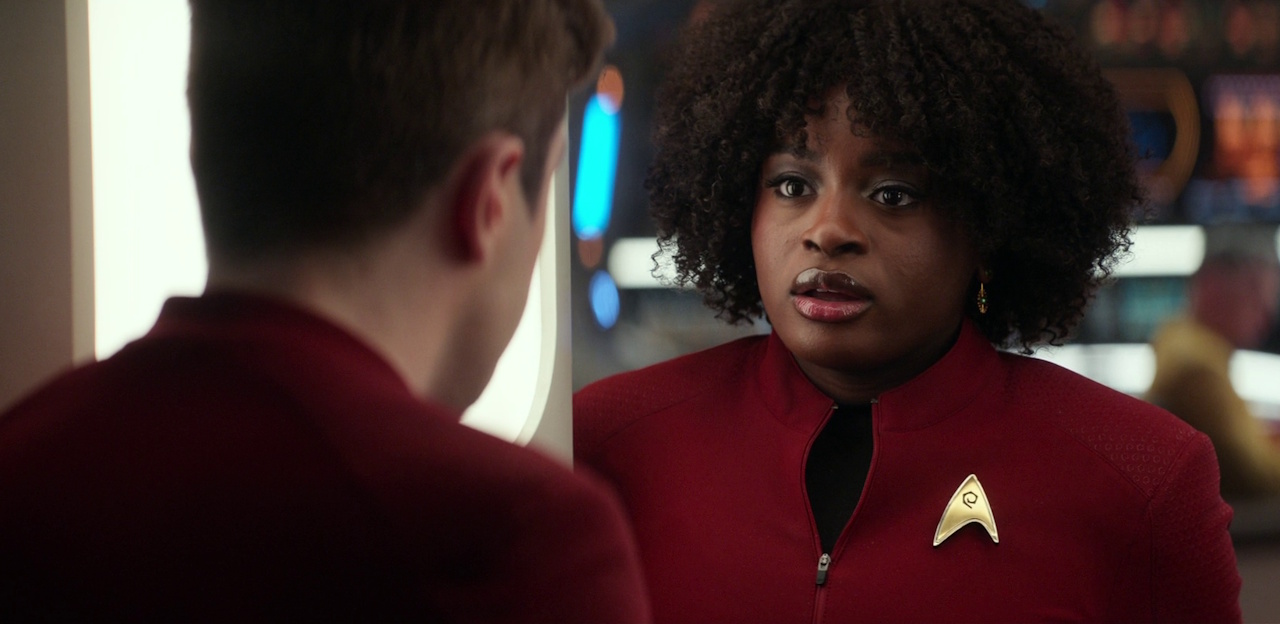
Uhura also called back to the events of Lost in Translation, which saw her first encounter with Kirk. That was a good way to bring in Uhura’s empathy and sensitivity, setting the stage for Kirk’s rehabilitation after suffering a loss of confidence. The idea that his colleagues – who would later become his friends – were able to pull him out of that moment was impactful, and again, I think it sets the stage for how they relate to one another during The Original Series.
I’m glad that, on this side of the story, the writers chose to drop the whole “Spock love triangle” debacle. When La’an, Kirk, Spock, and Chapel were all together early in the story, I genuinely worried we were gonna get some kind of forced drama between them, like we’ve seen in prior entries this season. So I’m really glad that, for once, Strange New Worlds managed to step away from that and focus on something else. It was a blast to see this early mission of Kirk and some of the members of his crew; complicating it with that kind of romantic angle wouldn’t have added anything to what was already a busy episode.
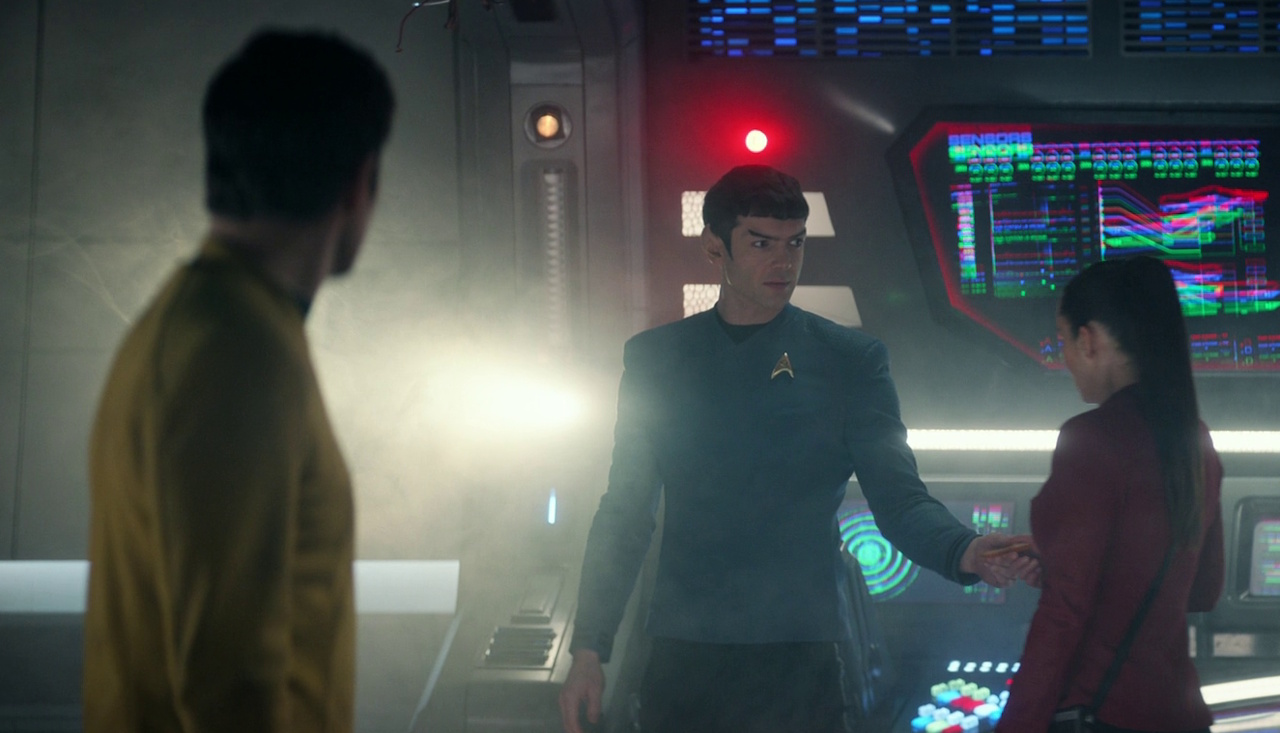
Speaking of romance… are you familiar with the term “Spirk?” Also known as “Kirk/Spock,” this is the fan theory or head canon idea that Kirk and Spock were or are engaged in either a sexual or romantic relationship. Personally, I’ve never been interested in that idea. I felt TOS established quite early on that Kirk at least prefers heterosexual encounters, and Spock – aside from his pon farr – is basically asexual! But one of the nice things about Spirk as a theory was that it always seemed plausible for fans who wanted to believe it. Even if we never saw anything on screen… fans could, if they so chose, read between the lines.
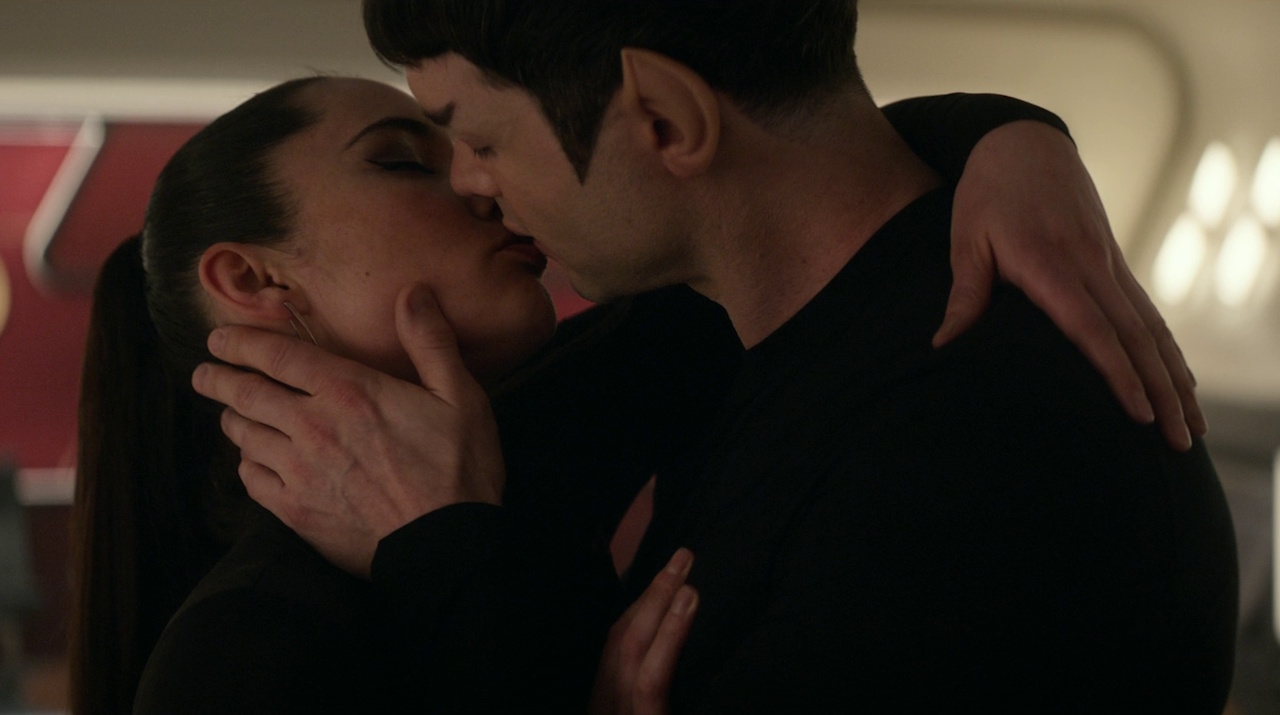
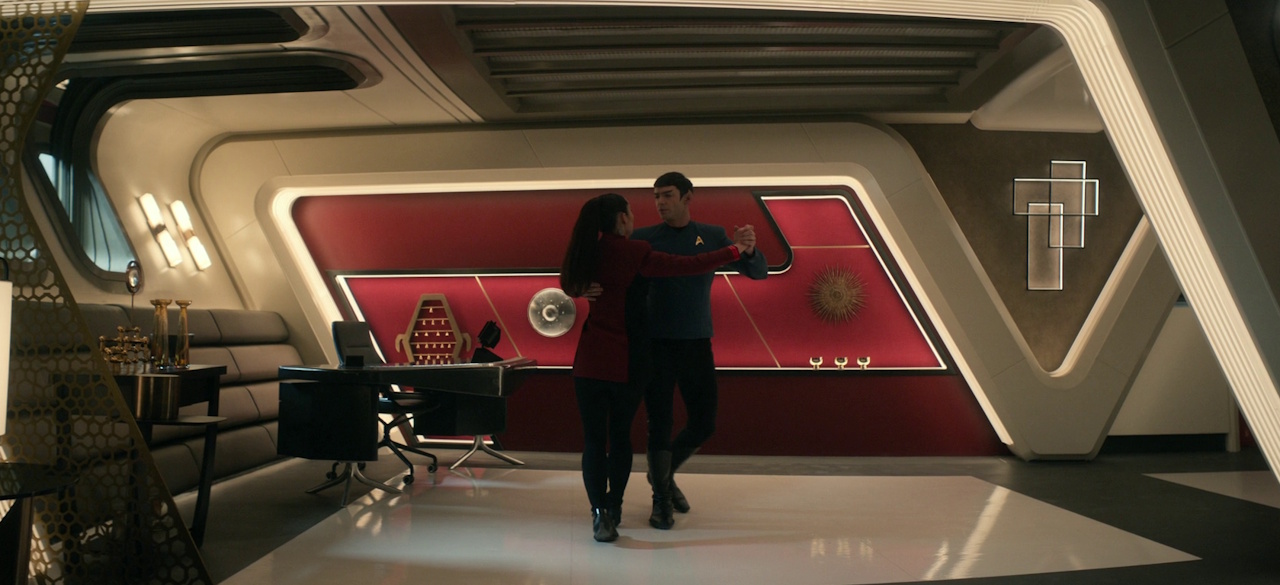
With all of Spock’s romantic entanglements in Strange New Worlds, I can’t help but feel that the writers are almost deliberately trying to erase Spirk as a viable fan theory. They’re much more interested to give Spock female romantic or sexual partners, as if to say “no, you’re wrong, there’s nothing queer going on here!” And I just think that’s a bit sad. I’m not saying I wanted to see an 18+ sex scene with Kirk and Spock! And I really didn’t want or expect the series to lean into the romantic side of their relationship – if such a side even exists. But I think it’s a bit of a shame for fans who did like the Spirk theory that Strange New Worlds is so intent on taking steps away from it. I like a good bromance as much as anyone else, and for me, Kirk and Spock have always felt more like besties than lovers. But having that possibility there, existing just out of sight, for fans who wanted it has been a part of the Star Trek fan community since the ’60s, and I don’t think I’d have chosen to walk away from it like this if I’d been in the writers’ room.
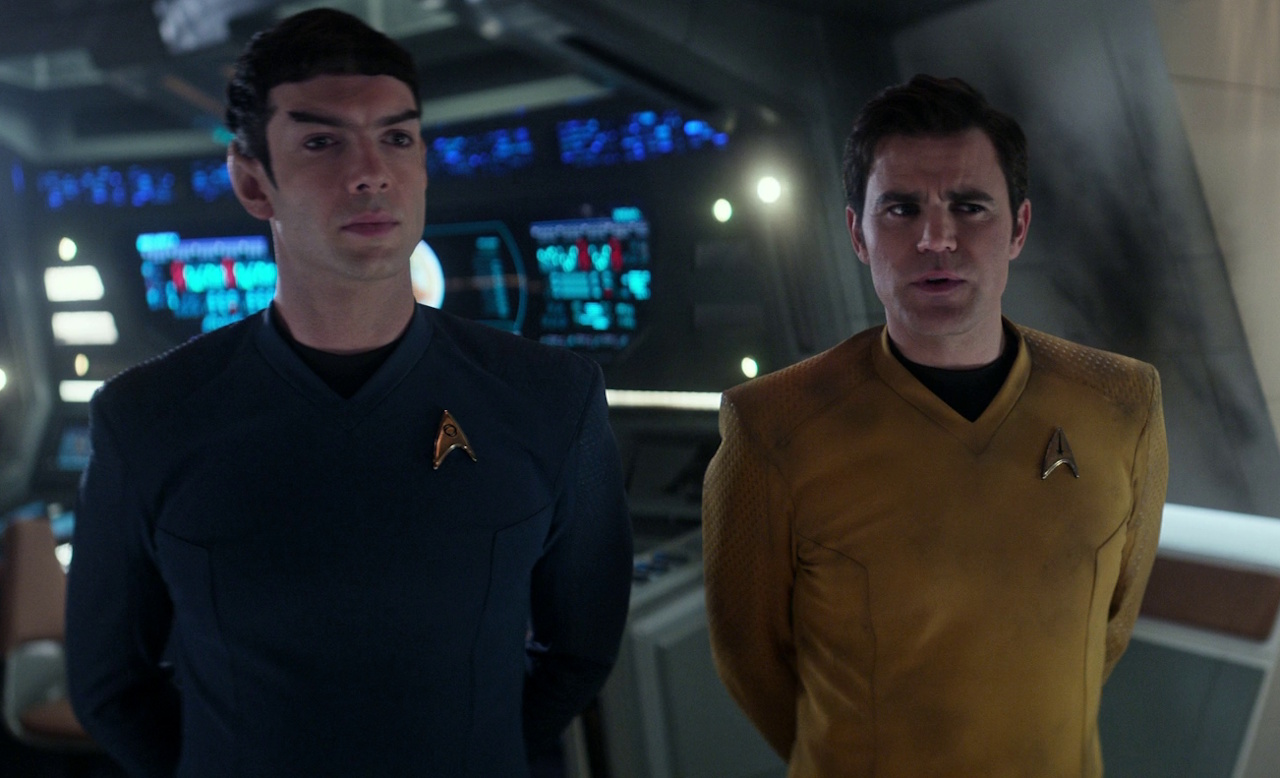
Am I right in saying that Strange New Worlds no longer has a main engineering set? I’ve wondered about its absence a few times this season, but The Sehlat Who Ate Its Tail had multiple stories that could’ve featured engineering – but didn’t. I felt this most with La’an; she was sent to retrieve some baryons from engineering, but did so entirely off-screen. Pelia seemed to very quickly wave away Pike’s efforts to reach engineering, with the room being flooded with dangerous gas. Combined, those two things felt like Strange New Worlds barricading main engineering and telling us to go away!
The science lab set, which was used in this episode and which we’ve seen a few times this season, seems to be replacing engineering. But with two engineers on the show, now – Scotty and Pelia – I can’t help but feel that might be an odd decision! How are we meant to see Scotty growing in his engineering prowess if we don’t have, y’know, main engineering? It doesn’t have to be the main setting for most episodes, but in some stories – like this one – a visit to engineering feels almost compulsory!
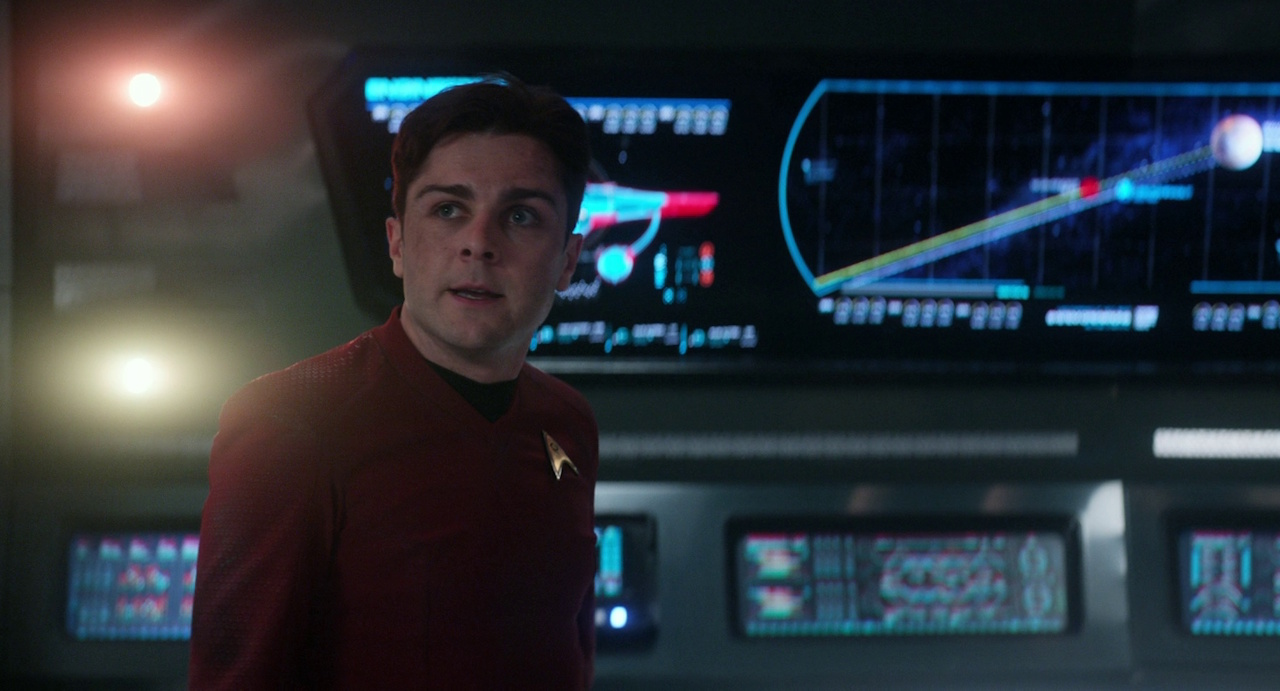
I felt this week’s take on Spock was much closer to the man we remember from The Original Series. Spock was much more straightforward and logical – stoic, even. There’s still wiggle-room in Strange New Worlds’ take on the character, and ways for him to grow and change. And I think next week or in a couple of weeks’ time we’ve got a Vulcan episode where “Spock comedy” could be back on the agenda! But speaking for myself, this version of the character – who we might call “classic Spock,” for want of a better term – is far and away what I prefer to see.
It was fascinating to see Spock’s first one-on-one with Kirk. Spock was the one to give him a much-needed pep talk after the Farragut’s engines gave out, and that entire sequence could’ve been lifted almost word-for-word from The Original Series. It really was a powerful, well-written storyline, and both Paul Wesley and Ethan Peck excelled at bringing these younger versions of the characters to life in a way that felt real, believable, and in keeping with past iterations of Star Trek.
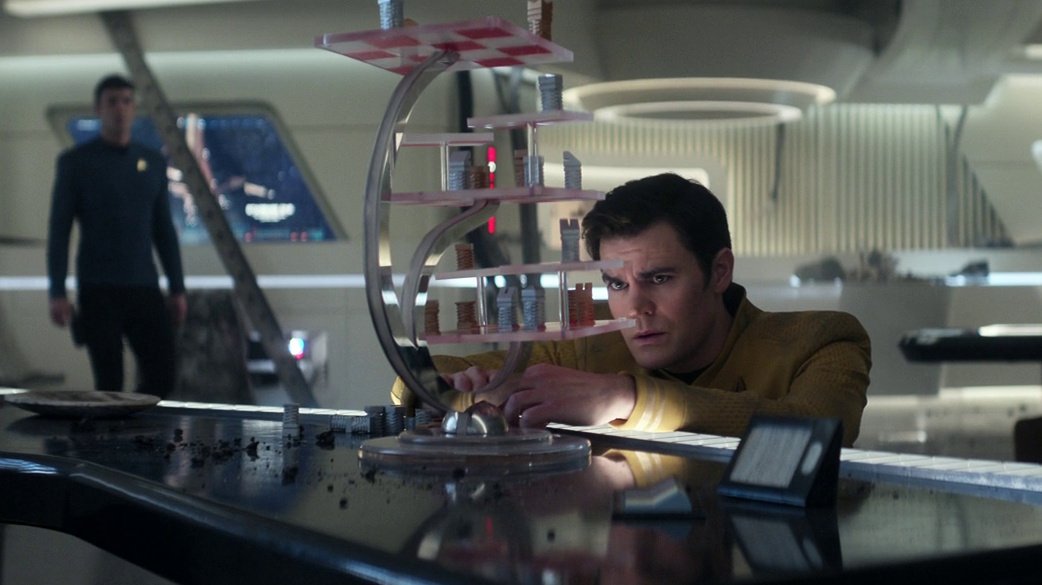
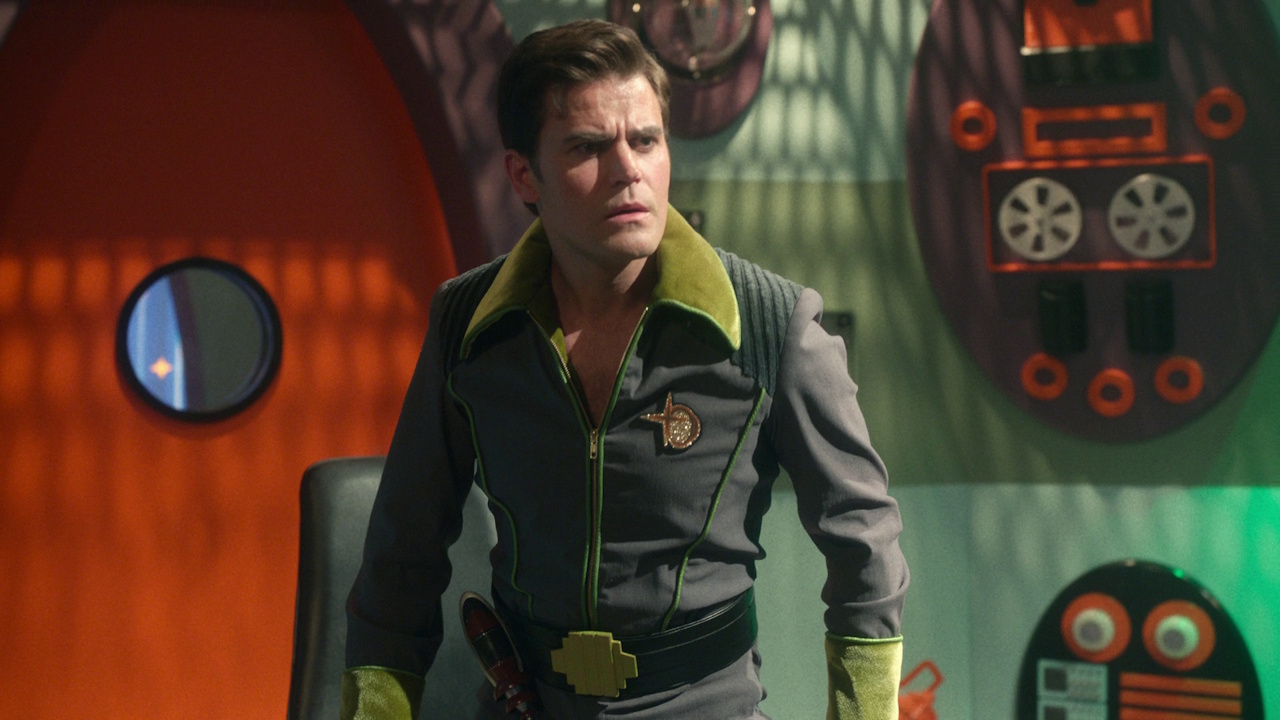
Kirk’s story of struggling under pressure was well-written. We saw glimpses of a classic Captain Kirk: bold, adventurous, and willing to break the rules because he can get away with it. But we also saw the vulnerability that comes with youth and inexperience; Kirk broke the rules, as he’s done before, but hit the wall when his rule-breaking didn’t pan out the way he’d hoped.
I liked Kirk’s log, too; it makes perfect sense how an officer like Kirk would be phenomenally bored if all he could do was conduct survey after survey of dull planets from orbit. Someone like that needs adventure – but, as in many classic novels and stories, the adventure-seeker got much more than he bargained for! Catching this glimpse of Kirk’s early career, though, without time-travel, alternate realities, or contrived ways to bring him aboard the Enterprise… it was pretty special. We got to see Kirk as the Farragut’s first officer, serving on a bog-standard survey mission aboard a less-important ship. There have always been these kinds of vessels in Starfleet; not everyone can serve aboard the flagship on a mission of exploration! But putting Kirk in that position – and showing how much it grated on him – was a genuine change of pace.
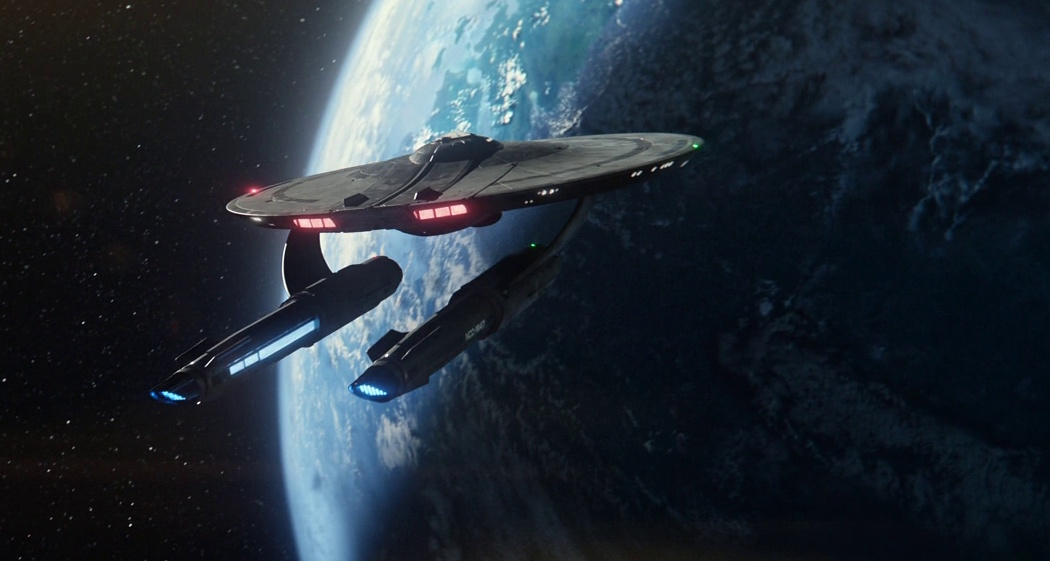
Despite my misgivings about the scavengers as an antagonist (and the design of their ship), the reveal at the end hit Kirk hard, and Paul Wesley did a great job conveying that. The scene between Pike and Kirk was touching, too, and it was a bit of fun to see Pike’s influence on the younger Kirk before he assumed command. I can see Kirk taking those words to heart, particularly about regretting a decision but making it anyway. Knowing what’s in store for Captain Pike, that line was pretty impactful – and carried extra weight.
This moment felt like it was consciously setting up Kirk for the captain’s chair. Though Kirk would famously claim that he doesn’t believe in no-win scenarios, there are going to be impossibly difficult decisions to make when in the captain’s chair, and this felt like a bit of a trial by fire for the future Enterprise captain. Coming to terms with what he did – and why he feels so bad about it – is an important stepping stone between the younger, less-experienced officer we’ve been spending time with and the character we’re familiar with from The Original Series.
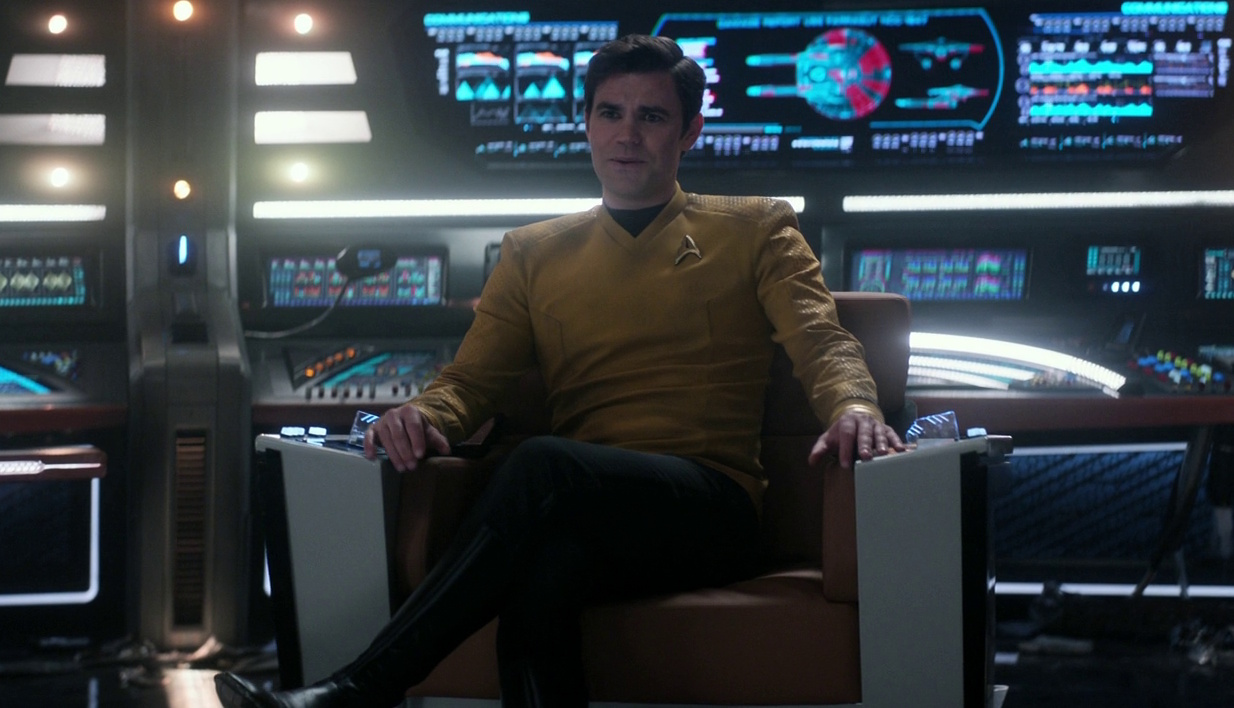
This is the kind of story to tell if you’re gonna do a prequel featuring familiar characters. Spock, Uhura, and Chapel felt very similar to their TOS presentations in this story – but Kirk and Scotty didn’t. They butted heads over engineering issues, Kirk tried to push the ship too hard, and Scotty – the future miracle-worker – wasn’t able, in the end, to keep the ship flying. I think that shows how both men have room to grow – Kirk in terms of his leadership abilities, and Scotty with his engineering miracles!
A storyline like this makes way more sense to me than one showing Spock shacking up with different members of the Enterprise’s crew. What we got in The Sehlat Who Ate Its Tail was a genuinely interesting look at the younger days of some of our favourite characters. Most of the pieces are there – they’re a stone’s throw away from how they will be in The Original Series. But whether it’s youth, a lack of confidence, inexperience, or some combination thereof… they aren’t quite there yet. That’s genuinely fun and interesting to see, and it expands our understanding of these characters instead of just throwing them into random situations and hoping romance or drama will be enough.
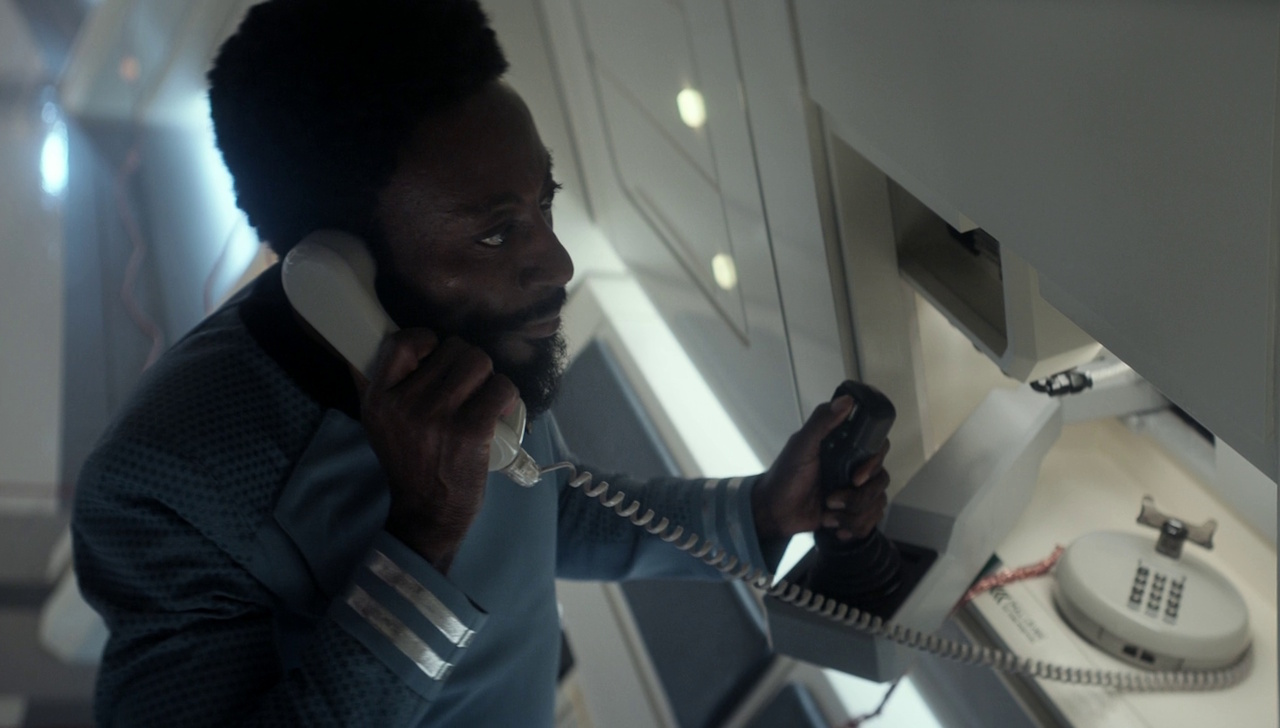
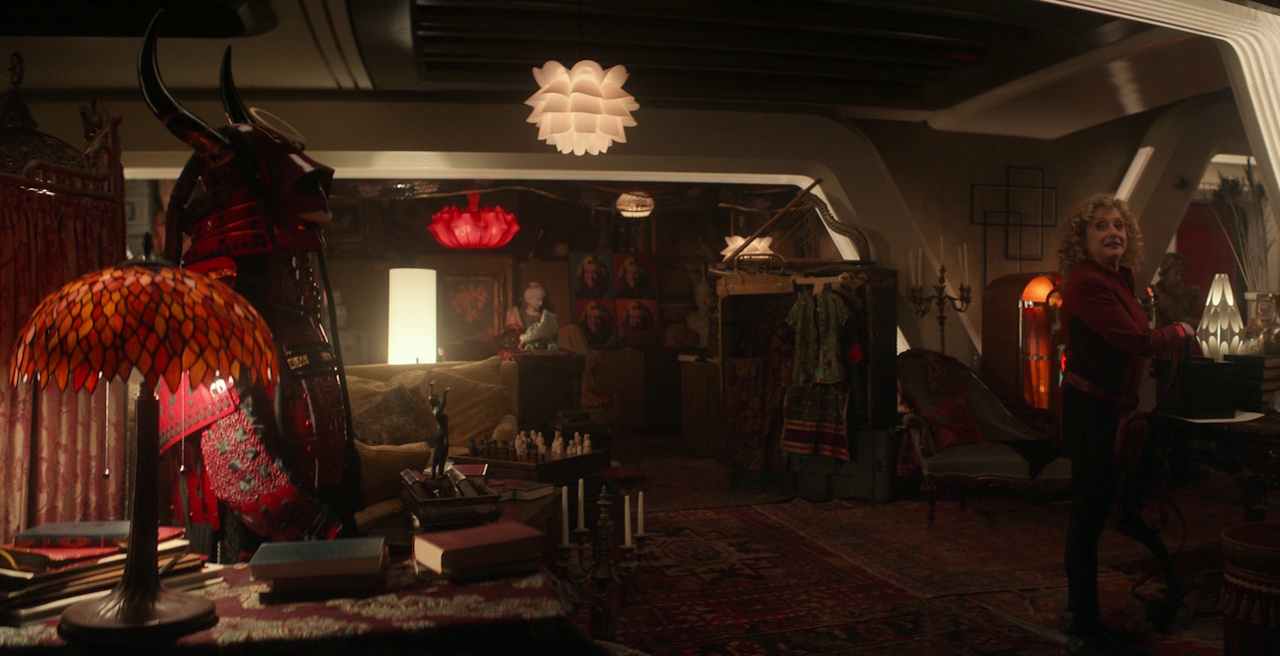
I really do like Pelia. She’s such a fun presence on the show, and she can be a complete change of pace from other, more straight-laced and stoic Starfleet officers. I think we got to learn Pelia’s age here – she’s over 5,000 years old. Her quarters are just pure hoarder-y chaos, and I love that! And her collection proved invaluable to the crew as they were able to wire up a handful of old telephones around the Enterprise – Battlestar Galactica-style – to coordinate the emergency thrusters during the escape sequence. The whole thing was a ton of fun.
Pelia was also, I guess, the ranking bridge officer during the escape sequence. That was kind of interesting for her, and a bit of a change of pace from her usual secondary or advisory role. We didn’t see her giving a lot of orders or anything like that, but she was a fun presence on the bridge with Ortegas and Mitchell during the escape.
The Sehlat Who Ate Its Tail was a solidly entertaining Star Trek episode. It was held back from reaching the top tier by a pretty flat antagonist with a silly spaceship design, and that did ultimately impact how I viewed parts of the story – the ending in particular. But as a character piece about Kirk, seeing him growing in confidence as he’s on the path to become the captain we know and love, it was genuinely well-written. Kirk’s first outing with some of the members of his iconic crew was, by and large, a lot of fun.
I also appreciated that The Sehlat Who Ate Its Tail gave the rest of the characters things to do at the climax of the story. It took everyone working together to save the Enterprise – and the inhabited planet – and that’s not an easy thing to pull off within the runtime of a single episode. It did come at the expense of a couple of characters who felt less-developed or who got a bit less attention than they otherwise might’ve, but that’s okay.
Next week we have the curiously-titled What Is Starfleet? I’m really not sure what to make of that one – but I guess time will tell.
Star Trek: Strange New Worlds Seasons 1-3 are available to stream now on Paramount+ in countries and territories where the platform exists. The first two seasons are also available on DVD/Blu-ray. The Star Trek franchise – including Strange New Worlds and all other properties discussed above – is the copyright of Skydance and/or Paramount. This review contains the thoughts and opinions of one person only and is not intended to cause any offence.







 Trekking with Dennis