Horror Hypothetical: Where Would You Try To Survive?

A Star Trek-themed spoiler warning.

Spoiler Warning: Beware of spoilers for the films, games, and TV shows discussed below.

With Halloween rapidly approaching, I thought we could have a bit of fun by playing one of those “hypothetical question” games that you often see doing the rounds on social media. I’m going to choose one with a seasonally-appropriate horror theme, and try to go through a few possible answers, weighing up the pros and cons of each.

So what is this horror hypothetical, you rightly ask?

If you had to spend 72 hours (that’s three days) in one fictional universe from a horror property, which one would you choose? And, perhaps more pertinently: which horror franchise/universe presents the highest chance of survival?

Stock photo of two Jack-o-lanterns.
Happy Halloween!

Let’s lay down some ground rules – because rules are always fun, right?

In this scenario, I’ll have to spend 72 hours in one fictional universe of choice – and it has to come from a recognised horror film, TV series, or video game. Scary episodes or levels of non-horror properties don’t count – so there’s no trying to wriggle out of it by picking something like Star Trek: Deep Space Nine’s Empok Nor. We’re talking full-blown horror only!

Most stories take place in a larger fictional world – but it wouldn’t be *any* fun at all to pick, say, The Texas Chain Saw Massacre and say that I’d avoid it by catching the first bus out of town, or to say that I’d survive in the Alien universe by just never going into outer space. So we’re assuming, for the purposes of the hypothetical, that I’m dropped in the middle of the danger zone. Running away is possible – but only using the equipment and technology that we’ve seen depicted on screen, *and* that I’m reasonably confident I’d be able to use. So… no hijacking a nuclear bomb or anything like that!

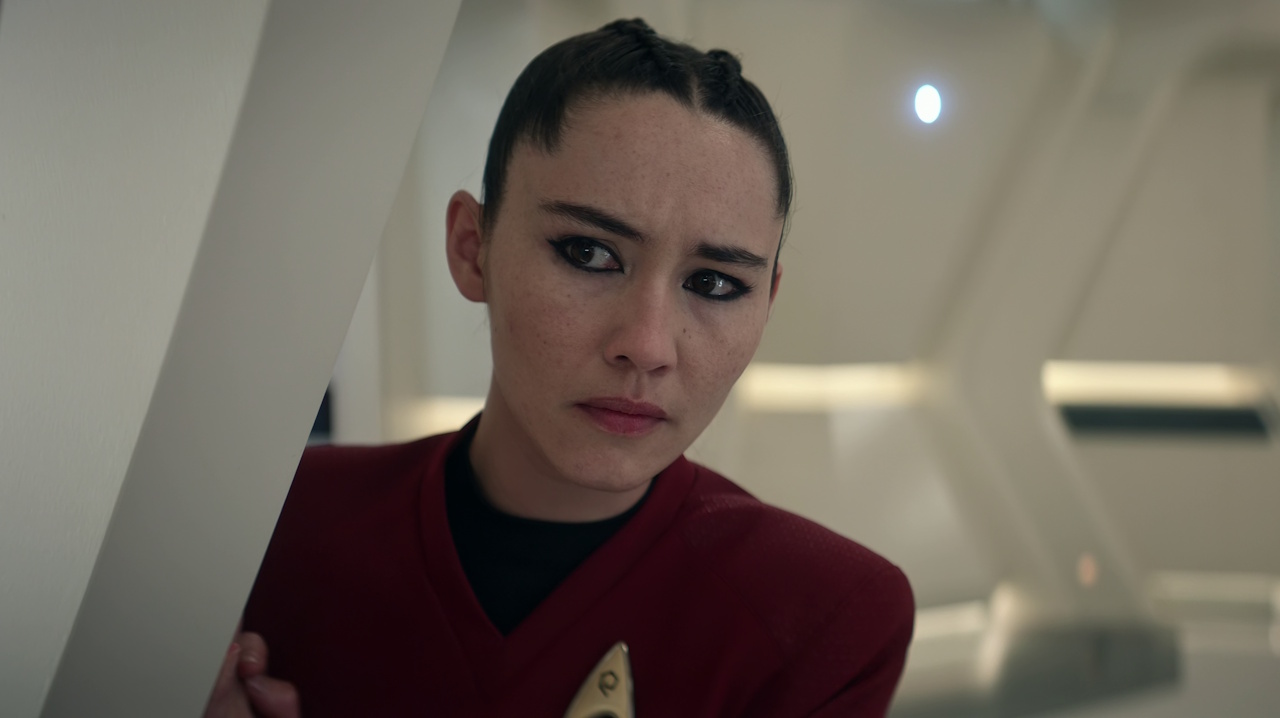
Still frame from Star Trek: Strange New Worlds showing Hemmer as a zombie.
Argh!

I’m also going to assume that I’m in reasonably good health in these hypotheticals – which is categorically *not* the case in real life, unfortunately! But, again, it doesn’t seem like it’d be a lot of fun to have to take into account my limited mobility in every scenario. So, if you’ll indulge me, I’m going to assume I’m in better health than I actually am!

Finally, as I always like to say, everything we’re going to talk about is subjective, not objective. If you hate the horror franchises I’ve chosen, think I’ve totally messed up my survival, or just feel I’ve got the wrong end of the stick somehow… that’s okay! All of this is just a bit of Halloween-themed fun, at the end of the day. And since neither of us are ever going to be actually dropped into a horror franchise (well, fingers crossed), none of this really matters! It’s just for fun – and I share it with the interweb in that spirit.

I’ll talk a little bit about each scenario, then give it a survival chance at the end using a simple 1-10 scale, with one being the lowest chance of survival, and ten being the highest.

So with all of that out of the way, let’s get started.

Option #1:
28 Days Later

Still frame from 28 Weeks Later showing a zombie breaking in through a window.
A zombie.

28 Days Later redefined the zombie genre, and it was genuinely one of the most terrifying depictions of zombies I’d ever seen. Fast “sprinters,” able to infect people with a single drop of blood, and blinded by rage… this is gonna be a tough one!

For the purposes of our 72-hour survival challenge, the best thing to do would be to shelter in place, using whatever resources are available in the immediate surroundings. Venturing outside, especially in a large city the size of London, seems like it would be immediately fatal, so as long as I have some kind of shelter and hopefully some water or something else to drink, I’d try to hunker down, keep quiet, and stay away from any windows!

Still frame from 28 Days Later showing two zombies dying.
Dying zombies.

That being said, we’ve seen how aggressive 28 Days Later’s zombies can be, and how a small flicker of light or a seemingly innocuous sound can attract an entire horde. Assuming we’re in London or a similarly-sized urban area, and all we have for defence is the contents of the average house… I don’t think this is going to end well, to be blunt about it. One loud snore, one step too close to a window, or one candle at night would be all it’d take to send the zombies crashing through the windows and doors.

I deliberately chose 28 Days Later ahead of something like The Walking Dead because of how much more intense and powerful its zombies appear. But that could be what screws us over! If we get lucky and the hordes pass us by, I think sheltering in place for 72 hours is plausible. But if we run out of water and have to venture out, if our base is compromised, or if we make one small mistake… that’s all it’d take.

Survival Chance: 3/10

Option #2:
A Nightmare on Elm Street

Promo photo for A Nightmare On Elm Street showing Freddy Krueger.
Freddy Krueger.

Freddy Krueger has one major weakness: he can only hurt me in my dreams. If this was a “survive indefinitely” challenge, that would be a problem! But if I have to make it 72 hours… I reckon I could manage to stay awake. A combination of caffeine pills, energy drinks, and coffee should keep the spooky lil’ guy at bay!

But okay, that’s getting dangerously close to cheating territory, I suppose. There have been more Nightmare on Elm Street films and spin-offs than I thought, and it seems as if Krueger’s backstory and the source of his powers have changed since the original. But if we assume that Krueger is fuelled by his victims’ fear, as the first film depicted, then trying to stay calm will be the biggest obstacle. And all that caffeine we just chugged? That probably won’t help with keeping calm!

Still frame from A Nightmare On Elm Street 3 showing Freddy and Nancy.
Krueger and Nancy in one of the sequels.

I don’t think I’d be able to figure out all of the other stuff depicted in the sequels: things like purifying Freddy’s bones or staging a group hypnotherapy session in order to enter his world and take the fight to him! So my plan, to be honest, would really be to try to stay awake for as long as possible. 72 hours seems like a stretch – that’s three full days – but if the alternative is a violent and painful death… well, that’s a pretty good motivator.

If possible, I’d try to meet up with anyone else who might be one of Freddy’s targets. Perhaps by working together, we could develop a more solid strategy!

Survival Chance: 6/10

Option #3:
The Last Of Us
(Video game version)

Promo screenshot for The Last Of Us showing Joel fighting a clicker.
Fighting a clicker.

In this scenario, we survived the main event (or we were born after it) and we’re now a couple of decades into the post-apocalypse, as depicted in the main part of the story. For a 72-hour survival challenge, I’m torn between seeking out a safe zone, like Boston, where the first game starts, or simply finding an abandoned property and taking shelter.

In either case, I don’t want to spend much time on the road or travelling, as that seems like the time for the mushroom-zombies to strike! Finding a truly safe space outside of one of the established settlements or safe zones seems like it would be challenging, but trying to enter one of these places would also have its drawbacks. Some guards seem especially trigger-happy, so one wrong move (or sarcastic quip) could lead to a premature demise!

Promo screenshot for The Last Of Us showing a clicker on a red background.
We don’t want to run into any of these…

The video game version of The Last Of Us also showed how deadly fungal spores could be. Without proper protection, spores would quickly infect me and bring my run to an end – and I can’t rely on having access to a proper hazmat suit or gas mask! And knowing me, I’d struggle to get the damn things on in time even if I was lucky enough to have them. This side of things makes venturing anywhere pretty dangerous, not least derelict buildings which could hold clouds of cordyceps spores.

Perhaps the least-bad option would be to just… pitch a tent in a field somewhere and hope that you’re far enough away from the zombies to survive for three days? There are also scavengers and gangs to worry about, though. Being alone in this post-apocalyptic world wouldn’t be a lot of fun, that’s for sure.

Survival Chance: 4/10

Option #4:
The Thing

Still frame from The Thing showing a character holding a lit flare.
The Thing.

In The Thing, you’re trapped at an isolated outpost, unable to tell your friends from the creature, and… I think it’s gonna be a bad time! Unlike in other scenarios, going off alone and trying to hunker down won’t work; the Antarctic base is relatively small, and the creature seems to have a pretty good method of navigating it. Leaving the base, even if well-equipped, means facing Antarctica in the dark in the middle of winter… so I’m not making it 72 hours that way!

If possible, I’d try to organise the survivors into one group, occupying a “safe” room with resources, like the cafeteria. Taking shifts, so at least two or three people are awake at a time, I’d try to keep the creature at bay for as long as possible. But I have no doubt that the shape-shifting abilities would be a waking nightmare; not feeling 100% confident in trusting anyone would take a toll.

Still frame from The Thing showing a character using a flamethrower.
Kill it with fire!

With nowhere to run, the best way to survive 72 hours in this world would seem to be by befriending everyone at the facility and trying to stick together in one group. That means if there’s something to attend to outside of our safe room, the whole group goes. No one uses the bathroom alone, sleeps alone, or does anything alone. For someone who struggles with human interaction… that might not be the most fun I’ve ever had! But, as above, the fear of a violent death is a pretty good way to keep me motivated!

With all that being said, facing off against an intelligent and efficient predator like this, one with such a perfect ability to mimic animals and people… I don’t think the odds are especially high!

Survival Chance: 2/10

Option #5:
Alien

Still frame from Alien: Earth showing someone trying to hide from a Xenomorph.
Hiding from a Xenomorph.

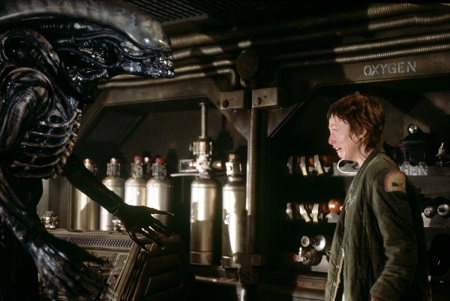
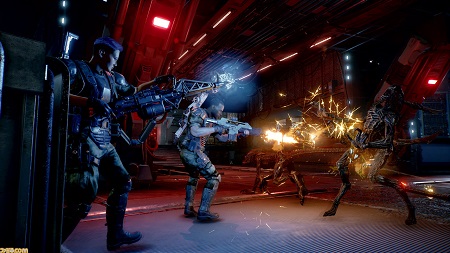
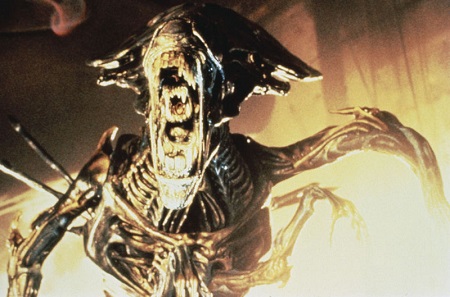
In space, no one can hear you scream… so let’s *try* not to have to scream! I think our survival chances in the world of Alien improve significantly if we’re on the ground – a colony or settlement – rather than aboard a spaceship or space station. But either way, the Xenomorph is coming for us, driven by little more than a desire to feed and breed.

If we have enough room, I’d try to put as much distance between us and the infection site as possible. We could try to commandeer a vehicle – like one of the ground transports seen in Aliens. Or, if trapped aboard a ship, sneakily trying to use an escape pod might be a viable option. Remember, we just have to survive for 72 hours – so getting as far away from the Xenomorph as possible should be top priority!

Promo screenshot for Alien: Isolation showing the Xenomorph.
Alien: Isolation.

If escape isn’t an option, though, and we’re in a worst-case scenario aboard a cramped slow-moving spaceship, then I think – as the films and series have repeatedly shown – we’re pretty much screwed! If we catch the infection really early, and can kill the facehugger or infant Xenomorph, maybe things would look a lot brighter. But by the time we’ve passed the chest-burster stage and the little bugger has disappeared, our best bet is honestly to run to the escape pods.

I’ve recently been playing Alien: Isolation, and it’s genuinely one of the scariest games I’ve ever played – and perhaps second only to the original Alien film in terms of how terrifying the Xenomorph feels. Playing it was part of the inspiration behind this piece, as I honestly struggle to survive in the world of Alien – so it made me wonder which other horror properties might be equally as unforgiving!

Survival Chance: 2/10

Option #6:
Buffy the Vampire Slayer

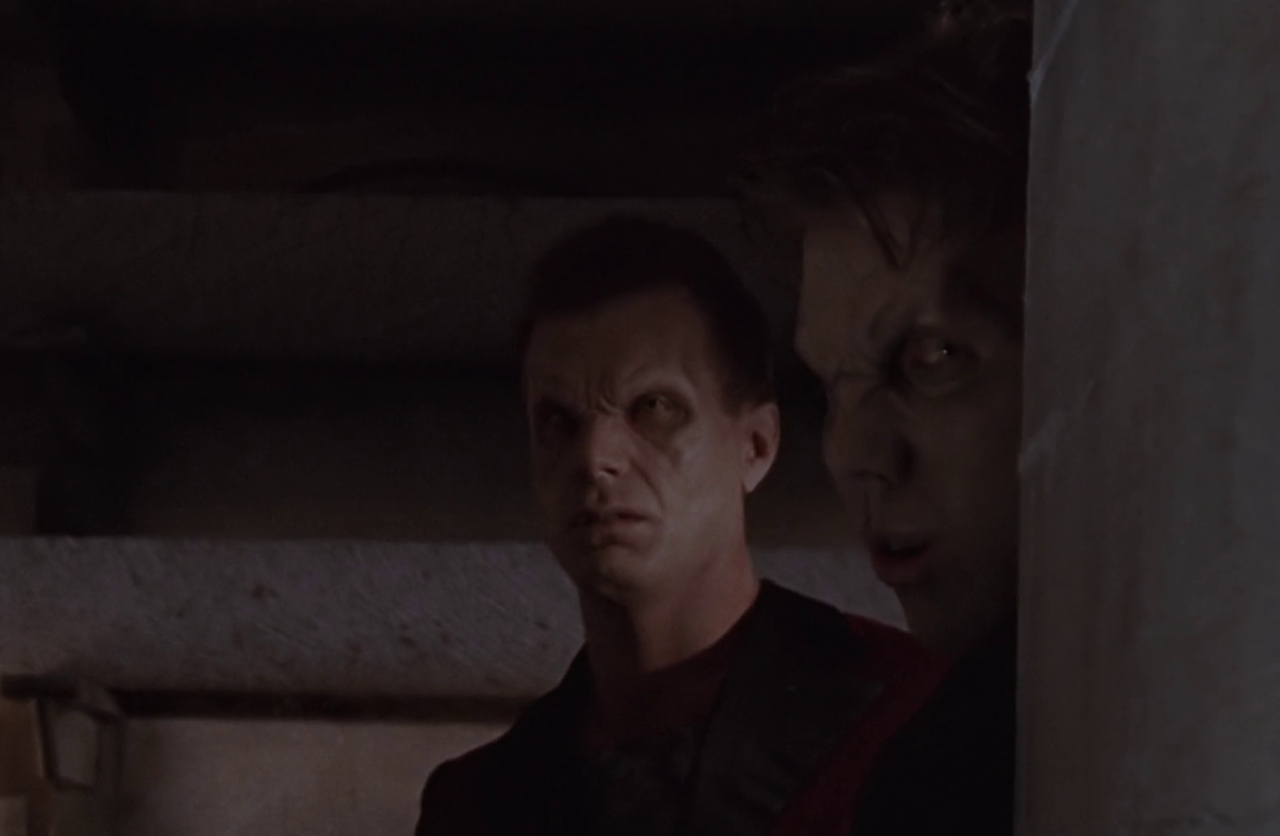
Still frame from Buffy the Vampire Slayer showing two Season 1 vampires.
Vamps!

Gosh, where do we start with this one? There’s a lot more to Buffy than just vampires – so you can expect to be contending with werewolves, witches, ancient demons, and many other supernatural baddies! Honestly, just holding your own against vampires for 72 hours would be a stretch, but if other entities also join the hunt? This could be a very short challenge!

The flip side to all of that is, unlike in every other scenario we’ve examined so far, there’s a gang of people dedicated to hunting down and stopping the vampires and other creatures of the night. We wouldn’t even need to meet or befriend Buffy, Giles, Willow, or anyone else – if supernatural shenanigans are going down in Sunnydale, they’re probably already on the case. It might be too late for us if we’re the first victim of a new monster, but what are the odds of that happening in the first 72 hours?

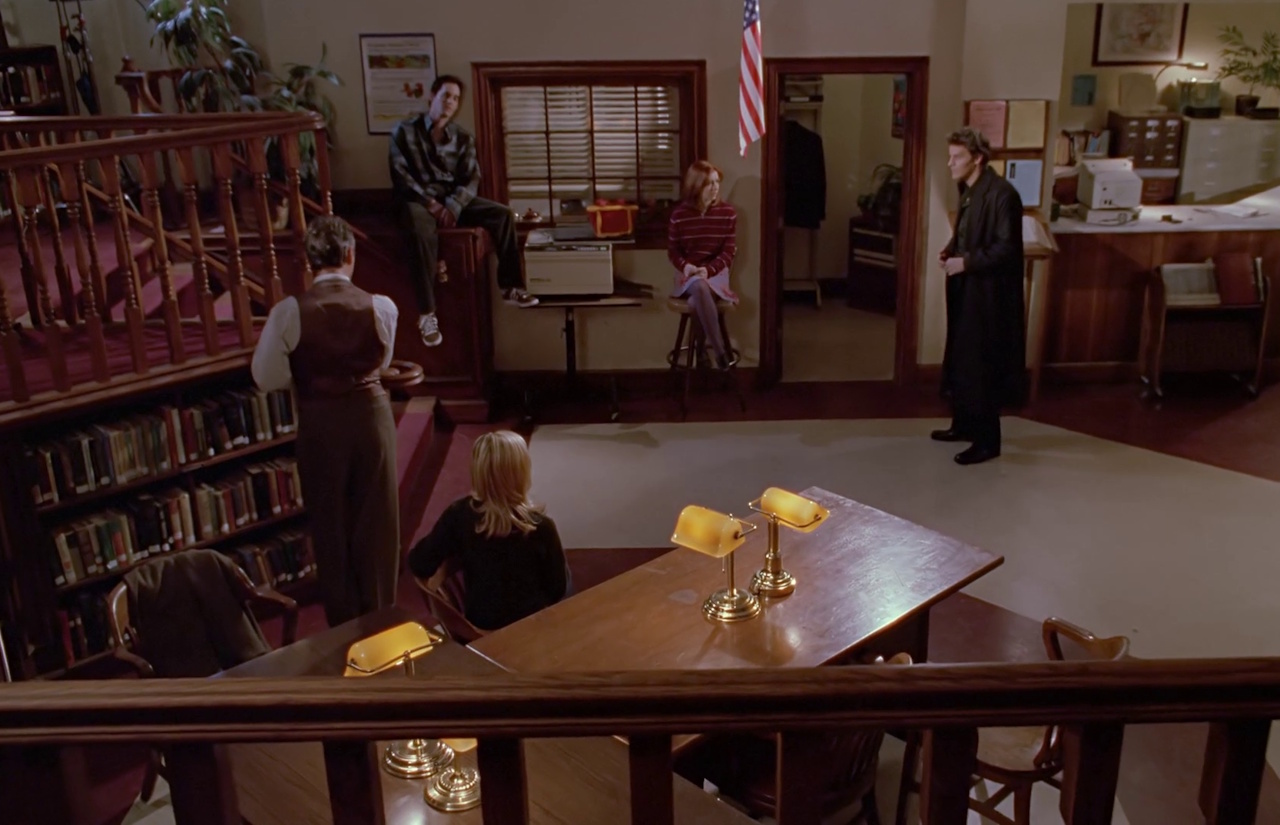
Still frame from Buffy the Vampire Slayer showing the gang in the library.
The Scooby Gang.

Okay, you’re right – I guess seeking shelter at The Magic Box might not be a terrible idea! If we could make it there in the daylight, and explain we’re in danger… all we gotta do is hang out with the gang and wait! But if there’s no slayer, no Magic Box, and just a plethora of vampires and monsters terrorising Sunnydale… I think we’re in a lot of trouble. Stay inside, lock the door, and maybe try to get some kind of really strong UV lamp!

Because Buffy ran for seven seasons, the show sank its teeth into all kinds of monsters, vampires, and ghouls. Sunnydale is a very dangerous place, it would seem. If Buffy and the gang are there and willing to help, this could be a cakewalk. But if we’re unlucky and Buffy’s gone on vacation, we might’ve accidentally stepped into one of the most dangerous, monster-infested settings out there!

Survival Chance: 4/10
(8/10 with Buffy and co., 2/10 without)

So that’s it… for now!

Stock photo of Halloween-themed food.
Halloween snacks!

I hope this has been a bit of Halloween-y fun! I actually really like this “hypothetical question” idea, and it’s one I’d love to revisit in the future – both in horror and non-horror contexts. I’m already brainstorming more questions and scenarios to write about, so if you enjoyed this idea… watch this space!

But I suppose we should pick one of the six options, shouldn’t we, as the answer to the hypothetical posed at the beginning?

I think I’m still leaning towards A Nightmare on Elm Street. I’m confident that I could go 72 hours without sleep, even if it was 1984 and there were no energy drinks or caffeine pills, and all I had was coffee. I know it’s a bit of a sneaky answer, but the objective was to survive 72 hours in a horror setting – not defeat every demon and monster that inhabits it!

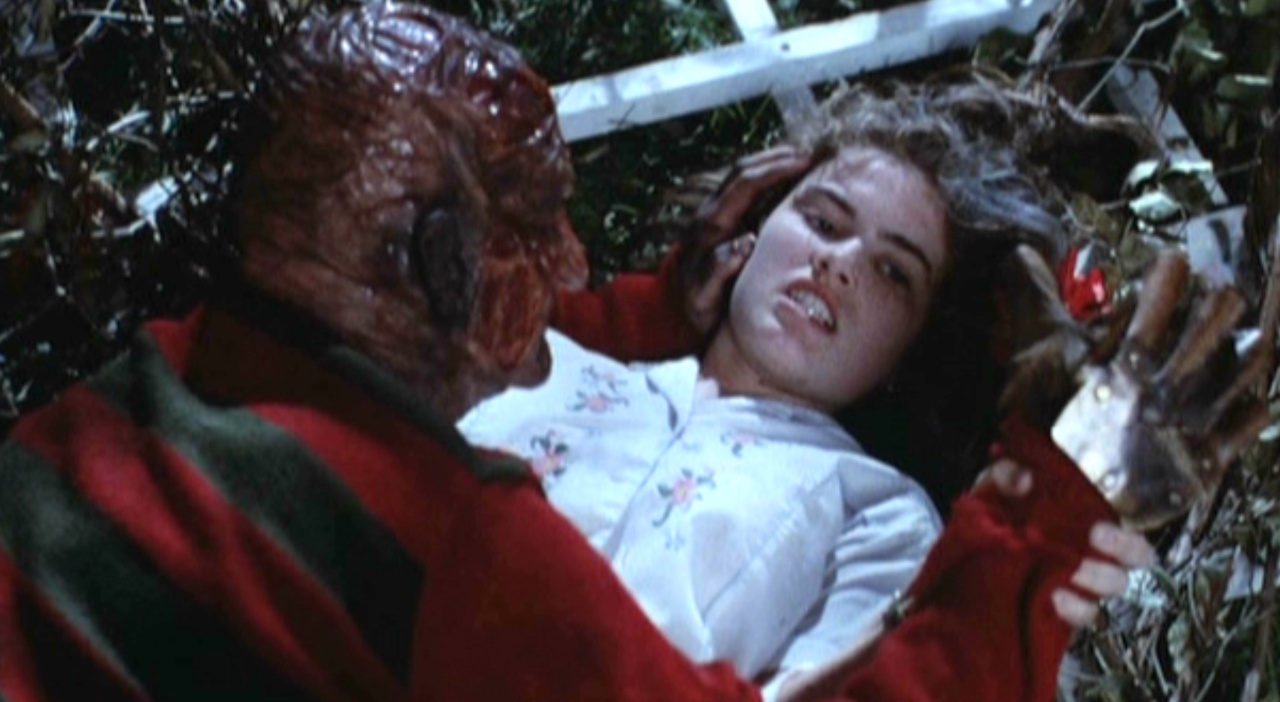
Still frame from A Nightmare on Elm Street showing Freddy and Nancy.
I’m choosing A Nightmare On Elm Street for this hypothetical!

So that’s gonna be my pick. Buffy the Vampire Slayer was tempting, but I think it’s only really survivable if you’re able to team up with the Scooby Gang as soon as you arrive. If you get to nightfall in Sunnydale without support – and without a place to hide – you’re toast. So A Nightmare on Elm Street it is.

As I think I said last time, this year, October has turned out to be a stupidly busy month, so I haven’t had time to write all of the horror and Halloween articles and columns that I’d originally planned. Such is life, I suppose! Some will undoubtedly have to go on the back burner until next Halloween. By the way, is that the first time you’ve heard someone talk about Halloween 2026?

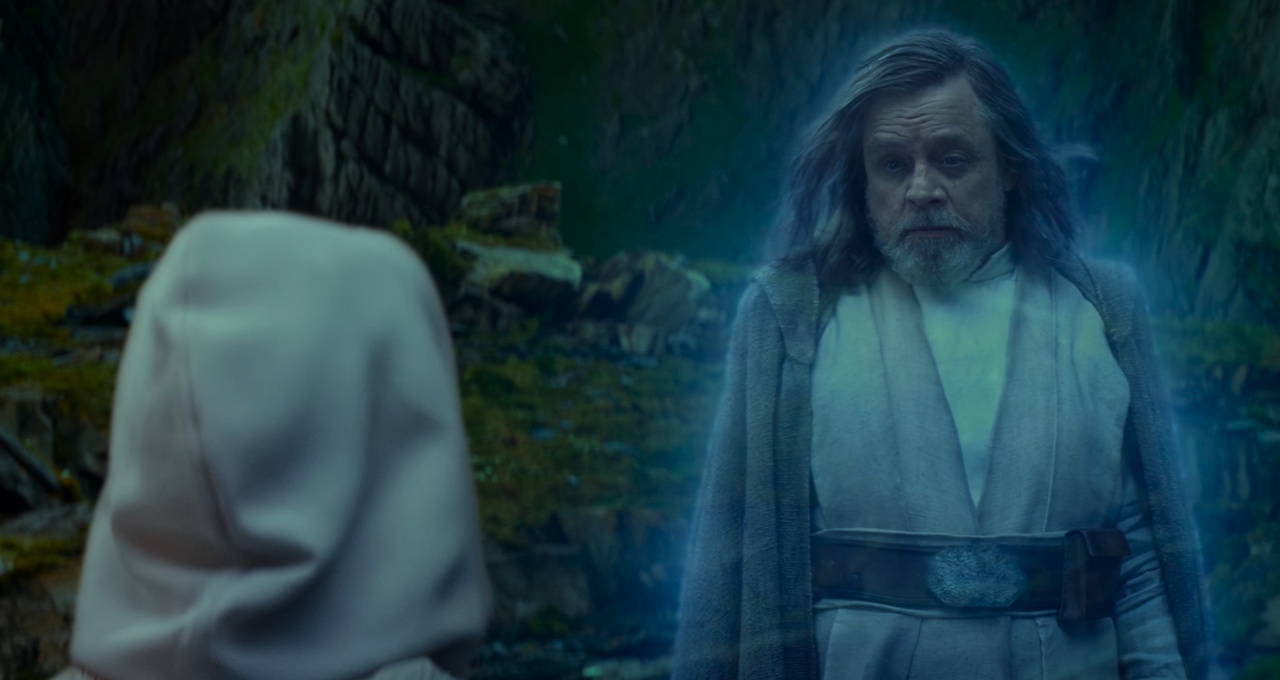
Still frame from The Rise of Skywalker showing Rey and ghost Luke.
A spooky ghost!

As I said above, this piece was partly inspired by the video game Alien: Isolation, which I’ve been slowly working my way through. Trying to survive in that world is genuinely tense and terrifying, and it got me thinking about other horror settings and how long I might last! I think the basic ground rules made for a fun thought experiment, at any rate.

So if I don’t catch you again before the 31st, I hope you have a fun and appropriately spooky Halloween! If you missed it, I wrote up a list of five seasonally-appropriate TV shows that you might want to check out before Spooktober comes to an end – you can find that piece by clicking or tapping here. And if you want a more personal look back at some of my Halloween memories, I wrote about that a couple of years ago – you can find it by clicking or tapping here.

Happy Halloween, everyone!


All films, TV shows, and video games discussed above are the copyrights of their respective studio, broadcaster, distributor, developer, publisher, etc. This article contains the thoughts and opinions of one person only and is not intended to cause any offence.

Doctor Who Is Officially Out Of Ideas…

A Simpsons-themed spoiler warning graphic.

Spoiler Warning: There are spoilers ahead for Doctor Who, including the finale of Season 15.

Almost five years ago, I wrote a piece here on the website titled Another New Doctor Won’t Fix Doctor Who. In that article, I argued that the revived series had pretty much run its course. The Doctor’s old adversaries were played out and had lost their fear factor, new villains were bland and forgettable, and the quality of the writing – particularly when it came to companions, but also for villains and even the Doctor – seemed to have taken a nose-dive. So… have the most recent seasons and specials changed my mind about that? I bet you’ve already guessed my answer from the title of this piece!

I’ll hold up my hands and openly admit that I’m no longer a regular Doctor Who viewer. I’m approaching this subject as an ex-fan; a viewer who’d be willing to come back if things changed, but not someone who regularly tunes in any more. If that makes my take somehow less valid to you… that’s totally okay. But I wanted to be up front about where I stand before we go any further. As I like to say, all of this is the subjective, not objective, opinion of just one critic!

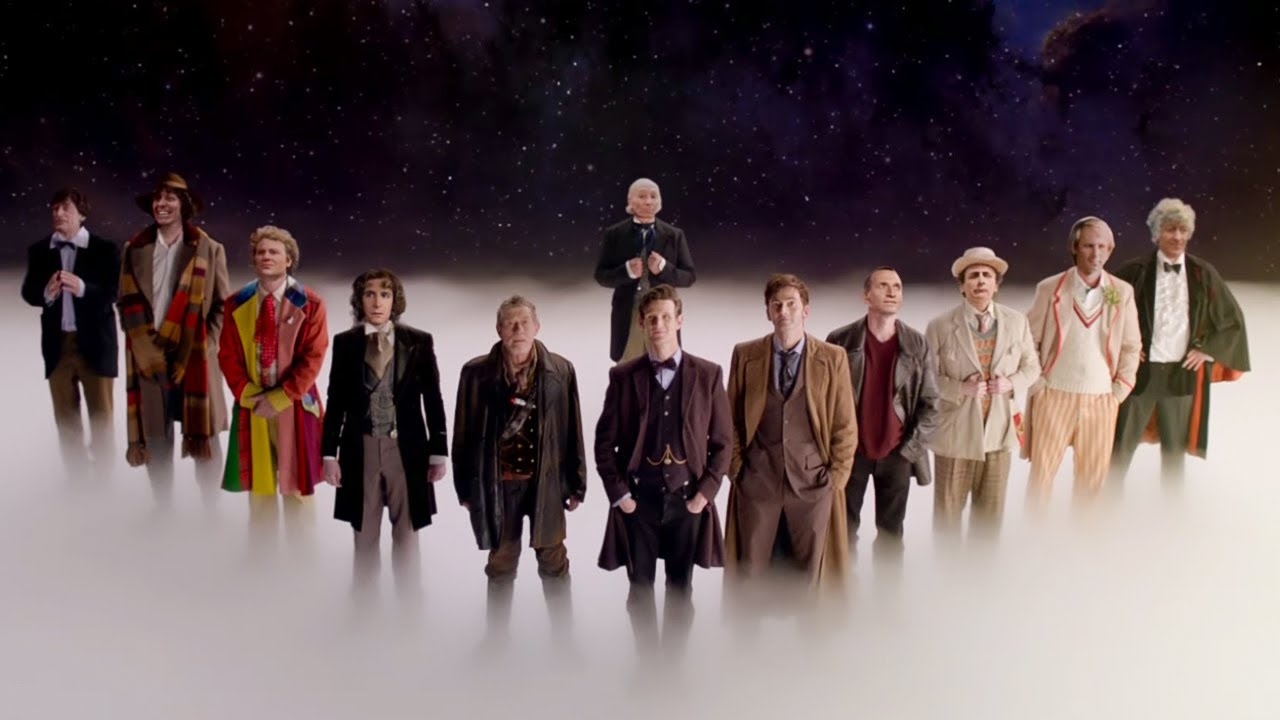
A promotional image for Doctor Who showing the first eleven Doctors plus the War Doctor.
I haven’t been a regular Doctor Who viewer for a while.

When it was announced a couple of years ago that David Tennant would be reprising his role – not for a crossover with Jodie Whittaker’s Doctor, nor for a special episode set in an earlier era – I rolled my eyes so far back in my head that I thought I’d gone blind. Nothing screams “desperation” quite like trying to bring back a long-dead character… and for all intents and purposes, regeneration in Doctor Who is akin to “death” for that incarnation of the character. Tennant’s return to the role smacked of a desperate attempt to play the nostalgia card by a showrunner and writers who’d run out of ideas.

Disney recently stepped up to partially fund Doctor Who’s production, with the expectation that new episodes would air on Disney+ around the world. That investment gave the show a significantly higher budget, but it will have come with expectations or even demands from Disney to meet certain viewership milestones. Tennant’s return can certainly be seen through that lens; Doctor Who’s writers recognised that something hadn’t been working really since Matt Smith’s departure all the way back in 2013, and tried to course-correct the only way they knew how. It didn’t work, and that’s putting it mildly.

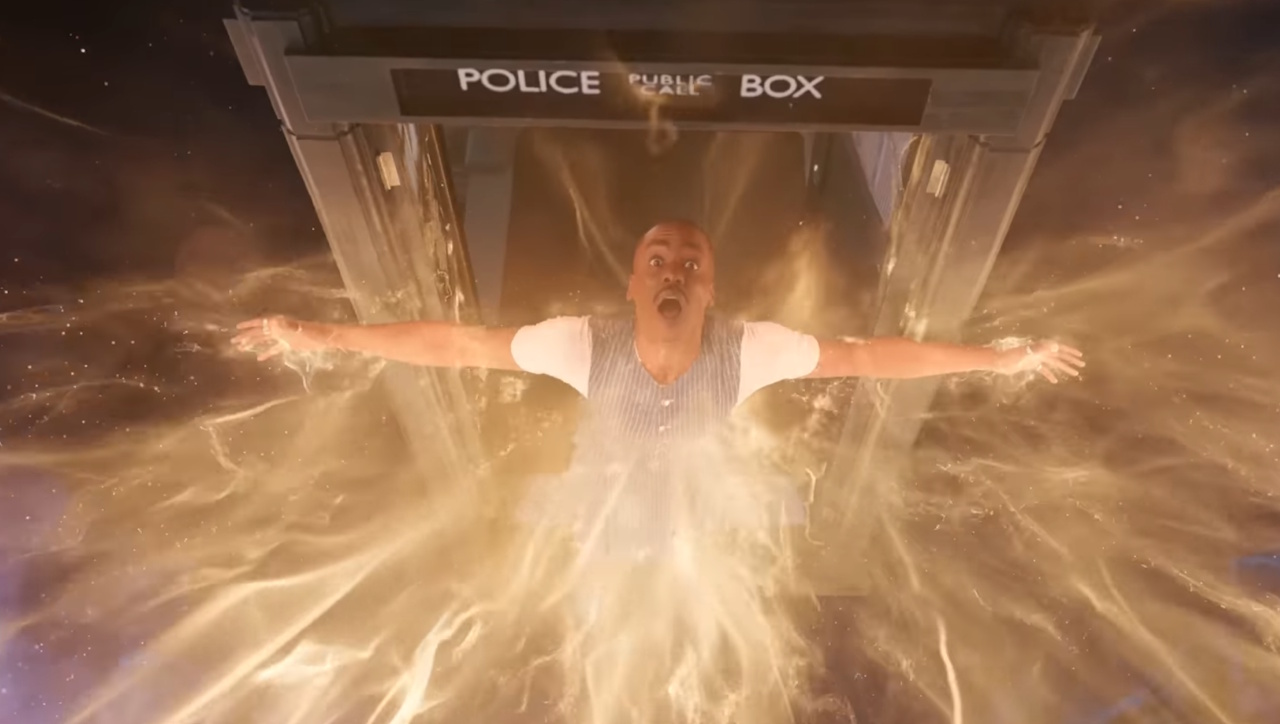
Still frame from Doctor Who Season 15 (2025) showing the Doctor's regeneration.
The Doctor regenerates.

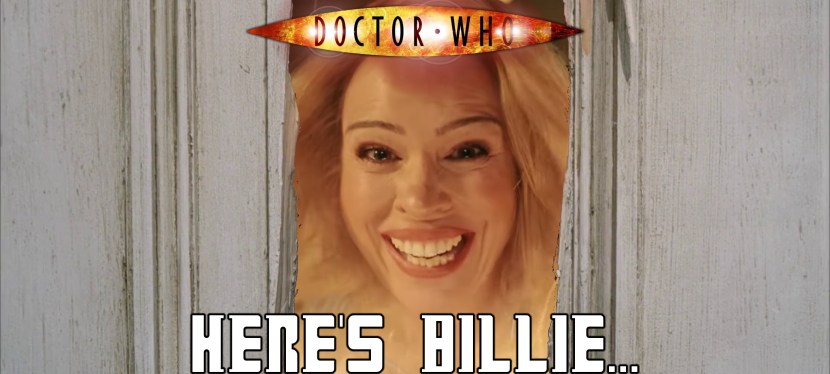
Billie Piper, who played Rose Tyler in the first couple of seasons of the revived Doctor Who, appeared at the end of the most recent season finale – apparently as a new incarnation of the Doctor. As with Tennant’s return above, this smacks of utter desperation and a flailing attempt to use fan-service to bring back the show’s wayward viewers. As one such wayward viewer, I wanted to share my thoughts on this move… and why I don’t expect it’ll work.

The first and most obvious thing to say is this: stories end. Every story has a natural lifespan, and when character arcs are complete, storylines are played out, and there’s nowhere left to go… that’s it. It’s time for the curtain to fall, the credits to roll, and everyone involved to move on. Given the lack of success and dwindling viewership Doctor Who has been finding of late… the show’s at that point. To be blunt, it’s been there for a while. And while there have been creditable attempts to revive its fortunes, these just haven’t worked and the decline has continued.

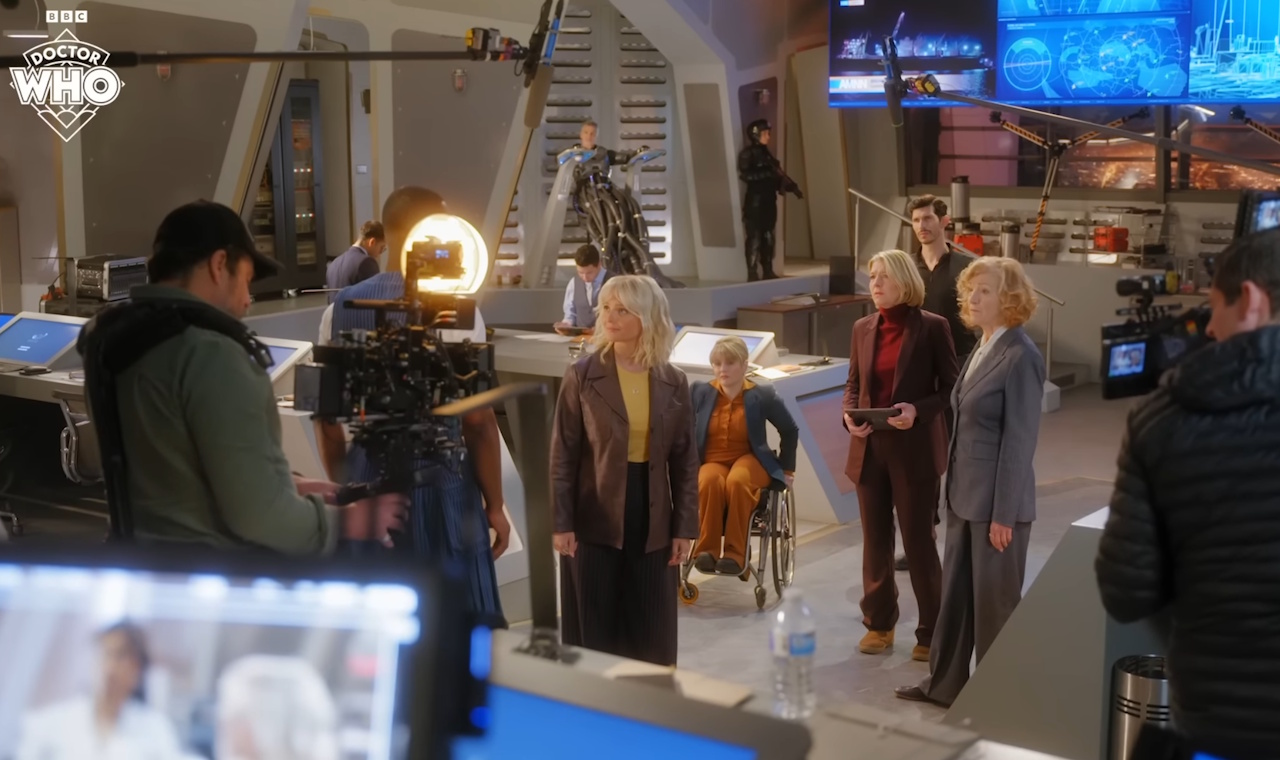
Still frame from a behind-the-scenes look at Doctor Who Season 15 (2025).
Behind the scenes during production on a recent episode of Doctor Who.

This is not meant to be an attack on any of the actors involved in recent seasons of Doctor Who, nor of casting decisions, either. On the contrary, I think both Jodie Whittaker and Ncuti Gatwa are fine performers, and from what I saw of them in the title role, they gave it their all. But some actors are too late to the party, arriving too late into a show’s run to have an impact. Peter Capaldi will forever be my case study in that regard; he was, in my view, pretty much the perfect actor to play the ancient time-traveller, but he got absolutely awful, boring, and uninspired stories for pretty much his entire time in the Tardis.

Some fans may be happy with Billie Piper’s return and the idea of some kind of Rose-Doctor hybrid. I don’t really engage much with the “Whoniverse” fandom online, so I’m not really in a position to judge. But her return isn’t just about pleasing hard-core fans; it’s much more cynical than that. It’s an attempt to shine a spotlight on Doctor Who and to convince lapsed viewers to give the series a second (or third) look. But it’s also an admission from the showrunner and writers that there are no more original ideas in that writing room; that the only thing they can think of is to recycle actors and characters over and over again. When Billie Piper’s done in the Tardis, who’s coming back next? Matt Smith? Noel Clarke?

Still frame from Doctor Who Season 1 (2005) showing Mickey and the Ninth Doctor.
Doctor Who is running out of actors and characters to bring back…

I stand by what I said almost five years ago: if there’s no one at the BBC (or Disney) with a genuinely good, original idea any more, then the show should take a break. Time has flown by, but it’s been twenty years – two entire decades – since Doctor Who returned to our screens in 2005, and this incarnation of the show just feels like it’s run its course and has had everything possible thrown at it. With ratings in what seem to be a terminal decline, putting the brakes on before any more harm is done to the brand is arguably the least-bad course of action.

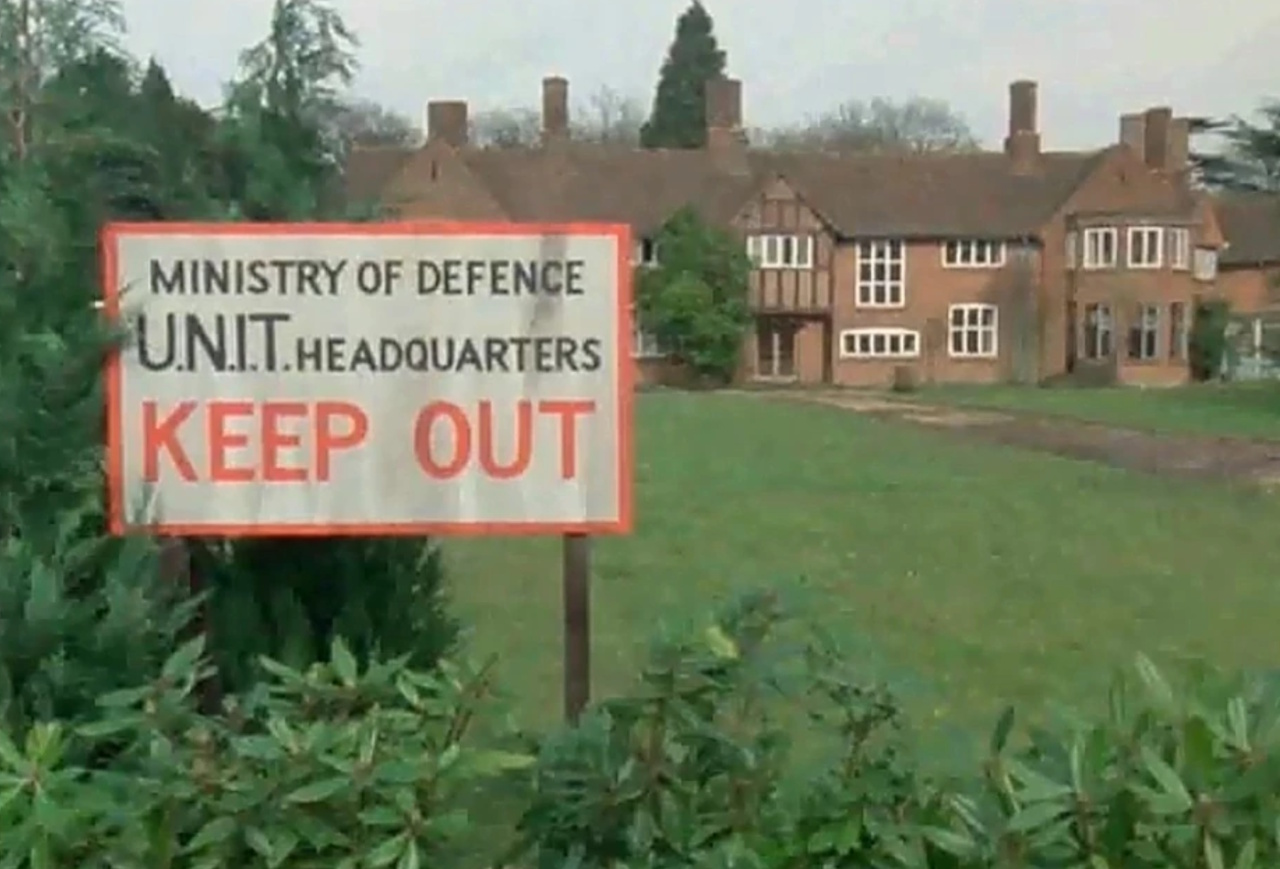
Doctor Who has huge spin-off potential, though, so I don’t believe the end of the main series needs to mean the abandonment of the “Whoniverse.” I wouldn’t like to say what the hard-core fandom might be interested in, but speaking for myself, I’d certainly be interested in a miniseries or film set during the Time War, potentially building on the excellent 50th anniversary special from 2013. There are other spin-off ideas, too, like a series following UNIT or even a revival of Torchwood.

Still frame from the Doctor Who special episode The Five Doctors showing the headquarters of UNIT.
There are other things that the BBC could do with the Doctor Who IP without continuing the main series.

But for the main series? This should really be the end. Billie Piper’s return is the clearest indication yet that the writers have completely run out of ideas, and it’s genuinely sad to see one of the sci-fi genre’s oldest institutions reduced to this bland, uninspired, fan-servicey slop. In theory I get it: you’ve tried new things and they haven’t worked, so retreat to familiar ground and give the fans some “red meat;” something you’re sure will attract attention and get people talking. But it’s just so… empty. So hollow and pathetic, and so very far away from the excellence that was on show in 2005.

Nowadays, it seems as if well-established programmes and franchises aren’t allowed a dignified end. They must be strung out at all costs until every last ounce of value has been extracted from them, no matter the implications for fans and viewers. In the age of streaming, big corporations want well-known names and brands to pad out the lineup on their platforms, and it seems to me that Doctor Who has fallen victim to both of these malicious entertainment industry trends. It isn’t Billie Piper’s fault, by the way, any more than it was Ncuti Gatwa’s, Jodie Whittaker’s, Peter Capaldi’s, or David Tennant’s. She just happens to embody the failure of Doctor Who’s writing, ambition, and overall direction in this moment.

Promotional image for Doctor Who showing fourteen of the fifteen Doctors.
Almost all of the Doctors…

I’m not going to watch Doctor Who for the foreseeable future. And I was a bit of a Billie Piper fan back in the day; I bought her album Honey to the B back in 1998! But her return to this series at this moment feels unnecessary, forced, and like a total desperation play by writers who are out of their depth and out of ideas. Maybe there’s a way for Doctor Who to ride out this current slump and come back stronger – but if there is, it’ll take a total overhaul on the production side, not just a particularly egregious example of stunt casting.

This is usually the point where I’d tell you that I’ve been wrong about these things before and I’ll keep my ear to the ground when Doctor Who returns to see what Billie Piper’s role will be and what her take on the Doctor might look like. But the truth is… I don’t think there’s any realistic chance that the next season of the show will be any better than the last few. Whether Billie Piper is going to be present for a one-off special or a whole season, I don’t think it matters. The series has already lost pretty much everything that made it work, and desperately bringing back a long-gone actor in a way that doesn’t make sense or line up with anything in-universe just… isn’t gonna change that.

Still frame from the end of Doctor Who Season 15 (2025) showing Billie Piper as a new incarnation of the Doctor.
This won’t save Doctor Who.

As a Brit, I want to see British entertainment properties and brands succeed. There’s a weird sense of pride in something like Doctor Who; a series that used to be able to hold its own in a genre dominated by American brands with significantly higher budgets. But I’d rather see the money being thrown at the show invested elsewhere, perhaps giving a new sci-fi or fantasy series a chance. Doctor Who did some great things in both its original incarnation and after its 2005 revival. But in both cases… it ran out of steam. And just as happened in the late ’80s, it’s time to recognise that. It’s time to put the show to bed for a while. Maybe in another fifteen or twenty years, a new generation of writers who grew up on the revival will come in with fresh ideas and the Doctor and the Tardis can make a return. But right now? It’s sad to say, but I think it’s over.

If a new Doctor couldn’t turn things around, if reimagining the Doctor in different ways didn’t help, and if revisiting David Tennant’s popular and successful time in the Tardis also made no difference… what hope does Billie Piper have? I fear that, whatever the writers may have in mind for her, she’s walking into a bear pit. Her exit from the show in 2006 was heartbreaking, but it was also impactful, powerful, and part of an engaging storyline. I fear that her return to the show, in whatever form it may take, will be none of those things. It would be such a shame if one of the show’s most memorable companions ends up being tainted by a totally unnecessary and desperate return.


Doctor Who is out now and may be streamed on Disney+ around the world and on BBC iPlayer in the United Kingdom. Most seasons of the revived series are also available on DVD and Blu-ray. Doctor Who is the copyright of the BBC, BBC Studios, and/or Bad Wolf. This article contains the thoughts and opinions of one person only and is not intended to cause any offence.

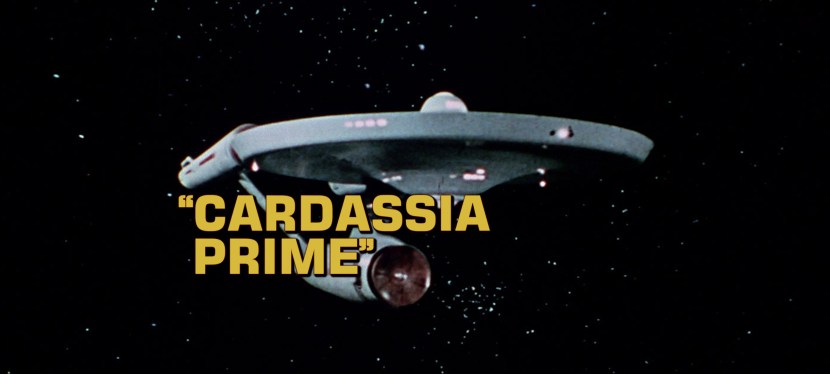
Strange New Worlds Episode Pitch: “Cardassia Prime”

A spoiler warning graphic.

Spoiler Warning: There are spoilers ahead for the following Star Trek productions: Deep Space Nine, Enterprise, Lower Decks, and Strange New Worlds.

Today I’d like to try something a little different. Rather than talking about Star Trek stories that we’ve already seen, I want to write a “pitch” of my own Star Trek episode. This is a story that I think would be a great fit for a future season of Strange New Worlds – or even to celebrate Star Trek’s upcoming sixtieth anniversary. I came up with the idea a couple of years ago, and I’ve already talked about it more than once here on the website.

In brief, what I wanted to create was a Star Trek story that brings together elements from different parts of the franchise – specifically the three different eras in which Star Trek shows have mostly been set (the 22nd, 23rd, and 24th Centuries). Combining these different parts of Star Trek results in what I think would be a really enjoyable episode, one which fans of different Star Trek shows could appreciate. Bringing these different elements together could be a fantastic way to celebrate Star Trek as a whole, too, and with the sixtieth anniversary coming up, part of me hopes that Paramount has planned something along the same lines.

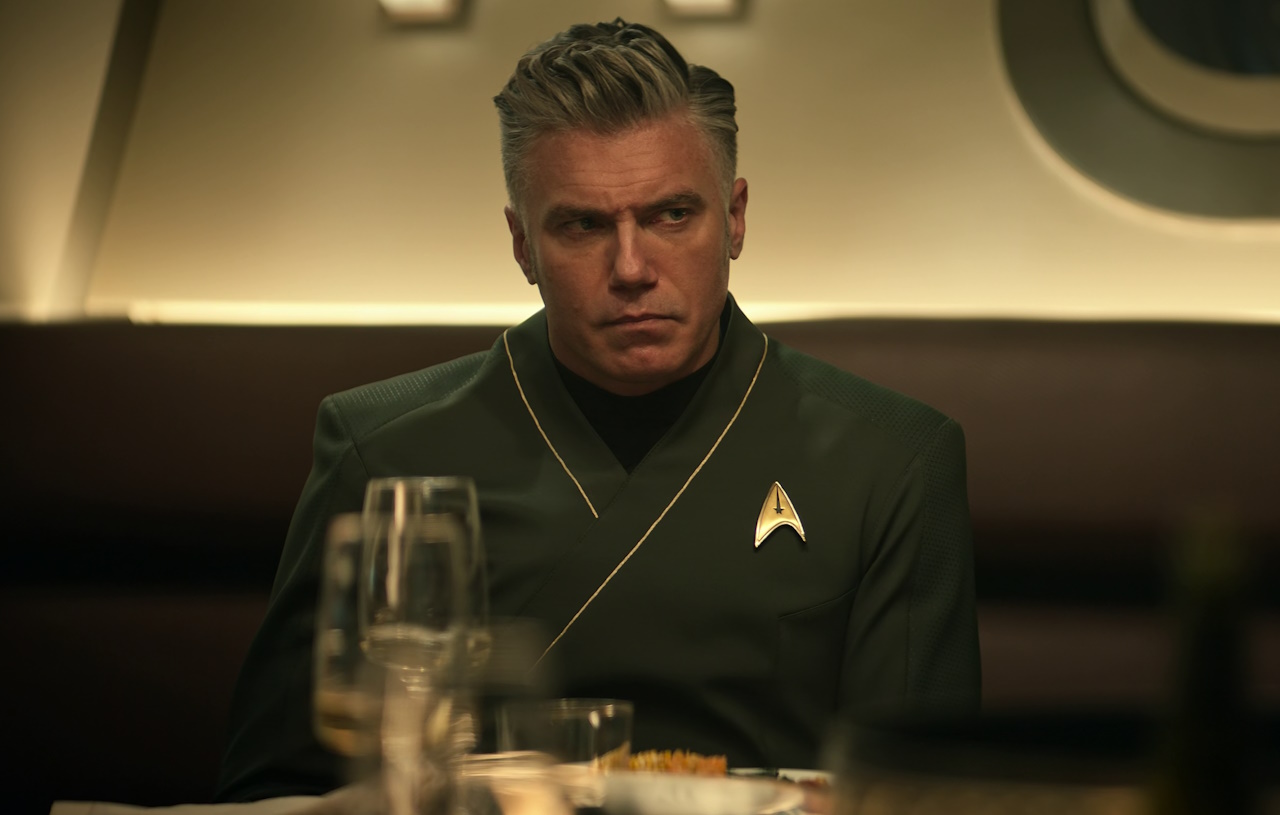
Still frame from Star Trek: Strange New Worlds Season 2 showing Captain Pike.
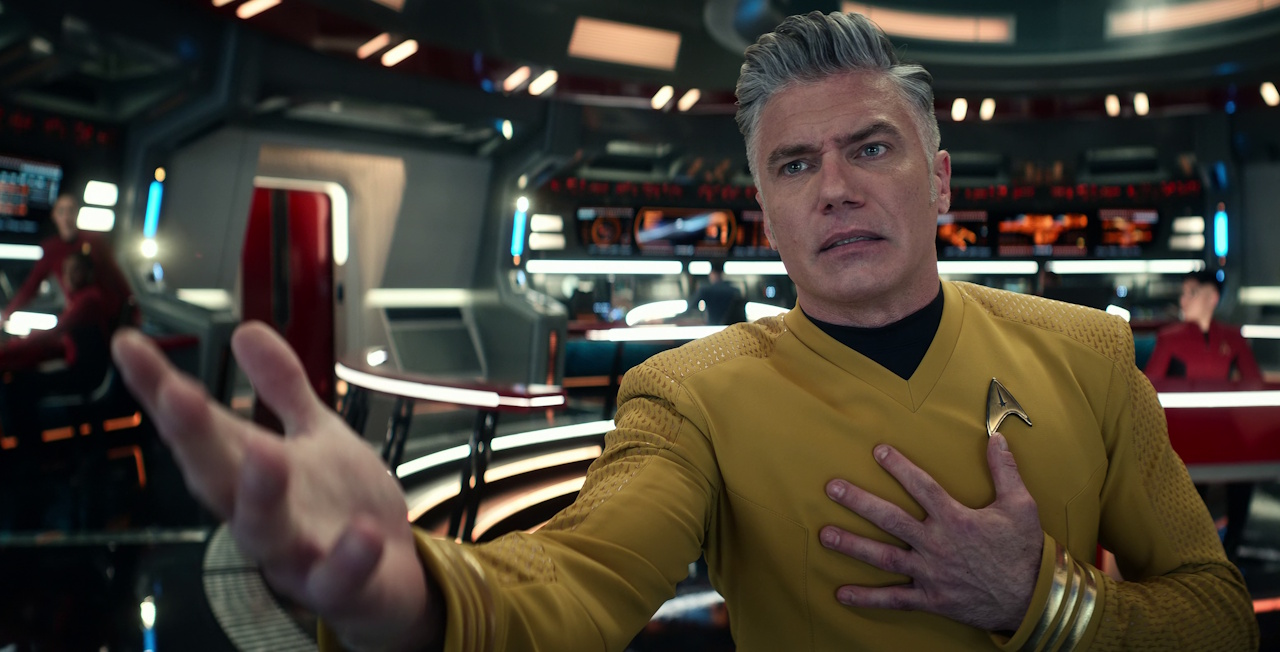
Let’s create our own adventure for Captain Pike!

A couple of notes before we get started. Despite the title, this is not an “official” pitch! I’ve never had any official contact with Paramount or the creative team behind Strange New Worlds, and although I enjoy writing and have worked on websites, marketing material, and video games in a professional capacity in the past, I’m by no means a scriptwriter or creative type myself. This “pitch” is just for fun; it’s a concept that I think would make for a great Strange New Worlds episode… but it’s one that will certainly never be made.

And as I always say: this is all just one person’s take. If you don’t like this idea and think it wouldn’t work as an episode of Strange New Worlds, that’s totally okay! The Star Trek fan community is big enough for people to have very different opinions about what does and doesn’t make for a fun story. This is one that I think could work well – but I won’t be offended if you disagree!

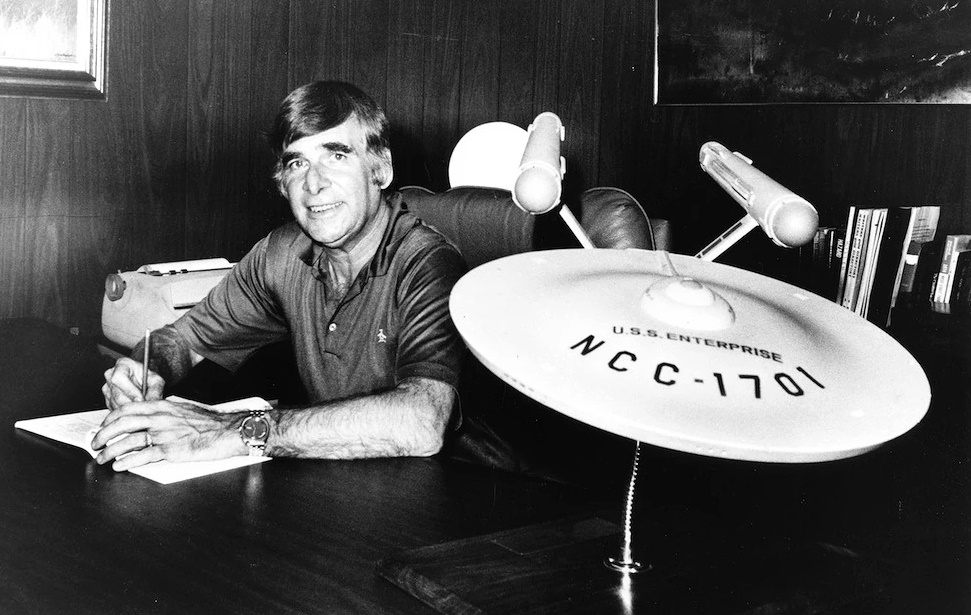
Photo of Gene Roddenberry with a model of the USS Enterprise c. 1970s.
Gene Roddenberry in the early 1970s.

So let’s get started by talking about the different elements I’ll be including. This episode, which I’m giving the working title of Cardassia Prime, will bring together characters and factions from three different parts of the Star Trek franchise. Representing the 23rd Century we of course have Captain Pike, Spock, and the rest of the crew of the USS Enterprise! But they aren’t the only familiar faces who’ll be making an appearance this time.

Strange New Worlds is set a century after the events of Enterprise, but with the long lives of several Starfleet races (and even humans in this era) it’s always seemed plausible to me that some characters may still be alive. I wanted to create a story in which an Enterprise character came aboard Captain Pike’s ship – and the most obvious choice has always been T’Pol.

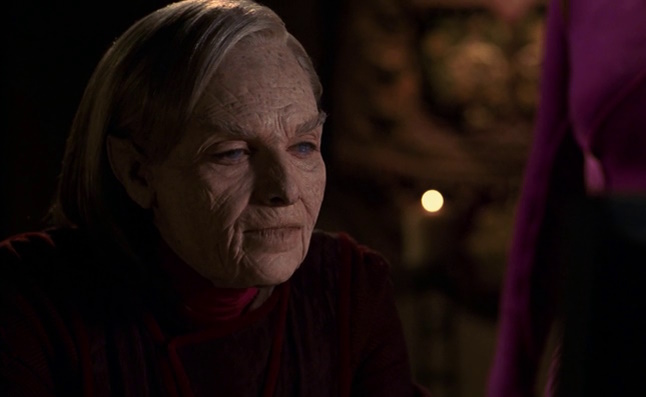
Still frame from Star Trek: Enterprise Season 3 showing T'Pol (with old age makeup).
An elderly T’Pol, as seen in the Enterprise Season 3 episode .

T’Pol was the NX-01’s first officer, science officer, and Vulcan attaché, serving under Captain Archer during that ship’s missions of exploration and first contact. She stood by Archer’s side during the Xindi conflict, and played a role in changes to the Vulcan government in the 22nd Century, too. She was also instrumental in the creation of the United Federation of Planets. Everything we know about Vulcans tells us that there’s a high likelihood of T’Pol still being alive in the mid-23rd Century; both Spock and Tuvok lived exceptionally long lives, so there’s no reason to think T’Pol wouldn’t. She could even still working for the Federation or Vulcan government in some capacity as of the time Strange New Worlds is set.

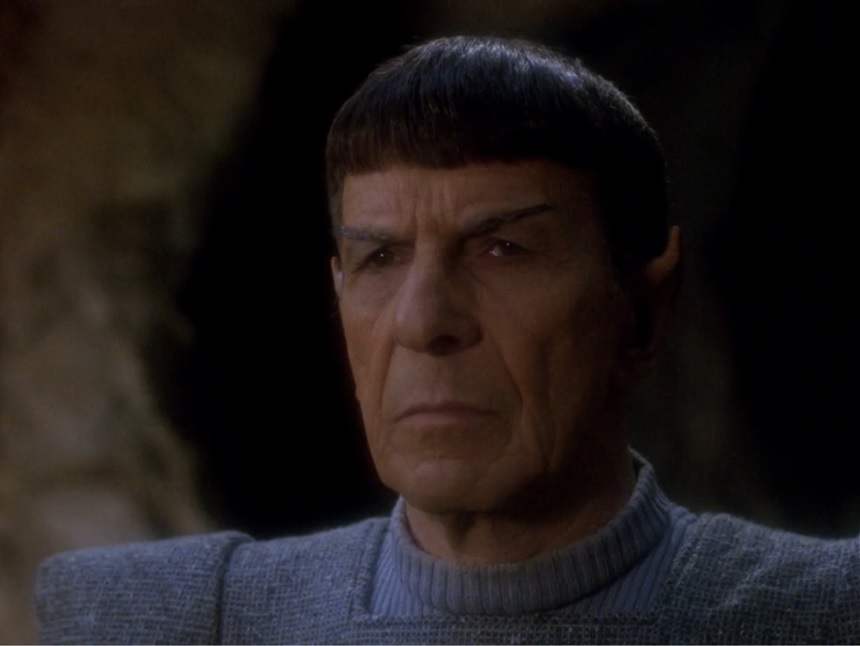
I’ve taken this as a starting point for T’Pol and given her a job similar to Spock’s in The Next Generation two-part episode Unification. For the sake of this story, we’ll say that T’Pol – who played a major role in deepening the alliance between humans and Vulcans that ultimately led to the creation of the Federation – has since taken on an ambassadorial, diplomatic role for the alliance, and it’s in this capacity that she joins Captain Pike’s ship.

Still frame from Unification (Star Trek: The Next Generation) showing Spock.
T’Pol’s job as a Federation ambassador and diplomant will be comparable to that of Spock’s in Unification.

What I’d love to see here, beyond the main thrust of the episode’s plot, is the interaction between an older T’Pol and the younger Spock. As the first Vulcan to work extensively with humans and serve aboard a human starship, T’Pol will surely have pearls of wisdom to impart, and may even look at Spock very favourably as someone following in her own footsteps. Although we’re dealing with two cool, logical Vulcans, I think there’s the potential for some genuinely emotional moments between T’Pol and Spock.

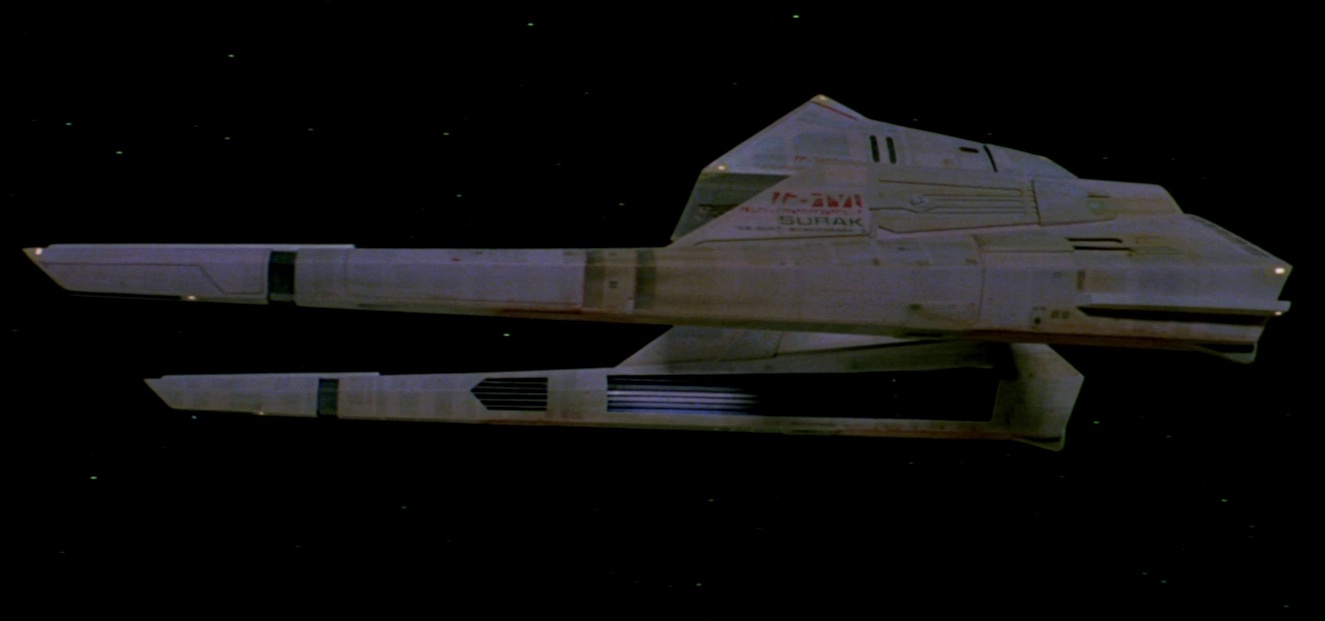
T’Pol will present Captain Pike with his new orders shortly after coming aboard: the Enterprise is to proceed to a region of space where a Federation colony vessel has accidentally caused a diplomatic incident by straying into a star system claimed by an unknown alien power. T’Pol’s orders are to defuse the situation and prevent it from escalating into a conflict; Pike’s are to get her there at top speed and do whatever she needs him to do to make it happen. We could see, in the opening act of the episode, T’Pol arriving aboard a Vulcan shuttle similar to the one used by Spock in The Motion Picture, as I think that would be a neat little callback and a fun visual presentation.

Still frame from Star Trek: The Motion Picture showing Spock's warp shuttle.
T’Pol could arrive aboard the Enterprise on a shuttle like this one.

The alien power at the centre of the story will be revealed to be the Cardassian Empire – as you’ve probably already figured out from the title! The Federation colony vessel was apprehended while attempting to scout planets in a star system that the Cardassians claim as one of their own, and this will be how the Federation and Cardassians made first contact – something that has never been depicted or explained on screen before.

By creating this backstory of the initial contact between the Federation and Cardassians, one in which war will be barely averted thanks to the efforts of T’Pol and Captain Pike, I think we can lend a bit of perspective to stories in The Next Generation and especially Deep Space Nine. We’ll uncover another chapter of Federation-Cardassian relations, and show that things got off to a rocky start – perhaps lingering ill-will from this incident even contributed to the border wars that we know the Federation and Cardassians fought in the years before The Next Generation.

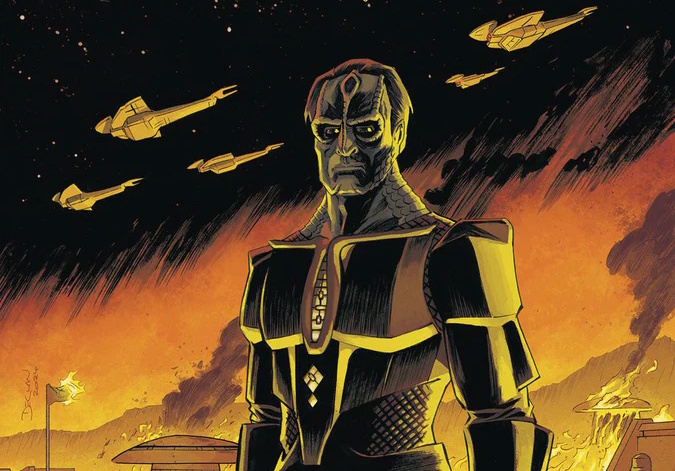
Crop of the cover of the comic Star Trek: Defiant showing a Cardassian with several Cardassian spaceships in the background.
The Cardassians will be this episode’s antagonists.
Image Credit: IDW Publishing/Paramount

Because the Cardassians haven’t been seen in detail in Star Trek’s modern era, I think a lot of fans will be thrilled to welcome them back to the franchise. By setting up the Cardassians as the episode’s adversaries, we continue the theme of seeing them as an enemy that was present in Deep Space Nine, but by making the Federation colony ship the one to have made a mistake, we give them at least the barest bones of motivation for acting the way they do toward Starfleet and our heroes. These are not one-dimensional, “evil-for-the-sake-of-it” baddies, and they are able to be negotiated and reasoned with.

In fact, this episode won’t be violent. Captain Pike won’t have to whip out his phaser – or if he does, he won’t have to fire a shot. In true Star Trek style, communication, understanding, and cooperation will be the order of the day, and once it becomes clear what happened – that the colony ship inadvertently entered space claimed by the Cardassians – a pathway will be present that leads to a peaceful resolution. It will take all of T’Pol’s century of experience to avert a conflict and get these negotiations over the line, but it will be possible. Spock will have a role to play here, too.

Still frame from Star Trek: Strange New Worlds Season 2 showing Spock.
Spock will join forces with T’Pol.

As a faction we spent so much time with in Deep Space Nine, we know a fair amount about how the Cardassians operate. They’re secretive, militaristic, and can be xenophobic. They fiercely defend their territory, have no qualms about conquering and subjugating others, and have a rigid legal code in which guilt is usually presumed.

But with more than a century of experience under her belt, T’Pol will be able to find a peaceful solution. Neither side wants war, and it’s ultimately going to be in both parties’ best interests to resolve the current situation peacefully – though both Starfleet and the Cardassians will stringently monitor their borders from this point onwards!

Still frame from Star Trek: The Original Series showing the Romulan Neutral Zone on the Enterprise's main viewscreen.
This episode will establish the Cardassian-Federation border.

In terms of the structure of the episode itself, I think I’d open with a short teaser in which Captain Pike, Spock, and perhaps other members of the bridge crew are preparing for the arrival of an ambassador. They’d be wearing their finest dress uniforms as the shuttle arrives, and there’d be an “honour guard” similar to the one seen in Journey to Babel. When T’Pol is seen for the first time, that’s when the opening titles would kick in. The next sequence would see Pike assign Spock as T’Pol’s aide while she’s aboard the ship, leading to some scenes between them in which we’d get the aforementioned bonding while en route to Cardassian space.

Spock would be curious about T’Pol; she’s somewhat of a legend in his eyes, as one of the first Vulcans to work so extensively with humans, and he sees parallels to his situation. There’s almost a kind of hero worship in the way Spock views T’Pol – something Chapel or Una might tease him about if they have a moment together later in the episode!

Still frame from Star Trek: Enterprise Season 2 showing T'Pol sat at a table.
T’Pol.

As the Enterprise arrives in this new star system, the ship would be confronted by at least one Cardassian vessel. I’d want this ship to look like a stripped-down Galor-class vessel; different enough to be distinct, but similar enough in style and shape that it would be recognisably Cardassian for returning fans. I’m no graphic designer (as you can probably tell) but I think it’s important given the type of story we’re crafting that the design of the new ship is similar enough that it could reasonably be part of the same Cardassian Union that we’re familiar with.

The same would be true of the Cardassians’ uniforms. I wouldn’t want an exact duplicate of the Cardassian armour that debuted in The Next Generation, but as above with the way their ship looks, uniforms/armour would need to be familiar enough that a returning fan could recognise it and understand that it’s part of the same faction – just from an earlier era.

Still frame from Star Trek: Lower Decks showing a Cardassian spaceship.
I’d like the Cardassian ship to be reminiscent of the Galor-class but without being identical.

The Cardassian leader would angrily tell Pike to leave the system, threatening the Enterprise before abruptly ending the communication. Pike would then summon T’Pol to the bridge, letting her take the lead when it comes to speaking to the Cardassians. Long-range scans would be able to detect the colony ship – but it’s under guard, and the Cardassians aren’t going to just let the Enterprise rescue it without putting up a fight. Not wanting to trigger a war – and perhaps thinking back on his experiences in the episode A Quality of Mercy – Pike would talk with La’an and Una about a backup plan… just in case T’Pol’s negotiations fail.

At this point, we’d learn that the Cardassians have long been aware of the Federation – but because of how closed-off their society is, they chose to spy from afar rather than make contact. This revelation would be unsettling; Spock would remark that the Cardassians know far more about them than they do about the Cardassians, leaving them at a disadvantage in either combat or communication.

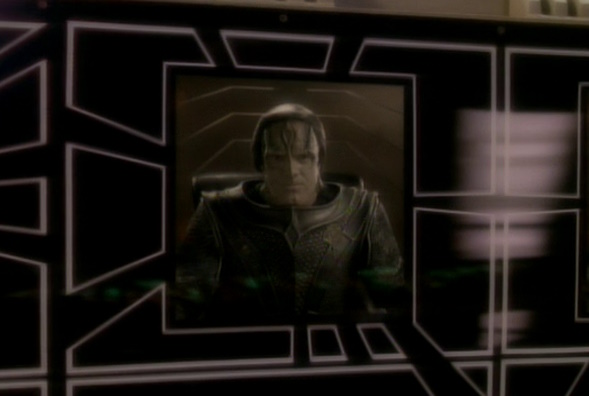
Still frame from Star Trek: Deep Space Nine showing a former commander of Terok Nor on a viewscreen.
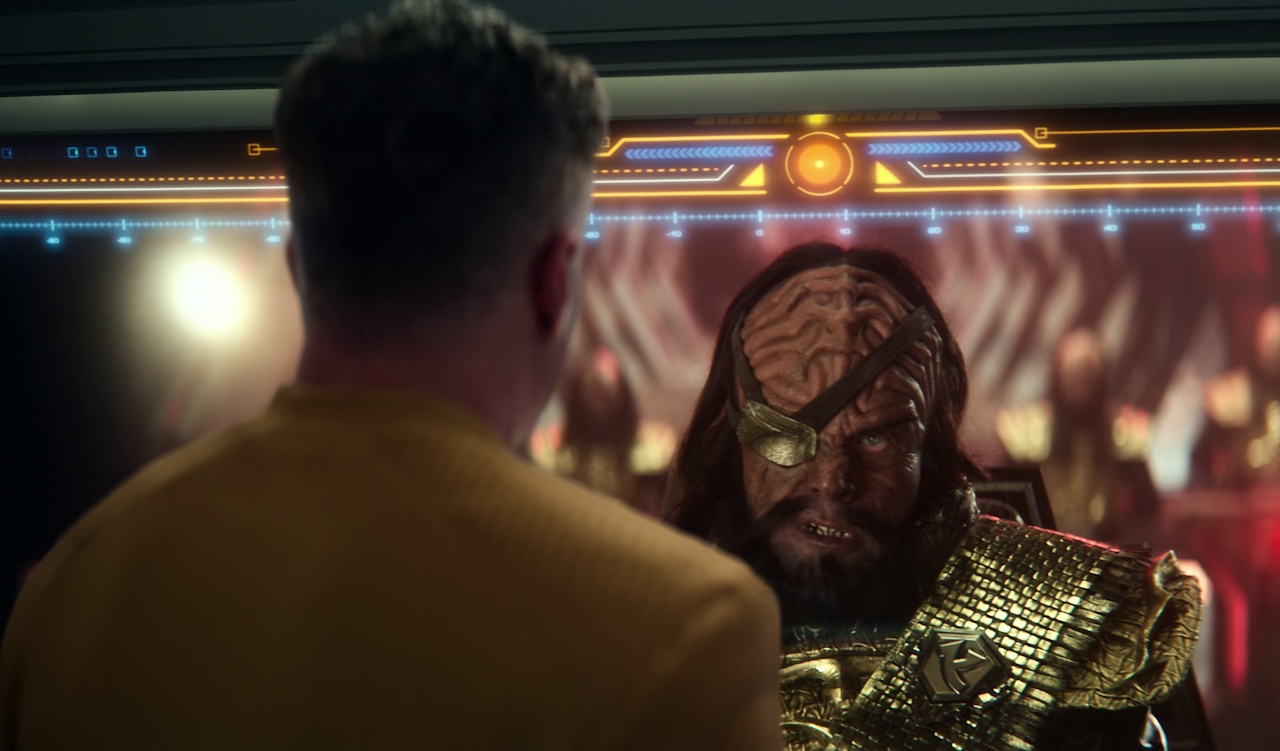
The Cardassians’ first message would be abrupt and aggressive.

T’Pol would refute this, saying that she’ll use the Cardassians’ assumptions about humans, Vulcans, and the Federation to undermine their claims and turn things to her advantage. Hailing the Cardassians again, T’Pol and Pike propose face-to-face negotiations; these will take place not aboard the Enterprise, but aboard the Cardassian ship. T’Pol will represent the Federation, bringing with her Spock as an aide, Sam Kirk as an anthropological expert, and Uhura to help with any translation or communication issues.

As the away team heads to the transporter room, Pike convenes a meeting of the remaining senior officers. Pelia will bring Scotty along to the meeting, which is to further explore a backup plan – rescuing, if necessary, T’Pol and the away team as well as the impounded ship. La’an and Scotty will work on a tactical/engineering assignment to bring down the Cardassian ship’s shields; Pike wants to keep something in reserve in case things go off the rails.

Still frame from Star Trek: Strange New Worlds Season 2 showing La'an.
La’an will be paired up with another legacy character this time!

The interior of the Cardassian ship will probably have to be just one room to keep the budget down, but with the AR wall I’d hope it could be a decently-sized space with a table for the two delegations to sit at. In keeping with the design philosophy we discussed above, there should be enough familiar elements to be recognisably Cardassian but without being a carbon copy of something from Deep Space Nine. I’m thinking of a familiar Cardassian computer display, perhaps doorway arches that are reminiscent of those aboard DS9, and similar lighting and colour schemes.

The Cardassian leader will argue that, under Cardassian law, the colony ship has been rightfully impounded and they have no plans to release it. They were guilty the moment they entered the system, and the Cardassians believe in the presumption of guilt. Unless T’Pol can actively prove their innocence, he plans to send the crew and colonists to a labour camp and seize the ship.

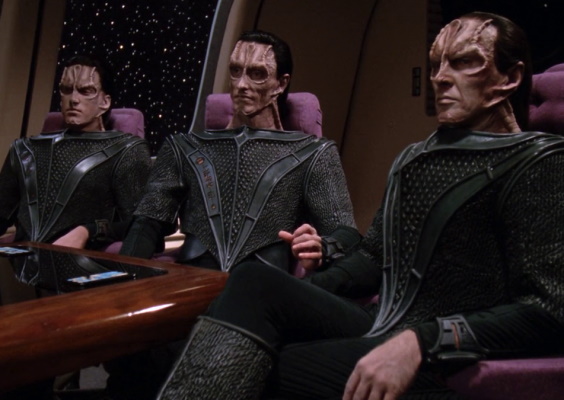
Still frame from Star Trek: The Next Generation (Chain of Command) showing three Cardassians sat at the Enterprise-D's briefing room table.
The Cardassian delegation will insist that the Federation colony ship violated their laws.

There will be some difficulty with the universal translator at this point, so the conference will go into recess. Uhura will be confused; the translation stopped working for no reason and she can’t figure out why. Spock begins to examine their equipment, but T’Pol will reveal the ruse: she deactivated the translator to give the team a bit of extra time to prepare a defence.

T’Pol will contact Pike, asking him to scan the system for any sign of a Cardassian presence or any kind of beacon or subspace buoy that could’ve warned the colony ship to keep away. Pike promises to do so and sets the crew to the task. With the translator “repaired,” T’Pol can begin her defence.

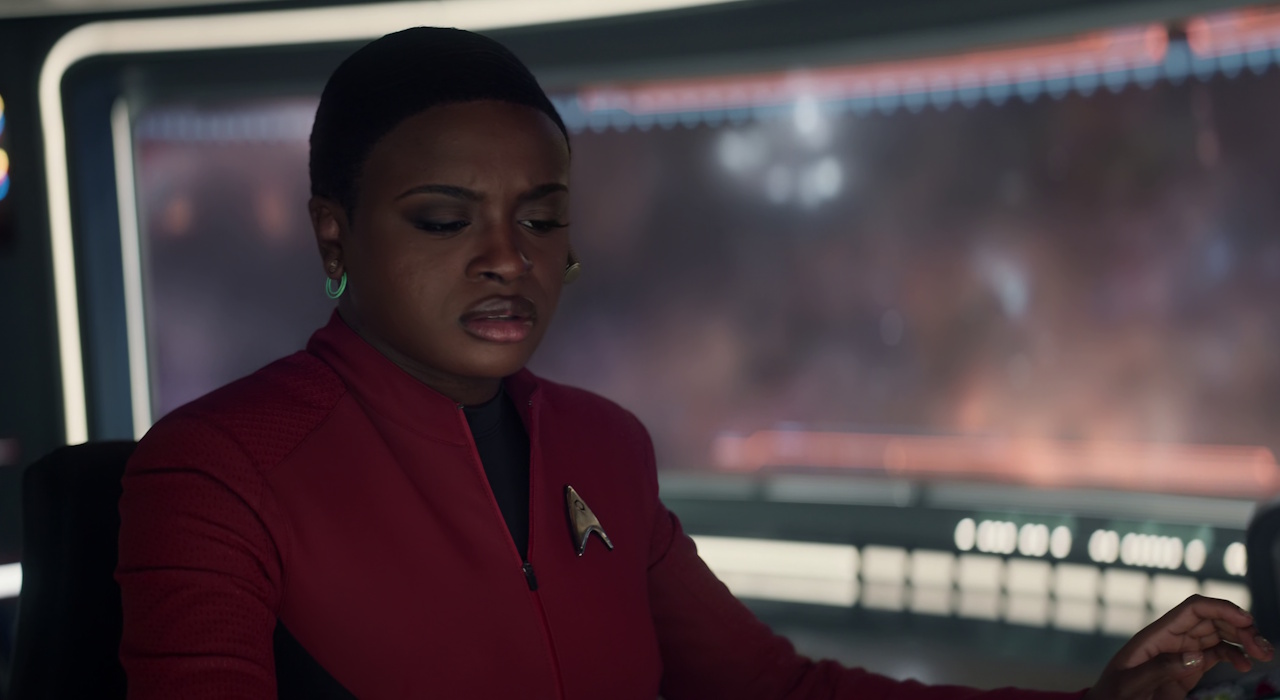
Still frame from Star Trek: Strange New Worlds Season 2 showing Uhura at her post.
Uhura will have a role to play in the away mission.

T’Pol will argue that the colony ship couldn’t have violated any law as there was no way to tell that the Cardassians have laid claim to this apparently-empty system. There are no Cardassian settlements, no space stations, and no obvious military presence. To any passing ship, the system appeared empty, and the colony ship was well within its rights to enter the system and begin performing scans.

The Cardassians will dispute this, saying that ignorance of the law is not an excuse for breaking the law. The colony ship entered their system, that is beyond dispute. Furthermore, by conducting scans, the ship could’ve been spying for the Federation, trying to discover Cardassian military secrets. T’Pol remarks that, just because that’s how the Cardassians operate, it doesn’t mean Starfleet behaves the same way. She appeals to the Cardassians’ knowledge of Vulcans, reminding them that Vulcans are incapable of lying; if she swears the colony ship wasn’t spying, then it wasn’t.

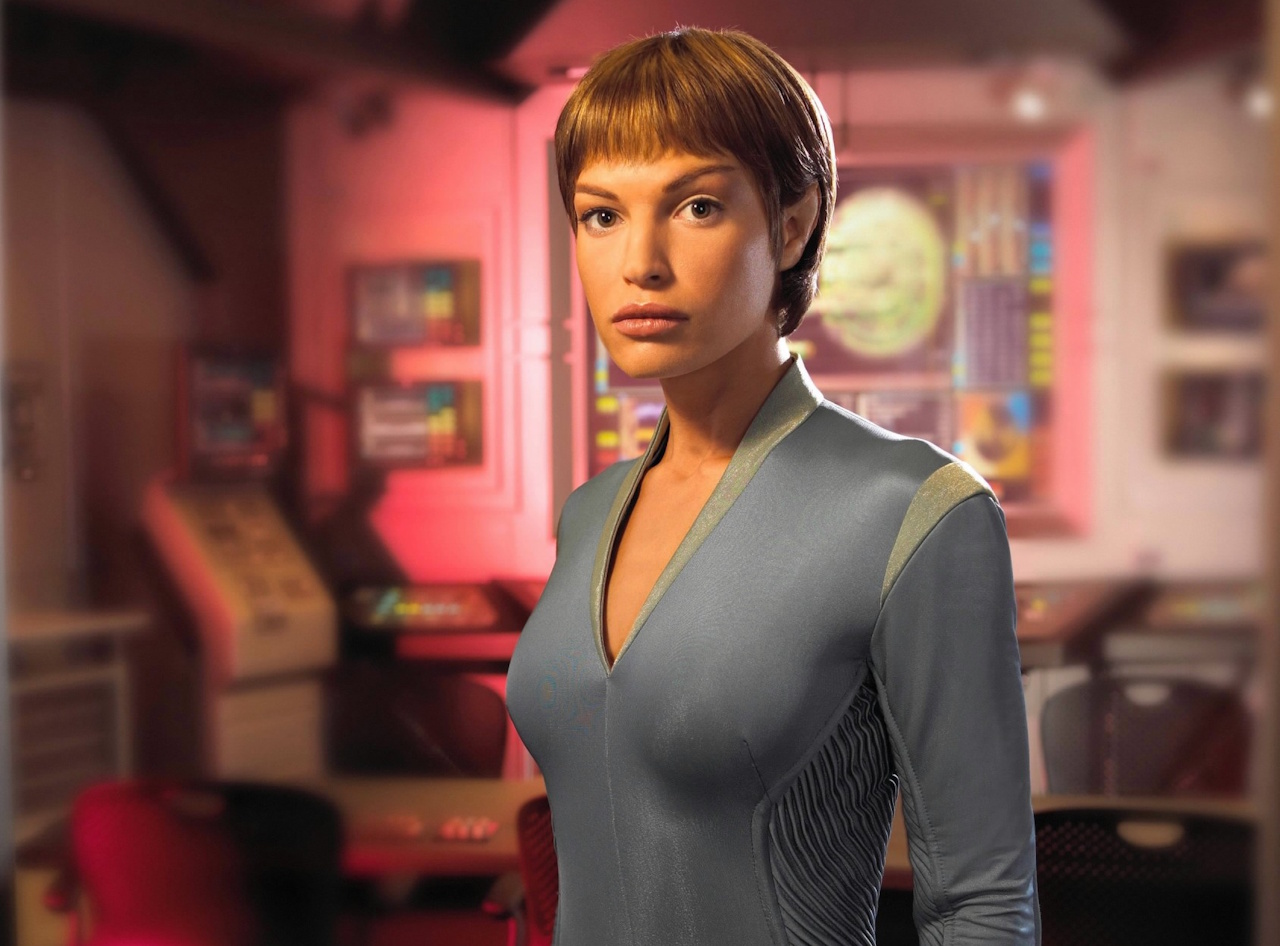
Promo photo for Star Trek: Enterprise Season 4 showing T'Pol.
T’Pol will use the Cardassians’ knowledge against them.

Pike contacts the away team, confirming that there’s no way the colony ship could’ve detected any Cardassian presence in the system. The Cardassians left no warning, no buoy enforcing their claimed border, and no indication whatsoever that they considered this empty system to be their territory. T’Pol thanks Pike for the information and adds it to her argument. She then chastises the Cardassians for arresting the crew of the ship without cause, and suggests that, if the captain won’t release the colonists, she’ll take the matter directly to the Cardassian government.

The Cardassian captain is clearly rattled by this idea, as he wants to solve the matter himself. Seeing the potential for a career-ending incident, he backs down – but insists that the Enterprise and the colony ship leave the system immediately. T’Pol agrees, noting that the system will be declared off-limits to future Federation vessels heading this way. She adds that, now first contact has been made, it would be logical for both the Cardassian Union and the Federation to designate a formal border; the Cardassian captain nods, and the away team departs.

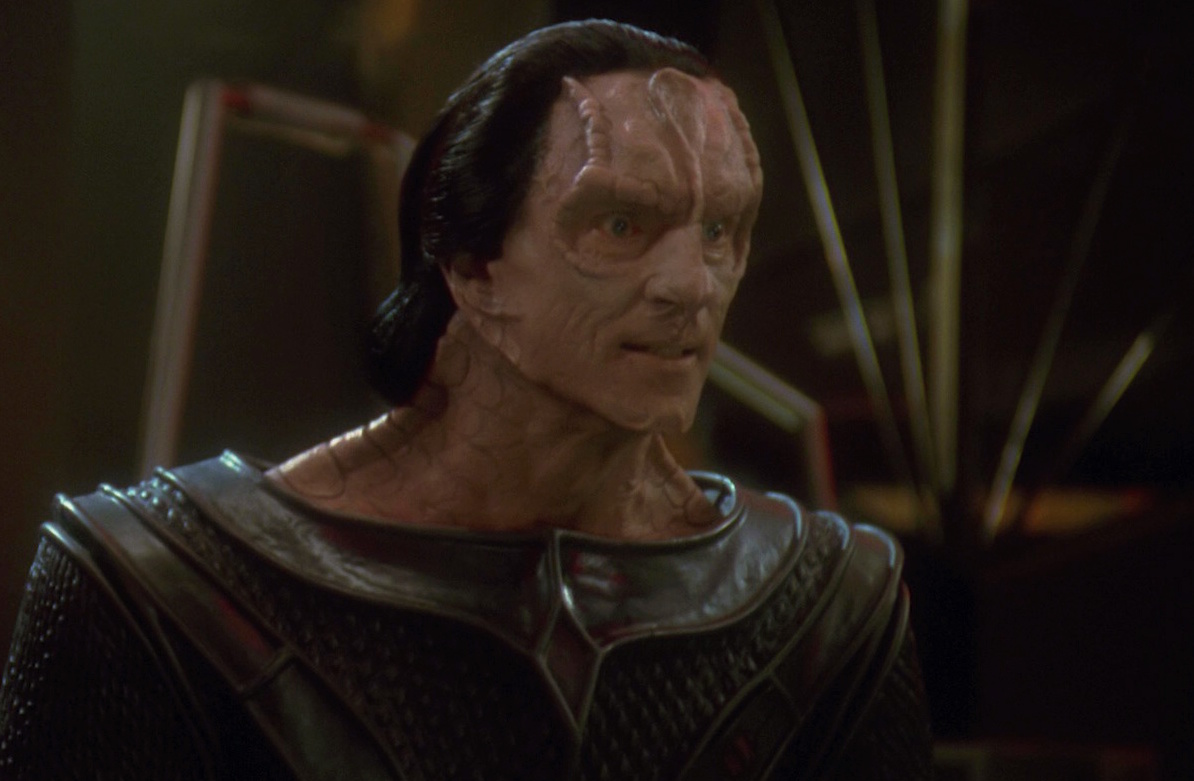
Still frame from What We Left Behind: Looking Back at Star Trek: Deep Space Nine showing Gul Dukat (in HD).
Despite the Cardassians’ attitude, a peaceful resolution will be possible.

Back aboard the Enterprise, Scotty and La’an have struggled to find a way past the Cardassian ship’s defences; Scotty remarks that their ship is almost a perfect match for the Enterprise in terms of weapons and shields; a shooting match between them could go either way. Even with Ortegas’ fancy piloting, the vessels would still be evenly matched if a fight were to break out.

With the situation now under control, the Cardassians release the colony ship. Pike gets confirmation that the crew and colonists are all accounted for an unharmed, and the two ships depart the system. First contact with the Cardassians was eventful – but fortunately, non-violent.

The original matte painting which represented the Cardassian homeworld in The Next Generation and/or Deep Space Nine.
Cardassia Prime – the original matte painting.
Image Credit: Frogland Archive/Heritage Auctions

In her cabin, T’Pol would be sending a final message to Federation HQ before preparing to disembark. Spock enters, telling her how he appreciated getting to work with her on this assignment – and he will escort her to the transporter room. T’Pol gives Spock some words of advice on working with humans – but as she stands on the transporter pad, she gives Spock a smile before dematerialising. Spock finds this “fascinating,” and the credits roll.

Obviously I didn’t write any dialogue; this is an outline or concept rather than a full script! But I hope I’ve been able to communicate the broad strokes of what this Cardassia Prime episode would look and feel like.

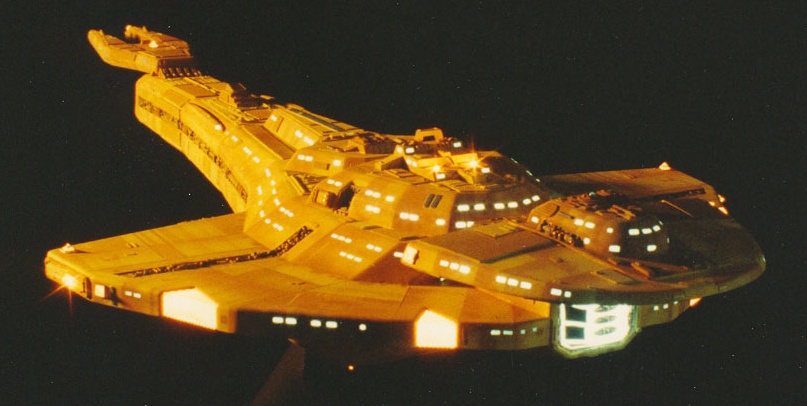
A photograph of the original filming model of a Cardassian Galor-class spaceship.
The original Galor-class studio model.

My objective was to bring together elements from the 22nd, 23rd, and 24th Centuries, tying together all three of Star Trek’s “main” eras with one narrative arc. This storyline would also avoid treading on the toes of anything previously established in Star Trek; unlike Strange New Worlds’ introduction of the Gorn, for example, or Discovery’s redesign of the Klingons, the history of how the Cardassians and Federation made first contact has never been so much as mentioned. All we know for sure is that, as of the mid-24th Century, there had been a conflict of some kind situated on the border. This story would foreshadow that in a way, while also connecting events in the 24th Century to this earlier time period.

We absolutely could flesh out this story a lot more. In my head, the negotiation sequence is quite tense and takes up much of the middle and latter part of the episode. T’Pol and the Cardassian captain – who could be played by an actor who previously had a role in Deep Space Nine – would talk around each other for several minutes, and there’d be a real sense that she and the away team were in danger. I also wanted to make sure that Pike and the other characters back on the ship weren’t just sitting on their hands – though there could be a lesson there, I suppose!

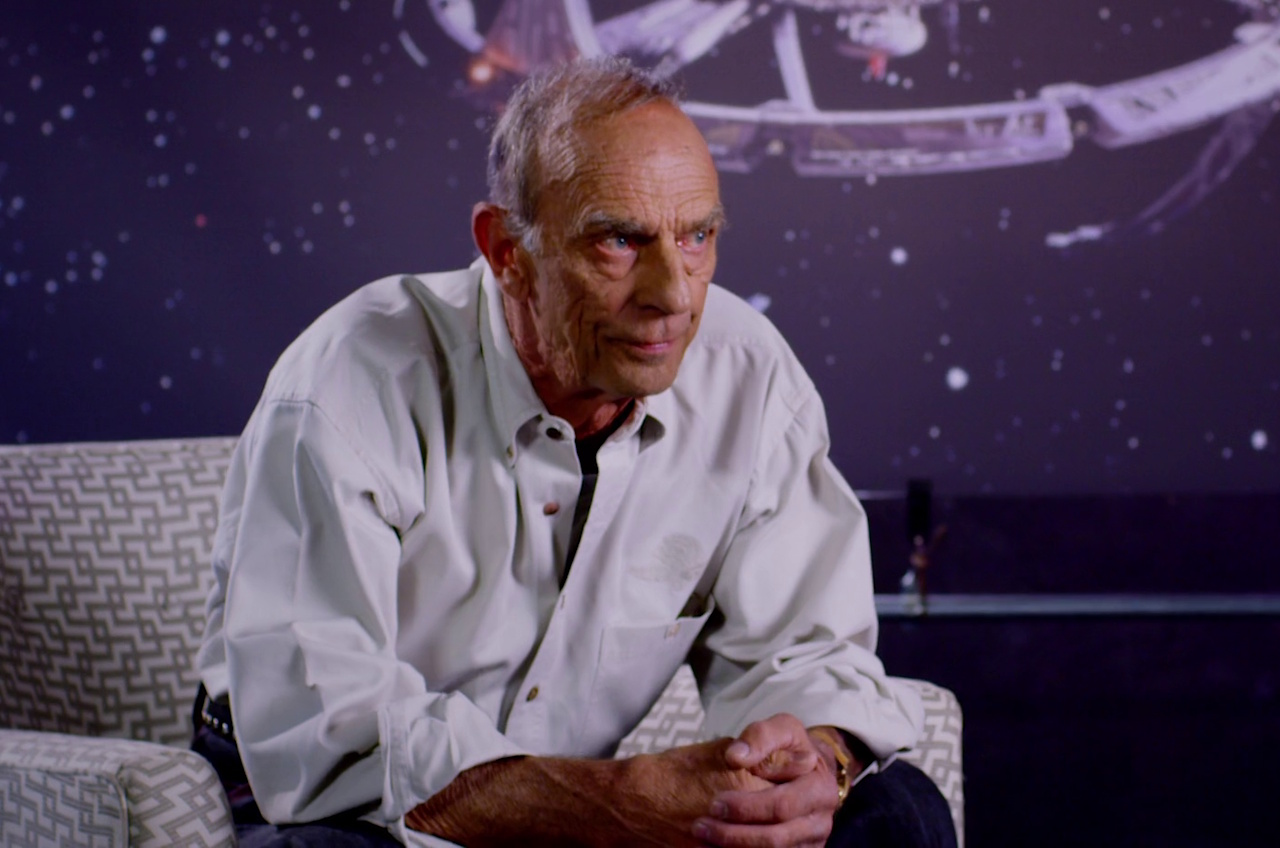
Still frame from What We Left Behind: Looking Back at Star Trek: Deep Space Nine showing Marc Alaimo.
I’d love to bring back a familiar actor from the Deep Space Nine era (Dukat actor Marc Alaimo pictured) to play this episode’s Cardassian captain.

I was a little hesitant to put this story treatment together for one primary reason: Jolene Blalock, who played T’Pol in all four seasons of Enterprise, had seemingly retired and hadn’t expressed a wish to return to the role. However, Blalock was convinced to reprise her role (albeit in voice form only) in Lower Decks, so I no longer feel it’d be impossible for Strange New Worlds to bring her back for a role like this.

Given the show’s place in the timeline, it’s not completely implausible to think one of the NX-01’s human crew members could still be around – Dr McCoy lived long enough to attend the launch of the Enterprise-D, after all! But given that they’d all be over 100 years old by the time of Strange New Worlds, it seems less likely that any of them would be as involved in Starfleet or as active. We could do something like Relics, bringing in a character who’d been in some kind of stasis for a long time, but when I considered all of the ways to include a character from Enterprise, the most logical choice was T’Pol.

Promo image for Star Trek: Lower Decks Season 5 showing T'Pol.
T’Pol recently appeared in Lower Decks.

So that’s my “episode pitch!” I hope you didn’t get too attached to it, because it’s never going to be produced. Still, it’s fun to speculate and fantasise, and with Star Trek’s sixtieth anniversary approaching, I’d really love to see at least one episode that really celebrates different aspects of the franchise’s history. Since Star Trek returned to the small screen there have been plenty of moments where characters or factions from past iterations of the franchise have appeared – and that’s fantastic. I haven’t heard much about a potential sixtieth anniversary crossover or special episode, though, and realistically if something like that is gonna happen, production will need to begin fairly soon.

In 1996, Star Trek made a splash for its thirtieth anniversary! Deep Space Nine created the wonderful Trials and Tribble-ations, splicing the new and old footage to transport the cast into a classic episode of The Original Series. And some fans tend to overlook the equally enjoyable Flashback, which saw Captain Janeway and Tuvok pay a visit to the USS Excelsior under Captain Sulu’s command. I was a massive Trekkie back in ’96, and I remember the UK’s official Star Trek magazine ran a special edition for the anniversary. I think I still have my copy in the attic somewhere… I wonder if it’s worth anything?

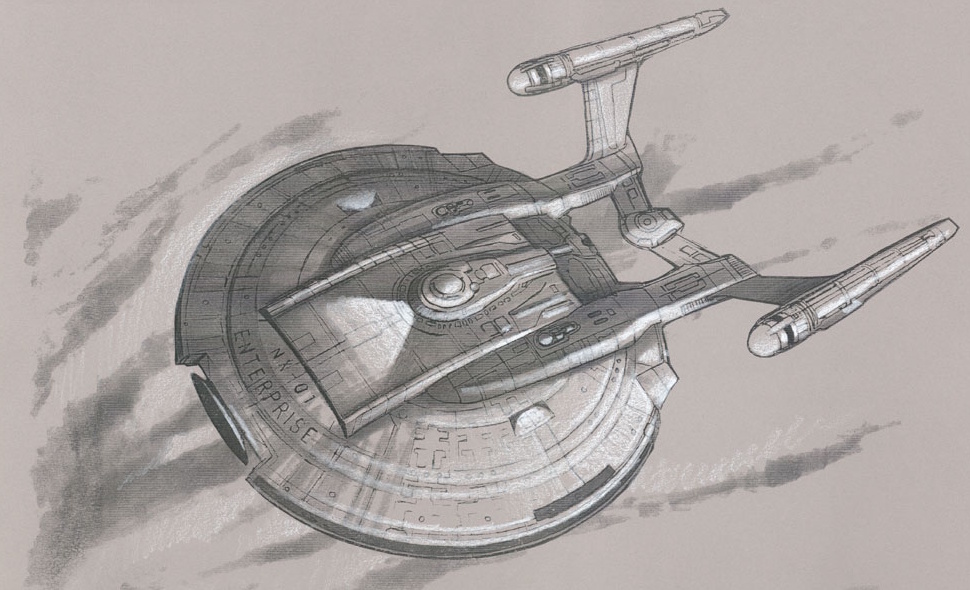
A sketch of the NX-01 Enterprise, cropped from a StarTrek.com wallpaper.
The NX-01 from Star Trek: Enterprise.

We’ve veered off-topic somehow! To get back on track, I’d love to see an episode like my imagined Cardassia Prime as part of Star Trek’s sixtieth anniversary celebrations. A story which brings together different parts of the franchise, including a character crossover, feels like the perfect way for the franchise to celebrate all things Star Trek and to write a “love letter to the fans.” I’m glad that I was able to finally put (metaphorical) pen to paper and share the bare bones of this idea with you.

Strange New Worlds’ third season is coming up later this year, so I hope you’ll stay tuned here on the website for my take on the show’s real episodes when they arrive! Until then, I hope this has been a bit of fun. Thanks for joining me on this adventure with Captain Pike and the crew!


Star Trek: Strange New Worlds Seasons 1 & 2 are available to stream now on Paramount+ in countries and territories where the service is available. The series is also available on DVD and Blu-ray. The Star Trek franchise – including Strange New Worlds and all other properties mentioned above – is the copyright of Paramount Global. This article contains the thoughts and opinions of one person only and is not intended to cause any offence.

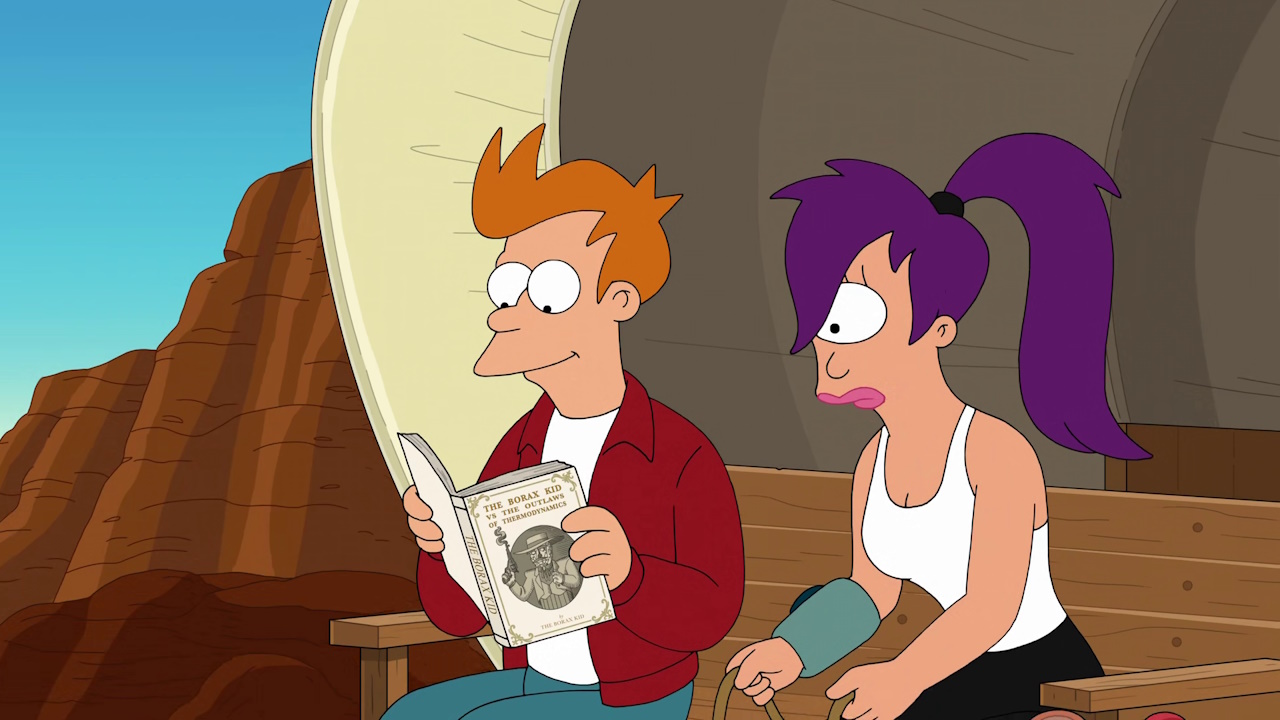
Futurama: Season 9/12 Review

A Simpsons-themed spoiler warning graphic.

Spoiler Warning: There are spoilers ahead for Futurama.

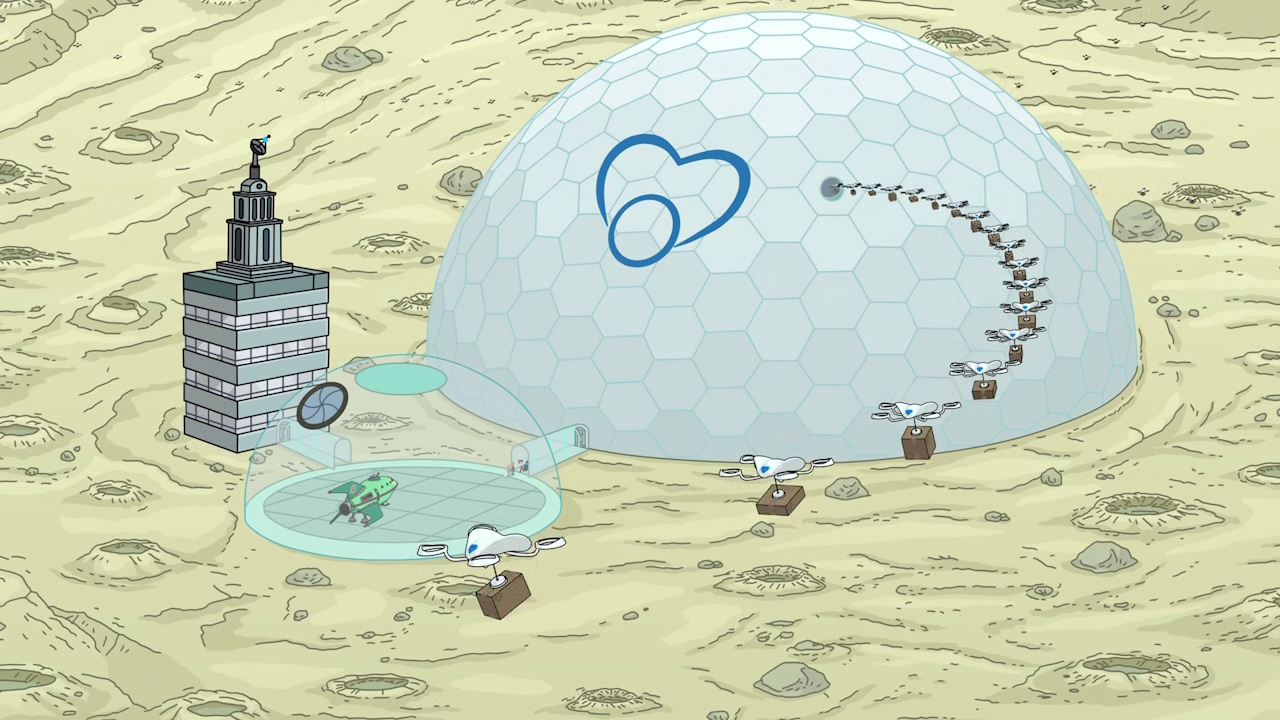
About a year ago, I took a look at Futurama’s eighth (or eleventh, depending on how we count things) season. I said in my review that a few episodes managed to win a chuckle here and there, but none were outstanding. This revived edition of Futurama still had a lot of work to do to justify its resurrection – something that was born in one of Disney’s corporate offices as executives scrounged around, desperate for content to add to Disney+ and hoping to successfully play the nostalgia card.

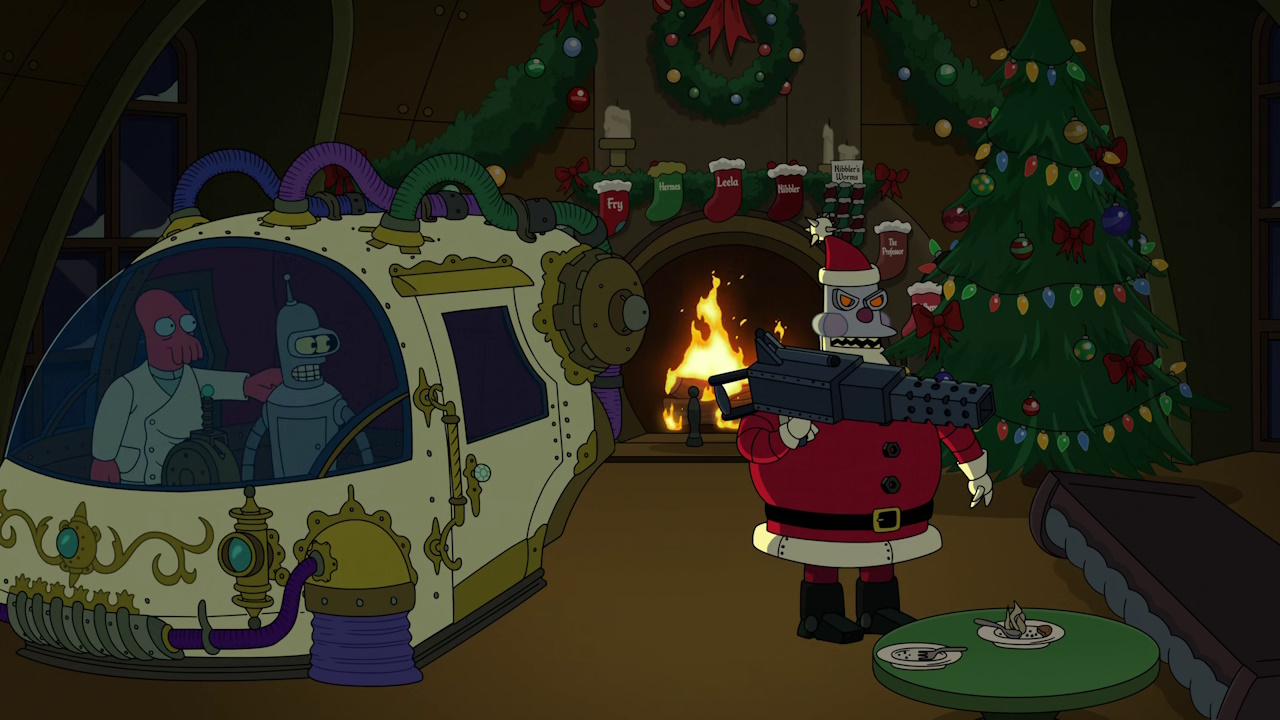
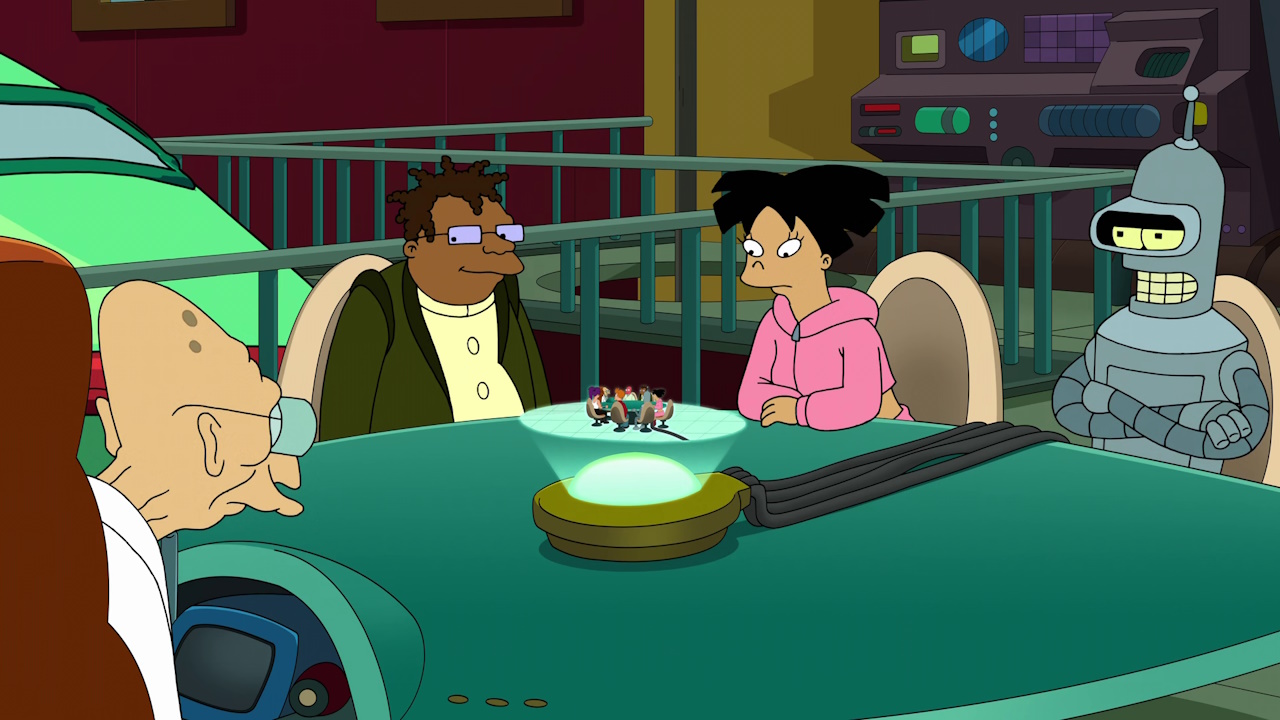
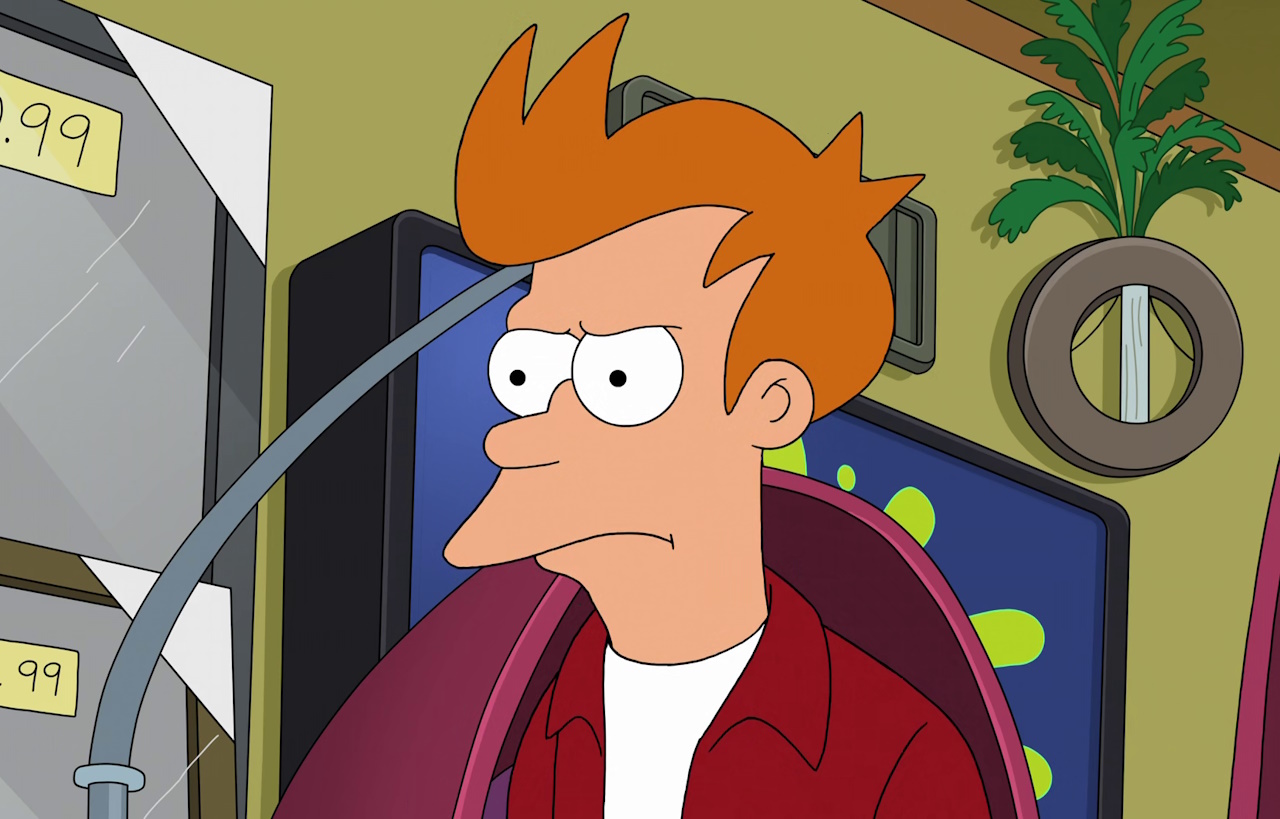
Futurama Season 9/12 is in the same vein – but less funny. In fact, I think I could count on one hand the number of times I laughed across the entire ten-episode season, which isn’t exactly a ringing endorsement of what was once TV’s premiere sci-fi comedy series. Futurama has lost a step, and while it’s far from the only revived or rebooted show to fail at recapturing the magic… that doesn’t make me feel any better!

Still frame from Futurama Season 9/12 (2024) showing the professor and Hermes sitting in an office.
Futurama is back… for a bland and uninspired season.

Here’s the headline: I can’t say I hated any of the ten episodes this season. There were some moments of cringe humour – the kind that I personally can’t stand – and a couple of episodes that had clearly taken so long to produce that they felt way out of date. But despite the fact that I didn’t really find much of it to be all that funny, these episodes passed by inoffensively enough. They’d probably make for decently okay background viewing – the kind of thing I switch on while I’m distracted doing something else. There’s not a lot of content or story to get stuck into in really any of the episodes. This season is like the television equivalent of fast food; something to watch, but lacking in any real substance.

So while I’d definitely watch this batch of episodes again, it wouldn’t really be by choice. If I felt sufficiently bored and needed some background noise, they’d be fine for that purpose! But is that what fans want from Futurama? Is the series – which, in its prime, was one of the cleverest sci-fi shows around, and one of the funniest comedies, too – really just being relegated to this… slop? As corporations race to add ever more content to streaming platforms in a bid to retain subscribers, shows like Futurama are being butchered, turned into corporate-mandated fluff that executives can boast about to shareholders in their annual meetings. “Did you see how many fans came back to Disney+ for Futurama? That means we made a net gain of subscribers this quarter!” That’s why Futurama is back. And it shows.

Still frame from Futurama Season 9/12 (2024) showing Kif and Zapp Branigan.
Kif and Zapp.

I’d argue that this season fundamentally misunderstands not only what made the original Futurama so entertaining, but what a revived series should aim to be. This was a chance to tell new stories with characters fans came to know and love, but instead Futurama’s writers – almost certainly at Disney’s insistence – are trying to re-do the show’s “greatest hits.” Plot points are recycled, random characters from earlier episodes make cameos for no good reason, and even jokes are re-told in less funny, less entertaining ways. These last two seasons of Futurama should be a case study in how to completely misunderstand and overrate the importance of nostalgia as a driving force in entertainment.

As an example, the ship’s can opener – which causes Bender to sing uncontrollably and mangled him in the third season episode Bendin’ In The Wind – made a return… but not in any real way. A joke was made about Bender singing, another about the can opener being given its own quarters… but that was all. It was a reference to a funnier, stronger, and all-around better episode for no other reason than to say “hey guys, remember how good Futurama used to be?”

Concept art for Futurama circa 1998, from the official concept art book.
Concept art of Fry, Leela, Bender, and Amy circa 1998.
Image Credit: Abrams Books/The Hollywood Reporter

And this didn’t just happen with jokes. A flashback to a young Hermes playing with blocks in the aftermath of a hurricane was a callback to How Hermes Requisitioned His Groove Back, only without any of the fun or emotional impact. Bender’s second trip to Mexico likewise lacked any of the charm of his first, and even flashbacks to Fry’s family in the 20th Century felt like little more than the show trying and failing to recapture the magic of better episodes.

All of these in-jokes, meta-humour, and self-referential moments came across less as fun little easter eggs for returning fans and more as callbacks to when the show was actually good. This is what I mean when I say the season overplayed its hand; little jokes and references here and there can, under the right circumstances, be fun, and fan service is not inherently a bad idea. But Futurama totally missed the mark on this occasion.

Still frame from Futurama Season 9/12 (2024) showing young Hermes.
Remember when Futurama did that fun bureaucrat song in a much better episode?

I can’t help but feel that Futurama is taking the wrong lessons from the likes of Rick and Morty. Having originally inspired a whole new generation of sci-fi animated comedies, Futurama is now in the awkward position of trying to take storytelling styles and narrative concepts from them. Rick and Morty regularly breaks the fourth wall, references itself, and creates these meta-narratives that are funny – but messy. Futurama didn’t fully commit to that style, but this season tried to steal some of the trappings with almost no success.

Futurama doesn’t get the same leeway as the likes of Rick and Morty, which uses more violence, more sexual content, swearing, and so on. In that sense, Futurama feels more tame – but rather than lean into that, the show’s writers want their show to feel more “edgy.” But without being able to go further – perhaps constrained by Disney in a way that Rick and Morty isn’t – it just comes across as half-hearted… or half-arsed. The same is true of the show’s meta-jokes and self-referential humour: without being able to fully commit to being that style of show, Futurama can’t employ those moments effectively.

Still frame from Futurama Season 9/12 (2024) showing the Inferno Festival.
Could it be a visual metaphor for this season?

The series is in real danger of losing its identity. Futurama is unable to keep up with newer shows in the sci-fi animated space – shows that it inspired and that wouldn’t exist without it. It’s unable to fully emulate or copy them – and doing so would erase everything that makes Futurama feel like Futurama. But in an entertainment landscape that has changed massively in the quarter of a century since it debuted, Futurama can’t effectively do the same things it used to. Its attempt to mix a sci-fi setting with real-world parallels falls flat. Its episodic storytelling with character growth has plateaued and seemingly has nowhere left to go. Even its trademark mix of laugh-out-loud jokes with emotional moments that literally left fans in tears isn’t working any more. The jokes aren’t funny and the attempts at emotional storytelling feel thoroughly un-earned.

This is usually the part where I’d say something like this: “if the jokes and emotion landed for you, that’s great!” But I don’t think there are many Futurama fans in that camp. These two recent seasons feel so corporate and hollowed-out, so devoid of everything that made the original work feel special, and so utterly, irredeemably bland… that I really don’t know if anyone is loving Futurama any more. I think a lot of people will watch it and tolerate it – aside from a dated episode about NFTs and some jokes that were too cringe for my taste, there’s not much unpleasant about this season of Futurama. It goes down easy, as they say. But actually watching this season to enjoy what’s on offer? Is anyone out there doing that?

Still frame from Futurama Season 9/12 (2024) showing Bender at the NFT museum.
This episode’s NFT plot was out of date before it was even written.

Alright, let’s go through the episodes briefly and talk about which (if any) might graze the high bar of “yeah, I guess that one was okay.”

The One Amigo is a horribly outdated story about NFTs – the market for which tanked a solid two years before its July 2024 broadcast. Bender returning to Mexico felt like a significantly worse version of Lethal Inspection. That episode had genuine stakes, a great emotional core, and a twist. This one has Bender meeting a bunch of random Mexican stereotypes and no real ending. Seriously… Bender was “sacrificed” then, one scene later, was back at home just in time for the credits.

Up next was Quid’s Game, which honestly was just middle-of-the-road fluff. None of the characters ever felt like they were in danger, the flashbacks to Fry’s family were okay but didn’t really deliver much in terms of story or emotional weight. The twist – that Fry’s mother was secretly rigging the games so he’d win – was pretty obvious, and the return of Gedgie (from Season 6’s Cold Warriors) wasn’t particularly interesting, either.

Still frame from Futurama Season 9/12 (2024) showing a group of characters falling into green liquid.
Did you feel any of the characters were in danger?

The Temp called back to the episode Amazon Women in the Mood, setting part of its story in the aftermath of that episode. Though timelines aren’t something to be terribly concerned about in a show like Futurama, it was a little odd that The Temp repeatedly called attention to the twenty-three year time span. When characters don’t seem to age and the show appears to be mostly episodic with a floating timeline, it’s just a bit of a strange thing to bring up. The Temp was mostly okay, though, and the idea of a very forgettable person being accidentally abandoned was interesting.

Ah yes, a timely and delicate critique of bullfighting – that’s what Futurama needs. Or so the writers of Beauty and the Bug believed. We get it: bullfighting is outdated and cruel. But this episode added nothing to that conversation that hasn’t already been said, and it muddled its messaging with Bender’s quest to become a champion bug-fighter taking up much of the middle of the story. There wasn’t much nuance… and I just don’t see the point of a story like this.

Still frame from Futurama Season 9/12 (2024) showing a matador and a buggalo.
A robo-matador in Beauty and the Bug.

AI chat bots have been in the news a lot – so one side of One Is Silicon, The Other Is Gold seemed pretty timely. But that Fyre Festival parody at the beginning? I mean, that was way too late to be biting and funny! Still, once the episode got going the idea of Leela falling prey to a chat bot was interesting, and the boys’ book club was surprisingly cute.

Attack of the Clothes annoyed me because it seemed to end on a cliffhanger… only for its story to disappear, never to be mentioned again. The world of “fast fashion” is, I will admit, not something I’m especially familiar with. But a story about not immediately disposing of things after one use could make sense. Attack of the Clothes, though, just felt like a vehicle for guest star Cara Delevigne. Some recent episodes of The Simpsons can be way too deferential to their guest stars, sucking up to them and showering them with compliments. Attack of the Clothes felt like that, at least in part. Is it fair to call it a good story concept ruined by a guest star who was a little too present?

Still frame from Futurama Season 9/12 (2024) showing the professor and Cara Delevigne.
Attack of the Clothes.

Planet Espresso wasn’t terrible at first, but it had that awful callback that I mentioned above, and also ended on another underwhelming cliffhanger. Are we ever gonna see those coffee aliens again? I doubt it – so why not finish the story in a more solid way? Having never met (nor even heard about) Hermes’ father, there wasn’t a lot for this episode to build on. I think the bare bones of the story had potential, but the emotional moments didn’t really stick the landing for me.

On a couple of occasions, Futurama has used one of these “three-stories-in-one” episodes to show off a range of different storytelling and animation styles. The Futurama Mystery Liberry was this season’s attempt to do that… but the animation was weirdly lacking, at least for me. There was an opportunity to really lean into different visual styles inspired by the comics and illustrations that the stories were drawn from, but that didn’t happen. The stories themselves, being less than ten minutes apiece, were pretty basic, but if you’re familiar with the likes of Nancy Drew and Tintin you’ll at least get most of the references. I thought it was a bit of a waste of guest stars LeVar Burton and Neil deGrasse Tyson, though.

Still frame from Futurama Season 9/12 (2024) showing LeVar Burton in a rocking chair.
LeVar Burton guest-starred in this episode – a play on his Reading Rainbow role.

Remember in the ’90s when everyone got obsessed with Beanie Babies? The writers of Cuteness Overlord do… and they thought it was worth making a timely critique of the phenomenon. I mean… do I even have to say it? There were echoes of the NFT episode here, too, which just felt repetitive, Amy seemed to act out of character in order to drive the story, and I just… I just don’t understand why you’d make an episode like this in 2024. In 1999, maybe. But now? The Beanie Baby fad died decades ago and you’d have to be my age or older to even remember it. What was the point?

In keeping with earlier seasons, Otherwise was this season’s attempt to end with an emotional sucker punch. But like last year, we seemed to spend most of our time following a different set of characters – who were all killed off at the end anyway. These parallel universe/alternate timeline stories really don’t have much to say, and given that these events will almost certainly not be brought up again in future… I just don’t feel much of an impact. There were some moments with Fry that came close to expressing the emotion that the episode wanted… but the ending wrenched most of that away.

Still frame from Futurama Season 9/12 (2024) showing the main characters aboard a spaceship.
The alternate dimension characters aboard their new ship.

So that was Futurama’s ninth or twelfth season. It’s hard to say I hated it given how plain and inoffensive most of it was. The worst I can say, really, is that references to things like NFTs and the Fyre Festival came years too late to be relevant – kind of like last season’s covid vaccine story. But on a deeper level, I really feel sad for Futurama. To be turned into this bland content slop just so Disney can play the nostalgia card amidst the “streaming wars”… I dunno. A show that was so influential that it basically created its own sub-genre deserves better than this.

There are two more seasons of Futurama to come – presumably later this year and in 2026. On current form, I don’t really expect to see the series improve significantly. I’d love to be proven wrong, and for the final two seasons to be a genuine return to form. But this revival feels so soulless and like such a misunderstanding of what viewers want and expect that I don’t have high hopes.


Futurama is available to stream now on Disney+. The series is also available on DVD and Blu-ray. Futurama is the copyright of 20th Television Animation, Hulu, and/or The Walt Disney Company. This review contains the thoughts and opinions of one person only and is not intended to cause any offence.
Silo: Season 2 Review

A spoiler warning graphic.

Spoiler Warning: There are spoilers ahead for Silo Seasons 1 & 2.

In 2023, I awarded Silo’s first season the highly-coveted Trekking with Dennis Award for best TV show of the year. It beat off Star Trek: Picard’s third season – which was, in hindsight, probably that show’s best offering. If you know me, you’ll know I’m a Trekkie and a big fan of Jean-Luc Picard – so Silo must’ve been pretty darn good, then! It’s no exaggeration to say that I was really excited for Season 2 and the continuation of this engaging sci-fi mystery story.

It can be difficult to render judgement on the middle part of a fully-serialised story, so that’s a big caveat to everything we’re going to talk about. With Silo confirmed to be returning for two more seasons, we may look back at Season 2 with that context and revise some of these talking points and criticisms – and I wanted to be clear about that. With that out of the way, here’s the headline: Silo Season 2 was good but not great. One side of the story was a thrilling, enigmatic mystery populated by a wonderful cast of characters. The other felt like an overblown video game side-quest, complete with unnecessary stumbling blocks that seemed to exist only to slow things down, and was padded out with a handful of very barebones, one-dimensional characters.

In short, Season 2’s good side was let down by its less-good side.

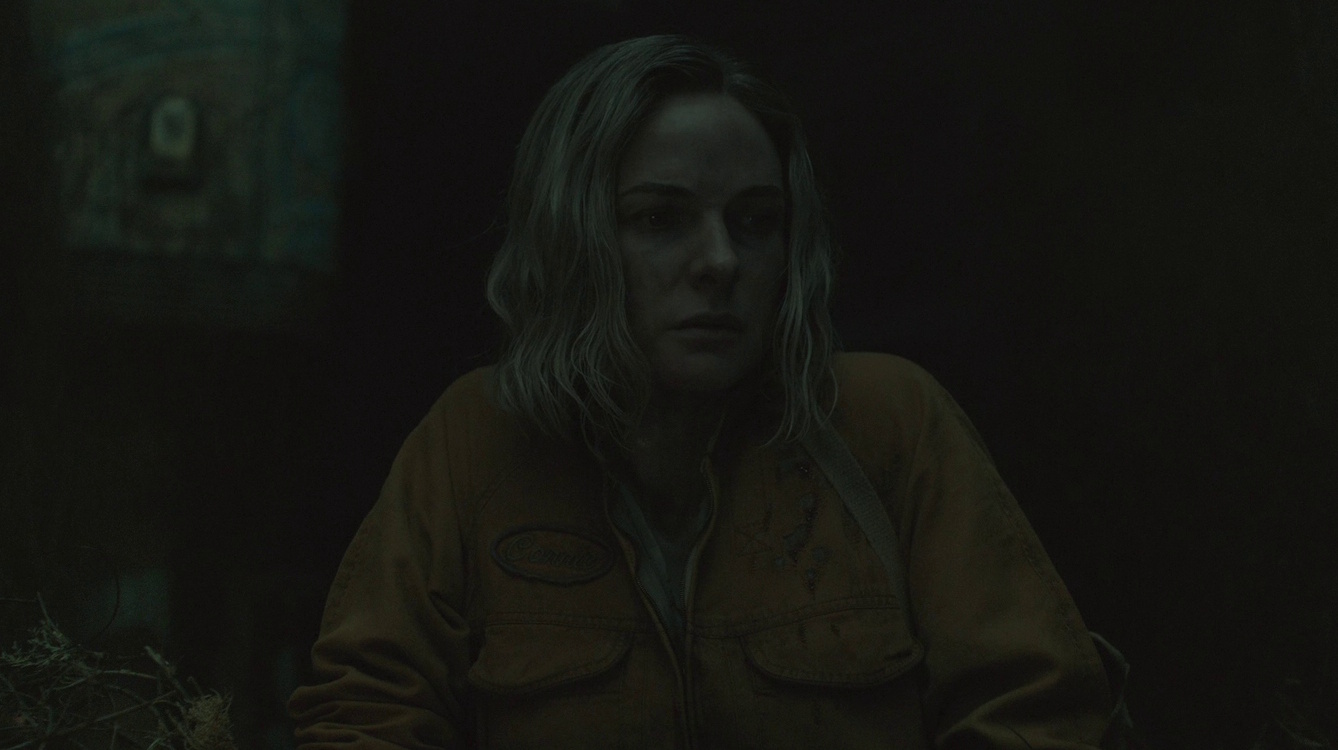
Still frame from Silo Season 2 (2024-25) showing Juliette after her arrival in the second silo.
Juliette in the second silo.

So… which side is which? Unfortunately, I found Juliette’s story this time to be the weaker one. And that’s such a shame, because Rebecca Ferguson – who also gets an executive producer credit for Silo – has put in a fantastic performance across both seasons of the show. Last season, Juliette was at the centre of the story, unravelling the mysteries of the silo piece by piece. But this time, she was isolated from most of the rest of the cast, trapped in her own little narrative box. And that box, for me at least, felt like it was mostly comprised of unnecessary hurdles to a story that was almost instantly a “back-and-forth” that aimed to shuffle Juliette right back to the first silo.

On the other side of things, the story of the rebellion in the Down Deep, complete with double- and triple-crosses, as well as Sims’ scheming and Bernard and Lukas trying to uncover more of the silo’s secrets… that was all fantastic. These characters, who we met last time and have more of a foundation to build on, all felt real, their actions seemed to flow naturally from the circumstances they were in, and it was a truly gripping and fascinating mystery with stakes. Given that we know the world immediately outside the silo is still deadly and toxic, the danger to everyone was communicated well – and having gotten invested in these characters and their world, that gave this side of the story a lot more weight.

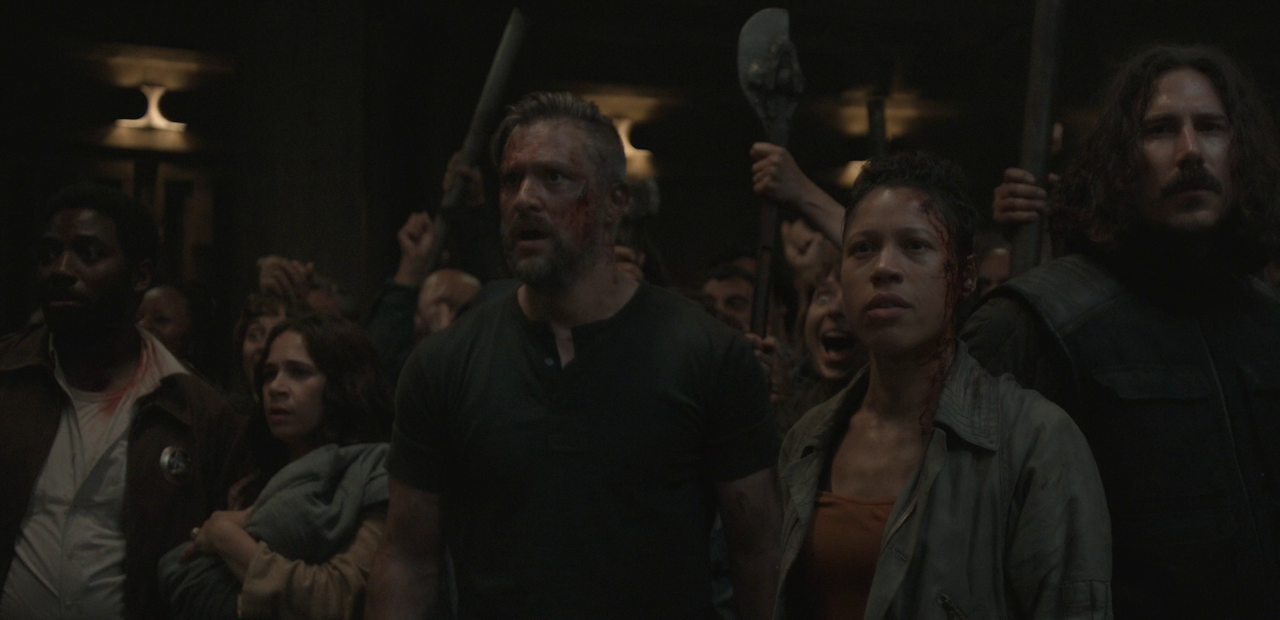
Still frame from Silo Season 2 (2024-25) showing a crowd of rebels.
Sheriff Billings, Knox, Shirley, and Deputy Hank.

Stepping back from the moment-to-moment narrative beats, Silo has constructed a world that feels – to me, at least – like a dark mirror of the United States. Leaders are left to rely on increasingly unclear instructions left for them by the nameless “founders,” communicated through a legal document that, for many in the silo, has taken on the status of scripture. I don’t know if you’re familiar with the term “American civil religion.” It’s a theory in American Studies/sociology that posits many Americans view documents like the Declaration of Independence, the Constitution, and the Bill of Rights as akin to scripture, with some of the founding fathers elevated to the positions of prophets. It’s an interesting idea, and one far too complex to detail in a few sentences. Whether you buy into it or not in the real world, Silo is definitely drawing on similar themes and concepts for its depiction of its underground society.

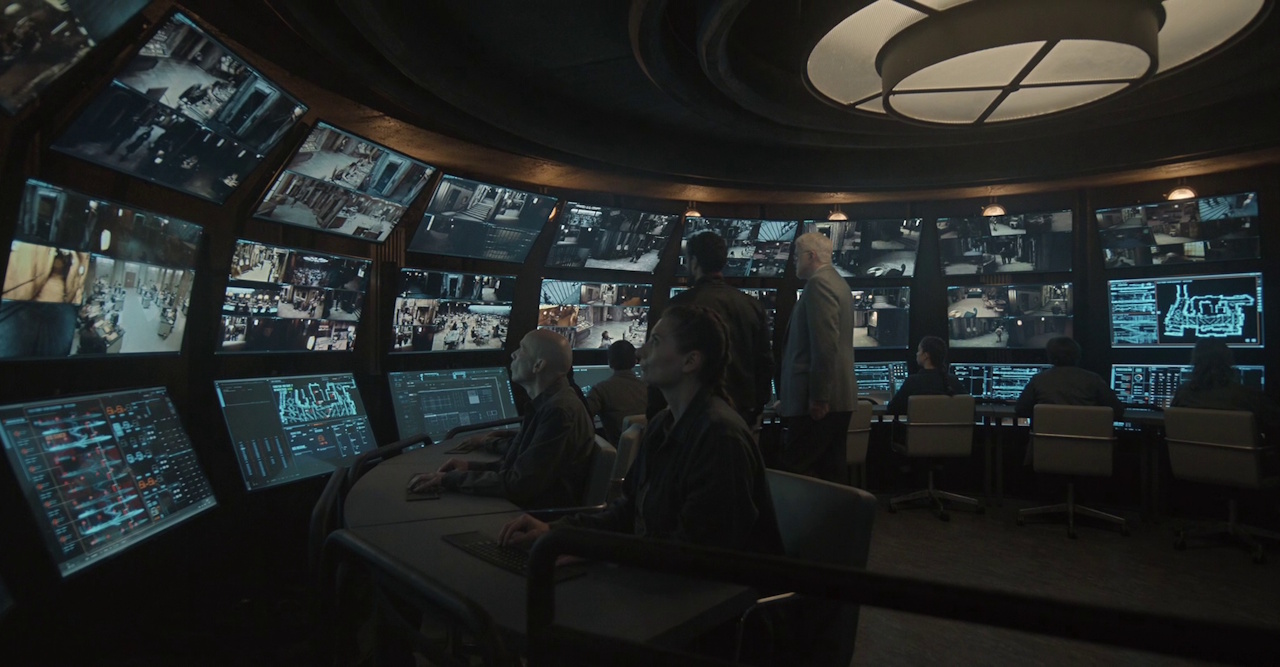
Silo also holds up a mirror to our modern-day surveillance society. Cameras are everywhere in the underground city: in people’s homes, in common areas, and workplaces. And spying on the citizens are a hidden group who seem to exist outside of the official heirachy and structure of the government, reporting directly to the mayor. As a metaphor for CCTV, facial recognition, and even online surveillance by the likes of the NSA, you could hardly get more explicit!

Still frame from Silo Season 2 (2024-25) showing Mayor Hollins in the surveillance room.
The hidden camera room in the silo.

Both of these feel pretty timely. Silo goes to town with the idea of governments spying on their citizens – without their consent or knowledge. The dangers of such a sophisticated spyware network are obvious, including the ease with which someone could use that knowledge to become a dictator or autocrat, and we get to see that through Bernard’s characterisation. I read Bernard as someone who is out of his depth, but tries to use the immense power at his fingertips to retain – or regain – control of the situation as it begins to spiral. Again, there are real-world parallels there.

Silo also wants to reflect a class divide: the “Up Toppers” and “Down Deepers” representing the upper and working classes respectively. Becuase the action in Season 2 mostly focused on the mechanics and engineers on the lower levels, I don’t think we got as much of a look at the way society differs on the upper levels of the silo. We caught glimpses of it when we saw the larger, better-furnished apartments of people like Bernard and Judge Meadows, but with fewer characters in focus there was perhaps less of this in Season 2 than there had been in Season 1. The class war angle was interesting, though – and another place where Silo was clearly drawing on real-world issues for inspiration.

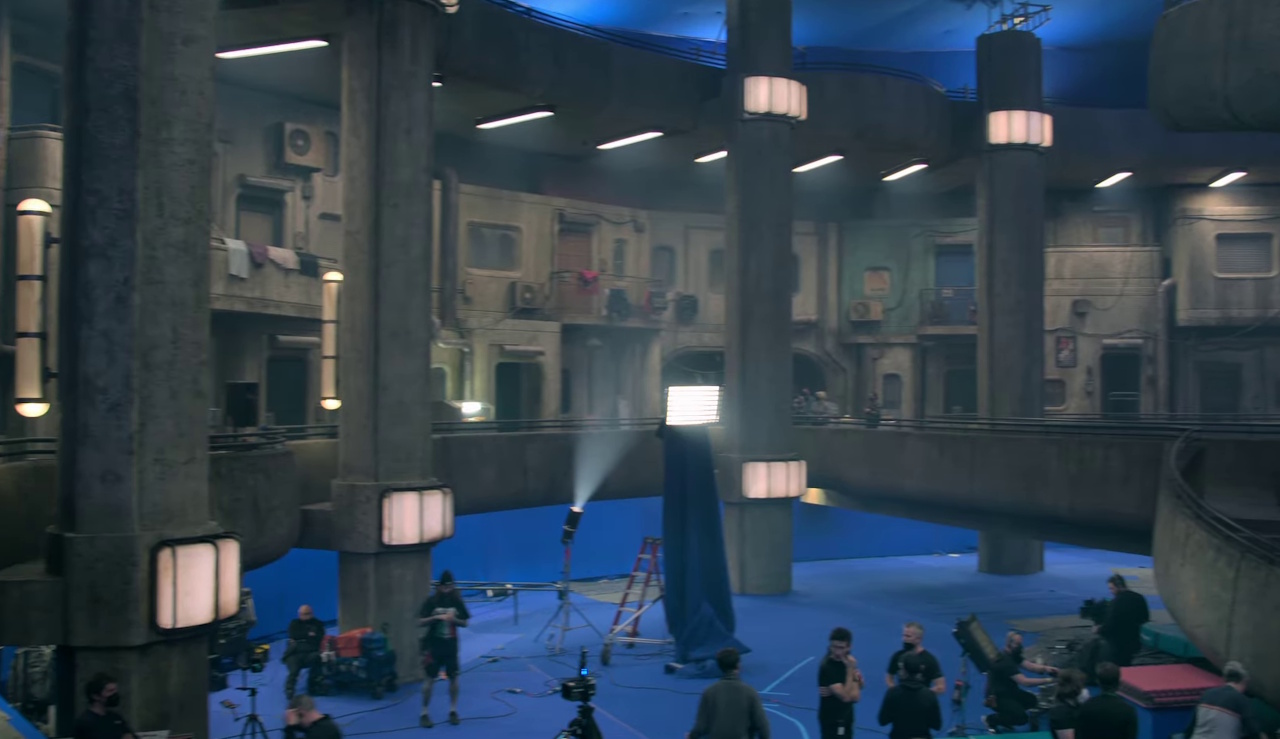
Still frame from Silo: An Inside Look showing one of the sets build to represent the silo.
Behind-the-scenes during production on Silo.

Juliette’s dramatic exit from the silo at the end of Season 1 left her friends and former allies on edge. By refusing to clean the camera and walking out of sight, she inadvertently left people believing that the world outside is safe – and we know that it isn’t. Arriving at a nearby abandoned silo, Juliette comes to learn the potential consequences of this: the rest of the citizens will rebel and try to break out, resulting in their deaths. This kicks off her story of… needing to immediately get back to her original silo.

I gotta be honest: I already felt this was a pretty weak setup. Having survived when survival seemed impossible and escaped from tyranny… all Juliette is left with is “I need to go back right now,” seeking to save her friends. As the setup for what was ultimately a slow storyline that seemed to spin its wheels too much, I was underwhelmed from almost the first episode. Then, things seemed to plod along, with Juliette teasing tiny pieces of information out of the mysterious sole survivor of this silo… only to belatedly learn that there were several other younger survivors, too. She apparently didn’t notice them or their settlement while exploring.

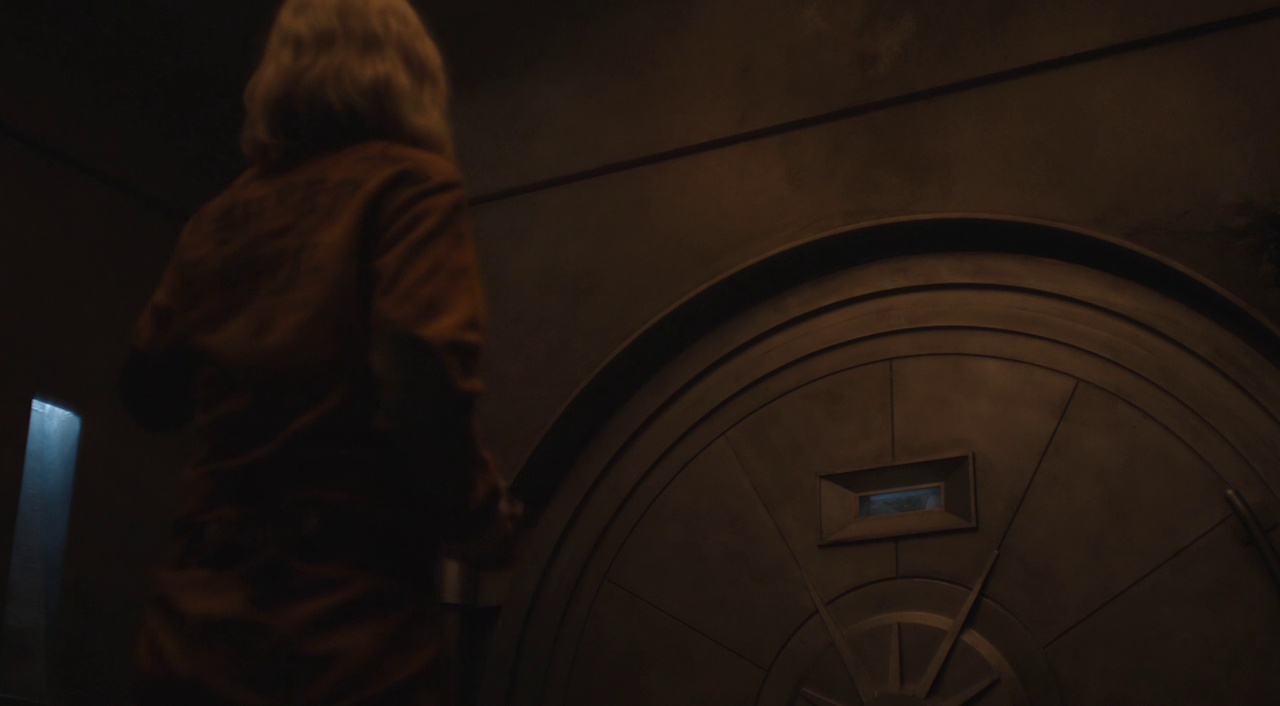
Still frame from Silo Season 2 (2024-25) showing Juliette talking to Solo through the vault door.
The locked door to Solo’s vault.

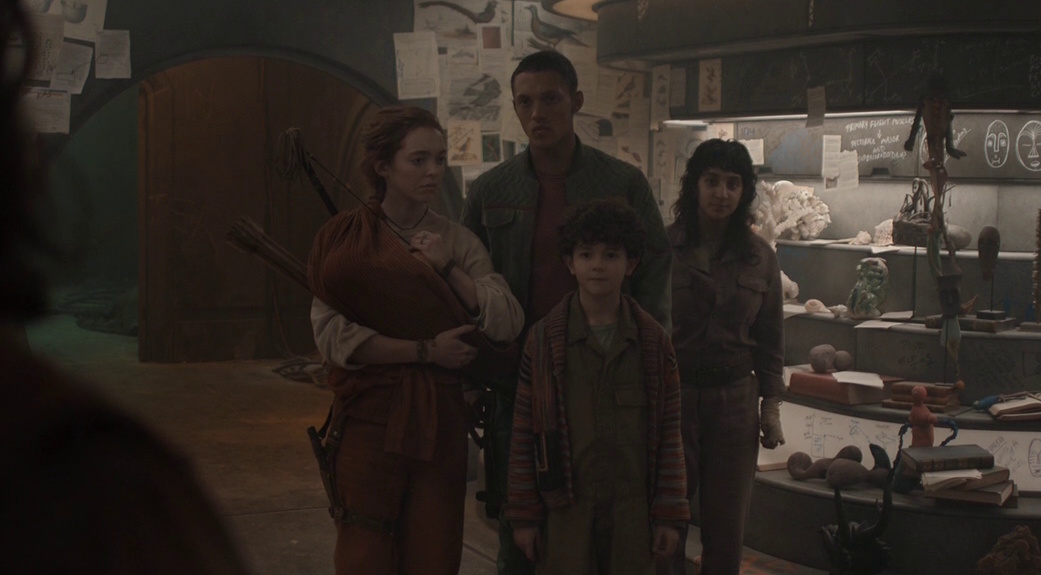
These younger survivors were pretty uninteresting, and their storyline came too late in the season to give most of them any real depth or interest. Audrey, whose sole defining trait seemed to be that she wanted to take revenge for the death of her parents, instantly gave up on that. And the others – Eater/Hope and Rick – got even less background than that. I struggled to believe that these characters had really been living their whole lives in the ruins of this silo, trying and failing to break into Solo’s vault and scratching together whatever food they could.

Silo just didn’t give these characters enough depth, and what little story was afforded them seemed to evaporate pretty quickly. For no other reason than “maybe don’t,” Audrey abandoned her apparent lifelong mission to seek revenge for the death of her parents, and for no other reason than “maybe open the door though,” Solo abandoned his lifelong mission to keep the door to the vault sealed. It wasn’t even clear that Solo knew anyone else was still alive inside the silo – which might’ve been useful information. Had Audrey and Rick ever visited the vault door? If so, why’d they leave their parents’ corpses unburied? And how did their settlement have power when it was explained that only the IT department – at least one level below – had its own power source and the rest of the silo’s power was out? There are a few too many contrivances, cut-down moments, and characters lacking depth on this side of the story for my liking.

Still frame from Silo Season 2 (2024-25) showing Audrey, Rick, Eater/Hope, and their baby.
I felt these characters lacked any real depth or interest.

And that’s part of what gives it a “video game side-quest” feel. Every time Juliette seemed to get close to her new goal of returning to her original silo… something would get in the way. First it was finding a replacement suit. Then it was Solo holding her suit hostage until she activated an underwater pump. Then it was the kids kidnapping Solo. Then it was Juliette and Eater/Hope having to search for the code to get into the vault… it just went on and on. Solo had potential as an interesting character, and there were moments of that on this side of the story. But even before the kids emerged from hiding, the action in this second silo was really grinding along at far too slow a pace.

Speaking of the second silo… I’m afraid I was a tad underwhelmed by the setting, if I’m being honest. Do you know the term “bottle show?” It was originally coined in the 1960s to describe episodes of a television series made cheaply by recycling sets that have already been built, using only a handful of characters, and that are heavy on dialogue. Fans of the Star Trek franchise are very familiar with “bottle shows,” and parts of this side of Silo felt, to me, just like that. The sets were redressed to add vines and other obvious symptoms of decay, but they were otherwise identical… and for such an expensive series (Silo reportedly costs $30-$40 million per episode) the end result felt pretty cheap.

Still frame from Silo Season 2 (2024-25) showing Juliette walking through a field of dead bodies to reach the second silo.
Juliette arrives at a second, identical silo.

In-universe, there’s a good reason for silos looking identical. Or at least, I assume there is. But watching the show as a viewer… the fact that Juliette escaped one silo only to land in another, basically-identical silo didn’t quite sit right. And while the second silo did a good job of conveying how wrong things could go and what the stakes were for Juliette’s friends if she couldn’t fix the mistake she inadvertently made, the visuals most of the time were unimpressive. The only exception were this silo’s flooded levels, which were genuinely interesting to see – not to mention tense!

As I said at the beginning: this is the middle of Silo’s story. There are two seasons to come after this, and if the characters we met in the second silo feature in a big way, getting more development in the process, it’s not impossible to think we could revisit their introductions and look upon it a bit more kindly. But despite a wonderful performance from Rebecca Ferguson, I felt she was hampered rather than helped by the writing and the way her side of the story was structured in Season 2.

Still frame from Silo Season 2 (2024-25) showing Juliette's face illuminated by a torch.
Rebecca Ferguson plays Juliette Nichols in Silo.

Juliette’s evolving relationship with Solo definitely had its moments, though. Solo losing his temper and shouting at Juliette – and her cowering, afraid to look at him – definitely had uncomfortable echoes of real-world abusive relationships, as did his decision to hold her captive by denying her access to her suit. This metaphor was, perhaps, a little deeper, but it was there. Solo’s childishness masked that side of his character, but he can be quick to anger and manipulative. There was definitely an uncomfortable side to him – even if it was understandable how the traumatic life he’d led might’ve left him in that position.

We need to hop over to the original silo, though! That was the side of the story that I found much more engaging.

On the lower levels, there were double-crosses, triple-crosses, and multiple characters all working toward different ends to fit different agendas. No one – not even Bernard, spying from up top – knew everything, and that left Silo to be a truly engaging series. Even when Juliette’s story seemed to be spinning its wheels or distracted with another side-quest, there were fun characters and mysteries back in the original silo to keep the show on the rails.

Still frame from Silo Season 2 (2024-25) showing Walker, Shirley, and other conspirators in the Down Deep.
The conspirators gather…

I have to be honest: going into Season 1 in 2023, I really did not expect much from Common. I’d seen him in Hell on Wheels – a series starring Strange New Worlds’ Anson Mount – a few years ago, but many musicians try their hand at acting and don’t really leave much of an impression. I was pleasantly surprised with his performance in Season 1 as the scheming Robert Sims, and Common excelled again in Season 2. Sims’ story expanded to include his wife this time, and they worked exceptionally well together as they tried to play both sides of the burgeoning rebellion to try to elevate their position in the silo’s heirachy.

Sims turned out to have more nuance in Season 2 than he did last time. After trying repeatedly to convince Bernard to let him in on the secrets of the silo and being spurned every time, ultimately being consigned to the important-sounding but powerless role of judge, Sims began scheming more overtly. The final rug-pull that it would be Camille, not Robert, who would be let in on the silo’s secrets by its AI controller… that was a fun and genuinely unexpected twist.

Still frame from Silo Season 2 (2024-25) showing Sims using a computer terminal.
Robert Sims.

Unlike Juliette’s disconnected sequence of objectives in the second silo, Bernard and Lukas’ attempts to figure out the mysterious code unfolded in a much more natural-feeling way. I can see some folks making similar criticisms as I did of Juliette’s story, because Lukas seemed to run into several dead ends before progressing. But this code-breaking story – and the subsequent revelation of the hidden vault with its library and advanced computers – felt a lot more interesting, and I was much more engaged with both Lukas as a character and the consequences of this storyline.

Knox, Shirley, and Walker made for a fun trio – and the additions of both Sheriff Billings and Dr Nichols (Juliette’s father) added a lot to the character dynamics on this side of the story. The only criticism I have, really, is that I never bought Walker’s fake betrayal of her friends, seeming to sell them out to Bernard in exchange for Carla’s safety. I had in my notes words to the effect of “this doesn’t feel like a realistic turn for her character,” so the ultimate reveal that she was double-double-crossing Bernard wasn’t as big as perhaps Silo’s writers wanted it to be. There was still a very real sense that the story could’ve gone the other way… but all that would’ve done is spoiled her characterisation! In that sense it was still a twist, but one that wasn’t built on the strongest foundations.

Still frame from Silo Season 2 (2024-25) showing a close-up of Walker.
Walker played double-agent in Season 2.

So Silo leaves us on a cliffhanger! What will happen to Juliette and Bernard – and will Juliette’s firefighter suit prove to be the difference in that burning decontamination chamber? What did the AI say to Lukas, and why did Bernard react by falling into such a depression? If Meadows was given the same information, why did she not communicate it to Bernard all those years ago? And what will become of the rebels – will some still try to break out, even after Juliette’s message?

Season 3 better hurry up and get here, that’s all I can say!

Seasons 3 and 4 are actually already in production; filming began in October, and both seasons will be produced back-to-back. I haven’t read the novel series that Silo is based on, but apparently there will be longer flashback sequences to the congressman and reporter we met in the Season 2 epilogue. I’m certainly curious to find out who they are and what their connection is to the silo.

Still frame from Silo Season 2 (2024-25) showing Mayor Bernard Hollins.
What more does Bernard know?

I stand by what I said at the beginning: Silo’s second season had one incredibly strong and entertaining storyline… and one noticeably weaker one. I hope that Seasons 3 and 4 can do more with the second silo and the characters we met there; it might re-frame my thoughts on the way they were introduced and their arcs this time. However… part of me also hopes that, now Juliette is back, there won’t be a need to revisit these less-interesting characters or waste as much time on them going forward.

Silo continues to be mysterious, and I really can’t predict what’s gonna happen next. Bernard hinted at knowing more – he claims to know who is responsible for building the silo, but not why. And whatever Lukas told him in the final episode seems to have utterly destroyed his faith in the project – so what could that mean for the world outside? Is the entire world toxic, or – as Solo and Juliette seemed to be on the verge of discovering – is something within the silo itself poisoning the air in its immediate vicinity, trapping people inside? If so… why? What purpose could that serve? The fact that I have so many questions that I want answered is, quite frankly, an indication of how invested in the story I am and how much of a good time I’m having!

Still frame from Silo Season 2 (2024-25) showing jets of fire.
Season 2 ended on a firey cliffhanger!

So that was Silo Season 2.

I really can’t wait to find out what’s coming next – and I hope we’ll see Season 3 within the next twelve months or so. Some made-for-streaming shows take a long time in between seasons, but with production on the next chapter of Silo already well underway, I think there’s hope that we might see it at the tail end of 2025 or early in 2026. I’ll be keeping my fingers crossed, anyway.

When Season 3 premieres, I’ll do my best to review it here on the website – so I hope you’ll stay tuned for that. Silo was my favourite TV series of 2023… will its second season repeat that feat this year? There’s still a long way to go and a lot of exciting TV coming our way, but if you swing by in late December, you’ll find out.


Silo Seasons 1 and 2 are available to stream now on Apple TV+. Silo is the copyright of Apple Studios, AMC, and Apple TV+. This review contains the thoughts and opinions of one person only and is not intended to cause any offence.

Star Trek: Strange New Worlds Episode Review – Season 2, Episode 9: Subspace Rhapsody

A spoiler warning graphic.

Spoiler Warning: There are spoilers ahead for Strange New Worlds Seasons 1-2.

I’ve been putting off this review.

After I re-started my Strange New Worlds Season 2 episode reviews in the autumn, this episode stood out as one that I just wasn’t looking forward to or was even interested in, so when it was the next one in the lineup I found myself procrastinating.

I will tell you up-front that I’m generally not a fan of non-animated musicals. I adore musicals in the theatre; seeing Wicked shortly after its West End debut is genuinely one of my favourite memories. And I like Disney-style animated musical films, too. But live-action musical films have never been my cup of tea.

Still frame from Star Trek: Strange New Worlds Season 2 (2023) showing Kirk and Una dancing.
Una and Kirk dancing aboard the Enterprise.

Worse, musical episodes in shows that are otherwise not musicals have been – in my subjective opinion, naturally – universally terrible. Whether it was in Supernatural, Buffy the Vampire Slayer, or even Scrubs… I really didn’t like what was on offer. I’m a fan of the camp and kitsch as much as the next person, but musical episodes have always been a bridge too far. They feel offputting, immersion-breaking, silly, and even fan-servicey sometimes.

So it’s with that background that I approach Subspace Rhapsody.

Still frame from Star Trek: Strange New Worlds Season 2 (2023) showing Uhura holding a tricorder.
Let’s analyse and dissect Subspace Rhapsody.

I’m gonna do something a little different for this review. Rather than waste your time and mine with a two thousand-word explanation of why I’ve never liked musical episodes, I want to try to stay positive and focus on some of the things I liked or appreciated about Subspace Rhapsody. Because I’m not gonna lie to you: I would rather hammer a rusty nail into my scrotum than watch this episode again. It was so far beyond cringeworthy that I barely got through it once.

First of all, let’s talk choreography and songwriting.

Creating a musical – any musical, really – is a lot of work. Trust me, I know: I used to do amateur dramatics, and we’d always have songs and performances in our shows! Rehearsing Subspace Rhapsody must’ve been a challenge, and for choreographers and vocal coaches, having to work with actors who are not natural singers nor particularly practised in musical theatre will have been an additional challenge. A lot of work went into writing songs, working with the actors to get the best possible take when recording the songs, and especially choreographing some of the bigger dance routines. Getting multiple performers to dance and sing in unison is a creative and technical feat. The fact that I didn’t enjoy the result doesn’t mean I can’t appreciate the skill that went into it!

Still frame from Star Trek: Strange New Worlds Season 2 (2023) showing the main cast singing the final song of the episode.
Singing and dancing at the episode’s climax.

Redoing the Strange New Worlds opening theme as an a capella piece was creative, too. I actually didn’t mind the result – it was different from the usual theme (which happens to be one of my favourites in the entire franchise) while being familiar enough to still fit the opening titles. It was the right choice for this episode, and whoever came up with the idea deserves praise! As do the performers who vocalised the theme and the sound mixers who brought it together.

Secondly, the premise of the episode – a random space phenomenon causing chaos on the Enterprise – feels like something straight out of The Original Series or really any pre-Enterprise show. Subspace Rhapsody, in concept, wasn’t a million miles away from episodes like The Naked Time, If Wishes Were Horses, or Masks, which I mean as a compliment. Star Trek has always been ethereal and, for want of a better term, “weird” in its take on sci-fi, particularly in The Original Series and the early part of The Next Generation. It’s hard not to look at Subspace Rhapsody’s core concept through that lens, and stepping back to that style of storytelling after the intensely dramatic Discovery and Picard is a welcome change.

Still frame from Star Trek: Strange New Worlds Season 2 (2023) showing Spock and the improbability field.
The improbability field felt like something right out of classic Star Trek.

The quantum uncertainty field – or improbability field – felt so familiar, in fact, that I could’ve sworn it had been used somewhere else in Star Trek before! Not for musical reasons, it just seemed like a very familiar term. I was wrong about that, it was actually new for Subspace Rhapsody, but the concept felt very “Star Trek.” We’ve seen space phenomena lowering peoples’ inhibitions, making dreams come alive, or turning the Enterprise into a stone pyramid, so why couldn’t there be something out there forcing people to sing? It’s not so outlandish that it couldn’t be part of Star Trek’s occasionally wacky galaxy!

The one side of this that I felt didn’t work as well as intended was the danger posed by both the field itself and the Klingons’ response to it. At no point did I feel the crew of the Enterprise – or the wider Federation, come to that – were in any real danger. And I know in Star Trek stories the heroes always find a way to save the day… but that isn’t what I mean. Plenty of episodes and films can still feel tense, even though at the back of our minds we know there’s going to be a solution. But Subspace Rhapsody didn’t convey that feeling well enough for me, even when the Klingon ships were bearing down on the Enterprise.

Still frame from Star Trek: Strange New Worlds Season 2 (2023) showing Captain Pike communicating with the Klingons.
The Klingons were partial antagonists in Subspace Rhapsody.

I was, I must admit, pleasantly surprised with the quality of the singing in Subspace Rhapsody. Often, when non-singers are pressed to take on musical roles… it’s kind of obvious, and all the auto-tune in the world can’t hide a lack of talent and training. To my surprise, most of the cast did well – even though it could be obvious that the singing was pre-recorded and everyone was just miming along. Still, I’ll take reasonably good lip-syncing over bad singing any day of the week!

Sticking with the songs, there are a couple more positives. I appreciate that the songs were all original – this wasn’t a “jukebox musical,” trying to recycle out-of-copyright songs from years gone by. Having the crew sing about their feelings and what was going on around them was silly, yes, but better than if they’d burst into a rendition of something like Button Up Your Overcoat or Embraceable You. Songwriting takes talent, and putting together original songs inspired by classic musicals on a budget is no mean feat.

Still frame from Star Trek: Strange New Worlds Season 2 (2023) showing Chapel singing.
All of the songs were original.

There must’ve been a temptation to try to emulate the style of composers like Lin-Manuel Miranda, creating pieces of music with a much more modern style. For my money – which, admittedly, doesn’t go very far in an episode like this one – Subspace Rhapsody was better-served by generally sticking with a more trad-pop style. The episode’s final musical number (its grand finale) was a bit of a departure from that, but trying to do the whole episode in that style, or with a mix of genres like disco or hip-hop, wouldn’t have been a positive.

Obviously Subspace Rhapsody was a great episode for Uhura, picking up her character arc from Season 1 and referencing how Hemmer had inspired her. Her growth as an officer, and finding her place both in Starfleet and aboard the Enterprise, were also instrumental to her role in the story, helping her discover a solution to the improbability field. We didn’t get to learn a lot about Uhura this time, nor did she really change over the course of the story, but her role in Subspace Rhapsody felt like the culmination of her arc across the show’s first two seasons. It was nice to see.

Still frame from Star Trek: Strange New Worlds Season 2 (2023) showing Uhura holding a padd.
Subspace Rhapsody was a big episode for Uhura.

Subspace Rhapsody was also a great episode for La’an – particularly her relationships with Kirk and Una. La’an lanced the boil of her feelings for this reality’s version of Kirk, and while it didn’t go the way she might’ve wanted, there’s something cathartic in the act of confession. Hopefully it’ll settle those feelings for her going forward. This felt like a pretty relatable moment; who among us hasn’t had feelings for someone and tried, awkwardly, to talk to them? I know I’ve been in the position of feeling conflicted about whether to confess how I feel and how to go about it! It’s part of the human condition.

La’an and Una make a fun pair; there’s a kind of big sister/little sister relationship between them, sometimes. For Una to be the one La’an turned to when she was struggling with what to do about Kirk felt natural in the context of their relationship across the series so far, and deepening their bond was something I appreciated this time.

Still frame from Star Trek: Strange New Worlds Season 2 (2023) showing La'an sitting on her bed.
La’an evolved her relationships with Kirk and Una this time.

The one character I’d argue that Subspace Rhapsody didn’t handle well was actually Captain Pike. Firstly, Pike seemed to trip over a pretty basic relationship hurdle in a way that didn’t feel right for his character. The “issue” in his relationship with Captain Batel was so incredibly simple that it didn’t make a lot of sense to me that he wouldn’t simply propose a different kind of vacation or try to find a compromise. Allowing something so small to eat away at him and potentially damage their relationship just doesn’t feel like something Pike would do – even though, again, it was kind of a relatable moment. Sometimes in relationships something small can seem intimidating, and maybe the story wanted to get at Pike being inexperienced with this kind of thing. It was still wide of the mark, but at least I get what the story wanted to say.

Secondly, Pike is known for his inspiring speeches and his ability to motivate his crew. For him to delegate that task at the episode’s climax – with potentially huge stakes and the survival of Starfleet on the line – didn’t seem right. Uhura was well-positioned to speak to the crew, sure, but no one does inspiration quite like a ship’s captain. We’ve seen Pike take on that role several times already in both Strange New Worlds and Discovery, and while I get this was Uhura’s moment… the way the script brushed Pike aside to get there didn’t sit right with me.

Still frame from Star Trek: Strange New Worlds Season 2 (2023) showing Captain Pike with his hand outstretched.
This wasn’t Captain Pike’s strongest episode.

We should also talk about Spock and Chapel, who seem to have come to the end of their brief relationship. I liked the callback to The Original Series on this side of the story – Roger Korby was a character from the Season 1 episode What Are Little Girls Made Of, and having him name-dropped here was interesting. I wonder if Korby will be mentioned – or even seen on screen – in Season 3.

I found both Spock and Chapel to be relatable on this side of the story… because I’ve been both of them at different points in my life. Leaving someone behind to take advantage of a once-in-a-lifetime opportunity is hard, and being the one left behind as a partner goes somewhere you can’t follow… that’s probably even more difficult. Spock’s intense feeling of rejection really hit me in a way I wasn’t expecting, and I think it also shows how far Spock still has to go in order to become the stoic Vulcan we’re familiar with from The Original Series. This younger version of the character is still carrying more of his emotional human side – and it came through in that moment.

Still frame from Star Trek: Strange New Worlds Season 2 (2023) showing Spock.
Spock is still – on occasion – an emotional character.

There were several creative camera shots in Subspace Rhapsody, as well as some great special effects and animated moments. La’an gazing out of the window during her solo song, complete with a zoom out to the Enterprise, was great – and it’s a pretty uncommon shot in Star Trek, when you think about it. Una and La’an floating with the artificial gravity having been deactivated was also a neat effect, and another rarity!

The Enterprise and three Klingon ships performing a kind of ballet in space was exceptionally creative, too, and tied into the theme of the episode really well. It was well-animated, and I liked seeing the D7 class (referred to as a K’t’inga class in the episode) back on screen once more. I also liked the classic warp effect that was used near the end of the episode as the Enterprise headed on to her next adventure.

Still frame from Star Trek: Strange New Worlds Season 2 (2023) showing the USS Enterprise and three Klingon ships.
Even the Enterprise and the Klingon ships couldn’t resist dancing.

Speaking of the Klingons, I felt more than a little of Deep Space Nine’s General Martok in Bruce Horak’s Garkog. Not only do the two characters each have a missing eye, but Horak seemed to be channelling J G Hertzler in his performance, particularly in his first scene. Garkog was a pretty minor character in the grand scheme of things, but it was sweet to welcome back Bruce Horak for the second time this season. I still think it was a mistake to kill off Hemmer so early, by the way!

I could’ve spent another scene or two with the Klingons. We got to see their musical “dishonour” on screen, but I would’ve been interested to get a different perspective on the improbability field phenomenon. Maybe we could’ve seen Garkog and his crew trying to find a solution before their encounter with Pike and the Enterprise.

Still frame from Star Trek: Strange New Worlds Season 2 (2023) showing Klingon General Garkog mid-song.
General Garkog.

There were a couple of funny lines in Subspace Rhapsody that successfully won a smile. Pelia’s line in the briefing room about using the “zipper” was one, and Kirk’s a moment later about how he “almost understood” what Spock was saying was also a bit of fun. I would say that Kirk’s unspecified “commission review” felt like a bit of a clumsy way to shoehorn him into the story, but once he was aboard the Enterprise I enjoyed having him around.

So I think that’s everything I had in my notes this time.

Subspace Rhapsody was borderline unwatchable for me, and unless someone duct-tapes me to a chair and holds my eyes open, A Clockwork Orange-style, I will never watch it again. It was categorically not “my thing,” and I’m okay with that. Star Trek is an experimental franchise, and I welcome the creative team striking out in new directions, trying different things, and keeping Strange New Worlds a largely episodic project. As long as they don’t try to make a fully-musical series, I think I can cope with Subspace Rhapsody as a one-off.

Still frame from Star Trek: Strange New Worlds Season 2 (2023) showing La'an peeking out from behind a wall.
La’an is spying on someone…

There were positives in the mix. Uhura and La’an got great moments of characterisation, Spock was particularly relatable, and it was fun to welcome back Paul Wesley as Kirk. His take on the character is fantastic, and I’m genuinely looking forward to spending more time with him in future. There was also some excellent cinematography and visual effects work.

On the musical side of things, here’s what I’ll say. There are some styles of storytelling, movie making, and entertainment in general that I personally don’t like or aren’t “my thing.” But I can still appreciate the skill, effort, and work that went into their creation, and I can acknowledge that they are exemplars of their genres. I don’t like opera, for instance, but I can still appreciate the years of training needed to sing that way, or the months of work and rehearsing that go into the staging of an opera.

Still frame from Star Trek: Strange New Worlds Season 2 (2023) showing Pelia, La'an, and Spock singing.
Pelia, La’an, and Spock.

And that’s how I feel about Subspace Rhapsody, at the end of the day. I didn’t enjoy it – and I knew I wouldn’t before I watched it, hence all the procrastination – but I can tell that the cast, crew, and production team had a ton of fun with it. A lot of effort and practise went into some of the more involved musical numbers, and there was some genuinely great choreography – at least from my perspective as a layman. And as a Trekkie, I can appreciate other parts of the story even if the musical side of things really didn’t do it for me.

I hope this didn’t feel like too much of an attack on Subspace Rhapsody. If you liked it, or if you’re more a fan of musicals than I am, that’s great. And I will say that it looked like it would’ve been a lot of fun to work on as a dancer or background performer! It just wasn’t for me. I promised myself I wouldn’t watch Hegemony until I’d seen Subspace Rhapsody, so I really needed to get this out of the way to get to the end of the season! I’m ready to jump into that episode now… so stay tuned for what will hopefully be a more positive review sometime soon.


Star Trek: Strange New Worlds Seasons 1-2 are available to stream now on Paramount Plus in countries and territories where the service is available. The Star Trek franchise – including Strange New Worlds – is the copyright of Paramount Global. This article contains the thoughts and opinions of one person only and is not intended to cause any offence.
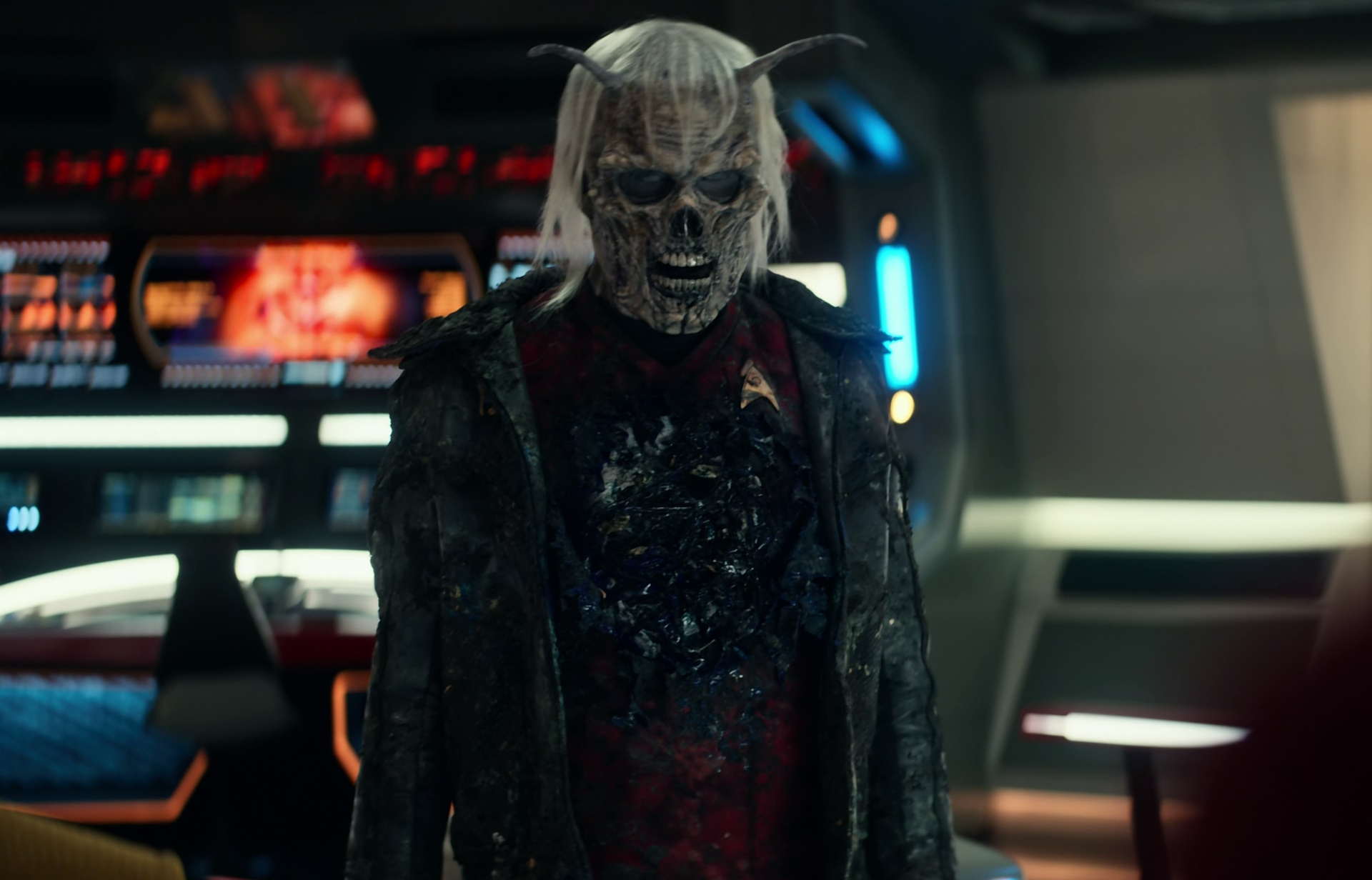
Five Years, Five Recommendations

A spoiler warning graphic.

Spoiler Warning: Minor spoilers may be present for some of the titles on this list.

This month (November 2024) marks the fifth anniversary of Trekking with Dennis! That’s right, I’ve been online talking about Star Trek and the wide world of geekdom for almost five years – and what better way to celebrate or mark the occasion than by making five recommendations to you based on the films, games, and TV shows that I’ve enjoyed in that time? This isn’t my “end-of-year awards” piece for 2024; that’s still on the schedule for late December. Instead, what I’m going to do today is highlight five films, five games, and five TV shows from late 2019 through late 2024 that I think could be worth a look.

We’ll get into more personal reflections and a bit of a retrospective look back at the website’s progress later this month, but for now suffice to say that I’m satisfied with things. I don’t write as often as I did when I was getting started, and I have certainly experienced periods of writer’s block and burnout. But by and large I’m still enjoying what I do here; this little side-project gives the old brain cells a bit of a workout!

A stock photo of a person typing on a laptop.

As always, I have a couple of caveats before we jump into the list. First of all, I’m picking titles that were released between November 2019 – the month Trekking with Dennis first came online – and November 2024. Older titles won’t be included. Secondly, this isn’t meant to be a “top five” or my “all-time favourites;” these are just titles I’ve enjoyed that I’m happy to recommend. And finally, as I always say: all of this is just the subjective opinion of one person. If I include something you hate or miss out something you love… that’s okay! We all have different opinions when it comes to media and entertainment.

Phew! With all of that out of the way, let’s take a look at a few films, games, and TV programmes from the last five years.

Film #1:
Raya and the Last Dragon

Still frame from Raya and the Last Dragon showing Sisu wearing a hat.

Raya and the Last Dragon was unfortunate to be released while many cinemas were either still closed or limited in the amount of seats they could sell, and the film wound up on Disney+ shortly after its release – for an additional charge, naturally. As a result, I don’t think it picked up as much attention as it otherwise might’ve done, and that’s a shame because it’s a genuinely enjoyable film with a strong story.

Titular heroine Raya must travel across the broken land of Kumandra – a fictional realm based loosely on South-East Asia. In her quest to bring back the dragons and defeat the deadly Druun, she encounters a host of fun characters, visits diverse locations, and is swept up in a thrilling adventure. I had a blast with this film – though it was a little odd that there were no musical numbers in a Disney animated picture!

Film #2:
The Super Mario Bros. Movie

Still frame from The Super Mario Bros. Movie.

Alright, I admit it: the 1993 live-action Super Mario Bros. is a “guilty pleasure” favourite of mine! But there’s no denying that the animated film from last year blows it out of the water in every possible way. Nintendo was understandably cautious with its top-tier franchise after the reaction to the live-action version in the ’90s, but the corporation was eventually persuaded to give Mario another chance at the box office. What resulted was my favourite film of 2023 by far.

The Super Mario Bros. Movie puts an updated twist on the tired “save the princess” trope by putting Luigi in danger and having Mario team up with Peach to rescue him from Bowser. Practically all of the Mushroom Kingdom gang join the fun, and there’s even a fun sequence based on the Mario Kart games. Visually, the film was an absolute treat, with the Mushroom Kingdom being brought to life and looking better than ever. A great soundtrack was the icing on the cake for a truly delightful film.

Film #3:
Civil War

Still frame from Civil War showing abandoned vehicles.

Earlier this year I watched Civil War, a fascinating film about a near-future America that was at war with itself. The film didn’t have the political angle that I’d been expecting based on its marketing material, with the titular conflict being more of a backdrop for a road trip the main characters took through different parts of a war-ravaged nation. There were some incredibly brutal depictions of violence, showing how the breakdown of social order can turn average, everyday people into killers.

The main characters were all interesting, and a focus on journalists lent the film something a little different in a war genre that can sometimes get repetitive. The final sequence involving the storming of the White House and the killing of an apparently very unpopular president has parallels that are genuinely disturbing and thought-provoking, too.

Film #4:
Dune (Parts One and Two)

Still frame from Dune: Part Two.

I was very worried that Denis Villeneuve might not get the opportunity to complete his two-part adaptation of Dune – but I’m so glad to have been proven wrong about that! The book has proven notoriously difficult to adapt thanks to a dense story, and realistically we could have a multi-season TV series based on just the first entry in the series. But this two-part film adaptation (which will shortly be joined by a prequel TV show set in the same universe) was absolutely fantastic.

What’s great about Dune and Dune: Part Two is how both films brought in a much bigger audience than you’d expect for a sci-fi property. Expanding the genre to new fans is a great thing, and it’s something to celebrate. In terms of cinematography, sound design, acting performances, and basically everything across the board, this two-part adaptation of Dune was beautiful science-fiction perfection.

Film #5:
The Matrix Resurrections

Still frame from The Matrix Resurrections showing Neo in the Matrix.

Maybe it’s a “hot take” to say this was a brilliant film… but it genuinely resonated with me in a way that very few titles ever have. I respect director Lana Wachowski for returning to the world of The Matrix almost twenty years later, and bringing back a deeply metaphorical style of storytelling.

I described The Matrix Resurrections as brutal and raw, and it could even be an uncomfortable watch in places. Some viewers these days have an understandable bias against franchises being brought back or revisited – because all too often, the reason corporations do so is purely to profit off of a successful name. But Resurrections (despite its name) is different, and it finds a story worth telling and an analogy worth paying attention to. I’d encourage anyone who missed it to at least give it a chance.

Video Game #1:
Star Wars Jedi: Fallen Order

Concept art for Jedi: Fallen Order showing Cal, BD-1, and a landscape.

Jedi: Fallen Order isn’t just a great game, it’s one of the best pieces of Star Wars media of the last five years, period. The game follows Cal Kestis – a young Jedi who barely survived the events of Order 66 (as depicted in Revenge of the Sith) as he goes on a galaxy-spanning adventure and rediscovers his connection with the Force. It’s an intense and, at times, emotional journey, and there are some great moments of characterisation as Cal develops friendships with some of the people he meets along the way.

Mechanically, Jedi: Fallen Order is a “souls-like” third-person adventure game, but from my point of view it has an easier mode so that’s great! There were a couple of things I didn’t like as much – like having to re-play whole chunks of the same level – but by and large it was a blast. It’s a shame its sequel came with a much weaker story!

Video Game #2:
Cyberpunk 2077 (plus the Phantom Liberty DLC)

Screenshot of Cyberpunk 2077 showing a combat encounter.

I genuinely did not expect to ever be in a position where I could recommend Cyberpunk 2077 in good conscience. The game launched in an appalling state back in 2020, a fact made worse by the lies its developer, CD Projekt Red, told about the condition it was in. It took several years of continued development just to patch out the bugs, and even then the game was held back by outdated mechanics and systems.

But last year’s massive 2.0 update and the launch of Phantom Liberty completely changed the Cyberpunk 2077 experience, and now the game really is a must-play for fans of role-playing games, action games, or even just great single-player stories. The narrative was always strong enough to keep me playing, even when I was underwhelmed by other aspects of the gameplay. But with many of my original complaints having been completely fixed… this could be one of the best games of the decade.

Video Game #3:
Kena: Bridge of Spirits

Screenshot of Kena: Bridge of Spirits showing the game world.

My pick for “game of the year” in 2021 was this delightfully old-school adventure game with 3D platforming elements. Kena: Bridge of Spirits was the first-ever game by a new indie studio, and the developers took their experience from working on CGI in the film and TV space to create one of the best games of the past few years. Collecting cute critters isn’t just a fun side-activity, it’s an integral part of how you progress through the game. The enchanted forest and village are wonderfully interactive environments. And the game is perfectly paced; neither outstaying its welcome nor ending too soon.

I also felt that Kena: Bridge of Spirits wasn’t a game that held my hand. It gave me all of the pieces I needed to solve a puzzle or navigate an obstacle, but it didn’t point out everything with a map marker or giant arrow. I could infer from the skills Kena had recently learned what I was supposed to do, and I really appreciated that. The graphics are also absolutely stunning, with the game looking like an interactive Disney or Dreamworks movie.

Video Game #4:
Fall Guys

Promo image for Fall Guys.

I haven’t played Fall Guys in a while, but I was obsessed with this adorable battle royale when it launched back in 2020. The game has since gone free-to-play, but its monetisation didn’t feel aggressive or in-your-face the last time I jumped in. Fall Guys is, in brief, a game about running obstacle courses and taking part in multiplayer challenges. Sixty players start each round, but only one will progress through to become the ultimate champion!

There are some wonderfully creative rounds in Fall Guys, from standard obstacle courses to team games, and some have different themes like sci-fi or the holiday season. There’s no story to speak of, and while I’d usually never be interested in an online competitive multiplayer game… Fall Guys really did succeed at pulling me in. I spent hours playing it in 2020 and 2021, and I really should revisit it one day.

Video Game #5:
EA Sports PGA Tour

Screenshot of PGA Tour showing a golfer putting the ball.

I know this seems like a strange pick, but I’ve lost count of the hours I’ve spent playing PGA Tour this year. The game relaxes me in a way few titles do, and reminds me of playing the likes of Actua Golf 2 on my PC in the late ’90s or Wii Sports with friends a few years later. For a game about golf – a sport I have absolutely no interest in and never watch – it sure does succeed at giving me nostalgic, cozy feelings!

There are plenty of things to criticise. This is an EA Sports title, which means it’s pumped full of microtransactions and ways to part with your money. Some of the graphics and animation work for characters feels outdated. And I’d be happy if more lines of commentary were added! But I’m going to end 2024 with PGA Tour as my most-played game by far, and it’s a title I go back to when I need to de-stress, take a break, and play something that’s challenging but not too physically demanding on my arthritic hands.

TV Show #1:
Star Trek: Strange New Worlds

Still frame from Strange New Worlds Season 2 showing the USS Enterprise.

Strange New Worlds is, for me, the absolute highlight of modern Star Trek. Technically a spin-off from Discovery, the show returns the franchise to its episodic roots while retaining modern trappings like character development and season-long arcs that rumble in the background. In just two seasons the series has dipped its toes in genres from musical to horror, and there’s plenty more to come with two upcoming seasons still waiting to be broadcast.

Returning to the USS Enterprise to see Captain Pike in command has proven to be an unexpected masterstroke for the Star Trek franchise, and stepping back to a more episodic style of storytelling after Discovery and Picard were both much more serialised has been incredibly cathartic for this old Trekkie. I would challenge anyone who didn’t enjoy those other live-action Star Trek shows to give Strange New Worlds a chance – I really don’t think you’ll regret it! It’s my hope that this will become the franchise’s new “flagship” series, carrying Star Trek forward through its sixtieth anniversary and beyond.

TV Show #2:
Silo

Still frame from Silo showing Juliette Nichols at her desk.

A different kind of post-apocalyptic drama, Silo was one of the highlights of 2023 for me. Taking place in an underground bunker (the titular “silo”), the show follows an intriguing murder mystery which threatens to unravel the carefully-constructed subterranean world. Rebecca Ferguson leads a star-studded cast, and her character Juliette Nichols makes for a wonderful protagonist.

Apple TV+ invested heavily in Silo, and I think the result of that investment speaks for itself. The show is incredibly well put-together, with everything from sound design and special effects to set design and costumes all building up a creative post-apocalyptic setting. Season 2 is scheduled to premiere in just a few days’ time – and I can’t wait!

TV Show #3:
3 Body Problem

Promo poster (cropped) for 3 Body Problem.

I’m so glad that Netflix belatedly renewed 3 Body Problem, as it’s probably my favourite show of 2024. A really creative work of sci-fi based on a Chinese novel series, 3 Body Problem depicts humanity’s first encounter with an extraterrestrial race – and the incredibly “alien” nature of the San-Ti can be both shocking and frightening. The first season feels like a really solid start for building up a great story, and with the book series already complete, there’s less danger for co-creators David Benioff and DB Weiss than there was with Game of Thrones!

A modern-day setting served 3 Body Problem well, and I loved seeing its seemingly-disconnected storylines and characters slowly come together over the course of several episodes. There were elements of mystery, drama, and horror to go along with a sci-fi premise that could feel quite weighty… and I cannot wait for Season 2 to pick up this story and tell the next part of the tale.

TV Show #4:
The Lord of the Rings: The Rings of Power

Still frame from The Rings of Power showing Galadriel and her ring.

After two seasons, I think The Rings of Power has laid the groundwork for a successful fantasy series. There are things to criticise, and I’m not sure that enough has been done – yet – to fully justify the price tag of one of the most expensive TV shows of all time… but there are plenty of positives to take away from this return to Middle-earth. Interconnected stories, elements of mystery, and some great character moments all give me reasons to keep watching.

I’ve been in love with Tolkien’s world since I first read The Hobbit as a geeky little kid, and getting to see another story like this unfold on the small screen has been fantastic. I just hope that future seasons can be ready a bit faster; waits of two-plus years in between truncated eight-episode seasons puts a bit of a downer on things! But overall I’ve had a good time with The Rings of Power and look forward to its continuation.

TV Show #5:
Five Days at Memorial

Still frame from Five Days At Memorial showing the flooded hospital.

This miniseries had the difficult task of dramatising a recent real-world event: Hurricane Katrina and the effect it had on Memorial Hospital in New Orleans. For my money, everyone involved did a fantastic job. Five Days at Memorial could easily have come across as sensationalist or overplaying its hand, but it manages to be restrained in its criticism of the real people involved while remaining a gripping and occasionally harrowing watch.

The miniseries is also very well-balanced, refusing to condemn or totally exonerate the people involved, choosing instead to show the decisions they made in the context of an incredibly difficult situation. I remember the news reports about Memorial Hospital in the wake of Hurricane Katrina, but seeing the story like this, from the point of view of those involved, was really intense stuff. The sense of abandonment that the staff felt echoes how many people – particularly African Americans who lived in New Orleans – felt and continue to feel to this day. The scars of Hurricane Katrina still haven’t fully healed.

The Best of the Rest

In this category I’m going to make five other recommendations that don’t fit in any of the categories above. These are all entertainment and media-related, but I felt they either deserved their own spotlight or didn’t easily slot into any of the categories above.

Social Media Platform:
TikTok

TikTok's logo on a white background.

I’ve found myself spending a bit more time with TikTok over the past couple of years. At first I was pretty dismissive of the platform; short-form videos in a vertical format didn’t really hold much appeal! But there are some incredible creators on TikTok who use the platform in interesting ways, and you can find everything from cookery to political commentary and travelogues to media criticism.

TikTok’s “For You Page” format also works well, and the app’s algorithm seems to be creepily clever in the way it chooses videos to recommend! I swear that I’ll have been thinking about something, only to see a video about it pop up a few moments later during my next TikTok scrolling session. YouTube is belatedly trying to catch up with Shorts, but TikTok is well on its way to becoming the dominant video app for the younger generation in particular.

Web Series:
Food Wishes

Title card for Food Wishes.

What I like to watch on YouTube can vary a lot, but I’ve always loved a good cookery show. Food Wishes has been running since 2007, and what’s remarkable is how little it’s changed in that time. Host Chef John doesn’t usually appear on camera, making the food he’s preparing the real star of the show. At time of writing there are well over 1,000 videos on the channel, and more are added almost every week.

Chef John teaches us how to cook everything from sandwiches to a full thanksgiving dinner, and often prepares dishes from cuisines and cultures that I would have never thought of! I’ve tried a few recipes for myself, and even though I’m far from the best cook, Chef John’s instructions make things feel simple. Food Wishes is easily one of my favourite web shows of all-time.

Documentary:
We Need To Talk About A.I.

Still frame from We Need To Talk About A.I. showing a digital brain.

Though arguably a little alarmist, We Need To Talk About A.I. was an interesting watch – and is made even more relevant by developments in the few short years since its original broadcast. Keir Dullea, famous for his role in 2001: A Space Odyssey, is the documentary’s presenter and narrator, and he brings a much-needed weight to the role.

The film interviewed several interesting people, including director James Cameron and several A.I. researchers, as it charted humanity’s potential path to creating general artificial intelligence; a sentient machine. A lot of people have been ringing alarm bells about what a hyper-intelligent, sentient machine might be able to do if it were ever created, and this documentary examines some of the worst-case scenarios! With advances in A.I. seemingly happening all the time, perhaps we’re closer to that future than we might think right now.

Browser Game:
Wordle

Screenshot of the browser game Wordle.

Yes, I still play Wordle! I lost for the first time in ages a few weeks ago and it really pissed me off! But that aside, this fun little browser game has become a part of my daily routine – and I don’t know where I’d be without it! I was never one to play anagrams, word searches, or sudoku, but something about the elegant simplicity of Wordle has kept me playing for over two years at this point.

And as long as Wordle remains online, I daresay I’ll keep playing. The hype around the game seems to have died down – it seemed for a while that you couldn’t move on social media without seeing people sharing their Wordle scores – but it obviously retains a sizeable player base.

Subscription:
Xbox/PC Game Pass

Promo graphic for Xbox Game Pass.

I’ve said it before and I’ll say it again: Game Pass feels like a really good deal. If I were asked what the most cost-effective route into current-gen gaming is, I’d say without hesitation that an Xbox Series S with a Game Pass subscription is far and away the best option for players on a budget. Game Pass opens up a huge library of titles for a single monthly fee, and I remain surprised at how much pushback it continues to receive in some quarters!

I’ve been a subscriber to Game Pass on PC for a couple of years, and I’ve tried brand-new games I’d never have been able to afford, experimented with some very different titles I’d almost certainly never have even heard of, and jumped head-first into some big blockbusters all thanks to the service. Sure, there are drawbacks to Game Pass… but subscriptions feel like the way media in general is going, and I’m pretty confident that Microsoft will be able to iron out the bugs and inconsistencies to make Game Pass even better than it already is.

The Best Is Yet To Come…

Before we wrap things up, I want to highlight five announcements that have been made over the past few years. These are all projects that I’m really looking forward to in the months and years ahead.

Announcement #1:
Wicked

Promo poster for Wicked (2024).

The (long-overdue) cinematic adaptation of Wicked is now just a few weeks away, and I really am looking forward to seeing this fantastic story on the big screen for the first time. Years ago I had the privilege of seeing Wicked on the stage in London, and I fell in love with its story, characters, and songs. I’m not usually someone who loves musicals, but Wicked has a truly outstanding soundtrack that I can’t wait to see recreated.

The decision to split Wicked into two parts is interesting, but hopefully will be more of a positive than a negative. Everything I’ve seen so far has just increased my excitement, so I really hope Wicked doesn’t let me down when I’m finally able to sit down and watch it!

Announcement #2:
Future Star Trek projects

Announcement graphic for a new live-action Star Trek series.

At time of writing there are at least two brand-new TV shows in development for the Star Trek franchise, as well as two new seasons of Strange New Worlds. This will keep Star Trek on the air well past its sixtieth anniversary in 2026, which is fantastic news. The likes of Section 31 and Starfleet Academy have the potential to reach out beyond Star Trek’s usual niche to whole new audiences – something the franchise needs to do in order to survive and remain relevant – and that’s positive, too.

I’ve been a huge Trekkie since I first got into The Next Generation in the early 1990s, and to think that there’s still more Star Trek to come in the years ahead is great news. It’s true that I’ve gone through a bit of burnout with Star Trek, and that not every recent project has been fantastic, but there’s still a lot to love in my favourite franchise – and a lot to be excited about as Star Trek continues.

Announcement #3:
Phineas and Ferb Seasons 5 and 6

Still frame from Phineas and Ferb Season 1.

I really was pleased to see Phineas and Ferb get the green light for a full-blown revival. The cartoon has become one of my “comfort shows;” something I drift back to on days when my mental health isn’t great and I’m not feeling my best. The bright colours, wacky storylines, and fun characters just feel comfortable and safe. There’s a lot to love in Phineas and Ferb for an adult audience, too, as the show has plenty of jokes and storylines that aren’t just for kids.

Bringing back a beloved series after a long time away is a risk, but I’m hopeful that creators Dan Povenmire and Jeff “Swampy” Marsh have new ideas for where to take Phineas, Ferb, Perry, Dr Doofenshmirtz, and the rest of the gang. New adventures and inators await!

Announcement #4:
Grand Theft Auto VI

Still frame from the GTA 6 trailer.

One of the first subjects I wrote about here on the website back in 2019 was Grand Theft Auto VI… and the game still isn’t out! I’m pretty annoyed with Rockstar for continuing to milk Grand Theft Auto V at the expense of everything else, and I’m even more disappointed that its sequel isn’t going to get a simultaneous PC release. For a company like Rockstar to cheap out on development given the growth of PC gaming over the last few years is pretty stupid to say the least.

However… I will eventually get my hands on this game, and from what I’ve seen and heard so far, it looks like it’s gonna be a fun time. Maybe it won’t hit the heights of Red Dead Redemption II, but then again, could any game manage that? I’m trying to keep my expectations in check, but there’s no denying that I’m very keen to play Grand Theft Auto VI after such a long wait.

Announcement #5:
Nintendo’s next console

Nintendo's logo on a red background.

Earlier this year we heard from Nintendo that the company’s still-untitled new console is well underway. I’m expecting to see a release sometime between April 2025 and March 2026, so we might be pretty close! I’m already excited at the prospect of a new 3D Mario game, a new Animal Crossing title, a new Mario Kart game… and so on! I had fun with my Nintendo Switch, but I agree – it’s time for a new console.

There are reasons to be sceptical about Nintendo – their attempt to sue a competitor to the Pokemon series out of existence being just one of the shitty things the company has done of late. But as someone who’s been a Nintendo fan since I bought my first ever home console, I’d be lying if I said I wasn’t really excited to see what Nintendo is going to do next. The smart money is on another hybrid console; a more powerful Switch. But I wouldn’t be surprised if Nintendo has a new gimmick in store to help the new machine stand out.

So that’s it!

A stock photo of a smart TV with streaming apps.

Five years, five recommendations in a bunch of different categories. I hope this has been a bit of fun!

I certainly enjoyed returning to these titles! In some ways, it feels like no time at all since I was first beginning to put together the pieces of what would eventually become Trekking with Dennis. But in other ways, a lot has happened over the past five years – both personally and in a more general sense. The world of entertainment feels less stable, in some ways at least, than it did back then.

I hope you’ll join me at the end of November for a more individual perspective on the last five years. This website is, rather embarrassingly, the longest-running project I’ve ever had. It’s outlasted any job I’ve ever had, any other hobby or side-gig, and even though I spend less time writing here than I did when I first started, I still enjoy having my own little slice of the interweb where I can share my thoughts on some of my favourite (and least-favourite) titles. I hope to see you again soon!


All titles discussed above are the copyright of their respective publisher, broadcaster, distributor, corporation, etc. This article contains the thoughts and opinions of one person only and is not intended to cause any offence.
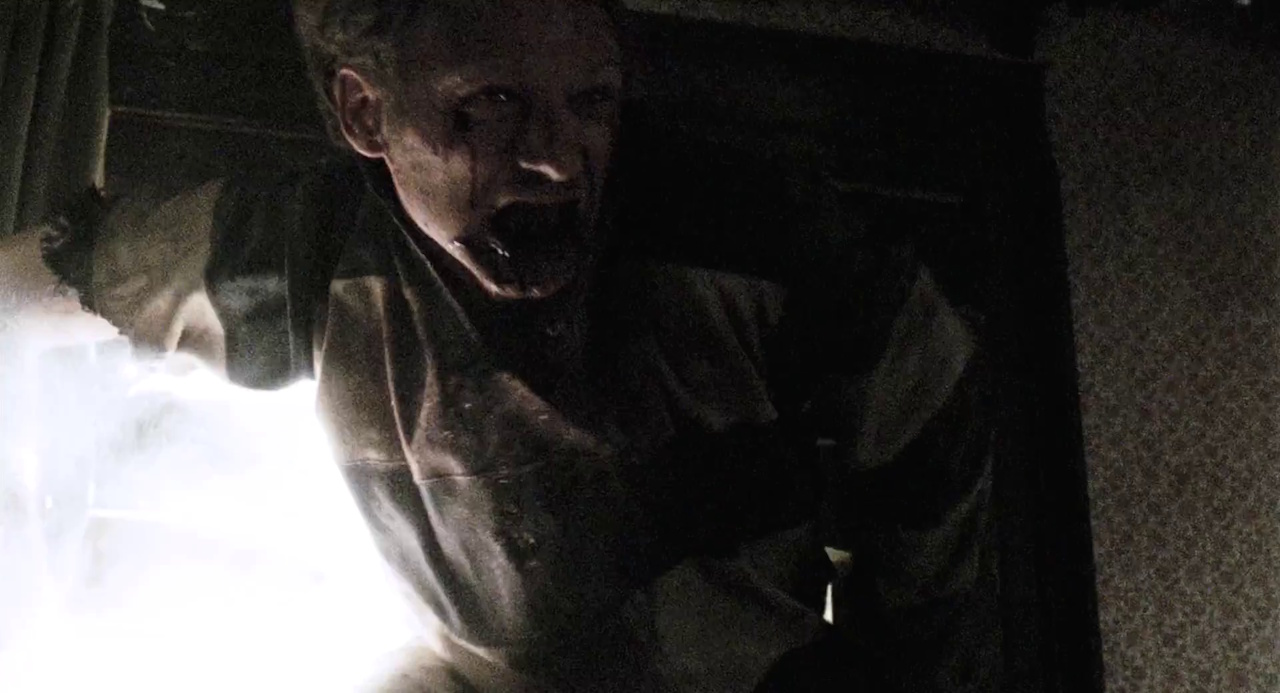
Answering Ten of the Biggest Geeky Questions!

A spoiler warning graphic.

Spoiler Warning: Spoilers may be present for some of the franchises/properties discussed below.

There are a handful of “big questions” that define one’s place in geekdom – and today it’s my turn to answer some of them!

I thought it could be a bit of fun to consider some of the biggest questions that geeks like us have to wrangle with. Which fictional character is stronger? Which gaming platform is the best? These questions are contentious, especially here on the interweb – but I hope you’ll engage with this piece in the spirit of light-hearted fun! That’s how I’m choosing to present my answers, in any case.

As I always like to say, nothing we’re going to talk about today is in any way “objective!” These are my wholly subjective takes on questions that are intended to evoke strong reactions, so I hope you’ll keep that in mind! Although I’ve said that these are ten of the “biggest” geeky questions, I’m sure you can think of others – so this is by no means a definitive list.

A stock photo of a contemplative man surrounded by question marks.
Let’s contemplate some big questions together!

I’ve considered myself a geek – and been considered a geek by others – for basically my whole life. As a kid and a teenager, I moved in nerdy circles and friend groups where the likes of fantasy, sci-fi, horror, and video games were frequent topics of conversation. And in the ’80s and ’90s, those things were far less “mainstream” than they are nowadays! It’s actually been really cool to see the likes of The Lord of the Rings, Star Wars, and Marvel become some of the biggest entertainment properties on the planet – as well as the explosion in popularity of video games. When I was at school, and even into my young adulthood, admitting to being interested in those kinds of things could lead to mockery and even bullying!

For these questions today, I’ve set myself the rule of providing an actual answer – no cop-out, fence-sitting, “I like both equally” answers here! As I’ve already said, all of this is just one person’s opinion – and at the end of the day, this is supposed to just be for fun. So please try not to take it too seriously; none of this is worth getting into an argument over!

With the introduction out of the way, let’s answer some tough geeky questions!

Question #1:
Who’s the best Doctor?
Doctor Who

A promo image for Doctor Who showing all of the various incarnations of the titular character.
All of the Doctors – so far!

I don’t really remember watching much Doctor Who as a kid. The original incarnation of the long-running BBC sci-fi series was coming to an end when I was younger, and by the time I was getting interested in the genre, it was Star Trek: The Next Generation that really captured my imagination. As a result, I’m going to exclude all of the pre-2005 Doctors from consideration; I simply haven’t seen enough of any of them to really have a favourite.

Of the Doctors that have been part of the revived series, the Twelfth – played by Peter Capaldi – is my favourite… but with a big caveat! Capaldi gave the best individual performance as the Doctor in the role – hands down. No disrespect meant to any of the others… but I don’t think it’s even close. He’s a performer with exactly the right style, look, and gravitas – and in my view, he played the role absolutely perfectly. That’s why I didn’t hesitate when it came to naming him as my favourite!

Still frame from Doctor Who (2005) showing Pearl Mackie and Peter Capaldi.
Peter Capaldi’s Twelfth Doctor is my personal favourite.

But there’s a catch, as I said. Capaldi’s seasons as the Doctor – Seasons 8 through 10 of the post-2005 series – were almost universally terrible. There was one decent companion (Bill, played by Pearl Mackie) but her character was treated almost as an afterthought and she met a stupid and unsatisfying end. There were hardly any decent villains or antagonists, no truly standout episodes, and really very few memorable moments at all. In fact, Capaldi’s tenure as the Doctor marked a significant decline in Doctor Who’s quality… and the series doesn’t seem to have recovered.

In terms of the best seasons of the revived Doctor Who, I’d have to give the award – somewhat begrudgingly – to Seasons 2 through 4, which starred David Tennant in the title role. The quality of the stories produced at that time was so much higher, with some truly outstanding adventures in the mix. If only there was some way to go back in time and combine Capaldi’s performance with Tennant’s storylines. Where’s a Tardis when you need one, eh?

Question #2:
Who would win in a fight: Batman or Superman?
DC Comics

Cropped poster for Batman vs Superman (2016) featuring the title characters.
Wasn’t there a mediocre film dedicated to answering this question?

Uh, this one should be obvious. It’s Superman, right? It has to be – if you gave any other answer then I don’t think you’ve been paying attention! Who would win in a fight between an overpowered demigod and a billionaire with some expensive gadgets? Yeah… the demigod is gonna win this one. He could launch Batman into the sun, punch him so hard that every bone in his body would shatter, use his heat-vision on him from half a mile away… the list of ways in which Superman could not just defeat but murder and utterly annihilate Batman is nearly endless!

Superman is, I would argue, increasingly difficult to depict in film because of how blatantly overpowered he is. If you read my review of Zack Snyder’s Justice League a couple of years ago, you might remember me saying that the film flopped around, desperately trying to find a way to include the rest of its cast of superheroes… but to no avail. There was no getting away from the simple fact that Superman could do it all single-handedly without even breaking a sweat.

Cropped cover of Action Comics #19 showing Superman.
Superman on the cover of Action Comics #19 in 1939.

At the time the character of Superman was first created, all the way back in 1938, it wasn’t a problem. In fact, creating an “all-round, all-American hero” for comic books aimed at children was exactly the point. Superman is textbook escapism – he’s the perfect hero archetype that can do it all. In context, Superman works, and when all you want is a “good guy” to save the day and stop the evil villains, he’s perfect for the part.

But any story that puts Superman in genuine danger has to come up with a reason why. The man’s basically invincible, save for the mysterious crystal known as kryptonite, and I think at least some of Superman’s big-screen and small-screen adventures suffer as a result of that. But to get back on topic: Superman would win in a fight, and he’d win incredibly quickly and incredibly easily!

Question #3:
Console or PC?

A Super Nintendo console on a red background.
A Super Nintendo – or SNES.

In the early ’90s, the first home console I ever owned was a Super Nintendo. From then on, all the way through to the middle of the last decade, console was my preference. I liked the pick-up-and-play nature of consoles, with no need to check system requirements or fiddle with settings to just get a game running. The underpowered PCs that I had in the ’90s weren’t much good for gaming, so I think that’s part of it, too. But you have to also remember that, for a long time, consoles were just better in terms of performance – and especially in terms of value – than PC.

But nowadays I’m firmly on Team PC! I built my own PC for the first time a couple of years ago, and prior to that I had a moderately-priced “gaming” PC. Since about the middle of the 2010s, PC has been my platform of choice for practically everything. I will consider picking up Nintendo’s next machine when it’s ready, but my Nintendo Switch has been gathering dust since I stopped playing Animal Crossing and Mario Kart 8… so I’m not sure how great of an investment that’ll really be!

Stock photo of a gaming PC.
A very pretty gaming PC setup.

PC offers the best of both worlds. Wanna play an in-depth strategy game or city-builder with loads of options and menus that really need a mouse and keyboard to navigate? PC can do that. Wanna plug in a modern control pad to play a third-person adventure title? PC can do that too. Wanna install a virtual machine and play games from the Windows 95 era? PC can do that! Wanna emulate every console from the Atari 2600 to the Dreamcast and play games that are out-of-print everywhere? PC can do that too!

With Game Pass bringing a lot of new titles to PC on launch day, and with Sony even porting over some of its previously-exclusive titles too, PC really feels like the place to be. It’s a lot more expensive to get started with – and that’s still a massive point in favour of consoles for players on a budget. But once that initial expense is out of the way, the abundance of sales on platforms like Steam means that a lot of titles – even newer ones – can be picked up at a discount. I’m really happy with my PC as my main gaming platform, and I doubt I’ll be picking up an Xbox or PlayStation this generation.

Question #4:
What would be the best fictional world to live in?

There are plenty of fictional worlds to choose from!

There are loads of absolutely awful answers that people give to this question! Who’d want to live in Star Wars’ fascist-corporate dystopia, for example, which seems absolutely terrible for anyone not blessed with space magic? Or any fantasy setting with a medieval level of technology? Sure, you might have a magic elf as your buddy… but if there’s no central heating, antibiotics, or flushing toilets… you’re gonna have a bad time!

My pick is simple: Star Trek’s 24th Century. There are things to worry about, sure: the Borg, the Cardassians, and the Klingons to name but a few threats! But there are so many wonderful inventions and technologies that would make life so much better. For me, as someone with disabilities, the idea of some or all of my health issues being cured is perhaps the biggest – but there are plenty of others, too.

The USS Enterprise orbiting Earth.

Star Trek does not depict, as some have tried to claim, a “communist utopia.” As we see on multiple occasions throughout the franchise, private property still exists, and people have a great deal of freedom and autonomy. Star Trek’s future could be more accurately described as a post-scarcity society – one in which technological improvements have brought unlimited power generation, food, and other resources to the people.

There are some dark spots in Star Trek’s future – but these tend to be places outside of or separate from the Federation. Assuming I could live somewhere in the Federation, and have access to replicators, warp drive, weather-controlling satellites, and Starfleet for defence… I think it would be bliss! And so much better than anywhere else I can think of.

Question #5:
Martin or Tolkien?

Who’s the superior author?

I don’t need to think too long about this one! JRR Tolkien is, for me, one of the greatest authors of all-time. George RR Martin, in contrast, can’t even finish his own story, and seems far too easily distracted by other projects – including writing TV episodes and working on video games. And c’mon… he literally copied the “RR” part of Tolkien’s name for his own pen name!

Jokes aside, I think both writers are pretty great. Tolkien could be, in places, a little too black-and-white with his protagonists and antagonists, with the goodies being pure and virtuous and the villains being corrupt and evil. Martin’s work deliberately upends many of those notions, and he places imperfect and even selfish characters at the heart of his stories. Some of George RR Martin’s characters feel more nuanced – and dare I say more human – than Tolkien’s.

The Fellowship of the Ring at Rivendell from the 2001 film adaptation.

But Tolkien was a pioneer, writing the first modern fantasy epic. Martin, and countless other writers, are simply following in his footsteps. While Martin’s work is hardly derivative, some of the choices he makes in his writing are a reaction to the way Tolkien’s worlds and characters were set up. It’s impossible to critique A Song of Ice and Fire without making multiple references to Tolkien – whereas Tolkien’s work has always stood on its own two feet.

I would love it if George RR Martin would finish his magnum opus, but as time passes I feel less and less sure that he’s even interested in doing so. Now that Game of Thrones has finished its run on television, and Martin has seen the overwhelmingly negative reaction to its ending – which will have contained at least some elements that he planned to include in the remaining books – I just don’t get the impression that his heart is in it in the same way it was a few years ago. Tolkien’s work, in contrast, is complete and has been for decades – and people are still interested in new adaptations.

Question #6:
Who’s the best Star Trek captain?

Promo banner for Star Trek Day showing multiple characters.
Multiple captains on a promo banner for “Star Trek Day.”

I’ve always struggled with this question. But I’ve gone on record several times here on the website as saying that if you put a gun to my head and forced me to choose – as this question is metaphorically doing – I’d pick Deep Space Nine’s Captain Benjamin Sisko. So that’s gonna be my answer!

There’s a lot to be said for Captain Kirk – Star Trek’s first captain. He paved the way for all of the others, and without him, Star Trek would not be the same today – if it even existed at all. And Captain Picard was my personal first captain; it was through The Next Generation that I became a Trekkie in the early ’90s. Without him and the crew he led, there’s a chance I would never have fallen in love with Star Trek in the way that I did. And all of the other captains from Janeway and Burnham to Archer and Pike all have wonderful qualities that make Star Trek into the franchise it is today.

Still frame from the documentary What We Left Behind showing Avery Brooks as Captain Sisko in a remastered clip.
Captain Benjamin Sisko.

But Captain Sisko has always stuck out to me. In the first few seasons of Deep Space Nine he only held the rank of Commander, so we got to see his rise to the rank of captain as the story of that show unfolded. He was also a man with a deeply traumatic past, having to come to terms with the death of his wife while raising his son alone. He was a fantastic leader – not just of a crew, but of a community. Sisko could reach out across the cultural divide to Ferengi, Klingons, changelings, Bajorans, and more. He turned DS9 from a military outpost into a friendly place to visit and a bustling port.

Although words like “scientist” and “explorer” might not be the first ones that spring to mind when we think of Captain Sisko, he had those traditional Starfleet qualities, too. We’d see him as a pioneer of exploring the Gamma Quadrant and the wormhole, as well as interacting with the non-corporeal Prophets – the very definition of seeking out new life! Sisko could also be a soldier and a diplomat when he needed to be – and to me, he embodies the very best of Starfleet in the 24th Century.

Question #7:
Marvel or DC?

The logos of both Marvel and DC.

I don’t read comic books – and I never did, even as a kid. So my limited knowledge of both of these brands comes from their cinematic outings, not the original source material! I wanted to get that caveat out of the way before we got into the weeds with this one.

If you were to ask 100 people on the street to name a superhero, I think Superman and Batman would probably be the two names you’d hear most often. So DC, at least in my opinion, has produced the two most memorable and noteworthy superheroes. But Marvel, at least on the big screen, has a bigger and stronger ensemble – as we saw when Avengers Endgame briefly became the highest-grossing film of all time.

Still frame from Batman & Robin (1997).
Batman & Robin (1997).

Although I want to say that I’ve gotten roughly equal enjoyment from DC and Marvel over the years, I promised you no fence-sitting and no cop-outs! Based on the strength of characters like Batman, who have starred in some really great films over the years, I think I have to give the win to DC. Marvel’s output is becoming increasingly convoluted, and just keeping up with the franchise to know who’s who and what happened last time can feel like a full-time job! At least DC still produces some standalone or semi-standalone films and TV shows that I can dip in and out of.

Aside from Batman and Superman, though, DC hasn’t really been able to successfully capitalise on its other superheroes – let alone turn them into household names. Wonder Woman, Aquaman, the Flash, and Green Arrow have all had limited success in a single film or TV series, but others have struggled. Batman may drag DC over the finish line this time… but there’s still room for improvement!

Question #8:
Star Wars or Star Trek?

Still frame from Star Wars (1977) showing the Death Star.
The Death Star at Yavin IV in Star Wars.

If you’ve read the name of this website, I’m sure you can guess which way this one’s going to go! Thankfully the whole “Star Wars versus Star Trek” rivalry that was a big deal a few years ago has more or less died out, and fans no longer feel quite so tribal about which is the best. There’s been a lot more crossover in recent years, with Trekkies and Star Wars fans happy to enjoy both franchises.

I consider myself a Trekkie first and foremost – so I’ll answer this question by saying that I prefer Star Trek over Star Wars. But that doesn’t mean I hate or dislike Star Wars by any stretch. In fact, some of my favourite entertainment experiences of all-time have come courtesy of the Star Wars franchise: games like Knights of the Old Republic and films like Rogue One are genuinely fantastic.

Promo photo of the main cast of Star Trek: The Next Generation Season 2 (1988).
The cast of Star Trek: The Next Generation Season 2.

What I like about Star Trek is that many of its stories aren’t about fighting a villain or defeating an adversary – but about exploration, science, engineering, and just what it might be like to live in space in the future. Star Wars, by its very nature, is more violent, with more of a focus on conflict. That’s fine when I’m in more of an action mood – but there are times when a story about seeking out new life or learning to communicate is what I’m looking for.

It’s also worth pointing out that there’s a heck of a lot more Star Trek than Star Wars! At the time I first encountered the franchises, it wouldn’t be totally unfair to say that there were two good Star Wars films and one okay-ish one – at least in the opinion of a lot of folks! Star Trek already had more than 100 episodes of TV and five films under its belt, so there was plenty to get stuck into as a viewer in the early ’90s! Quantity over quality is never a good argument, of course… but if I’m enjoying something I’m always going to be happy to get more of it! Star Wars is slowly catching up to Star Trek now that Disney has commissioned several made-for-streaming series, but there’s still a long way to go to reach Star Trek’s 900+ episodes!

Question #9:
Sci-Fi or Fantasy?

The NeverEnding Story (1984) was one of my favourite films as a kid.

This may come as a surprise, but fantasy was my first love long before I got interested in sci-fi, space, and the “final frontier!” Among my earliest memories is reading The Hobbit – a book that was originally intended for children, lest we forget. I can even remember pointing out to my parents that there was a typo on one page; the word “wolves” had been misprinted as “wolevs.” Aside from Tolkien’s legendary novel, I read other children’s stories including Enid Blyton’s The Faraway Tree, and watched films like The Neverending Story.

But it’s not unfair to say that sci-fi became a much bigger deal for me by the time I was reaching adolescence. Inspired by Star Trek: The Next Generation I immersed myself in science fiction, reading as many books about space and the future as I could get my hands on, and watching films like Alien and the Star Wars trilogy. TV shows like Quantum Leap, Space Precinct, and Buck Rogers in the 25th Century graced my screens in the ’90s, as did more kid-friendly offerings like Captain Scarlet.

Star Trek: The Next Generation turned me into a sci-fi fan!

So while I can happily say that I enjoy both genres for what they offer, sci-fi has been my preference going back more than thirty years at this point! Star Trek opened my eyes to science fiction and remains one of my biggest fandoms to this day! But there are many other sci-fi films, shows, books, and video games that I’ve enjoyed – everything from Mass Effect and Foundation to Battlestar Galactica and Halo. Sci-fi is great escapism, and I love the feeling of being whisked away to another world or another moment in time.

Though I haven’t forgotten my roots as a fan of fantasy, and still enjoy many fantasy titles across all forms of media, if I had to choose I’d definitely say that I’m a fan of sci-fi first and foremost. Sci-fi feels broader and more varied in some respects – there are radically different presentations of humanity’s future, the kinds of aliens we might engage with, and so on. Modern fantasy tends to stick to a medieval level of technology and use the same kinds of magical spells and the same handful of races – Elves, Dwarves, Orcs, and so on – in different combinations depending on the story.

Question #10:
What’s your favourite anime/cartoon series?

Still frame from Shenmue: The Animation showing Ryo and Fangmei.
There’s an anime adaptation of Shenmue.

I have to confess something at this point: I’ve never seen any anime. I don’t know why exactly – I’ve never really been in friendship groups where anime was a topic of conversation, and when I was a kid, there wasn’t any anime on TV or in the cinema that I can recall. I’ve yet to encounter an anime series that felt like a must-watch – with the only exception being the adaptation of Shenmue that I really ought to get around to watching one of these days! But until I do… no anime for me.

I had to think about this question for a while, though. There are some great adult animation programmes: Lower Decks, Futurama, Rick and Morty, South Park, and The Simpsons all come to mind. The Simpsons in particular was a pioneer of adult animation, and a series I remember with fondness from its ’90s heyday here in the UK! The fact that my parents – and many others of their generation – absolutely loathed The Simpsons was a huge mark in its favour for a renegade adolescent!

Still frame from the Phineas and Ferb Season 3 episode What A Croc showing the kids on jet skis.
Phineas and Ferb.

But on this occasion, I’m giving the award to Phineas and Ferb. Regular readers might remember me talking about this series as one of my “comfort shows;” a programme I often return to when I need a pick-me-up. I recall watching a promo for the series circa 2007-08, and although kids’ cartoons on the Disney Channel should’ve held no appeal… something about Phineas and Ferb called out to me. I tuned in and I was hooked from almost the first moment.

Phineas and Ferb’s two-and-a-half story structure – with the kids making an invention, their sister trying to bust them for it, and special agent Perry the Platypus on a mission to fight evil – felt incredibly fun and innovative, and more often than not the storylines would intersect in creative and unexpected ways. There are also some fantastic moments of characterisation in Phineas and Ferb, particularly with the breakout character of Dr Doofenshmirtz. I was thrilled to learn that the series will be returning for two new seasons and a whopping forty new episodes, and I really hope it will be as good as it was the first time around.

So that’s it!

The famous "that's all folks" card shown at the end of Looney Tunes cartoons.
That’s all for now!

I hope this has been a bit of fun – and maybe bolstered my geeky credentials just a little. As I said at the beginning, I don’t think any of these subjects are worth fighting about or losing friends over, but I’ve had fun sharing my thoughts and nailing my colours to a few different masts!

The great thing about sci-fi, fantasy, gaming, and the wide world of geekdom is just how much of it there is nowadays. There are so many high-budget productions on the big screen, the small screen, and in the gaming realm that we’re really spoilt for choice. As much fun as it is to play favourites and pick one series or franchise over another… more than anything else I’m just glad to be living through a moment where geekdom is having its turn in the spotlight! That may not last forever – a return to action movies, westerns, or whatever else might be on the cards one day. So we should all make the most of it and enjoy it while it lasts!

It’s been interesting to consider some of these questions, and I hope reading my answers has been entertaining for you, too!


All properties discussed above are the copyright of their respective owner, company, distributor, broadcaster, publisher, etc. Some stock photos courtesy of Unsplash. This article contains the thoughts and opinions of one person only and is not intended to cause any offence.
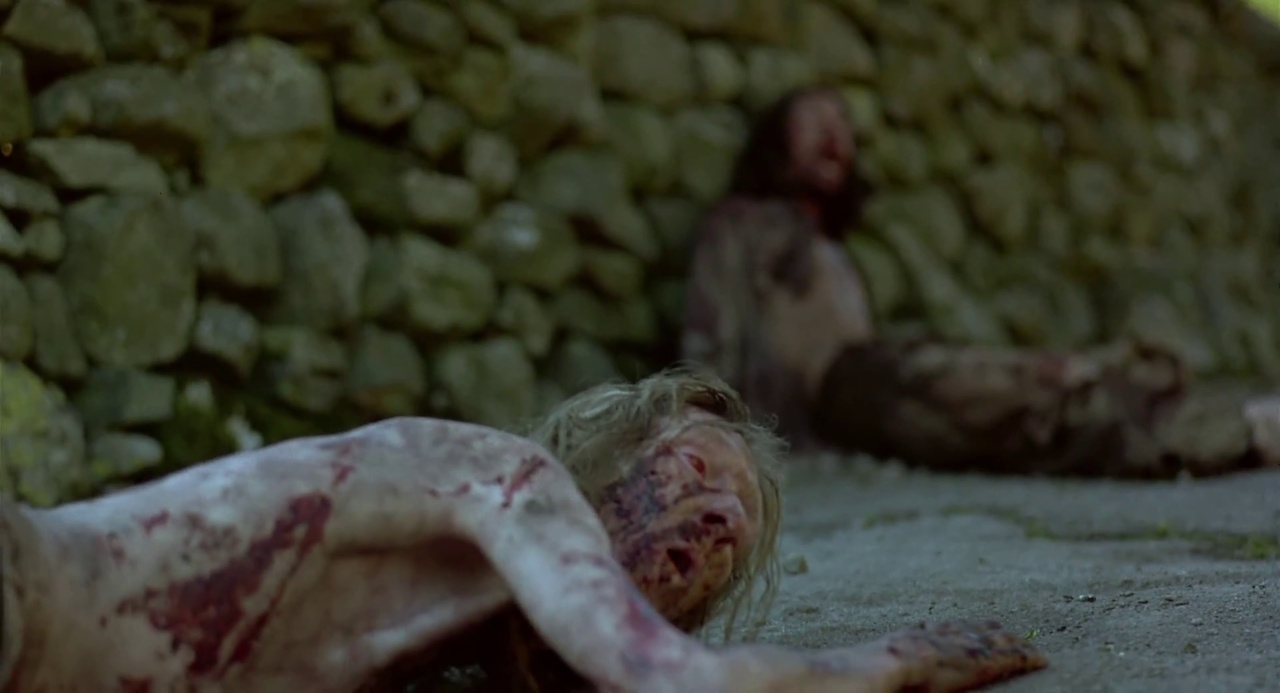
Fallout: Season 1 Review

A spoiler warning graphic.

Spoiler Warning: There are spoilers ahead for the Fallout TV series and minor spoilers for several of the Fallout video games.

I’ve just finished my binge-watch of the Fallout television adaptation, so it’s time for a review! Having played a couple of the games, I’m no stranger to the world of Fallout – but I’m not exactly a super-fan of the franchise, either. I came to the TV show with enough background about the setting not to be a complete newbie, but with no real expectations about where things would go narratively. I generally enjoyed my time with the two Fallout games I played, but there have always been some elements of the games, both in terms of story and gameplay, that didn’t work as well for me. So I guess what I’m trying to say is that I didn’t have sky-high expectations for Fallout, but I was cautiously optimistic.

Any series backed up by Amazon should be afforded a decent budget, and that was another reason to approach Fallout with some degree of anticipation. The show’s writing team had also been working with Bethesda Game Studios – developers of the more recent Fallout titles – and again that seemed like something positive as this unique setting was adapted for a brand-new medium.

Cropped promo poster for Fallout (2024).
The main characters on a promo poster.

I came away from Fallout feeling moderately impressed – but by no means blown away. There were some interesting mysteries and truly surprising twists in the story… and some story beats that were either too rapid or that didn’t seem to make a lot of sense. There were some great characters… and one so cringeworthy that I literally fast-forwarded through several of their scenes. There were some great visual effects… and some that weren’t quite as high-quality as I’d have expected from a flagship streaming series of this type.

For every genuine success Fallout found with the pacing of one of its storylines, the development of one of its characters, or the way in which its world was constructed and brought to screen, there was another of these elements that didn’t hit the mark. The overall result was a series that I enjoyed parts of… then ended up rolling my eyes when something didn’t work as well as it should’ve. There were several places where I felt an extra scene or two wouldn’t have gone amiss – so maybe going for nine or ten episodes instead of a curtailed eight-episode season might’ve been better. I also think it was a mistake to dump the entire season at once instead of releasing episodes week-by-week as Amazon Prime Video usually does.

Graphic from the Fallout (2024) trailer showing the season's release date.
Why did Amazon and Bethesda feel the need to release the entire series at once?

Fallout, for me, was a show that needed room to breathe. I needed to let the events of each episode settle before racing ahead to the next – and with social media awash with spoilers within literally hours of the show’s arrival on Amazon Prime Video, I felt a strange kind of pressure to binge more episodes than I wanted to. The decision to drop the entire season in one hit is an odd one, because it’s not something that Amazon usually does with its original programming. I’d love to know why Amazon and Bethesda chose to do it this way – as not only does it harm the individual episodes by smooshing them all together, but it also means that Fallout’s moment of relevance is a heck of a lot shorter than it could’ve been. If Fallout released its episodes weekly, the show would’ve been part of our collective cultural conversation for a couple of months. As it is, Fallout was already beginning to disappear just days after its premiere.

One day we’ll have to talk in more depth about binge-watch culture and the pros and cons of releasing brand-new television shows this way. But for now, I think I’ve made my point about how Fallout was harmed by this strange and unexpected decision.

Behind-the-scenes photo from Fallout (2024).
Director Jonathan Nolan and producer/showrunner Geneva Robertson-Dworet during production on Fallout.
Image Credit: IMDB/Amazon Prime

When adapting a video game for a new medium, one of the big challenges that writers and designers face is how to include some of the game’s interactive elements. In the case of Fallout, we have things like the Pip-Boy device, which is worn on the wrist and serves as an in-game menu for inventory management, navigating the game world, and so on. Fallout went out of its way to include the Pip-Boy in a way that made sense, and I think fans of the games will have appreciated things like seeing Lucy place a map marker, or her Pip-Boy warning her of radioactivity.

But in a series that often had no time to waste, as its main storylines needed attention, in retrospect I’d say there were probably a few too many of these moments. A nod and wink to fans is great – but when more important story beats were cut short, or when characters seemed to switch from one state of mind to another too quickly, I’d either be looking for ways to extend the series… or for less-important things to cut out. Once the Pip-Boy had been established and its basic abilities made known, there really wasn’t a lot of need to keep going back to it.

Still frame from Fallout (2024) showing Lucy's Pip-Boy.
Lucy’s Pip-Boy.

One thing that has been alluded to many times in the Fallout video games, but never directly shown, was the state of the world prior to the nuclear war. The television adaptation picked up on some of these story threads, and it was genuinely interesting to see more of the pre-war world than we’ve ever seen before. Aside from the opening moments of Fallout 4, which was little more than a character creation menu and basic tutorial, this was the most time we’ve ever been able to spend in Fallout’s ’50s-inspired world. And it was genuinely interesting.

Seeing this world through the eyes of Cooper Howard – later known as “the Ghoul” – went a long way to humanising Fallout’s villain-come-antihero, which was important for his characterisation particularly as we got toward the end of this season’s story. But more than that, it was fascinating to see little glimpses of the world that was destroyed and forever changed by the bombs. Obviously we only got to see one side of that – the upper-class, well-off side. But even that was more than we’d ever really seen before, and it went some way to informing Fallout’s attempted critique of capitalism and mega-corporations.

Still frame from Fallout (2024) showing the character of Cooper Howard reading a newspaper.
We got a good look at Fallout’s pre-war world through the eyes of Cooper Howard.

For my money, the way Vault-Tec and the other companies behaved in Fallout was pretty shallow and stupid, and it was the weakest aspect of this pre-war storyline. Vault-Tec went from “company with a unique and potentially life-saving product” to “evil masterminds of the end of the world” in a heartbeat… and I’m still not really sold on the reasoning. This issue isn’t really the fault of the television adaptation, though; Vault-Tec’s presentation is similar in the video games that I’m aware of.

But it does somewhat undermine this anti-corporatist message when, in order to make the corporations into villains, they have to behave so irrationally. Think about it: Vault-Tec is worried because a peace conference could de-escalate the nuclear standoff that America is in, and because the development of fusion power could prevent future conflicts over resources. The company has a fiduciary duty to its shareholders, needing to maximise their investments and earning potential. And its solution is to… turn over control of some of its vaults to other mega-corporations, letting them run wildly unethical experiments on the people inside, and to literally cause the nuclear war that will destroy, among other things, the entire global economy and kill a significant number of the shareholders and investors that it wants to satisfy. Hmm.

Still frame from Fallout (2024) showing Vault-Tec characters making a deal with other corporations.
A shady deal being made in a smoke-filled room is a bit of a cliché…

Look, I get it. This isn’t something we should look too hard at and nitpick, and as a foundational part of the setting that we didn’t really spend too much time looking at, it works well enough. But Fallout also built its climactic plot twists atop this foundation – that Vault-Tec sought to control the post-nuclear wasteland and rebuild society on its specifications and parameters. And this is the part that I felt didn’t stick the landing quite as well.

In the games, Vault-Tec’s experiments and underhandedness were played off as part of that pre-war setting, and the challenges facing the characters we met involved surviving the aftermath and rebuilding. There have always been parts of Fallout’s world that I felt didn’t make a ton of sense in that context; people living in shacks, for instance, or unburied bodies just lying in the dirt right next to where people had supposedly been living for decades! But at least the main storylines of the games I played involved characters and factions trying to make the best of the post-war wasteland in which they found themselves. Bringing Vault-Tec back as a major antagonist in the show’s present day… I’m not sure. I’m not convinced yet that it’s working as well as it should.

Still frame of Fallout (2024) showing the Vault-Tec HQ building.
Vault-Tec’s headquarters in Los Angeles before the war.

As a final point on Vault-Tec: I’d be remiss if I didn’t mention how a critique of mega-corporations and how unethical they are is beyond ironic coming from the likes of Amazon! One of the biggest multinationals on the planet putting out this kind of over-the-top depiction of the worst kind of shady corporatism is truly hilarious, and the irony of that wasn’t lost on me.

In typical streaming TV style, Fallout’s character groupings were modelled on the likes of Game of Thrones: different sets of characters start out in different places, but come together as the story progresses. This format can work well… but it’s also something we’ve seen before time and again over the past decade or so, and doesn’t feel as original or ground-breaking as it once did. Still, the way in which it was implemented generally worked well in Fallout, and the action being split between Vault 33, Lucy’s adventures, Maximus’ Brotherhood of Steel platoon, and Cooper/the Ghoul’s travels and pre-war history was well-balanced.

Still frame from Fallout (2024) showing the character of Maximus.
Maximus.

The only character and setting I’d have liked to have seen more of was Dr Wilzig, the scientist who defected from the Enclave. At first, it seemed to be implied that he was defecting to save his secret pet dog, but it was later revealed that he was smuggling a cold fusion device to the remnant of the New California Republic at Shady Sands. Why he was doing any of that, and what his faction, the Enclave, was doing in the first place were all questions that were left unanswered as Fallout ended its first season – and I’m totally okay with leaving story threads behind to be picked up next time. But for such an important character, I’d have liked to have spent a bit more time with Dr Wilzig before his untimely demise.

The attack on Vault 33, which kicked off the events of the series, was also a bit ambiguous. It seems as if the residents of Vault 32 rebelled against their overseer after learning the truth of who governed them. But how, exactly, that led to all of their deaths… that wasn’t explained. Nor was it explained why, if Moldaver and her followers knew the location of Vaults 31, 32, and 33, it took them years to attack. And if they had a Pip-Boy that could access the vaults, why did they not simply stage a direct attack on Vault 33? Or why not break into Vault 31 – something that didn’t seem to be especially difficult? If they needed a Vault-Tec employee, they had a better chance of getting someone cooperative out of Vault 31 than Vault 33! It was also unclear at first to what extent the residents of Vault 33 knew about the world above; Lucy seemed to have some familiarity with “raiders” in the first episode just prior to the attack.

Still frame from Fallout (2024) showing the character of Lucy in her wedding dress.
Lucy figured out that her “new husband” was a surface-dweller… and didn’t seem shocked to learn that human life still existed beyond the confines of the vault.

There was also a pretty big disconnect between the behaviour of the “raiders” who attacked Vault 33 and what we saw of the residents of the Observatory. The attack on Vault 33 was supposedly orchestrated by the survivors of the attack on the New California Republic/Shady Sands, but the raiders behaved like out-of-control animals whereas the rest of the people at the Observatory seemed much more civilised. This feels like a “because plot” type of explanation, and that’s never very satisfying.

I keep having to remind myself that this is only the beginning. Fallout has been renewed for a second season, which means it’s quite plausible that some of the unexplained or poorly-explained moments will be fleshed out more in future episodes. I certainly hope that will be the case!

Still frame of Fallout (2024) showing Lucy arriving at the Observatory.
Lucy arrives at the Observatory.

Lucy made for a pretty good point-of-view character, introducing us to both the philosophy of life in a vault as well as to the challenges of surviving in the wasteland. The contrast between her idyllic vault life and the chaos and pain of the irradiated world above was stark, but in both cases, seeing things through her eyes elevated them. Ella Purnell, who had previously voiced the character of Gwyn in Star Trek: Prodigy, brought a lot to the role, and her performance is to be commended.

While we’re talking about great acting performances, Moisés Arias, who played Lucy’s brother Norm, was fantastic. A truly stellar performance as the younger, more easily-frightened brother really elevated the story taking place in the vault, and I was really impressed with the way Arias brought the character to life. Norm seems to be someone that the residents of Vault 31 underestimated, and the way in which he slowly came to investigate the truth behind the vaults was riveting stuff.

Still frame from Fallout (2024) showing the character of Norm.
Norm, Lucy’s younger brother.

Maximus was, unfortunately, a character who was given several incredibly cringeworthy moments, especially in the first couple of episodes. As I indicated at the beginning, I actually fast-forwarded through several of Maximus’ scenes as a result; the kind of cringe humour usually seen on sitcoms like Friends has never been my cup of tea, and I was not interested in the slightest in sitting through it here. Aside from those scenes, though – which thankfully evaporated as the story progressed – I felt that Maximus was an interesting character and a good foil for Lucy.

Although Maximus seemed to be acting as Lucy’s guide to the wasteland, he was himself somewhat of a fish-out-of-water. Having spent presumably years living as a Brotherhood of Steel apprentice, Maximus could feel just as out-of-place in strange settlements and parts of the wasteland as Lucy – and of course, when he encountered the residents of Vault 4, we got that dialled up to eleven. There were some cute moments as Maximus came to enjoy the treats that vault life had to offer!

Still frame from Fallout (2024) showing the character of Maximus and a table of treats.
Maximus in Vault 4.

Speaking of Vault 4: this was another place where I felt Fallout needed to spend a bit more time. Lucy and Maximus went from falling into the vault – literally – to sneaking around and being expelled within a matter of minutes, and more so than any other part of the story, this felt like an unnecessary “side-quest.” For a series with video game origins, maybe a side-quest doesn’t seem like a bad thing. But when much of it – from the characters to the experiments to what their ultimate plans might’ve been for Lucy and Maximus – felt so half-baked… it needed more screen time, in my view.

The residents of Vault 4 felt pretty one-note; seemingly there for no other reason than to be physical examples of Vault-Tec’s evil machinations. And that’s okay – some stories need characters like that, and by showing the various deformities that some of the vault-dwellers were living with, Fallout was able to quickly convey just how far beyond the pale Vault-Tec had gone with some of its experiments. But that doesn’t help any of these characters feel like well-rounded people, and the whole Vault 4 storyline seemed rushed. If the season had been longer, I think more attention could’ve been paid to at least one or two of these characters, negating that feeling.

Still frame from Fallout (2024) showing the Vault 4 Overseer.
Most of the characters that Lucy and Maximus met in Vault 4 felt pretty flat and uninteresting.

But this was a bit of a trend with Fallout, to be honest. Several characters seemed to have incredibly rushed moments that took them from one place to another in a heartbeat. Lucy, for instance, went from “naïve and afraid vault-dweller” to “badass wasteland wanderer” in twenty seconds midway through the season – after being traded by the Ghoul and almost butchered. There’s something to be said for someone discovering their “fight or flight” instinct at a moment like that – but the way it came across was rushed and underdeveloped.

We also saw this at the season’s climax with Hank, Lucy’s father. Though absent for much of the season, finding Hank had been Lucy’s objective in the wasteland – but there was a twist to come. The twist – that Hank was a pre-war Vault-Tec employee who’d been in hibernation for 200 years – was clever enough, but almost immediately after the truth was spilled, Hank went from being the loving, caring father to stealing a suit of power armour and abandoning Lucy altogether.

Still frame from Fallout (2024) showing Lucy, Cooper, and a wounded Maximus as Hank escapes.
Hank’s escape.

Again, this is the kind of character shift that could work. The story wanted to say something like this: Hank was always a duplicitous, uncaring narcissist who didn’t really give a damn about his family or anyone outside of Vault-Tec. But the abruptness of the moment absolutely ruined it, and Hank’s transformation from good all-round leader to damsel in distress to hardline evil villain just ended up falling flat for me. I’m hopeful, however, that future episodes and a second look at Hank in Season 2 could salvage the character and this storyline.

Fallout didn’t have time to explain everything as it went along, and as a result there’s still a lot we don’t know. Again, I’m not demanding immediate answers to mysteries that the series plans to explore in future instalments, but there are a couple of storylines that seem to have run their course that I was surprised not to learn more about – such as Moldaver, for instance. How exactly she survived not only the two centuries since the bombs fell, but also the destruction of Shady Sands was not explained. With her apparent death it seems like we won’t get to learn much more about her or how she was able to live so long (though I wouldn’t be altogether shocked to learn, in Season 2, that she isn’t as dead as she appears to be!)

Still frame from Fallout (2024) showing the character of Moldaver.
Moldaver in disguise as a vault-dweller.

There was potential in some of the secondary Brotherhood of Steel characters, but we didn’t spend enough time with them to really allow any of them to shine. Dane, played by Xelia Mendes-Jones, had a genuinely interesting idea at his core: the soldier who doesn’t want to be a soldier, and tries to get out of it. But this revelation came very late in the story, after Dane had been basically absent since his first appearance, and not much was made of it. Maximus wasn’t in a position to really blame Dane for anything that happened – so this idea, while great in concept, didn’t really pan out.

Thaddeus, the bully who beat up Maximus, seemed to be getting some genuine character development at one point – but his run-in with a wasteland doctor and apparent transformation into a proto-ghoul was incredibly abrupt. There was no time to elaborate on what this could mean for Thaddeus, no time for him to confront Maximus for his betrayal, for his role in wounding him and thus putting him in that position… no time for anything as his part in the story was brushed aside so that the main characters could get to their endgames. In the cases of Dane and Thaddeus, though, there’s at least hope for more screen time in Season 2 that could flesh out these storylines a little.

Still frame from Fallout (2024) showing the character of Thaddeus.
Will Thaddeus become a Ghoul? Will we see more of him in Season 2?

There were a couple of places where main characters seemed to receive some pretty heavy plot armour, or where Fallout seemed unwilling to commit to endangering its protagonists. Lucy lost her finger, for instance, in a pretty brutal and agonising sequence – but this was almost immediately undone by medical magic in the very next scene. Both Maximus and the Ghoul likewise seemed to survive situations that seemed to be incredibly dangerous – and the risk with saving characters from bad situations too often is that they begin to feel invulnerable. One of the reasons why folks enjoyed shows like The Walking Dead or Game of Thrones was because of how everyone felt in danger pretty much all the time; being a main character was no guarantee of safety. Fallout, for me, skirted the line this time.

The nature of Fallout’s technology has always been a bit ambiguous; the Pip-Boy is clearly an advanced device, but people are still using black-and-white film cameras, for instance. It was a bit odd, then, when the listening device Cooper received seemed to pair with his wife’s Pip-Boy prototype like a modern Bluetooth headset. Something about the ease with which that was done didn’t quite sit right.

Still frame from Fallout (2024) showing Cooper pairing a listening device with his wife's Pip-Boy.
Cooper was able to use his wife’s Pip-Boy to eavesdrop.

This next point is less of an internal inconsistency and more a change from what I recall from the Fallout games. Ghouls seem to escape “going feral” by way of some kind of medication – but I don’t remember seeing this in either of the mainline games that I played. New additions that expand our understanding of a setting are great, and taking the show as a standalone work I don’t think it’s a problem at all. In fact, it makes a certain kind of sense in-universe. But it seems to not line up with the source material – and I wonder why it was introduced. Aside from causing a little tension for Cooper/the Ghoul at the midpoint of the story, it wasn’t really explained or expanded upon, and didn’t serve much of a narrative function.

At the end of the day, Fallout kept my attention well enough. I can be pretty brutal about switching off a series if I’m not enjoying it or if it isn’t holding my interest, and despite some issues, Fallout told a story that I was content to follow to its conclusion. I’m pleased to hear that the series has already been renewed for a second season, and I hope that production can re-start quickly so that it can be broadcast within twelve months or so. Waiting too long in between short seasons – especially for a show that dropped all of its episodes at once – can cause issues!

Still frame from Fallout (2024) showing the characters of Maximus and Lucy.
Maximus and Lucy at the ruins of Shady Sands.

I doubt that I’ll be calling Fallout one of the best shows of the year, but it was interesting enough for what it was. There were some great acting performances, high production values, and a connected story that was generally fun enough and worth following. As some of Fallout’s mysteries were unravelled I was genuinely surprised, and the series was kept on track by several grounded and enjoyable characters.

There were a couple of places where visual effects or physical props fell short, but nothing especially egregious leapt out to ruin my sense of immersion in Fallout’s post-nuclear world. There were moments of intrigue, action, and excitement that propelled the story forward, and if my biggest complaint is “I would’ve liked to see a couple more episodes,” because some of the fun storylines and interesting characters needed a bit more time on screen… well, that’s not the worst thing in the world, is it?

I didn’t need to pick up a new subscription for Fallout as I’m already signed up to Amazon Prime. I’m not sure it would be worth signing up for on its own merit – unless you’re a super-fan of the Fallout series or post-apocalyptic stories in general – but considering I got it as part of a subscription that I already have, I guess I can’t complain too much! Fallout was imperfect, but it was a solid start for what could be a multi-season story that should only grow and improve from here.


Fallout is available to stream now on Amazon Prime Video. Fallout is the copyright of Amazon MGM Studios and Bethesda Game Studios. This review contains the thoughts and opinions of one person only and is not intended to cause any offence.
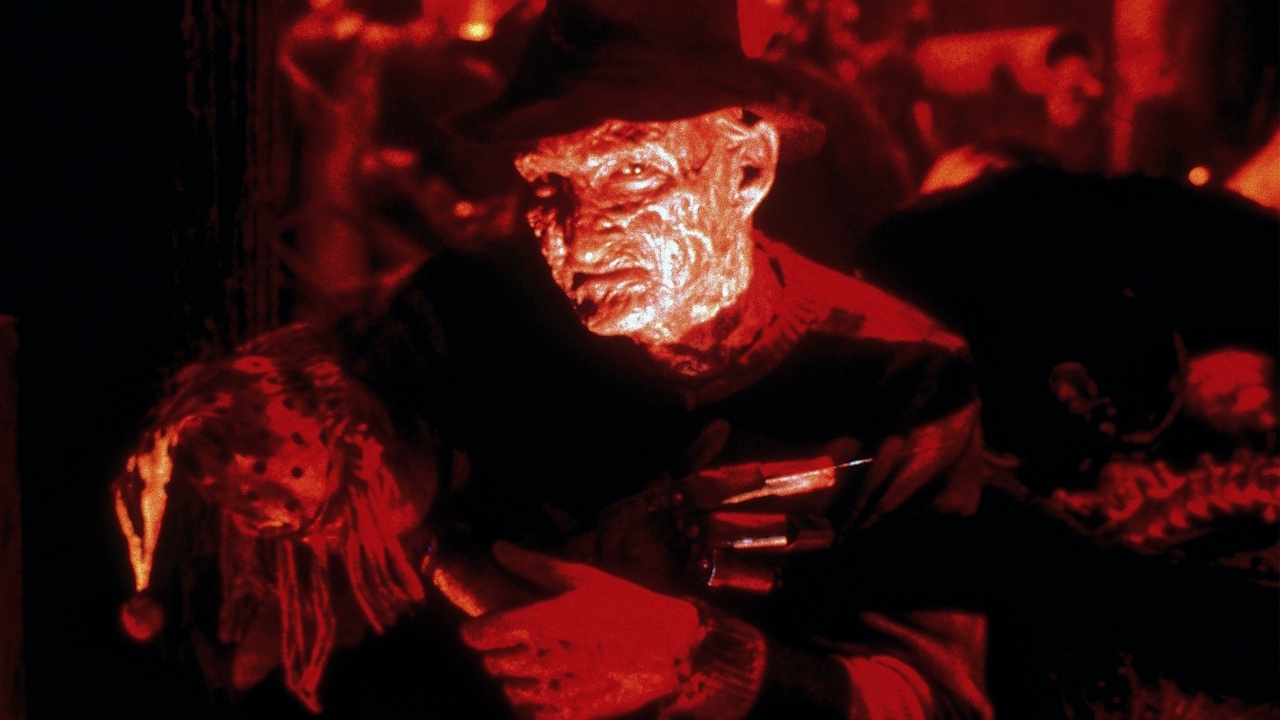
3 Body Problem: Netflix Review

The first part of this review is free from major story spoilers. The end of the spoiler-free section is clearly marked.

Right off the bat, I ought to tell you two things. First, I’ve never read The Three-Body Problem by Liu Cixin, nor either of its sequels. I’d seen the barest of outlines of the premise when I looked into it a couple of years ago – after hearing that Netflix had greenlit this adaptation – but I didn’t track down and read a copy. To be honest… it seemed like it might be a bit weighty and dense for my reading tastes! As a result, I’m not going to be comparing 3 Body Problem to its source material – because I’m totally unfamiliar with that source material. I know there have been some alterations, with several characters being merged and ethnicities being changed to take a Chinese story and make it multi-racial and multi-cultural, but that’s really the extent of my knowledge of the changes that Netflix made with its adaptation.

Secondly, regular readers might recall that I didn’t like the final season of Game of Thrones. Why is that relevant? Because the executive producers/showrunners of 3 Body Problem are none other than David Benioff and DB Weiss – who helmed Game of Thrones for its entire eight-season run. I think I’m right in saying that 3 Body Problem is Benioff and Weiss’ second project since Game of Thrones ended, but its the first that I’ve come across – and arguably the first big project since that series ended its run back in 2019.

Cropped promo poster for 3 Body Problem (2024).
Promo poster for 3 Body Problem.

I’ve felt for a long time that Benioff and Weiss did exceptionally well at adapting a complicated series of novels for the small screen – so there was hope for their treatment of 3 Body Problem. Where they went off the rails, I would argue, and where their particular skillset was not as useful, was in writing their own narrative threads and picking up a half-complete story. Nobody could’ve known back in 2008, when Game of Thrones first entered pre-production, that the novels upon which it was based wouldn’t be finished in time and that the TV series would end up “overtaking” the books. But unfortunately, Benioff and Weiss were left to pick up the pieces – and came up short.

But that’s enough about Game of Thrones for now! All of this is to say that, when dealing with a complete novel trilogy, I felt that there was the potential to see Benioff and Weiss shine once more; to put their unique skills to use on an adaptation of a fully-complete story. And, based on the first season of 3 Body Problem, I think I was right about that.

Photograph of David Benioff and DB Weiss at the Emmy Awards.
3 Body Problem is helmed by David Benioff (left) and DB Weiss.
Image Credit: IMDB.

So here’s the headline: I liked 3 Body Problem. It was exceptionally well-paced with some incredible acting performances, even from stars that I wasn’t particularly keen to see included. Its narrative was gripping; truly well-written sci-fi with a complicated yet enthralling underlying premise. Characters behaved in ways that felt genuine and human, something that can sometimes get lost in stories about higher dimensions, aliens, and interstellar communication.

Visual effects weren’t perfect, and I felt there were a few moments of the dreaded “uncanny valley” creeping into 3 Body Problem. However, when the action focused on characters up close, set designs, costumes, and props all looked great, and many smaller CGI/animated moments looked solid. When compared to other flagship series in the sci-fi/thriller spaces, 3 Body Problem was probably about on par in terms of animation – and perhaps a cut above when it came to physical sets and props.

Still frame of 3 Body Problem (2024) showing a helicopter approaching a ship at sea.
Some CGI/animated moments fell into the “uncanny valley.”

3 Body Problem dipped its toes in narrative arcs that looked at religious communities and cults, conspiracy theories, alien races, cross-species communication, and much more. The core group of characters felt well-rounded, and the way in which they interacted with these often strange and confusing storylines went a long way to making the whole thing work and feel relatable. Although much of the action focused on scientists who are far more intelligent than I am, I still found myself relating to them and seeing this twisted version of our own world through their eyes. More than once I caught myself wondering how I would’ve reacted, or how I would’ve chosen to act if I were in their shoes – and to me, that’s great storytelling!

There were a few lines of dialogue that were either clunkily overladen with exposition or that made me roll my eyes, but for the most part the series did exceptionally well in that regard. Taking several complicated concepts from the realm of theoretical physics and making them understandable for the layperson is no mean feat – but I came away from every episode feeling like I understood what was going on, where the sources of tension and drama were, and how it was impacting our characters and the world around them. Obviously 3 Body Problem isn’t a physics class, and I don’t want to pat myself on the back and pretend that I somehow comprehend something that other viewers wouldn’t! But I want to draw attention to the very real successes that the series had in making its dense topics work in this fictional setting.

Cropped promo poster for 3 Body Problem (2024).
Most of the main cast members on a promo poster.

The only real concern I have about 3 Body Problem is this: at time of writing, it hasn’t been renewed for a second season. The first season didn’t complete the story, so it needs at least one or realistically two or three more seasons to adapt the remaining books in the series and bring everything to a satisfying conclusion. I’m sure that the production team and actors will be happy to make the rest of the story – but right now, the spectre of cancellation is hanging over the series. Netflix has a disappointing track record in this area, with a number of popular and high-profile series being cancelled after a single season. I truly hope that 3 Body Problem won’t join them in the growing Netflix graveyard.

I’ve also made the point before about long breaks in between short seasons. 3 Body Problem ran to eight episodes – which is increasingly typical for a flagship made-for-streaming series these days. With Netflix still uncommitted to a second season, it will take time to re-start production, and that could easily lead to a two-year wait for Season 2. That’s not great, in my opinion, and while I obviously want to see the series continue and finish telling the compelling story it set up, there are issues that arise when any story disappears for years at a time.

The old Netflix logo.
Do we need to start a campaign to ensure that Netflix renews 3 Body Problem?

So I think I’ve covered as much as I can without digging into specific story threads and character moments. I don’t put numbers out of ten or star ratings out of five on my reviews, but if you want to know whether or not I recommend 3 Body Problem, the answer is a resounding “yes.” Definitely give it a watch if you have access to Netflix, and it’s probably even worth picking up a month’s worth of Netflix to give it a watch if, like me, you’re being a bit more careful with subscriptions in the current economic climate. That’s what I did, at any rate!

What I’ll do now is talk in a bit more detail about characters and storylines – right up to the end of the season. So if you haven’t seen 3 Body Problem yet and you don’t want to have it spoiled, this is your opportunity to jump ship! But I hope you’ll come back to see what I have to say after you’re done watching all eight episodes.

A Star Wars-themed "spoiler warning" graphic.

This is the end of the spoiler-free section of this review. There will be spoilers for 3 Body Problem from this point forwards – including twists, character arcs, and the way the season ended.

There are some producers and writers who love to collaborate with the same actors over and over again. Tim Burton and Johnny Depp, John Ford and John Wayne, and JJ Abrams and Simon Pegg all come to mind as well-known partners across multiple productions. But I confess that I was a little surprised (and disappointed) to see Benioff and Weiss pick three prolific former Game of Thrones cast members to star in 3 Body Problem. Going into the series, I was especially cautious about John Bradley taking on a main role – but also worried about the potential for Liam Cunningham and Johnathan Pryce to overshadow or get in the way of the scenes they were in.

None of these three had any on-screen interaction, which I think is actually a good thing. Pryce is an actor who’s played many different roles over the years, and while his “religious nut” character in 3 Body Problem had echoes of his starring role in Game of Thrones, it wasn’t enough to overshadow it as I’d feared. Cunningham took on a very different role as the leader of the shadowy MI5/CIA-inspired organisation, and thoroughly excelled.

Still frame from 3 Body Problem (2024) showing John Bradley as the character Jack Rooney.
John Bradley in 3 Body Problem.

John Bradley was the actor I had the most concerns about going into 3 Body Problem, and while I wouldn’t say that he was “miscast” in that role… I think there’s a degree of favouritism from the producers there. Bradley’s performance was solid enough, but Rooney was arguably the least-convincing of the main characters – meaning his relatively early demise was probably to the series’ overall benefit.

Ever since she first appeared as Keiko O’Brien in Star Trek: The Next Generation, I felt that Rosalind Chao had the ability to play a starring role. We saw a bit of that in Deep Space Nine, with episodes like In The Hands of the Prophets that gave Keiko a central role in the plot. Chao did not disappoint in 3 Body Problem, taking on the challenging role of an elder Ye Wenjie. Ye was the one who contacted the San-Ti, and who “invited” them to come to Earth, and later had to come to terms with what that might mean for herself and for humanity. The younger version of the character seemed to be steadfast and resolute in her decision, but as time passed – and especially after the San-Ti had abandoned her and her followers to their gruesome fates – Ye was left alone with the weight of what she had done.

Still frame from 3 Body Problem (2024) showing Rosalind Chao as the character Ye Wenjie.
Ye Wenjie is confronted with the reality of the San-Ti’s impending arrival.

It’s hard to imagine an actor better-placed to play that role, and Rosalind Chao excelled. The scene in which Ye Wenjie was revealed as the true leader of the San-Ti worshippers was genuinely breathtaking, and her scenes in a holding cell as she at first resisted sharing what she knew, then came to terms with the San-Ti abandoning her and her fellow cultists, was riveting. Ye’s final realisation that she had single-handedly inflicted this catastrophe on all of humankind was shattering for her – and Rosalind Chao brought every bit of that process to life in gut-wrenching fashion.

One thing that modern sci-fi does exceptionally well is emphasising just how different an alien race could be from humanity. We’re used to seeing prosthetic foreheads on aliens in Star Trek, or the human-sized, bipedal aliens present in the Star Wars galaxy, but the reality of alien life – assuming it exists out there in the cosmos somewhere – is likely going to be very different! The Expanse showed us the “protomolecule,” and that was a really clever and fun idea. And in 3 Body Problem we’re introduced to the San-Ti.

Still frame from 3 Body Problem (2024) showing the San-Ti Sophon on a television screen.
The San-Ti presented themselves as humanoid.

I would love to know what the San-Ti really look like. Are they giant space bears? Insectoid? Perhaps some kind of multi-legged amphibian? The fact that they went unseen for the entirety of 3 Body Problem – being represented only by deliberately humanoid virtual avatars – was a hugely positive thing as it keeps the mystery going! I’m not sure whether their true form gets revealed in one of the subsequent novels, but I kind of hope that they remain a mystery. Keeping only a single humanoid avatar (and human cultists) worked exceptionally well. And I think the series might lose something significant if the San-Ti’s true form were revealed too soon!

The titular “three-body problem” is something that, I have to confess, my neanderthal brain is struggling with. A planet orbiting three stars is affected by the gravity of all three – but predicting its path becomes impossible beyond a certain point. That’s my ridiculously oversimplified understanding… but here’s what I don’t get. If the planet’s position can be predicted at all, what’s to stop someone clever from making prediction atop prediction, until they’ve plotted the planet’s course over centuries or millennia? It’s something to do with “chaos theory,” isn’t it? This stuff is way above my intellectual level! But it’s to the credit of 3 Body Problem that I came away with even that basic of an understanding of such a complex topic.

Still frame from 3 Body Problem (2024) showing three suns in the sky.
I’m no physicist… but there are three suns!

Having two timelines on the go at once – a “present day” and “flashback” – seems to be in vogue in made-for-streaming TV at the moment, but it’s one element of 3 Body Problem that worked well. We started with young Ye Wenjie in the 1960s, and then jumped ahead to see the main plot of the series beginning to unfold. But there were mysteries left in the past that the story would dip back into at key moments, and these two timelines came together to tell a single, cohesive story.

There were some brutal moments in the flashback timeline, right from 3 Body Problem’s premiere episode. I’m not especially familiar with the history of China and its cultural revolution, but from what I can tell, these kinds of “struggle sessions” were commonplace during the Mao regime. Seeing one unfold in such brutal fashion was pretty hard-hitting, and while the series didn’t spend a lot of time on this, the themes of authoritarianism and later environmentalism as driving forces motivating Ye, Evans, and other characters were an important part of the way the story was constructed.

Still frame of 3 Body Problem (2024) showing young Ye Wenjie in a flashback scene.
Ye Wenjie in a flashback sequence.

Despite great performances by Jonathan Pryce and Ben Schnetzer (as older and younger versions of the character respectively), Mike Evans is perhaps a character who needed a bit more screen time. I found the devotion to the “Lord” to be suitably creepy – and reminiscent of more than one real-world cult – but Evans’ transformation from wide-eyed environmental activist to oil company executive seemed pretty abrupt. And there wasn’t a lot in the flashback sequences that I felt really informed his steadfast devotion; why had he taken to worshipping the San-Ti so fervently?

And while we’re nitpicking: how had the San-Ti been communicating for (presumably) years or decades with Evans and his followers, placed spies on Earth… but didn’t understand the difference between fiction and truth, nor understand how humans are capable of lying? It seems like something they should’ve figured out a long time ago, but they didn’t until just the right moment for other narrative beats to play out. It’s not the worst contrivance in the world… and we could certainly make the case that it’s just another example of how truly different and “alien” the San-Ti are in their way of thinking. But as a story beat… it was perhaps the biggest point at which I felt the series could’ve benefitted from another couple of episodes.

Still frame of 3 Body Problem (2024) showing Jonathan Pryce as the character Mike Evans, sitting at a desk.
Mike Evans and the San-Ti had been communicating for years.

One thing I wasn’t expecting in a sci-fi series like 3 Body Problem was a realistic depiction of someone grappling with a terminal illness – but through the character of Will, the show delivered precisely that. Will’s storyline was incredibly emotional as he came to terms with the ending of his life, his regrets, and the things he’d left unsaid. I could’ve happily spent eight episodes just with Will and his friends – without any of the sci-fi shenanigans going on in the background. That’s how powerful I found those sequences to be. I’m not terminally ill, but I have health issues that I have to live with every day – and I found Will a truly relatable character as he saw his health decline.

There was, of course, a narrative pay-off to Will’s cancer diagnosis, and I liked the way in which 3 Body Problem tied all of its characters and story arcs together. Will seemed to be disconnected from the main storyline of the series much of the time, talking to the other main characters but not really involved with the plan to defend against the San-Ti. Not until the last moment! Will’s sacrifice and the revelation that the mission was a failure was genuinely heartbreaking, especially when all seemed to be going to plan.

Still frame of 3 Body Problem (2024) showing the character of Will in a hospital bed.
Will in his hospital bed.

Along with Will was the character of Saul, played by Jovan Adepo. I really enjoyed Adepo’s performance, as he brought the character to life and made him feel relatable and real. Starting as a junior researcher, Saul’s story took him through the San-Ti plot to become appointed as one of the “Wallfacers” – a unique kind of defender of Earth. The fact that he didn’t want the role was also a really relatable moment; he felt he’d been plucked from obscurity and given an impossible task. There’s a kind of wish-fulfilment fantasy in this kind of storyline; who among us hasn’t wanted, even just for a moment in the back of our minds, for someone to come along and whisk us away on an adventure, or to be told that we’re being appointed as one of the saviours of all humanity?

Rounding out the main characters were Auggie, Jin, and Raj. I liked how the story began with Auggie’s nano-fibre start-up and then, after seeming to move away from that, brought it back in spectacular fashion. That was one of the moments where I felt every piece of this story had been carefully planned, with characters and storylines being built up with purpose. Jin was perhaps the most emotional of the main characters – though there’s competition for that title! She served as our point-of-view character at several key moments, and seeing some of these events unfold from her perspective elevated them.

Still frame of 3 Body Problem (2024) showing the character of Jin in an animated environment.
Jin in the San-Ti’s virtual world.

Raj was arguably the least-developed of the main characters; he served a narrative function but didn’t really get enough screen time to really shine – nor did he get any independent storylines. He was tied to either Jin’s story or the show’s main storyline, and in those capacities he helped move things along without really breaking out on his own. Any story has characters like this, I suppose, and it’s not really a criticism as much as an observation.

The depiction of Wade’s organisation – a three-letter acronym that I honestly couldn’t remember off the top of my head – as being almost everywhere, knowing almost everything felt like a bit of a stretch. As a commentary on government agencies that spy on or observe their citizens I think it could’ve been interesting, perhaps even making a comparison with the “secret police” of Maoist China as seen in the flashbacks. But 3 Body Problem didn’t really do that, and the seemingly limitless resources of the PDC/PIA were not really given a satisfactory explanation in-universe. Nor was it readily apparent why Wade was chosen to be in charge of Earth’s defence against the San-Ti. Minor points, perhaps, in the context of the story. But you know me: I can’t help nitpicking sometimes!

Still frame of 3 Body Problem (2024) showing the character of Wade on a private jet.
Wade and his organisation felt overpowered, somehow.

So that was 3 Body Problem. I had a fantastic time with the series; it’s undoubtedly the best show I’ve seen in 2024 so far, and probably the best new sci-fi property that I’ve seen going back several years. My biggest fear right now is that it gets cancelled by Netflix before it can conclude its story, because that would be a real tragedy. 3 Body Problem is reportedly an expensive production, and Netflix has been very quick to swing the proverbial axe with shows and films that don’t meet its sky-high expectations. So I admit that I’m worried about that.

With that significant caveat out of the way, however, I genuinely fell in love with this mysterious, grounded, and fascinating tale of humanity’s first contact with a strange extraterrestrial race. I could’ve happily entertained another eight or ten episodes this season, digging even more deeply into this rich and complex story. Basing major plot points on real-world science, without resorting to fantastical technologies that are basically “space magic” kept 3 Body Problem feeling realistic and mature; grown-up sci-fi of the best kind.

I will be keeping my fingers crossed for that second-season renewal, and if Season 2 does get produced I hope you’ll come back in 2025 or 2026 for my review! 3 Body Problem was great, and I highly recommend it.


3 Body Problem is available to stream now on Netflix. 3 Body Problem is the copyright of Netflix, The Three Body Universe, T-Street, and/or Plan B Entertainment. This review contains the thoughts and opinions of one person only and is not intended to cause any offence.
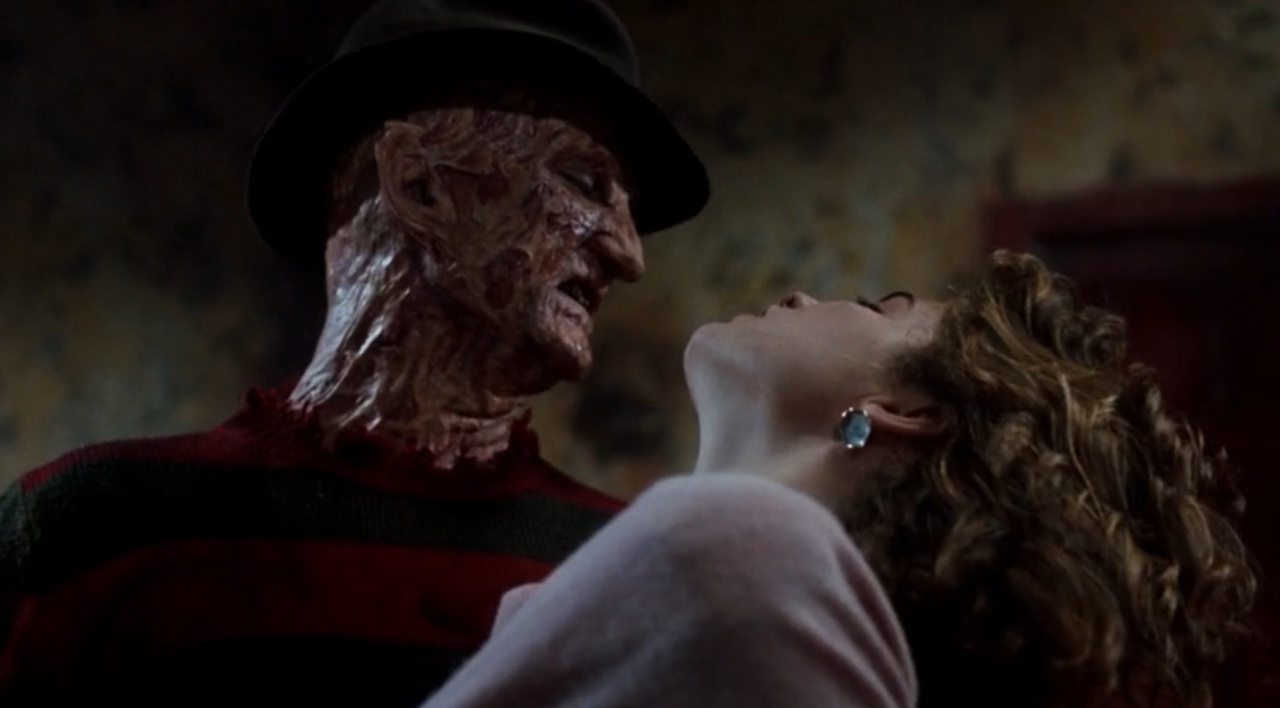
Halo (TV Series): Season 2 Review

A spoiler warning graphic.

Spoiler Warning: There are spoilers ahead for Halo Seasons 1-2, and for the Halo video game series.

In 2022, I was one of the relatively small number of folks who enjoyed the first season of Halo. I didn’t think it was the best thing since sliced bread or anything, but it felt like a decent adaptation of the long-running video game series – albeit one that had been trimmed and cropped to fit a very specific mould used by other serialised streaming shows. Season 1 seemed to be a reasonable foundation upon which the next chapter of Halo could be built, so it was with some degree of anticipation that I awaited Season 2’s arrival.

And before we go any further, let’s acknowledge just how long that wait actually was. Halo Season 1 ran from March to May 2022 – meaning it’s been basically two full years since it went off the air. And as I’ve noted in the past with other made-for-streaming shows like Amazon’s The Wheel of Time, The Witcher on Netflix, or even some of the Star Trek shows on Halo’s platform, Paramount+, there are issues that result from long breaks in between short seasons. I needed a recap before the first episode – and at least in the UK, no such recap was forthcoming on Paramount+. Aside from the Master Chief and Kai, I couldn’t remember who was who nor where exactly the story left off – which wasn’t helped by a time-jump of six months in-universe, in which characters had moved around and at least one major story beat had taken place off-screen.

Promo poster for Halo Season 2 (cropped).
Promo poster for the second season of Halo.

Although it took me a while to get back into Halo during that first episode, as I was hampered by the lack of a proper recap, I will say that I did find myself engaging with the series as its story got going. Although I had to look up a plot synopsis for Season 1 online – something I really shouldn’t have needed to do – once I’d got myself properly reacquainted with the main players, and recapped the major story beats from the end of Season 1, I found a story that was entertaining enough to justify paying for a month’s worth of Paramount+, and that I didn’t mind following to its conclusion.

That being said, I still don’t feel that Halo has truly excelled – at least, not yet. Season 1 laid a solid foundation, but Season 2 seems to have disregarded parts of it, as well as deviated in a major way from the story that I remember from playing (most of) the main Halo video games. While I’m by no means a “canon purist,” I have to wonder: why go to all the bother of licensing a major entertainment property only to jettison most of its story and some of its characters? The story of the Halo video games – at least the first two or three titles, plus Halo: Reach – would have made for a strong and captivating story in itself, and with only a few tweaks could’ve seen the addition of new characters to join the Master Chief.

Concept art for 2010's Halo: Reach.
The story of Halo Season 2 was radically different from that of Halo: Reach.

In my review of the show’s first season, I said that re-interpreting and changing the story – and particularly finding a way to humanise the otherwise stoic Master Chief to make him into a sympathetic protagonist – was something I was generally on board with. And I stand by that to a certain extent; I don’t think a faceless, monotone character who’s an unfeeling killing machine would make for a good television protagonist, even if such a character works well in an action-heavy video game. But this time around, the Master Chief’s story felt muddled and seemed to rely on a few too many clichés and contrivances.

And partly, it must be noted, that’s because Halo’s writers have now taken the story in a significantly different direction to its source material. In Season 1, with the Master Chief getting entangled with a Covenant agent, discovering his humanity, and unlocking the mysteries of a strange alien artefact, there was still the potential to call all of this a preamble; the hitherto-unseen prequel to more familiar events. But in Season 2, with the Fall of Reach being depicted on screen in a radically different way to how it unfolded in the games, and with the story more interested in the intrigue within the UNSC and ONI, that possibility has evaporated. I’m not sure whether the new story that the writers have replaced it with is as compelling or as entertaining as the one that was sitting there, waiting to be adapted.

Still frame of Halo Season 2 (2024) showing a close-up of the Master Chief.
The Master Chief.

There was clearly an ambition on the part of some of Halo’s writers to use the UNSC, ONI, and the admiralty to look at the politics of war and the calculations that leaders have to make. This concept is sound, but it was let down by poor execution in Halo, unfortunately. In the first season, it felt as if most of the major characters – including Keyes, Halsey, and Parangosky – all had their own agendas. The Master Chief and his squad were caught in the crossfire and let down by the internal workings of the admiralty and leadership.

This message was somewhat streamlined in Season 2… but the way it was done necessitated some major contrivances. Corporal Perez, who Master Chief saved during the first episode of the series, refused to elaborate on what she saw of the Covenant during her debriefing… for seemingly no reason other than “because plot,” and when her words would have corroborated what Master Chief reported, that just doesn’t feel very satisfying. There was potential in Perez’s story to look at trauma and in particular the post-traumatic stress that soldiers can suffer from – but this angle was so undeveloped that I’m loathe to even include it as a plot point. In any case, it went nowhere – and thus doesn’t work as a justification for the narrative contrivance.

Still frame of Halo Season 2 (2024) showing the Master Chief and Perez in a chapel.
The Master Chief with Corporal Perez.

Perhaps this is the armchair general in me speaking… but I have a hard time seeing a character like Ackerson as an out-and-out villain. When confronted with the reality that a Covenant attack was imminent and unstoppable, he and the other admirals took what seems the only rational path open to them: a covert, quiet evacuation of high-ranking personnel and valuable assets in order to establish a new command centre to continue the fight and co-ordinate the defence of other worlds. Reach was, as Cortana explained, already lost before the explosions started – there was no way to prevent it.

Yet because we’re following the story of Master Chief and his crew, the series paints Ackerson and Parangosky as antagonists – more antagonistic, in some ways, than the Covenant themselves. And while we could entertain a more nuanced discussion of the “calculus of war” and how some leaders might try to use it as a justification to seize power or leave rivals for dead… Halo doesn’t really do any of that. It manoeuvres its characters into place – using more than a couple of contrived moments to get them there – and then… that’s it. Master Chief rages about how “they stole [his] armour” and his identity, but that just felt incidental and not like a driving force behind either the character or the story. The series came close to making a point about politics and war – albeit one that other, stronger narratives have already made – but then baulked on it at the last moment, despite the convoluted setup, in order to tee up the next big action sequence.

Still frame of Halo Season 2 (2024) showing Admiral Parangosky.
Halo came dangerously close to making a point about the politics of war with the character of Admiral Parangosky.

When such a story requires characters to act in a specific way to move things along, it can feel forced. And parts of Halo absolutely fall into this trap. During the climactic fight at Fleetcom, Master Chief and his Spartans are conveniently called away at the last second so they can be in just the right place to encounter Soren and Halsey, then Makee and the Arbiter, and finally to be rescued by Laera and Kwan. Master Chief was conveniently obscured by both fog and a communications blackout when he first encountered the Covenant, and the only other character to witness them refused to admit the truth. Laera was able to track down Soren just in time to save everyone from the attack on Reach. And so on.

Although Ackerson and Parangosky were manipulating the situation and keeping everyone in the dark about what was about to happen, their machinations can’t account for all of this – and the result is that the story is built on weak foundations. There are still successful moments of tension, excitement, and drama, and the deaths of major characters still manage to carry emotional weight. But that comes in spite of – not because of – the way in which the story has been structured. Halo is in real danger of getting in its own way.

Still frame from Halo Season 2 (2024) showing the character of Ackerson.
Ackerson was presented as an antagonist.

In terms of visuals, Halo made a couple of missteps. Physical props used for things like spaceship doors, armour, and other pieces of supposedly “roughed-up” metal could look pretty phony in places, and while it wasn’t enough to take me out of the story entirely, it was definitely something I noticed across multiple episodes. This isn’t something unique to Halo, as I’ve noted it in big-budget productions from Star Wars to the upcoming Fallout series, but that doesn’t excuse it. Set design was generally okay, though, and I liked the interiors of the Covenant ships and the way they were laid out – as well as how the show got creative with re-using certain sets for Makee’s ship, the training simulator, and a real Covenant ship in battle.

Halo had some successes with its CGI – and one pretty epic misfire. The assault on Reach midway through the season, as well as the attack on another planet in the first episode, were fantastic, with explosions and plasma weapons that looked stunning. These were well-blended with physical sets, and the transitions between the two were great. The fleet battle toward the end of the season was likewise solid; a well-animated series of CGI sequences that lived up to the excitement I was hoping for from such a powerful narrative climax.

CGI sequence from Halo Season 2 (2024) depicting the Battle of Reach.
The Fall of Reach.

Then we got on the ground and came to the climactic one-on-one duel between Master Chief and his Covenant adversary, the Arbiter. The Arbiter felt vastly under-developed as a character, and while his hatred for the Master Chief was stated in almost every scene in which he appeared, there was no reciprocity there whatsoever, so the conflict itself felt very one-sided. I will say, though, that I liked the concept of this duel, and seeing plasma swords clashing almost like Jedi lightsabers was a fun idea, and a great way to take a rather clumsy weapon from the video game series and improve upon it. So in principle, this duel should have worked reasonably well.

But my god, the animation work here was atrocious. Neither the Master Chief nor the Arbiter looked at all real, with that “too shiny, too smooth, and too airy” CGI feel that I thought we’d left behind a decade ago. Even the shaky camera and fast-moving sequence couldn’t cover up these absolutely glaring flaws in the way these characters looked, and the entire duel – which, thankfully, was pretty short – entirely fell apart for me. There were clearly limitations in Halo’s animation budget that were showing, because the series completely failed to make either character look realistic at this moment. Because the Arbiter is a largely CGI creation to begin with, perhaps the way he looked wasn’t as bad as the Master Chief during the duel – though it was certainly the worst the character had looked all season long. But the Master Chief in particular just looked so hollow and fake, and that really took the shine off what was supposed to be one of the season’s final climactic moments.

Still frame of Halo Season 2 (2024) showing Master Chief and the Arbiter engaged in a duel.
It’s difficult to convey in a single JPEG just how bad this sequence looked.

One thing we didn’t see much of this time, unfortunately, was the first-person perspective that I noted in Season 1. Last season, this unusual blend of camera work and CGI was used sparingly, but at a couple of key moments it really worked well. As an homage to Halo’s video game origins, I enjoyed what the first-person viewpoint brought to the series. It’s also something a little different in the action space, at least in the medium of television, and in Season 1 it was used infrequently enough as to not be too obtrusive for folks who didn’t like it. It was a little disappointing to get so little first-person action this time around; there was one scene – or a clip, really, as it was so short – that I noticed… but that was all.

This season, Halo struggled to find a good character to pair with the Master Chief. In Season 1, the Master Chief spent time with Kwan, Kai, Makee, and of course Cortana, as well as butted heads with Dr Halsey and Admiral Keyes. His relationships with Makee and Cortana in particular, as well as the resentment he felt toward Halsey, went a long way to humanising him and turning him from that faceless video game protagonist into a character better-suited to a new medium. But in Season 2, Master Chief didn’t really spend enough time with any single character to have those kinds of moments. He spent much of his time angrily barking out orders and pushing his team beyond their limits, and his relationship with the under-developed character of the Arbiter was so non-existent that their conflict and climactic duel didn’t really work.

Still frame of Halo Season 2 (2024) showing a close-up of the Master Chief's helmet.
Halo struggled to find another character to pair with the Master Chief this season.

There’s something to be said for a storyline that puts its characters through a tough set of challenges, or even one that forces them to confront their own limitations and mistakes. But Halo didn’t really give us any of that, with the series presenting the Master Chief as having been “right all along,” even though he was basically behaving like an irrational dick for several episodes in a row. Combined with the lack of a partner or confidant for most of the season, this meant that the series’ protagonist spent much of his time angry and brooding – and that just never feels particularly fun. Shows like Game of Thrones did wonderful things with an ensemble cast that was broken up into distinct groups, taking literally years in some cases before some of the main characters even met one another. But Halo… I don’t think it has the chops to pull off something like that anywhere near as successfully, so splitting up its few noteworthy characters for so much of the story feels more a weakness than a strength at this point. I’d love to be proven wrong about that – but realistically, the show would need to run to six or seven seasons to develop these characters well enough to pay it off.

So after two seasons of a series called “Halo,” we’ve belatedly arrived at the titular ring-world. By this point, the Halo itself has been mythologised out of all proportion, and again this feels like a weakness when compared with the original story present in the first part of the video game series. Again, I have to point out that I’m not well-versed in the more recent lore of the expanded Halo franchise, and perhaps by this point the Halo ring-worlds are as legendary as the TV show depicts. But there was something to be said for the way in which humanity stumbled upon the first Halo, and how the Covenant were the ones who knew more about them and treated them with reverence. This “race to the Halo” idea that was underpinning the story of this season was just another way in which I felt it had diverged significantly from the story I remember.

Still frame from Halo Season 2 (2024) showing Makee and the Halo ring-world.
Halo has finally arrived at the titular Halo.

The introduction of the Flood – which unfortunately came pretty late in the season – is at least potentially a point of interest. Presenting the Flood as akin to zombies from the likes of The Walking Dead or 28 Days Later certainly went some way to ramping up the fear factor as Halo came to the end of its final episode – but I can’t help but feel that more could have been made of this storyline if it had emerged earlier in the season and been drawn out for longer. There were a couple of key points at which the story needed to move rapidly thanks to the time constraint of being halfway through the series finale, and that just left things feeling a bit rushed and unsatisfying.

The biggest example of this is Soren and Kwan’s rescue mission. No one stops to ask “hey, what’s going on here?” because the episode just didn’t have time for the diversion, and when Laera revealed her “zombie bite,” it shouldn’t have been at all clear to Soren and the others that a bite wound would lead to infection. There was no time to explain this in-universe to the characters – nor really to us as the audience, either, as elsewhere in the base, infection seemed to spread by way of small spider-like creatures that emerged from the mouths of the infected. Perhaps Season 3 will be able to expand upon this storyline, flesh out its concepts and ideas a bit more. But as far as an introduction goes… it was a bit of a mixed bag.

Still frame from Halo Season 2 (2024) showing a character infected by the Flood.
The Flood’s “patient zero” in a holding cell.

On a more positive note, Halo took strides for representation, and it did so in a way that I’m always going to advocate for. There was a gay couple shown partway through the season; friends of Riz who she turned to for help. The fact that they were gay wasn’t front-and-centre in either of their characterisations, it was simply treated as an entirely unexceptional part of this sci-fi future. Representation can work incredibly well when handled in this way, and I’d point to Halo Season 2 as an example of how to include LGBT+ characters in a series when there isn’t the time or narrative space to include full-blown LGBT+ storylines or themes. Simply seeing a couple like this represented on screen is a positive thing.

As in Season 1, acting performances were solid across the board, and I wouldn’t want to single anyone out for criticism on that front. Halo’s sound design and music were solid; understated, perhaps, but in line with its source material. I heard several sound effects that were lifted directly from the video game series, which was great! With the exception of some unnecessary “shaky cam” sequences that made it difficult to follow the action, cinematography was pretty good, and the series’ use of light and shadow led to some tense moments of mystery and action at various points.

Still frame from Halo Season 2 (2024) showing the Master Chief wielding a rifle.
The Master Chief.

Unlike in 2022, I don’t think I’m going to call Halo one of my favourite TV shows of the year when I dish out my annual awards in December! It was alright; entertaining enough popcorn action fare. But there were significant weaknesses and narrative contrivances this time around that I feel got in the way of the fun, as well as a weak CGI sequence during what was supposed to be a climactic battle. I didn’t hate Halo by any means, but it wasn’t all it could’ve been.

However, now that the action has moved to an actual Halo… maybe there’s hope for Season 3. Although an official renewal hasn’t been announced at time of writing, it’s hard to see how the series could be cancelled at this point, given where it ended. With positive reactions from a number of critics and plenty of social media buzz, a third season feels like a sure thing. If it goes ahead and does actually take place on a Halo ring-world, that could certainly shake things up and perhaps go some way to bringing Halo back to firmer and more familiar ground.

I will be crossing my fingers for Season 3, then – and a story that successfully builds on what Seasons 1 and 2 laid out could go a long way to making some narrative decisions feel better in retrospect. So there are reasons to be positive as Halo continues its run. If for some reason, however, Halo isn’t renewed… I doubt it’ll be remembered particularly fondly, and instead will simply be tossed on the growing heap of video game adaptations that failed to light up the board.

Halo Season 2 is available to stream now on Paramount+ in countries and territories where the platform is available. Season 1 is also available on DVD and Blu-ray. Halo is the copyright of 343 Industries, Microsoft, Showtime Networks, Amblin Television, and Paramount Global. This review contains the thoughts and opinions of one person only and is not intended to cause any offence.
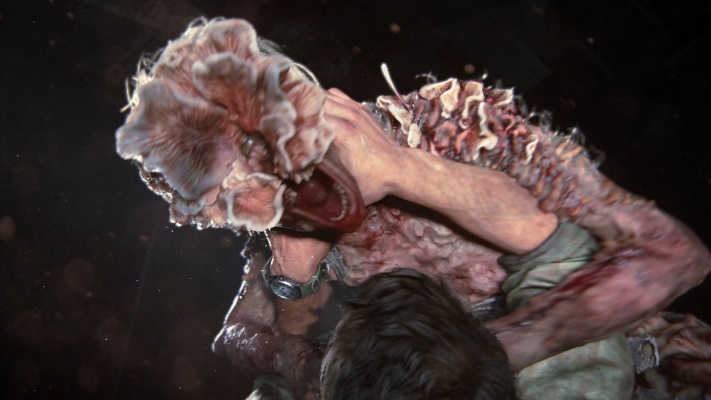
Futurama: Season 8/11 Review

Spoiler Warning: Minor spoilers are present for Futurama.

So here’s a question to kick things off: is this Season 8 or Season 11 of Futurama? There are different points of view depending on how you count splits in earlier seasons and whether the TV movies count as their own season! It’s not really all that important, just an interesting side-note as we welcome back Futurama after a ten-year absence.

I was cautiously optimistic about Futurama’s return to the small screen. The show got a pretty conclusive ending back in 2013, but its episodic nature – combined with the fact that it’s never been a series that takes itself all that seriously – meant that it wasn’t too hard to pick up where things left off. In that respect, I think the resurrected Futurama did alright. There were several genuinely fun and entertaining episodes in the mix – but there were also a couple of duds.

The new season picks up where the last left off.

One of the questions I had about this revival is how necessary it would feel. Or to put it another way: is Futurama being brought back because its creators, producers, and writers genuinely feel that there are more stories to tell – or is this just a cynical playing of the nostalgia card by a big corporation as it seeks to win and retain subscribers amidst the “streaming wars?” On that latter point, there were several really in-your-face moments across practically every episode of the new season of Futurama as the show seemed almost desperate to use nostalgia as a crutch.

Characters from popular or well-remembered episodes of the show would appear for cameos seemingly at random, in ways that added nothing to the story of the new episode – and practically all of these moments fell flat. Characters would also make unnecessary references to past events and adventures, again for no other reason than to say “remember how good old Futurama used to be?” Pretty much all of these cameos and callbacks ended up detracting from the episodes they were part of; net negatives as the nostalgia card was invariably overplayed.

Moments like this one, where two characters from the Season 2 episode The Deep South made a cameo appearance, were meaningless and added nothing to the new story.

And that’s a shame – because there were some fun, original stories this season. I particularly enjoyed How The West Was 1010001 and its western-inspired story arcs. The Christmas special – I Know What You Did Next Xmas – was also great, thanks to the uncommon pairing of Zoidberg and Bender for a time-travelling adventure! I’d also pick out at least parts of the episodes Zapp Gets Cancelled and Related To Items You Viewed as being highlights this time around.

Futurama has never been shy about having a point or making social commentary, even going all the way back to its first season in 1999 with episodes like A Big Piece of Garbage or Fry and the Slurm Factory. With that in mind, then, I didn’t object to the premises of episodes like Related To Items You Viewed or Rage Against The Vaccine… but I also don’t feel that the points those stories aimed to make were communicated particularly well, nor were they fully-realised by the time the episodes made it to screen.

Professor Farnsworth with his vaccine syringes.

Firstly, Rage Against The Vaccine arguably missed its moment of relevance, coming after most of the so-called “controversy” surrounding Covid-19 vaccinations has passed. Although the episode only premiered this past September, watching it felt almost like stepping back in time a couple of years, such was the outdated nature of the story. But also, within the story itself, arguments about vaccine safety, magnetism, and 5G were particularly on-the-nose and not subtle in any way. Subtlety is a huge part of what makes this kind of parody work, and when it was so flagrant and so obvious, for me at least part of the humour fell flat.

Related To Items You Viewed wanted to make a point about massive corporations like Amazon pushing small companies out of business – but did so quite poorly. Corporations like Amazon are, as the episode depicts, ever-expanding… but the story just seemed to end at that point without knowing what else it wanted to say. Corporations are putting smaller companies out of business, and then… what? Why go to the trouble of saying so if there’s not a broader point to be made?

Related To Items You Viewed came dangerously close to making a point… before retreating with its tail between its legs.

The Prince and the Product was by far this season’s weakest offering, with an uninteresting frame narrative containing a couple of uninspired product/TV advertisement parodies. It was an attempt, perhaps, to try something similar to episodes like Naturama and Saturday Morning Fun Pit… but I didn’t like those either! It’s hard to put my finger on what doesn’t work about this idea… but taking the characters so far outside of their usual setting and appearances is probably part of it.

I love a good Christmas special, and I Know What You Did Next Xmas was definitely a fun story. Time travel can be difficult to get right in fiction, but Futurama’s less serious nature means that the show can get away with a lot. Dr Zoidberg and Bender made for a fun duo, and the episode was unique this season insofar as it built on what had been established in earlier seasons without feeling like it was little more than a naked attempt to rely on nostalgia. Futurama’s version of an evil robot Santa Claus was put to good use – and the time travel premise worked well, too.

What are Bender and Zoidberg up to?

Zapp Gets Cancelled didn’t go down the “cancel culture is stupid and/or fascist” route that I feared it might’ve based on the title, and had some fun and entertaining moments throughout. There were definitely nods to the Star Trek franchise in the presentation of the Democratic Order Of Planets and the Nimbus – as well as a surprisingly compelling villain in Dr Kind. My only criticism would be that Zapp Branigan didn’t seem to learn much from his escapade… and the character felt a bit listless after the main thrust of the episode’s plot got going.

All The Way Down was one of the season’s attempts to tell an emotional story – but it felt more confusing than emotional most of the time. Without much of a connection to the people of Professor Farnsworth’s simulated universe, it was hard to really care about them potentially discovering their simulated nature, and the episode’s talk of the main characters living in their own simulation never really went anywhere. The simulation hypothesis is a massively complicated topic – and this episode barely paid lip service to it. I get what the writers were going for here, but it didn’t quite stick the landing.

Do we all live in a simulation?

The rest of the episodes were neither outstanding nor awful, with some moments of well-timed humour that made them enjoyable enough to watch once or twice. I can’t say I didn’t have a good time with Futurama’s return overall, and it certainly killed a few minutes here and there this summer and autumn. But I can’t shake the feeling that, as things sit right now, Futurama is a corporate product. Some of this season’s opportunities for genuine social commentary felt toned-down to the point of irrelevance, and the cameos and callbacks to past stories were excessive. Futurama, then, hasn’t really found a justification for its return yet.

I’m not entirely comfortable raising this point, and I don’t want it to come across as an attack in any way. But I think it’s worth noting that, while he did a solid job with the voices of both Professor Farnsworth and Dr Zoidberg, Billy West’s portrayal of Fry is noticeably different – and I would suggest older – than in previous seasons. This isn’t a criticism exactly – and we’re all getting older, after all – but when you compare the way Fry sounded even in an episode from the most recent season before this one, there is a difference in his voice.

Billy West voices Fry – among other characters.

Speaking of Fry, I’m glad that Futurama didn’t try to write off his relationship with Leela or reset the characters. The events of Meanwhile were significant, and I wouldn’t have wanted the revived series to try to ignore everything that happened last time. Fry and Leela’s relationship wasn’t front-and-centre this season, but it was a permanent fixture as the episodes played out. That’s sweet, and I appreciated it.

There are ten more episodes to come in Season 8/11, and I assume they’ll be shown sometime in 2024. Nothing that I saw this time has put me off, even though not all of this season’s episodes have been as strong as I’d have liked! I’m sure I’ll be tuning in next year, then, to see the rest of the new episodes. And earlier this year, Hulu and Disney confirmed that another twenty episodes have been ordered, presumably keeping Futurama on the air into 2025 or even 2026.

Fry and Leela in How The West Was 1010001.

So what’s the verdict, then? I had fun with most of the episodes most of the time, and even the season’s weaker stories still had moments of humour, the occasional good joke, or something else that made me crack a smile. Futurama isn’t a show that I take too seriously, and in that respect I’d say it was fine. Was it as good as it was in those early seasons around the turn of the millennium? Perhaps not. But I didn’t really expect it to be.

I’d recommend this new season to folks who enjoyed Futurama in the past – if for no other reason than to see what comes next. I don’t think that anyone who didn’t like Futurama in its earlier incarnations will be swayed by the revived series, and some super-fans from years past might not enjoy every story or creative decision. But as I’m not in either category, I’d say it was fine. Some episodes were decent, some were duds. None were exceptional, though… so make of that what you will.

Futurama is available to stream now on Hulu in the United States and on Disney+ in the United Kingdom and elsewhere. The series is also available on Blu-ray and DVD. Futurama is the copyright of 20th Television Animation, Hulu, and The Walt Disney Company. This article contains the thoughts and opinions of one person only and is not intended to cause any offence.

End-of-Year Awards 2022

Spoiler Warning: Minor spoilers may be present for some of these titles.

As we enter the final hours of 2022, it’s time to look back at the entertainment experiences that we’ve enjoyed – as well as a few that we didn’t enjoy all that much! I’ve cobbled together a few categories from the world of television, film, and video games, and today I’m going to hand out some highly-coveted Trekking with Dennis Awards to some of my favourites!

You’ll find a couple of titles from the tail end of 2021 on this list; I reckon anything released in December is fair game as those titles often get the short end of the stick when it comes to lists like these. Some outlets put together their “best of” lists way back at the start of December, which is far too early in my opinion! But we’re drifting off-topic already!

It’s time to hand out my End-of-Year Awards!

There are plenty of titles that, for one reason or another, I didn’t get around to this year – so for reasons that I hope are obvious they can’t be included. I’m only one person and I don’t have every minute of the day to devote to these pursuits, so the exclusion from this list of certain big titles shouldn’t be interpreted as any kind of deliberate snub!

And as always, a caveat before we begin: all of this is the subjective opinion of one person. I may give an award to a production you vehemently hate, or talk negatively about something you enjoyed, but at the end of the day this is supposed to be a bit of fun. Feel free to disagree with any or all of my picks – but there’s no need to take any of it too seriously!

With all of that out of the way, let’s get started!

Best Television Miniseries/Limited Series:

🥈 Runner-Up🥈 
Five Days At Memorial

Five Days At Memorial had the challenging task of dramatising a real-world event – and a gruelling one at that. I remember the harrowing news reports in 2005 showing the aftermath of Hurricane Katrina, and I could absolutely understand why some folks might feel it’s too soon to make a programme like this. But for my money, Five Days At Memorial did a good job at adapting the events at Memorial Hospital as delicately as possible, staying true to what happened while still making the story engrossing and understandable for viewers.

The fact that Five Days At Memorial shows what happened at Memorial Hospital from two very different angles felt a bit strange at first, but by doing so the series lends the events the challenging ambiguity that they continue to have. By refusing to come down on one side or another – to condemn as guilty or exonerate Dr Pou – Five Days At Memorial strikes the right balance. There was some choppy editing in some sequences that meant the miniseries didn’t feel as smooth as it could’ve, but other than that it was a very interesting look at a very difficult moment in the recent past.

🏆 Winner 🏆
1899

Netflix original 1899 is taking the crown in this category this year. The show goes on a wild and unpredictable ride, blending themes of mental health that resonated strongly with me with mystery and psychological horror. The multilingual series is, in my view, best enjoyed without being dubbed, as the different characters and the language barriers between them are key elements in the story at several crucial junctures.

I was first attracted to 1899 because of its setting – both in time, at the end of the 19th Century, and on a boat making a transatlantic voyage. But what I found when I got started was one of the most unique and different television productions that I’ve seen in a long time. 1899 may not be to everyone’s taste, but I found it absolutely riveting all the way through.

Worst Television Series:

🏆 “Winner” 🏆
Obi-Wan Kenobi

After I’d enjoyed what The Book of Boba Fett brought to the table, I felt a pang of hope that Obi-Wan Kenobi might at least be passable. But it wasn’t to be, and the series was a horrible slog through the absolute worst kind of tacked-on story that used increasingly desperate nostalgia plays to try to recreate some of the magic that, frankly, Star Wars hasn’t had since the ’80s.

Say it with me, folks: it’s time for Star Wars to move on! The vast sandbox that is the Star Wars galaxy has trillions of inhabitants, millions of star systems, thousands of planets, and hundreds of factions and organisations – and tens of thousands of years of history that could explore any of them. For more than forty years, Star Wars has been laser-focused on the same handful of characters and the same tiny sliver of this wonderful setting, but it’s over. If Star Wars is to survive, something’s gotta change. Obi-Wan Kenobi proved that.

Best Television Series:

🥈 Runner-Up🥈 
Halo

Halo wasn’t spectacular, but as the first real attempt to bring the long-running video game franchise into a new medium, it got a lot right. The story it told was a riff on the familiar story that fans will remember from the games, but there were important differences which not only kept the mystery going, but also gave genuine characterisation to the Master Chief.

In terms of cinematography, I liked the way that Halo incorporated some first-person sequences into its action-heavy moments. This could have easily felt like a gimmick, but the way it was done – and crucially, not overdone – made it feel like a throwback to the series’ source material while also mixing things up in the television space. Halo used a fairly standard format that would be familiar to anyone who’s seen a made-for-streaming television show in the past few years, with a slowly unfolding mystery, multiple storylines, and characters who grow and change over the course of the series. It wasn’t anything groundbreaking, and I certainly get the argument that it wasn’t as action-packed as some fans might’ve wanted. But it was, all in all, a decent bit of sci-fi.

🏆 Winner 🏆
The Lord of the Rings: The Rings of Power

The Rings of Power had a lot of work to do to impress me. It had to live up to the legacy of the trilogy of films from a few years ago. It had to show that it could go toe-to-toe with the likes of Game of Thrones, The Witcher, and other big-budget productions in the fantasy space. And, to be blunt, it had to justify its billion-dollar price tag.

Whether The Rings of Power managed to accomplish all of those goals in its first season is still arguably an open question. But it certainly laid the groundwork for what should be a television spectacular, and it was, on balance, probably the best show I’ve seen this year. When I was at a low ebb in the autumn and didn’t have the energy or headspace for watching many new things, The Rings of Power was the one show that I made time for. Sure, there were big battles and other CGI spectaculars, but there were also some genuinely wonderful performances that brought to life some incredible character-focused storytelling. I can’t wait for Season 2!

Best Web Series:

🥈 Runner-Up🥈 
How To Cake It

After a hiatus of more than a year, YouTube show How To Cake It made a welcome return this year. This time, there’s less of a focus on the kind of attention-grabbing, visually spectacular cakes that look like rocket ships or Princess Elsa or a completely different food, and I think that’s actually been a positive thing! Host Yolanda Gampp has branched out, doing much more of a variety when it comes to baking. Some highlights include flavoured cookies, baklava, and even popcorn.

As often happens when a web series takes an extended break, recent episodes of How To Cake It haven’t been doing the same numbers as the series used to get. But I hope that, as time goes by, it will pick up some of those wayward viewers – and perhaps bring on board a whole host of new ones, too. This new version of How To Cake It seems to be making more down-to-earth recipes that you or I might feel brave enough to attempt, rather than showing off impressive designs that only a master baker could create. For me at least, that’s a great thing, and I hope to see much more from Yolanda and the team in the new year.

🏆 Winner 🏆
Anti-Chef

If How To Cake It shows a master at work, Anti-Chef – as the name suggests – is the complete opposite! The show is a lot of fun, and Jamie, the host, isn’t shy about sharing his failures in the kitchen as he works his way through some very complicated recipes. Though he’s not a total newbie any more, many of the techniques in the recipes he challenges himself to try are very advanced, and the personal, relatable style makes me feel like I’m right there in the kitchen.

I love a good cooking show, and as much fun as it can be to see an experienced chef at work, it can be even more entertaining to see an inexperienced home cook tackling some of these recipes. Anti-Chef has given me a lot of laughs this year – but also some cooking tips and inspiration, too.

The Worst of Star Trek:

🏆 “Winner” 🏆
Most of Picard Season 2

I thought long and hard about whether I wanted to call out Picard Season 2, but I think it’s earned a place on this list. The first episode of Season 2 was absolutely fantastic, and if the rest of the season had been anywhere close to that level, we’d be talking about Picard as the best show of the year. But unfortunately things took a pretty sharp nose-dive after the second episode of the season, with Picard and his crew wandering aimlessly for much of the season in a present-day setting that didn’t feel inspiring or enjoyable in the least.

By the time the action returned to the 25th Century in the second half of the season finale, the damage had been done, and despite Farewell pulling out a decent ending, this disconnected, disjointed, overly-long story has to go down as one of Star Trek’s big misses – perhaps even one of the biggest missteps in the franchise’s history. There were individual elements in most episodes that I can honestly say that I enjoyed… but Picard Season 2 overall feels like a massive disappointment.

Star Trek’s Biggest Surprises:

🥈 Runner-Up🥈 
Kobayashi
Star Trek: Prodigy

We ought to talk more about Prodigy here on the website – and I hope we will next year! But for now, the episode Kobayashi came out of nowhere in January to be one of the biggest surprises in the show’s first season. The Kobayashi Maru training programme famously tests would-be captains in a “no-win scenario,” and you wouldn’t think that premise would lead to such a genuinely heartwarming and wholesome episode – but as a longstanding fan, I really appreciated what Kobayashi brought to the table.

Without giving too much away, the Kobayashi Maru scenario plays out on the holodeck, and a cast of fan-favourite Star Trek characters all join in on the action. It’s a nostalgic treat – but it doesn’t overplay its hand, keeping a tight focus on the new characters introduced in Prodigy.

🏆 Winner 🏆
All Those Who Wander
Star Trek: Strange New Worlds

Strange New Worlds had an incredible first season, showing off a varied, episodic approach in which it wasn’t shy about trying out many different genres. All Those Who Wander draws inspiration from the likes of The Thing and Alien to create a tense, claustrophobic sense of horror aboard a crashed starship.

It’s hard to say too much more without getting into spoiler territory – and of all the episodes in Season 1, All Those Who Wander has to be the most important to go into un-spoiled! Suffice to say that the episode takes the horror angle right up to the edge of my personal comfort zone, but never crosses that line. It’s an intense experience, and one that shows just how incredible Star Trek can be when it throws itself into another genre.

The Best of Star Trek:

🥈 Runner-Up🥈 
Coming Home
Star Trek: Discovery

Discovery’s fourth season plodded along, in places, and definitely teased us with mysterious factions and characters that ultimately turned out to be brand-new. But by the time the season finale rolled around, most of that was already settled. What we got was an incredibly emotional episode that saw Captain Burnham and the crew racing against time to reach an unknown, uncontacted alien race.

There were resolutions to disagreements between characters, several incredibly dramatic moments, and a storyline involving Admiral Vance at Federation HQ that showed off Starfleet and the Federation at their very best. Coming Home is, without a doubt, one of Discovery’s very best episodes.

🏆 Winner 🏆
A Quality of Mercy
Star Trek: Strange New Worlds

Captain Pike gets a visit from “the Ghost of Christmas Yet To Come” in A Quality of Mercy – and the episode is incredible. In Discovery Season 2, when it became apparent that Captain Pike knew in advance that he was going to suffer a debilitating accident, an obvious question would be “why didn’t he try to prevent it?” And A Quality of Mercy takes that idea and runs with it.

In addition to a very emotional story involving Captain Pike – one that I, as a disabled person, found incredibly relatable – there’s also a wonderful callback to an episode of The Original Series, and moments for all of the main characters to get a chance to shine. Ethan Peck puts in a spectacular performance as Spock, and there was even time at the very end of the episode for one final twist as the curtain fell on one of the best seasons of Star Trek ever put to screen.

Best Animated Film:

🥈 Runner-Up🥈 
Minions: The Rise of Gru

The Despicable Me franchise is usually good for some fun escapism, and so it proved again with The Rise of Gru. There isn’t anything completely groundbreaking here; you know how the titular Minions behave by now. But stepping back in time to a ’70s setting allowed for some fun jokes, and the over-the-top villains that Gru encountered were a ton of fun.

There was still heart and emotion in The Rise of Gru thanks to Gru’s relationship with the villainous Wild Knuckles, and that did enough to ground what was otherwise a pretty wacky adventure. There were plenty of references and callbacks to other franchises for nerds like us to enjoy, and on the whole, I had a good time with the film. I’m not in a desperate rush to re-watch it, but it was good fun for what it was.

🏆 Winner 🏆
Encanto

After several years in which Disney has focused on live-action adaptations and sequels, Encanto came along like a breath of fresh air! It’s one of the best Disney films of the current era without a doubt, with a deeply engrossing and frequently emotional story that has an uplifting message. And thanks to a wonderful soundtrack by the phenomenally talented Lin-Manuel Miranda, there are some incredible songs too!

A setting inspired by Colombia was also something different for a major Disney production, and the company has done well at diversifying the peoples and places it depicts in its major releases. But that would have been meaningless had Encanto not been such a wonderful, well-told story – and I’m so very pleased that it was.

Best Live-Action Film:

🥈 Runner-Up🥈 
The Unbearable Weight of Massive Talent

With the caveat that I didn’t see that many films this year, The Unbearable Weight of Massive Talent is definitely up there as one of the better ones! I genuinely couldn’t believe that this film existed when I first heard of its premise – Nicolas Cage playing a fictionalised version of himself and going on a wacky adventure. But you know what? I’m very glad that it does!

The Unbearable Weight of Massive Talent could have ended up as a bargain-bin B-movie – or worse, it could’ve tried to take itself far too seriously. But instead it leans into a kind of self-deprecating humour as well as tropes of the action genre, coming across as light-hearted and just plain fun. Nicolas Cage is a good sport for taking part, and The Unbearable Weight of Massive Talent is definitely worth a watch if you haven’t seen it already.

🏆 Winner 🏆
All Quiet on the Western Front

Netflix’s reimagining of this classic German war film is absolutely brutal. If any film has ever come close to accurately depicting the true horrors of the First World War, this is it. The story follows a young conscript from Germany as he joins the army and is dispatched to the front line, and then jumps ahead to the closing days of the war.

Every version of All Quiet on the Western Front – and there have now been three adaptations of the original novel – have shown just how senseless and meaningless war can be, taking a very individualist, human look at warfare. This version hammers that home, and can be uncomfortable viewing. But it’s an incredibly powerful film – one that absolutely deserves to be in contention for some of the top awards.

The “I-didn’t-play-this-game-but-you-probably-should” Award:

🏆 Winner 🏆
Elden Ring

I wish I could say I was interested in Elden Ring… but I’m just not. The “difficult for the sake of it” style of gameplay that has come to be known as the “Souls-like” genre just isn’t my cup of tea, but by all accounts Elden Ring is one of the best examples of this type of game, and one of the best games of the year – if not the generation.

Taking the Dark Souls format into an expansive open-world setting, Elden Ring has won almost universal acclaim from critics and players alike, becoming one of the most talked-about releases of the year. For a single-player title in a gaming landscape increasingly dominated by the online multiplayer scene, I think that’s a fantastic thing, and even though Elden Ring isn’t for me, I still think it’s worth noting it as one of the most important releases of the year.

Best Browser Game:

🏆 Winner 🏆
Wordle

I wouldn’t usually dedicate much time to browser games on a list like this, but since I first played Wordle back in February or March, I don’t think I’ve missed a single day. The format is fun, with a single word each day to guess and only six chances to get it right. Wordle was snapped up by the New York Times and has since spawned dozens or perhaps even hundreds of clones – including variants that have multiple words to guess, and variants based on specific topics or franchises. There’s even a Star Trek-themed one!

Wordle blew up to become an internet phenomenon in 2022, and for a while it seemed like you couldn’t move for people showing off their Wordle results on social media. It’s become part of my daily routine – and my current streak is 77 wins in a row, going all the way back to the middle of October!

The “buggy piece of crap” Award:

🏆 “Winner” 🏆
Uncharted: Legacy of Thieves Collection (PC version)

The PC port of Uncharted: Legacy of Thieves Collection is the worst I’ve come across in recent years. I’d thought that the days of amateurish PC ports were finally over, but PlayStation Studios, Naughty Dog, and Iron Galaxy Studios showed me that I was wrong about that. In short, Uncharted is incredibly poorly-optimised for PC, with a piss-poor frame rate and weird visual and texture bugs that were incredibly offputting. The screenshot above shows off one such glitch.

It’s such a shame because the Uncharted series has always been a blast. The Indiana Jones-inspired games still feel like something different in the action-adventure space, even with the likes of Tomb Raider being reimagined for a new generation. The stories present here are great – but if I have to spend as much time battling bugs as I do enemies, I’m going to have a bad time. Other PlayStation titles – like Spider-Man and God of War – don’t have these issues, so I don’t understand how Uncharted: Legacy of Thieves Collection managed to launch on PC in such a bad state.

Best Expansion Pack/DLC:

🏆 Winner 🏆
Mario Kart 8 Deluxe – Booster Course Pass

The Booster Course Pass has given Mario Kart 8 Deluxe a new lease on life – even if it’s not as transformative as a new entry in the series would’ve been. I was disappointed as the year went by and it became clear that there would be no Mario Kart 9, but the Booster Course Pass has definitely convinced me to dust off my Nintendo Switch and pick up Mario Kart 8 Deluxe again.

The “wave” approach to the DLC has been fun, too, keeping the game feeling fresher for longer when compared to dumping all 48 new racetracks at once. Don’t get me wrong, the longevity of Mario Kart 8 Deluxe is still an issue, and I now have the additional concern that there will be fewer racetracks left to adapt whenever Mario Kart 9 eventually comes along. But in the short-term, the Booster Course Pass is proving to be great fun.

Game of the Year:

🥈 Runner-Up🥈 
Stray

Stray is absolutely adorable: a game in which you get to play as a kitty cat! I was sold on that premise alone, but what I found when I got stuck in was a genuinely enjoyable, well-paced, well-structured indie title. Stray has great graphics, with the movement of the main cat character in particular being incredibly realistic. There’s some wonderful art design in both the environments and the robotic non-player characters, too.

Stray is further proof that there’s plenty of life in the narrative, linear, single-player space, and that not every game needs to be forced into the open-world mould. But at the same time, it’s something very different. Not only is the idea of playing as an animal unique, but the game’s slow pace and focus on peaceful interaction with the environment instead of combat and quick-time events all make for a relaxing, yet deeply engrossing experience.

🏆 Winner 🏆
Disney Dreamlight Valley

If you’d told me a few months ago that my favourite game of 2022 would be an early access Disney title, I wouldn’t have believed it! But I’ve sunk well over 150 hours into Disney Dreamlight Valley since its launch at the end of August, and I’ve been having an incredible time. The game basically took all of my criticisms of Animal Crossing: New Horizons and fixed them, then threw in dozens of new features I didn’t even know I wanted – and some fun Disney-centric stories with a diverse cast of characters for good measure.

Disney Dreamlight Valley is so much fun and has so much to offer, even in this early access form, that it’s hard to know where to begin. There’s an interesting main quest, dozens of character-focused missions, the kind of home-building and design gameplay that players loved about titles like The Sims, and all of the fun of living another life in a fantasy land as you’d expect from an Animal Crossing game. There’s so much to love about Disney Dreamlight Valley, and I’m happy to crown it my favourite game of the year.

So that’s it!

At the first Academy Awards in 1929, Joseph Farnham receives his award from Douglas Fairbanks.
Image Credit: oscars.org

We’ve dished out awards to some of my favourite entertainment experiences of the year. The countdown is on to 2023 – there are just hours left until the sun will rise on a whole new year! Stay tuned in the days ahead because I plan to take a look at some of the things I’m most looking forward to between now and Christmas. Is that the earliest you’ve seen someone mention Christmas 2023?

I hope that this was a bit of fun. There were plenty of enjoyable films, television shows, and video games this year – despite the delays that still hang over the entertainment industry. Though I wouldn’t say that 2022 is likely to go down in history as one of the best-ever years for entertainment, I think we still got a wide variety of experiences, many of which were enjoyable.

So I suppose all that’s left to say is this: Happy New Year! Whatever you plan to do, I hope you have a wonderful time!

See you next year!

All titles listed above are the copyright of their respective owner, company, studio, broadcaster, developer, distributor, publisher, etc. This article contains the thoughts and opinions of one person only and is not intended to cause any offence.
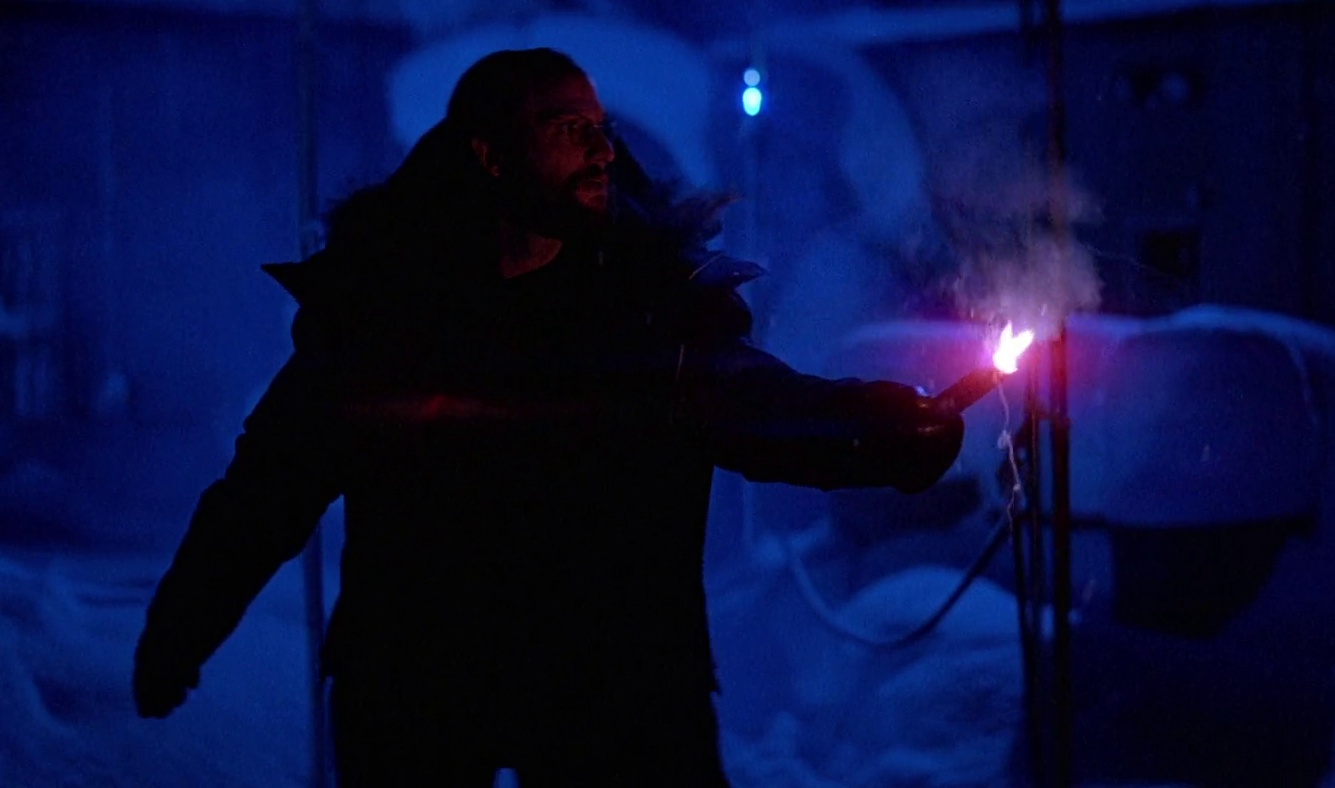

Check out reviews or articles featuring some of the films, games, and TV shows mentioned on this list by clicking or tapping the links below:

The Halo TV Series

Lord of the Rings: The Rings of Power

Strange New Worlds Season 1

Star Trek: Discovery 4×13: Coming Home

Mario Kart 8 Deluxe – Booster Course Pass

Disney Dreamlight Valley

The Odd Duality of the Alien Franchise

Spoiler Warning: There are spoilers ahead for the entire Alien franchise, including films and video games.

Perhaps Ridley Scott’s 1979 film Alien wasn’t supposed to spawn a decades-long franchise. It was a great standalone horror film, but even as the credits rolled there was a sense that its Xenomorph – the titular alien – was a one-trick pony.

A while ago we discussed one of the problems Star Trek has had with the Borg. In short, even the most intimidating villain can end up feeling tame once we’ve seen our heroes defeat them over and over and over again, and certainly by the latter part of Voyager’s run the Borg had fallen into that trap. The Daleks in Doctor Who have likewise lost almost all of their intimidating factor. For the Alien franchise this is compounded by the Xenomorphs being the only real adversary – and the focal point of the franchise’s films and video games.

The Alien franchise only really has one kind of alien.

Speaking of video games, it was the recently-launched Aliens: Fireteam Elite that prompted this article and this consideration of the peculiar duality of the Alien franchise. Aliens: Fireteam Elite is a co-op game that sees players team up to take the fight to the Xenomorphs, killing the titular aliens by the dozens. It’s very much an action-shooter game, and the cannon fodder getting in the way of players’ guns are the Xenomorphs.

Contrast this to the single Xenomorph that Ripley encountered in Alien, or even the Xenomorph that provided the jump-scares in 2014’s Alien: Isolation video game. A single alien is all it takes in those titles; one Xenomorph is a significant adversary for a whole crew of humans. Some entries in the franchise go down this route, making the Xenomorphs out to be almost invincible, unstoppable killing machines. Other entries portray them as weaker, more easily-defeated creatures that are often little more than a bump in the road for our heroes on the path to victory.

The new video game Aliens: Fireteam Elite prompted this article.

This is the duality of the Alien franchise; a franchise that perhaps doesn’t quite know what it wants to be. On the one hand we have the horror vibe of the original film, followed up in titles like Alien: Isolation. These horror-style Alien films and games bring with them a single Xenomorph at a time – or at most a small group – and shows how utterly unprepared and incapable humans are of defeating them in combat. On the other hand we have action-oriented entries in the series – kicking off with Aliens and epitomised by titles like Fireteam Elite – where multiple Xenomorphs can be seemingly easy to defeat.

Many sci-fi properties can manage this kind of dual tone. There are moments in Star Wars, Star Trek, and others which fit both the action or horror moulds at different points, but the key difference is that those franchises aren’t trying to use the same alien race in both cases. Some alien adversaries can be all-conquering, unstoppable foes – like the aforementioned Borg or Daleks. Others can be cannon fodder that are easily dispatched – like Stormtroopers.

Doctor Who’s Daleks have been worn out as a threatening adversary by too many stories and too many defeats.

Imagine a Star Wars film or video game where a single Stormtrooper was painted as a terrifying villain. It would work on some level, perhaps, depending on how well the story had been set up and who the protagonist was. But it’d be difficult to pull off successfully because of how we’ve come to see Stormtroopers over past iterations of the franchise – as easily-killed cannon fodder.

As Star Trek and Doctor Who began to wear out the Borg and the Daleks respectively, the fear factor these once-mighty aliens inspired started to evaporate. At the back of our minds we felt that it was only a matter of time until our heroes prevailed – because they’d done so on so many past occasions. Like with Stormtroopers in the analogy above, we stopped fearing what had come to be seen as cannon fodder.

Stormtroopers have never felt particularly threatening in the Star Wars franchise due to the role they play.

And that’s where the Alien franchise is today, at least in some respects. Every action-heavy entry in the franchise diminishes the threat and fear factor of the Xenomorphs. That doesn’t mean that making another horror title in the franchise will become impossible, because good scripts and clever writing can go a long way to carrying a film. But it does mean that the Xenomorphs themselves feel less intimidating with every outing, and will eventually reach a point where they feel played out.

I’ve recently argued that Doctor Who should probably go back on hiatus. Sixteen years have passed since its 2005 revival, and the show has pretty much run its course. The Alien franchise is a little different, because it releases fewer instalments further apart, but eventually it will reach that point if care isn’t taken to remain in control of the kinds of stories it wants to tell.

The Xenomorph Queen in Aliens.

Aliens: Fireteam Elite didn’t need to be a game with the Alien franchise license. It could’ve swapped out the Xenomorph textures for generic aliens or monsters, or it could’ve swapped them out for Borg drones and slapped a Star Trek label on. Nothing about the game looks or feels particularly “Alien” except for, well, the aliens. The story, such as it is, wouldn’t have to make many changes if the Alien license weren’t used. And under those circumstances, I have to question why it was released and why the Alien franchise continues to confuse its messaging.

Though Prometheus has made a creditable attempt to expand the lore and mythos of the Alien franchise, the Xenomorphs remain its principle alien monster. Unlike Star Trek or Doctor Who, which are able to draw on many different aliens, monsters, and settings, Alien really just has the Xenomorphs to offer. This means that the danger the franchise is in from the cheapening and diminishing of its only real foe is all the more significant.

Too many games like Aliens: Fireteam Elite will change the way audiences perceive the Xenomorphs – and make it harder to tell scary stories involving them.

Alien doesn’t work without the Xenomorphs any more than The Creature from the Black Lagoon would work without the creature from, y’know, the black lagoon. Alien doesn’t have to always use the same horror tone for its films and video games, but the move to an action-focused story naturally requires a more disposable cast of adversaries. With only one alien around, the Xenomorphs are dropped into that role; a role which, I would argue, does not really suit them nor fit with many of their depictions in the franchise.

Video games like Doom and films like Men in Black show how much fun it can be to have an action-heavy title that cuts down swathes of monsters or aliens. That concept works well in both forms of media, and audiences lap it up. But I guess it feels fundamentally different to what Alien offered in 1979, and even though its sequel Aliens in 1986 had already begun the process of transforming the franchise into something more action-oriented, that feeling persists.

1986’s Aliens had already started to transform the franchise – and the Xenomorphs.

Perhaps if the Alien franchise had stuck firmly to action after 1986 we wouldn’t be having this conversation. But in films and in video games, the franchise continues to try to do both action and horror. It almost seems as though every other title will come out with an alternate theme and tone; horror one time, action the next. This leaves the Xenomorphs in an odd situation. Their original appearance in Alien is still frightening, but every subsequent appearance in action titles, where they’re far more easily dispatched, has turned them into something less terrifying. There’s no longer a sense that Xenomorphs are truly unstoppable.

How will this play into the upcoming Alien television series? I’m not sure. But if you ask me, the people in charge of the Alien franchise need to very carefully consider their next moves. The style and tone of upcoming titles is incredibly important to get right – and once settled, it’s important to stay consistent. Right now it feels like there are two kinds of Xenomorph: the terrifyingly unstoppable ones seen in Alien, and the cannon fodder of games like Fireteam Elite. The danger is that the cannon fodder perception will creep into productions that want to have a horror vibe, and that could absolutely ruin them.


The Alien franchise – including all properties mentioned above – is the copyright of 20th Century Studios and The Walt Disney Company. Some promotional artwork courtesy of the aforementioned companies. This article contains the thoughts and opinions of one person only and is not intended to cause any offence.
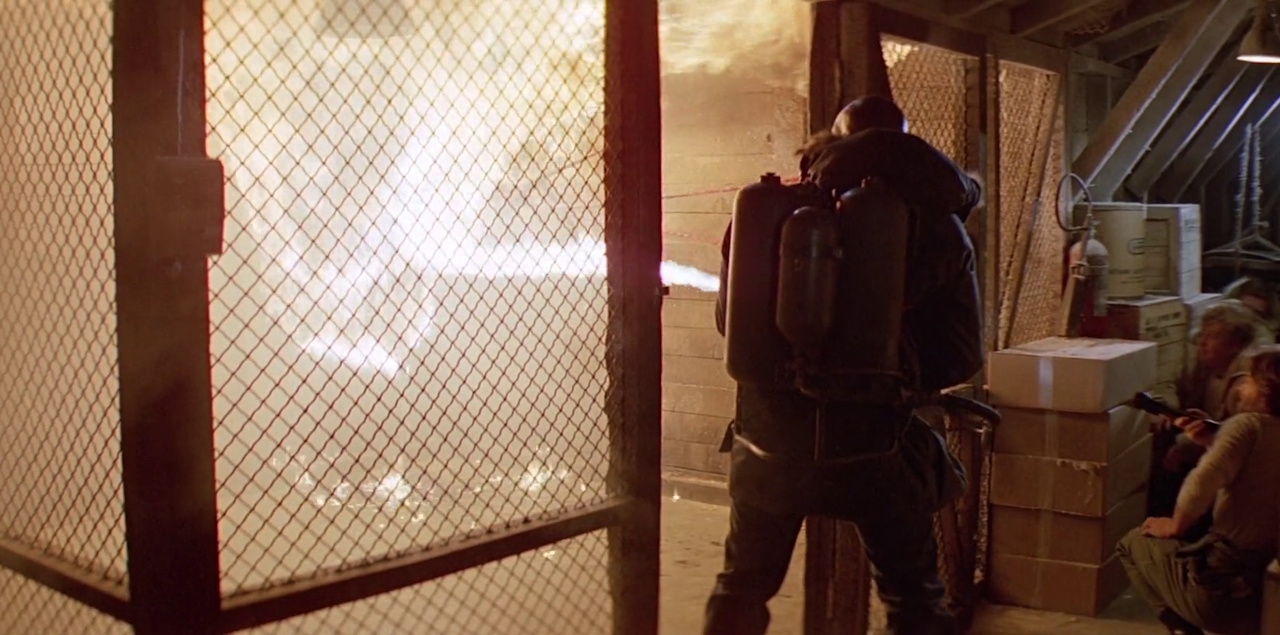
A willingness to change is the key difference between Star Trek and Star Wars in 2021

Spoiler Warning: There are spoilers ahead for the following: The Mandalorian Seasons 1-2, The Rise of Skywalker, Star Trek: Discovery Seasons 1-3, Star Trek: Picard. Minor spoilers may be present for other iterations of both the Star Wars and Star Trek franchises.

I’ve been working on my review of Season 2 of The Mandalorian, which was shown on Disney+ at the end of last year, and I found myself saying the same thing several times. I will (eventually) finish that review, but for now I wanted to take a step back and look at two of the biggest sci-fi/space fantasy franchises, and one crucial difference between them.

Whether it’s the prequel trilogy, sequel trilogy, spin-offs, or even the recently announced slate of upcoming projects, Star Wars is intent on sticking close to its roots. I’ve made this point before, but Star Wars as a whole has only ever told one real story – that of Palpatine, Anakin, Luke, and Rey. Every film and television series in Star Wars’ main canon either directly tells part of that story or is inextricably tied to it. The inclusion of Luke Skywalker and other legacy characters in The Mandalorian doubles down on this.

Luke Skywalker recently appeared in The Mandalorian.

In contrast, Star Trek has continually tried new and different things. The Next Generation took its timeline 80+ years into the future and left much of the franchise’s first incarnation behind. Deep Space Nine took the action away from starships to a space station. Enterprise was a prequel, but not one which told the early lives of any classic characters. The Kelvin films attempted to reboot Star Trek as a big screen popcorn blockbuster. Discovery took a serialised approach to its storytelling, and Picard picked up that format but used it to tell a very different type of story. Lower Decks is perhaps the biggest departure to date, branching out beyond sci-fi into the realm of animated comedy. Though there are common threads binding the franchise together, each project is one piece of a much larger whole, and the Star Trek galaxy feels – to me, at least – much more vast as a result.

Where Star Wars has told one overarching story, Star Trek has told hundreds, many of which are totally separate and distinct from one another. And that concept shows no sign of slowing down. Indeed, both franchises are doubling down on what they do best: Star Wars is focusing on classic characters and looking inwards, Star Trek is expanding and trying new things.

Captain Burnham will take Star Trek: Discovery to new places.

That willingness to change, to explore totally different and unrelated aspects of its setting, is what sets Star Trek apart from Star Wars right now – and arguably is one of the big points of divergence going all the way back to the mid-1980s. It may also explain why so many fans are excited about The Mandalorian and even the dire Rise of Skywalker, while some Star Trek fans have never been interested in Discovery, Picard, and Lower Decks.

Nostalgia is a big deal in entertainment, and while I would argue Star Wars has overplayed that particular card far too often, there’s no denying it has seen success with that formula. That’s why we’re seeing the Obi-Wan Kenobi series, the Ahsoka series, the Lando series, and even the Cassian Andor series all getting ready to debut on Disney+ in the next few years.

Star Wars continues to bring back characters, themes, and designs from its past.

Someone far cleverer than I am said something a while ago that really got me thinking. If a franchise – like Star Wars, in this case – relies so heavily on nostalgia to the point of never trying anything new, it won’t survive beyond its current generation of fans. Because bringing in new fans – the lifeblood of any franchise – is increasingly difficult when every project is designed exclusively with existing fans in mind. How can Star Wars survive when its current fanbase moves on if everything it does is fan service? What kind of appeal does the Obi-Wan Kenobi show have to someone new to Star Wars? Basically none.

With the exception of Star Trek: Picard, which did rely on the strength of its returning character, I think any Star Trek project has the potential to bring in new fans. Some shows and films are definitely enhanced by knowing more about Star Trek and its setting, but even in Discovery, where main character Michael Burnham is related to classic character Spock, there really wasn’t anything that required a lot of background knowledge.

Spock in Star Trek: Discovery.

Star Trek is not only trying new things, but the people in charge are conscious to allow each project to stand on its own two feet. They are parts of a greater whole – and while I have argued many times here on the website that Star Trek could do more to bind its ongoing series together, it’s still possible to watch one show and not the others without feeling like you’ve missed something important.

What we see are two very different approaches to storytelling. Both Star Trek and Star Wars were reborn in the mid-2010s out of a desire on the part of their parent companies to use nostalgia as a hook to bring in audiences. That should not be in dispute, and I don’t want to say that Star Trek somehow avoids the nostalgia trap. But where Star Wars really only has nostalgia going for it, Star Trek continues to branch out, using nostalgia as a base but not allowing it to overwhelm any project.

“Baby Yoda” is symbolic of Star Wars’ reliance on nostalgia in many ways.

Neither approach is “right” or “wrong;” such things are subjective. I don’t want to sound overly critical of Star Wars either, because despite my personal feelings, there’s no denying many of the creative decisions made are popular – even The Rise of Skywalker, which was eviscerated by critics, was well-received in some areas of the fandom. It just strikes me as interesting and noteworthy that these two major franchises are taking very different approaches to the way they construct their narratives.

Whether it’s the inclusion of Luke Skywalker himself, the aesthetic of practically everything in the show, or a storyline which returns the franchise to the Jedi and the Force, The Mandalorian oozes nostalgia from every orifice – and if that’s what fans want and will lap up, then that’s okay. It was too much for me, and I stand by what I said last year during the show’s first season: I was expecting to see “the adventures of a gunslinger far from the reaches of the New Republic;” a show which would take Star Wars away from some of those themes to new places. That was my preference – a personal preference, to be sure, and judging by the positive reaction not only to The Mandalorian but to spin-off announcements like the Obi-Wan Kenobi series (and the return of Darth Vader to that series) I’m in the minority.

Mandalorian armour (i.e. Boba Fett’s armour) seen in The Mandalorian.

Star Trek takes a different approach. Both Picard and Discovery in their most recent seasons moved the timeline forward, brought in new characters, and dealt with contemporary themes. There were touches of classic Star Trek in both shows, including in aesthetic elements like set design and costuming, but in both cases the franchise feels like it’s moving forward.

Costuming is an interesting point to consider, as it’s representative of where both franchises find themselves. As early as 2015’s The Force Awakens, Star Wars was stepping back, relying on Stormtrooper armour, First Order uniforms, and especially the costumes worn by Rey that were practically identical to those seen in the original films. This was continued in The Mandalorian, not only with the main character’s Boba Fett armour, but with the use of Original Trilogy Stormtrooper armour and costumes for many villains. In contrast, Star Trek took its main characters out of uniform entirely in Picard, and Discovery has introduced a whole new set of uniforms and a new combadge for the 32nd Century. Where Star Wars looks back to its heyday, Star Trek looks forward, incorporating some of its classic designs into wholly new variants.

Discovery’s new combadges (as seen in the opening titles).

What we see in these costuming choices is a reflection of where both franchises are narratively. Star Wars continues to look back at the only truly successful films the franchise has ever made: the Original Trilogy. Frightened of trying anything truly new and unwilling to leave that comfortable ground, it’s stuck. As I wrote once, the Original Trilogy has become a weight around the neck of modern Star Wars, as projects not only become constrained by those films, but continue to fail to live up to them.

Star Trek looks forward, tries new things, and embraces change. Not every new project will win huge support and be successful, but some will, and every project has the possibility to be a launchpad for others, taking the evolving franchise to completely different places.

The Original Trilogy is – in my opinion at least – holding Star Wars back.

It’s clear which approach I prefer, and that I’d like to see more innovation and change from Star Wars. Though I was certainly underwhelmed by some of the recent announcements made by Disney and LucasFilm, I’m hopeful that, despite being held back in many ways by an overreliance on nostalgia, some decent films and series may stumble out the door.

Each franchise could learn something from the other, though. Star Trek’s projects are split up, and while Discovery’s third season made an admirable effort to connect to Picard, that was not reciprocated. Lower Decks had many callbacks and references to ’90s Star Trek, but otherwise stands alone. The franchise could work harder to bind its different projects together, reminding audiences that they’re watching one piece of a greater whole.

The Qowat Milat, who debuted in Picard, later appeared in Discovery. But the franchise could do more to bring its projects together.

Star Wars could see how a successful sci-fi franchise doesn’t need to be constrained by its original incarnation, and that shaking things up can work. The Mandalorian felt to me as though it was retreating to Star Wars’ comfort zone, and while that move may be popular right now with the fandom, it doesn’t really provide a solid foundation for expansion in the way Star Trek’s shows and films have done.

At the end of the day, both franchises are testament to the power of nostalgia to bring fans back. But they undeniably take very different approaches to that. Star Wars is conscious to try to make everything feel like its first couple of films – to the point that it can be overwhelming. Star Trek certainly doesn’t overwhelm anyone with nostalgia – to the point that some recent projects have been criticised for feeling like they aren’t part of the franchise at all.

Whichever approach you ultimately feel works best, one thing is clear: neither franchise is disappearing any time soon! The first half of the 2020s -and hopefully beyond – will see several different projects from both Star Trek and Star Wars, and as a fan of both and of sci-fi and fantasy in general, that’s great news. Long may it continue!

The Star Trek franchise – including all properties mentioned above – is the copyright of ViacomCBS. The Star Wars franchise – including all properties mentioned above – is the copyright of LucasFilm and Disney. This article contains the thoughts and opinions of one person only and is not intended to cause any offence.
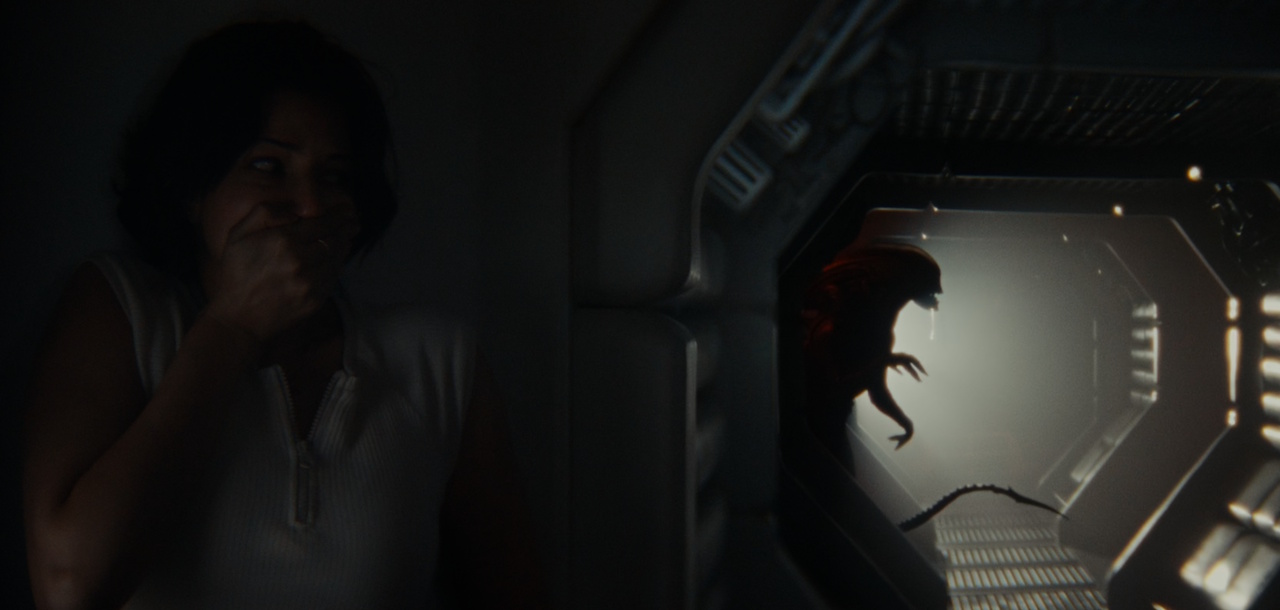
Another New Doctor Won’t Fix Doctor Who…

It seems increasingly likely that Jodie Whittaker is in her final season as the titular Doctor in the BBC sci-fi series Doctor Who. The upcoming season will be the show’s thirteenth since it was recreated in 2005. The first few years of the show’s return were great – Christopher Eccleston, David Tennant, and even Matt Smith did very well in the role, but even by the end of Smith’s tenure the show’s decline had set in. Peter Capaldi, who took over the role after the 2013 Christmas special, endured a torrid time as the Doctor, with three seasons of stories that varied from underwhelming to just plain crap.

Jodie Whittaker, as the first woman to take over the role, came into the series at a time when it appeared to be in terminal decline. And although her arrival coincided with Doctor Who trying to put itself through a soft reboot, the decline continued. After thirteen seasons and more than fifteen years, the revived series has simply run its course. Practically every show has a natural lifespan, and though how long a series can run and remain exciting will vary, it seems clear that Doctor Who is long past that point.

Jodie Whittaker as the Thirteenth Doctor. She may be leaving the show imminently.

There were issues regarding Whittaker’s arrival in the role, not least the so-called “gender bending” of what has always been a male character, and some have argued that it may be a factor in why her tenure as the Doctor hasn’t been so well-received. But I would argue that, despite the strong feelings on both sides of that argument, it’s almost incidental. The way the character is written and the lack of good ideas for new and interesting stories has been much more of a hindrance to Doctor Who than its main character’s gender.

As an aside, I don’t buy the argument that fans somehow “don’t want women characters.” Look at the response to characters like Captain Janeway in Star Trek or Ahsoka in Star Wars – fans respond incredibly positively to strong women in sci-fi – but they have to be well-written characters first and foremost. If they aren’t, or if there are other issues with the stories they’re part of, fans won’t be interested – just as they aren’t interested in boring male characters or male characters involved in crap stories.

Star Trek’s Captain Janeway debunks the argument that sci-fi fans don’t want to see strong women.

Peter Capaldi is exactly how I would picture the Doctor if someone described the character to me. Compared to his two predecessors, David Tennant and Matt Smith, Capaldi had the gravitas required to truly embody the ancient time-travelling alien. But the storylines he got during his tenure were, as mentioned, uninteresting at best. As a result, viewership dropped, interest dropped, and while some fans may have been somewhat interested in what was billed as a second revival of the series when Jodie Whittaker took over, that interest soon dropped away when the underlying issues with Doctor Who were seen to remain.

Modern Doctor Who has suffered from an overuse of three key villains: the Weeping Angels, the Cybermen, and the Daleks. All three were fantastic in their initial appearances from 2005-2010, but by the turn of the last decade there was a sense that they were played out. Having seen the Doctor outsmart and defeat the Daleks in particular at least once a season for twelve seasons, they need a break.

The Daleks have to be one of the most overused villains in all of science fiction.

But the sad thing is that, when the writers in recent seasons have tried to step away from familiar adversaries, the new creations made for the series have just felt incredibly bland. Generic opponents invented for the Doctor and his or her companions have been so completely boring that I honestly couldn’t tell you the names or attributes of any off the top of my head. I’d have to go away and look up who the Doctor and co. have taken on in recent seasons, such is the boring, generic, bland nature of the factions and races created for this once-great sci-fi series.

When Doctor Who was revived in 2005, it was brought back by a team of people who had loved the original show and wanted to see it succeed again. I don’t want to question the dedication and commitment of the writers and producers behind recent seasons, but it doesn’t feel that they’re as interested in Doctor Who as Russell T Davies, Mark Gatiss, and even Steven Moffat had been in the first years after the show returned.

Another overused adversary: the Cybermen.

If making a big change to the Doctor when Whittaker was introduced didn’t reinvigorate the series, replacing her in the title role won’t help. Doctor Who needs a root-and-branch overhaul, but even then it’s hard to see where to take the series. Its iconic villains have become boring, cardboard cut-out opposition, and since the introduction of the Weeping Angels all the way back in 2007, no new villain has been anything other than a bland, generic sci-fi alien.

Realistically what Doctor Who needs is for the main series to go back on hiatus. The world-building in Doctor Who – at least in earlier seasons – was fantastic, and offers the opportunity to branch out into spin-offs that perhaps could look at the Time War or other key events in the series’ canon. But the main show needs a break. Maybe in another fifteen or twenty years, when another new team of writers have some genuinely good ideas, it can come back. But simply recasting the Doctor yet again won’t cut it.

Doctor Who Season 13 is due out later this year on the BBC. Doctor Who is the copyright of BBC Studios. This article contains the thoughts and opinions of one person only and is not intended to cause any offence.
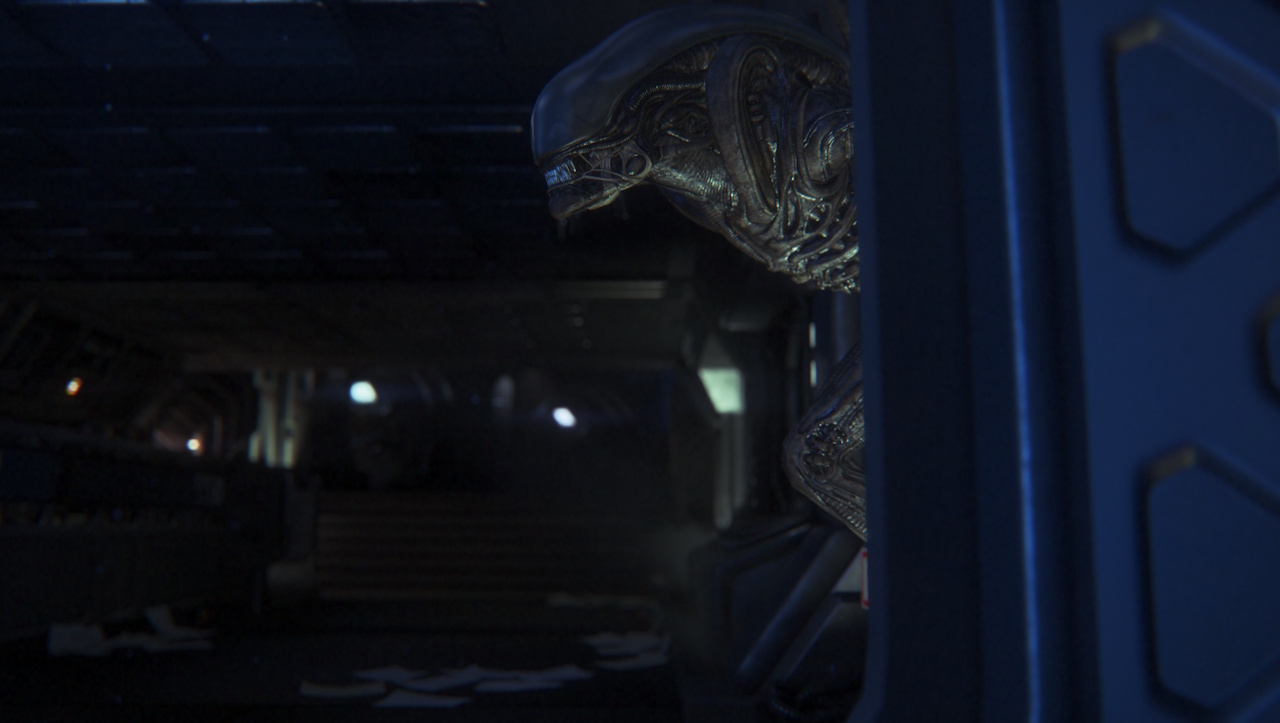
Will the Avatar sequels improve the franchise’s standing?

Spoiler Warning: There are spoilers ahead for Avatar.

James Cameron’s 2009 sci-fi film Avatar never really managed to break into pop culture in quite the way he hoped. It was a huge financial success – in part because folks were curious to see what this new project was all about – but it never really became a top-tier entertainment brand in the way Star Wars or Harry Potter did. In 1977, Star Wars became a phenomenon, and in the years afterwards the film was constantly on fans’ minds. The Empire Strikes Back cemented its place at the pinnacle of the sci-fi genre… even if Return of the Jedi perhaps tarnished its halo a little!

Avatar just isn’t on that level. There was a lot of hype leading up to its release, with a decent (if rather boastful) marketing campaign spearheading 20th Century Fox’s efforts to push Avatar as the “next big thing.” But for a lot of moviegoers, the film was just okay. It wasn’t bad; it was a solid, enjoyable summer blockbuster that went toe-to-toe with the best pictures of 2009 – including the rebooted Star Trek! But after leaving the cinema, I never really got the sense that fans were clamouring for more in the way Trekkies, Potter-heads, and Star Wars fans are for their respective franchises.

Avatar was a successful film – but can it become a successful franchise?

The creation of Pandora – The World of Avatar at Walt Disney World in Florida is a great demonstration of this. The new land attracted attention when it was built, and for months after it opened its rides were queuing out the door! But that happens for almost any new Disney attraction, and when compared to the opening of Star Wars: Galaxy’s Edge in 2019, it pales in comparison. There was huge excitement to be transported to a galaxy far, far away. There was curious interest in Pandora… but that was all.

None of this is to say Avatar was bad. It wasn’t at all, and I thoroughly enjoyed it when I first saw it. But I was never desperate to re-watch it, and my latest revisit to the 2009 film – which may be the third or fourth time I’ve seen it – was prompted by nothing more than boredom. But it also led to this article, so at least I got something out of it!

Pandora – The World of Avatar at Walt Disney World.

This is a much broader point that ties into another piece I’ve been writing, but the difference between a good one-off story and a good story that becomes a larger franchise is world-building. Any film, television show, book, or even video game that hopes to be “the next Star Wars” needs to put time and effort into creating a world that fans want to explore. Star Wars and Star Trek did so, and they did so by showing fans a relatively small piece of what felt like a huge picture. The galaxies depicted in Star Wars and Star Trek are so much bigger than the few characters we met in their original incarnations; it feels like there’s much more to see beyond what was depicted on screen.

Avatar – and a lot of other wannabe-franchises too – doesn’t have that, at least not yet. Partly that’s because the film doesn’t hint at anything more than what we see – Earth, Pandora… and that’s it. And on Pandora there’s one major human outpost. There are starships flying back and forth, and the glimpses we got of Earth had a futuristic vibe, but the world Avatar created doesn’t feel as though it extends beyond the places we see. There’s no other planets that we could imagine humans or Na’vi colonising one day. There’s no fleets of starships on missions of exploration or fighting battles; the few ships we see just fly between Earth and Pandora.

A starship seen in Avatar.

Pandora itself is absolutely beautiful; a location painstakingly created. And the Na’vi are more than just a simple analogue for Native Americans or other indigenous peoples; Cameron and his team went to great lengths to craft Na’vi culture, even going so far as to write a fully-formed Na’vi language. Those efforts may yet pay off, but they don’t seem to have thus far. Because as interesting as the Na’vi are – and they are undeniably interesting – they’re all there is. One tribe of Na’vi and one human settlement on Pandora, and… what? Nothing else, as far as the film showed us.

There’s a sense of scale missing from Avatar, and its world-building, while wonderfully done, is small. There’s nothing wrong with focusing on one aspect of a story and a few characters – in the first film in a series that kind of needs to happen! But if the aim is to create a series with franchise potential, something to hook fans in and get our imaginations running, that sense of scale and the idea of a greater world beyond what we see on screen is essential. It’s the single most important element in building a larger story – and Avatar didn’t get it right.

So on to the question I posed at in the title of this article: can the planned sequels – of which there are four – improve the franchise’s standing? Can they spin out what was a decent one-off sci-fi blockbuster into something more? Can Avatar make the jump and become “the next Star Wars?”

Two Na’vi seen in concept art for the Avatar sequel series.

The length of time between Avatar and its sequels may be an issue. By the time Avatar 2 hits cinemas in December 2022 – assuming it meets its planned release date – thirteen years will have passed since the first title. Given the general apathy and lack of interest in Avatar this long after its premiere, the first part of this sequel series will have to spend at least some of its runtime refreshing audiences on what happened in the first film and what the setting is. When I sat down to re-watch Avatar earlier, I had only a vague recollection of the film, and I daresay a lot of folks will be in the same position.

When The Empire Strikes Back came out, it had been only three years since Star Wars had been in cinemas. And while Star Trek: The Motion Picture was released a decade after The Original Series ended, the only reason the film was made was because there was a growing fanbase who had watched the show when it was rebroadcast and those fans were clamouring for more. Is anyone clamouring for Avatar 2?

A scene on Pandora from concept art.

Avatar was a welcome addition to the sci-fi genre. Especially as the last decade has been dominated by reboots, adaptations, remakes, and sequels, it was a welcome breath of fresh air, and despite what I’ve said about its world feeling small, there is potential for it to be expanded upon. To say that the Avatar series can never be more than it already is would be ridiculous – there’s only been one film so far, and it was decent. It didn’t blow up the genre or redefine what a film could be in the way its pre-release marketing seemed to suggest, but it was good. I don’t dislike Avatar.

The sequels do have a pretty big job to do, though. The storyline of Avatar was exciting, but it was hardly original. Comparisons have been made to Dances with Wolves and even Disney’s Pocahontas, and while I don’t think it’s fair to call it derivative, it wasn’t a unique narrative by any means. That point of criticism will have to be addressed, and the sequels will have to try harder to be different from a story perspective if they’re to achieve the heights the films are aiming for.

Na’vi fly atop their banshees in more concept art.

The beautiful world-building that worked so well for Pandora and the Na’vi needs to be expanded upon. Perhaps we could see different Na’vi tribes and civilisations on Pandora, or better yet, expand the scope of the setting out into space. Are there other moons or planets in the Pandora system, perhaps? Or is there another human settlement on some nearby world? These are just a couple of ideas for how the Avatar series can build on the successes of the first film to be bigger – to achieve that sense of scale which the best and most successful franchises have.
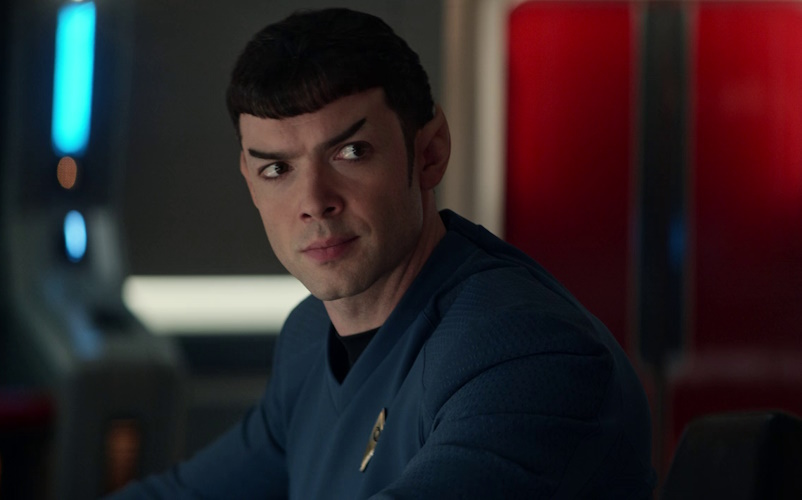
Avatar was also a film which had contemporary real-world analogies. I noted influences of at least two of America’s recent wars in the depiction of the Marines, scientists, and Na’vi – Vietnam and Iraq. The dense rainforests of Pandora, and the way Jake and others had trouble navigating them, were the film’s answer to the jungles of Vietnam. And references to winning “the hearts and minds” of the locals was a phrase we heard often in relation to the Iraq war during the 2000s – which is when Avatar was in development. The latter of those themes is arguably less relevant in 2021 than it was in 2009, and Avatar 2 will need to adapt to changing times.
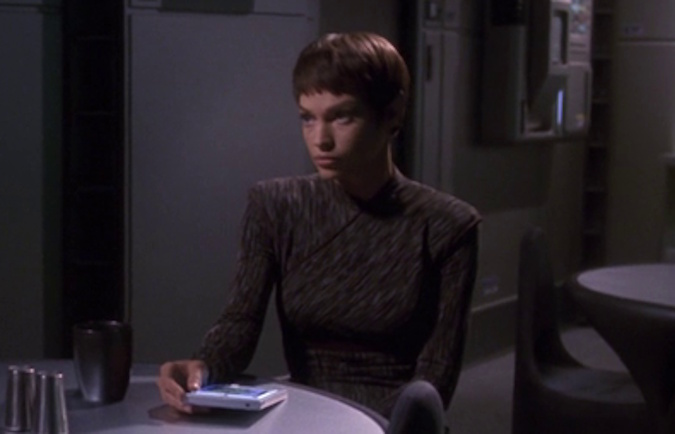
Night time on Pandora in this final piece of concept art.

One improvement we’re sure to see is in CGI and digital animation. Avatar was released at a time when CGI was improving – and was far better than it had been even five or ten years earlier – but there are still some aspects of its visual style that haven’t aged especially well. Some textures have that “too shiny” look that plagued cinematic CGI in the 2000s, and while viewing the film on a cinema or IMAX projector screen dulled the impact of some of that, on a television set in 2021 it’s something you notice. I wouldn’t say Avatar looks dated – but it’s right on the cusp. A film that relies so heavily on computer animation – many of Avatar’s sequences are basically fully-animated – is always going to run that risk, and while it has aged more gracefully than, for example, the Star Wars prequel trilogy, there are still noticeable places where the animation isn’t up to code.
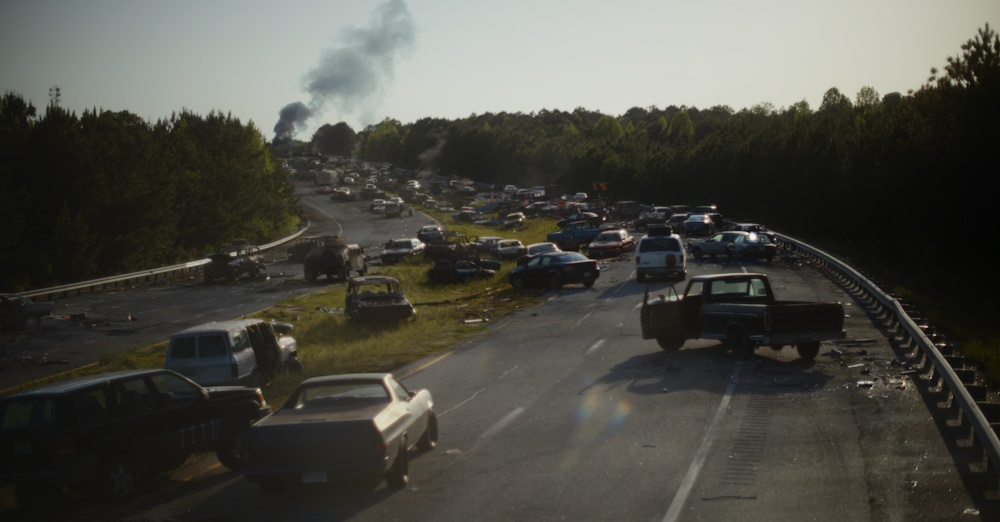
There have been improvements in computer animation since 2009, which should mean Avatar 2 and the rest of the sequel series will be far more visually interesting. Pandora was already beautiful, but if that beauty could be expanded upon I think the sequels could really be something special. Some fans tend to turn up their noses at visuals, but if you think about it, a distinct visual style is another absolutely crucial element to a franchise. Star Trek has combadges, ships with saucer sections, Klingons, and the transporter. Star Wars has white-armoured Stormtroopers, lightsabers, Jabba the Hutt, and X-wings. Avatar introduced us to the blue-skinned Na’vi, but none of its technology, characters, costumes, or locations have become iconic in the same way as the other franchises we’ve mentioned. Part of that is down to the quality of the CGI, but partly it’s the film’s own art style. Avatar 2 could introduce a new design for a starship, character, or even just a costume that will go on to be emblematic of the series – in the way that Boba Fett became a symbol of Star Wars after his debut in The Empire Strikes Back, for example.
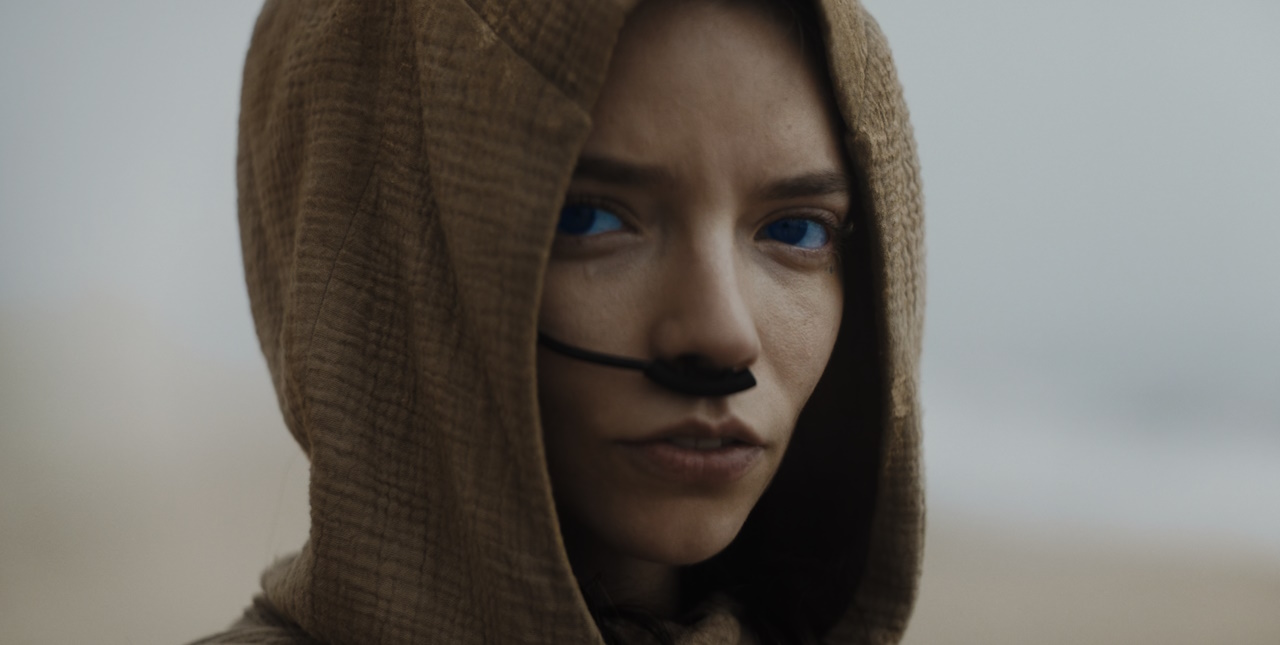
So yes, there’s work to do to expand on Pandora and the world Avatar created in 2009. But I’m really interested to see where Avatar 2 will take the story after the conclusion of the first film, and what the other films in the planned sequel series have in store. James Cameron is an amazing director, and having put so much work and effort into the Avatar series, I really hope it will see the kind of success he’s looking for. There’s always room for more sci-fi franchises!

Avatar is out now on Blu-ray and DVD, and may be streamed on Disney+ in the United States, United Kingdom, and other countries and territories. Avatar is the copyright of 20th Century Fox and the Walt Disney Company. Avatar 2 is due for release in December 2022. Logo and official promotional artwork courtesy of avatar.com. Stock photos courtesy of Unsplash. This article contains the thoughts and opinions of one person only and is not intended to cause any offence.