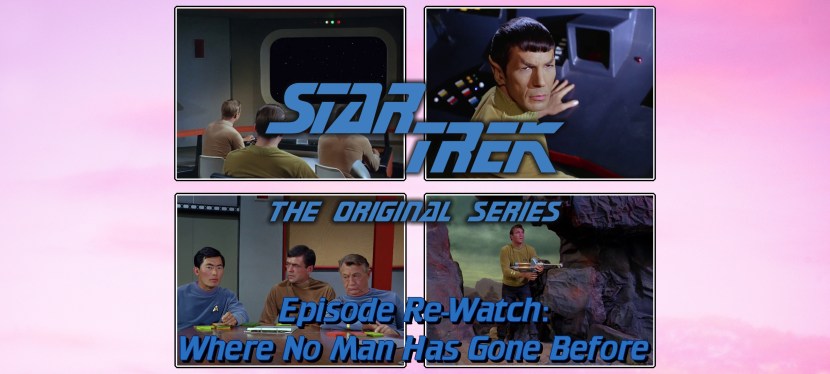
Star Trek: The Original Series Episode Re-Watch – Season 1, Episode 3: Where No Man Has Gone Before

A Star Trek-themed spoiler warning

Spoiler Warning: There are spoilers ahead for Star Trek: The Original Series.

2026 marks Star Trek’s landmark 60th anniversary – and six decades later, we’re still getting brand-new episodes and stories! That’s something incredibly special; a milestone few other franchises have ever reached or will ever reach. Today, as part of my ongoing celebrations of the 60th anniversary, I thought we could step back in time, not only to the first season of The Original Series, but to a particularly special – and rather unusual – episode. Today, we’re watching Where No Man Has Gone Before – Star Trek’s second pilot.

After The Cage wasn’t picked up by NBC in 1965, Gene Roddenberry and his team were given a rare and unusual second chance to salvage Star Trek. The resulting script was Where No Man Has Gone Before, and after almost the entire cast – sans Leonard Nimoy as Spock – was changed, the new episode entered production. Recycling the sets which had been built for The Cage, but which were subsequently dismantled and rebuilt ahead of filming the rest of what we now know of as The Original Series, the episode has a completely distinct look, one which simply doesn’t appear anywhere else in the franchise.
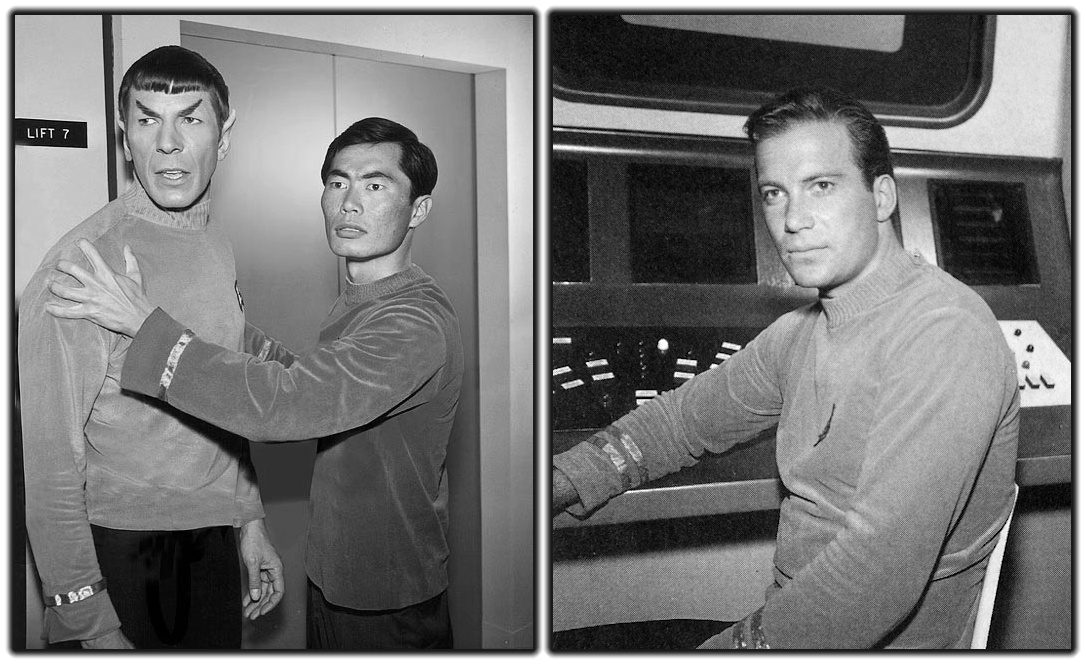
Promo photos for Star Trek TOS showing Nimoy and Takei (l) and Shatner (r)
Black-and-white promotional photos showing Leonard Nimoy with George Takei (left) and William Shatner (right).

The uniforms may be the most obvious, with Star Trek’s (in)famous red shirts nowhere to be seen! Instead, the entire crew wears either blue, a different shade of “gold” that almost looks green or khaki, or beige. And, with the exception of Kirk, the remaining characters we’d come to know – Spock, Scotty, and Sulu – are all wearing a different colour than we’d expect. Spock gets a uniform similar to Kirk’s in command gold, Sulu – who isn’t the helmsman this time, but some kind of mathematical aide – wears medical blue, and Scotty is in one of the beige uniforms that seem to have taken the place of engineering/security’s red.

The uniforms are also different in the way they appear: visual zippers on the shoulders, a softer, ribbed crew-neck collar that evokes World War II-era naval uniforms, and smaller, slightly different Starfleet delta patches, too. These uniforms are similar to those seen in The Cage, which is another quirk of production. But for the main crew and characters we’d come to know, this was the only time we’d ever see them in these particular uniforms.
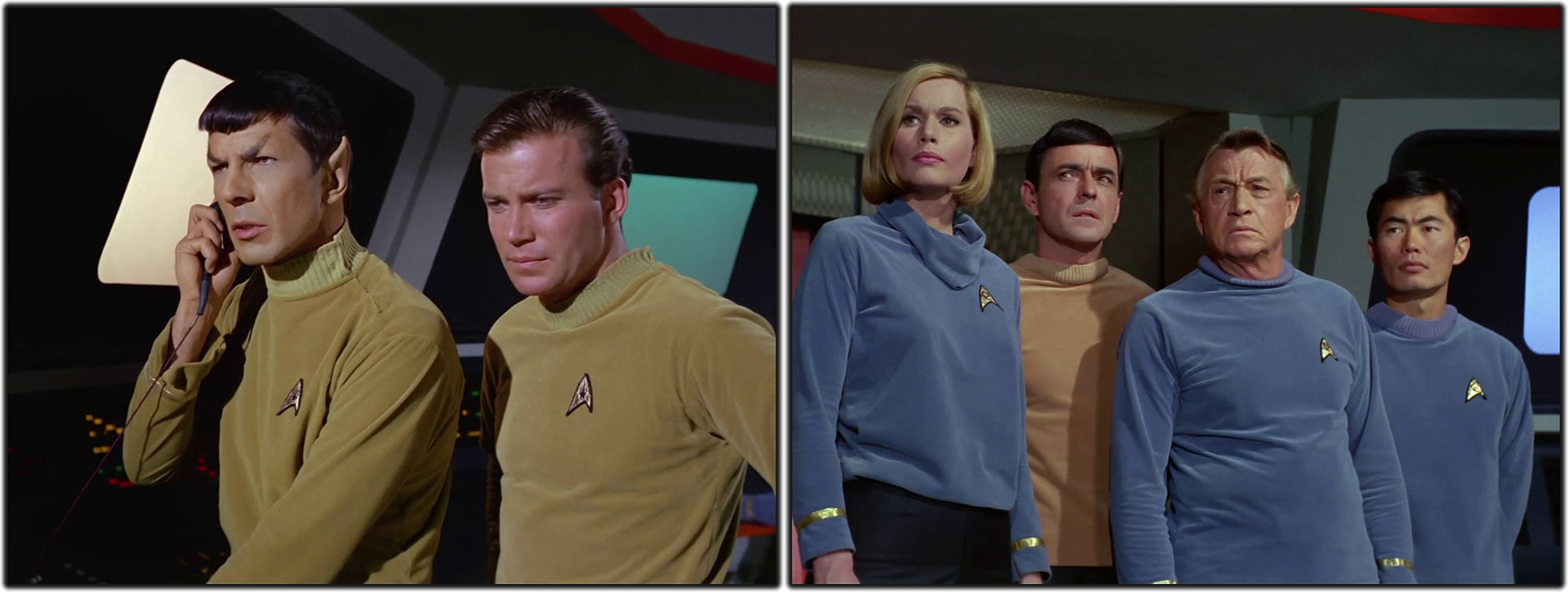
Two still frames from Star Trek TOS showing early uniform variants
The uniforms are different in this episode.

Then there are the sets. The bridge is different – albeit in ways that may not be obvious at first. Kirk’s chair has a large communicator on one side, which I think I’m right in saying wasn’t seen again. The main viewscreen, though, is the most clear and obvious point of difference; its corners are far more rounded than they would be in the rest of the show, again evoking more of that World War II naval style in some ways. The set was moved to a different sound stage when The Original Series entered full production, which is why it looks different here.

Sickbay, which is one of the only other Enterprise rooms where the episode spends much time, is also quite different, with different coloured walls and simpler upholstery than we’d see in the rest of the show. Some doors in Where No Man Has Gone Before are grey or silver instead of the more familiar red, chairs are a different colour and have shorter backs, and the Enterprise as a whole just feels a little… different. You weren’t making that up, if you felt something was “off” upon watching this episode! Things really are different.
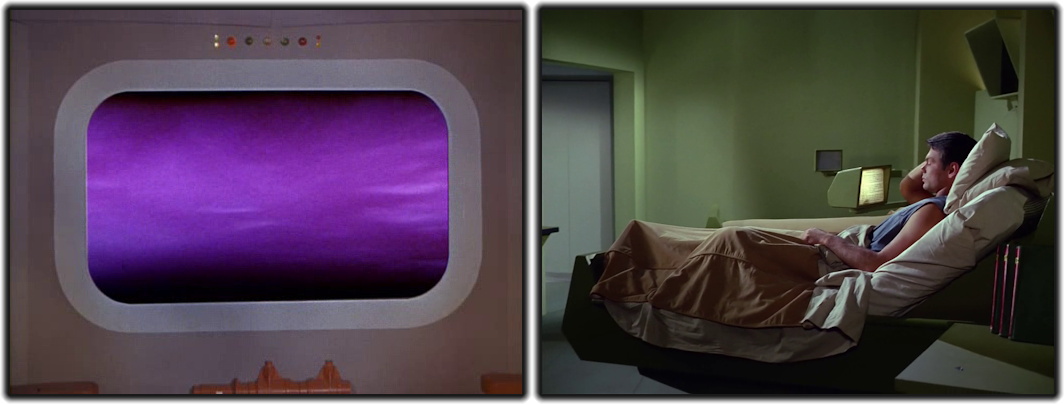
Two still frames from Star Trek TOS showing the viewscreen and sickbay
The main viewscreen on the bridge (left) and sickbay (right) aren’t quite the same as they are in the rest of the series.

Unusually for a pilot episode, Where No Man Has Gone Before wasn’t the first to be broadcast. That honour fell to The Man Trap, which executives at NBC apparently felt was a simpler, more straightforward story. This episode was pushed back and aired as the third of Season 1 in the United States… but interestingly, when Star Trek came to the UK in 1969, it actually was the first episode that the BBC chose to broadcast. I wonder why that happened?

Here’s a fun question: how many times, across The Original Series, do we see Captain Kirk wielding his phaser rifle? This iconic, legendary prop, which is well-known to all of us Trekkies and instantly recognisable, must’ve been used a lot… right? Well, no! The phaser rifle *only* appears here, in Where No Man Has Gone Before, and despite being seen in publicity photos of William Shatner in his role as Kirk, it never appears again in the entire series. According to Star Trek legend Bjo Trimble, Gene Roddenberry disliked the design, feeling that it looked “too lethal” for his calmer, more rational vision of humankind’s future.

Still frame from a YouTube video showing the Star Trek phaser rifle prop with its designer
Prop designer Reuben Klamer (pictured in 2013 with the original prop) designed the phaser rifle for Where No Man Has Gone Before.

In addition to Chekov, who wouldn’t be seen until Season 2, Where No Man Has Gone Before is also noteworthy insofar as it was produced before Nichelle Nichols was cast as Uhura, and before DeForest Kelley was cast as the ship’s doctor. The role of communications officer is instead taken by Lieutenant Alden, played by Lloyd Haynes, and standing in for DeForest Kelley is Paul Fix, who plays the character of Dr Mark Piper.

I’ve always felt that Dr Piper – in his limited on-screen moments – is a bit of a half-step between The Cage’s Dr Boyce and the main show’s Dr McCoy. He’s similar to both characters in as much as he’s older than Kirk, but he comes across as being a bit less serious than Dr Boyce, slouching during a conference meeting, but also less lighthearted or quippy than Dr McCoy would be. The archetype that Gene Rodenberry wanted to create – the older, slightly wiser ship’s doctor, who could be a guide to the captain both in medical matters and beyond – was clearly present in Dr Piper and Dr Boyce, but these versions feel… less refined, if that makes sense. Like, I can see where Dr McCoy is going to materialise, but the full personality of the character isn’t there yet.
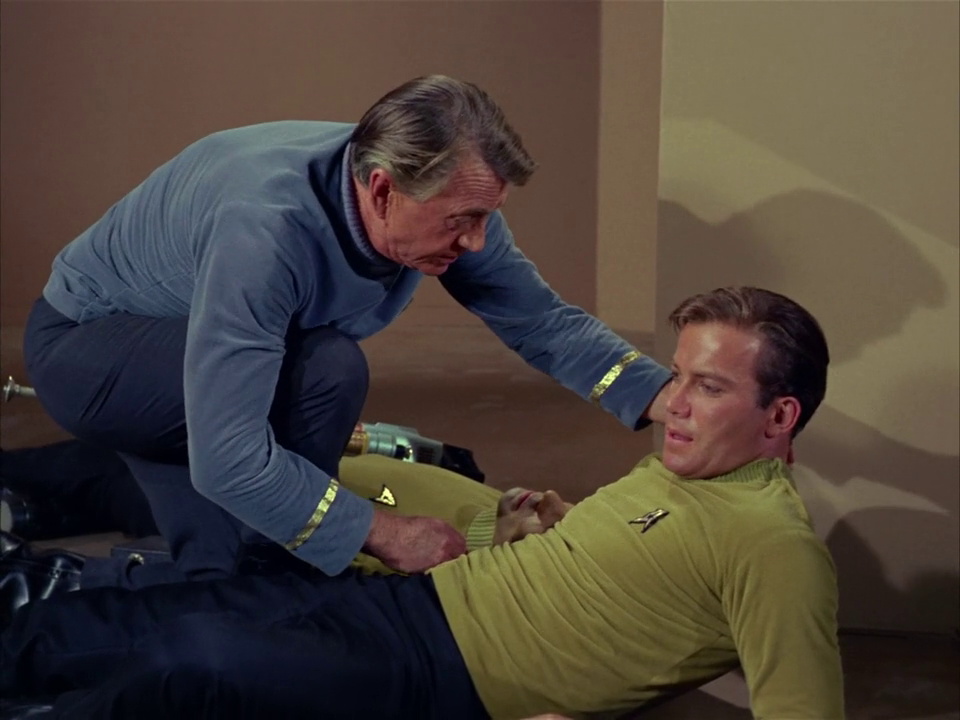
Still frame from Star Trek TOS showing Kirk and Dr Piper
Dr Piper with Captain Kirk.

As an interesting aside, Gene Roddenberry had his heart set on casting DeForest Kelley for both The Cage and Where No Man Has Gone Before, but was overruled by others involved in the production. It was only when Star Trek was fully greenlit that Rodenberry got his man – and I think we can all agree that it was the right call! Still… it’s interesting to see what might have been.

I usually prefer to watch Star Trek on streaming nowadays… or at least I do during the months where I pay for Paramount+! But on this occasion, I actually went back to my old DVDs; the streaming versions are the remastered ones, complete with new special effects and CGI shots of the Enterprise. And while the remastered version of The Original Series does look, by every objective measure going, “better,” I wanted the classic look this time. There are differences in the way the episode looks – the Galactic Barrier, for instance, looks very different, as do a few other VFX shots. The Enterprise itself is also a fully CGI model in establishing shots.
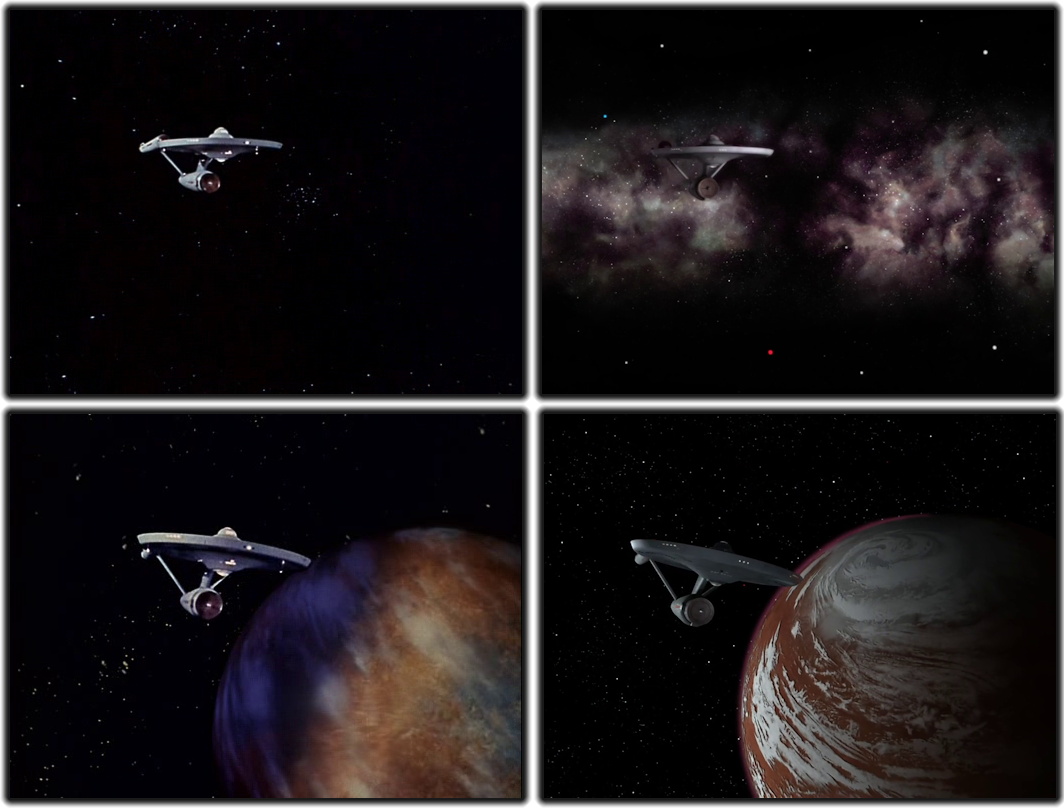
Side-by-side comparison of Star Trek TOS original and remastered shots
The original versions (left) and remastered versions (right) of two moments in the story.

As a Trekkie, there are a lot of things that seem “wrong” about Where No Man Has Gone Before. What I mean by that is… with the hindsight that six decades and almost 1,000 subsequent stories can provide, there are things in the story that just don’t seem to fit. Spock being so quick to advocate for Mitchell’s extrajudicial execution, the Enterprise being on a mission to scout outside of the galaxy, some confusion about warp drive and impulse engines, and how fast impulse actually is when trying to get between star systems… all of these things feel a little “off.” To what extent that will bother you, or whether you can set it all aside and enjoy the story for what it is will be a matter of personal taste!

For me… I kind of place Where No Man Has Gone Before along with The Cage in almost their own category. These are fun Star Trek stories, of course, but they’re also unique oddities within the broader franchise; episodes which almost seem to take place apart from the rest of The Original Series. I think I can fall victim to being overly nitpicky sometimes (check out some of my other episode write-ups and reviews for that!) and the temptation is there with Where No Man Has Gone Before to say that things like the uniforms, the attitudes of some of the characters, and the Enterprise’s strange mission all seem to be, for want of a better word, “wrong.” But placing the episode in context, and understanding it for what it is, helps me set a lot of that aside. Even though it’s not an episode I re-watch all that often, I still had a good time when I revisited it, and I found myself getting swept along for the ride.
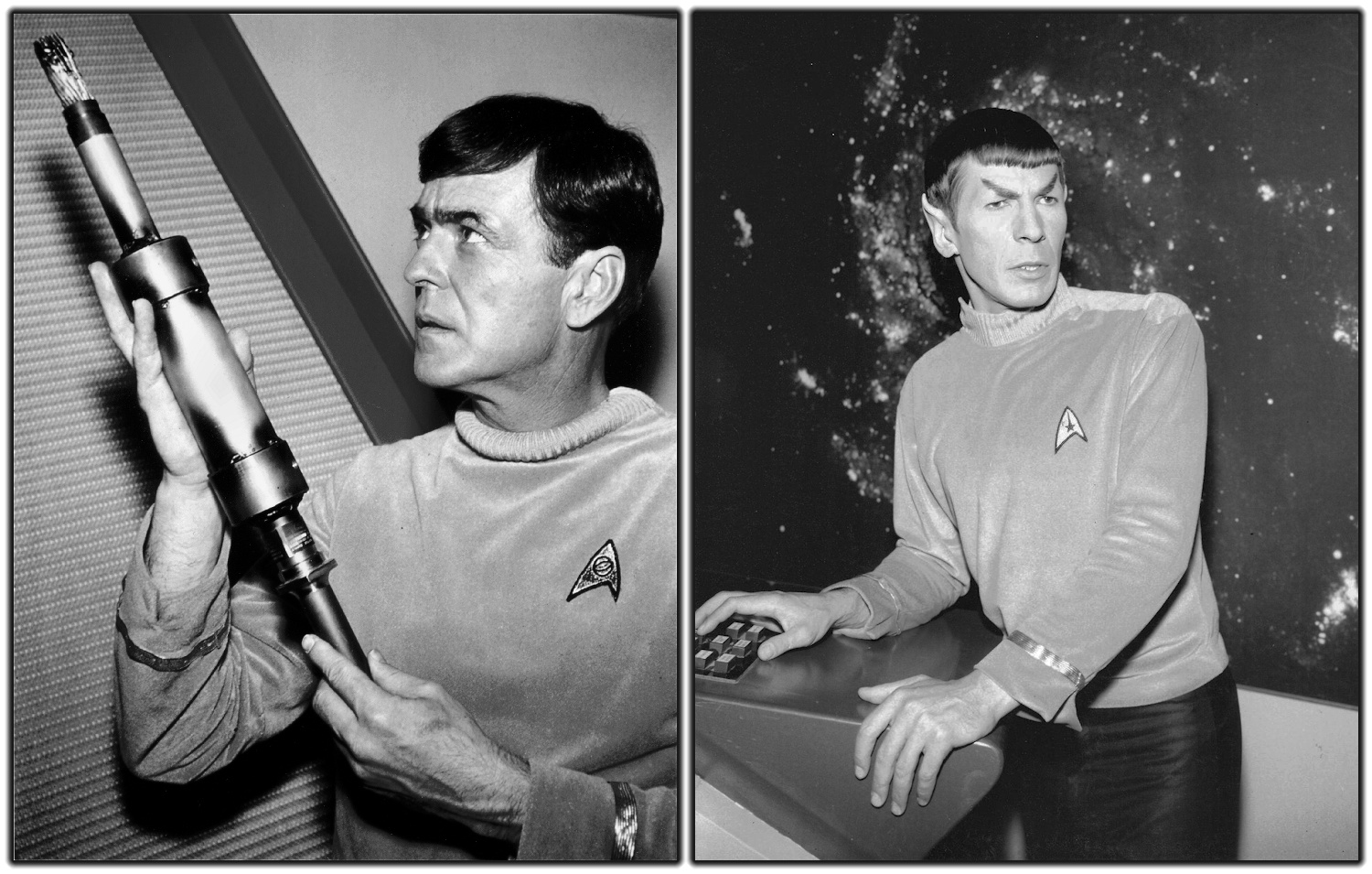
Promo photos for Star Trek TOS showing Doohan and Nimoy
Black-and-white promotional photos of James Doohan (left) and Leonard Nimoy (right).

That’s testament to the power that Star Trek still has some six decades later! There are undeniably outdated things in Where No Man Has Gone Before: papier-mache rocks, for instance, or Kirk and Mitchell’s attitude towards women. But the story itself is timeless; a classic morality fable about the dangers of granting a mere mortal the powers of a god. Given where we are today with conversations about artificial intelligence and its potential to far exceed us in terms of its capabilities, and the so-called “alignment problem,” stories like Where No Man Has Gone Before actually seem *more* relevant, not less.

So I like that we catch a glimpse of a kind of “alternate reality” for both Star Trek the show and the USS Enterprise in-universe. We see Kirk, presumably at a slightly earlier moment in his command, with different crewmates, wearing different uniforms, and even with a slightly different design to parts of the ship. It makes for a fun “what if;” what might The Original Series have looked like if *this* series – the one we catch a glimpse of for just one episode – had been continued with zero changes? Would these uniforms have been as iconic, with their toned-down colours and no red? Would the phaser rifle have become a standard part of the Federation’s arsenal? Would Dr Piper have been as well-received and well-remembered as Dr McCoy? And would some of the characters we don’t spend as much time with in the episode – like Alden or Yeoman Smith – have gone on to fill the absent roles of Uhura, Rand, or Chapel? I guess we’ll never know, eh?
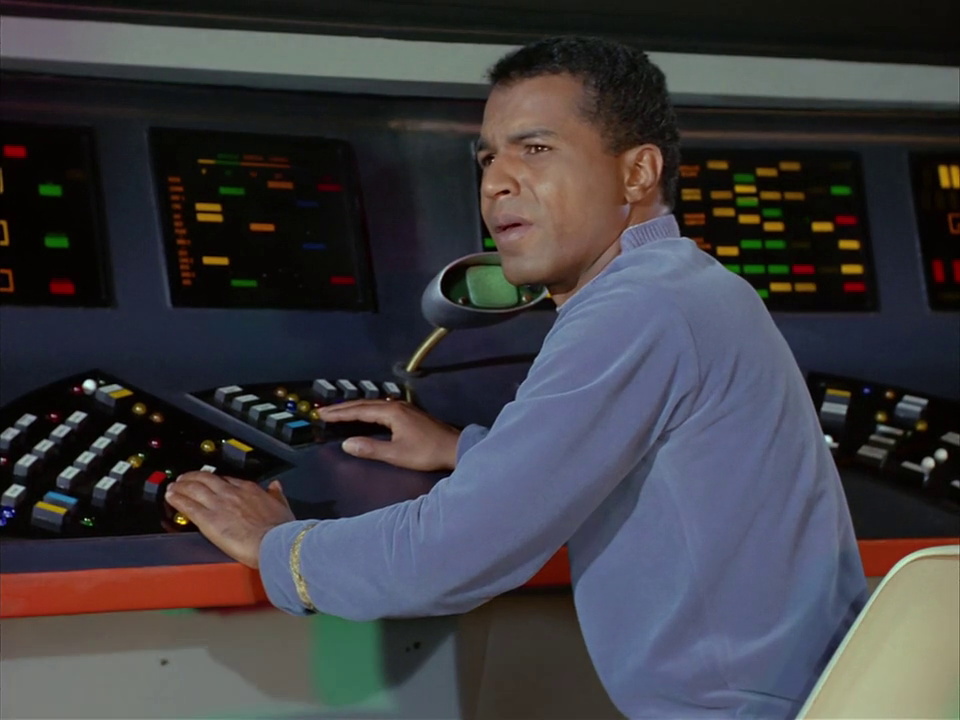
Still frame from Star Trek TOS showing Alden
Lieutenant Alden, the Enterprise’s communications officer in this episode.

I think I’m right in saying that extra-sensory perception, or ESP, wasn’t mentioned again after Where No Man Has Gone Before. Obviously, we’ve seen similar abilities in races like the Talosians, Betazoids, Q Continuum, and more – and humans would occasionally gain similar powers in some stories. But it was never again expressed in quite this way, with Starfleet apparently keeping track of humans who possessed these seemingly magical powers.

It’s interesting that this vision of the future sees almost a blend of magic and science. ESP, even in the 1960s, was a fringe idea at best, but Where No Man Has Gone Before wraps it up in the language of science, presenting it as something to be merely noted and catalogued, the way we might expect Starfleet to make note of someone’s height or allergies. Because ESP is this kind of pseudoscientific, paranormal thing – which, if we think sceptically, has never been proven to exist – it feels odd to see it included in a Star Trek episode in this manner. I don’t hate it, and when you look at other stories in The Original Series, The Animated Series, and even early Next Generation episodes, it doesn’t feel that out-of-place. But once you get past, say, Season 2 of TNG, it’s not the kind of storyline I’d expect to see. Star Trek could make a comparable episode today, but if one were commissioned, I don’t think the ESP angle would be included at all – at least, not in this straightforward, scientific way.
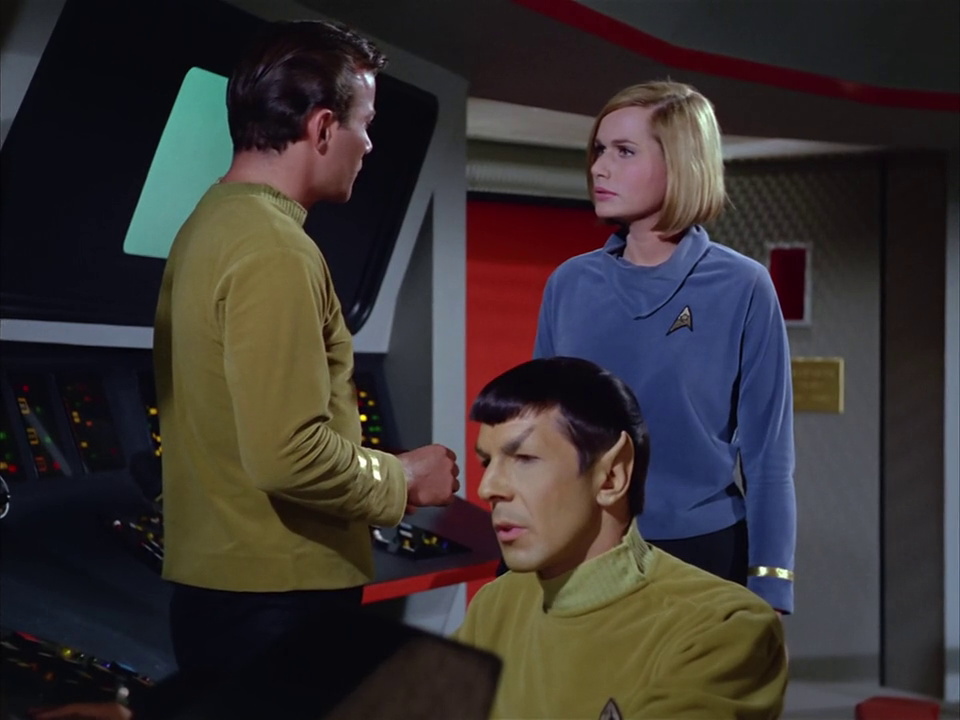
Still frame from Star Trek TOS showing Kirk, Spock, and Dehner
Kirk, Spock, and Dr Dehner discuss extra-sensory perception.

So we’ve talked a lot about what makes Where No Man Has Gone Before stand apart, different from the rest of Star Trek. Let’s move on to ways in which the episode *does* feel familiar!

I recently had the opportunity to meet William Shatner – Captain Kirk himself – at an event here in the UK. Click or tap here to check out my thoughts on that, by the way; it’s a big part of why I wanted to write up another TOS episode re-watch! Shatner’s Captain Kirk arrives in Where No Man Has Gone Before basically fully-formed as the character we know and love: friendly with his crew, especially close to Spock, flirty with women, and with a strong sense of duty and protectiveness for his ship. Those traits would go on to define the character, and they’re all present here, in what was the first time Kirk was conceived and brought to the screen.

Spock has changed from The Cage, but in terms of the character we’re most familiar with, he’s also more or less fully-formed. Where No Man Has Gone Before was the first time (in production order, I mean) that the Vulcans were established as being a logical, unemotional people, and Spock embodies that here in a way he didn’t in The Cage.
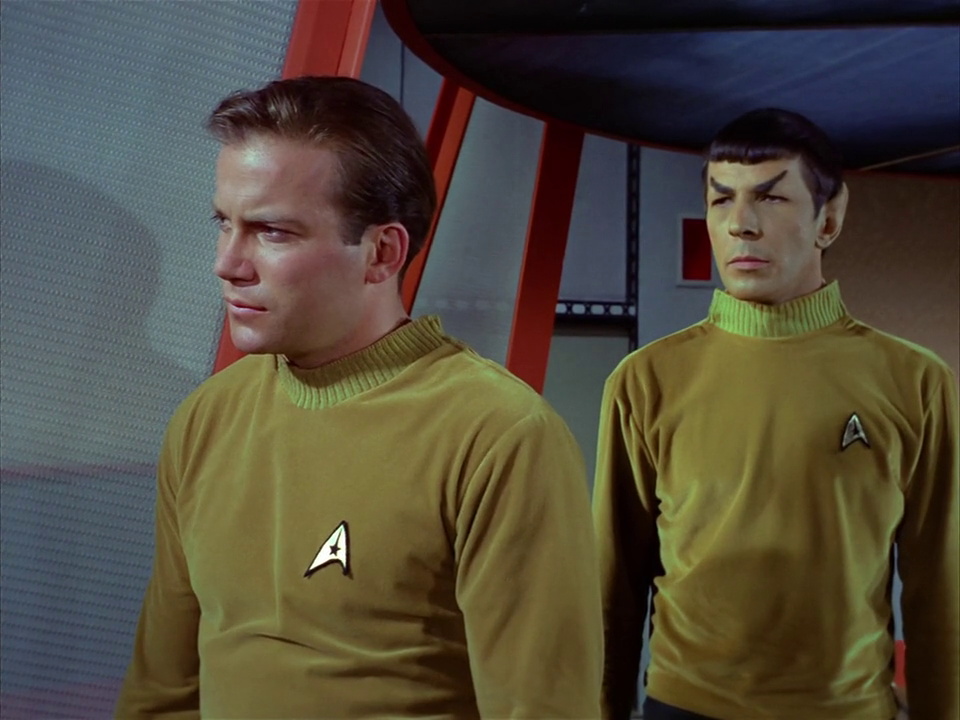
Still frame from Star Trek TOS showing Kirk and Spock
Kirk and Spock in the conference room.

The barest bones of Scotty can be glimpsed; James Doohan is already doing the accent, and while we don’t exactly see Scotty as a miracle-worker (major repair tasks and the retrofitting of Delta Vega’s station fall to other characters this time), he’s at least established as the Enterprise’s senior engineer. Sulu is a bit of an oddity; as I said above, he’s not a helmsman, nor even a bridge officer, and if uniform colours mean *anything* in this particular story, he might well be supposed to be affiliated with the science or even medical divisions. But nevertheless, we have George Takei in his familiar role, and Sulu gets a few lines.

Dr Piper is a Dr McCoy prototype, as discussed above, and although he doesn’t get a ton of screen time or a lot of lines, you can see the outline for that kind of character in Paul Fix’s performance. So, once again, we have the bare bones of a familiar character – albeit that this one isn’t played by the actor we’d expect to see!
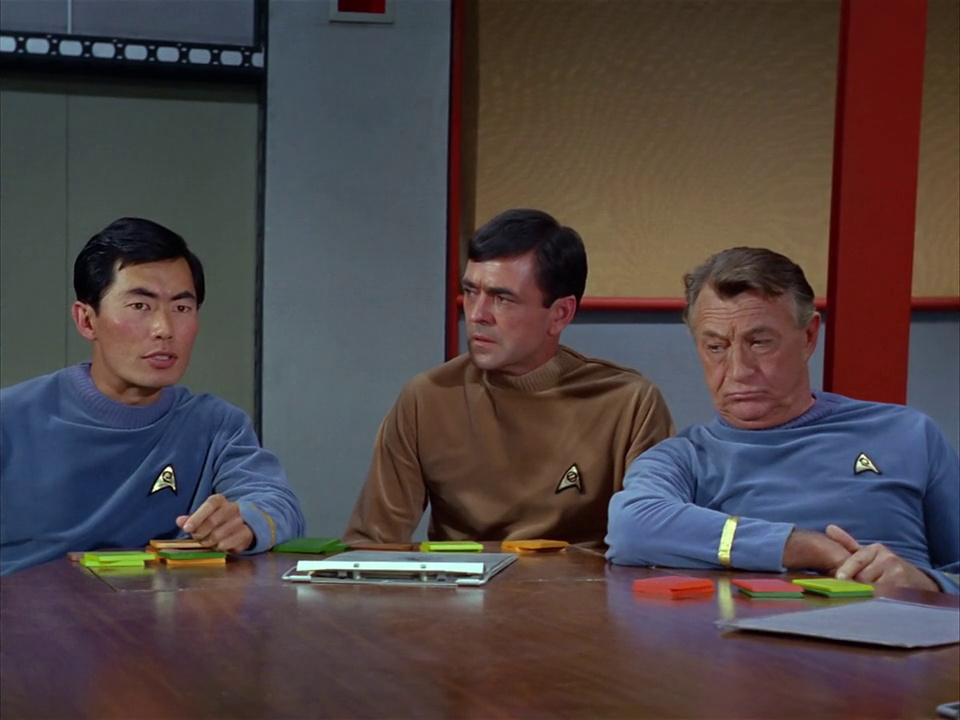
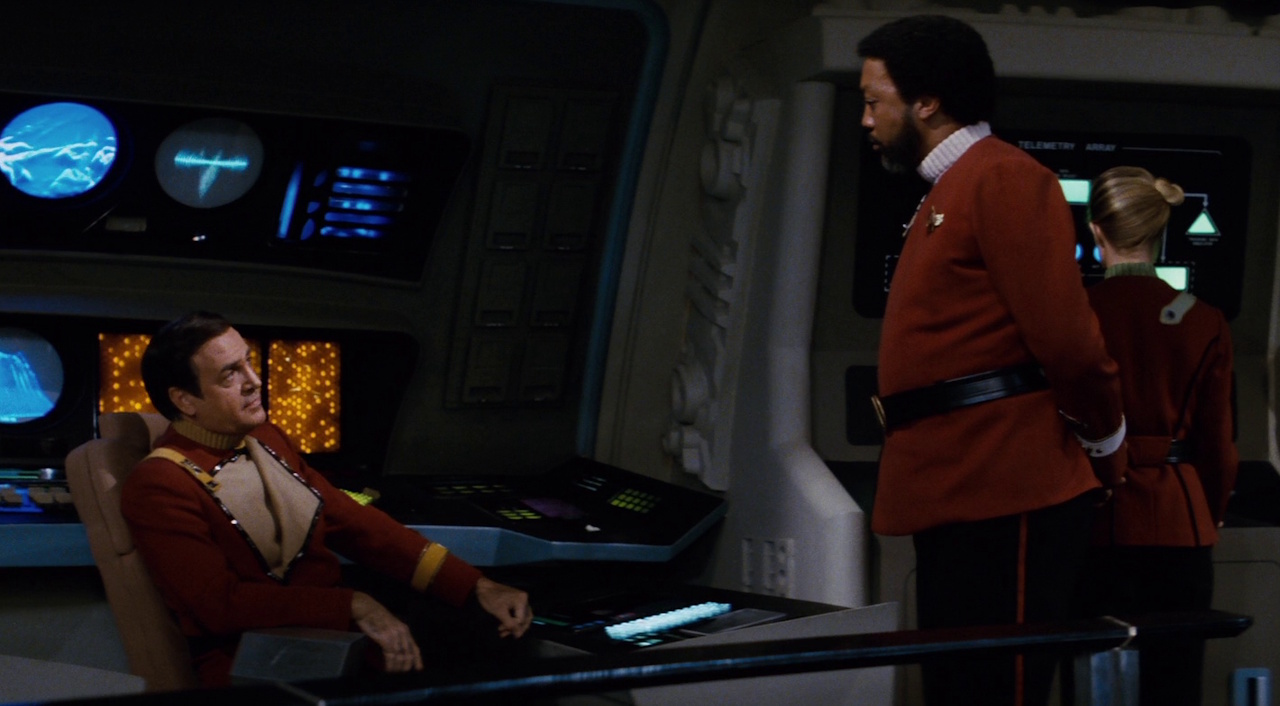
Sulu, Scotty, and Dr Piper.

The Enterprise, despite some key differences that we’ve already discussed, still feels familiar. The bridge is set up the same, despite the different main viewscreen, and the captain’s chair, Spock’s science station, the red turbolift doors, and the helm console are all exactly as we’d remember them. Minor differences may be a result of the set being dismantled and rebuilt at a different location, but by and large, the internal areas of the Enterprise that we see are still familiar enough not to feel totally “wrong.”

The exterior of the ship is also exactly the same. Where No Man Has Gone Before re-uses the filming model that had been built for The Cage, and some establishing shots of the ship would go on to be mainstays of The Original Series. The remastered Blu-ray version has different CGI shots; the Enterprise moves in ways we didn’t really see in the show’s original run. But, like I said, that’s partly why I wanted to watch my old DVD copy on this occasion!
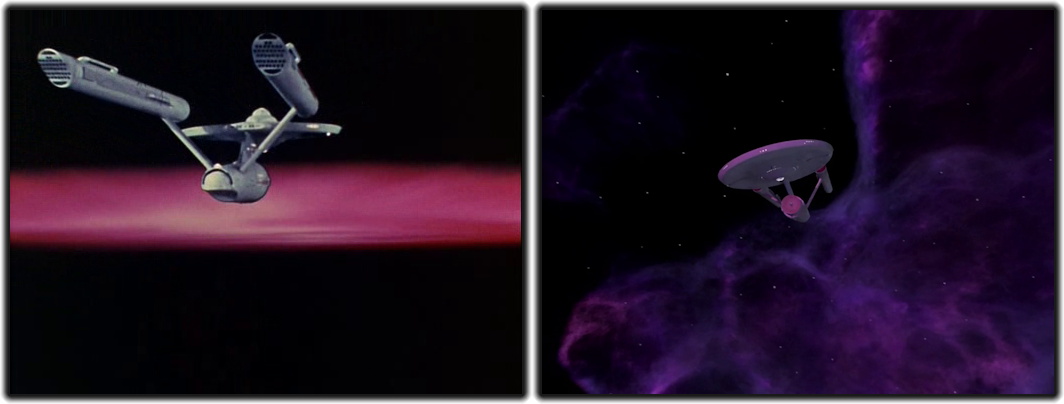
Side-by-side comparison of Star Trek TOS original and remastered shots
The exact same moment in the story as seen in the original version of the episode (left) and the Blu-ray remaster (right).

For a one-off character, Gary Mitchell is surprisingly well-written. He fits seamlessly into The Original Series at this very early stage, and if Where No Man Has Gone Before was the first episode you ever watched, I could see what happens to him being genuinely shocking – especially to an audience some sixty years ago. I genuinely buy into Kirk and Mitchell’s friendship. Some one-off characters who are introduced as supposed besties of someone on the main cast don’t always stick the landing – their inclusions can, sometimes, feel a little *too* forced. But Mitchell and Kirk have chemistry together, thanks to William Shatner’s performance playing well with guest star Gary Lockwood.

Opinions on Mitchell himself may vary, I suspect, due to the passage of time. Writing in 2026, some six decades on from the character’s debut, I view Mitchell as being kind of arrogant and unlikable from the get-go; his dismissive attitude to the Enterprise’s helm officer and his unpleasant interaction with Dr Dehner being examples of this. But to an audience back then, I think Mitchell was meant to come across as kind of similar to Kirk; a ladies’ man with a sense of humour, perhaps even a happy-go-lucky attitude that would contrast with his later god-like powers.
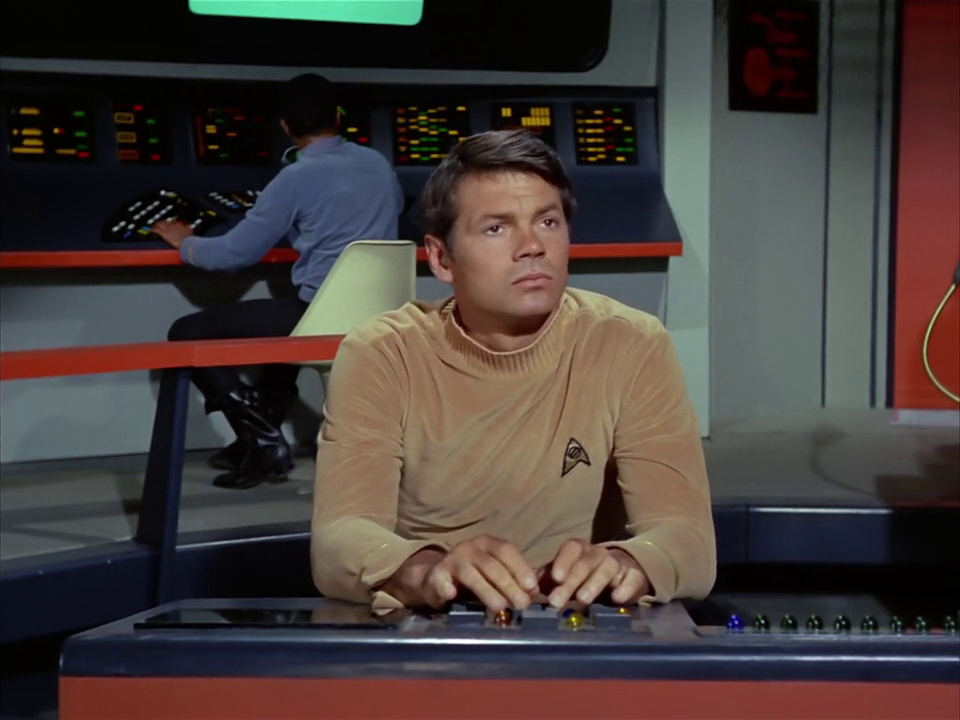
Still frame from Star Trek TOS showing Mitchell
Gary Mitchell, prior to his transformation.

I would argue, though, that Mitchell’s early scenes with Kirk on the bridge and in the turbolift are at least meant to inform us of a selfish or arrogant side – something that would make his developing powers even harder to handle. Because Mitchell starts out as arguably a flawed person, there’s room for him to abuse the powers he develops later on in a way that feels plausible. If a character like Kirk had been given such powers, it would be harder, perhaps, to imagine that he’d want to misuse them; Kirk has a stronger moral core – or at least, I feel he does with the benefit of more than a hundred other episodes and films! But Mitchell has that arrogant streak from the get-go; a flaw that makes him susceptible to being corrupted by power.

But is that the moral of the story? That *only* a flawed person would abuse power?

I suspect the real intention was to show that a normal guy – as Mitchell is supposed to be, for the era in which Where No Man Has Gone Before was produced – is always going to be too tempted to abuse power. He’s an example of, to quote Kirk in the episode itself: “absolute power corrupting absolutely.” Mitchell was intended to be just an “everyman,” a regular Starfleet officer who couldn’t handle that kind of power. None of us can… and that’s supposed to be the point.
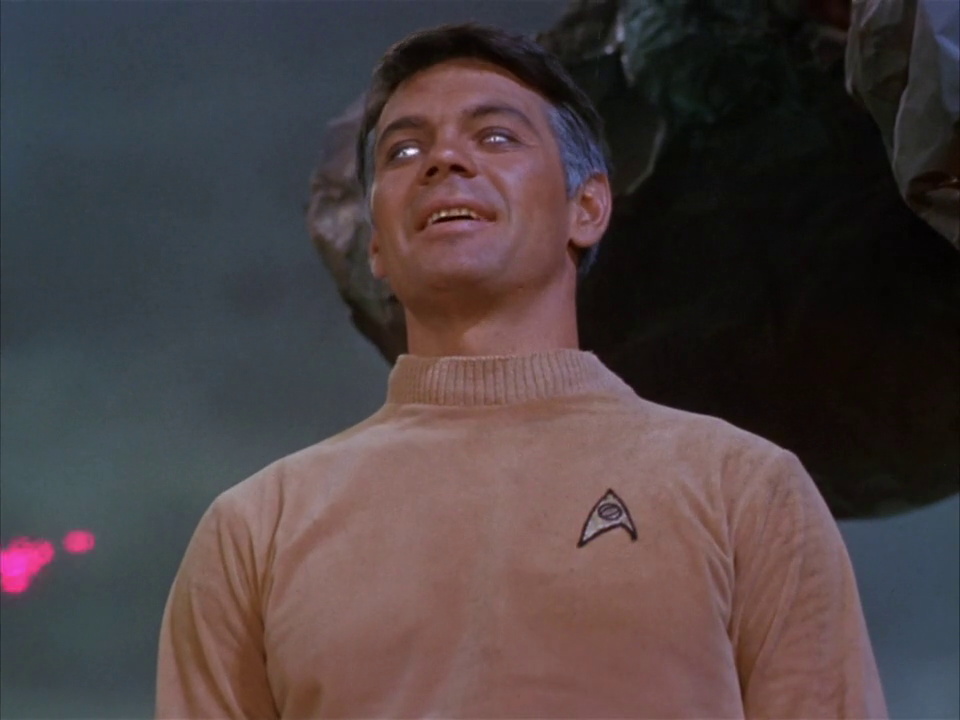
Still frame from Star Trek TOS showing Mitchell
Mitchell with his god-like powers.

Gene Roddenberry saw Star Trek, in part, as a vehicle for conveying these kinds of morality fables. Yes, there’s a vision of the future where humankind has overcome all kinds of obstacles, and there’s an incredibly positive outlook which, at the height of the Cold War, seemed impossible to a lot of folks. That inspirational side, that optimism, and that sense of hope are still part of the franchise to this day. But there’s also storytelling by metaphor – Gary Mitchell receives god-like powers, but those powers can be read as a metaphor for political power. Mitchell’s transformation, seen through that lens, is a warning against granting *anyone* – even a likeable guy or an “average Joe” like Gary Mitchell – too much power. I wonder if you can think of a contemporary example of someone like that… a politician, perhaps?

Then there’s Dr Dehner. Her powers take longer to manifest, and seem to be a little behind Mitchell’s – whether that’s because she’s supposed to be weaker, or because powers grow and improve over time isn’t 100% clear in the story itself, but it’s still an interesting question. It’s fascinating that Dr Dehner, not Mitchell, is the character able to be reasoned out of her power-mad state. If we take what I was saying before about storytelling by fable and metaphor, I think we can argue that Where No Man Has Gone Before wants to present intelligence, and perhaps education, as being virtues; that Dr Dehner, as a psychiatrist and a more intelligent and thoughtful person than Mitchell – was able to snap out of it and resist the temptation of unlimited power.
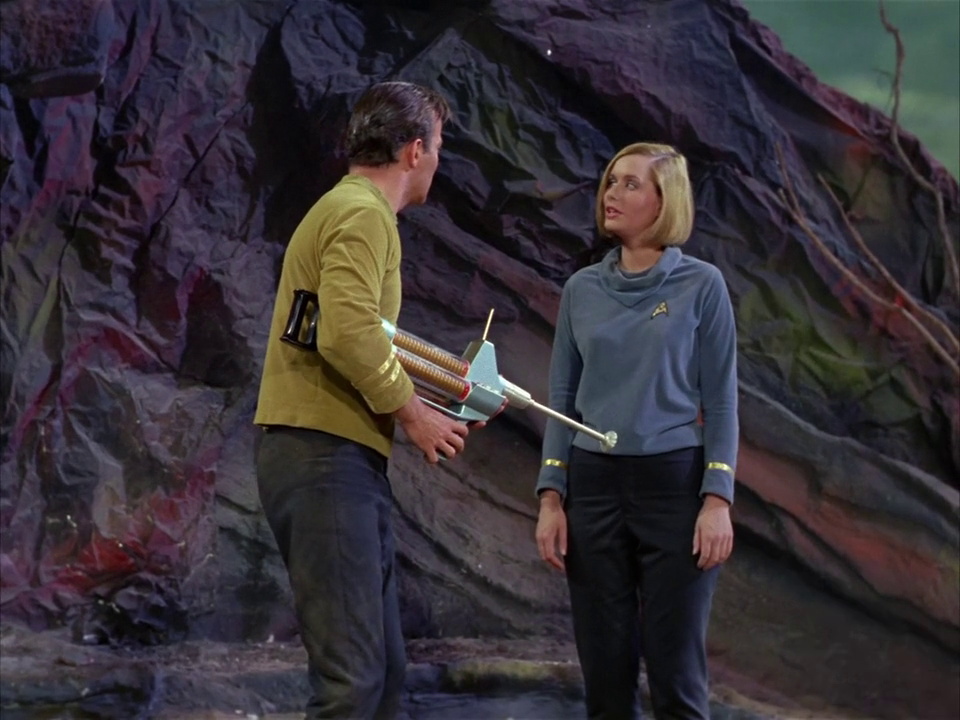
Kirk was able to remind Dr Dehner of her humanity in a way he couldn’t with Mitchell.

So I hope this has been interesting.

Where No Man Has Gone Before is, in many ways, an odd little curiosity; produced more than a year before the rest of The Original Series’ first season, it doesn’t integrate with it perfectly. But the outline of what Star Trek would become is present here – some characters aren’t fully fleshed-out yet, and others would be added, removed, or changed entirely. It makes the episode feel… unique. A distinct offering, and a rare glimpse at a vision for the series that’s both similar and different. Compared to The Cage, the episode is a lot closer to the rest of The Original Series. But compare it to any story produced later and it stands apart.

My encounter with William Shatner last month, and Star Trek’s big 60th anniversary year, were the catalysts for returning to Where No Man Has Gone Before. And you know what? I had fun with it! It’s an episode I haven’t actually re-watched in a few years, at this point, and it’s been even longer since I went back to my TOS DVD collection and watched the show in its un-remastered form. It was a lot of fun.
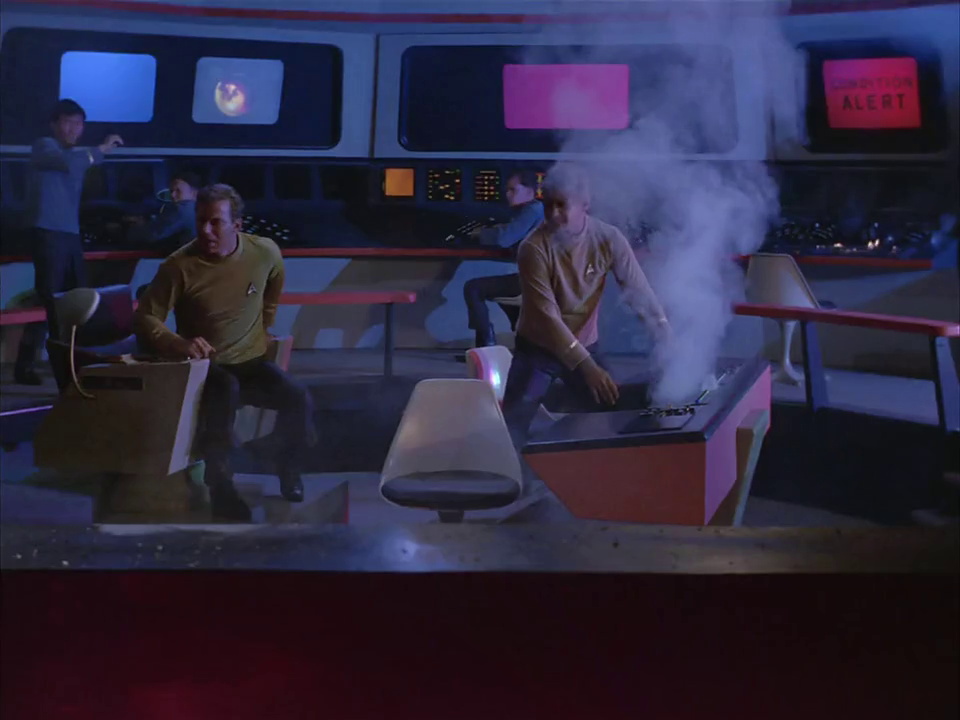
Still frame from Star Trek TOS showing the bridge and smoke
Fire on the bridge!

As the 60th anniversary nears, I have a few other ideas for episode re-watches, essays, discussion pieces, and more. Some of those may eventually make their way onto the website – so please stay tuned for that! And just next month we’ll be graced with Strange New Worlds’ fourth season. I plan to write individual episode reviews, so if that’s something you’re interested in, I hope you’ll join me for that.

Thanks for checking out my thoughts on this unique episode. If you’re interested in more of my take on TOS, I have write-ups of The Original Series episode Arena and The Animated Series episode How Sharper Than A Serpent’s Tooth, which you can find by following those links. And I’ve got pieces about The Motion Picture and The Search For Spock, too. Click or tap those links to check them out.

As always… Live Long and Prosper, friends!


Star Trek: The Original Series (a.k.a. Star Trek) is available to stream now on Paramount+ in countries and territories where the platform is available. The series is also available on DVD and Blu-ray. The Star Trek franchise – including The Original Series, Strange New Worlds, and all other properties discussed above – is the copyright of the Skydance-Paramount corporation. This article contains the thoughts and opinions of one person only and is not intended to cause any offence.
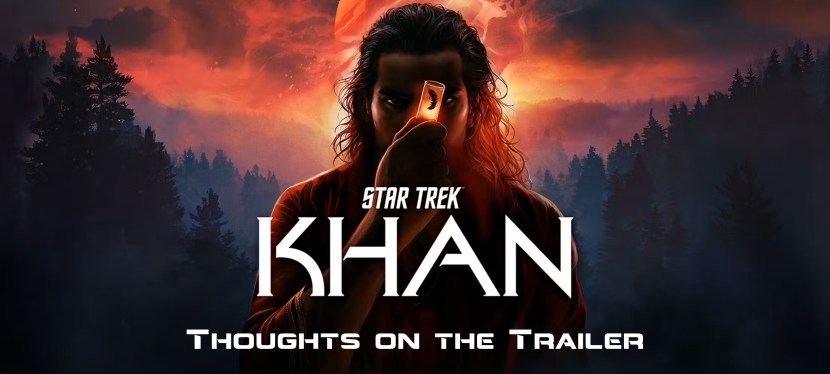
Star Trek: Khan – Thoughts on the Trailer

A Star Trek-themed spoiler warning.

Spoiler Warning: Beware potential spoilers for the upcoming Star Trek: Khan audio drama. Spoilers are also present for Space Seed, The Wrath of Khan, Into Darkness, Lower Decks, and Picard.

For a franchise which could be just a couple of years away from total cancellation, Star Trek had a lot to say at this year’s Comic-Con event! We’ve already covered the big Starfleet Academy news, which included a trailer and introductions to the main cast, as well as Year One – a pitch for a Strange New Worlds successor series. This time, we’re finally getting around to talking about Star Trek: Khan – an audio drama which will be released next month.

This is Star Trek’s first ever official audio drama – billed, for some reason, as a “scripted podcast.” I’m calling it an audio drama (because that’s what seems to be the best fit) but you might also consider it akin to a radio play or even an audiobook. In any case, it’s audio only – which is something new for Star Trek. Obviously there have been Star Trek audiobooks before, and there are fan-made audio dramas, too. But this is the first time Paramount has really pushed a brand-new Star Trek story in this format, and it’s an interesting choice.

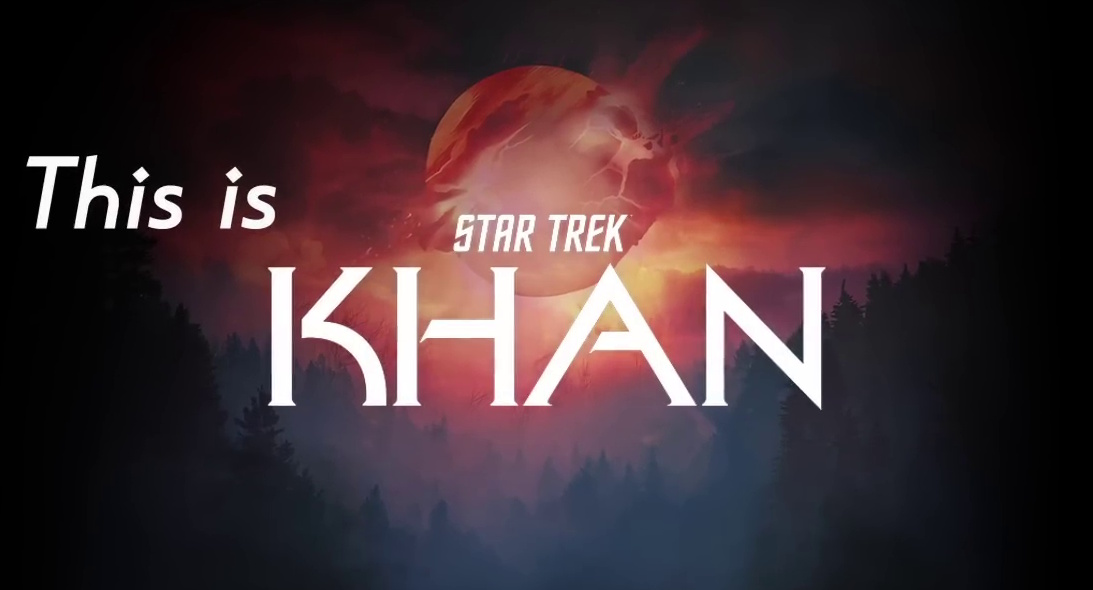
Still frame from the Star Trek: Khan trailer showing the audio drama's title.
Khan is coming soon!

Obviously the main factor here is money. Nicholas Meyer – who originally pitched this idea a few years ago – envisioned it as a miniseries, which is also a format Star Trek doesn’t have much experience with. Even if you aren’t sold on Star Trek: Khan as a concept, I still think there’s merit in the miniseries approach, and I’d hope it’s something Skydance/Paramount might consider in the future if and when a suitable story comes along. If Khan is a success, perhaps more audio dramas will be in the offing, too.

It’s been a while since we talked about this project, so let me bring you up to speed. Khan is set on the planet Ceti Alpha V in between the events of Space Seed – in which Khan awoke in the 23rd Century after years in suspended animation – and The Wrath of Khan. When the project was still little more than a rumour, I discussed it here on the website. This was in early 2021, and I said then that I felt this project – which was going by the working title Ceti Alpha V – looked set to tell the least-interesting chapter of Khan’s life. What could we learn from this story that we didn’t already know or couldn’t reasonably infer from Space Seed, The Wrath of Khan, and even Khan’s appearance in Into Darkness?

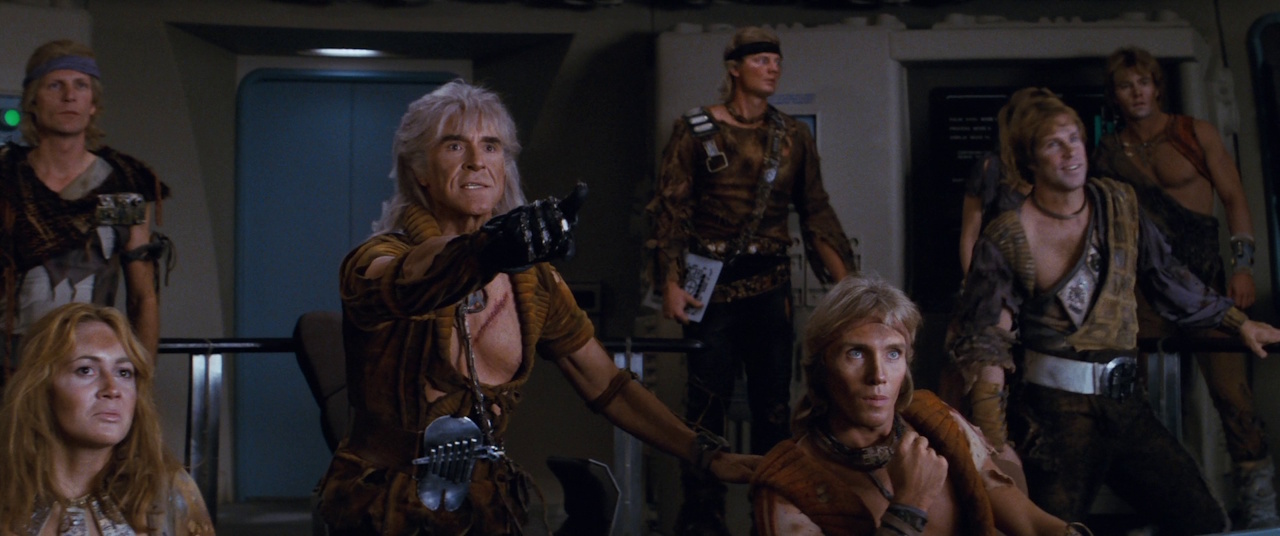
Still frame from Star Trek II: The Wrath of Khan showing Khan and his crew on the bridge of the USS Reliant.
Khan with his crew in The Wrath of Khan.

When Khan switched from being a televised miniseries to an audio drama… I felt that was probably for the best. At Paramount’s “Star Trek Day” event in 2022, Nicholas Meyer took to the stage to announce that his project had been reworked into an audio drama. And I noted at the time that he didn’t exactly seem thrilled about that! Maybe I’m reading too much into this, but I noted in the Khan trailer that Meyer is no longer credited as one of the podcast’s writers, instead simply getting a “based on a story by” credit. Maybe Meyer was disappointed that his Ceti Alpha V idea didn’t proceed on television as he’d hoped. Or maybe changes were made to his original idea – which I doubt would’ve included Sulu and Tuvok!

In any case, Nicholas Meyer’s core idea is going ahead, but not in the format he intended and not with a script he penned. Personally, I think that’s worth being aware of; Meyer is a Star Trek legend. He wrote The Wrath of Khan, The Undiscovered Country, and also worked on The Voyage Home – three of the films fans rate most highly. It’s quite possible that, without Meyer’s work on The Wrath of Khan in particular, Star Trek would have struggled in the 1980s – and the franchise as we know it could very well not exist today. So to know that he had a script written, but his work has been changed substantially enough that he’s no longer credited as a writer… it gives me pause, at least.

Still frame from Paramount's Star Trek Day 2022 broadcast showing Nicholas Meyer announcing Star Trek: Khan.
Nicholas Meyer in 2022.

Let’s be positive, though, and talk about some of the things from the Khan trailer that I actually found interesting!

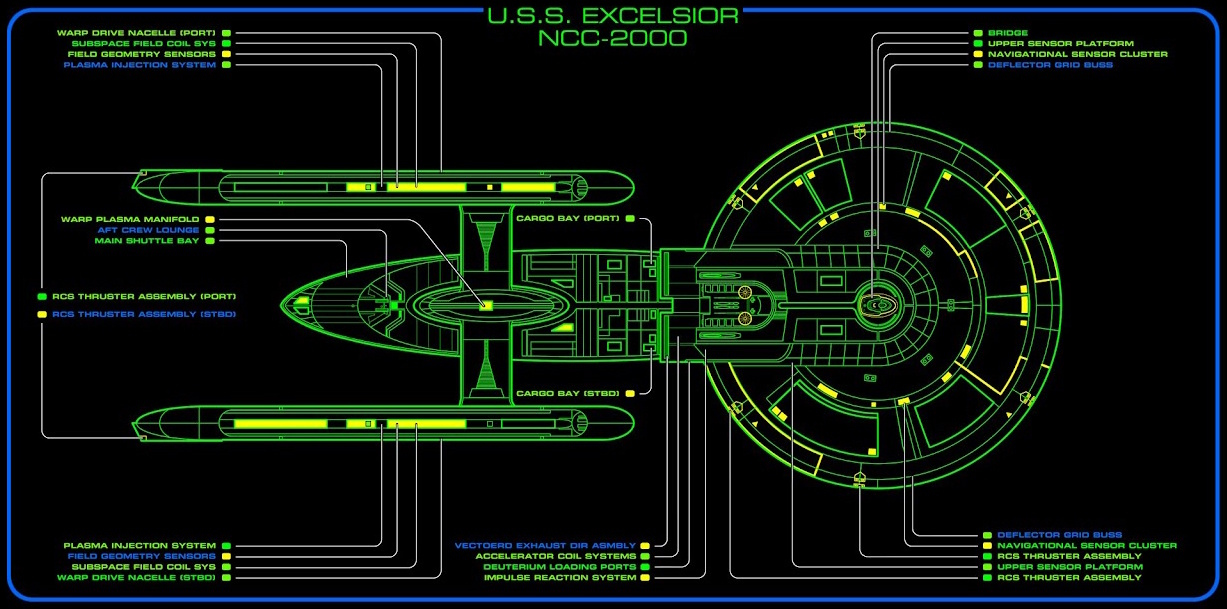
Firstly, the idea of a frame narrative is a fun one – and it’s also something that, because of the characters involved, could really only work in this audio format. Well alright, I guess it would’ve worked in animation, too! But bringing back George Takei to voice Sulu and Tim Russ to play Spock, with the frame narrative presumably set aboard the Excelsior… that’s a really fun idea. Both Takei and Russ have been back in modern Star Trek; Takei reprised his role of Sulu in Lower Decks, and Russ played a significant role in Season 3 of Picard.

I often see fans lamenting that we don’t know much about Star Trek’s “lost era;” i.e. the years in between The Undiscovered Country and The Next Generation. While probably right at the beginning of that time period, it seems as if Khan’s frame narrative will be set in the “lost era,” which is something kind of neat. I doubt we’ll get much of an exploration of the wider state of the galaxy! But it’s still nice to see a project being potentially set after The Undiscovered Country.

A graphic of the USS Excelsior's MSD.
Parts of Khan will be set aboard the Excelsior during Sulu’s time in the captain’s chair.

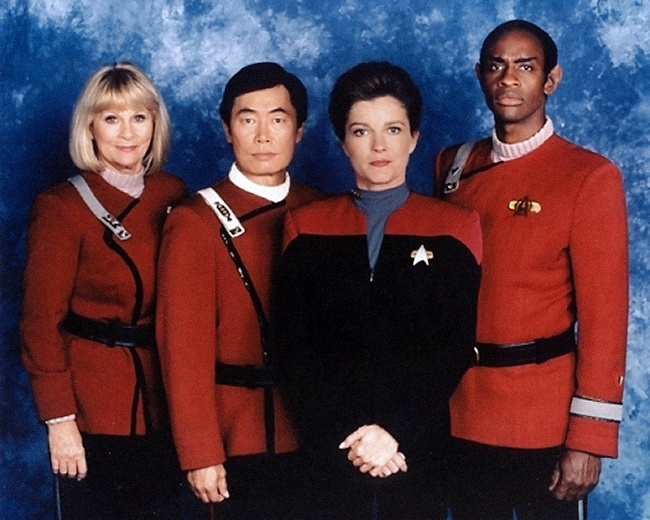
Tuvok’s inclusion is also a pretty deep cut to a single Star Trek episode! In 1996, Flashback was one of two stories created to celebrate Star Trek’s thirtieth anniversary. It delved into Tuvok’s backstory, depicting his time serving under Captain Sulu’s command aboard the USS Excelsior, and it was a pretty fun crossover. We got to see an expanded role for Janice Rand, picking up her story aboard the Excelsior, too, and another character from The Undiscovered Country – Dimitri Valtane. Though its “memory virus” storyline wasn’t the strongest, it’s still a fun episode, and we got to see some interaction between Tuvok and Sulu, as well as a brief moment with Janeway and Sulu, too.

It makes me feel so incredibly old to think that the 30th anniversary celebrations were almost 30 years ago! But I’m glad that Star Trek’s writers and creatives haven’t forgotten about Flashback; it’s a fun way to return to this era, an unexpected pair of legacy characters to include in a story like this one, and it might just give us a bit more information about Sulu’s time in the captain’s chair. I really like this part of Khan, even though it likely won’t be in focus all that much.

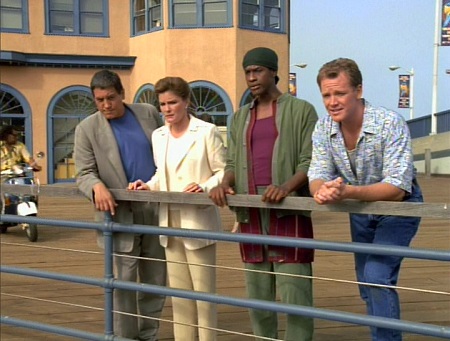
Promotional photo for Star Trek: Voyager Season 3, showing Rand, Sulu, Janeway, and Tuvok.
Promo photo released for Flashback in 1996.

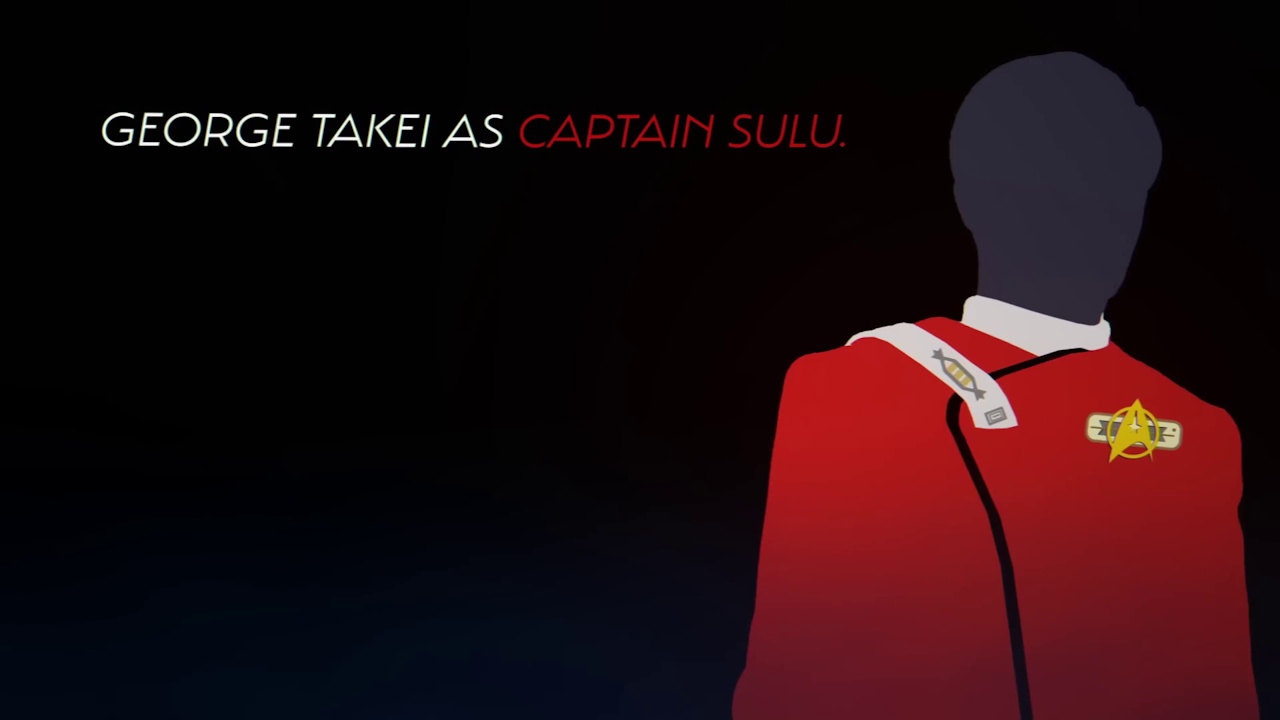
Sulu was present, of course, during the events of Space Seed and The Wrath of Khan, which makes his inclusion here a neat little thread of continuity. Takei first played Sulu all the way back in 1966; to think he’s still involved with the character – and the Star Trek franchise – all these years later… it’s fun and also exceptionally sweet. Fans have been asking to see more of Captain Sulu for a long time; I remember on message boards and forums in the 1990s, a “Captain Sulu show” was often brought up as fans discussed fantasy Star Trek projects. Obviously Khan isn’t the same, but it’s not a million miles away, either, thanks to Takei’s involvement.

This is also potentially one of the last Star Trek projects to include a significant role for a performer from The Original Series, and I think we should acknowledge that. We’ve had Walter Koenig’s voice in Picard, archival recordings of a few characters in Short Treks and Prodigy, and Takei in Lower Decks as previously noted. But time moves ever onwards, and these opportunities are becoming scarce. Whether we ultimately like or dislike Khan, I think we can at least appreciate George Takei’s involvement and that we got one more adventure with Hikaru Sulu.

Still frame from the Star Trek: Khan trailer showing Sulu.
We’re getting one more adventure with Captain Sulu.

Naveen Andrews, best-known for his role on the TV series Lost, will take on the role of Khan. And this could be one of the best casting decisions in a long time! Andrews is a fantastic actor, and while we didn’t hear that much from him in the trailer, what little there was sounded fantastic. This feels like a truly inspired casting decision, and whatever the story may ultimately be, I’m certain that Naveen Andrews’ portrayal is going to be one of the highlights.

So there are positives as we look ahead to Khan’s release next month. Revisiting Sulu, entering the “lost era,” Tuvok’s return, and getting a new take on an iconic character by a fantastic actor… those are all points in the production’s favour. I also like the idea of Star Trek leaning into audio dramas and different kinds of projects as a way to potentially keep the franchise alive in the years ahead. If there isn’t the budget to commit to a full TV show or film, a radio play like this could be a great option to preserve Star Trek and ensure new stories are still able to be produced.

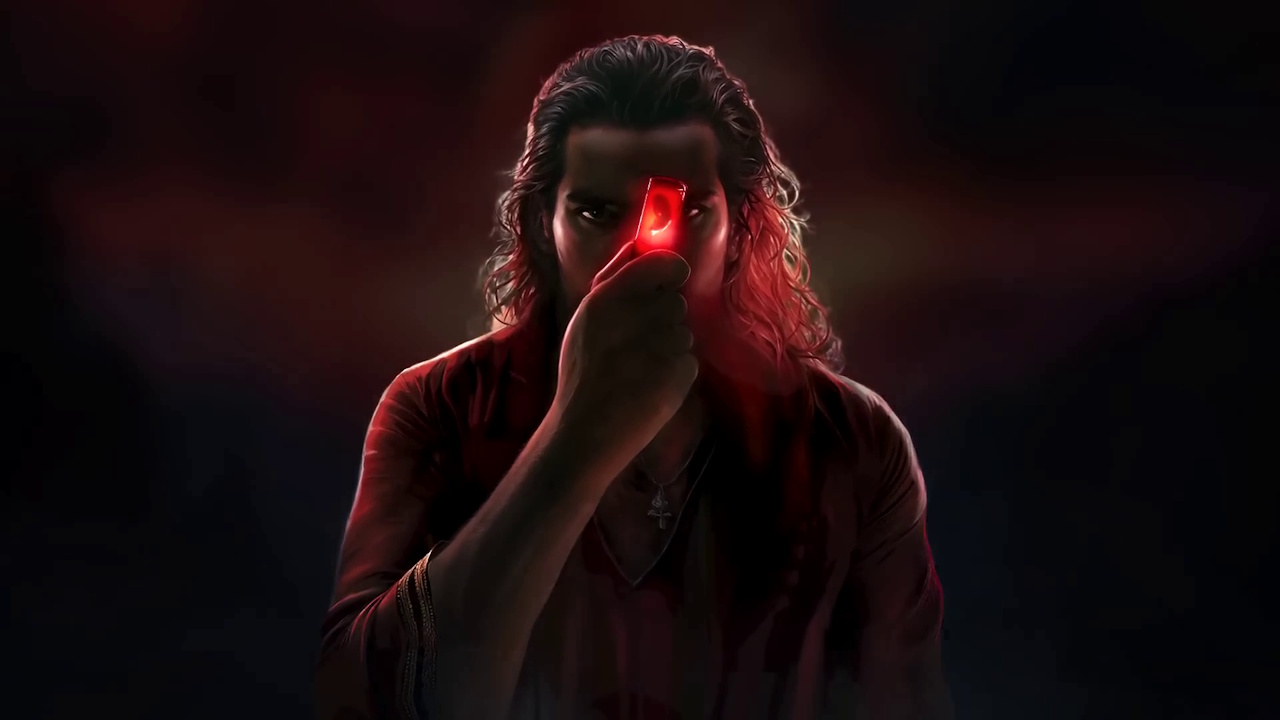
Still frame from the Star Trek: Khan trailer showing Khan holding a Ceti eel.
Khan with a Ceti Eel.

The main image shown off in the trailer – which looks like it could also be the “cover art” for the podcast – shows Khan holding a small vial. Inside that container is what looks like a small Ceti eel – the mind-controlling earwig-like creatures that Khan used on Chekov and Captain Terrell in The Wrath of Khan. The film made it clear that Khan already knew all about these creatures, so perhaps part of the audio drama will depict Khan and his crew studying them.

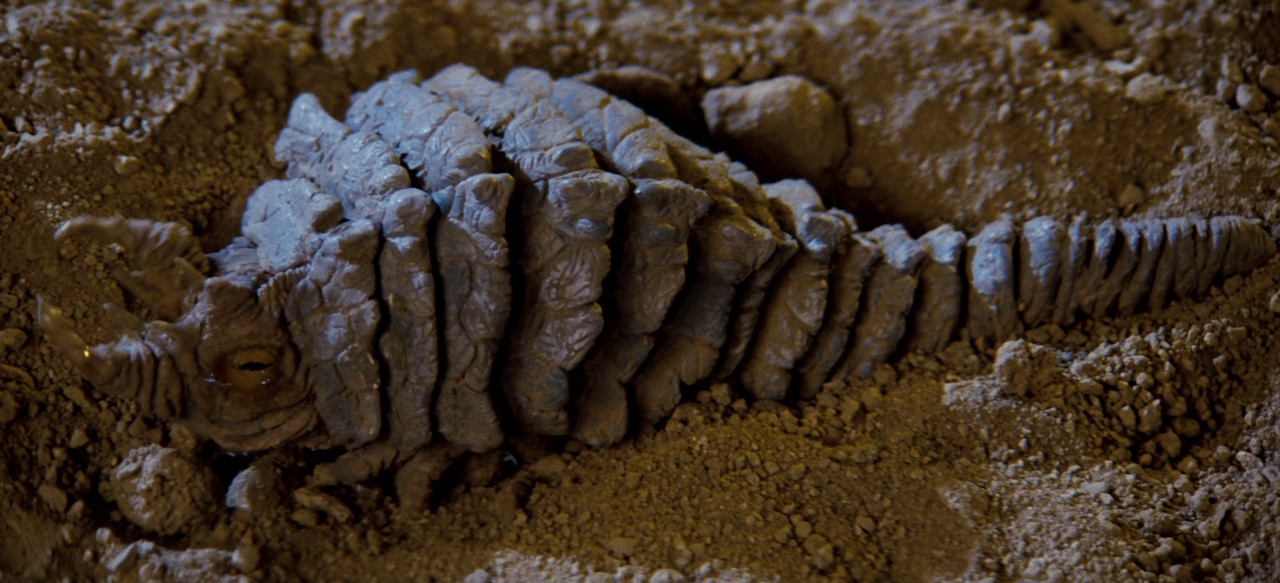
Not every alien in Star Trek requires a deep dive, and as with Khan himself, I think we know enough about the Ceti eels from the film to understand what they are, how they operate, and why Khan would be so fascinated by them! But I’m always up for an exploration of Star Trek’s alien life, and perhaps there could be a way to connect Khan’s time on Ceti Alpha V and/or the Ceti eels to other parts of Star Trek. Making those kinds of connections could be fun, and just exploring the anatomy of the Ceti eels could also be interesting if it’s handled well.

Still frame from Star Trek II: The Wrath of Khan showing a Ceti eel.
A Ceti eel as seen in The Wrath of Khan.

With all of that being said, nothing in the Khan trailer really convinced me that I was wrong in my earlier assessment: that this audio drama won’t be telling the least-interesting chapter of a story where we’ve already seen the beginning, the end, a prequel, a reimagining, and basically all of the good parts. There’s a real danger that what we’ll get will be akin to the Obi-Wan Kenobi miniseries over in the Star Wars franchise: the absolute worst kind of tacked-on story that feels like cheap fan-fiction. Khan could, perhaps, even prove harmful to Space Seed and The Wrath of Khan if – just as an example – we get some kind of storyline that sees Khan leave the planet, track down Kirk, and battle him in a one-on-one duel.

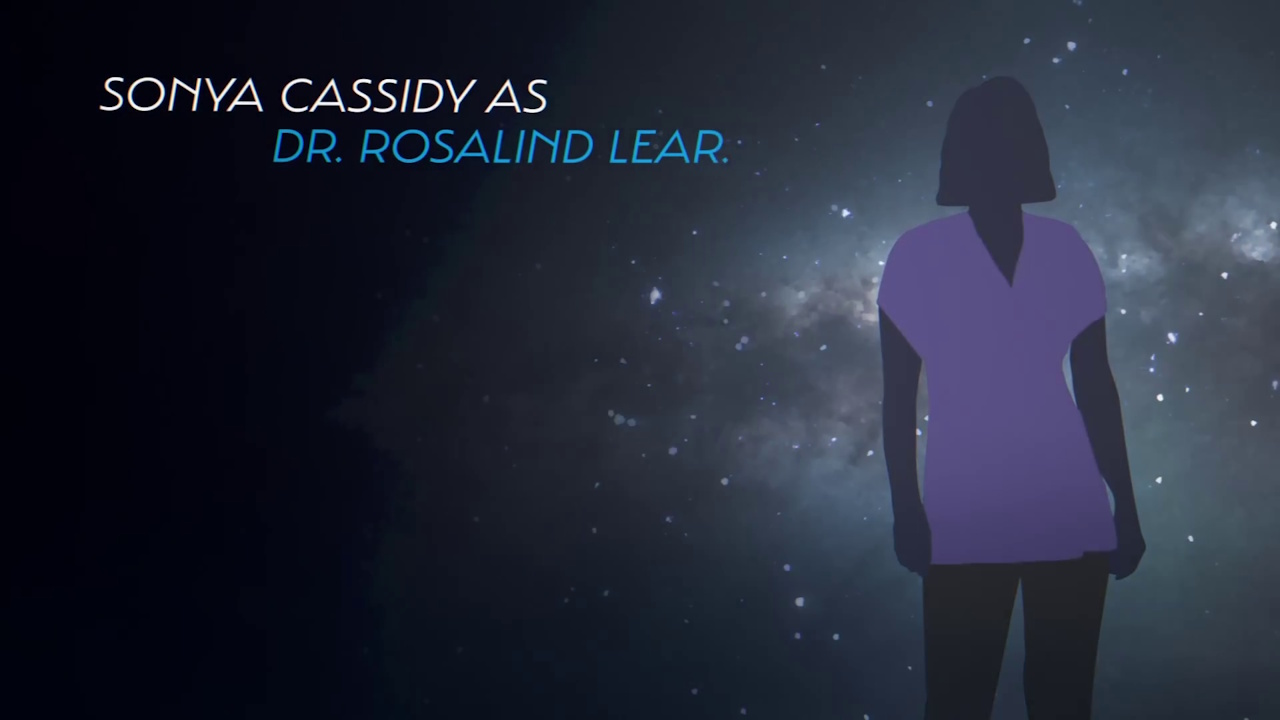
Furthermore, the trailer added another element which I hadn’t previously considered could be part of a Khan story, and it’s really making me concerned. In the trailer, the new character of Dr Lear says that “the logs I retrieved on Ceti Alpha V only confirm my belief that Khan was much more than a mad tyrant.” But… Khan *is* a mad tyrant; that’s who he is. He’s a narrative warning against eugenics and genetic engineering by showing how badly wrong it could go. And in 2025, when we’re seriously considering the possibilities of artificial intelligence and inventing a sentient life-form that could be intellectually superior to humanity… there’s a message in Khan’s story that’s still incredibly relevant.

Still frame from the Star Trek: Khan trailer showing a quote from Dr Lear.
This statement from Dr Lear has me concerned…

I’m worried that Khan will go out of its way to humanise this villainous character – and in doing so, rob him of what made him so powerful, so intimidating, and such a good character in the first place. We don’t need a story about how Khan was actually a misunderstood “nice guy” who just wanted what’s best for his friends. Maybe that’s how Khan saw himself, in part, but it isn’t how we as the audience need to see him. And we don’t need a story told partly from his perspective to understand who he is, how he thinks, or why he behaved the way he did. All of the necessary pieces to understand Khan were present in Space Seed and The Wrath of Khan, and were added to on somewhat in Into Darkness.

It can be fun, sometimes, to flip the script and look at things from the villain’s point-of-view. And some Star Trek stories are all about that – presenting the Federation as being in the wrong, showing why hostile aliens act the way they do, and so on. That’s been present going all the way back to The Original Series. But some villains are just villains – and trying to soften them, present their side of the story, or show them as being “in the right” ruins not only the character, but the story, too. And I am genuinely worried that this attempt to present Khan as a more complex, nuanced, and dare I suggest human individual won’t actually add much to Star Trek – and risks seriously undermining one of its best stories.

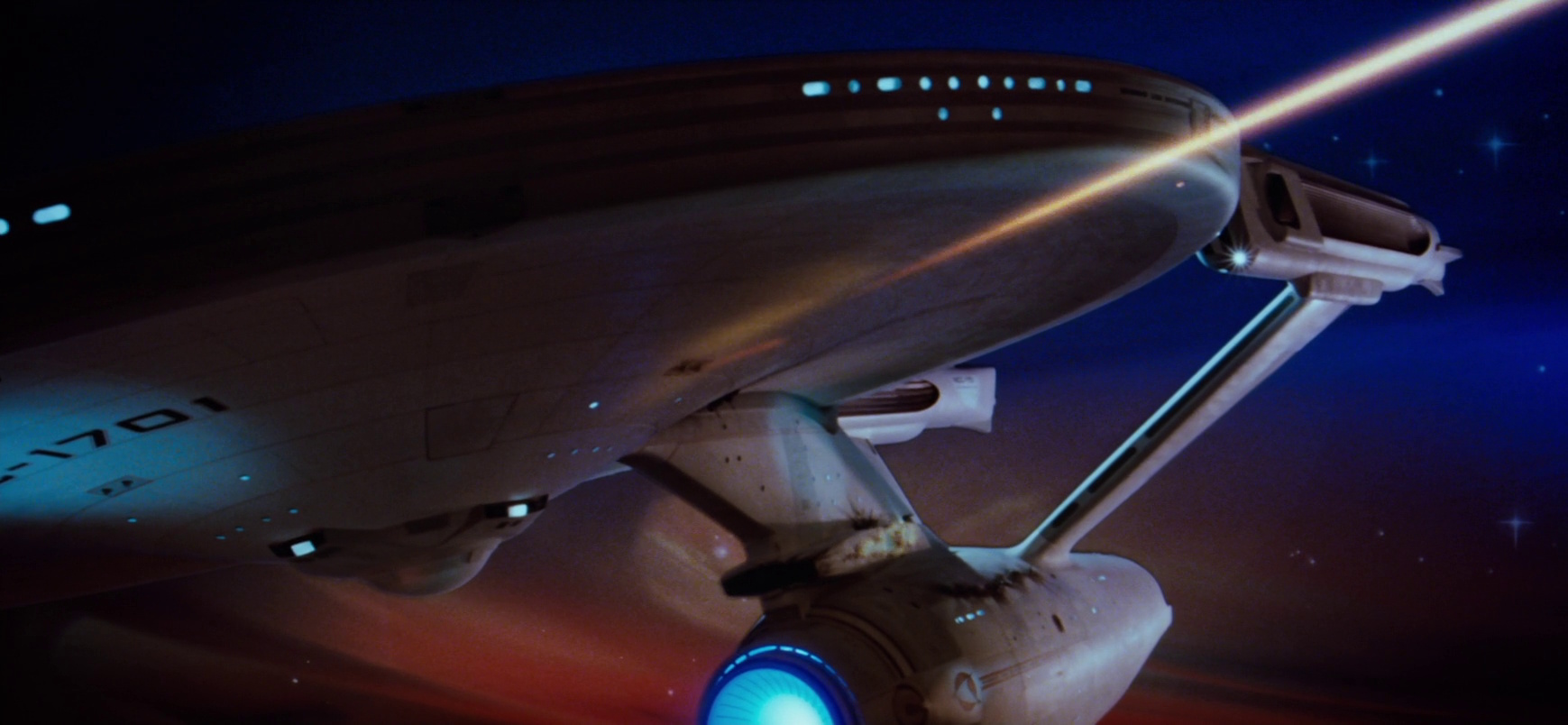
Still frame from Star Trek II: The Wrath of Khan showing the Enterprise during the battle in the nebula.
The Enterprise in The Wrath of Khan.

This was always going to be a potential pitfall – and it’s one of the reasons why I was never keen on the Khan idea when it was first pitched. But hearing this new character in the trailer talking about there being “more to the story,” and how Khan was “so much more” than what we’ve seen… it’s really making me nervous about the direction the audio drama is going to take. If Dr Lear ends up as a kind of villain – perhaps someone who’s fallen for Khan’s posthumous propaganda – then maybe we can look on this narrative thread more kindly. But if the story’s going to try to present Khan sympathetically, and Dr Lear as being right about him all along… where does that leave Tuvok and Sulu?

I doubt a lot of Trekkies would be thrilled if Sulu’s return is turned into some kind of story about how *he’s* the one in the wrong, how he and Tuvok unfairly judged Khan, and how Khan was really just a big misunderstood cuddle-buddy. That… that wouldn’t be great. And while I could be completely wrong, the tone of the trailer – and Dr Lear’s comments in particular – seem to be hinting at a story which could go in that kind of direction.

Still frame from the Star Trek: Khan trailer showing Dr Lear.
Dr Lear is a new character created for Khan.

What I will say on that side of things, though, is that Starfleet does bear some responsibility for what happened to Khan and the Botany Bay survivors. After marooning them on Ceti Alpha V, it seems as if Starfleet just abandoned them to their fate. Worse, Starfleet doesn’t even seem to have kept proper records of the Ceti Alpha system, despite the dangers Khan and his augments were known to pose. How else do we explain the crew of the USS Reliant being totally unaware of the Botany Bay until after beaming down to Ceti Alpha V? In the eighteen years Khan and his people were stranded, not one Starfleet vessel visited to check up on them.

If there’s any room for nuance in Khan’s story, it’s here. Starfleet was either incompetent or downright malicious in its treatment of Khan and his people, stranding them on a hostile planet – uninhabited by sentient life, yes, but with a complete ecological system of its own – and then abandoning them. No one cared enough to check in on them, even though surely the Ceti Alpha system was close enough to Federation space that something as major as the destruction of an entire planet would have been noticed.

(Speaking of which, why could no one aboard the USS Reliant count to six?)

Still frame from Star Trek II: The Wrath of Khan showing two Starfleet officers on the bridge of their ship.
Captain Terrell with the USS Reliant’s science officer.

Then there’s Kirk’s role. The trailer mentioned Kirk by name – though he better not actually appear in the production; god help us if he does – and I guess we’re going to see more of Khan’s revenge obsession in the years before The Wrath of Khan. If we take our criticism of Starfleet and pin it on one person, could this audio drama focus in on Kirk’s role? Maybe Kirk neglected to tell Starfleet about Khan and what happened during Space Seed. Maybe no one except for the Enterprise crew ever knew that the augments were marooned there. If that’s the case, maybe Khan’s desire for revenge takes on a slightly different feel. If Kirk had logged what happened correctly, maybe someone would have swung by the Ceti Alpha system to check on Khan.

That’s just a theory, though I think it shows how difficult it may prove to thread the needle on this kind of “mid-quel” story. Anything we learn about Khan, Kirk, or anyone else has to fit with Space Seed and The Wrath of Khan, and mustn’t tread on their toes. That’s not an easy thing to do… and there are examples from other franchises – and from within Star Trek – showing just how badly things can go wrong when attempting this kind of story.

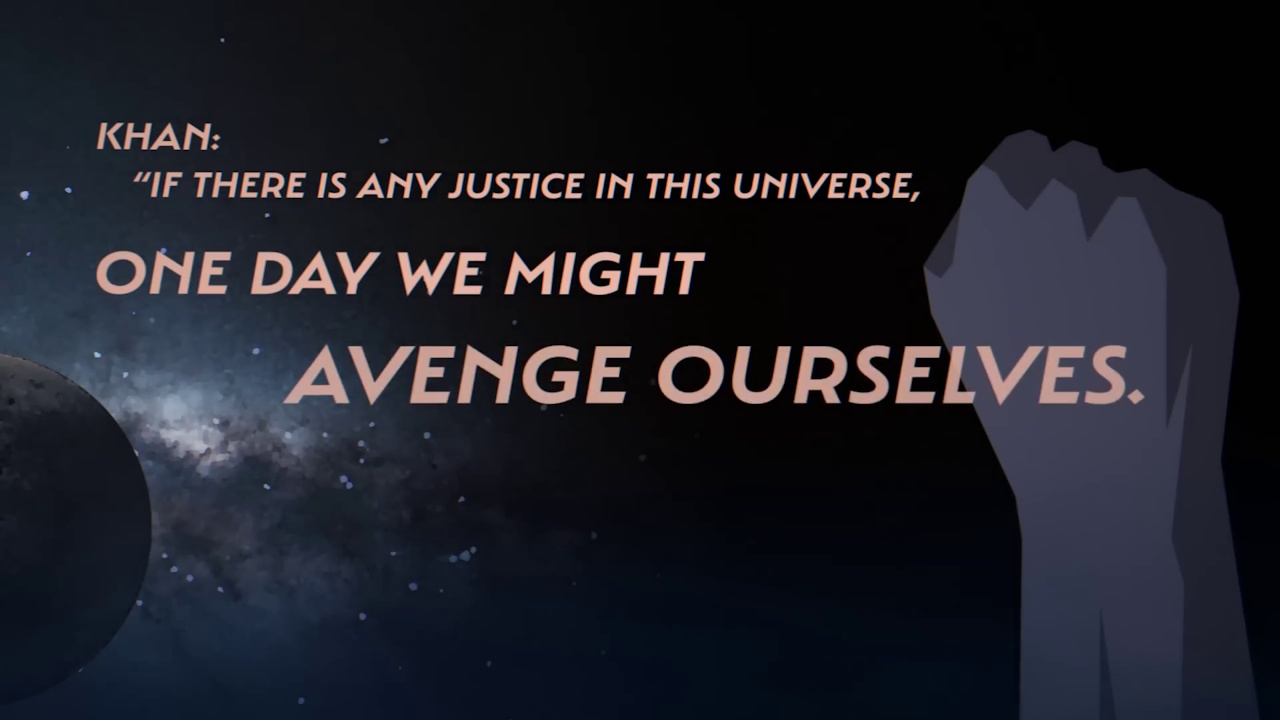
Still frame from the Star Trek: Khan trailer showing a quote from Khan and a raised fist.
Khan wants revenge on Captain Kirk. Who would’ve guessed?

Returning to Dr Lear, her statement that “monsters are made, not born” is another line I’m concerned about. This ties into what we were talking about; how the story could be an attempt to show Khan’s perspective and how Starfleet and Kirk were the ones in the wrong. Obviously Khan believes that – we knew that during The Wrath of Khan. But do we actually need a full audio drama dedicated to explaining that idea in more detail? And can it be done without detracting from Khan’s characterisation in those earlier stories? I’m afraid I’m still not convinced.

So let’s wrap things up.

Star Trek: Khan will premiere on the 8th of September – Star Trek Day. It’ll run for nine episodes, with the finale airing in early November. I plan to tune in, even though I’m not really sold on the premise, nor on some of what we saw in the trailer. At this stage, I don’t intend to review individual episodes, but I’ll hopefully be able to write up a review of the full audio drama once it’s aired. Check back in November for that!

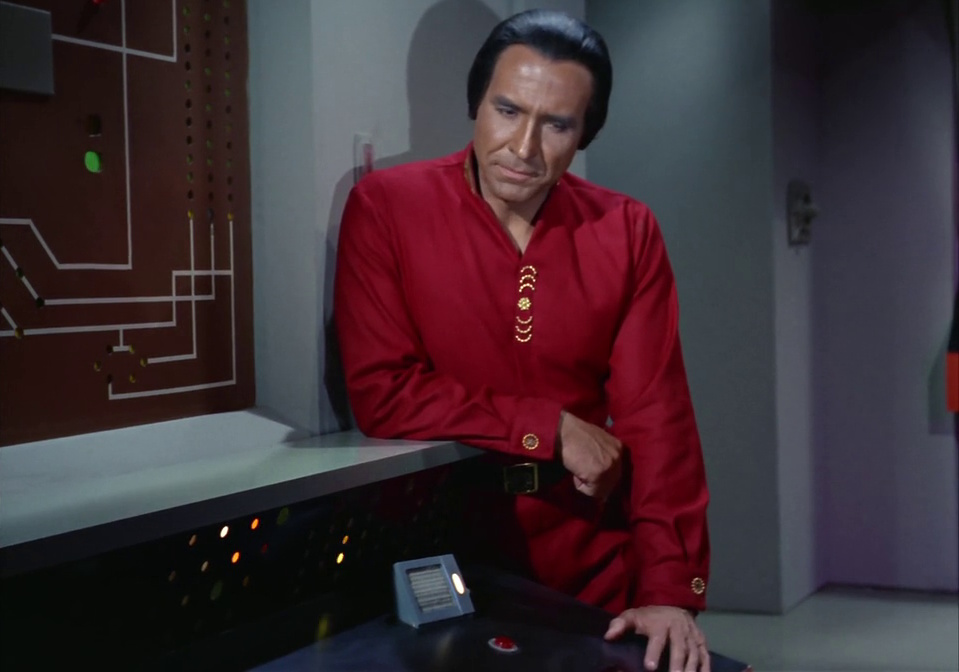
Still frame from Star Trek: TOS 1x22: Space Seed showing Khan in engineering.
Khan in Space Seed.

I wouldn’t have given the green light to this project, either in this audio form or as its original miniseries pitch. But I’m not writing it off just yet, and there are reasons to be hopeful… or at least a bit less pessimistic! I often say that “no one asked for this” is a terrible argument, and often the best productions are those that “no one” seemed to be interested in at first. It’s with that attitude that I plan to approach Star Trek: Khan, and I’ll do my best to give it a fair shake despite my misgivings.

I hope this has been interesting! I think we’ve finally covered all of the big Comic-Con news, now. If you haven’t checked in for a while, I’m back to writing weekly Strange New Worlds episode reviews – we’re almost halfway through Season 3 already, if you can believe that! And there’s more Star Trek content to come here on the website in the weeks ahead.

See you on Ceti Alpha V!


Star Trek: Khan will premiere as a scripted podcast/audio drama on multiple podcast platforms on the 8th of September 2025, with further episodes to follow weekly. Star Trek: Khan, and all other properties discussed above, are the copyright of CBS Studios, Paramount Global, and/or Skydance. This article contains the thoughts and opinions of one person only and is not intended to cause any offence.
Twelve Star Trek episodes to watch before Picard Season 2 arrives!

Spoiler Warning: There are spoilers ahead for Star Trek: Picard Season 1 and the trailers and teasers for Season 2. Spoilers are also present for the following Star Trek productions: The Original Series Season 1, The Next Generation, Deep Space Nine Season 3, Voyager Seasons 2, 3, and 7, and First Contact.

It seems an age ago that we were eagerly anticipating Season 1 of Star Trek: Picard. In those sunlit, rosy days before the pandemic hit, this website was brand-new, and I spent a lot of time in December 2019 and January 2020 looking ahead and wondering what we’d see when the Star Trek franchise finally returned to the 24th Century – after an eighteen-year wait!

With Season 2 of Picard now only days away, I thought it could be fun to revisit a concept from the early days of the website: a list of episodes that I think could make for interesting background viewing, potentially informing story points and characterisations in the new season of Picard. In the run-up to Season 1 I focused on episodes of The Next Generation that strongly featured Captain Picard himself, as well as a few stories about the Romulans, and a few more stories which could’ve potentially led to big changes in the two decades following the events of Endgame and Nemesis.

We’ll soon be on another adventure with Jean-Luc Picard!

This time, we have a little bit more information to go on! Season 2 will tell a story that involves (to a greater or lesser degree) the following elements: the Borg Queen, Guinan, Q, time travel, and, of course, Admiral Picard himself. On this occasion, then, I thought it could be fun to pull out twelve stories from Star Trek’s past that might just be useful background viewing for Season 2 of Picard. It goes without saying that Season 1 is mandatory viewing, so I’m not putting any of those episodes on this list! You should really watch, or re-watch, all ten before the season kicks off!

My usual caveats apply, as they always do! Firstly, everything listed below is entirely subjective. If I miss out an episode that you think is incredibly important, or you hate all of my picks, that’s okay! We all have different opinions about Star Trek, and there’s no need to fight about it. Secondly, I don’t claim to have any “insider information.” I’m basing my theories and guesses about Season 2 on publicly released material, such as trailers and interviews. And finally, the episodes are not ranked; they’re merely listed below in the order in which they were originally broadcast.

With all of that out of the way, let’s jump into the list!

Number 1:
Tomorrow is Yesterday
The Original Series Season 1 (1967)

I’m pretty sure this violates the Temporal Prime Directive…

Though The City on the Edge of Forever is perhaps the best-known of The Original Series’ time travel stories, Tomorrow is Yesterday preceded it by several months. It was the first episode of the Star Trek franchise where time travel played a major role in the story, and it was also the first in which the crew paid a visit to the modern day. Tomorrow is Yesterday established what went on to become a mainstay in terms of the franchise’s time travel story tropes: being sent back in time by accident!

Aside from being a fun episode in its own right and well worth a watch, Tomorrow is Yesterday is also the episode which introduced the Star Trek franchise to something that appears to be making a return in Picard Season 2: the slingshot method of travelling through time, referred to in this episode as the “light-speed breakaway factor.”

The USS Enterprise using the “light-speed breakaway factor” to travel through time.

Almost every Star Trek series has included the occasional time travel story, and we can look to episodes like Tomorrow is Yesterday for creating that premise. Visiting the modern world would go on to be significant later in The Original Series, in Star Trek IV, and on several other significant occasions in the franchise. For me, some of these stories can feel rather dated, but I think Tomorrow is Yesterday largely avoids that trap!

As we get ready for Picard Season 2 and the franchise’s latest foray into time travel, stepping back to see where it all began during the first season of The Original Series is no bad thing. Tomorrow is Yesterday has a fairly straightforward premise that should be easy enough to follow even for fans who aren’t as familiar with The Original Series, and is well worth a watch on its own merits.

Number 2:
Encounter at Farpoint
The Next Generation Season 1 (1987)

Judge Q.

In the first teaser trailer for Picard Season 2, we heard Q’s voice proclaiming that “the trial never ends.” Encounter at Farpoint is the episode in which Captain Picard first encountered Q, and the episode in which the referenced “trial” began. Q accused humanity (and by extension, the Federation) of being a “dangerous, savage, child-race” who are unfit to travel the stars. Picard and his crew defended themselves against the accusation.

The task Q set for Picard was to unravel the mystery of Farpoint Station, which he and the crew of the Enterprise-D were en route to. However, figuring out the puzzle wasn’t the end of the trial, and even after bringing the Farpoint saga to a successful conclusion, Q departed in ambiguous fashion, hinting that he would return. He did, of course, on a number of occasions!

Worf, Picard, and La Forge on the bridge of the Enterprise-D.

Encounter at Farpoint was the premiere of The Next Generation and established the characters of Picard and Q (as well as many other familiar faces). As we approach Picard Season 2, it’s worth going back to see where it all began. This was the first big puzzle that Q tasked Picard with solving, and seeing how Q operates and what the point of it all is, from his perspective, is well worth taking into consideration.

This is also the beginning of “the trial.” We don’t know to what extent the idea of Picard – and humanity – being on trial will feature in Picard Season 2, but if Q has returned to set up a new mystery there could be a connection – and there could be consequences if Picard and the crew of La Sirena can’t figure it out. Q has toyed with Picard on a number of occasions; Encounter at Farpoint was the first.

Number 3:
Q Who
The Next Generation Season 2 (1989)

Q threw Picard and the Enterprise-D into danger.

Q Who is the episode that introduced us to the Borg – and it’s a pretty scary one by Star Trek’s standards! Captain Picard and the crew of the Enterprise-D have never faced a villain like this, and the Borg represent an existential threat. Q made good on his promise to show Picard that there are dangers in the galaxy that he couldn’t even imagine… and eighteen members of the Enterprise-D’s crew paid the ultimate price.

In a way, Q Who shows Q at his most aggressive, devious, and villainous. By throwing the Enterprise-D into the path of the Borg, he proved his point to Picard about the Federation’s unpreparedness in the most painful way possible. But I don’t believe that’s all there is to the story.

The first Borg seen in Star Trek.

I have a theory about Q Who that you can find by clicking or tapping here. To briefly summarise: Star Trek has made a mess of the history of Borg-Federation contact, and it seems likely that the Borg were already aware of humanity and Earth long before the events of this episode. They may have already been preparing for an attack or assimilation attempt, and Q hoped to prevent that by giving the Federation advance warning.

My theory goes into much more detail! But suffice to say the complicated history of contact between humanity and the Borg makes it seem plausible, at least to me, and shows off an aspect to Q’s character that I think could come into play in Picard Season 2. Q Who also establishes the existence of history between Q and Guinan – something that may come up in Picard Season 2 given that both characters are returning.

Number 4:
Yesterday’s Enterprise
The Next Generation Season 3 (1990)

The Enterprise-C.

Though it’s a fantastic episode in its own right, Yesterday’s Enterprise is on this list for one reason: Guinan. When a rift in the space-time continuum sends the Enterprise-C forward through time, decades’ worth of history are changed, leaving the Federation in a very bleak timeline in which it’s fighting a losing war against the Klingons.

Aboard the warship Enterprise-D, Captain Picard and the rest of the crew are completely oblivious to the change; this version of the characters have only ever known the war timeline. But Guinan alone realises that something has gone wrong, and argues with Captain Picard about how to set things right.

Guinan presents her case to Captain Picard.

Despite a recent controversy, Whoopi Goldberg will be reprising the role of Guinan in Picard Season 2, bringing the character back for the first time since Generations in 1994. Given that we know Season 2 also features a radically changed timeline, not dissimilar to the one seen in Yesterday’s Enterprise, perhaps Guinan will be aware of the change.

Guinan could be the one to talk to Picard about the possible point of divergence, as we know she’d visited Earth in the 19th Century. She may also be one of the only people other than the crew of La Sirena to be aware that something has changed. Guinan also has a history with Q, as we saw in the episode Q Who – so that could also come into play!

Number 5:
Time’s Arrow Parts I-II
The Next Generation Seasons 5-6 (1992)

R.I.P. Data…

Guinan also plays a key role in the two-part episode Time’s Arrow. Thanks to time travel, this is the episode where she and Captain Picard actually have their first meeting, and although the nature of their relationship is still shrouded in mystery, we get a little bit more information about how they came to meet in the first place.

Guinan’s fascination with Earth appears to date back to at least the 19th Century, as she visited undercover during that time period. We know from the most recent Picard Season 2 trailer that Guinan appears to be running a bar on Earth at the dawn of the 25th Century, giving her an association with Earth and humanity that stretches back over five hundred years.

Guinan and Picard in the 19th Century.

Time’s Arrow is an interesting story that mostly focuses on Data, who was of course a huge part of the story of Picard Season 1. It seems as though Brent Spiner will be playing a new role in Season 2 – perhaps another ancestor of the Soong family – so getting a bit of extra data on Data could be worthwhile, too!

One thing I’m personally curious about in Picard Season 2 is if we’ll get any further backstory on the Picard-Guinan relationship. Although Time’s Arrow depicts their first meeting from Guinan’s perspective, we’ve still never learned how they came to meet in the 24th Century from Picard’s point of view. All we know is that it likely happened prior to his assuming command of the Enterprise-D. I don’t know if Picard Season 2 will expand on that in any way… but it would be interesting!

Number 6:
Tapestry
The Next Generation Season 6 (1993)

Q and Picard.

Tapestry is a really interesting episode that deals with the dynamic between Q and Picard, and specifically looks at the nuances present in their relationship. Picard has always viewed Q as an adversary, but I’ve argued in the past that Q doesn’t see himself that way. He views Picard as a friend, and himself as a guide or even an ally – and the way Tapestry unfolds kind of shows why that is.

When Picard is injured on an away mission, he finds himself close to death. At that moment, he encounters Q – who claims he’s already dead. Q gives Picard a chance to avert his death by changing a key event in his past – getting stabbed shortly after graduating from Starfleet Academy – but doing so sets Picard’s life and career on a completely different path.

Lieutenant Picard in an alternate 24th Century.

The important thing here is how Q views the whole affair. We can entertain debates on whether or not Q actually sent Picard back in time or whether it was all an elaborate illusion, but that’s entirely beside the point. Q genuinely believed that he was helping – that by showing Picard an alternate life, he gave him an appreciation for the life he had actually led, even if that meant it was about to end.

I firmly believe that there’s more going on with Q in Season 2 than meets the eye. It’s possible that he didn’t change the timeline at all, and is merely responsible for shielding Picard and the crew of La Sirena from it. It’s also possible that he did change it as part of an elaborate puzzle, one which he hopes and expects that Picard will be able to solve. Speaking of which…

Number 7:
All Good Things…
The Next Generation Season 7 (1994)

Q and Picard in the distant past.

All Good Things is the best example of this aspect of the dynamic between Picard and Q, and could – in theory – be a template for the events of Picard Season 2. In All Good Things, the Q Continuum sets a puzzle for Picard – an eruption of “anti-time.” Thanks to the time-travelling interventions of Q, Picard is able to hop between three different periods of his own past to solve the mystery.

The solution to the anti-time eruption required Picard to challenge his own way of thinking, specifically his linear perception of cause-and-effect. Being able to recognise that events in the future had a causal link to events in the past greatly impressed Q, who seemed to suggest that it was the first step on a path that could one day see humanity evolve into beings comparable to the Q themselves.

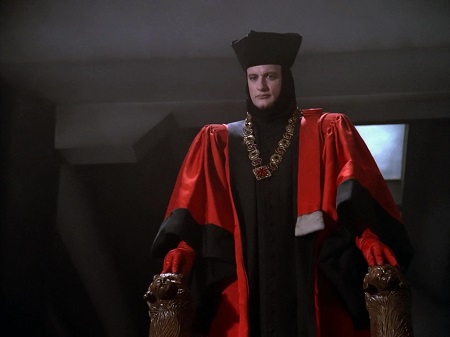
Q in his judge’s robes.

All Good Things was also Picard’s last dalliance with Q prior to the events of Picard Season 2. As far as we know at this stage, Q hasn’t been to see Picard in the approximately twenty-five years since the events of All Good Things – but that could change as we get into the new season. It’s possible, at least in my opinion, that Q might’ve been interested to see Picard at his lowest ebb, possibly showing up to see if he could provoke him into action. But we’ll save a detailed explanation of that for my next theory post!

It’s possible that the trailers and teasers for Season 2 have already revealed the nature of Q’s involvement in the story: that he is directly responsible for changing the timeline, he did so on purpose, and he will be the main villain of the season. But I would argue that the “villain” monicker does not fit with Q’s past characterisation, and thus I suspect that there’s much more going on than meets the eye. All Good Things is both a piece of evidence in favour of that argument, as well as a potential blueprint for how a time travel puzzle set by Q could unfold.

Number 8:
Past Tense, Parts I-II
Deep Space Nine Season 3 (1995)

Dr Bashir and Commander Sisko.

We know, thanks to a voiceover in the most recent trailer, that at least some of the events of Picard Season 2 take place in the year 2024. But Picard Season 2 isn’t the first Star Trek production to visit that specific year! In Deep Space Nine’s third season, Commander Sisko and the crew of the USS Defiant found themselves accidentally sent back in time to the exact same year.

Past Tense is an interesting story, as it will mark the first time that any episode of Star Trek set in “the future” at the time it was broadcast will be reached, and I’m sure I won’t be alone in doing a full write-up of its story when we hit the end of August 2024! We could talk for hours about how its depressing presentation of the 2020s seemed a long way from reality once upon a time, but with the growth of homelessness and other economic issues, today’s society feels far too close for comfort to the world of the Bell Riots.

The USS Defiant in orbit over Earth.

I’m not sure how much of Deep Space Nine’s presentation of a fictionalised 2024 will make it into Picard Season 2. It’s possible that the new series will entirely ignore this two-part episode… but I think we should keep an eye open for references or callbacks to some of the characters, events, or even things like brands and products.

Regardless, this will be the first time that two very different Star Trek productions have travelled back in time to the same year, and it might be interesting and informative to take a look at Past Tense to see how Deep Space Nine told us that the year would unfold. It seems as though Picard Season 2 will be set, in part, in California – which is also where Past Tense was set, so that’s another point of connection. I’m not expecting a huge crossover with this one single Deep Space Nine story, but there could easily be references made to it.

Number 9:
Death Wish
Voyager Season 2 (1996)

Two Qs?!

Captain Picard wasn’t the only Starfleet officer to tangle with Q. After making a sole appearance in Deep Space Nine, Q hopped over to the Delta Quadrant, where he had several run-ins with Captain Janeway during Voyager’s journey home. Q presented a bit of a puzzle for Voyager; his abilities mean that he could have sent the ship and crew back to Earth with a snap of his fingers. But if we can look beyond that narrative hurdle, Q’s appearances in Voyager added a lot to his characterisation.

In Death Wish, we got our best look to date at the Q Continuum itself. Depicted in a manner that humans could comprehend, the Continuum resembled a rather dilapidated roadside house in the middle of the desert. For the first time, we got to see more members of the Q Continuum as well, and got a glimpse of how Q himself is a bit of a radical by the standards of his people.

Captain Janeway and Tuvok visit the Q Continuum.

The idea that the Q Continuum is not an entirely stable, homogeneous place is an interesting one, and was explored in more detail in the episode The Q and the Grey. But Death Wish also presented a very complex moral question – in the longstanding tradition of Star Trek! This episode can be a difficult watch for some folks because of its discussion of suicide, and it’s absolutely fine to skip it if that subject hits too close to home. If the debate around suicide and end-of-life care is something you’re interested in, though, this is a uniquely “Star Trek” attempt to tackle it.

Q emerges from this story as a reformer – or even a radical – by the standards of his people. We also know, thanks to a line in All Good Things, that he was responsible for assisting Picard when the Continuum set the anti-time puzzle. It’s stories like this that make me think that there’s a goodness in Q; that he isn’t just a trickster or a pure villain.

Number 10:
Future’s End, Parts I-II
Voyager Season 3 (1996)

Chakotay, Janeway, Tuvok, and Paris on Earth.

The two-part time travel story Future’s End sees Captain Janeway and the crew of the USS Voyager sent back in time to Earth, circa 1996. It’s another story set in the California area, and I think it’s an interesting episode – albeit one that I feel has become very dated by Star Trek standards!

If Picard Season 2 sticks with things like the Borg and the slingshot method, it seems that the kind of time travel depicted in Future’s End won’t be a factor. But there are still interesting points to consider, such as the Temporal Prime Directive and how Starfleet in the future would come to police the timeline, watching out for changes.

It’s Los Angeles – where Picard and the crew of La Sirena appear to be headed!

There aren’t a great many Star Trek episodes that visit the modern day, and as I’ve already explained I feel that a modern setting can make such stories feel very out-of-date very quickly. Future’s End definitely falls into this trap; its depiction of Southern California has a very ’90s flavour. But it’s a bit of fun, and dare I say almost a guilty pleasure!

I’m including Future’s End here for its modern day time travel story and its focus on California, both of which are elements that we know will be part of Picard Season 2. As with Past Tense, I don’t expect to see a huge tie-in between the new season and the events of this episode, but there may be smaller callbacks and references to some of the characters and events it depicted.

Number 11:
Star Trek: First Contact
Film (1996)

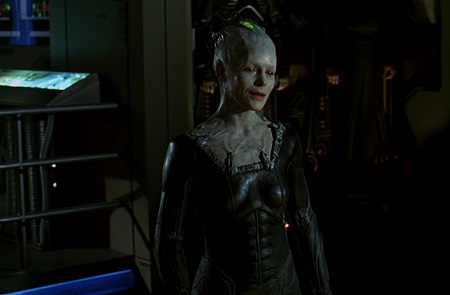
The Borg Queen.

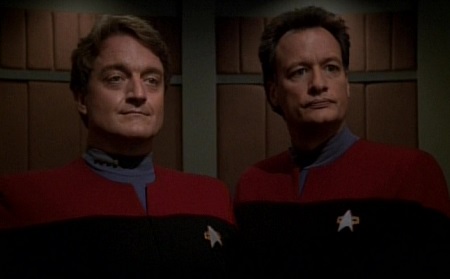
First Contact introduced us to the Borg Queen for the first time, and went into a lot more detail about Picard’s assimilation experience. The Borg Queen was presented as the embodiment of the Borg rather than their leader, and she became a fearsome adversary for Picard and Data over the course of the story.

Season 1 of Picard saw the retired Admiral face his lingering Borg assimilation trauma when he beamed aboard the Artifact in the episode The Impossible Box, but Season 2 will see him come face to face with a Borg Queen for the first time in twenty-five years. For someone who’s clearly suffering from some form of post-traumatic stress, we don’t know what effect that could have.
Data and Picard lead the battle against the Borg.

Picard was violently anti-Borg in First Contact, and we saw hints of that in Picard Season 1 as well. His conversation with Dr Jurati and Elnor in The Impossible Box, as well as the way he responded to some of the xB’s in later episodes, was in line with his attitude to the Borg in First Contact – and I wonder how encountering a Borg Queen will make him feel!

Many Trekkies hold up First Contact as one of the absolute best Star Trek films, and it’s hard to disagree. As an action-packed work of sci-fi with some truly scary elements thanks to the way the Borg are depicted, it’s an exciting ride from start to finish. It also goes into a little more detail about World War III – an event in the history of the Star Trek timeline that could play a role in Picard Season 2. Check out my full World War III theory by clicking or tapping here!

Number 12:
Endgame
Voyager Season 7 (2001)

Some of Voyager’s crew in an alternate 25th Century future.

Almost five years after First Contact depicted the Borg’s biggest attack on Earth to date, Endgame brought back the Borg Queen in a significant way. The interventions of a time-travelling Admiral Janeway from the future saw the USS Voyager make it home to Earth, and in the process dealt a significant blow to the Borg Collective.

Even though it’s been more than twenty years since Endgame, we don’t actually know what became of the Borg in the aftermath of Admiral Janeway’s attack. I’ve always assumed that the Borg Collective was large enough, clever enough, and adaptable enough to survive the neurolytic pathogen that she introduced into the Borg Queen… but because the Star Trek franchise has yet to return to the Borg post-Endgame, we can’t be certain of that.

Admiral Janeway and the Borg Queen.

Even Season 1 of Picard, which depicted the disabled Borg Cube known as the Artifact, didn’t settle the issue. So it’s an open question at this juncture whether the Collective survived, whether it was significantly damaged by Admiral Janeway’s pathogen, or whether it was able to easily shake off the attack. It seems as though no major Borg activity occurred in Federation space in the twenty-plus years after Endgame, though.

Endgame makes this list because of the Borg Queen’s role in Picard Season 2, and I think it could be very useful background viewing, possibly even setting up a story about the Queen herself or the state of the Borg Collective at the dawn of the 25th Century. On a vaguely related note, I took a deeper look at Admiral Janway’s actions in Endgame, and you can find that article by clicking or tapping here.

So that’s it!

Admiral Picard is coming back in just a few days’ time!

Those are twelve episodes (alright, eleven episodes and a film) that I think might make for useful or interesting viewing prior to Picard Season 2! I think we’ve hit most of the key subjects – at least, those that we’re aware of at this early stage – and got a good mix of stories focusing on Captain Picard, Q, Guinan, time travel, and the Borg Queen.

At the end of the day, though, Star Trek’s past didn’t prove all that important to unravelling the events of Picard Season 1 – nor to recent storylines in Discovery, either. So it’s quite likely, in my view, that Picard Season 2 will bring plenty of brand-new characters and story elements into play. That doesn’t mean it isn’t worth going back to these stories and others, but my suspicion at this stage is that the new story won’t rely excessively on what came before.

When Picard Season 2 arrives at the end of next week, I hope you’ll stay tuned for individual episode reviews, theories, and more. Despite the somewhat underwhelming end to Season 1, Picard Season 2 has been one of my most-anticipated shows for almost two years, and I can’t wait to jump in and have another adventure with Jean-Luc Picard and the crew of La Sirena.

Star Trek: Picard Season 2 will premiere on Paramount+ in the United States on the 3rd of March 2022, and on Amazon Prime Video in the United Kingdom and elsewhere 24 hours later. The Star Trek franchise – including Picard and all other properties mentioned above – is the copyright of Paramount Global. This article contains the thoughts and opinions of one person only and is not intended to cause any offence.