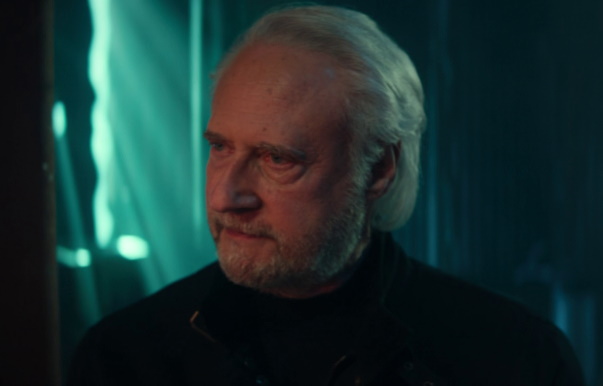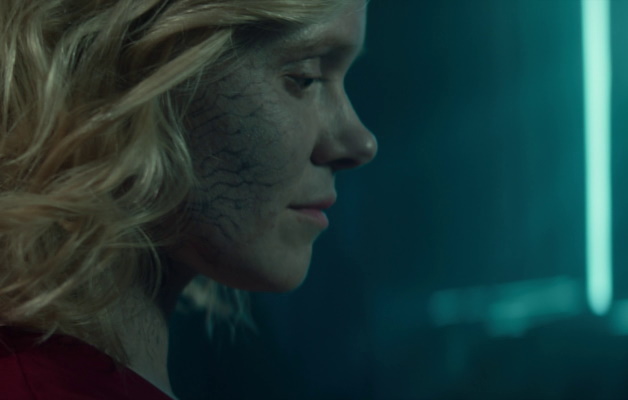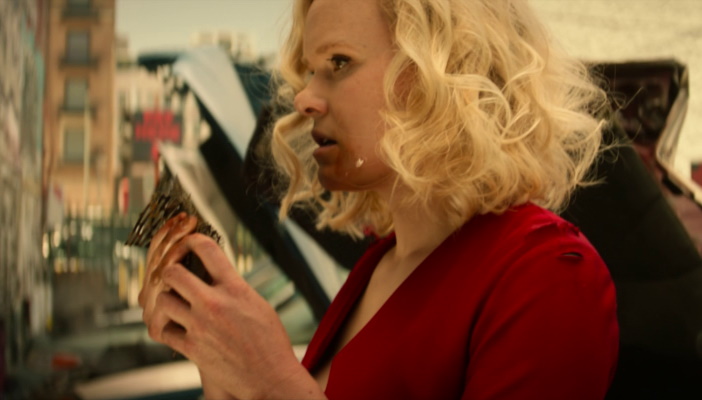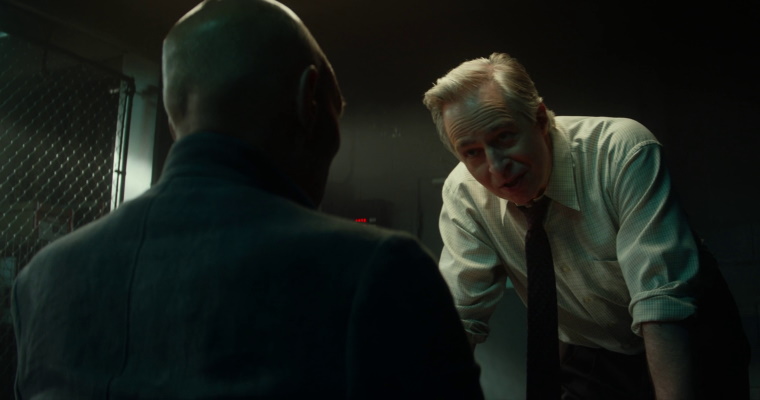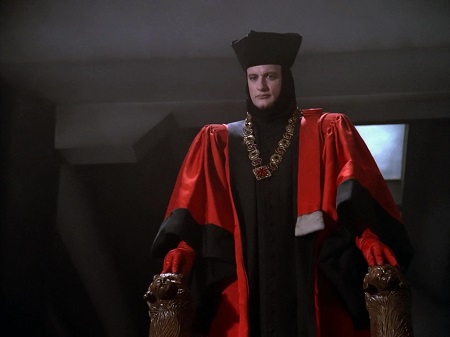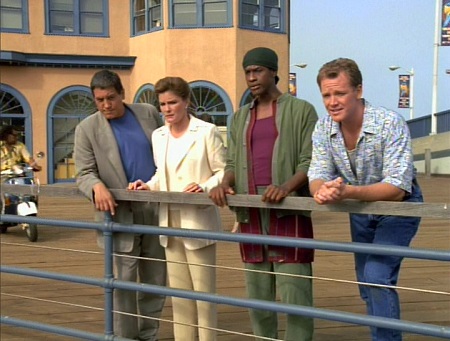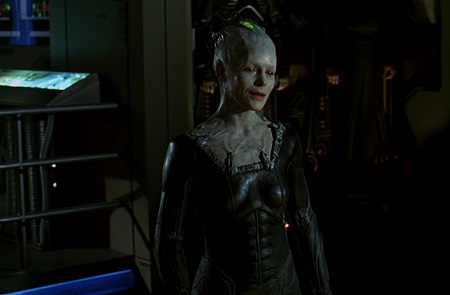
Star Trek: Strange New Worlds Episode Review – Season 4, Episode 10: Tomorrow’s Enterprise

A Star Trek-themed spoiler warning.

Spoiler Warning: There are spoilers ahead for Star Trek: Strange New Worlds Seasons 1-4. Spoilers are also present for the following Star Trek productions: The Original Series, The Next Generation, Deep Space Nine, Discovery, and Picard.

After a rollercoaster ride across Season 4 – which, I’m afraid, had more downs than ups, and also brought two of the worst episodes in the entire series to the table – I was hoping, if not positively *praying,* that Tomorrow’s Enterprise would at least end things on a high note. I wasn’t sure whether to expect a cliffhanger, like we got in Season 2, or a self-contained story – and we kind of got a bit of both, at least for one character in particular.

But above all, I’m happy to report that, despite some misfires earlier in the season, Tomorrow’s Enterprise was a good, solid finale that I enjoyed from beginning to end.

There will be time in the weeks ahead to take stock of where Strange New Worlds as a whole finds itself ahead of its truncated fifth and final season, but I want to touch on a couple of points briefly, at least insofar as they pertain to Tomorrow’s Enterprise. For much of the season – including in this episode – most of the show’s new, original characters took a back seat, and those with roles in The Original Series were more central. We saw that not only with Uhura, but also with Chapel, Spock, Scotty, and Kirk – all of whom overshadowed or outright replaced their Strange New Worlds counterparts, or original characters who could’ve filled those roles. And despite this being a fantastic all-around episode for Uhura, I can’t help but feel the curtain has fallen on a season that sidelined not only its new characters, but also Captain Pike himself – and it was Anson Mount whose incredible performance led to calls for a “Captain Pike show” a few years ago.
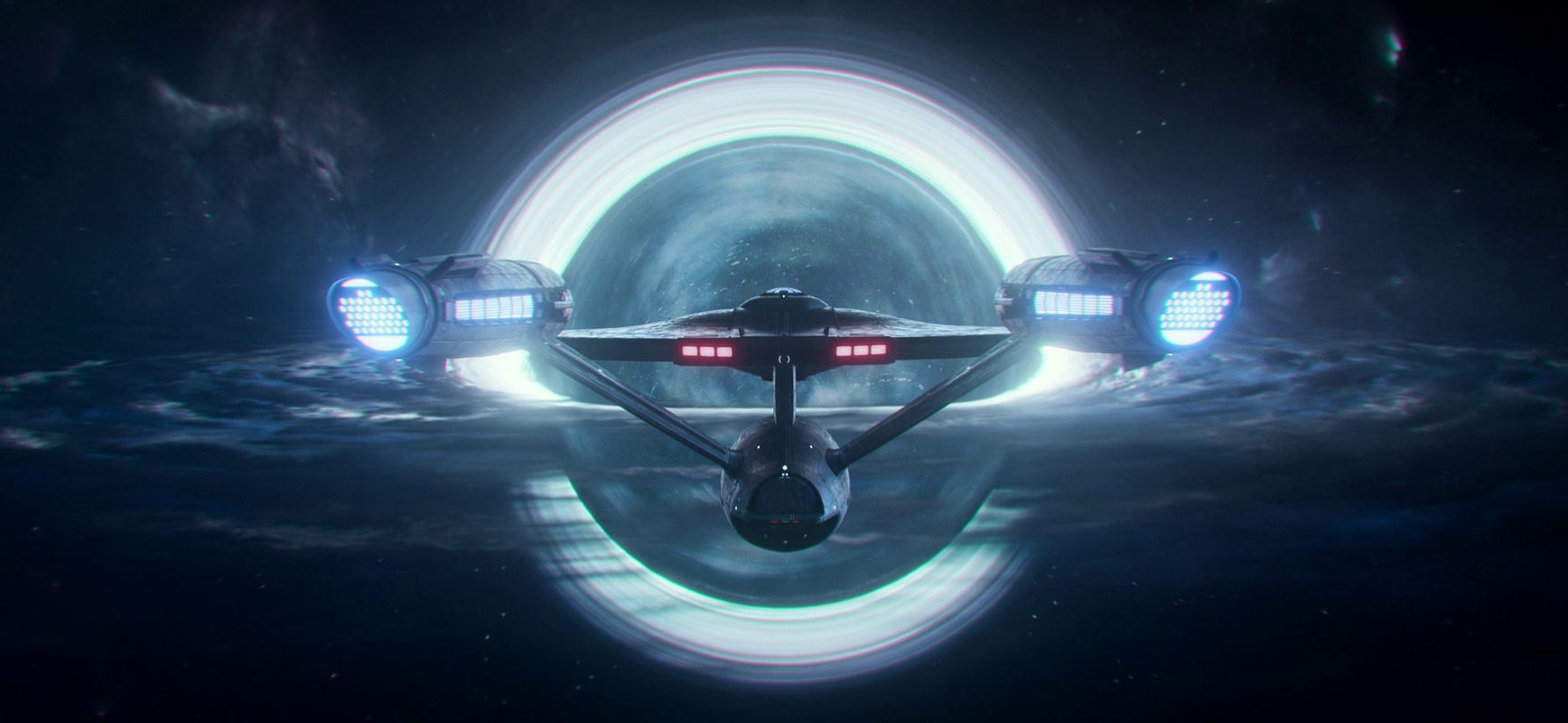
Still frame from Star Trek SNW 4x10 showing the Enterprise and a white hole
The Enterprise approaches a white hole.

But I guess we’ll have to dissect that in a longer article in the weeks ahead.

Time travel, time loops, and temporal paradoxes are far from my favourite storylines – either in Star Trek or in sci-fi more generally. So for me, of all people, to come away from Tomorrow’s Enterprise feeling that the episode took that narrative framework and built it up into a successful episode? That’s almost inconceivable!

Yet here we are: this rare unicorn of an episode managed to make a time travel plot work in a way that was understandable, but also intense, emotional, and just plain fun. There are a few nitpicks (and you know we’ll get into them as we go along), but overall? I had a really good time with Tomorrow’s Enterprise.
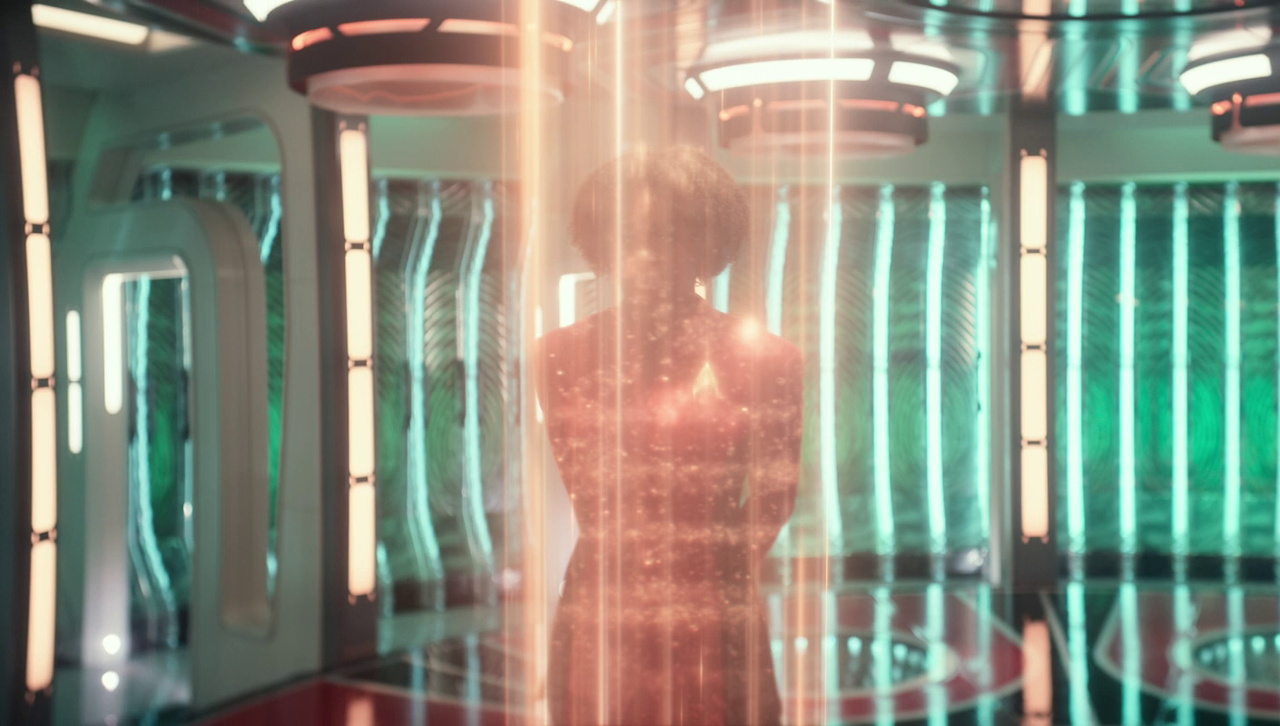
Still frame from Star Trek SNW 4x10 showing Uhura beaming in
Lt. Uhura beaming in!

Sometime after it was announced that Strange New Worlds would end with Season 5, we got news that the show had cast both Sulu and Dr McCoy for that final season – and when this time travel story seemed to take Uhura into her own future, I wondered whether we might catch a glimpse of either character. However, I think it was good that we didn’t see *even more* TOS characters in this episode in particular, given that they would’ve arguably been a bit of a distraction from the main plot as it followed the two different versions of Uhura. And I can also see why Strange New Worlds wouldn’t want to play *all* of its cards too soon! Keeping those characters in reserve for whatever roles they may have in Season 5 was a genuinely good call.

One thing I found odd, though – not just about Tomorrow’s Enterprise, but going back to Off-Hour and even (kind of) Like Chronitons Through the Hourglass, too – was Dr Boyce’s role. In The Cage (and The Menagerie), Dr Boyce was a confidant, friend, and somewhat of an unofficial counsellor to Captain Pike, and they seemed to have a pretty good relationship. Yet in both of his appearances this season – and when Pike was at his lowest ebb and in need of someone to talk to – Dr Boyce and Captain Pike weren’t even in the same room. They never spoke to each other, never interacted at all… and that’s just a bit of an oddity.
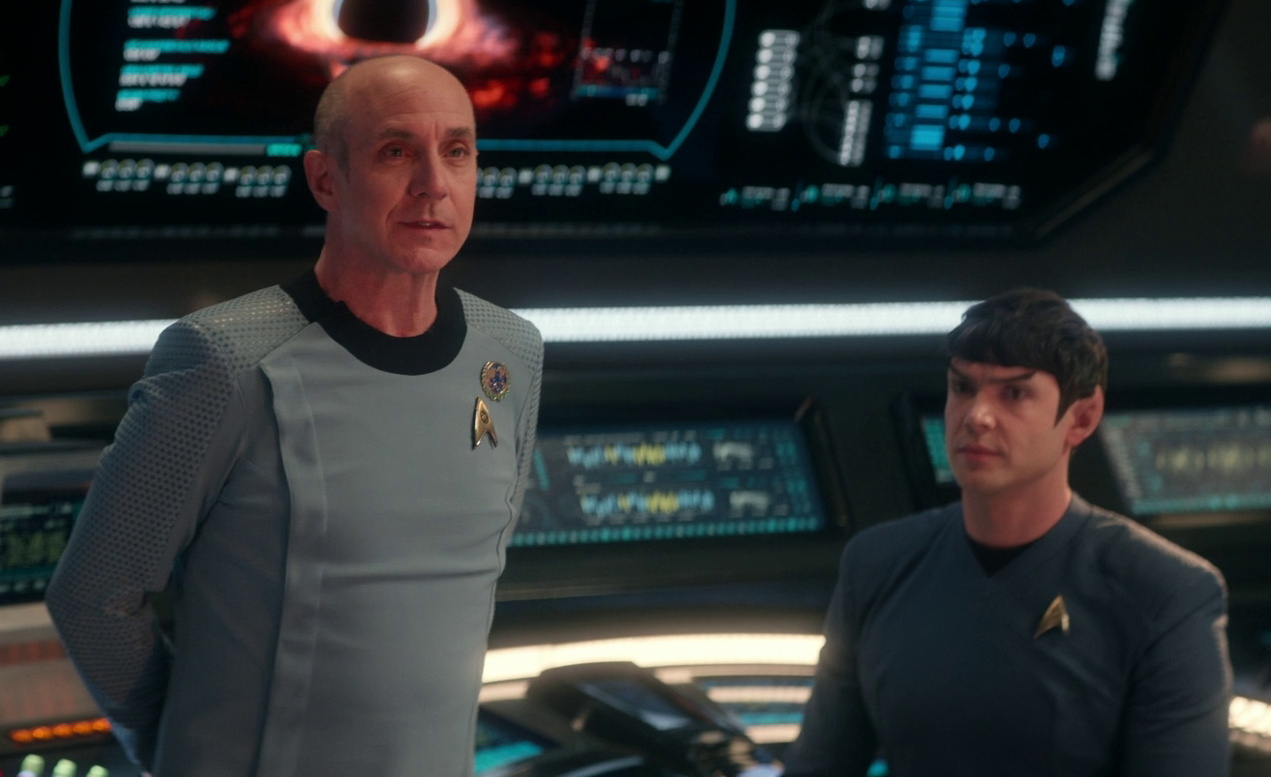
Still frame from Star Trek SNW 4x10 showing Boyce and Spock on the bridge
Dr Boyce with Spock.

I liked seeing Dr Boyce in action in sickbay this week, as well as learning that he had a previously-unseen role aboard Kirk’s Enterprise, at least in the early years of his command. That was neat – and I liked that we got a bit more of an expanded look at Kirk’s early days in command; the “crew transition,” as I think Scotty or Uhura called it at one point. But it still strikes me as odd that this Pike-centric character, one of the few characters from The Cage to come aboard Strange New Worlds after the series had been running for a while, got no screen time at all with Pike.

Now, that *could* come in Season 5, sure. But we only get six episodes next time – six episodes to wrap up the show, move characters along, potentially kill someone off (more on that in a second), and… will there be time for that? A sickbay storyline showing Dr M’Benga getting ready to leave the ship, Chapel wrangling with all of that, Dr McCoy coming aboard… where would a Dr Boyce-Captain Pike scene even fit?

Is it the worst thing in the world? No. But it’s… well, as I say, it feels odd.
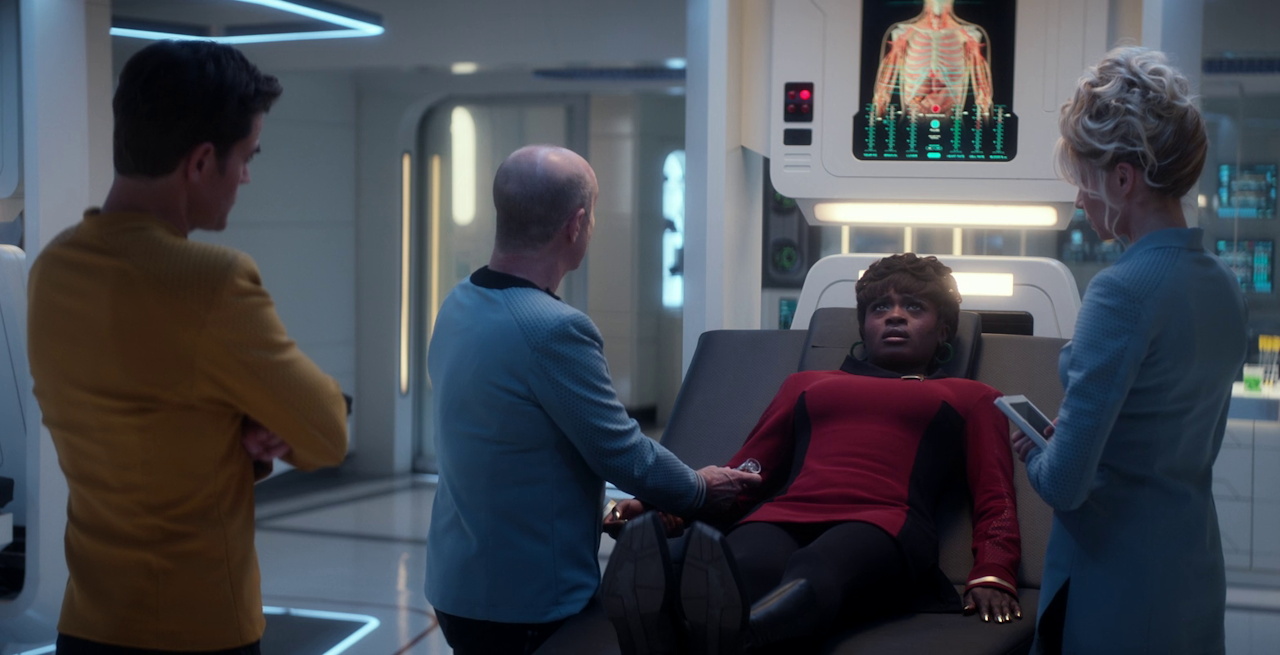
Still frame from Star Trek SNW 4x10 showing Kirk, Uhura, Dr Boyce, and Chapel at a bio-bed in sickbay
Uhura is being treated by Dr Boyce.

Last season, I said that the episode The Sehlat Who Ate Its Tail felt like a “backdoor pilot;” a pitch that the show’s producers and writers were making for their Year One spin-off idea, which would’ve focused on Kirk’s early days in command. That concept, by the way, is clearly not going ahead – something we’ve known for a while, but that was hammered home when the Strange New Worlds sets were torn down earlier this year. But that’s beside the point!

Tomorrow’s Enterprise – large chunks of it, anyway – felt like a second “backdoor pilot,” or, I guess… a “backdoor episode two?” That was *definitely* the sense I got from seeing Kirk in command, Ortegas, La’an, Una, and Dr M’Benga either gone or in the process of leaving, and the crew in that “transitional” state. I’m not sure that a time travel story like this was the best way to show off the potential in Year One as a spin-off, but I can absolutely feel the producers’ intentions in the way that side of the story was structured.

If you want to check out my thoughts on Year One in more detail, click or tap here. It’s a bit of a moot point now that the spin-off definitely ain’t happening… but it’s an interesting thought experiment nevertheless.
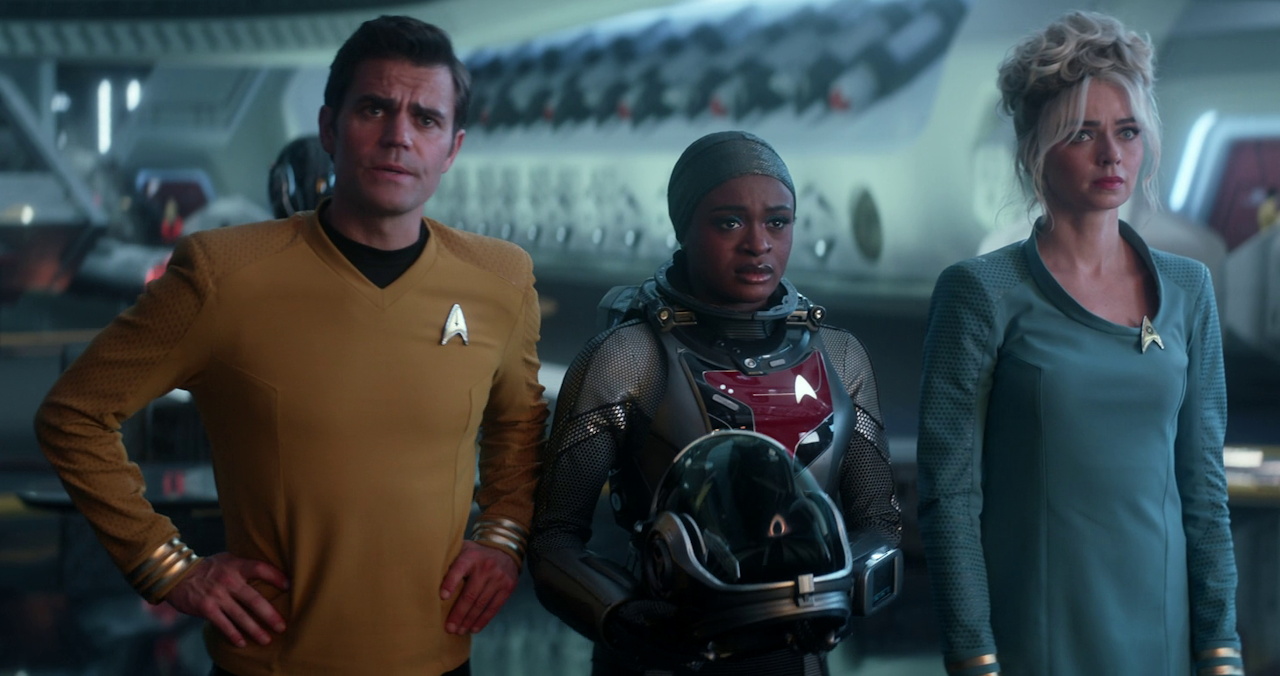
Still frame from Star Trek SNW 4x10 showing Kirk, Uhura, and Chapel in the shuttlebay
Did this feel like another “backdoor pilot” to anyone else?

However, dedicating so much time to two backdoor pilots – as well as other episodes and storylines that expanded upon or fleshed out TOS characters – has meant that we’ve spent less time with not only the show’s original creations, but also Captain Pike, Una, and Dr M’Benga, too. And Season 4 has massively accelerated that trend, with really only a couple of episodes where either Pike or one of the other non-TOS characters were front-and-centre.

Again, we’ll get into that in more detail on another occasion, but I think it’s worth keeping it in mind. As strong and as fun as Tomorrow’s Enterprise was, it came at the end of a season where not only the likes of Spock, Kirk, Scotty, and Chapel have all had major storylines and roles, but where Uhura herself got such an impressive spotlight just a couple of weeks ago that I literally said: “even if we never get to spend another second with Uhura (and I certainly hope and expect that we will, by the way!) we can now consider her character growth and prequel arc to be complete.”

That *is not* to call Uhura’s starring role this time in any way “repetitive!” It was nothing of the sort. But it is interesting – and a tad disappointing, I’m afraid – to see this trend in favour of TOS characters growing in strength as the series reaches its premature conclusion.
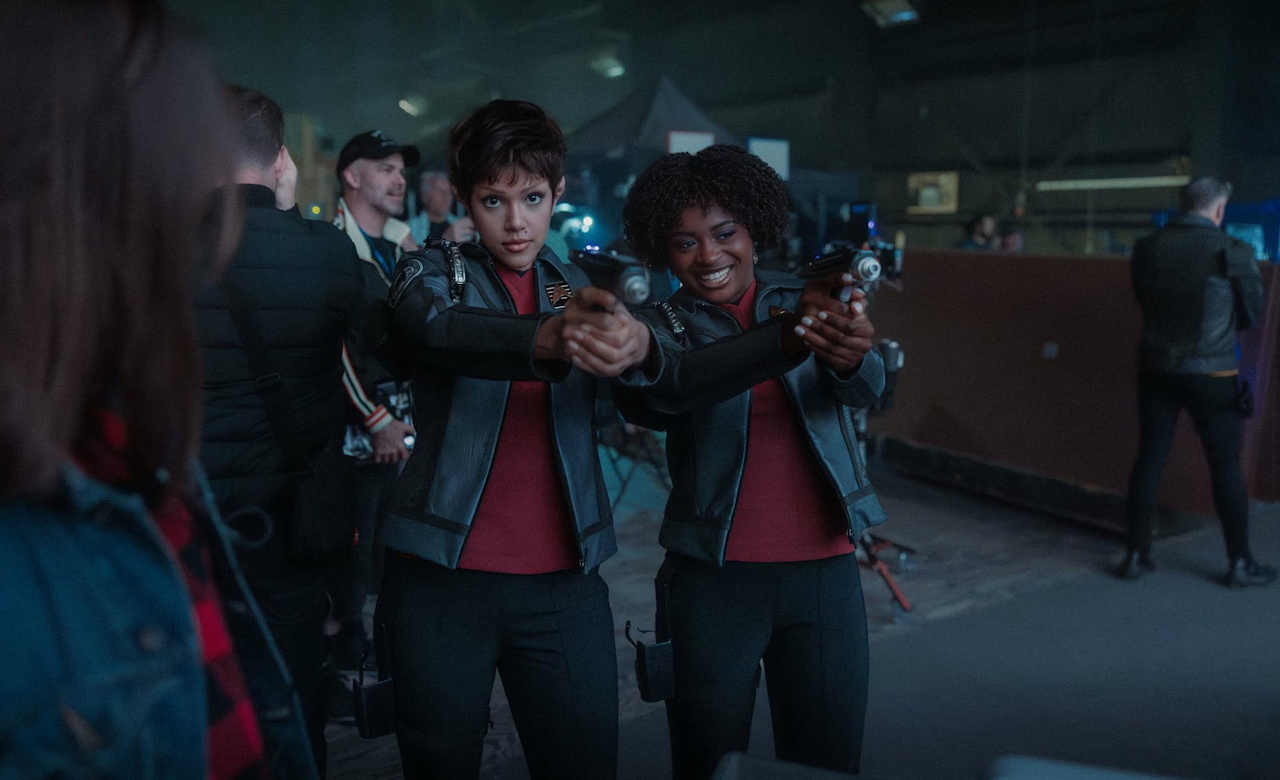
Behind-the-scenes photo from Star Trek SNW 4x08 showing Bianca Nugara and Celia Rose Gooding on set
Behind-the-scenes on the set of Orders of Magnitude with Celia Rose Gooding (R) and co-star Bianca Nugara.

In the episode Off-Hour, I said that Dr M’Benga was a strange choice of character for the story to place in mortal peril. Why? Because, as a recurring character from The Original Series – set years later – we know that Dr M’Benga is effectively “unkillable” in Strange New Worlds.

And I felt *exactly* the same way with this side of Scotty’s storyline this week.

I know that there was the relationship drama stuff between Uhura and Scotty that was meant to add an extra dimension to Uhura’s quest to save his life. We can argue the toss about how well that was set up, how much chemistry the characters and performers had, and whether it treads on the toes of “canon,” if you like, but I want to posit a much more fundamental point: Scotty was a stupid choice for this role in the story. Because he’s a TOS character – and a major one, at that – there was no way Scotty could be in real danger in Tomorrow’s Enterprise, and for me, at least, that put a serious dampener on how intense, emotional, and dramatic this otherwise well-scripted and beautifully-performed story was.
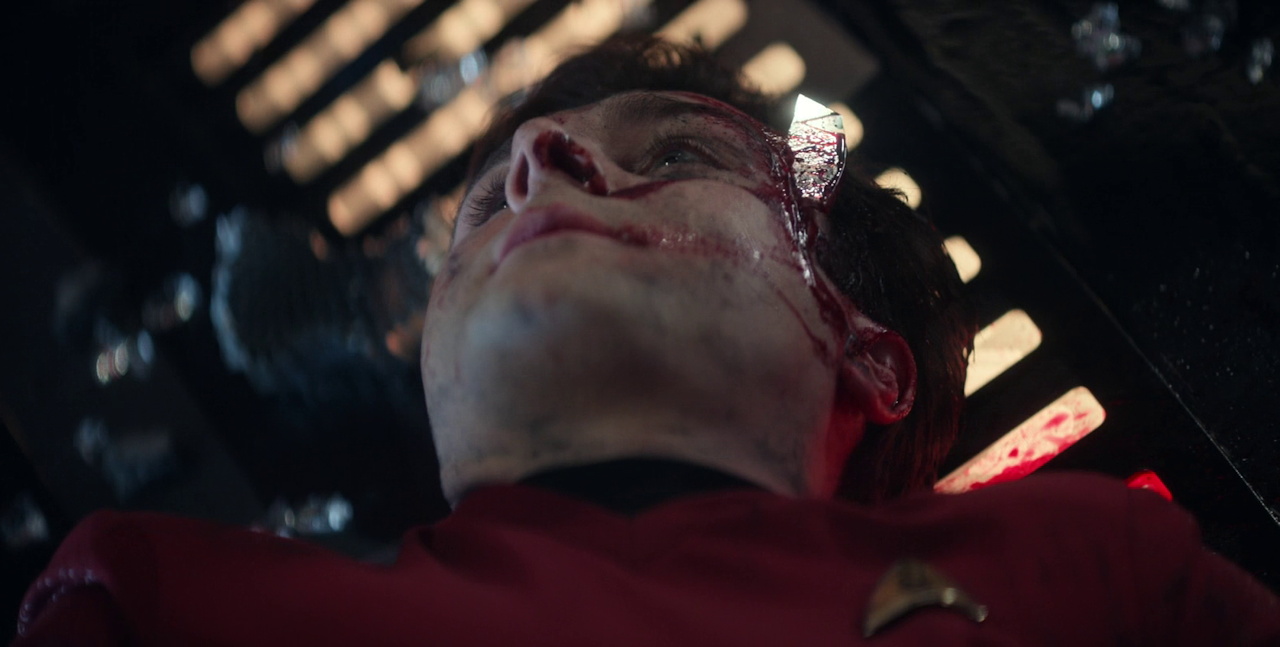
Still frame from Star Trek SNW 4x10 showing Scotty dead
Though I get why Tomorrow’s Enterprise put Scotty into this role, he wasn’t the best choice of character to endanger.

Breaking apart the two aspects of the story could’ve seen Uhura learning to “embrace the now” and say yes to Scotty’s advances while *also* actually saving the life of an unrelated character – a character like Ortegas or Una, perhaps, who genuinely would’ve felt like they were in danger. Or if (as I’ve repeatedly theorised) a character like La’an may not make it all the way to the end of the show… that could’ve been a final twist of the knife in a story like this one. Maybe the two Uhuras were able to successfully deliver the “space baby”… but couldn’t save La’an.

This is a trend we’ve seen this season. Strange New Worlds’ writers seem to be doubling-down on making the exact same mistakes in multiple episodes, and it leaves me more than a little anxious that the fifth and final season will have similar issues. Without being able to learn and take on board feedback (because Seasons 4 and 5 were in production before Season 3 even finished airing), there hasn’t been time for the production team to properly take stock of what worked… and what didn’t. As a result, we’ve seen several mistakes repeated, almost beat-for-beat, in multiple episodes… and this one – placing a functionally immortal character in danger of “death” – is just the latest example.
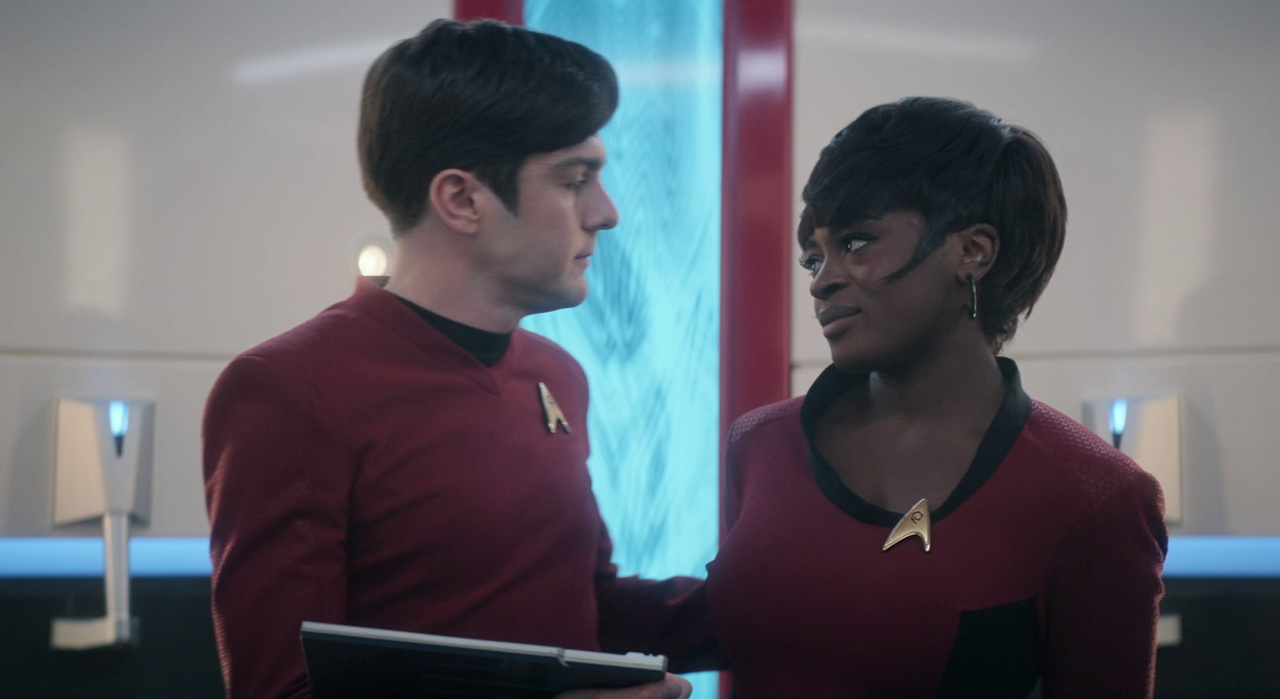
Still frame from Star Trek SNW 4x10 showing Scotty and Uhura in the turbolift
Scotty with Uhura.

And because this story could have worked just as easily if it were another character in danger… it just doesn’t make a lot of sense to me. Sure, Uhura and Scotty had their (brand-new for this episode) romantic sub-plot, and that *did* add to the tension when Uhura felt he was in danger of death. And I will also say that, in any work of fiction, the way the characters in a story respond to events can still be impactful even if we as the audience know something they don’t – like, in this case, that Scotty will definitely survive.

I don’t want to take away from Celia Rose Gooding’s excellent performance – taking on, really, two very challenging related roles!

But at the same time, because we know Scotty’s going to survive, *and* because this whole romance angle was completely new (and seemed to come from nowhere), there was a way to tell a very similar story without the prequel constraint. And if this was a one-off, maybe I’d feel a bit more lenient. But because Strange New Worlds literally made this exact same mistake just a few weeks ago with Dr M’Benga… well, unfortunately I think it needs to be pointed out.
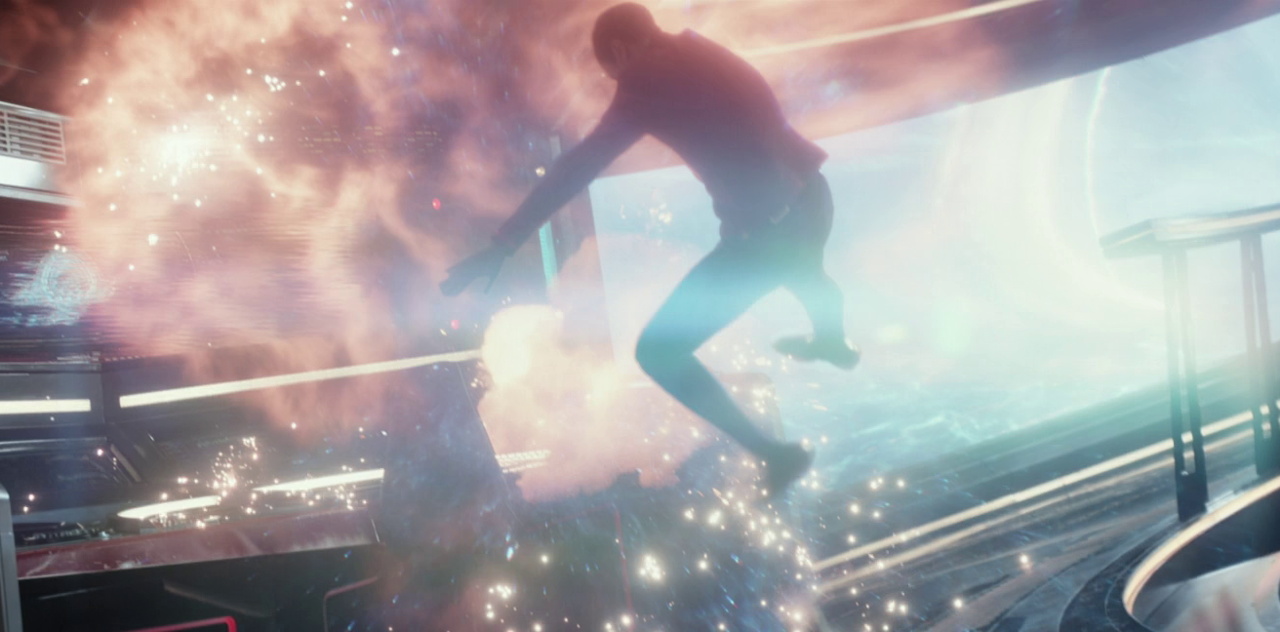
Still frame from Star Trek SNW 4x10 showing Scotty in an explosion
Kaboom!

Sometimes – especially this season – I’ve felt like some of the writers don’t seem to remember that they’re working on *a prequel* with the way certain character decisions were handled. Other times, of course, they’re almost *too* aware of that fact – and choose to place TOS characters into major roles! But with these Scotty and M’Benga storylines, and the way they repeat a simple mistake… I can’t help but feel someone, at some point in the production process, could’ve raised the red flag.

It didn’t “ruin” the episode, of course – and the way Uhura and other characters reacted to Scotty’s death did still stick the landing. But for me, as a long-time Trekkie watching the latest episode, the plain and simple fact that Scotty was always going to survive was inescapable, and it makes me wonder why another character wasn’t chosen for this “danger of death” story. Even if the outcome was beat-for-beat the same, it could’ve been a more engaging and entertaining ride if – on that first viewing, at least – we weren’t 100% sure if they were going to survive.
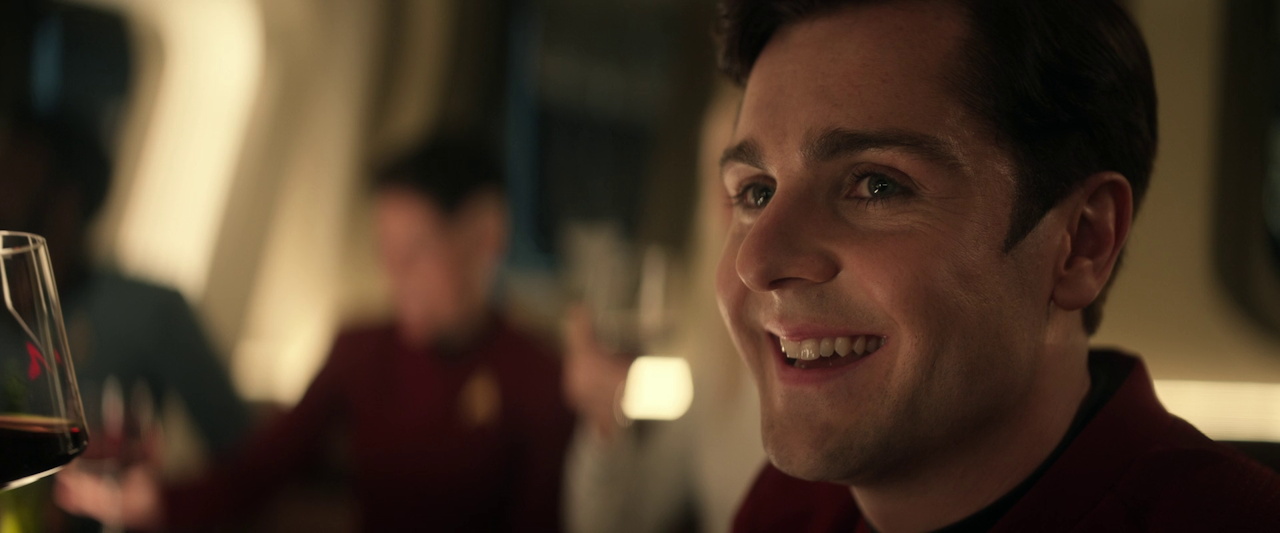
Still frame from Star Trek SNW 4x10 showing Scotty
Scotty at the end of the episode.

Sticking with the theme of characters surviving… what do we make of Kirk’s hesitation when asked about La’an? It felt too intense to be a simple misdirection on the part of the production team, didn’t it? But then again, given that La’an and Kirk might be on the verge of some kind of romantic relationship, Kirk could just as easily be upset about a bad breakup… so I guess there’s wiggle-room there, depending on what you want to believe! But either way, Season 5 owes us an answer as to why Kirk was so reluctant to talk about La’an.

I’ve said this before, but La’an remains at the very tippy-top of my “death watch” list ahead of Season 5. She may have survived the events of this episode, but the whole “latent augment DNA” angle that Season 4 introduced, as well as her absence from the Enterprise after Kirk assumes command, all lead me to believe that she may not be long for this world – and Kirk’s refusal to talk about that with a time-travelling Uhura *really* seemed to hammer that home. It could still be a red herring, of course, and I don’t *want* La’an (or any other main character) to be killed off! But I think at least one of the show’s original creations won’t survive past Season 5, and right now, if I had to guess? It would still be La’an.
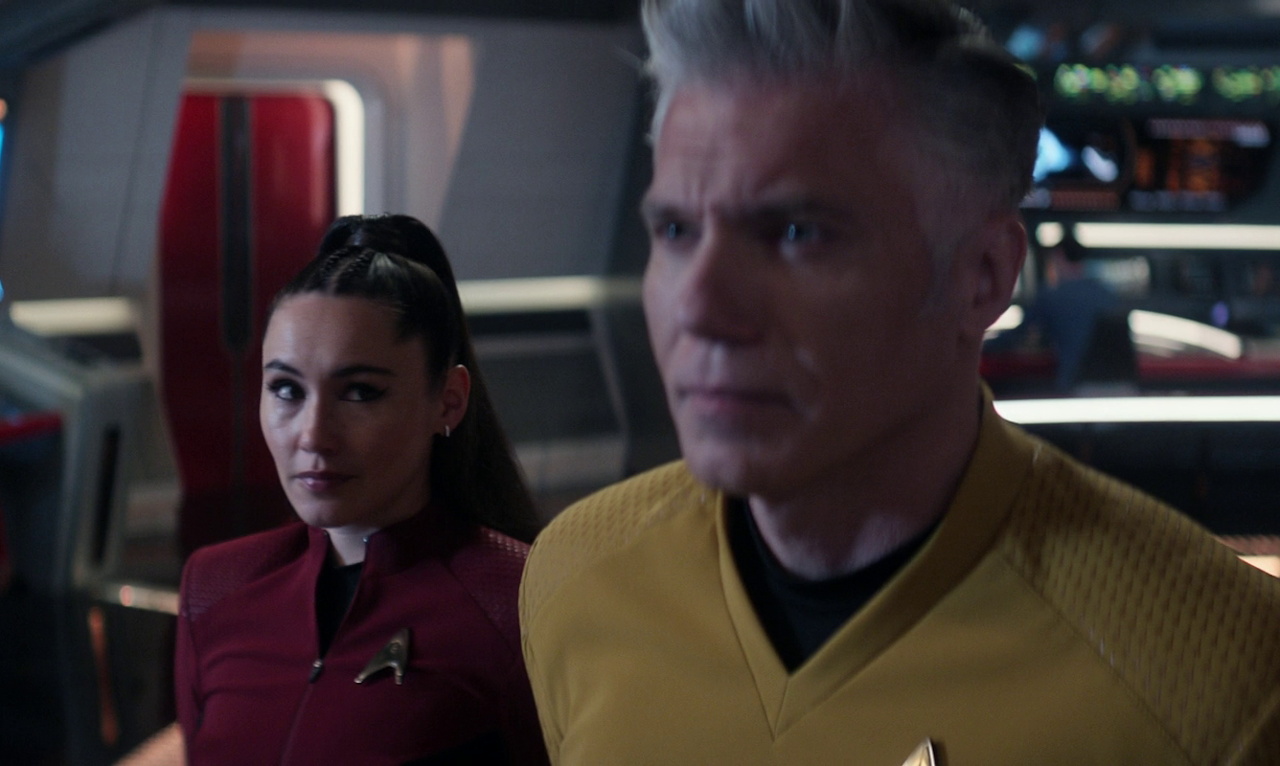
Still frame from Star Trek SNW 4x10 showing Pike and La'an
Do we reckon La’an survives to the end of Season 5?

Tomorrow’s Enterprise is now the *third* episode of Season 4 in which the events we see on screen either didn’t happen at all or aren’t going to be remembered by most of the characters involved. We had the irredeemably awful writing failure of “but it was all just a dream” in Level-Five Transporter Accident, then Trelane’s meddling in Like Chronitons Through the Hourglass, and now it turns out that only Uhura will remember what transpired – and several key events were literally undone – in Tomorrow’s Enterprise.

As I said above: the show is doubling- and tripling-down on some… odd choices.

This week’s episode is so much stronger than those other two examples that it almost feels unkind to compare it to them! But I think it’s worth pointing out, as we consider how this episode fits in with the rest of the series, that we’re now at three out of ten episodes – just within Season 4 – where events we saw as the audience either didn’t happen at all or aren’t going to be remembered by most of the characters. I’d *happily* erase both Level-Five Writing Accident and Like Chronitons Through the Hourglass, and I think if neither of those episodes had existed, this aspect of Tomorrow’s Enterprise would be a complete non-issue. But coming at the end of a season where two other episodes have had stories that won’t actually be remembered by the characters involved (or just outright didn’t happen)? It’s another place where I feel the series repeating itself, at the very least.
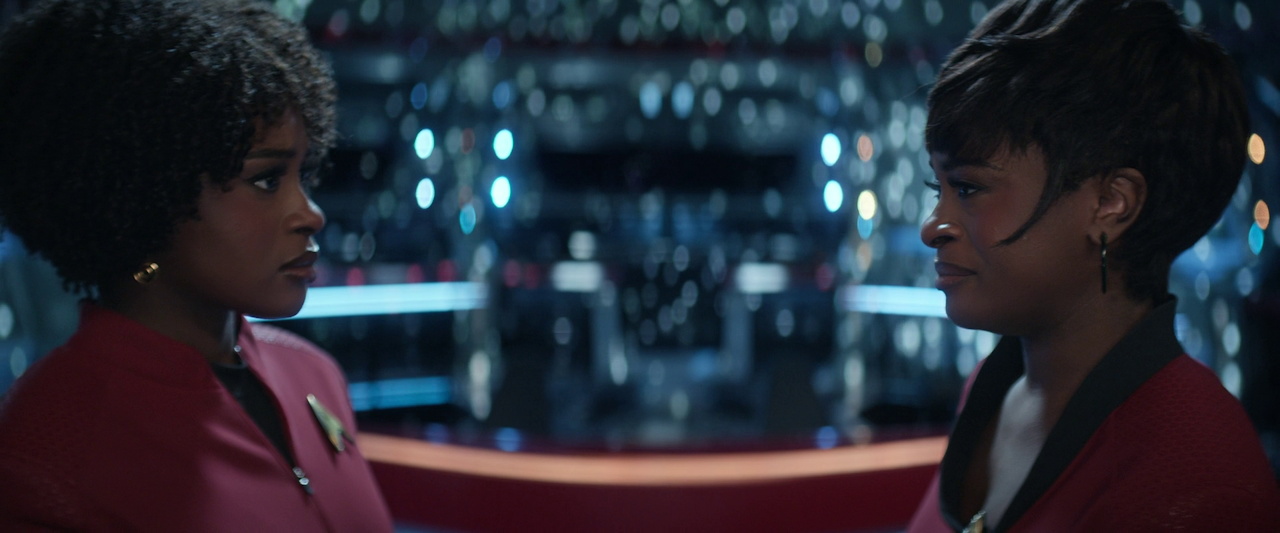
Still frame from Star Trek SNW 4x10 showing two Uhuras
For everyone except Uhura… none of these events happened.

Tomorrow’s Enterprise went out of its way to really lean into TOS’ 1960s style for all of its time-shifted characters, and I really enjoyed the way they looked. Hairstyles changed – very obviously for the likes of Chapel and Uhura, but subtly for the likes of Scotty, too – and we saw uniforms directly inspired by The Original Series, too. It was great to see Strange New Worlds embracing the idea that fashion and hairstyles can change over time – just like they do in the real world – and make an attempt to bridge the gap between this series and TOS in a way that felt natural.

One of the silliest criticisms of Discovery, when that show was announced, was how “out-of-place” it looked, from a visual standpoint, compared to TOS. And I would guess some folks will have said the same about Strange New Worlds, too. But for me, I was really never bothered by the aesthetic changes, and I don’t think it’s a stretch to say that things like fashion, hairstyles, uniforms, and so on change and evolve over time. The fashion of the ’70s was very different from that of the ’80s – at least here in the west – and even if we don’t notice at the time, because things just look “modern” or “normal,” trends stick out like a sore thumb after some time has passed! I just don’t think it’s much of an issue at all to say that similar trends and changes take place within the Star Trek galaxy, and I appreciate Strange New Worlds acknowledging and leaning into that idea.
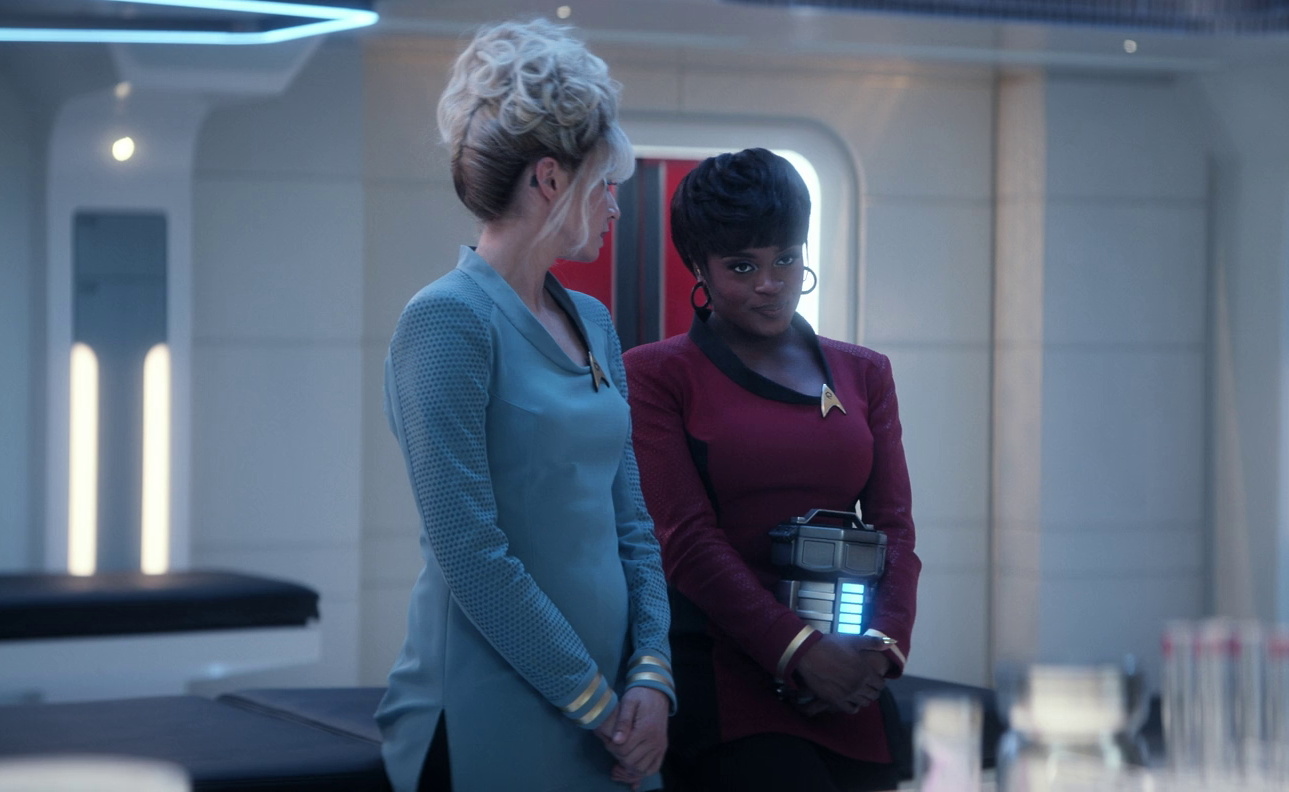
Still frame from Star Trek SNW 4x10 showing Chapel with Uhura
There were some great costumes (and hairstyles) in this week’s episode.

I would extend that compliment to the performances, too. Martin Quinn, Celia Rose Gooding, Ethan Peck, Paul Wesley, and Jess Bush all honed or refined their performances to draw even more heavily on the original incarnations of their characters – and it really showed.

Paul Wesley has been great as Kirk, and I wouldn’t have said his performance really needed much alteration. But in Tomorrow’s Enterprise, I really felt that Wesley was leaning even more on William Shatner’s original (and iconic) portrayal to take his version of the character even closer to that TOS presentation. The same was true of Martin Quinn with Scotty; you could see the way he stood, the way he held himself, and how he was almost channelling his inner James Doohan! Celia Rose Gooding had the most time on screen (and we’ll talk about her split role with both Uhuras in a moment), but she was also excellent. Jess Bush also worked hard to bring Chapel even closer to the way she felt in TOS, as did Ethan Peck with his short scenes as Spock.
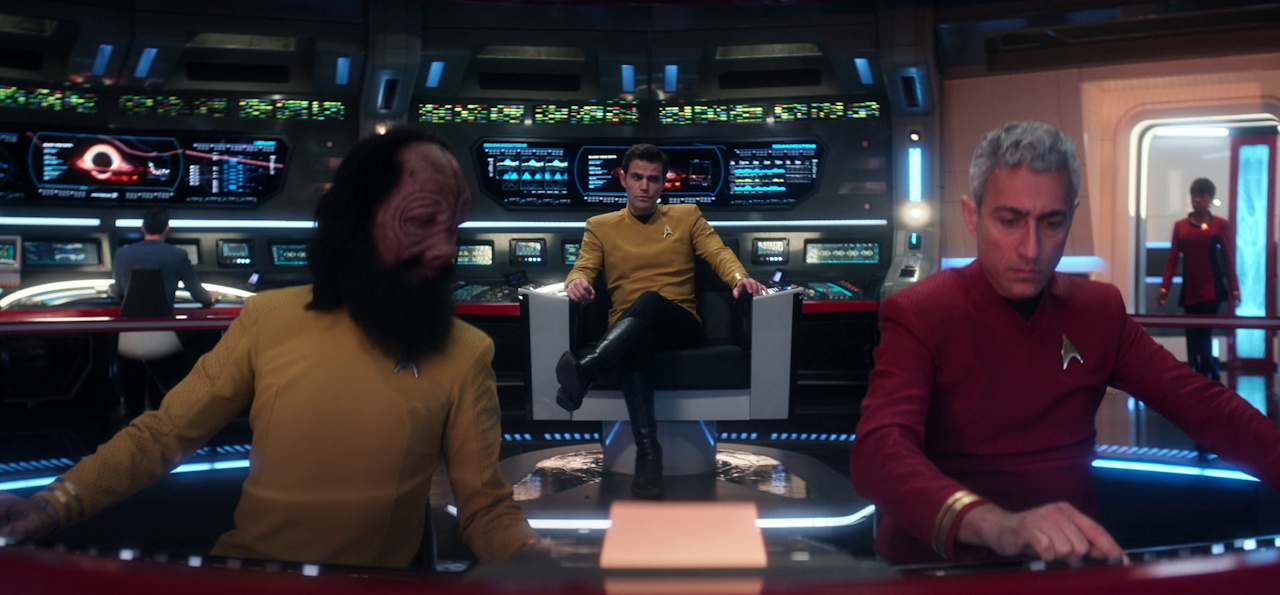
Still frame from Star Trek SNW 4x10 showing Kirk in command on the bridge
Kirk in command.

Tomorrow’s Enterprise also had a great score – which, again, felt like a bit of a throwback to TOS in some places. In fact, I half-expected to hear the familiar ending theme from The Original Series when the episode’s credits rolled! There was still a modern edge to some of the music; I don’t mean to say that it was identical to something you’d have heard in the ’60s. But, more so than any other Strange New Worlds episode, at least this season, it felt more “classic,” more of a throwback. And I really liked that.

The visual effect of the black hole (and the “white hole” on the other side) was solid. We’ve seen black holes using this Interstellar-inspired look in modern Star Trek before, so in that sense it wasn’t unique, and it wasn’t as stunning or spectacular as if it were brand-new. But as the episode’s main CGI creations, it was important to get the black and white holes looking right – and I’m happy to say that they looked great.
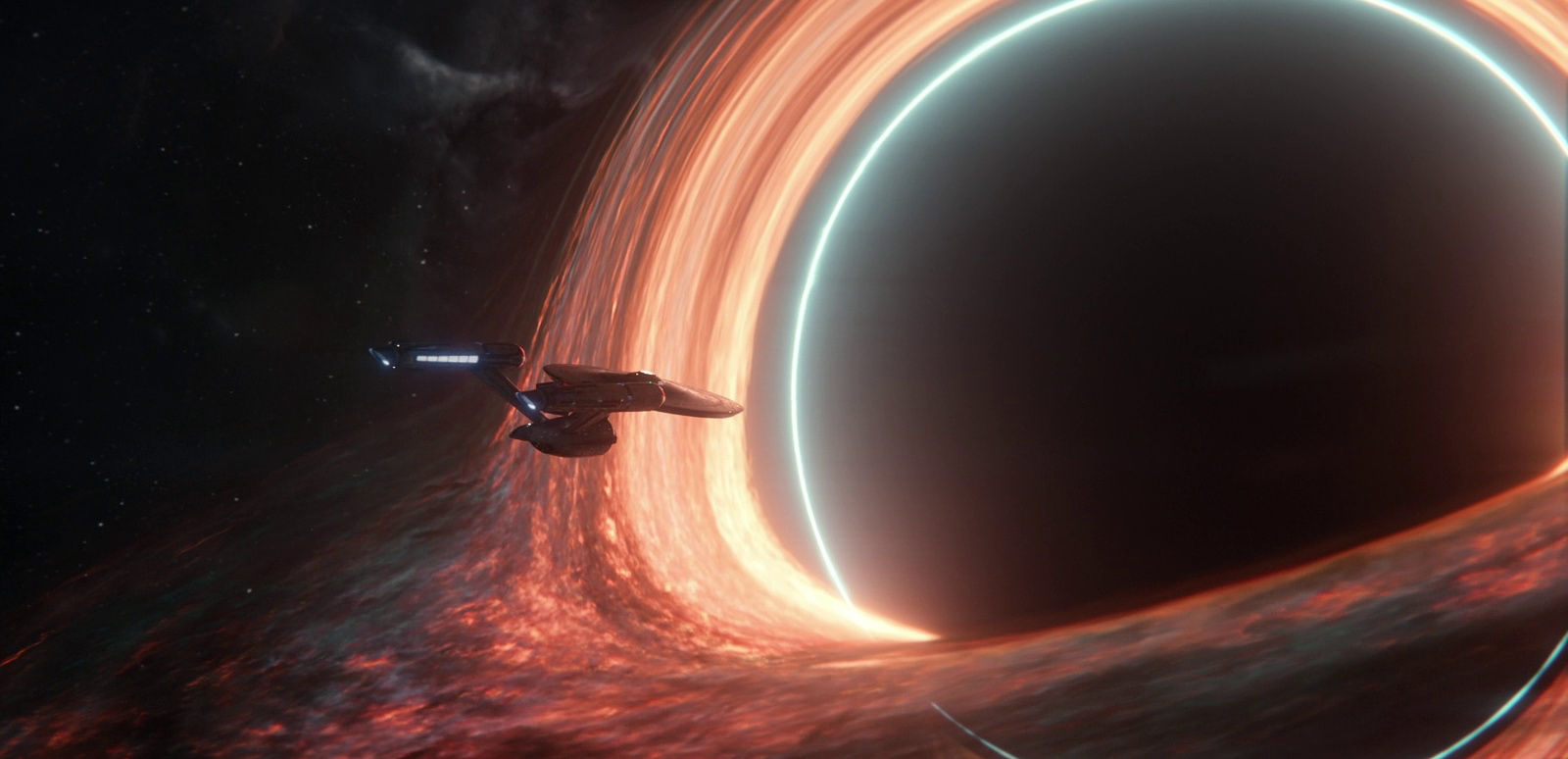
Still frame from Star Trek SNW 4x10 showing the USS Enterprise and a black hole
The black hole.

After a couple of places earlier in the season where I felt the AR wall hadn’t been used especially well, I also want to credit Tomorrow’s Enterprise for its well-constructed shuttlebay set. The AR wall worked really well as part of this set, and the shuttlebay felt as large and expansive a space as it needed to. The shuttlebay isn’t always going to be an area where we’ll spend a ton of time, but it’s important that it should feel large enough for its purpose, and I liked the way it came across this week.

There were also some creative physical props and costumes: did you notice Aleek-Om and M’Ress? I *adored* the way they looked, and while it’s not officially confirmed that the Caitian and Aurelian we glimpsed in the episode are the characters from The Animated Series… I mean, they were clearly meant to be, right? I always love seeing Caitians in live-action, so to catch a glimpse of M’Ress was just really neat.
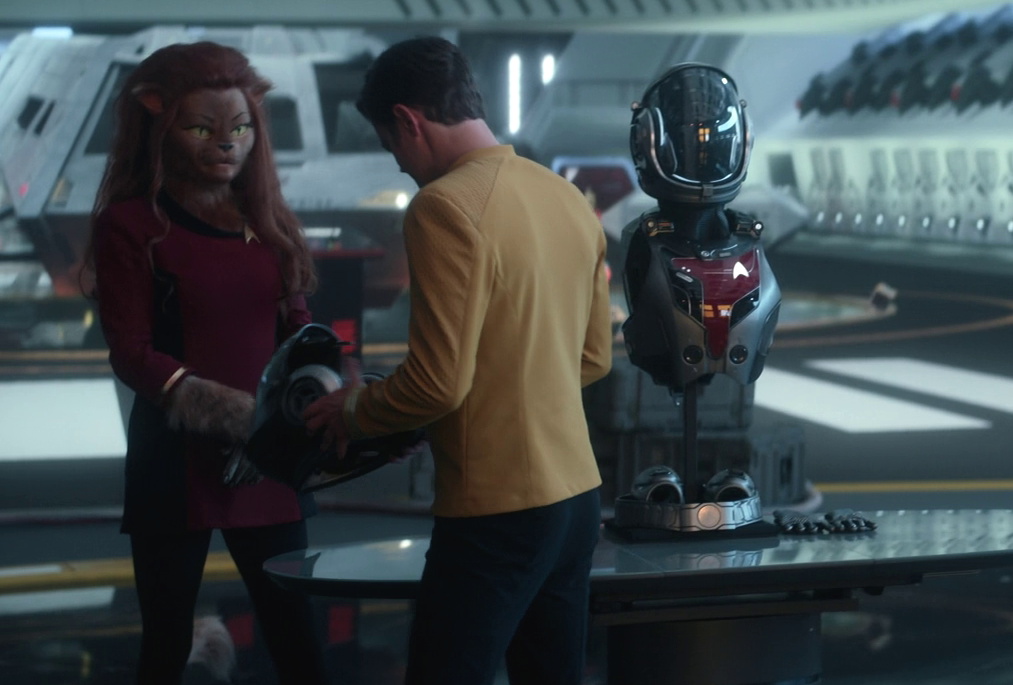
Still frame from Star Trek SNW 4x10 showing Kirk with a Caitian officer (maybe M'Ress?)
Kirk with a character I assume is M’Ress.

Sticking with cameos: did you hear Kirk mention Gary Mitchell? Mitchell was a character from the episode Where No Man Has Gone Before, which showed his transformation into a powerful entity after an encounter out in space. It was neat to get a mention of Gary Mitchell, of course, but what was even more fun was how he was connected to Jenna Mitchell – a new character created for Strange New Worlds and who we’ve seen on the bridge a few times in earlier seasons.

Cameos like these go a long way to helping Star Trek feel like a cohesive, connected setting – and while modern Star Trek hasn’t always done a good job with that, I can appreciate the effort being made here to connect Strange New Worlds to The Original Series, The Animated Series, and the TOS movies. These felt like little “Easter eggs” for long-time Trekkies like us, and even if it might’ve been fun to get a whole episode focused on Caitian or Aurelian characters, I enjoyed the cameos for what they were.
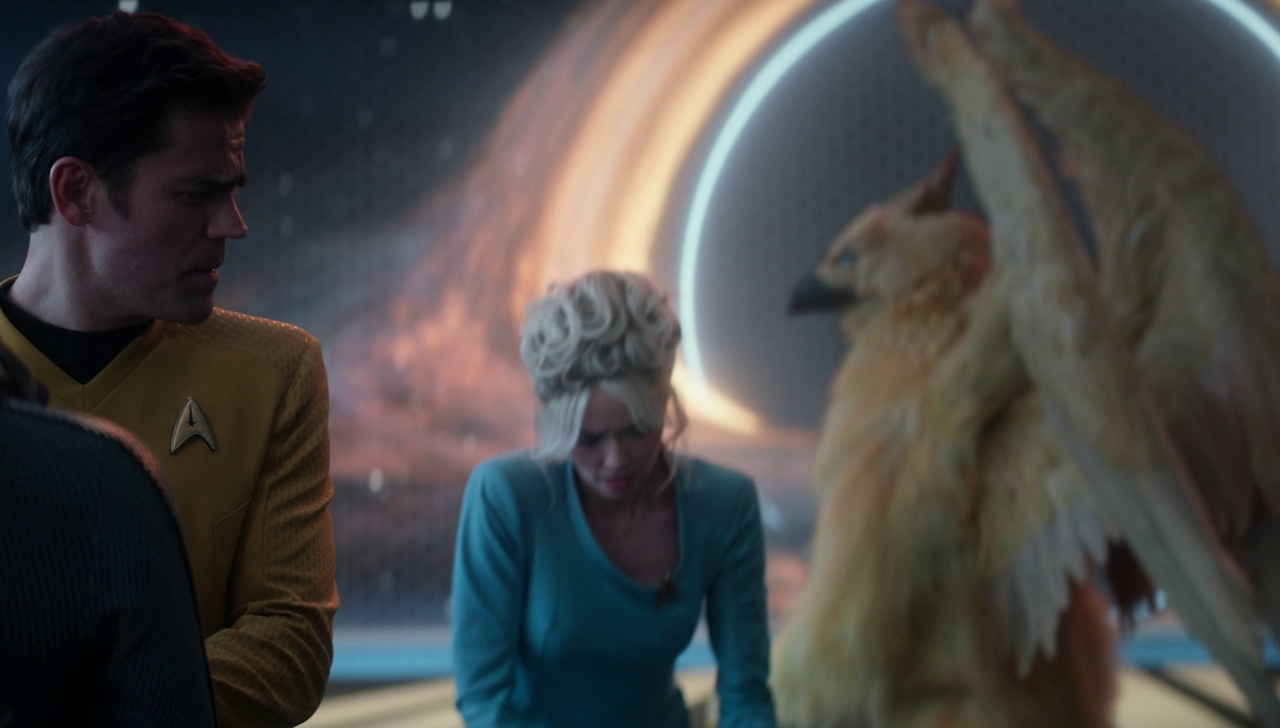
Still frame from Star Trek SNW 4x10 showing Kirk, Chapel, and an Aurelien (maybe Aleek-Om?)
This winged character is an Aurelien – perhaps Aleek-Om.

Did you feel echoes of The Next Generation’s finale, All Good Things, in the way that time seemed to flow “backwards” between the black and white holes? Because I certainly did!

Now, the two storylines are not really comparable in lots of other ways – and I really liked the idea of Uhura in the past setting up things that Uhura in the future would be able to use. We saw this with the dilithium diamond, Spock’s equation, and the mural recording the music. That was an incredibly creative way for a time travel/temporal paradox story to use its key narrative feature in a way that made sense – and in a way that most Star Trek stories dealing with similar ideas have never really done.

In All Good Things, to pick on that as an example, Picard was able to move between three different time periods, but actions he took in one seemed to have no effect on the other two. And in Past Tense, from Deep Space Nine’s third season, actions in the past *did* have a negative impact on the future, but not for our main characters. These differences help Tomorrow’s Enterprise stand apart even from superficially similar time travel stories – which is fantastic!
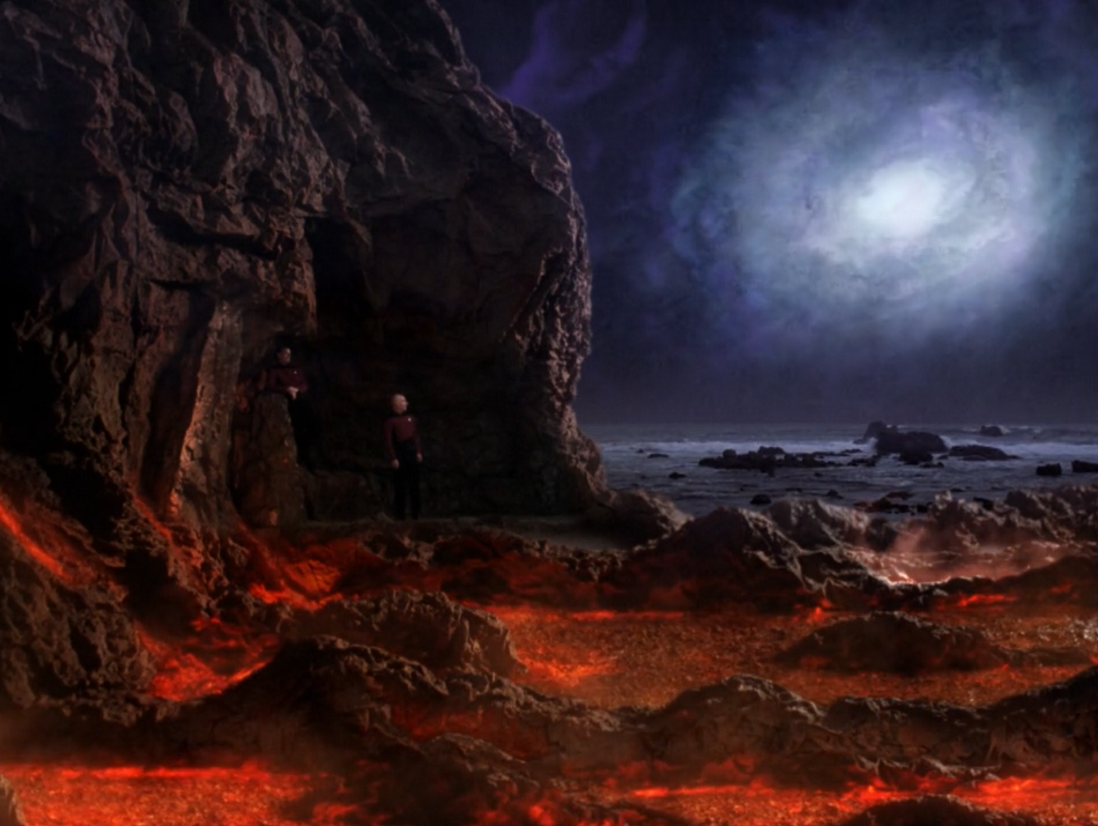
Still frame from Star Trek TNG All Good Things showing anti-time in the past
All Good Things’ anti-time eruption.

It was also a really creative idea to have one character split into two time periods, having to solve this puzzle from both ends. The way that time travel was integral to solving the mystery was handled just brilliantly, with Uhura from the future guiding her past self, and eventually setting up important things that would pay off a year later. But more than that, we got two different takes on Uhura – one that was, perhaps, a tad regressive and closer to her presentation in earlier seasons, and one that was very definitely trying to lean into the calm confidence of Nichelle Nichols’ character from TOS.

Last week, I talked about how Christina Chong took on a complex acting challenge – playing two different roles that had to come together. And Celia Rose Gooding stepped up to the plate this time to do something similar. Playing a younger version of a beloved character in a prequel is *already* a tough ask, so having to take on a version of Uhura who’s even closer to that familiar TOS presentation is even more of a challenge.

And Celia Rose Gooding nailed it.
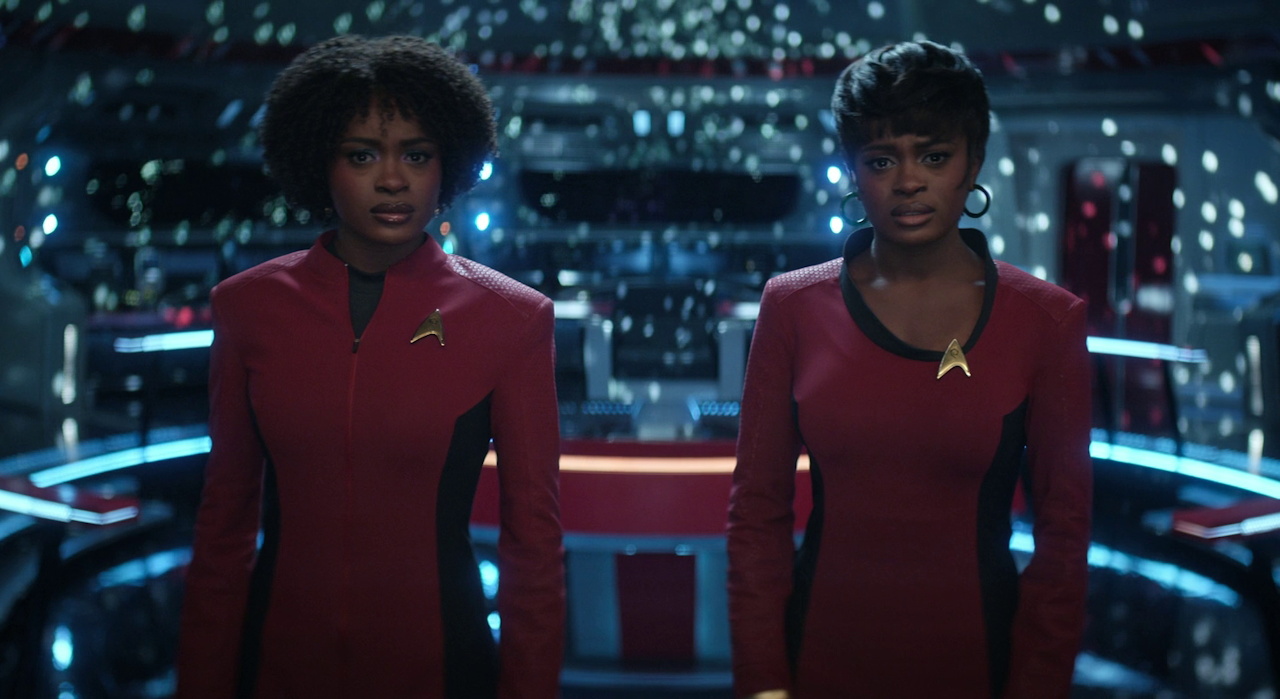
Still frame from Star Trek SNW 4x10 showing two Uhuras
A pair of Uhuras.

There’s a line to walk when differentiating two versions of the same character, and I don’t just mean costuming and hairstyles – though those did serve as important visual cues for us as the audience. In order to buy into the fact that one Uhura was older than the other, Tomorrow’s Enterprise played up – and, perhaps just a tad, exaggerated – these differences, and it worked well most of the time.

The only thing I’d say about that is that I felt maybe there was a bit more than just one single year’s worth of changes in between past and future Uhura. These were balanced between the two characters about as well as possible – with the younger version seeming to take a step back to become less secure and confident, and the older version becoming even more mature – which was a good call. And in a single episode of television, I think asking for too much subtlety would’ve lost something important; if both characters felt functionally the same, a big part of the episode’s core would’ve been lost.

But if Tomorrow’s Enterprise had been set, say, three years into the future instead of just one? Maybe it would’ve worked just a bit better!
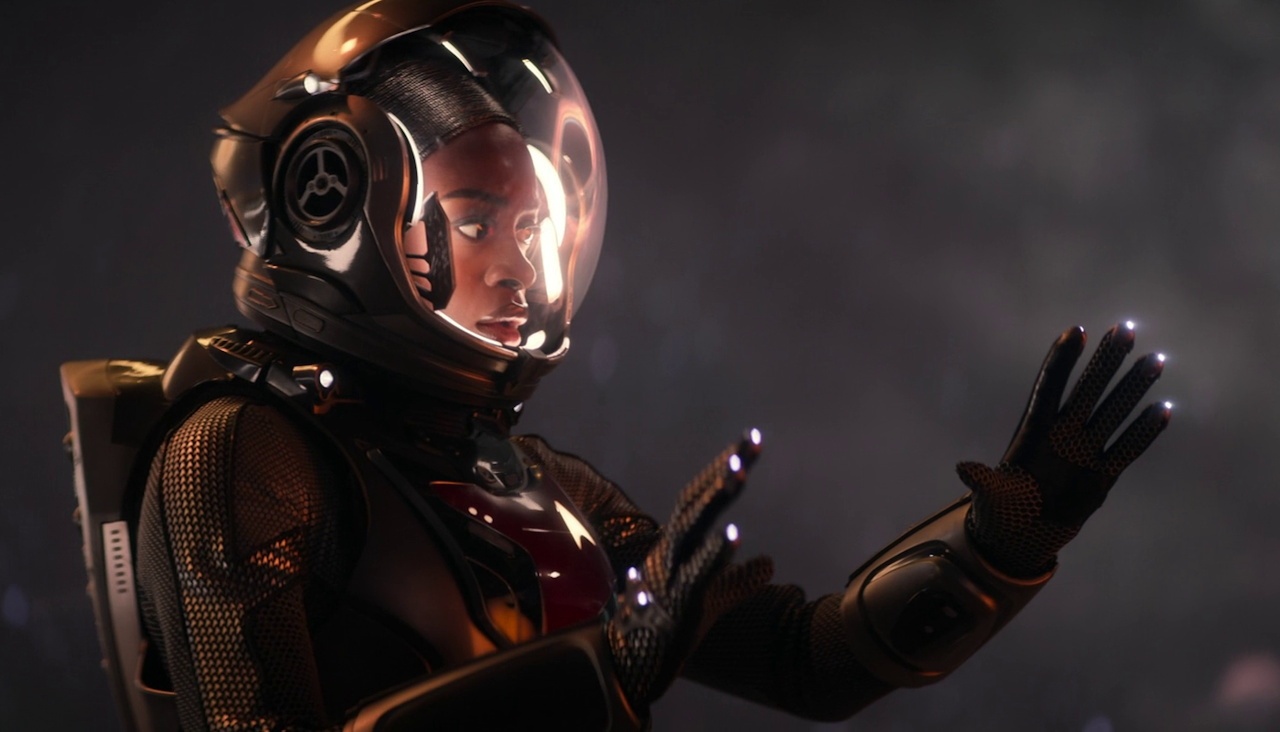
Still frame from Star Trek SNW 4x10 showing Uhura in an EV/space suit
Uhura jumped approximately one year into the future.

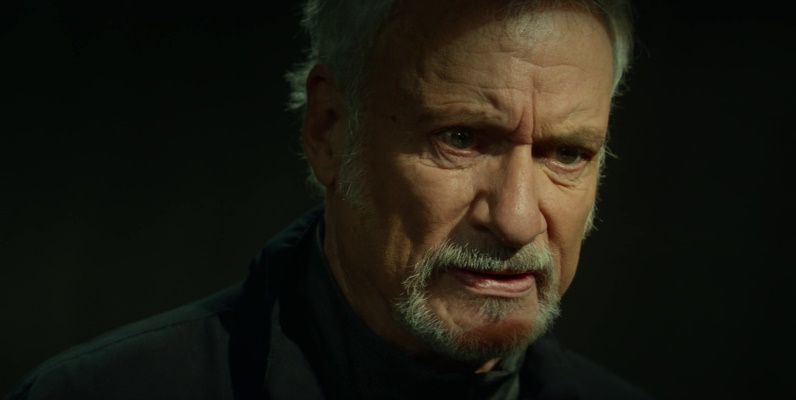
A longer time-jump could’ve also accounted for things like Ortegas’ apparent promotion – all the way from Lieutenant up to Captain, if Spock’s statement in the transporter room was accurate. Such things have happened before, of course, and Ortegas is an instructor rather than a starship commander… but even so. It was also interesting to see that Pike had been promoted not to “Fleet Captain,” as in The Menagerie, but to the full rank of Admiral. I wonder if that’s setting up a plot point that Strange New Worlds will revisit in Season 5… or if it was just a throwaway line.

To get back to Uhura, though, I stand by what I said after Orders of Magnitude: she’s gotten by far the best and most complete prequel arc on the series, taking her from a fresh-faced, uncertain cadet in Season 1 to now the literal embodiment of Nichelle Nichols’ character as of the end of Season 4. The way Uhura was written this time was pitch-perfect, the way Celia Rose Gooding was able to amplify different parts of the characters to sell the illusion of there being two temporally-displaced Uhuras was fantastic, and at every stage, Tomorrow’s Enterprise absolutely excelled as an Uhura spotlight episode.
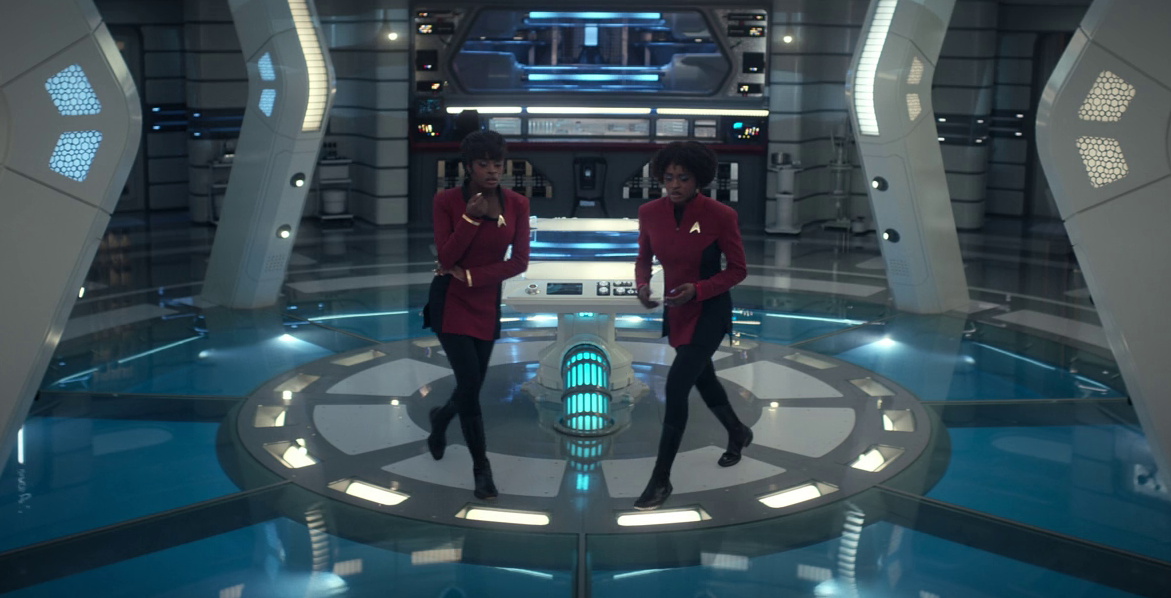
Still frame from Star Trek SNW 4x10 showing two Uhuras
We got two different – but related – takes on Uhura.

At first, I thought that Uhura was a bit of an odd choice to get a second major turn in this kind of role, coming just a couple of weeks after her excellent outing in Orders of Magnitude. But I can see the merits in putting a character like that into this kind of story – and it really did work incredibly well. Given where the episode wanted to take its time jump, with all of the TOS theming, it realistically demanded a TOS character to move between the two different eras, so Uhura was a great fit.

There was also the question of the black hole aliens’ transmission: as the Enterprise’s communications officer, Uhura was best-placed out of anyone in the crew to decipher this strange, musical message. I felt echoes of Season 1’s Children of the Comet, which had a similar musical influence, and was Uhura’s first major spotlight in Strange New Worlds, but these stories unfolded differently enough that neither treads on the toes of the other.
Promotional still from Star Trek SNW 1x03 showing Uhura
The musical side of the story reminded me of Season 1’s Children of the Comet – also an Uhura spotlight.

One thing I felt wasn’t particularly well set up was Scotty’s interest in a romantic relationship with Uhura, and her reaction to it. Obviously Scotty and Uhura have spent *some* time together over the past couple of seasons… but can you call to mind a moment between them in either Seasons 3 or 4 that might’ve so much as hinted at something like this? Because I can’t – and that put the brakes on this, at least for me.

I mean no disrespect to either Martin Quinn or Celia Rose Gooding, but I didn’t really feel much chemistry between their characters in Tomorrow’s Enterprise, either. Given that their relationship came from nowhere at the beginning of this episode, with absolutely no setup earlier in the season, we needed to feel *something* from the characters themselves to sell this. And while it wasn’t cringe-inducing or bad in any way, I just didn’t think it felt like a natural development for either of them. If anything, Scotty’s time on screen this season could’ve built up to some kind of crush on Ortegas, and Uhura, at least in Season 3, seemed to go back-and-forth a bit with Ortegas’ brother, Beto.

I just wasn’t feeling the spark, I guess, between these two established characters.
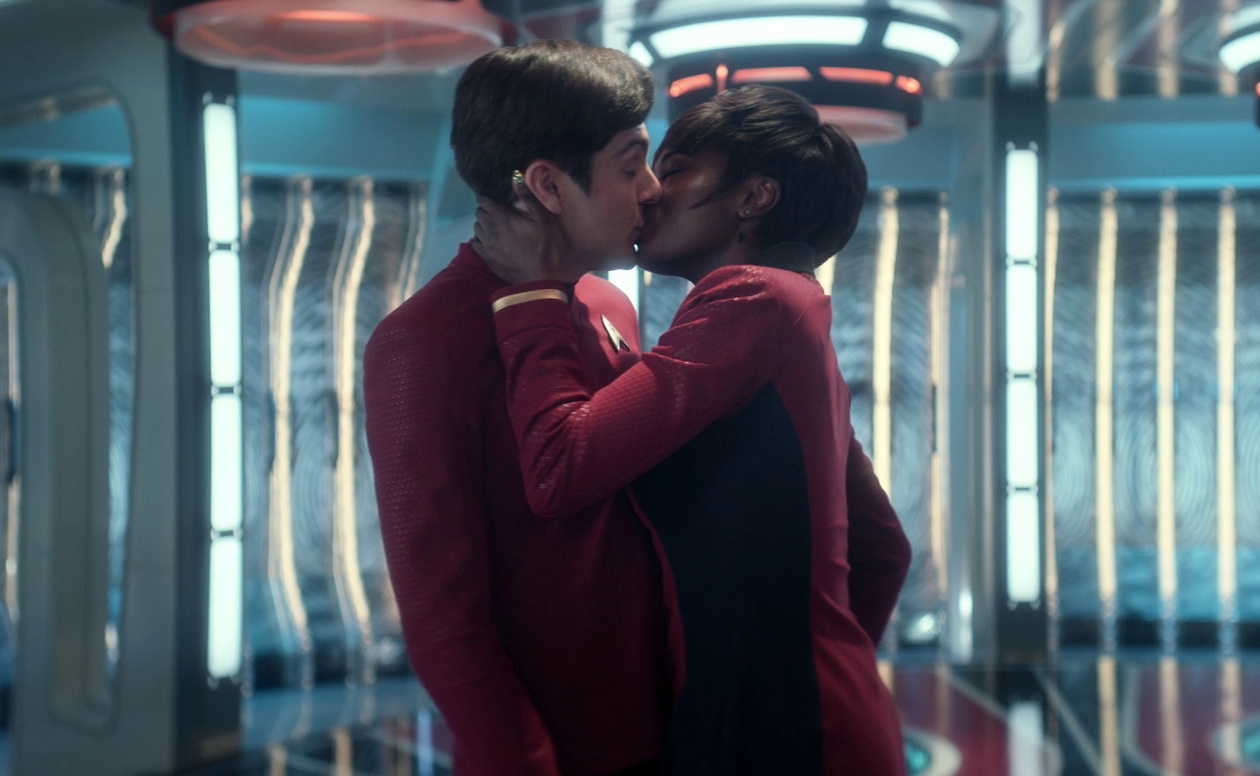
Still frame from Star Trek SNW 4x10 showing Uhura and Scotty kissing
Kissy kissy.

However, I’m not gonna argue that Uhura and Scotty having some kind of “casual” relationship or fling in the years before TOS is in any way a problem for “the integrity of canon!” All that’s required is to say that Scotty and Uhura had a moment, and that moment passed. People can get out of relationships and still remain friends or close colleagues, and I really don’t think that this is in any way a “canon-breaking” moment for either of them.

So this aspect of the story served a narrative function insofar as it gave Uhura more of a reason to want to save Scotty. Did Uhura need that extra motivation? Personally, I’d say “no,” and given that these two characters didn’t actually have much on-screen chemistry, *and* the aforementioned “prequel problem” meaning that Scotty never actually managed to feel like he was in real danger… I could’ve lived without it. Or, at the very least, I might’ve preferred it if the relationship stuff was limited to Uhura learning the key lesson of her arc: that sometimes it’s okay to “live in the now.”
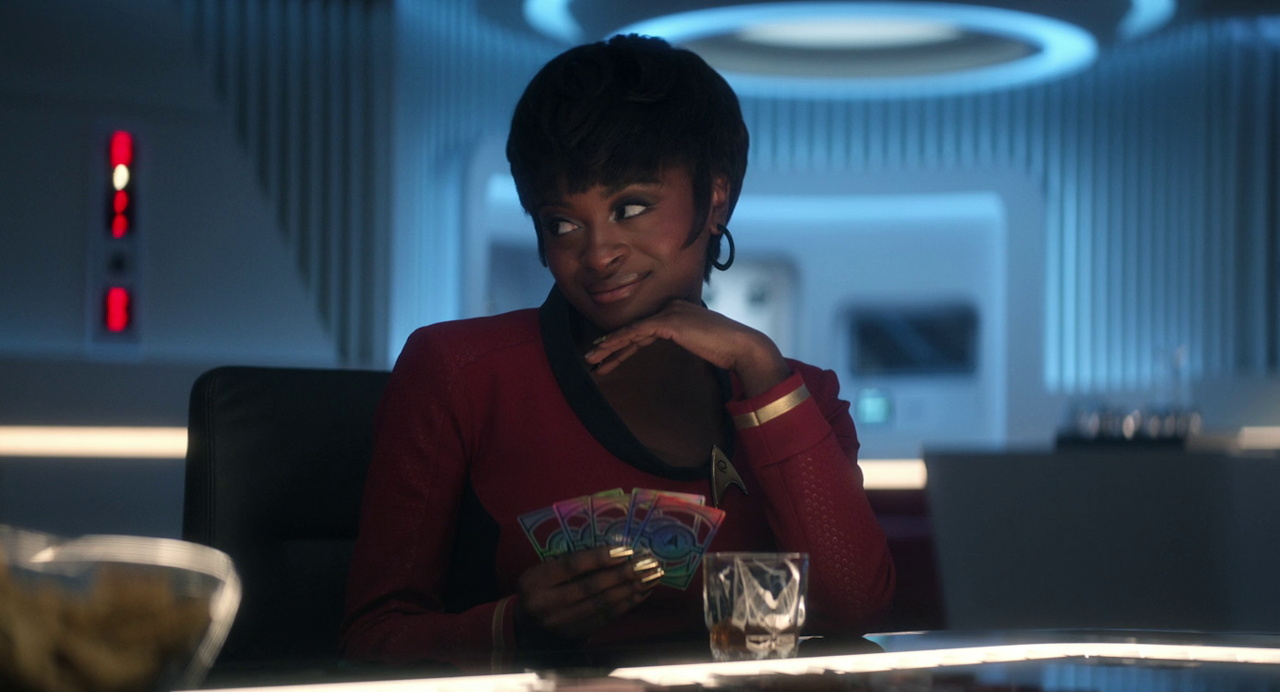
Still frame from Star Trek SNW 4x10 showing Uhura playing poker
Uhura playing poker at the end of the episode.

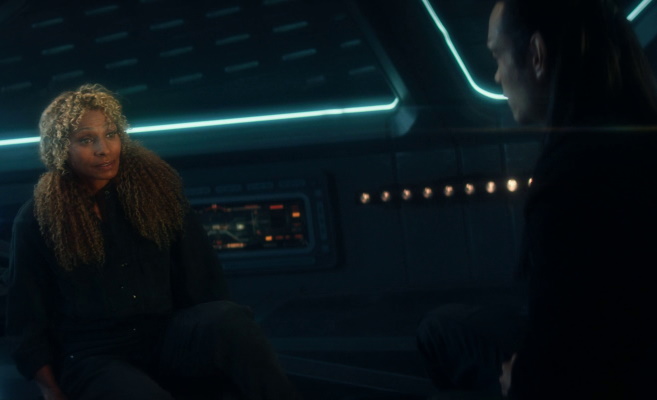
Uhura got moments with Kirk and Chapel that I really enjoyed, as well as her future counterpart’s scene with “Admiral” Pike. The mutual respect that Pike and Uhura showed for one another was played just perfectly, and despite Anson Mount not having a huge role in this week’s episode, what we got was more than enough to remind me of why I was so keen to see this “Captain Pike show” in the first place! It also felt bittersweet, as if both Pike and Uhura were saying a final goodbye to one another. In Uhura’s timeline, Pike’s accident shouldn’t have happened yet, and although he’s no longer a part of her day-to-day life… I’m not sure I understand why Uhura was treating the moment with such finality. However, from the point of view of us as the audience, looking in from outside, I think it worked really well. If Pike and Uhura don’t get another moment together before the show ends, this goodbye will still work.

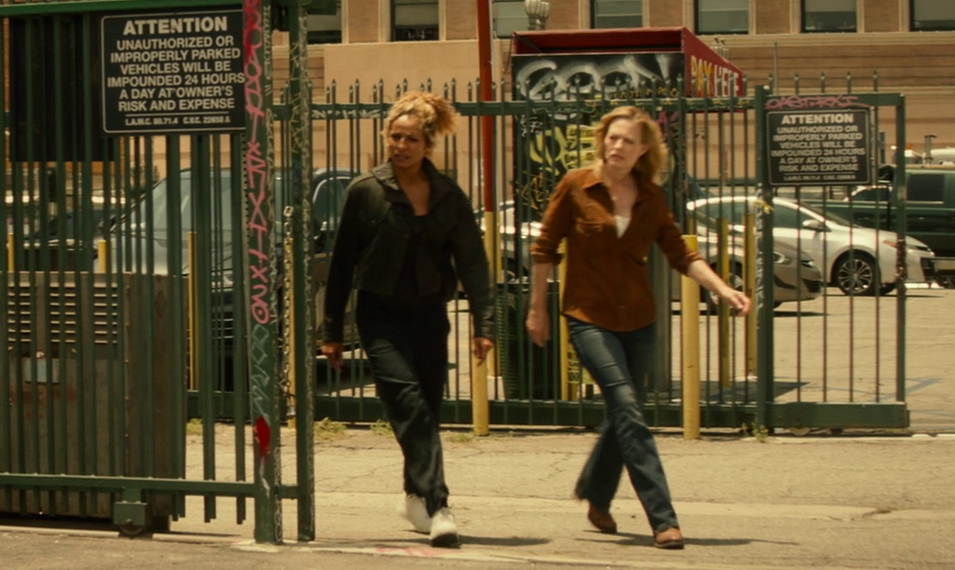
La’an and Uhura haven’t (to my recollection, anyway) spent much time together across all four seasons of the show. They’ve been present at the same time in some stories, and I’m sure they’ve at least spoken to each other… but I can’t really recall a single major La’an-Uhura storyline. So I liked that we got at least one scene between them, focusing on a conversation they had, before the show wraps up. La’an gave Uhura some useful advice about time travel based on her own experiences with it in Season 2, and I liked the way La’an had to be cagey in how she referenced what happened. It wasn’t the biggest part of the episode, but it was nice to give Uhura a one-on-one moment with a character she doesn’t always get to chat with.
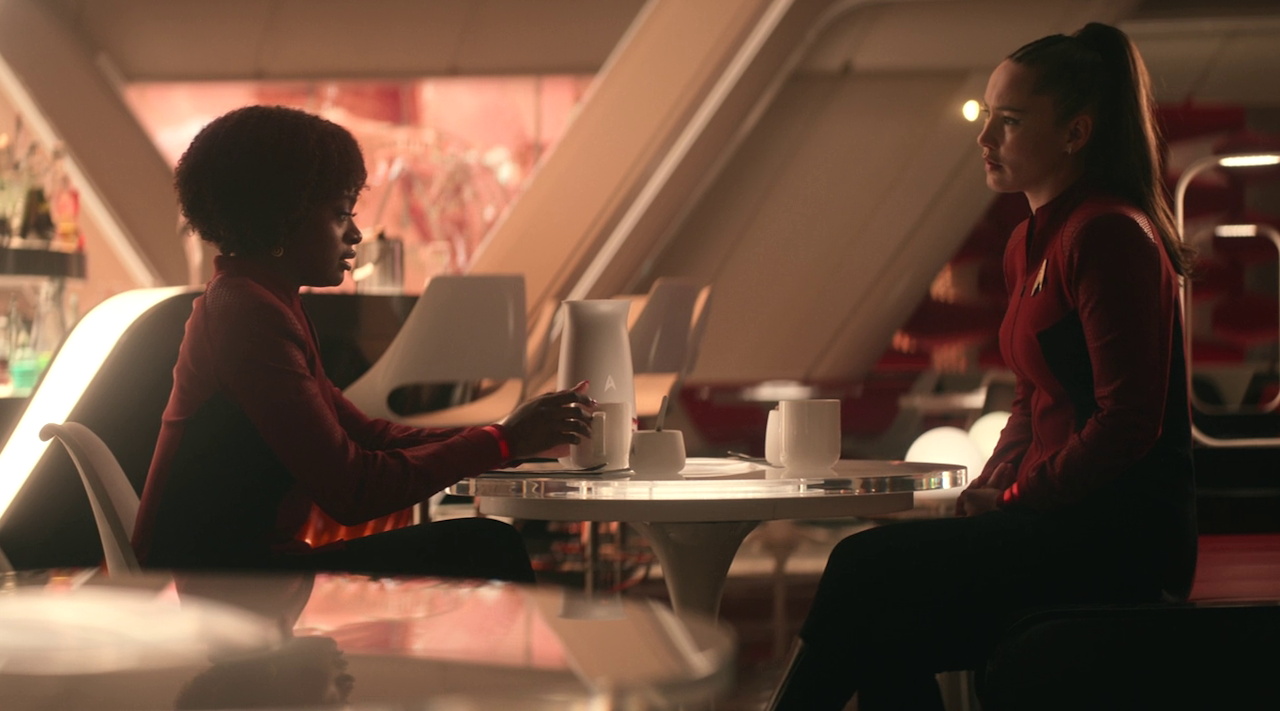
Still frame from Star Trek SNW 4x10 showing La'an with Uhura
La’an and Uhura talk time travel.

Star Trek can do action-packed stories very well – and some of those, from The Wrath of Khan to The Best of Both Worlds and beyond – are all-time fan favourites. But one of the core appeals of a franchise like Star Trek, at least to me, is that there are often scientific puzzles to solve, and ways to resolve stories that *don’t* require resorting to violence, phaser fire, and blowing things up. So I really appreciated that Tomorrow’s Enterprise was a purely scientific puzzle for Uhura and her counterpart to solve, not a story with a nefarious villain to be defeated.

And coming after Discovery, Picard, and other modern Star Trek shows have gone all-in on serialised story arcs with a massive, galaxy-threatening villain, conflicts, wars, and so on… this kind of story feels all the more refreshing. Some of Star Trek’s action-packed episodes are fantastic, don’t get me wrong, but a scientific puzzle like this feels… well, it just feels very “Star Trekky,” for want of another term.
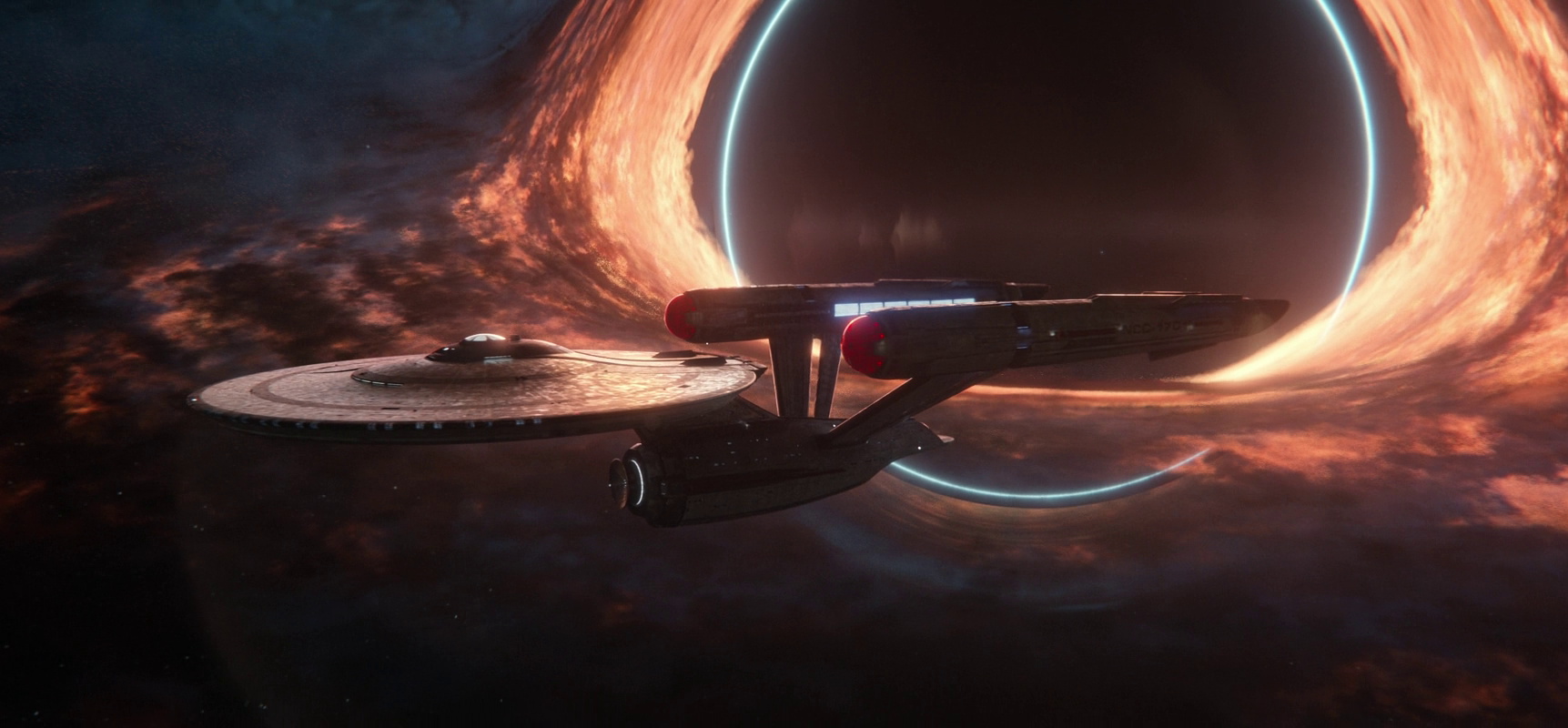
Still frame from Star Trek SNW 4x10 showing the USS Enterprise by a black hole
The episode’s scientific puzzle was fantastic.

In a similar vein, I felt that Tomorrow’s Enterprise didn’t overdo its character drama. Yes, the romantic relationship for Scotty and Uhura was new, and yes, that was a secondary motivating factor for her when it came to wanting to save his life. But it didn’t feel melodramatic in the way that Discovery might’ve tried to play a similar idea; Celia Rose Gooding played Uhura at just the right level to seem convincingly worried for Scotty’s safety without going overboard. Again, after missteps and failures elsewhere in modern Star Trek, I really appreciated that!

Earlier in the season, I heavily criticised The Griffin Incident for not having an actual ending or resolution to its story. And a story like Tomorrow’s Enterprise is a great example of something I said in my review of that episode: you don’t have to get a down-to-the-millimetre explanation of every aspect of an alien race or interstellar phenomenon in order to write a story that feels narratively complete.
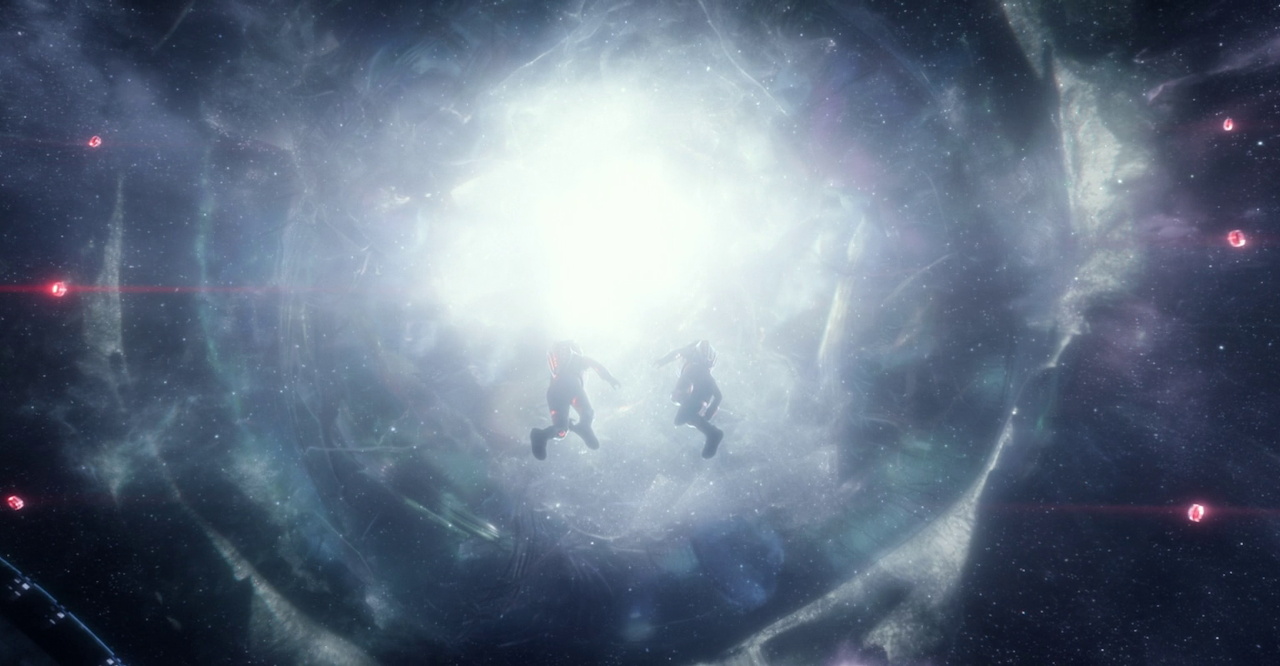
Still frame from Star Trek SNW 4x10 showing the "space baby"
The birth of a “space baby.”

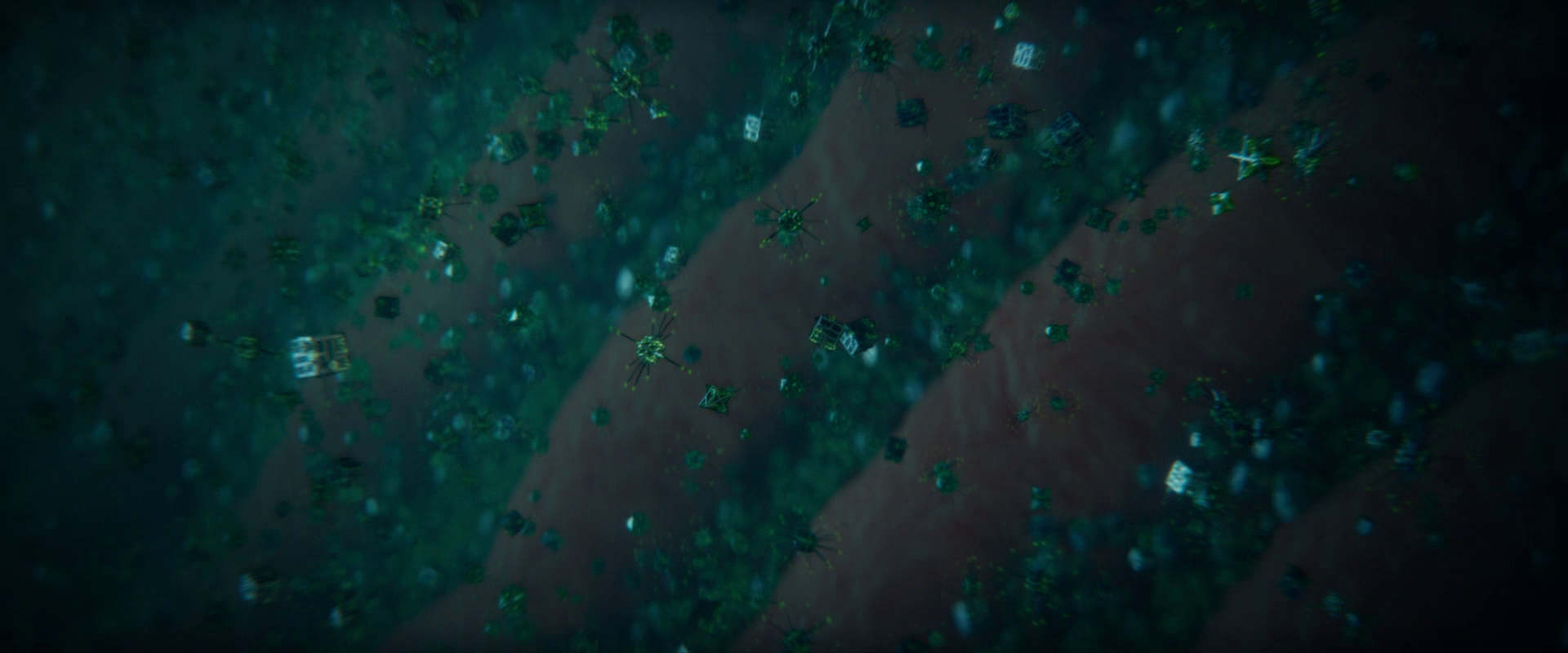
This week, we didn’t learn who the “midwives” were or what the “space baby” they were trying to deliver was. We didn’t learn why a black hole and a white hole were the incubator for this new life form, either. But we got enough from Uhura’s story to understand what was happening to her and to the other characters we care about, as well as what she needed to do to save a life – or two lives, really, including the baby – and restore the correct version of the timeline. We didn’t need a ton of technobabble about giving birth in space, black holes, or time travel, and we didn’t even need so much as a name for either of these aliens. We got enough from the story to make the ending feel satisfying – and compared to The Griffin Incident earlier in the season, that’s more than enough.

I will say, as an aside, that I didn’t really like the name “space baby” for this phenomenon! Though I will credit the episode with at least being self-aware enough of that silly name to have Uhura herself comment on it in the story.

I mentioned All Good Things (the TNG series finale) a moment ago, and there was one other way in which Tomorrow’s Enterprise seemed to borrow from that episode: the poker storyline.
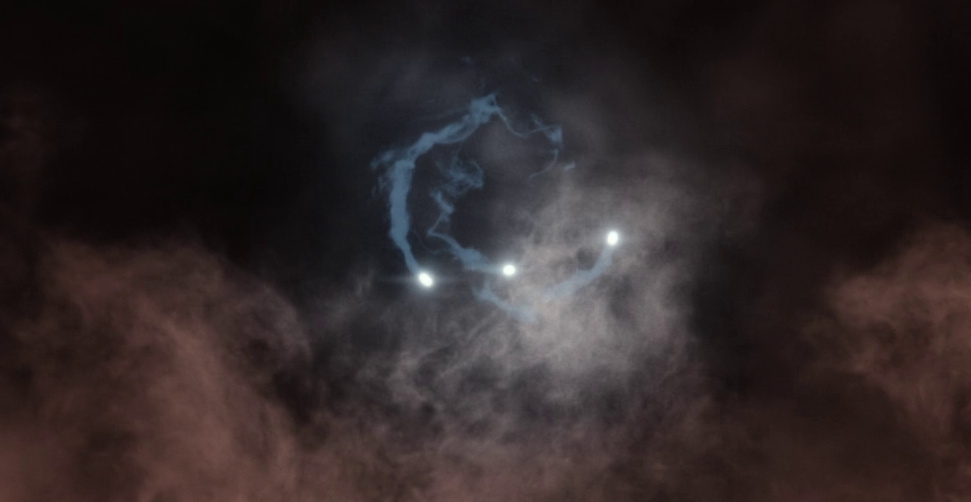
Still frame from Star Trek SNW 4x10 showing the "space midwives"
The “space midwives.”

We got an overhead shot of a poker table that felt eerily similar to the one in All Good Things (which was also copied in the Picard series finale, too), and the emphasis on Kirk and his crew playing poker together felt like it was drawing on a Star Trek tradition which has been present since The Next Generation. I think I’m right in saying that we never saw Kirk and co. playing cards together in TOS (though Kirk and Spock famously played chess, of course), but I liked that not only is this another way to show Kirk being closer and more friendly with his crew, but also how it’s another little through-line connecting different parts of the franchise together.

In this case, not only did the poker game have some relevance to the story – with Kirk able to suss out that Uhura was an imposter aboard his version of the Enterprise – but it also links Strange New Worlds not only to The Original Series, but to The Next Generation as well. The shot of Kirk, Uhura, and others playing cards together was a great way to close out the episode.
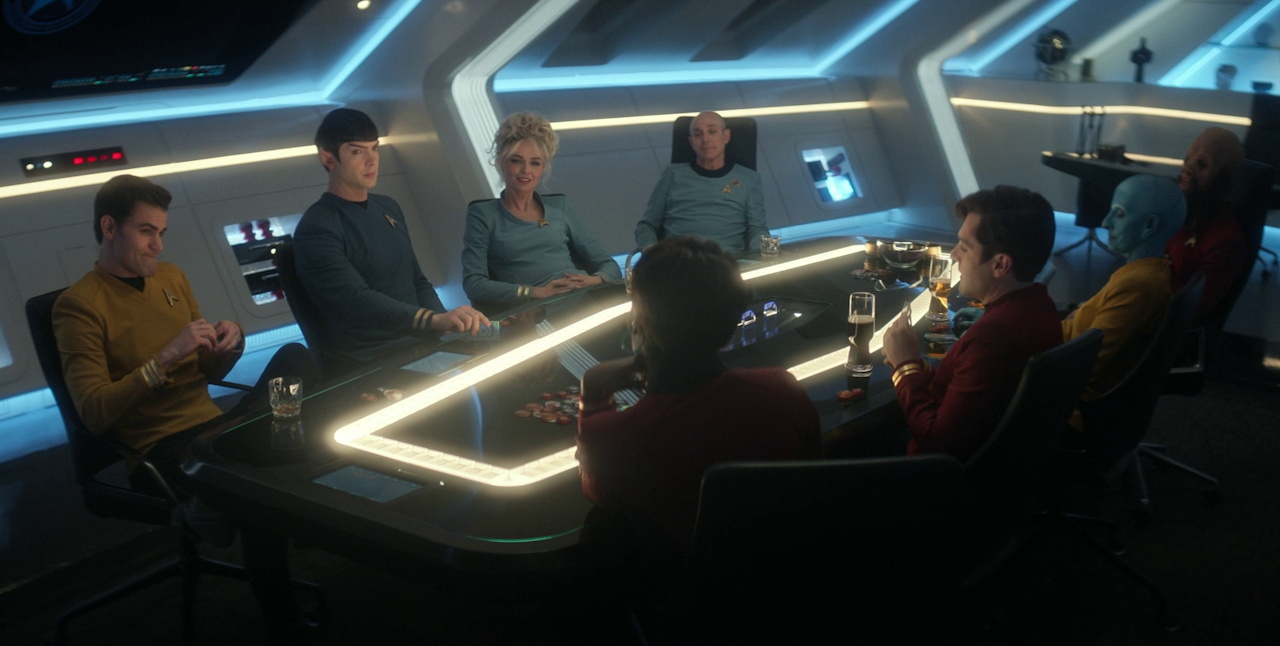
Still frame from Star Trek SNW 4x10 showing Kirk, Chapel, Spock, Boyce, Uhura, and Scotty at the poker game
The poker game links Strange New Worlds to The Next Generation in a fun way.

And I think that’s a good place to start to wrap things up!

Uhura got an epic time-splitting episode to end out the season, and while there are some disappointments as the curtain falls… mostly they’re in what we *didn’t* get to see rather than the way Tomorrow’s Enterprise itself comes across.

I was unsure, when I saw the promo images and the trailer, whether a time travel episode would really be good enough to draw a line under what has been, I’m sorry to say, an underwhelming season on the whole. And while I don’t think it was so stunningly spectacular that we can just forget all of the missteps and cock-ups in weeks gone by – looking at you, Level-Five Writing Accident – I think we can at least say that the season ended with one of its strongest episodes.
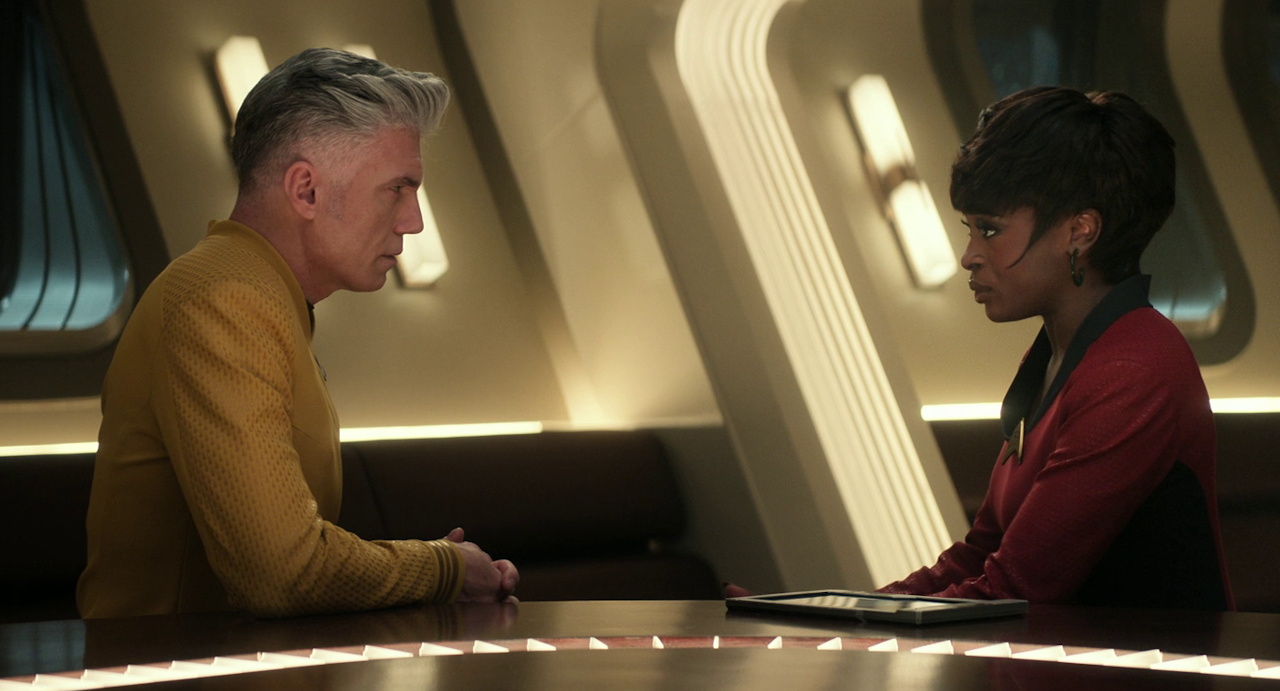
Still frame from Star Trek SNW 4x10 showing Pike and Uhura
Captain Pike with Uhura.

In the days or weeks ahead, I’ll write up my preliminary thoughts on where Strange New Worlds stands ahead of Season 5, so I hope you’ll join me for that. And before Season 5 airs next year, it’s my hope that I’ll have time to write up re-watches of all ten Season 1 episodes, too; Paramount’s utterly ridiculous decision to cut the show off from international fans meant I didn’t write episode reviews back in 2022. So, again, please join me for those if you can!

I have reviews of every episode from Seasons 2, 3, and 4 – you can find them by clicking or tapping here. Earlier this year, I also reviewed Starfleet Academy’s first season, which you can find by clicking or tapping here, and the Star Trek: Voyager video game Across The Unknown, which you can find by clicking or tapping here. And if you missed my celebratory piece for Star Trek’s sixtieth anniversary earlier in September, you can find that by clicking or tapping here.

There’s more to come here on the website, though, even as Strange New Worlds goes off the air! I have reviews of other films, games, and TV shows in the works, and there’s bound to be more to say about Star Trek, too! The Star Trek franchise will be at New York Comic-Con next month, and there could be a trailer or teaser clip for Starfleet Academy Season 2, and perhaps something for Strange New Worlds Season 5 as well. If and when we get news or trailers for either of those, I’ll do my best to cover that here on the website. Next month will also bring us the video game Outposts Unknown, which I covered the demo of a while ago, so I’ll try to take a look at that, too.

Thanks again for joining me for this review. And, as always… Live Long and Prosper, friends!


Star Trek: Strange New Worlds Seasons 1-4 are available to stream now on Paramount+ in countries and territories where the platform is available. The first three seasons are also available on DVD and/or Blu-ray. The Star Trek franchise – including Strange New Worlds and all other properties discussed above – is the copyright of the Skydance-Paramount corporation. This review contains the thoughts and opinions of one person only and is not intended to cause any offence.
Star Trek: Picard review – Season 2, Episode 8: Mercy

Spoiler Warning: There are spoilers ahead for Star Trek: Picard Seasons 1-2. Spoilers are also present for the following Star Trek productions: The Next Generation, First Contact, and Voyager.

Picard Season 2 certainly has enjoyed its episode-ending mini-cliffhangers! I think we’ve had one in every episode now, and last week’s outing, Monsters, ended with Picard and Guinan being apprehended by the FBI. This led to an episode that felt like the season’s second detour in a row, one which dedicated a lot of its runtime to a new character, his background, and a run-in with Vulcans decades in the past.

Agent Wells may yet have a larger role to play, but with only two episodes remaining in the season, it feels like there’s a heck of a lot of story to get through. Mercy made some progress to that end, but it also got bogged down in places, and I feel like the writers aren’t always aware of the time constraints that a ten-episode season has placed on them. The last thing I want, as the season reaches what should be its climax, is for there to be a repeat of the Season 1 situation. At least in that regard we can say that most of the characters and storylines are now in play… but some feel a long way from being wrapped up.

Picard in Mercy.

I didn’t dislike Mercy, though, all things considered. Unlike in Monsters, where the time spent with a comatose Picard felt padded at best, there was purpose to (most) of the story threads weaved in this week’s outing. And if you’ve been keeping up with my reviews this season, you’ll know that I’ve been saying for several episodes now that I wanted Picard to refocus its energies around the Borg Queen story: well, wish granted! Mercy spent much more time on what I consider to be the season’s more interesting story – and one that feels closer to Star Trek’s high-tech 25th Century.

One question I have that feels unexplained right now is how Dr Adam Soong finds himself with such resources at his disposal. As the episode drew to a close he spoke on the phone with someone identified as a “general,” and was able to hire a private military company to assist in the Borg Queen’s mission to capture La Sirena (something I’d been predicting she’d do for a couple of weeks!) But where has Dr Soong found the ability to do something like that?

Where did Dr Soong get the resources and connections to hire a private military company?

When we met Dr Soong in Fly Me To The Moon, he had been expelled from the scientific community, his licenses had been revoked, and he seemed to have lost everything. He still has a fancy house, so clearly he’s someone of financial means, but that shouldn’t allow him to just call up a general and buy mercenaries, no questions asked. I should’ve posed this question a couple of weeks ago when we encountered Dr Soong at the astronauts’ gala – how had he managed to buy his way onto the board of the Europa Mission when he’d been kicked out of the scientific community for his illegal and unethical research?

I doubt it’s a question that Picard has an answer for, and it’s a contrivance that we’ll probably just have to overlook. Still, given the way Dr Soong appeared during his encounter with the board and the consequences he suffered as a result of his work, it feels odd – and more than a little convenient for the sake of the story – that he’s someone with the resources and connections to be of use to both Q and the Borg Queen.

Dr Adam Soong.

One neat inclusion on this side of the story seems to explain why the people from the Confederation timeline that we saw in Penance venerate and celebrate Dr Soong so long after his death. The planetary shield that was keeping Confederation Earth on “life-support” seems to be one of Dr Soong’s most significant inventions – and we saw a smaller-scale version of this technology a couple of episodes ago. Drones that Dr Soong controlled put up a kind of shield to protect Kore from the sun – and it seems like he upscaled that technology to protect Earth from an “ecological collapse.”

The Borg Queen was able to very effectively manipulate Dr Soong, using his desire to have a legacy to leverage him to work for her. She must have something planned, though, because remember in the Confederation timeline the Borg had been wiped out. Establishing that timeline is categorically not in the Borg Queen’s interest – and indeed preventing it from happening is why she agreed to assist Picard in the first place. So Dr Soong is clearly in a lot of danger!

The Borg Queen continues to assimilate Dr Jurati.

Sticking with the Soongs, I’m really hoping that Kore has some unknown role yet to play, because right now she feels like fluff; an extraneous character who’s just here to give Isa Briones something to do in Soji’s absence. Kore may exist solely to inform aspects of Dr Soong’s character, but spending time with a fairly one-dimensional character like that doesn’t add a great deal to the story of the season overall. Her story this week continued to be incredibly repetitive, paralleling Soji and Dahj’s stories in Season 1. Kore pressed her father about her artificial origins – a genetic experiment, in this case, as opposed to being a synth – in a way that was very reminiscent of Soji learning her own backstory in the Season 1 episode The Impossible Box.

Even if characters like Kore and Agent Wells have roles to play in the next couple of episodes, I’d still argue that we probably spent too much time focusing on them this week. These are brand-new characters (albeit that one is played by a main cast member) and we just don’t have the same investment in their stories as we do in those of Picard, Raffi, Seven, Rios, and Dr Jurati. There was scope, perhaps, to cut down some of these sequences and spend more time with the main characters.

Kore Soong.

Having dedicated a lot of words to the presentation of Rios in my previous couple of reviews, I’ll try to avoid being too repetitive here. Suffice to say that Rios’ regression shows no sign of letting up, and the romantic sub-plot he’s now in with Teresa actually amplifies the sad decline in his characterisation compared with where he was at the beginning of the season. As with Kore being created to give Isa Briones something to do, I feel like the writers have invented these moments for Rios out of nowhere, dragging him backwards in terms of what could’ve been a satisfying character arc while simultaneously leaving him pretty disconnected from the rest of the story.

Think about this: when was the last time Rios said two words to Picard? Aside from a very brief conversation with Raffi when the gang infiltrated the astronauts’ gala, when was the last time he spoke to her, either? Or to anyone other than Teresa, come to that? Rios got one significant moment this week, as he identified a problem with La Sirena’s transporter that has a bearing on the stories involving Raffi, Seven, and the Borg Queen. But that moment wasn’t necessarily a “Rios” moment; it could’ve been anyone who discovered the Borg code in the system.

Rios working on La Sirena’s transporter.

As speculated in my last theory post, I wonder if Rios is being set up for an heroic death sometime before the end of the season. Skip this paragraph if you’re concerned about Season 3 spoilers, but after Paramount announced that the main cast of The Next Generation would be coming on board for Picard Season 3 in a big way, it’s not at all clear what that means for the current crop of characters. With Elnor already gone and Soji sidelined, killing off Rios and perhaps the Borg Queen in Dr Jurati’s body would only leave Seven of Nine and Raffi heading into Season 3, and that feels like it could be a more manageable number of characters for another ten-episode outing.

In short, Rios may be drawing the short straw here. His story of being detained and deported was a timely one that shone a light on America’s problem with immigration and the way migrants are handled, and as a Hispanic man, Rios clearly fit the bill for that story from the writers’ point of view. But when that story ended, Rios felt listless. Cut loose by the series and serving a pretty minor role in terms of the main story, his side-story with Teresa could be an attempt to give emotional weight to Rios’ potential death. By showing us his love for Teresa – and thus presumably her reaction to his death – Picard may be trying to score some added emotional points when the moment finally comes.

Rios with Teresa aboard La Sirena.

We learned some really interesting details about the Borg in an understated way thanks to Seven of Nine and Dr Jurati. Mercy may go on to be an important episode that future Borg stories can call back to, and as a Trekkie I’m always fascinated by the minutia of how things like Borg assimilation actually work! In the case of a normal Borg drone, they’re able to assimilate someone by forcing nanoprobes into their body. The nanoprobes bring with them the metals and materials needed to self-replicate, and it sounds as if this process has been honed by the Borg over a long period of time. The process relies on high-quality materials that the Borg must produce or refine somehow.

Without any nanoprobes of her own, or with a very limited number, the Borg Queen inhabiting Dr Jurati’s body must acquire the raw materials to construct more – and this is where the idea of taking lithium from batteries came into play in one of the series’ most disturbing sequences to date! The striking visual presentation of Dr Jurati with the wrecked cars drew on things like zombie fiction in a really tense and horrifying way.

This was an incredibly shocking way to see Dr Jurati, and it felt like it was inspired by zombie films.

I love everything about this side of the story. The concept that the Borg Queen needs to acquire resources, the way in which she’s going about it, the fact that the 21st Century doesn’t really provide her with what she needs… all of this works so incredibly well. In addition to exploring more about Borg technology and Borg assimilation, which would be fascinating in its own right, the story that’s unfolding is engrossing and exciting.

After several episodes in which this side of the story felt like an afterthought, giving it a proper moment in the spotlight felt cathartic. This is the kind of storytelling I’ve been wanting ever since Season 2 took us on this mission back in time, and while it’s come pretty late in the game and in an episode that had those other less interesting elements, I’m glad we finally got to see more from the Borg Queen.

Newly-created Borg nanoprobes.

Seven of Nine was at her best on this side of the story, showing off an emotional and vulnerable reaction to being face-to-face, once again, with the Borg. Her confrontation with the partially-assimilated Dr Jurati clearly brought back bad memories, and led to a minor conflict with Raffi – understandably so, perhaps, but I’m glad it was resolved and didn’t descend into a major relationship drama!

One of the best things that Picard has done has been to give Seven of Nine some much-needed character development, and seeing her reacting like this – in a very human, emotional way – is further evidence of that wonderful arc. I said when Seven was reintroduced in Season 1 that she’d become one of my least-favourite Voyager characters toward the end of that show’s run, and the reason for that was how boring and repetitive she was (combined, perhaps, with the fact that she was overused by the show’s writers). Seven would learn some lesson in “how to be human” one week, then forget it all by the next episode, leaving her feeling static and undeveloped. Picard has completely reworked her character in a way that feels natural; that she’s made genuine and lasting progress since the events of Voyager, now twenty-five years in her past.

Seven of Nine in Mercy.

This progression of Seven’s arc has been shown in a new light by bringing her back into conflict with the Borg. The decision to remove her Borg implants for Season 2 – including, as she noted this week, internal implants that aren’t seen – has added to this new, more human presentation. Coming face-to-face with the Borg again is already proving to be traumatic for her, bringing up awful memories that she can’t escape.

We saw this in Season 1 with Picard himself, particularly in the episode The Impossible Box when he boarded the Artifact. But rather than feeling like a redux of that story, Seven’s feels unique. The way she reacts, as someone who had been assimilated at a much younger age and who remained a member of the Borg Collective for much longer, is completely different to the very visceral reaction that Picard had. Jeri Ryan and Michelle Hurd played off one another perfectly during these sequences, processing Seven’s trauma while also trying to stay focused on the task at hand.

Raffi and Seven of Nine tracked Dr Jurati to a car park.

Speaking of trauma, Seven isn’t the only one dealing with it. Raffi is also coming to terms with Elnor’s death, and while she had been hoping that restoring the timeline might save his life, I think we got another significant hint here that that isn’t going to happen. In a flashback sequence we saw how Raffi had persuaded Elnor to remain at Starfleet Academy instead of returning to Vashti, “manipulating” him, to use her and Seven’s words. This is making her feel even more responsible for Elnor’s death.

Coming to terms with trauma can require someone to confront unpleasant truths about themselves, and while I wouldn’t say what Raffi did with Elnor was excessive or horribly manipulative, she recoginises that the way she reacted to him – and the way she treats others in her life, including Seven – can come across that way. Her desire to get the right outcome for herself can be overriding, and she knows just what to say to people to get them to do what she wants. I’m not sure what the series plans to do with this revelation, but if Raffi sticks around going into Season 3, perhaps it’ll be something she consciously tries to work on.

Raffi with Elnor in the flashback.

We got confirmation of a theory that emerged as far back as Penance: there’s something wrong with Q. Q believes that he’s dying, as evidenced by his declining powers, and although he seemed somewhat accepting of it at first, he’s clearly rattled and unsure of what’s happening to him. We have no indication right now of what might’ve caused Q’s declining health – nor how far Picard may be involved. After several episodes in which this has been teased, going all the way back to the second episode of the season, I really hope we get a proper and thorough explanation for why Q is dying (or for whatever else might be happening to him) before the story concludes.

One line from Q was particularly interesting: he told Guinan that: “the trap is immaterial; it’s the escape that counts.” To me, that feels like it embodies Q’s entire philosophy, at least insofar as his dealings with Picard are concerned. He sets puzzles not for their own sake, but to see how Picard will react and respond. He judges those reactions, as we saw throughout The Next Generation, but he also possesses a curiosity – he genuinely doesn’t know what Picard will do, and he wants to see it for himself. In that sense, Q is almost, in his own very twisted way, studying Picard and humanity.

Guinan and Q talked in the FBI office.

There were other interesting snippets from Q’s conversation with Guinan. The idea of a “temporal horizon” being part of how members of the Q Continuum perceive the universe is a neat concept, helping to visualise for us as the audience something that’s fundamentally difficult to grasp. Q experiences time in some kind of linear fashion, even though he’s able to travel to different eras at will. His own personal past is still in the past, and he has a future – except that his future is now something he cannot see or perceive. It’s a complex thing to wrap one’s head around, and I’m not entirely sure I’ve fully understood it nor successfully communicated my interpretation of it! But suffice to say that I think we have a better understanding of the Q Continuum after Mercy.

One word that Q used almost passed by unnoticed: “redeem.” Does Q believe that what he’s doing right now is some kind of redemption for himself? If so, is the “penance” he told Picard about earlier in the season part of some kind of punishment he’s inflicting not upon Picard, but upon himself? How would showing Picard a warped, broken timeline redeem Q? And, come to that, what is he seeking redemption from? There are a lot of unanswered questions!

What could Q be seeking redemption from?

As Q showed Guinan the extent of his failing powers, it raised a question that I’d been contemplating since before the season aired (and that has been part of my theory list). Is Q truly responsible for breaking the timeline in the first place? Picard assumed so when Q first reappeared, but as he seems to be losing his powers, it seems plausible to suggest that making such a dramatic change is no longer something that Q is capable of.

In addition to all of that, we have the question of cause-and-effect. When Q emerged at the end of The Star Gazer, the damage to the timeline had already been done. Yet recent episodes have shown us Q running around in the 21st Century seemingly trying to enact the change to the timeline that Picard hopes to prevent. In The Star Gazer and Penance, Q seemed to be in full possession of his powers, even changing his appearance. But if those events happened after what we’re seeing now, from Q’s perspective, does that mean he got better? Or did he somehow break the timeline, travel back in time to continue to observe Picard, and then start to lose his powers? My head hurts!

Are we seeing Q before or after the events of The Star Gazer?

Picard and Guinan’s interrogation by Agent Wells was interesting, but as stated above I think it ran a little too long and took us on a bit of a detour. If Agent Wells comes back and has a significant moment later in the season, maybe that will be excusable; just one part of an evolving and developing story. But if this is to be his sole appearance, it’s certainly an odd choice for the season to have dedicated so much time to his character and backstory. The entire “apprehended by the FBI” story thread could’ve been cut out, with Picard and possibly Guinan joining the hunt for Dr Jurati instead. We’ll have to wait and see what comes next before passing judgement.

One storyline that the FBI interrogation successfully wrapped up was Rios’ missing combadge. This had fallen by the wayside in recent episodes, and after the point of divergence in the timeline was revealed to be the Europa Mission, its potential importance slipped away. It came back this week in an interesting way, but ultimately this was little more than a bluff and a tease – not only from Agent Wells to Picard, but from the show’s writers to us as the audience! The combadge could’ve ended up as a “butterfly,” with its unknown impact rippling along the timeline. As it is, Agent Wells gave it back to Picard and it can once again disappear from the plot.

Agent Wells interrogating Picard.

The Vulcan sub-plot was interesting, and certainly served to give motivation to Agent Wells as he pursued Picard, Guinan, and all things alien. It also led to a moment with Picard that one again highlighted his calm, diplomatic style, and that’s something I’ll never tire of seeing! However, if there was supposed to be a connection with the Enterprise episode Carbon Creek, which saw Vulcans on Earth in the 1950s, it wasn’t particularly well-established by the short flashback sequence that we got.

More could’ve been done to show what the Vulcans were doing on Earth, or even to establish that young Agent Wells was in the town of Carbon Creek, for instance. That would’ve been a fun easter egg to long-time fans. As it is, the connection is more implicit than explicit – which is fine, I guess! But in a story about time travel that hasn’t had many opportunities to connect to the wider franchise (aside from a few references to The Voyage Home and Past Tense) this kind of feels like a missed opportunity to make a solid connection.

A pair of Vulcans on Earth sometime in the 1960s-1970s.

Storylines in which the hero is apprehended by the authorities while on a time-sensitive mission can be irritating for me. I can find myself feeling frustrated and wanting to shout at the show or film to “just get on with it!” But to Mercy’s credit, that didn’t really happen this time around. The episode was entertaining, and even though the FBI interrogation sequences weren’t the highlight, they were well-paced and inoffensive enough. My hope now is that there’ll be some bigger point to all of it – something to tie together Picard, the Borg Queen, Q, and the rest of the characters and storylines currently in play.

So that was Mercy. We got some significant development of key storylines, but those developments have come pretty late in the season – and there’s still a lot of work to do if we’re to see everything neatly wrapped up in just two weeks’ time. I’m hopeful that Picard has an ace up its sleeve – possibly even a season-ending cliffhanger – that will make the detours and side-stories feel worthwhile rather than like fluff.

What I will say in praise of Mercy – and of the show’s writing as a whole – is that the end of the season feels far from formulaic. I can’t tell what’s going to happen next, nor what the ultimate destination of this story is. Several characters feel in imminent danger – Q, Rios, Dr Jurati, Dr Soong, and even Seven of Nine and Raffi. But what will come next for any of them is still up in the air. The only thing we know for certain right now is that the Borg Queen plans to make a move on La Sirena. Rios is aware of that, but with Picard and the others stuck half a world away, will they be able to get there in time? I have no idea… and after more than thirty years as a fan, I love that Star Trek can still take me on a rollercoaster ride that goes in wildly unpredictable directions!

Star Trek: Picard Season 2 is available to stream now on Paramount+ in the United States, Scandinavia, Latin America, and Australia, and on Amazon Prime Video in the United Kingdom and the rest of the world. The Star Trek franchise – including Picard and all other properties mentioned above – is the copyright of Paramount Global. This article contains the thoughts and opinions of one person only and is not intended to cause any offence.
Twelve Star Trek episodes to watch before Picard Season 2 arrives!

Spoiler Warning: There are spoilers ahead for Star Trek: Picard Season 1 and the trailers and teasers for Season 2. Spoilers are also present for the following Star Trek productions: The Original Series Season 1, The Next Generation, Deep Space Nine Season 3, Voyager Seasons 2, 3, and 7, and First Contact.

It seems an age ago that we were eagerly anticipating Season 1 of Star Trek: Picard. In those sunlit, rosy days before the pandemic hit, this website was brand-new, and I spent a lot of time in December 2019 and January 2020 looking ahead and wondering what we’d see when the Star Trek franchise finally returned to the 24th Century – after an eighteen-year wait!

With Season 2 of Picard now only days away, I thought it could be fun to revisit a concept from the early days of the website: a list of episodes that I think could make for interesting background viewing, potentially informing story points and characterisations in the new season of Picard. In the run-up to Season 1 I focused on episodes of The Next Generation that strongly featured Captain Picard himself, as well as a few stories about the Romulans, and a few more stories which could’ve potentially led to big changes in the two decades following the events of Endgame and Nemesis.

We’ll soon be on another adventure with Jean-Luc Picard!

This time, we have a little bit more information to go on! Season 2 will tell a story that involves (to a greater or lesser degree) the following elements: the Borg Queen, Guinan, Q, time travel, and, of course, Admiral Picard himself. On this occasion, then, I thought it could be fun to pull out twelve stories from Star Trek’s past that might just be useful background viewing for Season 2 of Picard. It goes without saying that Season 1 is mandatory viewing, so I’m not putting any of those episodes on this list! You should really watch, or re-watch, all ten before the season kicks off!

My usual caveats apply, as they always do! Firstly, everything listed below is entirely subjective. If I miss out an episode that you think is incredibly important, or you hate all of my picks, that’s okay! We all have different opinions about Star Trek, and there’s no need to fight about it. Secondly, I don’t claim to have any “insider information.” I’m basing my theories and guesses about Season 2 on publicly released material, such as trailers and interviews. And finally, the episodes are not ranked; they’re merely listed below in the order in which they were originally broadcast.

With all of that out of the way, let’s jump into the list!

Number 1:
Tomorrow is Yesterday
The Original Series Season 1 (1967)

I’m pretty sure this violates the Temporal Prime Directive…

Though The City on the Edge of Forever is perhaps the best-known of The Original Series’ time travel stories, Tomorrow is Yesterday preceded it by several months. It was the first episode of the Star Trek franchise where time travel played a major role in the story, and it was also the first in which the crew paid a visit to the modern day. Tomorrow is Yesterday established what went on to become a mainstay in terms of the franchise’s time travel story tropes: being sent back in time by accident!

Aside from being a fun episode in its own right and well worth a watch, Tomorrow is Yesterday is also the episode which introduced the Star Trek franchise to something that appears to be making a return in Picard Season 2: the slingshot method of travelling through time, referred to in this episode as the “light-speed breakaway factor.”

The USS Enterprise using the “light-speed breakaway factor” to travel through time.

Almost every Star Trek series has included the occasional time travel story, and we can look to episodes like Tomorrow is Yesterday for creating that premise. Visiting the modern world would go on to be significant later in The Original Series, in Star Trek IV, and on several other significant occasions in the franchise. For me, some of these stories can feel rather dated, but I think Tomorrow is Yesterday largely avoids that trap!

As we get ready for Picard Season 2 and the franchise’s latest foray into time travel, stepping back to see where it all began during the first season of The Original Series is no bad thing. Tomorrow is Yesterday has a fairly straightforward premise that should be easy enough to follow even for fans who aren’t as familiar with The Original Series, and is well worth a watch on its own merits.

Number 2:
Encounter at Farpoint
The Next Generation Season 1 (1987)

Judge Q.

In the first teaser trailer for Picard Season 2, we heard Q’s voice proclaiming that “the trial never ends.” Encounter at Farpoint is the episode in which Captain Picard first encountered Q, and the episode in which the referenced “trial” began. Q accused humanity (and by extension, the Federation) of being a “dangerous, savage, child-race” who are unfit to travel the stars. Picard and his crew defended themselves against the accusation.

The task Q set for Picard was to unravel the mystery of Farpoint Station, which he and the crew of the Enterprise-D were en route to. However, figuring out the puzzle wasn’t the end of the trial, and even after bringing the Farpoint saga to a successful conclusion, Q departed in ambiguous fashion, hinting that he would return. He did, of course, on a number of occasions!

Worf, Picard, and La Forge on the bridge of the Enterprise-D.

Encounter at Farpoint was the premiere of The Next Generation and established the characters of Picard and Q (as well as many other familiar faces). As we approach Picard Season 2, it’s worth going back to see where it all began. This was the first big puzzle that Q tasked Picard with solving, and seeing how Q operates and what the point of it all is, from his perspective, is well worth taking into consideration.

This is also the beginning of “the trial.” We don’t know to what extent the idea of Picard – and humanity – being on trial will feature in Picard Season 2, but if Q has returned to set up a new mystery there could be a connection – and there could be consequences if Picard and the crew of La Sirena can’t figure it out. Q has toyed with Picard on a number of occasions; Encounter at Farpoint was the first.

Number 3:
Q Who
The Next Generation Season 2 (1989)

Q threw Picard and the Enterprise-D into danger.

Q Who is the episode that introduced us to the Borg – and it’s a pretty scary one by Star Trek’s standards! Captain Picard and the crew of the Enterprise-D have never faced a villain like this, and the Borg represent an existential threat. Q made good on his promise to show Picard that there are dangers in the galaxy that he couldn’t even imagine… and eighteen members of the Enterprise-D’s crew paid the ultimate price.

In a way, Q Who shows Q at his most aggressive, devious, and villainous. By throwing the Enterprise-D into the path of the Borg, he proved his point to Picard about the Federation’s unpreparedness in the most painful way possible. But I don’t believe that’s all there is to the story.

The first Borg seen in Star Trek.

I have a theory about Q Who that you can find by clicking or tapping here. To briefly summarise: Star Trek has made a mess of the history of Borg-Federation contact, and it seems likely that the Borg were already aware of humanity and Earth long before the events of this episode. They may have already been preparing for an attack or assimilation attempt, and Q hoped to prevent that by giving the Federation advance warning.

My theory goes into much more detail! But suffice to say the complicated history of contact between humanity and the Borg makes it seem plausible, at least to me, and shows off an aspect to Q’s character that I think could come into play in Picard Season 2. Q Who also establishes the existence of history between Q and Guinan – something that may come up in Picard Season 2 given that both characters are returning.

Number 4:
Yesterday’s Enterprise
The Next Generation Season 3 (1990)

The Enterprise-C.

Though it’s a fantastic episode in its own right, Yesterday’s Enterprise is on this list for one reason: Guinan. When a rift in the space-time continuum sends the Enterprise-C forward through time, decades’ worth of history are changed, leaving the Federation in a very bleak timeline in which it’s fighting a losing war against the Klingons.

Aboard the warship Enterprise-D, Captain Picard and the rest of the crew are completely oblivious to the change; this version of the characters have only ever known the war timeline. But Guinan alone realises that something has gone wrong, and argues with Captain Picard about how to set things right.

Guinan presents her case to Captain Picard.

Despite a recent controversy, Whoopi Goldberg will be reprising the role of Guinan in Picard Season 2, bringing the character back for the first time since Generations in 1994. Given that we know Season 2 also features a radically changed timeline, not dissimilar to the one seen in Yesterday’s Enterprise, perhaps Guinan will be aware of the change.

Guinan could be the one to talk to Picard about the possible point of divergence, as we know she’d visited Earth in the 19th Century. She may also be one of the only people other than the crew of La Sirena to be aware that something has changed. Guinan also has a history with Q, as we saw in the episode Q Who – so that could also come into play!

Number 5:
Time’s Arrow Parts I-II
The Next Generation Seasons 5-6 (1992)

R.I.P. Data…

Guinan also plays a key role in the two-part episode Time’s Arrow. Thanks to time travel, this is the episode where she and Captain Picard actually have their first meeting, and although the nature of their relationship is still shrouded in mystery, we get a little bit more information about how they came to meet in the first place.

Guinan’s fascination with Earth appears to date back to at least the 19th Century, as she visited undercover during that time period. We know from the most recent Picard Season 2 trailer that Guinan appears to be running a bar on Earth at the dawn of the 25th Century, giving her an association with Earth and humanity that stretches back over five hundred years.

Guinan and Picard in the 19th Century.

Time’s Arrow is an interesting story that mostly focuses on Data, who was of course a huge part of the story of Picard Season 1. It seems as though Brent Spiner will be playing a new role in Season 2 – perhaps another ancestor of the Soong family – so getting a bit of extra data on Data could be worthwhile, too!

One thing I’m personally curious about in Picard Season 2 is if we’ll get any further backstory on the Picard-Guinan relationship. Although Time’s Arrow depicts their first meeting from Guinan’s perspective, we’ve still never learned how they came to meet in the 24th Century from Picard’s point of view. All we know is that it likely happened prior to his assuming command of the Enterprise-D. I don’t know if Picard Season 2 will expand on that in any way… but it would be interesting!

Number 6:
Tapestry
The Next Generation Season 6 (1993)

Q and Picard.

Tapestry is a really interesting episode that deals with the dynamic between Q and Picard, and specifically looks at the nuances present in their relationship. Picard has always viewed Q as an adversary, but I’ve argued in the past that Q doesn’t see himself that way. He views Picard as a friend, and himself as a guide or even an ally – and the way Tapestry unfolds kind of shows why that is.

When Picard is injured on an away mission, he finds himself close to death. At that moment, he encounters Q – who claims he’s already dead. Q gives Picard a chance to avert his death by changing a key event in his past – getting stabbed shortly after graduating from Starfleet Academy – but doing so sets Picard’s life and career on a completely different path.

Lieutenant Picard in an alternate 24th Century.

The important thing here is how Q views the whole affair. We can entertain debates on whether or not Q actually sent Picard back in time or whether it was all an elaborate illusion, but that’s entirely beside the point. Q genuinely believed that he was helping – that by showing Picard an alternate life, he gave him an appreciation for the life he had actually led, even if that meant it was about to end.

I firmly believe that there’s more going on with Q in Season 2 than meets the eye. It’s possible that he didn’t change the timeline at all, and is merely responsible for shielding Picard and the crew of La Sirena from it. It’s also possible that he did change it as part of an elaborate puzzle, one which he hopes and expects that Picard will be able to solve. Speaking of which…

Number 7:
All Good Things…
The Next Generation Season 7 (1994)

Q and Picard in the distant past.

All Good Things is the best example of this aspect of the dynamic between Picard and Q, and could – in theory – be a template for the events of Picard Season 2. In All Good Things, the Q Continuum sets a puzzle for Picard – an eruption of “anti-time.” Thanks to the time-travelling interventions of Q, Picard is able to hop between three different periods of his own past to solve the mystery.

The solution to the anti-time eruption required Picard to challenge his own way of thinking, specifically his linear perception of cause-and-effect. Being able to recognise that events in the future had a causal link to events in the past greatly impressed Q, who seemed to suggest that it was the first step on a path that could one day see humanity evolve into beings comparable to the Q themselves.

Q in his judge’s robes.

All Good Things was also Picard’s last dalliance with Q prior to the events of Picard Season 2. As far as we know at this stage, Q hasn’t been to see Picard in the approximately twenty-five years since the events of All Good Things – but that could change as we get into the new season. It’s possible, at least in my opinion, that Q might’ve been interested to see Picard at his lowest ebb, possibly showing up to see if he could provoke him into action. But we’ll save a detailed explanation of that for my next theory post!

It’s possible that the trailers and teasers for Season 2 have already revealed the nature of Q’s involvement in the story: that he is directly responsible for changing the timeline, he did so on purpose, and he will be the main villain of the season. But I would argue that the “villain” monicker does not fit with Q’s past characterisation, and thus I suspect that there’s much more going on than meets the eye. All Good Things is both a piece of evidence in favour of that argument, as well as a potential blueprint for how a time travel puzzle set by Q could unfold.

Number 8:
Past Tense, Parts I-II
Deep Space Nine Season 3 (1995)

Dr Bashir and Commander Sisko.

We know, thanks to a voiceover in the most recent trailer, that at least some of the events of Picard Season 2 take place in the year 2024. But Picard Season 2 isn’t the first Star Trek production to visit that specific year! In Deep Space Nine’s third season, Commander Sisko and the crew of the USS Defiant found themselves accidentally sent back in time to the exact same year.

Past Tense is an interesting story, as it will mark the first time that any episode of Star Trek set in “the future” at the time it was broadcast will be reached, and I’m sure I won’t be alone in doing a full write-up of its story when we hit the end of August 2024! We could talk for hours about how its depressing presentation of the 2020s seemed a long way from reality once upon a time, but with the growth of homelessness and other economic issues, today’s society feels far too close for comfort to the world of the Bell Riots.

The USS Defiant in orbit over Earth.

I’m not sure how much of Deep Space Nine’s presentation of a fictionalised 2024 will make it into Picard Season 2. It’s possible that the new series will entirely ignore this two-part episode… but I think we should keep an eye open for references or callbacks to some of the characters, events, or even things like brands and products.

Regardless, this will be the first time that two very different Star Trek productions have travelled back in time to the same year, and it might be interesting and informative to take a look at Past Tense to see how Deep Space Nine told us that the year would unfold. It seems as though Picard Season 2 will be set, in part, in California – which is also where Past Tense was set, so that’s another point of connection. I’m not expecting a huge crossover with this one single Deep Space Nine story, but there could easily be references made to it.

Number 9:
Death Wish
Voyager Season 2 (1996)

Two Qs?!

Captain Picard wasn’t the only Starfleet officer to tangle with Q. After making a sole appearance in Deep Space Nine, Q hopped over to the Delta Quadrant, where he had several run-ins with Captain Janeway during Voyager’s journey home. Q presented a bit of a puzzle for Voyager; his abilities mean that he could have sent the ship and crew back to Earth with a snap of his fingers. But if we can look beyond that narrative hurdle, Q’s appearances in Voyager added a lot to his characterisation.

In Death Wish, we got our best look to date at the Q Continuum itself. Depicted in a manner that humans could comprehend, the Continuum resembled a rather dilapidated roadside house in the middle of the desert. For the first time, we got to see more members of the Q Continuum as well, and got a glimpse of how Q himself is a bit of a radical by the standards of his people.

Captain Janeway and Tuvok visit the Q Continuum.

The idea that the Q Continuum is not an entirely stable, homogeneous place is an interesting one, and was explored in more detail in the episode The Q and the Grey. But Death Wish also presented a very complex moral question – in the longstanding tradition of Star Trek! This episode can be a difficult watch for some folks because of its discussion of suicide, and it’s absolutely fine to skip it if that subject hits too close to home. If the debate around suicide and end-of-life care is something you’re interested in, though, this is a uniquely “Star Trek” attempt to tackle it.

Q emerges from this story as a reformer – or even a radical – by the standards of his people. We also know, thanks to a line in All Good Things, that he was responsible for assisting Picard when the Continuum set the anti-time puzzle. It’s stories like this that make me think that there’s a goodness in Q; that he isn’t just a trickster or a pure villain.

Number 10:
Future’s End, Parts I-II
Voyager Season 3 (1996)

Chakotay, Janeway, Tuvok, and Paris on Earth.

The two-part time travel story Future’s End sees Captain Janeway and the crew of the USS Voyager sent back in time to Earth, circa 1996. It’s another story set in the California area, and I think it’s an interesting episode – albeit one that I feel has become very dated by Star Trek standards!

If Picard Season 2 sticks with things like the Borg and the slingshot method, it seems that the kind of time travel depicted in Future’s End won’t be a factor. But there are still interesting points to consider, such as the Temporal Prime Directive and how Starfleet in the future would come to police the timeline, watching out for changes.

It’s Los Angeles – where Picard and the crew of La Sirena appear to be headed!

There aren’t a great many Star Trek episodes that visit the modern day, and as I’ve already explained I feel that a modern setting can make such stories feel very out-of-date very quickly. Future’s End definitely falls into this trap; its depiction of Southern California has a very ’90s flavour. But it’s a bit of fun, and dare I say almost a guilty pleasure!

I’m including Future’s End here for its modern day time travel story and its focus on California, both of which are elements that we know will be part of Picard Season 2. As with Past Tense, I don’t expect to see a huge tie-in between the new season and the events of this episode, but there may be smaller callbacks and references to some of the characters and events it depicted.

Number 11:
Star Trek: First Contact
Film (1996)

The Borg Queen.

First Contact introduced us to the Borg Queen for the first time, and went into a lot more detail about Picard’s assimilation experience. The Borg Queen was presented as the embodiment of the Borg rather than their leader, and she became a fearsome adversary for Picard and Data over the course of the story.

Season 1 of Picard saw the retired Admiral face his lingering Borg assimilation trauma when he beamed aboard the Artifact in the episode The Impossible Box, but Season 2 will see him come face to face with a Borg Queen for the first time in twenty-five years. For someone who’s clearly suffering from some form of post-traumatic stress, we don’t know what effect that could have.

Data and Picard lead the battle against the Borg.
Picard was violently anti-Borg in First Contact, and we saw hints of that in Picard Season 1 as well. His conversation with Dr Jurati and Elnor in The Impossible Box, as well as the way he responded to some of the xB’s in later episodes, was in line with his attitude to the Borg in First Contact – and I wonder how encountering a Borg Queen will make him feel!

Many Trekkies hold up First Contact as one of the absolute best Star Trek films, and it’s hard to disagree. As an action-packed work of sci-fi with some truly scary elements thanks to the way the Borg are depicted, it’s an exciting ride from start to finish. It also goes into a little more detail about World War III – an event in the history of the Star Trek timeline that could play a role in Picard Season 2. Check out my full World War III theory by clicking or tapping here!

Number 12:
Endgame
Voyager Season 7 (2001)

Some of Voyager’s crew in an alternate 25th Century future.

Almost five years after First Contact depicted the Borg’s biggest attack on Earth to date, Endgame brought back the Borg Queen in a significant way. The interventions of a time-travelling Admiral Janeway from the future saw the USS Voyager make it home to Earth, and in the process dealt a significant blow to the Borg Collective.

Even though it’s been more than twenty years since Endgame, we don’t actually know what became of the Borg in the aftermath of Admiral Janeway’s attack. I’ve always assumed that the Borg Collective was large enough, clever enough, and adaptable enough to survive the neurolytic pathogen that she introduced into the Borg Queen… but because the Star Trek franchise has yet to return to the Borg post-Endgame, we can’t be certain of that.

Admiral Janeway and the Borg Queen.

Even Season 1 of Picard, which depicted the disabled Borg Cube known as the Artifact, didn’t settle the issue. So it’s an open question at this juncture whether the Collective survived, whether it was significantly damaged by Admiral Janeway’s pathogen, or whether it was able to easily shake off the attack. It seems as though no major Borg activity occurred in Federation space in the twenty-plus years after Endgame, though.

Endgame makes this list because of the Borg Queen’s role in Picard Season 2, and I think it could be very useful background viewing, possibly even setting up a story about the Queen herself or the state of the Borg Collective at the dawn of the 25th Century. On a vaguely related note, I took a deeper look at Admiral Janway’s actions in Endgame, and you can find that article by clicking or tapping here.

So that’s it!

Admiral Picard is coming back in just a few days’ time!

Those are twelve episodes (alright, eleven episodes and a film) that I think might make for useful or interesting viewing prior to Picard Season 2! I think we’ve hit most of the key subjects – at least, those that we’re aware of at this early stage – and got a good mix of stories focusing on Captain Picard, Q, Guinan, time travel, and the Borg Queen.

At the end of the day, though, Star Trek’s past didn’t prove all that important to unravelling the events of Picard Season 1 – nor to recent storylines in Discovery, either. So it’s quite likely, in my view, that Picard Season 2 will bring plenty of brand-new characters and story elements into play. That doesn’t mean it isn’t worth going back to these stories and others, but my suspicion at this stage is that the new story won’t rely excessively on what came before.

When Picard Season 2 arrives at the end of next week, I hope you’ll stay tuned for individual episode reviews, theories, and more. Despite the somewhat underwhelming end to Season 1, Picard Season 2 has been one of my most-anticipated shows for almost two years, and I can’t wait to jump in and have another adventure with Jean-Luc Picard and the crew of La Sirena.

Star Trek: Picard Season 2 will premiere on Paramount+ in the United States on the 3rd of March 2022, and on Amazon Prime Video in the United Kingdom and elsewhere 24 hours later. The Star Trek franchise – including Picard and all other properties mentioned above – is the copyright of Paramount Global. This article contains the thoughts and opinions of one person only and is not intended to cause any offence.