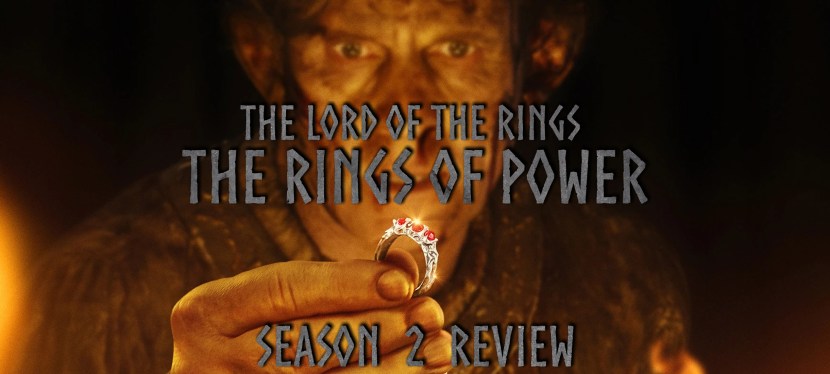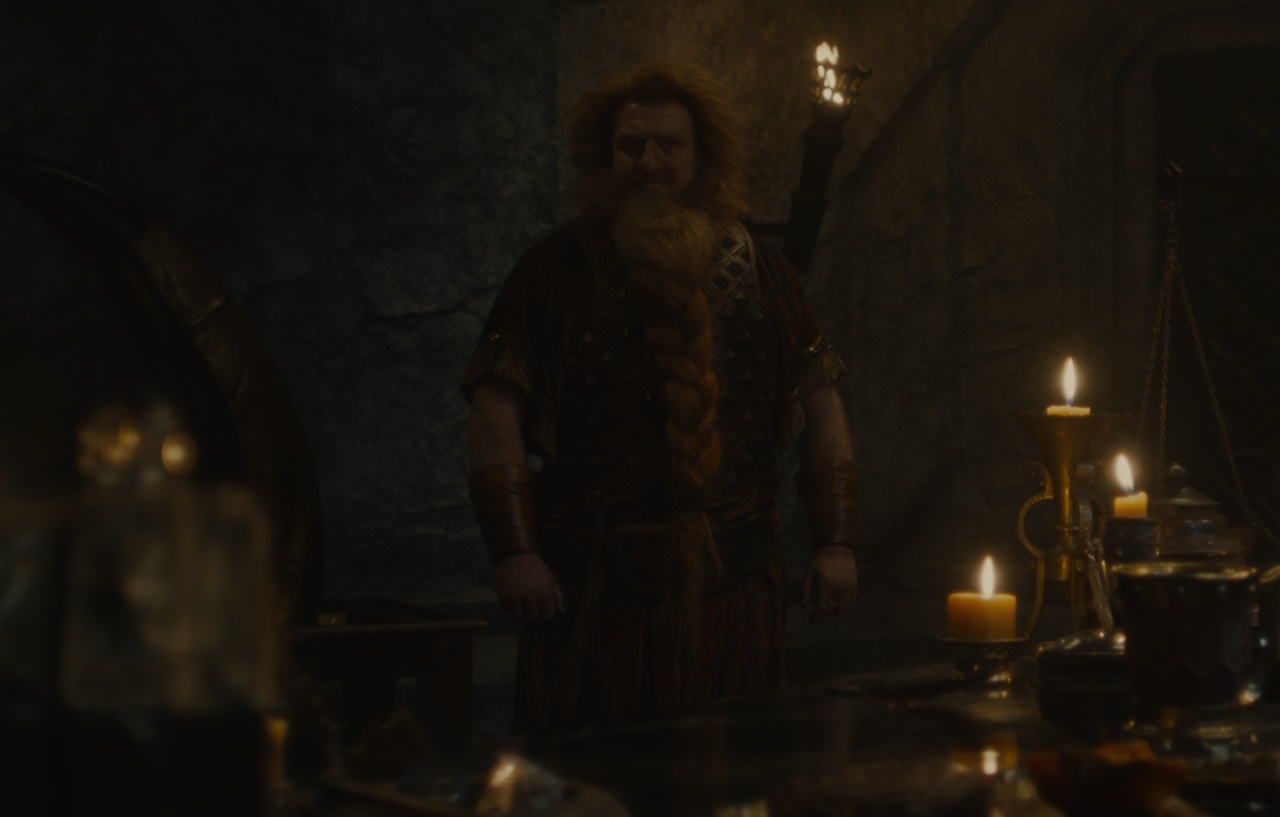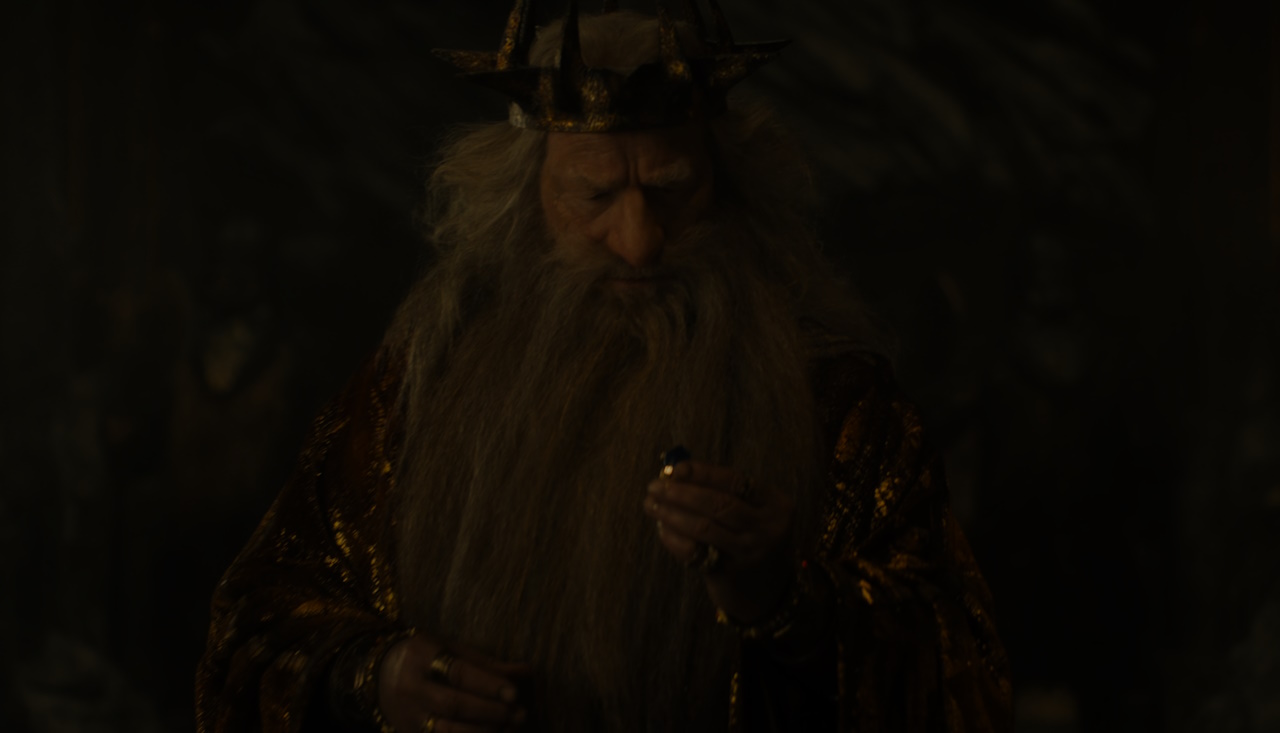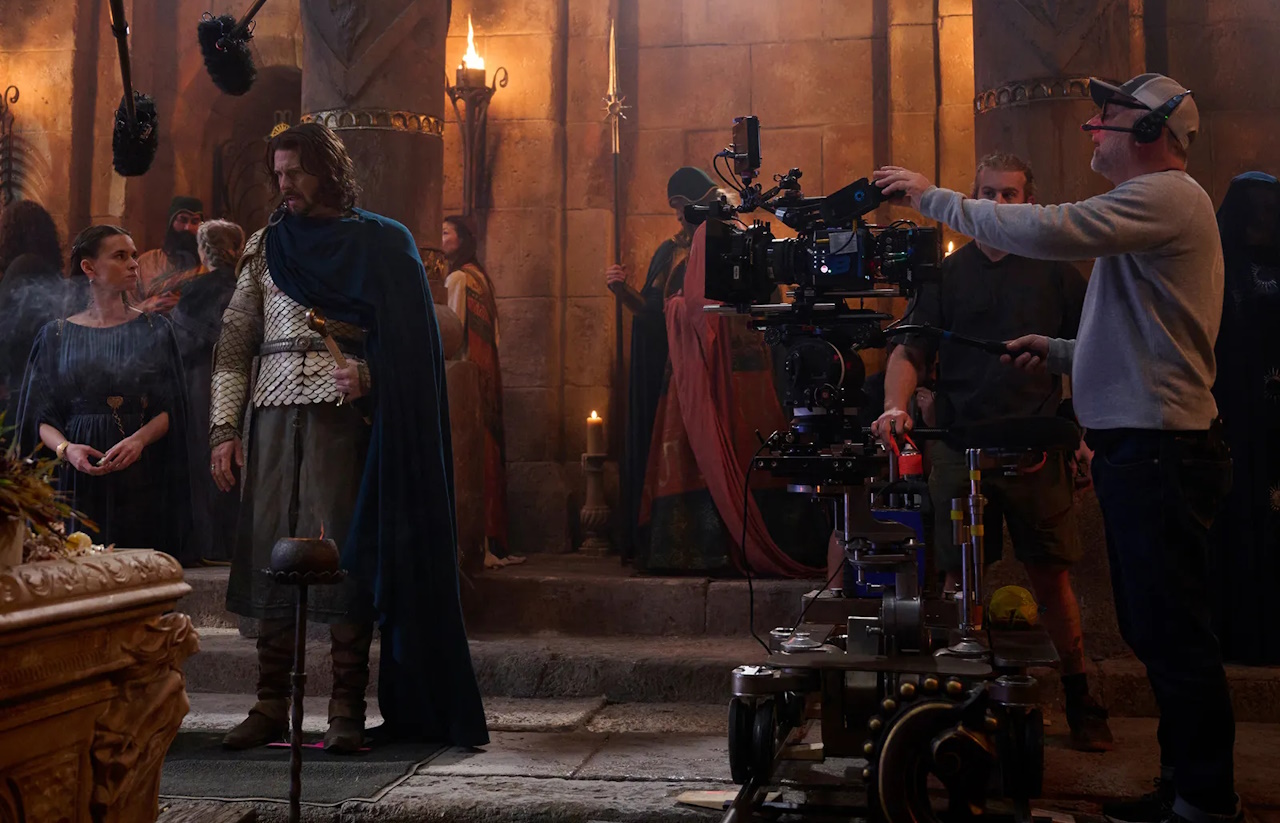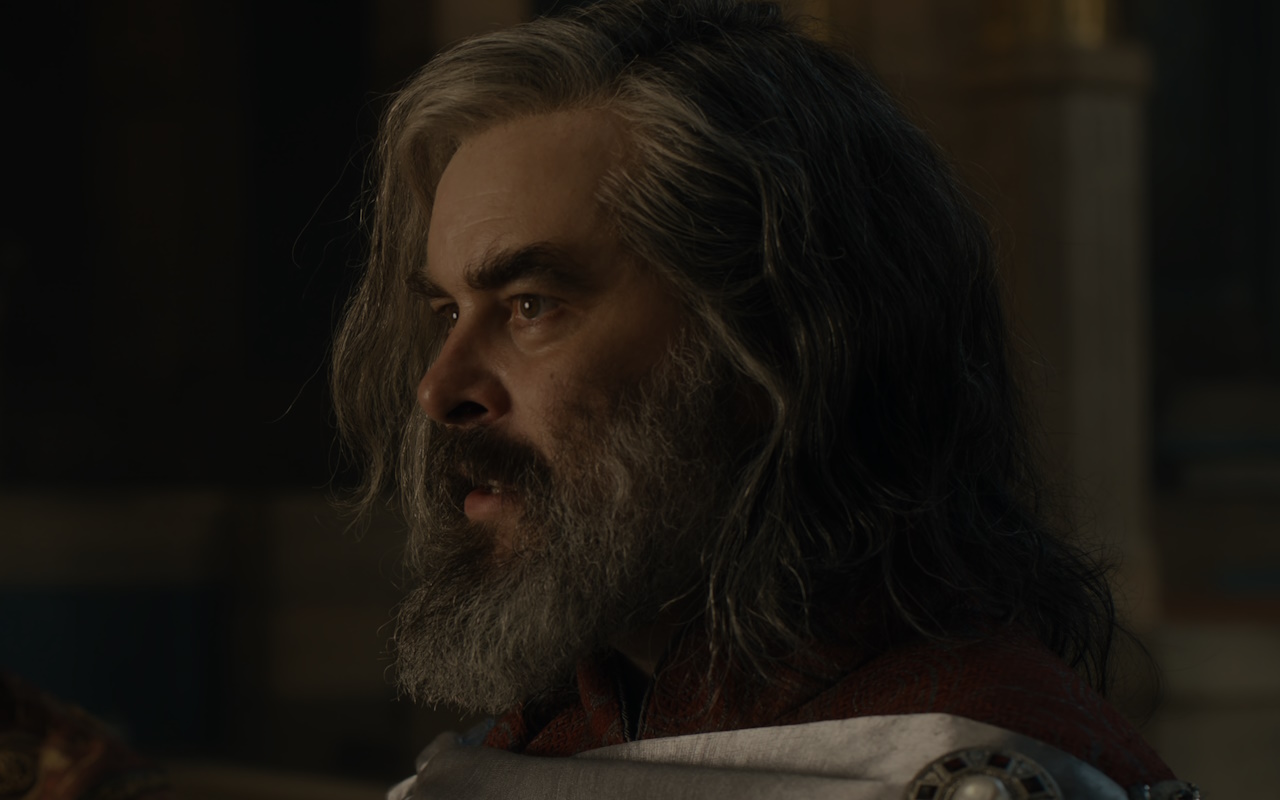
The Lord of the Rings: The Rings of Power – Season 2 Review

Spoiler Alert: There are spoilers ahead for The Lord of the Rings: The Rings of Power Seasons 1 and 2. Spoilers are also present for The Lord of the Rings novels/film trilogy and other works by J.R.R. Tolkien.

In 2022, I was one of the people who generally enjoyed The Rings of Power’s first season. I didn’t think it was perfect, and I wrote at the time that the series still had work to do to justify its ridiculously high budget. But a return to the world of Middle-earth – a fantasy realm I’ve adored since I first read The Hobbit as a geeky little kid back in the ’80s – was incredibly welcome. While there were some stumbling blocks in Season 1, there were enough positives for me to be excited to see where Season 2 might go.

Let’s clear something up: despite what you may have read in some online tabloid rags, The Rings of Power isn’t going to be cancelled. Amazon is committed to a five-season run – I believe that was actually one of the stipulations the corporation agreed to when dealing with the Tolkien Estate – and even though there has been some criticism of Season 2 (as there was with Season 1), The Rings of Power isn’t going away any time soon. I don’t believe that the argument “trust me, it gets good later on” is particularly convincing… but there are still, in my view, reasons to be positive as the series continues its run and its various storylines unfurl.

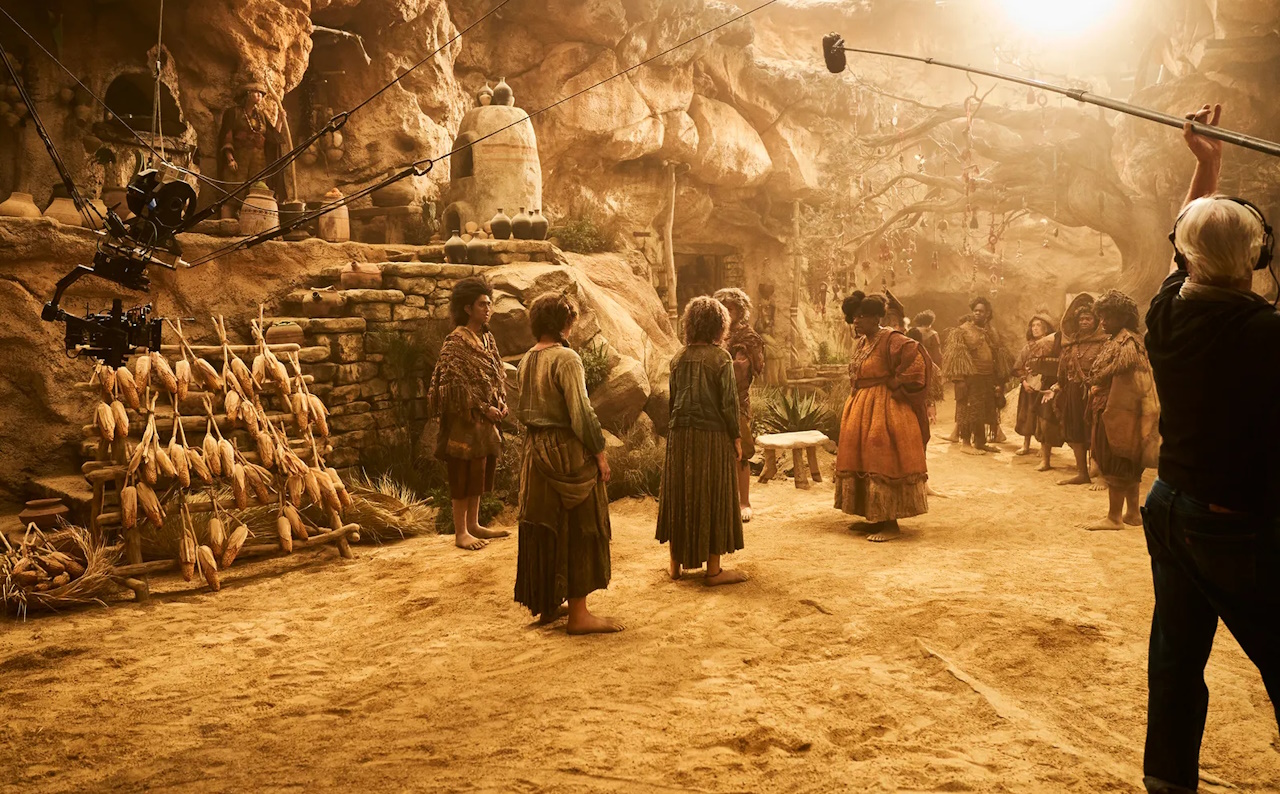
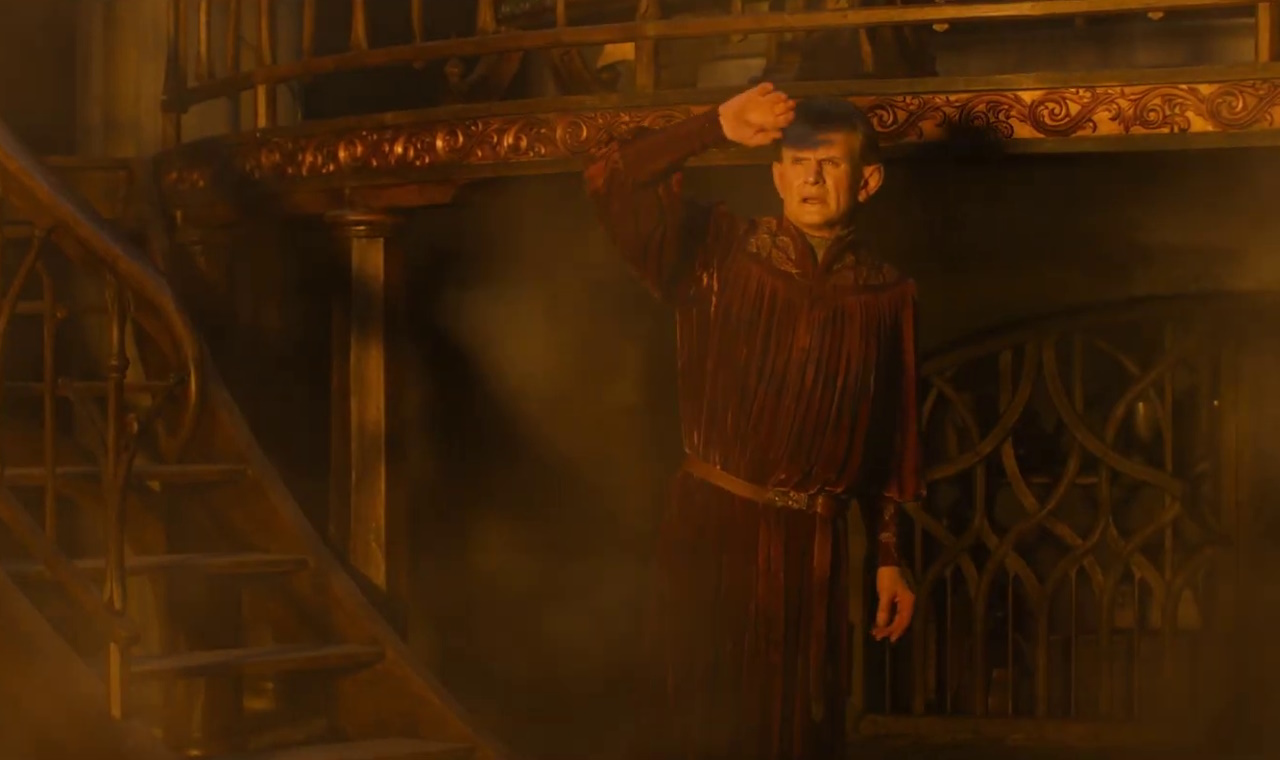
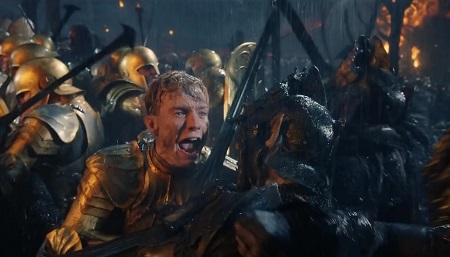
Behind-the-scenes photo from the production of The Lord of the Rings: The Rings of Power.
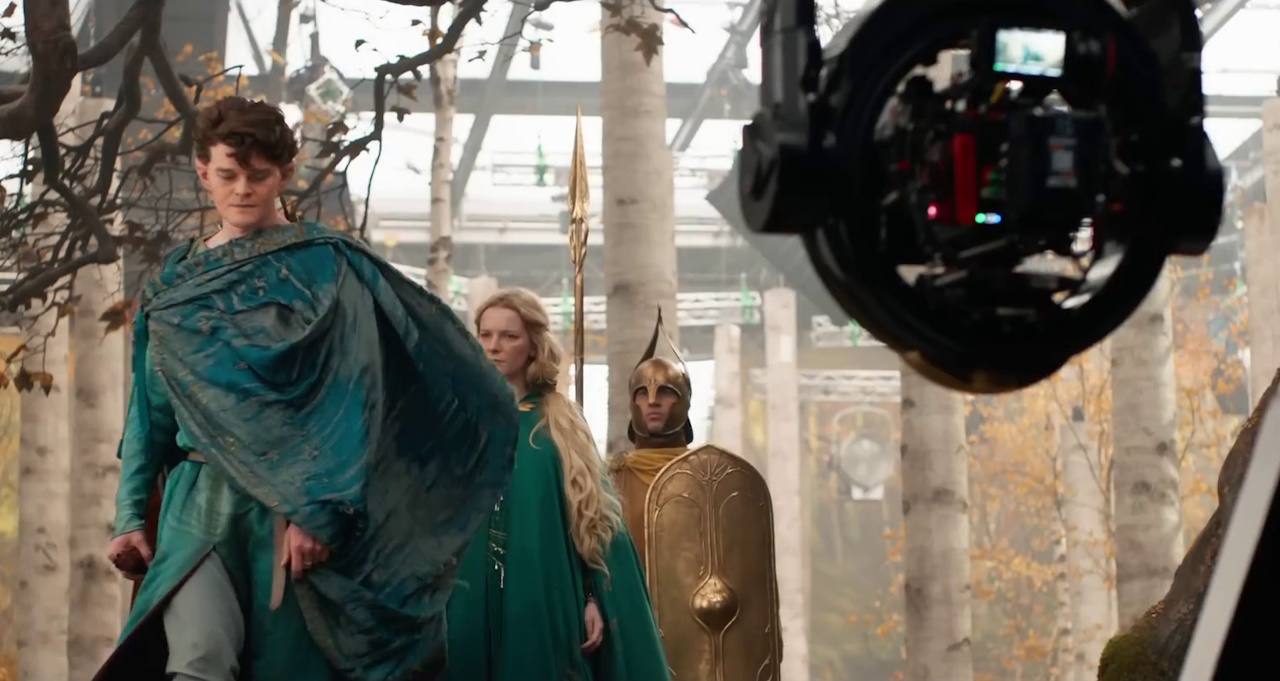
Behind-the-scenes during production on Season 2.

I’d like to start this review by talking about some of the dialogue in The Rings of Power’s second season. There seems to be an effort on the part of the show’s writers to use a deliberately archaic style of language – presumably as an attempt to emulate Tolkien’s writing style. Some of the choices of words, the order of words in sentences, and the length of some lines of dialogue all feel like they’re from the first half of the 20th Century… and that gives The Rings of Power an almost anachronistic feel at points. Surrounded by modern CGI and in full 4K, characters are speaking like they’re in a film or play from the 1920s or 1930s. Maybe there’s a bit of a disconnect there, and perhaps if I were to be critical I’d say that some of the writers may be leaning into this style a bit too much – at least for my taste.

Particularly with Elvish characters – Gil-Galad, Elrond, Galadriel, Celebrimbor, and others – there are a lot of rolled R sounds and other “accent” attempts, and again I feel this may have been overdone. I don’t remember these “Elvish accents” getting in the way so much in Season 1, but it’s possible I just overlooked it last time or it wasn’t as present. This time around, though, it was a bit too much; it felt rather like when you hear a native English speaker randomly use the Spanish or French pronunciation of a word in the middle of a sentence. It was distracting and offputting, and once I noticed it I found that I kept noticing it every time these characters would speak.

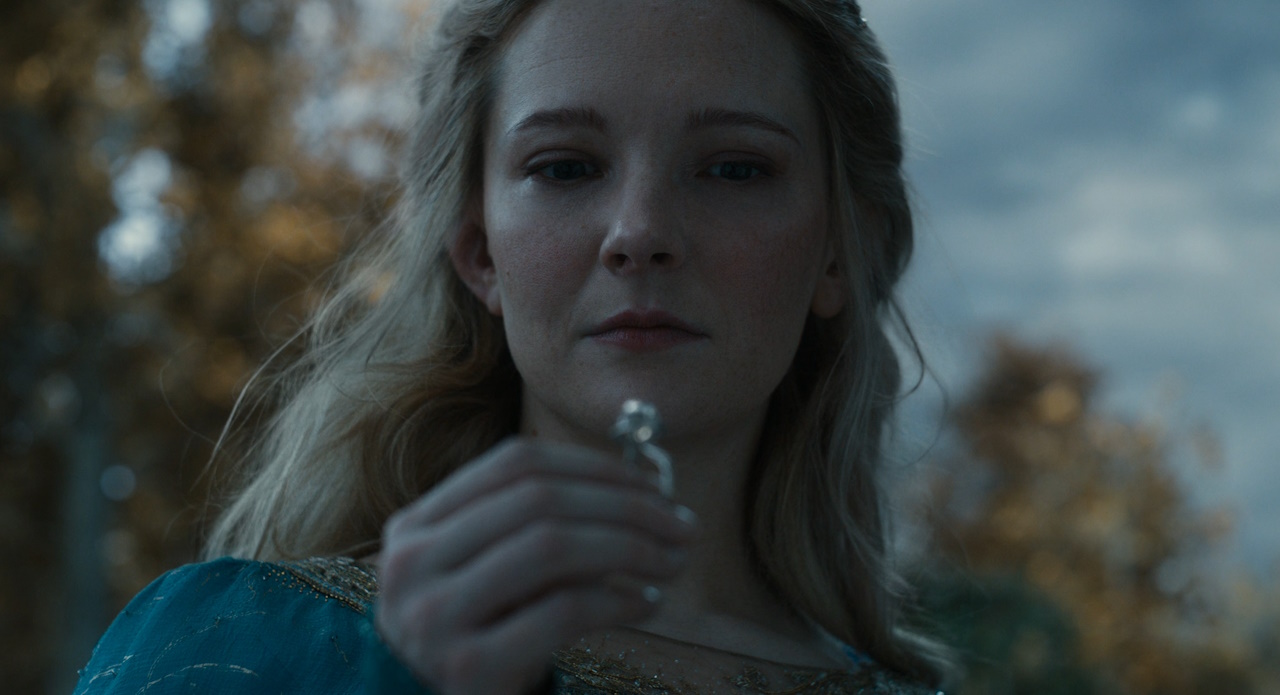
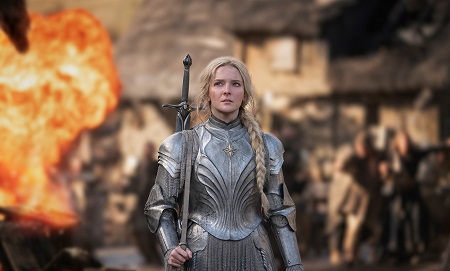
Still frame from The Lord of the Rings: The Rings of Power Season 2 (2024) showing Galadriel with her ring.
Galadriel with her ring, Nenya.

The Rings of Power is telling a complex set of intertwined stories focusing on different groups of characters. Care has to be taken to ensure that these stories don’t feel constructed and artificial… and for me, parts of Season 2 missed the mark. Several characters – Galadriel, Adar, and Sauron most notably – seemed to zip around the story at the behest of a team of TV writers rather than in ways that felt natural, and especially by the latter part of the season, this sense of an artifically-constructed narrative had begun to set in.

Partly this is because the abilities and motivations of these characters weren’t always made clear ahead of time. Sometimes it seemed as if a character was doing something “just because,” or had discovered a new ability, power, or desire out of thin air. The titular rings had an effect on a few characters, changing their motivations and actions (again to suit the plot), but that isn’t really what I mean. Those changes for Gil-Galad, Galadriel, and King Durin are built into the story; Adar’s decision to take his army north – and his ability to do so apparently unseen – didn’t really track, at least not for me.

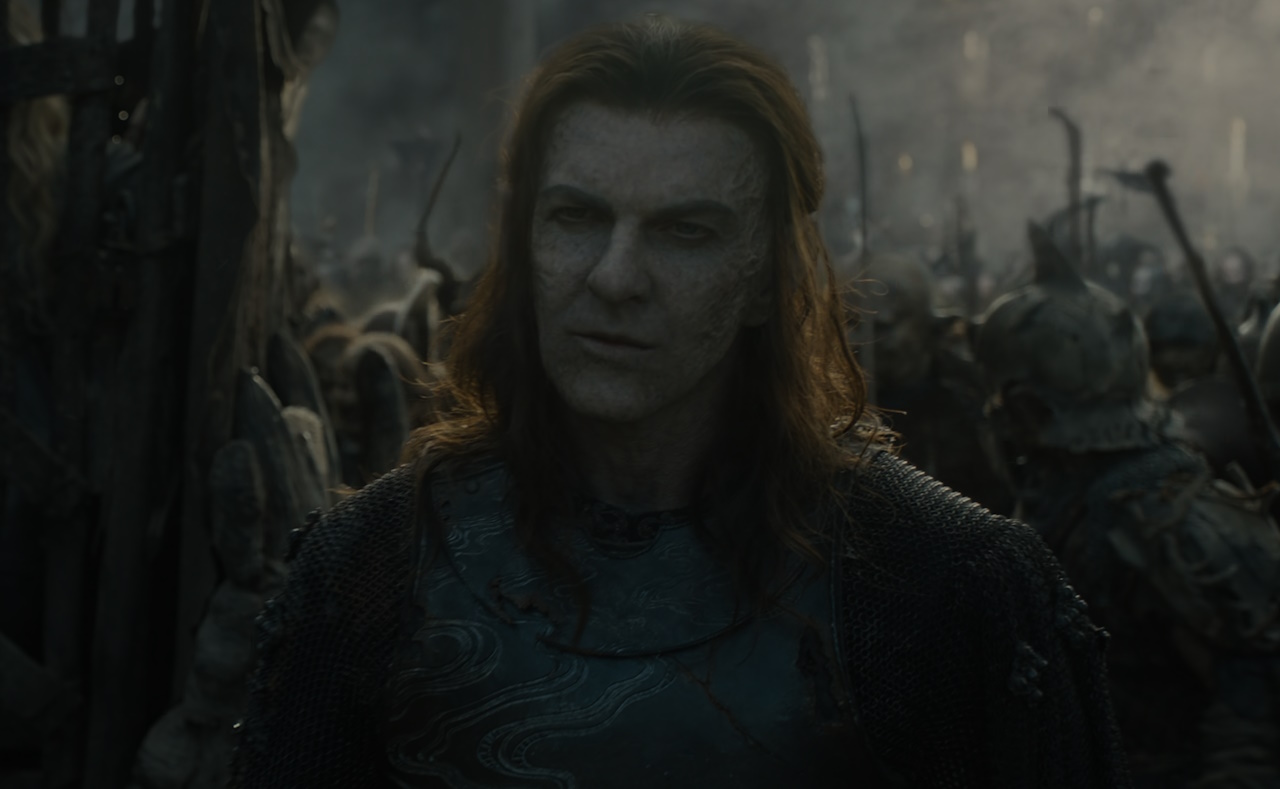
Still frame from The Lord of the Rings: The Rings of Power Season 2 (2024) showing Adar.
Adar with his Uruk army.

That being said, Adar may be my favourite character in Season 2. His core desire to keep his people safe and free was understandable, even if the way in which he went about achieving that objective was questionable and seemed to move along at a far too rapid and convenient pace. Adar – whose actor was replaced in between Seasons 1 and 2 – isn’t played like a typical villain, and in a world where most of the heroes are paragons of virtue and the villains wicked and corrupt, those nuances made him – at least for me – one of the most interesting characters in the story.

Here’s something that confused me in Season 2. Maybe I’ve missed something, because lest we forget it’s been two full years since the first season of this show, but… don’t Orcs hate sunlight? Wasn’t a huge part of the plot of Season 1 that Adar and the Orcs wanted to trigger the eruption of Mount Doom so the sunlight would be blocked out and they could live happily? Isn’t that why they lived in tunnels and moved by moonlight?

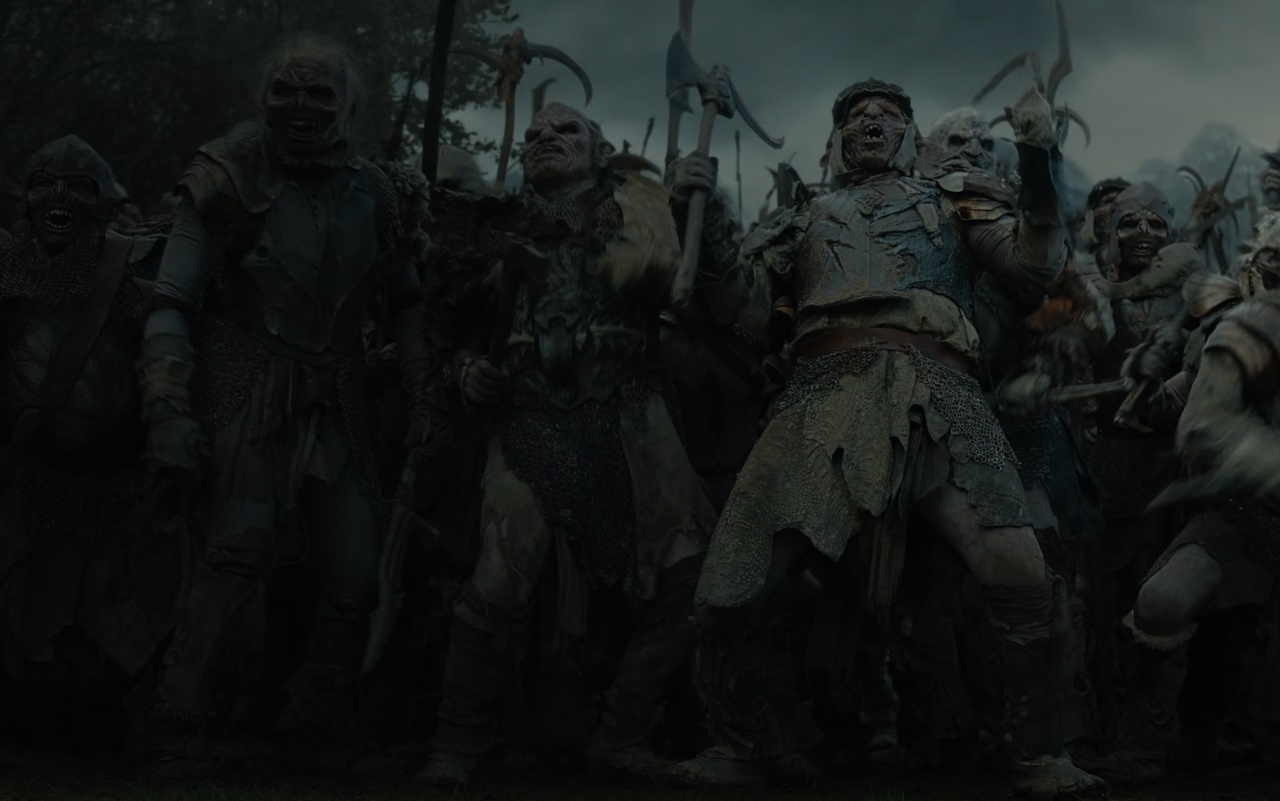
Still frame from The Lord of the Rings: The Rings of Power Season 2 (2024) showing an army of Orcs.
Are Orcs okay with sunlight now?

The Rings of Power seems to have discarded this idea to fit the plot, with Orcs marching happily in the sun, fighting battles in the daylight, and making camp out in the open. Yet this was not only a fundamental building-block of the Orcs from Tolkien’s original work, but also a key part of what happened just a few episodes ago in Season 1. To make such an arbitrary change with no explanation and no apparent on-screen acknowledgement, even… I don’t know. I didn’t like it.

Although the show is a prequel, parts of The Rings of Power feel much more like the middle chapter of a story. Many characters reference unseen events, like the reign of Morgoth and an earlier conflict against Sauron, with some of these things becoming key narrative elements or character motivations. Celebrimbor, for instance, being driven to create a legacy that could rival the creations of Fëanor, is a huge part of how Sauron was able to manipulate him. But with so few flashbacks and so little background provided within the show itself, there were moments across all eight episodes where I felt I was watching a sequel without having seen the original. Many other stories play out this way, with the events we follow in the main narrative being influenced by things in the past, or with characters who have motivations linked to their backstories. But… to be blunt, a lot of those do a better job of explaining their backgrounds and characters. We didn’t need a full flashback episode to the First Age with young Sauron, young Celebrimbor, Morgoth, and so on. But we did need to get more context for some of these storylines as they unfolded, with more background provided to better explain what was going on. This was an element of the season that was lacking.

Still frame from The Lord of the Rings: The Rings of Power Season 2 (2024) showing Adar and Galadriel with Morgoth's crown.
What is the Crown of Morgoth… and who is Morgoth, come to that?

Sauron’s plan this season was difficult to follow, convoluted, and seemingly counter-productive to his own goals in places. He simultaneously wanted to craft the Rings of Power in Eregion, skilfully manipulating Celebrimbor to this end. But he also wanted to seize control of Adar’s legions of Orcs – and the way in which he went about the latter threw the former into jeopardy from his perspective. I will caveat this by noting that Sauron did say, toward the end of the season, that he doesn’t know everything and can’t predict all outcomes… but even so. Both the ring-crafting and the siege of Eregion were by his design, and yet they worked almost completely at cross-purposes.

I have to be honest about this next point, and it is admittedly not the biggest because it concerns a single line of dialogue… but I hated hearing Celebrimbor call Sauron “Lord of the Rings.” It was just so on-the-nose and kitschy, and while I get the intention behind it and the twisted interpretation of those words, it really didn’t work for me and made me roll my eyes. It’s such a shame, too, as it came at the end of Celebrimbor’s otherwise excellent redemption arc.

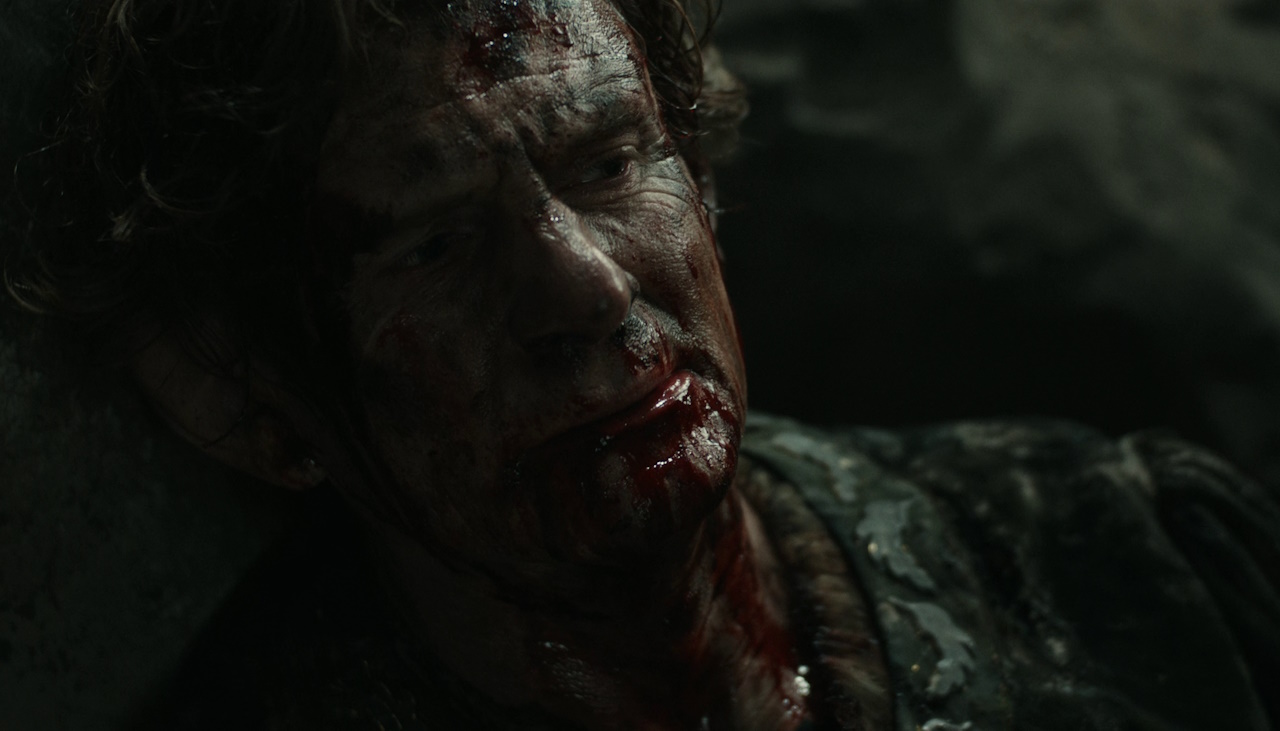
Still frame from The Lord of the Rings: The Rings of Power Season 2 (2024) showing Celebrimbor after he was injured.
Celebrimbor.

Sauron seemed to manipulate Celebrimbor with ease in the first part of the season, and I wasn’t wild about that. A bit more resistance from Celebrimbor, perhaps, or a more serious demonstration of Sauron’s power earlier might’ve eased that. But his storyline after regaining his senses went a long way to redeeming that side of the story, and I enjoyed seeing him reclaiming his position and trying to get the rings he had made as far away from Sauron as possible. I’m a sucker for a good redemption arc and a tale of sacrifice, and Celebrimbor’s delivered in the final couple of episodes of the season.

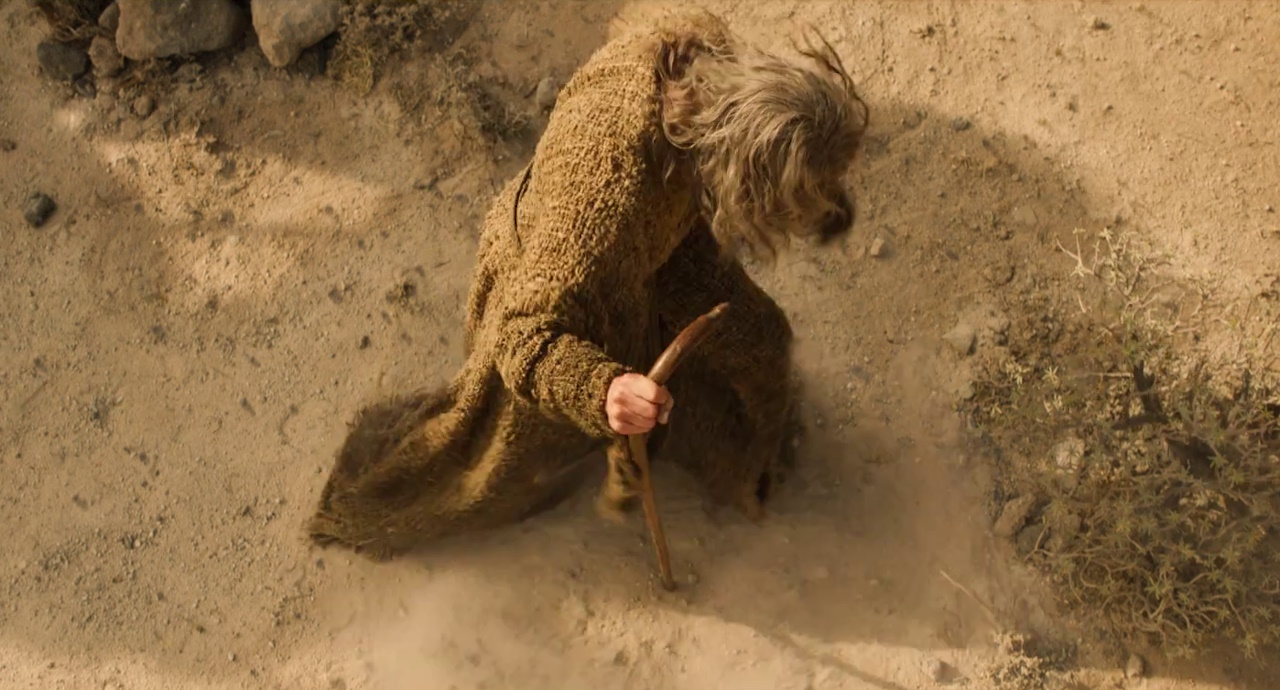
Let’s talk about a pet theory of mine that Season 2 demolished. We’d been following “the Stranger” and his proto-Hobbit friends, and although there were plenty of hints that this character was Gandalf, I wasn’t entirely convinced of that. It seemedalmost too obvious, and I wondered whether The Rings of Power might’ve tried to pull off a bit of a twist by making this character another wizard: Radagast, perhaps, but more likely Saruman. Knowing what we know of Saruman’s future, I felt that could be interesting.

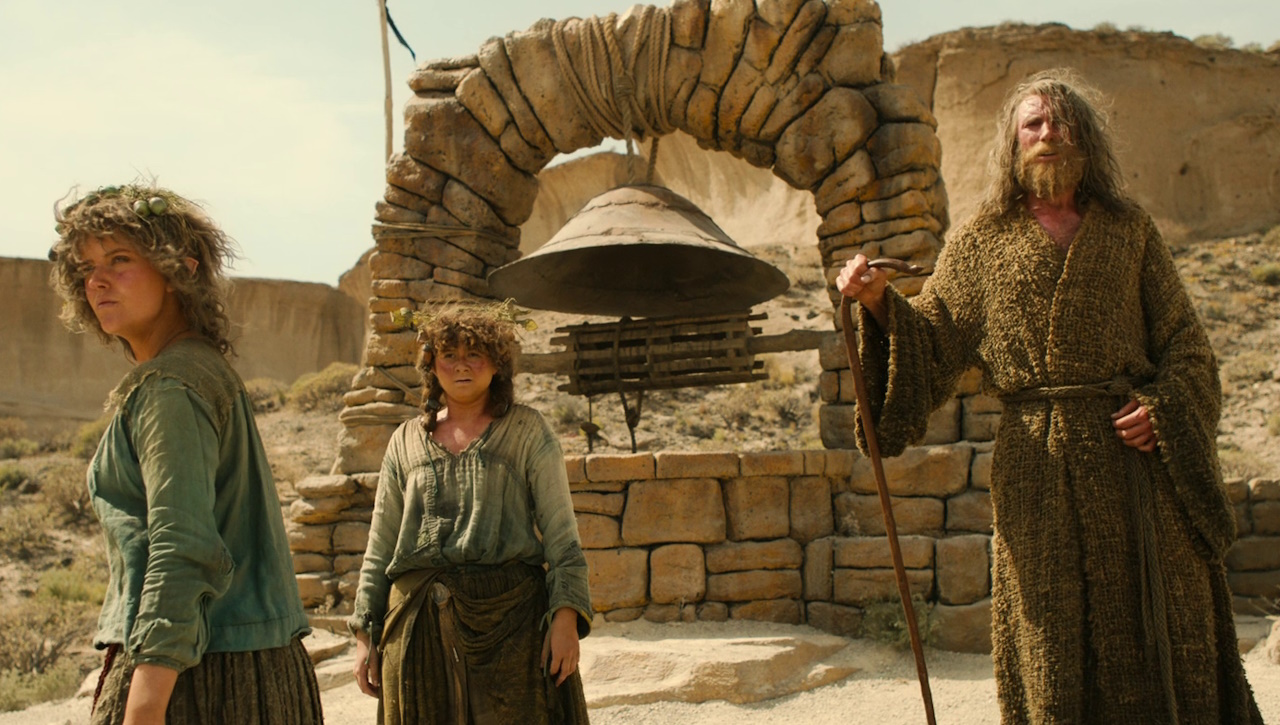
Still frame from The Lord of the Rings: The Rings of Power Season 2 (2024) showing Gandalf and the Harfoots.
The Stranger’s identity was in question across Seasons 1 and 2.

Instead, The Rings of Power was incredibly pedestrian, dropping obvious hints that led to an obvious conclusion. I’m not disappointed that my personal Saruman theory didn’t pan out, but I am a bit disappointed that the writing on this side of the show continues to be so… basic. Why bother “covering up” the identity of a character if everything they say and do makes it obvious who they are? And come to that… why bother going through this “amnesia” storyline at all? Why couldn’t Gandalf have emerged knowing his name but needing to discover his purpose? It just fell a bit flat for me.

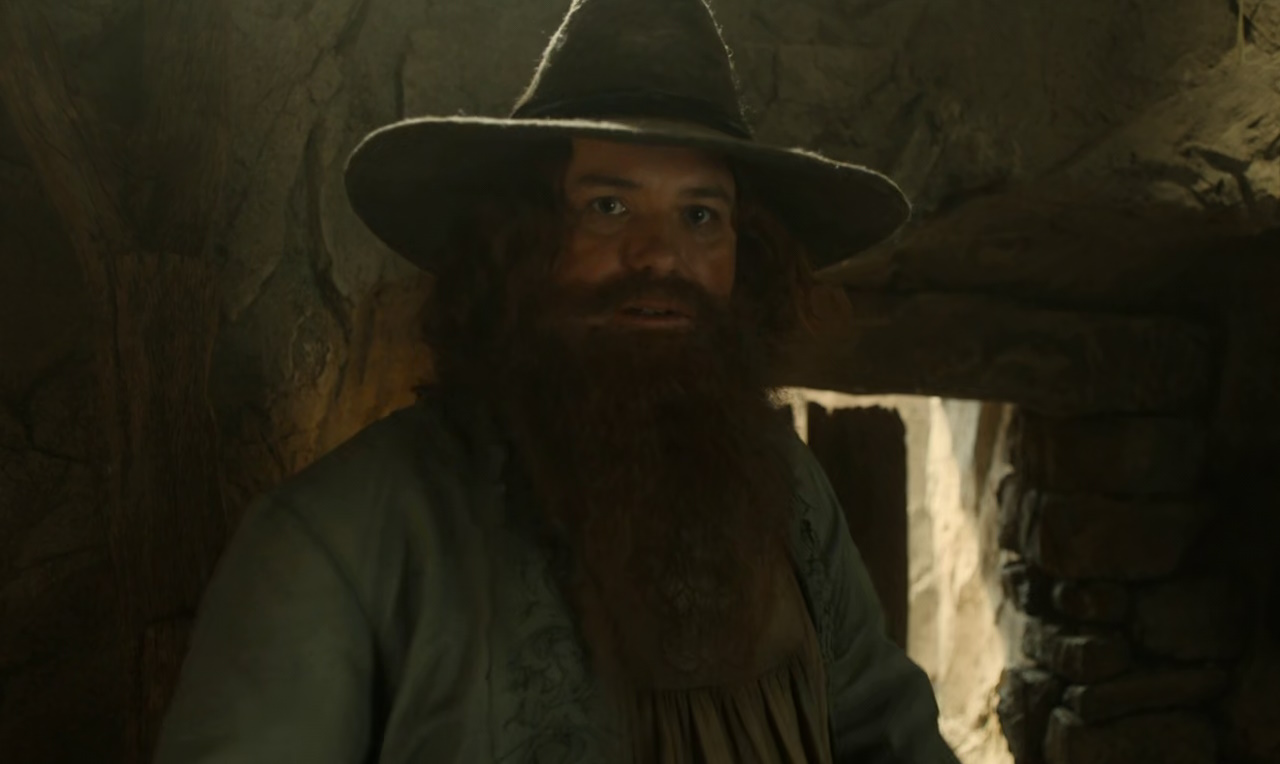
I was excited to see Tom Bombadil in live-action for the first time, and the performance was spot-on. Rory Kinnear put in a spectacular performance to bring this enigmatic character to life, and everything from the costume to the accent to the design of his home was perfect. This version of Tom Bombadil is exactly how I pictured the character in my mind all those years ago.

Still frame from The Lord of the Rings: The Rings of Power Season 2 (2024) showing Tom Bombadil with his coat and hat on.
Old Tom Bombadil is a merry fellow! Bright blue his jacket is, and his boots are yellow!

But – and you knew there was a “but” coming after all of that – what on Middle-earth is Tom Bombadil doing getting so involved in the plot? The whole point of the character, at least from what I recall of reading The Lord of the Rings a long time ago, was that he was ancient and powerful – but completely indifferent to the Ring, the quest against Sauron, and so on. Gandalf and Elrond felt that he’d just forget about the One Ring if it was left in his care, and that if Sauron were to win and conquer Middle-earth, Tom Bombadil wouldn’t come to their aid, nor even understand the nature of their quest.

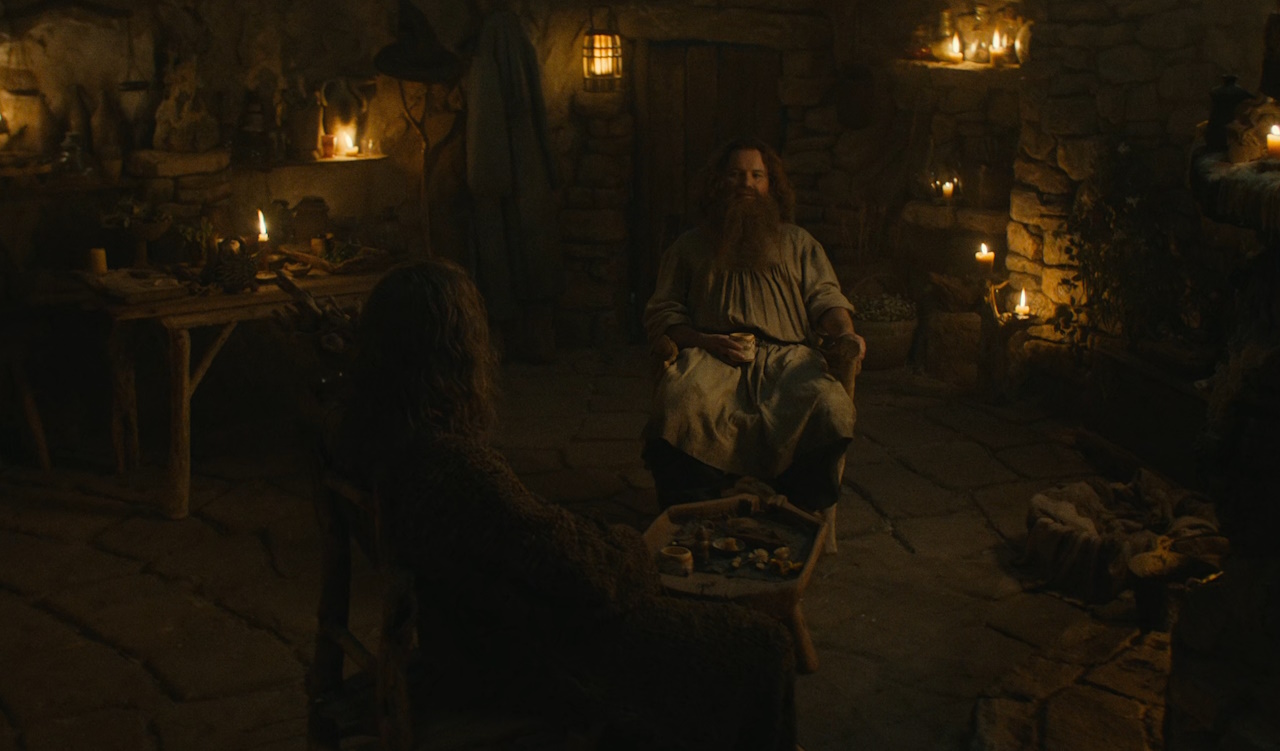
It was pretty jarring, then, to see Tom Bombadil so engaged in the world and so helpful to both Gandalf and the Dark Wizard. Characters like this have to be used carefully because of the extent of their powers, and while I’ll entertain the idea that “TV show Tom” and “book Tom” are different characters who may have different origins and abilities… this was one area where I felt the decision to diverge so extensively from the source material was particularly notable and perhaps ill-advised. Tom Bombadil is a character who could easily be written into a corner, I fear.

Still frame from The Lord of the Rings: The Rings of Power Season 2 (2024) showing Gandalf and Tom Bombadil in Tom's cottage.
Gandalf with Tom Bombadil.

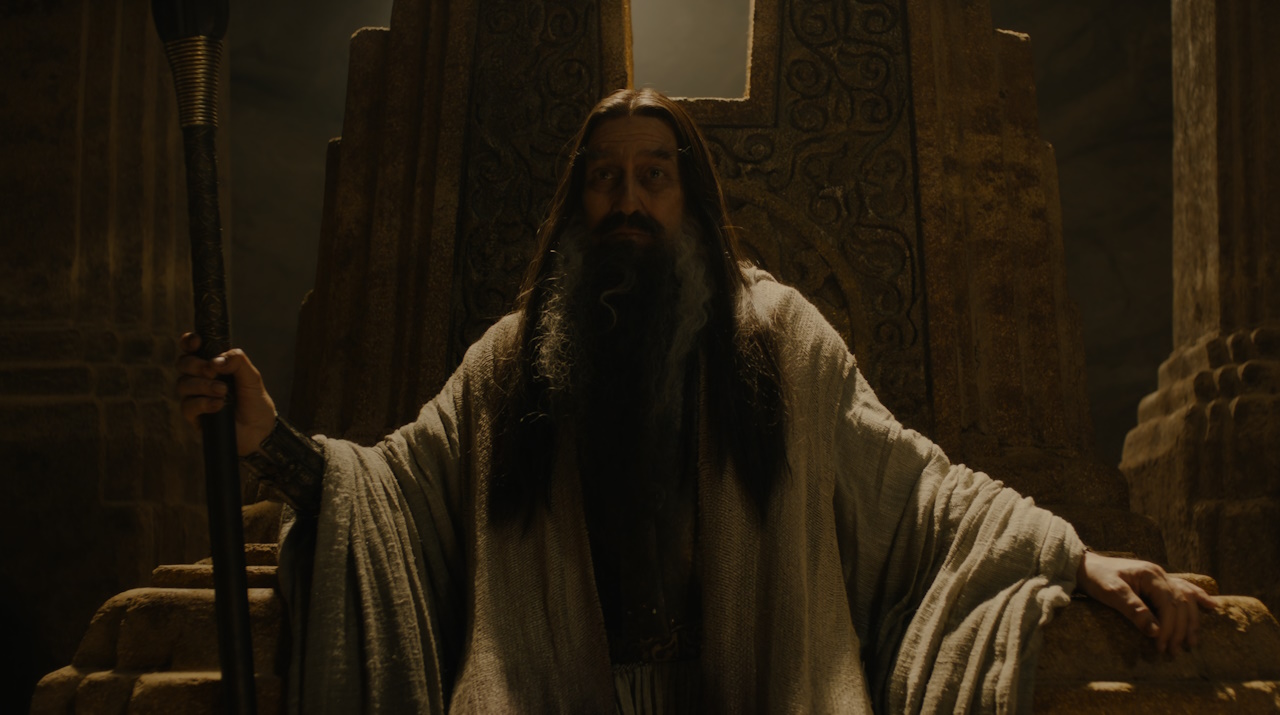
With The Rings of Power being, as we discussed, so pedestrian and boring with its character identities, I have to assume that the Dark Wizard we met is Saruman. I hope not, though, because much of the power in the reveal of Saruman’s betrayal in The Lord of the Rings comes from his status as the leader of the wizards and the head of the White Council. Gandalf doesn’t realise the extent to which Saruman has fallen under the corruption of the power of the One Ring until it’s too late – the whole point of his character is that he’s a good wizard gone bad.

We simply shouldn’t be seeing Saruman talking about “taking over” Middle-earth after Sauron’s defeat in this era. There was always an arrogance or smugness to Saruman; a flaw in his character that Sauron could later exploit. But it shouldn’t be so readily apparent so early on, and working on the assumption that the Dark Wizard and Saruman are one and the same, I didn’t like his presentation for that reason. If, however, The Rings of Power is willing to switch things up and offer a different explanation for this character’s background and identity, I think some of that criticism can be rescinded.

Still frame from The Lord of the Rings: The Rings of Power Season 2 (2024) showing the Dark Wizard on his throne.
Is this Saruman? I mean, it is, right?

Visually, The Rings of Power continues to be an impressive series. Because of my crappy internet connection, I struggled to watch every episode in 4K on Amazon, but when I could get full 4K working, there’s no denying that everything from physical props and makeup to animation and CGI all looked fantastic. The series is deliberately leaning into the aesthetic of Peter Jackson’s films, and I noted that in particular with the likes of the Adar’s troll and the Ents – the designs of both wouldn’t have seemed out-of-place in The Lord of the Rings and The Hobbit.

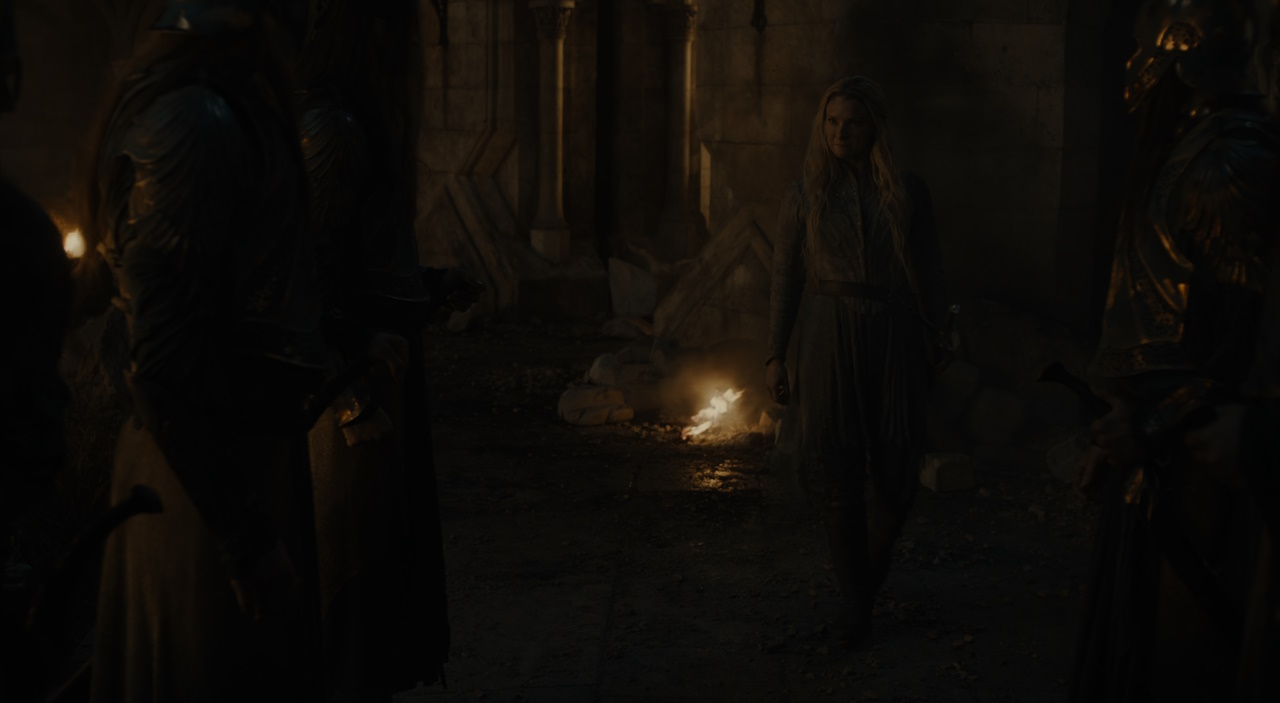
There was one oddity in set design, and it happened in Eregion. In short, the area just outside of Celebrimbor’s tower, when viewed from the side facing away from the tower, had the feel of an enclosed stage – something you might see in a theatre. When characters would enter and exit from one side or the other, I got the feel of watching a stage play rather than that I was looking at a real physical space. Galadriel, for instance, seemed to enter from “off-stage” at one particularly important moment in the penultimate episode, and that feeling rather took the shine off things.

Still frame from The Lord of the Rings: The Rings of Power Season 2 (2024) showing Galadriel entering Eregion.
Galadriel at Eregion.

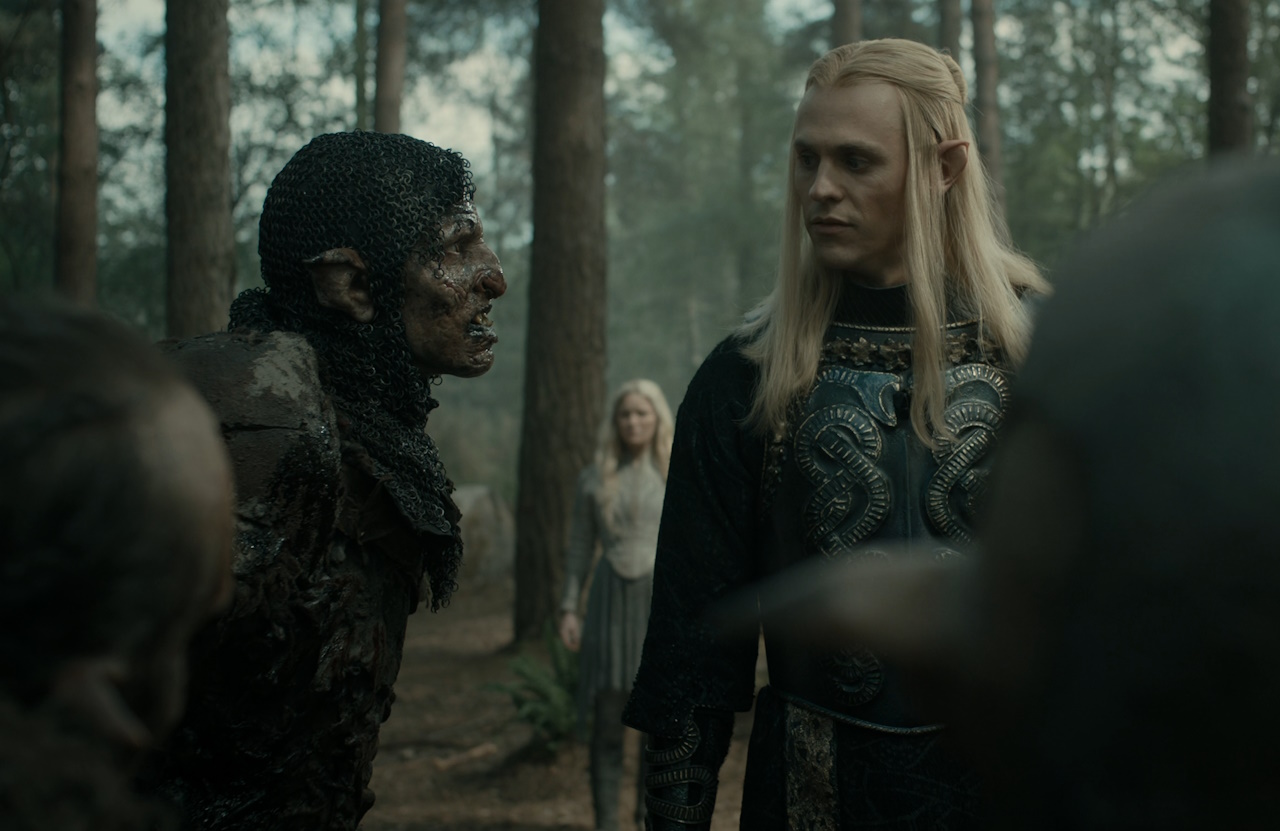
Speaking of oddities with Galadriel: in the season finale, after she had been captured by Orcs and taken to Adar, there was an especially strange moment. This ties into what I was talking about before with The Rings of Power not really explaining enough about some of its characters or their abilities, because after Sauron arrived, Galadriel seemed to just… stand there. She was standing in the background as Adar and Sauron had their confrontation, as if she was just waiting for her cue to rejoin the scene. It was really quite weird to see her just standing idly in the background as Sauron revealed his sway over the Orcs, and the strangeness of the moment detracted from what should’ve been Adar’s emotional and impactful death scene.

We know that Sauron has powers over Elves, Orcs, and others, as he demonstrated when he forced Celebrimbor’s guards to all stab one another. But it wasn’t clear in that scene whether he was “commanding” Galadriel to be held in place or if she was supposed to be stunned or in shock. At several points in the sequence, Galadriel was visible over Sauron’s shoulder or in the background… but rather than feeling like Sauron had her trapped or that she was in shock, it just felt like a poorly-constructed scene, one in which she was waiting for her cue so she could rejoin the action. Having those sequences staged that way was a strange decision.

Still frame from The Lord of the Rings: The Rings of Power Season 2 (2024) showing Sauron and Orcs with Galadriel in the background.
See how Galadriel is just sort of… standing there?

Morfydd Clark, who plays Galadriel, did as well as she could, I suspect, with the material she had. But Galadriel remains a difficult protagonist to root for, sometimes. The establishing episode of the series a couple of years ago portrayed her as single-minded and arrogant, and when we know how dangerous the titular Rings of Power are, her insistence on using and wearing her ring in Season 2 took on an uncomfortable dimension. Elrond came across as the voice of reason in those moments, especially in the first couple of episodes, and again I was reminded of those moments in Season 1 where Galadriel came across as being unreasonable.

I’m also not feeling Galadriel’s on-screen chemistry with either Elrond or Sauron. These are her two most significant partners, and both feel pretty flat. With Sauron, her anger and hatred should be coming to the fore much more, especially upon coming face-to-face with him. And with Elrond, I just don’t feel much of their friendship (or former friendship) from either of them through their performances or the script. Elrond is being played quite stoically, almost like a Star Trek Vulcan, and I guess that makes it harder to build up a warm relationship in some ways. But when I see Elrond with Durin, the difference is night and day. I adore Elrond and Durin as a pair, and their bromance was one of the absolute highlights of Season 1. But with Galadriel… they feel more like work colleagues than anything else.

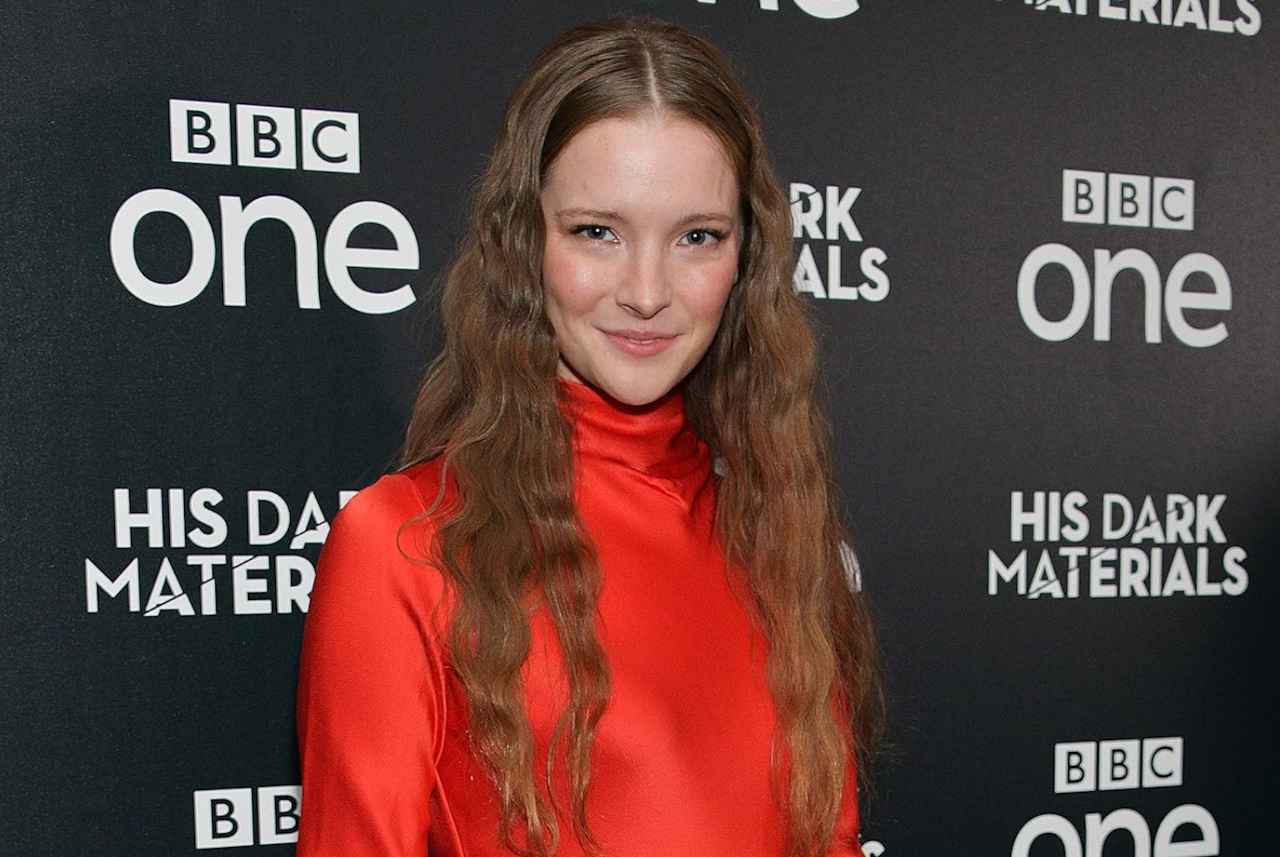
Photo of actress Morfydd Clark at an event for His Dark Materials.
Galadriel is played by Morfydd Clark.

I wish we’d got more of Durin and Elrond this season. Hopefully the stage has been set for more between them next time, particularly with Durin rising to assume the throne and resolving the internal ring-related conflict in the Dwarven kingdom. But with only a couple of short moments between them across this entire season… it was an absence that I definitely felt, particularly as less-impressive character pairs and groups came to the fore.

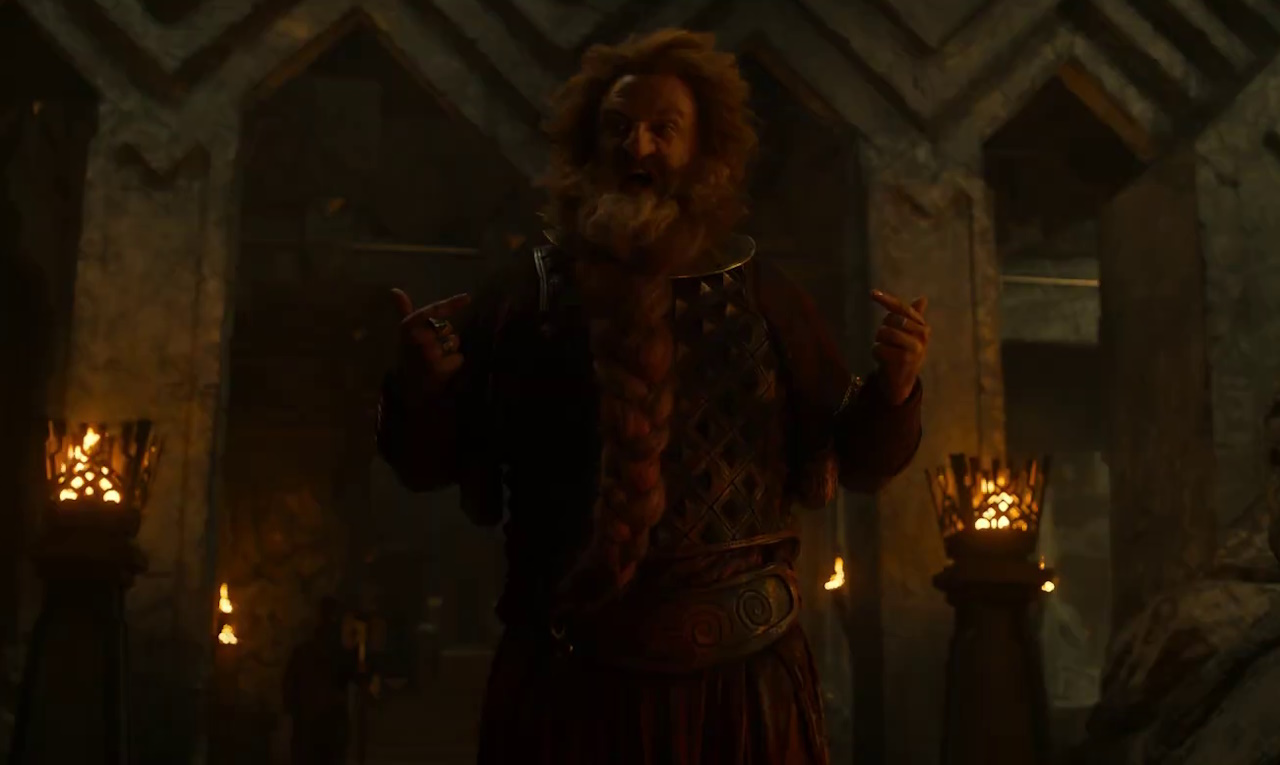
That being said, Durin’s story in Khazad-dûm was still enjoyable. We got more “politicking” this time, with Durin and Disa having to negotiate the king’s court after falling out of favour, as well as stirring up an army to aid the Elves later in the season. Spending more time in Khazad-dûm and getting to know some of these secondary characters a bit more was genuinely fun, and the Dwarves never cease to be entertaining.

Still frame from The Lord of the Rings: The Rings of Power Season 2 (2024) showing Prince Durin of the Dwarves.
Prince Durin.

King Durin – not to be confused with Prince Durin – was an interesting character, and his final act of sacrifice managed to hit the right emotional moments after he’d fallen under the ring’s spell for much of the season. I’m not sure what to make of the Balrog beneath Khazad-dûm, though. I mean, it doesn’t seem like it would be difficult for it to escape now that the Dwarves have opened up a pathway to its chamber, even if part of the tunnel has caved in.

We talked earlier about Sauron’s various schemes seeming to work against one another, and his delivery of Rings of Power to the Dwarf-Lords is another good example. Exacerbating the Dwarves’ natural greed and desire for resources very quickly poisoned the mind of King Durin, but this in turn sabotaged Sauron’s ring-making as the Dwarves refused to send more of the magical mineral mithril to Eregion. Again, Sauron’s line of “not knowing everything” is relevant… but if he created the rings with this goal in mind, shouldn’t it have been predictable? Or if the point of the rings is to give him power over the minds of the wearers, shouldn’t he have been able to force Durin to give him the mithril? Maybe I’m nitpicking and overthinking, but it feels like a bit of a contrivance to get to Sauron putting his own blood or essence into the ring-making process.

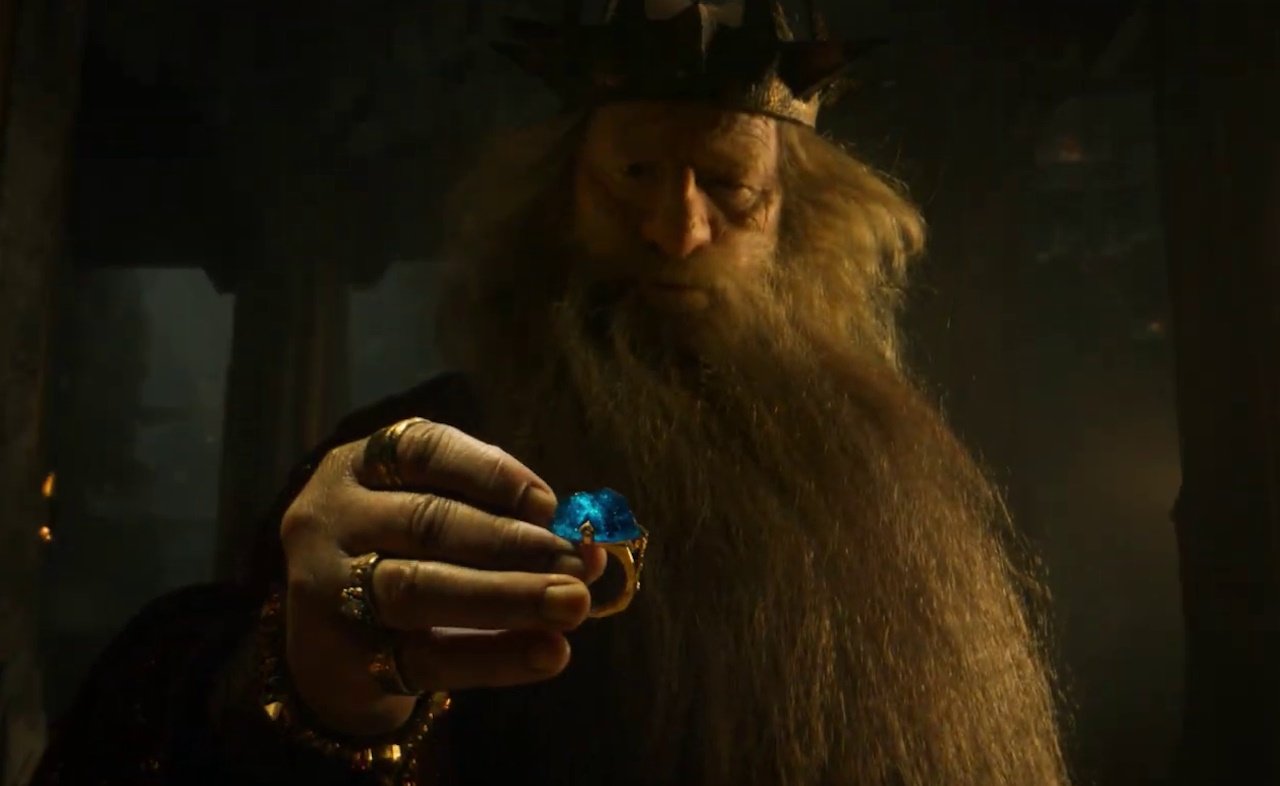
Still frame from The Lord of the Rings: The Rings of Power Season 2 (2024) showing King Durin examining his ring.
King Durin with his ring.

The same could also be said of Celebrimbor’s sudden inability to make more rings. Having worked on the three Elven rings, Celebrimbor quite quickly moved on to make rings for Dwarves under the tutelage of “Annatar,” but when the plot needed him to slow down, he suddenly lost confidence and found his abilities diminished. Was this Sauron’s influence? If so… again, it seems counterproductive to Sauron’s goals. And if it wasn’t due to Sauron poisoning his mind, why did Celebrimbor suddenly find the process difficult when it had been so easy days or weeks earlier?

The political intrigue in Númenor was interesting at first, but I’m afraid it became a bit repetitive as the season wore on. The following pattern seemed to repeat several times: Elendil would be in trouble, Queen or ex-Queen Miriel would order him to abandon her, and then he’d defy her orders. He’d get in trouble, she’d be brought in, and the cycle repeated.

Behind-the-scenes photo from The Lord of the Rings: The Rings of Power showing Isildur and a camera rig.
Behind-the-scenes with Elendil in Númenor.

I liked the idea of the Númenoreans being angry with their ruler after the disastrous expedition to Middle-earth, and that there might be scheming politicians working behind her back to seize power and dethrone Miriel. That concept sounds much better on paper, however, than it came across in the show. Ar-Pharazôn and his son are leaning into the “evil for the sake of it” presentation that just doesn’t come across as all that interesting, and having been upstaged and humiliated by Elendil and Miriel several times… well, it’s obvious he won’t last very long.

The arrival of an Eagle at the Númenorean coronation was neat, though, and I liked the inclusion of this enigmatic race. Pharazôn and his supporters jumping on the idea of the Eagle’s arrival as signifying support for him instead of Miriel was also well done in that scene, and parts of this story hit at least some of the right notes. It just feels like something that needs a bit more time dedicated to it, as Ar-Pharazôn’s ascent to the throne played out pretty quickly across a few scenes. When you compare his scheming to someone like Littlefinger or Varys in Game of Thrones… well, you can see why it’s an unfavourable comparison for The Rings of Power.

Still frame from The Lord of the Rings: The Rings of Power Season 2 (2024) showing Ar-Pharazôn of Numenor.
Ar-Pharazôn schemed his way to the throne.

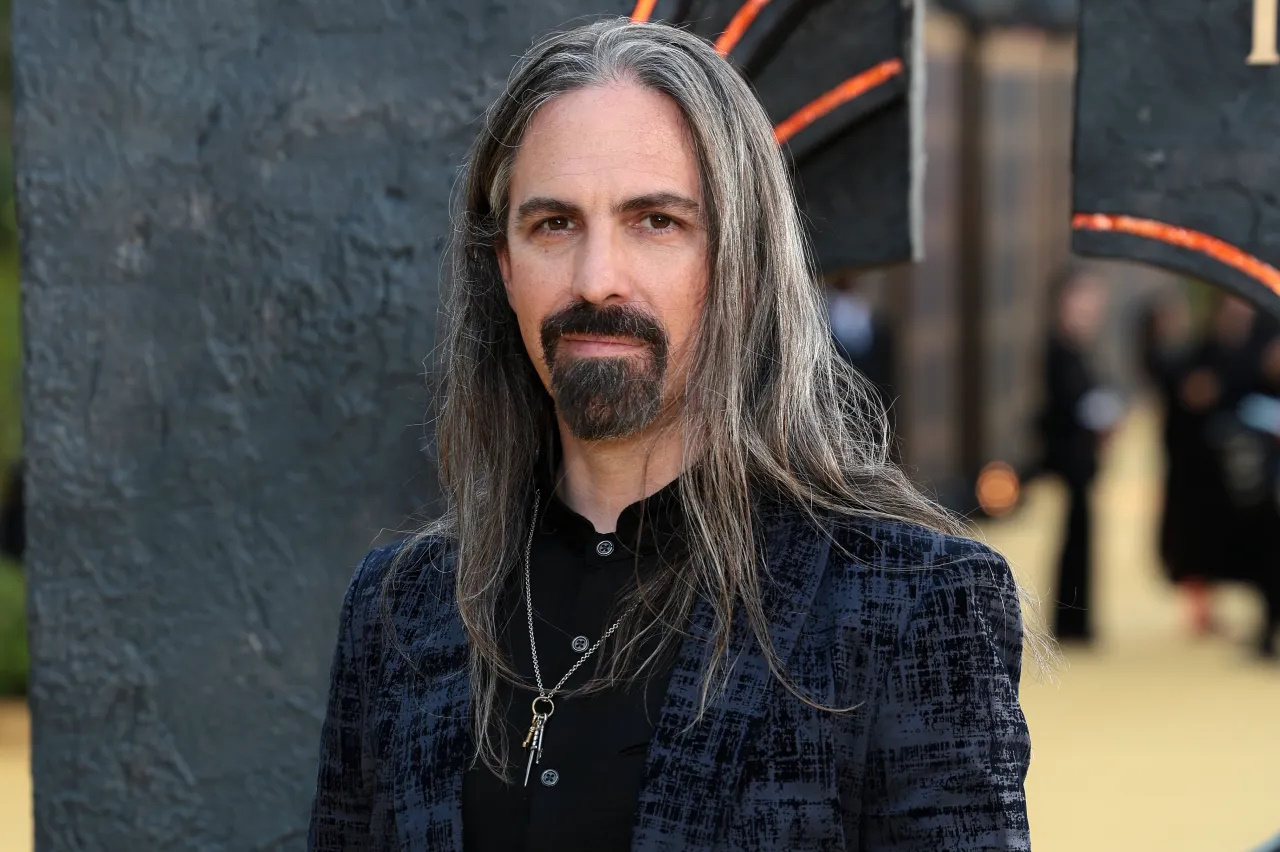
In terms of music, I enjoyed what was on offer in The Rings of Power. My first rule for any film or TV show’s soundtrack is that it should “do no harm;” i.e. not get in the way of or detract from the action on screen. That may be a low bar in some ways, but you’d be surprised how often even big-budget productions trip over it! Composer Bear McCreary did a great job with the score and soundtrack to The Rings of Power, and this might be one of the show’s strongest and best individual elements. Regardless of one’s opinion of the show overall, there’s no doubt in my mind that its soundtrack is fantastic.

Sticking with the music, there was one thing that I didn’t like – and it’s nothing to do with composition, it’s about story. One of the best parts of Season 1 was the song This Wandering Day, a hauntingly beautiful, folk-style, acapella composition. In Season 2, part of the plot saw Nori, Poppy, and the Stranger dissecting its lyrics, finding that they had a literal meaning that helped them navigate the way to Rûhn. I just wasn’t wild about this idea, as taking a beautiful song and hacking it apart, breaking down its lyrics to find, of all things, directions… it took away from the original sequence in which the song was featured. It didn’t feel necessary, as their getting lost was a pretty minor bump in the road compared to what was to come. I could’ve happily skipped this idea and those extra couple of minutes with the Stoors or learning a bit more about the Dark Wizard.

Photo of composer Bear McCreary.
Composer Bear McCreary at the premiere for The Rings of Power Season 2.

More could’ve been done with the Southlanders as they made their escape from Mordor, eventually settling in an abandoned Númenorean outpost. I feel like we didn’t really get to spend enough time with Theo and his villagers, especially given the prominence of the Southlands in Season 1. Theo’s story was okay, and he got an arc of sorts as he wrangled with his feelings toward Arondir, as well as befriending Isildur. But I could’ve spent a bit more time with some of these characters, several of whose names I can’t even recall.

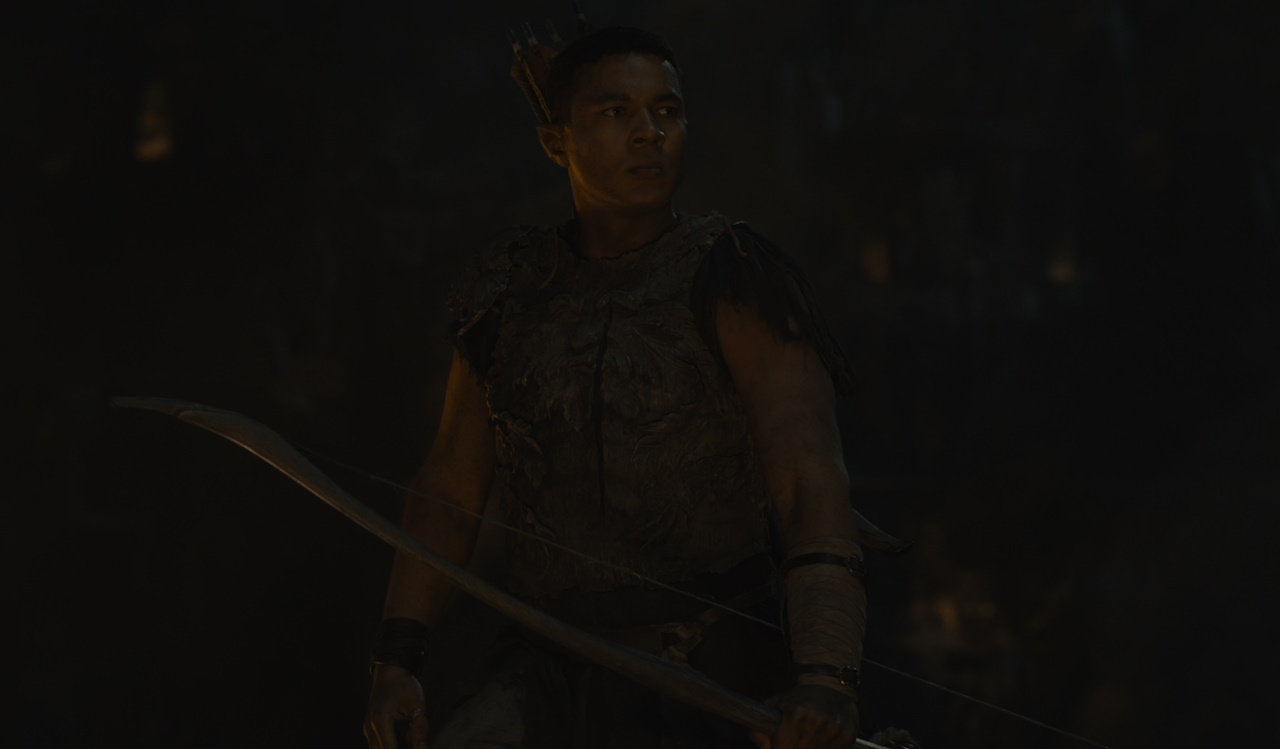
Arondir had some great moments this season, particularly as he dealt with the Ents and saved Isildur from some kind of worm-monster that could’ve come straight out of Dune! His scenes with Theo also packed a punch; the two have good chemistry together, and I hope we haven’t seen the last of either Theo as a new village healer or his relationship with Arondir.

Still frame from The Lord of the Rings: The Rings of Power Season 2 (2024) showing the elf Arondir.
Arondir with his bow.

However, Arondir seemed to die while fighting Adar, being hit multiple times and falling to the ground. At the very least, he seemed to suffer serious injury – but this was forgotten the next time he appeared on screen, and he was back to his usual self. I don’t know what happened here, exactly – and I’m pleased Arondir lives to fight another day, don’t get me wrong – but having built up to his conflict with Adar across several episodes, the way it was immediately ignored didn’t feel great. Maybe two different writers had different ideas for where to take the character?

I’m a romantic – or I can be, under the right circumstances! So I don’t begrudge the writers giving young Isildur a romantic interest in the form of the Southlander Estrid. However, the way this unfolded wasn’t really to my taste, with Estrid betraying Isildur, reconciling, revealing she has a partner already, potentially abandoning him for Isildur, and then being blocked at the last minute. It was just a bit too much soap opera drama for me, and while I liked other parts of both Estrid and Isildur’s individual story arcs, their romantic side fell wide of the mark.

Still frame from The Lord of the Rings: The Rings of Power Season 2 (2024) showing Estrid and Isildur on horseback.
Estrid and Isildur.

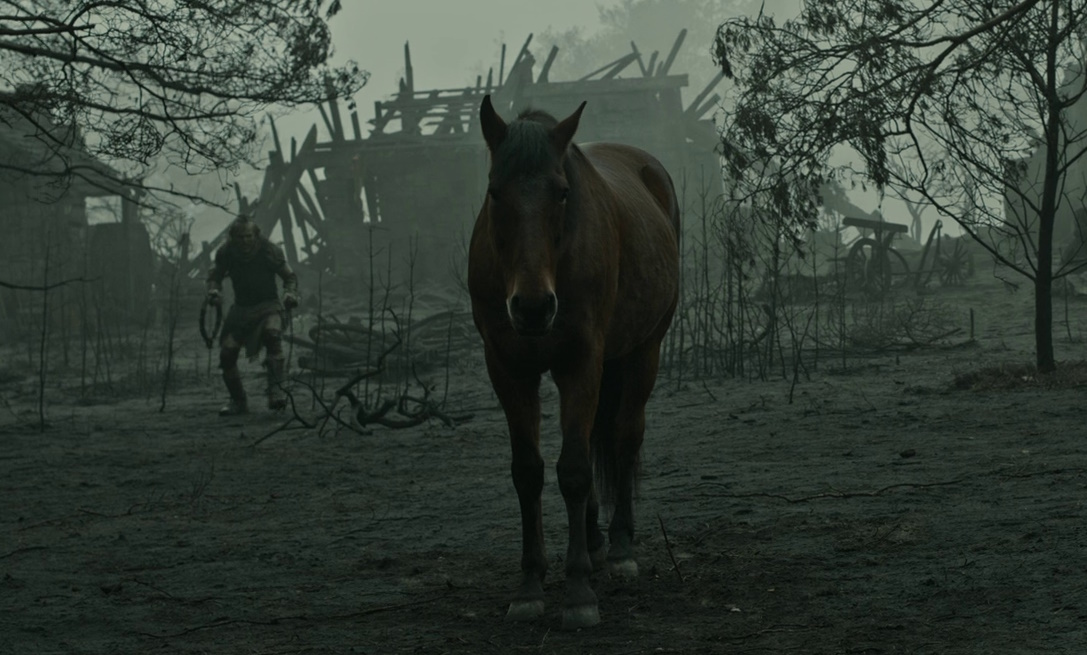
One of my favourite parts of the season was Isildur’s horse Berek being let loose to track him down. I adore stories about animals and when Berek was in danger in the spiders’ cavern it was one of the few moments in the entire season where I was genuinely on the edge of my seat! Whoever trained the horse did an excellent job, and the music and cinematography in this sequence kept it tense and emotional all the way through. When Berek was later captured, I was champing at the bit for Isildur and Estrid to rescue him, and Ar-Pharazôn’s son threatening him was the icing on the cake of that character’s evil-ness!

From one powerful and emotional horse story to one that fell flat. I’m a sucker for animals in fiction as we just discussed – I even cried about a digital horse when playing Red Dead Redemption II. So the scene where Elrond’s horse was killed should have hit me… but it really didn’t. Unlike with Berek and Isildur, I felt no real bond between Elrond and his nameless horse, and even a brief scene with Elrond apparently saying goodbye didn’t really make up for that. Isildur and Berek had love for one another; Elrond seemed, for much of the show up to that point, to see his horse as a tool, a vehicle to get from one place to another. And that made what should’ve been a powerful moment for his character fail to stick the landing.

Still frame from The Lord of the Rings: The Rings of Power Season 2 (2024) showing Isildur's horse, Berek.
Berek the horse.

So I think that’s everything I have from my notes.

It can be hard to judge middle seasons of a television show. How we feel about The Rings of Power Season 2 will be coloured not only by our opinions of Season 1, but also in time, whether Seasons 3, 4, and beyond successfully build to a satisfying narrative climax. I think this season moved things along in that regard, unfolding more of its storylines – though some were a bit too obvious and pedestrian, unfortunately. It also feels like a series doubling-down – for viewers who hated Season 1 and most of what it tried to do, I don’t see Season 2 “redeeming” The Rings of Power or responding in a concerted way to the criticisms hurled at it a couple of years ago.

For me, though, I generally had a good time. There were moments that missed the mark, storylines I was less interested in, and a couple of character pairs or groups that seem to be lacking in chemistry, but I can’t deny that I enjoyed much of what transpired on screen. The Rings of Power was exciting, tense, dramatic, and where it wanted to be, occasionally brutal and comedic. Taken on its own merit, I think it’s a decent fantasy show and I’m happy to see it continue.

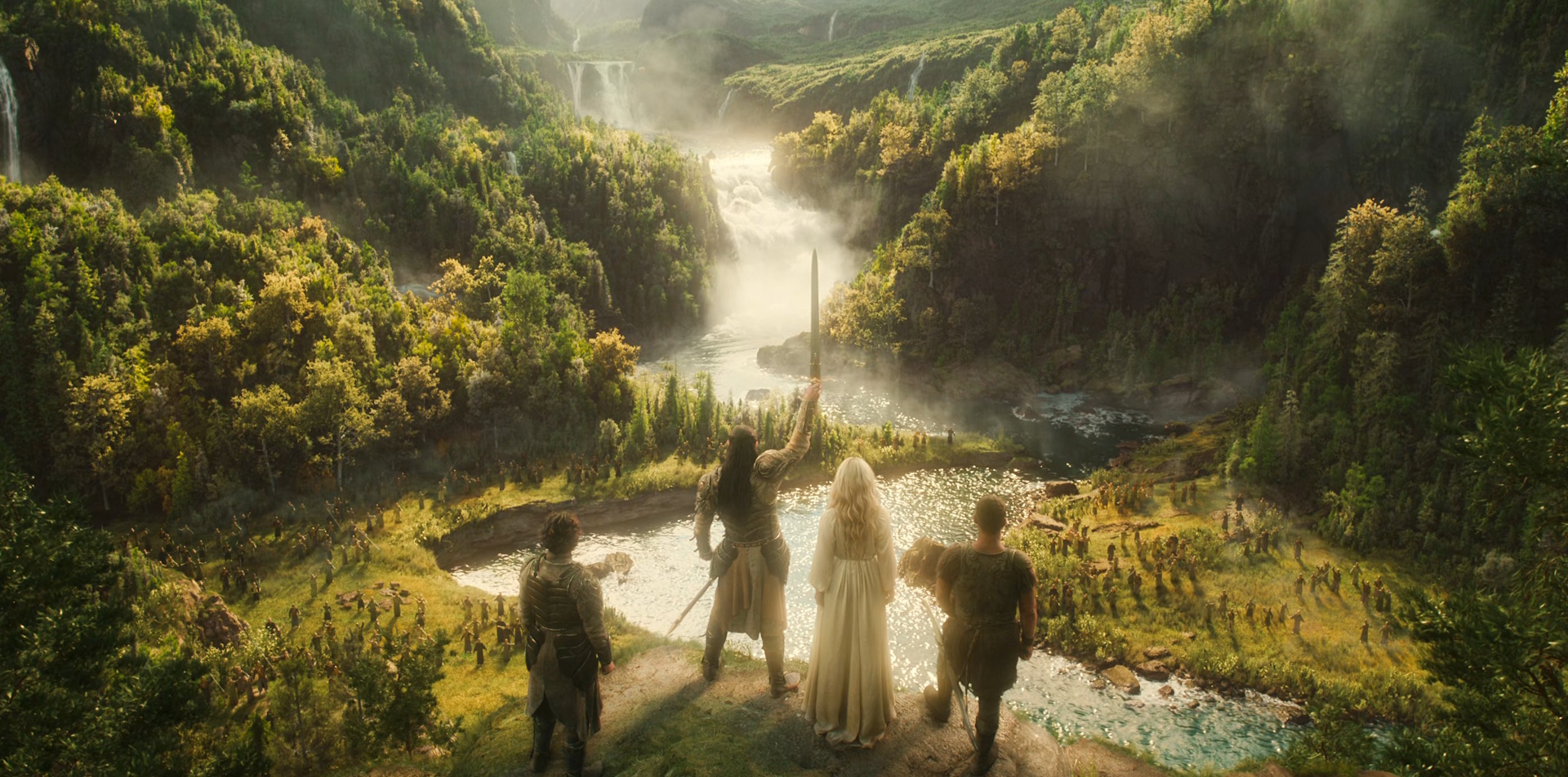
Still frame from The Lord of the Rings: The Rings of Power Season 2 (2024) showing Gil-Galad raising his sword.
One of the final shots from the season finale.

Whether The Rings of Power lives up to the film adaptation of The Lord of the Rings or stands as a true successor to a series like Game of Thrones, though… I think the jury is out on that. It takes time for any series with an expansive cast of characters and intertwined, serialised storylines to find its feet, but The Rings of Power should now be in that position. It will fall to Seasons 3, 4, and 5 to do something great with the foundations that have been established here. Does that mean the series has finally justified its sky-high budget? Again, I think we have to wait and see.

Speaking of waiting and seeing: I can’t wait two full years for another eight episodes of television. Long wait times in between short seasons is a problem streaming shows on various platforms are suffering from, and I hope that now Amazon has gotten two seasons’ worth of experience with The Rings of Power, production on Season 3 can ramp up quickly. If the series really will go to five seasons and it’s gonna be a two-year wait for each one, we won’t be seeing the finale until at least 2030. I might not live that long – though, touch wood, I certainly hope I will(!) – so Amazon really needs to pull out all the stops to get future seasons into production much more quickly. I felt my enjoyment of Season 2 was hampered, in places, by forgetting who a character was or what happened to them two years ago. A recap certainly helped, but getting the next season ready faster will help a lot more.

So I hope this has been interesting! I’ll always be happy to spend more time in Tolkien’s Middle-earth, and while The Rings of Power may have some flaws and some storylines that I find less interesting, I’m still happy to go back to it and I enjoyed much of what was on offer in Season 2. Roll on Season 3 – and the next phase of Sauron’s plot!


The Lord of the Rings: The Rings of Power is available to stream now on Amazon Prime Video in the United Kingdom and around the world. Season 1 is also available on DVD and Blu-ray. The Lord of the Rings: The Rings of Power is the copyright of Amazon MGM Studios, New Line Cinema, and/or the Tolkien Estate. This review contains the thoughts and opinions of one person only and is not intended to cause any offence.

Answering Ten of the Biggest Geeky Questions!

A spoiler warning graphic.

Spoiler Warning: Spoilers may be present for some of the franchises/properties discussed below.

There are a handful of “big questions” that define one’s place in geekdom – and today it’s my turn to answer some of them!

I thought it could be a bit of fun to consider some of the biggest questions that geeks like us have to wrangle with. Which fictional character is stronger? Which gaming platform is the best? These questions are contentious, especially here on the interweb – but I hope you’ll engage with this piece in the spirit of light-hearted fun! That’s how I’m choosing to present my answers, in any case.

As I always like to say, nothing we’re going to talk about today is in any way “objective!” These are my wholly subjective takes on questions that are intended to evoke strong reactions, so I hope you’ll keep that in mind! Although I’ve said that these are ten of the “biggest” geeky questions, I’m sure you can think of others – so this is by no means a definitive list.

A stock photo of a contemplative man surrounded by question marks.
Let’s contemplate some big questions together!

I’ve considered myself a geek – and been considered a geek by others – for basically my whole life. As a kid and a teenager, I moved in nerdy circles and friend groups where the likes of fantasy, sci-fi, horror, and video games were frequent topics of conversation. And in the ’80s and ’90s, those things were far less “mainstream” than they are nowadays! It’s actually been really cool to see the likes of The Lord of the Rings, Star Wars, and Marvel become some of the biggest entertainment properties on the planet – as well as the explosion in popularity of video games. When I was at school, and even into my young adulthood, admitting to being interested in those kinds of things could lead to mockery and even bullying!

For these questions today, I’ve set myself the rule of providing an actual answer – no cop-out, fence-sitting, “I like both equally” answers here! As I’ve already said, all of this is just one person’s opinion – and at the end of the day, this is supposed to just be for fun. So please try not to take it too seriously; none of this is worth getting into an argument over!

With the introduction out of the way, let’s answer some tough geeky questions!

Question #1:
Who’s the best Doctor?
Doctor Who

A promo image for Doctor Who showing all of the various incarnations of the titular character.
All of the Doctors – so far!

I don’t really remember watching much Doctor Who as a kid. The original incarnation of the long-running BBC sci-fi series was coming to an end when I was younger, and by the time I was getting interested in the genre, it was Star Trek: The Next Generation that really captured my imagination. As a result, I’m going to exclude all of the pre-2005 Doctors from consideration; I simply haven’t seen enough of any of them to really have a favourite.

Of the Doctors that have been part of the revived series, the Twelfth – played by Peter Capaldi – is my favourite… but with a big caveat! Capaldi gave the best individual performance as the Doctor in the role – hands down. No disrespect meant to any of the others… but I don’t think it’s even close. He’s a performer with exactly the right style, look, and gravitas – and in my view, he played the role absolutely perfectly. That’s why I didn’t hesitate when it came to naming him as my favourite!

Still frame from Doctor Who (2005) showing Pearl Mackie and Peter Capaldi.
Peter Capaldi’s Twelfth Doctor is my personal favourite.

But there’s a catch, as I said. Capaldi’s seasons as the Doctor – Seasons 8 through 10 of the post-2005 series – were almost universally terrible. There was one decent companion (Bill, played by Pearl Mackie) but her character was treated almost as an afterthought and she met a stupid and unsatisfying end. There were hardly any decent villains or antagonists, no truly standout episodes, and really very few memorable moments at all. In fact, Capaldi’s tenure as the Doctor marked a significant decline in Doctor Who’s quality… and the series doesn’t seem to have recovered.

In terms of the best seasons of the revived Doctor Who, I’d have to give the award – somewhat begrudgingly – to Seasons 2 through 4, which starred David Tennant in the title role. The quality of the stories produced at that time was so much higher, with some truly outstanding adventures in the mix. If only there was some way to go back in time and combine Capaldi’s performance with Tennant’s storylines. Where’s a Tardis when you need one, eh?

Question #2:
Who would win in a fight: Batman or Superman?
DC Comics

Cropped poster for Batman vs Superman (2016) featuring the title characters.
Wasn’t there a mediocre film dedicated to answering this question?

Uh, this one should be obvious. It’s Superman, right? It has to be – if you gave any other answer then I don’t think you’ve been paying attention! Who would win in a fight between an overpowered demigod and a billionaire with some expensive gadgets? Yeah… the demigod is gonna win this one. He could launch Batman into the sun, punch him so hard that every bone in his body would shatter, use his heat-vision on him from half a mile away… the list of ways in which Superman could not just defeat but murder and utterly annihilate Batman is nearly endless!

Superman is, I would argue, increasingly difficult to depict in film because of how blatantly overpowered he is. If you read my review of Zack Snyder’s Justice League a couple of years ago, you might remember me saying that the film flopped around, desperately trying to find a way to include the rest of its cast of superheroes… but to no avail. There was no getting away from the simple fact that Superman could do it all single-handedly without even breaking a sweat.

Cropped cover of Action Comics #19 showing Superman.
Superman on the cover of Action Comics #19 in 1939.

At the time the character of Superman was first created, all the way back in 1938, it wasn’t a problem. In fact, creating an “all-round, all-American hero” for comic books aimed at children was exactly the point. Superman is textbook escapism – he’s the perfect hero archetype that can do it all. In context, Superman works, and when all you want is a “good guy” to save the day and stop the evil villains, he’s perfect for the part.

But any story that puts Superman in genuine danger has to come up with a reason why. The man’s basically invincible, save for the mysterious crystal known as kryptonite, and I think at least some of Superman’s big-screen and small-screen adventures suffer as a result of that. But to get back on topic: Superman would win in a fight, and he’d win incredibly quickly and incredibly easily!

Question #3:
Console or PC?

A Super Nintendo console on a red background.
A Super Nintendo – or SNES.

In the early ’90s, the first home console I ever owned was a Super Nintendo. From then on, all the way through to the middle of the last decade, console was my preference. I liked the pick-up-and-play nature of consoles, with no need to check system requirements or fiddle with settings to just get a game running. The underpowered PCs that I had in the ’90s weren’t much good for gaming, so I think that’s part of it, too. But you have to also remember that, for a long time, consoles were just better in terms of performance – and especially in terms of value – than PC.

But nowadays I’m firmly on Team PC! I built my own PC for the first time a couple of years ago, and prior to that I had a moderately-priced “gaming” PC. Since about the middle of the 2010s, PC has been my platform of choice for practically everything. I will consider picking up Nintendo’s next machine when it’s ready, but my Nintendo Switch has been gathering dust since I stopped playing Animal Crossing and Mario Kart 8… so I’m not sure how great of an investment that’ll really be!

Stock photo of a gaming PC.
A very pretty gaming PC setup.

PC offers the best of both worlds. Wanna play an in-depth strategy game or city-builder with loads of options and menus that really need a mouse and keyboard to navigate? PC can do that. Wanna plug in a modern control pad to play a third-person adventure title? PC can do that too. Wanna install a virtual machine and play games from the Windows 95 era? PC can do that! Wanna emulate every console from the Atari 2600 to the Dreamcast and play games that are out-of-print everywhere? PC can do that too!

With Game Pass bringing a lot of new titles to PC on launch day, and with Sony even porting over some of its previously-exclusive titles too, PC really feels like the place to be. It’s a lot more expensive to get started with – and that’s still a massive point in favour of consoles for players on a budget. But once that initial expense is out of the way, the abundance of sales on platforms like Steam means that a lot of titles – even newer ones – can be picked up at a discount. I’m really happy with my PC as my main gaming platform, and I doubt I’ll be picking up an Xbox or PlayStation this generation.

Question #4:
What would be the best fictional world to live in?

There are plenty of fictional worlds to choose from!

There are loads of absolutely awful answers that people give to this question! Who’d want to live in Star Wars’ fascist-corporate dystopia, for example, which seems absolutely terrible for anyone not blessed with space magic? Or any fantasy setting with a medieval level of technology? Sure, you might have a magic elf as your buddy… but if there’s no central heating, antibiotics, or flushing toilets… you’re gonna have a bad time!

My pick is simple: Star Trek’s 24th Century. There are things to worry about, sure: the Borg, the Cardassians, and the Klingons to name but a few threats! But there are so many wonderful inventions and technologies that would make life so much better. For me, as someone with disabilities, the idea of some or all of my health issues being cured is perhaps the biggest – but there are plenty of others, too.

The USS Enterprise orbiting Earth.

Star Trek does not depict, as some have tried to claim, a “communist utopia.” As we see on multiple occasions throughout the franchise, private property still exists, and people have a great deal of freedom and autonomy. Star Trek’s future could be more accurately described as a post-scarcity society – one in which technological improvements have brought unlimited power generation, food, and other resources to the people.

There are some dark spots in Star Trek’s future – but these tend to be places outside of or separate from the Federation. Assuming I could live somewhere in the Federation, and have access to replicators, warp drive, weather-controlling satellites, and Starfleet for defence… I think it would be bliss! And so much better than anywhere else I can think of.

Question #5:
Martin or Tolkien?

Who’s the superior author?

I don’t need to think too long about this one! JRR Tolkien is, for me, one of the greatest authors of all-time. George RR Martin, in contrast, can’t even finish his own story, and seems far too easily distracted by other projects – including writing TV episodes and working on video games. And c’mon… he literally copied the “RR” part of Tolkien’s name for his own pen name!

Jokes aside, I think both writers are pretty great. Tolkien could be, in places, a little too black-and-white with his protagonists and antagonists, with the goodies being pure and virtuous and the villains being corrupt and evil. Martin’s work deliberately upends many of those notions, and he places imperfect and even selfish characters at the heart of his stories. Some of George RR Martin’s characters feel more nuanced – and dare I say more human – than Tolkien’s.

The Fellowship of the Ring at Rivendell from the 2001 film adaptation.

But Tolkien was a pioneer, writing the first modern fantasy epic. Martin, and countless other writers, are simply following in his footsteps. While Martin’s work is hardly derivative, some of the choices he makes in his writing are a reaction to the way Tolkien’s worlds and characters were set up. It’s impossible to critique A Song of Ice and Fire without making multiple references to Tolkien – whereas Tolkien’s work has always stood on its own two feet.

I would love it if George RR Martin would finish his magnum opus, but as time passes I feel less and less sure that he’s even interested in doing so. Now that Game of Thrones has finished its run on television, and Martin has seen the overwhelmingly negative reaction to its ending – which will have contained at least some elements that he planned to include in the remaining books – I just don’t get the impression that his heart is in it in the same way it was a few years ago. Tolkien’s work, in contrast, is complete and has been for decades – and people are still interested in new adaptations.

Question #6:
Who’s the best Star Trek captain?

Promo banner for Star Trek Day showing multiple characters.
Multiple captains on a promo banner for “Star Trek Day.”

I’ve always struggled with this question. But I’ve gone on record several times here on the website as saying that if you put a gun to my head and forced me to choose – as this question is metaphorically doing – I’d pick Deep Space Nine’s Captain Benjamin Sisko. So that’s gonna be my answer!

There’s a lot to be said for Captain Kirk – Star Trek’s first captain. He paved the way for all of the others, and without him, Star Trek would not be the same today – if it even existed at all. And Captain Picard was my personal first captain; it was through The Next Generation that I became a Trekkie in the early ’90s. Without him and the crew he led, there’s a chance I would never have fallen in love with Star Trek in the way that I did. And all of the other captains from Janeway and Burnham to Archer and Pike all have wonderful qualities that make Star Trek into the franchise it is today.

Still frame from the documentary What We Left Behind showing Avery Brooks as Captain Sisko in a remastered clip.
Captain Benjamin Sisko.

But Captain Sisko has always stuck out to me. In the first few seasons of Deep Space Nine he only held the rank of Commander, so we got to see his rise to the rank of captain as the story of that show unfolded. He was also a man with a deeply traumatic past, having to come to terms with the death of his wife while raising his son alone. He was a fantastic leader – not just of a crew, but of a community. Sisko could reach out across the cultural divide to Ferengi, Klingons, changelings, Bajorans, and more. He turned DS9 from a military outpost into a friendly place to visit and a bustling port.

Although words like “scientist” and “explorer” might not be the first ones that spring to mind when we think of Captain Sisko, he had those traditional Starfleet qualities, too. We’d see him as a pioneer of exploring the Gamma Quadrant and the wormhole, as well as interacting with the non-corporeal Prophets – the very definition of seeking out new life! Sisko could also be a soldier and a diplomat when he needed to be – and to me, he embodies the very best of Starfleet in the 24th Century.

Question #7:
Marvel or DC?

The logos of both Marvel and DC.

I don’t read comic books – and I never did, even as a kid. So my limited knowledge of both of these brands comes from their cinematic outings, not the original source material! I wanted to get that caveat out of the way before we got into the weeds with this one.

If you were to ask 100 people on the street to name a superhero, I think Superman and Batman would probably be the two names you’d hear most often. So DC, at least in my opinion, has produced the two most memorable and noteworthy superheroes. But Marvel, at least on the big screen, has a bigger and stronger ensemble – as we saw when Avengers Endgame briefly became the highest-grossing film of all time.

Still frame from Batman & Robin (1997).
Batman & Robin (1997).

Although I want to say that I’ve gotten roughly equal enjoyment from DC and Marvel over the years, I promised you no fence-sitting and no cop-outs! Based on the strength of characters like Batman, who have starred in some really great films over the years, I think I have to give the win to DC. Marvel’s output is becoming increasingly convoluted, and just keeping up with the franchise to know who’s who and what happened last time can feel like a full-time job! At least DC still produces some standalone or semi-standalone films and TV shows that I can dip in and out of.

Aside from Batman and Superman, though, DC hasn’t really been able to successfully capitalise on its other superheroes – let alone turn them into household names. Wonder Woman, Aquaman, the Flash, and Green Arrow have all had limited success in a single film or TV series, but others have struggled. Batman may drag DC over the finish line this time… but there’s still room for improvement!

Question #8:
Star Wars or Star Trek?

Still frame from Star Wars (1977) showing the Death Star.
The Death Star at Yavin IV in Star Wars.

If you’ve read the name of this website, I’m sure you can guess which way this one’s going to go! Thankfully the whole “Star Wars versus Star Trek” rivalry that was a big deal a few years ago has more or less died out, and fans no longer feel quite so tribal about which is the best. There’s been a lot more crossover in recent years, with Trekkies and Star Wars fans happy to enjoy both franchises.

I consider myself a Trekkie first and foremost – so I’ll answer this question by saying that I prefer Star Trek over Star Wars. But that doesn’t mean I hate or dislike Star Wars by any stretch. In fact, some of my favourite entertainment experiences of all-time have come courtesy of the Star Wars franchise: games like Knights of the Old Republic and films like Rogue One are genuinely fantastic.

Promo photo of the main cast of Star Trek: The Next Generation Season 2 (1988).
The cast of Star Trek: The Next Generation Season 2.
What I like about Star Trek is that many of its stories aren’t about fighting a villain or defeating an adversary – but about exploration, science, engineering, and just what it might be like to live in space in the future. Star Wars, by its very nature, is more violent, with more of a focus on conflict. That’s fine when I’m in more of an action mood – but there are times when a story about seeking out new life or learning to communicate is what I’m looking for.

It’s also worth pointing out that there’s a heck of a lot more Star Trek than Star Wars! At the time I first encountered the franchises, it wouldn’t be totally unfair to say that there were two good Star Wars films and one okay-ish one – at least in the opinion of a lot of folks! Star Trek already had more than 100 episodes of TV and five films under its belt, so there was plenty to get stuck into as a viewer in the early ’90s! Quantity over quality is never a good argument, of course… but if I’m enjoying something I’m always going to be happy to get more of it! Star Wars is slowly catching up to Star Trek now that Disney has commissioned several made-for-streaming series, but there’s still a long way to go to reach Star Trek’s 900+ episodes!

Question #9:
Sci-Fi or Fantasy?

The NeverEnding Story (1984) was one of my favourite films as a kid.

This may come as a surprise, but fantasy was my first love long before I got interested in sci-fi, space, and the “final frontier!” Among my earliest memories is reading The Hobbit – a book that was originally intended for children, lest we forget. I can even remember pointing out to my parents that there was a typo on one page; the word “wolves” had been misprinted as “wolevs.” Aside from Tolkien’s legendary novel, I read other children’s stories including Enid Blyton’s The Faraway Tree, and watched films like The Neverending Story.

But it’s not unfair to say that sci-fi became a much bigger deal for me by the time I was reaching adolescence. Inspired by Star Trek: The Next Generation I immersed myself in science fiction, reading as many books about space and the future as I could get my hands on, and watching films like Alien and the Star Wars trilogy. TV shows like Quantum Leap, Space Precinct, and Buck Rogers in the 25th Century graced my screens in the ’90s, as did more kid-friendly offerings like Captain Scarlet.

Star Trek: The Next Generation turned me into a sci-fi fan!

So while I can happily say that I enjoy both genres for what they offer, sci-fi has been my preference going back more than thirty years at this point! Star Trek opened my eyes to science fiction and remains one of my biggest fandoms to this day! But there are many other sci-fi films, shows, books, and video games that I’ve enjoyed – everything from Mass Effect and Foundation to Battlestar Galactica and Halo. Sci-fi is great escapism, and I love the feeling of being whisked away to another world or another moment in time.

Though I haven’t forgotten my roots as a fan of fantasy, and still enjoy many fantasy titles across all forms of media, if I had to choose I’d definitely say that I’m a fan of sci-fi first and foremost. Sci-fi feels broader and more varied in some respects – there are radically different presentations of humanity’s future, the kinds of aliens we might engage with, and so on. Modern fantasy tends to stick to a medieval level of technology and use the same kinds of magical spells and the same handful of races – Elves, Dwarves, Orcs, and so on – in different combinations depending on the story.

Question #10:
What’s your favourite anime/cartoon series?

Still frame from Shenmue: The Animation showing Ryo and Fangmei.
There’s an anime adaptation of Shenmue.

I have to confess something at this point: I’ve never seen any anime. I don’t know why exactly – I’ve never really been in friendship groups where anime was a topic of conversation, and when I was a kid, there wasn’t any anime on TV or in the cinema that I can recall. I’ve yet to encounter an anime series that felt like a must-watch – with the only exception being the adaptation of Shenmue that I really ought to get around to watching one of these days! But until I do… no anime for me.

I had to think about this question for a while, though. There are some great adult animation programmes: Lower Decks, Futurama, Rick and Morty, South Park, and The Simpsons all come to mind. The Simpsons in particular was a pioneer of adult animation, and a series I remember with fondness from its ’90s heyday here in the UK! The fact that my parents – and many others of their generation – absolutely loathed The Simpsons was a huge mark in its favour for a renegade adolescent!

Still frame from the Phineas and Ferb Season 3 episode What A Croc showing the kids on jet skis.
Phineas and Ferb.

But on this occasion, I’m giving the award to Phineas and Ferb. Regular readers might remember me talking about this series as one of my “comfort shows;” a programme I often return to when I need a pick-me-up. I recall watching a promo for the series circa 2007-08, and although kids’ cartoons on the Disney Channel should’ve held no appeal… something about Phineas and Ferb called out to me. I tuned in and I was hooked from almost the first moment.

Phineas and Ferb’s two-and-a-half story structure – with the kids making an invention, their sister trying to bust them for it, and special agent Perry the Platypus on a mission to fight evil – felt incredibly fun and innovative, and more often than not the storylines would intersect in creative and unexpected ways. There are also some fantastic moments of characterisation in Phineas and Ferb, particularly with the breakout character of Dr Doofenshmirtz. I was thrilled to learn that the series will be returning for two new seasons and a whopping forty new episodes, and I really hope it will be as good as it was the first time around.

So that’s it!

The famous "that's all folks" card shown at the end of Looney Tunes cartoons.
That’s all for now!

I hope this has been a bit of fun – and maybe bolstered my geeky credentials just a little. As I said at the beginning, I don’t think any of these subjects are worth fighting about or losing friends over, but I’ve had fun sharing my thoughts and nailing my colours to a few different masts!

The great thing about sci-fi, fantasy, gaming, and the wide world of geekdom is just how much of it there is nowadays. There are so many high-budget productions on the big screen, the small screen, and in the gaming realm that we’re really spoilt for choice. As much fun as it is to play favourites and pick one series or franchise over another… more than anything else I’m just glad to be living through a moment where geekdom is having its turn in the spotlight! That may not last forever – a return to action movies, westerns, or whatever else might be on the cards one day. So we should all make the most of it and enjoy it while it lasts!

It’s been interesting to consider some of these questions, and I hope reading my answers has been entertaining for you, too!


All properties discussed above are the copyright of their respective owner, company, distributor, broadcaster, publisher, etc. Some stock photos courtesy of Unsplash. This article contains the thoughts and opinions of one person only and is not intended to cause any offence.

The Rings of Power Season 2: Thoughts, Hopes, and Fears

A "spoiler alert" graphic.

Spoiler Warning: Spoilers are present for The Rings of Power Season 1 and the trailer for Season 2.

I was one of the folks back in 2022 who generally enjoyed The Lord of the Rings: The Rings of Power. I think I even named it my favourite series of the year – despite there being plenty of competition for that award! But I also noted some weaknesses, both narratively and on the production side of things, and at the end of the day, I felt there was still work to do for the series to justify its frankly insane billion-dollar price tag.

That’s where I start as I look ahead to The Rings of Power’s upcoming second season. But there are a few other considerations before we dive head-first into the meat of the recent teaser trailer and begin to wonder about storylines and set-piece battles! In this piece today, I want to consider The Rings of Power Season 2 not only as a standalone work, but also as one piece of an expanding “Tolkien-verse,” which will soon include an animated film, a new film based around Gollum, and another currently-untitled film.

Still frame from The Rings of Power Season 2 trailer showing Celebrimbor.
What will The Rings of Power Season 2 look like?

The Rings of Power was not well-received in its first season, and Season 2 has the difficult tasks of winning back viewers who were left disappointed, convincing those who drifted away to give it a second chance, and also bringing on board new viewers who either missed out last time or weren’t even convinced to press play. None of that will be easy, and while behind-the-scenes changes could’ve provided The Rings of Power with a soft reboot of sorts… none of that was readily apparent to me in the recent teaser trailer. If viewers want simply “more of The Rings of Power,” then that’s good news. But if the show, as has been reported, lost two-thirds of its audience over the course of a truncated first season… I don’t see how “more of the same” will be of any help.

I’ve discussed this before – thanks to another Amazon Prime Video series, by coincidence – but the huge gap of two years in between such short seasons of television is something that The Rings of Power could’ve done without. I was a fan of Season 1, as previously stated, but even I’m having a hard time recalling the details of what happened last time, as well as the names of characters, where everyone ended up, and just the overall state of Middle-earth as the credits rolled. This isn’t a problem unique to Amazon by any means, as it’s something many streaming productions have struggled with. But it simply must be a priority to ensure that Season 3 is produced much more quickly. Were there problems beyond Amazon’s control this time? Sure: pandemic restrictions in New Zealand and a strike by writers and actors surely had parts to play. But waiting two full years for eight episodes of television is unacceptable – and it will cause actual harm to The Rings of Power as it tries to pick up where it left off.

Still frame from The Rings of Power Season 2 first look video showing Elrond and Galadriel.
A glimpse behind-the-scenes…

Let’s talk briefly about where The Rings of Power might fit in an expanding streaming television marketplace. When the series was commissioned, Game of Thrones was approaching the end of its run, and Amazon may have expected – wrongly – that its series would have the high-budget high fantasy space all to itself, at least on the small screen. That hasn’t happened, with Netflix’s The Witcher, HBO’s spin-off House of the Dragon, and several others offering something similar. And now, following the passing of Christopher Tolkien – who had guarded his father’s estate quite vociferously – there are even other competing works being produced out of JRR Tolkien’s stories.

The Lord of the Rings: The War of the Rohirrim is an animated film that’s currently set to premiere later this year, and just last week we got the announcement from Warner Bros. of two new live-action films: one focusing on Gollum, to be directed by Andy Serkis, and another untitled film. Both will be produced by Peter Jackson, who directed The Lord of the Rings and The Hobbit trilogies.

Promo graphic for The Lord of the Rings: The War of the Rohirrim (2024).
The Rings of Power isn’t the only production based on Tolkien’s Middle-earth that will premiere this year…

Not only does The Rings of Power not have the high fantasy space to itself, but it’s also in direct competition with other works set in Middle-earth thanks to these new films. If Season 3 is slow to enter production and targets a 2026 release date, it could come up against Serkis and Jackson’s Gollum film. While I’m somewhat sceptical of a film focusing so heavily on Gollum – particularly in light of the disappointment of the Gollum video game last year – bringing back Peter Jackson and Andy Serkis is sure to pique the curiosity of fans of The Lord of the Rings trilogy. It’s certainly got me interested!

None of this is to say that The Rings of Power can’t peacefully co-exist with all of these productions – in Middle-earth and beyond. There’s a market for fantasy on television, and most of the projects we’ve been talking about have their own weaknesses, too. But what it does do is muddy the waters, meaning it’s going to be tough for The Rings of Power to truly stand out.

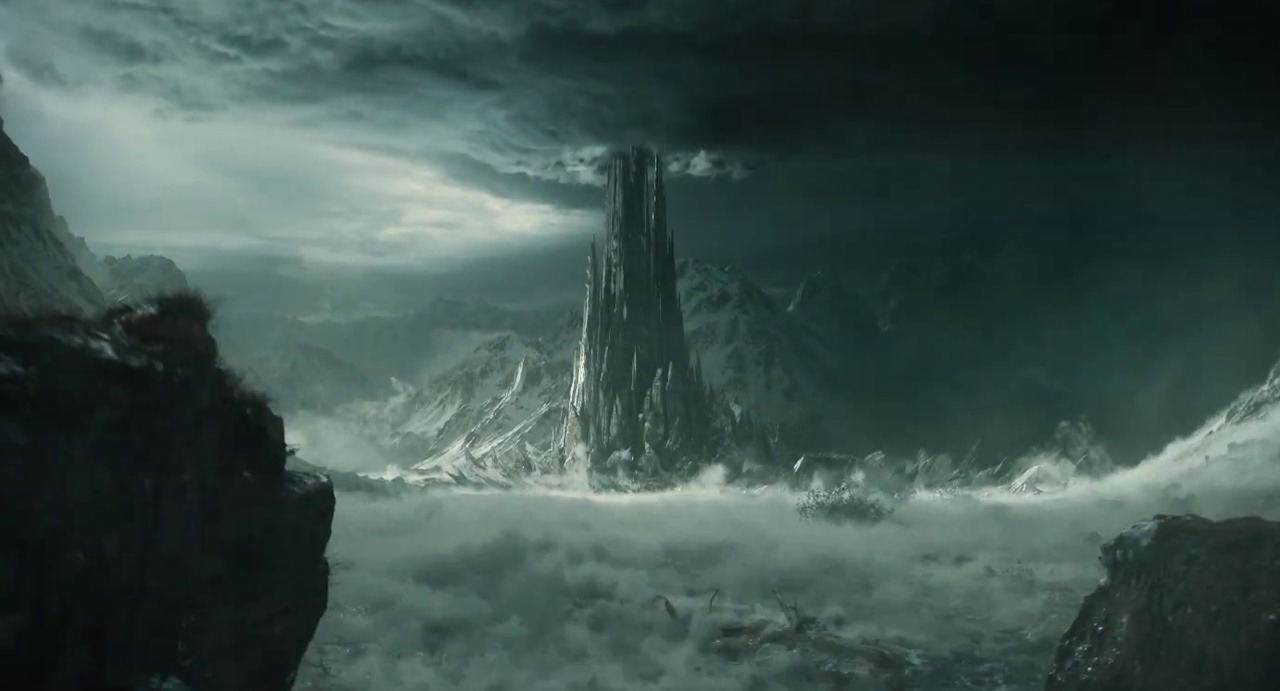
Still frame from The Rings of Power Season 2 trailer showing an imposing tower.
Is this going to be Sauron’s fortress?

When Amazon was negotiating with the Tolkien estate prior to The Rings of Power being commissioned, I can’t help but feel that the wrong decisions were taken. Although this may be controversial, in my view it would’ve been better to re-tell the story of The Lord of the Rings instead of trying to create a prequel from the book’s appendices. Re-making such a popular story less than twenty years after the films had been produced would have drawn a lot of criticism – but The Rings of Power caught that anyway, and at least if the series had been re-telling The Lord of the Rings, the story itself would’ve been built on firmer foundations.

That’s all for the birds now, of course, but as new Middle-earth films are being created, set in and around the time of The Lord of the Rings, I don’t think that the comparison they present is a favourable one for The Rings of Power. Ask 100 Lord of the Rings fans whether they’re more excited for the next season of this series or War of the Rohirrim and the Gollum film… and I think you and I both have a good idea about which way that survey would go!

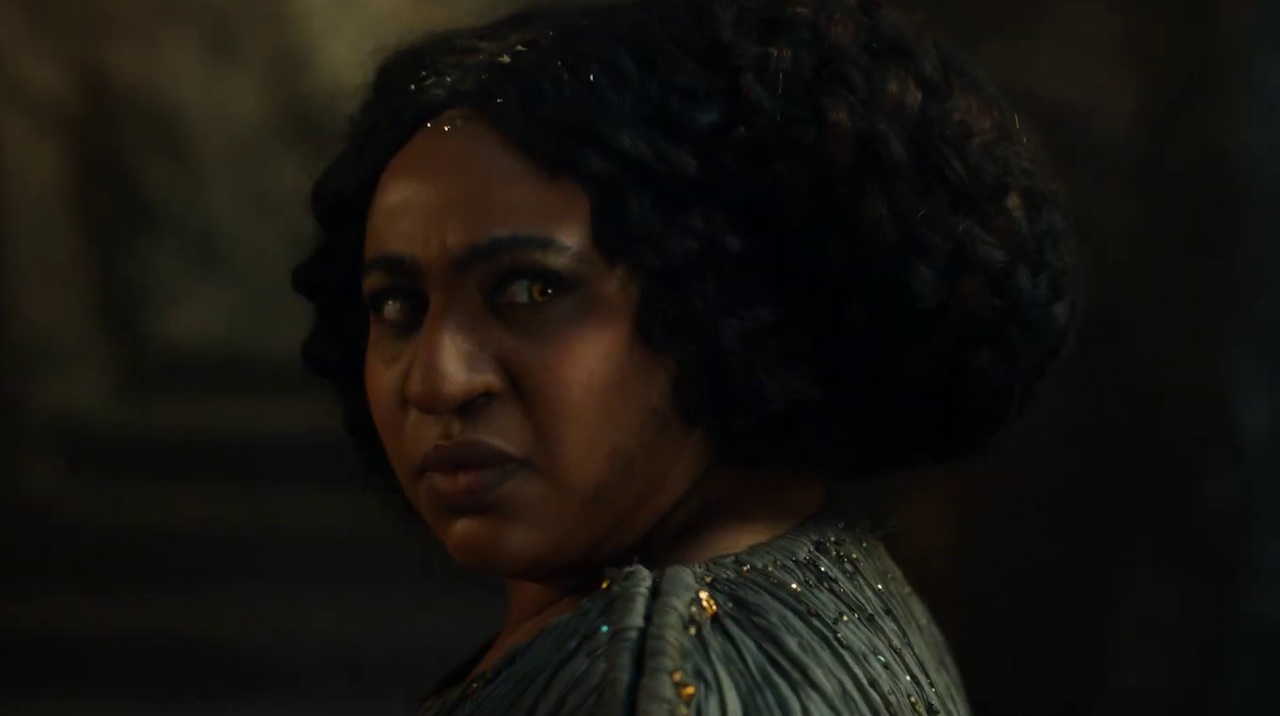
Still frame from The Rings of Power Season 2 trailer showing Princess Disa.
Princess Disa in the Season 2 trailer.

I’ve had a little time to sit with the trailer for The Rings of Power Season 2, and I’ve given it a couple of re-watches to see if I missed anything interesting. We’ll set aside concerns about the long wait, other fantasy shows, and Amazon’s management of the project and take a look at the trailer now. As always, I encourage you to watch the trailer for yourself if you can – it’s available on YouTube at time of writing, and I assume it’ll be somewhere on Amazon Prime Video, too. I’ll drop a link to the trailer at the bottom of this article.

My two biggest takeaways from the trailer are as follows: first, “more of the same.” In terms of costumes, characters, and visual effects, The Rings of Power Season 2 looks remarkably similar to Season 1 – or at least to my two-year-old recollections of Season 1! As discussed above, I think that in itself could be a serious hurdle for a series whose first season was not especially well-received. This trailer is going to be most folks’ first look at The Rings of Power in close to two years, and if that’s the main impression most people get… I’m not sure that bodes well for bringing back wayward viewers.

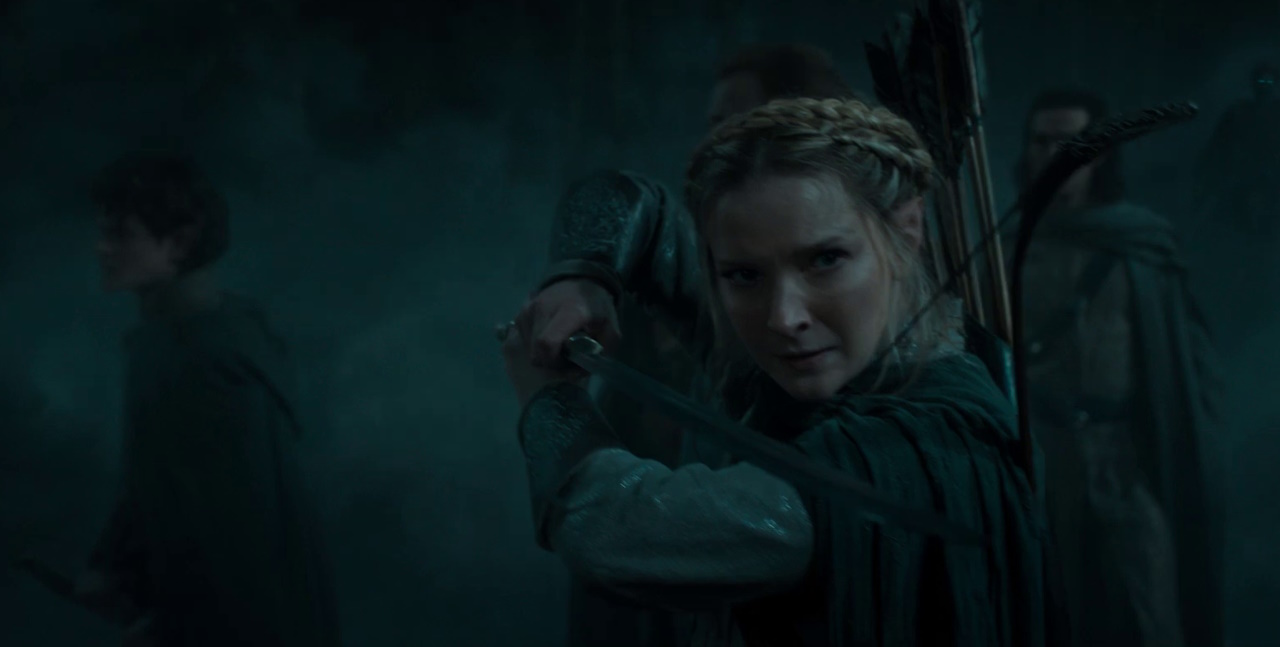
Still frame from The Rings of Power Season 2 trailer showing Galadriel with a group of elves.
Galadriel and the elves appear to be caught in an ambush.

Secondly, I was struck by the absence of several key characters from Season 1 – characters that we know to be returning in some capacity this time around. Their absences could be hiding spoilers, they could be held in reserve for a future trailer, or the post-production work on those scenes and sequences could be unfinished. But I also wonder whether the proto-Hobbit Harfoots and the humans of the Southlands may be taking on less of a prominent role this time around.

We did get a very brief glimpse of the Stranger – the wizard character whom many are assuming to be Gandalf – seemingly performing some kind of magical spell. I’ve had a theory for a while that the Stranger may, in fact, turn out to be another wizard like Saruman; this would be a different outcome to what many viewers seem to be expecting! But the Stranger was barely glimpsed in this trailer, which could also suggest that his role is going to be less significant this time around. I’m not always in favour of writers and artists making big changes to their work based on complaints, but the Harfoot-Stranger storyline was probably not the most well-received in Season 1, so scaling it back could make sense… if indeed that’s what’s happened.

Still frame from The Rings of Power Season 2 trailer showing the Stranger.
I almost missed this clip in my first viewing of the trailer!

The Dwarves and Elves both seem to be aware of Sauron’s rise, and we saw several clips that could all be from the same battle – or that could be from different fights spread across multiple episodes. One clip appeared to show siege weapons being deployed against a city. Battles in Middle-earth have usually been fun to see on screen – though the titular Battle of the Five Armies in the final part of The Hobbit trilogy was, I would argue, over-stretched and a bit of a mess in terms of some of its CGI. But after Season 1 had ended without a full “battle episode,” it could be fun to have something like that this time around.

We saw most of the main characters, but one character pairing that was missing from the trailer was that of Elrond and the Dwarf prince Durin. These two characters were great together in Season 1, and their dynamic did a lot to bring some of the otherwise heavy stories down to earth. While it’ll be great to see different character groupings in Season 2, and to give the likes of Elrond and Galadriel more screen time together, I hope that doesn’t come at the expense of the wonderful “bromance” between Elrond and Durin that was built up in Season 1.

Still frame from The Rings of Power Season 2 trailer showing Durin.
The relationship between Durin and Elrond was one of the best parts of Season 1.

Season 1 hinted at the fate of Numenor and its people – destruction by a massive tidal wave/flood. Whether that will actually happen in Season 2 wasn’t clear, but with the action potentially returning to the island after Numenor’s excursion to the mainland, I think it has to be a possibility! I didn’t see a lot of Numenor in the trailer, but there did seem to be one interesting clip involving a character I didn’t recognise disembarking from a large Eagle. Does that mean that Tolkien’s somewhat notorious Eagles will be in play in Season 2? That could certainly shake things up!

I can’t help but wonder whether the scene showing what we assume to be Sauron meeting the ring-maker Celebrimbor is actually a flashback. In Tolkien’s original works – which The Rings of Power has diverged from already, I should note – it was Sauron who taught the Elves how to make magical rings, so showing this as a flashback could work. I wouldn’t say I’m 100% convinced of that, but it’s certainly an interesting possibility, and a way to bring the series more in line with The Silmarillion and Tolkien’s own stories.

Still frame from The Rings of Power Season 2 trailer showing King Durin holding a ring.
“Seven for the Dwarf-Lords in their halls of stone…”

There were two creatures/monsters that I didn’t recognise: one that seemed to be comprised of wriggling worms or tentacles and another that resides under the sea. Both of these could be great fun as threats/antagonists, and I look forward to seeing what the series will do with them. In terms of visuals, both looked great – and while they’re CGI creations, they were well-integrated with the sets and characters around them. When looking at video that has been compressed for YouTube, it isn’t always easy to tell how good or bad a CGI moment might look – but these seem to be on the right track, at least.

Although we couldn’t see what caused it, some disaster appears to befall the Dwarves at their underground home, with damage raining down on a Dwarven bridge. The theme of this season could be the tearing down of the existing power structures in Middle-earth, with our main characters needing to leap into action to save what they can and prepare to rebuild what’s going to be lost.

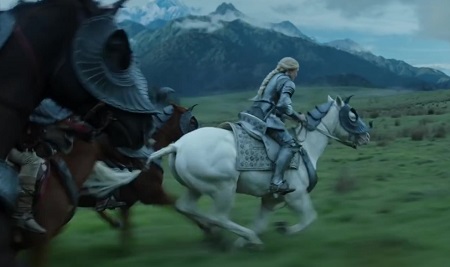
Still frame from The Rings of Power Season 2 trailer showing an army on horseback.
Charge!

The soundtrack to the trailer seemed to be solid. Music in Season 1 was generally pretty good – and the song This Wandering Day in particular was exceptional. With composer Bear McCreary returning to compose the soundtrack this time, I think we can expect more decent music. Visually, as noted I didn’t really feel that any of the CGI/VFX were sub-par. Nothing really leapt out at me as being visually stunning or groundbreaking – but again, a short trailer made for YouTube won’t necessarily give you that!

So that’s my look ahead to The Rings of Power Season 2, which will be on our screens at the end of August. Although it feels like spring has only just sprung, August and September will be upon us before we know it – so there really isn’t that long to wait! I’m debating whether or not to re-watch Season 1 before Season 2 gets here just so I’m caught up and ready to go. When the season arrives, I’ll do my best to share my thoughts and opinions here on the website, so I hope you’ll join me for that.

Despite some issues, I’ll end by saying that I’m generally looking forward to the return of The Rings of Power, and I’m crossing my fingers that the series can build upon the genuine successes of its first season. There should be opportunities to learn from what worked and what didn’t last time around, and perhaps to hone and refine things a little. That’s not really the impression I got from the way the trailer was cut… but here’s hoping!


You can watch The Rings of Power Season 2 trailer on YouTube by clicking or tapping here.

The Lord of the Rings: The Rings of Power Season 2 will premiere on the 29th of August 2024 on Amazon Prime Video. Season 1 is available to stream now and is also available on DVD. The Lord of the Rings: The Rings of Power is the copyright of Amazon Prime Video/Amazon Studios and New Line Cinema. This article contains the thoughts and opinions of one person only and is not intended to cause any offence.

Baldur’s Gate 3: Narrative and Role-Playing Thoughts

Spoiler Warning: There are spoilers ahead for Baldur’s Gate 3 – including its ending.

This piece is a follow-up to my spoiler-free review of Baldur’s Gate 3. If you haven’t read that, it provides a bit of background to some of the things we’re going to talk about here, and also goes into detail about some of the mechanics of Baldur’s Gate 3 and what I enjoyed about it from a gameplay perspective. It should also go without saying that we’re going to talk about some specific story points today, including the ending of the game and several character questlines. If you haven’t completed the game and don’t want to see spoilers, this is your opportunity to nope out!

Baldur’s Gate 3 had a strong story that roped me in almost from the first moment. It also told a story with plenty of variety, with companion questlines that went in interesting and unexpected directions, and side-quests that were just as engaging and impactful as the main quest. I adore the experience that I had, and I can’t wait to jump in for a second run and try to do some things differently – so everything we’re going to discuss today has to be seen through that lens. So to repeat: I thoroughly enjoyed the story of Baldur’s Gate 3!

You know there has to be a “but” coming after that, though… right?

Box art of Baldur’s Gate 3.

But I have some notes! Firstly, Baldur’s Gate 3 makes no apologies for being a dense story, and for really throwing players in the deep end from the very first moment. The wall of content that you experience upon booting up the game for the first time – in which I’m including the intro cinematic, the opening level, and the character creator – throws a lot at you all at once. For someone who didn’t play the original Baldur’s Gate and who’s unfamiliar with Dungeons and Dragons… it can be a lot to take in.

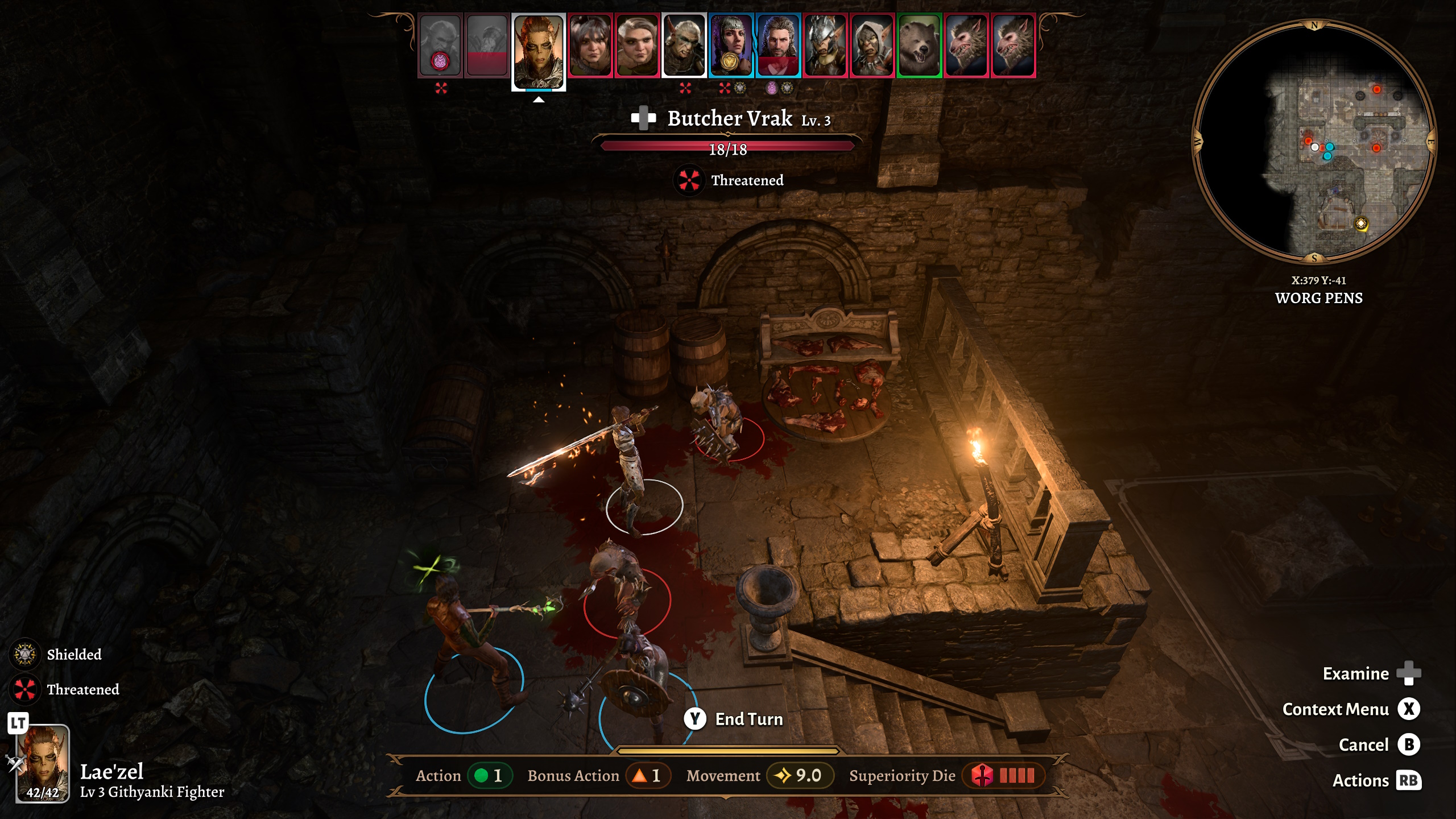
I made a lot of mistakes during my first few hours with Baldur’s Gate 3, and the game doesn’t hold players’ hands. For some folks, that’s a huge positive! But for me, I have mixed feelings. I’m no stranger to this phenomenon – I cut my teeth playing games in the late ’80s and early ’90s, when games didn’t have more than a manual in the box to help you out. But there’s a reason why most modern games offer more by way of tutorials and do more to ease players into the story! Baldur’s Gate 3 begins by throwing up a metaphorical brick wall that has no obvious way around or over it – and it’s up to you as a player to either muddle through or hop online to find a strategy guide.

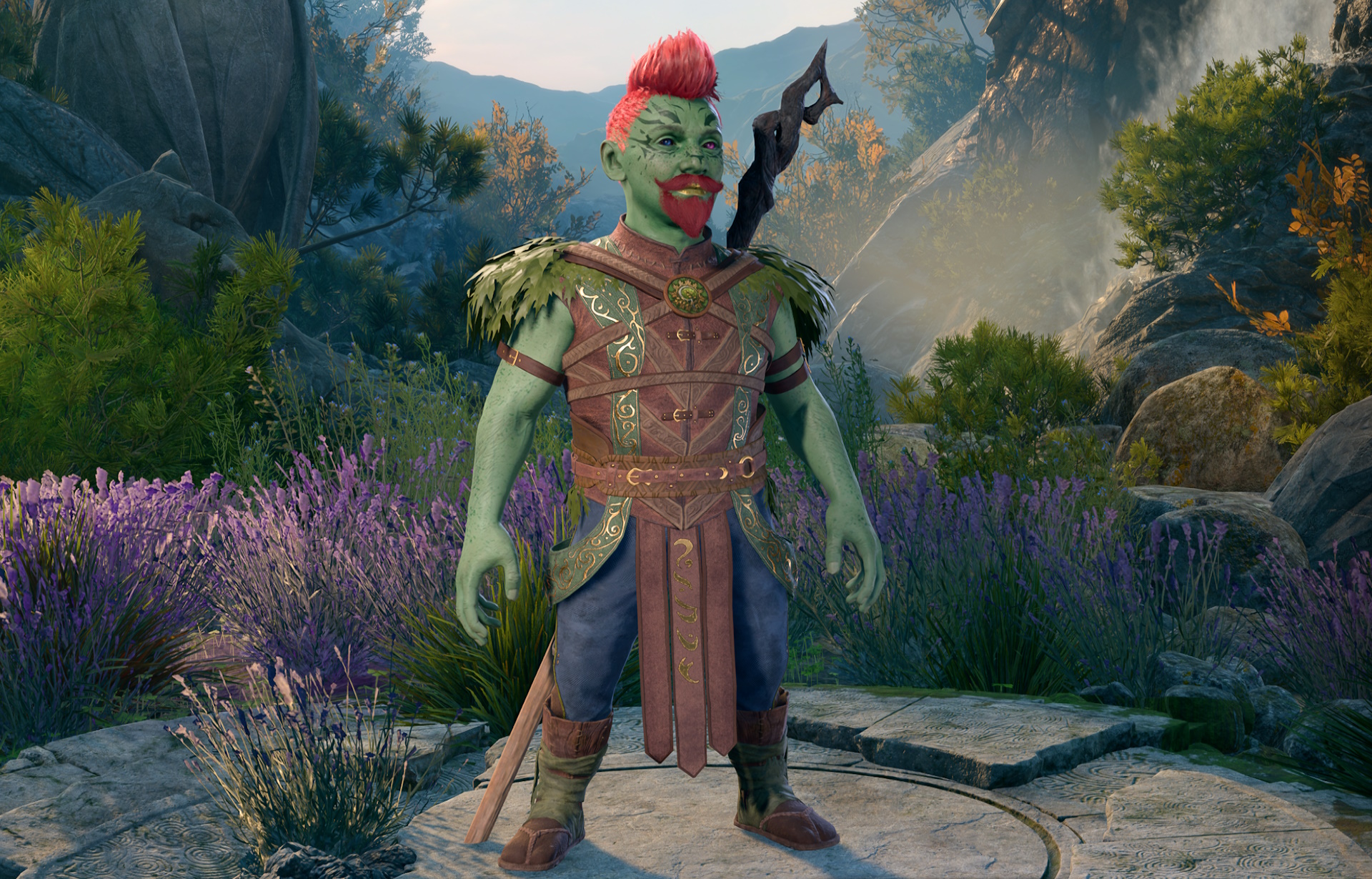
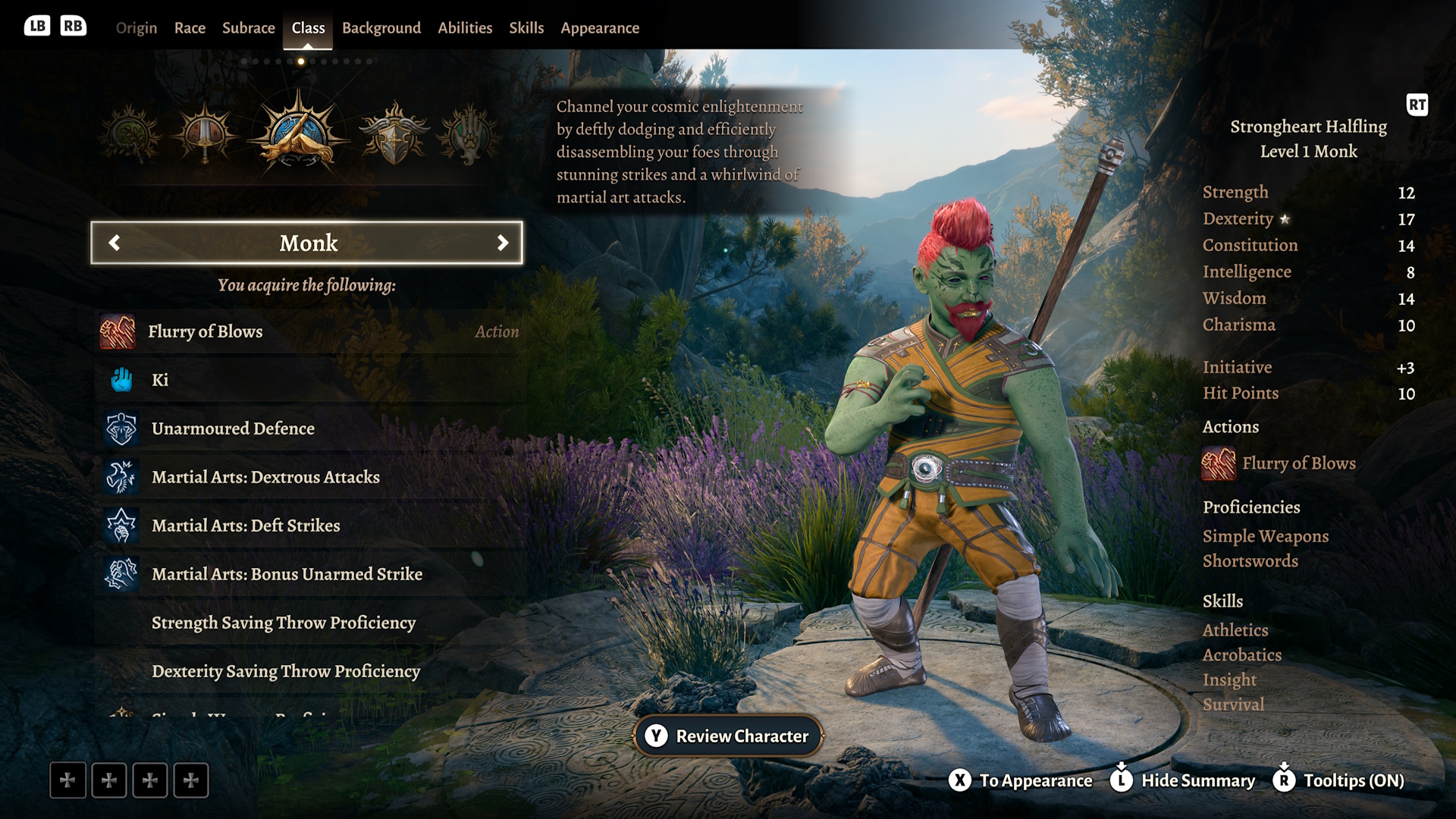
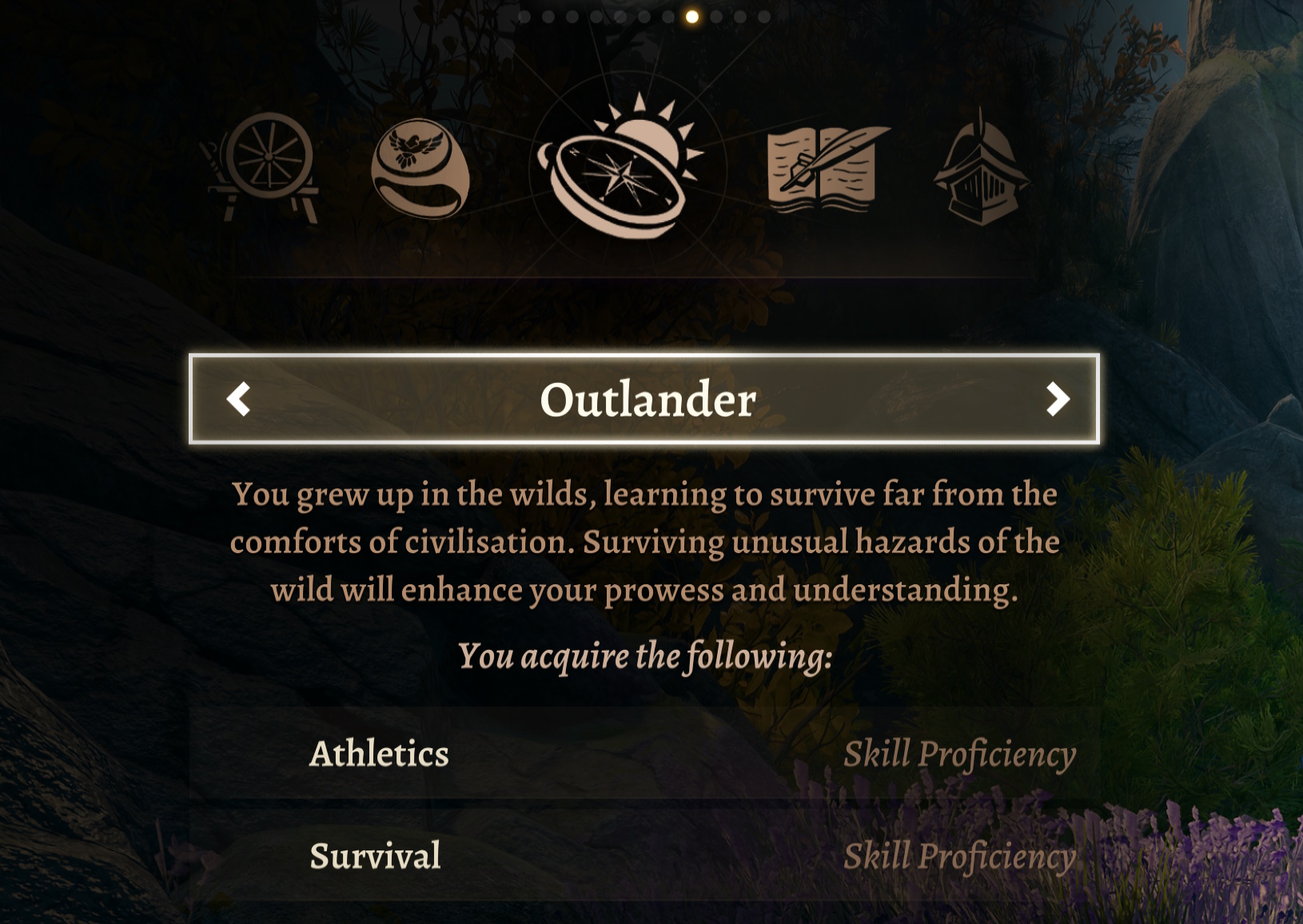
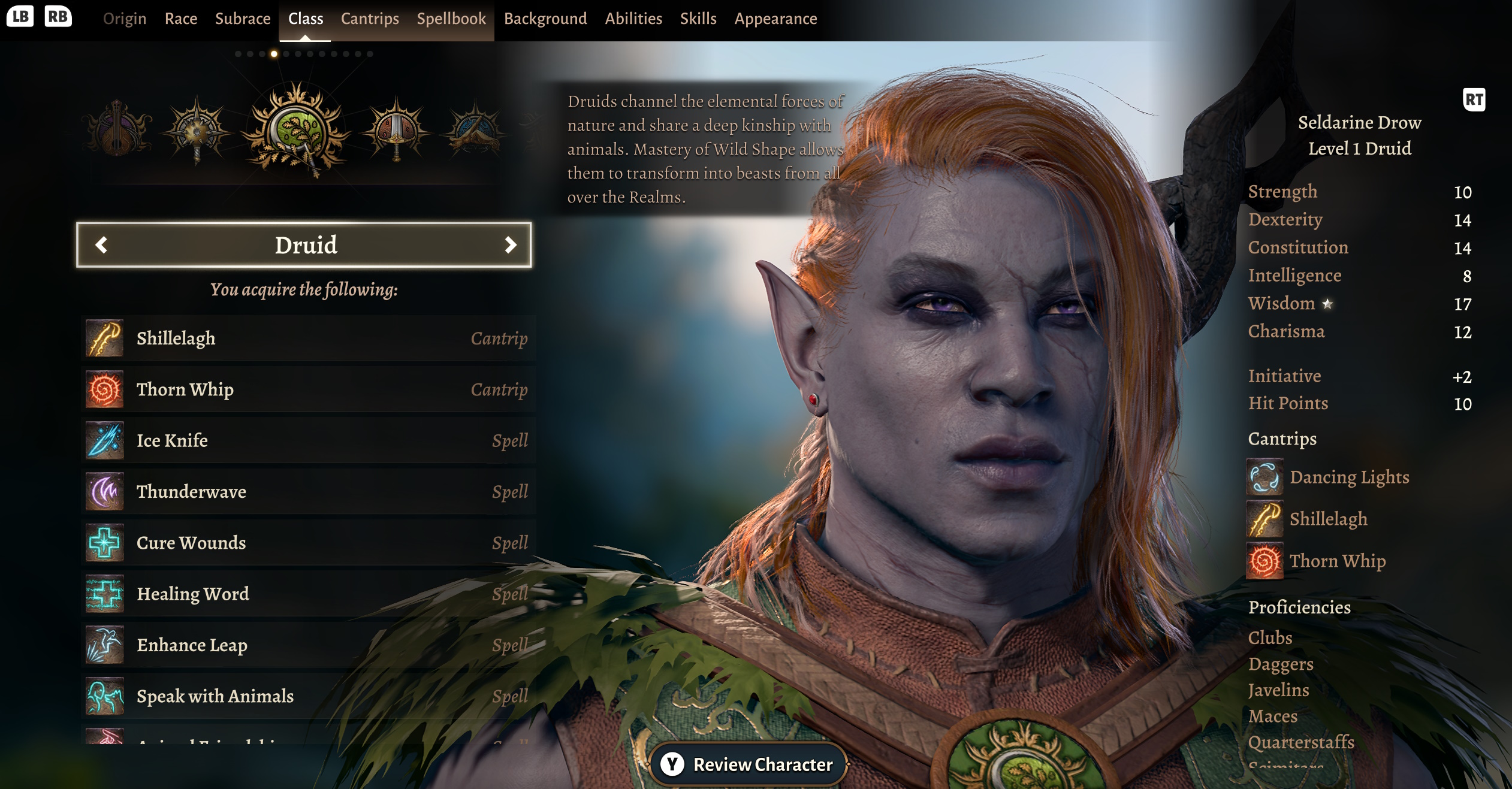
Creating a custom character.

My unfamiliarity with Dungeons and Dragons was a hurdle – one that I have no doubt impacted my experience with the game. It’s to the writers’ credit, more so than anything else, that I continued to play the game and kept coming back to it when I ran into something I didn’t understand or a problem I wasn’t sure how to solve. Although the story has huge stakes, particularly as it gets into its second and third acts and talk turns to the “Dead Three” and their chosen, at its core in those early moments it’s a story of survival. One person – the player character – is infected by a parasite and has to find a cure. That’s the driving force, and that’s what leads you to your allies and companions, and sets the stage for this story.

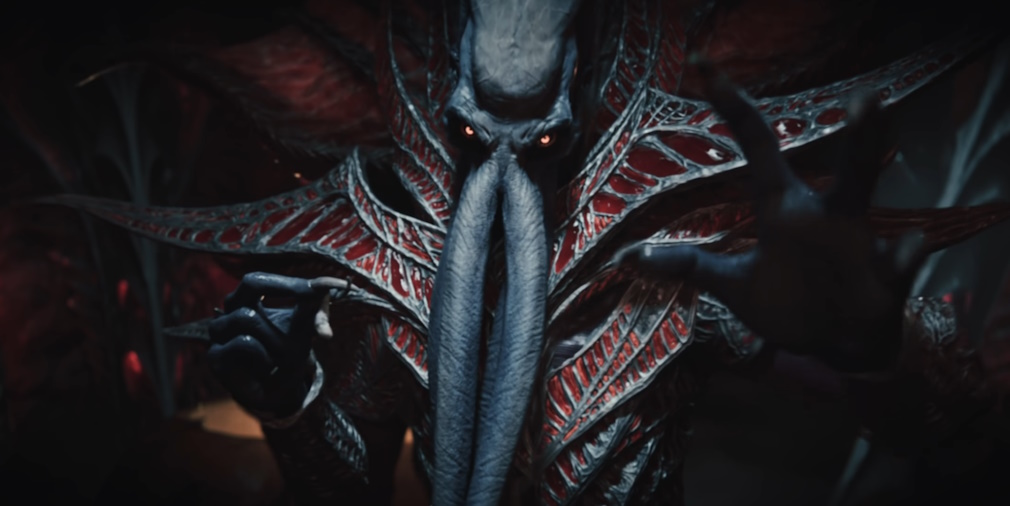
That character-centred story, with high personal stakes, is what roped me in during those crucial first moments. Even as I had no clue what mind-flayers, githyanki, or nautiloids were, there was a sense of urgency and a basic, innate survival instinct at the heart of the story that begged me to keep going. The writing to bring this to life and to get me instantly invested in this vast, dense world when I had no real frame of reference is truly world-class – there’s no other way to describe it. When people say that video games can be just as engaging, entertaining, and emotional as books or films, it’s stories like Baldur’s Gate 3 that they can point to!

The adventure begins…

Despite what you may have heard, Baldur’s Gate 3 does not have “17,000 endings.” There are a few basic ending options, which can be modified depending on player choice – and random dice rolls throughout the game. If a companion died, for example, or was never recruited, they don’t show up at the end. Likewise for allies – if an ally was never recruited, they aren’t available in the endgame. This adds variety, and means that it’s worth making multiple runs through the game to see different things and experience some of these different ending options. But I feel that the “17,000” claim is rather overstating what’s actually on offer. Don’t get me wrong: there’s far more variety and more ending options than in something like Mass Effect 3! But just not perhaps as much variety as has been claimed.

The ending I experienced during my first playthrough felt like the “best” possibility based on the way I’d played the game and which characters I had on my side. But other players might find that other options or pathways could have led to an even better outcome, which is absolutely part of the fun!

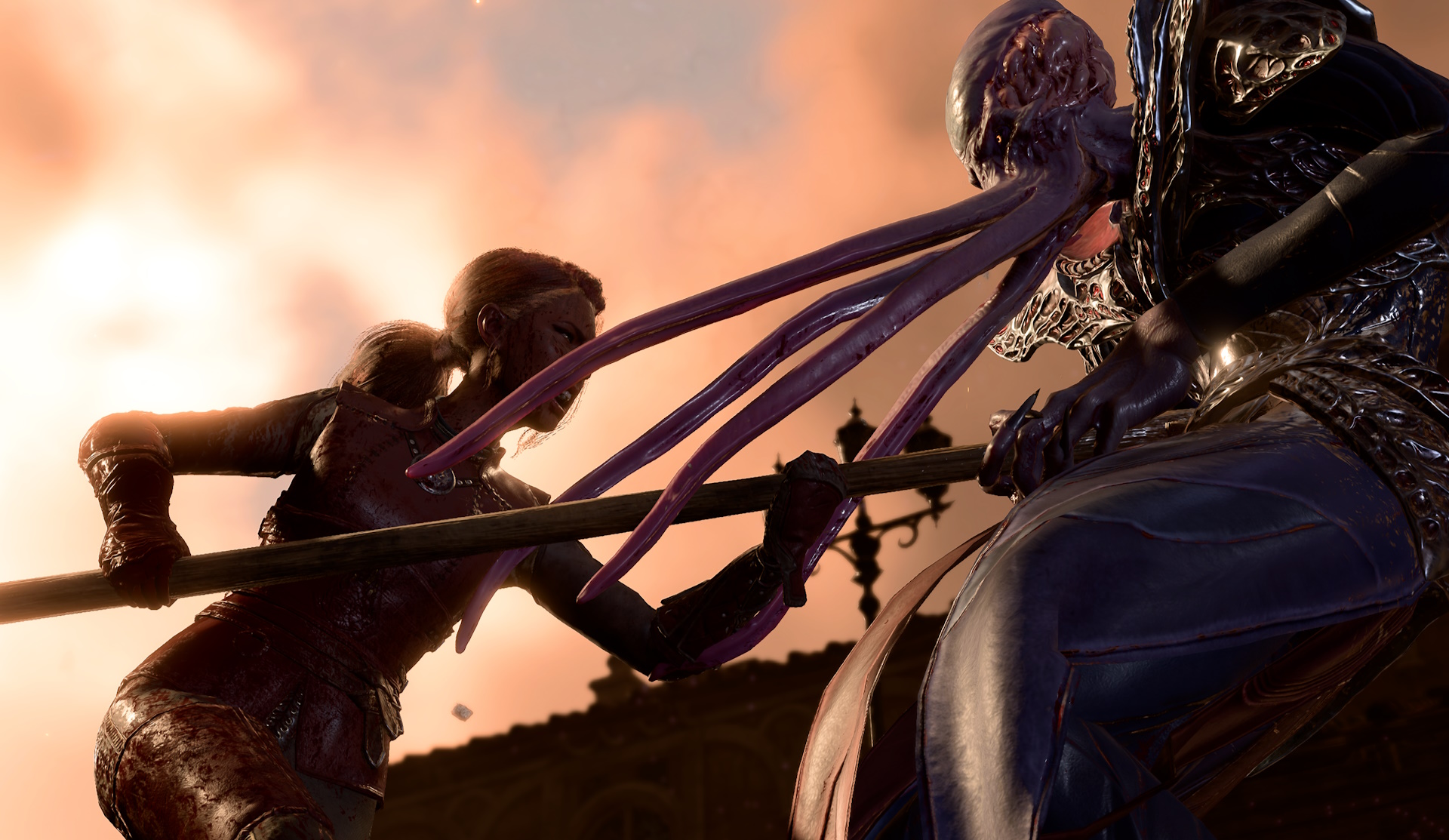
One of the citizens of Baldur’s Gate takes down a mind-flayer.

One thing that I liked about Baldur’s Gate 3 was the feeling of “impossible” choices. There are multiple points at which the road forks and you have to choose between one ally and another – betraying one in order to side with someone else. I kind of “cheesed” part of this by placing a companion on the back burner and largely ignoring her, allowing me to more easily side with one ally over another when doing so threatened to tread on the toes of her storyline. But it wasn’t the easiest thing to do – showing, I think, just how much the story had grabbed me and how much I’d come to care about these characters. I never like upsetting an NPC in a video game, but the friends and allies I’d made in Baldur’s Gate 3 felt like real people, so the idea of going against their wishes or even betraying them… I couldn’t do it!

Obviously Baldur’s Gate 3 is a sequel – so I expected some callbacks to earlier games. But I was surprised at how heavily Baldur’s Gate 3 seemed to lean on those two older titles, especially as the second and third acts of the game rolled around. I’m not familiar with those stories having never played the games, but there was enough exposition dumped to make it clear that some characters and storylines were basically direct continuations of the events of those games. That’s a creative decision, and one that fans of Baldur’s Gate 1 and 2 will surely have appreciated. For me, I could have done without that, and at a few points this sequel-itis felt quite in-your-face.

The character of Vicona DeVir is one of several who return from earlier games.

Let’s talk a bit about companions. There are ten potential companions in Baldur’s Gate 3 – two of whom appear to be mutually-exclusive, meaning you have to choose one over the other for a maximum of nine potential companions per playthrough. There are also hirelings who can be purchased to round out the party if you feel you’re missing a particular class or skill – but these characters are less interactive, have few if any unique dialogue options, and I personally felt didn’t serve a lot of purpose. You’re limited to four characters in your party at any one time – your main character plus three others – and hirelings count toward that limit. So unless there’s a problem with your main companions, the need for hirelings feels quite diminished.

In terms of variety, replayability, and player choice, I felt that the game offered a lot of pathways to bringing your party together – but many of these pathways led to the same end point. You could choose in what order to recruit party members – even if, at the time of my first playthrough, I wasn’t aware that I was doing so(!) – but for the most part, even if you deliberately shun a character that the game deems to be important, one way or another they’ll find their way back to you. In my case, the character of Wyll literally showed up at my camp toward the end of Act 1.

Wyll confronted Karlach at my campsite.

I’d seen Wyll briefly during one of the first fights in the game, but after that encounter I lost track of him and didn’t recruit him. I could’ve gone through the entire game not even realising I’d missed a prospective companion, but Wyll later showed up at my camp to confront Karlach – before being talked into joining the party. It kind of felt like this interaction was less organic and natural than others, and that Wyll was almost forced upon me, with Baldur’s Gate 3′s developers insisting that I take him along for the journey.

I’m not upset about the outcome – Wyll’s story was one of the most interesting in the game in more ways than one, and having him in the party led to some incredible moments in all three of the game’s main acts. But this is very much a case of the ends justifying the means, with a rare misstep in the way the game’s narrative came close to breaking the fourth wall leading to better and more engaging story beats later on.

Wyll proved to be a great companion character across the rest of the game.

I recently saw a spoiler-y video online, unfortunately, which confirms that the same thing also happens with the companion character Shadowheart. Players have to go a bit more out of their way to avoid Shadowheart, actively pushing her away and insisting she doesn’t join the party, but even if this path is chosen, Shadowheart makes her way back to the party partway through Act 1. And from what I saw in the video – which, admittedly, was not the entire storyline or sequence – it also felt like a very forceful way that the game pushed her into the party.

I’m not sure how true this is of all the other companions, but the main “tadpoled” characters of Astarion, Karlach, and Gale could well fall into this category too, showing up uninvited even if rebuffed by the player. And having played and enjoyed all of their arcs across the game, I think it’s not unfair to say that players would be missing out if they chose not to engage with these characters at least once. But in a game that sells itself in part on the fact that it offers players endless choices, the way some of these characters are basically forced into the party leads to a strange kind of disconnect between the game’s ambition on that front and the way it actually plays.

If ignored or rebuffed earlier in the game, Shadowheart shows up at the goblins’ camp in Act 1.

Some elements of Baldur’s Gate 3′s role-playing felt a little constrained by the mechanics of the game. To give one example from my own playthrough: I wanted my character to wield a flail – you know, the medieval weapon that’s basically a spiky ball attached to a chain. There wasn’t any real reason for this other than that I thought it looked neat on my character, a drow druid. But through my entire playthrough, I didn’t encounter any decent flails for my character to use.

There were swords aplenty, as well as axes, bows, and even staffs and clubs. But if I’d chosen to equip my character with a flail – after specifically choosing to make them proficient with that weapon type – I would have sacrificed a lot. Not only were there no unique or enchanted flails, offering additional bonuses like fire or ice damage, but the only ones I came across were pretty weak. They were easily outmatched by even the most basic swords and rapiers, leaving me with little choice but to equip a weapon I wasn’t wild about just to get the best stats. That’s part of gaming, in a way, but I would have liked to have seen more options on the weapon front. Baldur’s Gate 3 has plenty of weapon types on the surface, and uses that as part of its “play the game however you want” selling-point. But if some of these weapons are basically non-viable, especially later in the game when coming up against higher-level enemies, it kind of renders the whole thing redundant.

A flail.

That’s a specific complaint because I couldn’t find a flail that was as good (or almost as good) as many of the swords and other weapons that I encountered. But I will give the game credit for offering a variety of unique weapons, and for making it so that most characters can experiment with different ranged and melee weapon types. My druid, for example, was able to gain proficiencies with swords and crossbows at a relatively early point in the campaign, and it completely transformed them from a pure spellcaster into a much more well-rounded character who had multiple options when engaged in combat.

I didn’t choose to re-spec my character during my playthrough, nor change my class. I just didn’t feel that was necessary – but again, it’s nice that the game offers that option. I could absolutely see a scenario in which changing class would be worthwhile, and actually for a druid – which was my class – perhaps that’s even more relevant! Of the ten companions you can recruit, two are druids – so I can see a situation in which some players might want to change class to avoid having too many of the same character types in their party.

Talking to Withers at camp allows you to change your class, if desired.

Let’s talk about romance, because I feel this was one area where Baldur’s Gate 3 strayed from being a deeply engaging story into one that was very – for want of a better term – “video-gamey.” The basic problem is this: no matter who you are, what choices you made, what your background is, or what actions you take… everyone falls in love with you. That includes members of your party as well as important allies – and it just felt too easy to go down these romantic paths. It got to a point where I felt I had to basically avoid interacting with some characters after accidentally ending up in a romantic entanglement, and I just felt that this side of the story was clumsily handled.

It’s great that Baldur’s Gate 3 offers so many romantic options, don’t get me wrong, and that there are options for players to be gay, bi, straight, and so on. But it’s also a bit odd that every character so easily falls for the player – even if they take actions that they claim to disapprove of, or even after the player is already in a committed relationship with another NPC. I also find it a little odd that every NPC is able to be romanced regardless of whether the player character is male, female, or non-binary. Is everyone in Faerûn pansexual? Doing what games like Mass Effect do and restricting some romantic encounters by gender wouldn’t be a bad thing necessarily – if it was right for the character in question.

Some companions fall in love with the player character a little too easily!

Jumping ahead to the end of the game, while I had a fantastic time with the story and the way it brought together different characters that I’d encountered across my many hours of playtime, there are a couple of things to say.

Firstly, the fact that so many characters can be present as allies in the endgame is fantastic – and I absolutely love this kind of “everyone pitching in to save the day” story. It felt great, it was emotional, and I was genuinely surprised to see some characters turning up to offer their aid as Baldur’s Gate was besieged by the mind-flayers!

But – and you knew there was another “but” coming – the way this happens completely reframes many of these character encounters earlier in the game. Instead of helping little Arabella because it’s the right thing to do or because it feels like something your character would do, on a repeat playthrough you’re going to be acutely aware that saving her has a positive outcome in the endgame. Likewise the owlbear cub, Councillor Florrick, or Inspector Valeria. There are at least a dozen characters who can play a role here – and that knowledge completely changes how I’d approach their encounters and quests on a second playthrough.

Saving Arabella in Act 1 (and helping her again in Acts 2 and 3) has positive repercussions as the climactic battle rages.

This is kind of a trend you’ll see with Baldur’s Gate 3: while there are, in theory, many options for how to progress through the game, and the game is very adaptable if an NPC or even party member is killed, there are clearly some choices that lead to better outcomes, especially as the story reaches its climax. If you killed a bunch of NPCs, failed to save others, or just straight-up ignored whole questlines – which is easy to do, as some encounters have quite specific requirements – you’ll have fewer allies for the final fight against the Elder Brain, potentially giving you a tougher fight or a less-enjoyable time.

If your desire is to play as an “evil” character, I think this would affect you the most. Baldur’s Gate 3 tries to offset some of this, to its credit, by giving the “evil” options some positive endgame outcomes and alliances – such as if you betray Nightsong and turn her over to Lorroakan. But even then, I think you’re going to be left with fewer allies for the final fight. Maybe that’s okay – and narratively, if it makes sense for your character and your play style, that’s fine. But it may mean that, in terms of the mechanics of how the game works, you’ll end up having a worse or harder time.

Choosing to help the strange ox – which I did for no other reason than it seemed like a bit of silly fun – ended up making a difference.

Sticking with the ending of the game, after a beautiful coming-together of friends and allies – which, in spite of the criticisms above, felt amazing on that first playthrough – and the climactic battle against the Elder Brain, things just sort of… ended. There was a brief epilogue showing some of the surviving party members, but they soon went their separate ways. Depending on choices you may have made, the macguffin at the heart of the story – the Crown of Karsus – may be lost in the sea off the coast of Baldur’s Gate. And depending on promises you may have made to certain characters… it feels like the story didn’t actually end at that point, in spite of the credits rolling!

For me, I’d chosen to pledge the Crown of Karsus to Gale, who in turn planned to return it to the goddess Mystra. As my character and Gale stared wistfully out to sea, I couldn’t help but feel that another chapter of the story was yet to be told. Maybe that will be Baldur’s Gate 4… but I’m not so sure of that!

Gale at the end of the game. His story didn’t feel complete.

The same feeling hit me with Wyll and Karlach. Karlach’s questline involved getting her infernal mechanical heart back into working order, but she learned toward the end of that story that the only long-term solution that could save her life involved returning to Avernus. Karlach seemed ready to die – and everything I’ve read about this quest says that there’s no “happy ending” for her, unfortunately. That’s a creative choice that I respect, and being with Karlach as she went out on her terms was a fitting, if bittersweet, end to her story.

At the last second, though, Wyll intervened and promised to stay with her in Avernus, saving her life but condemning both of them to one of the nine hells. This moment could have worked better if more time had been dedicated to it; it felt rushed, and because it was such a twist on what the game seemed to have been building up to with Karlach, I don’t think it worked as well as it could have. We also didn’t get to see Wyll and Karlach depart – the sequence just came to an abrupt end.

Karlach’s story seemed to come to an abrupt end.

Although my character got a moment during the epilogue with their romantic partner, other characters were either only seen briefly or were notable by their absence. The Emperor (who I chose to save instead of freeing Orpheus) very quickly shuffled off-screen, as did Lae’zel and Shadowheart. Jaheira, Minsc, and Halsin didn’t have much to say during the epilogue, despite being party members and surviving the fight. Other allies who fought alongside me during the climactic battle were entirely absent.

I get that making an overly-long epilogue could be offputting for some people, but this is the end point of what was, for me, a story that had lasted more than eighty-five hours over the span of an entire month, so getting a few extra minutes to see what happened to some of my companions and friends would have felt great. Even just a picture and a block of text explaining where they went next would have been something; it didn’t need to be a fully-animated and voiced sequence if that was prohibitively expensive.

Halsin at the end of the game.

I mentioned earlier that I chose to play as a drow (dark elf) druid during my playthrough, and based on that I have a few thoughts about how well races, backgrounds, and classes are implemented in the game. During my spoiler-free review I mentioned this, so forgive me for repeating myself! But I didn’t feel that there were very many places in the game where being either a drow or a druid actually made much difference in terms of role-playing and conversations. And backgrounds were all but forgotten; I had to go back and check which one I even picked, because I don’t think it ever came up.

Obviously classes matter in Baldur’s Gate 3 – they matter a great deal, as they impact what kind of spells you can cast, what weapons you’re able to proficiently wield, how easy things like picking locks or sneaking will be, and some even give you advantages in conversations or when trying to persuade NPCs. All of that has a profound impact on the way Baldur’s Gate 3 plays – and one of the reasons why I’m so keen to start a second run through the game is to pick a different class and try things differently.

Perhaps I should play as a halfling monk next time?

But in terms of the game world and characters therein, I didn’t feel that my choices (at the character creation stage) made much of a difference. A few characters remarked on my being a drow when I first met them, but immediately moved on and it was never mentioned again. I think I saw about half a dozen drow conversation prompts during my playthrough, most of which related to darkness, seeing in the dark, or visiting the underdark (which I now know is where drows live!) And half a dozen lines of unique dialogue isn’t bad per se… but in a playthrough that lasted eighty-five hours, it’s not like I felt that being a drow was affecting every conversation or having a big impact on how most people saw my character.

The same was true of being a druid. A handful of lines of dialogue about nature or the natural world were available, and especially toward the beginning of the game in the druids’ grove I felt optimistic that my choice was going to have a bigger impact on the way my character engaged with NPCs. But as the game wore on, it became clear that the grove was a bit of an outlier, and that the number of these unique dialogue options were few and far between.

One of the druids near the beginning of the game.

There was no point at which I felt, as a druid, a unique pathway opened up for me to engage with a character, resolve a situation, or perhaps even start a quest that other classes wouldn’t have access to. Baldur’s Gate 3 seems to go out of its way to make sure that all races and classes have access to all of the quests and missions – which is a double-edged sword, really. On the positive side, it means that everyone can enjoy what’s on offer, but on the negative side… it kind of detracts from that wonderful character creation process, and leaves some of those choices feeling less important or just flat-out unimportant.

This is a bad example, as the missions in question were piss-poor and incredibly basic, but it’s the only one that springs to mind right now so it’ll have to do! But in Cyberpunk 2077, each of the three life paths (i.e. backgrounds) that were on offer led to a unique prologue and one unique in-game mission. Although in Cyberpunk these missions were lacklustre, at least there was an attempt to add to the role-playing experience by throwing a bone to players, making those early choices feel a bit more special and impactful. It also goes without saying that unique missions for each class or background add to any game’s replayability.

The choice of background doesn’t seem to matter.

Even if class-locked quests were off the table, it would still have been nice to see unique ways to progress through different parts of the game that were only available to certain classes or character types. To draw on another example, in the Omega DLC for Mass Effect 3, players who chose the “engineer” class get a class-exclusive opportunity that really impacts the mission and that makes perfect narrative sense. I didn’t see any of this in Baldur’s Gate 3. Maybe other classes or backgrounds have moments like this – but drow druids don’t, at least not from what I saw.

Every single combat encounter is going to be different depending on both the player’s class and the combination of classes of party members – be they the in-game companions or other people if playing co-operatively. And that’s great – it means that there’s a real strategic element to the game when it comes to deciding who to bring along and how to approach different moments. Getting a good combination of ranged, melee, and magical characters is a good starting point – but some encounters may need more heavy hitters, a healer, or a stealthy character, just to give three basic examples.

A combat encounter.

And that variety is a huge part of the fun. The different challenges posed by Baldur’s Gate 3′s huge variety of enemies makes practically every encounter feel unique. Even when facing off against the same basic enemy faction – goblins, for instance – there can still be this variety. A single boss goblin feels very different from a small group, and the strategies for defeating the small group are completely different from those needed to defeat a whole horde! I loved this aspect of the game, as it wasn’t possible to just pick a favourite party and stick with it the whole time; Baldur’s Gate 3 goes out of its way to encourage party-swapping and companion variety.

Exploration also feels like it has some of this variety. Having a character who’s adept at lockpicking in the party is a good rule of thumb, but characters who are perceptive or who have other bonuses also come in handy!

Some characters have an easier time than others when it comes to lockpicking, among other activities.

I just felt that, again, the way I created my custom character didn’t offer as much of that outside of combat. As either a drow or a druid, I didn’t find any unique ways to complete quests, any unique character encounters, or really any conversations or questlines that felt like they were really taking my character’s unique attributes into account. By the time I’d got stuck into the game and buffed up my character’s martial skills, giving me a mix of magic and weapon abilities, I felt that I had different ways to approach many encounters – but none of that felt like it was truly unique to who my character was.

There were also a few parts of the game that I felt were either not well-integrated or easy to overlook. For example, I didn’t create a single potion during my entire run. I didn’t even know potion-making was an option until I was well into Act 1, and I found that I was easily able to acquire enough health potions out in the wild such that making my own just never seemed like something I needed to do.

I didn’t actually do any alchemy.

Perhaps it’s more to do with the way I played the game, but I felt that potions and scrolls were less useful than spells and weapons – and I only used a handful across my run. Maybe there are things I missed out on because of that, and when I jump back in for a second playthrough I’d love to take more advantage of alchemy and scrolls. I’ll have to see whether and to what extent that makes a difference! But in my first run, I felt that neither were essential and both were easily overlooked.

While I feel you’d almost have to go out of your way to get into potion-making in Baldur’s Gate 3, and I feel the feature would benefit from an in-game introduction and tutorial, I like that it’s an option for players who want to role-play that kind of magical character. Potions are a big deal in fantasy settings, and it would feel like something’s missing if potion-making wasn’t present at all. I just feel it could be made more prominent in the game as things stand.

An armoured owlbear, ready for battle!

There’s one specific quest that I want to single out for criticism, and I’m picking on it not because I didn’t enjoy it – I think it’s one of the best and most interesting in the entire game – but because of how weirdly finicky it was to play, and how it had some very exacting requirements. For someone just playing the game, as I was, without a guide, it feels too easy to accidentally encounter this quest and then have it pretty significantly and negatively impact much of Act 3. I’m talking about the quest that involves rescuing the hostages from the Iron Throne – an underwater prison.

I first stumbled upon this quest by picking a lock in the city of Baldur’s Gate, then exploring what seemed to be a random warehouse. In the depths of the warehouse was a submarine that could ferry my party to this prison – but starting this quest before talking to other characters, including Gortash, Orin, one of the gnomes at the Steel Watch facility, and Wyll’s devil patron Mizora causes problems. Doing this in the “wrong” order leads to the quest having a much worse outcome, with Wyll’s father dead and the gnome rebellion at the Steel Watch not triggering properly. For a game that prides itself on letting players loose to freely explore, and on offering multiple branching paths… the way in which this particular quest was handled didn’t feel great, and it sticks up as an outlier. Despite that, when I managed to play it the “right” way, it ended up being one of my favourites in the game. It’s just a shame that it’s so exacting in its requirements, and that there aren’t any real ways around that.

This quest was very convoluted if you wanted to do it properly.

So I think we’d better wrap things up!

As I said last time, Baldur’s Gate 3 is the best game I’ve played so far this year. I adored the time I spent in Faerûn – my first ever venture into this particular fantasy realm – and I’m already chomping at the bit to start a second run through the game! I’m trying to restrain myself, as I feel jumping back in so soon after beating the game for the first time would diminish the experience, and I want to get as much out of my next go around as possible. But I daren’t wait too long, and I suspect I’ll give in and start that second playthrough before Christmas.

Though there were a few places where things could’ve been improved, and some quests that felt very particular with their requirements, overall I had a wonderful time with Baldur’s Gate 3. From the very first moment I felt gripped by what was simultaneously a small-scale, personal story and one that had world-ending repercussions. That’s in spite of having essentially zero background knowledge about the world of Dungeons and Dragons. The writing and gameplay were both outstanding, and kept me coming back for more.

Withers addressing the Dead Three.

I hope this has been interesting. There are bound to be many different perspectives on Baldur’s Gate 3, as it’s a game that encourages players to take different paths through its story. I already know that I haven’t seen all that the game has to offer – including an entire area of the map, many NPCs, one companion character, and I have no doubt multiple questlines, too. Now that I know what to expect, I’ll make a few changes to the way I play next time in order to check off some of those missing experiences! But I’ll try to save a few for another run, too.

Although I’ve found a few things to pick on in terms of Baldur’s Gate 3′s narrative and role-playing, none of those things prevented me from thoroughly enjoying a game that’s sure to be, for many folks, the game of the year. Baldur’s Gate 3 came out of nowhere this year – it hadn’t been on my radar at all. Both in terms of story and gameplay, I was stunned. I had an amazing time, and I can’t wait to go around again.

Baldur’s Gate 3 is out now for PC and PlayStation 5, and will be released on Xbox Series consoles in 2024. Baldur’s Gate 3 is the copyright of Larian Studios, and is based on Dungeons and Dragons which is owned by Wizards of the Coast and Hasbro. Some screenshots and promo art used above courtesy of Larian Studios and/or IGDB. This article contains the thoughts and opinions of one person only and is not intended to cause any offence.

Baldur’s Gate 3 and the return of “save-scumming!”

Spoiler Warning: Minor spoilers may be present for Baldur’s Gate 3.

As Baldur’s Gate 3 has taken the gaming world by storm, an age-old monster has awoken from its slumber. No, not the mind-flayers – I’m talking about the practice of “save-scumming!” There have been more than enough hot takes on the subject over the past couple of months… but hey, what’s the harm in one more?

Save-scumming, if you’re unfamiliar with the term, is the practice of creating a save just before an important dice roll or event, then re-loading the save to try again if something doesn’t go to plan. Though ubiquitous across gaming, save-scumming was controversial in the ’90s with games like Fallout and of course the original Baldur’s Gate.

The original Baldur’s Gate was where many folks first heard about “save-scumming.”

For as long as games have existed, gamers have looked for ways to cheat and get around the system. Before save files were commonplace, writing down passcodes to unlock levels was one way of doing it, and of course cheat codes have been a part of the gaming landscape for decades. But save-scumming seems to hit a sore spot for some fans of role-playing games like Baldur’s Gate 3, and the success of the game has reinvigorated the debate in 2023.

I’m a big advocate of accessibility in gaming, and I include in that category cheat codes, god modes, save-scumming, and everything else. If someone wants to play a game but finds it too difficult to the point of being frustrating or offputting, why shouldn’t they find a way to make it easier and get some enjoyment out of the game? Maybe you like to play games for the challenge and to “git gud,” but not everyone does. Difficulty and accessibility will have to be the topic of a future article, though, because we’re dangerously close to veering off-topic!

What’s your take on save-scumming, Lae’zel?

I support save-scumming in single-player and co-op games, and in my own playthrough of Baldur’s Gate 3, I did it. So not only do I not care if you do it, I think it’s weird if you care that I do it!

In a single-player game, save-scumming doesn’t impact anyone except the person playing the game. If I choose to re-load an earlier save and try again, that’s nobody’s business but mine. You can shout at me till you’re blue in the face that it “goes against the spirit of Dungeons and Dragons!” and maybe you’re right about that. But I couldn’t give less of a shit if I tried.

A party of save-scummers.

And you know what? Practically everyone criticising save-scumming in Baldur’s Gate 3 is a hypocrite. Are you telling me you’ve never loaded a save game after dying? Not even in titles like Dark Souls or Elden Ring? If you choose to start a new game from the beginning every single time you die in a game or get a bad outcome… well, good for you, I guess. That’s certainly one way to play. But practically everyone loads their most recent save after dying against a hard boss or accidentally choosing the wrong dialogue option. That’s why games let you save your progress!

Baldur’s Gate 3 is an especially odd case for the anti-save-scumming crowd to pick on because I’d argue very strongly that the game goes out of its way to encourage the practice. How many other games can you think of that let you freely save during cut-scenes, dialogue, lockpicking, or even in the middle of a combat encounter? Baldur’s Gate 3 does – it even lets you create a save file right on the dice roll screen. Why would the developers do that if not because they know that many players want to play that way?

You can literally save on this screen for quick and easy re-loading.

A game as long as Baldur’s Gate 3 isn’t one you can just pick up and play every day. It takes hours upon hours to progress through a single campaign – my own playthrough took more than 85 hours from beginning to end. And it’s a wonderful experience packed with unique encounters, well-written characters, and so much more. If my favourite companion is killed, or if I miss an important dice roll that means I can’t start a particular quest or get a valuable piece of loot… why should I have to progress through the rest of the game having a worse and less enjoyable experience? Why would I intentionally make the game less fun for myself just to preserve the nonexistent “integrity” of the digital dice? It doesn’t make a lot of sense to me!

That being said, if you’re adamantly opposed to ever save-scumming, or if you’re playing with friends who don’t approve… well, you do you, friend. It’s none of my business how you choose to play a single-player or co-op multiplayer game that I have absolutely no role in, so I would never say to anyone that they “have to” engage in save-scumming. Part of me respects someone who intentionally plays the game that way, knowing that they may well end up with a worse outcome and less-enjoyable experience.

Cheers!

At the end of the day, we’re talking about playing games for different reasons and from different points of view. I play games because I like the enjoyment, the story, and the adventure. I like to feel in control of the experience I’m having, and part of that means going back a step if I didn’t get the outcome I was hoping for. But if someone else plays games for the challenge, or enjoys the randomness and unpredictability that dice rolls bring, that’s totally fine! Just because it’s not how I choose to play doesn’t mean it’s bad, weird, stupid, or “objectively” worse.

Gaming is supposed to be fun, and there are different ways to approach it. My idea of fun may not be the same as yours – and I’m okay with that. I’ll defend save-scumming because, for me, it’s something that improves my experience of games like Baldur’s Gate 3. I think it’s silly to judge the way someone else chooses to play a single-player or co-op title, and there’s certainly a degree of snobbishness or even arrogance from some critics of save-scumming as they seem to look down their noses at people who play the game “the wrong way.” That’s a bit sad, to be honest, because how I choose to enjoy Baldur’s Gate 3 has no impact whatsoever on anyone else.

So save-scum all the way to Faerûn and back, friends! Or don’t, if you don’t want to. But if you only have time for one playthrough and you miss out on an interesting character, an exciting questline, or even just a fun piece of loot… I hope it’s worth it!

Baldur’s Gate 3 is out now for PC and PlayStation 5, and will be released on Xbox Series consoles in 2024. Baldur’s Gate 3 is the copyright of Larian Studios, and is based on Dungeons and Dragons which is owned by Wizards of the Coast and Hasbro. Some screenshots and promo art used above courtesy of Larian Studios and/or IGDB. This article contains the thoughts and opinions of one person only and is not intended to cause any offence.

Baldur’s Gate 3: Spoiler-free review

Here’s an unanswerable question to kick things off: does a critic or reviewer need to play through the entire game before publishing their review? The reason I ask is that Baldur’s Gate 3 is a massive game, and a lot of reviews that were published on release day or shortly after state up-front that they’re based on an incomplete experience.

That could be the topic of an entire article one day – and perhaps it should be! But for now, suffice to say that the reason my review is being published a month after Baldur’s Gate 3 launched on PC is because I took the time to complete the main campaign. As a result, I have a few things to say that I feel some early reviews glossed over or didn’t make mention of. The middle and latter parts of the game are a little different – and in some ways may feel slightly less polished than its opening act.

Promo screenshot of Baldur’s Gate 3.

But let’s take a step back! I recently completed a single playthrough of Baldur’s Gate 3 – and there’s a case to be made that even a playthrough that lasted more than 85 hours and took in as much exploration and as many side-quests as possible still isn’t thorough. I definitely haven’t seen or experienced everything the game has to offer! That’s a great thing, in my opinion, as any game that offers that kind of replayability is fantastic.

As things stand right now, in early September, Baldur’s Gate 3 is the best game I’ve played this year – and there’s no competition. This game hadn’t even been on my radar until a few weeks ago, so from my perspective it basically came out of nowhere! As someone who’s been playing games for well over three decades, getting that kind of experience is an increasingly rare phenomenon. I’m in love with Baldur’s Gate 3, and even at its most frustrating or difficult moments, I found myself inexorably drawn to the game. Finishing the story and seeing the credits roll was bittersweet! Coming to the end of such an amazing adventure left me feeling simultaneously thrilled at what I’d experienced and devastated that I couldn’t experience more of it!

A trio of adventurers in silly hats!

In the ’90s, I missed out on the original Baldur’s Gate games. I wasn’t into Dungeons and Dragons, and I felt that turn-based CRPGs were less exciting and less fun than “Doom clones” (as we used to call first-person shooters), action-adventures, and even real-time strategy games like Command and Conquer or Age of Empires. So while I was dimly aware of Baldur’s Gate and its sequel, they were never titles that I felt any interest in trying for myself at the time.

I came to Baldur’s Gate 3 with basically no expectations. Sure, there had been some good reviews, and developer Larian Studios had received praise for Divinity: Original Sin and its sequel, but I really didn’t know what I was getting into. I don’t know the first thing about Dungeons and Dragons or its lore, and having never played the original Baldur’s Gate I was completely unfamiliar with the world I was about to experience.

The original Baldur’s Gate looked like this…

Baldur’s Gate 3 catapulted me right into the story! The game’s introduction was dense and heavy, with a huge array of options in the character creator and an explosive opening chapter to the story to contend with. For someone brand-new to this world, it was a lot to take in all at once. I felt overwhelmed more than once in those first moments – and that feeling came back multiple times during the first few hours. Baldur’s Gate 3 didn’t hold my hand – and while it may feel much more accessible than CRPGs did in the ’90s, players coming to the game having played modern action/RPGs like Cyberpunk 2077 or Skyrim might find the sheer density and wall of content to be offputting.

That’s not to say that Baldur’s Gate 3 is “too hard,” not by any means. Some combat encounters are challenging, and at higher difficulty levels you’re in for a tough fight! But figuring out how to effectively use the right combination of spells and weapons, as well as how to solve puzzles and complete quests was, for me at least, all part of the fun. There were some frustrating moments where I felt I’d come up against an impossible challenge – but I soon found that I could usually figure out where I was going wrong and, at the second or perhaps third time of asking, make progress.

A combat encounter.

Baldur’s Gate 3 has been praised for its polish – and rightly so, for the most part. But I would be remiss not to mention that I encountered a few bugs and glitches during my playthrough, as well as some dodgy enemy and ally AI that could be frustrating. Although most of these were occasional or one-off issues, here are the ones that spring to mind:

  • Being able to pick up “null items” that didn’t exist,
  • Enemies repeatedly trying to open locked doors over and over,
  • Subtitles not showing during dialogue,
  • Characters getting stuck or being unable to navigate an open doorway,
  • Parts of a character’s skin/costume going missing,
  • Enemies and allies both charging head-first into fire or other environmental hazards,
  • Characters seeming to “freeze” and take no actions in combat when it was their turn,
  • The camera pointing in the wrong direction (or at nothing at all) during cut-scenes,
  • A quest marker that pointed to the wrong place on the map,
  • A mission-critical character in the latter part of the game who was randomly dead during a quest.

While I didn’t encounter any hard crashes – not a single one in over eighty-five hours of playing – nor any bugged or broken quests, I’m treating Baldur’s Gate 3 a bit more harshly on the bug front than I otherwise would, and that’s for one primary reason: this is a game that spent more than three years in early access. There was ample time to polish the experience and to take on board feedback from players. Some of these bugs occurred during the first part of the game, which is the part that was available to play during early access, so I really don’t give Larian a lot of leeway here when it comes to bugs.

Are bugs inevitable in games? Sure. Is Baldur’s Gate 3 one of the least-buggy titles so far this year? Absolutely… but that’s a low bar. Given how long the game has been in development, and especially given how long it spent in early access, the fact that basic things like subtitles or character models could be problematic isn’t great. While there are some mitigating circumstances – such as the game’s launch being pushed forward by over a month – I still think more could have been done to mitigate these issues.

This isn’t an item you’re supposed to be able to collect!

While we’re on this subject, let’s talk a little more about AI. Some of the characters in the game – and I’m including allies, companions, enemies, and occasionally the player character in this – could behave absolutely stupidly on occasion. Pathfinding when in turn-based mode could be particularly poor, and this is significant because character movement is strictly limited in combat and turn-based mode. Taking an unnecessarily long or winding route to a spot on the map or an objective can be the difference between being able to do something that turn or having to wait. Perhaps some of this could be explained by “user error” – but not all of it!

Then there were occasions where characters would damage their own allies, either by firing a weapon or casting a spell that impacted everyone around them. If I, as the player, chose to do something like that because I weighed that the benefits outweighed the cost, that’s my decision. But for the AI to make a move that crippled or killed some of its own characters… it just didn’t make a lot of sense to me, not when there were clearly other options available.

Promo screenshot featuring a combat encounter.

There were also a few let-downs when it came to the choices I made, and this is something that I definitely felt more of as the game progressed. Despite an impressive character creator offering backgrounds, races, classes, and more… I didn’t really feel that much beyond the class actually mattered. The way other characters in the world reacted to my character generally didn’t take my character’s race or background into account, and class primarily affected combat and stealth encounters. Considering the game’s lofty promises… only seeing a few lines of unique dialogue across eighty-five hours wasn’t as impressive as it could’ve been.

I chose to play as a dark elf/drow druid. And there were a few places where, as a druid, I got a line or two about nature… but the conversation would immediately return to other matters. As a drow, I didn’t feel that the way anyone in the world reacted to me was any different or would have been any different if I’d chosen to play as a human or a halfling. More could have been made of this, in my opinion, to really make these custom characters feel unique and part of the world.

I chose to play as a drow druid.

The same was true of character relationships. Without giving too much away, none of them felt particularly reactive – either to the character I chose to play as or to my actions. Occasionally a pop-up would display informing me that so-and-so “approved” or “disapproved” of a certain action or dialogue choice. But at no point did any of this approval or disapproval matter. You might get a different line of dialogue when next interacting with them, but after that they’d again go right back to the way they were.

We’ll have to get into more detail about some of these decisions later – I’ll be writing a second part of this review in the days ahead in which I’ll talk more about specific character moments and story beats and get into spoiler territory. But for now, I think I’ve made my point about the lack of reaction from some of the characters and the overall generic feel to the player-created custom character. Maybe choosing to play as one of the pre-made characters would negate this feeling, but for me – and I’d wager, for a lot of other folks too – part of the fun of a role-playing game is creating a character, either to represent ourselves or as an opportunity to become someone completely different.

An example of a custom character.

But I don’t want you to get the wrong idea. Baldur’s Gate 3 is a truly compelling game that sucked me in and kept me in suspense practically the entire time. No sooner had I finished one complex mission than another would present itself, and the incredible thing was just how natural and organic the whole adventure and story felt. Exploring an area away from where the main quest seemed to be leading would see me encounter an interesting character who would have an entire hour-long mission of their own to send me on. Or diving into a dungeon would lead to uncovering a secret item that would have a massive impact on one of the characters in the group, again kicking off a quest or even a whole line of quests. Baldur’s Gate 3 certainly found a way to make exploring its beautifully-crafted world feel rewarding.

Levels and regions in Baldur’s Gate 3 feel balanced – not too big and not too small. There are just the right amount of items and loot to make exploring feel worthwhile without being unnecessarily time-consuming. And there’s a beautiful diversity of environments – from dark, rat-infested dungeons to beautiful beaches and hills. Unlike some open-world games, which can feel too big, directionless, or bland, everything about the world of Baldur’s Gate 3 was fantastic; a masterclass in level design.

The map screen.

How many games have you played where enemy types would soon feel repetitive and boring? I can practically guarantee you that won’t be the case in Baldur’s Gate 3! The sheer diversity of enemy types was fantastic, with practically every combat encounter offering something different. There are many named enemies and mini-bosses to go along with the bigger, badder bosses, too – and again, each of these feels unique and different from one another. There are factions that oppose you along your quest – but even when fighting the same group, the sheer array of characters, and the differing combinations in which enemy groups can be deployed, really worked to make each fight feel different from the last.

This diversity extends to friendly and neutral NPCs, too. There are so many different characters to meet, and practically all of them feel like they have a place in the fantasy world of Faerûn. Even background characters, like nameless villagers or soldiers, still manage to feel like they have a role to play – and perhaps a story all their own that we just didn’t see. These characters go a long way to building up a world that feels lived-in and real – and one in which the player character’s decisions do genuinely matter.

One of the game’s many non-player characters.

There’s also a decent amount of variety in terms of loot and items. Maybe this says more about the way I play these games – your mileage may vary – but I found I’d amassed a huge collection of everything from random junk to potions and scrolls by the time the campaign was into its final stretch. The ability to send items to camp instantaneously instead of having to sell them or leave them behind when over-encumbered is a life-saver – and a feature more games should take advantage of!

There are a couple of downsides here, though. Inventory management isn’t great, and when storing items in a chest at camp there’s no way to sort by category, meaning it can be a pain to find a specific item. Secondly, while there’s a huge number of individual items to find in the game, there wasn’t such a broad variety of cosmetic items to choose from, particularly in the armour department. Being able to recolour items with dye certainly helped, but a bit more cosmetic variety wouldn’t go amiss in a game like this – and I’d happily sacrifice a dozen or more of the random pieces of junk to get even one or two additional pairs of boots or suits of armour.

Inventory management could be easier sometimes.

I chose to play Baldur’s Gate 3 using a control pad, not mouse and keyboard. That’s my preferred way to play, and I found the game’s “radial menus” to be a little cumbersome, but ultimately perfectly usable. The fact that combat is turn-based means you aren’t having to panic trying to hit buttons in short order, and there’s time to open each menu and find exactly the right spell, attack, or action that you need!

When the game launches on PlayStation 5 later this week, I would imagine the controls will be similar. Controller support on PC was good, and everything from moving and exploring the world to those turn-based actions worked well. I doubt PlayStation players, or PC players like myself using a control pad, will have any major issues.

An early-game vista.

Let’s briefly talk about dice and randomness! Many events in Baldur’s Gate 3, from conversations to lockpicking and exploration to combat, rely on rolls of the digital dice. Some of these rolls are obvious and interactive – others are passive and happen in the background, though you’ll be informed of the outcome. A lot of games use “random number generation” to determine the outcome of all manner of things, but it’s obvious and even in-your-face in Baldur’s Gate 3. You can, of course “save-scum” to get around this – Baldur’s Gate 3 practically encourages save-scumming by implementing a free save system that allows you to save while in combat, right before a dice roll, and basically at any point.

Save-scumming will have to be the subject of an article of its own one day, but suffice to say I support the practice. It’s your game, and you should play it the way you want! If you get a once-in-a-single-playthrough encounter, with a positive or negative outcome literally hanging on the roll of a dice… why not go back and redo it if you want to get the “right” outcome? There were relatively few points where I felt I absolutely needed to get a specific outcome, and the game is incredibly adaptable in that regard. But it also definitely allows for easy re-dos thanks to the aforementioned free save system – and some generous in-game dice modifiers and boosters!

Get used to rolling dice!

I picked up Baldur’s Gate 3 almost on a whim – I was looking for something to play while waiting for Starfield. I really didn’t know what to expect beyond a game that had been picking up some positive buzz, but I’m absolutely blown away by how much fun I had. It’s been an amazing ride, and in a way the fact that it was so unexpected only adds to that! Baldur’s Gate 3 hadn’t been on my radar at all in 2023, but it’s now a serious candidate for my “game of the year.” Check back in December, by the way, to see if it makes the cut!

I think I’ve said all I can without getting into the story too deeply. But I do have some thoughts on the details of the plot, so I hope you’ll join me in the days ahead for that. Or just swing by after you’ve beaten the game! Going in blind, as I did, is definitely recommended the first time around! The experience was much more enjoyable for me as I toddled and blundered my way through those opening hours of the game!

I don’t like to put a number score or a star rating on games when I review them. Check Metacritic if you want to get a mark out of ten! But if you want to know if I recommend Baldur’s Gate 3, the answer is an emphatic “yes.” This is the best game I’ve played in 2023 so far, and it’s not even close. There are some deep and complex systems that may seem offputting, and it’s a long game that requires a significant time commitment to make it all the way through. But even with those caveats – or rather, because of those selling-points – I can’t recommend it highly enough! You don’t need to be a Dungeons and Dragons player and you don’t need to have played a lot of CRPGs to get stuck into this game and have a fun time.

Baldur’s Gate 3 is out now for PC, will be released on PlayStation 5 on the 6th of September, and will be released on Xbox Series consoles in 2024. Baldur’s Gate 3 is the copyright of Larian Studios, and is based on Dungeons and Dragons which is owned by Wizards of the Coast and Hasbro. Some screenshots and promo art used above courtesy of Larian Studios and/or IGDB. This article contains the thoughts and opinions of one person only and is not intended to cause any offence.

The real tragedy of The Lord of the Rings: Gollum

The Lord of the Rings: Gollum has become the latest game in 2023 to be launched in a buggy, broken state. Some outlets have gone so far as to call it “the worst game of the year,” and in a year where titles like Hogwarts Legacy, Jedi: Survivor, Redfall, and The Last Of Us Part 1 have been sharted out in unfinished states by major publishers, there’s a lot of competition for that title!

I want to try to treat The Lord of the Rings: Gollum as fairly as possible. Developer and publisher Daedalic Entertainment isn’t one of the games industry’s biggest corporations, with relatively few titles having been developed across its fifteen-year history – and even fewer that I’d heard of. A company with around 100 employees made Gollum, whereas corporations like Activision Blizzard or Microsoft have far more resources at their disposal when it comes to game development.

A promotional screenshot of the game.

As much as I detest the “release now, fix later” business model that too many games corporations have adopted over the past couple of console generations, smaller studios working on passion projects have always been in somewhat of a different category. I’m far more willing to be sympathetic to an independent game developer than I am to one of the industry’s major publishers, simply because the realities of game development and working to a deadline or with a limited budget can go some way to explaining why a game may be released in a worse-than-expected state.

With Gollum having already suffered several lengthy delays, and with Daedalic Entertainment being a relatively small studio, I could forgive a degree of jankiness. That being said, I could forgive quite a bit more jankiness if Gollum had been more appropriately-priced, say around the £30 mark instead of greedily pushing for £50. And of course, a “special edition” will set you back an extra £10.

Gollum in an out-of-bounds area.

Some adverts and marketing material for Gollum have tried to paint the game as the kind of expansive adventure title that you’d get from a major publisher, and combined with the high price, I fear that unrealistic expectations were set. Even if the game had been released in a fully-complete, bug-free state, I daresay a lot of folks would still have found Gollum’s core gameplay and story to be underwhelming.

To me, there are two lessons from Gollum that the games industry – and smaller studios in particular – need to pay attention to. The first, of course, is that the accursed “release now, fix later” business model never works. No matter how good your game could have been, if you try to launch it before it’s ready, you’re going to have a bad time! The second lesson is that games need to be targeted, marketed, and priced appropriately. Gollum isn’t a AAA action-adventure that could go toe-to-toe with the likes of Shadow of Mordor or the earlier Lord of the Rings movie tie-in games. So why present it as that kind of experience? Marketing the game like that was only ever going to lead to disappointment.

Gollum was never meant to be comparable to the likes of Shadow of Mordor.

I don’t know what may have transpired behind the scenes at Daedalic Entertainment that led to Gollum’s disappointing release. I don’t think it’s an unfair assumption, though, that the game had a difficult and troubled development – perhaps with a degree of “feature creep” as the original vision for a small-scale title comparable to Daedalic’s past offerings may have been expanded. Either way, delays clearly added to the game’s cost, and eventually Daedalic decided that they couldn’t wait any longer and needed to push the game out. The result was Gollum’s troubled launch.

On a personal note, The Lord of the Rings: Gollum is one of the titles I’d been looking forward to in 2023. Not simply because a return to the world of Middle-earth is always welcome in the gaming realm, but because it seemed like something genuinely different. A game in which the protagonist is an anti-hero or even a contemptible villain was already enough to pique my curiosity, but there was also the kind of gameplay that Gollum seemed to be promising: puzzle-heavy, stealthy, and with a degree of platforming.

Gollum can get stuck in the environment due to a bug.

For me, the real tragedy of Gollum’s release isn’t just that a game I was looking forward to was pushed out too early in a broken, unfinished state. It isn’t even that Gollum is unlikely to ever be completely fixed and brought up to the level that it should be able to reach. No, the real tragedy of this whole situation is that it will almost certainly dissuade other developers – and especially other publishers – from taking risks like this in future.

However you look at it, the decision to create a stealth-puzzle-platformer based on a character like Gollum was a huge risk. This is the kind of game that just doesn’t get made any more, with the games industry retreating to the safest, most overtrodden ground for the most part. Fewer studios are willing to take on risky projects like Gollum, with publishers doubling-down on well-known franchises, popular genres, and looking for any kind of online experience that can generate “recurring revenue streams.”

Making a game like this was already a risk.

With the undeniable failure of Gollum – a failure that seems impossible to overcome, even if Daedalic continues to work on the game for years to come like Hello Games has done with No Man’s Sky – there’s a real danger that the lesson the games industry as a whole will take from this mess will be to continue its retreat from any project that falls outside of the mainstream. Gollum was always going to be a game with limited appeal; a niche product at best. It was also a game that felt innovative in both its premise and the kind of gameplay that it offered – and I truly fear that fewer games that meet those kinds of descriptors will be greenlit in future.

The games industry is already dominated by a handful of genres, most of which haven’t offered much by way of genuine innovation in years. Corporations are quick to chase the next “big” trend, with a focus on whatever looks likely to rake in the largest amount of cash possible. What was appealing about a game like Gollum, at least to me, was that it was a title that didn’t seem to care about those things; it knew what it wanted to be, what kind of gameplay it wanted to employ and what kind of story it aimed to tell, and wasn’t about chasing trends. The games industry needs more of that – because that’s where innovation almost always comes from.

Gollum with a baby bird in a promotional screenshot.

Even on a good day, Gollum was never going to be a genre-busting epic. If it had launched in a better state, I daresay I’d have had fun with it for the twelve or so hours that it would’ve lasted, then I’d have put it down and moved on. But the games industry needs these kind of experiences. It needs the diversity that smaller games bring. And it needs at least some of those titles to exist outside of the self-published, independent space. Gollum could have been precisely the kind of “double-A” release that used to exist in between the big franchises and the small independent titles. Once upon a time, there were a fair few games in that category.

My fear is that the spectacular failure of Gollum, which has been one of the main gaming news headlines over the past week or so, will have a chilling effect that will extend far beyond Daedalic Entertainment. Projects that aim to create a game that might be a bit more of a niche product, outside of the mainstream and perhaps not in one of the biggest genres, will become suspect. Smaller-scale games in that “double-A” space will be less likely to be backed. And innovative, potentially-interesting stories and ideas will be passed over in favour of projects that feel “safer” to publishers.

I hope that I’m wrong, and that smaller studios won’t be impacted by Gollum’s very public failure. But I really do fear for the repercussions that this debacle could have on an industry that needs titles like Gollum. Not every game is going to be Call of Duty or Fortnite, and especially for players who long for single-player experiences, games like Gollum that offer something a little different will continue to appeal. Let’s just hope that this broken, borderline-unplayable mess doesn’t ruin that for everyone else.

The Lord of the Rings: Gollum is out now for PC, PlayStation 5, and Xbox Series S/X. The Lord of the Rings: Gollum is the copyright of Daedalic Entertainment. The Lord of the Rings and Middle-earth are the copyright of the Tolkien Estate. Some images and promotional art used above are courtesy of Daedalic Entertainment. Images of bugs and glitches via Digital Foundry on YouTube. This article contains the thoughts and opinions of one person only and is not intended to cause any offence.

The Rings of Power: first impressions

Spoiler Warning: There are spoilers ahead for The Lord of the Rings: The Rings of Power. Spoilers are also present for The Lord of the Rings, The Hobbit, The Silmarillion, and other J.R.R. Tolkien works.

The Rings of Power – or to give it its full, clumsy title: The Lord of the Rings: The Rings of Power – got underway yesterday on Amazon Prime Video. As one of the shows I’d been most interested in all year, I tuned in almost as soon as the opening pair of episodes were available, curious to see what Amazon’s sky-high budget and years of planning could bring to the high fantasy genre.

For me, and doubtless for many other viewers as well, The Rings of Power simply cannot escape three massive sets of expectations. Firstly, the show has a legacy to live up to in the form of The Lord of the Rings film trilogy. Secondly, as the first-ever “billion dollar” television show, The Rings of Power must demonstrate an ability to go above and beyond pretty much anything else present on the small screen. And finally, there are inevitable comparisons with the show that set the bar for multi-season serialised high fantasy television shows: Game of Thrones. I think it isn’t unfair to say that there hasn’t been a television project in a generation that finds itself under so much pressure to deliver.

Galadriel and Gil-Galad on a promotional poster for The Rings of Power.

As we discussed back in February when I previewed the series, some viewers have taken to pre-judging The Rings of Power. Partly there seems to be a bloody-mindedness in hoping that Amazon would fail, and there were definitely racially-motivated criticisms of some of the casting choices – something that’s been incredibly disappointing to see. But there are also some genuine concerns: could the series possibly live up to the legacies of one of the most successful film trilogies and one of the most influential television shows of the past twenty years? How would it fit in with the “established lore” of Tolkien’s Middle-earth? And more fundamentally, is there even a story here that’s worth telling?

Some folks seem to have arrived at their answers to these questions already, deciding that The Rings of Power is going to be irredeemably awful and taking to social media at every opportunity to denounce it to anyone who’d listen. In the past couple of days the show has even been subjected to a degree of review-bombing. But speaking for myself, I wanted to see The Rings of Power before rushing to judgement. While two episodes of an eight-episode season aren’t enough to paint a full picture, I feel like I can at least share my first impressions of the series with you today.

The Rings of Power has finally arrived.

I liked The Rings of Power. The acting performances were solid, the visual effects were competent, its aesthetic style harkened back to The Lord of the Rings films, and when the story got going it held my attention well enough that two episodes passed by in what felt like a matter of moments. As the credits rolled on the second episode, Adrift, I felt myself curiously interested to see what happens next.

The two-part premiere did a decent job at introducing us to what seems to be the primary characters whose stories The Rings of Power intends to follow. One of my criticisms of Game of Thrones back in 2011 was actually how dense its first few episodes felt; had I not binge-watched Season 1 I may actually have stopped watching the series, as keeping track of so many characters and storylines was pretty confusing. In that sense, The Rings of Power did a good job not to overwhelm viewers with too much all at once.

Lenny Henry as Sadoc, one of the Harfoots.

So I felt that The Rings of Power got off to a good start – but perhaps not a spectacular one. After two episodes, the show feels like it’s trying to play it safe; I didn’t note much by way of risk-taking that could take a decent, competent series and elevate it to the kind of phenomenon that The Lord of the Rings films or Game of Thrones became. By sticking relatively close to the visual style established by The Lord of the Rings, for example, The Rings of Power has tried to both find a ready-made identity and pluck at the nostalgic strings that its producers hope will bring in viewers in droves. But by re-using this aesthetic style, The Rings of Power has surrendered its opportunity to construct its own identity.

It’s also worth talking about the story framework that we saw in the premiere. The trope of a hero who finds evidence of an impending threat or disaster, only to be ignored by their superiors, may have been brand-new when Tolkien was writing in the first half of the twentieth century, but it doesn’t exactly make for a groundbreaking or unique story in 2022. Yet this is the outline of both Galadriel’s story with the Elves and, to an extent, Bronwyn’s story in the Southlands. A common trope like this doesn’t necessarily make for the strongest introduction to a new story.

Galadriel found herself opposed by Elrond and other Elves, despite presenting them with evidence of Sauron’s survival.

Though The Rings of Power did a solid job at introducing us to its main characters, there were definitely moments where I felt some background knowledge of Tolkien’s works was something that the series expected from its audience. These mainly concerned elements of backstory – who the villainous Morgoth is, what a Silmaril is, the relationship between factions like the Elves, Men, and Dwarves, and how Sauron fits into the story of a conflict between the peoples of Middle-earth and Morgoth. A very brief sequence at the beginning glossed over some of these points, but not in sufficient depth that a newcomer to the world of Middle-earth would find them easily understandable.

In terms of laying out the world of The Rings of Power, though, I felt that the series did a good job. After two episodes I feel that I understand who lives where, where locations are in relation to one another, and the layout of the world and the primary locations we’ve visited so far. The relatively simple construction of a map, shown on screen for no more than a few seconds at a time, actually ended up being a very effective tool for communicating these things, and I felt it worked well. The seamless transition from the map to the sea at one point was also a neat effect.

The inclusion of a map was a simple but effective visual tool.

Sticking with visual effects, there weren’t many in the first two episodes that I felt were sub-par. There were a few moments where the blending of real actors and sets with CGI backgrounds wasn’t entirely perfect, but those issues can be noticeable even in big-budget productions, and none of those handful of moments really pulled me out of the immersion. I’d particularly call attention to the “falling star” seen in A Shadow of the Past as one of the better CGI creations; it really managed to feel like a meteor of some kind was hurtling toward Middle-earth.

If I were to nitpick, I’d say that perhaps the physical fake snow used in the first part of A Shadow of the Past wasn’t particularly impressive, managing to have the same flat, non-reflective look of similar set dressings that have been in use for decades. The CGI snow used elsewhere in these sequences looked decent, but when Galadriel and her team were seen up close, there was a noticeable difference in texture. Otherwise, physical props and costumes used throughout the first pair of episodes were solid.

A closer look at the fake snow used in the season premiere.

One of the most interesting props is the darkly enchanted sword hilt that Theo uncovered. It’s fascinating from a story point of view, of course, and may well belong to Sauron or one of his most-important minions. But it manages to look fantastic on screen, too – a dark, intimidating design that seems to harken back to the image of Sauron in full armour from The Lord of the Rings films.

Speaking of harkening back to The Lord of the Rings: surely I’m not the only one who noticed that Halbrand actor Charlie Vickers was doing an almost over-the-top impersonation of Viggo Mortensen’s Aragorn as he made his first appearance! The way his hair was styled, the way he held himself, and even the way he opened his mouth all felt like they had been carefully choreographed to mimic that iconic portrayal. Halbrand is not a canonical character from Tolkien’s works, and the aforementioned mimicry could be a deliberate red herring, but part of me thinks we’re going to learn that this character has some kind of connection to Aragorn in the episodes ahead!

Halbrand channelling his inner Aragorn…

Some of the battle and post-battle scenes early in the season premiere carried a very strong First World War influence, and I have to assume that was done deliberately. Tolkien was himself a veteran of that conflict, and its influence can be felt in the massive scale of the wars and battles that he created for The Lord of the Rings in particular. This level of destruction, with battlefields reduced to mud, trees stripped of all of their branches, and huge piles of bodies, also succeeded at communicating the scale of the Elves’ conflict against Morgoth and Sauron in a relatively short sequence that didn’t have time to go into a lot of detail, so as an effect it worked well.

Even a century on from the First World War, the way its battlefields looked is still seared into the minds of many people here in the west, and The Rings of Power took advantage of this to use a familiar visual cue to communicate, in a short sequence, just how destructive and devastating this war was as it set the stage for the story to follow.

Galadriel stands on a battlefield that feels reminiscent of the First World War.

A good television soundtrack is unobtrusive. It subtly tells audiences what emotional state certain characters are in, whether danger is just around the corner, or fills an otherwise-awkward gap during silent moments. While a theme tune can become iconic, the soundtrack of episodes themselves should be a relatively toned-down affair. The Rings of Power didn’t get this right, in my view, bringing an incredibly dominating soundtrack that, at several critically-important moments, seemed to hit levels rarely seen outside of soap operas.

The old-fashioned, heavy soundtrack came booming in during several crucial scenes, drawing attention away from the characters and the action instead of backing it up. This is obviously the opposite of what a good soundtrack should be doing, and there are criticisms of both the composition and the sound mixing in both of the first two episodes that I really shouldn’t be needing to make. When we’re at this level, these are some of the basic competencies that a television production should be pulling off flawlessly without even thinking.

One of the moments between Bronwyn and Arondir had music that was, for me at least, too heavy and intrusive.

I’m not a Tolkien super-fan, so I can’t be sure whether some of the dialogue in The Rings of Power has been lifted directly from works like The Silmarillion. But what I would say is that much of the language used in the first two episodes, particularly in scenes featuring the Elves, was very flowery and old-fashioned, as if it had been written decades ago. That was almost certainly intentional, perhaps to tie in with Tolkien’s own writing style or perhaps to give The Rings of Power a “classiness” or even just to distinguish it from other modern shows. However, the effectiveness of this kind of flowery, old-fashioned language is very much a subjective thing, and how well it will work isn’t exactly clear at this early stage.

Some of the lines of dialogue in the first two episodes felt scripted and clumsy – partly as a result of this choice of language – and while I didn’t feel knocked out of my immersion once I got used to it, it was definitely something that took a little getting used to. In any work of fantasy, actors have to work hard to make strange and unusual words and phrases seem normal, but that really isn’t the issue in this case. I can easily accept conversations about warp cores in Star Trek or dragons in Game of Thrones, but here in The Rings of Power, choices as far back as the scriptwriting stage made otherwise innocuous or basic conversations feel almost stilted, as if the production itself, despite its modern visual style and impressive CGI work, was from a much earlier era. For some fans, that’ll make The Rings of Power feel even better. For others… I think it has the potential to detract from the story.

There were several clunky or unnatural-sounding lines of dialogue in the opening two episodes.

As I said, though, once my ears had acclimatised to this way of speaking I didn’t feel it was horribly awkward – but it’s worth noting that, at least for me, it was something that took some getting used to before I could fully immerse myself in Middle-earth. Perhaps I should’ve re-watched The Lord of the Rings before watching The Rings of Power, because now I can’t really remember whether this issue of flowery, old-fashioned language was present to the same degree. I don’t remember it ever being a problem, and I regard that trilogy as one of the best ever brought to screen. But it would be interesting to take a look and compare!

So let’s talk story. Although I find myself curiously interested to see where The Rings of Power goes next and how it will weave its disparate narrative threads together, I don’t feel absolutely gripped by the story after the first two episodes. I’m not desperately awaiting next Friday in the way I can be for new episodes of Star Trek, or in the way I was for Game of Thrones or even shows like Lost.

The Elves of Lindon.

I think partly this is because of the “prequel problem” that I’ve talked about here on the website on more than one occasion. In short, we know where these characters will go and what the ultimate outcome of this story will be. There’s no real sense that Galadriel will ever be in serious danger – because we know she survives for another four thousand years after the events of The Rings of Power. While the series is doing its own thing to an extent by introducing new characters and telling its own story, it’s also billing itself as being firmly set in the world of The Lord of the Rings – heck, that’s the first part of the show’s title. So given that we know the story of The Lord of the Rings and how characters like Elrond, Galadriel, and Sauron fit into it, it’s difficult for The Rings of Power to really reach out and grab me in the same way as a new story with an unknown outcome could.

When we look at The Silmarillion and other Middle-earth books set millennia before The Lord of the Rings, one of the key points is that the characters involved don’t know who Sauron is, whether he’s still around, whether he can come back, etc. But as the audience watching The Rings of Power, we know how this ends: Sauron returns, raises an army, and it takes an alliance of Men, Elves, and Dwarves to defeat him on the slopes of Mount Doom – as seen in the introduction to the film version of The Fellowship of the Ring. Knowing what’s coming robs a story like this of at least some of the tension and excitement, and while it can still be fun to see how the characters arrive at their ending points, we know the destination.

Sauron’s presence looms large over the story.

Even someone like me – and I’m no super-fan of Tolkien by any stretch – knows the basic outline of the story of Sauron’s rise and fall in this era, and just like other famous prequels have struggled to keep up the tension and excitement, I feel that the same issue is already hampering The Rings of Power – at least to an extent. The fates of characters like Nori, Bronwyn, Arondir, and Halbrand are definitely up in the air and ripe for exploration, and I’m absolutely interested to see what comes next for them. But characters like Galadriel, Elrond, Celebrimbor, Durin, and Gil-Galad have their futures written.

Overall, though, the first pair of episodes did a good job at setting up this idea of a slowly-awakening evil; a gathering storm. We saw the slow build-up to the discovery of Sauron’s survival through Galadriel’s eyes, then saw how the Southlands are slowly being corrupted and attacked by Orcs in the stories of Bronwyn and Arondir. The proto-Hobbit Harfoots also had comments to make on the unusual goings-on in Middle-earth, and of course were present for the “falling star” that brought a character currently known as the Stranger into the story. The idea that the world is on the edge of some drastic changes, and that the ruling Elves are oblivious or perhaps wilfully blind to these problems was well-established and conveyed through these different storylines. The latter part – leaders ignoring or trying to downplay serious problems – feels rather timely at the moment, too!

The “shooting star.”

I definitely felt Galadriel’s frustration at being dismissed by Elrond and Gil-Galad, and I think that’s a testament to some strong performances from Morfydd Clark, Robert Aramayo, and Benjamin Walker. Though I called this setup a trope earlier, there’s no denying that it works in this context. The aloof presentation of the High Elves gives their leaders an arrogance that absolutely succeeded at getting me firmly on Galadriel’s side. While again this isn’t something that can be said to be unique to The Rings of Power (look at how the Vulcans are portrayed in Star Trek: Enterprise, for instance) it was pitch-perfect in the way it was deployed.

The sequences at sea with Galadriel, Halbrand, and (briefly) Halbrand’s companions were among the best in the premiere. I’m not certain how or where this was filmed, but the water was so incredibly realistic, managing to look like deep ocean instead of a shallow sea or pool – and this one visual cue did so much to ramp up the tension as the duo survived an attack by a sea monster. The dark water felt dangerous, not only because of what it was hiding but because deep water like that is usually only seen far from land. Look at how films like The Bounty use this same deep water effect to signal how isolated and far from safety characters are; The Rings of Power really did a great job here.

Galadriel and Halbarad’s raft.

And these scenes with Halbrand and Galadriel also took the story in somewhat of a different direction. Galadriel’s choice to swim back to Middle-earth could have been a simple one, perhaps even one that was resolved off-screen, but putting her in this “shipwrecked” situation was a definite change of pace for a character who had been on a mission.

The Harfoots’ camp recaptured at least some of the idealised, pastoral feel of the Shire in The Hobbit and The Lord of the Rings. Showing how the Harfoots live in a temporary camp, migrating with the seasons, was a neat addition that made it feel even older, somehow – like some depictions of Native Americans prior to European colonisation.

The Harfoots’ encampment.

Within that framework we got the traditionalist Harfoots to contrast with the more adventurous Nori; her story was set up well enough by leading some of the camp’s children to a berry bush, but I didn’t feel that the danger posed by a wolf was properly paid off – though I suppose it’s something that could be revisited in later episodes, the wolf’s presence was very brief and although it did feel like a threat to the diminutive Harfoots, it seemed to be rushed past and quickly forgotten by a story that had other priorities.

Nori’s relationship with the Stranger is still something that The Rings of Power is building up – beautifully, in my view. Her care for this mysterious giant who fell from the sky humanises her and takes her from being a somewhat rebellious child to someone that I’m sure we’ll be able to get behind as the story progresses. Although I’m sure there’s a lot of speculation as to the identity of the Stranger, I felt that the impact crater and fire seemed to resemble an eye – and a flaming eye definitely carries with it memories of a certain Dark Lord!

Am I overreaching, or does this look like “a lidless eye wreathed in flame” to you?

Of all the settings we’ve seen so far in The Rings of Power, none felt quite so familiar as the Dwarves’ mountain home of Khazad-dûm. We’d spent a lot of time with Dwarven mines in The Lord of the Rings and particularly in The Hobbit trilogy, and The Rings of Power seems to borrow heavily from those projects in practically every way. From the design of the Dwarves themselves all the way to the aesthetic of their subterranean kingdom, The Rings of Power really succeeded at recapturing how the Dwarves have been presented in the past.

It was also in Khazad-dûm that I felt The Rings of Power beginning some of its more delicate and character-driven storylines. Stories focusing on Arondir and Galadriel feel epic in scale because of their focus on this growing darkness and the impact it will have on Middle-earth, but the conflict between Elrond and Prince Durin brought The Rings of Power back down to an understandable level. Durin was upset that Elrond, a long-lived Elf, had simply disappeared from his life for such a long time – and it took Elrond a moment to fully grasp that. For me at least, this became one of the best and certainly most-relatable storylines in the opening pair of episodes.

Elrond and Durin’s falling-out went a long way to bringing the story of The Rings of Power down to a relatable level.

The Rings of Power is off to a good start – but not a great one. Visually, the series is well-made. It borrows from The Lord of the Rings in many ways, but it also incorporates new design elements that help it feel distinct; part of the same world, but not a carbon copy of what came before. There were definitely some issues with the soundtrack and sound mixing that shouldn’t be present in a series that aims to compete at this level, and that’s something I hope can be addressed promptly. There have been some wonderful moments of characterisation that really pulled me in… and a handful of others that weren’t quite reaching that same high bar. Overall, I’d say that the series has left a good first impression and I’m happy to return to it next week to pick up the story. But I’m unlikely to be spending much time between now and then speculating, theory-crafting, or even really just thinking about The Rings of Power very much.

Am I nitpicking too much or being too harsh on The Rings of Power? Well, that’s up to you to decide. But what I will say is this: The Rings of Power is the most expensive television series ever created, and that brings with it expectations in terms of quality that basic competence doesn’t cover. Moreover, as much as I want to judge The Rings of Power entirely on its own merits, by very deliberately leaning into The Lord of the Rings films, the show has invited comparisons to that trilogy – and other works in the high fantasy genre.

What’s going to happen next in The Rings of Power?

I’m glad that I gave The Rings of Power a fair shake and didn’t make a snap judgement. Although I can understand a certain amount of schadenfreude at wanting to see a massive corporation like Amazon meet with financial and critical failure, speaking for myself what I really want to see is another success in the high fantasy genre. I don’t want The Rings of Power to be disappointing – I want it to be entertaining! The first episodes, while they had some issues that I’ve tried to elaborate on, broadly speaking managed to entertain me, and I came away from them feeling satisfied with what I’d seen.

I’m hopeful that The Rings of Power now has a foundation upon which to build a successful series. With five seasons having been planned – and potentially somewhat of a soft reboot coming in Season 2 thanks to a change in filming locations – there’s a long story to get stuck into, one that, like Game of Thrones before it, will unfold over the next few years. There’s time for some of the production’s weaker elements to be addressed, even if it doesn’t happen this season. Whether The Rings of Power will still be talked about in the same breath as Game of Thrones and The Lord of the Rings by future audiences… well, that’s still an open question. But it feels as though all of the elements exist for this series to reach those high bars. I genuinely hope that it will.

The Lord of the Rings: The Rings of Power is available to stream now on Amazon Prime Video. The Lord of the Rings: The Rings of Power is the copyright of Amazon Studios, New Line Cinema, and Amazon. The Lord of the Rings, The Silmarillion, and other works mentioned above are the copyright of the Tolkien Estate. This article contains the thoughts and opinions of one person only and is not intended to cause any offence.

Looking ahead to The Rings of Power

Spoiler Warning: There are minor spoilers ahead for The Lord of the Rings films and for The Lord of the Rings: The Rings of Power.

It’s been several years since Amazon announced that it had purchased the rights to make a television series based on J.R.R. Tolkien’s work. In that time, the corporation has kept a tight lid on the show’s progress, and very little news has trickled out. However, with the series aiming to premiere later this year, Amazon has kick-started the marketing push! After the show’s actual name was finally revealed a couple of weeks ago, we got a few different poster designs, and then a few images featuring some of the cast, before the first official teaser trailer made its debut a few days ago.

Today I thought it could be interesting to look at what’s been revealed and teased so far, and see what we might be able to gleam about The Lord of the Rings: The Rings of Power. This is going to be the most expensive television series ever created, and was greenlit out of the gate for five seasons. Intended to be Amazon’s answer to Game of Thrones, the show aims to build on the renewed success that the high fantasy genre has been experiencing. Based on Amazon’s financial commitment we should be in for a series with high production values and great visuals – one which can push boundaries and set a new high bar for television in general. That might sound like I’m asking for too much, but with a billion dollars on the line and competitors like Disney doing some incredible things with visual effects on streaming shows like The Book of Boba Fett, anything less would be underwhelming in the extreme.

Morfydd Clark as Galadriel in a promotional image.

First up, let’s talk about the title. I’m sorry, but The Lord of the Rings: The Rings of Power is an incredibly clunky, unwieldy title for a television series. In its short form, I guess we’ll be referring to the series as The Rings of Power, which is better! But the first thing that struck me was that it wasn’t a particularly inspired or original title. It frames the new series entirely around the rings Sauron had made for the Elves, Dwarves, and Men of Middle-earth, and that seems to take the series back to the familiar story that we’ve already seen play out.

Rather than this prequel using Tolkien’s work as a base for building its own story, the title seems to suggest that we’re really going to be seeing earlier chapters in the story we already know. There was scope, when stepping back literally thousands of years, to do something different. Early rumours suggested that the series might look at the rise and fall of Númenor, one of the kingdoms of Middle-earth that was extinct by the time of The Lord of the Rings, and while Númenor’s story may indeed play a role, the title of the series now suggests that we’re really going to be focusing more on Sauron and his rise to power.

Is this Númenor?

Such a focus makes The Rings of Power more of a direct prequel to the events of The Lord of the Rings and less of an expansion of Middle-earth and Tolkien’s work on the small screen. That isn’t to say it will be bad as a result – but The Rings of Power will be confronted by the typical “prequel problem” that many such productions face: namely, we already know how this story ends. We’ve already seen what is arguably the more interesting part… so just convincing people to stick around and see what came before is automatically a challenge for The Rings of Power to surmount, one that wouldn’t have been present if the series had been structured differently.

Over the past few years since Amazon announced this project, I’ve heard a lot of people saying that the corporation shouldn’t be using the placeholder title “The Lord of the Rings on Prime” because the new series isn’t going to be about The Lord of the Rings. But it now seems that it actually is going to be all about the One Ring, Sauron, and his rise and fall. I’m not the only one who had been expecting the series to go in a different direction, and I think that the decision to stick closer to the established, familiar story represents a lack of boldness on Amazon’s part. Having spent all of this money for the rights to Middle-earth, there may have been a fear that steering away from established characters and storylines would be detrimental to the show’s prospects.

The character of Bronwyn – a healer and single mother, played by Nazanin Boniadi – was created for The Rings of Power.

On the flip side, I’ve heard fears from some fans that The Rings of Power will stray too far from Tolkien’s stories, so I guess there’s no way to satisfy everyone! For those folks, though, I would suggest that the title of the series, and the fact that characters like Elrond, Galadriel, and others will play significant roles means that it can’t be diverting too far away from storylines we might be familiar with.

It’s been a long time since I read The Hobbit or The Lord of the Rings, and I don’t claim to be a Tolkien super-fan who knows all of the ins and outs of Middle-earth and the stories set there. So from my point of view, if the show’s central story arcs are engaging and exciting, they can dip in and out of the so-called “established canon” of Tolkien’s world at will. The same applied in some respects to Game of Thrones, a series which moved progressively further away from its source material season by season. If the stories continue to be well-written and entertaining, and the world populated by fun characters, that’s going to go a long way to making up for any deviations from the stories Tolkien wrote.

Charging horses seen in the teaser trailer.

In terms of the look of The Rings of Power, there’s definitely a heavy influence from the Peter Jackson films. I noted in the poster of King Durin in particular that the Dwarves seem to be modelled on those we remember from The Lord of the Rings and The Hobbit trilogies. In other areas, The Rings of Power has seemed to move away and begin to chart its own course, but this will likely be a balancing act that the series will need to keep up for its entire five seasons. New showrunners, designers, and other creatives will always want to stamp their mark on their creation, but if Amazon is banking on fans of The Lord of the Rings films turning up in droves – and nostalgia for those films being a driving force – then it makes sense to expect to see many familiar visual elements.

There will be a marked change after Season 1, though, with production moving from New Zealand to the UK. New Zealand has become practically synonymous with Middle-earth for many folks because of The Lord of the Rings being produced there, and the country has even traded on that, using Middle-earth to bring in tourism. Unfortunately it’s the fault of the pandemic that production had to be moved, but we won’t see the consequences of that – in either a positive or negative sense – until next year. It’s possible, in my view, that if Season 1 is deemed underwhelming the second season could be a soft reboot, changing up the look and feel of the series. Time will tell!

Robert Aramayo as Elrond and Morfydd Clark as Galadriel.

The trailer itself was action-packed and looks exciting. We saw different races (Men, Dwarves, and Elves) featured, as well as a few magical creatures and CGI monsters that I confess I’m not familiar with. But the whole thing was well constructed and cut together, and I think it showed off a diversity of characters and locations without revealing too many spoilers or too much about the potential storylines. It was a tease to get viewers interested, and I think it largely succeeded in that regard.

I noted what could be either a sinking ship or, perhaps, the sinking/destruction of the island of Númenor among the clips in the trailer, something that was also shown off in one of the behind-the-scenes photos. There was also what appeared to be a large battle taking place; this can’t be the climactic battle between Sauron and the Last Alliance, surely, because it was that battle that led to Sauron’s defeat and the loss of the One Ring. So I assume that this battle is taking place somewhere else between different groups of forces.

A battle scene from the teaser trailer.

There is definitely a contingent of people who want to see The Rings of Power fail, either because they dislike Amazon in a general sense, or because they see The Rings of Power as moving too far away from their understanding of Tolkien’s works. Personally, I don’t think it’s fair to pre-judge the series at this stage, with a one-minute-long teaser and a handful of photos being all we’ve seen, and I’d encourage everyone to try to lower the temperature in some of these discussions. There’s definitely a racial edge to some of the attacks I’ve seen thrown at The Rings of Power, with some so-called “fans” decrying the inclusion of non-white performers.

Because of Amazon’s status as one of the biggest companies in the world, I guess I can understand the bloody-mindedness of wanting to see it fail – even though it isn’t a sentiment I share. But to have decided already, months before the premiere, that The Rings of Power is somehow going to be unenjoyable – particularly if one of the primary reasons for thinking that way is because non-white actors are in it – seems utterly ridiculous to me. For some of these so-called “fans” to be actively willing the series to fail because it isn’t as white as they wish it would be is just pathetic.

The Rings of Power is coming soon.

As a fan of fantasy, and as someone who has enjoyed Tolkien’s work since I first read The Hobbit before I was ten years old, I want to enjoy The Rings of Power and for it to be an enjoyable and entertaining ride. Some of Amazon’s past productions in the sci-fi and fantasy genres – like The Expanse and The Wheel of Time – have been great, and while this project is certainly bigger and more ambitious, and thus has farther to fall if it doesn’t work, the potential exists for a fantasy series that could be on par with, or even eclipse, those early seasons of Game of Thrones. Amazon certainly has precedent and knows how to make some excellent television shows.

But I will judge the series on its merits when it’s here, and if I review it either as a whole season or as individual episodes I’ll be sure to give my honest thoughts and opinions at the time. I’m not a cheerleader for Amazon, but I’m certainly not going to go on the attack this early on. In my view, the trailer and photos show promise. Everything from costumes and set design to CGI work looked impressive, and The Rings of Power should be on course to make good use of its high budget in that regard. Whether the show’s writing, pacing, editing, acting performances, and the like are up to scratch… the jury is still out and we won’t know until September! But anyone pre-judging the series this early is, in my view, misguided.

The Lord of the Rings: The Rings of Power will premiere on Amazon Prime Video in September. The Lord of the Rings: The Rings of Power is the copyright of Amazon, and The Lord of the Rings, Middle-earth, and other properties are the copyright of the Tolkien Estate. This article contains the thoughts and opinions of one person only and is not intended to cause any offence.

Amazon’s Wheel of Time series – will it work?

A few months ago I took a brief look at Amazon’s upcoming Lord of the Rings series, and that show has been getting a lot of attention, both for its Middle-earth setting and due to inescapable comparisons to Game of Thrones. But Amazon has another high fantasy series in the pipeline, and this second series hasn’t been getting quite as much interest – at least, not yet.

The Wheel of Time is a fifteen-novel epic; a magnum opus totalling almost four-and-a-half million words. It was written by Robert Jordan, with the final three novels completed by Brandon Sanderson following Jordan’s death in 2007, and is now complete. There has been a previous attempt to adapt the series for television, with a pilot being filmed in 2014-15, but it was generally regarded as a badly-made piece of TV so the series was not picked up.

Rosamund Pike as Moiraine in a short teaser.

It seems as though Amazon – and former CEO Jeff Bezos in particular – have been chasing their own version of Game of Thrones almost since that show premiered in 2011. Greenlighting two major television projects simultaneously is both a bold, expensive move, as well as one that could spell doom for one of the shows if there’s a clear preference from viewers.

Lord of the Rings on Prime – or whatever its final title will be – was a massively expensive commitment from Amazon, with the rights alone reportedly setting the company back $250 million. That’s before even a single frame had been shot, a single prop created, or an individual actor hired. The rights to The Wheel of Time were positively cheap in comparison!

A blade of some kind seen in a separate teaser.

Game of Thrones proved hands-down that a television show in the high fantasy genre based on a series of books that, let’s face it, most people will never read can be a resounding success, and I would assume that The Wheel of Time is about as well-known today as A Song of Ice and Fire was circa 2010-11. In short, there’s no reason I can see why Amazon’s adaptation of The Wheel of Time should fail to find an audience, particularly if the series is well-marketed.

Amazon Prime Video, which will be the series’ home when it’s ready to be broadcast, exists in an unusual space for a streaming platform. It’s tied to Amazon Prime, which offers a range of other benefits alongside the video streaming platform, notably free next-day or two-day delivery on many items Amazon sells on their main website. Unlike Netflix and Disney+, Amazon’s diverse business model is less reliant on streaming, and thus the success of any individual series is less important than it would be for a traditional broadcaster. At least in theory!

The Wheel of Time will be available to stream via Amazon Prime Video… when it’s ready!

I’ve read the first couple of novels in The Wheel of Time series, but it was at least twenty years ago and I honestly can’t remember much about the specifics of the story. I do recall the disappointment at not being able to afford the next book in the series after finishing the second, though, but for some reason I just never got around to finishing the series even when I subsequently had the means to do so.

In recent years I’ve debated going back to The Wheel of Time, but in some ways a very long series like this feels like a huge commitment, and spending the money on a fifteen-book set is something that, as someone on a low income, I have never been able to justify to myself. I enjoyed the first couple of books when I read them, though, and from my personal perspective, Amazon’s adaptation provides an opportunity to revisit the world of The Wheel of Time.

Fifteen novels comprise The Wheel of Time.

Comparisons to Game of Thrones keep cropping up, and not only is that inevitable given the nature of the project, I think it’s what Amazon really wants audiences to keep in mind. But Game of Thrones had an ending that was, according to most of the show’s fans, disappointing, and as The Wheel of TIme is now in production, I admit to feeling a slight sense of trepidation or caution at the prospect of history repeating itself.

While Game of Thrones’ eighth and final season had a number of issues with its narrative, pacing, and even production goofs, the fundamental problem – in my opinion – was that it was cut short. There was the potential for Seasons 7 and 8 to be spun out into at least twice as many episodes across twice as many seasons, with writer George R R Martin on record saying he was hoping to see the show run until at least its tenth season. And this is where my concern with The Wheel of Time comes into play.

Game of Thrones is a natural comparison for a series like The Wheel of Time.

Fifteen books means there’s a lot of story to adapt, and even if clever cuts are made to characters and whole narrative arcs, the show will still have an awful lot going on – and the potential to run for as many seasons as there are books: fifteen. But will Amazon let the show run that long? At time of writing, only a single season is confirmed, adapting the first novel in the series. If I recall correctly, the first book – The Eye of the World – was by no means conclusive; there will be many storylines unresolved by just the end of Season 1.

As we’ve recently been discussing, some television shows can outstay their welcomes and run too long. Fifteen seasons would mean that Amazon’s adaptation of The Wheel of Time would run longer than 99% of all television shows, catching up to the likes of ER, for example. At one season per year, the series would not conclude until at least 2036 – and I’m just not convinced yet that there’s that much of an appetite for The Wheel of Time.

The Wheel of Time could run for a long time if each book is adapted to one season of television!

So here’s where we are, as I see it: this is an incredibly ambitious project. It’s far more ambitious than Game of Thrones, which only had five books (of a planned six) and some 1.5 million words to adapt, and certainly it’s more ambitious than its sister project, Lord of the Rings on Prime. Amazon’s Lord of the Rings adaptation is based in part on Tolkien’s works – The Silmarillion in particular. But the nature of that book means there’s a lot of leeway for the show’s producers and writers. They could choose to construct a story with a clear beginning, middle, and end, and run it over the (allegedly) planned five seasons in a way that would feel natural.

In contrast, The Wheel of Time either has to run for fifteen seasons, or condense multiple books into a handful of episodes, as Game of Thrones essentially did in its latter seasons. Both of those options have potential drawbacks.

As we’ve also recently talked about, shows that are cancelled before concluding their stories are incredibly disappointing! And I would hate to see The Wheel of Time end up in that situation. The story of the series – at least, based on my recollection – is engaging and entertaining, with the potential for a television adaptation with a sufficient budget to even eclipse Game of Thrones. That’s what I’d dearly love to see – a fantastic piece of fantasy television. I’m optimistic for The Wheel of Time, but still only cautiously so.

The Wheel of Time on Prime (working title) is currently in production and will premiere on Amazon Prime Video in the future. The Wheel of Time on Prime is the copyright of Amazon Studios. This article contains the thoughts and opinions of one person only and is not intended to cause any offence.

What might we watch and play in 2021?

Happy New Year! As we put the calamitous 2020 behind us, let’s look ahead to some of the entertainment experiences we might enjoy between now and Christmas. There’s only 51 weeks till the big day, you know. Better start your Christmas shopping!

The effects of 2020’s disruption are still being felt, and while we should hopefully see a return to normalcy slowly building over the next few months, there will undoubtedly be changes to come. From my point of view as a Trekkie, the big question is this: how much Star Trek will we get this year? After 2020 saw the release of three different Star Trek projects, it’s not inconceivable that the only episode we’ll see in 2021 will be next week’s finale of Star Trek: Discovery Season 3!

We do know, at least, that some big projects still intend to release this year. Let’s look at a few – in no particular order.

Cinema

The pandemic has not magically gone away with the arrival of the new year, and many cinemas look set to remain closed in the weeks ahead. The distribution of vaccines will be key to their re-opening, and thus to the release of at least some big films. However, there have been plans announced to bring some of 2021’s big releases to streaming platforms – either instead of or in addition to a theatrical release. How well this will work, and whether many of these plans go ahead if the pandemic is brought under control is up in the air right now – but it remains a possibility.

Number 1:
Dune

The latest adaptation of Dune is the first part of a duology, and was originally supposed to be released in 2020. Of course that couldn’t happen, and Dune is now set for a December release, and will supposedly come to HBO Max at the same time. Though the story has been notoriously difficult to adapt, this version has a huge budget, a stellar cast, and what look like wonderful visual effects based on the trailer. It feels like a film with great potential, and I’m eagerly awaiting its release.

Number 2:
No Time To Die

The latest Bond film – which is set to be Daniel Craig’s final outing as 007 – has been delayed by over a year. It was originally scheduled for an April 2020 release, but that has been pushed back to April 2021. There are no current plans to bring the film to streaming, and as it’s supposedly the most expensive Bond film of all time, perhaps that makes sense. April feels optimistic, but we’ll see how things go! Regardless, I’ve always enjoyed the Bond franchise, and it’ll be interesting to see what happens as this chapter of the 007 cinematic saga draws to a close.

Number 3:
Jungle Cruise

I love Disney World and the other Disney theme parks! When I heard that the House of Mouse was planning to make a film based on their Pirates of the Caribbean ride in the early 2000s I thought it sounded like a terrible idea – yet Pirates of the Caribbean: The Curse of the Black Pearl was an incredibly fun film with heart. Jungle Cruise is likewise based on a Disney World/Disneyland ride, one which, if memory serves, is cute and action-packed! The film adaptation will have to try hard to retain at least some elements of what makes the ride enjoyable, but if it can succeed it could grow to become an ongoing series like Pirates of the Caribbean.

Number 4:
The Matrix 4

As I said last time, I really don’t know where The Matrix 4 could possibly take the story of the series. However, I’m still fascinated to find out! This will be our first time back in this setting since 2003’s The Matrix Revolutions, and I’m sure a lot of fans are excited and nervous in equal measure. The idea of the world being artificial was somewhat of a novelty for the big screen when The Matrix did it in 1999, but we’ve since seen other takes on the concept. Will it stick to the late-90s/early-00s aesthetic for scenes set in the simulated world? Will there even be a simulated world if humanity broke free? We’ll soon find out.

Number 5:
Raya and the Last Dragon

After Disney saw success with the Polynesian-themed Moana, they have turned to Southeast Asia for inspiration for Raya and the Last Dragon. Kelly Marie Tran will voice the titular Raya, and Disney animated films have always been worth watching so I’m expecting an enjoyable film. Disney appears to be going through somewhat of a second renaissance in the aftermath of Frozen’s huge success in 2013, and hopefully this will be a continuation of that. I’m also rooting for Kelly Marie Tran after the awful treatment she had to endure at the hands of some so-called “fans” of Star Wars. Raya and the Last Dragon will take the approach pioneered by Mulan and be released on Disney+ for a fee.

Number 6:
The Suicide Squad

2016’s Suicide Squad won an Academy Award. Just in case you forgot! Was it an outstanding cinematic triumph that I’m happy to rewatch time and again? Not exactly, but it was a decent action-packed blockbuster that was an okay way to kill a couple of hours. And that’s what I expect from this direct sequel – nothing groundbreaking, but a solid film with some cute comic book elements.

Number 7:
The King’s Man

Kingsman was a surprisingly fun film when it was released in 2014, and the third entry in the series is a prequel. The King’s Man looks set to examine the outlandish spy organisation’s past and possibly its origins, as well as throw together another action-comedy that takes inspiration from the likes of James Bond. I think that sounds like fun! The King’s Man will feature some pretty big names, including Ralph Finnes, Charles Dance, and Rhys Ifans.

Number 8:
Uncharted

Films based on video games have not often performed well. Though some have become cult classics in their own right, most films adapted from video games have not been successful. Will Uncharted be any different? The project has been in development for a long time and seen many behind-the-scenes changes, but having settled on a script and director, Tom Holland was cast in the role of Nathan Drake. At the very least there’s potential for a summer popcorn flick; a blockbuster adventure film. Whether it will succeed at becoming “the new Indiana Jones” is up for debate – but maybe!

Number 9:
Death on the Nile

2017’s Murder on the Orient Express was great fun, and Death on the Nile is a sequel of sorts. Adapted from a 1937 novel by famed murder-mystery author Agatha Christie, Kenneth Branagh both directs and stars in the picture as detective Hercule Poirot. The cast list reads like a who’s who of British and international stars, including Jennifer Saunders, Rose Leslie, Russell Brand, and Gal Gadot. If you’re familiar with the book or one of the two earlier adaptations the ending will no doubt be known – but that doesn’t mean the journey there won’t be mysterious and thrilling!

Number 10:
Free Guy

Free Guy is about a non-player character in an open world video game who becomes sentient and tries to escape the game. And he’s played by Ryan Reynolds. Are you sold yet? Because that premise (and casting choice) was all it took to hook me in and decide that Free Guy would be worth a look! It sounds like fun, and Reynolds has great comedic timing as we’ve seen with titles like Deadpool. At the very least it’s a unique premise for a film, and one that seems like it could be really funny.

Gaming

With two new consoles barely a month old, both Sony and Microsoft will surely make moves to shore up their player bases this year. There are some titles on the schedule that look absolutely fantastic, and while the release of many of these on what is now last generation’s hardware will mean we won’t see the full power of the next-gen machines just yet, we should begin to see some improvements in what games are capable of. I better get on with upgrading my PC!

Number 1:
Mass Effect: Legendary Edition

Rumours swirled for much of last year of an impending Mass Effect trilogy remaster, and the project was finally announced a few weeks ago. Despite its controversial ending, the three games tell a deep and engaging story in a unique sci-fi setting, and were great fun during the Xbox 360 era. Has enough time passed to make updating the trilogy worthwhile? Mass Effect 3 was only released eight years ago, after all. And will the remaster do everything needed to bring these games up-to-date? With Mass Effect 4 on the distant horizon, it will have to! I’m cautiously interested in this one – it could be wonderful to replay these games, but as we’ve seen with some recent remasters, not every company manages to hit a home run when it comes to updating a beloved title.

Number 2:
Lego Star Wars: The Skywalker Saga

Though I didn’t have time to review it before Christmas, The Lego Star Wars Holiday Special was great fun over on Disney+. I had hoped to see Lego Star Wars: The Skywalker Saga last year, but it got pushed back and is currently due for release in “early 2021” – whatever that may mean! The first couple of Lego Star Wars games, which were released in the mid-2000s, were really great fun, and I’ve been looking forward to the latest bricky reimagining of the Star Wars saga since it was announced. Lego games have never tried to take themselves seriously, and the end result has always been titles which are just a lot of fun.

Number 3:
The Lord of the Rings: Gollum

What could a game starring Gollum possibly bring to the table? I have absolutely no idea! But games – and stories in general – focusing on an antihero can be wonderful, so I’m very curious to find out. It’s also great to see another big single-player title given the glut of live services and always-online multiplayer games. I’m a fan of Middle-earth and the world Tolkien built, so hopefully this game will be a fun return to that setting. Taking on the role of Gollum will offer a different look at Middle-earth, and whether it focuses on the main story from the books or not, has the potential to be fascinating.

Number 4:
Skull & Bones

Assassin’s Creed IV: Black Flag demonstrated that there’s still a lot of appeal in pirate-themed titles. Skull & Bones wasn’t something I was especially interested in at first, but upon learning it will feature a single-player campaign I was happy to add it to the list. It seems to be a game that will deal with the naval combat side of things, and as long as it can really nail ship-to-ship combat within its game engine it should at least be a solid title. Naval games are relatively rare in the combat/strategy/action genres, so perhaps Skull & Bones will offer something a little different.

Number 5:
Outriders

Outriders was one of the first next-gen games that reviewers really had a chance to get to grips with before the launch of the PlayStation 5 and Xbox Series X. The consensus was that it seems like a fun third-person shooter, even if it wasn’t quite as “next-gen feeling” as some had hoped. Regardless, Outriders has continued its development and will be released this year. The basic premise feels like a mix of sci-fi and superhero comics, and at the very least it’s a brand-new setting at a time when a lot of studios are focused on sequels and franchises.

Number 6:
GhostWire: Tokyo

I honestly don’t know what to expect from GhostWire: Tokyo. It’s a game shrouded in mystery! One thing we know for sure is that it will feature a supernatural storyline, and that alone sounds like it has potential. A teaser trailer released last year didn’t show much, but we know that the game will draw on Japanese mythology and will be a first-person action-adventure game with some supernatural horror elements. It might be wonderful… or it might not be my thing! We’ll have to wait and see.

Number 7:
Diablo IV

After disappointing fans with Diablo Immortal, and then messing up with the controversy around their decision to censor a professional player who supported the protests in Hong Kong, it’s not unfair to say that there’s a lot riding on Diablo IV for Blizzard’s reputation. Early indications are that the dungeon-crawler looks good, and could be a return to form. Diablo III had issues at launch, so this is very much one to take a “wait-and-see” approach with, but if the studio can recreate the magic of older titles then Diablo IV should offer a fun experience.

Number 8:
Super Mario 3D World + Bowser’s Fury

My most recent foray into Mario’s 3D adventures was underwhelming, as Super Mario 3D All-Stars was not actually all that great. However, Super Mario 3D World + Bowser’s Fury might be! The base game was released on the Wii U, but Bowser’s Fury is something altogether new. How substantial it will be remains to be seen, but taken as a whole the package seems to offer good value. I love the cat suits introduced in Super Mario 3D World, they’re cute and add a different element to Mario and the gang’s 3D adventures.

Number 9:
Humankind

Humankind initially attracted me because of how similar it looks to Civilization VI – one of my most-played games of the 2010s. But there’s more to it than that, and the concept of creating a unique civilisation by combining different historical empires and cultures is, at the very least, innovative. I love a good strategy game, and Humankind could be a big time-sink for me this year – if it can deliver on some pretty big ambitions!

Television

After 2020 saw major disruption to cinema, 2021 could be television’s turn. Though shielded from the brunt of the pandemic, a number of television shows planned for 2021 have seen major delays to production. Despite that, there are still plenty of options on the horizon, including some that look absolutely phenomenal.

Number 1:
Zack Snyder’s Justice League

I can’t actually remember if Justice League is one of the DC films I’ve seen or not. If you’re a regular around here, you’ll know I’m not a big comic book fan generally speaking. And it’s not unfair to say that DC is the lesser of the two comic book powerhouses right now! I honestly did not expect the so-called “Snyder cut” of Justice League to ever see the light of day, but after a campaign by fans the film will be released – as a four-part miniseries on HBO Max. I’m at least somewhat interested to see what all the fuss is about!

Number 2:
Star Trek: Prodigy

After Lower Decks took the Star Trek franchise in a different – and very funny – direction in 2020, I’m curious to see what Prodigy will bring to the table. Some shows made for kids can actually tell very meaningful and interesting stories, and it’s my hope that Prodigy will manage to offer at least something to Trekkies beyond its target audience. The addition of Kate Mulgrew to the cast – reprising her role as Captain/Admiral Janeway – is tantalising too, and although that’s about all we know at this stage, the series aims to have a 2021 release. That could be pushed back, but fingers crossed we’ll see Prodigy some time soon.

Number 3:
Amazon’s Lord of the Rings series

Despite not having so much as a title, Amazon’s Lord of the Rings series has been targeting a 2021 release. It seems certain that, if this is to happen, it will have to be later in the year; filming is still ongoing at time of writing. However, a return to the land of Middle-earth is truly an exciting prospect, as is a look at the setting away from most of the characters we remember. The series will take place thousands of years before The Hobbit and The Lord of the Rings, so there’s the potential to tell some very different fantasy stories in Tolkien’s world.

Number 4:
Station Eleven

Based on a 2014 novel of the same name, Station Eleven is a post-apocalyptic drama set after the world has been devastated by a pandemic. Timely, right? Though filming began in early 2020 the series is still being worked on, but could finally see the light of day on HBO Max at some point this year. It feels like a project that, simply due to bad timing, may be controversial – but that could simply increase its appeal! Regardless, I’ll be keeping an eye out for it.

Number 5:
Foundation

Isaac Asimov is one of the grandfathers of science fiction. Whether his work will translate well from page to screen is an open question… but one I’m very curious to see answered. This adaptation of Asimov’s Foundation series will star Jared Harris, an absolutely incredible actor you might recall from 2019’s Chernobyl. It’s being produced for Apple TV+ as one of their first big-budget productions – or at least, the first one I’ve come to care about. 2021 looks set to be a big year for some of these second-tier streaming services!

Number 6:
Star Trek: Lower Decks

Lower Decks has finally secured an international broadcast agreement, more than five months after its first season premiered for viewers in North America. That’s good news, because a second season is already in development and will be able to be shared by fans around the world when it’s ready. Season 1 ended with some surprising twists for an animated comedy, and it remains to be seen what the end result of those storylines will be for our young ensigns aboard the USS Cerritos. Lower Decks took a few episodes to really hit its stride – and there were some missteps along the way – but for my money it’s up there with the best animated comedies of recent years, and I hope that the combination of its international debut and second season will see the show get the admiration it warrants.

Number 7:
The Expanse

I haven’t yet sat down to watch Season 5 of The Expanse, which premiered last month on Amazon Prime Video. However, the first four seasons were outstanding, and Season 6 is set to be the show’s last. Hopefully it will go out on a high! The Expanse is a wonderful science fiction series, one which has tried to take a more realistic look at the dangers of space travel and alien life. Many sci-fi stories treat these elements almost as mundane, yet The Expanse approached them with wide-eyed wonder, making things like accelerating a spacecraft integral parts of its story. It’s a wonderful series, and its final season should be explosive, entertaining, and ever so slightly sad as we bid it a fond farewell.

Number 8:
The Witcher

I half-expected to see the second season of Netflix’s The Witcher last year, but for whatever reason the streaming powerhouse is taking its time. Henry Cavill was great in the title role in Season 1, and hopefully the second season will keep up the high quality. I always appreciate a new fantasy series, and while the show owes its existence to the popular video games, it’s distinct from them at the same time, drawing more on the original book series for inspiration. Its return to our screens – which may not be until later in the year – is highly anticipated!

Number 9:
Star Wars: Andor

I wasn’t exactly wild about the recent announcements of upcoming Star Wars projects. As I wrote at the time: “spin-offs to spin-offs and the increasingly minor characters given starring roles is indicative of a franchise out of ideas.” Part of that criticism was aimed at Andor, the series which will focus on Rogue One’s Cassian Andor. However, on its own merit the show – which bills itself as a “spy thriller” – may very well be decent, and I’m cautiously interested to see what Disney and Lucasfilm bring to the table. Rogue One was certainly one of the better offerings since Disney began producing Star Wars projects, so maybe Andor will surprise me and tell some genuinely different stories in the Star Wars galaxy.

Number 10:
Clarice

Alex Kurtzman’s latest project for ViacomCBS will focus on Clarice Starling – the FBI agent introduced in Silence of the Lambs. How well will a show about Clarice work without Hannibal Lecter? Well that’s an open question, quite frankly, because as far as we know, complicated licensing and rights agreements mean Dr Lecter can’t appear. The show is being pitched as horror, though, following Agent Starling as she investigates sexual crimes in the aftermath of the events of Silence of the Lambs. It certainly has potential!

So that’s it.

You may have noticed some exclusions – notably Star Trek: Picard, Star Trek: Discovery, and Star Trek: Strange New Worlds. While all three are in pre-production for their upcoming seasons, none have been confirmed for 2021 at this juncture. Given the state of the world and how badly production has been impacted, while I remain hopeful that at least one live-action Star Trek show will make it to air, it’s entirely plausible that none will. That’s why they didn’t feature on the list.

If all goes well, 2021 should be a good year for entertainment. I see a lot of projects in film, gaming, and television that have the potential to tell wonderful, engaging stories. If lockdowns and quarantines remain in place – where I live in the UK restrictions just got a lot tougher – then we’ll need all the distractions we can get!

Mark your diary for some upcoming releases!

The year ahead is unpredictable, and it’s possible that some of the projects I’m excited for won’t make it to release – or will end up being less enjoyable than expected. But on the flip side, there are undoubtedly films, games, and television shows waiting in the wings to surprise me; titles that didn’t make this list that I will come to greatly enjoy as the year rolls on. There were several wonderful surprises in 2020 that, had you asked me in January of last year, were not even on my radar. The same will perhaps happen this year too!

With everything going on in the world, having something to look forward to is important. Even if all you can think of that excites or interests you is a television show or video game, that’s okay. It gives you something to hang on to; light at the end of the tunnel. I wish you a very Happy New Year, and all the best for 2021.

All titles listed above are the copyright of their respective company, studio, developer, publisher, broadcaster, distributor, etc. Some promotional artwork and images courtesy of IGDB. Stock photos courtesy of Unsplash. This article contains the thoughts and opinions of one person only and is not intended to cause any offence.

Previewing Amazon’s Lord of the Rings series

Spoiler Warning: Beware of minor spoilers for The Hobbit and The Lord of the Rings.

Though disrupted by the pandemic, filming for Amazon’s upcoming Lord of the Rings prequel series resumed earlier this year, and the series currently has a tentative 2021 release date. That could easily slip back into 2022 depending on production-side factors, but I don’t think it’s too early to begin considering what the series could be – and what I’d like to see from it.

The Lord of the Rings was part of my childhood. Not the films – those came years later – but the books. I remember my father reading The Hobbit to me when I must’ve been only six or seven years old, and I later read The Lord of the Rings while still quite young, so it’s not unfair to say they spurred a lifelong interest in fantasy that I still enjoy today. I came to enjoy Tolkien’s works years before I watched Star Trek, so you could even call it one of my earliest fandoms!

The films, which were released from 2001-03, are many folks’ first and only encounter with The Lord of the Rings, and many elements from the films – like the music – which didn’t come from the original books are now considered inseparable from the realm of Middle-earth. The new series has a line to walk between respecting that and trying to do its own thing.

The Lord of the Rings films are held in very high regard.

Expectations will be sky-high for this series. Not only because of its association with the most famous works of the fantasy genre, but because of the frankly insane budget afforded to the show. Simply purchasing the rights to use Tolkien’s world set Amazon back an eye-watering $250 million, and that was before any work had been done on the show at all; no actors had been cast, no scripts written, etc. The budget for the series, which has been given a preliminary five-season order from Amazon, may top out at over $1 billion. This makes it by far the most expensive television series of all time, surpassing the likes of Game of Thrones, and that alone generates a lot of attention and scrutiny. And speaking of Game of Thrones, despite that show’s controversial and disappointing final season, comparisons will be inescapable. The stakes could hardly be higher.

Our last visit to the realm of Middle-earth didn’t go so well. The first two parts of The Hobbit were decent, even good films, but The Battle of the Five Armies wasn’t spectacular, something caused at least in part by the entire film being adapted from a handful of pages of text instead of a whole book! In a way, the disappointment some fans felt at The Hobbit’s adaptation means that Amazon’s series has even more work to do. It has to convince sceptical fans that they want to come back to Middle-earth, and that there are stories worth telling beyond the first three films.

The Hobbit was a less-enjoyable experience overall.

The series will be set during Middle-earth’s Second Age, which makes it a prequel to the events of Lord of the Rings. Taking a setting several thousand years in the distant past could open up myriad possibilities within the story. And we’ve seen some prequels that go down this kind of route achieve success – Star Wars: Knights of the Old Republic, for example. But the stories of Middle-earth in the Second Age are all background, building up slowly toward the events of the “main” books. The initial rise of Sauron – who is still alive in this era – may prove fascinating to see. Or it may feel underwhelming considering we’ve already seen his ultimate defeat at the hands of Frodo.

Prequels can be difficult to get right. The Hobbit trilogy attempted to bring in characters who weren’t present in the original book in order to “foreshadow” the events of The Lord of the Rings, and it was hit-and-miss. Some elements worked, and some fell flat. Telling a story that serves as a fully-direct prequel to The Lord of the Rings, with characters like Gandalf, Sauron, and the ancestors of people like Aragorn and Legolas could be tricky to get right – there will always be a sense that we’ve seen the main event, and this is just unnecessary fluff.

That’s what happened – in my subjective opinion, of course – with the Star Wars prequels. They took on the less-interesting part of the story, a story that was ultimately wholly unnecessary. We didn’t need a three-film saga depicting the rise and fall of Anakin Skywalker to know that Darth Vader was an evil, yet ultimately redeemable, character. Everything we needed to know about Vader was already present in the original films, and the prequels – which had numerous other problems, don’t get me wrong – didn’t feel like they had a purpose or told a particularly compelling story. They did, at least, tell one single story, which is something the Star Wars sequel trilogy failed to do! But that comparison is not a redeeming feature, despite what some like to think.

Legolas in The Desolation of Smaug. The character was not part of The Hobbit novel but was included in the film version.

But we’re off-topic! Prequels can be troublesome and difficult to get right, so one way around that is to tell a story that’s tangentially related to the main event but is otherwise a wholly standalone affair. As strange as it may sound for a show with the working title Lord of the Rings on Prime, the fewer direct references to The Lord of the Rings the better. There’s plenty of scope to see familiar places and races, and if the show keeps to an aesthetic that fits with the films then all of that will be to the good. But where The Hobbit was less interesting was when it ham-fistedly tried to “foreshadow” the events of The Lord of the Rings, so if the new series could find a way to stick to new characters and a storyline that doesn’t stray too much into setting up the events of the earlier films, I think all of that will be to its overall benefit.

Middle-earth, much like the Star Trek or Star Wars galaxies, is a sandbox. It’s a beautifully-created world with a rich lore built up over decades, but the main works set in Middle-earth focus on a relatively narrow slice of that world across a relatively short span of time. Taking us back to the Second Age opens up a lot of possibilities – as would moving forward to a potential Fourth Age! Star Trek demonstrated as early as the 1980s that it’s possible for a franchise to expand beyond its original incarnation and do completely different things. Star Wars has yet to really attempt this, as I noted once, but this is a chance for Middle-earth to do what Star Trek did more than thirty years ago. It has the opportunity to expand beyond Sauron, Bilbo, Frodo, and the Rings of Power.

The kings of Middle-earth receive their rings of power, as seen in The Fellowship of the Ring.

The history of the Second Age is documented, in part, in Tolkien’s The Silmarillion. But unlike The Hobbit and The Lord of the Rings, which each look in detail at a few characters across a relatively short timeframe, The Silmarillion is broad, encompassing thousands of years of history and legend within a single work. There are so many opportunities within these legends and this fictional history to either expand upon events it touches on or to create something completely new. There’s certainly the prospect of doing both.

One of the few things we know about the upcoming series is that it will look, at least in part, at the land of Númenor – an Atlantis-type land that would later vanish beneath the sea. Some Númenoreans would settle in Middle-earth, and these long-lived men would be the ancestors of Aragorn and a few other familiar characters.

The destruction of Númenor is documented in The Silmarillion, and if it’s the case that the show will look at that event (or the lead-up to it) there’s still a lot of scope to expand on the familiar and branch out into something entirely new. In fact, because The Silmarillion is a single book, and doesn’t contain anywhere near enough material for a straight adaptation, the producers of the new series will have to get creative!

The Silmarillion may be the basis for the new series.

Picture Credit: Stojanoski Slave, CC BY-SA 3.0 http://creativecommons.org/licenses/by-sa/3.0/, via Wikimedia Commons

Speaking of the creative team, there are some very interesting folks amongst the producers and writers. Showrunners JD Payne and Patrick McKay both worked on Star Trek Beyond, and amongst the writing team are folks with credits on such diverse works as Breaking Bad, Hannibal, and Toy Story 4. The director of the first two episodes has also been announced: JA Bayona, the Spanish director of Jurassic World: Fallen Kingdom. Some fans were critical when Amazon debuted the creative team, but let’s try to give them a chance. Though most of their names would not be familiar to the average viewer, between them they’ve worked on some huge and very successful projects. There’s an expression that the whole is greater than the sum of its parts – perhaps that’s true here. Having spend this much money, Amazon would surely not waste that on a creative team it wasn’t 100% happy with. Unlike some recent projects, there haven’t been any high-profile firings or departures, which I take as indicative of a project progressing nicely.

On the cast front, none of the main players from The Hobbit or The Lord of the Rings seem to be returning, at least not at this stage. I do consider cameos at least a possibility, but so far no announcements have been made. The cast that we do know of is led by Robert Aramayo, who is probably best-known for his flashback scenes as young Ned Stark in Game of Thrones. Nazanin Boniadi, who has had co-starring roles in shows like Homeland, also joins the cast along with Tom Budge, Owain Arthur, Morfydd Clark, Ismael Cruz Córdova, who played the Twi’lek Qin on The Mandalorian, Ema Horvath, Joseph Mawle, who played Benjen Stark in Game of Thrones, Markella Kavenagh, Tyroe Muhafidin, Sophia Nomvete, Megan Richards, Dylan Smith, Charlie Vickers, Daniel Weyman, and Maxim Baldry. What do most of these folks have in common? You’ve never heard of them. And why is that significant (aside from perhaps saving Amazon some money)? It follows a trail blazed by Game of Thrones. Set up a series with a mostly-unknown cast, give them a chance to grow into their new roles and become household names for those roles. It was a successful formula in 2011, and for the most part, people weren’t watching that show thinking “hey, I know that actor!” That was a deliberate choice, and I assume the same is true here too.

Robert Aramayo (seen here as young Ned Stark in Game of Thrones) leads a mostly-unknown cast.

Amazon is positioning this new series as a successor to Game of Thrones. The way the casting has been handled, the amount of money being thrown at it, and the general way they’re working on the series all smacks of being an attempt to recreate the magic of one of the last decade’s most important television series. Game of Thrones built on what The Lord of the Rings films had done, and at this stage, folks who would have balked at the idea of watching anything in the fantasy genre a few years ago will surely be interested to check out what this new series has to offer. The genre has become a major part of our cultural landscape, and The Lord of the Rings films set the stage for that in a huge way.

Other than a single map of Middle-earth in the Second Age, Amazon is keeping a tight lid on this project. There haven’t been any leaks or significant rumours about the series, which is a good thing. It’s always nice to go into a new show unspoiled!

The map depicting parts of Middle-earth in the Second Age.

Despite some positive moves from Amazon, and the huge amount of money involved in this production, there are no guarantees of success. The show needs to be well-written, with interesting characters and a story arc – or multiple storylines – that are interesting and worth getting invested in. Game of Thrones, at least in its earlier seasons, came with that built-in because it was based on an already-successful series of novels. The Silmarillion is indeed a successful book, but as mentioned can hardly be adapted verbatim in the same way as A Song of Ice and Fire was for Game of Thrones’ earlier seasons. In that sense, this show represents more of a risk.

I’m hopeful for some truly awe-inspiring fantasy. Returning to the land of Middle-earth is always a treat, and by filming the show in New Zealand – where the films were all produced – it might just feel like a homecoming. Game of Thrones’ final season was a disappointment to many, but this new series has the potential to help us all forget about that and get stuck into another fantasy story all over again – one inspired by the works of the grandfather of the modern fantasy genre. I can hardly wait!

Lord of the Rings on Prime (working title) is the copyright of Amazon Studios. The Silmarillion, The Hobbit, and The Lord of the Rings books are the copyright of the Tolkien Estate. Film versions of The Hobbit and The Lord of the Rings are the copyright of New Line Cinema and Wingnut Films. This article contains the thoughts and opinions of one person only and is not intended to cause any offence.