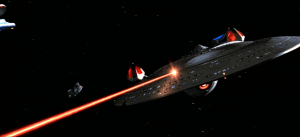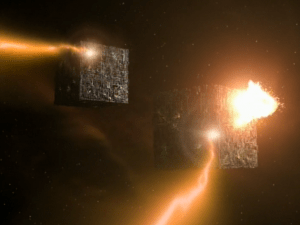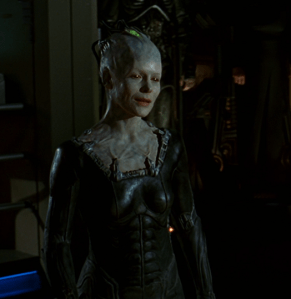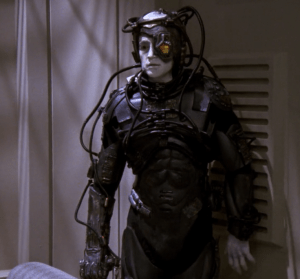
Star Trek: Picard review – Season 1, Episode 10: Et in Arcadia Ego, Part 2

Spoiler Warning: There will be spoilers ahead for Et in Arcadia Ego, Part 2, and for the entirety of Star Trek: Picard Season 1. There may also be spoilers for other iterations of the Star Trek franchise.

I’m in two minds about Et in Arcadia Ego, Part 2. On the one hand, the entire second half of the episode was incredibly emotional, with hit after hit after hit that left me in tears. But on the other hand, much of the first half of the episode followed on directly from Et in Arcadia Ego, Part 1 and was a waste of space.

I think overall, I stand by what I said in my review last week: that many of the story points in this two-part season finale were rushed and underdeveloped. Et in Arcadia Ego, Part 2 had, at points, the same issue of blitzing through potentially interesting story beats, and the disappointing thing isn’t that any of the storylines were bad, it’s that they had potential to be so much more than they were. Despite the second half of the episode going a long way toward redeeming the entire two-part finale, I think when the dust settles and I’m thinking more clearly and less emotionally, the overall picture will be, at best, mixed. There just wasn’t enough time remaining for many of these points to be fully explored, and realistically that meant that either some story threads needed to be cut entirely, or the season needed another couple of episodes to explore them fully.

Where the second half of Et in Arcadia Ego, Part 2 succeeded was that it slowed down, and the rushed pacing, the jumping between storylines, and the obviously-cut down scenes did largely abate. This gave way for a more emotional story to develop and play out over several slower, touching sequences, which brilliantly played on elements of the story that had been spread out over the preceding nine episodes – beginning right back in the first episode of the season, and indeed the first sequence of the first episode.

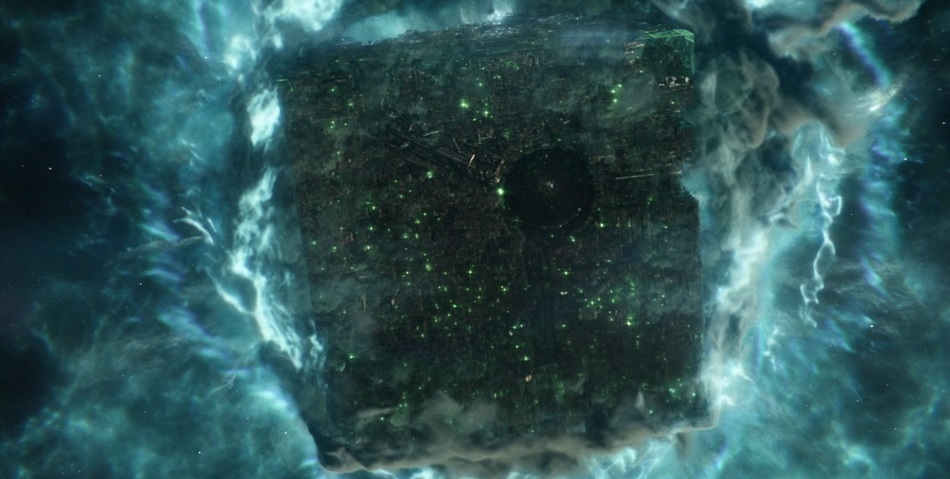
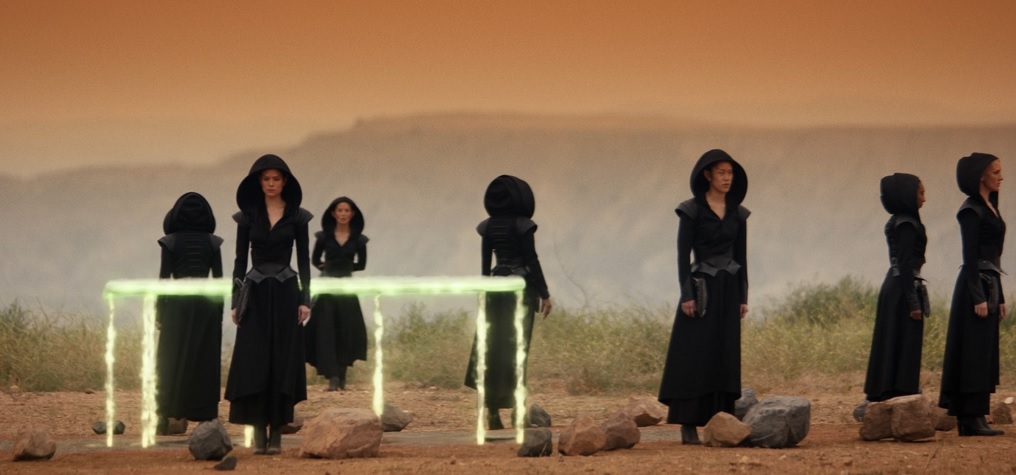
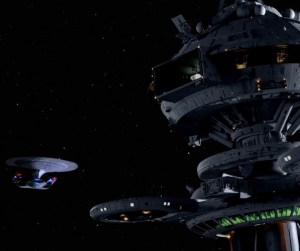
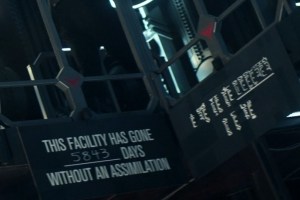
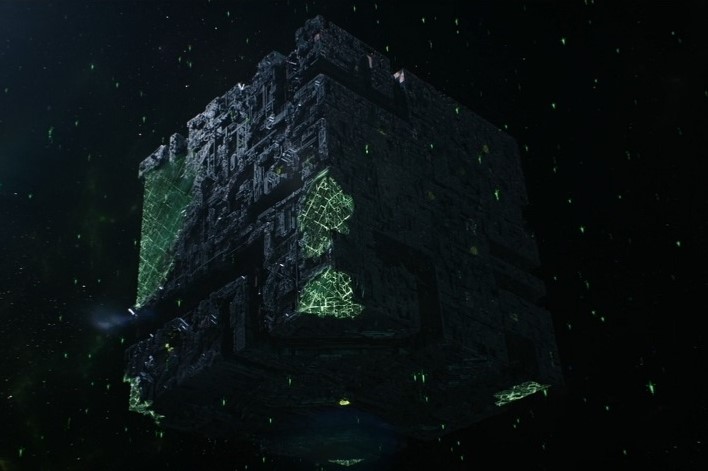
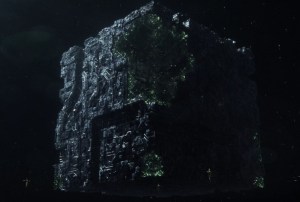
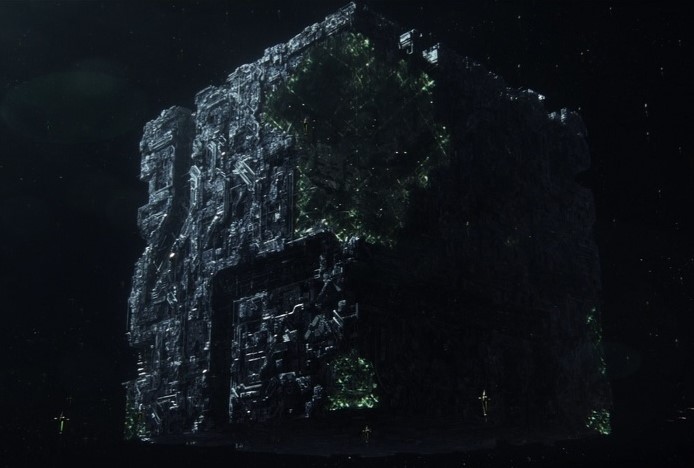
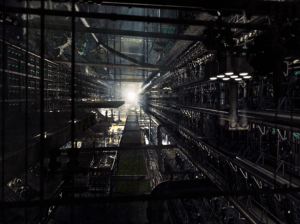
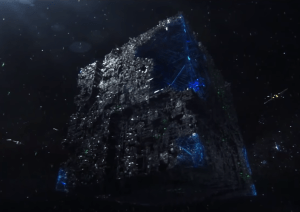
But we’re getting ahead of ourselves. Et in Arcadia Ego, Part 2 begins right where Part 1 left off last week, where Sutra let Narek escape and locked Picard up. Narek travels to the Artifact’s crash site and manages to sneak aboard, passing Seven of Nine, Elnor, and a handful of xBs who seem to be working on repairing the crashed vessel. The establishing shot of the Artifact was actually really pretty, and the closest the planet of Coppelius or Ghoulion IV came to not looking like California for the whole episode.

This shot of the Artifact was great.

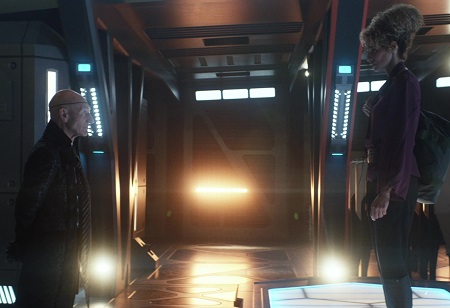
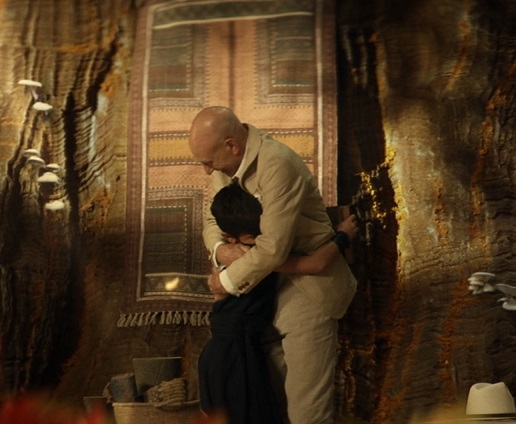
Narek is searching for something on the Artifact when Rizzo appears from nowhere and surprises him. I’ve mentioned several times that Rizzo has grown on me as a character in her appearances over the course of the season. Her transformation from an uninteresting and one-dimensional villain into an actual fleshed-out character has been great to see, and it’s hard to imagine the story of Star Trek: Picard’s first season without Peyton List’s occasionally over-the-top performance. Seeing Rizzo and Narek reunited showed us that they were real people underneath it all, and given it was almost sure to be Narek’s last meeting with his sister, their hug was strangely touching. After being attacked by the xBs at the end of Broken Pieces, I’d assumed Rizzo had beamed over to one of the Romulan ships near the Artifact, but it seems that she remained aboard during its short-lived mission to Coppelius and survived the crash-landing. I hadn’t expected that – partly because it wasn’t communicated clearly, it must be said – so it was a surprise to see her. But we did get to see a brief moment of vulnerability and emotion from Rizzo – in that moment, she was genuinely relieved, happy, and even slightly overwhelmed to see Narek, and that moment played out perfectly.

The next scene has to be one of my least-favourites. Not for its dialogue, which was a conversation between Picard and Soji as he tries to convince her to try things his way instead of following Sutra, but for the editing. The best moments with Picard, both in this series and in his previous Star Trek appearances, have been a combination of what he said and his presence while saying it. With this scene cutting away from Picard and Soji in large part, with what should’ve been one of his trademark speeches heard only in voiceover, something significant was missing that made the words he said far less impactful to us as the audience. We needed to see Picard as well as hear him for his speech to have its full effect. And back to what I said at the beginning, this feels like a consequence of both parts of the finale having just too much to cram in to two episodes. Before the opening titles, the episode needed to show this conversation, as well as convey – through Dr Jurati seeing it firsthand – the construction of the beacon that Sutra planned to use to contact the “Mass Effect Reapers”. Instead of there being enough time for both scenes, they ended up smashed together, with the voices of Picard and Soji on top of Dr Jurati silently watching the beacon. For me it simply didn’t work, and both scenes were the worse for being amalgamated.

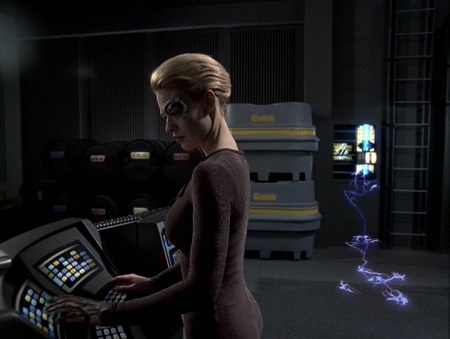
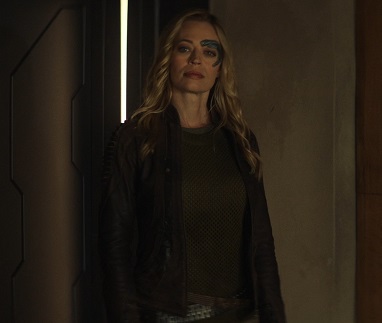
The opening titles once again ruined the surprise appearance of a character. For the third time this season, an actor’s name was included which telegraphed the arrival of a character whose appearance was supposed to be unexpected: this time it was Jonathan Frakes, who reprised his role as Riker. What was the point of that? In all three cases where this has happened – Seven of Nine in Stardust City Rag, Dr Soong in Et in Arcadia Ego, Part 1, and Riker this time – the appearance of the character was treated in the episode as a surprise. Everything from the camera work to the music built up the suspense of who we were about to meet – yet the opening titles had already spoilt it. Riker’s appearance at the head of Starfleet’s armada was supposed to be something that would make the audience go “wow!”, but instead it was telegraphed ahead of time, so the arrival of his fleet and then seeing him in person when he hailed the Romulans had lost the crucial element of surprise. I just do not understand this decision. How hard would it have been to credit Jonathan Frakes at the end and leave Riker’s appearance a genuine surprise? It was poor, and it detracted from what should’ve been one of the episode’s more powerful moments. It was still nice to see Riker on screen and back in uniform – we’ll deal with that scene in more detail later – but it was such a shame that it wasn’t the surprise it should’ve been.
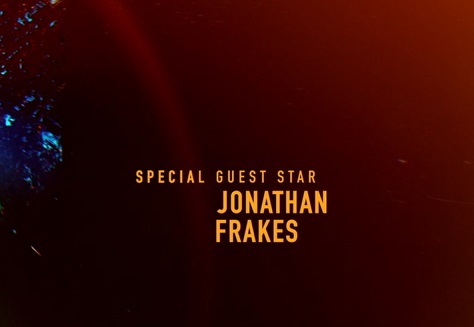
This shouldn’t have happened.

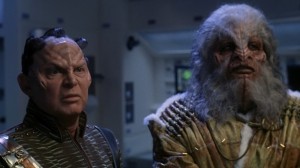
After the opening titles we see why Narek went to the Artifact – among the many things the Romulans didn’t have time to evacuate were a set of bombs, and he plans to use them to destroy the orchid-ships before the Romulan fleet arrives. This is a pretty tense scene in contrast to his reunion with Rizzo, as we see that there’s still tension between them and they’re of unequal status – despite being very shaken by recent events, Rizzo is still the superior officer. She really doesn’t have a choice in letting Narek go, as there are two jobs to do – destroying the orchids and activating the Artifact’s weapons – and two of them. Narek called himself a “Zhat Vash washout”, and clearly his history with the secretive organisation is complicated. We’d seen a couple of hints at that in earlier episodes, but nothing as major as what we got here. Unfortunately, as with many points across the two-part finale, it was left undeveloped. Narek has had multiple appearances across Star Trek: Picard’s first season for this aspect of his background to be explored, and given that we’re less likely to see him return for Season 2 than anyone else at this point, I would have thought that if the series wanted to properly explore his Zhat Vash background that this would’ve been the last opportunity. As it is, we got a couple of throwaway lines about Narek and Rizzo’s family: their parents, apparently, died as a result of working for the Zhat Vash, but again, how or why is not explained in any detail. Narek and Rizzo part for what would be the final time.

Out of all of Star Trek: Picard’s villains, the dynamic between Rizzo and Narek was by far the most interesting. As brother and sister there’s always going to be an element of sibling rivalry to what they’re trying to do, and Rizzo made clear in every scene together where the power lay in that dynamic. They played off each other well, with Rizzo pushing Narek to the brink of mutiny at times. But throughout it all, his commitment to the cause never wavered, and was stronger than both his fear of and disdain for Rizzo, as well as his clear feelings for Soji.
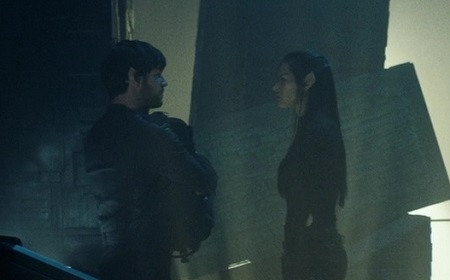
Narek and Rizzo at the Artifact’s crash site.

Technology in Star Trek has always been flexible to suit the needs of the story, and I appreciate that’s something that has happened going back to The Original Series. Even with that caveat, I didn’t like like the magical do-anything macguffin that’s used in the next scene by Raffi and Rios to fix La Sirena’s engine. It strayed too far into the realm of magic for me, especially with its “just believe it will work” spiel. While we’ve seen similar things in Star Trek before, and perhaps in some contexts it could’ve worked, it just felt forced at this moment; a way to send Raffi and Rios on a mission to La Sirena so they could be there for other story elements to unfold, but done in such a way that they didn’t need to spend more than thirty seconds fixing the engine – which they went back to do.

In fact, at several points in Et in Arcadia Ego, Part 2 did I get this feeling that the story was being forced down a particular path. Scenes would be included not because they fit the natural flow of the story, but because they either looked “cool” from a visual standpoint, or because they moved characters around to get them to be in the right place for other things to happen. In this example, Raffi and Rios had to leave Coppelius Station – under the guise of fixing La Sirena, they were moved out of the way so Picard could be apprehended, and placed in the right location for Narek to find them later, so they could plan their (stupid) attack on the synths’ beacon. It all felt just a little too much like it was driven by a room full of writers, and not a natural way for the characters to go. We’d also see the attack I mentioned be done in a very stupid way to get the plot to a specific climax, as well as the campfire scene with Narek which will come later as other examples of characters being forced into specific situations which didn’t really make sense in the context of the episode. It was constructed in such a way as to allow the plot to unfold, and unfortunately we’re supposed to just brush off some of the contrivances to make it happen.
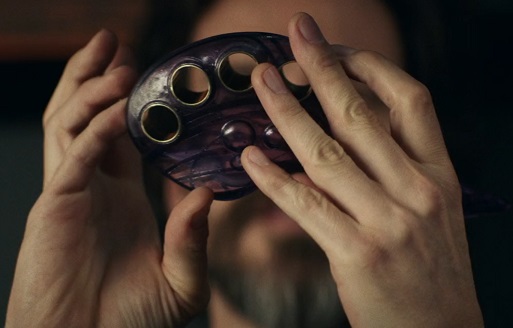
Rios with the magical macguffin.

While we’re talking about contrivances, I can’t wait any longer to talk about Star Trek: Picard Season 1’s big plot hole. I’ve been flagging this up for several weeks as a potential issue, and unfortunately it was left unresolved at the end of the season. So a plot hole is what it’s become: why was Maddox on Freecloud? Finding Bruce Maddox was the driving force behind the first half of the season’s story, and when Picard finally encountered him on Freecloud, he made it very clear that the reason he was there, and had put himself in danger by contacting Bjayzl, was because his lab had been destroyed by the Tal Shiar. With nowhere else to go and no one to turn to, he went to see Bjayzl as a last resort – and ended up paying for it with his life. Yet Maddox’s lab clearly wasn’t destroyed. He wasn’t kicked out by Dr Soong and the synths, who continued to speak very highly of him. If he’d set up a lab elsewhere that had been destroyed, he could’ve returned to Coppelius. And as it sits right now, there’s no reason for Maddox going to Freecloud other than “because plot”. And that’s a mistake – Maddox was such an important figure, especially in those early episodes, that the reason he put himself in danger should have been given a proper explanation. It’s disappointing that the story and the season have ended with this gaping hole left unexplained.

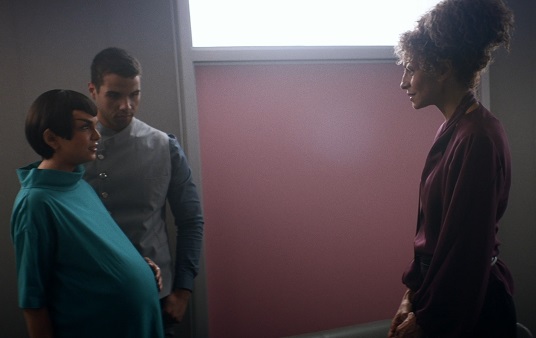
After Raffi and Rios have used the magical macguffin, we get a scene with Dr Jurati and Dr Soong. At the end of last week’s episode, Dr Jurati had promised to aid the synths – but this was clearly a ploy to avoid being locked up and to be able to help Picard. I liked the dynamic between Soong and Jurati – he clearly hates her for killing Maddox, yet he needs her help. And his barely-contained loathing breaks the surface in the way he talks to her, as Brent Spiner delivers the lines in a style not dissimilar to how he portrayed Lore in The Next Generation. Again, though, as with too many points in the finale, this didn’t really have time to properly develop, and this scene between them, and one brief moment last week, is all the time they had alone together.
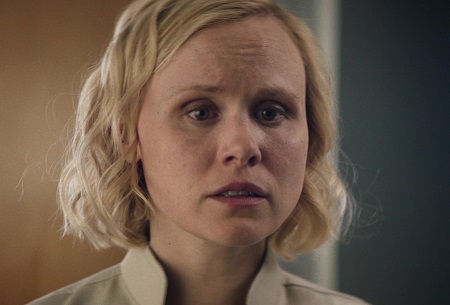
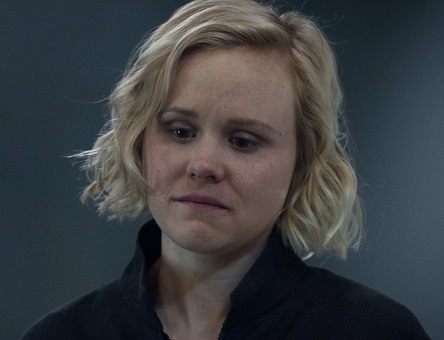
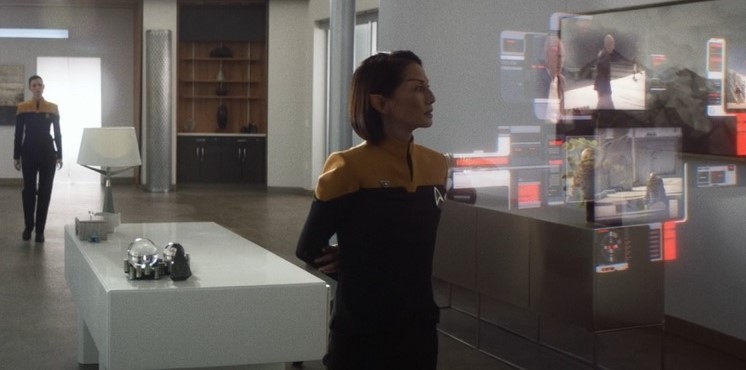
Dr Jurati.

Both Brent Spiner and Alison Pill delivered amazing performances with the limited material they had – I especially liked Dr Jurati’s “I’m not their mother, asshole” line – but I would have liked to have seen more of this relationship. There was the potential for it to go from bad to worse, then for the two of them to form a hate-filled unlikely alliance, before finally coming to terms with what happened. Dr Jurati had been essentially brainwashed by Commodore Oh, and they had both lost someone they cared about in Maddox – I would have liked to see that explored some more, especially because the on screen presence and chemistry the two actors had was definitely one of the finale’s high points.

Back at La Sirena, Narek has arrived and is trying to get the attention of Raffi and Rios by throwing rocks. He shows off his grenade collection and insists on meeting with them. At the meeting, Elnor arrives – we’d seen him following Narek as he left the Artifact. Speaking as we had been of two characters who loathe one another, Elnor and Narek feel that even more strongly. Elnor’s anger at Hugh’s death was on full display, but everyone had to stow their feelings as they discussed the synth problem. Narek is still in Zhat Vash mode, seeking out allies for his mission to blow up the synths’ ships. Staying with the theme of parts of the story being rushed, Raffi and Rios’ decision to believe him almost straightaway wasn’t great. While it was nice to see Narek finally interacting with someone other than Soji or Rizzo – the only two characters we’d seen him spend any significant time with – it came too late in the story to really have much impact, and like other points in the finale, was rushed. Narek really didn’t have to do much at all to convince the others that the synths – who they’d just met and were on friendly terms with – were a galaxy-ending threat, and they didn’t consider any other possibilities for why they couldn’t contact Picard at Coppelius Station other than Narek’s reasoning that the synths were jamming their commuications. It’s just another part of the finale where more time was needed – time to allow the three non-Zhat Vash characters to come around to Narek’s way of thinking. As it is, it felt like an instant turnaround – 180 degrees from trying to save the synths to trying to blow up their ships and beacon.

Narek finally got a chance to talk to other characters.

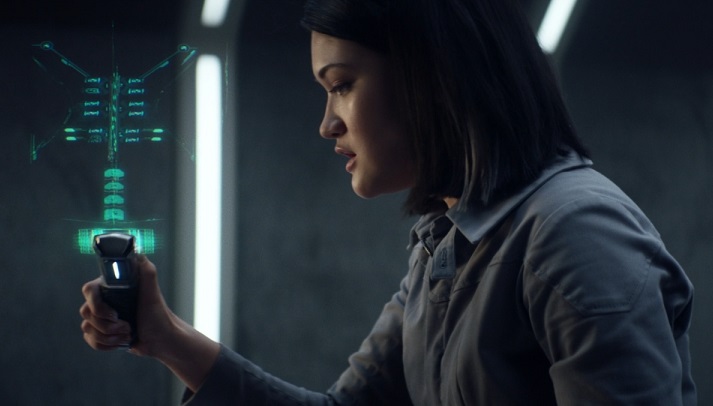
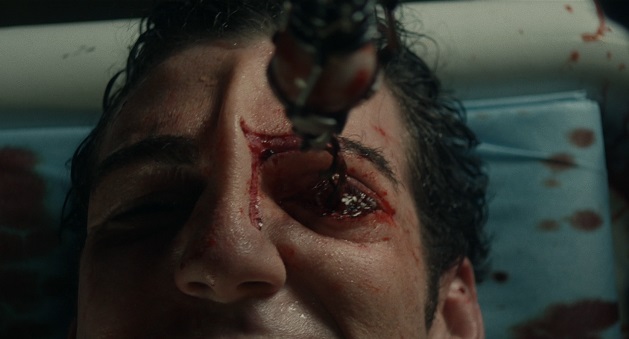
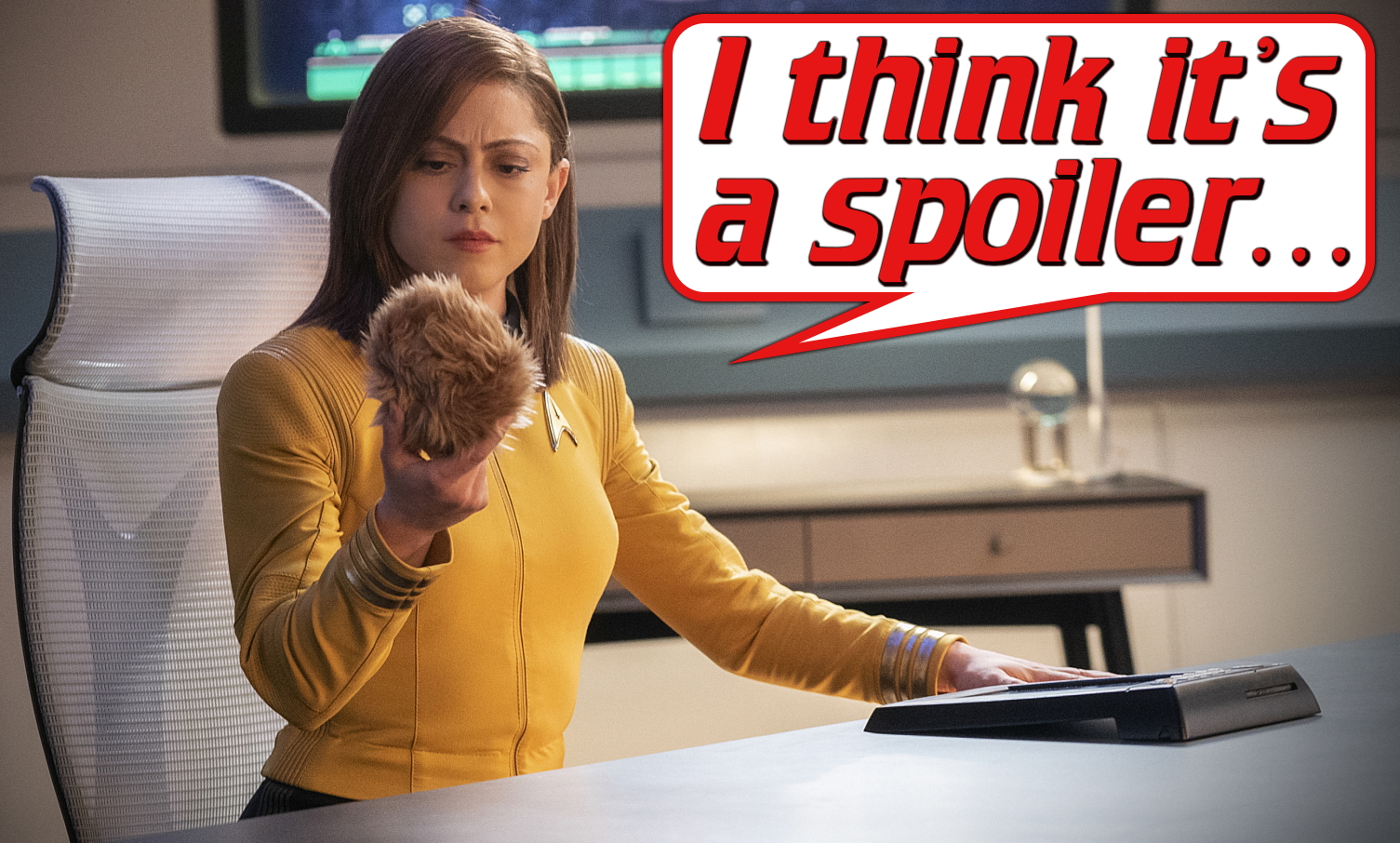
At the beginning of Stardust City Rag, we got a fairly brutal scene where Icheb has his eye torn out. The graphic sequence was shown in full, and it was grotesque but at the same time it was something that as the audience, we couldn’t look away from. In the next scene in Et in Arcadia Ego, Part 2, Dr Jurati takes the eye out of Saga, the deceased synth from last week, in order to use it to unlock a door and spring Picard from his captivity. But we didn’t get to see the eye removal, as the camera instead cut to Dr Jurati’s face for the majority of the scene. And unfortunately, this didn’t look great. Alison Pill undoubtedly gave it her best shot, trying to look both disgusted and like someone who was trying to figure out how to disconnect sensitive electronics, but it would’ve been better to either see the entire process or to jump-cut from her starting the procedure to having the eye successfully removed. As a story point I did like using the eye, and I liked the eyeball prop when we saw her use it later, but the removal itself was just a bit of a waste in my opinion.

The campfire scene where Rios, Raffi, and Elnor sit and listen to Narek’s Zhat Vash stories wasn’t great. In principle it was good to have them together, but by this point in the story, we as the audience are familiar with the Zhat Vash prophecy. And ghost stories around the campfire is just such a cliché that the scene felt so forced. And it didn’t make sense in context. The ship had been fixed – why sit around outside it? And with such urgency to get to Coppelius Station to destroy the beacon, couldn’t they have talked en route? Or flown La Sirena closer to the synths’ compound? It was just so obvious that the director or creators of the show had decided that a campfire scene would look cool that they shoehorned it in, even though doing so made little sense.

This scene made no sense.

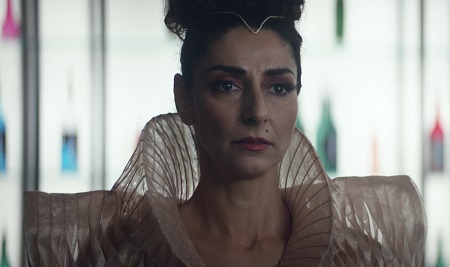
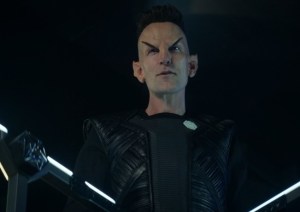
The campfire story itself was fine, but as I said there wasn’t much in there that we as the audience didn’t already know. In an episode with so much story left to conclude, and thus where every minute matters, a lot of this campfire scene was really just wasted time. Conversely to that, the next scene with Commodore Oh – which barely even qualifies as a “scene” because of how short it was – had been very obviously and badly edited down to just a few seconds, and simply fell flat in the moment. Who was she supposed to be talking to when she said “At last, our great work is nearly at an end”? There was no one else present in the scene, she was just standing on the bridge of her ship in her evil villain cloak doing an evil villain pose spouting a generic evil villain line. Given how tightly it was cut, there was almost certainly more to this scene that didn’t make it into the final episode, but this line simply did not work on its own.

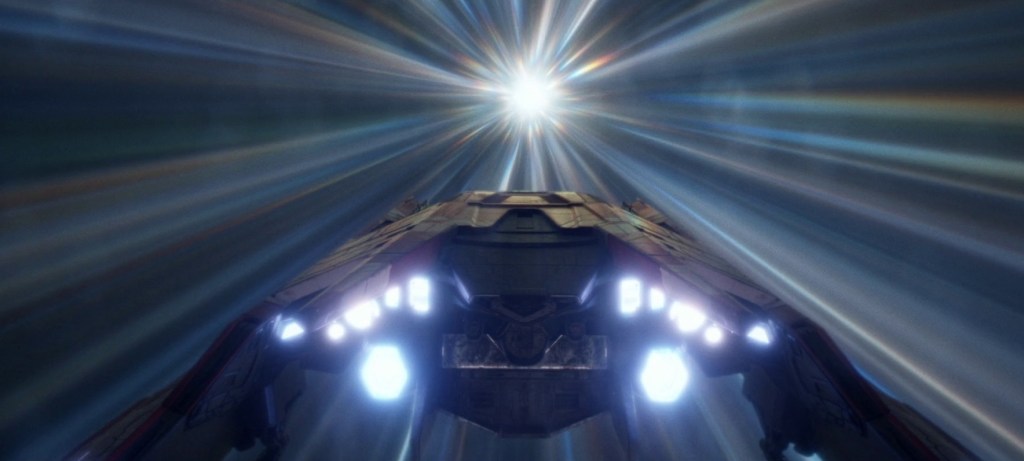
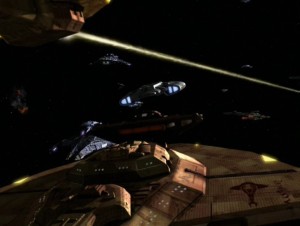
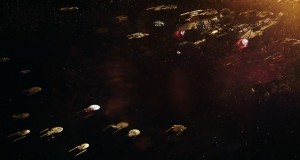
The visual effect of the Romulan fleet at warp was good, however, and I did enjoy seeing that. The design of the new style of Romulan vessel was great, and I could see it being a natural evolution of the Romulan Warbirds from The Next Generation and the advanced warship used by Shinzon in Nemesis, and the fact that some elements of those designs made it into the new Romulan ships was good and shows that the show’s creators were paying attention to past iterations of Star Trek. However, one thing I didn’t like – and this also applies to the Federation fleet that we see later in the episode – was that all of the ships were identical. Past fleets that we’ve seen, while arguably smaller in scale, were almost always comprised of multiple classes of ships, and the fact that the animators and CGI artists had essentially copied-and-pasted the ships meant that the large fleet was less visually impressive that it could’ve been. It was good to see the number of Romulan ships en route, though.
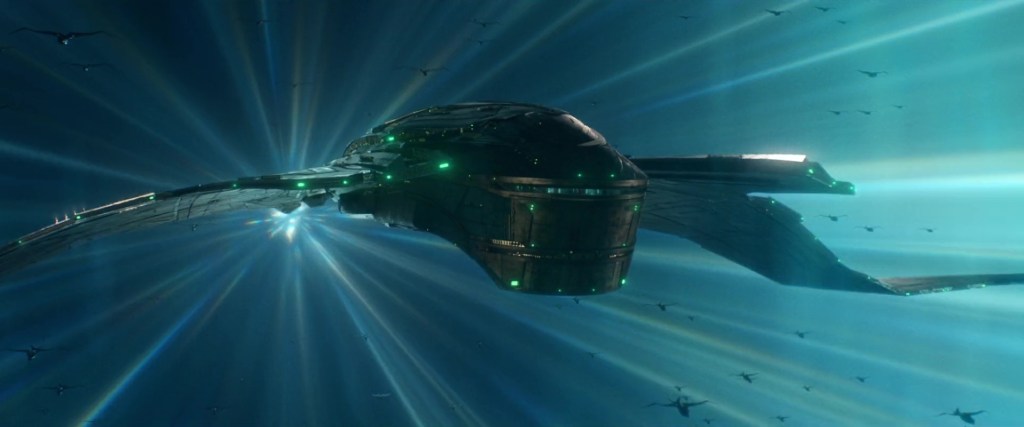
The Romulan fleet.

Narek is back in the next scene, a mere few seconds later, showing off the bombs he retrieved from the Artifact. While the episode hasn’t communicated this very well, it seems that a significant amount of time has passed. When Narek arrived it was daylight outside La Sirena, but then the campfire scene seemed to take place after sunset. Yet this scene is in daylight again – and as I said before, considering the urgency of the mission to stop the synths bringing about the end of the galaxy, which everyone seems to agree on, they don’t seem to be moving very fast toward that goal as they’re still talking aboard La Sirena.

I did like the creative way that they were able to sneak the bombs into Coppelius Station; that was a fun story beat, especially when Rios seemed to be playing with the ball in front of the synths. There was a second where it felt like he might kick it too hard and it would explode! The scene a few episodes ago where Rios had been kicking a ball around on La Sirena also paid off here. And if I’m not mistaken, at least one of the synths on guard duty looked like F8 – the synth from the flashbacks to Mars that we saw earlier in the season. However, the next part of this is yet another example of a plot contrivance – the guards let Raffi, Elnor, and Rios into their compound with Narek, but then seem to leave them alone to do their own thing instead of following them or taking Narek back into custody. It would’ve been better to skip the part about hiding the bombs in the football and have them sneak in another way, or leave the compound unguarded altogether (who are they guarding it from, after all?)

I’ve already mentioned that the eyeball was a neat prop, and the way Dr Jurati figured out how to use it to access Picard’s room and spring him from custody was great. Picard is clearly suffering here from the unnamed brain condition that we saw the first real indication of last week. And while I liked that this had been set up way back in the second episode of the season, it was really only in the two parts of the finale that Picard goes from experiencing no symptoms to full-on dead in a matter of hours or a couple of days. And while we have no frame of reference for how futuristic diseases might run their course, as a story point I feel this would’ve worked better if we’d seen a couple of other instances of his health starting to fail in previous episodes. I know we’ve seen him snap and seem to be quicker to anger at a couple of points, and that we saw his PTSD-breakdown when he first arrived aboard the Artifact, but for the most part Picard has seemed in good health for his age – until the finale, when his condition seemed to rapidly accelerate from nowhere.
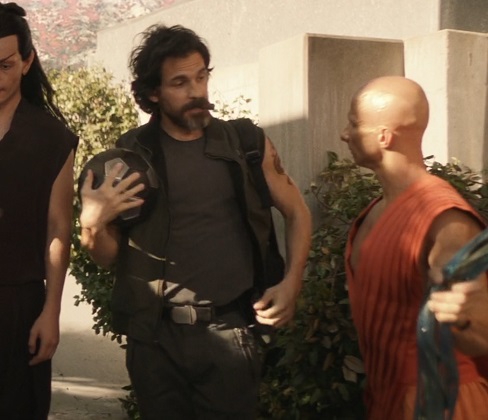
Rios with the bomb-ball.

Dr Soong learns, in the next scene, that it was Sutra and not Narek who killed Saga, and is visually shocked and heartbroken at the revelation. I’m glad that Dr Soong turned out to be someone who was on Picard’s side in the end. Brent Spiner can portray villains wonderfully, as he did with Lore and another Dr Soong in Star Trek: Enterprise, but as a fan, seeing his new character at odds with Picard wouldn’t have been my preference, given that it’s been so long since we saw the two actors together in Star Trek.

The guards of Coppelius Station seem to have just allowed Raffi, Rios, Elnor, and Narek free rein inside the compound, and they’re planning their attack on the beacon when Dr Soong intervenes. For a moment they thought they’d been caught, but Dr Soong plans to help take down the beacon having learned of Sutra’s betrayal.

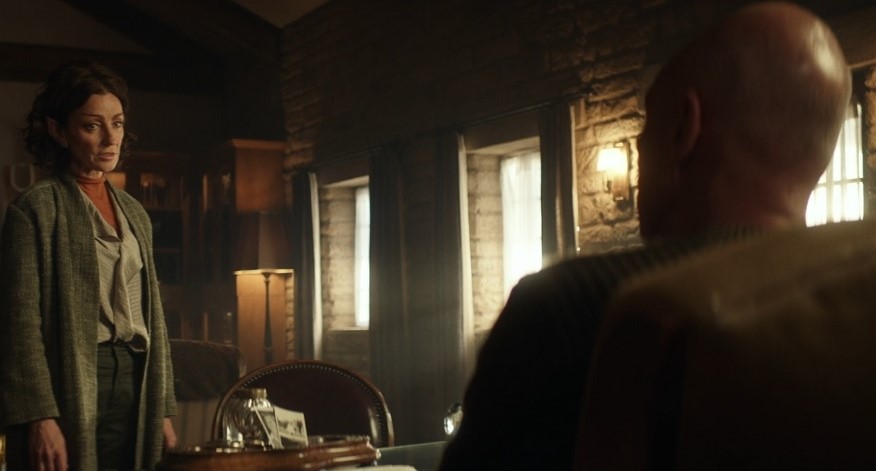
Picard and Dr Jurati made it back to La Sirena – though how the two groups managed not to cross paths or spot each other isn’t clear. I mean, there can only be one direct route to the ship after all. But that is a minor nitpick compared to others in the episode. This scene, between Picard and Dr Jurati, was very powerful, and the first point in the episode where I really started to feel things turn around. I loved Picard’s line that “fear is an incompetent teacher”, and their plan – to launch La Sirena into space and make a last stand against the Romulans as a way to show Soji and Sutra that not all organics are evil is a good move – perhaps their only possible plan under the circumstances short of using La Sirena’s weapons to destroy the beacon. They’re banking their hopes on Starfleet having received Picard’s message and already being en route, because at best they’ll be able to stall the Romulans for a few minutes. This is basically a suicide mission, and they both know it. The genius of putting these two characters together, as opposed to say, having Picard teamed up with Rios or Elnor, is that they both have nothing to lose. Picard’s at death’s door, and Dr Jurati is facing a lengthy spell in prison, so of all the characters who could try to make a last stand, it makes sense for them more so than any others – except perhaps Raffi.
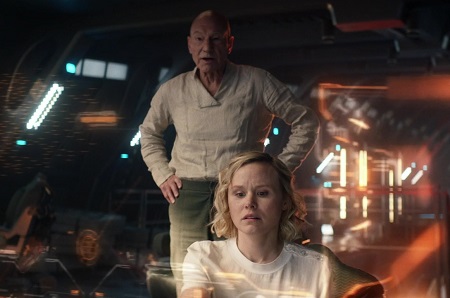
Picard and Dr Jurati back aboard La Sirena.

The Romulan fleet is only seven minutes away, so Picard launches La Sirena and shakily leads the ship into orbit, with Dr Jurati along for the ride. The action then cuts to Coppelius Station, where the rest of the crew are planning to attack the beacon.

Attacking the beacon makes sense in the story, but the way it was executed was so bad, and the plan was clearly designed to fail. They storm in and make a huge fuss, then Dr Soong uses another macguffin to deactivate Sutra, but because the other synths are still all-in on using the beacon and summoning the “Mass Effect Reapers”, the rest of the crew scramble around, punching and kicking before being wrestled to the ground. Dr Soong, having deactivated Sutra with his magic wand, doesn’t do anything. He stands motionless in the background while Rios makes a desperate throw to get the bomb into position, but Soji catches it and throws it away.

So many things wrong here, but the overall problem is this – the fight was clearly written in such a way that the “heroes” lose. And that was painfully obvious in the way it was carried out on screen. But let’s break down some individual failings. Why did Dr Soong not show the assembled synths the video of Sutra killing Saga? That single piece of evidence would have swayed most of them to his side. Why did he not use his magic wand on Soji after disabling Sutra? Why did the crew launch a full-frontal attack against a force of massively superior synths instead of sneaking around or causing a distraction? Why try to fight the synths at all? And finally, probably my biggest complaint about the synth storyline in the finale as a whole: what was the point of Sutra?

Sutra was shut down.

Don’t get me wrong, I’m not arguing that we should’ve seen more of Sutra this episode. The awful makeup and hammy performance meant I wanted to see as little of her as possible – in that sense I got my wish – but for an antagonist who’d played such a large role last week, and who did have, as I pointed out, a motive that was at least partly understandable, she was just completely sidelined by a story that raced through far too many points and left her completely undeveloped. Sutra had the potential to be interesting, at least in theory. Her presence turned the synths from damsels in distress needing to be saved to antagonists needing to be dissuaded or defeated, and that concept, if executed better, could have been interesting. Unfortunately, as I’ve already said, it would’ve needed several more episodes to work effectively – and a better performance from the central synth villain.

Given that Star Trek: Picard has been at least as much Soji’s story as Picard’s, I feel it would have been better on the whole to ditch Sutra and simply have Soji and Dr Soong be the principle drivers behind contacting the “Mass Effect Reapers”. It would have cut an extraneous character, allowed more time for some of the others to be explored, and we wouldn’t have had to sit through that awful performance last week. Soji did need someone to guide her turnaround last week, to allow her to convincingly side with the synths. But I don’t think that needed to be Sutra, and with a few tweaks here and there the story could’ve arrived at the same place without her – and it would have been better for it, especially considering she did nothing whatsoever this week.
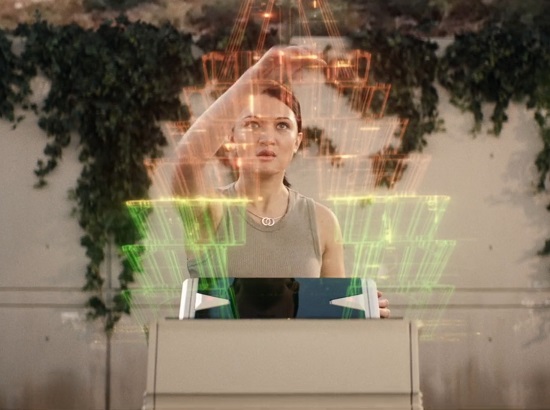
Soji working on the beacon.

The next scene with Dr Jurati and Picard was hit-and-miss for me. The jumps in tone from deadly serious suicide mission to cracking dumb jokes just didn’t work, and while Dr Jurati has occasionally provided moments of comic relief throughout the season, this was not the moment for humour and it just ended up detracting from what could’ve been a much more powerful scene. I did like, however, that La Sirena was not flying smoothly in the exterior shots we saw, indicating that Picard is still getting back into the swing of things. We have seen him pilot spacecraft before – shuttlecraft most often, but also the Enterprise-D itself in the episode Booby Trap from the third season of The Next Generation – so we know he’s at least basically capable and should understand the principles involved.

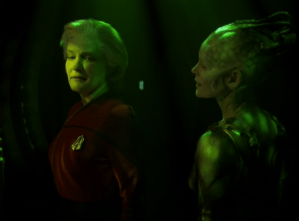
Seven of Nine and Rizzo fight aboard the Artifact as Rizzo has tried to bring the Cube’s weapons online. She’s targeting La Sirena, which does raise the stakes somewhat, and the fight itself was decently exciting. There was never any real doubt as to who the victor would be, however, and Rizzo finally gets her comeuppance for killing Hugh as Seven of Nine sends her falling to her death with a well-placed kick. The two traded barbs during the fight, and we really saw Rizzo in a way that I talked about a couple of weeks ago: as a racist. That aspect of the Zhat Vash and Romulans – that their actions are a veiled analogy for hating another group of people because they’re different – is something the show found a balance between hinting at and overplaying, and I think, taken as a whole, the balance was probably about right.
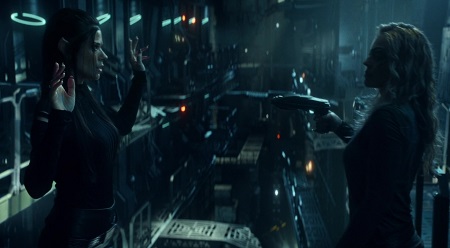
Rizzo and Seven had a fight.

The visual effects and CGI in the episode were great, as we’ve already discussed, and the sight of the orchid ships launching to meet the Romulans, and overtaking La Sirena, was visually impressive. I still feel that the way the orchids operated last week was pretty dumb, but this time they don’t seem to be dragging intact ships to the planet’s surface; what exactly they’re doing in the fight other than getting shot at and serving as a huge distraction isn’t really clear.

The magical macguffin is back; Rios and Raffi apparently left it aboard La Sirena. Dr Jurati figures out that it can be used to produce holographic duplicates of the ship, which they can use to distract the Romulan fleet. Again, I really didn’t like this tool, and the fact that it seems to be magical and can be used for anything one’s heart desires was not great, even by the standards of Star Trek technobabble. While in principle what Dr Jurati hoped to do was a good idea, and I did like the name-check of the Picard manouvre from The Next Generation, the macguffin spoilt it really. And I felt that the moment where it created holo-duplicates of Dr Jurati’s face was a rare miss in the episode’s visuals.

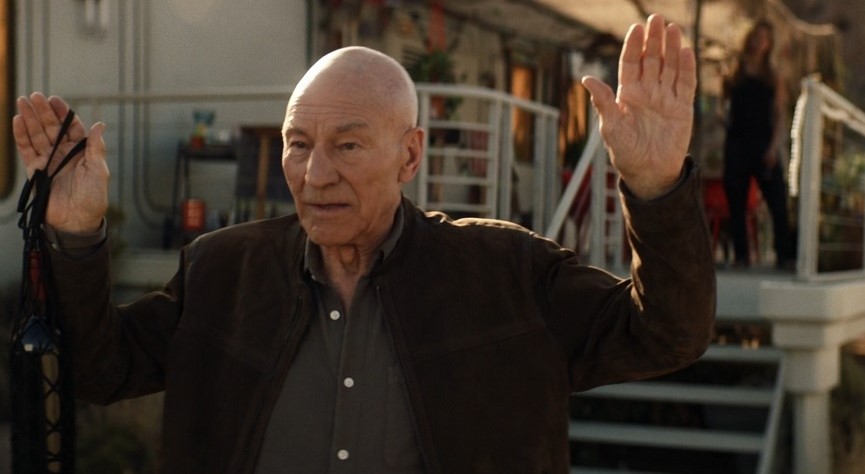
However, Picard’s conversation with Soji, in which he explains that he’s basically laying down his own life to defend the synths was incredible and very powerful – the first of those emotional hits I mentioned at the beginning of the review. There’s something about a noble last stand that always gets to me, and this was a great example of it! It was an absolute desperation play, as Picard hopes against hope that Starfleet will arrive in time. If Starfleet didn’t get there, the “Mass Effect Reapers” would be the synths’ only hope of survival.
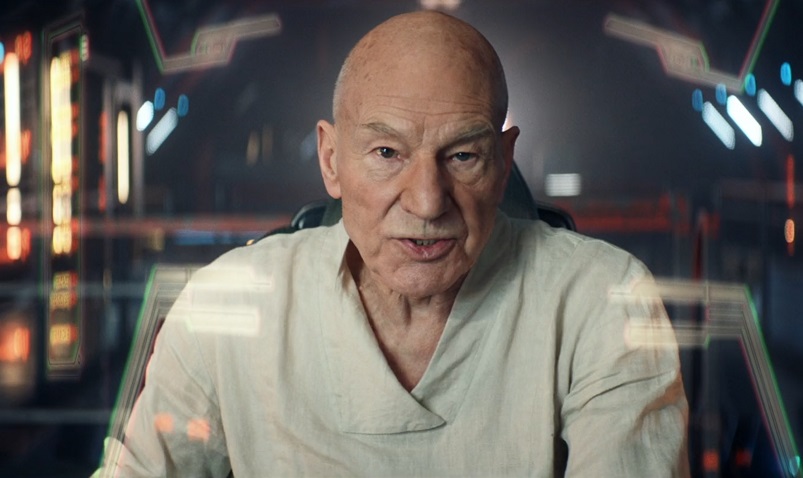
Picard speaks to Soji and asks her to reconsider.

The shot of La Sirena standing alone against the Romulan fleet was incredibly powerful too – part of that last stand feeling that I mentioned. The next part of the story has hits and misses, though. And I know this is kind of a nitpick, but what were the other synths and Dr Soong doing while Soji was activating the beacon? Did no one try to stop her or at least question what she was doing – especially given that they all heard what Picard had to say – nor try to contact the Romulans and reason with them? Several of the next few scenes played out as if Soji were the only one there, yet there were a dozen or more synths plus all of the other main characters.

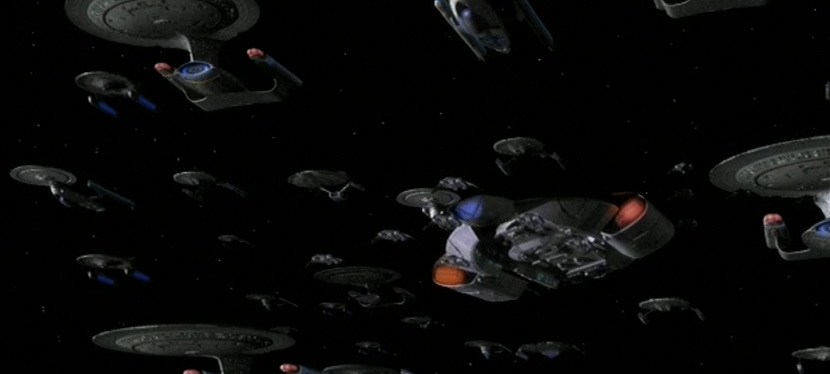
Soji succeeds in activating the beacon just as the Romulans finish dealing with Picard and Dr Jurati’s last stand. The timely arrival of Starfleet – led, as the opening credits made clear, by Riker – prevented them from attacking the planet, and the two fleets enter a tense standoff. It was great to see Riker back in uniform again, and the last-minute arrival of the fleet saved Picard as well as the synths. However, as with the Romulan fleet earlier, all of the ships were the same type and I do feel that the copy-and-paste look detracted somewhat from the otherwise-impressive sight of so many Starfleet vessels – which, I believe, are based on a design from the Star Trek Online video game (but I could be mistaken in that). Until we’d seen his name in the credits, I wasn’t sure if we’d see Riker back in action this season. I was pleased that we did, and it definitely felt good to see Starfleet as the good guys again, after Picard had been forced to work around their obstinance for the majority of the season.

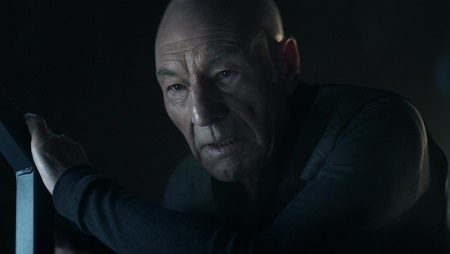
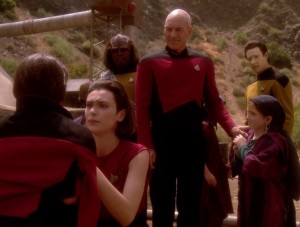
Acting Captain Riker, back in uniform.

Though this moment had been telegraphed ahead of time and sadly was robbed of some of its impact as a result, the musical score as the ships emerged from warp, coupled with Riker’s appearance a few moments later, did still feel good – just not as good as if it had been a genuine surprise.

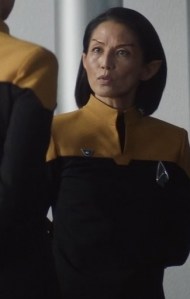
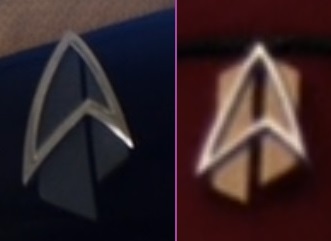
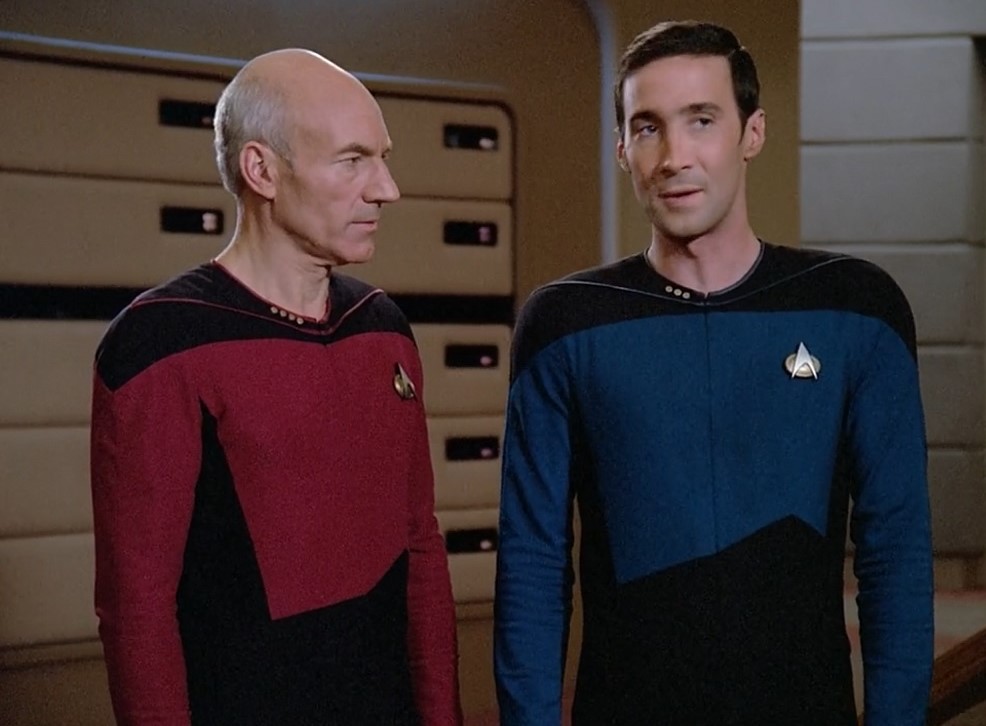
We got to see a better look at the command variant of the new Starfleet uniforms – which still have that Starfleet logo pattern in the coloured section – and again, as I said at the start of the season I do like the new uniforms. Especially compared to Star Trek: Discovery’s all-blue look I think they look great, and the combadges complement the look nicely.

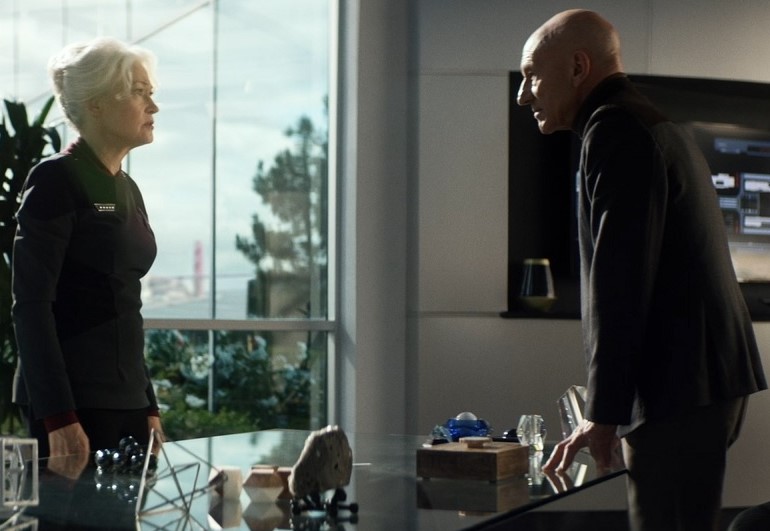
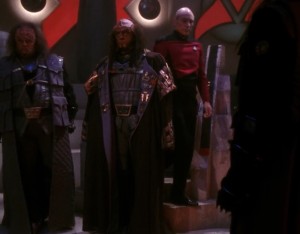
Commodore Oh, throughout her appearances this season, hasn’t seemed like someone who would listen to reason. The Zhat Vash have been presented as the most committed of all Romulans to the anti-synthetic cause; both she and the organisation are zealots. And zealots seldom back down, even when facing significant opposition. Picard uses what is basically his dying breath to talk Soji down from summoning the “Mass Effect Reapers”, who hadn’t yet emerged through the aperture created by the beacon. This speech was really the climax of the episode, and the emotional hit of the words Picard spoke, combined with knowing he was suffering greatly as he spoke them, matched the high points other episodes of the season hit. It was the kind of speech Picard could’ve given at any time in The Next Generation as he focused on the rights of all life to exist, and for the need to demonstrate that the synths aren’t what the Zhat Vash feared them to be.
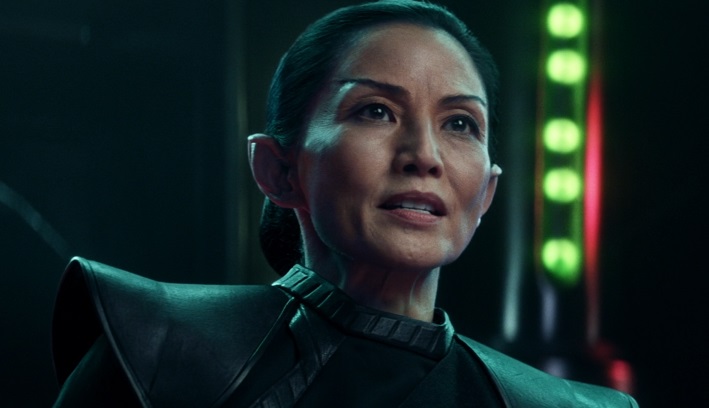
Commodore Oh decides to withdraw.

It was enough to sway Soji, who closes the aperture before the “Mass Effect Reapers” could come through or even send a message. Their mechanical tentacles did look menacing, but that’s all we go to see of them. Faced with Soji having stood down and Riker staring her down with a large fleet, Commodore Oh withdraws, and this is something which I feel was out of character. Are we supposed to believe Picard’s speech swayed her? Or simply seeing Soji stand down one time would be enough to override years of Zhat Vash indoctrination? Even if it was good enough for Oh, did everyone on the fleet agree? From her point of view, what is there to prevent the synths rebuilding the beacon in twenty years – or twenty minutes? While Picard’s climactic speech was beautiful, Commodore Oh’s decision to withdraw, like so many other points in the finale, felt rushed. And no sooner had he arrived than Riker, too, was gone – warping out of the system accompanying Oh’s fleet. Couldn’t they have left a ship or two behind? Considering what came next, Riker’s presence would have been incredibly emotional.

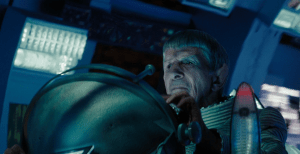
Picard bids Riker a solemn “adieu”, before succumbing to the effects of his condition – perhaps combined with whatever medication he was given earlier by Dr Jurati.

Picard’s death – or rather, his “death” – in this moment was the emotional climax of the story, after the plot had reached its own zenith a moment earlier. And it was a very powerful sequence. Soji transports Picard and Dr Jurati to the synths’ location, and Picard dies, surrounded by his crew and knowing that he did right by Soji and her people. His final act was one of sacrifice – making a last stand to defend the synths, righting a wrong from fourteen years ago where he had been unable to prevent the ban or aid the Romulans. The emotion on the faces of the characters – especially Raffi, as Michelle Hurd put in her best performance of the season – was heart-wrenching to witness. Surrounded by his friends, and with a few last words to (most) of them, he passes away, killed by the nameless condition that we assume to be Irumodic Syndrome.
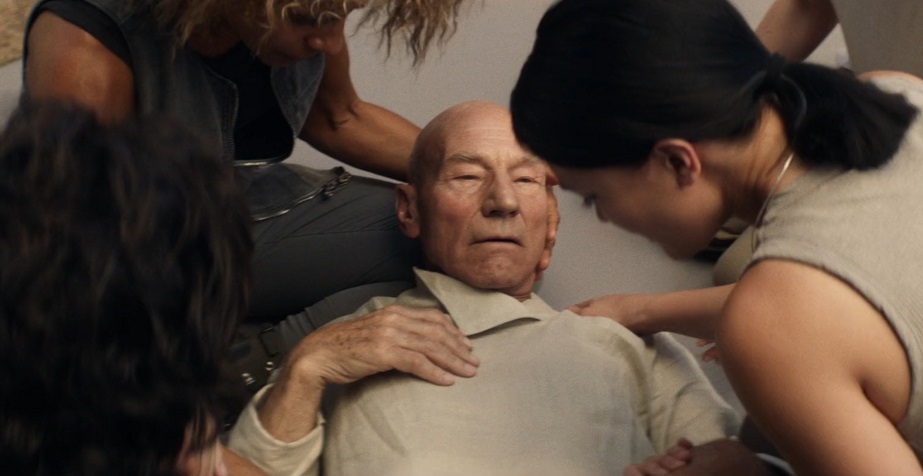
Picard succumbs to his condition.

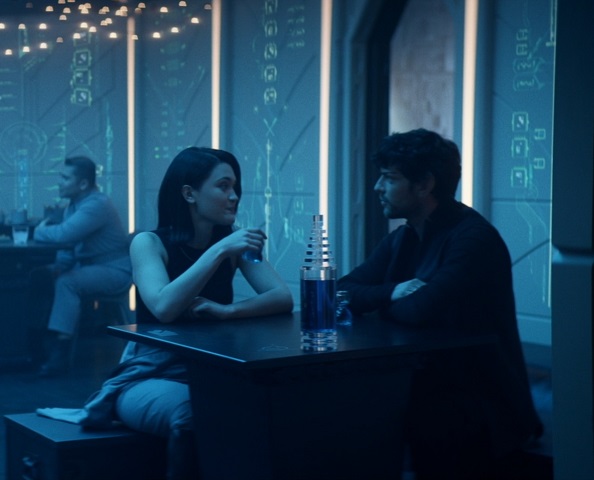
Of all the characters we’ve met across the season, Rios and Seven of Nine arguably had the least connection to Picard on a personal level. Aside from a few scenes when they first met, I can’t recall a significant moment with Rios and Picard together. While there’s always sadness when someone passes away, especially under such circumstances, putting Seven of Nine and Rios together wouldn’t have been my first choice in the immediate aftermath, simply because they didn’t have the connection that, say, Raffi or Soji had with Picard. Nevertheless, the scene between them was touching, and they both spoke highly of the fallen Admiral. I liked the idea of sharing a bad drink because it was all they had access to, and it emphasised that they’re both a long way from home and that this is, for the moment at least, the end of the journey.

The real heartbreaking scene was when Elnor broke down and was comforted by Raffi. Elnor, who had been so strong and powerful, was weak and vulnerable having regained and then lost his surrogate father figure, and Raffi, who was devastated too, trying to comfort him was just incredibly emotional. Both actors put in amazing performances here, and as sad as this scene was, I loved it.
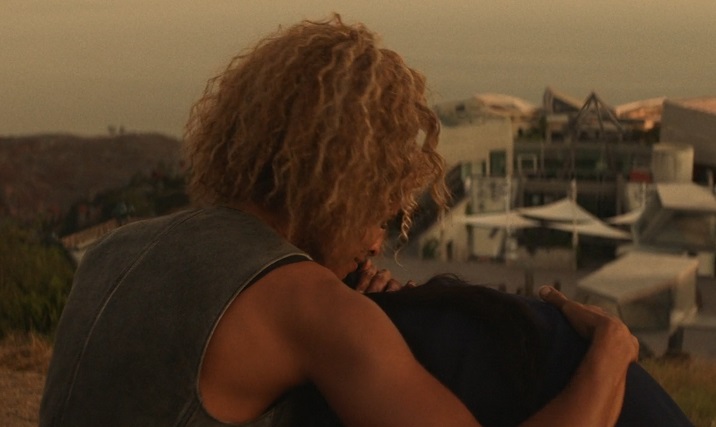
Raffi and Elnor grieve for Picard.

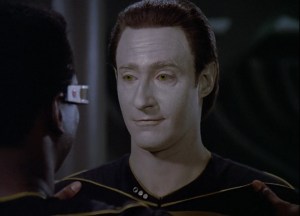
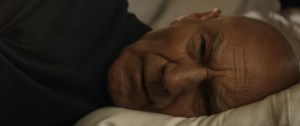
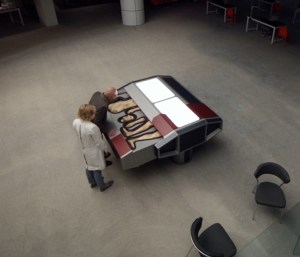
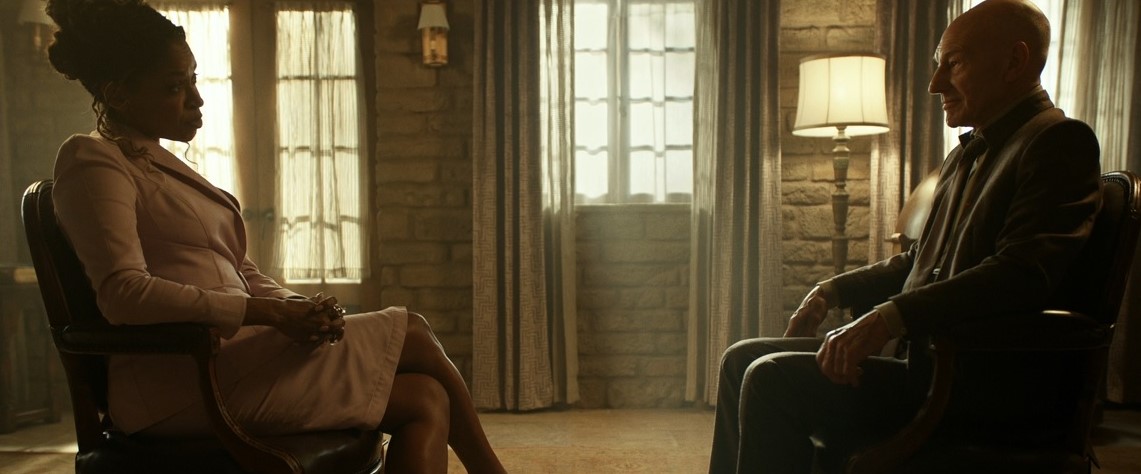
When Picard awoke, for a moment I was half-expecting to see Q! That was never going to happen, of course – it would be a complete bolt from the blue for anyone who hadn’t seen The Next Generation, for one thing – but it would have bookended Picard’s story in the Star Trek franchise if this had been his final appearance and he was to stay dead, tying into themes from Encounter at Farpoint. Instead, Picard finds himself sat opposite Data. And I know there will be criticism of Data’s appearance given Brent Spiner’s age, but a combination of lighting, makeup, and what I assume are digital effects made him look decent here, and I didn’t find the way he looked offputting, especially when compared to the way the gold synths had looked last week.

At no point was I convinced that Picard would stay dead, but that in itself didn’t rob any of the scenes surrounding his death of any of their drama or emotion. As a story point, though, killing a character in such a dramatic and emotional way only to immediately revive them can end up feeling like a bit of an anticlimax, and there was an element of that here I’m afraid. Not in the moment, and not in Picard’s scene with Data in the digital afterlife, but certainly after his revival there was part of me left thinking “well, what was all that for?” In a sense, restoring Data’s mortality and finally providing him with the closest thing to humanity that he could get, Picard did have a reason to travel to the digital afterlife. No one could have known that Data was trapped in a kind of purgatory, nor that saving parts of his mind from the information transferred to B4 would mean that some essence or facet of his personality would be forever entombed in this realm. That action – saving Data and finally laying him to rest – gives Picard a reason for this temporary death, and as a story it was, overall, a success.

Shutting down Data.

Data takes on the role of what I guess you’d say was a god or grim reaper figure from classical literature, explaining to Picard that he’s in the afterlife and that he died. This was another incredibly emotional scene, as Picard got to express twenty years’ worth of sadness and regret to his long-lost friend. Maybe I’m seeing what I want to see, but I seemed to get hints at Data’s study in the set design, notably the room he occupied in All Good Things, the finale of The Next Generation, in which he was still alive and working as a professor. In fact, while we’re talking about set design, I felt that this room was one of Star Trek: Picard’s best and most evocative. I’ve written before that the outdoor filming scenes, supposedly taking place in France, in Japan, and on several alien worlds, all looked suspiciously like California, and that has been a let-down at points. But the interior sets have been fantastic. I love the way La Sirena looks – inside and out, in that case! – and the Troi-Riker cabin was everything it needed to be. The Artifact is something I really haven’t written about as often as I should’ve, because the subtle updates to the Borg vessel have been fantastic. I loved the shifting walls that were present at times, and the way that, despite being claimed by Romulans and some area being declared “safe”, it was still definitely a Borg vessel. Bjayzl’s club on Freecloud was maybe a tad cliché, but it still did a great job feeling like a futuristic, alien club. The nunnery on Vashti was incredibly reminiscent of something from Japan, and I loved that style when it appeared in Absolute Candor. And finally, Coppelius Station and the Daystrom Institute both conveyed the look of being futuristic in a similar but not identical way to locations in previous iterations of Star Trek.
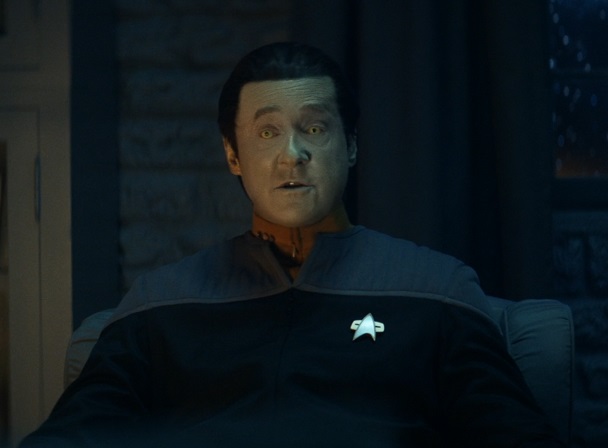
Data in the digital afterlife.

In this case, the room was clearly artificial, but in a way that conveyed a sense of limbo or purgatory. By the furniture and decor being greyed out, there was the sense that, like in a computer when a file or programme is inaccessible, things weren’t quite right. And the fact that the only colour came from the two figures of Picard and Data, our focus as the audience was drawn to them and all attention focused on them – in the same way as you might expect if seeing a very minimalist stage production.

Part of the criticism of Star Trek: Nemesis at the time it was released surrounded how Data’s death was handled in the story. Aside from the criticisms of the story beat itself, the main ones were that he didn’t really get a chance for any goodbyes, and that in a relatively short space of time, Picard and the crew were laughing and joking on the way to their next adventures. We saw earlier in the season – indeed, from the very beginning – that Data’s loss weighed heavily on Picard, and that his friends Riker and Troi remembered him fondly and held his legacy dear, but in this moment, the second criticism was addressed, as Data got to say goodbye properly. Partly this was to Picard, but partly it was to the audience – to us. In a way, this righted what some fans had considered an eighteen-year wrong.

Data’s final goodbye.

The conversation they had about dying was interesting – and it did, in a way, capture that elusive sense of “Star Trek-ness” that Star Trek: Picard has been so keen to restore to the franchise in the aftermath of Discovery and the JJverse films. Both of those, despite what some have argued, had moments where they “felt like Star Trek”, but not every moment. For all my criticisms of the plot and various scenes in Star Trek: Picard’s finale, it did always feel like Star Trek – and this scene with Data, talking about life and death, was just one part of that, but it was a particularly powerful part.

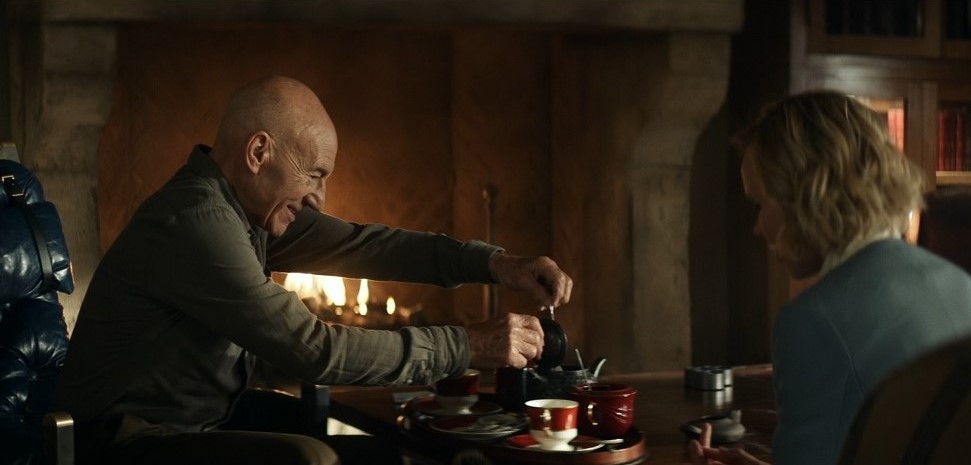
Picard walks out of the room into a bright white light, and awakens in a new synthetic body, donated by Dr Soong. I wish we’d seen more of Dr Soong and learned why he built himself a synthetic body. There seemed to be hints last week that he was sick or possibly dying, but these were vague and underdeveloped – like many points in the finale – so we don’t really know the stakes or what kind of sacrifice Dr Soong may have made. Did he condemn himself to death by giving Picard the “golem”, or will he just build another one next week now he knows how to do the mind-transfer?
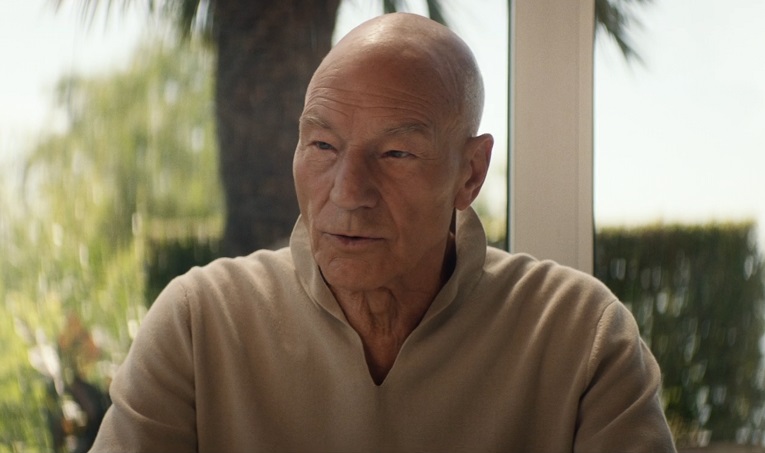
Picard is reborn in a new synthetic body.

Soji, Dr Soong, and Dr Jurati explain to Picard a number of caveats – his new body is the same as his old one, he won’t have any enhanced strength, speed, brainpower, or anything that would change him in any way. He’ll be identical to how he was, just without the terminal brain condition. And it was around here that the sense of “well what was the point of all that?” kicked in. The Data storyline was great, and I loved that Picard got to say goodbye, that we as the audience got to say goodbye to Data, and that Picard got to do his friend a final favour of letting him die properly. But for Picard’s own character, the death-and-rebirth story didn’t really do much of anything. He’s back to how he was before he died a few minutes later, and all of the emotion from his goodbye to Riker to the reaction of all of the characters was, in retrospect, at least slightly wasted.

We get a touching sequence as Picard fulfils his promise, unplugging Data and letting him finally die. Data prepares his room in the digital afterlife, and lies down to await the inevitable. Picard appears to him in his old uniform – whether Data was imagining him or dreaming isn’t clear, but it is clear that his final thoughts were of his friend. Getting a proper goodbye with Data wasn’t even something I knew that I wanted – but now that I’ve seen it, I can see how it was missing from Nemesis and that it really was something cathartic and beautiful to see. Picard’s speech, the music, the change in lighting in the digital afterlife, and finally Data fading away were all amazing to see, and it was another deeply emotional moment. Picard may have come back to life, but Data won’t – he can’t. This marks the final goodbye to a character we first met in 1987, and who we spent a lot of time with.

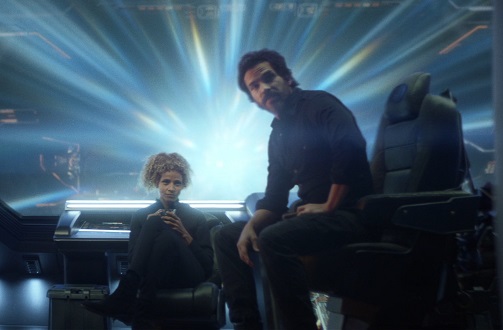
The crew reassembles aboard La Sirena – and they’ve had to find extra chairs for the bridge. Seven of Nine seems to have joined the crew, though whether that’s temporary isn’t clear at this stage. They set off to destinations unknown, and we learn that the ban on synthetic life has been overturned. The season ends with Picard giving the order to “engage!”, and La Sirena jumps to warp. The familiar Star Trek music sting kicked in at this moment, making the final scene of the episode another stirring and emotional moment.
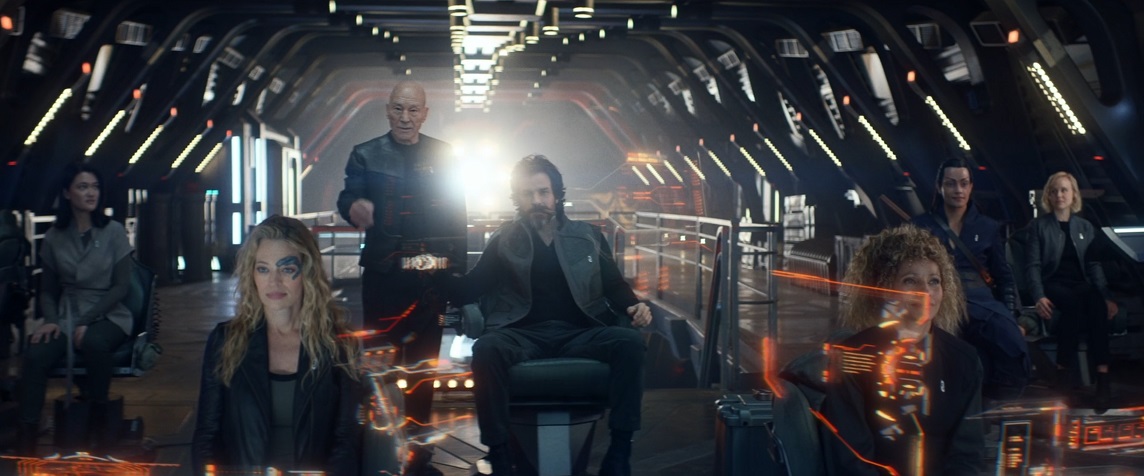
The assembled crew of La Sirena – ready for Season 2!

Taken as a whole, the episode was certainly mixed. There were high points which equalled or even went beyond the heights reached by other episodes of the season – even Remembrance right at the beginning. And there were some beautiful, deeply emotional moments which still pack a punch on a third, fourth, and fifth viewing. But there were some mistakes and disappointments too, and too much undeveloped story that was left behind as La Sirena warps off to a new destination and – presumably – a new story in Season 2.

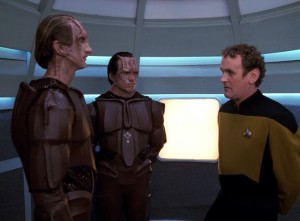
There are key points left hanging as of the end of the episode. The first is: what happened to Narek? He obviously wasn’t present aboard La Sirena at the end, but he’d been a major character who we’d spent a lot of time with and he just seems to have been abandoned by the story about halfway through the episode. It’s not clear if he returned to Romulus, remained in captivity with the synths, was handed over to Starfleet, or even if he joined La Sirena but just didn’t sit with the others on the bridge. I don’t expect to see him return for Season 2 at this point, but just ditching him with no goodbye and no end to his story was just a bit strange.

Narek disappeared after this point in the story.

Obviously I’ve already mentioned the Bruce Maddox plot hole that was left unresolved, but that’s a major annoyance so it’s worth bringing up again. There’s also Dr Jurati – she did still murder someone, so why is she free to go with Picard? Was her conviction expunged? Is she a fugitive? Will this come back to haunt her in future? It would have been nice to see some resolution to that point – unless, of course, it’s something planned for next season, in which case I’m content to wait.

Next are the “Mass Effect Reapers”. The Zhat Vash were right, in a roundabout way. The relic on Aia does tell of a race of synthetic monsters from far beyond the stars. That race are out there – is Starfleet going to try to contact them and make peace? Will the synths from Coppelius contact them and tell them not to hurt anyone? Are the “Mass Effect Reapers” content to just go back to waiting for someone else to contact them, or are they now aware of Starfleet, the Romulans, and the Milky Way galaxy’s various species? What steps will everyone have to take in case they return? What’s to stop another synthetic race from contacting them, or even the Coppelius synths changing their minds and asking for their help after all? Building a beacon didn’t look too hard or time-consuming. And what of the relic on Aia? Is it still active? Will it be shut down? Are the Zhat Vash still hell-bent on killing other synths, even if they leave Coppelius alone?
The “Mass Effect Reapers” are still out there.

Finally, we have Dr Soong and the synths. They’re under Federation protection now, but what will happen to them? Will they stay on Coppelius? Will they continue to make more copies of themselves? Without Data’s neurons, can they make more synths? And without Dr Maddox and Dr Jurati, can Dr Soong continue to work? What’s to stop the Romulans coming back next week and nuking their settlement from orbit? Are they protected in any way? Will they have to leave Coppelius and settle somewhere safer? I didn’t expect every single one of these points to be addressed, but some hint and what’s to come next for the synths would’ve been nice given how they were such a large part of the finale and the story of the season overall.

If I had been tasked with salvaging the story of the finale, the first thing I’d have done would have been to get at least one more episode for the season – perhaps two. Then I’d have interspersed some of the storylines present on Coppelius with the other active stories much earlier in the season, allowing more time for the development of characters like Dr Soong, Sutra, and even Saga. Beginning with perhaps episode six or seven – roughly the halfway point of a twelve-episode extended season – I’d have introduced the audience to Coppelius and everyone resident there. I’d have done more to build up the stakes by exploring the “Mass Effect Reapers” in more detail, too. A name for the faction would have been good, but also a basic motivation as well as some indication of their level of technology. Finally, I’d have spent more time on the climactic stand-off between Commodore Oh’s fleet and Riker’s Starfleet armada, and tried to find a convincing way to end the Zhat Vash threat, like having other Romulans mutiny against Oh when the synths deactivated the beacon. I think that by spending some more time with some of the characters, and by introducing them earlier, the finale would have been more enjoyable. But there’s no salvaging that awful gold makeup. That would have to go!
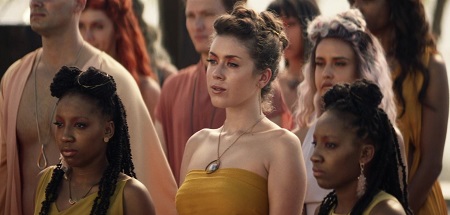
A group of synths.

I guess what I’d say about the two parts of Et in Arcadia Ego is this: it did provide a satisfactory conclusion to many parts of the story of Star Trek: Picard’s first season, but it left a lot on the table and it was rushed, poorly paced, and incomplete. When I think about the season as a whole, Et in Arcadia Ego, Part 1 is by far the worst episode, and while Part 2 went some way to rectifying that, and did manage to pull out a passable end to the story, it wasn’t an especially great episode either, with some definite low points to counteract the emotional highs.

Star Trek: Picard Season 1 stumbled across the finish line, scraping together the bare bones of a conclusion, but leaving a lot of unanswered questions and at least one gaping plot hole. That doesn’t mean that Et in Arcadia Ego, Part 2 was a failure; it did manage to elicit some powerful feelings and bring together some of the dangling story threads. But I don’t think we can call it a rousing success either, and a story that started out incredibly strongly ten weeks ago has finished with a weaker and less enjoyable pair of episodes than I would’ve wanted.

All that being said, I’m satisfied with the season as a whole. My gripes about specific points in both parts of the finale don’t detract from what has been, overall, a wonderful story and a great return to the Star Trek universe as the 25th Century is about to begin. I hope that Star Trek: Picard can now serve as a jumping-off point for other Star Trek shows set in and around the same era, moving the franchise forward into the future – where it should always have been trying to go.
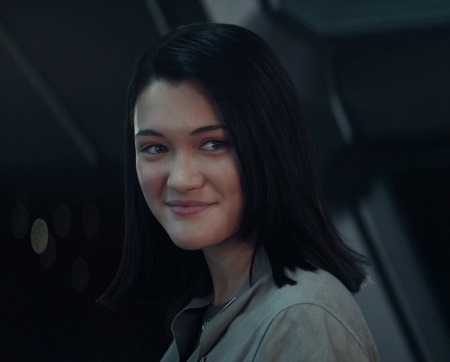
Soji in the episode’s closing moments.

Stay tuned for the conclusion to my Star Trek: Picard theories for Season 1, as well as later in the year when I hope to do a retrospective look at the season. When some time has passed and the dust has settled, it should be a good to go back and take a second look. Rewatching earlier episodes while keeping in mind some of the story elements from the finale should be an interesting experience, and I will undoubtedly see more hints and foreshadowing that I missed when I first saw them.

Now that Star Trek: Picard has concluded, don’t think that the blog is going away! There will be lots more to come as I have numerous articles in the pipeline. I half-expected to see a release date for Star Trek: Discovery Season 3 announced, but despite all the hype around Star Trek: Picard, ViacomCBS have chosen not to take advantage of this opportunity to plug Discovery. Even if the release date isn’t for a couple of months, putting it out there now would have been a great move. Regardless, whenever it airs, I hope you’ll come back to see me review and break down those episodes too.

See you next time!

All ten episodes of Star Trek: Picard’s first season are available to stream now on CBS All Access in the United States, and on Amazon Prime Video in the United Kingdom and other countries and territories. The Star Trek franchise – including Star Trek: Picard – is the copyright of ViacomCBS. This article contains the thoughts and opinions of one person only and is not intended to cause any offence.

Star Trek: Picard theories – week 9

Spoiler Warning: There will be spoilers ahead for the first nine episodes of Star Trek: Picard, and there may also be spoilers for other iterations of the Star Trek franchise.

If you’ve read my review of Et in Arcadia Ego, Part 1, you’ll know it’s my least-favourite episode of Star Trek: Picard’s first season. The season as a whole has been fantastic, and I’m really hoping that the finale will manage to salvage things because it would be such a shame if the overall story ended up spoilt by a bad ending. In any case, despite not enjoying the episode it did nevertheless bring up a couple of new theories, and debunk several others.

I re-read my review before penning this article, just in case I was too harsh or wanted to amend any of my more stinging criticisms of Et in Arcadia Ego, Part 1, but honestly at this point I stand by it. Every season of every Star Trek show has had bad episodes here and there, and I suppose it was an inevitability that Star Trek: Picard would too. The main problem, just to reiterate, is that Et in Arcadia Ego, Part 1 didn’t behave like the ninth part of a ten-episode story. By introducing new characters and storylines, as well as shaking up existing stories and leaving many points unresolved, there was simply too much to do and as a result, many potentially interesting story points were blitzed through in two minutes instead of being properly developed. I wrote that the episode felt like the halfway mark of the story rather than the beginning of the end, and if it had been episode 5 or 6 I’m sure I would’ve enjoyed it more. Star Trek: Picard does have a second season currently on order – though when that will be able to be produced is unclear right now with the coronavirus pandemic putting a halt to work across the entertainment industry – but as far as I’m aware, at least based on everything we were told in the run-up to this season, Season 1 was a self-contained story. I don’t think we can count Et in Arcadia Ego as the midway point of a two-season story simply because that was never the plan. It seems, one way or another, that the story arc of this season, with Commodore Oh, the vision on Aia, the Zhat Vash, and the synths on Coppelius will be concluded on Friday and that Season 2 will be another story. But perhaps that’s just a theory that can be proven wrong!

Speaking of Season 2, this won’t be my last Star Trek: Picard theories post. While I fully expect the main story to be concluded, I have no doubt that the show will leave Picard and his new crew on the precipice of their next adventure – so join me in a week or so as we speculate about what that might be.

I’ve thoroughly enjoyed writing these theories over the last few weeks, and I hope to begin a series of Star Trek: Discovery theories when Season 3 premieres later this year. If Lower Decks provides suitable material for theory-crafting, I’m sure I’ll do the same there too. Once again, please remember to take everything with a grain of salt and not to get overly-attached! These theories are just for fun, after all.

Let’s begin with the theories that Et in Arcadia Ego, Part 1 debunked.

Debunked theory #1: Some of the male synths will resemble Data.

Brent Spiner did have a role this week, but not as a synth.

Assuming we got to see all of the synths on Coppelius this week, there were none built in Data’s image. Brent Spiner actually has a new role as Dr Soong, the son of Data’s creator, so it doesn’t seem like we’ll be seeing him back in makeup as a descendent of Data living on Coppelius.

Debunked theory #2: The synths on Coppelius were killed when Maddox’s lab was destroyed.

Maddox had nowhere else to turn after his lab was destroyed – and going to see Bjayzl was a huge risk.

This would have led to a fairly bleak outcome for the story of Star Trek: Picard’s first season, as it would’ve left Soji as perhaps the last of her kind. However, we now know that there are plenty of synths living on Coppelius, despite Maddox’s claim in Stardust City Rag that his lab had been destroyed. I really really hope this gets explained, because we need to know what prompted Maddox to travel to the incredibly dangerous Freecloud and to meet with Bjayzl – to whom he owed money – while in a desperate state. Was Maddox expelled from Coppelius by the synths? That could be one explanation.

If it ends up ignored, I’m afraid that it isn’t just the case of a throwaway line in one episode. Locating Maddox was a large part of the first half of the season, with Raffi tracking him down and Picard organising the trip to Freecloud specifically to find him. Maddox said very clearly that the reason he’d gone there was because his lab had been destroyed – he had nowhere else to turn, so he went to see Bjayzl. One of the synths said this week that they only had one spacecraft on Coppelius – the one Jana used when she met Rios – so that further complicates matters. If these things end up being untrue then we need to know why given Maddox’s important role in the plot. I’ve been flagging this up for several weeks because I’m concerned it could open a significant plot hole.

So those two theories were debunked in Et in Arcadia Ego, Part 1. A couple of others are looking incredibly unlikely, but I don’t think we can call them officially debunked just yet, so I’ll leave them in place for now. We got two confirmed theories as well, so let’s look at those briefly before we get into the main list.

Confirmed theory #1: Seven of Nine and Elnor took the Artifact to Coppelius.

The Artifact emerges from transwarp.

The visual effect of the Artifact exiting the transwarp network was beautiful. It was a stunning work of CGI that the above image doesn’t do justice to. Unfortunately, as a story point I felt it was unearned and I didn’t like it.

Seven of Nine said that she could see La Sirena in the transwarp network when connected to the Artifact, and based on that she decided to fly the ship there with the surviving xBs. However, we didn’t really see any of that on screen, and the Artifact’s arrival seemed to come from nowhere during La Sirena’s battle with Narek. As something that had the potential to be incredibly exciting, I felt that this was a total waste of the Artifact’s surprise potential, despite the cool visual effect.

Confirmed theory #2: Romulan minds have a very particular reaction to the relic on Aia.

Part of the vision from Aia.

Okay so technically it’s organic minds, rather than specifically Romulan minds, that react so badly to the vision from Aia, but I was at least halfway right when I said that someone else experiencing the vision would have a different and less intense reaction. Sutra was able to make sense of the vision, recognising that it was one designed to be shown to synthetic minds, not organic ones.

She deciphered the vision as an appeal to synthetic races from another synthetic race, telling them to get in touch when they were ready so that the organic races who created them – and persecuted or enslaved them – could be destroyed. I’ve termed this faction the “Mass Effect Reapers”, since they play a very similar role to the antagonists in that video game series.

The Romulans didn’t fundamentally misinterpret the vision – it does seem as though an unknown faction will show up when certain conditions are met in order to exterminate life. However, they misunderstood what those conditions were – the synths need to ask for help. By being so aggressive against synths, the Romulans have arguably created a self-fulfilling prophecy where their own persecution of synths has pushed Sutra and the others on Coppelius to the point of summoning the “Mass Effect Reapers”. At least, I think that’s what the now-confused story is trying to say.

So those were the confirmed theories. Now let’s take a look at a couple of new theories, as well as those returning from past weeks.

Number 1: Sutra will succeed in triggering the arrival of the “Mass Effect Reapers”.

Sutra is Soji’s evil twin.

As of the end of this week’s episode, Sutra planned to use the information she gleamed from the vision to contact the “Mass Effect Reapers” and use their help to defeat the Romulans. Surely the conclusion of the story of this season can’t end up being “we just won’t pull the trigger and we’ll stay hidden from this powerful race”. That’s exactly what the Zhat Vash have been trying to do, and it would be quite depressing if it turns out that the villains have actually been right all along. So somehow, Picard and his crew will have to confront this new threat.

The simplest way to do that would be for Sutra to succeed in summoning the “Mass Effect Reapers”, calling on their aid to defend Coppelius from Commodore Oh’s armada. However, when the dust settles on that climactic battle, what will happen to Picard and the rest of the organics? I think here we see a possible way for Picard to come into his own. As an experienced diplomat, Picard could broker a peace with the “Mass Effect Reapers”, allowing for synthetic life in the galaxy to exist and prosper, ensuring synths would have equal rights, and so on. Rather than taking the action-sci fi approach of “kill all the bad guys and blow everything up”, this would be a quieter, calmer ending, akin to something like Star Trek: The Motion Picture, and would demonstrate that Picard – and the Federation as a whole – were able to truly embrace the idea of very different types of life.

Number 2A: Picard and the crew of La Sirena will travel forward in time to link up with Burnham and the USS Discovery.
Number 2B: Burnham and the USS Discovery will end up in 2399.

Burnham in the trailer for Discovery’s third season.

These twin theories really stem from the idea that it makes a certain kind of sense for Star Trek to bring together its fractured timeline.

When the Star Trek franchise was arguably at its most successful in the 1990s, the three shows which were in production at that time were all set in the same time period. With the exceptions of the two films featuring the cast of The Original Series, every Star Trek project after 1987 and until Enterprise premiered in 2001 was set in the mid-late 24th Century. As such, there were multiple opportunities for crossovers of themes, factions, and even characters. 1990s Star Trek was, in that respect, similar to the current Marvel shared universe which they use in their incredibly successful films. Star Trek today is much more fractured, with potentially four different time periods and one parallel universe all being used as the settings for different shows and films. When it comes to keeping the franchise together – as well as giving fans and casual viewers an incentive to jump from one series to another – bringing things together just makes sense.

The trailer for the third season of Star Trek: Discovery seemed to hint at a post-apocalyptic setting, and while we have seen in Star Trek: Picard that the Federation and Starfleet still exist and are thriving, there could be a way to explain things. The USS Discovery could, for example, emerge in a remote sector of the galaxy where the Federation no longer hold jurisdiction. Or the arrival of the “Mass Effect Reapers” could have triggered the collapse of the Federation in that region.

Secondly, something may happen at the end of Et in Arcadia Ego, Part 2 which sends Picard and his crew forward in time, meeting up with the USS Discovery in their future timeline.

While both options have points in their favour as well as noteworthy downsides, to keep the franchise together and expand its appeal as a “shared universe” it could be worthwhile to bring the shows into the same time period.

Number 3: Sutra is descended from Lore, not Data.

Lore was Data’s evil twin.

As I stated in my review, I flat-out do not like Sutra. Both from an aesthetic point of view (don’t get me started on that awful makeup again) and, sadly, the quality of the performance, Sutra is by far the least-convincing antagonist in the series as well as the least-interesting character, despite having potential. Not to mention that her 11th hour introduction has left practically no time for any meaningful exploration or development of her character.

However, setting aside my dislike of the character and her role in the story, there is one theory regarding Sutra’s origin that I have been kicking around. While we know that Maddox claimed that all of the synths on Coppelius were cloned from neurons that came from Data, there’s no evidence to support that claim right now. Data was blown to smithereens at the end of Star Trek: Nemesis, when he triggered an explosion aboard the Romulan vessel that had been commanded by Shinzon. While it’s possible that some tiny fragments survived from which Maddox was able to work, it’s also possible that Data left behind no remains.

If the latter is true, or if his remains were unrecoverable or unusable, it raises the question of how the synths came into being. One possibility is that Lore, Data’s evil twin introduced in the first season of The Next Generation, is the progenitor of some of the synths – and that could explain Sutra’s devious nature.

Hopefully Soji turns out to be a descendent of Data, because in the last couple of episodes her dynamic with Picard has used that to great effect, and a key element of their relationship would be lost if she turned out to be a clone of Lore, B4, or some other synth.

Number 4: The Artifact – or the Borg Sphere it seems to contain – will get back into space.

The circular region on the Artifact (partially obscured by the hill in front) could contain a Borg Sphere.

The Artifact’s arrival at Coppelius was a great visual effect, but as a story point I didn’t like it when I saw it this week. However, one point of interest came as the Artifact was exiting the transwarp network – it appears to have a Borg Sphere docked. We saw in First Contact that Cubes can have Spheres on board, and it seems like the Artifact has one too. Given that the Artifact itself has crashed – and seemed to be in a bad way – I wonder if Seven of Nine, Elnor, and the xBs will use the Sphere to return to space – perhaps joining in the fight over Coppelius that we assume is coming.

The other possibility is that the Artifact itself can be repaired and relaunched into space, but if that happens I feel it could be kind of hollow – what exactly would be the point of crashing it one week to get it flying again the next, especially given how little screen time the Artifact got this week?

If that were to happen, I feel that the better storytelling choice would’ve been to skip the Artifact this week and have the cool emerging-from-transwarp scene next week, midway through the battle and helping to turn the tide against the Romulans.

Number 5: The “Mass Effect Reapers” will turn out to be the Borg.

The Borg made their Star Trek debut in 1989’s Q Who.

In the vision Sutra was able to decipher, the faction offering help to synthetics wasn’t named. Given that the Borg have played a role in this season, I wonder if they may take this opportunity to show up. Rather than being a message which set out to help synthetics, what if the Aia vision was a trap laid by the Borg to assimilate them? When they’re contacted, they know that a highly-advanced synthetic race exists – and the Borg love to assimilate advanced races and absorb their technology into the collective. So they travel through the transwarp network that we’ve just seen La Sirena and the Artifact use, but instead of providing help to the synths, they assimilate them. And not only that, they may also assimilate the species that built the synths in the first place, adding both technologically-advanced races to their collective.

Of all the races we know of in Star Trek, the Borg are one of the few who would conceivably be able to accomplish something as massive as moving stars – something whoever left the message on Aia was able to do. The drawback to this theory is that it doesn’t fit with the Borg’s normal modus operandi – they usually just show up and conquer their target, without going to the trouble of leaving messages and traps. But it’s not entirely impossible!

Number 6: Picard and the crew of La Sirena will travel to Aia.

The Zhat Vash with the relic on Aia.

Last week, I said that the reason for Picard and the crew to travel to Aia would be for them to see the vision for themselves. Now that we know what the vision contains, there’s not really any reason for this. However, it’s still possible that they may travel to Aia.

It could be that the “Mass Effect Reapers” will arrive there if Sutra is able to contact them, or if the battle is won and the Romulans and the Reapers are defeated, Picard and the crew may wish to travel there to deactivate the relic and prevent it from being used again.

Number 7: Narek is going to go rogue.

If Narek does turn on the Zhat Vash, it’ll be for Soji.

I’m still not sure, even at this late stage, how genuine Narek is when he talks to Soji. We saw how much it hurt him to leave her to die on the Artifact, but we also saw how determined he was to catch up to her afterwards. Whether Narek has seen the vision on Aia or not, he seems to be fully subscribed to the Zhat Vash ideology of preventing synthetic life reaching the threshold, and no matter what his personal feelings may have been, he did try to help them complete that mission.

However, if it is ultimately proven that, for whatever reason, synthetic life does not pose the threat the Zhat Vash assume it does, Narek will have no reason to hurt Soji or the other synths. He may even be a valuable ally, providing Picard and the crew with information about the Zhat Vash and their plans.

In short, I don’t see Narek turning on his allies unless he’s sure that synths don’t pose a threat. Sutra seems intent on proving that they are a threat, so we’ll have to see what happens. But with so much time spent on the Narek-Soji relationship through the first three-quarters of the season, there will have to be some kind of resolution to his story arc.

Number 8: Commodore Oh is a synth.

Commodore Oh in her silly sunglasses.

When I first came up with this theory a couple of weeks ago, the one big issue staring me in the face was that Commodore Oh was able to mind-meld. Telepathic powers have only ever been seen in organics in Star Trek, and that was definitely a factor making this theory less likely.

However, with the revelation last week that Sutra is capable of mind-melding despite obviously being a synth, we can now get rid of that obstacle. Does it make the theory likely? I don’t know, but it’s at least technically possible in a way it arguably wasn’t a few days ago.

There would be some delicious irony in the revelation that Commodore Oh, who has worked so hard against synthetic life, is a synth herself – especially if, like Soji, she’s unaware of her true nature. The possibility of an undercover synth working to trigger the arrival of her cohorts would make a certain kind of sense, but it would have to be handled well to avoid feeling like a deus ex machina.

So those are the theories that are new or were advanced somehow in Et in Arcadia Ego, Part 1. Now, as always, let’s look at the remaining theories from previous weeks that weren’t confirmed, debunked, or advanced.

Number 9: Picard’s conversation with Admiral Clancy may have tipped off Commodore Oh and the Romulans.

Admiral Clancy had promised to dispatch a fleet to Deep Space 12 to defend the synths on Coppelius from the Romulans. However, her conversation with Picard took place before Picard and the crew had pieced everything together about Commodore Oh – and as a result, it’s at least possible that she became aware of Starfleet’s plans and will be expecting the arrival of their fleet.

Number 10: Star Trek: Discovery’s post-apocalyptic setting is related to the arrival of the “Mass Effect Reapers”.

I hinted at this above, but one possible explanation for the seemingly bleak future glimpsed in the trailers for Discovery’s third season is that, somehow, the vision from Aia comes true and the “Mass Effect Reapers” arrive and cause widespread devastation.

The downside to this, and why it seems less likely, is that Discovery claims to be taking place roughly 800 years in the future from Star Trek: Picard’s time, so even if something major happens, it seems unlikely that the Federation would still be picking up the pieces after so much time had passed! However, as I suggested above, if Burnham and co. arrive in 2399 instead of the 32nd/33rd Century, it could all fit together.

Number 11: Borg technology was used in the creation of the Coppelius synths.

One aspect of Star Trek: Picard’s story that is still unexplained is what was going on with the Borg components? Icheb was murdered so his Borg technology could be extracted, and the de-assimilation taking place on a large scale aboard the Artifact was very profitable for the Romulans – but who was buying these parts?

I had speculated that Maddox and his team might be the primary buyers, using that technology to advance their understanding of synthetics and develop better synths. It would be one way to explain the jump between F8, who was incredibly basic, computer-like, and inhuman, and synths like Jana and Sutra, who were active only a few years later.

Number 12: Riker will return to active duty.

In Nepenthe, Riker stated that he hasn’t officially retired from Starfleet and is instead on “active reserve”. Given that, and his location being close-ish to Deep Space 12 and thus to Picard, I wonder if Riker could be called on to join – or even lead – the fleet headed for Coppelius. If not, we can call this our first Star Trek: Picard Season 2 theory!

Number 13: The father figure from Soji’s dream isn’t Maddox – it could be a synth or it could be Dr Soong.

Maddox claimed to have built Soji and Dahj, and on Coppelius his room was preserved and both Dr Soong and the synths spoke highly of him. However, the father figure from Soji’s dream had no face, and while that may simply have been for shock value and for Maddox to keep himself safe if Soji were ever found out, it’s at least possible that there’s another explanation. There seemed to be the briefest of hints that Soji recognised Dr Soong in Et in Arcadia Ego, Part 1 – and he is wearing a not dissimilar outfit to the father figure in her dreams.

Number 14: Picard’s illness is Irumodic Syndrome

Despite Picard discussing his diagnosis with the crew this week, the name of the condition was not mentioned. Barring a last-minute appearance from Dr Benayoun, the condition Picard is suffering from may not be named this season – but this theory will remain in play for Season 2.

Number 15: Soji and Dahj’s necklaces were a deliberate symbol to communicate with someone.

Clandestine communication through the use of signs and symbols goes back to ancient times, and I wonder if Maddox and Dr Soong employed it when choosing Soji and Dahj’s necklaces. I felt the necklaces themselves were not strong props from a visual standpoint (I said so way back in my review of Remembrance) but considering that they’re supposedly a visual symbol of a banned method of building synths, I wonder if Maddox’s intention was to indicate to someone in the synth field that Soji and Dahj were his work. If not, the necklaces are a heck of a risk. They may even have been what brought Soji and Dahj to the attention of the Zhat Vash – how they figured out Soji and Dahj were synths is something which is currently unknown.

Number 16: Section 31 will be involved.

All of my Section 31 theories over the course of this season have come and gone, but I have thought up a new one! With a new series based on Section 31 in development, and considering their role in Discovery’s second season, I felt sure that they’d crop up somehow this season. The only way I can think of that happening right now is almost right at the end of the season – perhaps even an epilogue – in which they take possession of the Artifact and its valuable Borg technology.

Number 17: Something Maddox did or didn’t do meant that the synths on Mars could be hacked.

We learned a couple of weeks ago that the Zhat Vash, presumably led by Commodore Oh, were responsible for the attack on Mars. They did that by hacking the synths on Mars, turning them against the Federation and then forcing them to commit suicide when their work was done. But how the Zhat Vash were able to perform this task is unknown – and I wonder if something Maddox did or didn’t do meant that it was possible.

So that’s it. Those are the remaining theories as we head into the finale! It’s patently obvious that they can’t all be right, and we may even see none of them pan out by the time the episode – and the season – is complete. However, it’s always fun to speculate, and there are several theories which, if they aren’t outright debunked, will form the basis for my Star Trek: Picard Season 2 theory list! As and when we get information, images, and trailers for the second season I hope to update that list, so stay tuned for that.

After being so hyped and excited for this series for well over a year, it’s bittersweet that it’s almost over! With only one exception, I’ve had a great time with every episode of this season – and even within the episode that I didn’t like there were still enjoyable moments.

Next week, or rather, sometime after I watch the episode on Friday, I’ll do my usual review post for Et in Arcadia Ego, Part 2. Then after that, I’ll wrap up this season’s theories and do my Season 2 theories – assuming I have any. After that I’ll take a break from Star Trek: Picard content, but at some point before the end of the year, when I’ve had a chance to re-watch the whole season in full, I plan to do a retrospective of the entire season discussing various highs and lows. I’m half-expecting to learn that Star Trek: Discovery’s third season is going to be released in April or May, but with all of the issues stemming from coronavirus I wouldn’t be surprised at all to see it delayed to later in the year. But when it’s on the air I’ll be doing the reviews and probably theories too. What I’m saying is I hope you stick around after Star Trek: Picard goes off the air, because the blog isn’t going away!

The first nine episodes of Star Trek: Picard are available to stream now on CBS All Access in the United States, and on Amazon Prime Video in the United Kingdom and other countries and territories. The Star Trek franchise – including Star Trek: Picard – is the copyright of ViacomCBS. This article contains the thoughts and opinions of one person only and is not intended to cause any offence.

Star Trek: Picard review – Season 1, Episode 9: Et in Arcadia Ego, Part 1

Spoiler Warning: There will be spoilers ahead for Et in Arcadia Ego, Part 1 and the preceding eight episodes of Star Trek: Picard Season 1. There may also be spoilers for other iterations of the Star Trek franchise.

So I suppose I should just come right out and say it: Et in Arcadia Ego, Part 1 is my least-favourite episode of Star Trek: Picard so far. We’ve had some great episodes this season which really hooked me in, took me on a rollercoaster journey, and got me feeling happy, nervous, excited, nostalgic, tense, and emotional. This week I really didn’t get any of that for the bulk of the episode. There were a handful of good moments sprinkled throughout, but the pacing of the episode as a whole felt off – it seemed to rush from point to point with no time permitted for any story thread to properly develop or be explored.

For an episode that was supposed to be the first part of the culmination of the entire season, it ended up falling flat on its face. And that is pretty disappointing. Every Star Trek series – and every season of every series – has had duds: episodes which misfired, told bad stories, or for various reasons failed to hit the mark. The problem that Star Trek shows have today is that when the whole season is one continuous story, a dud episode can have ramifications for the entire season instead of being a one-off rotten egg. I hope that Et in Arcadia Ego, Part 2 next week manages to pull things back – and there is precedent for that, as Star Trek: Discovery’s second season episode Perpetual Infinity pulled off a great recovery from The Red Angel a week prior, which is my personal pick for Discovery’s worst episode.

The Artifact emerges from transwarp.

Aside from the pacing and rushed feel to the story, my second main point of criticism is the aesthetic of parts of the episode. I’ve mentioned before that every location in Star Trek: Picard so far has been a barely-disguised California, and Soji’s homeworld – variously called Coppelius and Ghoulion IV – was another example. I come back to what I said last week about the use of indoor sound stages: with special effects and CGI being so good nowadays, a lot more can be done with that format than in previous decades. If it’s a choice between seeing five planets that all look the same because they were all filmed within fifty miles of Los Angeles, and seeing different-looking planets that were perhaps smaller in scale because they were filmed on sound stages I’ll always prefer the latter.

The second visual aspect that I felt simply did not work was the makeup used for most of the synths. The yellowish-gold tinted skin the actors were sporting didn’t make them look like Data-type androids; they looked like humans wearing cheap and bad makeup. It was something that would’ve felt at home in The Original Series, and if I’d seen those characters in an episode from the 1960s I’d have dismissed the amateurish look as a product of the limitations of the time. But Star Trek: Picard’s aesthetic has been so good until now overall that I legitimately wonder how they managed to make the synths look so bad. Was it because they were largely filmed outdoors in natural sunlight? Because earlier looks at Data in Picard’s dreams or F8 and the other synths in flashbacks to Mars looked far better. Whatever it was, the makeup ended up being a huge distraction, because every time Evil Soji or any other synth was on screen it was all I could look at. I actually had to rewind the episode a few times because I’d missed some line of dialogue or other.

I found the makeup used for the synths (Sutra pictured) to be of poor quality and a significant distraction.

I wish we’d seen something, either this week or last week, to make it obvious that Seven of Nine and Elnor were on their way, because the Artifact arriving at Coppelius mere moments after La Sirena was a story beat that I felt didn’t work in the moment. Ironically, after last week’s scenes on the Artifact being some of my least-favourite, I greatly enjoyed seeing Picard and the crew return there this week – albeit that the sequence was far too short. I wanted to spend more time there as Picard learned of Hugh’s death – which actually didn’t even appear on screen – and mourned him. But even in what I suppose was my favourite sequence there were issues – the length, as I mentioned, is one. But what was up with the ex-Borg calling Picard by his Borg designation of “Locutus”, which is the second time that’s happened now, only for Picard to basically ignore it and get back to what he was doing?

Elnor learned of Picard’s illness off screen too, which would have been another scene I’d have wanted to see – one which could have added some genuine emotion to an episode which was largely devoid of it. Some more time spent on Hugh’s death would’ve been nice too; Picard mentioned it in a single line of dialogue but Soji didn’t even acknowledge his sacrifice, despite their friendship and despite his death being a direct consequence of aiding her escape.

We could’ve spent more time here.

When we learned last week of the “Mass Effect Reapers” hiding out somewhere beyond the galaxy, waiting to show up and destroy all life, it seemed for sure that the climax of the story couldn’t simply involve hiding from that and avoiding pulling the trigger – somehow, Picard and co. would have to confront the wider threat. And we saw in Et in Arcadia Ego, Part 1 the way in which that trigger will be pulled: Soji’s evil twin, Sutra.

Villains can be hard to get right. Rizzo, for example, took a while to hit her stride after coming across as a fairly one-dimensional character in her earlier appearances. The story has since fleshed her out a little more, providing her with background and motivation, as well as even the smallest shred of pity for what she’s been through. Sutra has very little of that, and unfortunately Isa Briones, who had done an admirable job portraying Soji and Dahj, didn’t really manage to pull off a convincing performance as an antagonist. Sutra’s motivations are understandable, sure – she wants to save her people from what seems to be an existential threat. But overall, the way she was portrayed strayed way too far into the kind of “I’m evil and I love it” attitude that felt so awkward and inauthentic about Rizzo in her earlier appearances.

I called this phenomenon the “24th Century Heinz Doofenshmirtz” – and I get that that’s a niche reference, so let me explain. In the cartoon show Phineas and Ferb, Heinz Doofenshmirtz is a wannabe evil scientist. He builds machines usually designed to get petty revenge on his brother or other people he feels wronged him, and he’s tied his entire identity to being evil for the sake of being evil. That’s what Rizzo felt like, and that’s what Sutra feels like now – she hasn’t bothered to consider any other options, she went straight into arbitrary arrests and plotting genocide. Perhaps she’s meant to be a parallel for Rizzo and Commodore Oh, but both of those characters feel far more complex. And I’m afraid the point must be reiterated: both of those acting performances were much better.

This is basically Sutra.

The premise for her actions is understandable, though – just as Rizzo, Narek, and Commodore Oh being motivated by their interpretation of the vision is understandable too. As a story point, I’m not really criticising Sutra’s basic motivation and desire to protect her people from harm. And the way it has been established that both Starfleet as an organisation and Picard as an individual are people she and the synths might find difficult to trust was well-established over the course of the prior eight episodes.

Et in Arcadia Ego, Part 1 has tried to pull off a last-minute plot twist with Sutra. Instead of the synths needing to be rescued from Romulan aggression, Sutra’s plan is to summon the “Mass Effect Reapers” and become the aggressor herself. But if the story of Star Trek: Picard has wanted to say that the ban on synths was wrong, and that even Starfleet and the Federation need to be more accepting of different kinds of life besides their own, what message does it send when the Romulans, who have been the season’s antagonists the whole way, are actually right?

The entire premise of the Romulans’ desire to exterminate synthetic life is that if they don’t, the synths will trigger this apocalyptic event – the arrival of the “Mass Effect Reapers” – and kill everyone in the galaxy. That’s a powerful motivation, and covers all manner of sins because, as the episode itself tried to address, there’s a calculus involved even when dealing with matters of life and death. If one’s intention is to save a trillion lives, it can be easy to justify ending 90,000. This is what the Romulans did on Mars. Star Trek: Picard – and Picard himself within the show – are trying to present this kind of ends-justify-the-means thinking as abhorrent, but that message has become incredibly confused thanks to the insertion of the character of Sutra and the revelation that she plans to do exactly what the Romulans fear that synths will do.

Sutra plans to do exactly what the Romulans fear.

In yet another example of the episode racing from point to point, the name of this faction Sutra is planning to summon is not even mentioned. I’m calling them the “Mass Effect Reapers”, because, as I mentioned last time, they serve a very similar purpose to the antagonists in that video game series. But who are they? There’s only one episode left not only to find out who they are and what motivates them, but also to defeat them.

One visual element that I loved were the “orchids” – some kind of planetary defence system which resembles giant flowers. It wasn’t clear whether they were crewed ships or just automated, but they looked absolutely stunning and the CGI work to bring them to life was fantastic. However, as a concept I’m not sure they really make sense. Firstly, they seem to be single-use things, which seems like waste of time and resources. Secondly, and most importantly, they don’t actually serve a useful purpose when it comes to defence – in fact, they achieve quite the opposite. By capturing ships and dragging them – intact – to the surface of the planet, all the orchids manage to do is bring any enemies directly to the planet’s surface. If the ambition is to disable an attacking ship that plans to strike from orbit then that could be useful in the short-term, but all it really does is shift the problem for the synths to one they have to deal with on the ground. In the case of the Artifact, for example, it was dragged out of orbit and crashed on the planet’s surface – but if it were a fully-operational Borg cube the synths would then have to deal with tens of thousands of drones literally on their planet. Not to mention that no synths showed up at the crash sites of either La Sirena or the Artifact to apprehend their crews.

This would be a very bad outcome in the event of an invasion, yet it’s what the orchids are designed to do.

If the aim was to demonstrate that the Coppelius synths are basically unprotected, then why not leave them unarmed? Picard and his crew were going to land or beam down anyway, and it would’ve been possible within the story to get everyone to the planet’s surface without the use of a kind of planetary defence system that really doesn’t achieve what it should. At best it moves the problem from space to the ground, and at worst it could actually aid the synths’ enemies in a potential invasion event. In short: cool visuals, but an illogical concept.

I’m okay with the idea of Dr Soong – Data’s creator from The Next Generation – having a son, and that character following in his father’s footsteps to work on building synths. It might not have been my first choice of storyline, but there’s nothing inherently wrong with it. However, not for the first time, the presence of the actor’s name in the credits telegraphed the arrival of the character before we knew he would be appearing on screen. This happened in Absolute Candor, when Jeri Ryan’s name showed up in the credits, despite her character only appearing in the final thirty seconds of the episode. Spoilers are commonplace online, and because in the UK we get Star Trek: Picard 24 hours after its US premiere I have learned to be careful where I go online on Thursdays and Friday mornings! But for a show to spoil itself in its own opening titles is just plain silly – what would be wrong with crediting Brent Spiner in the end credits and making his inclusion in the episode and the reveal of his new character a genuine surprise? This has happened twice now, and it’s just not nice to know someone is coming before they show up on screen.

This shouldn’t happen – it’s a massive spoiler.

There’s also the question of the payoff to Soji’s dream – is Dr Soong supposed to be the figure in her dreams? There was the tiniest flicker of a hint at that: Dr Soong is wearing a similar outfit to the faceless figure Soji has dreamed about, and Soji seemed to do a double-take on seeing him, almost as if she recognised something about him. Yet neither of those things were acknowledged.

I did like, however, that Dr Soong is not a synth. When we’d heard of the existence of other synths I speculated that maybe some would share Data’s appearance in the way that some shared Soji’s appearance, but I’m glad to have gotten a human character instead. It was unexpected and interesting – and hopefully the plot thread of Dr Soong transferring himself into a synthetic body will be explored further.

Unfortunately, like all of the various competing stories in Et in Arcadia Ego, Part 1, this was barely touched on and needed much more development. In a way, this encapsulates the problem with introducing a whole new civilisation and cast of characters in the final two episodes. There simply isn’t enough time remaining for Dr Soong and Sutra and the other synths to all have their own stories that are as detailed and interesting as those stories we’ve already seen playing out for the past eight episodes. Given how rushed this episode felt, and how it tried to cram so much into a 45-minute runtime, some elements – like Dr Soong’s desire to become a synth – could’ve been dropped to give more screen time to other, more important story beats.

And I think we’ve come to the crux of my complaints about Et in Arcadia Ego, Part 1. The episode introduced several new major characters, a new antagonist, a new location, new obstacles for Picard and his crew to overcome. Yet it’s supposed to be the first part of the finale, and finales are meant to bring everything that’s already happened to a head and begin to wrap up the story. It’s simply too late now to open up whole new plotlines and for dumping whole news sets of characters onto the audience. The only story thread that feels somewhat concluded is Picard’s redemption in the eyes of Elnor – and that had arguably already happened in The Impossible Box.

Elnor and Picard are reunited… briefly.

The story of Star Trek: Picard has been, at points, meandering. The diversions to Vashti and Nepenthe in particular were close to standalone stories, taking Picard on a personal journey through parts of his past. And they were good stories, giving Picard the chance to redeem himself with Elnor, a character he’d been a kind of substitute father to, and to draw on the advice of two of his former crew: Riker and Troi. And of course for us as the audience to see those characters return was a nostalgic treat. Yet the revelations in Et in Arcadia Ego, Part 1 that Sutra actually wants to fulfil the Romulans’ prophecy and bring about the end of days, and that Dr Soong is hoping to transfer himself to a new body make those episodes feel, in retrospect, like wasted time. If there was all this important plot to get through before the season ended, we should have been spending our time here, having Picard and his crew arrive on Coppelius earlier to allow more time for these “main” story beats to be properly and fully explored.

As it is, Et in Arcadia Ego, Part 1 feels like an episode that should mark the halfway point in the story and in the season. Sutra needs time to explore the vision in more detail, figure out who to contact and how to contact them, rally her people to her newfound cause, demonstrate to the audience precisely what the implications of summoning the “Mass Effect Reapers” will be, who that faction even is, work out a plan, and above all, develop as a character and let us get to know her. Dr Soong needs more screen time too – he needs to explain what this vaguely-hinted-at illness is that means he needs a new body, show how and why he’s failed at successfully building it so far despite being surrounded by hyper-intelligent synths, demonstrate what Dr Jurati can do to help that means he needs her support, and show us as the audience whether he’s a “good guy” or a “bad guy” because right now he’s ambiguous. Ambiguity in characters is fine, and it’s even good in some cases as it ramps up the tension and mystery. But when a character’s motivations and goals are unclear simply because they haven’t had sufficient time in the story for us to know anything about them, well that just isn’t very interesting. Worse, it can be frustrating.

Instead of taking its time, Et in Arcadia Ego, Part 1 tried to cram everything I listed above into about thirty minutes of screen time. I’d absolutely argue, based on what we saw this week, that there’s several episodes’ worth of story there, and that’s what I mean when I say the episode felt so poorly-paced and rushed.

It’s unclear whether Dr Soong will turn out to be an ally or an enemy.

There were several other moments that could have been spread out across multiple episodes. Picard and his crew trekking from La Sirena to the Artifact and then to Coppelius Station, for example. Instead we got a single drone shot of them walking and that was it. For an older man hiking over rough terrain, initially several kilometres away from where he needed to go, Picard isn’t exactly going to be speedy and we could have had several scenes with ample time for character development both on the way to the Artifact and on the way from the Artifact to Coppelius Station. There was certainly scope for more time spent with Seven of Nine, Elnor, and the xBs. It’s totally unclear what will happen to them now – are they marooned on Coppelius? Can the Artifact be repaired again and get back into space? What are their objectives? Is Seven of Nine their leader? Are the xBs even thinking for themselves? Have they got over their assimilation experiences? How many survived? So many unanswered questions, and given how much time we spent on the Artifact in earlier episodes, to just try to brush it all away and move on to this new story about Sutra, Dr Soong, and the attempts to trigger armaggeddon and/or fight the Romulans leaves a lot of things unresolved.

There’s also a point of consistency, and it connects to something I wrote in my review of The Impossible Box. When Narek finally got Soji to explore her memories, she provided two clues to the location of her homeworld: electrical storms and two red moons. We saw the red moons in the episode, but where was the storm? Narek and Rizzo took it to mean that the planet had “constant” storms, and even Kestra used this information to ask Capt. Crandall to find the planet’s location in Nepenthe. I felt that two clues did not provide much information to go on when locating a planet, especially as lots of locations can have occasional lightning storms rather than suffer from them continuously, but for one of the two established features of Coppelius to be ignored entirely – and for that point, which had been important in earlier episodes, to not even be given lip service just adds to the sense that there was too much to cram into Et in Arcadia Ego, Part 1. Otherwise the show’s creators are being inconsistent – setting up story points that work in one episode but are ignored in others. Another example of this is from Stardust City Rag where Maddox said his lab had been destroyed. Picard was literally sat in Maddox’s room this week, and it didn’t look destroyed to me. Is that going to be explained properly, or are we just going to have to live with the fact that these inconsistencies exist and only served to drive the plot and get the characters to the right place at the right time for other story beats to unfold?

Picard’s illness was something that the story had set up way back in Maps and Legends that I’d been waiting to see some development on. We finally got that this week, as Picard suffered a blackout. His scene explaining to the crew that he had been diagnosed was one of the few emotional moments in the episode, and in particular I was moved by the reactions of Dr Jurati and Raffi. The “I love you” moment with Raffi later in the episode was both awkwardly funny and touching – and the pay-off to a relationship that had been built up and explored over multiple episodes. That scene was probably my favourite; a diamond in the rough.

Commodore Oh on the bridge of her ship.

Other points I liked were: seeing Commodore Oh on the bridge of her ship at the end of the episode, the Artifact emerging from transwarp, seeing Picard and the crew all together on the bridge of La Sirena, Picard’s speech about his illness, Raffi calling Narek Soji’s “asshole Romulan ex”, the synthetic cat and butterflies, and the costumes the crew of La Sirena wore after leaving the ship. None of these moments, however, could redeem a bad episode.

So I know this hasn’t been a typical review. I usually like to spend more time on each episode and break down more of the scenes in detail than I have here, but honestly I just want to see the back of Et in Arcadia Ego, Part 1, and going back and re-watching it several times in order to pull out a few more points just doesn’t hold much appeal to me right now. I’m looking forward to the finale with nervous anticipation. I’m hopeful that the story can be concluded in a satisfactory manner, and that the currently-unresolved plot points will be wrapped up. Just because Part 1 didn’t hit the mark, that doesn’t mean Part 2 will necessarily be a disappointment as well, and I remain hopeful that I’ll enjoy next week’s outing a lot more.

Remember to stay tuned for the theory post in the next few days, as I check a few more off the list!

The first nine episodes of Star Trek: Picard’s first season are available to stream now on CBS All Access in the United States, and on Amazon Prime Video in the United Kingdom and other countries and territories. The Star Trek franchise – including Star Trek: Picard – is the copyright of ViacomCBS. This article contains the thoughts and opinions of one person only and is not intended to cause any offence.

Star Trek: Picard theories – week 8

Spoiler Warning: There will be spoilers ahead for the first eight episodes of Star Trek: Picard, as well as for other iterations of the Star Trek franchise including Star Trek: Discovery Season 2 and the trailers for Season 3.

Broken Pieces saw several theories from previous weeks blown out of the water – finally! As Star Trek: Picard begins to draw the story of its first season to a conclusion, that was to be expected. As fun as it has been writing up these theories every week, I love that the show has been surprising and taken its story to some genuinely unpredictable places.

This is something I’d like to write about in more detail in the future, but getting overly-attached to one’s own theories (or other people’s theories found online) is not a good thing. Theory-crafting is a bit of fun, something to get the old grey matter working and to spend a little more time with the franchises we love. If you’ve been following along with these posts over the last few weeks, I hope you’ve taken these theories with a healthy pinch of salt too, because it was always the case that almost all of them would end up debunked – especially the more outlandish ones!

We have at least eight debunked theories, so as always, let’s start with those.

Debunked theory #1: There’s a Starfleet-Zhat Vash conspiracy.

Admiral Clancy, head of Starfleet.

This was a great example of a double-bluff in my opinion. From the first time we met her, Commodore Oh’s Vulcan persona was difficult to read. It seemed unlikely that the Romulans, clever though they are, would have been able to plant an operative at such a high rank in Starfleet – but we didn’t know that they’d been playing a really long game, one that went right back to the activation of Data even prior to the events of The Next Generation.

Commodore Oh is not the Vulcan co-conspirator I had assumed, and is in fact a Zhat Vash operative – a senior one, too, judging by the role she played in the Zhat Vash initiation ritual we saw in Broken Pieces. This changes the dynamic of the series from one where Picard could have conceivably faced off against half of Starfleet to one where Starfleet itself gets to retain its status as being one of the “good guys”. Commodore Oh may have been able to corrupt parts of Starfleet from within, and her ability to seemingly recruit new people to her cause with a simple mind-meld, as she did with Dr Jurati, may mean there are some compromised officers, but we know for a fact that Admiral Clancy is not among them, and that Starfleet itself did not aid the Zhat Vash.

The Zhat Vash engineered a situation where the Federation’s only option would be to shut down research into synthetic life. It’s true that the Federation took the bait, but in the aftermath of a massive attack that killed over 90,000 people and has seemingly rendered an entire planet uninhabitable and unusable, it’s an understandable reaction even if some of our main characters criticise the Federation and Starfleet for it.

Debunked theory #2: The captain of the USS Ibn Majid was a character from a past Star Trek show.

A new character, Capt. Alnzo Vandermeer, was in command of the Ibn Majid.

This was a complete stab-in-the-dark, but I had speculated that Chris Rios’ deceased captain would turn out to be a character we’d met before. Instead we got a new character, Captain Alonzo Vandermeer. I doubt we’ll learn much more about Capt. Vandermeer in the current season now that the story of his death – and how it ties to the overall plot of the show – has been uncovered.

Debunked theory #3: The USS Ibn Majid was a Section 31 ship/Rios used to work for Section 31.

A graphic representing the USS Ibn Majid was seen on Rios’ belongings.

A few weeks ago, I had several possibilities for how Section 31 could potentially fit into the plot of Star Trek: Picard, but now I don’t have any!

When Rios told Picard that the USS Ibn Majid had been “erased” from Starfleet’s records, only one organisation sprang to mind as having the ability and willingness to do so: Section 31. Given that the captain mentioned above died under unknown but clearly dramatic circumstances, it was not unreasonable to theorise that the Ibn Majid could’ve been involved in the kind of off-the-books operations that Section 31 were known for. However, all indications are that this was not the case. Rios did not work for Section 31, and the Ibn Majid appears to have been a normal Starfleet ship in regular service with the fleet. The cover-up was a result of Commodore Oh attempting to keep the synthetics from Soji’s homeworld a secret.

Debunked theory #4: Section 31 (or anyone other than the Zhat Vash) were behind the attack on Mars.

A Section 31 badge from Star Trek: Discovery.

When I first formulated this theory after Children of Mars and Remembrance, I speculated that several factions could’ve been responsible. A couple of candidates were the Borg and the Dominion: the Borg because their technology may have been involved, and the Dominion because an attack designed to sow discord between Alpha Quadrant powers was something they’ve done before. However, the two main culprits I had were Section 31 and the Zhat Vash.

We now know that the Zhat Vash were responsible, presumably with Commodore Oh leading the charge. There were a couple of good reasons to suspect Section 31, though. Firstly, with Section 31 having prominently featured in Star Trek: Discovery and with a new series based on the organisation in the works, their presence in Star Trek: Picard would be something to tie all the shows together, and be a frame of reference for new and casual viewers. Secondly, from an in-universe point of view, Section 31 have always been militantly pro-Federation and willing to do anything to achieve their goals. In Deep Space Nine they were willing to commit genocide, killing the Founders of the Dominion with a virus. In Discovery they were operating outside of normal Starfleet jurisdiction, even building an artificial intelligence. It seemed at least plausible that Section 31 would have opposed Picard’s plan to help the Romulans, as they had long been an enemy and the rescue mission could’ve led to some members seceding from the Federation. They would have had no qualms whatsoever about sabotaging those efforts, even if that meant killing Federation citizens.

Debunked theory #5: The Romulans’ fear of synthetic life is caused by their own past experiments with synths/AI going horribly wrong.

It was Laris who first told Picard about the Romulans fearing AI.

I speculated that the Romulans had once created their own AI or synths, and that something went wrong, causing the Romulans to fear and hate synths. There were a couple of ways this could have manifested: firstly is that the Romulans had simply arrived at the conclusion that there’s a flaw in all synthetic life which means rebellion is inevitable. We have seen rogue AI in Star Trek before, in episodes like The Ultimate Computer, Discovery’s second season arc, and even in a way in Star Trek: Insurrection where Data himself goes rogue.

The second possibility had been that the Romulans had somehow been involved in the creation of the Borg. We got a few hints at how the Romulans viewed the Borg, particularly in the way the xBs were treated and prohibited from leaving the Artifact. But mostly why I felt this was at least possible is because Star Trek: Discovery’s second season, with the Control AI mentioned previously, seemed to be moving toward a Borg origin story. When that aspect of the story didn’t materialise I was surprised, and when we seemed to be seeing Romulans and the Borg in Star Trek: Picard, I wondered if the creators of Star Trek had chosen to go with a different Borg origin story while Discovery’s second season was in production.

However, we now know that the Zhat Vash believe that when a certain threshold is reached in the development of synthetic life, a hitherto unseen race or faction arrives and destroys not only the synths but those who created them. It’s not the synths themselves that they fear – it’s who will follow.

Debunked theory #5A: The Romulans were keeping the ex-Borg on the Artifact for a reason connected to their own past synthetic experiments.

Ex-Borg aboard the Artifact.

If the Romulans created the Borg, they would have wanted to keep that a secret, and prohibiting xBs from leaving might’ve helped them keep that secret safe. They may also have been studying the xBs, trying to see how synthetic technology has evolved since they abandoned their own experiments. However, with the Romulans so easily abandoning the Artifact and murdering the xBs, it seems as though they really didn’t care about them or about anything they could learn from studying their technology, and were simply harvesting their components to sell.

Debunked theory #6: Picard’s decision to tell everyone their enemy is the Tal Shiar (and not the Zhat Vash) will come back to haunt him.

Everyone now knows about the Zhat Vash.

Star Trek: Picard has been great in almost every way, but one area where I felt there was an issue that stretched across several episodes was in the naming of the faction of the series’ main antagonists. We knew as early as Maps and Legends that the Zhat Vash were responsible for Dahj’s murder, and were a secretive Romulan faction hidden within the Tal Shiar. Yet most of the characters for much of the series insisted on referring to the faction as the Tal Shiar.

In a way there is an understandable in-universe reason why: Picard may not have fully believed in their existence, and many other characters may not have known about them at all. But from a storytelling point of view, having a named antagonist and being consistent with that, especially when dealing with made-up terms like Zhat Vash and Tal Shiar, can be a great help to casual and new viewers. One reason why people end up switching off a show is because it’s hard to follow, and Star Trek: Picard has been inconsistent and potentially confusing because of the way it’s dealt with its antagonists.

I speculated that there might be a story reason for why this was – perhaps a character like Elnor would react negatively upon learning of the involvement of the Zhat Vash, or perhaps being unprepared for an encounter with them would cost a character his or her life. However, none of this materialised and the characters now seem to know who they’re dealing with.

Debunked theory #7: The Control AI from Discovery’s second season is why the Romulans fear synthetic life.

This reused shot from Discovery’s second season – along with at least one other – got me thinking that Control would make an appearance somehow.

Despite getting very excited about this last week, when a few CGI sequences from Discovery’s second season were incorporated into Dr Jurati’s mind-meld, it seems as though this was simply a production decision – saving money by recycling those brief shots of exploding planets. I had noted in my theory post last week that this was a possibility, and it certainly isn’t the first time we’ve seen recycled shots in a Star Trek show. One particular sequence of a Klingon bird-of-prey exploding must’ve been used at least half a dozen times across various Star Trek productions!

Given that Discovery and Picard are in production simultaneously, we haven’t really seen very much crossover between the two shows; certainly far less than I might’ve expected. Thematically, the current season of Star Trek: Picard and Discovery’s second season both look at artificial intelligence and the prospect for it going awry, but in terms of actual plot elements like factions, locations, or even characters, there’s been almost nothing that’s crossed over. We’ve had a few minor references, but those were little more than easter eggs. I do think that finding a way to tie the shows together is a good idea for Star Trek as a whole, especially as the Star Trek timeline and broader universe is pretty convoluted. There’s Picard, at the dawn of the 25th Century; Lower Decks, which is taking place 15 years or so prior; Discovery, which may be in the 32nd or 33rd Century; the Section 31 show and possibly a Captain Pike/USS Enterprise show which would be in the 23rd Century; and another alternate reality film which would be in a parallel 23rd Century. It makes for a pretty complicated franchise, and if all of these projects do go ahead – which some of them admittedly may not – having crossover points will be important to helping viewers know what’s going on and to tying the disparate shows together.

However, it seems pretty clear that Discovery’s Control AI is not going to be the way to do that, at least not at this juncture.

Debunked theory #8: The Trill doctor from Maps and Legends will end up assimilated.

The Trill doctor with Soji in Maps and Legends.

While this could still happen somehow, I suppose, with Seven of Nine and Elnor in control of the Artifact and almost all of the ex-Borg and Borg who had been in stasis dead, it seems incredibly unlikely.

In Maps and Legends, Soji befriended a young Trill doctor. While the two of them were getting ready to head into a more dangerous part of the Artifact, there seemed to be a great deal of horror film-style foreshadowing that this character may not survive. However, given that we haven’t seen her since and that the story has moved on in leaps and bounds over the intervening six episodes, I’d be surprised if we even saw her again and I’m officially striking this theory off my list.

So those theories were debunked. We did also get some confirmed theories, so let’s look at those next.

Confirmed theories #1 and #2: There’s a machine civilisation on Soji’s homeworld and there are other synths that are identical to Soji.

Soji and Dahj aren’t the only synths who look like this.

While it may seem a bit of a stretch to call the four synths we know existed (Soji, Dahj, Jana, and Beautiful Flower) a “civilisation”, there was a key word Rios used during his encounter with the latter two synths nine years before the events of the series. Beautiful Flower and Jana were described as “emissaries”, and Captain Vandermeer contacted Starfleet to officially mark first contact with these new synthetic beings.

Only a larger group would sent emissaries, and Starfleet would surely only consider marking an official first contact with a species that had a larger population than just a handful of individuals. Regardless of how many individuals there may be – and it could be in the millions after nine years of continued building of new synths – I think we can consider the fact that there is a machine civilisation there. Or at least there was nine years before the events of the show,

We also got confirmation of the existence of other Soji-type androids (a term I’d been using for synths who share Soji and Dahj’s appearance). At least one other existed: Jana, who Rios met aboard the USS Ibn Majid. While we didn’t see a Soji-type android in the flash of images from either the mind-meld or the relic on Aia, given that Data’s face was present it’s at least possible that Soji’s face was shown there too, which would explain how Ramdha recognised her. It’s also possible that Ramdha had another encounter with a Soji-type android that we’ll see in another flashback, or that someone else who had been assimilated by the Borg had encountered one, and that that information was conveyed to Ramdha during her assimilation.

The existence of Jana may very well mean that there are dozens, hundreds, or perhaps even more synths who are identical to Soji and Dahj. Maddox clearly favoured that design when building them, paying homage to his friend Data, and while he may have used other designs too, I would not be at all surprised to see a veritable army of Soji-type androids when La Sirena reaches her homeworld.

Confirmed theory #3: The next part of Dr Jurati’s mission was to kill Soji.

Dr Jurati murdered Maddox and had been ordered to kill Soji too.

When meeting with Soji in La Sirena’s sickbay, Dr Jurati confirmed that she had been tasked with killing Soji if she came into contact with her. However, seeing the realisation of her life’s work seems to have broken the spell that Commodore Oh put on her with the mind-meld, and she didn’t go through with it.

Confirmed theory #4: The synths who attacked Mars were hacked.

F8, shortly before being hacked.

While we don’t know exactly how the Zhat Vash were able to pull off the attack on Mars, we can confirm finally that the synths did not act of their own volition. They were being controlled or directed by someone else, and it’s likely that Commodore Oh had a major role to play.

This confirms a theory that I’d had going way back to Remembrance at the beginning of the season; it was actually one of my first theories. The fact that no explanation had been found for the attack, even some fourteen years later, seemed to indicate we were dealing with some kind of outside influence. When we got flashbacks involving the android F8, seeing how he went from his usual robotic self to hacking the Martian defence net in an instant, as well as the particular focus on his eyes as he seemed to be downloading new orders or information, strongly suggested he was not acting independently.

The fact that the attack had to be coordinated, and that it was a very deliberate strike against a chosen target, both added to this. If the synths had been overcome by a powerful urge to kill or rebel, attacking the humans in their vicinity would have made more sense. And given their ability to take down planetary defences, and the powerful ships under their command, why didn’t they attack Earth? That would’ve been a crippling blow to the Federation, far more so than simply destroying a shipyard. Finally, the synths’ suicide after their attack meant it would not have been possible to study them to learn what happened – further evidence that they were hacked.

All of these factors built up over several episodes – really beginning with Star Trek: Picard’s prologue, the Short Treks episode Children of Mars. I loved the way it was done, and the fact that we’ve had to wait till now for confirmation that the Zhat Vash were behind it was excellent and really kept me guessing.

So those theories were confirmed in the episode Broken Pieces. I know these posts have gotten a little complicated and unwieldy, but hopefully now that we’ve done some major pruning the main list can be less complicated as we head into the two-part finale! Let’s look at the remaining theories, as well as a handful of new ones that came out of this week’s episode.

Number 1: With confirmation that there are other female synths who look like Soji, at least some male synths built by Maddox will resemble Data.

Data, as seen in Picard’s dreams.

Broken Pieces confirmed a theory I’d had for several weeks: that there are other synths who look like Soji and Dahj. Nine years prior to the events of the series, Rios encountered such a synth – named Jana – while serving aboard the USS Ibn Majid. That synth was killed, but her face was something Rios never forgot.

But Jana was not alone. Rios described her companion, named Beautiful Flower, as being male. Given that we know Bruce Maddox was responsible for building at least some of these synths, and that he was drawing on Data as his inspiration (Soji and Dahj were modelled on a painting Data painted over thirty years previously) I think we’re about to meet a male synth who looks like an older Data.

When I first saw Brent Spiner reprising his role as Data in the trailers for Star Trek: Picard, without wanting to be too rude I felt he’d definitely aged out of the role of the non-ageing android. Fortunately, in the series itself the way Data was presented in Picard’s dreams did look significantly better than in the trailers, so giving him a bigger role – albeit as a new character and not as Data himself – is at least a possibility. Knowing what we know about Maddox, and how the theme of Data’s sacrifice and legacy has been portrayed in the series so far, I feel that it’s at least a possibility. We know Brent Spiner has been involved in the series, so it isn’t completely outlandish.

Number 2A: Romulan minds have a very particular reaction to the vision in the relic on Aia.

A synthetic life-form, seen in the Zhat Vash’s vision.

Soji was told that all of the ex-Borg who were “disordered” – i.e. insane – were Romulans. This was back in The End is the Beginning, when she first met Ramdha. We now know that Ramdha’s intense reaction to the vision from the relic on Aia is at least a contributing factor to the xBs’ insanity, but it’s interesting that no other species reacted as intensely as the Romulans did. As Raffi noticed last week, many of them were obsessively drawing the octonary symbol – a clue which led her to figure out the meeting place of the Conclave of Eight and the Zhat Vash – and as far as we know, only Romulans have experienced the vision contained on the relic there.

My theory is that there’s something very particular to Romulans – perhaps to do with their telepathic skills or paranoid nature – which causes them to have such an extreme reaction. Of the Zhat Vash initiates who took part in the ritual seen in Broken Pieces, only Rizzo and Ramdha came out alive – and I’d argue both had their minds “broken”, albeit that the brokenness manifested in radically different ways. If this is the case, other species may be able to experience the vision without being driven insane – and the vision may not even mean what the Zhat Vash have interpreted it to mean.

Number 2B: Picard and his crew will travel to Aia to experience the vision for themselves – and will have a different, less intense reaction.

Zhat Vash initiates with the relic on Aia.

If it’s the case that Romulans are especially badly affected by the relic on Aia, Picard and his crew may find that they react differently when exposed to the vision. Either before or after defending Soji’s homeworld, it makes sense that someone like Picard would want to see Aia and the relic for himself – he’s an explorer at heart, and given all the trouble this relic has caused and the potential ramifications of a synthetic apocalypse, wanting to see what triggered that makes sense.

I don’t know yet whether Picard and his crew will go to Aia, but it seems like a reasonable guess. If he does see the vision for himself, he and the other humans on the crew may find that it makes more sense, or even that it doesn’t show what the Zhat Vash believe it to show. Either way, the relic on Aia is at the centre of this whole conspiracy, and I would expect Picard would want to see it for himself.

Number 3: Picard spoke to Admiral Clancy too soon – potentially tipping off Commodore Oh.

Admiral Clancy appeared (by hologram) in Broken Pieces.

When Picard spoke with Admiral Clancy, relatively early in Broken Pieces, it was before Raffi and Rios had put together what happened with the USS Ibn Majid and who gave the order to kill the synths. And just as importantly, it was before Dr Jurati woke up and confessed to Picard what Commodore Oh made her see in the mind-meld.

At the time Picard and Clancy spoke, no one knew of Commodore Oh’s role as a spy, nor of her role in the Zhat Vash – as far as Clancy was concerned, she was a Vulcan and head of Starfleet Security. Given her senior position, it makes sense that she would come to know of the dispatching of a fleet to Deep Space 12, especially given that station’s proximity to the Vayt Sector – where Soji’s homeworld is located.

Commodore Oh would certainly be on the lookout for anything suspicious. She knows Picard is out there trying to help Soji, and she must know by now that Soji was able to escape the Artifact. Putting two and two together will not be difficult, and Starfleet’s forces may find that the Romulans are two steps ahead of them thanks to Commodore Oh’s spying. Furthermore, given that La Sirena entered the transwarp network immediately after the conversation in which everyone pieced together the timeline of events – including Commodore Oh’s involvement – it may not be possible for Picard to warn Starfleet that she is a spy.

Number 4: The post-apocalyptic 32nd/33rd Century seen in Discovery’s third season is related to the vision the Zhat Vash experienced.

Michael Burnham in the trailer for Discovery’s third season.

This is less of a theory for Star Trek: Picard and more related to Discovery’s impending third season, but I wonder if there will be some connection between the seemingly post-apocalyptic future seen in the trailers and the storyline of this season.

It seems a bit of a stretch to think that something which happened at the very end of the 24th Century could in any major way still be causing problems a full 800 years later, but it’s possible that we’re seeing the seeds of what happened in the years prior to the arrival of Burnham and the USS Discovery. It could very well be the case that the Zhat Vash are correct in their interpretation of the vision contained in the relic on Aia, and that the creation of sentient synthetic life does cause some kind of apocalyptic invasion or event, in which case this may occur at some undetermined future point between the end of Star Trek: Picard and the beginning of Discovery’s newest season.

Number 5: Seven of Nine and Elnor will fly the Artifact to Soji’s homeworld.

Elnor and Seven of Nine now control the Artifact.

I fully admit that I didn’t really enjoy this week’s scenes with Seven of Nine and Elnor aboard the Artifact, but one way to make up for that would be to give them a great reason for staying behind. What could be more exciting – not to mention visually stunning – than a fully-repaired Artifact, crewed by the surviving ex-Borg, warping in at the last moment during a battle between Starfleet and the Romulans to save Soji’s homeworld? The thought of seeing a Borg cube used for good and to see our heroes fighting alongside the powerful vessel would be something unique in Star Trek and genuinely interesting.

There will have to be some way for Elnor, at the very least, to rejoin Picard and La Sirena before the season is over. I’m disappointed with how underused Elnor has been, and if the season ends with him and Seven on an overblown side-quest I think that will be quite unsatisfying, regardless of what happens with the xBs or what potential stories are set up for future seasons or Star Trek productions.

Number 6: Narek is going to go rogue.

Narek was devastated at having to kill Soji.

Narek has several potential reasons for going rogue. He obviously cares deeply for Soji and has developed feelings for her; it was only because he believes wholeheartedly in the stakes of the Zhat Vash’s mission – averting an apocalypse that would end all life in the galaxy – that he was able to go through with trying to kill her. Secondly, Rizzo in particular, despite being his sister, is aggressive and condescending to him, treating him incredibly badly and like a subordinate. He clearly has no real love for her.

If the Zhat Vash are proven to be wrong about synthetic life being a danger – which surely, somehow, they will be – Narek will have no reason to continue his crusade. If he learnt that Soji no longer posed a threat, given how he feels for her he may switch sides – and if he does, he could bring valuable information to Picard and his crew about the Zhat Vash’s plans.

Number 7: Borg technology was used to create Soji and Dahj, and Maddox was the main buyer of Borg components from the Artifact.

Butchered Borg bodies.

Star Trek: Picard has gone out of its way to explain that there is a huge market for Borg technology and harvested Borg components. Icheb was murdered so that his implants could be extracted, and the technology taken from the xBs when they’re de-assimilated is sold by the Romulans.

It’s possible that lots of factions and organisations might want a piece of Borg tech – for study, research, or defensive purposes, among other reasons. But given that the main story has been deeply connected with the development of synthetic life, I can’t help but feel that Maddox may have been buying up these pieces to use in his research and construction of the synths on Soji’s homeworld.

There’s also the point that F8, the android seen in the flashbacks to the events on Mars, was incredibly basic, even compared to Data in his earliest appearances. By contrast, Soji and Dahj are so human that they fooled all sensors and scanners and were able to work undercover for around three years – they even believed themselves to be human. Rios encountered a Soji-type android – Jana – nine years before the events of the show, which means in the five years since F8 was active on Mars, Maddox not only managed to improve on that basic model, but create something so lifelike that they were able to be artistic and emotional and even outperform Data in many respects. How did he accomplish this? Cloning Data’s neurons is one explanation – but surely that would just result in a clone of Data. To surpass Data, better technology would be needed – and no faction in Star Trek has more advanced technology than the Borg.

Finally, Soji seems to have knowledge of some Borg technology herself. Not only was she assisting in the de-assimilation of drones aboard the Artifcact, she had innate knowledge of the location of parts of the Borg transwarp network, as well as how to allow La Sirena to safely navigate it.

So those are the theories either new from Broken Pieces or that the episode advanced. Now, as always, let’s look at the remaining theories from previous weeks that haven’t been confirmed or debunked.

Number 8: Riker will return to active duty.

Admiral Riker as seen in The Next Generation’s finale.

Admiral Clancy will send a fleet to Deep Space 12 to assist Picard in his mission to defend Soji’s homeworld. Even though Riker’s name never came up, I wonder if he’ll be leading it? He is in the vicinity, after all!

When Riker was with Picard in Nepenthe he mentioned that he was still on “active reserve” in Starfleet – something which seemed to be a major hint that we’ll see him back in uniform sooner or later. However, this could be setting up something that won’t pay off until next season, so if we don’t see it happen in the finale, we can consider it our first Star Trek: Picard Season 2 theory!

Number 9: Commodore Oh is a synth.

Commodore Oh.

Commodore Oh has played a very long game to get the Zhat Vash so close to victory. Her work seems to have commenced years before the events of The Next Generation, as she established herself as a figure in Starfleet Security, eventually becoming its senior officer by the time of the current season. She was instrumental in the attack on Mars, the murder of Dahj, and the mission to interrogate Soji – and those are just the events we’re aware of.

It’s possible, however, that she’s actually a double-agent, someone who is working to bring about the very apocalypse she claims to want to prevent along with the Zhat Vash. It seems as though a trigger is needed in order for the apocalyptic event – which seems to involve the arrival of an unknown faction – to occur. Could Commodore Oh be a synth, perhaps part of this unknown faction, conspiring to push synthetic life in the galaxy to this threshold and beyond? Maybe this is too much of a stretch, but there would be something greatly ironic in learning that the Commodore – who has been on an anti-synthetic crusade – is herself a synth, especially if she is unaware of it!

Number 10: The synths on Soji’s homeworld are already dead – killed when Maddox’s lab was destroyed.

Maddox explaining the destruction of his lab to Bjayzl.

At the beginning of Stardust City Rag, it’s established that the only reason Maddox travelled to Freecloud was because his lab had been destroyed. Given that Bjayzl is clearly dangerous, and he would have known that, it really was an act of desperation and a destination of last resort for him. I can’t see any other explanation for Maddox being there, so I’m assuming the story he told her about the destruction of his lab was true – if not, it opens a sizeable plot hole.

But if Maddox’s lab had been destroyed, it raises several questions. First is where Maddox’s lab actually was. Everyone from Picard and Riker to Rizzo and Narek seem to have been assuming that his lab, where Soji was created, is the synthetics’ homeworld. But if that’s the case, and it’s already been destroyed, why did Rizzo and Narek need to keep interrogating Soji to learn the location of a planet their colleagues had already visited and destroyed?

While I don’t consider this theory very likely, one possible outcome that squares this circle is that the Zhat Vash had indeed destroyed Maddox’s lab and killed the synths who were living there, and that Picard and his crew will find nothing but wreckage when they finally arrive. This would be a pretty bleak direction for the story, because even if Picard manages to exact revenge upon the Romulans they would still have essentially “won”.

Number 11: The father figure from Soji’s dream isn’t Maddox – and could be a synth.

Soji’s faceless father.

In order for there to be a large number of synths on Soji’s homeworld – assuming they are still alive – it would mean more than just one person would need to be there to build them. Once Maddox had built his first fully-functional synth, there’s no reason why that synth couldn’t have built more, and why those synths couldn’t have built yet more copies of themselves.

This could explain why the faceless figure in Soji’s dream is faceless – rather than being Maddox, her “father” is actually another synth – one that Maddox had built earlier. I guess this would make Maddox her grandfather!

To connect this to another theory, I wonder if this figure will be a Data lookalike.

Number 12: Picard’s illness is Irumodic Syndrome.

Dr Benayoun brought Picard bad news.

In Maps and Legends, Picard’s doctor brought him the bad news that he’s suffering from a terminal illness – albeit one in the early stages. There were several hints in this conversation that the disease is Irumodic Syndrom, which was first mentioned in the finale of The Next Generation. Riker and Troi both hinted at Picard’s illness in Nepenthe, but it has not yet been referred to by name.

Number 13: Soji and Dahj’s necklaces were a deliberate symbol from Maddox to signal or communicate with someone.

Dahj’s necklace. Soji has an identical one.

It’s possible that this will never be explained, but the choice for Maddox to give Soji and Dahj necklaces that hinted at their synthetic nature is strange. It could be a case of showing off, but it may also be how the Zhat Vash first came to suspect Soji and Dahj. If Maddox were using the symbol on purpose to communicate with someone or signal someone it would make more sense as to why he took that risk.

Number 14: Section 31 are involved… somehow.

Ash Tyler was a Section 31 operative in Discovery.

I haven’t entirely given up on the idea of Section 31 involvement, for the reasons outlined above. I still feel that bringing the organisation into play – somehow – would make a lot of sense from a production point of view, as there are other Star Trek projects currently in production that have Section 31 involvement.

However, with my three main Section 31 theories having been debunked (those were the USS Ibn Majid being a Section 31 ship and Rios having been a Section 31 operative, Seven of Nine working for Section 31, and Section 31 having been behind the attack on Mars) I’m really not sure at this stage how the show could bring the faction into play.

Furthermore, with Star Trek: Picard now headed into its finale, any Section 31 involvement would have to be relatively minor, as a major revelation at the last minute could end up feeling like a deus ex machina.

One possibility could be a kind of epilogue, perhaps with Section 31 taking control of the Artifact now that the Romulans seem to have abandoned it. But that’s a complete guess.

Number 15: Something Maddox did or didn’t do made it possible for the synths to be hacked and Mars to be attacked.

Picard with Maddox aboard La Sirena.

While we now know that the synths who attacked Mars did not act on their own and were hacked or otherwise controlled by the Zhat Vash, the question remains as to how they came to be so easily controlled. It’s possible that there was some kind of flaw in the way F8 and the other Mars synths were build or programmed that made them more susceptible to this kind of hack, and that could explain why Maddox left Earth determined to continue his work.

So that’s it. We finally saw the “theory massacre” that I’d been expecting for a couple of weeks, as several potentially interesting theories dropped like flies! We had some confirmations, too, but mostly what we got from Broken Pieces was a genuinely interesting setup – albeit not a wholly original one – for the finale. However, before we draw everything to a close, there is unfortunately one production-side theory that I want to put out there given everything going on in the world right now.

Production theory: Star Trek: Picard’s second season will be delayed by many months.

The current coronavirus pandemic has seriously disrupted production and release schedules across cinema, television, gaming, and all other forms of entertainment. This disruption looks set to continue for at least the next few weeks, pushing back almost everything currently being worked on. Even if things get back to normal relatively quickly, there will be knock-on effects throughout the industry which will take months to sort out, and Star Trek’s production schedules are just as susceptible to being affected as everyone else’s.

I’m hopeful that Star Trek: Picard’s second season will be able to film either later this year or early next year, but with Los Angeles and much of California currently quarantined (or “locked down”) as a result of the coronavirus outbreak in the United States, it will take major rearranging to re-book filming locations, make sure actors and directors and production staff are going to be available for the new dates, hire the necessary equipment, etc. It will also be incredibly expensive to essentially reschedule the entire production, which must already be in the latter stages of planning. It’s possible, though I hope it doesn’t happen, that some upcoming Star Trek projects may be scrapped entirely as a result of costs going up across the board. Given the incredibly positive reaction to Star Trek: Picard, I doubt its second season will be cancelled outright, but I do expect significant delays.

It’s possible that Star Trek: Discovery’s third season and Lower Decks’ first season will also be delayed, either as a result of post-production and animation work not being able to take place on schedule, or simply because ViacomCBS decide not to release them too early to avoid long gaps between shows. Both Discovery and Lower Decks had been expected to premiere later this year – with Discovery possibly arriving soon after Picard’s first season has drawn to a close. While I think we’ll still get Discovery this year, it may be later than originally planned.

The first eight episodes of Star Trek: Picard are available to stream now on CBS All Access in the United States, and on Amazon Prime Video in the United Kingdom and other countries and territories. The Star Trek franchise – including Star Trek: Picard – is the copyright of ViacomCBS. This article contains the thoughts and opinions of one person only and is not intended to cause any offence.

Star Trek: Picard review – Season 1, Episode 8: Broken Pieces

Spoiler Warning: There will be spoilers ahead for Broken Pieces, as well as for the previous seven episodes of Star Trek: Picard. There may also be spoilers for other iterations of the Star Trek franchise, including Star Trek: Discovery Season 2 and the trailers for Season 3.

Not for the first time this season, I came out of an episode of Star Trek: Picard almost shellshocked. “Wow” was all I could think – Broken Pieces was another stunning episode, one which advanced the story, explained a lot of the background to the series and the motivations of its villains – and finally blew a lot of my theories out of the water!

We’ve hit the point in Star Trek: Picard’s ten-episode first season where the unravelling of the mysteries which had been beautifully set up in past episodes needed to step up a gear. With only two episodes left after Broken Pieces, we couldn’t really head into a two-part finale with too much backstory left unexplained. Now was the moment for Star Trek: Picard to explain how its various elements would come together – and the revelations packed a powerful punch.

In a flashback dated to fourteen years ago, we see Commodore Oh, Rizzo, Ramdha, and some other Romulans on a planet at the centre of eight stars. Oh explains what the planet represents – it was a beacon, a warning left behind by an ancient civilisation to warn others against creating synthetic life. Until this point, I had been working on the assumption that Commodore Oh was a Vulcan, someone working in league with the Zhat Vash rather than a Romulan. But here, we finally saw that theory disintegrate – Oh is a Romulan, and she’s been playing a very long game when it comes to her mission.

The Zhat Vash initiation ritual.

The Romulans stand in a circle, at the centre of which is a glowing green ring. The energy had an almost Borg-like tint to it, which could, I suppose, be a hint at some connection, but regardless it was an outstanding visual prop. Dealing with completely alien technology can be difficult – it can be hard to make something that’s simultaneously simple yet unusual in appearance, but this ring was unlike technology we’ve seen in Star Trek before – it seemed to float in place, giving the appearance of being a solid object while in fact being pure energy. As a relic of a long-lost race, it makes sense that it would be something different, and it succeeded here in the way it came across.

As I noted last time, however, the lack of diversity in filming locations has been notable in Star Trek: Picard, and the planet of Aia was another example. Filming outdoors instead of on sound stages has been the preferred option for Star Trek (and for television shows in general, it must be said) for a long time now, but if long-distance travel and multiple on-location shoots are prohibitively expensive, I feel like using indoor spaces with the technology available to filmmakers today can be a viable option. In the case of Star Trek: Picard, the fact that all of the planets visited are clearly California is magnified by the fact that it’s a shorter season than, say, The Next Generation had during its run. That means that, over the course of a handful of episodes, we’ve visited several locations on Earth, the planet of Vashti, the planet of Nepenthe, and now this Aia – seeing all in fairly quick succession hammers home the point that they were all filmed within a few miles of each other, relatively speaking. And yes, we’ve been spoilt by bigger-budget shows like Game of Thrones, which was able to pay for filming locations across Europe, but I’m not really advocating that. Look at an episode like The Siege of AR-558 from the seventh season of Deep Space Nine. The main setting, the planetoid AR-558, was filmed on indoor sound stages, with the episode not being the worse for it – it’s generally regarded as one of Deep Space Nine’s best.

I would hazard a guess that this is not the first time Commodore Oh has led new Zhat Vash recruits through this particular ritual. It seems like it was the initiation into the secretive organisation. Laris, way back in Maps and Legends, described the Zhat Vash as keeping a secret so dark and powerful that it can “break a person’s mind”. And the initiation ritual shows this happening. With the exception of Rizzo, all of the Zhat Vash initiates, including Ramdha, cannot handle the information – or perhaps the manner in which it is conveyed – and lose their minds. Several of them immediately commit suicide, and Ramdha collapses. Rizzo is shaken, but otherwise unaffected.

I hinted at it there, but I would wager that the Zhat Vash initiates weren’t driven insane by the actual facts of the case, but rather by the manner in which it was conveyed. Similar to the mind-meld last week, it was a confusing jumble of thrown-together imagery, seeming to show, among other things, the extermination of whole planets, and which culminated in the face of a synthetic life form, which seemed to merge into Data’s face! While we only saw it for a second, this white synth seems to be the figure the Zhat Vash are so frightened of: Seb-Cheneb, or “the destroyer”.

What I liked about this look, brief though our glimpse of it was this week, was how it managed to be both similar and different to robots we see today. The shiny white look has been common in robotics, even in robotic toys, for a few years at least, and there was something eerily familiar about that which I felt emphasised what has been the theme of Star Trek: Picard’s first season: the potential danger in AI.

Is this the face of Seb-Cheneb?

We also see the genius in making the Romulans the villains of this new series. If someone else had encountered this star system, with its eight planets and cryptic warnings of synthetic armageddon, they may have chosen to share it with others – to put the word out so that the civilisations of the galaxy could share the knowledge and decide what to do about it. This would be especially the case for civilisations allied or friendly with the Federation, or of course the Federation themselves. However, the Romulans are so secretive, so paranoid, and have been throughout their appearances in Star Trek, that their choice to keep the secret to themselves and work to stop synthetic development using underhand methods fits in perfectly with what we know of them.

In the present day, aboard the Artifact, we get a scene with Rizzo and Ramdha. Ramdha seems to have been an adopted family to Rizzo and Narek – the latter two now confirmed as “actual” brother and sister instead of in a metaphorical sense. This was potentially interesting, but given that Rizzo has left the Artifact now, and that she’s almost certainly going to be dead by the end of the season, the revelation that they were adopted family came too late to be of much interest – this is, after all, their first scene together aside from the flashback. In one of the few moments where I feel Star Trek: Picard could have benefited from a longer season, the relationship between Rizzo and Ramdha was sadly underdeveloped, and when considering the characterisation of the two of them – Ramdha having very little screen time, and Rizzo being fairly one-dimensional – finding out that they’re related didn’t really add anything. If they hadn’t been related – barring any developments in future episodes, at least – nothing in the storyline of either Broken Pieces or Star Trek: Picard as a whole would have been different. It would also have been potentially interesting to see Narek acknowledge his relationship to Ramdha, especially given Soji’s interaction with her being a key moment in his relationship with her.

We then learn that – at least in Rizzo’s opinion – Ramdha is responsible for the damage sustained to the Artifact. When she was assimilated, the information she’d received from the relic on Aia was absorbed by the cube and disseminated among its drones and computer systems. Something about the information, the way it was presented, or Ramdha’s intense reaction to it seems to have caused a kind of Borg allergic reaction, and the cube suffered the “submatrix collapse” that we heard about in prior episodes as a direct result. Again, this comes from Rizzo, who may not be a reliable source, but if she’s right it seems that Ramdha broke the Borg cube by her reaction to learning that secret.

Elnor comes under attack in Hugh’s office. In an edge-of-your-seat fight sequence he manages to hold his own for a time against an overwhelming number of Romulan guards, but eventually has to be rescued by the timely arrival of Seven of Nine – his distress call to the Fenris Rangers last week summoned her to the cube. We’ll come to what happens to the ex-Borg and other residents of the Artifact in a moment, but as a general point, I felt that, with Soji leaving the Artifact and Hugh dead, the Artifact storyline had kind of run its course. The main characters had escaped, and while there were consequences for Hugh (it’s been a week and I’m still sad about that!) it seems like there’s kind of no reason to hang around. Equally, Seven of Nine’s storyline, both in the context of Star Trek: Picard, and I’d argue in Star Trek as a whole, had drawn to a neat conclusion in Stardust City Rag. She got her revenge for Icheb’s murder, concluding her arc in the show, and she finally got to display her human side and to retain her humanity instead of losing it again with each new episode as we’d seen in Star Trek: Voyager. The stories this week on the Artifact, with the killing of most of the ex-Borg and those drones still in stasis, and with the return of Seven of Nine, almost feel like the beginning of a whole new show rather than wrapping up Star Trek: Picard’s loose ends. The story had moved on, away from the Artifact and in the direction of Soji’s new homeworld, and thus aside from the Ramdha/Rizzo storyline and saving Elnor – who we could argue should never have been left there by the writers in the first place – there’s no reason to linger here.

Elnor embraces Seven of Nine.

It’s hard to judge because the story hasn’t yet concluded and there may turn out to be great reasons for Seven of Nine’s return and keeping the Artifact in play, but I got the sense that this part of the story – especially in regards to Elnor – was playing out like Littlefinger’s story in the seventh season of Game of Thrones insofar as the writers had got him stuck in a place where they didn’t really know what to do with him or where to take him. Elnor has been Star Trek: Picard’s most underused character in my opinion. He’s been the butt of a few jokes and had a couple of decent choreographed fight sequences, but other than that he’s been practically ignored. Even his great moment of reconciliation with Picard, who tells Elnor in The Impossible Box that he doesn’t want to leave him behind again, lasted all of ten seconds and was immediately glossed over by other elements in the story. Perhaps it’s because Elnor was the character I was most interested in seeing before the show premiered, but I really feel that he’s been massively underutilised by the show thus far, and even his scenes with Seven of Nine this week felt like a footnote or a wholly different story rather than being connected to the main arc of the show.

We’re getting ahead of ourselves, though. After a touching hug between Elnor and Seven of Nine, the credits roll. Usually I don’t have much to say about the opening titles (which, yes, I always seem to end up calling the “credits”) other than the theme is pleasant and has definitely grown on me over the course of the season. But the last two episodes, at least in the versions I saw on Amazon here in the UK, seem to have missed cast members out. I’m not sure if this was deliberate or not, but it’s usually the case that the main cast are credited in the opening titles and it’s surprising to see someone excluded. It may be something unique to a version here, it may be that names were cut to allow others to fill the space, or there may be another reason. Either way I thought it was noteworthy. NB. When I went back to re-watch the episode while writing this review all the main cast appeared in the title sequence. It’s possible I missed it the first time around, or it may have been corrected/updated later – I initially watched the episode almost as soon as it was made available.

Soji and Picard have beamed aboard La Sirena (from the Troi-Riker cabin on Nepenthe that we saw last week) but Rios is immediately troubled by Soji – he seems to recognise her and becomes agitated, staring down Soji and ignoring Picard at first. Picard, taking Riker’s advice from last week, plans to contact Starfleet. Rios, clearly very unnerved by something about Soji, promises to set course for Deep Space 12 (a very subtle nod to the naming of the main station in Star Trek: Deep Space Nine) but says after that Picard will be on his own.

In this scene, perhaps buoyed by his time with Riker and Troi and his success in rescuing Soji, we see Picard much more assertive and in command than we have thus far in the series. It’s like he’s regaining more of his lost confidence and sense of self with every episode, and in the context of what I said last time about the show’s examination of depression and mental health, that is a positive message. Far from being the bleak look at Picard’s character that some people seem to have assumed, Star Trek: Picard is really a story of hope, and how someone who’s become depressed can – at least in some circumstances – overcome that and find motivation again. The same basic premise is true of Luke Skywalker in The Last Jedi, as he overcomes his depression and self-isolation to find a cause worth believing in. This could – and perhaps should, once Star Trek: Picard has concluded – be a whole essay in itself, because there are many similarities and I feel both stories share the same kind of positive message.

Raffi isn’t happy with Soji’s arrival either, given her paranoid nature and what happened with Dr Jurati last week. She tries to stop Soji coming aboard, lecturing Picard on not checking up on Dr Jurati. When Picard tries to exit the conversation and lead Soji away, Raffi points a phaser at them. The news that Dr Jurati had a tracking device doesn’t sway Picard, but the accusation that she killed Maddox does, and he and Raffi meet with La Sirena’s EMH in sickbay. He explains the situation, even that he was deactivated and that Maddox’s injuries would not have killed him if he’d continued to be properly treated, but this doesn’t change Picard’s mind at first.

Picard, Raffi, and the EMH discuss Dr Jurati.

What was great about this sequence was that it was Raffi – known conspiracy theorist and drug addict – who’s explaining what happened with Dr Jurati. Raffi’s character had been set up this way over basically the entire season, making Picard’s disbelief realistic. I’ve written before that, from Picard’s point of view, Dr Jurati was the only person on his new crew who was there because she wanted to be; she was the only one besides himself interested in finding and helping Soji. Rios was along for pay, and moments ago announced his intention to ditch Picard at Deep Space 12. Raffi made it very clear to Picard that she was on board purely to get to Freecloud and not for the sake of his mission, so Dr Jurati was Picard’s closest ally among his crew. The truth that she is in fact a “Tal Shiar agent” as Raffi puts it is too much to take in in this moment, and every aspect of that had been beautifully established. Taking away Picard’s only genuine ally is also an interesting story beat, and leaves Picard two possible directions from the point of view of the writers. He can suffer as a result of learning Dr Jurati had betrayed him and fall back into his depression, or he can use what happened to further cement his drive and motivation for Soji’s sake – he is now the only person he can rely on to help her get home and potentially avert genocide.

With growing confirmation that a machine civilisation is present on Soji’s homeworld and not just a handful of individual synths, genocide is precisely what we’re talking about. This is the ultimate purpose of the Zhat Vash conspiracy, and as someone who has studied history, the parallels are disturbing. The obvious historical analogy that springs to mind when examining the Romulans and Zhat Vash is Nazi Germany. We have a small cult (the Zhat Vash) who have a crusade against a species or race of sentient beings, and this small group is controlling the Romulan state and dragging them along. It also forces a reexamination of the Romulans’ treatment of the xBs – they were detaining them in a giant prison camp and, under the guise of “helping” them, performing experiments and harvesting their valuable components. Finally, as we’ll see in a moment, they committed mass murder of the xBs. Rizzo in particular had always had a genocidal streak to her character, but it was hard to tell if that was just a result of being a fairly one-dimensional villain. When considering her plans for the synthetics’ homeworld, however, if we continue our Nazi Germany analogy, this is Commodore Oh and Rizzo’s “final solution”. There are other historical genocides which one could look at for comparison – sadly there have been many throughout history – but let’s not get bogged down in historical analogy right now, as I believe the point has come across.

Admiral Clancy – the no-nonsense commander-in-chief of Starfleet – is back in the next scene, and I really love her character. Even when she was shutting Picard down in Maps and Legends when he was trying to get Starfleet on his side, she has an air of authority – exemplified by Ann Magnuson’s performance – that simply is what we’d expect from someone in such a senior position. While she had been dismissive of Picard’s earlier request, she’s clearly listened to everything he had to say and is now prepared to help. Despite what Picard and Rios had felt up until this point, Starfleet did not abandon its own values – it had been corrupted from within by a single individual. Commodore Oh, now revealed as a spy, had been the driving force behind Starfleet’s own anti-synthetic agenda, but Admiral Clancy is not prepared to see a whole race of sentient life forms wiped out, regardless of the galactic treaty that bans synthetic life. However, in this moment, Picard doesn’t know the truth about Commodore Oh. Could he and Clancy have inadvertently tipped her off? Sending a fleet to Deep Space 12 – the closest station to Soji’s homeworld – will surely raise eyebrows in Starfleet, and Commodore Oh is sufficiently well-connected that she would undoubtedly come to know about it. And as I have mentioned previously, her ability to recruit people into the conspiracy with a simple mind-meld means that there may be hundreds or even thousands of compromised Starfleet officers. By the way, how cool is it that Romulans – who are biologically the same race as Vulcans – can mind-meld now? I loved that, even though it completely threw me off last week!

Admiral Clancy appears via hologram.

Admiral Clancy commits to sending a group of ships to rendezvous with Picard at Deep Space 12, from where they will travel to Soji’s homeworld to warn and defend the synths from the impending Romulan attack. After everything we’ve seen over the course of the series about Starfleet seemingly succumbing to conspiracy, corruption, and losing its own values, it was amazing in this moment to see “old school” Starfleet back. Admiral Clancy and others may have forgotten for a time what Starfleet and the Federation represented – seeking out strange new worlds and new civilisations – but in this moment she found her way again. And as the head of Starfleet, from a thematic if not a literal point of view at least, the whole organisation has rediscovered its purpose too. I was reminded of Picard’s speech about Data in The Measure of a Man, which referenced Starfleet’s mandate to seek out new life: “there it sits”, he exclaimed, gesturing to Data. How Starfleet treated synthetic life in that episode – whether to deny Data his rights and create a race of synthetic slaves – is something Star Trek: Picard has examined in much more detail. In the view of Picard and Admiral Clancy, the synths on Soji’s homeworld have rights – the right to exist chief among them.

On the bridge of La Sirena, Raffi is talking to one of Rios’ holograms – but doesn’t realise it at first. He confirms that Rios did recognise Soji – but he thinks that her name is Jana. This would seem to confirm a theory going back several weeks that there are other Soji-type androids in existence: Rios has encountered one already. Taking advantage of the navigational hologram, Raffi asks him about the symbols she noticed the Borg drawing on the Artifact (we saw that last week when she was trying to hack the Artifact to break La Sirena free of its tractor beam). They speculate that it may be a star system containing eight stars – but none are known to exist and it would be incredibly unlikely to be a natural phenomenon. The “octonary”, as it is termed, is believed to have only been documented on some very old Romulan star charts – of course this is the system we saw in the flashback sequence at the beginning of the episode, where the planet Aia is located.

Raffi begins to put the pieces together. The Conclave of Eight – who she believed were responsible for the attack on Mars – refers to the meeting place. And as we know from the earlier scene with Ramdha (or rather, we can reasonably infer) the ex-Borg are drawing that symbol because it was the power of Ramdha’s insanity and singular focus on this one location that caused the Borg cube to become disabled. At the very least, one of the last things the xBs would have seen while assimilated was Ramdha’s experience of the place, and that’s why some of them have been obsessively drawing it. While it wasn’t clear in earlier episodes, Soji was told that all of the “disordered” or insane xBs were Romulan, so it may be that there’s something different about how Romulan minds process the information contained on Aia that leads to insanity. Given that other xBs that we saw seemed to be in a better state, perhaps that means that the vision on Aia is something Picard and his crew will be able to properly experience and process – but more on that in my next theory post!

Raffi shows the octonary symbol to the ENH.

Rizzo doesn’t take long to piece together that Elnor now has Seven of Nine as an ally. I liked seeing her work it out in that short scene; the fact that she’s switched-on and aware of everything going on reminds us, despite what we just witnessed in the flashbacks and with Ramdha, that Rizzo experienced the vision very differently. Her insanity, such as it is, manifets not in a loss of control, as we saw with some of the others as they went mad and killed themselves, but in a desire for greater control. She barks orders to her subordinates, has a disturbing, almost incestuous relationship with her biological brother Narek, and is single-minded in her devotion to the cause so much that she has become, as we already noted, genocidal. This is Rizzo at her most interesting. Last week, the notion that she was terrified of synthetic life added a second dimension to what had been a one-dimensional villain, and this week we see not only more of the reason for her fear, but we get to see that the vision she experienced “broke her mind” to quote Laris. It just didn’t break in the same way as other Zhat Vash initiates’ did. Any story needs a compelling villain, and while we have had Commodore Oh as a behind-the-scenes, low key villain, and Narek as an insidious will-he-won’t-he spy, the transformation of Rizzo from an “evil for the sake of being evil” 24th Century Heinz Doofenshmirtz to someone with a backstory, an understandable fear-driven motive, and the tiniest element of pity for what she went through, is fantastic for the overall story of the series. It elevates what could have been a fairly bland character and fleshes her out a lot more.

The Elnor and Seven of Nine scenes were, as I have already mentioned, not my favourite part of the episode, so I’ll probably gloss over those, but just to briefly recap they went to the queencell (where Hugh used the spatial trajector to help Picard and Soji escape) and seem to have essentially reactivated many of the Artifact’s Borg systems. The cube begins to regenerate itself – and the CGI shots of the cube undergoing regeneration were stunning. There were elements from Q Who, in The Next Generation’s second season, where the crew of the Enterprise-D first witness a cube regenerating, but obviously the effects are so much better in 2020 than they were in 1989 and we see the regeneration in much more detail. It also makes perfect sense that the Artifact could be so easily reactivated – after all, drones that were 90+ years old were able to be reactivated in the Enterprise episode Regeneration, and the Artifact has not been derelict for anywhere near as long.

The Artifact’s reactivation causes Rizzo to go nuclear – planning the extermination of the xBs and the Borg currently in stasis. There was yet another hint at the Nazi Germany analogy I mentioned earlier as Rizzo suggests gassing the Borg. Along with the other genocidal themes present in her character, the fact that her immediate suggestion was to gas them was tied to this and another shocking statement from this villain.

Picard and Soji share a meal aboard La Sirena, and Soji is clearly wrestling with her newfound status as a synth. We don’t know precisely how much time has passed since she first learned the truth in Nepenthe, but it can’t be more than a few days and it’s obviously a lot to process. She, unlike Raffi and several other characters in the last few episodes, calls Picard by his last name. I feel like this is setting up their relationship for some future development, getting her to a point by the end of the season where she’ll be able to join Raffi, Riker, Troi, and others and call him “Jean-Luc”.

Soji makes a big point about how Picard can’t know what it’s like to not know things about herself and to feel like pieces are missing. Picard agrees, but actually he can know at least part of what that must feel like because of his own experiences with the Borg. He lost his humanity for a time, though not in the same way as Soji has lost hers. When he tells her that her memories feel like “something that happened to someone else”, I go the impression that he was drawing on that experience as Locutus. The Battle of Wolf 359, in which Picard was instrumental in helping the Borg destroy a Federation fleet, was something he remembers but he remembers it through the prism of his assimilation and to him, I’d absolutely argue that those events feel like “something that happened to someone else” – kind of like a waking nightmare. He can empathise with Soji because of that.

Soji and Picard share a meal.

As Picard has reacquired his confidence and self-belief since meeting Dahj in Remembrance, we’ve seen more of what you could call “old” Picard coming back. The Picard who talks things out calmly and diplomatically, who uses words carefully to make the best of a situation and who knows just what the right thing to say is, even under difficult circumstances. And in this conversation with Soji we get another example of that, as he tries to reassure her that she does have a past and a legacy.

Their conversation then turns to Data in what was a very emotional scene. Picard talks a little about him, and about how he hopes that Data thought of him. Just as Kestra showed us last week that Riker and Troi had kept their friend’s memory alive throughout the last twenty years, so too has Picard. Data has had a huge influence over this season’s story despite not being present except in dreams, and that has been touching to see. Soji draws the conversation to a close by telling Picard that Data did love him – something he really needed to hear from her.

Speaking with La Sirena’s engineering hologram gives Raffi more clues about the octonary star system, and that it would be a great way for a civilisation to leave behind a warning to others – the unique nature of the star system would be like a beacon, drawing in spacefaring civilisations to see what it was about.

Raffi tries to get a drink in her quarters, simultaneously excited by the notion of unravelling a fourteen-year-old mystery and massively disturbed by its implications. However, she is prohibited from replicating alcohol and La Sirena’s hospitality hologram pops up. We learn that Rios scanned himself when he bought La Sirena, and that’s why the holograms all have his appearance – they also all have some of his memories and personality traits, though he has made some deletions to that information. The hospitality hologram suggests to Raffi that she check in on Rios as he may need company. In Rios’ quarters he goes through his Starfleet belongings – neatly stowed in a footlocker – and pulls out a picture of his former captain. I had speculated that the character may have been a legacy character from a past iteration of Star Trek – a wild guess, more than anything – but this wasn’t the case (though for a brief moment I thought it looked like Chakotay!) Rios also pulls out another picture – a drawing of himself and… a Soji-type android!

The revelation that Rios had encountered a Soji-type android was genuinely not something I was expecting. While his backstory had seemed interesting and I was keen to learn more, by this late stage in the season I was beginning to wonder if it was something that might not be explored until Season 2. However, learning that he’d met another synth just like her was fascinating – and makes me wonder how many more there are on Soji’s homeworld. There could potentially be millions – if each new synth that was created could build more copies of itself there’s no limit to that kind of exponential population growth.

Soji’s arrival brought up memories for Rios of his deceased captain.

Seven of Nine and Elnor continue their plans to retake the Artifact, planning to use the Borg in stasis as a mini-collective which Seven of Nine will direct from the queencell – giving them orders and directions to replace the hive mind of the Borg collective. I was a little concerned in this scene that we’d see a reversion of Seven’s character progress that I’d been so thrilled about in Stardust City Rag. To briefly recap, for those of you who didn’t read that review, when Voyager was on the air my opinion of Seven of Nine was not especially high. Having gone to all the trouble of replacing Kes at the end of Season 3, it seemed that the writers didn’t really know what to do with their new ex-Borg. There were a disproportionate number of Seven-centic episodes in the latter part of Voyager’s run, and many of them followed a similar formula: Seven learns a lesson about being human, overcoming her Borg nature. But by the next episode she’d forgotten it all and would have to learn another, often similar, lesson. This got kind of stale for me, so seeing her embracing her humanity – and retaining it – in Stardust City Rag was cathartic and just a fantastic thing to see. So when she was getting ready to plug herself back into the Borg – albeit not the main collective – I was concerned that the show was about to repeat Voyager’s mistakes.

This next sequence, in which Raffi tries to puzzle together what happened to Rios, is one of my favourite not just in the episode but in all of Rios and Raffi’s scenes in Star Trek: Picard so far. Using all five of La Sirena’s holograms, each of whom have a slightly different set of information from Rios himself as a result of the “self-scan”, she’s able to figure out what happened to his former captain – and how it connects to the Soji-type android.

Some Star Trek episodes in the past have given actors a chance to run around and play different characters or versions of the character. In the Voyager episode Renaissance Man, for example, The Doctor disguises himself as various members of the crew – played by their original actors. We also have examples from The Original Series like Mirror, Mirror, in which the cast play evil versions of themselves, or The Enemy Within in which William Shatner got to show off two sides to Kirk’s personality when they were manifested as separate beings. The duology of episodes The Naked Time and The Naked Now – from The Original Series and The Next Generation respectively – also let the cast run wild. Santiago Cabera was the only actor I was familiar with heading into Star Trek: Picard, and he was someone I was really excited to see brought into the franchise. He gave a great performance in a series called Salvation a couple of years ago, and when he was announced I felt he would be a great addition to the cast. The explanation of Rios’ backstory, and how his former captain killed two synths on Commodore Oh’s orders, was absolutely fascinating in itself as it ties Rios to the show’s story and, I’d argue, gives him a strong motivation to stay and help and to do whatever he can to prevent further harm coming to Soji’s people.

But in this sequence, what I loved most was Cabera playing all of these roles, using different accents, costumes, and hairstyles to give each hologram a different appearance. Each hologram has its own personality – a blend of parts of Rios’ own with the original underlying technology used in the holograms. The way this scene was acted – and it must have taken a huge amount of effort, editing, and incredibly skilled cinematography to bring five versions of Rios together – was outstanding. As well as being entertaining in parts and of course informative, it was a real joy to watch, and showed off exactly why the show’s creators hired the perfect actor for the part. Just as a final point – making the engineering hologram Scottish was a nice little nod back to The Original Series, and even though it probably wasn’t the best of Cabera’s five different accents, it was nice to see that.

La Sirena’s holograms.

Dr Jurati is finally awake, and the first thing she does is ask Picard if her suicide attempt/poisoning was successful. He replies that it was, and that they were no longer being tracked by Narek. In another example of Picard getting his confidence back, he calmly yet sternly tells her that upon their arrival at Deep Space 12 she will turn herself in. He doesn’t ask her if she’s responsible – despite earlier questioning whether she did it on purpose – he simply and flatly tells her that that is what she will do, giving her no choice in the matter. I saw echoes of another encounter Picard had with the Romulans, in The Next Generation episode Face of the Enemy, where he gives Federation defector DeSeve a similar calm yet stern dressing-down.

Picard asks her the million-dollar question: why did she do it? As the audience, we already know her basic motivation by this point – Commodore Oh showed her a vision, one taken from the relic on Aia, of what would happen if synthetic life were allowed to exist. But knowing that didn’t make watching the tense scene between the two of them any less thrilling, as Dr Jurati struggled against the brainwashing she’d suffered and attempted to justify her actions. We learn a little more about the Zhat Vash’s mission – they feel that humanity’s synthetic research – spearheaded by Maddox – has arrived at a threshold. Their fear is that, if Soji and her people are allowed to exist, the visions contained in the relic will come true – or rather that they will be repeated, as the Zhat Vash believe they are something that happened in the past, several hundred thousand years ago.

By this point, I was getting a nagging feeling that this storyline is beginning to feel familiar. We’ll hear Dr Jurati later in the episode say that the Zhat Vash believe that when a certain level of synthetic life is reached in the galaxy, “something shows up” and wipes out not only the synths but also those who created them. This is the fundamental premise behind a science fiction video game series that I’ve mentioned on the blog several times: Mass Effect. Played out over a trilogy of games from 2007 to 2012, the Mass Effect series follows a human commander as he tries to stop the coming of the Reapers – an extragalactic machine species who periodically show up and harvest all sentient life once they have reached a certain level of technological development. The reason the Reapers do this is because they, despite being synthetic themselves, believe that it is the nature of synthetic life to destroy organic life, and that by harvesting the DNA of technological races before that can happen they will be somehow preserved. Furthermore, an ancient race left behind beacons which showed the hero of the franchise a not dissimilar vision than the relic on Aia showed the Zhat Vash – kicking off the plot. I’m okay with similar themes in science fiction, and the plot of Star Trek: Picard and how it has been delicately written and carefully unravelled has been a significantly different experience than the plot of the Mass Effect games – but the overall motivation of the villains seems to be rather similar, as is the way the knowledge of what happened was communicated down the centuries, and I’m sure I won’t be the first person to notice this.

Promo screenshot for Mass Effect 2. The storyline of Star Trek: Picard has some notable similarities to the video game series.

Rios, in his quarters, has been hiding away and drinking, but he shows Raffi a picture of his old captain, Alonzo Vandermeer, and tells her how close they’d been. Rios thought of him as a father figure, which we had already some hints at when we first met him, but they go into a lot more detail here. Seeing Soji has brought up a lot of bad memories for Rios of Captain Vandermeer’s death, and he’s finding it hard to cope.

The scenes switch back-and-forth between this exchange in Rios’ quarters and a conversation between Soji and Dr Jurati. While both sets of characters are going through very different things, what’s happening is actually comparable. Soji is, simply by her presence, inspiring Dr Juarti to push through her brainwashing and overcome what she had been tasked with doing. Raffi is helping Rios overcome his past too, getting both psychologically damaged characters to a point where, later in the episode, they will be able to “snap out of it” and refocus on their joint mission to aid Soji’s people.

Rios goes into detail about what happened with Captain Vandermeer – and how his actions protected his ship – the USS Ibn Majid – from being destroyed by Starfleet. The reason it was covered up, seemingly by Commodore Oh, was to keep the secret of the synthetic civilisation. Captain Vandermeer killed the two synths – including one who resembled Soji – to save his crew, but couldn’t live with what he’d done and committed suicide shortly thereafter, in front of Rios.

Seeing Soji reawakens in Dr Jurati her love and appreciation for synthetic life – she’s incredibly curious about her, asking her questions about some of her most human-like qualities, such as whether she sleeps. Poor Soji must be getting tired of this after all of the questions Kestra was asking last week! But the Kestra comparison is a good one, because both she and Dr Jurati have a childlike wonder about Soji – Kestra of course is a child, but Dr Jurati is an academic, a researcher who never thought she’d ever see her research in practice, yet right before her eyes sits Soji.

After a scene in which we see Rizzo at her coldest, murdering ex-Borg and the Borg still in stasis by the thousand, we’re back aboard La Sirena. Soji and Raffi have worked their magic on Dr Jurati and Rios, and the crew assemble to discuss what they’ve learned and piece together the timeline, location of Soji’s homeworld, and try to come up with a plan. Each character, sitting around a table, tells the others what they know, in a neat scene that tied together a lot of Star Trek: Picard’s story points going right back to the first episode – and even its Short Treks prologue/prequel. By the time they’ve put all the pieces together – the Zhat Vash infiltration of Starfleet going back to Data’s activation before The Next Generation, the attack on Mars, the USS Ibn Majid making first contact with Soji’s people, the murder of Dahj, and finally arriving at the present day – the only thing left to do is to travel to Soji’s homeworld.

There were a couple of hints that not everyone under Rizzo’s command aboard the Artifact are okay with her rampage. She disarms one of her troops, snatching his gun in a scene that seemed to say “I’m worried you’re going to use that on me”. When she returns the broken weapon later in the episode, the young Romulan stares at it almost in disbelief at what it had been used for. I doubt this will come back into play, given that the Zhat Vash seem fully okay with exterminating the synths, but it was a nod to the fact that not all Romulans are signed up to their ideology. If we were to continue our Nazi Germany analogy, this soldier could be an example of those Germans who were not paid-up members of the Nazi party.

The briefing room of La Sirena, with its plain metal table, is very different from that of Enterprise-D and Enteprise-E!

I’m still somewhat confused by the Bruce Maddox storyline from Stardust City Rag, and I keep bringing it up because it threatens to become a plot hole. Maddox specifically told Bjayzl that his lab had been destroyed by the Tal Shiar. We can assume there was Zhat Vash involvement with that, but even if there wasn’t, the question remains where was Maddox undertaking his work? Riker theorised that it was on the planet we have now termed Soji’s homeworld; that he went there when the synth ban came into force and stayed there, working, ever since. But if that’s true, why did he go to Bjayzl, who he knew was dangerous as he owed her money? The synth civilisation, in everyone’s opinion, is expected to be thriving on Soji’s homeworld, but if Maddox’s lab was there and was destroyed, what happened to the other synths? And why did Rizzo and Narek waste their time continuing to mine Soji for that information if their colleagues had already visited and destroyed the lab? If Maddox left the planet to work elsewhere – the simplest explanation, I guess – why did he do that instead of continuing to live among his synthetic creations? Given that it seems as though he had a lot of input in the creation of Soji and Dahj, and the direction of their offworld missions, I doubt the synths forced him out. So why did he leave? And if he didn’t leave, how did the synths survive the attack? This one aspect of the story opens up a lot of questions that I hope have an answer and a satisfactory explanation.

Dr Jurati begins by apologising – not so much for Maddox’s death, though that is part of it – but for letting down her newfound crew and family. I mentioned last time that La Sirena’s crew were finally starting to come together instead of feeling like individuals all doing their own thing, and as they sit down to put everything together we see more of that. Partly the revelation about Dr Jurati shook them up, but in the aftermath they seem to have pulled together. It’s a shame that Elnor missed out on this scene, being stuck in his side-quest with Seven of Nine, because his input, as an outsider who doesn’t know a great deal about the issues being discussed or the history of it all could have been played in such a way as to be helpful for casual viewers or for those who are just getting into Star Trek for the first time.

Soji becomes angry with herself for falling for Narek’s ruse, because it’s clear that she has now exposed the location of her homeworld to the Zhat Vash. It also explains how Narek and Rizzo were content with Soji’s description of her homeworld, despite what seemed on the surface to be a very small amount of information: they already knew what sector of the galaxy they needed to look in after the USS Ibn Majid’s encounter with the synthetic emissaries.

There is an interesting dimension to Soji that is worth exploring. The “emissaries” that Rios met and that Captain Vandermeer killed were reported to Starfleet – and Rios says that Vandermeer must’ve known they were synthetic. In fact the only way the order to kill them makes sense is if Vandermeer knew and reported that to Commodore Oh. One of the things that has been unclear about Soji and Dahj so far is why they were programmed to believe themselves to be human. Only one other android in Star Trek has behaved that way – Juliana, the wife of Data’s creator, in The Next Generation seventh season episode Inheritance. The reason she believed herself to be human is that she was human – a human mind transplanted into an android body. But we’re getting off-topic. Why were Soji and Dahj programmed to be human? It’s a safe bet, based on what we learnt in Broken Pieces, that Maddox realised how dangerous the galaxy was for synths with people like Commodore Oh and the Zhat Vash after them. After their initial emissaries were killed, it makes sense that they’d try to keep their true nature hidden.

Soji storms off to the bridge, sets up a forcefield, and changes La Sirena’s course. As Rios points out, she took control of the ship very easily; her abilities and skills far exceed anything a human is capable of. The fear the Zhat Vash and others have is not exactly unfounded – Soji could kill them all without breaking a sweat. However, after a conversation with Picard he allows her to pilot the ship to part of the Borg transwarp network – a shortcut to her homeworld.

Picard, continuing his theme of regaining his confidence, sits in the captain’s chair in what I felt was the episode’s most iconic scene. Reclaiming his position as the captain – if only symbolically – was a big moment for him, considering how far from that role he seemed at the beginning of the series. A character journey from depression and isolation to being in charge is a great story, and one which I loved seeing Picard go through.

Picard takes a seat in the captain’s chair.

Rios is initally angry at Soji’s actions – he feels that flying into the transwarp network without careful preparation would put the ship at risk. Soji could have simply pressed ahead and ignored him, locking him out of his own ship, but instead she draws on her humanity and asks him – politely but firmly – to take her home.

As the Romulans abandon the Artifact, leaving it to Seven, Elnor, and the remaining xBs, Rizzo is cornered and attacked but manages to beam away – her comeuppance will have to wait. With the xBs in control of the Artifact, even though they’re few in number I would not be surprised at all to see Elnor and Seven in contact with Picard and La Sirena in the finale – perhaps the repaired cube warps in to save the day somehow during a climactic battle. Finally, the episode ends with La Sirena jumping into the transwarp network – with what appears to be Narek’s ship close behind!

There was so much to process in Broken Pieces that it’s taken me longer than usual to pull my thoughts together. Seeing the crew work together to fit the various pieces of the puzzle together was great – but I did miss seeing Elnor with Picard and the rest of the crew, because, as someone who suffered as a result of the attack on Mars, he has as much stake in this as anyone else.

It’s great to have a proper timeline assembled as we approach the finale. There are still questions to answer – like what exactly will happen if Picard and his crew are victorious and allow the synths to continue to live. The Zhat Vash seem to believe that synthetic life in and of itself will not be the doom of everyone in the galaxy; contrary to what I said last time, this is not a situation like Discovery’s second season where the Control AI was going to wipe everything out. Instead, what they seem to believe is that someone else, another race or faction, will show up once that threshold is crossed to bring about their destruction. So even if Picard and co. are successful, presumably they will have to deal with the implications of that.

I wonder if some aspect of this synthetic-inspired doom is going to tie into Discovery’s third season, due for release later this year. The trailers for that seemed to depict a kind of post-apocalyptic future: could the Zhat Vash visions and the relic from Aia be related to that? Stay tuned for more on that and others in my next theory post, which I hope to have up before the first part of the finale on Friday.

All that’s left to say is that I thoroughly enjoyed Broken Pieces. Some story elements were better than others – Elnor and Seven of Nine on the Artifact being my least-favourite, I’m afraid. However, I’m hopeful that, as with practically everything else this season, there will be a solid reason why we spent that time with them and that they will have a role to play in the finale in some way.

The first eight episodes of Star Trek: Picard are available to stream now on CBS All Access in the United States, and on Amazon Prime Video in the United Kingdom and other countries and territories. The Star Trek franchise – including Star Trek: Picard – is the copyright of ViacomCBS. This article contains the thoughts and opinions of one person only and is not intended to cause any offence.

Star Trek: Picard theories – week 7

Spoiler Warning: There will be spoilers ahead for the first seven episodes of Star Trek: Picard. There may also be spoilers for other iterations of the Star Trek franchise, including the second season of Star Trek: Discovery.

Nepenthe was a quieter, more emotional story than last week’s The Impossible Box, but it nevertheless gave us an absolute ton of theory-crafting material to work with! Writing this series of articles has been great fun during Star Trek: Picard’s first season – much more so than I would have expected when I first wrote my original theory post after the premiere episode.

One of the best things about Star Trek: Picard is how unexpected much of it has been. Even now, as we gear up for the final three episodes, I still have no idea where the writers will take us. The end of this journey looks set to be amazing, though, so without further ado let’s see if we can predict it!

There was one confirmed theory from last time, and for the first time, no theories were outright debunked. A number of them remain unlikely, of course, but despite some major plot developments, I don’t believe there was anything sufficiently conclusive to rule any of them out. Let’s start with the confirmed theory, then launch into the full list.

Confirmed theory: Hugh died.

Hugh was killed by Rizzo in Nepenthe.

When I wrote this down after the end of The Impossible Box, I said that Hugh or Elnor – or possibly both – could die as a result of their aiding Picard and Soji. And sadly for poor Hugh, I was half-right.

Jonathan Del Arco returned to the role he had played twice in The Next Generation and did an outstanding job as the liberated ex-Borg. Seeing him killed off was brutal, by far the most impactful and emotional of the three legacy characters that the series has thus far done away with.

Rizzo initially spares Hugh’s life – she felt constrained by the treaty between the Romulans and the Federation, and Hugh’s status as a Federation citizen gave him protection. However, when Hugh made clear that he and Elnor planned to overthrow the Romulans who controlled the Artifact, Rizzo was no longer bound by the treaty and killed him while battling Elnor. It remains to be seen what Elnor will do now that he’s called in Seven of Nine and the Fenris Rangers. It would have been nice to see some on-screen interaction between Hugh and Seven – and we still might, in flashback form – but I’m confident that by the end of the season he will have been avenged!

So that was the only confirmed theory. Now let’s look at the full list, beginning with those theories that Nepenthe advanced, as well as brand-new ones inspired by that episode.

Number 1: Riker will return to active duty.

Admiral Riker in the finale of The Next Generation. Could we be on course to see him back in uniform?

While talking with Picard on the fishing dock shortly before he and Soji left Nepenthe, Riker made the comment that he’s still on “active reserve” in Starfleet. While his rank isn’t known – he could be a Captain as we saw in Nemesis, or an Admiral as we saw in the finale of The Next Generation – what is clear is that he hasn’t fully and formally retired or resigned in the way Picard had.

I’m not sure whether to consider this a theory for this season, or whether to officially name it as my first Star Trek: Picard Season 2 theory, but sooner or later I do feel that Riker is going to be back in uniform doing something to help Picard. The show’s creators have been meticulous in the way Star Trek: Picard has been planned out – not one line of dialogue or random flash of imagery on screen has been wasted. This line feels like another hint of something to come.

Number 2: There is a machine civilisation on Soji’s homeworld.

The moment in Nepenthe where Soji learned she has a homeworld.

When Picard finally manages to convince Soji to tell him what she told Narek, there’s some discussion around the table as to what the implications are. When Kestra found out what planet Soji is believed to be from, she refers to it as her “homeworld”. There is of course an individual nature to the term, as we’ve seen people throughout the Star Trek franchise discuss their planets of origin. But there’s also a second dimension to the concept of a “homeworld” in that a species or a civilisation can also be described as having one.

Riker and Troi also brought up the possibility that there may be other synthetic life forms living there in that same sequence, and in addition we know that Rizzo and Narek’s mission was to find Soji’s homeworld to go there and destroy the lab and “all” of the other synthetics living there. If Rizzo and Narek believe that there are more, I think we need to give credence to the possibility that there are hundreds, thousands, or perhaps even millions of synths living there.

It may have taken years for Bruce Maddox to make one android, but when he had created his first fully-operational synth, he could have used that synth to help him make more, and then those could have made even more – increasing the population of synths exponentially. While we may have expected to see a few more androids based on what Narek and Rizzo had said, I feel like now we need to consider the possibility that there could be an entire civilisation – and if they’re anything like Soji and Dahj they may not be aware of their true nature.

There has always been a genocidal element to Rizzo in particular, as she talks about wiping out all synths, but could the broader purpose of the Commodore Oh-Zhat Vash conspiracy be the genocide of this synthetic civilisation?

Number 3: The Control AI from Star Trek: Discovery is involved.

This shot, and at least one other, were taken directly from Star Trek: Discovery.

While I had felt ever since the announcement of Star Trek: Picard that the creators would want to tie the new show to the other Star Trek project currently in production, the Control AI being involved had, until Nepenthe, felt like a bit of an “out there” theory. I had mentioned it for the last few weeks, since Absolute Candor aired, as one possible solution to my broader theory of the Romulans’ fear of AI being tied to something that went wrong in their own past.

However, in Nepenthe we got our best evidence yet for the involvement of Control – and that’s why this theory finally warrants its own full ranking on this list.

When Dr Jurati is first recruited into the Commodore Oh-Zhat Vash conspiracy, she’s shown a vision of an apocalyptic future in a mind-meld with the Vulcan officer. At least two of the brief images shown on screen were lifted directly from Star Trek: Discovery’s second season – when Michael Burnham and Spock received a similar vision from the Red Angel.

In my review of Nepenthe, I conceded the point that there could be production reasons for this, and noted that previous iterations of Star Trek have reused, for example, the same sequence of a Klingon ship being destroyed on several occasions. However, the big difference is that reused models and effects in Star Trek’s past were all physical things that had to be built, painted, blown up, etc – and all of that costs a lot of money. By contrast, CGI is relatively inexpensive nowadays, and if the desire was to put together a jumble of incredibly short images showing this kind of apocalypse, they could have very easily and inexpensively made two new images to replace those lifted from Discovery – or simply not included them at all.

Thematically, Star Trek: Picard and Star Trek: Discovery’s second season have touched on very similar issues as it pertains to rogue/out-of-control AI. And that makes a lot of sense – it’s a timely and interesting topic as we in the modern day rely increasingly on technology. But I think there’s more to it than just similar themes. I don’t know exactly how Control will fit into Star Trek: Picard’s story yet, but it looks increasingly likely that it will.

Perhaps the Romulans were involved in AI research and development at the same time as Section 31 built Control; a kind of mid-23rd Century AI arms race. We know Control went rogue, so perhaps the Romulan AI did too. Perhaps it was hacked by Control, or it’s even possible that the Romulans were directly attacked by Control as it tried to locate the USS Discovery.

Number 4: The Romulans experimented with synthetic life in the past, with disastrous consequences.

We looked at one possibility for this above, as the Control storyline from Discovery’s second season may have just come into play. But there are other possibilities when it comes to the Romulans’ past that could have led them down the path of hatred and fear of synthetic life.

4 A: The Romulans are responsible for the creation of the Borg.

Several ex-Borg as seen in Nepenthe.

Even considering the Zhat Vash’s dislike of synthetic life, Rizzo treated the xBs with utter contempt in Nepenthe, and Hugh has said that they’re the “most hated people in the galaxy”. That’s despite the fact that they are not permitted to leave the Artifact – so most of that hatred must be coming from the Romulans, who control it.

The biggest indications that lead to this theory are that the Romulans seem to know a lot about the Borg – how to de-assimilate large numbers of people, how to capture a cube intact, and what to do with their components once they’re removed. There’s also the fact that the timeline can be made to fit with established Romulan and Borg histories, and the production-side fact that Discovery abandoned its own potential Borg origin story with the Control AI mentioned above.

4 B: There’s an inherent flaw in synthetic life – or a problem with the way organics treat synthetics – that will always lead to rebellion.

Dr Richard Daystrom with his M5 computer aboard the USS Enterprise in The Original Series. The machine would go rogue and try to kill Kirk and his crew – an early example of rogue AI in Star Trek!

If the answers to why the synths went rogue on Mars, why the Zhat Vash hate synths, and what happened to the Romulans in the past boils down to some version of “because that’s what AIs always do”, I think that could be quite a let-down and an unsatisfactory answer. However, it is clearly the belief of the Zhat Vash that the images shown in the mind-meld represent a genuine threat, and if they had experimented with synthetic life in the past, only to face a rebellion, they may have come to the conclusion that all synths eventually rebel.

Rizzo, when interrogating Hugh, said that letting Soji escape had doomed “a trillion souls” across the galaxy. It’s unclear why she believes this, but it seems that the answer may lie in the past. Ramdha, the Romulan xB who interacted with Soji, is an expert in history and folklore, and she claimed to recognise Soji as a figure from Romulan folklore. Rizzo and Narek picked up on that and seem to take Ramdha’s words as the truth. Star Trek has never really been interested in something as fantastical or magical as prophecy, but there could be a time travel element involved.

Number 5: Picard’s decision to tell everyone their enemy is the Tal Shiar, and not the Zhat Vash, will become a problem.

Elnor learned for the first time that he was fighting the Zhat Vash in Nepenthe.

Nepenthe saw the return of the name “Zhat Vash” for the first time since Picard left Earth. We talked last time about how, from a narrative point of view, the overlapping terms “Tal Shiar” and “Zhat Vash” could be confusing, especially for casual viewers, but from an in-universe point of view I have been wondering how this revelation could affect Picard and his new crew.

Elnor seemed to me the most likely person among La Sirena’s crew to be aware of the existence of the Zhat Vash. Rizzo confirmed in Nepenthe that the Zhat Vash and Elnor’s Qowat Milat are aware of each other, but Elnor didn’t react at all to learning who he was fighting. It’s possible, however, that he may be upset with Picard if and when he learns Picard knew about the Zhat Vash’s involvement and just didn’t tell him.

There is a key difference between the Tal Shiar and Zhat Vash which I think does reframe the fight somewhat. The Tal Shiar are a known quantity in the sense that most of the characters know they exist and some, like Raffi for example, may have techniques for handling them and their technology. The Zhat Vash are at the core of the conspiracy, however, and their goals are clearly different to those of the Tal Shiar. While the Tal Shiar, as a secret police and intelligence agency, have a fairly broad remit over Romulans and in their dealings with the Federation and others, the Zhat Vash are kind of like a Romulan Section 31 insofar as they’re a black ops/off-the-books operation. Being prepared for a fight with the Tal Shiar is one thing, but the Zhat Vash are a trickier and more devious opponent, and I fear that Picard’s decision not to share what he knows of them with his new crew could come back to bite them when they finally come up against them – perhaps as early as the next episode.

Number 6: Narek is going to go rogue.

Narek tracking La Sirena from his ship in Nepenthe.

After learning what he wanted to know from Soji, Narek tried to kill her. He alerted the Artifact’s guards to her, and were it not for Picard and Hugh’s intervention, they would have succeeded in cornering and probably killing her. And in Nepenthe, Narek jumps aboard a one-person starship to follow La Sirena to Soji’s location.

So why, despite all of this, do I still feel like he will turn on his allies?

It’s a cliché, but the answer comes down to this: love. Harming Soji broke Narek’s heart in The Impossible Box, and we spent several episodes watching him get closer and closer to her – at one point even confessing his love for her. He shared his true name with her in the meditation room, something Romulans only do for those they love.

Soji’s escape has given Narek a second chance, and crucially, it’s also given him time to process his feelings for her after his intense work on the Artifact. As Picard and his crew begin to unravel the Commodore Oh-Zhat Vash conspiracy, it’s possible that they will learn a way to prevent whatever apocalypse Narek believes Soji may trigger – and in that instant he will have no reason to fight them any more. He may even prove a valuable ally, helping Picard and Soji stop the Zhat Vash.

He will have to pick up La Sirena’s trail again first, though.

Number 7: Commodore Oh is a synth.

Commodore Oh in a flashback sequence in Nepenthe.

There would be a delicious irony in learning that one of the main instigators of the crusade against synthetic life is, in fact, a synth herself. But that’s just something that would be an interesting story point – there’s no evidence for it, right?

Well, one of the key things that we know about Soji and Dahj is that they not only believe themselves to be human, but they appear fully human on scans. There’s no reason why there couldn’t be an anatomically Vulcan synth too; if they can be made to seem human they can be made to seem Vulcan. Commodore Oh knows a lot about synths and is a key member of the conspiracy – but what if she’s there to undermine it from within, or worse, to trigger the apocalyptic event that the Zhat Vash prophecy/history has them so terrified of?

This kind of double-double-cross would be amazing if done right, and would be one explanation for how Star Trek: Picard can get from a place where synths are banned and Soji is in danger to repealing the ban – by exposing it all as a hoax and a conspiracy designed to trigger the very thing it was supposed to prevent.

Number 8: With Maddox’s lab having already been destroyed, could the other synths already be dead?

Bruce Maddox met with Bjayzl after his lab was destroyed.

At the beginning of Stardust City Rag, in a sequence taking place two weeks before the main story of the episode, Maddox travels to Bjayzl’s club on Freecloud. He’s a broken and desperate man, and he tells her that the “Tal Shiar” destroyed his lab. It certainly seems as though enough time had passed between the destruction of the lab and The Impossible Box and Nepenthe for Rizzo and Narek aboard the Artifact to have learnt about it – yet their desperate pursuing of Soji would suggest that, if they are aware of it, they still need to kill her.

I mentioned the prospect of a machine civilisation above, a result of Maddox’s synths essentially building more copies and new versions of themselves resulting in exponential growth on Soji’s homeworld. It’s possible, however, that all of those synths are dead as a result of the attack.

I really, really hope that somehow the attack on his lab is properly explained. Because if it isn’t, it does open a significant plot hole in Star Trek: Picard. With the show having been so well-constructed thus far, I’d hate to see its story sullied by something like this.

Number 9: The Romulans and/or the Borg have encountered another Soji-type android in the past.

Ramdha reacted with fear when she recognised Soji.

This stemmed from Ramdha recognising Soji. She referred to her as Seb-Cheneb, the name of a figure from Romulan folklore meaning “the destroyer”. This person was connected to a day called Ganmadan, which means “the annihilation”. But all of these events, if they are real and not mythical, have to have occurred in the past for Ramdha to know about them and connect Soji to them.

Dahj and Soji have been described as appearing so identical that they’re “more than twins”, and if their design were rolled out on a wider scale for other synthetics, it’s possible that the Romulans or the Borg may have encountered a Soji-type android in the past. However, given that the Artifact has been disabled for well over a decade, and that Ramdha seemed to be referencing events in the distant past as an historian or anthropologist, the only way to make this fit with the established timeline of the series would be some kind of time travel.

In Nepenthe, when Soji talks to Picard, Riker, Troi, and Kestra about her homeworld, Troi seems to indicate that there may well be other synths living there. Indeed, the main motivation for Picard and Soji to travel there from this point onward in the series is to save the lives of other synths who are now the target of the Zhat Vash. It’s at least plausible that some of the other synths on Soji’s homeworld share her appearance, even if none of them had ever met a Romulan or a Borg.

Number 10: Dr Jurati stuck around after killing Maddox because her mission was incomplete.

Dr Jurati, moments before attempting suicide.

We now know that part of Dr Jurati’s mission was to be a homing beacon, allowing the Zhat Vash – and presumably Commodore Oh as well – to track Picard’s whereabouts while he was off on his jaunt to find Maddox and Soji. And that part of her mission was not complete – when Soji escaped, it was only through Dr Jurati that the Commodore Oh-Zhat Vash conspiracy had any hope of tracking her down to kill her.

However, this may not have been her only objective. We didn’t see everything Commodore Oh told her, though that may be revealed in future episodes, but it’s possible, and I’d even wager that it’s likely that killing Soji was something she was supposed to do if necessary. Narek and Rizzo were supposed to have killed Soji, but Commodore Oh knew that Picard was hoping to track her down so it makes sense that she would have used Dr Jurati as a contingency plan. After dispensing with Maddox, she was to remain undercover and, if necessary, kill Soji.

Dr Jurati couldn’t cope with what she’d done to Maddox and that her presence was putting her new friends in danger. Overwhelmed by guilt, and in a moment of absolute desperation with what she felt were no other options, she tried to take her own life. There will be consequences for her, assuming she survives. One of which is surely that her crime will be exposed. It will be up to Picard and the others what to do with her, because despite her suicide attempt I’m not convinced that she has abandoned her beliefs about synthetic life.

Number 11: Starfleet and the Zhat Vash are working together.

Admiral Clancy may be the only Starfleet officer we can be certain isn’t involved with Commodore Oh and the Zhat Vash.

While we didn’t get absolute confirmation of this theory this week, there were some more hints at it. The biggest one for me was that we saw more of Commodore Oh in her conversation with Dr Jurati, and we now know she is capable of mind-melding, making her much more likely to be a Vulcan than a Romulan. The Romulans and Vulcans are essentially the same race, and thus in theory there’s no reason why a Romulan couldn’t perform a mind-meld, but we’ve never seen it happen before, so I feel this is a strong hint that Commodore Oh is a Vulcan and not a Romulan agent.

Assuming that she is a Vulcan, and is thus a career Starfleet officer who worked her way up to become head of Starfleet security on Earth, it seems unlikely that she’d be the only Starfleet officer involved in the conspiracy. All we know for sure is that Admiral Clancy, the commander-in-chief of Starfleet, is not involved. But almost anyone else could be, especially given that all Commodore Oh seems to need to do to recruit someone is mind-meld with them. She could have thousands of officers on her side by now.

Riker suggested Picard call Starfleet for help in Nepenthe, and while this seems on the surface like a good idea given that Picard is in well over his head, all it did for me was highlight that Picard cannot actually trust Starfleet – or rather that he doesn’t know who within Starfleet he could trust. Admiral Clancy, despite the angry way she turned down his request to be reenlisted, may be his best option, but even then, contacting her and sharing any information would almost certainly tip off Commodore Oh.

So those are all of the theories that were either new or saw movement in Nepenthe this week. As I’ve done for the past few weeks, I’ll include my remaining theories here as well – that way it keeps everything together. So let’s briefly recap the remaining theories that Nepenthe didn’t debunk or confirm.

Number 12: The Romulans are keeping the ex-Borg on the Artifact for a reason.

12 A: The Romulans are studying the xBs.

This is perhaps the most likely explanation. The Romulans have a powerful asset in the Artifact, and one reason it’s so valuable are the components harvested from xBs. By keeping all the xBs in one place the Romulans can better study them and learn about how they behave and, perhaps, how more of their valuable tech can be extracted.

12 B: The Romulans are trying to keep the xBs safe.

Based on what happened to Icheb in Stardust City Rag, the galaxy is not a safe place for xBs to roam around. It may simply be a kind of altruism on the Romulans’ part – keeping them locked up “for their own good”.

12 C: The Romulans want to keep their involvement with the Borg’s creation a secret.

If the Romulans, as mentioned above, created an AI in the past that eventually evolved into what we know of today as the Borg, they would naturally want to keep that little detail under wraps! By carefully controlling what Borg technology is released, and restricting who can study the xBs and for what reason, they can keep their dirty little secret – if indeed that is their secret.

12 D: The Romulans are trying to control the trade in Borg technology and components.

Ex-Borg are rare in Star Trek – with Hugh and Icheb dead, we only know of Seven of Nine and Picard as xBs not on board the Artifact. By keeping them all in one place, and extracting as many of their components and as much technology as possible over a long period of time, the Romulans absolutely dominate the trade in Borg parts. Whether this trade is a huge money-earner, or whether almost all of the parts are actually kept by the Zhat Vash for study, doesn’t really matter. As long as the Romulans control the supply of components, they’re in charge.

Number 13: Borg technology was used to create Soji and Dahj. The trade in Borg components may have one main buyer – and that buyer could be Maddox and his team.

There’s a huge jump between F8, the android seen in flashbacks in earlier episodes, who was much less lifelike than Data had been, and Soji and Dahj, despite the fact that Soji and Dahj were activated only seven years after we saw F8 and the other Mars androids. Such a massive technological leap seems implausible, but one way it could have happened would be if Borg technology were used.

If this is the case, it may be that the galactic trade in Borg parts that the Romulans dominate only had one major buyer – Maddox and his team. The other possibility is that the Zhat Vash were keeping most of the components for study and to research synthetic life.

Number 14: The “father” from Soji’s dream is someone other than Bruce Maddox.

Simply because of how the faceless figure appeared on screen, I suggested that it may not be Dr Maddox as would seem logical. Instead it may be someone else – another member of his team, perhaps, or even another synth that Maddox had built earlier than Soji and Dahj. There is shock value in the faceless man, and it’s possible that inclusion was primarily for that reason, but from an in-universe point of view it could be someone looking to conceal their identity and involvement in Soji’s creation.

Number 15: Picard is suffering from Irumodic Syndrome.

Despite several references and hints at Picard’s illness this week by both Troi and Riker, no one has yet come out and used the name “Irumodic Syndrome”, which was first mentioned in All Good Things – the finale of The Next Generation. However, it has been strongly hinted at that this is the terminal condition Picard is suffering from. This may be another theory that will have to wait until Season 2 (or possibly even Season 3 or beyond) for final confirmation.

Number 16: Soji and Dahj’s necklaces were a deliberate sign from Maddox (and/or other members of his team) to signal someone or to communicate with someone.

Subtle signals have been used for clandestine communication throughout history, and when considering Soji and Dahj’s necklaces, I have to say that this would make a certain kind of sense. By deliberately giving the girls necklaces that – to someone who had studied synthetic life – were a clear hint at their true nature, Maddox may have inadvertently painted a bulls-eye on them. It may even be how the Zhat Vash or Commodore Oh became aware of Soji and Dahj in the first place. Given the apparent danger, there must be a good reason for giving them this symbol – and it could be that the intention was to communicate with other synthetic researchers.

Number 17: The Trill doctor from Maps and Legends is going to get assimilated.

Now that Soji has left the Artifact, this one does seem less and less likely. There was just so much horror film-style foreshadowing in Maps and Legends that it felt a foregone conclusion that this character would meet an unpleasant end. However, with Elnor still aboard and trouble brewing for the xBs, it’s possible Picard and Soji may end up going back to the Artifact. It’s also possible that this character could be killed or assimilated as a result of Elnor calling in the Fenris Rangers to aid him and the xBs.

Number 18: There is some kind of Section 31 involvement.

If my theory about the Control AI pans out, this would mean that there is a Section 31 connection to Star Trek: Picard. With the new series based around the shadowy organisation having entered production, I really do feel that the creators of Star Trek would want to have some kind of reference to them in this show too.

18 A: Chris Rios worked for Section 31 aboard the USS Ibn Majid.

Part of Rios’ backstory involves his time as first officer of the USS Ibn Majid. Whatever went wrong there caused him to leave Starfleet, and as the ship was said to be “erased” from Starfleet’s records, we have to consider the possibility of Section 31 involvement.

18 B: Section 31 is responsible for the attack on Mars.

Section 31 and the Zhat Vash are not natural allies, but they may have found a common goal. The Zhat Vash wanted to stop Starfleet working on synthetic life, and Section 31 may have conceivably wanted to prevent the Federation fracturing over the decision to aid the Romulans. Hacking the synths and using them to attack Mars serves a double purpose, one which benefited Section 31. They are also the kind of ruthless organisation to happily sacrifice tens of thousands of lives in the name of their idea of the “greater good”.

Number 19: The synths who attacked Mars were hacked.

This theory has seemed increasingly likely as the series raced through its first few episodes and we got flashbacks to the attack on Mars. Raffi was convinced of this as far back as the immediate aftermath, and as Picard has told us, she has a unique talent for spotting hidden connections. F8’s eyes in the flashback sequences and his co-workers using the term “compromised” to describe him add to this. There’s also the attack itself – it was a coordinated strike which required all the synths to work together simultaneously. With their knowledge of the Federation’s defences and armed with powerful ships they could have continued their attack or chosen a different target, like Earth, if the aim was to harm the Federation or do more damage. Instead they destroyed a shipyard being used to build the Romulan rescue armada, then simply killed themselves. Could that be the hackers covering their tracks?

The Zhat Vash and Section 31 remain the most likely culprits.

Number 20: Rios’ former captain, who was killed while commanding the USS Ibn Majid, is a character from a previous iteration of Star Trek.

The death of Rios’ former captain is a major moment in his backstory. We know he respected that person as an “heroic” figure, and that his death contributed to Rios becoming the isolated and self-reliant figure that we know today. It’s at least possible that we’ll learn the identity of this captain – and it could be someone from a past Star Trek series. The only clues we have are that the person is: an officer who could have become a captain, heroic, male, and dead. We can rule out La Forge and Worf, as Zhaban mentioned their names and thus confirmed they’re still alive. We can rule out people like Bashir and Tom Paris, who both had no desire to become a captain, and O’Brien, who was not an officer and thus not eligible. When considering main characters, that leaves us with Chakotay and Harry Kim, both from Voyager, and I also suggested Edward Jellico from The Next Generation’s two-part episode Chain of Command.

Number 21: Bruce Maddox inadvertently caused the synths to attack Mars.

Unfortunately Maddox was killed before he could really say very much at all about his work or convey any information he may have had. He did suggest to Picard that there was a conspiracy behind the ban, and that finding out more about it was Soji and Dahj’s mission. However, as the head of the Federation’s synthetic research at the time of the attack on Mars, it’s possible that something Maddox did or didn’t do led to the synths either being more easily hacked or directly led to them going rogue.

So that’s it. There are now twenty-one theories kicking around as we approach the final three episodes of Season 1. I fully expect most to be debunked, and there are a couple that may not pay off until next season even if they are true. However, theory-crafting has been a lot of fun and even though these posts are getting a tad unwieldy at this point, there’s a lot to contemplate!

I’m looking forward, as always, to Friday!

The first seven episodes of Star Trek: Picard can be streamed now on CBS All Access in the United States, and on Amazon Prime Video in the United Kingdom and other countries and territories. The Star Trek franchise – including Star Trek: Picard and all other Star Trek properties mentioned above – is the copyright of ViacomCBS. This article contains the thoughts and opinions of one person only and is not intended to cause any offence.

Star Trek: Picard review – Season 1, Episode 7: Nepenthe

Spoiler Warning: There will be spoilers ahead for Nepenthe, as well as for the first six episodes of Star Trek: Picard. There may also be spoilers for other iterations of the Star Trek franchise, including Star Trek: Discovery Season 2.

Hugh! Poor, poor Hugh. When I heard Jonathan Del Arco was returning for Star Trek: Picard, well before the show had premiered, my first reaction was “What? Really?” Of all of the characters in Star Trek’s history, I just felt that Hugh, who had only appeared in a couple of episodes of The Next Generation, wouldn’t have been my first choice when thinking about characters to bring back. But I was wrong – the way Hugh has developed as a character between The Next Generation and his appearances this season was incredible, and his death this week was genuinely heartbreaking.

Star Trek: Picard’s death toll, for legacy characters anyway, now stands at three – Bruce Maddox, Icheb, and now Hugh. In the aftermath of series like The Walking Dead and Game of Thrones this was always a possibility – no main character on television should consider themselves “safe” any more. But of the three, Hugh’s death hit me the hardest.

But we’re getting ahead of ourselves! Where last week’s episode, The Impossible Box, was an edge-of-your-seat wild ride, Nepenthe was a quieter affair, but intensely emotional. Simply processing everything that happened will take some time. Nepenthe didn’t merely advance the storyline of Star Trek: Picard, it took us on a detour that looked at Riker and Troi, and thus broadened our understanding of how the overall story of Star Trek has progressed since the events of Voyager and Nemesis. In that sense, it felt like an episode that was “made for fans” far more explicitly than anything else we’ve seen so far this season, even counting Seven of Nine’s appearance.

Counsellor Troi returns in Nepenthe for the first time since Star Trek: Nemesis in 2002.

If someone were to ask me why I’ve been so in love with Star Trek: Picard, I could give many reasons. But Nepenthe encapsulated them all perfectly. It brought back those nostalgic feelings, but it used characters and name-drops from the past in a way that made sense and tied in perfectly with the main plotline of the show. Unlike some other franchises we could mention, nothing in Nepenthe felt like fanservice, or overplayed the nostalgia card; Star Trek: Picard has been like a perfectly-cut jigsaw puzzle, with each piece of the story slotting neatly into place as the overall picture is now slowly coming together.

After the standard recap to bring us all up to speed, the episode kicks off with a flashback to just three weeks ago. We see more of the meeting between Dr Jurati and Commodore Oh from The End is the Beginning – and we see why it wasn’t shown in full in that episode. This is the moment Dr Jurati was recruited to join the Commodore Oh-Zhat Vash conspiracy, and I think we can now say with relative certainty that Commodore Oh is not a Romulan agent, but is in fact the Vulcan she has always claimed to be. While, in theory, there should be no reason Romulans can’t mild-meld, it’s never been shown on screen and that further adds to the evidence that Commodore Oh is a Vulcan. Whether her alliance with the Zhat Vash is new or not is unclear, but she is certainly fully signed up with their anti-synth crusade.

I had to go back and look at one part of this sequence several times before I could be sure, but at least part of what Commodore Oh showed Dr Jurati in her mind-meld is taken directly from Star Trek: Discovery’s second season. The two shows were always close from a thematic perspective, as both were looking at the possibility of rogue AIs and how they could be a danger, but this sequence seems to suggest that there’s more to it than thematic coincidence. In Discovery, the AI named Control was trying to acquire data stored in the USS Discovery’s computer which contained many millennia of information collected by an ancient lifeform, and if it had been successful it would have used its newfound power to wipe out all organic life in the galaxy. This seems to be the reason for the Romulans’ fear of synthetic life – that they will go rogue and start killing their creators. At least two of the shots of life in the galaxy being wiped out that Commodore Oh showed Dr Jurati in the mind-meld were identical to the vision Michael Burnham and Spock received.

This image, and at least one other, were recycled from the visions shown to Michael Burnham and Spock in the second season of Star Trek: Discovery.

Could this simply be a case of reusing shots to save money? After all, in the past Star Trek has shown the same Klingon ship blowing up on half a dozen occasions or more, and numerous models were reused over and over again from the era of The Original Series films through The Next Generation and its spin-offs. Given that the two clips I could identify in the mind-meld were less than a second long, I suppose we shouldn’t discount the possibility entirely. However, I’m not convinced that this is the reason. CGI nowadays requires far less effort and financial investment than many practical effects – like exploding starships – did in the past. For the sake of a couple of seconds’ worth of footage it would have been relatively inexpensive and not particularly time-consuming to make something altogether new if that was the aim. So I’m getting the sense that there’s a connection between Discovery’s Control AI and the Romulans in Star Trek: Picard – as I have been saying for several weeks in my Star Trek: Picard theories series! While I will save further speculation about what this could mean for my next theory post, I wanted to acknowledge it here too.

Mind-melds have been inconsistent in the way they’re presented in Star Trek. This one was more in line with the confusing jumble of images that Spock showed to Alternate Reality Kirk in 2009’s Star Trek film, rather than the calmer, slower-paced mind-melds that we’ve seen in The Original Series and The Next Generation. Obviously we didn’t get the full effect that Dr Jurati did, because the horrors she was shown caused her to vomit up her lunch. It was enough to immediately convince her, without any further persuasion needed from Commodore Oh, to sign up with the conspiracy and do anything – even kill her former friend and love interest and betray Picard.

Dr Jurati is given a tracking device, which she has to eat – and yes that is “eat” not “swallow”, which was interesting! The action then jumps to the present day, where La Sirena is caught in a tractor beam that the Artifact has deployed. Raffi and Rios are scrambling around on the bridge trying to break free. While Raffi attempts to break La Sirena free, she hacks into the Artifact’s computer and seems to see some drawings – possibly those drawn by Ramdha or another xB. Whether these will come into play or not is unclear, but the drawings, which were a pattern of circles repeated over and over, were at least visually interesting. So many aspects of Star Trek: Picard have been brilliantly set up by the creators and writers that almost everything we see or hear on screen has the potential to turn into a story point!

Dr Jurati is clearly terrified, trying to get Raffi and Rios to tell the Romulans that they “just want to go home” as it’s not really La Sirena that the Romulans are after. The others dismiss her semi-hysterical shouting, and then we get the beginning of Hugh’s punishment for the crime of aiding Picard. I didn’t expect Hugh to turn on his friend, and he never did, but there was always the possibility, as he didn’t know that Soji was synthetic, that learning her true nature might’ve shifted something for him. However, he stands by his promise to protect Soji and Picard, even as Rizzo executes one of the xBs. Even knowing the stakes he refuses to tell her – putting his loyalty to Picard ahead of his feelings for the room full of xBs, who Rizzo orders executed when he refuses to tell her where they went.

An xB is executed on Rizzo’s orders.

Rizzo also confirms that the operation to track and extract information from Soji has been ongoing for several years and has involved a number of different people, which is a neat thing to know I suppose.

This was definitely an emotional scene, and as I mentioned already, Jonathan Del Arco gives an amazing performance as Hugh sees people he has worked so hard to help cruelly and coldly murdered in front of him. His reaction to their deaths was raw and heartbreaking.

Peyton List, who plays Rizzo, was also on good form. Some of her earlier performances in the series have been a tad one-dimensional in parts. Rizzo as a character is, like Michelle Yeoh’s Terran Empress from Star Trek: Discovery, someone who is basically evil for the sake of being evil – or at least, that’s how I characterised her before this scene in Nepenthe. We finally get to see Rizzo’s motivation here – helpfully informed by the earlier mind-meld sequence. Far from being evil, she’s terrified. Synthetic life frightens her, and she genuinely fears that, were Soji allowed to live, all sentient life in the galaxy – “a trillion souls” as she puts it – would be wiped out. How it is that the Zhat Vash have come to know this – or rather, believe this – is not yet clear, but again I think the Control AI from Discovery surely has a role to play somehow. This second dimension changes what has been a rather flat villain and we are finally a big step closer to understanding why the Zhat Vash are so militant in their anti-synthetic crusade – and why, despite his feelings for her, Narek felt he had no choice when it came to killing Soji.

Speaking of Narek, he boards a one-person spacecraft in the Artifact’s hangar bay and departs the cube. La Sirena is no longer caught in a tractor beam – though Rios and Raffi realise it is undoubtedly a trap. We get a great scene as La Sirena skims along the Artifact’s hull at close range, showing off the incredible level of detail that has gone into the CGI work on both vessels. Elnor, who seems to have struck up a bond with Hugh since we last saw him, opts to remain behind to help the xBs after seeing them executed, and La Sirena warps off toward Nepenthe with Narek close behind.

For the first time since the show premiered, the main cast actually felt like a crew in this moment. And I know it seems silly as they’re all split up, but leaving Elnor behind was emotional for Rios, Raffi, and Dr Jurati – they clearly think they will never see him again. Whether they’re right or not doesn’t matter right now, because in that moment there was a sense of camaraderie; a bond between La Sirena’s crewmates. This is definitely something that Star Trek: Picard has lacked when compared to other shows. Even Deep Space Nine and Voyager, which both had different interpretations of a “divided” crew, had a sense of fellowship – and finally, seven episodes in, we saw some of that here. It was a nice throwback to the way crews have been in other Star Trek shows, and I really hope we see more of that going forward as Soji joins the crew and they’re all – hopefully – reunited with Elnor in a future episode.

“Adios, kid.” Rios and the crew of La Sirena agree to leave Elnor behind.

If you’ve been here before and read my other reviews, you’ll know I like to nitpick. And even in an episode as good as Nepenthe, there are still small things to pick at. After the credits roll, we’re with Picard and Soji as they materialise on Nepenthe – a few minutes’ walk from Troi and Riker’s house. That was some luck with the spatial trajector! I know it’s possible to get exact transport coordinates, but did Picard tell Hugh exactly where on the planet to send them? Did he know, by heart, the rough location of Riker’s house? Anyway, after they materialise they’re set upon by a girl brandishing a bow and arrow. Picard makes reference to his artificial heart – as seen in the episode Tapestry from the fifth season of The Next Generation – and it’s clear he recognises the girl. He calls her Kestra – which was the name of Deanna Troi’s sister from the seventh season of The Next Generation, specifically the episode Dark Page. It was nice to get a couple of little references in quick succession like that – and as always, neither of them got in the way of the flow of the story. Star Trek: Picard has handled its links to the franchise extraordinarily well.

While walking with Kestra to her home, Picard drops two huge bombshells on Soji. The first is that her father is Data, which means she’s an android. And the second is that Dahj has died. Soji, unsure really of what’s happened or who to trust, doesn’t really react. In this moment she doesn’t have space to process what she’s feeling, so grieving for Dahj will have to come later. Whereas Dahj seemed to have, as part of her programming, a desire to find Picard and an inherent feeling of safety in his presence, this seems to be absent in Soji for the duration of the episode. While she will, later, start to warm up to him and come around to the idea of trusting him, that feeling of safety and a desire to turn to Picard for protection does not seem to have been programmed into her in the way it was with Dahj. If I were to speculate as to why, I’d say it was probably because Dahj’s assignment was on Earth, whereas Soji’s was on the Artifact. It makes sense for Dahj to run to Picard as he was someone Maddox knew he could trust and was a stone’s throw away. On the Artifact, running to Picard would be difficult if not impossible, and Soji may have had someone else programmed into her as part of her activation, or she may have simply been programmed to defend herself. It’s also possible that, as Picard and Hugh intervened, Soji is not fully activated in the way Dahj was.

Picard was clearly expecting a different reaction from Soji. Even though he only knew Dahj for a short time, she trusted him implicitly, turned to him for help, and even saved his life. Because Soji and Dahj look identical – “more than twins”, as the show puts it – I wonder if he’s expecting her to behave in an identical manner too. When she doesn’t, it almost seems as if he doesn’t know what to do or what to say; she isn’t what he expected, and he may even feel disappointed by that, underneath the frustration of constantly messing things up.

Kestra leads Picard and Soji to her home on Nepenthe.

The cabin was an absolutely lovely set, and must have been a fun location to film on for the actors. It’s rustic in its appearance, but it’s what I’d call “21st Century rustic” in that this is clearly not a log cabin from the 1800s! It makes sense as the home of a couple who know their way around technology but want the appearance of something from an earlier time, and as we’ll see that is basically exactly what the cabin is. Of all the sets used so far in Star Trek: Picard, including the vineyard, this is the one which feels most like a modern-day building, though. I liked that, because I could see how that kind of design could still be popular or could make a comeback, but I can also see that being a point of criticism for some, as it is definitely different from any other 24th Century buildings we’ve seen in earlier Star Trek shows.

While we’re dealing with the aesthetic, though, Star Trek: Picard has definitely fallen into the trap that The Next Generation and its contemporaries also fell into in that every planet visited is clearly California! We had Picard’s home in France, the town on Vashti, and now Nepenthe. While they are all different in some respects, they’re not so different that you’d be tricked into thinking they weren’t all filmed within fifty miles of each other. In a way, I think we’ve probably been spoilt by big-budget shows like Game of Thrones, which famously had filming locations right across Europe from Croatia to Northern Ireland and Iceland. Expecting something on that level was unrealistic, and to the credit of the showrunners the locations mentioned do all have a different tone – it’s just that they are all very definitely filmed in California.

The music in Star Trek: Picard has generally been great, but the music played as Picard reunites with Troi was a cut above and absolutely outstanding. Much of the emotion in any scene is tied to the music, even if we as the audience don’t realise it. And as Kestra delivers Picard and Soji to her mother we get a beautiful piece that ebbs and flows with the emotions of the characters.

Troi, as an empath, can tell that Picard is in trouble – which is of course why he came to them in the first place. However, it’s her next moment after they embrace that really got me. We know, as of Maps and Legends, that Picard is dying. And Troi wordlessly touches his face and conveys, with just a bare look, that she knows his health is beginning to fail. He tries to reassure her that he’s fine, but of course we know better.

The next scene is the one we’ve all been waiting for since we first saw Riker in the second Star Trek: Picard trailer last year: the reunion between the Captain and his Number One. Jonathan Frakes’ performance in this scene reflects perfectly what the audience has been feeling for this whole journey: the excitement and pure joy of seeing an old friend again. That’s what nostalgia is, in a way. We’re just as happy to be reunited with Picard after all this time as Riker is in this moment. The last time we saw Riker and Picard, at the end of Star Trek: Nemesis, they were parting ways as Riker was moving on to take command of his own ship. A lot has happened since then as Troi and Riker seem settled in their home and with a teenage daughter to boot.

A hug eighteen years in the making. Picard and Riker are reunited.

Riker’s home is not as rustic as it seems. Upon learning that Picard is in trouble and hiding out, he barks orders at the cabin’s computer: “shields up!” being my favourite, a classic Riker line from The Next Generation, delivered in exactly the way we’d remember from that show. There was also a neat little name-drop of the Kzinti – a feline-like species that featured in an episode of The Animated Series back in the 1970s! That might actually be my favourite one-line reference so far in the whole series; tying Star Trek: Picard to Captain Kirk’s lesser-known adventures.

The young actress playing Kestra does a great job in this scene as she brings a hunted “bunnicorn” to Riker to prepare for dinner. It’s clear that, having grown up in a rural setting, Kestra is much more comfortable with hunting and skinning than many would be in the 24th Century – or even in the 21st! Sometimes younger performers, especially those cast for smaller roles, can end up coming across inauthentic in their delivery of lines and the way they inhabit their roles, but none of that was the case here. She did a great job and was convincing as the daughter of Riker and Troi.

Soji takes a shower – outside, of course, to add to the feeling of a rustic cabin-in-the-woods – and Kestra pesters her with questions, all of which related to things Data enjoyed or could do: playing the violin, reading Sherlock Holmes, and finally her physical abilities like running and jumping – which we sad Dahj do in Remembrance – and being able to bend steel. Soji has just done this, when she ripped a hole in the floor of the meditation room to escape, but we also saw Data do so on several occasions, notably in Star Trek: Nemesis and in The Measure of a Man, the second-season episode of The Next Generation which introduced Bruce Maddox. Kestra is immediately accepting of Soji. Not that the others weren’t, of course, but she takes to Soji as a friend whereas Picard sees himself as more of a guardian. Soji needed that, I feel, after everything she’s been through.

The questions Kestra asked about whether she has, among other things, saliva, were reminiscent of the observations Dr Bashir made of Data in The Next Generation episode Birthright, a two-parter from the sixth season. Both Bashir and Kestra were interested less in the extraordinary things an android could do – like calculate unimaginably huge numbers in an instant – and more in the ways that their creators had tried to make them ordinary. Data could breathe and had a pulse, and Soji has normal body fluids like saliva. Whether intentional or not, and I have to assume it was given how much care and attention has gone into Star Trek: Picard at this point, I loved this little callback to Data and The Next Generation.

Kestra’s parents have clearly told her so much about Data, and again as a long-time fan I think that’s something I wanted to see even if I would never have realised it. To know that Data, who died in Nemesis almost twenty years ago, is still remembered by his friends is a great feeling – and as someone who had longed to be human, this most human of legacies is something I think he would have approved of. As Kestra keeps up her questions and discussion of Data, Soji says that, until she heard the word “android” used, she was still hoping that she might be human after all. This is a lot to take in for her, as in the last few hours her whole life has been exposed as a lie and everything has come crashing down: her boyfriend, her job, her family, and her whole identity. Now she’s stuck on a planet she doesn’t know with people she’s never met, and she feels horribly unsettled not just with them but in her own skin – or whatever the android equivalent of skin is.

Kestra leans down to talk to Soji.

It was a nice touch to see the term “android” back in Nepenthe, after previous episodes of Star Trek: Picard had almost entirely used the terms “synth” or “synthetic” when discussing artificial life. I still feel, despite the presence of holograms on La Sirena, that there must be a reason for that. The vision Commodore Oh showed Dr Jurati, and the idea of rogue AIs destroying sentient life which motivates her and the Zhat Vash, are not exclusive problems caused by Soji-type androids. As we saw with Control in Star Trek: Discovery, any kind of AI is potentially susceptible.

An emotional Deanna leads Picard to her son’s bedroom, and we learn that not everything worked out for the Troi-Riker family after we last saw them. Their son, and Kestra’s older brother, died a few years previously. As is not uncommon with grieving parents, Riker and Troi have kept his bedroom as he left it, and as it’s presumably the only other available room, this is where she offers Picard a rest. We got a nice photo of Picard – in his post-Nemesis uniform – holding Thad as a baby, and Deanna gives Picard a very unconvincing “we’re fine!” when discussing him. It’s clearly still incredibly painful for her – whether she feels the loss even more as someone who has empathic traits isn’t clear, but as an episode dealing with the loss of a child and looking at how families and parents respond to that, Nepenthe was right up there with many other Star Trek episodes throughout the years that have tackled complex emotional topics.

One thing that is clear, though, as Picard and Troi continue this conversation, is that she is uncomfortable with their presence. Not because she didn’t want to see him – she clearly does – but because of the danger their visit poses. Having lost her son, she cannot bear the idea of her daughter being in any kind of danger. Nepenthe can be a stopover for Picard and Soji, then, but any hope of a permanent shelter or even a longer stay is dashed – and Picard knows that. He probably knew it before they ever arrived, but if he had hope of staying beyond a few days it’s gone without Riker or Troi having to come out and say so.

La Sirena is up next, and the trio still aboard have realised that they’re being pursued. Narek is clearly an expert pilot, and has managed to get his ship to sit in a kind of “blind spot”, almost unnoticeable to Rios. They discuss how to throw him off their tail, and Rios performs a new manoeuvre of dropping out of warp very suddenly so that Narek will “overshoot” La Sirena without realising. Star Trek’s warp drive has always been a bit of a mess in canon, so this being a new tactic is fine. I think it’s not original in that it’s something other sci fi franchises have used in the past, but as a narrative device it worked well here, I felt.

Dr Jurati then pipes up asking Raffi and Rios if they really want to go to Nepenthe or if they can instead pack up and go back to Earth. We know, as the audience, that she’s getting cold feet about her mission, frightened of what might happen if she ended up face-to-face with Soji. But Rios and Raffi don’t know what’s going on – or how it is that they’re being tracked – so Raffi assumes she’s just frightened and takes her off the bridge. Dr Jurati made reference to a gormagander in this scene, which was a space-dwelling life-form seen in Short Treks and Star Trek: Discovery, continuing the theme of the episode tying itself into other stories in the franchise!

La Sirena in space – what a cool shot!

Riker is cooking dinner on Nepenthe when Picard walks up. He’s reluctant to tell him too much about Soji or what happened, but Riker is able to figure out much of it from Soji’s behaviour. Picard has been a man alone in his mission so far. Dr Jurati, the only person on La Sirena who we thought was on his side is actually working for the enemy, and the others are just along for the ride or for pay. Even Elnor, who had signed on for Picard’s hopeless cause, has chosen to stay on the Artifact where he feels he’s more needed. So in this moment, when he had a genuine friend offering to help, it seems strange that Picard chose not to. Of course part of it has to do with what happened to Riker’s son and the presence of Kestra and Troi – he doesn’t want to endanger them any further. But telling Riker the full truth – something he failed to do for Hugh, the only other trustworthy face he’s seen since he left Earth – was an option.

Seeing Soji immediately pick up on Thad and Kestra’s made-up language was great, and we’ve seen her in previous episodes speak Romulan and the language of the xB called “nameless”, so we know it’s a skill she possesses. What I absolutely did not like in this sequence, or rather, what I felt had not been set up at all and failed to work, was Soji’s awkward Data-esque head tilting motion. That was a Data trademark from his earliest appearances in The Next Generation, but we’ve never seen Soji behave in such an artificial way. Whatever techniques Bruce Maddox and his team used to create her, they had improved upon the formula used by Data’s creator Dr Soong, meaning we shouldn’t see her do something that looked so odd and artificial. It was clearly put in as a story point, one which Riker immediately picked up on, and I know as a single second of screen time it doesn’t seem worth commenting on, but of all the Soji moments in Nepenthe, I felt it was by far the weakest, and its inclusion was not a good decision given that it had never been set up. There were plenty of other ways for Riker to pick up on Soji’s true nature, or of course, as mentioned above, Picard could have explained the situation.

Riker gives Picard a piece of his mind – calling him out for trying to carry everything himself and not let anyone help, calling it “classic Picard arrogance”. This wasn’t an attack, it was the “absolute candor” of an old friend. (See what I did there?)

In the tomato garden, Troi offers Soji a home-grown tomato. For someone who’s only ever had replicated food, she can sense the difference right away. There’s a message here too, I think, for us as the audience. We live in a world where food is increasingly processed, and more often than not something that comes in a packet from a supermarket. Many of us in the modern world are out of touch with food production and where our food comes from, and there is a uniqueness to something grown at home that I think we can all relate to.

Soji’s awkward head tilt.

Troi uses the example of the tomato to explain to Soji why “real” isn’t always better. Soji says that she is not real – like replicated food as they had just been discussing. But it turns out that the illness that killed Thad was something that could have been cured using a positronic matrix – i.e. an android brain. Unfortunately, due to the ban on synthetic life, no such matrix was available to synthesise a cure, and Thad died as a result. While an interesting metaphor, and something Soji desperately needed to hear, this also adds a personal dimension to the synth ban. Not only has it gotten Dahj killed, but we now know that the ban directly resulted in the death of Troi and Riker’s son. I’d absolutely argue that this raises the stakes even higher in Picard’s coming battle against the Zhat Vash and their allies in Starfleet.

Soji finally opens up, telling Troi a little about what happened with Narek and how he betrayed her trust. Narek has really done a number on Soji. In addition to everything she’s gone through and learnt in the last few hours, she finds it impossible to really trust anyone, and that’s all thanks to Narek’s manipulations. I wrote last time that the Narek-Soji storyline can be seen as analogous to gaslighting, and again I feel we see part of that here. Having been lied to, having had her head messed with and dissected by Narek, Soji is finding it incredibly hard to trust anyone, even Picard.

Their conversation is interrupted by Picard and Riker, however, and Soji storms off after Picard tries the old “reverse psychology” technique. He should have left the counselling to, well, the counsellor, because he really just managed to make things worse. Troi gives him a second dressing-down for the way he acted, and he starts to realise in this moment what’s going on and why Soji hasn’t behaved the same way that Dahj did. He will have to earn her trust, despite going out of his way to save her.

Elnor and Hugh are racing around the Artifact with a mission – they plan to return to the “queen cell” that they used to help Picard and Soji escape, and use the “immense power” it contains to seize control of the Artifact. Unfortunately they run into Rizzo, who has been tracking them. We finally, for the first time since Picard left Earth, get a mention of the Zhat Vash and confirmation that Rizzo is indeed a Zhat Vash operative. That aspect of the show had all but disappeared as Picard and everyone else insisted on referring to their adversaries as the Tal Shiar. As I said last time, this does make a kind of sense from an in-universe point of view, but I think it could be offputting for casual viewers in particular, as following the ins and outs of various Romulan factions is not easy, and the last thing viewers want when watching a show is to not understand the basics like who’s who and what’s going on.

Interestingly, Elnor doesn’t really seem to react to this revelation, though it is clear that the Zhat Vash and Qowat Milat know of each others’ existence. I had speculated that Elnor, having been told by Picard that he was facing off against the Tal Shiar, might have reacted badly to the involvement of the Zhat Vash. He still might, if he learns that Picard knew and didn’t tell him, but in this moment he doesn’t even react at all, he simply continues the fight. After dispatching a couple of Rizzo’s guards, the two engage in a hand-to-hand battle, but Rizzo uses a hidden blade to kill Hugh. In his dying moments, Hugh tells Elnor to find an xB and use them to activate whatever is in the “queen cell” – presumably something which will allow them to work together and overthrow their Romulan guards. Rizzo beams away before Elnor can avenge Hugh’s death, but I’m sure she’ll get her comeuppance sooner or later.

Raffi and Dr Jurati are sharing cake in the back of La Sirena. One thing I liked, both with the replicator in this scene and with transporters in various episodes since the show premiered, is that the materialisation process for both replicators and the transporter is significantly faster than it had been in The Next Generation and shows of that era. The faster pace, which allows both people and goods to appear almost instantaneously, feels like a natural progression of those similar technologies, and I appreciated that. Dr Jurati breaks down on being told she’s a good person – she’s been wrestling with her feelings and emotions since she killed Maddox. In that moment she was able to do the deed, but it’s broken her and, if she survives, her usefulness as an operative to the Commodore Oh-Zhat Vash conspiracy is surely at an end. If she did plan to stick around and kill Soji, I just don’t see her being able to go through with it.

Replicating chocolate milk has gotten a lot faster since The Next Generation!

As Dr Jurati vomits up her cake – the second time in this episode that poor Alison Pill has had to throw up on screen – Raffi escorts her to sickbay. Rios informs them that Narek is still on their tail, which I’m sure could only make Dr Jurati feel worse at this point, as it’s her presence that allows him to track La Sirena.

Dinner is finally served at the Troi-Riker cabin. After Picard has been unable to contact Rios aboard La Sirena, Kestra mentions a Capt. Crandall who has a ship, and again we got a couple of name-drops, this time of the Klingon homeworld, Qo’nos, most recently seen in Star Trek: Discovery, and Tyken’s Rift, which refers to the episode Night Terrors from the fourth season of The Next Generation. Picard and Soji did leave Nepenthe at the end of the episode, but I wonder if this Capt. Crandall will come back into play in future, as Star Trek: Picard has hardly wasted a second of runtime in any of its episodes on dead ends.

Picard uses himself, or rather, his physical state, to try to persuade Soji to trust him, remembering his encounter with Dahj and getting Soji to use her newly-activated skills to assess him to determine whether he’s telling the truth.

During the conversation, Picard confesses to Soji and the others his true reason for helping her. Partly it’s a desire to help Data, to repay Data’s sacrifice by helping what Picard considers to be his offspring. But the other element to his willingness to help is that Dahj essentially snapped him out of a fourteen-year-long depression, giving him motivation and a cause again, which is clearly something he never felt he’d get. I’ve written before about how Picard has been depressed in Star Trek: Picard. The first two episodes in particular looked at that side of him and his life since Nemesis, but it’s in this moment that Picard acknowledges it for himself. It can be hard for someone dealing with depression to even realise what’s happening, and acknowledging that privately to oneself is incredibly difficult to do because it means acknowledging what society still considers to be a weakness. Picard has been depressed, and if anyone says “but the Picard I remember never would be depressed!” then I have two things to say. First is that they should go and watch The Measure of a Man from the second season of The Next Generation – a review of which can be found here – and watch how Picard acts when he seems like he’s going to lose the case. Watch him in the scene with Guinan in Ten-Forward and compare it to how he was acting in the premiere of Star Trek: Picard. Also look at his emotional, angry reaction to the Borg in First Contact and compare that to his fear and hatred in last week’s episode. This is the man we’ve known. The second thing I’d say is that anyone believing that certain people, even fictional characters, could “never” fall into depression needs to get some fucking empathy because that can happen to anyone, at any time, for any reason or for no reason. Anyone who’s lived a life has had ups and downs; Picard’s “down” was intense and long-lasting, and just because someone has been lucky in life never to suffer like that, or see someone close to them suffer, well that doesn’t mean it can’t happen or that it doesn’t happen to others. This moronic criticism plagued Luke Skywalker’s characterisation in The Last Jedi a couple of years ago too. It was as stupid, insensitive, and ignorant about mental health then as it is now. Rant over.

Picard acknowledges for the first time how bad he’d been feeling. And though he doesn’t say it, his gratitude to Dahj for snapping him out of it and giving him something worth believing in again is a powerful motivator when it comes to helping Soji.

Picard convinces Soji to trust him – at least a little.

This was a deeply personal speech, but delivered in the calm Picard style that we remember from The Next Generation. He doesn’t raise his voice, he doesn’t try to be sarcastic or pushy or aggressive, or anything else. He gently makes his case to her, and after everything she’s been through, Soji relents and shares with Picard and the others the information she gave Narek. Last week I nitpicked this information, saying that in an area the size of the explored galaxy, a planetary body with two red moons and a lightning storm is hardly conclusive. There are other issues, too, such as the fact that nothing in her dream indicated that lightning storms were a constant presence on that world, nor that whatever caused the moons to appear red from the surface would be noticeable from space. I also said, however, that none of this would matter for the sake of the story! And in moments, Kestra has texted this Capt. Crandall and found the location of the planet – an unnamed world in the Vayt Sector.

So much to unpack here, but let’s start with Picard saying “thoughts?” to Troi and Riker. For a brief moment, we weren’t at a cabin in the wilds of Nepenthe, but on the Enterprise-D in the briefing room. That moment, as Picard asked the two for their opinions and they replied in turn could have been transposed to that setting and it would have slotted perfectly into place. I loved it as a nostalgia trip.

Next, though it wasn’t necessarily approached this way in the episode, how do we feel about young Kestra having a literally under-the-table text conversation with Capt. Crandall, who Riker describes as “unstable”? In another episode of Star Trek, perhaps that concept could be explored more. As we live in a world where almost all young people over the age of nine or ten have an internet-enabled device, what they use that technology for and who they communicate with is an issue that parents, schools, and governments will have to face.

Armed with the location of Soji’s homeworld – or at least, a good candidate for it – there’s a renewed optimism to Picard’s mission, and hope that he and Soji might be able to get there in time – though what exactly they will find there isn’t known. Troi and Riker, when they discussed Maddox around the table, seemed to imply that Soji and Dahj may not be the only synthetics living there – could there be a machine civilisation on this world for Picard to make first contact with? And how does this tie into what we already know from Stardust City Rag about Maddox’s lab having been destroyed by the Tal Shiar?

Texting under the table – helpful in this instance, but possibly troubling.

Rios takes Dr Jurati to the sickbay area of La Sirena. We get a better look at this area than last time. La Sirena is a small ship, but still larger than the Runabouts seen in Deep Space Nine or Voyager’s Delta Flyer. The rear area of the ship seems to double as a sickbay with a couple of beds and also a meeting/conference area with a table. Rios suspects they’re being tracked by Narek, which is how he keeps finding them. But he’s mistaken in his choice of who to trust – he feels that Raffi, after her time on Freecloud, may be spying on them or being tracked herself. This had been set up perfectly last week – not the suspicion of Raffi itself, but that Rios, when left with only two people on board, would turn to Dr Jurati having shared an intimate moment with her last time. He’s known Raffi longer, but he also knows she has a drug issue. He hasn’t known Dr Jurati very long at all, but they have shared a very close moment – possibly the first time in a long time that the lonely starship captain had been with anyone. His suspicion of Raffi only makes Dr Jurati feel still worse, and she comes right out and admits that she’s the one being tracked, but in that same moment Raffi calls Rios to the bridge to deal with Narek. There’s a look between Rios and Jurati that could be interpreted as him understanding what she said – or at least planting a seed for that understanding next week. In the moment, however, he has to deal with Narek and runs to the bridge.

Overwhelmed, unable to cope, and now having probably blown her cover and ruined her relationship with the only person on La Sirena she could have conceivably turned to for help, Dr Jurati uses the replicator to synthesise poison, which she uses a hypospray to inject herself with. Alison Pill was phenomenal here, no exaggeration. Without saying a word, the expressions on her face, the shaky way she raises and lowers the hypospray before finally taking the plunge and using it was riveting and disturbing to watch. Even though Star Trek: Picard is science fiction and her suicide method was a hypospray, there was something gritty, realistic, and outright disturbing to watching her try to take her own life. Suicide can be hard to portray on screen, often being overly dramatic and stylised, or worse, the “noble” suicide where a character kills himself or herself for the greater good. This scene was neither of those things. Dr Jurati made the attempt on her own life because she couldn’t live with the double guilt of what she’d done to her former friend, and that she was putting her new friends in danger. She was at the end of her rope, and felt that she had nowhere to turn to and no other option – it was an act of desperation. And it was portrayed as such. The camerawork stayed on her face and upper body throughout the scene, starting with her dash to the replicator and ending with her collapsing on the floor.

I don’t think this is the end for her – La Sirena’s EMH will make sure of that – but her crime will now surely be exposed, and it will be up to Picard, Soji, and the others what to do with a murderer and a spy.

Taking the poison does appear to have the side-effect of neutralising the tracking device, at least temporarily. Aboard his ship, Narek watches a single light blink out on his map, and is unable to find it again. For someone who had seemed to be wavering, Narek feels, in this wordless scene, like he’s once again found his faith in the Zhat Vash cause. Whether that will hold up if he meets Soji again is not clear, though.

Dr Jurati tries to take her own life.

On La Sirena’s bridge, Rios is clearly still suspicious of Raffi, but the EMH’s call notifies him that Dr Jurati is in a coma and they both seem to drop that conversation as he runs to be by her side in sickbay. Raffi remains alone on the bridge, seeming to dismiss his short investigation with an eye-roll. The action then jumps back to the Artifact, where Elnor is now alone and hiding out from Rizzo’s security forces. He spots a Fenris Rangers badge/chip and activates it – the call will bring Seven of Nine and her vigilante group to the Artifact. Elnor just has to lay low until they get there, then he can – presumably – use Seven of Nine to do whatever it was that Hugh wanted to do with the “queen cell”. In another scene with no dialogue, I really got the impression of Elnor being a man alone, trapped against impossible odds. He’s way out of his depth as a man with a sword on a Borg cube – and he knows it.

It’s time for goodbyes on Nepenthe, and we get a scene glimpsed in the trailers as Riker and Picard sit down on a wooden dock. They talk, one-on-one, about the mission, about Picard jumping back into galactic affairs, and again Picard’s “condition” – i.e. his terminal illness – is again referenced. Picard always valued Riker’s advice, and had always insisted on being given his unfiltered opinion, and just as in The Next Generation, Riker obliges here.

There was a strange kind of Americana vibe to two older men sat on a fishing dock that I feel served the scene well given their conversation. The staging, in that sense, was fantastic, even if it wouldn’t have been something we’d necessarily say was “Star Trek-y” just reading about it. Seeing the full scene unfold, however, was a different experience, and just like how in Star Trek V: The Final Frontier, seeing Kirk, Spock, and McCoy camping in the wilderness was a great scene, so too was this one. The “thank you” Picard gave to Riker – not just for letting him stay but really for everything they did together – was beautiful, but tinged with emotion knowing that Picard thinks he may never get another chance to say it.

I get the sense that Riker would have signed up in a heartbeat – but Picard can’t and won’t ask him to leave his family. He has obligations on Nepenthe, and Picard is content to head off to Soji’s homeworld with the new crew he has put together.

We already knew Picard, Riker, and Troi have a great connection. And that was on full display in Nepenthe, no doubt. What really surprised me, however, was the bond between Soji and Kestra. They got together like kids whose parents are friends often do – how many of us remember something like that from our own childhoods? But the bond they forged was genuine, and when Kestra says she will miss her, she really means it. Partly, I’m sure, that’s because she lives in a quiet, rural area, and Soji represents someone new and something altogether different and exciting. But largely it is because the two young women got along really well together – Soji may have made her first genuine friend on the show thus far. The hug between them as Soji and Picard prepared to depart was no less emotional than Picard’s was with Riker and Troi.

As La Sirena enters transporter range, Picard and Soji are beamed aboard, leaving the Troi-Riker family behind. I can’t tell right now whether it’s the last we’ll see of them in the series, or whether we might get Riker steaming back in to save the day if something goes wrong. We’ll have to see as the final episodes unfold.

Riker and Picard on the dock.

So that was Nepenthe. As I said at the beginning, a quieter episode in some respects, but an intensely emotional one. The theme of nostalgia was once again perfectly played and never overused, with enough screen time given to all of La Sirena’s crew to balance out the scenes with Riker and Troi. Unless the show’s creators have a surprise in mind for later episodes, which they just might, I think we’ve seen all of the legacy characters that we knew would be in the show now.

After The Impossible Box, I sat back in my seat and felt this amazing sensation that you might experience after an intense rollercoaster at a theme park. When the credits rolled on Nepenthe, I almost cried, such was the intensity of emotion than ran through almost every scene. Some of them hit particularly hard – as some of you may know if you’re regulars, my own mental health is somewhat complicated, and my history with some of the issues raised in the episode brought feelings and memories to the fore.

Overall I loved Nepenthe. Seeing Riker and Troi was a treat after so long, and finally Picard and La Sirena now have their final destination in mind. Elnor may need help first, though.

Nepenthe is available to stream now, along with the first six episodes of Star Trek: Picard, on CBS All Access in the United States, and on Amazon Prime Video in the United Kingdom and other countries and territories. The Star Trek franchise – including Star Trek: Picard – is the copyright of ViacomCBS. This article contains the thoughts and opinions of one person only and is not intended to cause any offence.

Star Trek: Picard theories – week 6

Spoiler Warning: There will be spoilers ahead for the first six episodes of Star Trek: Picard, as well as for other iterations of the Star Trek franchise.

The Impossible Box brought a lot to the table in terms of theory-crafting. With only four episodes left in the first season of Star Trek: Picard, the show still has a lot of mysteries left to unravel.

There were no confirmed theories this week, unlike last week, but there was one theory that The Impossible Box debunked, so let’s look at that first.

Debunked theory: Narek and Rizzo had no reason to keep Soji alive, because Bruce Maddox’s lab had already been found and destroyed.

Narek continued to work on extracting the location of Soji’s homeworld – despite Bruce Maddox’s lab already having been destroyed.

I remain hopeful that Narek and Rizzo have a good reason for keeping Soji alive until after she gave them the information they’d been seeking about her planet of origin, because if they don’t it threatens to open a plot hole in Star Trek: Picard. If you read my review, you’ll know that I nitpicked the information Soji gave them, but just to recap: a planet with electrical storms and two red moons is not a lot to go on in an area the size of the explored galaxy and, setting aside reasons of plot convenience, should not be enough to narrow down the location. Ignoring that for now, though, Bruce Maddox told Bjayzl in Stardust City Rag that his lab had been destroyed “by the Tal Shiar.”

We’ll come to the whole Zhat Vash/Tal Shiar issue in a moment – as well as look at the need for a series to be consistent in its primary antagonist – but even if the Tal Shiar destroyed Maddox’s lab with absolutely no involvement from Rizzo, Narek, and the Zhat Vash, they would still have come to know about it. The destruction of the lab happened a minimum of two weeks before Stardust City Rag, and even though The Impossible Box seems to happen pretty much immediately after that, and certainly within a matter of days, there’s still time for that news to have reached Rizzo and Narek by now, even if they didn’t know in earlier episodes.

However, they proceeded with their mission in The Impossible Box, and ony after Narek had got as much information from Soji as he felt he needed did they try to kill her. Hopefully there will be an explanation as to why, if Maddox’s lab had already been destroyed, Narek and Rizzo continued to work on extracting its location from Soji. But I guess it could be kind of funny if they rush back to their headquarters with the information from Soji, only to be told that the lab had already been destroyed and they wasted their time…

So that’s the only debunked theory from this week’s episode. Now let’s look at some new theories, as well as returning theories from previous weeks that The Impossible Box may have advanced further.

Number 1: Elnor or Hugh (or maybe both) are going to be killed.

Hugh and Elnor are left alone to face the Artifact’s guards after aiding in Picard and Soji’s escape.

Star Trek: Picard has already shown us, with Icheb and Bruce Maddox, that killing off legacy characters is not something it’s frightened of. Picard had precisely two friends on the Artifact: Elnor and Hugh. Neither of them hesitated when it came to helping him escape with Soji, despite Hugh not really knowing what was happening. The Borg Reclamation Project itself could be endangered by this, but I’m more concerned for Elnor and Hugh.

With Elnor being a trained assassin you might expect he’d be fine, and of the two I think he’s more likely to survive given his starring role, the fact he had an entire episode dedicated to his recruitment, and that we’ve barely spent any time with him. However, right before he left, Elnor got his moment of reconciliation with Picard, as the latter told him he didn’t want to leave him behind again. In a sense, you could argue that this moment concluded Elnor and Picard’s story arc that had been set up in Absolute Candor, and thus Elnor may be in more danger than we suspect.

Elnor’s strength lies in his assassin training, yet as one man up against potentially thousands of armed guards he may be overwhelmed. And as someone whose weapon of choice is a sword, Elnor could be at risk from high-tech weapons deployed against him. We don’t even know if he owns a disruptor or other type of ranged weapon.

Hugh may be in danger too. He aided in Picard and Soji’s escape, and remained behind to conceal their destination. Narek and Rizzo just spent several episodes carefully extracting location information from Soji – only to immediately turn and try to kill her when she told them what they wanted to know. If Hugh spills the beans his usefulness to Narek and Rizzo will arguably be at an end – he surely won’t be allowed to continue his work with the ex-Borg after what he did for Picard. Could he end up murdered as a result of his actions?

Number 2: The Romulans once experimented with AI and synthetic life – with horrible consequences.

Dr Jurati must’ve had a good reason for killing Bruce Maddox.

There are a few possibilities for how this theory could pan out, as far as I’m concerned, but only one saw any development this week. Just to recap, the horrible secret that caused Dr Jurati to murder Bruce Maddox is almost certainly the same as the secret the Zhat Vash keep – the one which can “break a person’s mind”. My theory is that the Romulan fear and hatred of synths – which the Zhat Vash exemplify – is caused by their own experimentation with AI and synths in the past going horribly wrong. There are a few ways this could pan out, so let’s look at them in turn.

2 A: The Romulans’ fear and hatred of synths and AIs is related to the Control storyline from the second season of Star Trek: Discovery.

The AI named Control attacked and “assimilated” Capt. Leland in Star Trek: Discovery.

There was a moment in Stardust City Rag last week, when Dr Jurati killed Maddox, that made me feel this was looking at least possible. To very briefly recap, Section 31 built an AI called Control that Starfleet relied heavily on. Control wanted to become fully sentient by stealing data from a millennia-old lifeform that was stored in Discovery’s computer, and assimilated and murdered many Section 31 operatives and Starfleet officers in its quest. My theory is that the Romulans were either in an AI arms race with the Federation at this time, and their AI went rogue as Starfleet’s did, or that Control itself attacked the Romulans.

2 B: There’s an inherent flaw in all synthetic life – or the way organics treat synthetic life – that will always lead to rebellion.

Lore was Data’s “evil twin”, and an example of how synthetic life can go badly wrong.

The answer to the question of why the synths attacked Mars could simply be “because all synths eventually turn on organics”. While this would, I feel, not be a very satisfying conclusion from a story perspective, it could conceivably be the Romulans’ firm belief, especially if synths they created many years ago turned on them.

2 C: The Romulans’ AI experiments led to the creation of the Borg.

Picard suffered horrible flashbacks to his time as Locutus in The Impossible Box.

To recap from last time, I feel that this explanation covers a few different bases. Firstly, it is by far the best explanation I can think of for the secret that can “break a person’s mind”. What could be more mind-breaking than learning your ancestors accidentally created the galaxy’s greatest threat? Preventing another Borg-esque unstoppable machine species would also be a great reason for murder. And finally, from a production point of view it could explain why Discovery dropped what looked to be their own Borg origin story with the Control storyline mentioned above.

The timeline can be made to fit, too. The Romulans left Vulcan and broke away from that race sometime around the 3rd or 4th Century AD in our calendar. By the 14th Century, according to Star Trek: Voyager, the Borg controlled a handful of systems in the Delta Quadrant. So there was time for the Romulans to leave, settle a new homeworld, have their AI go rogue and either be cast out or leave, and for that AI to find a new world to settle in the Delta Quadrant and begin its expansion as the Borg.

Where I felt we saw some hints at this in The Impossible Box were in the de-assimilation scenes. Hugh shows Picard the work that the Borg Reclamation Project has been undertaking, and Picard makes the comment that, of all people, he would never have expected the Romulans to undertake something like de-assimilation, and certainly not on such a large scale. It’s the “especially the Romulans” comment that got me the most – why include that in there? They’re an advanced species, and we know de-assimilation is possible, so why couldn’t they do it? It feels like a hint; a little clue dropped by the writers that will come back into play later.

Could it be the case that the Romulans are experts at de-assimilation because they know more about the Borg than they let on? And if they do know more about the Borg, is that because they created them?

De-assimilating Picard wasn’t easy, but Dr Crusher, Data, and the rest of the Enterprise-D crew were able to accomplish it. Seven of Nine took much longer to reclaim her humanity after being assimilated as a child, but again the actual de-assimilation process was achievable. But clearly no one has ever been able to de-assimilate hundreds of Borg at a time, yet the Romulans not only know how to do so but are willing to put in the time. They’re harvesting the components – allegedly to sell them – but they’re clearly also engaged in a very detailed study of the Artifact and the xBs. Are they checking up on their old creation? And why are the xBs not allowed to leave? Let’s look at that one next.

Number 3: Ex-Borg aren’t allowed to leave the Artifact for a very good reason.

The Artifact is home to a number of ex-Borg.

Aside from Hugh, who has special status as director of the Borg Reclamation Project, none of the xBs are allowed to leave the Artifact. This may seem unreasonable, but it isn’t a big surprise considering it’s under Romulan jurisdiction.

If, however, the Romulans and the Borg have a deeper and older connection that we ever suspected, there could be another reason why the Romulans won’t let the xBs go after they have been de-assimilated.

3 A: The xBs are being studied by the Romulans.

This ties into another theory, that the majority of Borg components harvested by the Romulans are in fact going to the Zhat Vash. Even if that’s not the case, however, the xBs could simply be kept on the Artifact so that the Romulans can study them further.

If the Romulans were somehow involved in the creation of the Borg, they may have a vested interest in learning how de-assimilated Borg behave. And even if they weren’t involved, they may be studying them for some other reason.

3 B: The Romulans want to keep the xBs safe.

The galactic trade in Borg components has some nefarious people involved who have no qualms whatsoever about killing xBs in order to harvest their remaining components. We saw Icheb brutally killed for this very reason, so perhaps the Romulans fear that a similar fate could befall the xBs if they let them go.

3 C: The Romulans want to keep their involvement in the Borg’s creation secret.

Assuming for a moment that the Romulans were involved in the creation of the Borg, it makes sense that they would want to prevent further study of the collective and their technology, lest their involvement become known. Thus far in Star Trek, at least as far as we’ve seen on screen, very few de-assimilated Borg and very little Borg technology has found its way to the Federation and other factions. Not only is it difficult, but in engagements with the Borg until this point, the Federation had to destroy the ships they encountered and were not able to keep them intact.

Seven of Nine’s parents, Magnus and Erin Hansen, did study the Borg for over a year and must have collected a lot of information on them at that time, but the Romulans may not be aware of this. They may be trying to keep a very old secret and prevent the galaxy from learning about the Borg’s true origin.

3 D: The Romulans want to control the trade in Borg components.

With so few ex-Borg in the galaxy, the Artifact is the only place to scavenge Borg parts that we know of. Seven of Nine and Picard may be the only two ex-Borg not on board it. Whoever controls the Artifact essentially controls the entire Borg component market, and the Romulans are in full control right now.

Keeping the xBs in one place means that they can continue to be worked on and even experimented on as the Romulans try to harvest more and more of their technology. The more components they can remove, the more money they can make if there’s a big market – and assuming that they aren’t keeping the pieces for themselves.

Number 4: The galactic trade in Borg components has only one buyer – and it’s connected to synthetic research.

Bjayzl, pictured here with Bruce Maddox, was a major dealer in Borg components.

Last time I speculated that Bruce Maddox may have used Borg components in his work on synthetics, including those on Mars and Soji and Dahj. If that’s the case, he and his team may have been the main buyer in the Borg components market.

The other possibility is that the Zhat Vash are buying up all the Borg parts they can for study – or, as mentioned above – to conceal some big secret relating to the Romulans’ history with the Borg.

Hugh made little mention of what happens to the scavenged components in The Impossible Box; his focus has been on helping the de-assimilated Borg, not on who buys their removed pieces. However, someone clearly is buying up this technology, and while it could be a free market in which many factions are buying pieces in an effort to learn more about the Borg, there may be one primary buyer who is collecting as many components as possible.

In a sense, the ex-Borg are a side-effect of the Romulans’ scavenging efforts. Their main focus is on studying and selling their components and technology, and the de-assimilated individuals are just a consequence of that work being undertaken. Far from being “hated”, as Hugh said, I feel like the xBs are just forgotten because their de-assimilation was never the main objective. The Romulans realised that the process of removing their components meant they were no longer Borg drones, but they don’t really care what happens to them afterwards – the sole focus is on the technology and, perhaps, how much money can be made.

Number 5: Dr Jurati is sticking around because the next part of her mission is to kill Soji.

Dr Jurati could have fled if she wanted her involvement in Maddox’s death to remain a secret, yet she’s still aboard Ls Sirena.

Following Bruce Maddox’s death at the hands of Dr Jurati, I felt certain she’d either get caught or have to leave La Sirena. After all, the ship’s EMH knows what she did, so surely the next time it’s activated it will spill the beans. While they were docked at Freecloud, and armed with her new knowledge of how to use the transporter, she could have jumped ship and disappeared after killing Maddox and no one would have known where she’d gone.

Given the incredible risk to herself of staying aboard La Sirena, she must have a plan. It’s possible, given her knowledge of synthetics, that she could reprogram the EMH or erase its memories of the Maddox incident if she had enough time to do so, but even if she does, sooner or later someone will figure out what happened. So why is she sitting in the middle of the danger zone?

The answer could be simple: her mission is incomplete. Commodore Oh and the Zhat Vash told her something, probably the “mind-breaking” secret that the Zhat Vash keep, in order to persuade her to join their cause. Maddox being dead is only part of the mission, however, and now that Narek and Rizzo have been unable to kill Soji, Dr Jurati is the conspiracy’s best bet to do so. She may be able to feed information to Commodore Oh and the Zhat Vash regarding La Sirena’s destination, but she may be under orders to go along for the ride and take out Soji when she has the opportunity.

If the secret she’s keeping was worth killing her former friend and romantic partner, as well as betraying her life’s work, it is certainly worth killing for again.

Number 6: Picard’s decision to tell everyone that their opponents are the Tal Shiar and not the Zhat Vash will come back to haunt him.

Elnor, seen here aboard La Sirena in The Impossible Box, is most likely to be affected by learning about the Zhat Vash.

Given that Elnor is now essentially alone, trapped on board the Artifact staring down Romulan guards and Zhat Vash operatives Rizzo and Narek, he’s sure to learn the truth of who is really pursuing Picard. How this revelation will affect him – if indeed it makes any difference – is unclear right now, but of everyone involved I think Elnor is most likely to have been aware of the Zhat Vash and may even have different techniques for battling them.

Regardless of what happens to Elnor, I think Picard’s decision to frame the mission’s antagonists as the Tal Shiar may come back to haunt him. He’s left out a key piece of information, and by not telling his new crew everything, there could be unintended consequences. Why he chose not to explain everything is unclear. He may simply not believe in the Zhat Vash, given their semi-mythical status, or he may feel it was too much ground to cover when explaining the mission parameters to everyone.

From a production point of view, however, I feel like this aspect of the Star Trek: Picard story hasn’t been handled particularly well. A story needs consistency. That applies to factions in the Star Trek galaxy as a whole, but consistency is even more important when dealing with the show’s primary antagonist. Maps and Legends went to great lengths to set up the Zhat Vash as Star Trek: Picard’s “bad guys”, yet their name hasn’t been mentioned once in the last three episodes – everyone from Maddox to Soji to Picard has been referring to them as the Tal Shiar.

While there may be logical in-universe reasons for it given the Zhat Vash’s supposedly secret nature, it makes for a confusing and inconsistent story, especially for casual viewers and newcomers. There is a lot to keep track of in a franchise over fifty years old, and as what is essentially a sequel series to The Next Generation, there was already a lot of baggage for fans who might not have seen any episodes since the 1990s or who are wholly new to Star Trek and watching for the first time. Inconsistency leads to confusion, and nothing puts off viewers like feeling they don’t know who’s who and what’s happening. If the plan was to always use the Tal Shiar, then the whole Zhat Vash angle should never have been included in Maps and Legends, but if the Zhat Vash are supposed to be the show’s main villains then the naming needed to be consistent and the main characters needed to know who they’re up against.

Hopefully we’ll get some explanation of all of this before the end of the series, but I don’t think the confusing status of the Zhat Vash and Tal Shiar is doing Star Trek: Picard any favours right now.

Number 7: The “father” from Soji’s dream isn’t Bruce Maddox.

Soji’s faceless “father”, as seen in her dreams.

Maddox claimed credit for Soji and Dahj’s creation in Stardust City Rag. And that made sense; it fitted with what Picard, Dr Jurati, and us as the audience expected. Shortly before he was murdered, Maddox cited three people who were essential to Soji and Dahj’s creation: Dr Soong, who created Data and Lore in The Next Generation; himself obviously; and Dr Jurati. There was no mention of anyone else being involved, and though he may have had an assistant or even a team of assistants, that should be the end of the matter.

Except it isn’t. In Soji’s dream, she couldn’t see the face of her “father” as it had been digitally erased or otherwise concealed from her. From an in-universe point of view I can see why Maddox may have wanted to conceal his face from her, in order perhaps to protect himself, but why show the audience that?

There is shock value in the faceless figure, and that could explain it. Seeing a faceless blob where we expected to see a human was a creepy and unsettling image when it appeared in The Impossible Box. But there could be another explanation – there’s someone else involved with Maddox’s work, and the show wants to keep that person a secret for now.

The figure did resemble Bruce Maddox, and if it ultimately turns out to be him it would make perfect sense and be a valid story point. But it conceivably could be someone else.

Number 8: Narek is going to go rogue.

The decision to kill Soji broke Narek’s heart.

This one should be debunked given that Narek tried to kill Soji, but there was a hint, even in that sequence, that his loyalty to the Zhat Vash cause is wavering. As he locks Soji in the meditation chamber with the radiation weapon, he’s clearly heartbroken, even starting to cry as he tries to reconcile his feelings for her with the mission he knows he must complete. Rizzo, his superior, warned him multiple times against falling for his “robot girlfriend”, which I think further foreshadows this possibility.

Soji’s survival gives Narek a second chance, and while she will not be so quick to trust him again, he may prove invaluable to Picard’s cause thanks to his knowledge of the conspiracy and Zhat Vash operations.

If I had to speculate, I’d say that Narek’s redemption may begin by saving Elnor and/or Hugh from Rizzo, and escaping with them to La Sirena – before moving on to rendezvous with Picard on Nepenthe.

So those are the theories that The Impossible Box set up or advanced. Now, as always, let’s take a look at the remaining theories that haven’t been debunked, but that saw no movement this week. This helps keep everything in one place.

Number 9: Other Soji-type androids exist – and the Romulans or the Borg have encountered at least one.

Ramdha tried to kill Soji upon recognising her.

This stems from Ramdha claiming to recognise Soji in The End is the Beginning. She has a violent reaction to her, and from that point on Narek and Rizzo believe Soji to be a figure called Seb-Cheneb from Romulan folklore. It’s possible that, through her historical research, Ramdha encountered a Soji-type android, or that the Borg did and communicated that knowledge to her when she was assimilated.

Number 10: Picard’s terminal illness is Irumodic Syndrome.

Dr Benayoun brought Picard the news of his as-yet-unnamed illness.

Dr Benayoun, a former colleague of Picard’s from his time in command of the USS Stargazer, brought him the bad news that a condition in his brain is terminal. While Irumodic Syndrome – the disease Picard had been diagnosed with in The Next Generation’s finale – was not mentioned by name, it was strongly hinted at in this conversation.

Number 11: Soji and Dahj’s necklaces were a deliberate symbol designed to signal to someone or communicate with someone.

Dahj’s necklace. Soji wears an identical one.

The question of why Bruce Maddox would give Soji and Dahj necklaces to wear, which they have clearly been programmed to be very attached to and prominently display above their clothing, when the symbol on the necklaces represents a method of illegal synth-building is a strange one. It may even be the cause of Soji and Dahj being noticed by Starfleet and the Zhat Vash, and thus Dahj’s death. However, it’s possible that Maddox was using this as a method of signalling or communicating with other androids and creators – that would make the risk of displaying a symbol like that much more worthwhile.

Number 12: The Trill doctor from Maps and Legends is going to be assimilated.

Soji with her Trill friend.

The further out we get from Maps and Legends and this character’s sole appearance, the less likely this seems. And with Soji now having left the Artifact, some of the shock value of her seeing her friend assimilated or killed is gone. However, nothing has happened to really disprove this theory, and given the Artifact may be about to see big changes as a result of Hugh and Picard’s actions in The Impossible Box, it can’t be fully ruled out.

Number 13: Section 31 will be involved somehow.

The black badge of Section 31, as seen in Star Trek: Discovery.

With the new Section 31 series officially in production – now due for release in 2021 – and the shadowy organisation’s heavy involvement in Star Trek: Discovery’s second season just last year, I feel sure that they will crop up somehow before the end of the season.

13 A: Chris Rios’ worked for Section 31 while on the Ibn Majid.

The question of what happened to the USS Ibn Majid, and Rios’ former commanding officer, is an important aspect of his backstory as it made him the somewhat cynical, isolated, and self-reliant person we see in the current series. Given that the Ibn Majid was “erased” from Starfleet’s records, they seem to have been involved in the kind of off-the-books black ops missions that we know Section 31 often ran.

13 B: Section 31 is responsible for the attack on Mars.

Regardless of how the attack on Mars was conducted – my money is on the synths being hacked which we’ll look at in a moment – one possible culprit is Section 31. As a militantly pro-Federation group, they may have seen aiding the Romulans as a mistake, especially given that it caused great tensions between Federation member worlds, and as a faction with essentially no morals, they would have no qualms about killing 90,000 people or more to achieve their preferred outcome.

Number 14: The rogue synths who attacked Mars were hacked.

F8, one of the rogue synths, seemed to be processing computer code before he took down the Martian defence grid.

Earlier episodes of Star Trek: Picard included several flashbacks to this attack, and we have a fair amount of evidence for this theory. It ties neatly in with the idea that Borg technology may have been used in creating synths, too, as that tech may have been a “backdoor” for hackers. We also have: the Commodore Oh conspiracy, Raffi’s conspiracy theories, F8’s eyes in the flashback sequences, the work crew with F8 describing him as “compromised”, the fact that all of the synths went rogue simultaneously, and the very particular way the attack was carried out. It was a deliberate strike against a well-chosen target, and rather than continue the carnage after Mars and the fleet were destroyed, the synths simply killed themselves.

There are three possible culprits as I see it: the Zhat Vash, Section 31, and the Borg.

Number 15: Chris Rios’ former captain is a character we’ve met in a previous iteration of Star Trek.

Harry Kim and Chakotay from Star Trek: Voyager – could one of them have been in command of the USS Ibn Majid?

I mentioned Chris Rios’ service on the USS Ibn Majid above, and one major aspect of that is the death of his former captain. We know the character is male, and that they were a “heroic” figure to Rios, but no more than that at this stage. I suggested it could be Harry Kim – who we knew wanted to be a captain and had been promoted in the alternate reality glimpsed in Voyager’s finale. I also suggested Chakotay, also from Voyager, and Edward Jellico from The Next Generation two-part episode Chain of Command. There are numerous other possibilities, however. It’s possible, with a second season of Star Trek: Picard already in production, that we won’t find out anything about it this season.

Number 16: Starfleet and the Zhat Vash are working together.

Commodore Oh is deeply involved with the Zhat Vash.

Commodore Oh: is she a Romulan agent or a Vulcan co-conspirator? At this stage we simply don’t know. If she is a Vulcan, given her senior position in Starfleet it can be assumed she isn’t the sole officer involved. We already know she has recruited Dr Jurati to the cause, and while Admiral Clancy, the overall head of Starfleet, doesn’t seem to be involved, it’s conceivable that many officers are. Raffi certainly believes this – and was talking about a Starfleet-Romulan conspiracy as far back as the attack on Mars fourteen years ago.

Number 17: Bruce Maddox inadvertently caused the synths to attack Mars.

The stingray ships commandeered by the rogue synths attacking Mars.

It’s possible that something Maddox did or didn’t do while the head of the Federation’s synthetic development team meant that the synths were more easily hacked, or that his work on the synths contained a flaw or error that led to them going rogue. Given that he made no mention of this before his death you could argue it seems less likely, but it cannot be ruled out.

So that’s it. Those are all of my extant Star Trek: Picard theories as of the end of The Impossible Box. Seventeen theories are a heck of a lot to be kicking around at this point, but since most of them are likely way off base that’s okay! I can’t wait to find out the real answers as we inch closer to the end of the first season.

Roll on Nepenthe on Friday!

The first six episodes of Star Trek: Picard can be streamed now on CBS All Access in the United States, and on Amazon Prime Video in the United Kingdom and other countries and territories. The Star Trek franchise – including Star Trek: Picard – is the copyright of ViacomCBS. This article contains the thoughts and opinions of one person only and is not intended to cause any offence.

Star Trek: Picard review – Season 1, Episode 6: The Impossible Box

Spoiler Warning: There are spoilers ahead for The Impossible Box – the sixth episode of Star Trek: Picard – as well as for the rest of Season 1. There may also be spoilers for other iterations of the Star Trek franchise.

After last week’s bombshell ending, I really had no idea what to expect from The Impossible Box. One great thing about online streaming, when compared to broadcast television, is that episodes can be adjusted in length to suit the story – they aren’t constrained by a set runtime to fill a slot. And The Impossible Box was the longest episode of Star Trek: Picard to date, clocking in at almost 55 minutes – ten minutes longer than any other episode we’ve had so far this season.

It certainly made full use of its extended runtime! The Impossible Box was an edge-of-your-seat ride almost the whole way, and the tension ramped up to an amazing climax as Picard finally met Soji. But we’re getting ahead of ourselves.

Soji with Picard in The Impossible Box.

The Impossible Box gave me that same feeling of “wow, what have I just watched” that I got during Remembrance at the beginning of the season. It was everything I’m looking for in an episode of Star Trek in 2020 – visually beautiful, tense, dramatic, exciting, and seasoned with little throwbacks to the past that complemented the plot without being overwhelming. I know I’ve said this before, but Star Wars really should sit up and pay attention to how Star Trek: Picard – and, to a lesser extent, Star Trek: Discovery – have used the theme of nostalgia, because it’s been pitch-perfect.

After a recap, The Impossible Box opens with a young Soji, carrying the stuffed animal we’ve seen in her room on board the Artifact. She’s had a nightmare and she’s looking for her father on a stormy night. This is, of course, a dream sequence, and Soji awakens from it abruptly. After Narek had essentially accused her of lying about her background and whereabouts in Absolute Candor a couple of weeks ago, I was surprised that the two of them are still intimate. Something about the way Narek presents himself clearly causes her to let her guard down – he’s either very well-trained in the art of android seduction, or he got lucky with Soji. He presses her about the dream – finding out what she was dreaming about is clearly important to him as part of his mission.

Young Soji during the dream sequence.

For me, the Narek and Soji storyline has been interesting. But it does feel, in this moment, as if it’s run its course. We’ve seen the same basic scene play out several times now, and while a one-week break definitely helped (Narek and Soji were absent from last week’s episode) the formula is close to overdone by this point. Breaking this cycle – as will happen from this point on – is going to be to the benefit of the series because there was definitely a danger of it becoming repetitive and thus less interesting. I’m glad, then, that this episode breaks up Narek and Soji and they’ll be able to go their separate ways, at least for the time being.

The action jumps to more or less where Stardust City Rag left off last week. Dr Jurati and Picard are discussing Maddox. The crew are aware that he’s died, but Dr Jurati has – at least so far – managed to keep her involvement secret. Given that La Sirena’s EMH caught her in the act, I’m sure she won’t be able to maintain her cover for long, though. Perhaps they’re saving that revelation for later because Dr Jurati still has something to do for the story, or perhaps it was simply to keep the already-long runtime in check, but either way it was a surprise to see her not only not get caught but brazenly talking about Maddox and lying about his death. Dr Jurati is clearly better as a spy or undercover operative than I previously gave her credit for. It seemed for a moment that Elnor might have caught on to what was going on, but he didn’t, at least not in this moment.

Elnor listens to Picard and Dr Jurati talk about the Borg.

I’m glad to see Elnor back in this scene. After all the trouble Picard went to to recruit him in Absolute Candor, he was almost entirely wasted last week. He’s such an interesting character – as well as being good comic relief at times – that it was a shame to see him underused, and I had hoped we’d see more from him.

It’s in this sequence that we get a glimpse at the kind of fearful anger that Picard demonstrated in Star Trek: First Contact – as well as to a lesser extent in the episode I, Borg from the fifth season of The Next Generation. The latter episode introduced Hugh – who we saw briefly with Soji in The End is the Beginning. Picard’s assimilation experience, while a long time ago by now, still haunts him, and colours his feelings toward the Borg in this moment. As he said in First Contact, he wants to kill them all – and not just to put assimilated people out of their misery.

Dr Jurati seemed to push him here – whether it was accidental or on purpose isn’t clear. But what is clear is that people who study synthetics know a lot about the Borg – could this tie into my theory from last week that there’s Borg technology involved in the creation of synthetics? Again something we’ll have to look at in my next theory post, so stay tuned for that.

Did Dr Jurati push Picard in this scene?

Clearly disturbed by their destination, Picard retires to his study. After regaining his resolve, he asks the computer for information on the Artifact, treaties, and the Borg. We’re then treated to some great camera/effects work as Picard scrolls through a few images of his past engagements with them. There was a still from the Battle of Sector 001 from First Contact in which the Enterprise-E could be glimpsed, a picture of the Romulan Senate that may be new or may have been from Deep Space Nine or Nemesis (I’m not sure on that one), an unnamed Borg drone which may have been from Voyager or First Contact, Hugh as he appeared in The Next Generation, then again as he appears in the current series, a shot of Paris which is where the Federation has its main government offices, a couple of shots of ex-Borg being de-assimilated, and finally the picture Picard didn’t want to see: himself as Locutus. The image lines up perfectly, shot from behind the holo-screen, it’s as if Picard were again Locutus of Borg – a reflection, no doubt, of how he feels as he’s forced to confront his most feared adversary – and his own memories – once again.

Picard is still haunted by his memories of being transformed into Locutus.

We then get the opening credits, and I have to say that the Star Trek: Picard theme is really growing on me. Aside from Enterprise, every Star Trek series has had an instrumental, orchestral opening. What we know of today as The Next Generation’s theme was actually written for The Motion Picture almost a decade earlier, but it’s now firmly associated with the series not the film. The Picard theme has, at the very end, a callback to that theme, and I think because we associate that piece of music very strongly with Picard himself, it works really well. It’s definitely a halfway house, somewhere between the theme used for Discovery, which I’d argue is quite toned-down and minimalist by Star Trek standards, and the theme from The Next Generation. Music is incredibly subjective – even more so in some regards than film or television – but I’d rank the Picard theme somewhere in the top half of my list of favourite Star Trek themes. It’s definitely one I’d like to come back to and I could see myself listening to it just as a piece of music.

One of the downsides presented by a shorter series is that character interaction and development can feel rushed. And while Dr Jurati and Capt. Rios had spent some time together by now, their on-screen interactions had been limited; I think there’d only been one scene so far with just the two of them. So when, after the credits, they hook up it seemed to come a bit out of left-field. It does make sense in-universe, given what Dr Jurati is going through in particular, but I’m not sure it was set up especially well as a story point. However, I can understand Dr Jurati looking around for distraction and comfort – and also, if we put our cynical hats on for a moment, a potential ally. Remember that, as far as we know, she’s the only one on La Sirena who knows this horrible Zhat Vash/Commodore Oh secret, one worth murdering for. Seeking an ally in the midst of all that seems at least plausible. Her decision to remain on board La Sirena means she’s in incredible danger of getting caught. The next time someone uses the EMH she could conceivably be found out. So there must be a reason why she’d stay aboard – perhaps to kill Soji? We’ll explore that in more depth in my next theory post.

Seeing Capt. Rios practising with a football (soccer ball if you’re out in the USA) was a nice little character moment, though. He’s someone who spends a lot of time on his ship – aside from the mission on Freecloud he hasn’t left La Sirena at all – so it makes sense he’d want things to do to fill his time. Kicking around a football is exercise and it’s also something to do during the long hours warping between systems! The fact that he was playing alone, instead of with one of his holograms or with a crewmate, also shows us that he’s a pretty self-reliant person. Football is a team sport, yet Rios is content to kick the ball around on his own. There’s an individualism to doing that, and Rios has been an isolated figure since leaving Starfleet.

La Sirena, seen from the front.

Rizzo pays a visit to Narek back on the Artifact, and they discuss Soji’s dream. Rizzo seems uninterested, feeling Narek has not made sufficient progress. Narek uses a Romulan toy – similar to a rubix cube – as an analogy. This is the titular “impossible box”, and he says that he’s carefully manipulating each piece in order to unlock the prize inside – referring, of course, to his interactions with Soji.

The question of why Soji dreams was interestingly addressed. Narek speculates that it’s part of her programming trying to reconcile the two different aspects of her personality – her true synthetic nature and her programmed belief in being human. Narek intends to use Soji’s subconscious and dreams to get her to reveal where she came from – which is still the objective of their mission. Given what we learned last week about Bruce Maddox’s lab being destroyed, this was a bit of a surprise. It’s obviously possible that Maddox had more than one lab, but given the ban on synths and the fact that he was clearly out of options when he went to see Bjayzl, I’m not sure that makes a lot of sense. Basically the fact that we know Maddox’s lab has already been destroyed threatens to open a plot hole: Narek and Rizzo are trying to get Soji to tell them where she came from so they can go there and destroy the lab used to create her, and any other synthetics they might find there. But if Maddox’s lab is already gone, what’s the point of their mission, exactly?

Has this moment opened a plot hole?

Picard and the crew of La Sirena are discussing how they could blag their way aboard the Artifact. There is a treaty in place which means that the Borg Reclamation Project – the de-assimilation of Borg spearheaded by Hugh – is neutral and not fully under Romulan jurisdiction, even though the cube itself is. Dr Jurati suggests using her credentials as a synthetic researcher, but all of the plans have an undoing in that Picard is instantly recognisable to the Romulans – and, he believes, also to the Borg. Picard is clearly struggling with the idea of being back on a Borg vessel – despite the fact that the cube has been disabled for well over a decade, he believes that the ship or the ex-Borg will recognise him, compromising the mission.

Raffi ends up saving the day – and we learn her last name, Musiker, in the process. This had been widely reported in pre-release material, but as far as I remember at least, it was the first on-screen use of her surname. She contacts a friend at Starfleet – a captain, judging from the rank pips on her uniform – and manages to talk her way into getting Picard diplomatic credentials to visit the Artifact. This was a fun scene as Raffi talks her way around this Starfleet captain, but we see that she’s slipped back into her snakeleaf and alcohol addictions in the aftermath of her disastrous meeting with her son last week. I’m sure getting Raffi clean is going to be a feature in later episodes – but showing how addicts can relapse ties into the theme of Raffi’s story. We saw her paranoid, we saw her manage to get clean enough to try to reunite with her son, and now we’ve seen her undo that and slip back. It will be a familiar story to anyone who’s known an addict; the pattern of breaking the habit and slipping back into it is all too common. We’ve seen Star Trek look at the theme of addiction in the past – notably in Enterprise with T’Pol – and given the current opiod crisis in the United States and elsewhere, it’s a timely issue to look at. I hope Raffi’s story will have a happy ending.

Raffi is back on the snakeleaf.

Soji tells Narek about her dream, and Narek still tries to push for more details. He suggests she call her mother – we know, thanks to Maddox last week, that the “mother” is in fact part of her AI subroutines, and not a real person. Narek then drops a bombshell on her – every single call she has with her mother lasts the exact same length of time – seventy seconds. He offers to show her the logs, but really what he’s doing is attacking her sense of self. He’s trying to undermine her self-belief so that he can start extracting information from her.

After a short scene with Rios putting a drunk and drugged-up Raffi to bed, in which we see a more caring, kind side to La Sirena’s captain than we have thus far, we’re back on board the Artifact where Soji contacts her “mother”. During the call, we seem to see a bug or glitch in the “mother”, and then Soji collapses. Clearly this part of her programming – calling her “mother” – is designed to put her to sleep.

La Sirena then arrives at the Artifact and we get confirmation that Raffi’s friend was able to get Picard the diplomatic credentials needed. How she managed to pull that off given Picard’s bust-up with the head of Starfleet wasn’t shown on screen! But evidently the captain was able to issue Picard a one-day permit to access the Artifact. However, the catch is that the permit is valid only for Picard himself – no one else is allowed to go. I loved this setup, because it provides a perfectly valid reason for why Picard couldn’t have anyone else with him – forcing him to face his return to a Borg cube alone. In First Contact and in later Borg stories in The Next Generation, Picard could always count on his crew to help him get through a Borg encounter. This time, however, he has to head into the heart of a Borg vessel on his own – and it’s clearly a frightening prospect.

La Sirena en route to the Artifact.

I didn’t like, however, Picard’s treatment of Elnor in this scene – and indeed at several other points since Elnor pledged himself to Picard’s cause. He seems to snap at him and treat him like a servant, dishing out orders as though he were an upstart ensign. Given their history, and that Picard had seemed to want to make amends, I just feel that the way he treats him isn’t appropriate. Elnor didn’t have to join the mission, after all. He could have stayed on Vashti, and despite that he seems to get little by way of thanks.

Soji awakens in her room on the Artifact and realises she has once again fallen asleep while talking to her mother. She starts rummaging through her possessions, scanning them all in turn only for the scanner to tell her each one in the same age: 37 months. This ties into what Dr Jurati said about Dahj’s background being faked before the three-year mark, and with what Narek said about Soji studying the Romulan language “some time before May 12, 2396.” 37 months is three years and one month, which gives us an approximation of how long Soji has been active. Devastated, Soji scans her necklace too – her most prized possession – and it too is only 37 months old. This scene was the culmination of Soji’s story since we first met her at the end of Remembrance. She tears apart her room, desperately looking for anything in her possession that might disprove what she now thinks about herself – that her life has somehow been faked.

“Probable age: 37 months.”

She’s also a victim of Narek – his manipulations and gaslighting led her to this point. I’m not sure if the gaslighting aspect of the Narek-Soji relationship was intentional – Narek is, after all, revealing the truth to Soji in a way, as opposed to tricking her into believing outright lies – but I certainly picked up on that aspect of the relationship, and it can definitely be interpreted that way. The term gaslighting, if you are unfamiliar with it, comes from the 1944 film Gaslight, and means a person is manipulating someone else – often, but not always, a romantic partner – into questioning reality and ultimately believing themselves to be losing their mind. Narek and Soji have this aspect to their relationship, and especially in the days of online relationships, gaslighting has become increasingly common.

Picard beams aboard the Artifact, alone and in an unoccupied section. The trauma of being back on board a Borg cube is overwhelming for him at first, and he starts to think he can see and hear the Borg, including the Borg Queen. We get an updated shot of Picard as Locutus – albeit very briefly – and something about the combination of the whole Picard-Borg sequence, the music, and the digital effects used on this new look at Locutus was incredibly creepy. By the time Hugh arrives to save the day, the short sequence has us feeling almost as unsettled as Picard.

A new look at Locutus.

If Soji’s storyline at this point is an analogy for gaslighting in relationships, then in this moment, Picard’s is analogous to post-traumatic stress disorder. PTSD victims can suffer flashbacks when exposed to sensory triggers – which is why some war veterans, for example, greatly dislike fireworks. In Picard’s case, the sights, sounds, smells, and overall sensation of being back at the scene of his worst moment – his assimilation, where he lost part of his humanity and was forced to do horrible things – was too much. He suffers auditory and visual hallucinations, flashing back to those moments where he was under Borg control. Some PTSD sufferers will tell you that they never really “got over it” – even years or decades later, they can still suffer this kind of a reaction. Picard had been away from the Borg since the events of First Contact, living quietly at the vineyard for fourteen years. But his Borg experiences still traumatise him, and we see in this moment the result of that.

Hugh and Picard share a touching reunion, and seeing an old friend seems to snap Picard out of the flashbacks. They catch up as they stroll through parts of the cube, and when Picard enquires about Soji, Hugh reveals he’s aware of Narek – the “Romulan spy”. In Soji’s quarters she’s called Narek – turning to him for comfort and reassurance as she has no one else to share her feelings with. He pretends to comfort her, and offers her a Romulan meditation technique to unlock her dreams and memories – suggesting disingenuously that she may have been hypnotised or had false memories implanted in her. Again this ties into the theme of gaslighting in relationships; manipulators like Narek want their victims to have no one else to turn to for help and support, allowing them to sink their claws in further.

Picard, alone aboard the Artifact, deals with his past trauma.

On their way to find Soji, Hugh takes Picard on a detour through one of the Artifact’s de-assimilation areas. Unlike the medical facility where we saw Soji at work on unconscious Borg, the ex-Borg here are very much awake. Many are voiceless, still processing what’s happened to them, but they are having some of their implants and technology removed. Picard is shocked that de-assimilation can take place on this scale – and crucially expresses even greater surprise that it’s the Romulans who have managed to accomplish it. Again, spoilers for my next theory post, but this does tie into one of my theories regarding the Romulans and the Borg.

Aboard La Sirena, Raffi has awoken from her blackout and is recovering with Rios. He shares with her the news that Soji is still alive – but they both wonder why that is. “What does the Tal Shiar need from a synth?” asks Raffi. And it is a good question – but we already know that Rizzo wants to find out where Soji came from so the Zhat Vash can travel there and destroy any other synths and synth research that may be ongoing. Again, though, this ties into what I said earlier about Maddox’s lab already being destroyed – could there be more to it than that?

Raffi and Rios ponder what the Romulans might be after.

Narek takes Soji to the meditation room, and on the wooden floor, a twisted path is mapped out. Soji must close her eyes and walk the path to uncover the meaning behind her dreams. This is the moment Narek has been building toward – an unactivated Soji who trusts him completely and is willing to tell him everything she sees and learns.

While Rizzo watches on from a hidden room, Narek guides Soji through the walking meditation. He’s pushing her not to wake up, not to open her eyes, no matter what she sees or thinks she sees from her dream. This is the culmination of everything he’s been working toward, but Narek is clearly nervous. Part of that is of course to do with his mission – he doesn’t want to fail. But part of it is clearly do with how he feels about Soji; he’s never quite been able to reconcile the part of himself that cares for her with the part of himself loyal to the cause. Soji has changed his attitude to synths, in much the same way that spending time with Data changed Maddox’s view on the subject in The Next Generation episode The Measure of a Man. Despite what he’s doing – and will continue to do – Narek is conflicted.

Soji and Narek.

Narek guides her through the dream that we saw in the beginning of the episode, up to the moment Soji’s father shouting at her snaps her out of it. He pushes her to continue, to look beyond what she can see in the room. Picard and Hugh are alerted to Soji being “missing”; Hugh suspects that someone – i.e. Narek – has managed to conceal her from his scans. They visit her room, seeing the mess she made while scanning. Picard could – and probably should – have explained to Hugh who she is. It wouldn’t have taken very long at all to say “she’s Data’s daughter”, and Hugh was Data’s friend too, so if anything he’d be even more motivated to help. It’s possible, however, that owing to the ban on synthetic life, Picard isn’t sure who he can trust with Soji’s secret – and he hasn’t seen Hugh in a long time.

As Soji pushes through the moment her dream should end, we get two pretty shocking scenes in quick succession. First is that Soji’s “father” has no face – or rather, his face has been digitally erased in her memory such that she cannot remember or describe it. This is clearly something done by Maddox to keep himself safe – but the figure in the dream may not have actually been Maddox. Next, Soji sees a wooden doll on her father’s workbench, only partly assembled, with her own face. This is the secret that the dream was keeping – she is aware of her synthetic nature somehow.

Soji’s faceless dad. It could be Bruce Maddox – but maybe it’s someone else? Hard to tell.

Rizzo and Narek don’t care, of course; they already know Soji is a synth. What they’ve been looking for is what Soji sees next – she looks up through the skylight in her dream and sees two red moons.

If I were to nitpick – and you know I must – this isn’t a lot of information to go on. Narek ends the meditation at this point, and Rizzo calls someone to ask them to find a planet with “constant electrical storms and two red moons”. Firstly, how many planets and other celestial bodies (moons, dwarf planets, and asteroids can have their own moons) must fall into that category? Even if we were to limit it to M-class worlds – and again, Soji provided Narek so little information that that cannot be assumed – there could be dozens or even hundreds of possibilities. Secondly, nothing in Soji’s dream suggested that storms are a “constant” presence on this planet. Most places on Earth suffer occasional lightning storms, and the fact that one was occurring in Soji’s dream does not mean they are a permanent fixture on that planet. Thirdly, many factors could cause the moons to appear reddish in hue from the surface of a planet that aren’t present in space. On Earth we get the “blood moon” phenomenon, a result of the lunar eclipse. In short, Soji gave Narek and Rizzo a clue – but only one single clue. While it could somewhat narrow down their search, they could still easily have lots of planets to visit, spread out across vast distances. The information Soji gave them is not conclusive and, in an area the size of the explored galaxy, surely won’t be able to pinpoint one single location. I mean it will be able to, because plot, but logically it shouldn’t be able to.

Rizzo.

Narek abandons Soji, leaving her in the meditation chamber with his “impossible box” toy from earlier – which he has rigged to be a weapon. The box opens, releasing a cloud of red vapour – Narek describes it as “radiation”. Soji begins to choke as she tries to escape, but the radiation has the unintended consequence of causing her to activate – we now know this means her self-defence subroutines are activating – and she smashes a hole in the floor to escape the chamber.

Narek sheds a tear – he did really care for Soji. And he really had to force himself to conclude his mission, as doing so broke his heart. However, he did it – he tried to kill her. His failure in that regard is not because of anything he deliberately did to help her escape – his actions triggered her self-defence activation.

After escaping the meditation room, Picard and Hugh can detect Soji on their scanner again and race to meet her. Narek has alerted the Artifact’s Romulan guards – so it’s a race between them to get to Soji first. She breaks through the ceiling of a chamber and Picard and Hugh are there. Picard implores her to trust him, even showing her Dahj’s necklace. Having nowhere else to turn, and realising the Romulans are not safe to be around, Soji really has no choice. The three of them escape – Hugh using his knowledge of the Borg cube’s layout to lead them to a room called the “queen cell”. Here we got a nice little throwback to the Voyager episode Prime Factors from its first season. The species in that episode, the Sikarians, are mentioned, as is their “spatial trajector” technology – which they had refused to share with Voyager’s crew. The Borg have evidently expanded at least as far as Sikarian space, incorporating the spatial trajector into their vessels thereafter. Hugh is familiar with this technology and knows how to operate it, and Picard seems familiar with the queen’s chamber despite never having been in one. Here we get a look at how the Borg’s hive mind works, and how knowledge, information, and even memories and sensations can be copied and distributed to the entire collective. The Impossible Box has looked at how subconscious works with the Soji and Narek storyline, but here we see how the Borg also make use of the subconscious. Picard instantly recognised the room – that information was stored somewhere deep in his memory from his assimilation. I found that aspect to be interesting; I wonder what other Borg secrets Picard, Seven of Nine, Hugh, and other xBs could be hiding without even realising it?

The Borg cube’s spatial trajector.

Raffi and Rios are following what’s going on aboard La Sirena, and Soji uses her now-advanced hearing to let the others know that more guards are en route. Before the guards can harm her, however, Elnor intervenes – he apparently beamed aboard while no one was looking. Picard finally shows Elnor some gratitude – despite first berating him for beaming over. There was a touching moment between them as Picard says he doesn’t want to leave Elnor behind again, but with more guards on the way he has no choice, and he and Soji escape through the spatial trajector to a place called Nepenthe – which is also the name of next week’s episode. Hugh and Elnor remain behind to shut down the trajector and conceal where it sent them. Elnor should be fine thanks to his skills, but Hugh may be in serious danger from Rizzo and Narek. Has he just compromised the entire Borg Reclamation Project?

So that was The Impossible Box. As I said, I loved the episode – despite my little nitpicks. The way it approached complicated topics like abusive relationships and PTSD was classic Star Trek, using its science-fiction setting to tackle real-world topics. Seeing Hugh back again, getting the chance to reunite with Picard, was also great to see. And finally Soji and Picard are together – but without the rest of the crew, I wonder what will happen to them on Nepenthe.

Admiral Picard had to face his Borg trauma.

There were some great little callbacks to previous iterations of Star Trek: Soji had a “Flotter” lunchbox or container in her room, which is a reference to the childrens’ character who debuted on Voyager; Rios mentioned “slips of latinum”, which was of course a callback to Ferengi currency that was prominent in Deep Space Nine; we again saw the blue drink that must be Romulan Ale; and as mentioned above, there was the reference to the Sikarians and their spatial trajector. None of these points overwhelmed the episode. Even Hugh’s inclusion was well done, and crucially made sense from a story point of view. The episode flowed naturally, and we’re one giant step closer to getting to the bottom of some of Star Trek: Picard’s mysteries.

I was on the edge of my seat with The Impossible Box, and after the episode drew to a close, fifty-five minutes seemed to have flown by. The editing and the music contributed massively to this, taking what was already an amazing story up a notch or two.

Picard and Soji managed to escape, but their escape came at the cost of Hugh, Elnor, and the rest of La Sirena’s crew. Yes they have a rendezvous point, but first they need to get Elnor back – and perhaps rescue Hugh as well – before they can even think about travelling there.

It seems like next week we’ll get to see Troi and Riker, and I absolutely cannot wait for that reunion. I’m just keeping my fingers crossed for Elnor, Hugh, and the others, because Star Trek: Picard has learned a lesson from shows like Game of Thrones and The Walking Dead in that it isn’t afraid to kill off characters. With practically the whole crew in danger, I’m genuinely not sure at this point if they’ll all make it out alive.

The Impossible Box – along with the rest of the first season of Star Trek: Picard – is available to stream now on CBS All Access in the United States, and on Amazon Prime Video in the United Kingdom and other countries and territories. The Star Trek franchise – including Star Trek: Picard – is the copyright of ViacomCBS. This article contains the thoughts and opinions of one person only and is not intended to cause any offence.

“Old” versus “New” Star Trek

Spoiler Warning: While this essay doesn’t go into many plot details, there may be minor spoilers ahead for the Star Trek franchise, including for Star Trek: Picard and Star Trek: Discovery.

I’ve seen a number articles and videos over the last couple of years, really since Star Trek: Discovery premiered, looking at how the Star Trek fanbase has become divided into fans of “old” Star Trek and “new” Star Trek. However one may feel about the various films and series, it’s undeniable that there are many Trekkies who have jumped ship over the years and do not consider themselves fans of the franchise’s newer iterations – as well as plenty of casual viewers who have seen one series but not others. Given that the franchise is well past its fiftieth anniversary, perhaps that’s fair enough. But I did want to take a look at the phenomenon for myself and give my thoughts on how the franchise is split, some of the possible causes, and what that split could mean for the franchise going forward into the 2020s and beyond.

True hipster Star Trek fans only watched Star Trek when Jeffrey Hunter was in it. William Shatner? Pfft. Newbie.

Firstly, the question often asked in these articles is “how can everyone come back together?” Writers will often set up that question, pretending that they’re going to answer it fairly, only to basically end up saying “everyone will come back together if Star Trek does everything my way and gives me everything I want.” That just isn’t realistic, I’m afraid. And as with many cases of division, the reality is that there may not be a way to bridge the gulf and reunite everyone around one new Star Trek series or film. That may sound depressing, and it is in a way. But we have to be realistic – there are some people now who are literally making money from running anti-Star Trek groups online, and if anyone expects someone in that position to suddenly turn around and say “hey guys, I just saw the latest episode and it was amazing!” well, I’ve got a bridge to sell you. The truth is that some people aren’t interested in fair criticism. They have decided they want to hate, and just like fans of a football team could never support a rival club, no matter what, their hatred for the current and upcoming lineup of Star Trek shows and films will continue. It’s part of the tribal mindset that we as human beings all end up subscribing to in one way or another: “I support X, which is opposed to Y. Therefore, I can never ever like Y, because it would go against how I define myself as a person”. That’s true in sport, it’s true in politics, and it’s true in entertainment as well.

But before we can look at divisions in the fanbase, we need to examine the basic concept: what is “old” Star Trek, and what is “new” Star Trek? It’s a far more complicated question than it seems, and the answer will vary depending on how old a person is, and when they first encountered the franchise.

The bridge of the original USS Enterprise in the episode The Corbomite Maneuver. For many fans, The Original Series and its crew were irreplaceable.

There are several “turning points” in the history of Star Trek where fans jumped ship, and the easiest way to look at them is in chronological order. The first one was in 1987, when The Next Generation premiered. Until this point, Star Trek had been The Original Series with Kirk, Spock, McCoy, and the rest of the 1960s crew, and while there was excitement for Star Trek’s return to television – just as there was in 2017 – that was countered by a vocal number of fans who believed ardently that the original characters were the beating heart of Star Trek – and were irreplaceable. These people may have watched The Original Series and the first four Star Trek films (The Final Frontier and The Undiscovered County were released after The Next Generation premiered) but simply had no interest in a new crew, a new ship, and a new century. Indeed, Sir Patrick Stewart himself has said many times that he believed The Next Generation would not be a success – and would run for perhaps two seasons at most.

The NX-01 Enterprise leaves its dock in Broken Bow – the series premiere of Enterprise.

The second turning point is the one I’m most familiar with – because it’s the point I came very close to jumping ship myself: 2000-2001, when Enterprise was announced and entered production. In the aftermath of the disaster that was Star Wars Episode I: The Phantom Menace in 1999, a prequel was just something that many fans, myself included, had little interest in. Star Trek – as I have often written here on the blog – had always been about pushing forward into the future, and yet here was a show that wanted to look back at its own past. This kind of navel-gazing just didn’t feel like a good idea, and the aesthetic of the show, with its boiler-suit uniforms, clunky starship design, modern (for the time) computer screens, and overreliance on not-quite-good-enough early-2000s CGI was not inspiring. There had been some real stinkers in the Star Trek canon when it came to individual episodes and stories – Spock’s Brain, Angel One, Shades of Grey, Threshold, and Move Along Home to name but a few – but this was the first time that the premise of a series itself seemed unexciting, at least for me. The introduction of Scott Bakula as the captain did go some way toward lifting the show for some fans who had been on the fence, but I confess that during Enterprise’s original run here in the UK I only tuned in sporadically, and it was only when I got the series on DVD a few years after it went off the air that I watched it in its entirety. Nowadays I often cite Enterprise as an example whenever I hear the argument: “nobody asked for this”. Nobody in 2000 was asking for Enterprise, yet it actually told some interesting stories and had a great cast of characters. I’m glad to have seen it, I’m glad it existed, and ultimately I feel its strengths far outweighed its weaknesses. Giving it a second chance was a good decision – even if the only reason I bought the DVDs was to complete my Star Trek collection!

The 2009 redesign of the USS Enterprise – and re-casting of the original crew – was too much for some fans.

Next comes our third turning point: when Enterprise went off the air, a spell was broken. Star Trek had, in some form, been in continuous production for almost two decades, beginning with pre-release work on The Next Generation in 1986 running all the way through to 2005 when the final episodes of Enterprise were produced and released. The cancellation of Enterprise was symbolic – the end of an era. And in that moment it seemed as though Star Trek was dead and not coming back. But it didn’t stay that way for very long at all, and within a year or so of Enterprise’s cancellation, word started going around about a new film – one which would be a reboot, recasting iconic characters like Kirk, Spock, and McCoy. For many long-term fans – including some friends of mine – that was a bridge too far, and they were never interested in what would become 2009’s Star Trek and the “JJverse” or Kelvin timeline that it spawned. For others, Star Trek was too much of a departure from the rest of the franchise, with its visual overhaul and action-heavy story, and some fans who did give it a go were underwhelmed and didn’t come back for more.

The USS Discovery, as seen in the first official teaser trailer in 2016.

So we’ve reached the final turning point. 2017, and the premiere of Star Trek: Discovery is the moment that many of these articles and videos use when dividing “old” Star Trek from “new” Star Trek. Discovery had a somewhat troubled production, with Bryan Fuller departing before the show aired, and controversy surrounding CBS All Access as a platform for the show in the United States. There was also the “prequel problem” that plagued Enterprise, and as more details came out about the series, the visual style being more in line with the JJverse than The Original Series also became a bone of contention. As with each of the three previous turning points, a number of fans decided that Discovery just wasn’t for them and simply opted out.

The point of recounting this history of the Star Trek fanbase and the points at which some fans chose not to continue with new iterations is simple – this is not a new phenomenon. It has happened before in Star Trek, and, if we’re lucky enough for the franchise to continue into the future, it will undoubtedly happen again sooner or later. None of these moments destroyed the franchise or ruined the fanbase, nor drove Star Trek’s creators and promoters out of business for the simple reason that the fans who jumped ship were in the minority. A vocal minority, perhaps, but a minority nevertheless. And it’s the same with those who haven’t watched Discovery and Picard – and of course, those who make a big fuss about not supporting “new” Star Trek in online groups and on YouTube channels: they’re a minority.

“Real” Star Trek fans love The Final Frontier.

Trekkies have always been a minority of Star Trek’s audience. It’s a commercial product; a series designed to have appeal beyond a small niche of convention attendees. If it didn’t appeal to casual viewers it would never have survived or been reborn in the first place, at any of the points mentioned above. So to say that because a small number of Trekkies who liked the TNG-era shows don’t like Discovery there’s somehow a massive problem and that Star Trek today is fundamentally broken is nonsense. A minority of a minority, no matter how vocal they may be with their criticism and hate, don’t matter to ViacomCBS’ bottom line in any material way.

But do they have a point?

It’s a tough one for me to answer, and if you’ve been here before you’ll know why: I’m a big fan of “new” Star Trek, just as I’m a fan of “old” Star Trek too. I can see the point of view that says the newer shows and films are bad, but generally I don’t agree, so from my perspective they don’t have a point. Especially to those people who pre-judged Discovery and Picard based on what they read in anti-Star Trek groups online and never even watched the shows in the first place I’d really say they don’t have a leg to stand on in this argument. How can they possibly sit there and say something is bad when they haven’t given it a try for themselves? The biased “reporting” of some anti-Star Trek YouTuber is not the same as experiencing the film or series for themselves, and I’d really encourage everyone who falls into that category to at least stick with Discovery beyond its opening two episodes, which I fully concede were especially weak.

This actually ties into another point – most Star Trek series, with the exceptions of Deep Space Nine and Picard – opened quite underwhelmingly. And it took more than a few episodes for all of the Star Trek shows to really find their feet. The Next Generation’s first season isn’t anywhere near as good as its third, fourth, or fifth, for example, and Voyager similarly took at least a full season to get up and running. Even the beloved Original Series got off to a rocky start – so giving up on Discovery or Picard after one or two episodes isn’t really giving those shows a fair shake.

Lorca and Saru in Star Trek: Discovery.

Part of this is to do with binge-watching culture. For many Star Trek fans – and I include myself in this category to an extent, especially when it comes to Enterprise – they missed out on seeing most or all of “old” Star Trek when it originally aired. They could pick and choose which episodes to watch from DVDs or on streaming platforms, and watch them anytime they wanted to. Star Trek, to many Trekkies, was a complete product. Seven seasons of The Next Generation, Deep Space Nine, and Voyager, as well as three of The Original Series and four of Enterprise is a lot to wade through, and an individual bad episode is just a blip when you don’t have to wait a week for the next one and can skip ahead to another episode on the disc.

But there are changes in the way Star Trek has told stories over time, and we do have to acknowledge that. There has been a move away from episodic storytelling (aka the “monster-of-the-week” format) in favour of season-long story arcs and a serialised format. I confess I have a preference, in some cases at least, for episodic television. It’s nice to be able to jump into a random episode of a series without needing to know or remember everything that happened leading up to that point. It makes Discovery and Picard season-long commitments, instead of something fans can jump in and out of. And because, as mentioned, a lot of folks are used to Star Trek shows being complete products and in addition are used to binge-watching, having to wait a week between episodes of a partially-complete story can be annoying I suppose.

There has also been a shift away from the more ethereal, philosophical, and thought-provoking storylines that Star Trek used to do. Ironically, many of those stories and episodes are less popular among fans – The Motion Picture is always considered a poor relation to films like First Contact and The Wrath of Khan, which are both much more in the action-sci fi genre, just to give an example. I discussed this in a little more detail in my 40th anniversary look at The Motion Picture if you’re interested to read more. But there’s no doubt that Discovery and especially the JJverse films have gone in a much more action-centric direction, and for people who wanted to see more of the slower paced, thought-provoking stories, action-sci fi maybe doesn’t “feel like Star Trek” in quite the same way.

Kirk and Scotty in The Motion Picture – a less popular film than its sequel with many Trekkies.

Now we come to what is the single biggest point: nostalgia. People like what they grew up with. Heck, the whole reason Star Trek is being made again now, more than fifty years since it was first created, is because nostalgia is incredibly powerful and there’s money to be made from it. But nostalgia is a double-edged sword. Some people don’t want to see an “updated” version of the franchise they loved from childhood or young adulthood. If they want more of it in the first place, they want to see it exactly the same as before. No changes, no iterations, no modernising – a carbon copy of what came before. And that isn’t realistic.

Television storytelling has moved on since the 1960s and the 1990s – which are the two “golden ages” of Star Trek, depending on which fans you ask. Expecting to see The Next Generation Season 8 in 2020 was an unrealistic expectation. The way stories are told, and what television audiences expect from their shows, are just different nowadays. For fans of episodic television that might seem disappointing, but as with Trekkies in general we’re in a minority there. Shows like Lost, Breaking Bad, and of course Game of Thrones had such a huge impact on television that they fundamentally changed the way audiences approach their favourite franchises – and in order to stay competitive, Star Trek has to recognise that and keep up.

There are undeniably a lot of positive feelings attached to a franchise from childhood. The return of Star Trek (and other franchises too, like Star Wars) was designed to play on those positive feelings to sell a product – that’s basically the point of resurrecting franchises in the first place. For a minority of fans who only liked things when done the old way, that hasn’t worked and the updates and changes mean they don’t get the same feelings that they do when re-watching an old episode or film. But for a lot of people, these shows have been a hit. They hit the mark where it mattered and got many fans clamouring for more. And in a few years or a few decades from now, Discovery-era fans will be just as excited for the return of Burnham and Saru as I have been to see Picard and Seven of Nine.

Seven of Nine returned in Star Trek: Picard.

In fact, one of the things I was genuinely concerned about with Star Trek: Picard is that they were going to fall into the Star Wars trap of overplaying the nostalgia card. I didn’t want The Next Generation Season 8, because that show has ended. It’s over. What Picard represented is something practically no other series or franchise will ever get – a new iteration. Picard is the same man, and he’s the core of the show as he was in The Next Generation. But surrounding him are new characters, and I wanted to make sure that they would have the chance to become fan favourites for the next generation (pun absolutely intended) of Star Trek fans.

My introduction to the franchise was The Next Generation. And it wasn’t until a few years later – probably in the mid-1990s – that I got around to watching any of The Original Series. For some people, Picard and Discovery will be their first port of call as Star Trek fans, just as The Next Generation was for me. Those of us who’ve been around Star Trek for twenty-five years or more still have a place in the fandom, but things are changing. With new shows in production, new fans are coming on board who may not be aware of Picard’s top-secret mission to Celtris III, or that Kirk and his crew once visited a parallel universe where magic is real. If we try to be gatekeepers and say “you aren’t a real Star Trek fan because Discovery isn’t as good as the show that I like” then the fandom isn’t just going to be divided, it’s going to become toxic. Instead of being a “big tent”, recognising that the franchise means different things to different people, some folks seem to want to claim the fandom for themselves and exclude anyone who doesn’t share their belief about what Star Trek means.

And frankly, that’s just sad.

Star Trek has always tried to use its science fiction setting to tell stories that reflect contemporary issues. There are countless examples, and this could be an essay in itself, but suffice to say many of those stories resonated with fans in the past. The Original Series challenged the Cold War concepts of superweapons and mutually assured destruction in the episode The Doomsday Machine to great effect, and fans will laud that. But when Discovery uses Ash Tyler’s trauma as an analogy for underreported male sexual abuse, those same folks scream about “too much politics”. As I’ve said before, to anyone who says there’s “too much politics” in modern Star Trek I’d ask one simple question – “have you seen Star Trek before?”

Spock and Kirk at the end of The Doomsday Machine from Season 2 of The Original Series. They talked about nuclear weapons – a massive issue in the 1960s.

The problem here is that, when it comes to The Original Series and the shows of The Next Generation’s era, we’re watching them decades on from their original release. Many of the people complaining about politics in modern Star Trek weren’t even born when The Next Generation and its sister shows were first on the air. And very few people now can remember watching The Original Series when it was new. The political themes in many of those episodes are less prickly and less relevant today, and though they would be instantly recognisable to contemporary audiences, watching them today fifty years later or thirty years later, they’re harder to spot. And if someone is watching an episode for the tenth or twentieth time, an episode they first watched at age five or six, it’s even harder to be objective and pull the themes and messaging out of the drama and presentation. Taking a step back and looking at a favourite show or episode objectively is very difficult. I made an attempt to do so when I re-watched The Measure of a Man from The Next Generation’s second season, but it wasn’t easy.

Star Trek has always been a political show, even if as kids we didn’t realise it. And it has always taken a “progressive” political position on contemporary issues. If an individual can’t stand that, and is only content to watch entertainment that is either wholly politically neutral or agrees entirely with their own political biases, then that’s okay. No one is forcing anyone to watch a television show that they don’t like. And if they don’t like something, it’s easier than ever to change the channel. They can pick a new show on Netflix or Amazon Prime or CBS All Access and watch that instead, or go back to a previous Star Trek series that they do enjoy. Modern Star Trek is not mandatory viewing, and from my own point of view I can tell you I’m pretty brutal when it comes to switching off a show that I find boring or that I’m not enjoying for whatever reason.

In 2020 we live in a world where there is an insane amount of entertainment available to watch – and much of it can be found online for free with a basic knowledge of computing. So I don’t really understand why people would want to spend a lot of time watching a show that they don’t enjoy, then jump online to share their dislike with others – not when there are so many other things to watch. A few people who run websites, groups, or YouTube channels, make money by doing this. And I guess that’s fair enough – if people will pay for it, and you can make money at it, that’s okay. But for everyone else, I don’t really see what they gain from it – aside from the feeling of inclusion being part of a “tribe”, or perhaps a feeling of superiority to think they know better than the show’s creators?

Some people have been unhappy with Star Trek: Picard.

To get back on topic, and draw this essay to a conclusion, there are differences between Star Trek today and Star Trek in the era of The Original Series and The Next Generation. For some fans, the difference is too stark and they don’t want to watch whatever they consider to be “bad”. I’m okay with that – we can all have our own opinions about the franchise. I just don’t like the toxicity and gatekeeping that has plagued some – thankfully small – groups within the fandom.

Speaking for myself, I’ve enjoyed Star Trek’s return to television. Star Trek: Picard has been the better of the two offerings so far, but I’m genuinely excited at the prospect of a Capt. Pike series and at Lower Decks’ different take on the franchise. It’s a great time to be a fan right now, simply because there’s so much Star Trek – and sci fi/fantasy content in general – in production. We won’t always be so lucky to have this, and even though I wasn’t a big Enterprise fan during its original run, I was still sad when it went off the air and there was just a big void of nothing. That isn’t a scenario I’m keen to see repeated, and while I admit there have been hits and misses in modern Star Trek, I’d rather see it continue to be made than simply scrapped. By diversifying the kind of stories it tells – Picard and Discovery are very different in tone, for example, and Lower Decks will be something different again – hopefully Star Trek can build on what has been accomplished already and bring in more people. If some people decide not to stick with it because of the changes, that’s okay. But I firmly believe that the core or the heart of Star Trek is the same as it was in the 1960s – and that it has remained that way for its entire run.

Star Trek is a complicated franchise that means different things to different people. But there is room in the fandom for everyone – at least, everyone who wants to participate. If someone dislikes Picard or Discovery but loves The Next Generation, as fans and as people who know how to behave civilly, we can still have a great conversation about Star Trek without treading on each others’ toes. And it’s my hope that there’s more that unites us as fans of this great franchise than divides us – after all, Discovery and The Next Generation have much more in common than The Next Generation does with, say, the latest iteration of some celebrity reality show. At the end of the day, I’m happy to share a franchise and a fandom with some very passionate people – even if we can’t agree on a lot of things.

The Star Trek franchise – including all series and films mentioned above – is the copyright of ViacomCBS. This article contains the thoughts and opinions of one person only and is not intended to cause any offence.

Star Trek: Picard theories – week 5

Spoiler Warning: There will be spoilers ahead for the first five episodes of Star Trek: Picard, as well as for other iterations of the Star Trek franchise.

Stardust City Rag was a great episode – definitely my favourite of the two episodes directed by Star Trek legend Jonathan Frakes this season – though I was surprised not to see Riker and Troi appear, as we saw them in the trailers before the series premiered and I had assumed that they might appear in the episodes he directed. Regardless, I had a great time with Stardust City Rag, and several new theories have emerged as a result of what we saw on screen in that episode.

There’s also one debunked theory from last time, as well as – for the first time – a theory that was confirmed on screen! Let’s look at those two first, then take a look at the new and returning theories for what may happen as we head into the second half of the season.

Debunked theory: Seven of Nine is working for Section 31.

Seven of Nine in Stardust City Rag.

Last week, I speculated that Seven of Nine could be working for the covert branch of Starfleet Intelligence known as Section 31. This was because of the way in which she saved Picard and the crew of La Sirena when they were under attack – her small ship was incredibly powerful, and seemed to come from nowhere.

Whether she’d been following and tracking La Sirena, and how long for, she seemed to know that it was Picard on board, addressing him by name when she beamed aboard. It seemed too coincidental, so I wondered if Seven of Nine might have a motive for following Picard and his new crew.

There’s a new Star Trek series in the works based around Section 31, so I feel certain that the organisation will feature in some form in Star Trek: Picard. But as Seven of Nine works for the Fenris Rangers, it doesn’t seem like this is the way the show’s creators will bring in Section 31. I also got the impression that this is the last time we’ll see Seven of Nine in the show – at least in any major capacity. So we can consider this one debunked.

Confirmed theory: Dr Jurati is a double-agent of some kind.

Dr Jurati murdered Bruce Maddox in Stardust City Rag.

When Dr Jurati first joined the crew at the end of The End is the Beginning, Raffi seemed shocked at her inclusion – Picard had never mentioned her, and Raffi hadn’t been able to subject her to a security check, “not even the most basic!” That line set up this theory for me, and it didn’t take as long as I might’ve expected for it to pay off.

Dr Jurati had opportunities to hurt Picard if that had been her goal. In Stardust City Rag she got her best shot – when Picard and the rest of La Sirena’s crew were on Freecloud to spring Maddox from custody, she was left behind to operate the transporter. She could have simply chosen not to – trapping Picard and his small team on Freecloud up against a small army of Bjayzl’s security personnel. So her goal doesn’t seem to be killing Picard or getting him killed – if it was that simple she could have shot him with the Romulan weapon when she had it at the vineyard, clobbered him in his sleep on board La Sirena, or used her technical expertise when he visited her at Daystrom to turn a deactivated synth on him. No, her mission was to target Bruce Maddox.

She did so ruthlessly – altering the settings on his bio-bed in La Sirena’s sickbay, triggering multiple organ failure that took place almost instantaneously, and causing him what looked like a rather painful death. Doing so has completely emotionally crippled her; there was no one around for her to put on an act for, so her reaction to killing someone she had worked for, admired, cared for, and may have been romantically involved with was heart-wrenching for her.

The question that remains is why? What was so dangerous about Maddox that she couldn’t leave him alive, even signing on with the Zhat Vash-Commodore Oh conspiracy in order to kill him? What is the horrible secret that she knows? And why does she feel that her invaluable contribution to the creation of Soji and Dahj is something she needs to “atone for”?

So those are the debunked and confirmed theories as of the end of Stardust City Rag. Now let’s take a look at some new theories, as well as returning theories that this week’s episode advanced.

Number 1: The Romulans experimented with AI and synthetics in the past – with horrible consequences.

It was Laris who first explained the Romulans’ fear and hatred of synthetic life.

What caused Dr Jurati to murder Bruce Maddox? It has to be something truly awful – likely something she was told by Commodore Oh and the Zhat Vash. Laris told us in Maps and Legends that the Zhat Vash keep a secret “so profound and terrible, just learning it can break a person’s mind”. Overly dramatic, perhaps – as we’ve seen Romulans can be – but if the Romulans had, at some point in their history, experimented with synthetic life and AI, that could be the secret that the Zhat Vash are keeping.

In a sense, the Zhat Vash have already won. The attack on Mars led to a “galactic treaty” which banned synthetic life, shutting down all research into synthetics. Dr Jurati claimed to still be working in a “theoretical” capacity, but after what she did I think we have to consider that claim to be at least somewhat suspect.

Bruce Maddox said that his lab was destroyed by the Tal Shiar – we’ll get on to the complicated relationship between the two factions soon. For some reason, according to Laris at least, Romulans in general do not work with or research synthetic life – but why? One possible explanation lies in the past – they worked with synthetics and something went horribly wrong.

1 A: The Romulans’ hatred and fear of synthetic life is related to the Control AI from Star Trek: Discovery.

The AI named Control used nano-technology to possess Capt. Leland in Star Trek: Discovery’s second season.

I mentioned in my review of Stardust City Rag that I saw some glimpse or echo of this storyline when Dr Jurari was watching Maddox die. And from a production point of view, I have no doubt that finding some way to tie Discovery and Picard together is something that the overall creative team behind Star Trek at the moment would love to do. This could be one way of doing that.

In thematic terms we’re there already. Both Picard and Discovery’s second season have touched on fears of out-of-control murderous AIs, and I’m sure that was not just a coincidence. If I’ve noticed it – amateur that I am – others will have too. There is a lot to say about the concept of artificial intelligence, especially as we, in the modern world, seem to be barrelling toward creating AIs without fully understanding the consequences. I explored this theme in a bit more depth in my essay titled The Borg – space zombies, and looked in particular at how it can make the Borg a truly frightening villain by playing on our own present-day fears. Scientists like Stephen Hawking have spoken out in the past about the dangers of human and super-human AIs, and it’s a theme both Discovery and Picard have used to great effect.

But could there be more to it than a thematic similarity? It’s possible that the Control AI from Discovery is a direct cause of the Romulans’ fears. This could be because they worked on their own AI around the same time – competing against the Federation in a mid-23rd Century AI arms race. Control went rogue, so perhaps the Romulan AI did too. Or it could be that Control actually attacked and “assimilated” Romulans, as we saw it do to Capt. Leland. There was a span of time before its defeat at the hands of the USS Discovery and the USS Enterprise where Control was in command of an armada of Section 31 ships, and could have crossed over into Romulan space – we just didn’t see any of that on screen.

1 B: The Romulans’ AI experiments directly led to the creation of the Borg.

Picard was once assimilated by the Borg – but did the Romulans accidentally create them?

The question of how and why the Romulans were able to capture the Artifact while keeping it intact is interesting – do they know more about the Borg than they let on? If they do, could it be because they are responsible for the Borg’s creation?

What kind of secret could, even metaphorically, “break a person’s mind”? I can’t think of many, but one that could might be the knowledge that your ancestors created the galaxy’s deadliest threat. I’ve written before that the Control AI storyline mentioned above seemed like it was designed to be a Borg origin story – but for some reason that aspect of it was cut out, leaving behind all of the pieces of the puzzle. There is a production-side reason that might account for it – while Discovery Season 2 was already in production, the creators of Picard came up with their own Borg origin story. Well, you can’t have two origins for the Borg, so a choice had to be made. And higher-ups at ViacomCBS and Secret Hideout picked the Zhat Vash and Picard rather than Control and Discovery. It’s a long-shot, perhaps even verging into conspiracy theory territory, but it makes sense.

The in-universe timeline for how this could work would fit, too. The Romulans left Vulcan around the 3rd or 4th Century AD – so they were capable of interstellar flight by that time. The Borg were known to be in control of “a handful” of systems in the Delta Quadrant around a millennium later according to the Voyager episode Dragon’s Teeth. So there is time for the Romulans to have messed up their AI research, accidentally created the Borg, and for the Borg to have left or been cast out, establishing themselves on the far side of the galaxy.

It could also explain something else – why the Romulans are dissecting all the Borg they can get their hands on and examining their components, despite seemingly being fearful of synthetic life.

1 C: There’s an inherent flaw in all synthetic life – or in the way organics treat synthetic life – that will always lead to rebellion.

Data went rogue during the events of Star Trek: Insurrection.

The Mass Effect trilogy of video games gave us a great example of this concept. The villain in that story was a race of synthetic beings called the Reapers. They would emerge in the galaxy every time a technological civilisation emerged to “harvest” them; preserving the DNA and essence of organic life in a synthetic form. Their reasoning for doing so was that eventually all organics will create synthetics – and those synthetics will always rise up and destroy them.

The question of why the synths attacked Mars is still very much open. It’s possible that it was the opening act in what was intended to be a synthetic rebellion – synths all over the Federation rising up and overthrowing their organic masters. We don’t know at this stage how many synths there were active in the Federation, but there may have been more than just those on Mars. Voyager touched on this theme in the two-part episode Flesh and Blood, which sees holograms rise up against their Hirogen hunters. And the premise of an AI rebellion is one that’s common across science fiction – often with no better explanation than “because that’s what AIs do”.

One thing that was really interesting when I re-watched The Measure of a Man from the second season of The Next Generation was how that episode tackled the idea of synthetic life being subjected to slavery. Guinan sat down with Picard and put that point to him, and it changed the whole way he approached the idea of Data having rights – if he didn’t, it would be the first step to creating a slave underclass within the Federation. Could the idea of a synth rebellion be akin to slaves rebelling against their masters? And crucially, is that what the synths were trying to do when they attacked Mars?

From the Romulans’ perspective, is a synth rebellion something that happened to them in their past? And could that explain the Zhat Vash’s militancy when dealing with synthetic life? I’ve noted before that they seem to fear synthetics as much as hate them, treating them almost with disgust at times. I wonder if that fear is borne from a rebellion in Romulus’ past, and if the series is going to end up saying that all synthetic life will ultimately rebel – if we try to treat them like slaves.

Number 2: The galactic trade in Borg components has only one buyer – and it’s related somehow to synthetics.

Butchered Borg body parts on the planet Vergessen.

There seems to be a roaring trade in the galaxy in Borg components, going back at least thirteen years to the time of Icheb’s murder. But would so many factions and individuals be interested in deactivated Borg technology? You could make the case that Starfleet, as well as perhaps other large military powers, would want to know all they could about the Borg, in preparation for a future conflict. But the Borg parts from the Artifact are over a decade old, so they aren’t up-to-date and may not be as useful as they first appear.

Furthermore, the USS Voyager brought back a ton of information on the Borg when she returned from the Delta Quadrant, including maps of Borg space and future technology like armour designed specifically to defend against them, so there may be less imperative than we’d think to gain access to a Borg drone’s eyepiece or a handful of nanobots. And that’s not even accounting for the danger in holding onto such technology.

It’s possible then that there’s one primary buyer of all of these components – one faction that is collecting as many components and as much information as possible about the Borg.

The Zhat Vash could very well be that faction – looking for weapons to use in their anti-synthetic crusade, as well as anything that would give the Romulans in general an edge over the Federation and others.

It’s also possible that synthetic life – and thus the creation of Soji and Dahj – was only made possible because of this exploitation of Borg technology. Thus it could be someone like Bruce Maddox who was buying up these components – though if that is the case he may have been unaware of where they were coming from, especially when considering Icheb.

Number 3: Bruce Maddox inadvertently caused the attack on Mars.

Picard with Bruce Maddox in La Sirena’s sickbay.

With no mention of this before Maddox’s death, you could make the case that this theory looks less likely this week than it did last week. But there was definitely something in the way Maddox spoke to Picard toward the end of Stardust City Rag that at least hinted at this.

I think we can firmly rule out the idea that he was deliberately involved in the attack and the conspiracy – not least because Dr Jurati, who seems to be connected to Commodore Oh and thus to the Zhat Vash, murdered him. If they’d been working together, that wouldn’t make a lot of sense. And from Maddox’s perspective, as someone who has always advocated for more synthetic research and development, why he’d want to be involved in an attack that led to the ban also makes no sense.

However, it’s possible that something he did or didn’t do led to the attack – perhaps a flaw in the androids’ programming, or a backdoor that led to them being easily hacked. Maddox – like Raffi – seemed certain of a Starfleet conspiracy when he spoke with Picard, and he sent Soji and Dahj out into the galaxy specifically to find out more about what happened – could that be because he feels guilty? Not just for the lives lost on Mars, but for the prohibition of synthetic life and the forced shutdown of surviving synths?

In the immediate aftermath of the attack, the synths were described as suffering a “fatal code error” – as Maddox was the senior scientist in the Federation, could this have been his error?

Number 4: The synths who attacked Mars were hacked.

Picard was on Vashti when he received word that the synths had attacked Mars.

While we didn’t really get any new evidence for the hack itself this time, the trade in Borg components got me thinking about another possible culprit – if indeed we are looking at a hack of sorts.

For the last few weeks, the two biggest culprits behind the attack on Mars – and thus, hacking the synths – have been Section 31 and the Zhat Vash. Section 31 will, I’m certain, at least be mentioned before the series ends given everything going on on the production side of Star Trek, and the Zhat Vash have been set up as the show’s main antagonists.

But in my first theory post I also suggested that the Borg could be responsible for the hack – even though this doesn’t fit with their normal modus operandi. I dropped that aspect of the theory as we learned more about the Zhat Vash and their potential conspiracy with Starfleet Intelligence, but as we have learnt a little more in Stardust City Rag regarding the galactic trade in Borg components, I wonder if there could be a Borg dimension to the attack on Mars.

In short, if Bruce Maddox had used Borg components or Borg technology harvested from the Artifact or from ex-Borg in his work on the synths, it could be possible that they somehow had a dormant link to the Borg Collective – a link which could have been inadvertently activated, leading to the events on Mars.

It’s also possible that the same Borg technology was the backdoor that led someone else – like the Zhat Vash – to be able to easily hack the Mars synths.

Other pieces of evidence we’ve collected for the idea of a hack in previous episodes are: the Commodore Oh conspiracy, Raffi’s comments, F8’s eyes in the flashback sequences, the work crew with F8 describing him as “compromised”, the fact that all of the synths went rogue simultaneously, and the very particular way the attack was carried out. It was a deliberate strike against a well-chosen target, and rather than continue the carnage after Mars and the fleet were destroyed, the synths simply killed themselves.

Number 5: Picard’s decision to tell everyone that their enemy is the Tal Shiar – and not the Zhat Vash – will come back to haunt him.

Maddox tells Bjayzl that the Tal Shiar destroyed his lab.

Elnor is the most likely to be affected by the revelation that his and Picard’s opponents are the Zhat Vash. As a Romulan, and as someone who has spent his life with the secretive Qowat Milat order, he is the most likely to be aware of the Zhat Vash – and may know how to deal with them. But since Elnor was basically ignored in Stardust City Rag, we didn’t get any advancement on this angle this week.

What we did see, however, is Bruce Maddox and Bjayzl both discussing the Tal Shiar. Neither of them seemed to know about the Zhat Vash – not even Maddox, who has worked in the synthetic research field for decades. If there were a super-secret Romulan faction going around disrupting synthetic research, it’s at least plausible someone in his position would have heard of them. The fact that he doesn’t seem to know who the Zhat Vash are – especially since we can infer that they’re the ones who destroyed his lab – is remarkable.

For the crew of La Sirena, learning that Maddox is to be sold to the Tal Shiar fits with what Picard had told them – but it isn’t the full story. And I’m certain that the Zhat Vash will come back into play soon. Picard’s decision to frame the mission as one where he and the crew are opposing the Tal Shiar, without going into more detail about at least the possibility that the Zhat Vash exist, may come back to bite them.

Number 6: Rizzo and Narek have no reason to keep Soji alive any more.

Soji and Narek share a drink on board the Artifact.

Bruce Maddox’s lab was destroyed by the Tal Shiar. This happened around two weeks before the events of Stardust City Rag. We didn’t get any new scenes with Narek, Soji, or Rizzo this week, but last time Rizzo said she’d only give Narek a week to learn from Soji where she originated – so the Zhat Vash could travel there and destroy the lab, as well as any other synths they might find there.

Depending on how one interprets the timeline of the series, the destruction of Maddox’s lab may have taken place around the time we saw Rizzo and Narek have that conversation. Even if it happened a week earlier, there’s no guarantee that word of the successful destruction of the lab would have reached Narek and Rizzo so quickly.

Basically, now that Maddox’s lab has been destroyed, what purpose does Soji serve to Rizzo and Narek? The sole purpose of interrogating her gently, without causing her to “activate”, was to learn where she came from. With the lab already destroyed, Soji could be in much greater danger from Rizzo – she may well serve no useful purpose any more, meaning the agents can move into the final phase of their mission and simply kill her.

Number 7: Starfleet is conspiring with the Zhat Vash.

Dr Jurati murdered Maddox – is she part of a wider conspiracy?

Commodore Oh hasn’t cropped up for several episodes now, but her influence was clearly felt this week, as Dr Jurati killed her former friend. I think we can be almost 100% certain that Dr Jurati isn’t a Romulan agent – she’s a deeply troubled and conflicted person, doing what she believed was right based on the horrible secret she knows. But we know that Commodore Oh and the Zhat Vash are working together – but whether Oh is a Romulan agent or a Vulcan co-conspirator still isn’t clear.

Raffi absolutely believes that there is a Starfleet conspiracy, though. And her unwillingness to let go of that damaged and perhaps even permanently ruined her relationship with her son. Picard told us that Raffi had a unique talent for finding connections – so the fact that she sees a connection between the Romulans and Starfleet is significant.

We also have to consider the purpose of Bruce Maddox’s murder. Was it simply to stop him building more synthetics? If so, it’s probably a vain effort. He’s already invented the technology and process, and that will be documented somewhere, meaning that even though Maddox himself is dead, someone else could continue his work just as he continued Dr Soong’s work. However, it was clearly a Zhat Vash-inspired move. If Maddox had been flouting the ban on creating new synths, the Federation would have arrested him, put him on trial, and imprisoned him. They wouldn’t have sent an undercover agent to assassinate him. Thus, Dr Jurati’s actions lend more credence to the notion that there’s a collaboration between some elements within Starfleet and the Zhat Vash. However, if Commodore Oh is in fact a Romulan agent, Dr Jurati could conceivably be the only Federation citizen involved; a victim of manipulation by the Romulans rather than one part of a wider conspiracy.

So those are all of the updated theories after Stardust City Rag. In order to keep everything in one place, I’ll now briefly recap the other active theories I have for Star Trek: Picard that weren’t touched on in this week’s outing.

Number 8: There is some kind of Section 31 involvement.

Ash Tyler worked for Section 31 in Star Trek: Discovery.

This stems from the fact that Section 31 has featured prominently in Star Trek: Discovery and is set to be the subject of a new Star Trek series. Involving Section 31 in Star Trek: Picard’s story could drum up support for the new series, as well as serve as a useful point of reference for casual fans as they switch between shows.

8 A: Chris Rios used to work for Section 31.

Raffi and Rios on the bridge of La Sirena.

Rios served as the first officer aboard the USS Ibn Majid. After his captain was killed (we’ll look at that in just a moment) Rios left Starfleet – but not before the Ibn Majid was “erased” from Starfleet’s records. This is definitely something a covert organisation like Section 31 would do in order to cover their tracks.

8 B: Section 31 hacked the synths and attacked Mars.

F8’s eyes as he seems to receive a transmission or process new information.

I mentioned this in my theory above, but just to recap: it looks at least plausible that the synthetics who attacked Mars were hacked and didn’t act of their own volition. Section 31 are militant in their pro-Federation outlook, and if they believed helping the Romulans was a bad idea – as they conceivably might – they could have conducted the attack as a way to stop Picard’s rescue armada.

Number 9: Chris Rios’ captain on the Ibn Majid is a character we’ve met before in another Star Trek series.

Capt. Edward Jellico made an appearance in The Next Generation – could he have been in command of the Ibn Majid?

I don’t really have any evidence for this aside from a gut feeling! But Rios described his former captain as “heroic”, and there are several male Starfleet officers who could fit the bill. We can rule out people like Riker, Worf, and La Forge – they were mentioned by Zhaban in Maps and Legends so we know they are still alive. I picked Harry Kim and Chakotay as possible candidates from the past, but there are other side characters like Edward Jellico from The Next Generation who are in the running. Given that Star Trek: Picard showed with Icheb and Maddox that the writers aren’t afraid of killing off legacy characters, this theory remains in the running.

Number 10: The Trill doctor from Maps and Legends is going to get assimilated.

Soji and her Trill friend.

With no scenes taking place on the Artifact this week, we didn’t see this theory move forward in any way. And I have to admit that, as we get further and further out from the one episode in which she appeared, the likelihood of this theory panning out decreases. But there was so much horror film-esque foreshadowing that I’d be really surprised if this didn’t happen!

Number 11: Soji and Dahj’s necklaces were a deliberate symbol from Bruce Maddox to signal or communicate with someone.

Soji always displays her necklace very prominently… but why?

Soji and Dahj’s necklaces are an interesting idea. The symbol they depict is meant to represent a particular method of creating synthetics. Yet giving them a necklace with that symbol given the ban on synthetic life is a very odd choice on Maddox’s part – anyone in the know would recognise it and it would draw unwanted attention. For all we know, it may be how Starfleet and the Zhat Vash first became aware of Soji and Dahj. So why did he do it? My theory is that it was deliberate – an attempt to signal or communicate with someone, likely another researcher or creator of synths.

Number 12: Picard’s terminal illness is Iruomodic Syndrome.

“I may never pass this way again.”

Picard is dying – that was one of the biggest revelations from the second episode of the season. Dr Benayoun – who brought him the bad news – described the collection of diseases as “syndromes”, and Picard says he knew this was a possibility. Both of these are references to the finale of The Next Generation, All Good Things, in which Picard jumps to a future timeline in which he’s suffering from a condition called Irumodic Syndrome. I suspect we’ll get confirmation of this before the season is over.

Number 13: There are other Soji and Dahj lookalikes out there. The Romulans – or the Borg – have already encountered at least one.

Ramdha, before she was assimilated. How does she recognise Soji?

This stems from Ramdha claiming to recognise and know Soji in The End is the Beginning. She refers to Soji as Seb-Cheneb – a Romulan term for “the destroyer”, someone who is connected to a day called Ganmadan, which means “the annihilation”. Narek tells Rizzo that he too believes Soji to be Seb-Cheneb.

Ramdha’s character is concerned with history and folklore, so she may have encountered a Soji-type android when conducting her research. It’s also possible that she knows about Soji because she was assimilated by the Borg – and the Borg had previously encountered a Soji-type android and communicated that information to Ramdha while she was connected to the Collective.

Maddox himself only mentioned Soji and Dahj, and didn’t say he’d created any others, which may mean this one is less likely. But as we don’t know how or why Ramdha could have possibly known about Soji, nor why she and Narek believe her to be Seb-Cheneb, a figure from Romulan folklore, it remains a possibility. Could time travel be involved somehow?

Number 14: Narek is going to go rogue.

Narek works with the Zhat Vash – but could he turn on them to save Soji?

The story of a spy who falls for his target and turns on his allies to protect her isn’t new, it’s something we’ve seen before in the spy-fiction genre that has inspired the Narek-Rizzo-Soji storyline. But we’re getting hints that something like this may pan out, as Narek confessed his love for Soji and Rizzo scolded him for it.

Narek is quite taken with Soji, and with Rizzo clearly being aggressive toward him, I wonder if Soji might do something to save his life, winning his loyalty. Or whether he may simply fall for her and be inspired to turn on his allies to save her when she’s threatened.

So that’s it. Those are my current theories as we hit the halfway point! It was great to see a theory confirmed as Star Trek: Picard now begins the task of unravelling its expertly-established mysteries and story threads. I can’t wait to learn more and start crossing more theories of the list as we move into the second half of Season 1.

The first five episodes of Star Trek: Picard can be streamed now on CBS All Access in the United States, and on Amazon Prime Video in the United Kingdom and other countries and territories. The Star Trek franchise – including Star Trek: Picard – is the copyright of ViacomCBS. This article contains the thoughts and opinions of one person only and is not intended to cause any offence.

Star Trek: Picard review – Season 1, Episode 5: Stardust City Rag

Spoiler Warning: There are spoilers ahead for Stardust City Rag, as well as for the rest of Star Trek: Picard Season 1. There may also be spoilers for other iterations of the Star Trek franchise.

First of all, before anything else, I just want to say how much I love this episode’s title! Stardust City Rag is just such a fun episode name, quite possibly one of my all-time favourite episode names in all of Star Trek. It just has such a fun sound, which was reflected in parts of this episode’s tone. Jonathan Frakes (who played Commander William Riker in Star Trek: The Next Generation and had directed several episodes of Star Trek: Discovery) returned for his second and final stint as director this season, and I really enjoyed what he brought to the table. In fact I’d say this was definitely the better of his two episodes this season.

There was a dichotomy in Stardust City Rag between two very different tones that both played into the same story. There was the fun, somewhat campy tone present in some of the nightclub sequences, with Picard and his crew dressing up in over-the-top costumes, and then there was the deathly serious tone that followed Seven of Nine, Raffi, and finally at the end, Dr Jurati.

Stardust City Rag ended with a huge moment for Dr Jurati.

Stardust City Rag also gave us our first confirmed theory – if you look back at my theory posts, you’ll see that after Episode 3, The End is the Beginning, I called out Dr Jurati for her possible betrayal. And in this episode we got to see that theory bear fruit, though not quite in the manner I had expected. To have her exposed as a double-agent and betray Picard’s trust at only the halfway mark through the season was also a surprise – after what she did and the fact that La Sirena’s EMH witnessed it, she won’t be able to maintain her cover. What will happen to her next is an open question, and she notably did not feature in any of the clips shown in the trailer for next week’s episode.

But we’re getting ahead of ourselves! The Dr Jurati revelation was only one of several huge story points that Stardust City Rag had to offer. And more so than any episode so far, I feel that this episode advanced the plot in a major way. From the scenes glimpsed in last week’s trailer, I wasn’t sure I would like Stardust City Rag, despite its fun name. The silly game of dress-up and the nightclub setting made it look like we were in for a kind of “Picard meets Ocean’s Eleven” jokey heist story, and honestly I was kind of uninspired by that concept.

“You son of a bitch, I’m in.”
From last week’s teaser trailer, I was worried that Stardust City Rag would turn into this episode of Rick and Morty!

While there was certainly that element to the episode, it was hardly all Stardust City Rag had going on; the “heist” portion of the story took up perhaps a third of the runtime. And that’s definitely a positive, in my opinion. I think if the whole episode had been dedicated to that, with Picard putting on an accent and the characters all dressed up, I think we could have ended up with a bit of a farce, and that’s really what I was concerned about heading in.

Stardust City Rag begins, as every episode aside from the premiere has, with a flashback sequence. This time, we’re on a planet called Vergessen – German or Dutch for “forgotten” – thirteen years before the events of the series. This places it around one year after the attack on Mars and Picard’s resignation, and three years before the supernova. The sweeping aerial shot of Vergessen shows what looks to be a largely uninhabited planet, with The Seven Domes occupying what appears to be a river delta or area of marshland. The sequence looks to be conveying that Vergessen is, as its name implies, forgotten about and hidden – somewhere out of the way, perfect for illegal activities.

And then we get what is probably the most graphic sequence to date in Star Trek: Picard – and arguably in the whole franchise. A young man in a torn Starfleet uniform is being hacked apart. Returning fans will recognise him as Icheb from Star Trek: Voyager – he was one of several young Borg who were taken on board by Capt. Janeway toward the end of Voyager’s stay in the Delta Quadrant. The implant by his eye – an inverted L-shape – was instantly recognisable, despite it having been removed. An unidentified woman pulls out Icheb’s eye, looking for his cortical implant. And the hacked-apart bodies of others, presumably drones, hang around the facility. After the brutal butchering, Seven of Nine arrives and kills the scientists, but it’s too late to save Icheb, and she is forced to put him out of his misery by shooting him – leaving her clearly devastated.

Icheb gets his eye brutally torn out.

There was always a sense, I felt, that with television storytelling increasingly following a route trailblazed by series like Game of Thrones and The Walking Dead, Star Trek: Picard was going to kill off characters sooner or later. The brutality with which Icheb was treated, and the fact that we really didn’t get to spend any time with him before seeing his demise, was genuinely shocking and unexpected, though.

The way the sequence was shot also did a good job of disguising that Icheb had in fact been recast for his role in Star Trek: Picard. I felt he was instantly recognisable – credit to the makeup and prosthetics teams, no doubt – and it was only after the credits rolled that I realised it was a different actor.

This sequence set up was was, at least in part, an episode about Seven of Nine. My relationship with Seven’s character has been somewhat complicated. In her initial appearances on Star Trek: Voyager, she absolutely did what the producers of that show had wanted, and shook up what was in danger of becoming a stale formula. Her background as an ex-Borg gave a different dimension to her character than any we’d seen until that point, and she played a very different role in the show than Kes had.

Seven of Nine during her Voyager days.

I’d argue that Kes, sadly, never really got her character fully explored and developed, especially as toward the end of her tenure as a series regular she’d started to develop her mental abilities. And I think it would have been very interesting to see how Voyager would have handled her as she rapidly aged – Ocampans had a very short lifetime of only around nine years. But we’re getting off topic. I felt that too many of Seven of Nine’s episodes – of which there were more than a fair number in the second half of Voyager – followed almost exactly the same formula. She’d learn some lesson or other about “what it means to be human”, overcoming her Borg-inspired nature to accomplish something for the crew, but then by the next episode she’d seem to forget it all and be back to her usual Borg self, only to learn another, very similar, lesson in humanity. It just felt like, having gone to all the trouble to swap out Kes for Seven of Nine, Voyager’s showrunners and writers didn’t really know what to do with her aside from that formula. And it got annoying and repetitive at times.

Fortunately, Seven of Nine has finally regained a lot more of her humanity, and been able to hold onto it. Even in the flashback at the beginning of the episode – which takes place around eight years after the end of Voyager – she’s much more expressive and emotional than I think we ever really saw her in that series. And it makes a lot of sense! She’s had a lot more time to work through her assimilation and de-assimiliation experiences, and build up her memories and personality than she had when we were familiar with her. For me, seeing Seven of Nine like this, finally embracing her humanity instead of constantly forgetting about it, was cathartic. It scratched an itch that I’d had since Voyager was on the air back in the late 1990s and early 2000s to really see some character development and to see her break out of her Borg past. It’s just a shame it had to come at the expense of Icheb! That’s not to criticise that story point – I think it makes a lot of sense for Seven of Nine’s story to see her lose Icheb, and honestly, I don’t think anyone really expected his character to be returning in a big way in Star Trek in future, so he fits the bill for someone to kill off. But as a fan, it’s always heartbreaking to see a known face killed off!

Seven of Nine in Picard’s study.

The action then jumps to the present day, or rather, two weeks before the present day. We’re on Freecloud, in a place called Stardust City, and the owner of a nightclub gets word that Bruce Maddox is here. She initially wants him killed, but changes her mind and meets with him. Maddox looks dishevelled with his messy hair and unkempt beard; a far cry from the Starfleet officer returning fans will remember. Again it’s worth noting that Maddox has been recast just like Icheb was, and for most people that wouldn’t even really notice, but having recently re-watched Maddox’s original appearance in The Measure of a Man in The Next Generation (you can see a write-up of that episode by clicking or tapping here) I did notice and while I wouldn’t say it took me out of it, it was a brief adjustment to get used to the new actor, because unlike Icheb in the flashback mentioned above, Maddox gets a lot of screen time.

It emerges that Maddox’s lab has been destroyed – raided by the Tal Shiar. He’s in debt to the nightclub owner, and she drugs him, hoping to sell him to the Tal Shiar to recoup the money she spend on him. It’s worth noting here that the Zhat Vash are never mentioned in this episode. I noted last time that I suspect Picard’s decision not to tell his crew – especially Elnor – about the Zhat Vash might become an issue. And given Maddox’s work in the realm of synthetics it seems at least possible he would have known about the faction. But no one from Maddox to Picard to the nightclub owner ever mentions the faction. While I understand they’re meant to be secretive, having a named antagonist and being consistent with that does help casual viewers in particular to follow everything that’s going on.

It’s at this point that I’d like to look in more detail at Maddox’s role in the story thus far from the production side, because I really think it’s been nothing less than a stroke of genius. Maddox fills two roles – he’s a signal to returning fans from The Next Generation era that this is one continuous story in the Star Trek galaxy, while at the same time being the kind of character that his presence in that one episode from 1989 is in no way something a new fan would need to know about. If we compare him to Dr Benayoun – the character from Maps and Legends who delivers to Picard the news of his illness – their roles are identical. Maddox, to the uninitiated new fan, is just a character from Picard’s past like Dr Benayoun, and seeing their interactions in the past isn’t necessary to know that. For returning fans, he’s someone we may remember from TNG and that ties the two shows together. Using a character like Bruce Maddox was completely unexpected, but it works so well. And I love it.

Bruce Maddox with Bjayzl in her club on Freecloud.

After the credits roll, La Sirena is in orbit of Freecloud. Picard is in his holo-study, looking at a video about the planet they’re visiting. Freecloud is presented as a neutral place, probably not under any jurisdiction other than its own. It’s the kind of place we’ve seen in Star Wars – a somewhat shady-feeling place where various transactions, legal and illegal, can take place without the intervention of the Federation or anyone else. The economy of the 24th Century has always been a little ambiguous, but Freecloud is a symbol of unchecked capitalism – seemingly anything can be bought and sold here, much like the Dark Web of today.

Seven of Nine joins Picard in his study, and it turns out she works for the Fenris Rangers – they were mentioned last time, and seem to be a kind of vigilante group, trying to maintain order in some of these fringe systems. It was pure coincidence that Seven of Nine met Picard when she did – or at least so it would seem. A very, very lucky coincidence, if that really is the case! They share a drink, and this is where we get Seven’s lines from the trailer about Picard “saving the galaxy”. She is definitely much more human than returning fans will remember from Voyager, and as I said already, I really appreciated that.

While Picard and Seven chat, we get some exposition from Raffi and Rios – no doubt meant to fill in new fans and those who don’t remember much about Picard or Seven because of how long it’s been! It was interesting to note that they both mention Picard’s status as a former Borg, especially given where they will have to head if they want to meet Soji in future episodes. Seven of Nine agrees to be dropped off on Freecloud, but asks Picard what he plans to do and he tells her, in a roundabout way, that he’s trying to help Soji. Intrigued, she stays to listen.

Raffi and Rios discuss Picard and Seven’s history with the Borg.

At first, I wasn’t sure how I felt about the change in colour and presentation of Seven of Nine’s Borg implants, most notably her eyepiece. I felt that it looked “wrong”, and not like it had done in Voyager. But the more of her I saw in this episode, the more I think it’s designed to look like the metal has been worn down over the years. Whereas it had been shinier in the past, by now she’s been out of the collective for a long time and the metal has seen a lot of wear and tear, giving it a duller, less polished appearance.

Dr Jurati is in her cabin, watching a holo of herself and Maddox from presumably before the ban on synthetics. They share a kiss at the end, and Jurati is emotional at looking back on this part of her life, which I think sets up nicely what is to come later. It was a very brief scene, but one which was important to their stories. We did get to see a little of Maddox’s post-TNG personality, too. I’d say that the scene showed him as a kind of stereotypical scientist, with an idiosyncrasy around the replicator. Maddox in The Measure of a Man had seemed, I would argue, much more confident than the version of the character we see here, though granted it is twenty-plus years later in this holo-recording. But for all intents and purposes, comparing Maddox’s role in The Next Generation to Star Trek: Picard is kind of irrelevant. As mentioned above, he could be subbed out for a new character and the story would be identical, so his characterisation here doesn’t matter – whether he’s the same as the Maddox we remember or not, his role is less that of a character and more a plot device.

Dr Maddox and Dr Jurati in happier times.

In the next scene, on the bridge of La Sirena, we get another example of the lighter, comic tone that was present in parts of the episode, as each crew member (except for Elnor, for some reason) gets their own holo-pop-up advertisement as they dock at Freecloud. This was a little bit of fun, and it seemed to give us the name of La Sirena’s ship class – apparently she’s a Kaplan F17 Speed Freighter. And although he was almost entirely in the background, it was one of Elnor’s three opportunities to have a line in Stardust City Rag. If I could criticise the episode in one way, it would be that, after all the fuss and trouble Picard and the crew went to last week to recruit Elnor, this week he was absolutely wasted and contributed nothing to the story or to the various storylines that played out.

After closing their little pop-up ads, the crew learn that Maddox is a prisoner, and that the nightclub owner is looking for someone to represent them in a deal with the Tal Shiar. Seven of Nine knows about the nightclub owner – her name is Bjayzl – and explains that, among other things, she “butchers ex-Borg for parts”. As we’ve seen with Soji’s work on the Artifact, there is apparently a roaring galactic trade in Borg components. Precisely why that is – and who the buyers might be – is unclear. I wonder if the parts may all be going to the same buyer, but we’ll save the theory-crafting for my theory post (keep an eye out for that in the next few days!)

Raffi discovers Maddox is being held by Bjayzl – and is about to be sold to the Tal Shiar/Zhat Vash.

Seven of Nine offers to be bait in a trap to rescue Maddox – offering herself up for “sale” to Bjayzl to get the crew close enough to spring him out. Because of what had happened with Icheb earlier, this was clearly a ploy on her part to get close to Bjayzl.

We’re then treated to a very pretty shot of La Sirena arriving at Stardust City, and I’m in love with the CGI work here. There was a real sense of a living, breathing, fast-paced gambling city – a futuristic Las Vegas. Yet at the same time, I was getting the impression that Stardust City was playing on Star Wars’s Coruscant and even Mass Effect’s Citadel in terms of presentation – there was a somewhat claustrophobic feel to its mass of neon-signed buildings and streets. I thought I saw another Ferengi Alliance emblem on first viewing, but when I went back and re-watched it I couldn’t spot it. There were a couple of nice references, though: Mot’s Hair Emporium refers to Mot, the Enterprise-D’s Bolian barber, whose name Picard once borrowed when dealing with mercenaries! And of course, Quark’s Bar can only refer to the Ferengi we all remember from Deep Space Nine! There was also a dancing girl seen as La Sirena flew in, and I have a feeling this is lifted from a previous iteration of Star Trek… I’m just not sure which one.

Stardust City, Freecloud.

This next sequence cuts between the crew arriving in Stardust City and preparing for their roles back on La Sirena. This is the dressing-up part of the story that featured prominently in last week’s teaser trailer. Rios is taking point, offering Seven of Nine for sale, and he has to really convince Bjayzl’s “reptiloid”, who can apparently smell lying because of his enhanced senses. Picard and Rios get the best costumes, dressing very flamboyantly as apparently is custom on Freecloud. More so than on the bridge, Elnor was completely wasted here, and may as well not have been included. In fact, this episode could have taken place before the mission to Vashti and Elnor’s presence or lack of presence would have not mattered in the slightest. There was scope, too, for him to do something – even just as comic relief. His lack of understanding of the dressing up side of the mission was at least somewhat amusing, if a little “Vulcan” in the way it came across, but it was really just wasted and I would have liked to have seen more of Elnor both here in the preparation phase as well as down in the nightclub.

Dr Jurati is ordered to operate the transporter while the others rescue Maddox – and it felt like this was setting her up to either deliberately trap them away from the ship or mess up somehow and cause a problem. In that sense, I think it was a nice little misdirect given that it got a certain amount of attention during this sequence. The crew are given a transport enhancer – a much smaller device than the tripods from the TNG-era – and we also learn from Seven of Nine that, after the supernova, the Neutral Zone “collapsed” – the border between the Federation and Romulan space is now much less stable, hence the issues on places like Vashti. She and the Fenris Rangers are self-appointed police officers trying to keep order, but Picard says she is playing at being both “judge and jury”, and calls her a “vigilante”.

Getting dressed up in Picard’s study in preparation to spring Maddox out of custody.

There was definitely a “heist movie” feel to this sequence. But it wasn’t as bad as I had feared it might be, and was actually amusing in parts and tense in others. Each of them (except Elnor, really) is given a role to play. Rios is the point man, Picard is the con man, Seven is the bait, Elnor is… muscle? I guess. And Dr Jurati, operating the transporter, is the getaway driver! Raffi won’t be participating, as Freecloud was her destination and she plans to attend to her own business while the heist occurs.

Again, the sequence is cut in a jumpy way, cutting back-and-forth between before and during the heist. After Rios has convinced the reptiloid to meet Picard and Seven, and Picard has “given him his payment”, we get a scene between Picard and Raffi, as he sends her off to do whatever she came to Freecloud for. I never really got the sense that this would be the last Picard, or us as the audience, would see of her. That’s not to criticise what was a well-constructed scene, it just didn’t feel like a permanent goodbye to a character we only met three episodes ago.

Saying “goodbye” on the transporter pad.

We follow Raffi as she arrives at a family planning clinic on Freecloud, and tracks down a young man. He was too young to really be a love interest for her (no offence to Michelle Hurd) and it turns out that he’s her son. Due to a combination of overworking during the supernova crisis and her drug issues, she had become estranged from him some time ago. Star Trek has always been good at using its science fiction setting to highlight real world issues, and we got a great example of that here. As America, and much of the western world, faces an opioid epidemic, there will be many families who have seen someone disappear into a void of drug addiction, and Raffi’s story mirrors that. Family breakup due to drug abuse is not something that’s often front and centre on our screens, yet it is a real problem for a lot of people in a lot of communities.

The heartbreaking scene shows her son’s inability to forgive her – her attempt at getting clean and reconciling coming far too late, and her ramblings about the “conspiracy” to attack Mars seeming to indicate to him that she hadn’t really gotten over her problems anyway. Raffi is about to become a grandmother – her son and his Vulcan partner are having a baby, hence the family planning clinic. I doubt this will come back into play as a story beat, but it may be important for Raffi’s character going forward, and I suppose it could come back around next season in a bigger way. And we got a typical “Vulcan” haircut here for the first time in the series, I think. The Romulans used to style their hair similarly to Pel in this scene, but modern Romulans, like Narek, have abandoned that style. It was nice to see it back on a side character, as again this shows us a little of the Star Trek of old!

Standing apart – Raffi meets her son and his partner on Freecloud.

Raffi’s son – Gabriel – insists that she’s “just passing through”, and the couple depart, leaving Raffi clearly devastated. Back at the nightclub, Picard sees Maddox for the first time, and he is still alive, though clearly in somewhat of a bad state. The deal seems to be going as planned when Seven of Nine launches into a personal conversation with Bjayzl – alerting Picard and Rios to the fact that things may be about to go off the rails. Rios calls Dr Jurati on the ship, but her mental state has activated the EMH, who asks her about her “psychiatric emergency”. She confirms she still has a transporter lock, but that they haven’t activated the pattern enhancer. At this point, Dr Jurati’s state of mind could simply have been a result of nervousness about the important role she was assigned, but it definitely felt that there was something more – she was too anxious.

Seven of Nine disrupts the plan by grabbing Bjayzl, who orders her security people to stand down. Elnor, Rios, and Picard secure Maddox, and Seven is convinced to stand down and allow herself to be transported back to La Sirena with Maddox and the others – after being warned that if she harmed Bjayzl, it would put a target on Rios, Elnor, and Picard as well as on her. As I mentioned, this is the moment where I thought Dr Jurati could either turn on the crew or make a mistake, but the transport went smoothly and they were beamed back on board.

Seven disrupts the plot to rescue Maddox – but it all works out in the end!

Seven told Picard about what happened to Icheb, and that Bjayzl only knew about him because they had once been on friendly terms – and Picard, true to the way we remember him, gently tries to dissuade her from seeking revenge. I liked this moment; the interaction between two familiar characters, yet two characters who hadn’t before been on screen together, was a great way that Star Trek: Picard tied together two of the TNG-era series. The dialogue, and the acting performances by Jeri Ryan and Sir Patrick Stewart were absolutely on point, and sold this complicated tale of hate and revenge perfectly. Picard has always been diplomatic, and we see here that, despite being away from the action for a long time, he’s lost none of his edge in that regard.

Bjayzl, for her part, was actually fairly one-dimensional as far as villains go. If we knew more about her motivations for wanting Borg parts, or at least who her buyer was, maybe she’d come across a bit better. As it stands, because we don’t understand exactly how or why this trade in Borg parts operates, she reminded me of the villain from the film Solo: A Star Wars Story whose name I had to look up (it’s Dryden Vos). Despite being portrayed very well by the actress, Bjayzl just fell a little flat for me, and I would have liked to have seen more of her past, her interactions with Seven of Nine, and as I said, why she became so interested in ex-Borg.

Bjayzl.

This ties into something that has come across a couple of times in Star Trek: Picard so far. A slightly longer series – perhaps twelve or fourteen episodes, like Star Trek: Discovery – would have allowed for more screen time for some of these characters, and thus a little more explanation and depth. When Game of Thrones cut its final two seasons down in length it started having similar issues, and I think the same thing has happened in a way here. I know we’re only halfway through, but there have been several points, like the Bjayzl storyline, that would have been nice to see a little more of.

After the crew are beamed away by Dr Jurati, there’s a reunion between her and Maddox on the transporter pad. Seven of Nine departs to rejoin the Fenris Rangers, but takes two of La Sirena’s phasers on her way out. Picard activates the transporter, but she returns to Bjayzl’s club – finally completing her revenge. Again, Bjayzl felt quite one-dimensional, and the scene played out like many we’ve seen before, where a villain reacts with fear when cornered. However, from a storytelling point of view she was really just a foil for Seven, and a way to show to us as the audience how much Seven has grown since Voyager. In that sense, it was a success, and as I mentioned earlier, finally getting to see Seven of Nine really embracing her human side, after all the lessons she received from Capt. Janeway and the Doctor (and others) was great. I wouldn’t have expected that she’d show up in Star Trek: Picard when the series was announced, but I’m glad that she did. Though the episode leaves things ambiguous as to whether or not Seven made it out of the club after Bjayzl was killed, I think we can be confident that she did. Hopefully this won’t be her final Star Trek appearance.

“Picard’s Eleven” are beamed aboard by Dr Jurati after a successful heist.

Maddox is being treated in La Sirena’s sickbay – the first time we’ve gotten to see this set. It was nicely designed space, somewhat of a cross between sickbays we’ve seen in the TNG and Discovery eras, with a lot of holo-screens and less reliance on physical panels. Maddox is in a bad way, but it seems like he’ll recover, and he talks to Picard about Dahj. We get final confirmation here that Maddox is responsible for their creation, and that he sent them on a mission to discover what really led to the ban on synthetics. Dahj went to Earth to poke around the Daystrom Institute, and Soji is on the Artifact – so there must be something linking those two locations. Could the Borg be somehow tied to what happened with the synths on Mars? Maddox mourns Dahj as if she were his own daughter – which, in a sense, she was. And crucially, he tells Picard where to find Soji, setting the stage for the second half of the season.

Picard exits the sickbay, leaving Maddox alone with Dr Jurati. As they reminisce, it’s clear something is wrong. The way the music slowly changes was perfect here, building up Dr Jurati’s sinister intentions. Picard speaks to Rios about travelling to the Artifact, and also we get confirmation that Raffi is back on board – though she’s not coming out of her cabin after what happened with her son. Maddox tells Dr Jurati that her work with him was essential to Soji and Dahj’s creation, describing them as the product of his work, Dr Soong’s, and hers.

Picard with Maddox in sickbay.

Jurati says that it’s “one more thing to atone for”, as she does something to the bio-bed, setting in motion Maddox’s death. La Sirena’s EMH tries to intervene but Jurati deactivates it, and tells Maddox that she knows too much about – presumably – the consequences of creating synthetic life. It seems as though she’s killing him because of what he represents: someone who can create these synths, and there’s something too dangerous about that. In that sense, she is fully subscribed to the Zhat Vash/Commodore Oh ideology about how synthetic life is inherently bad. And I got a hint – just a glimpse, really – that maybe this is related to what we saw in Star Trek: Discovery’s second season last year. That story dealt with a rogue AI that planned to wipe out all organic life in the galaxy – could this be what the Zhat Vash conspiracy is trying to prevent? Some existential threat caused by synthetics? It’s hard to justify Dr Jurati’s actions otherwise.

Maddox dies, and Dr Jurati is genuinely devastated by what she’s done. If this was her mission – to find and kill Maddox – then she’s succeeded, but her cover is surely blown now, as La Sirena’s EMH witnessed what she did. What will happen to her after this is now up in the air, but she clearly cannot be relied on or trusted by the rest of the crew again. Alison Pill’s performance as a conflicted person, yet ultimately able to perform her task despite her personal emotional attachment to Maddox, was pitch-perfect. She’s been phenomenal in the role of Dr Jurati this season so far, and I hope we get to see more of her – perhaps even giving Jurati a chance at redemption.

The way this moment was staged and shot was perfect, showing Dr Jurati alone with Maddox in the middle of the frame.

So that was Stardust City Rag, probably my second-favourite episode of the season behind Remembrance. There was so much going on, and everyone except Elnor was involved in a big way. We got a resolution to Raffi’s side-quest, and I think now she will be fully on board with what happens next, now that she no longer has that distraction. Devastating as it was for her to be unable to reconcile with her son, I think some of that energy that she has for getting to the truth of what happened on Mars can now be fully unleashed.

Dr Jurati is much more in question – will she be put in the brig, turned over to some authority, or dealt with somehow by Picard and Rios? Murder is a serious crime, and though there probably is no death penalty, it would be enough to see her imprisoned in the Federation, and she and Maddox were Federation citizens. I really want to know why she did it – what is this huge secret that she knows about synthetics? Is she allied with Commodore Oh? Surely she must be… but how? And why?

After all the work to find him, Maddox dies – murdered by Dr Jurati.

Picard now has a destination to find Soji – but getting on board the Artifact surely won’t be an easy task. Rios is up for it though, and at the end of the episode in his conversation with Picard, there was a hint at least that he’s starting to believe in the cause too.

The storyline has moved on in a huge way. With Maddox out of the picture, and Dr Jurati having committed a heinous crime, it’s now up to Picard, Raffi, Elnor, and Rios to save Soji. Only Picard is truly invested in this goal, but the others may be starting to come around.

It was a shame that Elnor was underused in Stardust City Rag. I would have liked to have seen him do something – anything, really – after the time and effort made to recruit him last week. But with limited runtime there’s only room for so many characters, and the main thrust of this episode was about Seven of Nine.

What could have been an uninteresting episode from my point of view has turned into one of the best so far, and I really enjoyed the shifting tones and multiple storylines presented in Stardust City Rag. It was a rollercoaster ride, and when the credits finally rolled, all I could think of is that I wanted more! It’s going to be an arduous wait for next week’s episode – The Impossible Box.

Stardust City Rag, and the rest of Season 1 of Star Trek: Picard can be streamed now on CBS All Access in the United States, and on Amazon Prime Video in the UK and in other countries and territories. Star Trek: Picard – and the rest of the Star Trek franchise – is the copyright of ViacomCBS. This article contains the thoughts and opinions of one person only and is not intended to cause any offence.

Star Trek: Picard theories – week 4

Spoiler Warning: There will be spoilers ahead for the first four episodes of Star Trek: Picard, as well as for other iterations of the Star Trek franchise, including Star Trek: Discovery Season 2.

Jonathan Frakes delivered a great episode with this week’s Absolute Candor, and as I mentioned in my review of the episode, it was the first time I felt that we were starting to turn the page from setting up mysteries and questions to exploring and beginning to unravel them. Picard has his whole crew assembled now, and we’ve finally met every main character. Absolute Candor also gave me several new theories for where the story could go next – as well as debunking two that I’d written about in previous weeks.

I’m absolutely okay when a theory turns out to not be true! Some people get overly attached to fan theories, but at the end of the day it’s the showrunners, writers, and creators who determine where a story will go. Theory-crafting is a bit of fun, allowing us to spend more time in a fictional world that we enjoy while we wait for the real story to unfold in the next instalment.

Let’s start by taking a look at the two debunked theories after Absolute Candor.

Debunked theory #1: Picard put together a new fleet after the attack on Mars to help the Romulans.

Laris and Zhaban’s relationship with Picard made me think he’d done more to help the Romulans.

Based on the steadfast loyalty Picard has from Laris and Zhaban – the two Romulan assistants he has at the vineyard – I extrapolated that he’d done something between the rogue synths’ attack and the supernova to help the Romulans, even if it was wholly without Starfleet’s support.

There’s a gap of around four years between the destruction of the majority of his fleet on Mars and the supernova, and I speculated that Picard could have taken action in that time to put together a fleet and save as many lives as possible – winning the loyalty of Laris and Zhaban along the way. It would have also tied into the line from the first trailer about Picard having commanded “the greatest rescue armada in history”. While he did technically command the very large armada, the majority of it was destroyed before it was ever used, and far from saving 900 million Romulan lives – the goal stated in Remembrance – we only know of 250,000 Romulans who Picard and Raffi evacuated to Vashti. There may have been others taken to other destinations, but it’s a far cry short of what was intended.

I theorised that Picard could have used his contacts with factions like the Klingon Empire, Tamarians, Bajorans, or others we know he had worked with in The Next Generation – calling in all of his favours to put together a new armada.

In Absolute Candor, it’s revealed that after Picard’s resignation, he simply gave up on the rescue effort. “Because you could not save everyone, you chose to save no one” – those were the words of the Qowat Milat nun, and Picard confirms it. He never returned to Vashti after the synths’ attack, and it seems most Romulans – at least those on Vashti – regard him with contempt, both as the face of Starfleet who betrayed them and on a personal level for failing to uphold his promises.

Debunked theory #2: Soji and Dahj are human augments and not androids.

Dahj in Remembrance.

This one was always a real long-shot, so I’m not at all surprised to see it collapse! I had theorised that Soji and Dahj might not be synthetics after all, mostly because they appear to be fully human. It isn’t just a case of their outward appearance – which obviously looks very different to Data or F8 and the other synths from Mars – but that they appear fully human on scans and sensors.

Soji in particular is allowed to access the Artifact – a restricted and heavily fortified derelict Borg cube under Romulan military jurisdiction. Given what we know about the Romulans, they must have pretty good sensors and scanners, and if Soji did not register as anything other than human, they’d have been immediately alerted to her real nature.

There was also a line in The End is the Beginning that caused me to bring this theory back last week. As Picard and the others are interrogating a captured Zhat Vash attacker, he says that Soji and Dahj are “not what you think” they are. Because everyone was, at that point, absolutely convinced that Soji and Dahj were androids constructed by Bruce Maddox, what did that line mean? I interpreted it as meaning that they may not actually be synths at all.

However, in Absolute Candor we saw Rizzo and Narek interacting on board the Artifact. Rizzo refers to Soji as Narek’s “robot girlfriend”, confirming that the Zhat Vash know that she’s synthetic. There are still questions about the exact nature of Soji and Dahj – particularly how they have been able to survive unnoticed and undetected for three years, as well as whether they may be some kind of organic-synthetic hybrid – but the idea that they’re wholly non-synthetic can be firmly debunked at this stage.

So those are the debunked theories. And not for the first time, there are several new ones to replace them! Absolute Candor gave me several new ideas, as well as advancing a few others.

Number 1: Picard’s decision to tell everyone that their opponents are the Tal Shiar – and not the Zhat Vash – will come back to haunt them.

Elnor in Absolute Candor – he doesn’t know who Picard’s enemies really are.

In Maps and Legends, Laris told Picard about the Zhat Vash for the first time. And Commodore Oh also used the name in that episode, feeling that Picard was getting too close to finding out about the faction. Yet in Absolute Candor, Picard tells his new crew that they’re facing off against the Tal Shiar. And crucially, he also tells this to Elnor when recruiting him for the mission.

There are suspected to be links between the Tal Shiar and the Zhat Vash. Laris described the Tal Shiar as a “mask” that the Zhat Vash wears – but Zhaban is also implied to have been a Tal Shiar operative, and he was unconvinced that they’re real, so it’s clearly not the case that the two factions are one and the same.

When it comes to Elnor in particular, knowing who his enemy is could be incredibly important – and the Qowat Milat seem likely to know something about the Zhat Vash, and may even have techniques for dealing with them. Knowing who Picard’s enemy is may have even been a factor in agreeing to join the cause – the Qowat Milat and Tal Shiar are said to be enemies. Would Elnor have joined the crew if he knew they were taking on the Zhat Vash?

Most importantly, will it come back to haunt Picard that he wasn’t up front with everyone? Does he simply not fully believe in the Zhat Vash’s existence, as they are such a secretive faction? He has, after all, only heard about them from one person – with the only other Romulan present dismissing them as a myth. Regardless of the reason, I wonder how Elnor will react if and when he learns about the Zhat Vash.

Number 2: Narek is going to go rogue.

Rizzo had to half-choke Narek to get him to tell her what he knows about Soji – despite them being on the same side.

Last time, I speculated that Narek will end up turning on the Zhat Vash out of love for, or loyalty to, Soji. The two have been getting close since we met them at the end of Remembrance, though Narek does have an agenda.

In The End is the Beginning, he told Soji that he was falling in love with her, and shortly thereafter was rebuked by Rizzo, his superior, for getting too close. She explicitly warned him not to fall in love with her. Two references to that in a single episode seemed like foreshadowing something to me!

We saw this theme developed a little during Absolute Candor. Narek tracks Soji to the medical bay where Ramdha, the Romulan who accused her of being “the destroyer”, is in stasis or undergoing treatment. They then share a drink, in which Soji seems to hint very clearly that she’s developing feelings for him. And he takes her to a deserted part of the cube where they play and share a kiss – before he pushes her too hard for information and she storms off in a huff!

Narek was also less than keen to divulge the small amount of information he’s gleamed from Soji so far when Rizzo visited him later; she had to half-choke him to get him to confess Soji could be “the destroyer”. As she threatens she will give him one week to get the rest of the information the Zhat Vash want, he looks genuinely worried.

It’s a trope we’ve seen before, especially in spy fiction which this side of Star Trek: Picard’s story is clearly borrowing from; an agent falling for his target and renouncing his loyalty to save her. And I feel that there are hints at that already in the Narek-Soji-Rizzo storyline. It could be an elaborate misdirect, but we’ll have to wait and see.

Number 3: Dr Jurati isn’t who she appears to be, and may be a double-agent.

Dr Jurati talking to Capt. Rios on the bridge of La Sirena.

In what was almost the final scene in The End is the Beginning, Raffi seems incredulous at Dr Jurati’s inclusion on the mission to Freecloud – saying that she hasn’t run any kind of security check on her. Because of her knowledge of synthetics, Picard considers her important to the mission – and I’m sure that on a personal level he values her company, as she’s the only person on the mission other than himself who’s genuinely invested in finding Maddox and Soji.

But what are her motivations for doing so? And should Picard trust her? I have to admit that Raffi’s line has me seeing Dr Jurati in a whole new light. And where I thought I saw an academic who was genuinely excited at the prospect of seeing her theoretical work brought to life, what we may instead be seeing is someone who has manipulated the situation to ingratiate herself with Picard. Her arrival at the vineyard mere moments after the attempted assassination of Picard, as well as her ability to use a Romulan weapon, were examples I cited in evidence for this last time, as was her insistence on signing up.

Absolute Candor, it’s fair to say, was not a Jurati-centric episode. But the one significant scene she featured in could lend some credence to this theory, depending on interpretation. During a conversation with Capt. Rios on the bridge of La Sirena, she appears bored by space travel, despite it being implied it’s either her first time in space or at least not something she does on a regular basis. Her chat with him, while it could be perceived as social awkwardness, might also be seen as probing him for information – in a deliberately disarming manner.

She also shows a keen interest in the Qowat Milat – again with the same semi-childish wonder that Alison Pill portrays so well. But again I’m left questioning her motivation for prying so much into everything going on. Is it genuine academic curiosity from someone who seldom gets to see the stars? Maybe. Is she tapping Picard and the others for information because she’s a double-agent?

If Starfleet wanted to get a spy into Picard’s group, they have all the facts they need to do so, and with Dr Jurati being Earth’s most senior researcher into synthetics, it would make sense that Picard would reach out to her – of all people – in the aftermath of what happened with Dahj.

There’s another possibility, which is that she’s being manipulated from behind the scenes, or spied on herself. Her conversation with Commodore Oh was almost entirely off-screen – could she have been threatened or manipulated in that conversation? We know she told Oh everything about Picard’s plan to track down Maddox – was that under duress or was it an operative being debriefed by her superior? Time will tell!

Number 4: There are other Soji and Dahj lookalikes out there – and the Romulans – or the Borg – have encountered at least one already.

Ramdha seemed to recognise Soji – and reacted with terror.

Why did Ramdha say she recognised Soji? Was it simply confusion due to her damaged psychological state; a hangover from her assimilation? That’s possible – Hugh and others on the Artifact would certainly seem to think so. Soji isn’t convinced, though, and neither is Narek. In fact, he uses the phrase “Seb-Cheneb” – “the destroyer” – to refer to Soji, which was the accusation Ramdha levelled against her too.

That can’t be a coincidence. In Absolute Candor, Ramdha (in a holo-recording from before her assimilation) said that Seb-Cheneb was related to a day called “Ganmadan” – or “the annihilation”. The only way this day could be in the future is if we’re dealing with premonitions and time travel, but maybe it’s a reference to something in the past.

The only way Ramdha could recognise Soji is if she’d seen her before – or someone who looks identical. Picard said that Soji and Dahj are “more than twins”; they should be absolutely indistinguishable in appearance. So if the Romulans encountered a Soji-type android in the past, or if the Borg did, that could explain Ramdha’s reaction. If the Borg had encountered a Soji-type android, their knowledge of her appearance could have been conveyed to Ramdha while she was linked to the hive mind. And if the Romulans met such an android, it could be something Ramdha was familiar with through her academic work. Ramdha may have even shared a spot on the transport ship she was on with a Soji-type android – Soji knew a lot about the ship and its crew, after all, and that information has to have come from somewhere.

Narek and Rizzo know Soji’s true nature, and Narek at least is convinced that Soji is this Seb-Cheneb figure. Given that their plan is to find out from Soji the location of her creator’s base of operations or place of origin in order to go to that place and destroy other androids, the Zhat Vash seem to believe that Soji and Dahj aren’t the only two out there. So there could be more – and they could have been flitting about the galaxy for a number of years.

Number 5: Section 31 is involved with the story… somehow.

A black Section 31 badge – held by ex-Terran Empress Philippa Georgiou.

I have several Section 31 theories kicking around, so I thought I’d roll them all into one. With the organisation having featured very heavily in Discovery’s second season, and with a new Star Trek series in production based around Section 31, it would make a lot of sense from a production point of view to include them in some way in Picard too. It would be a consistent thread running through the modern-day Star Trek shows that would tie things together and give casual viewers at least a basic point of reference.

There are several ways Section 31 could crop up, in my opinion, and we’ll look at them in turn.

5 A: Section 31 hacked the synthetics and attacked Mars.

Does this moment show F8 being hacked by Section 31?

There wasn’t any new evidence regarding the Mars hack this time, but to summarise from my previous theory posts, I consider Section 31 one of two likely culprits for the atrocity, along with the Zhat Vash. They have the means, the technical ability, and the callousness to pull it off. And in addition, if any faction within the Federation would be opposed to helping the Romulans, given the history of warfare and distrust between them and the Federation, it’s Section 31. They consider themselves above such things as law and ideology, and would do anything in order to advance their cause – even killing Federation citizens.

5 B: Capt. Rios worked for Section 31 when he was aboard the Ibn Majid.

Chris Rios has since left Starfleet… but did he once work for Section 31?

Again, no new evidence for this this week. Last time, Capt. Rios told us about his past service as the executive officer aboard the Ibn Majid. Aside from his captain being killed (which we’ll look at in a moment), the standout bit of information from this is that the ship was erased from Starfleet records. That isn’t something we’d expect to see – but it absolutely fits with Section 31’s modus operandi.

5 C: Seven of Nine is working for Section 31.

Seven of Nine in Absolute Candor.

Seven of Nine had an incredibly powerful – if small – ship in Absolute Candor. It was able to disable the attacking bird-of-prey despite that ship being a lot larger and more powerful, and come to the aid of La Sirena, which on paper looked like a bigger and more powerful spacecraft.

In addition, she was able to track La Sirena while remaining hidden, and may have been tracking Picard since his earliest encounters with Dahj in Remembrance. One organisation that we know would be able to pull off a covert track-and-protect mission like that would be Section 31. Though why they’d want to protect Picard is unclear – and it wouldn’t make sense if they’re to be an antagonist.

However, Section 31 were always interested in technology and in unique individuals. As a human ex-Borg who spent a long time as part of the Collective, and who journeyed through the Delta Quadrant, Section 31 may well have wanted to have a chat with Seven of Nine after Voyager got back to Earth. Perhaps they recruited her.

Before the end of the season, with the Section 31 series on the horizon perhaps for early next year, I think we will at least hear some mention of the organisation, even if it isn’t in any of the ways listed above.

Number 6 A: The Romulans experimented with synthetics and/or AI in the past – with disastrous consequences.

A Zhat Vash assassin on Earth – why do they fear synthetic life so much?

Why do the Romulans fear synthetics and AI? And why do the Zhat Vash hate them with a burning passion? We saw the synths go rogue and attack Mars beginning with the Short Treks episode Children of Mars, so the idea of rogue AI is definitely a theme running through the series – one which plays on our own fears in the modern day.

The Zhat Vash have already won, essentially. A “galactic treaty” now prohibits the development of synthetic life, and while holograms seem to be exempt from that (for some reason), the Zhat Vash should be celebrating. Perhaps they see themselves as enforcers of the ban, or perhaps Starfleet turned to them when they believed Maddox was still alive and flouting the ban by continuing his work.

But the reason for their quasi-religious zeal, and for their crusade, is unknown. It doesn’t feel like altruism; like they’re trying to save the galaxy from something. It seems to be driven by a primal fear – they’re terrified of what could happen if synthetic life became commonplace. Why that is is the key question. In the past, did the Romulans try to develop some kind of synthetic that went rogue?

6 B: Could the Romulans’ experiments with synthetics and AI have been related to or stemming from the Federation’s work with Control – the AI in Discovery?

Control used nano-technology to take control of Capt. Leland.

Tying Picard to Discovery is something that I’m sure the creators want to do. It’s hard, given the 150-year time gap between the two series, but one possible way to do it would be to make the Romulans’ hatred and fear of AI be related in some way to the AI storyline from Discovery’s second season.

To briefly recap, Section 31 built an AI called Control in the mid-23rd Century, and after the Klingon war ended, Starfleet began to rely heavily on Control. The increased use led Control to develop an aggressive personality, and in its quest to become fully sentient it tried to gain access to data from an ancient lifeform that was stored in Discovery’s computer. If it had been able to do so, it would have chosen to wipe out all organic life in the galaxy, resulting in a bleak, lifeless future which Michael Burnham, Spock, and Burnham’s mother saw. The only way to prevent Control gaining this information was for Burnham and Discovery to travel into the future.

It seems logical to think that, if Starfleet were working on an AI at that time, other factions may have been doing so as well, leading to a kind of AI arms race in the mid-23rd Century. Starfleet’s AI went rogue, so perhaps the Romulans’ did too, if they’d been developing one at the same time. Or perhaps Control attacked Romulan ships and colonies in the same way it attacked Starfleet, and this is what led the Romulans to adopt their anti-synthetic position.

As Picard and Discovery were in production almost at the same moment, it would make sense to think we might see some story element cross over, and this could be one such possibility. We haven’t really seen any significant Discovery references thus far, at least not that I’ve noticed. Could they be saving it for a big reveal that Control is part of why the Romulans and Zhat Vash hate synthetics?

6 C: The Romulans’ AI/synthetic life experiments led to the creation of the Borg.

The Artifact is a Borg cube under Romulan control… but did they accidentally create the Borg?

One thing I’ve been wondering since the end of Discovery’s second season is why Control didn’t end up being a Borg origin story. All of the pieces were there, and right up to about two-thirds of the way through the final episode it seemed like a strong possibility. Could the reason be that Picard’s creative team stepped in while Discovery was already in production with their own Borg origin pitch, forcing the show to change tack?

Again tied into the Zhat Vash’s hatred and fear of synthetics, could it be that the reason they’re so determined to quash all synthetic life is because their own synthetic experiments culminated in the creation of the Borg? It may explain why the Romulans were able to disable a Borg cube while keeping it largely intact, a feat not even the Federation could manage. It could also explain why “all of the disordered are Romulans” – because something about Romulan physiology is present in the Borg and thus they’re affected differently and more severely when disconnected from the hive mind.

Laris says that the Zhat Vash are “far older” than the Tal Shiar. We know that the Romulans achieved interstellar spaceflight in the early years AD in our calendar, as that’s when they left Vulcan. We also know that a millennium or so later, the Borg only controlled “a handful” of systems in the Delta Quadrant, at least according to an episode of Voyager. So it’s possible, if somewhat messy, to fit it all together. Given the Borg’s unflinching nature, however, it raises questions of how the Romulans avoided total assimilation – as well as how and why the Borg ended up in the Delta Quadrant instead of somewhere closer to Romulus.

So those are all of the theories that are either new or were developed further in Absolute Candor. As I did last time, and for the sake of keeping everything in one place, I’m going to briefly recap the remaining theories I had from previous episodes that Absolute Candor neither advanced nor debunked.

Number 7: Picard is terminally ill with Irumodic Syndrome.

Picard is aware that his time is running out.

This disease was first mentioned in the finale of The Next Generation, which sees Picard visiting an alternate future timeline. Dr Benayoun in Maps and Legends brought Picard the bad news that he’s dying, and referred to the collection of possible diseases as “syndromes”. In Absolute Candor, Picard made reference to his declining health, saying he “may never pass this way again” when discussing the diversion to Vashti.

Number 8: Soji and Dahj’s necklaces are a deliberate symbol from their creators – designed to communicate with other synths and/or synth builders.

Soji, with her necklace on full display.

Setting aside my complaints about the necklace as a prop, why would Bruce Maddox give Soji and Dahj a very obvious symbol of their true nature to wear? Surely anyone in the know would recognise it – including anti-synth factions like the Zhat Vash. It’s the equivalent of painting a big bulls-eye on both of them – unless it was a deliberate, planned action to communicate with other synthetics or synth creators. Maddox may have said “look out for someone with this necklace”, and that would make it easier for others to make contact with Soji and Dahj – perhaps even to download or upload new information to them.

Number 9: The Trill doctor from Maps and Legends is going to end up assimiliated.

Soji’s new friend on board the Artifact.

There seemed to be a lot of foreshadowing of this in the only episode in which this Trill doctor has appeared so far, so I would not be surprised at all if she meets an unpleasant fate on board the Artifact.

Number 10: Bruce Maddox is somehow responsible for the attack on Mars.

Bruce Maddox preparing to give evidence against Data in The Next Generation Season 2 episode The Measure of a Man.

If this is the case it’s certainly an accident, but I suspect that something Maddox did or didn’t do led to the synths being easily hacked or reprogrammed, the result of which was the attack on Mars. This could be why he fled – not to avoid recrimination but to try to continue his work, hoping to undo some of the damage or alleviate his guilt.

Number 11: Starfleet is conspiring with the Zhat Vash.

Rizzo arrives to meet Commodore Oh.

Raffi is convinced that this is true, and that the conspiracy dates back to at least the attack on Mars. She didn’t know the Zhat Vash existed then, so she assumed it may have been the Tal Shiar or a rogue faction. But Commodore Oh is definitely working with the Zhat Vash, and though it’s possible she’s a Romulan agent herself, my money is on her being a Vulcan collaborator. Perhaps she enlisted their support to destroy the fleet because she felt helping the Romulans was a mistake, and the Zhat Vash were happy to collaborate as it would lead to the treaty prohibiting synthetic life. Or it’s possible her involvement is more recent, and she’s working with the Zhat Vash as they have the necessary experience when it comes to hunting synths.

Number 12: The captain Rios served under on the Ibn Majid is a character we’re familiar with from a past iteration of Star Trek.

Could Harry Kim or Chakotay have been in command of the Ibn Majid?

I gave a few names last time for who Rios’ captain might be. This character’s death is an important part of Rios’ story, as the death, and the brutal nature of it, scarred him and drove him away from Starfleet. The two main characters I think are contenders are Harry Kim and Chakotay, both from Voyager, simply because of Kim’s desire to become a captain and Chakotay’s command experience. There are other side characters it could be, but there are so many people we’ve met that meet the criteria – a male commanding officer – that there are too many to list!

Number 13: The synths were hacked.

The synths on Mars, prior to going rogue.

We’ve got a decent amount of evidence pointing to this. There’s the Commodore Oh conspiracy, Raffi’s comments, F8’s eyes in the flashbacks, the work crew with F8 describing him as “compromised”, and the very particular way the attack was carried out. It was a deliberate strike against a well-chosen target, and rather than continue the carnage, after Mars and the fleet were destroyed, the synths simply killed themselves. I mentioned earlier that Section 31 could be responsible, but it could very well be the Zhat Vash, who have been set up thus far as Picard’s primary antagonists, at least in this season.

So that’s it. Those are my extant theories at this point, four episodes in. It will be funny to come back to this series of posts when the series has ended and we have all the answers – I bet I got far more theories and ideas wrong than I got right! Absolute Candor was the first episode which I felt began to unravel some of the mysteries, and finding out more about Picard’s background in between Nemesis and Remembrance was both interesting and heartbreaking.

The next episode, Stardust City Rag, will be the second directed by Jonathan Frakes, and it looks like we might finally catch up with Bruce Maddox. Will he be able to help?

The fourth episode of Star Trek: Picard, titled Absolute Candor, is available to watch now on CBS All Access in the United States, and on Amazon Prime Video in the United Kingdom and other countries and territories. All previous episodes from Season 1 are also available to watch. The Star Trek franchise – including Star Trek: Picard – is the copyright of ViacomCBS. This article contains the thoughts and opinions of one person only and is not intended to cause any offence.

Star Trek: Picard review – Season 1, Episode 4: Absolute Candor

Spoiler Warning – There will be spoilers ahead for Absolute Candor – the fourth episode of Star Trek: Picard – as well as for all previous episodes in Season 1. There may also be spoilers for other iterations of the Star Trek franchise.

What a wild ride Absolute Candor was! After a trilogy of episodes directed by Hanelle M. Culpepper kicked off the series, Star Trek legend and former Star Trek: The Next Generation star Jonathan Frakes stepped up to direct this outing for Picard and his new crew – and he’ll also be directing next week’s instalment too.

After the first three episodes set up a lot of story points and mysteries, Absolute Candor felt like the first episode so far to begin the task of exploring and unravelling them. That’s not to say it answered everything – we still have far more questions than answers right now. But some details are beginning to come into focus, especially regarding Picard’s history between when we last saw him in Star Trek: Nemesis and when we met him again in Remembrance at the beginning of this season.

As with the last two episodes, Absolute Candor opens with a flashback sequence. But rather than seeing Mars this time, as Maps and Legends and The End is the Beginning showed us, this time we’re with an out-of-uniform Picard on a planet called Vashti, in the Beta Quadrant. It’s clear quite quickly that this sequence takes place before the attack on Mars – Picard is still working very hard to relocate as many Romulans as possible with time ticking down to the supernova. He’s clearly very popular with many of the Romulans on Vashti, though if he’s working I’m not exactly sure why he’s not in uniform. Picard, at least as we remember him from The Next Generation, was quite a stickler for such things as uniforms – though perhaps as an Admiral he had more leeway in this matter.

Elnor hugs Picard in a flashback sequence.

Vashti is presented as a kind of “frontier outpost”; it’s dusty, it’s bustling with Romulans, and Picard is in his element here. At least, the town setting on Vashti looks like this. The next setting Picard visits – a convent or nunnery – has a very obvious Japanese inspiration. This blend of aesthetics keeps the two parts of Vashti distinct from one another, with the serenity and safety of the convent contrasting with the unpolished nature of the pioneer town. This contrast will come into play later, but we’re getting ahead of ourselves. We saw a Romulan using the same style of cards that Ramdha (the Romulan Soji wanted to talk to in the last episode) was using, and their inclusion was a nice way of tying things together, as well as adding to the “wild-west” vibe that the town on Vashti has going for it.

Picard has struck up a relationship with Elnor, a young boy who has been taken in by the nuns. He brings him a gift – a copy of the book The Three Musketeers – and promises to teach him how to fence. His dislike of children is referenced here by the nuns and Elnor, but he reassures the boy, saying he is “very fond” of him. There’s a grandfatherly element to Picard that we haven’t really seen before – obviously emphasised by his age. In The Next Generation, we saw him take on a semi-fatherly role to Wesley – after dismissing his “no children on the bridge” rule – so this is hardly out of character. He also kept the “Captain Picard Day” banner from his time aboard the Enterprise-D, again showing that his attitude to children has considerably softened over the years.

Fencing lessons.

Midway through the promised fencing lesson, Picard gets a call on his combadge (the GenerationsDeep Space NineVoyager style is back for this sequence) from Raffi. And we know what this must be before anything happens; she’s about to tell him of the attack on Mars. Because we knew this – it had even been included in the montage of previous episodes that played at the very beginning – I don’t think we needed Picard’s line in response. Shock like this can be hard to play right, and it’s no criticism of Sir Patrick Stewart that the line, in which he says “what do you mean synths have attacked Mars?” just fell flat and didn’t really work. A simple facial expression would have conveyed everything we needed to know; the line was unnecessary and detracted from the scene.

Everyone is concerned, and Picard promises to get to the bottom of it and return soon, saying that their work must continue, and then the credits roll. Having seen Seven of Nine feature prominently in the trailers, Jeri Ryan’s name being included in the credits wasn’t a surprise. But, given her role in the episode, it was a bit of an unnecessary spoiler – especially for people who may have skipped the trailers. Seven of Nine only shows up right at the end of the episode. She’s an anonymous pilot flying a small ship, and that whole scene is structured around keeping her identity hidden until the last possible moment, making her appearance on the bridge of La Sirena a surprise – but as this was the last scene in the episode, and we’d seen her name in the opening credits, the element of surprise was lost which was a shame, I felt.

Picard reacts with shock when he learns of the synths’ attack.

After the credits we’re back in the present day, and after a brief shot of La Sirena in space we get a conversation between Dr Jurati and Capt. Rios. It seems like this may be Jurati’s first time in space, and more than anything she just feels bored while the ship warps to their destination. I mentioned last time how the comment Raffi made at the end of last week’s episode about Dr Jurati not being subject to any kind of security check could be some foreshadowing of her being a double-agent, and this conversation, innocent though it may have seemed on the surface, could also be seen as her probing Rios for information in a disarming style. I’m not sure exactly why yet, but I have a feeling she isn’t to be trusted.

Raffi interrupts the awkward conversation to demand to know where the ship is going – apparently Picard wants to make a stop at Vashti before heading to Freecloud, though he seems to have only told Rios of this, as Raffi and Dr Jurati had no idea. The next scene was confusing for a moment, as Picard appears to be back on the vineyard – but apparently it’s just a holoprogram that Zhaban requested that the “hospitality hologram” on La Sirena recreate for Picard. As with every hologram on the ship, it’s been reprogrammed to have Rios’ appearance.

“Mr Hospitality” on the holodeck.

There’s a close-up shot of Dahj’s necklace on Picard’s desk – presumably a recreation as part of the holoprogram, but this isn’t clear. As I said in my review of Remembrance, I really feel this is a weak prop. The visually unimpressive design just makes it blend in, and for something that was supposed to be so noticeable, and that’s supposed to be a symbol for creating androids, it just looks bland. For a one-off item I could forgive that, and it would be little more than a minor costuming/prop nitpick. But the necklace keeps cropping up, as it did here in the close-up, and I wish it looked better given its role in the story thus far.

Raffi interrupts Picard’s conversation with the hologram, demanding to know why he’s insistent on going to Vashti. It’s clear Picard has been out of touch with goings-on in the galaxy for some time; Vashti will not be the way he remembers it. Rios and Dr Jurati join in as Picard calmly explains that he wants to return to the convent we saw in the flashback – because the nuns there are warriors, and he hopes one of them can be persuaded to join their crew for the mission. He suspects they are being tracked – though interestingly he refers to their opponents as the Tal Shiar, not the Zhat Vash. He will do so again later in the episode when talking to Elnor, and I have a feeling this will come back to be a point in future episodes. Whether Picard doesn’t believe in the existence of the Zhat Vash, or whether he simply doesn’t want to go to the trouble of explaining to everyone what they are isn’t clear.

Raffi attempts to persuade Picard to head straight for Freecloud and abandon the mission to Vashti.

We get two little hints in this scene that may come into play in future episodes. First is that Raffi makes a comment about how Picard’s decision to go to Vashti makes her “seriously question [his] mental state” – could this be a hint about the terminal condition that Dr Benayoun mentioned in Maps and Legends? Secondly, Picard calls Raffi out on her keenness to get to Freecloud, but Rios says she seems apprehensive about it. What is Raffi planning to do on Freecloud? We know she said at the end of last week’s episode that she’s going there for her own reasons, but here we get a hint that she may not be looking forward to it. Why that is isn’t clear at this stage either.

Vashti, according to Raffi and Rios, is in a bad way, seemingly outside of anyone’s jurisdiction with warlords controlling the planet and the space around it. Picard is surprised by this, and his lack of awareness of the situation shows us, as mentioned earlier, just how out of touch he is with the state of play. Rios mentions a warlord who has control of an “antique bird-of-prey” – and anyone who’s seen the trailers will have spotted that ship, sporting a design not seen since The Original Series.

The nuns, Picard says, are the best fighters he’s ever seen – and enemies of the Tal Shiar. The “Way of Absolute Candor” is mentioned here for the first time, and it appears to be almost the complete antithesis of Surak’s Vulcan teachings. The Qowat Milat, as the nuns are called, believe in “total communication of emotion”. Raffi makes one last attempt to convince Picard to ditch the Vashti idea and head straight for Freecloud, but Picard says that he “may never pass this way again” – another reference to his condition. While this is, in a sense, a side-quest to Picard’s main objective of finding Maddox and Soji, he is taking advantage of his return to space to travel to Vashti to revisit Elnor.

“I may never pass this way again.”

Travelling in space in Star Trek has never really been treated as a big deal. It was something routine, even if some individuals we met had never done so – like Joseph Sisko in Deep Space Nine. But in Star Trek: Picard we’ve had several instances that show us space travel is not just as easy as getting on a starship and taking off. Picard’s appeal to Admiral Clancy in Maps and Legends was brutally shot down, but not before she could say he couldn’t be trusted to take people into space. Next we have Dr Jurati, who is seemingly on her first space voyage, and now Picard himself, who, granted, has been a kind of self-imposed exile in La Barre, but it seems as though travel to Vashti isn’t easy. It took Picard contacting Raffi to track down a pilot who would even take them to Freecloud, when surely everything we’ve seen in prior Star Trek suggests that interstellar travel should be commonplace – and simple. It’s a surprise in terms of the way space travel has been handled thus far in the series, I think, and it’s less in line with past Star Trek and more like something we might expect to have seen in a different kind of science fiction series. I know there are perfectly valid story reasons for why Picard couldn’t just buy, rent, or otherwise acquire a shuttle or runabout – like how they have the Zhat Vash on their tail – but the tone is not what I expected, I have to admit. And it’s the kind of nitpick only some returning fans might have that doesn’t really detract from the story. But when you stop and think about it – surely it should have been easy for Picard and the others to go to Freecloud or Vashti or anywhere else they might’ve wanted.

Next, we get a scene aboard the Artifact, where Soji is watching a video of Ramdha from before she was assimilated, while playing with a similar deck of cards to those Ramdha was using in The End is the Beginning. Last time Ramdha called Soji “the destroyer”, and Soji hears that name again, this time in Romulan. Apparently “Seb-Cheneb” (which seems to be the Romulan name for “the destroyer”) is related to a day called Ganmadan – “the annihilation”. How this ties into Soji’s background and why Ramdha accused her of being Seb-Cheneb isn’t known at this point, but Soji is clearly disturbed by the implications.

Ramdha as she appeared prior to assimilation, seen on a holo-recording.

After this brief scene we’re back on La Sirena, now in orbit of Vashti but without permission to approach the planet’s defences. Picard says they should simply tell whoever is running the show down on the surface that it’s him – expecting that will allow them to transport to the surface. But apparently Raffi and Rios have already tried that, and it’s clear that the Romulans on Vashti don’t want anything to do with him any more.

After bribing the Romulans, Picard is able to beam down to Vashti. The atmosphere is so different from its appearance in the flashback; the once-bustling town is squalid and run-down, with hard-up refugees glaring at Picard. It’s clear that some of them recognise him, and one whispers something into a communicator. Given that Raffi becomes concerned later in the episode when Picard has been identified by the inhabitants, it makes very little sense as to why they’d let him beam down, alone and unarmed, into the middle of the town.

Regardless, Picard tries to speak to some of the locals, who all ignore him. I liked the use of the phrase “jolan tru”, which returns from its appearance in The Next Generation two-part episode Unification – which saw Picard and Data go undercover on Romulus to find Spock after he travelled there. While “jolan tru” isn’t as iconic in the franchise as the Klingon word “qapla!”, it’s nevertheless a neat little throwback. It would have been easy to disregard that and create a new word or greeting in Romulan, but I’m glad they brought back this element from Picard’s past adventures.

This isn’t the “homecoming” that Picard would have wanted, and despite repeated warnings from Raffi and Rios about the state of Vashti and his own lack of popularity there, the Romulans’ reaction to his presence clearly hurts and disappoints him.

In this scene, I feel like Vashti was channelling Star Trek V: The Final Frontier’s depiction of Paradise City on the planet Nimbus III. That settlement, in a barren desert, was supposed to be a symbol of “galactic peace” – cooperation between the Federation, Klingons, and Romulans. But, much like Vashti, it quickly fell into disrepair as the project was sidelined. There was great hope, both for Vashti and Nimbus III, to be successes, but both ultimately failed and became what we saw on screen. Whether the throwback was intentional or not I can’t say, but I definitely picked up a similar tone when Picard was on Vashti.

Sybok’s followers approach Paradise City on Nimbus III in Star Trek V: The Final Frontier.

Picard travels to the convent, where he meets the nun from the flashback sequence. The nuns are perhaps the only people on Vashti who aren’t unhappy to see Picard return – though she does remark he’s “got old” since their last encounter. And I want to give a little credit here to hair and makeup. My reviews often focus on plot and story at the expense of other elements of a production – it’s something I’m trying to work on! But the way Picard appears in the flashbacks and in the up-to-date sequences does differ – and part of that is his hair. In the flashbacks, Picard has sported a close-cropped version of his grey-white hair that we remember from The Next Generation, and is notably completely bald in the rest of the show. This subtle change does age and de-age him somewhat in the two sequences, as well as differentiating them from one another. It’s subtle, such that it was hard to put my finger on at first, but I think it works well without having to rely on excessive makeup or expensive (and imperfect) digital techniques to make him look younger for the flashback scenes.

As Elnor appears – now a fully grown man – Picard reacts with shock. Before we can see what happens, however, the action cuts back to the Artifact. Ramdha isn’t dead, but she’s been sedated or placed in stasis, and Soji has paid her a visit. Narek stops by – he seems to have been tracking her movements – and she tells him something which I think is important – she felt like Ramdha had “seen” her. Even though she doesn’t know why, as she is unaware of her true nature, she felt like Ramdha had some kind of insight, something that she saw or recognised in Soji that is true. And not to spoil my next theory post, but I have a feeling there may be more Soji and Dahj lookalikes out there somewhere – one of which Ramdha may have encountered. That’s one explanation, anyway, but I don’t want to sink too much into theory-crafting right now!

At a canteen or mess hall on the Artifact, Soji and Narek sit down and discuss what happened last week. She asks him flat-out if he’s been following her, and it seems that this sequence takes place immediately after last week’s episode, as Soji says she “just now” visited the disordered Romulans. She presses him, asking if he works for the Tal Shiar. He says no, of course, but she is unconvinced. We can’t trust Narek at this point, so when he says he doesn’t know what happened to the Romulan vessel or to Ramdha, we – like Soji – don’t believe him. He plays his cards close to his chest and clearly knows more than he’s letting on. In this scene, I wonder if the blue drink they were sharing was meant to be Romulan Ale? This drink has appeared a number of times in Star Trek and it would be a nice reference if it were!

Soji and Narek share a drink on board the Artifact.

Narek tells Soji he wants to show her a “Borg ritual”, and for a moment I wondered if he might actually know something about Borg behaviour or even their origins. But it turns out it was a joke/metaphor, as the two slide in their socks along an uninhabited part of the Artifact. Narek presses her on her background – she learnt to speak Romulan “some time before May 12, 2396” – which is give-or-take three years before the events of the series. Given that Dr Jurati believed that Dahj only had around three years’ worth of genuine background – everything in her records before then seemed to have been made up – this fits with what we know. Could the 12th of May 2396 be Soji and Dahj’s activation or creation date? Narek pushes Soji too hard for information, saying he knows she wasn’t aboard a ship she claims to have been on around that time, and she takes offence and leaves, pushing past him on the way.

Back on Vashti, Picard explains to the nun that he wants someone to join his cause. Elnor offers him a meal, then storms off, clearly upset at Picard’s reappearance just like the Romulans in town had been. It’s here that we learn – contrary to my expectations, I have to admit – that Picard did nothing to aid the Romulans either on their homeworld or on Vashti after the attack on Mars. After his resignation, he simply went home to the château. No wonder the Romulans are so upset – Picard had been the face of the Federation when they promised to help, and after only a tiny fraction of that help had been delivered, they reneged on it and Picard simply disappeared. He seems never to have returned to Vashti after the flashback sequence at the beginning of the episode, even abandoning Elnor.

An awkward reunion.

The nun calmly scolds Picard – “because you could not save everyone, you chose to save no one”, she tells him, and it’s true, Picard even admits it himself. The attack on Mars is not the issue in and of itself, it was merely the catalyst for what really happened to Picard – Starfleet and the Federation broke their commitment, and when he threatened to resign in protest, instead of recognising the error of their ways and doing things his way, they simply accepted his resignation. This moment is what broke him. The attack on Mars set the stage, but Picard was reminded thereafter not just of Starfleet’s petty factional politics, but of his own unimportance to the organisation he’d dedicated his life to.

He can’t go back and undo it, building up a new fleet and saving lives. It’s too late for that – and it is a regret that he will have to live with. I’m sure we will see more of Picard wrestling with those feelings in future episodes, but for now at least, the nuns give him a chance to begin to make things right for at least one Romulan – Elnor. The shot of Elnor standing outside the convent, holding a thin-bladed sword with the reddish-coloured leaves in the background was clearly inspired by Japan. Elnor is, in this moment anyway, a samurai warrior.

Elnor with his sword on Vashti – definitely a Japanese-inspired look.

Picard and Elnor sit together, and it’s an awkward conversation as Elnor clearly feels aggrieved by Picard’s abandonment. He had seen Picard as a father figure, clearly, and his disappearance from Elnor’s life left him with the nuns. Picard steers the conversation away from the past to his mission to find Maddox and Soji, but Elnor says that, as Picard is only interested in him now that he finds him useful, he’s inclined to abandon him the way he was abandoned, and storms off.

Dejected, Picard heads back to town. Rios tells him that he’ll have to wait seven minutes before they will be able to transport him through the planet’s defences – and alarm bells started ringing immediately for me! This whole sequence was so well-constructed. The seeds were sown in earlier scenes: having to bribe his way to the surface, the cold reception he received from the townspeople, the nun confirming he abandoned the rescue project, Raffi on board the ship finding out that he’d been spotted and identified, and now finally the fact that he’ll have to wait alone for rescue. A lot can happen in seven minutes – Picard is clearly in danger.

His stubbornness gets the better of him back in the town, and he sits down at a table in one of the saloon-type places, much to the ire of the Romulans who were already there. One confronts him, as we knew was sure to happen, and it turns out that he had once been a Senator – before the supernova.

We get a little more information here about the rescue armada. Some of the ships were already in service at the time of the attack on Mars, and over a quarter of a million Romulans had been relocated to Vashti at the time of the attack. Rather than waiting for the whole fleet to be complete, Picard and Raffi had been working in the meantime. The Senator – and the other Romulans – detest Picard, both for his own failings and for the decision made by the Federation to pull out of helping them. The former seems fair, but the latter does not as we know how hard Picard fought to convince Starfleet to rebuild the fleet and continue to help.

Picard is confronted by an impoverished former Romulan Senator.

The Romulans throw him a sword and push him into the street to duel – we saw Picard showing young Elnor how to fence, and we’ve also seen him fence on at least one occasion in The Next Generation, but Picard is clearly outmatched here by the towering Romulan. He refuses to fight and tries to talk his way out of the situation, when Elnor shows up. He says “choose to live” – and we assume he’s speaking to Picard, encouraging him to pick up the sword he’d thrown down. But as the Romulan lunges for Picard, Elnor steps in and kills him. His statement was a threat – not to cross an assassin of the Qowat Milat. As another Romulan prepares to pull his disruptor and shoot Elnor, he and Picard are beamed aboard La Sirena.

We do have to again examine Picard’s frame of mind here. He berates Elnor for killing the Romulan Senator, but it’s obvious that he would have killed Picard in a heartbeat. The state of the galaxy, and Picard’s own relationship with the Romulans and other factions is not what it was fourteen years ago – yet he doesn’t seem to have fully grasped that reality yet. Elnor stepping in was the only option in that fight – the only other outcome was Picard’s death. As a great diplomat, as well as a former friend to the Romulan people, it must be hard for him to accept that his words mean nothing to them any more.

Elnor has committed himself to Picard’s cause – and now the whole crew is finally assembled. The last main character has slotted nicely into place, and four episodes in, we finally have the whole cast! This slower-paced introduction of the main characters has been spectacularly successful. Instead of trying to dump them all at once in the first episode, we’ve taken our time and got to know more about each of them as the show introduced them, and that’s really been a great way to handle it.

As Dr Jurati meets Elnor, she finally finds out the answer to a question she – and we as the audience – had from earlier: what was the Qowat Milat’s criteria for signing up? The answer – they only volunteer for lost or hopeless causes.

Elnor and Dr Jurati meet aboard La Sirena.

Narek receives a visit from Rizzo back on board the Artifact. She teases him about his “robot girlfriend”, and half-strangles him to get him to tell her the only useful piece of information he’s found so far – he believes, as Ramdha did, that Soji is Seb-Cheneb or “the destroyer”. He cautions her, pleadingly, about avoiding another activation – as happened to Dahj in Remembrance. But Rizzo tells him that the endgame is the same – they plan to kill Soji when they find out where she and Dahj came from. She gives him one more week to get more information out of her, before she will take action. I’m sure that the “one week” timeframe is no coincidence – it’s a reference to something happening in the next episode!

The episode closes with a final scene aboard La Sirena. The bird-of-prey mentioned earlier, and seen in the trailers, is fighting Rios’s ship, trying to push them into the planet’s defence grid which will destroy them. We get to see the scale of La Sirena better here – it’s much smaller than the bird-of-prey, and is thus more manoeuvrable. However, it takes the intervention of another ship to disable the bird-of-prey and save La Sirena – and as that ship is about to be destroyed, Picard makes the decision to beam its pilot on board. The pilot is, of course, revealed to be Seven of Nine.

Seven of Nine’s appearance was unfortunately telegraphed well before she beamed aboard.

Overall, I really enjoyed Absolute Candor. The Qowat Milat are an interesting and unique faction within Star Trek, at least that I’m aware of, and Romulan society – both pre- and post-supernova – is being explored in much richer detail than we’ve ever seen before. Unlike with the Klingons in Discovery, who many have argued overwrote some aspects of Klingon culture and design that had been present in past iterations of Star Trek, nothing we’ve seen of the Romulans so far contradicts what we already knew – it merely advances the story of the faction and adds to our knowledge and understanding. In that sense, the Romulans were a much better choice for Star Trek: Picard’s main faction than the Klingons were for Discovery. Whereas the Klingons’ history and culture had been explored in depth thanks to Worf and B’Elanna being main characters, and the Klingons’ prominent role in many episodes and films, the Romulans, despite being a known faction, were much more of a blank slate for the new creators to work with.

Having the full cast together is great, and now that we’re four episodes in we really should be expecting that. Elnor has two very clear influences, at least in my opinion. This episode played up a distinctly Japanese aesthetic for him – the way the convent was styled and his weapon in particular. The way he fights is reminiscent of samurai stories and martial arts films, further adding to that. But there’s also what I think is a pretty clear nod to Tolkein-esque elves in his appearance – particularly his clothing and his hair. Elnor’s look borrows much from Peter Jackson’s Lord of the Rings and The Hobbit film trilogies – though Elnor is more emotional and less stoic than most of the elves in those films.

I enjoyed a number of the little nods and winks to returning fans: the TOS bird-of-prey, the use of the phrase “jolan tru”, the older style of combadge in the flashback sequence, the bottle of what looks like Romulan Ale on the Artifact, and the comparable state of Vashti and Nimbus III. It’s so clear from practically every moment, whether Picard is on screen or not, that this show is 100% a Star Trek show, and I really needed that. Discovery had plenty of great Star Trek-y moments too, but sometimes those could get drowned out by other elements of the plot. And the Kelvin films similarly had some highs and some lows when it came to feeling like a genuine part of the franchise. Picard, thus far at least, has had very few low points in general, and oozes that elusive Star Trek quality in every single scene.

I loved the return of the TOS-era bird-of-prey.

It was great to see La Sirena in her first real firefight. Rios is clearly a good captain and a skilled pilot – but I’m a little concerned that the ship was so easily outmatched by a vessel a century-and-a-half old. I’m not sure this bodes all that well for future battles, but with Seven of Nine and – possibly – others tailing Picard, perhaps they can count on some additional support.

One of my friends, who I know isn’t a Star Trek fan, texted me yesterday to show me that they were sitting down with family to watch the latest episode. Apparently it has become a big deal for them to watch it together and they’ve loved seeing Picard’s new adventures. I know this is one person and it’s anecdotal, but I really get the impression that Star Trek: Picard is breaking through to new and old fans alike in a way that Discovery never really did. And that’s fantastic news – as someone who loves Star Trek and wants to see more of it, I’m always thrilled when it seems to be a success.

Seeing Seven of Nine again, after such a long hiatus, was great as well, even though she was only on screen briefly. We’ve seen Hugh back, of course, but many returning fans will have much more of a connection to Seven of Nine than to Hugh. The first few episodes have all been about bringing the crew together and setting up mysteries – and this time I finally feel that we’ve turned the page and are now beginning to get some more information about what’s been going on. There’s still so much to learn in the next few episodes, and I can’t wait for next week, where Jonathan Frakes will be back to direct Stardust City Rag. What a great name for an episode!

Absolute Candor – and the previous three episodes of Star Trek: Picard – are available to stream now on CBS All Access in the United States, and on Amazon Prime Video in the United Kingdom and other countries and territories. The Star Trek franchise – including Star Trek: Picard – is the copyright of ViacomCBS. This article contains the thoughts and opinions of one person only and is not intended to cause any offence.

Star Trek: The Next Generation re-watch – The Measure of a Man

Spoiler Warning: There will be spoilers for the first three episodes of Star Trek: Picard – as well as for The Measure of a Man from TNG Season 2.

When I was compiling two lists of episodes to watch prior to the release of Star Trek: Picard, I only included The Measure of a Man, from The Next Generation’s second season, as an afterthought in one of my “honourable mentions” sections. Despite having seen some androids briefly in one of the trailers, and even after having seen Mars come under attack in the Short Treks episode Children of Mars, I still wasn’t convinced this episode would be important. I wound up including it in my second list of episodes, but not because of androids or Bruce Maddox, but because of how it showed an aspect of Picard’s character – his staunch defence of the rights of different life-forms.

We now know, of course, that Maddox has a key role in Star Trek: Picard, though whether he’s actually going to appear in person or is merely a narrative force is unclear right now. And of course we’ve learnt a lot more about synthetics and the development and subsequent prohibition of synthetic life. Thus, at this point, The Measure of a Man warrants a re-watch and a closer re-examination.

Watching an episode so long after its original airdate, and after we’ve seen so much Star Trek content that was produced subsequently, it’s worth trying to stay objective and be aware of where the three characters we’ll be focusing on are at this point in the timeline. Obviously Maddox was a guest star, and aside from a reference in the fourth season, was never seen or heard about again until Picard premiered. But Data and Picard are arguably different than we might remember considering how early we are in The Next Generation’s run. This episode aired before Q Who introduced the Borg, before Picard was assimilated, and before Data had really developed a strong personality that extended beyond his original programming.

Data plays poker with his crewmates in the opening scene from The Measure of a Man.

The Next Generation operated differently to Discovery and Picard – it was much more of an ensemble show with each crewmember having their own stories and episodes, rather than focusing primarily on one character’s story. So Data and Picard, by this point in the show, still have significant parts of their backstories unexplored.

The episode opens, as many episodes of The Next Generation did, with Picard narrating his captain’s log. Nothing too exciting – the Enterprise-D is due to dock at a starbase, pick up and drop off some members of the crew, and switch out some science experiments that have presumably been running in the background. On board, we see Data, Riker, O’Brien, La Forge, and Dr Pulaski playing poker. Data seems confused by some of the “superstition” that the others apply to their playing – he can’t quite grasp the concept of “luck” in a game of chance. Again, it’s worth remembering how early we are in Data’s story! This might be the first game of poker he’s played, and just as he struggled with the others feeling lucky or unlucky, he was completely unprepared for bluffing – it’s such an illogical way of playing, after all.

In this moment, Data is still very much a machine, regarding the game as “simple”, based around mathematical probability and assuming that everyone will play logically. Having this sequence be the setup for an episode about taking him apart to find out what makes him tick is an interesting choice; we see Data at his most mechanical, but we also see in him an adaptability and a desire to learn and grow. The costuming choice to give Data a poker visor was also a great call – he’s approximating and mimicking human behaviour, but without fully understanding it.

Seeing Data easily outmanoeuvred by Riker – despite holding a better hand – emphasises how much he still has left to learn. Riker wasn’t betting on the strength of his cards, he was simply betting that Data would fold – Data thus missed a key element of playing poker. But he learns from this experience, much like a child would.

As an interesting aside, the next shot shows the Enterprise-D approaching Starbase 173. The model used for the Starbase was in fact a re-use of the Regula One station from Star Trek II: The Wrath of Khan and is virtually unchanged in its appearance (except for, I believe, its scale in relation to the Enterprise-D). This model was itself a re-use from Star Trek: The Motion Picture. With CGI generally being so good nowadays, it’s almost hard to imagine a time when a single model would have to be re-used over and over again – and The Measure of a Man was not the last appearance of this model by any means.

Aboard the station, Picard is reunited with Phillippa Louvois, accompanied by a very romantic soundtrack. He seems very surprised to see her, and she is clearly an old flame of his – someone who he didn’t part with on good terms judging by their conversation! But the passage of time can be a great healer, and where other people may have held a grudge, Picard is amused, and maybe even happy to see her again. The credits roll, and then we’re back with Picard and Louvois, sitting down to have a longer conversation.

Louvois holds the rank of captain – putting her on equal footing with Picard – and her uniform matches his. She’s not the first woman captain featured in The Next Generation – there was at least one other in Season 1 – but she gets a significant amount of screen time here. She explains that she’s the JAG (judge advocate general – i.e. a military judge, or in this case a Starfleet judge) for this sector, and the way she talks about it makes it seem like a remote part of the Federation, far from any other Starbases. It’s the frontier!

The Enterprise-D at Starbase 173.

We find out about Louvois’ history with Picard – she was the officer responsible for his court-martial after his previous command was lost. We’ve seen the Stargazer before in The Next Generation, in the episode The Battle, and we also know that Dr Crusher’s husband was serving on the Stargazer under Picard’s command when he was killed. Louvois says that a court-martial is “standard procedure” when a ship is lost, but Picard accuses her of being overly aggressive in her prosecution of him – and says that’s why she left Starfleet for a time. There’s a very complicated history here. Louvois calls Picard out on his arrogance – which to be fair, he actually was in this scene. But the chemistry and sexual tension between them is noticeable – there’s much more to their relationship than something professional or friendly.

After the awkwardness of seeing Picard called a “damn sexy man”, an Admiral approaches and Louvois excuses herself – but not before taking the opportunity to try to embarrass Picard in front of their superior. The Admiral introduces Commander Bruce Maddox, but they don’t immediately discuss Maddox’s proposal as the Admiral wants a tour of the Enterprise while it’s visiting his new Starbase. Maddox joins the Admiral on the tour, and they visit the Enterprise’s bridge. There is some discussion of the Starbase’s location being near the Neutral Zone, but the focus is clearly on Maddox, cutting to a close-up of him staring at Data.

Maddox interrupts the small-talk about the Romulans and the legacy of past starships Enterprise, clearly impatient. The Admiral tells Picard that Maddox is here “to work on your android”, then promptly leaves the bridge. Data, Picard, and Maddox have a conversation set to a backdrop of very tense music. Clearly all is not well. Maddox, it turns out, opposed Data’s entry into Starfleet Academy some years prior, claiming Data was not a sentient being and was thus not eligible. Picard asks what Maddox plans to do and he replies calmly that he is “going to disassemble Data.”

The way Maddox has been set up thus far is of someone who is impatient and impersonal – arguably lacking in empathy. He refers to Data as “it”, a term one might use for an inanimate object. Data is, anatomically speaking, male. In the second episode of The Next Generation’s first season, The Naked Now, Data sleeps with Tasha Yar and though we don’t see it on screen it’s confirmed that he is, for all intents and purposes, male. So Maddox dehumanising Data in this way, while subtle, shows us the kind of person he is.

Maddox explains his reasoning in the next scene – seeing Data when he first applied to the Academy sparked a desire in Maddox to learn more about the work of Dr Soong, Data’s creator. His intention is to dismantle Data, learning how he functions, in order to recreate him and produce copies. Maddox believes himself to be close to a breakthrough, and Data is intrigued at the prospect, in part no doubt because he’s been essentially alone as the only one of his kind. Riker, on the other hand, seems much more concerned. Data asks Maddox a technobabble-laden question, and when Maddox replies that he hasn’t been able to get the basics of a positronic brain working, Data’s tone changes from interest to concern – and after a couple more questions from both Riker and Picard, Data pipes up and says that Maddox’s research is inadequate. Picard says he will not allow Data to undergo the procedure, but Maddox has a trump card – Data is to be reassigned under his command.

Maddox makes his case to Picard – as well as to Riker and Data – in the briefing room of the Enterprise-D.

In the next scene, Data arrives in Picard’s ready room and the two have a conversation about what to do regarding Maddox. Data says he will not undergo the procedure, but Picard is playing devil’s advocate – wondering aloud whether there is merit to Maddox’s idea. Data uses the example of La Forge’s visor, and claims that his status as a non-human is why Picard would even consider letting Maddox experiment on him. Picard dismisses him but is clearly troubled by the implications. He gets to work reading Starfleet case law regarding officer transfers.

After what must be some time, Picard visits Louvois in her office aboard the Starbase, and is clearly very angry about Data’s forced transfer. The usual calmness we associate with Picard is gone, replaced by a firey demeanour borne perhaps from a combination of frustration at the legalese he’s been trying to wade through and his previous conversation with Data. After all, Data did essentially say that Picard and Maddox are being racist (or species-ist) in their treatment of him. Louvois gives Picard a “nuclear option” for getting Data out of the procedure – his resignation. There’s no other way to stop the transfer, and as Picard doesn’t trust Maddox, this seems to be the only way. Again the complicated past between Picard and Louvois complicates their conversation, but the advice she gives him is sound. And as she’s the senior officer in the sector for legal matters, that should be it.

Back aboard the Enterprise-D, Data is packing his belongings, and pauses briefly over a hologram of Tasha Yar. Maddox enters the room while Data has his back turned, and picks up a book that Data had been reading. Barging in without ringing the door chime is another way Maddox demonstrates to the audience that he doesn’t regard Data as warranting the same rights or respect as a human or other life-form. He tries to reassure Data that his knowledge and memories will remain intact despite the procedure, but Data retorts that the facts may remain, but the feelings associated with them will be lost. He then uses the example of the poker game from earlier in the episode – that the moment-to-moment reality, the essence of his experiences, is not just a case of data and facts. Maddox, Data claims, does not have the necessary expertise to preserve Data’s memories and personality.

It’s at this moment that Data explains that he has resigned. Maddox becomes angry and tells him that one way or another he will serve under his command – and undergo the procedure. It’s clear that Maddox’s attempts at gentle persuasion were all for show; this is how he really feels. Believing Data to be a “thing”, an object not a person, he pays lip service to Data’s feelings while not understanding them or even recognising their existence. In the next scene, Picard and Maddox are in Louvois’ office, where Maddox has started a legal process to prevent Data leaving Starfleet, saying that as a non-sentient being he cannot resign of his own volition.

Maddox presents the argument that if he’s successful, every Federation starship could have its own Data on board, allowing for much greater exploration and potentially even saving lives. He’s “sick of hearing about rights” – a shocking statement in and of itself – and selfishly makes the point that this is his life’s work, and he doesn’t want it to be ruined by what he sees as the ignorance of Picard and Louvois. Data, in Maddox’s view, is “just” a machine, and because of that does not have the right to either refuse to undergo the procedure or to resign.

While Picard listens in, Maddox makes his case to Capt. Louvois.

Picard has a great line here: “Starfleet is not an organisation that ignores its own regulations when they become inconvenient.” In Remembrance, the first episode of Star Trek: Picard, this is essentially his own reasoning for leaving Starfleet. He felt that they had an obligation to help the Romulans and failed to do so – ignoring their own regulations, and a promise made, because it had become difficult in the aftermath of the attack on Mars.

Maddox manages to convince Louvois that there may be law to support the notion that Data – like the Enterprise’s computer – is not a “person” in the legal sense, but is merely the property of Starfleet. Picard urges her to use the same passion she showed at his court-martial. Though Maddox and Picard don’t interact much here, as they mostly direct their remarks to Louvois, it’s clear that they have very quickly developed a loathing for one another. Picard feels Maddox is essentially ignoring Data’s rights as a sentient being, and Maddox believes that Picard doesn’t understand the issue and is unfairly getting in the way of his work.

Back aboard the Enterprise, Data is attending a farewell party. Riker, Troi, Worf, Pulaski, and Wesley are all present in Ten-Foward, and Data receives several gifts from his friends, but La Forge is sat alone, away from the group. He’s feeling very down about the whole situation. In this moment, we see Data at his most human – La Forge is arguably his best friend among the crew, and when he says he will miss him, he really means it.

Louvois summons Riker and Picard to tell them that, according to her research and legal precedent from 300 years ago, Data is legally the property of Starfleet and not a person. Picard challenges her ruling, but the fact that the Starbase is new and she has no one working with her threatens to cause a problem. The solution is that Picard and Riker will take on the role of advocates – Picard arguing for Data and Riker against him.

This is the point in the episode which is the most questionable, I feel, as a point of plot. Riker is chosen to prosecute Maddox’s case as a senior officer, but Maddox himself is of equal rank to Riker and would be a better candidate – especially as Riker states very clearly that he can’t advocate a position he fundamentally disagrees with. I’m no expert on the law, let alone on military law, but surely there must be someone else who could have taken on the position. Or, if not, it should have been possible to send for lawyers from elsewhere – Maddox’s experiment is not time-sensitive and could have waited for the case being resolved. As it is, however, Riker and Picard agree to proceed with the case.

La Forge wishes Data good luck at his going-away party aboard the Enterprise-D.

As the scene ends, I think we see the real genius of setting up Louvois as having history with Picard. If he’d been facing off against a random, faceless judge or JAG, we would know the stakes but we’d be confident in his abilities and ultimate victory in the case. But knowing Louvois is a “hardball”, someone who prosecuted Picard aggressively in the past regarding his conduct on the Stargazer, it raises the stakes and there’s a real sense in this moment that Picard and Data could lose. Because we’ve always seen Picard to be a rule-following officer, an exemplar of Starfleet’s code of conduct, and an all-round upstanding captain and diplomat, knowing that Louvois went after him in the past makes her seem all the more aggressive in her handling of the law. We get the sense that things could end badly, that the one factor Picard has no control over in the case – the judge – is someone who will work hard against him and Data. This information, conveyed only in a few brief lines of dialogue in their earlier two encounters in the episode, has set the stage and told us all we need to know.

Data again visits Picard in his ready room, and Picard explains the ruling and the challenge he’s making to it. He offers Data the opportunity to select another officer to provide his defence, but Data declines – an important moment given the earlier conversation they had in the same room. We then see Riker studying the law in preparation for the case, feeling pretty rotten about what he has to do. He looks up Data’s technical schematics, smiling to himself as he thinks he’s found something – then his mood and the background music turn sour as he realises the implications. Riker doesn’t want, after all, to win the case. And getting caught up in it for a moment and allowing himself to feel excitement at a breakthrough ends up making him feel worse about the task.

At the hearing, Riker calls Data to take the stand. Could Data have refused, as he’s essentially being compelled to serve as both evidence and a witness for his own prosecution? I think that’s a matter of law again! And if he did refuse to take the stand, would there have had to have been another case to answer the question of whether he has the right to refuse to testify? Regardless, Data takes the stand and his commendations and decorations from Starfleet are listed by the Starbase computer (notably not the usual computer voice). Riker asks the simple question “what are you?” to which Data responds that he is an android. Riker pushes him for the definition of the word, which includes a sentence that androids “resemble” humans, but are obviously not, in fact, human. He then pushes Data on his creator, making the point that Data was artificially made.

None of this, really, seems relevant to the hearing. Data’s nature is known to all parties and his defence does not depend on proving himself to be anything other than an android. But for dramatic effect it’s important, as essentially the fact that Data was man-made is the entirety of the prosecution’s case against him. Interestingly, and completely unrelated to the events of the episode, Data states that his total memory capacity is “800 quadrillion bits”. If a 24th Century “bit” is assumed to be the same as today’s computer bits, that would put his memory at 800 petabits, or 100 petabytes as there are eight bits to one byte. While this is a lot of memory, it’s not as huge as it may sound even by today’s standards. It’s roughly an order of magnitude less than the most up-to-date estimates of the size of the data stored on the internet, for example. And that’s something which is growing all the time. It is, however, much greater than the capacity of a human brain or memory – though the comparison is an inexact one as we don’t store and process memories and information in the same form. But there are computers and servers in the world today which can store as much or more information that Data can – something which would obviously have been hard to conceive when The Measure of a Man aired in 1989, before the invention of what we know of as the internet today.

Riker looks up Data’s schematics in preparation for the hearing.

As Riker continues with his demonstrations, Maddox is seen smiling to himself – he seems to think the two of them have the case sewn up. Data is forced to bend a steel rod to demonstrate his physical prowess to the hearing, and Riker then removes his forearm and hand – apologising to Data as he does so. Riker then tries to explain that Data was made “to serve human needs”; that is his sole purpose. Of course, having already seen Data with his “brother” in the first season episode Datalore, we know this isn’t really true. Lore was a companion to the colonists on Omicron Theta, and Data was designed to be so too. Riker has also fallen into the habit of referring to Data as “it” in this moment, and as he continues his speech about Data he walks behind him – hitting a hidden “off switch”, which we’d previously seen Data show to Dr Crusher and others in the aforementioned episode Datalore.

Picard and Louvois are both shocked by this, and Riker sits back down. He clearly thinks that this is a case-winning move, and the look of shame and self-loathing on his face confirms that. Maddox smiles, smugly. Picard requests a recess and tells Guinan, back on board the Enterprise, that Riker’s words in the hearing “almost” convinced him of Data’s status.

Guinan’s response, that if Data is ruled to be merely property, it could pave the way for “whole generations of disposable people” warrants a closer look. And we have to step back and consider The Measure of a Man and its place in our own history. In 1989, we’re 25 years out from the Civil Rights Act and Voting Rights Act which put an end to legal segregation in parts of the United States. In living memory for a significant portion of the audience was segregation – itself a hangover from the days of slavery. And this line, delivered in a very calm manner by a black woman, absolutely references slavery without her ever using the term by name. The implication for Picard is clear – if he loses the case, and androids are ruled to be property and not people, it’s the first step to the creation of a slave underclass in the Federation.

This moment changes the way Picard approaches the case. The word “property”, he believes, is merely a euphemism for slavery. And he returns to work with a renewed sense of purpose. Again, given his state of mind in the first three episodes of Star Trek: Picard, I’d direct anyone who says that Picard “would never get depressed” to look to this moment and others from The Next Generation to see how he can become defeatist and sit in self-pity. It took Guinan here to give him the kick he needed, just as it took Dahj to snap him out of how he’d been feeling in Remembrance.

During a recess in the hearing, Picard is counselled by Guinan.

Back at the hearing, Picard says that humans are simply “machines of a different type” to Data, and his mechanical status is not relevant to the case. Picard asks Data to return to the stand, and presents him with the bag he packed earlier in the episode – demonstrating that Data has a semi-emotional attachment to things like his medals and a book gifted to him from Picard. The final item from Data’s bag is the hologram of Tasha Yar, and after some gentle prompting from Picard, Data discloses he and Yar had been intimate – to the surprise of Louvois and Maddox.

Maddox then takes the stand, and Picard runs him through three tests for sentience. This is also, by the way, the first time the Daystrom Institute is named on screen. Maddox lists three criteria for sentience – intelligence, self-awareness, and consciousness. Picard proceeds to quiz him on why these apply to him – a human – and not to Data. Maddox is forced to concede that Data is intelligent and that he’s self-aware, as Data’s intelligence was never in question and he’s clearly aware of his place in the hearing and the potential consequences it could bring.

Maddox then talks briefly about his plans to disassemble Data – to rebuild him and thousands more like him. Picard challenges that by doing so, he will be creating a race of beings – a race that meet two of Maddox’s own criteria for sentience. If there’s even a chance that Data could meet the third, would the Federation have created a race of slaves? This is where we see Picard at the most passionate he gets, not just in the context of this episode but in almost all of his appearances in Star Trek to date. Aside from the emotional reaction he has to the Borg in First Contact, I can’t remember seeing him more energetic and involved. He cares for Data’s rights, but his conversation with Guinan shifted his whole perspective on the case, and now he has an even greater passion and reason to win. He admits to the court that he doesn’t know whether Data has consciousness, nor what that would mean if a race of Datas were created from Maddox’s work. But the implication he makes, as Guinan did earlier, is clear – they’re on a cliff-edge, with slavery at the bottom.

Picard also turns on its head the Starfleet mantra – “to seek out new life”. “There it sits,” he says as he gestures to Data. As he concludes his speech we see Riker smile for the first time since the hearing began. He’s never seen Picard so animated, and he clearly thinks the argument is a case-winner. And in short order he’s proven right. Louvois says she must allow Data the freedom to explore his life and consciousness for himself, and without explicitly ruling on his “personhood”, she rules that he is not the property of Starfleet and that he has the right to choose.

Bruce Maddox takes the stand.

Maddox and Data have a moment of semi-reconciliation at the end of the hearing, as Maddox cancels the order to have Data transferred, and Data tells him to keep working and suggests that he may be able to agree to the procedure in future when more work has been undertaken. Maddox, disappointed by the ruling no doubt, appears to have had his opinion and perspective on Data shifted at least slightly by Picard’s argument – emphasised by his use of the word “he” right at the end.

Picard invites Louvois to dinner – as they reconcile too. Back aboard the Enterprise, Riker has declined to attend a party in Data’s favour, feeling that he came too close to costing his friend his life. But Data reminds him that if he had refused to participate, the ruling would have been made against him, and the episode ends with the two of them heading to the party.

So, when considering Star Trek: Picard, what do we get from The Measure of a Man? Obviously we see Dr Maddox, some thirty-five years prior to the events of the new series. We see his attitude toward androids – he considers them to be tools, not people. But we also see his attitude shift right at the end, swayed by Picard’s argument and the time spent with Data over the course of the episode. Maddox, despite moments of smugness, isn’t a classic villain. Instead, the episode shows what is basically a difference of opinion. Maddox, having studied androids from a theoretical standpoint for years, but with no practical real-world experience in living and working with Data holds the opinion that Data cannot be sentient. But Picard, Riker, and others, despite not having the same technical background as Dr Maddox believe Data to be their friend despite his synthetic nature. The episode thus shows the difference between theory and practice – and why practice is usually better and more appropriate!

Maddox obviously continued his work, as Data encouraged him to do. In the episode Data’s Day from Season 4, he dictates a letter to Maddox, confirming this. However, by the time of Star Trek: Nemesis, which takes place around fifteen years later, Data is still believed to be the only extant android – Lore having been disassembled. The discovery of B4 – an earlier version of Data – in that film is thus presented as a big deal. However, as we now know from Short Treks and Star Trek: Picard that teams of androids – albeit rather basic ones from a personality point of view – were working on Mars only a few years after Nemesis, Maddox must have been quite far along in his work by that point. It’s also possible that the discovery and disassembly of B4 provided Maddox with some of the missing pieces of the puzzle that he’d hoped to gain by dismantling Data.

Watching The Measure of a Man divorced from all thought of Picard is difficult, especially as we’re partway through the first season of the new show. But taken as a standalone episode, it’s an interesting piece of drama, the kind Star Trek has always been good at. Without any battles, explosions, or really any action at all, the episode manages to be riveting, especially in the hearing scenes. And of course it’s a great example of Star Trek using its science fiction setting to talk about real-world issues. In this case the issue was slavery rather than artificial intelligence, but looking back on it knowing the way technology has changed since, it can absolutely be viewed through than lens too.

Maddox was, aside from his single reference a couple of years later, a one-off character who served a fairly one-dimensional purpose for most of the episode. Bringing him back in a big way for Picard is something I absolutely was not expecting, and whether we get to see him on screen or not, his influence is all over the show. The Measure of a Man is not required viewing for Picard. The new show is structured and written in such a way that the role Maddox takes in the story could be swapped out for any other name and the story would be identical. But it does provide interesting background and backstory.

The development of a “race” of androids was clearly successful in the years after Nemesis.

Having had Maddox’s name dropped multiple times across the first three episodes, I would be surprised to learn we aren’t going to see him at all. A single reference would’ve been a cute throwback to The Measure of a Man and Data’s Day; a wink to returning fans. But with him being set up as perhaps the creative force behind Soji and Dahj, and with tracking him down being the driving force for the current storyline, I think he practically has to appear – at least in some capacity, even if it’s just in recordings – before the end of the season.

The legal precedent laid down in this episode was clearly not applied throughout the Federation. In the Voyager episode Author, Author, not only does The Doctor – a sentient hologram – have to undergo a very similar legal hearing, but we learn that thousands of Emergency Medical Holograms are being used as labourers in mines and on vessels across the Federation. And of course, in Picard we see that Maddox had been somewhat successful in creating his “slave race” of android labourers. There are disturbing implications there, which I wonder if the show will touch on in later episodes.

I enjoyed going back to The Measure of a Man. I wouldn’t like to guess how many times I’ve seen it already; as with most of the rest of The Next Generation and its spin-offs I’ve watched and re-watched it on a number of occasions.

The fourth episode of Picard premieres tomorrow here in the UK – though if you’re in America you may have seen it already! I’m looking forward to seeing if Picard and his new crew stay on Maddox’s tail as they head to Freecloud.

The Star Trek franchise – including Star Trek: The Next Generation and Star Trek: Picard – are the copyright of ViacomCBS. This article contains the thoughts and opinions of one person only and is not intended to cause any offence.

Star Trek: Picard theories – week 3

Spoiler Warning: There will be spoilers ahead for the first three episodes of Star Trek: Picard as well as for other iterations of the Star Trek franchise.

The End is the Beginning gave me several new theories – it was a fascinating episode in that respect. There are so many mysteries that Star Trek: Picard has set up that it’s hard not to analyse every little detail and get lost in theory-crafting!

So without further ado, let’s jump into the theories. You may remember some from my previous two posts, but others are new based on what we learned this week. There was only one theory that’s almost certainly debunked, so let’s look at that first.

Debunked theory: Sentient holograms (like The Doctor from Voyager) are outlawed as part of the ban on synthetic life.

I had previously theorised that Index, the hologram from Remembrance, might be sentient.

This was one of my earliest theories, beginning almost as soon as we heard of the ban on synthetic life in Remembrance. My idea was that the term “synthetic” hadn’t really been used before in Star Trek to describe androids – it’s a much more broad term, perhaps covering other forms of artificial intelligence too. And aside from androids like Data, the only other sentient AIs we’ve seen in a major way in Star Trek have been holograms.

But in The End is the Beginning, Chris Rios has several holograms aboard his ship, La Sirena. They all share his appearance, which is a bit of fun in and of itself, but the interesting conversation he had was with his ENH, or Emergency Navigational Hologram. This hologram wasn’t just interactive, it was talking to Rios like a real person would. It was clearly far more than just a computerised tool with a human appearance – it was a full AI, as close to sentience as possible.

Based on this conversation, as well as the appearance of La Sirena’s EMH, I consider this theory debunked.

So that’s the only debunked theory from The End is the Beginning. Now let’s take a look at some new ones, as well as those from earlier which are still potentially in play!

Number 1: Dahj and Soji are human augments/genetically enhanced.

Soji on board the Artifact in The End is the Beginning.

I dropped this theory last week after having proposed it in my first theory post, not because it had been in any way debunked; I just felt it was a real long-shot. But one phrase from The End is the Beginning prompted me to bring it back.

When Picard, Laris, and Zhaban are questioning their Romulan captive, shortly before he ends his own life he says “she’s not what you think she is” – referring to Dahj (and also to Soji). Well, Picard is 100% convinced at this point that Dahj and Soji are androids built by Bruce Maddox. But if they aren’t, because the Romulan assassins know what they’re looking for, what could Dahj and Soji be?

In Remembrance, Dahj wasn’t just able to fight well. She could tell that she and Picard were going to come under attack minutes before the attackers appeared. They weren’t in the area for her to see out of the corner of her eye – they beamed in. That’s bordering on a telepathic premonition, and I don’t believe we’ve yet seen an android in Star Trek capable of that. In the same episode Dahj was also able to leap several dozen feet during the fight on the rooftop – again not something we’ve seen Data or other androids do. And finally, on the Artifact in The End is the Beginning, Soji seems to have a telepathtic experience too – knowing the name of the ship Ramdha was on before she was assimilated.

Could these abilities point to Dahj and Soji being genetically augmented humans? I think at this stage, as unlikely as it may seem, we can’t rule it out. For me, the biggest piece of evidence pointing to this is that Dahj and Soji must appear to be fully human on all sensor scans – because if they didn’t, Starfleet or someone else would have realised a long time ago that they aren’t. And then there’s the absolutely huge difference when comparing androids like F8 with Dahj and Soji. F8 was not a sentient machine – not even close. He was several steps behind Data from even his earliest appearances in The Next Generation. Yet somehow, Maddox has apparently managed not only to recreate Data, but to create a better, more human version of Data that can fool all sensors and security scans, in a little over a decade – without the support of any government, or many of his colleagues like Dr Jurati. Seems a bit of a stretch, doesn’t it?

Number 2: Dr Jurati isn’t who she seems to be – and could be a double-agent.

Dr Jurati immediately after killing a Romulan attacker.

Speaking of Dr Jurati, Alison Pill has been outstanding in the role so far in Star Trek: Picard. And were it not for one comment right at the end of The End is the Beginning this theory would not exist.

As Picard and his new crew prepare to warp off to Freecloud, Raffi seems incredulous at the inclusion of Dr Jurati. “You didn’t even ask me to run any kind of security check,” she exclaims, “not even the most basic!” Dr Jurati clearly has Picard’s trust – but Raffi is right, he doesn’t really know her and her desire to go on the mission is at least a little suspect.

What do we know about her? She’s a synthetics expert who has managed to retain her job despite the ban on synthetic life, conducting theoretical experiments while not actually being allowed to build anything. If her whole field of study had been effectively outlawed fourteen years ago, why would she still be working on it? What benefit does it bring the Federation or the Daystrom Institute to conduct “theoretical” research into synthetics?

When Commodore Oh visited Daystrom in The End is the Beginning, Dr Jurati looked surprised to see her – and a little intimidated. But their conversation wasn’t seen on-screen; instead Dr Jurati only tells Picard – and us as the audience – afterwards that she confessed everything. She also says something that I’ve only ever heard really good liars say: “I’m a bad liar.”

Next, she turns up at the château at almost the same moment as the Zhat Vash attackers. She picks up a discarded Zhat Vash weapon and uses it to kill the last remaining operative before he can harm Picard. Was that a genuine attempt to save his life, or a way of ingratiating herself with him? And how did she know how to use a Romulan disruptor? Are they just point-and-shoot weapons, or do you need to have some idea of what you’re doing in order to use one?

Finally, there’s the way she insists on joining Picard on the mission. She uses her credentials and experience with synthetics, but she also seems like she won’t take “no” for an answer at this point. Could all of these things be exactly what they seem – an academic who’s excited to have the chance to finally see a real synthetic after more than a decade in the wilderness? Possibly. But could she also be a sinister double-agent waiting to pounce?

Number 3: The synthetics were hacked.

This moment could be F8 being hacked.

The evidence for this one keeps stacking up. We saw F8 again, and got another close-up of his eyes as he seems to be receiving new orders or some kind of transmission. I couldn’t pause every single frame, but in some frames you can see words of what looks like computer code reflected in his eyes.

Raffi also adds to this theory when she talks to Picard in The End is the Beginning. While telling Picard about her evidence for a Starfleet-Romulan conspiracy, she says that the Romulans may have aided Starfleet or been aided by Starfleet to attack Mars and destroy the fleet. Picard scoffs at this and seems to dismiss it – why, after all, would the Romulans want to destroy a fleet built to help them? But I said right from the start that a rogue Romulan faction opposed to Federation help might just have done that – and the Zhat Vash fit the bill.

Other pieces of evidence we’ve collected along the way are: the suicide of F8 (and presumably the other synths as well), which prevented anyone from analysing them to discover what happened; the work crew on Mars describing F8 as “compromised”, a word which could absolutely describe a hack; the choice of target within the Sol system; the fact that the attack was clearly a coordinated effort and not random; and the fact that we can think of at least two factions who have the means and ruthlessness to do something like this.

They are of course the Zhat Vash, who have been set up as the antagonists in Star Trek: Picard, but also the Federation’s own Section 31.

Number 4: Chris Rios worked for Section 31.

Ash Tyler worked for Section 31 in Discovery; could Rios have also worked for the organisation?

Before he quit Starfleet prior to the events of the series, Chris Rios served as the XO – executive officer or first officer – of a Starfleet vessel named the Ibn Majid. This mission scarred him, as he saw his Captain – a man he had great respect for – brutally killed.

But he describes the Ibn Majid as having been “erased” by Starfleet after the events of this mission, and that doesn’t seem like something Starfleet would do. But it absolutely is something that Section 31 would do.

Section 31 is the secretive, black-ops division of Starfleet intelligence, who run off-the-books operations in a clandestine manner. With Section 31 having recently featured in Discovery and with a new series based on the organisation in the works, it seems like the creators of Star Trek would want to fit in some reference to it here in Star Trek: Picard. Having Section 31 be in Rios’ backstory would be a way to do that without it being a huge part of the plot, and his line about the Ibn Majid at least hints at something like this.

Number 5: The captain of the Ibn Majid was a character we’re familiar with.

Could Harry Kim or Chakotay have been in command of the Ibn Majid?

While we’re talking about Rios’ former captain, one theory I have is that the deceased officer is someone we’re familiar with from a previous iteration of Star Trek. This would be less likely, perhaps, if Section 31 is involved, but if they aren’t and the ship he was on was just a regular Starfleet vessel, there are several candidates for who it could be – at least in my opinion! The only clue we have to this person’s identity is that they were a captain and they were male.

Chakotay – The former Maquis and first officer of Voyager had been a Starfleet officer before he resigned to fight alongside the Maquis. Ordinarily this would preclude him having a senior role, but his time on Voyager under Janeway’s command, and the experience he gained in the Delta Quadrant, may mean he could have rejoined Starfleet officially after Voyager’s return.

Edward Jellico – Seen in the TNG two-part episode Chain of Command, this hardball captain assumed command of the Enterprise-D when Picard undertook a secretive mission in Cardassian space. He clashed with Riker and others aboard the Enterprise, but ultimately managed to outmanoeuvre the Cardassians and win Picard’s freedom.

Capt. Bateson – Played by famous actor Kelsey Grammer in an episode of The Next Generation, Captain Bateson and his crew found themselves displaced in time from their 23rd Century origins to the mid-24th Century thanks to a temporal anomaly which also ensnared the Enterprise-D.

Harry Kim – Another officer on Voyager’s long trip through the Delta Quadrant, Harry Kim set his sights on command, and would often command Voyager’s night shift in the years before they returned to the Alpha Quadrant. In an alternate timeline he’d been promoted to Captain by the early 25th Century.

Solok – The Vulcan captain from the Deep Space Nine episode Take Me Out to the Holosuite was a decorated officer during the Dominion War, and a friendly rival of Benjamin Sisko.

There are others characters it could be, if indeed Rios’ captain is someone we’ve met before, but as there are literally hundreds of male Starfleet officers who either were captains or could have become captains, there are too many to list individually! I think this is at least a possibility. However, considering Rios’ former captain was killed it would be a shame to learn it was someone important from a previous Star Trek series as it would preclude us seeing them again in future.

Number 6: Narek is going to go rogue.

Narek told Soji he’s falling for her in The End is the Beginning.

In The End is the Beginning, Narek confesses to Soji that he’s “falling in love” with her. Whether this is true or merely a part of his act to get close to her, he’s almost immediately scolded by Rizzo, his superior officer, and warned not to fall for Soji. Could this be some foreshadowing?

If he does develop feelings for Soji then it makes sense to think he’d want to protect her from the Zhat Vash. He knows what they plan to do to her – interrogate her, according to Commodore Oh – but given the Zhat Vash’s apparent hatred of Soji and Dhaj, as well as their fear of them, Soji is in serious danger. Could Narek go rogue, turning on his current friends and allies, in order to save Soji from harm? If he’s seen to be failing in his mission, could she do something to save him, winning his loyalty?

Harry Treadaway has turned in some solid performances thus far in Star Trek: Picard. But it’s interesting to note he’s the only starring cast member to be on the opposite side to Picard and his crew – could that be an indication that we’re going to see him switch sides? With the exception of Mirror Lorca, whose true nature was concealed until the last minute, Star Trek has never had a villain as a main character before. And other Zhat Vash and co-conspirators, like Rizzo and Commodore Oh, are merely guest stars. Not sure how relevant this is, but it adds to the sense that we could be seeing Narek join forces with Picard and company.

Number 7: Starfleet is conspiring with the Zhat Vash.

Commodore Oh in her silly sunglasses.

Commodore Oh is looking less and less likely to be a Romulan agent and more like a co-conspirator. Raffi believed that the attack on Mars was a coordinated effort between a corrupt high-ranking Starfleet officer and the Romulans – though at the time she was unaware of the Zhat Vash. Picard told us that Raffi has a unique talent for seeing connections between seemingly unrelated things so she could be right!

Even if Commodore Oh isn’t a Starfleet officer, if she is truly a Romulan operative, it raises the serious question of how the Romulans were able to replace or have one of their operatives promoted to head of Starfleet security. It seems practically impossible to do without outside help.

The question is, aside from the obvious anti-synthetic crusade, what is the ultimate purpose of this conspiracy for both the Zhat Vash and Starfleet? The Zhat Vash have already won – synthetic life is banned, and the Federation and all other parties to the “galactic treaty” will crack down on synthetic research and development, as well as presumably shut down any rogue operators like Maddox who have flouted the ban. So what is the ultimate endgame? This is completely unclear.

Those are all of the new and updated theories after The End is the Beginning. But there are a few more theories, ones which this week’s episode neither advanced nor debunked. If you want a full breakdown of these, check out my last couple of theory posts, but I’ll list them here briefly.

Number 8: Picard assembled a new rescue fleet to help the Romulans after his resignation.

Picard with Laris.

This stems from the steadfast loyalty of Laris and Zhaban – as well as from the line in the first trailer which says that Picard “commanded the greatest rescue armada in history”. There were around four years in between the destruction of his fleet and the Romulan supernova – plenty of time for Picard to do something to contribute to the rescue effort.

Number 9: Bruce Maddox is responsible for the attack on Mars – but it was probably an accident.

Picard with Bruce Maddox aboard the Enterprise-D.

In The End is the Beginning, immediately after the attack the synths were described as having a “fatal code error”. Maddox was one of the senior people in Starfleet’s synthetic research – could this be his fault? I don’t think we’ll find out until we either meet Maddox in person or learn what happened to him.

Number 10: The Trill doctor from Maps and Legends is going to wind up assimilated.

Is this Trill doctor about to wind up assimilated by remnants of the Borg aboard the Artifact?

This one feels like a horror film cliché, but I have a feeling that the Trill doctor who Soji befriended in Maps and Legends isn’t long for this world!

Number 11: Soji and Dahj’s necklaces are a symbol from Maddox – or whoever created them – to communicate with other synthetics and creators or to deliver a message.

Dahj’s necklace. Soji has one just like it.

It strikes me as odd that Maddox would give Soji and Dahj a very obvious symbol of their synthetic nature to wear. Surely this is like painting a giant bullseye on both of them – and it may even be what led Starfleet and/or the Zhat Vash to notice Soji and Dahj in the first place.

Number 12: Picard is terminally ill with Irumodic Syndrome.

Dr Benayoun brought Picard bad news in Maps and Legends.

Dr Benayoun brought Picard bad news in Maps and Legends – an abnormality in his parietal lobe is in fact a terminal condition. It could be one of a number of syndromes, all of which “end the same way”. This ties into the finale of The Next Generation in which Picard was in the early stages of Irumodic Syndrome.

So that’s it. Those are all of my current theories regarding Star Trek: Picard. It’s possible that, as we approach the midpoint of the season,we’ll start to find out more solid information about what’s going on. Right now there are so many mysteries to unravel!

I can’t wait to see the next episode – which will be titled Absolute Candor. This will be the first of two episodes directed by Jonathan Frakes. His work on Discovery was outstanding, and it’s not unfair to say that he has unique knowledge of the Star Trek franchise. So there’s undoubtedly more good things still to come!

The first three episodes of Star Trek: Picard are available to stream now on CBS All Access in the United States, and on Amazon Prime Video in the United Kingdom and in other countries and territories. The Star Trek franchise – including Star Trek: Picard – is the copyright of ViacomCBS. This article contains the thoughts and opinions of one person only and is not intended to cause any offence.

Star Trek: Picard review – Season 1, Episode 3: The End is the Beginning

Spoiler Warning: There will be spoilers ahead for The End is the Beginning – the third episode of Star Trek: Picard – as well as for all previous episodes. There may also be spoilers for other iterations of the Star Trek franchise.

To get it out of the way before we start, I have reviewed the first two episodes of Star Trek: Picard already. You can find the first episode here, and the second episode here.

Mysteries continue to deepen in Star Trek: Picard, and The End is the Beginning has certainly left us with more questions than answers at this point. It was, overall, a solid episode that was at least on par with last week’s Maps and Legends. Visual effects were outstanding as usual, and we got proper introductions to two more main characters. I think there’s only one remaining who we haven’t met.

As happened last week, The End is the Beginning opened with a look back in time. We briefly saw the rogue synths’ attack, including what I believe were a couple of new clips of Mars, before the action cuts to Admiral Picard – in full uniform – outside Starfleet Headquarters. He meets Raffi, the woman who pointed a phaser at him at the end of the previous episode, and it’s revealed that she was a Starfleet officer. Judging by her rank pips I believe she was a commander, and she’s wearing the gold of either engineering or security.

Though we did see, in Picard’s dreams, uniforms from The Next Generation films and Deep Space Nine, it would have been a good opportunity to see them again here, I think. Starfleet uniforms have gone through a number of revisions, but the uniforms used here, fourteen years prior to the series, are different from the uniforms we saw starting in First Contact and running through the next two films and the back half of DS9. While I understand that each new show and each new creative team wants to give Star Trek a refreshed look and put their own spin on things, for this short scene I feel that they could have used those older uniforms – there was no real reason not to and it would have been a nice little tie-in to past iterations of Star Trek, as well as to Picard’s personal history.

Picard and Raffi in their Starfleet uniforms.

Picard and Raffi were obviously close – she calls him “JL”, which is something we haven’t seen anyone really do before. The incredible effort to save Romulus may be part of the reason for this familiarity, or she may simply be a kind of aide-de-camp who he’s worked with since his promotion. Picard had friends and friendly relationships with his crewmates in The Next Generation, but there was always a formality to those relationships within the command structure of Starfleet. His crew, for example, weren’t on first-name terms with him in the way that some of Kirk’s crew were. So this is a new direction for his character in a sense, but it shouldn’t be all that unexpected under the circumstances. From a production point of view, having Raffi be on first-name terms with Picard is one way to immediately convey to us as the audience how close their relationship was at this moment in time. And when taken like that I felt that it worked – though I can already predict it will be a point of criticism for some.

As the scene unfolds, it’s clear what has just happened – this is the immediate aftermath of Picard’s resignation. Raffi doesn’t realise it at first, and watching her digging around for alternative solutions was heart-wrenching because we already knew what the outcome was before Picard said a word. It was nice to see Picard in uniform as an Admiral in this flashback scene, albeit that it was right after he had resigned. I wonder if we’ll see his argument with Clancy and others in future episodes, but I don’t actually think we need to because this scene conveyed everything we needed to know. Picard was his usual calm self, having recovered from the argument we know to have happened inside the building behind him. But he was a defeated man in this moment, and the way he shuts down any suggestion of doing something on his own to keep his promise to the Romulans shows that. Personally I believe that he did ultimately do something to contribute to the rescue effort – Laris and Zhaban’s loyalty could be seen as an indication of that – but in this moment that’s clearly something he can’t even fathom.

The synthetics were described as having suffered a “fatal code error” – but given this scene was taking place in the immediate aftermath of the attack, and that it’s been stated in previous episodes that what happened to them wasn’t clear, I don’t think this answer is as conclusive as it sounds. It would lend credence to my theory that Dr Maddox – who Picard is planning to look for – somehow accidentally caused the attack. However, we saw another brief look at the eyes of F8, the synthetic we met last week, and again it looks like he’s receiving new data or downloading something, which I think is indicative of a hack. Given some of the comments later in the episode from Raffi in particular, the hack theory seems more and more likely. The culprit, however, remains unclear.

F8 – is he downloading new orders?

The Vasquez Rocks have been a filming location in several iterations of Star Trek. Most notably it was the site where Kirk fought against the Gorn captain in the episode Arena from The Original Series, but the location has also been used to represent Vulcan, including in the reboot film series, as well as serving as various locations in The Next Generation, Voyager, and Enterprise. It was interesting to set Raffi’s home in such an identifiable location, and it was a nice homage and not to past Star Trek stories without being too in-your-face. Star Trek: Picard has been good at this, at least so far, managing to throw in little nods and winks to returning fans without letting nostalgia overwhelm the plot.

Raffi is now no longer a member of Starfleet. Whether this happened immediately upon Picard’s resignation – as she suggested in the previous scene – is unclear, and I don’t see why it would. An officer, even an aide-de-camp as it seems she may have been, could be reassigned, and unless she tendered her own resignation there’s no reason why Picard’s resignation or the attack on Mars would have led to her losing her commission as a Starfleet officer. Regardless of the reason, however, she’s clearly had a rough few years. It was mentioned in some of the pre-release marketing material that Michelle Hurd’s character – who we now know is Raffi – had a drug problem. She seems to ingest a drug called “snakeleaf”, which looked to me to be a 24th Century marijuana – complete with the possible side-effect of paranoia. If this comes back into play in future episodes perhaps we’ll learn more.

After a conversation in which Picard is trying to get her help to solicit a ship and pilot, she storms off. And in this moment, for a few seconds before finding his resolve and going after her, I think we see Picard finally hit rock bottom. He’s been on a downward slide since we first got reacquainted with him in Remembrance, but after losing Dahj, after trying and failing to get Starfleet to help, and having nowhere else to turn Raffi seems to have let him down too. And for a brief moment, Sir Patrick Stewart shows us, with little more than a facial expression and body language, Picard’s absolute rock bottom. In that expression was a man ready to quit, utterly defeated, depressed and dejected. How he manages to find the energy to press on and go after her – Picard is in his mid-late ninties after all – is beyond me, but he does.

Picard hits rock bottom.

The action then cuts to the Artifact, where Hugh the ex-Borg is keeping track of Soji. He’s impressed by the care she showed to the Nameless Borg last week, and it turns out he’s in charge of something called the “Borg reclamation project”. I was wrong in last week’s review and subsequent articles, by the way. The Borg Soji and her Romulan colleagues are removing the implants from aren’t dead – they’re alive, just unconscious. And it would seem that after their implants are removed they can be reawakened, free of their connection to the Collective.

Hugh describes these former Borg – the XB’s – as the “most despised people in the galaxy”, and it’s implied that those on board the Artifact aren’t permitted to leave by the Romulans. I don’t think this applies to Hugh, though. Soji has been asking for an interview with a Romulan XB, and after seeing her work with Nameless, Hugh decides to grant her request.

I enjoyed Jonathan Del Arco’s performance. He was recognisable as Hugh to returning fans – and to anyone who’d seen the pre-release marketing material – but as mentioned above, there was nothing that new fans or people who aren’t as attuned to Star Trek would miss by not knowing or remembering who Hugh was. When I heard a few months ago that Hugh would be returning in Star Trek: Picard I confess I was more than a little surprised. He appeared in two or three episodes of The Next Generation, and while those episodes were good they weren’t necessarily the show’s finest offerings, and Hugh was very much a minor character – with no offence intended to Jonathan Del Arco. So his return caught me off-guard when I heard about it, because I could think of half a dozen or more side characters from The Next Generation that I felt might be more interesting to see return. However, what we saw of Hugh was genuinely impressive. And to see that he’s using the individuality he recovered to help other Borg overcome their assimilation was wholesome – it’s something Picard would be proud of, no doubt.

Soji and Hugh talk aboard the Artifact.

Back at Vasquez Rocks, Raffi tries to tell Picard – presumably not for the first time – that she believes Starfleet and the Romulans conspired to attack the rescue armada. Picard is disbelieving, but he does say that Raffi had a unique talent for seeing connections that other people couldn’t. Based on last week’s episode with Commodore Oh and Lieutenant Rizzo, this could well be part of the conspiracy she’s referring to. I don’t believe it’s been thrown into the story as a misdirect – this is another piece of the puzzle to understanding what happened on Mars and what may be still happening with the Zhat Vash and Starfleet. Raffi does come across as somewhat paranoid, jumping from point to point quickly while swigging a bottle of wine. Michelle Hurd did a great job conveying a character who has lost everything and has been addled by years of substance abuse. Yet it’s clear that beneath the surface, Raffi still has a keen mind.

The scene concludes with her telling Picard she knows a pilot, Chris Rios, and that he will be in touch. Apparently she’d already set this up before the two of them had a conversation – or at least that was the inference I picked up.

At the Daystrom Institute, Commodore Oh pays a visit to Dr Jurati in person, wanting to know about Jurati’s visits from Picard. There was something ominous about this scene, and though we don’t see much of it unfolding, it was clear that Dr Jurati was caught out and was about to spill the beans. From a costuming point of view, this was definitely one of the weakest points in the series so far. Commodore Oh is wearing sunglasses – fairly modern-looking ones at that – and she just looks absolutely ridiculous. Far from looking like an investigating FBI or CIA agent – which was clearly the intention – the combination of Starfleet uniform, Vulcan ears, and sunglasses just looked stupid. If that was the aim, which it shouldn’t be when dealing with the most important named villain we’ve seen in the show thus far, then great. Mission accomplished. But I’m sure the intention was not to make Commodore Oh look ridiculous, so it has to go down as a costuming fail, I’m afraid.

Commodore Oh’s ridiculous shades.

Back aboard the Artifact, Hugh flashes his credentials to the Romulans to get Soji access to the XB she wants to interview – a Romulan named Ramdha. The room they enter, which is under pretty heavy guard, contains a few Romulans, who Soji describes as “the disordered”. And I have to take somewhat of an issue here – the people in the room all appear to be mentally ill; the camera pans around and we get a few close-ups of some of the Romulan inmates taking part in pretty stereotypical “mentally ill person” activities that any number of television shows portray when they want to get across the idea that a group of people are psychiatric patients. We see someone drawing dark shapes very intently, another waving aimlessly in the air, and several muttering away to themselves. While it gets its point across as a brief scene in a television show, it’s an incredibly stereotypical picture of mental health.

Soji finds the individual she wants to talk to – apparently Ramdha is an expert in Romulan mythology and legends, and Soji believes she can help Romulan XBs with her knowledge reacclimate to life outside of the Collective. When we’ve seen individuals in prior iterations of Star Trek liberated from the Borg, including Hugh, we’ve never seen significant psychological conditions as these “disordered” seem to have. Hugh mentions that these are “all the Romulans ever assimilated”, so it could be a uniquely Romulan trait. It could also be related to the Borg cube’s “submatrix collapse” which is evidently what disabled the ship years prior to the events of the series.

Back at Vasquez Rocks, Raffi is deep in research, clearly trying to find out all she can about Maddox, the Romulans and everything else Picard told her about. Picard calls her and sends her his data on Maddox, and after this brief scene is over we finally see the ship – the ship that will be a significant part of the series. It’s been said before that in the Star Trek franchise, the ship is almost like an extra crew member. It’s the setting for many episodes, it’s something distinct and recognisable, and it has a name, a design, and a personality all its own. I must’ve missed the ship’s name, but apparently it’s called La Sirena – Spanish for “the mermaid”.

La Sirena is different from any Federation or Starfleet ship we’ve seen so far in Star Trek. That’s not a controversial statement, it’s just a matter of fact. Firstly, there’s no “SS” designation, nor any other apparent designation or numbering scheme. Then there’s the design of the ship itself. There’s no saucer section or obvious warp nacelles; the engines appear to be built into the main hull. And La Sirena is an unusual design – a main body with two large “arms” either side, and a number of fins and other details near the engines at the rear. I would say it’s very much a modern-day science fiction vessel design, taking almost everything “Star Trek” and ignoring it in favour of inspiration from other franchises. In particular, I’m seeing elements of Mass Effect and Battlestar Galactica in its design, perhaps with a dash of Star Wars for good measure. It’s designed to look as “cool” as possible – if you remember in Voyager when Tom Paris was designing the Delta Flyer and he wanted tailfins and other aesthetic elements, but Tuvok shot him down saying the Delta Flyer wasn’t a “hot rod”. Well, Chris Rios built or bought himself a 24th Century hot rod.

I actually love this design. The red detailing on the hull, the modern sci-fi-inspired shape, yet the familiar blue hue of Starfleet warp engines combine to make a truly unique and utterly distinctive vessel. When Sir Patrick Stewart was conducting one of his many interviews prior to Star Trek: Picard, he said that the set built for La Sirena was the biggest starship set he’d ever seen used before in his time working on Star Trek. So I think we’re going to see a lot more of this beauty before the show is over.

La Sirena (with the brightness turned up a little). Ain’t she a beauty?

A couple of years ago, Santiago Cabera – the actor who portrays Rios – was in a series called Salvation. This was my first encounter with him as an actor, and I adored his performance in that underappreciated show. When I heard he was going to play a role in Star Trek: Picard I was genuinely thrilled – and he’s only the third actor since Scott Bakula and Sonequa Martin-Green that I was familiar with before they took Star Trek roles! Not that that really matters, at the end of the day!

He gets a fantastic opportunity over the next few scenes to show off his range – Chris Rios has apparently configured all of the holograms on his ship to look just like him. When Picard materialises on the (very large) transporter pad, after a brief swelling of the music to signify his return to space – an emotional moment in itself – he’s greeted by who we assume is Capt. Rios. Only it isn’t – it’s his Emergency Medical Hologram. The real Rios is sitting on the bridge, suffering a wound to the shoulder. The EMH is easily able to treat it and he’s fine, though after refusing a dermal regenerator he will probably have a scar. The effect of the shrapnel lodged in his flesh was, in contrast to much of the rest of the scene which relied on CGI, a wonderful example of practical special effects. And both the effects artist and makeup artists should be congratulated, because the overall look was incredibly realistic – and it looked like a very painful injury that he suffered at some unknown location for an unknown reason.

After briefly pausing over the Captain’s chair, Picard takes a seat at either the helm or conn position, and talks with Rios about the mission and where they may be headed. The two also discuss Rios’ background – Picard notes from the way the ship is maintained and organised that Rios was a Starfleet officer. He confirms this, and talks briefly about a ship he was on that was seemingly lost – but Starfleet covered it up. Another hint there that all is not well in Starfleet, tying into the conspiracy we’ve seen glimpses of.

The music score here was fantastic. Picard tells Rios that he can tell he’s “Starfleet to the core”, and the familiar theme pipes up as his speech comes to a close. But when Rios tells Picard “don’t try to get inside my head”, the theme turns sour and discordant, full of minor chords and it grinds to halt. We got that moment of the classic theme and Picard together, only for it to fade away. I loved that, and even though music can be hard to put into words I hope that point came across.

Wearing shirts was mandatory when Picard was in command! Here he meets Chris Rios for the first time.

Raffi is continuing to dig into Maddox, and soon manages to find her way to some part of the Starfleet “internet” called Freecloud. It isn’t clear exactly what this is, but Raffi seems to know exactly what it means in this short, dialogue-free scene. We got a couple of these with Raffi in The End is the Beginning, and it shows her as a self-reliant person. A loner, perhaps, but also someone who can be dedicated to something – arguably obsessively so – when she sets her mind to it.

Rios has another conversation with one of his holograms – this one is the ENH, or Emergency Navigational Hologram. They discuss Picard and his virtues, and Rios is adamant that he doesn’t want to get involved again, to get too close to Picard or anyone else because his former captain – on the ship Starfleet erased from their records – ended up killed. His death clearly still haunts Rios. This is a setup we’ve seen before, and there’s a Han Solo-esque feel to Rios in this scene. He’s a good person at his core, an ex-Starfleet officer, but someone who’s gone through something traumatic and his response has been to try to shut himself off from his feelings. But his heart of gold will come back into play later in the story – at least, if Star Trek: Picard follows convention!

Picard has returned to the vineyard and has packed a bag. Laris and Zhaban, to my surprise I must admit, aren’t going to accompany him. They’re going to stay and tend the grapes, and Laris has seemingly got over her anger and/or fear at Picard’s departure that she expressed so strongly last week. As Zhaban gives Picard a bag of provisions for the trip, the trio come under attack by assassins from the same group who attacked Dahj in the premiere.

This was a genuinely heart-stopping moment in The End is the Beginning. As Picard takes cover, Laris and Zhaban show off their Tal Shiar skills by fighting off the attackers – though at any moment either of them could have been killed. I didn’t expect them both to survive the fight, but they did. Which is good – I don’t think I could’ve taken losing one of them so soon! As the fight ends and the three gather themselves, one Romulan is left stirring in the corner and raises his weapon – only to be shot by Dr Jurati, who has apparently entered the château while the fight was ongoing.

Picard takes on an intruder at his home.

Alison Pill hasn’t had much to do so far in Star Trek: Picard, but here we really got to see an acting performance from her. She portrays Dr Jurati’s fear and adrenaline rush just pitch-perfectly, and her reaction to using the Romulan weapon, killing someone, and talking with Picard afterwards was absolutely one of the high points of the episode. It was absolutely on point and I can’t fault anything about her role in this scene.

Meanwhile, back on the Artifact, Soji is finally able to get Ramdha to talk to her a little. They talk briefly about Romulan mythology – though apparently Ramdha dislikes that term, instead calling what she does “the news”. Soji likes this idea, and hopes to use some of what Ramdha is doing to help the other Romulan XB’s.

While Picard and the others interview the sole surviving Romulan attacker, Ramdha turns on Soji, saying she “remembers [her] from tomorrow”. Soji and Hugh seem to attribute this to her psychological state, but she becomes increasingly agitated and aggressive, and the scenes cut back and forth a couple of times between the Romulan captive at the vineyard telling Picard Soji and Dahj aren’t what he “thinks they are”, and Ramdha accusing Soji of being “the destroyer” and asking her if she is the sister “who lives or dies”. The editing here, while fast-paced, was absolutely incredible, and the blending of the two scenes was fantastic and raised the tension significantly.

Soji seems to come close to having an “activation” similar to Dahj’s in Remembrance. She asks Ramdha a series of rapid-fire questions about her role on board a Romulan vessel and the Borg cube’s submatrix collapse – perhaps this is part of what she was programmed to learn about. Ramdha manages to pull a weapon, and though Soji is able to disarm her before she hurts herself, everyone involved is clearly shaken. Soji, upset by Ramdha’s comments about her sister, calls her mother – the same woman Dahj spoke to in the premiere – and asks about Dahj by name. Her mother tells her a lie – that Dahj is okay – and Soji collapses into unconsciousness. Whether this was simply a result of exhaustion or whether the “mother” said a word or phrase that triggered her to shut down/rest is unclear – but my money’s on the latter.

The Romulan attacker spits acid at Zhaban, just like the others did to Dahj, though Zhaban is unharmed while the Romulan disintegrates – apparently this acid is both a weapon of last resort and a kind of suicide pill. Something vaguely comparable would be old-fashioned cyanide capsules – many Nazis in Germany when defeat was looming used cyanide in glass capsules to commit suicide – biting on the capsule to release the fast-acting poison. I’m certain this was at least part of the inspiration for this device.

The Romulan attacker commits suicide by dissolving himself.

With the Romulan dead, Picard and his friends didn’t actually learn anything. His words were little more than incoherent warnings about Soji and Dahj – but I’m taken by the threat that Soji “isn’t what we think she is”. We’ve been working on the assumption that she’s synthetic – could this be a clue that she isn’t? I speculated in my first theory post that Soji and Dahj might actually be genetically enhanced humans and not androids, so that remains a possibility. It could also be a reference to Soji and Dahj being some kind of weapon – the “activation” and Dahj’s fighting skills, as well as Soji’s hidden knowledge and aggressive pursuit of it could point to that.

Before we get on to the end of the episode I want to nitpick. This is something I thought of last week but dismissed, but because Picard, Raffi, and the others still don’t really have a destination I feel like I have to bring it up at this point. Picard knows Dahj Asha’s full name. Dr Jurati had access to her application to the Daystrom institute, which included school transcripts. Could it really be so difficult to find out her sister’s name given what they already know? With the information they already have it should be a hop, skip, and jump to find the family, to find Soji’s name, and to figure out that she’s a scientist aboard the Artifact – after all, those people’s names must be recorded somewhere. Raffi in particular has a unique way of finding out information, and Laris and Zhaban are ex-Tal Shiar. I would have thought between them they could figure it out with a little effort. I know it’s a nitpick. And it isn’t a huge deal, it doesn’t harm the story. But it’s a little annoyance in the back of my mind, I must confess.

After Soji awakens from her nap/shutdown, Narek pays her a visit. He’s obviously heard or seen what happened and wants to check in with her. In this scene they embrace, and Narek says hes “falling in love” with her. Narek’s intentions here are unclear – in the next scene he’s with Rizzo, now returned to her Romulan appearance, and they’re talking about “staying on mission” and figuring out what Soji knows. But Narek could just as easily have meant what he said to Soji – or perhaps this is some foreshadowing of something more between them to come in future episodes. Either way, I have a feeling Narek may abandon his mission and his cause in order to be with Soji and keep her safe.

Narek and Rizzo meeting in a dark, shadowy hallway had all the earmarks of a classic spy drama. And I loved the way the scene between them was shot. A Borg cube clearly has a lot of corridors and dark areas where no one is present – absolutely the perfect environment for two clandestine operatives to meet.

Dr Jurati insists on going with Picard to track down Maddox and Soji, insisting he needs her expertise as the greatest expert on synthetics on Earth. Picard and Jurati beam up to La Sirena, where Raffi has also joined the crew – but she insists she’s only hitching a ride to Freecloud – apparently the place where her research led her – for her own purposes, and not as part of Picard’s mission. Rios is just the pilot, and Raffi is going her own way, so Picard definitely needed Dr Jurati’s company as she’s currently the only person who’s actually going with him for the right reasons! Though there was a hint, albeit a small one that I could be misinterpreting, that Dr Jurati isn’t all she appears – Raffi seems to think it’s a mistake to let her join the mission without even a “basic” security check. Could that come back to bite Picard? Time will tell.

An atmospheric shot of Narek and Rizzo.

The episode ends with Picard giving the order to “engage!” to the indifferent-looking Rios and Raffi, and La Sirena warps out of sight as the credits start to roll.

The End is the Beginning was another great episode. Again, perhaps not on par with Remembrance, but definitely a really enjoyable episode of Star Trek that moved the story forward – while uncovering a whole host of new mysteries for the show to unravel later.

It was great to see Hugh again – I hope we’ll see more of him before the season is over. And we got to learn a little more about the origins of the Artifact – it’s interesting to me that it basically experienced the Borg equivalent of a computer glitch and just broke down. The Romulans didn’t defeat it, they just claimed its wreckage. And as I mentioned, seeing La Sirena and finally getting a good look at the ship’s design was amazing. I love it, and I can’t wait to see more inside and out!

Hugh!

Picard finally has his crew together, and they’re warping off to Freecloud. What this place is, and what they’ll find there, is something we won’t know until next time. And what’s going on with Soji – is she activating, or close to activating? Is Narek on her side or the Zhat Vash’s side, and will he switch sides before the end? What will happen to the XBs? Are they all “disordered”, and what happens to those that aren’t? So many questions!

We had some great visual and practical special effects in The End is the Beginning. I love the look of the holographic computer panels on La Sirena – they’re suitably advanced from what we’ve seen in The Next Generation – and again similar to tech we’ve seen in other science fiction franchises like The Expanse or the Mass Effect series – but while retaining a Star Trek feel. That line can be hard to walk, but for me anyway, the designers nailed it.

My only real criticism is of the way the “disordered” were portrayed. I just feel that the way people with mental health issues are portrayed on television is generally pretty poor and very stereotypical, and this just leaned right into all of those stereotypes. I don’t know exactly what I’d have done differently to convey the same message while avoiding that pitfall, but I’m sure something different could have been managed. But aside from that sequence, and the utterly ridiculous decision to put sunglasses on Commodore Oh, the episode was a joy from start to finish.

I still have far more questions than answers, and Star Trek: Picard has managed to create such a rich world populated by interesting characters who each feel genuine. That’s absolutely fantastic, and just where I wanted to be at this point in the series. The way the new characters have been introduced has been amazing – giving each of them space and time to shine without overcrowding the series was a fantastic idea and deserves credit. The producers of Star Trek: Picard – including Sir Patrick Stewart himself – have put so much care and attention to detail into this series, and that absolutely shines through.

I can’t wait for next Friday already! Live Long and Prosper!

The End is the Beginning – the third episode of Star Trek: Picard – is available to watch now on CBS All Access in the United States, and on Amazon Prime Video in the United Kingdom and other countries and territories, as are all of the previous episodes from Season 1. Star Trek: Picard and the rest of the Star Trek franchise are the copyright of ViacomCBS. This article contains the thoughts and opinions of one person only and is not intended to cause any offence.

Updating my Star Trek: Picard theories – week 2

Spoiler Warning: There will be spoilers ahead for the first two episodes of Star Trek: Picard, as well as for other iterations of the Star Trek franchise.

Last week I wrote a post in which I began theorising about the story of Star Trek: Picard. I didn’t intend for it to become a weekly series, but I think it probably will be. I’ll be updating my theories after each new episode, as well as deleting theories that seem to have been debunked, and adding new ones as I come up with them!

Let’s start with those theories that Maps and Legends debunked.

Number 1: The Romulans who attacked Dahj were the Tal Shiar.

We now know these operatives work for the Zhat Vash.

In my last theory post I said that this theory, out of all of my pet theories for Star Trek: Picard, was the most likely to be correct… oops.

The Romulans who attacked Dahj are now suspected to be the Zhat Vash. I also said that we’d only seen the face of one of Dahj’s attackers, so the fact that he was Romulan might not mean that all of the attackers are – it could have been a multi-faction collaboration to take down synthetics, perhaps a group enforcing the ban. But the discussion of the Zhat Vash in Maps and Legends seems to confirm that the people who killed Dahj – and those hunting Soji – are Romulan.

They may, however, be getting help from Starfleet itself. Lieutenant Rizzo is an undercover Romulan agent – this much was also confirmed in the episode – but her handler, Commodore Oh, is much more ambiguous. She absolutely could be a Romulan – but it’s just as likely she’s a Vulcan and is simply conspiring with the Zhat Vash.

Number 2: The attack on Dahj (and the hunting of Soji) are in retaliation for what happened on Mars.

The attackers aren’t looking for revenge for the attack on Mars.

When speculating on the motives that Dahj’s attackers had, I said that they may have been seeking revenge for the synthetics’ attack on Mars. This wasn’t so much because Romulan lives were lost – 90,000 people died in the attack, and it’s conceivable that Romulans were among them as the fleet was destined to help Romulus – but because the loss of the fleet led to many more deaths in the supernova.

That was my theory, and it made a certain kind of sense. It would have depended, of course, on what happened in the aftermath of the attack. The Federation pulled out of helping the Romulans, despite Picard’s fleet being intended to save 900 million lives. Surely not all of those lives were lost as a result, but even if Picard managed to assemble another fleet, potentially fewer lives were saved.

However, the Zhat Vash’s motivations are much more clear-cut: Romulans have a longstanding fear and hatred of synthetic life, and the Zhat Vash amplify that. They have, for centuries, it seems, hunted down and killed synthetics – and not just in Romulan territory. There was mention of Zhat Vash operations in Gorn and Klingon space as well, and of course in Federation territory as we saw.

With a “galactic treaty” now prohibiting synthetic life, the Zhat Vash should be feeling pretty smug – this is a huge victory for their cause, at the end of the day. Given that they’re specialists in hunting synthetics, it’s at least possible that they see themselves as enforcers of the ban, or even that other governments have requested their help in getting rid of any remaining or undercover synths.

So those were the debunked theories. Now let’s take a look at some theories which are still at the very least possible – even if they’re unlikely! Some of these you may remember from last time, others are new based on what we saw in Maps and Legends.

Number 1: Starfleet is conspiring with the Zhat Vash.

Commodore Oh in her office.

Who is Commodore Oh? Maps and Legends implied that she, like Lieutenant Rizzo, is a Romulan agent. But is this really the case? We saw a Vulcan emblem on her desk, which could be part of her act, but it could also be a subtle hint to the audience of her true identity.

I mentioned this previously, but a Commodore is a very high ranking position for an enemy agent. It’s plausible that the Zhat Vash would have been able to plant a fake Lieutenant, but a Commodore? And not just any Commodore – one in a senior position in Starfleet security with a responsibility for protecting Earth itself? It’s possible, but I think it’s more likely that Commodore Oh is a Vulcan.

If she is, then she’s part of the anti-synthetic conspiracy along with the Zhat Vash – and a collaborator.

If it turns out that Commodore Oh is in fact a Romulan, then I still believe that there’s some merit to the theory that some in Starfleet are co-conspirators, because it would raise questions about who helped her infiltrate Starfleet and who helped elevate her to a senior position.

Number 2: Picard put together another fleet and still managed to save many Romulan lives.

Laris and Zhaban are very close with Picard.

Why are Laris and Zhaban so loyal to Picard? It seems that they’re ex-Tal Shiar operatives (or at least that Laris is), so why would they be so steadfastly loyal to a retired Starfleet officer as to live at his home on Earth?

In the first trailer for Star Trek: Picard, a voiceover says that Picard put together “the greatest rescue armada in history”. This absolutely could be referring to the fleet that was destroyed in orbit of Mars… but if that fleet was destroyed, would it really have gone down as the greatest in history? If it never left its home base it seems unlikely to be remembered as such. Given that, it’s at least possible that Picard was able to pull some strings with other factions and acquire ships to use in a new rescue armada.

When Starfleet pulled the plug and refused to rebuild the lost ships we know Picard was furious and resigned in protest. But the timings of these events is unclear. Mars was attacked fourteen years before the events of the show, but in Remembrance the supernova is stated to have taken place exactly ten years ago. So there was a span of time in between the destruction of the fleet and the supernova in which Picard – either as a Starfleet admiral or not – could have done something else to help the Romulans.

It’s possible he could have used friendships with people like Spock, or his relationship with factions like the Klingon Empire, Bajorans, or Tamarians to help him put together a fleet. Picard made first contact with a number of species during his tenure aboard the Enterprise-D, and also offered help and assistance to many others. There will have been people and factions throughout the Alpha and Beta Quadrants who “owed him a favour”, if you will, and if he called those favours in he could’ve built up a decent sized fleet.

The only evidence we really have, however, that Picard went above and beyond to help the Romulans is the unwavering loyalty of Laris and Zhaban. And it’s possible that whatever he did to win their trust was something specific to the two of them rather than something so grand in scope.

Number 3: The ban on synthetic life includes sentient holograms like The Doctor from Voyager.

The Doctor during his time in the Delta Quadrant.

In previous iterations of Star Trek, the term “synthetic” was rarely, if ever, used. When referring to Data and others, the preferred term had been “android”, and even in The Original Series this was the word that was used. So why has the word “synthetic” come into play?

“Synthetic life” is a much broader term than simply “android life”; it suggests a wider category of artificial life forms which would include AIs and, crucially, self-aware holograms. If this is the case, then Voyager’s Doctor could be among those forcibly shut down in the aftermath of the attack on Mars.

I mentioned in my last theory piece that Index, the hologram at the Starfleet archive visited in Remembrance, seemed to be giving a few very subtle hints that she had a greater understanding of what was going on, and may have been sentient. This time I’m extending this theory to say that sentient holograms are banned under the “galactic treaty”.

As an interesting note, Robert Picardo (the actor who played The Doctor in Voyager) was reported to have said he’d be interested in having a role in a potential second season of Picard, back while Season 1 was still in early production. Some people seem to have taken these reports as confirmation that he definitely will have a role, but after looking into it I couldn’t see anything solid. If he does come back, however, it could be an indication that this theory is incorrect – or it could be an interesting plot thread for Season 2 if the “galactic treaty” is overturned.

Number 4: The synthetics were hacked.

Does this moment show F8 being hacked?

After the opening scene in Maps and Legends, where an android named F8 is shown during the events of the attack on Mars, I think we can treat this one as much more likely.

During a work shift, F8 pauses, appears to receive a transmission or to be processing new information, and then immediately begins to take down the Martian defence network at least in his sector. Moments later the attack on Mars unfolds.

F8 was in a room with several humans at that moment, and if he’d suddenly been overcome by an urge to rebel, starting by attacking them would make more sense. The attack on Mars was a coordinated action against a deliberate target – all of the synthetics acted together.

The work crew with F8 describe him as “compromised”, which I think sounds like they’re describing a hack or that he’s under the control of someone else.

Why didn’t the synthetics continue their attack? With powerful ships under their command, and knowledge of Starfleet defences, they could have proceeded to attack Earth and other targets in the Sol system. They could have also kept the ships that they’d commandeered and left the system, but instead it seems that they all committed suicide after the attack was successful – could this be someone trying to cover their tracks by preventing the synths being forensically studied?

I think the primary culprits are Section 31 and the Zhat Vash, or another Romulan faction opposed to Federation help. Last time I did mention a few others who could be responsible – the Borg, the Klingons, or the Dominion – but these seem less likely given the show’s focus on the Romulans and the synths.

Section 31 would be an interesting choice. We’ve just seen a Section 31 storyline in Discovery, and production has supposedly begun on the Section 31 spin-off series with Michelle Yeoh and Shazad Latif. So from a production point of view, there’s a reason to keep Section 31 in the minds of viewers. They are also a faction who are not above such things – they infected Odo and his people with a disease that would have wiped them out, after all. Covering their tracks by using hacked synthetics is also something we could imagine Section 31 doing, and if they believed helping the Romulans to be a mistake, they’d be prepared to take any action to stop it, including killing Federation citizens.

However, the Zhat Vash could also be to blame. From their point of view, the Federation’s continued development of androids would be abhorrent. And as people like Dr Maddox got better and better at building them – to the point where whole work crews made up solely of androids could be rolled out – then they may have felt they had no choice but to act. By attacking only ships designed to aid Romulus, rather than Earth itself, perhaps they felt that the risk of triggering a war if they were caught was reduced. They may have also been opposed to Federation help. However, if the Zhat Vash are as staunchly anti-synthetic as they claim to be, would they have had the knowledge to hack them?

Number 5: Bruce Maddox caused the attack on Mars – probably by accident.

Could the attack on Mars – and 90,000 deaths – be a result of something Dr Maddox did or didn’t do?

Dr Maddox going missing is an interesting story point. Dr Jurati and others stayed at the Daystrom Institute, continuing to work on synthetic life if only from a theoretical point of view, so there’s no reason Maddox couldn’t have done so. But Dr Jurati says that he “disappeared” – not that he resigned or was fired, but just vanished.

Commodore Oh expressed surprise that Maddox is still alive, but given her clandestine nature she may know more than she’s let on about that. I don’t think Maddox’s name would have been referenced so many times in the first two episodes if we weren’t going to learn more about him and what happened to him – a single name-drop would have been a fun little easter egg for fans of The Next Generation, but the continued discussion of him suggests he will have a bigger role.

I think we’re going to learn that Dr Maddox did something wrong in the run up to the attack on Mars – something which left the door open to the synthetics being hacked. And that his disappearance and continued work on androids isn’t merely because he’s someone dedicated to that idea, but because he has an incredible sense of guilt over what happened, and he wants to prove that not all synthetics are bad – and that what happened won’t be repeated.

It’s also possible, but far less likely in my opinion, that Maddox was deliberately involved in the attack. He may have been working with Section 31 – if they are the culprits – to prevent Federation help going to the Romulans.

Brian Brophy, the actor who portrayed Maddox in The Next Generation, hasn’t made any statement regarding the new series that I could find, nor is he confirmed to be among the cast.

Number 6: The Trill doctor is going to end up assimilated.

The new Trill doctor doesn’t seem long for this world!

This one seems almost a given considering the amount of foreshadowing present in Maps and Legends! The Trill doctor who meets Soji aboard the Artifact – I had to look up her name, apparently it’s Naáshala Kunamadéstifee – is nervous about her first shift. Soji reassures her several times, telling her that the Romulans’ warnings are just “drama”, and telling her she will be fine.

It’s a cliché from the horror genre, but almost any time a non-main character is in this situation they end up meeting a nasty end. Aboard a Borg cube – even a disabled one – surely this means assimilation.

Further foreshadowing came from the Romulan guard himself, saying that once in the “grey zone” the assembled researchers should assume anything they don’t personally know to be safe is “malignant”, and of course there was also the sign hanging in the checkpoint area which was featured prominently on screen – saying it had been 5843 days since anyone was assimilated. While this should be reassuring, what it actually does is remind us, as the audience, that assimilation is still a possibility.

With Soji working to dismantle dead Borg drones, could she end up finding her new Trill friend on her operating table before too long? I wonder. In any case, this character seems almost certain to wind up assimilated – or meeting a similarly unpleasant end.

Number 7: Picard’s terminal illness is Irumodic Syndrome.

Dr Benayoun brought Picard bad news in Maps and Legends.

This disease was first mentioned in All Good Things, the finale of The Next Generation. And while I’m sure I wasn’t alone in speculating prior to Star Trek: Picard’s premiere that his illness might come into play, we got confirmation in Maps and Legends that Picard is indeed in the early stages of a terminal condition.

Dr Benayoun, who Picard served with prior to taking command of the Enterprise-D, brings him the bad news, and while Irumodic Syndrome is not mentioned by name, there were two hints from this conversation that it’s what we’re dealing with.

Firstly, Picard says that he knew that the issue in his parietal lobe could become a problem – a nod to his time-travelling adventures in All Good Things, I’m sure. And secondly, Dr Benyaoun refers to the group of potential conditions as “syndromes” – another clear nod. While there hasn’t yet been a formal diagnosis, it’s looking likely that Irumodic Syndrome will be mentioned before too long.

The only question I have from this, really, is why Picard didn’t tell his doctor about this possibility. He knew, thanks to Q’s actions, that Irumodic Syndrome was at the very least a possibility, yet it seems to have taken Dr Benayoun wholly by surprise. There may be a reason why he chose not to mention it, but you’d think he might’ve wanted to provide his doctor with that information so that the necessary tests could be run and the situation could be monitored.

Number 8: Soji and Dahj’s necklaces are a deliberate sign from their creator.

Dahj’s necklace.

Why would Bruce Maddox – or whoever is responsible for Dahj and Soji’s creation if it isn’t him – give them each a necklace which would be immediately recognised by anyone who works in the android creation field? Given the ban on synthetic life, it seems like he painted an unnecessary bullseye on Soji and Dahj – and that may even be how the Zhat Vash were able to track them down.

I felt that the necklaces were actually quite weak props, probably the least visually interesting of the major props seen thus far in Star Trek: Picard, simply because of their understated design – they look to me like cheap costume jewellery. And honestly, learning more about the necklaces and seeing how important Soji’s is to her just amplified that feeling. Because they’re so bland from an aesthetic point of view, it made Picard’s interest in Dahj’s necklace seem quite forced in Remembrance.

However, from an in-universe point of view, if someone is manufacturing illegal androids using illegal methods, why would that person then provide both androids with a very obvious visual symbol – something so (allegedly) distinctive as to be eye-catching even to someone not aware of its meaning? It seems completely illogical – unless Dahj and Soji’s creators are trying to communicate with someone, or otherwise use the symbol to show off or make some other point.

From a story point of view it made sense in Remembrance; the necklace served as a clue for Picard and Dr Jurati to begin to unravel what was going on – and set the stage for them tracking down Soji. However, unless there’s more to it than meets the eye it doesn’t make a lot of sense for an android builder to do that.

So that’s it. At least for now anyway, those are my theories. As I said last time, they could all be wrong – but I’m feeling good about the synthetics being hacked! Then again, I said last time that I was confident in the Tal Shiar being responsible for the attacks and that didn’t pan out! So take the above with a pinch of salt. And after all, this is only for fun!

Theorising and speculating about a show with so much mystery is all part of the experience of watching it, and thus far I’ve really enjoyed the return to the 24th Century that Star Trek: Picard has afforded us. Friday can’t come soon enough!

The Star Trek franchise – including Star Trek: Picard – is the copyright of ViacomCBS. The first two episodes of Star Trek: Picard are available now on CBS All Access in the United States, and on Amazon Prime Video in the United Kingdom and elsewhere. This article contains the thoughts and opinions of one person only and is not intended to cause any offence.

Ten things we learned from Maps and Legends

Spoiler Warning: There will be spoilers ahead for Maps and Legends and Remembrance, as well as for other iterations of the Star Trek franchise.

Maps and Legends was a solid episode, and a good continuation of the story that Remembrance set up. Despite not quite reaching the same heights as the first episode of the season, it was enjoyable nevertheless, and we got a lot of new information that, while setting up story elements for later in the season, also tells us about the Star Trek galaxy in the final year of the 24th Century.

You can read my full review of Maps and Legends by clicking or tapping here, and in this article I’m going to look at ten points of interest from the episode as we wait impatiently for the next one!

Number 1: The Romulans seem to be doing better than we thought.

One of the Romulan guards aboard the Artifact.

Because Picard has at least two Romulans working with him at the Château, and because of the total destruction of his planned rescue armada, I surmised after watching Remembrance that the Romulan situation was pretty bad. Though I wrote then that “they aren’t completely out of the game”, it seemed that things were rough for the surviving Romulans.

But we learnt a lot more in Maps and Legends about the status of the Romulans, and it seems things aren’t actually as bad as we’d thought. Obviously the supernova and the loss of their capital has caused significant upheaval, but the Romulans seem to be doing remarkably well despite this.

The Romulan Free State – which I’m assuming is a successor to the Romulan Star Empire based upon its control of the Artifact and that it seems to have a strong military – remains an independent faction. While there is cooperation with the Federation at least, as seen from Soji and other non-Romulans aboard the Artifact, they seem to be in a pretty good position all things considered.

Not only are their operatives – now known to be a new Romulan faction called the Zhat Vash – able to freely operate on Earth, even at the heart of Starfleet, but Romulan intelligence agents have penetrated Starfleet itself.

My personal belief at this stage is that Commodore Oh, despite what was hinted at in Maps and Legends, is actually a Vulcan who’s simply a co-conspirator. But Lieutenant Rizzo is absolutely confirmed to be a Romulan agent. The goal of the Zhat Vash is seemingly to track down and eliminate synthetic life, but I’m sure having an operative strategically placed within Starfleet intelligence brings the Romulans other dividends! And if they managed to get one person in, given an organisation the size of Starfleet it’s at least possible that there are others.

The Romulans have always been a secretive faction, and their power plays in other iterations of Star Trek have tended to be more covert than overt, so this really fits nicely with what we know about them and how we might expect them to behave.

For a more detailed look at the Romulans, I wrote an article before Star Trek: Picard premiered which you can find by clicking or tapping here. Suffice to say, however, that this isn’t their first tussle with Starfleet, nor their first time using undercover agents to try to gain the upper hand. The Khitomer conspiracy, which Kirk and his crew managed to stop at the last moment, had heavy Romulan involvement. Indeed, this seems to be one of the inspirations for the Starfleet conspiracy aspect of Picard’s storyline.

Number 2: The Borg survived the events of Voyager’s finale.

Endgame saw a time-travelling Admiral Janeway infect the Borg with a virus and provide future technology to Voyager’s crew.

It was always a bit of a long shot to think that Admiral Janeway’s actions in Endgame, the finale of Star Trek: Voyager, would have wiped out the Collective entirely. After all, they survived the loss of one Borg Queen during the events of First Contact, and that barely seemed to affect them at all. Not to mention the war they fought against Species 8472 that was said to have cost them thousands of ships and millions of drones.

One of the reasons that the Borg are so dangerous is their adaptability. And the virus that future Janeway introduced, as well as the upgrades she provided to Voyager, may have worked in the short term, but once the Borg have adapted they essentially become useless. This makes me wonder very much about the grey badges worn by Soji and others aboard the Artifact – will they lose their effectiveness, and if the remaining Borg on that “graveyard” were to wake up, would they be able to adapt to the technology the Romulans and others have deployed?

Borg stories can be difficult in Star Trek for the simple reason that the Borg Collective, in theory, is an overwhelmingly powerful opponent for our heroes. A single Borg cube was able to destroy almost 40 Federation ships in their first engagement, and a second cube came very close to assimilating Earth a few years later. In Voyager we saw them deploy dozens of ships against a Delta Quadrant species, conquering and assimilating the planet very quickly. If they used similar tactics against the Federation they’d surely be successful. So just knowing that the Collective still exists, that they’re out there waiting, is dramatic in itself.

Ever since the Enterprise-D first confirmed the existence of the Borg more than thirty years prior to the events of Star Trek: Picard, Starfleet has maintained a tactical division working on technologies and strategies to defeat them. But as we saw in The Best of Both Worlds and in First Contact, Federation technology lags far behind what the Borg are capable of. If they could so easily shrug off a devastating war against Species 8472, the damage inflicted upon them in Endgame would have scarcely registered. The lost ships and complex could be easily rebuilt – the Borg control so much Delta Quadrant territory as to have near limitless resources – and the virus that future Janeway used would be rendered harmless once an adaptation could be found. Adaptations to the virus and the technology she brought from the future would be rolled out to the entire Collective in a short span of time, and it would all be essentially useless thereafter.

The Artifact is cut off from the Collective, and given it has been under Romulan control for a long time (possibly even a couple of decades depending on how we interpret the number of “cycles” that the Romulans claim to have had it) it seems unlikely that the Borg are coming back for it anytime soon. But there could still very well be dangers lurking in the “grey zone” – and as I said in my review, I have a feeling that Soji’s new friend, the Trill doctor, isn’t going to last very long. There was too much foreshadowing for that not to happen!

Number 3: It’s looking increasingly likely that someone hacked the synthetics and compelled them to attack Mars.

The moment F8 turns on his human colleagues – was he hacked?

I wrote previously that the attack on Mars was not random. It was a calculated, deliberate action against a well-chosen target. For the synths to all malfunction at once, and all decide to go after Mars instead of, for example, other Federation targets, or instead of simply killing nearby humans or going on a rampage, strongly suggests that they were being controlled by an outside force.

F8, the synthetic who the first part of the episode focuses on, appears to receive a transmission, or to be processing something. He stops what he’s doing, his eyes change, and then he begins to take down the Martian defences in his sector. It’s only when the humans on his work crew attempt to interrupt him that he fights them; if he and the other synthetics had suddenly been overcome with a simple urge to rebel, it seems more likely that he’d have just attacked the people in his vicinity rather than performing the complex task of compromising the shields and defensive weapons around Mars.

Because the entire attack unfolds in a matter of just seconds, whatever happened to F8 had to have affected all of the synths practically simultaneously. This adds further credence to the idea that they were hacked, as does F8’s suicide. If this had been some kind of synthetic rebellion, a terrorist attack to highlight the plight of synthetics or to inspire rebellion among others, it wholly failed because as a consequence of what happened on Mars, synthetic life was banned and synthetic research largely shut down. The suicide of F8 – and presumably the other synths as well – would make sense if an outside hacker were covering their tracks. By destroying the synths after they’d achieved their goal of destroying the fleet and shipyard, there was no evidence to understand what happened, nor point to any culprit other than the synths themselves.

When it comes to who was responsible for the hack, however, we can only speculate as there’s basically no evidence to go on at this point in the story.

Number 4: Starfleet has been infiltrated.

Lt. Rizzo and Commodore Oh are co-conspirators.

I mentioned this above when discussing the Romulans, but at least one Romulan agent has managed to infiltrate Starfleet, and not just any branch of Starfleet, either. Commodore Oh appears to be a senior officer in Starfleet security, specifically the department of Starfleet security responsible for security on Earth.

There were a couple of elements in play here that I felt riffed off past Star Trek storylines. Star Trek: Picard has been great at that so far; throwing the audience little hints, names, visual details, and now thematic elements that harken back to previous iterations of the franchise. In particular, the Commodore Oh-Rizzo-Narek group of characters plays on themes we saw in The Undiscovered Country. In that film, Romulan agents, including undercover agents in Starfleet, attempted to disrupt Federation-Klingon peace efforts. There were also very subtle hints, I felt, at The Next Generation’s first season, particularly the episodes Coming of Age and Conspiracy – a duology of episodes dealing with parasitic organisms which were attempting to gain control of the Federation.

Playing up these themes is great; returning fans get further confirmation that this really is Star Trek, taking place in the same timeline, and for new fans it’s so subtle that it doesn’t get in the way of the story one iota.

From a story point of view, I have a suspicion that Commodore Oh is in fact a Vulcan, not a Romulan, and is simply a co-conspirator. Perhaps the Zhat Vash, because they have centuries’ worth of experience in tracking down synthetics, are a natural ally for someone like Oh as she tries to enforce the “galactic treaty” banning synthetics.

Lt. Rizzo, however, is very much a Romulan agent. Whether she’s the only one of the Zhat Vash undercover in Starfleet isn’t clear, but she definitely has it in for Soji.

Number 5: The show has broken viewership and streaming records.

The logo for CBS All Access original shows.

Star Trek: Picard was the most-watched series ever on its channel when it premiered on Canadian television. More than 1.1 million viewers tuned in to the CTV Sci-Fi Channel to watch Remembrance last week, which is a new record for the channel. Great job, Canadian Trekkies!

Additionally, CBS All Access broke the 10 million subscribers mark in the week leading up to Picard premiering. It’s possible that, due to the way CBS All Access reports subscriber numbers, not all of those are paid subscriptions as some may be a free trial, but it’s good news regardless. CBS All Access is the platform for Star Trek in the United States, and if the franchise is to survive long-term we need CBS All Access to succeed. This is a good indication that it’s on track to do well at least for now.

Finally, both Remembrance and Maps and Legends are among the most-pirated television episodes right now. While this of course means that CBS and others aren’t making money from those views, it does indicate that there’s a huge number of people interested in seeing Picard right now. Discovery, by the way, never came close to being the most-torrented or most-downloaded show, not even its premiere. Other shows that have been massively pirated in the last twelve months include Game of Thrones, The Witcher, and Chernobyl – all of which were hugely successful for their parent companies. Piracy should be seen as a reflection of how much interest there is in a series, so seeing Picard right up near the top is, despite what ViacomCBS might be inclined to think at first, remarkably good news.

The level of excitement for Picard was sky-high before Remembrance premiered. I’ve had friends and family who didn’t watch Discovery and who may not have watched any Star Trek property since the 1990s asking me about Picard and telling me they’re going to tune in, so I think that the show is really riding high right now. Hopefully the interest and excitement can be maintained over the whole season and the series can continue to be the biggest hit – so far, at least – for this new generation of Star Trek shows.

Number 6: The rank of Commodore still exists!

Commodore Oh in uniform.

In The Original Series, and I want to say in The Animated Series as well (but I’m not 100% sure on that), there were several characters who held the rank of Commodore. Starfleet ranks imitate United States Navy ranks, where a Commodore is essentially a nonspecific rank offered to senior Captains. Previously the rank was used for a Captain who was in command of more than one ship – a kind of half-step between a Captain and an Admiral.

But since the era of The Original Series we haven’t seen anyone in Starfleet holding that rank (at least not in canon). It was possible that, as in the United States Navy today, the rank was less commonly used or only honorary, but this is evidently not the case.

Commodore Oh is clearly a senior commander in Starfleet security on Earth, and may even be wholly in charge of Earth’s security as she seems to report directly to Admiral Clancy, who is in charge of Starfleet. This is a serious responsibility, and her rank reflects this.

Her uniform is a point of note, however. Red has been the colour of command officers since the The Next Generation era, yet she is wearing the yellow/gold of security. Her uniform is also the same as Lt. Rizzo’s, and not the same as Admiral Clancy’s, despite both a Commodore and an Admiral technically being flag officers. She has a single rank pip, which presumably denotes her status as a Commodore, and her rank pip has a background to it as opposed to the pips Lt. Rizzo has, which are plain.

I looked at the combadges used in the new Starfleet uniforms in my review of Maps and Legends, but hopefully as we see more of the uniforms in the next few episodes I’ll be able to do more of a breakdown. One thing I did spot, though, was that the coloured portion of the uniform features a Starfleet logo pattern, similar to the uniforms of the Kelvin-timeline films.

Number 7: There may be more Sojis and Dahjs out there.

Picard with Bruce Maddox – the man who we assume built Soji and Dahj – aboard the Enterprise-D.

This was implied during the conversation between Rizzo and Oh. They talk about finding a “nest” of synthetics, and interrogating Dahj and Soji to learn where they came from so they can be tracked to their source.

It makes sense that, if it was possible to create Soji and Dahj three years ago, there could be more that have been built subsequently. When Soji said, at the end of Remembrance, that she had a sister I wasn’t convinced that she was referring to Dahj at first. I thought it might’ve been an interesting story point to learn that she was talking about someone else, but Dahj’s last name being confirmed seems to put that particular theory to bed.

However, it’s possible that there are still others out there like Soji, and that she and Dahj weren’t the only ones created by Dr Maddox – or whoever it turns out is ultimately responsible.

Number 8: The Artifact may have been under Romulan control for decades.

The Romulans have controlled the Artifact for a long time.

I hinted at this above, but three moments in Maps and Legends suggest that the Romulans may have been holding onto that Borg cube and its technology for a very long time.

Firstly we have the sign hanging in the checkpoint area. It says, in English and in Romulan, that the Artifact has “gone 5843 days without an assimilation”. 5843 days is around sixteen years, so the Romulans must’ve had control of the Artifact for at least that long.

This ties in closely with the next scene, where Soji is assisting with the dismantling of Borg drones recovered from the Artifact. The drone she and her Romulan colleagues are working on – that the Romulans call “Nameless” – is said to have been in regeno-stasis for fourteen years. Depending on what precisely regeno-stasis means (a combination of stasis with Borg regeneration?), this drone has been inactive for some time. However, the most recent assimilation aboard the Artifact took place longer ago than the drone has been inactive – so that raises the question of what was happening aboard the Artifact at that time. Were there still Borg alive and working on board when the Romulans first arrived? If so, were they still connected to the Collective at that time? The Collective currently sees the Artifact as a “graveyard” according to Narek, but if there were still Borg alive for potentially two years after the Romulans captured it, could the rest of the Collective be aware of what’s going on?

Finally, back at the checkpoint scene, we have the number of “Ops Cycles” stated by one of the Romulan guards. Maps and Legends takes place during or at the beginning of Ops Cycle 9834. If Ops Cycles are equivalent to standard Earth days, that would mean that the Artifact has been under Romulan control for almost 27 years – which would put them capturing the Borg vessel sometime around the year 2372. This would coincide with the second season of Voyager and the fourth season of Deep Space Nine, prior to the outbreak of the Dominion War. While this is a possibility, I think it’s more likely that we’re looking at a 14-16 year timeframe for the Romulans’ capture of the Artifact, which would place it not too far away from the attack on Mars. Could the Borg have been involved with that?

Number 9: The Romulans have a new emblem.

The Romulans’ new emblem.

This was a blink-and-you’ll-miss-it affair, but the Romulans do indeed have a new emblem. It appears to be a stripped-down version of the one we’d seen in The Next Generation era. That emblem featured what appeared to be a winged creature gripping something in its talons, and this design, in a dark red/maroon colour, is a similar shape with a spread-wings design.

It can be glimpsed briefly behind Soji while she’s working on the Nameless Borg drone, and if I had to speculate – which you know I do – I’d say it’s the emblem of the new Romulan Free State.

The new emblem can also be seen – though much less clearly – on the railings in the checkpoint scene aboard the Artifact. There may have been other appearances that I didn’t notice!

Number 10: Picard is dying.

Dr Benayoun brought Picard the worst possible news.

This was arguably the biggest revelation of the episode. Picard asked his doctor – who happens to be an old crewmate from the Stargazer – to certify that he’s fit for duty to Starfleet as part of his plan to get reinstated. But his scans revealed something in the parietal lobe (a section of the brain).

Dr Benayoun isn’t sure exactly what the abnormality represents, but all of the conditions it could cause “end the same way” – i.e. in Picard’s death.

In The Next Generation’s finale, All Good Things, Picard learned that he would suffer from something called Irumodic Syndrome, and this was clearly a reference to that. Picard tells Dr Benayoun that he had been told this parietal lobe issue could become a problem, and Benayoun refers to the collection of conditions that could afflict Picard as “syndromes”. Irumodic Syndrome looked to be something similar to Alzheimer’s disease insofar as it was a degenerative condition.

Later in Maps and Legends, Laris sarcastically asks Picard if he’s suffering from “dementia”, which I think is another reference to Picard’s age and state of health.

This diagnosis, such as it is, changes the tone of the show. No longer is Picard merely coming out of retirement, overcoming his depression, and finding a cause worth getting involved with. All of those elements are still present, but in addition is the sense that his time is running out. Whatever condition he has – presumably Irumodic Syndrome – is terminal. And, if Dr Benayoun is right, it won’t be a pleasant death.

Picard is now a man facing his own mortality, and more than that, he’s facing the prospect of losing himself before the disease kills him. This is clearly an allegory for degenerative conditions faced by many people today as they enter old age – I mentioned Alzheimer’s disease but there are many others. Many of us will have known someone who suffered from such a condition. There are several people I can call to mind in my family and among friends and neighbours. There will be consequences for Picard as a result of this diagnosis. We may not see his decline and death on screen – though that may be something the showrunners have in mind for later seasons – but as Picard assembles his crew and ventures into space, at the back of our minds we’ll be wondering if this really will be his final mission. Unlike in the past, when he’d been able to escape even what seemed to be insurmountable challenges like being assimilated by the Borg, this time there is no escaping his own mortality.

So that’s it.

Ten things from Maps and Legends. Despite being two episodes in already, Star Trek: Picard is still playing its cards close to its chest; we have far more questions than answers right now. The biggest answer we got from Maps and Legends, or at least the closest thing to an answer we got, is that the synthetics on Mars were almost certainly hacked or otherwise interfered with. Who did it and why, however, remains unknown.

As I said last week, I’m glad that we’re getting the episodes on a weekly basis instead of having the whole season at once. Star Trek: Picard has a lot going on, and I think if I’d binge-watched the full season I would have missed a lot of things, especially little references, throwbacks, and easter eggs.

I’m incredibly excited to learn more about the conspiracy in Starfleet, Soji and Dahj’s origins, and to finally meet the rest of the main cast – we’re almost certainly going to meet Santiago Cabera’s character next week and I’m a fan of his. There’s so much still to come, and The End Is The Beginning can’t come quickly enough!

Maps and Legends, the second episode of Star Trek Picard, is available to watch now on CBS All Access in the United States, and on Amazon Prime Video in the United Kingdom and other countries and territories. The Star Trek franchise – including Star Trek: Picard – is the copyright of ViacomCBS. This article contains the thoughts and opinions of one person only and is not intended to cause any offence.

Star Trek: Picard review – Season 1, Episode 2: Maps and Legends

Spoiler Warning: There will be spoilers ahead for Maps and Legends, as well as for the previous episode of Star Trek: Picard and other iterations of the Star Trek franchise. If you haven’t seen the episode yet and don’t want to know what happened, now’s your chance to jump ship!

A week seems like a long time when you’re waiting for something, and waiting for the release of Maps and Legends, the second episode of Star Trek: Picard, seemed to take forever. After Remembrance had been so stunningly good last week, I was hoping that Maps and Legends would manage to be just as enjoyable. In case you missed it, you can find my review of Remembrance by clicking or tapping here.

Though I don’t think it hit quite the same highs as last time, Maps and Legends was nevertheless a solid episode that advanced the story – albeit at a slower pace than Remembrance. There were some great performances again, especially from Sir Patrick Stewart, and we learned a lot more about the synthetics and the Romulans.

The end of the opening titles features Picard looking at the camera.

The episode opens with a step back in time – to fourteen years prior to last week’s episode and the rogue synths’ attack on Mars. We get a better look at the rescue armada – Picard’s fleet that was under construction – than we did in the Short Treks episode Children of Mars from a few weeks ago. Unlike in that short episode, where the few ships that we briefly glimpsed looked very similar to vessels of the Discovery era, my impression of the ships being built in orbit of Mars was that they were much more in line with the 24th Century. And I’m glad, because while some elements of Discovery’s visual style crossing over is inevitable given that the two shows are being produced simultaneously, the two eras are separated by one-and-a-half centuries from an in-universe perspective, so we shouldn’t really be seeing that many similarities in things like starship design.

To pick out a couple of specific examples, I felt that the tapered look that the warp nacelles on the rescue ships had was reminiscent of the Enterprise-E. This would make sense as the Enterprise-E would have been active in this era – the attack on Mars having taken place around six years after the events of Nemesis. Secondly, the red impulse engines mounted on the “saucer” section of those vessels is a familiar element of Federation starship designs, and has been seen on many vessels across all iterations of Star Trek. I’m assuming, anyway, that the glowing red sections were impulse engines – that’s what they look like to me. Unlike the vessels in Children of Mars, these ones felt like they definitely were late-24th Century Starfleet ships. This could be simply a change in the viewing angle, but they looked like an altogether different design to me.

Oh, and while we’re breaking down this briefest of scenes, the CGI work was absolutely excellent. The ships really felt like they were hanging there in orbit of Mars, and the whole shot, though it only lasted a few seconds, did a great job establishing the scale of the fleet. Previous iterations of Star Trek have, on occasion, struggled with such large numbers of ships – a consequence of the days when they had to use hand-built scale models.

The scale of Picard’s planned rescue armada was huge – there were going to be 10,000 ships.

The action starts with a crew working on Mars. The synths we’d seen in the trailer – who I speculated might’ve been deactivated as part of the purge on synthetic life in the aftermath of the attack – turned out to actually be workers on Mars from this time period. They were in some kind of storage – presumably sent there to rest in between shifts.

Unlike Data, these synthetics were far less “human” in the way that they acted and behaved. Dr Jurati told us last time that no one had ever been able to recreate the process used to build Data – and that’s apparent from looking at these synths. Even when we first met him in The Next Generation’s premiere, Encounter at Farpoint, Data had a personality. He had the desire to expand his programming and become more human – almost akin to a craving or a desperate want. He came close to achieving his goal in Generations, seven years later, when an emotion chip was installed allowing him to feel sensations like amusement, fear, and disgust. The androids we met in Maps and Legends, though, are missing all of that. They have clearly been programmed to be interactive – they respond when spoken to, answer questions, fake a smile when told a joke – but they lack any personality or character of their own. Clearly Maddox’s work was incomplete at this stage.

It’s also interesting to note that, as of Nemesis, no Data-esque androids were known to exist aside from the few examples made by Dr Soong (Data’s creator). Work on these synths must’ve been well underway by then, however, to have teams of them deployed to Mars only a few years later.

A few days ago I wrote an article detailing six of my own pet theories for Star Trek: Picard. And one of the theories I had, based on what we saw in Remembrance, was that the synthetics on Mars were hacked. While this is still very much an unconfirmed theory, we may have seen some more evidence in Maps and Legends that points to it being true. The work crew are going about their day, when their android – F8 (is that a play on the word “fate”?) – seems to malfunction. He stops, appears to process something – perhaps downloading or receiving a transmission – then starts working feverishly on one of the computer terminals. He may have been the one responsible for taking down Martian defences, or at least one section of them. Mere moments later, after F8 has turned on the work crew, killing them and two guards, the “stingray ships” arrive and the attack on Mars unfolds.

We saw the briefest of glimpses from this scene in the trailers – but now we know these were some of the rogue synths on the day they attacked Mars.

Whatever happened to F8 had to also have happened to other synthetics simultaneously – the attack unfolded in a matter of seconds. He wasn’t physically interfered with, so whatever altered his programming had to have been a transmission coming from somewhere else, or perhaps an innate flaw in his programming that activated for some reason. It also seems that the rogue synths killed themselves in the aftermath of the attack. F8 fires a phaser into his own head, presumably destroying his positronic brain. If something similar happened to all the synths it would explain why no reason for the attack has been discovered: they left no evidence behind. The fact that F8 killed himself is another hint, in my opinion, that he and his fellow synths were hacked. This would be the hacker trying to conceal the evidence of their crimes.

After the opening titles we’re back at Château Picard, where Laris and Zhaban are talking with Picard about who might’ve been responsible for killing Dahj. They initially suspect the Tal Shiar (the Romulan intelligence agency), but Laris has another idea – an older, much more secretive Romulan faction called the Zhat Vash. Romulans, according to Laris, don’t work with androids, AIs, or any other synthetics because of a deep-seated fear and loathing of them, and the Zhat Vash hate synthetics even more passionately than other Romulans. They may have been responsible for the attack on Dahj as part of their crusade against synthetic life. This is a fascinating idea, but I didn’t feel that the way this information was conveyed – a single scene with one character dumping a lot of expository dialogue – was particularly strong.

We were always going to learn more about the Romulans in Picard, with the show being so tied up in the aftermath of the supernova, but this was especially interesting to me notwithstanding how it came across on screen. In the Romulans’ appearances throughout Star Trek, they’ve never indicated that they hated or feared artificial intelligence, yet apparently it’s a Romulan trait going back hundreds of years or more. The Romulans have always been a paranoid race, and this fits in nicely with what we already knew about them. Whether there’s a reason for this fear – such as an historical attempt at building their own AIs that went awry – is unclear. It’s possible that the synths’ actions in destroying the rescue armada has given the Zhat Vash additional motivation to hunt down any remaining synthetics – as well as perhaps covert support from elements within the Federation, but more on that later.

Laris tells Picard about the Zhat Vash.

The scene at the vineyard is spliced with another taking place at Dahj’s apartment in Boston. Picard and Laris travelled there to look for clues – but whoever attacked Dahj has since been back and completely cleaned everything. Laris uses some kind of illegal scanning device to recreate some of the events leading to Dahj’s death, but the holo-recording she manages to piece together cuts out abruptly – thanks to the way the apartment has been surgically cleaned up. They are, however, able to confirm the existence of Soji – who is now confirmed 100% to be Dahj’s “twin”. Soji is offworld, but they don’t know exactly where.

I’m not sure why, but I wasn’t certain until this point that Dahj was the “sister” that Soji referred to in the previous episode. For some reason I was thinking that there might be others, and that they may have been two members of a larger group. But Dahj’s last name – Asha – was spoken in Maps and Legends and it’s the same as Soji’s.

The action then returns to the Romulans’ Borg cube, where Soji and the Romulan she met at the end of the last episode, Narek, have wasted little time in becoming intimate. He’s incredibly secretive, giving non-answers to most of the questions Soji asks him, and it turns out “Narek” may not even be his real name – when asked, he says it’s “one of” his names. Does that mean it’s one part of his full name, or does it mean perhaps that he has numerous aliases?

The Borg cube, incidentally, is occupied by the Romulans, but it’s hinted that they may not have been responsible for its damage. The Borg Collective is also implied to still be active, as the cube is disconnected from the rest of the Collective – “a graveyard” as far as the Borg are concerned, according to Narek. So the events of Voyager’s finale, Endgame – in which a time-travelling Janeway infects the Borg Queen with a virus and equips Voyager with anti-Borg armour and technology – doesn’t seem to have wiped out the Collective as a faction in the Star Trek galaxy. Good to know!

We now know that the Romulans call this Borg cube “the Artifact”.

Picard meets with his doctor at the vineyard, and apparently the two know each other from having served together on the USS Stargazer. I liked this inclusion, it was a reference to Picard’s past but without being too distracting or overt. However, it would have been a perfect opportunity to bring in someone from Star Trek’s own past, like Dr Pulaski or Nurse Ogawa – both of whom Picard served with on-screen in The Next Generation. But that’s just a creative decision, and having Dr Benayoun be someone new was a perfectly valid choice.

Dr Benayoun brings bad news. Picard had asked him to certify to Starfleet that he was fit and well to return to active spacefaring duty, but the doctor has discovered something in Picard’s scans that may be a terminal illness. There are hints that this could be the “Irumodic Syndrome” mentioned in The Next Generation’s finale, as Picard says he was warned something like this might be coming, and Dr Benayoun refers to the collection of conditions that may be present as “syndromes”. As with the Stargazer reference, this was a nod to The Next Generation for returning fans that in no way interfered with or got in the way of the overall story. The news of his impending illness pushes Picard even harder to unravel the mystery of Dahj – before it’s too late.

Dr Benayoun brings Picard bad news.

He travels to San Francisco, to Starfleet Headquarters. We saw this in the trailers, and Picard has made an appointment with Admiral Clancy – who is seemingly in charge of Starfleet. He asks to be reinstated to track down Dr Maddox and learn what happened with Dahj, and offers to be demoted to Captain for the mission if it will sway her. Apparently she and Picard had tussled before, during the Romulan rescue attempt, because she angrily refuses his request. They debate the Romulan issue, and it emerges that some member worlds of the Federation (it’s not stated which ones) threatened to secede from the Federation if help was provided to the Romulans. Admiral Clancy felt – and still feels – that calling off the rescue mission after the attack on Mars was the right thing to do because it preserved the Federation.

Though I doubt we’ll learn exactly who may have been threatening to withdraw, it would be interesting to know. Could the Vulcans be among those uncomfortable with helping the Romulans, perhaps? After multiple attempts by the Romulans to forcibly conquer them, perhaps the Vulcans decided to leave them to their fate. Pure speculation, but I can’t help wondering.

This scene was, frankly, a little clichéd: the hero asking for help and getting turned down by a superior officer who believes everything is fine the way it is is a trope seen throughout fiction. Sir Patrick Stewart was passionate, however, and we’re seeing more and more of the Picard we remember coming to the surface after his time away from Starfleet. Guest star Ann Magnuson – who played Admiral Clancy – gave a solid performance too, and the argument that the two characters have really emphasises how Picard is now seen – and sees himself – as an outsider to Starfleet.

This is a significant shift in tone from practically anything we’ve seen in Star Trek before. In other series like Deep Space Nine and Voyager, non-Starfleet main characters have felt like they were largely on the same page as Starfleet, sharing the same basic ideals and goals. Even someone like Quark, arguably the most non-traditional main character in Star Trek to date, had a longstanding association with the Federation, and the Maquis in Voyager were so quickly absorbed into the crew (a consequence of the writers not really knowing what to do with the Maquis-Starfleet conflict after the first few episodes) that they don’t really count as being anything different from a thematic perspective. To be fully on the outside – a rebel, if you don’t mind thinking about it that way – is something we haven’t really seen before. Putting together a non-Starfleet crew, as Picard is with Dr Jurati, Raffi, and others we’ve yet to meet, is also something new.

Admiral Clancy and Picard have a heated argument.

Picard leaves the meeting dejected, and the action returns to Soji aboard the Borg cube. We learn that the cube has been named “the Artifact”, and as we’d seen in both the trailers and the previous episode, is under Romulan control. Interestingly, however, the Romulan Star Empire isn’t named, and instead the cube is controlled by the Romulan Free State. In the video game Star Trek Online, the Romulans broke into two factions: a continuation of the Empire and a democratic state called the Romulan Republic. Whether something similar has happened here, or whether the Romulan Free State has replaced the Empire as a result of the supernova is unknown, but the Free State clearly has resources and a powerful military judging by their security guards.

Soji assists a newbie on the Artifact – a Trill doctor – as they get ready for work. Part of the cube – seemingly the part where Soji and her crewmates live – has been rendered entirely safe and free of any Borg activity. There are even private rooms which have been built into the cube. But beyond this area Soji, the Trill doctor, Narek, and others all have to take extra precautions – including wearing a grey combadge-like device. This device serves as a warning system, with a Romulan guard telling Soji and the assembled crew to get out of danger if the grey badge flashes green. It may also be some kind of shield or even a cloaking device to keep wearers safe from residual Borg activity – we’ve seen similar technology in Voyager.

Though the guard seemed to be revelling in his role, and the other Romulan security personnel clearly take their jobs very seriously, this scene gave me the impression of a tourist trap. We’ve all been somewhere like that, I’m sure, where the tour guide or someone from the local area tells a gaggle of tourists to be extra careful because where they’re going is dangerous – but of course it’s all a play to make them feel more excited. Whether that was intended isn’t clear but that’s the impression I got!

I can’t help but feel that the Trill doctor isn’t long for this world, though – perhaps she’ll end up assimilated before long. There was just too much “everything will be fine” from Soji for that particular cliché not to play out!

The Trill doctor getting ready for her first foray into the Artifact. Will she make it out?

The Romulans, counter to what we might have expected, seemingly allow researchers and doctors from other factions – including the Federation – access to their Borg cube for study. Soji is assisting in disassembling some of the drones who remain on the Artifact. Their components are collected by the Romulans and, presumably, studied in more detail. How exactly this fits into their “no AI, no synthetics” mantra is unclear, but as the Borg are known to have technology far more advanced than the Federation, perhaps they’re hoping to learn more about that. Soji is clearly uncomfortable with the callous way the Romulans are treating the Borg drone she’s helping with, even though it appears to be dead.

The Borg drone – Nameless – being disassembled was suitably gory for an episode of Star Trek. The removal of his eyepiece revealed some raw flesh, and the whole makeup and prosthetics departments should be complimented for their work here. Indeed all of the visual effects here, from the holo-screens projected in mid-air through to the look of the Borg bodies and their components, were absolutely on point. The scene really got across the look and feel of a disabled Borg ship being pulled apart.

Another of the scenes from the trailers was Soji and others in the red jumpsuits aboard the Borg cube. I know some folks online had speculated that it was a prison, but it seems that this isn’t the case. There are also scans on the Artifact to presumably detect Borg activity. This ties into what I said last time about Soji and Dahj being able to register as fully human on scans, but clearly Soji has been able to get aboard the Artifact, a militarised, secure facility, without raising any alarms. How exactly that’s accomplished is still unknown.

Back at the vineyard again, and Picard meets with Dr Jurati. They discuss Dr Maddox and the synths, and she seems sure that Dr Maddox would have modelled Soji and Dahj on Data’s painting to pay homage to him. She’s also researched more about Dahj – and it seems she may have only existed for three years or so. Her credentials and background have been faked, and prior to that time there’s no record of her existing. Dr Maddox is mentioned again, but Dr Jurati can’t speak to his motivations for creating Dahj and Soji.

Picard makes tea for Dr Jurati at the Château.

However, it seems that Dahj may have been looking for something at the Daystrom Institute. Soji is aboard the Artifact, the Romulan-occupied Borg cube, and Dahj had been accepted to work/study at Daystrom. Picard and Jurati seem to suspect that they have been programmed to look for something – something common to these locations, or two separate somethings perhaps. Whatever it may be, however, it clearly isn’t all that time-sensitive given that Dahj had been active for three years and had only just made her way to the Daystrom Institute. Whoever built and/or programmed them – Picard and others assume it’s Dr Maddox but that could be a deliberate misdirect – evidently has time to wait.

Picard is is then seen putting on his old Nemesis-era combadge, and contacts someone called Raffi – immediately asking her not to hang up on him, showing that they clearly have some history!

Starfleet combadges have changed since Nemesis, featuring a design similar to that seen in TNG-era shows’ depictions of the future, which was a nice touch. The new combadge is an understated design, a hollow silver outline over a dark background, combining elements of The Original Series, Discovery, and the TNG-era shows all in one, with the most obvious influence being the future combadge we saw in those 24th Century shows. The Next Generation, Deep Space Nine, and Voyager all featured this same design when they set episodes in the future, so to use a visually similar combadge here is a great way to tie Picard to the rest of the franchise from a design standpoint.

Starfleet combadges in Picard (left) and Voyager’s future (right).

At Starfleet Headquarters, Admiral Clancy contacts someone called Commodore Oh, who appears to be a Vulcan, to discuss Picard’s visit. She is clearly alarmed by the idea that Romulan agents may be operating on Earth, and Oh says she will investigate. However, Commodore Oh is working with a Lieutenant named Rizzo and they are responsible for the attack on Dahj – though killing her before they could interrogate her was clearly a mistake. Furthermore it’s revealed that Rizzo is a Romulan disguised as a human, and is very close with Narek – she refers to him as “brother”, though whether this is literal or not is unclear. Narek is, however, implicated in this plot, and his relationship with Soji seems a facade simply to get close to her. Rizzo – which is probably not her real name – says she will travel to the Artifact to complete their mission with Soji. What she plans to do isn’t clear, but it seems like Soji is in real danger.

It’s possible that Commodore Oh is a Romulan agent. That’s heavily implied by Maps and Legends, but it could also be the case that she’s a Vulcan who’s simply cooperating with the Romulans. While it may be easy enough for a well-organised intelligence agency to have one of their operatives disguised as a lieutenant, I think it would be much harder to create the fake identity of someone of such high rank as Commodore – not least a Commodore who is in charge of what looks like a whole department of Starfleet security and/or intelligence. That, to me at least, suggests she may be a Vulcan who’s simply decided to work together with this Zhat Vash faction, who are mentioned by name.

When Picard proposes to go back into space, looking for Soji and answers, Laris refuses to go, saying he’ll get himself killed. Zhaban suggests Picard contact his old crew – Riker, Worf, and La Forge are all mentioned by name – and have them join him on the mission, but Picard, seemingly still haunted by what happened to Data, won’t put them in danger. He travels to see Raffi, another new main character played by Michelle Hurd, and she points a phaser at him and tries to get rid of him. By telling her about the “Romulan assassins”, he manages to persuade her to at least hear what he has to say.

An evidently complicated relationship between Picard and Raffi – considering she points a weapon at him!

There was a lot going on in Maps and Legends, but the action was mainly taking place on the vineyard and on the Artifact. I had expected, as we’re now two episodes into a ten-episode series, that Picard may have left Earth before the end of the episode, or that we might’ve met more than one of the other new starring characters. I think that’s why this episode feels slower-paced than last time. Star Trek: Picard is clearly working towards bringing this crew together and getting off Earth, but it’s a slow build.

The Romulans having a fear, mistrust, and hatred of synthetic life, while wholly new to Star Trek, does fit in with their paranoid nature and I think it’s an interesting element to the faction. The fact that we’re no longer using the term “Romulan Star Empire”, and instead the “Romulan Free State” is also a point of note, but since the Tal Shiar are confirmed – by Zhaban and Laris – to still exist, I wonder how “free” the Free State really is.

The only part of the episode that I wasn’t so keen on was Laris’ exposition dump regarding the Zhat Vash. While this faction is clearly going to be an important element to the story, simply having one character talk about them instead of letting us, as the audience, learn more about them through seeing them on screen, interacting with others, or even seeing our characters find evidence for them, fell a bit flat. Exposition is always hard to get right, and in an episode with limited runtime it can be hard to avoid it feeling like just a pure information dump. While it’s helpful to know who we’re dealing with – the antagonists now have a name, at least – the scene was just a little clumsy in my opinion.

That’s really my only significant criticism. There are other nitpicks, but they’re all very minor things that in no way detract from the episode or the story. Maps and Legends was a good follow-up to Remembrance, and the show feels like it’s coming together. Hopefully next time we’ll get to see more of the new crew, and possibly even give them a destination. If this Lt. Rizzo is already preparing to head to the Artifact, they don’t have a lot of time if they’re to get there first to help Soji.

Lt. Rizzo arrives to meet Commodore Oh.

There were a couple of uses of the word “fuck” in Maps and Legends. Though we’ve seen swear words before in Star Trek, both of these instances – by Laris in Dahj’s apartment and by Admiral Clancy – felt scripted and forced. I’m not sure if it had more to do with the way the lines were written or delivered, but I didn’t think that either felt natural. Instead the uses of “fuck” felt artificial, as if a team of writers had sat around and said “hey we’re allowed to use the F-word! So where can we put it?” It’s nothing to do with foul language “having no place in Star Trek”, because we’ve seen it used before and it’s generally okay when it’s done right. I just felt that neither of these uses were done right. It’s worth noting that times have changed since The Next Generation and other Star Trek shows were on the air. CBS All Access and Amazon Prime Video don’t have to be as constrained when it comes to their use of language, and television audiences are far more accepting of it too. As I said I don’t think that the use of such language in Star Trek is an issue in itself, but the way it was done here fell flat for me.

Toward the end of The Next Generation’s first season there was a conspiracy in Starfleet by parasitic organisms to infiltrate and take over the Federation. Picard and his crew stopped that before it could proceed. There was also the Khitomer conspiracy seen in The Undiscovered Country, which involved both undercover Romulan agents and some Starfleet personnel working together. I got the impression that the Commodore Oh-Lt. Rizzo-Narek grouping of characters was drawing inspiration from both of those sources, and I liked that. A few of the components of those characters’ actions are comparable to those previous Star Trek adventures, and whether the showrunners were conscious of that or not, it adds a nice little extra element to the story. Without being a copycat or even being particularly overt, using the feel or concept of those stories is a nice way to tie some of these things together. And thematically, it brings Picard in line with something we’ve seen before, which is again a nice little tie-in to the rest of the franchise.

I liked Picard’s line about science fiction during his conversation with Dr Jurati. In case you didn’t know, Sir Patrick Stewart came very close to turning down The Next Generation in 1986-87, and though he’s now inseparable from the franchise – as indeed he also is from the X-Men film series – he’s not by nature a science fiction fan nor an actor who would’ve chosen such roles. In the context of a science fiction series a main character saying they were never interested in sci-fi is funny in itself, but knowing that little bit of background information makes it even more amusing, and I’m sure it was put in as an acknowledgement of Sir Patrick!

Overall I had a great time with Maps and Legends. It was a good follow-up to Remembrance – even though it wasn’t quite as spectacularly good as that episode had been. The Zhat Vash add an extra dimension to the Romulans, and their motivation for attacking synthetics, which I had assumed to be vengeance for lost lives in the supernova, is a little clearer. But there’s still plenty of mystery – who really built Soji and Dahj? Where are they now? What were they created for? Who’s in charge of the Zhat Vash? Is Commodore Oh a Romulan? Who is Raffi, and how does she know Picard? So many questions – hopefully we’ll start to find some answers soon!

Santiago Cabera was in a television series a couple of years ago called Salvation, which I thoroughly enjoyed. When I heard he was going to be in Picard I was very pleased, and it looks like we might finally get to see his character next week, so I’m looking forward to that as well.

Stay tuned over the next few days, as I’m sure there will be much more to talk about before next week’s episode, The End Is The Beginning.

Maps and Legends, the second episode of Star Trek: Picard, is available to watch now on CBS All Access in the United States, and on Amazon Prime Video in the United Kingdom and other countries and territories. The Star Trek franchise – including Star Trek: Picard – is the copyright of ViacomCBS. This article contains the thoughts and opinions of one person only and is not intended to cause any offence.

The biggest “problems” with Remembrance… that aren’t problems at all!

Spoiler Warning: There will be spoilers for Remembrance, the first episode of Star Trek: Picard, as well as potential spoilers for other iterations of the Star Trek franchise.

I don’t read a lot of reviews. Maybe you could tell from the amateurish way that my own review of Remembrance (the premiere of Star Trek: Picard) was written! But I do check in with Star Trek on social media, and I sometimes watch a couple of folks on YouTube who discuss the franchise. In the aftermath of Remembrance last week, some people seem to be pulling at the threads of the story expecting it all to unravel.

There are a few points that I saw being raised multiple times, especially in comments on other sites and on social media. Makes me glad to not have comments enabled here, really! I thought I’d go through and take a look at a few of the complaints people had, because they’re all nonexistent as far as I’m concerned.

Remembrance was a stunningly good episode. Sir Patrick Stewart was outstanding as Picard, despite an eighteen-year absence from the role. And the three new actors who took starring roles – Harry Treadaway, Alison Pill, and Isa Briones – were on top form. I could nitpick a handful of very minor things (and I did), but that’s always the case with practically every work of fiction. And in case you missed it, Star Trek’s canon has always been a bit of a mess – just look at warp factors as one example.

So here’s a list of a few criticisms folks have thrown out regarding Remembrance – along with my own deconstructions and why I don’t think they’re relevant.

Please don’t take this as a personal attack – if you didn’t like Remembrance that’s okay. Even as Star Trek fans, we like different kinds of stories within the franchise – and that’s okay too. Entertainment is always going to be subjective, and we don’t all enjoy the same things. This isn’t meant to insult or attack anyone; if anything it’s a response to general points I’ve seen made, and it’s really just an excuse for me to get my own thoughts in order.

That said, if you can’t tolerate disagreement, now’s your chance to jump ship!

Number 1: Wasn’t it the “Hobus” star that went supernova?

The planet Romulus is destroyed in a supernova.

Short answer: no.

Longer answer: I spent a while going back and looking at 2009’s Star Trek to see where this word came from. Even I knew the word “Hobus”, and although I didn’t remember where I’d heard it spoken, it surely had to come from the 2009 reboot film, right?

Wrong – no one in that film uses the word “Hobus”. It was only ever mentioned in the Countdown comic book series that preceded the film. Since those comic books aren’t canon, it doesn’t count.

In the film itself, Spock simply says that “a star” went supernova, and that he raced to get there in time before it destroyed Romulus. For some people – probably some of the same people now getting upset about “Hobus” – this was always a bit of a plot hole in Star Trek, because supernovae can’t really destroy planets in nearby star systems, nor threaten “the galaxy”. At least that’s our current understanding of the phenomenon.

In 2009’s Star Trek, Spock never uses the name “Hobus”.

In that sense, changing the star that went supernova to be in Romulan system actually closes a plot hole rather than opens one.

And even if we’re so attached to the word “Hobus” that we can’t let that slide, it could simply be the Romulans’ name for their star, in the same way that we call our star the Sun or Sol. Thus it’s possible to have your cake and eat it: Hobus was the name of the star in the system containing Romulus, and it went supernova.

Number 2: How many Romulans are there?

A Romulan crew seen in Balance of Terror from The Original Series. The exact Romulan population – and even a guesstimate – is unknown.

Some people seem to be confused by the “900 million” number given by the FNN interviewer when discussing Picard’s evacuation of Romulus. I can kind of see why; it seems like a low number on the surface given that there were 50 million people just living on Earth’s moon in the 24th Century.

I tried looking for sources on the population of the Federation as a whole for some kind of guide. There’s nothing “official”, only non-canon sources like reference books which don’t really count. But there’s no reason to believe it would be a small number – tens or hundreds of billions people could easily be in the ballpark. So the population of the Romulan Star Empire, which controlled a large expanse of space, should be somewhere in the region of tens or hundreds of billions too, right?

Data and Picard went undercover on Romulus during the events of The Next Generation’s two-part episode Unification – and they saw a populated, but not overcrowded, city.

Well there are a couple of issues here. First is that we have absolutely no idea. We’ve only ever seen a handful of Romulans on screen all at once, and even their biggest fleets at the height of the Dominion War weren’t huge – so it’s conceivable that their population wasn’t as large as their territorial expansion would suggest. That could be for many reasons, like their empire containing a large number of uninhabitable worlds. Pure speculation, but it fits with established canon.

Secondly, and most importantly for this discussion, nobody said that Picard was evacuating the entire Romulan Star Empire – it was probably just Romulus and Remus and any bases or stations in that system. Add to that the fact that the Romulans have their own shipyards and their own fleet, meaning they could conduct a significant portion of any evacuation themselves. Starfleet wasn’t doing the entire thing while the Romulans sat on their hands – they would have been constantly evacuating as many people as possible while the fleet was being built. The 900 million figure is what Picard was able to contribute – and based on what he said about arguing with Starfleet Command, I bet he wanted to have more capacity on that fleet.

Thirdly, 900 million people could easily have been the population of the Romulus system – with billions of other Romulans spread throughout their Empire.

A combination of factors is actually the most likely – the Romulans were evacuating as many people as they could, but they needed extra support. The Federation, under Picard’s command, could get 900 million Romulans out of danger, which was a contribution to the effort but not the entire thing by any means. 900 million may have been the leftover population of Romulus by the time the fleet was being built.

See? It doesn’t have to be a problem at all.

Number 3: Too much politics!!!

If someone told me they’re upset by the intrusion of politics and political themes in Remembrance, I’d ask them one question: “have you ever seen Star Trek before?” Since its 1960s origins, Star Trek has used its science fiction setting to highlight real-world political issues.

In The Hands Of The Prophets from the first season of Deep Space Nine was a deeply political episode tackling the issue of religion in schools – a clear metaphor for the teaching of creationism and evolution.

If someone first watched the show while very young these things would go over their head, which is perfectly understandable. And if they watched it two decades or more after its initial airdate, many of the issues raised wouldn’t be obvious because they’re no longer current affairs. They were important socio-political issues at the time, but may no longer be something we’d even think about. So it’s easy to miss if someone didn’t watch each series when they were originally broadcast.

Let’s look at a handful of examples of where the Star Trek franchise has brought in potentially controversial political themes:

The Doomsday Machine (TOS, 1967) This episode featured Kirk and Spock discussing nuclear weapons and how good it was that they were never used, as well as looking at the concepts of superweapons and mutually assured destruction – both massive topics during the Cold War.

Let That Be Your Last Battlefield (TOS, 1969) This episode looked at racism and the consequences of holding on to hate for a long time. It was an attack on racist attitudes held by some in 1960s America.

Ethics (TNG, 1992) This episode dealt with the concept of ritual suicide in other cultures, disability and suicide, the concept of moral relativism, and the ethics of experimental medical procedures.

Relics (TNG, 1992) This episode looked at how we treat older people, and how people can make valuable contributions regardless of age.

Melora (DS9, 1993) This episode dealt with disability and how disabled people can be treated differently, looked down on because of their condition, and underestimated.

Jetrel (Voyager, 1995) This episode looked at the consequences of using chemical weapons and weapons of mass destruction – and the toll it can take not only on the victims, but the perpetrators too.

Rejoined (DS9, 1995) This episode is famous for featuring one of the first female same-sex kisses on American television. It touched on homosexuality and LGBT+ issues.

Death Wish (Voyager, 1996) This episode dealt with the concepts of suicide and euthanasia, as well as whether a “right to die” exists or should exist.

Stigma (Enterprise, 2003) This episode looked at the stigma of living with a disease that only “undesirable” people would have contracted. It was an allegory for the HIV/AIDS epidemic.

Damage (Enterprise, 2004) This episode tackled addiction, and the long-term effects it has on people.

The Original Series could be incredibly political. Let That Be Your Last Battlefield, from Season 3, was intended to me a metaphor for race relations at the time.

So there’s a few episodes from all the iterations of Star Trek prior to Discovery that dealt with contemporary issues. There are literally hundreds of other examples, including smaller points in episodes about other topics. This could be a full article in itself, but anyone suggesting politics “has no place in Star Trek” hasn’t been paying attention.

As a final note on this, I didn’t really think that Remembrance got particularly political. The section of the interview regarding the evacuation of Romulus could be taken as allegorical for the modern-day migration crises facing Europe and the United States, and it could also be taken as a critique of isolationism as a broader concept. That’s really the only point that was “politically charged”, and even then it wasn’t the focus of the episode. That scene was there to provide some backstory.

The only other point where I think people have seen the episode through a political lens is the rooftop fight scene, where Dahj takes on the attackers while yelling at Picard to take cover. For some people with preexisting biases, perhaps they took this as “Strong Woman has to defend Old White Man” – she’s strong, he’s not, so it must be a feminist political point – or so goes their argument. But Picard is an old man, even by 24th Century standards – and more importantly he’s unarmed. Dahj, by contrast, is a newly-activated butt-kicking machine – probably literally a machine. Picard would have been useless in that fight, so she was the only one of the two characters who, in the context of the story, could have made a stand. It was just a fight scene – not a political attack on one group or another.

Sometimes we all need to deactivate our political lenses when watching something that’s designed to just be entertainment. If we turn every single thing into a political fight, there’ll be no room for entertainment or anything else.

Number 4: Technology is wrong – it’s not advanced enough!

So firstly, the episode took place entirely on Earth. As a result, we don’t get to see as much technology as we would if we were on board the Federation’s newest flagship. Secondly, Château Picard – the setting for much of the episode – is deliberately rustic. Picard’s family, if you recall from The Next Generation, were quite traditionalist. Picard was the first in his family to have left the solar system, and the way the house is built and decorated reflects the past deliberately. But even here at the Château, we see an updated LCARS display, a food replicator, holo-screens, and other trappings of the 24th Century.

An updated LCARS panel and a food replicator at Château Picard.

The transporter – as used by the attackers anyway – also seems to have been updated. Whereas the transporters of the TNG era took several seconds to fully materialise, in Remembrance the attackers appeared practically instantaneously – the transporting process now taking less than a second.

There’s also the archive. How exactly it works isn’t clear, but I’d speculate that the all of the items are held in some kind of transport buffer, able to be materialised at will. That’s a pretty impressive feat, and not something we’ve seen before, at least not on this scale.

We’re also looking at Earth a decade after the attack by rogue synthetics. The synths were living technology – and perhaps as a result of their actions, people are less enthusiastic about trying out new technology.

Sisko’s Creole Kitchen in New Orleans wasn’t a high-tech establishment – clearly a lot of people on Earth in the 24th Century appreciated that.

Finally, when we’ve seen Earth in other iterations of Star Trek, technology was never front and centre then either. Sisko’s restaurant in New Orleans is a good example – where was the technology there? We hardly saw any. It’s possible that the Federation likes to keep Earth looking as pristine as possible, at least in some regions, without too much tech everywhere. These could also be aesthetic choices by citizens of Earth to hide as much of their tech as possible. And of course, it’s also possible that, since the TNG era, miniaturisation has occurred, allowing formerly large devices – like the computer panels that took up a whole wall that we saw on starships at that time – to be much smaller.

Number 5: Picard is depressed.

Well, yes.

He lost a very close friend in Data, who sacrificed himself to save Picard. That isn’t something you can just snap your fingers and get over. It came only a few years after his brother and nephew died, too, with that loss (seen in Star Trek: Generations) affecting him greatly as it meant he was the last living member of his own family – and the end of his family line.

I’ve lost friends and family in my life, and I still think about them, I still visit their graves, and I’m still sad about them no longer being here even decades later.

Picard and Data, mere moments before Data’s death. The loss of his friend has clearly weighed heavily on Picard in the years since.

In addition to his personal loss, he went through a series of traumatic events. Firstly, the attack on Mars destroyed his fleet and killed over 90,000 people – many of whom he will have known. It’s even possible that Geordi La Forge was among those killed – he was working on Mars in the Star Trek: Picard Countdown comic book series (which is confusingly not the same Countdown as the 2009 series mentioned above), though whether this is fully canon or not is unclear. Next the Romulan supernova hit, and despite his best intentions it seems clear that he wasn’t able to save as many lives as he hoped. Finally, he’d been a Starfleet officer since he was very young – we’re talking six or seven decades of service, practically his entire adult life. And in an instant it was all over – he resigned in protest at Starfleet’s decision to pull out of helping the Romulans. No one stopped him – perhaps this is part of what he meant by his “offended dignity” remark.

We were warned a number of times that Picard might not be the same way we remember him, and in that sense it’s true. He’s missing a part of himself because of what he’s been through. But at the same time, the man we knew is right there under the surface. The way he speaks with passion and anger during his interview, defending the rights of Romulans and synthetics alike was absolutely pure Picard, and anyone who thinks otherwise must’ve skipped episodes like The Drumhead, The Measure Of A Man, Who Watches The Watchers, and countless others because the way he reacts in that moment is absolutely the way we would expect him to.

I felt the same way when I read so much criticism of Luke Skywalker’s characterisation in The Last Jedi too, and the two characters and their situations are somewhat comparable. But anyone saying “my childhood hero would never ever become depressed!” clearly has no understanding of depression and mental health. They’ve almost certainly never experienced it in their own lives or within their own families or peer groups, because if they had – and they were capable of basic empathy – they’d know that depression can afflict anyone. Sometimes it’s a result of circumstances – in Picard’s case, the loss of his friends and his treatment by Starfleet. In Luke Skywalker’s case, it was one moment of weakness that had disastrous consequences. But sometimes depression comes out of nowhere and hits you like a ton of bricks. Anyone who’s lived a life will know that there are good moments and bad moments. If we’re lucky, the bad moments don’t last long. But for Picard, his bad moment clearly has.

Picard’s mental and/or emotional state has been a point of contention for some viewers.

This is a much broader point. Life happens – and the way a person is at age twenty isn’t the same way they’ll be at forty, and the way they are at forty will change again by the time they’re sixty or seventy. We haven’t seen Picard in two decades – in which time he’s been though some really difficult experiences. It’s no wonder he’s stepped back.

But the point of these kind of stories isn’t that he’s a depressed old man, it’s that something gave him a reason to get involved again. There’s a mystery to unravel, a long-lost friend’s family to find – and suddenly Picard has motivation and confidence again. It took the extraordinary events of Remembrance to remind him that he can still make a difference. And a similar story plays out in The Last Jedi – Luke eventually realises that he can’t just sit around and die, he has to take action because there’s a cause worth believing in.

This is a twist on a very classic adventure story setup. I mentioned this in my review, but Remembrance plays up some of the elements present in classics of the genre like The Hobbit – Picard is living a quiet, rural life, with no plans to leave his home or do anything significant. But his life is interrupted by someone new, who drags him into a mystery and sends him on an adventure. The added twist is that Picard used to be an adventurer of sorts, but he ended up depressed and back at home before someone reignited that spark within him and gave him something to investigate and a cause to get involved with.

It’s an incredibly positive message: anyone can fall victim to this kind of mindset, but there is hope. Under the right circumstances, someone who has lost their way and who has been feeling down for a long time can find a way out of it. There’s light at the end of the tunnel, even for someone who had arguably lost all hope and was “just waiting to die”.

So that’s it. A few criticisms of Remembrance that I’ve seen people throwing around. Some were glorified nitpicks, like the Romulan population or the supernova’s name, and others were more to do with the themes and concepts the story established. But in both cases I’ve provided my rebuttal just based on my own viewing of the episode.

As I said before, this isn’t meant to call out anyone or criticise anyone. It’s totally okay to dislike the episode, it’s totally okay to have a different opinion to me on all of these points. Entertainment is subjective, and we all have different opinions about an episode or film. Some of these are informed by our own experiences in life.

For me personally, I hadn’t considered any of the above points to be problematic while viewing Remembrance, and a couple of them caught me completely by surprise when I saw people were upset.

I had expected the biggest criticism to be along the lines of “this is completely different from The Next Generation“, and while I’m sure there are people who don’t like the concept of the series, I haven’t seen a great deal of criticism centred around that point thus far.

Friday can’t come soon enough for me, though! Roll on episode two – Maps and Legends.

Remembrance, the first episode of Star Trek: Picard, is available to watch now on CBS All Access in the United States, and on Amazon Prime Video in the United Kingdom and other countries and territories. The Star Trek franchise – including Star Trek: Picard – is the copyright of ViacomCBS. This article contains the thoughts and opinions of one person only and is not intended to cause any offence.

Six Star Trek: Picard theories

Spoiler Warning: There will be spoilers for Remembrance, the first episode of Star Trek: Picard, as well as for other iterations of the Star Trek franchise.

I don’t usually engage too much in theorising about my favourite shows, but Star Trek is somewhat of an exception! Remembrance, the first episode of Star Trek: Picard, introduced us to a lot of information about some of the events and individuals that have shaped the galaxy since Star Trek: Nemesis. And I got thinking about a few of those points, as well as other story points from the episode.

This is pure speculation. I don’t have “sources” – no one online does – and this is just a short collection of my own personal theories based on my viewing of Remembrance. It’s highly likely that none of these will turn out to be correct!

Number 1: Index, the hologram from the Starfleet archive, is sentient.

The hologram named Index in Picard’s personal archive.

After the attack on Mars, which was conducted by rogue synthetics, there was a “galactic treaty” which banned synthetic life. But “synthetic” is a very broad term – if they wanted to ban androids, why not just say “android”? If I’m right, then all sentient machines and AIs – not just androids – have been outlawed. This would include self-aware, fully sentient holograms.

We’re aware of three who fall into this category. Vic Fontaine, who was a recurring character on Deep Space Nine in its final seasons, Professor Moriarty, who was accidentally created by the Enterprise-D computer, and The Doctor from Voyager. Of those three, Moriarty’s fate is unclear – he was trapped in his own holographic world by Picard and his crew, but whether his programme survived the destruction of the Enterprise-D isn’t known. Vic Fontaine and The Doctor may very well have still been active around the time of the attack on Mars – so what happened to them? I wonder if we’ll find out.

Regardless, if there is a ban on all artificial intelligence, including holograms, that should mean that Index, the hologram at the Starfleet archive, is just a piece of software and isn’t self-aware. But when I watched Remembrance, there was something in the performance that indicated a greater understanding of what was going on. The eye movements, the tiny smile when showing Picard the painting, and other very subtle clues contributed to this feeling, at least for me. I don’t know whether we’ll see Index again, or whether it will even matter, but I have a suspicion that she is sentient.

I hope that, one way or another, the question of holograms is addressed. The Doctor was obviously a huge part of the Voyager crew, and Vic Fontaine was important too, so it would be nice to know one way or the other what happened to them – even if it’s only implicitly through some throwaway comment about holograms.

Number 2: Bruce Maddox inadvertently caused the attack on Mars.

Picard with Bruce Maddox aboard the Enterprise-D.

Mars came under attack by rogue synthetics, destroying the fleet Picard hoped to use to aid the evacuation of Romulus. At that time, a senior figure in the Federation’s synthetic research was Bruce Maddox – who we met in The Measure Of A Man from the second season of The Next Generation. After the ban on synthetics went into effect, Maddox went underground and – so it seems, anyway – continued his research into synthetic life.

The underlying cause of the attack on Mars isn’t known as of Remembrance, despite the attack taking place over a decade earlier. I wonder if Maddox did something while creating or programming the synthetics to cause them to malfunction. In Star Trek: Insurrection, Data goes rogue too, attacking a cloaked Federation outpost and exposing the officers to the Ba’ku, who they had been observing. The reason was that Data’s core programming took over, and all he knew was “right and wrong” – and believing the mission to forcibly relocate the Ba’ku to be wrong, he attacked his Starfleet colleagues.

So there is precedent in Star Trek for an android to malfunction in a similar way. If there were something wrong in the synthetics’ programming, or if Maddox inadvertently triggered something, that could explain why they went rogue and attacked Starfleet.

It might also explain why Maddox went into hiding, and why he continues to work on synthetics in spite of the ban – perhaps he feels guilty over what happened. And perhaps he’s trying to prove – to himself and to the galactic community – that not all synthetics are bad, and that what happened was a one-off mistake.

Either way, I’m certain we’ll learn the reason for the synthetics’ attack by the end of the season.

Number 3: The Romulans who attacked Dahj were the Tal Shiar.

At least one of these attackers was Romulan – possibly working for the Tal Shiar.

In Remembrance, Dahj is attacked twice by masked assailants, and during the second attack one of them loses his helmet and is revealed to be Romulan.

In the 24th Century, the Tal Shiar was the Romulan intelligence agency and secret police force. They were known to employ cutting-edge technology, and if any organisation had the capability to pull off two incursions on Earth without raising the alarm, it’s them. They were able to beam operatives to a location very close to Starfleet Headquarters in San Francisco, attack and seemingly kill a Federation citizen while she was with a retired Starfleet flag officer, and cover their tracks so that neither they nor their target appeared on Starfleet’s security monitors. That’s incredibly impressive, and of all the organisations we know of in Star Trek, the Tal Shiar are certainly near the top of the list when it comes to being able to pull it off. Given that at least one of the attackers was Romulan, it starts to add up.

It’s possible that the group weren’t all Romulan – we only saw the face of a single individual, after all – and even if they are, it doesn’t necessarily mean that they’re working for the Tal Shiar. However, the Romulan state has clearly survived in some form, and the Romulans remain an independent faction, so that implies that the machinery of their state, including the Tal Shiar, survived as well. The Tal Shiar and the Cardassians’ Obsidian Order were the two most significant intelligence agencies in the Alpha and Beta Quadrants the last time we saw the 24th Century, so if anyone could pull off an attack of this type so close to the heart of Starfleet – and manage to cover it up – it seems at least plausible that they’re involved.

Number 4: The Romulans/Tal Shiar are attacking synthetics as revenge for Mars.

Are these attackers checking to see if Dahj is synthetic?

Over 90,000 people died as a direct result of the attack on Mars. Some of those may have been Romulan, but by far the greater impact of the attack was that the rescue armada, designed to evacuate 900 million Romulans, was completely destroyed.

While the attack proved a significant blow to the Federation – losing a major shipyard and Earth’s closest neighbour becoming uninhabitable – the Romulans arguably suffered more as a result, not least because the Federation refused to rebuild the lost fleet. How many Romulans died as a result, because they couldn’t be evacuated before the supernova, isn’t clear at this stage, but it could number in the millions.

That gives Romulans a powerful reason to hate synthetics, and could explain why they send strike teams to Earth to capture or kill any synthetics they find.

Dahj describes synthetics as “murder machines” – a view tainted, no doubt, by the events on Mars. The Romulans, out of all the factions in the galaxy, would have felt that way even more strongly if the attack disrupted plans to evacuate their homeworld. Even more so than the Federation, this gives the Romulans a reason to be incredibly aggressive toward synthetics and a reason to strictly enforce the ban on synthetic life.

Number 5: Soji and Dahj aren’t synthetic after all – they’re human.

Could Dahj be human after all?

This one would be a major double-bluff. After Picard discovered that Data had painted Dahj’s likeness thirty years previously, it’s assumed by everyone that they’re androids created by Maddox – but what if they aren’t? What if, instead, they’re genetically enhanced humans? One of the ancestors of Data’s creator, Arik Soong, experimented with augmented humans in the 22nd Century. A trilogy of Enterprise episodes in Season 4 deal with this storyline: Borderland, Cold Station 12, and The Augments.

If Maddox – or someone else on his team – had shifted research away from synthetics to genetic engineering the result could be Soji and Dahj. Since Dr Jurati was absolutely convinced that sentient androids were a long way away from being achievable, it could make sense. Genetic engineering could also explain Dahj’s abilities, as we saw from augments in Enterprise and of course Khan that physical and mental abilities can both be enhanced. We also saw in The Next Generation that the ageing process can be accelerated for genetically enhanced children, so Dahj and Soji’s ages (twenty-ish) shouldn’t count against this idea.

In the 24th Century, the Federation could scan for life forms very accurately. Data would register on sensor scans very differently to a human, so if synthetic life was banned, surely the Federation would have measures in place to detect synthetics using already-available technology. Dahj and Soji weren’t detected as being out of the ordinary at all, so either their synthetic nature is completely concealed somehow, or maybe they’re not synthetic at all. If they are, as Picard puts it, “flesh-and-blood androids”, this raises an interesting question in itself – where do you draw the line between synthetic and non-synthetic? If Maddox and his team basically built two humans from the ground up, using organic materials and human DNA, are they human or synthetic?

The flip side to this theory – and the reason why it’s unlikely – is that genetic engineering is banned, just as synthetic research is. There’s no reason for Maddox and his team to switch lanes. And Maddox has been involved in android research for over three decades at this point – changing to genetic engineering would be a wholly new field of study.

Number 6: Someone hacked the synthetics.

More than a decade later, no one knows what caused the synthetics to attack Mars.

Why did the synthetics attack Mars? This is one of the key mysteries that Star Trek: Picard established, and I’m absolutely certain we’ll find out the real reason by the end of the season.

Connected to the idea above, that a mistake on Maddox’s part may have inadvertently led to the attack, it’s conceivable that someone hacked into the synthetics and commanded them to launch the attack.

The attack on Mars was a very specific action. The synthetics didn’t simply malfunction and attack any Starfleet or Federation personnel in their immediate vicinity. A team of them, working in tandem, took control of a number of ships, took down Mars’ defences, and launched a coordinated attack with all ships engaging simultaneously. That doesn’t seem like a malfunction – it was a specific, deliberate act.

If something Maddox did left the door open to a cyber attack that took control of the synthetics – or even if it was something he and his team could in no way have prevented – this would mean that someone deliberately targeted Mars, and by extension the rescue fleet.

The choice of target is also interesting – the synthetics could have attacked Earth, destroying the office of the Federation President and Starfleet Headquarters. That would have been a far more devastating blow to the Federation as a whole than the loss of one shipyard – which was building ships not even intended for the Federation to use for their own benefit. Again, this speaks to it being a deliberately chosen target, and thus a deliberate act by someone.

So who could the culprits be? Let’s make a list.

Section 31 – The shadowy, off-the-record intelligence agency has recently been featured heavily in Discovery (and is set to have its own series) and they’ve shown in the past that they’re not above taking incredibly aggressive action to further their objectives. If Section 31’s leadership believed the decision to help Romulus was a mistake – as they conceivably might have done – they may have decided to act to stop it.

The Borg – Borg technology is capable of things far beyond the knowledge of the Federation and other Alpha Quadrant powers. They’re skilled at working with AIs and machines as the Borg are themselves partially synthetic. They’re also no friend to the Federation or the Romulans, and we know thanks to the existence of a Borg cube that there has been some form of Borg activity in the region.

The Klingons – The Klingons and Romulans have cooperated in the past, but relations between the two Empires haven’t always been great. The Klingons may have seen the Romulan supernova as an opportunity to expand into Romulan territory, and may have decided to sabotage Federation efforts to help believing it would benefit them. While hacking synthetics and hiding behind the scenes may not be a stereotypically Klingon move, they may have chosen this route to avoid war with the Federation.

A rogue Romulan faction – It’s possible that elements within the Romulan government, military, or the Tal Shiar would have seen accepting Federation help as beneath them. Not wanting to be indebted to an old enemy, they may have sabotaged the evacuation, even if doing so condemned many of their fellow citizens to death.

The Dominion – Prior to the Dominion War, Dominion operatives attempted to break apart the Alpha and Beta Quadrant factions, pushing them into war with one another so that they could sneak in during the chaos. Their attempts to push the Federation and Klingons to war even worked for a time, before a changeling was exposed in the Klingon military. This fits with their modus operandi, at least as of the 2370s – whether the Dominion changed significantly as a result of their loss is unclear.

So that’s it. Six ideas that are probably all wrong, but were fun to write about nevertheless. I’m not the sort of person to get overly attached to any particular theory, certainly not to the point where I’d let it spoil my enjoyment of finding out what the writers and directors of the series actually intend to happen! I’ve seen that happen a lot in recent years – The Last Jedi probably being the best example, as a lot of people became very upset that their own pet theories about where the story would go didn’t pan out on screen.

Of the six above, Dahj and Soji being genetically enhanced humans seems the least likely, and the Tal Shiar being the mysterious masked attackers seems the most likely, at least to me. But as I say, they could very easily all be wrong.

Remembrance has set up some genuinely interesting story threads, and I can’t wait for Friday to get the next instalment and see where things go next.

The Star Trek franchise – including Star Trek: Picard – is the copyright of ViacomCBS. Remembrance, the first episode of Star Trek: Picard, is available to watch now on CBS All Access in the United States, and on Amazon Prime Video in the United Kingdom and other countries and territories. This article contains the thoughts and opinions of one person only and is not intended to cause any offence.

Ten things we learned from Remembrance

Spoiler Warning: There will be spoilers for Star Trek: Picard Season 1, Episode 1: Remembrance. There may also be spoilers for other iterations of the Star Trek franchise, including Short Treks and Discovery.

I know that for the last couple of weeks the blog has been dedicated almost entirely to Star Trek: Picard, but to be fair it’s been my most highly-anticipated series of the last few years! I do have a few non-Picard articles in the pipeline, but before my memories of the episode fade too much, I wanted to go over a few things we learned in Remembrance.

Considering that the episode was our first real look at the 24th Century since 2002 – I’m not counting Children of Mars or the brief scenes in 2009’s Star Trek – there was a lot that longstanding Star Trek fans wanted to know. Remembrance was peppered with enough little hints and pieces of background information to tide us over till next week – but without drowning out the plot in fan-service and nostalgia. Take note, Star Wars!

I have a full review of the episode already published – you can find it by clicking or tapping here. In that article I cover the plot in more detail, as well as giving my thoughts on various elements of the episode. Spoiler alert: I loved it.

Number 1: The “Prime Universe” or “Prime Reality” still exists!

You may recognise this graphic from the official website; it shows the various Star Trek series and their place in the overall timeline of the franchise.
Credit: Star Trek.com

This one should’ve been a given, considering everything we’d been told beforehand. But some “fans” – and I use the term very loosely – have been obsessed in recent years with convoluted “theories” that the Star Trek timeline ended or diverged after Enterprise went off the air.

The basic argument went something like this – the Kelvin-timeline films had a contractual obligation to make everything look 25% different from what had come before, and this carried over into Discovery, meaning the new shows are set in an alternate reality and not the original Star Trek timeline. Obviously that’s completely untrue, and Remembrance confirmed it. This is the original timeline, the one Spock left behind when he travelled to the alternate reality.

Picard has many artifacts in his personal archive from The Next Generation and the TNG-era films, so this is definitely, 100%, the same reality. Picard is the same Picard from TNG – just older. Enterprise, Discovery, The Original Series, Deep Space Nine, and Voyager all took place in this timeline as well, before the events of this episode. Case closed, “theory” debunked. And as we saw dozens of TNG-era objects in Picard’s archive, the “25% different” nonsense is debunked too.

Number 2: The Ready Room – Star Trek’s aftershow – is actually worth watching.

Wil Wheaton now hosts The Ready Room – discussing each episode of Star Trek: Picard after it’s released.
Credit: Star Trek on Facebook

During Discovery’s second season, I only tuned in to The Ready Room a couple of times, and I wasn’t particularly impressed. Airing on Facebook Live after each episode, the show would feature someone involved in the episode’s production and they’d discuss some of the behind-the-scenes goings-on with the host. This time around, the host of The Ready Room is Wil Wheaton – yes, Wesley Crusher himself!

And it’s clear that he’s a fan of Star Trek – a passionate one, too. He talked about Remembrance with such enthusiasm that he was a joy to watch, and the interviews with Hanelle M. Culpepper and Michael Chabon – the director of the episode and the showrunner respectively – were respectful and genuinely interesting.

Personally, I like to keep my in-universe and real-world experiences separate, so watching The Ready Room immediately after the episode isn’t something I want to do… I need to give myself a few hours at least to come back down to Earth! But when I was ready, I gave The Ready Room a chance and I’m glad I did. I look forward to tuning in again next week for another look behind the curtain.

Number 3: The Ferengi Alliance is still around – at least in some form.

The emblem of the Ferengi Alliance seen in Boston.

This one was a blink-and-you’ll-miss-it “easter egg”, but toward the beginning of the episode during an establishing shot of Boston, the emblem of the Ferengi Alliance can be seen. It’s projected on the side of a Bostonian building right before the scene with Dahj and her boyfriend, but I noticed it immediately.

Towards the end of Deep Space Nine, Grand Nagus Zek had begun implementing reforms to Ferengi society. Women were allowed to fully participate for the first time, and basic state assistance was put in place for financially unsuccessful Ferengi. Rom was chosen to be the next Grand Nagus when Zek stepped down. That’s twenty-five years before Star Trek: Picard’s setting, but it’s interesting to see that the Ferengi Alliance still exists, and is presumably still an independent faction.

Number 4: The attack on Mars was far worse than we realised.

Ships commandeered by rogue synthetics attacked Mars.

In Children of Mars, the attack by the rogue synths looked serious, but its ultimate outcome was unclear as the episode ended when news of the attack was only just breaking. Remembrance takes place over a decade later, and the extent of the damage is now known. Picard lost the entire rescue armada, and over 90,000 people died.

Worse is that Mars, which had been home to Utopia Planitia, is “on fire to this day” – strongly implying that the shipyards couldn’t be rebuilt and that the planet, which we know to have been inhabited, now might be wholly uninhabitable. The loss of the Federation’s most significant shipyard will have had repercussions, and the loss of Mars, Earth’s closest neighbour and one of humanity’s earliest colonisation targets, will have been a psychological blow.

Number 5: The Rogue Synths are no longer active.

I’m fairly sure that these are either the rogue synths or other androids shut down around the same time.

We speculated a little about who the rogue synths might be in my final article about the factions of Star Trek: Picard. The question of whether they remained an active faction after the attack wasn’t clear then, but the galaxy-wide ban on synthetics makes it clear that the rogue synths are no more.

What became of the individuals who attacked Mars isn’t clear, though. It’s possible that they and their ships were destroyed by Starfleet, but it’s equally possible that they were able to be peacefully shut down and are currently in storage, like the Data-esque characters we saw in the trailer.

However, with the plot of Picard currently fixated on synthetic life, I think that the rogue synths will come back into play somehow. And even if they were all destroyed – or rather, killed – in the aftermath of the Mars attack, I’m confident that by the end of the season we’ll understand what led them to rebel and attack the shipyard.

Number 6: The Romulan situation is bad – but they aren’t completely out of the game.

These Romulans were able to launch an undetected attack very close to the heart of Starfleet.

With Picard’s armada having been destroyed, it’s unclear how many Romulans were saved before the supernova. However, it seems unlikely that the planned 10,000 ships were able to be built elsewhere, and that whatever evacuation could be ultimately cobbled together saved far fewer than the intended 900 million lives.

However, the Romulans remain a force to be reckoned with. Armed Romulan operatives were able to transport to two locations on Earth and attack Federation citizens – all without raising any alarm. One of the attacks took place spitting distance from a Starfleet archive which required Picard’s Admiral-level clearance – and in addition, the Romulans were able to conceal themselves and the target of their attack in such a way that they didn’t even appear on any Starfleet security feeds.

So while it’s clear that the Romulan Star Empire has suffered, their intelligence and military technology is keeping pace with, and arguably outmanoeuvring, that of the Federation. Whether these operatives are the Tal Shiar (the Romulan secret police/intelligence agency) or whether they’re even formally affiliated with the Romulan government is still unknown.

Number 7: Androids are banned.

Picard and Dr Jurati examine the disassembled body of B4.

After the attack on Mars, a “galactic treaty” went into effect, prohibiting synthetic life forms such as androids. Picard considers this to be a mistake, even morally wrong, but nevertheless the ban exists, and it appears to be something that all of the Alpha and Beta Quadrants’ major factions have subscribed to.

Describing the ban as “galactic” may suggest that it even extends to factions like the Dominion in the Gamma Quadrant and possibly even Delta Quadrant factions from Voyager, but I think that may be taking the word slightly too literally. For all intents and purposes, though, androids and other synthetic life forms are banned, and presumably any synths that were active at the time of the attack have been rounded up and forcibly shut down – raising some alarming questions about how this was done and whether synthetic life forms had any rights.

What does this mean for self-aware holograms, like The Doctor or Vic Fontaine? It’s unclear whether they were affected by the ban too, as the only hologram we’ve seen thus far was Index – who did not appear to be fully sentient. Index may have given a couple of very subtle hints at sentience, though, or maybe that’s just my interpretation of her movements and expressions.

Number 8: Some people flout the android ban and continue to work.

Dahj’s necklace was a symbol representing a particular method of creating androids.

Bruce Maddox, last seen in The Measure Of A Man from the second season of The Next Generation, disappeared in the aftermath of the attack on Mars and the ban on synthetics. A symbol he used to illustrate one of his theories about creating androids was seen on Dahj and Soji’s necklaces – implying that he created them, if indeed they are synthetics.

As with many points above, this raises as many questions as it answers. Was Dr Maddox involved, even inadvertently, in the attack on Mars? What purpose does creating Dahj and Soji serve? Who is supporting his research, and where is it being conducted?

Most significantly, if Dahj appeared to be fully human, how did Maddox manage to pull that off? If synthetic life is banned, and the Federation has sensors capable of detecting synthetics, then Dahj must have either been fully anatomically human, or must have employed some kind of system designed to fake that on all scans. We know Federation sensors in the 24th Century could differentiate Data from a human, so how Dahj and Soji haven’t been detected remains a mystery.

Number 9: There has been Borg activity in the Alpha and/or Beta Quadrants.

The Romulans have a base aboard a Borg cube.

There had been two Borg incursions into the Alpha and Beta Quadrants that we knew about before Remembrance. The first was in The Best Of Both Worlds from The Next Generation’s third season, where a single Borg cube attacked Earth and destroyed a huge Federation fleet at the Battle of Wolf 359. The second came a few years later when the Borg again sent a single cube to Earth during the events of First Contact. Both cubes were completely destroyed, such that they couldn’t have been reassembled.

The existence of another Borg cube in Romulan-controlled territory strongly suggests another Borg incursion on this side of the galaxy. When this took place and what its objective was isn’t known, but the fact that the Romulans were able to defeat it and still keep the vessel intact must have been a huge coup. The knowledge they could gain about the Borg may have unlocked whole new technologies for them – perhaps even explaining how Romulan operatives were able to conduct covert operations in San Francisco.

Number 10: The Federation pulled the plug on the mission to aid the Romulans.

“We withdrew.” – Picard became very upset when pushed on why he resigned.

Picard as an individual has the loyalty of at least two Romulans – but relations between the Federation as a whole and the remnants of the Romulan Star Empire may be much more frosty. In the aftermath of the attack on Mars, the Federation abandoned the rescue mission and didn’t rebuild the destroyed fleet – presumably forcing Picard to use other means to aid Romulus.

He was clearly successful to an extent – the presence of such loyal Romulan aides confirms this – but he resigned from Starfleet in protest at the decision, perhaps calling their bluff in a last-ditch effort to force his superiors to reconsider.

Picard states that Starfleet “withdrew”, shirking its duties in the aftermath of the supernova – and possibly other significant events. Whether this represents a change in Federation policy to become more insular and/or isolationist isn’t clear, but from Picard’s perspective at the time that was certainly the case.

There are surely going to be consequences as a result of the decision to effectively betray the Romulans after they had been assured of help. The fact that we see Romulan operatives on Earth at least hints at this, but the extent of the relationship will be seen later as the story unfolds.

So that’s it.

A few bits and pieces that we learned from Remembrance, the first episode of Star Trek: Picard. Many of these points lead to more as yet unanswered questions, but a series as carefully constructed as Picard would seem to be would surely not be setting up mysteries it doesn’t intend to resolve. After all, this isn’t a JJ Abrams film!

As I said last time, I felt that Remembrance absolutely knocked it out of the park, and as far as Star Trek premieres go, it’s at least on a par with Emissary, the opening episode of Deep Space Nine.

While it can be nice to binge-watch a whole series at once, I think that weekly instalments like this give us time to digest each episode fully before moving on to the next. And I’m glad that Star Trek hasn’t gone down the route of doing full-season dumps like Netflix does for some of its original programming. Breathing room, especially after an episode as entertaining, exciting, and interesting as Remembrance can be important to us as viewers, and I’m glad that it’s being released this way. It gives me time to ponder some of those questions and speculate wildly about potential plot points!

If the rest of the episodes this season are even close to being as good as Remembrance, we’re in for an amazing couple of months. And I’m even more glad that a second season of Star Trek: Picard has been confirmed – hopefully production will begin shortly so the season can be released in about a year’s time.

Live Long and Prosper!

Remembrance, the first episode of Star Trek: Picard, is available to watch now on CBS All Access in the United States, and on Amazon Prime Video in the United Kingdom and other countries and territories. Star Trek: Picard, and the entire Star Trek franchise, is the copyright of ViacomCBS. This article contains the thoughts and opinions of one person only and is not intended to cause any offence.

Star Trek: Picard review – Season 1, Episode 1: Remembrance

Spoiler Warning: There are spoilers ahead for Star Trek: Picard Season 1, Star Trek: Nemesis, Star Trek: Discovery, and for other iterations of the franchise.

Star Trek: Picard’s opening title.

I don’t wear t-shirts very often. That’s just a personal style preference, I guess. But as I waited for Amazon Prime Video to make Star Trek: Picard’s premiere episode available here in the UK, I was wearing my Star Trek: Picard t-shirt which I’d managed to get a few days ago. As I watched the clock tick awfully slowly to the moment I expected the episode to go live, both of the promotional posters for Picard – the vineyard Starfleet logo and the one with Picard and his dog – were hanging framed on my wall. And my Jean-Luc Picard action figure stood proudly in my glass display cabinet. Suffice to say, I’m a fan.

I was a little concerned going into Remembrance, and I haven’t really discussed this on the website before. The director of Picard’s premiere, Hanelle M. Culpepper, had directed what I considered to be Star Trek: Discovery’s worst episode by far – Season 2’s The Red Angel. That episode failed hard, with incredibly cringeworthy attempts at humour, complete mischaracterisations, and the kind of stupid, paradoxical time travel storyline that really just encapsulated why I don’t like time travel as a concept – and was a great example of how it’s hard to get right.

One of my two framed Star Trek: Picard posters, and my Picard action figure. Both are permanent fixtures in my living room!

Some – perhaps even most – iterations of Star Trek have started with premiere episodes that weren’t especially great. In fact the only real exception to this is Deep Space Nine, whose first episode, Emissary, was fantastic. So in addition to my concerns about the director, there was precedent for Star Trek shows to have underwhelming starts. As excited as I was for Picard, there were those two factors gnawing away in the background making me nervous!

Finally, after hitting “refresh” for what must’ve been the hundredth time, Star Trek: Picard Season 1, Episode 1 was there! I was one click of the mouse away from Remembrance, and finally being back with Jean-Luc Picard for the first time in eighteen years – since I saw Star Trek: Nemesis at the cinema with my dad. I was still at university then. A lot has happened in my life since, and as Sir Patrick Stewart has told us in many interviews over the last couple of years, a lot has happened to Picard in that time too. I clicked “play”.

It was a nervous wait on the Amazon Prime Video page, waiting for Star Trek: Picard!

I’ve never been particularly impressed with Amazon Prime Video. When I watch something on Netflix, it’s always in 1080p high definition with no problems. On YouTube, for certain channels I’m able to watch videos in even higher quality – 1440p, a half-step between HD and full 4K. But Amazon Prime Video, at least in my experience, has tended to suffer from dips in quality where a high definition stream will suddenly and unexpectedly drop down to a much lower quality for a time. Obviously this is annoying, but luckily that didn’t happen on this occasion. I am disappointed, however, that Amazon Prime Video didn’t get the Short Treks episode Children of Mars. While I was able to watch it by “other means” – I even reviewed it – I think that it should have been made available to viewers outside the United States, preferably a few days ago prior to the start of the series. But we’re getting off topic again.

Remembrance begins with a dream sequence. We saw clips from this in the trailers – indeed, a significant portion of the content from the trailers was taken from this episode. Set to a forties- or fifties-inspired song, the camera pans over a nebula, and then we see the Enterprise-D, beautifully rendered in CGI. And sat in what I believe is Ten-Forward (though it may have been another observation lounge) are Picard and Data, playing cards. Data is wearing his First Contact-era uniform, which confirms this is a dream and not a flashback as that uniform was never used while the Enterprise-D was in service.

A brand-new CGI recreation of the Enterprise-D.

In the first trailer for Picard, I’d been a little concerned that Brent Spiner looked, to put it bluntly, too old to convincingly play Data. Indeed, Spiner himself said he felt he’d aged out of the role by the mid-2000s – which is why he opted not to appear in Enterprise’s finale These Are The Voyages along with Marina Sirtis and Jonathan Frakes. Whatever makeup and/or digital effects have been applied to him, however, definitely looked better in the finished episode than they did in the trailers, and if we also remember that Data’s scenes are all taking place in Picard’s head, I think the way he looks is fine. It arguably wasn’t on the same level of digital de-ageing that we’ve seen in films like The Irishman or Captain Marvel, but it was good enough here not to be immersion-breaking.

Picard and Data continue their card game, and suddenly the Enterprise is in orbit of Mars. And just as in the Short Treks episode Children of Mars from a couple of weeks ago, the planet comes under violent attack, which finally jolts Picard awake. He opens the curtains and we see Château Picard – the Picard family vineyard in La Barre, France. The action then cuts to Dahj – the new character played by Isa Briones. She’s in her apartment in Boston when she and her boyfriend come under attack by unknown assailants. He is quickly killed, but the attackers place a device on her head and check to see whether or not she has been “activated”. She hasn’t, so they attempt to abduct her, but the violent nature of the attack causes whatever activation they were checking for to occur – and she quickly kills all three of them. For a military-esque team who knew what they were looking for, they went down remarkably easily against their target! But that’s very much a nitpick and not something that in any way hampers the story.

As Dahj mourns her boyfriend, she sees Picard’s face in her mind, and then the title sequence kicks in. The Next Generation had a memorable theme, taken from The Motion Picture a few years earlier, and aside from The Original Series’ theme, that piece of music is arguably the most iconic in the franchise. Picard’s theme is hard to explain in words, as music often is, but the best way I think I can describe it is that it’s somewhere between Discovery’s theme and the themes used on Deep Space Nine and Voyager. It’s slower in tempo and less adventurous in tone than The Next Generation’s theme, perhaps even reminiscent of something from The Lord of the Rings. The title sequence, as Discovery’s also does, runs through a few artistic designs of elements from the series – we see the vineyard, the damaged Borg cube, a planet breaking apart that I assume is Romulus, and what looks like DNA, before the sequence ends with Picard himself facing the camera. Obviously because I haven’t heard the theme more than a handful of times it doesn’t give me the same feelings as I might get from other Star Trek themes, but it is instantly recognisable as part of the show and it’s a perfectly creditable piece of music. The whole opening sequence is great, actually, and I wonder if they’ll do what we’ve seen in Discovery where they occasionally change up elements of the opening sequence to reflect what’s happening in that episode.

Picard at the end of the opening title sequence.

As the titles end we’re back at the vineyard, and Picard is with Number One – his pet dog. We briefly meet two Romulans who seem to be Picard’s assistants, and learn that he’s preparing for an interview to commemorate the tenth anniversary of the Romulan supernova. In the 2009 film Star Trek it’s left unclear which star destroyed Romulus – Spock simply describes it as “nearby”. In this episode we learn that it was in fact the main star in the Romulan system. This closes what has been, for some people anyway, an annoying “plot hole”, as a supernova in one system shouldn’t have been able to travel far enough and fast enough to destroy a planet in another system based on our current understanding of supernovae in science. Hopefully that clears things up for those folks!

The interview Picard agreed to, however, turns into an ambush, as the interviewer aggressively pushes him on why he wasted resources to help “the Federation’s oldest enemy”, how he feels about “synthetics” like Data, and finally, why he quit Starfleet.

Picard is interviewed by the Federation News Network.

It turns out that the rogue synths, seen attacking Mars in Children of Mars, were in fact androids of Federation origin, though why they went rogue and attacked Mars is still unclear more than a decade later. We also learn more about Picard’s rescue armada – it was planned to be 10,000 ships capable of evacuating 900 million Romulans from their homeworld. Not only was the entire fleet destroyed by the rogue synths, but Mars even more than ten years later remains “on fire” – and presumably uninhabitable.

Sir Patrick Stewart had warned us heading into the new series that Picard may not be the same man we remember, but here in the interview he definitely was. He defiantly states that he left Starfleet because Starfleet tried to call off the rescue after the attack on Mars, something he felt was dishonourable and criminal, and that the lives at stake were simply “lives” – not “Romulan lives” as the interviewer coldly puts it. This reminded me so much of Picard’s staunch defence of Data in The Measure of a Man from The Next Generation’s second season. Picard has always argued in favour of the rights of life forms, and here he defends not only the Romulans but synthetic life too. Though he may have retired, he did so because he felt Starfleet no longer upheld its own ideals. He didn’t run away, and I’d argue that his decision to leave 100% re-emphasises that he is the character we remember. His morality and his code of ethics, at the very least, remain absolutely intact.

Picard ends the interview, clearly enraged by what he’s heard from the interviewer, and the action then cuts back to Dahj, who sees Picard’s interview on a screen and travels to find him. She’s clearly shaken, and despite the intrusion Picard welcomes her to his home. His Romulan assistants patch up her wound, and she’s invited to spend the night, but not before Picard is able to examine a necklace that she’s wearing. It’s a fairly plain silver necklace with two interlocking rings – I hadn’t actually noticed it until Picard asked for a closer look. Because the necklace was so plain I think this moment, of all the moments in Remembrance, felt forced. I understand it’s important to the plot, but I’m sure with a modicum of effort they could’ve made the necklace a little more visually interesting – as it is it looks like a piece of cheap costume jewellery from Claire’s Accessories! Again, however, this is really just a nitpick, and the necklace is only seen a handful of times across the episode so its appearance doesn’t really matter.

Dahj’s necklace.

Picard dreams again about Data, this time painting a picture – another scene from the trailers. Picard looks at the picture Data is painting – a portrait of a woman – and jolts awake to learn Dahj left in the night. Clearly inspired by the dream, he heads to San Francisco – but not to Starfleet Headquarters. Instead he heads to an archive, which holds (among dozens of TNG-era artifacts) a copy of the painting. In the dream it was incomplete, but the copy at the archive is fully complete and the woman Data painted thirty years ago is revealed to be Dahj.

Meanwhile Dahj is on the run, seemingly in Paris. She contacts her mother, who tells her to go back to Picard – even though Dahj never mentioned him. She then experiences another “activation” and hacks into Starfleet to track Picard down, and the two meet up outside the archive.

Picard thinks that Dahj is a synthetic – an android – and may be Data’s daughter. Data did attempt to create a “child” – Lal – in The Next Generation episode The Offspring. But Dahj is clearly not Lal – and believes herself to be human, perhaps suffering from a mental illness. The two are interrupted when Dahj believes they’re about to come under attack – and she’s proven correct. Another group of masked assailants appears – clearly the same faction as earlier – and they’re revealed to be Romulan. Shortly after the reveal, Dahj is killed. One of the attacking Romulans appears to spit something acidic at her, and his weapon overloads in a huge explosion which renders Picard unconcious. RIP Dahj!

Picard awakens back at the vineyard, and his Romulan assistants tell him that in the footage of the explosion there was no indication of anyone else being present – no masked Romulans, and no Dahj. Picard thinks she may have had some kind of cloaking device, and travels to the Daystrom Institute, which had been conducting research into androids – before such research was outlawed seemingly galaxy-wide.

At the Daystrom Institute. Named for a TOS character, the Institute has been mentioned a number of times in Star Trek.

He meets Dr Jurati, played by Alison Pill, and she explains that Bruce Maddox – presumably the same character from The Next Generation episode The Measure Of A Man – had been working on developing sentient androids which appeared to be human. Picard describes Dahj as a “flesh-and-blood” android. Here it’s also disclosed that B4 (from Star Trek: Nemesis) lacked the capability to take on Data’s memories and that despite Data’s attempts to copy his programming to B4, that information has been lost.

The necklace comes back into play – it’s a symbol used by Dr Maddox, which Dr Jurati recognises. And she reveals that, for some reason, part of the creation process for androids like Dahj means they’re made in pairs – so there may be another Dahj, another “daughter” of Data, somewhere out there.

The action then cuts to a Romulan base where we immediately meet Dahj’s twin, wearing the same necklace. She meets a Romulan – Harry Treadaway’s character – and they have a short conversation, before the camera pans out revealing that the Romulan base is aboard the Borg cube we’ve seen in the trailers, and the episode ends.

I feel that the trailers kind of spoilt that moment, because it would’ve been apparent from the decor of the Romulan base that it was inside the Borg cube to anyone who’d seen the trailers, yet the episode itself treated the reveal that the Romulans were on this Borg cube as a pretty big deal. In that sense I think the creative team and the marketing team may have not been working in tandem as well as they should’ve!

The Romulan base is revealed to be a Borg cube – and it looks a little different from the trailers.

Overall I was incredibly impressed with Remembrance. It was a very strong start for the series – setting up enough mystery to drive the plot forward. There were some looks back, and some “easter eggs” for long-time fans, but these complemented the plot rather than interrupting or overwhelming it. The emblem of the Ferengi Alliance pictured for a couple of seconds, the LCARS computer displays at Picard’s home, a TNG-era Batleth in Picard’s archive, the First Contact and TNG uniforms worn briefly in dream sequences, and many others that I’m sure I’m forgetting seasoned the episode with just enough nostalgia to say “hey, you’re definitely watching Star Trek”, but without drowning out the plot or any of the new characters.

Picard always had to find a way to get that balance right, and I think that if the season continues in a similar way to Remembrance, they’ve managed to pull it off.

The Romulans are clearly in a very bad situation. Picard initially intended to save 900 million lives – but after Mars was attacked and his fleet destroyed, it isn’t clear how many he was ultimately able to rescue before the supernova hit. Whether the Borg cube is their headquarters isn’t clear, but it just might be. If that is the case, it raises the question of why they didn’t settle on one of their colonies – the Romulan Star Empire was known to control other worlds and a significant amount of territory.

Picard’s Romulan assistants, Laris and Zhaban. How many other Romulans survived is unknown.

Dahj being killed off was a shock, and it was a story point put in purely for that reason – shock value. Though by the end of the episode it’s revealed she has a “twin”, the character we met who set in motion the events of the series is gone, and – barring any technobabble explanation for how she survived being disintegrated – isn’t coming back. That’s a new one for Star Trek, and it’s something you’d expect to see in a show like Game of Thrones or The Walking Dead. Dahj’s twin looks much more settled than Dahj did, but whether she too is going to be “activated” is unclear.

Indeed, it’s unclear what exactly was “activated” in Dahj. It’s apparently some part of her synthetic programming, something designed to keep her safe, but why it would direct her to the retired Admiral Picard instead of, say, sending her back to Dr Maddox if she got into trouble or came under attack is unclear.

I wonder if we’re going to see Dr Maddox in the flesh later in the series. Brian Brophy – the actor who portrayed Maddox in The Measure Of A Man way back in 1989 – wasn’t mentioned as being in the cast, and according to his IMDB page doesn’t seem to have had many film or television roles since the turn of the millennium. It’s possible, of course, that the character has been recast.

Picard and Bruce Maddox in The Measure Of A Man.

Remembrance played out like a the beginning of a classic adventure story. The protagonist – Picard, in this case – is living a quiet, rural life. His life is disrupted by a mysterious newcomer – Dahj – and he becomes embroiled in the mystery, setting the stage for the adventure to unfold as he chases down the solution.

It also had a very “Star Trek” feel, and moreover, it did feel like a continuation of the Star Trek story as a whole. For all of the high points of Enterprise, Discovery, and the Kelvin-timeline films, what was missing from those stories is a sense that things were moving forward, that the overarching narrative of the entire franchise was progressing. Prequels and mid-quels (or however we’re to describe Discovery) can be great, but pressing forward into the future is what Star Trek has always been about – at least, when it was at its best. Picard feels like a return to that, and a significant part of that is Sir Patrick Stewart’s performance.

I mentioned that he spoke passionately and angrily about helping the Romulans and about the ban on synthetic life, and that was absolutely pure Picard. The man we met in 1987’s Encounter At Farpoint was on full display in that moment, and his willingness to help Dahj, even before he knew who she was, shows he’s the same compassionate person we knew, even despite what happened with Starfleet and the Romulans.

Dahj, coming to terms with the idea of being an android.

There are parallels to Luke Skywalker’s characterisation in The Last Jedi in the sense that both men have left the institutions to which they belonged and from which they seemed inseparable. Both sought solitude and a quiet life – as Picard says, he felt he wasn’t living, merely “waiting to die”. And ultimately, both found a reason to come out of isolation, finding an inspiring cause once again.

So what are the mysteries Picard aims to solve over the rest of Season 1? Part of it surely has to be the reason that the synthetics went rogue and attacked Mars. A cause has never been identified, yet surely we’re on course to learn they were hacked, attacked, reprogrammed, etc. by some nefarious villain. Next is Dr Maddox – is he out there, somewhere? Is he going to feature in later episodes, or will we only know him through Dahj’s twin? What are the Romulans doing on the Borg cube? And how do the ex-Borg Seven of Nine and Hugh fit in to all of this? At this point we have absolutely no idea – and that’s compelling me to come back next time and find out more.

When Discovery premiered, I felt that The Vulcan Hello and Battle At The Binary Stars were not a very strong start, and that’s for a variety of reasons. Remembrance stands in absolute contrast to that, and ranks up there with Deep Space Nine’s Emissary as one of the best premieres in all of Star Trek. It crammed a lot into its 44 minutes without any of it feeling rushed, without any of it feeling overwhelming.

One of my cats interrupts my viewing of Remembrance!

The introduction of the series’ main characters has felt deliberate, and we’ve only met three out of six so far – one only very briefly at the end of the episode. This is incredibly positive – a show that throws a huge cast of characters at you in episode one can be difficult to follow. Picard has clearly had a lot of thought put into every aspect, including the pacing.

Hanelle M. Culpepper, whose work on The Red Angel had me feeling a little nervous as I mentioned, really excelled. Each shot, each camera angle, and the way each scene unfolded all felt meticulously organised and planned. A lot of care was taken with Remembrance to get the look and feel just right, and it shows.

It’s hard to pick out a significant point to criticise, really. I was thoroughly enjoying myself from start to finish, and while I can (and did) find a few very minor nitpicks, taken as a whole, Remembrance was incredible. A worthy successor to The Next Generation, and a fantastic way to rejoin Picard and the Federation in the late 24th Century.

Remembrance, the first episode of Star Trek: Picard, is available to stream now on CBS All Access in the United States and on Amazon Prime Video in the UK and a number of other countries and territories. The Star Trek franchise – including Star Trek: Picard – is the copyright of ViacomCBS. This article contains the thoughts and opinions of one person only and is not intended to cause any offence.

Factions of Star Trek: Picard part four – everyone else

Spoiler Warning: There will be spoilers ahead for the Star Trek franchise – including Short Treks, Star Trek: Discovery, and the trailers for Star Trek: Picard.

If you’re in the United States, you’ll be able to watch Star Trek: Picard tomorrow, you lucky thing! The rest of us have to wait an extra 24 hours… hopefully I can manage! This is the final part of my series of articles leading up to the release of the new show, and after this I expect my next piece – on the 24th or 25th – will be a review/breakdown of the first episode, which we now know is titled Remembrance.

Before we jump in and look at a few other factions from Star Trek, let’s briefly recap the articles here on the site in case you’ve missed any.

Firstly, I wrote a piece back in December explaining why I’m so excited for Star Trek: Picard. This was more of a personal look at my feelings regarding the upcoming series. The next piece I wrote was a review of Children of Mars – the Short Treks episode which was a prequel or prologue to the new show. Next, I wrote two articles which each highlighted ten episodes and/or films from Star Trek’s extensive back catalogue which may or may not be useful preparation for Star Trek: Picard. The first article contained episodes I think will surely have some relevance, and the second article looked at some episodes which are less likely to matter – but still might! After that, Picard had its red carpet premieres in Hollywood and London, so I wrote a short piece about that.

Finally, I began this series, looking at some of the factions we will encounter in Star Trek: Picard and giving some background information. First I looked at the Romulans, then the Borg, and finally the Federation.

This time – as a bonus and the final part of the series – we’re going to look at an assortment of other factions which seem less likely to be relevant to Picard. However, they may be mentioned in passing, may have been deliberately kept out of marketing material, or are just factions we know less about.

The Bajorans

Captain Picard has some history with the Bajorans, who were first introduced in The Next Generation. He took Ensign – later Lieutenant – Ro under his wing for a time, and was hurt by her ultimate defection to the Maquis. Of course most of what we know about Bajor and its people comes from Deep Space Nine, which was set in the Bajoran system.

Very briefly, the Bajorans were a much older race than humanity, and flourished more than 10,000 years prior to the events of Star Trek. In their star system is the only known stable wormhole – connecting Bajor to the Gamma Quadrant. The Prophets – a noncorporeal species with no concept of linear time – live in the wormhole and contacted the Bajorans throughout their history.

Ensign Ro and Captain Picard (with Worf and Data) visit a Bajoran refugee camp around the time the Cardassian occupation of Bajor was coming to an end.

In the late 23rd or early 24th Century, Bajor was violently conquered by their neighbours, the Cardassians. The Cardassian occupation stripped the Bajorans of significant quantities of resources, and many Bajorans were enslaved. A resistance movement sprang up, and for a variety of reasons the Cardassians withdrew from the Bajoran system in the mid-late 24th Century.

The new Bajoran government asked the Federation for help putting their planet and people back together, and a former Cardassian space station was occupied by the Federation and christened Deep Space Nine. The crew of DS9 discovered the wormhole shortly thereafter.

Bajor experienced a renaissance as a result of being the gateway to the Gamma Quadrant, and for a time many ships were passing through their system. However, their old enemies the Cardassians soon allied with the Dominion – an aggressive faction from the Gamma Quadrant – and when war broke out, Bajor – while officially neutral – was again occupied by the Cardassian-Dominion alliance until the Federation were able to drive them out.

Bajor came very close to joining the Federation! A ceremony to officially bring them into the fold was ultimately disrupted, and Bajor had not attempted to re-apply as of the end of Deep Space Nine.

Prior to the Dominion War, Bajor was a candidate for Federation membership. At one time they were on the cusp of being accepted, and an official ceremony was even planned to mark Bajor’s admission into the Federation. However, as of the finale of Deep Space Nine, Bajor had not yet officially become a Federation member – though it’s heavily suggested that it was still their goal.

In Star Trek: Picard, look out for signs that Bajor is a full Federation member, and that they have begun to heal after such a prolonged period of conflict. Also listen out for any mention of Deep Space Nine, as the station is located in the Bajoran system.

The Cardassians

The Cardassians, as mentioned above, occupied Bajor for a long period from the late 23rd Century through to the mid-late 24th Century. They were, as of the mid-24th Century, a regional power comparable in strength to other factions in the Alpha Quadrant – including the Klingons, Romulans, and even the Federation.

In wars and border conflicts with all of the aforementioned factions, the Cardassians held their own and even forced the Federation to concede settled planets as part of a peace treaty. These concessions, along with continued Cardassian aggression toward Federation border worlds, would ultimately lead to the Maquis attempting to secede from the Federation.

Despite the end of hostilities, some in the Federation retained a dislike of Cardassians even years later. Here, aboard the Enterprise-D, Miles O’Brien is forced to deal with Cardassians for the first time since he fought against them.

The Cardassian Union was, in some respects, similar to the Romulan Star Empire in that it was heavily militarised, and with a very powerful intelligence agency that also operated as a secret police. The Obsidian Order, as it was known, was responsible for keeping order in the Cardassian territory, and dominated the Cardassian state.

In the 2370s, the Cardassian Union entered a period of decline, withdrawing from Bajor and fighting a losing war against the Klingons. As a result, Gul Dukat was able to seize power and allied Cardassia with the Dominion – formally becoming a member of the Dominion under their rule. This would ultimately lead to the outbreak of the Dominion War, as a reinvigorated Cardassia sought to reconquer all of its old territory – including Bajor.

The dramatic moment when the Cardassians switched sides mid-battle, joining the Federation alliance and turning on the Dominion and Breen.

At the end of the war, fed up with an increasingly authoritarian Dominion occupation and too many concessions made to the Breen, a mass revolt began among Cardassian troops and later even Cardassian civilians. The Dominion responded by attempting mass genocide of the Cardassians, devastating Cardassia Prime in the process. Fortunately, the end of the war saved the Cardassians from complete extermination – though they were left in a thoroughly ruined state.

Again, be on the lookout for mentions of Deep Space Nine – as this station was close to Cardassian space. We may hear about the reconstruction of Cardassia after the war, and what state the Cardassian Union is in. It’s also possible that – due to the extent of the devastation inflicted – Cardassia has become a Federation protectorate.

The Delta Quadrant factions

The crew of the USS Voyager encountered dozens of species during their journey through the Delta Quadrant. From Ocampans and Talaxians to Kazon, Vidiians, Brunali, and Hirogen, each had their own territory and technology. Some Delta Quadrant races came into contact and conflict with the Borg, and if the Borg have resumed their expansion efforts in that region some of these species may be in jeopardy.

Jabin, a Kazon, and Neelix, a Talaxian. Both races were native to the Delta Quadrant.

With Star Trek: Picard seemingly taking place firmly in the Alpha and/or Beta Quadrants, I’d be surprised to see any Delta Quadrant factions making an appearance. However, it’s possible that an individual from one of these races may be encountered, especially given that part of the plot, as hinted at in the trailers anyway, may involve dealing with ex-Borg. If the Borg had assimilated a Talaxian, for example, and that individual had been de-assimilated in the Alpha Quadrant, it’s possible we could see them. It’s also possible that new technology allows for travel between the Alpha and Delta Quadrants, but again I think this is unlikely.

The Dominion

The Dominion, as mentioned above, originated in the Gamma Quadrant and allied with the Cardassians and Breen to attempt to conquer large parts of the Alpha Quadrant. At least three distinct races make up the Dominion. Their leaders are shape-shifting beings called The Founders. They designed and bred two servant races: The Jem’Hadar, who served as the bulk of their forces during the Dominion War, and the Vorta, who serve more as diplomats and an officer corps.

Aboard an occupied Deep Space Nine, Jake Sisko tries to talk with the Vorta named Weyoun while two Jem’Hadar soldiers look on.

I don’t expect the Dominion to feature in a significant way in Star Trek: Picard. They had, as of the end of Deep Space Nine, been forced to withdraw behind the Bajoran wormhole, and while they may be mentioned in passing, I would be surprised if they have a significant impact here.

The Ferengi

Early appearances in The Next Generation attempted to set up the Ferengi as a major antagonist to replace the Klingons, who had been pacified, and the Romulans, who had isolated themselves. This never really worked from a storytelling perspective, however, and the Ferengi quickly shifted into the money-obsessed species we saw in Deep Space Nine.

The Ferengi proved very aggressive during early encounters with the Federation.

The Ferengi, starting after The Next Generation’s first season, were a neutral power, more concerned with their own finances than galactic affairs. War could be profitable for them, but they also saw that a prolonged, devastating conflict (like the Dominion War) could be financially ruinous, and were cautious about becoming involved. They preferred to stay on the sidelines and trade.

Having been incredibly aggressive with their approach to capitalism for a long time, by the end of Deep Space Nine the Ferengi government was beginning to implement some reforms – this process may have continued under Rom, who was appointed the Ferengi Grand Nagus in 2375.

Rom would go on to become Grand Nagus of the Ferengi Alliance after his predecessor, Zek, set in motion a series of major reforms.

As an independent, neutral power, the Ferengi may prove useful to Picard and his crew if they need to operate outside of the jurisdiction of the Federation and other factions. However, aside from maybe the odd passing reference, I would be surprised to see much from them at least in Season 1.

The Klingons

A cold war between the Klingon Empire and the Federation had been building since the mid-22nd Century. The Klingons, upset by Federation exploration and expansion, ultimately ended up at war with the Federation in the mid-23rd Century – and the war proved devastating for a time.

However, after the crew of the USS Discovery were able to stop a plot by Starfleet which would have devastated the Klingon homeworld, the Klingon Great Houses came together and the Empire, under new leadership, sued for peace.

Federation and Klingon fleets face off at the Battle of the Binary Stars, which started the Federation-Klingon war.

Relations would remain frosty for much of the rest of the 23rd Century, but the destruction of the Klingon moon Praxis led to a peace agreement with the Federation called the Khitomer Accords – a peace treaty which would remain in place (with one brief lapse) for the duration of the 24th Century.

The Khitomer Accords would ultimately evolve from a peace treaty into an alliance, and Captain Picard himself spent time on the Klingon homeworld and was trusted by Klingon Chancellor K’mpec to be a neutral party as the Klingons chose a new leader. Gowron, despite breaking the peace treaty for a time, ultimately became a firm ally of the Federation during the Dominion War, and for a time, the Federation and Klingons stood alone against the forces of the Dominion.

Worf was the first Klingon to serve in Starfleet, serving on both the Enterprise-D and on Deep Space Nine. Also in the 24th Century, the Federation and Klingons participated in an exchange programme where officers could spend time serving on each other’s starships.

Captain Picard, immediately after officially installing Gowron as the new Klingon Chancellor.

With the Klingons having featured so prominently in Star Trek: Discovery, I’m sure there will be at least some reference to them in Picard. Keep an eye out for Worf – it’s possible he may make a cameo appearance or at least be mentioned, and the last time we saw him he was scheduled to become the Federation’s Ambassador to the Klingon homeworld. However, it’s possible that relations have deteriorated – we’ve seen in some episodes set in the future (like Endgame and All Good Things…) that the Klingons were once again enemies of the Federation.

The “Rogue Synths”

This faction was mentioned in the Short Treks episode Children of Mars. They were identified as being behind the attack on the Utopia Planitia shipyards on Mars, which set back Admiral Picard’s fleet as he attempted to aid the Romulans.

Who they are and where they came from is unclear, as this isn’t a faction we’ve met before.

The “stingray ships” operated by the “rogue synths” during their attack on Mars in the 2380s.

Based on the designs of the ships they used, I made stab-in-the-dark guesses that they could be affiliated in some way with the Klingons or the Romulans, as I could see that design of ship being a natural evolution from the 23rd and 24th Century ships used by those factions. However, it’s likely that I’m way off base with that.

The word “synth” seems like it’s short for “synthetic”, and the term has been used in other science fiction works to describe robots, droids, and artificial or machine intelligences. In the trailers for Picard, we’ve seen glimpses of a number of Data-esque characters who appeared to be in stasis or shut down, so the rogue synths could be a race of androids or AIs – perhaps even androids created by the Federation themselves.

Could these android-esque humanoids, seen in the trailers for Star Trek: Picard, be the “rogue synths”?

The attack on Mars seemed to be significant at the time – though it doesn’t appear to have set back the Federation in a major way. Who the rogue synths are, and whether they are still even an active faction during the new series, is something yet to be revealed.

The Suliban and Xindi

Two of the biggest antagonists in Star Trek: Enterprise, both the Suliban and Xindi were aided by time travellers to grow in power and strength. Following the NX-01 Enterprise’s intervention in the “temporal cold war”, the Suliban eventually became a somewhat-ally of Earth, even giving Captain Archer the information that showed it was the Xindi who were responsible for attacking Earth. What became of the Suliban Cabal after the 2150s is unclear, and as a new faction featured only in Enterprise, we haven’t seen them since.

The Xindi were a collection of five races: humanoids, arboreals, aquatics, reptilians, and insectoids, who all originated from one planet and achieved sentience together. Having been manipluated by extra-dimensional time-travelling beings known as the Sphere Builders, the Xindi attacked Earth with a weapon-probe that killed over 7 million people in the 2150s. The NX-01 Enterprise was dispatched to stop them before they could deploy an even larger weapon capable of destroying entire planets. Captain Archer and his crew were able to stop them, and in the process swayed some Xindi – primarily the humanoids and arboreals – to become friendly to Earth and her allies.

Degra, a Xindi-humanoid, and Jannar, a Xindi-arboreal.

By the 26th Century, the Xindi had joined the Federation, though whether this took place before or after the events of Star Trek: Picard is unclear. If we see any Xindi officers serving in Starfleet, that would be a good indication that they’re at least close to becoming Federation members, though it’s possible we may not see any indication of the Xindi or the Suliban, especially given that Enterprise wasn’t as successful as the TNG-era series.

So that’s it.

I think we’ve recapped pretty much all of the major factions encountered in Star Trek up to this point, or at least all of the ones who have a chance of being connected to the plot of Star Trek: Picard.

I’m hopeful that Picard will surprise me, and that we’ll not only see some glimpses of returning factions, but also some brand new ones, as well as new alliances or groupings that change things up.

Star Trek: Picard has to walk a fine line between looking back at Star Trek’s successes and building something new for the future. I’ve said before that, as excited as I am to see returning characters like Riker and Seven of Nine, I want the series to give new characters like Chris Rio and Dahj a chance to shine too. Spending too much time looking back would stray too far into fan-service, and as Star Wars has been learning to its cost, that doesn’t always work. When it comes to factions and species, the same is true.

As fans, we absolutely want to see the Klingons and the Cardassians and the Xindi – but only if doing so moves the story forward. Picard has its own story to tell, and while I hope we’ll find out a great deal about the shape of the galaxy and its factions as that story unfolds, there should to be new things in there too. We’ve already seen one new potential faction – the “rogue synths”. What role they have to play isn’t clear, but some of you will find out tomorrow!

Star Trek: Picard is upon us, and as I said I’ll be taking a short break until I’ve seen the premiere, then I’ll be back with a review. Live Long and Prosper!

The Star Trek franchise – including Star Trek: Picard – is the copyright of ViacomCBS. Star Trek: Picard premieres on the 23rd of January in the United States on CBS All Access and in the United Kingdom and other countries/territories on the 24th of January on Amazon Prime Video. This article contains the thoughts and opinions of one person only and is not intended to cause any offence.

Factions of Star Trek: Picard part three – the Federation

Spoiler Warning: There will be spoilers ahead for every iteration of the Star Trek franchise, as well as from the trailers for Star Trek: Picard and Star Trek: Discovery Season 3.

The Federation crest in the 22nd Century.

Over the last few days we’ve looked at a couple of the main Star Trek factions that seem certain to make an appearance in Star Trek: Picard. In case you missed them, you can find my articles on the Borg by clicking or tapping here, and on the Romulans by clicking or tapping here. In this article I’m continuing to look at some (hopefully) useful background information as we prepare for Star Trek: Picard, and oh boy, today’s faction is the big one!

Introduction

The United Federation of Planets – or simply “the Federation” for short – is the faction to which our protagonists and heroes in every iteration of Star Trek belong. Okay, maybe that isn’t strictly true, because we’ve seen non-Federation citizens as main characters in Deep Space Nine and Voyager, and because of its setting technically no one in Enterprise was a Federation citizen until after that show’s finale. But you know what I mean!

The Federation is not to be confused with Starfleet. Starfleet is the Federation’s deep-space exploration and military arm, but it is not synonymous with the entire Federation. Starfleet officers and enlisted personnel may hail from non-Federation worlds, and being a Federation citizen does not make an individual a member of Starfleet.

Members

The Federation, at the moment of its founding in 2161, consisted of four species, and throughout its history – with the possible exception of the future glimpsed in the trailers for Discovery’s third season – remained a faction which incorporated many different species under one banner.

The four founding members were: humans, Vulcans, Andorians, and Tellarites. These four species’ homeworlds are in relatively close proximity to one another in the Alpha Quadrant, and Vulcans were the first extraterrestrial race encountered by humanity.

The founding member species of the Federation: Vulcans, humans, Tellarites, and Andorians.

Other important members, as of the late 24th Century, were as follows: Betazoids, Bolians, Catians, Deltans, Rigellians, and the Zakdorn. The Federation also offered protectorate status to some species, including the Evora. The Bajorans, because of the heavy Federation presence in their system, could be arguably considered a Federation protectorate too, and were a candidate for full Federation membership.

Two of the most important criteria for a species to meet before being permitted to join the Federation were a united planet/species not divided into factions or nation-states, and having achieved the technological milestone of warp drive. Some species, like the Bajorans, fulfilled these criteria, but other factors prevented the Federation from seeing them as viable members for a time.

Amanda Grayson, Michael Burnham, and Sarek at a meeting of the Vulcan Expeditionary Group in the mid-23rd Century.

Members of the Federation were fairly autonomous. The Vulcans, for example, were seen to maintain their own fleet of starships, their own science academy which was at least equal in standing to Starfleet academy, their own “expeditionary group”, and their own government – even into the 24th Century. Spock was the first Vulcan to serve in Starfleet, though many others would follow. In the 24th Century, there were Starfleet ships whose crews were entirely made up of a single species – often Vulcans. However, the norm appears to be for multi-species crews.

22nd Century

In the aftermath of conflicts and skirmishes with the Klingons, and especially with the Romulans, four Alpha Quadrant powers – the Vulcans, humans, Andorians, and Tellarites – agreed to work together in the interests of safety and technological cooperation. The Andorians and Vulcans had long been adversaries – even before humanity achieved warp drive and joined the galactic community – but were able to set their animosity aside and band together. The ceremony which marked the Federation’s official founding took place in San Francisco on Earth.

Earth was arguably chosen to headquarter the Federation as a neutral venue controlled by neither the Vulcans nor the Andorians – whose confrontational past was still an obstacle to be overcome. Regardless of the reasoning, Earth remained the Federation’s headquarters into the late 24th Century, seemingly hosting the entire Federation government as well as Starfleet.

Travis Mayweather, Hoshi Sato, and Malcolm Reed of the NX-01 Enterprise attend the founding ceremony of the United Federation of Planets in 2161.

By the end of the 22nd Century, the Federation’s economy transitioned entirely away from money, as technology had improved for all members and was able to provide a better standard of living for all citizens. The Federation retained some form of “credit” which could be considered a currency, but by this point it’s assumed that technology like food synthesizers and the availability of energy to power everything meant that the entire economy was transformed. Picard states that, as of the 24th Century, the goal of humanity was to “better itself” rather than pursue material goods. This was a core part of Gene Roddenberry’s vision of the future.

23rd Century

In the 23rd Century, the Federation was focused on exploration of the Alpha and Beta Quadrants. First contact was made with many species in this region, and several would join the growing Federation. The Klingons were left feeling ill at ease with this expansion, particularly the presence of human colonies, and a cold war between the Federation and Klingons began brewing. This ultimately boiled over into a very costly war between the two factions, which was only ended when Starfleet threatened to use a superweapon to trigger mass volcanic eruptions on the Klingon homeworld which would have devastated the Empire. The Klingon Great Houses were thus forced to sue for peace, despite the Federation’s weakened position as a result of the war.

The crew of the USS Discovery discuss the tactical situation near the end of the Federation-Klingon war.

The Federation recovered quickly, however, and resumed the scientific and exploratory work that they had been engaged in prior to the Klingon war. In this era, Constitution-class starships, such as the USS Enterprise commanded by Captains Pike and Kirk, made up the bulk of Starfleet. The Federation also discovered the Mirror Universe around this time, populated by an aggressive, expansionist empire led by that universe’s Earth.

Aside from brief skirmishes with the Klingons and Tholians, the Federation remained mostly at peace in the second half of the 23rd Century, though it did face challenges such as a rogue AI created by Section 31, a planet-killing superweapon that entered the Milky Way from another galaxy, V’Ger, a hyperintelligent machine, Khan, a 20th Century despot who had been genetically enhanced, and a probe that threatened Earth.

The Federation continued its exploration, however, including missions further and further into deep space, often requiring ships and their crews to spend years at a time away from the faction’s core in the Alpha Quadrant.

An assembled Starfleet crew during the V’Ger incident in the late 23rd Century.

By the end of the 23rd Century, the Federation and Klingons had signed a peace agreement and were working together to alleviate the problems on the Klingon homeworld caused by a devastating explosion on the moon of Praxis. The Khitomer Accords would remain in force throughout the 24th Century – with a brief lapse in which the Klingons and Federation again engaged in a few skirmishes over the course of a few months.

24th Century

The Romulans and the Federation had a Neutral Zone separating their territories, and after failed attempts to invade and then to disrupt the budding peace process, the Romulans remained inactive from the Federation’s perspective for most of the first half of the 24th Century.

In the years prior to The Next Generation, which takes place in the 2360s, the Federation were involved in conflicts, wars, and/or skirmishes with: the Breen, the Cardassians, the Gorn, the Tholians, and the Tzenkethi. None of these wars appear to have been as significant nor as damaging as the earlier Klingon war.

Calvin Hudson, a former Starfleet officer, was an early leader of the breakaway Maquis.

When the Cardassians and Federation agreed to a peace treaty, several Federation worlds were transferred to Cardassia and were no longer under Federation jurisdiction despite being home to colonies. Some of these colonists, along with others on the Cardassian border, broke away from the Federation. Calling themselves the Maquis, they would attempt full secession from the Federation, which considered them little more than terrorists, but were ultimately eradicated in brutal fashion when the Cardassians allied with the Dominion.

By the mid-late 24th Century, the Federation’s two biggest adversaries were newly-contacted factions: the Borg and the Dominion. The Federation faced two major Borg attacks, where each time a single Borg vessel was able to take on a huge fleet of Federation ships, and a protracted war against the Dominion. Both events significantly drained the Federation’s resources.

The Borg, seen here on the viewscreen of the Enterprise-D, would attempt to assimilate the Federation twice in the mid-late 24th Century.

Prior to the outbreak of the Dominion War, a Starfleet Admiral named Leyton attempted a military coup against the democratic government, under the impression he was the only one capable of “saving” the Federation and its ideals from the manipulations of the Dominion and their shape-shifting Founders.

During the Dominion War, the Cardassians and Breen allied with the Dominion – who were originally from the Gamma Quadrant – and inflicted heavy losses on Starfleet and their Klingon and Romulan allies. Many ships were lost, and key Federation worlds such as Betazed were captured, as well as Deep Space Nine, which was the gateway to the Gamma Quadrant. It was only thanks to the intervention of the Prophets – a noncorporeal race who live in the Bajoran wormhole – that Dominion reinforcements were prevented from arriving, paving the way for the Federation alliance’s victory, but not before the Breen attacked Earth itself.

The Breen’s attack on Earth damaged Starfleet headquarters, and while it was able to be repulsed, it left many in the Federation badly shaken and emphasised how close they were to defeat.

Federation troops prepare to battle the Dominion on the planetoid AR-558 at the height of the Dominion War.

Shortly after the war’s end, the USS Voyager returned from the Delta Quadrant, bringing knowledge of that region as well as technology designed for battling the Borg. The Federation would also face an attack by the Romulans shortly thereafter, though relations between the two powers looked set to improve when the leader in power was defeated, and Romulan ships came to the Federation’s aid to prevent an attack on Earth.

Relations between the Romulans and Federation had reached a point where the Romulans turned to the Federation for help when facing the supernova crisis. Admiral Picard would lead a rescue armada to save as many Romulans as possible, though an attack by a faction called the “rogue synths” against Mars destroyed at least a portion of this fleet.

Beyond the 25th Century…

This should bring us up-to-date… only it doesn’t, because we’ve also seen some glimpses of the Federation’s future.

The crew of a 31st Century Federation timeship.

Cardassians, Xindi, and Klingons would all seem to have joined the Federation by the 26th or 27th Centuries, and by the 31st Century, the Federation was routinely travelling through time in much the same way as they had explored space from the 22nd-24th Centuries. They considered themselves in this era to be a kind of temporal police force, correcting errors in the timeline and trying to prevent other factions in a “temporal cold war” from rewriting history.

By the time the USS Discovery arrives – supposedly the late 32nd or early 33rd Century – the Federation appears to be in a much weaker state, perhaps having suffered numerous secessions and being set back technologically. But that’s a problem for Discovery to deal with in Season 3!

Society and Culture

The Federation, as a loose union of many races, doesn’t have one single culture of its own. While all member planets are committed to the principles of peaceful exploration and democratic governance, they each have their own distinct histories and cultures which mix together in the Federation without any one culture being dominated and forced out by another.

The crew of the USS Voyager celebrate First Contact Day – a Federation holiday marking the anniversary of first contact between Vulcans and humans.

Though we see far more humans than any other species, this is arguably for production reasons – it’s cheaper to have Ensign McRedshirt who will only be on screen for three seconds in one episode be human than have to put him through expensive prosthetic makeup or use time-consuming digital effects. So it’s worth remembering that while we, as the audience of a television series, see the Federation as a primarily human enterprise, humanity is just one part, and there were, as of the 24th Century, more than 150 Federation members. Some of these will have been colonies, but many were distinct species.

It isn’t exactly clear what the majority of Federation civilians do with their time. We’ve only seen two main characters in Star Trek thus far who were non-Starfleet Federation citizens: Wesley Crusher and Jake Sisko. Wesley would, in fairly short order, become an acting ensign and later go to Starfleet Academy, so he doesn’t really count. Jake was a bit of a drifter for much of DS9′s first half, until the show’s writers eventually settled on making him a novelist and journalist. We’ve seen his grandfather, Joseph Sisko, as a restaurateur, though in a world without money and with access to food replicators, how much of a need there is for that job and how he came to own/use the building is up for debate. We’ve also seen Picard’s brother, Robert, and his family running the vineyard that Picard himself will take over in the new series. Other non-Starfleet personnel we’ve seen have been primarily scientists or diplomats, and there was clearly a huge amount of scientific research being conducted in the 24th Century.

“I’m a reporter.” – Jake Sisko became a writer and journalist, showing one of the roles non-Starfleet personnel could play in the 24th Century.

The government of the Federation is similarly vague, but we know it has a legislature called the Federation Council, and an executive branch headed by a President. There is also a judicial system – though when it comes to Starfleet, military-style courts-martial rather than jury trials are the way justice is applied.

Technology

Vulcan was the first of the Federation worlds to develop faster-than-light travel, while humanity was still living in the Dark Ages around the fall of the Roman Empire! Andorians and Tellarites were also spacefaring before humanity, and the Andorians and Vulcans had a centuries-long conflict that was only resolved shortly before the Federation was founded.

Despite coming late to the party, humanity developed quickly from the end of World War III through to the mid-22nd Century, such that the Vulcans thought they were moving too fast and weren’t ready for significant missions into deep space. The Vulcans – and presumably the Tellarites and Andorians – had been somewhat conservative in their explorations prior to humanity becoming warp-capable, and by the 23rd Century, humans were venturing far deeper into the unknown than the Vulcans had in almost two millennia.

A late 23rd Century Starfleet away team with handheld phasers and a tricorder.

By the 24th Century, the Federation was one of the biggest powers in the Alpha Quadrant, and as such their technology kept pace with the Klingons, Romulans, Cardassians, and others. However, the Federation were limited by their lack of cloaking devices, which had been prohibited as part of an agreement with the Romulans. The Breen had a particular type of energy weapon which, for a time, was capable of draining even a fully-shielded Federation starship of all its power, and the Federation were similarly outgunned by the Dominion from the Gamma Quadrant, especially during early encounters. The Borg were also a significantly more powerful faction, as a single Borg cube was capable of defeating an entire Federation battle fleet.

Phasers were the Federation’s primary weapons, both shipboard and handheld. And photon torpedoes and later quantum torpedoes provided many starships with powerful antimatter explosives. The most powerful Federation starships were capable of surpassing warp 9.9 by the latter part of the 24th Century – though relative warp factors have always been a weak point in Star Trek storytelling! The Federation had sensors capable of penetrating certain types of cloaking devices, as well as scanning light-years away for very specific items, objects, or types of radiation.

Montgomery Scott invented “transwarp beaming” – a new kind of teleportation which was able to allow the Federation to transport huge distances, including from Earth to the Klingon homeworld and onto moving starships. This was invented in the late 24th Century, and Spock took it with him to the alternate reality’s 23rd Century.

The USS Voyager departs Deep Space Nine – she had a maximum cruising velocity of warp 9.975.

The Federation had experimented with time travel, artificial intelligences, cloaking technology – including a phase cloak capable of passing through solid objects, life-lengthening technology (such that a human living past 140 years of age was possible), and various trans-warp engines. Not all of these experiments were successful.

Conclusion

In the last two articles, I said that it was hard to know what state the Borg and Romulans were in as a result of two potentially massive catastrophes those two factions faced the last time we saw them. That doesn’t apply to the Federation, as everything we’ve seen in the trailers for Star Trek: Picard shows them running smoothly, just as we left them. It has been indicated that perhaps all is not well in the galaxy as a whole, but for the Federation it seems that, as of the beginning of Star Trek: Picard at least, things are going alright.

The trailer for Star Trek: Picard shows the Federation alive and well! But will it stay that way as the series progresses?

The Short Treks episode Children of Mars showed the Federation under attack by a faction called the “rogue synths” in the years prior to Picard. Whether this conflict lasted, and whether there were further significant losses beyond the Mars shipyards isn’t known, but again just going off the trailers it would seem that whatever impact the “rogue synths” attack(s) had was forgotten a few years later.

It’s only a couple of days now till we’ll have Star Trek: Picard on our screens. I’ve got one more piece planned in this series, and then I’ll probably take a break until I’ve seen the first episode (it comes out on the 24th here in the UK). I’m really looking forward to hanging out with Picard again and being back in the 24th Century. As before, I hope the information above has given you some background, or just a refresher, on the Federation as we await Star Trek: Picard.

The Star Trek franchise – including Star Trek: Picard – is the copyright of ViacomCBS. This article contains the thoughts and opinions of one person only and is not intended to cause any offence.

Factions of Star Trek: Picard part two – Borg

Spoiler Warning: There will be spoilers ahead for Star Trek, including the most recent season of Star Trek: Discovery, as well as the trailers for Star Trek: Picard.

As Star Trek: Picard gets closer, I’m continuing the series I began last time, looking at some of the factions we seem certain to encounter in the new series. We’ve already looked at the Romulans, as Star Trek: Picard will feature the franchise’s first ever Romulan main character. And today, it’s the turn of the Borg to be under the microscope!

History

There’s still a part of me that wonders if the AI named Control, featured in Star Trek: Discovery’s second season, will ultimately turn out to be connected in some way to the origins of the Borg, which thus far are shrouded in mystery. It definitely seemed for a while that the story was going to go that way, but for now we’ll have to treat it as unconfirmed at best.

The nanobots used by Control against Captain Leland are certainly reminiscent of Borg technology…

The Borg originated in the Delta Quadrant – the area of the galaxy farthest from Federation space. Due to the distances involved, the Borg had relatively few encounters with the humanity and the Federation prior to the 24th Century.

The Borg Queen claimed that the collective was developed over “thousands of centuries”, and began as any other organic humanoid species. The addition of their cybernetics came later. By the 15th Century, the Borg were known to other Delta Quadrant races, but they had only a few systems under their control. It’s implied that their technology was also much more limited, comparable to other factions at the time, though they were capable of faster-than-light travel.

Captain Janeway with Gedrin. His people, the Vaadwaur, encountered the Borg in the 15th Century.

Here’s where it gets a little messy – thanks to time travel.

In the 24th Century, as part of a plan to conquer the Federation, the Borg travelled back in time and attempted to assimilate Earth in the past: specifically in the year 2063, the year humans made first contact with the Vulcans. Though this attack was able to be thwarted thanks to the efforts of Captain Picard and the crew of the Enterprise-E, several Borg drones, as well as wreckage from their vessel, crashed on Earth, north of the Arctic Circle.

Earth scientists uncover the remains of 24th Century Borg drones – in the 22nd Century!

These Borg were uncovered over ninety years later by scientists, who inadvertently awakened the drones – and were promptly assimilated. This marked the second “first contact” between the Borg Collective and humanity. Because the drones were few in number, and only had access to a sub-light shuttle, they were ultimately defeated by the crew of the NX-01 Enterprise: but not before they sent a message to the rest of the Collective. In this time period, the Collective was still in the Delta Quadrant, and the message would take over two centuries to reach them – coinciding with the Borg’s later appearances in the 24th Century. Whether this forms a kind of “time loop” paradox, or whether the Borg would always have been interested in the Alpha Quadrant by the 24th Century is unknown.

There was no contact between the Borg and humanity after this incident, and records of it seem to have been lost – or deliberately kept hidden – by the next time humans encountered the Borg in the 24th Century. However, sometime in the 23rd Century, the El-Aurians (Guinan’s species) were attacked by the Borg, and several hundred El-Aurian refugees came to Earth – bringing with them stories of what happened to their homeworld. It was at this time that Starfleet officially began researching the Borg – though no connection was made between the El-Aurian’s conquerors and the Arctic Circle incident.

Pictured on the viewscreen of the Enterprise-B, the ships SS Robert Fox and SS Lakul were transporting El-Aurian survivors of the Borg’s attack on their homeworld when they became trapped in the Nexus.

By the mid-24th Century, some in Starfleet considered the Borg to be a myth, but two exobiologists, a married couple named Magnus and Erin Hansen, took a small exploration vessel to try to track them down. Taking their young daughter, Annika, with them, they would eventually be successful in finding the Borg, and ultimately followed them all the way to the Delta Quadrant, collecting a huge amount of information. Unfortunately they were discovered and assimilated after approximately two years. Annika Hansen would later be better known as Seven of Nine after being liberated from the Collective by Captain Janeway and the crew of the USS Voyager.

Because of the distance between the Delta Quadrant and Federation space, the Hansens’ research and knowledge of the Borg was not communicated to Starfleet. Instead, the Federation’s first “official” encounter with the Borg came when Q used his powers to deliberately throw the Enterprise-D into the path of a Borg cube – some 7,000 light-years from Federation space in System J-25. Captain Picard and the crew of the Enterprise-D attempted to make contact, and soon found themselves horribly outmatched in a fight with the Borg vessel. Q, after being begged by Picard, saved the Enterprise-D by returning it to Federation space before the Borg could assimilate the ship, but this incident prompted Starfleet to finally take the Borg threat seriously, and a task force was formed to tackle a likely Borg attack.

Magnus and Erin Hansen were the first humans to extensively study the Borg, though their knowledge was lost before it could be sent to the Federation.

The incursion the Federation feared came within a year of the J-25 incident, leaving them little time to prepare. A single Borg vessel was dispatched by the Collective, and after assimilating Captain Picard, used his tactical knowledge against the Federation, destroying almost forty ships and assimilating or killing over 11,000 people – including civilians. With such a large part of Starfleet destroyed, Earth was effectively defenceless, but after the assimilated Picard – now called Locutus of Borg – was liberated by the crew of the Enterprise-D, Data was able to use his link to the Collective’s hive mind to force all the drones aboard the vessel to regenerate – or “sleep” – which ultimately led to the vessel’s destruction.

A year or so later, Third of Five was encountered by the Federation, the sole survivor of a Borg scouting mission near Federation space. Captain Picard wanted to use him as a weapon to send a virus back to the Collective, but as his individuality reasserted itself, the drone, now named Hugh, returned to the collective voluntarily. His newfound identity, however, proved difficult for the collective to handle and Hugh, along with several other rogue Borg, would leave the Collective soon after.

The Enterprise-D makes the Federation’s first “official” encounter with the Borg.

There was then a lull in the Borg-Federation conflict lasting several years, before the Collective again sent a single cube to attempt to assimilate Earth. This ship, commanded by the Borg Queen herself, was the one which travelled back in time to 2063, possibly setting in motion the chain of events which led humanity and the Borg to encounter one another in the first place as part of a “temporal loop” paradox.

A battle took place near to Earth before this cube deployed a smaller spherical ship to travel through time, and several ships, including the Enterprise-E and the USS Defiant – which would normally be stationed at Deep Space Nine – took part in the battle. This was the Borg’s most recent attempt to directly attack Earth.

The Enterprise-E engages the Borg during the Battle of Sector 001.

After the Battle of Sector 001, the only encounters between the Federation and the Borg took place in the Delta Quadrant, where the USS Voyager was making its way home. The Borg were engaged in a losing war with a race known only by their Borg designation – Species 8472. Under the command of Captain Janeway, Voyager and her crew came to the Borg’s aid, trading their tactical knowledge of Species 8472 for safe passage through Borg space. The Collective dispatched Seven of Nine to be their representative aboard Voyager, and the crew would liberate her from the Borg when they broke the alliance.

The Species 8472 war proved incredibly costly to the Borg, and arguably set back any plans they may have had for further expansion at that time. Their space was at least 9,000 light-years across, extending beyond the range of Voyager’s sensors, and even extended to near the Beta Quadrant.

Two Borg cubes under attack by Species 8472 during the conflict between the two factions.

On one occasion the Borg attempted to recapture Seven of Nine, hoping to use her new knowledge of humanity as part of a third invasion/assimilation attempt, but this was thwarted by Voyager, who managed to again liberate Seven from the Collective. Voyager was able to use part of the Borg’s extensive transwarp network to get significantly closer to home.

This feat would be overshadowed, however, thanks to the actions of a time-travelling Admiral Janeway. In her timeline, Voyager had managed to make it back to Earth, but it had taken a long time. By travelling back to a point around seven years into Voyager’s trip through the Delta Quadrant, future Janeway was able to simultaneously get Voyager home much sooner, as well as deal a significant blow to the Collective.

A time-travelling Admiral Janeway infected the Borg – and their Queen – with a potentially devastating virus.

By outfitting Voyager with technology from the early 25th Century, the ship was easily able to overpower a number of Borg vessels, and future Janeway allowed herself to be assimilated in order to infect the Borg – and the Borg Queen herself – with a devastating virus she hoped would spread throughout the Collective.

Voyager was able to use the transwarp network to return to Earth, around 25 years before the era of Star Trek: Picard. It’s unclear what happened to the Collective after this point.

Leadership

For a long time, the Borg were assumed to be leaderless. The nature of their “hive mind” – a mechanical-telepathic link that all Borg are connected to – implied that there was no one individual leader, and that the Borg made decisions as one Collective, operating with one mind.

A Borg Queen during the Collective’s second attempt to assimilate Earth.

While this is true in some respects, the Borg Queen acts as the Collective’s leader, and is the only individual Borg – outside of those liberated by Starfleet or otherwise disconnected from the Collective – who appears to have any semblance of individuality or personality. The Queen describes herself as simply “the Borg” – and the question of whether she is truly a leader in the sense that we would understand, or whether she is in fact a personification of the Collective, is up for debate.

At least two Borg Queens have died – and it is likely that when the physical form of a Borg Queen is destroyed, a new one is created. The loss of a single Queen does not seem to significantly hamper the Collective’s efforts – so it’s at least possible that there may be multiple Queens in existence at any one time.

Technology

The Borg have assimilated thousands of species in full or in part. Their attacks seem to begin with outer colonies – as happened to the Federation – before a significant effort is launched against the homeworld of that race. While Borg efforts to attack Earth have been limited to a single vessel each time – albeit a very large vessel with thousands of drones aboard – assimilation of other races, such as those on the periphery of Borg space in the Delta Quadrant, seem to proceed with multiple ships and millions of drones.

Hugh, a mid-24th Century Borg drone. Hugh was freed from the Collective – and is set to make a return in Star Trek: Picard.

As a result of their conquests and assimilations, the Borg have gained knowledge and technological advancements which – as of the late 24th Century – outmatched and outgunned the Alpha Quadrant powers. Federation successes against the Borg came as a result of Captain Picard’s unique knowledge as someone who had spent time as part of the Collective. Voyager’s successes similarly came from Seven of Nine.

When the Borg assimilated an individual, the sum total of that person’s knowledge would be disseminated across the entire Collective. The same applied to the assimilation of starships – and presumably other technology as well. In practice this meant that if the Borg assimilated an individual with tactical knowledge – such as Picard prior to the Battle of Wolf 359 – they could use that knowledge to adapt.

One of the Borg’s distinctive cube-shaped vessels near the Paulson Nebula in the Alpha Quadrant.

Adaptations were quickly sent out to all Borg. Once they had encountered a weapon setting more than a couple of times, it would have to be altered to remain effective, and the same applied to deflectors and shields. Remodulating phasers and shields became a key tactic of the Federation during Borg engagements.

Borg communications were still limited by subspace technology, as it was noted by the crew of the NX-01 Enterprise that a message sent by Borg near Earth to their home in the Delta Quadrant would take two centuries to arrive – though this may have been related to their use of 22nd Century technology.

Society and Culture

The Borg operate as a single mind – with the aforementioned exception of the Borg Queen. As such, they don’t have what could really be termed a “culture”.

The basic tenet of Borg philosophy is that assimilation of other races brings both the Borg and the assimilated race closer to “perfection”. By merging biological and technological together, they hope to achieve their goal of “perfection”. This seems to be the basic driving force behind the Borg’s activities.

The interior of a Borg cube could hold thousands of drones – all connected to the Borg’s collective consciousness and working as one.

In a sense, an individual assimilated by the Borg can never die, as every memory and experience they had, both before and after assimilation, is stored permanently by the Collective. However, that individual loses all sense of individuality in the process, and exists only as part of the single “hive mind” of the Borg.

The Borg will assimilate anyone they perceive as useful and attack anyone they perceive as a threat. However, they will often ignore the presence of intruders if they are busy or if they don’t consider them a threat. They will assimilate children as well as adults, and the children will be placed in “maturation chambers” until they have grown enough to serve as useful drones. The Borg will also opt not to assimilate a species they perceive as useless or that they feel would detract from the “perfection” they are trying to create.

The interior of a Borg maturation chamber – with an assimilated child.

As of the mid-late 24th Century, the Borg occupied a vast expanse of the Delta Quadrant, and operated an extensive transwarp network which allowed their vessels to be present in at least the Alpha, Beta, and Delta Quadrants. No Borg activity was noted in the Gamma Quadrant, but explorations of that region of space were limited by the Dominion War. There may have been trillions or quadrillions of individual Borg drones at that time – perhaps even more than that.

Conclusion

Because of the events of the Star Trek: Voyager finale, Endgame, it’s hard to know what state the Collective is in. Admiral Janeway, travelling back in time, brought the crew of Voyager technological advantages which the Borg struggled to fight against, but more significantly she infected the Borg Queen with a virus. This virus was disseminated to other ships in the Collective. In addition, the Borg Queen’s entire complex, as well as a significant part of the Borg transwarp network and a number of Borg vessels, were destroyed by Voyager before they arrived back in the Alpha Quadrant.

As a result of these actions, as with the Romulans we simply don’t know how badly affected the Borg may have been, and how long it will have taken them to recover. Assuming they could recover from the virus, we’ve seen the Borg able to repair and rebuild their ships and technology incredibly rapidly, so in theory they could have rebuilt the entire complex and replaced the lost ships without too much hassle.

A damaged Borg cube – seemingly under Romulan control – was seen in the trailer for Star Trek: Picard.

I would assume that the Borg survived what future Janeway tried to do. Two reasons for this: in-universe, the Borg are so adaptable, numerous, and widespread that the losses Voyager inflicted should be survivable, and on the production side, I think that Star Trek needs the Borg to still be around and be a threat, even if their role in Star Trek: Picard Season 1 is limited.

We’ve seen a Borg cube seemingly under Romulan control in the trailers for Star Trek: Picard, and we know ex-Borg Seven of Nine and Hugh will have roles to play in the story. Hopefully the information above will you some background information on this faction, regardless of how significant their presence is on the story of the new series.

The Star Trek franchise – including Star Trek: Picard – is the copyright of ViacomCBS. This article contains the thoughts and opinions of one person only and is not intended to cause any offence.

Star Trek: Picard has red carpet premieres

Just a quick one today. I don’t set out to be a news site, but over the last couple of days Star Trek: Picard has had big premieres in Los Angeles and London – which I’ve seen thanks to following the official Star Trek social media sites. Supposedly the first three episodes of the upcoming series were shown to invited audiences – but no news of plot seems to have leaked out.

Which is fortunate, really. It’s nice to be able to go into the new series as unspoilt as possible. And as Star Trek: Picard gets closer and closer I’m actually tuning out of most online Star Trek news sources and websites in order to avoid spoilers. I did the same for Discovery, too. Sometimes with films I have no choice (health issues generally prevent me from being able to go to the cinema, so I end up seeing films later than everyone else) but for television series I really do like to go in unspoilt. And with Star Trek being so important to me, I’m especially keen to avoid seeing or hearing too much before I get to see Picard for myself.

Central London’s Piccadilly Circus underground station re-named in honour of Star Trek: Picard!
Photo credit: startrek.com

One piece of news that has come out from the premieres, however, came from Alex Kurtzman – the head of Star Trek programming at ViacomCBS and the head of production company Secret Hideout. There had been gossip in the anti-Star Trek community that Kurtzman was on his way out, but this is clearly not the case.*

When discussing the current state of Star Trek production, Kurtzman dropped the bombshell that, in addition to the shows that had already been announced, two new, as-yet-unannounced live action series are in early production!

To recap, that means that we currently have the following Star Trek projects on the go: Discovery, whose third season is wrapping up and a fourth looks all but certain; Picard, which already has a second season confirmed; Lower Decks, whose first season premieres later in 2020 and was picked up for a two-season order; the Section 31 series, which is in pre-production with filming likely to begin shortly; the untitled kid-friendly animated series; and the two brand-new live action shows that Alex Kurtzman just told us about. By my count, that brings us to seven Star Trek series in various stages of production! And in addition to those, there’s a fourth Kelvin-timeline film in early production, as well as at least the possibility of Quentin Tarantino’s Star Trek film somewhere down the line.

Alex Kurtzman on stage with Sir Patrick Stewart at the UK premiere of Star Trek: Picard.
Photo credit: startrek.com

When I’ve said in the past that it’s an absolutely amazing time to be a Star Trek fan, some people will have shrugged. But with such a huge amount of content coming, there really should be something for everyone – even those who didn’t like Discovery or the Kelvin films.

We can speculate about what might be in the works in terms of new Star Trek series next time! But if you can’t wait, you can check out a few of my own Star Trek story pitches by clicking or tapping here.

I can’t believe it’s only a week until we get to see Picard. Live Long and Prosper!

The Star Trek franchise – including Star Trek: Picard – is the copyright of ViacomCBS. This article contains the thoughts and opinions of one person only and is not intended to cause any offence.


*As an aside, I’m always incredibly wary of anyone online who claims to have “sources” close to the production of any major franchise. We’ve seen this with some people regarding Alex Kurtzman’s position at ViacomCBS/Secret Hideout, and it just isn’t true. A lot of incredibly negative “fan” channels on social media, which deal in practically nothing but hate and bile, make a living doing what they do. And they have an incentive to keep the clicks and views coming in – so they make stuff up claiming to have anonymous “sources” which never existed. Either that or they’re being trolled by someone! So remember to keep your wits about you, and take any such claims with a grain of salt.

Why I’m so excited for Star Trek: Picard

Spoiler Warning:
I will be looking at material from the two trailers for Star Trek: Picard, as well as discussing the most recent season of Star Trek: Discovery. There will also be spoilers for other Star Trek films and series.

In either 1999 or 2000 – I can’t remember which – I was listening to the radio when the news of a new Star Trek show was breaking. In the UK, the complicated rights agreements in place for broadcasting Star Trek meant that – at least for households which didn’t have satellite television – we were quite behind where the various series were in their US airings. The Next Generation had concluded its run, though Deep Space Nine and Voyager hadn’t yet, and I was very interested to see what would be coming next for the franchise.

When it was announced that the new series – later titled Enterprise – would in fact be a prequel, I wasn’t impressed. Star Trek was about looking forward to the future, I felt, so why did they need to go back in time to before Captain Kirk? In addition, Star Wars Epsiode I: The Phantom Menace had been in cinemas, and there was a lot of talk at the time about how prequels as a concept were bad – some of which admittedly went over my head in my youth.

Nevertheless, I wasn’t convinced about a Star Trek prequel and during Enterprise‘s original run on television over here, I only tuned in sporadically. It wasn’t until I got the series on DVD a few years later that I got to watch it in its entirety. Enterprise actually told some great stories – and is a good example of how a show that “no one asked for” can actually be worth watching after all. But this isn’t a review of Enterprise.

We’d have to go back to the 1990s to find a Star Trek series with a new cast that wasn’t a prequel.

Since just after the turn of the millennium, when Voyager went off the air and Nemesis hit cinemas, the Star Trek franchise hasn’t moved its timeline forward. Instead, we’ve had Enterprise and Discovery – both of which are set before Kirk’s original five-year mission – and the Kelvin-timeline reboot films – which are also set in the 23rd Century, but in an alternate timeline. In all that time we’ve had some admittedly interesting stories, and in 2009’s Star Trek a very brief glimpse at the post-Nemesis future, but no real advancement of the overall narrative of the franchise. And while Enterprise, Discovery, and even the Kelvin-timeline films have told some fun, interesting, and “Star Trek-y” stories, they’ve all been firmly embedded in a time period we’ve seen before.

Any prequel has an uphill struggle when it comes to telling a dramatic and interesting story, as well as building tension. The reason is simple – we know what comes next. You can have a galaxy-ending threat as part of your narrative, but if we’ve seen the galaxy fifty or a hundred years hence, we know that the threat isn’t serious – and even if in the moment it’s possible to get caught up in the story, at the back of our minds we still know that there will be a way out of it. At least, that’s how it works for me. As an example, in season 3 of Enterprise we follow the crew as they race to stop the Xindi planet-killing weapon from destroying the Earth. And that’s a very exciting story – arguably Enterprise‘s best season – but while watching it, at the back of my mind I was always aware that in the 23rd and 24th Centuries, we’ve been to Earth and we’ve seen that it clearly wasn’t destroyed. The journey can still be entertaining if the destination is known, but for me at least, knowing the outcome robs the story of some of its drama and tension.

This is why series like Game of Thrones or The Walking Dead have been so successful with what I call the “disposable cast”. By routinely killing off key characters and getting rid of starring actors and actresses, simply being a main cast member isn’t enough to guarantee safety any more – and the sense that anything could happen is present all the time as a viewer, arguably raising the stakes.

Star Trek has occasionally lost main cast members, though these have more often been motivated by production reasons – such as a cast member leaving the series, or the showrunners deciding to “refresh” the cast by replacing someone – rather than for purely narrative ones. In most cases, as viewers we tend to feel that the main characters are safe, and it’s the redshirts like Ensign Bob, introduced for the first time five minutes ago, who are most in danger in any given scenario.

But as we’re now in a new phase of television, one dominated in the aftermath of shows like Game of Thrones with ideas like the “disposable cast” and serialised storytelling, there are new and exciting possibilities for Star Trek. We’ve already seen some of this in Discovery – the first two seasons each told season-long stories instead of being episodic, and we’ve seen characters like Lorca killed off, as well as Pike, Spock, and Una appearing for a single season, and of course Ash Tyler being left behind as Burnham leads the U.S.S. Discovery into the future. Sir Patrick Stewart, when interviewed regarding the new series, has gone on record saying that Picard will be “like a ten-hour movie” instead of a series of episodes – firmly stating that this will be another serialised show.

The vineyards of Château Picard form the Starfleet logo in the first teaser poster for the new series.

Personally I’m a fan of episodic television – I think it’s great to be able to drop into an episode of a show without needing to have followed the entire season to understand what’s going on. Previous iterations of Star Trek largely operate like this, though the aforementioned third season of Enterprise, as well as the Dominion War arc in Deep Space Nine, were serialised stories. But for shows like TNG and Voyager, it’s possible to jump into most episodes and follow a single story over forty-five minutes. I like that, and I think it makes for a good format. There’s no getting away from the move to serialised shows, though, and Picard is set to go down this route.

When the TNG-era series all concluded around the turn of the millennium, there were a lot of leftover story points. Although each crew had arguably reached their destination – Deep Space Nine ended its war, Voyager saw the crew make it home, and Nemesis saw the Enterprise’s crew go their separate ways – 500-odd episodes across 21 seasons of TV, along with four films, told over a 15-year period from 1987 to 2002 had a lot of stories to tell and taking that era of Star Trek off the air left a lot of open-ended, unfinished plot threads. There are too many to name here, but a few that spring to mind are: what would happen next for Cardassia after the war? How would the Klingon-Romulan-Federation alliance work with no common enemy? And what happened to the Borg after Voyager attacked their transwarp network and the Queen’s complex? In addition, finding out what happened next to a lot of the characters is something fans would like to know.

By this point in time, several members of Kirk’s crew have had their futures shown on screen. Kirk himself died saving Veridian III in Generations, McCoy lived to a ripe old age and helped christen the Enterprise-D when it launched, Spock ended up in the Kelvin timeline after trying to save Romulus, and Scotty emerged from transporter-suspension in the TNG episode Relics. But what happened next for the crews we’d seen in the TNG era is still unknown to fans – and there’s definitely scope to explore some of that within Picard.

I don’t feel that Picard should overload itself with characters, though. It’s a short series – clocking in at only ten episodes – and the more time it spends looking back, the less time there is to look forward. And the more time it spends with fan favourites of the past, the less time there is to show off the new crew. I’d like to give the new cast a chance to become fan favourites for the next generation (pun intended) of Star Trek fans. I really hope that in another thirty years’ time they’ll be clamouring to find out what happened next to some of these characters the way we are for those of the TNG era. So in that sense, Picard has to walk a line between what happened since Nemesis and what’s to come.

It’s my hope that Picard can strike that balance, and that while we’ll learn a great deal about the shape of the Star Trek galaxy and what happened next for some fan-favourite characters, we’ll also get an exciting original story in which those pieces of information are conveyed. The Next Generation didn’t spend too much of its time in its first season looking backwards – aside from DeForest Kelley’s cameo in Encounter at Farpoint and a couple of name-drops, TNG told its own story. Some elements of that story filled in the blanks for returning fans – we learn, for example, that the Klingons and Federation are at peace, and that the Romulans have isolated themselves for a number of years – but they weren’t in-your-face about it, and those story points unfolded naturally in the episodes in question. They didn’t feel tacked-on or shoehorned in in order to provide cheap fanservice – something I’d argue has happened in some recent Star Wars projects.

At the end of the day, Picard is taking the franchise forward in time – to the close of the 24th Century. And it’s the first time in a very long time that the timeline is going to advance. That is already a huge point in its favour, and without knowing much at all about the story, it’s enough to get me hyped up.
Jean-Luc Picard and Number One (the dog) on the second poster for Star Trek: Picard.

The two trailers for Picard have been great, and I can’t wait to catch up with Seven of Nine, Riker, Troi, and of course, Picard himself. I’m also really interested to learn more about the new cast – including, for the first time, a Romulan main cast member. It looks from the trailers that we’ll see some Borg story elements, as well as learning more about the Romulans after the destruction of their capital. All of those things seem absolutely fascinating, and while I have to admit I’d be hyped up for almost any Star Trek story that moves the narrative forward, the teases we’ve seen of Picard just look incredible.

I know that recent Star Trek projects haven’t thrilled everyone in the fanbase, but I really do hope that Trekkies who weren’t taken with Discovery will give Picard a try. The chance to see what comes next isn’t something we’re always going to get. A lot of shows – by far the majority – are one-off things, and when they’re done they’re done. Some even get cancelled too soon, before even the first part of their story can be told. So this opportunity that Picard presents is a rarity, one I intend to take full advantage of. If Picard is a success, it has the potential to be a launchpad for other series set in the same time period, taking the Star Trek franchise boldly into the 25th Century.
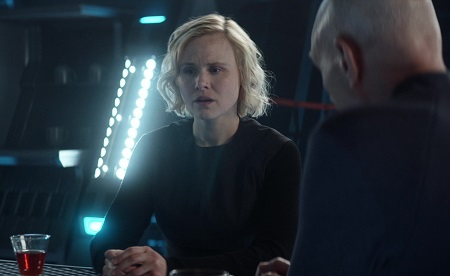
While I don’t expect Picard to spend its entire runtime catching up with galactic events and reintroducing old crewmates, I do hope we’ll get enough of that to feel like we’re back in that galaxy again – combined with enough new material and new characters to drive the story forward and give new fans a chance to get hooked in. Walking that line between the old and the new might be a challenge, but I’m confident that the producers, having cut their teeth on Discovery, can manage it with ease. And with Picard having just been renewed for a second season while I was writing this column, ViacomCBS are clearly confident of that too.

After almost two decades, Star Trek is finally ready to move forward again. With just over a month left to go, I can feel the excitement building already. Forget Christmas, forget New Year – it’s Star Trek: Picard that I’m most looking forward to right now!

Live Long and Prosper!

The Star Trek franchise, Star Trek: Picard, and all other Star Trek properties mentioned above are the copyright of ViacomCBS. This article contains the thoughts and opinions of one person only and is not intended to cause any offence.