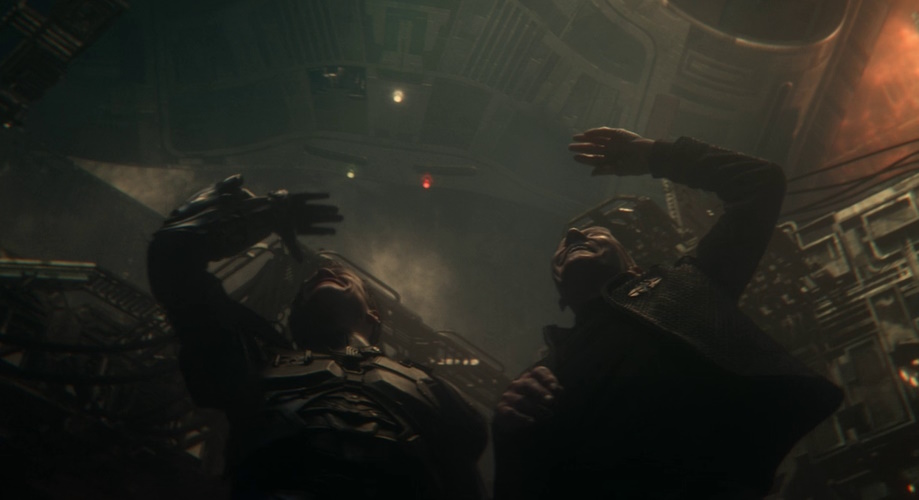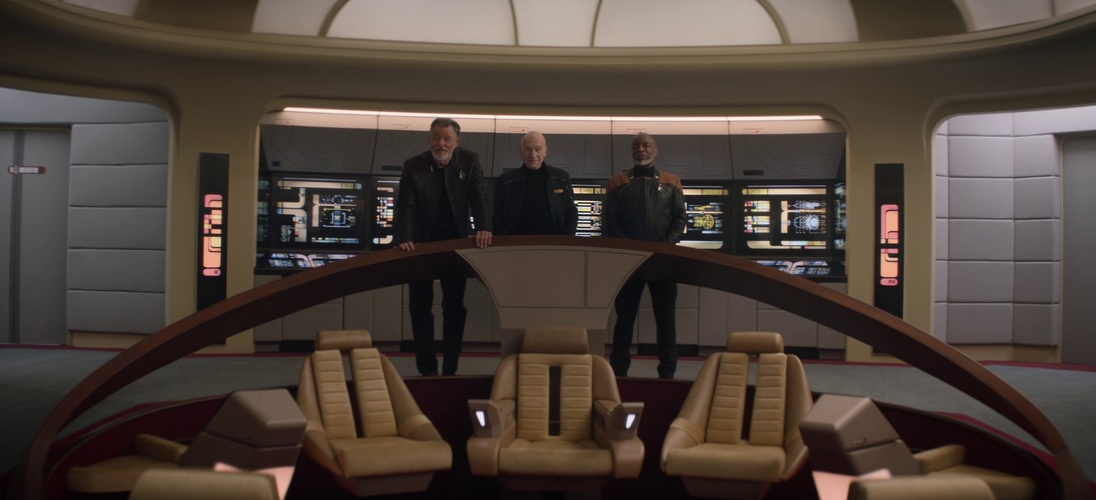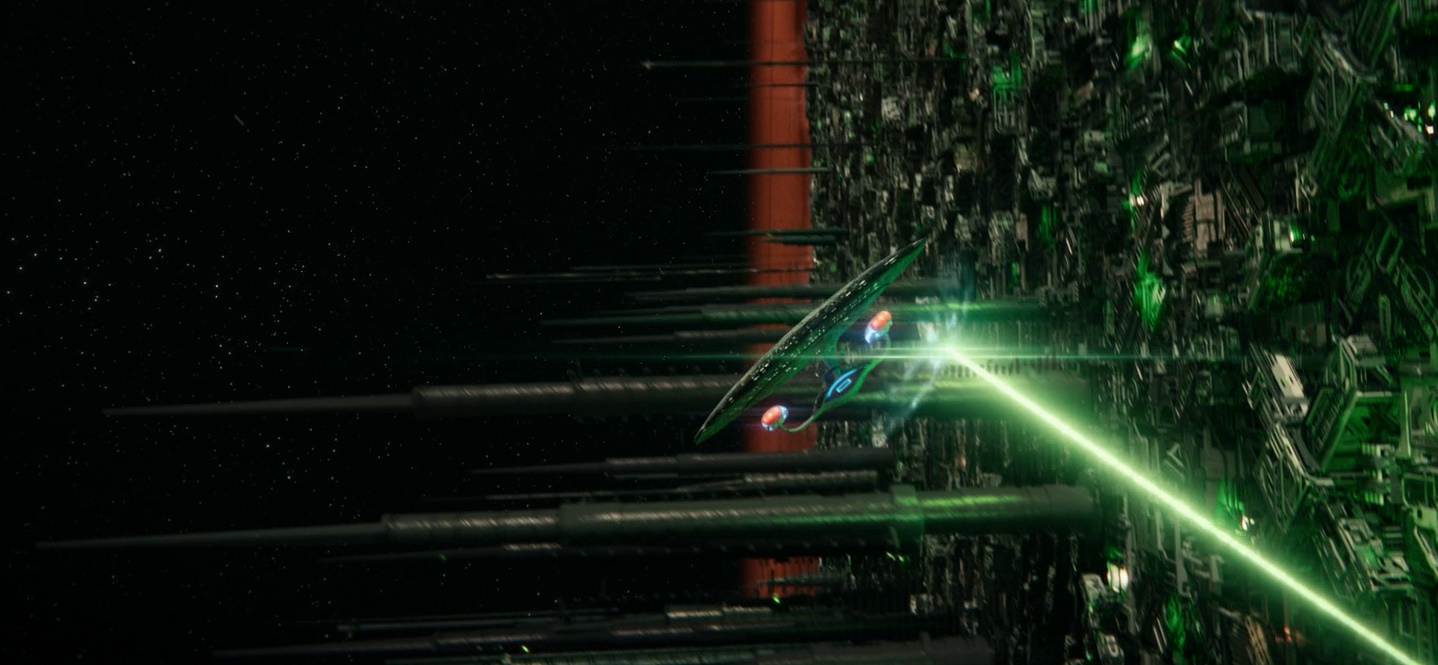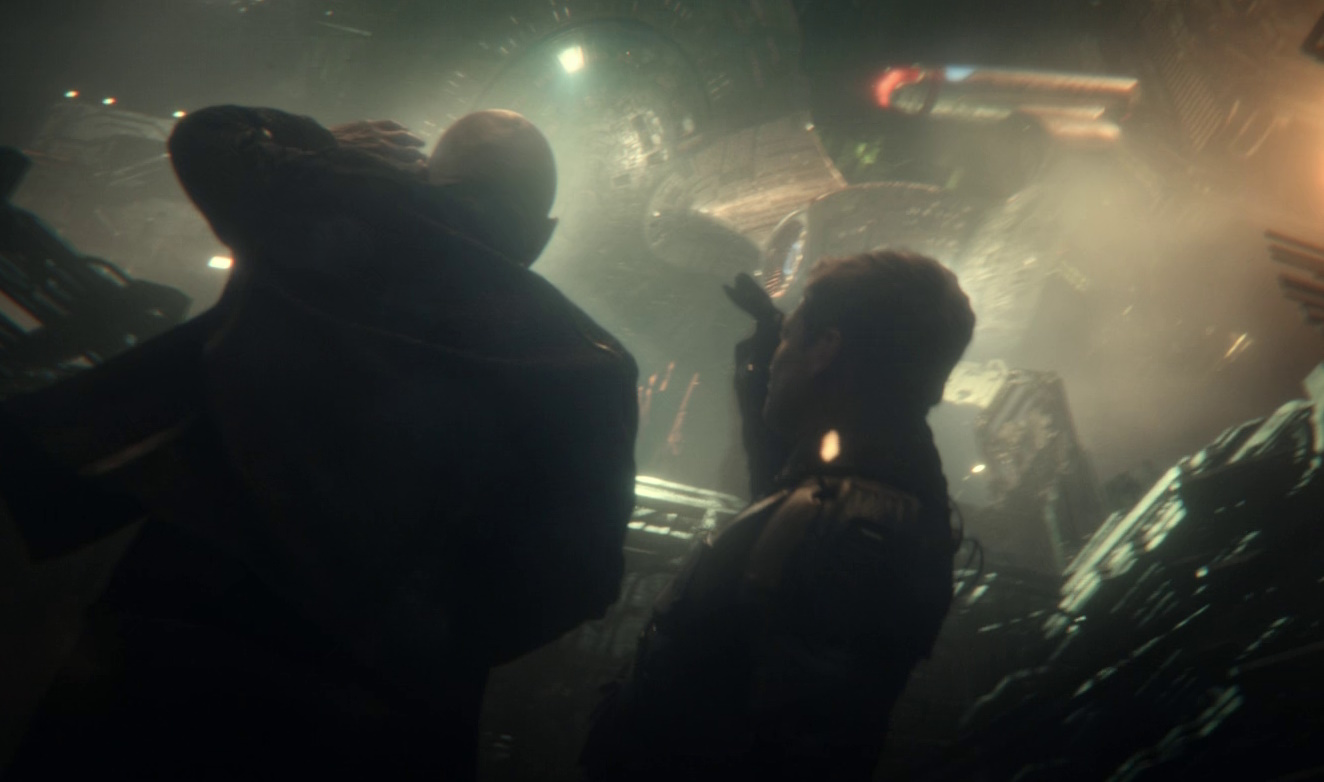
Rating Your “Unpopular” Star Trek Opinions!

A Star Trek-themed spoiler warning

Spoiler Warning: There are spoilers ahead for practically the entire Star Trek franchise, including recent seasons of Discovery, Picard, Strange New Worlds, and Starfleet Academy.

Later this year, Star Trek will celebrate its sixtieth anniversary – that’s six decades of sci-fi adventures, space exploration, and a wonderful fan community that I absolutely adore! Today, I thought it could be a bit of fun to look at some of the Trekkie community’s so-called “unpopular opinions” about Star Trek. If you read my piece about fan theories a few weeks back, I’m going to do something similar this time around: I’ve compiled a bunch of “unpopular opinions” from across social media, and I’m going to dissect them!

I went to Tumblr, Facebook, Reddit, TikTok, and other social media pages, scanning posts and comments sections, and I pulled out twenty-five “unpopular opinions” for this piece. And rather than just state them and share my opinion, I thought it could be interesting to try to answer two questions! Firstly, I’ll share whether I agree or disagree. And secondly, I’ll try to gauge whether the opinion in question could fairly be described as “unpopular.”
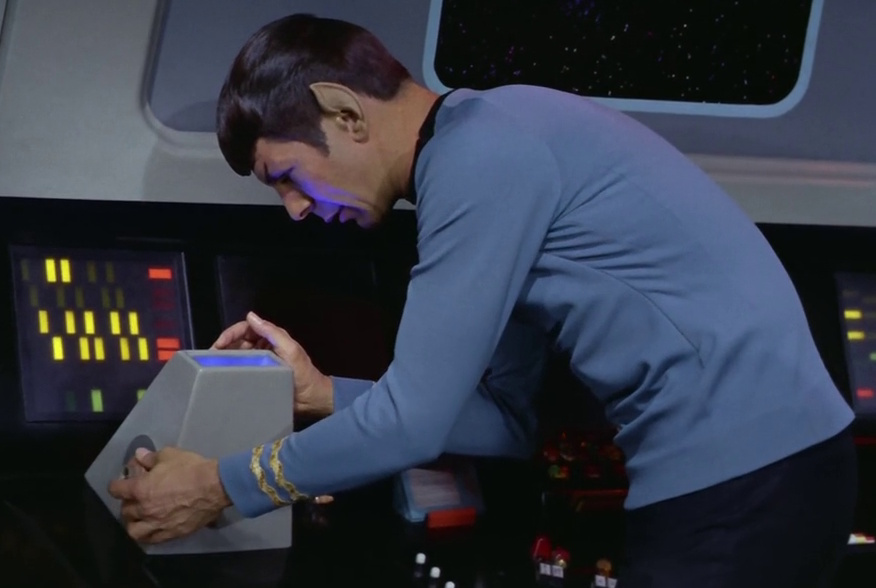
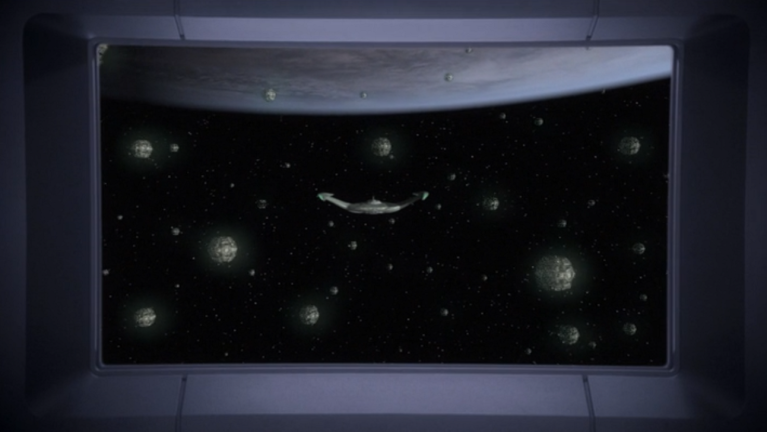
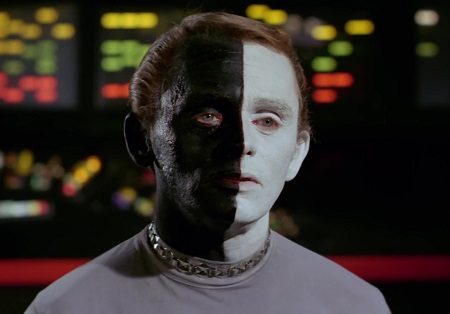
Still frame from The Enterprise Incident showing Spock and the scanner
I scanned social media to detect your most controversial opinions…

Here’s a couple of examples so we’re all on the same page!

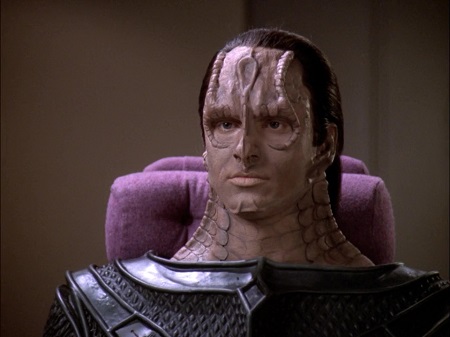
Example #1: “Khan sucks as a villain because he’s lame and boring, and his evil scheme makes no sense.”

I would say I disagree (vehemently) with this opinion! But I would concede that it is a genuinely *unpopular* opinion within the fan community and with a wider audience. In fact, it’s such an unpopular opinion that I’ve never seen anyone genuinely express it!
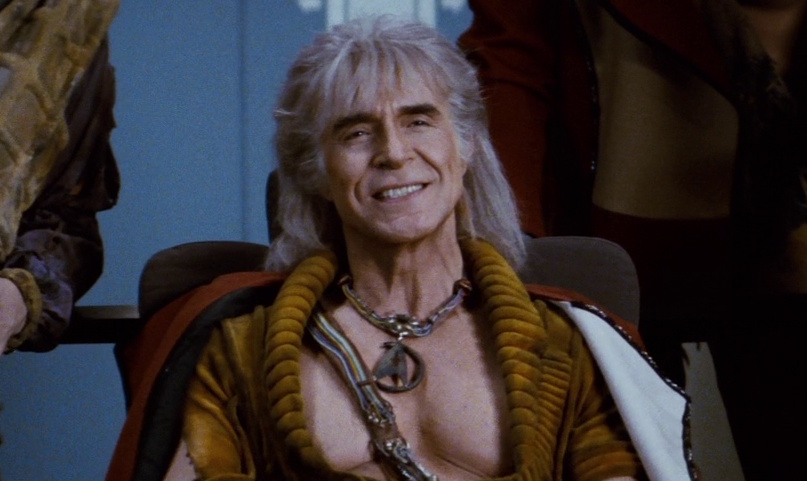
Still frame from Star Trek II showing Khan
Khaaaaaan!

Example #2: “Captain Picard is the best Enterprise captain, better than Kirk or Archer or anyone else by miles.”

This one’s a toughie on the “agree/disagree” bit, because Kirk, Archer, and really every Star Trek captain across the franchise have plenty of their own strengths. But if I had to come down on one side or the other, I’d say I agree; Picard is a great captain. However, this is clearly not an “unpopular” opinion within the fandom – ask any group of Trekkies who their favourite captain is, and it won’t be long before you hear multiple people say “Picard!”

So… does that cover everything in terms of the format?
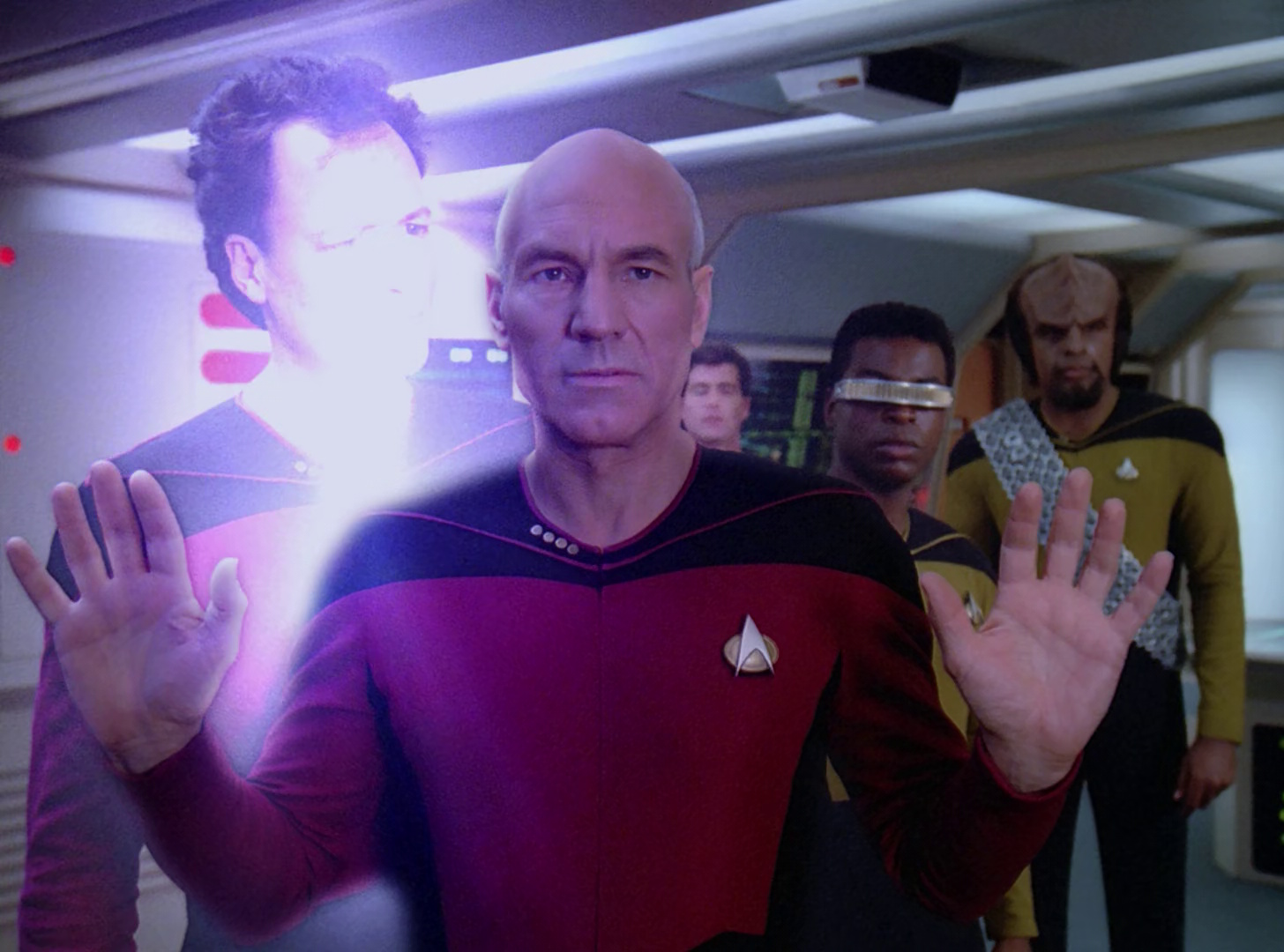
Still frame from Star Trek: The Next Generation Season 2 (Q Who) showing Q materialising next to Picard.
Who’s the best Enterprise captain?

It should go without saying, but everything we’re going to talk about today is *entirely subjective, not objective* – and it’s just one old Trekkie’s take, at the end of the day. If you hate my opinions, think I’ve got it completely wrong, or if I criticise a show or character you adore, please try to keep that in mind! There are a variety of opinions out there about this wonderful franchise, and I share mine with the Trekkie community in the spirit of light-hearted celebration in this landmark anniversary year.

Some of these “unpopular opinions” have clearly been shared in a tongue-in-cheek way (at least, I hope they have!) and I’m not planning on taking any of this too seriously. This also shouldn’t be interpreted as an “attack” or “hate” for any folks in the fandom who genuinely hold any of these opinions. This is meant to be a bit of fun, partly at Star Trek’s expense, as we move closer to the 60th anniversary.

With all of that out of the way, this is your final chance to nope out if you don’t want to get into some potentially controversial Star Trek opinions!

“Unpopular” Opinion #1:
Threshold is a great body horror episode.
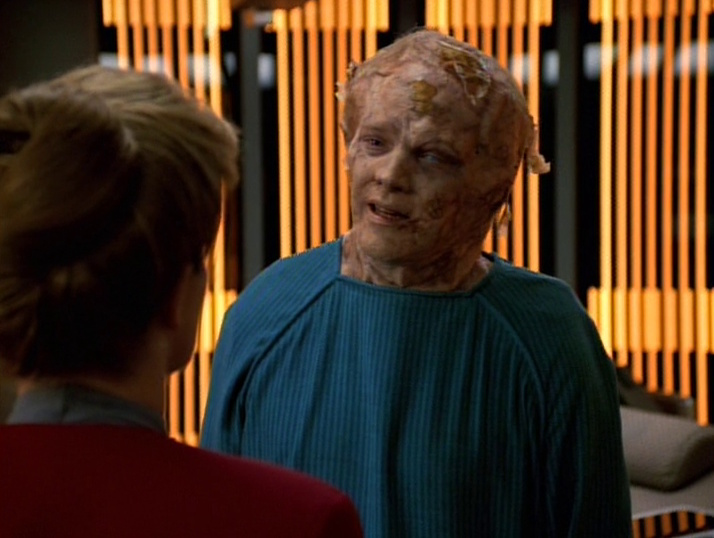
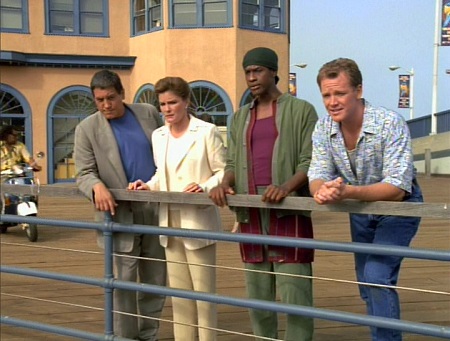
Still frame from Threshold showing (mutating) Paris and Janeway

“Threshold” and “great” in the same sentence, eh? We’re starting off strong! I can see where this is coming from; Tom Paris’ gradual mutation into a salamander-like “hyper-evolved human” does have some genuinely disturbing moments, brought to life by some solid prosthetics during the sequences in sickbay. The idea of mutating in real-time, and not being able to do anything to stop it… that’s the same kind of idea behind classic body horror films like The Fly, only with a Star Trek flavour in this case.

I would say, though, that for whatever successes Threshold might have on the body horror front in the middle of the story, the ending really nullifies all of it. The CGI salamanders weren’t great to look at, nor were they frightening or disturbing in any way, and the typical episodic TV “reset” of Paris and Janeway back to their normal selves meant there were no lasting consequences for either of them. This comment is clearly a response to Threshold’s meme status, and I’m glad that Trekkies are willing to re-examine even the most disliked episodes! But for me, Threshold is still a weak story, and while there is some creative body horror-adjacent storytelling in the middle, it’s completely negated by the way the episode wraps up.

Unpopular? ✅Yes.✅
Agree? 🛑No!🛑

“Unpopular” Opinion #2:
Spock and Chapel’s romance is too big a part of Strange New Worlds – and it sucks.
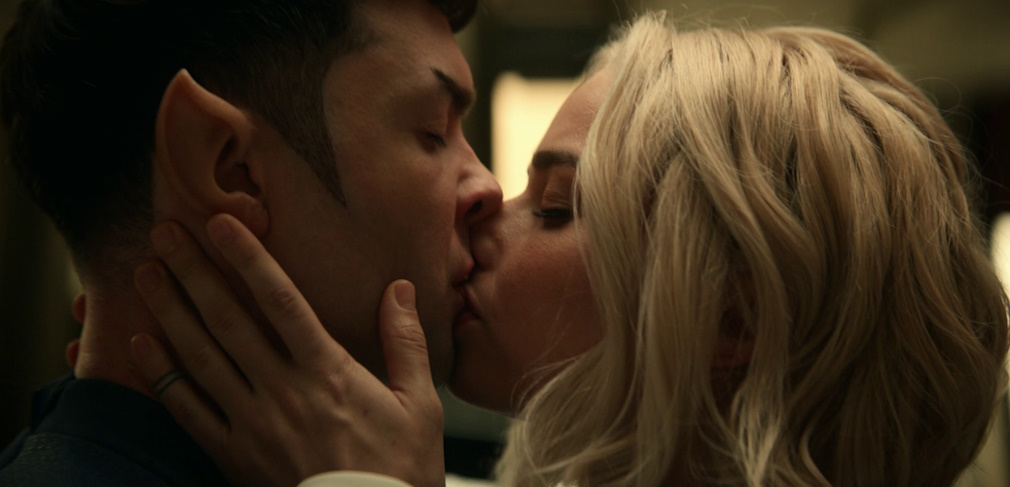
Still frame from Charades showing Spock and Chapel kissing

100% agree on this one – no notes! Chapel’s “crush” on Spock in The Original Series was cute. But it wasn’t a huge part of the show for either of them, and it didn’t need this kind of on-again, off-again storyline in Strange New Worlds to make sense. In my opinion, Strange New Worlds has been way too focused on Spock and putting him in situations which, frankly, are toe-curlingly cringeworthy. The Chapel-Spock romance is part of that. I had hoped that, with the addition of Chapel’s fiancé, we’d have seen the back of this storyline – but alas.

I think I could’ve stomached an episode or two in which this relationship existed and ran its course. But I agree with the original poster, here: it’s become way too big a part of the show. When combined with other “Spock comedy” storylines (which seem to be the only Spock storylines the producers are interested in or know how to write), it quickly became too much. Cringeworthy, unnecessary, and arguably treading on the toes of The Original Series, too. A bad combination all around! And, based on the number of likes and comments on posts like this, I think it’s a fairly common take among Trekkies, too.

Unpopular? 🛑No!🛑
Agree? ✅Yes.✅

“Unpopular” Opinion #3:
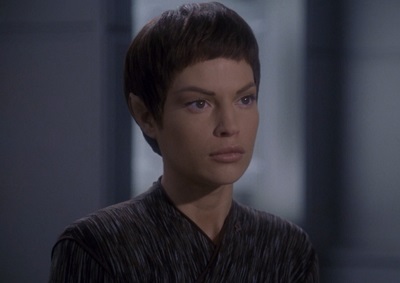
T’Rul should’ve become a recurring character on Deep Space Nine.
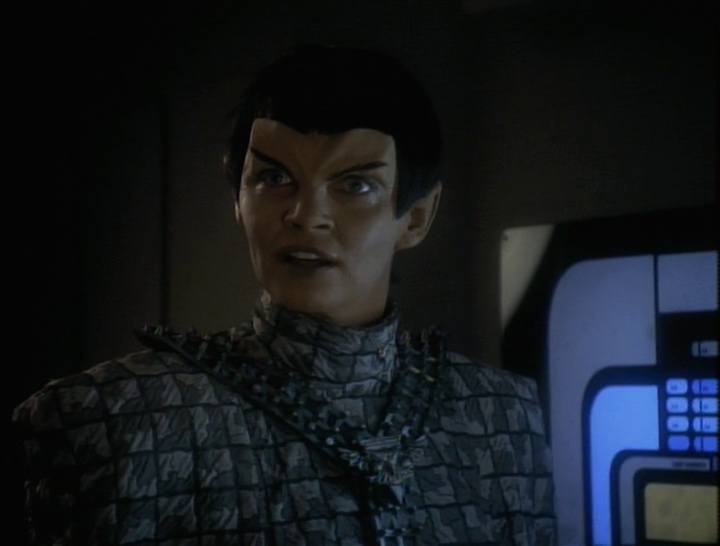
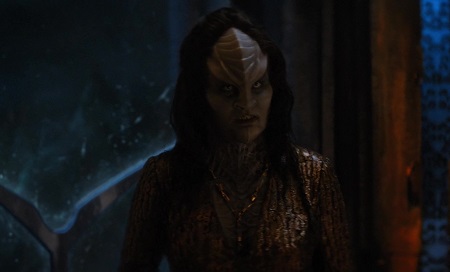
Still frame from The Search Part I showing T'Rul

In The Search, which kicked off DS9′s third season, we’re introduced to the USS Defiant for the first time: the first Federation starship (officially) able to cloak. The cloaking device was loaned to Starfleet by the Romulans, and Sub-Commander T’Rul was the officer assigned to oversee it, and make sure it wasn’t being used in a way that violated Federation-Romulan treaties. However, after her first appearance, T’Rul disappeared from Deep Space Nine. Martha Hackett, who played the character, would go on to have a recurring role on Voyager as Seska.

I quite like this idea, to be honest. T’Rul would’ve added something different to DS9 during some of the episodes set aboard the Defiant, and it could’ve been fun to see a Romulan getting to know the crew and learning how to live with the Federation. There wasn’t a Romulan character like that through the entire TNG era, and it wouldn’t be until we met Elnor decades later that we’d get to spend more time with a Romulan. I can see plenty of stories where T’Rul could’ve played a role, and I especially like the idea of her trying to socialise with members of the crew, perhaps teaching us a bit about Romulan culture and customs along the way. Definitely a niche idea, though!

Unpopular? ✅Yes.✅
Agree? ✅Yes.✅

“Unpopular” Opinion #4:
The first few episodes of Lower Decks were too “horny,” and this turned off potential viewers.
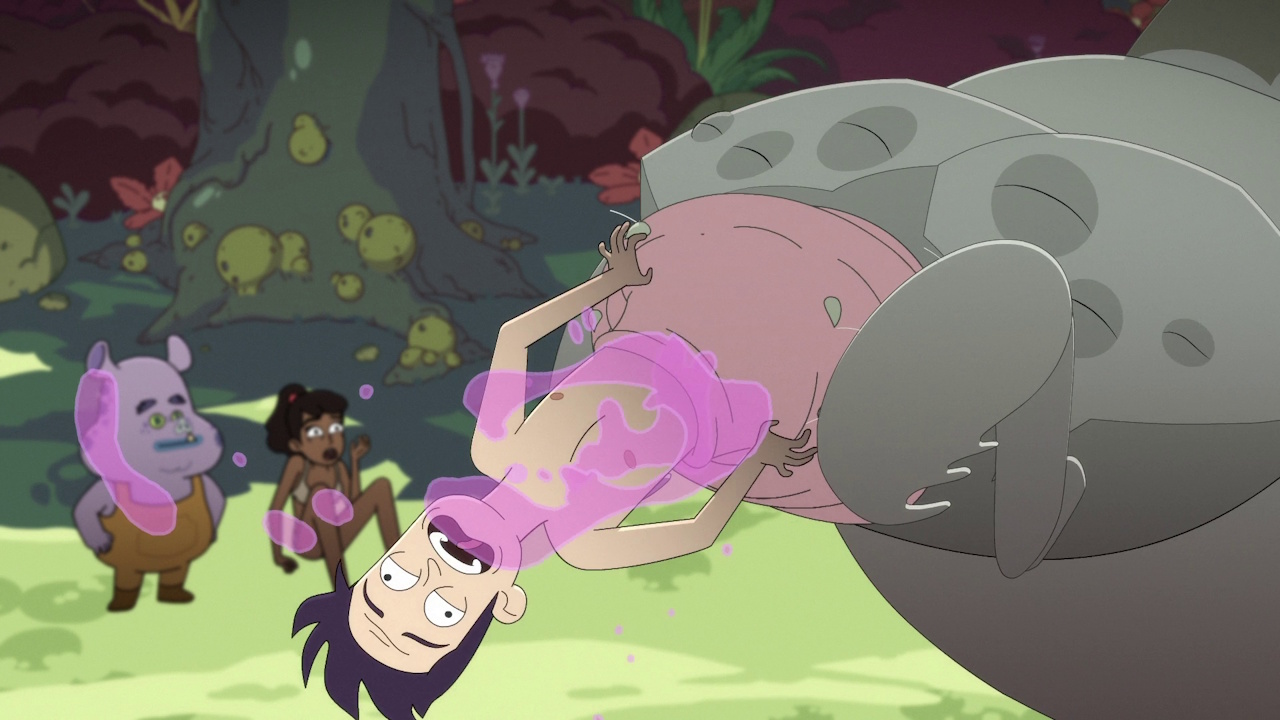
Still frame from Second Contact showing Boimler in an alien's mouth

Assuming the original poster meant “horny” as in “overly sexualised,” I have to say I don’t agree. Not that the first episodes of Lower Decks had a lot more sexual imagery and language than TNG-era Star Trek – they absolutely did! But I disagree that the early episodes are unique in that regard! I’ve only seen up to the first part of Season 3; Lower Decks is still a show I need to catch up on and finish watching. But I didn’t feel the tone changed or softened very much across the first two-and-a-bit seasons – which is basically half of the show.

In the run-up to Lower Decks’ premiere, I was a firm advocate for the fact that Star Trek can be funny, that Star Trek has always been funny, and that being an animated comedy shouldn’t matter as long as the show is good. I think the general response from Trekkies has been that Lower Decks is a solid addition to the franchise, even recapturing that episodic, TNG style which Discovery and Picard had moved away from. But did some of its crude humour or over-the-top moments mean some Trekkies switched off? Probably. In fact, almost certainly. Not every Star Trek show is right for every viewer, so folks who want to take the franchise seriously, and who don’t want a Rick and Morty-inspired take on Star Trek were probably never going to enjoy what Lower Decks had to offer.

Unpopular? ✅Yes.✅
Agree? 🛑No!🛑

“Unpopular” Opinion #5:
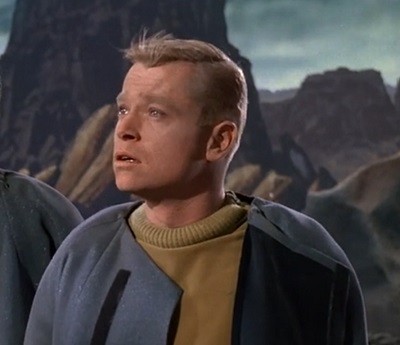
Chekov was “useless” in The Original Series.
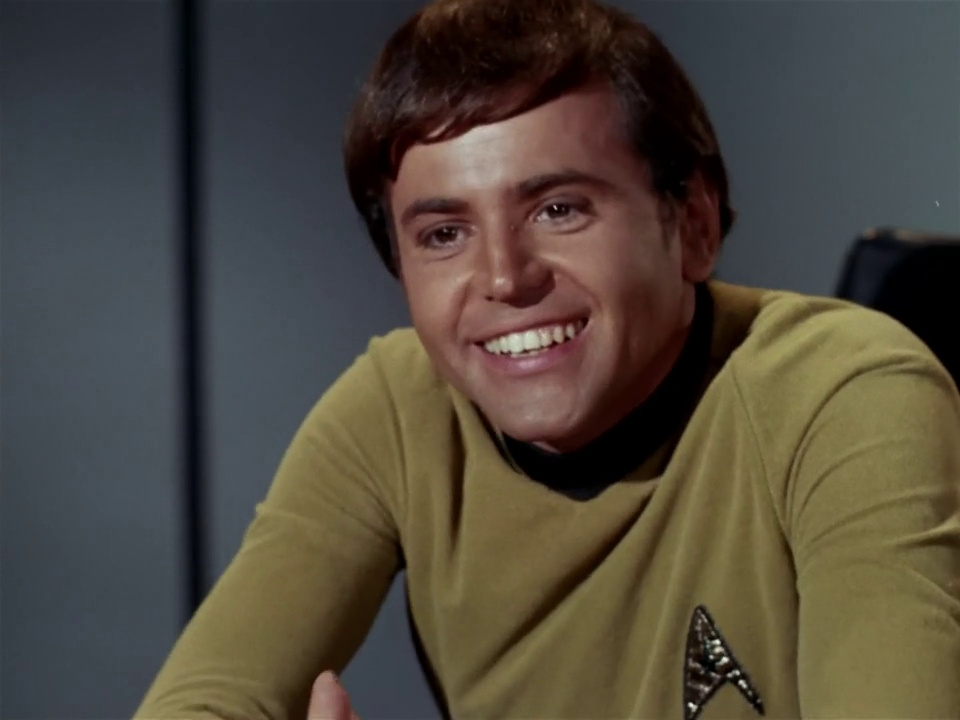
Still frame from The Trouble with Tribbles showing Chekov

I think I can see where this one is coming from… but I really don’t agree. Chekov was a late addition to TOS, joining in from Season 2. He only appeared in 36 episodes in total – less than half of The Original Series. But… none of that makes him “useless.” In fact, I’d argue very passionately that Chekov’s presence on the bridge alongside Sulu, Kirk, Uhura, and the others was a very powerful and symbolic statement: at the height of the Cold War, a mere five years after the world almost blew itself up over the Cuban Missile Crisis, here was a vision of the future in which Russians, Americans, and humans from all over the world were living and working together in harmony.

Like most of the cast of The Original Series outside of “the big three” of Kirk, Spock, and Dr McCoy, Chekov got fewer moments in the spotlight and fewer lines, and because he joined the show later, I guess that shows up even more. He was also absent from The Animated Series, due to the show’s tight budget. But he does get storylines and interesting moments across practically all of his episodes, and he stands in for Sulu at points in Season 2, as well. Not useless at all!

Unpopular? ✅Yes.✅
Agree? 🛑No!🛑

“Unpopular” Opinion #6:
Discovery is overrated.
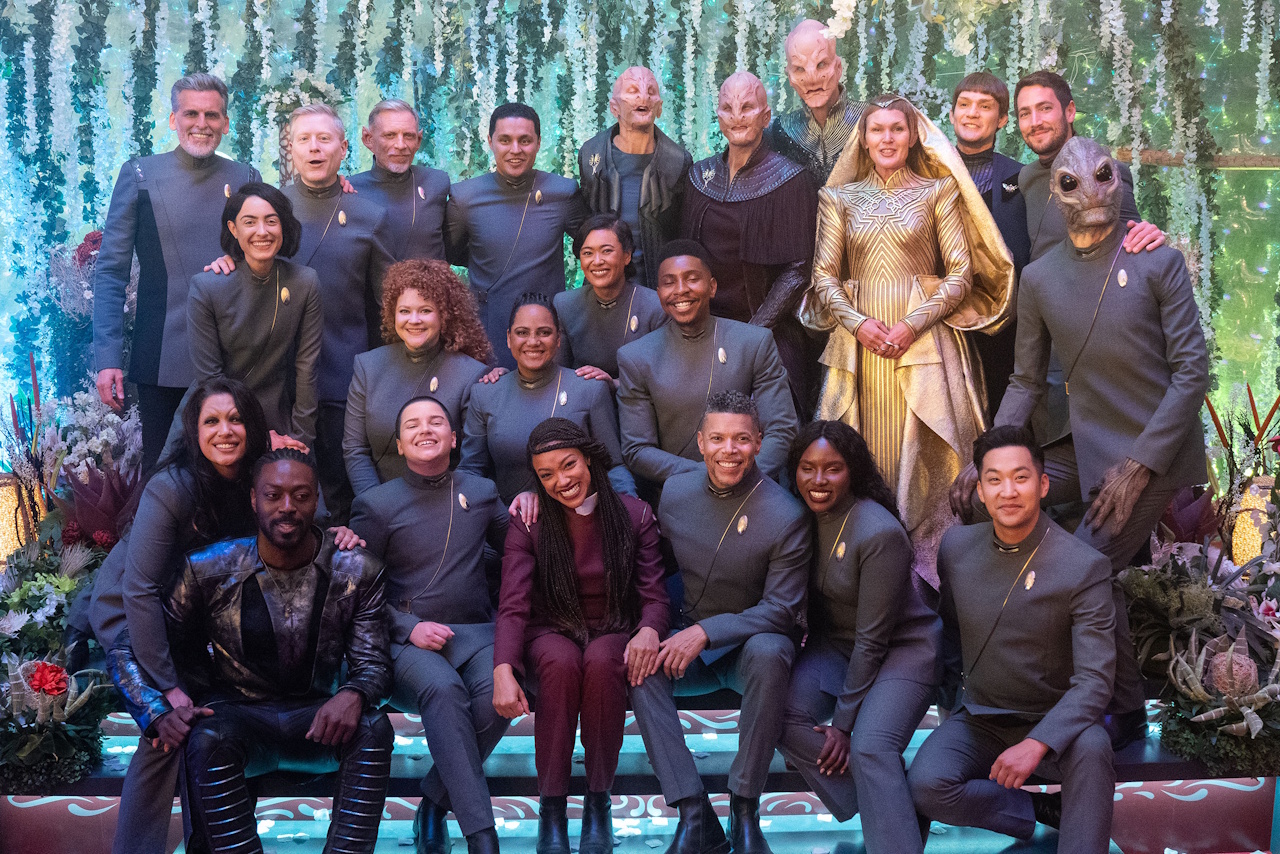
Behind-the-scenes cast photo from Discovery S5

I had to do a double-take when I saw this. “Surely,” I thought, “the original poster must’ve meant underrated, or maybe over-*hated*?” But no, this is their unpopular opinion! To be blunt, I don’t think Discovery is rated particularly highly by a large swathe of the fan community. It has its fans, of course – myself included for the most part. But “overrated” suggests that the show is held in high esteem when it shouldn’t be, when really I’d be arguing the opposite: that too many Trekkies wrote off Discovery without giving it a fair shake, and that Season 2, and parts of Seasons 3 through 5 all had good episodes, interesting moments, and more.

For something to be “overrated,” it has to have that acclaim within the fan community, and I just don’t see Discovery having that kind of reputation for the most part. I think it’s absolutely fair to criticise Discovery, as I’ve done on many occasions here on the website. And if the original commenter dislikes some or all of the show, then that’s okay. But I couldn’t say Discovery is overrated… because I just don’t think the fan community at large rates it very highly to begin with!

Unpopular? 🛑No!🛑
Agree? 🛑No!🛑

“Unpopular” Opinion #7:
Captain Janeway did the right thing with Tuvix.
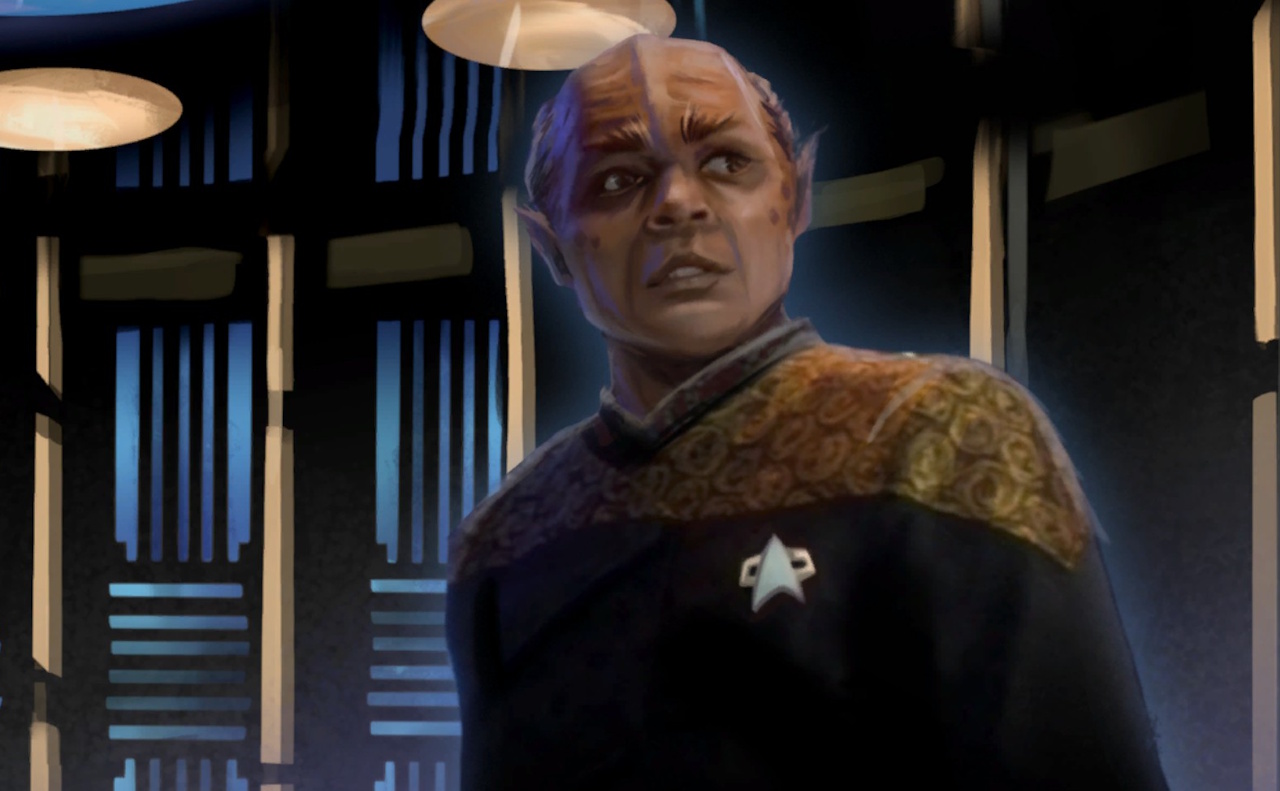
Cropped screenshot from Across the Unknown showing art of Tuvix

Tuvix’s controversial status lives on! One of the best things about Star Trek is that many episodes make you stop and think. They present complex issues with moral quandaries, and they don’t shy away from reckoning with them. And Tuvix is one such example. Do you kill a man you barely know while he’s pleading for his life in order to save two of your friends? Captain Janeway believed she had to, and even stepped in to do it herself when the Doctor refused.

I can understand her point of view. The mitigating circumstances are the unique perils of the Delta Quadrant, and Tuvok and Neelix’s skills in navigating it. But was it the “right” thing to do? The episode pulls no punches, and I’ve even heard some fans say it’s the worst thing Janeway ever did. I don’t agree on that front – wiping out an entire timeline and the lives of everyone in it has to take that prize! But yeah, it was a shitty thing to do. It was a tough situation, and Janeway made the call that she felt gave her ship and crew the best chance of making it home. And hey, if you disagree… play the new video game Across the Unknown and make a different choice!

Unpopular? ✅Yes.✅
Agree? 🛑No!🛑

“Unpopular” Opinion #8:
Wesley Crusher is fine/underappreciated/good.
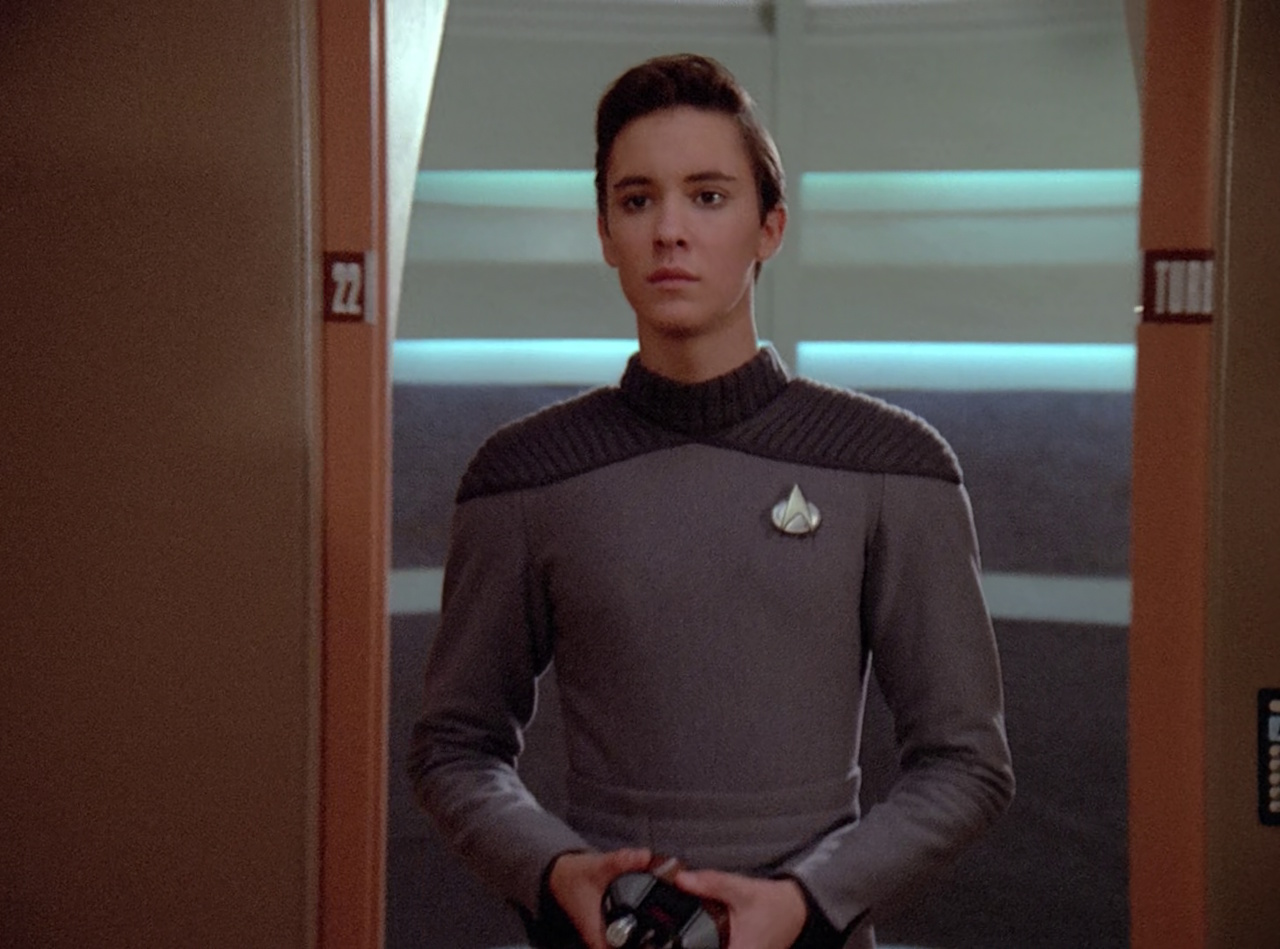
Still frame from The Dauphin showing Wesley

Things have changed a lot for Wesley over the years, I think in large part due to actor Wil Wheaton’s incredibly positive attitude and the great way he’s advocated for and represented the Trekkie community. But there was a time when Wesley was wildly unpopular; in the early days of Star Trek fansites, back when I was first getting started with the internet in the ’90s, hating on Wesley was one of the most common things you’d see. I never felt Wesley deserved all the hate he got; some of it crossed a line, really, into something a bit unpleasant or even sinister. We’re talking about a child, after all, or a teenager, and attacking a performer because you don’t like their character is just stupid.

However… I get where the original dislike stemmed from, especially in stories where Wesley could seemingly do no wrong, or was better and more competent than the trained officers around him. Partly, this came from Gene Roddenberry – Wesley was a bit of a self-insert character for Gene, even being named for Roddenberry’s own middle name. But Wesley did have weaknesses and flaws, even in The Next Generation’s first season. His inability to get accepted to the Academy being just one example. And when Wesley did make it to the Academy, the accident he was caught up in tested his loyalties and morality to the limit. Is he the best character in Star Trek? Arguably not. Is he better than folks give him credit for? I’ve gotta say yes.

Unpopular? ✅Yes.✅
Agree? ✅Yes.✅

“Unpopular” Opinion #9:
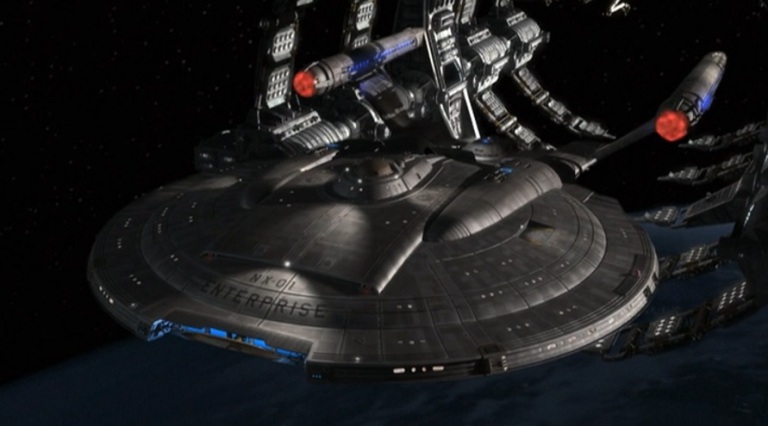
The reboot/Kelvin timeline Enterprise is a beautiful ship.
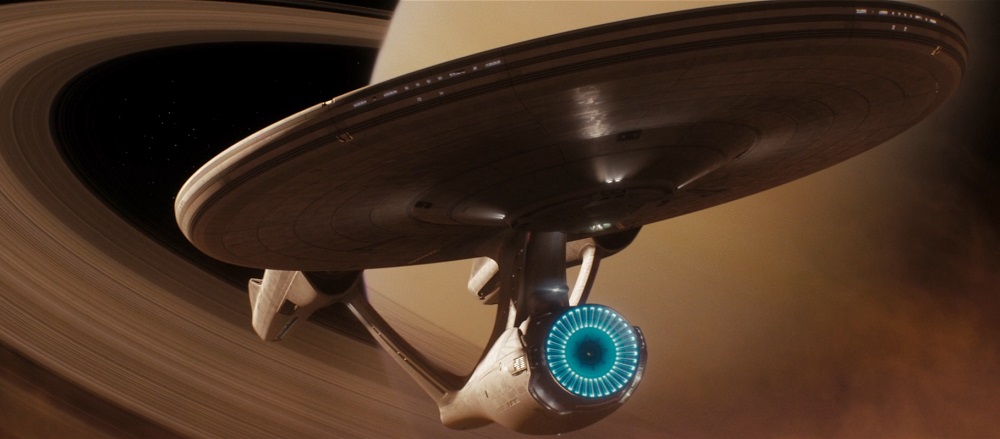
Still frame from Star Trek 2009 showing the Enterprise

To this day, I know Trekkies who point-blank refuse to watch the Kelvin films. But… I think the out-and-out hate for the reboot has begun to fade, thanks to the passage of time. Practically everything about the 2009 reboot was controversial in some quarters of the fan community when the film was released, including the redesign of the USS Enterprise. The design took the original Constitution-class from TOS and changed a lot of things, with a different colour scheme, bulkier nacelles, a lit-up main deflector, and more. It’s certainly a different interpretation of the classic ship from four decades earlier.

I’m actually pleased to see opinions like this. There will always be holdouts – people who can’t get over the changes and who only want to stick to a certain design philosophy or a particular era of Star Trek. But as time passes and puts distance between us and the premiere of these designs, I think it’s nice to see more Trekkies revising their opinions, revisiting some of these elements of the reboot films, and coming away with a more positive impression. It gives me hope, quite honestly, for the future of the fan community in the years to come, and that some of today’s controversies may also be forgiven over time!

Unpopular? 🛑No!🛑
Agree? ✅Yes.✅

“Unpopular” Opinion #10:
“Faith of the Heart” was a good song for Enterprise’s title sequence.
Still frame from the Star Trek Enterprise title sequence showing the show's title

This is another example of the passage of time smoothing things out, I think! I remember hopping online, circa 2001, to try to download Faith of the Heart – and then burning it onto a CD and a MiniDisc (remember those?) so I could listen to it on the go! Sure, it was different – the whole sequence, really, is a very “2000s” way to open a show, and it feels a bit dated today. But I’ve always enjoyed the song, and I certainly never agreed with folks who said it “ruined Enterprise,” or turned them off so completely that they wouldn’t even watch the show!

“Archer’s Theme,” the music heard during Enterprise’s end credits, is the track some folks argue the show should’ve used instead. And I get wanting Star Trek to revert to type; to have the ship warping over a starry background while an orchestra plays a piece of music. But did “Faith of the Heart” really change much about the series? It’s still Star Trek. And if you hate it… well, it’s never been easier, thanks to DVDs and streaming, to skip it! That being said, I think this is still a minority position within the wider fan community, even if the song’s reputation has recovered somewhat over the years.

Unpopular? ✅Yes.✅
Agree? ✅Yes.✅

“Unpopular” Opinion #11:
Neelix and Kes were a good couple.
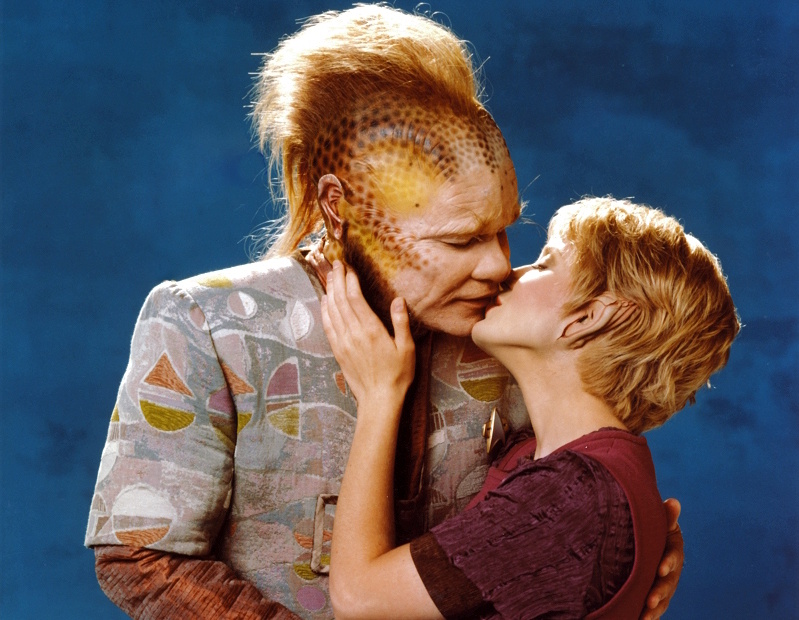
Promo photo for Star Trek: Voyager showing Neelix and Kes kissing

This one has to be trolling, right? I’d go so far as to say that, if Neelix’s relationship with Kes had been in focus in Voyager much more than it was, it could’ve been genuinely detrimental to both characters and even the entire series. As the setup for getting Neelix to help Janeway and ultimately join the crew, it tracks. But what it says about Neelix – a man in the Talaxian equivalent of middle age – falling in love with a girl who’s… one year old, and the Ocampan equivalent of, what? Seventeen or eighteen? It’s… really, truly icky.

Moreover, the relationship exaggerated some of Neelix’s worst qualities. In episodes like Parturition, we’d see him getting jealous and possessive over Kes in a way that, frankly, felt uncomfortable. A man who seems positive and happy-go-lucky on the outside seemed to have a dark, possessive, almost abusive streak, and if that had been brought up even once or twice more, it would make Neelix truly difficult to root for. Fortunately, this isn’t an opinion I’ve ever seen another Trekkie endorse, though!

Unpopular? ✅Yes.✅
Agree? 🛑No!🛑

“Unpopular” Opinion #12:
Sybok was a fun and deep villain in Star Trek V.
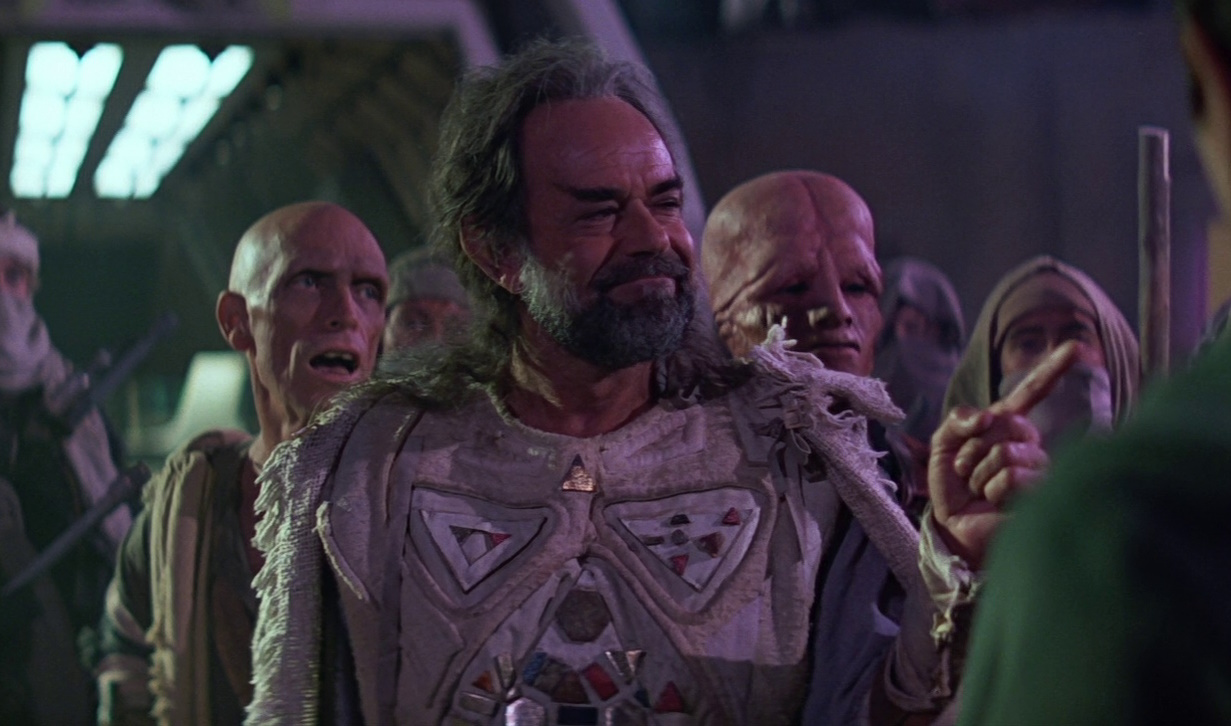
Still frame from Star Trek V showing Sybok.

The Final Frontier has its issues. But is Sybok one of them? This commenter argues he isn’t, and that a religious zealot who belatedly realises that he’s wrong and he’s been lied to or manipulated gave Sybok a lot of depth. I’d add to that that the idea of exploring a Vulcan offshoot – someone who doesn’t care to suppress his emotions – was also something different. It was certainly unique at this point in the franchise, coming before the Vulcans got more development in episodes like TNG’s Sarek, and of course, through storylines in Enterprise.

The problem I have with this, really, is not so much in concept – I think the original poster is right about that – but in execution. Sybok’s best moment is arguably his final one, when he sacrificed himself to help his brother and the Enterprise escape. Prior to that… Sybok wasn’t *outstanding*, really. There is more to The Final Frontier than some fans give it credit for. And like most Star Trek characters, really, there are elements to Sybok, to the way he’s written, and to the portrayal on screen that worked or that hold some interest. And I will say, to the original comment’s credit, it’s not an argument I’ve seen before.

Unpopular? ✅Yes.✅
Agree? 🛑No!🛑

“Unpopular” Opinion #13:
All of “Kurtzman Trek” sucks and should be considered a failure.

Behind-the-scenes photo from Star Trek SFA S1 showing Kurtzman directing

In the time Alex Kurtzman has been in charge of Star Trek for CBS, then Paramount, and now Skydance, there have been more than 200 episodes (and a TV movie) produced and broadcast. Are you telling me, original commenter, that there’s absolutely no merit to *any* of it? Because I find that hard to believe! Even Trekkies who’ve hated most of modern Star Trek have enjoyed some projects – Picard’s third season, or perhaps Strange New Worlds. Alex Kurtzman was in charge of the franchise for that, and was executive producer on both shows.

I don’t think you can write off an entire era of the franchise, any more than you could say “Berman Trek” was bad, or “Roddenberry Trek” sucked. But even if someone is of the opinion that *all* of modern Star Trek is atrocious and without merit… we can agree to disagree without getting into personal attacks. I hope! Has Alex Kurtzman got everything right? No – and I think he’d admit that. But has there been some fantastic Star Trek on our screens since he’s been helming the franchise? I believe there has been.

Unpopular? 🛑No!🛑
Agree? 🛑No!🛑

“Unpopular” Opinion #14:
Voyager focused too much on Janeway, the Doctor, and Seven of Nine from Season 4 onwards.
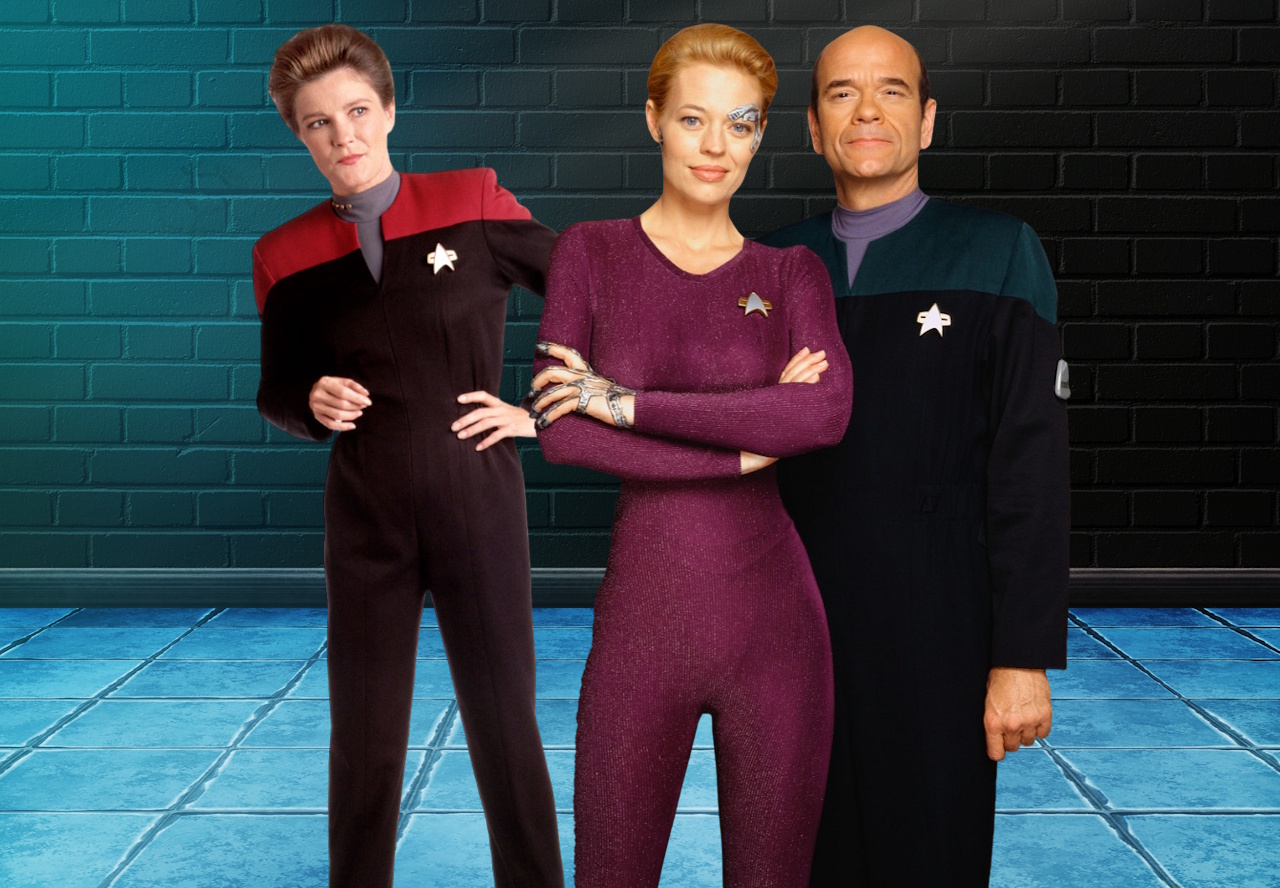
Composite of promo photos for Star Trek Voyager showing Janeway, Seven, and the Doctor

I was surprised to see this on one of the “unpopular opinion” posts – not because I disagree (I don’t), but because I’ve never seen anyone else share this opinion online before! For me, the back half of Voyager’s run felt swamped by one character: Seven of Nine. Seven would apparently “learn” some lesson in how to be human one week, only to seemingly forget it all in time for the next story. This led to several Seven/Janeway and Seven/Doctor episodes being so awfully repetitive that I sometimes mix them up. Voyager’s still a great show, don’t get me wrong, but taking some spotlight episodes away from Seven and redistributing them to neglected characters like Chakotay, Tuvok, or B’Elanna wouldn’t have gone amiss.

Picard rehabilitated Seven of Nine for me, though – I even went so far as to say that that series made Seven into an interesting character for the very first time! So this aspect of Voyager, while admittedly not great, doesn’t feel so bad in hindsight, I guess. And the issue isn’t really that most of these episodes are “bad,” but rather that they’re too narrow in their focus on one or two characters at the expense of other members of the cast. When I used to use Twitter and I shared a similar opinion about Seven of Nine being repetitive and boring, though, I got a fair bit of pushback! So I think this opinion can truly be said to be “unpopular” within the fan community.

Unpopular? ✅Yes.✅
Agree? ✅Yes.✅

“Unpopular” Opinion #15:
The Maquis were right to leave the Federation.
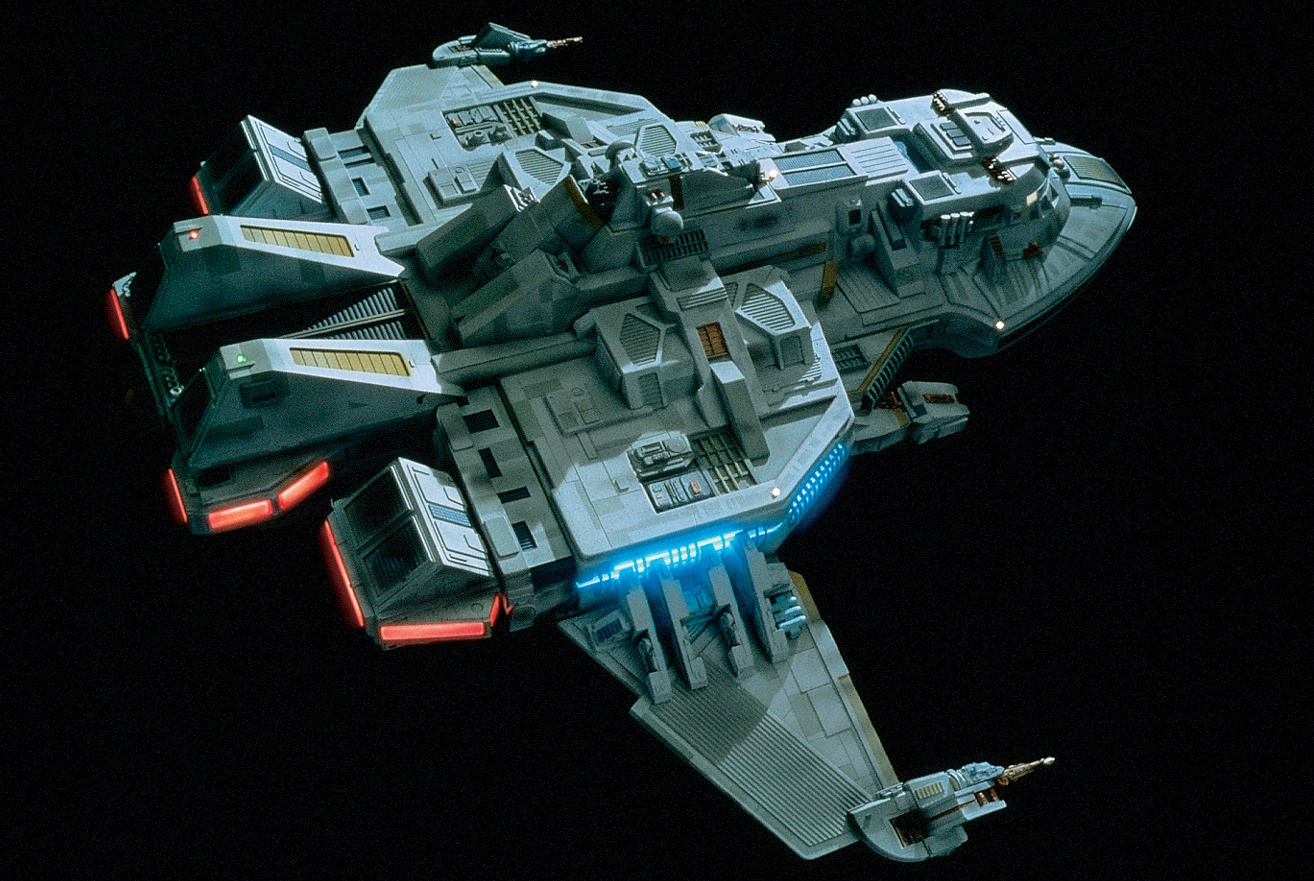
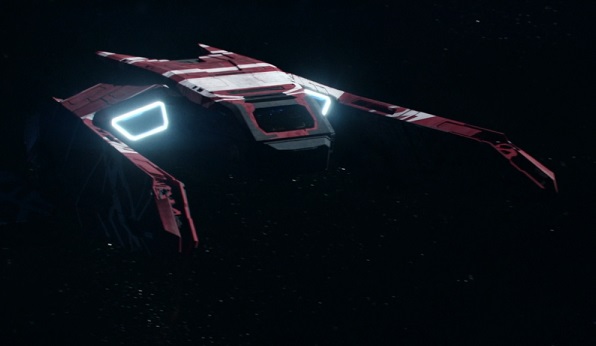
Photo of the Maquis Raider filming model

This comment went on to lay out that, in the writer’s opinion, the Maquis had every right to reject the Federation and want to leave, regardless of whether they wanted to fight the Cardassians or not. This seems to come from a place of “popular sovereignty;” the political philosophy which states that people should be free to choose how they are governed – and whether they want to remain as part of an institution like the Federation. The right to secession, by definition, exists if popular sovereignty exists within the Federation – something we’ve seen a lot more of in Discovery and Starfleet Academy, to be fair.

So should the Maquis have been allowed to leave? I would say yes… in principle. But it also isn’t quite so straightforward. The Federation had to balance the rights of its citizens along the Cardassian border with the need to avoid war with the Cardassians – something that would have impacted Maquis colonists *and* the rest of the Federation. Sometimes, as Spock would say, “the needs of the many outweigh the needs of the few.” If you’re one of the few, in that case… that kinda sucks, especially if it means you have to abandon your home. So it’s not quite as cut-and-dry as presented. But as a general rule, if Federation member worlds want to leave, even if they began life as colonies… they should surely be allowed to do so.

Unpopular? 🛑No!🛑
Agree? ✅Yes.✅

“Unpopular” Opinion #16:
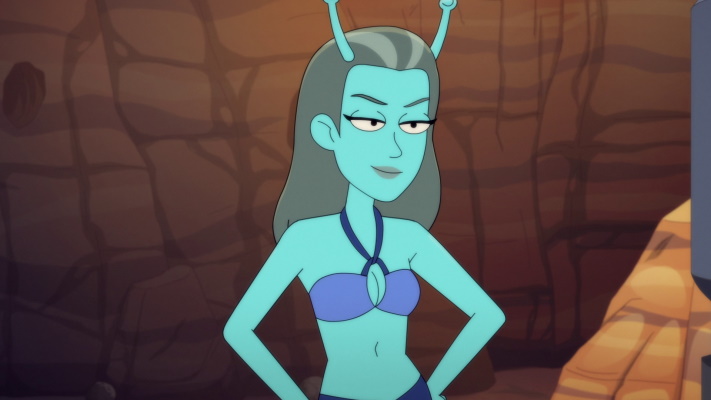
The Tellarites and Andorians deserve more screen time.
Still frame from Lower Decks Mining the Mind's Mines showing Jennifer

The four original founding members of the United Federation of Planets were humans, Vulcans, Tellarites, and Andorians – yet only Vulcans have really been explored across Star Trek’s nearly six decades of history. Enterprise told more stories with the Andorians, sure, and we’ve seen Tellarites (and half-Tellarites) in Prodigy and Starfleet Academy. But these two races still feel underrepresented across the franchise as a whole. Partly, it must be said, that’s because of their almost complete absence from all three shows of The Next Generation era.

Since the turn of the millennium, Star Trek has made moves to address this. But it would still be neat to get a major Andorian or Tellarite character in the next live-action film or series. These two races are important to the Federation within Star Trek’s fictional history, so it is kind of odd, when you think about it, that they haven’t been seen more often. I would suggest, perhaps, that the more complex prosthetic makeup – when compared to the likes of the Vulcans, Bajorans, and so on – may have made it a bit more difficult or expensive in years gone by. Less of an issue today, though! It’s not an argument I’ve seen very often, and I think that, especially prior to Enterprise, a lot of Trekkies had more or less forgotten about both of these races, and didn’t seem to care much about them.

Unpopular? ✅Yes.✅
Agree? ✅Yes.✅

“Unpopular” Opinion #17:
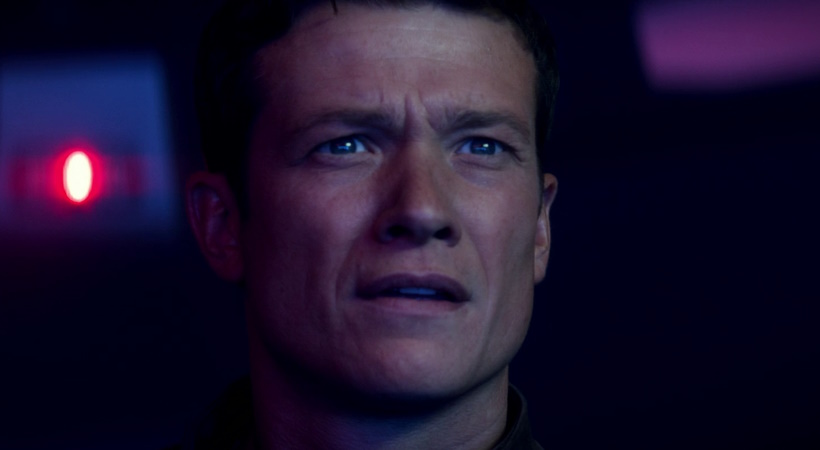
Jack Crusher was an especially bad character in Picard Season 3 because of what his existence says about Beverly.
Still frame from No Win Scenario showing Jack

This post argued that Jack Crusher’s “secret birth” storyline actively harms his mother’s characterisation. By essentially hiding Picard’s son from him, concealing the birth, and disappearing for decades, Dr Crusher – in this person’s opinion – committed an unforgivable sin, and it was also something that she wouldn’t have done based on the way she was in TNG.

For my two cents, I didn’t think Jack was the best part of Season 3. The storyline he was wrapped up in, while not his fault on his own, wasn’t all that great, and I found it hard to buy into the idea that the character was only twenty-one years old (since the actor who played him was in his mid-thirties). Further, giving this version of Picard a storyline about discovering he had a long-lost son didn’t feel right, either – it felt like a story better-suited to someone younger, which seemed to go against other themes in the season. However, on the specific criticism of Jack “harming” Dr Crusher’s character… I don’t think I agree. It was explained in the show why she did it – to keep Jack safe from the shenanigans that constantly swirl around Picard – and I actually felt that this version of Dr Crusher had a bit more personality than she did in most of TNG. It wasn’t a random thing; Dr Crusher didn’t decide to leave for no reason. And her reasoning made sense in the context of the show.

Unpopular? ✅Yes.✅
Agree? 🛑No!🛑

“Unpopular” Opinion #18:
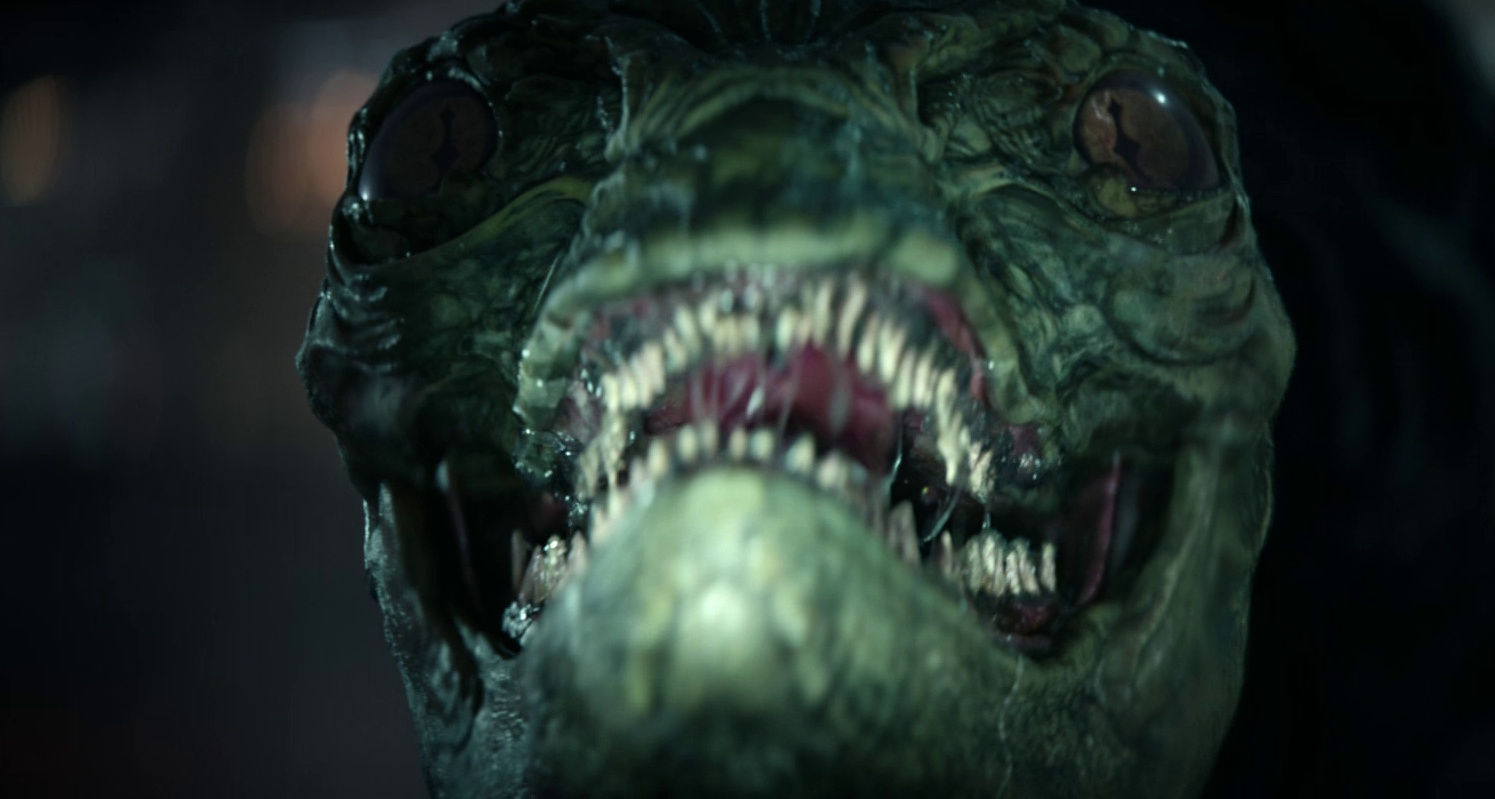
Strange New Worlds’ Gorn arc is good, and the Gorn make for entertaining villains.
Still frame from Hegemony Part 2 showing a Gorn

I didn’t really realise that this one was quite so controversial until I saw some of the comments under posts expressing this opinion! Personally, I’ve really enjoyed Strange New Worlds’ take on the Gorn – transforming them into almost Xenomorph-inspired “monsters” has definitely shaken things up. At the same time, though, leaning too heavily on the monstrous angle does raise questions about the Gorn’s sentience and ability to be a spacefaring race, so there probably are moments where it went a little too far in one direction.

Strange New Worlds had a bit of a challenge, I suppose, when it came to villains. Most Star Trek villainous factions are off the table: Discovery had recently done the Klingon war, DS9 has already done a big Cardassian war, there can’t be the Romulans in a big way due to the timeline, and returning to the likes of the Xindi from Enterprise wouldn’t have worked very well, either. So to pick a race like the Gorn – who have run-ins with Starfleet in this era – wasn’t a bad idea. And giving them a new, more frightening presentation has – in my view – worked pretty well.

Unpopular? ✅Yes.✅
Agree? ✅Yes.✅

“Unpopular” Opinion #19:
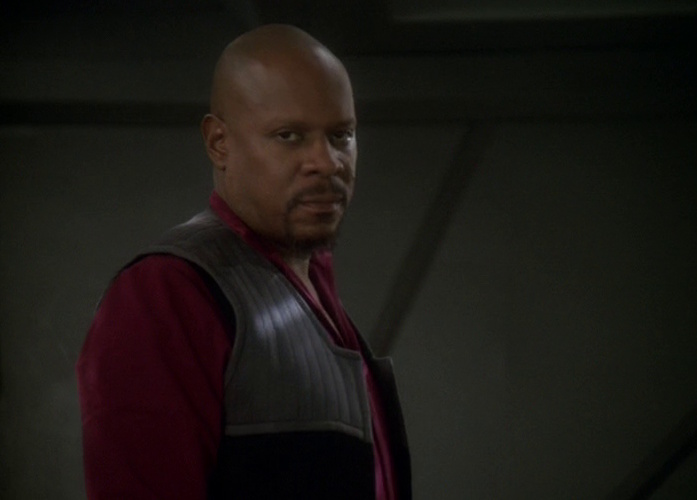
It’s hard to get used to the way Avery Brooks delivers his lines.
Still frame from In The Pale Moonlight showing Sisko

This one’s a toughie for me, because I first watched Deep Space Nine in the mid-1990s when I was a wee bairn. I can’t remember ever thinking that the way Sisko speaks is weird or offputting, as this commenter suggests. In fact, all of my DS9 memories are positive from that period, and Sisko quickly became one of my favourite parts of the entire Star Trek franchise. His vocal delivery, cadence, and manner of speaking weren’t things I’d considered at all until I read this post.

I suppose, to be fair to the commenter, Avery Brooks might come across as a bit of a thespian; the way he speaks and emotes is at least partially inspired by acting in the theatre for a live audience. But the same is definitely true of Sir Patrick Stewart, in that case – and other Star Trek regulars, too. Many actors get their start in stage productions, and that’s not a negative thing at all. Obviously, the way any of us feel about an actor and a performance is going to vary, and I would never say that everyone “must” like Captain Sisko or the way Avery Brooks portrayed the character. But for me… this just isn’t something I ever remember feeling when DS9 was new, and I haven’t heard this argument before.

Unpopular? ✅Yes.✅
Agree? 🛑No!🛑

“Unpopular” Opinion #20:
Bending the rules of “canon” is okay.
Stock photo of a cannon

Every time a new Star Trek story touches on a character, alien, faction, or even an aesthetic or design we’ve seen before, some folks crawl out of the woodwork to moan about “violating the integrity of canon!” I’ve actually written about this subject before, and I tried to lay out that my position is a bit more nuanced than the black-or-white, “respect all canon” versus “I don’t care” debate that flares up, from time to time, within the Trekkie community! In short, I’d argue that the foundational building blocks of a fictional world and its key characters should be kept the same, but the minutiae can be changed.

As an example: warp drive works using dilithium, so future Star Trek stories need to keep that in mind. But if one episode says warp seven takes a week to reach Romulus and another episode says it takes three days… that kind of thing doesn’t matter. Nor does the fact that uniform designs look different from one show to another. So, yes, canon matters because basic internal consistency within Star Trek’s fictional setting is important if I’m to maintain my suspension of disbelief. But it isn’t the only thing that matters, and we needn’t sacrifice interesting narrative ideas at the altar of “canon purity” if there’s a fun story to be told.

Unpopular? ✅Yes.✅
Agree? ✅Yes.✅

“Unpopular” Opinion #21:
A crossover between Star Trek and Star Wars is a great idea.
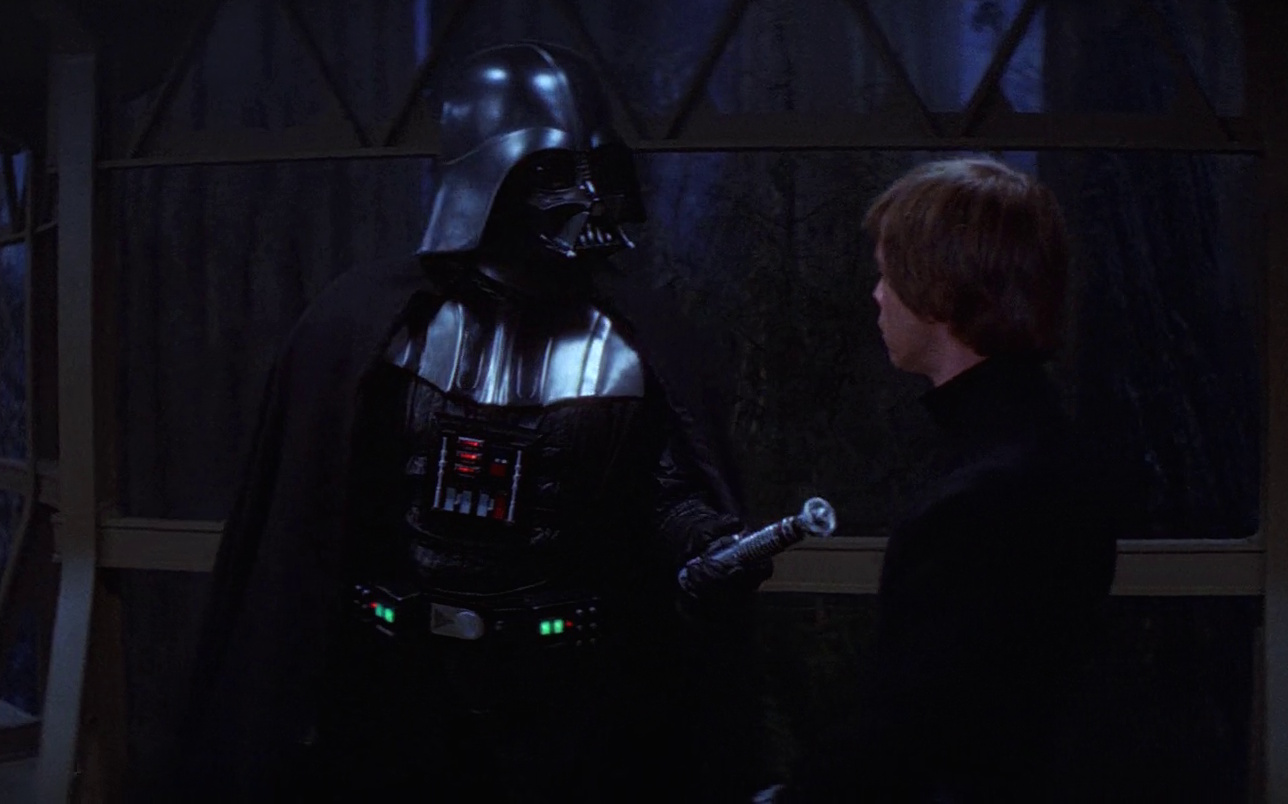
Still frame from Return of the Jedi showing Vader and Luke on Endor

As a kid playing with action figures, I already achieved this goal thirty-five years ago! Jokes aside, fans of both Star Trek *and* Star Wars have speculated about what a crossover might look like for decades. And who knows… with Paramount buying up everything in Hollywood, maybe it’s no longer the impossible dream that it once appeared to be!

There are some pretty big hurdles, though, just from a practical point of view. Both franchises are owned by competing companies, and both have decades’ worth of complicated lore and history. Then there’s the question of time and place – Star Wars famously takes place “a long time ago in a galaxy far, far away,” whereas Star Trek takes place in a vision of our future. Which characters would be involved? And how would Star Trek’s technology co-exist with hyperdrives, lightsabres, and the Force? As tempting as it might sound on some level, I don’t think I’d go for it if I were in charge!

Unpopular? 🛑No!🛑
Agree? 🛑No!🛑

“Unpopular” Opinion #22:
The Prime Directive is unethical.
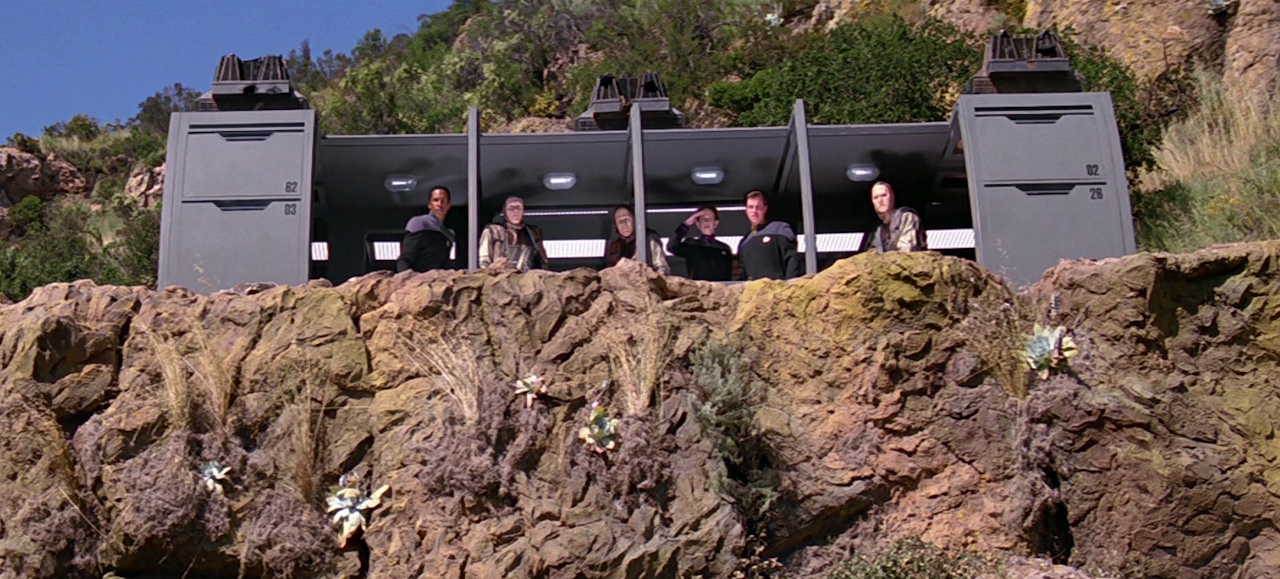
Still frame from Star Trek Insurrection showing the duck blind

Several commenters argued that the Federation’s Prime Directive is a fundamentally unethical policy, because it condemns whole civilisations to extinction just because they haven’t developed one specific technology. And, on the surface, that seems to track – stories like Pen Pals, Dear Doctor, and the beginning of Into Darkness quite clearly show Starfleet has the ability to intervene, but chooses not to, even when there’s an existential risk to an entire race of sentient beings.

The Prime Directive, fundamentally, is about not interfering with or altering the trajectory of societies that haven’t yet discovered alien life. And it makes sense, right? Think of the chaos it would cause to our own society if aliens descended from the skies – even if they had the best of intentions. We aren’t ready for that, and maybe we won’t be for a long time. The rigidity of the Prime Directive throws up some strange situations, though – but we often see our heroes finding ways around it, and the fact that they never seem to get in trouble suggests that Starfleet is okay with rule-bending, sometimes!

Unpopular? 🛑No!🛑
Agree? 🛑No!🛑

“Unpopular” Opinion #23:
Too many people are related to Spock, best friends with Spock, falling in love with Spock, or revere Spock.
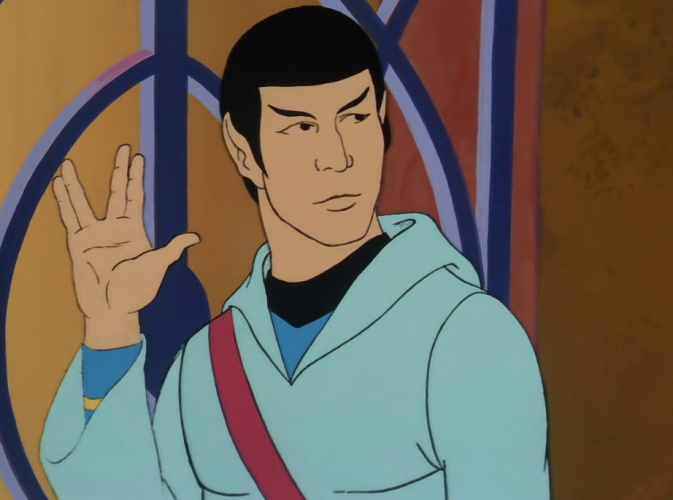
Still from YesterYear (Star Trek TAS) showing Spock

Spock has become a larger and larger part of Star Trek, over the years, even as we’ve moved further away from The Original Series. He and his father appeared in The Next Generation, Spock crossed over to the Kelvin timeline where he met his younger self, and Spock has had two long-lost siblings that he never mentioned: Sybok and Michael Burnham. Chapel falls in love with Spock, La’an falls in love with Spock, and all the while, Spock is betrothed to T’Pring. Characters like Boimler talk about Spock with reverence, too. Yeah… it’s kind of a lot, huh?

It can feel, sometimes, like Spock is too present and too big a part of the storylines he’s included in. I’d be totally fine with stepping back from Spock, for a while, and giving other characters a chance to be in the spotlight. The Burnham connection has been established at this point, and there won’t be any retconning or removal of that. But going forward… if we’re lucky enough to see more Star Trek entering production, setting Spock aside would probably be for the best – at least for a while.

Unpopular? 🛑No!🛑
Agree? ✅Yes.✅

“Unpopular” Opinion #24:
René Auberjonois should’ve played Odo with an exaggerated French accent.
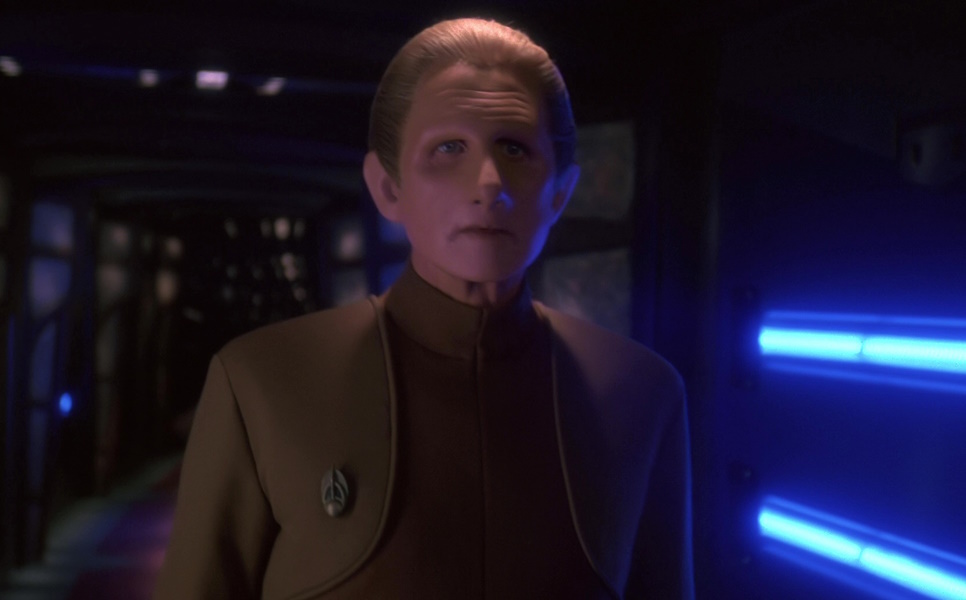
Still frame from What We Left Behind showing Odo

This one… I think it was entirely tongue-in-cheek! But I thought it was funny, and it’s my list so I’m including it. René Auberjonois played the French chef in The Little Mermaid, and his French accent is pretty iconic! It would’ve certainly shaken things up, with Odo becoming much more of a comic relief character, especially if Auberjonois really hammed it up. Would it have made DS9 *better*? Uh, probably not. Would some of his conflicts with Quark have been a lot funnier, though? Yes.

Look, this was just a bit of silly fun. I’m pretty sure no one’s out there seriously suggesting that giving *any* Star Trek character a comedy accent would’ve improved the show. But it’s fun, as fans, to think about these things sometimes. How different would episodes like The Die Is Cast have been if Odo were hamming it up, sounding like the French chef from The Little Mermaid? And, to the credit of the original commenter, it’s not an opinion I have *ever* heard expressed before!

Unpopular? ✅Yes.✅
Agree? 🛑No!🛑

“Unpopular” Opinion #25:
Star Trek *should* change over time, and not simply re-make TOS or TNG for every new series.
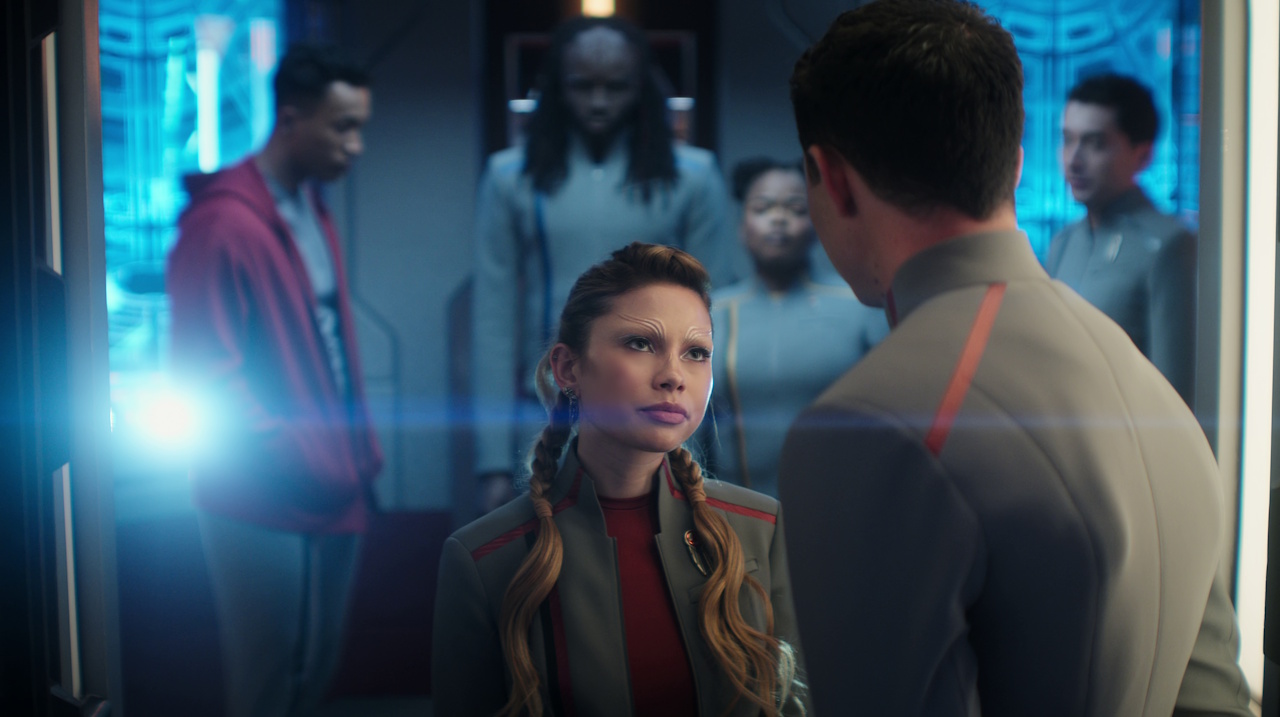
Still frame from Vox in Excelso showing the cadets

As early as the ’70s, when The Animated Series entered production, Star Trek was changing. When Phase II was reimagined as The Motion Picture, and Star Trek went to the cinema for the first time, the franchise changed. Star Trek, like any long-running franchise, moves with the times. That means the way shows look and feel changes, it means the way characters are cast and handled changes, and it means the nature of storytelling changes, too. The entertainment industry is not a static, stagnant thing, and if the higher-ups at Star Trek tried to recreate The Original Series every time… well, the franchise probably would have died out a long time ago.

That being said, some experiments and changes work better than others. I’m firmly of the opinion, having seen multiple seasons of modern Star Trek, that the franchise *needs* the freedom episodic television brings, and that serialised stories need to be a much smaller part of Star Trek in the future… assuming there will be a future. It seems that Skydance, Star Trek’s new corporate overlords, are more interested in films than streaming TV, so that could be another change coming down the pipeline. But the original poster is correct – Star Trek can’t afford to be left behind as the entertainment industry shifts around it. Figuring out what to change, how far to take those changes, and what fundamentals need to be left in place, though… that’s a tougher set of questions, and modern Star Trek hasn’t always stuck the landing, unfortunately.

Unpopular? ✅Yes.✅
Agree? ✅Yes.✅

So that’s it… for now!
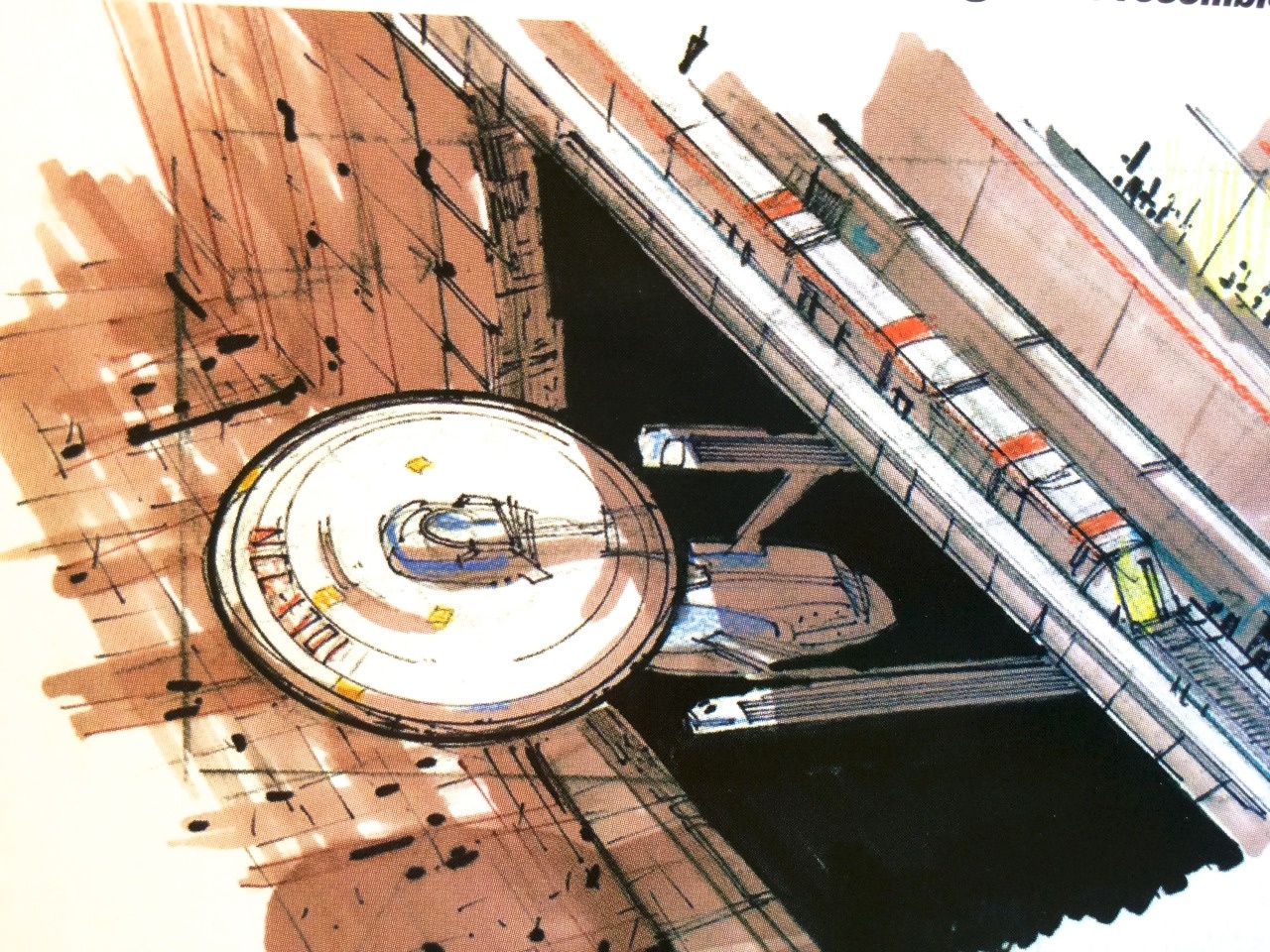
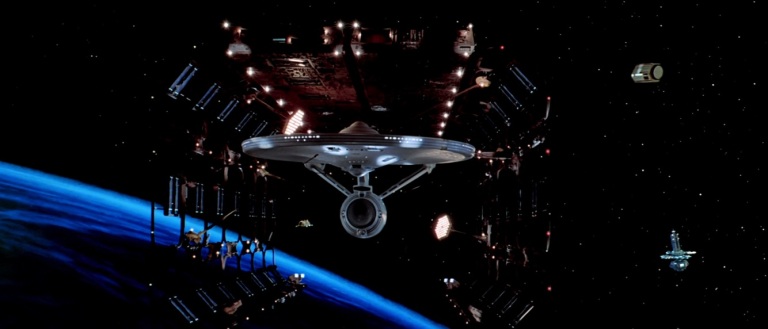
Concept art of the USS Enterprise in Spacedock for The Search for Spock
Concept art of the USS Enterprise in Spacedock.

Stay tuned, because I have *at least* another twenty-five of these “unpopular” opinions that I’d love to write up one day.

I hope this has been a bit of fun. If I tore a hole in an opinion you agree with… please try not to take it personally! This is meant to be a bit of light-hearted fun, joining in with the Star Trek fan community in my own way, and not something to get too upset about or offended by. I tried to pick a mix of different opinions from across social media, touching on different parts of the franchise, including things I agreed with and didn’t agree with.

If you missed it, I have a two-part review of Starfleet Academy’s first season, which is now live on the website. You can find part one by clicking or tapping here, and the follow-up by clicking or tapping here. And there’s more Star Trek content to come as the 60th anniversary nears! I’ve got plans for re-watches, theories, and more, so I hope you’ll check back from time to time. Thanks for joining me to dissect these “unpopular opinions,” and Live Long and Prosper!


Most Star Trek films and TV shows discussed above can be streamed now on Paramount+ in countries and territories where the service is available. The Star Trek franchise – including all films, TV programmes, and other properties discussed above – is the copyright of Skydance/Paramount. This article contains the thoughts and opinions of one person only and is not intended to cause any offence.

Star Trek: Strange New Worlds Episode Review – Season 2, Episode 6: Lost In Translation

Spoiler Warning: There are spoilers ahead for Star Trek: Strange New Worlds Seasons 1 and 2.

Welcome back to my Strange New Worlds Season 2 episode review series. I know it’s been a while, and I’ll address that briefly before we jump into the review proper.

Last year, while Strange New Worlds was airing, I began to feel burned out on Star Trek as a whole. I also found myself writing less frequently here on the website, and I think I just needed a bit of a break from what had been a pretty hectic schedule for the franchise. There’s been a lot of Star Trek on our screens over the last couple of years in particular – some of which has been quite heavy, with themes of mental health that hit close to home for me. Long story short, I ended up taking a break from Strange New Worlds halfway through Season 2… but now I’m finally ready to jump back in. I’m going into these episodes completely fresh; this is my first time watching Lost in Translation and I haven’t seen the remaining Season 2 episodes yet.

So I hope you’ll excuse the lateness of this review! I plan to pick up where I left off last year, and while I don’t promise to do one review a week… hopefully by the end of the year – or at least by the time Season 3 is upon us – I’ll have finally wrapped up this batch of episodes.

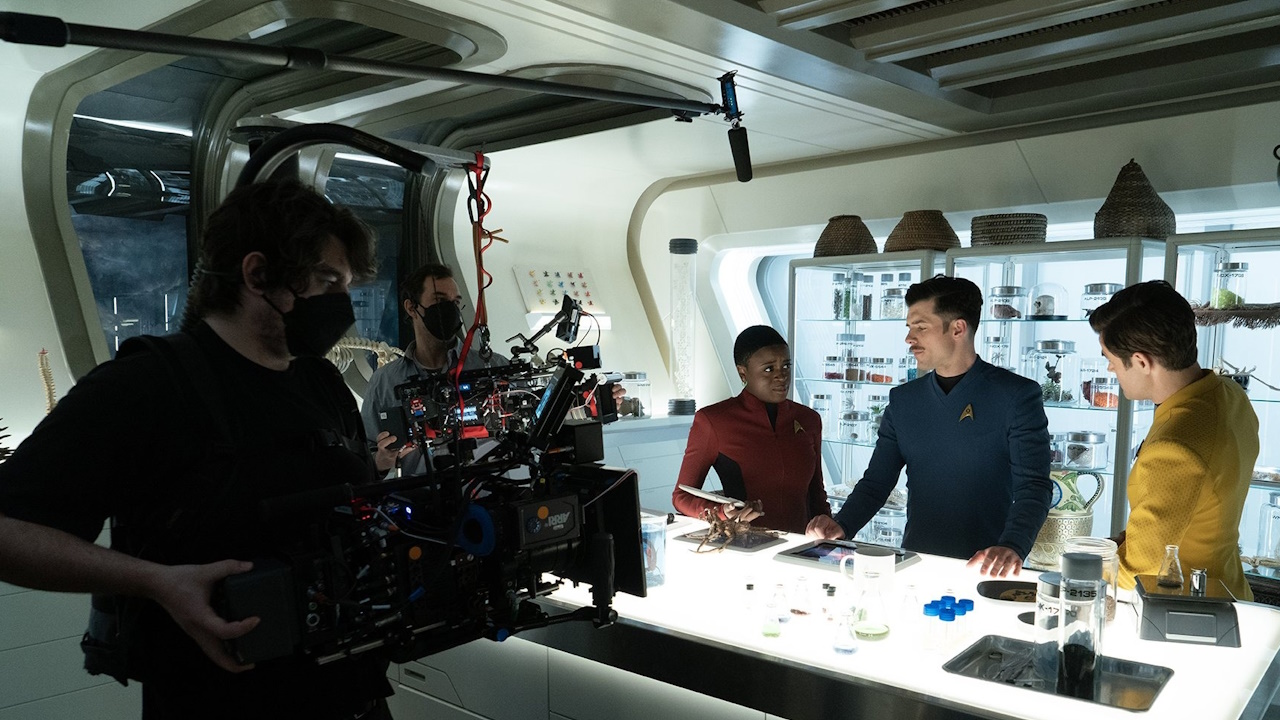
Behind-the-scenes photo from the Star Trek: Strange New Worlds episode Lost In Translation (2023) showing a camera rig and Uhura.
Behind-the-scenes photo from the set of Lost in Translation.

Onward, then, to Lost in Translation!

This episode put a somewhat dark and distinctly modern spin on Star Trek’s trusty old “they were only trying to communicate!” premise, and it worked pretty well. Outside of the main thrust of the story were a couple of moments of characterisation that I felt either weren’t set up particularly well or that might’ve needed an extra moment or two in the spotlight, and there was a rare CGI miss for Strange New Worlds as the series used a sub-par visual effect that had also appeared in Picard’s third season. Other than that, though, I had a pretty good time with Lost in Translation; it was a nice way to return to Strange New Worlds after an absence of more than a year.

I think I’ve noted this before in either my Season 1 review or one of my earlier Season 2 episode reviews, but I just adore the opening title music. I got goosebumps listening to the theme this time after not hearing it for months, and the way composer Jeff Ruso deconstructed and then recreated the music from The Original Series is really something special.

Promo poster for Star Trek: Strange New Worlds Season 2 (2023) showing Uhura. Cropped.
Lost in Translation focused on Uhura.

Let’s talk about what I didn’t like in Lost in Translation – which, thankfully, isn’t too much this time around.

There were a couple of pretty abrupt scenes where two different sets of characters seemed to have fallen out with one another off-screen, and the way this was communicated wasn’t great. First we had the two Kirk brothers: Sam and Jim. Their rivalry came from an understandable place, but it needed way more buildup to have been effective. We’ve seen these characters on screen together more than once in Strange New Worlds already, and there was no indication in those earlier appearances that Sam might feel Jim’s rise through the ranks was a sore spot.

And when we boil it down… this argument felt incredibly petty. Jim Kirk has just been promoted, becoming the youngest-ever first officer in Starfleet. And Sam feels jealous of that because their father – who we’ve never met and hasn’t been mentioned before – likes Jim more because of it? Have I even got that right? For the brothers to go from sharing a hug on the transporter pad to Sam storming off – twice, I might add – just felt so incredibly ham-fisted and rushed. There was the smallest nugget of an interesting idea at the core of this, and both actors did the best with the material they had. But this argument/sibling rivalry needed way more time on screen and more development, ideally over more than one episode. Strange New Worlds has done well so far with its blend of episodic storytelling and serialised character arcs… but this one didn’t stick the landing this time.

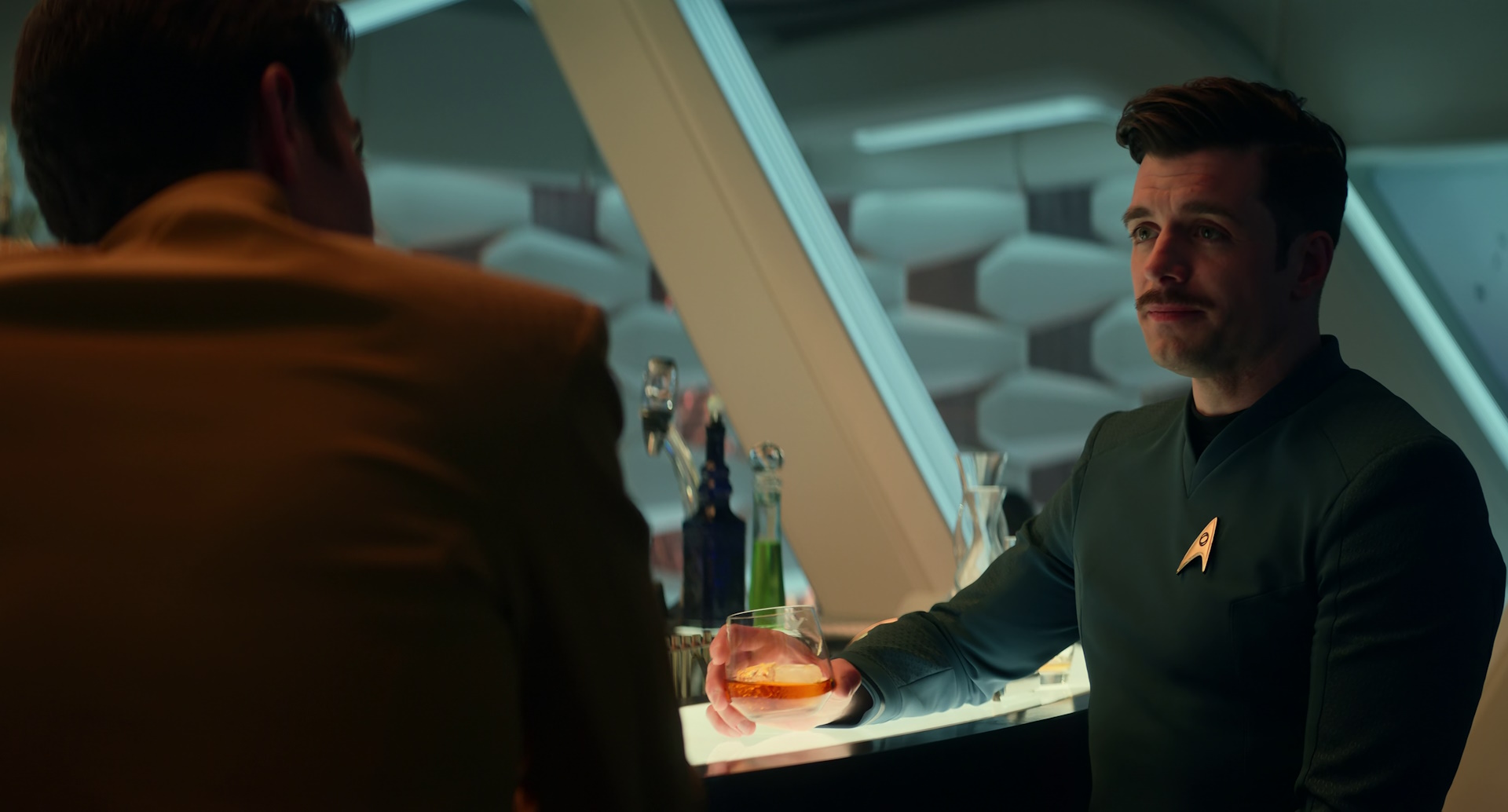
Still frame from Star Trek: Strange New Worlds Season 2 (2023) showing Jim and Sam Kirk at the bar.
Jim and Sam argued at the bar.

In a similar vein we have Una and Pelia’s conflict. This one has the benefit of being resolved (or apparently resolved, at least) by the end of the episode, meaning that the final scenes they shared together in the shuttlecraft and the conversation that Pelia forced went some way to compensating for their earlier conflict. But the same basic issue arises as with the Kirk brothers above: it needed more setup and more time on screen to play out.

This kind of conflict between two main characters can’t be a one-and-done, throwaway thing in a single episode; it deserves to have more time spent on it. Not for the first time in modern Star Trek I find myself saying this: if there isn’t enough time to do justice to a storyline that needs room to unfold… skip it. Don’t forget it entirely, but put it back on the shelf for later and find something smaller that would be a better fit for the short runtime available – then when you have the time to fully explore this kind of grief-driven character conflict, return to it and do it properly. This isn’t an isolated issue, unfortunately, as we’ve seen similar problems in all of the modern live-action Star Trek productions since 2017.

Still frame from Star Trek: Strange New Worlds Season 2 (2023) showing Una and Pelia on a shuttle.
Pelia and Una on their way back to the Enterprise.

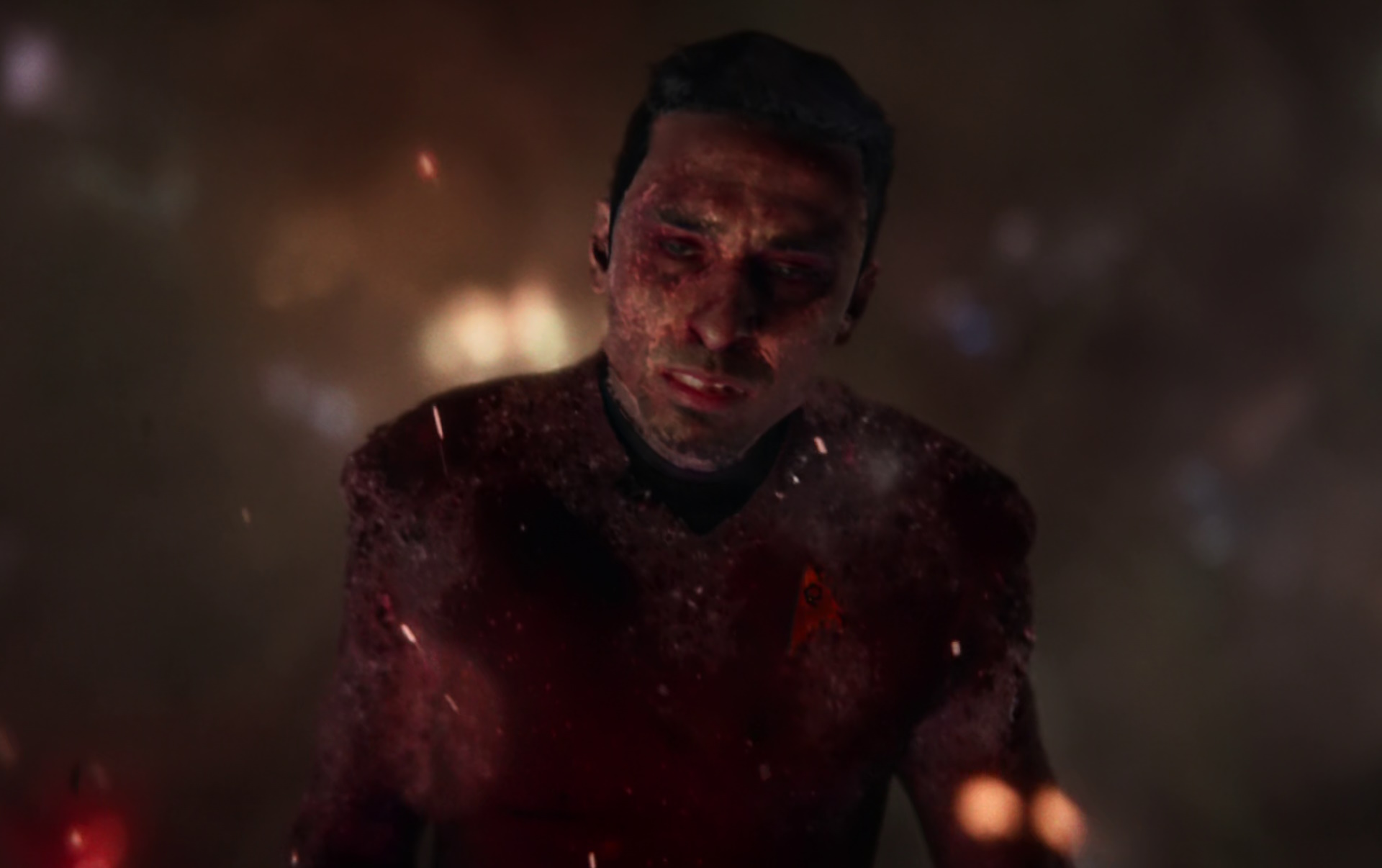
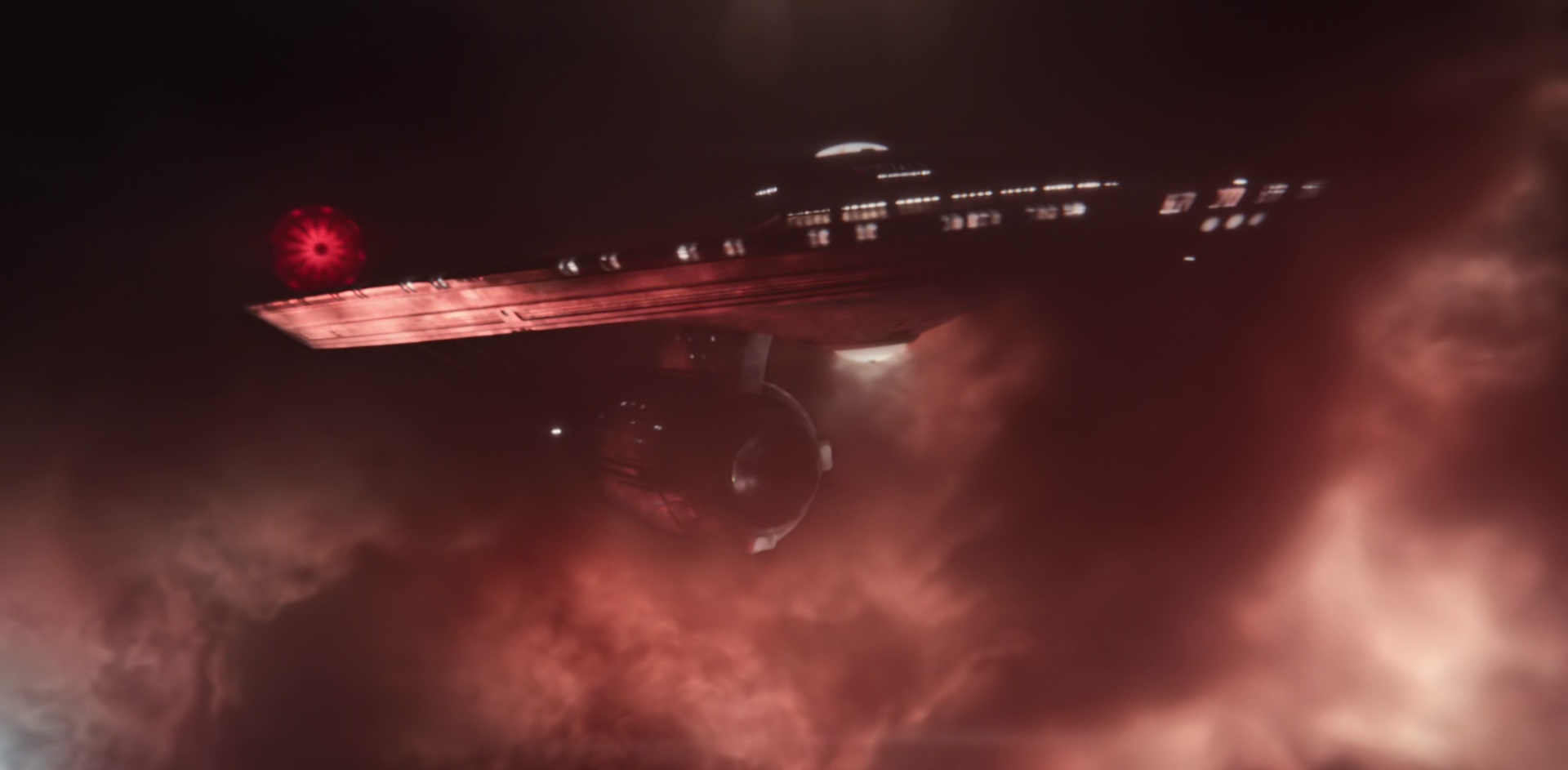
There was one particularly poor use of CGI in Lost in Translation, and I think it’s worth looking at briefly. The scene where the doomed redshirt Lieutenant Ramon is blasted out into space had some great animation work for the USS Enterprise and the nebula that the ship was in – and visual effects across the rest of the episode were pretty good. But Ramon’s death was poor, and the “freezing” effect used as his body was floating in space was a long way wide of the mark.

It’s a lot harder to accurately animate a person – and facial features in particular – than it is to do things like spaceships, planets, and inanimate objects, and unfortunately that’s what we saw with Ramon’s death. The CGI model just wasn’t up to scratch, and although other elements of the same animated sequence looked good, the individual at the centre didn’t. Earlier in 2023, I noted the exact same problem with the death of another character in Star Trek: Picard Season 3. This character was also ejected into space, iced over, and died – and the same issues were present. Paramount has done a lot of great work with CGI and animation in modern Star Trek… but there’s still a long way to go to get some of these character models and effects to where they need to be. It didn’t ruin the entire episode – but it was noticeable in that sequence, particularly because the rest of the animation work was so good.

Still frame from Star Trek: Strange New Worlds Season 2 (2023) showing a CGI shot of Ramon.
This CGI moment didn’t look great.

So those are the only parts of Lost in Translation that I can say I didn’t really like or that didn’t work for me. Next, I’d like to talk in a broader sense about a character who returned in this episode – and their death in Season 1.

The episode All Those Who Wander is one of my favourite Star Trek stories of the last few years – probably of all-time. It’s an episode that shows how Star Trek isn’t always going to be the kind of nerdy sci-fi franchise that people think, and how it can dip its toes in genres like horror. It’s a gruesome, shocking story – and one that comes with a final, brutal twist right at the end.

All Those Who Wander wouldn’t have been so impactful if Hemmer had survived – and I fully appreciate that. One of the things his death showed is that most of Strange New Worlds’ characters don’t have “plot armour” and therefore can’t be considered as safe as main characters in previous shows. That’s great in some ways – it’s modern, it can ramp up the tension and drama at key moments, and it represents a franchise that’s still growing and evolving even after more than half a century in production.

Still frame from Star Trek: Strange New Worlds Season 2 (2023) showing Hemmer.
An illusory Hemmer at the end of Lost in Translation.

But – and you knew there had to be a “but” coming after all of that – Hemmer was a great loss for Strange New Worlds. Killing off such an interesting character so soon, and after he’d only really had a chance to make an impact in a couple of episodes was an odd decision, and I can’t help but see parts of Lost in Translation as a reaction to Hemmer’s death. Perhaps the decision to bring him back in this way is even a bit of an admission on the part of the writers that they miss this character and regret not being able to do more with him.

Pelia is great. She adds a comedic flair to Strange New Worlds that the series needs, and she has a way of making even tense and dangerous moments feel lighter. Many stories have already benefitted from her inclusion – and I have no doubt that others will in the future, too. But that doesn’t mean Hemmer’s early demise feels any better. And it’s impossible to talk about Lost in Translation without going back to Season 1 and thinking about what might have been if Hemmer had stuck around. As a blind character, as a member of a race that Star Trek hasn’t explored in depth since Enterprise, and as a pacifist working on a ship that might be called into action… there was a lot of potential in Hemmer that we never got to see realised.

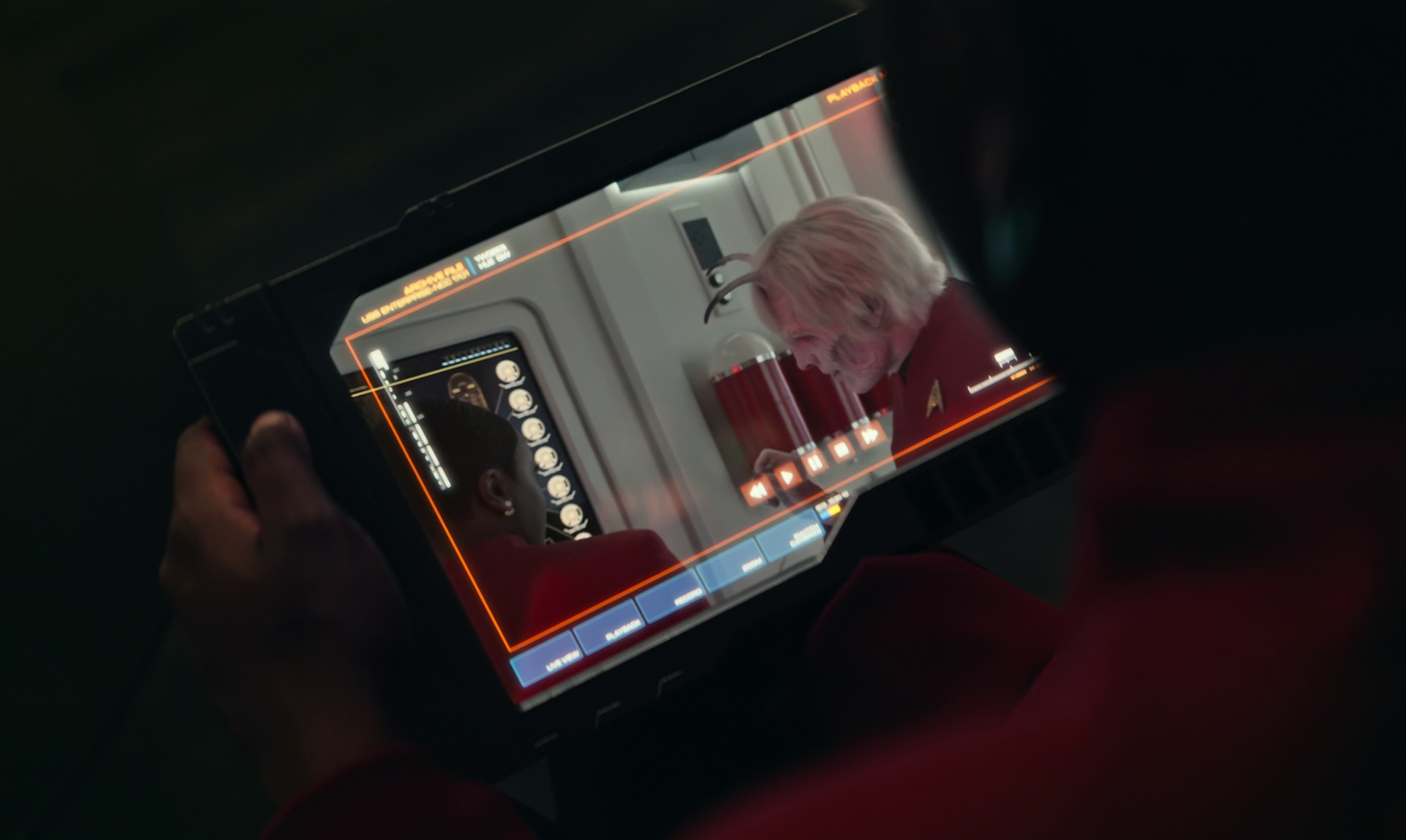
Still frame from Star Trek: Strange New Worlds Season 2 (2023) showing Uhura watching a recording.
Uhura watches a recording of Hemmer on a padd.

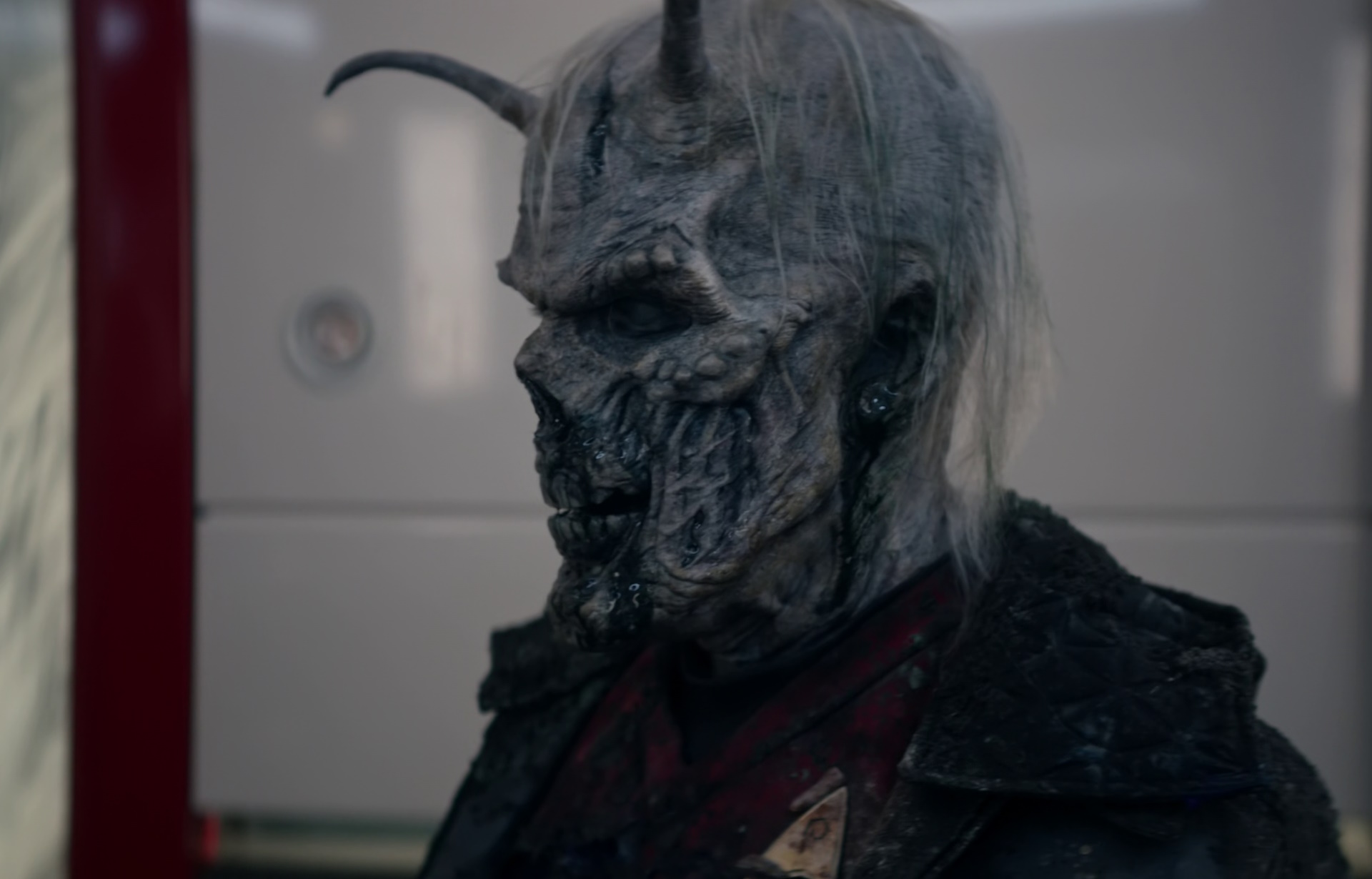
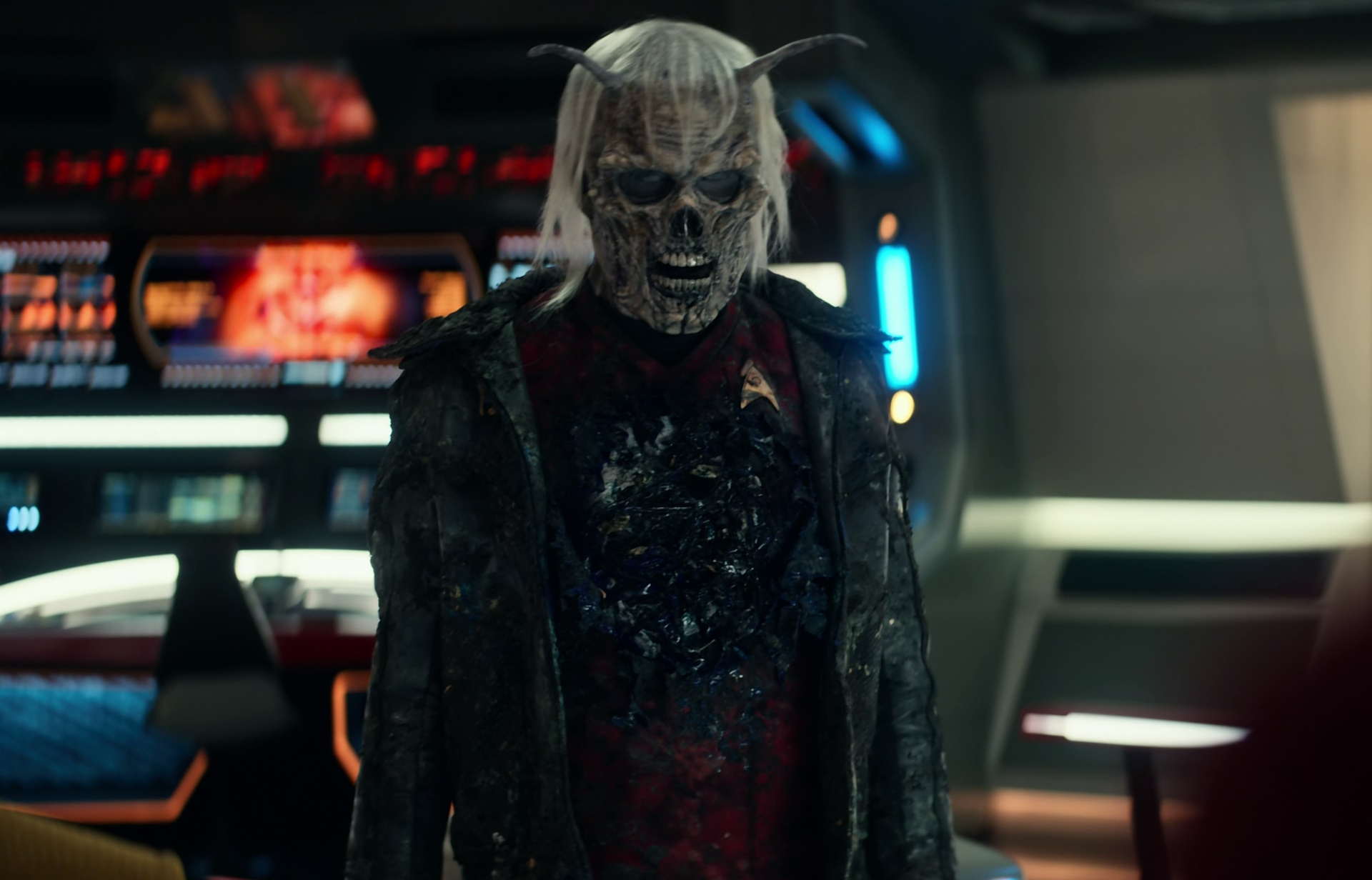
I was entirely unprepared for the zombie Hemmer jump-scare just before the credits – and I about pissed myself when his mangled, decaying corpse showed up, growling at poor Uhura. That was an incredibly well-executed moment, and it left me on edge for much of the rest of the story, especially when Uhura was hallucinating and the camera panned around. I kept expecting another jump-scare at that level!

We talked a moment ago about a CGI effect that missed the mark – but the makeup and prosthetics used to create Hemmer’s hallucinatory form were absolutely pitch-perfect. I genuinely cannot fault the way Hemmer appeared in those moments, and the changes from how he looked when alive to the bloodied, decaying, zombified form that appeared to Uhura must’ve taken a lot of time both at the planning stage and in the makeup chair.

Still frame from Star Trek: Strange New Worlds Season 2 (2023) showing a zombified Hemmer.
I very nearly needed to change my pants after this jump-scare.

It makes a lot of sense to use a character like Hemmer to tell a story about grief and loss – and I would argue that Strange New Worlds managed to do a far better job on this front than the likes of Picard or Discovery when those shows attempted to look at comparable themes. The reason for this is Hemmer: we as the audience had known this character, seen him interact with the crew across several Season 1 episodes, and were mentally prepared for him to continue on as part of the show. His death was shocking and untimely – so we can absolutely see how his death would have had a major impact on characters like Una and Uhura.

Hemmer and Uhura struck up a friendship in Season 1, and he played a role in helping her choose to remain in Starfleet when she was having doubts. This friendship was expanded upon in Lost in Translation, as we got to see them working together through the recording that Uhura carried with her. This also helped build up the sense of grief and mourning that was key to this side of the story. It was well-written, beautifully performed, and is a storyline that I think should be relatable to anyone who’s been through the loss of a close friend or family member. We often talk about Starfleet and crews on Star Trek as akin to families; this is another side of that analogy.

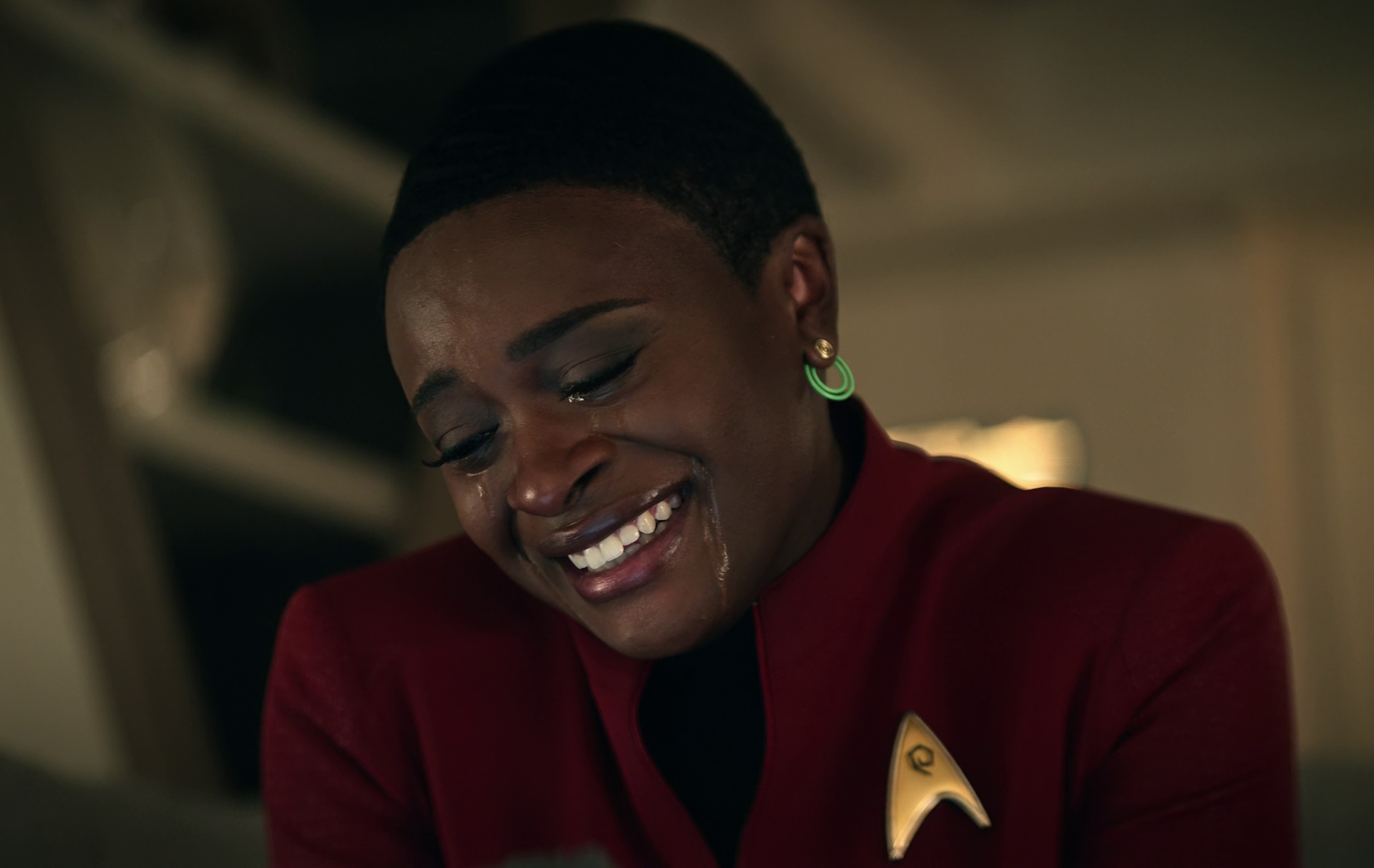
Still frame from Star Trek: Strange New Worlds Season 2 (2023) showing Uhura crying.
Lost in Translation was, in part, a story about grief and loss.

Uhura and Hemmer had that closeness in Season 1, but I’m struggling to remember a comparable moment between he and Una. Despite my criticism of the rather short and abrupt nature of her conflict with Pelia, I think the underlying theme of coming to terms with loss and having to see someone new as a “replacement” for a fallen friend or comrade was an interesting one. Again, it’s something that should be relatable to a lot of folks in the audience – I just fear in this case that the way this particular conflict was handled may have got in the way of the message.

Hopefully Una and Pelia have come to an understanding, at least, and future episodes might be able to build on this relationship, taking them from adversarial to something closer to friendship. If future stories are plotted out that way, we might be able to look back somewhat more kindly on their conflict in Lost in Translation.

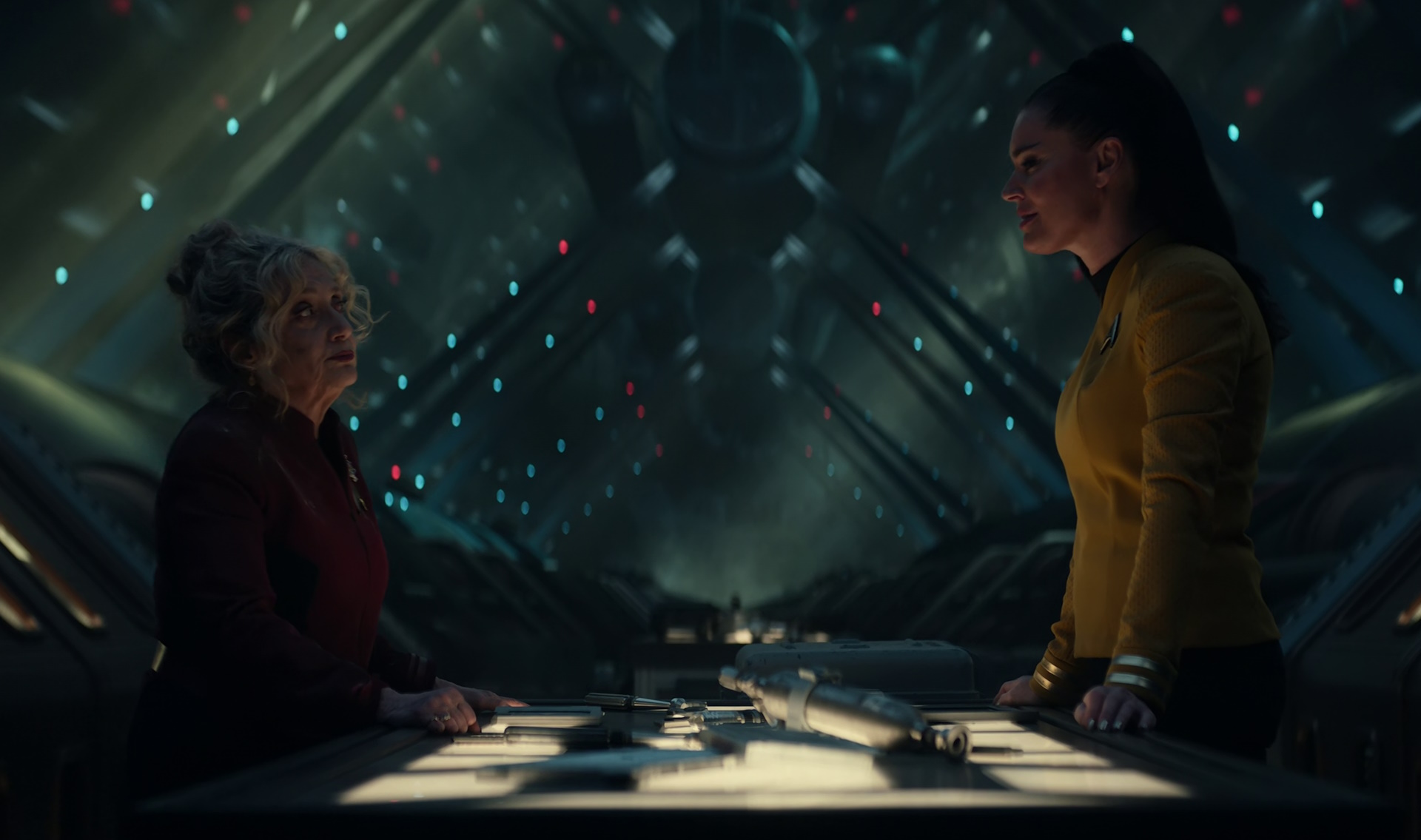
Still frame from Star Trek: Strange New Worlds Season 2 (2023) showing Pelia and Una arguing.
Pelia and Una aboard the refinery station.

I’ve lost count of the number of times Star Trek has used the “it was only trying to communicate!” storyline! Some of these have worked better than others, to be blunt – and it isn’t unfair to call it a trope of the franchise. Season 1’s Children of the Comet wasn’t a million miles away from that premise – and also featured Uhura in a big way. Lost in Translation is a very dark interpretation of this narrative idea, though, and I think it worked quite well.

Maybe this is a reach (actually, it’s definitely a reach) but I felt that there were at least some superficial similarities to Voyager’s Season 6 episode The Haunting of Deck Twelve. That story was different in tone – with its frame narrative and “ghost stories around the campfire” style – but it also featured nebula-dwelling lifeforms caught in a starship, desperate to survive and get home. I doubt it was intentional, but it’s interesting, at any rate!

Still frame from Star Trek: Strange New Worlds Season 2 (2023) showing a CGI shot of the USS Enterprise in a nebula.
The life-forms made their home in this nebula.

We’re used to seeing aliens in Star Trek that are very humanoid. Recent and not-so-recent stories have even tried to provide an in-universe explanation for the abundance of humanoid alien races… with limited success, in my opinion! But episodes like Lost in Translation remind us that the galaxy is also home to alien races that are so very different from humanity that it can be hard to even conceptualise – let alone find a way to communicate. These stories have always been interesting to me – and while Strange New Worlds gave us a more action-heavy, even horror take on that idea, I thought it worked exceptionally well.

There was plenty of room for science and for problem-solving as Uhura, Kirk, Pelia, and others all struggled to understand what was happening. Maybe it’s because I’m a seasoned Trekkie, but I felt maybe some of the characters – Spock in particular, perhaps, but also Pike and Pelia – should have suspected that something alien was going on when both Uhura and Ramon fell ill while the station was experiencing sabotage… but I can’t really hold that against the episode. I have to remind myself, sometimes, that Strange New Worlds is set before most of the rest of Star Trek – so the characters wouldn’t necessarily know what to look for and wouldn’t have the experience of those other stories to draw upon.

Still frame from Star Trek: Strange New Worlds Season 2 (2023) showing zombie Hemmer.
The aliens were able to communicate through illusions and hallucinations.

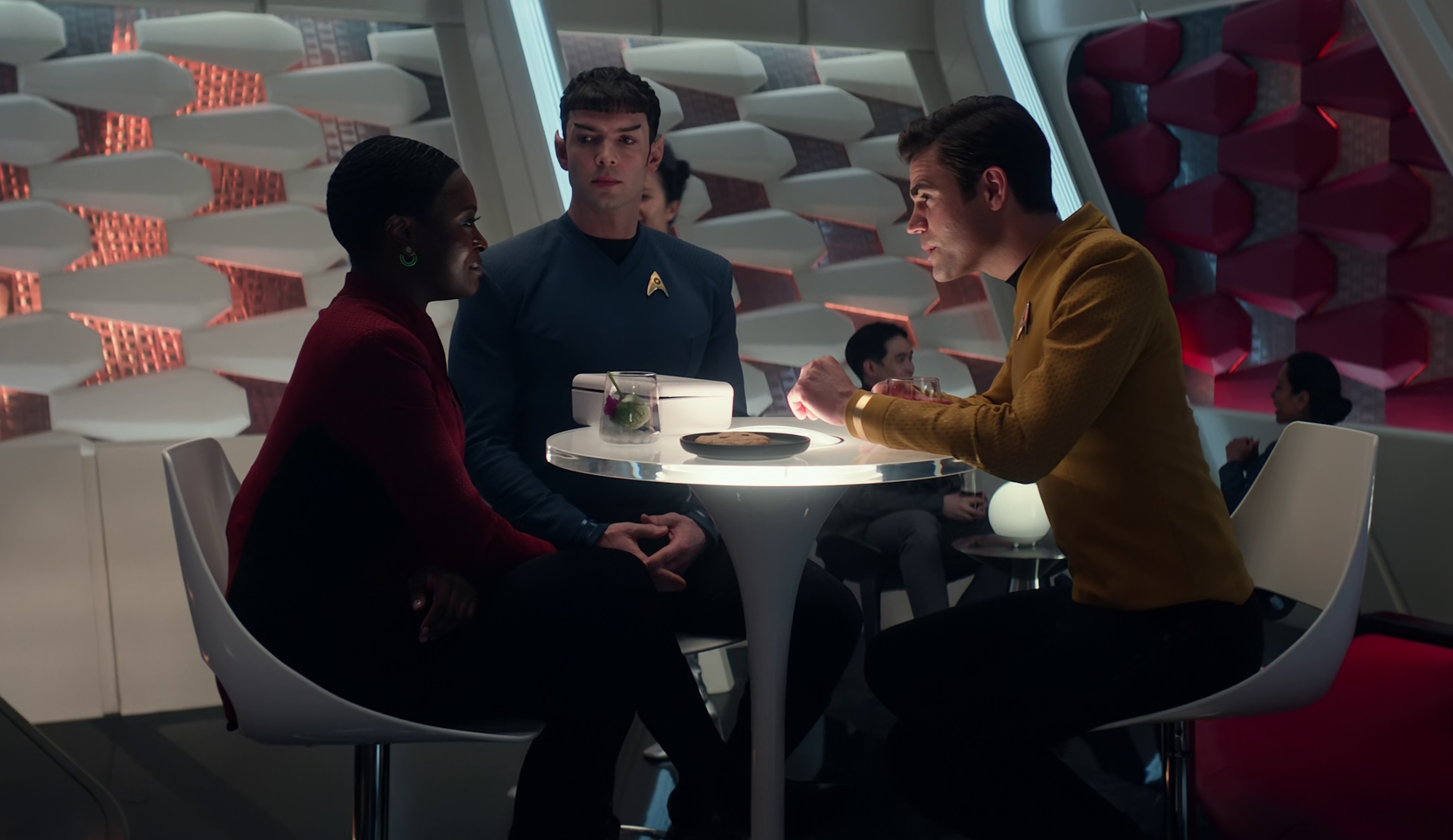
Pairing up Uhura with Kirk was great – and seeing how they got to meet for the first time in the prime timeline was great fun. There’s a lot of history with these two characters that Strange New Worlds had to respect – and I think the writers did them justice on this occasion. I also like the idea that it was Uhura who made the introduction between Kirk and Spock – that feels fitting, somehow.

At first I thought we were going to learn that Kirk was another of Uhura’s hallucinations! That seemed to be a possible route for the story to have taken. I’m glad it didn’t turn out that way, though, especially as the episode wore on and we got to see some genuinely sweet moments between them. Kirk is a flirt and a womaniser – something we know from his appearances across The Original Series, the Kelvin films, and beyond. But I felt the way this was handled in Lost in Translation – with Uhura shutting him down pretty quickly – was both a little bit funny and true to both of their characters. Any inclusion of characters from The Original Series has to be handled carefully, and pairing up Uhura and Kirk for basically an entire story could have gone awry. I’m glad that it didn’t.

Behind-the-scenes photo from the Star Trek: Strange New Worlds episode Lost In Translation (2023) showing a camera rig and three characters.
Celia Rose Gooding, Dan Jeannotte, and Paul Wesley during production on the episode.

We spoke earlier about character conflicts that hadn’t been set up particularly well. Lost in Translation also offers at least one counter-point to that: the developing relationship between La’an and Kirk. After the events of Tomorrow and Tomorrow and Tomorrow earlier in Season 2 left La’an pretty devastated, she’s clearly still struggling with the memories she has of alternate-timeline Kirk. Running into him was difficult for her, and while that part of the episode was only in focus briefly, I think it worked well. As a storyline that is (hopefully) going to be picked up in a future story, these small steps can be important. We’ve followed La’an and Kirk in two episodes now – maybe by their third or fourth meeting, something more will come of it.

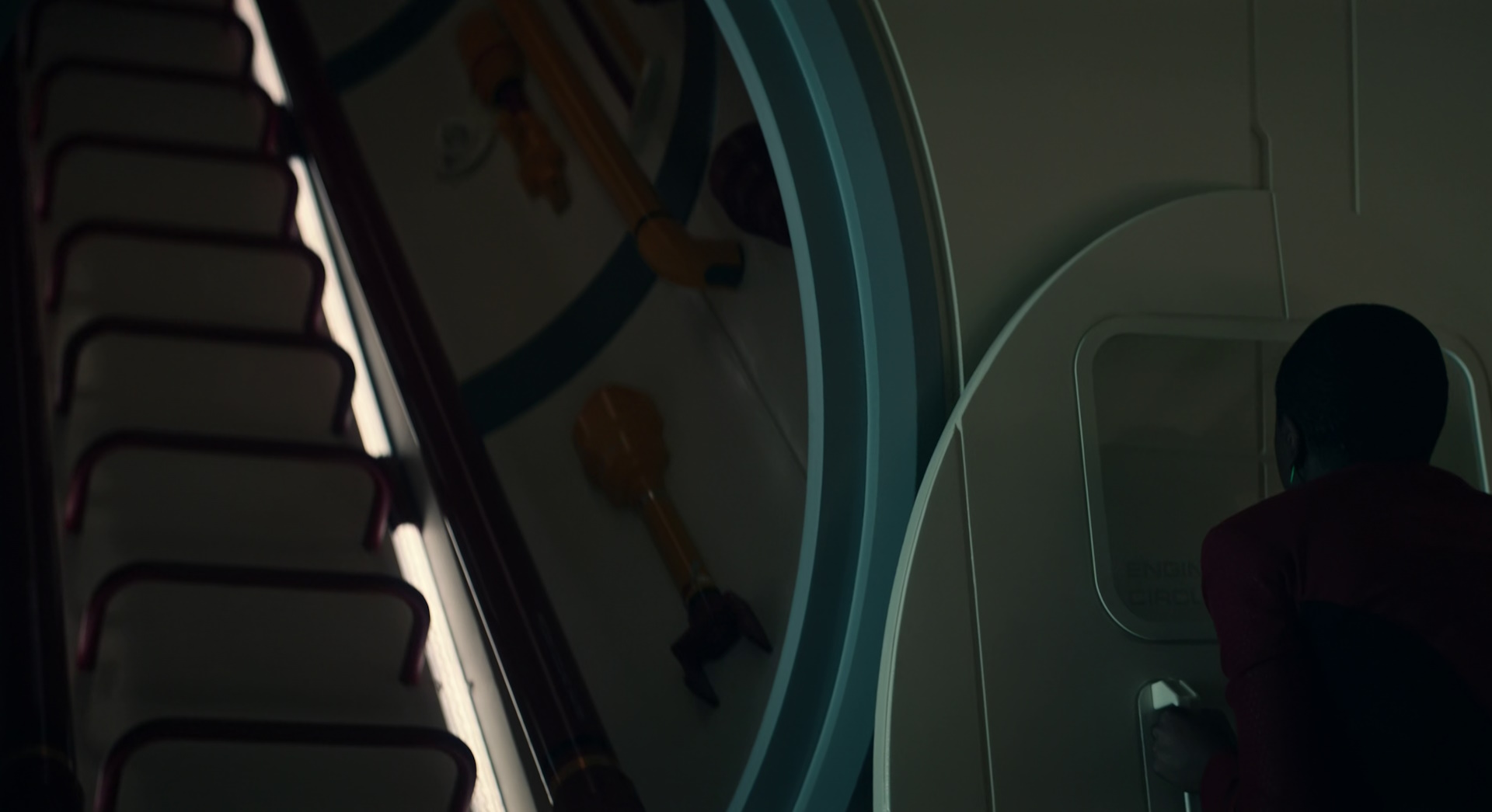
In terms of sets, I liked the new nacelle control room that we saw Uhura, Pelia, and Ramon using. It even had the angled ladder that Scotty would famously crawl into in The Original Series any time the Enterprise needed repairs! There may not be a ton of uses for a nacelle room, but being able to put that set together sometimes for engineering scenes is a neat idea.

Still frame from Star Trek: Strange New Worlds Season 2 (2023) showing Uhura opening a hatch.
Did this ladder feel familiar to you?

The refinery/space station set didn’t feel all that special, but thanks to some creative use of the AR wall and animated wide-angle shots, we got at least some of the sense of scale that the place needed. It also had a pretty industrial feel – not unlike modern-day oil rigs or refineries, which I suppose will have been the inspiration.

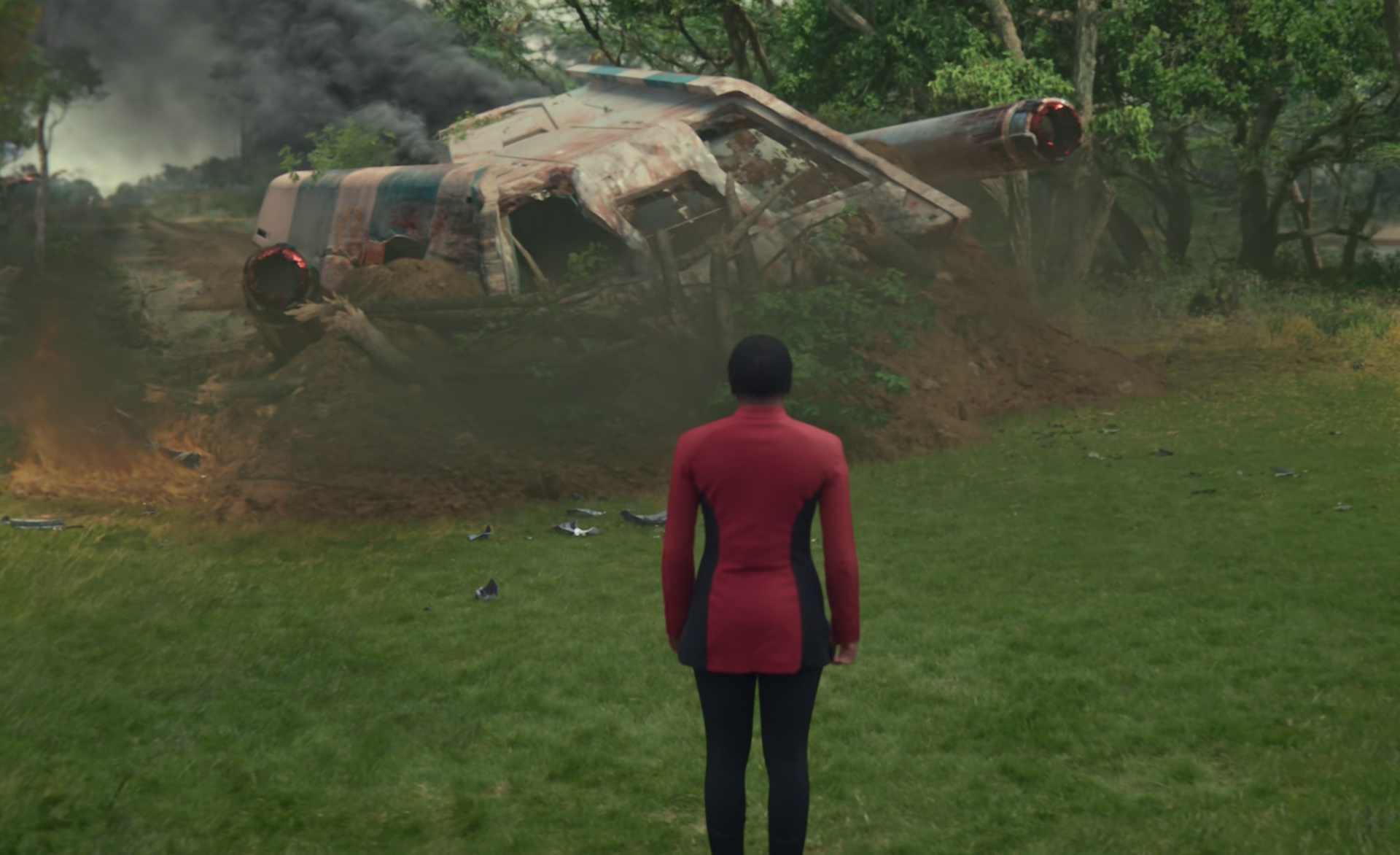
Uhura’s hallucinatory shuttle crash was also really well done, with transitions between the indoor sets and outdoor filming locations feeling particularly creative. The wreck of the shuttle looked great, and although we only saw parts of the interior in an out-of-focus shot, that choice was clever, too.

Still frame from Star Trek: Strange New Worlds Season 2 (2023) showing Uhura by a crashed shuttle.
Uhura with the wrecked shuttle.

Speaking of creative cinematography, the scene in the corridor as Uhura felt the walls closing in around her, then stretching away, looked fantastic – and I think I’m right in saying that most of that was camera work rather than post-production special effects. It was creative, at any rate, and it really hammered home the panic and fear that Uhura felt at that moment.

So I think that’s all I have to say this time.

Lost in Translation was a good episode, and one that put a different spin on a familiar premise. We got to see Kirk’s first meetings with both Uhura and Spock, which was fantastic, but at the episode’s heart was some creative storytelling that touched on themes of grief and the loss of a friend. After Hemmer’s demise in Season 1, I’m glad that Strange New Worlds hasn’t just forgotten about him and moved on, and remembering him through the way he helped his friends and the impact he made on his crew was touching.

Still frame from Star Trek: Strange New Worlds Season 2 (2023) showing Uhura, Spock, and Kirk at a table.
A famous first meeting!

Not everything in Lost in Translation worked as well as it could’ve, and perhaps trying to cram in two character conflicts like this was a bit too much for the episode’s runtime. Hopefully, now that the Una-Pelia conflict has been resolved, we can see a bit more from those two in a future episode, building on the foundations that were laid this time. As for the Kirk brothers… I think we need to see a little more from them if the series wants to do this whole “sibling rivalry” argument justice!

After a break of more than a year, Lost in Translation has been a nice way to return to Strange New Worlds! Not every episode of Star Trek can be a great one, but I’m glad that I didn’t end up coming back to the series with a dud! That might’ve been offputting as I aim to review the remainder of the season. Thankfully it didn’t happen this time – and I hope you’ll stay tuned for reviews of the remaining four episodes in the days, weeks, and possibly months ahead!


Star Trek: Strange New Worlds Seasons 1 and 2 are available to stream now on Paramount+ in countries and territories where the platform is available. The series is also available on DVD and Blu-ray. The Star Trek franchise – including Strange New Worlds and all other properties discussed above – is the copyright of Paramount Global. This review contains the thoughts and opinions of one person only and is not intended to cause any offence.

Star Trek: Picard Episode Review – Season 3, Episode 10: The Last Generation

Spoiler Warning: There are spoilers ahead for Star Trek: Picard Seasons 1-3. Spoilers are also present for the following Star Trek productions: The Wrath of KhanThe Next GenerationDeep Space NineVoyager, and Discovery.

It only really hit me when I was sitting at my desk, creating the header image for this review: this is the final episode of Star Trek: Picard. This will be the last time I crop still frames, the last time I have to warn you about spoilers… the last time I review a brand-new episode of this series. There will be plenty of opportunities in the weeks, months, and years ahead to look back at Picard – and I have no doubt we’ll do just that. But for now, suffice to say that I already feel a swirling mass of emotions as the series comes to an end.

I’d waited more than eighteen years for Remembrance – the premiere episode of Season 1. In all of that time, Star Trek had looked backwards. Prequels, spin-offs, and and alternate timeline had all told some fun stories and kept the franchise going, but my Star Trek era – the late 24th Century – had been sidelined. Picard was the show that brought it back, and that brought back Jean-Luc Picard and other incredible characters. I was so passionately excited when I sat down to watch Remembrance a little over three years ago… and it’s been a journey, to say the least!

The Last Generation got its own poster.

If you read my review of Võx last time, you can probably skip this one! I’m going to say more or less the same thing about The Last Generation as I did about Võx: this was a flawed episode, hamstrung by clichés, contrivances, and a badly-paced second half of the season… but I liked it anyway because of the deeply emotional storytelling that it managed to get right.

For a good hour or more after I’d first watched The Last Generation, I found myself sitting around wearing a big stupid grin – because despite the obvious flaws and issues with the episode that we’ll get into in a moment, by far my biggest takeaway was how it made me feel. That’s the success of The Last Generation – and, in a broader sense, of the final chapter of Picard’s third season as a whole. I didn’t expect to feel this way, and if you write out on paper the elements that were dumped into the story at this late stage, how they came together, how rushed much of it felt, and more, I’d have expected to come away from The Last Generation feeling disappointed. But… I don’t.

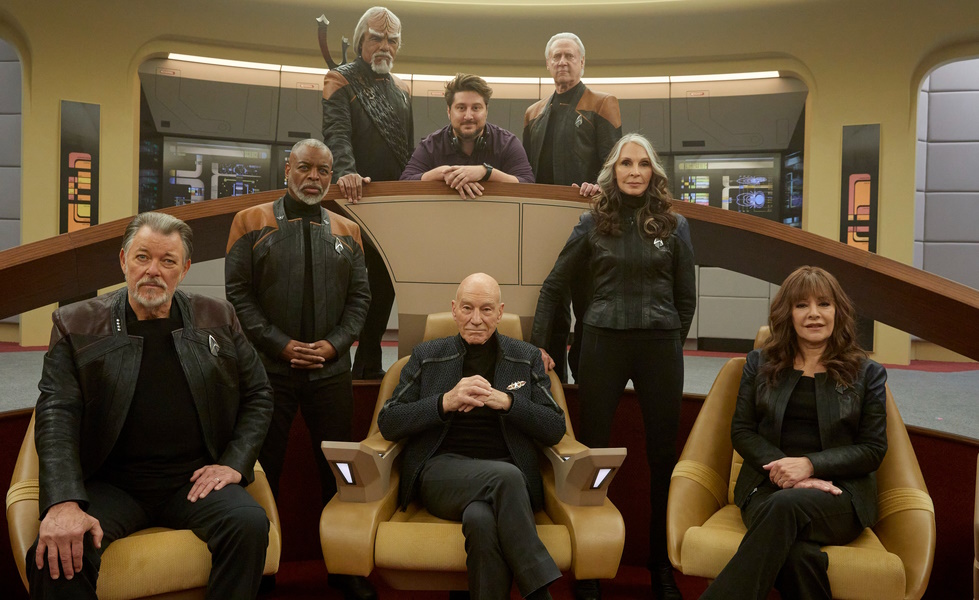
Showrunner/director Terry Matalas with the main cast.

And that’s in spite of The Last Generation being a deeply flawed outing from multiple angles. I’d go so far as to say that the episode doesn’t even feel like a finale or an ending… let alone a definitive one for a crew who should be ready to enter retirement. Think about where everyone ended up at the end of the story: Dr Crusher has been reinstated in Starfleet, Seven, Raffi, and Jack are about to head off on a new adventure, Riker and Troi appear ready to leave Nepenthe behind and find a new home, Data is just beginning to get used to his new body and newfound humanity, and the only characters who might be ready to return to their pre-Season 3 lives are Worf, Geordi, and Picard… though we didn’t see much of an indication of that in the episode itself.

And that’s before we get into the strange implications of the mid-credits scene.

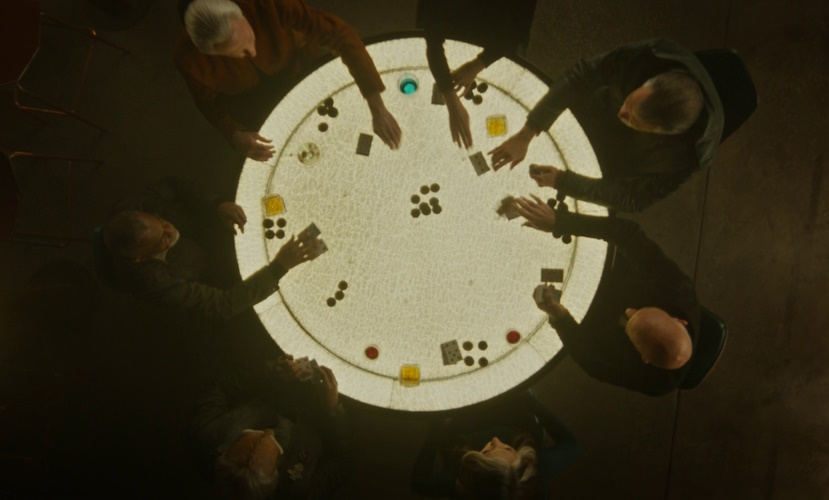
You did stick around for the mid-credits scene, right? After the credits roll over the lingering overhead shot of Picard and the crew playing poker – a callback to All Good Things at the end of The Next Generation – we got one final scene. Go back and watch it if you haven’t! I’ll wait here.

You stuck around after this, right?

I guess we’ll start with what The Last Generation got wrong, as well as talk about the decisions that led to the story reaching this particular ending.

This was a rushed episode, one in which the main villain of the entire season was outsmarted and defeated in a matter of minutes. There were gripping moments of explosive action and tense drama along the way – but practically all of them would’ve benefitted from a few extra minutes. I stand by what I said last week: the decision to change track from the changelings to the Borg came too late, and there wasn’t enough time remaining to have the kind of climactic final battle that the writers wanted.

If this exact pacing problem hadn’t also afflicted Seasons 1 and 2 of Picard, it would still be deeply disappointing to see it here. But given the criticisms that both of the previous seasons of this series received for precisely this issue… quite frankly it’s unforgivable. This isn’t strictly a problem with The Last Generation, but rather with the pacing and structuring of the season as a whole. If showrunner Terry Matalas is to be trusted with a spin-off – as he and some fans are pushing hard for at the moment – then lessons have to be learned. Matalas helmed Seasons 2 and 3 of Picard, and both seasons came to a close in a mad rush, without enough time to fully explain everything.

The Enterprise-D in action.

As the dust settles, it isn’t even clear whether Vadic and her rogue changelings actually knew who they were working with, or the extent of the damage done to the Borg Collective. That side of the story evaporated with Vadic’s death a couple of weeks ago, and was barely touched in the epilogue after the Borg’s defeat. For a story that supposedly brought together two of Star Trek’s most powerful villainous factions – the Founders and the Borg – to come to an end without any on-screen interaction between them… again, it’s very odd. Something is missing here.

Realistically, if both the rogue changelings and the Borg were to be included, we needed this revelation to have come earlier. There would still have been secrets to keep – such as the inclusion of the Enterprise-D – but had the Borg reveal come sooner, and been explained better, other story elements that came to a head in The Last Generation would have flowed better and more naturally.

Behind-the-scenes on The Last Generation.

The Last Generation relies heavily on a story from two decades ago that wasn’t explained and only got the most oblique of references earlier in the season. In the Voyager finale, a time-travelling Admiral Janeway infected the Borg Collective with a “neurolytic pathogen,” devastating it. It was this event that the Borg Queen said was the cause of the decrepit state of the Collective – but for such an important story point, this needed far more explanation than it received.

Although the latter part of Picard’s third season has the feel of a production that was “made for fans,” it isn’t just hard-core Trekkies who watch the show. I have friends who aren’t immersed in the world of Star Trek who have enjoyed Picard for the sci-fi series it is on its own merit – and I suspect that a lot of more casual viewers, those who either don’t recall or didn’t watch Voyager, would have been left baffled by the Borg Queen and the Collective in general being in such a state. That this presentation of a different Borg Queen is now the third distinct version of the character to appear in Picard just adds to the confusion.

The Borg Queen.

Again, this isn’t a problem with The Last Generation on its own, nor even just of Season 3. Picard’s showrunner and writers chose to bring the Borg into focus in each of the show’s three seasons, offering different and contradictory presentations of the Collective and its leader each time. Given that the changeling storyline had worked so well for the first three-quarters of this season… perhaps a different ending could have been written, one that kept the Borg out of things. Or, alternatively, given that Seasons 2 and 3 went into production together with the same team at the helm, Season 2 could’ve been changed if this Borg ending to the series had already been decided upon.

Though we can argue it’s fitting, in a way, for Picard to be present at what appears to be the final demise of the Borg, given that he was present when the faction was introduced and was assimilated by them, the way this story unfolded doesn’t actually have that much to do with Picard. The Borg’s defeat came at the hands of Janeway, who was mentioned by name several times but didn’t even make a cameo all season long. Picard himself was just sort of… there. As has been the case more or less all season long, Picard – the show’s title character and main protagonist, lest we forget – was swept along by a narrative current that was almost entirely out of his control.

Picard in the Borg Queen’s chamber.

Because the reveal of the Borg’s involvement came so late in the story – partway into the ninth episode of a ten-episode season – Jack’s “defection” to the Collective already felt like it was built on shaky ground. There was the kernel of a good idea here, but again I feel the pacing issue causing a stumbling block. Jack’s powers manifested slowly earlier in the season, and in fact it wasn’t until several episodes in that we saw any indication that he was anything other than human at all. His decision to run away last week was blitzed through in a matter of seconds, and his reconciliation in The Last Generation was likewise rushed.

Reaching out to someone and using “love” to bring them back from a dark place is a bit of a cliché, but it’s hardly the worst that Season 3 has offered up. The way it was handled worked well enough in the moment – though I would argue that Dr Crusher, rather than Picard, would surely have been better-placed to try to convince Jack to stand down. Although we’ve seen a developing relationship between Picard and his son, the events of Season 3 have taken place over a few days at most, meaning the connection between Jack and Dr Crusher is going to be far stronger.

Picard and Jack embrace inside the Borg Collective.

Given the remarkably similar premise between Jack’s story here at the end of Season 3 and Dr Jurati’s toward the end of Season 2, it’s a shame that she and her Borg faction couldn’t appear. In fact, the whole end of Season 2, with the mysterious, unexplained anomaly attacking the Federation, has now passed its last chance to get any kind of resolution. At this late stage I wasn’t expecting that to happen – but it’s again indicative of Picard as a whole being a deeply troubled and poorly-managed production. Lessons need to be learned going forward so that future Star Trek projects don’t suffer similar shortcomings.

As I said last week when discussing the Borg, Jack’s story would feel stronger – and certainly more original – were it not basically a re-hashing of Dr Jurati’s story from last season. Dr Jurati felt lonely, isolated, and without friends – and found those things in the Borg. Jack felt lonely, isolated, and without friends… and also sought out those things from the Borg. Jack’s defection feels weaker, in some respects, because of the way it was set up, and the fact that it’s no longer an original idea further diminishes it.

Jack was able to break free of the Borg Collective thanks to Picard.

Several characters displayed skills in The Last Generation that are either perfectly aligned with things we’ve seen them do in the past, or that felt like natural evolutions based on the story the season has told. Dr Crusher manning the Enterprise-D’s weapons is a case in point: after two decades away from Starfleet, operating outside of the Federation under dangerous conditions, she knows her way around a phaser bank and torpedo launcher!

But Deanna Troi exhibited a telepathic skill that we’ve never seen her use before, being able to pinpoint Riker’s location as if by magic. There were opportunities earlier in the season to set this up, such as the conversation Troi and Riker had while imprisoned aboard the Shrike. As it is, this newfound ability felt like a magical solution to a story that had rather written itself into a corner – a cheap way to allow the Enterprise-D to swoop in and save everyone at the last second.

Deanna Troi on the bridge.

Unlike some of the other points I’ve raised, this one isn’t even a question of timing or pacing. It would’ve required an extra handful of lines of dialogue in an earlier episode, explaining that Troi had been honing her abilities or that when she used her “pain removal” skill on Riker she’d done so at a distance. That small amount of setup would’ve allowed this moment to flow far more naturally, and wouldn’t have led to me rolling my eyes quite so much!

A clever and well-executed misdirect can add a lot to a story, particularly if the stakes are high. But even with that caveat, I have to say that the excessive “foreshadowing” of the deaths of Riker and Picard in particular fell very flat for me in The Last Generation. The episode dedicated an inordinate amount of time to setting up that the away team wouldn’t be returning from the sojourn to the Borg Cube… only for everyone to survive. Stripping some of this out would’ve still allowed The Last Generation to keep the tension high, but would’ve blunted the impression that it was deliberately deceitful. Not only that, taking a few of these scenes away would’ve opened up other possibilities, such as spending a bit more time with the Borg Queen.

There was a lot of foreshadowing that wasn’t paid off.

There’s nothing wrong with an episode feeling like a throwback to an earlier style of storytelling – especially in a story with such a strong nostalgic component. But even with that in mind, the fact that all of the main characters survived the story was a bit of a surprise. Television storytelling has changed a lot since The Next Generation premiered in 1987, and main characters should no longer consider themselves to be safe just because of their status. To the episode’s credit, it genuinely felt like Picard, Riker, and Worf were all in danger during their mission… but nothing substantial came of that, and we even got a deus ex machina rescue right at the end.

Killing off a legacy character was always going to be controversial, and I’m sure that if someone hadn’t survived, there’d have been criticism from some quarters. But a well-timed character death can feel right, conveying how high the stakes are, paying off a character arc, or making an heroic sacrifice. Star Trek has done all of these things before in different ways, and I feel it would have strengthened not only The Last Generation but Season 3 as a whole if a well-written end could’ve come for one of our main characters.

Jack and Picard were both saved at the last second.

Part of the reason for that is that, for all the buildup, The Last Generation doesn’t really feel like an ending. It feels more like All Good Things than The Undiscovered Country, with a new chapter for some or even all of these characters seemingly ready to be written. I’m all for leaving the door ajar, with possibilities on the table… but this season was supposed to be the “final” outing for this crew. Only Picard seems ready to enter retirement – and even that feels questionable as he reunited with Dr Crusher to escort Jack to his first ever Starfleet posting.

All Good Things was clearly part of the inspiration for the epilogue at the end of the episode, particularly the poker sequence. But All Good Things was written and produced at a time when the cast and crew knew that Generations was literally days away from entering production. It didn’t need to be a definitive end… because it was never meant to be. Season 3 as a whole, and The Last Generation in particular, was billed as the final voyage of this crew. And yet it ended in such a way as to suggest that practically everyone has at least one more adventure yet to come.

Riker, Picard, and La Forge on the Enterprise-D.

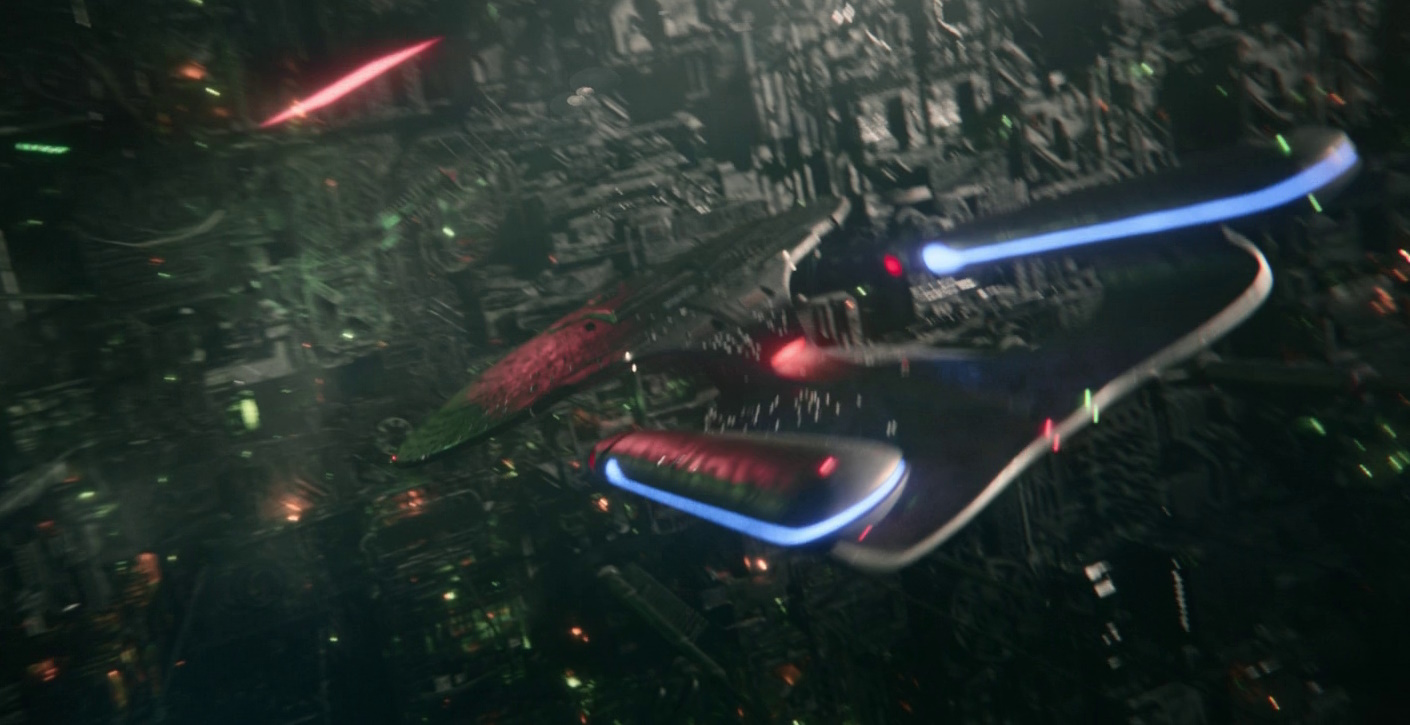
The final fight against the Borg Queen brought with it a lot of tropes. The Enterprise-D blasted its way along the surface of the Queen’s oversized vessel almost like an X-Wing running the Death Star trench in Star Wars, and though this sequence was visually exciting – and technically perfect from an animation point of view – it was again something that was rushed. The buildup to this sequence was blitzed through, thanks in part to the decision to spend so much time setting up character deaths that ultimately didn’t come.

Starships and the way they operate have always been vague; adaptable to different kinds of stories. Given the size discrepancy between the Enterprise-D and the Borg Queen’s mega-cube, I don’t think it’s any kind of “problem” to see the Enterprise-D move as quickly as it does and with such fluidity – and this sequence felt like an updated, modernised version of the starship’s clashes with Borg vessels in episodes like Q Who and The Best of Both Worlds.

The “Death Star trench run!”

I think my biggest eye-roll in The Last Generation came as the Enterprise-D swooped down for a last-second rescue, literally appearing in the “sky” above the Borg Queen’s chamber. Both in terms of narrative and visual presentation, this was just such an overdone trope. Across the sci-fi genre and into action, adventure, and more… we’ve seen this kind of ending so many times.

Part of the reason why this moment fell so flat for me was, I suspect, because The Last Generation hadn’t made good on any of its foreshadowed character deaths. The rescue of the survivors might’ve been more impactful had one or two of these characters lost their lives along the way. But a combination of the trope itself, its previously-unseen telepathic “magic” setup, and the fact that it rescued all of the main characters from a supposedly impossible situation… it all came together to feel like a clichéd ending.

The Enterprise-D saves the day!

I stand by what I said last time: the presentation of the Borg Queen feels quite diminished in light of what we saw in Season 2. The idea of a decrepit, weakened Borg Queen was an interesting one – but not one that The Last Generation found much time to explore. She leaned very heavily into the “I’m evil for the sake of it” villain trope, far more so than earlier presentations of the Borg Queen, who seemed to have an overarching goal in mind for the Collective. However, I can forgive that trope in light of the collapse of the Borg Collective; the idea that she’d use the last of her power to seek revenge on Starfleet makes sense.

As Jack was liberated from the Collective, and particularly as the Enterprise-D came racing in to save the day, though, the characterisation of the Borg Queen fell apart. Another huge part of why this sequence felt so clichéd was the Borg Queen’s screams of “noooo!” as her plan unravelled. This is the kind of thing that you expect to see from the supervillains of children’s comic books, or the bad guys in a Saturday morning cartoon, as their evil scheme is defeated. Again, this whole sequence was so much less interesting than it could’ve been.

“Nooooooo!” screams the defeated villain.

But now we have to contend with a question that I asked last week: does any of that matter? The clichés, the overused tropes, the basic, formulaic story, the cookie-cutter plot, the poor pacing, the underused yet also played-out villain… none of it really feels like it gets in the way of a fantastic, thoroughly enjoyable romp with Picard and the crew.

Even though The Last Generation absolutely fails to feel like an ending in any sense of the word for basically any of its characters, it’s still a more enjoyable send-off and final mission than the crew of the Enterprise-D got in Nemesis. If this is to be their final outing (and I wouldn’t bet against Paramount considering some kind of Picard TV movie or even theatrical release, given the strong reception to Season 3) then we can finally say that this crew went out on a high.

All safe and sound on the bridge.

And it’s a high because of the emotional storytelling that manages to play the nostalgia card in a way that works. This was another “made for fans” outing, one that leaned heavily into The Next Generation, Voyager, and really all of Star Trek’s past. If you’d told me at the start that the season finale would be like this, I’d have been sceptical – fearing that it would come across as a nostalgia overload. And frankly that’s what The Last Generation is: an episode that sacrifices narrative integrity for the sake of nostalgia.

Maybe it’s the blinkers of nostalgia speaking, as The Next Generation was my way into the Star Trek fandom more than thirty years ago, but I can’t hold that against Picard. It worked for me – and if that’s because I’m a basic bitch, blinded by nostalgia to the obvious flaws and gaping holes of a mediocre story… then so be it! I’ll be a basic bitch all day long.

The Enterprise-D arrives at Earth.

There’s more to storytelling than canon, consistency, and even logic. These things all matter, don’t get me wrong – but in a story like The Last Generation, it’s just that they matter far less than how the episode makes us feel. And for me at least, though I recognise with a critical (some might say cynical or jaded) eye that the episode and its narrative have flaws, almost the entire time I was on the edge of my seat, truly going through all of the emotions with Picard, Riker, and the rest of the crew as their mission unfolded.

As happened last week, that’s my real takeaway from The Last Generation. The fact that I was roped in, entertained, and went through a rollercoaster of emotions with Jean-Luc Picard and the crew more than makes up for any logical inconsistencies or narrative missteps that the episode made.

Picard toward the end of the episode.

The idea that Picard, Riker, Worf, or anyone else might actually be killed – as was extensively foreshadowed and hinted at – was gripping, and more than a little upsetting. Death felt like it was stalking the members of the away team – and those on the bridge of the Enterprise-D or trying to remain in control of the Titan scarcely felt much safer, either. This feeling persisted for much of the episode, and though the way in which it ended was ultimately a little unsatisfying because of everyone surviving, in another way that’s very “Star Trek.” Heroes like Captain Kirk famously didn’t believe in no-win scenarios – and Picard managed to pull off the impossible task of saving everyone.

Animation brought these stories to life in spectacular form – and thinking back to the finale of Picard’s first season just three years ago, it’s amazing how far Paramount and Star Trek have come. The fleets and ships seen in The Last Generation were beautiful and diverse, and seeing Spacedock as Earth’s last line of defence against a massive, imposing armada was a truly stunning sight.

Spacedock and the assimilated fleet.

Both the Titan and Enterprise-D were beautiful, too, and both ships performed incredible feats as they battled their foes. Seeing the Titan in action, taking on the entire assembled fleet, was spectacular to see – and it found another narrative justification for the cloaking device that Jack and Sidney “borrowed” a few episodes ago!

Seven and Raffi hadn’t had as much to do this season as I’d hoped – but the moments they got in The Last Generation showed both characters at their best. Part of the reason fans are so hyped up for a potential spin-off is to see more from Seven of Nine, and The Last Generation added to and rounded out her arc across all three seasons of Picard by placing her, once again, in the captain’s chair. This time, we got to see her people skills – being able to inspire and protect the motley crew of survivors on the bridge was pitch-perfect.

This was a good episode for Seven of Nine.

Again, my only real criticism of this part of the story is that I could’ve happily spent more time with Seven of Nine and the crew of the Titan! As Picard and his crew worked to stop the Borg Queen, Seven and hers provided essential covering fire – and the way that this came across was outstanding. Seven, Raffi, and their assembled survivors felt in danger practically the entire time, especially as the Titan’s cloak was destroyed and its assimilated youngsters made their way back to the bridge.

As unsold as I’ve been on Data’s resurrection this season, the character dynamic between Data and Geordi has been cute – and this trend continued in The Last Generation. Geordi sat beside Data on the bridge of the Enterprise-D – as he had in The Next Generation’s first season – and they had some fun and exciting moments together.

Data.

Likewise Riker and Worf! These two characters had a great relationship during The Next Generation era, serving together and often taking part in away missions. It was a treat to see them teamed up once again, and the dynamic they had aboard the Borg vessel added a lot of comedy to what was an otherwise serious story. Jonathan Frakes and Michael Dorn have great chemistry and comedic timing together, and the moments of lightheartedness through what was a dangerous mission really elevated the sequences aboard the Borg vessel.

Picard’s act of sacrifice required him to “jack in” to the Borg Collective – voluntarily assimilating himself. As the culmination of Picard’s arc with the Borg, this was a fascinating idea. Picard had already come to terms with aspects of his Borg experience in First Contact and in Seasons 1 and 2 of this series, so it wasn’t totally original or new – and that might’ve improved it, perhaps. But making this sacrificial move was clever, and fits right in with themes that the entire series has touched upon in different ways.

Picard jacks in.

I’m glad that Tuvok survived his ordeal with the changelings – though I would’ve liked to have seen how he and others may have been rescued. Again, this is something a longer season might’ve been able to include. But his scene with Seven, in which she was promoted to captain, was a very sweet part of the epilogue.

I’m not sure how I feel about the return of Q. As I said last year after Q had been “killed” in Season 2, bringing him back to life – especially with the kind of hand-wavey explanation of “don’t think in such linear terms” – undermines one of the few remaining narrative points propping up the entirety of Picard’s disappointing second season. For the sake of such a brief cameo… I wouldn’t have included Q here, I think.

Q is back.

One cameo that I adored was Walter Koenig – who sadly only appeared in audio form – as Anton Chekov, the son (or grandson) of Pavel Chekov. I jokingly said a few weeks ago in one of my theory updates that Chekov would be an unlikely inclusion this season… but it turns out I’m rather prophetic!

The name Anton was presumably chosen in memory of Anton Yelchin, who portrayed the character of Chekov in the Kelvin timeline films. This was a sweet way to memorialize him. Bringing Walter Koenig in for a cameo really brings together all of Star Trek. This finale began last week with a callback to Enterprise, Koenig represents The Original Series, and we have main characters from across The Next Generation era. It really was a celebration of all things Trek!

Data and Geordi listening to President Chekov.

There’s more to say – but we’ll have to return to The Last Generation and Season 3 on another occasion.

This review took me a long time to finish, having started it on the day the episode premiered. I had an original draft ready by last weekend, but I wasn’t happy with it so I ended up deleting and re-writing large parts of it. Keeping up with Picard this season has been a struggle, and I think I’m ready for a bit of a break from these reviews! Thankfully, the Star Trek franchise seems to be better-paced this year, and there’s a break before Strange New Worlds Season 2 arrives in June.

I enjoyed The Last Generation – in spite of its shortcomings. It was a great way to end the season, and it potentially sets up a spin-off set in this same time period, which is something I truly hope can happen.

So long, Captain Picard!

So we come to the end of Season 3… and of Star Trek: Picard. In the weeks and months ahead we’ll return to The Last Generation and to Season 3, perhaps taking a deeper look at some of the individual characters, narrative points, and themes – and dissecting them! But for now, I’m about ready to put this review to bed and move on to other topics!

I’ll round up my theory list sometime soon, too. But for now, I hope you enjoyed following along with my Picard reviews this season. Season 3 was an improvement on Season 2, without a doubt, and for the most part I had a good time with it.

Stick around, because the website isn’t going anywhere! There’s Strange New Worlds to come this summer, the video game Star Trek: Resurgence, and Discovery’s final season in early 2024. In between I’ll be re-watching older films and episodes, crafting theories, previewing upcoming projects, and talking about other franchises, too. Thanks for bearing with me while I was writing this review, and I hope to see you soon!

Star Trek: Picard Seasons 1-3 are available to stream now on Paramount+ in the United States and other countries and territories where the service is available, and on Amazon Prime Video in the UK and around the world. The Star Trek franchise – including Picard and all other properties discussed above – is the copyright of Paramount Global. This article contains the thoughts and opinions of one person only and is not intended to cause any offence.
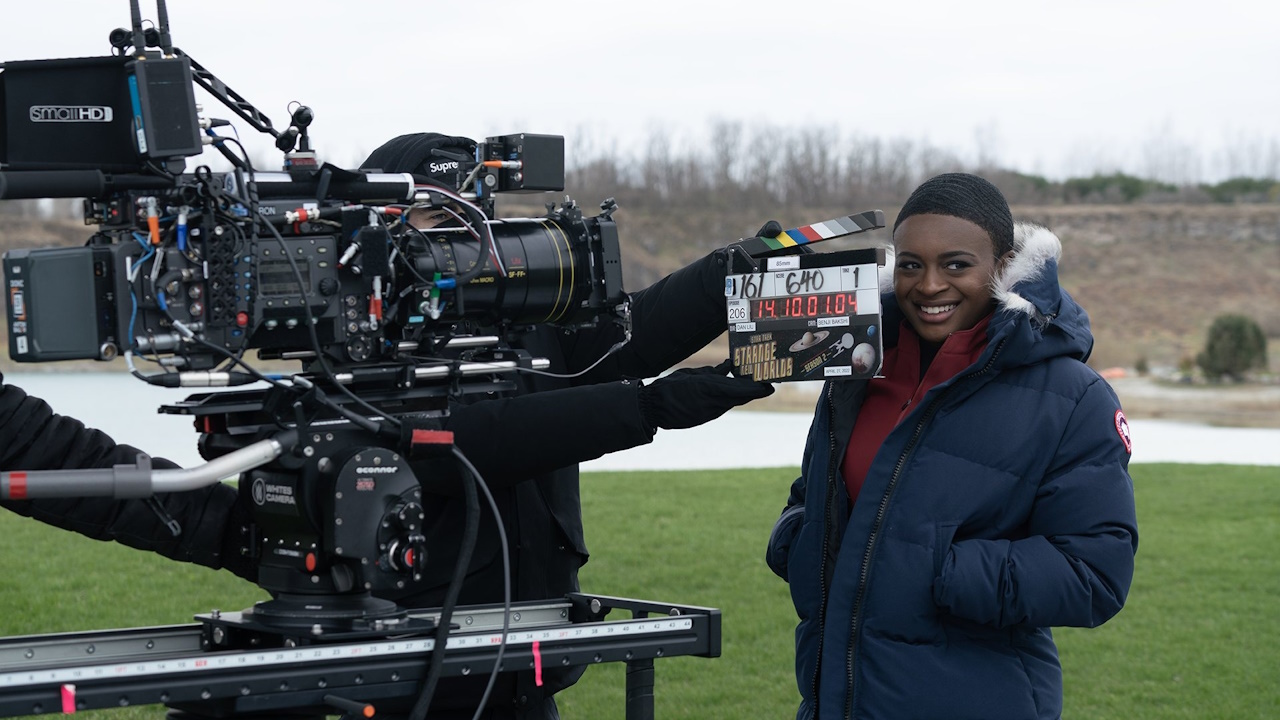
Ten great Star Trek starship designs

Spoiler Warning: There are spoilers ahead for Star Trek: Picard Season 1, Star Trek: Deep Space Nine, and for other iterations of the Star Trek franchise.

The Star Trek franchise has an aesthetic all its own, and a big part of that is the way starships are designed. Many Trekkies have said over the years that a ship is like an extra member of the cast; a vital part of any Star Trek series or film. While there have been some visual misses, of course, for the most part Star Trek’s ships have been fantastic to look at.

Aesthetics are always going to be a matter of personal taste, and there are many factors at play in considering what makes for a “good-looking” starship. Because the ships and most of their technologies are wholly fictional, designers and artists have a fair amount of leeway when it comes to designing a new starship. Technobabble can always be employed to explain away inconsistencies – like how the USS Defiant’s warp nacelles work, for example.

The USS Defiant.

Over more than half a century, Star Trek has featured many different designs of starship. Many of these, even the newest ones, take inspiration from the original USS Enterprise, which was designed by Matt Jeffries (with some input from others, including Gene Roddenberry) for The Cage in 1964. The basic saucer section, drive section, plus two nacelles on pylons style has been present in most Federation ships – and, in some form, all of the “hero” ships – ever since.

On this list I’m going to pull out ten of my favourite designs of both Federation and non-Federation starships. The list is by no means exhaustive, and it may be a topic I revisit in future as I can already think of several more I could have easily included! As indicated, this whole thing is entirely subjective. So without further ado, let’s jump into the list – which is in no particular order.

Number 1: The Klingon Bird-of-Prey

A Bird-of-Prey seen in Star Trek V: The Final Frontier.

The Bird-of-Prey is absolutely iconic as a Klingon vessel, at least on par with the D-7 battlecruiser from The Original Series. The vessel debuted in Star Trek III: The Search for Spock, before going on to appear in four more films, all of the 24th Century shows, and even recently in Lower Decks. Few non-Starfleet ships are as iconic or recognisable, and even many non-fans would easily identify the design.

In cinema, the Bird-of-Prey has had starring roles in five films, making it one of the most well-known enemy or villainous ships. Iconic adversaries like General Chang and Dr Soran used Klingon Birds-of-Prey in their nefarious schemes. But as Klingon-Federation relations improved in The Next Generation, we began to see the iconic vessel as an ally; a workhorse of the Klingon fleet. By the time of the Dominion War in Deep Space Nine we were rooting for the Klingon-Federation alliance, and some of the ships most often seen on the front lines were these wonderful Klingon ships.

Based loosely on the earlier Romulan Bird-of-Prey, the winged design captures the warrior philosophy of the Klingons perfectly. The small ship is incredibly powerful, armed to the teeth with disruptor cannons and photon torpedoes. The way the wings change position for combat or while at warp is clever, too, and the green colour scheme makes the craft stand out when compared to Federation ships.

Number 2: The Excelsior Class

The USS Enterprise-B.

Another starship that would be a workhorse for decades, the Excelsior is a really neat, futuristic design. It manages to look smarter and newer than the Constitution class that it would eventually replace, yet at the same time is clearly manufactured by the same organisation. It retains the saucer, drive section, and nacelles on pylons of older Federation ships, but switches up the design too. The ship is flatter, with a shorter “neck,” and has nacelle pylons that are shorter and have a ninety-degree bend instead of coming out of the drive section on a diagonal.

The Excelsior class also debuted in Star Trek III: The Search for Spock – the film succeeded at introducing us to two of the most iconic designs in the franchise! Though we’ve never seen a show or film set entirely aboard an Excelsior class starship, Excelsiors have been featured in five films and all three of the 24th Century shows.

By the 24th Century the Excelsior class was still in use, and while it had taken a back seat to the likes of the Galaxy class and other newer ships, many Excelsior class vessels were still in service in a variety of roles. Some would even see action in the Dominion War, meaning that the Excelsior class was still being deployed almost a century after its inception. That must be one solid ship!

Number 3: The Runabout

A Runabout seen in The Next Generation.

I adore the Runabouts that debuted in Deep Space Nine. They remind me of camper vans (or RVs) in terms of size and design, incorporating most of the mod-cons a 24th Century Starfleet officer might expect – just in a much more compact vessel. If I could pick any starship for myself (and the cats) to have for cruising around the galaxy, I’d definitely pick a Runabout.

When Deep Space Nine was being developed, there was a sense that setting a series on a static space station might be too far removed from Star Trek’s past, and thus there was a need to give Commander Sisko and the crew something to keep them mobile. From an in-universe perspective, too, the station needed to have some way for the crew to leave in an emergency – or just to make routine visits to nearby planets. Hence the Runabout was born – larger than a shuttlecraft but smaller than any starship we’d seen before.

These cute mini-starships each have their own name and registration, but from what’s shown on screen they seem to be assigned to bases and starships as auxiliary craft rather than being fully-independent vessels in their own right. Despite that, Runabouts are depicted as highly capable, versatile vessels. Early exploration missions into the Gamma Quadrant often utilised Runabouts based at DS9, and the ships were more than capable of surveying planets and charting star systems.

Number 4: The Constitution Class (original configuration)

The USS Enterprise from The Original Series.

The original Constitution class has to make any Trekkie’s list of great starship designs, right? Though it may feel dated in some respects, this is the source from which basically all of the other designs on this list were created. Federation starships are pretty much all designed with the Constitution in mind – the saucer, drive section, and nacelles design is emblematic of Starfleet, and thus of Star Trek. Even non-Federation ships are designed to stand in opposition to the Constitution (and the ships derived from it) so it’s undeniably the most significant and important starship design in the franchise.

The original design was simple, mid-60s futurism at its finest. The saucer is a design that had been synonymous with spaceships for decades thanks to myths of UFOs and flying saucers, so the decision to incorporate that kind of design was genius. The ship’s engines with their glowing tips became inseparable from warp speed and faster-than-light travel. And of course the deflector dish was reminiscent of satellite dishes – a new technology at the time.

Most importantly, this is where Star Trek began. The Constitution class USS Enterprise kicked off the franchise and became one of the most iconic sights in all of science fiction. Even today it’s instantly recognisable, even to folks who don’t watch Star Trek or know anything about the franchise.

Number 5: The Constitution Class (refit configuration)

An iconic moment in The Motion Picture.

As much as I love the original Constitution class, I think I like the refit even more. The refit Constitution class is the subject of one of my favourite sequences in all of Star Trek – where Admiral Kirk and Scotty approach the newly-refitted Enterprise when it’s still in drydock in The Motion Picture. That sequence is so beautiful (and with an amazing musical score to boot), showing off the starship in all its glory.

If the original configuration of the Constitution class had design features emblematic of its 1960s space race origins, the refit is much more “up-to-date,” replacing the satellite dish-style deflector with a glowing light, toning down the grey colour, and generally adding more lights and more features that make it an icon of the ’80s. In fact, I’d argue that many ’80s and ’80s-inspired sci-fi ships can trace some part of their design back to the refit Constitution class.

At the same time, though, the refit doesn’t completely abandon what made the original starship so iconic. The saucer section, drive section, nacelles, and pylons are all still present. The domed bridge is still there at the top of the ship, and even though a lot as been changed, it’s still clear that this is supposed to be an updated design, not a wholly new one.

Number 6: The Galor Class Warship

A Galor class ship under fire from a Maquis fighter in the premiere of Star Trek: Voyager.

The Cardassians – and their Galor class warships – debuted in The Wounded, a fourth-season episode of The Next Generation which, in many ways, began to lay the groundwork for Deep Space Nine. And it was in the latter show that the Galor class would be seen most often; a vehicle for the villainous Cardassians.

Its design is, in some respects, a blend of Starfleet and non-Federation ships. The semi-circular “mini saucer” that juts out at the front, as well as the deflector array it sits atop, kind of resemble Starfleet designs, but the wings and elongated “tail” – as well as the yellow colour scheme – make it clear that this is definitely not a Federation starship!

The Galor class would be seen as the mainstay of the Cardassian fleet, serving in combat roles before and during the Dominion War. Some engagements during the Dominion War would see dozens – perhaps hundreds – of Galor class vessels deployed alongside their Dominion and Breen allies, and they could look incredibly intimidating en masse. Seeing Galor class ships open fire on the Breen and Dominion indicated that the Cardassians had switched sides during the war’s closing hours, and that sequence is absolutely outstanding; one of the best space battles in the entire franchise.

Number 7: The USS Pasteur

The USS Pasteur.

Unlike the ships mentioned above, the USS Pasteur was only seen in one episode – All Good Things, the season finale of The Next Generation. Despite its limited screen time, however, I like the design. Its spherical “saucer” section is distinctive, and gives it a look all its own. The spherical design was based on an unused concept Matt Jeffries had for the original USS Enterprise during early development on The Original Series, which is a cool little fact!

As I’ve said before, I really like the concept of a hospital ship in Star Trek. I’d be quite happy to see a “Star Trek-meets-ER” series one day, and such a series would surely make use of a ship like the USS Pasteur. Modern navies have hospital ships, so it stands to reason that Starfleet would too, and the USS Pasteur was our first up-close look at such a support vessel.

A Pasteur-type ship was seen in Season 1 of Lower Decks (albeit in a flashback) so the design isn’t dead. Perhaps one day we’ll see more of these ships and get to know a little more about them. Regardless, I love the design.

Number 8: The Borg Cube

A Borg cube in orbit of Earth.

Few adversaries in Star Trek are as genuinely frightening as the Borg – for reasons that I discussed in my essay on the faction. An intimidating villain needs an intimidating starship, and the Borg cube delivers. There’s something frighteningly mechanical about a plain cube. There are no engines, no obvious bridge or command centre… everything about the vessel from all sides looks the same.

The Borg’s hive mind sees them operate as one entity, and their ships are part of that. The “philosophy” of the Borg – for want of a better term – is perfectly expressed in the design of their most commonly-seen starship. Every part of the ship is the same, just as every Borg drone is the same.

When we first see a Borg cube in Q Who, the sheer scale of the ship is impressive, too. The Borg vessel dwarfs the Enterprise-D, and then its powerful weapons and tractor beam overcome the Galaxy class ship’s defences with ease. Even though we’ve seen Borg cubes defeated in subsequent stories, remembering that a single vessel was able to destroy 39 Federation ships and almost succeed at assimilating Earth reminds us that these ships are incredibly powerful. Even by the time of First Contact, defeating a single Borg cube was a tall order for Starfleet.

Number 9: La Sirena

La Sirena in The Impossible Box.

Captained by Chris Rios and chartered by Admiral Picard, La Sirena made its debut in Star Trek: Picard Season 1. Everything I said about the Runabout feeling like a fun-sized ship could also apply to La Sirena, but the visual style makes it distinctive. La Sirena is basically a Runabout mixed with a hot rod!

The red and white colour scheme suits the ship perfectly, and there are even echoes of Star Wars’ Millennium Falcon in La Sirena’s design and concept. It’s the perfect vessel for Picard; small enough to be run by a skeleton crew (plus holograms!) but large enough not to feel cramped. It’s definitely not Starfleet, but there are Federation design elements present throughout.

Star Trek hasn’t really had many opportunities to showcase civilian starships, so La Sirena represents a look at a completely different side of the Star Trek galaxy, one we haven’t seen before. Though the franchise keeps these things deliberately vague, there must be a great deal of interstellar traffic, including transporting passengers and cargo. People like Captain Rios – and also others like Kassidy Yates – show us a glimpse of that world.

Number 10: The Sovereign Class

The first shot of the Enterprise-E in First Contact.

Perhaps it’s because Nemesis was the furthest forward the Star Trek timeline had got for almost twenty years, but to me the Soverign class has always seemed like one of Star Trek’s most modern and futuristic starships. The design represents a complete overhaul from the previous Galaxy class, flattening the “neck” of the ship again so the elongated saucer is almost contiguous with the drive section.

It’s a shame that the Sovereign class Enterprise-E only had the opportunity to make three appearances, as I would have dearly liked to see more of it in action. In some ways it has more of a militarised feel than the Galaxy, especially in terms of its interior, and perhaps we can say that’s a response to Starfleet taking on board threats from the Borg and Dominion during the design process.

The most iconic Sovereign class moment for me is the Enterprise-E’s arrival at the Battle of Sector 001. Swooping in to take on the Borg cube when the Starfleet armada was falling apart – accompanied by another beautiful piece of music – is one of the best moments in First Contact!

So that’s it! Ten great Star Trek starship designs.

Star Trek: Discovery’s new take on the Constitution class.

There were many other ships I could’ve picked for this list, so stay tuned for “part two” in future! The Star Trek franchise has some great starships, and by keeping a relatively consistent aesthetic – generally speaking – has carved out a niche within sci-fi. Star Trek’s starships are almost always distinctive, and seldom feel like they could easily be part of some other film or franchise.

Everybody has their own favourites, though! There are some starships that we see often, either because they’re a “hero” ship or because they’re a frequently-used secondary design, and some of these have become iconic and emblematic of the whole Star Trek franchise. Other ships only make a handful of appearances, yet still manage to leave a lasting impression.

The Star Trek franchise – including all properties mentioned above – is the copyright of Paramount Global. This article contains the thoughts and opinions of one person only and is not intended to cause any offence.
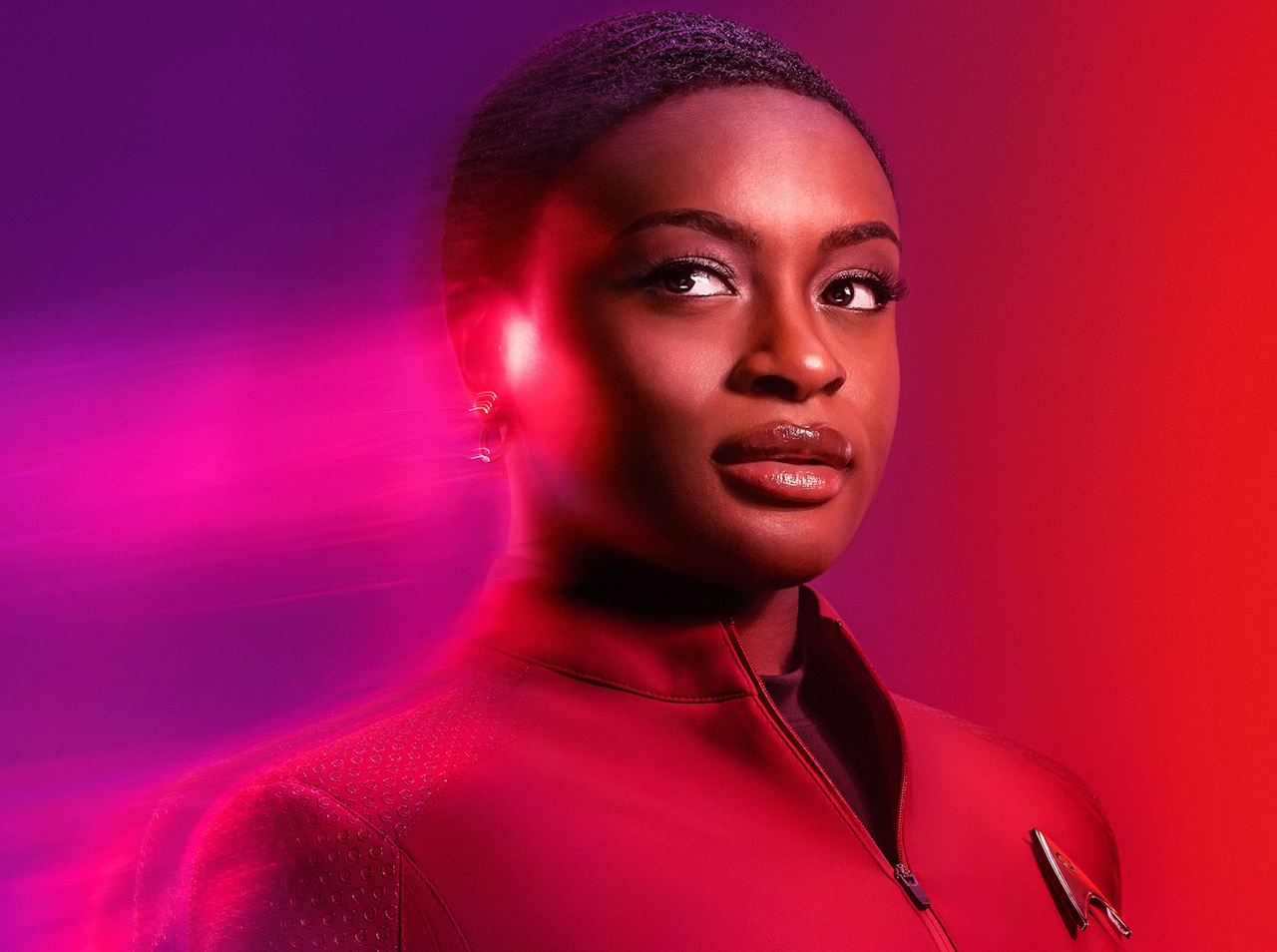
Preliminary Star Trek: Strange New Worlds Season 1 predictions

Spoiler Warning: There are spoilers ahead for Star Trek: Discovery Seasons 1-2, Short Treks Season 2, Star Trek: Picard, and other iterations of the franchise.

It’s been a while since we looked at Star Trek: Strange New Worlds, the upcoming Captain Pike series. But with production on Season 1 seemingly imminent – or perhaps having already begun, depending on what sources you use – I thought it would be fun to look ahead to what the first season of the show may hold.

At this stage, Strange New Worlds has only been commissioned for a single season. However, I would be absolutely stunned if we didn’t get an announcement preceding its Season 1 premiere that it had been renewed; this is the pattern ViacomCBS has had with both Discovery and Picard. I’m hoping, then, that Strange New Worlds will become an ongoing series, perhaps following Discovery’s path and running for four seasons, five, or even more. There’s certainly enough potential content for the show to get through, and while being a prequel is a constraint in some respects, that didn’t stop Discovery, Enterprise, and even the Kelvin films finding new and different stories to tell.

The USS Enterprise.

Just as I did for Discovery Season 4 and Picard Season 2 I’m going to make a few guesses – which I’m officially terming “preliminary predictions” – for Strange New Worlds Season 1. My usual caveat applies – I have no “inside sources,” nor am I claiming that anything listed below will definitely happen. These are guesses – educated guesses in some cases, perhaps, but guesses nevertheless.

Without further ado, let’s jump into the list!

Number 1: The uniforms will be redesigned.

Captain Pike’s gold uniform as seen in the Discovery Season 2 episode Brother.

With the exception of Star Trek: Voyager, every Star Trek series to date has introduced new variants of the Starfleet uniform for its crew. While we have seen Anson Mount and Ethan Peck sporting their Discovery uniforms in recent promotional spots for Paramount+, I’m not convinced that Strange New Worlds won’t at least tweak that design.

And perhaps that’s all it will be – a minor tweak or alteration of the uniforms worn by the Enterprise crew in Discovery. But we could see a more radical change, perhaps one designed to bridge the gap between Discovery-era uniforms and those seen in The Original Series. We could see, for example, the high collars scrapped in favour of the crew neck style seen in The Original Series.

Red uniform variant seen in the Short Treks episode Ask Not.

The uniforms worn by the Enterprise crew in Discovery were little more than recoloured versions of the Discovery uniforms, and if you look closely, you can see the detailing around the shoulder and down the sides. In my opinion, though these uniforms were preferable to Discovery’s all-blue look, they ended up looking like dyed Discovery uniforms rather than their own thing. This is something that could be addressed, even if only by making small changes to some of the detailing and stitching.

Regardless, I think that when we start to see promos for the new series, one thing we’ll notice is some kind of new uniform variant.

Number 2: Cadet Sidhu will be part of the Enterprise crew.

Cadet Sidhu.

The 2019 Short Treks episode Ask Not – whose writer, Kalinda Vazquez, is now writing a Star Trek film – brought back Captain Pike. But it also introduced us to a Starfleet cadet, and at the end of the action-packed, uplifting story, she was assigned to a role under Pike’s command aboard the Enterprise.

Almost any story could have been chosen to bring back Captain Pike for a mini-episode, but Ask Not spent most of its time setting up Cadet Sidhu’s character. She has a potentially interesting backstory, being the sole survivor of a Tholian attack, and as a young, talented cadet she could fill a fairly typical Star Trek role in the new series.

Captain Pike with Sidhu in the Enterprise’s engineering section.

We’ve seen the “young and eager” role filled by characters like Harry Kim, Sylvia Tilly, and even Wesley Crusher in past iterations of the franchise, and having someone like that presents a contrast with older, more experienced characters like Captain Pike and Number One. Cadet Sidhu also has a husband, who could potentially be a recurring character, and her background with the Tholians suggests she may not be quite as naïve and inexperienced as other cadets, potentially giving her more to say and do.

Of the main cast that we know of at this stage, all three roles are played by white American actors – Anson Mount as Pike, Ethan Peck as Spock, Rebecca Romijn as Number One. Every Star Trek show going back to The Original Series has proudly shown off a diverse cast, and bringing in someone of Indian heritage would be great. Amrit Kaur, who plays Sidhu, would be the first person of Indian heritage to be a main cast member in the history of the franchise, which would be groundbreaking in itself.

Number 3: There will be a non-Starfleet crewmate.

Cleveland Booker in Season 3 of Discovery.

One of the best things Discovery Season 3 did was introduce the character of Cleveland Booker. Book served as our guide to the 32nd Century in some ways, but also shook up the rigid hierarchy of the Starfleet crew by offering an outside perspective.

Several Star Trek shows have experimented with non-Starfleet characters in various roles, and aside from Book I’d point to Quark in Deep Space Nine and even, to some extent, Neelix in earlier seasons of Voyager as successful examples. I don’t expect Strange New Worlds to put together a Picard-style team where no one is a serving Starfleet officer, of course, but bringing in one major character who exists outside of the ship’s command structure would be potentially interesting.

Neelix in Star Trek: Voyager.

There are many ways this could be done, and many different roles such an individual could occupy. I’m thinking perhaps of a chef-type role, maybe someone who oversees the mess hall and is friendly with the crew. But there’s also potential to bring in an alien character who is perhaps aboard the ship as an observer or diplomat.

The possibilities are open-ended – as is almost everything with Strange New Worlds – but I certainly think that bringing at least one “outsider” into the crew can be a great storytelling device, one which could take the show to different thematic places.

Number 4: There will be a significant callback to Star Trek: Enterprise.

The NX-01 Enterprise.

Aside from a couple of Okudagrams and throwaway lines, modern Star Trek has essentially ignored Enterprise. The franchise’s first prequel currently feels disconnected from the rest of the franchise; cut off in the 22nd Century all by itself. There’s potential for Strange New Worlds to rectify this, and having a significant crossover with Enterprise would be something fun to see.

A few months ago I suggested that the Andorian Shran or main character T’Pol from Enterprise could still be alive and active in the era in which Strange New Worlds is set. Either character – or both – could thus cross over and appear in the new series. That would be a hugely significant moment, as it would firmly tie in Enterprise with the ongoing Star Trek franchise.

Sub-commander T’Pol.

Discovery could have done something similar to pay homage to Enterprise in either of its first two seasons, but with the show now set far in the future, any crossover potential has gone away. Strange New Worlds is currently the only 23rd Century series, and while the untitled Section 31 show or a future series may share the setting, that’s hardly a sure thing. So if the creative team at ViacomCBS want to bring up anything from Enterprise any time soon, this is by far the best place to do it.

If a main character crossover isn’t on the cards, there are still myriad other ways to acknowledge Enterprise in a major way. We could see Pike and the crew revisit a location first seen in Enterprise, or see the return of races like the Denobulans, Suliban, or Xindi, none of which have ever been mentioned outside of Enterprise.

Number 5: Ash Tyler will return.

Ash Tyler.

Of Discovery’s main cast from Seasons 1 and 2, only Ash Tyler didn’t travel into the future with Burnham and the rest of the crew. He remained in the 23rd Century, and at the end of the Season 2 finale we learned he would be appointed head of Section 31. It’s been assumed ever since (not only by me but by other fans and theory-crafters) that Tyler was intended to appear in the upcoming Section 31 series. However, as we recently learned, that show may be on hold for at least the next couple of years.

Ash Tyler’s story arc across Discovery’s first two seasons is arguably complete. He came to terms with what happened to him, his transition from Klingon to human and the two sides of his personality that created. He also went on a rollercoaster ride in terms of his relationship with Burnham. But there’s still a lot of potential in Tyler, and one thing in particular that leads me to believe that he could – in theory – have a role to play in Strange New Worlds.

Is this Ash’s brother? His cousin?

The character above is José Tyler, one of the original officers under Pike’s command in The Cage. Now I’m not expecting everyone we met in The Cage to be recast and appear in Strange New Worlds, but the possibility of a family connection between José and Ash seems like it could be fun to explore. Perhaps they’re brothers or cousins. If so, how would José react to the fact that Ash isn’t really Ash any more? That could be a huge source of conflict, and putting the two characters together to work through that might be a story worth telling.

Ash Tyler could also be part of a Section 31-related story, or even a story that sees the Enterprise picking up the last remaining pieces of the battle against Control. Ash shares a secret that only Pike and the Enterprise crew know – what really happened to the USS Discovery. As the head of Section 31, might he leverage that against Pike somehow to force him to take on a dangerous mission? There are, once again, almost an unlimited number of ways Ash Tyler could be used in the context of the new show. I doubt he’ll be a major starring character, but having him back for an episode or two seems a real possibility.

Number 6: The Enterprise will make first contact with a familiar race.

A Cardassian spy seen in The Next Generation.

One of the promises Strange New Worlds has made is that it will be a return to the kind of Star Trek that The Original Series, The Next Generation, and Voyager did so well, with stories focusing on exploration. Over the course of those series, the captains and their crews made numerous first contacts with alien races, and if Strange New Worlds is to make good on its premise, making at least one first contact seems inevitable.

If we look at Enterprise as the other major Star Trek prequel series, we saw first contact with established races like the Klingons, Romulans, and even the Ferengi – though Archer didn’t know who he was meeting in that last case. The point is, Enterprise went back and showed us how humanity first encountered many familiar Star Trek races – and this is something Strange New Worlds could do too.

Enterprise depicted Earth’s first contact with the Romulans, and several other familiar races.

I’ve written about this a number of times here on the website, but I adore Deep Space Nine, and particularly the Bajorans and Cardassians. We’ve never seen the Federation make first contact with either of them, and it could be very interesting to see how it went. The Cardassians would likely still be a militaristic state, but we know that the Bajorans prior to the Cardassian occupation were very different – operating a caste-based society that the Federation would surely disapprove of.

If not the Cardassians or Bajorans, there are many other Star Trek races which had already been contacted either by the time of The Original Series or The Next Generation that we could see Captain Pike and his crew meet for the very first time. Among them could be the Gorn, Tholians, or even a relatively obscure race like the Sheliak, who only appeared in a single episode. In my opinion, making first contact with an established race would tie Strange New Worlds in to the wider franchise, and that’s something that I firmly believe every Star Trek series needs to be doing.

Number 7: Spock will mention Michael Burnham at least once.
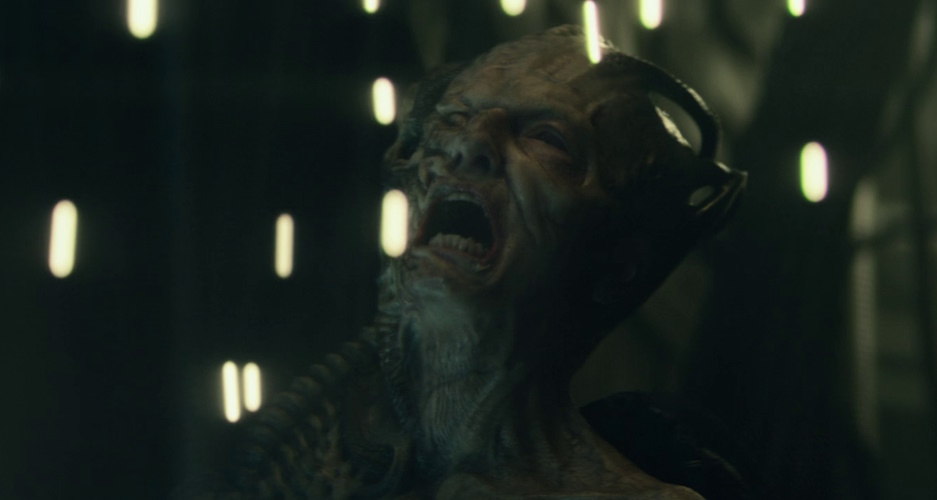
Burnham and Spock in the Discovery Season 2 episode Project Daedalus.

Season 2 of Discovery explored in some detail the relationship between Burnham and Spock. They were raised as siblings on Vulcan by Sarek and Amanda, and Burnham appears to have been quite influential in Spock’s life and in his development. At the end of Season 2, Spock stated his intent to travel to the future with Burnham, and while we know that was never going to happen because of his other appearances in the franchise, it indicates how close they were.

Burnham’s loss is akin to a bereavement. Although the final red burst confirmed that she safely made it to the 32nd Century, Spock will never see Burnham again (barring some other time travel story!) so she’s gone from his life. How will that affect him? While Spock may, on the surface, appear to simply brush off the events of Season 2, he went through a heck of a lot. The loss of Burnham may be the worst part, but being accused of murder, having his mind scrambled, travelling to Talos IV, and being hunted by Control will have all taken a toll.

Captain Pike and Spock watch Burnham and the USS Discovery disappear into the future.

Burnham had her “Spock episode” with Unification III midway through Discovery Season 3, so I wouldn’t be at all surprised if Strange New Worlds reciprocates somewhat and gives Spock his own “Burnham episode” – or at least a Burnham moment. Moving on completely as if everything he went through in Discovery Season 2 never happened wouldn’t sit right, so I’m sure there will be at least some reference or acknowledgement of Burnham from Spock.

It may not be a complete story, rather just a line or two of dialogue in which Spock mentions how much he misses Burnham. But I do expect to see some kind of reference or connection. Despite Spock being a long-established character within Star Trek, Strange New Worlds is a spin-off from Discovery, and this version of the character in particular is tied to Burnham very strongly. Making note of that would also be a reminder to the audience that Discovery is Strange New Worlds’ sister show – another of those little ties between ongoing parts of the franchise that I mentioned.

Number 8: Pike will have to deal with the knowledge of his impending accident and disability.

Captain Pike after his accident, as seen in The Original Series Season 1 episode The Menagerie.

Captain Pike not only saw his future at the Klingon monastery on Boreth, but he actively chose to accept his horrible fate in exchange for a time crystal. This happened toward the end of Season 2, and with the battle against Control to prepare for, he didn’t have much time to really stop and think about what that means. But Strange New Worlds will surely slow things down – at least some of the time – giving him pause for thought.

In the moment, Pike did what he needed to do and embraced his dark future. Will he regret that? Will he be worried at every turn, looking over his shoulder for the moment where his accident will occur? If so, who will help him snap out of it? It would be very easy for someone in his position to fall into depression – after all, what he’s going through is akin to being diagnosed with a terminal disease.

Pike sealed his fate in the Discovery Season 2 episode Through the Valley of Shadows.

We have seen Star Trek tackle this subject before, but only in the format of one-off episodes. Having a main character who is aware of his impending health collapse and disability could be something that’s absolutely worth exploring. In a way, I can relate to Captain Pike. Over the last decade or more I’ve seen my own health gradually decline, and while it isn’t quite the same thing (Pike’s accident takes him from full health to total disability in a heartbeat) I’ve been in the position of hearing a doctor tell me really awful news, knowing that there isn’t anything I can do to fix it.

Star Trek usually does things by analogy, so rather than Captain Pike being diagnosed with a real-world life-limiting condition, he’s seen a vision of his future disability in a time crystal. But the impact it could have on him from a psychological point of view is comparable, and this could, in my opinion, be a great way for Star Trek to explore the complexities surrounding incurable illness, long-term health conditions, disability, and even terminal illness. There are many, many ways such a story could go, and I’ll be fascinated to see what direction the show takes with this.

Number 9: There will be either a time-travel or parallel universe story.

Kirk’s captured Klingon Bird-of-Prey travelling through time in Star Trek IV: The Voyage Home.

Time travel has been a part of Star Trek going back to Season 1 of The Original Series, and we’ve seen a number of episodes take place in both the past and future. With Strange New Worlds sending Pike and the Enterprise off on a mission of exploration, they could easily encounter any of the temporal phenomena that we know exist out there in space.
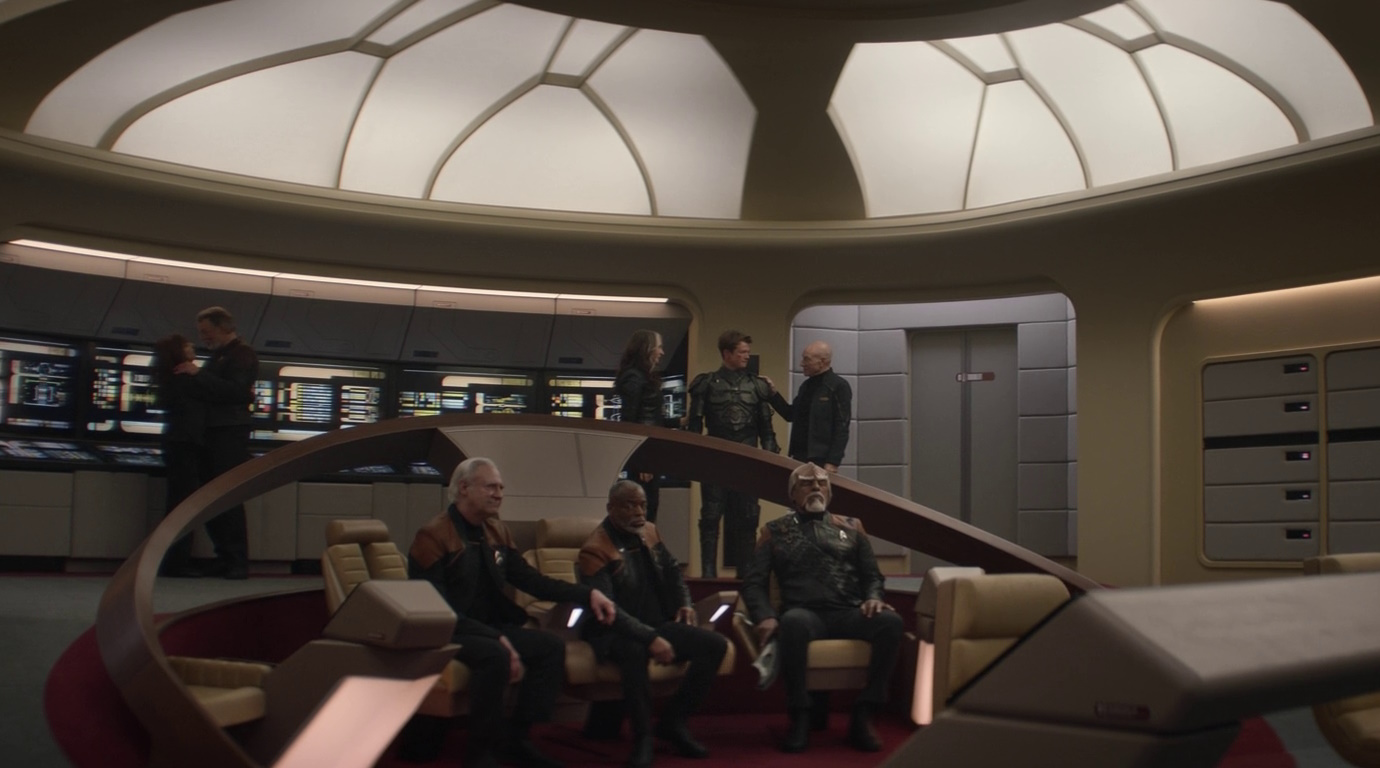
I’ve never been wild about time travel in Star Trek, and often the episodes in which it features aren’t my favourites. Using time travel to visit contemporary Earth inevitably dates a story, too – just look at Star Trek IV: The Voyage Home or the Voyager two-part episode Future’s End as examples of that! But just because time travel isn’t my personal favourite story element doesn’t mean it can’t work well, and I wouldn’t be surprised at all to see Strange New Worlds pursue a story of this nature.
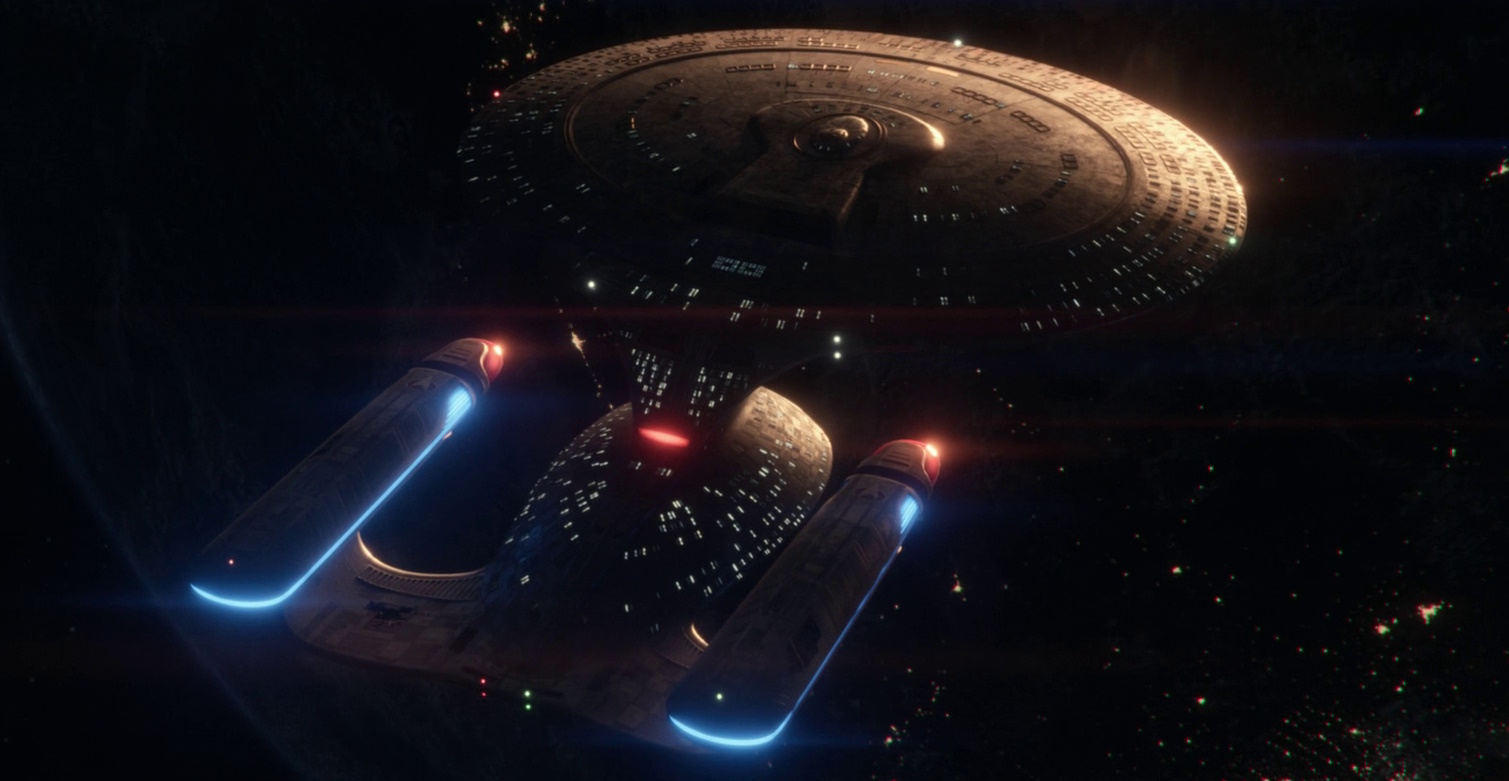
Voyager visited ’90s California in Future’s End.
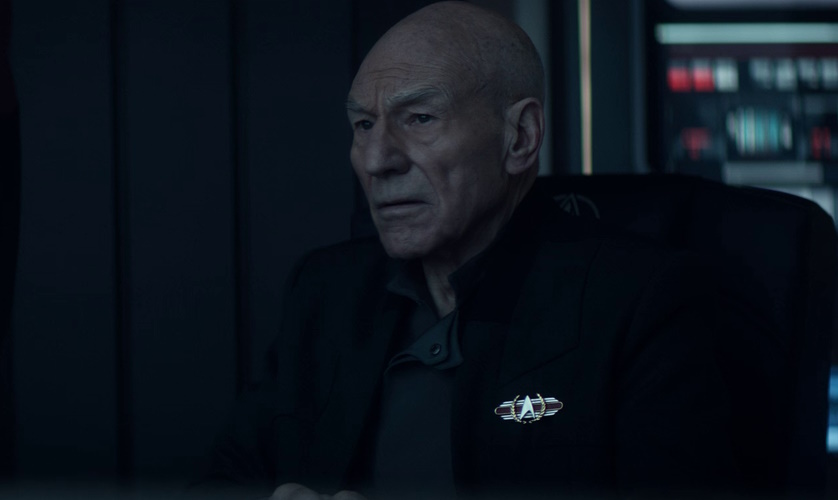
The main candidate when considering time travel has to be the aforementioned contemporary Earth, in this case, Earth circa 2021! But we’ve seen time travel stories set in the 1890s, the 1930s, and even a dark vision of the 2020s! It could also be fun to see the crew shot forward in time, and perhaps having to rely on the help of a time-travelling future Starfleet to get home.

Alternatively we could see a parallel universe story – though hopefully not the Mirror Universe! The Mirror Universe is potentially home to the prime version of Captain Lorca, and rescuing him could be an interesting story. But there are many other parallel universes – including the alternate reality where the Kelvin films are set. Could that set up a crossover with the alternate reality versions of Pike and Spock?

Number 10: The show will acknowledge current events.

The COVID-19 pandemic has been the biggest and most disruptive event in many years.

The big story of 2020 was, of course, the pandemic. But there are other significant ongoing events, such as the issue of race in the United States, that Strange New Worlds could try to tackle. Star Trek, despite what some people want to tell you, has always been a franchise with a keen interest in contemporary events. Going all the way back to The Original Series, Star Trek has used its sci-fi setting to look at real-world events, and I wonder to what extent Strange New Worlds will try to do that.

In a series that aims to be more episodic than other recent Star Trek projects, Strange New Worlds could certainly dedicate at least one episode to looking at a major current event. The pandemic is something we have yet to see appear in fiction in a big way. The issue of race, on the other hand, is something we’ve seen tackled many times in many different ways.

Star Trek has looked at the issue of race relations in the United States before, notably in the episode Let That Be Your Last Battlefield.

A story touching on issues raised by the pandemic could look at, for example, a planetary society suffering from disease, but where a significant number of people refuse to take precautions – something we’ve seen all across the world to varying degrees. Or it could look at the long-term impact of isolation through a character or set of characters who haven’t had any outside contact for a long time.

Any series that plans to look at aspects of the ongoing pandemic has to tread carefully, in my opinion, to avoid appearing to sensationalise current events or to be seen to be exploiting the situation. But as one of the biggest events of the 21st Century so far, the coronavirus pandemic will be explored in art and entertainment many times in the years ahead, and there’s no reason why Star Trek shouldn’t tackle it – provided it does so tactfully.

Number 11: The Klingons will make an appearance.

A Klingon general from Lower Decks.

Federation-Klingon relations went on a rollercoaster in the 23rd Century, to say the least! From ignoring one another to all-out war to a peace conference, the two factions did it all. One thing we have yet to see is the way in which the Klingons changed following the war depicted in Discovery – and no, I don’t mean the prosthetic makeup!

When L’Rell took power at the end of Discovery Season 1, she sued for peace with the Federation, after which Federation-Klingon relations appear to have thawed, at least a little. Yet within a decade or so, the Klingons were once again incredibly antagonistic toward the Federation, with conflicts and battles fought during this era.

Chancellor L’Rell in the Discovery Season 2 episode Point of Light.

Perhaps we could see something happen between the Klingons and Federation to set them on this antagonistic path. Captain Pike has built up some degree of goodwill with the Klingons, but seeing this evaporate would be a potentially interesting story. We could also welcome back Mary Chieffo as L’Rell in a story focusing on the Klingon Empire.

Just like we need to see Section 31 disappear and move underground, we also need to see the Klingons and Federation move apart. Another all-out war is not required, but seeing the situation deteriorate and even the cutting off of diplomatic relations would “reset” the Klingons closer to the way they were in The Original Series.

So that’s it. Ten Eleven preliminary predictions for Season 1 of Strange New Worlds. As I said when the series was first announced, 2022 seems like a reasonable guesstimate for when it’ll premiere, and that was backed up by the news we got a few weeks ago about which shows are in production and how far along they are. So while it’s definitely early to be considering what we might see from the new show, it’s not too early! Who knows, it could be this time next year that Strange New Worlds makes its debut!

Anson Mount has recently featured in the ad campaign for Paramount+.

I hope this was a bit of fun. And just to re-emphasise what I said at the beginning: I don’t have any “insider information,” this is just guesswork from a fan. Nothing more! So don’t get upset if none of what I suggested above ultimately comes to pass!

I’m really looking forward to Strange New Worlds. It seems to be offering more of a “classic” take on Star Trek when compared to recent projects, and I’m 100% there for that! The franchise has expanded, and there’s plenty of room for serialised drama and even animated comedy, but taking Star Trek back to its roots is definitely something I’m keen to see. That doesn’t mean every project should try to do the same thing, but it does mean that Strange New Worlds is close to the top of the list of shows that I’m most excited about!

If we get any major news, casting information, or a trailer be sure to check back as I’m sure I’ll have something to say. Other than that, all we can do is wait!

Star Trek: Strange New Worlds is coming to Paramount+ at some point in the future. International distribution has not yet been announced. The Star Trek franchise – including Strange New Worlds, Discovery, and all other properties mentioned above – is the copyright of ViacomCBS. This article contains the thoughts and opinions of one person only and is not intended to cause any offence.