inKonbini: One Store, Many Stories – Video Game Review

The first part of this review is free from story spoilers for inKonbini: One Store, Many Stories. The end of the spoiler-free section is clearly marked.

Have you ever played a game that you didn’t want to complete, not because you didn’t like it… but because you were enjoying it so much? That was my experience with inKonbini: One Store, Many Stories. The gameplay was so relaxing that it was almost soothing, the story was low-stakes but still relatable, there were some fun characters to meet and engage with, the setting and music were beautiful, and – to coin a phrase – the vibes were just immaculate.

This is, for me, a “Game of the Year” contender, without a doubt.

I was a huge fan of Shenmue and Shenmue II back in the Dreamcast days (click or tap here for more on that, if you’re interested!) and I find it really sweet that games like inKonbini are still drawing inspiration from that genre-redefining saga all these years later. Even the name of inKonbini’s development studio – Nagai Industries – is a reference to the similarly-named organisation in the first Shenmue, and Shenmue’s creator, Yu Suzuki, is thanked in the end credits.
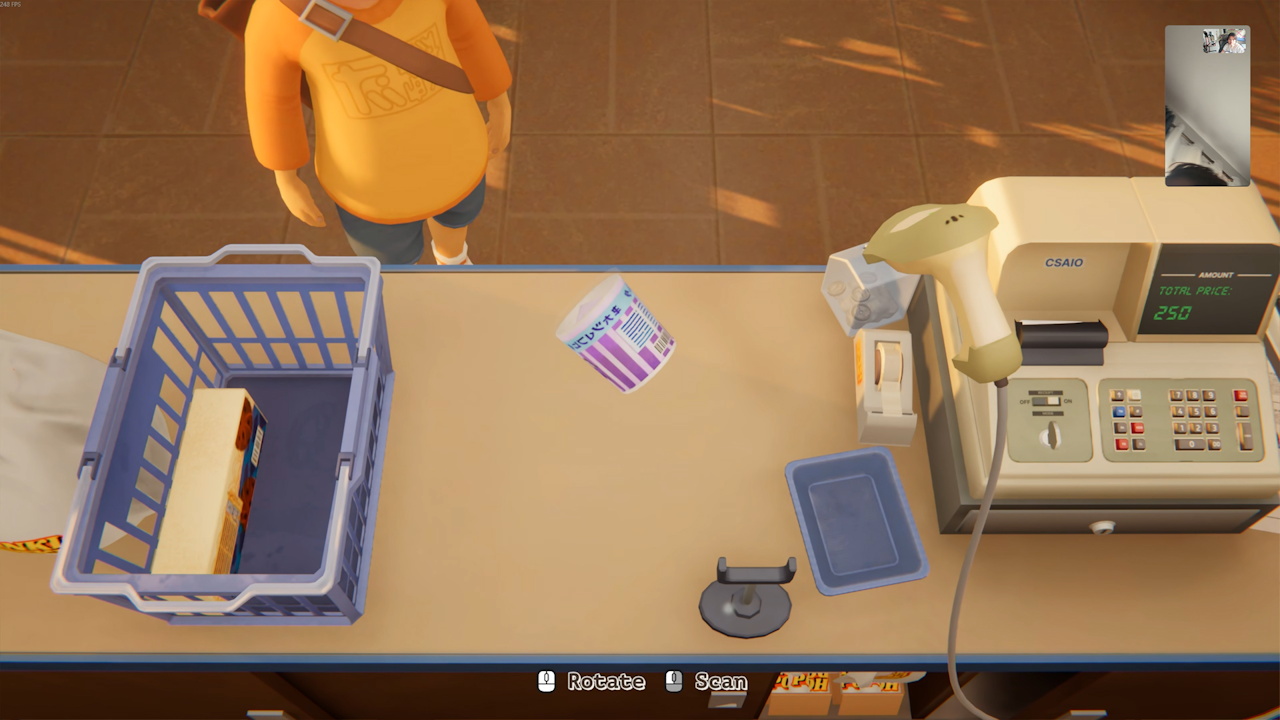
Promo screenshot for inKonbini showing the checkout
Checking out a customer’s items.

However, there is a little bit of a controversy surrounding inKonbini – and it’s one I didn’t notice at first. Long story short, if you don’t speak/read Japanese, you probably didn’t notice that many of the in-game items and products use characters *inspired by* Japanese hiragana, katakana, and kanji… but which aren’t *real* Japanese text. As someone who doesn’t know Japanese, I didn’t notice this at first, but when it was pointed out by someone elsewhere online… I found that I couldn’t *not* notice it, if that makes sense.

And… well, I don’t know why this happened. Perhaps it’s simply the case that the developers – who seem to be based in Japan, but none of whom have Japanese names – may not be fluent Japanese speakers? Or maybe visual artists hired to work on the game (Nagai Industries seems to employ several remote workers) weren’t familiar with the Japanese language well enough to use it convincingly, so the decision was taken to use “fake Japanese characters” that look good enough to a casual western eye? The developers have sworn, on the record, that no generative A.I. was used in the making of inKonbini… which isn’t something I’m personally bothered about either way, but I know that matters a lot to some folks.
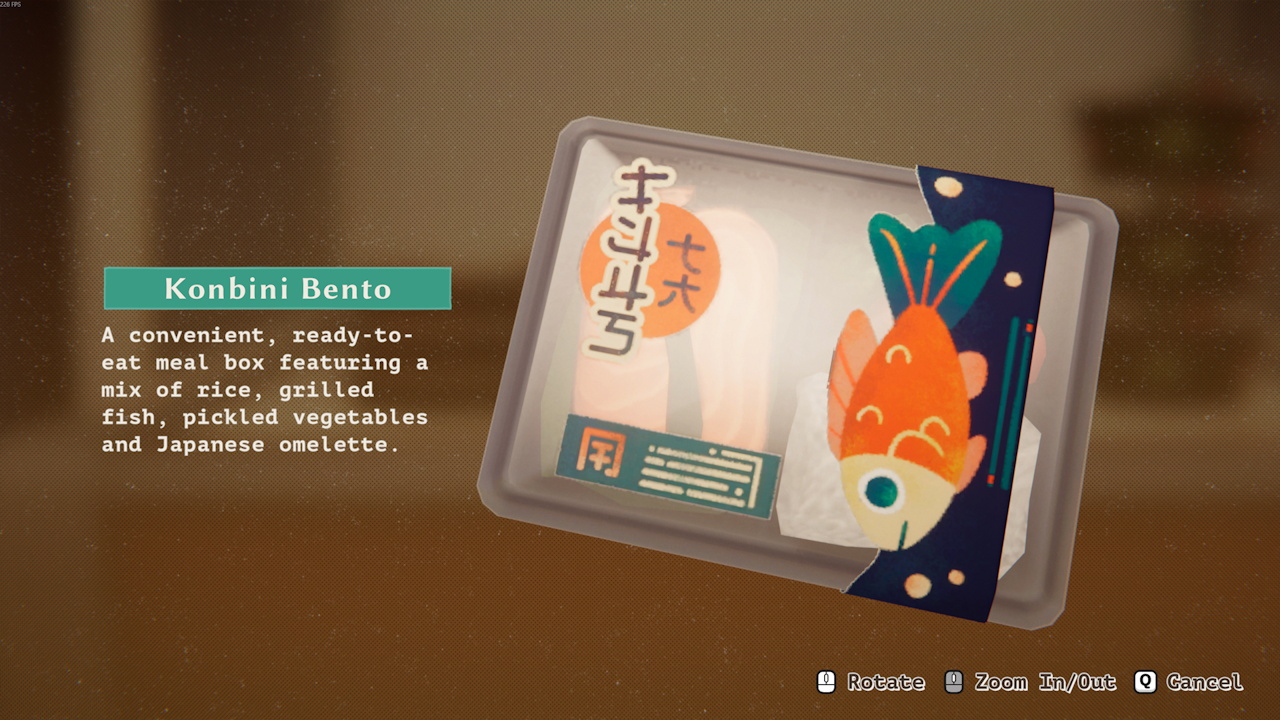
Promo screenshot for inKonbini showing a product
Much of the in-game text on items like this is “pseudo-Japanese,” not real Japanese.

However… it strikes me as odd, at the very least, that a game explicitly set in Japan, with Japanese people who have Japanese names, would have all of these art assets, products, in-game images, and more… that all use fake, nonsense characters that might look superficially “Japanese” to a non-speaker, but aren’t.

I don’t know if that kind of thing matters to you, but for me… I think there’s something to be said for authenticity. And as I said a moment ago, I don’t really know *why* a developer would choose to do something like this when the products in the shop are such a large part of the game. You can make the case for artists choosing a deliberate style, or that these designs evoke a kind of ’90s Japanese aesthetic without needing to be actual, intelligible Japanese. And that’s fine, it’s fair enough. But it is, if nothing else, strange to me that a game so heavily influenced by Japan, developed by at least some folks who live and work in Japan, wouldn’t use real Japanese text for its in-game images and models. Nagai Industries hasn’t explained this, as far as I can find out – all they’ve done is deny that they used A.I. tools to generate any of the imagery used in-game.

Alright, we’ll set that aside for now. I think it’s more of a mystery than anything outright negative, and unless you’re fluent in Japanese, chances are it isn’t something you’d notice on a standard playthrough. But I think it’s worth being aware of, at any rate.
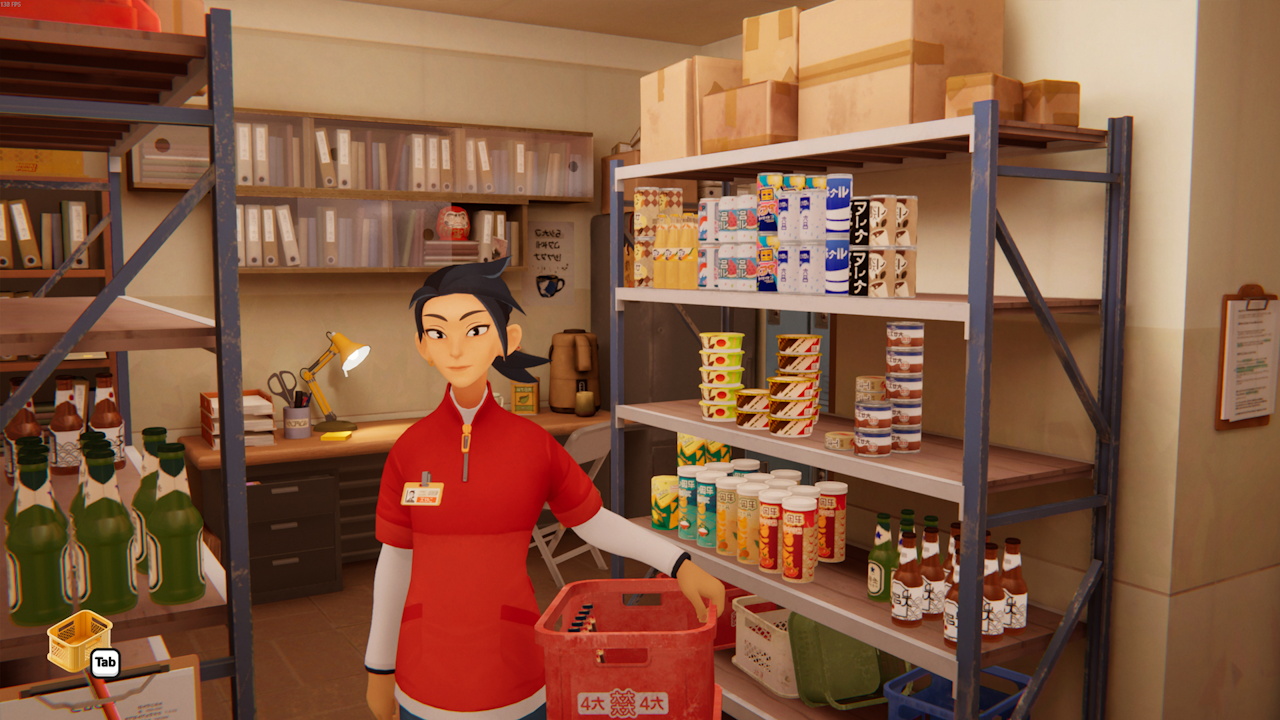
Promo screenshot for inKonbini showing Makoto
Makoto, the game’s protagonist.

inKonbini is a slow-paced game without massive, earth-shattering stakes. There are no boss battles – actually, there’s no combat of any kind – and you’ll spend your time in-game performing a variety of small tasks around a Japanese convenience store and interacting with the customers. However, inKonbini is not open-ended; there’s a distinct story that you’ll follow over the course of five in-game shifts. The tasks are different on each shift, as are the customers you’ll encounter, and I found there was a really cozy, relaxed vibe to the game – or at least there was about 95% of the time!

My playthrough took about six hours, which I spread out over several sessions because I really didn’t want to rush it! For that length, I felt inKonbini was more than fair with its price point, and I certainly got plenty of enjoyment out of the game the whole way through. Some moments, as we’ll get into if you stick with me to the spoiler-filled section below, were genuinely emotional, and the game’s characters almost all have a philosophical side that’s designed to make you think.
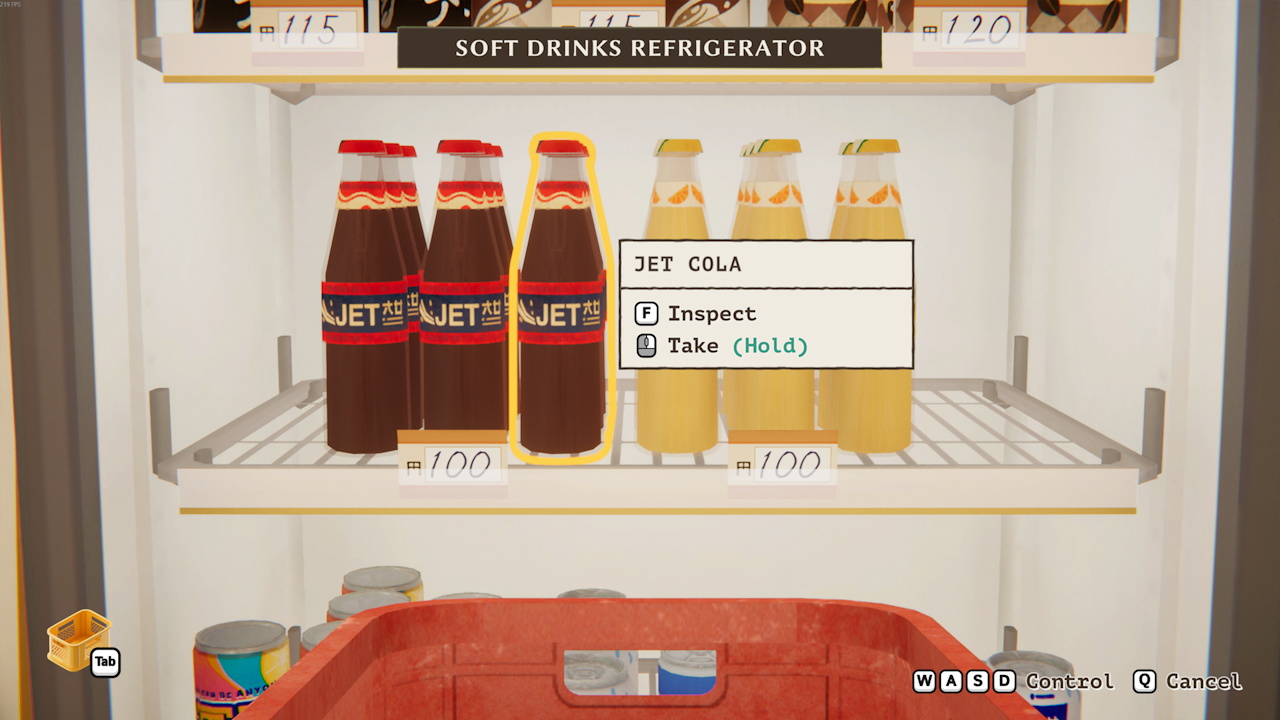
Promo screenshot for inKonbini showing bottles of cola
Bottles in a refrigerator.

I can be quite forgiving when it comes to minor issues and bugs in indie games; I want to see them succeed! But I’m pleased to report that inKonbini ran well on my self-built PC, and didn’t have any noticeable graphical or gameplay issues at all. I even got the game running in native 4K – which my PC can struggle with, sometimes, in other titles – without any problems whatsoever. It’s a smaller game, sure, and it isn’t one that’s designed to punish high-end hardware with hyper-realistic graphics! But a game that runs well is not a guarantee in 2026, so I think it’s worth celebrating that inKonbini’s performance was great from the start.

Although I really adored my time with inKonbini, it’s a game I’m reluctant to recommend to a general audience; I think you have to be specifically interested in slower-paced, casual, narrative adventures that verge on “walking simulator” types of games. If you want to have a surprisingly philosophical chat with some of the store’s customers, and if arranging digital products on virtual shelves sounds like fun, or if you like atmospheric, cozy games? inKonbini is an easy recommendation. However, if you’re an online multiplayer gamer, a souls-like “git gud” type of player, or you just need something a bit faster-paced, perhaps it won’t be right for you.

A recommendation, then – but for a specific type of player! If you stick with me to the next part of the review, we’ll get into a couple of the characters and story beats in a bit more depth.

A Shenmue-themed spoiler warning.

This is the end of the spoiler-free portion of the review. There are spoilers for inKonbini: One Store, Many Stories from here on out.

My first job – when I was younger than inKonbini’s protagonist, Makoto – was in a small shop. And I worked in several others after that, too. It surprised me just how familiar that side of inKonbini felt to me, even some twenty-plus years after I last set foot in a place like that as an employee! In those days, most things were still pen-and-paper, at least here in the UK, and I have vivid recollections of things like filling out inventory sheets, stamping and signing delivery invoices, and manually walking the aisles to check if a product was in stock, in the right place, and so on. I hadn’t thought about those jobs or those memories in *decades*, but inKonbini brought them back!

This is the second game I’ve played in the last few months with a ’90s setting… and it’s the second time I’ve been hit with that bittersweet wave of nostalgia. The first was Mixtape – another excellent title which, if you enjoyed inKonbini, you may also like – so I guess the second half of 2026 has been a bit of a nostalgia kick for this old gamer, eh? Between those memories of working those jobs and all of the imagery and subtle nods to Shenmue, inKonbini turned out to be a surprisingly emotional experience… and that’s before we even get into the characters and story.
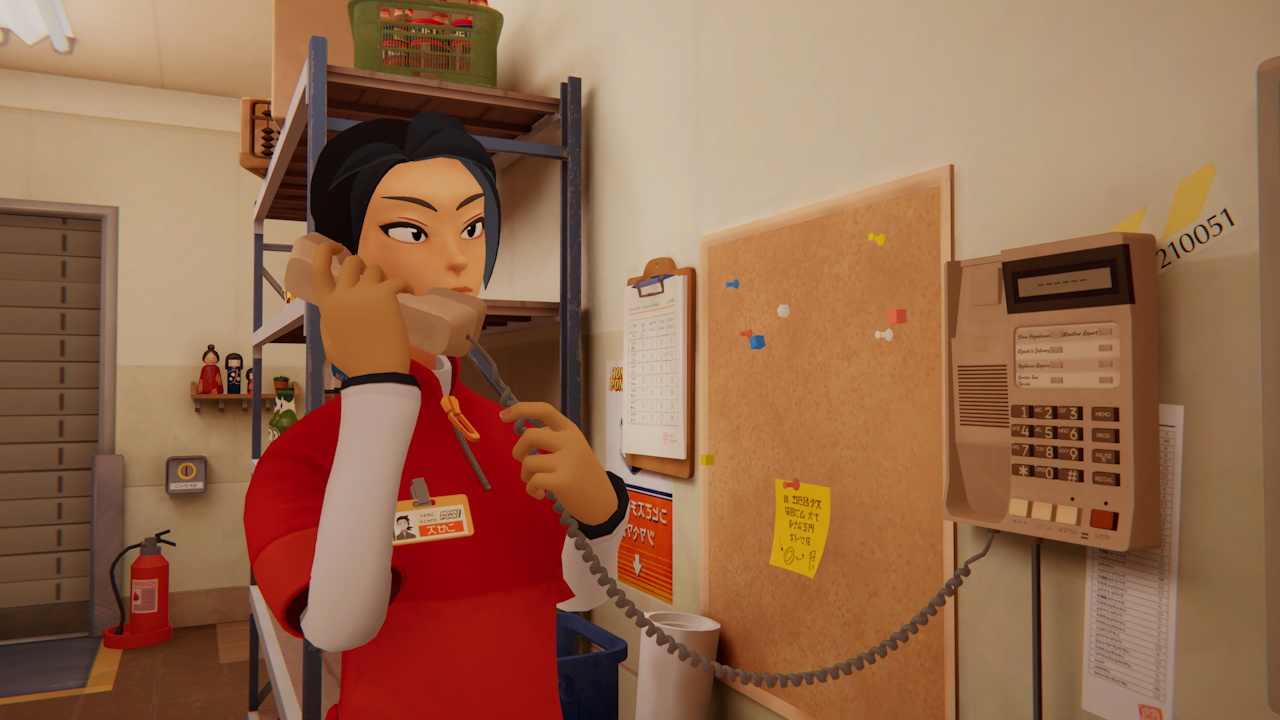
Screenshot from inKonbini: One Store, Many Stories showing Matoko on the phone
Talking on the phone.

Those retail jobs I had… they were never much fun. I actually got harassed coming home on the train one evening, as a drunk man smashed a train window and then got in my face as I was just trying to make my way home from the station! What I’m saying is… working those kinds of jobs is rarely the fun, laid-back, cozy experience that inKonbini offers. But I think that’s part of why the game is so enjoyable – it’s almost cathartic, all these years later, to see a fictionalised take on that kind of role that feels real enough to be believable… but without any of the drawbacks, like boredom and rude customers!

Even inconveniences that Makoto experiences – like a leaky roof, a missing product, or a broken appliance – become fun little distractions or mini-games to take part in. And when a customer is looking for help, choosing the right product at the right moment for them turned out to be a lot of fun. I actually found myself getting a little bit anxious, a couple of times – like I used to do when I worked those jobs, only to a much lesser extent! – as Makoto raced to find a missing item, set up a display, or get the shop ready in time for the evening’s first arrival.
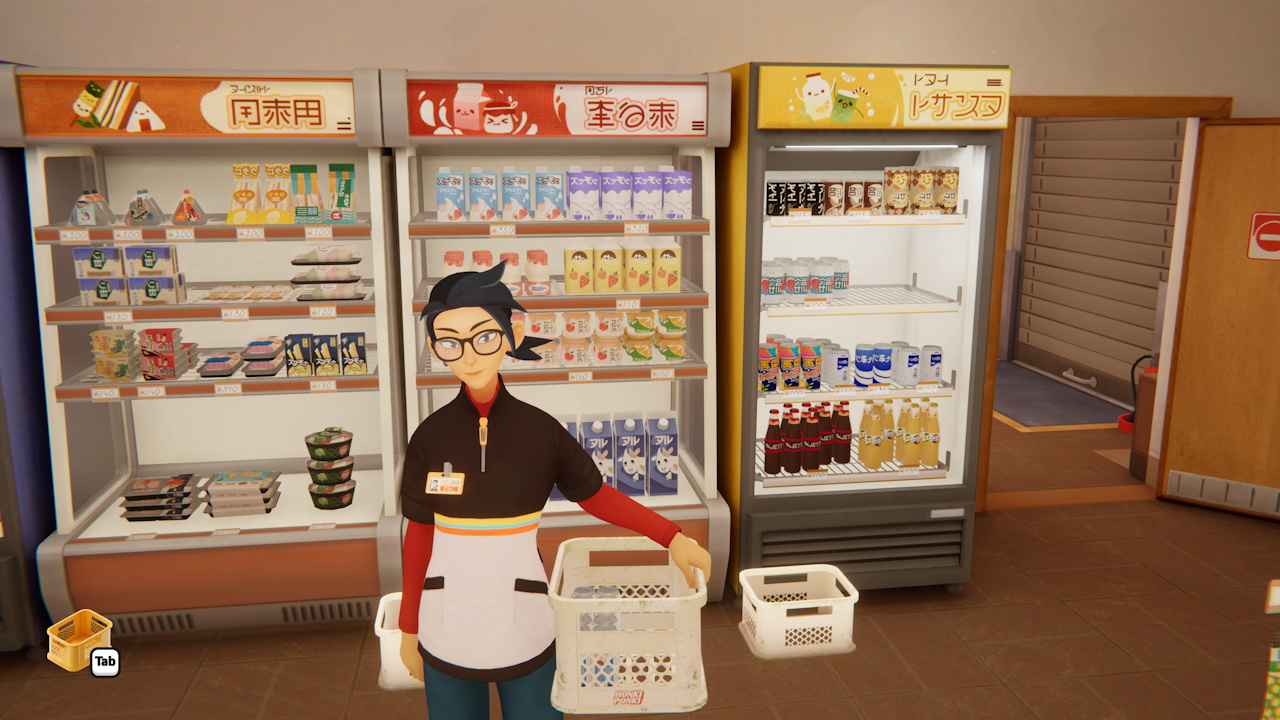
Screenshot from inKonbini: One Store, Many Stories showing Matoko holding a box
Makoto is hard at work!

The decision to set the game entirely on the night shift works in inKonbini’s favour, and goes a long way to making it feel cozy and atmospheric. There’s a peacefulness to those overnight hours; genuine quiet while much of the world sleeps. I’m a bit of a night owl myself, and I used to enjoy doing things like overnight shopping (back in the pre-Covid days when supermarkets would be open 24 hours) just for the peace and quiet! A sleeping town (or rural area) has a totally different feel than it does in the daytime hours, and inKonbini perfectly captures that.

Again, that’s part of the whole “cozy” vibe that the game has going for it; Makoto is part of a bigger world that exists just outside the shop’s door, but that world is sound asleep, save for a few people here and there. I’m sure most of us have pulled an all-nighter at some point – I’d challenge you to play inKonbini and not feel at least *some* of that reflected in the game’s world.
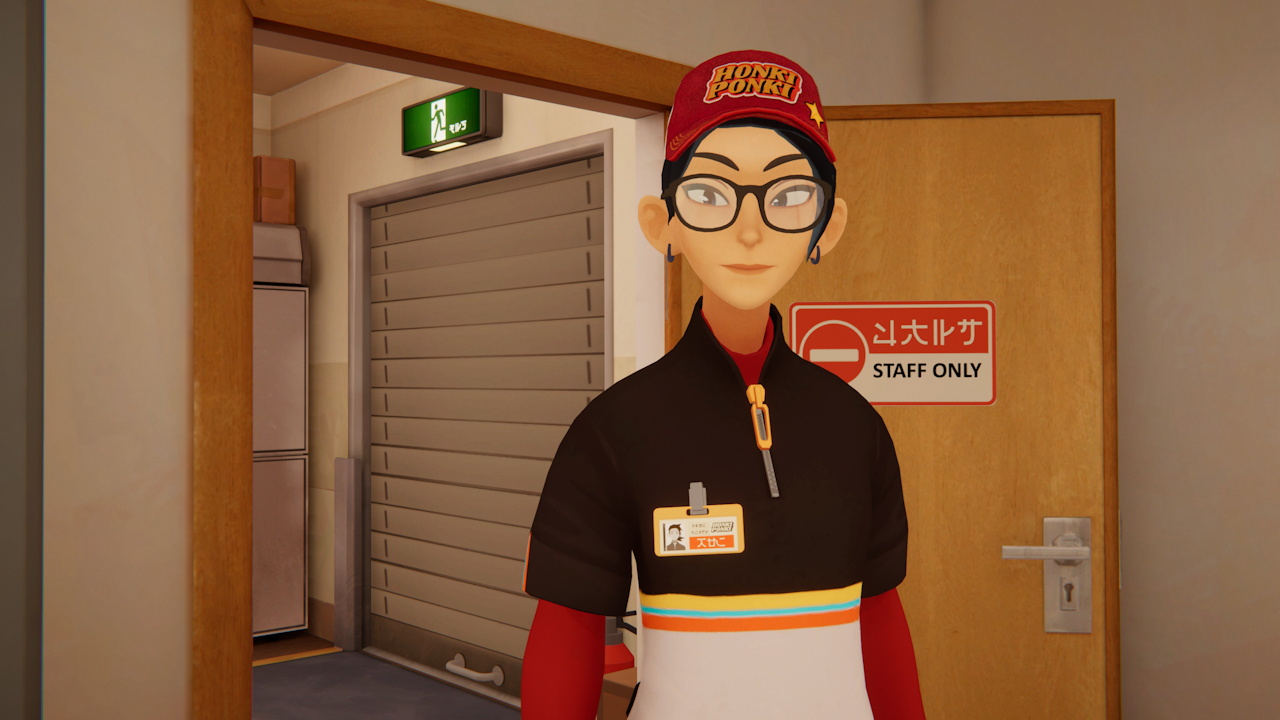
Screenshot from inKonbini: One Store, Many Stories showing Makoto wearing a hat
Working the night shift feels surprisingly cozy.

Lots of different games can be cozy or comforting – and what’s cozy to one player may not be to another. Speaking for myself, this kind of gameplay – which I guess you could describe as being kind of “job simulator-adjacent” in some respects – really nails that calming, cozy feel. Again, to use a Shenmue analogy: this is akin to the forklift-driving part of the game. Some people might find putting items on shelves or organising a shop display dull or repetitive, which are criticisms some players *definitely* had of those parts of Shenmue! But if it’s your kinda thing… I think you’ll enjoy this aspect of inKonbini just as much as I did.

On that note, gameplay and setting come together really well, each bringing a piece of that coziness to the table. The setting and the atmosphere it creates – both inside the store and, by implication and inference, the world outside its walls – form the perfect backdrop for this kind of slower-paced gameplay, moving items around, setting up little displays, running through a checklist, and so on. The gameplay and setting compliment one another really well, and it takes a combination of both to really get to that cozy feeling that inKonbini gave me.
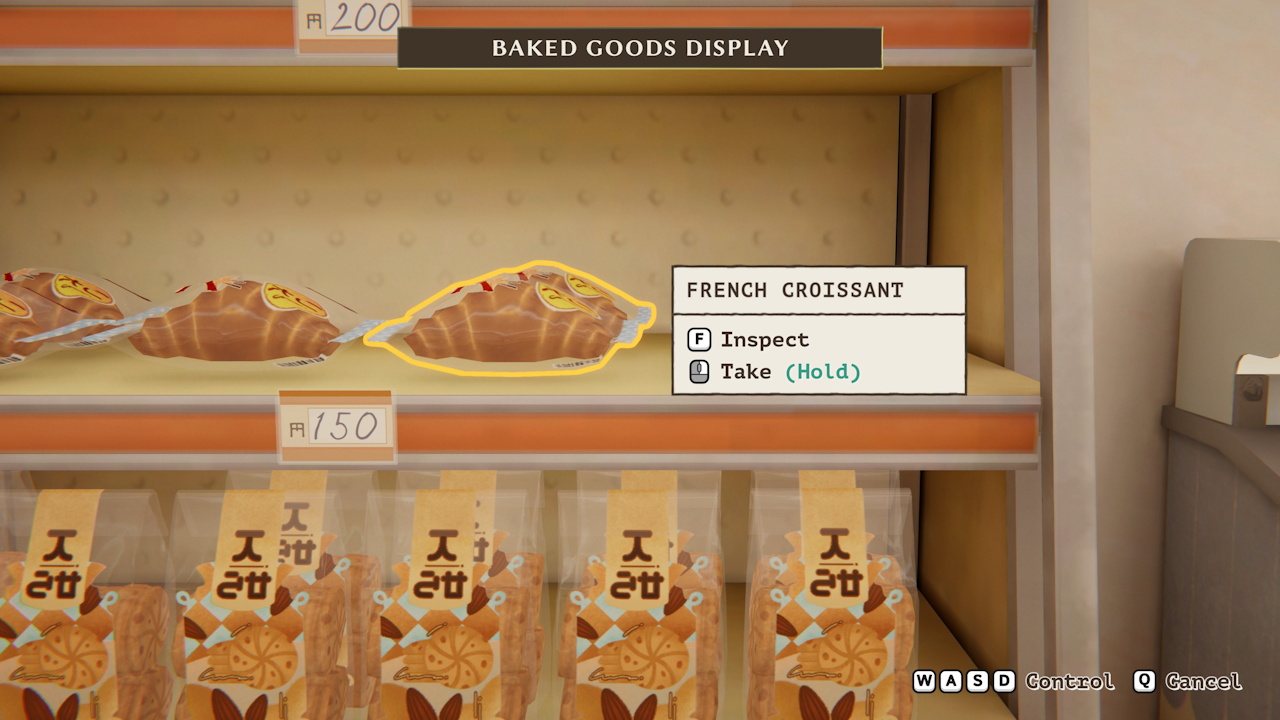
Screenshot from inKonbini: One Store, Many Stories showing a croissant
Restocking a shelf.

Some folks might want to see an open-ended game like this; for inKonbini to be the kind of game you can just play for a long time, with shift after shift of stacking shelves and checking out customers. But for me, I think that would misunderstand the kind of story that inKonbini aims to tell – not to mention make the few shifts you get to experience feel less important and special. While, in pure gameplay terms, I could see why some folks might want to take inKonbini and open it up… I think I like the game the way it is.

Makoto’s story is one that I think a lot of folks can relate to. Coming back to one’s home town – while in the middle of that first great adventure younger people look for after moving out – can be a bit anticlimactic. But the game wants to point out the value in hometowns, small communities, and the connections made between people. The four characters Makoto meets on the night shift all embody different parts of this in different ways – and all of them manage to feel like fun, well-rounded characters in their own rights, too.
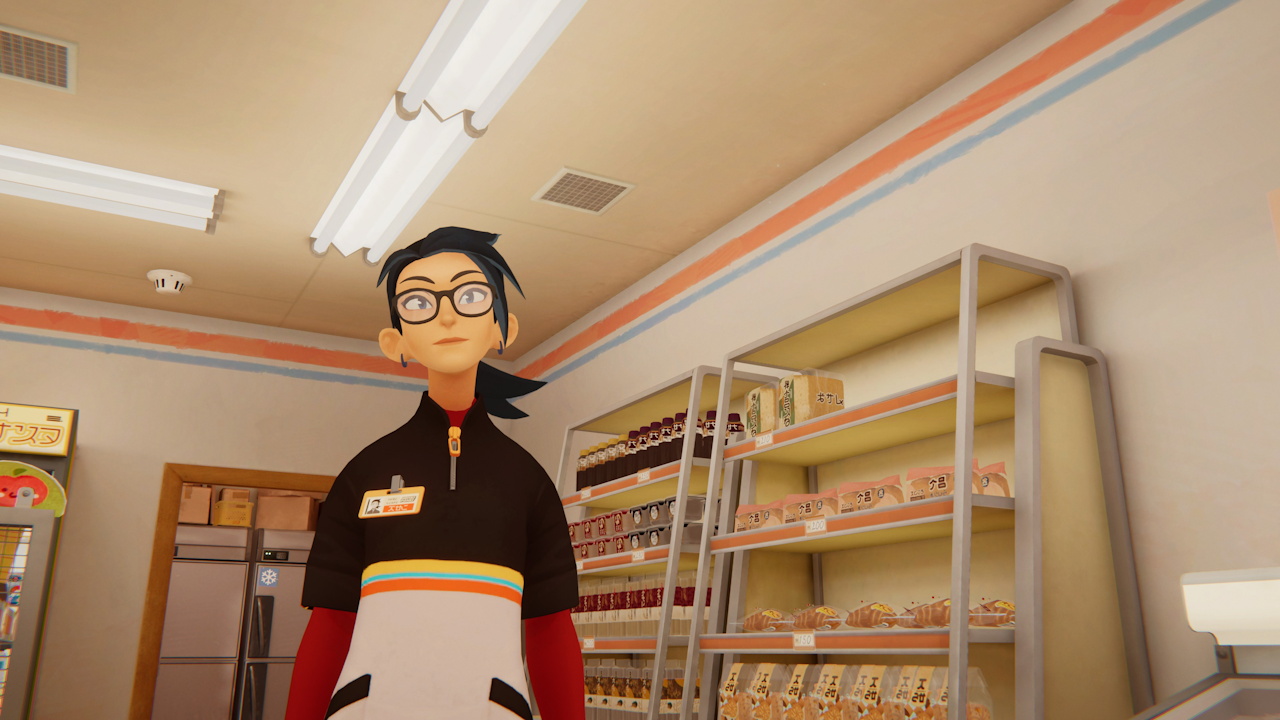
Screenshot from inKonbini: One Store, Many Stories showing Makoto
Makoto, the player character.

Parts of inKonbini could feel a little high-minded, a little philosophical. And that could come at the expense of the kind of gritty “realism” that audiences today might look for. Some characters come out with quite abstract philosophical takes on everything from writing and business to the literal meaning of life… and if you’re just not in the right headspace for that, or you prefer your in-game dialogue a bit less floaty and more grounded, I could see that being a point of criticism. But, again, speaking for myself… I enjoyed my time with these characters, and I liked how each of them had something to say that wasn’t just gossip or small talk.

Each character also feels completely distinct. Satoshi has his burgeoning delivery business, Naomi shows up from the city looking to write an article, Chief is a local institution who’s fallen out with Makoto’s aunt, and the “Mysterious Man” has his backstory unfold in a really fun, unexpected, and occasionally weird way! Makoto keeps it all together, feeling like the most realistic and grounded of the core characters, and her phone calls to her aunt (and to a few others) give her something to do even when there aren’t any customers to serve.
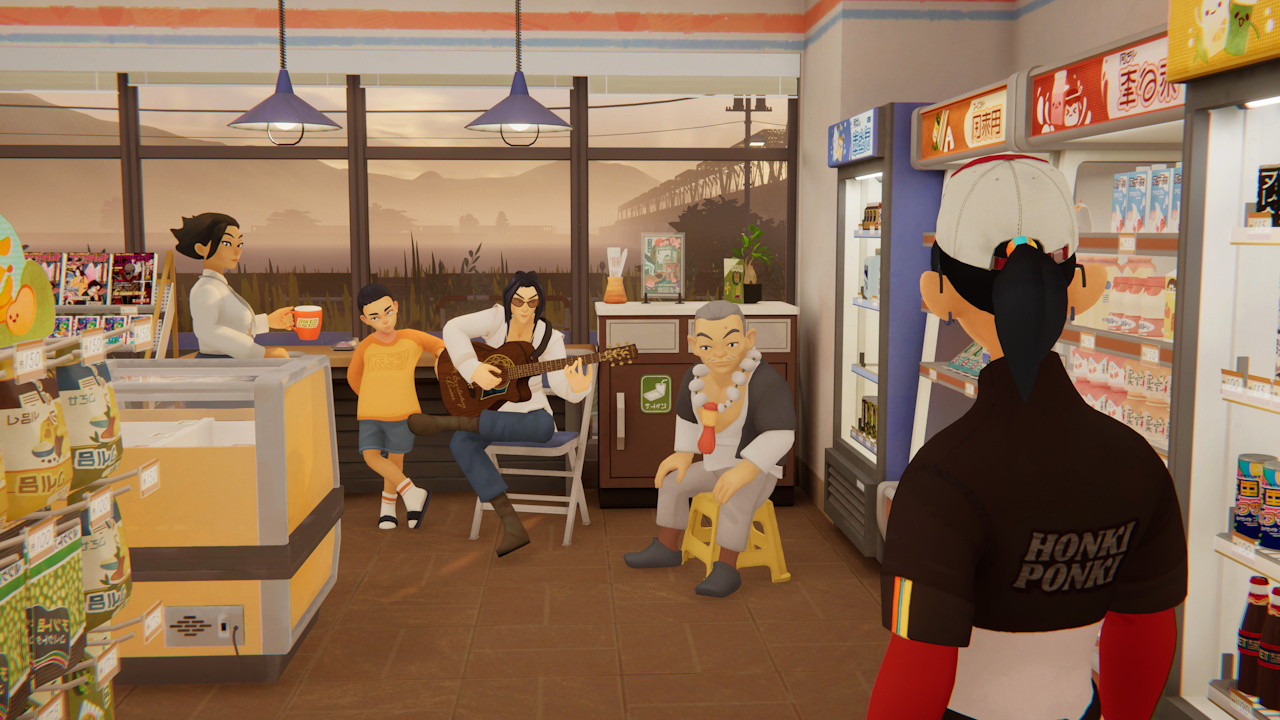
Screenshot from inKonbini: One Store, Many Stories showing the characters
Makoto with all of her customers.

Perhaps it’s the Shenmue fan in me, or perhaps inKonbini just plucked the right combination of nostalgic and philosophical chords… but I really, thoroughly enjoyed my time with the game. I genuinely did not want to see the credits roll… because that would mean it was over.

However, there’s some replayability in inKonbini, despite the game having an otherwise linear story. There are some achievements I didn’t unlock the first time around that I’ll definitely go back and try to get, a few optional little quests or stories off to the side that I missed or didn’t see through to the end, and plenty of capsule toys that I didn’t find. So my adventure at the Honki Ponki konbini isn’t over yet! And I find that thought to be quite comforting.

I hope my thoughts on the game have been interesting. And I hope I was able to properly convey just how enjoyable an experience this was. 2026 has been a pretty good year for video games, all things considered, and inKonbini is, without a doubt, one of my favourite experiences of the year.
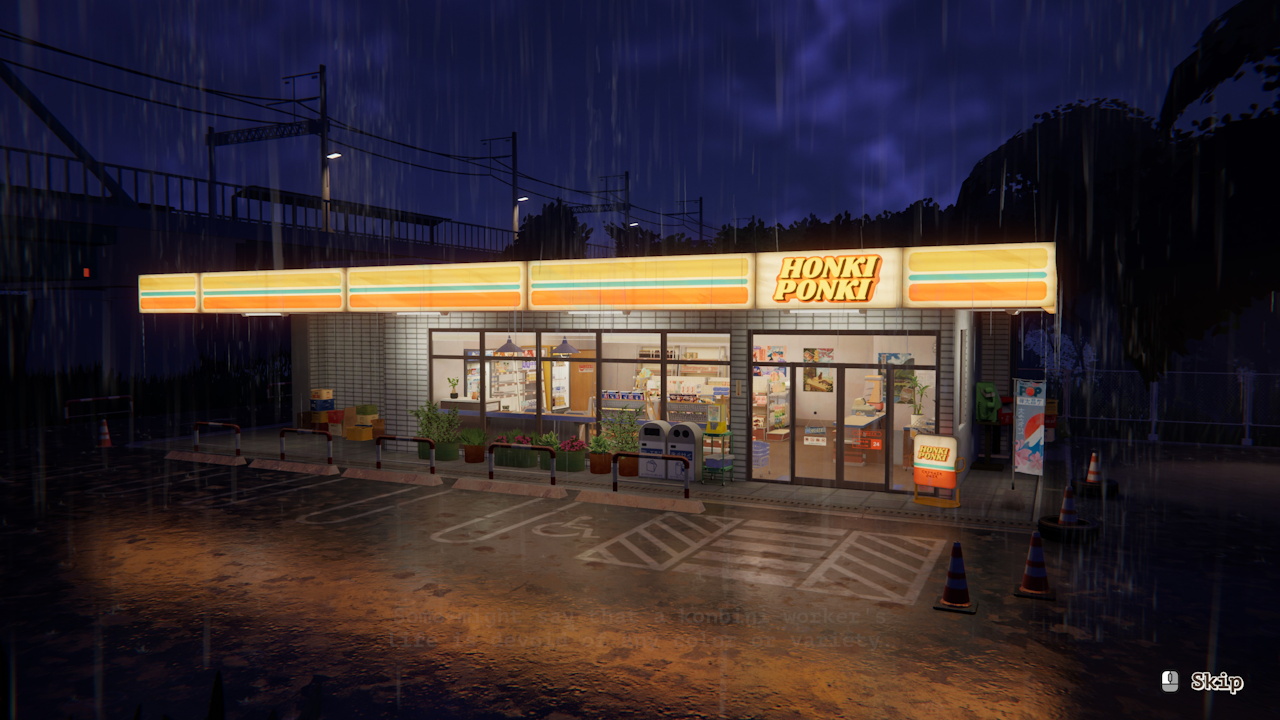
Screenshot from inKonbini: One Store, Many Stories showing the store in the intro
The convenience store.

If you missed them earlier in the year, I’d like to direct you to my reviews of Forever Ago and Mixtape – two comparable titles that, if inKonbini was your thing, you might also enjoy. And given that we’ve talked so much about Shenmue, please consider taking a look at my twenty-fifth-anniversary celebration pieces for both Shenmue and Shenmue II.

And I have a couple of other games on my list for 2026 that I *hope* to get to before the end of the year, so stay tuned for those!

Thanks again for checking out my review of inKonbini. This was a game that had been on my radar for a little while, and I’m so glad that I finally had the chance to try it for myself. It’s one of those games that I just… got lost in, and I didn’t want to reach the end. I had a blast with Makoto and her new friends, and I’m sure it won’t be long before I head back to the konbini for another night shift.


inKonbini: One Store, Many Stories is out now for Nintendo Switch and Switch 2, PC, PlayStation 4 and 5, and Xbox One and Xbox Series consoles. inKonbini: One Store, Many Stories is the copyright of Nagai Industries and/or Beep Japan, Serenity Forge, and Smilegate. This review contains the thoughts and opinions of one person only and is not intended to cause any offence.
Mixtape: Video Game Review

The first part of this review is free from major story spoilers for Mixtape. The end of the spoiler-free section is clearly marked.

I’d really been looking forward to Mixtape. The game’s trailer looked great, I liked the art style, and I’m generally a fan of narrative adventure titles. But what appealed to me the most about Mixtape was the game’s ’90s setting and its promise of an eclectic soundtrack featuring some of my favourite bands and some of the era’s best-remembered hits. I was ready for a nostalgic punch to the gut, and Mixtape delivered.

I always try to approach any title that I’m reviewing without having read or listened to any other critics’ opinions – I fear that doing so risks colouring how I approach any piece of media. But the maelstrom that Mixtape got caught up in a couple of months back proved inescapable, and some of the criticism of the game’s perceived “lack of interactivity” and status as a so-called “walking simulator” did cut through.

Promo screenshot for Mixtape (2026)
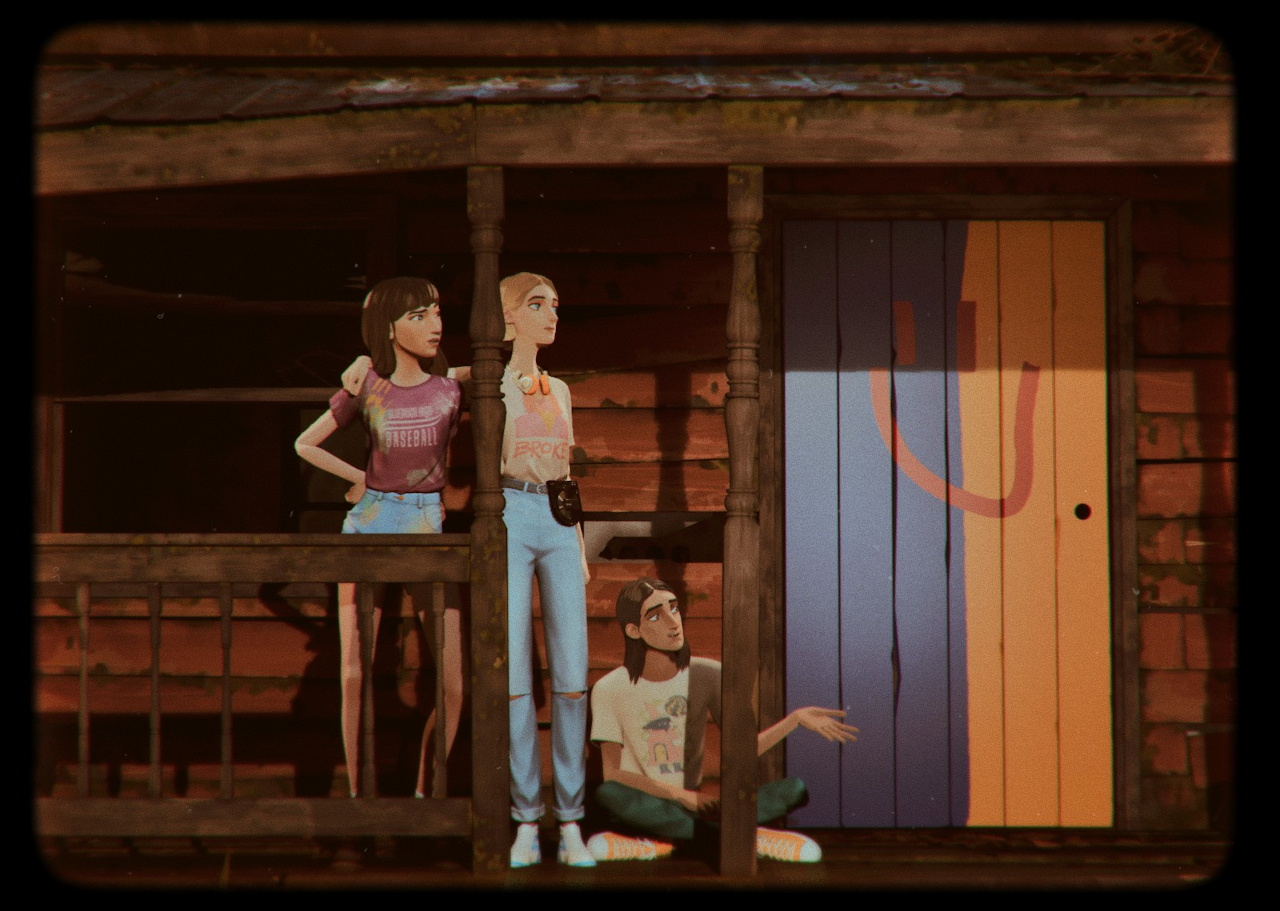
Mixtape.

I’ll level with you: that line of criticism is valid – but only if you think that a game *needs* non-stop button-pressing and complicated combos to be fun. Mixtape is a game I would categorise as a “narrative adventure;” as the player, you follow a very linear story featuring three main characters, and you play through a series of connected levels, quick-time events, and mini-games – the interactivity levels of which do vary. If you’re a player who wants to be constantly challenged by difficult gameplay, and your reason for picking up a control pad is to “git gud” at a complex title that requires a lot of either button-mashing or complicated combos… perhaps you’ll bounce off Mixtape quite early on. Even if the story might be something you’d vibe with, I’d understand if the gameplay – or, let’s be blunt, the *lack* of gameplay – would turn you off.

However, that wasn’t my take on Mixtape, and I had a genuinely fantastic time with this game.

I’ve said this before here on the website when discussing other titles, but I’m someone who’ll happily play through basic, bog-standard gameplay if I’m caught up in a story. Not only does Mixtape have a truly compelling narrative, but I also really liked its animated, almost stop-motion art style; I found its main characters incredibly relatable, and gosh, does the game have a *fantastic* soundtrack!

Still frame from the music video "Since You've Been Gone" by Rainbow/Ritchie Blackmore's Rainbow
The game features around two dozen songs from the likes of Rainbow (pictured).

So there’s that important caveat: if you hate “interactive movies” or “walking simulators,” and you want a game that offers more interactivity than mini-games, QTEs, and a bit of environmental exploration, Mixtape might not be for you. It might still be for you, though, if you’re after a game with great characters, a relatable narrative, an incredible soundtrack, and a nostalgia overload for players of a certain age – or players who *wish* they lived through that mid-90s era. This game isn’t going to be for everyone, I suspect, which is probably why opinions are split! But if you’re the kind of person with whom the story connects, and if this slower-paced narrative adventure is your style of game? I think there’s a *lot* to love in Mixtape.

I’d go so far as to put Mixtape on my list of contenders for the coveted “Game of the Year” title at the annual Trekking with Dennis End-of-Year Awards!

Promo screenshot for Mixtape (2026)
Could Mixtape be a “Game of the Year” contender? Come back just before New Year to find out!

I would give one caveat, though, about the story Mixtape tells. This is a story about teenage characters having “one last hurrah” before finishing school and going their separate ways. It leans into tropes of the genre that you’ll have seen in dozens of films, not only from the ’80s and ’90s, but really in any coming-of-age title from the last forty-some years. When you stack up an objectively low-stakes story with some melodramatic teenagers… well, you’ll either feel that whack of nostalgia and remember your own schooldays – as I did – or maybe you’ll cringe!

For me, these characters and their stories genuinely hit close to home. We’ll get into more detail about that if you stick with me to the spoiler-ific part of the review, but suffice to say that I think each of them represents not only a character archetype from this kind of coming-of-age story, but a truly relatable part of a teenage experience that a lot of us will share. There were moments in Mixtape that, I’m sure, are curiously American – and as a Brit, I wouldn’t get all of that. But there were plenty of things that reminded me very strongly of my own youth, my own schooldays, and my own “last hurrah” with friends as we parted ways, knowing it would be for the last time.

Promo screenshot for Mixtape (2026)
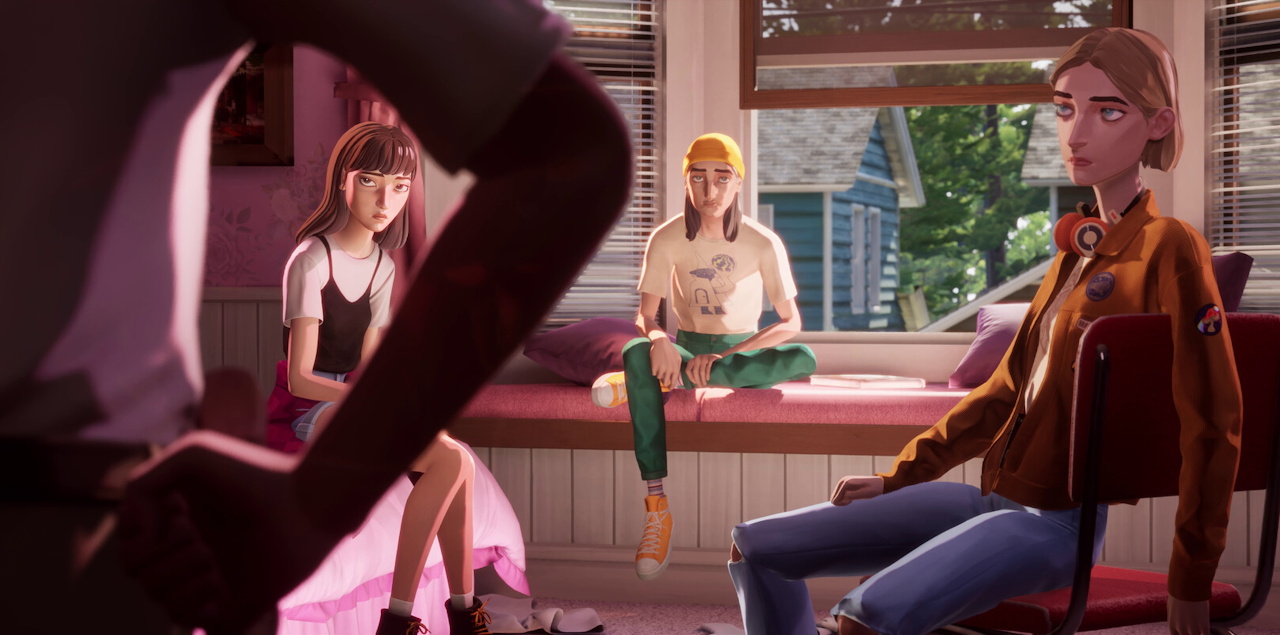
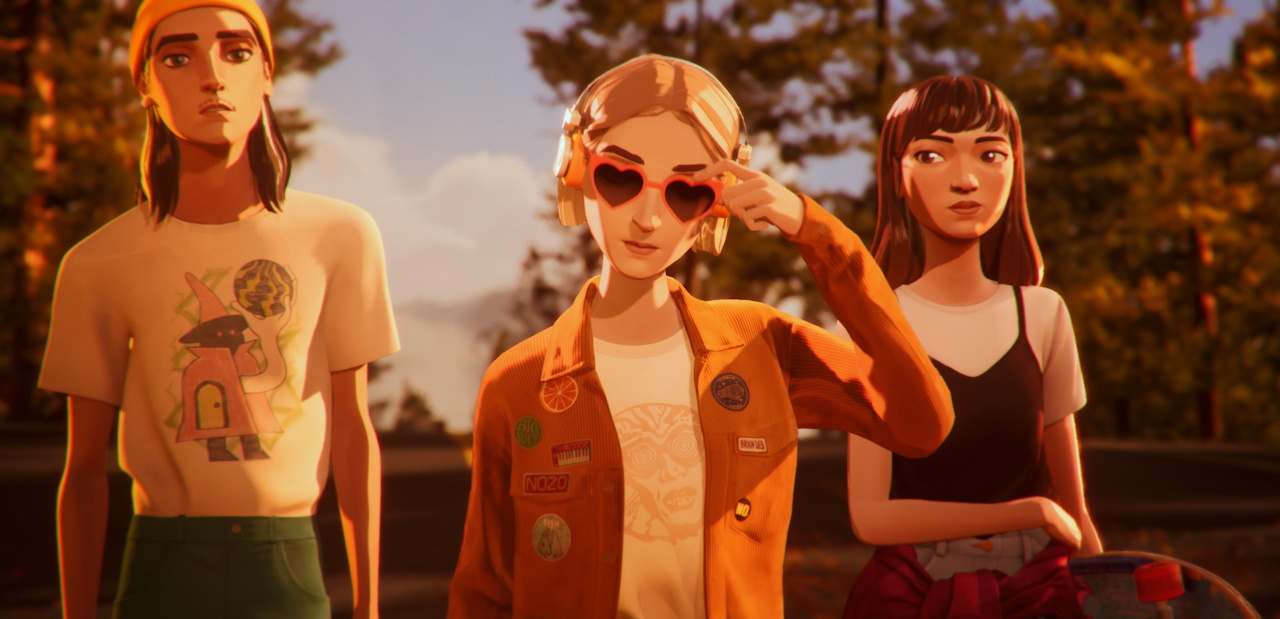
The game’s trio of main characters.

In that sense, Mixtape really did hit all of those nostalgic notes; its story is genuinely bittersweet. I don’t think I was quite expecting it to resonate with me quite so strongly or quite so emotionally, especially for such a short experience. But it did. Mixtape isn’t a game I’m going to rush to replay; it’s linear, and once you’ve tried the mini-games, explored the levels, and experienced the story, the only reason to go back is to go through it all again. But like any good coming-of-age movie – St. Elmo’s Fire, The Breakfast Club, The Graduate, or even Bend It Like Beckham – it *is* a story I’m going to want to revisit one day. I can already feel that.

And there are some songs, too, that I think I’m going to forever associate with moments, levels, or characters from Mixtape.

Mixtape is a relatively short experience. My playthrough clocked in at just shy of three-and-a-half hours – but I think that Mixtape, at £16/$20, is priced fairly for such a short title. The game ran well, without any crashes, bugs, or framerate issues on my PC, and I didn’t have any trouble with adjusting the settings to my liking. In terms of difficulty, I managed the game in one hit, despite having arthritis which affects my hands and fingers, and while I wasn’t perfect at every mini-game or QTE, the game was more than forgiving enough to let me progress.

Promo screenshot for Mixtape (2026)
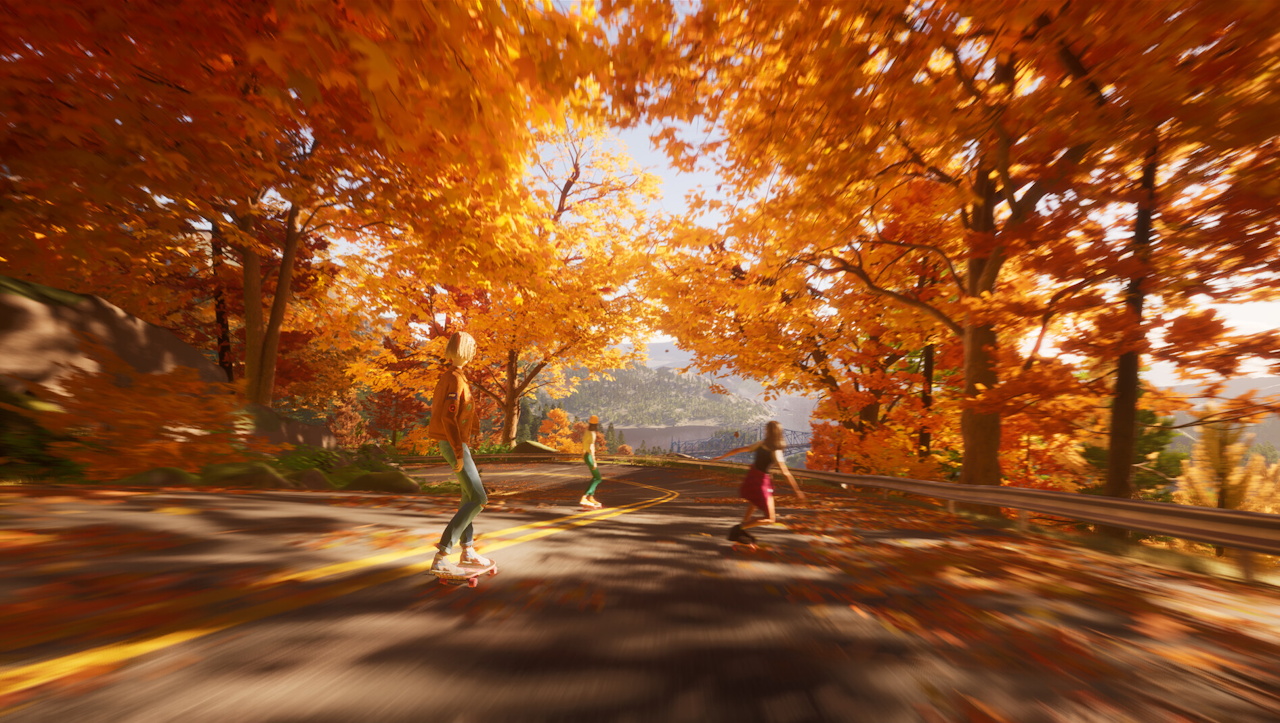
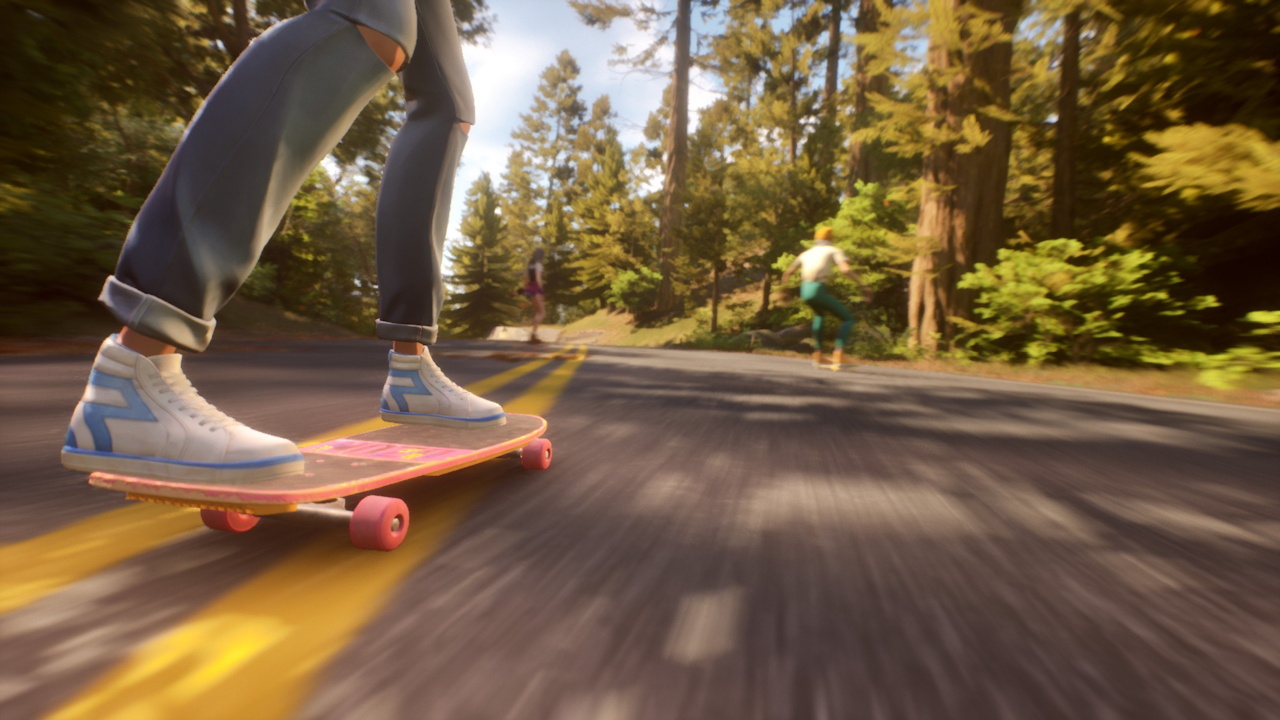
Skateboarding.

I think I’ve said all I can without getting into narrative spoiler territory. If you want to know if I recommend Mixtape, the answer is a categorical and definitive “it depends!” If you like narrative adventure titles, ’90s nostalgia, and great music, it’s an enthusiastic “yes.” If you want games with a great deal of interactivity, and story matters less to you than engaging gameplay, perhaps it won’t be your thing. If you think of Mixtape as a three-hour movie with some interactive sections… well, you can answer the question of whether you think that sounds like something you’d enjoy. But I reiterate what I said a moment ago: this game won’t be right for everyone.


An anime-themed spoiler warning.

Spoiler Warning: This is the end of the spoiler-free section. There are narrative spoilers for Mixtape – including the game’s ending – from here on out.

I’m the wrong side of forty years old, suffering from arthritis and other health issues that make me feel even more decrepit, and my schooldays are so far behind me by now that I can’t even glimpse them over the horizon any more! So why, then, did Mixtape make me feel like a teenager again for those three-and-a-bit hours? Am I just a pathetic middle-aged person, desperately trying to reclaim any semblance of youth? And did Mixtape offer me that escapist fantasy for a short time? Or is there something deeper… does this game truly embody what it means to *feel* young?

I’d love to offer Mixtape to younger players – folks in and around the age group of the game’s protagonists – and see what they think. To them, Mixtape might feel like an old person’s idea of what “being young” is, or its ’90s setting might make them feel like I do when watching films from, say, the ’60s or ’70s. Maybe Mixtape feels the way it does to me because this was my coming-of-age moment, too.

Screenshot of Mixtape (2026) showing Slater, Stacey, and Cassandra in the intro
I wonder what younger folks will make of Mixtape; is it just a game for people my age, or is its story timeless?

I’ve written about this here on the website before, but 1999 and Y2K were “my years;” that was the end of my schooldays, the beginning of “adulthood,” both in a legal and, I suppose, a practical sense, and the ’90s as a whole were my adolescence and teenage years. Mixtape doesn’t tie itself to one specific year, but I get an early-to-mid ’90s vibe from the game. I think a ticket stub was dated 1993 at one point, so it might be set a year or two after that. I guess that makes me a bit younger than the game’s protagonists – but I lived those years, you know? I… I *feel* the era that Mixtape is bringing back to life. And because it coincides with a similar period of my own life… the game brought back all kinds of memories that I just wasn’t expecting.

And I feel… well, I feel a lot of things, to be honest. Partly I feel old: knowing that that part of my life is so long gone as to be someone’s idea of a “cool vintage setting” for a story! Partly I feel kind of pathetic: I’m this old dinosaur pretending to be young and hip again by going through this story. Partly I feel like these characters, relatable and fun as they were, just aren’t me anymore: I’m looking in from the outside at teenagers doing teenage things, and I just don’t fit in with that age group. And partly I feel like I’m seventeen again: like someone’s dad banning them from a party, or not being able to scrounge up enough pennies to buy a few beers are the biggest – and only – problems in the world. That carefree moment of youth when teachers and parents are the obstacles to fun, and nothing else matters but your friends. That’s Mixtape in a nutshell.

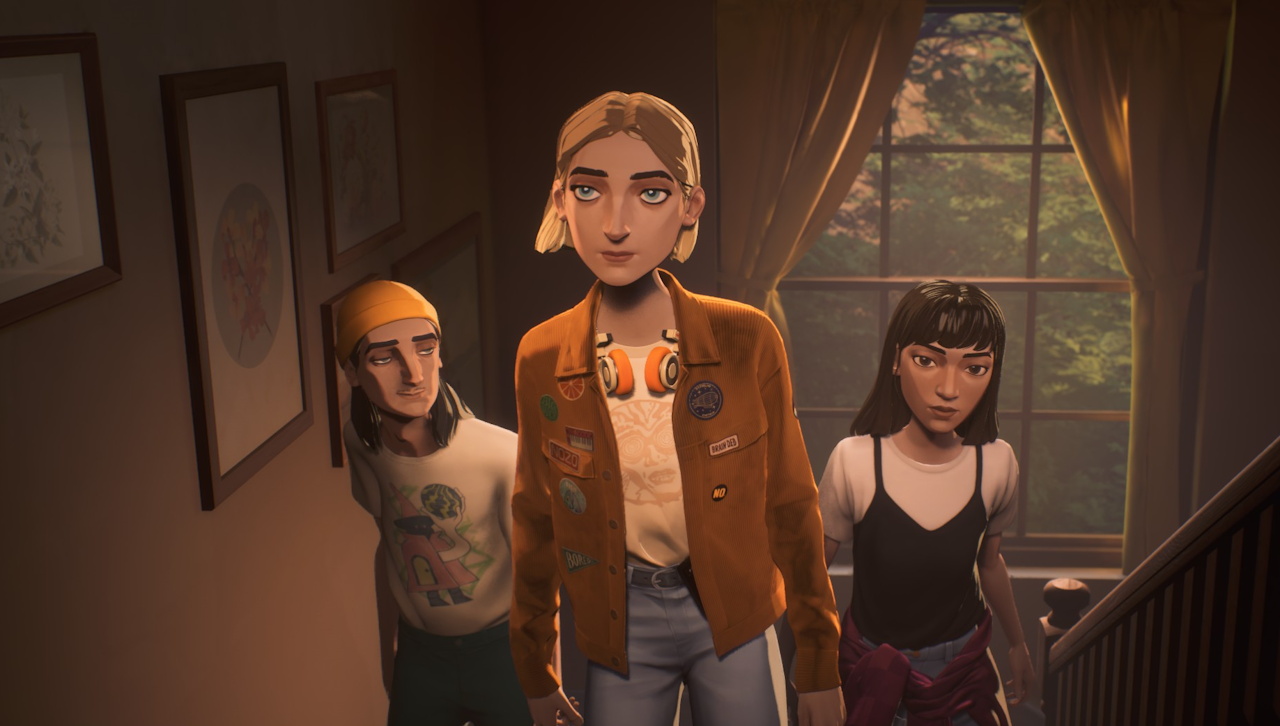
Screenshot of Mixtape (2026) showing the main characters on the stairs
Mixtape made me feel 17 again.

And that sensation… I don’t think I was prepared for just how well Mixtape captured it, bottled it, and then smashed me in the face with it over and over again!

I remember what it felt like to be a teenager, desperate to go to some big party. In the rural area where I grew up, there were so many farmers’ kids at school that there’d always be someone willing to volunteer a field for us to throw a party – and we’d set up a boom box, play tunes, drink way too much, smoke cannabis, and just… be free. That feeling… I mean, I haven’t felt it in a long time. A long time. Until I played Mixtape, and all those memories and feelings came flooding back.

That’s testament to the power of media, and to interactive media in particular. I stand by what I said above: Mixtape is not the most interactive game out there. But the interactive elements that it brings to the table are a huge part of what makes it work and what makes those feelings hit so hard; I don’t think you’d get it in the same way if you watched a video of someone else playing the game, or a compilation of cut-scenes. The interactivity – actually taking part in the kids’ journey – is what makes it work and what makes it hit as hard as it does.

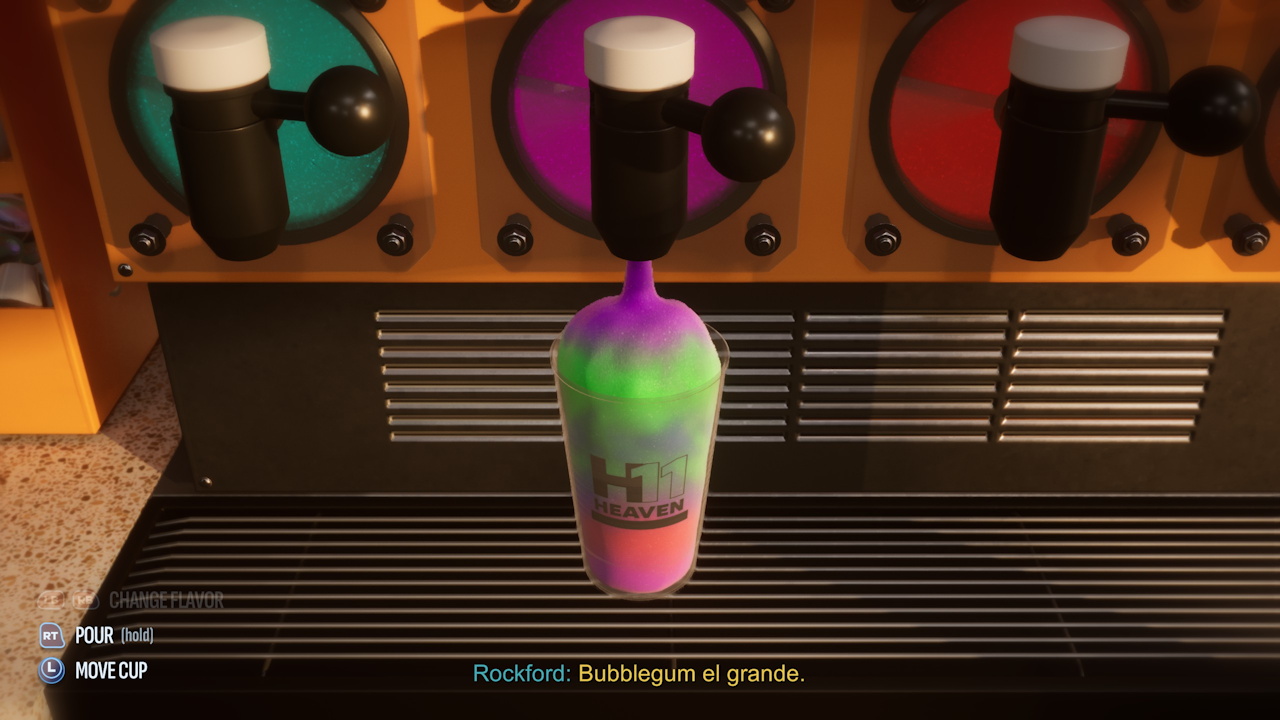
Screenshot of Mixtape (2026) showing the slushie mini-game
The slushie-making mini-game.

Let’s talk characters!

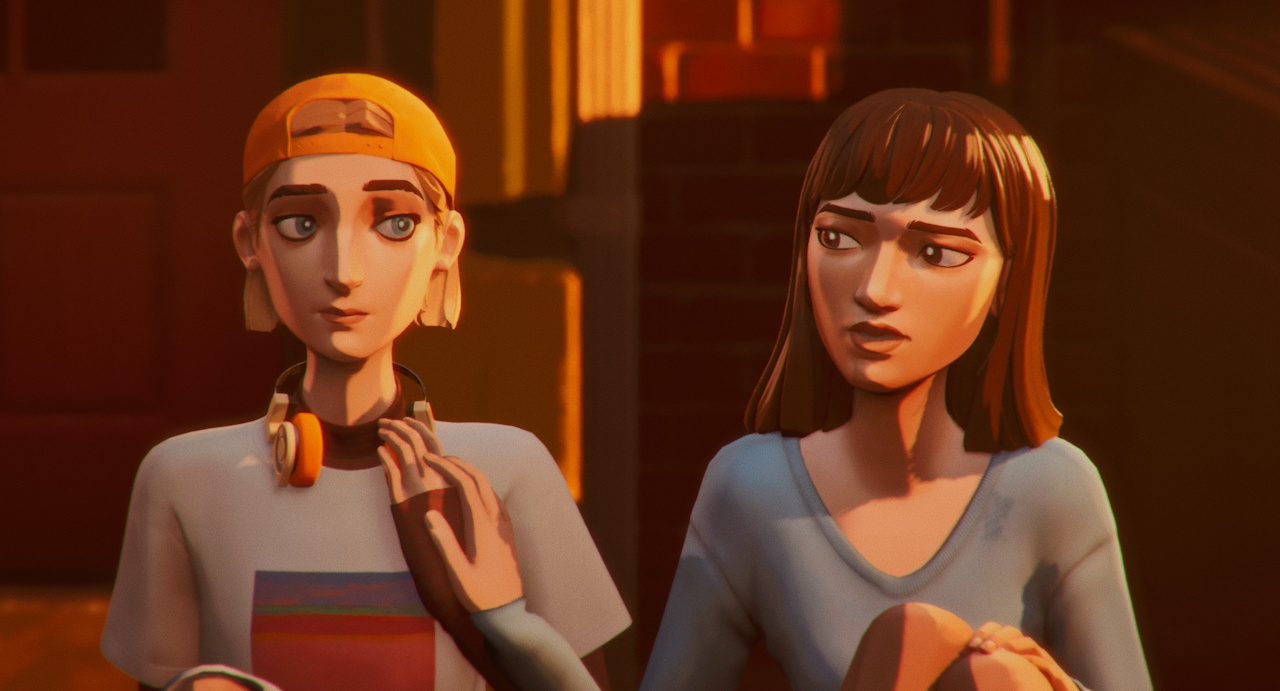
Cassandra is probably the character who came closest to my own teenage experience: her overbearing parents seemed to be trying too hard to keep up appearances and cut her off from her friends and the things that she enjoyed. It was an exaggerated portrayal, and far from my own in some respects, but I felt her sense of entrapment; that she didn’t have the freedom to do what she wanted, that her parents wanted her to follow a path they’d chosen. And that sense of rebellion, of wanting to do the opposite of what’s expected of you – a typical teenage thing, I guess!

Cassandra’s arc was genuinely fun to watch unfold. Flashbacks showed her meeting her friends for the first time, her genuine wish to branch out and find her own path, free from the demands and expectations of her parents… and she got arguably the most complete story of all three characters, as her arc with her father actually ended with at least the beginnings of an understanding between them, and she also resolved her conflict with Stacey.

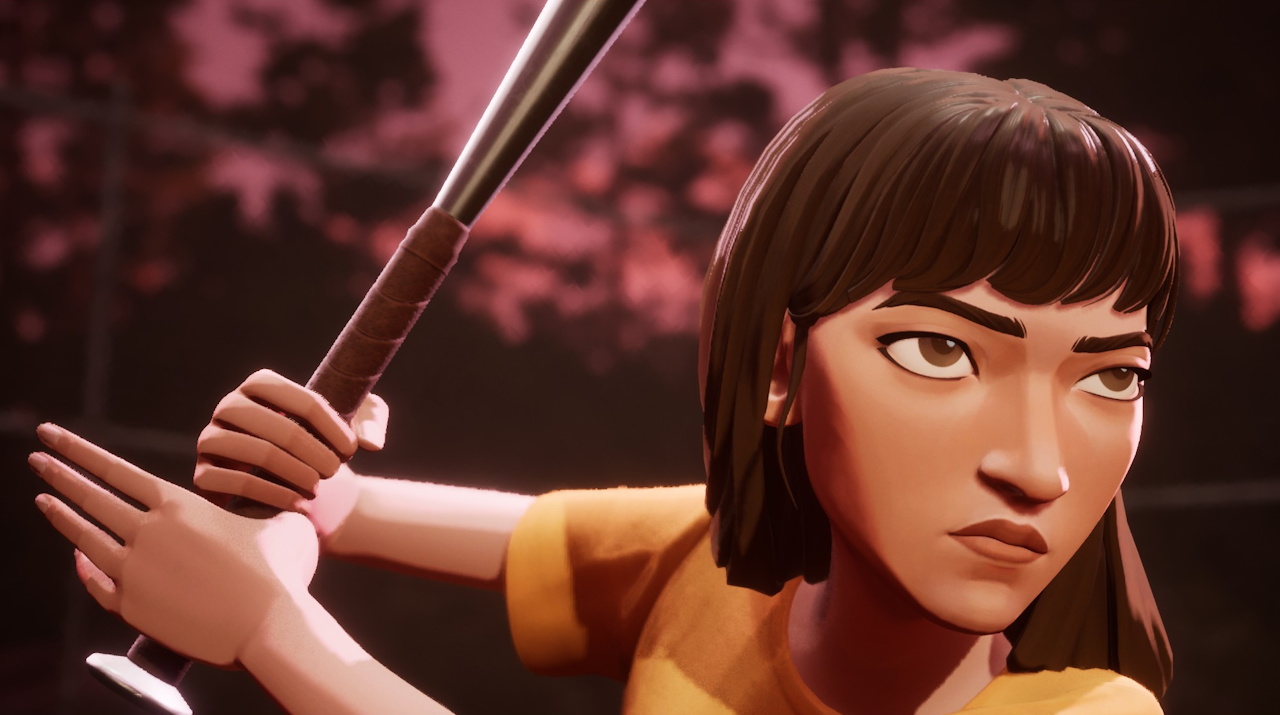
Screenshot of Mixtape (2026) showing Cassandra with a bat
Cassandra got arguably the most complete arc.

Slater reminded me *so much* of several people I knew when I was in school – the typical directionless, unbothered, seemingly “chill” guy who considered himself to be deep and thoughtful. Maybe that’s harsh, sorry! But I’m looking at these characters now with the (questionable) benefit of decades of life experience, so some of the things they come out with – Slater especially – just feel so… naïve and childish. The words make sense, and I can absolutely tell that they’re serious and sincere. But when they’re said in relation to something so small in scale and so fundamentally meaningless as a teenage party… the philosophy definitely wears off!

And I think – I *hope* – that Mixtape is self-aware when it brings these characters to life. Yes, there’s an earnestness to Slater and his philosophising about friendship and life… but there’s also an awareness from the developers, I think, that this is a teenager, right at the start of his journey, who isn’t gonna feel that way forever and who might look back on saying things like this and, well… cringe a little! I know I do when I think back not only to the people Slater reminds me of, but to my own words and actions in those days – words and actions not unlike Slater’s, in some cases.

Screenshot of Mixtape (2026) showing Slater's 'stache
Slater’s ‘stache.

That brings us to Stacey, the game’s main protagonist and the character you spent 95% of your time playing as. I thought, for much of the game, that Stacey’s arc was going to involve realising that her dream – to go to New York and become a professional mixtape-maker – wasn’t practical, and that there was value in sticking with her friends, even just for a little while longer. That seemed to be her trajectory, at least for parts of the game. So it was a surprise, I admit, that the game ended the way it did.

The ending didn’t “rob” Stacey of her arc, nor deprive her character of something big and meaningful – and there’s something positive, in a way, about seeing a young person pursue their passions and their dreams with that almost naïve optimism that you only have when you’re seventeen! But it does mean that Stacey kind of begins and ends the story in the same place – her last night in town, bidding everyone goodbye, ready to strike out on her big adventure.

I’ve been there – I’ve been Stacey in that moment. And I’ve also been the friend left behind when others are moving on and going their own way.

Screenshot of Mixtape (2026) showing Stacey
Stacey – a.k.a. Rockford.

This was another thing that punched me in the gut with “the feels.” That sense of a chapter of your life coming to a close – and not only that, but the *first* chapter, your schooldays, the only kind of life you’ve ever really known… it’s a truly strange sensation that I think only hits a person once in their life. And Mixtape made a creditable recreation of how that moment, that “one last night together,” really feels. We approach that feeling from Stacey’s side, but as the story unfolds, we also get it from Cassandra and Slater, to varying degrees.

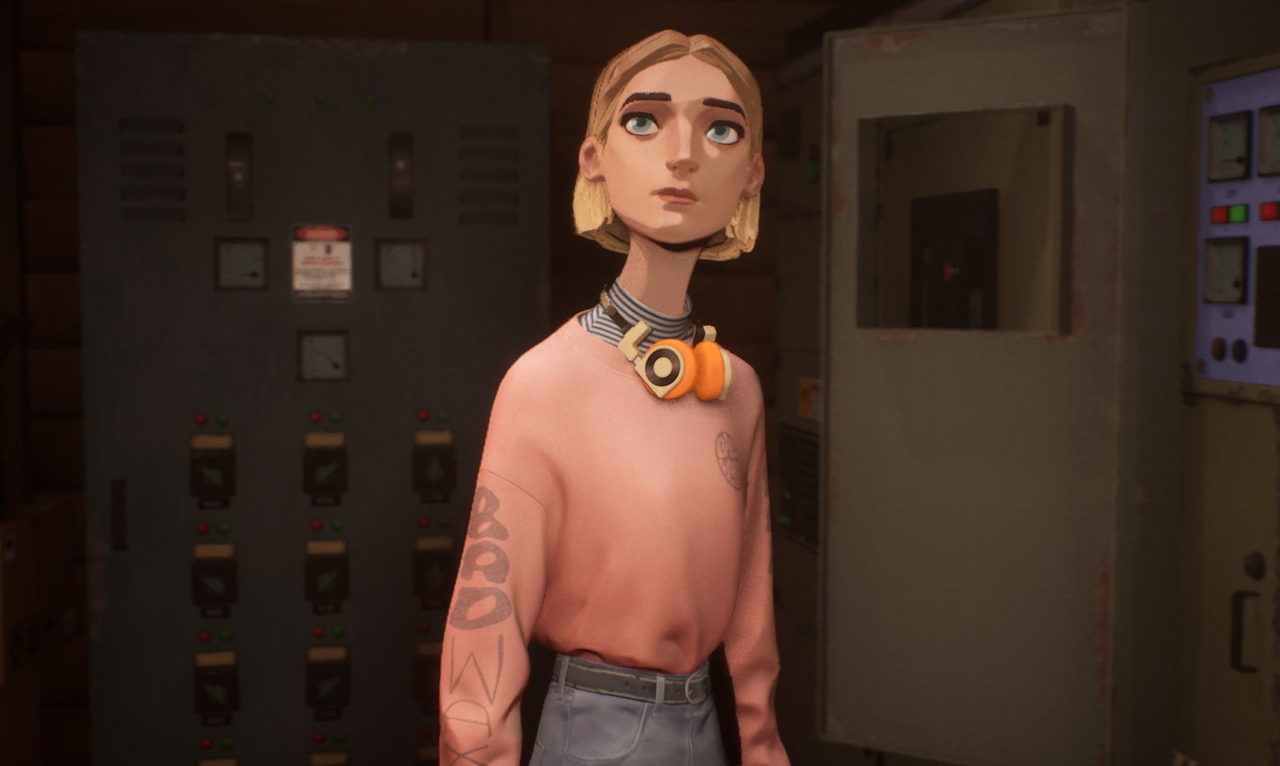
I liked Stacey’s repeated fourth-wall breaks, and how she’d directly address the camera when introducing and explaining the various songs on the game’s soundtrack. Combined with some of Mixtape’s other fantastical elements – soaring through the sky, watching a baseball stadium appear out of nowhere, and so on – I think it worked exceptionally well, and it added to the sense that, despite the very real feelings the game brought up, it’s a fantasy as much as anything else.

Screenshot of Mixtape (2026) showing Stacey's fourth-wall break
Stacey regularly broke the fourth wall.

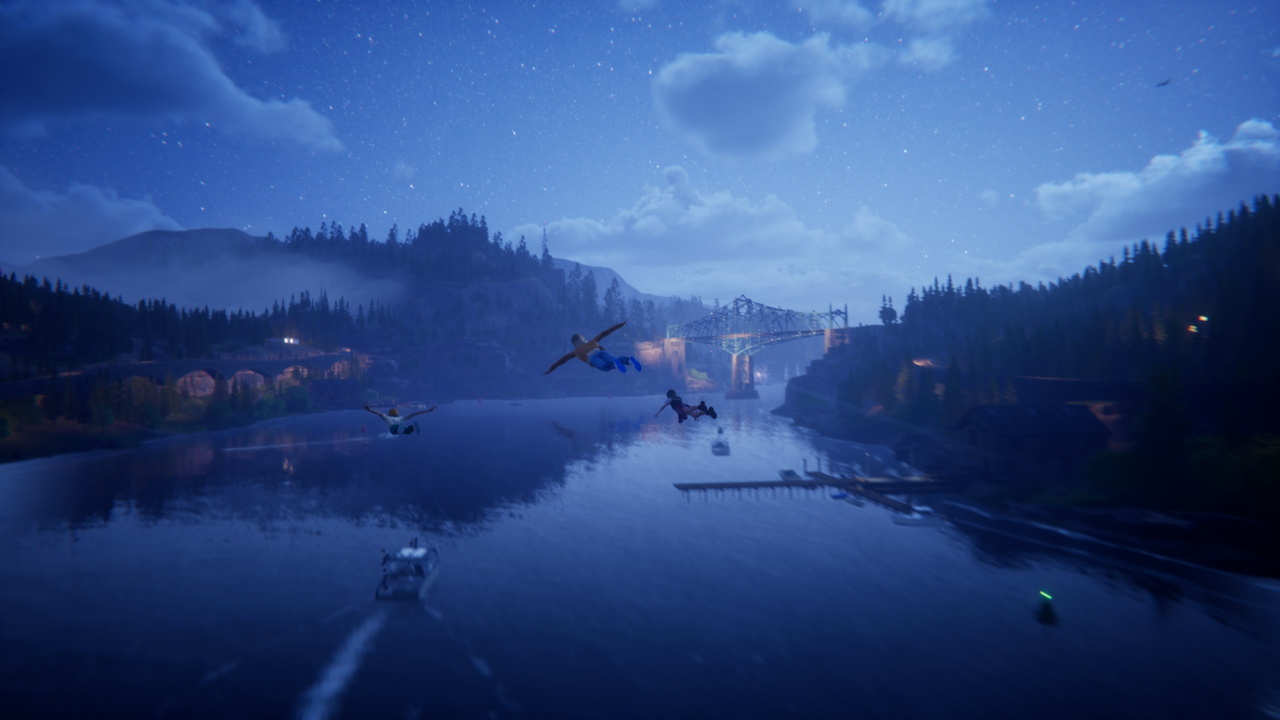
Mixtape also has something to say about the reliability of memory. Dreams, memories, and power fantasies all seemed to merge together – not only in flashback sequences, but even in levels and story moments set in the present day. We see characters soar through the sky, ride on the back of a dinosaur, make fireworks explode in time with the music, or float through a series of disconnected video clips. And none of this is presented as weird or unusual in the context of what was otherwise a very simple and grounded real-world narrative – which means Mixtape is deliberately leaning into the way we – especially as younger people – process thoughts, memories, dreams, and fantasies.

In a worse game or a worse story, it would feel jarring to go from a grounded, normal story about three teenagers about to graduate from school to Harry Potter-style flying cars, or floating through a void of images and video clips. But Mixtape makes that weirdness… work. I don’t want to say that it “shouldn’t” work, because a good enough story clearly *can* bring together the ordinary and extraordinary in a cohesive way. But the way Mixtape makes it feel so natural and so effortless… it’s really something to see. I really, truly adored this way of experiencing the story. It reminded me, again, of being a kid or a younger person, looking out of the window of the car and imagining flying through the air or sprinting along at high speed.

Screenshot of Mixtape (2026) showing the main characters in flight
Flying home…

I am not the best gamer in the world – I wasn’t when I was younger, and I’m definitely not now that arthritis is afflicting my hands and joints! So I appreciate that Mixtape isn’t a game with stupid difficulty spikes, or that punishes anything but frame-perfect button-presses in quick-time events. There were a couple of places where I didn’t get everything right – Cassandra’s softball game, for instance, and it took me a few tries to hit all of the targets in the rock-skimming game, too. But even then, Mixtape didn’t punish failure, nor send me back to the start of a level as I feared it might. Instead, I could progress through the story at my own pace, enjoying the moments and the narrative without really needing to worry too much about making mistakes or missing essential button-presses.

That style of gameplay – let’s call it “casual,” for the sake of simplicity – is not everyone’s cup of tea, and I totally get that. I could see people wanting the game to implement a more difficult mode where timings matter more and where mistakes are costly. Maybe, if you ask nicely, developers Beethoven & Dinosaur will consider it in a patch or update! But speaking for myself, I’m just not that kind of player, and I found Mixtape‘s difficulty, accessibility, and forgiving gameplay to be just my speed. I came for the story, not to punish myself trying to “git gud” at frame-perfect button-presses.

Screenshot of Mixtape (2026) showing Stacey and Cassandra
Stacey with Cassandra.

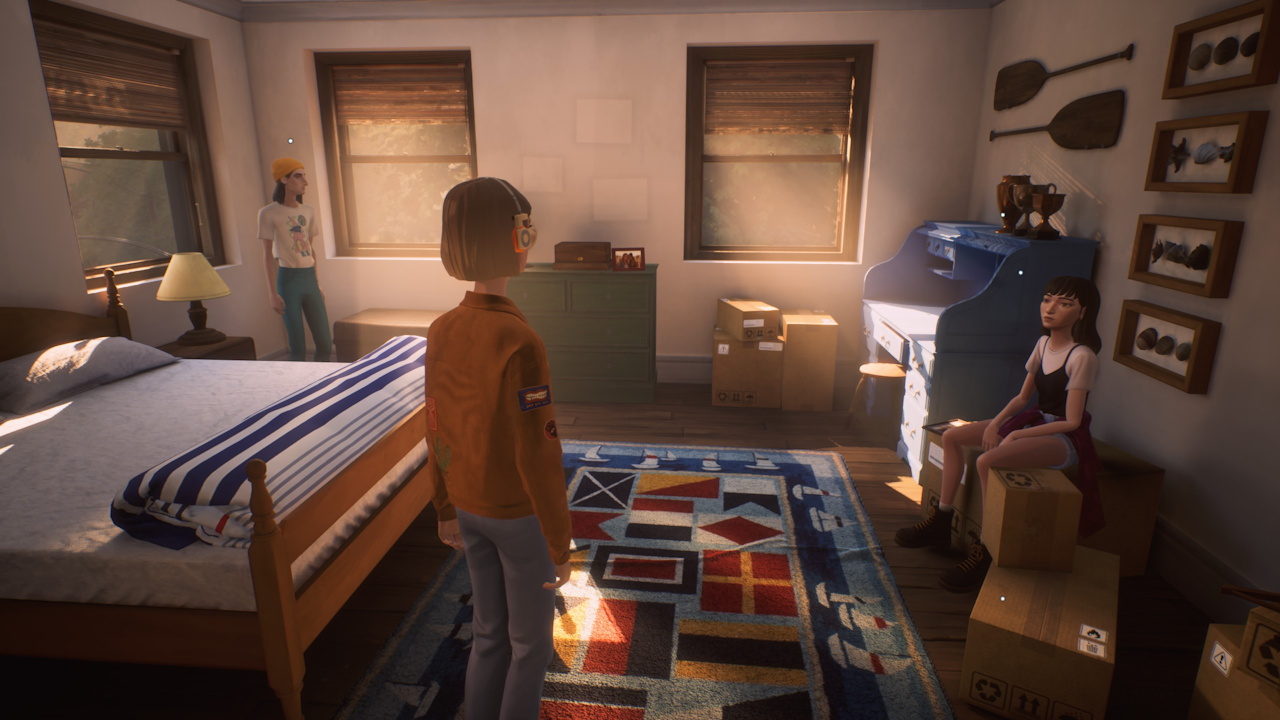
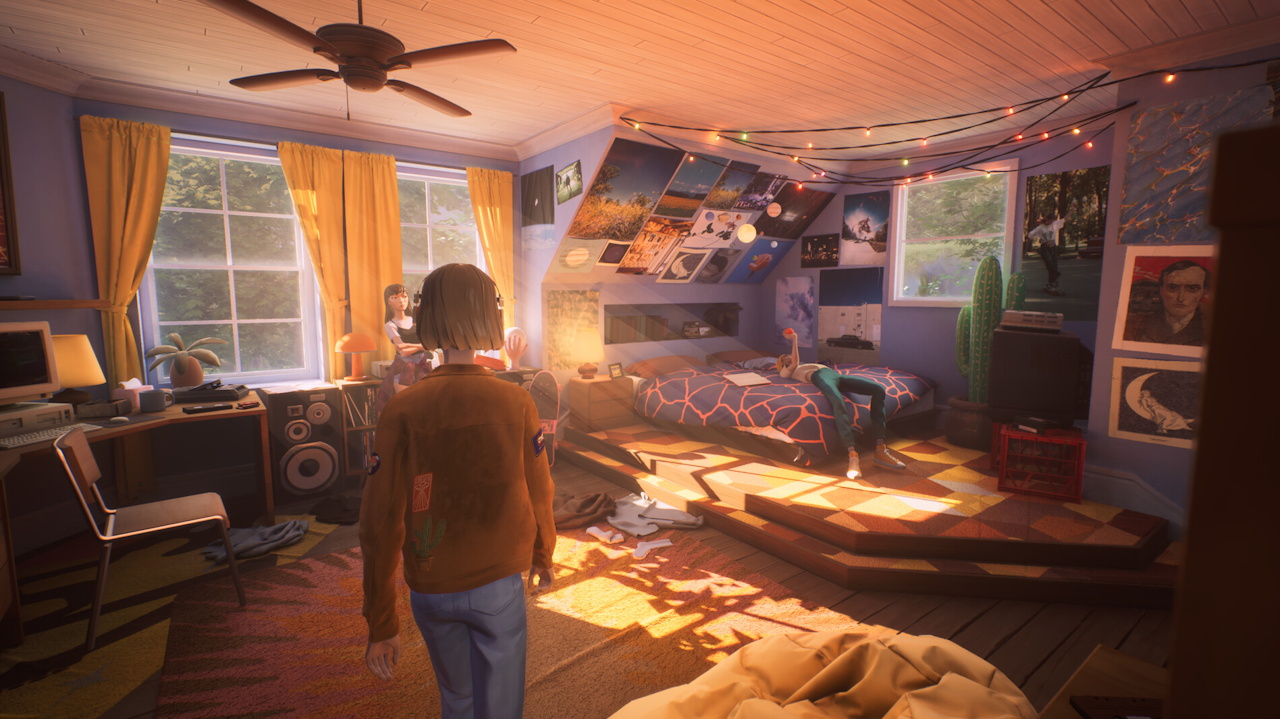
Mixtape’s explorable environments weren’t huge, but they were beautifully designed and well laid-out. They also had just the right amount of content for their size; they felt neither overstuffed nor too spread out and sparse, making walking around and examining things feel worthwhile. In terms of visuals, all three characters’ rooms looked… well, like typical teenagers’ rooms from that era. Like my old bedroom, or bedrooms of my friends – only a little larger, I guess, since this is set in America! Slater’s loft, in particular, reminded me of the attic bedroom of a friend of mine; a hangout spot that was conveniently located five minutes’ walk from our school, and where we spent a ton of time playing games and kicking back.

I liked the way the game indicated which interactions would advance the story and which would expand it – that kind of thing gives players the choice to dive deeply and explore a game’s world or to push through. Personally, because I was getting so into the story, I was happy to explore every nook and cranny, and I enjoyed practically all of the flashbacks, vignettes, and even just lines of dialogue from Stacey upon encountering an item in the level. These things added a ton of detail to the world and the backstories of the main characters.

Screenshot of Mixtape (2026) showing the main characters in Debbie's room
The white markers indicate optional interactions.

And on the subject of voice acting, Mixtape once again excels. Bella DeLong was fantastic in the lead role as Stacey, incredibly convincing as that kind of teenage character. Max Korman, Jessica Ma, Monique Thomas, and JB Tandena round out the major voice roles, and all of them did a great job at bringing their characters to life in a realistic, believable way. Given the game’s subject matter and art style, it might’ve been tempting to go over-the-top with some of the voice direction; I’m glad that Mixtape stayed on the right side of that line.

These were all compelling and interesting characters in their own ways, and voices that matched the tone that the game was going for was always going to be vitally important. In a narrative adventure like this, the story lives or dies on the strength of its characters, and a big part of getting me invested in these characters is the voice acting. I’m pleased to say it was excellent across the board.

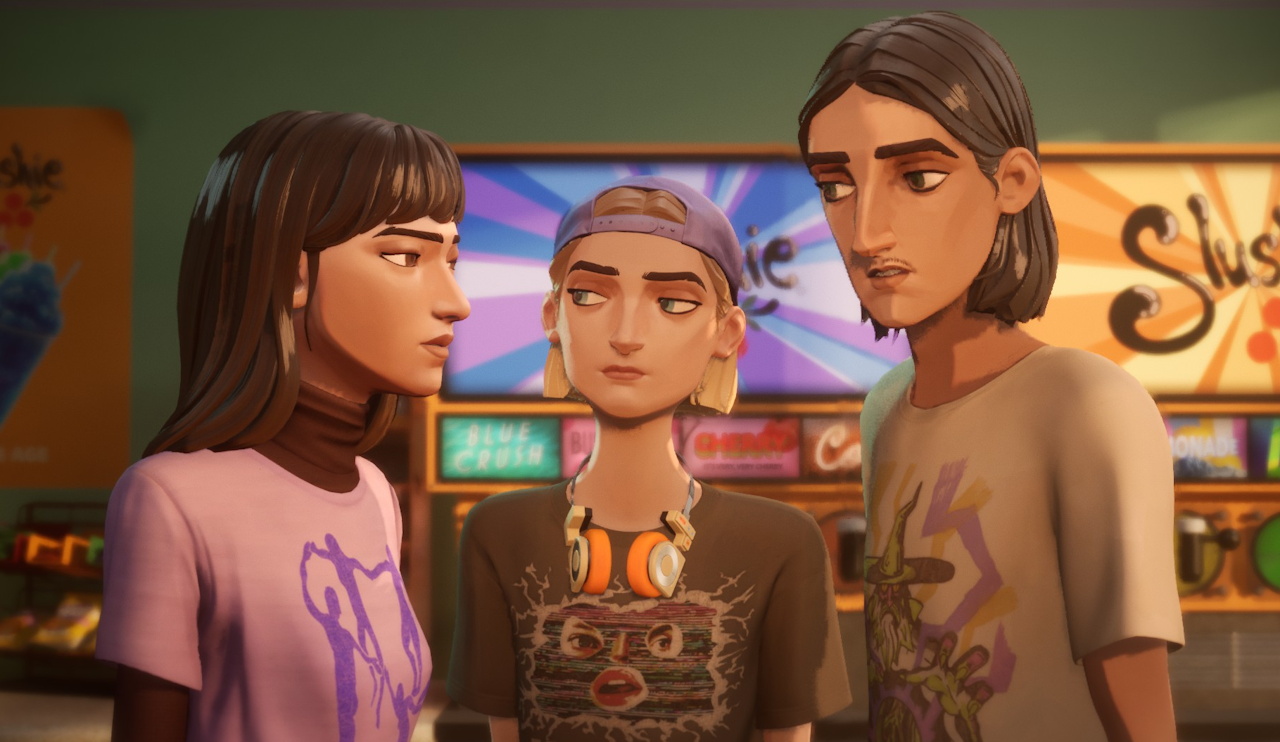
Screenshot of Mixtape (2026) showing Cassandra, Stacey, and Slater by the slushie machine
The main characters.

I suppose, for a game called “Mixtape”, we should actually talk about the soundtrack, eh?

It’s not a new thing for games to use popular songs in their soundtracks. Nor is it unique to Mixtape for a game to set a level or an action sequence to music. A memorable example for me would be Control – if you’ve played that game, you’ll know the level I’m referring to! But it is pretty unusual for a game to lean so heavily on its soundtrack, making the songs integral to the narrative itself, and incredibly important to the main character in particular.

Stacey is set up from the start as being incredibly passionate about music, and this extends to the way she introduces all of the songs in the game. Not only does she turn to the camera, breaking the fourth wall – as we discussed – but she explains why a song is relevant to the passage of gameplay or the narrative moment that we’re seeing or playing through. It heightens and elevates the soundtrack to draw attention to it in this way. And it goes without saying that the song choices were pitch-perfect.

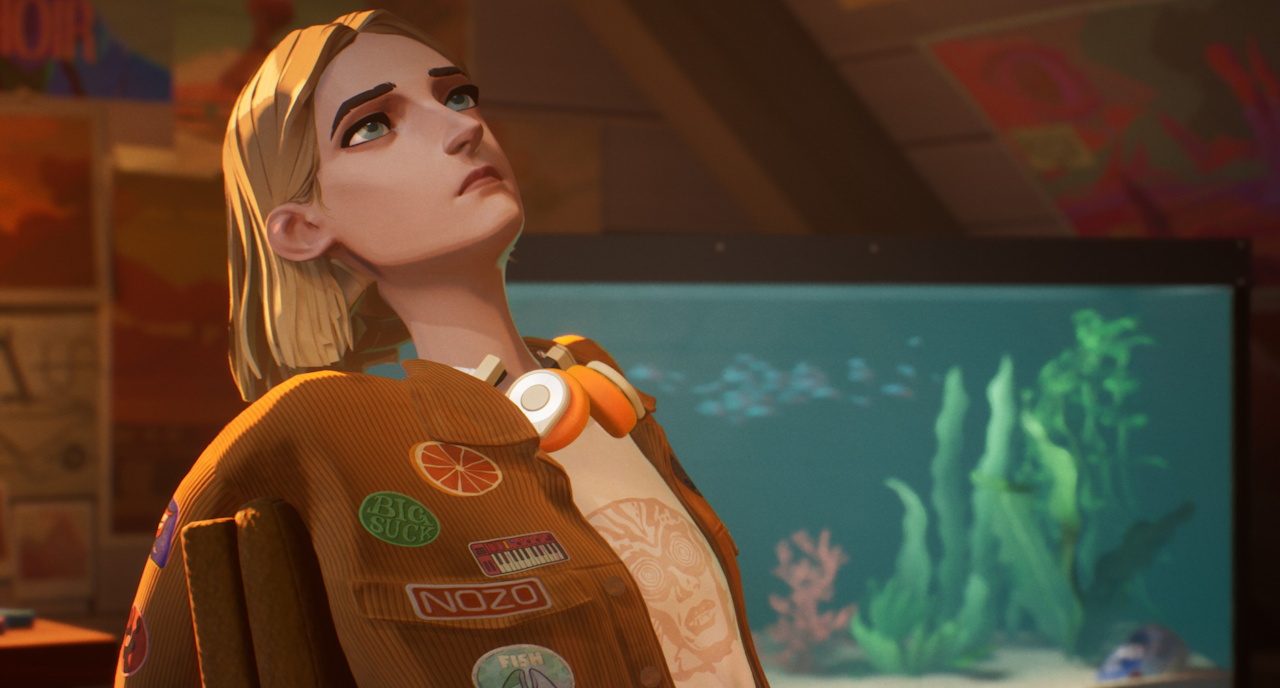
Screenshot of Mixtape (2026) showing Stacey by the fishtank
Stacey lives for music.

Mixtape was more eclectic with its music than I thought it might’ve been, so if you were worried that you won’t enjoy the game because you don’t like ’90s pop/rock songs… don’t be! There’s way more to it than that, and even tracks that I’d probably skip if they came up in a playlist worked well or at least felt in keeping with the narrative moment that they were part of. And really, there weren’t any songs on the game’s soundtrack that I actively disliked. There were a few forgettable numbers, sure; songs I’d never intentionally seek out or choose to listen to. But there were – to use some popular slang – plenty of bangers, too.

Two sequences really stand out to me – probably because they paired two songs I genuinely adore with two fun gameplay sequences.

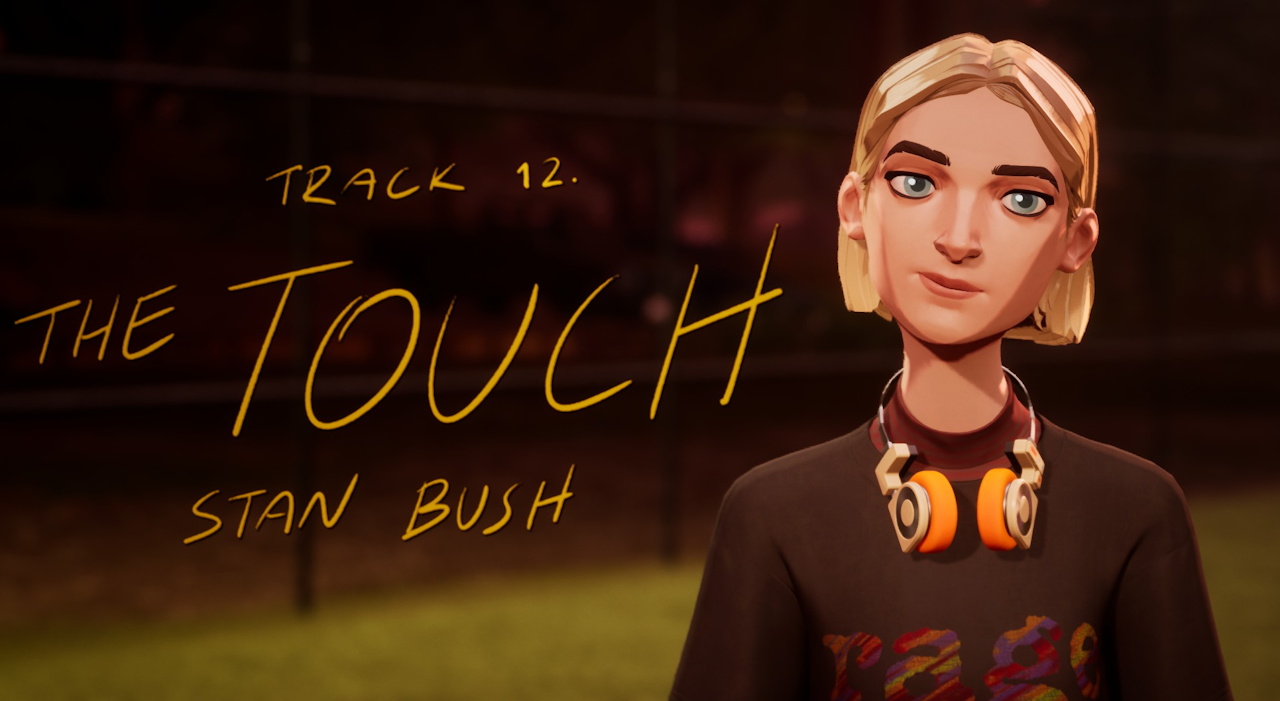
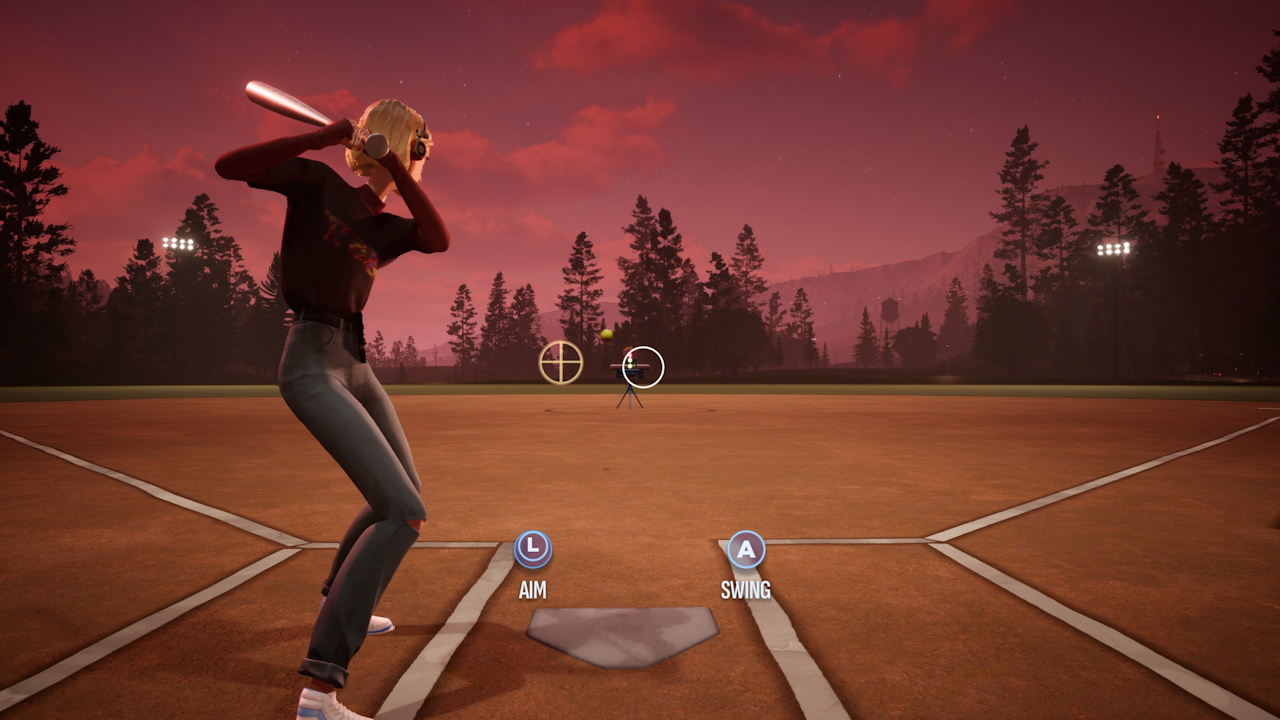
The first is the softball one: Stacey introduces Stan Bush’s The Touch as being the only sports-themed song she knows, but it really was just pitch-perfect for that moment. The QTEs were hard, sure, and I struggled with the analogue stick-and-button combo a lot of the time! But the soundtrack was great, and managing to land the perfect hit, then seeing a piece of the baseball stadium rising from the ground? It was magical.

Screenshot of Mixtape (2026) showing the softball mini-game
The softball mini-game. I sucked at it!

Then there’s the desperate race to get to Cassandra before her dad finds her. Set to John Paul Young’s Yesterday’s Hero, this entire sequence – which was perfectly timed to coincide with the song, by the way – felt like it came straight from the kind of coming-of-age movies that inspired Mixtape. I think that song is now gonna be forever tied to that video game sequence – running, jumping, and sliding with Stacey as she battled to make it in time to save Cassandra from her dad’s wrath. It was… beautiful. Touching. And just fantastic all around.

Aside from the sequences and levels we’ve already discussed, Mixtape had some other fun games and mini-games. The skateboarding mechanic, while not exactly as in-depth as something like Tony Hawk’s Pro Skater, was a lot of fun – and, again, another nostalgia blast. The skateboarding sequence with the explosions was incredibly fun and memorable, too! And what other game could make painting a door so… fun? I loved that you could stylise the door and then have it show up in future vignettes and chapters of the story, too.

Screenshot of Mixtape (2026) showing the painted door
The painted door… or at least my effort at it!

The drunken stumble through the video store was hilarious, and I felt Mixtape captured a character’s inebriated state in a way few games ever really manage to! Then there was slingshot shooting, rock-skimming, and even moving a couch that were all a ton of fun, creative, and just neat little mini-games. They aren’t necessarily things you could build an entire game around, but they work well as pieces of a larger whole. Not so keen on the kissing mini-game, though – but that’s just me!

I particularly enjoyed the slushie machine mini-game, and how the exact combo of slushie flavours would then show up in the subsequent cut-scene. I know it’s such a small thing, but it really was fun to mess around and experiment with different colours, seeing how the cup came together.

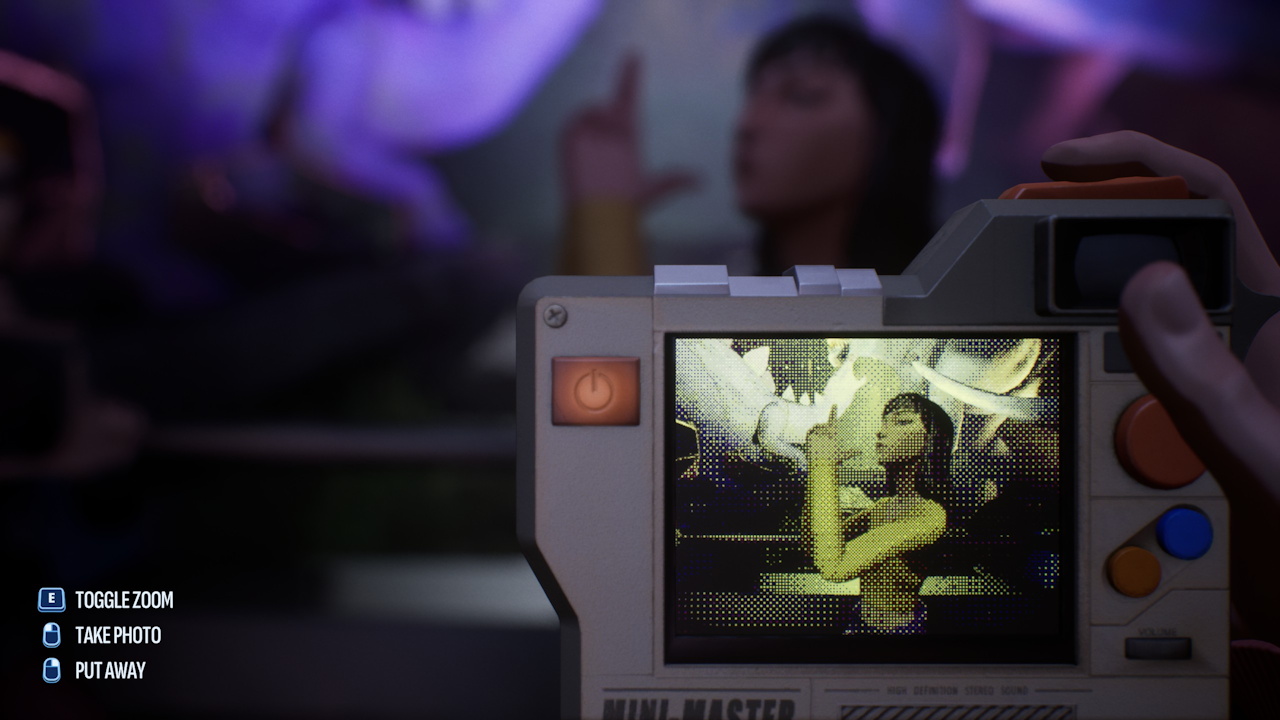
Screenshot of Mixtape (2026) showing the digital camera mini-game
Taking a photo of Cassandra.

And, of course, we have to mention the dinosaur theme park experience! One of the kids’ fondest memories involved sneaking into this abandoned Jurassic Park-inspired theme park, and messing around. The ride was the highlight, but I also enjoyed the camera mini-game, and how you could actually get some pretty creative shots, despite the limitations of the ’90s digital camera. The camcorder mini-game, in the final act, was in a similar vein, and I liked how you could film different partygoers and make these little vignettes.

So I think that’s everything I wanted to say.

Mixtape isn’t gonna be the right game for every player. But it’s confident in knowing what kind of game it wants to be – a narrative adventure. It’s bold with some of its storytelling choices and character beats. And it leans heavily into nostalgia and that sense of being a teenager again, going through that final goodbye before everything changes. And it absolutely *nails* that feeling in a way I just wasn’t expecting.

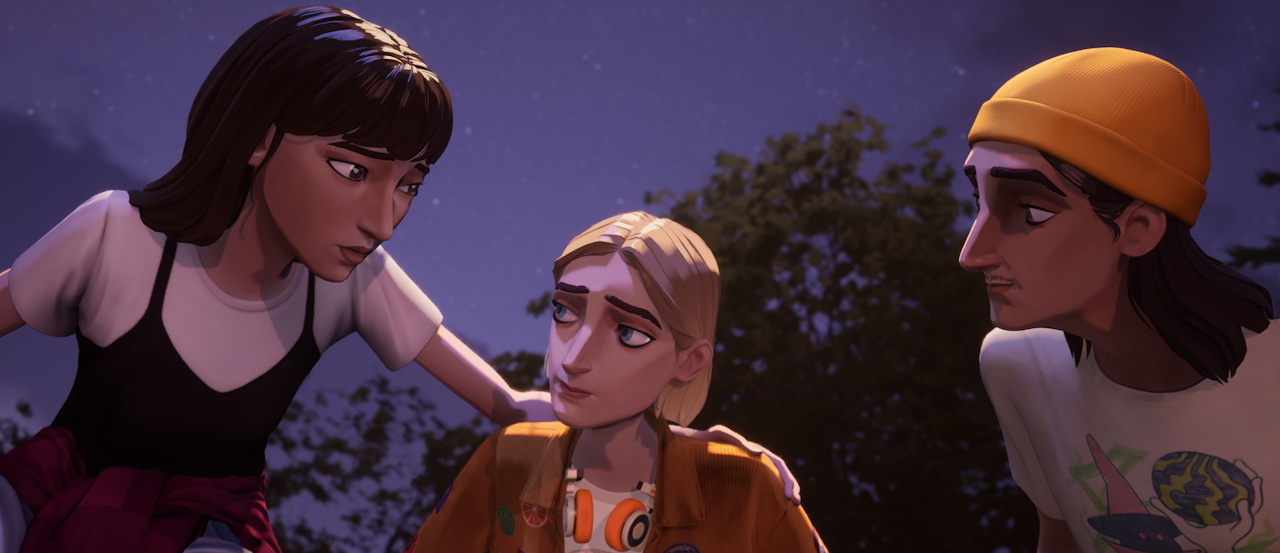
Screenshot of Mixtape (2026) showing Cassandra, Stacey, and Slater
I thoroughly enjoyed Mixtape.

I had a great time with Mixtape, and it’s a game I’ll be happy to recommend – to a certain kind of player! And speaking for myself, it’s a game I can already tell I’m going to want to return to every once in a while. It’s like a good film, in that sense – I don’t want to watch The Breakfast Club or St. Elmo’s Fire every day, but sometimes, when I’m in that nostalgic mood… I really enjoy them. And Mixtape is the interactive version of that kind of story.

Earlier this year, I reviewed Pragmata and Star Trek: Voyager – Across the Unknown. But if you want to check out titles a bit more similar to Mixtape – at least in some ways – I hope you’ll consider taking a look at my reviews of Indika and South of Midnight. If you liked Mixtape and you’re on the hunt for something to play next, I think either of those could be good choices. Click or tap the links to read my reviews of any of those titles.

And I still have several games in my pile that I hope to get around to in the next few weeks! If you’re interested in reviews of the likes of inKonbini: One Store, Many Stories, Mouse: P.I. For Hire, or Kioku: Last Summer, I hope you’ll stay tuned. I can’t *promise* reviews of all of them imminently, but they’re on my list, so to speak. Thanks for reading, and I hope this review has been useful, interesting and/or enjoyable for you! Happy gaming!


Mixtape is out now for PC, PlayStation 5, Nintendo Switch 2, and Xbox Series S/X consoles. Mixtape is the copyright of Beethoven & Dinosaur and/or Annapurna Interactive. Some promotional screenshots courtesy of Beethoven & Dinosaur/Annapurna Interactive. This review contains the thoughts and opinions of one person only and is not intended to cause any offence.

Little Kitty, Big City: Video Game Review

Little Kitty, Big City caught me off-guard. I’d added the game to my wishlist a long time ago, and I knew it was on the cards for 2024 – I even included it on my annual “look ahead” list just after New Year. But I’d missed developer/publisher Double Dagger Studio announcing an actual release date – so you can imagine my pleasant surprise to receive an email saying that the game had been released and was available to pick up!

A couple of years ago, another indie title called Stray took the “playing as a cat” idea in somewhat of a serious direction. That game was one of my favourites of 2022, and as a big cat person, I was champing at the bit for another cat game! Little Kitty, Big City isn’t going to be very complex or taxing – even on my ageing, arthritic fingers and thumbs. It’s a sweet, gentle game with lots of heart, plenty of sunshine and bright colours, and a charming art style that harkens back to the “glory days” of ’90s and early ’00s 3D platformers.

The logo of developer/publisher Double Dagger Studio.
Little Kitty, Big City is an indie title developed and published by Double Dagger Studio.

I’ll make a bold prediction right now, with less than half of 2024 in the bag and some big, exciting releases still on the calendar: Little Kitty, Big City is absolutely going to be in contention for my “game of the year” award. At the very least it’s likely to go down as the best 3D platformer I’ll play this year, but its incredibly cute main character, heartstring-tugging premise, and gameplay that’s just good fun should absolutely put it in contention for the top prize.

Check back in late December to see if the little kitty manages to snatch the award – or rather, knock it off the shelf!

I felt echoes of the likes of Banjo Kazooie in Little Kitty, Big City. Gameplay-wise, the combination of 3D platforming with hidden collectables definitely reminds me of that style of game – but also the way in-game dialogue is presented through text boxes with animal noises also felt reminiscent of games of that era. For a game clearly pitched at a younger audience, it’s refreshing to see some decidedly old-school trappings!

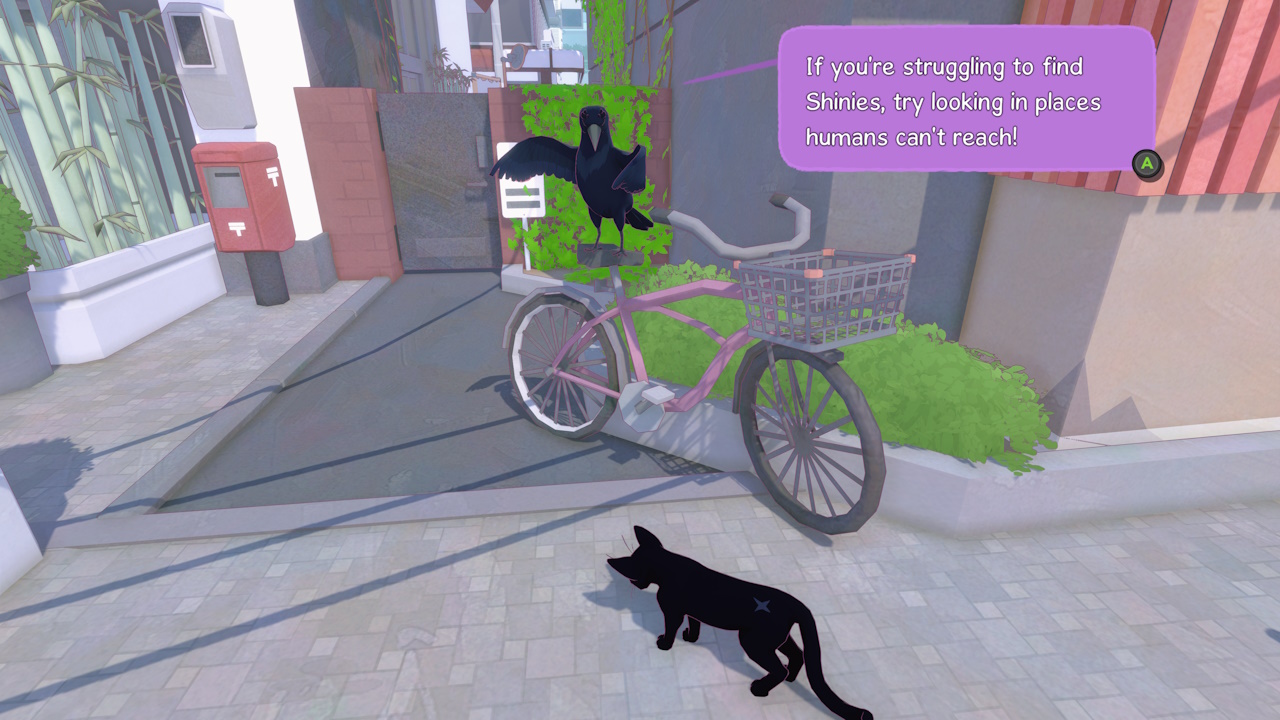
Screenshot of Little Kitty, Big City (2024) showing a dialogue box.
Chatting with a crow.

I adore cats. My oldest is just shy of her tenth birthday, and most cats I’ve rescued over the years are black cats. There are some silly superstitions about black cats and bad luck that often sees them abandoned or never being adopted, with some even having to be put down as a result. As a black cat lover, then, it’s so incredibly sweet to see the protagonist of Little Kitty, Big City as a black cat – at least by default. I’m sure mods will be created for the PC version (if they haven’t been already) to transform the kitty with all manner of fur coats and patterns! Watch this space.

This game feels perfect for cat fanatics like me, and I’m sure that there will be plenty of cat owners and cat-obsessed kids who will fall in love with it as a result. With the exception of Nintendogs + Cats and the aforementioned Stray, there really aren’t many experiences like this; animal protagonists in general are a relative rarity. The concept could, in a worse game, come across as gimmicky… but in a title built from the ground up with its furry protagonist in mind, it doesn’t feel that way at all. In fact, the game’s levels are perfectly-designed for feline exploration, with collectables tucked away out of human reach!

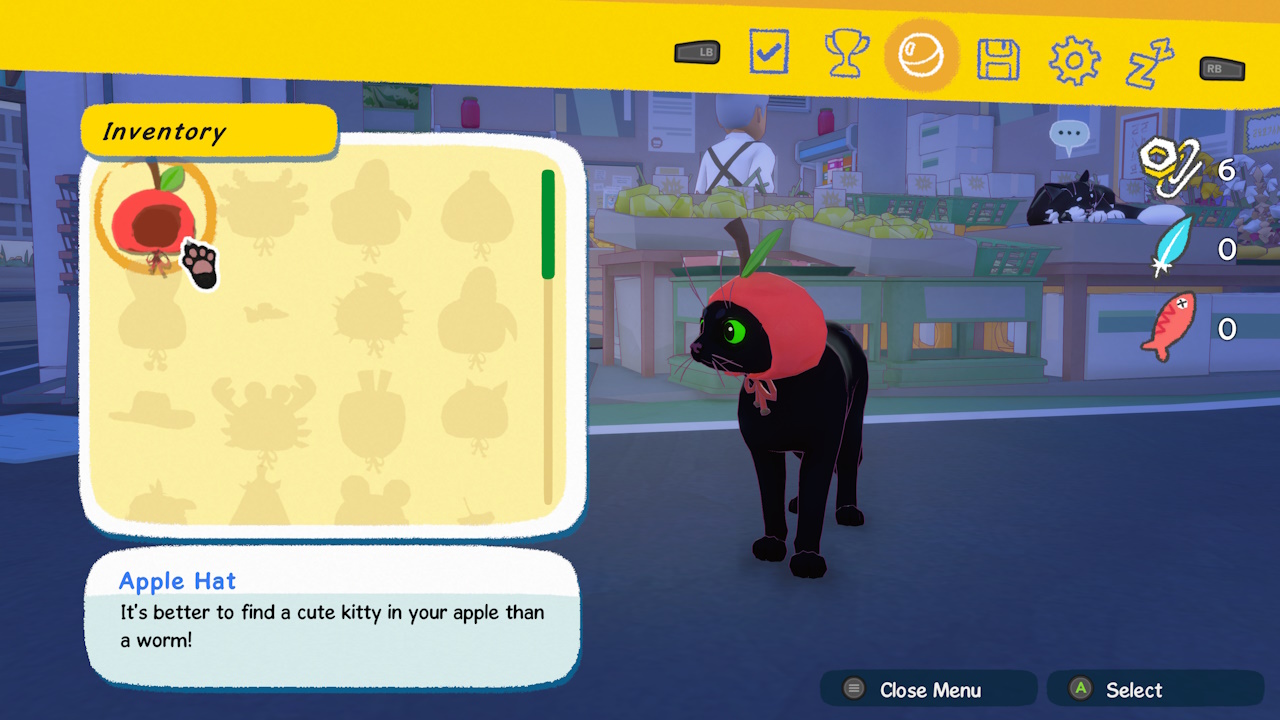
Screenshot of Little Kitty, Big City (2024) showing the inventory screen.
There are some cute hats to try on!

With Little Kitty, Big City being set in Japan, the titular city has a lot of Japanese theming. It doesn’t feel “generic” by any stretch, and if you’ve played games as diverse as Ghostwire Tokyo or Shenmue – or, of course, if you’re lucky enough to have been to Japan – there’ll be a lot of things that feel familiar. When I first booted up the game and got started with exploring the city, it was the depiction of Japanese homes in Shenmue that first leapt to my mind. I’ve never been to Japan, but having that frame of reference gave some familiarity to Little Kitty, Big City and its streets.

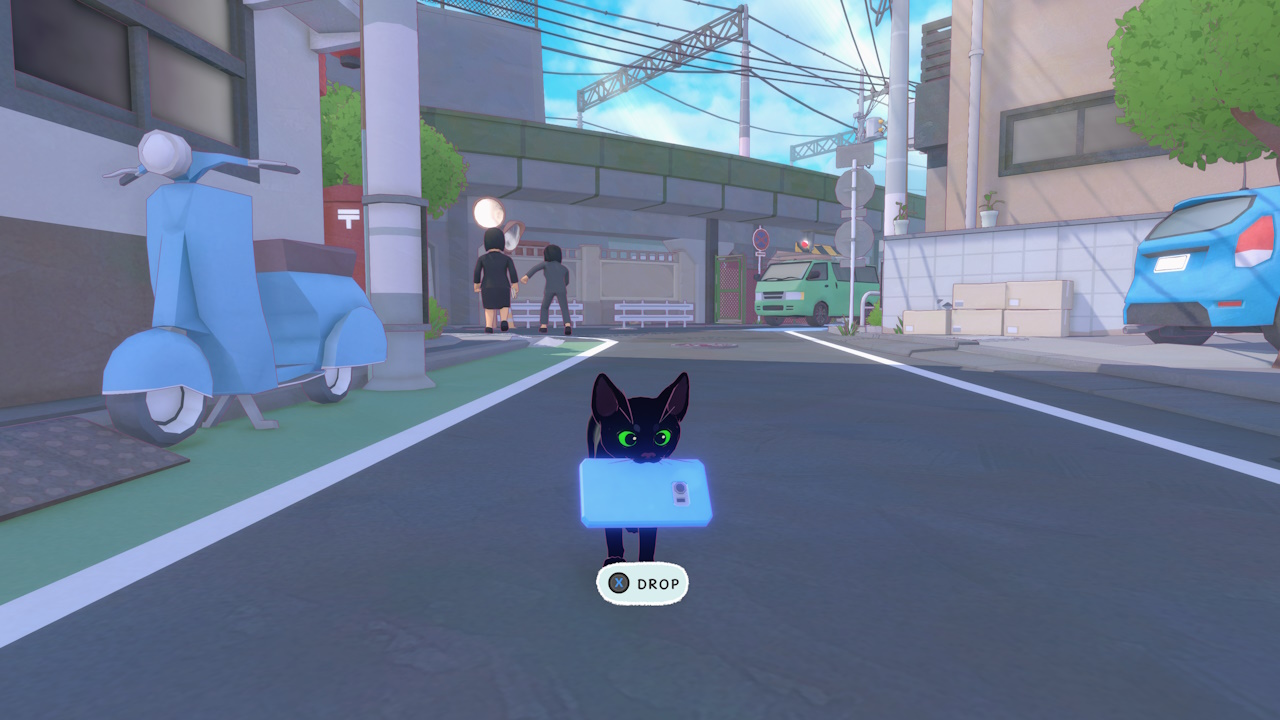
In terms of gameplay mechanics, I love the addition of what we might call “cat-specific” moves to the standard 3D platformer lineup! Being able to swipe at objects to knock them off shelves or walls is incredibly cute, picking up objects and carrying them by mouth is also ridiculously adorable, and changing the name of “sprint” to “zoomies” was just pitch-perfect. The titular kitty can crawl, run, pick up objects, knock things out of their way, and – of course – jump.

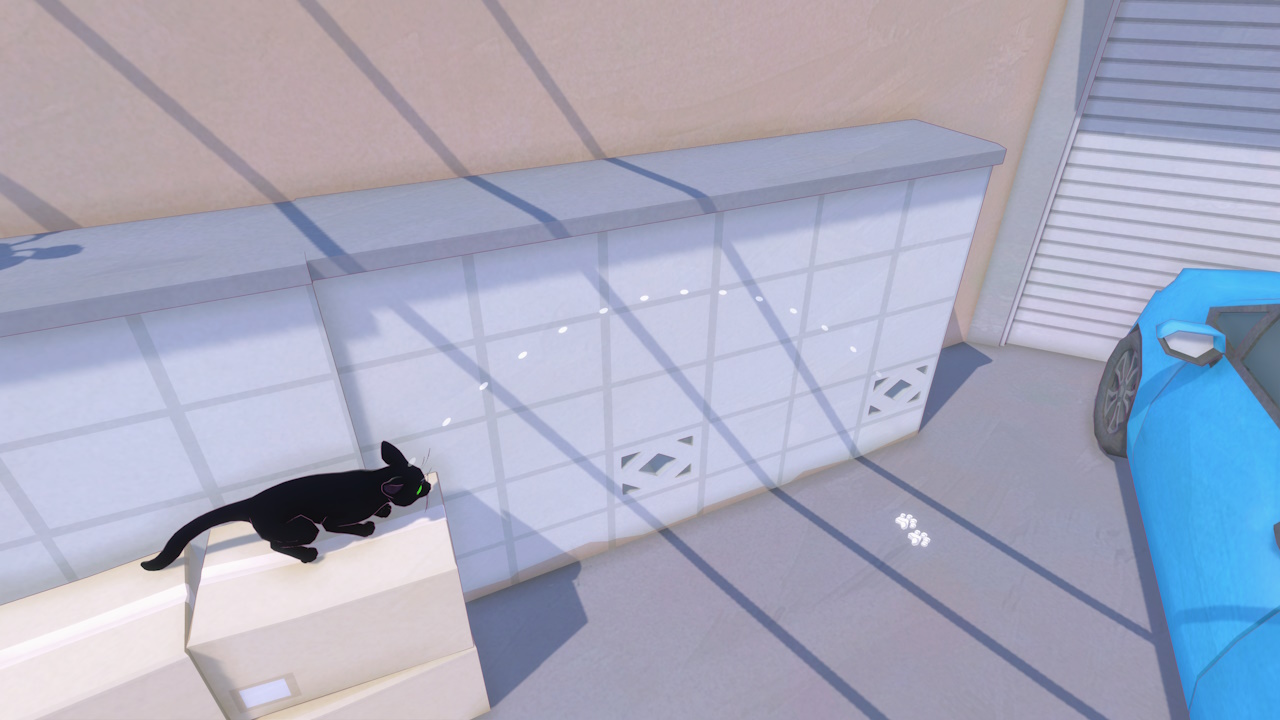
Screenshot of Little Kitty, Big City (2024) showing a jump preview line.
Lining up the perfect pounce.

The way the jump mechanic is handled here is actually really great. I can’t remember playing another 3D platformer with a “jump preview,” showing both the intended arc and landing site, but being able to see exactly where the kitty cat will jump and land simply by holding down the jump button is a great inclusion. It means less time wasted trying to line up impossible jumps, as well as making sure you’re going to land in the right place before hitting the button. This kind of thing could – and arguably should – be an accessibility feature in other titles, and I think some other developers could take notes from the way “jump previews” are implemented here. Obviously it’s not something that every game needs – but it works incredibly well in Little Kitty, Big City.

With everything from roads and buildings to traffic cones and empty soda cans sized up, the scale of the city really does hit you in those first few minutes. The sense of being genuinely lost is something that many folks don’t experience very often – even less in the days of Google Maps and smartphones. But there’s something about the combination of being small in this very large world and being lost and alone that I felt drew on shared memories of childhood. How many times can you remember, as a kid, getting lost in a supermarket or on the high street, and feeling very small in a world that was too big for you? For me, at least, Little Kitty, Big City really nailed that very specific feeling in a way that I wasn’t really expecting.

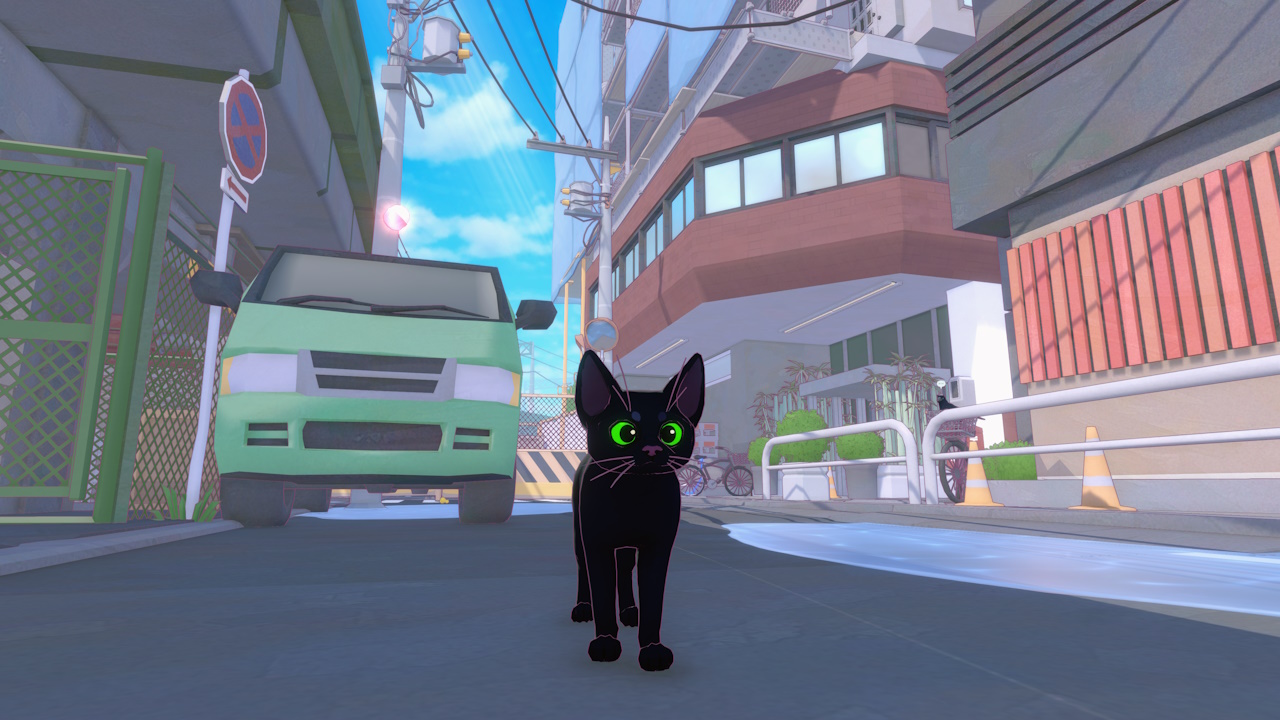
Screenshot of Little Kitty, Big City (2024) showing the cat on a street.
Everything feels huge when you’re a small kitty cat!

At the core of the game, of course, is the idea of being lost and alone – and while this is masked, to an extent, by fun gameplay and a vibrant colour scheme, there’s still something dark and worrying hiding inside. The protagonist of Little Kitty, Big City – through whose eyes we experience this beautifully-crafted game world – is desperate to get home, to escape this strange world in which they find themselves. There’s a primal fear, perhaps, as a kid of being separated from one’s caregiver, and being unable to get back to safety. Little Kitty, Big City draws on this – and while there’s still plenty of light-hearted fun with talking crows, jars of jam to knock down, pedestrians’ phones to steal, and so on… I found myself empathising with the protagonist all the more because of those distant memories.

But maybe I’m turning into my old English teacher and over-analysing something that should just be treated as good, solid fun! That’s what Little Kitty, Big City is, at the end of the day. It’s an incredibly fun platformer with an adorable feline protagonist. Jumping on cars, nuzzling pedestrians, and causing more than a little chaos as a black cat is genuinely one of the most enjoyable gaming experiences that I’ve had in a long time – and certainly one of the best of 2024 so far.

Screenshot of Little Kitty, Big City (2024) showing the cat holding a smartphone in its mouth.
Stealing someone’s smartphone has never been more fun… or cuter!

If you have Game Pass, Little Kitty, Big City is available there and it’s really a no-brainer. It’s a small file to download at 1.4GB, meaning you can be playing it in a matter of minutes! I also think the game will be fantastic on Nintendo Switch; being able to play it on the go, during a lunch break, or while commuting is going to be amazing. Little Kitty, Big City is also a title that I feel is priced appropriately: there’s no £60/$70 “base version” here; the game’s developers understood that it’s not the kind of game that needs that price point. It’s not an especially long game – but the different hats to collect and the fun, gentle gameplay give it a lot of replayability in my opinion. At time of writing, Little Kitty, Big City is slightly discounted on Steam, but even at its RRP it’s an easy title to recommend.

I’ve been having a whale of a time with Little Kitty, Big City – and as soon as I’m done writing up this review I’m going to jump back in! It’s easily my favourite game of 2024 so far.

Little Kitty, Big City is available now on Nintendo Switch, PC, Xbox Series S/X, and Xbox One consoles. Little Kitty, Big City is the copyright of Double Dagger Studio. This review contains the thoughts and opinions of one person only and is not intended to cause any offence.