Spoiler Warning: There are spoilers ahead for all three seasons of Star Trek: Picard – including the series finale and post-credits scene.
For a series that only ran to thirty episodes across three seasons, Star Trek: Picard spent a lot of time overwriting itself! Across all three seasons of the show there were these weirdly contradictory moments where new storylines would appear from nowhere, completely changing what came before. One or two of these instances might pass by relatively unnoticed, or could feel like little more than nitpicks. But for a relatively short series to have so many… it speaks to something bigger, I feel.
I hope in future we’ll get a Chaos on the Bridge-type of documentary or exploration of what went on behind-the-scenes on Star Trek: Picard, because to say that production was “difficult” feels like an understatement. There were clearly major problems on the production side of the series, and I don’t just mean its pandemic-enforced delays. The evidence for this is the contradictory nature of the series itself, and how at the very least there was clearly no overall plan for how the story should be structured. Consistency is an important element of any good story – and Picard absolutely fails on that measure.
Seasons 2-3 showrunner Terry Matalas with Sir Patrick Stewart and the rest of the cast of The Next Generation.
I have a longer piece in the pipeline about Picard’s abandoned and unfinished storylines, but today I thought it could be interesting to take a short look at ten storylines that ended up being overwritten by some pretty sloppy, messy writing that failed to build on the foundations that had been laid in earlier episodes and seasons.
As always, a few caveats. If you loved all of these stories and felt they were perfectly-executed, or if you hated the original setup and feel that it was right and fitting to overwrite or ignore it, that’s okay! We all have different opinions about what makes for a good Star Trek story, and I’m not trying to claim that I’m somehow objectively right and that’s the end of the affair. In several cases, I’d actually agree that the overwrite or retcon was better than what had been previously established. This is all just the opinion of one old Trekkie, and as I always say, there ought to be room in the Star Trek fan community for polite discussion and disagreement! Although I have my issues with Picard, particularly when it comes to the show’s second season, by and large I’m a fan not a hater.
So with all of that out of the way, let’s take a look at some of Picard’s weirdly contradictory storylines.
Contradictory story #1: Seven of Nine is a captain! Oh wait, no she isn’t…
Seven in the captain’s chair at the end of Season 2.
At the end of Season 2, Seven of Nine was breveted into Starfleet by Picard as Captain of the Stargazer. This story point was already a bit… odd. Firstly, it raises the question of why, if offering a brevet position to someone outside of Starfleet is so simple, Admiral Janeway didn’t do that for Seven years ago. It also seemed unnecessary, as with Picard on the bridge, the Stargazer already had a senior officer present who could give orders.
But this already flimsy setup ended up being overwritten by the very next episode – when Seven was bumped down to the rank of commander and found herself serving as first officer of the Titan. There are a lot of contradictions in Picard, but this one feels even more peculiar because it’s something that literally changes from one episode to the next – episodes that, in spite of being one season apart, were produced and filmed at the same time.
Contradictory story #2: Data’s dead. Deader than dead. Lol jk, he’s alive again!
Data awaits his final shutdown.
One of the few redeeming features of the two-part Season 1 finale was the laying to rest of Data, and giving him the emotional send-off that Nemesis didn’t have time to do justice to. It went a long way to making up for other deficiencies in the rushed and muddled end to Season 1, and the sequences with Picard and Data in the “digital afterlife” were powerful and deeply emotional.
But despite Data being as dead as it’s possible to be in Star Trek, with both his physical body and the surviving part of his consciousness having been destroyed and shut down respectively, Season 3 resurrected Data. We’ll have to go into this storyline in more detail in the future, because there’s a lot more to say. But for me, Data’s resurrection never really found a narrative justification, and it felt like the showrunner and writers wanted desperately to reunite the cast of The Next Generation – at any cost.
Contradictory story #3: Welcome aboard the Stargazer! Wait, I mean the Titan…
The USS Titan.
In Season 2, the ship that Picard and co. didn’t spend enough time aboard was the USS Stargazer. In Season 3, they jumped over to the Titan – even though the sets were all the same (with a few minor tweaks here and there). I don’t really understand why this happened. What was the point of setting Season 3 aboard a nominally different starship? The exact same setup could have brought Riker and Picard to the Stargazer as it did to the Titan.
If the two ships had significant aesthetic differences, maybe it would be okay. And compared with some of the other points on this list, I admit it’s relatively minor. But it still feels odd to introduce the new Stargazer, build CGI models for it, and only use it in one-and-a-bit episodes.
Contradictory story #4: Q’s dying… oh wait, no he isn’t.
Q at the end of Season 3.
I know what you’re thinking: Q already explained his “return” by telling Jack Crusher not to think about time in a linear fashion. While that’s a perfectly rational in-universe explanation for Q’s return at the end of Season 3, it doesn’t get around the fact that Q, whose death was such a vital part of the entire plot of Season 2, is a profoundly odd choice of character to use for that one epilogue scene.
Picard’s writers pinned the convoluted and disappointing story of Season 2 on Q, and Q’s entire motivation was his imminent death. To undo that – even if there’s a technical explanation for it – only a few episodes later feels wrong. It undermines the already-weak story of Season 2 and makes me wonder what the point of it all was.
Contradictory story #5: The Borg are back! The Borg are back! The Borg are back!
A Borg Cube.
However you look at it, and whatever nitpicky excuses there may be about who are and aren’t the “real” Borg, there’s no getting away from the fact that across its three seasons, Picard re-introduced the Borg three times. All three of the stories rely, either in whole or in part, on the Borg, and while Picard himself has a connection with the Borg after the events of The Best of Both Worlds and First Contact… there’s a whole galaxy out there filled with alien races that the show’s writers and producers could have used.
While Season 3’s Dominion/changeling rug-pull is probably the worst example of this, it really speaks to a broader problem with the show’s production. Picard’s writers, especially in Season 3, were unwilling to abide by what the show had already set up. The Borg are great fun, don’t get me wrong, but by the time we got to yet another Borg story in Season 3, I was feeling burned out.
Contradictory story #6: The mysterious anomaly has set up a fascinating story! Let’s never mention it again.
Led by the Borg, a Federation fleet stops the anomaly.
The story of Season 2 was bookended by a mysterious anomaly that the Jurati-led Borg faction believed could be an attack against the Alpha Quadrant. Once the anomaly had been stopped, the Jurati-Queen promised to take her Borg faction and stand watch over the anomaly as a “guardian at the gates.” Her Borg faction were even granted provisional membership in the Federation as they did so.
This story felt like it had huge potential. Who could have been powerful enough to create a weapon on that scale? How would Picard and his friends be able to defeat them? What would it be like to see a Federation-Borg alliance? But alas, this storyline was dumped, orphaned, and never mentioned again. Was no explanation ever written? Why end Season 2 on this cliffhanger if it was never going to be resolved?
Contradictory story #7: Soji’s a massively important character… let’s dump her.
Promo photo of Isa Briones as Soji.
Soji played a huge role in Season 1, serving as both the reason for Picard’s mission and later as someone who needed to be talked down from making a mistake. We spent a lot of time with her in the show’s first season, watching as she was manipulated by Narek, as she learned the truth of her own origin and who her people were, and as she came to work with and respect Picard.
It was disappointing that Soji was essentially forgotten after the end of Season 1, with a barebones cameo appearance and nothing more. Isa Briones got to play a minor role in Season 2 as the daughter of antagonist Adam Soong, but this storyline was samey and boring. As a new, young character – and a synthetic life-form – Soji had huge potential. It’s such a shame that a role couldn’t be written for her after Season 1.
Contradictory story #8: Picard has a new relationship with Laris! No wait, Laris has fucked off and now he has a kid with Dr Crusher.
Laris and Picard at the end of Season 2.
The entire story of Season 2 – its raison d’être, at least according to Q – was that Picard was alone, prevented by his childhood trauma from being able to find love. At the end of the season, after ten episodes of shenanigans in the 21st Century, Picard finally returned to his vineyard – and to Laris. The two seemed ready to embark upon a new relationship together.
But nope! Laris made a small cameo appearance at the beginning of Season 3, and was never mentioned again. Picard’s story in Season 3 focused on his past relationship with Dr Crusher, a relationship that led to him having a son he’d never met. The season’s epilogue even showed Picard and Dr Crusher jointly escorting their son to his first Starfleet assignment – with Laris nowhere to be found. As I said above: Season 2 was already a weak, flimsy story. Undermining its ending like this was a poor decision.
Although I wasn’t thrilled to see Elnor killed off in the first half of Season 2, as time went on, it seemed to be working. Raffi’s story of coming to terms with loss and grief was one of Season 2’s stronger elements, and while I would’ve still said I was disappointed in Elnor’s wasted potential, at least his loss had mattered. Until it was all undone with seconds to spare.
If Elnor had a major role to play in Season 3 – and there was absolutely space for him – then I could at least have understood this reversal. But after Elnor was resurrected, he got one very brief scene in which he looked confused on a viewscreen, and another in which his dislike of a beverage made him the butt of a joke. After that, Elnor disappeared from Picard never to be seen or mentioned again. What was the point? Why undo a powerful story for the sake of an overdone sight gag?
Contradictory story #10: Riker and Troi are happy and settled on Nepenthe. Just kidding, they hate it there.
Picard approaches Riker’s outdoor kitchen.
Nepenthe might be my favourite episode of Season 1. It slowed things down, stepped away from some of the drama, and reintroduced us to Riker and Troi – now happily married and living peacefully outside of Starfleet. In spite of the loss of their son, Riker and Troi seemed settled on Nepenthe with their daughter in a home that was important to their son and their family. It was a surprise, to say the least, when Season 3 tried to undo all of that.
In the episode Surrender, Riker and Troi were reunited as captives aboard Vadic’s ship. And while imprisoned, they both spoke about how they hated the “creaky old cabin” that had been their home. The end of the season implied that one or both of them may be back in Starfleet, and all the emotional storytelling present in Nepenthe was taken away.
So that’s it!
Dr Jurati on stage in Season 2.
Although there were some interesting stories – and some complete ones – overall, it’s not unfair to call Star Trek: Picard a contradictory series, one that either intentionally or unintentionally overwrote or ignored key characters and storylines. We’ll talk about some of these in more detail on another occasion, but for now I think we’ve covered the basics.
Picard was clearly a troubled production, one that jumped from one writing and production team to another, and that’s part of why the series as a whole feels so contradictory. I think I could overlook one or two of these things – and I might even support the decision to drop a character or change a storyline that wasn’t working or that failed to resonate with audiences. But for a series that ran to a mere thirty episodes across three seasons… we shouldn’t be able to pull out ten large contradictions like this.
Stay tuned, because I have a lot more to say about Picard even though the series has concluded! A longer retrospective is in the pipeline, and I’ll also be taking a look at abandoned and unfinished storylines, too.
Star Trek: Picard Seasons 1-3 are available to stream now on Paramount+ in the United States and other countries and territories where the service is available, and on Amazon Prime Video in the UK and around the world. The Star Trek franchise – including Picard and all other properties discussed above – is the copyright of Paramount Global. This article contains the thoughts and opinions of one person only and is not intended to cause any offence.
Spoiler Warning: There are spoilers ahead for the entire Star Trek franchise, including the most recent seasons of Discovery, Picard, Lower Decks, Prodigy, and Strange New Worlds.
I’ve seen a lot of posts on social media where fans try to construct their “ultimate” Star Trek crews with characters from across the franchise, including one that popped up a few weeks ago. For whatever reason, this latest one – which was put out by the official Star Trek Twitter account – captured my imagination. So today I thought it could be fun to show off the characters that I’d pick to be in my “ultimate” Star Trek crew!
Let’s start by laying down some ground rules…
The social media post which inspired this article.
First of all, I don’t want to pick more than a couple of characters from a single series. If you’re just going to pick the entire crew of the Enterprise-D, what’s the point? We might as well just go and watch The Next Generation!
Secondly, the fact that characters come from different eras or timelines is entirely irrelevant. This is pure fantasy – though who knows, maybe one day Star Trek will do some kind of massive crossover event featuring characters from all over the place!
Third, characters have to occupy a role that we saw them fill on screen; i.e. Captain Picard can’t be a tactical officer, nor could Michael Burnham be assigned as the ship’s Chief Medical Officer!
Fourth, I want to include all of the major roles that we’ve seen main characters occupy on Star Trek – something that the Twitter post that inspired this piece didn’t do!
Finally (and most importantly), I want this to be taken light-heartedly and in the spirit of fun!
So let’s get started building the USS Trekking with Dennis!
Starship Class: Excelsior
The USS Excelsior in The Search for Spock.
One thing that a lot of these lists miss is the ship that the crew will be serving aboard. As many Trekkies have pointed out over the years, a starship is akin to a member of the crew; not merely a setting but a living, breathing entity in its own right. Many starship designs have become iconic parts not just of the Star Trek franchise, but of sci-fi and popular culture in general, and many Star Trek starships are instantly recognisable even to folks who aren’t fans.
The Excelsior-class has been one of my favourites ever since I first saw it. It’s a beautiful design that took the classic look of the Constitution-class and updated it, becoming an iconic piece of ’80s sci-fi in the process. It’s clearly a Starfleet ship – the design retains the saucer, neck, body, and nacelles on pylons that continue to define Federation starships, but it mixed things up for a new era. Excelsior-class ships became workhorses for Starfleet, remaining in use for decades. Picard Season 2 recently debuted an updated design, showing that the ships were still being used at the dawn of the 25th Century!
Admiral/Mission Commander: Jean-Luc Picard
Admiral Picard.
In overall control of our mission at Starfleet Command is Admiral Picard! He’s level-headed, diplomatic, and willing to try to negotiate even with the fiercest adversaries. He’s also a skilled tactician in his own right, and someone who I’d trust to plan operations that involve entire fleets of starships.
Admiral Picard was initially chosen by Starfleet to spearhead the Federation’s efforts to evacuate the Romulan homeworld. While that plan ultimately fell apart due to events beyond his control, the fact that he was the right man to take charge of such a massive assignment shouldn’t be in dispute. Admiral Picard – with support from his team – will be co-ordinating our mission back at headquarters!
Captain: Benjamin Sisko
Sisko in Deep Space Nine Season 7.
Although the question of “absolute favourite captain” is an incredibly difficult one, if I were placed under duress Benjamin Sisko is probably the individual I’d name! A battle-hardened commander who transformed a minor, obscure posting into one of the most significant strategic locations in the entire Alpha Quadrant, Captain Sisko led the charge against the Dominion during one of the Federation’s darkest hours.
As a commanding officer, Sisko inspired his crew to follow him, but he was also well-versed in dealing with alien cultures and could be both a diplomat and a deal-maker. I also feel that Captain Sisko would work well with Admiral Picard; he would command the ship while Picard was in control of the overall mission, but could also offer advice and input as we saw him do for Admiral Ross during the Dominion War.
First Officer: Jack Ransom
Commander Jack Ransom.
At the top we have two very serious people – so we need someone like Commander Ransom to balance things out! Although he can be laid-back and make jokes, when the chips are down we’ve seen Commander Ransom absolutely excel, putting the needs of his shipmates first and stepping up to tackle whatever the cosmos throws at him.
The role of a first officer in Star Trek has varied from show to show, with some taking on more away missions and others serving as advisors and confidantes. The best first officers are a mix of both, and Jack Ransom seems like someone his commanding officer can rely on to give honest, sound advice – and then lead a dangerous mission independently.
Helm: Tom Paris
Promo photo of Tom Paris.
The role of helm officer has been part of Star Trek since The Original Series. But it wasn’t until Tom Paris took over at the helm of the USS Voyager that I felt there was someone in the driving seat who was a bona fide pilot. Paris truly loves piloting Voyager – and any other ship or shuttle that he can get his hands on, too. That’s an impression that I never really got from Sulu, Wesley Crusher, or really anyone else who had sat in the chair before him; they seemed to see the role as a job or duty, where Paris revels in his work.
Not only does Tom Paris enjoy what he does, but he guided the USS Voyager safely home across an impossible distance. Whether it was wormholes, slipstream drives, spatial catapults, the Borg transwarp network, or a warp 10 shuttle that accidentally mutated him into a salamander, Paris navigated them all – and found redemption for his past misdeeds in the process.
Chief Engineer: Hemmer
It’s Hemmer Time!
As the first Aenar to be a major character, Hemmer had a lot of potential. The no-nonsense attitude he had stands in stark contrast to some other engineers we could think of, but when he was off-duty he was personable and friendly with his shipmates – and a guiding light to young cadets who found themselves under his wing. Hemmer’s love of science was cute, too, and he was able to take in his stride all kinds of different events that befell the USS Enterprise.
As Hemmer once told Uhura, he believed that his purpose was to fix what is broken – and he did that in more ways than one while serving as the Enterprise’s chief engineer. Hemmer helped the Enterprise survive major damage during battles against dangerous enemies, and he’s the person I’d want to rely on to keep my starship flying!
Chief Medical Officer: Dr T’Ana
Dr T’Ana.
Dr T’Ana is unapologetically my favourite Lower Decks character. Her gruff and grumpy bedside manner conceals genuine medical skill, and we’ve seen her treat patients with all kinds of horrible sci-fi ailments without so much as batting an eyelid. Despite her acerbic attitude, though, Dr T’Ana manages to strike up friendships with her shipmates – and has proven herself to be someone they can rely on.
We’ve also seen how Dr T’Ana is unflappable and doesn’t crack when put under pressure – something that could be important depending on how badly our mission goes! She may not be the politest doctor in the fleet, but no matter what was wrong – disease, injury, or random sci-fi shenanigans – I’d trust Dr T’Ana to patch me up. Plus she’s a Caitian, something that I appreciate as a cat-fanatic!
Nurse/Sickbay Assistant: Kes
Promo photo of Kes.
While Dr T’Ana can be grumpy and even abrasive, Kes has a wonderful bedside manner that has a way of putting patients at ease. Although she didn’t have much by way of formal medical training when she joined the crew of the USS Voyager, she soon grew into her role as the Doctor’s assistant in sickbay. I still think it’s a shame that Kes had to leave Voyager after the show’s third season, just as she was hitting her stride and learning more about her telepathic abilities.
Kes provides a sharp contrast to Dr T’Ana, and for that reason I think the dynamic in sickbay would be a lot of fun. But Kes has also demonstrated a willingness to learn and a keen medical intuition of her own, so if Dr T’Ana (and the rest of the medical staff) were busy or indisposed, Kes is more than capable of treating patients on her own.
Counsellor: Dr Hugh Culber
Dr Culber in Discovery Season 4.
Although Dr Culber is the USS Discovery’s chief medical officer, in recent seasons we’ve also seen him take on the role of ship’s counsellor to a greater degree. Not all doctors would make for good counsellors, but Dr Culber has grown into the role, taking on the extra burden of caring for his shipmates’ mental health in addition to his duties in sickbay.
In The Next Generation, Counsellor Troi had a pretty big advantage when it came to reading her patients and understanding them! Dr Culber doesn’t have that same empathic ability, meaning he has to do things the old-fashioned way! But his advice has proven invaluable to Captain Burnham, Saru, and even Book. Dr Culber throws himself into his work, prioritising his patients ahead of himself on occasion.
Tactical: Tuvok
Tuvok in Voyager’s first season.
Tactical has often overlapped with security on Star Trek, but if you think about it, they’re really two distinct roles that require different approaches. As fun as it might be to see Worf getting angry as the Enterprise races into battle, if my back’s against the wall and I’m facing defeat, I want the cool-headed, logical Tuvok aiming the phasers and firing the photon torpedoes.
Tuvok’s temperament makes him incredibly well-suited to a position at tactical – and not only in the heat of battle, either. As a strategist who has mastered the difficult Vulcan game of kal-toh – a strategy game he’s been playing for well over a century – Tuvok is also someone I’d trust to draw up plans for everything from small away missions to large battles.
Security Chief: Odo
Constable Odo.
As above, we’re separating the roles of tactical officer and security chief. For the latter, there’s no one I can think of who’s better-suited to the role than Odo! Odo is Star Trek’s first real “policeman;” a dedicated officer of the law who was trusted by the Cardassians, Bajorans, and the Federation to be impartial when it comes to justice.
That impartiality – ensuring that no one is above the law – is exactly what our crew needs. Odo will maintain order, but he’ll do so fairly. He’ll also be able to strike up friendships with the crew while retaining that impartiality. Everyone aboard our ship – Starfleet, non-Starfleet, guests, diplomats, or anyone else we meet along the way – will know that Odo will treat them fairly. And I gotta be honest about this last point: having a changeling on the crew could come in handy in a lot of situations!
Communications: Hoshi Sato
Ensign Hoshi Sato.
Hoshi Sato had not only mastered forty languages – including some very alien ones – in the days before universal translators existed, but she contributed in a major way to making the universal translator itself work in the way we’ve come to expect in Star Trek. Real-time, instant translation of previously-unheard alien languages wouldn’t have been possible without Hoshi’s work.
Hoshi Sato also showed an incredible aptitude for picking up languages very quickly – notably translating languages like Romulan and both Xindi-Insectoid and Xindi-Aquatic. If there was ever a problem with the universal translator – or our mission encountered an alien race whose language and form of communication was difficult to understand – Hoshi Sato is the linguist I’d want on our crew to handle things!
Science Officer: Spock
Spock at his post in The Original Series Season 1.
Could it really be anyone else in this role? Although Spock would go on to be a captain, an ambassador, and a diplomat, it’s his role as the Enterprise’s science officer where he’s best-remembered and most iconic. Spock has a genuine interest in uncovering the secrets of space and the universe, and his raised eyebrow and proclamation that something is “fascinating” have become legendary parts of the Star Trek franchise!
Spock’s logical analysis of sensor readings helped out – and saved – the Enterprise on multiple occasions. Taking his time to analyse unknown phenomena, Spock would present his findings based on the available evidence, and was instrumental in missions as diverse as discovering new forms of life and shutting down ancient super-weapons. On a mission of exploration – or any mission that needs good, solid scanning and sensor work, I want Spock manning that post!
Operations: Data
Data in Tin Man.
Although the role of operations or ops officer isn’t always well-defined in Star Trek, the role can involve things like power management, sensor control, deflector control, and oversight of the internal workings of the ship. We’ve seen senior officers like Data and junior officers like Harry Kim and Nog assigned to operations roles, and I’m choosing to bring Data along on this mission.
Data is an android, and he has super-human abilities and reflexes as a result. When it comes to things like systems maintenance and keeping the ship in good working order, someone like Data is ideally-suited to the role, and he’s also proven himself to be more than capable of overseeing departments and even entire crews. Data can also provide valuable insight into unfolding situations almost entirely free from bias, making him incredibly useful to have on the bridge as an advisor.
Transporter Chief: Montgomery Scott
Scotty shortly before his first retirement.
Although Scotty is best-remembered as the Enterprise’s chief engineer, I’m assigning him the role of transporter chief this time. One of the most iconic (and misquoted) lines from The Original Series is “beam me up, Scotty,” so I think we’re on safe ground here! Scotty is nothing short of an engineering genius, and when things go wrong – as they often do with Starfleet transporters – he’s the man I’d want to fix things and keep them running smoothly.
Transporter chief is a role that can be overlooked, especially considering that transporting is a fairly quick process when everything runs smoothly. But everything doesn’t always run smoothly, and the right transporter chief with the right technical know-how can mean the difference between beaming up and having your molecules scattered across half a sector of space. Or worse!
Cadet: Rok-Tahk
Rok-Tahk.
It’s not unusual for a starship to have several cadets assigned as they complete their courses at Starfleet Academy, so I’m picking Prodigy’s Rok-Tahk for that role (even though she isn’t formally a Starfleet cadet!) Across the first ten episodes of Prodigy, I felt we got to see some genuine character growth from Rok-Tahk that I hadn’t really expected, and I think she’ll continue to develop into a truly excellent Starfleet officer one day.
We’ve seen cadets like Uhura in Strange New Worlds and Tilly in Discovery moving between departments to try their hand at basically everything aboard a starship. Perhaps Rok-Tahk will do something similar during the course of our mission, giving her a range of new experiences, and potentially bringing a different point of view to all of the departments aboard our ship.
Bartender: Guinan
Guinan in Picard Season 2.
Although Quark is a worthy contender to bring along, I think it’s not unfair to say he’s a bit of a troublemaker! Guinan can be relied upon to create a welcoming environment in her bar for when our crew need some time to relax, but she’s also far less likely to cause problems during our mission!
Guinan can draw upon the experiences of her centuries-long life to offer advice and support to all members of the crew, and we’ve seen moments where her words to Captain Picard ended up completely transforming the outcome of a story. As someone who not only tends the bar but also listens and occasionally has something of value to add, Guinan is the perfect complement to any Starfleet crew.
Non-Starfleet Crewmate: Garak
In The Pale Moonlight was one of Garak’s best episodes.
Since The Next Generation premiered, most Star Trek crews have included at least one non-Starfleet or non-Federation crewmate. When I think back over these characters, few stand out more than Deep Space Nine’s Garak. Garak also brings a lot to the table for our crew! His previous life as a spy saw him develop a completely unique set of skills ranging from technical to combat and beyond – and in a pinch, he could be very useful.
However, Garak will need to be carefully monitored during our mission, as he can be rather slippery and self-serving. Although his service toward the end of the Dominion War saw him firmly allied with the crew of DS9 and the Federation, Garak has gone off-script on a number of occasions. He doesn’t always willingly share everything that he knows, so having someone else on board who knows how to handle him and how to get the best out of him could be important! But when a crisis looms, I think Garak can be counted on to find unconventional – and often un-Starfleet – ways to solve problems.
Villain: The Borg
The first Borg drone seen in Star Trek.
There have been some wonderfully iconic villains in Star Trek, like Khan or Gul Dukat, and it can be hard to pick an absolute favourite. Purely in terms of the scale of the threat they pose, though, few Star Trek adversaries can compare to the Borg Collective. A vast army of billions or perhaps trillions of assimilated drones, a fleet of thousands of identical cube-shaped ships… the Borg are a faction that could wipe out the Federation in a matter of days without seriously overtaxing themselves.
We’ve seen Starfleet ingenuity and individuality overcome the Borg on a handful of occasions, but I’ve always wondered what it would look like if the Borg ever tried to invade en masse. Would a one-sided rout be inevitable… or will our cobbled-together crew find a way to save the day?
So that’s it!
Star Trek’s first crew.
Those are the characters that I’m choosing for my “ultimate” Star Trek crew.
There are no right answers to the question of which characters make for the “best” crew, and in addition to individual characteristics it’s worth considering how different characters would interact with one another and how well they’d work together. For my two cents, practically every Star Trek show has managed to get a good balance of characters and deployed them successfully. There are a handful of characters who didn’t really get enough time in the spotlight to truly shine, but even so, the franchise as a whole has done a fantastic job – and there are plenty of wonderful characters to choose from when making a list like this one!
I hope this was a bit of fun – and not something to take too seriously or get upset over! I was inspired a few weeks ago by that post from the official Star Trek social media team, and this is my (lengthy) response. It took a while to put this list together and really think about which characters I’d want to include – and which I’d have to exclude. For practically every position on the list above, there was at least one and often two other characters that I strongly considered including. I hope that the final list feels balanced between different shows and different eras, and was, if nothing else, a bit of fun to read!
Until next time!
The Star Trek franchise – including all characters, television series, and films mentioned above – is the copyright of Paramount Global. This article contains the thoughts and opinions of one person only and is not intended to cause any offence.
Spoiler Warning: There are spoilers ahead for Star Trek: Picard Seasons 1-2 and casting information for Season 3. Spoilers are also present for the following Star Trek productions: Discovery, Enterprise, Voyager, First Contact, and The Next Generation.
After a plodding and occasionally frustrating season, Star Trek: Picard wrapped up this week. Going into the season finale we still had more than twenty theories on the table – though some were definitely beginning to feel unlikely! This week we’re going to conclude my Season 2 theory list and take a look at how some of those remaining theories landed.
Across the season as a whole, I had some theory successes – as well as more than a few misses! But as I always say, all of this is just for fun – so the theories that ended up being completely wrong are totally fine by me! It was enjoyable to spend the extra time thinking about where the story of Picard Season 2 could be headed, and even when I was wide of the mark it was still a great excuse to dive deeply into the Star Trek galaxy.
So without any further ado, let’s start wrapping up the theory list. We’ll begin with the theories that were confirmed, then take a look at the ones that were debunked. There are also a couple of theories that may survive going into Season 3, so stay tuned in the days and weeks ahead for a preliminary Season 3 theory list!
Confirmed theory #1: A character from The Next Generation made an appearance.
Wesley Crusher!
Wesley Crusher’s return was one of the high points of the season finale for me! After a thirty-year absence from the role, Wil Wheaton stepped back into the shoes of Wesley Crusher and showed us a glimpse of his life as a Traveler. The fact that this was kept secret and not spoiled ahead of time made it one of the biggest surprise moments in the finale – and while I had been speculating that at least one character from The Next Generation would appear all season long, I would’ve never guessed that it would be Wesley!
With the rest of The Next Generation crew reuniting next season, it’s incredibly sweet that we got this moment with Wesley before Picard wrapped up. It would’ve been amazing to see him reunite with Picard himself, of course, but just seeing Wesley back in action, knowing that he’s living an amazing life and that he still exists in the Star Trek timeline was absolutely fantastic.
Wesley’s appearance also tied together the Travelers from The Next Generation with the Watchers and Supervisors from The Original Series – and connected in a big way with Tallinn’s role this season. It was an incredibly creative way to bring these storylines together and to connect with over fifty years’ worth of Star Trek’s history. All in all, one of the season finale’s best moments.
Confirmed theory #2: Seven of Nine was given a Starfleet commission.
Captain Seven!
Maybe it would be fairer to call this one “semi-confirmed,” as Seven’s commission from Admiral Picard in Farewell seemed very much like a brevet; a less-than-official or impermanent role that came about as a result of the unique circumstances of working with the Borg. But regardless, I had speculated that Seven would join Starfleet before the end of the season, and technically that happened!
It was a fun moment to see Seven assume command of the USS Stargazer, but moreover I was impressed with the way her season-long arc took her from a place where she hated the Borg (and the Borg side of herself) and was advocating for shooting first and asking questions later all the way to placing her trust in the Borg Queen-Dr Jurati hybrid. Seven’s growth got her to a place where her trust and her actions allowed her to play a definitive role in saving the entire quadrant from the mysterious anomaly.
Confirmed theory #3: The Borg’s request for help from the Federation turned out to be genuine.
This is the disaster that the Borg wanted to prevent.
It was implied in The Star Gazer at the beginning of the season that the Borg’s message may have been a ruse; a deception that was intended to be the pretext for a new Borg invasion of the Federation. However, just because some of our characters believed that to be true didn’t mean it was true, and I wondered whether the story might end up saying that the Borg were genuinely asking for the Federation’s help.
That turned out to be correct – in a roundabout way, of course. The Borg weren’t fleeing from some unknown assailant, as I had speculated, nor were they crippled following the events of Voyager’s finale. Their intention was to help – to join with the Federation and use their technology to prevent the attack on the Alpha Quadrant by whoever sent the mysterious anomaly.
Confirmed theory #4: The masked, hooded Borg was not the “real” Borg Queen.
The Borg Queen, unmasked.
I daresay this one had been increasingly obvious for at least half of the season, and especially after the way Hide and Seek had ended a week earlier, it seemed all but certain that the Borg Queen on the bridge of the Stargazer would turn out to be the Dr Jurati hybrid as opposed to the original Borg Queen. This turned out to be true – although why Farewell attempted to treat this as a big, shocking revelation is something I’m not sure of!
Ever since we first saw the masked Borg Queen at the beginning of the season I felt sure we’d find out who was behind the mask. Along with Dr Jurati, earlier in the season I’d suggested Admiral Janeway, Soji, and Renée Picard as possible candidates.
Confirmed theory #5: Elnor was restored to life in the 25th Century.
Cadet Elnor aboard the USS Excelsior.
I’m afraid that I don’t like the way that Elnor’s story was handled as the season wrapped up. On the one hand, I’m pleased that a character like Elnor – who has a lot of potential as someone young and from a unique background – hasn’t been permanently killed off. However, his survival undermines Raffi’s season-long arc of coming to terms with guilt and grief, as well as renders one of the best and most emotional moments in Hide and Seek entirely impotent.
Regardless of all that, I had been speculating that Elnor would be saved ever since he was killed, and as I said last time, I wasn’t prepared to drop the theory with only one week remaining in the season. I’m glad I didn’t – because it turns out I was right and this is another one I can place in the “win” column for Season 2!
Confirmed theory #6: Rios chose to remain in the 21st Century with Teresa and Ricardo.
Rios chose to stay behind.
This was another disappointing storyline, unfortunately. As I’d been saying all season long, the way Rios regressed as a character from his presentation as a Starfleet captain at the beginning of the season was ridiculously poor, and his choice to stay in the 21st Century really just capped off what has been a truly disappointing season for him.
Rios spent most of his time in Season 2 disconnected from all of the other main characters, spending his time only with Ricardo and Teresa, so even his goodbye with the other characters didn’t hit as hard as it could’ve. As I said last time, I never really felt that Rios and Picard were anything more than acquaintances; work friends, not real friends. Also, I guess Rios must’ve not been paying attention in history classes at Starfleet Academy, because World War III is about to break out, followed by the post-atomic horror. He’s about to live through the worst fifty years in all of human history in the Star Trek timeline. So… good job, idiot.
Confirmed theory #7: Q shielded Picard and the crew from the changes to the timeline.
Oh, Q.
The season finale finally saw us get an explanation from Q as to what he’d done and why. As part of a plan to help Picard overcome trauma and grief from his childhood and his mother’s death, Q set a very elaborate plan into motion, changing the past and ensuring that Picard and the crew of La Sirena were the only ones unaffected.
As we saw in the finale, Q’s powers could be used to send people’s consciousnesses through time or even across the divide between different realities, meaning that must’ve been what he did in the first place to set up this puzzle. It had seemed all but certain that this was the case, but until we heard from Q himself and gave him the chance to explain what had happened I wasn’t ready to call it confirmed.
So those theories were confirmed.
We have one theory that I’m calling “semi-confirmed,” but we won’t be sure about its status until we start to learn more about Season 3.
Semi-confirmed theory: The season will end on a cliffhanger.
The mysterious anomaly.
What’s going on with the anomaly? We didn’t get any kind of explanation for what it was, where it came from, or who might be responsible for attempting to destroy the entire Alpha Quadrant… so I think that this is setting up at least part of next season’s story. If that’s correct, then this theory that I’d been running all season long will, in a roundabout way, turn out to be correct!
However, if the anomaly isn’t revisited next time, we’ll have to call this one debunked. At the moment it feels like we’ll have to come back to the anomaly in some way, just based on its mysterious and unexplained nature, but then again the Season 1 super-synths (and other Season 1 plot threads) didn’t come back into play in any way during Season 2… so I guess we’ll have to wait and see. Regardless, I’m calling it “semi-confirmed” for now.
So that theory was semi-confirmed.
Now we’ll go through the theories that were debunked by Farewell and definitely won’t be returning for Season 3!
Debunked theory #1: Some or all of the main characters from The Next Generation will rescue Picard from 2024.
The main cast of The Next Generation in Season 5.
I had wondered if, with Picard stranded in the 21st Century, some or all of the main characters from The Next Generation would show up to rescue him. Given that Q’s powers seemed to be in decline, and with few other options for getting back to the 25th Century, it seemed like a plausible idea, one that could’ve potentially set the stage for Season 3. It would’ve also tied in thematically with what we saw at the end of Season 1, where Acting Captain Riker arrived at the last minute to save the day.
However, it didn’t happen. Q was able to use the last of his energy to get Picard home, and the only character from The Next Generation to appear was the aforementioned Wesley Crusher.
Debunked theory #2: The “two Renées” comment refers to Picard’s nephew.
René Picard – not to be confused with Renée Picard.
Though it would’ve been somewhat of a bolt from the blue, I was wondering if the Borg Queen’s cryptic comment in Hide and Seek about there being “two Renées” might’ve been referring to Picard’s nephew. In the prime timeline, René Picard was the son of Jean-Luc’s brother Robert. The two were killed in a fire at the vineyard during the events of Star Trek: Generations, and I wondered if the Borg Queen may have been referring to that moment as it was another significant one for Picard and his family.
As it turned out, “two Renées” were required to complete the mission. With Dr Adam Soong on the prowl, Tallinn disguised herself as Renée and allowed Dr Soong to kill her in order for the real Renée to board the Europa Mission spacecraft, setting up her significant discovery and the role she would ultimately play in creating the brighter future that we’ve come to know in Star Trek.
Debunked theory #3: An alternate reality is about to be created.
“An alternate reality?”
With the Dr Jurati-Borg Queen hybrid departing Earth in the 21st Century, and a cryptic message about “two Renées” to consider, I wondered if the end of the season might’ve seen some kind of permanent divergence in the timeline. One timeline may have been the familiar one, but the other could’ve been completely different either because of a very different Borg Collective or even because of the actions of Dr Adam Soong.
That didn’t happen, however, and it seems as though the prime timeline has been restored without the Confederation timeline – or indeed any other alternate reality – coming into existence. That keeps things nice and simple, at least!
Debunked theory #4: The loose ends from Season 1 will be tied up.
What happened to Narek?
I’m disappointed that Picard Season 2 did basically nothing at all to wrap up any of the loose ends from Season 1 – and there were quite a few. A rushed finale last time around left significant chunks of story still on the table, and there were some pretty sizeable unanswered questions remaining. Even just a few lines of dialogue would’ve been something, but we didn’t get that.
It’s possible that Season 3 may bring back a faction like the super-synths, in which case we may learn more about them or see other connections to events from Season 1, so I’m not entirely giving up on this one. But explanations for what happened to Narek, what became of the surviving ex-Borg, the fate of the beacon on Aia, and so on could’ve been addressed this time. It’s a shame that there wasn’t time to do so.
Debunked theory #5: Picard and the crew will “borrow” Renée’s Europa Mission spacecraft to get home.
The Europa Mission launch.
With La Sirena having been surrendered to the Borg Queen, the question of how Picard and the surviving crew might make it home came up. I wondered if part of the reason for making Renée an astronaut with access to a spacecraft might be so that Picard and the others could use it to return to their own time period. Comments earlier in the season about how records of the Europa Mission had been lost could’ve also fed into this theory.
As above, it was ultimately Q who saved the day, sending Picard and the crew home using what remained of his power. I wasn’t especially fond of the Renée and Europa Mission storylines, so this could’ve been a way to make them feel more directly relevant to the plot.
Debunked theory #6: Q is not responsible for changing the timeline.
Q’s final snap.
This is a theory that I put together before the season had even aired a single episode! In short, I felt that making Q the direct antagonist of the season would go against his established characterisation, and that there didn’t seem to be a plausible reason why Q might want to punish Picard in such extreme fashion. It also seemed odd that pre-season marketing had essentially revealed one of the season’s biggest narrative points months in advance, so I wondered if there might be more going on than we had been led to believe.
Whatever we might think of Q’s reasoning, it turned out that he was responsible for changing the timeline after all – something that had been seeming increasingly likely as the season wore on. The resolution to this story was undeniably rushed, and I would question the idea of putting so many lives at risk – as well as getting people killed and transforming the destinies of others – but ultimately this is how Q decided to help Picard learn to let go of his trauma and grief and choose to become the person he has been. In a sense, there were echoes of Tapestry – a Season 6 episode of The Next Generation – in the way this came about, making it feel in line with other Q stories at least to a degree.
In retrospect, clinging on to this theory for as long as I did may have been a mistake, and it could have arguably been debunked at an earlier stage.
Debunked theory #7: Other candidates for changing the timeline.
The super-synths.
Earlier in the season I’d proposed a few other candidates who might’ve been responsible for changing the timeline if, in fact, Q had been innocent! Though there are many factions in Star Trek that could potentially possess time travel technology and might wish to mess with the Federation, based on what we knew about Picard I proposed three candidates: the Zhat Vash, the secretive Romulan sect who were the main antagonists in Season 1, the super-synths from the Season 1 finale, and the Borg. By the time we got to Farewell this week, only the Borg seemed even slightly plausible.
But with the revelation that Q was responsible for changing the timeline and setting everything up, none of that came to pass! It could’ve made for an interesting story in some respects, with Q being less an outright antagonist and more of a helpful force, guiding Picard to the conclusion of the mystery. But that would have been an entirely different story!
Debunked theory #8: The Borg are fighting a war – and they’re losing.
The Borg ship in Farewell.
The Borg’s cry for help at the beginning of the season led to a lot of speculation! Why might the Borg be asking for help, and why from Picard specifically? One possibility seemed to be that the Borg may be on the losing side of a war. We’d seen this story play out in the Voyager episode Scorpion – in which Seven of Nine was first introduced – when the Borg bit off more than they could chew by trying to assimilate Species 8472! It seemed at least possible that something similar could have happened this time around.
As above, we learned that the Borg’s motive was significantly more altruistic. Led by the Dr Jurati hybrid, this version of the Collective aimed to prevent an anomaly from causing a destructive event that would’ve wiped out the Alpha Quadrant.
Debunked theory #9: Kore Soong will team up with Picard and the crew of La Sirena.
Kore Soong.
Although the arrival of Wesley Crusher (one of the finale’s best moments) salvaged an ending for Kore, her storyline this season was one of the absolute worst and most meaningless. Kore was repetitive, and her story felt like a cheap recycling of the Soji and Dahj stories from Season 1. She mainly existed to prop up the otherwise entirely one-dimensional Dr Adam Soong, and while at first it seemed like her existence and mysterious health condition could’ve led to a nuanced and interesting antagonist, that went out the window pretty quickly.
One way to have potentially made something of Kore would’ve been to have her work with Picard and the others to stop her father. It didn’t happen, and that meant that there was literally no on-screen interaction between Isa Briones and the rest of the cast, which was a real shame.
Debunked theory #10: The Q Continuum has been attacked.
Picard and Q.
While not technically “debunked” outright, Q’s apparent death means that revisiting the Q Continuum is incredibly unlikely in the near future. And as we learned in Discovery Season 4, there’s been no Federation-Q Continuum contact for hundreds of years as of the 32nd Century, so again it seems highly unlikely that spending any more time with other members of the Q Continuum is on the cards.
Earlier in the season it seemed plausible that the explanation for Q’s declining powers could be that the entire Q Continuum had come under attack. If something that Picard had done – or hadn’t done – was responsible, that could have explained both Q’s desire to change the timeline and the angrier, more aggressive presentation of the character.
It didn’t happen, though, and although Q himself seems to be gone, as far as we know the rest of the Continuum is okay!
Debunked theory #11: Q is angry with Picard for “giving up.”
Grumpy Q.
This is again connected to the angrier presentation of Q that we saw in episodes like Penance. I wondered if Q’s motivation for putting Picard through a punishment might be because he was angry with the way Picard gave up and recused himself from galactic affairs in the decade leading up to Season 1. Because we know Q considered Picard as a friend and a favourite, seeing him depressed might’ve been something that angered Q.
Q saw potential in Picard in The Next Generation – including the potential for humanity to one day achieve a similar level of understanding as the Q themselves, so seeing Picard’s fall from grace could have been part of why Q was so upset.
Ultimately it didn’t turn out that way – and I think I’m glad that it didn’t. Though there are definitely issues with the story as it was written, this presentation of Q would have been much more antagonistic and vengeful.
Debunked theory #12: The Borg are aware that Picard is now a synth – and his synthetic status is part of the reason why they waited until now to make contact.
Robo-Picard.
In short, I wondered if the reason for the Borg’s re-emergence at the beginning of the season might’ve been connected in some way to Picard becoming a synth at the end of Season 1. Because we know that the Borg seek “perfection” through the merging of organic and synthetic life, Picard’s new synthetic body might’ve been something that they desired to assimilate.
As above, the story of Season 2 was a standalone affair that didn’t connect to Season 1 in a major way. Aside from one mention by Q in the episode Penance and one by Rios in Assimilation, Picard’s synthetic status wasn’t brought up and had no bearing on the plot.
Debunked theory #13: The Borg ship from The Star Gazer crossed over from the Confederation timeline.
The Borg vessel identified as “Legion.”
Because we didn’t know why the Borg were asking for help, I wondered if their vessel might’ve somehow found a way to punch through from the Confederation timeline to the prime timeline. This might’ve been able to happen if an alternate reality had been created, one in which the Confederation became dominant.
We now know the Borg vessel’s true origin: it was the flagship (or possibly the only ship) of the Borg faction led by the Borg Queen-Dr Jurati hybrid, placing it firmly in the prime timeline.
Debunked theory #14: Rios will bring Teresa and Ricardo to the 25th Century.
Teresa and Rios aboard La Sirena.
An inversion of what actually happened with Rios and Teresa, this story would’ve mimicked that of Kirk and Dr Gillian Taylor in Star Trek IV: The Voyage Home. Dr Taylor accompanied Kirk and the others to the 23rd Century at the conclusion of their mission, and I wondered whether Rios might offer Teresa and Ricardo the same opportunity.
As noted above, Rios ultimately chose to stay in the 21st Century. Though we don’t know whether Q even had the power to send two extra people, it seems possible at least. But for whatever reason, Rios chose to remain behind.
Debunked theory #15: Teresa and Ricardo are Rios’ ancestors.
That could’ve been awkward…
One way to potentially resolve the Rios-Teresa romance could’ve been to make Teresa and Ricardo his distant ancestors! This would’ve also tied in thematically with a season in which Picard met one of his own ancestors, and it could’ve provided some entertainment value, similar to comparable storylines in the likes of Back to the Future.
Debunked theory #16: Rios will be killed and Picard will assume command of the new USS Stargazer.
Rios in the captain’s chair of the USS Stargazer.
As Rios’ storyline progressed and his relationship with Teresa deepened, I wondered if he might’ve ended up dead as a way to write him out of the show. Picard hasn’t pulled any punches when it comes to killing off characters, and with a need to free up space in the cast ahead of Season 3, Rios definitely seemed in danger after a story that cut him adrift from the rest of the crew.
Rios would ultimately end up staying in the 21st Century, and the captaincy of the Stargazer has fallen, in the short-term at least, to Seven of Nine. Whether she’ll still be in the chair when Season 3 arrives is anyone’s guess, though!
So those theories were debunked.
We have two theories that Farewell seems to have neither confirmed nor debunked, and those remain possibilities going into Season 3. It depends on what we see in terms of pre-release trailers and the like, but these two might just sneak back in next time. Watch this space!
Returning theory #1: The Borg Collective was badly damaged in the Voyager episode Endgame and has been unable to recover.
Admiral Janeway and the Borg Queen.
It seemed to be suggested by Dr Jurati in the season premiere that the Borg have been in a weakened state, and I wondered if that might be because of the actions of a time-travelling Admiral Janeway in Voyager’s finale. Janeway introduced a virus into the Borg Queen that severely damaged her, her base of operations, and dozens of Borg vessels on the way to helping Voyager make it back to Earth. Those events have never been addressed on screen, and with the return of the Borg it seemed possible that we might be about to learn more.
It didn’t happen in Season 2, but with the Borg back – at least, one faction of Borg – maybe we’ll discover the extent of the damage to the Collective in Season 3. I’ve long assumed that the Borg were adaptable and clever enough to eventually recover from the damage inflicted upon them, but I guess we’ll have to wait and see!
Returning theory #2: There will be a Borg civil war between a faction inspired by the Borg Queen-Dr Jurati hybrid and the rest of the Collective.
The Dr Jurati-Borg Queen hybrid.
We don’t know exactly how the Dr Jurati-led Borg and the rest of the Collective have interacted in the four centuries since she left Earth. At one point it seemed to be implied that this faction would replace the Borg Collective, but doing so would effectively wipe out the entire prime timeline. So I have to assume that the Dr Jurati-led Borg are distinct and separate from the main Collective – but would the rest of the Borg be okay with that?
I had speculated that we might learn that the Jurati-Borg were fleeing from a civil war, one in which the regular Borg had somehow gained the upper hand. That could have accounted for their request for help from the Federation. However, that didn’t happen in Farewell… but I don’t think we can rule out the idea of these factions being at odds just yet.
So those theories may return in time for Season 3!
The USS Excelsior.
That concludes this season’s theory list. In addition to the pair of stragglers directly above, Farewell did actually inspire a couple of other Season 3 theory ideas, so perhaps in the days or weeks ahead I’ll put together a very preliminary Season 3 theory list. Watch this space for that!
Picard Season 2 wasn’t the best that modern Star Trek has had to offer. Its modern-day setting hampered it to a great degree, and while there were occasional flashes of brilliance, overall the story felt quite disjointed, with individuals or pairs of characters seemingly embroiled in their own distinct narratives for the most part, with only occasional link-ups between different storylines.
The USS Stargazer.
That being said, it was fun to speculate and theorise about the season while it was rumbling along. I had some interesting ideas along the way – some of which would’ve made for a radically different story! At the end of the day, this is all just for fun; a chance to spend more time in the Star Trek galaxy. And I had fun coming up with these theories and writing them down while the season was ongoing.
Season 3 already has some issues – and if you want to see me talk about some of my criticisms of the casting in particular, click or tap here for that. However, the return of The Next Generation characters is a tantalising idea, and I’m hopeful that Picard Season 3 – supposedly the show’s swansong – will be exciting, dramatic, and fun.
Over the weeks and months ahead, stay tuned. There’s plenty more Star Trek content to come here on the website, and when we get trailers or news about Season 3 I’ll do my best to take a look at it and give my thoughts. Until next time!
Star Trek: Picard Season 2 is available to stream now on Paramount+ in the United States, Scandinavia, Latin America, and Australia, and on Amazon Prime Video in the United Kingdom and the rest of the world. The Star Trek franchise – including Picard and all other properties mentioned above – is the copyright of Paramount Global. This article contains the thoughts and opinions of one person only and is not intended to cause any offence.
Spoiler Warning: There are spoilers ahead for Star Trek: Picard Seasons 1-2 and casting information for Season 3. Spoilers are also present for the following Star Trek productions: Discovery, Enterprise, Voyager, First Contact, and The Next Generation.
After taking a rather meandering route to get there, Hide and Seek wrapped up one of Picard Season 2’s main storylines – that of Dr Jurati and the Borg Queen in the 21st Century. I’m still fully expecting an epilogue or coda to that story, though, so perhaps it wasn’t quite as conclusive as it appeared to be.
With that in mind, the season finale has a lot of heavy lifting to do if we’re to see all of the main narrative elements from Season 2 brought to a satisfactory conclusion. Even to conclude a simple majority of the remaining storylines and arcs feels like a pretty big ask, and while I’m sure we’ll be in for a feature-length extended episode to round out the season, I’m at least a little anxious as I look ahead. The possibility exists, though, that Season 3 will pick up any loose ends left behind – so there’s hope in that regard.
Pew! Pew!
This week the theory list has been trimmed quite significantly! In addition to one theory that’s been confirmed (or at least “close enough” to count as confirmed), we have one that’s been outright debunked. Then there are six theories that I’m choosing to retire! While not entirely “debunked” by anything that we saw on screen in Hide and Seek, with just one episode remaining the season’s story has clearly gone in a different direction making those theories feel impossible at this juncture.
So let’s get started, shall we? As always, we’ll take a look at the theories leaving the list first of all.
Debunked theory: Q and Picard will team up to stop the Borg Queen.
Q with Picard in Penance.
I have to confess that I rather liked this idea! Though I always caveat all of my theories by warning “don’t get too attached,” I was quite taken by the idea that something Q had started as a test or trial ended up going so far off the rails that he’d have no choice but to work with Picard in order to resolve it. In this case, I wondered whether the Borg Queen being on the loose on Earth in the 21st Century might’ve been so far outside of Q’s plans that, somehow, he and Picard would end up working together.
This theory felt like it could’ve brought together the main story threads: the Borg Queen assimilating Dr Jurati, Picard and the crew needing allies to defend La Sirena, and Q’s declining powers meaning that he couldn’t just snap his fingers and undo it all. There was scope, perhaps, for a more weak and vulnerable presentation of Q; for Picard and Q to need one another’s help equally. There was also the potential to show off Q’s knowledge of the Borg – and maybe even tie in some kind of Borg attack on the Q Continuum into the story to explain what’s happened to Q.
La Sirena’s crash site.
As it turned out, Q was entirely absent from Hide and Seek. Though his influence looms large over the season’s story, we haven’t actually spent that much time with him so far. His biggest role to date came in Penance – and that’s also the last time he had a run-in with Picard. We’ve seen Q deal with Dr Soong and Guinan in subsequent episodes, but I can’t be the only one longing to get Q and Picard back together – even if it isn’t for a team-up!
Of all the theories I’ve concocted about Season 2, this is probably the one I liked best. It seemed to be a genuinely good fit based on what we knew about the story at the end of Mercy, and had the season’s endgame been planned out differently, I think it could’ve worked really well. There’s still time for Q and Picard to reunite, and spend time together in a less-adversarial way… and it’s even possible, I suppose, that we could see Q return in Season 3. I’ve always felt that there’d be something poetic about Q bookending Picard’s story – he appeared in Encounter at Farpoint, so maybe he’ll appear in whichever episode marks Picard’s final end as a Star Trek character.
So that theory was debunked.
Next, we have six theories that I’m choosing to retire from the list. They now seem impossible based on where Hide and Seek ended.
Retired theory #1: The USS Stargazer will make an appearance.
Picard on the bridge of the USS Stargazer in The Next Generation Season 1 episode The Battle.
For a long time – too long, perhaps – I’d been hanging onto the idea that the mission to the 21st Century wouldn’t be all that Season 2 had to offer, and with time travel on the agenda I wondered if we might visit other eras or other moments from Picard’s past. When a brand-new USS Stargazer debuted at the start of the season, that felt like it could’ve been a hint; why bring it up otherwise, right? It also seemed possible, as Picard wrangled with past traumas, that something from his time in command of the Stargazer might’ve come up. As I mentioned in my review of Hide and Seek, the death of Jack Crusher (husband to Beverly and father to Wesley) was one significant event that was mentioned in The Next Generation but never expanded upon. I always inferred that Picard felt responsible for Jack’s death; there was scope, perhaps, to learn why.
With one episode remaining, this now seems impossible – at least in Season 2. If we get back to a ship named Stargazer before the credits roll, it’ll surely be the new vessel that Captain Rios commanded in the season premiere!
Retired theory #2: Seven of Nine will choose to remain in 2024.
Seven of Nine has been re-Borgified.
When Seven of Nine found herself in the Confederation timeline, she caught a glimpse of a life she’d never known and saw what it might’ve been like had she never been assimilated by the Borg. After arriving in 2024, it was clear that she was thoroughly enjoying the sense of freedom that not having any Borg implants gave her. I had speculated that, when faced with the prospect of returning to the prime timeline and her old body, Seven might choose not to.
That concept was shot down by Hide and Seek, as Seven was saved by the Borg Queen in a way that restored her implants. The technobabble side of how this worked and why she ended up looking exactly the same as before is something that the episode could’ve dedicated an extra couple of minutes to, but overall this side of the story worked well enough. Although the metaphor was perhaps buried a little deep, the idea of learning to accept oneself and one’s appearance is a good one. It’s also a story well-suited to the franchise, and one that was told in a very “Star Trek” way.
Retired theory #3: Picard and the crew will have to trigger World War III to save the future.
World War III saw the use of nuclear weapons.
This is one of the longest-running theories on the list! I came up with it months ago, when the concept of time travel to the 21st Century was first teased in one of the pre-season trailers. Even as the Europa Mission and other elements came into play I clung onto it – perhaps for a little too long, in retrospect. There’s been no mention of World War III all season, aside from a couple of very oblique references to the “years leading up to first contact,” so it had felt ever more like a long-shot.
With the Borg Queen having warped away to parts unknown, and World War III not being in any way part of Q’s plan, it now seems certain that triggering the conflict won’t be part of how Picard and the crew restore the timeline.
I stand by what I said when I first posited this theory, though: it would have been one heck of a moral dilemma.
Retired theory #4: Picard and/or the Federation will use information from the Confederation timeline to defeat the Borg.
The Magistrate – a senior Confederation official.
It seems increasingly likely that we’ll never learn how the Confederation was able to beat the Borg, nor what technological tricks or weapons they may have developed during their conquest of the Collective. I feel a pang of disappointment about that; it was perhaps the one thing from the Confederation timeline that I could’ve happily spent an episode exploring.
Now that the Borg Queen has taken La Sirena – complete with all of its Confederation technology and databanks – there’s no way for Picard and the crew to use anything that the Confederation developed to fight the Borg. And if, as Dr Jurati hopes, the Borg will be convinced to take a different path, there may not be a need to go to war with them in the first place. For those reasons I’m retiring this theory – but with the caveat that if the Borg somehow return as major antagonists in Season 3, I may reprise it!
Retired theory #5: Dr Adam Soong will create the Borg.
Dr Adam Soong.
I thought an interesting twist on the Borg side of the story could’ve come either from Q or the Borg Queen working with Dr Adam Soong to create the Borg. Although Dr Soong seems to have assisted the Borg Queen by giving her access to resources and a squad of soldiers, the story ultimately went in a very different direction.
Knowing that one of Data’s ancestors had a role in creating the Borg – one of the biggest threats that the Federation has ever faced – could’ve been a story worth exploring, and had it been handled well there was the potential to inform not only Borg stories, but also the characterisations of Data, Soji, and the whole Soong family.
Retired theory #6: The Federation created the Borg.
The first Borg drone ever seen in Star Trek.
As above, there’d be a delicious irony to learning that the Federation – and perhaps even Picard, inadvertently – had created their own worst nightmare in the Borg Collective. I even wondered if the story taking this route might’ve explained why Discovery Season 2 abruptly abandoned a story with the Control AI that could likewise have been a Borg origin story. However, it didn’t come to pass on this occasion.
The early history of the Borg could absolutely be worth exploring, and despite the fact that the Borg definitely began to feel stale and overused by the latter part of Voyager’s run, the faction still has more to contribute to Star Trek in the future – I’m certain of that. In addition to a story that could explore the Borg’s origins (regardless of whether or not there’s a Federation connection), I’ve also proposed a “Borg Invasion” concept for a Star Trek series, and I think something like that could work exceptionally well as a sci-fi-action-horror hybrid.
On this occasion, though, despite input from Dr Jurati to this incarnation of the Borg Queen, and despite this story taking place in the past, we didn’t get that elusive Borg origin story!
So those theories have been retired.
There was one confirmation this week – or at least a theory that I got “close enough” with that I’m going to call it confirmed. I can do that – it’s my list!
Confirmed theory: The Borg Queen departed aboard La Sirena, leaving Picard and the crew in the past.
The Borg Queen-Dr Jurati hybrid.
So the Borg Queen didn’t ultimately steal La Sirena as I’d proposed in my initial formulation of this theory! But I did correctly predict that the Borg Queen would successfully gain possession of the ship, and that she’d leave Picard and the rest of the crew stranded in 2024. We saw that play out in Hide and Seek thanks to the deal struck between Dr Jurati, the Borg Queen, Raffi, and Seven of Nine.
As I said in my review, I would’ve liked this sequence to have been expanded. I could’ve happily enjoyed an entire episode just on the negotiation, discussing and debating with the Borg Queen how changing her entire philosophy and guiding principles could be the solution she’s been missing. I would’ve also loved to see Picard himself included on this side of the story.
The Borg Queen took La Sirena and left Earth.
Despite those shortcomings, though, what we did get to see was outstanding, and everyone involved deserves a lot of credit for the way they handled this sequence. The concepts here are genuinely interesting, and the idea of a Borg Collective – or a Borg faction – that implements this new guiding principle could be worth exploring. If Picard picks up this story, I hope we get to see it for longer than just a single episode!
The way the Borg Queen departed raises a lot of questions, though. Setting aside the obvious ones like “will she actually keep her word,” we come to more immediate concerns for Picard and the crew. How will they make it home? Can they even make it home? Will someone need to rescue them? Read on, because I have a few ideas on that front…
So that theory was confirmed!
Now we’ll jump into the main theory list, beginning as always with theories that are either new or saw significant movement in Hide and Seek this week. Several of these theories are, I freely admit, looking less and less likely to pan out. But others feel quite plausible as we head into the season finale, and when the story is so unpredictable… who knows what could happen?
Theory #1: There will be a Borg civil war between a faction inspired by the Borg Queen-Dr Jurati hybrid and the rest of the Collective.
Could the Borg be fighting amongst themselves?
How do we connect the events that have just unfolded back to what we saw at the beginning of the season? In The Star Gazer, the Borg sent a message asking for Picard and the Federation to help them. If their message was genuine it suggests that the Borg who sent the message are in danger or under threat. One possibility is that the Borg are fighting a losing war against an external power – and that’s something we’ll consider momentarily. But another possibility, in light of what transpired this week, is that there’s a Borg civil war.
Dr Jurati (and the others) appear to have convinced the Borg Queen to entirely change her philosophy and guiding principles, and this could lead to the creation of a radically different Borg Collective. If the Jurati-Queen hybrid contacts the Borg Collective and tries to get them to join her, there’s a distinct possibility that some or all of them won’t. It might be possible to create a new Borg Collective, but even in the 21st or 22nd Centuries the existing Collective would be difficult to sway. Furthermore, the Borg Collective that already exists may see the Jurati-Queen hybrid as a threat, or may simply want to conquer and assimilate the faction. There are several routes to the same end point: a war between different factions of Borg.
The anomaly encountered in The Star Gazer was said to have some kind of “temporal” signature – so this could be a conflict that took place in the 21st or 22nd Century, almost directly after the Jurati-Queen left Earth.
Theory #2: Some or all of the main characters from The Next Generation will rescue Picard from 2024.
Acting Captain Riker to the rescue?
How will Picard and the crew make it home? That’s one of the biggest questions I have as we go into the season finale! One way to get Picard and the others home safely would be for someone from The Next Generation – or possibly everyone – to show up at the last minute to rescue Picard. Perhaps Picard was able to leave a message or clue hidden somewhere for them to find, so they’d know where and when to pick him up.
With Season 3 bringing back The Next Generation characters, I’m half-expecting to see some or all of them included toward the end of the Season 2 finale to set up the next chapter of the story. This could be a fun and exciting way to do it. It would also be quite a symmetrical ending to the season, as Acting Captain Riker (and his copy-paste fleet) saved the day in the Season 1 finale, too!
Theory #3: The “two Renées” comment refers to Picard’s nephew.
Could the Borg Queen be talking about this chap?
The character above is René Picard – not to be confused with Renée Picard! René was Picard’s nephew, the son of his brother Robert. In Generations, Picard learned that his brother and nephew had died in a fire at the vineyard, leaving him the sole surviving member of his family. Family became more important to Picard thereafter, and it seems like it was Robert and René’s deaths that led Picard to choose his family home for his self-imposed exile after the events of Children of Mars.
My theory is that the cryptic comment that the Jurati-Queen made about there being “two Renées” in Picard’s life actually refers not to Renée the astronaut somehow being cloned or copied or sent to an alternate reality, but simply to the existence of young René, Picard’s nephew, and the influence he had on his life.
Theory #4: Rios will choose to stay with Teresa and Ricardo in 2024.
Rios with Teresa in Hide and Seek.
As Teresa and Rios have progressed their romance, I think that now opens up the very real possibility that Rios might choose to remain behind in 2024 when Picard’s mission is complete. Some people are willing to make big sacrifices for the people that they love, and if Rios truly loves Teresa, maybe he’d be willing to abandon the 25th Century to stay with her – helping to build that future from his position in the past.
In Hide and Seek, Rios seemed to be seconds away from saying “I love you” to Teresa, and for her part she was pushing him to stay with her. I haven’t been enjoying Rios’ story this season for the most part, and the “love story” angle is a bit of a cliché, unfortunately. But in light of the decision to bring back the main cast of The Next Generation in Season 3, we’ve already seen Picard make efforts to slim down its cast and shuffle off main characters like Elnor and Dr Jurati. Rios could be next – and if he survives the season finale, he may choose not to head back to the 25th Century.
Theory #5: An alternate reality is about to be created.
“An alternate reality?”
With the Borg Collective potentially being pacified and a cryptic message about “two Renées,” I wonder if we might be on the cusp of a permanent divergence in the timeline. One path may lead to the Confederation timeline, the other to the prime timeline – and both may be able to coexist in much the same way as the prime timeline coexists with the Kelvin timeline.
As far as we know based on what Q told Picard in Penance, the Confederation timeline replaced the prime timeline. That seems to have come about by the sabotage or failure of the Europa Mission combined with Dr Soong’s inventions that saved the Earth from an ecological collapse – but is it possible that things aren’t what they seem? Could Q have lied, for example, about the Confederation timeline? Or could something that Picard and the crew are about to do end up creating another alternate reality?
If so, I hope it’ll be possible to revisit the Confederation timeline in future. Though it was very similar in many respects to the Mirror Universe, there were some differences. Having only spent a single episode in that setting, and with tantalising details like the Confederation’s defeat of the Borg remaining unexplained, there’s scope to go back and learn more about this very different timeline.
Theory #6: The loose ends from Season 1 will be tied up.
Initiates of the Zhat Vash on the planet Aia.
With only one episode left in which to conclude all of Season 2’s storylines, it feels less and less likely that we’ll get closure on all of the points that Season 1’s rushed finale left on the table. However, there’s still a glimmer of hope that we might get some inclusions, even if just by way of a line or two of dialogue.
Here are the main unresolved points as I see them:
What will become of the synths on Coppelius, and will they have to be relocated for safety?
Did Starfleet attempt to visit Aia and shut down the beacon at the centre of the Zhat Vash’s prophecy? Leaving it out in the open seems dangerous.
Will Starfleet contact the super-synths and attempt to make peace or convince them that they pose no threat?
Why did Bruce Maddox go to Freecloud?
The Artifact’s crash site on Coppelius.
With the Zhat Vash plot exposed, what will become of their crusade against synthetic life?
Did Federation-Romulan relations suffer as a result of the Zhat Vash’s attack on Mars and attempted attack on Coppelius?
What happened to Narek after he was captured by the Coppelius synths?
Who controls the Artifact and what will happen to the surviving ex-Borg?
Theory #7: Elnor will be restored to life when the crew make it back to the 25th Century.
Holo-Elnor in Hide and Seek.
After Raffi got a cathartic goodbye with holo-Elnor in Hide and Seek, I’m no longer convinced that this theory will pan out. If Elnor is alive again in the 25th Century, it would actually rob that emotional moment of much of its power. As above, with The Next Generation’s main characters returning in Season 3, it may turn out that Elnor was just another casualty of the need to make room for them.
However, as I said in my review of Hide and Seek, a big part of me hopes to see Elnor saved. Elnor’s story feels incomplete, and he’s a character that we never really had the chance to get to know all that well. Even in Season 1, his impact on the story was limited compared with other characters, and having just been given a new arc as a Starfleet cadet at the beginning of this season, there’s so much potential for him to develop into a wonderful Star Trek character. If the franchise is to survive in the longer-term it’ll need characters like Elnor to stick around.
Theory #8: The season will end on a cliffhanger.
I first propsed this theory before Season 2 had even premiered based in large part on the fact that Seasons 2 and 3 entered production back-to-back. However, as the season has worn on with many different story threads still in play, it’s seemed even more plausible to think that we won’t see everything neatly tied up by the time the credits roll. That feeling has been amplified by the events of Hide and Seek.
While Hide and Seek concluded the Dr Jurati-Borg Queen story – at least the parts set in the 21st Century – there’s still a heck of a lot left on the table. Even assuming that the season finale will be a feature-length outing, we still have to get through all of the stuff with Q, including finding out why he set Picard this puzzle and what may or may not be killing him, Teresa and Rios’ romance, Picard and Laris’ unresolved romance, the Europa Mission, stopping Dr Soong, explaining the whole “two Renées” thing, tying in recent events to Picard’s past and trauma, and connecting everything to the season premiere.
That might be too much to ask from a single episode – so some or all of it may be left open for Season 3 to pick up next year.
Theory #9: The masked, hooded figure from The Star Gazer is not the real Borg Queen.
The Borg Queen from the season premiere.
We can’t call this one “confirmed” just yet, but the assumption I’m sure a lot of folks have after the events of Mercy and Hide and Seek is that the masked, hooded Borg from the season premiere is, in fact, the Borg Queen-Dr Jurati hybrid. Even if the season ends on a cliffhanger, I would expect that this point will be clarified; it could even be the final scene of the season!
I had previously proposed other “Borg Queen” candidates, but unless there’s going to be some colossal twist in the story’s final act I think we can probably rule them out. Earlier in the season I suggested Admiral Janeway (from the Voyager finale), Renée Picard, and Soji as possibilities for this role – along with Dr Jurati.
So we’ll have to see what comes next. If Picard finds himself back on the bridge of the Stargazer, will the Borg Queen remove her mask?
Theory #10: Picard and the crew will “borrow” Renée’s Europa Mission spacecraft to get home.
Renée Picard.
Now that La Sirena is gone, Picard finds himself stranded – along with Seven, Raffi, and Rios – in 2024. It’s possible that Tallinn or Q could help them get home, but one way that they could do it independently would be to gain control of Renée Picard’s spacecraft. This could tie in with the “two Renées” comment that we’ve already discussed – perhaps with one version of Renée making it home and another being transported to the 25th Century.
Alternatively, this could tie into Picard’s comment earlier in the season that the details of Renée’s mission are lost to history. After making an important discovery, it seems that no one really knows what happened to Renée – so her disappearance from the 21st Century may not impact the history of the prime timeline at all.
If Picard and the crew could find a way to use Renée’s spacecraft to slingshot around the sun, just like they did with La Sirena earlier in the season, it could carry them home.
Theory #11: The Borg’s request for help from the Federation is genuine.
The USS Stargazer’s communications officer first received the garbled transmission.
If the Borg Queen-Dr Jurati hybrid stuck to her commitment and was successful at establishing a new Borg Collective, one with a fundamentally different guiding principle, then maybe that version of the Queen and Collective were genuinely asking for help. Whatever their problem may be, turning to Picard would make sense if the Borg Queen-Dr Jurati hybrid was in control.
This could also explain things like the Borg Queen stunning the Stargazer’s crew rather than killing them; preventing them from interfering but doing so in a non-lethal way. It could also explain what she was trying to accomplish by hacking into the Stargazer’s systems.
The Borg Queen’s mechanical tentacles hacked into the USS Stargazer.
The Borg Queen also seemed to accept what was about to happen in her final moments, playing Non, je ne regrette rien and speaking with familiarity to Picard, telling him to “look up.” If the Borg Queen’s plan was to reach Picard at just the right moment – perhaps to set off this whole time travel saga in the first place – that could explain why.
It does raise the very alarming question of what could possibly have the Borg running scared, though! As mentioned above it could be another Borg faction – the original Collective versus the upstarts. But it could also be someone else… maybe the Season 1 super-synths?
Theory #12: Q is not responsible for changing the timeline.
Q’s powers are failing.
Although Q was absent from Hide and Seek, we’ve seen enough from him earlier in the season to know that his powers are far more limited than we’ve ever seen before. That could mean that Q simply lacks the ability to make such a complete change to the timeline – even though he seems to have been scrambling around trying to do so.
This would certainly be a twist on the way we expect the remainder of the story to unfold! But with no explanation from Q so far as to why he might’ve wanted to change the entire timeline – save for an ambiguous comment to Guinan about “the escape” from traps being what matters – there’s definitely still scope to say that someone else intervened, and that Q was less involved that we’ve been led to believe all season long.
I have a longer article that goes into more detail about this theory that I wrote before the season premiere, and you can find it by clicking or tapping here.
Theory #13: Q shielded Picard and the crew of La Sirena from changes to the timeline.
Q in Mercy.
Regardless of who changed the timeline and why, it seems clear that Q is responsible for ensuring that Picard and the crew of La Sirena were the only ones unaffected by the change. If his goal was to change the timeline to punish Picard that makes sense – but it also leaves open the possibility that Picard will be able to figure out what happened and prevent it. That could be Q’s goal.
I’m not quite ready to call this one “confirmed,” though. I think we need to spend more time with Q to understand what he’s done, what he hopes to achieve by it, and why.
Theory #14: Who is responsible for damaging the timeline, then?
The Borg Queen-Dr Jurati hybrid.
Though I had proposed a number of suspects earlier in the season who could’ve potentially been responsible for setting up this whole time travel saga, at this stage it feels like there’s only one remaining realistic candidate: the Dr Jurati-Borg Queen hybrid. This would set up a kind of temporal paradox, but it could be one that has an escape hatch.
If the timeline splits and an alternate reality is created, perhaps the Borg Queen from that reality could be responsible for the attack on the USS Stargazer and for setting into motion the events of the season. The only thing she’d have to rely on Q to do would be to ensure that Picard, Dr Jurati, and the others would be aware that things had changed.
Theory #15: The Borg are fighting a war – and they’re losing.
Could the Borg be fighting a war against the super-synths?
As posited above, the creation of a Borg Queen-Dr Jurati hybrid, and the plans she had for establishing a new kind of Borg, could’ve led to a conflict with the rest of the Collective. That would be one potential explanation for why the Borg vessel in The Star Gazer was supposedly seeking help. Alternatively, however, the Borg could be fighting a war against someone else.
One way to connect the two seasons of the series would be for the Borg to be fighting against one of the antagonists from Season 1. The Zhat Vash could, perhaps, have taken the Romulans’ anti-synthetic crusade and targetted the Borg. Or the Borg could be facing off against the super-synths from the Season 1 finale. There are other options within Star Trek’s broader canon, of course, but it starts getting pretty speculative at that point!
Theory #16: Seven of Nine will join Starfleet.
Seven of Nine wearing a Starfleet uniform in the Voyager Season 7 episode Human Error.
Hide and Seek gave us some additional information about what happened to Seven of Nine in between Voyager and Picard. Apparently she applied to join Starfleet, but even with the backing of Captain Janeway, her application was denied. Seven believes that her Borg background is why the Federation rejected her, and that could explain some of her remarks in The Star Gazer about feeling uncomfortable and unwanted aboard a Starfleet vessel.
However, Hide and Seek also saw Raffi telling Seven that she would make an excellent Starfleet captain – so could that kind of role be in her future? If Seven survives the season (which it seems like she will after her brush with death this week), then maybe she’ll be permitted to join Starfleet at the second time of asking. She could even be assigned to serve under Admiral Picard’s command – potentially setting her up for a role next season. Or she could be given a ship of her own, perhaps with Raffi as a member of her crew. That could tee up an exciting spin-off series!
Theory #17: The Borg Collective was badly damaged in the Voyager episode Endgame and has been unable to recover.
Admiral Janeway and the Borg Queen.
This theory is certainly looking less and less likely. Aside from a single ambiguous reference to the Borg potentially being in a weakened state all the way back at the start of the season, there hasn’t been any mention of or reference to the events of Endgame all season long. Although Endgame was an important episode, the fact that it hasn’t been brought up could mean that it would feel like a bit of a bolt from the blue if a major revelation connected to this episode were to appear in the season finale. All that being said, this theory has been there in the background all season long and I’m not ready to drop it with just one episode remaining. There’s still time for a connection – even if the connection is smaller than I initially imagined it could be!
Endgame, the final episode of Voyager, depicted a time-travelling Admiral Janeway introducing a neurolytic pathogen – a type of virus – into the Borg Queen, seriously damaging her, her base of operations, and several Borg vessels in the vicinity. Because the Borg hadn’t been seen since – until The Star Gazer, that is – we never got to learn just how deadly Admiral Janeway’s actions were.
Admiral Janeway and Reg Barclay with a holographic Borg drone in Endgame.
I’ve always assumed that the Borg Collective is vast enough, powerful enough, clever enough, and most importantly adaptable enough that Admiral Janeway’s actions weren’t going to strike a fatal blow. Whatever damage she had done seemed like something the Borg could eventually fix – and their existence 25 years later during the events of The Star Gazer seems to prove that. The Borg’s technology and weapons are still streets ahead of anything Starfleet has at its disposal… but even so, it’s still possible that the Borg are on their last legs facing defeat.
If that’s the case, maybe we’ll discover that it was Admiral Janeway who’s responsible – that her actions in Endgame are either wholly or partly to blame for the Borg’s weakened state. Dr Jurati seemed to know that the Borg Collective isn’t as strong as it once was, so that could be another clue pointing to this theory.
So those theories are new or saw movement this week.
There are still several other big theories in play that Hide and Seek didn’t debunk, confirm, or advance in any significant way. To keep the theory list intact and all in one place, we can take a look at those now.
Theory #18: Kore Soong will team up with Picard and the crew of La Sirena.
Kore Soong.
I haven’t been thrilled with the depiction of Kore Soong so far. Her story feels like a bland repeat of Soji and Dahj’s from Season 1, and she appears to exist in Season 2 more for the purpose of informing us about Dr Adam Soong than to do anything meaningful in her own right. I’m hopeful that that will change, however!
Mercy saw Kore Soong take the antidote or cure for her genetic condition, granting her freedom from her father. She left Dr Soong’s house and struck out on her own for what seems to be the first time – and I wonder if she’ll either seek out Picard or if they’ll run into one another. Kore may know something about Dr Soong that could be useful to the crew of La Sirena… so watch this space. Her story may not be done yet.
Theory #19: The Q Continuum has been attacked.
Captain Janeway, Tuvok, Quinn, and Q in the Q Continuum.
Following Guinan’s chat with Q in Mercy, this theory feels a little less plausible. However, as we still don’t know what’s going on with Q, I’m keeping it on the table for now. Earlier in the season I felt increasingly sure that whatever had caused Q to lose his powers was something that wasn’t just affecting him personally, and there’s definitely been evidence to that end across the season so far – and beyond.
In Mercy, Guinan reminded us that members of the Q Continuum can kill one another, and that seemed like a very deliberate line to include. Was it just there to avoid nitpicking Trekkies saying “but what about the Q civil war in Voyager?!” or is there a hint there about something else? I don’t believe that the El-Aurians would be to blame if the Q Continuum has been attacked, but with the Borg in the story, they could certainly be a suspect.
Guinan and Q in Mercy.
In earlier episodes we had talk of a “cold war” between the Q and El-Aurians, a conflict that you’d imagine would be fantastically one-sided unless the El-Aurians know of some kind of weakness that the Q have. Then we had Guinan’s failed attempt to summon a Q – not the Q, but any Q. Q suggested that he basically had to walk from wherever he was to the FBI office because Guinan summoned him – but why didn’t another Q respond to the summons? Picard also suggested, after awakening from his coma, that Q may be weaker and more vulnerable than he had previously considered. And going back to Discovery Season 4, the episode The Examples told us that the Federation hadn’t seen any members of the Q Continuum in over 600 years as of the 32nd Century.
All of the pieces of evidence above could suggest that something is happening to the Q Continuum as a whole rather than just to Q himself. If the El-Aurians discovered a weakness, and then were assimilated by the Borg, perhaps the Borg came into possession of a way to harm the Q – attacking them and wiping them out.
In any case, if something that Picard did or didn’t do is connected to those events, that could explain why Q is so angry and why he felt the need to punish Picard. It could even explain Q’s desire to radically alter the timeline.
Theory #20: Q is angry with Picard for “giving up.”
Grumpy Q.
Over the course of The Next Generation, Q took a particular interest in Picard. More so than anyone else, Q seemed to see potential in Picard as a representative of the human race, someone who potentially showed him what humanity could be… with a little prompting and guidance. Q seemed fascinated by that idea, so seeing Picard’s fall from grace may have shocked him and left him feeling disappointed and bitter.
Picard spent more than a decade away from galactic affairs, retiring to his vineyard and seemingly just waiting around to die. Someone like Q might take that personally; he might feel that Picard was not living up to the potential he had. Perhaps Picard’s absence had some kind of unknown consequence, something that harmed Q or the Q Continuum. In any case, Q’s animosity to Picard seems to be personal – could disappointment at Picard’s attitude in the years prior to Season 1 be the cause?
Theory #21: At least one character from The Next Generation will make an appearance.
Picard with Dr Crusher in The Next Generation.
In a way, this theory was knocked off-course by the announcement a few weeks ago that Season 3 will be featuring the main characters from The Next Generation in a big way. I had wondered if Season 2 might’ve returned to Nepenthe to see Riker and Troi, for example, but for weeks that has felt very unlikely!
However, there are still ways that one or even all of these characters could be included. Above I suggested that they could rescue Picard from 2024, and that’s one possibility. It’s also possible that the final act of the season finale will begin the process of setting up the story of Season 3, in which case the final moments of the episode could see some or all of these characters return. Although time is running out, I’m keeping this one on the list as we head into the finale!
Theory #22: The Borg are aware that Picard is now a synth – and his synthetic status is part of the reason why they waited until now to make contact.
Picard awakened in a new synthetic body in Et in Arcadia Ego, Part 2.
The timing of the new Borg incursion is interesting, especially considering that they asked for Picard by name. Are they aware of his newfound synthetic status? And if so, could Picard’s transition to a new synthetic body be the reason why the Borg chose to launch their attack?
The Borg seek “perfection” through a synthesis of organic and synthetic components, and while Picard’s new synthetic body is a far cry from the Borg drones we’ve seen, the idea of an organic mind in a synthetic body isn’t a million miles away from that same basic idea. Although Picard’s body was said to be comparable in practically every way to his original one, synthetics can have enhanced abilities that allow them to easily overpower humans – and, as we’ve seen with Data on more than one occasion, they can outmatch individual Borg drones as well.
A Borg drone losing a fight against Data.
Perhaps the Borg want to re-assimilate Picard now that he’s synthetic. If the Collective is still reeling from the damage inflicted upon it by Admiral Janeway or if they’re on the losing side of a war, perhaps they hope to use fully-synthetic bodies like Picard’s to replace damaged or destroyed drones, or as cannon fodder on the front lines. There are many reasons why the Borg might be interested in synthetic technology, and that could explain their re-emergence.
Even if the Borg don’t plan to assimilate Picard or the Coppelius synths, the timing of their appearance is certainly interesting and there could be a connection.
Theory #23: The Borg ship from The Star Gazer crossed over from the Confederation timeline.
The Borg vessel identified as “Legion.”
As far as we know at this stage, the Confederation timeline replaced the prime timeline thanks to the past being changed. But timelines and parallel universes often go hand-in-hand in Star Trek, and after we learned about the Borg’s defeat in the Confederation timeline, I wonder if their ship from the season premiere might have found a way to punch through or cross over into the prime timeline.
If the Borg were facing defeat, as their message seemed to suggest, perhaps that could explain why. Also, the anomaly that the ship emerged from was not a typical transwarp conduit; we’d seen transwarp corridors as recently as Season 1. Finally, the Borg Queen of the Confederation timeline was aware of Picard and the history of the prime timeline. If the masked Borg Queen turns out to be the Dr Jurati hybrid, she would have known about the prime timeline and may have considered it her best chance for survival.
Theory #24: Rios will bring Teresa and Ricardo to the 25th Century.
Teresa and Rios at the clinic.
This is an inversion of the theory above about Rios potentially remaining in 2024. Rios has clearly abandoned the idea of making as little impact on the timeline as possible! Just like Kirk did for Dr Gillian Taylor in The Voyage Home, perhaps Rios will seek to bring Teresa and Ricardo forwards in time. Teresa may have her clinic to attend to – although its status is in doubt after it was raided by ICE earlier in the season – but she may want to leave the world of the 21st Century behind to head into a more optimistic future.
If Teresa and Rios continue to pursue a romantic relationship, and Rios begins to offer himself as a father figure to Ricardo, maybe the stage will be set for Teresa heading to the 25th Century. It wouldn’t be the weirdest or wildest possibility, especially not now that Teresa and Ricardo are both aware of Rios’ true identity and the existence of La Sirena.
Theory #25: Teresa and Ricardo are Rios’ ancestors.
Teresa with Rios in Mercy.
This could be a heartbreaking end to Rios and Teresa’s burgeoning romance! In true Back to the Future style, perhaps Rios will learn that Teresa and Ricardo are his distant ancestors, bringing their relationship to a screeching half and preventing either of them from taking things further.
We’ve seen Star Trek deal with time travel on many occasions, including fixed moments in time and people too important to be changed or killed. And in a story in which Picard has already met a distant ancestor of his own – Renée – there could be a kind of poetic symmetry if Rios were to discover a connection to Teresa and Ricardo. If this pans out, I hope Rios and Teresa discover the truth before they… y’know!
Theory #26: Rios will be killed and Picard will assume command of the new USS Stargazer.
Rios in the captain’s chair of the USS Stargazer.
One thing I can’t figure out at the moment is what sort of role the new cast will have in Season 3. If you somehow missed the cack-handed announcement, it’s been revealed that the main cast of The Next Generation (sans Wil Wheaton and Denise Crosby) will be reuniting in Season 3, and that they will have major roles to play. If that’s the case it seems all but certain that the main cast of Picard will be sidelined. We’ve already seen that happen this season with Elnor killed, Dr Jurati assimilated, and Soji missing in action, so that really only leaves Raffi, Seven, and Rios.
If the teases and hints about Season 3 that we’ve heard so far prove to be true, it seems as though Picard and the crew will need a ship… so could that ship be the new USS Stargazer?
New sets were built from scratch for the Stargazer, including a conference room, bridge, turbolift, and corridors, yet those sets were only used in a single episode at the start of the season. Even if the crew make it back to the 25th Century next time, that’s still a massive investment for relatively little screen time! So my theory is that the new sets will be used more extensively in Season 3 when Admiral Picard assumes command of the USS Stargazer. Why would there be a vacancy in the captain’s chair? Because Captain Rios is going to be one of the characters shuffled out of the way to make room for the returning crew of The Next Generation.
So that’s it!
Dr Jurati and the Borg Queen.
As we head into the season finale, a lot of questions remain unanswered. I won’t be upset if none of these theories pan out – but I could find myself saying that the season ended in disappointing fashion if questions about Q, Renée, the Europa Mission, and the Borg aren’t resolved satisfactorily. The only exception to that might be if the season ends on a cliffhanger, clearly establishing that Picard’s next outing will continue these storylines.
So it really is all to play for in the final episode of the season. The more I think about the events leading up to this point, the more convinced I am that some of the extraneous fluff should have been cut from several mid-season episodes. That would’ve allowed us to spend more time on things like the negotiation with the Borg Queen-Dr Jurati hybrid, as well as potentially more time with Q and Picard to explain what Q did, why he did it, and how whatever’s happened to him is related to Picard. It’s possible that the season finale and/or Season 3 will do justice to all of the narrative threads that remain in play – but I’m certainly a little nervous as the season runs out of track.
Los Angeles at night, circa 2024.
Despite that, I’m trying to stay optimistic! The season finale will likely be a feature-length outing, and there are some potentially exciting and explosive storylines that remain in play. Stopping Dr Soong is one of the big ones, and that could certainly be a source of drama and conflict, but there’s more. Seeing Q and Picard back together and getting a proper explanation for what’s been going on with him would be one of my big requests – and I think we’ll get that, even if it means that other story points will have to wait.
I always like to end these theory lists by saying that I do this just for fun. I enjoy writing, I enjoy Star Trek, and spending more time in this world is an escape and an enjoyable distraction. But for some folks, fan theories can be frustrating or unenjoyable, especially if they get very attached to a plausible-sounding theory that ultimately doesn’t pan out. I have no “insider information” and I’m not trying to claim that anything suggested above can, will, or must be part of Picard Season 2. I fully expect many of these theories to be debunked and for the season to go in wildly unpredictable directions!
Star Trek: Picard Season 2 is available to stream now on Paramount+ in the United States, Scandinavia, Latin America, and Australia, and on Amazon Prime Video in the United Kingdom and the rest of the world. The Star Trek franchise – including Picard and all other properties mentioned above – is the copyright of Paramount Global. This article contains the thoughts and opinions of one person only and is not intended to cause any offence.
Spoiler Warning: There are spoilers ahead for Star Trek: Picard Seasons 1-2 and casting information for Season 3. Spoilers are also present for the following Star Trek productions: Discovery, Enterprise, Voyager, First Contact, and The Next Generation.
Mercy was an interesting episode, one that finally spent a bit more time advancing what I personally consider to be the more exciting part of the season’s story. Some of my big theories are rapidly running out of road, and this week three have been debunked outright. We got a couple of confirmations as well, so this week the theory list will shrink!
With only two episodes of the season remaining, there isn’t a lot of time for everything to be neatly wrapped up so that the story can move on in time for Season 3. I know I’m not the only one wondering about a possible cliffhanger ending!
So let’s take a look at the theories that were confirmed and debunked in Mercy, before moving on to the main theory list.
Debunked theory #1: Agent Wells is a Starfleet officer or temporal agent.
Picard being interrogated by Agent Wells.
I wondered if we might learn that Agent Wells, the FBI Agent who apprehended Guinan and Picard, wasn’t who he seemed to be. We’ve seen Starfleet operating as a kind of temporal police in previous iterations of the franchise, and there was also the faction from Enterprise that employed Crewman Daniels.
This theory was given additional energy by the fact that the actor portraying Agent Wells, Jay Karnes, had appeared in the Voyager Season 4 episode Relativity, where he played a 29th Century Starfleet officer.
However, it turned out that that was just a coincidence! Agent Wells was a 21st Century native, albeit one who’d had an encounter with Vulcans in his youth.
Debunked theory #2: Romulans are spying on Earth… and could be time-travelling Zhat Vash.
Young Agent Wells encounters the Vulcans.
When we caught a glimpse of young Agent Wells interacting with Vulcans in one of the pre-season trailers, I wondered if they might actually be Romulans, and possibly members of the secretive Zhat Vash organisation. If the Zhat Vash had a major role to play in the story – which it now seems like they don’t – perhaps that could’ve lined up.
However, with Season 2 seemingly leaving behind practically all of the main story threads from Season 1, that wasn’t the case.
Debunked theory #3: The mission back in time won’t last all season.
Los Angeles, 2024.
This one has been as much a wish as a theory, because time travel episodes that visit the modern-day have never been my favourites in Star Trek. I wondered whether we might see Picard and the crew find a way back to the 25th Century sooner, but with only two episodes remaining it’s now not plausible. Even if the next episode sees them make it home, they’ll still have spent the majority of Season 2 in 2024.
So those theories were debunked!
There’s one two-part theory that I’m choosing to retire at this stage, too. Although it hasn’t been firmly “debunked,” the events of Mercy now seem to have taken the story in a different direction.
Retired theory #1: The Confederation is run by augmented humans.
Dr Soong’s legacy.
The question of why the Confederation seemed to celebrate Dr Adam Soong centuries after his death was an open one… until Mercy. The Borg Queen told Dr Soong that his invention – seemingly a scaled-up version of the drones that protected Kore from sunlight – would save the Earth from ecological collapse in that timeline. That explains his legacy and why he’s so famous in the Confederation.
This seems to rule out another possibility for his fame: that he created human augments. There were two parts to this theory, really. The first came from Dr Soong himself; that his work was focused on genetics. The second came from his family legacy – Dr Arik Soong, presumably a descendant of his, had worked on creating human augments in the 22nd Century.
Although the Borg Queen is hardly what you’d call a “reliable source,” I don’t believe that there’s room now, at this late stage, for there to be the kind of augment connection that I’d been theorising about.
Retired theory #2: There will be a connection between the augments and Strange New Worlds.
La’an Noonien-Singh.
Inextricably tied to the theory above was a possible Strange New Worlds connection. In short, the character of La’an Noonien-Singh seems to be related to iconic villain – and famous augmented human – Khan Noonien Singh. If Picard Season 2 has no connection to genetic engineering and the creation of augments, though, this theory won’t pan out.
So those theories have been retired.
We have a couple of confirmations this week, so we’ll take a look at those next.
Confirmed theory #1: Vulcans are on Earth… as hinted at by Discovery Season 4.
A Vulcan expedition to Earth.
In the Discovery Season 4 episode The Galactic Barrier, a seemingly-innocuous line from the enigmatic Dr Kovich stood out to me. He noted that the Vulcans had been present on Earth for “decades” prior to official first contact taking place in 2063. That line kick-started this theory… though to be fair, the pre-season trailers had already revealed a character who could only really be a Vulcan or Romulan!
As noted above, we finally got to see this flashback sequence for ourselves. Young Agent Wells encountered a Vulcan expedition to Earth sometime in the 1960s or 1970s (based on Wells’ age in Mercy) and that’s that. Though Picard and Discovery really ought to do more to connect with one another, I do like that this line that we heard in an episode a couple of months ago seems to tie in to the events we saw unfold on screen this week.
Confirmed theory #2: Q is dying.
Q in Mercy.
After wondering for weeks what might be going on with Q, he seemed to finally confirm to Guinan that he’s approaching the end of his life. There’s still scope, in my view, for this to be expanded upon – or even changed entirely – but for now it’s safe to say that Q certainly believes that he’s dying.
The language used in Mercy to communicate this was excellent, and gave us an interesting glimpse into how members of Q’s species view time and the universe. Q spoke of a “temporal horizon,” and how it had grown dark and unknowable. Combined with his failing powers, the stage seems to be set for Q’s life coming to an end.
So those theories were confirmed!
Now we’re going to jump into the main theory list, beginning with those theories that are either new or that saw movement in Mercy.
Theory #1: The Borg’s request for help from the Federation is genuine.
Dr Jurati decoded the Borg message.
If Dr Jurati is going to be fully assimilated and potentially incorporated into a new incarnation of the Borg Queen, could her stewardship of the Borg Collective mean that their desire for help from Picard and the Federation – that we saw in The Star Gazer at the beginning of the season – is actually for real? It’s possible, of course, that the Borg’s message was a plain and simple trap, but there are elements from the Borg Queen’s appearance on the Stargazer’s bridge that we still can’t explain.
Setting aside her identity for a moment, regardless of whether there’s Dr Jurati or someone else underneath the mask, the Borg Queen’s actions were not what we’d expect. Why did she stun the Stargazer’s crew instead of killing them – and why did the episode draw attention to that fact and make sure it registered with us as the audience? What were her goals on “assimilating” the ship? She claimed she needed “power” – but to what end?
What did the Borg Queen want?
The Borg Queen also seemed to accept what was about to happen in her final moments, playing Non, je ne regrette rien and speaking with familiarity to Picard, telling him to “look up.” What was that all about?
In short, I’m positing that the Borg’s plea for help was genuine – but that raises a very interesting and alarming question in and of itself. What could be so deadly and so terrifying that it has the Borg Queen running in fear? And what does all of this have to do with Q and Picard?
Theory #2: Kore Soong will team up with Picard and the crew of La Sirena.
Kore Soong.
I haven’t been thrilled with the depiction of Kore Soong so far. Her story feels like a bland repeat of Soji and Dahj’s from Season 1, and she appears to exist in Season 2 more for the purpose of informing us about Dr Adam Soong than to do anything meaningful in her own right. I’m hopeful that that will change, however!
Mercy saw Kore Soong take the antidote or cure for her genetic condition, granting her freedom from her father. She left Dr Soong’s house and struck out on her own for what seems to be the first time – and I wonder if she’ll either seek out Picard or if they’ll run into one another. Kore may know something about Dr Soong that could be useful to the crew of La Sirena… so watch this space. Her story may not be done yet.
Theory #3: The Q Continuum has been attacked.
Captain Janeway, Tuvok, Quinn, and Q in the Q Continuum.
Following Guinan’s chat with Q in Mercy, this theory feels a little less plausible. However, as we still don’t know what’s going on with Q, I’m keeping it on the table for now. Last week I was increasingly sure that whatever had caused Q to lose his powers was something that wasn’t just affecting him personally, but the entire Q Continuum, and there’s definitely been evidence to that end across the season so far – and beyond.
In Mercy, Guinan reminded us that members of the Q Continuum can kill one another, and that seemed like a very deliberate line to include. Was it just there to avoid nitpicking Trekkies saying “but what about the Q civil war in Voyager?!” or is there a hint there about something else? I don’t believe that the El-Aurians would be to blame if the Q Continuum has been attacked, but with the Borg in the story, they could certainly be a suspect.
Guinan and Q.
In earlier episodes we had talk of a “cold war” between the Q and El-Aurians, a conflict that you’d imagine would be fantastically one-sided unless the El-Aurians know of some kind of weakness that the Q have. Then we had Guinan’s failed attempt to summon a Q – not the Q, but any Q. Q suggested that he basically had to walk from wherever he was to the FBI office because Guinan summoned him – but why didn’t another Q respond to the summons? Picard also suggested, after awakening from his coma, that Q may be weaker and more vulnerable than he had previously considered. And going back to Discovery Season 4, the episode The Examples told us that the Federation hadn’t seen any members of the Q Continuum in over 600 years as of the 32nd Century.
All of the pieces of evidence above could suggest that something is happening to the Q Continuum as a whole rather than just to Q himself. If the El-Aurians discovered a weakness, and then were assimilated by the Borg, perhaps the Borg came into possession of a way to harm the Q – attacking them and wiping them out.
In any case, if something that Picard did or didn’t do is connected to those events, that could explain why Q is so angry and why he felt the need to punish Picard. It could even explain Q’s desire to radically alter the timeline.
Theory #4: Q and Picard will have to work together to stop the rogue Borg Queen.
Yummy batteries.
Whatever Q’s plan was for changing the timeline in the 21st Century, unleashing a rogue Borg Queen upon humanity or setting one loose in the Alpha Quadrant was categorically not on the agenda! I think that’s a fairly safe assumption, and while Q has messed around with humanity and the Borg before – such as in the episode Q Who – it’s never been his goal to see humanity assimilated.
With his full powers at his disposal, presumably it would be relatively easy for Q to stop the Borg Queen who’s now in possession of Dr Jurati’s body, but without them, Q may need to work with Picard to ensure that the Borg Queen is stopped. Although the Borg Queen seems to weirdly have the same goal as Q – to stop the Europa Mission – their objectives beyond that don’t align in the slightest.
Could Q team up with Picard?
If the Borg Queen were to interfere in Q’s plans, or if Q were to learn of the threat to Picard, perhaps he will voluntarily involve himself, make a truce with Picard, and work with him to stop the Borg Queen. Alternatively, Picard could realise that his options are limited and try to reach out to Q to ask for help, setting aside his pride and his anger at his old adversary.
Q’s knowledge, even without his powers, could be invaluable to Picard and the crew of La Sirena. He clearly knows a lot more about the Borg than anyone else, and he may know how best to counteract the Borg Queen’s coming attack. If the Borg have attacked the Q Continuum, as theorised above, maybe Q will even have a personal reason to get involved.
Theory #5: The Borg Queen/Dr Jurati will steal La Sirena, stranding Picard in the past.
La Sirena’s crash site in France.
I was tempted to slap this one on my “confirmed” list, because I successfully predicted that stealing La Sirena would be the Borg Queen’s plan going all the way back to Watcher earlier in the season! However, she hasn’t actually enacted her plan yet, so let’s hang fire for now. At least I can say I got the idea right even if the Borg Queen’s plan is defeated!
However, the Borg Queen has a formidable army on her side thanks to Dr Soong’s (highly convenient) military connections. Despite being banned from the scientific establishment, Dr Soong apparently continues to have a lot of sway over the right people, and as a result he’s been able to hire a private military company – one that the Borg Queen promptly began to assimilate.
New Borg drones.
Whether she plans to head to the Delta Quadrant to link up with the Borg Collective in this era or whether she plans to head to the 25th Century, stealing La Sirena is the Queen’s best move. Picard and the crew will struggle to defend the ship, especially considering that the Borg Queen had a lot of time while alone to install rogue code in the computer that both Seven of Nine and Rios have struggled to purge. With only Rios, Teresa, and Ricardo there right now, the ship is also largely undefended.
Even if Picard and the others make it in time, they’ll still be outnumbered and outgunned. The Borg Queen and her forces could easily take possession of the ship and fly away, stranding Picard (and anyone else who survives the confrontation) in the 21st Century.
Theory #6: Picard and the crew of La Sirena will “borrow” Renée’s Europa Mission spacecraft to get back to the 25th Century.
Renée in training for the Europa Mission.
If La Sirena is stolen by the Borg Queen – or otherwise damaged and rendered unusable – Picard and the rest of the crew will need to find another way to get back to the 25th Century. Could they hitch a ride on Renée’s Europa Mission spacecraft?
Earlier in the season, Picard seemed to imply that no one really knows what happened to Renée and the Europa Mission ship after she discovered signs of life in the outer solar system, so does that mean it would be possible for her ship to simply disappear without corrupting the timeline? Perhaps the reason why history has no record of what happened to Renée after the Europa Mission isn’t because of World War III and the loss of that information, but because she and the ship simply disappeared while in space.
There’s nothing that we know of to suggest that the slingshot manoeuvre can’t be performed by a ship like Renée’s, and the fact that she’s an astronaut at all with her own spacecraft could open up a vital doorway for Picard and the crew if they suddenly find themselves in need of a new way home.
Theory #7: The masked, hooded figure from The Star Gazer is not the real Borg Queen.
The Borg Queen?
The Borg Queen – the hooded figure who materialised on the bridge of the Stargazer – was absolutely terrifying, evoking feelings for me that the Star Trek franchise hasn’t hit in decades. The way this character was presented, with her shrouded face, flowing robes, monochromatic aesthetic, and blend of humanoid and decidedly non-humanoid mechanical features was simultaneously riveting and frightening!
This character was presented as the Borg Queen in the episode, and the Borg have no reason that we know of to lie about that. But at the same time, she was very different not only from how we’ve seen the Borg Queen in past iterations of Star Trek, but also from the Borg Queen that Picard and the crew met in the Confederation timeline. Could this character actually be someone else – perhaps someone that the Borg have assimilated?
Since Two of One, the story seems to be setting up Dr Jurati for this role. The Borg Queen has almost completely taken over her body as of the end of Mercy… but some part of her still remains. Could there be another possible candidate?
“Borg Queen” Candidate #1: Dr Jurati.
Dr Jurati and the hallucinatory Borg Queen.
The Borg Queen has well and truly sunk her tentacles into Dr Jurati, taking over her body and creating new nanoprobes. If the Borg Queen’s plan to steal La Sirena succeeds, that could easily set the stage for the events of The Star Gazer to unfold. With no obvious way to un-assimilate her, Dr Jurati has to be the number one Borg Queen candidate right now.
“Borg Queen” Candidate #2: Renée Picard.
Renée at the gala.
Renée could be the Borg Queen if she’s assimilated. Perhaps she will be attacked and assimilated during the course of the Europa Mission, or maybe the Queen will try to get to her to gain possession over the Europa Mission’s spacecraft. If La Sirena is damaged and unusable, the Europa Mission vehicle could be the best option for the Queen to get into space in this time period. Renée being the masked, hooded Borg could explain why the Borg were asking for Picard by name, and why Non, je ne regrette rien played shortly before the Stargazer’s self-destruction.
“Borg Queen” Candidate #3: The time-travelling Admiral Janeway from Endgame.
Admiral Janeway and the Borg Queen.
Admiral Janeway was assimilated by the Borg Queen as part of her plan to introduce a neurolytic pathogen into the Collective, and appeared to have been killed when the Borg Queen’s complex exploded. But is there a way she could have survived?
Her assimilation could have been a turning point for the Borg. She did untold damage to the Collective, but also potentially gifted them knowledge and information about future events and technologies that were decades ahead of their time. Just like the Borg once chose Captain Picard to become Locutus – their “spokesperson” or representative – perhaps they might have chosen Admiral Janeway to fill a similar role during this latest incursion. Admiral Janeway could even have been incorporated as part of the Borg Queen.
“Borg Queen” Candidate #4: Soji.
Soji in The Star Gazer.
The Borg seek “perfection” through the synthesis of organic and synthetic parts; if Coppelius synths like Soji have something that the Borg want, perhaps we’ll learn that they assimilated her to get it. The anomaly from which the Borg vessel emerged was not a standard transwarp corridor, and was specifically noted to emit some kind of temporal radiation. Thus the Borg vessel could be from a future date after Soji has already been assimilated. We could even learn that the super-synths from the Season 1 finale are actually the Borg; that could be how they first became aware of Soji and the Coppelius synths.
Theory #8: Q is not responsible for changing the timeline.
Q’s powers no longer work…
With Q’s powers seemingly all but gone, the question of what happened to the timeline has to be considered. I’ve been running some form of this theory all season long, and with no explanation from Q as to why he wanted to change the timeline being forthcoming, it’s still on the table right now.
Yes, it’s possible that parts of Q’s conversation with Guinan in Mercy could count against this theory, particularly the parts where Q talked about the “escape” from the traps he set being what he’s interested in. But I really do believe that there’s more going on here than meets the eye. Add into the mix Q’s inability to use his powers, and I think the stage could be set for a big surprise before the season wraps up.
I have a longer article that goes into more detail about this theory that I wrote before the season premiere, and you can find it by clicking or tapping here.
Theory #9: Q shielded Picard and the crew of La Sirena from changes to the timeline.
A very young-looking Q!
Regardless of who changed the timeline and why, it seems clear that Q is responsible for ensuring that Picard and the crew of La Sirena were the only ones unaffected by the change. If his goal was to change the timeline to punish Picard that makes sense – but it also leaves open the possibility that Picard will be able to figure out what happened and prevent it. That could be Q’s goal.
I’m not quite ready to call this one “confirmed,” though. I think we need to spend more time with Q to understand what he’s done, what he hopes to achieve by it, and why.
Theory #10: Who is responsible for damaging the timeline, then?
Dr Adam Soong in Mercy.
For much of the season I’ve been proposing a few different candidates who could be responsible for changing the timeline. However, as we’re getting closer to the end of the story I’m actually going to strike most of them from that list.
The Zhat Vash and the Romulans both seemed plausible earlier in the season, partly because we still don’t know what happened after Season 1 to either the Zhat Vash or with relations between the Romulan government and the Federation, but also partly because there was still that unexplained Romulan or Vulcan figure from the trailers. With no Romulan involvement anywhere else in the season, and no mention of the Zhat Vash at all since Season 1, I’m striking those from the list. The Season 1 super-synths are also gone from the list because they likewise haven’t been mentioned all season long.
That only leaves us with the Borg, and with the Borg Queen manipulating Dr Soong into helping her, he could set in motion a chain of events that leads to the failure of the Europa Mission and the creation of the Confederation timeline. That is, unless someone can stop them in time…
Theory #11: Picard and the crew will have to actively trigger World War III to save the future.
World War III soldiers as glimpsed in Discovery Season 2.
This one is now on its last legs! Since well before Season 2 aired, I’d been proposing that one of the points of divergence in the timeline – and thus the event that Picard needs to preserve – could be World War III. In Star Trek’s timeline, World War III began in the late 2020s and ran through to the mid-2050s, with first contact with the Vulcans taking place a few years after it ended. It’s an incredibly important event in the history of humanity, and without it Star Trek’s entire future is in doubt.
It’s still possible that Dr Adam Soong’s story could connect with the outbreak of war, and Picard may have to commit to the war starting by ensuring that Dr Soong – or one of his inventions – is in the right place at the right time. However, with the story having focused on the Europa Mission, Renée Picard, and now this Borg Queen confrontation, there isn’t much time left for a World War III connection.
Theory #12: Picard and/or the Federation will use information from the Confederation timeline to defeat the Borg.
A battle over the planet Vulcan in the Confederation timeline.
If Picard and the crew manage to make a stand aboard La Sirena, information contained within the Confederation starship’s computers could help them defeat the Borg. Somehow the Confederation was able to beat the Borg in their timeline, and if Picard and the others could understand how that happened, perhaps they will be able to form an effective defence against the Borg Queen’s attack.
Alternatively, I originally pitched this theory as a way to explain how the Federation could potentially stop the Borg incursion that began during the events of the season premiere. If Picard and the crew manage to survive and make it back to the 25th Century, they may bring with them crucial tactical information from the Confederation timeline that will help the Federation stop the Borg.
The very first Borg drone seen in Star Trek.
This would be a great way to include what has been one of the season’s most interesting and least-explained narrative elements: how the Confederation, which supposedly had technology comparable to the 25th Century Federation, was able to do something as massive as defeating the entire Borg Collective.
There are a couple of ways that Picard and the crew could potentially use information about the Borg that may be stored in La Sirena’s computer banks, so let’s wait and see if anything comes of it!
Theory #13: Dr Adam Soong will create the Borg.
Dr Adam Soong.
Although Dr Soong’s research seems to be mainly on the genetic side of things, such as the creation of Kore and possible human cloning, his alliance with the Borg Queen could lead to him becoming instrumental in creating the Borg Collective. The Borg already exist as of the 21st Century, but as we seem to be seeing the Borg Queen creating a new Collective on Earth, there are open-ended possibilities for how this story could go.
With time travel on the agenda, it’s possible to imagine a situation in which Dr Soong and the Borg Queen are thrown backwards in time, perhaps emerging millennia in the past. Dr Soong could thus become one of the progenitors of the Borg Collective.
Theory #14: The Federation is responsible for creating the Borg.
A rather incredulous-looking Borg seen in The Next Generation.
This is a total wildcard, but I’m just throwing it out there!
The Borg Queen – and the Borg in general – appear to have a fascination with humanity and with Picard. Could it be that the explanation for that is that the Federation and/or humanity are somehow responsible for their creation? As mentioned above, with time travel on the cards, anything seems possible.
Nanites used by the Control AI.
As above, this could be the end result of the alliance between Dr Soong and the Borg Queen. The Borg could therefore be a human creation, the offspring of one of Data’s ancestors. Could that link be the key to defeating them? Maybe that preserved knowledge and the veneration of Dr Soong is how the Confederation was able to defeat the Borg in their timeline!
Discovery Season 2 ran a story with the Control AI that could have also been a Borg origin story. Was it known as early as 2018-19 that Picard wanted to tell a story like this, and if so, could that explain why the Control storyline ended the way it did? I have a write-up of Discovery’s abandoned Borg origin story that you can find by clicking or tapping here.
Theory #15: The season will end on a cliffhanger.
The announcement a few weeks ago that the cast of The Next Generation will be back in Season 3 seems to suggest that a new story will unfold next time. But there’s still the possibility of a connection between Seasons 2 and 3, or that the final act of Season 2 will set up the story of Season 3.
I originally proposed this theory because Seasons 2 and 3 went into production back-to-back, but now there’s an additional reason to consider this possibility. In short, many of the narrative threads introduced in Season 2 feel a long way from being concluded, and with just two episodes left there may not be time to wrap up everything. A cliffhanger ending may be on the cards after all!
So those theories are new or saw movement this week.
Now, as always, I’ll run through the other theories that are still potentially in play. I find that it helps to keep the entire theory list intact and in one place!
Theory #16: Rios will bring Teresa and Ricardo to the 25th Century.
Teresa and Rios at the clinic.
Rios has clearly abandoned the idea of making as little impact on the timeline as possible! Just like Kirk did for Dr Gillian Taylor in The Voyage Home, perhaps Rios will seek to bring Teresa and Ricardo forwards in time. Teresa may have her clinic to attend to – although its status is in doubt after it was raided by ICE earlier in the season – but she may want to leave the world of the 21st Century behind to head into a more optimistic future.
If Teresa and Rios continue to pursue a romantic relationship, and Rios begins to offer himself as a father figure to Ricardo, maybe the stage will be set for Teresa heading to the 25th Century. It wouldn’t be the weirdest or wildest possibility, especially not now that Teresa and Ricardo are both aware of Rios’ true identity and the existence of La Sirena.
Theory #17: Teresa and Ricardo are Rios’ ancestors.
Teresa with Rios in Mercy.
This could be a heartbreaking end to Rios and Teresa’s burgeoning romance! In true Back to the Future style, perhaps Rios will learn that Teresa and Ricardo are his distant ancestors, bringing their relationship to a screeching half and preventing either of them from taking things further.
We’ve seen Star Trek deal with time travel on many occasions, including fixed moments in time and people too important to be changed or killed. And in a story in which Picard has already met a distant ancestor of his own – Renée – there could be a kind of poetic symmetry if Rios were to discover a connection to Teresa and Ricardo. If this pans out, I hope Rios and Teresa discover the truth before they… y’know!
Theory #18: Rios will be killed and Picard will assume command of the new USS Stargazer.
Rios in the captain’s chair of the USS Stargazer.
One thing I can’t figure out at the moment is what sort of role the new cast will have in Season 3. If you somehow missed the cack-handed announcement, it’s been revealed that the main cast of The Next Generation (sans Wil Wheaton and Denise Crosby) will be reuniting in Season 3, and that they will have major roles to play. If that’s the case it seems all but certain that the main cast of Picard will be sidelined. We’ve already seen that happen this season with Elnor killed and Soji missing in action, so that really only leaves Dr Jurati, Raffi, and Rios.
If the teases and hints about Season 3 that we’ve heard so far prove to be true, it seems as though Picard and the crew will need a ship… so could that ship be the new USS Stargazer?
New sets were built from scratch for the Stargazer, including a conference room, bridge, turbolift, and corridors, yet so far those sets were only used in a single episode. Even if Season 2 sees the crew make it back to the 25th Century in the next episode, that’s still a massive investment for relatively little screen time! So my theory is that the new sets will be used more extensively in Season 3 when Picard assumes command of the USS Stargazer. Why would there be a vacancy in the captain’s chair? Because Captain Rios is going to be one of the characters shuffled out of the way to make room for the returning crew of The Next Generation.
Theory #19: The Borg ship from The Star Gazer crossed over from the Confederation timeline.
The Borg vessel identified as “Legion.”
As far as we know at this stage, the Confederation timeline replaced the prime timeline thanks to the past being changed. But timelines and parallel universes often go hand-in-hand in Star Trek, and after we learned about the Borg’s defeat in the Confederation timeline, I wonder if their ship from the season premiere might have found a way to punch through or cross over into the prime timeline.
If the Borg were facing defeat, as their message seemed to suggest, perhaps that could explain why. Also, the anomaly that the ship emerged from was not a typical transwarp conduit; we’d seen transwarp corridors as recently as Season 1. Finally, the Borg Queen of the Confederation timeline was aware of Picard and the history of the prime timeline – perhaps the Confederation timeline Borg knew of the prime timeline and this was a last-ditch effort to survive.
Theory #20: The Borg are fighting a war – and they’re losing.
The Borg vessel using its transporter-weapon on the USS Stargazer.
Possibly connected to the theory above, one explanation for the Borg’s message and appearance in The Star Gazer is that in the prime timeline the Collective has found itself on the losing side of a war. Penance told us that the Confederation had been able to defeat the Borg using technology that Dr Jurati believed was roughly equivalent to the Federation’s in the prime timeline – so clearly it’s possible to fight and beat the Borg.
Could mentions of Gul Dukat or Martok in Penance be hints at something to come later in the story? Both characters were major players during Deep Space Nine’s Dominion War arc; maybe the Cardassians and/or the Dominion have been aggressively attacking the Borg in the late 24th Century. The other big culprit is the Confederation – assuming that it’s possible for the two timelines to mix!
Theory #21: The Borg are aware that Picard is now a synth – and his synthetic status is part of the reason why they waited until now to make contact.
Picard awakened in a new synthetic body in Et in Arcadia Ego, Part 2.
As mentioned above with Soji, the timing of the new Borg incursion is interesting, especially considering that they asked for Picard by name. Are they aware of his newfound synthetic status? And if so, could Picard’s transition to a new synthetic body be the reason why the Borg chose to launch their attack?
The Borg seek “perfection” through a synthesis of organic and synthetic components, and while Picard’s new synthetic body is a far cry from the Borg drones we’ve seen, the idea of an organic mind in a synthetic body isn’t a million miles away from that same basic idea. Although Picard’s body was said to be comparable in practically every way to his original one, synthetics can have enhanced abilities that allow them to easily overpower humans – and, as we’ve seen with Data on more than one occasion, they can outmatch individual Borg drones as well.
A Borg drone losing a fight against Data.
Perhaps the Borg want to re-assimilate Picard now that he’s synthetic. If the Collective is still reeling from the damage inflicted upon it by Admiral Janeway or if they’re on the losing side of a war, perhaps they hope to use fully-synthetic bodies like Picard’s to replace damaged or destroyed drones, or as cannon fodder on the front lines. There are many reasons why the Borg might be interested in synthetic technology, and that could explain their re-emergence.
Even if the Borg don’t plan to assimilate Picard or the Coppelius synths, the timing of their appearance is certainly interesting and there could be a connection.
Theory #22: Q is angry with Picard for “giving up.”
Grumpy Q.
Over the course of The Next Generation, Q took a particular interest in Picard. More so than anyone else, Q seemed to see potential in Picard as a representative of the human race, someone who potentially showed him what humanity could be… with a little prompting and guidance. Q seemed fascinated by that idea, so seeing Picard’s fall from grace may have shocked him and left him feeling disappointed and bitter.
Picard spent more than a decade away from galactic affairs, retiring to his vineyard and seemingly just waiting around to die. Someone like Q might take that personally; he might feel that Picard was not living up to the potential he had. Perhaps Picard’s absence had some kind of unknown consequence, something that harmed Q or the Q Continuum. In any case, Q’s animosity to Picard seems to be personal – could disappointment at Picard’s attitude in the years prior to Season 1 be the cause?
Theory #23: The USS Stargazer will make an appearance.
The original USS Stargazer.
Okay, technically the USS Stargazer has already appeared, but not in the way I expected! Captain Rios is (or was) in command of a new USS Stargazer, and not only that but he had a model of the original vessel in his conference room! So that’s it. Theory confirmed, everybody can move on to the next one!
Just kidding. The inclusion of a brand-new USS Stargazer brings the ship and its legacy back to the fore. Picard himself commented in The Star Gazer that the original vessel was his first command, and as far back as Season 1 we had a reference to his time in command through the character of Dr Benayoun. All of these things could be leading to some bigger role for the original USS Stargazer – and with a story that seems to include time travel and a strong focus on Picard’s own personal history, a flashback or even a visit to the ship could be on the agenda!
Theory #24: The Borg Collective was badly damaged in the Voyager episode Endgame and has been unable to recover.
The USS Stargazer’s communications officer first encountered the Borg’s message.
In The Star Gazer, it seemed as if the Borg Collective was reaching out, asking the Federation – and Picard specifically – for help. If so, the question is why? Was it just a shallow ploy to launch another attack on Starfleet? Or is there at least a degree of truth to the Borg’s request?
Endgame, the final episode of Voyager, depicted a time-travelling Admiral Janeway introducing a neurolytic pathogen – a type of virus – into the Borg Queen, seriously damaging her, her base of operations, and several Borg vessels in the vicinity. Because the Borg hadn’t been seen since – until The Star Gazer, that is – we never got to learn just how deadly Admiral Janeway’s actions were.
Admiral Janeway in Endgame.
I’ve always assumed that the Borg Collective is vast enough, powerful enough, clever enough, and most importantly adaptable enough that Admiral Janeway’s actions weren’t going to strike a fatal blow. Whatever damage she had done seemed like something the Borg could eventually fix – and their existence 25 years later during the events of The Star Gazer seems to prove that. The Borg’s technology and weapons are still streets ahead of anything Starfleet has at its disposal… but even so, it’s still possible that the Borg are on their last legs facing defeat.
If that’s the case, maybe we’ll discover that it was Admiral Janeway who’s responsible – that her actions in Endgame are either wholly or partly to blame for the Borg’s weakened state. Dr Jurati seemed to know that the Borg Collective isn’t as strong as it once was, so that could be another clue pointing to this theory.
Theory #25: Elnor will be restored to life when the crew returns to the 25th Century.
Raffi and Elnor aboard La Sirena in a flashback.
The decision to kill off Elnor so early in the season certainly succeeded as a shocking story point… but I’m not so sure he’ll stay dead. Is Raffi’s belief that restoring the timeline will save his life something that the series has carefully set up so it can be paid off later? Or was it simply part of her reaction to his death; the bargaining stage of the grieving process? I’m not sure!
Elnor is a character who had potential – the first Romulan to be a main character on a Star Trek series (or the second, after Narek) and the first Romulan to enlist in Starfleet. If the Star Trek franchise were to stick around, I could happily follow his adventures as a Starfleet officer over the course of several years, giving him an arc somewhat comparable to someone like Tilly in Discovery, growing into his new role.
But Elnor is also a character who was underused in Season 1, and the decision to make him a Starfleet cadet at the beginning of Season 2 was only the beginning of a new arc for him. His death didn’t hit as hard as it could’ve because we don’t know Elnor very well – and I wonder if that could be a reason to bring him back later in the season.
Theory #26: Seven of Nine will choose to remain in 2024.
Seven of Nine in Los Angeles.
For the first time in her life, Seven of Nine is feeling a sense of freedom. Not only is she free from her Borg implants, changing the way she looks, but she’s also unencumbered by her Borg past. No one she meets in 2024 will be aware of the Borg, and she’s clearly enjoying the way that makes her feel.
In The Star Gazer, Seven spoke to Picard about feeling judged by the ship’s crew – and in a broader sense, by practically everyone in the 25th Century. Her Borg past is a hurdle for her; she feels the weight of unspoken criticisms and judgements made against her. Her Borg implants are the biggest physical manifestation of this, but the fact that most people she meets in the 25th Century know who she is and where she came from is a burden – one she no longer feels in 2024.
With that in mind, could Seven choose to remain behind when Picard and the crew of La Sirena are ready to leave? Even if she’s ultimately talked out of it (or even forced out of it), I wonder if she’ll try to stay in the past.
Theory #27: At least one character from The Next Generation will make an appearance.
The main cast of The Next Generation Season 2.
As above, this theory has been knocked by the Season 3 announcement. It seems less likely now that we’ll see major roles for any of the characters announced for Season 3. However, the final act of Season 2 could bring back some or all of these characters if it’s going to set up the next phase of the story, and cameos and smaller appearances still feel possible.
Theory #28: The loose ends from Season 1 will be tied up.
The Zhat Vash on Aia.
The Star Gazer already crossed off two things from the list of Season 1 leftovers! Dr Jurati’s legal status was clarified, as was her relationship with Captain Rios. There are still a number of points that I’d like to see addressed before the season ends, though, as Season 1 unfortunately left quite a lot of story on the table thanks to a rushed and underwhelming finale.
Here are the main ones:
What will become of the synths on Coppelius, and will they have to be relocated for safety?
Did Starfleet attempt to visit Aia and shut down the beacon at the centre of the Zhat Vash’s prophecy? Leaving it out in the open seems dangerous.
Will Starfleet contact the super-synths and attempt to make peace or convince them that they pose no threat?
The super-synths in the Season 1 finale.
Why did Bruce Maddox go to Freecloud?
With the Zhat Vash plot exposed, what will become of their crusade against synthetic life?
Did Federation-Romulan relations suffer as a result of the Zhat Vash’s attack on Mars and attempted attack on Coppelius?
What happened to Narek after he was captured by the Coppelius synths?
Who controls the Artifact and what will happen to the surviving ex-Borg?
So that’s it!
La Sirena’s transporter in action!
As we head into the final two episodes of the season we’ve cleared a few theories off the list – one way or another – but there are still a lot that remain in play! After two or three episodes in which Picard Season 2 got bogged down in an unexciting time travel story, Mercy seems to have begun to refocus the story on a much more interesting and exciting conflict. I have high hopes for next week’s outing, which may be titled Hide and Seek.
I always like to end these theory lists by saying that I do this just for fun. I enjoy writing, I enjoy Star Trek, and spending more time in this world is an escape and an enjoyable distraction. But for some folks, fan theories can be frustrating or unenjoyable, especially if they get very attached to a plausible-sounding theory that ultimately doesn’t pan out. I have no “insider information” and I’m not trying to claim that anything suggested above can, will, or must be part of Picard Season 2. I fully expect many of these theories to be debunked and for the season to go in wildly unpredictable directions!
Star Trek: Picard Season 2 is available to stream now on Paramount+ in the United States, Scandinavia, Latin America, and Australia, and on Amazon Prime Video in the United Kingdom and the rest of the world. The Star Trek franchise – including Picard and all other properties mentioned above – is the copyright of Paramount Global. This article contains the thoughts and opinions of one person only and is not intended to cause any offence.
Spoiler Warning: There are spoilers ahead for Star Trek: Picard Seasons 1-2 and casting information for Season 3. Spoilers are also present for the following Star Trek productions: Discovery, Voyager, First Contact, and The Next Generation.
Monsters was not my favourite episode of Star Trek: Picard. It wasn’t irredeemably awful, but it didn’t seem to bring a lot to the table in terms of advancing the main (and most interesting) narrative threads of the season, and its attempt at depicting Yvette Picard’s unnamed mental health condition was poor. Despite that, though, we have a few changes on the theory list this week!
In addition to one confirmed theory and one debunking, we have several theories that saw significant movement – either because of events that unfolded on screen or, in a couple of cases, because of things that we didn’t see!
As always, we’ll start off with the theories that are making their exit from the list this week.
Debunked theory: My various Watcher candidates.
Picard and Tallinn.
I had speculated about the Watcher’s identity before Picard met her at the end of the episode Watcher. After Picard met Tallinn and it was revealed that she worked for the same mysterious faction as Gary Seven had in The Original Series episode Assignment: Earth, several of those possibilities seemed to remain in play.
However, Monsters revealed to us that Tallinn is a Romulan, and unless we get any further information about the organisation she works for, I think that’s as far as her identity goes. She may be an ancestor of Laris, but she isn’t Laris herself – and she clearly isn’t a Q, a Prophet, or anything like that!
Confirmed theory: Teresa learned the truth about Rios.
Teresa after arriving aboard La Sirena.
We can debate Rios’ decision to tell Teresa (and her son Ricardo) the truth about who he is and where/when he’s from. But I successfully predicted that Teresa would find out the truth one way or another – and this week she did!
I enjoyed Rios’ “I just work in outer space” line in Monsters; a riff on the lines spoken by Dr Gillian Taylor and Captain Kirk in Star Trek IV: The Voyage Home. That film ended with Kirk bringing Dr Taylor with him to the 23rd Century… so is it possible that there’s more to come from Rios and Teresa? Read on to find out!
So those theories were debunked and confirmed.
Now let’s jump into the main theory list, beginning with those theories that are either new or that saw movement in Monsters this week.
Theory #1: The Q Continuum has been attacked.
Guinan and Picard attempted to summon a Q.
There are several pieces of evidence that Monsters gave us that can arguably be used in support of this theory. Firstly, Guinan mentioned a “cold war” between her people – the El-Aurians – and the Q Continuum. Given that the El-Aurians appear to be a humanoid race who were conquered by the Borg, the fact that they were able to pose any kind of threat whatsoever to the Q could suggest that the Continuum is not entirely impenetrable.
Secondly, the fact that Guinan’s attempt to summon a Q failed. One interpretation of what Guinan said about the magic bottle/ritual could be that it would’ve summoned Q himself – but a more likely use for that item, at least in my view, is that it would make the entire Q Continuum aware that an El-Aurian wants to speak to them, and they would send a representative. Rather than just Q himself being affected, the fact that no one from the Continuum was able to be summoned could mean that they’re all losing their powers – or that many of them are already dead.
The Q Continuum as it appeared in Star Trek: Voyager.
We also have the conversation between Picard and Tallinn after the former awoke from his coma. Picard suggested that Q had put him in a coma deliberately, hoping to use the traumatic memories he re-lived as some aspect of the “trial.” But Picard turned that concept on its head and suggested that maybe there’s something in his past or his mind that could indicate a weakness or vulnerability in Q – something that Picard had never considered before.
There’s also a line from Discovery’s fourth season that could be relevant: Admiral Vance noted that the Federation hadn’t encountered the Q Continuum in 600 years as of the 32nd Century… could that be because the Q have either gone extinct or recused themselves from galactic affairs as a result of the events currently unfolding in Picard Season 2?
Although from our perspective Q and the Q Continuum appear godlike, it no longer seems impossible that someone – perhaps the Borg – could’ve discovered an exploitable weakness. If so, maybe the entire Q Continuum has come under attack, and if something Picard did or didn’t do is connected to those events, that could explain why Q is so angry and why he felt the need to punish Picard. It could even explain Q’s desire to radically alter the timeline.
Theory #2: The FBI Agent who apprehended Guinan and Picard is a temporal agent or Starfleet officer.
Agent Wells, FBI.
Monsters continued a season-long trend of individual cliffhanger endings when Picard and Guinan were arrested by the FBI. Agent Wells, the man who led the operation to bring them in, had uncovered evidence of Picard using a transporter to beam into Los Angeles, and understandably wants to figure out who Picard is and what’s going on!
But the actor who plays Agent Wells – Jay Karnes – is not a newcomer to Star Trek. In the Voyager episode Relativity, he played Lieutenant Ducane, a 29th Century Starfleet officer aboard the Federation timeship Relativity. Is it possible that Agent Wells and Lieutenant Ducane are the same person, and that Ducane is on a mission of his own to the 21st Century?
If so, perhaps this could line up with Discovery’s temporal war arc, or even connect to Enterprise’s temporal cold war. We’ve seen Starfleet acting as a kind of temporal police before, as well as the organisation that employed Daniels also attempting to police the timeline. Perhaps one of these organisations is aware of Picard’s temporal transgression and they dispatched Agent Wells to figure out what’s happening.
Theory #3: Rios will bring Teresa and Ricardo to the 25th Century.
Teresa and Rios at the clinic.
Rios has clearly abandoned the idea of making as little impact on the timeline as possible! Just like Kirk did for Dr Gillian Taylor in The Voyage Home, perhaps Rios will seek to bring Teresa and Ricardo forwards in time. Teresa may have her clinic to attend to – although its status is in doubt after it was raided by ICE earlier in the season – but she may want to leave the world of the 21st Century behind to head into a more optimistic future.
If Teresa and Rios continue to pursue a romantic relationship, and Rios begins to offer himself as a father figure to Ricardo, maybe the stage will be set for Teresa heading to the 25th Century. It wouldn’t be the weirdest or wildest possibility, especially not now that Teresa and Ricardo are both aware of Rios’ true identity and the existence of La Sirena.
Theory #4: Teresa and Ricardo are Rios’ ancestors.
Teresa with Rios in Monsters.
This could be a heartbreaking end to Rios and Teresa’s burgeoning romance! In true Back to the Future style, perhaps Rios will learn that Teresa and Ricardo are his distant ancestors, bringing their relationship to a screeching half and preventing either of them from taking things further.
We’ve seen Star Trek deal with time travel on many occasions, including fixed moments in time and people too important to be changed or killed. And in a story in which Picard has already met a distant ancestor of his own – Renée – there could be a kind of poetic symmetry if Rios were to discover a connection to Teresa and Ricardo. If this pans out, I hope Rios and Teresa discover the truth before they… y’know!
Theory #5: Rios will be killed and Picard will assume command of the new USS Stargazer.
Rios in the captain’s chair of the USS Stargazer.
One thing I can’t figure out at the moment is what sort of role the new cast will have in Season 3. If you somehow missed the cack-handed announcement, it’s been revealed that the main cast of The Next Generation (sans Wil Wheaton and Denise Crosby) will be reuniting in Season 3, and that they will have major roles to play. If that’s the case it seems all but certain that the main cast of Picard will be sidelined. We’ve already seen that happen this season with Elnor killed and Soji missing in action, so that really only leaves Dr Jurati, Raffi, and Rios.
If the teases and hints about Season 3 that we’ve heard so far prove to be true, it seems as though Picard and the crew will need a ship… so could that ship be the new USS Stargazer?
New sets were built from scratch for the Stargazer, including a conference room, bridge, turbolift, and corridors, yet so far those sets were only used in a single episode. Even if Season 2 sees the crew make it back to the 25th Century relatively soon, that’s still a massive investment for relatively little screen time! So my theory is that the new sets will be used more extensively in Season 3 when Picard assumes command of the USS Stargazer. Why would there be a vacancy in the captain’s chair? Because Captain Rios is going to be one of the characters shuffled out of the way to make room for the returning crew of The Next Generation.
Theory #6: Q is dying.
Q’s powers seem to be failing.
This theory could tie in with the one above about the entire Q Continuum having been attacked – or it could be something that only affects Q himself. Regardless, one possible interpretation for Q’s apparent loss of powers and his comment to Dr Soong about running out of time could be that he’s dying.
Picard had noted as far back as Penance that there’s something different or off about Q, and the generally darker, angrier, and more aggressive presentation of the character could all be indicators that Q is reaching the end of his life.
Q while posing as Renée’s therapist.
This could explain the apparent loss of Q’s powers – or the decreasing control he has over them. If he wanted to prevent Renée Picard’s mission, for example, Q should simply be able to snap his fingers and turn her spaceship into a block of cheese, or make it so that Renée was never born, or change her desire to become an astronaut into a lifelong passion to become a pro YouTuber. Instead, he’s resorted to trying to talk her out of it and trading favours with Dr Soong. Why? Could it be that Q’s declining power is indicative of his declining health?
If one of the defining characteristics of the Q as a race is immortality, what might have caused Q to be approaching death? Is it a punishment inflicted on him by his own people, or the result of some other outside force? Is it natural or artificial in nature? And what does it have to do with Picard?
Theory #7: Q and Picard will have to work together to stop the rogue Borg Queen.
The Borg Queen is in control of Dr Jurati’s body.
I said in my review of Monsters that I felt the episode kind of had the wrong focus. The fact that the Borg Queen is slowly assimilating Dr Jurati’s body, and is now on the loose in 21st Century Los Angeles, feels like a much more exciting story – and one that’s incredibly urgent for Picard and the rest of the crew to deal with!
The Borg Queen could begin assimilating humans in this time period, and that would wreak havoc with the timeline. Whatever Q’s objective was by preventing Renée’s mission and establishing the Confederation timeline, the total assimilation of humanity in the 2020s wasn’t part of his plan – and that could lead to a big twist in the season’s storyline with three episodes remaining.
Q and Picard together in Penance.
Instead of Q being the “big bad” of the season for Picard and the crew to defeat, a weakened, less powerful Q might have to team up with Picard to stop the Borg Queen. This could happen either because the Borg Queen interfered with part of Q’s plan, or Picard could be the one to reach out and ask Q for help.
Without his powers, or with his powers in a weakened and/or unreliable state, Q wouldn’t just be able to snap his fingers and unassimilate Dr Jurati! But his knowledge of the Borg and how they operate could be invaluable to Picard and the crew of La Sirena if the mission parameters change!
Theory #8: The masked, hooded figure from The Star Gazer is not the real Borg Queen.
The Borg Queen?
The Borg Queen – the hooded figure who materialised on the bridge of the Stargazer – was absolutely terrifying, evoking feelings for me that the Star Trek franchise hasn’t hit in decades. The way this character was presented, with her shrouded face, flowing robes, monochromatic aesthetic, and blend of humanoid and decidedly non-humanoid mechanical features was simultaneously riveting and frightening!
This character was presented as the Borg Queen in the episode, and the Borg have no reason that we know of to lie about that. But at the same time, she was very different not only from how we’ve seen the Borg Queen in past iterations of Star Trek, but also from the Borg Queen that Picard and the crew met in the Confederation timeline. Could this character actually be someone else – perhaps someone that the Borg have assimilated?
The events of Two of One and Monsters in particular could be argued to be setting up Dr Jurati for this role – but there are other candidates that we could consider.
“Borg Queen” Candidate #1: Dr Jurati.
Dr Jurati and the hallucinatory Borg Queen.
Dr Jurati’s assimilation has progressed over the past few episodes, and the Borg Queen has really sunk her claws (and tentacles) into her. This new “endorphin rush” angle is an interesting one, and Seven of Nine believes that it could be key to the creation of a new Borg Queen. Putting two and two together would seem to make Dr Jurati the obvious Borg Queen candidate.
“Borg Queen” Candidate #2: Renée Picard.
Renée at the gala.
Renée could be the Borg Queen if she’s assimilated. Perhaps she will be attacked and assimilated during the course of the Europa Mission, or maybe the Queen will try to get to her to gain possession over the Europa Mission’s spacecraft. If La Sirena is damaged and unusable, the Europa Mission vehicle could be the best option for the Queen to get into space in this time period. Renée being the masked, hooded Borg could explain why the Borg were asking for Picard by name, and why Non, je ne regrette rien played shortly before the Stargazer’s self-destruction.
“Borg Queen” Candidate #3: The time-travelling Admiral Janeway from Endgame.
Admiral Janeway and the Borg Queen.
Admiral Janeway was assimilated by the Borg Queen as part of her plan to introduce a neurolytic pathogen into the Collective, and appeared to have been killed when the Borg Queen’s complex exploded. But is there a way she could have survived?
Her assimilation could have been a turning point for the Borg. She did untold damage to the Collective, but also potentially gifted them knowledge and information about future events and technologies that were decades ahead of their time. Just like the Borg once chose Captain Picard to become Locutus – their “spokesperson” or representative – perhaps they might have chosen Admiral Janeway to fill a similar role during this latest incursion. Admiral Janeway could even have been incorporated as part of the Borg Queen.
“Borg Queen” Candidate #4: Soji.
Soji in Season 1.
The Borg seek “perfection” through the synthesis of organic and synthetic parts; if Coppelius synths like Soji have something that the Borg want, perhaps we’ll learn that they assimilated her to get it. The anomaly from which the Borg vessel emerged was not a standard transwarp corridor, and was specifically noted to emit some kind of temporal radiation. Thus the Borg vessel could be from a future date after Soji has already been assimilated. We could even learn that the super-synths from the Season 1 finale are actually the Borg; that could be how they first became aware of Soji and the Coppelius synths.
Theory #9: The Borg Queen/Dr Jurati will steal La Sirena, stranding Picard in the past.
La Sirena on approach to the sun in Assimilation.
The Borg Queen’s next move isn’t clear, although the events of Monsters seem to suggest that she needs to continue to trigger endorphins in Dr Jurati’s body in order to speed up or complete the assimilation process. She may not be fully ready for an armed confrontation with Picard and the crew just yet, so she may need to bide her time and prepare.
But once she is prepared, what next? She certainly could stick around in the 21st Century, assimilating modern-day humans and establishing a new Borg outpost. But she has no way to contact or connect with the Borg Collective in this time period, as they’re thousands of light-years away in the Delta Quadrant. If restoring the Collective is part of the Queen’s plan, then surely she’ll want to get back in touch with the rest of the Borg as soon as possible.
The Borg Queen as she appeared in Assimilation.
One way she could do this would be to steal La Sirena. Borg code has already been planted in the ship’s computer, and it’s possible that the Queen managed to hide even more malicious code that Seven of Nine hasn’t been able to find and purge. Part of the reason for doing that could be in preparation for commandeering the ship!
Whether the Queen plans to head off-world to the Delta Quadrant to link up with the 21st Century Borg Collective or whether she plans to return to the 25th Century, armed with new knowledge about humanity, stealing La Sirena is her best bet – and with most of the crew no longer aboard, it could be relatively easy for her to do so.
Theory #10: Picard and the crew of La Sirena will “borrow” Renée’s Europa Mission spacecraft to get back to the 25th Century.
Renée in training aboard a Europa Mission simulator.
If La Sirena is stolen by the Borg Queen – or otherwise damaged and rendered unusable – Picard and the rest of the crew will need to find another way to get back to the 25th Century. Could they hitch a ride on Renée’s Europa Mission spacecraft?
Earlier in the season, Picard seemed to imply that no one really knows what happened to Renée and the Europa Mission ship after she discovered signs of life in the outer solar system, so does that mean it would be possible for her ship to simply disappear without corrupting the timeline? Perhaps the reason why history has no record of what happened to Renée after the Europa Mission isn’t because of World War III and the loss of that information, but because she and the ship simply disappeared while in space.
There’s nothing that we know of to suggest that the slingshot manoeuvre can’t be performed by a ship like Renée’s, and the fact that she’s an astronaut at all with her own spacecraft could open up a vital doorway for Picard and the crew if they suddenly find themselves in need of a new way home.
So those theories are new or saw movement this week.
Up next, I’ll recap all of the other theories that are still in play. Some of these may seem less and less likely as the season’s storylines evolve, but for now I’m not striking any off the list.
Theory #11: Q is not responsible for changing the timeline.
Q at Château Picard.
Q is clearly trying to affect some kind of change to the timeline by interfering with Renée Picard’s mission. But his declining powers could suggest that he isn’t as directly involved with the change and the creation of the Confederation timeline as he implied. Q may no longer be capable of doing something on this scale – and even if he was, we still have no idea what his motivation for doing so would be.
The Confederation timeline and the 21st Century don’t seem like typical Q puzzles. He described sending Picard to the Confederation timeline as a “penance,” but what exactly he’s punishing Picard for and why is still not clear. In short, we still don’t know why Q would want to do something like this, and as of Fly Me To The Moon, it’s no longer clear that Q has the ability to do so either.
I have a longer article that goes into more detail about this theory that I wrote before the season premiere, and you can find it by clicking or tapping here.
Theory #12: Q shielded Picard and the crew of La Sirena from changes to the timeline.
A very young-looking Q!
Regardless of who changed the timeline and why, it seems more and more clear that Q is responsible for ensuring that Picard and the crew of La Sirena were the only ones unaffected by the change. If his goal was to change the timeline to punish Picard that makes sense – but it also leaves open the possibility that Picard will be able to figure out what happened and prevent it. That could be Q’s goal.
I’m not quite ready to call this one “confirmed,” though. I think we need to spend more time with Q to understand what he’s done, what he hopes to do next, and why.
Theory #13: Who is responsible for damaging the timeline, then?
Did the super-synts do it?
If Q isn’t the one who changed the timeline, the obvious question that raises is “who did it?”
In theory, it could be any one of a number of different Star Trek factions. We’ve seen the Klingons having access to time travel in the early 25th Century, for example, in the Voyager episode Endgame, and various time travel stories and stories depicting powerful alien races could all theoretically yield suspects. But considering what we know about Star Trek: Picard specifically, in my view the main suspects are as follows:
The Borg. The Borg could be one of the season’s main antagonists after their emergence in The Star Gazer, and we’ve seen in past iterations of Star Trek that they can travel through time.
The Zhat Vash. While the Zhat Vash may not have been shown to possess time travel tech, they were the primary antagonist last season, and arguably were not defeated in the Season 1 finale.
How about the Zhat Vash?
The super-synths. The super-synths from the Season 1 finale are a wildcard; we don’t know much about them except that they seem to be technologically powerful. Travelling back in time might be on their agenda – but erasing the prime timeline could result in the erasure of the Coppelius synths.
The Romulan government or the Tal Shiar. With or without the support of the Zhat Vash, the Romulan government could have taken action against the Federation in response to the events of Season 1.
There are undoubtedly other Star Trek factions who could be implicated, and if we had a free choice we could suggest the likes of the Dominion or the Sphere-Builders. But I think those are far less likely when considering the elements Picard has brought on board.
Theory #14: Kore Soong will team up with Picard and the crew of La Sirena.
Kore Soong.
I wasn’t wild about Kore’s storyline in Two of One. It felt repetitive and derivative of the story we saw Isa Briones bring to screen so well as both Dahj and Soji in Season 1, as Kore learned that parts of her life may be a lie and that her “father” – Dr Adam Soong – is a mad scientist who seems to have somehow created her through artificial means.
However, this story could set the stage for Kore to team up with Admiral Picard. If she feels betrayed and realises the extreme lengths that Dr Soong has been going to by teaming up with Q and trying to sabotage the Europa Mission, Kore may start to work against him and his interests. If she somehow became aware of Picard’s presence, she could join up with the crew for the remainder of the mission.
Theory #15: The Confederation is run by augmented humans.
A recording that Kore found of Dr Soong in which he discussed his genetic experimentations.
After an enjoyable and complex presentation when he first appeared, Dr Adam Soong feels like he’s close to slipping into being a “mad scientist” archetype, someone who’s been messing around with forbidden science for years. I feel that’s not a great way for the story or the character to go, but his genetic experiments could be crucial to explaining how the Confederation was so different to the Federation of the prime timeline.
As we saw with augments like Khan, genetic engineering can lead to despotism and a sense of superiority. We saw that first-hand in the leadership of the Confederation, with its xenophobic anti-alien ideology. However, it wasn’t clear how the Confederation managed to conquer so much of the galaxy, defeating races like the Klingons, Cardassians, and even the Borg. Augmentation could be the answer and could explain how humanity in the Confederation timeline was so powerful.
This could be another part of the divergence in time: Q helps Dr Soong perfect augmentation, and augmented humans go on to conquer the galaxy. This would also explain why Dr Soong appears to be a revered figure in the Confederation – being celebrated presumably centuries after his death.
Theory #15-B: There will be a connection between the augments and Strange New Worlds.
La’an Noonien-Singh, a new character in Strange New Worlds.
One of the few things we know about Strange New Worlds at this early stage is that there will be a character named La’an Noonien-Singh. This new character seems to be related in some way to the iconic villain Khan, and if Khan or Khan-inspired augments play some kind of a role in the Confederation’s power structure, perhaps that will set up a connection between Picard Season 2 and Strange New Worlds.
As things stand right now, Strange New Worlds Season 1 will premiere on the same day as the finale of Picard Season 2, at least in the United States. Could a crossover be on the cards?
Theory #16: Dr Adam Soong will create the Borg.
Dr Adam Soong.
Dr Soong’s research seems to be primarily on the genetic side of things, and that could tee up a storyline about human augmentation – as we’ve already discussed. However, now that Q has become involved, we have to question what his motives are and what he might be pushing Dr Soong to do. Could Q give Dr Soong nanotechnology, perhaps, in an attempt to save or prolong his life?
If so, maybe Dr Soong’s experiments will somehow lead to the creation of the Borg Collective.
Theory #17: The Federation is responsible for creating the Borg.
A rather incredulous-looking Borg seen in The Next Generation.
This is a total wildcard, but I’m just throwing it out there!
The Borg Queen – and the Borg in general – appear to have a fascination with humanity and with Picard. Could it be that the explanation for that is that the Federation and/or humanity are somehow responsible for their creation? With time travel on the agenda, it’s not impossible to imagine a scenario in which the progenitor of the Borg – perhaps even the Queen herself – is able to travel back in time, founding the Collective.
Nanites used by the Control AI.
As suggested above, this could be what Q is manipulating Dr Soong into doing in the 21st Century. The Borg could therefore be a human creation, the offspring of one of Data’s ancestors. Could that link be the key to defeating them? Maybe that preserved knowledge and the veneration of Dr Soong is how the Confederation was able to defeat the Borg in their timeline!
Discovery Season 2 ran a story with the Control AI that could have also been a Borg origin story. Was it known as early as 2018-19 that Picard wanted to tell a story like this, and if so, could that explain why the Control storyline ended the way it did? I have a write-up of Discovery’s abandoned Borg origin story that you can find by clicking or tapping here.
Theory #18: The mission back in time won’t last all season.
Los Angeles, 2024.
We’re beginning to run out of time for Picard and the crew to figure out what happened and repair the damage to the timeline, but it’s still possible it’ll happen! Perhaps this one is as much a wish as a theory – time travel stories that visit the modern-day have never been my favourites in Star Trek – but I wonder if there could be something truly unexpected coming up.
As suggested above, it’s possible that the next phase of the season’s story will see Picard and the crew wrangling with the Borg Queen – and if she escapes back to the 25th Century, they’ll have to follow her. There are other ways that the mission back in time could end, though… and with the glimpse of the 25th Century that we saw at the beginning of the season being so tantalising, I hope it happens soon!
Theory #19: The Borg ship from The Star Gazer crossed over from the Confederation timeline.
The Borg vessel identified as “Legion.”
As far as we know at this stage, the Confederation timeline replaced the prime timeline thanks to someone or something changing the past. But timelines and parallel universes often go hand-in-hand in Star Trek, and after we learned about the Borg’s defeat in the Confederation timeline, I wonder if their ship from the season premiere might have found a way to punch through or cross over into the prime timeline.
If the Borg were facing defeat, as their message seemed to suggest, perhaps that could explain why. Also, the anomaly that the ship emerged from was not a typical transwarp conduit; we’d seen transwarp corridors as recently as Season 1. Finally, the Borg Queen of the Confederation timeline was aware of Picard and the history of the prime timeline – perhaps the Confederation timeline Borg knew of the prime timeline and this was a last-ditch effort to survive.
Theory #20: The Borg are fighting a war – and they’re losing.
The Borg vessel using its transporter-weapon on the USS Stargazer.
Possibly connected to the theory above, one explanation for the Borg’s message and appearance in The Star Gazer is that in the prime timeline the Collective has found itself on the losing side of a war. Penance told us that the Confederation had been able to defeat the Borg using technology that Dr Jurati believed was roughly equivalent to the Federation’s in the prime timeline – so clearly it’s possible to fight and beat the Borg.
Could mentions of Gul Dukat or Martok in Penance be hints at something to come later in the story? Both characters were major players during Deep Space Nine’s Dominion War arc; maybe the Cardassians and/or the Dominion have been aggressively attacking the Borg in the late 24th Century. The other big culprit is the Confederation – assuming that it’s possible for the two timelines to mix!
Theory #21: The Borg are aware that Picard is now a synth – and his synthetic status is part of the reason why they waited until now to make contact.
Picard awakened in a new synthetic body in Et in Arcadia Ego, Part 2.
As mentioned above with Soji, the timing of the new Borg incursion is interesting, especially considering that they asked for Picard by name. Are they aware of his newfound synthetic status? And if so, could Picard’s transition to a new synthetic body be the reason why the Borg chose to launch their attack?
The Borg seek “perfection” through a synthesis of organic and synthetic components, and while Picard’s new synthetic body is a far cry from the Borg drones we’ve seen, the idea of an organic mind in a synthetic body isn’t a million miles away from that same basic idea. Although Picard’s body was said to be comparable in practically every way to his original one, synthetics can have enhanced abilities that allow them to easily overpower humans – and, as we’ve seen with Data on more than one occasion, they can outmatch individual Borg drones as well.
A Borg drone losing a fight against Data.
Perhaps the Borg want to re-assimilate Picard now that he’s synthetic. If the Collective is still reeling from the damage inflicted upon it by Admiral Janeway or if they’re on the losing side of a war, perhaps they hope to use fully-synthetic bodies like Picard’s to replace damaged or destroyed drones, or as cannon fodder on the front lines. There are many reasons why the Borg might be interested in synthetic technology, and that could explain their re-emergence.
Even if the Borg don’t plan to assimilate Picard or the Coppelius synths, the timing of their appearance is certainly interesting and there could be a connection.
Theory #22: Q is angry with Picard for “giving up.”
Grumpy Q.
Over the course of The Next Generation, Q took a particular interest in Picard. More so than anyone else, Q seemed to see potential in Picard as a representative of the human race, someone who potentially showed him what humanity could be… with a little prompting and guidance. Q seemed fascinated by that idea, so seeing Picard’s fall from grace may have shocked him and left him feeling disappointed and bitter.
Picard spent more than a decade away from galactic affairs, retiring to his vineyard and seemingly just waiting around to die. Someone like Q might take that personally; he might feel that Picard was not living up to the potential he had. Perhaps Picard’s absence had some kind of unknown consequence, something that harmed Q or the Q Continuum. In any case, Q’s animosity to Picard seems to be personal – could disappointment at Picard’s attitude in the years prior to Season 1 be the cause?
Theory #23: Picard and the crew will have to actively trigger World War III to save the future.
World War III soldiers as glimpsed in Discovery Season 2.
Although the Bell Riots are the main event of 2024 that we know about in Star Trek’s internal timeline, the 21st Century was arguably dominated by another event: World War III. The war may have kicked off as early as 2026 (as suggested in The Original Series) and concluded by the mid-2050s as seen in First Contact. The “post-atomic horror” that followed was the backdrop for Q’s trial in Encounter at Farpoint.
World War III is integral to Star Trek because without it, it’s hard to see how warp drive would’ve developed and how humanity would’ve made peaceful first contact with the Vulcans. Just like the end of the Second World War brought about major technological and societal changes that ultimately made the world a better place, Star Trek’s World War III is integral to the events that led to the founding of the Federation. If it were prevented, the timeline would change dramatically.
We now know that Renée Picard’s mission seems to be the divergence in time. But her mission could be connected, somehow, to the outbreak of hostilities. By sending her on her way and preserving the timeline, Picard and his crew may be committing to the outbreak of war. You can find a full write-up of this theory by clicking or tapping here.
Theory #24: Romulans are spying on Earth in the 21st Century… and could be time-travelling Zhat Vash.
A young boy encounters a Romulan or Vulcan.
In the third pre-season trailer, a young boy wearing what seemed to be 21st Century clothing was seen encountering a Romulan or Vulcan. If the Zhat Vash are involved in the story somehow, perhaps this individual is a Zhat Vash operative. This could confirm that the Zhat Vash were able to travel through time, or send a message back in time to their 21st Century counterparts. The Romulans had achieved interstellar flight centuries earlier, so travelling to Earth to spy or place operatives seems plausible for them.
Theory #25: The Vulcans are on Earth in the early 21st Century… as stated in Discovery Season 4.
A meeting of senior Federation and allied officials in Discovery Season 4.
Another theory about the unnamed Romulan or Vulcan is tied into the Discovery Season 4 episode The Galactic Barrier. This could easily be a complete overreaction to a throwaway line, but at the beginning of the episode, the enigmatic Federation leader Dr Kovich stated that Vulcans were on Earth for decades prior to official first contact taking place.
This one line could be a reference to Carbon Creek, an episode of Enterprise that saw Vulcans crash-land on Earth in the 1950s. But the timing seems odd given the scene mentioned above from the Picard Season 2 pre-season trailers! If the character seen above is a Vulcan, perhaps there will be a connection of some kind between Discovery and Picard.
Theory #26: The USS Stargazer will make an appearance.
The original USS Stargazer.
Okay, technically the USS Stargazer has already appeared, but not in the way I expected! Captain Rios is (or was) in command of a new USS Stargazer, and not only that but he had a model of the original vessel in his conference room! So that’s it. Theory confirmed, everybody can move on to the next one!
Just kidding. The inclusion of a brand-new USS Stargazer brings the ship and its legacy back to the fore. Picard himself commented in The Star Gazer that the original vessel was his first command, and as far back as Season 1 we had a reference to his time in command through the character of Dr Benayoun. All of these things could be leading to some bigger role for the original USS Stargazer – and with a story that seems to include time travel and a strong focus on Picard’s own personal history, a flashback or even a visit to the ship could be on the agenda!
Theory #27: The Borg Collective was badly damaged in the Voyager episode Endgame and has been unable to recover.
Dr Jurati decoded the Borg message in The Star Gazer.
In The Star Gazer, it seemed as if the Borg Collective was reaching out, asking the Federation – and Picard specifically – for help. If so, the question is why? Was it just a shallow ploy to launch another attack on Starfleet? Or is there at least a degree of truth to the Borg’s request?
Endgame, the final episode of Voyager, depicted a time-travelling Admiral Janeway introducing a neurolytic pathogen – a type of virus – into the Borg Queen, seriously damaging her, her base of operations, and several Borg vessels in the vicinity. Because the Borg hadn’t been seen since – until The Star Gazer, that is – we never got to learn just how deadly Admiral Janeway’s actions were.
Admiral Janeway in Endgame.
I’ve always assumed that the Borg Collective is vast enough, powerful enough, clever enough, and most importantly adaptable enough that Admiral Janeway’s actions weren’t going to strike a fatal blow. Whatever damage she had done seemed like something the Borg could eventually fix – and their existence 25 years later during the events of The Star Gazer seems to prove that. The Borg’s technology and weapons are still streets ahead of anything Starfleet has at its disposal… but even so, it’s still possible that the Borg are on their last legs facing defeat.
If that’s the case, maybe we’ll discover that it was Admiral Janeway who’s responsible – that her actions in Endgame are either wholly or partly to blame for the Borg’s weakened state. Dr Jurati seemed to know that the Borg Collective isn’t as strong as it once was, so that could be another clue pointing to this theory.
Theory #28: Elnor will be restored to life when the crew returns to the 25th Century.
A hallucinatory Elnor.
The decision to kill off Elnor so early in the season certainly succeeded as a shocking story point… but I’m not so sure he’ll stay dead. Is Raffi’s belief that restoring the timeline will save his life something that the series has carefully set up so it can be paid off later? Or was it simply part of her reaction to his death; the bargaining stage of the grieving process? I’m not sure!
Elnor is a character who had potential – the first Romulan to be a main character on a Star Trek series (or the second, after Narek) and the first Romulan to enlist in Starfleet. If the Star Trek franchise were to stick around, I could happily follow his adventures as a Starfleet officer over the course of several years, giving him an arc somewhat comparable to someone like Tilly in Discovery, growing into his new role.
But Elnor is also a character who was underused in Season 1, and the decision to make him a Starfleet cadet at the beginning of Season 2 was only the beginning of a new arc for him. His death didn’t hit as hard as it could’ve because we don’t know Elnor very well – and I wonder if that could be a reason to bring him back later in the season.
Theory #29: Seven of Nine will choose to remain in 2024.
Seven of Nine in Los Angeles.
For the first time in her life, Seven of Nine is feeling a sense of freedom. Not only is she free from her Borg implants, changing the way she looks, but she’s also unencumbered by her Borg past. No one she meets in 2024 will be aware of the Borg, and she’s clearly enjoying the way that makes her feel.
In The Star Gazer, Seven spoke to Picard about feeling judged by the ship’s crew – and in a broader sense, by practically everyone in the 25th Century. Her Borg past is a hurdle for her; she feels the weight of unspoken criticisms and judgements made against her. Her Borg implants are the biggest physical manifestation of this, but the fact that most people she meets in the 25th Century know who she is and where she came from is a burden – one she no longer feels in 2024.
With that in mind, could Seven choose to remain behind when Picard and the crew of La Sirena are ready to leave? Even if she’s ultimately talked out of it (or even forced out of it), I wonder if she’ll try to stay in the past.
Theory #30: The season will end on a cliffhanger.
Because Seasons 2 and 3 went into production back-to-back, that made me wonder if they might form one continuous story – or if the final act of Season 2 might set up the story for Season 3. That still seems plausible to me, but the ill-timed announcement about the return of the main cast of The Next Generation in Season 3 may make it less likely.
However, it’s still possible that the two seasons will form one continuous story, or that the final act of Season 2 will lay the groundwork for the story of Season 3. There could also be a minor cliffhanger that is connected to just one character, or that is unrelated to the main story.
Theory #31: At least one character from The Next Generation will make an appearance.
The main cast of The Next Generation Season 2.
As above, this theory has been knocked by the Season 3 announcement. It seems less likely now that we’ll see major roles for any of the characters announced for Season 3. However, the final act of Season 2 could bring back some or all of these characters if it’s going to set up the next phase of the story, and cameos and smaller appearances still feel possible.
Theory #32: The Federation will use information from the Confederation timeline to defeat the Borg.
A battle over the planet Vulcan in the Confederation timeline.
Depending on how the end of the season shapes up, this may be a theory we’ll need to come back to next year! But for now, suffice to say that the Confederation’s defeat of the Borg in their timeline is one of the most intriguing unexplained events in the entire series. How did the Confederation – an organisation with technology comparable to the 25th Century Federation – manage to defeat the Borg Collective?
If a Borg invasion is coming – as we seemed to see in The Star Gazer at the beginning of the season – the Federation will need every advantage at their disposal to fight back. Technology, tactics, and information from the Confederation’s own battle against the Borg could prove invaluable, and if Picard and the crew manage to take La Sirena back to their own time, maybe they’ll bring with them just what they need.
Theory #33: The loose ends from Season 1 will be tied up.
Whatever happened to Narek?
The Star Gazer already crossed off two things from the list of Season 1 leftovers! Dr Jurati’s legal status was clarified, as was her relationship with Captain Rios. There are still a number of points that I’d like to see addressed before the season ends, though, as Season 1 unfortunately left quite a lot of story on the table thanks to a rushed and underwhelming finale.
Here are the main ones:
What will become of the synths on Coppelius, and will they have to be relocated for safety?
Did Starfleet attempt to visit Aia and shut down the beacon at the centre of the Zhat Vash’s prophecy? Leaving it out in the open seems dangerous.
Will Starfleet contact the super-synths and attempt to make peace or convince them that they pose no threat?
Dr Bruce Maddox in Season 1.
Why did Bruce Maddox go to Freecloud?
With the Zhat Vash plot exposed, what will become of their crusade against synthetic life?
Did Federation-Romulan relations suffer as a result of the Zhat Vash’s attack on Mars and attempted attack on Coppelius?
What happened to Narek after he was captured by the Coppelius synths?
Who controls the Artifact and what will happen to the surviving ex-Borg?
So that’s it!
Picard and Guinan in Monsters.
With three episodes remaining, the theory list has grown again! Right now, the story feels like it could go in several different directions, and I’m curious to see whether Q or the Borg Queen will turn out to be the “big bad” of the next phase of the story. The season feels like it took a while to reach this point, and with so much story to potentially resolve and only three episodes left to do it, I’m at least a little concerned that the mistakes of Season 1 will be repeated. Let’s hope not, though!
I always like to end these theory lists by saying that I do this just for fun. I enjoy writing, I enjoy Star Trek, and spending more time in this world is an escape and an enjoyable distraction. But for some folks, fan theories can be frustrating or unenjoyable, especially if they get very attached to a plausible-sounding theory that ultimately doesn’t pan out. I have no “insider information” and I’m not trying to claim that anything suggested above can, will, or must be part of Picard Season 2. I fully expect many of these theories to be debunked and for the season to go in wildly unpredictable directions!
Star Trek: Picard Season 2 is available to stream now on Paramount+ in the United States, Scandinavia, Latin America, and Australia, and on Amazon Prime Video in the United Kingdom and the rest of the world. The Star Trek franchise – including Picard and all other properties mentioned above – is the copyright of Paramount Global. This article contains the thoughts and opinions of one person only and is not intended to cause any offence.
Spoiler Warning: There are spoilers ahead for Star Trek: Picard Seasons 1-2. Spoilers are also present for the following Star Trek productions: Discovery, Voyager, First Contact, and The Next Generation.
In my review of Two of One, I said that the episode had some highlights, such as Picard’s speech to Renée and the continuing interplay between the Borg Queen and Dr Jurati, but that it wasn’t the best episode of the series overall. Season 2’s time travel to the modern-day chapter is really beginning to drag, and a story that was set up so perfectly by The Star Gazer at the beginning of the season has become bland and even, in parts, downright unenjoyable.
That being said, Two of One raised some interesting points from a theory-crafting point of view! We have one theory that has been outright debunked, one more that I’m choosing to retire, a couple of new additions, and movement on some of our other theories.
As always, we’ll start with the debunked and retired theories before we jump into the main list.
Debunked theory: Dr Jurati hasn’t been assimilated.
Dr Jurati’s assimilation in Fly Me To The Moon.
I posited this one last time as a kind of twist on the expected direction of the story. Rather than being assimilated by the Borg Queen at the end of Fly Me To The Moon, I suggested that the extremely traumatic events that Dr Jurati has been through could be causing her to hallucinate or otherwise believe that the Borg Queen – whom she had just killed – was still alive and part of her.
What we saw this week seems to debunk that, as the Borg Queen demonstrated abilities that Dr Jurati simply doesn’t possess: extreme feats of strength, sending out an electronic-disrupting pulse, and so on. The end of the episode also saw the Borg Queen assume control of Dr Jurati’s body, potentially taking the story in a very different direction.
Retired theory: The Watcher will be aware of Sisko and the USS Defiant in this time period.
The USS Defiant in orbit of 21st Century Earth in Past Tense.
After we got several overt references to Sanctuary Districts, UHC cards, and the like after the crew arrived in the 21st Century, I wondered if we might get more of an explicit reference to the events of Past Tense – the two-part Deep Space Nine episode that saw Sisko and his crew also visit California in 2024. I didn’t expect to see Sisko or anyone make an appearance in person, of course, but there could’ve been a connection between the Watcher and Sisko.
As it is, the Watcher – a.k.a. Tallinn – hasn’t mentioned anything from Past Tense. Now that we know more about her mission and her focus on Renée, it seems as though we won’t get that kind of reference or connection. Hence I’m striking this one off the list!
So those theories are officially off the list!
Now let’s take a look at the theories currently in play, beginning with those that are new or that saw significant movement in Two of One.
Theory #1: Kore Soong will team up with Picard and the crew of La Sirena.
Kore Soong.
I wasn’t wild about Kore’s storyline in Two of One. It felt repetitive and derivative of the story we saw Isa Briones bring to screen so well as both Dahj and Soji in Season 1, as Kore learned that parts of her life may be a lie and that her “father” – Dr Adam Soong – is a mad scientist who seems to have somehow created her through artificial means.
However, this story could set the stage for Kore to team up with Admiral Picard. If she feels betrayed and realises the extreme lengths that Dr Soong has been going to by teaming up with Q and trying to sabotage the Europa mission, Kore may start to work against him and his interests. If she somehow became aware of Picard’s presence, she could join up with the crew for the remainder of the mission.
Theory #2: Q and Picard will have to work together to stop the Borg Queen.
The Borg Queen is now on the loose!
At the end of the episode, it was revealed that the Borg Queen has been able to take control of Dr Jurati’s body. That means she’s now on the loose in 21st Century Los Angeles, and if she’s able to regenerate some or all of her abilities, there’s basically nothing to stand in her way. She could begin assimilating 21st Century humans in droves, not only radically altering the timeline but potentially wreaking havoc.
Whatever Q has been trying to do in the 21st Century and with the Confederation timeline, it wasn’t this. His plan wasn’t to unleash a rogue Borg Queen upon 21st Century Earth – the consequences that would have for humanity and the wider galaxy are unknowable. If both Q and Picard realise what has happened to Dr Jurati, they may need to make a truce.
Q’s powers seem to be failing him, leaving him in a weaker and more vulnerable state than usual. He may need to enlist Picard’s help to stop the Borg Queen – or Picard could be the one to reach out.
Theory #3: The masked, hooded figure from The Star Gazer is not the real Borg Queen.
The Borg Queen?
The Borg Queen – the hooded figure who materialised on the bridge of the Stargazer – was absolutely terrifying, evoking feelings for me that the Star Trek franchise hasn’t hit in decades. The way this character was presented, with her shrouded face, flowing robes, monochromatic aesthetic, and blend of humanoid and decidedly non-humanoid mechanical features was simultaneously riveting and frightening!
This character was presented as the Borg Queen in the episode, and the Borg have no reason that we know of to lie about that. But at the same time, she was very different not only from how we’ve seen the Borg Queen in past iterations of Star Trek, but also from the Borg Queen that Picard and the crew met in the Confederation timeline. Could this character actually be someone else – perhaps someone that the Borg have assimilated?
The events of Two of One could be argued to be setting up Dr Jurati for this role – but there are other candidates that we could consider.
“Borg Queen” Candidate #1: Dr Jurati.
Dr Jurati and the hallucinatory Borg Queen.
With Dr Jurati having seemingly been assimilated, she would appear to be the top candidate for being the masked Borg Queen! The anomaly from which the Borg vessel emerged was said to be giving off temporal radiation, which could explain how an assimilated Dr Jurati is a Borg Queen while a younger Dr Jurati is present on the bridge of the Stargazer in the same moment.
“Borg Queen” Candidate #2: Renée Picard.
Renée at the gala.
Renée could be the Borg Queen if she’s assimilated. Perhaps she will be attacked and assimilated during the course of the Europa mission, or maybe the Queen will try to get to her to gain possession over the Europa mission’s spacecraft. If La Sirena is damaged and unusable, the Europa mission vehicle could be the best option for the Queen to get into space in this time period. Renée being the masked, hooded Borg could explain why the Borg were asking for Picard by name, and why Non, je ne regrette rien played shortly before the Stargazer’s self-destruction.
“Borg Queen” Candidate #3: The time-travelling Admiral Janeway from Endgame.
Admiral Janeway and the Borg Queen.
Admiral Janeway was assimilated by the Borg Queen as part of her plan to introduce a neurolytic pathogen into the Collective, and appeared to have been killed when the Borg Queen’s complex exploded. But is there a way she could have survived?
Her assimilation could have been a turning point for the Borg. She did untold damage to the Collective, but also potentially gifted them knowledge and information about future events and technologies that were decades ahead of their time. Just like the Borg once chose Captain Picard to become Locutus – their “spokesperson” or representative – perhaps they might have chosen Admiral Janeway to fill a similar role during this latest incursion. Admiral Janeway could even have been incorporated as part of the Borg Queen.
“Borg Queen” Candidate #4: Soji.
Soji in Season 1.
The Borg seek “perfection” through the synthesis of organic and synthetic parts; if Coppelius synths like Soji have something that the Borg want, perhaps we’ll learn that they assimilated her to get it. The anomaly from which the Borg vessel emerged was not a standard transwarp corridor, and was specifically noted to emit some kind of temporal radiation. Thus the Borg vessel could be from a future date after Soji has already been assimilated. We could even learn that the super-synths from the Season 1 finale are actually the Borg; that could be how they first became aware of Soji and the Coppelius synths.
Theory #4: Teresa will discover the truth about Rios (and the crew of La Sirena).
Teresa with Rios in Two of One.
I’m glad that we got to spend a little more time with Teresa in Two of One. I’m not sure a romantic entanglement between her and Rios is something the season needs to have, but as a character I feel that she brings a lot to the story. As a 21st Century native, she could be a valuable ally to the crew as their mission enters its next phase.
Rios came closer to letting Teresa know the truth in Two of One than he had so far. As she tended to Picard at her clinic, his synthetic form caused a defibrillator to short-circuit, so she clearly knows that there’s something going on. There’s also the issue of Rios’ missing combadge – it was last seen at Teresa’s clinic and could be in her possession, or perhaps the possession of her son.
In order for Teresa to help Picard, or in order for her to be of assistance to Rios and the crew as they remain in the 21st Century, she may end up learning the truth about Rios – including where (and when) he is originally from.
Theory #5: The Confederation is run by augmented humans.
A recording that Kore found of Dr Soong in which he discussed his genetic experimentations.
After an enjoyable presentation a week ago, Dr Adam Soong feels like he’s close to slipping into being a “mad scientist” archetype, someone who’s been messing around with forbidden science for years. I feel that’s not a great way for the story or the character to go, but his genetic experiments could be crucial to explaining how the Confederation was so different to the Federation of the prime timeline.
As we saw with augments like Khan, genetic engineering can lead to despotism and a sense of superiority. We saw that first-hand in the leadership of the Confederation, with its xenophobic anti-alien ideology. However, it wasn’t clear how the Confederation managed to conquer so much of the galaxy, defeating races like the Klingons, Cardassians, and even the Borg. Augmentation could be the answer and could explain how humanity in the Confederation timeline was so powerful.
This could be another part of the divergence in time: Q helps Dr Soong perfect augmentation, and augmented humans go on to conquer the galaxy. This would also explain why Dr Soong appears to be a revered figure in the Confederation – being celebrated presumably centuries after his death.
Theory #5-B: There will be a connection between the augments and Strange New Worlds.
La’an Noonien-Singh, a new character in Strange New Worlds.
One of the few things we know about Strange New Worlds at this early stage is that there will be a character named La’an Noonien-Singh. This new character seems to be related in some way to the iconic villain Khan, and if Khan or Khan-inspired augments play some kind of a role in the Confederation’s power structure, perhaps that will set up a connection between Picard Season 2 and Strange New Worlds.
As things stand right now, Strange New Worlds Season 1 will premiere on the same day as the finale of Picard Season 2, at least in the United States. Could a crossover be on the cards?
Theory #6: The Borg Queen/Dr Jurati will steal La Sirena, stranding Picard in the past.
La Sirena on approach to the sun in Assimilation.
What is the Borg Queen’s next move? She’s successfully gained control of Dr Jurati’s body, but can she remain in control? If she can, what would be her best option for returning to her own time and restoring the Borg Collective? All of these questions are open right now!
One option that I think the Borg Queen has is to steal La Sirena. She alone possesses the ability to guide the ship through a slingshot manoeuvre back to the 25th Century, and that would seem to be the easiest and quickest way home for her. The ship is currently empty, as Picard and the rest of the crew are still in Los Angeles at the clinic, so if the Borg Queen were to act fast she could be back aboard the ship and on her way before anyone realised what she’d done.
This would leave Picard and the rest of the crew trapped in the 21st Century… how would they get home?
Theory #7: Who is Tallinn, a.k.a. the Watcher?
Picard with Tallinn shortly before the mission to the gala.
Tallinn works for the same mysterious organisation that Gary Seven did in The Original Series episode Assignment: Earth. But that doesn’t fully explain who she is or what the exact nature of her mission is. It will be disappointing if we get to the end of the story without learning more about her identity and the faction she works for. It feels like we may be getting closer, but Two of One didn’t really make a lot of progress in that regard.
I have several possible Watcher identities still in play, and we’ll look at each of them in turn.
Watcher Candidate #1: A younger version of Laris.
Laris at the beginning of Season 2.
Perhaps the obvious answer really is the right one: the Watcher is simply Laris as she appeared in the 21st Century. That doesn’t solve every question, nor does it rule out all of the other entries on this list. In fact, it arguably raises just as many questions as it answers! But there was one moment in Two of One that could’ve been a hint that Tallinn and Laris are one and the same: Tallinn appeared to speak in the Romulan language at one point, and subtitles even identified what she was saying as being “Romulan.” Could that be an indication that Tallinn and Laris are the same person?
Watcher Candidate #2: A member of the Q Continuum.
There’s more than one Q!
Given Q’s role in the story, one possibility has to be that the Watcher is a member of the Q Continuum. Perhaps they’re aware of the important role that Picard will play in the future and are watching over his family, or perhaps their objective is to meet Picard himself, knowing that he would journey to this moment in the past. If there’s some kind of internal conflict between different Q factions – as we saw in the Voyager episode The Q and the Grey – perhaps the Watcher is another Q who is trying to stop the Q we know from doing too much harm.
There are many different ways for this theory to pan out!
Watcher Candidate #3: A Temporal Agent from the Temporal Wars.
Crewman Daniels was a Temporal Agent.
Is it possible that the Watcher is a Temporal Agent, someone whose intention is to prevent anyone meddling with the timeline? If so, this story could connect with the ban on time travel that was established in Discovery Season 3 but not elaborated on. It still wouldn’t explain why the Watcher looks like Laris – but again, perhaps she has taken a particular interest in Picard or the Picard family for some reason?
Watcher Candidate #4: A Borg (or Borg ally).
A Borg Cube over Earth in The Next Generation.
Considering who it was that told Picard about the Watcher’s existence, some kind of Borg connection cannot be ruled out! Despite having spent a lot of time with the Borg over the past thirty years, there’s still a lot we don’t know about them – for example, do they send scouts to planets they hope to assimilate to watch over them? That could be the Watcher’s purpose, and considering we already know that the Borg are capable of time travel, it seems possible that the Watcher is one of theirs!
So those theories are new or saw movement this week.
Up next I’ll recap all of the other theories that I currently have in play. I find that it helps to keep everything in one place! The rest of these theories saw little or no movement in Two of One, but remain plausible as we head into the remainder of the season.
Theory #8: The Federation will use information from the Confederation timeline to defeat the Borg.
A battle over the planet Vulcan in the Confederation timeline.
Depending on how the end of the season shapes up, this may be a theory we’ll need to come back to next year! But for now, suffice to say that the Confederation’s defeat of the Borg in their timeline is one of the most intriguing unexplained events in the entire series. How did the Confederation – an organisation with technology comparable to the 25th Century Federation – manage to defeat the Borg Collective?
If a Borg invasion is coming – as we seemed to see in The Star Gazer at the beginning of the season – the Federation will need every advantage at their disposal to fight back. Technology, tactics, and information from the Confederation’s own battle against the Borg could prove invaluable, and if Picard and the crew manage to take La Sirena back to their own time, maybe they’ll bring with them just what they need.
Theory #9: Dr Adam Soong will create the Borg.
Dr Adam Soong.
Dr Soong’s research seems to be primarily on the genetic side of things, and that could tee up a storyline about human augmentation – as we’ve already discussed. However, now that Q has become involved, we have to question what his motives are and what he might be pushing Dr Soong to do. Could Q give Dr Soong nanotechnology, perhaps, in an attempt to save or prolong his life?
If so, maybe Dr Soong’s experiments will somehow lead to the creation of the Borg Collective.
Theory #10: Q is dying.
Q in Fly Me To The Moon.
What did Q mean when he said that he didn’t have a lot of time left? One interpretation is that he’s coming to the end of his life. Picard noticed that there was something wrong with Q as far back as Penance, and Q’s attitude in general seems to have shifted to something darker and more overtly antagonistic than we remember. One possible explanation for this is that Q is dying.
This could also explain the apparent loss of Q’s powers – or the decreasing control he has over them. If he wanted to prevent Renée Picard’s mission, for example, Q should simply be able to snap his fingers and turn her spaceship into a block of cheese, or make it so that Renée was never born, or change her desire to become an astronaut into a lifelong passion to become a pro YouTuber. Instead, he’s resorted to trying to talk her out of it. Why? Could it be that Q’s declining power is indicative of his declining health?
If one of the defining characteristics of the Q as a race is immortality, what might have caused Q to be approaching death? Is it a punishment inflicted on him by his own people, or the result of some other outside force? Is it natural or artificial in nature? And what does it have to do with Picard?
Theory #11: The season will end on a cliffhanger.
Because Seasons 2 and 3 went into production back-to-back, that made me wonder if they might form one continuous story – or if the final act of Season 2 might set up the story for Season 3. That still seems plausible to me, but the ill-timed announcement about the return of the main cast of The Next Generation in Season 3 may make it less likely.
However, it’s still possible that the two seasons will form one continuous story, or that the final act of Season 2 will lay the groundwork for the story of Season 3. There could also be a minor cliffhanger that is connected to just one character, or that is unrelated to the main story.
Theory #12: At least one character from The Next Generation will make an appearance.
Most of the main cast of The Next Generation in Season 1.
As above, this theory has been knocked by the Season 3 announcement. It seems less likely now that we’ll see major roles for any of the characters announced for Season 3. However, the final act of Season 2 could bring back some or all of these characters if it’s going to set up the next phase of the story, and cameos and smaller appearances still feel possible.
Theory #13: Q is not responsible for changing the timeline.
Q looking very young!
Q is clearly trying to affect some kind of change to the timeline by interfering with Renée Picard’s mission. But his declining powers could suggest that he isn’t as directly involved with the change and the creation of the Confederation timeline as he implied. Q may no longer be capable of doing something on this scale – and even if he was, we still have no idea what his motivation for doing so would be.
The Confederation timeline and the 21st Century don’t seem like typical Q puzzles. He described sending Picard to the Confederation timeline as a “penance,” but what exactly he’s punishing Picard for and why is still not clear. In short, we still don’t know why Q would want to do something like this, and as of Fly Me To The Moon, it’s no longer clear that Q has the ability to do so either.
I have a longer article that goes into more detail about this theory that I wrote before the season premiere, and you can find it by clicking or tapping here.
Theory #14: Q shielded Picard and the crew of La Sirena from changes to the timeline.
Q and Picard in Penance.
Regardless of who changed the timeline and why, it seems more and more clear that Q is responsible for ensuring that Picard and the crew of La Sirena were the only ones unaffected by the change. If his goal was to change the timeline to punish Picard that makes sense – but it also leaves open the possibility that Picard will be able to figure out what happened and prevent it. That could be Q’s goal.
I’m not quite ready to call this one “confirmed,” though. I think we need to spend more time with Q to understand what he’s done, what he hopes to do next, and why.
Theory #15: Who is responsible for damaging the timeline, then?
Did the Borg do it?
If Q isn’t the one who changed the timeline, the obvious question that raises is “who did it?”
In theory, it could be any one of a number of different Star Trek factions. We’ve seen the Klingons having access to time travel in the early 25th Century, for example, in the Voyager episode Endgame, and various time travel stories and stories depicting powerful alien races could all theoretically yield suspects. But considering what we know about Star Trek: Picard specifically, in my view the main suspects are as follows:
The Borg. The Borg could be one of the season’s main antagonists after their emergence in The Star Gazer, and we’ve seen in past iterations of Star Trek that they can travel through time.
The Zhat Vash. While the Zhat Vash may not have been shown to possess time travel tech, they were the primary antagonist last season, and arguably were not defeated in the Season 1 finale.
How about the Zhat Vash?
The super-synths. The super-synths from the Season 1 finale are a wildcard; we don’t know much about them except that they seem to be technologically powerful. Travelling back in time might be on their agenda – but erasing the prime timeline could result in the erasure of the Coppelius synths.
The Romulan government or the Tal Shiar. With or without the support of the Zhat Vash, the Romulan government could have taken action against the Federation in response to the events of Season 1.
There are undoubtedly other Star Trek factions who could be implicated, and if we had a free choice we could suggest the likes of the Dominion or the Sphere-Builders. But I think those are far less likely when considering the elements Picard has brought on board.
Theory #16: The Federation is responsible for creating the Borg.
A rather incredulous-looking Borg seen in The Next Generation.
This is a total wildcard, but I’m just throwing it out there!
The Borg Queen – and the Borg in general – appear to have a fascination with humanity and with Picard. Could it be that the explanation for that is that the Federation and/or humanity are somehow responsible for their creation? With time travel on the agenda, it’s not impossible to imagine a scenario in which the progenitor of the Borg – perhaps even the Queen herself – is able to travel back in time, founding the Collective.
Nanites used by the Control AI.
As suggested above, this could be what Q is manipulating Dr Soong into doing in the 21st Century. The Borg could therefore be a human creation, the offspring of one of Data’s ancestors. Could that link be the key to defeating them? Maybe that preserved knowledge and the veneration of Dr Soong is how the Confederation was able to defeat the Borg in their timeline!
Discovery Season 2 ran a story with the Control AI that could have also been a Borg origin story. Was it known as early as 2018-19 that Picard wanted to tell a story like this, and if so, could that explain why the Control storyline ended the way it did? I have a write-up of Discovery’s abandoned Borg origin story that you can find by clicking or tapping here.
Theory #17: The loose ends from Season 1 will be tied up.
A Zhat Vash/Romulan armada at warp in Season 1.
The Star Gazer already crossed off two things from the list of Season 1 leftovers! Dr Jurati’s legal status was clarified, as was her relationship with Captain Rios. There are still a number of points that I’d like to see addressed before the season ends, though, as Season 1 unfortunately left quite a lot of story on the table thanks to a rushed and underwhelming finale.
Here are the main ones:
What will become of the synths on Coppelius, and will they have to be relocated for safety?
Did Starfleet attempt to visit Aia and shut down the beacon at the centre of the Zhat Vash’s prophecy? Leaving it out in the open seems dangerous.
Will Starfleet contact the super-synths and attempt to make peace or convince them that they pose no threat?
Dr Bruce Maddox in Season 1.
Why did Bruce Maddox go to Freecloud?
With the Zhat Vash plot exposed, what will become of their crusade against synthetic life?
Did Federation-Romulan relations suffer as a result of the Zhat Vash’s attack on Mars and attempted attack on Coppelius?
What happened to Narek after he was captured by the Coppelius synths?
Who controls the Artifact and what will happen to the surviving ex-Borg?
Theory #18: Seven of Nine will choose to remain in 2024.
Seven of Nine in Los Angeles.
For the first time in her life, Seven of Nine is feeling a sense of freedom. Not only is she free from her Borg implants, changing the way she looks, but she’s also unencumbered by her Borg past. No one she meets in 2024 will be aware of the Borg, and she’s clearly enjoying the way that makes her feel.
In The Star Gazer, Seven spoke to Picard about feeling judged by the ship’s crew – and in a broader sense, by practically everyone in the 25th Century. Her Borg past is a hurdle for her; she feels the weight of unspoken criticisms and judgements made against her. Her Borg implants are the biggest physical manifestation of this, but the fact that most people she meets in the 25th Century know who she is and where she came from is a burden – one she no longer feels in 2024.
With that in mind, could Seven choose to remain behind when Picard and the crew of La Sirena are ready to leave? Even if she’s ultimately talked out of it (or even forced out of it), I wonder if she’ll try to stay in the past.
Theory #19: Elnor will be restored to life when the crew returns to the 25th Century.
A hallucinatory Elnor.
The decision to kill off Elnor so early in the season certainly succeeded as a shocking story point… but I’m not so sure he’ll stay dead. Is Raffi’s belief that restoring the timeline will save his life something that the series has carefully set up so it can be paid off later? Or was it simply part of her reaction to his death; the bargaining stage of the grieving process? I’m not sure!
Elnor is a character who had potential – the first Romulan to be a main character on a Star Trek series (or the second, after Narek) and the first Romulan to enlist in Starfleet. If the Star Trek franchise were to stick around, I could happily follow his adventures as a Starfleet officer over the course of several years, giving him an arc somewhat comparable to someone like Tilly in Discovery, growing into his new role.
But Elnor is also a character who was underused in Season 1, and the decision to make him a Starfleet cadet at the beginning of Season 2 was only the beginning of a new arc for him. His death didn’t hit as hard as it could’ve because we don’t know Elnor very well – and I wonder if that could be a reason to bring him back later in the season.
Theory #20: The Borg Collective was badly damaged in the Voyager episode Endgame and has been unable to recover.
Dr Jurati decoded the Borg message in The Star Gazer.
In The Star Gazer, it seemed as if the Borg Collective was reaching out, asking the Federation – and Picard specifically – for help. If so, the question is why? Was it just a shallow ploy to launch another attack on Starfleet? Or is there at least a degree of truth to the Borg’s request?
Endgame, the final episode of Voyager, depicted a time-travelling Admiral Janeway introducing a neurolytic pathogen – a type of virus – into the Borg Queen, seriously damaging her, her base of operations, and several Borg vessels in the vicinity. Because the Borg hadn’t been seen since – until The Star Gazer, that is – we never got to learn just how deadly Admiral Janeway’s actions were.
Admiral Janeway in Endgame.
I’ve always assumed that the Borg Collective is vast enough, powerful enough, clever enough, and most importantly adaptable enough that Admiral Janeway’s actions weren’t going to strike a fatal blow. Whatever damage she had done seemed like something the Borg could eventually fix – and their existence 25 years later during the events of The Star Gazer seems to prove that. The Borg’s technology and weapons are still streets ahead of anything Starfleet has at its disposal… but even so, it’s still possible that the Borg are on their last legs facing defeat.
If that’s the case, maybe we’ll discover that it was Admiral Janeway who’s responsible – that her actions in Endgame are either wholly or partly to blame for the Borg’s weakened state. Dr Jurati seemed to know that the Borg Collective isn’t as strong as it once was, so that could be another clue pointing to this theory.
Theory #21: The USS Stargazer will make an appearance.
The original USS Stargazer.
Okay, technically the USS Stargazer has already appeared, but not in the way I expected! Captain Rios is (or was) in command of a new USS Stargazer, and not only that but he had a model of the original vessel in his conference room! So that’s it. Theory confirmed, everybody can move on to the next one!
Just kidding. The inclusion of a brand-new USS Stargazer brings the ship and its legacy back to the fore. Picard himself commented in The Star Gazer that the original vessel was his first command, and as far back as Season 1 we had a reference to his time in command through the character of Dr Benayoun. All of these things could be leading to some bigger role for the original USS Stargazer – and with a story that seems to include time travel and a strong focus on Picard’s own personal history, a flashback or even a visit to the ship could be on the agenda!
Theory #22: Romulans are spying on Earth in the 21st Century… and could be time-travelling Zhat Vash.
A young boy encounters a Romulan or Vulcan.
In the third pre-season trailer, a young boy wearing what seemed to be 21st Century clothing was seen encountering a Romulan or Vulcan. If the Zhat Vash are involved in the story somehow, perhaps this individual is a Zhat Vash operative. This could confirm that the Zhat Vash were able to travel through time, or send a message back in time to their 21st Century counterparts. The Romulans had achieved interstellar flight centuries earlier, so travelling to Earth to spy or place operatives seems plausible for them.
Theory #23: The Vulcans are on Earth in the early 21st Century… as stated in Discovery Season 4.
A meeting of senior Federation and allied officials in Discovery Season 4.
Another theory about the unnamed Romulan or Vulcan is tied into the Discovery Season 4 episode The Galactic Barrier. This could easily be a complete overreaction to a throwaway line, but at the beginning of the episode, the enigmatic Federation leader Dr Kovich stated that Vulcans were on Earth for decades prior to official first contact taking place.
This one line could be a reference to Carbon Creek, an episode of Enterprise that saw Vulcans crash-land on Earth in the 1950s. But the timing seems odd given the scene mentioned above from the Picard Season 2 pre-season trailers! If the character seen above is a Vulcan, perhaps there will be a connection of some kind between Discovery and Picard.
Theory #24: Picard and the crew will have to actively trigger World War III to save the future.
World War III soldiers as glimpsed in Discovery Season 2.
Although the Bell Riots are the main event of 2024 that we know about in Star Trek’s internal timeline, the 21st Century was arguably dominated by another event: World War III. The war may have kicked off as early as 2026 (as suggested in The Original Series) and concluded by the mid-2050s as seen in First Contact. The “post-atomic horror” that followed was the backdrop for Q’s trial in Encounter at Farpoint.
World War III is integral to Star Trek because without it, it’s hard to see how warp drive would’ve developed and how humanity would’ve made peaceful first contact with the Vulcans. Just like the end of the Second World War brought about major technological and societal changes that ultimately made the world a better place, Star Trek’s World War III is integral to the events that led to the founding of the Federation. If it were prevented, the timeline would change dramatically.
We now know that Renée Picard’s mission seems to be the divergence in time. But her mission could be connected, somehow, to the outbreak of hostilities. By sending her on her way and preserving the timeline, Picard and his crew may be committing to the outbreak of war. You can find a full write-up of this theory by clicking or tapping here.
Theory #25: The Q Continuum has been attacked.
The Q Continuum, as seen in Voyager.
What’s wrong with Q? That was a question Picard asked that went unanswered in Penance, but there’s clearly something different about Q this time. Though at times he has the same impish charm that we remember from his earlier appearances in the franchise, at other moments he seemed incredibly angry – even hitting Picard at one point.
Perhaps there’s something going on in the Q Continuum – the Continuum could have come under attack, for example, and Q could be one of the few survivors. If something that Picard did or didn’t do is partly to blame, that could explain Q’s antagonistic behaviour.
Though the Q Continuum and the Q species seem god-like from our perspective, it’s not impossible to think that someone found a weakness to exploit. Could it be the Borg, perhaps? Q’s anger could stem from the fact that Picard didn’t do enough to stop them.
Theory #26: Q is angry with Picard for “giving up.”
Grumpy Q.
Over the course of The Next Generation, Q took a particular interest in Picard. More so than anyone else, Q seemed to see potential in Picard as a representative of the human race, someone who potentially showed him what humanity could be… with a little prompting and guidance. Q seemed fascinated by that idea, so seeing Picard’s fall from grace may have shocked him and left him feeling disappointed and bitter.
Picard spent more than a decade away from galactic affairs, retiring to his vineyard and seemingly just waiting around to die. Someone like Q might take that personally; he might feel that Picard was not living up to the potential he had. Perhaps Picard’s absence had some kind of unknown consequence, something that harmed Q or the Q Continuum. In any case, Q’s animosity to Picard seems to be personal – could disappointment at Picard’s attitude in the years prior to Season 1 be the cause?
Theory #27: The Borg are aware that Picard is now a synth – and his synthetic status is part of the reason why they waited until now to make contact.
Picard awakened in a new synthetic body in Et in Arcadia Ego, Part 2.
As mentioned above with Soji, the timing of the new Borg incursion is interesting, especially considering that they asked for Picard by name. Are they aware of his newfound synthetic status? And if so, could Picard’s transition to a new synthetic body be the reason why the Borg chose to launch their attack?
The Borg seek “perfection” through a synthesis of organic and synthetic components, and while Picard’s new synthetic body is a far cry from the Borg drones we’ve seen, the idea of an organic mind in a synthetic body isn’t a million miles away from that same basic idea. Although Picard’s body was said to be comparable in practically every way to his original one, synthetics can have enhanced abilities that allow them to easily overpower humans – and, as we’ve seen with Data on more than one occasion, they can outmatch individual Borg drones as well.
A Borg drone losing a fight against Data.
Perhaps the Borg want to re-assimilate Picard now that he’s synthetic. If the Collective is still reeling from the damage inflicted upon it by Admiral Janeway or if they’re on the losing side of a war, perhaps they hope to use fully-synthetic bodies like Picard’s to replace damaged or destroyed drones, or as cannon fodder on the front lines. There are many reasons why the Borg might be interested in synthetic technology, and that could explain their re-emergence.
Even if the Borg don’t plan to assimilate Picard or the Coppelius synths, the timing of their appearance is certainly interesting and there could be a connection.
Theory #28: The Borg ship from The Star Gazer crossed over from the Confederation timeline.
The Borg vessel identified as “Legion.”
As far as we know at this stage, the Confederation timeline replaced the prime timeline thanks to someone or something changing the past. But timelines and parallel universes often go hand-in-hand in Star Trek, and after we learned about the Borg’s defeat in the Confederation timeline, I wonder if their ship from the season premiere might have found a way to punch through or cross over into the prime timeline.
If the Borg were facing defeat, as their message seemed to suggest, perhaps that could explain why. Also, the anomaly that the ship emerged from was not a typical transwarp conduit; we’d seen transwarp corridors as recently as Season 1. Finally, the Borg Queen of the Confederation timeline was aware of Picard and the history of the prime timeline – perhaps the Confederation timeline Borg knew of the prime timeline and this was a last-ditch effort to survive.
Theory #29: The Borg are fighting a war – and they’re losing.
The Borg vessel using its transporter-weapon on the USS Stargazer.
Possibly connected to the theory above, one explanation for the Borg’s message and appearance in The Star Gazer is that in the prime timeline the Collective has found itself on the losing side of a war. Penance told us that the Confederation had been able to defeat the Borg using technology that Dr Jurati believed was roughly equivalent to the Federation’s in the prime timeline – so clearly it’s possible to fight and beat the Borg.
Could mentions of Gul Dukat or Martok in Penance be hints at something to come later in the story? Both characters were major players during Deep Space Nine’s Dominion War arc; maybe the Cardassians and/or the Dominion have been aggressively attacking the Borg in the late 24th Century. The other big culprit is the Confederation – assuming that it’s possible for the two timelines to mix!
Theory #30: The mission back in time won’t last all season.
Los Angeles, 2024.
There are still four episodes remaining for Picard and the crew to figure out what happened and repair the damage to the timeline. Perhaps this is as much a wish as a theory – time travel stories that visit the modern-day have never been my favourites in Star Trek – but I wonder if there could be something truly unexpected coming after Picard and the crew accomplish their goal.
With Q involved in the story, he could send Picard and the crew to another alternate timeline or parallel universe, for example. Or after the timeline is repaired, we could see Picard and the crew engage in a battle against the Borg – we still don’t know what was going on with the new Borg Queen and the Legion ship from The Star Gazer. In short, there are many different ways that the season could go after a jaunt to the past.
The season already kept a lid on some pretty big surprises – could there be more to come?
So that’s it!
Raffi and Rios in Two of One.
As we approach the seventh episode of the season – which will premiere in the United States in just a few hours’ time – there’s still a lot on the table! Despite my criticisms of the time travel aspect of the story, I’m hopeful that the season will continue to go in unexpected directions, and will bring more of those wonderful moments of characterisation to the table. We didn’t see much from Q or Seven of Nine this week – maybe Monsters will give one or both of them more to do!
I always like to end these theory lists by saying that I do this just for fun. I enjoy writing, I enjoy Star Trek, and spending more time in this world is an escape and an enjoyable distraction. But for some folks, fan theories can be frustrating or unenjoyable, especially if they get very attached to a plausible-sounding theory that ultimately doesn’t pan out. I have no “insider information” and I’m not trying to claim that anything suggested above can, will, or must be part of Picard Season 2. I fully expect many of these theories to be debunked and for the season to go in wildly unpredictable directions!
Star Trek: Picard Season 2 is available to stream now on Paramount+ in the United States, Scandinavia, Latin America, and Australia, and on Amazon Prime Video in the United Kingdom and the rest of the world. The Star Trek franchise – including Picard and all other properties mentioned above – is the copyright of Paramount Global. This article contains the thoughts and opinions of one person only and is not intended to cause any offence.
Spoiler Warning: There are spoilers ahead for Star Trek: Picard Seasons 1-2. Spoilers are also present for the following Star Trek productions: Discovery, Voyager, First Contact, and The Next Generation.
Fly Me To The Moon was a solid mid-season episode that moved key storylines along – not always in predictable ways! There has been a fair amount of movement on the theory list, though. In addition to developments in the episode itself, a poorly-timed announcement about Picard’s third season – which most likely won’t be broadcast for at least a year – has given us new points to consider as well.
I know I’m a little late with this week’s theories. If you’re in the United States, the next episode is probably already available to stream! Here in the UK we’re 24-ish hours behind, so I haven’t yet seen episode 6. There’s no “cheating” on these theory lists!
This week we have two confirmations, three debunkings, and two more theories that I’m choosing to retire. As always, we’ll start with those before we dive into the main list!
Confirmed theory #1: The Borg Queen attacked someone from the 21st Century.
The Borg Queen using her tentacle appendages on a French police officer.
Though we still haven’t seen the figure from a pre-season trailer who I said looked like they might be in the early stages of assimilation, I’m calling this one confirmed after the Borg Queen attacked a French police officer! I still think that one of the pre-season trailers showed us at least one other person undergoing Borg assimilation – so watch this space, I guess!
Confirmed theory #2: Dr Jurati has been assimilated.
Dr Jurati has been assimilated by the Borg Queen.
Currently, Dr Jurati is displaying no outward signs of assimilation. She may not have even realised that the Queen, in her dying moments, managed to assimilate her; it wasn’t clear from what we saw on screen whether Dr Jurati was aware of the assimilation tubules penetrating her skin.
However, the Borg Queen – or at least some part of her – now exists within Dr Jurati. That’s the very essence of Borg assimilation, and while the Queen may be keeping at least part of Dr Jurati’s mind intact for now, the direction of travel seems locked in! Unless Picard and the crew realise what’s happened and are able to reverse the process, Dr Jurati will ultimately end up as one of the Borg.
Debunked theory #1: Dr Jurati will unleash the Borg Queen.
Dr Jurati did not willingly unleash the Borg Queen, and even tried to prevent that from happening.
I had speculated prior to the season premiere that Dr Jurati’s love of all things synthetic might lead to her having a great deal of sympathy for the Borg Queen, particularly if the Queen were a captive. Surprisingly, however, that didn’t really pan out – Dr Jurati was quite content to leave the Borg Queen locked up, to lie to her, steal from her, and ultimately even kill her.
I think if Dr Jurati had willingly gone along with the Borg Queen, or had been far more easily manipulated thanks to her innate synthetic sympathies, the story would’ve been less enjoyable. A big part of the fun over the past three weeks in particular has been watching the evolving dynamic between Dr Jurati and the Queen as it unfolded.
Debunked theory #2: Picard and the crew will have to prevent Donald Trump’s re-election.
The White House.
This was always a semi-serious “theory,” but I thought it was funny! In short, I wondered if the divergence in time – i.e. the event that ruins Star Trek’s optimistic future – could be the election of Donald Trump. The season is set in 2024 – the year of the next U.S. presidential election, an election in which Mr Trump is rumoured to be a candidate. And one part of the Confederation timeline played into this too: the fact that in that timeline, climate change was never fixed in the way it was in the prime timeline.
All in all, this one was a bit of fun! But it was debunked by the divergence in time seeming to centre on Renée Picard.
Debunked theory #3: Rios’ missing combadge is the divergence in time.
Rios’ Confederation timeline combadge.
At this point in the season, it isn’t clear what’s happened to Rios’ combadge. When he was arrested we lost track of it, and it was last seen on a table at Teresa’s clinic. I speculated that the combadge falling into the wrong hands could be the beginnings of the divergence in time – but I also pointed out that this would effectively create a time-loop paradox.
I’m glad that the story didn’t go down this road, all things considered. There’s still scope for Rios to retrieve his badge from Teresa, and I hope that the story manages to tie up this loose end! Leaving the combadge behind in the 21st Century, even if it isn’t the point of divergence, would still be a mistake! Luckily it should be relatively easy to track down the combadge’s location!
Retired theory #1: Soji exists in the Confederation timeline.
Sutra in Season 1.
I’ve been saying for a couple of weeks that this theory was on its last legs, and the introduction of Kore Soong, played by Soji actor Isa Briones, has now prompted me to remove it from the list. In short, I had speculated that Soji may exist in the Confederation timeline – and may even be aboard La Sirena. However, I theorised that, in line with other Confederation timeline synths, she may look very different to how she did in Season 1!
It doesn’t seem like the story of the season will return to the Confederation timeline, at least not based on where we are right now. And that means that it seems unlikely that we’ll learn anything more about Soji – she may have never even been constructed in the Confederation timeline. If the story of the season takes us back there, however, I may bring this theory back!
Retired theory #2: By restoring the timeline, Picard – and everyone aboard the Stargazer – will die.
The USS Stargazer explodes.
As things stand, if Picard and the crew of La Sirena were able to successfully restore the timeline and undo everything that has happened, they’d be returned to the bridge of the USS Stargazer (and the USS Excelsior for Raffi and Elnor) with a couple of seconds to go before the ship self-destructs in the midst of a Borg attack. Surely that would mean they’d all be killed?
It seems logical to me, and if the story we’re currently watching were a two-season arc, the finale could well have ended this way. However, the recent announcement and teaser for Season 3 clearly showed Picard alive and back home, presumably in the aftermath of Season 2’s story. That seems to suggest to me that the main storylines in play right now – the mission back in time, the Borg, and the Confederation timeline – will be wrapped up in time for Season 3. There could still be a season-ending cliffhanger, but I think the main stories look set to be concluded. That would seem to rule out this theory – though I may bring it back in future depending on how the next few episodes unfold!
So those theories are off the list!
Now let’s look at the main theory list, beginning with theories that are new or which saw movement in Fly Me To The Moon.
Theory #1: Who is the Watcher?
Tallinn and Picard.
We learned this week that the Watcher’s name is Tallinn, and that she works for the same mysterious organisation as Gary Seven from The Original Series episode Assignment: Earth. But that doesn’t fully explain who the Watcher is!
I can’t help but wonder if we’re on the verge of learning more about Tallinn, her mission, and the identity of the organisation she works for. Doing so could even provide interesting context to Assignment: Earth. Several of my original Watcher candidates – such as the Vulcans and Romulans – are now off the list, but others remain in play. We’ll briefly consider them in turn.
Watcher Candidate #1: A younger version of Laris.
The Watcher at the end of this week’s episode.
Perhaps the obvious answer really is the right one: the Watcher is simply Laris as she appeared in the 21st Century. That doesn’t solve every question, nor does it rule out all of the other entries on this list. In fact, it arguably raises just as many questions as it answers! How could Laris live so long, was she able to travel through time, and what is her connection to Picard – and those are just three off the top of my head.
Regardless, one possibility is that the Watcher is simply Laris.
Watcher Candidate #2: A member of the Q Continuum.
There’s more than one Q!
Given Q’s role in the story, one possibility has to be that the Watcher is a member of the Q Continuum. Perhaps they’re aware of the important role that Picard will play in the future and are watching over his family, or perhaps their objective is to meet Picard himself, knowing that he would journey to this moment in the past. If there’s some kind of internal conflict between different Q factions – as we saw in the Voyager episode The Q and the Grey – perhaps the Watcher is another Q who is trying to stop the Q we know from doing too much harm.
There are many different ways for this theory to pan out!
Watcher Candidate #3: A Prophet.
The Bajoran Wormhole – home of the Prophets.
The Prophets – noncorporeal aliens who live inside the Bajoran Wormhole – exist outside of linear time. They’ve demonstrated an ability to travel through time, emerging centuries in the past. Given that Sisko also visited the year 2024, could a Prophet have followed him to keep an eye on him? Maybe the Watcher isn’t watching Earth or the timeline, but is instead keeping tabs on Sisko – the Emissary.
Watcher Candidate #4: A Temporal Agent from the Temporal Wars.
Crewman Daniels was a Temporal Agent.
Is it possible that the Watcher is a Temporal Agent, someone whose intention is to prevent anyone meddling with the timeline? If so, this story could connect with the ban on time travel that was established in Discovery Season 3 but not elaborated on. It still wouldn’t explain why the Watcher looks like Laris – but again, perhaps she has taken a particular interest in Picard or the Picard family for some reason?
Watcher Candidate #5: A Borg.
The Borg Queen.
Considering who it was that told Picard about the Watcher’s existence, some kind of Borg connection cannot be ruled out! Despite having spent a lot of time with the Borg over the past thirty years, there’s still a lot we don’t know about them – for example, do they send scouts to planets they hope to assimilate to watch over them? That could be the Watcher’s purpose, and considering we already know that the Borg are capable of time travel, it seems possible that the Watcher is one of theirs!
Theory #2: The Federation will use information from the Confederation timeline to defeat the Borg.
A battle over the planet Vulcan in the Confederation timeline.
Depending on how the season shapes up, this may be a theory we come back to next year! But for now, suffice to say that the Confederation’s defeat of the Borg in their timeline is one of the most intriguing unexplained events in the entire series. How did the Confederation – an organisation with technology comparable to the 25th Century Federation – manage to defeat the Borg Collective?
If a Borg invasion is coming – as we seemed to see in The Star Gazer at the beginning of the season – the Federation will need every advantage at their disposal to fight back. Technology, tactics, and information from the Confederation’s own battle against the Borg could prove invaluable, and if Picard and the crew manage to take La Sirena back to their own time, maybe they’ll bring with them just what they need.
Theory #3: Dr Adam Soong will create the Borg.
Dr Adam Soong.
Dr Soong’s research seems to be primarily on the genetic side of things, and that could tee up a storyline about human augmentation that we’ll look at in a moment. However, now that Q has become involved, we have to question what his motives are and what he might be pushing Dr Soong to do. Could Q give Dr Soong nanotechnology, perhaps, in an attempt to save or prolong his life?
If so, maybe Dr Soong’s experiments will somehow lead to the creation of the Borg Collective.
Theory #4: Q is dying.
Q in Fly Me To The Moon.
What did Q mean when he said that he didn’t have a lot of time left? One interpretation is that he’s coming to the end of his life. Picard noticed that there was something wrong with Q as far back as Penance, and Q’s attitude in general seems to have shifted to something darker and more overtly antagonistic than we remember. One possible explanation for this is that Q is dying.
This could also explain the apparent loss of Q’s powers – or the decreasing control he has over them. If he wanted to prevent Renée Picard’s mission, for example, Q should simply be able to snap his fingers and turn her spaceship into a block of cheese, or make it so that Renée was never born, or change her desire to become an astronaut into a lifelong passion to become a pro YouTuber. Instead, he’s resorted to trying to talk her out of it. Why? Could it be that Q’s declining power is indicative of his declining health?
If one of the defining characteristics of the Q as a race is immortality, what might have caused Q to be approaching death? Is it a punishment inflicted on him by his own people, or the result of some other outside force? Is it natural or artificial in nature? And what does it have to do with Picard?
Theory #5: The masked, hooded figure from The Star Gazer is not the real Borg Queen.
The Borg Queen?
The Borg Queen – the hooded figure who materialised on the bridge of the Stargazer – was absolutely terrifying, evoking feelings for me that the Star Trek franchise hasn’t hit in decades. The way this character was presented, with her shrouded face, flowing robes, monochromatic aesthetic, and blend of humanoid and decidedly non-humanoid mechanical features was simultaneously riveting and frightening!
This character was presented as the Borg Queen in the episode, and the Borg have no reason that we know of to lie about that. But at the same time, she was very different not only from how we’ve seen the Borg Queen in past iterations of Star Trek, but also from the Borg Queen that Picard and the crew met in the Confederation timeline. Could this character actually be someone else – perhaps someone that the Borg have assimilated?
“Borg Queen” Candidate #1: Dr Jurati.
Dr Jurati.
With Dr Jurati having seemingly been assimilated, she would appear to be the top candidate for being the masked Borg Queen! The anomaly from which the Borg vessel emerged was said to be giving off temporal radiation, which could explain how an assimilated Dr Jurati is a Borg Queen while a younger Dr Jurati is present on the bridge of the Stargazer in the same moment.
“Borg Queen” Candidate #2: The time-travelling Admiral Janeway from Endgame.
Admiral Janeway.
Admiral Janeway was assimilated by the Borg Queen as part of her plan to introduce a neurolytic pathogen into the Collective, and appeared to have been killed when the Borg Queen’s complex exploded. But is there a way she could have survived?
Her assimilation could have been a turning point for the Borg. She did untold damage to the Collective, but also potentially gifted them knowledge and information about future events and technologies that were decades ahead of their time. Just like the Borg once chose Captain Picard to become Locutus – their “spokesperson” or representative – perhaps they might have chosen Admiral Janeway to fill a similar role during this latest incursion. Admiral Janeway could even have been incorporated as part of the Borg Queen.
“Borg Queen” Candidate #3: Soji.
Soji in The Star Gazer.
The Borg seek “perfection” through the synthesis of organic and synthetic parts; if Coppelius synths like Soji have something that the Borg want, perhaps we’ll learn that they assimilated her to get it. The anomaly from which the Borg vessel emerged was not a standard transwarp corridor, and was specifically noted to emit some kind of temporal radiation. Thus the Borg vessel could be from a future date after Soji has already been assimilated. We could even learn that the super-synths from the Season 1 finale are actually the Borg; that could be how they first became aware of Soji and the Coppelius synths.
“Borg Queen” Candidate #4: Renée Picard.
Renée in her therapy session.
Renée could be the Borg Queen if she’s assimilated. Perhaps that’s part of Q’s plan, or perhaps Renée will be captured by Dr Jurat/the Borg Queen at the gala (or afterwards). Renée being the masked, hooded Borg could explain why the Borg were asking for Picard by name, and why Non, je ne regrette rien played shortly before the Stargazer’s self-destruction.
Theory #6: Dr Jurati hasn’t been assimilated.
Dr Jurati with the Borg Queen.
Maybe this is a silly idea, but something struck me about the way the Borg Queen’s death was handled in Fly Me To The Moon. Dr Jurati was clearly very traumatised by what had transpired, and this comes atop her prior trauma from the death of Dr Maddox and her brainwashing in Season 1. Could she be experiencing some kind of psychotic episode, merely hallucinating the presence of the Borg Queen?
Hallucinations can seem incredibly real, and while as the audience we might assume that Dr Jurati is seeing and feeling the Borg Queen’s presence because the Borg Queen did something to her, we also have to keep in mind that the Borg Queen seemed incapable of assimilating anyone; her nanites, according to the Confederation, had been destroyed or rendered unusable. So one possibility could be that Dr Jurati is experiencing a lot of trauma, leading her to believe she’s been assimilated and that she can see and hear the Borg Queen.
Theory #7: The season will end on a cliffhanger.
Because Seasons 2 and 3 went into production back-to-back, that made me wonder if they might form one continuous story – or if the final act of Season 2 might set up the story for Season 3. That still seems plausible to me, but the announcement a couple of days ago about the return of the main cast of The Next Generation in Season 3, and the accompanying clip, may make it less likely.
However, it’s still possible that the two seasons will form one continuous story, or that the final act of Season 2 will lay the groundwork for the story of Season 3. There could also be a minor cliffhanger that is connected to just one character, or that is unrelated to the main story.
Theory #8: At least one character from The Next Generation will make an appearance.
The main cast of The Next Generation.
As above, this theory has been knocked by the Season 3 announcement. It seems less likely now that we’ll see major roles for any of the characters announced for Season 3. However, the final act of Season 2 could bring back some or all of these characters if it’s going to set up the next phase of the story, and cameos and smaller appearances still feel possible.
Theory #9: Q is not responsible for changing the timeline.
Q looking very young!
Q is clearly trying to affect some kind of change to the timeline by interfering with Renée Picard’s mission. But his declining powers could suggest that he isn’t as directly involved with the change and the creation of the Confederation timeline as he implied. Q may no longer be capable of doing something on this scale – and even if he was, we still have no idea what his motivation for doing so would be.
The Confederation timeline and the 21st Century don’t seem like typical Q puzzles. He described sending Picard to the Confederation timeline as a “penance,” but what exactly he’s punishing Picard for and why is still not clear. In short, we still don’t know why Q would want to do something like this, and as of Fly Me To The Moon, it’s no longer clear that Q has the ability to do so either.
I have a longer article that goes into more detail about this theory that I wrote before the season premiere, and you can find it by clicking or tapping here.
Theory #10: Q shielded Picard and the crew of La Sirena from changes to the timeline.
Q and Picard in Penance.
Regardless of who changed the timeline and why, it seems more and more clear that Q is responsible for ensuring that Picard and the crew of La Sirena were the only ones unaffected by the change. If his goal was to change the timeline to punish Picard that makes sense – but it also leaves open the possibility that Picard will be able to figure out what happened and prevent it. That could be Q’s goal.
I’m not quite ready to call this one “confirmed,” though. I think we need to spend more time with Q to understand what he’s done, what he hopes to do next, and why.
Theory #11: Who is responsible for damaging the timeline, then?
Did the Borg do it?
If Q isn’t the one who changed the timeline, the obvious question that raises is “who did it?”
In theory, it could be any one of a number of different Star Trek factions. We’ve seen the Klingons having access to time travel in the early 25th Century, for example, in the Voyager episode Endgame, and various time travel stories and stories depicting powerful alien races could all theoretically yield suspects. But considering what we know about Star Trek: Picard specifically, in my view the main suspects are as follows:
The Borg. The Borg could be one of the season’s main antagonists after their emergence in The Star Gazer, and we’ve seen in past iterations of Star Trek that they can travel through time.
The Zhat Vash. While the Zhat Vash may not have been shown to possess time travel tech, they were the primary antagonist last season, and arguably were not defeated in the Season 1 finale.
How about the Zhat Vash?
The super-synths. The super-synths from the Season 1 finale are a wildcard; we don’t know much about them except that they seem to be technologically powerful. Travelling back in time might be on their agenda – but erasing the prime timeline could result in the erasure of the Coppelius synths.
The Romulan government or the Tal Shiar. With or without the support of the Zhat Vash, the Romulan government could have taken action against the Federation in response to the events of Season 1.
There are undoubtedly other Star Trek factions who could be implicated, and if we had a free choice we could suggest the likes of the Dominion or the Sphere-Builders. But I think those are far less likely when considering the elements Picard has brought on board.
Theory #12: The Borg Queen/Dr Jurati will steal La Sirena, stranding Picard in the past.
The crash site of La Sirena in France.
If the Borg Queen has infected Dr Jurati’s mind, she may be able to control her – either through manipulation or through good old-fashioned Borg assimilation! If so, the Queen’s next move could be to steal La Sirena.
The Borg Queen’s alliance with Picard was one of convenience and the realisation that shared interests exist. The divergence in time led to the Confederation destroying the Borg Collective, and the Queen needs to prevent that from happening for her own sake. But once she’s accomplished that goal, all bets are off. There’s no reason for the Queen to stick with Picard and help him get back to the 25th Century; stealing the ship and returning without him could be her next move.
Theory #13: The Confederation is run by augmented humans.
A monument to Adam Soong in the Confederation timeline.
I enjoyed the presentation of Dr Adam Soong. Rather than an out-and-out villain, he comes across as someone willing to go to extreme lengths to save the life of someone he loves. He’s clearly willing to cross moral and ethical lines in the process – and it’s at least possible that something he does could lead to the creation of augmented humans: Khan-like “supermen” who will conquer the world.
The divergence in time caused by Renée Picard’s mission could play into this as well – Renée was said to have found evidence of life during the course of her mission to the outer solar system. Perhaps Dr Soong will use that to develop augmentation, or his alliance with Q will lead to the creation of augments. Maybe that’s the next part of Q’s plan.
If so, human augmentation could be widespread by the time of the Confederation. That could even explain how the Confederation was able to defeat the Borg!
Theory #14: There will be a connection between the augments and Strange New Worlds.
One of the few things we know about Strange New Worlds at this early stage is that there will be a character named La’an Noonien-Singh. This new character seems to be related in some way to the iconic villain Khan, and if Khan or Khan-inspired augments play some kind of a role in the Confederation’s power structure, perhaps that will set up a connection – or even a crossover – between Picard Season 2 and Strange New Worlds.
Theory #15: The Federation is responsible for creating the Borg.
A rather incredulous-looking Borg seen in The Next Generation.
This is a total wildcard, but I’m just throwing it out there!
The Borg Queen – and the Borg in general – appear to have a fascination with humanity and with Picard. Could it be that the explanation for that is that the Federation and/or humanity are somehow responsible for their creation? With time travel on the agenda, it’s not impossible to imagine a scenario in which the progenitor of the Borg – perhaps even the Queen herself – is able to travel back in time, founding the Collective.
Nanites used by the Control AI.
As suggested above, this could be what Q is manipulating Dr Soong into doing in the 21st Century. The Borg could therefore be a human creation, the offspring of one of Data’s ancestors. Could that link be the key to defeating them? Maybe that preserved knowledge and the veneration of Dr Soong is how the Confederation was able to defeat the Borg in their timeline!
Discovery Season 2 ran a story with the Control AI that could have also been a Borg origin story. Was it known as early as 2018-19 that Picard wanted to tell a story like this, and if so, could that explain why the Control storyline ended the way it did? I have a write-up of Discovery’s abandoned Borg origin story that you can find by clicking or tapping here.
So those theories are new or moved this week.
Up next, as always, I’ll recap the remaining theories that I have in play. These didn’t see any significant movement this week, but remain on the table for later in the season – or possibly even for Season 3!
Theory #16: The loose ends from Season 1 will be tied up.
Will we learn more about the super-synths?
The Star Gazer already crossed off two things from the list of Season 1 leftovers! Dr Jurati’s legal status was clarified, as was her relationship with Captain Rios. There are still a number of points that I’d like to see addressed before the season ends, though, as Season 1 unfortunately left quite a lot of story on the table thanks to a rushed and underwhelming finale.
Here are the main ones:
What will become of the synths on Coppelius, and will they have to be relocated for safety?
Did Starfleet attempt to visit Aia and shut down the beacon at the centre of the Zhat Vash’s prophecy? Leaving it out in the open seems dangerous.
Will Starfleet contact the super-synths and attempt to make peace or convince them that they pose no threat?
A crowd of synths on Coppelius.
Why did Bruce Maddox go to Freecloud?
With the Zhat Vash plot exposed, what will become of their crusade against synthetic life?
Did Federation-Romulan relations suffer as a result of the Zhat Vash’s attack on Mars and attempted attack on Coppelius?
What happened to Narek after he was captured by the Coppelius synths?
Who controls the Artifact and what will happen to the surviving ex-Borg?
Theory #17: Teresa will find out the truth about Rios.
Rios and Teresa in Watcher.
We didn’t spend a lot of time with Teresa in Watcher, but it’s possible she’ll come back later in the story. With Rios’ combadge still missing, at the very least I’d expect him to tie up that loose end – even if the lost combadge has no real bearing on the rest of the story. Teresa’s clinic is where it was last seen, and she may know where it is or may be willing to help.
During the course of such a storyline, it seems at least possible that Teresa will learn that Rios is from the future. This would see her stand alongside characters like Voyager’s Rain Robinson and Dr Gillian Taylor from Star Trek IV, and it could be a fun twist for the character. As a native of 21st Century Los Angeles, Teresa could be a valuable asset to the team as they try to stop the timeline from being shattered.
Theory #18: The Watcher will be aware of Sisko and the USS Defiant in this time period.
Captain Sisko in Past Tense.
I’m not expecting to see Sisko or anyone else from Past Tense appear in person! But maybe when Picard and the crew inevitably meet the Watcher, they will make reference to or acknowledge that the USS Defiant has also passed this way. It would be a fun little connection to Past Tense, and just because we’ve seen references to things like UHC cards and Sanctuary Districts, that doesn’t mean there isn’t room for another line or two of dialogue to tie Picard to Deep Space Nine!
Theory #19: Seven of Nine will choose to remain in 2024.
Seven of Nine in Los Angeles.
For the first time in her life, Seven of Nine is feeling a sense of freedom. Not only is she free from her Borg implants, changing the way she looks, but she’s also unencumbered by her Borg past. No one she meets in 2024 will be aware of the Borg, and she’s clearly enjoying the way that makes her feel.
In The Star Gazer, Seven spoke to Picard about feeling judged by the ship’s crew – and in a broader sense, by practically everyone in the 25th Century. Her Borg past is a hurdle for her; she feels the weight of unspoken criticisms and judgements made against her. Her Borg implants are the biggest physical manifestation of this, but the fact that most people she meets in the 25th Century know who she is and where she came from is a burden – one she no longer feels in 2024.
With that in mind, could Seven choose to remain behind when Picard and the crew of La Sirena are ready to leave? Even if she’s ultimately talked out of it (or even forced out of it), I wonder if she’ll try to stay in the past.
Theory #20: Elnor will be restored to life when the crew returns to the 25th Century.
Raffi believes that restoring the timeline could save Elnor.
The decision to kill off Elnor so early in the season certainly succeeded as a shocking story point… but I’m not so sure he’ll stay dead. Is Raffi’s belief that restoring the timeline will save his life something that the series has carefully set up so it can be paid off later? Or was it simply part of her reaction to his death; the bargaining stage of the grieving process? I’m not sure!
Elnor is a character who had potential – the first Romulan to be a main character on a Star Trek series (or the second, after Narek) and the first Romulan to enlist in Starfleet. If the Star Trek franchise were to stick around, I could happily follow his adventures as a Starfleet officer over the course of several years, giving him an arc somewhat comparable to someone like Tilly in Discovery, growing into his new role.
But Elnor is also a character who was underused in Season 1, and the decision to make him a Starfleet cadet at the beginning of Season 2 was only the beginning of a new arc for him. His death didn’t hit as hard as it could’ve because we don’t know Elnor very well – and I wonder if that could be a reason to bring him back later in the season.
Theory #21: The Borg Collective was badly damaged in the Voyager episode Endgame and has been unable to recover.
Dr Jurati decoded the Borg message in The Star Gazer.
In The Star Gazer, it seemed as if the Borg Collective was reaching out, asking the Federation – and Picard specifically – for help. If so, the question is why? Was it just a shallow ploy to launch another attack on Starfleet? Or is there at least a degree of truth to the Borg’s request?
Endgame, the final episode of Voyager, depicted a time-travelling Admiral Janeway introducing a neurolytic pathogen – a type of virus – into the Borg Queen, seriously damaging her, her base of operations, and several Borg vessels in the vicinity. Because the Borg hadn’t been seen since – until The Star Gazer, that is – we never got to learn just how deadly Admiral Janeway’s actions were.
Admiral Janeway in Endgame.
I’ve always assumed that the Borg Collective is vast enough, powerful enough, clever enough, and most importantly adaptable enough that Admiral Janeway’s actions weren’t going to strike a fatal blow. Whatever damage she had done seemed like something the Borg could eventually fix – and their existence 25 years later during the events of The Star Gazer seems to prove that. The Borg’s technology and weapons are still streets ahead of anything Starfleet has at its disposal… but even so, it’s still possible that the Borg are on their last legs facing defeat.
If that’s the case, maybe we’ll discover that it was Admiral Janeway who’s responsible – that her actions in Endgame are either wholly or partly to blame for the Borg’s weakened state. Dr Jurati seemed to know that the Borg Collective isn’t as strong as it once was, so that could be another clue pointing to this theory.
Theory #22: The USS Stargazer will make an appearance.
The original USS Stargazer.
Okay, technically the USS Stargazer has already appeared, but not in the way I expected! Captain Rios is (or was) in command of a new USS Stargazer, and not only that but he had a model of the original vessel in his conference room! So that’s it. Theory confirmed, everybody can move on to the next one!
Just kidding. The inclusion of a brand-new USS Stargazer brings the ship and its legacy back to the fore. Picard himself commented in The Star Gazer that the original vessel was his first command, and as far back as Season 1 we had a reference to his time in command through the character of Dr Benayoun. All of these things could be leading to some bigger role for the original USS Stargazer – and with a story that seems to include time travel and a strong focus on Picard’s own personal history, a flashback or even a visit to the ship could be on the agenda!
Theory #23: Romulans are spying on Earth in the 21st Century… and could be time-travelling Zhat Vash.
A young boy encounters a Romulan or Vulcan.
In the third trailer, a young boy wearing what seemed to be 21st Century clothing was seen encountering a Romulan or Vulcan. If the Zhat Vash are involved in the new season’s story somehow, perhaps this individual is a Zhat Vash operative. This could confirm that the Zhat Vash were able to travel through time, or send a message back in time to their 21st Century counterparts. The Romulans had achieved interstellar flight centuries earlier, so travelling to Earth to spy or place operatives seems plausible for them.
Of all the scenes we’ve glimpsed so far from Season 2, the one with the young boy and the Romulan or Vulcan is the one that I’m least sure about! It doesn’t seem to fit naturally into a story about the Borg, Q, and time travel… but this is one theory that could make sense, and would connect to the theory above about Q not being to blame.
Theory #24: The Vulcans are on Earth in the early 21st Century… as stated in Discovery Season 4.
A meeting of senior Federation and allied officials in Discovery Season 4.
Another theory about the unnamed Romulan or Vulcan is tied into the Discovery Season 4 episode The Galactic Barrier. This could easily be a complete overreaction to a throwaway line, but at the beginning of the episode, the enigmatic Federation leader Dr Kovich stated that Vulcans were on Earth for decades prior to official first contact taking place.
This one line could be a reference to Carbon Creek, an episode of Enterprise that saw Vulcans crash-land on Earth in the 1950s. But the timing seems odd given the scene glimpsed in the Picard Season 2 trailers! If the character seen above is a Vulcan, perhaps there will be a connection of some kind between Discovery and Picard.
Theory #25: Picard and the crew will have to actively trigger World War III to save the future.
World War III soldiers as glimpsed in Discovery Season 2.
Although the Bell Riots are the main event of 2024 that we know about in Star Trek’s internal timeline, the 21st Century was arguably dominated by another event: World War III. The war may have kicked off as early as 2026 (as suggested in The Original Series) and concluded by the mid-2050s as seen in First Contact. The “post-atomic horror” that followed was the backdrop for Q’s trial in Encounter at Farpoint.
World War III is integral to Star Trek because without it, it’s hard to see how warp drive would’ve developed and how humanity would’ve made peaceful first contact with the Vulcans. Just like the end of the Second World War brought about major technological and societal changes that ultimately made the world a better place, Star Trek’s World War III is integral to the events that led to the founding of the Federation. If it were prevented, the timeline would change dramatically.
We now know that Renée Picard’s mission seems to be the divergence in time. But her mission could be connected, somehow, to the outbreak of hostilities. By sending her on her way and preserving the timeline, Picard and his crew may be committing to the outbreak of war. You can find a full write-up of this theory by clicking or tapping here.
Theory #26: The Q Continuum has been attacked.
The Q Continuum, as seen in Voyager.
What’s wrong with Q? That was a question Picard asked that went unanswered in Penance, but there’s clearly something different about Q this time. Though at times he has the same impish charm that we remember from his earlier appearances in the franchise, at other moments he seemed incredibly angry – even hitting Picard at one point.
Perhaps there’s something going on in the Q Continuum – the Continuum could have come under attack, for example, and Q could be one of the few survivors. If something that Picard did or didn’t do is partly to blame, that could explain Q’s antagonistic behaviour.
Though the Q Continuum and the Q species seem god-like from our perspective, it’s not impossible to think that someone found a weakness to exploit. Could it be the Borg, perhaps? Q’s anger could stem from the fact that Picard didn’t do enough to stop them.
Theory #27: Q is angry with Picard for “giving up.”
Grumpy Q.
Over the course of The Next Generation, Q took a particular interest in Picard. More so than anyone else, Q seemed to see potential in Picard as a representative of the human race, someone who potentially showed him what humanity could be… with a little prompting and guidance. Q seemed fascinated by that idea, so seeing Picard’s fall from grace may have shocked him and left him feeling disappointed and bitter.
Picard spent more than a decade away from galactic affairs, retiring to his vineyard and seemingly just waiting around to die. Someone like Q might take that personally; he might feel that Picard was not living up to the potential he had. Perhaps Picard’s absence had some kind of unknown consequence, something that harmed Q or the Q Continuum. In any case, Q’s animosity to Picard seems to be personal – could disappointment at Picard’s attitude in the years prior to Season 1 be the cause?
Theory #28: The Borg are aware that Picard is now a synth – and his synthetic status is part of the reason why they waited until now to make contact.
Picard awakened in a new synthetic body in Et in Arcadia Ego, Part 2.
As mentioned above with Soji, the timing of the new Borg incursion is interesting, especially considering that they asked for Picard by name. Are they aware of his newfound synthetic status? And if so, could Picard’s transition to a new synthetic body be the reason why the Borg chose to launch their attack?
The Borg seek “perfection” through a synthesis of organic and synthetic components, and while Picard’s new synthetic body is a far cry from the Borg drones we’ve seen, the idea of an organic mind in a synthetic body isn’t a million miles away from that same basic idea. Although Picard’s body was said to be comparable in practically every way to his original one, synthetics can have enhanced abilities that allow them to easily overpower humans – and, as we’ve seen with Data on more than one occasion, they can outmatch individual Borg drones as well.
A Borg drone losing a fight against Data.
Perhaps the Borg want to re-assimilate Picard now that he’s synthetic. If the Collective is still reeling from the damage inflicted upon it by Admiral Janeway or if they’re on the losing side of a war, perhaps they hope to use fully-synthetic bodies like Picard’s to replace damaged or destroyed drones, or as cannon fodder on the front lines. There are many reasons why the Borg might be interested in synthetic technology, and that could explain their re-emergence.
Even if the Borg don’t plan to assimilate Picard or the Coppelius synths, the timing of their appearance is certainly interesting and there could be a connection.
Theory #29: The Borg ship from The Star Gazer crossed over from the Confederation timeline.
The Borg vessel identified as “Legion.”
As far as we know at this stage, the Confederation timeline replaced the prime timeline thanks to someone or something changing the past. But timelines and parallel universes often go hand-in-hand in Star Trek, and after we learned about the Borg’s defeat in the Confederation timeline, I wonder if their ship from the season premiere might have found a way to punch through or cross over into the prime timeline.
If the Borg were facing defeat, as their message seemed to suggest, perhaps that could explain why. Also, the anomaly that the ship emerged from was not a typical transwarp conduit; we’d seen transwarp corridors as recently as Season 1. Finally, the Borg Queen of the Confederation timeline was aware of Picard and the history of the prime timeline – perhaps the Confederation timeline Borg knew of the prime timeline and this was a last-ditch effort to survive.
Theory #30: The Borg are fighting a war – and they’re losing.
The Borg vessel using its transporter-weapon on the USS Stargazer.
Possibly connected to the theory above, one explanation for the Borg’s message and appearance in The Star Gazer is that in the prime timeline the Collective has found itself on the losing side of a war. Penance told us that the Confederation had been able to defeat the Borg using technology that Dr Jurati believed was roughly equivalent to the Federation’s in the prime timeline – so clearly it’s possible to fight and beat the Borg.
Could mentions of Gul Dukat or Martok in Penance be hints at something to come later in the story? Both characters were major players during Deep Space Nine’s Dominion War arc; maybe the Cardassians and/or the Dominion have been aggressively attacking the Borg in the late 24th Century. The other big culprit is the Confederation – assuming that it’s possible for the two timelines to mix!
Theory #31: The mission back in time won’t last all season.
Los Angeles, 2024.
There’s still a lot of the season remaining for Picard and the crew to figure out what happened and repair the damage to the timeline. Perhaps this is as much a wish as a theory – time travel stories that visit the modern day have never been my favourites in Star Trek – but I wonder if there could be something truly unexpected coming afterwards.
With Q involved in the story, he could send Picard and the crew to another alternate timeline or parallel universe, for example. Or after the timeline is repaired, we could see Picard and the crew engage in a battle against the Borg – we still don’t know what was going on with the new Borg Queen and the Legion ship from The Star Gazer. In short, there are many different ways that the season could go after a jaunt to the past.
I’d also point out that, aside from a few clips from the 21st Century, the first two episodes of the season seem to have included most of the clips from pre-season trailers and teasers, which could mean that the latter part of the season is hiding something big!
So that’s it!
Picard in the recently released Season 3 teaser.
Those are all of the theories I currently have in play as we head into Two of One – which I’ll be watching in just a few hours’ time! The season continues to find ways to surprise me, even though I have to confess that I’m about ready for Picard and the crew to leave the 21st Century behind and get back to the future. Star Trek, at least for me, is never at its best with these modern day time travel stories.
I always like to end these theory lists by saying that I do this just for fun. I enjoy writing, I enjoy Star Trek, and spending more time in this world is an escape and an enjoyable distraction. But for some folks, fan theories can be frustrating or unenjoyable, especially if they get very attached to a plausible-sounding theory that ultimately doesn’t pan out. I have no “insider information” and I’m not trying to claim that anything suggested above can, will, or must be part of Picard Season 2. I fully expect many of these theories to be debunked and for the season to go in wildly unpredictable directions!
Star Trek: Picard Season 2 is available to stream now on Paramount+ in the United States, Scandinavia, Latin America, and Australia, and on Amazon Prime Video in the United Kingdom and the rest of the world. The Star Trek franchise – including Picard and all other properties mentioned above – is the copyright of Paramount Global. This article contains the thoughts and opinions of one person only and is not intended to cause any offence.
Spoiler Warning: There are spoilers ahead for Star Trek: Picard Seasons 1-2. Spoilers are also present for the following Star Trek productions: Discovery, Voyager, First Contact, and The Next Generation.
I had another enjoyable outing with Admiral Picard and the crew of La Sirena this week. Though I feel that the limitations of a 21st Century setting are beginning to bite on one side of the story, there was plenty to enjoy in Watcher – and the episode has gifted us a few new theory ideas to boot!
This week we have two theories that I’m calling “semi-confirmed.” In those cases I got the broad outlines right, but I was quite a long way off in terms of the way they panned out. And we also have one theory that I’m choosing to retire.
Semi-confirmed theory #1: Guinan will be aware of changes to the timeline.
Shifts in time can make some people rather unwell!
I had no idea that we’d be meeting a younger version of Guinan during Picard Season 2. After Picard sat down with Guinan in the season premiere and then she didn’t return, I began to wonder if we’d seen all we were going to see from her – but it seems that her younger self has a role to play!
I had initially speculated that Guinan would be aware of the timeline shifting, as she had demonstrated this ability during the events of The Next Generation Season 3 episode Yesterday’s Enterprise. I wondered if we might meet Guinan in the Confederation timeline, and even whether she might be the instigator of Picard’s journey back to the 21st Century.
As it turned out, Guinan was aware of a change to the timeline, but only after meeting with Picard in the 21st Century. I can’t take full credit for predicting this, but there was enough of a conversation about El-Aurians and the way they understand time for me to feel that it wasn’t a million miles away from my original theory! Hence I’m calling this one “semi-confirmed!”
Semi-confirmed theory #2: Laris will join Picard’s mission back in time.
Laris?
I had predicted – or should that be “hoped” – that we’d see Laris again before the end of the season, and speculated that she could be revived somehow in the Confederation timeline, perhaps thanks to Q’s abilities. I was not expecting Laris – or at least someone using her appearance – to turn out to be the titular Watcher, though!
Perhaps it might be more accurate at this point to suggest that Picard has joined whatever mission Laris is on, rather than the other way around! Guinan seemed to suggest that the name Jean-Luc Picard was familiar to her, and that could mean that Laris knows who Picard is. She may even have been placed in the 21st Century in anticipation of this very meeting.
I guess we’ll have to see what’s going on when we get to the next episode, but for now I’m happy to call this one “semi-confirmed” as well.
Retired theory: There will be a crossover with Star Trek: Discovery.
The USS Discovery at warp in Season 4.
This theory came about thanks to the just plain stupid decision from Paramount Global to have Discovery Season 4 and Picard Season 2 overlap one another by three weeks. I wondered if that might mean some kind of crossover event could be on the agenda – and with time travel being a big part of Picard, it seemed at least plausible.
However, it now seems that the reason for the nonsensical scheduling is nothing more than the random illogical spasms from Paramount Global, a corporation that seems to have no clue how to run a major franchise or a streaming platform. Given that Strange New Worlds now seems certain to be denied to international fans because Paramount+ still isn’t available, the scheduling decision seems infinitely worse in retrospect.
Delaying Picard Season 2 by three or four weeks and Strange New Worlds by an extra couple of weeks on top of that would’ve provided the corporation with more time to get Paramount+ ready for the next phase of its international rollout – and might’ve meant that more Star Trek fans could enjoy Strange New Worlds. But alas, Paramount Global seems to be run by utterly incompetent morons.
So those theories were semi-confirmed and retired.
Next let’s jump into the main theory list, beginning with those theories that are brand-new or saw movement in this week’s episode.
Theory #1: The Borg Queen will assimilate people from the 21st Century.
Who could this be?
As I wrote in my review of Watcher, I’m loving the dynamic between Dr Jurati and the Borg Queen at the moment! We saw in one of the pre-season trailers a couple of people who seemed to be in the early stages of Borg assimilation, and I wonder if those people could be 21st Century humans who stumble upon La Sirena’s crash site. Dr Jurati may even unleash the Borg Queen on them in order to protect the ship and avoid too much damage to the timeline.
This could be tied in with another theory we’ll look at in a moment – that Dr Jurati herself may be on the verge of assimilation following her encounter with the Borg Queen. If Dr Jurati is compromised, the Borg Queen may be able to command her – or even use her to perform the assimilations herself!
Theory #2: Who is the Watcher?
The Watcher and Picard teleporting.
This is an easy one: the Watcher is Laris, right? Well, not necessarily! The Watcher has certainly assumed Laris’ form, but that may be an illusion or something done for Picard’s benefit. We don’t know for certain right now that Laris and the Watcher are 100% the same character – but we will almost certainly learn more in the next episode!
Watcher Candidate #1: A younger version of Laris.
The Watcher at the end of this week’s episode.
Perhaps the obvious answer really is the right one: the Watcher is simply Laris as she appeared in the 21st Century. That doesn’t solve every question, nor does it rule out all of the other entries on this list. In fact, it arguably raises just as many questions as it answers! How could Laris live so long, was she able to travel through time, and what is her connection to Picard – and those are just three off the top of my head.
Regardless, one possibility is that the Watcher is simply Laris.
Watcher Candidate #2: A member of the Q Continuum.
There’s more than one Q!
Given Q’s role in the story, one possibility has to be that the Watcher is a member of the Q Continuum. Perhaps they’re aware of the important role that Picard will play in the future and are watching over his family, or perhaps their objective is to meet Picard himself, knowing that he would journey to this moment in the past. If there’s some kind of internal conflict between different Q factions – as we saw in the Voyager episode The Q and the Grey – perhaps the Watcher is another Q who is trying to stop the Q we know from doing too much harm.
There are many different ways for this theory to pan out!
Watcher Candidate #3: A Prophet.
The Bajoran Wormhole – home of the Prophets.
The Prophets – noncorporeal aliens who live inside the Bajoran Wormhole – exist outside of linear time. They’ve demonstrated an ability to travel through time, emerging centuries in the past. Given that Sisko also visited the year 2024, could a Prophet have followed him to keep an eye on him? Maybe the Watcher isn’t watching Earth or the timeline, but is instead keeping tabs on Sisko – the Emissary.
Watcher Candidate #4: A Temporal Agent from the Temporal Wars.
Crewman Daniels was a Temporal Agent.
Is it possible that the Watcher is a Temporal Agent, someone whose intention is to prevent anyone meddling with the timeline? If so, this story could connect with the ban on time travel that was established in Discovery Season 3 but not elaborated on. It still wouldn’t explain why the Watcher looks like Laris – but again, perhaps she has taken a particular interest in Picard or the Picard family for some reason?
Watcher Candidate #5: A Borg.
The Borg Queen.
Considering who it was that told Picard about the Watcher’s existence, some kind of Borg connection cannot be ruled out! Despite having spent a lot of time with the Borg over the past thirty years, there’s still a lot we don’t know about them – for example, do they send scouts to planets they hope to assimilate to watch over them? That could be the Watcher’s purpose, and considering we already know that the Borg are capable of time travel, it seems possible that the Watcher is one of theirs!
Watcher Candidate #6: A Romulan or Vulcan.
A Romulan or Vulcan seen in a pre-season trailer.
I can’t figure out whether the character shown above is a Romulan – perhaps a Zhat Vash – or a Vulcan. However, if either faction is present on Earth in the 21st Century, perhaps one of their number could be the Watcher. Given that Laris knew about the Zhat Vash from her time as a Tal Shiar operative, could we perhaps learn that a mission to Earth’s past was one of her assignments?
Theory #3: Rios’ lost combadge is the divergence in time.
Rios’ 25th Century Confederation combadge.
Despite visiting the clinic in Watcher, Seven of Nine and Raffi didn’t seem to locate Rios’ combadge, and after speaking briefly with one of the nurses they left empty-handed – and without taking further tricorder scans to locate it. As things stand right now, Rios’ combadge is lost in the 21st Century – and could pollute the timeline if it were to fall into the wrong hands.
This theory, were it to bear out, would set up a kind of temporal paradox. Rios would only have travelled to the past from the Confederation timeline because he’d already been present in the past and lost his combadge – there’s no clear beginning or end point to such a story, and personally I find time-loop paradoxes to be somewhat irksome in science fiction.
Theory #4: Dr Jurati will be assimilated.
Dr Jurati in Watcher.
I really enjoy the dynamic between Dr Jurati and the Borg Queen that has developed so far this season; it’s been one of the most unexpectedly interesting and riveting parts of the story for me. The Borg Queen is both impressed with Dr Jurati and annoyed with her for the way she’s been ignored, and as the two continue to talk over and around each other that unusual relationship has grown.
Dr Jurati plugged herself into the Borg Queen in Assimilation, and any kind of connection like that seems to carry a lot of risk. Furthermore, Dr Jurati is now alone with the Borg Queen following Picard’s departure, leaving her in a vulnerable position. If she were to unshackle the Borg Queen, even with the best of intentions, she could wind up assimilated.
The Borg Queen is plotting – this is an alliance of convenience for her at the very most, and she will seize any opportunity to come out ahead.
Theory #5: Dr Jurati will unleash the Borg Queen.
The Borg Queen.
If Dr Jurati doesn’t wind up assimilated, she could still take action to unshackle the Borg Queen – intentionally or unintentionally. If, for example, someone were to discover the crash site of La Sirena, Dr Jurati may need to enlist the Borg Queen’s help to stop them – potentially leading to people being killed or assimilated.
Once the Borg Queen is on the loose, there’s no guarantee that she’ll willingly go back to her captive status, and she might try to escape. She’s impressed with Dr Jurati – but after the events of Watcher, I’m positive that she doesn’t trust her at all. If the chips are down and Dr Jurati is in trouble, only the Borg Queen is there to help – and unleashing her could lead to even worse problems!
Theory #6: The Borg Queen (possibly assisted by Dr Jurati) will steal La Sirena, stranding Picard in the past.
La Sirena.
From the Borg Queen’s point of view, she isn’t in a good position. Allying herself with Picard and the crew of La Sirena was the only way to save the Collective – undoing the events of the Confederation timeline. But if Picard is successful, she’s still a prisoner, and presumably would be turned over to the Federation upon Picard’s return to be studied. That’s only a small improvement over Confederation captivity!
It stands to reason that the Borg Queen would take any opportunity to escape, and right now, La Sirena is her best bet. She’s already partly integrated with the ship’s systems, and if she’s able to make repairs she might be able to use the ship to escape, heading back to the 25th Century. Doing so would almost certainly mean stranding Picard and everyone else in the past – though if Dr Jurati is on board, willingly or unwillingly, she might be swept along for the ride!
Theory #7: The masked, hooded figure from The Star Gazer is not the real Borg Queen.
The Borg Queen?
The Borg Queen – the hooded figure who materialised on the bridge of the Stargazer – was absolutely terrifying, evoking feelings for me that the Star Trek franchise hasn’t hit in decades. The way this character was presented, with her shrouded face, flowing robes, monochromatic aesthetic, and blend of humanoid and decidedly non-humanoid mechanical features was simultaneously riveting and frightening!
This character was presented as the Borg Queen in the episode, and the Borg have no reason that we know of to lie about that. But at the same time, she was very different not only from how we’ve seen the Borg Queen in past iterations of Star Trek, but also from the Borg Queen that Picard and the crew met in the Confederation timeline. Could this character actually be someone else – perhaps someone that the Borg have assimilated?
“Borg Queen” Candidate #1: Dr Jurati.
Dr Jurati.
As suggested above, Dr Jurati could be about to be assimilated by the Borg Queen. It’s also possible that the Borg Queen will be able to escape her confinement – possibly using Dr Jurati’s body. If any of these theories pan out, they could set the stage for Dr Jurati being the “Borg Queen” figure seen in The Star Gazer.
“Borg Queen” Candidate #2: The time-travelling Admiral Janeway from Endgame.
Admiral Janeway.
Admiral Janeway was assimilated by the Borg Queen as part of her plan to introduce a neurolytic pathogen into the Collective, and appeared to have been killed when the Borg Queen’s complex exploded. But is there a way she could have survived?
Her assimilation could have been a turning point for the Borg. She did untold damage to the Collective, but also potentially gifted them knowledge and information about future events and technologies that were decades ahead of their time. Just like the Borg once chose Captain Picard to become Locutus – their “spokesperson” or representative – perhaps they might have chosen Admiral Janeway to fill a similar role during this latest incursion. Admiral Janeway could even have been incorporated as part of the Borg Queen.
“Borg Queen” Candidate #3: Soji.
Soji in The Star Gazer.
The Borg seek “perfection” through the synthesis of organic and synthetic parts; if Coppelius synths like Soji have something that the Borg want, perhaps we’ll learn that they assimilated her to get it. The anomaly from which the Borg vessel emerged was not a standard transwarp corridor, and was specifically noted to emit some kind of temporal radiation. Thus the Borg vessel could be from a future date after Soji has already been assimilated. We could even learn that the super-synths from the Season 1 finale are actually the Borg; that could be how they first became aware of Soji and the Coppelius synths.
“Borg Queen” Candidate #4: It’s just the Borg Queen!
Is the Borg Queen the Borg Queen?
Instead of some complicated time-loop involving different versions of Dr Jurati, or an unexpected callback to Voyager, maybe the solution to this “puzzle” is staring us right in the face: we’ve already met the Borg Queen. The version of the character introduced in Penance may be behind the mask, and all of this speculation may seem silly when we reach the end of the story!
Theory #8: Teresa will find out the truth about Rios.
Rios and Teresa in Watcher.
We didn’t spend a lot of time with Teresa in Watcher, but it’s possible she’ll come back later in the story. With Rios’ combadge still missing, at the very least I’d expect him to tie up that loose end – even if the lost combadge has no real bearing on the rest of the story. Teresa’s clinic is where it was last seen, and she may know where it is or may be willing to help.
During the course of such a storyline, it seems at least possible that Teresa will learn that Rios is from the future. This would see her stand alongside characters like Voyager’s Rain Robinson and Dr Gillian Taylor from Star Trek IV, and it could be a fun twist for the character. As a native of 21st Century Los Angeles, Teresa could be a valuable asset to the team as they try to stop the timeline from being shattered.
Theory #9: Q is approaching the end of his life.
Q trying to “snap.”
Did Q’s powers fail him at the end of Watcher? If so, could that be another indication that Q is perhaps coming to the end of his life? There’s clearly something different about Q; Picard told us as much in Penance. But why Q has become so seemingly angry, and why he’s choosing to direct that anger toward Picard, remains a mystery.
The assumption has always been that Q is timeless and immortal – but that may not be the case. Whether through natural or unnatural means, perhaps the reason for Q’s belligerence – and his inability to use his powers at key moments – is that he’s dying.
So those theories are new or saw movement this week.
Now, as always, I’ll recap all of the other theories that I currently have in play. None of these saw any significant development this week, but they remain possibilities, at least in my opinion!
Theory #10: The Watcher will be aware of Sisko and the USS Defiant in this time period.
Captain Sisko in Past Tense.
I’m not expecting to see Sisko or anyone else from Past Tense appear in person! But maybe when Picard and the crew inevitably meet the Watcher, they will make reference to or acknowledge that the USS Defiant has also passed this way. It would be a fun little connection to Past Tense, and just because we’ve seen references to things like UHC cards and Sanctuary Districts, that doesn’t mean there isn’t room for another line or two of dialogue to tie Picard to Deep Space Nine!
Theory #11: Seven of Nine will choose to remain in 2024.
Seven of Nine in Los Angeles.
For the first time in her life, Seven of Nine is feeling a sense of freedom. Not only is she free from her Borg implants, changing the way she looks, but she’s also unencumbered by her Borg past. No one she meets in 2024 will be aware of the Borg, and she’s clearly enjoying the way that makes her feel.
In The Star Gazer, Seven spoke to Picard about feeling judged by the ship’s crew – and in a broader sense, by practically everyone in the 25th Century. Her Borg past is a hurdle for her; she feels the weight of unspoken criticisms and judgements made against her. Her Borg implants are the biggest physical manifestation of this, but the fact that most people she meets in the 25th Century know who she is and where she came from is a burden – one she no longer feels in 2024.
With that in mind, could Seven choose to remain behind when Picard and the crew of La Sirena are ready to leave? Even if she’s ultimately talked out of it (or even forced out of it), I wonder if she’ll try to stay in the past.
Theory #12: Elnor will be restored to life when the crew returns to the 25th Century.
Raffi believes that restoring the timeline could save Elnor.
The decision to kill off Elnor so early in the season certainly succeeded as a shocking story point… but I’m not so sure he’ll stay dead. Is Raffi’s belief that restoring the timeline will save his life something that the series has carefully set up so it can be paid off later? Or was it simply part of her reaction to his death; the bargaining stage of the grieving process? I’m not sure!
Elnor is a character who had potential – the first Romulan to be a main character on a Star Trek series (or the second, after Narek) and the first Romulan to enlist in Starfleet. If the Star Trek franchise were to stick around, I could happily follow his adventures as a Starfleet officer over the course of several years, giving him an arc somewhat comparable to someone like Tilly in Discovery, growing into his new role.
But Elnor is also a character who was underused in Season 1, and the decision to make him a Starfleet cadet at the beginning of Season 2 was only the beginning of a new arc for him. His death didn’t hit as hard as it could’ve because we don’t know Elnor very well – and I wonder if that could be a reason to bring him back later in the season.
Theory #13: Soji exists in the Confederation timeline – but she’ll look very different.
Could Confederation timeline Soji resemble Sutra?
This is the other theory that’s officially on its last legs! If we don’t get back to the Confederation timeline, we’ll have to remove this from the list. However, I think it’s possible that, if Soji existed in the Confederation timeline, she wouldn’t look the same as she does in the prime timeline. That’s based on how synths like Harvey appeared, as well as the generally different aesthetic present in that setting.
Unless someone stashed a deactivated or disassembled Soji aboard La Sirena, though, it seems like we’re not going to find out any time soon. Soji has been absent for two episodes now, and I’m really not sure what’s going on there. The season premiere set her up in a role that took her far away from Picard and the rest of the crew; it’s possible that she may not reappear until they return to the 25th Century, and even then, she may not have a huge role to play.
Theory #14: The loose ends from Season 1 will be tied up.
Will we learn more about the super-synths?
The Star Gazer already crossed off two things from the list of Season 1 leftovers! Dr Jurati’s legal status was clarified, as was her relationship with Captain Rios. There are still a number of points that I’d like to see addressed before the season ends, though, as Season 1 unfortunately left quite a lot of story on the table thanks to a rushed and underwhelming finale.
Here are the main ones:
What will become of the synths on Coppelius, and will they have to be relocated for safety?
Did Starfleet attempt to visit Aia and shut down the beacon at the centre of the Zhat Vash’s prophecy? Leaving it out in the open seems dangerous.
Will Starfleet contact the super-synths and attempt to make peace or convince them that they pose no threat?
A crowd of synths on Coppelius.
Why did Bruce Maddox go to Freecloud?
With the Zhat Vash plot exposed, what will become of their crusade against synthetic life?
Did Federation-Romulan relations suffer as a result of the Zhat Vash’s attack on Mars and attempted attack on Coppelius?
What happened to Narek after he was captured by the Coppelius synths?
Who controls the Artifact and what will happen to the surviving ex-Borg?
Theory #15: The Borg Collective was badly damaged in the Voyager episode Endgame and has been unable to recover.
Dr Jurati decoded the Borg message in The Star Gazer.
In The Star Gazer, it seemed as if the Borg Collective was reaching out, asking the Federation – and Picard specifically – for help. If so, the question is why? Was it just a shallow ploy to launch another attack on Starfleet? Or is there at least a degree of truth to the Borg’s request?
Endgame, the final episode of Voyager, depicted a time-travelling Admiral Janeway introducing a neurolytic pathogen – a type of virus – into the Borg Queen, seriously damaging her, her base of operations, and several Borg vessels in the vicinity. Because the Borg hadn’t been seen since – until The Star Gazer, that is – we never got to learn just how deadly Admiral Janeway’s actions were.
Admiral Janeway in Endgame.
I’ve always assumed that the Borg Collective is vast enough, powerful enough, clever enough, and most importantly adaptable enough that Admiral Janeway’s actions weren’t going to strike a fatal blow. Whatever damage she had done seemed like something the Borg could eventually fix – and their existence 25 years later during the events of The Star Gazer seems to prove that. The Borg’s technology and weapons are still streets ahead of anything Starfleet has at its disposal… but even so, it’s still possible that the Borg are on their last legs facing defeat.
If that’s the case, maybe we’ll discover that it was Admiral Janeway who’s responsible – that her actions in Endgame are either wholly or partly to blame for the Borg’s weakened state. Dr Jurati seemed to know that the Borg Collective isn’t as strong as it once was, so that could be another clue pointing to this theory.
Theory #16: The season will end on a cliffhanger.
Because Seasons 2 and 3 went into production back-to-back, that made me wonder if they might form one continuous story – or if the final act of Season 2 might set up the story for Season 3. Star Trek has a long history of season-ending cliffhangers, such as The Best of Both Worlds in The Next Generation, Equinox in Voyager, and Such Sweet Sorrow in Discovery, to give just three examples.
Something in The Star Gazer could be relevant, though. If the story we’re going to see is all about restoring the correct timeline and undoing whatever damage has been done, then assuming Picard and co. succeed in their objective… won’t that place them back on the bridge of the Stargazer just as it’s about to self-destruct? If that’s the case, maybe it won’t happen this season and will instead be the finale of Season 3, with Season 2 ending on a cliffhanger at the story’s halfway mark.
Theory #17: By restoring the timeline, Picard – and everyone aboard the Stargazer – will die.
The USS Stargazer self-destructs.
As far as we know based on what’s been teased and shown off in various clips and trailers, a big part of the storyline this season will be undoing whatever damage was done in the 21st Century and restoring the true timeline. But if that happens, and the timeline is fully restored, that means that Picard, Captain Rios, Dr Jurati, and Seven of Nine will be on board the USS Stargazer when it self-destructs. Raffi and Elnor will be aboard the USS Excelsior in the same moment – and their ship could be destroyed as well.
If this story turns into a two-season arc, perhaps the final episode of Season 3 – which is going to be the end of the series entirely – will see Picard and the crew restore the timeline, only to spend their final seconds aboard the Stargazer before it’s destroyed. This would be a bittersweet ending – to say the least!
Theory #18: The USS Stargazer will make an appearance.
The original USS Stargazer.
Okay, technically the USS Stargazer has already appeared, but not in the way I expected! Captain Rios is (or was) in command of a new USS Stargazer, and not only that but he had a model of the original vessel in his conference room! So that’s it. Theory confirmed, everybody can move on to the next one!
Just kidding. The inclusion of a brand-new USS Stargazer brings the ship and its legacy back to the fore. Picard himself commented in The Star Gazer that the original vessel was his first command, and as far back as Season 1 we had a reference to his time in command through the character of Dr Benayoun. All of these things could be leading to some bigger role for the original USS Stargazer – and with a story that seems to include time travel and a strong focus on Picard’s own personal history, a flashback or even a visit to the ship could be on the agenda!
Theory #19: The Federation is responsible for creating the Borg.
A rather incredulous-looking Borg seen in The Next Generation.
This is a total wildcard, but I’m just throwing it out there!
The Borg Queen – and the Borg in general – appear to have a fascination with humanity and with Picard. Could it be that the explanation for that is that the Federation and/or humanity are somehow responsible for their creation? With time travel on the agenda, it’s not impossible to imagine a scenario in which the progenitor of the Borg – perhaps even the Queen herself – is able to travel back in time, founding the Collective.
Nanites used by the Control AI.
The idea that the Federation is responsible for creating its own worst nightmare could be an interesting one if executed well, as could the cyclical nature of such a story. It would have to be handled in just the right way to avoid treading on the toes of previous Borg stories, but it feels like a lot of the pieces exist for this theory to seem plausible. The return of the Borg, the inclusion of Q, and even the talk of Picard and humanity needing to pay a “penance” could all be connected.
Discovery Season 2 ran a story with the Control AI that could have also been a Borg origin story. Was it known as early as 2018-19 that Picard wanted to tell a story like this, and if so, could that explain why the Control storyline ended the way it did? I have a write-up of Discovery’s abandoned Borg origin story that you can find by clicking or tapping here.
Theory #20: At least one character from The Next Generation will make an appearance.
The cast of The Next Generation in Season 1.
With the return of Guinan and Q, as well as Voyager’s Seven of Nine, there are already a lot of returning characters in Picard Season 2! But that doesn’t mean that there isn’t room for a well-placed cameo or two, or even an episode like Season 1’s Nepenthe that steps away from the main story to revisit classic characters. We could even have a bit of fun with some alternate timeline versions of them!
There are so many characters from Star Trek’s past that I would love to spend more time with; listing them all here would be impossible! But if Picard is to end with Season 3, as some outlets have been reporting, it would be fantastic if the crew of The Next Generation could reunite one last time.
I have a list of possible character crossovers that I wrote back in 2020, before we got to see any teasers or trailers, and you can find it by clicking or tapping here.
Theory #21: Romulans are spying on Earth in the 21st Century… and could be time-travelling Zhat Vash.
A young boy encounters a Romulan or Vulcan.
In the third trailer, a young boy wearing what seemed to be 21st Century clothing was seen encountering a Romulan or Vulcan. If the Zhat Vash are involved in the new season’s story somehow, perhaps this individual is a Zhat Vash operative. This could confirm that the Zhat Vash were able to travel through time, or send a message back in time to their 21st Century counterparts. The Romulans had achieved interstellar flight centuries earlier, so travelling to Earth to spy or place operatives seems plausible for them.
Of all the scenes we’ve glimpsed so far from Season 2, the one with the young boy and the Romulan or Vulcan is the one that I’m least sure about! It doesn’t seem to fit naturally into a story about the Borg, Q, and time travel… but this is one theory that could make sense, and would connect to the theory above about Q not being to blame.
Theory #22: The Vulcans are on Earth in the early 21st Century… as stated in Discovery Season 4.
A meeting of senior Federation and allied officials in Discovery Season 4.
Another theory about the unnamed Romulan or Vulcan is tied into the Discovery Season 4 episode The Galactic Barrier. This could easily be a complete overreaction to a throwaway line, but at the beginning of the episode, the enigmatic Federation leader Dr Kovich stated that Vulcans were on Earth for decades prior to official first contact taking place.
This one line could be a reference to Carbon Creek, an episode of Enterprise that saw Vulcans crash-land on Earth in the 1950s. But the timing seems odd given the scene glimpsed in the Picard Season 2 trailers! If the character seen above is a Vulcan, perhaps there will be a connection of some kind between Discovery and Picard.
Theory #23: Picard and the crew will have to actively trigger World War III to save the future.
World War III soldiers as glimpsed in Discovery Season 2.
Although the Bell Riots are the main event of 2024 that we know about in Star Trek’s internal timeline, the 21st Century was arguably dominated by another event: World War III. The war may have kicked off as early as 2026 (as suggested in The Original Series) and concluded by the mid-2050s as seen in First Contact. The “post-atomic horror” that followed was the backdrop for Q’s trial in Encounter at Farpoint.
World War III is integral to Star Trek because without it, it’s hard to see how warp drive would’ve developed and how humanity would’ve made peaceful first contact with the Vulcans. Just like the end of the Second World War brought about major technological and societal changes that ultimately made the world a better place, Star Trek’s World War III is integral to the events that led to the founding of the Federation. If it were prevented, the timeline would change dramatically.
So my theory is that the point of divergence is the outbreak of World War III – meaning that it will fall to Picard to trigger one of the worst wars in human history in order to save the future. Talk about a moral dilemma! You can find a full write-up of this theory by clicking or tapping here.
Theory #24: The Confederation is run by augmented humans.
Who is Adam Soong, and could he be responsible for creating genetically engineered humans?
Another theory that may not go anywhere now we’ve left the Confederation timeline, but I wonder if we’ll learn more as Brent Spiner’s new character is introduced. In short, the Soong family had a long association with genetic engineering – so I wonder if one of the points of divergence leading to the creation of the Confederation timeline could be the introduction of genetically augmented humans. “Super-men” like Khan were given enhanced strength and intelligence – but also enhanced ambitions. Khan set out to conquer the planet… could the Confederation timeline be one in which someone like him succeeded?
I’d have expected to see some evidence for this theory in Penance if it were true, but because we’re yet to meet the Watcher, Brent Spiner’s new character, or really learn anything about the divergence in time, I think it remains a possibility.
Theory #25: There will be a connection between the augments and Strange New Worlds.
One of the few things we know about Strange New Worlds at this early stage is that there will be a character named La’an Noonien-Singh. This new character seems to be related in some way to the iconic villain Khan, and if Khan or Khan-inspired augments play some kind of a role in the Confederation’s power structure, perhaps that will set up a connection – or even a crossover – between Picard Season 2 and Strange New Worlds.
Theory #26: Q is not responsible for changing the timeline.
Q hit Picard!
This theory is definitely feeling less and less likely… but as of Assimilation, the role Q has actually played in what happened is still not certain. The events of the past couple of episodes can certainly be interpreted as Q being the one who deliberately and willingly changed the timeline, and that’s certainly the assumption that Picard has made. However, Q himself didn’t admit responsibility, and while he certainly knows a lot about the Confederation timeline, there may be more going on than we’re currently assuming.
Given the more angry, aggressive presentation of Q that we saw in Penance, what would his goal or objective be if he changed the timeline? It doesn’t seem as though he’s setting up a puzzle for Picard to solve, and if he wanted to punish him for some perceived slight or wrongdoing, would this be how he’d do it? I can think of a million-and-one creative ways that a being with Q’s powers could punish or torture someone, and changing the timeline in a way that could be fixed, while also ensuring Picard could find his friends, doesn’t seem like the best option from Q’s point of view.
Q at the vineyard in Penance.
Someone like Q doesn’t make for a good villain from a storytelling perspective, either. Q’s powers would essentially mean that he could undo any victory that Picard could hope to win – he could fling them forwards in time if they approached the 2020s, for example, ensuring they would never be able to undo whatever changes had been made. Or Q could snap his fingers and leave the crew isolated on a desert island with no way to escape. In short, Picard was able to solve Q’s previous puzzles because Q allowed him to – or wanted him to. If Q really wants to change the timeline to punish Picard, there’s less than nothing Picard could do to stop him.
I have a longer article that goes into more detail about this theory that I wrote before the season premiere, and you can find it by clicking or tapping here.
Theory #27: Q shielded Picard and the crew from changes to the timeline.
Q in General Picard’s study.
One way in which Q could be involved would be to have protected Picard – and his new crew – from changes to the timeline. There are many reasons why he might do this, and it could apply regardless of whether Q changed the timeline himself or not. If the entire timeline has been changed going back centuries, there has to be a reason why Picard and the crew of La Sirena are seemingly the only ones unaffected – and one explanation for that could be “Q’s magic.”
This would be in line with how we’ve known Q to operate. Episodes like Tapestry and All Good Things saw him use his powers to place Picard in an alternate life while retaining his original memories, and to move between three different time periods. Such a power is something we know Q can use, and it would explain two key things: how Picard and the crew of La Sirena remained unaffected, and how Q is involved in the story.
Theory #28: Who is responsible for damaging the timeline, then?
Did the Borg do it?
If Q isn’t the one who changed the timeline, the obvious question that raises is “who did it?”
In theory, it could be any one of a number of different Star Trek factions. We’ve seen the Klingons having access to time travel in the early 25th Century, for example, in the Voyager episode Endgame, and various time travel stories and stories depicting powerful alien races could all theoretically yield suspects. But considering what we know about Star Trek: Picard specifically, in my view the main suspects are as follows:
The Borg. The Borg could be one of the season’s main antagonists after their emergence in The Star Gazer, and we’ve seen in past iterations of Star Trek that they can travel through time.
The Zhat Vash. While the Zhat Vash may not have been shown to possess time travel tech, they were the primary antagonist last season, and arguably were not defeated in the Season 1 finale.
How about the Zhat Vash?
The super-synths. The super-synths from the Season 1 finale are a wildcard; we don’t know much about them except that they seem to be technologically powerful. Travelling back in time might be on their agenda – but erasing the prime timeline could result in the erasure of the Coppelius synths.
The Romulan government or the Tal Shiar. With or without the support of the Zhat Vash, the Romulan government could have taken action against the Federation in response to the events of Season 1.
There are undoubtedly other Star Trek factions who could be implicated, and if we had a free choice we could suggest the likes of the Dominion or the Sphere-Builders. But I think those are far less likely when considering the elements Picard has brought on board.
Theory #29: The Q Continuum has been attacked.
The Q Continuum, as seen in Voyager.
What’s wrong with Q? That was a question Picard asked that went unanswered in Penance, but there’s clearly something different about Q this time. Though at times he has the same impish charm that we remember from his earlier appearances in the franchise, at other moments he seemed incredibly angry – even hitting Picard at one point.
Perhaps there’s something going on in the Q Continuum – the Continuum could have come under attack, for example, and Q could be one of the few survivors. If something that Picard did or didn’t do is partly to blame, that could explain Q’s antagonistic behaviour.
Though the Q Continuum and the Q species seem god-like from our perspective, it’s not impossible to think that someone found a weakness to exploit. Could it be the Borg, perhaps? Q’s anger could stem from the fact that Picard didn’t do enough to stop them.
Theory #30: Q is angry with Picard for “giving up.”
Grumpy Q.
Over the course of The Next Generation, Q took a particular interest in Picard. More so than anyone else, Q seemed to see potential in Picard as a representative of the human race, someone who potentially showed him what humanity could be… with a little prompting and guidance. Q seemed fascinated by that idea, so seeing Picard’s fall from grace may have shocked him and left him feeling disappointed and bitter.
Picard spent more than a decade away from galactic affairs, retiring to his vineyard and seemingly just waiting around to die. Someone like Q might take that personally; he might feel that Picard was not living up to the potential he had. Perhaps Picard’s absence had some kind of unknown consequence, something that harmed Q or the Q Continuum. In any case, Q’s animosity to Picard seems to be personal – could disappointment at Picard’s attitude in the years prior to Season 1 be the cause?
Theory #31: The Borg are aware that Picard is now a synth – and his synthetic status is part of the reason why they waited until now to make contact.
Picard awakened in a new synthetic body in Et in Arcadia Ego, Part 2.
As mentioned above with Soji, the timing of the new Borg incursion is interesting, especially considering that they asked for Picard by name. Are they aware of his newfound synthetic status? And if so, could Picard’s transition to a new synthetic body be the reason why the Borg chose to launch their attack?
The Borg seek “perfection” through a synthesis of organic and synthetic components, and while Picard’s new synthetic body is a far cry from the Borg drones we’ve seen, the idea of an organic mind in a synthetic body isn’t a million miles away from that same basic idea. Although Picard’s body was said to be comparable in practically every way to his original one, synthetics can have enhanced abilities that allow them to easily overpower humans – and, as we’ve seen with Data on more than one occasion, they can outmatch individual Borg drones as well.
A Borg drone losing a fight against Data.
Perhaps the Borg want to re-assimilate Picard now that he’s synthetic. If the Collective is still reeling from the damage inflicted upon it by Admiral Janeway or if they’re on the losing side of a war, perhaps they hope to use fully-synthetic bodies like Picard’s to replace damaged or destroyed drones, or as cannon fodder on the front lines. There are many reasons why the Borg might be interested in synthetic technology, and that could explain their re-emergence.
Even if the Borg don’t plan to assimilate Picard or the Coppelius synths, the timing of their appearance is certainly interesting and there could be a connection.
Theory #32: The Borg ship from The Star Gazer crossed over from the Confederation timeline.
The Borg vessel identified as “Legion.”
As far as we know at this stage, the Confederation timeline replaced the prime timeline thanks to someone or something changing the past. But timelines and parallel universes often go hand-in-hand in Star Trek, and after we learned about the Borg’s defeat in the Confederation timeline, I wonder if their ship from the season premiere might have found a way to punch through or cross over into the prime timeline.
If the Borg were facing defeat, as their message seemed to suggest, perhaps that could explain why. Also, the anomaly that the ship emerged from was not a typical transwarp conduit; we’d seen transwarp corridors as recently as Season 1. Finally, the Borg Queen of the Confederation timeline was aware of Picard and the history of the prime timeline – perhaps the Confederation timeline Borg knew of the prime timeline and this was a last-ditch effort to survive.
Theory #33: The Borg are fighting a war – and they’re losing.
The Borg vessel using its transporter-weapon on the USS Stargazer.
Possibly connected to the theory above, one explanation for the Borg’s message and appearance in The Star Gazer is that in the prime timeline the Collective has found itself on the losing side of a war. Penance told us that the Confederation had been able to defeat the Borg using technology that Dr Jurati believed was roughly equivalent to the Federation’s in the prime timeline – so clearly it’s possible to fight and beat the Borg.
Could mentions of Gul Dukat or Martok in Penance be hints at something to come later in the story? Both characters were major players during Deep Space Nine’s Dominion War arc; maybe the Cardassians and/or the Dominion have been aggressively attacking the Borg in the late 24th Century. The other big culprit is the Confederation – assuming that it’s possible for the two timelines to mix!
Theory #34: The mission back in time won’t last all season.
Los Angeles, 2024.
There’s still a lot of the season remaining for Picard and the crew to figure out what happened and repair the damage to the timeline. Perhaps this is as much a wish as a theory – time travel stories that visit the modern day have never been my favourites in Star Trek – but I wonder if there could be something truly unexpected coming afterwards.
With Q involved in the story, he could send Picard and the crew to another alternate timeline or parallel universe, for example. Or after the timeline is repaired, we could see Picard and the crew engage in a battle against the Borg – we still don’t know what was going on with the new Borg Queen and the Legion ship from The Star Gazer. In short, there are many different ways that the season could go after a jaunt to the past.
I’d also point out that, aside from a few clips from the 21st Century, the first two episodes of the season seem to have included most of the clips from pre-season trailers and teasers, which could mean that the latter part of the season is hiding something big!
Theory #35: Picard and the crew will have to prevent Donald Trump’s re-election.
The White House.
So if you’re new here, you’re probably thinking that I’ve officially lost my marbles. I totally have, by the way, but that’s incidental. When I write up my theories, I like to include some real left-field ones if I think of them. It’s fun, and while this theory would certainly be something completely different, Picard as a whole has been a different kind of Star Trek show. So why not court controversy and bring a real-life political figure into the story?
Q explained to Picard that one of the differences in the Confederation timeline is that Earth failed at preventing climate change, instead finding ways to paper over the cracks. Donald Trump’s energy policies were very pro-fossil fuels during his tenure, and he’s a known climate change “sceptic.” Secondly we have the date that Picard and the crew have travelled to: 2024. That’s the date of the next United States presidential election – an election in which Donald Trump is rumoured to be a candidate.
So could it be that the point of divergence that started the Confederation timeline and ruined the entire Star Trek galaxy is… Donald Trump’s election as president?
So that’s it!
The punk on the bus.
Those are the theories that I currently have in play as the season edges closer to the halfway point. I’m enjoying what Picard Season 2 has to offer, but in truth I’m also quite ready for the story to move on from the 21st Century. There seems to be a lot going on in the 25th Century with the Borg, and I’m also quite interested to catch up with Soji, to learn more about the Confederation timeline, and see if there’ll be time to find out what became of Narek and the Coppelius synths! There’s a lot I’d like to see from Picard… but I’m content to go along for the ride.
I always like to end these theory lists by saying that I do this just for fun. I enjoy writing, I enjoy Star Trek, and spending more time in this world is an escape and an enjoyable distraction. But for some folks, fan theories can be frustrating or unenjoyable, especially if they get very attached to a plausible-sounding theory that ultimately doesn’t pan out. I have no “insider information” and I’m not trying to claim that anything suggested above can, will, or must be part of Picard Season 2. I fully expect many of these theories to be debunked and for the season to go in wildly unpredictable directions!
Star Trek: Picard Season 2 is available to stream now on Paramount+ in the United States, Scandinavia, Latin America, and Australia, and on Amazon Prime Video in the United Kingdom and the rest of the world. The Star Trek franchise – including Picard and all other properties mentioned above – is the copyright of Paramount Global. This article contains the thoughts and opinions of one person only and is not intended to cause any offence.
Spoiler Warning: There are spoilers ahead for Star Trek: Picard Seasons 1-2. Spoilers are also present for the following Star Trek productions: Discovery, Voyager, First Contact, and The Next Generation.
I had a good time with Assimilation this week, an episode that took Picard and the crew of La Sirena to their third new setting of the season so far. There were some interesting new elements added to the story, and at this relatively early stage it feels very open; I’m not sure where we’re going to end up!
In terms of the theory list we have one confirmation and no debunkings – but there are several theories that feel increasingly unlikely as time goes by! We’ll look at the confirmed theory first before we jump into the main list.
Confirmed theory: There will be a reference to Gabriel Bell or Sanctuary Districts.
A sign showing the regulations for a Sanctuary District in Los Angeles, 2024.
When it was revealed that Picard and the crew of La Sirena were going to end up in the year 2024, I speculated that there might be some kind of connection to the Deep Space Nine episode Past Tense, which was also set in the same year. In Assimilation we got references to Sanctuary Districts and UHC cards, both of which were introduced in Past Tense.
In some ways, the dystopian presentation of Earth in Past Tense feels uncomfortably close to reality. The growth of homelessness – particularly in California, where Season 2 of Picard is set – has created encampments of homeless people that don’t look too far removed from Past Tense’s Sanctuary Districts, and it doesn’t seem implausible to think that a political leader might emerge who has policies of “rounding up” homeless people and pushing them away, out of sight. Picard had to acknowledge this somehow, given the setting, and we may get more references – or even a larger connection – in the episodes ahead.
So that theory was confirmed.
Now let’s jump into the main list, beginning with theories that are brand-new or that saw movement in Assimilation.
Theory #1: Who is the Watcher?
Is this character the Watcher?
I have a few different ideas about who the mysterious “Watcher” could be. Given their connection to the Borg Queen, I think Picard and the crew need to tread very carefully indeed when it comes to this character; they could prove to be dangerous or even a villain.
Watcher Candidate #1: A member of the Q Continuum.
Two Qs.
There are multiple members of the Q Continuum, and not all of them are as belligerent as the Q we’ve come to know and love! Given that this Watcher appears to be someone aware of changes to the timeline, perhaps we’ll learn that they’re a member of the Q Continuum, possibly even someone who is trying to prevent Q from doing… whatever it is that Q may or may not be doing.
Watcher Candidate #2: A Prophet.
The Bajoran Wormhole – home of the Prophets.
The Prophets – noncorporeal aliens who live inside the Bajoran Wormhole – exist outside of linear time. They’ve demonstrated an ability to travel through time, emerging centuries in the past. Given that Sisko also visited the year 2024, could a Prophet have followed him to keep an eye on him? Maybe the Watcher isn’t watching Earth or the timeline, but is instead keeping tabs on Sisko – the Emissary.
Watcher Candidate #3: A Temporal Agent from the Temporal Wars.
Crewman Daniels was a Temporal Agent.
This could potentially set up a tie-in with Discovery or even Enterprise. One of the most likely candidates, perhaps, would be a Temporal Agent from the time of the Temporal Wars. These individuals worked to protect the timeline and prevent anyone from using time travel to make unauthorised or damaging changes.
Watcher Candidate #4: A Borg.
The Borg Queen.
Considering who it was that told Picard about the Watcher’s existence, some kind of Borg connection cannot be ruled out! Despite having spent a lot of time with the Borg over the past thirty years, there’s still a lot we don’t know about them – for example, do they send scouts to planets they hope to assimilate to watch over them? That could be the Watcher’s purpose, and considering we already know that the Borg are capable of time travel, it seems possible that the Watcher is one of theirs!
Watcher Candidate #5: A Romulan or Vulcan.
A Romulan or Vulcan seen in a pre-season trailer.
I can’t figure out whether the character shown above is a Romulan – perhaps a Zhat Vash – or a Vulcan. However, if either faction is present on Earth in the 21st Century, perhaps one of their number could be the Watcher.
Theory #2: The Watcher will be aware of Sisko and the USS Defiant in this time period.
Dr Bashir and Captain Sisko in Past Tense.
I’m not expecting to see Sisko or anyone else from Past Tense appear in person! But maybe when Picard and the crew inevitably meet the Watcher, they will make reference to or acknowledge that the USS Defiant has also passed this way. It would be a fun little connection to Past Tense, and just because we’ve seen references to things like UHC cards and Sanctuary Districts, that doesn’t mean there isn’t room for another line or two of dialogue to tie Picard to Deep Space Nine!
Theory #3: Seven of Nine will choose to remain in 2024.
Seven of Nine in Los Angeles.
For the first time in her life, Seven of Nine is feeling a sense of freedom. Not only is she free from her Borg implants, changing the way she looks, but she’s also unencumbered by her Borg past. No one she meets in 2024 will be aware of the Borg, and she’s clearly enjoying the way that makes her feel.
In The Star Gazer, Seven spoke to Picard about feeling judged by the ship’s crew – and in a broader sense, by practically everyone in the 25th Century. Her Borg past is a hurdle for her; she feels the weight of unspoken criticisms and judgements made against her. Her Borg implants are the biggest physical manifestation of this, but the fact that most people she meets in the 25th Century know who she is and where she came from is a burden – one she no longer feels in 2024.
With that in mind, could Seven choose to remain behind when Picard and the crew of La Sirena are ready to leave? Even if she’s ultimately talked out of it (or even forced out of it), I wonder if she’ll try to stay in the past.
Theory #4: Rios’ lost combadge is the divergence in time.
Rios’ 25th Century Confederation combadge.
This theory, were it to bear out, would set up a kind of temporal paradox. Rios would only have travelled to the past from the Confederation timeline because he’d already been present in the past and lost his combadge – there’s no clear beginning or end point to such a story, and personally I find time-loop paradoxes to be somewhat irksome in science fiction.
But regardless, the possibility exists right now! Rios’ combadge is abandoned at Teresa’s clinic, and what will happen to it next is unclear. If it were to be seized by the authorities, Rios might get lucky and the combadge could be ignored. But if he’s unlucky and people start poking around and figuring out how it works… that could set the stage for a divergence in the timeline.
Theory #5: Elnor will be saved when the crew returns to the 25th Century.
Elnor is dead… for now.
The decision to kill off Elnor so early in the season certainly succeeded as a shocking story point… but I’m not so sure he’ll stay dead. Is Raffi’s belief that restoring the timeline will save his life something that the series has carefully set up so it can be paid off later? Or was it simply part of her reaction to his death; the bargaining stage of the grieving process? I’m not sure!
Elnor is a character who had potential – the first Romulan to be a main character on a Star Trek series (or the second, after Narek) and the first Romulan to enlist in Starfleet. If the Star Trek franchise were to stick around, I could happily follow his adventures as a Starfleet officer over the course of several years, giving him an arc somewhat comparable to someone like Tilly in Discovery, growing into his new role.
But Elnor is also a character who was underused in Season 1, and the decision to make him a Starfleet cadet at the beginning of Season 2 was only the beginning of a new arc for him. His death didn’t hit as hard as it could’ve because we don’t know Elnor very well – and I wonder if that could be a reason to bring him back later in the season.
Theory #6: Dr Jurati will unleash the Borg Queen.
The Borg Queen.
I had theorised before the season began that Dr Jurati would somehow unleash the Borg Queen, based on clips we saw of her in a couple of the pre-season trailers. This week we saw one of the clips of the Borg Queen on the loose, and rather than attack anyone she simply strapped herself in to La Sirena, so a connection in that scene can be ruled out! But there’s more to the relationship between Dr Jurati and the Borg Queen, and we saw a lot of movement in that direction this week.
As we learned in Season 1, Dr Jurati isn’t just a cyberneticist by profession – synthetic life is her passion. For her, the Borg are less frightening than fascinating, and she’d love to learn more about them. That gives her a natural sympathy to synthetic life, and that sympathy could extend to the Borg Queen. If a situation developed where the two of them were alone aboard La Sirena, I could see the Borg Queen talking Dr Jurati into aiding her.
In addition, this week we saw Dr Jurati plug herself into the Borg Queen. This meeting of the minds was not a one-way street, and the Borg Queen has learned a lot from Dr Jurati – including, perhaps, something that she could use to manipulate or even blackmail her into aiding her escape.
Theory #7: Dr Jurati will be assimilated.
Dr Jurati confronted the Borg Queen.
Plugging oneself into not only a Borg but the literal Borg Queen, embodiment and/or leader of the Collective… that seems like an all-around bad idea. Yes, there were mitigating circumstances – the need to acquire the location of the Watcher – but even so, this dangerous assignment feels like it has huge potential to backfire.
As established, the connection allowed the Borg Queen access to Dr Jurati’s body while they were connected, and if even one single Borg nanoprobe survived inside the Queen and was able to enter her body, it seems plausible to think that Dr Jurati could soon find herself in the early stages of assimilation.
Theory #8: Teresa will find out the truth about Rios.
Teresa in Assimilation.
Teresa – the doctor at the clinic who treated Rios – is a fun new character for the series. In the vein of characters from past time travel stories, like Dr Gillian Taylor from Star Trek IV or Rain Robinson from Future’s End, I wonder if she’ll learn the true nature of Rios’ time-travelling origins.
This could be an interesting angle, and it would potentially set up Teresa for being a bigger force in the story, at least in the parts in the 21st Century. As a native of Los Angeles in this era, she could provide a lot of help and support to Picard and the crew as they seek out the Watcher and try to prevent the timeline from being damaged – but she seems like the sort of person who’d want to know the truth before getting involved.
Theory #9: The masked, hooded figure from The Star Gazer is not the real Borg Queen.
The Borg Queen?
The Borg Queen – the hooded figure who materialised on the bridge of the Stargazer – was absolutely terrifying, evoking feelings for me that the Star Trek franchise hasn’t hit in decades. The way this character was presented, with her shrouded face, flowing robes, monochromatic aesthetic, and blend of humanoid and decidedly non-humanoid mechanical features was simultaneously riveting and frightening!
This character was presented as the Borg Queen in the episode, and the Borg have no reason that we know of to lie about that. But at the same time, she was very different not only from how we’ve seen the Borg Queen in past iterations of Star Trek, but also from the Borg Queen that Picard and the crew met in the Confederation timeline. Could this character actually be someone else – perhaps someone that the Borg have assimilated?
“Borg Queen” Candidate #1: Dr Jurati.
Dr Jurati.
As suggested above, it’s possible that Dr Jurati’s connection to the Borg Queen in Assimilation has set the stage for her possible assimilation into the Borg Collective. If so, perhaps the Borg Queen will take over her body as her own is incomplete. This could set the stage for Dr Jurati becoming the Borg Queen who beams aboard the Stargazer.
“Borg Queen” Candidate #2: The time-travelling Admiral Janeway from Endgame.
Admiral Janeway.
Admiral Janeway was assimilated by the Borg Queen as part of her plan to introduce a neurolytic pathogen into the Collective, and appeared to have been killed when the Borg Queen’s complex exploded. But is there a way she could have survived?
Her assimilation could have been a turning point for the Borg. She did untold damage to the Collective, but also potentially gifted them knowledge and information about future events and technologies that were decades ahead of their time. Just like the Borg once chose Captain Picard to become Locutus – their “spokesperson” or representative – perhaps they might have chosen Admiral Janeway to fill a similar role during this latest incursion. Admiral Janeway could even have been incorporated as part of the Borg Queen.
“Borg Queen” Candidate #3: Soji.
Soji in The Star Gazer.
The Borg seek “perfection” through the synthesis of organic and synthetic parts; if Coppelius synths like Soji have something that the Borg want, perhaps we’ll learn that they assimilated her to get it. The anomaly from which the Borg vessel emerged was not a standard transwarp corridor, and was specifically noted to emit some kind of temporal radiation. Thus the Borg vessel could be from a future date after Soji has already been assimilated. We could even learn that the super-synths from the Season 1 finale are actually the Borg; that could be how they first became aware of Soji and the Coppelius synths.
Theory #10: Guinan will be aware of changes to the timeline.
Guinan and Picard.
This theory is on its last legs, and if we don’t get back to the Confederation timeline next week I think I’ll set it aside. But for now, with some kind of return to the Confederation timeline still an outside possibility, I had theorised that Guinan has a unique ability to sense when the timeline has been changed or damaged. We saw this in The Next Generation Season 3 episode Yesterday’s Enterprise, and I had wondered if we might see it again here.
It’s possible that Guinan’s role in the season was always going to be fairly small; she may just have appeared in the premiere, or maybe she’ll return to bookend the season if Picard and the crew make it home. But in a story that has this kind of focus, I really did wonder if what we saw in Yesterday’s Enterprise might’ve come back into play.
Theory #11: Soji will appear in the Confederation timeline – but she’ll look very different.
Could Confederation timeline Soji resemble Sutra?
This is the other theory that’s officially on its last legs! If we don’t get back to the Confederation timeline, we’ll have to remove this from the list. However, I think it’s possible that, if Soji existed in the Confederation timeline, she wouldn’t look the same as she does in the prime timeline. That’s based on how synths like Harvey appeared, as well as the generally different aesthetic present in that setting.
Unless someone stashed a deactivated or disassembled Soji aboard La Sirena, though, it seems like we’re not going to find out any time soon. Soji has been absent for two episodes now, and I’m really not sure what’s going on there. The season premiere set her up in a role that took her far away from Picard and the rest of the crew; it’s possible that she may not reappear until they return to the 25th Century, and even then, she may not have a huge role to play.
Theory #12: Laris will join the mission back in time.
Laris.
Picard and the crew arrived in 2024 without Laris, who was dead in the Confederation timeline. I think it’s possible that Picard could ask Q to bring her back, though, so I’m not totally convinced that we’ve seen the last of Laris just yet.
As above, though, this theory is on thin ice.
So those theories are new or saw movement this week.
Next, I’ll recap all of the other theories that I currently have in play. I find it helps to keep the theory list intact and all in one place, even if this week we didn’t see a lot of movement for many of the extant theories!
Theory #13: The loose ends from Season 1 will be tied up.
Will we learn Narek’s fate?
The Star Gazer already crossed off two things from the list of Season 1 leftovers! Dr Jurati’s legal status was clarified, as was her relationship with Captain Rios. There are still a number of points that I’d like to see addressed before the season ends, though, as Season 1 unfortunately left quite a lot of story on the table thanks to a rushed and underwhelming finale.
Here are the main ones:
What will become of the synths on Coppelius, and will they have to be relocated for safety?
Did Starfleet attempt to visit Aia and shut down the beacon at the centre of the Zhat Vash’s prophecy? Leaving it out in the open seems dangerous.
Will Starfleet contact the super-synths and attempt to make peace or convince them that they pose no threat?
The Artifact’s resting place on Coppelius.
Why did Bruce Maddox go to Freecloud?
With the Zhat Vash plot exposed, what will become of their crusade against synthetic life?
Did Federation-Romulan relations suffer as a result of the Zhat Vash’s attack on Mars and attempted attack on Coppelius?
What happened to Narek after he was captured by the Coppelius synths?
Who controls the Artifact and what will happen to the surviving ex-Borg?
Theory #14: The Borg Collective was badly damaged in the Voyager episode Endgame and has been unable to recover.
Dr Jurati decoded the Borg message.
In The Star Gazer, it seemed as if the Borg Collective was reaching out, asking the Federation – and Picard specifically – for help. If so, the question is why? Was it just a shallow ploy to launch another attack on Starfleet? Or is there at least a degree of truth to the Borg’s request?
Endgame, the final episode of Voyager, depicted a time-travelling Admiral Janeway introducing a neurolytic pathogen – a type of virus – into the Borg Queen, seriously damaging her, her base of operations, and several Borg vessels in the vicinity. Because the Borg hadn’t been seen since – until The Star Gazer, that is – we never got to learn just how deadly Admiral Janeway’s actions were.
Admiral Janeway in Endgame.
I’ve always assumed that the Borg Collective is vast enough, powerful enough, clever enough, and most importantly adaptable enough that Admiral Janeway’s actions weren’t going to strike a fatal blow. Whatever damage she had done seemed like something the Borg could eventually fix – and their existence 25 years later during the events of The Star Gazer seems to prove that. The Borg’s technology and weapons are still streets ahead of anything Starfleet has at its disposal… but even so, it’s still possible that the Borg are on their last legs facing defeat.
If that’s the case, maybe we’ll discover that it was Admiral Janeway who’s responsible – that her actions in Endgame are either wholly or partly to blame for the Borg’s weakened state. Dr Jurati seemed to know that the Borg Collective isn’t as strong as it once was, so that could be another clue pointing to this theory.
Theory #15: The season will end on a cliffhanger.
Because Seasons 2 and 3 went into production back-to-back, that made me wonder if they might form one continuous story – or if the final act of Season 2 might set up the story for Season 3. Star Trek has a long history of season-ending cliffhangers, such as The Best of Both Worlds in The Next Generation, Equinox in Voyager, and Such Sweet Sorrow in Discovery, to give just three examples.
Something in The Star Gazer could be relevant, though. If the story we’re going to see is all about restoring the correct timeline and undoing whatever damage has been done, then assuming Picard and co. succeed in their objective… won’t that place them back on the bridge of the Stargazer just as it’s about to self-destruct? If that’s the case, maybe it won’t happen this season and will instead be the finale of Season 3, with Season 2 ending on a cliffhanger at the story’s halfway mark.
Theory #16: By restoring the timeline, Picard – and everyone aboard the Stargazer – will die.
The USS Stargazer self-destructs.
As far as we know based on what’s been teased and shown off in various clips and trailers, a big part of the storyline this season will be undoing whatever damage was done in the 21st Century and restoring the true timeline. But if that happens, and the timeline is fully restored, that means that Picard, Captain Rios, Dr Jurati, and Seven of Nine will be on board the USS Stargazer when it self-destructs. Raffi and Elnor will be aboard the USS Excelsior in the same moment – and their ship could be destroyed as well.
If this story turns into a two-season arc, perhaps the final episode of Season 3 – which is going to be the end of the series entirely – will see Picard and the crew restore the timeline, only to spend their final seconds aboard the Stargazer before it’s destroyed. This would be a bittersweet ending – to say the least!
Theory #17: The USS Stargazer will make an appearance.
The original USS Stargazer.
Okay, technically the USS Stargazer has already appeared, but not in the way I expected! Captain Rios is (or was) in command of a new USS Stargazer, and not only that but he had a model of the original vessel in his conference room! So that’s it. Theory confirmed, everybody can move on to the next one!
Just kidding. The inclusion of a brand-new USS Stargazer brings the ship and its legacy back to the fore. Picard himself commented in The Star Gazer that the original vessel was his first command, and as far back as Season 1 we had a reference to his time in command through the character of Dr Benayoun. All of these things could be leading to some bigger role for the original USS Stargazer – and with a story that seems to include time travel and a strong focus on Picard’s own personal history, a flashback or even a visit to the ship could be on the agenda!
Theory #18: The Federation is responsible for creating the Borg.
A rather incredulous-looking Borg seen in The Next Generation.
This is a total wildcard, but I’m just throwing it out there!
The Borg Queen – and the Borg in general – appear to have a fascination with humanity and with Picard. Could it be that the explanation for that is that the Federation and/or humanity are somehow responsible for their creation? With time travel on the agenda, it’s not impossible to imagine a scenario in which the progenitor of the Borg – perhaps even the Queen herself – is able to travel back in time, founding the Collective.
Nanites used by the Control AI.
The idea that the Federation is responsible for creating its own worst nightmare could be an interesting one if executed well, as could the cyclical nature of such a story. It would have to be handled in just the right way to avoid treading on the toes of previous Borg stories, but it feels like a lot of the pieces exist for this theory to seem plausible. The return of the Borg, the inclusion of Q, and even the talk of Picard and humanity needing to pay a “penance” could all be connected.
Discovery Season 2 ran a story with the Control AI that could have also been a Borg origin story. Was it known as early as 2018-19 that Picard wanted to tell a story like this, and if so, could that explain why the Control storyline ended the way it did? I have a write-up of Discovery’s abandoned Borg origin story that you can find by clicking or tapping here.
Theory #19: At least one character from The Next Generation will make an appearance.
The cast of The Next Generation in Season 1.
With the return of Guinan and Q, as well as Voyager’s Seven of Nine, there are already a lot of returning characters in Picard Season 2! But that doesn’t mean that there isn’t room for a well-placed cameo or two, or even an episode like Season 1’s Nepenthe that steps away from the main story to revisit classic characters. We could even have a bit of fun with some alternate timeline versions of them!
There are so many characters from Star Trek’s past that I would love to spend more time with; listing them all here would be impossible! But if Picard is to end with Season 3, as some outlets have been reporting, it would be fantastic if the crew of The Next Generation could reunite one last time.
I have a list of possible character crossovers that I wrote back in 2020, before we got to see any teasers or trailers, and you can find it by clicking or tapping here.
Theory #20: Romulans are spying on Earth in the 21st Century… and could be time-travelling Zhat Vash.
A young boy encounters a Romulan or Vulcan.
In the third trailer, a young boy wearing what seemed to be 21st Century clothing was seen encountering a Romulan or Vulcan. If the Zhat Vash are involved in the new season’s story somehow, perhaps this individual is a Zhat Vash operative. This could confirm that the Zhat Vash were able to travel through time, or send a message back in time to their 21st Century counterparts. The Romulans had achieved interstellar flight centuries earlier, so travelling to Earth to spy or place operatives seems plausible for them.
Of all the scenes we’ve glimpsed so far from Season 2, the one with the young boy and the Romulan or Vulcan is the one that I’m least sure about! It doesn’t seem to fit naturally into a story about the Borg, Q, and time travel… but this is one theory that could make sense, and would connect to the theory above about Q not being to blame.
Theory #21: The Vulcans are on Earth in the early 21st Century… as stated in Discovery Season 4.
A meeting of senior Federation and allied officials in Discovery Season 4.
Another theory about the unnamed Romulan or Vulcan is tied into the Discovery Season 4 episode The Galactic Barrier. This could easily be a complete overreaction to a throwaway line, but at the beginning of the episode, the enigmatic Federation leader Dr Kovich stated that Vulcans were on Earth for decades prior to official first contact taking place.
This one line could be a reference to Carbon Creek, an episode of Enterprise that saw Vulcans crash-land on Earth in the 1950s. But the timing seems odd given the scene glimpsed in the Picard Season 2 trailers! If the character seen above is a Vulcan, perhaps there will be a connection of some kind between Discovery and Picard.
Theory #22: Picard and the crew will have to actively trigger World War III to save the future.
World War III soldiers as glimpsed in Discovery Season 2.
Although the Bell Riots are the main event of 2024 that we know about in Star Trek’s internal timeline, the 21st Century was arguably dominated by another event: World War III. The war may have kicked off as early as 2026 (as suggested in The Original Series) and concluded by the mid-2050s as seen in First Contact. The “post-atomic horror” that followed was the backdrop for Q’s trial in Encounter at Farpoint.
World War III is integral to Star Trek because without it, it’s hard to see how warp drive would’ve developed and how humanity would’ve made peaceful first contact with the Vulcans. Just like the end of the Second World War brought about major technological and societal changes that ultimately made the world a better place, Star Trek’s World War III is integral to the events that led to the founding of the Federation. If it were prevented, the timeline would change dramatically.
So my theory is that the point of divergence is the outbreak of World War III – meaning that it will fall to Picard to trigger one of the worst wars in human history in order to save the future. Talk about a moral dilemma! You can find a full write-up of this theory by clicking or tapping here.
Theory #23: There will be some kind of crossover with Star Trek: Discovery.
My original formulation of this theory looked at the very strange scheduling of Discovery Season 4 and Picard Season 2 – the shows overlapped by three weeks. This didn’t make any sense – and still doesn’t – but it now seems that the reason for it was the usual inexplicable nonsense from Paramount Global.
Regardless, it would still be neat to get some kind of crossover or tie-in with Discovery this season. There are already smaller thematic connections, such as the theme of grief, which was a big part of Discovery Season 4 and has now become part of Picard Season 2. But I’m thinking bigger – some kind of character crossover, an explicit use of a piece of technology first introduced in Discovery, or some kind of explanation or development of a plot point from that show.
Modern Star Trek hasn’t been great at tying together the shows that are currently in production, and Picard Season 1 essentially ignored Discovery altogether. Season 2 could make that right.
Theory #24: The Confederation is run by augmented humans.
Who is Adam Soong, and could he be responsible for creating genetically engineered humans?
Another theory that may not go anywhere now we’ve left the Confederation timeline, but I wonder if we’ll learn more as Brent Spiner’s new character is introduced. In short, the Soong family had a long association with genetic engineering – so I wonder if one of the points of divergence leading to the creation of the Confederation timeline could be the introduction of genetically augmented humans. “Super-men” like Khan were given enhanced strength and intelligence – but also enhanced ambitions. Khan set out to conquer the planet… could the Confederation timeline be one in which someone like him succeeded?
I’d have expected to see some evidence for this theory in Penance if it were true, but because we’re yet to meet the Watcher, Brent Spiner’s new character, or really learn anything about the divergence in time, I think it remains a possibility.
Theory #25: There will be a connection between the augments and Strange New Worlds.
One of the few things we know about Strange New Worlds at this early stage is that there will be a character named La’an Noonien-Singh. This new character seems to be related in some way to the iconic villain Khan, and if Khan or Khan-inspired augments play some kind of a role in the Confederation’s power structure, perhaps that will set up a connection – or even a crossover – between Picard Season 2 and Strange New Worlds.
Theory #26: Q is not responsible for changing the timeline.
Q hit Picard!
This theory is definitely feeling less and less likely… but as of Assimilation, the role Q has actually played in what happened is still not certain. The events of the past couple of episodes can certainly be interpreted as Q being the one who deliberately and willingly changed the timeline, and that’s certainly the assumption that Picard has made. However, Q himself didn’t admit responsibility, and while he certainly knows a lot about the Confederation timeline, there may be more going on than we’re currently assuming.
Given the more angry, aggressive presentation of Q that we saw in Penance, what would his goal or objective be if he changed the timeline? It doesn’t seem as though he’s setting up a puzzle for Picard to solve, and if he wanted to punish him for some perceived slight or wrongdoing, would this be how he’d do it? I can think of a million-and-one creative ways that a being with Q’s powers could punish or torture someone, and changing the timeline in a way that could be fixed, while also ensuring Picard could find his friends, doesn’t seem like the best option from Q’s point of view.
Q at the vineyard in Penance.
Someone like Q doesn’t make for a good villain from a storytelling perspective, either. Q’s powers would essentially mean that he could undo any victory that Picard could hope to win – he could fling them forwards in time if they approached the 2020s, for example, ensuring they would never be able to undo whatever changes had been made. Or Q could snap his fingers and leave the crew isolated on a desert island with no way to escape. In short, Picard was able to solve Q’s previous puzzles because Q allowed him to – or wanted him to. If Q really wants to change the timeline to punish Picard, there’s less than nothing Picard could do to stop him.
I have a longer article that goes into more detail about this theory that I wrote before the season premiere, and you can find it by clicking or tapping here.
Theory #27: Q shielded Picard and the crew from changes to the timeline.
Q in General Picard’s study.
One way in which Q could be involved would be to have protected Picard – and his new crew – from changes to the timeline. There are many reasons why he might do this, and it could apply regardless of whether Q changed the timeline himself or not. If the entire timeline has been changed going back centuries, there has to be a reason why Picard and the crew of La Sirena are seemingly the only ones unaffected – and one explanation for that could be “Q’s magic.”
This would be in line with how we’ve known Q to operate. Episodes like Tapestry and All Good Things saw him use his powers to place Picard in an alternate life while retaining his original memories, and to move between three different time periods. Such a power is something we know Q can use, and it would explain two key things: how Picard and the crew of La Sirena remained unaffected, and how Q is involved in the story.
Theory #28: Who is responsible for damaging the timeline, then?
Did the Borg do it?
If Q isn’t the one who changed the timeline, the obvious question that raises is “who did it?”
In theory, it could be any one of a number of different Star Trek factions. We’ve seen the Klingons having access to time travel in the early 25th Century, for example, in the Voyager episode Endgame, and various time travel stories and stories depicting powerful alien races could all theoretically yield suspects. But considering what we know about Star Trek: Picard specifically, in my view the main suspects are as follows:
The Borg. The Borg could be one of the season’s main antagonists after their emergence in The Star Gazer, and we’ve seen in past iterations of Star Trek that they can travel through time.
The Zhat Vash. While the Zhat Vash may not have been shown to possess time travel tech, they were the primary antagonist last season, and arguably were not defeated in the Season 1 finale.
How about the Zhat Vash?
The super-synths. The super-synths from the Season 1 finale are a wildcard; we don’t know much about them except that they seem to be technologically powerful. Travelling back in time might be on their agenda – but erasing the prime timeline could result in the erasure of the Coppelius synths.
The Romulan government or the Tal Shiar. With or without the support of the Zhat Vash, the Romulan government could have taken action against the Federation in response to the events of Season 1.
There are undoubtedly other Star Trek factions who could be implicated, and if we had a free choice we could suggest the likes of the Dominion or the Sphere-Builders. But I think those are far less likely when considering the elements Picard has brought on board.
Theory #29: The Q Continuum has been attacked.
The Q Continuum, as seen in Voyager.
What’s wrong with Q? That was a question Picard asked that went unanswered in Penance, but there’s clearly something different about Q this time. Though at times he has the same impish charm that we remember from his earlier appearances in the franchise, at other moments he seemed incredibly angry – even hitting Picard at one point.
Perhaps there’s something going on in the Q Continuum – the Continuum could have come under attack, for example, and Q could be one of the few survivors. If something that Picard did or didn’t do is partly to blame, that could explain Q’s antagonistic behaviour.
Though the Q Continuum and the Q species seem god-like from our perspective, it’s not impossible to think that someone found a weakness to exploit. Could it be the Borg, perhaps? Q’s anger could stem from the fact that Picard didn’t do enough to stop them.
Theory #30: Q is approaching the end of his life.
Q and Picard.
A simpler explanation could be that Q, like Picard, is coming to the end of his life. From Picard’s perspective it’s been 20+ years since he last saw Q, but Q could have lived thousands or even millions of years before choosing to re-visit his “old friend.” Maybe the Q are not entirely timeless and immortal, and perhaps Q is aware that he’s coming to the end of his life. Or if there’s something wrong with the Q Continuum, Q could be dying as a result.
This would potentially open up the Q-Picard relationship, giving the two a chance to discuss what it means to come to the end of one’s life. Picard could even help Q as he faces this new and unsettling turn of events.
Theory #31: Q is angry with Picard for “giving up.”
Grumpy Q.
Over the course of The Next Generation, Q took a particular interest in Picard. More so than anyone else, Q seemed to see potential in Picard as a representative of the human race, someone who potentially showed him what humanity could be… with a little prompting and guidance. Q seemed fascinated by that idea, so seeing Picard’s fall from grace may have shocked him and left him feeling disappointed and bitter.
Picard spent more than a decade away from galactic affairs, retiring to his vineyard and seemingly just waiting around to die. Someone like Q might take that personally; he might feel that Picard was not living up to the potential he had. Perhaps Picard’s absence had some kind of unknown consequence, something that harmed Q or the Q Continuum. In any case, Q’s animosity to Picard seems to be personal – could disappointment at Picard’s attitude in the years prior to Season 1 be the cause?
Theory #32: The Borg are aware that Picard is now a synth – and his synthetic status is part of the reason why they waited until now to make contact.
Picard awakened in a new synthetic body in Et in Arcadia Ego, Part 2.
As mentioned above with Soji, the timing of the new Borg incursion is interesting, especially considering that they asked for Picard by name. Are they aware of his newfound synthetic status? And if so, could Picard’s transition to a new synthetic body be the reason why the Borg chose to launch their attack?
The Borg seek “perfection” through a synthesis of organic and synthetic components, and while Picard’s new synthetic body is a far cry from the Borg drones we’ve seen, the idea of an organic mind in a synthetic body isn’t a million miles away from that same basic idea. Although Picard’s body was said to be comparable in practically every way to his original one, synthetics can have enhanced abilities that allow them to easily overpower humans – and, as we’ve seen with Data on more than one occasion, they can outmatch individual Borg drones as well.
A Borg drone losing a fight against Data.
Perhaps the Borg want to re-assimilate Picard now that he’s synthetic. If the Collective is still reeling from the damage inflicted upon it by Admiral Janeway or if they’re on the losing side of a war, perhaps they hope to use fully-synthetic bodies like Picard’s to replace damaged or destroyed drones, or as cannon fodder on the front lines. There are many reasons why the Borg might be interested in synthetic technology, and that could explain their re-emergence.
Even if the Borg don’t plan to assimilate Picard or the Coppelius synths, the timing of their appearance is certainly interesting and there could be a connection.
Theory #33: The Borg ship from The Star Gazer crossed over from the Confederation timeline.
The Borg vessel identified as “Legion.”
As far as we know at this stage, the Confederation timeline replaced the prime timeline thanks to someone or something changing the past. But timelines and parallel universes often go hand-in-hand in Star Trek, and after we learned about the Borg’s defeat in the Confederation timeline, I wonder if their ship from the season premiere might have found a way to punch through or cross over into the prime timeline.
If the Borg were facing defeat, as their message seemed to suggest, perhaps that could explain why. Also, the anomaly that the ship emerged from was not a typical transwarp conduit; we’d seen transwarp corridors as recently as Season 1. Finally, the Borg Queen of the Confederation timeline was aware of Picard and the history of the prime timeline – perhaps the Confederation timeline Borg knew of the prime timeline and this was a last-ditch effort to survive.
Theory #34: The Borg are fighting a war – and they’re losing.
The Borg vessel using its transporter-weapon on the USS Stargazer.
Possibly connected to the theory above, one explanation for the Borg’s message and appearance in The Star Gazer is that in the prime timeline the Collective has found itself on the losing side of a war. Penance told us that the Confederation had been able to defeat the Borg using technology that Dr Jurati believed was roughly equivalent to the Federation’s in the prime timeline – so clearly it’s possible to fight and beat the Borg.
Could mentions of Gul Dukat or Martok in Penance be hints at something to come later in the story? Both characters were major players during Deep Space Nine’s Dominion War arc; maybe the Cardassians and/or the Dominion have been aggressively attacking the Borg in the late 24th Century. The other big culprit is the Confederation – assuming that it’s possible for the two timelines to mix!
Theory #35: The mission back in time won’t last all season.
Los Angeles, 2024.
There’s still a lot of the season remaining for Picard and the crew to figure out what happened and repair the damage to the timeline. Perhaps this is as much a wish as a theory – time travel stories that visit the modern day have never been my favourites in Star Trek – but I wonder if there could be something truly unexpected coming afterwards.
With Q involved in the story, he could send Picard and the crew to another alternate timeline or parallel universe, for example. Or after the timeline is repaired, we could see Picard and the crew engage in a battle against the Borg – we still don’t know what was going on with the new Borg Queen and the Legion ship from The Star Gazer. In short, there are many different ways that the season could go after a jaunt to the past.
I’d also point out that, aside from a few clips from the 21st Century, the first two episodes of the season seem to have included most of the clips from pre-season trailers and teasers, which could mean that the latter part of the season is hiding something big!
Theory #36: Picard and the crew will have to prevent Donald Trump’s re-election.
The White House.
So if you’re new here, you’re probably thinking that I’ve officially lost my marbles. I totally have, by the way, but that’s incidental. When I write up my theories, I like to include some real left-field ones if I think of them. It’s fun, and while this theory would certainly be something completely different, Picard as a whole has been a different kind of Star Trek show. So why not court controversy and bring a real-life political figure into the story?
Q explained to Picard that one of the differences in the Confederation timeline is that Earth failed at preventing climate change, instead finding ways to paper over the cracks. Donald Trump’s energy policies were very pro-fossil fuels during his tenure, and he’s a known climate change “sceptic.” Secondly we have the date that Picard and the crew have travelled to: 2024. That’s the date of the next United States presidential election – an election in which Donald Trump is rumoured to be a candidate.
So could it be that the point of divergence that started the Confederation timeline and ruined the entire Star Trek galaxy is… Donald Trump’s election as president?
So that’s it!
Dr Jurati’s tricorder.
That’s the theory list as we head into episode 4. There are a lot of interesting things going on, and a lot of different ways they could play out! I’m hoping that the exciting start to the season will continue, and that the episodes that lie ahead will debunk a lot of my theories – making room on the list for plenty of new ones!
I always like to end these theory lists by saying that I do this just for fun. I enjoy writing, I enjoy Star Trek, and spending more time in this world is an escape and an enjoyable distraction. But for some folks, fan theories can be frustrating or unenjoyable, especially if they get very attached to a plausible-sounding theory that ultimately doesn’t pan out. I have no “insider information” and I’m not trying to claim that anything suggested above can, will, or must be part of Picard Season 2. I fully expect many of these theories to be debunked and for the season to go in wildly unpredictable directions!
Star Trek: Picard Season 2 is available to stream now on Paramount+ in the United States, Scandinavia, Latin America, and Australia, and on Amazon Prime Video in the United Kingdom and the rest of the world. The Star Trek franchise – including Picard and all other properties mentioned above – is the copyright of Paramount Global. This article contains the thoughts and opinions of one person only and is not intended to cause any offence.
Spoiler Warning: There are spoilers ahead for Star Trek: Picard Seasons 1-2. Spoilers are also present for the following Star Trek productions: Discovery, Voyager, First Contact, and The Next Generation.
I had fun with Penance. It didn’t have the same charm that The Star Gazer had a week earlier – which had brought back so many different design elements from The Next Generation era that I was in heaven! – but it was a very interesting episode nevertheless. I admired the ties to Deep Space Nine in particular, as that’s a part of the franchise that we don’t see referenced very often, and I also enjoyed exploring the Confederation timeline – a riff on the Mirror Universe that managed to avoid many of the storytelling traps that such a setting has presented in the past.
In terms of the theory list, this week we have three solid debunkings, one more that feels almost certainly debunked, and one confirmation. There are several other theories that are barely hanging on, but with the story at such an early stage – and many things unexplained or only having the barest bones of an explanation – I’m choosing to keep those on the list at least for now.
As always, we’ll start with the debunkings before we jump into the main theory list.
Debunked theory #1: The captive Borg Queen is the same one from First Contact.
The remains of the Borg Queen.
Jumping over to the Confederation timeline meant that this theory was looking less likely, and so it proved. There are still open questions about the nature of the Borg Queen – such as whether every Borg Queen is essentially the same individual – but in terms of this theory, I consider it to be debunked.
I had originally posited that the Federation may have saved and even reactivated the remains of the Borg Queen that Picard and Data defeated at the climax of First Contact, and that individual could be the same one that Picard and the crew of La Sirena met. But we can now strike it off the list!
Debunked theory #2: In the Confederation timeline, Picard is not a synth.
A recording of the Confederation timeline version of Picard.
It wasn’t clear, as of the end of The Star Gazer, whether Picard would keep his synth body when he hopped over to the Confederation timeline. It seemed reasonable to assume that he might not – the circumstances in which he became a synth were unique, and if Dr Culber was correct in Discovery Season 4, the mind-transfer process was difficult to recreate. Thus I speculated that Picard might be human – and could even be suffering from Irumodic Syndrome.
If Picard lost his synth body, not much would change necessarily – but it could have added an extra dimension to the mission. If Picard knew that he didn’t have long left to live, fixing the timeline could have taken on a very personal angle; a timer that was running out for Picard. As it turned out, Q explained that Picard did in fact acquire a synthetic body in the Confederation timeline thanks to a battle against Gul Dukat.
Debunked theory #3: The Confederation is an isolationist power.
Earth in the Confederation timeline.
When we saw what looked like a shield grid protecting Earth in the pre-season trailers, I wondered if we’d see an isolationist Earth rather than an all-conquering empire. This would be very similar to how Earth has appeared in Discovery’s 32nd Century, and there could have been interesting allegories about certain nativist and isolationist political movements in the real world.
As it turned out, the Confederation has set out to conquer the galaxy – and seems to be doing a pretty good job of it! They’ve managed to beat the Borg – somehow – and subjugate races like the Cardassians and Klingons despite possessing technology comparable to the Federation of the prime timeline. The Confederation is still xenophobic and human-centric, but it isn’t the isolationist Earth that I had speculated about.
Almost certainly debunked theory: Elnor will be assimilated.
Raffi and Elnor in a pre-season trailer.
When we saw in the pre-season trailers an injured Elnor and a very upset Raffi bathed in the eerie green light that we so often associate with the Borg, I put two and two together and speculated that we could see Elnor attacked by the Borg Queen. It seemed plausible to suggest that he was in the early stages of assimilation – but the closing seconds of Penance have changed my mind!
Elnor was shot by one of the Magistrate’s goons when they beamed aboard La Sirena, and I think what we’re about to see is that the clip from the trailers was taken from the next episode with Elnor being treated for that phaser or disruptor injury. I certainly hope he’ll be okay!
So those theories have been debunked (probably)!
We also have one confirmed theory, so let’s briefly look at that before we get into the main list.
Confirmed theory: The Borg Queen will be necessary for time travel.
The Borg Queen in Penance.
Before the season got going I speculated that the Borg Queen could be used as a kind of time machine, and we got confirmation of that in Penance. Dr Jurati believes that the Borg Queen will be able to make the necessary calculations to send La Sirena back to the 21st Century, something that the ship and crew would be unable to do without her, apparently.
I had initially speculated that the Borg Queen may possess some unique technology that allowed her to travel through time, something that could have accounted for her appearance in First Contact, but it seems that the real reason is somewhat simpler! Still, we can count this theory as officially confirmed – our first confirmation of the season!
So that theory was confirmed.
Now let’s get into the main theory list, beginning with theories that are new or saw significant movement in Penance.
Theory #1: Laris will join the mission back in time.
Picard and Laris at the start of the season.
This theory is officially on very thin ice! Laris is dead in the Confederation timeline, killed by General Picard’s forces some years previously. Every other main character (except Soji, who we’ll come to in a moment) awoke in the Confederation timeline in the bodies of their counterparts; if Laris has no Confederation timeline counterpart, presumably she is dead or else can’t exist in this timeline.
It’s certainly possible that Laris will become a driving force for Picard, spurring him on to find a way to restore the timeline. If he reconsiders his position on love, he could want to return to her, or his adventure could give him a new appreciation for her. But Orla Brady, who plays Laris, had been promoted to a main cast member at the beginning of the season, and I’m pretty sure we saw at least one clip of her in one of the pre-season trailers that we didn’t see in The Star Gazer. How could she come back? Well, isn’t it obvious? Q’s magic! Q could bring her back, allowing her to join the mission.
Theory #2: Picard and the crew will have to prevent Donald Trump’s re-election.
The White House.
So if you’re new here, you’re probably thinking that I’ve officially lost my marbles. I totally have, by the way, but that’s incidental. When I write up my theories, I like to include some real left-field ones if I think of them. It’s fun, and while this theory would certainly be something completely different, Picard as a whole has been a different kind of Star Trek show. So why not court controversy and bring a real-life political figure into the story?
Q explained to Picard that one of the differences in the Confederation timeline is that Earth failed at preventing climate change, instead finding ways to paper over the cracks. Donald Trump’s energy policies were very pro-fossil fuels during his tenure, and he’s a known climate change “sceptic.” Secondly we have the date that Picard and the crew will travel to: 2024. That’s the date of the next United States presidential election – an election in which Donald Trump is rumoured to be a candidate.
So could it be that the point of divergence that started the Confederation timeline and ruined the entire Star Trek galaxy is… Donald Trump’s election as president?
Theory #3: Soji will appear in the Confederation timeline – but she’ll look very different.
Could this be how Soji appears in the Confederation timeline?
Where’s Soji? She wasn’t aboard the Stargazer or Excelsior when they confronted the Borg, and she wasn’t seen at all in Penance. But if synth-building techniques are good enough to create a golem for Picard, then the same process could have been used to create the Confederation timeline version of Soji, right?
Synths look a lot more basic in the Confederation timeline, with Harvey appearing to be much closer to the prime timeline’s F8 than even someone like Data, so it’s possible that if Soji does exist, she looks quite different. She could even look similar to Sutra – her “evil twin” from the Season 1 finale. If that’s the case, though, I hope the makeup is done better this time! I don’t think I could take a whole season of the awful gold makeup from Season 1…
Theory #4: The mission back in time won’t last all season.
Los Angeles, 2024.
If Picard and the crew make it back to 2024 in the next episode, that still leaves a lot of the season remaining for them to repair the damage to the timeline. Perhaps this is as much a wish as a theory – time travel stories that visit the modern day have never been my favourites in Star Trek – but I wonder if there could be something truly unexpected coming afterwards.
With Q involved in the story, he could send Picard and the crew to another alternate timeline or parallel universe, for example. Or after the timeline is repaired, we could see Picard and the crew engage in a battle against the Borg – we still don’t know what was going on with the new Borg Queen and the Legion ship from The Star Gazer. In short, there are many different ways that the season could go after a jaunt to the past.
I’d also point out that, aside from a few clips from the 21st Century, the first two episodes of the season seem to have included most of the clips from pre-season trailers and teasers, which could mean that the latter part of the season is hiding something big!
Theory #5: The Q Continuum has been attacked.
The Q Continuum, as seen in Voyager.
What’s wrong with Q? That was a question Picard asked that went unanswered in Penance, but there’s clearly something different about Q this time. Though at times he has the same impish charm that we remember from his earlier appearances in the franchise, at other moments he seemed incredibly angry – even hitting Picard at one point.
Perhaps there’s something going on in the Q Continuum – the Continuum could have come under attack, for example, and Q could be one of the few survivors. If something that Picard did or didn’t do is partly to blame, that could explain Q’s antagonistic behaviour.
Though the Q Continuum and the Q species seem god-like from our perspective, it’s not impossible to think that someone found a weakness to exploit. Could it be the Borg, perhaps? Q’s anger could stem from the fact that Picard didn’t do enough to stop them.
Theory #6: Q is approaching the end of his life.
Q and Picard.
A simpler explanation could be that Q, like Picard, is coming to the end of his life. From Picard’s perspective it’s been 20+ years since he last saw Q, but Q could have lived thousands or even millions of years before choosing to re-visit his “old friend.” Maybe the Q are not entirely timeless and immortal, and perhaps Q is aware that he’s coming to the end of his life. Or if there’s something wrong with the Q Continuum, Q could be dying as a result.
This would potentially open up the Q-Picard relationship, giving the two a chance to discuss what it means to come to the end of one’s life. Picard could even help Q as he faces this new and unsettling turn of events.
Theory #7: Q is angry with Picard for “giving up.”
Grumpy Q.
Over the course of The Next Generation, Q took a particular interest in Picard. More so than anyone else, Q seemed to see potential in Picard as a representative of the human race, someone who potentially showed him what humanity could be… with a little prompting and guidance. Q seemed fascinated by that idea, so seeing Picard’s fall from grace may have shocked him and left him feeling disappointed and bitter.
Picard spent more than a decade away from galactic affairs, retiring to his vineyard and seemingly just waiting around to die. Someone like Q might take that personally; he might feel that Picard was not living up to the potential he had. Perhaps Picard’s absence had some kind of unknown consequence, something that harmed Q or the Q Continuum. In any case, Q’s animosity to Picard seems to be personal – could disappointment at Picard’s attitude in the years prior to Season 1 be the cause?
Theory #8: The Borg ship from The Star Gazer crossed over from the Confederation timeline.
The Borg vessel identified as “Legion.”
As far as we know at this stage, the Confederation timeline replaced the prime timeline thanks to someone or something changing the past. But timelines and parallel universes often go hand-in-hand in Star Trek, and after we learned about the Borg’s defeat in the Confederation timeline, I wonder if their ship from the season premiere might have found a way to punch through or cross over into the prime timeline.
If the Borg were facing defeat, as their message seemed to suggest, perhaps that could explain why. Also, the anomaly that the ship emerged from was not a typical transwarp conduit; we’d seen transwarp corridors as recently as Season 1. Finally, the Borg Queen of the Confederation timeline was aware of Picard and the history of the prime timeline – perhaps the Confederation timeline Borg knew of the prime timeline and this was a last-ditch effort to survive.
Theory #9: The Borg are fighting a war – and they’re losing.
The Borg vessel using its transporter-weapon on the USS Stargazer.
Possibly connected to the theory above, one explanation for the Borg’s message and appearance in The Star Gazer is that in the prime timeline the Collective has found itself on the losing side of a war. Penance told us that the Confederation had been able to defeat the Borg using technology that Dr Jurati believed was roughly equivalent to the Federation’s in the prime timeline – so clearly it’s possible to fight and beat the Borg.
Could mentions of Gul Dukat or Martok in Penance be hints at something to come later in the story? Both characters were major players during Deep Space Nine’s Dominion War arc; maybe the Cardassians and/or the Dominion have been aggressively attacking the Borg in the late 24th Century. The other big culprit is the Confederation – assuming that it’s possible for the two timelines to mix!
Theory #10: The masked, hooded figure from The Star Gazer is not the real Borg Queen.
The Borg Queen?
The Borg Queen – the hooded figure who materialised on the bridge of the Stargazer – was absolutely terrifying, evoking feelings for me that the Star Trek franchise hasn’t hit in decades. The way this character was presented, with her shrouded face, flowing robes, monochromatic aesthetic, and blend of humanoid and decidedly non-humanoid mechanical features was simultaneously riveting and frightening!
This character was presented as the Borg Queen in the episode, and the Borg have no reason that we know of to lie about that. But at the same time, she was very different not only from how we’ve seen the Borg Queen in past iterations of Star Trek, but she also looked very different to clips we’ve seen in trailers and teasers for Season 2. Could it be that this character will be revealed to be somebody else?
Theory #11: The masked, hooded Borg is Admiral Janeway.
A Borgified Janeway as seen in Voyager.
This theory could apply whether the Borg on the Stargazer is the Queen or not! Admiral Janeway was assimilated by the Borg Queen as part of her plan to introduce a neurolytic pathogen into the Collective, and appeared to have been killed when the Borg Queen’s complex exploded. But is there a way she could have survived?
Her assimilation could have been a turning point for the Borg. She did untold damage to the Collective, but also potentially gifted them knowledge and information about future events and technologies that were decades ahead of their time. Just like the Borg once chose Captain Picard to become Locutus – their “spokesperson” or representative – perhaps they might have chosen Admiral Janeway to fill a similar role during this latest incursion. Admiral Janeway could even have been incorporated as part of the Borg Queen.
Theory #12: The masked, hooded Borg is Soji.
Soji in The Star Gazer.
Soji represents a different kind of synthetic life, and may be of interest to the Borg as a result. If the Borg are aware of what transpired in Season 1 on Coppelius, one possible reason for their re-emergence could be to target the synths. The Borg seek “perfection” through the synthesis of organic and synthetic parts; if Coppelius synths like Soji have something that the Borg want, perhaps we’ll learn that they assimilated her to get it.
The anomaly from which the Borg vessel emerged was not a standard transwarp corridor, and was specifically noted to emit some kind of temporal radiation. Thus the Borg vessel could be from a future date after Soji has already been assimilated. We could even learn that the super-synths from the Season 1 finale are actually the Borg; that could be how they first became aware of Soji and the Coppelius synths.
Theory #13: The Borg are aware that Picard is now a synth – and his synthetic status is part of the reason why they waited until now to make contact.
Picard awakened in a new synthetic body in Et in Arcadia Ego, Part 2.
Continuing in the same vein, the timing of the new Borg incursion is interesting, especially considering that they asked for Picard by name. Are they aware of his newfound synthetic status? And if so, could Picard’s transition to a new synthetic body be the reason why the Borg chose to launch their attack?
The Borg seek “perfection” through a synthesis of organic and synthetic components, and while Picard’s new synthetic body is a far cry from the Borg drones we’ve seen, the idea of an organic mind in a synthetic body isn’t a million miles away from that same basic idea. Although Picard’s body was said to be comparable in practically every way to his original one, synthetics can have enhanced abilities that allow them to easily overpower humans – and, as we’ve seen with Data on more than one occasion, they can outmatch individual Borg drones as well.
A Borg drone losing a fight against Data.
Perhaps the Borg want to re-assimilate Picard now that he’s synthetic. If the Collective is still reeling from the damage inflicted upon it by Admiral Janeway or if they’re on the losing side of a war, perhaps they hope to use fully-synthetic bodies like Picard’s to replace damaged or destroyed drones, or as cannon fodder on the front lines. There are many reasons why the Borg might be interested in synthetic technology, and that could explain their re-emergence.
Even if the Borg don’t plan to assimilate Picard or the Coppelius synths, the timing of their appearance is certainly interesting and there could be a connection.
Theory #14: Q is not responsible for changing the timeline.
Q hit Picard!
This theory is definitely feeling less and less likely… but as of Penance, the role Q has actually played in what happened is still not certain. The events of the past couple of episodes can certainly be interpreted as Q being the one who deliberately and willingly changed the timeline, and that’s certainly the assumption that Picard has made. However, Q himself didn’t admit responsibility, and while he certainly knows a lot about the Confederation timeline, there may be more going on than we’re currently assuming.
Given the more angry, aggressive presentation of Q that we saw in Penance, what would his goal or objective be if he changed the timeline? It doesn’t seem as though he’s setting up a puzzle for Picard to solve, and if he wanted to punish him for some perceived slight or wrongdoing, would this be how he’d do it? I can think of a million-and-one creative ways that a being with Q’s powers could punish or torture someone, and changing the timeline in a way that could be fixed, while also ensuring Picard could find his friends, doesn’t seem like the best option from Q’s point of view.
Q at the vineyard in Penance.
Someone like Q doesn’t make for a good villain from a storytelling perspective, either. Q’s powers would essentially mean that he could undo any victory that Picard could hope to win – he could fling them forwards in time if they approached the 2020s, for example, ensuring they would never be able to undo whatever changes had been made. Or Q could snap his fingers and leave the crew isolated on a desert island with no way to escape. In short, Picard was able to solve Q’s previous puzzles because Q allowed him to – or wanted him to. If Q really wants to change the timeline to punish Picard, there’s less than nothing Picard could do to stop him.
I have a longer article that goes into more detail about this theory that I wrote before the season premiere, and you can find it by clicking or tapping here.
Theory #15: Q shielded Picard and the crew from changes to the timeline.
Q in General Picard’s study.
One way in which Q could be involved would be to have protected Picard – and his new crew – from changes to the timeline. There are many reasons why he might do this, and it could apply regardless of whether Q changed the timeline himself or not. If the entire timeline has been changed going back centuries, there has to be a reason why Picard and the crew of La Sirena are seemingly the only ones unaffected – and one explanation for that could be “Q’s magic.”
This would be in line with how we’ve known Q to operate. Episodes like Tapestry and All Good Things saw him use his powers to place Picard in an alternate life while retaining his original memories, and to move between three different time periods. Such a power is something we know Q can use, and it would explain two key things: how Picard and the crew of La Sirena remained unaffected, and how Q is involved in the story.
Theory #16: Who is responsible for damaging the timeline, then?
Did the super-synths do it?
If Q isn’t the one who changed the timeline, the obvious question that raises is “who did it?”
In theory, it could be any one of a number of different Star Trek factions. We’ve seen the Klingons having access to time travel in the early 25th Century, for example, in the Voyager episode Endgame, and various time travel stories and stories depicting powerful alien races could all theoretically yield suspects. But considering what we know about Star Trek: Picard specifically, in my view the main suspects are as follows:
The Borg. The Borg could be one of the season’s main antagonists after their emergence in The Star Gazer, and we’ve seen in past iterations of Star Trek that they can travel through time.
The Zhat Vash. While the Zhat Vash may not have been shown to possess time travel tech, they were the primary antagonist last season, and arguably were not defeated in the Season 1 finale.
How about the Zhat Vash?
The super-synths. The super-synths from the Season 1 finale are a wildcard; we don’t know much about them except that they seem to be technologically powerful. Travelling back in time might be on their agenda – but erasing the prime timeline could result in the erasure of the Coppelius synths.
The Romulan government or the Tal Shiar. With or without the support of the Zhat Vash, the Romulan government could have taken action against the Federation in response to the events of Season 1.
There are undoubtedly other Star Trek factions who could be implicated, and if we had a free choice we could suggest the likes of the Dominion or the Sphere-Builders. But I think those are far less likely when considering the elements Picard has brought on board.
Theory #17: Guinan will be aware of the shifting timelines.
Picard and Guinan in The Star Gazer.
In The Next Generation Season 3 episode Yesterday’s Enterprise, Guinan demonstrated a unique awareness of changes to the timeline. The Borg Queen seemed to have a similar ability in Penance, and I wonder if the Confederation timeline version of Guinan is aware that something is wrong. If so, perhaps she will seek out Picard before he travels back in time.
This was one of my pre-season theories, as it seemed to fit with what we know of Guinan. However, it’s possible that Guinan’s role in the season won’t be particularly big, and what we saw of her conversation with Picard in The Star Gazer could be all there is! If we don’t see her before Picard travels back in time, we can probably strike this theory from the list – but as of the end of Penance, it remains in play.
Theory #18: The Confederation is run by augmented humans.
Who is Adam Soong, and could he be responsible for creating genetically engineered humans?
We didn’t get confirmation of this in Penance, so perhaps this theory should be struck from the list. But it’s possible, at least in my view, that the Confederation timeline represents one in which human genetic engineering was never outlawed. Khan-like “supermen” may have come to dominate the human race, and we could learn that humans of this timeline – like General Picard – were genetically engineered.
The inclusion of a new character played by Brent Spiner – who may or may not be named Adam Soong – could be connected to this, as we know that the Soong family was involved in human augmentation in the prime timeline. Khan is perhaps Star Trek’s best-known augment, and he intended to govern in the kind of militaristic, dictatorial style that the Confederation has adopted.
If this theory were true I think I’d have expected to see more direct evidence of it in Penance… but with Picard and the crew still in the Confederation timeline, perhaps there’s still time to learn that augments are involved in its governance. That could even be the point of divergence that created this alternate timeline.
So those theories are new or saw movement this week.
Next, as always, I like to recap all of the other theories that are still in play. These theories didn’t move at all in Penance, but remain possibilities for later in the season.
Theory #19: There will be a connection between the augments and Strange New Worlds.
One of the few things we know about Strange New Worlds at this early stage is that there will be a character named La’an Noonien-Singh. This new character seems to be related in some way to the iconic villain Khan, and if Khan or Khan-inspired augments play some kind of a role in the Confederation’s power structure, perhaps that will set up a connection – or even a crossover – between Picard Season 2 and Strange New Worlds.
Theory #20: Dr Jurati will unleash the Borg Queen.
The Borg Queen and Dr Jurati.
Sticking with the Borg Queen, we’ve seen several teases and clips that seem to show her on the loose. If this version of the Borg Queen was originally a captive – as the trailers have seemed to suggest – the question of how she was able to break free raises its head. It’s of course possible that she’s smart enough and powerful enough to break out of her confinement on her own, but she might also be able to convince someone to help her.
Dr Jurati is the cyberneticist that we met in Season 1, and she has a real love for all things synthetic. She seems to know a lot about the Borg, including the status of the Collective, and as we saw in Season 1 her fascination and sympathy for synthetic life is a very powerful motivating factor for her – so much so that she was able to break out of her Zhat Vash brainwashing and didn’t harm Soji. Given all of that, perhaps the Borg Queen is going to be able to convince Dr Jurati to let her guard down or even loosen her restraints.
Theory #21: There will be a reference to Gabriel Bell or Sanctuary Districts.
Gabriel Bell.
According to the trailers, Picard Season 2 will be paying a visit to the year 2024… but it isn’t the first Star Trek production to visit that specific year! If Picard Season 2 wanted to visit “the modern day,” why not pick 2022 – or 2021 or 2023? 2024 feels like it could hold some kind of significance, and though there have been a couple of other references to events in the 2020s, the Deep Space Nine third season two-part episode Past Tense has already taken us to 2024.
The biggest event that we know of took place in California – the Bell Riots. I don’t necessarily expect to see the Bell Riots depicted all over again, but we could get some kind of reference to Gabriel Bell – the man who led the riots. There could also be mentions of “Sanctuary Districts,” which were areas built to house homeless people that became overcrowded prisons. Given that Picard Season 2 is going to visit the California area, some kind of reference seems plausible.
Considering the current problem with homelessness in some American cities – including in California – it could be an interesting point of social commentary to revisit some of the themes tackled by Past Tense. That episode’s depiction of the 2020s feels a little too close for comfort to the state of the real world, in some respects!
Theory #22: There will be some kind of crossover with Star Trek: Discovery.
One thing that I find a little odd right now is the scheduling of Picard and Discovery. For three weeks, the two shows will be broadcast on the same day, which doesn’t make a lot of sense when you consider that 1) they’re shows with relatively short seasons, and 2) Paramount+ is a streaming platform. Does that mean there’s a glimmer of hope for some kind of larger-scale crossover than either show has attempted so far?
I suspect I’ll be proven wrong on this one, and that it’s simply due to the inexplicable nonsense that we’ve come to expect from Paramount+ and parent company Paramount Global. Someone has evidently decided that “Thursday is Star Trek day,” and that’s inflexible no matter what. That still doesn’t explain why Picard Season 2 couldn’t be delayed by a measly three weeks, though – especially with the constipated international rollout of Paramount+ potentially meaning that Strange New Worlds will premiere in the USA weeks or months before Paramount+ arrives in Europe. But we’re off topic!
In short, one possible explanation for the odd scheduling could be because the two shows are planning some kind of crossover event; if so, I’d love to see it! And with time travel on the agenda, anything is possible, right? At the very least, I hope that Picard Season 2 will put in more of an effort to connect with Discovery than happened in Season 1.
Theory #23: Picard and the crew will have to actively trigger World War III to save the future.
World War III soldiers as glimpsed in Discovery Season 2.
Although the Bell Riots are the main event of 2024 that we know about in Star Trek’s internal timeline, the 21st Century was arguably dominated by another event: World War III. The war may have kicked off as early as 2026 (as suggested in The Original Series) and concluded by the mid-2050s as seen in First Contact. The “post-atomic horror” that followed was the backdrop for Q’s trial in Encounter at Farpoint.
World War III is integral to Star Trek because without it, it’s hard to see how warp drive would’ve developed and how humanity would’ve made peaceful first contact with the Vulcans. Just like the end of the Second World War brought about major technological and societal changes that ultimately made the world a better place, Star Trek’s World War III is integral to the events that led to the founding of the Federation. If it were prevented, the timeline would change dramatically.
So my theory is that the point of divergence is the outbreak of World War III – meaning that it will fall to Picard to trigger one of the worst wars in human history in order to save the future. Talk about a moral dilemma! You can find a full write-up of this theory by clicking or tapping here.
Theory #24: Romulans are spying on Earth in the 21st Century… and could be time-travelling Zhat Vash.
A young boy encounters a Romulan or Vulcan.
In the third trailer, a young boy wearing what seemed to be 21st Century clothing was seen encountering a Romulan or Vulcan. If the Zhat Vash are involved in the new season’s story somehow, perhaps this individual is a Zhat Vash operative. This could confirm that the Zhat Vash were able to travel through time, or send a message back in time to their 21st Century counterparts. The Romulans had achieved interstellar flight centuries earlier, so travelling to Earth to spy or place operatives seems plausible for them.
Of all the scenes we’ve glimpsed so far from Season 2, the one with the young boy and the Romulan or Vulcan is the one that I’m least sure about! It doesn’t seem to fit naturally into a story about the Borg, Q, and time travel… but this is one theory that could make sense, and would connect to the theory above about Q not being to blame.
Theory #25: The Vulcans are on Earth in the early 21st Century… as stated in Discovery Season 4.
A meeting of senior Federation and allied officials in Discovery Season 4.
Another theory about the unnamed Romulan or Vulcan is tied into the Discovery Season 4 episode The Galactic Barrier. This could easily be a complete overreaction to a throwaway line, but at the beginning of the episode, the enigmatic Federation leader Dr Kovich stated that Vulcans were on Earth for decades prior to official first contact taking place.
This one line could be a reference to Carbon Creek, an episode of Enterprise that saw Vulcans crash-land on Earth in the 1950s. But the timing seems odd given the scene glimpsed in the Picard Season 2 trailers! If the character seen above is a Vulcan, perhaps there will be a connection of some kind between Discovery and Picard.
Theory #26: At least one character from The Next Generation will make an appearance.
The cast of The Next Generation in Season 1.
With the return of Guinan and Q, as well as Voyager’s Seven of Nine, there are already a lot of returning characters in Picard Season 2! But that doesn’t mean that there isn’t room for a well-placed cameo or two, or even an episode like Season 1’s Nepenthe that steps away from the main story to revisit classic characters. We could even have a bit of fun with some alternate timeline versions of them!
There are so many characters from Star Trek’s past that I would love to spend more time with; listing them all here would be impossible! But if Picard is to end with Season 3, as some outlets have been reporting, it would be fantastic if the crew of The Next Generation could reunite one last time.
I have a list of possible character crossovers that I wrote back in 2020, before we got to see any teasers or trailers, and you can find it by clicking or tapping here.
Theory #27: The Federation is responsible for creating the Borg.
A rather incredulous-looking Borg seen in The Next Generation.
This is a total wildcard, but I’m just throwing it out there!
The Borg Queen – and the Borg in general – appear to have a fascination with humanity and with Picard. Could it be that the explanation for that is that the Federation and/or humanity are somehow responsible for their creation? With time travel on the agenda, it’s not impossible to imagine a scenario in which the progenitor of the Borg – perhaps even the Queen herself – is able to travel back in time, founding the Collective.
Nanites used by the Control AI.
The idea that the Federation is responsible for creating its own worst nightmare could be an interesting one if executed well, as could the cyclical nature of such a story. It would have to be handled in just the right way to avoid treading on the toes of previous Borg stories, but it feels like a lot of the pieces exist for this theory to seem plausible. The return of the Borg, the inclusion of Q, and even the talk of Picard and humanity needing to pay a “penance” could all be connected.
Discovery Season 2 ran a story with the Control AI that could have also been a Borg origin story. Was it known as early as 2018-19 that Picard wanted to tell a story like this, and if so, could that explain why the Control storyline ended the way it did? I have a write-up of Discovery’s abandoned Borg origin story that you can find by clicking or tapping here.
Theory #28: The USS Stargazer will make an appearance.
The original USS Stargazer.
Okay, technically the USS Stargazer has already appeared, but not in the way I expected! Captain Rios is (or was) in command of a new USS Stargazer, and not only that but he had a model of the original vessel in his conference room! So that’s it. Theory confirmed, everybody can move on to the next one!
Just kidding. The inclusion of a brand-new USS Stargazer brings the ship and its legacy back to the fore. Picard himself commented in The Star Gazer that the original vessel was his first command, and as far back as Season 1 we had a reference to his time in command through the character of Dr Benayoun. All of these things could be leading to some bigger role for the original USS Stargazer – and with a story that seems to include time travel and a strong focus on Picard’s own personal history, a flashback or even a visit to the ship could be on the agenda!
Theory #29: By restoring the timeline, Picard – and everyone aboard the Stargazer – will die.
The USS Stargazer self-destructs.
As far as we know based on what’s been teased and shown off in various clips and trailers, a big part of the storyline this season will be undoing whatever damage was done in the 21st Century and restoring the true timeline. But if that happens, and the timeline is fully restored, that means that Picard, Captain Rios, Dr Jurati, and Seven of Nine will be on board the USS Stargazer when it self-destructs. Raffi and Elnor will be aboard the USS Excelsior in the same moment – and their ship could be destroyed as well.
If this story turns into a two-season arc, perhaps the final episode of Season 3 – which is rumoured to be the end of the show entirely – will see Picard and the crew restore the timeline, only to spend their final seconds aboard the Stargazer before it’s destroyed. This would be a bittersweet ending – to say the least!
Theory #30: The season will end on a cliffhanger.
Because Seasons 2 and 3 went into production back-to-back, that made me wonder if they might form one continuous story – or if the final act of Season 2 might set up the story for Season 3. Star Trek has a long history of season-ending cliffhangers, such as The Best of Both Worlds in The Next Generation, Equinox in Voyager, and Such Sweet Sorrow in Discovery, to give just three examples.
Something in The Star Gazer could be relevant, though. If the story we’re going to see is all about restoring the correct timeline and undoing whatever damage has been done, then assuming Picard and co. succeed in their objective… won’t that place them back on the bridge of the Stargazer just as it’s about to self-destruct? If that’s the case, maybe it won’t happen this season and will instead be the finale of Season 3, with Season 2 ending on a cliffhanger at the story’s halfway mark.
Theory #31: The Borg Collective was badly damaged in the Voyager episode Endgame and has been unable to recover.
Dr Jurati decoded the Borg message.
In The Star Gazer, it seemed as if the Borg Collective was reaching out, asking the Federation – and Picard specifically – for help. If so, the question is why? Was it just a shallow ploy to launch another attack on Starfleet? Or is there at least a degree of truth to the Borg’s request?
Endgame, the final episode of Voyager, depicted a time-travelling Admiral Janeway introducing a neurolytic pathogen – a type of virus – into the Borg Queen, seriously damaging her, her base of operations, and several Borg vessels in the vicinity. Because the Borg hadn’t been seen since – until The Star Gazer, that is – we never got to learn just how deadly Admiral Janeway’s actions were.
Admiral Janeway in Endgame.
I’ve always assumed that the Borg Collective is vast enough, powerful enough, clever enough, and most importantly adaptable enough that Admiral Janeway’s actions weren’t going to strike a fatal blow. Whatever damage she had done seemed like something the Borg could eventually fix – and their existence 25 years later during the events of The Star Gazer seems to prove that. The Borg’s technology and weapons are still streets ahead of anything Starfleet has at its disposal… but even so, it’s still possible that the Borg are on their last legs facing defeat.
If that’s the case, maybe we’ll discover that it was Admiral Janeway who’s responsible – that her actions in Endgame are either wholly or partly to blame for the Borg’s weakened state. Dr Jurati seemed to know that the Borg Collective isn’t as strong as it once was, so that could be another clue pointing to this theory.
Theory #32: The loose ends from Season 1 will be tied up.
Will we learn Narek’s fate?
The Star Gazer already crossed off two things from the list of Season 1 leftovers! Dr Jurati’s legal status was clarified, as was her relationship with Captain Rios. There are still a number of points that I’d like to see addressed before the season ends, though, as Season 1 unfortunately left quite a lot of story on the table thanks to a rushed and underwhelming finale.
Here are the main ones:
What will become of the synths on Coppelius, and will they have to be relocated for safety?
Did Starfleet attempt to visit Aia and shut down the beacon at the centre of the Zhat Vash’s prophecy? Leaving it out in the open seems dangerous.
Will Starfleet contact the super-synths and attempt to make peace or convince them that they pose no threat?
The Artifact’s resting place on Coppelius.
Why did Bruce Maddox go to Freecloud?
With the Zhat Vash plot exposed, what will become of their crusade against synthetic life?
Did Federation-Romulan relations suffer as a result of the Zhat Vash’s attack on Mars and attempted attack on Coppelius?
What happened to Narek after he was captured by the Coppelius synths?
Who controls the Artifact and what will happen to the surviving ex-Borg?
So that’s it!
Harvey the synth.
We have a lot of theories in play at this early stage, but there’s plenty of time for more to develop over the next few episodes. It seems as though Picard and the crew of La Sirena will soon begin their mission to the year 2024, and we could soon learn more about what exactly happened in that year that set humanity and Earth on a very different, very dark path.
I always like to end these theory lists by saying that I do this just for fun. I enjoy writing, I enjoy Star Trek, and spending more time in this world is an escape and an enjoyable distraction. But for some folks, fan theories can be frustrating or unenjoyable, especially if they get very attached to a plausible-sounding theory that ultimately doesn’t pan out. I have no “insider information” and I’m not trying to claim that anything suggested above can, will, or must be part of Picard Season 2. I fully expect many of these theories to be debunked and for the season to go in wildly unpredictable directions!
Star Trek: Picard Season 2 is available to stream now on Paramount+ in the United States, Scandinavia, Latin America, and Australia, and on Amazon Prime Video in the United Kingdom and the rest of the world. The Star Trek franchise – including Picard and all other properties mentioned above – is the copyright of Paramount Global. This article contains the thoughts and opinions of one person only and is not intended to cause any offence.
Spoiler Warning: There are spoilers ahead for Star Trek: Picard Seasons 1-2. Spoilers are also present for the following Star Trek productions: The Next Generation, Deep Space Nine, First Contact, Voyager, and Discovery.
Wow. What an amazing season-opener The Star Gazer was! Usually I watch each new Star Trek episode once, then once more while working on my review, and then I set it aside for the time being – there are other things to watch, after all! But I’ve seen The Star Gazer five times already; I can’t stop myself going back and watching it over and over again!
Last week I kicked off the Picard Season 2 theory list, bringing together all of my main pre-season theories. I had expected The Star Gazer to debunk some of them right off the bat, but to my surprise I don’t think any of them were. There are certainly some theories that now seem very unlikely, and one that may be debunked in the next episode when we spend more time with Q, but for now, all of them remain in play.
There were a few new theories that The Star Gazer kicked off, too, so they will be added to the list this time.
Theory #1: The Borg Collective was badly damaged in the Voyager episode Endgame and has been unable to recover.
Dr Jurati decoded the Borg message.
In The Star Gazer, it seemed as if the Borg Collective was reaching out, asking the Federation – and Picard specifically – for help. If so, the question is why? Was it just a shallow ploy to launch another attack on Starfleet? Or is there at least a degree of truth to the Borg’s request?
Endgame, the final episode of Voyager, depicted a time-travelling Admiral Janeway introducing a neurolytic pathogen – a type of virus – into the Borg Queen, seriously damaging her, her base of operations, and several Borg vessels in the vicinity. Because the Borg hadn’t been seen since – until The Star Gazer, that is – we never got to learn just how deadly Admiral Janeway’s actions were.
Admiral Janeway in Endgame.
I’ve always assumed that the Borg Collective is vast enough, powerful enough, clever enough, and most importantly adaptable enough that Admiral Janeway’s actions weren’t going to strike a fatal blow. Whatever damage she had done seemed like something the Borg could eventually fix – and their existence 25 years later during the events of The Star Gazer seems to prove that. The Borg’s technology and weapons are still streets ahead of anything Starfleet has at its disposal… but even so, it’s still possible that the Borg are on their last legs facing defeat.
If that’s the case, maybe we’ll discover that it was Admiral Janeway who’s responsible – that her actions in Endgame are either wholly or partly to blame for the Borg’s weakened state. Dr Jurati seemed to know that the Borg Collective isn’t as strong as it once was, so that could be another clue pointing to this theory.
Theory #2: The Borg are fighting a war – and losing.
The Borg vessel identified as “Legion.”
This theory could go hand-in-hand with the one above, but it could also stand on its own. In short, an alternative explanation for why the Borg are in a weakened state at this moment in time is that they’re fighting a war – perhaps against a race like the super-synths from Season 1 – and are being badly beaten. Their request for help could be genuine if they’re facing an existential threat, and the super-synths from Season 1 are one of the very few factions in all of Star Trek that could be more powerful than the Borg.
We’ve seen a similar narrative play out in Voyager with the Borg-Species 8472 war. That conflict served as Seven of Nine’s introduction, and it could be interesting if a similar story were in play here, given Seven’s involvement in the story. If the Borg are being attacked, that would also raise a number of questions for Starfleet: who is attacking the Borg? Why are they doing it? And could they be coming for the Federation next?
Theory #3: The Borg are aware that Picard is now a synth – and his synthetic status is part of the reason why they waited until now to make contact.
Picard awakened in a new synthetic body in Et in Arcadia Ego, Part 2.
The timing of the new Borg incursion is interesting, especially considering that they asked for Picard by name. Are they aware of his newfound synthetic status? And if so, could Picard’s transition to a new synthetic body be the reason why the Borg chose to launch their attack?
The Borg seek “perfection” through a synthesis of organic and synthetic components, and while Picard’s new synthetic body is a far cry from the Borg drones we’ve seen, the idea of an organic mind in a synthetic body isn’t a million miles away from that same basic idea. Although Picard’s body was said to be comparable in practically every way to his original one, synthetics can have enhanced abilities that allow them to easily overpower humans – and, as we’ve seen with Data on more than one occasion, they can outmatch individual Borg drones as well.
A Borg drone losing a fight against Data.
Perhaps the Borg want to re-assimilate Picard now that he’s synthetic. If the Collective is still reeling from the damage inflicted upon it by Admiral Janeway or if they’re on the losing side of a war, perhaps they hope to use fully-synthetic bodies like Picard’s to replace damaged or destroyed drones, or as cannon fodder on the front lines. There are many reasons why the Borg might be interested in synthetic technology, and that could explain their re-emergence.
Even if the Borg don’t plan to assimilate Picard or the Coppelius synths, the timing of their appearance is certainly interesting and there could be a connection.
Theory #4: The masked, hooded figure from The Star Gazer is not the real Borg Queen.
The Borg Queen?
The Borg Queen – the hooded figure who materialised on the bridge of the Stargazer – was absolutely terrifying, evoking feelings for me that the Star Trek franchise hasn’t hit in decades. The way this character was presented, with her shrouded face, flowing robes, monochromatic aesthetic, and blend of humanoid and decidedly non-humanoid mechanical features was simultaneously riveting and frightening!
This character was presented as the Borg Queen in the episode, and the Borg have no reason that we know of to lie about that. But at the same time, she was very different not only from how we’ve seen the Borg Queen in past iterations of Star Trek, but she also looked very different to clips we’ve seen in trailers and teasers for Season 2. Could it be that this character will be revealed to be somebody else?
Theory #5: The masked, hooded Borg is Admiral Janeway.
A Borgified Janeway as seen in Voyager.
This theory could apply whether the Borg on the Stargazer is the Queen or not! Admiral Janeway was assimilated by the Borg Queen as part of her plan to introduce a neurolytic pathogen into the Collective, and appeared to have been killed when the Borg Queen’s complex exploded. But is there a way she could have survived?
Her assimilation could have been a turning point for the Borg. She did untold damage to the Collective, but also potentially gifted them knowledge and information about future events and technologies that were decades ahead of their time. Just like the Borg once chose Captain Picard to become Locutus – their “spokesperson” or representative – perhaps they might have chosen Admiral Janeway to fill a similar role during this latest incursion. Admiral Janeway could even have been incorporated as part of the Borg Queen.
Theory #6: The season will end on a cliffhanger.
Because Seasons 2 and 3 went into production back-to-back, that made me wonder if they might form one continuous story – or if the final act of Season 2 might set up the story for Season 3. Star Trek has a long history of season-ending cliffhangers, such as The Best of Both Worlds in The Next Generation, Equinox in Voyager, and Such Sweet Sorrow in Discovery, to give just three examples.
Something in The Star Gazer could be relevant, though. If the story we’re going to see is all about restoring the correct timeline and undoing whatever damage has been done, then assuming Picard and co. succeed in their objective… won’t that place them back on the bridge of the Stargazer just as it’s about to self-destruct? If that’s the case, maybe it won’t happen this season and will instead be the finale of Season 3, with Season 2 ending on a cliffhanger at the story’s halfway mark.
Theory #7: By restoring the timeline, Picard – and everyone aboard the Stargazer – will die.
The USS Stargazer self-destructs.
As far as we know based on what’s been teased and shown off in various clips and trailers, a big part of the storyline this season will be undoing whatever damage was done in the 21st Century and restoring the true timeline. But if that happens, and the timeline is fully restored, that means that Picard, Captain Rios, Dr Jurati, and Seven of Nine will be on board the USS Stargazer when it self-destructs. Raffi and Elnor will be aboard the USS Excelsior in the same moment – and their ship could be destroyed as well.
If this story turns into a two-season arc, perhaps the final episode of Season 3 – which is rumoured to be the end of the show entirely – will see Picard and the crew restore the timeline, only to spend their final seconds aboard the Stargazer before it’s destroyed. This would be a bittersweet ending – to say the least!
Theory #8: In the changed timeline, Picard is no longer a synth.
Picard in the new timeline.
The circumstances leading to Picard becoming a synth seem like they’re unique to the prime timeline. The mission to Coppelius, the development of synths in secret by a small group of cyberneticists, and the way in which Picard befriended synths from Data to Soji all contributed to his “rebirth” in a new synthetic body at the end of Season 1. It’s not impossible for something similar to have happened in the alternate timeline in which he now finds himself… but I’m not sure how likely it is, either.
This could be an interesting inclusion – Picard was dying due to an unnamed brain condition, and if he isn’t a synth in the new timeline, he may not have very long left before he succumbs. This could add a timer to his new mission – if he can’t figure out a way to restore the proper timeline, it could cost him his life, and if he dies, it may never be possible to “save the future.”
Theory #9: The USS Stargazer will make an appearance.
The original USS Stargazer.
Okay, technically the USS Stargazer has already appeared, but not in the way I expected! Captain Rios is (or was) in command of a new USS Stargazer, and not only that but he had a model of the original vessel in his conference room! So that’s it. Theory confirmed, everybody can move on to the next one!
Just kidding. The inclusion of a brand-new USS Stargazer brings the ship and its legacy back to the fore. Picard himself commented in The Star Gazer that the original vessel was his first command, and as far back as Season 1 we had a reference to his time in command through the character of Dr Benayoun. All of these things could be leading to some bigger role for the original USS Stargazer – and with a story that seems to include time travel and a strong focus on Picard’s own personal history, a flashback or even a visit to the ship could be on the agenda!
Theory #10: Q is not responsible for changing or damaging the timeline.
Q.
Right now, this theory feels like it’s on thin ice! But I don’t believe it’s been debunked just yet, so we’ll keep it on the list for now. As the USS Stargazer self-destructed, Picard awoke back at his vineyard – but in a different timeline, one that seemingly has seen a “totalitarian state” rise on Earth. Q appeared almost immediately, and given his abilities, changing the timeline is something he’s more than capable of doing.
But I’m not convinced – at least, not yet. What would Q’s endgame be if he did change the timeline? Q has often been challenging and even adversarial, but as I’ve argued in the past, the role of an out-and-out villain doesn’t suit him nor describe his past appearances in Star Trek. I feel that there must be more to the story – after all, we can’t have had the entire premise explained before the first episode even aired, can we?
Picard and Q have a complex relationship.
Q has previously seen himself as a friend, guide, and ally to Picard – even though the feeling is clearly not mutual! But even if Q wanted to hurt Picard or get back at him, would he do it in this manner? Would he completely change and even erase centuries’ worth of history for the sake of one person? There are a million ways that Q could mess with Picard without changing literally the entire timeline.
There are also other factions who might want to change the timeline for their own purposes. Last season’s antagonists, the Zhat Vash, are just one possible candidate. In short, I think there could be more to Q’s role than we’ve been led to believe, and that he may not be responsible for whatever change or damage has been done.
I have a longer article that goes into more detail about this theory that I wrote before the season premiere, and you can find it by clicking or tapping here.
Theory #11: Q shielded Picard and the crew from changes to the timeline.
Q with Picard in one of the pre-season trailers.
One way in which Q could be involved would be to have protected Picard – and his new crew – from changes to the timeline. There are many reasons why he might do this, and it could apply regardless of whether Q changed the timeline himself or not. If the entire timeline has been changed going back centuries, there has to be a reason why Picard and the crew of La Sirena are seemingly the only ones unaffected – and one explanation for that could be “Q’s magic.”
This would be in line with how we’ve known Q to operate. Episodes like Tapestry and All Good Things saw him use his powers to place Picard in an alternate life while retaining his original memories, and to move between three different time periods. Such a power is something we know Q can use, and it would explain two key things: how Picard and the crew of La Sirena remained unaffected, and how Q is involved in the story.
Theory #12: Who is responsible for damaging the timeline, then?
Did the Borg do it?
If Q isn’t the one who changed the timeline, the obvious question that raises is “who did it?”
In theory, it could be any one of a number of different Star Trek factions. We’ve seen the Klingons having access to time travel in the early 25th Century, for example, in the Voyager episode Endgame, and various time travel stories and stories depicting powerful alien races could all theoretically yield suspects. But considering what we know about Star Trek: Picard specifically, in my view the main suspects are as follows:
The Borg. The Borg could be one of the season’s main antagonists after their emergence in The Star Gazer, and we’ve seen in past iterations of Star Trek that they can travel through time.
The Zhat Vash. While the Zhat Vash may not have been shown to possess time travel tech, they were the primary antagonist last season, and arguably were not defeated in the Season 1 finale.
How about the Zhat Vash?
The super-synths. The super-synths from the Season 1 finale are a wildcard; we don’t know much about them except that they seem to be technologically powerful. Travelling back in time might be on their agenda – but erasing the prime timeline could result in the erasure of the Coppelius synths.
The Romulan government or the Tal Shiar. With or without the support of the Zhat Vash, the Romulan government could have taken action against the Federation in response to the events of Season 1.
There are undoubtedly other Star Trek factions who could be implicated, and if we had a free choice we could suggest the likes of the Dominion or the Sphere-Builders. But I think those are far less likely when considering the elements Picard has brought on board.
Theory #13: The loose ends from Season 1 will be tied up.
Will we learn Narek’s fate?
The Star Gazer already crossed off two things from the list of Season 1 leftovers! Dr Jurati’s legal status was clarified, as was her relationship with Captain Rios. There are still a number of points that I’d like to see addressed before the season ends, though, as Season 1 unfortunately left quite a lot of story on the table thanks to a rushed and underwhelming finale.
Here are the main ones:
What will become of the synths on Coppelius, and will they have to be relocated for safety?
Did Starfleet attempt to visit Aia and shut down the beacon at the centre of the Zhat Vash’s prophecy? Leaving it out in the open seems dangerous.
Will Starfleet contact the super-synths and attempt to make peace or convince them that they pose no threat?
The Artifact’s resting place on Coppelius.
Why did Bruce Maddox go to Freecloud?
With the Zhat Vash plot exposed, what will become of their crusade against synthetic life?
Did Federation-Romulan relations suffer as a result of the Zhat Vash’s attack on Mars and attempted attack on Coppelius?
What happened to Narek after he was captured by the Coppelius synths?
Who controls the Artifact and what will happen to the surviving ex-Borg?
Theory #14: Laris will join Picard’s mission back in time.
Laris in The Star Gazer.
I feel a bit sorry for Zhaban, who died off-screen in between Seasons 1 and 2. But with Picard and Laris growing closer and having a complicated relationship, I don’t think she’ll just be left behind as she was last time. Orla Brady, who plays the character, is now credited as one of the main cast, so I think we’ll see a lot more from her this season.
Trailers and teasers seem to show that Picard and the crew of La Sirena from Season 1 are unaffected by the changes to the timeline. Perhaps Laris will be similarly unaffected and will be able to reunite with Picard – or maybe Picard will have to ask Q to snap his fingers and bring her back to him. With a mission back in time on the agenda – and possible Zhat Vash or Romulan involvement – Laris could be an important ally to bring along.
Theory #15: The Federation is responsible for creating the Borg.
The Borg vessel using a transporter-weapon on the USS Stargazer.
This is a total wildcard, but I’m just throwing it out there!
The Borg Queen – and the Borg in general – appear to have a fascination with humanity and with Picard. Could it be that the explanation for that is that the Federation and/or humanity are somehow responsible for their creation? With time travel on the agenda, it’s not impossible to imagine a scenario in which the progenitor of the Borg – perhaps even the Queen herself – is able to travel back in time, founding the Collective.
Nanites used by the Control AI.
The idea that the Federation is responsible for creating its own worst nightmare could be an interesting one if executed well, as could the cyclical nature of such a story. It would have to be handled in just the right way to avoid treading on the toes of previous Borg stories, but it feels like a lot of the pieces exist for this theory to seem plausible. The return of the Borg, the inclusion of Q, and even the talk of Picard and humanity needing to pay a “penance” could all be connected.
Discovery Season 2 ran a story with the Control AI that could have also been a Borg origin story. Was it known as early as 2018-19 that Picard wanted to tell a story like this, and if so, could that explain why the Control storyline ended the way it did? I have a write-up of Discovery’s abandoned Borg origin story that you can find by clicking or tapping here.
So those theories are new or saw movement this week.
To keep the theory list easier to manage and update, I’ll recap all of the other theories that are still in play. These theories saw little or no movement in The Star Gazer, but remain possible.
Theory #16: At least one character from The Next Generation will make an appearance.
The cast of The Next Generation in Season 1.
With the return of Guinan and Q, as well as Voyager’s Seven of Nine, there are already a lot of returning characters in Picard Season 2! But that doesn’t mean that there isn’t room for a well-placed cameo or two, or even an episode like Season 1’s Nepenthe that steps away from the main story to revisit classic characters. We could even have a bit of fun with some alternate timeline versions of them!
There are so many characters from Star Trek’s past that I would love to spend more time with; listing them all here would be impossible! But if Picard is to end with Season 3, as some outlets have been reporting, it would be fantastic if the crew of The Next Generation could reunite one last time.
I have a list of possible character crossovers that I wrote back in 2020, before we got to see any teasers or trailers, and you can find it by clicking or tapping here.
Theory #17: Guinan will be aware of the shifting timelines.
Picard and Guinan in The Star Gazer.
The pre-season trailer and clips of Guinan all seemed to be taken from the sequence in The Star Gazer in which she and Picard shared a drink and discussed his love life. That could be Guinan’s sole appearance, but it’s also possible that she could have a role to play later on in the story.
The Next Generation Season 3 episode Yesterday’s Enterprise showed us that Guinan has an ability to perceive changes to the timeline. She can’t always put her finger on exactly what’s changed, but she is more likely than anyone else to be aware that something has changed. Given the similarities between the Yesterday’s Enterprise situation and what seems to be going on this season, perhaps Guinan will be aware of what’s happened and will be able to advise Picard.
Theory #18: Romulans are spying on Earth in the 21st Century… and could be time-travelling Zhat Vash.
A young boy encounters a Romulan or Vulcan.
In the third trailer, a young boy wearing what seemed to be 21st Century clothing was seen encountering a Romulan or Vulcan. If the Zhat Vash are involved in the new season’s story somehow, perhaps this individual is a Zhat Vash operative. This could confirm that the Zhat Vash were able to travel through time, or send a message back in time to their 21st Century counterparts. The Romulans had achieved interstellar flight centuries earlier, so travelling to Earth to spy or place operatives seems plausible for them.
Of all the scenes we’ve glimpsed so far from Season 2, the one with the young boy and the Romulan or Vulcan is the one that I’m least sure about! It doesn’t seem to fit naturally into a story about the Borg, Q, and time travel… but this is one theory that could make sense, and would connect to the theory above about Q not being to blame.
Theory #19: The Vulcans are on Earth in the early 21st Century… as stated in Discovery Season 4.
A meeting of senior Federation and allied officials in Discovery Season 4.
Another theory about the unnamed Romulan or Vulcan is tied into the Discovery Season 4 episode The Galactic Barrier. This could easily be a complete overreaction to a throwaway line, but at the beginning of the episode, the enigmatic Federation leader Dr Kovich stated that Vulcans were on Earth for decades prior to official first contact taking place.
This one line could be a reference to Carbon Creek, an episode of Enterprise that saw Vulcans crash-land on Earth in the 1950s. But the timing seems odd given the scene glimpsed in the Picard Season 2 trailers! If the character seen above is a Vulcan, perhaps there will be a connection of some kind between Discovery and Picard.
Theory #20: Picard and the crew will have to actively trigger World War III to save the future.
World War III soldiers as glimpsed in Discovery Season 2.
Although the Bell Riots are the main event of 2024 that we know about in Star Trek’s internal timeline, the 21st Century was arguably dominated by another event: World War III. The war may have kicked off as early as 2026 (as suggested in The Original Series) and concluded by the mid-2050s as seen in First Contact. The “post-atomic horror” that followed was the backdrop for Q’s trial in Encounter at Farpoint.
World War III is integral to Star Trek because without it, it’s hard to see how warp drive would’ve developed and how humanity would’ve made peaceful first contact with the Vulcans. Just like the end of the Second World War brought about major technological and societal changes that ultimately made the world a better place, Star Trek’s World War III is integral to the events that led to the founding of the Federation. If it were prevented, the timeline would change dramatically.
So my theory is that the point of divergence is the outbreak of World War III – meaning that it will fall to Picard to trigger one of the worst wars in human history in order to save the future. Talk about a moral dilemma! You can find a full write-up of this theory by clicking or tapping here.
Theory #21: The “totalitarian state” will be run by Khan and the augments.
Picard in the alternate timeline.
The alternate timeline that is established in Picard Season 2 will see the Federation replaced by a “totalitarian state.” This faction appears to be superficially similar to the Terran Empire from the Mirror Universe (though I hope not too similar, as I’m not the biggest Mirror Universe fan!) At the very least, this faction is not as genteel as the Federation and may be governed in an autocratic, dictatorial style.
Based on his appearances in The Original Series and The Wrath of Khan, we know that this is how Khan governed – or intended to govern – when he held power. It’s possible, then, that the totalitarian state that we’ve glimpsed in the trailers and teasers is led or inspired by Khan, and may be a society in which augmented humans hold power.
This could be supported by the introduction of a new member of the Soong family – played by Brent Spiner. The Soongs were known to have researched and studied human augmentation prior to the 22nd Century. Augmentation could also explain how Picard’s unnamed brain condition hasn’t killed him yet if he isn’t a synth in this timeline.
Theory #22: There will be a connection between the augments and Strange New Worlds.
One of the few things we know about Strange New Worlds at this early stage is that there will be a character named La’an Noonien-Singh. This new character seems to be related in some way to the iconic villain Khan, and if Khan or Khan-inspired augments play some kind of a role in the “totalitarian state,” perhaps that will set up a connection – or even a crossover – between Picard Season 2 and Strange New Worlds.
Theory #23: The “totalitarian state” is an isolationist power.
A portrait of the alternate timeline version of Picard.
Rather than being one part of a Federation, or the conquering force behind an Empire, it seems possible based on what we’ve seen so far that the “totalitarian state” is only comprised of humans on Earth. This could mirror Discovery’s isolationist Earth in the 32nd Century, and it would be interesting to look at the state of the galaxy if humanity remained isolationist and refused contact with other races. There could also be an allegory about some of our current political movements.
It will be very interesting to learn more about this faction. Who exactly it is, how it rose to power, and what role the alternate timeline version of Picard played in its power structure are all open questions at this stage, and I’m very curious to see how it will all unfold!
Theory #24: There will be some kind of crossover with Star Trek: Discovery.
The USS Discovery in the Season 4 episode Anomaly.
One thing that I find a little odd right now is the scheduling of Picard and Discovery. For three weeks, the two shows will be broadcast on the same day, which doesn’t make a lot of sense when you consider that 1) they’re shows with relatively short seasons, and 2) Paramount+ is a streaming platform. Does that mean there’s a glimmer of hope for some kind of larger-scale crossover than either show has attempted so far?
I suspect I’ll be proven wrong on this one, and that it’s simply due to the inexplicable nonsense that we’ve come to expect from Paramount+ and parent company Paramount Global. Someone has evidently decided that “Thursday is Star Trek day,” and that’s inflexible no matter what. That still doesn’t explain why Picard Season 2 couldn’t be delayed by a measly three weeks, though – especially with the constipated international rollout of Paramount+ potentially meaning that Strange New Worlds will premiere in the USA weeks or months before Paramount+ arrives in Europe. But we’re off topic!
In short, one possible explanation for the odd scheduling could be because the two shows are planning some kind of crossover event; if so, I’d love to see it! And with time travel on the agenda, anything is possible, right? At the very least, I hope that Picard Season 2 will put in more of an effort to connect with Discovery than happened in Season 1.
Theory #25: There will be a reference to Gabriel Bell or Sanctuary Districts.
Gabriel Bell.
According to the trailers, Picard Season 2 will be paying a visit to the year 2024… but it isn’t the first Star Trek production to visit that specific year! If Picard Season 2 wanted to visit “the modern day,” why not pick 2022 – or 2021 or 2023? 2024 feels like it could hold some kind of significance, and though there have been a couple of other references to events in the 2020s, the Deep Space Nine third season two-part episode Past Tense has already taken us to 2024.
The biggest event that we know of took place in California – the Bell Riots. I don’t necessarily expect to see the Bell Riots depicted all over again, but we could get some kind of reference to Gabriel Bell – the man who led the riots. There could also be mentions of “Sanctuary Districts,” which were areas built to house homeless people that became overcrowded prisons. Given that Picard Season 2 is going to visit the California area, some kind of reference seems plausible.
Considering the current problem with homelessness in some American cities – including in California – it could be an interesting point of social commentary to revisit some of the themes tackled by Past Tense. That episode’s depiction of the 2020s feels a little too close for comfort to the state of the real world, in some respects!
Theory #26: The Borg Queen will be necessary for time travel.
The Borg Queen in one of the Season 2 trailers.
The Borg Queen who appeared on the Stargazer’s bridge may not be the same version of the character that Picard and the crew were seen tangling with in pre-season trailers. One theory I have about the Borg Queen is that she’s a time machine: she was physically present during the events of First Contact, and Borg cubes seem to have a special room with advanced technology specifically for the Queen.
My theory is that the Borg Queen has a unique ability to travel through time, and that this is why Picard and the crew of La Sirena will capture and/or use her. In some clips from pre-season trailers, we seem to see the Borg Queen aboard La Sirena, as well as La Sirena potentially using the “slingshot method” of time travel.
Theory #27: Dr Jurati will unleash the Borg Queen.
The Borg Queen and Dr Jurati.
Sticking with the Borg Queen, we’ve seen several teases and clips that seem to show her on the loose. If this version of the Borg Queen was originally a captive – as the trailers have seemed to suggest – the question of how she was able to break free raises its head. It’s of course possible that she’s smart enough and powerful enough to break out of her confinement on her own, but she might also be able to convince someone to help her.
Dr Jurati is the cyberneticist that we met in Season 1, and she has a real love for all things synthetic. She seems to know a lot about the Borg, including the status of the Collective, and as we saw in Season 1 her fascination and sympathy for synthetic life is a very powerful motivating factor for her – so much so that she was able to break out of her Zhat Vash brainwashing and didn’t harm Soji. Given all of that, perhaps the Borg Queen is going to be able to convince Dr Jurati to let her guard down or even loosen her restraints.
Theory #28: The captive Borg Queen is the same one from First Contact.
The Borg Queen in First Contact.
With the jump to a new timeline, it’s quite possible that First Contact didn’t play out as we remember it! But if there was a Borg incursion led by the Borg Queen, it’s possible that she was captured or her remains were reactivated after her death.
At the end of First Contact, the Queen’s organic components were destroyed by plasma coolant in the Enterprise-E’s main engineering, but her synthetic parts – including her skull and part of her spine – remained intact. Picard appeared to break them at the end of the film, signifying the “death” of the Borg Queen.
However, the Borg Queen returned on several occasions, most notably in Voyager, seeming to confirm that there are multiple Borg Queens, or that the Queen is able to move her consciousness into a new body at will. It’s possible, then, that the captive Borg Queen in Picard Season 2 was found elsewhere, such as aboard the Artifact. But it’s also possible that the Queen from First Contact was not totally dead, and has been revived or reactivated in the years following the events of the film.
Theory #29: Elnor will be assimilated.
Raffi and Elnor.
This theory stems entirely from a clip glimpsed in two of the recent trailers! In the image above, Elnor can be seen clearly injured with Raffi by his side. What’s interesting to note, though, is the eerie green light – green is a colour that has a strong association with the Borg. Could it be that Elnor has been attacked by the Borg Queen and is in the early stages of being assimilated?
That was definitely how I interpreted the clip on first viewing! I can’t tell if it’s taking place in La Sirena’s sickbay or somewhere else, though. Regardless… I hope that poor Elnor survives whatever’s happening to him! There are ways of surviving or reversing Borg assimilation, so there’s hope for Elnor even if the worst comes to pass.
So that’s it!
The Borg Queen.
Season 2 got off to an incredible and explosive start, and I have high hopes for an excellent and thoroughly enjoyable sci-fi story over the next nine weeks. The Star Gazer set up plenty of mysterious elements, some of which I have absolutely no idea about right now. Will Picard and Laris get together? Is the Borg Queen somehow Picard’s mum? I doubt it on the latter point (or it would be on the theory list) but you never know!
I always like to end these theory lists by saying that I do this just for fun. I enjoy writing, I enjoy Star Trek, and spending more time in this world is an escape and an enjoyable distraction. But for some folks, fan theories can be frustrating or unenjoyable, especially if they get very attached to a plausible-sounding theory that ultimately doesn’t pan out. I have no “insider information” and I’m not trying to claim that anything suggested above can, will, or must be part of Picard Season 2. I fully expect many of these theories to be debunked and for the season to go in wildly unpredictable directions!
Star Trek: Picard Season 2 is available to stream now on Paramount+ in the United States, Scandinavia, Latin America, and Australia, and on Amazon Prime Video in the United Kingdom and the rest of the world. The Star Trek franchise – including Picard and all other properties mentioned above – is the copyright of Paramount Global. This article contains the thoughts and opinions of one person only and is not intended to cause any offence.
Spoiler Warning: There are spoilers ahead for Star Trek: Picard Season 1 and the trailers and teasers for Season 2. Spoilers are also present for the following Star Trek productions: The Original Series Season 1, The Next Generation, Deep Space Nine Season 3, Voyager Seasons 2, 3, and 7, and First Contact.
It seems an age ago that we were eagerly anticipating Season 1 of Star Trek: Picard. In those sunlit, rosy days before the pandemic hit, this website was brand-new, and I spent a lot of time in December 2019 and January 2020 looking ahead and wondering what we’d see when the Star Trek franchise finally returned to the 24th Century – after an eighteen-year wait!
With Season 2 of Picard now only days away, I thought it could be fun to revisit a concept from the early days of the website: a list of episodes that I think could make for interesting background viewing, potentially informing story points and characterisations in the new season of Picard. In the run-up to Season 1 I focused on episodes of The Next Generation that strongly featured Captain Picard himself, as well as a few stories about the Romulans, and a few more stories which could’ve potentially led to big changes in the two decades following the events of Endgame and Nemesis.
We’ll soon be on another adventure with Jean-Luc Picard!
This time, we have a little bit more information to go on! Season 2 will tell a story that involves (to a greater or lesser degree) the following elements: the Borg Queen, Guinan, Q, time travel, and, of course, Admiral Picard himself. On this occasion, then, I thought it could be fun to pull out twelve stories from Star Trek’s past that might just be useful background viewing for Season 2 of Picard. It goes without saying that Season 1 is mandatory viewing, so I’m not putting any of those episodes on this list! You should really watch, or re-watch, all ten before the season kicks off!
My usual caveats apply, as they always do! Firstly, everything listed below is entirely subjective. If I miss out an episode that you think is incredibly important, or you hate all of my picks, that’s okay! We all have different opinions about Star Trek, and there’s no need to fight about it. Secondly, I don’t claim to have any “insider information.” I’m basing my theories and guesses about Season 2 on publicly released material, such as trailers and interviews. And finally, the episodes are not ranked; they’re merely listed below in the order in which they were originally broadcast.
With all of that out of the way, let’s jump into the list!
Number 1: Tomorrow is Yesterday The Original Series Season 1 (1967)
I’m pretty sure this violates the Temporal Prime Directive…
Though The City on the Edge of Forever is perhaps the best-known of The Original Series’ time travel stories, Tomorrow is Yesterday preceded it by several months. It was the first episode of the Star Trek franchise where time travel played a major role in the story, and it was also the first in which the crew paid a visit to the modern day. Tomorrow is Yesterday established what went on to become a mainstay in terms of the franchise’s time travel story tropes: being sent back in time by accident!
Aside from being a fun episode in its own right and well worth a watch, Tomorrow is Yesterday is also the episode which introduced the Star Trek franchise to something that appears to be making a return in Picard Season 2: the slingshot method of travelling through time, referred to in this episode as the “light-speed breakaway factor.”
The USS Enterprise using the “light-speed breakaway factor” to travel through time.
Almost every Star Trek series has included the occasional time travel story, and we can look to episodes like Tomorrow is Yesterday for creating that premise. Visiting the modern world would go on to be significant later in The Original Series, in Star Trek IV, and on several other significant occasions in the franchise. For me, some of these stories can feel rather dated, but I think Tomorrow is Yesterday largely avoids that trap!
As we get ready for Picard Season 2 and the franchise’s latest foray into time travel, stepping back to see where it all began during the first season of The Original Series is no bad thing. Tomorrow is Yesterday has a fairly straightforward premise that should be easy enough to follow even for fans who aren’t as familiar with The Original Series, and is well worth a watch on its own merits.
Number 2: Encounter at Farpoint The Next Generation Season 1 (1987)
Judge Q.
In the first teaser trailer for Picard Season 2, we heard Q’s voice proclaiming that “the trial never ends.” Encounter at Farpoint is the episode in which Captain Picard first encountered Q, and the episode in which the referenced “trial” began. Q accused humanity (and by extension, the Federation) of being a “dangerous, savage, child-race” who are unfit to travel the stars. Picard and his crew defended themselves against the accusation.
The task Q set for Picard was to unravel the mystery of Farpoint Station, which he and the crew of the Enterprise-D were en route to. However, figuring out the puzzle wasn’t the end of the trial, and even after bringing the Farpoint saga to a successful conclusion, Q departed in ambiguous fashion, hinting that he would return. He did, of course, on a number of occasions!
Worf, Picard, and La Forge on the bridge of the Enterprise-D.
Encounter at Farpoint was the premiere of The Next Generation and established the characters of Picard and Q (as well as many other familiar faces). As we approach Picard Season 2, it’s worth going back to see where it all began. This was the first big puzzle that Q tasked Picard with solving, and seeing how Q operates and what the point of it all is, from his perspective, is well worth taking into consideration.
This is also the beginning of “the trial.” We don’t know to what extent the idea of Picard – and humanity – being on trial will feature in Picard Season 2, but if Q has returned to set up a new mystery there could be a connection – and there could be consequences if Picard and the crew of La Sirena can’t figure it out. Q has toyed with Picard on a number of occasions; Encounter at Farpoint was the first.
Number 3: Q Who The Next Generation Season 2 (1989)
Q threw Picard and the Enterprise-D into danger.
Q Who is the episode that introduced us to the Borg – and it’s a pretty scary one by Star Trek’s standards! Captain Picard and the crew of the Enterprise-D have never faced a villain like this, and the Borg represent an existential threat. Q made good on his promise to show Picard that there are dangers in the galaxy that he couldn’t even imagine… and eighteen members of the Enterprise-D’s crew paid the ultimate price.
In a way, Q Who shows Q at his most aggressive, devious, and villainous. By throwing the Enterprise-D into the path of the Borg, he proved his point to Picard about the Federation’s unpreparedness in the most painful way possible. But I don’t believe that’s all there is to the story.
The first Borg seen in Star Trek.
I have a theory about Q Who that you can find by clicking or tapping here. To briefly summarise: Star Trek has made a mess of the history of Borg-Federation contact, and it seems likely that the Borg were already aware of humanity and Earth long before the events of this episode. They may have already been preparing for an attack or assimilation attempt, and Q hoped to prevent that by giving the Federation advance warning.
My theory goes into much more detail! But suffice to say the complicated history of contact between humanity and the Borg makes it seem plausible, at least to me, and shows off an aspect to Q’s character that I think could come into play in Picard Season 2. Q Who also establishes the existence of history between Q and Guinan – something that may come up in Picard Season 2 given that both characters are returning.
Number 4: Yesterday’s Enterprise The Next Generation Season 3 (1990)
The Enterprise-C.
Though it’s a fantastic episode in its own right, Yesterday’s Enterprise is on this list for one reason: Guinan. When a rift in the space-time continuum sends the Enterprise-C forward through time, decades’ worth of history are changed, leaving the Federation in a very bleak timeline in which it’s fighting a losing war against the Klingons.
Aboard the warship Enterprise-D, Captain Picard and the rest of the crew are completely oblivious to the change; this version of the characters have only ever known the war timeline. But Guinan alone realises that something has gone wrong, and argues with Captain Picard about how to set things right.
Guinan presents her case to Captain Picard.
Despite a recent controversy, Whoopi Goldberg will be reprising the role of Guinan in Picard Season 2, bringing the character back for the first time since Generations in 1994. Given that we know Season 2 also features a radically changed timeline, not dissimilar to the one seen in Yesterday’s Enterprise, perhaps Guinan will be aware of the change.
Guinan could be the one to talk to Picard about the possible point of divergence, as we know she’d visited Earth in the 19th Century. She may also be one of the only people other than the crew of La Sirena to be aware that something has changed. Guinan also has a history with Q, as we saw in the episode Q Who – so that could also come into play!
Number 5: Time’s Arrow Parts I-II The Next Generation Seasons 5-6 (1992)
R.I.P. Data…
Guinan also plays a key role in the two-part episode Time’s Arrow. Thanks to time travel, this is the episode where she and Captain Picard actually have their first meeting, and although the nature of their relationship is still shrouded in mystery, we get a little bit more information about how they came to meet in the first place.
Guinan’s fascination with Earth appears to date back to at least the 19th Century, as she visited undercover during that time period. We know from the most recent Picard Season 2 trailer that Guinan appears to be running a bar on Earth at the dawn of the 25th Century, giving her an association with Earth and humanity that stretches back over five hundred years.
Guinan and Picard in the 19th Century.
Time’s Arrow is an interesting story that mostly focuses on Data, who was of course a huge part of the story of Picard Season 1. It seems as though Brent Spiner will be playing a new role in Season 2 – perhaps another ancestor of the Soong family – so getting a bit of extra data on Data could be worthwhile, too!
One thing I’m personally curious about in Picard Season 2 is if we’ll get any further backstory on the Picard-Guinan relationship. Although Time’s Arrow depicts their first meeting from Guinan’s perspective, we’ve still never learned how they came to meet in the 24th Century from Picard’s point of view. All we know is that it likely happened prior to his assuming command of the Enterprise-D. I don’t know if Picard Season 2 will expand on that in any way… but it would be interesting!
Number 6: Tapestry The Next Generation Season 6 (1993)
Q and Picard.
Tapestry is a really interesting episode that deals with the dynamic between Q and Picard, and specifically looks at the nuances present in their relationship. Picard has always viewed Q as an adversary, but I’ve argued in the past that Q doesn’t see himself that way. He views Picard as a friend, and himself as a guide or even an ally – and the way Tapestry unfolds kind of shows why that is.
When Picard is injured on an away mission, he finds himself close to death. At that moment, he encounters Q – who claims he’s already dead. Q gives Picard a chance to avert his death by changing a key event in his past – getting stabbed shortly after graduating from Starfleet Academy – but doing so sets Picard’s life and career on a completely different path.
Lieutenant Picard in an alternate 24th Century.
The important thing here is how Q views the whole affair. We can entertain debates on whether or not Q actually sent Picard back in time or whether it was all an elaborate illusion, but that’s entirely beside the point. Q genuinely believed that he was helping – that by showing Picard an alternate life, he gave him an appreciation for the life he had actually led, even if that meant it was about to end.
I firmly believe that there’s more going on with Q in Season 2 than meets the eye. It’s possible that he didn’t change the timeline at all, and is merely responsible for shielding Picard and the crew of La Sirena from it. It’s also possible that he did change it as part of an elaborate puzzle, one which he hopes and expects that Picard will be able to solve. Speaking of which…
Number 7: All Good Things… The Next Generation Season 7 (1994)
Q and Picard in the distant past.
All Good Things is the best example of this aspect of the dynamic between Picard and Q, and could – in theory – be a template for the events of Picard Season 2. In All Good Things, the Q Continuum sets a puzzle for Picard – an eruption of “anti-time.” Thanks to the time-travelling interventions of Q, Picard is able to hop between three different periods of his own past to solve the mystery.
The solution to the anti-time eruption required Picard to challenge his own way of thinking, specifically his linear perception of cause-and-effect. Being able to recognise that events in the future had a causal link to events in the past greatly impressed Q, who seemed to suggest that it was the first step on a path that could one day see humanity evolve into beings comparable to the Q themselves.
Q in his judge’s robes.
All Good Things was also Picard’s last dalliance with Q prior to the events of Picard Season 2. As far as we know at this stage, Q hasn’t been to see Picard in the approximately twenty-five years since the events of All Good Things – but that could change as we get into the new season. It’s possible, at least in my opinion, that Q might’ve been interested to see Picard at his lowest ebb, possibly showing up to see if he could provoke him into action. But we’ll save a detailed explanation of that for my next theory post!
It’s possible that the trailers and teasers for Season 2 have already revealed the nature of Q’s involvement in the story: that he is directly responsible for changing the timeline, he did so on purpose, and he will be the main villain of the season. But I would argue that the “villain” monicker does not fit with Q’s past characterisation, and thus I suspect that there’s much more going on than meets the eye. All Good Things is both a piece of evidence in favour of that argument, as well as a potential blueprint for how a time travel puzzle set by Q could unfold.
Number 8: Past Tense, Parts I-II Deep Space Nine Season 3 (1995)
Dr Bashir and Commander Sisko.
We know, thanks to a voiceover in the most recent trailer, that at least some of the events of Picard Season 2 take place in the year 2024. But Picard Season 2 isn’t the first Star Trek production to visit that specific year! In Deep Space Nine’s third season, Commander Sisko and the crew of the USS Defiant found themselves accidentally sent back in time to the exact same year.
Past Tense is an interesting story, as it will mark the first time that any episode of Star Trek set in “the future” at the time it was broadcast will be reached, and I’m sure I won’t be alone in doing a full write-up of its story when we hit the end of August 2024! We could talk for hours about how its depressing presentation of the 2020s seemed a long way from reality once upon a time, but with the growth of homelessness and other economic issues, today’s society feels far too close for comfort to the world of the Bell Riots.
The USS Defiant in orbit over Earth.
I’m not sure how much of Deep Space Nine’s presentation of a fictionalised 2024 will make it into Picard Season 2. It’s possible that the new series will entirely ignore this two-part episode… but I think we should keep an eye open for references or callbacks to some of the characters, events, or even things like brands and products.
Regardless, this will be the first time that two very different Star Trek productions have travelled back in time to the same year, and it might be interesting and informative to take a look at Past Tense to see how Deep Space Nine told us that the year would unfold. It seems as though Picard Season 2 will be set, in part, in California – which is also where Past Tense was set, so that’s another point of connection. I’m not expecting a huge crossover with this one single Deep Space Nine story, but there could easily be references made to it.
Number 9: Death Wish Voyager Season 2 (1996)
Two Qs?!
Captain Picard wasn’t the only Starfleet officer to tangle with Q. After making a sole appearance in Deep Space Nine, Q hopped over to the Delta Quadrant, where he had several run-ins with Captain Janeway during Voyager’s journey home. Q presented a bit of a puzzle for Voyager; his abilities mean that he could have sent the ship and crew back to Earth with a snap of his fingers. But if we can look beyond that narrative hurdle, Q’s appearances in Voyager added a lot to his characterisation.
In Death Wish, we got our best look to date at the Q Continuum itself. Depicted in a manner that humans could comprehend, the Continuum resembled a rather dilapidated roadside house in the middle of the desert. For the first time, we got to see more members of the Q Continuum as well, and got a glimpse of how Q himself is a bit of a radical by the standards of his people.
Captain Janeway and Tuvok visit the Q Continuum.
The idea that the Q Continuum is not an entirely stable, homogeneous place is an interesting one, and was explored in more detail in the episode The Q and the Grey. But Death Wish also presented a very complex moral question – in the longstanding tradition of Star Trek! This episode can be a difficult watch for some folks because of its discussion of suicide, and it’s absolutely fine to skip it if that subject hits too close to home. If the debate around suicide and end-of-life care is something you’re interested in, though, this is a uniquely “Star Trek” attempt to tackle it.
Q emerges from this story as a reformer – or even a radical – by the standards of his people. We also know, thanks to a line in All Good Things, that he was responsible for assisting Picard when the Continuum set the anti-time puzzle. It’s stories like this that make me think that there’s a goodness in Q; that he isn’t just a trickster or a pure villain.
Number 10: Future’s End, Parts I-II Voyager Season 3 (1996)
Chakotay, Janeway, Tuvok, and Paris on Earth.
The two-part time travel story Future’s End sees Captain Janeway and the crew of the USS Voyager sent back in time to Earth, circa 1996. It’s another story set in the California area, and I think it’s an interesting episode – albeit one that I feel has become very dated by Star Trek standards!
If Picard Season 2 sticks with things like the Borg and the slingshot method, it seems that the kind of time travel depicted in Future’s End won’t be a factor. But there are still interesting points to consider, such as the Temporal Prime Directive and how Starfleet in the future would come to police the timeline, watching out for changes.
It’s Los Angeles – where Picard and the crew of La Sirena appear to be headed!
There aren’t a great many Star Trek episodes that visit the modern day, and as I’ve already explained I feel that a modern setting can make such stories feel very out-of-date very quickly. Future’s End definitely falls into this trap; its depiction of Southern California has a very ’90s flavour. But it’s a bit of fun, and dare I say almost a guilty pleasure!
I’m including Future’s End here for its modern day time travel story and its focus on California, both of which are elements that we know will be part of Picard Season 2. As with Past Tense, I don’t expect to see a huge tie-in between the new season and the events of this episode, but there may be smaller callbacks and references to some of the characters and events it depicted.
Number 11: Star Trek: First Contact Film (1996)
The Borg Queen.
First Contact introduced us to the Borg Queen for the first time, and went into a lot more detail about Picard’s assimilation experience. The Borg Queen was presented as the embodiment of the Borg rather than their leader, and she became a fearsome adversary for Picard and Data over the course of the story.
Season 1 of Picard saw the retired Admiral face his lingering Borg assimilation trauma when he beamed aboard the Artifact in the episode The Impossible Box, but Season 2 will see him come face to face with a Borg Queen for the first time in twenty-five years. For someone who’s clearly suffering from some form of post-traumatic stress, we don’t know what effect that could have.
Data and Picard lead the battle against the Borg.
Picard was violently anti-Borg in First Contact, and we saw hints of that in Picard Season 1 as well. His conversation with Dr Jurati and Elnor in The Impossible Box, as well as the way he responded to some of the xB’s in later episodes, was in line with his attitude to the Borg in First Contact – and I wonder how encountering a Borg Queen will make him feel!
Many Trekkies hold up First Contact as one of the absolute best Star Trek films, and it’s hard to disagree. As an action-packed work of sci-fi with some truly scary elements thanks to the way the Borg are depicted, it’s an exciting ride from start to finish. It also goes into a little more detail about World War III – an event in the history of the Star Trek timeline that could play a role in Picard Season 2. Check out my full World War III theory by clicking or tapping here!
Number 12: Endgame Voyager Season 7 (2001)
Some of Voyager’s crew in an alternate 25th Century future.
Almost five years after First Contact depicted the Borg’s biggest attack on Earth to date, Endgame brought back the Borg Queen in a significant way. The interventions of a time-travelling Admiral Janeway from the future saw the USS Voyager make it home to Earth, and in the process dealt a significant blow to the Borg Collective.
Even though it’s been more than twenty years since Endgame, we don’t actually know what became of the Borg in the aftermath of Admiral Janeway’s attack. I’ve always assumed that the Borg Collective was large enough, clever enough, and adaptable enough to survive the neurolytic pathogen that she introduced into the Borg Queen… but because the Star Trek franchise has yet to return to the Borg post-Endgame, we can’t be certain of that.
Admiral Janeway and the Borg Queen.
Even Season 1 of Picard, which depicted the disabled Borg Cube known as the Artifact, didn’t settle the issue. So it’s an open question at this juncture whether the Collective survived, whether it was significantly damaged by Admiral Janeway’s pathogen, or whether it was able to easily shake off the attack. It seems as though no major Borg activity occurred in Federation space in the twenty-plus years after Endgame, though.
Endgame makes this list because of the Borg Queen’s role in Picard Season 2, and I think it could be very useful background viewing, possibly even setting up a story about the Queen herself or the state of the Borg Collective at the dawn of the 25th Century. On a vaguely related note, I took a deeper look at Admiral Janway’s actions in Endgame, and you can find that article by clicking or tapping here.
So that’s it!
Admiral Picard is coming back in just a few days’ time!
Those are twelve episodes (alright, eleven episodes and a film) that I think might make for useful or interesting viewing prior to Picard Season 2! I think we’ve hit most of the key subjects – at least, those that we’re aware of at this early stage – and got a good mix of stories focusing on Captain Picard, Q, Guinan, time travel, and the Borg Queen.
At the end of the day, though, Star Trek’s past didn’t prove all that important to unravelling the events of Picard Season 1 – nor to recent storylines in Discovery, either. So it’s quite likely, in my view, that Picard Season 2 will bring plenty of brand-new characters and story elements into play. That doesn’t mean it isn’t worth going back to these stories and others, but my suspicion at this stage is that the new story won’t rely excessively on what came before.
When Picard Season 2 arrives at the end of next week, I hope you’ll stay tuned for individual episode reviews, theories, and more. Despite the somewhat underwhelming end to Season 1, Picard Season 2 has been one of my most-anticipated shows for almost two years, and I can’t wait to jump in and have another adventure with Jean-Luc Picard and the crew of La Sirena.
Star Trek: Picard Season 2 will premiere on Paramount+ in the United States on the 3rd of March 2022, and on Amazon Prime Video in the United Kingdom and elsewhere 24 hours later. The Star Trek franchise – including Picard and all other properties mentioned above – is the copyright of Paramount Global. This article contains the thoughts and opinions of one person only and is not intended to cause any offence.
Spoiler Warning: There are spoilers ahead for the trailers and teasers for Star Trek: Picard Season 2. Spoilers are also present for the following Star Trek productions: The Next Generation, First Contact, Voyager, and Enterprise.
Today we’re going to take a look at Q, the immortal trickster who has tangled with Captains Picard, Sisko, and Janeway – and who will soon be returning to the Star Trek franchise! Q is an unusual character in many ways. He seems to have practically unlimited knowledge of the galaxy, and may have been alive for billions of years. Yet he has an impish, almost childish sense of humour that sees him tease and mess with Starfleet – and many other people too.
I wouldn’t call Q a “villain” in any of his appearances to date. In fact, I would argue very strongly that Q sees himself as a friend, an ally, and a guide to Captains Picard and Janeway in particular, having offered his services more than once. He’s certainly selfish – forcing Starfleet officers to undergo tests and trials of his own devising – but there’s usually more to his games than meets the eye.
Q in his judge’s robe.
On several occasions – going all the way back to his first appearance – Q has presented Starfleet with puzzles to solve. These puzzles can be dangerous, and more than once Q has gotten people killed. But even so, I wouldn’t characterise him as a typical “villain” for Captain Picard or Captain Janeway to “defeat.”
The puzzles Q has presented – especially to Captain Picard – have actually proven to be deeply satisfying, and arguably helped Picard and Starfleet grow. Recognising that life can take very different forms – as Q helped Picard to see in Encounter at Farpoint – is one such puzzle he presented. He also taught Picard how to view time in a non-linear fashion – understanding that events in the future could have a causal link to events in the past in All Good Things.
All Good Things saw Q present Picard with another puzzle to solve.
Even the teasers and trailers for the upcoming second season of Star Trek: Picard may not be all they seem. Picard says he blames Q for disrupting or changing the timeline, but I think we’ll have to see that story play out before we can assign all the blame to Q. Even if Q is responsible, the question of motivation comes up. Is it really just a game; a trick to mess with Picard? Or is there something bigger going on?
That’s one of my big Picard Season 2 theories! But I’ll save the full write-up for another day. Today we’re not looking ahead to future Star Trek, we’re going to look back at past iterations of the franchise and try to answer a deceptively simple question: did Q save the Federation?
Q will soon be returning to Star Trek…
Star Trek has made a mess of the early history of Borg-Federation contact. The Raven, from Voyager’s fourth season, told us that the Borg assimilated humans and a Federation vessel in the 2350s. Regeneration, from Enterprise Season 2, showed the Borg battling against Captain Archer and his crew – and sending a message to the Delta Quadrant that would be received in the 24th Century. So the question of how the Borg first became aware of the Federation is an open one. Did they receive a message from across the galaxy? Did they first discover humanity when they assimilated Seven of Nine and her family?
Either of these explanations could account for the Borg’s interest in the Alpha and Beta Quadrants in the mid-late 24th Century. Season 1 of The Next Generation first teased the Borg’s appearance with the episode The Neutral Zone, in which both Federation and Romulan colonies had gone missing – “carried off” the surface of their planets, as Romulan commander Tebok put it. The Borg’s responsibility for these attacks would be confirmed in The Best Of Both Worlds – though the connection is easily missed, in my opinion, as it doesn’t take up much screen time.
The Borg were responsible for the destruction of several Federation colonies in the 2360s.
Regardless, one thing is certain: the Borg knew of the Federation’s existence well before the Federation knew of theirs. They had even begun to send scouting vessels relatively close to Federation space; system J-25, where the Enterprise-D first encountered a Borg Cube, was a mere two-and-a-half years away from Federation space at high warp, placing the Borg tens of thousands of light-years away from their Delta Quadrant home.
Were the Borg actively scouting for the Federation, or was it just a coincidence that one of their vessels was operating so far away from their own space? We may never know the answer to that, but someone almost certainly does: Q.
Q was responsible for this encounter.
In brief, here’s my theory: the Borg and the Federation were already on a collision course, but the Federation didn’t know it. Whether it was because of the First Contact–Regeneration time travel loop, the assimilation of the USS Raven, the attacks along the Neutral Zone, or simply the Borg’s continued exploration of the Alpha and Beta Quadrants, they had humanity and the Federation firmly in their sights long before Starfleet was aware that there was a problem.
Recognising this, and seeing potential in humanity thanks to his earlier run-ins with Captain Picard and the crew of the Enterprise-D, Q chose to intervene. He knew that if the Federation became aware of the threat the Borg posed, their ingenuity would lead to better defences and they’d be able to protect themselves, so he chose to deliberately introduce them to the Borg for that reason.
A Borg Cube hovering ominously over Earth. The Borg came very close to assimilating humanity’s homeworld.
The events of The Next Generation Season 2 episode Q Who can be reinterpreted through this new lens. Rather than Q trying to frighten Picard for the sake of it or to prove his own superiority, he was – in his own twisted way – helping Picard and the Federation. The events of Q Who led the Federation to begin serious preparations for a Borg incursion, and without that tactical readiness it seems likely that the Borg would have been able to cruise to victory during the events of The Best of Both Worlds.
This fits with how Q operates. In stories like Encounter at Farpoint, Tapestry, and All Good Things, as well as Voyager’s The Q and the Grey, Q never explains everything he knows. Instead he obfuscates, talks around the issue, and forces Starfleet figure out what’s going on for themselves. Sometimes he pushes Picard or Janeway in a certain direction to get things moving, or even devises a puzzle or test of his own, like he did in Hide and Q. But what he never does is simply communicate – he doesn’t just sit down with Picard and tell him about Farpoint Station or the anti-time problem. He pushes Picard to figure those things out for himself.
Q appeared in Season 1 of Lower Decks.
And so it is with the Borg – according to this theory. Rather than contacting Picard and explaining what he knows about the Borg and their intention of targetting Earth, he sends the Enterprise-D to a location where he knows a Borg vessel will be and allows the crew to discover the threat for themselves. He does so knowing that the consequences will be Starfleet ramping up their defences in preparation of a Borg attack.
In All Good Things, Q told Picard that the Q Continuum saw potential in humanity – the potential to one day understand more about the universe than they ever thought possible. From Q’s point of view, perhaps he believed that seeing the Federation attacked and humanity assimilated would be a net loss to the galaxy because that potential would never be realised.
Q has his reasons for “testing” Picard and humanity – even if he chooses not to explain himself.
Q’s motivation for putting Picard and humanity “on trial” seems to be connected to this. In Encounter at Farpoint he accused humanity of being “a dangerous, savage, child race.” Yet even by the end of the episode, Q appeared to be impressed rather than disappointed that Picard and the crew could solve his puzzle. Rather than believing humanity to be dangerous and savage, as he asserted, Q almost certainly sees humanity as something more than that – and thus would feel humanity’s assimilation by the Borg would be a loss. His desire to avoid that fate could have motivated him in Q Who.
All of this could tie into Picard Season 2. Q may feel that Picard and the Federation are ungrateful for his “assistance” over the years, and he could cite the events of Q Who as one example of how his intervention saved the Federation from assimilation. While the latter part is up for debate, I definitely believe that Q feels underappreciated by Picard in particular, and sees his interactions with the former captain of the Enterprise-D as helpful rather than antagonistic.
Q looks annoyed with Picard in the trailer for Star Trek: Picard Season 2.
So let’s recap! The Borg became aware of the existence of the Federation by the mid-24th Century. The Federation had technology and resources that the Borg considered valuable, and they began targetting outlying Federation colonies, including those near to the Romulan Neutral Zone. All the while, the Federation remained ignorant of the Borg’s existence – considering them to be little more than rumour.
Foreseeing disaster and either the total assimilation of humanity or the devastation of the Federation such that humanity could not achieve its full potential, either the Q Continuum or Q independently decided to intervene. Instead of simply contacting the Federation to share his knowledge, Q transported the Enterprise-D to the star system J-25, where they encountered the Borg. This encounter led to the Federation developing anti-Borg strategies and defences that would ultimately save them from assimilation.
Unusually, Q has never taken credit for this. However, it’s at least possible that he considered Picard and the Federation as a whole to be ungrateful for his help, and this could tie in somehow to the events of Picard Season 2 where Q will be making a return to the Star Trek franchise.
Did Q save the Federation from assimilation?
What I like about this theory is that everything feels like it fits together. This theory connects the message sent in Regeneration and the early assimilation of Seven of Nine’s family to the events of The Neutral Zone, giving the Borg a reason to be operating so far outside of their territory. It also fits in perfectly with the way Q behaves – never sharing everything he knows and presenting dangerous and often deadly puzzles to Picard and Starfleet.
Whether it’s true or not is open to interpretation! I would say that Q Who wasn’t written with any of this in mind, and a straight watch of the episode strongly suggests that Q’s motivation is simply to frighten Picard and the crew of the Enterprise-D after his offer to join the crew was rejected. Q felt that Picard was arrogant in assuming that Starfleet could handle any threat the galaxy contained, and wanted to prove him wrong. While that explanation works in the context of the episode, it doesn’t preclude anything included in this theory from also being true; Q could still have been annoyed at Picard’s assertion that the Federation was prepared for anything while also intending to provide them with advance warning of the Borg.
So that’s it for this one! As with all fan theories, anything we see on screen in a future episode or film could render the whole thing invalid. But for now, I think it’s at least plausible that the events of Q Who represent Q trying – in his own unique and twisted way – to help Picard and the Federation. Q has always seen himself as a friend of Picard’s, and based on what we know of both Q and the history of Borg-Federation contact, it seems to me that everything arguably fits together!
The Star Trek franchise – including all episodes and other properties mentioned above – is the copyright of ViacomCBS. This article contains the thoughts and opinions of one person only and is not intended to cause any offence.
Spoiler Warning: There are spoilers ahead for Star Trek: Discovery Seasons 1-3. Spoilers are also present for the following Star Trek productions: Picard Season 1, Lower Decks Season 2, First Contact, and The Next Generation.
While Star Trek: Discovery’s second season was running I wasn’t writing about the show; it wasn’t until November 2019 that I founded this website. Because of that I have a number of theories and ideas kicking around from the first two seasons of Discovery that I haven’t found time to talk about yet! On this occasion we’re going to look into one idea I had during Season 2 that has both in-universe and production-side elements to it – the “Borg origin story.”
I know for a fact that I’m not alone in having speculated that Discovery Season 2 was setting up an origin story for the Borg. Shortly after the season ended a friend of mine from way back was in the area for a visit, and we got talking about precisely this subject – yes, we’re both huge geeks! I’m also well aware that other fans have posited some variant or other of this theory online both during and after the season’s run, so please don’t interpret this article as me claiming to have independently and uniquely come up with this idea!
We’re revisiting Season 2 on this occasion!
Here’s the theory in brief: the Control AI, which was the main adversary during the story of Season 2, was originally intended to be the progenitor of the Borg. Its use of nano-technology, its ability to “assimilate” organic beings, and its murderous quest for true sentience that, if left unchecked, would have wiped out all sentient life in the galaxy are all indicators of this. In addition, the inclusion of time travel and the Red Angel suits in the story could have teed up a situation where Control was able to travel backwards through time and far across the galaxy in order to become the originator of the Borg Collective.
Because of Control’s similarities to the Borg in terms of its use of nanites, its single-mindedness, and its lack of care for the survival of organic individuals, this felt like a very real prospect right up until the final moments of the season finale. I really do wonder whether a Borg origin story was included in the original draft of Season 2, perhaps being modified later on once production had already commenced. What we saw on screen would thus contain the residual elements of that story, but with a different ending written – one which sent Burnham and the USS Discovery into the far future.
Captain Leland being “assimilated” by Control.
It’s this decision which I believe would be responsible for changing the story – if indeed such a change were mandated. Discovery had received criticism in Season 1 for its real or perceived “violations” of Star Trek’s internal canon, and it’s this reaction which surely contributed to sending the ship and crew far into the future. It could be that Season 2 was hastily re-written to include the time travel ending, dropping the Borg origin story in the process.
As a narrative concept, the idea that it was the Federation, through out-of-control technological and AI research, who inadvertently created the biggest threat to themselves and to the wider galaxy would be an incredibly impactful one, and something ripe for exploration in detail. The cyclical nature of such a story, with the Federation creating the Borg, then the Borg one day coming for the Federation, could be absolutely phenomenal if done well, and would highlight the morally questionable actions of senior Federation leaders and Starfleet admirals.
Admiral Patar – one of the senior figures involved in the Control AI project.
It would also be profoundly ironic that the Borg – almost universally acknowledged as the Federation’s biggest adversary – were ultimately a Federation creation. This revelation would have a huge impact on the Federation as a whole – and on our crew of Starfleet heroes when they discovered it – and could form the basis for a new Borg story that would surpass even the likes of The Best of Both Worlds and First Contact in its scope.
Had Discovery gone down this road in Season 2, it may not have fallen to Michael Burnham and the crew to be the ones to learn of the consequences of their battle to defeat Control. Picard Season 1 could have picked up this storyline, with information stored aboard the Artifact (the abandoned Borg Cube) finally revealing the Borg’s origins to the Federation more than a century later. This would have tied the two shows together in a very real and significant way – something I’ve argued on a number of occasions that Star Trek needs to be more adept at doing.
The Artifact in Picard Season 1.
In canon, we don’t know much about the Borg’s early history. The Control AI could have been slotted into the bits and pieces that we do know in a way that didn’t overwrite anything we’ve seen or been told on screen, with every past Borg story being allowed to unfold exactly as we know they did.
In-universe, the Borg originated in the Delta Quadrant “thousands of centuries” before the 24th Century. There was an original Borg race – a race of purely organic beings – but they began using nanotechnology and augmenting themselves, and eventually hooked up every facet of themselves to the Hive Mind. As of the late 15th Century, the Borg had assimilated a number of neighbouring star systems, but weren’t anywhere near as large as they would come to be in the 24th Century. Nothing in the early history of the Borg precludes the involvement of an outside force – the Control AI. It could have been the Control AI’s arrival on the world populated by the Borg’s organic ancestors that led them down a path of assimilation and augmentation.
Borg assimilation in the 24th Century.
The Red Angel suits and time crystals present in Season 2 would have provided Control with a method of travelling backwards through time. And as Dr Gabrielle Burnham found to her cost, the Red Angel suits are imperfect and prone to malfunctioning. Based on these pieces of evidence, it would’ve been possible for Control to have seized a Red Angel suit with the intention of travelling either backwards or forwards in time to defeat Captain Pike and Discovery, only for something to go wrong – emerging on the far side of the galaxy millennia in the past.
We are now firmly in the realm of speculation! But had such a scenario come to pass, Control may have found itself alone in the vicinity of a planet populated by humanoids: the Borg’s organic ancestors. Control may have begun the process of assimilating them, injecting its nanotechnology into more and more individuals and bending them to its will.
Control used nanites to “assimilate” Captain Leland.
Control had a forceful personality, but we don’t know what effect mass assimilations of individuals would have had on it. Would it have retained its own personality in the face of potentially thousands or millions of new “drones” – or would its own personality have begun to change, impacted by the personalities and desires of those it assimilated? Perhaps this is where the Borg’s quest for perfection comes from.
This could also explain why the Borg seemed not to recognise humanity or the Federation upon re-encountering them millennia later: Control had simply forgotten its origins, or whatever remained of Control within the Borg Collective was so small and insignificant that the knowledge of its creators had been lost. As the Borg continued to evolve and assimilated more and more beings, perhaps Control’s personality didn’t survive intact.
Perhaps the Borg had forgotten their origins by the time they encountered the Enterprise-D.
Alternatively, we could have learned that the Borg did retain all of Control’s memories and knowledge – but simply chose not to make the Federation aware of the connection during their encounters. This could be the Borg’s equivalent of “forbidden knowledge,” something kept secret and known only to the Borg Queen – who may be an embodiment of the evolved Control AI.
It would make sense from the Borg’s point of view not to allow Starfleet to find out about the connection to Control – perhaps out of fear that the Federation could use that information to find a weakness in the Borg’s core synthetic programming. It would only be when Starfleet had access to a derelict but intact Borg vessel – like the Artifact from Picard Season 1 – that they’d be able to hack into the Borg’s systems deeply enough to learn the truth.
The Borg Queen could be a new avatar for the evolved Control AI.
So that’s the theory, along with a couple of different ways it could have panned out.
I wouldn’t say I was “100% convinced” that this was going to happen as Season 2 rolled on, but it certainly felt like a distinct possibility. When I later saw the Artifact featured in the trailers for Picard Season 1 I wondered if the reason this story didn’t come to pass was because Picard actually had a Borg origin story of its own in the works!
Had this theory made it to screen I think we could’ve seen one of the most interesting connections between Discovery and the wider Star Trek franchise. Borg stories could be seen through a wholly new lens, and the themes of rogue artificial intelligence that both Discovery and Picard examined in their respective storylines could have been elevated by this “creation wants to destroy its creator” angle. That isn’t something original in science fiction, but it would have been a uniquely “Star Trek” take on the concept.
Borg drones from First Contact.
Whether a Borg origin story was actually present in the original Season 2 pitch or not is something we may never know. However, the team behind Season 2 must have been aware of the similarities between the way Control operated and the way the Borg have always been depicted, and I can’t believe that it was a coincidence. Someone involved in the production of Season 2 must have at least raised the point that the story was going down a very Borg-esque road!
To me it feels like any attempt to tell a story of this nature was superseded by the decision to take Discovery out of the 23rd Century altogether. If there was only room for one time travel ending to the season, the one that was chosen was to send the ship and crew into the far future. Control was left behind in the 23rd Century and seemingly defeated by Captain Pike, so any chance of it having a role in the creation of the Borg now seems to be entirely off the table.
Perhaps all of this was simply misdirection; the writers and producers of the season putting out deliberate red herrings so that fans wouldn’t figure out the ultimate direction of the story! If that’s the case, they definitely got me! Even if that’s what happened, though, as a concept the idea that the Federation accidentally created the Borg is one that could have led to some absolutely fascinating stories. Perhaps we’ll see something like it one day!
Star Trek: Discovery Seasons 1-3 are available to stream now on Paramount+ in the United States and on Netflix in the United Kingdom and internationally. The Star Trek franchise – including Discovery and all other properties mentioned above – is the copyright of ViacomCBS. This article contains the thoughts and opinions of one person only and is not intended to cause any offence.
Spoiler Warning: There are spoilers ahead for Star Trek: Discovery Seasons 1-3 and the teaser trailer for Season 4. Further spoilers are present for the following: Star Trek: Picard Season 1, Star Trek: The Next Generation, Star Trek: Generations, Star Trek: Voyager, and Star Trek: Enterprise.
Star Trek’s First Contact Day virtual event has given us an awful lot to digest! We got teasers for Picard Season 2, Lower Decks Season 2, Discovery Season 4, and more details about Prodigy. If you missed the event, I wrote up my impressions of everything we saw, and you can find that article by clicking or tapping here.
This time, I want to look at the teaser for Discovery’s impending fourth season in more depth, and in particular start making some guesses about what may be going on! The teaser was barely ninety seconds long, and with the show at least six months away it may be futile to speculate about pretty much anything! But that hasn’t stopped me in the past, so let’s jump in!
Sonequa Martin-Green plays Captain Michael Burnham in Discovery, and introduced the Season 4 teaser during the First Contact Day event.
My usual disclaimer applies: I don’t have any “insider information.” I’m not offering up these suggestions saying any are unequivocally true. This is nothing more than speculation from a fan – and a chance to spend some more time talking about Star Trek, which I absolutely adore.
In the run-up to Season 3 last year, I spent a lot of time speculating about the event that ultimately turned out to be the Burn. When we first heard its name I put together a list theorising a number of possible connections to past iterations of Star Trek – but as you know by now, none came to pass!
Michael Burnham in Season 3, trying to figure out what caused the Burn.
Discovery has had an on-off relationship with Star Trek’s broader canon. Season 1 sidestepped a lot of things, redesigning the Klingons, visiting the Mirror Universe years before Kirk’s first crossing, and fighting a major war. Season 2 tied itself much closer to canon, bringing in Captain Pike, Spock, and revisiting Talos IV. Season 3 shot forward into the future, and told a story that touched on past iterations of the franchise at points, but had an overall narrative that stood on its own two feet.
In short, trying to guess whether Season 4’s main storyline will be related to something we’ve seen in the past or not is a crapshoot. Maybe it will be, maybe it won’t. Regardless, if it’s going to be something brand-new then naturally the details become impossible to predict! So in this list I’m going to look at eight possibilities from Star Trek’s past that could explain what we saw in the teaser.
A determined-looking (and armoured) Burnham in the Season 4 teaser.
First of all, let’s explain what exactly we saw! Stamets described a “gravitational anomaly” that’s at least five light-years in diameter. This anomaly appears to be incredibly destructive, and if Burnham is correct, it’s appearing and disappearing at random. As a result, it could potentially strike any Federation or non-Federation world or starship without warning.
Assuming that this anomaly is the main problem facing Captain Burnham and her crew in Season 4, I’ve got a few ideas for what it could be, or what it may be related to. I quite like the idea of Discovery sticking with the “natural disaster” concept from Season 3. It worked well last time, and presenting the crew with a puzzle, mystery, or challenge that’s more scientific in nature than military could be wonderful to see. As long as such a storyline manages to avoid feeling either repetitive or anticlimactic, I think it works in principle.
Stamets in the Season 4 teaser. He told us about the “gravitational anomaly.”
One final point of note is that, due to disruption caused by the pandemic, Discovery Season 4 began filming back in November, well before Season 3 had finished airing – and crucially, before the creative team had time to process any feedback they were getting about the season’s themes and storylines. As a result of that, it may be the case that Season 4 doesn’t make as many changes from Season 3 as some fans would have wanted to see. But once again, that’s speculation on my part!
So let’s consider this “gravitational anomaly,” then. What could it be? What have we seen in past iterations of Star Trek that could potentially be involved? Will there be any tie-ins to other ongoing series, such as Picard, or will the show set up something we’ll see return in a future project, such as Strange New Worlds? Let’s jump into the list and see if we can make some reasonable guesses!
Number 1: The Nexus
The Nexus approaching the planet Veridian III.
When I first saw the teaser, my mind immediately went to the Nexus, the energy ribbon seen in Star Trek: Generations. The Nexus was large, more than large enough to engulf an entire planet, and while it may not have been light-years in diameter when we saw it in that film, it’s possible it grew… somehow! The Nexus was incredibly destructive, causing the destruction of two transport ships and seriously damaging the Enterprise-B, not unlike some of the damage suffered by the USS Discovery in the teaser.
There are two crucial points which made me think of the Nexus, though. The first is that the energy ribbon was said to contain a “gravimetric field,” which sounds an awful lot like Stamets’ “gravitational anomaly.” Both seem to be connected to gravity, and as we saw in the teaser, the USS Discovery appears to lose its artificial gravity at one point.
The Enterprise-B trying to manoeuvre inside the Nexus.
The second point I consider key to the Nexus being a possibility is that we already know it’s something that recurs. The Nexus returns to the Milky Way galaxy every 39.1 years (according to Data in Generations) and unless something major happened in the intervening centuries, this force of nature should still be present, periodically crossing through the galaxy.
At a couple of points in the teaser we saw members of Discovery’s crew looking dazed and confused, not unlike how Soran and Guinan appeared after being transported out of the Nexus by the crew of the Enterprise-B. Perhaps we can infer from their demeanours that they’re not quite sure where they are or what just happened – maybe that means they’ve just spent time inside the Nexus’ paradise-like realm.
Though the stated size of the anomaly relative to what we saw in Generations may count against it, I like the idea of revisiting the Nexus. Would Discovery bring aboard a Soran-like villain, someone hell-bent on getting to “paradise?” Maybe!
Number 2: The super-synths from Picard Season 1
The super-synths in Picard Season 1.
It’s absolutely true that I also suggested the super-synths could’ve been the cause of last season’s disaster! But that doesn’t mean I’m done suggesting ways for this unnamed faction to reappear in Star Trek, especially considering that the teaser for Picard Season 2 suggested that series is moving away from them.
At the end of Picard Season 1, we learned that there is a race of super-synths that exist somewhere out in deep space – perhaps many thousands of light-years away from the Milky Way galaxy. They offered to come to the aid of any synths that ask for their help, though whether this offer was genuine or not was not clear – as indeed was very little about the faction!
Jean-Luc Picard managed to prevent the arrival of the super-synths, along with Soji.
Soji and Sutra, two of the synths from Coppelius, attempted to make contact with the super-synths, but despite opening a beacon and a portal to their base, Soji was ultimately convinced to shut it down and cut off her attempt to communicate. We thus learned precious little about who the super-synths are or what their objectives may be. They seemed menacing, and may harbour an anti-organic hatred that could make them diametrically opposed to the Federation.
We know that, in principle, this faction can open portals in space to allow for travel far faster than warp drive. Perhaps getting too close to one of their portals causes the kind of damage seen to the USS Discovery, and their portals may appear to be “gravitational anomalies” when detected on sensors. The super-synths clearly have a powerful understanding of gravity, such that they were literally able to move stars and create a stable eight-star octonary system. It’s thus at least possible that they use gravity or gravitational anomalies as some kind of weapon.
One thing that Picard Season 1 left unresolved was the fate of the super-synths. Having been contacted, were they now aware of the Milky Way and the Federation? Might they be hell-bent on attacking the Federation? If their offer of help wasn’t genuine, might they arrive to attack the synths who live in the Milky Way? There are a lot of unknowns, but it’s at least plausible that they could be involved. As I’ve said numerous times, finding a way for Picard and Discovery to work together, using similar themes, factions, or even characters would be fantastic and something truly worth doing. This may not be the way it happens… but it could be!
Number 3: A graviton ellipse
The USS Voyager once encountered a graviton ellipse.
The Voyager Season 6 episode One Small Step introduced the graviton ellipse, a fast-moving anomaly that can travel through subspace, normal space, and even other dimensions. The ellipse was drawn to electromagnetic energy – such as that emitted by spacecraft! One ellipse appeared in the Sol system in 2032, during an early manned mission to Mars, and “swallowed” the Ares IV ship. It later attempted to do the same to the USS Voyager.
The graviton ellipse was smaller than five light-years across, so again we have to contend with size. But there are points in its favour! Firstly, the ellipse was specifically drawn to spacecraft and other future technology. Though we didn’t see it attempt to “eat” anything on a planet’s surface, it stands to reason that similar technologies used in power generation may emit the same kind of electromagnetic radiation that an ellipse would be drawn to.
The Delta Flyer inside a graviton ellipse.
Secondly, the ellipse moved essentially at random, disappearing into subspace to reappear many thousands of light-years away. One single ellipse was known to have visited both the Alpha and Delta Quadrants. This seems to fit with what we know of Discovery’s “gravitational anomaly” – specifically the part Captain Burnham told us about its random, unpredictable appearances.
Finally, the graviton ellipse was known to cause damage to spacecraft, draining their power, as well as gravity-related disturbances in space. An encounter with an ellipse may not have destroyed Ares IV or the Delta Flyer, but they were known to be very difficult to escape from.
The drawbacks of this option are that graviton ellipses were relatively well-understood as early as the 24th Century, and with Discovery Season 4 set over 800 years later, it stands to reason that the Federation would be well-equipped to at least know what they’re up against if an ellipse seemed to be in the vicinity. Secondly, there was no indication that the ellipse would stay in one area, causing widespread damage in the way Discovery’s fourth season teaser suggested. Despite those negative points, however, I think it’s at least a possibility. Perhaps post-Burn technology has drawn an ellipse to Federation space, or it’s even possible that someone has found a way to weaponise one to attack the Federation.
Number 4: The Sphere-Builders from Enterprise
A Delphic Expanse sphere.
Discovery’s third season had a couple of interesting references to Enterprise, specifically the “Temporal Cold War” arc. One faction involved in the Temporal Cold War were the so-called Sphere-Builders: extradimensional beings who were attempting to convert part of the Milky Way galaxy to match their native realm so they could colonise it.
Though the time-travelling agent Daniels told Captain Archer that the Sphere-Builders were definitively defeated in the 26th Century, Daniels was from a time period before Discovery Season 4 is set, so he may not have been aware of any future involvement they had in galactic affairs!
Captain Archer looks at a projection of spheres in the Delphic Expanse.
The Sphere-Builders, as their name implies, built spheres. These moon-sized objects were spread throughout a region of space known as the Delphic Expanse, and emitted huge amounts of gravimetric energy, causing the entire region to become unstable and peppered with anomalies.
The spheres were also able to cloak, concealing them from 22nd Century human and Vulcan ships. The region of space a single sphere could affect was huge, and in the mid-22nd Century there was a large network of them, perhaps consisting of over 75 individual spheres. A hidden anomaly-generating piece of technology with a connection to the Temporal Wars? That sounds like something that could cause the problems afflicting Captain Burnham’s ship as seen in the teaser!
If a rogue sphere were on the loose, if the Sphere-Builders were returning, or if a single sphere had been left in the Milky Way, forgotten about since the 22nd or 26th Centuries, it stands to reason based on what we know of them that it could be the cause of the “gravitational anomaly.” This concept is potentially interesting; a leftover “doomsday weapon” unattended for centuries could make for a fun story. It would also be great to see a tie-in with Enterprise!
Number 5: Tyken’s Rift
Data explains how a Tyken’s Rift works to the crew of the Enterprise-D.
A Tyken’s Rift was mentioned in the Picard Season 1 episode Nepenthe, but before that one had been seen in more detail in The Next Generation fourth season episode Night Terrors. It was described as a rare spatial anomaly, one capable of encompassing entire star systems.
Unlike some of the other entries on this list, size isn’t a problem for a Tyken’s Rift! If a whole binary star system (i.e. a system with two stars) was able to fit inside, it’s more than possible such an anomaly could be five light-years in diameter!
A Tyken’s Rift was mentioned by Kestra Troi-Riker in Picard Season 1 last year.
The Enterprise-D wasn’t badly damaged by its encounter with the rift, but it was trapped inside and unable to escape. The Tyken’s Rift was also said to drain power, trapping ships inside. Perhaps the damage to the USS Discovery was not caused by the anomaly itself, but by pushing the ship past its limits trying to escape?
The drawback to a Tyken’s Rift being the cause of Discovery’s anomaly is twofold. Firstly, aside from a slow but steady power drain it didn’t seem to be harmful, and we saw nothing in Night Terrors to suggest this anomaly could or would cause catastrophic damage to a ship. And secondly, the Tyken’s Rift that the Enterprise-D encountered appeared to be stationary. It was even included on stellar maps, so it would be easily avoided.
I don’t think either of these points totally rule it out, and as one of the relatively few named anomalies in Star Trek that are massive enough, it seems fair to still include a Tyken’s Rift as a possibility.
Number 6: Species 8472 and Fluidic Space
A member of Species 8472.
One of Voyager’s most interesting adversaries was Species 8472, known only by their Borg designation! This powerful extradimensional faction were able to outwit even the Borg, fighting a very successful war against them for a time.
Species 8472 were native to a realm filled with an organic compound. Voyager’s crew named this region “fluidic space,” and it seemed as though Species 8472 based much of their technology on this organic material, including their spacecraft.
The USS Voyager being pulled toward a fluidic space portal.
The Borg became aware of fluidic space some time in the mid-late 24th Century, and attempted to travel there and assimilate it. But Species 8472 proved resistant to assimilation, and waged a war on the Borg, eventually travelling through to normal space to continue the fight. The intervention of the USS Voyager gave the Borg an advantage, but it seemed shortly thereafter as though the war ground to a stalemate.
Species 8472 made one further incursion, but after an agreement with the USS Voyager, agreed to return to their own dimension, content that the Federation proved no threat. However, that was 800 years ago! A lot can change, and perhaps Species 8472 have decided to make a return.
This would change the “natural disaster” concept, making it perhaps a precursor to invasion. Whether that would be good or not depends on how well it was executed – as well as your personal preferences for storylines! Given what we know of Species 8472 and their technology, I think it’s at least possible they could be the cause. Perhaps Stamets’ anomaly is some kind of gateway to fluidic space.
Number 7: The Borg
Borg drones seen in First Contact.
On the other side of the war with Species 8472 were the Borg! I also suggested Star Trek’s iconic cybernetic villains as a possible cause of the Burn last season, and despite seeing some ex-Borg in Picard Season 1, we haven’t really seen the faction proper in Star Trek since Enterprise Season 2 in 2003. Perhaps now is the right time?
Borg technology outpaced the Federation in the 24th Century by a considerable margin, and I’ve seen nothing to suggest that wouldn’t continue to be the case. The anomaly Stamets and Burnham discussed in the teaser may well be a natural phenomenon, but if it turns out to be a weapon, I can think of few other factions capable of creating and wielding one so massively powerful. Other Borg technology, such as their transwarp network, was known to have gravitational effects as well, so perhaps that’s another sliver of evidence.
The Borg were known to possess powerful technology.
This doesn’t really fit with the Borg’s usual modus operandi, and that is certainly a mark against it! But then again, the Borg are very adaptable, and travelling back in time several centuries is not exactly standard procedure for assimilating a planet either, yet that’s what they tried to do in First Contact! The gravitational anomaly could be the opening salvo of an attack; the artillery barrage to soften up the Federation before the Borg drones rush in to assimilate the survivors. The Borg certainly seem capable of doing something like this, and with the Federation having been on the back foot for more than a century as a result of the Burn, the Borg may have been using that time to build up and prepare for a large-scale invasion attempt.
We don’t know for sure if the Borg are still around in the 32nd Century, or if they still hope to one day conquer and assimilate the Federation. After more than 800 years, anything could have happened to them! However, it’s plausible that they still exist in similar form to how we last saw them.
The anomaly seemingly “attacking” both Federation and non-Federation targets could be indicative of an intelligence at work behind it. Space is huge after all, and the chances of it hitting a target as small as a starship, starbase, or planet regularly seems unlikely without some kind of explanation. Is it a force of nature drawn to energy, like the graviton ellipse mentioned above? Or is it a Borg weapon deliberately targeting Starfleet? The latter may seem unlikely, but it’s not impossible!
Number 8: The Burn
The Burn.
I certainly hope that Discovery Season 4 doesn’t just drop the Burn and proceed as though it never happened. After the cataclysm caused huge disruption to the Federation and the wider galaxy for over a century, I think we need to see a lot more of the consequences of that event before we even consider a “reset” of the Federation!
Perhaps what this anomaly will be is some kind of “mini-Burn,” affecting a smaller area. It could be a ripple effect of the original event, or otherwise connected to it in some way. Hopefully it won’t be caused by poor Su’Kal, who’s been through enough over the last 125 years! Though the Burn was presented as a unique event, perhaps it had lingering effects that are only just becoming known.
Su’Kal caused the Burn.
Season 4 needs to walk a line between acknowledging the events of Season 3 without dwelling on them the whole time. I understand that the writers and producers have other stories to tell in the 32nd Century beyond the Burn, but given how catastrophic it was I feel strongly that we need to see at least some of its lingering impact. Connecting the Burn to this new problem would create a degree of separation, allowing the season to go in new directions but without dropping the massive event entirely.
The Burn was a disaster which “caused dilithium to become inert,” and which caused active warp cores to explode. It wasn’t known to have gravitational effects, instead being some kind of shockwave that travelled through subspace. That could certainly count against it!
However, if this event were connected to the Burn in some other way, rather than being a direct result of Su’Kal’s outburst, perhaps it could be explained. I couldn’t even guess how such a connection could be made; it would be some kind of technobabble connecting the anomaly to dilithium and/or subspace. But it could be done, and it could be made to fit!
So that’s it. Eight very early theories about Discovery Season 4 and the mysterious “gravitational anomaly!”
Yes, Season 4 is scheduled to premiere this year!
As mentioned at the beginning, I quite like the idea of the series going down a “natural disaster” route, allowing the crew to solve a puzzle and unravel a mystery, rather than simply pitting them against a Federation-threatening adversary. Perhaps that will be what ultimately happens, but I think it’s at least possible we’re seeing some kind of attack or weapon as well. Time will tell!
The teaser was action-packed, and the new season looks to be in great shape. I think that there are possible downsides to another “huge galactic disaster” storyline so soon after resolving the Burn, in that it risks feeling tacked-on, derivative, or even anticlimactic if it’s an event smaller in scale. But despite that, if this anomaly is going to be one of the main storylines in Season 4, there’s a huge amount of potential.
Star Trek’s past didn’t provide the key to understanding the Burn last season. Will something we’ve seen before come into play in Season 4? Maybe!
Star Trek: Discovery Season 4 will debut on Paramount+ in the United States, and on Netflix in the United Kingdom and elsewhere, sometime later this year. Star Trek: Discovery Seasons 1-3 are available to stream now. The Star Trek franchise – including Discovery and all other properties mentioned above – is the copyright of ViacomCBS. This article contains the thoughts and opinions of one person only and is not intended to cause any offence.
Spoiler Warning: There are spoilers ahead for Star Trek: Discovery, including the two Season 3 trailers and the ending of Season 2. There are also spoilers for Star Trek: Picard Season 1 and other iterations of the franchise.
The most recent trailer for Star Trek: Discovery’s imminent third season dropped a bombshell: the Federation has mostly collapsed! In my breakdown of the trailer I covered my thoughts on that story premise, so we won’t get into the ins and outs of it again today. Instead, we’re going to look at the event that triggered this collapse and postulate a few theories as to what it could be! As always with any fan theories (mine or someone else’s) please take all of this with a grain of salt. No fan theory is worth getting worked up over!
Discovery has a new trailer… and a new logo!
All we really know for certain is that the event in question is called “the Burn.” Booker, the new character who’s native to this time period, tells Michael Burnham that the event was when “the galaxy took a hard left.” And that’s all the explanation the trailer gave us. However, some images and scenes from the trailer add context to this, so we should run through some of them briefly.
Firstly, we had one very short scene of an explosion aboard a starship or space station that appeared to blow a number of people out into space. This could be a flashback to the Burn, but as I noted when I looked at the trailer, it could also be something happening after Discovery’s arrival in the future. Even if it is taking place during the Burn, however, all we can gleam from this scene is that it was a violent event – which may mean it took place over a relatively short span of time.
This violent event glimpsed in the trailer could be the Burn.
Next we have two glimmers of hope: a futuristic starship, space station, or facility which Saru and Burnham visit at some point, and a black-uniformed woman who I suspect may be a Starfleet officer.
Is this character a Starfleet officer?
The woman’s uniform was at least a little reminiscent of the uniforms used to depict 29th Century Starfleet seen in the Voyager fifth season episode Relativity. The texture and pattern used for the dark upper part of her uniform reminded me of that episode, and I’m sure that must have been intentional!
Captain Braxton wearing the 29th Century Starfleet uniform.
If this woman in Starfleet, it lends credence to the idea that the facility mentioned above could be a Federation vessel or even a Starbase. Add into the mix Booker’s line that the Federation “mostly” collapsed following the Burn, and I think we can make a solid case for Starfleet being around in some form; last time I called this remaining faction “rump Starfleet.”
The final thing to look at from the trailer are the scenes set in its aftermath. Away from the woman in uniform and the futuristic facility we see what could be a shanty town or post-apocalyptic markeplace as an Orion or other green-skinned alien guides Burnham. One possible implication from this scene is that we’re seeing how the majority of people in the collapsed Federation live. In the aftermath of the cataclysm, they may all be reduced to this kind of hand-to-mouth existence.
The possible shanty town.
On the flip side, we have seen settings like this in other iterations of Star Trek, even on human-populated worlds. One that springs to mind is Turkana IV, the birthplace of Tasha Yar in The Next Generation. Described as a “failed Earth colony”, the planet was in a state of disarray in the 24th Century. In short, the existence of a shanty town like the one depicted above may not mean that everyone in the 32nd Century lives that way.
The reason I brought up Turkana IV and the like is to demonstrate that the Federation, even in the eras we’re familiar with, wasn’t always perfect and wasn’t one homogeneous bloc. Just as there seems to be a great contrast between the sleek facility and the shanty town in the 32nd Century, so too is there a contrast between different locations in the 23rd and 24th Centuries. I wonder if Discovery plans to use this dichotomy to make a point about wealth inequality.
The facility visited by Burnham and Saru.
One final point of note is that, when discussing the Burn, Booker referred to it as when “the galaxy” took a hard left. Let’s be clear about that – the galaxy as a whole, not merely the Federation. That was a deliberate choice of words, and I think what we can infer is that the effects of the Burn extend far beyond the borders of the Federation.
It’s possible that the Burn didn’t affect literally the entire galaxy; some regions and worlds may have escaped. Booker may have used the word “galaxy” in this context to mean something that impacted more than just one region and that went beyond the Federation’s borders. Even if that’s the case, we’re still dealing with what is arguably the biggest disaster we’ve ever seen in Star Trek.
Booker is the one who told us about the Burn.
That’s all we know from the trailer. It’s unclear how many people survived the Burn. Some disasters destroy infrastructure and technology, but leave organic lives intact, whereas others cause massive loss of life. There are clearly some survivors of the Burn, but how many is simply unknown right now. It’s highly likely that in the aftermath of such a catastrophe, more lives would be lost due to things like disease and starvation – especially if the Burn triggered the kind of collapse we seem to be seeing. The scene in the shanty town or junkyard seemed to show people barely surviving, living a hand-to-mouth existence without much of the familiar technology we’re used to in Star Trek. Such a loss of technology could cause even more deaths in the months and years following the Burn than the event itself.
This character could be some kind of warlord or faction leader.
We’ve seen at least one anti-Starfleet faction, which in the first trailer appeared to comprise of Andorians, Lurians, Cardassians, and humans. We also met a character in the second trailer who could be the leader of a faction or perhaps a warlord. I think this shows how, in the aftermath of the Burn, the survivors banded together into smaller groups. As with the number of survivors, we don’t know how many of these groups exist or what their relationships are with one another.
This group appear to be antagonists; opposed to the Federation.
We also don’t know for sure whether faster-than-light travel, warp speed, and time travel are still possible in this era, or whether the Burn caused such a catastrophic collapse in the Federation – possibly combined with damage to the galaxy and spacetime and/or subspace in general – that such things are no longer possible. We saw in the second trailer the USS Discovery using its spore drive, so at least travel via the mycelial network remains viable. But everything else is unclear, and if it were to be the case that warp speed and faster-than-light travel are impossible, the fractured Federation will be very difficult to bring back together.
There’s also the question of timing. When did the Burn take place? We’ve already made one assumption – that it was a relatively fast event, perhaps taking place over less than a year – but when it happened relative to Burnham and the USS Discovery’s arrival in the year 3188 is not known. I wrote last time that the furthest forward in time Star Trek has previously gone in canon is the 31st Century. However, in both stories which took place in that era the dating was very vague, and we only have terms like “years” and “centuries” to go on rather than something more precise. As a result, Discovery’s third season could be anywhere from 90 years ahead of what we saw in Enterprise and Voyager all the way to 180 years ahead of those stories. Picking a halfway point, and saying that Discovery takes place 130-140 years further on from anything we’ve ever seen still gives a huge amount of time for the Burn to have taken place.
A backup copy of The Doctor was reactivated in the Delta Quadrant in the 31st Century.
Based on the warlord/faction leader seen above, and the scene set in the shanty town/junkyard, I’m assuming it wasn’t recent. It certainly didn’t look like something that had only just happened in those scenes; the faction leader in particular seems confident in his position. Booker also didn’t appear to be speaking about something very recent when discussing the Burn; he almost seemed to be recalling history. I also noted something from the Star Trek Day panel: showrunner Michelle Paradise stated that characters like Booker had been “born” into this new future. While she could have meant simply that Booker was born in the 32nd Century, in the context of a discussion about the new season’s setting it could also mean that the Burn took place decades previously; before Booker was even born.
Did Michelle Paradise drop a hint at the timing of the Burn?
So it’s clear that at this stage we’re missing a lot of information! We don’t know when the Burn happened. We don’t know what effect it had other than the near collapse of the Federation. We don’t know how many casualties were directly and indirectly caused, or how many survivors remain.
Perhaps most importantly, we don’t know what the Burn is or what caused it. Fixing a problem requires understanding what the problem is and why it happened, so it will be absolutely essential for Burnham and the crew to figure this out. Even though we have practically no evidence to go on, I do have a few ideas! Let’s look at them in turn.
Possible cause #1: The super-synths from Star Trek: Picard
I’ve already written up this theory in more detail, and you can find that article by clicking or tapping here. But now that we know a little more about the Burn thanks to the new trailer, I was pleased in a way that it hasn’t been debunked already! Star Trek: Picard introduced us to an unnamed race of super-synths that I nicknamed the “Mass Effect Reapers” due to their similarities to that video game faction.
The “Mass Effect Reapers” left behind a beacon on the planet of Aia, explaining that synthetic life is under threat from organic life, and promising to come to the aid of any synths who ask for their help. The Zhat Vash – a secretive Romulan faction – found the beacon and interpreted it as something apocalyptic; they believed that if synthetic life were ever created, the “Mass Effect Reapers” would exterminate all organic life in the galaxy.
The Reapers, from the Mass Effect video game trilogy, are similar in some respects to the faction of super-synths in Star Trek: Picard.
During the events of the season finale, Soji and Sutra constructed a beacon to contact the “Mass Effect Reapers”, and opened a portal to the location in deep space where they reside. After being convinced by Picard – and the timely arrival of a Starfleet armada led by Riker – Soji closed the portal and shut down the beacon. The “Mass Effect Reapers” never arrived – but they are now aware of a race of synths in the Milky Way galaxy, as well as being aware of the existence of the Romulans and the Federation.
From the point of view of this race of super-synths, here’s what they saw: a race of synths who found their beacon called on them for help, and when the portal was opened they saw a handful of synths on a planet with two massive fleets of starships populated by organics. Then, with no explanation, the portal was closed. If I were them, I would have major concerns!
Picard talked Soji into closing the portal – but the “Mass Effect Reapers” probably don’t know that.
We know hardly anything about the “Mass Effect Reapers” – which in itself makes them a good candidate for Discovery’s writers to play with – including how far away from the Federation they are. If they decided that they needed to intervene on behalf of the Coppelius synths, it could have taken them centuries to travel to the Milky Way from wherever they’re based.
When they finally did arrive, they would have likely found Coppelius abandoned, as I feel certain the safest thing to do for the synths who live there would be to relocate them to a new home where the Romulans can’t touch them. Again, from the “Mass Effect Reapers” perspective, the last thing they saw was two massive fleets in orbit of this planet that asked for their help, and when they arrived, the synths who asked for that help were gone. Put two and two together and it’s not hard to imagine they would assume the organics wiped out the synths. If they were minded toward revenge, they could go on the rampage, using their superior technology to destroy the Federation and Romulans in an event that would become known as the Burn.
These two fleets – one Romulan, one Federation – were the last thing the “Mass Effect Reapers” saw before the portal closed.
From the production side of things, this theory brings together the two live-action series currently in production, which is something that hasn’t happened yet. I’ve written many times that modern Star Trek shows being split up in this way isn’t a good idea, and finding ways to bring them together will be important to the franchise going forward. Having this faction from Picard also be important in Discovery – as well as the events of one series directly leading to events in the other – would bind the two shows together and strengthen the franchise.
Possible cause #2: Michael and/or Gabrielle Burnham
The Burnhams.
I can’t be the only one who noticed that the “Burn” happens to be three letters different from “Burnham”, can I? While it may seem absolutely preposterous to assume that Burnham or her mother somehow caused this galaxy-wide calamity, there are some points we could argue are in its favour.
Gabrielle Burnham, Michael’s mother, was the original Red Angel in Discovery Season 2. At several points in the story she intervened, including to save Burnham’s life and Spock’s life in their youth, as well as ensuring that the USS Discovery would be on hand to save the data from the “Sphere” – the planetoid-sized lifeform whose data was vital to the Control AI. Gabrielle Burnham was tied to a point in the future around the same time as Season 3 is set and returned there after her many visits to the 23rd Century. But in both of the trailers we’ve seen, she’s nowhere to be found. Why is she missing, and could her absence have something to do with the Burn?
Where is Dr Gabrielle Burnham?
Discovery has been a series that places Michael Burnham at the centre of its stories. Burnham was the Red Angel. Burnham was the one who led the ship and crew home from the Mirror Universe and ended the Klingon War. Every story so far has been a Burnham-centric one, so it wouldn’t surprise me at all to learn she has some involvement with the Burn – an event which shares part of her name.
How could this work? There are a few possibilities, but I would say that all of them have to do with the Red Angel suit and its time travel abilities. The suit was very powerful, capable of detonating powerful “red bursts” that Starfleet could detect from thousands of light-years away. It was also capable of moving the Sphere, so the idea that it could – intentionally or otherwise – be used as a weapon or cause a natural disaster is not beyond the realm of possibility.
Could Michael Burnham be guilty of causing the Burn?
When Burnham arrived in the future, she took off the suit. But in scenes that seem to be set around the same time, she doesn’t appear to bring it with her. It’s possible she abandoned the suit at her crash site, in which case anyone could stumble upon it. It’s also possible that the suit was stolen. And finally, it’s possible that some other faction who was aware of changes to the timeline could have been waiting for Burnham’s arrival and took that opportunity to take possession of the suit.
I don’t believe Burnham or her mother would voluntarily cause the Burn. In fact I’d argue that both would go out of their way to avoid it – even putting their lives on the line to prevent it ever happening. But it could have been accidental, such as a by-product of the suit’s time travel abilities. Or they could have done something while under duress – perhaps it was the least bad option if they were given a choice between the Burn and something far worse.
One thing is for sure, though. If it was Burnham’s fault, calling the event “the Burn” sounds way better than calling it “the Ham!”
Possible cause #3: The Borg
We haven’t had a Borg story in Star Trek since Enterprise’s second season way back in 2003. For a time it seemed as if Discovery’s second season was setting up a Borg origin story with the Control AI, but for whatever reason that didn’t pan out. We could still see the Borg in Discovery, though, if they turn out to be the nefarious villains who caused the Burn.
Booker said that the Burn affected the whole galaxy, and if that’s literally true perhaps it impacted the Borg as well. But it could be that the Borg either are the Burn or are the cause of it, striking out in all directions from their Delta Quadrant home and attacking multiple areas of the galaxy simultaneously.
A Borg drone seen in The Next Generation.
Though it was implied, perhaps, that the Burn was a relatively short event, it could be that it was a war. Even a year-long conflict against the Borg on all fronts could have seen the Federation on the verge of collapse, and we could be looking at the aftermath of a Pyrrhic victory, one in which the Federation and their allies were only able to defeat the Borg at a catastrophic cost to themselves.
How exactly this would work is unclear, but perhaps the Federation used a weapon of last resort that not only destroyed the Borg but also crippled themselves in the process. We’ve seen this kind of story in science fiction before, and the idea that the Federation’s collapse is in part the Federation’s fault is an interesting one. Alex Kurtzman said that the Federation’s collapse wasn’t due to infighting but was something external – and a Borg invasion is definitely an external threat.
Borg drones from First Contact.
When considering an event that has the potential to impact not only planets and star systems but Starbases and fleets of ships, a large-scale war is one of the few possibilities that I can think of. We’re talking about devastation across not only the whole Federation but far beyond its borders too, meaning the Burn has to be something immense in scope. A massive invasion could be such an event, and I can’t think of any known faction in Star Trek able to pull off something like that other than the Borg.
By their later appearances in Voyager, I think it’s not unfair to say that the Borg were becoming stale. Having seen our heroes prevail against them time and again, they definitely needed a rest. Enterprise, while it added an extra complication to the history of Borg-human contact, managed to tell an exciting and tense story, but I think it’s to the franchise’s overall benefit that the faction then took a break. However, seventeen years is a decent length of time for such a break, so could we be on the verge of seeing the Borg make a comeback?
Possible cause #4: Time travel and the Temporal Cold War
Oh no! Alien Nazis!
Star Trek stories that took place in the 29th Century and beyond depicted time travel as something the Federation routinely engages in, despite it seemingly being prohibited by the 24th Century. Preserving the timeline intact is something Starfleet of this era seems to have been concerned with, but there were other factions opposed to the Federation who made attempts to use time as a weapon.
In Enterprise we saw a Temporal Cold War play out, with several different factions all vying for control of the timeline. The mechanics of this were vague – deliberately – but by the 31st Century, which is the home era of temporal agent Daniels, the Temporal Cold War was a major issue.
Daniels was a temporal agent who made multiple appearances in Enterprise.
As I mentioned when I looked at the trailer, one issue I can see coming up if Discovery goes headfirst into another time travel story is the question of why the Federation didn’t see the Burn coming. If they explore the timeline in the same way that the 24th Century Starfleet explore space, surely they look at the future timeline too, not just the past. If they do, they should have foreseen the Burn, right?
The problem with that assumption is that time travel muddies the waters. Even in a perfect world where Star Trek had always been consistent in its depiction of the rules and laws governing time travel (which it hasn’t been at all), the concept itself still generates all manner of possibilities, loops, and paradoxes. Part of the Temporal Cold War story arc involved factions travelling to the past to attempt to undermine their adversaries before they could even develop time travel – knocking them out of the war entirely. If someone were able to travel to a point in the timeline that the Federation could not observe, or were able to operate outside of normal spacetime, the Burn could have been triggered before the Federation even knew it was coming.
The USS Relativity was a 29th Century Federation timeship.
I’d like to pick one more hole in a time travel story. If the cause of the Burn is related to time travel, it’s arguable from the perspective of Starfleet that the timeline in which it occurred is not the “real” timeline. Logically they’d want to work to undo it, and if successful it would remove this timeline – and thus Discovery Season 3 – from existence. We have seen stories in Star Trek that “never happened” for reasons of time travel, but they were single episodes, not entire seasons, and I would make the case that having an entire season’s story arc being effectively wiped out of existence wouldn’t be the best way to go.
Possible cause #5: Something related to coronal mass ejections and stars
One frame of the trailer showed Tilly, Stamets, and Reno with the woman shown above who may be a 32nd Century Starfleet officer. On the display at the console where Tilly and Stamets were standing, it was possible to make out the words “CME Detected” and “coronal mass ejection [something] magnitude.”
The frame from the trailer, cropped and mirrored for clarity.
A coronal mass ejection, or CME, is a real-world phenomenon. I’m not a scientist, but as I understand it, a CME is where a small portion of a star’s plasma is shot into space. The phenomenon is associated with sunspots and solar flares, and can cause damage to technology like phone and power lines.
There is no known way to trigger a CME or for them to occur naturally on a galaxy-wide scale. But as we leave the real world behind and head into the realm of science fiction, either of those possibilities could exist.
A real-life coronal mass ejection that occurred in 2012. The blacked-out circle in the centre is the sun. Picture Credit: NASA via WikiMedia Commons
“The Burn” is a very evocative name, drawing on a primal fear of fire. But it could be more than just a moniker adopted by survivors of the event: it could describe the event itself, and when a star undergoes a CME it’s literally shooting burning plasma into space – space fire. The Burn could be the very literal burning of spacecraft, planets, and even whole solar systems by some kind of massive wave of coronal mass ejections.
The interesting prospect this raises is that the Burn wouldn’t require an evil villain; it could be an entirely natural occurrence. How and why millions of stars all suffered the same fate is unclear, but it would change the dynamic of the story from one that requires the crew to defeat an adversary to one which requires scientific investigation – something which is arguably at the heart of Starfleet.
The USS Discovery could engage in a scientific expedition to determine the cause of the Burn.
Equally, even if the Burn refers to a tsunami of CMEs, there could be a cause. It could even be one of the four we’ve already listed: the Borg, the Burnhams, a time travelling faction, or the super-synths from Picard. Any of these could have intentionally or accidentally triggered some event that led to millions of stars all undergoing CMEs.
The next part of this gets very deep into lore, so it’s perhaps less likely, but I like to include these things because c’mon… we’re Trekkies. It’s what we do!
Whether the Burn is natural or artificial in origin, if it’s something which causes stars to undergo massive CMEs it could also be something which triggers supernovae. And there has been one recent supernova that had a massive impact on the Star Trek galaxy: the Romulan supernova. First shown in 2009’s Star Trek, the supernova appeared to move faster-than-light and destroyed the Romulan homeworld. Spock was able to stop it by using Red Matter, but the supernova would have a lasting impact, part of which was seen earlier this year in Picard.
A supernova destroyed Romulus in 2009’s Star Trek.
Though it may seem a long-shot, tying the Burn to the Romulan supernova would bring together several different Star Trek stories in a very neat way, which is important for reasons I’ve already outlined. If the Burn is natural in origin, the Romulan supernova may have been a precursor to it. And if it’s artificial in origin, the Romulan supernova may have been a preliminary test of whatever weapon caused the Burn.
So that’s it. A look at what the Burn could be as well as some possible triggers and causes. Though the existence of the Burn poses a big challenge for Discovery – as it fundamentally changes the underlying premise of Star Trek’s optimistic future – I’m absolutely fascinated by it. What is it? What caused it? When did it happen? Why did no one intervene to stop it? There are so many questions rattling around in my head, and this article has barely scratched the surface!
I am at least a little concerned about Star Trek: Discovery choosing a post-apocalyptic setting. But at the same time the series has been great so far, especially in Season 2, and I would love to see it build on what was accomplished last year to tell a fascinating and engaging story. The Burn is going to be part of that. Figuring it out and perhaps even working to stop it could be important story elements, and I’m absolutely fascinated to learn whether any of these ideas even come close!
Figuring out what could have caused such devastation is genuinely interesting.
As I mentioned at the beginning, these are just fan theories and speculation. I don’t have any insider information – and if I did I wouldn’t share it! Several recent shows and films have suffered backlash from fans who got a little too attached to certain pet theories, and as fun as theory-crafting is, I don’t want that to be the case here. This is a bit of fun and a chance to spend more time thinking about Star Trek, and that’s all. I want to know what happens, and if it’s something I didn’t expect then that’s fantastic!
When Discovery Season 3 kicks off in mid-October, I hope you’ll join me for episode reviews and perhaps even more theory-crafting!
Star Trek: Discovery Season 3 premieres on the 15th of October on CBS All Access in the United States, and on the 16th of October on Netflix in the United Kingdom and elsewhere. The Star Trek franchise – including Discovery and all other titles mentioned above – is the copyright of ViacomCBS. This article contains the thoughts and opinions of one person only and is not intended to cause any offence.
Spoiler Warning: There are spoilers ahead for the Star Trek franchise, including Star Trek: Discovery Season 2 and the first three episodes of Star Trek: Picard.
As part of a series of articles I wrote leading up to the release of Star Trek: Picard, I covered the Borg from an in-universe perspective, as well as looking at some possible options for their role in the new series. You can read that article by clicking or tapping here. While Star Trek: Picard remains a mysterious show even now that we’re three episodes in, the Borg’s role has been somewhat on the sidelines so far, as we’ve really only seen a few former Borg and the disabled Borg cube used as a setting.
For a while I’ve been wanting to look at the Borg from a storytelling perspective, because I think they’re one of Star Trek’s most interesting villains. Not only that, but they have an analogue outside of the franchise which we can compare them to – zombies. Both the Borg and zombies fill a similar role in the stories they appear in, and both can fall victim to the same storytelling pitfalls.
Let’s start with the most obvious comparison – and why both the Borg and zombies are a frightening adversary for any heroes to be pitted against. With the exception of the Borg’s first appearance in The Next Generation’s second season episode Q Who, the Borg’s sole purpose has been assimilation. By forcibly injecting their nano-technology into both machines and living organisms, practically anything they touch can become part of the Borg Collective in a matter of moments. Zombies are a low-tech, biological version – in almost every zombie story, the zombie infection spreads through biting. Thus both Borg and zombies don’t just kill, they turn everyone the heroes lose into another enemy to fight. And the infection or invasion can never be truly over until every last individual is defeated, because if even one Borg drone or one zombie remains, there’s the possibility for them to attack others and start all over again.
The Borg take on a similar role in some respects to zombies – such as those in The Walking Dead.
This one factor – that every friend lost doesn’t just reduce the numbers on the heroes’ side, but increases the number of enemies to fight – is huge. It means that a story featuring a Borg or zombie attack is completely different in tone and scope from any other war or invasion or battle that we might see in science fiction. And it’s a frightening prospect, seeing allies quite literally turned into enemies before the very eyes of the heroes. In fact, it’s arguable that the Borg’s appearances are as close as Star Trek as come to crossing over into the horror genre. The underlying premise, certainly, would be at home there. And if ViacomCBS ever chose to go down that route, it wouldn’t be hard to imagine a Borg-themed horror film or series.
One of the great things about entertainment and storytelling is that it’s subjective. The audience can interpret themes and points in a story in different ways, and anyone who’s ever taken a literature class can attest that! When I was in school and in the few literature classes I took at university, my teachers were always talking about analogies and themes and metaphors. And when it comes to the Borg, there are different interpretations as to a real-world analogue.
One of the most obvious is communism. Despite what’s often been said, Star Trek doesn’t really depict a “communist utopia”. The economy of the 23rd and 24th Centuries has always been deliberately ambiguous, and really I think it’s fairer to describe it as a post-scarcity economy, thanks in large part to technologies like food replicators and interstellar travel. Humans in Star Trek can still, for example, own and inherit property – like we see Joseph Sisko and the Picard family do – something which indicates that we’re not looking at communism. But that’s rather beside the point. The Borg, to get back on topic, with their lack of individuality and aggressively expansionist mindset, are arguably a metaphor for Western fears of communist states during the latter part of the Cold War. The history of Star Trek is littered with Cold War metaphors, and at the time the Borg were created and debuted on screen in 1989, the Berlin Wall hadn’t yet fallen and the Soviet Union was still the world’s “other” superpower.
Since the concept of the “walking dead” came to mainstream attention in the 1960s, critics have said the same thing about zombies, too – that they’re a metaphor for America’s communist adversaries. The comparison plays on a crude stereotype – that all people in a communist state are brainwashed and forced to do the state’s bidding. However, my intention isn’t to critique the concept, merely to acknowledge its existence. In a very real sense, part of what makes zombies and the Borg so frightening is the idea of losing oneself, and suffering “a fate worse than death”. For many in the Cold War era, ideas like communist infiltrators and brainwashed citizens returning from overseas – including former prisoners of war – were genuine concerns, if somewhat overstated and exaggerated.
Picard’s transformation into Locutus of Borg was shocking.
It’s those underlying real-world fears that give power to the Borg when they appear. They wouldn’t be so scary if it weren’t for a shared fear we have of losing our identity – stoked by fears from the Cold War era, perhaps, but just as relevant today in the age of radicalisation via social media. How many young men – and it is almost always young men – have been involved in mass shootings or terrorist attacks after being radicalised online? The concept of brainwashing – and our collective fear of it – is still very much alive in society today. The emphasis has shifted from the state to individuals, perhaps, but the basic fear remains the same. And it continues to make villains like the Borg intimidating.
When it comes to turning that into an exciting, heart-stopping story, though, it’s all too easy to fall flat. What we’ve seen in Star Trek, especially in Star Trek: Voyager, is the overuse of the Borg. The same thing has happened to the zombies in The Walking Dead, and can happen to other villains in other series too – the Daleks from Doctor Who come to mind as another example of overuse. The fundamental problem with having the heroes outsmart and defeat the same villain too many times is that they simply lose their fear factor – no matter how powerful it may once have been and what underlying social factors are propping it up.
Every victory over the same opponent adds to a feeling that victory for the heroes is inevitable. And in many cases, we know that. Even in a series like Game of Thrones, which could be utterly unpredictable, nobody was genuinely expecting that the Night King would be victorious – we all knew that somehow, some of the heroes would survive and find a way to win. That didn’t make the story any less exciting, and nor is Star Trek: First Contact any less exciting for first-time viewers who expect Picard and his crew to find a way to defeat the Borg. The tension and drama comes on a moment-to-moment basis, and also, as in many stories, part of the enjoyment comes from the journey even if the overall destination – victory, in this case – is known.
But when the same scenario plays out over and over again – a scrappy Starfleet crew faces off against impossible odds and beats the Borg, for example – it gets less and less tense and less and less dramatic with each new revision. When we see the Borg lose to Janeway for the fourth or fifth time having already seen them bested twice by Picard, they become stale, and the stories in which they appear become uninteresting.
The addition of the Borg Queen is symptomatic of this. After several prior Borg stories, and with their first big-screen appearance looming, there must have been some discussion about how to make the Borg intimidating again. It wasn’t enough to have this faceless mass any more, the Borg needed something new in order to fit the bill as big-screen villains. Part of that stems from the need to keep the story cinematic; to have those moments where Picard is traumatised by his memories of the Borg Queen, to have Data tempted and taunted by her in a way a nameless drone couldn’t, and to be able to have dialogue between heroes and villains which is often a tense yet satisfying part of storytelling in and of itself. But a significant part of the Borg Queen’s role in First Contact and subsequently has been to rejuvenate the Borg as a faction from a storytelling perspective.
The Borg Queen in First Contact.
Telling unique and different Borg stories has become as much of a problem for Star Trek as making the zombies scary again is for The Walking Dead. Unlike that series – which I’d absolutely argue had a natural lifespan (forgive the pun) of about four seasons and should have ended at that point – Star Trek has a much richer galaxy to explore and plenty of other villains to play with. The Borg are not essential to Star Trek in the way that zombies are to zombie stories – and that’s definitely been a saving grace.
With the exception of the Star Trek: Enterprise episode Regeneration in 2003, there hadn’t been any Borg stories in Star Trek since Voyager’s finale in 2001 – and none which were set further forward in the Star Trek timeline. After an absence of close to two decades, then, there’s an argument to be made that enough time has passed for a renewed look at the Borg. For new fans and younger fans who didn’t see every single appearance in order, and for more casual viewers who may not have seen any Star Trek episode or film since the turn of the millennium, that’s probably a fair point. But even then, because the Borg are essentially “space zombies”, in an era where zombie stories have become a television and cinematic genre in their own right with dozens of examples, perhaps we’re still burnt out.
Here’s where the Borg’s trump card comes into play – they aren’t just a metaphor for our fears of communism or brainwashing. Because of their technological nature, they can absolutely be an analogy for our overreliance on technology and for our fears of the evolution of technology in the future. This is what Star Trek: Discovery’s second season did, very successfully in my opinion, with the Control AI. Now I’m absolutely convinced that Control was meant to tie in somehow to the Borg and their origins when the story was originally written. Why that angle was scrapped (if indeed it has been wholly scrapped) is unclear, but it could be related to the Borg being an integral part of the story of Star Trek: Picard. That’s my current theory on that, at any rate.
The whole point of the Control storyline in Discovery was that artificial intelligence might not be a good thing to pursue. When an AI surpasses humanity in its abilities, it becomes inherently unpredictable. It can overwrite its own programming and could turn on us. This isn’t just a science fiction story trope – scientists like Stephen Hawking have expressed genuine concern that an AI could ultimately be harmful. Technological progress has advanced so rapidly from even when The Next Generation was first on the air and computers were basically glorified calculators and typewriters to the modern day where everyone has an internet-enabled super-smart camera-and-microphone connected-to-everything always-on computer-phone about their person 24/7. Those changes have, thus far at least, been a net positive for humanity. In Africa, for example, the rise of mobile phones has meant many of the world’s poorest citizens have access to the internet and information, as well as the ability to send and receive money securely without relying on banking. But with change comes fear, or at least a sense of uncertainty. Discovery played on those fears and concerns about the pace of technological change quite expertly.
The nanobots Control used to “assimilate” Capt. Leland are reminiscent of Borg technology, and play on the same fears of out-of-control AI.
The decision to have Control be an invention of Section 31 was another masterstroke. Since Edward Snowden and Julian Assange (and many others, of course) have demonstrated to the world that major governmental organisations run hidden technological surveillance on, well, everyone, mistrust of technology and technological communication has only grown. The idea that we’re all being watched all the time by “big brother” in the various three-letter agencies, and their international equivalents, has caused a lot of people to be incredibly uneasy about technology in general. Once again, Discovery tapped into this to great effect.
To get back to the Borg, regardless of whether or not Control was meant to be related to them in some way, the same principle is at work. The relentless march of technology could see us literally plugging ourselves into some giant network of machines, or augmenting our bodies with technological upgrades. In a sense, we already do. Our phones and computers are arguably an extension of ourselves, we’re almost constantly networked to billions of others via the internet, with all of their experiences and information only a few keystrokes away, and as medical science advances we’re able to replace defective body parts – like hips, for example – with synthetic replacements. The Borg are simply a few steps further along from we currently are in their embrace of technology.
For many people, the unstoppable march of technology is something they find intimidating. It means that the future is always changing – and people in general have an inbuilt mistrust or fear of change. Thus the Borg stand out in stories that feature them as a kind of nightmarish vision of a future gone wrong.
By playing on these two deep-rooted, almost instinctive fears, the Borg are truly a frightening opponent for the heroes in Star Trek stories to face.
Keeping that fear alive is a task for the new creators of Star Trek. In Discovery, Control hit the reset button by showing us at least a potential precursor to the Borg we’ve seen before. Enterprise threw 24th Century Borg against a 22nd Century crew – not that it was always apparent, but that was part of the goal of that episode. And finally, in Picard we have the Borg absent from their own setting – a derelict cube being slowly picked apart and studied. There’s an inherent creepiness to the aesthetic of the cube – a kind of cold, inhuman feel, amplified by the lack of windows and endless maze of identical rooms and corridors. If the showrunners wanted to play up that aspect they absolutely could, and it will be interesting to see where Picard takes this angle.
What has to be avoided, however, is the trap that ensnared Voyager’s Borg episodes. Repetition leads to a loss of that fear factor, and without it the Borg become stale and boring – it would be better to see the faction utterly defeated in a climactic battle than to have them crop up again and again in random episodes over several seasons. The serialised nature of current Star Trek storytelling, which has replaced the episodic, “monster-of-the-week” format, means that we’re less likely to see individual Borg-centric episodes any more. And that’s probably a good thing overall – despite my personal preference for episodic storytelling in Star Trek.
The episode Q Who introduced the Borg for the first time.
At the end of the day, the question for the Star Trek franchise and its new creative team is what to do with the Borg in future. We saw what I’m certain was an abortive attempt to show some kind of origin story in Discovery’s second season, and now in Picard we have the creepy abandoned cube as a setting, as well as the return of Seven of Nine and Hugh as liberated ex-Borg. Both of these approaches are different, and that’s good. As great as The Best of Both Worlds and First Contact were, those stories were lightning in a bottle – not something that can be recaptured or repeated, at least not to the same effect. And the way stories approach and treat the Borg will have to change if they’re to be as intimidating as we want them to be. That doesn’t mean the Borg have to change in their core outlook or philosophy; doing so would mean they’re no longer the villain we remember, after all. But it does mean they have to be written in a different way and that their inclusion in future Star Trek stories has to be very carefully considered.
In a sense, the Borg’s greatest and most frightening aspect – their relentlessness and faceless nature – is also part of their undoing when considering their inclusion from a storytelling point of view. Because of their philosophy and the way they approach their assimilation targets, the Borg are very much a one-trick pony. They show up, either en masse or on a single vessel, overwhelm their opponents, forcibly assimilate them, and move on. They have one unwavering goal, and essentially only one method of achieving it. There are no Borg spies, no Borg generals to be outwitted, no Borg personalities to provide personal drama and conflict in a story. With the exception of the Borg Queen – who isn’t even really an exception as she is simply the face of the Borg, not a leader – the Borg operate as one entity with one goal and one approach.
The Voyager two-part episode Scorpion, which introduced Seven of Nine, took one of the most interesting looks at how the Borg’s single-mindedness can be their undoing. By presenting them with an opponent in Species 8472 who could not be assimilated, the Borg were on the back foot as the only method they had of information-gathering and conquest – they use assimilation for both purposes – did not work. This was a unique take on the Borg in Star Trek, but it had the unintended consequence of making them less intimidating as a result. As previously mentioned, any time we see a supposedly imposing villain failing in their objective, beaten and in retreat, it lessens the fear factor. As the audience, we know that they can be beaten – changing how we perceive stories. It stops being a question of “will the heroes prevail?” and instead becomes “when and/or how will they prevail?”
We need only look to Doctor Who for a case in point. Since its 2005 reboot, Doctor Who has seen its main villains, the Daleks, so thoroughly overused that they long ago became completely dull and unexciting. And two other villains, the Cybermen and Weeping Angels, have suffered from overuse too. As a result, since the latter half of Matt Smith’s tenure as the Eleventh Doctor, the show has limped along feeling played out. New villains and storylines have fallen flat – a consequence of mediocre writing – and the show is absolutely ready to go back on hiatus as there are no good ideas. It’s a lesson for Star Trek to learn, especially as production ramps up and there are multiple shows (and at least one film) all in various stages of development. Sometimes less is more. And also, when a storyline has run its course, and when a villain has done all they can reasonably do, unless there’s a new way to approach that story it’s time to put an end to it and move on.
The Borg haven’t yet reached that point. There is still space in Star Trek for new and exciting Borg stories, but they will have to be properly planned, not simply thrown in at the last minute. Like Doctor Who’s Daleks, the Borg are an iconic villain, emblematic of the franchise that spawned them. But they aren’t an infallible storytelling device that guarantees a successful film, season, or episode. And mishandled or overused, all the threat, tension, and drama they can bring will melt away leaving a bland, uninspiring film or episode behind.
The Artifact represents a new direction for Borg-related stories in Star Trek.
Between the zombies in The Walking Dead and the Daleks in Doctor Who, we have two great examples of how to mishandle and overuse villains like the Borg. Star Trek is fortunate to have such a rich history of alien races to draw on, and can hopefully avoid those pitfalls as we move into what will hopefully be the franchise’s second “golden age”.
The Borg are a frightening and compelling faction in the Star Trek universe, and there is still scope to learn more about them and see them return – in both big and small ways – in future episodes and films. And I’m looking forward to that, as well as to seeing what Picard has in store for this absolutely iconic faction. As I’ve said many times already, it’s a fantastic time to be a Star Trek fan right now. There’s just so much going on, and so much more to come. Discovery has had hits and misses, but in my opinion at least, Picard has been outstanding so far, and I’m interested to see what will come next. Surely, after the success the franchise has experienced over the last few weeks, this won’t be our last look at the 24th and early 25th Centuries – and unless something major happens to the Borg by the end of Picard’s first season, I’m sure that sooner or later we can expect to see them back once again.
The Star Trek franchise, including all films, episodes, and series mentioned above, is the copyright of ViacomCBS and Paramount Pictures. This article contains the thoughts and opinions of one person only and is not intended to cause any offence.
Spoiler Warning: There will be spoilers ahead for Star Trek, including the most recent season of Star Trek: Discovery, as well as the trailers for Star Trek: Picard.
As Star Trek: Picard gets closer, I’m continuing the series I began last time, looking at some of the factions we seem certain to encounter in the new series. We’ve already looked at the Romulans, as Star Trek: Picard will feature the franchise’s first ever Romulan main character. And today, it’s the turn of the Borg to be under the microscope!
History
There’s still a part of me that wonders if the AI named Control, featured in Star Trek: Discovery’s second season, will ultimately turn out to be connected in some way to the origins of the Borg, which thus far are shrouded in mystery. It definitely seemed for a while that the story was going to go that way, but for now we’ll have to treat it as unconfirmed at best.
The nanobots used by Control against Captain Leland are certainly reminiscent of Borg technology…
The Borg originated in the Delta Quadrant – the area of the galaxy farthest from Federation space. Due to the distances involved, the Borg had relatively few encounters with the humanity and the Federation prior to the 24th Century.
The Borg Queen claimed that the collective was developed over “thousands of centuries”, and began as any other organic humanoid species. The addition of their cybernetics came later. By the 15th Century, the Borg were known to other Delta Quadrant races, but they had only a few systems under their control. It’s implied that their technology was also much more limited, comparable to other factions at the time, though they were capable of faster-than-light travel.
Captain Janeway with Gedrin. His people, the Vaadwaur, encountered the Borg in the 15th Century.
Here’s where it gets a little messy – thanks to time travel.
In the 24th Century, as part of a plan to conquer the Federation, the Borg travelled back in time and attempted to assimilate Earth in the past: specifically in the year 2063, the year humans made first contact with the Vulcans. Though this attack was able to be thwarted thanks to the efforts of Captain Picard and the crew of the Enterprise-E, several Borg drones, as well as wreckage from their vessel, crashed on Earth, north of the Arctic Circle.
Earth scientists uncover the remains of 24th Century Borg drones – in the 22nd Century!
These Borg were uncovered over ninety years later by scientists, who inadvertently awakened the drones – and were promptly assimilated. This marked the second “first contact” between the Borg Collective and humanity. Because the drones were few in number, and only had access to a sub-light shuttle, they were ultimately defeated by the crew of the NX-01 Enterprise: but not before they sent a message to the rest of the Collective. In this time period, the Collective was still in the Delta Quadrant, and the message would take over two centuries to reach them – coinciding with the Borg’s later appearances in the 24th Century. Whether this forms a kind of “time loop” paradox, or whether the Borg would always have been interested in the Alpha Quadrant by the 24th Century is unknown.
There was no contact between the Borg and humanity after this incident, and records of it seem to have been lost – or deliberately kept hidden – by the next time humans encountered the Borg in the 24th Century. However, sometime in the 23rd Century, the El-Aurians (Guinan’s species) were attacked by the Borg, and several hundred El-Aurian refugees came to Earth – bringing with them stories of what happened to their homeworld. It was at this time that Starfleet officially began researching the Borg – though no connection was made between the El-Aurian’s conquerors and the Arctic Circle incident.
Pictured on the viewscreen of the Enterprise-B, the ships SS Robert Fox and SS Lakul were transporting El-Aurian survivors of the Borg’s attack on their homeworld when they became trapped in the Nexus.
By the mid-24th Century, some in Starfleet considered the Borg to be a myth, but two exobiologists, a married couple named Magnus and Erin Hansen, took a small exploration vessel to try to track them down. Taking their young daughter, Annika, with them, they would eventually be successful in finding the Borg, and ultimately followed them all the way to the Delta Quadrant, collecting a huge amount of information. Unfortunately they were discovered and assimilated after approximately two years. Annika Hansen would later be better known as Seven of Nine after being liberated from the Collective by Captain Janeway and the crew of the USS Voyager.
Because of the distance between the Delta Quadrant and Federation space, the Hansens’ research and knowledge of the Borg was not communicated to Starfleet. Instead, the Federation’s first “official” encounter with the Borg came when Q used his powers to deliberately throw the Enterprise-D into the path of a Borg cube – some 7,000 light-years from Federation space in System J-25. Captain Picard and the crew of the Enterprise-D attempted to make contact, and soon found themselves horribly outmatched in a fight with the Borg vessel. Q, after being begged by Picard, saved the Enterprise-D by returning it to Federation space before the Borg could assimilate the ship, but this incident prompted Starfleet to finally take the Borg threat seriously, and a task force was formed to tackle a likely Borg attack.
Magnus and Erin Hansen were the first humans to extensively study the Borg, though their knowledge was lost before it could be sent to the Federation.
The incursion the Federation feared came within a year of the J-25 incident, leaving them little time to prepare. A single Borg vessel was dispatched by the Collective, and after assimilating Captain Picard, used his tactical knowledge against the Federation, destroying almost forty ships and assimilating or killing over 11,000 people – including civilians. With such a large part of Starfleet destroyed, Earth was effectively defenceless, but after the assimilated Picard – now called Locutus of Borg – was liberated by the crew of the Enterprise-D, Data was able to use his link to the Collective’s hive mind to force all the drones aboard the vessel to regenerate – or “sleep” – which ultimately led to the vessel’s destruction.
A year or so later, Third of Five was encountered by the Federation, the sole survivor of a Borg scouting mission near Federation space. Captain Picard wanted to use him as a weapon to send a virus back to the Collective, but as his individuality reasserted itself, the drone, now named Hugh, returned to the collective voluntarily. His newfound identity, however, proved difficult for the collective to handle and Hugh, along with several other rogue Borg, would leave the Collective soon after.
The Enterprise-D makes the Federation’s first “official” encounter with the Borg.
There was then a lull in the Borg-Federation conflict lasting several years, before the Collective again sent a single cube to attempt to assimilate Earth. This ship, commanded by the Borg Queen herself, was the one which travelled back in time to 2063, possibly setting in motion the chain of events which led humanity and the Borg to encounter one another in the first place as part of a “temporal loop” paradox.
A battle took place near to Earth before this cube deployed a smaller spherical ship to travel through time, and several ships, including the Enterprise-E and the USS Defiant – which would normally be stationed at Deep Space Nine – took part in the battle. This was the Borg’s most recent attempt to directly attack Earth.
The Enterprise-E engages the Borg during the Battle of Sector 001.
After the Battle of Sector 001, the only encounters between the Federation and the Borg took place in the Delta Quadrant, where the USS Voyager was making its way home. The Borg were engaged in a losing war with a race known only by their Borg designation – Species 8472. Under the command of Captain Janeway, Voyager and her crew came to the Borg’s aid, trading their tactical knowledge of Species 8472 for safe passage through Borg space. The Collective dispatched Seven of Nine to be their representative aboard Voyager, and the crew would liberate her from the Borg when they broke the alliance.
The Species 8472 war proved incredibly costly to the Borg, and arguably set back any plans they may have had for further expansion at that time. Their space was at least 9,000 light-years across, extending beyond the range of Voyager’s sensors, and even extended to near the Beta Quadrant.
Two Borg cubes under attack by Species 8472 during the conflict between the two factions.
On one occasion the Borg attempted to recapture Seven of Nine, hoping to use her new knowledge of humanity as part of a third invasion/assimilation attempt, but this was thwarted by Voyager, who managed to again liberate Seven from the Collective. Voyager was able to use part of the Borg’s extensive transwarp network to get significantly closer to home.
This feat would be overshadowed, however, thanks to the actions of a time-travelling Admiral Janeway. In her timeline, Voyager had managed to make it back to Earth, but it had taken a long time. By travelling back to a point around seven years into Voyager’s trip through the Delta Quadrant, future Janeway was able to simultaneously get Voyager home much sooner, as well as deal a significant blow to the Collective.
A time-travelling Admiral Janeway infected the Borg – and their Queen – with a potentially devastating virus.
By outfitting Voyager with technology from the early 25th Century, the ship was easily able to overpower a number of Borg vessels, and future Janeway allowed herself to be assimilated in order to infect the Borg – and the Borg Queen herself – with a devastating virus she hoped would spread throughout the Collective.
Voyager was able to use the transwarp network to return to Earth, around 25 years before the era of Star Trek: Picard. It’s unclear what happened to the Collective after this point.
Leadership
For a long time, the Borg were assumed to be leaderless. The nature of their “hive mind” – a mechanical-telepathic link that all Borg are connected to – implied that there was no one individual leader, and that the Borg made decisions as one Collective, operating with one mind.
A Borg Queen during the Collective’s second attempt to assimilate Earth.
While this is true in some respects, the Borg Queen acts as the Collective’s leader, and is the only individual Borg – outside of those liberated by Starfleet or otherwise disconnected from the Collective – who appears to have any semblance of individuality or personality. The Queen describes herself as simply “the Borg” – and the question of whether she is truly a leader in the sense that we would understand, or whether she is in fact a personification of the Collective, is up for debate.
At least two Borg Queens have died – and it is likely that when the physical form of a Borg Queen is destroyed, a new one is created. The loss of a single Queen does not seem to significantly hamper the Collective’s efforts – so it’s at least possible that there may be multiple Queens in existence at any one time.
Technology
The Borg have assimilated thousands of species in full or in part. Their attacks seem to begin with outer colonies – as happened to the Federation – before a significant effort is launched against the homeworld of that race. While Borg efforts to attack Earth have been limited to a single vessel each time – albeit a very large vessel with thousands of drones aboard – assimilation of other races, such as those on the periphery of Borg space in the Delta Quadrant, seem to proceed with multiple ships and millions of drones.
Hugh, a mid-24th Century Borg drone. Hugh was freed from the Collective – and is set to make a return in Star Trek: Picard.
As a result of their conquests and assimilations, the Borg have gained knowledge and technological advancements which – as of the late 24th Century – outmatched and outgunned the Alpha Quadrant powers. Federation successes against the Borg came as a result of Captain Picard’s unique knowledge as someone who had spent time as part of the Collective. Voyager’s successes similarly came from Seven of Nine.
When the Borg assimilated an individual, the sum total of that person’s knowledge would be disseminated across the entire Collective. The same applied to the assimilation of starships – and presumably other technology as well. In practice this meant that if the Borg assimilated an individual with tactical knowledge – such as Picard prior to the Battle of Wolf 359 – they could use that knowledge to adapt.
One of the Borg’s distinctive cube-shaped vessels near the Paulson Nebula in the Alpha Quadrant.
Adaptations were quickly sent out to all Borg. Once they had encountered a weapon setting more than a couple of times, it would have to be altered to remain effective, and the same applied to deflectors and shields. Remodulating phasers and shields became a key tactic of the Federation during Borg engagements.
Borg communications were still limited by subspace technology, as it was noted by the crew of the NX-01 Enterprise that a message sent by Borg near Earth to their home in the Delta Quadrant would take two centuries to arrive – though this may have been related to their use of 22nd Century technology.
Society and Culture
The Borg operate as a single mind – with the aforementioned exception of the Borg Queen. As such, they don’t have what could really be termed a “culture”.
The basic tenet of Borg philosophy is that assimilation of other races brings both the Borg and the assimilated race closer to “perfection”. By merging biological and technological together, they hope to achieve their goal of “perfection”. This seems to be the basic driving force behind the Borg’s activities.
The interior of a Borg cube could hold thousands of drones – all connected to the Borg’s collective consciousness and working as one.
In a sense, an individual assimilated by the Borg can never die, as every memory and experience they had, both before and after assimilation, is stored permanently by the Collective. However, that individual loses all sense of individuality in the process, and exists only as part of the single “hive mind” of the Borg.
The Borg will assimilate anyone they perceive as useful and attack anyone they perceive as a threat. However, they will often ignore the presence of intruders if they are busy or if they don’t consider them a threat. They will assimilate children as well as adults, and the children will be placed in “maturation chambers” until they have grown enough to serve as useful drones. The Borg will also opt not to assimilate a species they perceive as useless or that they feel would detract from the “perfection” they are trying to create.
The interior of a Borg maturation chamber – with an assimilated child.
As of the mid-late 24th Century, the Borg occupied a vast expanse of the Delta Quadrant, and operated an extensive transwarp network which allowed their vessels to be present in at least the Alpha, Beta, and Delta Quadrants. No Borg activity was noted in the Gamma Quadrant, but explorations of that region of space were limited by the Dominion War. There may have been trillions or quadrillions of individual Borg drones at that time – perhaps even more than that.
Conclusion
Because of the events of the Star Trek: Voyager finale, Endgame, it’s hard to know what state the Collective is in. Admiral Janeway, travelling back in time, brought the crew of Voyager technological advantages which the Borg struggled to fight against, but more significantly she infected the Borg Queen with a virus. This virus was disseminated to other ships in the Collective. In addition, the Borg Queen’s entire complex, as well as a significant part of the Borg transwarp network and a number of Borg vessels, were destroyed by Voyager before they arrived back in the Alpha Quadrant.
As a result of these actions, as with the Romulans we simply don’t know how badly affected the Borg may have been, and how long it will have taken them to recover. Assuming they could recover from the virus, we’ve seen the Borg able to repair and rebuild their ships and technology incredibly rapidly, so in theory they could have rebuilt the entire complex and replaced the lost ships without too much hassle.
A damaged Borg cube – seemingly under Romulan control – was seen in the trailer for Star Trek: Picard.
I would assume that the Borg survived what future Janeway tried to do. Two reasons for this: in-universe, the Borg are so adaptable, numerous, and widespread that the losses Voyager inflicted should be survivable, and on the production side, I think that Star Trek needs the Borg to still be around and be a threat, even if their role in Star Trek: Picard Season 1 is limited.
We’ve seen a Borg cube seemingly under Romulan control in the trailers for Star Trek: Picard, and we know ex-Borg Seven of Nine and Hugh will have roles to play in the story. Hopefully the information above will you some background information on this faction, regardless of how significant their presence is on the story of the new series.
The Star Trek franchise – including Star Trek: Picard – is the copyright of ViacomCBS. This article contains the thoughts and opinions of one person only and is not intended to cause any offence.


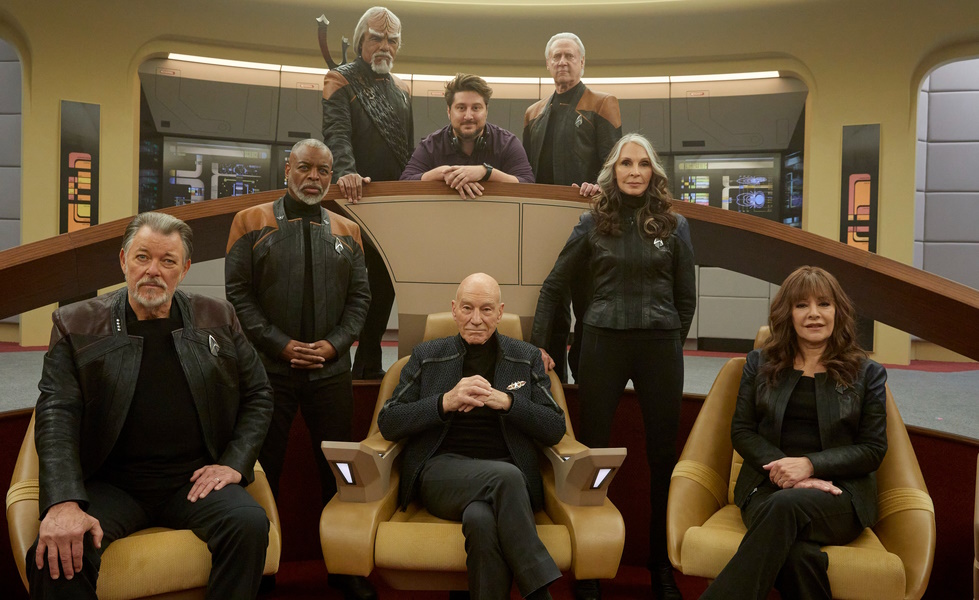
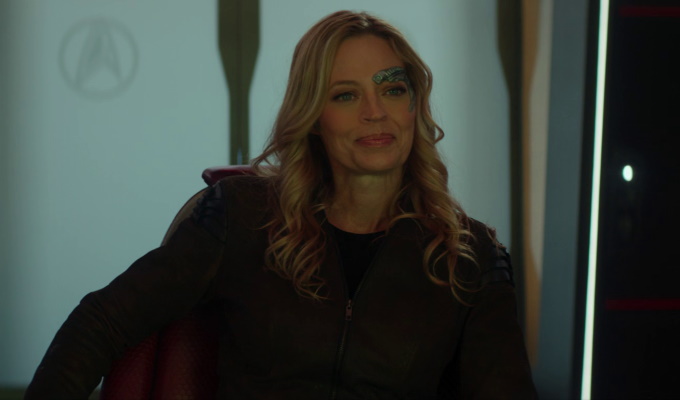


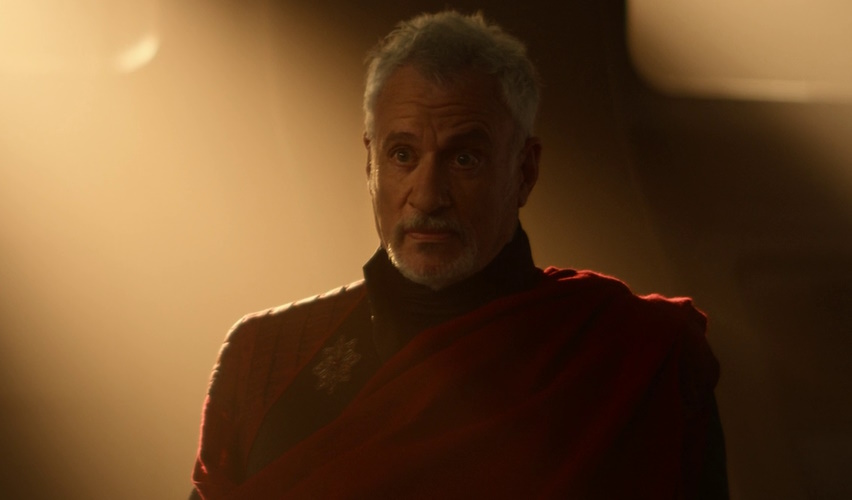




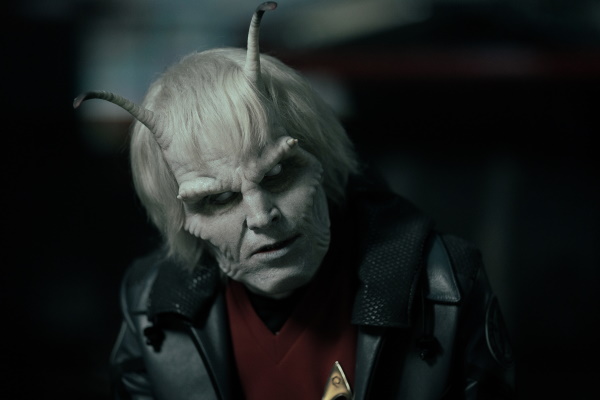


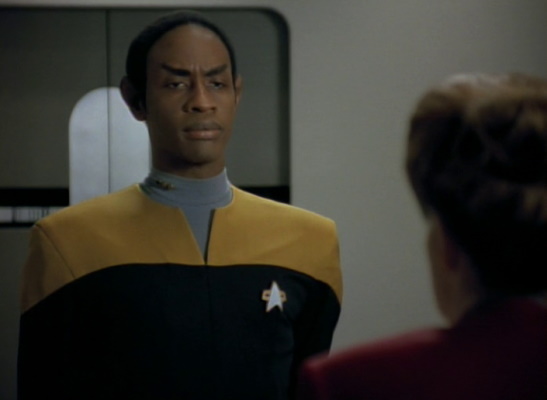


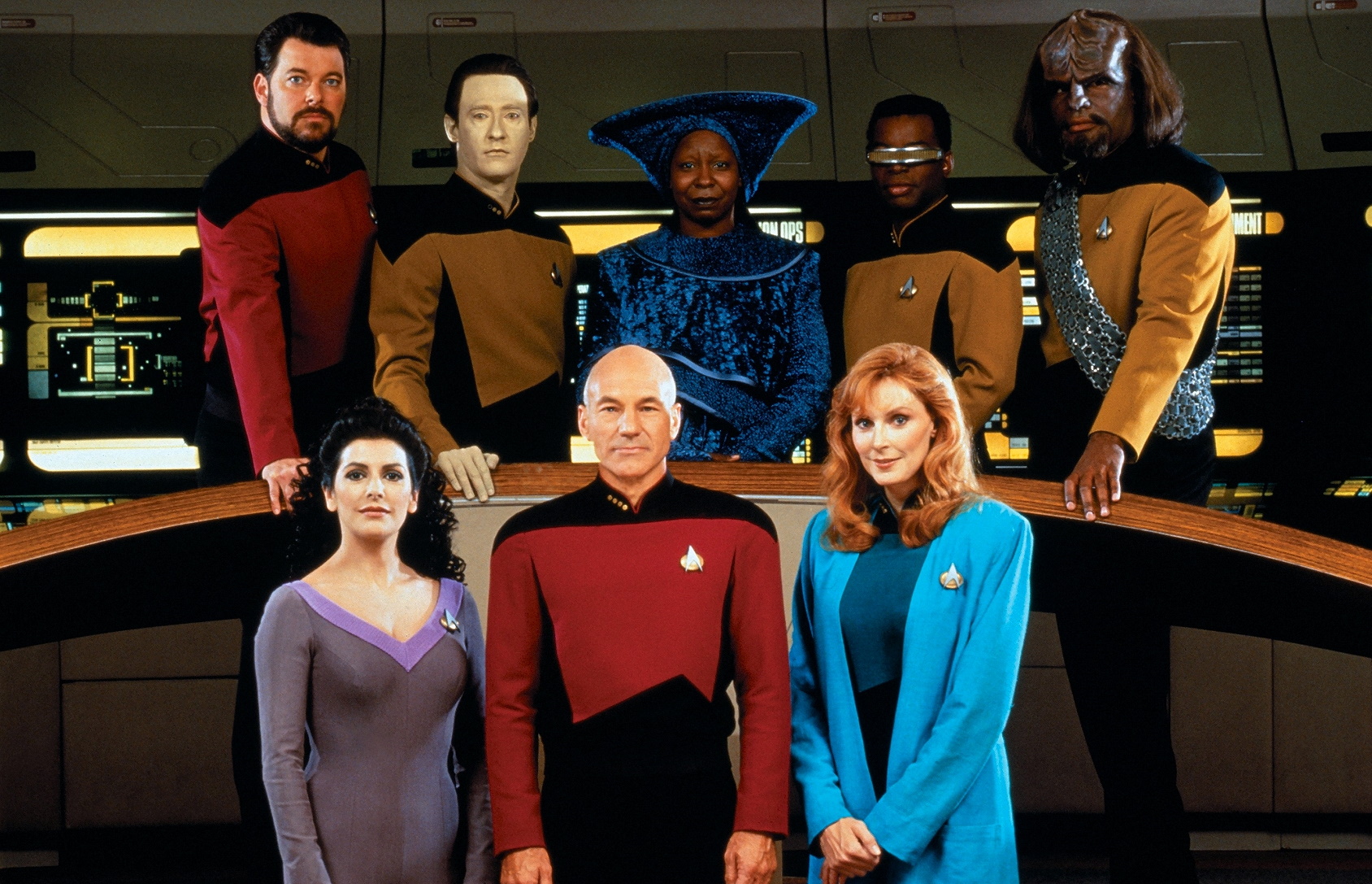


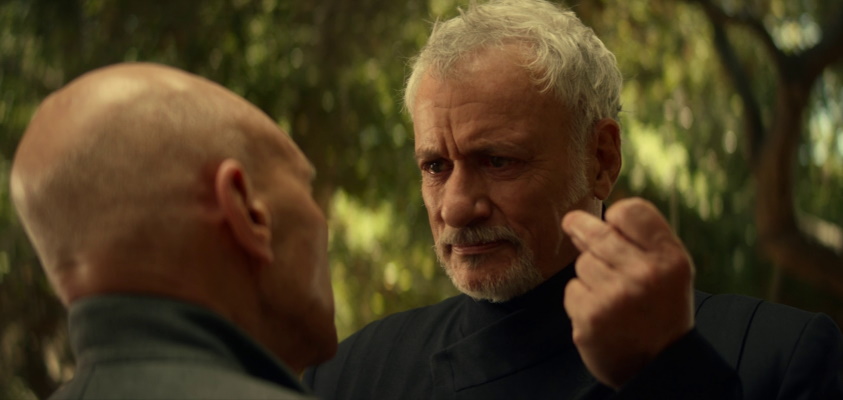
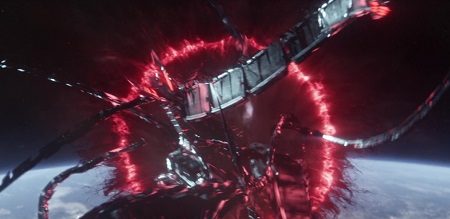




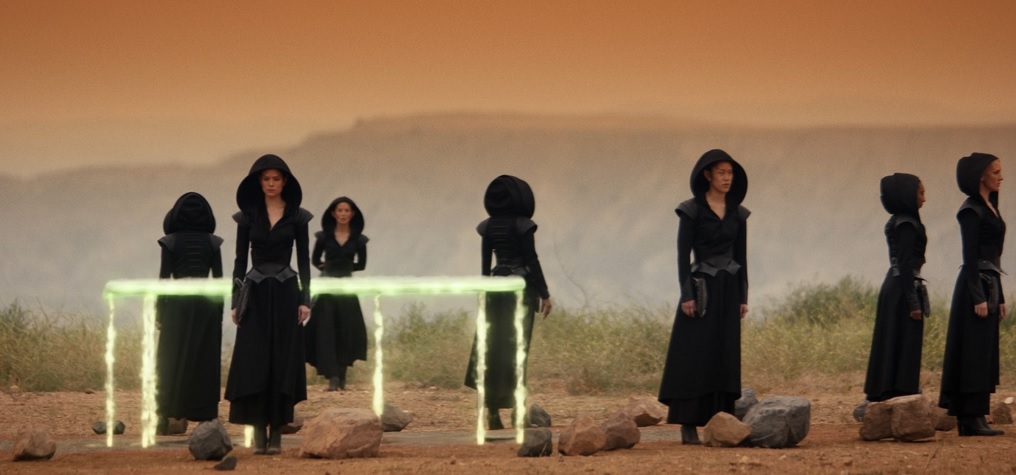







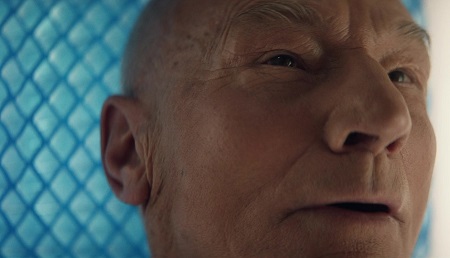


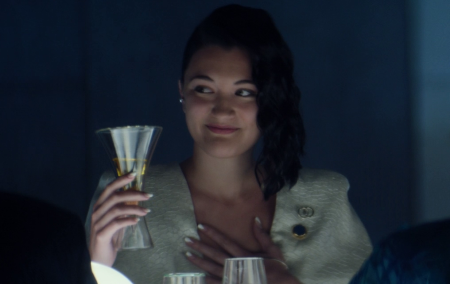

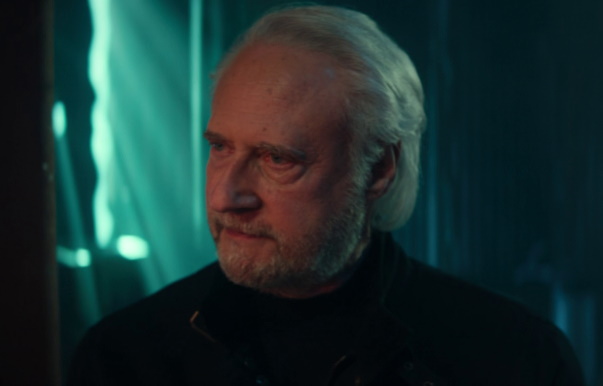


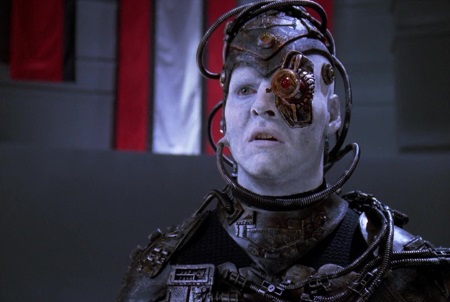




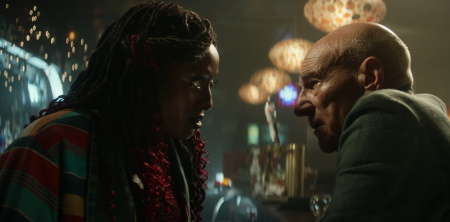


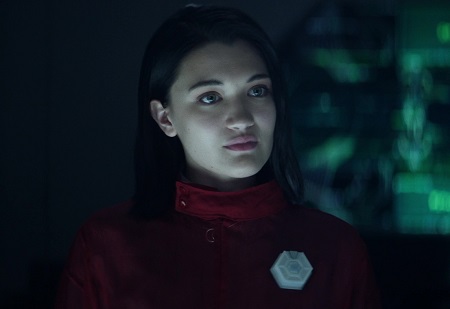
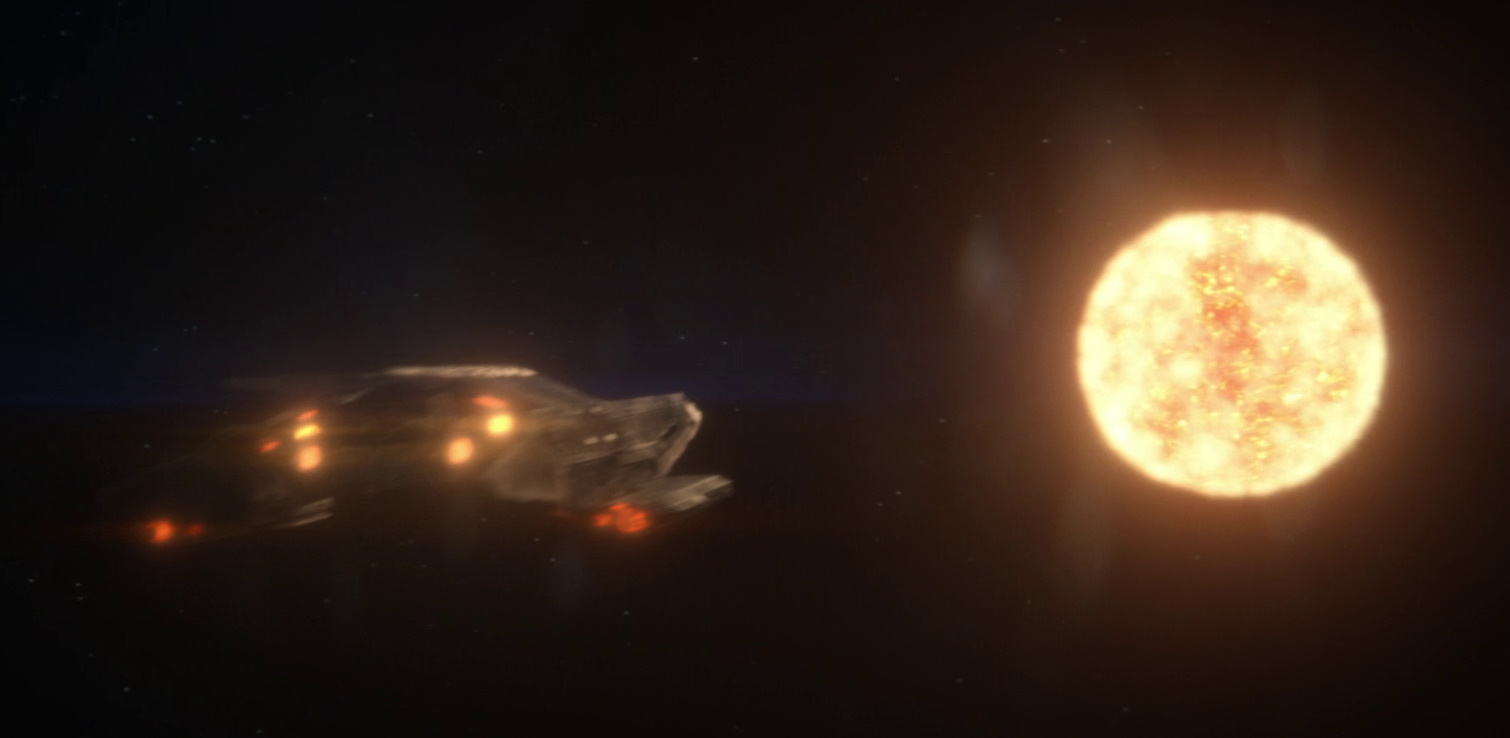






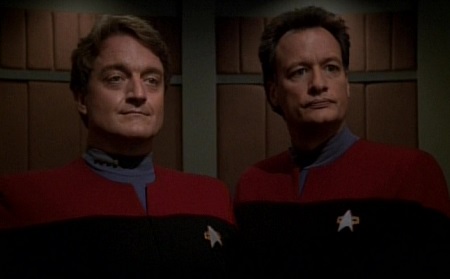

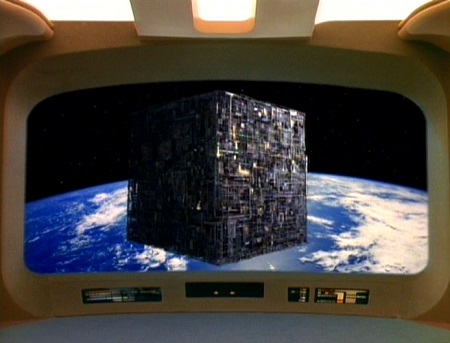




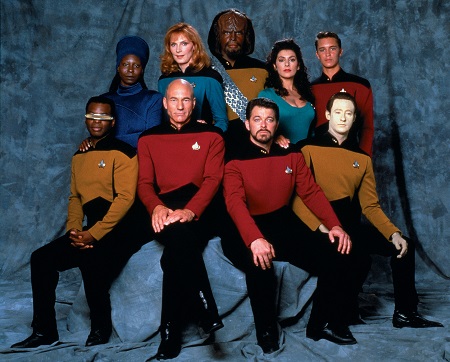





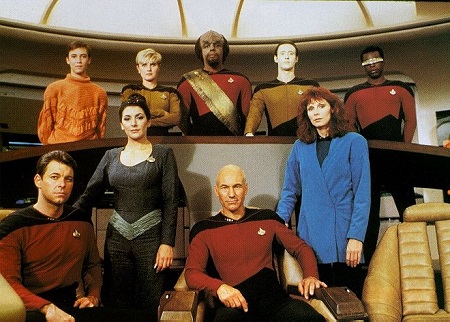




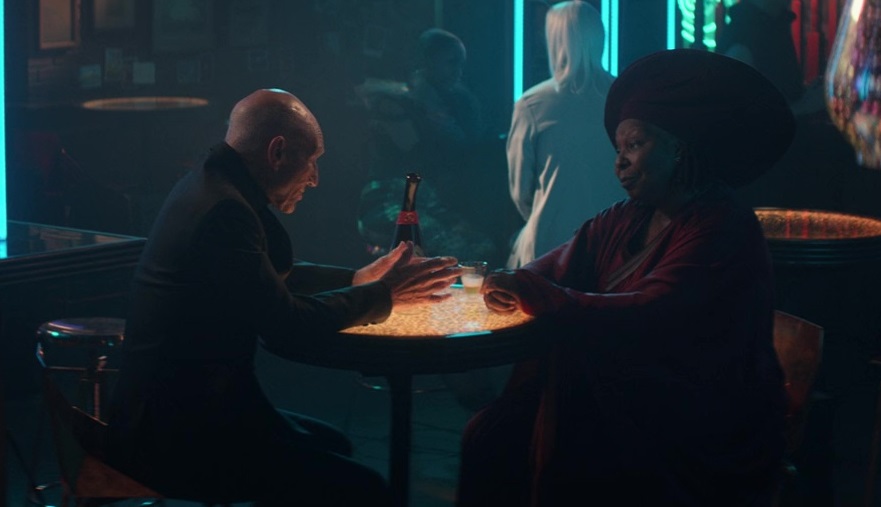

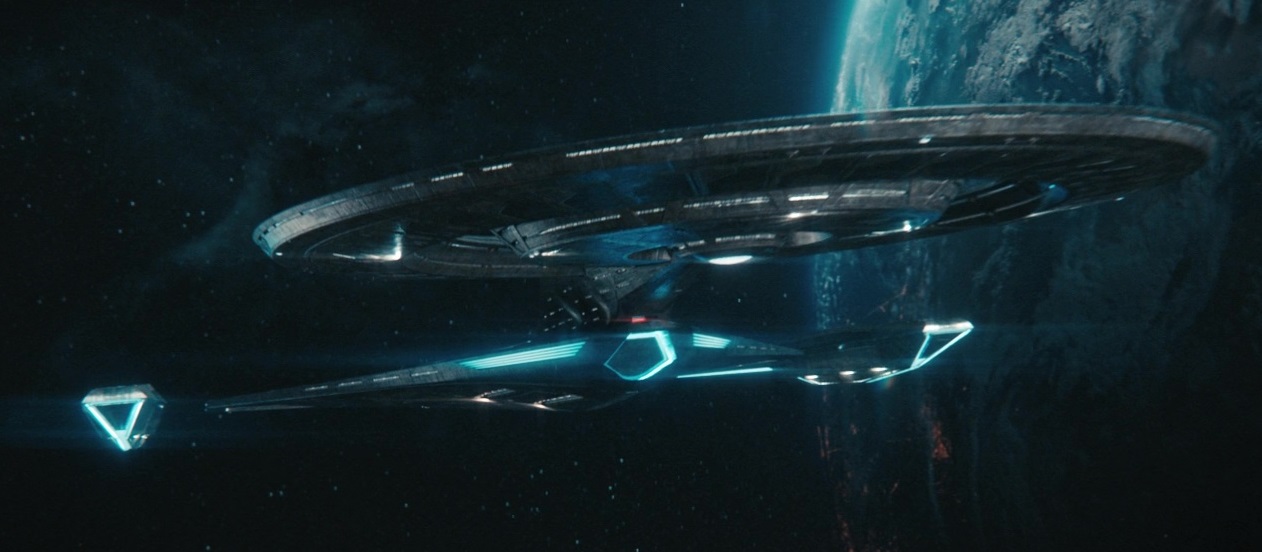




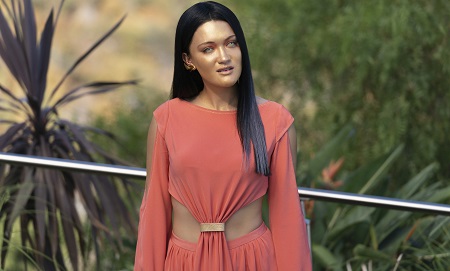




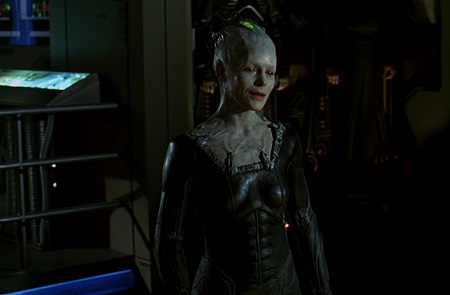


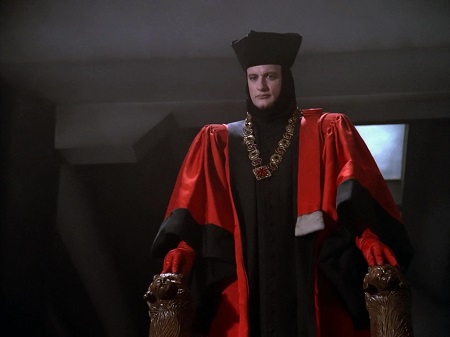




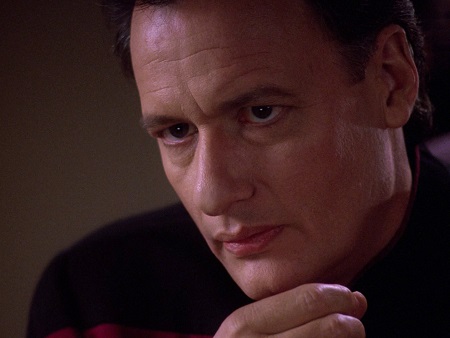

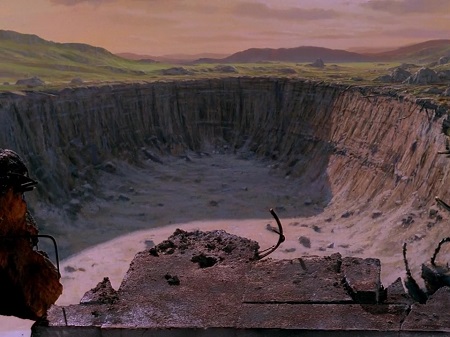


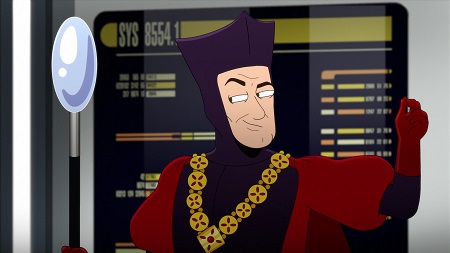


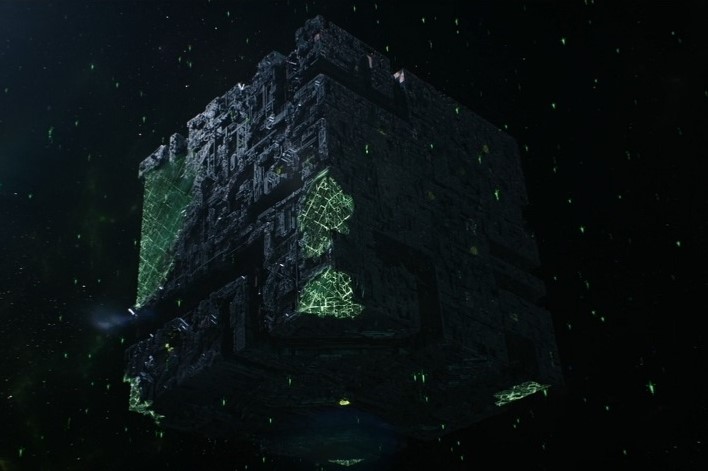

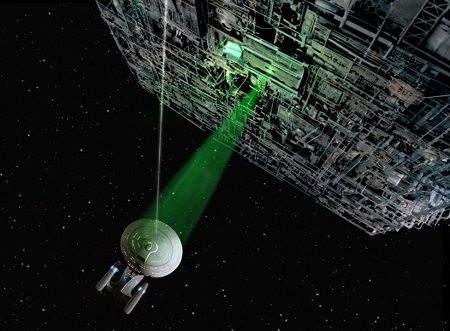
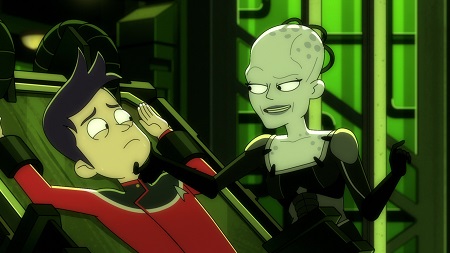

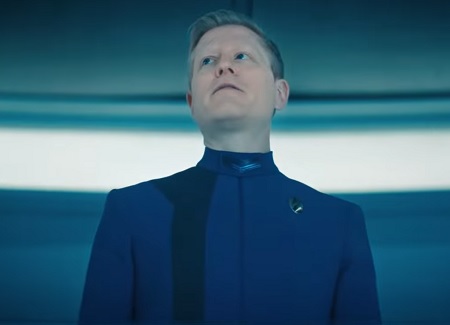
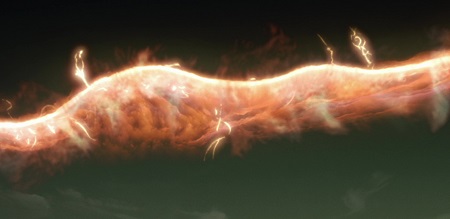
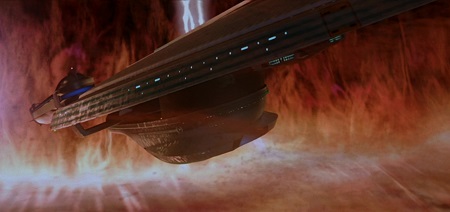
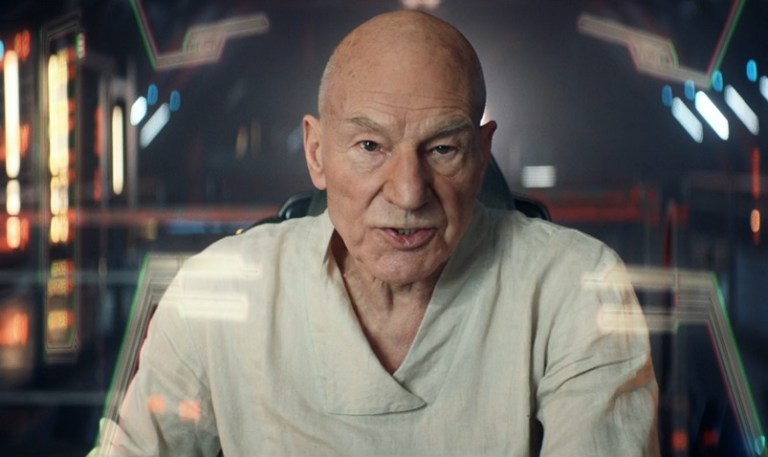
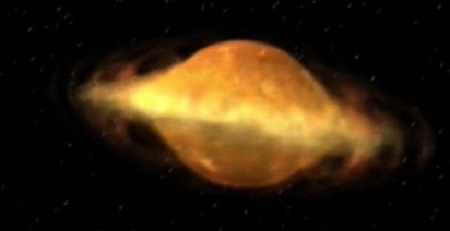
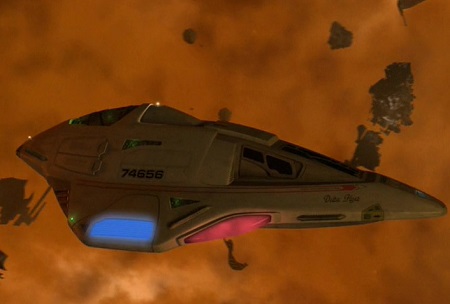
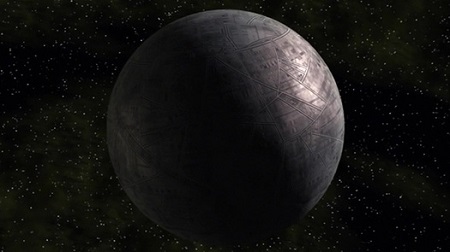
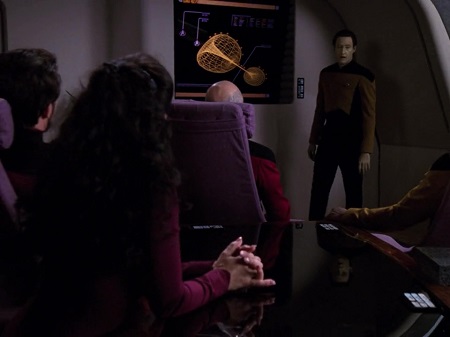
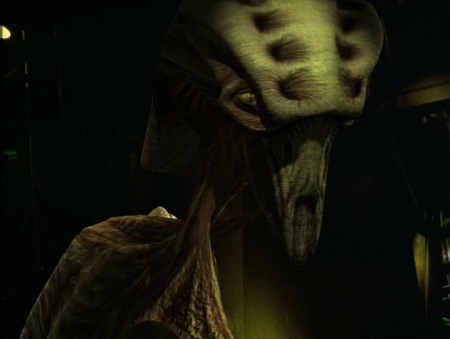
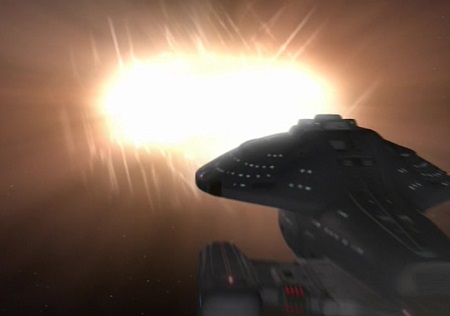




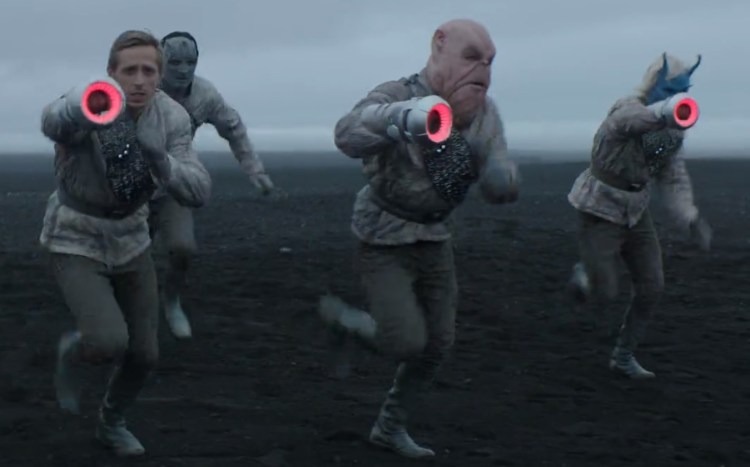

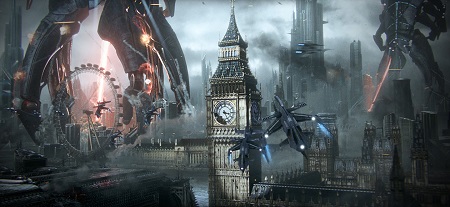


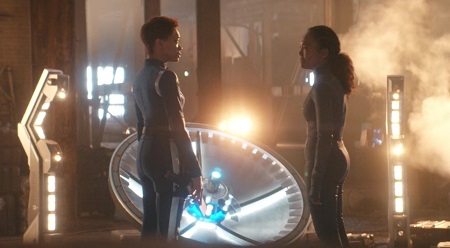

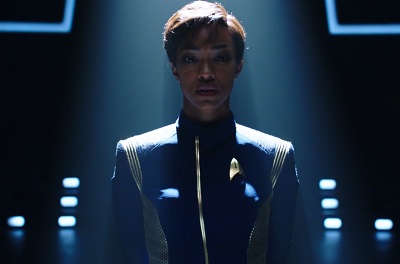
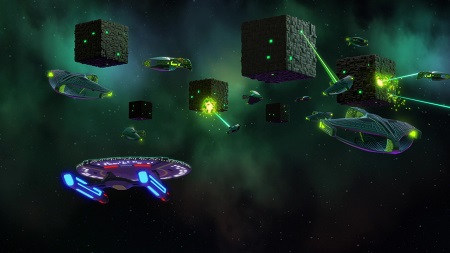
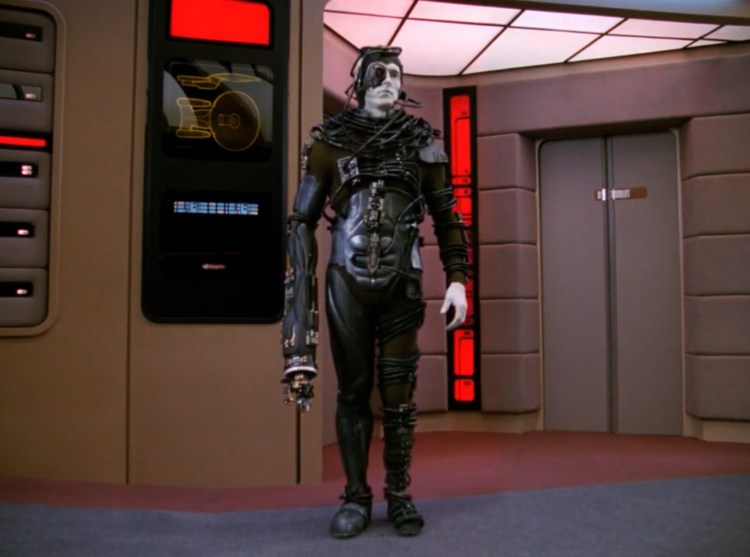


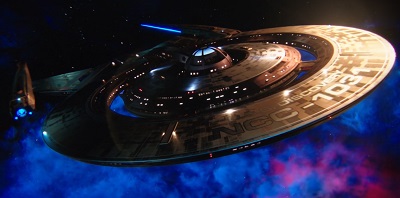
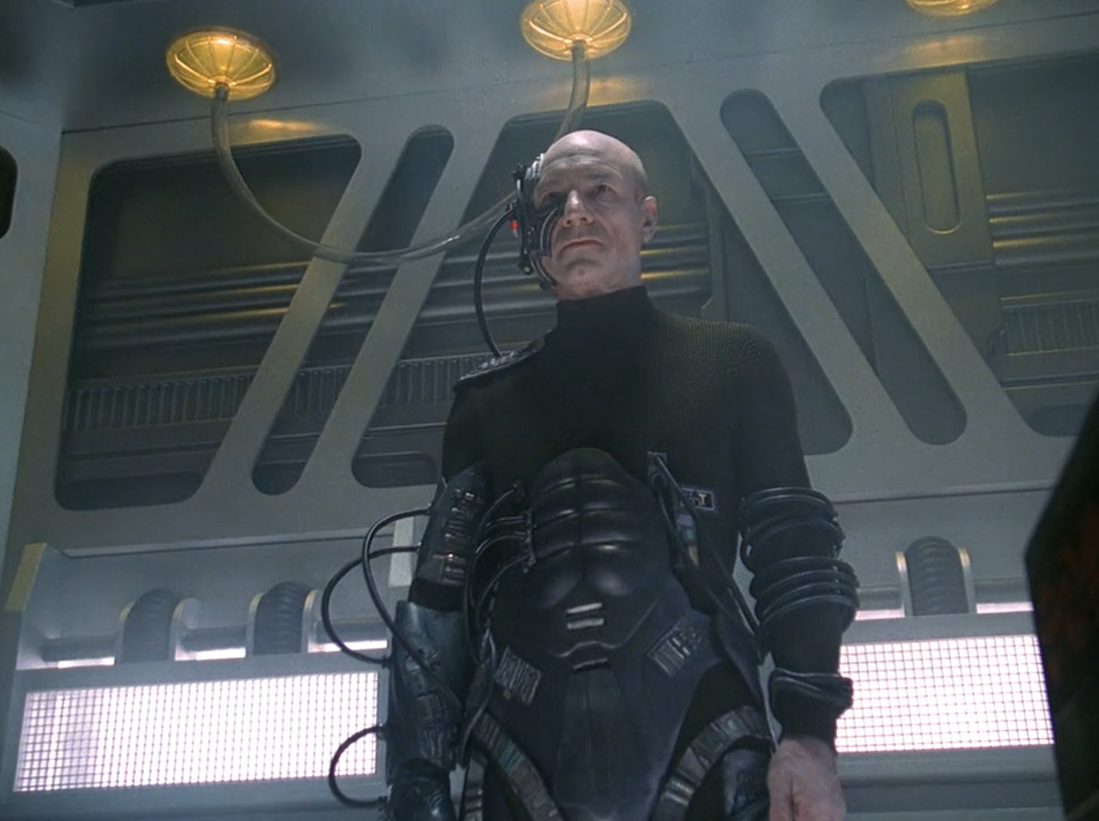
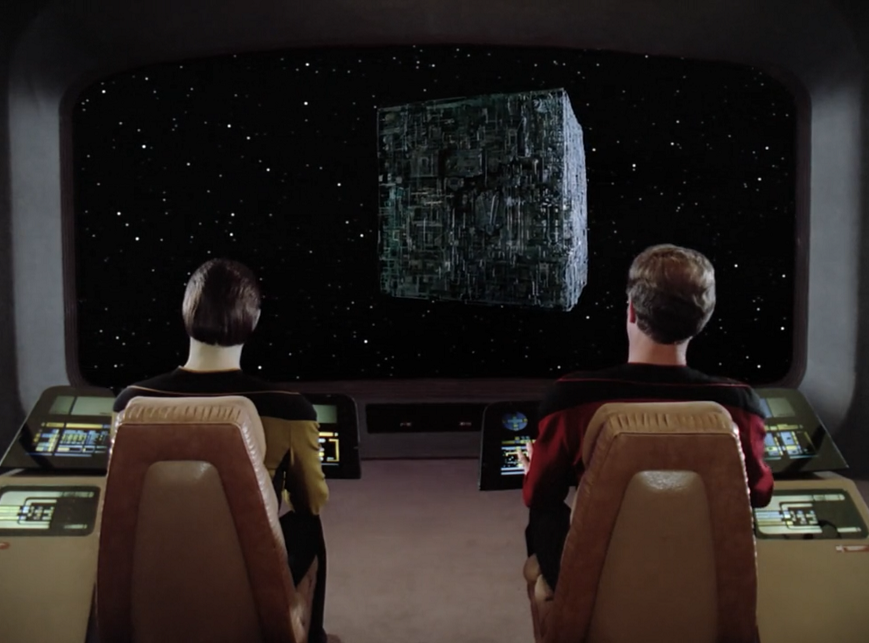
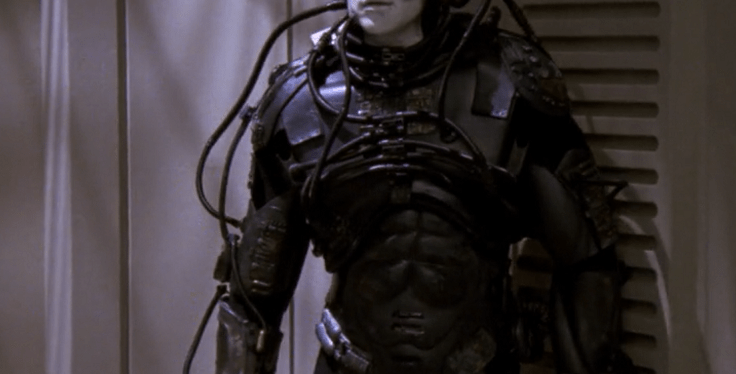

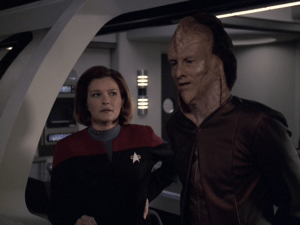
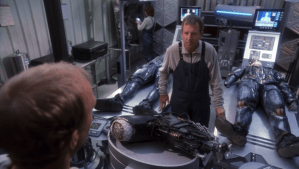


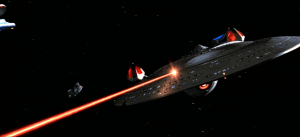
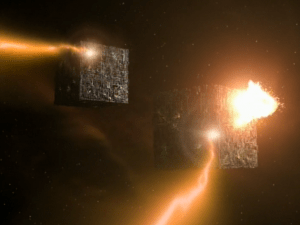
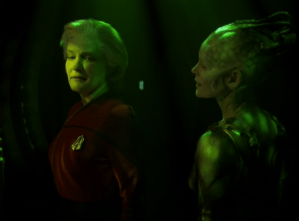
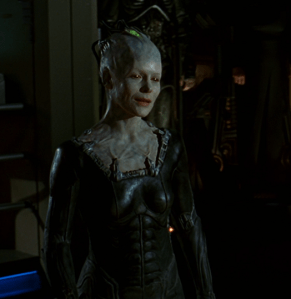
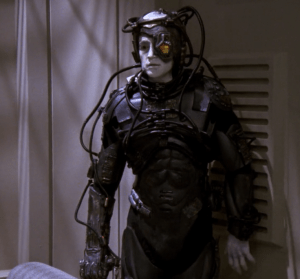

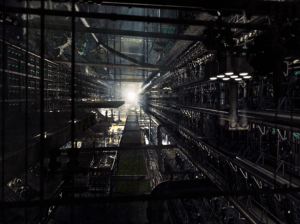
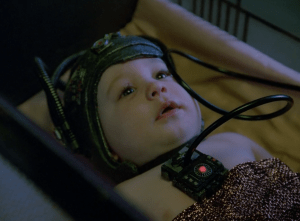
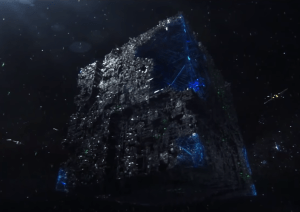
 Trekking with Dennis