

Spoiler Warning: There are spoilers ahead for Star Trek: Strange New Worlds Seasons 1-4. Spoilers are also present for the following Star Trek productions: The Original Series, The Next Generation, Deep Space Nine, Discovery, and Picard.
After a rollercoaster ride across Season 4 – which, I’m afraid, had more downs than ups, and also brought two of the worst episodes in the entire series to the table – I was hoping, if not positively *praying,* that Tomorrow’s Enterprise would at least end things on a high note. I wasn’t sure whether to expect a cliffhanger, like we got in Season 2, or a self-contained story – and we kind of got a bit of both, at least for one character in particular.
But above all, I’m happy to report that, despite some misfires earlier in the season, Tomorrow’s Enterprise was a good, solid finale that I enjoyed from beginning to end.
There will be time in the weeks ahead to take stock of where Strange New Worlds as a whole finds itself ahead of its truncated fifth and final season, but I want to touch on a couple of points briefly, at least insofar as they pertain to Tomorrow’s Enterprise. For much of the season – including in this episode – most of the show’s new, original characters took a back seat, and those with roles in The Original Series were more central. We saw that not only with Uhura, but also with Chapel, Spock, Scotty, and Kirk – all of whom overshadowed or outright replaced their Strange New Worlds counterparts, or original characters who could’ve filled those roles. And despite this being a fantastic all-around episode for Uhura, I can’t help but feel the curtain has fallen on a season that sidelined not only its new characters, but also Captain Pike himself – and it was Anson Mount whose incredible performance led to calls for a “Captain Pike show” a few years ago.
But I guess we’ll have to dissect that in a longer article in the weeks ahead.
Time travel, time loops, and temporal paradoxes are far from my favourite storylines – either in Star Trek or in sci-fi more generally. So for me, of all people, to come away from Tomorrow’s Enterprise feeling that the episode took that narrative framework and built it up into a successful episode? That’s almost inconceivable!
Yet here we are: this rare unicorn of an episode managed to make a time travel plot work in a way that was understandable, but also intense, emotional, and just plain fun. There are a few nitpicks (and you know we’ll get into them as we go along), but overall? I had a really good time with Tomorrow’s Enterprise.
Sometime after it was announced that Strange New Worlds would end with Season 5, we got news that the show had cast both Sulu and Dr McCoy for that final season – and when this time travel story seemed to take Uhura into her own future, I wondered whether we might catch a glimpse of either character. However, I think it was good that we didn’t see *even more* TOS characters in this episode in particular, given that they would’ve arguably been a bit of a distraction from the main plot as it followed the two different versions of Uhura. And I can also see why Strange New Worlds wouldn’t want to play *all* of its cards too soon! Keeping those characters in reserve for whatever roles they may have in Season 5 was a genuinely good call.
One thing I found odd, though – not just about Tomorrow’s Enterprise, but going back to Off-Hour and even (kind of) Like Chronitons Through the Hourglass, too – was Dr Boyce’s role. In The Cage (and The Menagerie), Dr Boyce was a confidant, friend, and somewhat of an unofficial counsellor to Captain Pike, and they seemed to have a pretty good relationship. Yet in both of his appearances this season – and when Pike was at his lowest ebb and in need of someone to talk to – Dr Boyce and Captain Pike weren’t even in the same room. They never spoke to each other, never interacted at all… and that’s just a bit of an oddity.
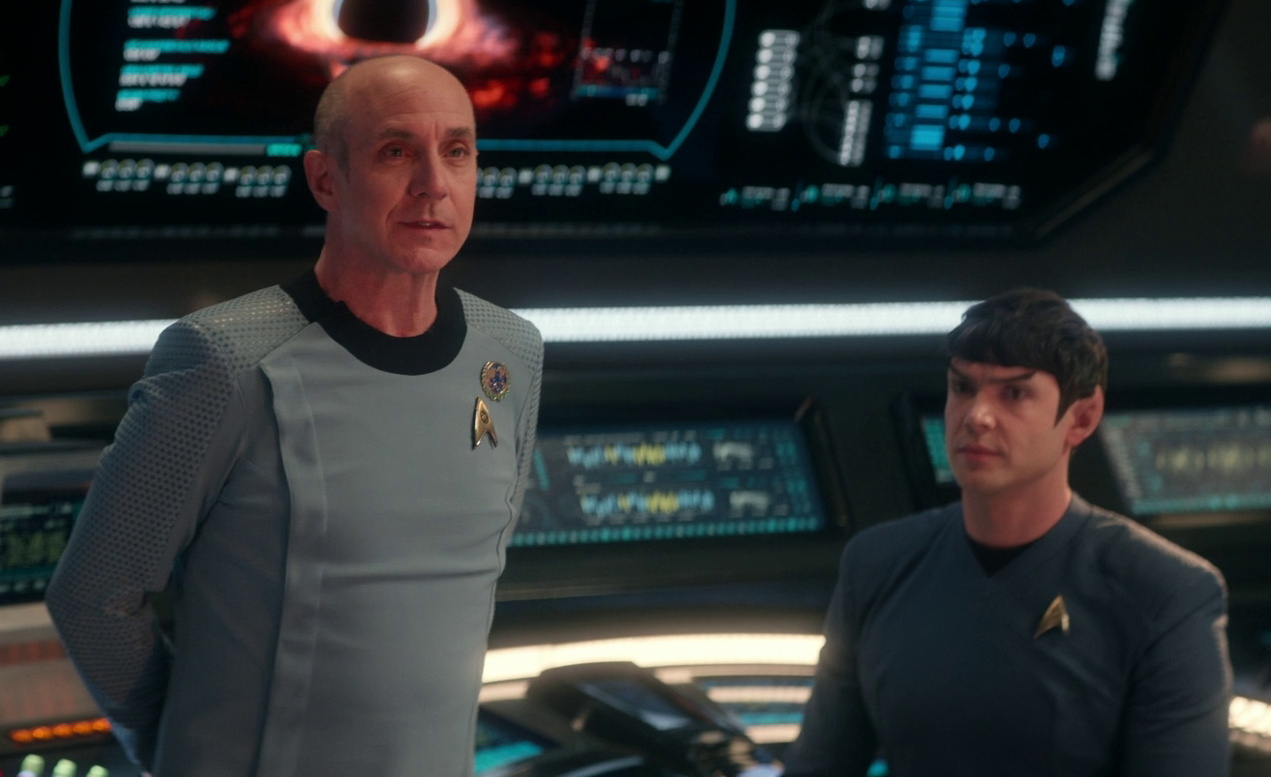
I liked seeing Dr Boyce in action in sickbay this week, as well as learning that he had a previously-unseen role aboard Kirk’s Enterprise, at least in the early years of his command. That was neat – and I liked that we got a bit more of an expanded look at Kirk’s early days in command; the “crew transition,” as I think Scotty or Uhura called it at one point. But it still strikes me as odd that this Pike-centric character, one of the few characters from The Cage to come aboard Strange New Worlds after the series had been running for a while, got no screen time at all with Pike.
Now, that *could* come in Season 5, sure. But we only get six episodes next time – six episodes to wrap up the show, move characters along, potentially kill someone off (more on that in a second), and… will there be time for that? A sickbay storyline showing Dr M’Benga getting ready to leave the ship, Chapel wrangling with all of that, Dr McCoy coming aboard… where would a Dr Boyce-Captain Pike scene even fit?
Is it the worst thing in the world? No. But it’s… well, as I say, it feels odd.
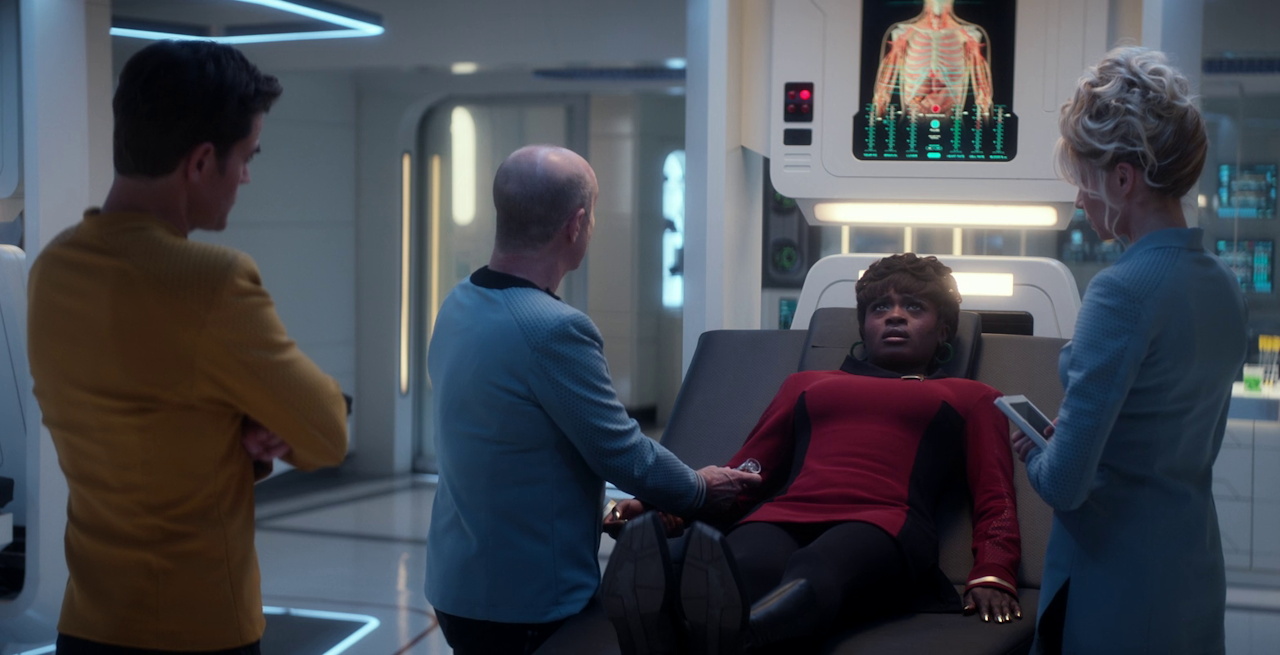
Last season, I said that the episode The Sehlat Who Ate Its Tail felt like a “backdoor pilot;” a pitch that the show’s producers and writers were making for their Year One spin-off idea, which would’ve focused on Kirk’s early days in command. That concept, by the way, is clearly not going ahead – something we’ve known for a while, but that was hammered home when the Strange New Worlds sets were torn down earlier this year. But that’s beside the point!
Tomorrow’s Enterprise – large chunks of it, anyway – felt like a second “backdoor pilot,” or, I guess… a “backdoor episode two?” That was *definitely* the sense I got from seeing Kirk in command, Ortegas, La’an, Una, and Dr M’Benga either gone or in the process of leaving, and the crew in that “transitional” state. I’m not sure that a time travel story like this was the best way to show off the potential in Year One as a spin-off, but I can absolutely feel the producers’ intentions in the way that side of the story was structured.
If you want to check out my thoughts on Year One in more detail, click or tap here. It’s a bit of a moot point now that the spin-off definitely ain’t happening… but it’s an interesting thought experiment nevertheless.
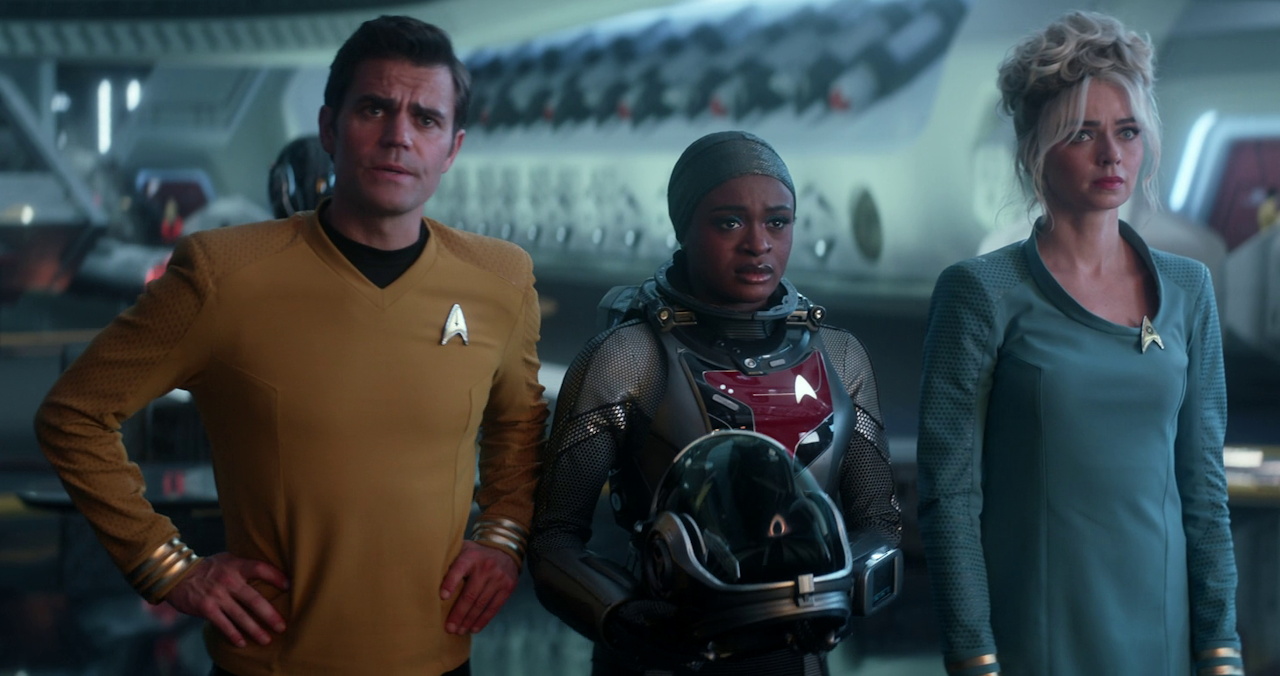
However, dedicating so much time to two backdoor pilots – as well as other episodes and storylines that expanded upon or fleshed out TOS characters – has meant that we’ve spent less time with not only the show’s original creations, but also Captain Pike, Una, and Dr M’Benga, too. And Season 4 has massively accelerated that trend, with really only a couple of episodes where either Pike or one of the other non-TOS characters were front-and-centre.
Again, we’ll get into that in more detail on another occasion, but I think it’s worth keeping it in mind. As strong and as fun as Tomorrow’s Enterprise was, it came at the end of a season where not only the likes of Spock, Kirk, Scotty, and Chapel have all had major storylines and roles, but where Uhura herself got such an impressive spotlight just a couple of weeks ago that I literally said: “even if we never get to spend another second with Uhura (and I certainly hope and expect that we will, by the way!) we can now consider her character growth and prequel arc to be complete.”
That *is not* to call Uhura’s starring role this time in any way “repetitive!” It was nothing of the sort. But it is interesting – and a tad disappointing, I’m afraid – to see this trend in favour of TOS characters growing in strength as the series reaches its premature conclusion.
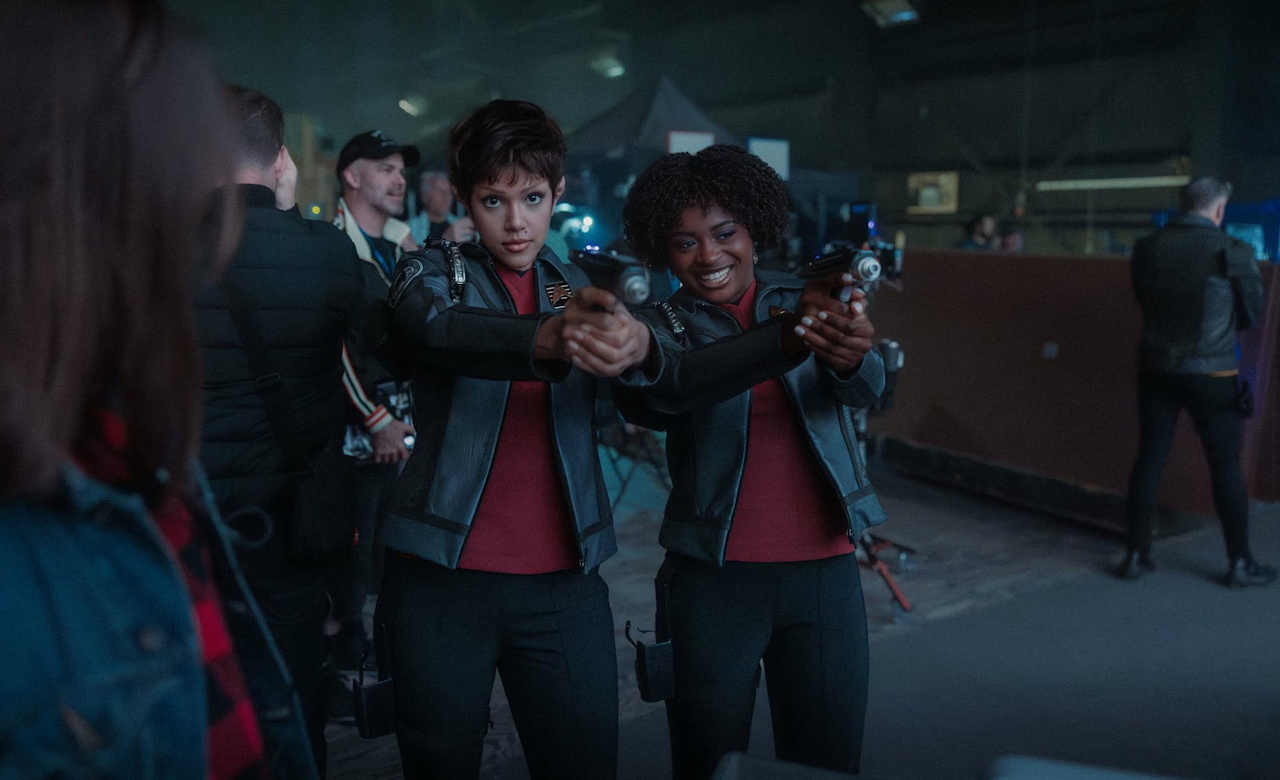
In the episode Off-Hour, I said that Dr M’Benga was a strange choice of character for the story to place in mortal peril. Why? Because, as a recurring character from The Original Series – set years later – we know that Dr M’Benga is effectively “unkillable” in Strange New Worlds.
And I felt *exactly* the same way with this side of Scotty’s storyline this week.
I know that there was the relationship drama stuff between Uhura and Scotty that was meant to add an extra dimension to Uhura’s quest to save his life. We can argue the toss about how well that was set up, how much chemistry the characters and performers had, and whether it treads on the toes of “canon,” if you like, but I want to posit a much more fundamental point: Scotty was a stupid choice for this role in the story. Because he’s a TOS character – and a major one, at that – there was no way Scotty could be in real danger in Tomorrow’s Enterprise, and for me, at least, that put a serious dampener on how intense, emotional, and dramatic this otherwise well-scripted and beautifully-performed story was.
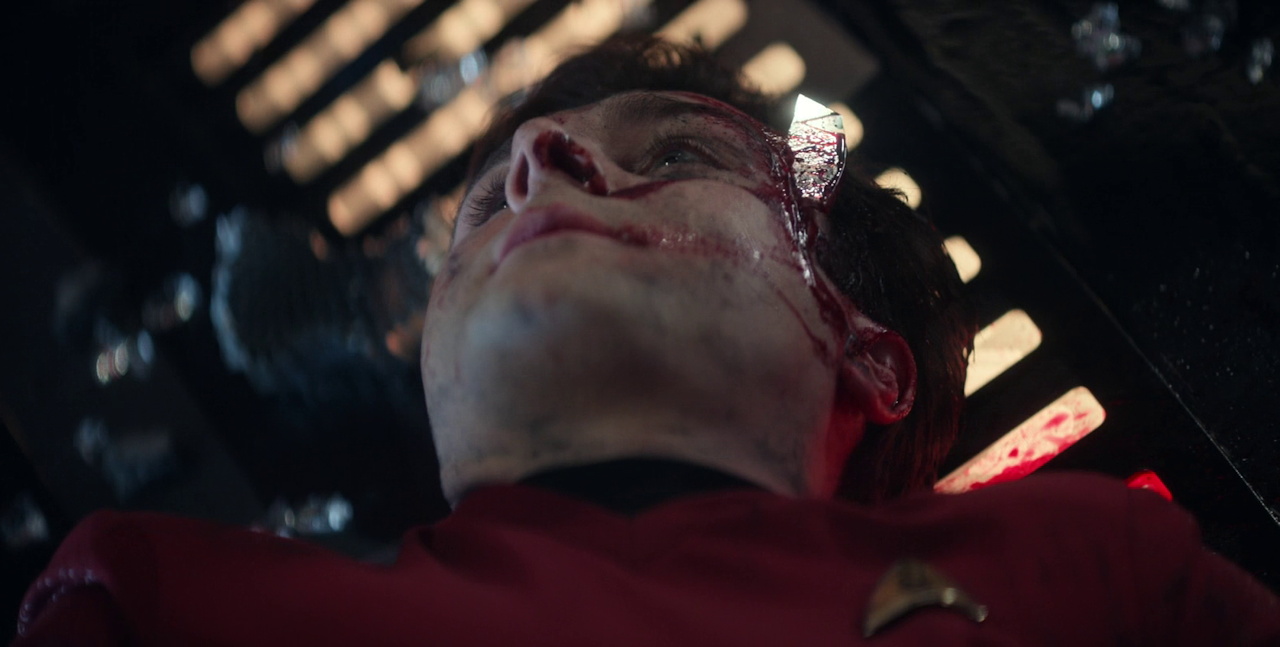
Breaking apart the two aspects of the story could’ve seen Uhura learning to “embrace the now” and say yes to Scotty’s advances while *also* actually saving the life of an unrelated character – a character like Ortegas or Una, perhaps, who genuinely would’ve felt like they were in danger. Or if (as I’ve repeatedly theorised) a character like La’an may not make it all the way to the end of the show… that could’ve been a final twist of the knife in a story like this one. Maybe the two Uhuras were able to successfully deliver the “space baby”… but couldn’t save La’an.
This is a trend we’ve seen this season. Strange New Worlds’ writers seem to be doubling-down on making the exact same mistakes in multiple episodes, and it leaves me more than a little anxious that the fifth and final season will have similar issues. Without being able to learn and take on board feedback (because Seasons 4 and 5 were in production before Season 3 even finished airing), there hasn’t been time for the production team to properly take stock of what worked… and what didn’t. As a result, we’ve seen several mistakes repeated, almost beat-for-beat, in multiple episodes… and this one – placing a functionally immortal character in danger of “death” – is just the latest example.
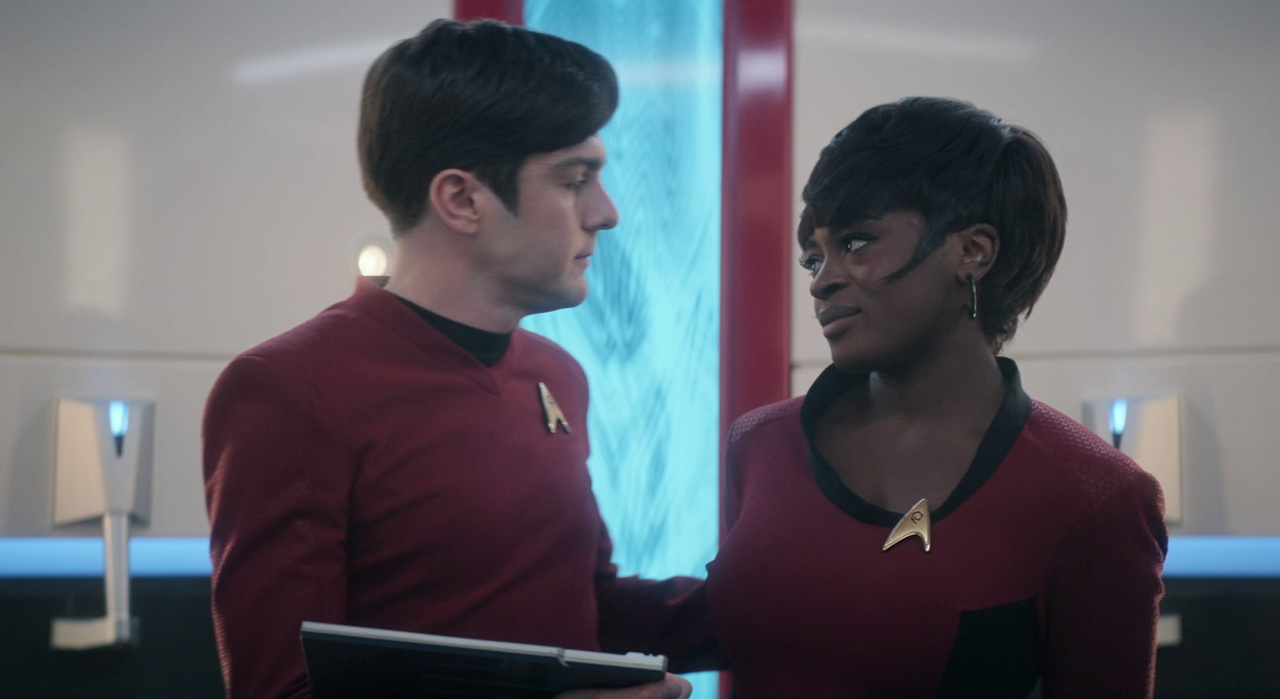
And because this story could have worked just as easily if it were another character in danger… it just doesn’t make a lot of sense to me. Sure, Uhura and Scotty had their (brand-new for this episode) romantic sub-plot, and that *did* add to the tension when Uhura felt he was in danger of death. And I will also say that, in any work of fiction, the way the characters in a story respond to events can still be impactful even if we as the audience know something they don’t – like, in this case, that Scotty will definitely survive.
I don’t want to take away from Celia Rose Gooding’s excellent performance – taking on, really, two very challenging related roles!
But at the same time, because we know Scotty’s going to survive, *and* because this whole romance angle was completely new (and seemed to come from nowhere), there was a way to tell a very similar story without the prequel constraint. And if this was a one-off, maybe I’d feel a bit more lenient. But because Strange New Worlds literally made this exact same mistake just a few weeks ago with Dr M’Benga… well, unfortunately I think it needs to be pointed out.
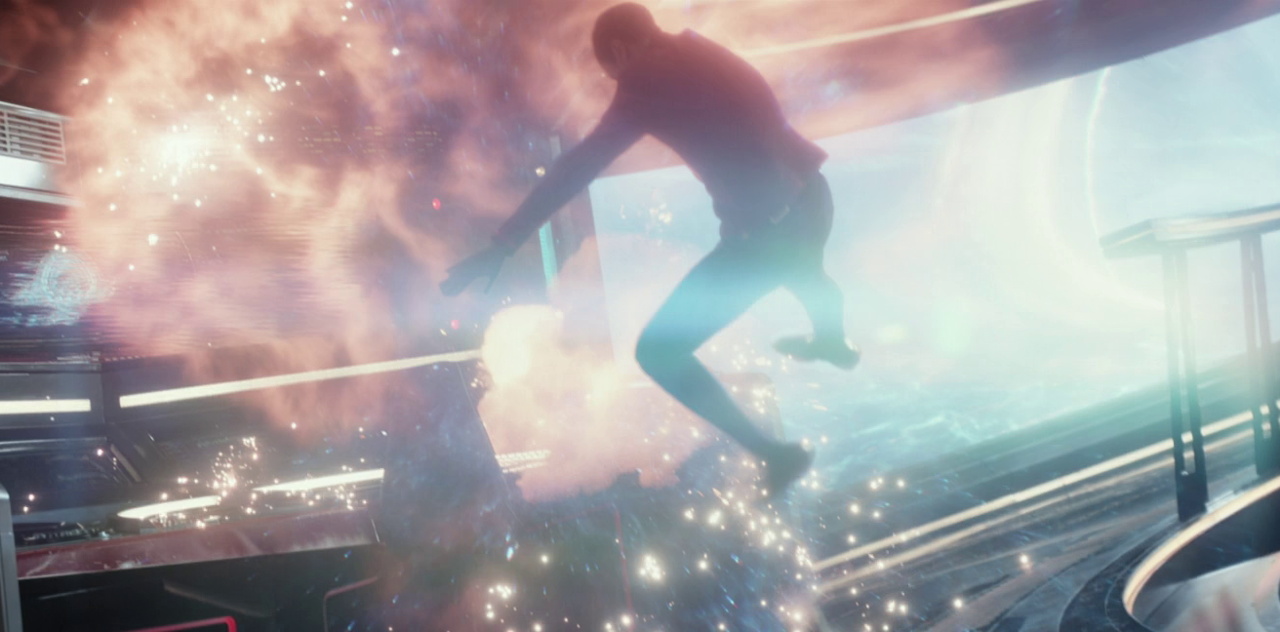
Sometimes – especially this season – I’ve felt like some of the writers don’t seem to remember that they’re working on *a prequel* with the way certain character decisions were handled. Other times, of course, they’re almost *too* aware of that fact – and choose to place TOS characters into major roles! But with these Scotty and M’Benga storylines, and the way they repeat a simple mistake… I can’t help but feel someone, at some point in the production process, could’ve raised the red flag.
It didn’t “ruin” the episode, of course – and the way Uhura and other characters reacted to Scotty’s death did still stick the landing. But for me, as a long-time Trekkie watching the latest episode, the plain and simple fact that Scotty was always going to survive was inescapable, and it makes me wonder why another character wasn’t chosen for this “danger of death” story. Even if the outcome was beat-for-beat the same, it could’ve been a more engaging and entertaining ride if – on that first viewing, at least – we weren’t 100% sure if they were going to survive.
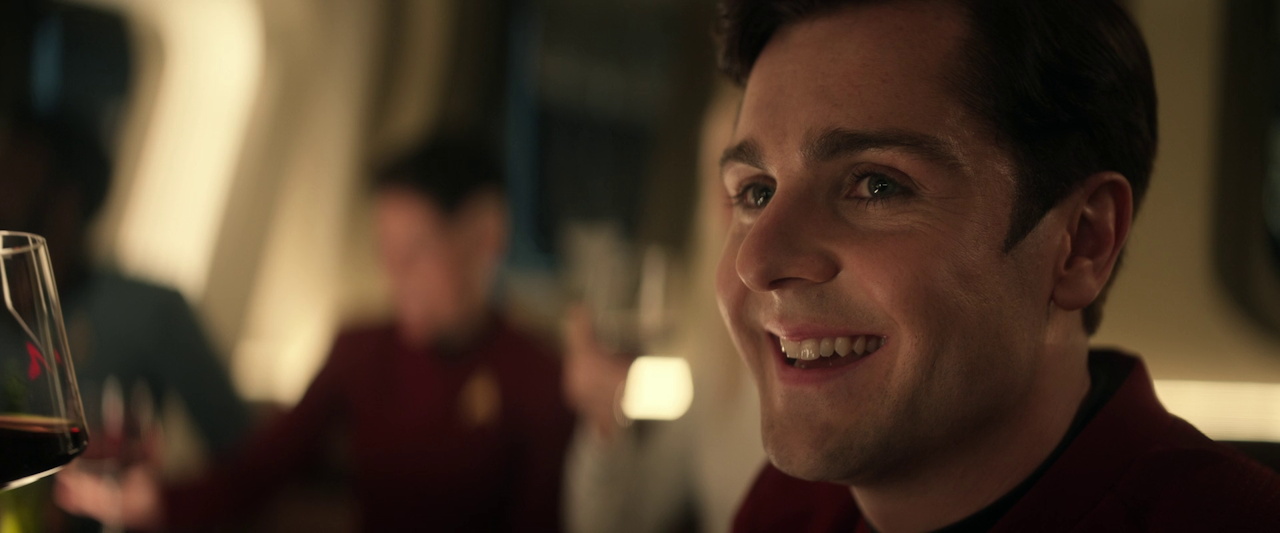
Sticking with the theme of characters surviving… what do we make of Kirk’s hesitation when asked about La’an? It felt too intense to be a simple misdirection on the part of the production team, didn’t it? But then again, given that La’an and Kirk might be on the verge of some kind of romantic relationship, Kirk could just as easily be upset about a bad breakup… so I guess there’s wiggle-room there, depending on what you want to believe! But either way, Season 5 owes us an answer as to why Kirk was so reluctant to talk about La’an.
I’ve said this before, but La’an remains at the very tippy-top of my “death watch” list ahead of Season 5. She may have survived the events of this episode, but the whole “latent augment DNA” angle that Season 4 introduced, as well as her absence from the Enterprise after Kirk assumes command, all lead me to believe that she may not be long for this world – and Kirk’s refusal to talk about that with a time-travelling Uhura *really* seemed to hammer that home. It could still be a red herring, of course, and I don’t *want* La’an (or any other main character) to be killed off! But I think at least one of the show’s original creations won’t survive past Season 5, and right now, if I had to guess? It would still be La’an.
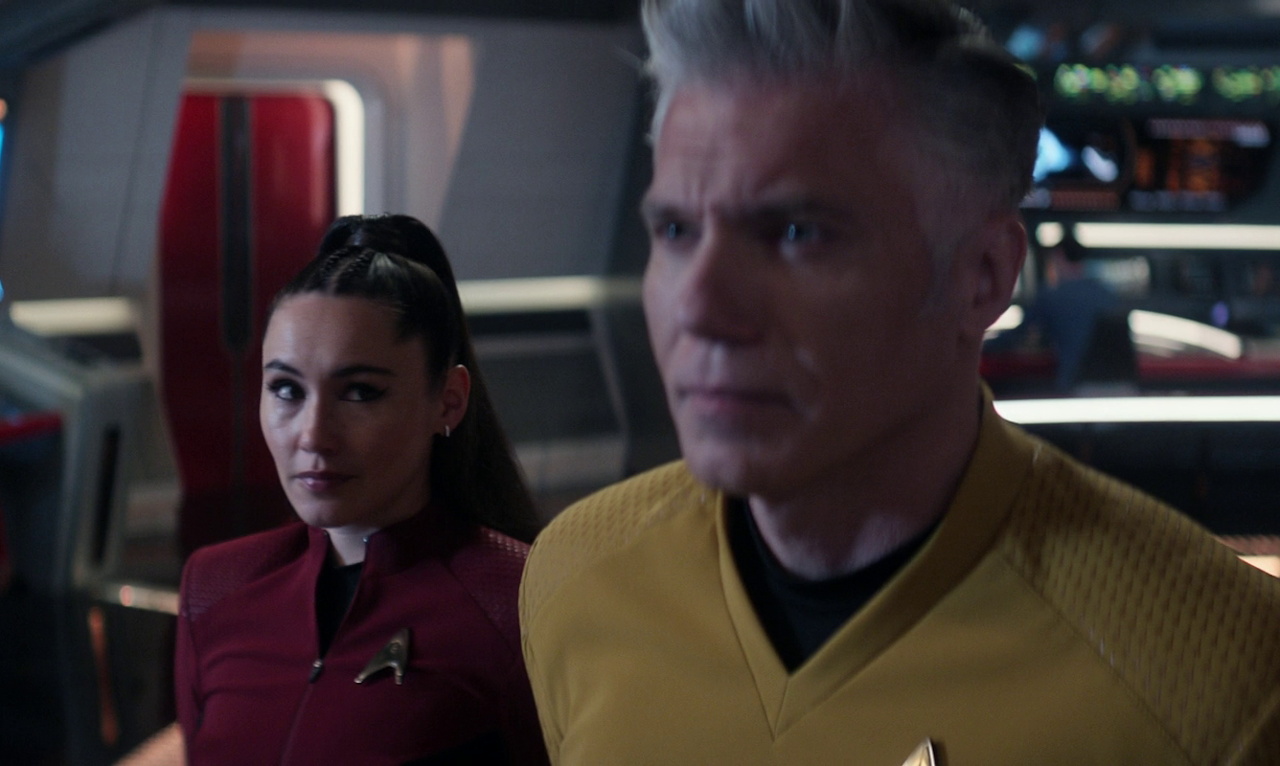
Tomorrow’s Enterprise is now the *third* episode of Season 4 in which the events we see on screen either didn’t happen at all or aren’t going to be remembered by most of the characters involved. We had the irredeemably awful writing failure of “but it was all just a dream” in Level-Five Transporter Accident, then Trelane’s meddling in Like Chronitons Through the Hourglass, and now it turns out that only Uhura will remember what transpired – and several key events were literally undone – in Tomorrow’s Enterprise.
As I said above: the show is doubling- and tripling-down on some… odd choices.
This week’s episode is so much stronger than those other two examples that it almost feels unkind to compare it to them! But I think it’s worth pointing out, as we consider how this episode fits in with the rest of the series, that we’re now at three out of ten episodes – just within Season 4 – where events we saw as the audience either didn’t happen at all or aren’t going to be remembered by most of the characters. I’d *happily* erase both Level-Five Writing Accident and Like Chronitons Through the Hourglass, and I think if neither of those episodes had existed, this aspect of Tomorrow’s Enterprise would be a complete non-issue. But coming at the end of a season where two other episodes have had stories that won’t actually be remembered by the characters involved (or just outright didn’t happen)? It’s another place where I feel the series repeating itself, at the very least.
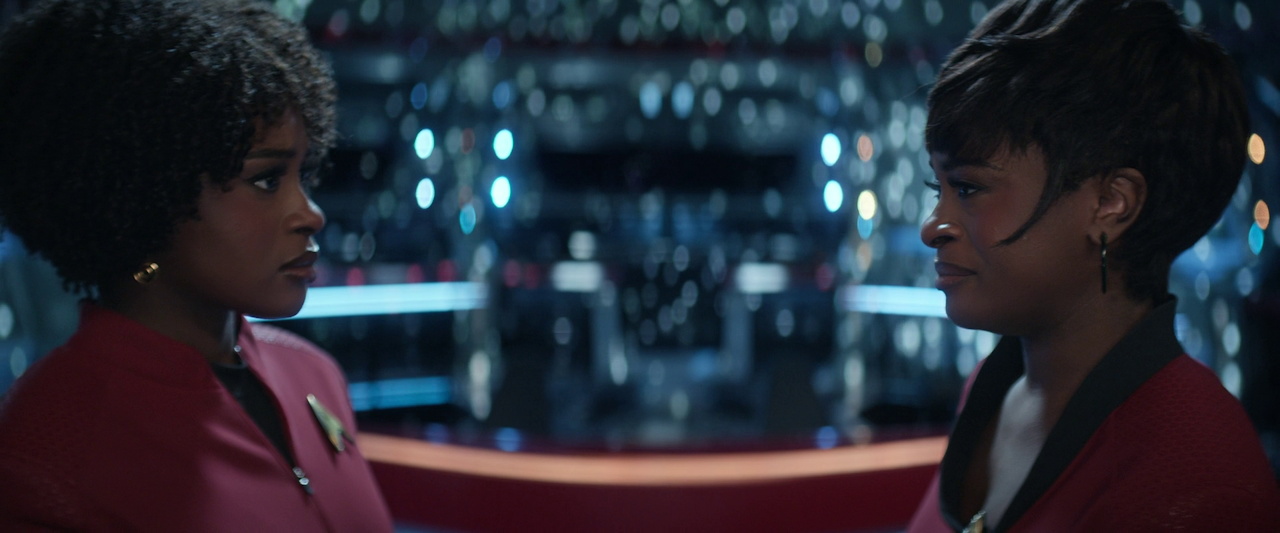
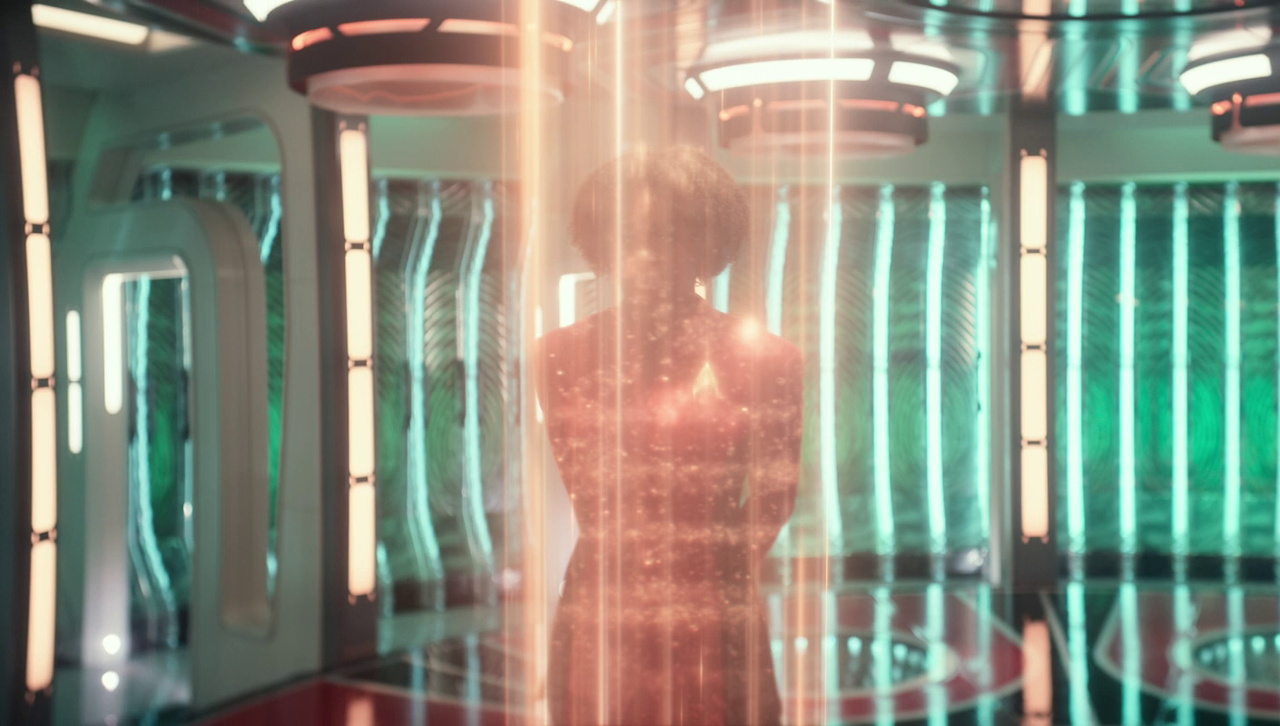
Tomorrow’s Enterprise went out of its way to really lean into TOS’ 1960s style for all of its time-shifted characters, and I really enjoyed the way they looked. Hairstyles changed – very obviously for the likes of Chapel and Uhura, but subtly for the likes of Scotty, too – and we saw uniforms directly inspired by The Original Series, too. It was great to see Strange New Worlds embracing the idea that fashion and hairstyles can change over time – just like they do in the real world – and make an attempt to bridge the gap between this series and TOS in a way that felt natural.
One of the silliest criticisms of Discovery, when that show was announced, was how “out-of-place” it looked, from a visual standpoint, compared to TOS. And I would guess some folks will have said the same about Strange New Worlds, too. But for me, I was really never bothered by the aesthetic changes, and I don’t think it’s a stretch to say that things like fashion, hairstyles, uniforms, and so on change and evolve over time. The fashion of the ’70s was very different from that of the ’80s – at least here in the west – and even if we don’t notice at the time, because things just look “modern” or “normal,” trends stick out like a sore thumb after some time has passed! I just don’t think it’s much of an issue at all to say that similar trends and changes take place within the Star Trek galaxy, and I appreciate Strange New Worlds acknowledging and leaning into that idea.
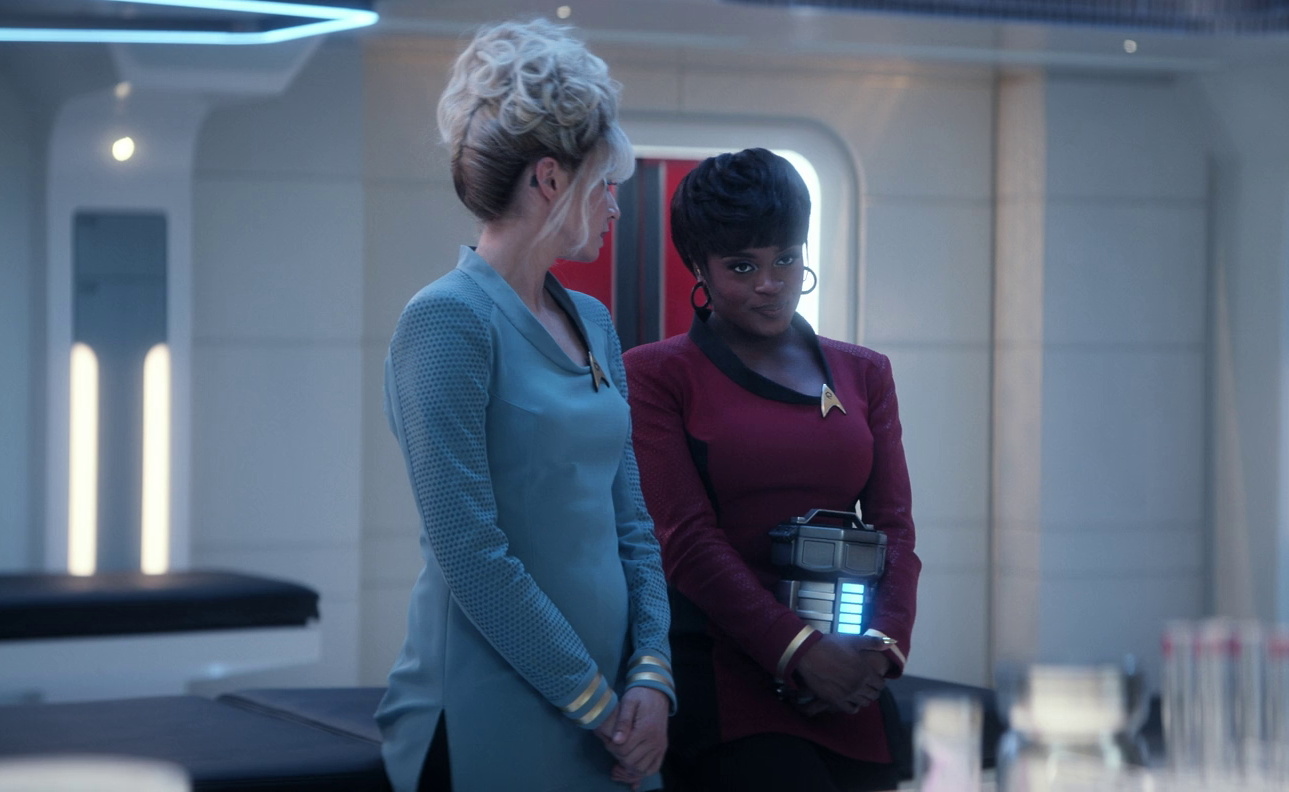
I would extend that compliment to the performances, too. Martin Quinn, Celia Rose Gooding, Ethan Peck, Paul Wesley, and Jess Bush all honed or refined their performances to draw even more heavily on the original incarnations of their characters – and it really showed.
Paul Wesley has been great as Kirk, and I wouldn’t have said his performance really needed much alteration. But in Tomorrow’s Enterprise, I really felt that Wesley was leaning even more on William Shatner’s original (and iconic) portrayal to take his version of the character even closer to that TOS presentation. The same was true of Martin Quinn with Scotty; you could see the way he stood, the way he held himself, and how he was almost channelling his inner James Doohan! Celia Rose Gooding had the most time on screen (and we’ll talk about her split role with both Uhuras in a moment), but she was also excellent. Jess Bush also worked hard to bring Chapel even closer to the way she felt in TOS, as did Ethan Peck with his short scenes as Spock.
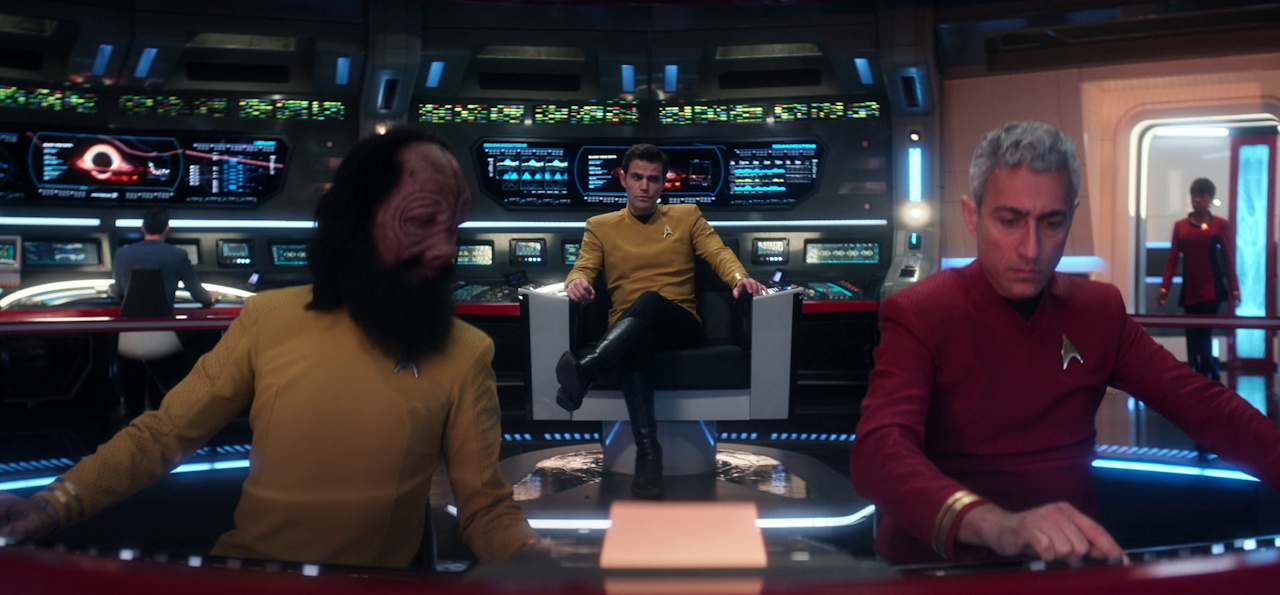
Tomorrow’s Enterprise also had a great score – which, again, felt like a bit of a throwback to TOS in some places. In fact, I half-expected to hear the familiar ending theme from The Original Series when the episode’s credits rolled! There was still a modern edge to some of the music; I don’t mean to say that it was identical to something you’d have heard in the ’60s. But, more so than any other Strange New Worlds episode, at least this season, it felt more “classic,” more of a throwback. And I really liked that.
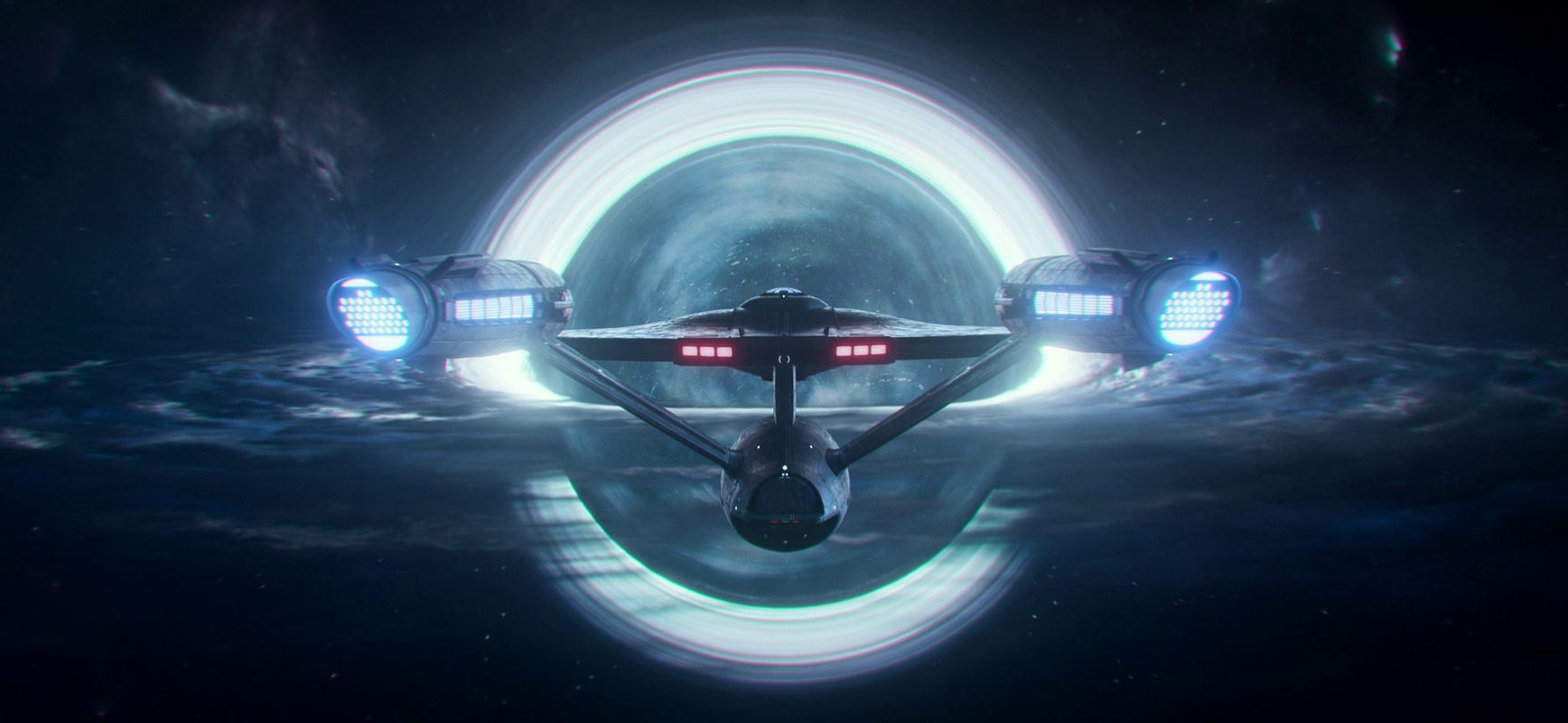
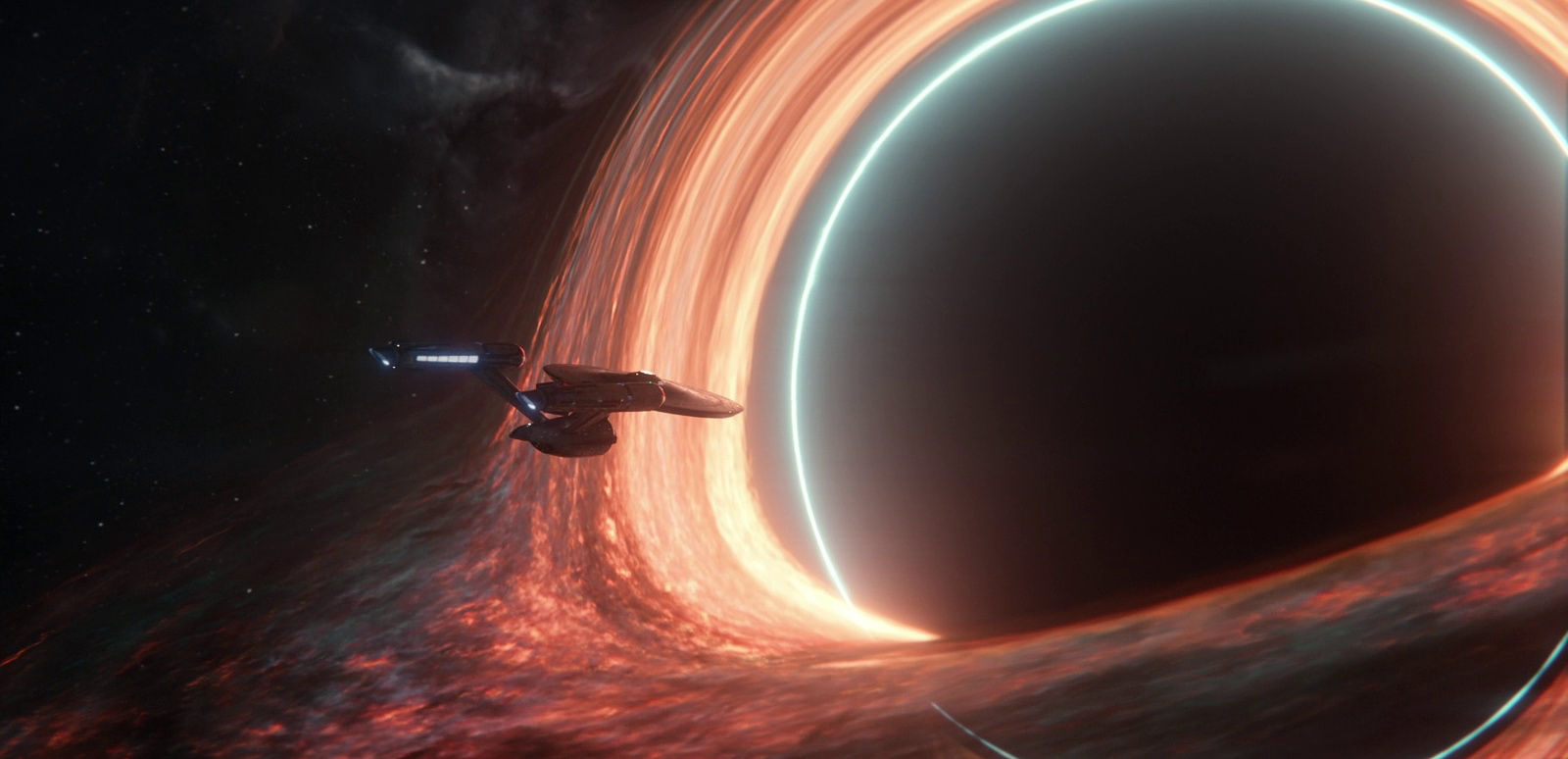
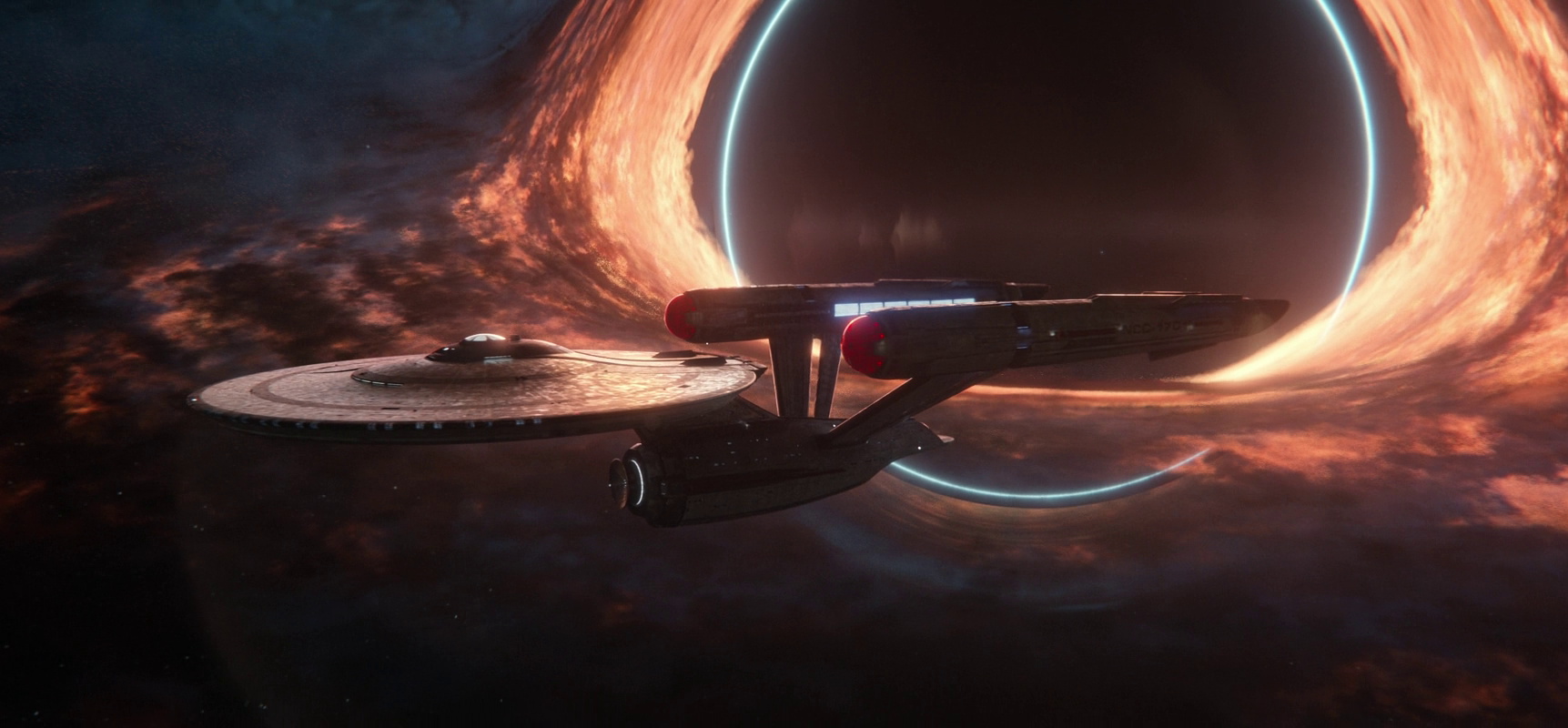
The visual effect of the black hole (and the “white hole” on the other side) was solid. We’ve seen black holes using this Interstellar-inspired look in modern Star Trek before, so in that sense it wasn’t unique, and it wasn’t as stunning or spectacular as if it were brand-new. But as the episode’s main CGI creations, it was important to get the black and white holes looking right – and I’m happy to say that they looked great.
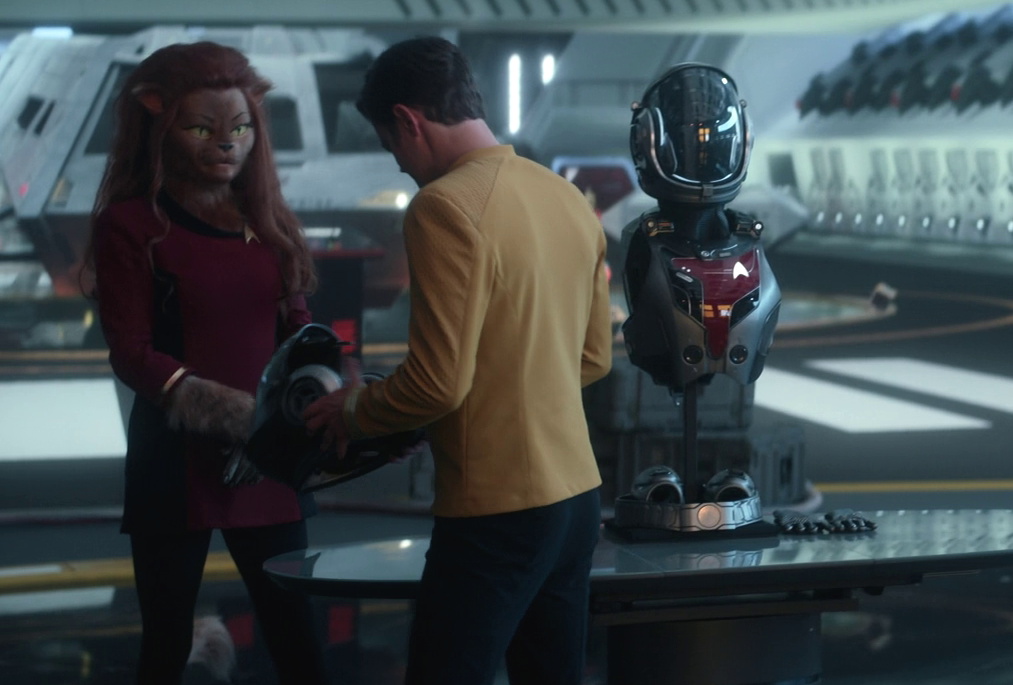
After a couple of places earlier in the season where I felt the AR wall hadn’t been used especially well, I also want to credit Tomorrow’s Enterprise for its well-constructed shuttlebay set. The AR wall worked really well as part of this set, and the shuttlebay felt as large and expansive a space as it needed to. The shuttlebay isn’t always going to be an area where we’ll spend a ton of time, but it’s important that it should feel large enough for its purpose, and I liked the way it came across this week.
There were also some creative physical props and costumes: did you notice Aleek-Om and M’Ress? I *adored* the way they looked, and while it’s not officially confirmed that the Caitian and Aurelian we glimpsed in the episode are the characters from The Animated Series… I mean, they were clearly meant to be, right? I always love seeing Caitians in live-action, so to catch a glimpse of M’Ress was just really neat.
Sticking with cameos: did you hear Kirk mention Gary Mitchell? Mitchell was a character from the episode Where No Man Has Gone Before, which showed his transformation into a powerful entity after an encounter out in space. It was neat to get a mention of Gary Mitchell, of course, but what was even more fun was how he was connected to Jenna Mitchell – a new character created for Strange New Worlds and who we’ve seen on the bridge a few times in earlier seasons.
Cameos like these go a long way to helping Star Trek feel like a cohesive, connected setting – and while modern Star Trek hasn’t always done a good job with that, I can appreciate the effort being made here to connect Strange New Worlds to The Original Series, The Animated Series, and the TOS movies. These felt like little “Easter eggs” for long-time Trekkies like us, and even if it might’ve been fun to get a whole episode focused on Caitian or Aurelian characters, I enjoyed the cameos for what they were.
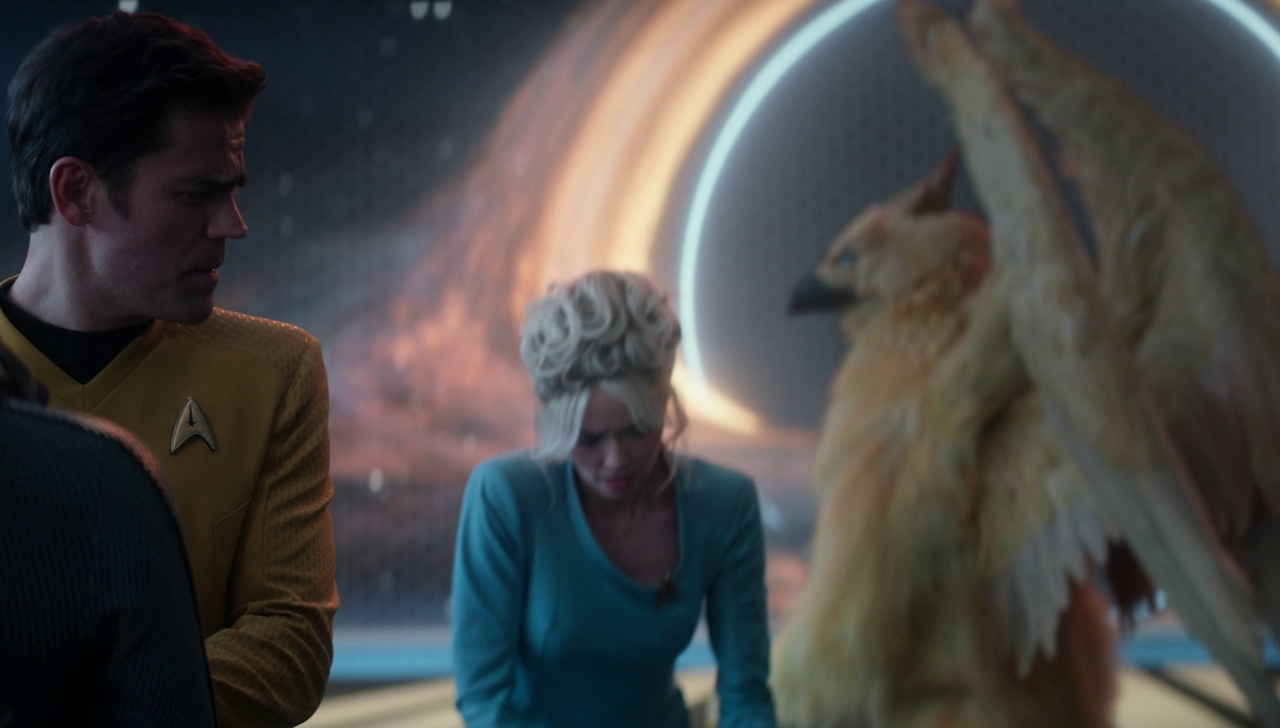
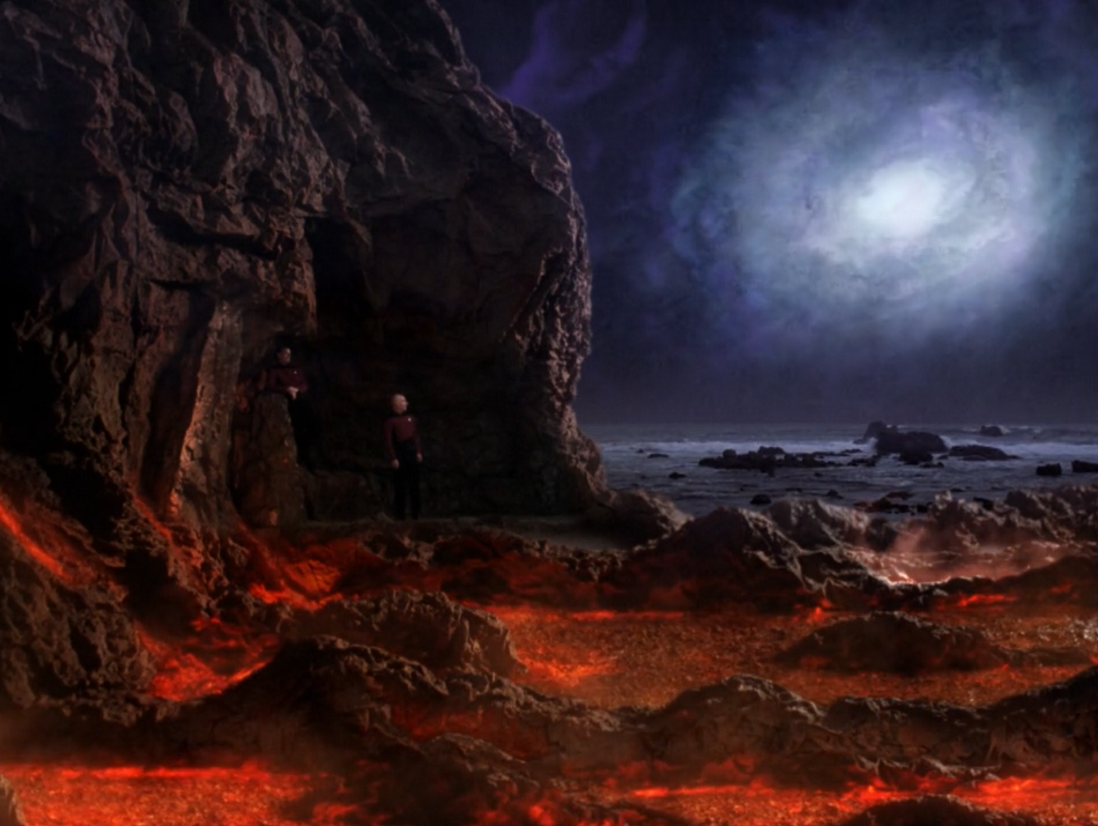
Did you feel echoes of The Next Generation’s finale, All Good Things, in the way that time seemed to flow “backwards” between the black and white holes? Because I certainly did!
Now, the two storylines are not really comparable in lots of other ways – and I really liked the idea of Uhura in the past setting up things that Uhura in the future would be able to use. We saw this with the dilithium diamond, Spock’s equation, and the mural recording the music. That was an incredibly creative way for a time travel/temporal paradox story to use its key narrative feature in a way that made sense – and in a way that most Star Trek stories dealing with similar ideas have never really done.
In All Good Things, to pick on that as an example, Picard was able to move between three different time periods, but actions he took in one seemed to have no effect on the other two. And in Past Tense, from Deep Space Nine’s third season, actions in the past *did* have a negative impact on the future, but not for our main characters. These differences help Tomorrow’s Enterprise stand apart even from superficially similar time travel stories – which is fantastic!
It was also a really creative idea to have one character split into two time periods, having to solve this puzzle from both ends. The way that time travel was integral to solving the mystery was handled just brilliantly, with Uhura from the future guiding her past self, and eventually setting up important things that would pay off a year later. But more than that, we got two different takes on Uhura – one that was, perhaps, a tad regressive and closer to her presentation in earlier seasons, and one that was very definitely trying to lean into the calm confidence of Nichelle Nichols’ character from TOS.
Last week, I talked about how Christina Chong took on a complex acting challenge – playing two different roles that had to come together. And Celia Rose Gooding stepped up to the plate this time to do something similar. Playing a younger version of a beloved character in a prequel is *already* a tough ask, so having to take on a version of Uhura who’s even closer to that familiar TOS presentation is even more of a challenge.
And Celia Rose Gooding nailed it.
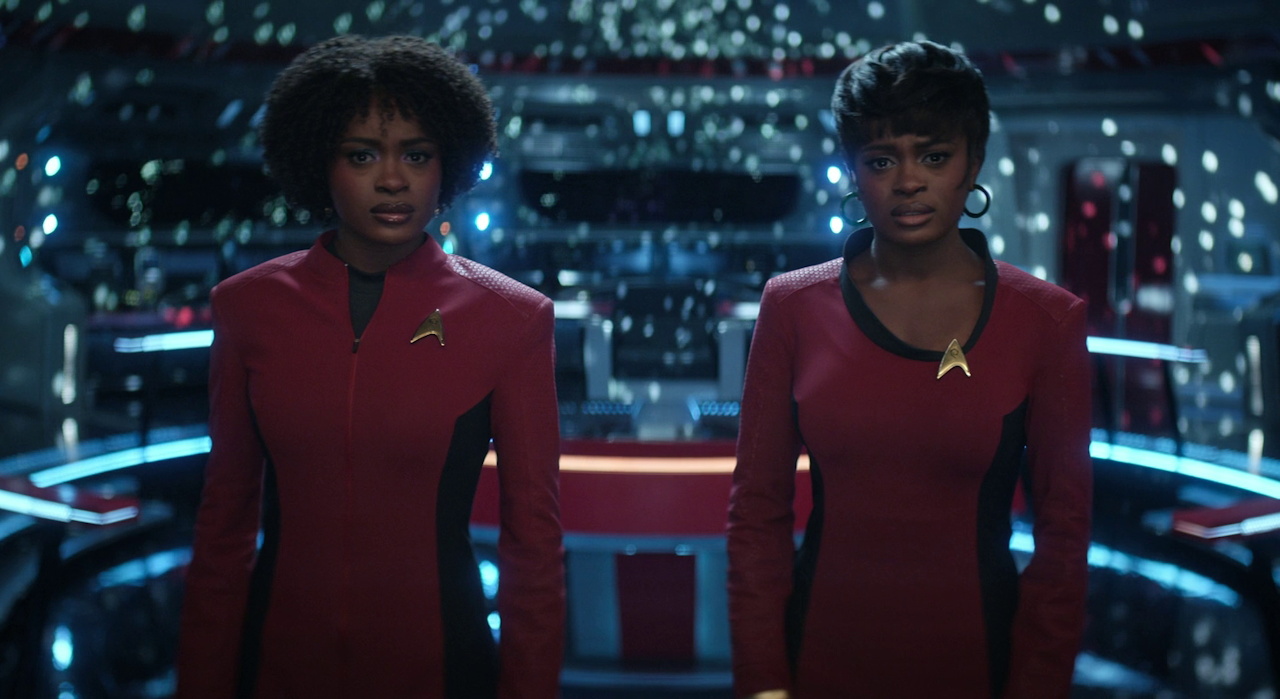
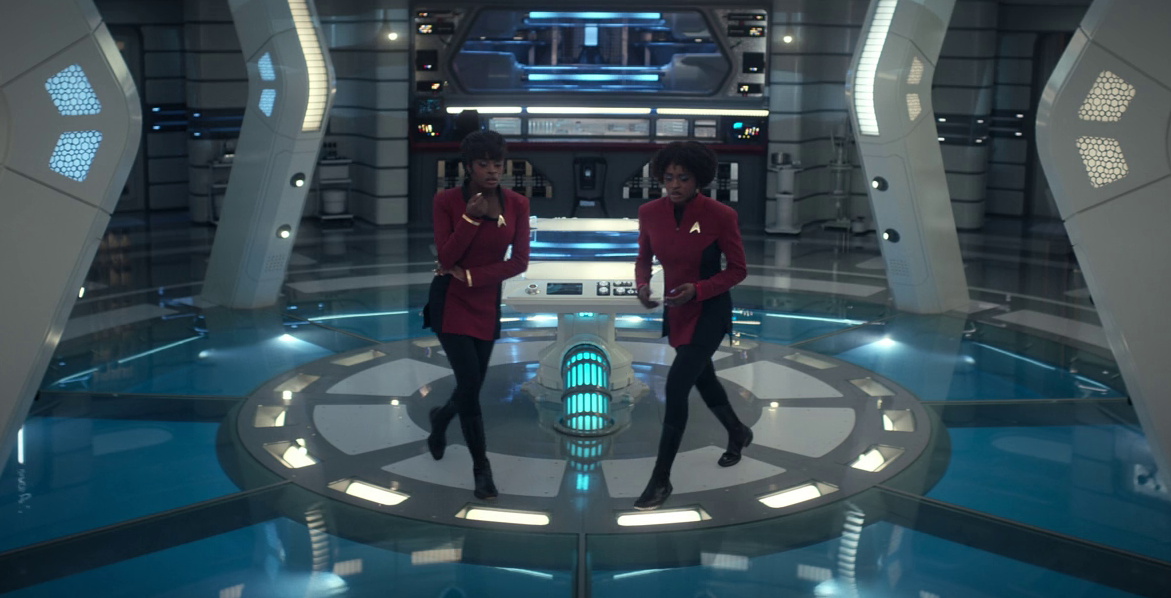
There’s a line to walk when differentiating two versions of the same character, and I don’t just mean costuming and hairstyles – though those did serve as important visual cues for us as the audience. In order to buy into the fact that one Uhura was older than the other, Tomorrow’s Enterprise played up – and, perhaps just a tad, exaggerated – these differences, and it worked well most of the time.
The only thing I’d say about that is that I felt maybe there was a bit more than just one single year’s worth of changes in between past and future Uhura. These were balanced between the two characters about as well as possible – with the younger version seeming to take a step back to become less secure and confident, and the older version becoming even more mature – which was a good call. And in a single episode of television, I think asking for too much subtlety would’ve lost something important; if both characters felt functionally the same, a big part of the episode’s core would’ve been lost.
But if Tomorrow’s Enterprise had been set, say, three years into the future instead of just one? Maybe it would’ve worked just a bit better!
A longer time-jump could’ve also accounted for things like Ortegas’ apparent promotion – all the way from Lieutenant up to Captain, if Spock’s statement in the transporter room was accurate. Such things have happened before, of course, and Ortegas is an instructor rather than a starship commander… but even so. It was also interesting to see that Pike had been promoted not to “Fleet Captain,” as in The Menagerie, but to the full rank of Admiral. I wonder if that’s setting up a plot point that Strange New Worlds will revisit in Season 5… or if it was just a throwaway line.
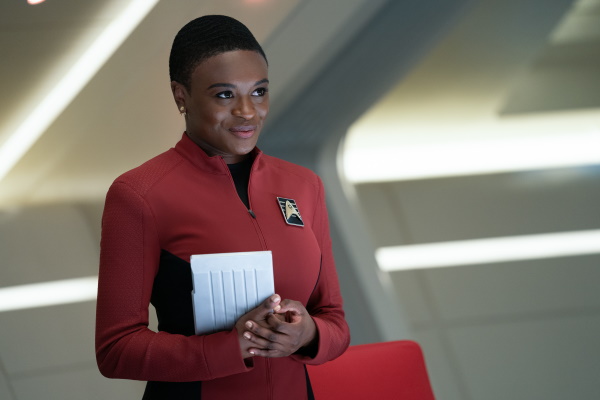
To get back to Uhura, though, I stand by what I said after Orders of Magnitude: she’s gotten by far the best and most complete prequel arc on the series, taking her from a fresh-faced, uncertain cadet in Season 1 to now the literal embodiment of Nichelle Nichols’ character as of the end of Season 4. The way Uhura was written this time was pitch-perfect, the way Celia Rose Gooding was able to amplify different parts of the characters to sell the illusion of there being two temporally-displaced Uhuras was fantastic, and at every stage, Tomorrow’s Enterprise absolutely excelled as an Uhura spotlight episode.
At first, I thought that Uhura was a bit of an odd choice to get a second major turn in this kind of role, coming just a couple of weeks after her excellent outing in Orders of Magnitude. But I can see the merits in putting a character like that into this kind of story – and it really did work incredibly well. Given where the episode wanted to take its time jump, with all of the TOS theming, it realistically demanded a TOS character to move between the two different eras, so Uhura was a great fit.
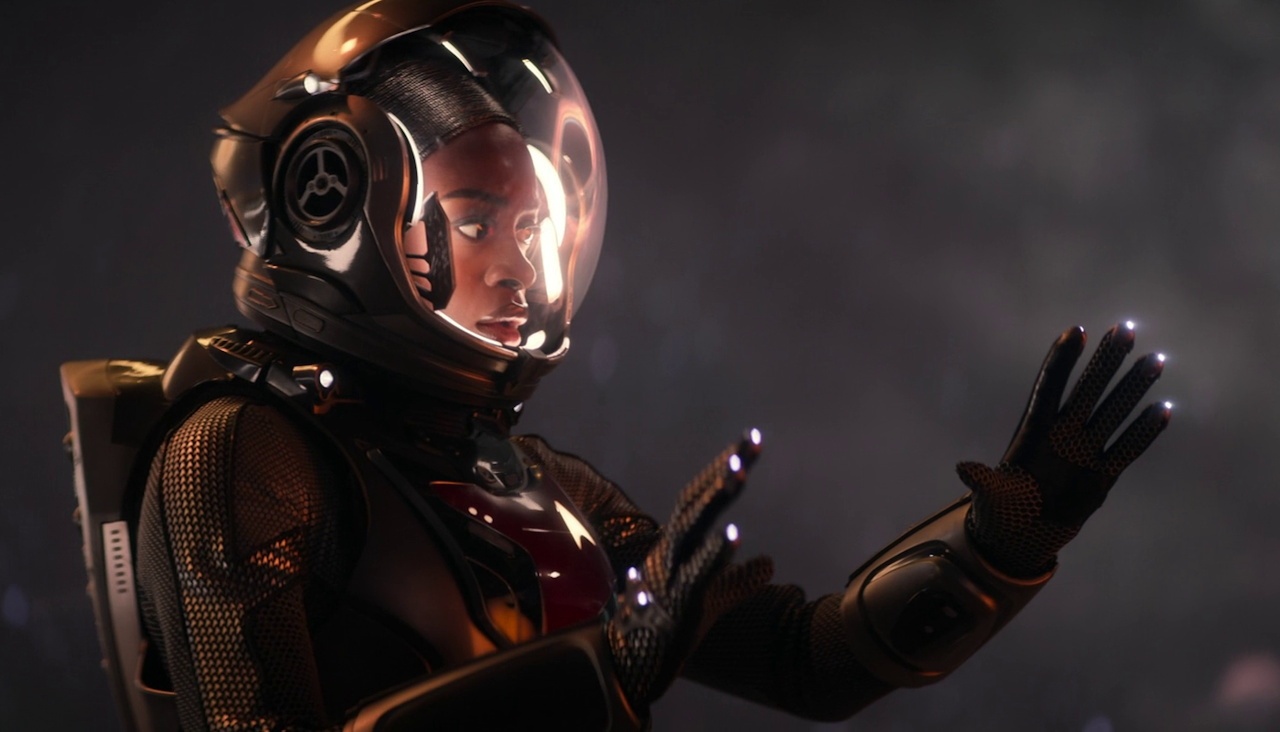
There was also the question of the black hole aliens’ transmission: as the Enterprise’s communications officer, Uhura was best-placed out of anyone in the crew to decipher this strange, musical message. I felt echoes of Season 1’s Children of the Comet, which had a similar musical influence, and was Uhura’s first major spotlight in Strange New Worlds, but these stories unfolded differently enough that neither treads on the toes of the other.
One thing I felt wasn’t particularly well set up was Scotty’s interest in a romantic relationship with Uhura, and her reaction to it. Obviously Scotty and Uhura have spent *some* time together over the past couple of seasons… but can you call to mind a moment between them in either Seasons 3 or 4 that might’ve so much as hinted at something like this? Because I can’t – and that put the brakes on this, at least for me.
I mean no disrespect to either Martin Quinn or Celia Rose Gooding, but I didn’t really feel much chemistry between their characters in Tomorrow’s Enterprise, either. Given that their relationship came from nowhere at the beginning of this episode, with absolutely no setup earlier in the season, we needed to feel *something* from the characters themselves to sell this. And while it wasn’t cringe-inducing or bad in any way, I just didn’t think it felt like a natural development for either of them. If anything, Scotty’s time on screen this season could’ve built up to some kind of crush on Ortegas, and Uhura, at least in Season 3, seemed to go back-and-forth a bit with Ortegas’ brother, Beto.
I just wasn’t feeling the spark, I guess, between these two established characters.
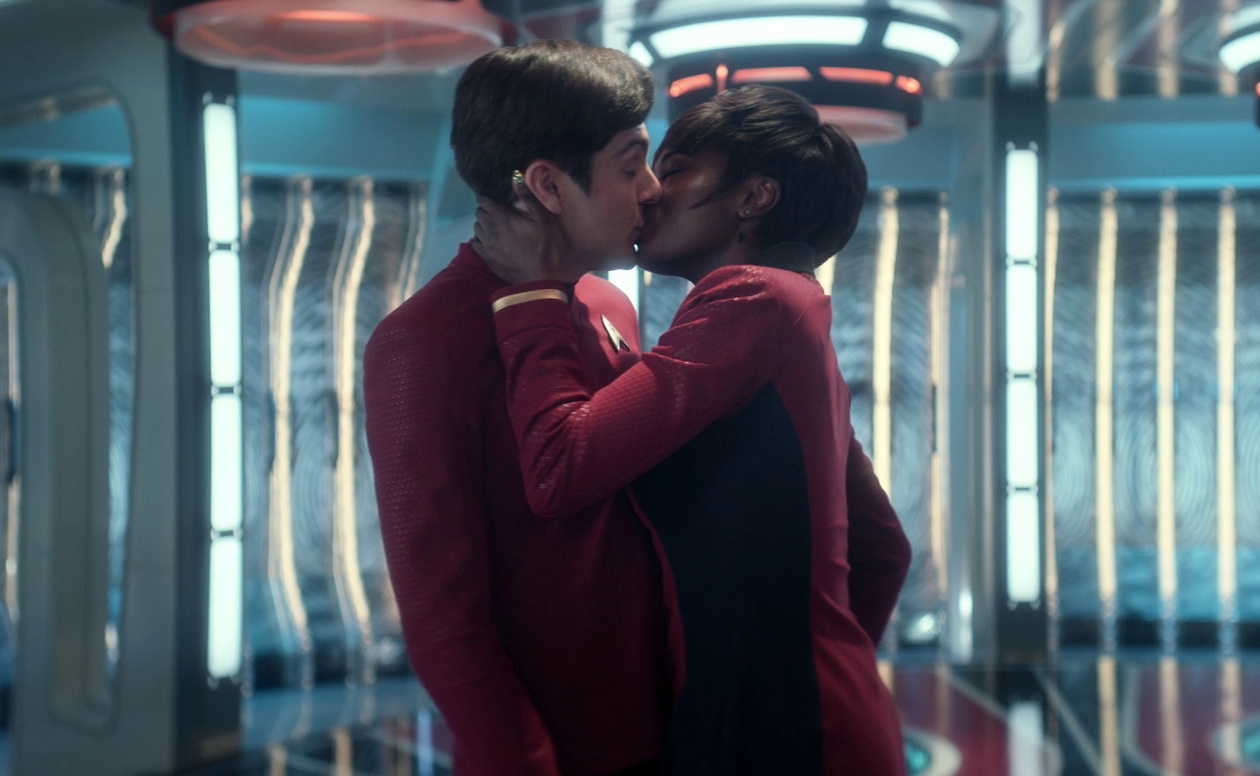
However, I’m not gonna argue that Uhura and Scotty having some kind of “casual” relationship or fling in the years before TOS is in any way a problem for “the integrity of canon!” All that’s required is to say that Scotty and Uhura had a moment, and that moment passed. People can get out of relationships and still remain friends or close colleagues, and I really don’t think that this is in any way a “canon-breaking” moment for either of them.
So this aspect of the story served a narrative function insofar as it gave Uhura more of a reason to want to save Scotty. Did Uhura need that extra motivation? Personally, I’d say “no,” and given that these two characters didn’t actually have much on-screen chemistry, *and* the aforementioned “prequel problem” meaning that Scotty never actually managed to feel like he was in real danger… I could’ve lived without it. Or, at the very least, I might’ve preferred it if the relationship stuff was limited to Uhura learning the key lesson of her arc: that sometimes it’s okay to “live in the now.”
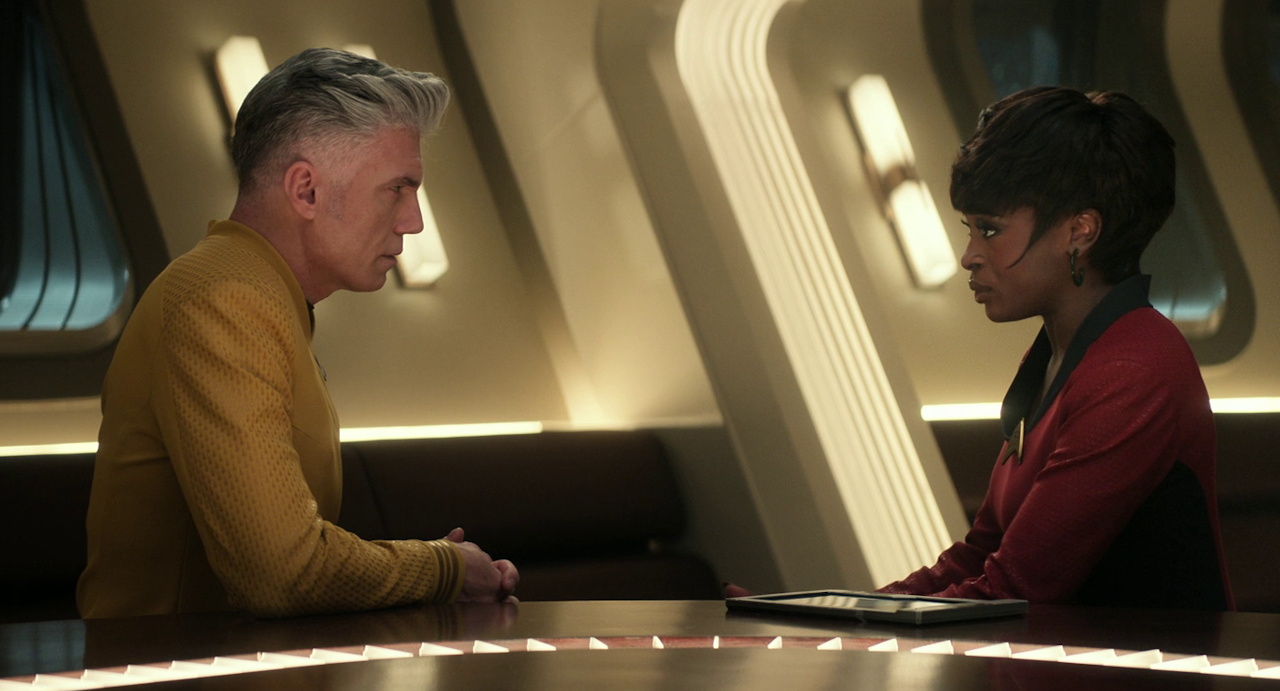
Uhura got moments with Kirk and Chapel that I really enjoyed, as well as her future counterpart’s scene with “Admiral” Pike. The mutual respect that Pike and Uhura showed for one another was played just perfectly, and despite Anson Mount not having a huge role in this week’s episode, what we got was more than enough to remind me of why I was so keen to see this “Captain Pike show” in the first place! It also felt bittersweet, as if both Pike and Uhura were saying a final goodbye to one another. In Uhura’s timeline, Pike’s accident shouldn’t have happened yet, and although he’s no longer a part of her day-to-day life… I’m not sure I understand why Uhura was treating the moment with such finality. However, from the point of view of us as the audience, looking in from outside, I think it worked really well. If Pike and Uhura don’t get another moment together before the show ends, this goodbye will still work.
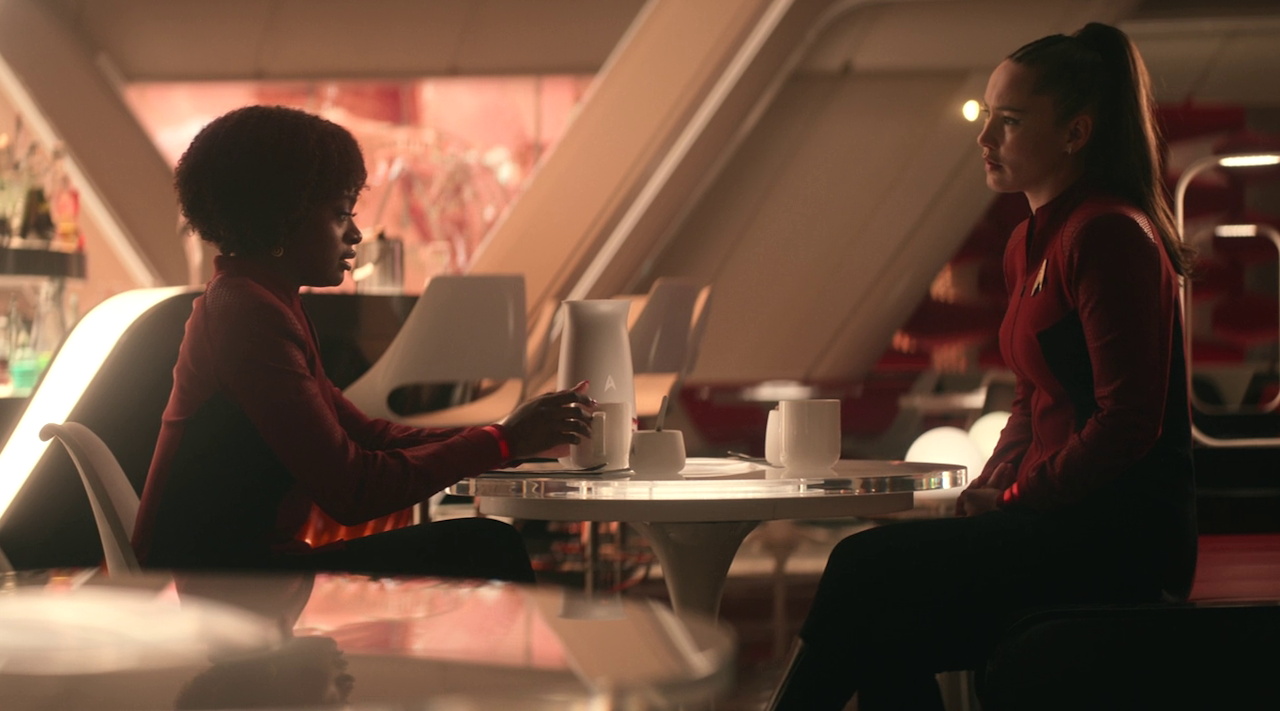
La’an and Uhura haven’t (to my recollection, anyway) spent much time together across all four seasons of the show. They’ve been present at the same time in some stories, and I’m sure they’ve at least spoken to each other… but I can’t really recall a single major La’an-Uhura storyline. So I liked that we got at least one scene between them, focusing on a conversation they had, before the show wraps up. La’an gave Uhura some useful advice about time travel based on her own experiences with it in Season 2, and I liked the way La’an had to be cagey in how she referenced what happened. It wasn’t the biggest part of the episode, but it was nice to give Uhura a one-on-one moment with a character she doesn’t always get to chat with.
Star Trek can do action-packed stories very well – and some of those, from The Wrath of Khan to The Best of Both Worlds and beyond – are all-time fan favourites. But one of the core appeals of a franchise like Star Trek, at least to me, is that there are often scientific puzzles to solve, and ways to resolve stories that *don’t* require resorting to violence, phaser fire, and blowing things up. So I really appreciated that Tomorrow’s Enterprise was a purely scientific puzzle for Uhura and her counterpart to solve, not a story with a nefarious villain to be defeated.
And coming after Discovery, Picard, and other modern Star Trek shows have gone all-in on serialised story arcs with a massive, galaxy-threatening villain, conflicts, wars, and so on… this kind of story feels all the more refreshing. Some of Star Trek’s action-packed episodes are fantastic, don’t get me wrong, but a scientific puzzle like this feels… well, it just feels very “Star Trekky,” for want of another term.
In a similar vein, I felt that Tomorrow’s Enterprise didn’t overdo its character drama. Yes, the romantic relationship for Scotty and Uhura was new, and yes, that was a secondary motivating factor for her when it came to wanting to save his life. But it didn’t feel melodramatic in the way that Discovery might’ve tried to play a similar idea; Celia Rose Gooding played Uhura at just the right level to seem convincingly worried for Scotty’s safety without going overboard. Again, after missteps and failures elsewhere in modern Star Trek, I really appreciated that!
Earlier in the season, I heavily criticised The Griffin Incident for not having an actual ending or resolution to its story. And a story like Tomorrow’s Enterprise is a great example of something I said in my review of that episode: you don’t have to get a down-to-the-millimetre explanation of every aspect of an alien race or interstellar phenomenon in order to write a story that feels narratively complete.
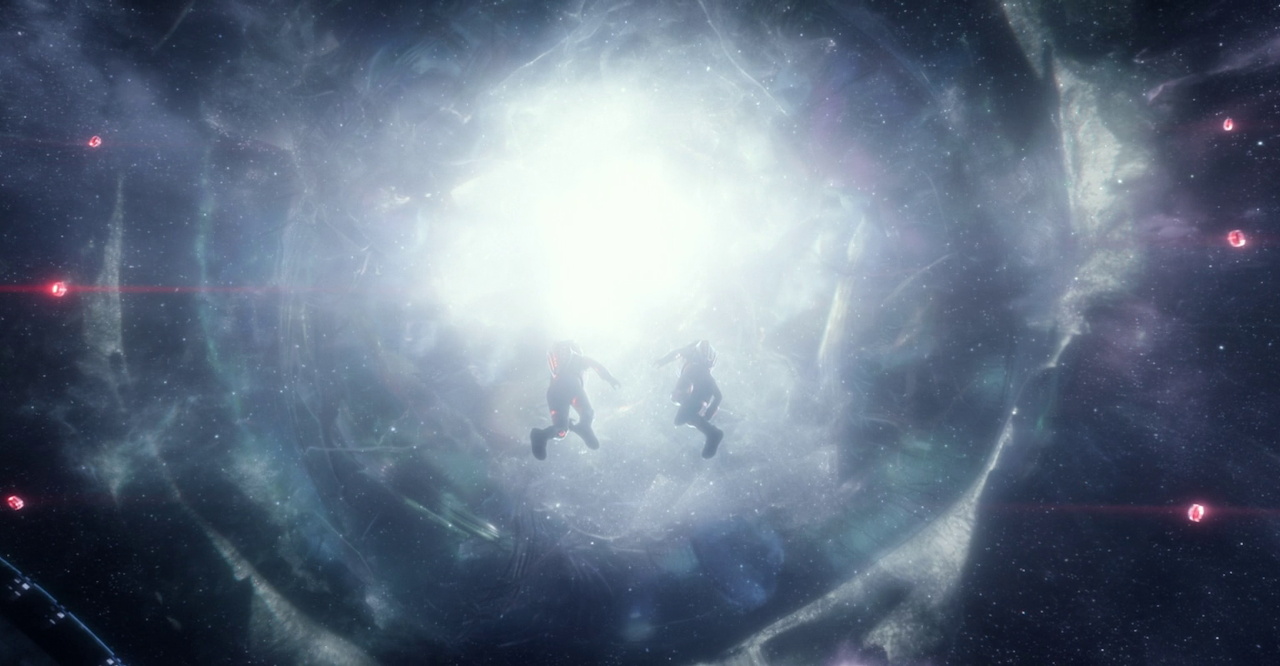
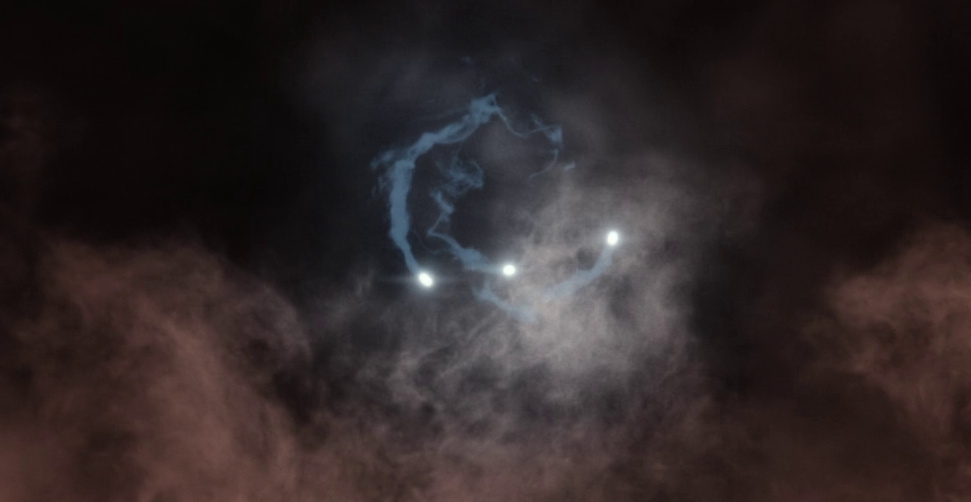
This week, we didn’t learn who the “midwives” were or what the “space baby” they were trying to deliver was. We didn’t learn why a black hole and a white hole were the incubator for this new life form, either. But we got enough from Uhura’s story to understand what was happening to her and to the other characters we care about, as well as what she needed to do to save a life – or two lives, really, including the baby – and restore the correct version of the timeline. We didn’t need a ton of technobabble about giving birth in space, black holes, or time travel, and we didn’t even need so much as a name for either of these aliens. We got enough from the story to make the ending feel satisfying – and compared to The Griffin Incident earlier in the season, that’s more than enough.
I will say, as an aside, that I didn’t really like the name “space baby” for this phenomenon! Though I will credit the episode with at least being self-aware enough of that silly name to have Uhura herself comment on it in the story.
I mentioned All Good Things (the TNG series finale) a moment ago, and there was one other way in which Tomorrow’s Enterprise seemed to borrow from that episode: the poker storyline.
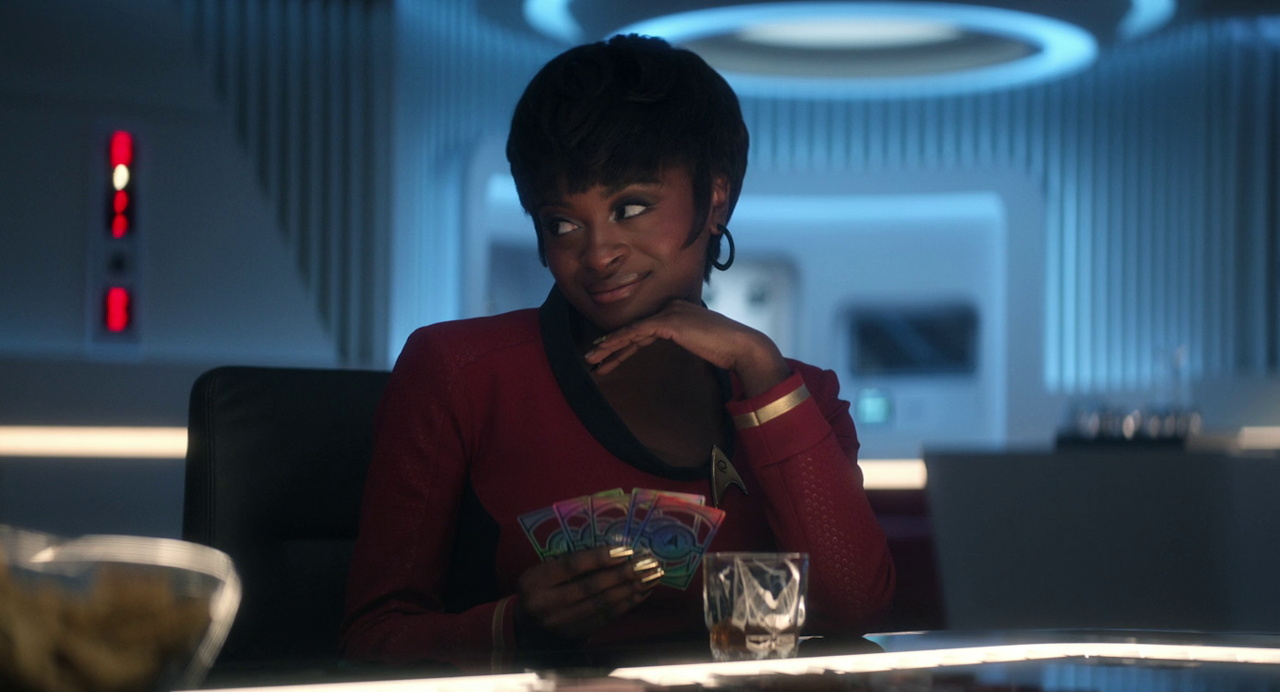
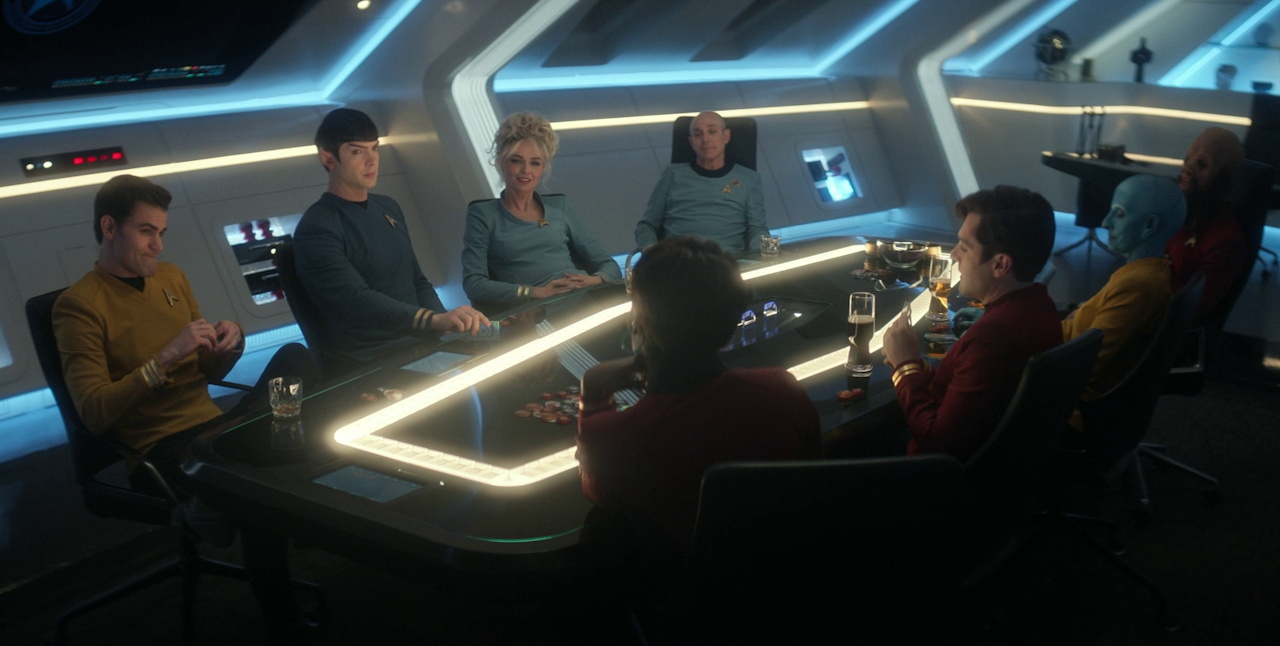
We got an overhead shot of a poker table that felt eerily similar to the one in All Good Things (which was also copied in the Picard series finale, too), and the emphasis on Kirk and his crew playing poker together felt like it was drawing on a Star Trek tradition which has been present since The Next Generation. I think I’m right in saying that we never saw Kirk and co. playing cards together in TOS (though Kirk and Spock famously played chess, of course), but I liked that not only is this another way to show Kirk being closer and more friendly with his crew, but also how it’s another little through-line connecting different parts of the franchise together.
In this case, not only did the poker game have some relevance to the story – with Kirk able to suss out that Uhura was an imposter aboard his version of the Enterprise – but it also links Strange New Worlds not only to The Original Series, but to The Next Generation as well. The shot of Kirk, Uhura, and others playing cards together was a great way to close out the episode.
And I think that’s a good place to start to wrap things up!
Uhura got an epic time-splitting episode to end out the season, and while there are some disappointments as the curtain falls… mostly they’re in what we *didn’t* get to see rather than the way Tomorrow’s Enterprise itself comes across.
I was unsure, when I saw the promo images and the trailer, whether a time travel episode would really be good enough to draw a line under what has been, I’m sorry to say, an underwhelming season on the whole. And while I don’t think it was so stunningly spectacular that we can just forget all of the missteps and cock-ups in weeks gone by – looking at you, Level-Five Writing Accident – I think we can at least say that the season ended with one of its strongest episodes.
In the days or weeks ahead, I’ll write up my preliminary thoughts on where Strange New Worlds stands ahead of Season 5, so I hope you’ll join me for that. And before Season 5 airs next year, it’s my hope that I’ll have time to write up re-watches of all ten Season 1 episodes, too; Paramount’s utterly ridiculous decision to cut the show off from international fans meant I didn’t write episode reviews back in 2022. So, again, please join me for those if you can!
I have reviews of every episode from Seasons 2, 3, and 4 – you can find them by clicking or tapping here. Earlier this year, I also reviewed Starfleet Academy’s first season, which you can find by clicking or tapping here, and the Star Trek: Voyager video game Across The Unknown, which you can find by clicking or tapping here. And if you missed my celebratory piece for Star Trek’s sixtieth anniversary earlier in September, you can find that by clicking or tapping here.
There’s more to come here on the website, though, even as Strange New Worlds goes off the air! I have reviews of other films, games, and TV shows in the works, and there’s bound to be more to say about Star Trek, too! The Star Trek franchise will be at New York Comic-Con next month, and there could be a trailer or teaser clip for Starfleet Academy Season 2, and perhaps something for Strange New Worlds Season 5 as well. If and when we get news or trailers for either of those, I’ll do my best to cover that here on the website. Next month will also bring us the video game Outposts Unknown, which I covered the demo of a while ago, so I’ll try to take a look at that, too.
Thanks again for joining me for this review. And, as always… Live Long and Prosper, friends!
Star Trek: Strange New Worlds Seasons 1-4 are available to stream now on Paramount+ in countries and territories where the platform is available. The first three seasons are also available on DVD and/or Blu-ray. The Star Trek franchise – including Strange New Worlds and all other properties discussed above – is the copyright of the Skydance-Paramount corporation. This review contains the thoughts and opinions of one person only and is not intended to cause any offence.

