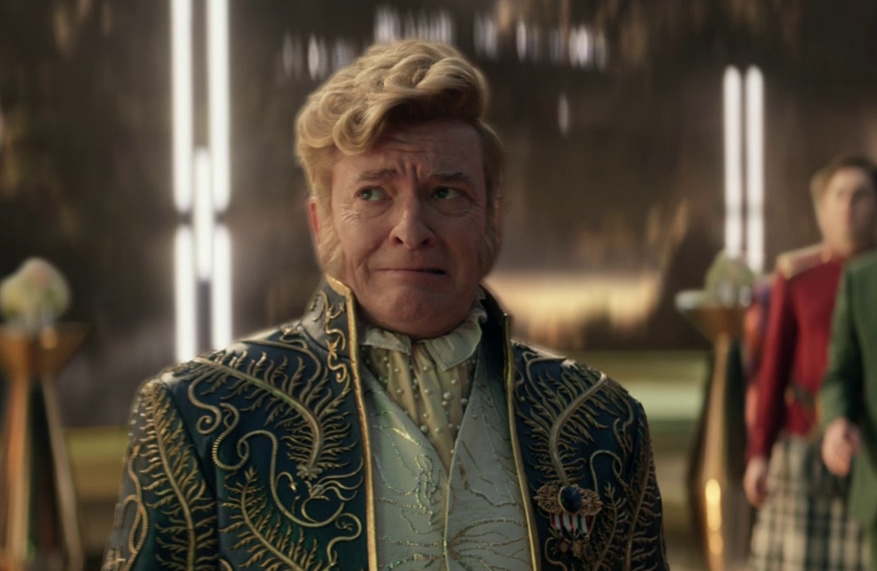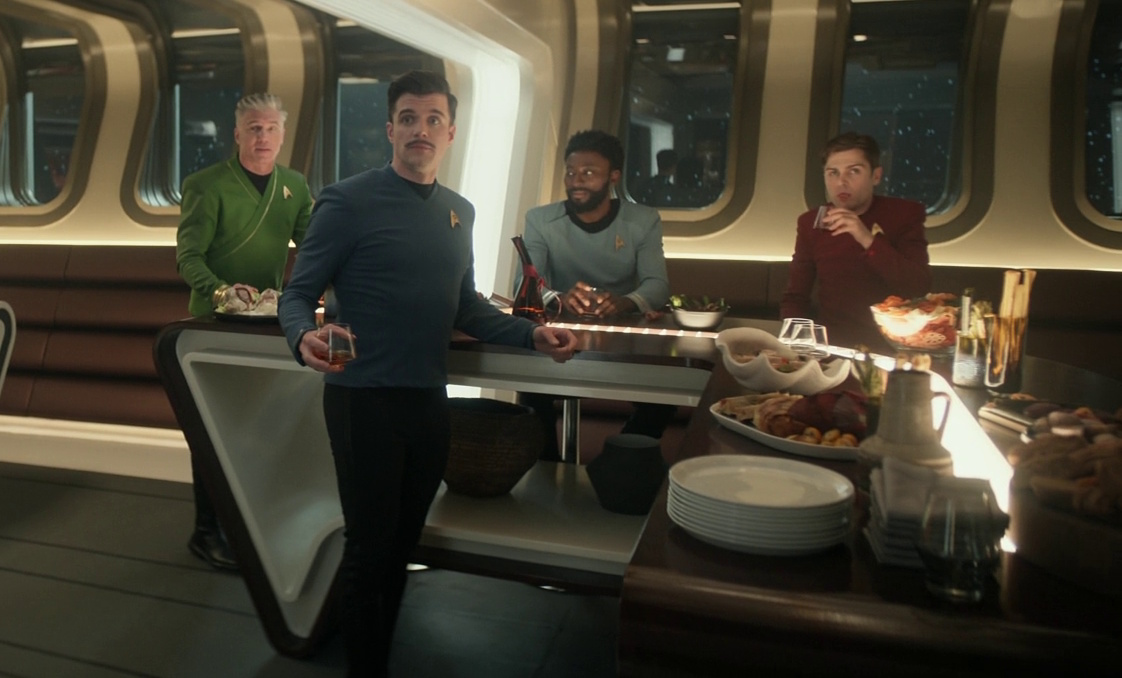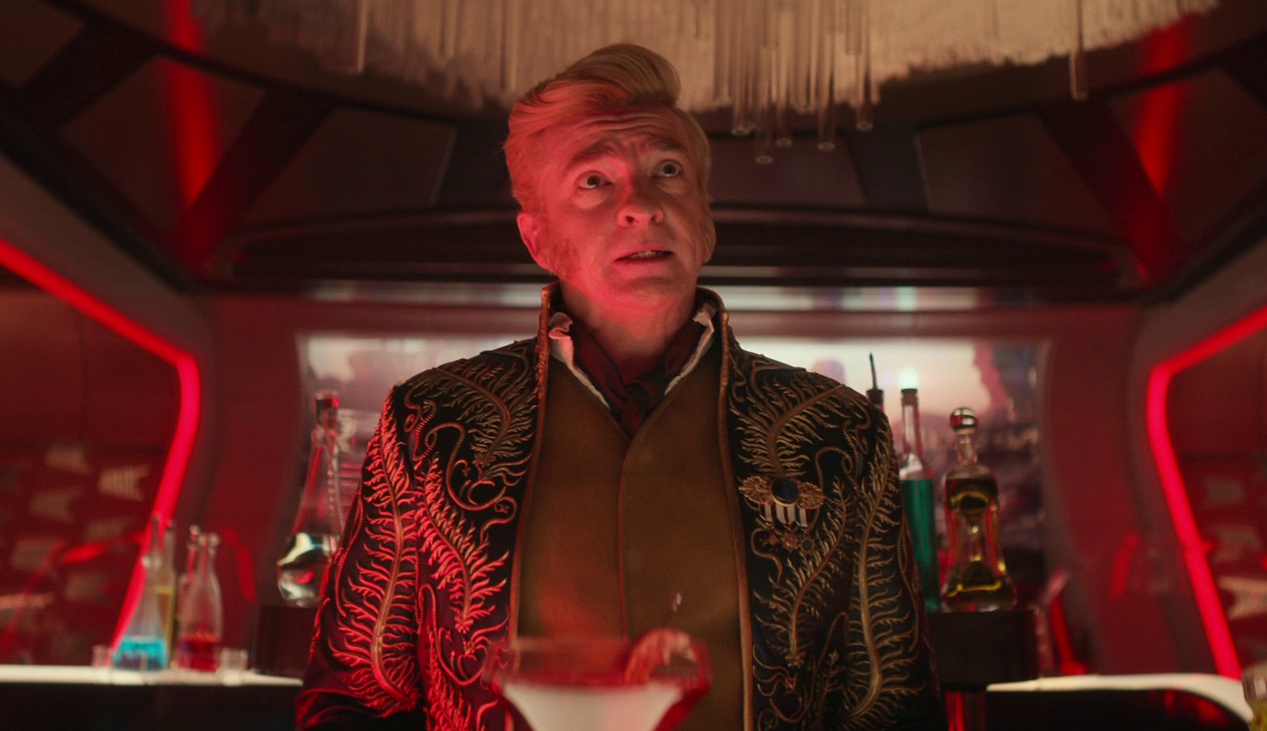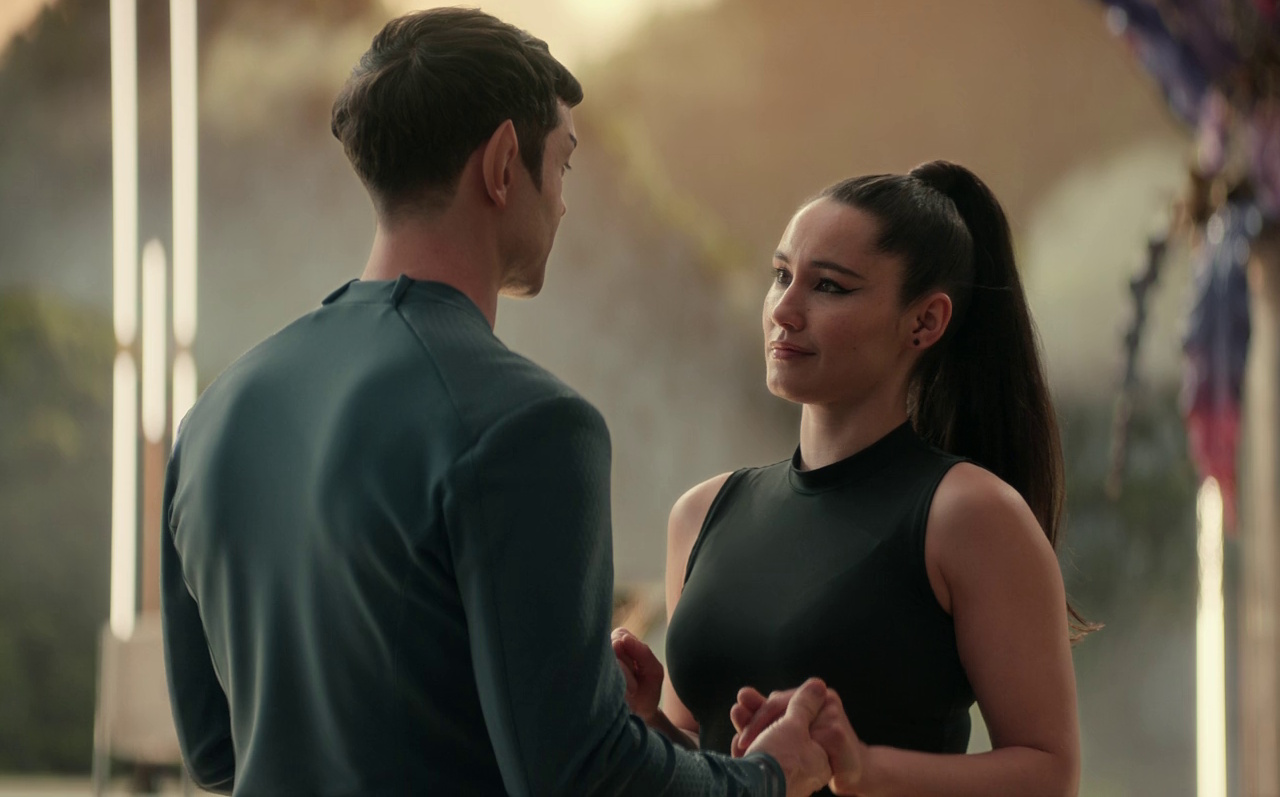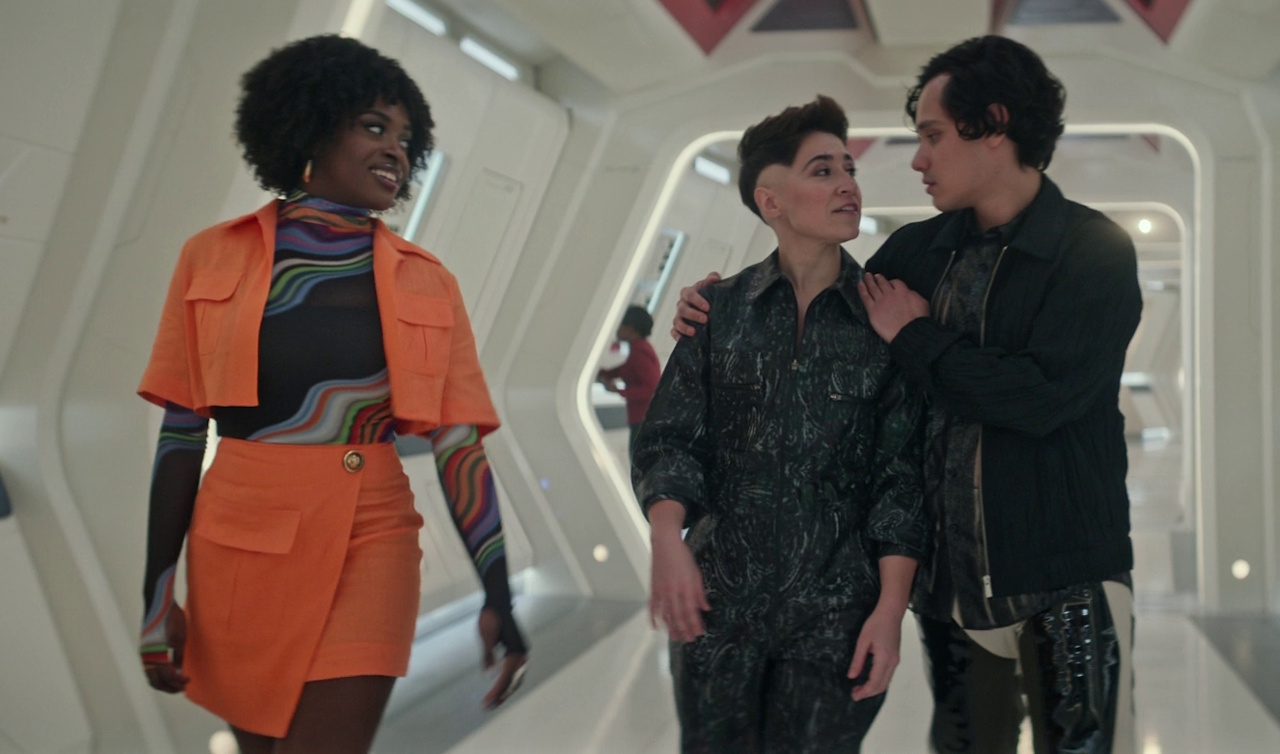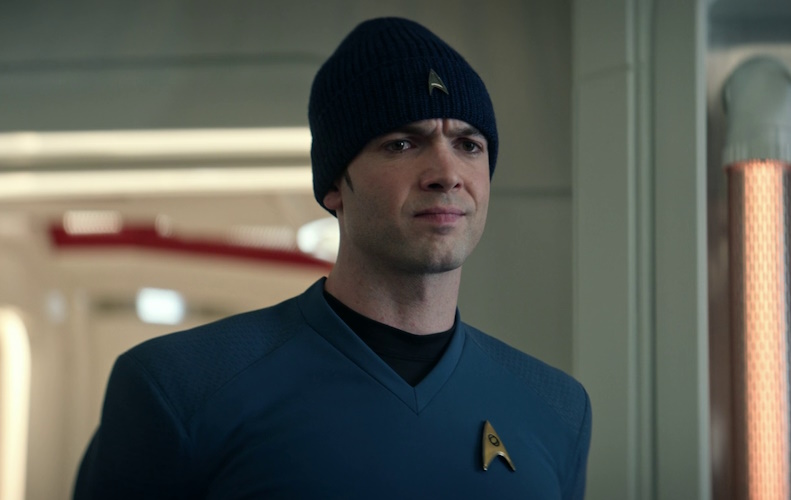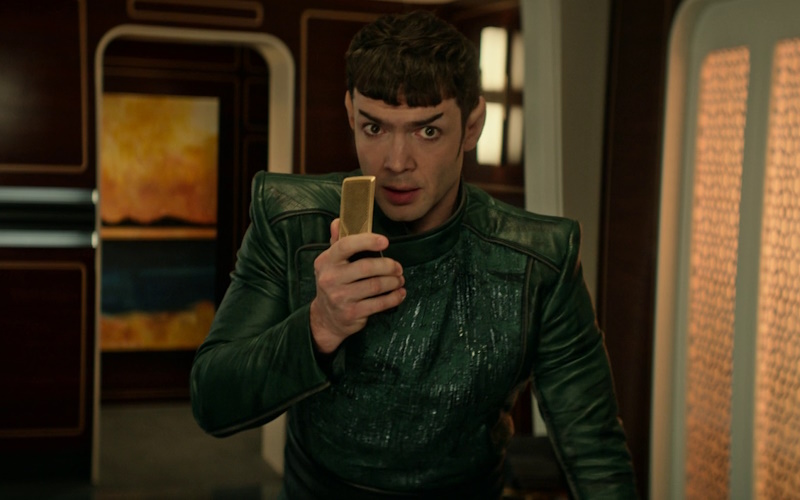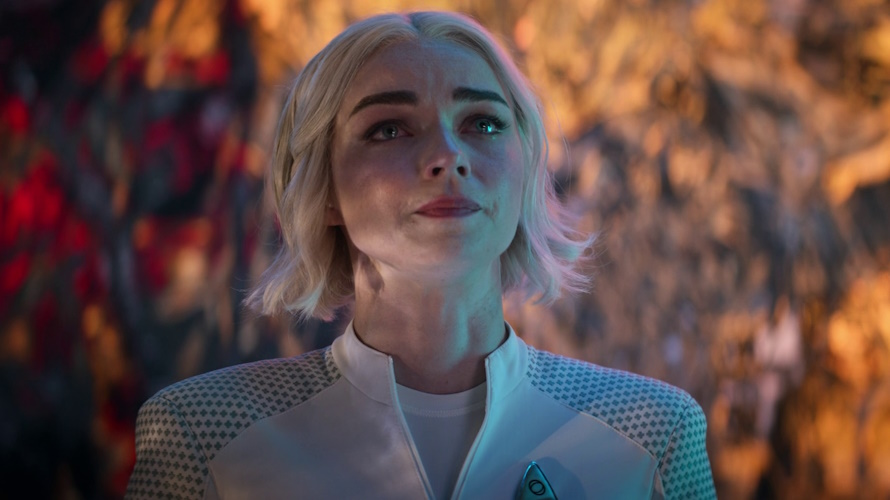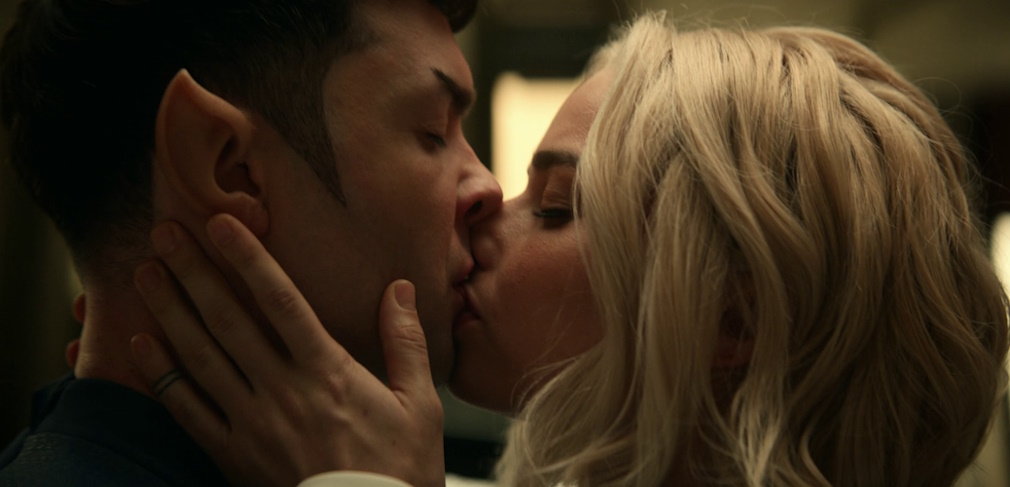
Star Trek: Strange New Worlds Episode Review – Season 4, Episode 10: Tomorrow’s Enterprise

A Star Trek-themed spoiler warning.

Spoiler Warning: There are spoilers ahead for Star Trek: Strange New Worlds Seasons 1-4. Spoilers are also present for the following Star Trek productions: The Original Series, The Next Generation, Deep Space Nine, Discovery, and Picard.

After a rollercoaster ride across Season 4 – which, I’m afraid, had more downs than ups, and also brought two of the worst episodes in the entire series to the table – I was hoping, if not positively *praying,* that Tomorrow’s Enterprise would at least end things on a high note. I wasn’t sure whether to expect a cliffhanger, like we got in Season 2, or a self-contained story – and we kind of got a bit of both, at least for one character in particular.

But above all, I’m happy to report that, despite some misfires earlier in the season, Tomorrow’s Enterprise was a good, solid finale that I enjoyed from beginning to end.

There will be time in the weeks ahead to take stock of where Strange New Worlds as a whole finds itself ahead of its truncated fifth and final season, but I want to touch on a couple of points briefly, at least insofar as they pertain to Tomorrow’s Enterprise. For much of the season – including in this episode – most of the show’s new, original characters took a back seat, and those with roles in The Original Series were more central. We saw that not only with Uhura, but also with Chapel, Spock, Scotty, and Kirk – all of whom overshadowed or outright replaced their Strange New Worlds counterparts, or original characters who could’ve filled those roles. And despite this being a fantastic all-around episode for Uhura, I can’t help but feel the curtain has fallen on a season that sidelined not only its new characters, but also Captain Pike himself – and it was Anson Mount whose incredible performance led to calls for a “Captain Pike show” a few years ago.
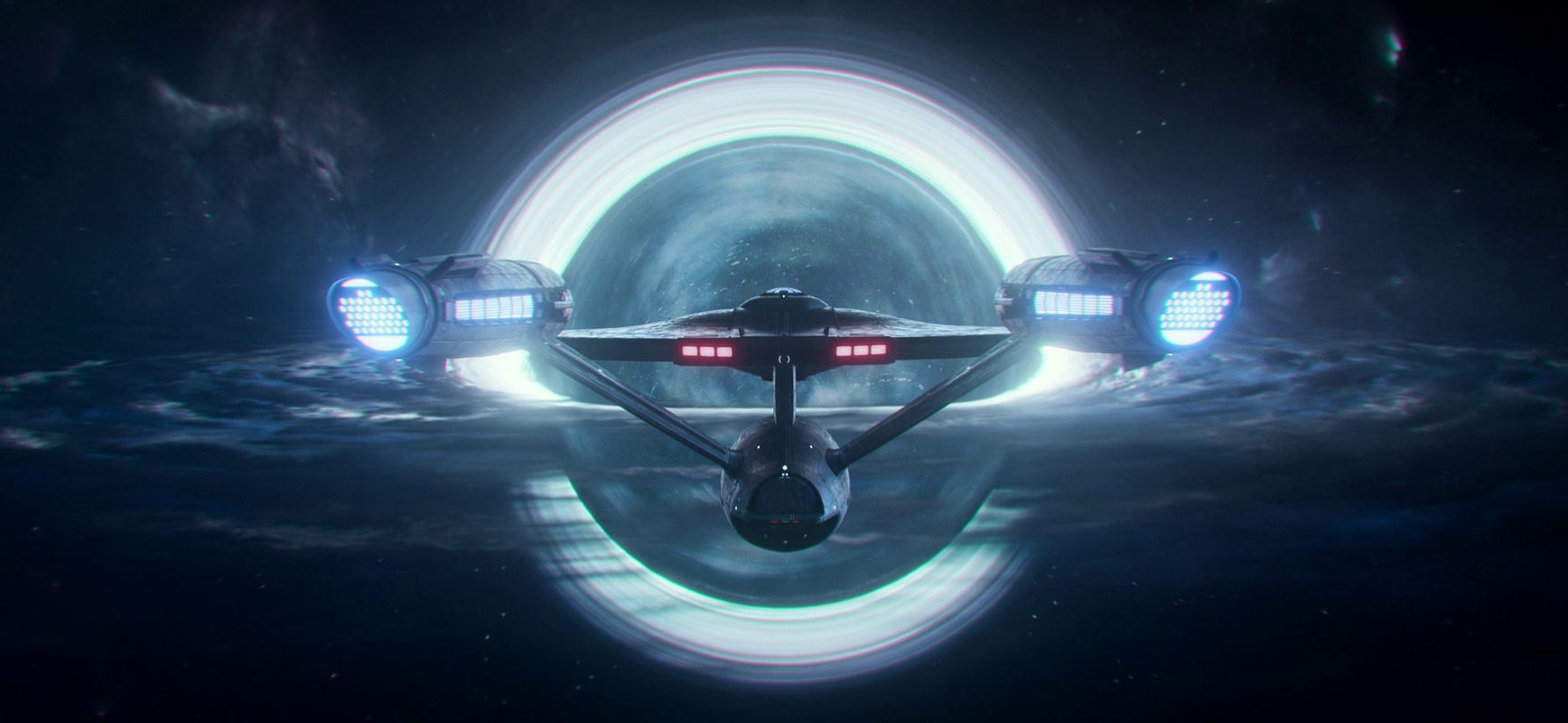
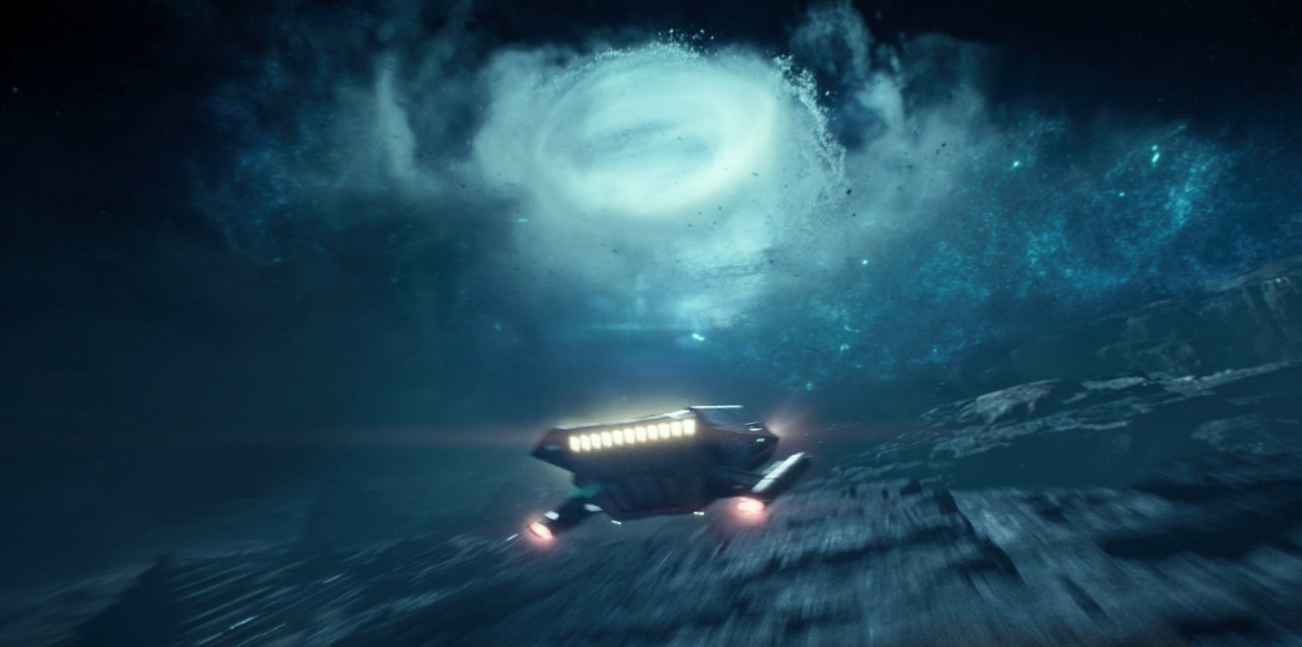
Still frame from Star Trek SNW 4x10 showing the Enterprise and a white hole
The Enterprise approaches a white hole.

But I guess we’ll have to dissect that in a longer article in the weeks ahead.

Time travel, time loops, and temporal paradoxes are far from my favourite storylines – either in Star Trek or in sci-fi more generally. So for me, of all people, to come away from Tomorrow’s Enterprise feeling that the episode took that narrative framework and built it up into a successful episode? That’s almost inconceivable!

Yet here we are: this rare unicorn of an episode managed to make a time travel plot work in a way that was understandable, but also intense, emotional, and just plain fun. There are a few nitpicks (and you know we’ll get into them as we go along), but overall? I had a really good time with Tomorrow’s Enterprise.
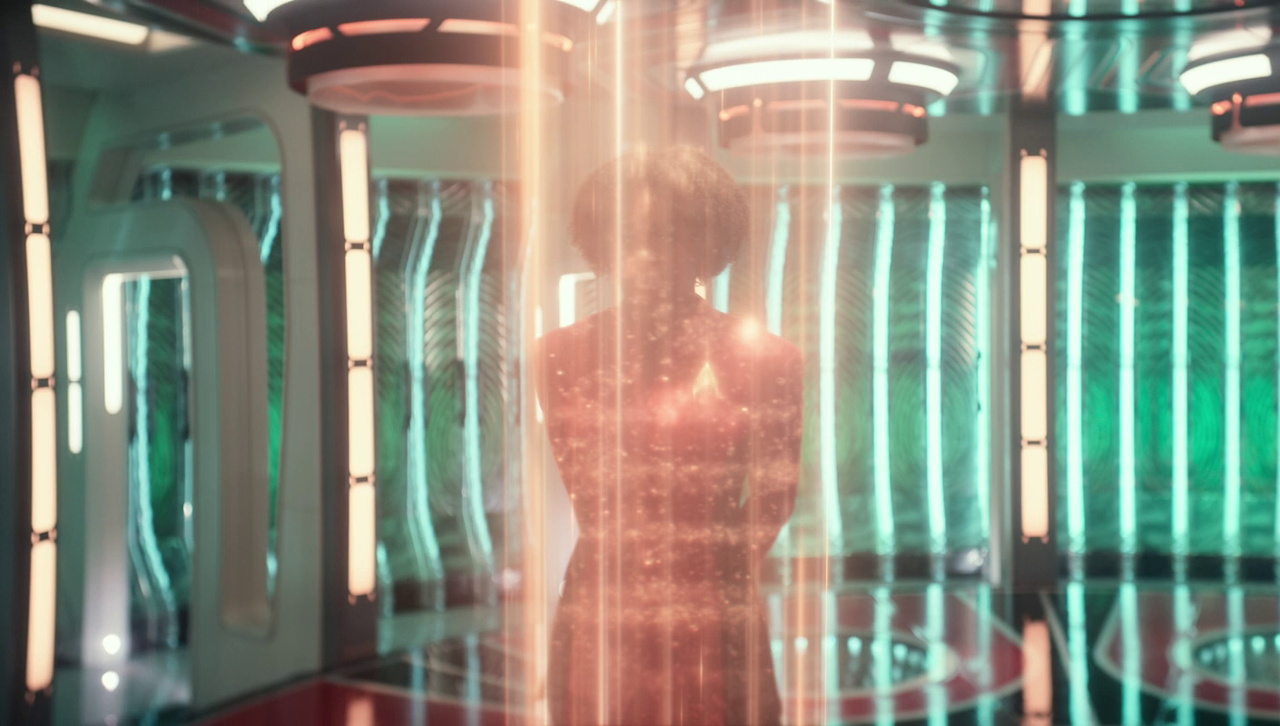
Still frame from Star Trek SNW 4x10 showing Uhura beaming in
Lt. Uhura beaming in!

Sometime after it was announced that Strange New Worlds would end with Season 5, we got news that the show had cast both Sulu and Dr McCoy for that final season – and when this time travel story seemed to take Uhura into her own future, I wondered whether we might catch a glimpse of either character. However, I think it was good that we didn’t see *even more* TOS characters in this episode in particular, given that they would’ve arguably been a bit of a distraction from the main plot as it followed the two different versions of Uhura. And I can also see why Strange New Worlds wouldn’t want to play *all* of its cards too soon! Keeping those characters in reserve for whatever roles they may have in Season 5 was a genuinely good call.

One thing I found odd, though – not just about Tomorrow’s Enterprise, but going back to Off-Hour and even (kind of) Like Chronitons Through the Hourglass, too – was Dr Boyce’s role. In The Cage (and The Menagerie), Dr Boyce was a confidant, friend, and somewhat of an unofficial counsellor to Captain Pike, and they seemed to have a pretty good relationship. Yet in both of his appearances this season – and when Pike was at his lowest ebb and in need of someone to talk to – Dr Boyce and Captain Pike weren’t even in the same room. They never spoke to each other, never interacted at all… and that’s just a bit of an oddity.
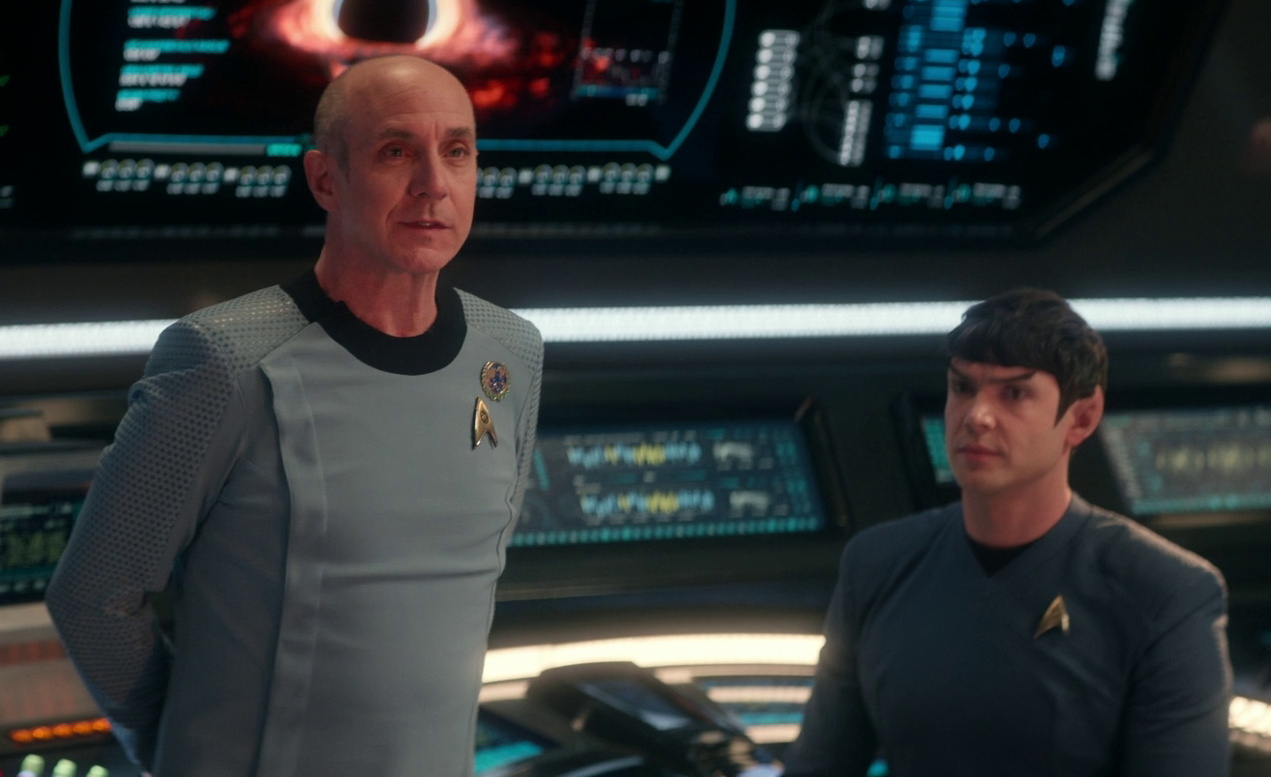
Still frame from Star Trek SNW 4x10 showing Boyce and Spock on the bridge
Dr Boyce with Spock.

I liked seeing Dr Boyce in action in sickbay this week, as well as learning that he had a previously-unseen role aboard Kirk’s Enterprise, at least in the early years of his command. That was neat – and I liked that we got a bit more of an expanded look at Kirk’s early days in command; the “crew transition,” as I think Scotty or Uhura called it at one point. But it still strikes me as odd that this Pike-centric character, one of the few characters from The Cage to come aboard Strange New Worlds after the series had been running for a while, got no screen time at all with Pike.

Now, that *could* come in Season 5, sure. But we only get six episodes next time – six episodes to wrap up the show, move characters along, potentially kill someone off (more on that in a second), and… will there be time for that? A sickbay storyline showing Dr M’Benga getting ready to leave the ship, Chapel wrangling with all of that, Dr McCoy coming aboard… where would a Dr Boyce-Captain Pike scene even fit?

Is it the worst thing in the world? No. But it’s… well, as I say, it feels odd.
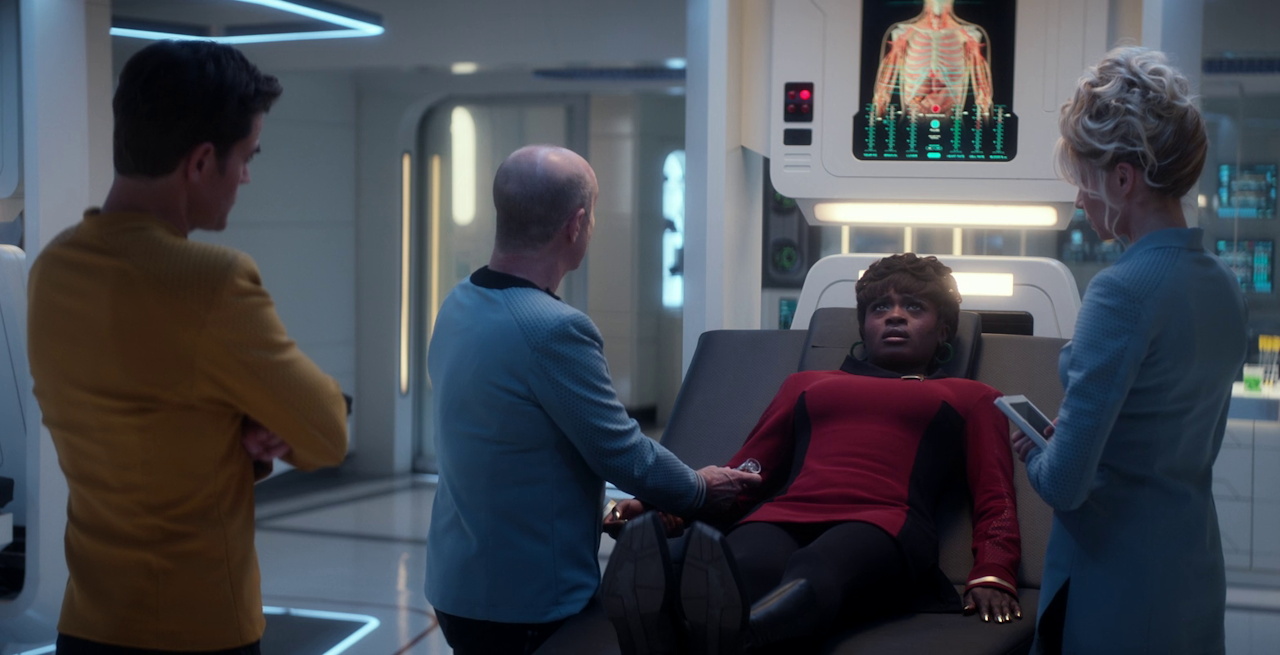
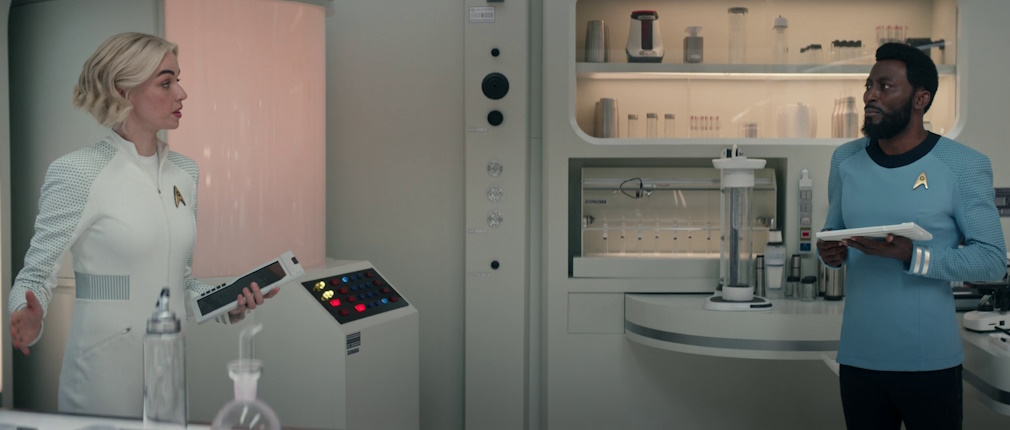
Still frame from Star Trek SNW 4x10 showing Kirk, Uhura, Dr Boyce, and Chapel at a bio-bed in sickbay
Uhura is being treated by Dr Boyce.

Last season, I said that the episode The Sehlat Who Ate Its Tail felt like a “backdoor pilot;” a pitch that the show’s producers and writers were making for their Year One spin-off idea, which would’ve focused on Kirk’s early days in command. That concept, by the way, is clearly not going ahead – something we’ve known for a while, but that was hammered home when the Strange New Worlds sets were torn down earlier this year. But that’s beside the point!

Tomorrow’s Enterprise – large chunks of it, anyway – felt like a second “backdoor pilot,” or, I guess… a “backdoor episode two?” That was *definitely* the sense I got from seeing Kirk in command, Ortegas, La’an, Una, and Dr M’Benga either gone or in the process of leaving, and the crew in that “transitional” state. I’m not sure that a time travel story like this was the best way to show off the potential in Year One as a spin-off, but I can absolutely feel the producers’ intentions in the way that side of the story was structured.

If you want to check out my thoughts on Year One in more detail, click or tap here. It’s a bit of a moot point now that the spin-off definitely ain’t happening… but it’s an interesting thought experiment nevertheless.
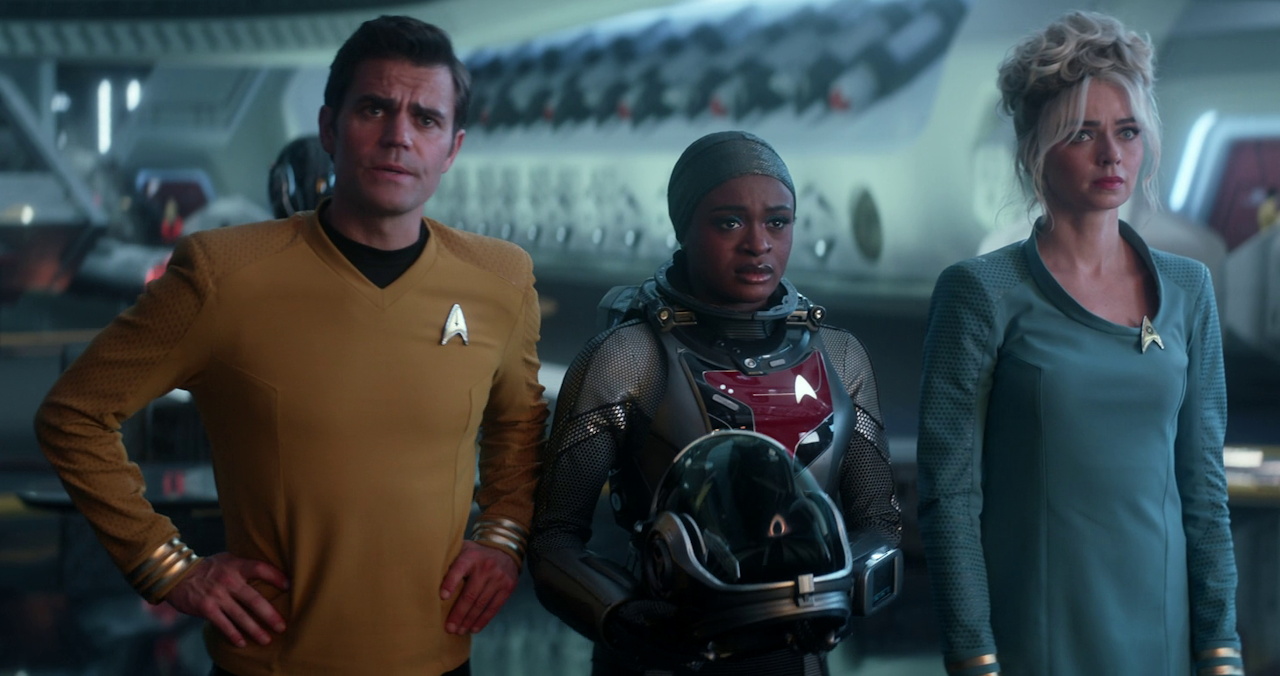
Still frame from Star Trek SNW 4x10 showing Kirk, Uhura, and Chapel in the shuttlebay
Did this feel like another “backdoor pilot” to anyone else?

However, dedicating so much time to two backdoor pilots – as well as other episodes and storylines that expanded upon or fleshed out TOS characters – has meant that we’ve spent less time with not only the show’s original creations, but also Captain Pike, Una, and Dr M’Benga, too. And Season 4 has massively accelerated that trend, with really only a couple of episodes where either Pike or one of the other non-TOS characters were front-and-centre.

Again, we’ll get into that in more detail on another occasion, but I think it’s worth keeping it in mind. As strong and as fun as Tomorrow’s Enterprise was, it came at the end of a season where not only the likes of Spock, Kirk, Scotty, and Chapel have all had major storylines and roles, but where Uhura herself got such an impressive spotlight just a couple of weeks ago that I literally said: “even if we never get to spend another second with Uhura (and I certainly hope and expect that we will, by the way!) we can now consider her character growth and prequel arc to be complete.”

That *is not* to call Uhura’s starring role this time in any way “repetitive!” It was nothing of the sort. But it is interesting – and a tad disappointing, I’m afraid – to see this trend in favour of TOS characters growing in strength as the series reaches its premature conclusion.
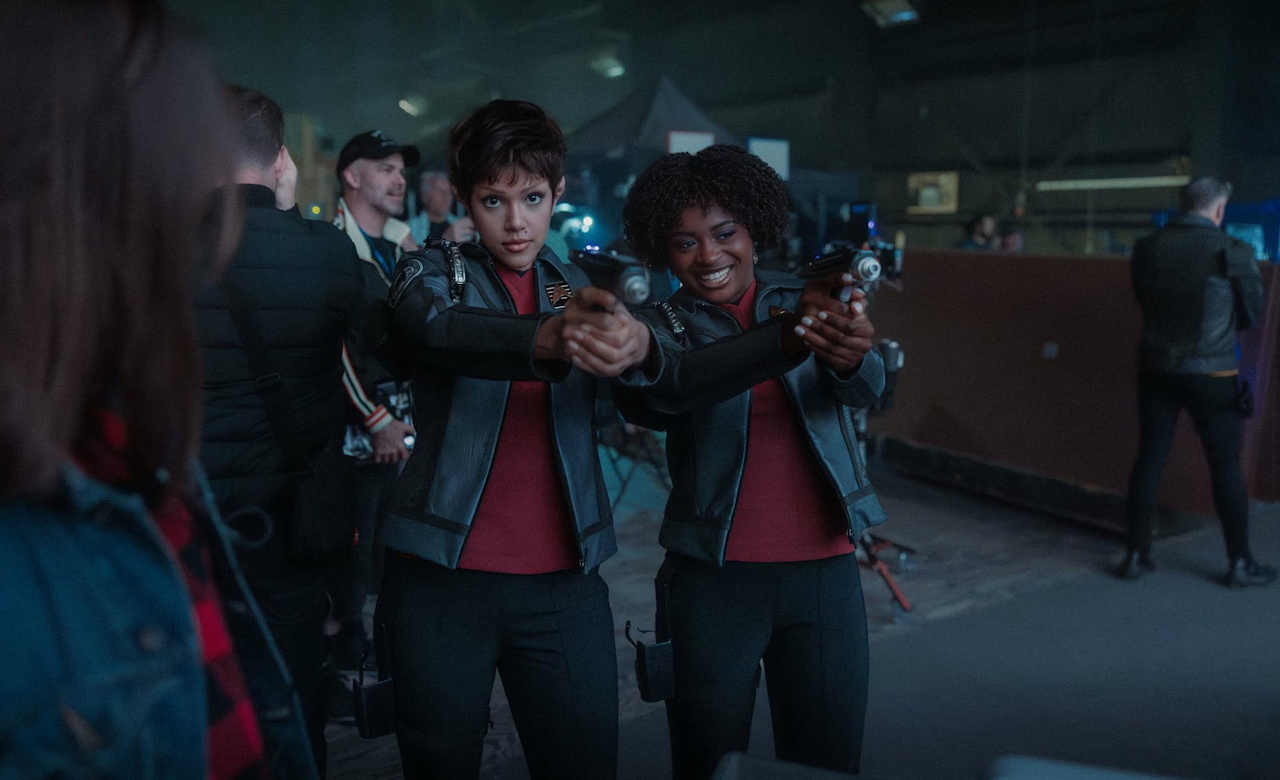
Behind-the-scenes photo from Star Trek SNW 4x08 showing Bianca Nugara and Celia Rose Gooding on set
Behind-the-scenes on the set of Orders of Magnitude with Celia Rose Gooding (R) and co-star Bianca Nugara.

In the episode Off-Hour, I said that Dr M’Benga was a strange choice of character for the story to place in mortal peril. Why? Because, as a recurring character from The Original Series – set years later – we know that Dr M’Benga is effectively “unkillable” in Strange New Worlds.

And I felt *exactly* the same way with this side of Scotty’s storyline this week.

I know that there was the relationship drama stuff between Uhura and Scotty that was meant to add an extra dimension to Uhura’s quest to save his life. We can argue the toss about how well that was set up, how much chemistry the characters and performers had, and whether it treads on the toes of “canon,” if you like, but I want to posit a much more fundamental point: Scotty was a stupid choice for this role in the story. Because he’s a TOS character – and a major one, at that – there was no way Scotty could be in real danger in Tomorrow’s Enterprise, and for me, at least, that put a serious dampener on how intense, emotional, and dramatic this otherwise well-scripted and beautifully-performed story was.
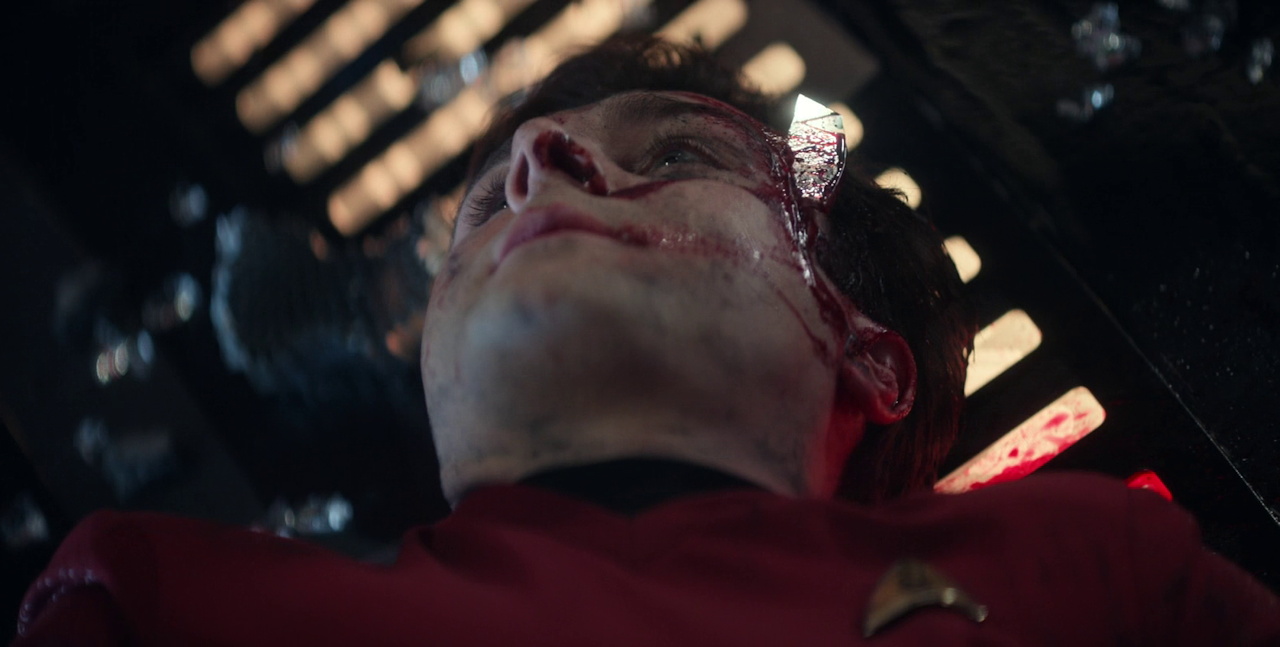
Still frame from Star Trek SNW 4x10 showing Scotty dead
Though I get why Tomorrow’s Enterprise put Scotty into this role, he wasn’t the best choice of character to endanger.

Breaking apart the two aspects of the story could’ve seen Uhura learning to “embrace the now” and say yes to Scotty’s advances while *also* actually saving the life of an unrelated character – a character like Ortegas or Una, perhaps, who genuinely would’ve felt like they were in danger. Or if (as I’ve repeatedly theorised) a character like La’an may not make it all the way to the end of the show… that could’ve been a final twist of the knife in a story like this one. Maybe the two Uhuras were able to successfully deliver the “space baby”… but couldn’t save La’an.

This is a trend we’ve seen this season. Strange New Worlds’ writers seem to be doubling-down on making the exact same mistakes in multiple episodes, and it leaves me more than a little anxious that the fifth and final season will have similar issues. Without being able to learn and take on board feedback (because Seasons 4 and 5 were in production before Season 3 even finished airing), there hasn’t been time for the production team to properly take stock of what worked… and what didn’t. As a result, we’ve seen several mistakes repeated, almost beat-for-beat, in multiple episodes… and this one – placing a functionally immortal character in danger of “death” – is just the latest example.
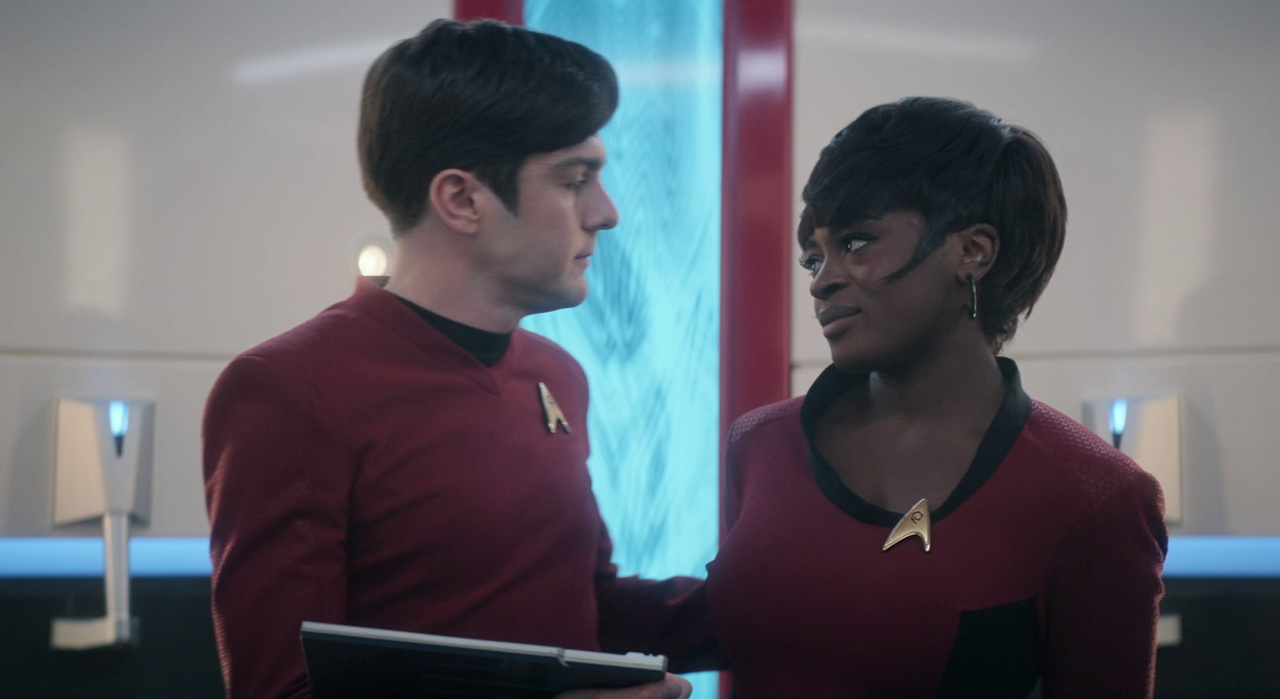
Still frame from Star Trek SNW 4x10 showing Scotty and Uhura in the turbolift
Scotty with Uhura.

And because this story could have worked just as easily if it were another character in danger… it just doesn’t make a lot of sense to me. Sure, Uhura and Scotty had their (brand-new for this episode) romantic sub-plot, and that *did* add to the tension when Uhura felt he was in danger of death. And I will also say that, in any work of fiction, the way the characters in a story respond to events can still be impactful even if we as the audience know something they don’t – like, in this case, that Scotty will definitely survive.

I don’t want to take away from Celia Rose Gooding’s excellent performance – taking on, really, two very challenging related roles!

But at the same time, because we know Scotty’s going to survive, *and* because this whole romance angle was completely new (and seemed to come from nowhere), there was a way to tell a very similar story without the prequel constraint. And if this was a one-off, maybe I’d feel a bit more lenient. But because Strange New Worlds literally made this exact same mistake just a few weeks ago with Dr M’Benga… well, unfortunately I think it needs to be pointed out.
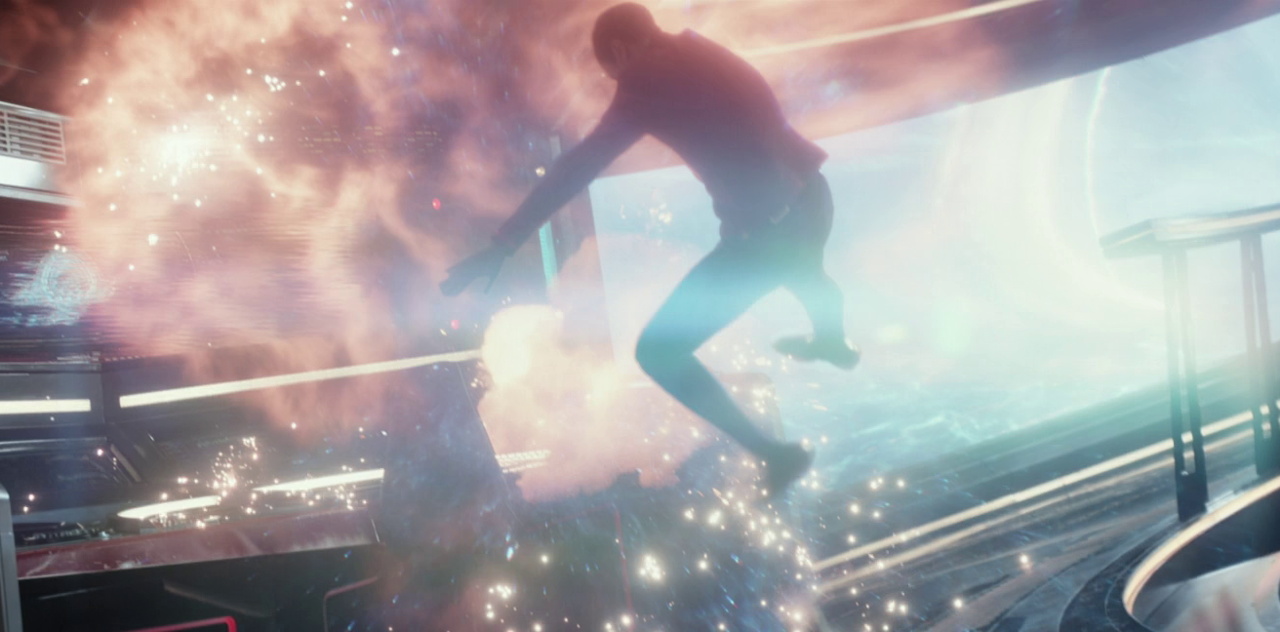
Still frame from Star Trek SNW 4x10 showing Scotty in an explosion
Kaboom!

Sometimes – especially this season – I’ve felt like some of the writers don’t seem to remember that they’re working on *a prequel* with the way certain character decisions were handled. Other times, of course, they’re almost *too* aware of that fact – and choose to place TOS characters into major roles! But with these Scotty and M’Benga storylines, and the way they repeat a simple mistake… I can’t help but feel someone, at some point in the production process, could’ve raised the red flag.

It didn’t “ruin” the episode, of course – and the way Uhura and other characters reacted to Scotty’s death did still stick the landing. But for me, as a long-time Trekkie watching the latest episode, the plain and simple fact that Scotty was always going to survive was inescapable, and it makes me wonder why another character wasn’t chosen for this “danger of death” story. Even if the outcome was beat-for-beat the same, it could’ve been a more engaging and entertaining ride if – on that first viewing, at least – we weren’t 100% sure if they were going to survive.
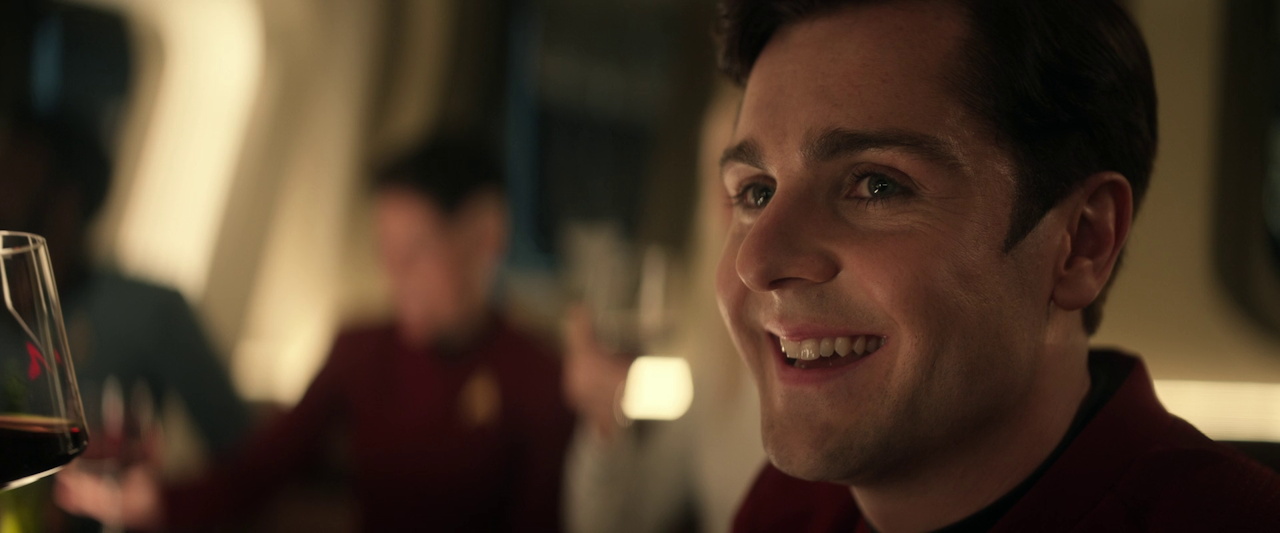
Still frame from Star Trek SNW 4x10 showing Scotty
Scotty at the end of the episode.

Sticking with the theme of characters surviving… what do we make of Kirk’s hesitation when asked about La’an? It felt too intense to be a simple misdirection on the part of the production team, didn’t it? But then again, given that La’an and Kirk might be on the verge of some kind of romantic relationship, Kirk could just as easily be upset about a bad breakup… so I guess there’s wiggle-room there, depending on what you want to believe! But either way, Season 5 owes us an answer as to why Kirk was so reluctant to talk about La’an.

I’ve said this before, but La’an remains at the very tippy-top of my “death watch” list ahead of Season 5. She may have survived the events of this episode, but the whole “latent augment DNA” angle that Season 4 introduced, as well as her absence from the Enterprise after Kirk assumes command, all lead me to believe that she may not be long for this world – and Kirk’s refusal to talk about that with a time-travelling Uhura *really* seemed to hammer that home. It could still be a red herring, of course, and I don’t *want* La’an (or any other main character) to be killed off! But I think at least one of the show’s original creations won’t survive past Season 5, and right now, if I had to guess? It would still be La’an.
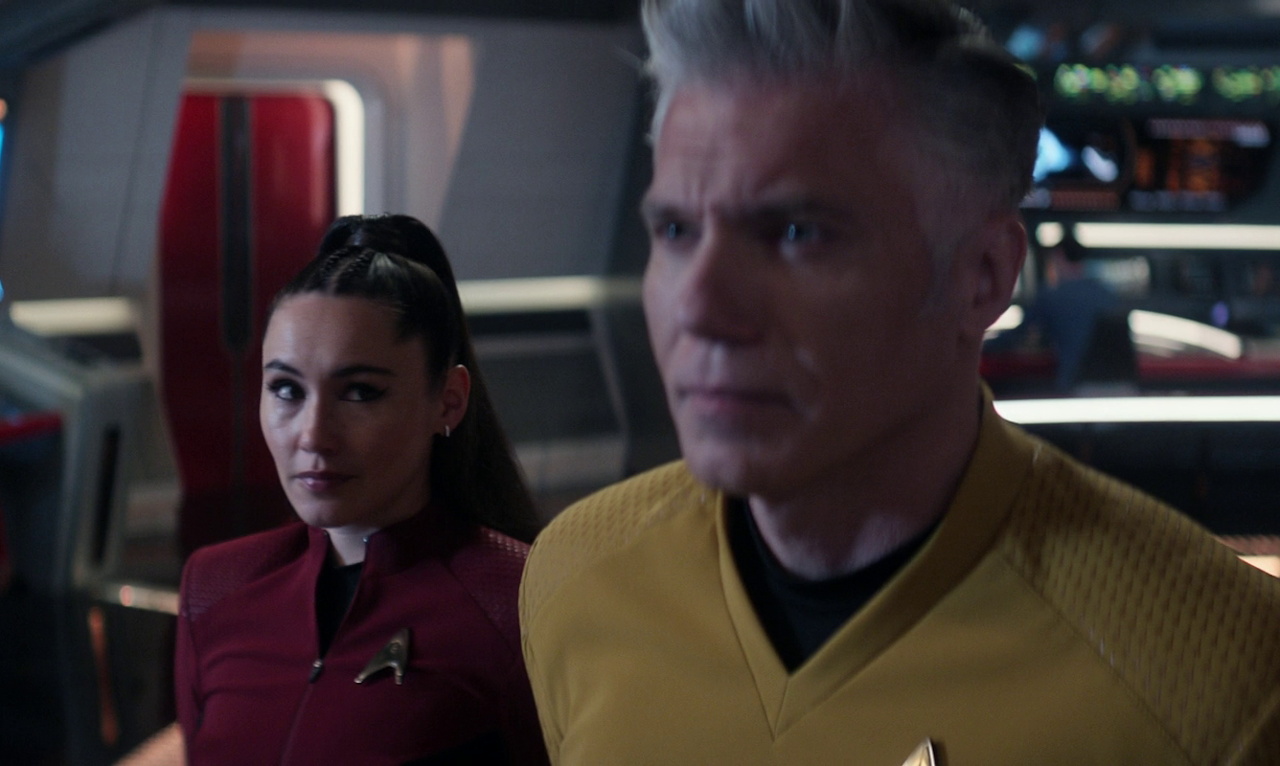
Still frame from Star Trek SNW 4x10 showing Pike and La'an
Do we reckon La’an survives to the end of Season 5?

Tomorrow’s Enterprise is now the *third* episode of Season 4 in which the events we see on screen either didn’t happen at all or aren’t going to be remembered by most of the characters involved. We had the irredeemably awful writing failure of “but it was all just a dream” in Level-Five Transporter Accident, then Trelane’s meddling in Like Chronitons Through the Hourglass, and now it turns out that only Uhura will remember what transpired – and several key events were literally undone – in Tomorrow’s Enterprise.

As I said above: the show is doubling- and tripling-down on some… odd choices.

This week’s episode is so much stronger than those other two examples that it almost feels unkind to compare it to them! But I think it’s worth pointing out, as we consider how this episode fits in with the rest of the series, that we’re now at three out of ten episodes – just within Season 4 – where events we saw as the audience either didn’t happen at all or aren’t going to be remembered by most of the characters. I’d *happily* erase both Level-Five Writing Accident and Like Chronitons Through the Hourglass, and I think if neither of those episodes had existed, this aspect of Tomorrow’s Enterprise would be a complete non-issue. But coming at the end of a season where two other episodes have had stories that won’t actually be remembered by the characters involved (or just outright didn’t happen)? It’s another place where I feel the series repeating itself, at the very least.
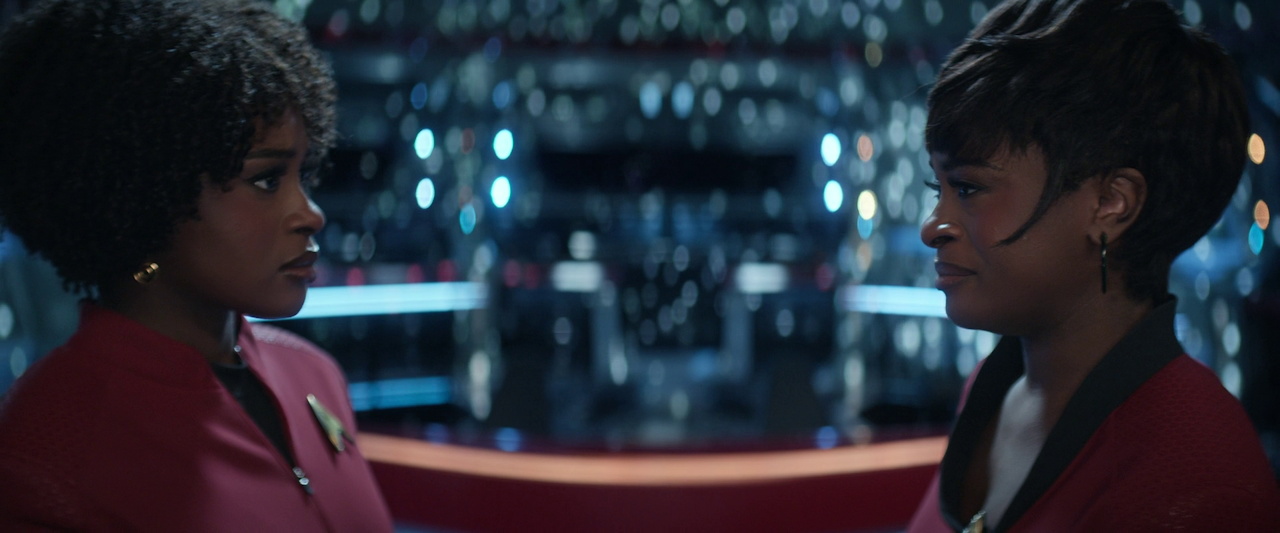
Still frame from Star Trek SNW 4x10 showing two Uhuras
For everyone except Uhura… none of these events happened.

Tomorrow’s Enterprise went out of its way to really lean into TOS’ 1960s style for all of its time-shifted characters, and I really enjoyed the way they looked. Hairstyles changed – very obviously for the likes of Chapel and Uhura, but subtly for the likes of Scotty, too – and we saw uniforms directly inspired by The Original Series, too. It was great to see Strange New Worlds embracing the idea that fashion and hairstyles can change over time – just like they do in the real world – and make an attempt to bridge the gap between this series and TOS in a way that felt natural.

One of the silliest criticisms of Discovery, when that show was announced, was how “out-of-place” it looked, from a visual standpoint, compared to TOS. And I would guess some folks will have said the same about Strange New Worlds, too. But for me, I was really never bothered by the aesthetic changes, and I don’t think it’s a stretch to say that things like fashion, hairstyles, uniforms, and so on change and evolve over time. The fashion of the ’70s was very different from that of the ’80s – at least here in the west – and even if we don’t notice at the time, because things just look “modern” or “normal,” trends stick out like a sore thumb after some time has passed! I just don’t think it’s much of an issue at all to say that similar trends and changes take place within the Star Trek galaxy, and I appreciate Strange New Worlds acknowledging and leaning into that idea.
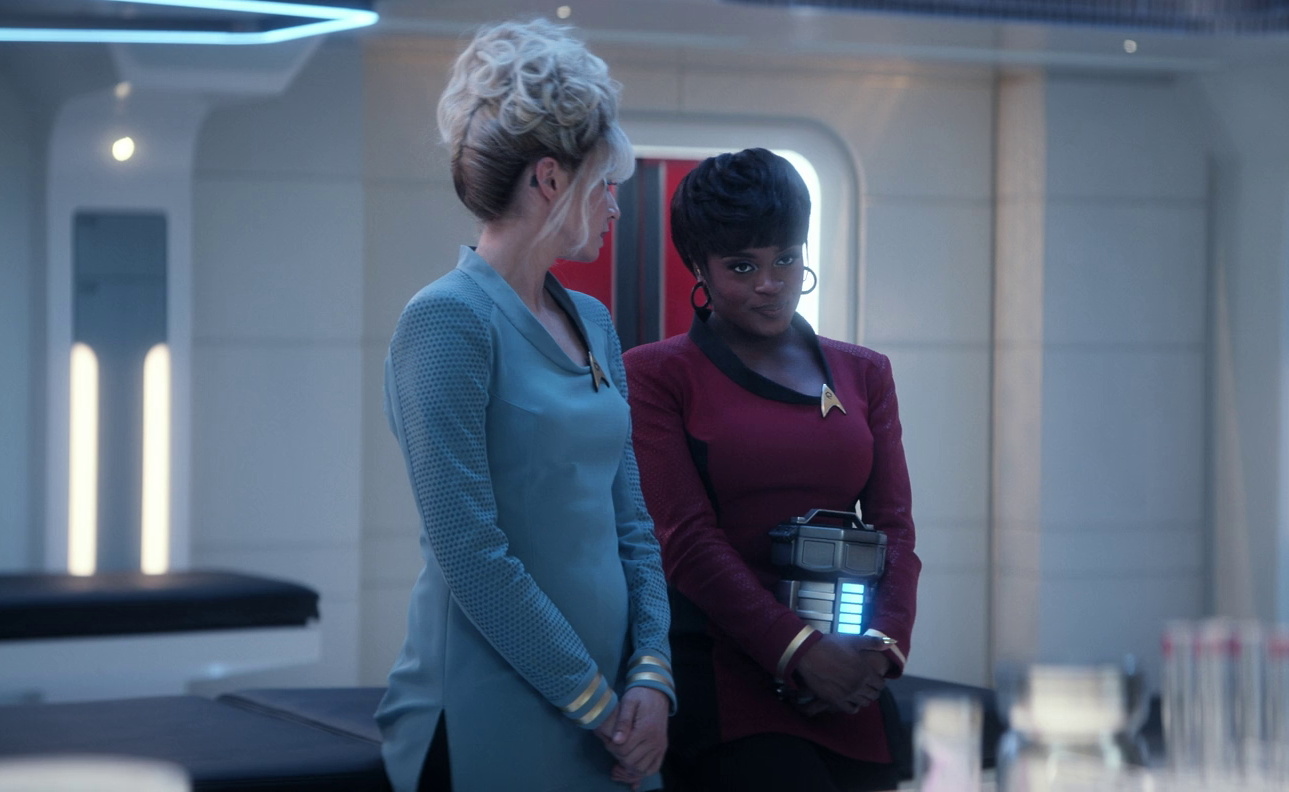
Still frame from Star Trek SNW 4x10 showing Chapel with Uhura
There were some great costumes (and hairstyles) in this week’s episode.

I would extend that compliment to the performances, too. Martin Quinn, Celia Rose Gooding, Ethan Peck, Paul Wesley, and Jess Bush all honed or refined their performances to draw even more heavily on the original incarnations of their characters – and it really showed.

Paul Wesley has been great as Kirk, and I wouldn’t have said his performance really needed much alteration. But in Tomorrow’s Enterprise, I really felt that Wesley was leaning even more on William Shatner’s original (and iconic) portrayal to take his version of the character even closer to that TOS presentation. The same was true of Martin Quinn with Scotty; you could see the way he stood, the way he held himself, and how he was almost channelling his inner James Doohan! Celia Rose Gooding had the most time on screen (and we’ll talk about her split role with both Uhuras in a moment), but she was also excellent. Jess Bush also worked hard to bring Chapel even closer to the way she felt in TOS, as did Ethan Peck with his short scenes as Spock.
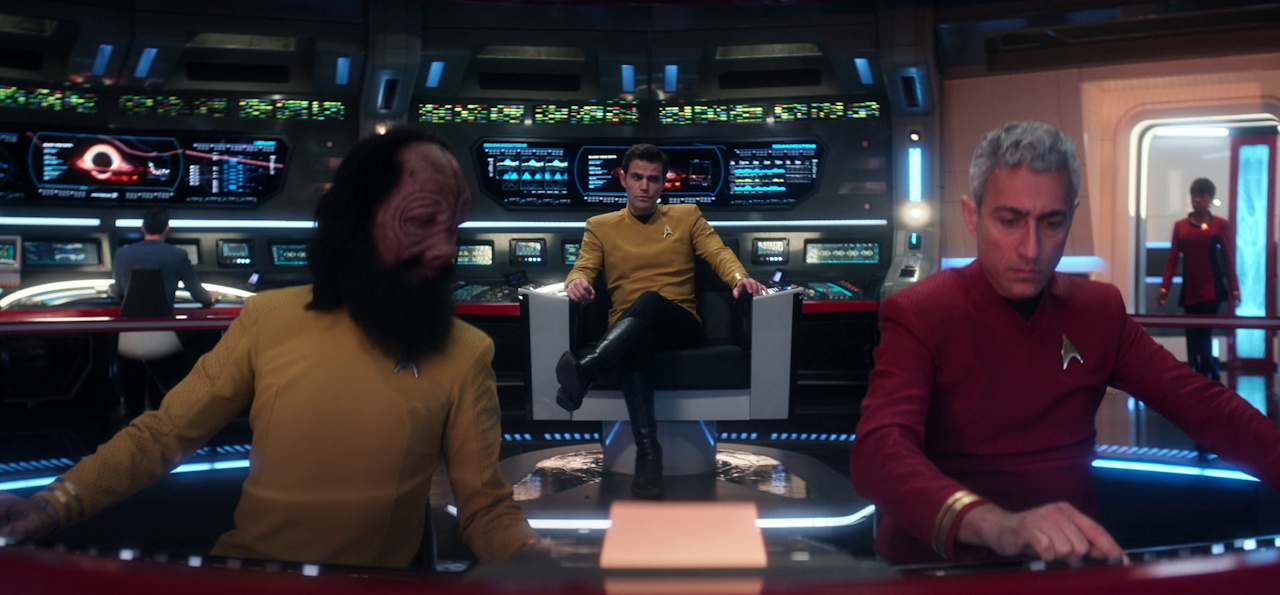
Still frame from Star Trek SNW 4x10 showing Kirk in command on the bridge
Kirk in command.

Tomorrow’s Enterprise also had a great score – which, again, felt like a bit of a throwback to TOS in some places. In fact, I half-expected to hear the familiar ending theme from The Original Series when the episode’s credits rolled! There was still a modern edge to some of the music; I don’t mean to say that it was identical to something you’d have heard in the ’60s. But, more so than any other Strange New Worlds episode, at least this season, it felt more “classic,” more of a throwback. And I really liked that.

The visual effect of the black hole (and the “white hole” on the other side) was solid. We’ve seen black holes using this Interstellar-inspired look in modern Star Trek before, so in that sense it wasn’t unique, and it wasn’t as stunning or spectacular as if it were brand-new. But as the episode’s main CGI creations, it was important to get the black and white holes looking right – and I’m happy to say that they looked great.
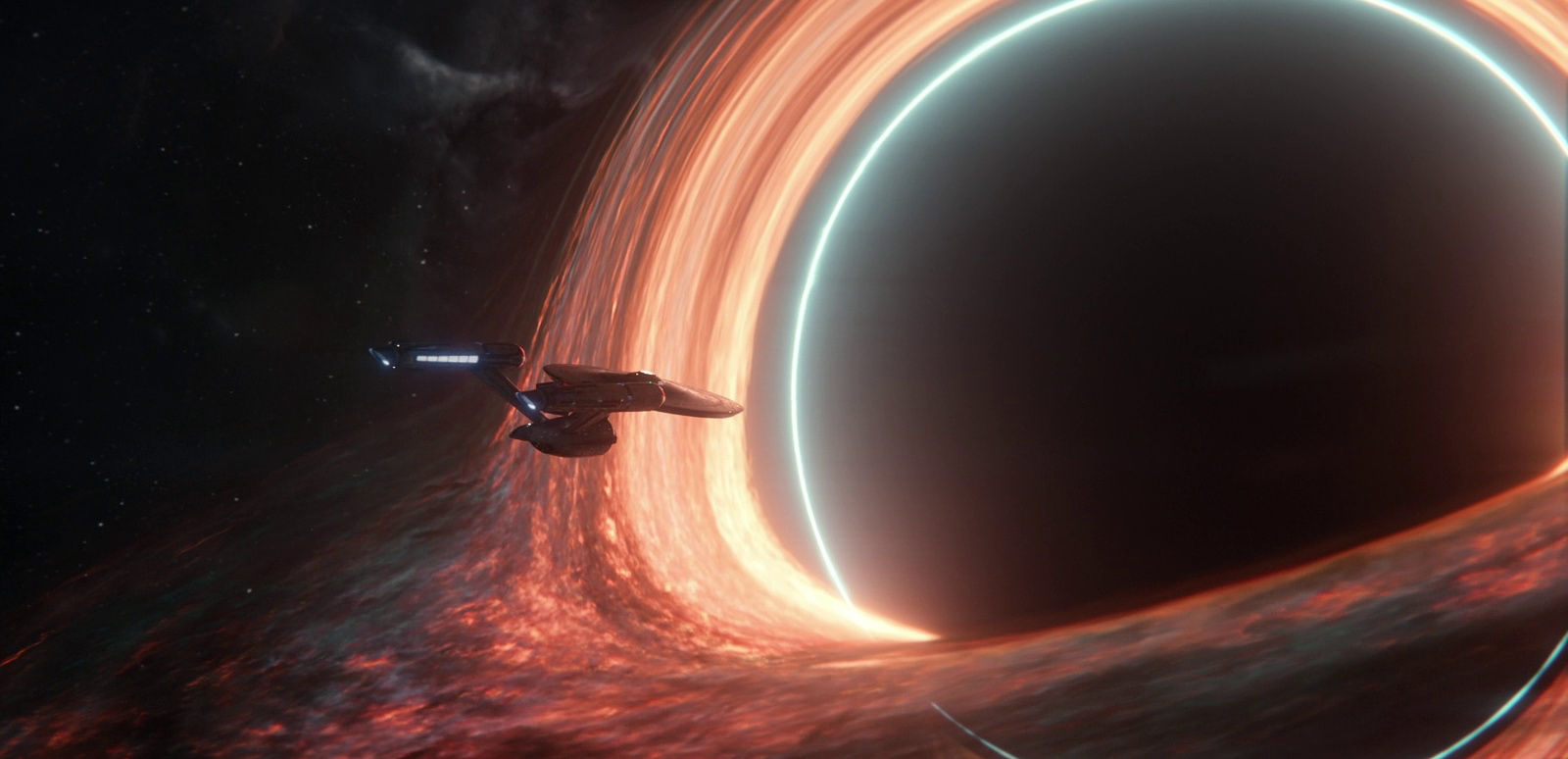
Still frame from Star Trek SNW 4x10 showing the USS Enterprise and a black hole
The black hole.

After a couple of places earlier in the season where I felt the AR wall hadn’t been used especially well, I also want to credit Tomorrow’s Enterprise for its well-constructed shuttlebay set. The AR wall worked really well as part of this set, and the shuttlebay felt as large and expansive a space as it needed to. The shuttlebay isn’t always going to be an area where we’ll spend a ton of time, but it’s important that it should feel large enough for its purpose, and I liked the way it came across this week.

There were also some creative physical props and costumes: did you notice Aleek-Om and M’Ress? I *adored* the way they looked, and while it’s not officially confirmed that the Caitian and Aurelian we glimpsed in the episode are the characters from The Animated Series… I mean, they were clearly meant to be, right? I always love seeing Caitians in live-action, so to catch a glimpse of M’Ress was just really neat.
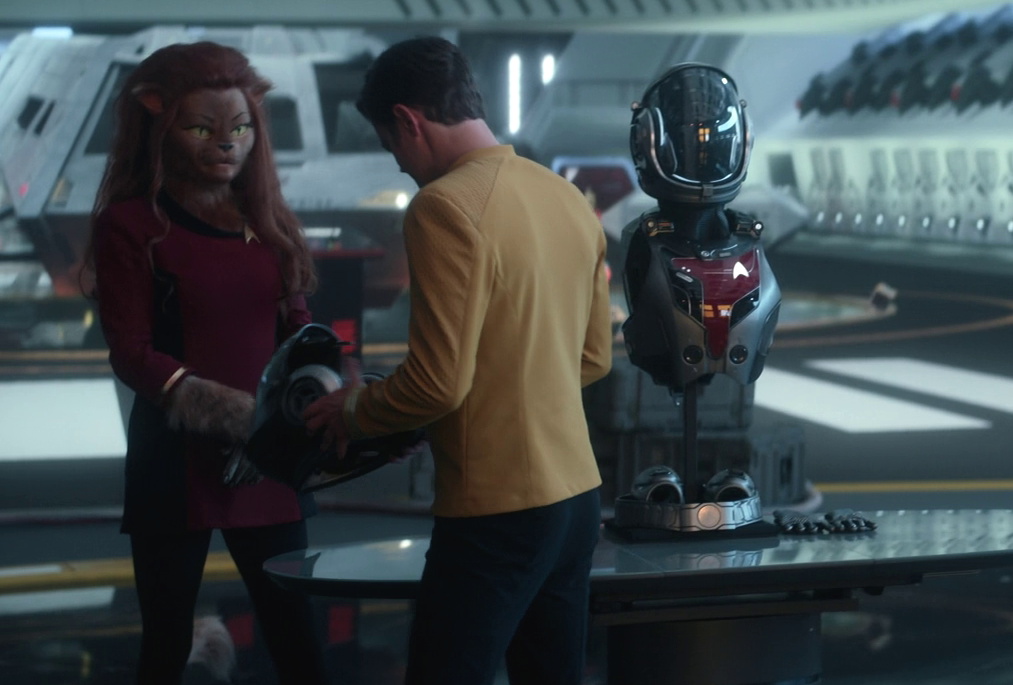
Still frame from Star Trek SNW 4x10 showing Kirk with a Caitian officer (maybe M'Ress?)
Kirk with a character I assume is M’Ress.

Sticking with cameos: did you hear Kirk mention Gary Mitchell? Mitchell was a character from the episode Where No Man Has Gone Before, which showed his transformation into a powerful entity after an encounter out in space. It was neat to get a mention of Gary Mitchell, of course, but what was even more fun was how he was connected to Jenna Mitchell – a new character created for Strange New Worlds and who we’ve seen on the bridge a few times in earlier seasons.

Cameos like these go a long way to helping Star Trek feel like a cohesive, connected setting – and while modern Star Trek hasn’t always done a good job with that, I can appreciate the effort being made here to connect Strange New Worlds to The Original Series, The Animated Series, and the TOS movies. These felt like little “Easter eggs” for long-time Trekkies like us, and even if it might’ve been fun to get a whole episode focused on Caitian or Aurelian characters, I enjoyed the cameos for what they were.
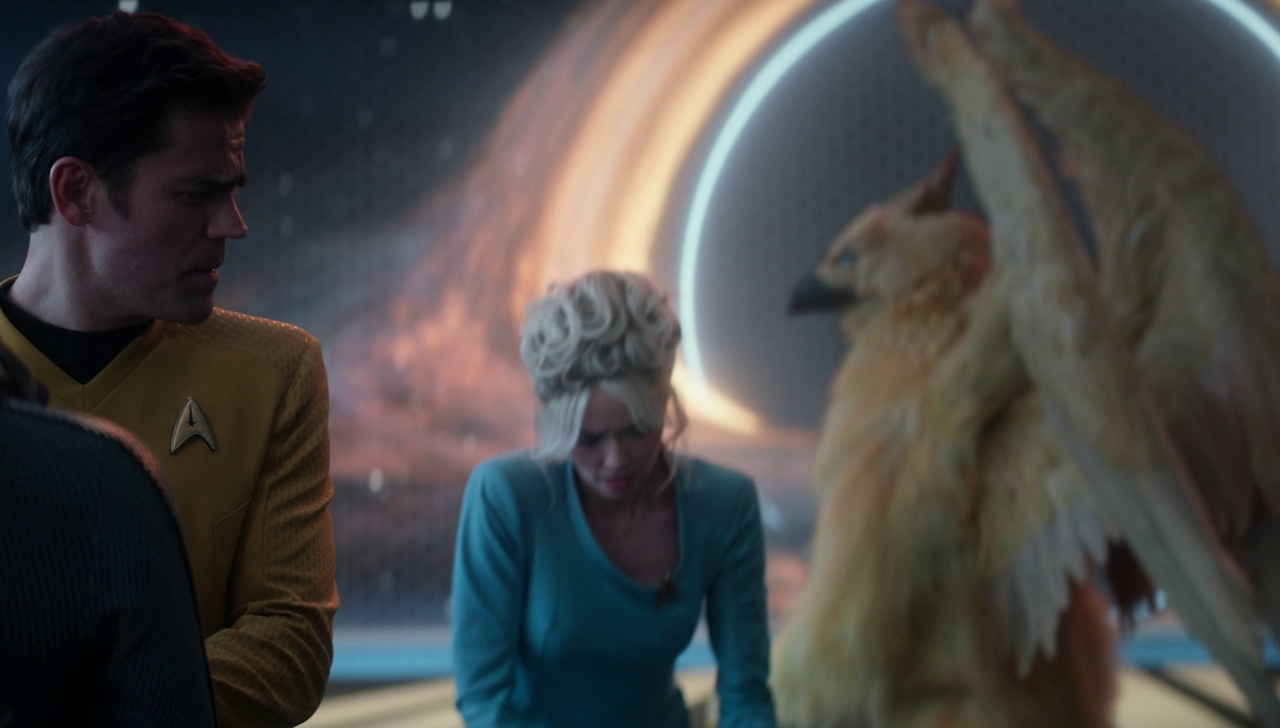
Still frame from Star Trek SNW 4x10 showing Kirk, Chapel, and an Aurelien (maybe Aleek-Om?)
This winged character is an Aurelien – perhaps Aleek-Om.

Did you feel echoes of The Next Generation’s finale, All Good Things, in the way that time seemed to flow “backwards” between the black and white holes? Because I certainly did!

Now, the two storylines are not really comparable in lots of other ways – and I really liked the idea of Uhura in the past setting up things that Uhura in the future would be able to use. We saw this with the dilithium diamond, Spock’s equation, and the mural recording the music. That was an incredibly creative way for a time travel/temporal paradox story to use its key narrative feature in a way that made sense – and in a way that most Star Trek stories dealing with similar ideas have never really done.

In All Good Things, to pick on that as an example, Picard was able to move between three different time periods, but actions he took in one seemed to have no effect on the other two. And in Past Tense, from Deep Space Nine’s third season, actions in the past *did* have a negative impact on the future, but not for our main characters. These differences help Tomorrow’s Enterprise stand apart even from superficially similar time travel stories – which is fantastic!
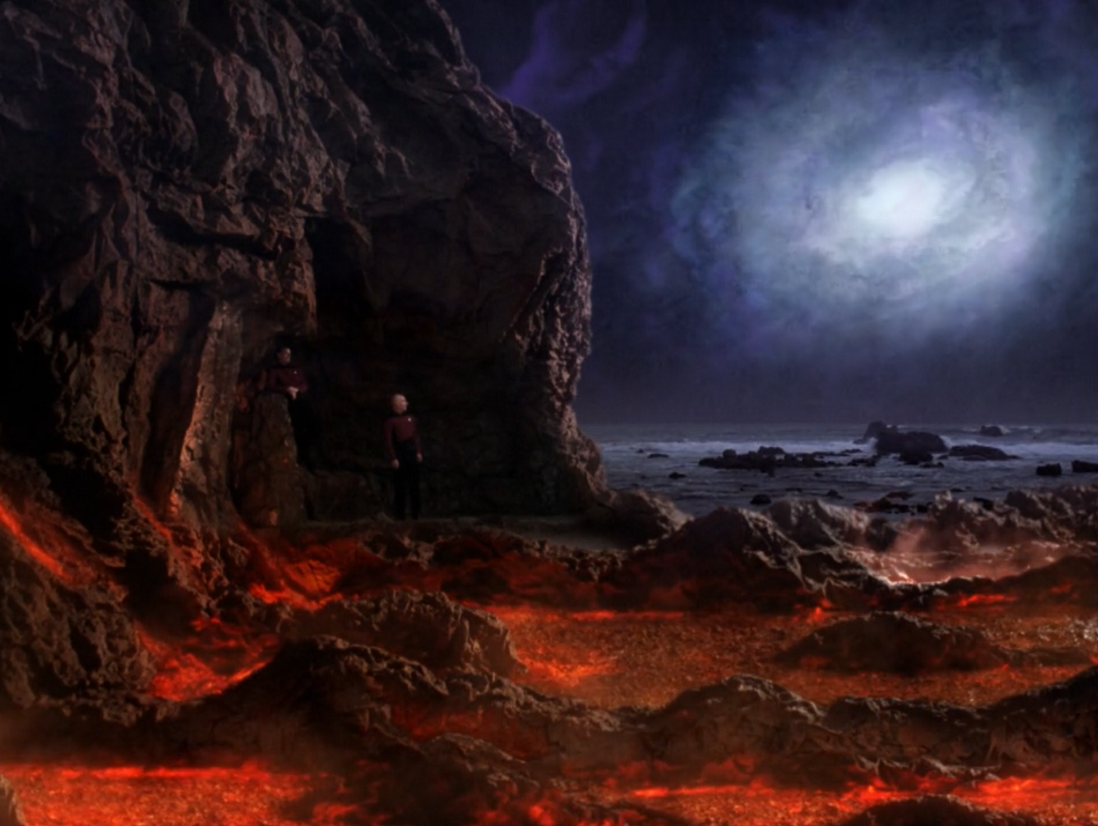
Still frame from Star Trek TNG All Good Things showing anti-time in the past
All Good Things’ anti-time eruption.

It was also a really creative idea to have one character split into two time periods, having to solve this puzzle from both ends. The way that time travel was integral to solving the mystery was handled just brilliantly, with Uhura from the future guiding her past self, and eventually setting up important things that would pay off a year later. But more than that, we got two different takes on Uhura – one that was, perhaps, a tad regressive and closer to her presentation in earlier seasons, and one that was very definitely trying to lean into the calm confidence of Nichelle Nichols’ character from TOS.

Last week, I talked about how Christina Chong took on a complex acting challenge – playing two different roles that had to come together. And Celia Rose Gooding stepped up to the plate this time to do something similar. Playing a younger version of a beloved character in a prequel is *already* a tough ask, so having to take on a version of Uhura who’s even closer to that familiar TOS presentation is even more of a challenge.

And Celia Rose Gooding nailed it.
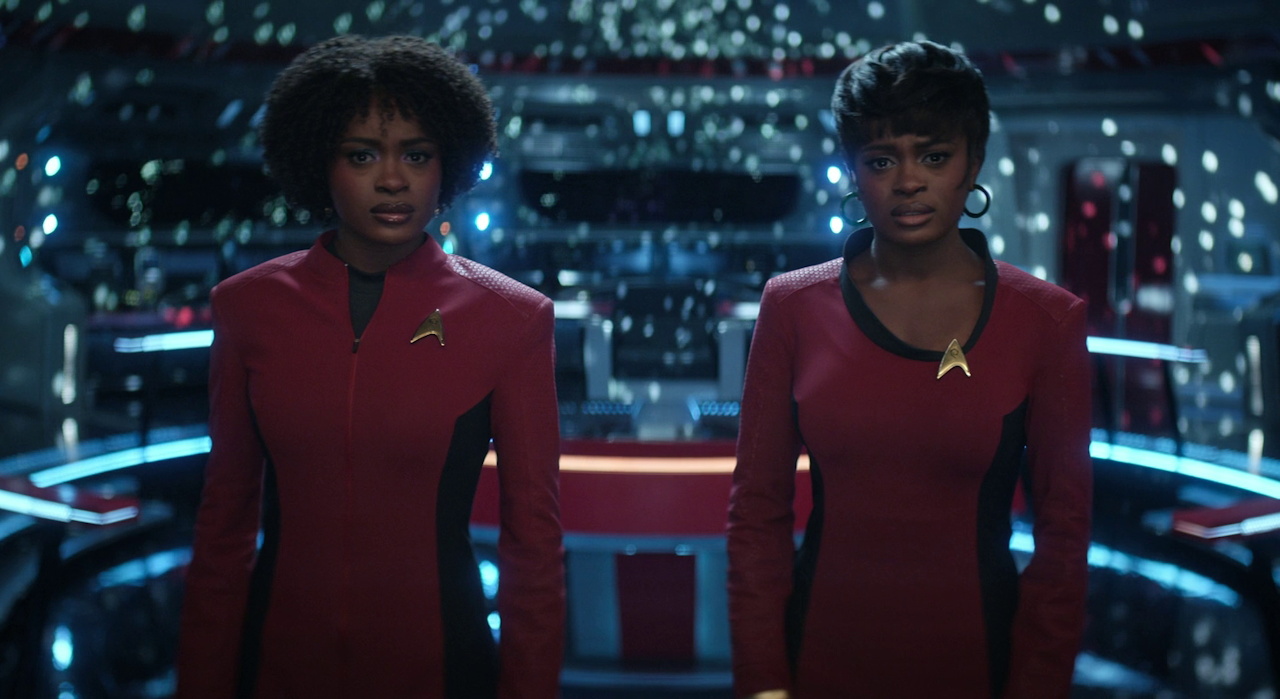
Still frame from Star Trek SNW 4x10 showing two Uhuras
A pair of Uhuras.

There’s a line to walk when differentiating two versions of the same character, and I don’t just mean costuming and hairstyles – though those did serve as important visual cues for us as the audience. In order to buy into the fact that one Uhura was older than the other, Tomorrow’s Enterprise played up – and, perhaps just a tad, exaggerated – these differences, and it worked well most of the time.

The only thing I’d say about that is that I felt maybe there was a bit more than just one single year’s worth of changes in between past and future Uhura. These were balanced between the two characters about as well as possible – with the younger version seeming to take a step back to become less secure and confident, and the older version becoming even more mature – which was a good call. And in a single episode of television, I think asking for too much subtlety would’ve lost something important; if both characters felt functionally the same, a big part of the episode’s core would’ve been lost.

But if Tomorrow’s Enterprise had been set, say, three years into the future instead of just one? Maybe it would’ve worked just a bit better!
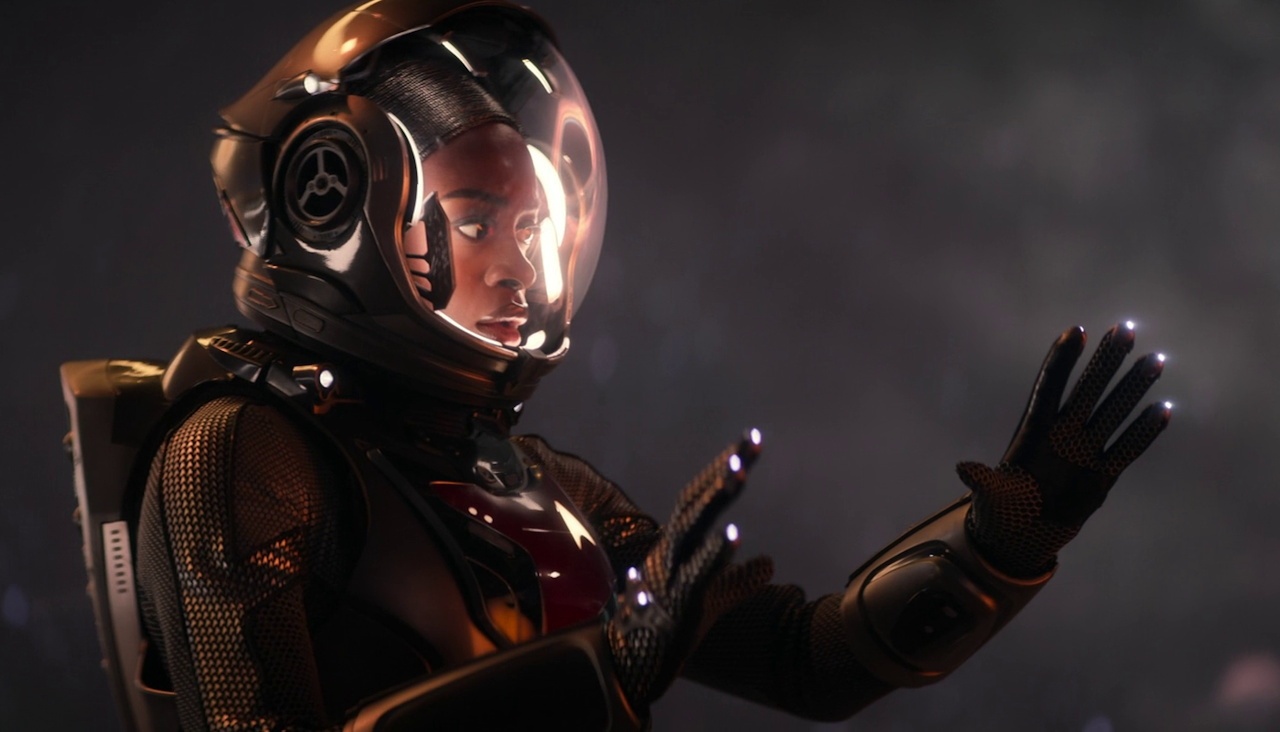
Still frame from Star Trek SNW 4x10 showing Uhura in an EV/space suit
Uhura jumped approximately one year into the future.

A longer time-jump could’ve also accounted for things like Ortegas’ apparent promotion – all the way from Lieutenant up to Captain, if Spock’s statement in the transporter room was accurate. Such things have happened before, of course, and Ortegas is an instructor rather than a starship commander… but even so. It was also interesting to see that Pike had been promoted not to “Fleet Captain,” as in The Menagerie, but to the full rank of Admiral. I wonder if that’s setting up a plot point that Strange New Worlds will revisit in Season 5… or if it was just a throwaway line.

To get back to Uhura, though, I stand by what I said after Orders of Magnitude: she’s gotten by far the best and most complete prequel arc on the series, taking her from a fresh-faced, uncertain cadet in Season 1 to now the literal embodiment of Nichelle Nichols’ character as of the end of Season 4. The way Uhura was written this time was pitch-perfect, the way Celia Rose Gooding was able to amplify different parts of the characters to sell the illusion of there being two temporally-displaced Uhuras was fantastic, and at every stage, Tomorrow’s Enterprise absolutely excelled as an Uhura spotlight episode.
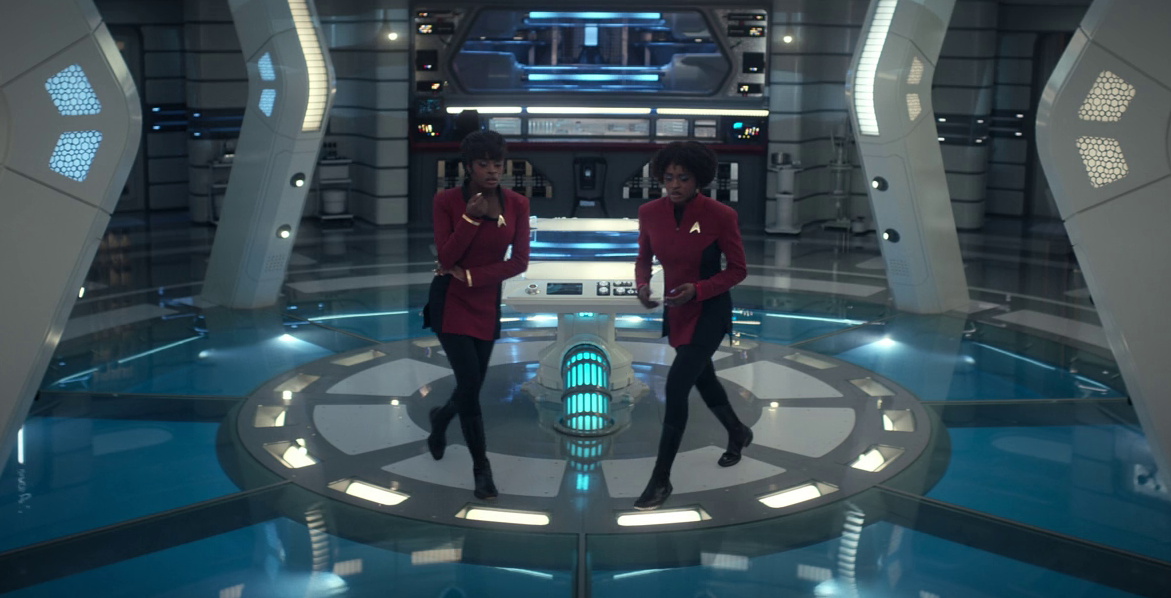
Still frame from Star Trek SNW 4x10 showing two Uhuras
We got two different – but related – takes on Uhura.

At first, I thought that Uhura was a bit of an odd choice to get a second major turn in this kind of role, coming just a couple of weeks after her excellent outing in Orders of Magnitude. But I can see the merits in putting a character like that into this kind of story – and it really did work incredibly well. Given where the episode wanted to take its time jump, with all of the TOS theming, it realistically demanded a TOS character to move between the two different eras, so Uhura was a great fit.

There was also the question of the black hole aliens’ transmission: as the Enterprise’s communications officer, Uhura was best-placed out of anyone in the crew to decipher this strange, musical message. I felt echoes of Season 1’s Children of the Comet, which had a similar musical influence, and was Uhura’s first major spotlight in Strange New Worlds, but these stories unfolded differently enough that neither treads on the toes of the other.
Promotional still from Star Trek SNW 1x03 showing Uhura
The musical side of the story reminded me of Season 1’s Children of the Comet – also an Uhura spotlight.

One thing I felt wasn’t particularly well set up was Scotty’s interest in a romantic relationship with Uhura, and her reaction to it. Obviously Scotty and Uhura have spent *some* time together over the past couple of seasons… but can you call to mind a moment between them in either Seasons 3 or 4 that might’ve so much as hinted at something like this? Because I can’t – and that put the brakes on this, at least for me.

I mean no disrespect to either Martin Quinn or Celia Rose Gooding, but I didn’t really feel much chemistry between their characters in Tomorrow’s Enterprise, either. Given that their relationship came from nowhere at the beginning of this episode, with absolutely no setup earlier in the season, we needed to feel *something* from the characters themselves to sell this. And while it wasn’t cringe-inducing or bad in any way, I just didn’t think it felt like a natural development for either of them. If anything, Scotty’s time on screen this season could’ve built up to some kind of crush on Ortegas, and Uhura, at least in Season 3, seemed to go back-and-forth a bit with Ortegas’ brother, Beto.

I just wasn’t feeling the spark, I guess, between these two established characters.
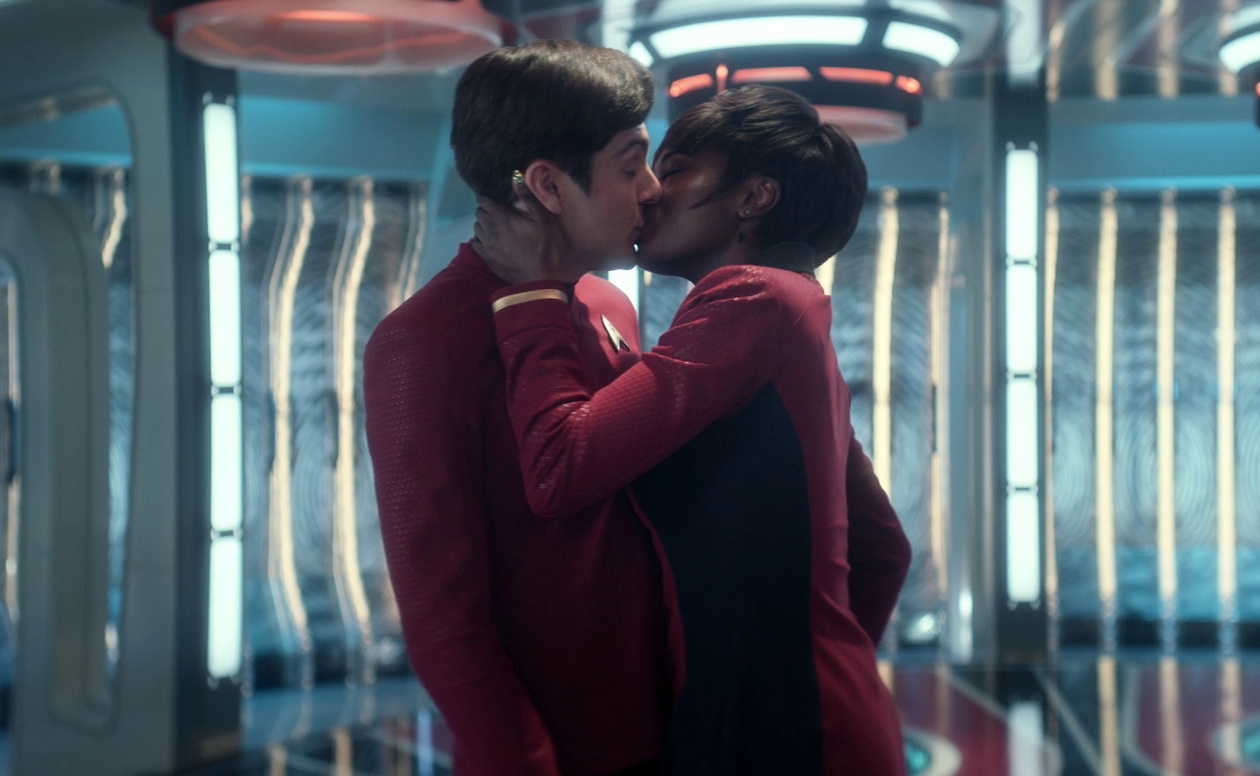
Still frame from Star Trek SNW 4x10 showing Uhura and Scotty kissing
Kissy kissy.

However, I’m not gonna argue that Uhura and Scotty having some kind of “casual” relationship or fling in the years before TOS is in any way a problem for “the integrity of canon!” All that’s required is to say that Scotty and Uhura had a moment, and that moment passed. People can get out of relationships and still remain friends or close colleagues, and I really don’t think that this is in any way a “canon-breaking” moment for either of them.

So this aspect of the story served a narrative function insofar as it gave Uhura more of a reason to want to save Scotty. Did Uhura need that extra motivation? Personally, I’d say “no,” and given that these two characters didn’t actually have much on-screen chemistry, *and* the aforementioned “prequel problem” meaning that Scotty never actually managed to feel like he was in real danger… I could’ve lived without it. Or, at the very least, I might’ve preferred it if the relationship stuff was limited to Uhura learning the key lesson of her arc: that sometimes it’s okay to “live in the now.”
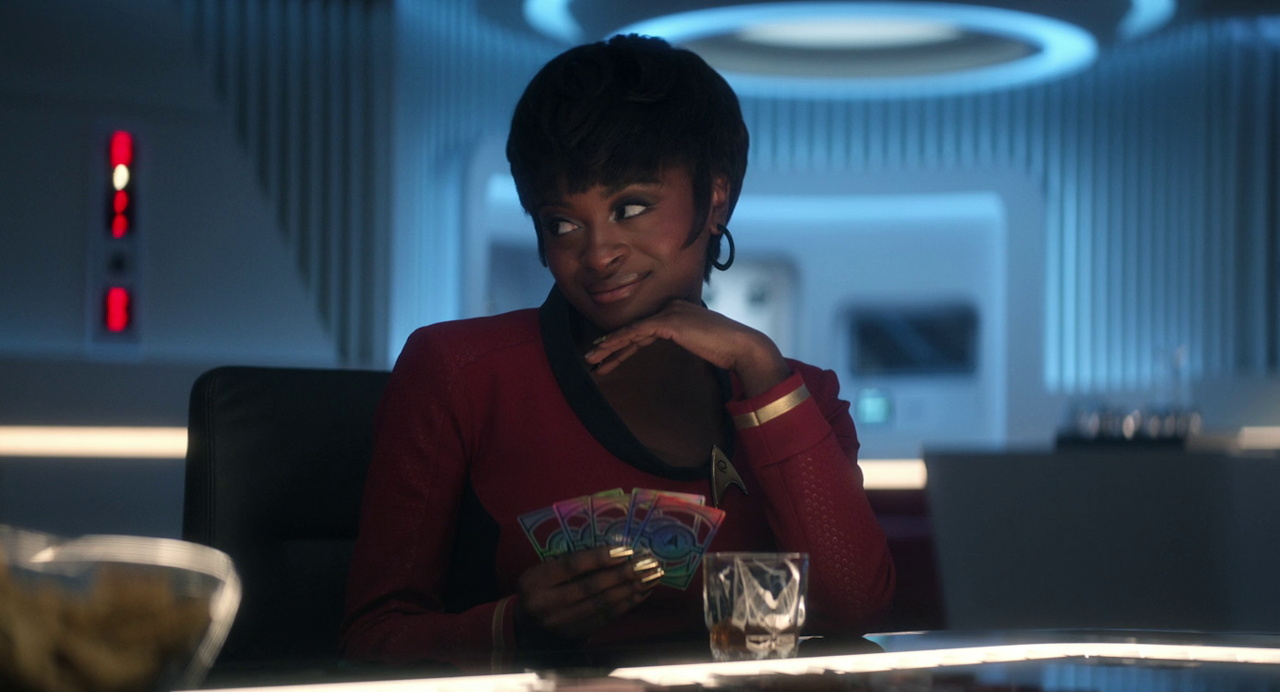
Still frame from Star Trek SNW 4x10 showing Uhura playing poker
Uhura playing poker at the end of the episode.

Uhura got moments with Kirk and Chapel that I really enjoyed, as well as her future counterpart’s scene with “Admiral” Pike. The mutual respect that Pike and Uhura showed for one another was played just perfectly, and despite Anson Mount not having a huge role in this week’s episode, what we got was more than enough to remind me of why I was so keen to see this “Captain Pike show” in the first place! It also felt bittersweet, as if both Pike and Uhura were saying a final goodbye to one another. In Uhura’s timeline, Pike’s accident shouldn’t have happened yet, and although he’s no longer a part of her day-to-day life… I’m not sure I understand why Uhura was treating the moment with such finality. However, from the point of view of us as the audience, looking in from outside, I think it worked really well. If Pike and Uhura don’t get another moment together before the show ends, this goodbye will still work.

La’an and Uhura haven’t (to my recollection, anyway) spent much time together across all four seasons of the show. They’ve been present at the same time in some stories, and I’m sure they’ve at least spoken to each other… but I can’t really recall a single major La’an-Uhura storyline. So I liked that we got at least one scene between them, focusing on a conversation they had, before the show wraps up. La’an gave Uhura some useful advice about time travel based on her own experiences with it in Season 2, and I liked the way La’an had to be cagey in how she referenced what happened. It wasn’t the biggest part of the episode, but it was nice to give Uhura a one-on-one moment with a character she doesn’t always get to chat with.
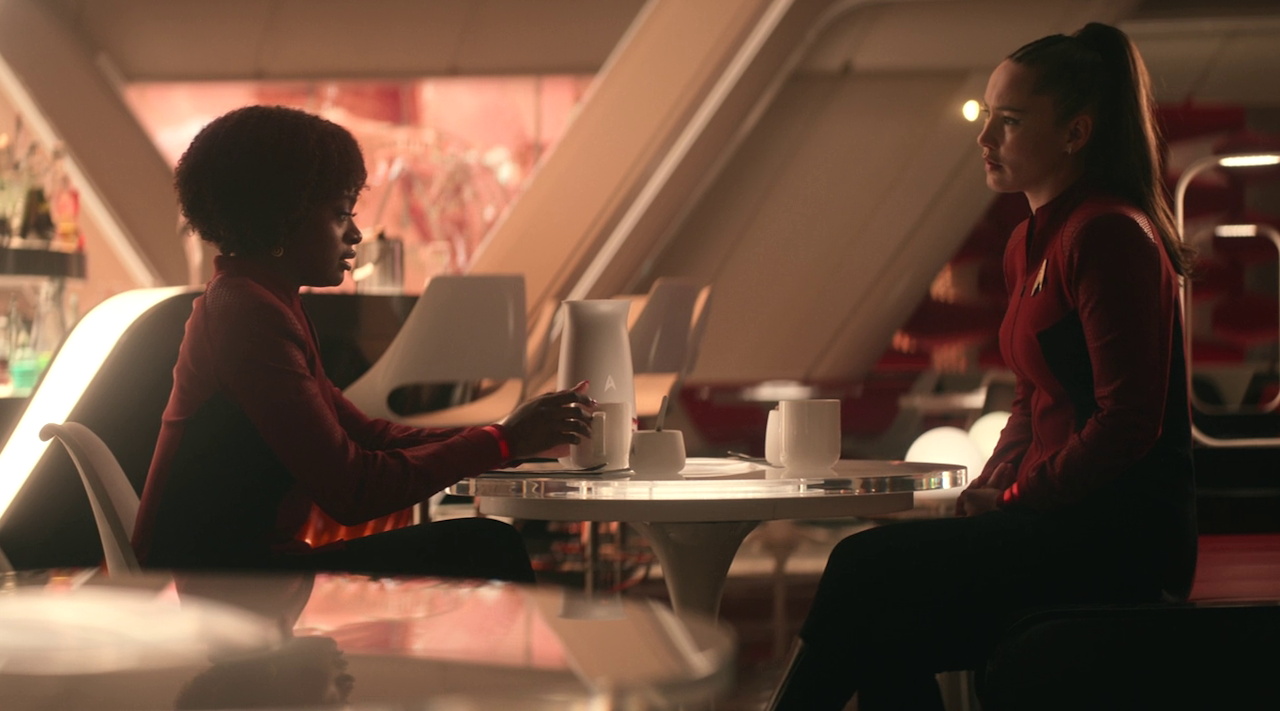
Still frame from Star Trek SNW 4x10 showing La'an with Uhura
La’an and Uhura talk time travel.

Star Trek can do action-packed stories very well – and some of those, from The Wrath of Khan to The Best of Both Worlds and beyond – are all-time fan favourites. But one of the core appeals of a franchise like Star Trek, at least to me, is that there are often scientific puzzles to solve, and ways to resolve stories that *don’t* require resorting to violence, phaser fire, and blowing things up. So I really appreciated that Tomorrow’s Enterprise was a purely scientific puzzle for Uhura and her counterpart to solve, not a story with a nefarious villain to be defeated.

And coming after Discovery, Picard, and other modern Star Trek shows have gone all-in on serialised story arcs with a massive, galaxy-threatening villain, conflicts, wars, and so on… this kind of story feels all the more refreshing. Some of Star Trek’s action-packed episodes are fantastic, don’t get me wrong, but a scientific puzzle like this feels… well, it just feels very “Star Trekky,” for want of another term.
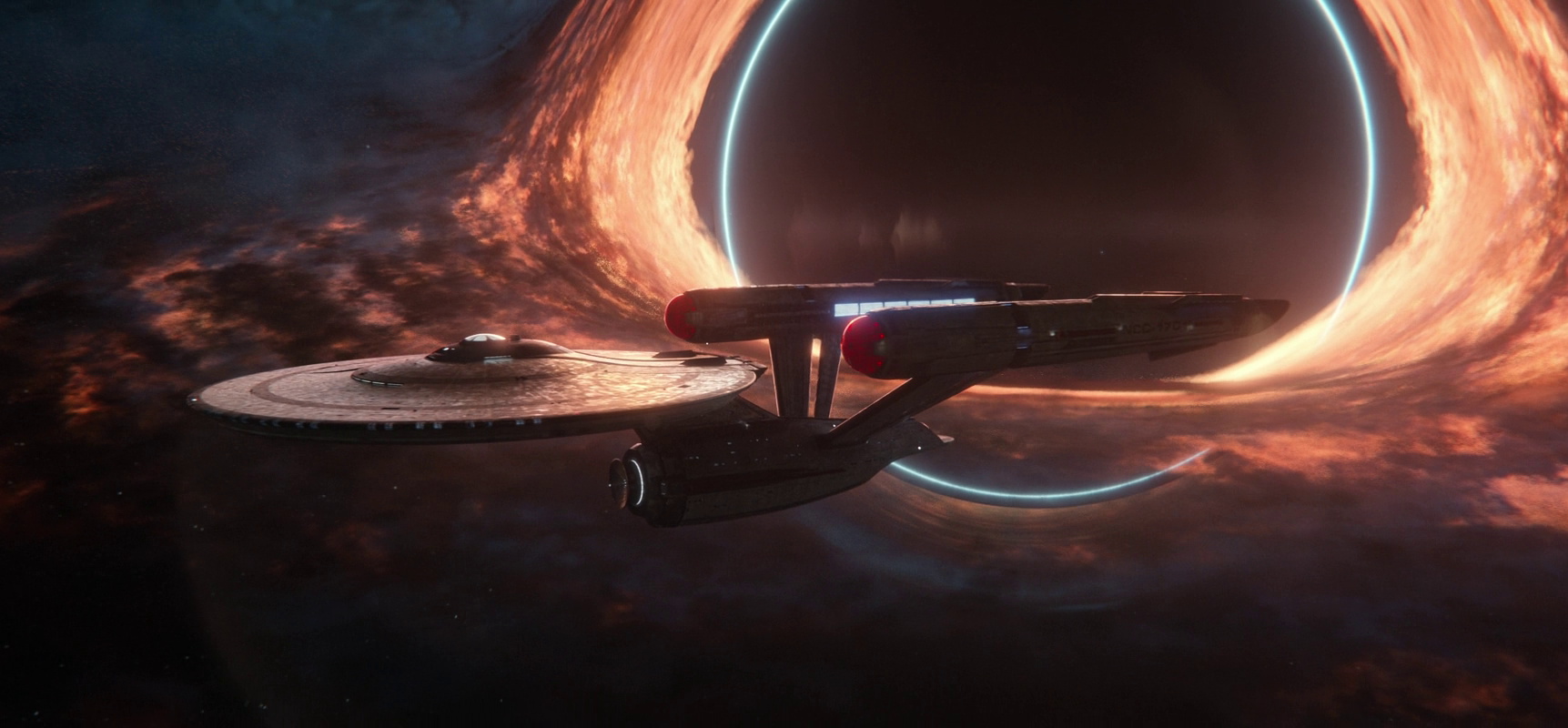
Still frame from Star Trek SNW 4x10 showing the USS Enterprise by a black hole
The episode’s scientific puzzle was fantastic.

In a similar vein, I felt that Tomorrow’s Enterprise didn’t overdo its character drama. Yes, the romantic relationship for Scotty and Uhura was new, and yes, that was a secondary motivating factor for her when it came to wanting to save his life. But it didn’t feel melodramatic in the way that Discovery might’ve tried to play a similar idea; Celia Rose Gooding played Uhura at just the right level to seem convincingly worried for Scotty’s safety without going overboard. Again, after missteps and failures elsewhere in modern Star Trek, I really appreciated that!

Earlier in the season, I heavily criticised The Griffin Incident for not having an actual ending or resolution to its story. And a story like Tomorrow’s Enterprise is a great example of something I said in my review of that episode: you don’t have to get a down-to-the-millimetre explanation of every aspect of an alien race or interstellar phenomenon in order to write a story that feels narratively complete.
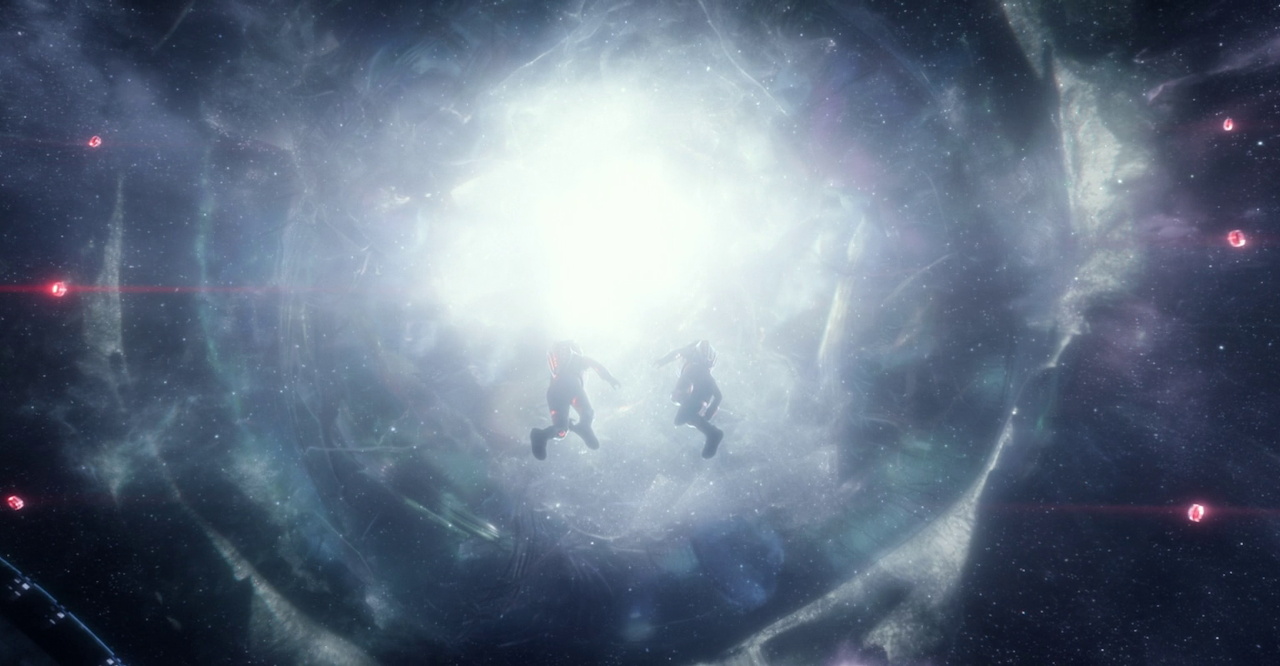
Still frame from Star Trek SNW 4x10 showing the "space baby"
The birth of a “space baby.”

This week, we didn’t learn who the “midwives” were or what the “space baby” they were trying to deliver was. We didn’t learn why a black hole and a white hole were the incubator for this new life form, either. But we got enough from Uhura’s story to understand what was happening to her and to the other characters we care about, as well as what she needed to do to save a life – or two lives, really, including the baby – and restore the correct version of the timeline. We didn’t need a ton of technobabble about giving birth in space, black holes, or time travel, and we didn’t even need so much as a name for either of these aliens. We got enough from the story to make the ending feel satisfying – and compared to The Griffin Incident earlier in the season, that’s more than enough.

I will say, as an aside, that I didn’t really like the name “space baby” for this phenomenon! Though I will credit the episode with at least being self-aware enough of that silly name to have Uhura herself comment on it in the story.

I mentioned All Good Things (the TNG series finale) a moment ago, and there was one other way in which Tomorrow’s Enterprise seemed to borrow from that episode: the poker storyline.
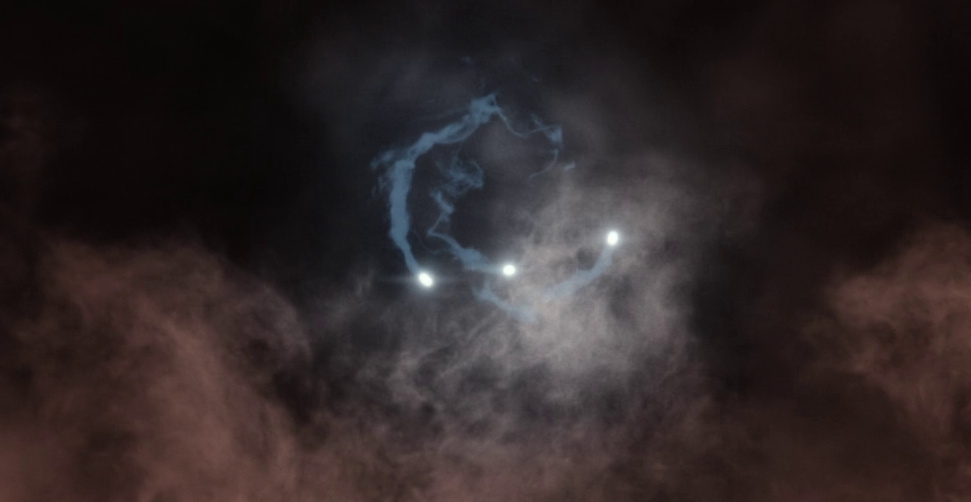
Still frame from Star Trek SNW 4x10 showing the "space midwives"
The “space midwives.”

We got an overhead shot of a poker table that felt eerily similar to the one in All Good Things (which was also copied in the Picard series finale, too), and the emphasis on Kirk and his crew playing poker together felt like it was drawing on a Star Trek tradition which has been present since The Next Generation. I think I’m right in saying that we never saw Kirk and co. playing cards together in TOS (though Kirk and Spock famously played chess, of course), but I liked that not only is this another way to show Kirk being closer and more friendly with his crew, but also how it’s another little through-line connecting different parts of the franchise together.

In this case, not only did the poker game have some relevance to the story – with Kirk able to suss out that Uhura was an imposter aboard his version of the Enterprise – but it also links Strange New Worlds not only to The Original Series, but to The Next Generation as well. The shot of Kirk, Uhura, and others playing cards together was a great way to close out the episode.
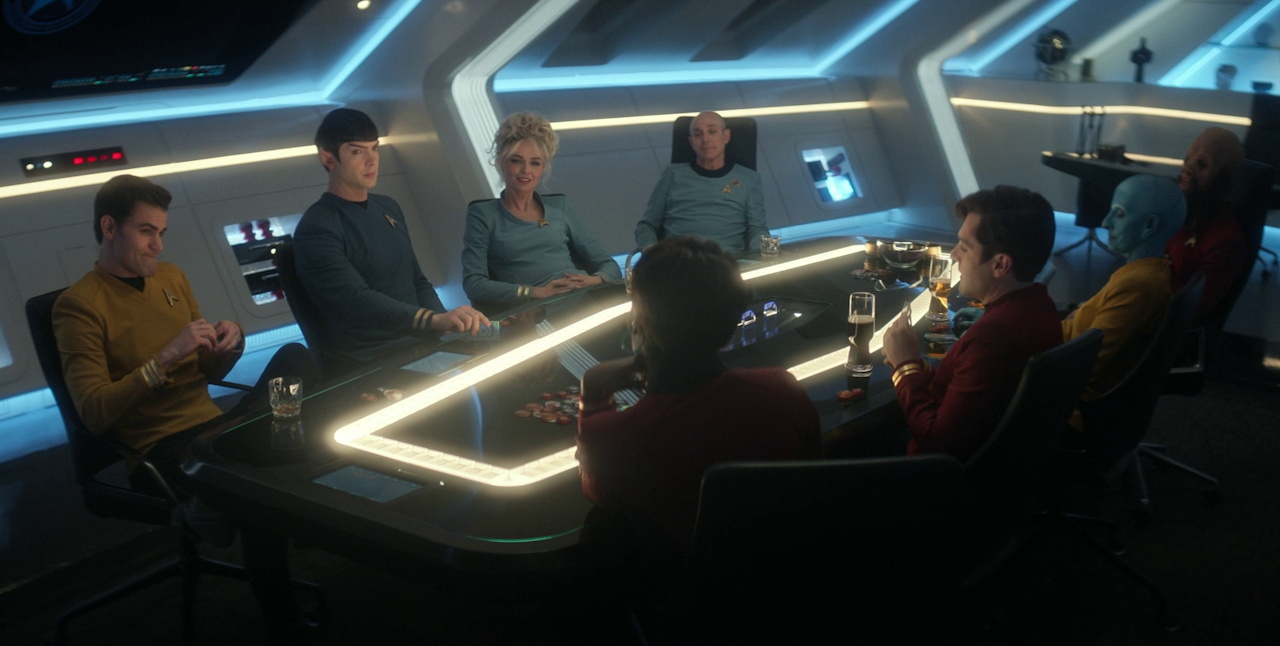
Still frame from Star Trek SNW 4x10 showing Kirk, Chapel, Spock, Boyce, Uhura, and Scotty at the poker game
The poker game links Strange New Worlds to The Next Generation in a fun way.

And I think that’s a good place to start to wrap things up!

Uhura got an epic time-splitting episode to end out the season, and while there are some disappointments as the curtain falls… mostly they’re in what we *didn’t* get to see rather than the way Tomorrow’s Enterprise itself comes across.

I was unsure, when I saw the promo images and the trailer, whether a time travel episode would really be good enough to draw a line under what has been, I’m sorry to say, an underwhelming season on the whole. And while I don’t think it was so stunningly spectacular that we can just forget all of the missteps and cock-ups in weeks gone by – looking at you, Level-Five Writing Accident – I think we can at least say that the season ended with one of its strongest episodes.
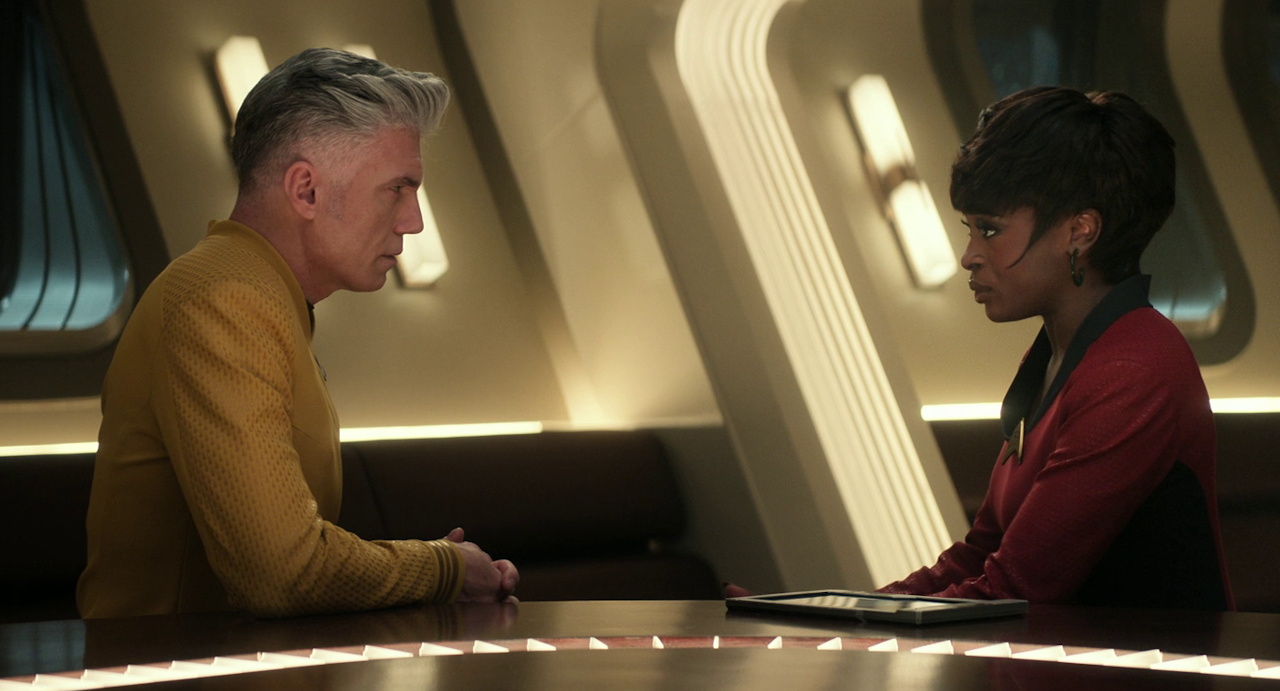
Still frame from Star Trek SNW 4x10 showing Pike and Uhura
Captain Pike with Uhura.

In the days or weeks ahead, I’ll write up my preliminary thoughts on where Strange New Worlds stands ahead of Season 5, so I hope you’ll join me for that. And before Season 5 airs next year, it’s my hope that I’ll have time to write up re-watches of all ten Season 1 episodes, too; Paramount’s utterly ridiculous decision to cut the show off from international fans meant I didn’t write episode reviews back in 2022. So, again, please join me for those if you can!

I have reviews of every episode from Seasons 2, 3, and 4 – you can find them by clicking or tapping here. Earlier this year, I also reviewed Starfleet Academy’s first season, which you can find by clicking or tapping here, and the Star Trek: Voyager video game Across The Unknown, which you can find by clicking or tapping here. And if you missed my celebratory piece for Star Trek’s sixtieth anniversary earlier in September, you can find that by clicking or tapping here.

There’s more to come here on the website, though, even as Strange New Worlds goes off the air! I have reviews of other films, games, and TV shows in the works, and there’s bound to be more to say about Star Trek, too! The Star Trek franchise will be at New York Comic-Con next month, and there could be a trailer or teaser clip for Starfleet Academy Season 2, and perhaps something for Strange New Worlds Season 5 as well. If and when we get news or trailers for either of those, I’ll do my best to cover that here on the website. Next month will also bring us the video game Outposts Unknown, which I covered the demo of a while ago, so I’ll try to take a look at that, too.

Thanks again for joining me for this review. And, as always… Live Long and Prosper, friends!


Star Trek: Strange New Worlds Seasons 1-4 are available to stream now on Paramount+ in countries and territories where the platform is available. The first three seasons are also available on DVD and/or Blu-ray. The Star Trek franchise – including Strange New Worlds and all other properties discussed above – is the copyright of the Skydance-Paramount corporation. This review contains the thoughts and opinions of one person only and is not intended to cause any offence.
Star Trek: Strange New Worlds Episode Review – Season 3, Episode 2: Wedding Bell Blues

A Star Trek: Phase II-themed spoiler warning.

Spoiler Warning: There are spoilers ahead for Star Trek: Strange New Worlds Seasons 1-3. Spoilers are also present for the following Star Trek productions: The Original Series Season 1, The Next Generation, Voyager, and Picard Season 2.

After an explosive and action-packed season premiere, Strange New Worlds opted for a complete change in tone in Wedding Bell Blues. There were some lighthearted sequences, a callback to a fan theory that’s been kicking around for literally decades, and, unfortunately, a bit too much cringe humour for my taste. Despite that latter point, Wedding Bell Blues had its moments, and the apparent confirmation of that decades-old fan theory was worth the price of admission alone!

For me, though, I suppose Wedding Bell Blues is going to be another episode that I don’t revisit very often. This obsession that the show’s writers have with putting Spock in situations that are emotional or just wacky and cringeworthy… it’s overstayed its welcome. And while I will happily admit that there can be humour in that premise… I’m thoroughly done with it at this point. Spock Amok, The Serene Squall, The Elysian Kingdom, Charades, and Subspace Rhapsody all included some kind of “Spock comedy” or “Vulcan comedy,” and I just think that we’ve really reached the end of the line with it. Any joke – even great ones – stop being funny when they’re repeated too often, and this whole “Vulcans are stuck up and rigid, so let’s turn that into comedy” idea wasn’t especially strong to begin with. At this point… well, let’s just say I hope we don’t get too much more of that going forward. And yes, I’m aware that we have Four-and-a-Half Vulcans still to come later this season.

Still frame from Star Trek: Strange New Worlds 3x02 Wedding Bell Blues showing Spock at the start of the episode.
I’m done with “Spock comedy” at this point.

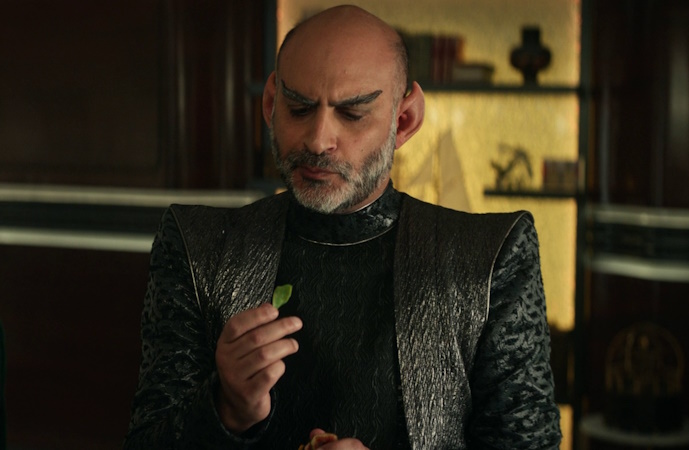
That being said, there were some interesting and entertaining moments in Wedding Bell Blues, and when the episode switched to Spock and Dr Korby trying to undo the damage, things largely improved. Dr Korby made for a fun character, even though his introduction as Spock’s rom-com/Hallmark movie dating rival wasn’t spectacular! Dr Korby originally appeared in The Original Series first season episode What Are Little Girls Made Of? where Kirk and the crew encounter him – after a fashion – on a frozen planet.

It’s been a while since I re-watched What Are Little Girls Made Of?, so my recollections of that story are a little fuzzy! But from what I remember, the “Dr Korby” that the crew – and Nurse Chapel – encountered wasn’t quite the same, either due to the mind-transferring process he went through or, perhaps, because of years in isolation and the traumatic experiences he went through. I’m not sure if Strange New Worlds’ version of Dr Korby is going to appear again after this episode. If he doesn’t, I think we’ll look at Wedding Bell Blues as a bit of mildly interesting backstory. But if he does come back, I think there’s potential to expand the character further, and perhaps show us a glimpse of a darker side, something that might inform his TOS appearance. Because I didn’t really get much of that from Wedding Bell Blues, to be honest. If Dr Korby had been substituted for a brand-new character, it wouldn’t have made any real difference to this particular script.

Still frame from Star Trek: Strange New Worlds 3x02 Wedding Bell Blues showing Dr Korby.
Dr Korby in Spock’s cabin.

We’ll come back to Chapel, Korby, and Spock, because I really want to get into this Trelane and Q connection!

For some background information: Trelane was a character who first appeared in the episode The Squire of Gothos, also from the first season of The Original Series. He was portrayed as a trickster, capturing and toying with Kirk and the crew – before being reprimanded by his parents. When Q appeared at the beginning of The Next Generation some twenty years later, fans immediately made the connection. Q and Trelane felt so similar that “Trelane is a Q” became a popular theory in the Trekkie community. But it was never confirmed, despite Q making repeated appearances in The Next Generation, Deep Space Nine, and Voyager. Even a visit to the Q Continuum itself didn’t confirm it!

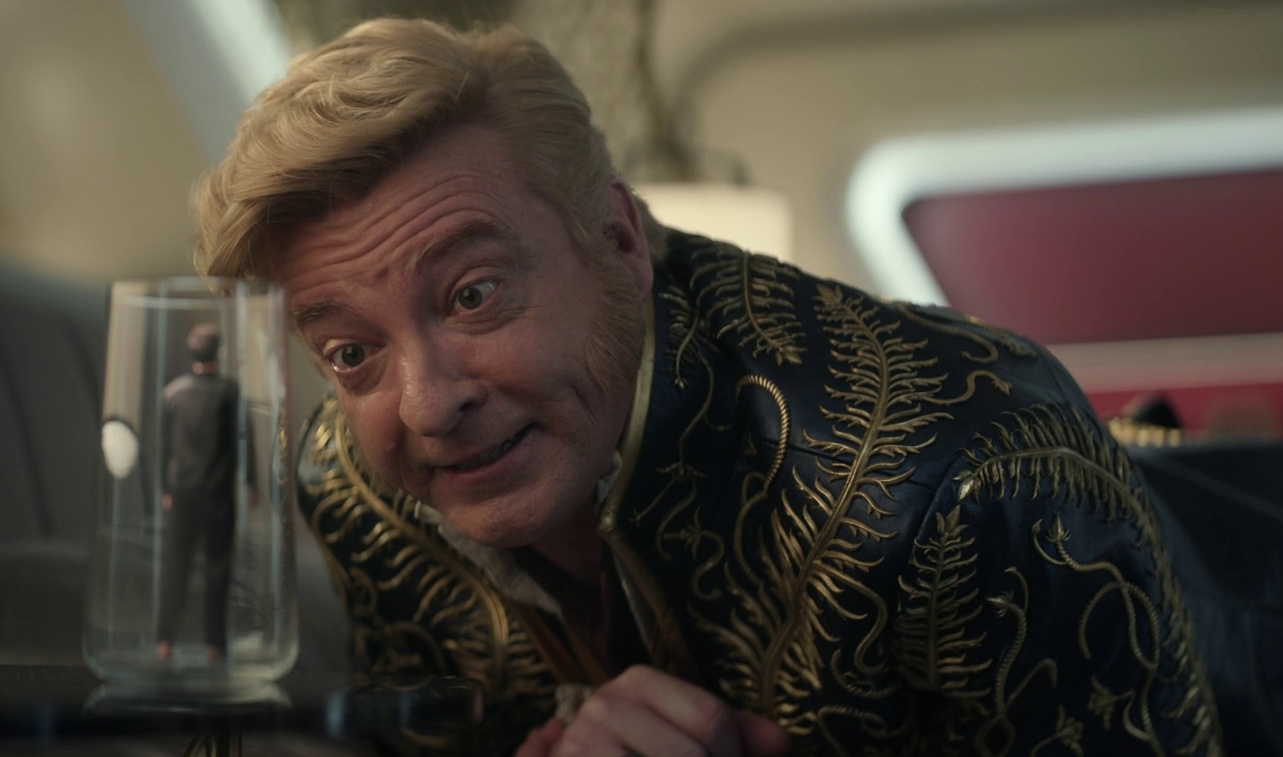
The character in Wedding Bell Blues is credited simply as “Wedding Planner,” and John de Lancie – Q from The Next Generation – is credited as voicing “Wedding Planner’s father.” However, ahead of the season we were told that Rhys Darby – who played the “Wedding Planner” – was playing the role of a familiar character, and after Wedding Bell Blues aired, showrunner and executive producer Akiva Goldsman confirmed that the two are the same character. With that in mind, I shall be treating the “Wedding Planner” as Trelane and the other energy life-form as Q.

Still frame from Star Trek: Strange New Worlds 3x02 Wedding Bell Blues showing Trelane playing a trick on Spock.
Trelane with a pint-sized Spock.

I love that Strange New Worlds went out of its way to confirm this old fan theory and really lean into the Trekkie community. Moments like this connect disparate parts of Star Trek together, and while we can argue the toss about changes to the Gorn from one show to the other, Trelane’s appearance here was pitch-perfect. It was right in line with The Squire of Gothos, and the fact that John de Lancie returned to voice Q at the end of the story just made it so much better.

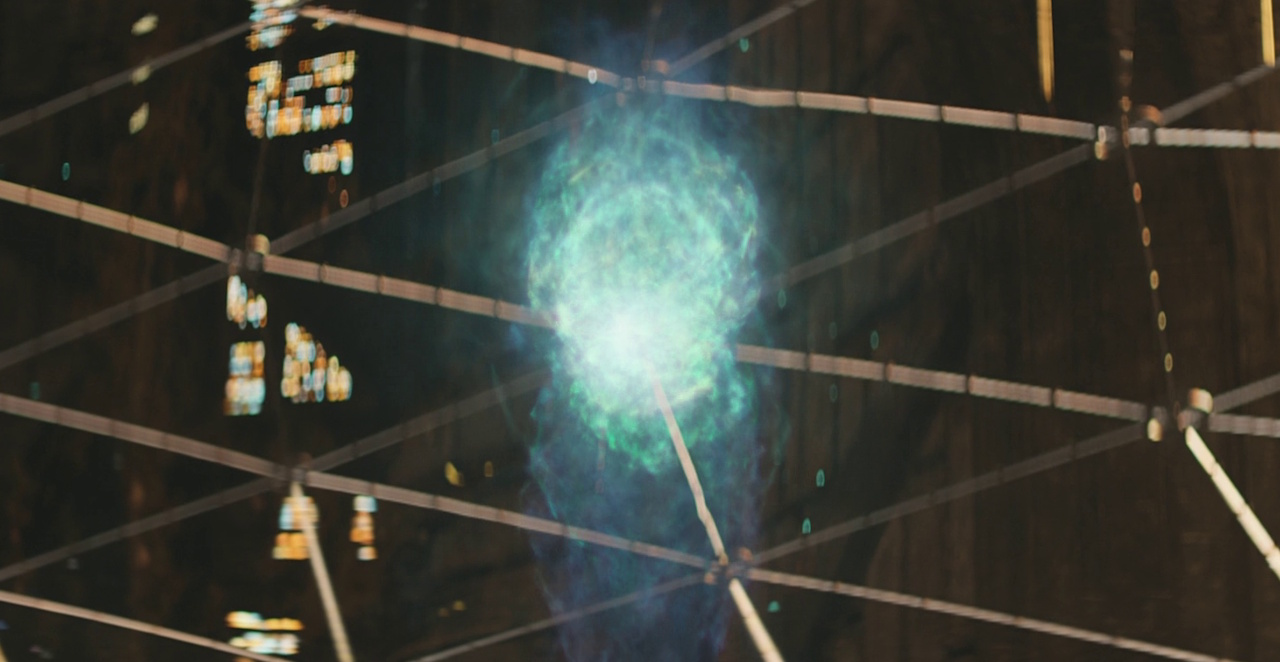
As an aside: have we finally seen the Q in their “true” form? Q has always been able to change his form, but in all of his appearances – and the appearances of other members of the Continuum – we never got confirmation of what the race actually looks like in its native form. I think there’s a case to be made that the energy cloud from The Squire of Gothos and Wedding Bell Blues is what members of the Q Continuum look like when they aren’t deliberately assuming another form. And that’s kind of cool!

Still frame from Star Trek: Strange New Worlds 3x02 Wedding Bell Blues showing an energy life-form.
Is this Q’s true form?

So after almost forty years, we’ve gotten an explicit connection between Trelane and the Q! I don’t know about you, but I think that’s exceptionally cool, and a great little wink to fans of both The Original Series and The Next Generation. It was also subtle enough that new viewers who aren’t familiar with any of those shows wouldn’t have been left scratching their heads. The ending to The Squire of Gothos was repeated in a pretty similar way, and the meaning behind it – that this entity was little more than a child, toying with living beings – still works even without any of that prior knowledge of Star Trek. It works just as well in 2025 as it did in 1967!

After such a long time, with fans speculating about Trelane and Q since before there was the world wide web… there were risks to this storyline. And I just love that there was enough boldness in the writers’ room to go there. I can see this point being contentious with some older fans, perhaps; not everyone was on board with the “Trelane is a Q” theory. You don’t have to look too far to find old forum threads and blog posts denouncing the notion! But for me, this storyline was well-executed, it doesn’t really prevent you from enjoying any of the Q episodes or The Squire of Gothos in isolation, and given that Trelane seems to have been in disguise most of the time, we can even argue that Spock, Uhura, and Scotty not remembering this encounter makes sense. Heck, if you need a head canon explanation for that: Trelane used his Q powers to make everyone forget about this by the time of The Squire of Gothos!

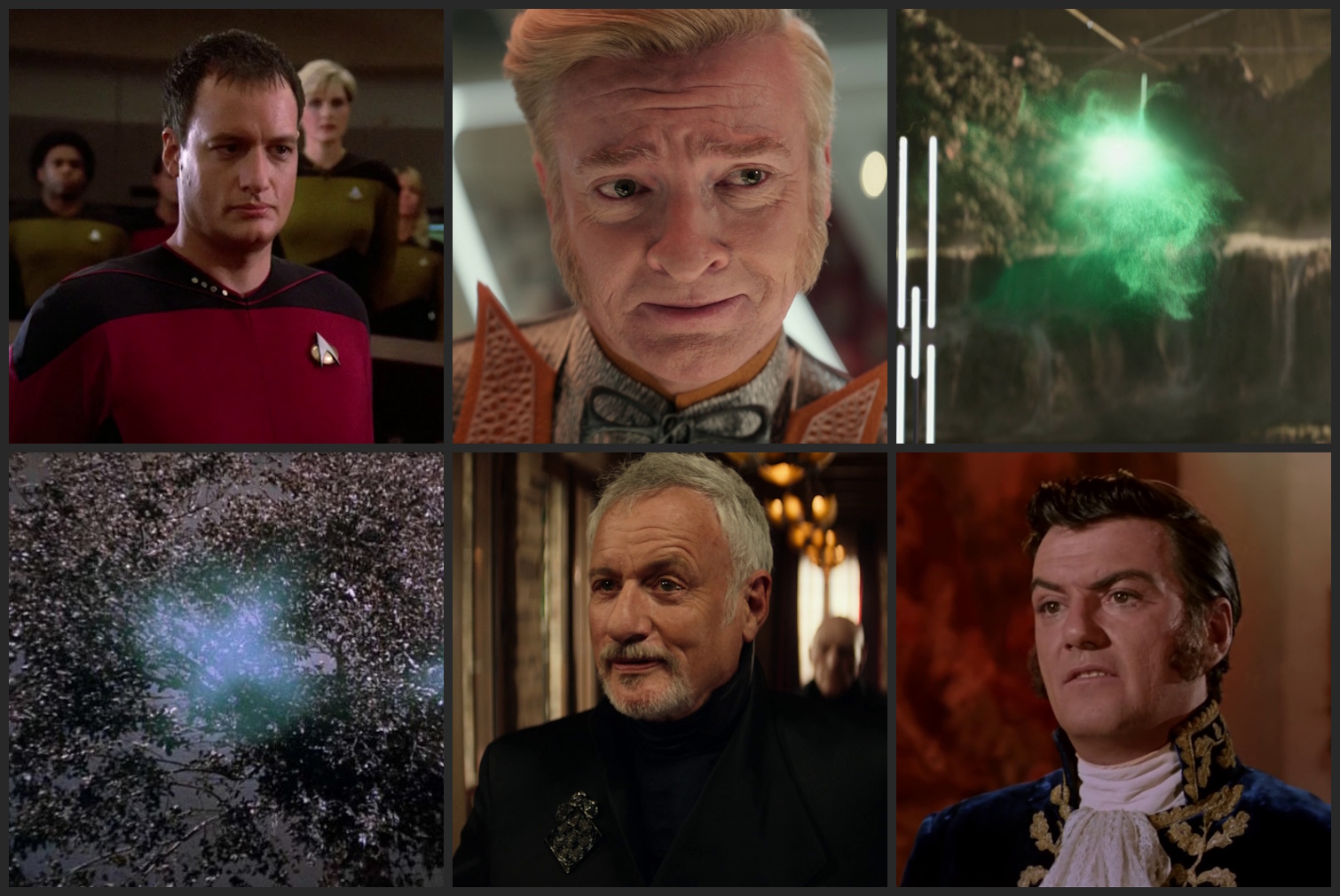
Six still frames from a selection of Star Trek episodes. Top line L:R Q in Encounter at Farpoint, Trelane in Wedding Bell Blues, Trelane in his energy cloud form in Wedding Bell Blues. Bottom line L-R: Trelane's father in Squire of Gothos, Q in Picard Season 2, and Trelane in Squire of Gothos.
Trelane is officially a member of the Q Continuum!

Star Trek was one of the entertainment landscape’s first real “shared universes;” pioneering the idea before the name even existed. And it’s nice to get little reminders, now and then, of storylines set in other eras or of fun episodes we remember from older Star Trek shows. There are good ways and bad ways to do this; Wedding Bell Blues, for me, stayed on the right side of the line. There’s enough wiggle-room for people who hate this idea to say that, well, maybe the Wedding Planner and Trelane aren’t one and the same, or that nothing we saw on screen explicitly proves that it was The Next Generation’s Q who showed up at the end. But for fans who’ve bought into the Trelane-Q connection over the years, I think it’s great to see that theory finally confirmed.

Rhys Darby was fantastic as Trelane, too. Informed, perhaps, not only by the original performance of the character by William Campbell in The Original Series, but also by John de Lancie’s Q, I felt we got a complex take on the character. Trelane’s lighthearted, positive energy masked some truly dark impulses and urges, and his total disregard for forms of life he considered “inferior” or beneath him really shone through. There was a distinct creepiness to Trelane, even when he was mincing around, talking about wedding dresses and cake samples. Darby put in a fantastic performance to bring the character to life and make him believable, despite the very unusual situation.

Still frame from Star Trek: Strange New Worlds 3x02 Wedding Bell Blues showing Trelane at the end of the story.
Rhys Darby was great in this role.

Speaking as we were of head canon, here’s one that I think makes some character moments in Wedding Bell Blues flow better! When Spock and Dr Korby approached various characters to explain the “mass delusion” phenomenon, even people who should be receptive to that conversation completely brushed them off. Worse, people like Captain Pike even seemed to ignore or forget what Spock was telling them moments later, and just generally acted out-of-character. When Spock left his own bachelor party, for instance, none of the other attendees – his friends – bothered to go after him or find out what was wrong.

So my head canon is that Trelane’s magic wasn’t just causing the delusion, it was also forcing everyone to react in this way. They were all 100% wedding-focused, and anything that didn’t gel with Trelane’s new scenario was either not retained or pushed aside. That’s really the only way I think we can account for people like Pike behaving the way they do; refusing to listen to his science officer and a prominent, well-respected doctor when confronted just doesn’t fit his character otherwise. For me, this head canon explanation fits pretty well, but I can understand why some viewers might not like the behaviours of Captain Pike and some of the other characters in the episode.

Still frame from Star Trek: Strange New Worlds 3x02 Wedding Bell Blues showing Pike, Kirk, M'Benga, and Scotty in Pike's cabin.
The bachelor party.

The idea that only strong emotions – like anger or love – could break through Trelane’s spell was interesting, and it’s an idea which feels very “Star Trekky,” if that makes sense. It’s a bit of a cliché, sure; love being this supremely powerful emotion capable of saving the day can feel like a worn-out trope. But here, I think it worked well enough. Perhaps if we’d got just an extra line or two between Korby and Spock to technobabble some nonsense about love generating strong brainwave frequencies or something, maybe that would’ve been an improvement. Not essential, perhaps… but an improvement.

Love breaking through the delusion also set up the end of the episode, and Spock being able to get through to Chapel. Calling back to the story about her and Dr Korby climbing a mountain and looking out over the stars was creative and also cute, and despite my overall feelings about Spock being pushed into this love rivalry story that felt like something out of a low-budget Hallmark movie, this moment worked. Spock knew what he had to do; he took a chance on what he felt was the only way to break the illusion for Chapel, and hoped that doing so would shatter it for everyone else.

Still frame from Star Trek: Strange New Worlds 3x02 Wedding Bell Blues showing Nurse Chapel at the altar.
Chapel breaks free from the spell.

In The Squire of Gothos, the crew of the Enterprise arrive at a planet where Trelane is already present. Yet here, in Wedding Bell Blues, it appears as if Trelane has travelled to Earth… and I wish we’d learned a little about that. Why was Trelane interested in Earth, and why did he feel drawn to Spock when he had ten-plus billion people to potentially toy with? I just didn’t feel we got a satisfactory explanation for that, really. Yes, Trelane is a trickster and a child, but at least encountering him where he is – out in space – made a degree of sense. And for Q, he set puzzles and challenges for Picard, Janeway, and Sisko… but they always served some kind of purpose. Trelane is just playing around, which is the point of the story, but even kids who are playing have reasons for choosing the games they play.

One other thing I liked about Trelane, though, is how we can read his story of wanting to help people fall in love through the lens of what we know about Q. If you know me, you know I generally disliked Star Trek: Picard’s second season, in which Q prominently features. But at the end of that story, we learned that Q cares, in his own way, about things like love – and he has some kind of innate desire to help people fall in love. Or at least he does for certain select people! But this kind of connects with Trelane in Wedding Bell Blues; he saw how down Spock was about losing Chapel and he wanted, in his own somewhat twisted way, to “help.” That interpretation is there, even if it’s built on less solid foundations.

Still frame from Star Trek: Strange New Worlds 3x02 Wedding Bell Blues showing Trelane illuminated by red lights.
Trelane’s story can arguably connect to Q’s in Picard Season 2.

Love could be blossoming in Strange New Worlds this season. Spock and La’an seemed to share a moment towards the end of the story, dancing together. I interpreted their earlier scenes as purely friendly, with La’an – who apparently has a hidden talent for dancing – helping Spock learn to dance ahead of the Federation Day celebrations. But their moment at the end of the story, with La’an joining Spock as he sat alone, then asking him to dance? Maybe I’m reaching… but in the kind of rom-coms that Wedding Bell Blues borrowed from, those sorts of moments can lead to big romantic entanglements!

In addition, we also have the clearly burgeoning relationship between Uhura and Beto – Lieutenant Ortegas’ brother. When I saw Uhura and Beto in a pre-season promo photo, I thought he might’ve been some kind of villain; perhaps the photo wasn’t a particularly flattering one, but he was giving me a bit of a creepy vibe! In the episode itself, though, we got plenty of flirty banter between the two. Unlike with Spock, Chapel, and Korby, which I found way too cringeworthy, I generally enjoyed this sub-plot. Giving Uhura a love interest, particularly one with a connection to another member of the crew, could be a lot of fun.

Still frame from Star Trek: Strange New Worlds 3x02 Wedding Bell Blues showing Spock and La'an dancing.
They’re just friends… right?

Could Beto’s drone-camera and his filmmaking job become plot points in another story? I wondered if he might’ve had a role to play in Wedding Bell Blues while I was watching the episode; his camera, I suspected, might be able to see through Trelane’s disguise even if no one else could, and that could’ve led to the mystery unravelling. In any case, Wedding Bell Blues set up this hobby/job of Beto’s, and then called back to it to reinforce it, so I can’t help but think we might get something out of it further down the line. Watch this space, I guess.

Uhura got one of the best costumes in this episode! Not at the wedding/Federation Day party… her very 1960s-inspired outfit that she wore to the bar earlier in the story. Strange New Worlds has leaned into a ’60s aesthetic in a way that Enterprise and Discovery never really did. There are still a ton of thoroughly modern trappings, but the show has those connections to The Original Series. Uhura’s outfit was fantastic – but I wouldn’t say it looked out of place aboard this version of the Enterprise. That isn’t an easy line to walk, and generally I think Strange New Worlds gets it right most of the time. Uhura’s new hairstyle, which debuted in this episode, looks fantastic, too.

Still frame from Star Trek: Strange New Worlds 3x02 Wedding Bell Blues showing Uhura, Ortegas, and Beto in casual dress.
I love Uhura’s outfit in this sequence.

After the dust settled on the wedding/Federation Day, there are still a couple of lingering Gorn-related questions. I noted last time that Spock and Chapel’s plan to save Captain Batel didn’t involve removing her Gorn infection, but changing how they approached it so that the Gorn would be “re-absorbed” by her body. That line didn’t stick out too much at the time, but the fact that “re-absorbtion” and Captain Batel’s ongoing treatment was mentioned again here? It raises some questions! Is she going to be suffering some kind of ongoing Gorn-related health issue? And if so, could we see the Gorn return in a future story? Could the Gorn infection ultimately still claim her life?

I was surprised to see La’an so casually brushing off her Gorn encounter. I get why it had to happen for narrative reasons – with Ortegas clearly suffering after her near-death experience, having another character going through a similar Gorn PTSD-type situation might be too much. But La’an is a character who has been thoroughly defined by her encounters with the Gorn, both in the show and as part of her backstory. Yes, there’s a three-month time-jump at the beginning of Wedding Bell Blues, and we can argue that La’an might’ve processed some of what happened off-screen. But something about her line to Spock about the Gorn threat being over now… it didn’t sit quite right.

Still frame from Star Trek: Strange New Worlds 3x02 Wedding Bell Blues showing Captain Batel.
Is Captain Batel in the clear?

However, as mentioned it’s Lieutenant Ortegas who seems to be in focus for a lingering Gorn storyline. Although she seems to have physically recovered, there’s a psychological toll that she doesn’t seem to have addressed yet. She may not have even admitted to anyone that she feels haunted by the Gorn and by her experiences in captivity. This is clearly going to run for more than one episode, perhaps blowing up later in the season in a big way – or conversely, with Ortegas seeking help from someone like Captain Pike, Dr M’Benga, or even La’an. I felt that, if La’an had been the one to get this kind of PTSD-type storyline, she had a great connection already with Una, so she could’ve been someone to turn to.

Ortegas hasn’t been in focus as much across the first couple of seasons, and I don’t think it’s unfair to say that she doesn’t have a “bestie” in the same way as some of the other main characters do! That’s a limitation in some respects, but it also means that she could potentially talk to anyone – so maybe it’s better to say it opens up different possibilities. Dr M’Benga would be interesting both for his medical expertise as well as his own traumatic backstory from the Klingon war. Captain Pike could be very sympathetic, too. And La’an, I think, might make a particularly compelling character for Ortegas to seek out. Not only does La’an have that Gorn experience, but she was the one who rescued Ortegas from captivity, saved her life, and then carried her to the ship they used to make their escape.

Still frame from Star Trek: Strange New Worlds 3x02 Wedding Bell Blues showing Ortegas being "haunted" by her Gorn encounter.
Ortegas is clearly haunted by her Gorn encounter.

As an aside: Wedding Bell Blues was creative in its use of reflections creative camera shots. We caught a glimpse of Trelane through the window before he first appeared, we saw the view directly from Beto’s camera-drone, and at the end, Ortegas’ feelings of being haunted by her Gorn experience were shown through a reflection in the window.

What do we make of the new nurse? The ensign that Una and Dr M’Benga went out of their way to keep aboard the Enterprise? Is he – as I suspect – going to take a villainous turn? Or is he being set up as a glorified redshirt; a Discovery-esque secondary character with minimal backstory, being fattened up to be slaughtered? Those are my two guesses!

Some of that may come later in the season… or not, if I’m totally overreaching. For now, it’s sufficient to say that I liked some of what Wedding Bell Blues had to offer – but I was less keen on its Hallmark movie plot. Spock and Chapel have run their course as a couple, and I’m glad that the series is finally seeming to put that idea to bed. But I’m not wild about all of these “emotional Spock” and “comedic Spock” storylines. There are other ways to include the character, other ways to demonstrate his growth, and other things to do with Vulcans besides joke about how formal and stuck-up they are.

Still frame from Star Trek: Strange New Worlds 3x02 Wedding Bell Blues showing a new nurse aboard the Enterprise.
Redshirt or secret bad guy?

I’m glad that Strange New Worlds doesn’t double up its episodes every week. Don’t get me wrong: I’d love to pay less for Paramount+, and a shorter season would help with that! But two episodes at once is a bit much; binge-watching some shows is a ton of fun, but for a brand-new season of Star Trek? I like to give the episodes room to breathe. A nice week-long gap is what I need!

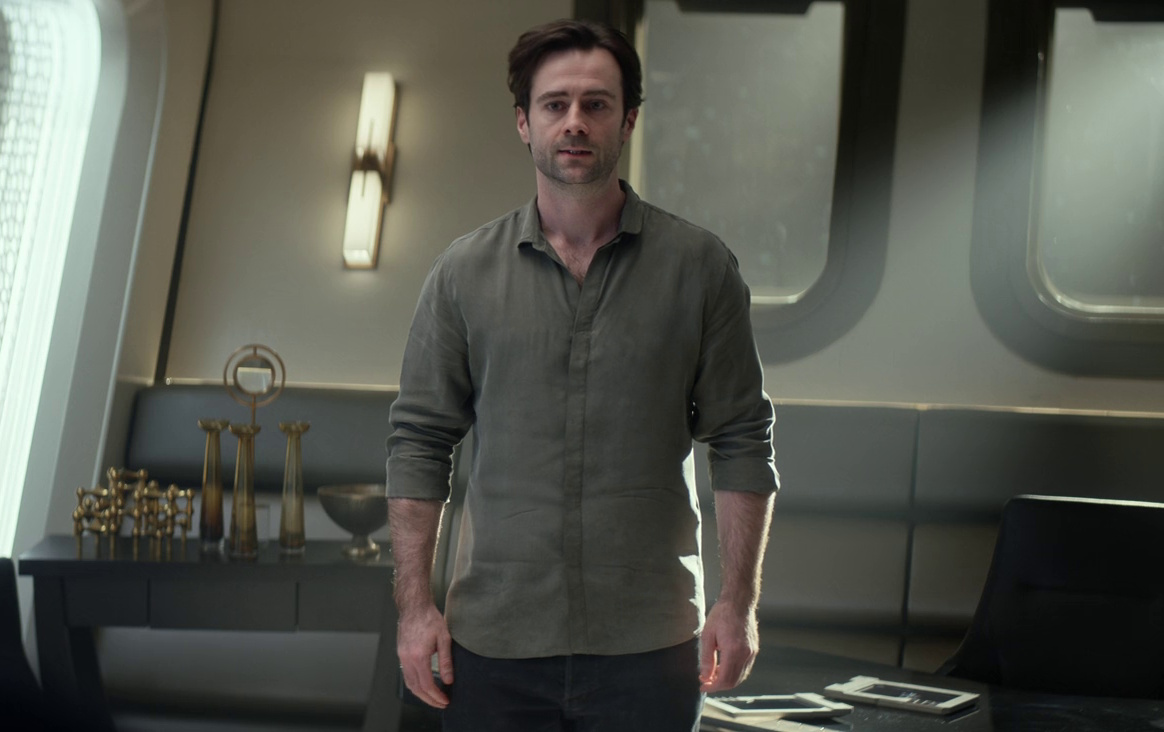
So we’ve reviewed both of the Season 3 premiere episodes. They were pretty different, and obviously my preference would be Hegemony, Part II by quite a long way! But I did enjoy the Trelane-Q fan theory being confirmed all these years later, and it was fun to get a kind of Q-ish or Q-adjacent storyline for Spock. Dr Korby, despite a pretty disappointing love triangle story and a weak introduction, was a fun character, and a good foil for Spock as he was forced to team up with arguably his least-favourite human! And we got some fun moments with Sam Kirk, Uhura, Chapel, Ortegas, and her brother, too.

Not my favourite episode, thanks to its cringe humour and Spock-Chapel-Korby love triangle. But an episode with plenty of redeeming features.


Star Trek: Strange New Worlds Seasons 1-3 are available to stream now on Paramount+ in countries and territories where the platform exists. The first two seasons are also available on DVD/Blu-ray. The Star Trek franchise – including Strange New Worlds and all other properties discussed above – is the copyright of Paramount Global. This review contains the thoughts and opinions of one person only and is not intended to cause any offence.
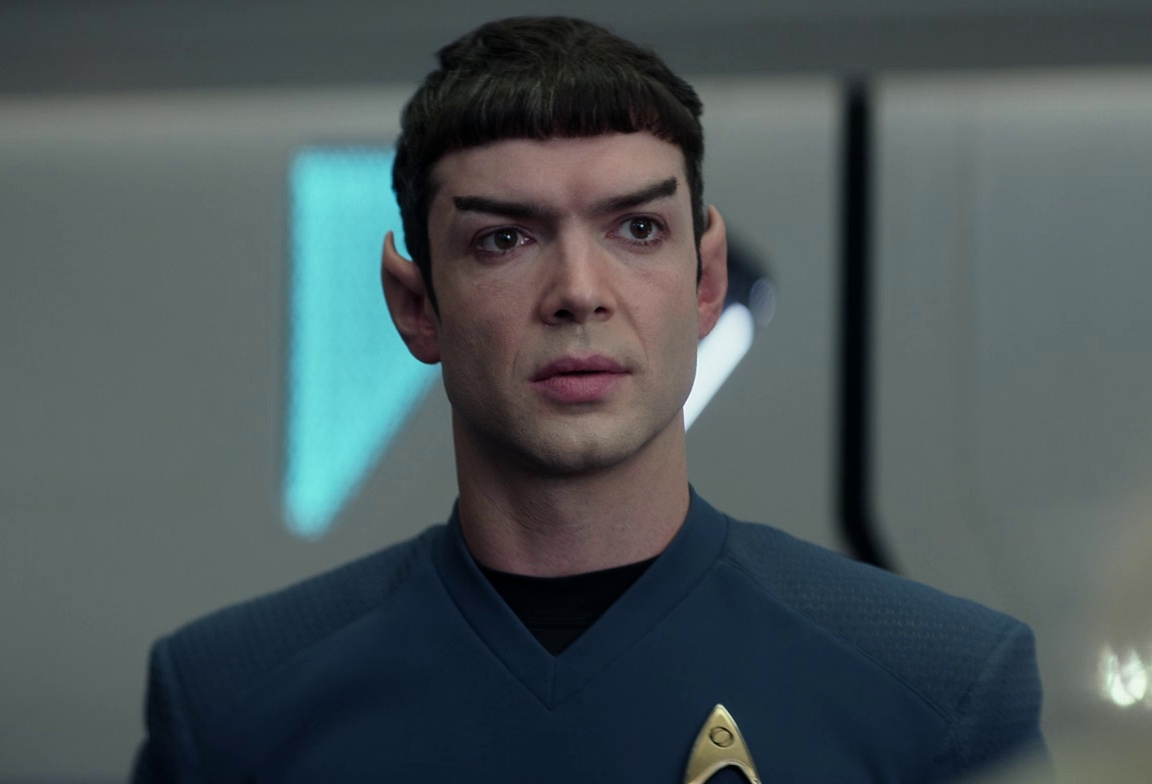
Star Trek: Strange New Worlds Episode Review – Season 2, Episode 5: Charades

Spoiler Warning: There are spoilers ahead for Strange New Worlds Seasons 1 and 2. Spoilers are also present for the following Star Trek productions: The Original Series, Deep Space Nine, Voyager, Enterprise and Discovery.

Charades was an episode of two halves. One of these halves worked well, and the other… well, let’s just say that the other was not to my taste. It was undeniably a Star Trek episode to its very core, bringing to the fore concepts that the franchise has used going all the way back to The Original Series. We also got an interesting exploration of a previously unseen aspect of Vulcan culture, character development for both Spock and Nurse Chapel, and some comedic moments that stuck the landing.

On the other hand, Charades relied far too heavily on the kind of “cringe humour” that defined sitcoms like Friends, with parts of the “Spock must pretend to be Vulcan” storyline evoking the same kind of feelings as watching Robin Williams’ character try to be in two places at once in Mrs Doubtfire. That kind of situational humour really isn’t my cup of tea… and while I can tolerate it in small doses and for a one-off story, it means that Charades is unlikely to be an episode I’ll choose to revisit very often in future.

I watched most of the episode with this kind of expression on my face…

It was a treat to welcome back Mia Kirshner as Spock’s mother, Amanda. Kirshner reprised her role from Seasons 1 and 2 of Discovery, where she was seen alongside both Spock and Michael Burnham. Burnham wasn’t mentioned on this occasion, which I suppose is an interesting omission given that the story called back to Spock’s childhood and had a focus on the divide between humans and Vulcans. But Amanda’s presence was more than enough to carry this storyline – and I found it to be the most interesting and certainly the most impactful part of Charades.

It was hinted at, even as far back as The Original Series, that being a human married to a Vulcan could be difficult. Enterprise greatly expanded our knowledge of human-Vulcan relations, and showed how Vulcans could take an almost sneering view of a species they regarded as not as sophisticated or developed. Through Amanda’s story in Charades, we get to see how that manifests on an individual level, and how Vulcans can discriminate against humans – or even show revulsion and hate.

Charades was an unexpectedly strong episode for Spock’s mother, Amanda.

This ended up being a particularly powerful storyline. Amanda, as Spock came to realise, had to endure a great deal of hardship as a human living on Vulcan. Even as Vulcans came to accept him as one of their own, Amanda remains a perpetual outsider, constantly subject to being talked down to, shunned, disregarded, and treated differently because of who she is. The cool intellectual and logical nature of Vulcans means that this discrimination manifests differently – but it’s there nevertheless, and we come out of Charades with a much stronger appreciation for Amanda and her strengths after having seen what she continues to experience.

This idea that Vulcans’ aloofness and intellectual prowess can easily slide into a sense of superiority is nothing new in Star Trek; it was front-and-centre in depictions of the Vulcans in Enterprise in particular. But this very personal, individual exploration of that – and the impact it can have on non-Vulcans who have to endure it – is something different and interesting. Strange New Worlds has found a new way to build upon the lore of Star Trek, expanding our understanding of one of the franchise’s most iconic races – and their flaws.

Through T’Pring’s mother we saw some of the flaws that Vulcans can fall victim to.

Star Trek has done the “character transformed” idea in multiple ways on multiple occasions, from Jadzia Dax’s friends embodying her Trill symbiont’s past hosts in Deep Space Nine through B’Elanna Torres being split into human and Klingon personalities in Voyager. So in that sense, Charades’ “Spock gets turned into a human” premise isn’t entirely original. But for a character who’s been struggling with his human and Vulcan sides, it was an interesting move.

However, I’d argue that Season 1’s The Serene Squall had already done much of the heavy lifting on Spock and his internal conflict. That episode reframed the idea as a kind of analogy for gender identity, and made a great deal of progress for Spock in terms of his character arc in this series – an arc that has to take him from the more emotional presentation seen in Discovery and get him much closer to the way he was in The Original Series. We also got Spock Amok in Season 1, which focused on Spock’s relationship with T’Pring and the stresses that his role in Starfleet and his half-human side was taking. On its own merit what Charades did in that regard was interesting – but given that The Serene Squall was a mere eight episodes ago… its impact is, I would argue, lessened.

Spock and T’Pring.

And I think that speaks to a broader concern about Strange New Worlds as a whole: its focus on legacy characters and their characterisations. Out of fifteen episodes that have been broadcast so far, we’ve had two that focused primarily on Spock and his relationship with T’Pring, and two more in which Spock and Nurse Chapel’s relationship was a major plot point. Season 2 has also spent a disproportionate amount of time so far on legacy characters, with Una, Nurse Chapel, Dr M’Benga, Spock, Captain Kirk, Uhura and latterly Captain Pike all getting moments in the spotlight. This is starting to come at the expense of other characters.

Pelia, the Enterprise’s new chief engineer, was mentioned by name in Charades but hasn’t been seen on screen for a couple of episodes now. And while La’an and Ortegas both had lines of dialogue this week, they were swept along by a narrative current outside of their control. I’m all for learning more about Spock’s background, don’t get me wrong. As a Trekkie, and as someone who’s firmly invested in this world, I like the idea. But Strange New Worlds has a limited amount of time at its disposal; the show runs ten-episode seasons, and after this, only one more season is guaranteed to be produced. As fascinating as it is to spend time with Spock, given that this episode’s core story felt more than a little derivative of what we got in two episodes of Season 1, its main story is one that could have been reduced – if not skipped outright – in favour of stories focusing on some of the show’s new characters.

La’an had a minor role this week.

Charades’ style of “cringe humour,” something often seen in American sitcoms, really isn’t my thing. I found a few moments in the episode damn near painful to watch, particularly when jokes and gags were made at Spock’s expense. That is, however, purely a matter of personal taste, and as far as I can see, the episode’s sense of humour stuck the landing and achieved what it was aiming for… even if it isn’t something I personally enjoyed. There were absolutely some laugh-out-loud moments, moments where I had to pause Charades for fear of missing what would come next as I was laughing so hard. The premise of the episode is inherently silly: Spock being transformed into a human right before an important dinner with his fiancée. And as one of Strange New Worlds’ more lighthearted offerings, that side of the story worked as intended.

There is a slightly uncomfortable edge to some of this humour, though – and while I have no doubt that this was unintentional on the part of the writers and producers, it’s still worth acknowledging. Going all the way back to The Original Series, the character of Spock has stood apart from his crewmates. Though mental health, autism, and neurodivergence were never stated explicitly in Star Trek, Spock has, for the longest time, been someone that folks who are autistic or neurodivergent have related to. Charades stripped away part of this presentation, and did so largely for comedic purposes. That wasn’t always the most comfortable thing to watch, especially with the aforementioned “cringe” aspect to the episode’s humour. I don’t think we need to zero in on this, nor spend too long criticising Charades here, but it’s absolutely worth acknowledging this aspect of the story.

Charades seemed to poke more than its share of fun at Spock.

Conversely, and to be fair to Charades, it showed us a different side to Spock – but one that was equally rooted in many of the same neurodivergent aspects of his character. The episode’s script compared Spock’s handling of emotions to that of an adolescent, but if we continue our analogy for Spock being autistic or an “outsider” to the world of human emotion, what we see is someone experiencing these emotions in their strongest, most raw form. Just as many neurodivergent folks struggle to understand emotion, others feel them intensely, and this intensity was something new for Spock – but something no less interesting to see.

Again, the way this was played was largely for comedic effect, as Spock’s over-exaggeration of some of his feelings and emotions was part of this “cringe humour” thing that Charades had going on. But if we can look past that, I think there’s a case to be made that we saw a different side to Spock, one that flipped his logic and cool, usually emotionless presentation on its head – but it was a presentation of Spock that was no less relevant or relatable than it has been in the past.

We got a very different presentation of Spock this week.

There was a comment made before the season aired by one of the show’s executive producers (a comment I’ve now lost so I can’t find to quote from directly) that said something along the lines of “Strange New Worlds will push the boundaries of canon.” That alarmed me somewhat, because the series has to fit into a long-established world, and sometimes what producers and writers call “pushing the boundaries” can actually mean “ignoring and/or erasing.” And I think in Charades’ development of Nurse Chapel’s relationship with Spock, we get to see an example of this pushing of the boundaries.

The Original Series implied on several occasions that Chapel had feelings for – or at least a crush on – Spock. But it never went beyond that; the two characters, when they interacted, maintained a level of professionalism and perhaps friendship… but never anything more. There was no hint at a background of having once been lovers or ex-partners, and while nothing in The Original Series should explicitly rule out the kind of relationship that we see the two seemingly ready to embark upon in Charades, it’s certainly something that takes these two long-established characters and pushes them in a new direction.

What will become of the relationship between Spock and Chapel?

In the context of Strange New Worlds itself, this relationship works well. Pairing up Spock and Nurse Chapel succeeded in Season 1, and their relationship has only deepened since then. In a way, we could argue that this adds to our understanding of the characters and where they were in The Original Series – and as they interacted so infrequently in Star Trek’s first incarnation, it’s perfectly fine to bring them together in this way. It’s also not the only change made to either character from their original appearances.

That being said, putting Spock and Nurse Chapel into this kind of romantic (or at least physical) relationship is something that works best when taking Strange New Worlds in isolation. As new characters on a new show, they absolutely have the potential to do this. But for both characters, Strange New Worlds is a prequel, and it’s unclear how this relationship will work for either of them – nor how it will move either character closer to their TOS presentation.

Spock and Chapel share a kiss.

In terms of visual effects, Charades excelled. The mysterious anomaly on the surface of the moon was interesting, and its pale blue hue made it look different from other similar anomalies seen elsewhere in Star Trek. Within the anomaly itself, where Uhura, Ortegas, and Chapel ended up, I felt the “interdimensional space” set was perhaps a little small, but nevertheless succeeded at feeling sufficiently otherworldly. When compared to similar VFX sets, especially the Trill memory world from Discovery’s third season, there’s no contest, and it’s great to see that Paramount has massively improved its animation work.

There might’ve been a little of Season 1’s Children of the Comet in the set design used for the Kerkhovian interdimensional realm, but for most viewers I daresay that would pass unnoticed. Overall, it was an excellent and suitably “alien” space, both in terms of its appearance as an anomaly in space and when the away team arrived there in person.

The shuttle and the anomaly – a great CGI creation.

With a return to Vulcan and a focus on Spock’s family, there was the potential to bring back Sarek as well as Amanda. James Frain played the role of Sarek remarkably well in Discovery, and it would have been interesting to have seen more of the Spock-Sarek feud that was alluded to in The Original Series. Spock made the barest of references to their estrangement in Charades, but there might’ve been scope to do more had the episode retained a tighter focus on Vulcan and Spock’s family.

While T’Pring’s mother certainly leaned into the Enterprise style of aloof and arrogant Vulcans, I wasn’t really sure what to make of her father. T’Pring’s father seemed to be the archetypal “henpecked” husband, doing little more than agreeing with her and backing up her opinions. This kind of stock character has very little personality, and while it was intended to be lighthearted, I’m not sure how well it works in-universe when we think about how Vulcans tend to act. Is his behaviour logical?

T’Pring’s father.

Despite the inherent silliness of Spock’s sci-fi ailment, I was impressed by Nurse Chapel’s dedication to her patient. This side of the story took on a much more serious tone, and if we set aside the relationship drama angle for a moment, we got to see a great example of two dedicated medical professionals working against the clock to help a sick patient. Star Trek can do medical drama well, and while this wasn’t the main focus of Charades, it’s still a good example of how well medical stories can work in the franchise.

For Nurse Chapel we also got to see a bit more of her professional life – the “archaeological medicine” fellowship that she hoped to work with. This was interesting, as it seems to harken back to something we learned about Chapel in The Original Series: her engagement to a Federation archaeologist. The episode What Are Little Girls Made Of? introduced this relationship, and it’ll be interesting to see what – if anything – comes of it in Strange New Worlds, especially given Chapel’s newfound relationship with Spock. Will she break things off with Spock to pursue another partner? If so, what impact will that have on Spock? Maybe we’ll find out later this season… or in Season 3!

Nurse Chapel and Dr M’Benga in sickbay.

So I think I’ve said all I can about Charades for now. Its use of cringe humour means it ranks quite low on my list of Strange New Worlds episodes… but that isn’t to say it was out-and-out “bad.” It did its own thing and did it well, at least as far as I can tell. That style of humour simply isn’t to my taste, and it’s for that reason more than any other that I found it to be a less enjoyable experience than other episodes that the series has offered.

It took me a while to get around to this review, and I’m still getting caught up on Strange New Worlds after a longer-than-expected break. Thanks for bearing with me, and I promise to get around to full reviews of the remaining episodes of the season in due course!

Star Trek: Strange New Worlds Seasons 1-2 are available to stream now on Paramount Plus in countries and territories where the service is available. The Star Trek franchise – including Strange New Worlds – is the copyright of Paramount Global. This article contains the thoughts and opinions of one person only and is not intended to cause any offence.