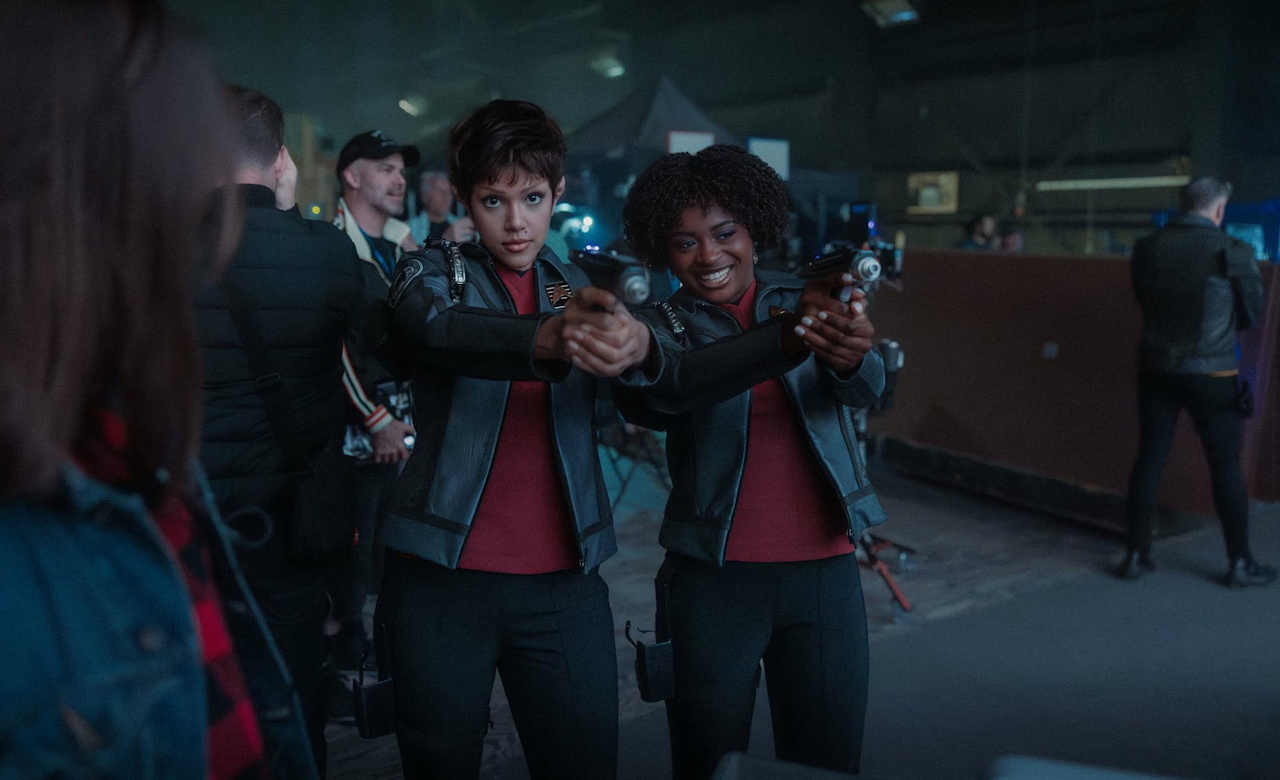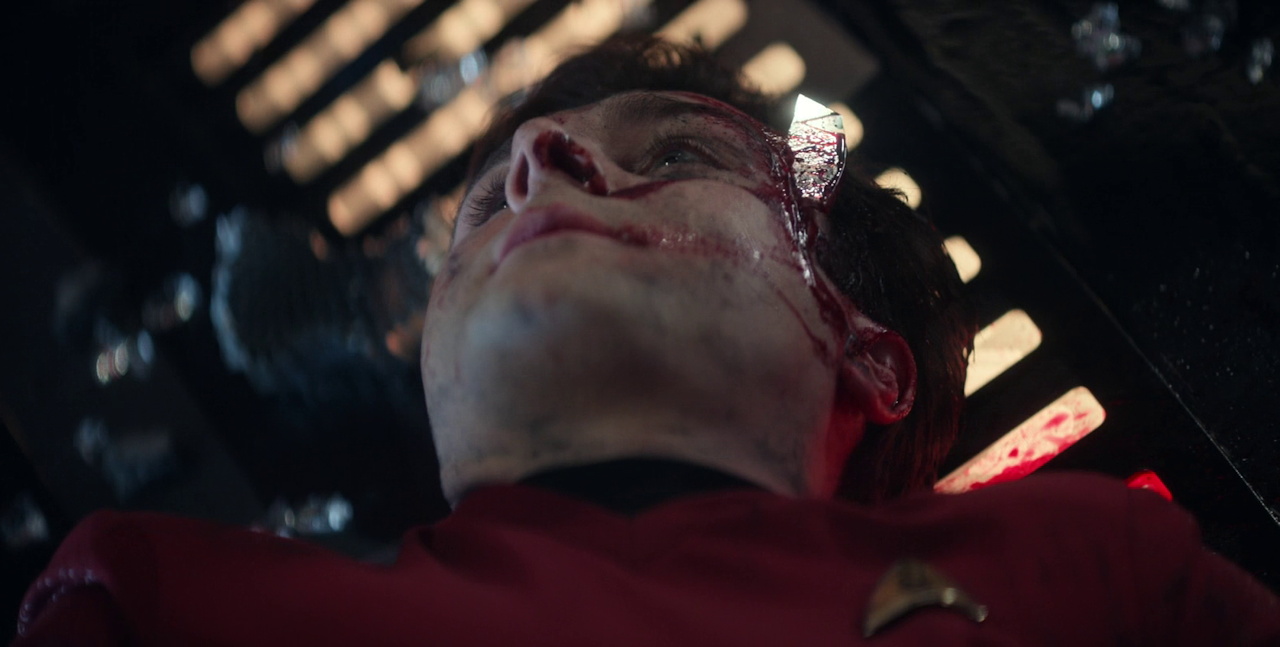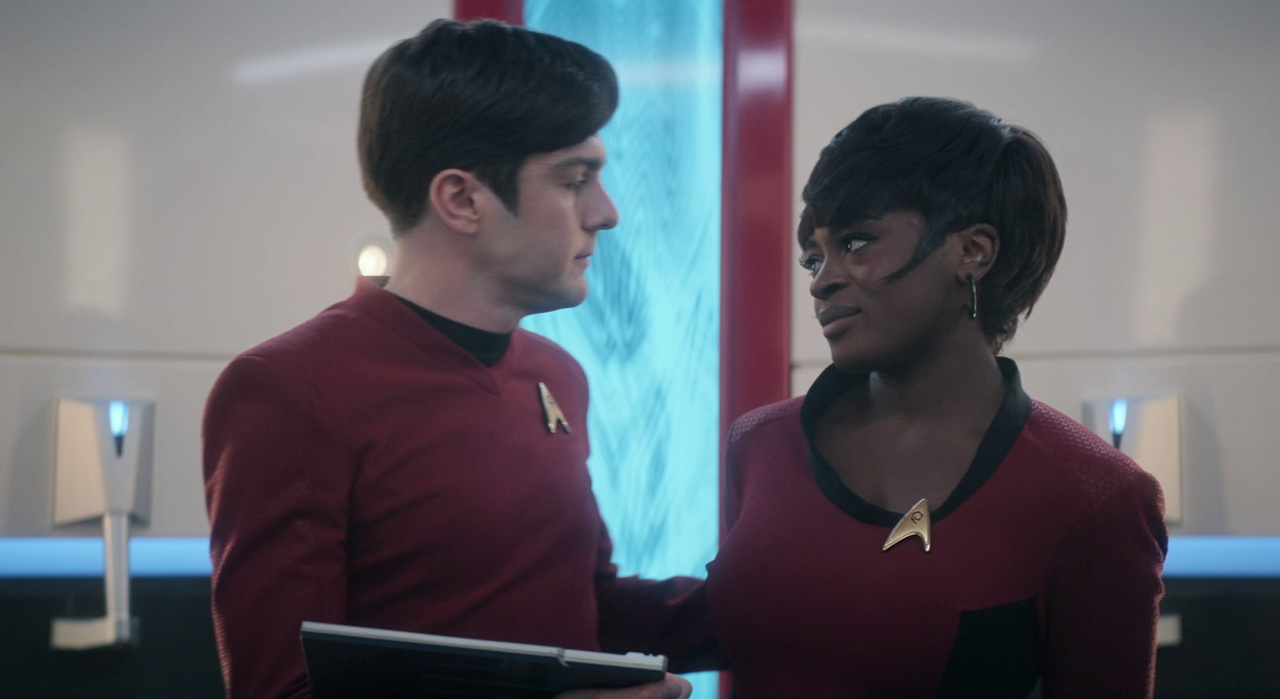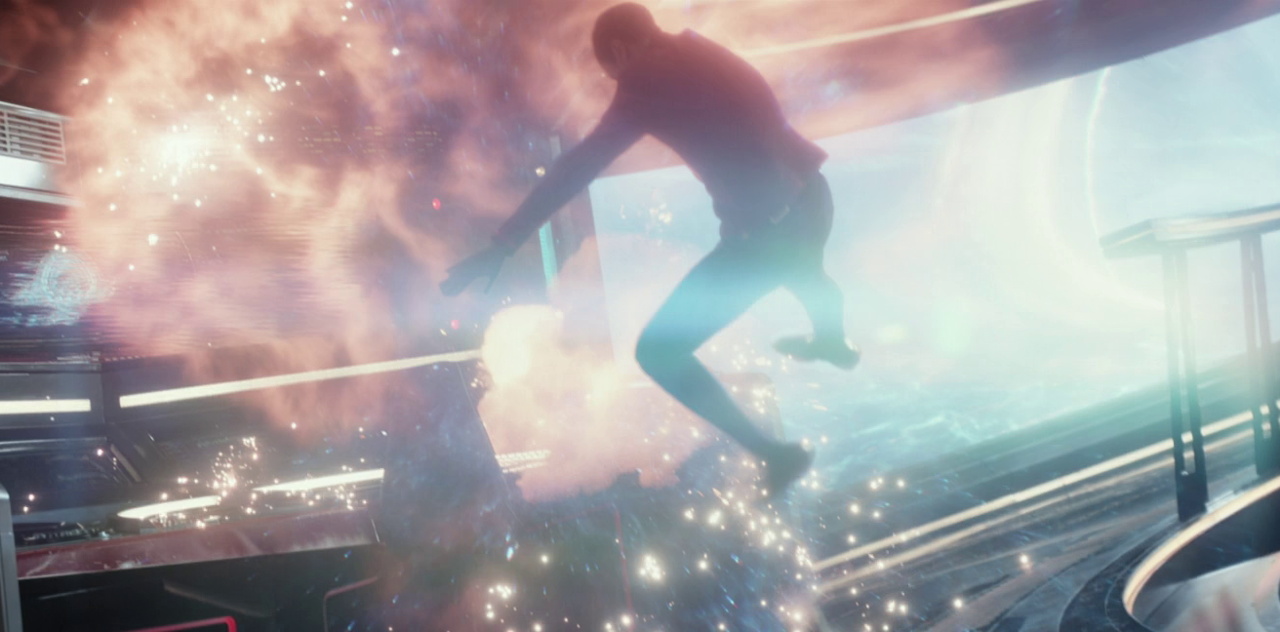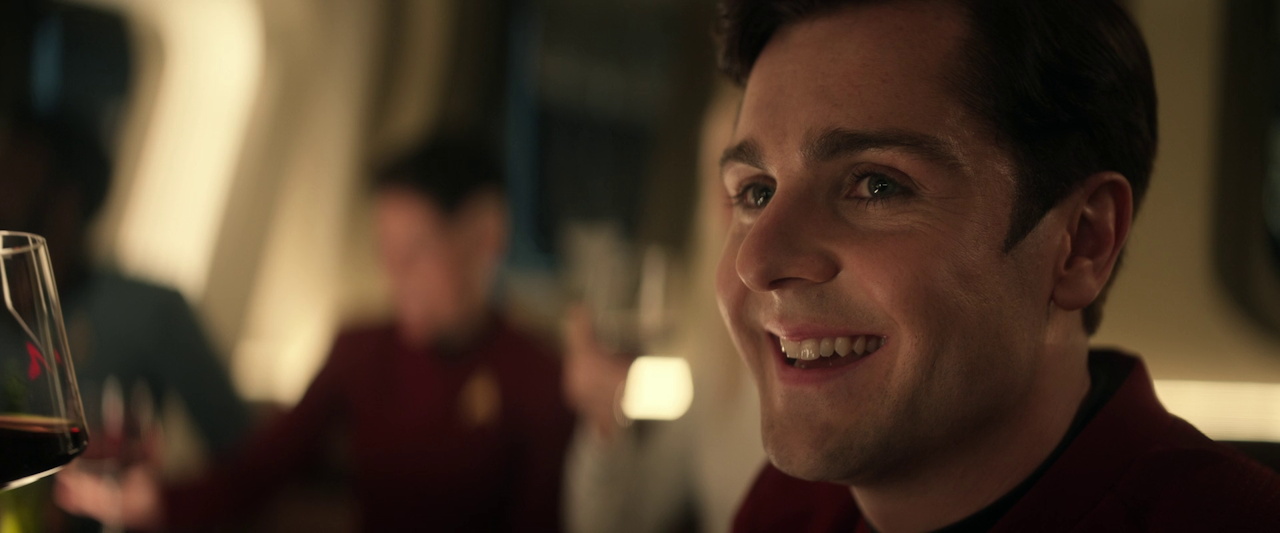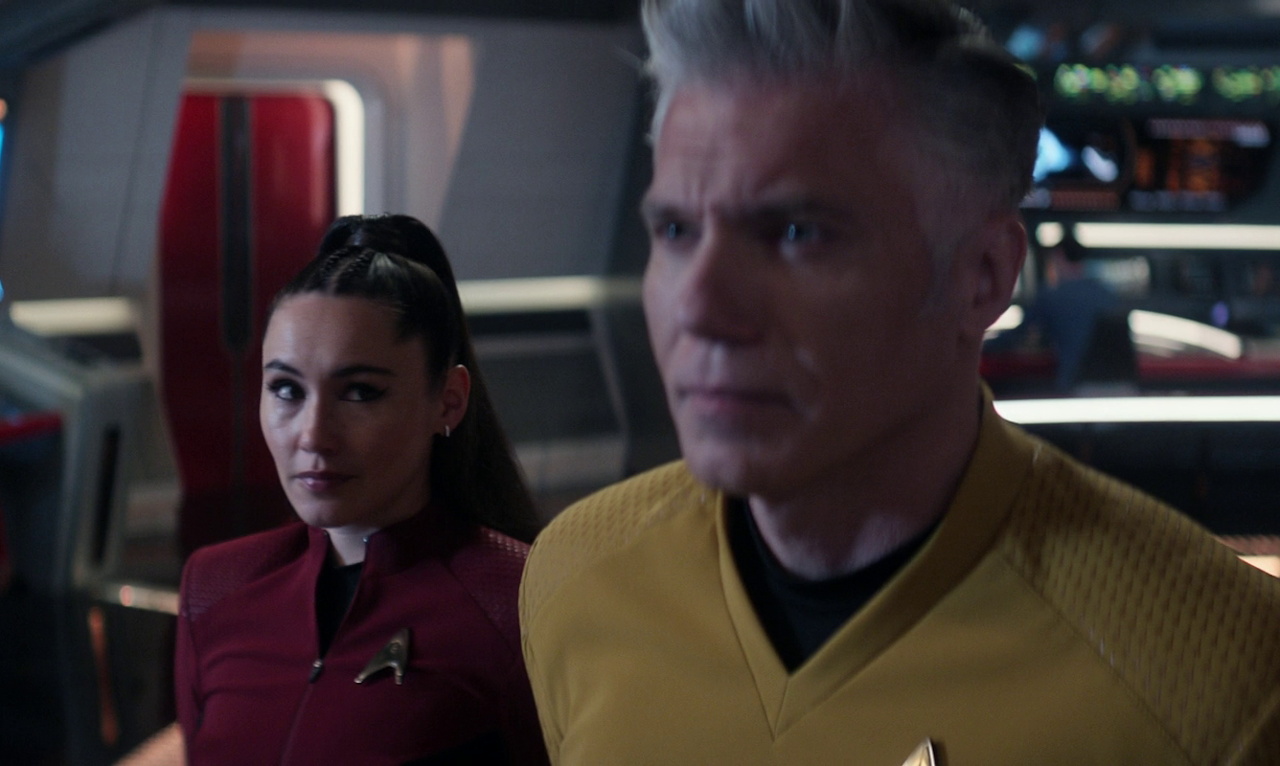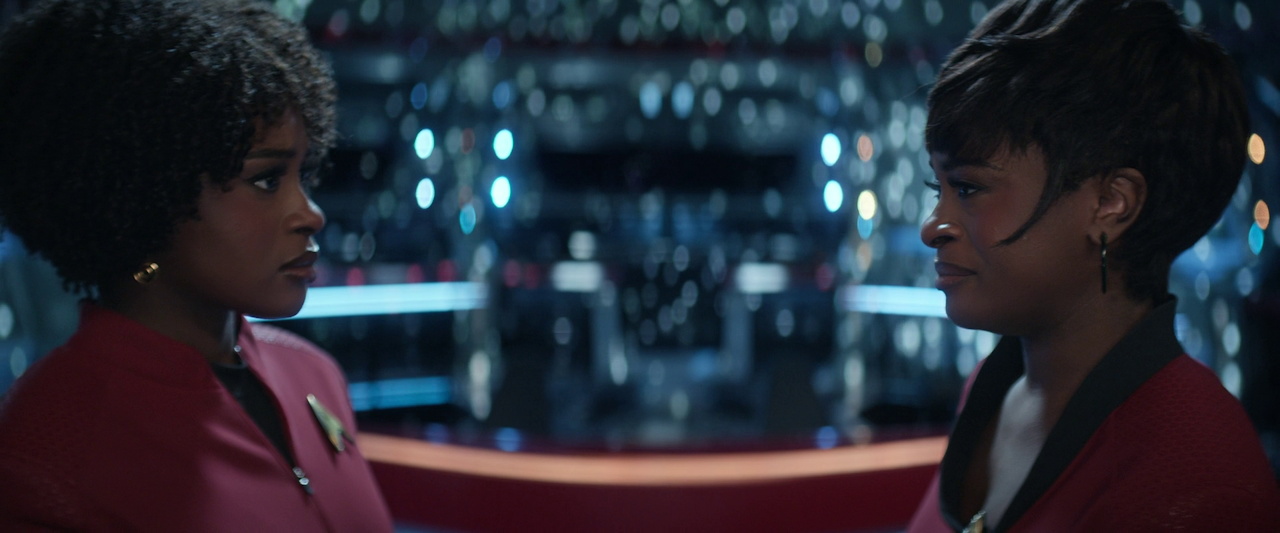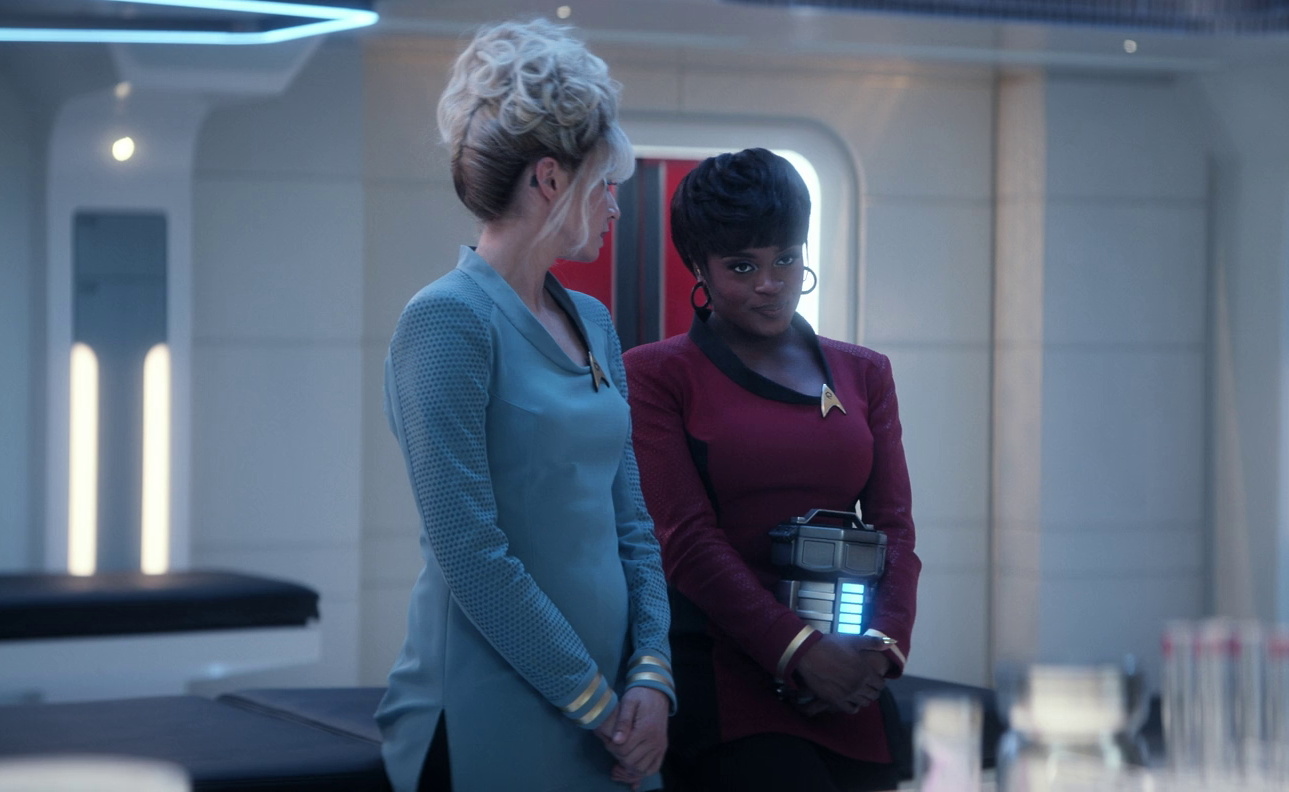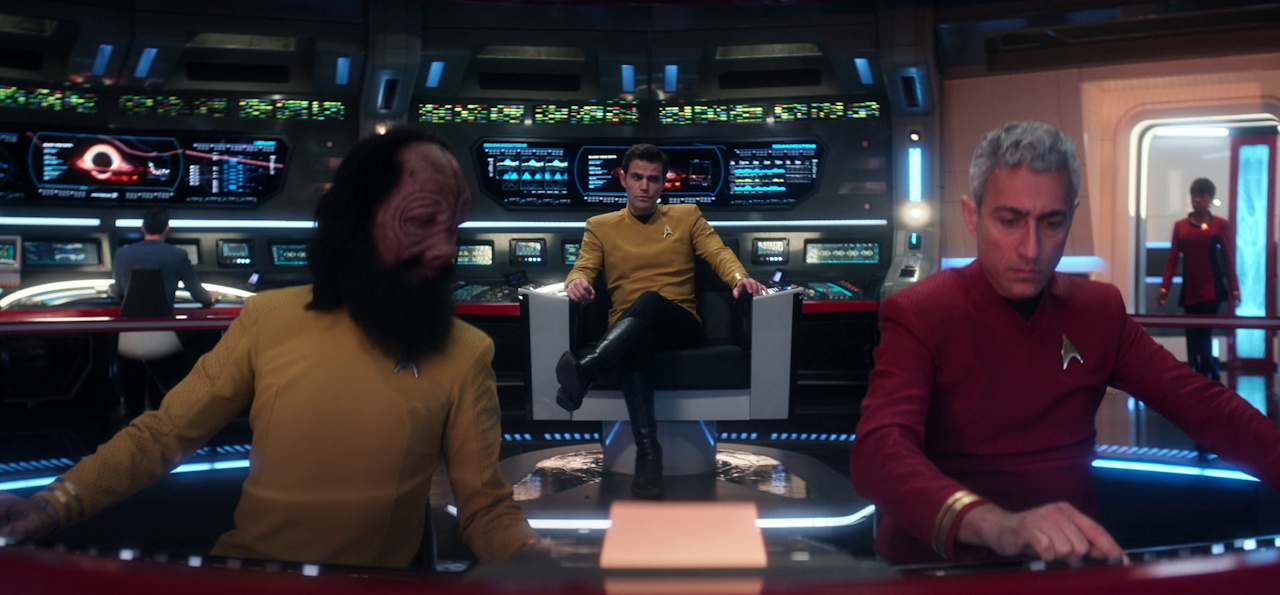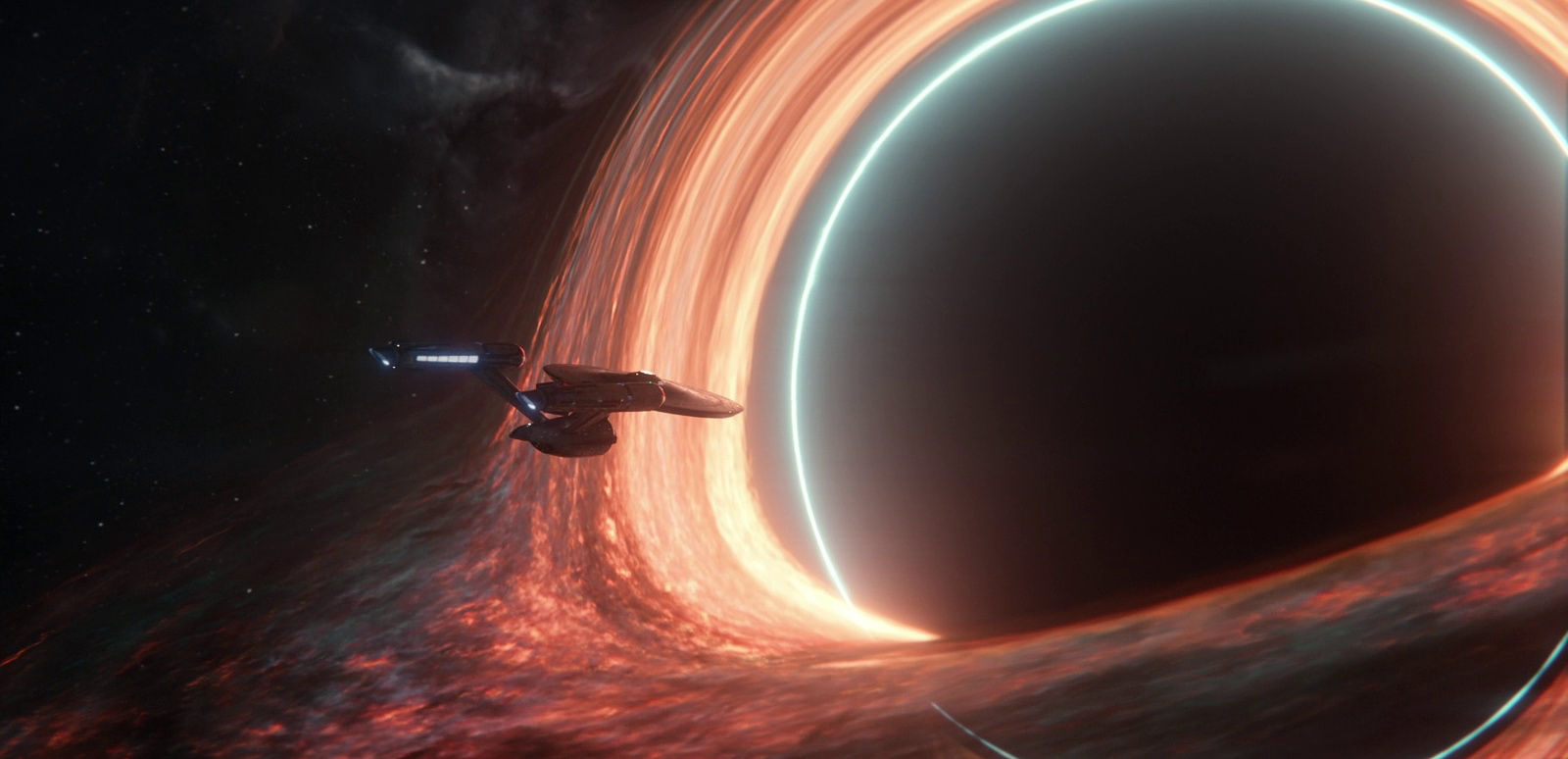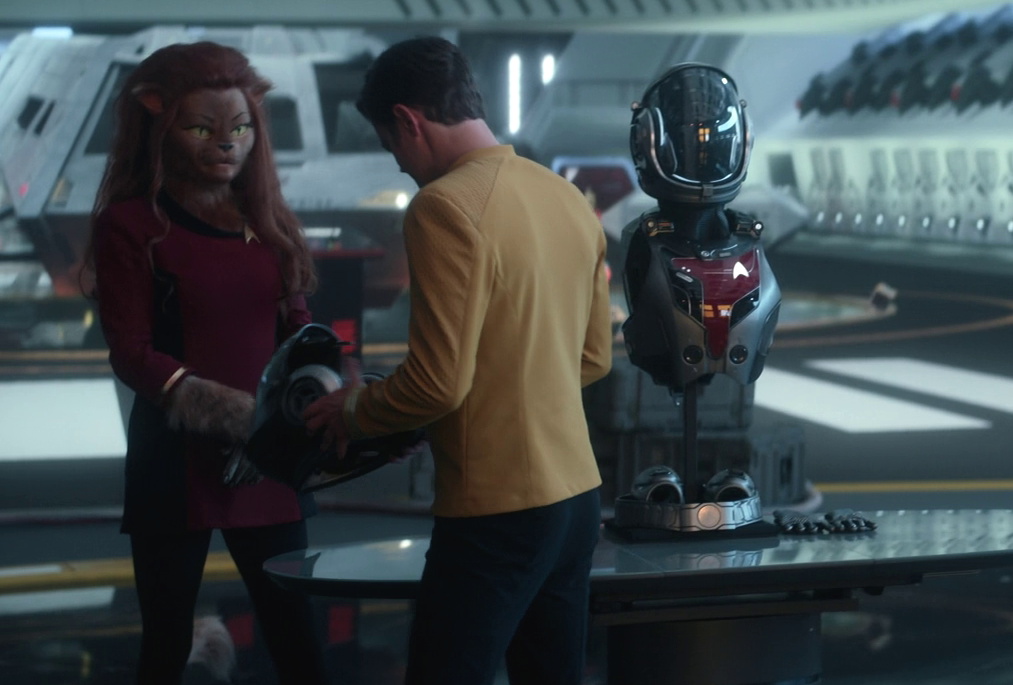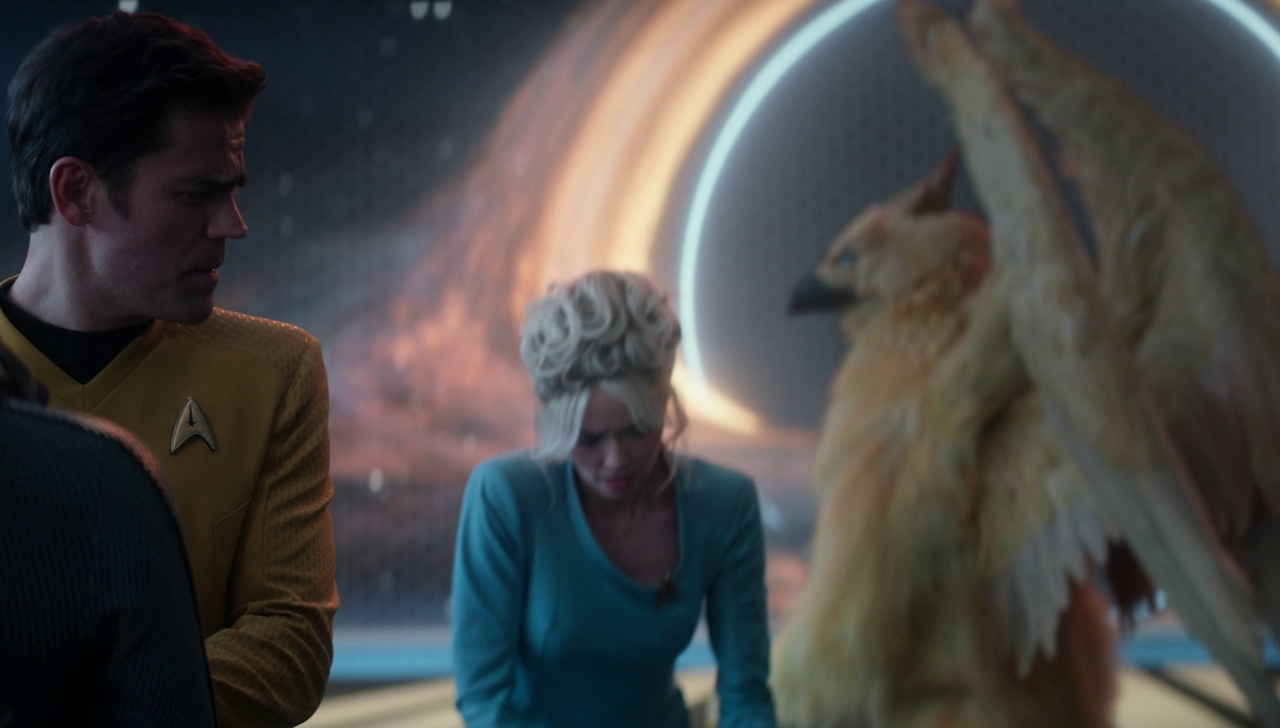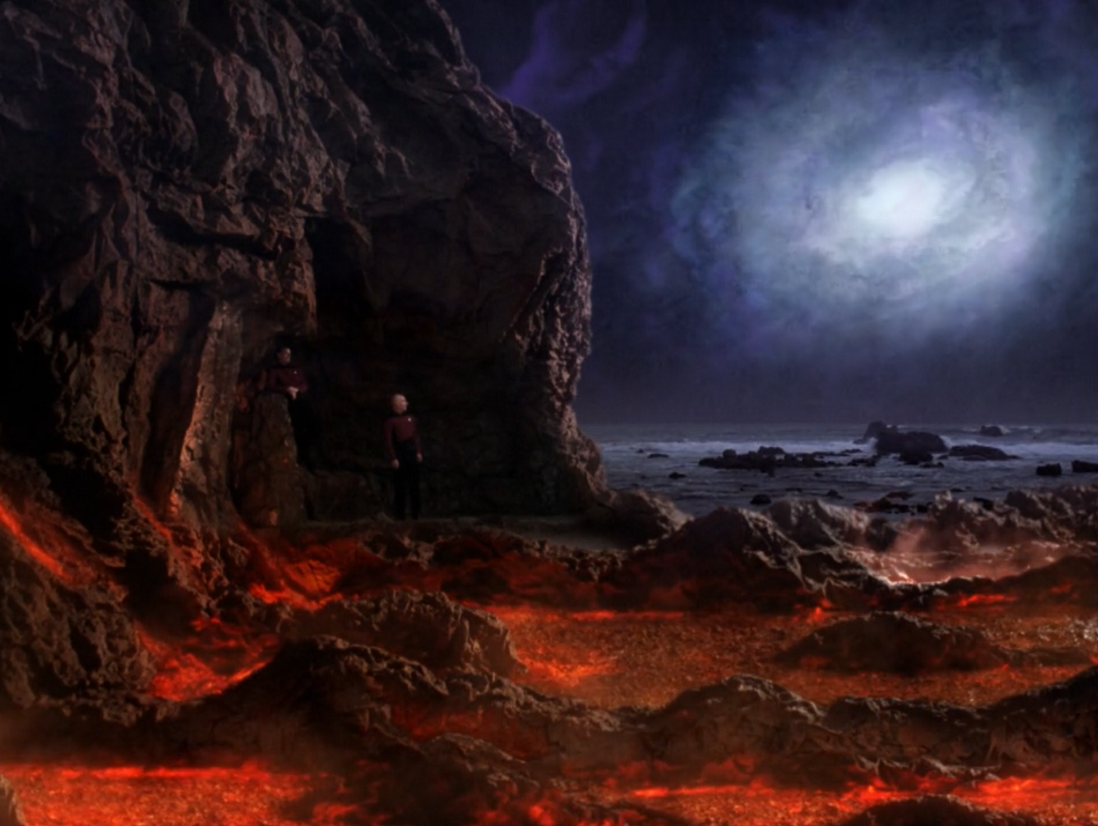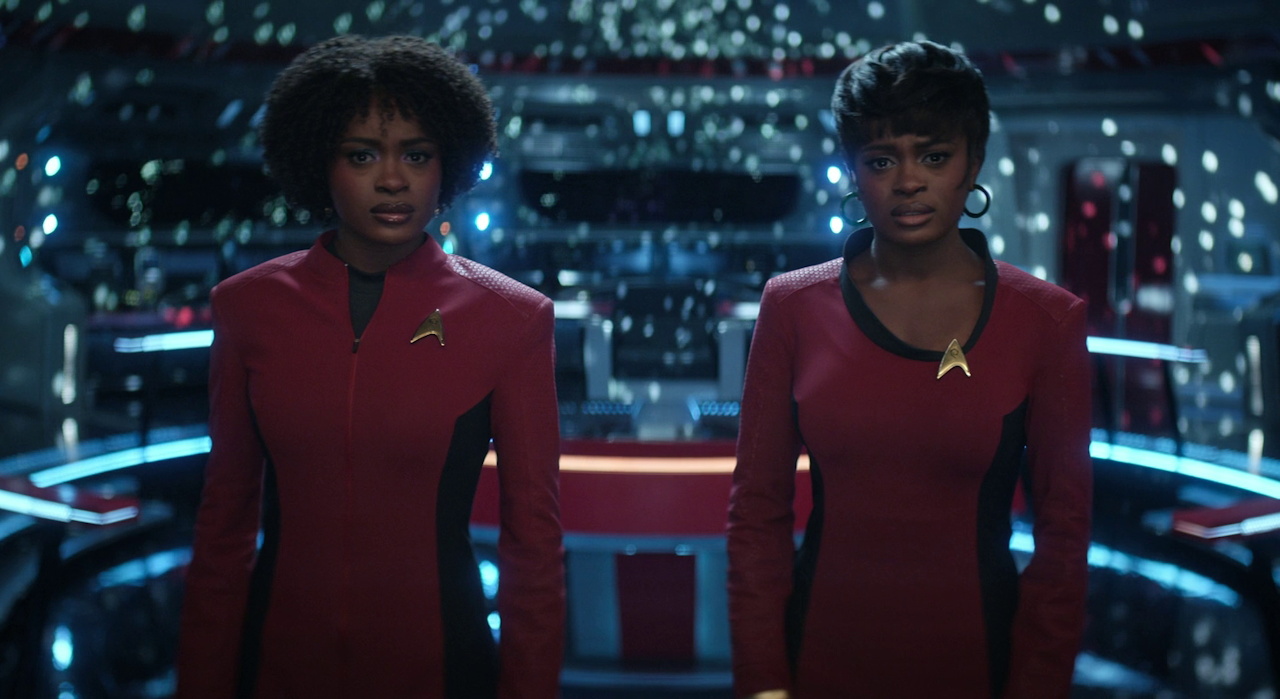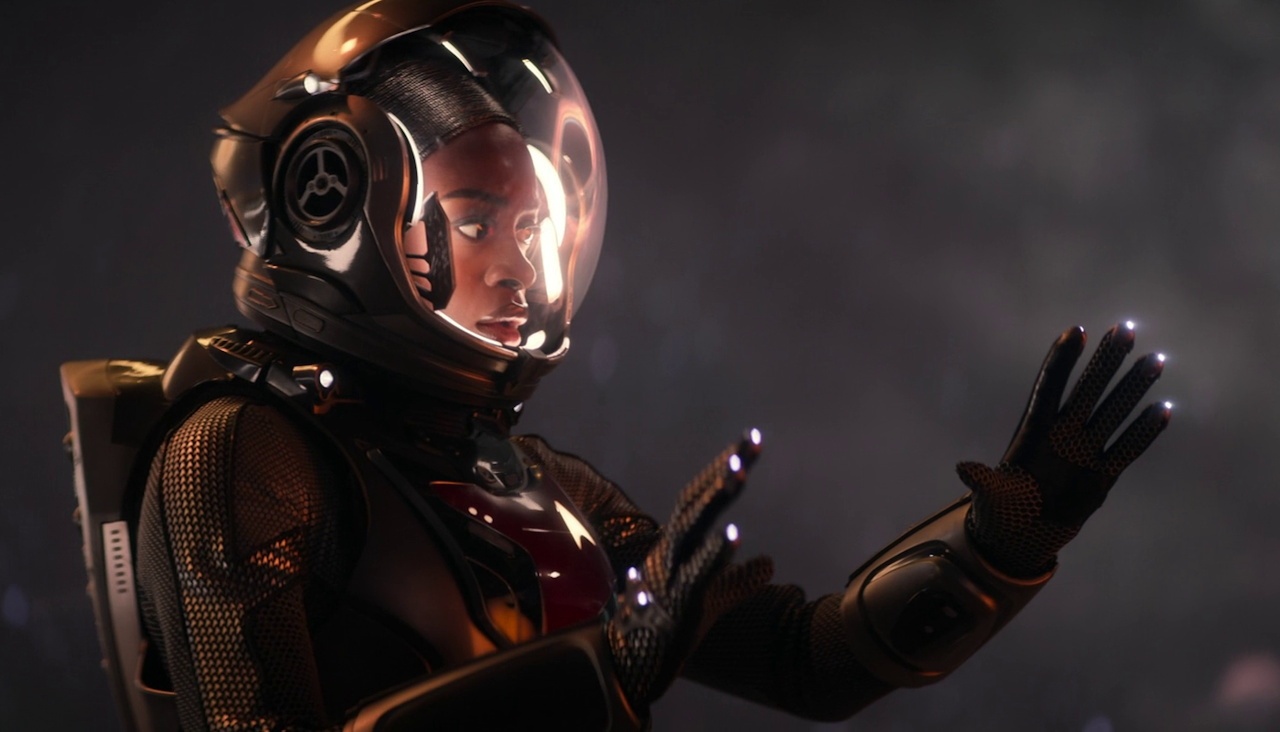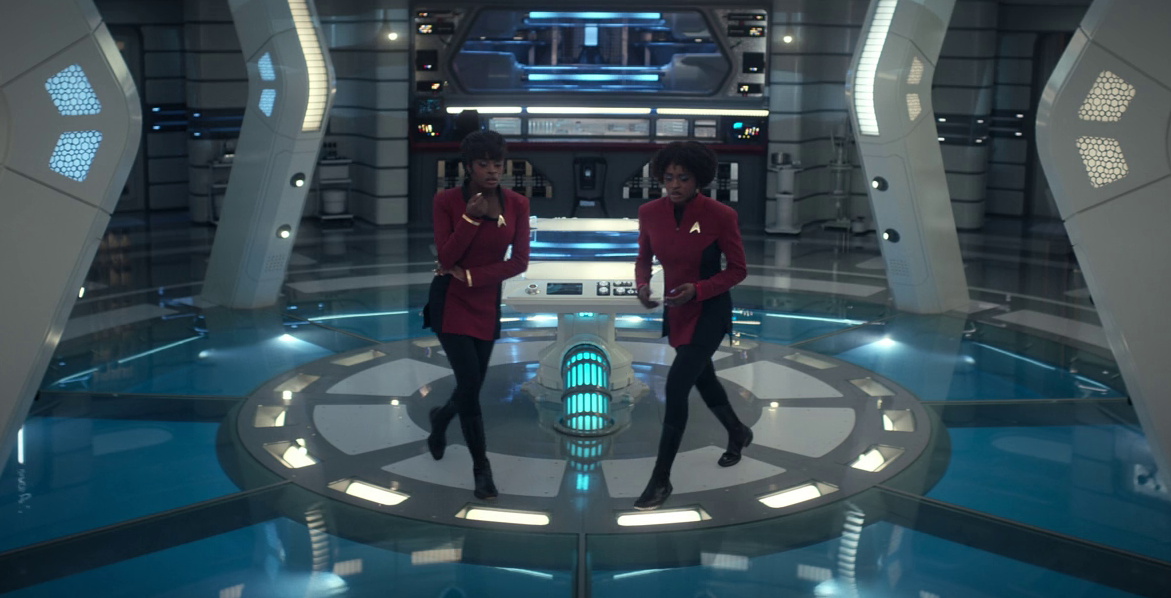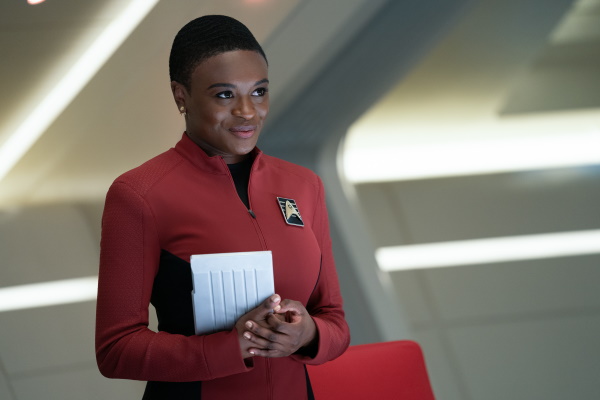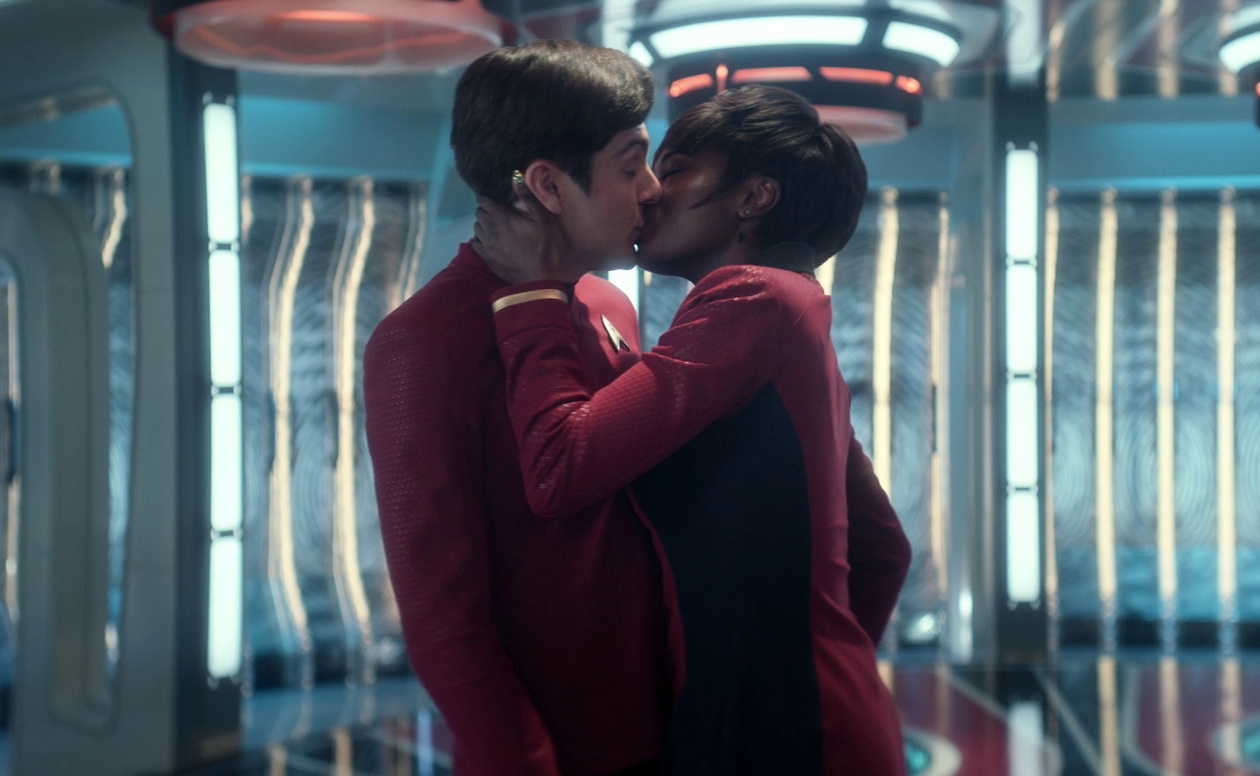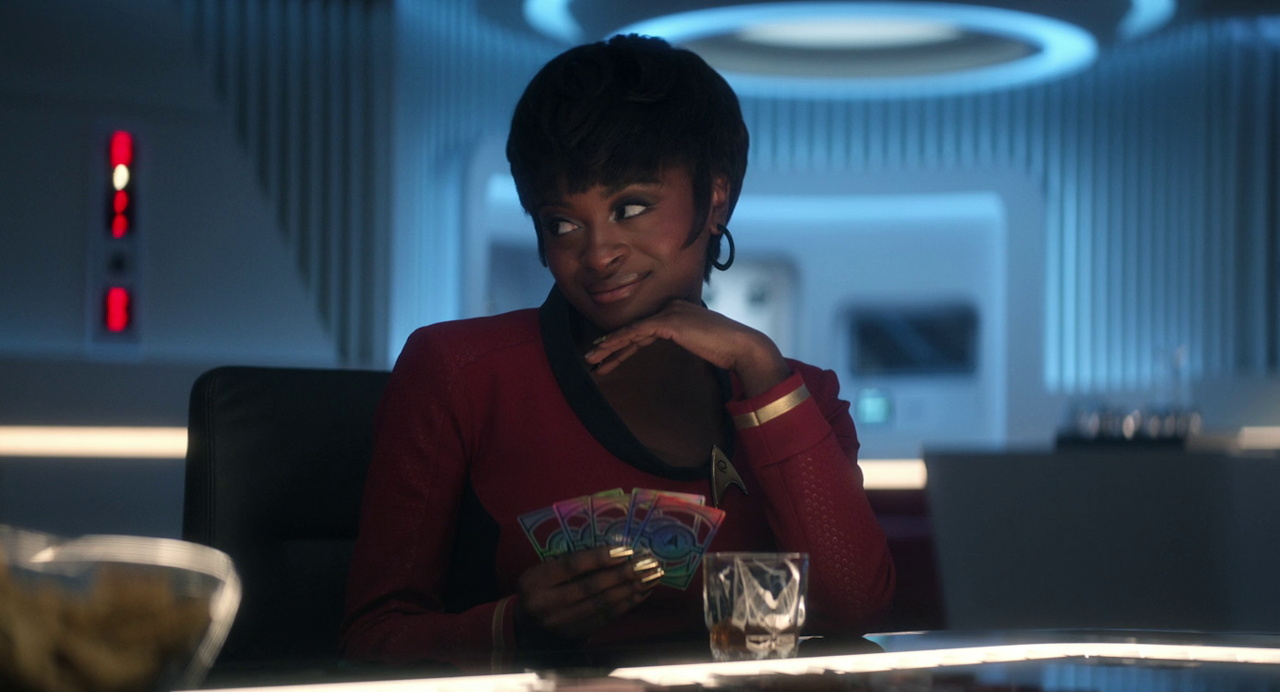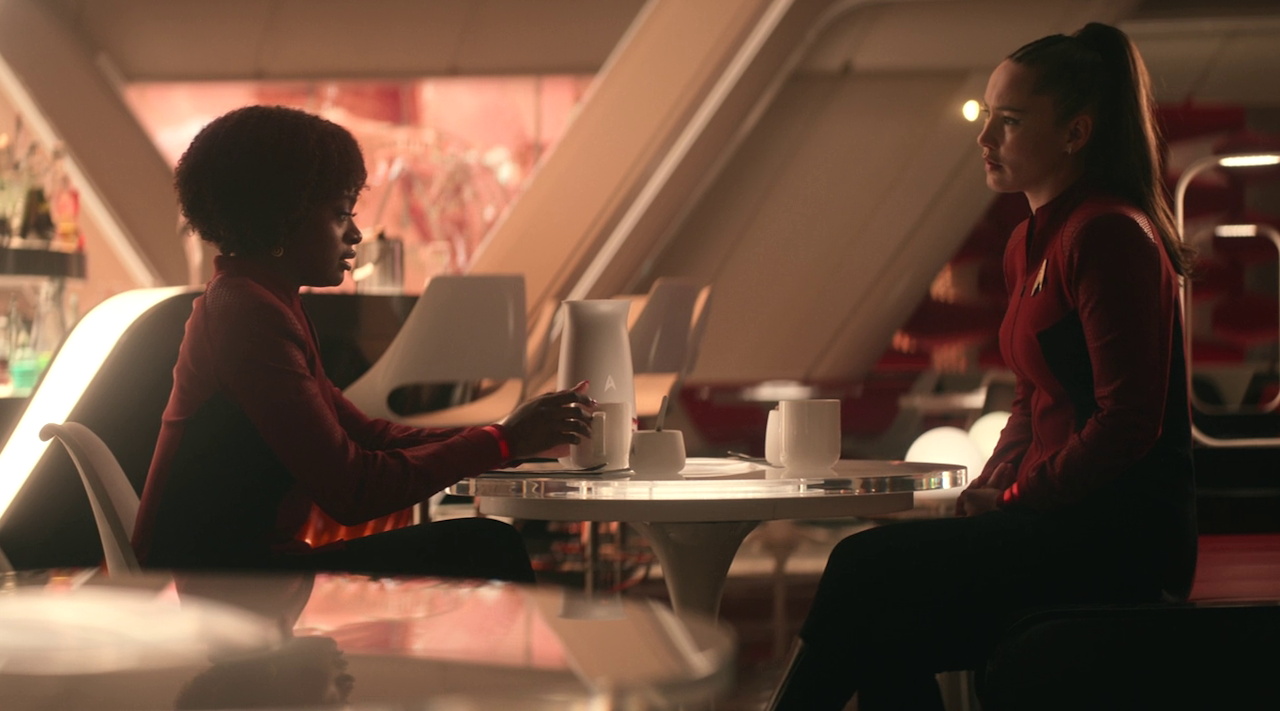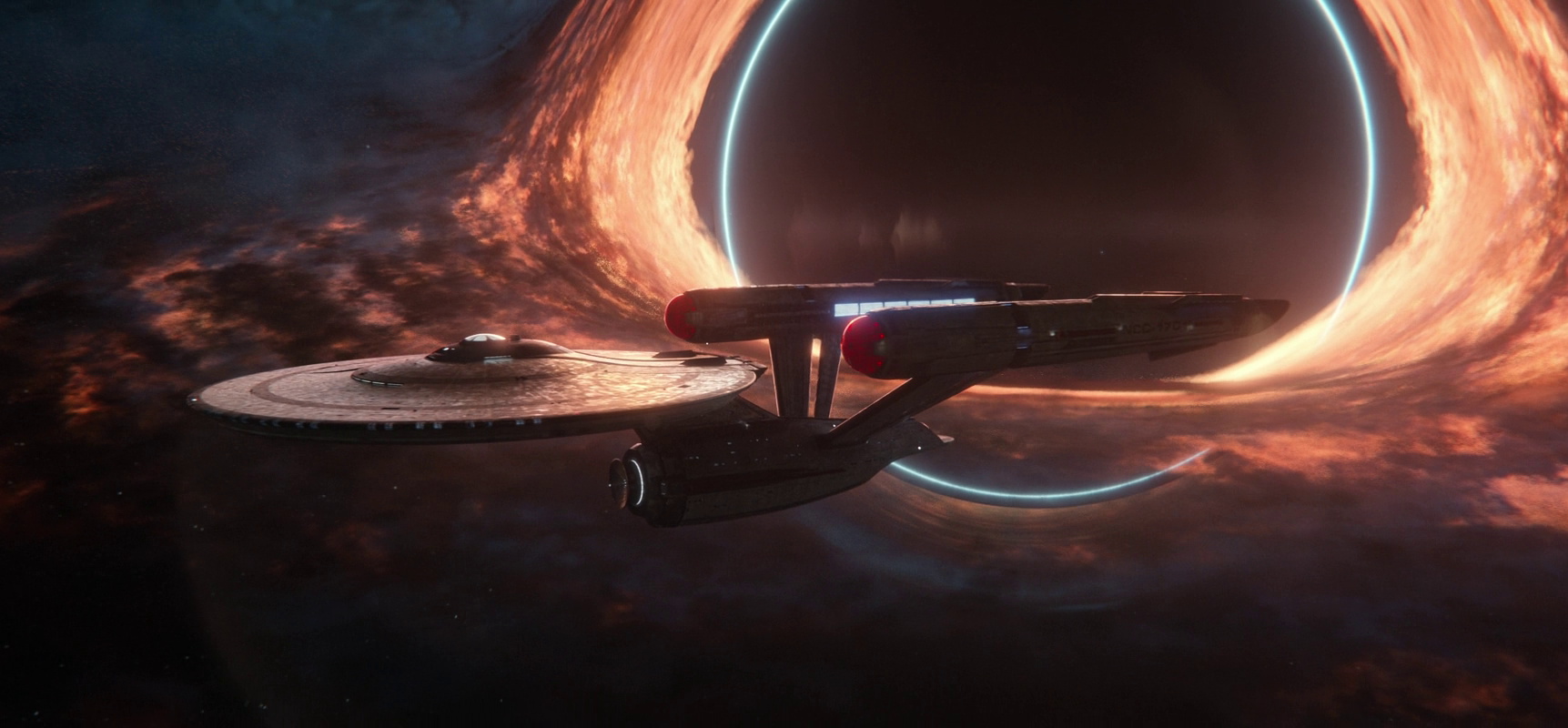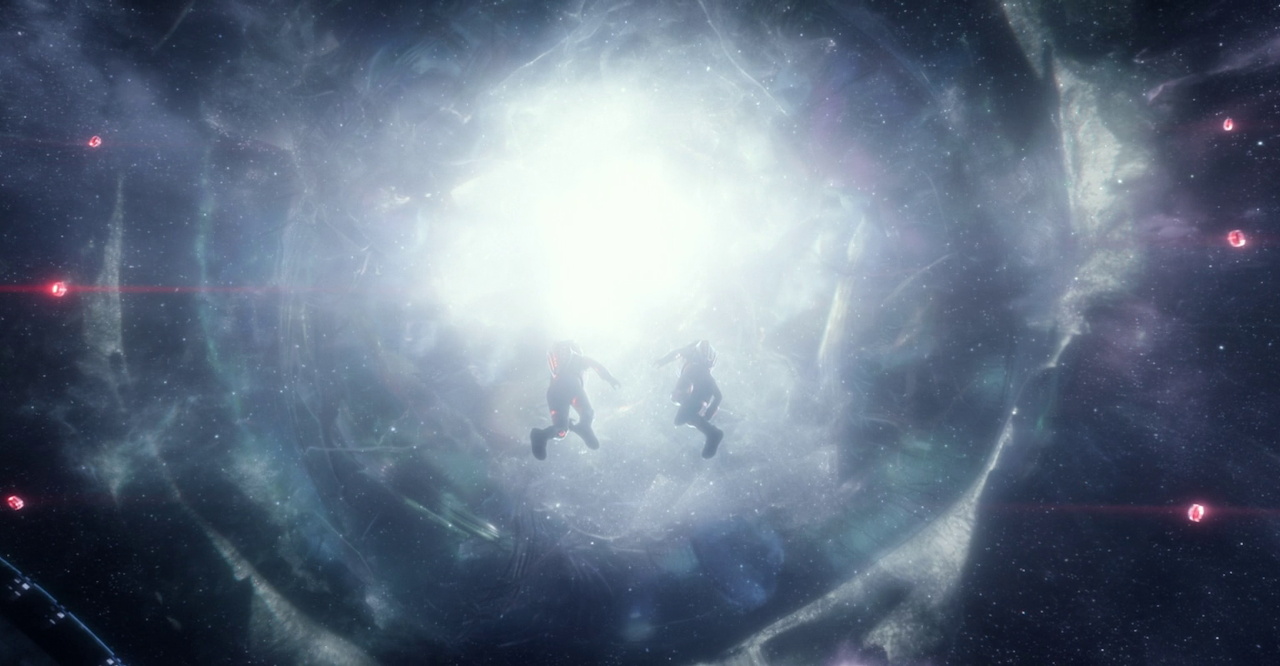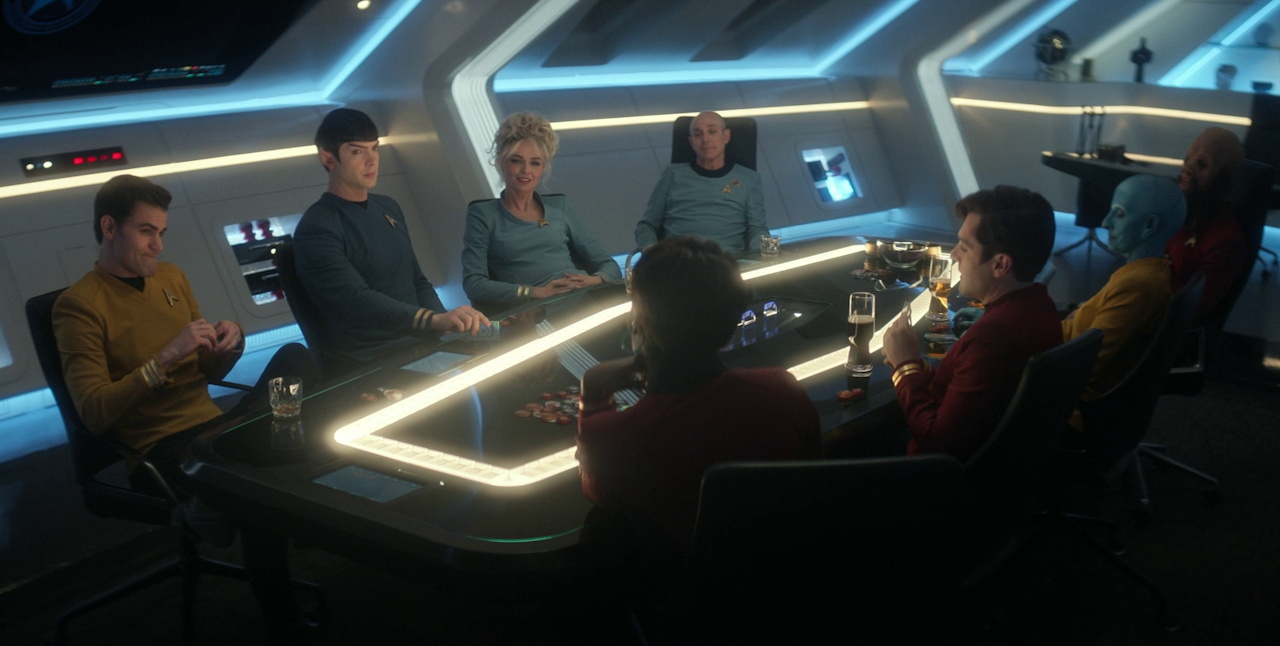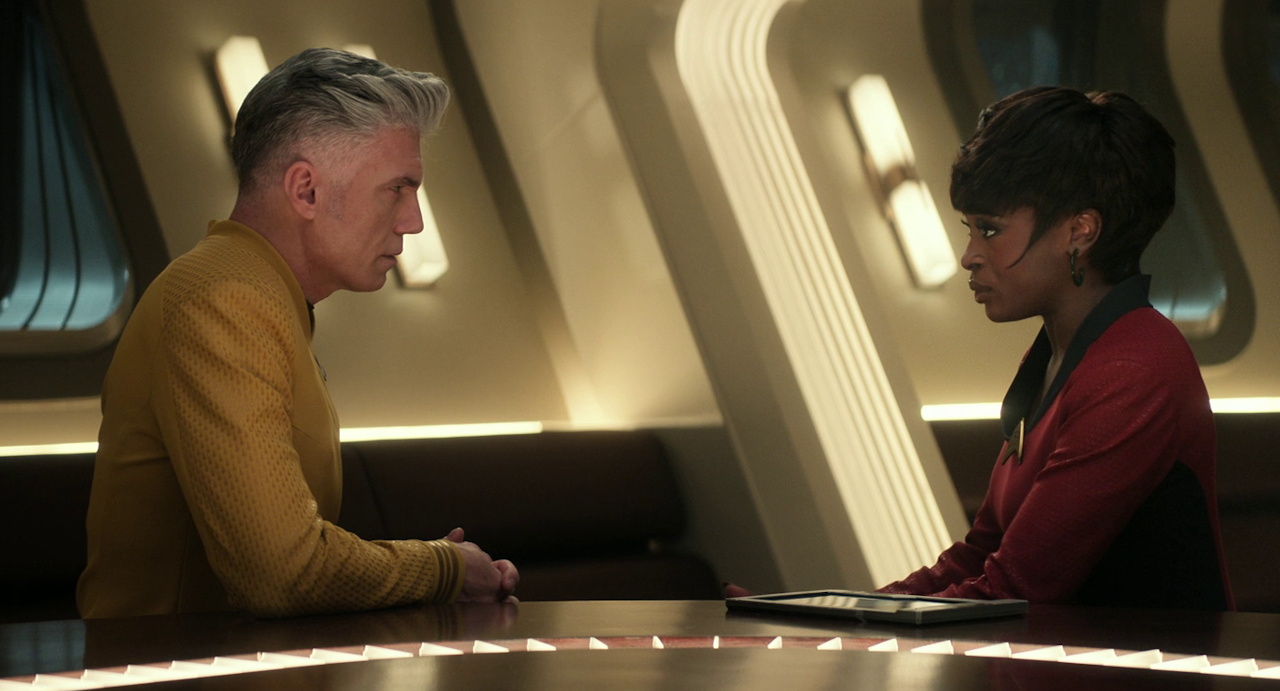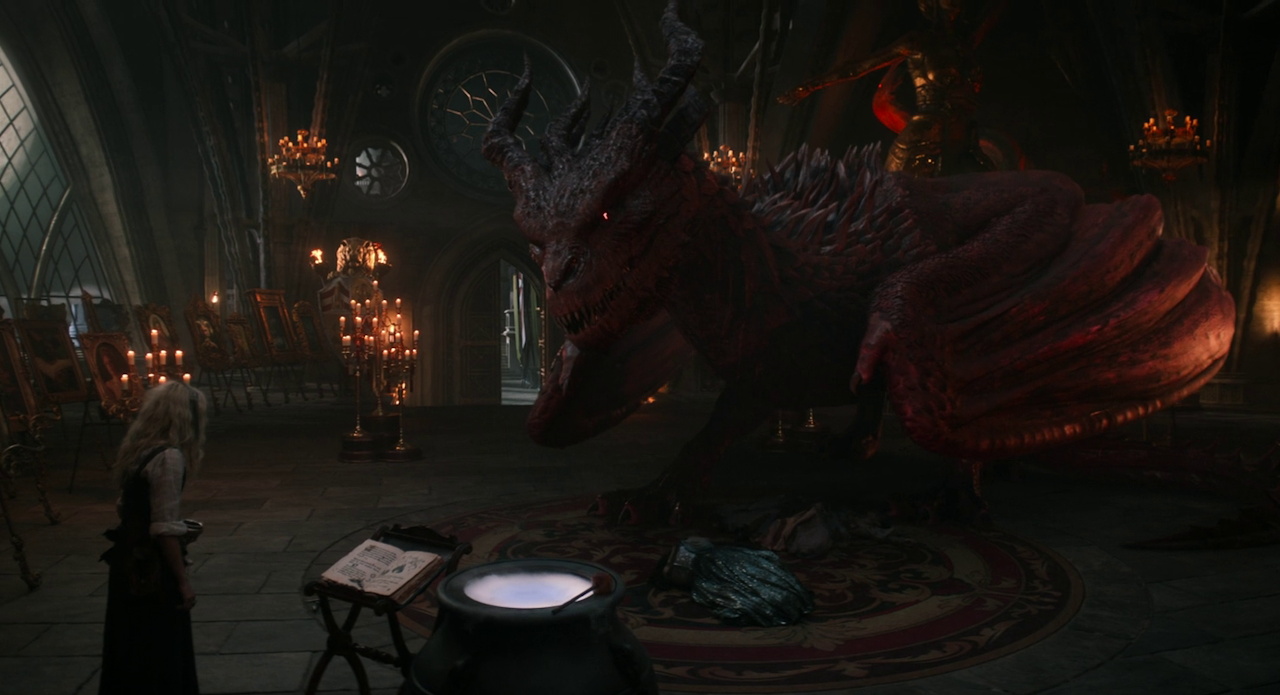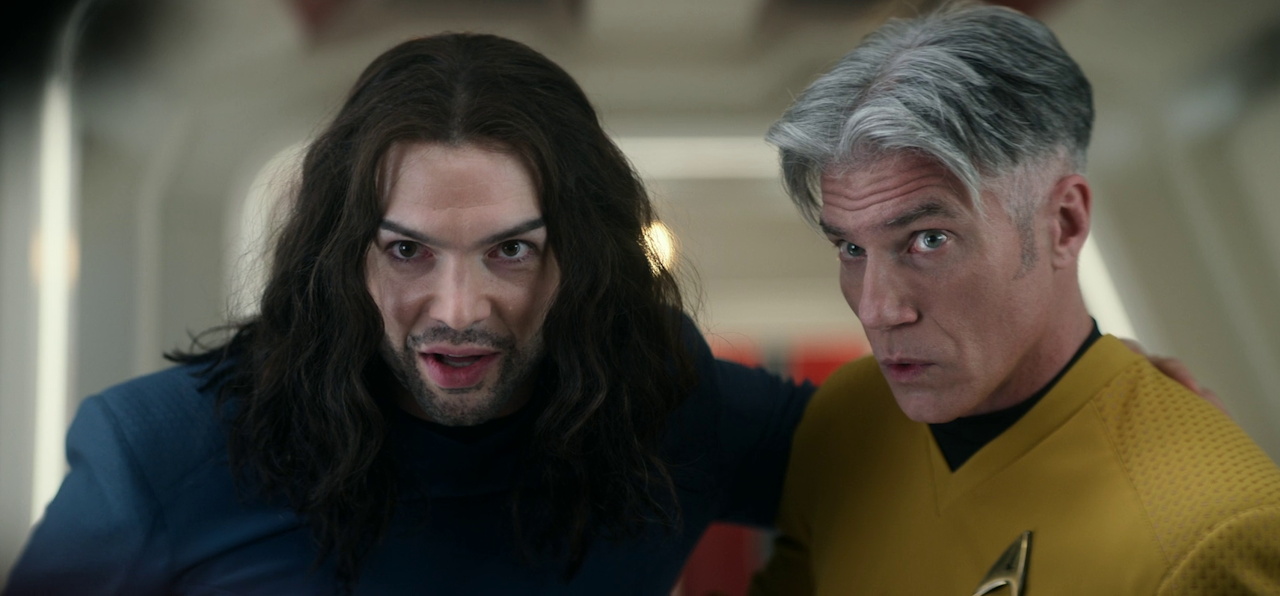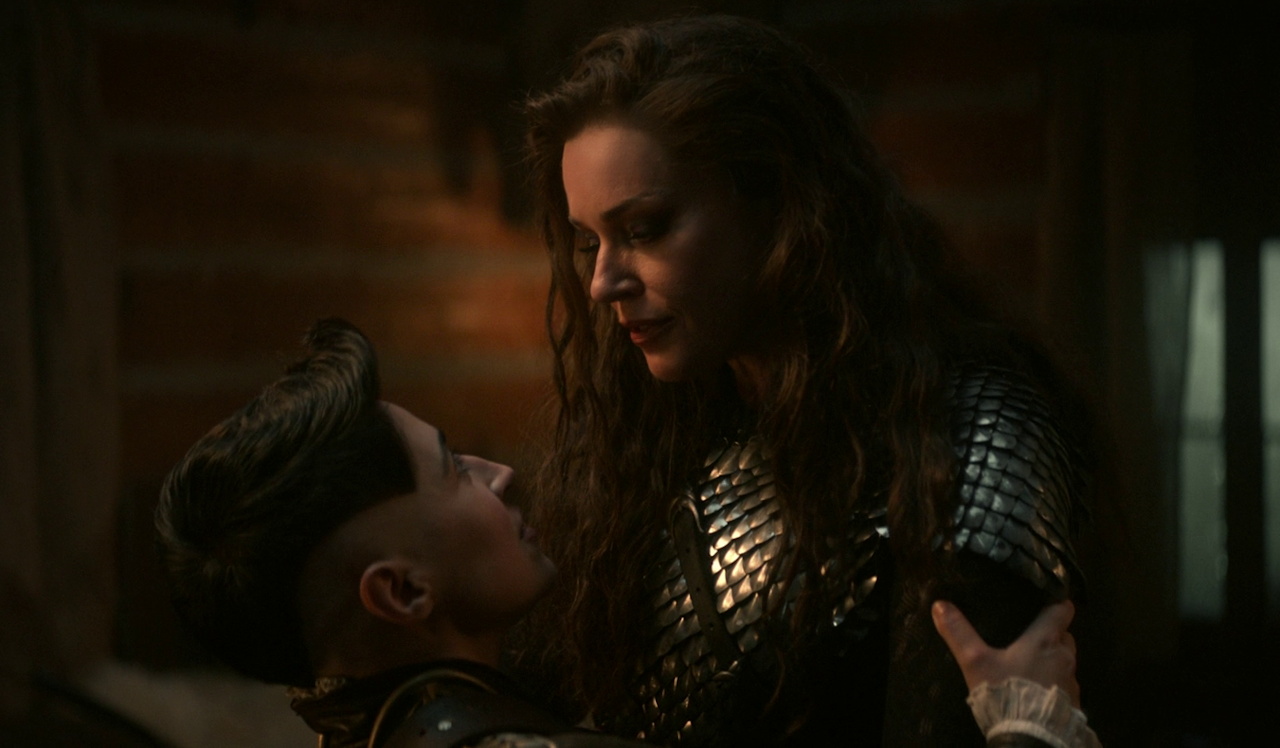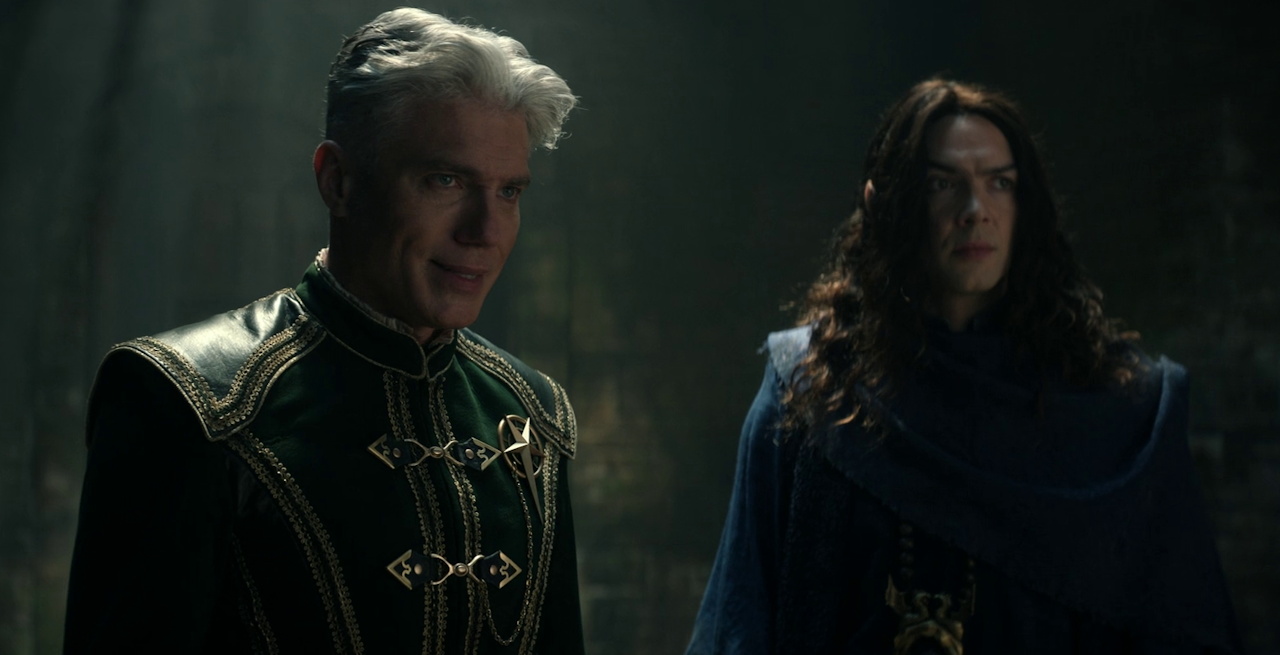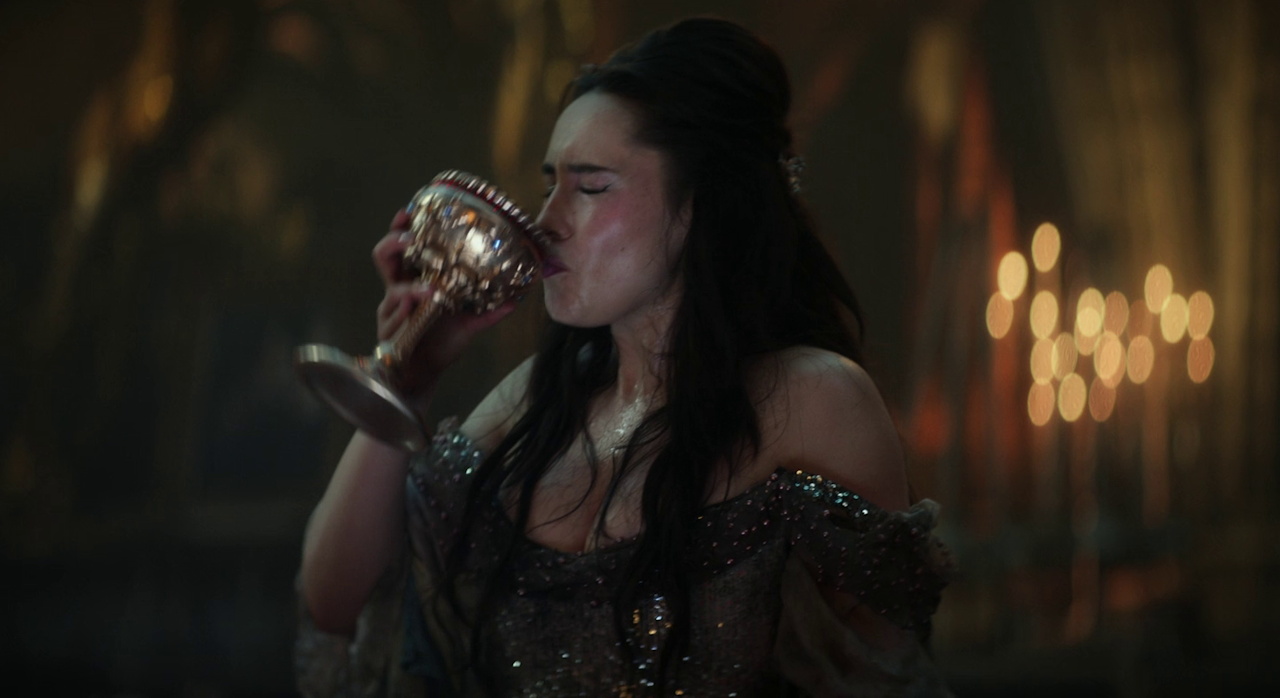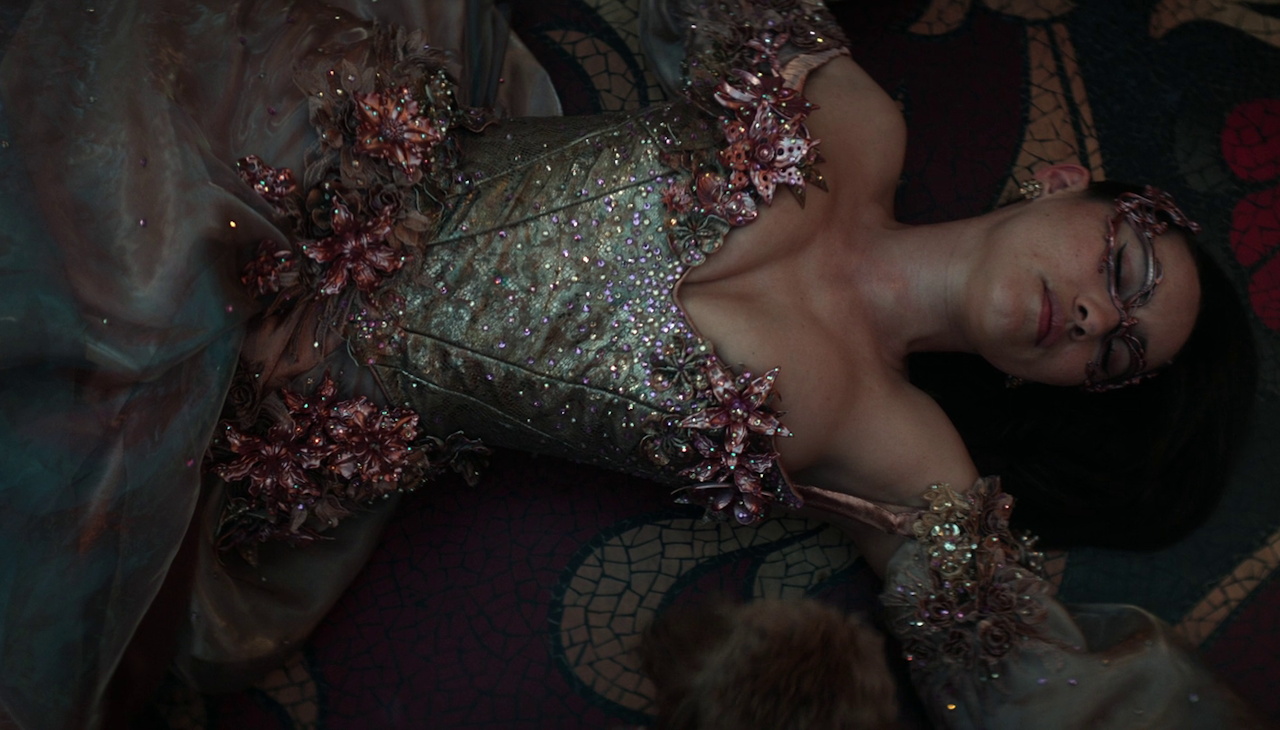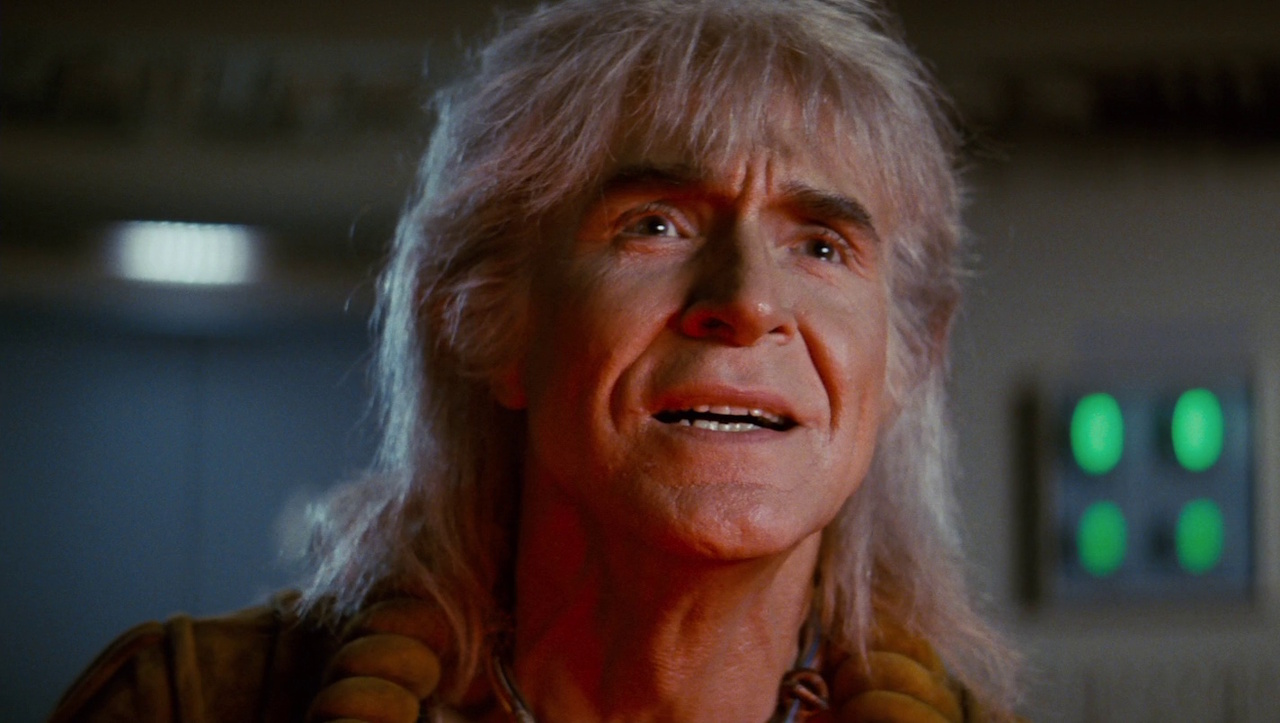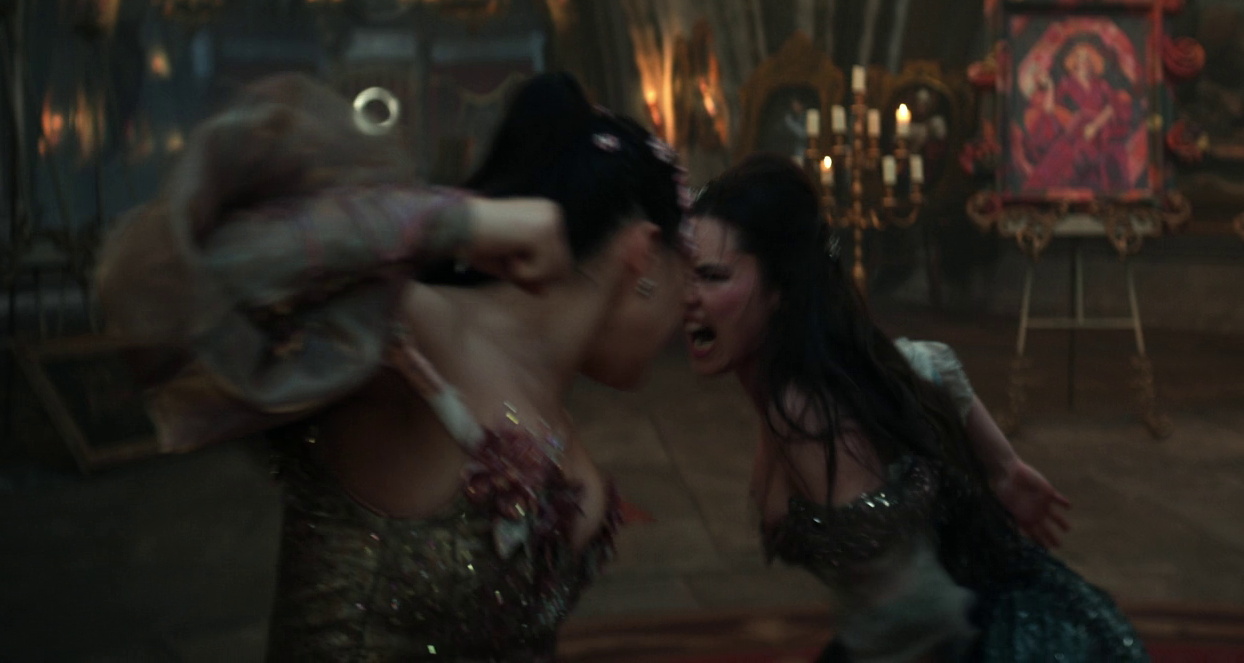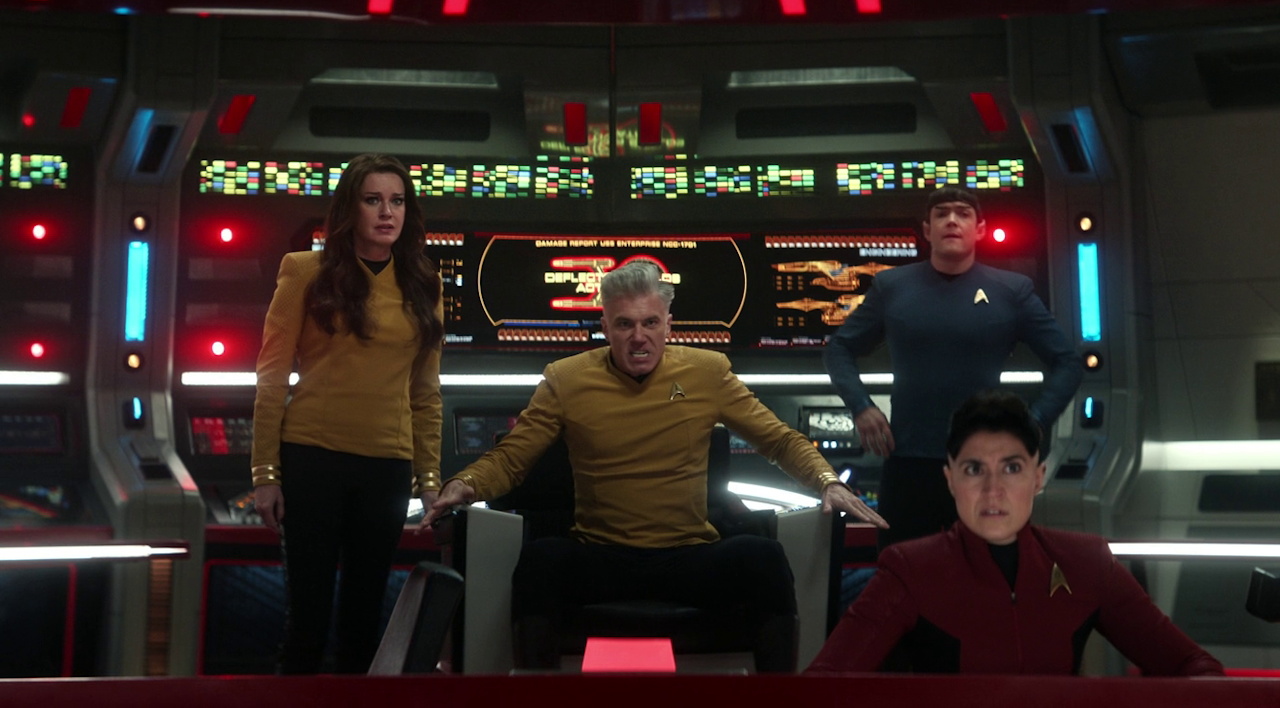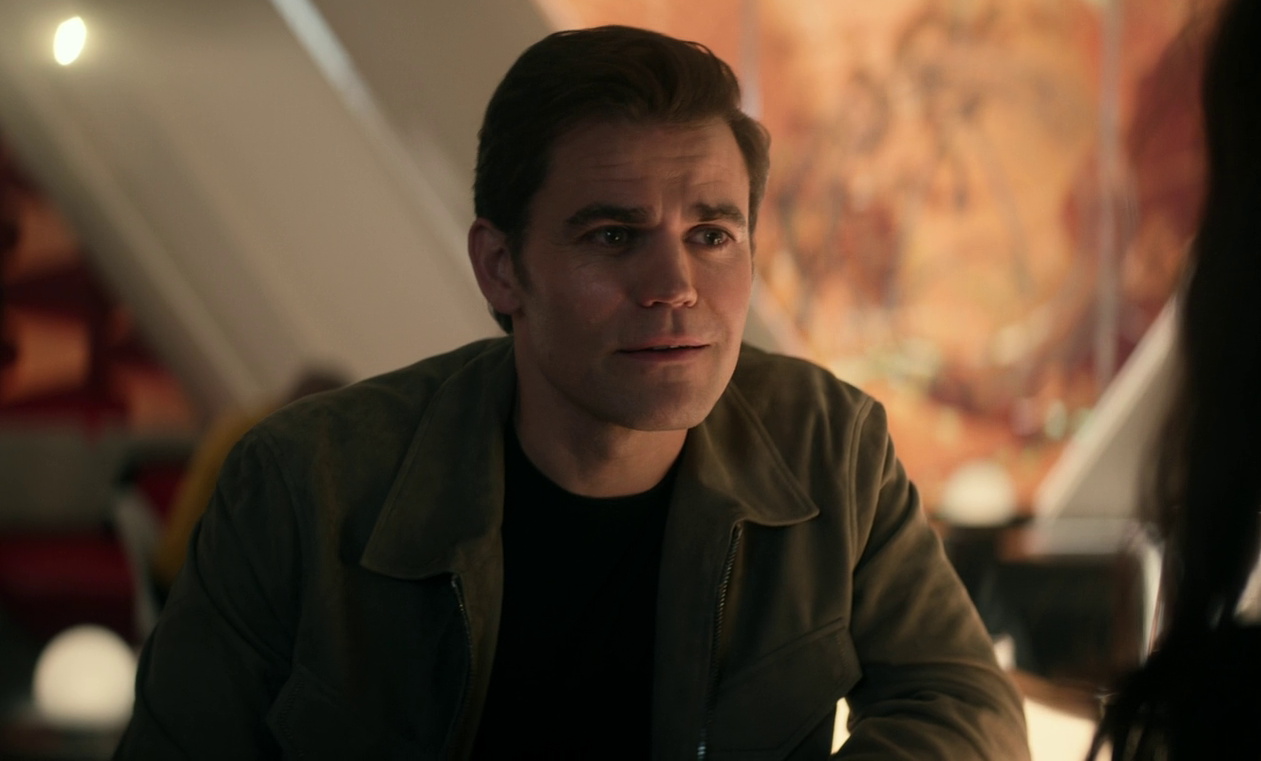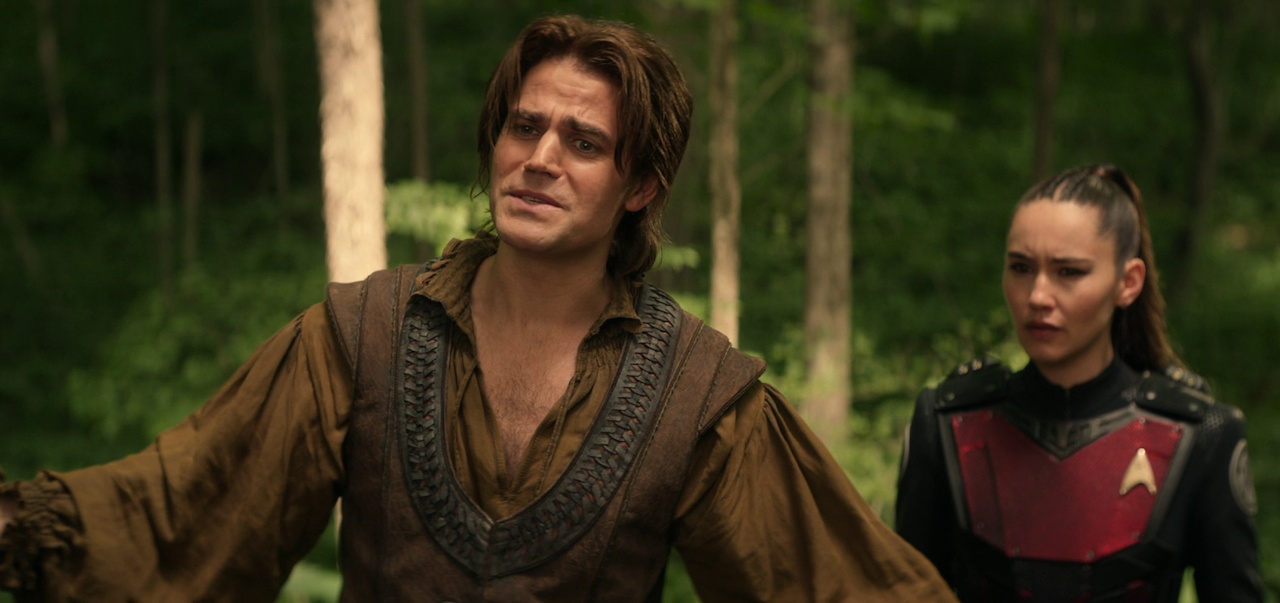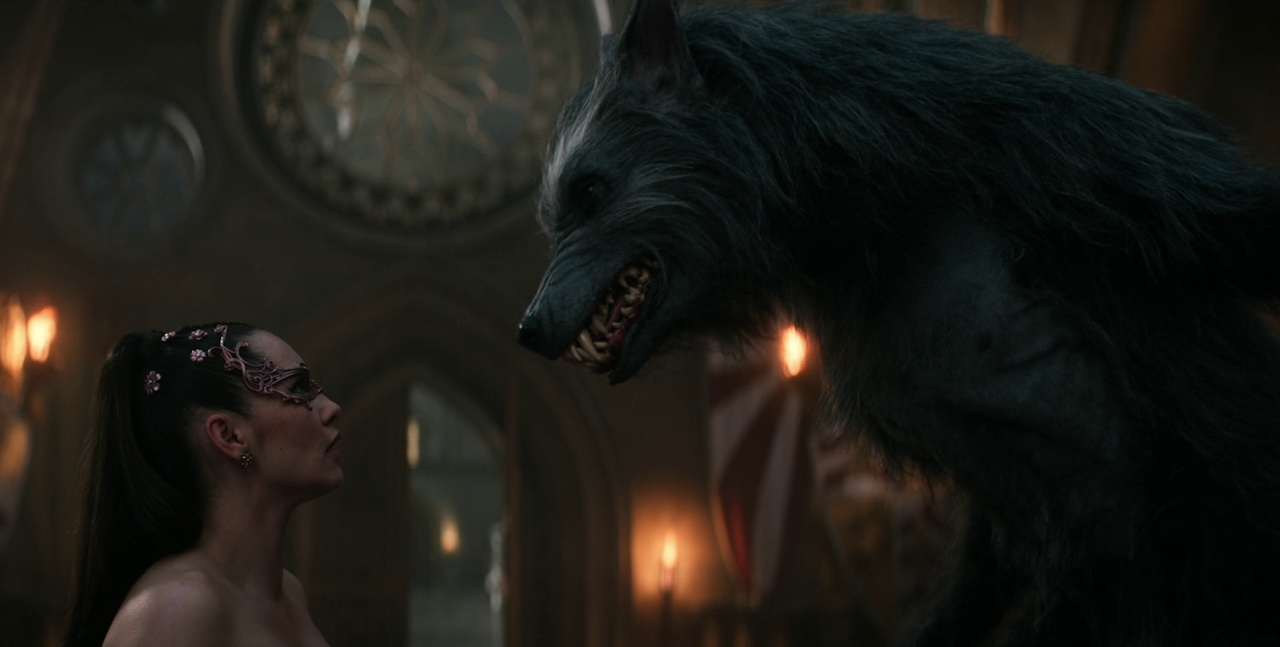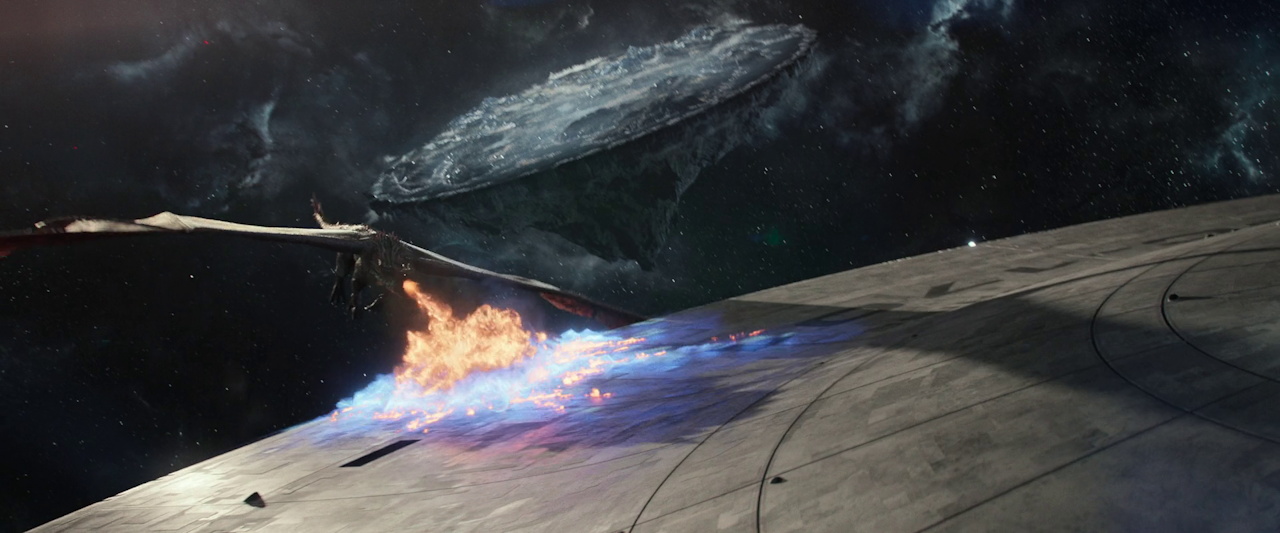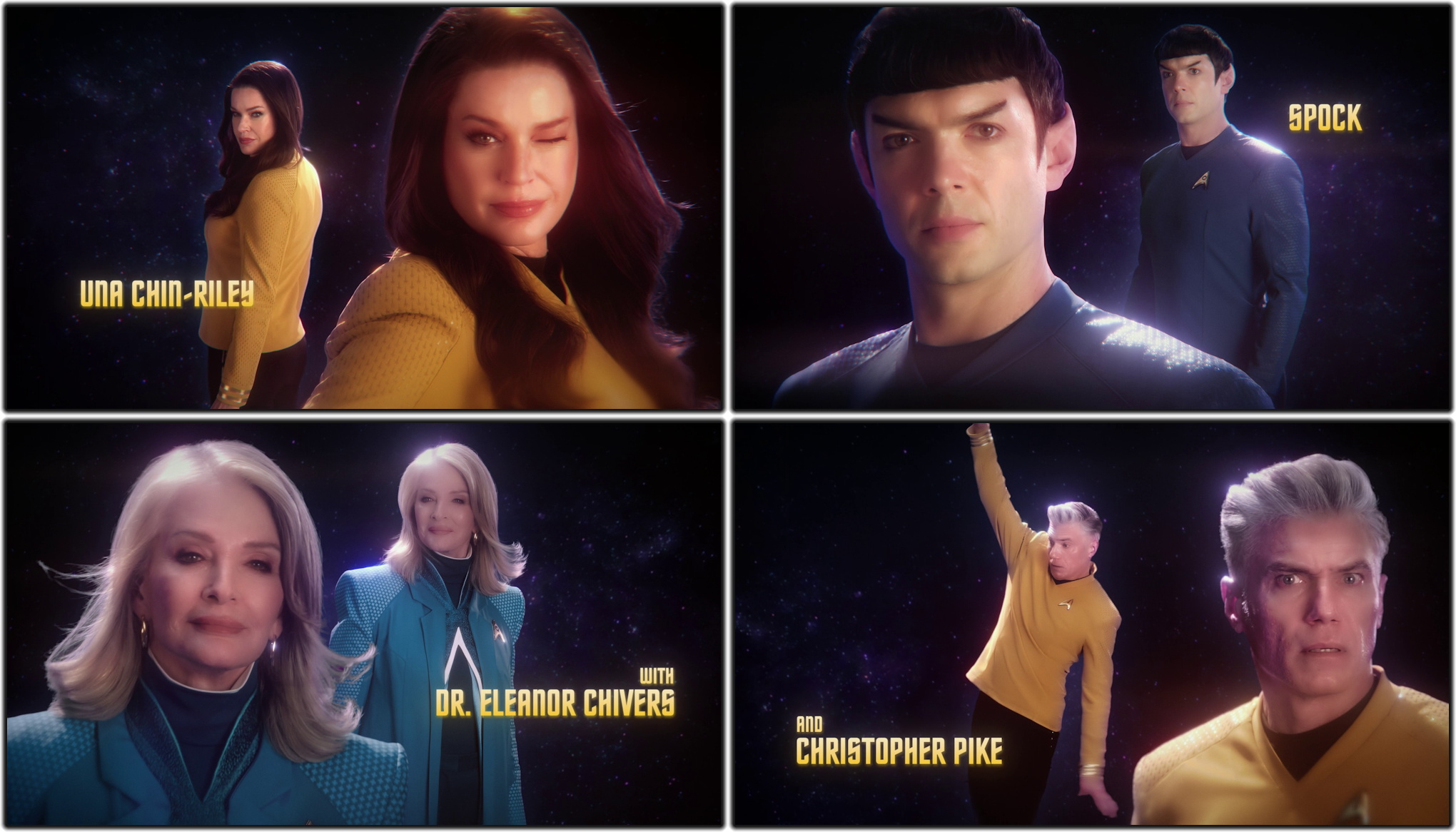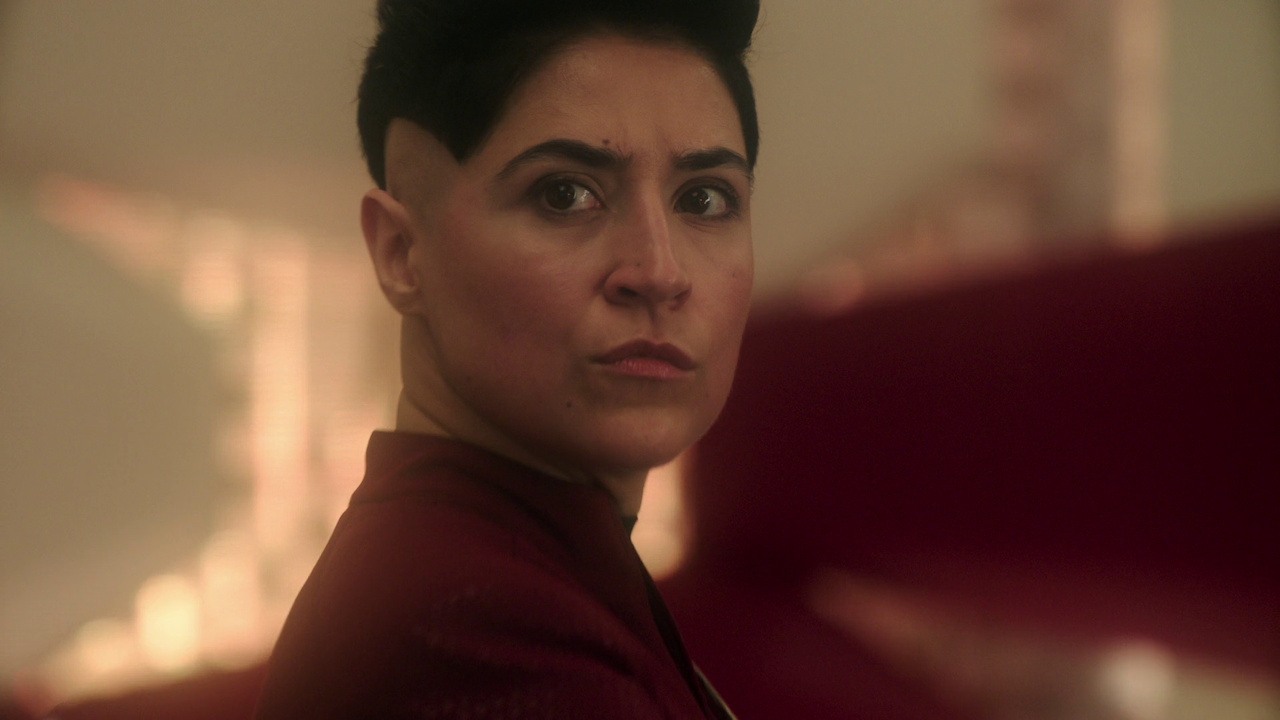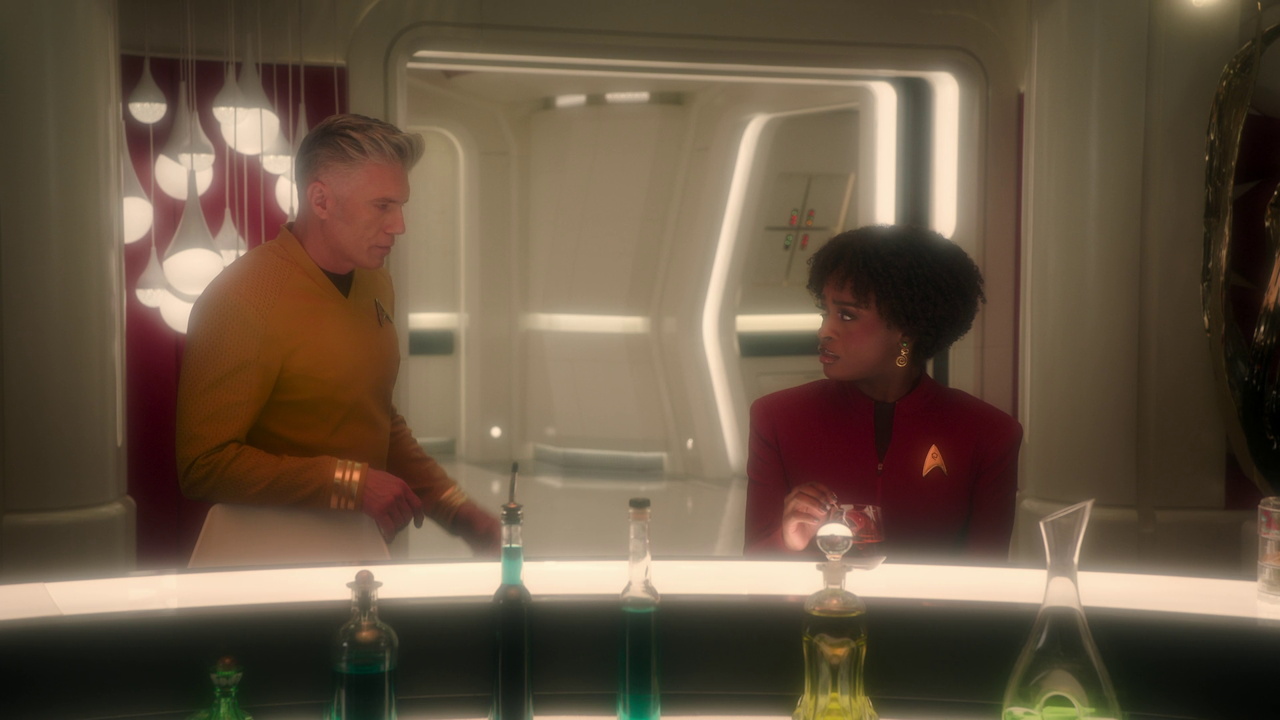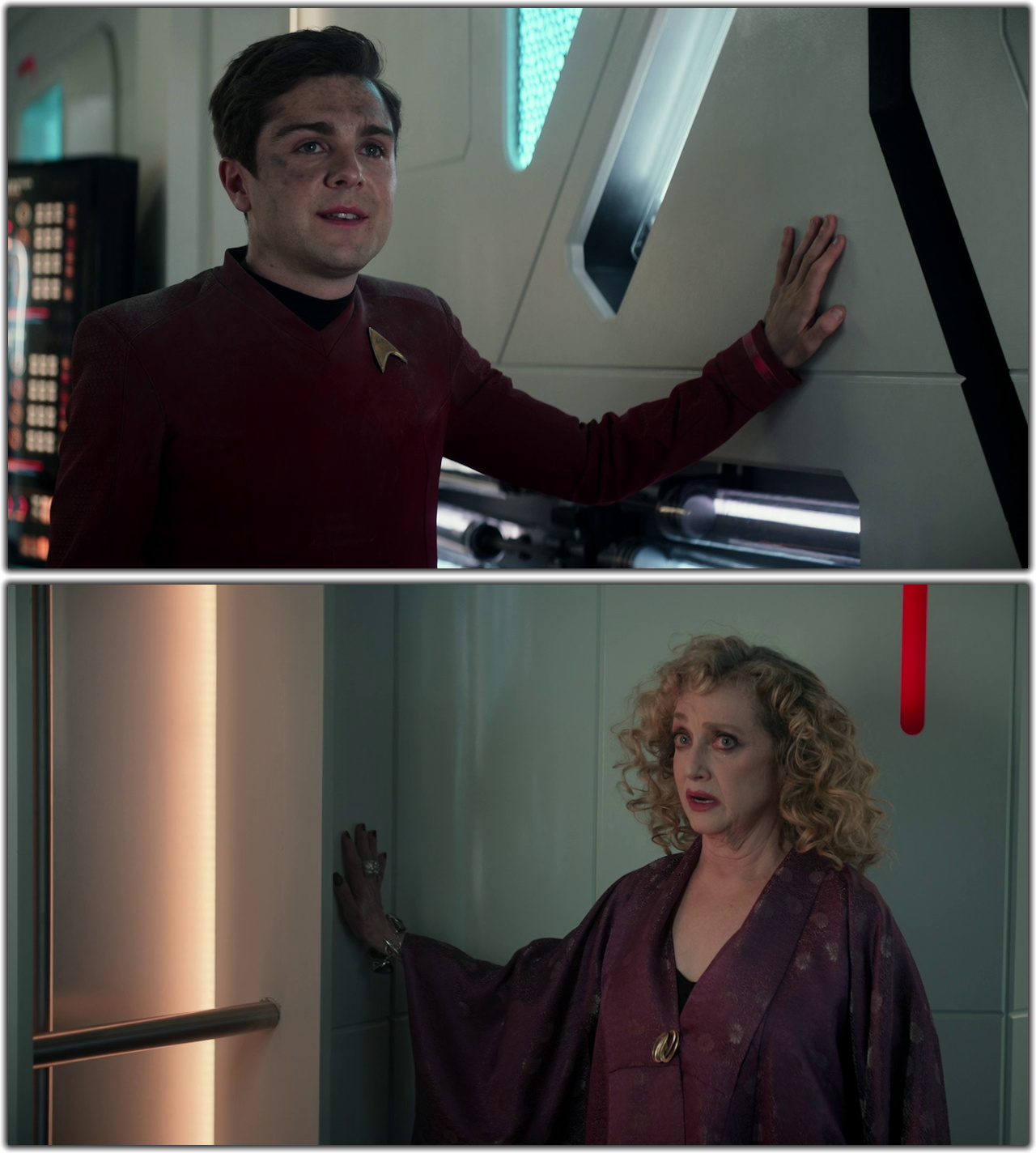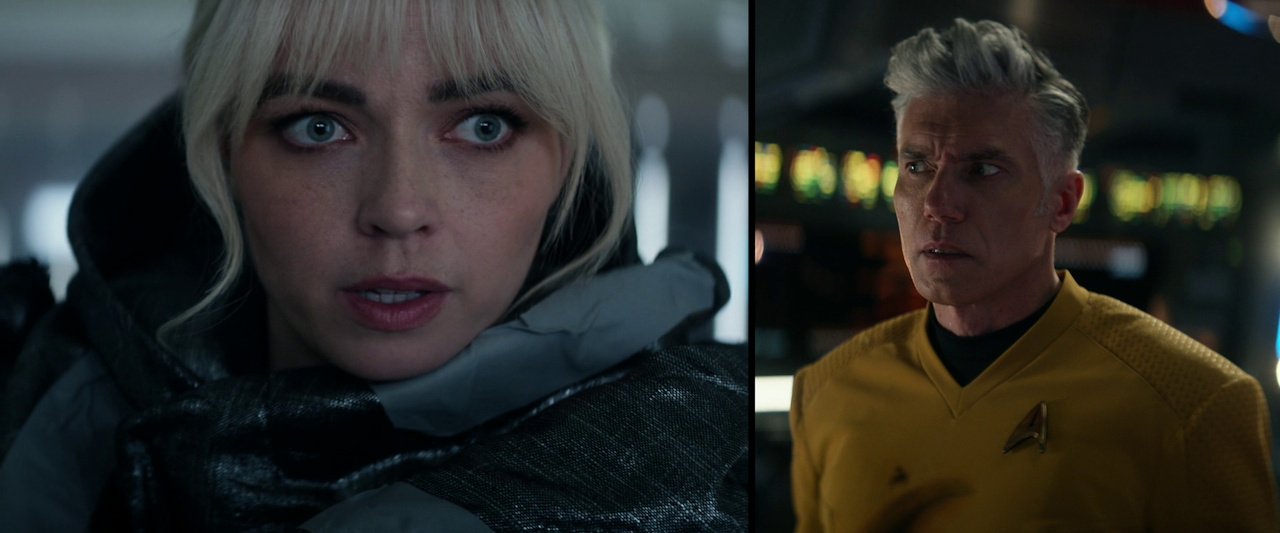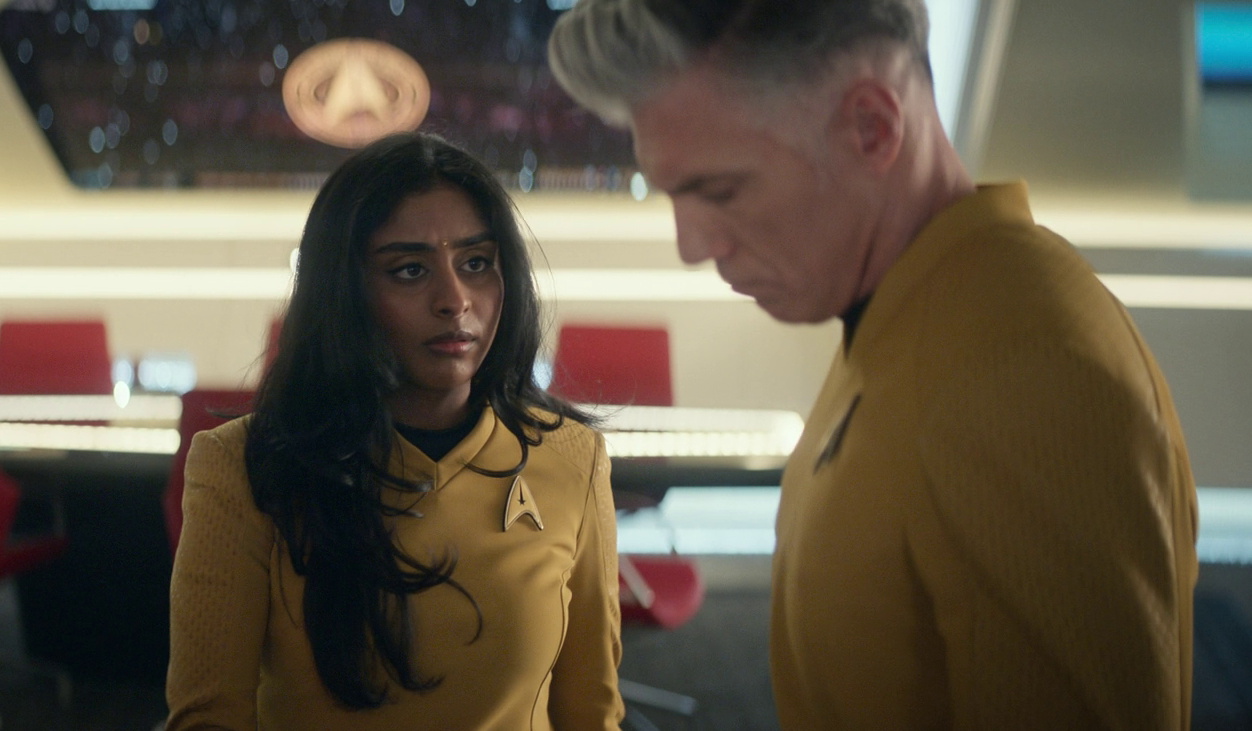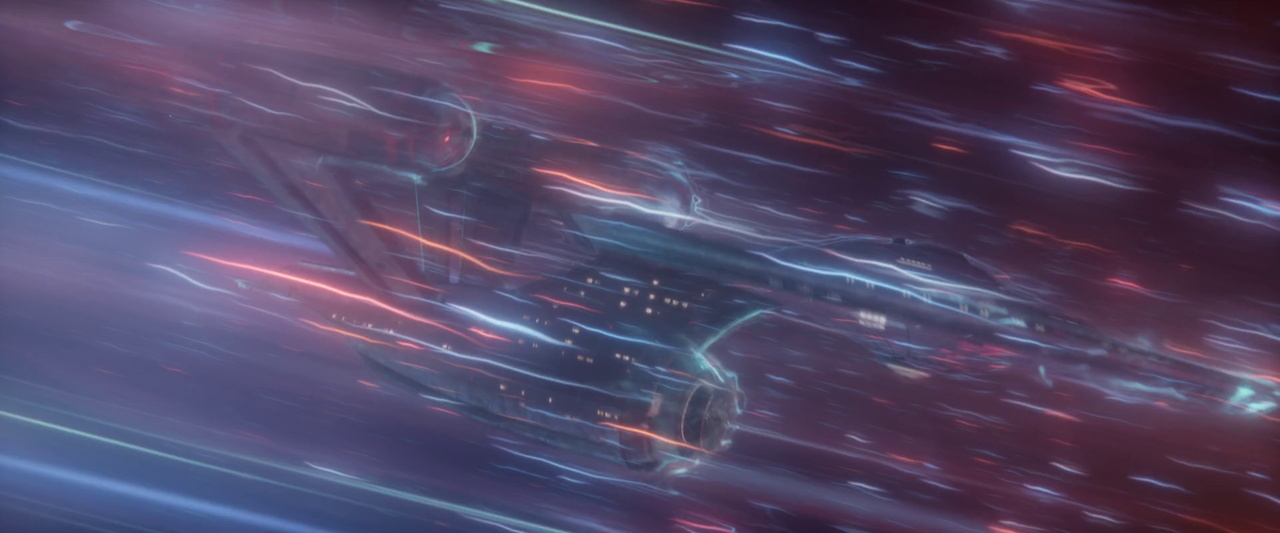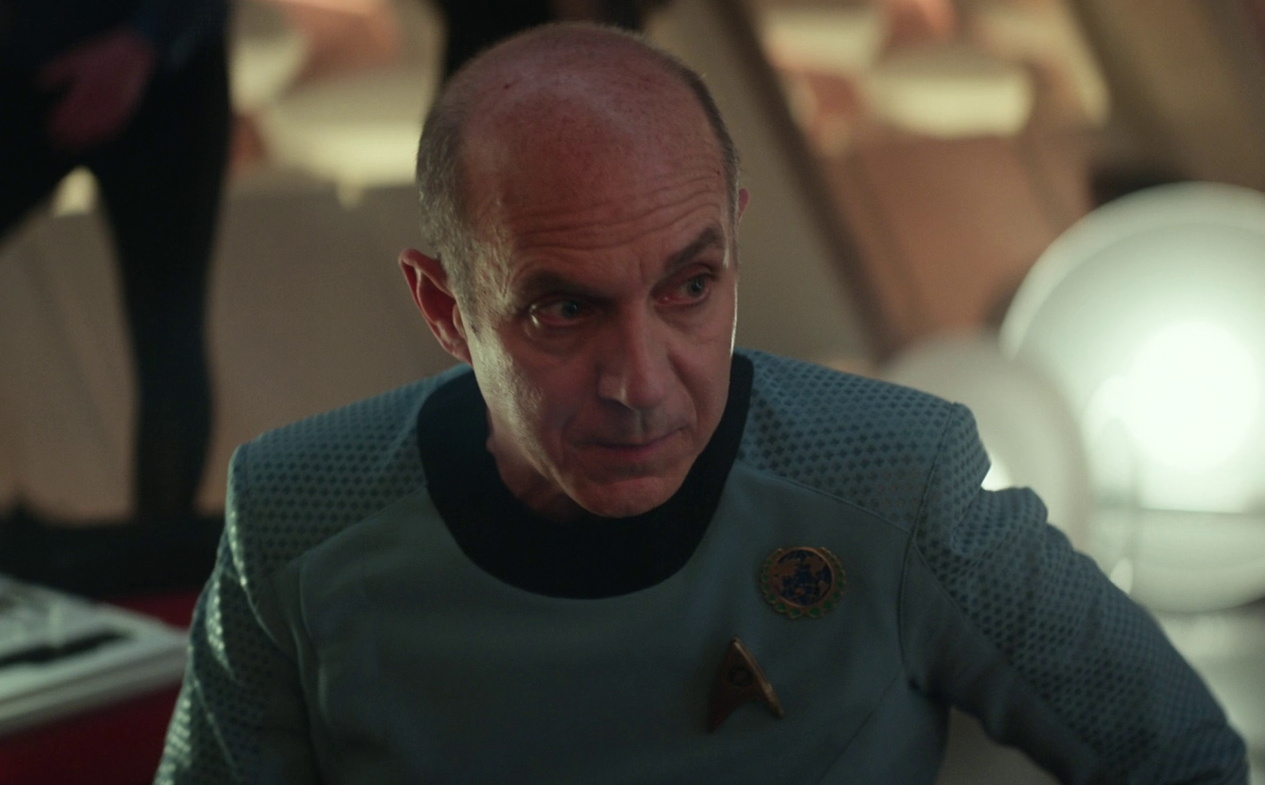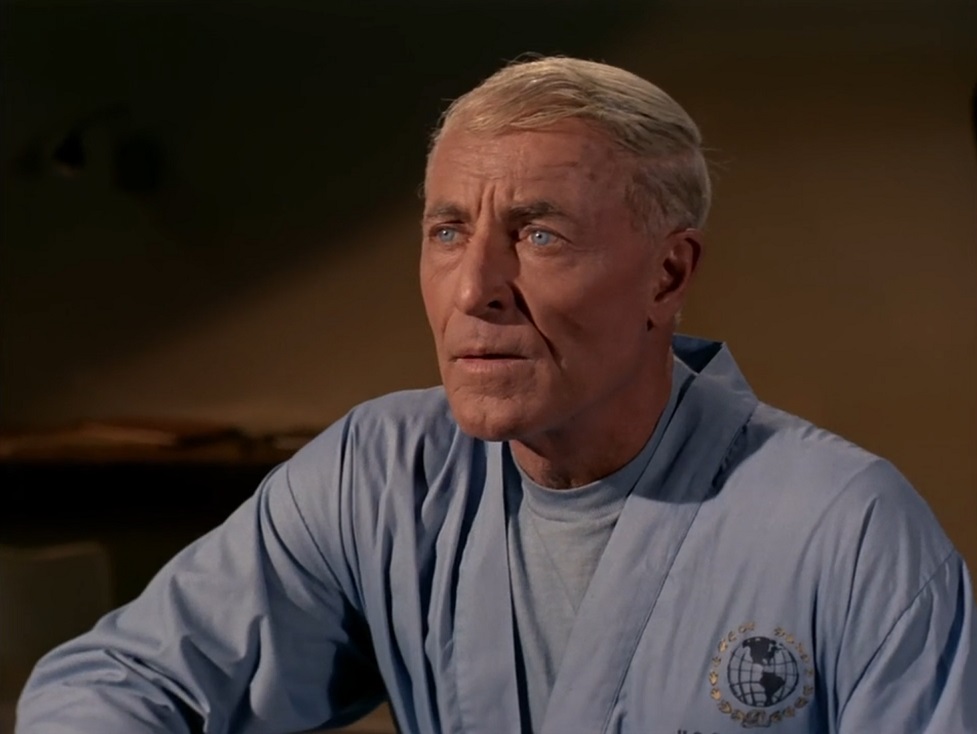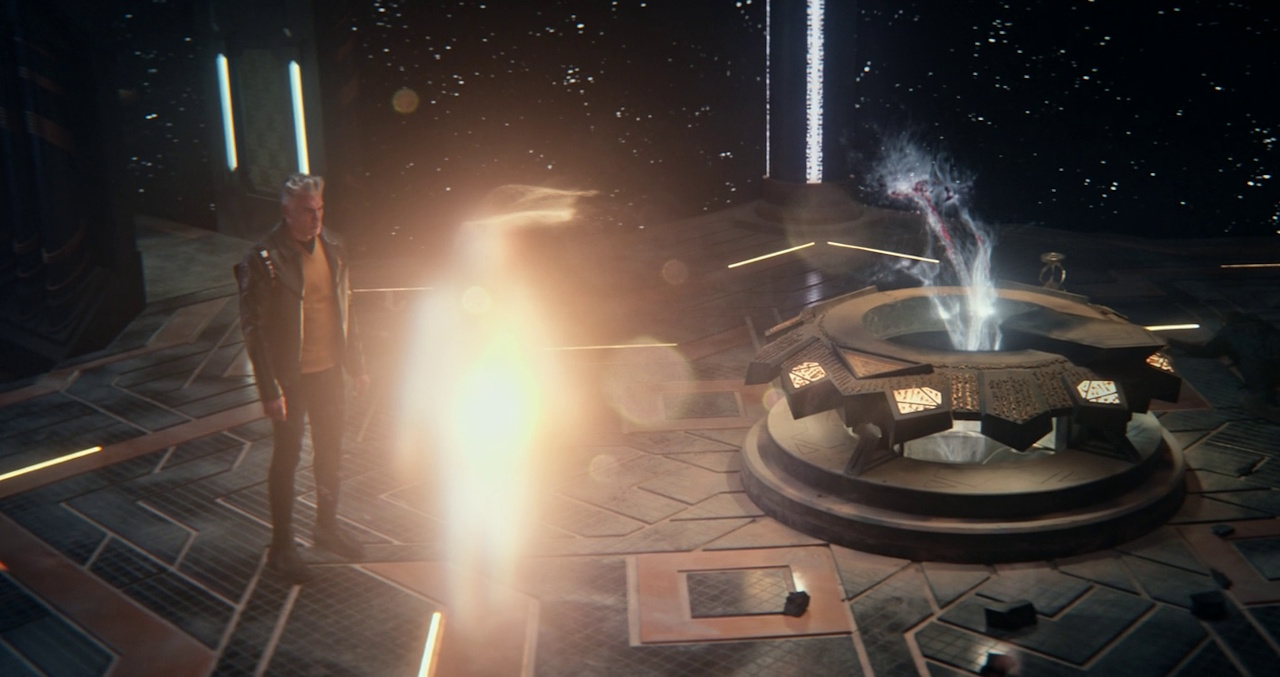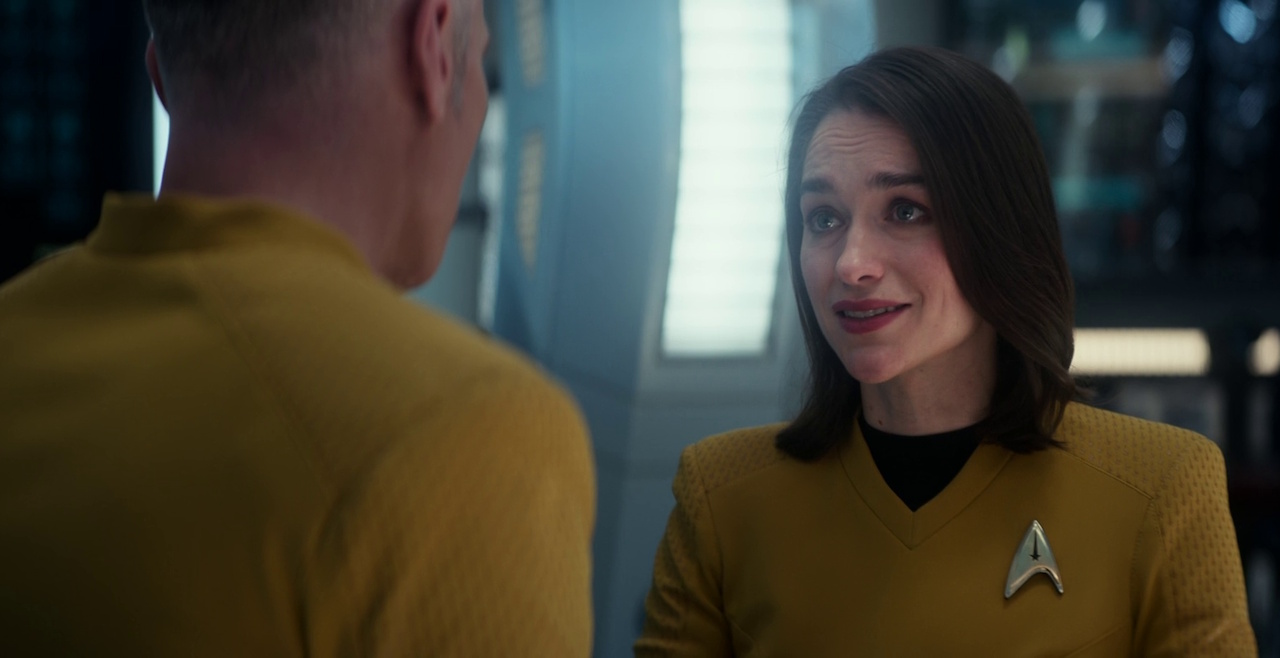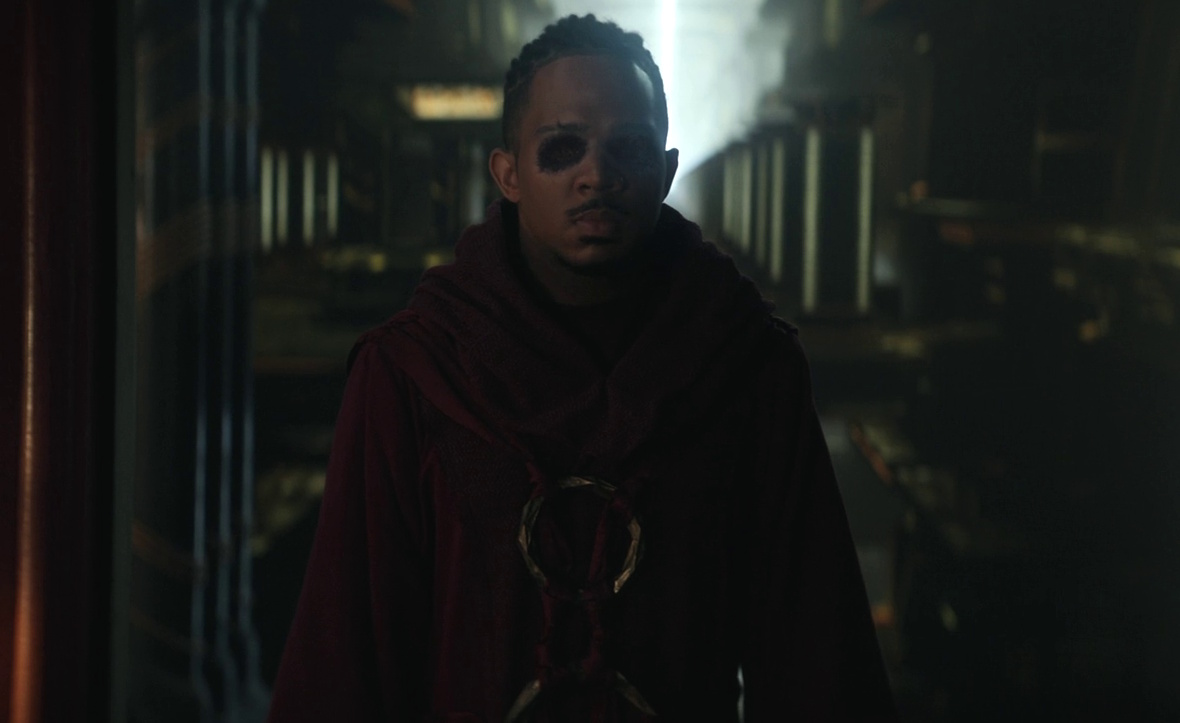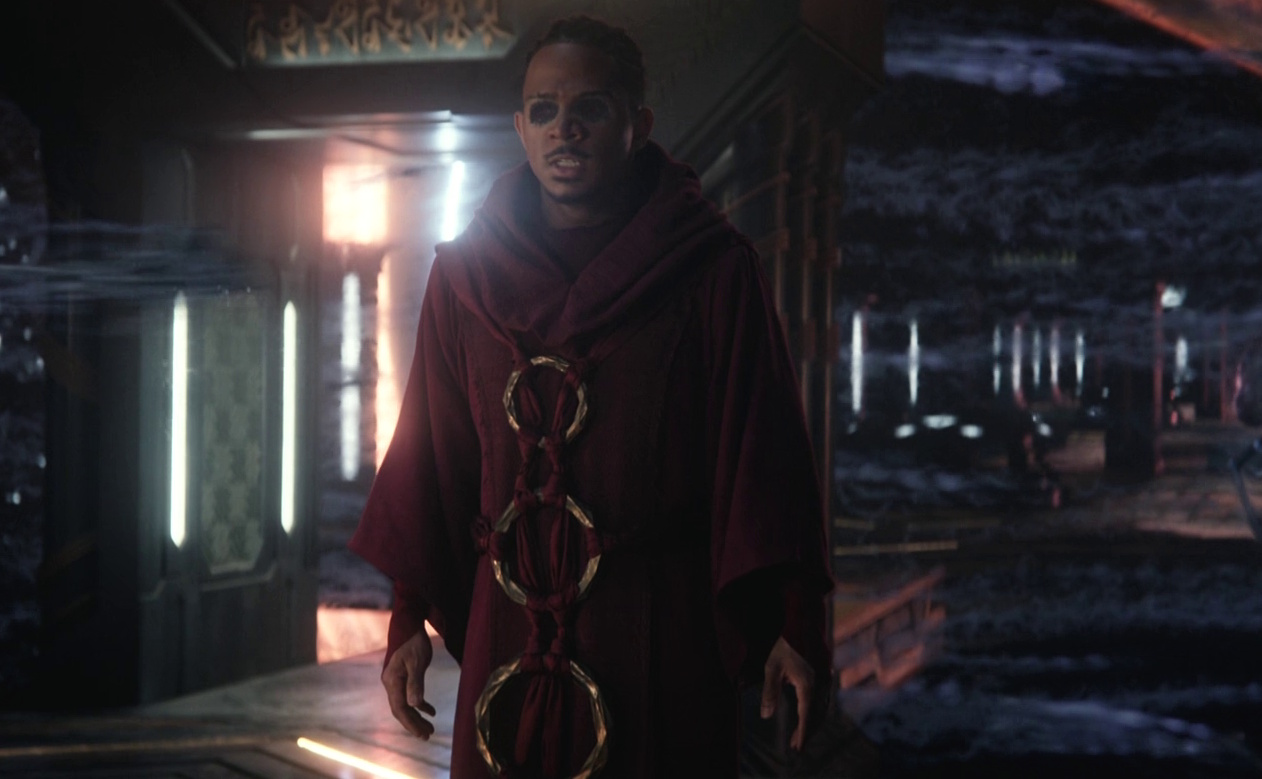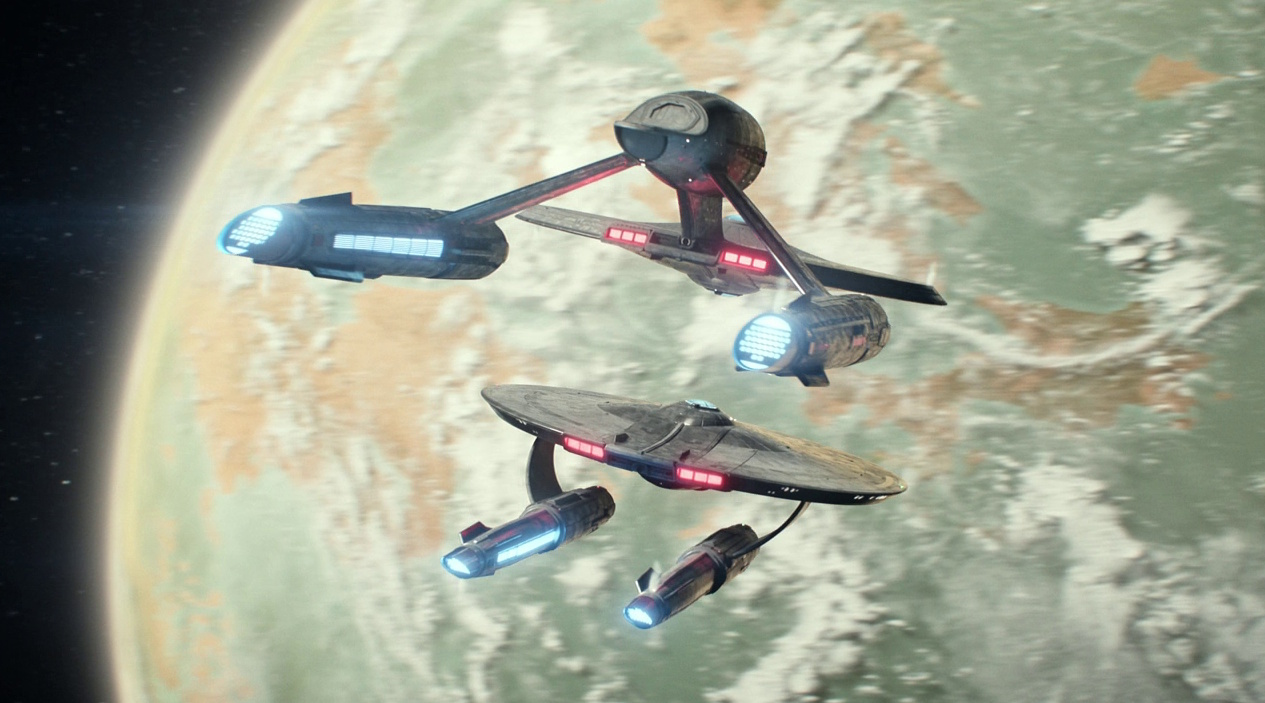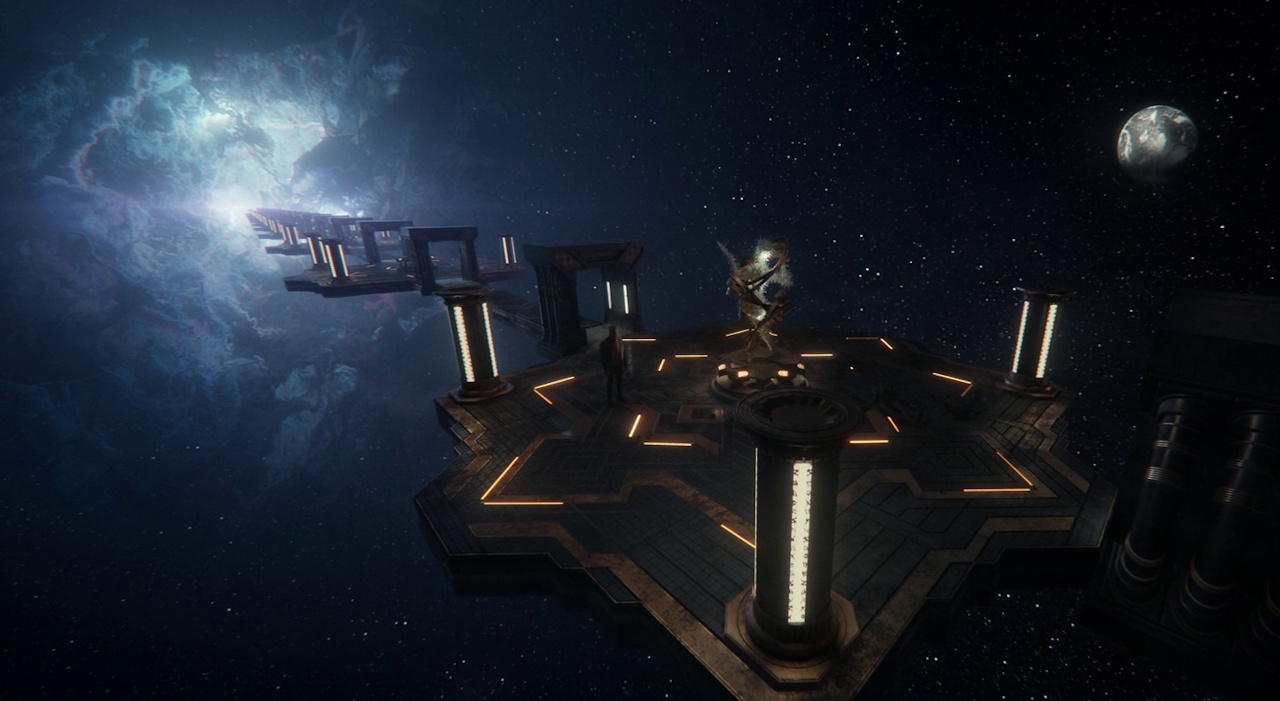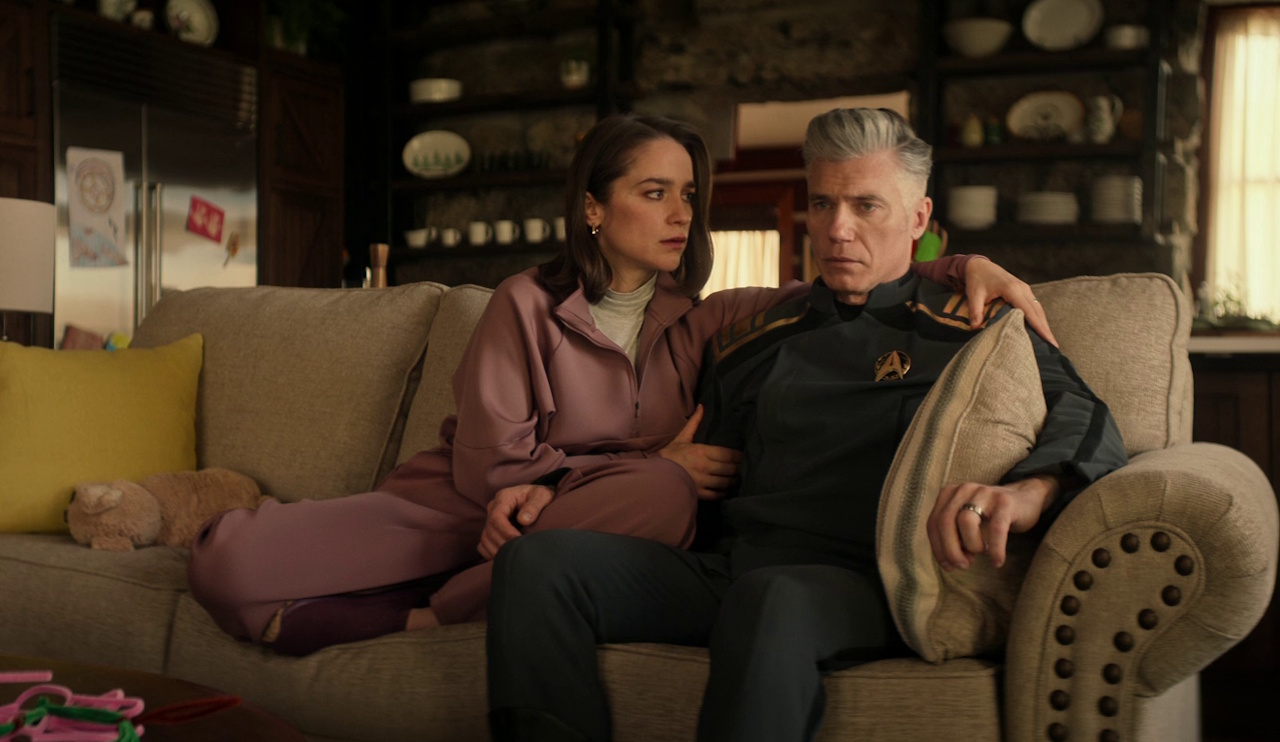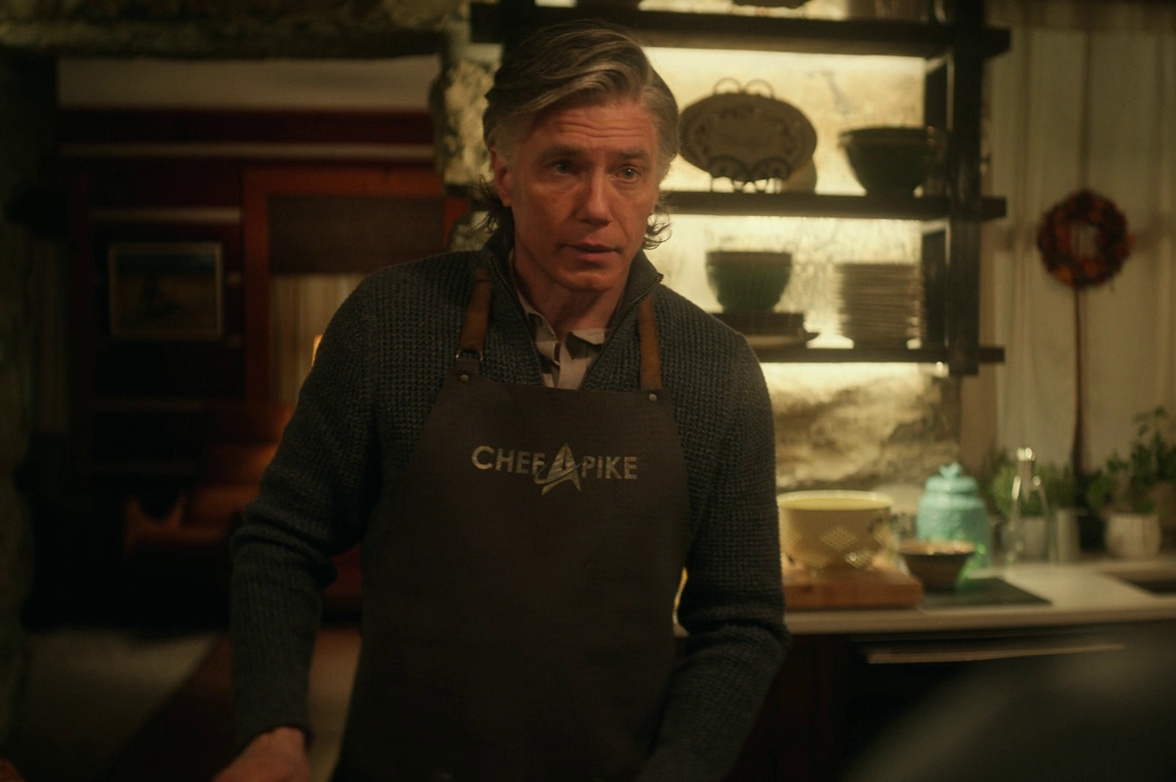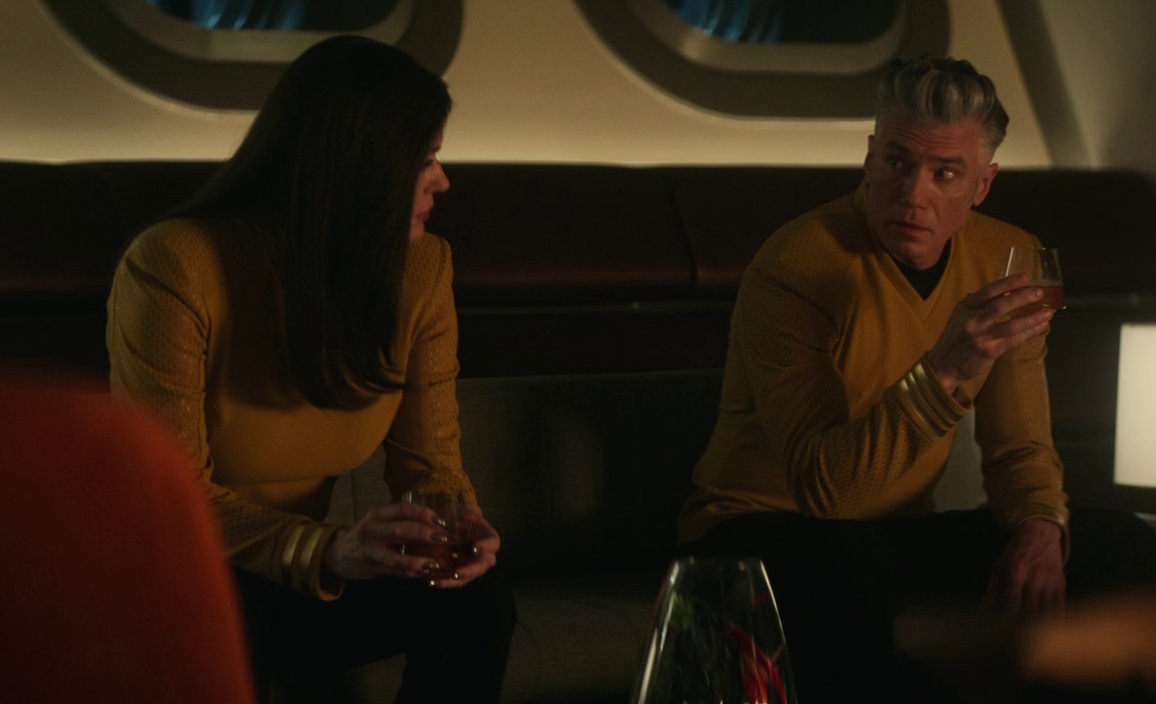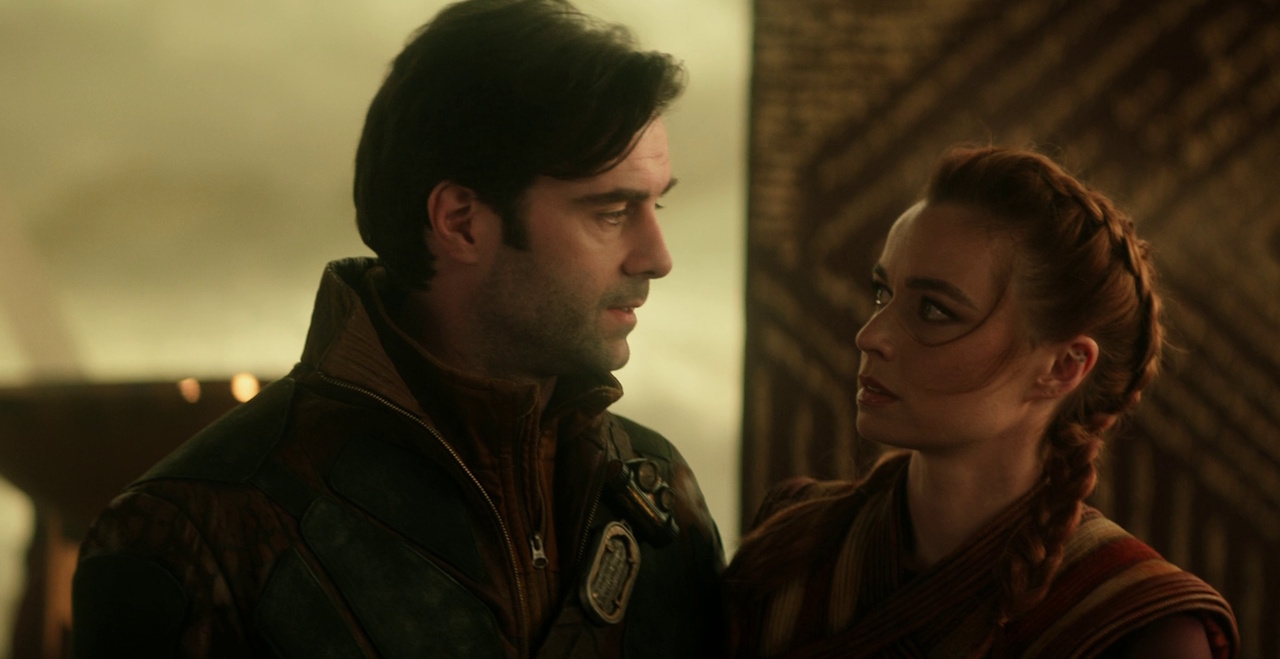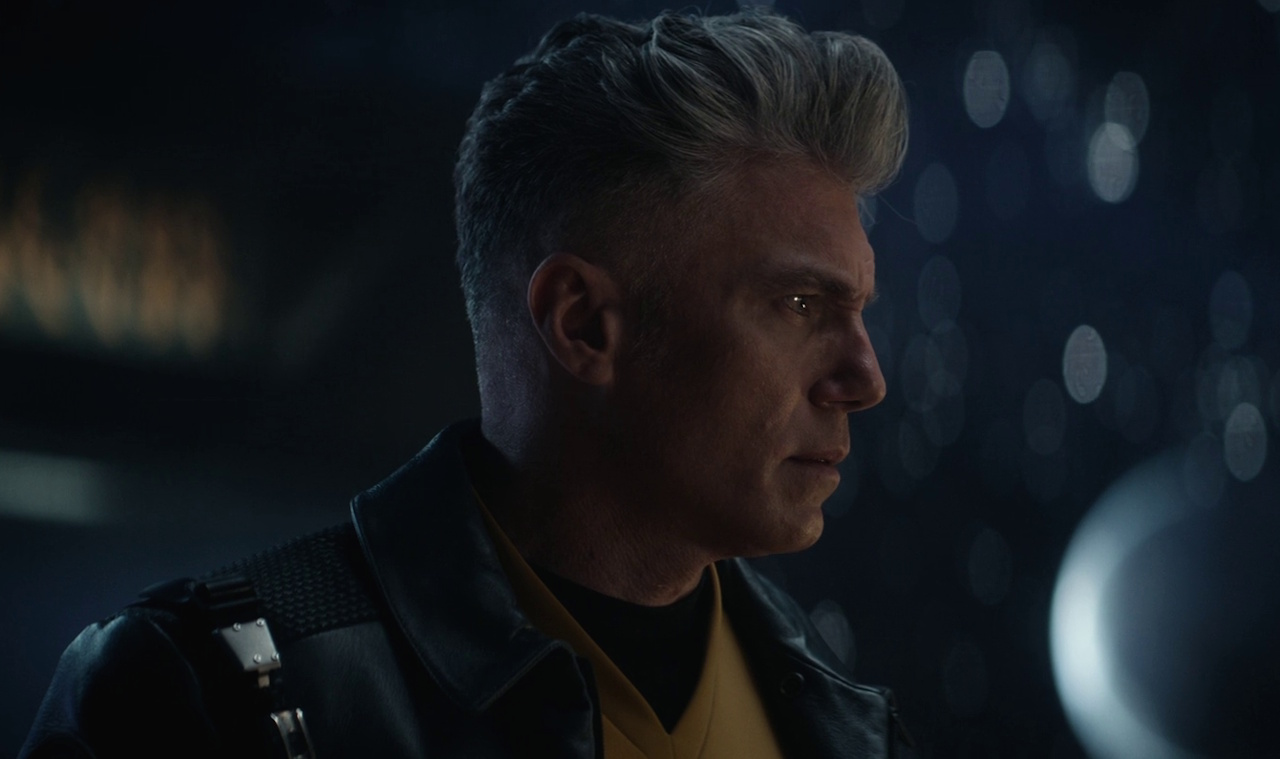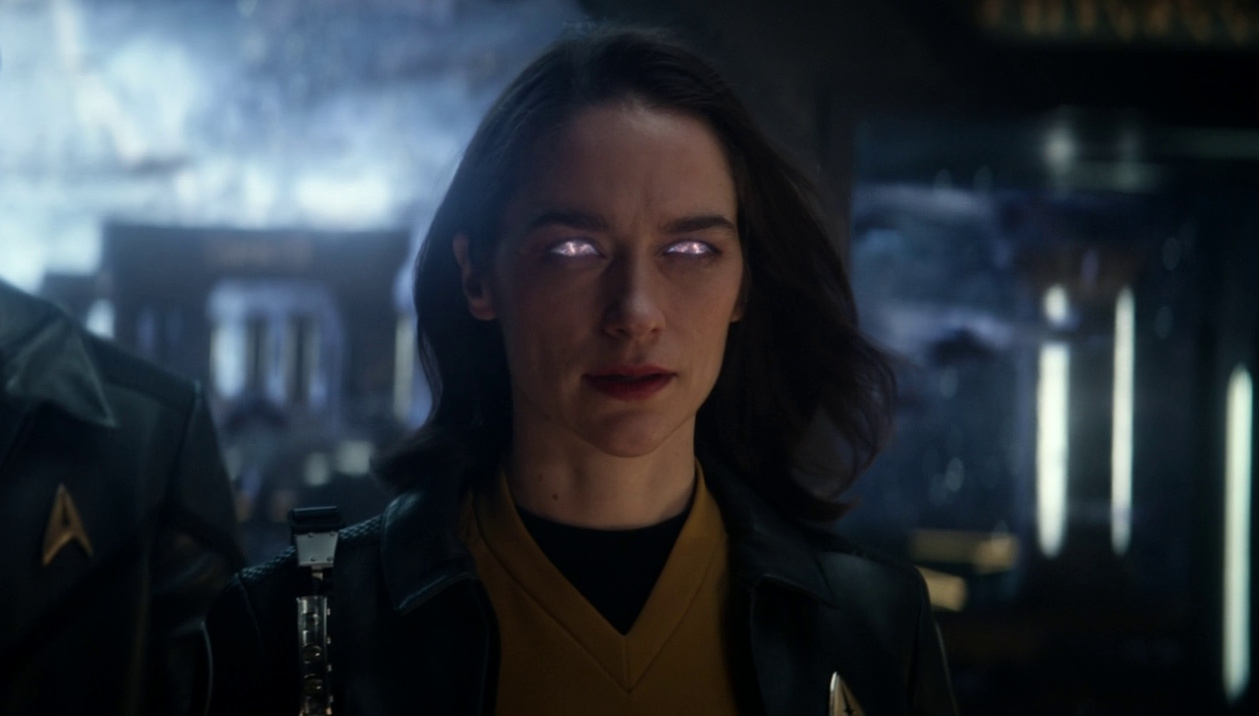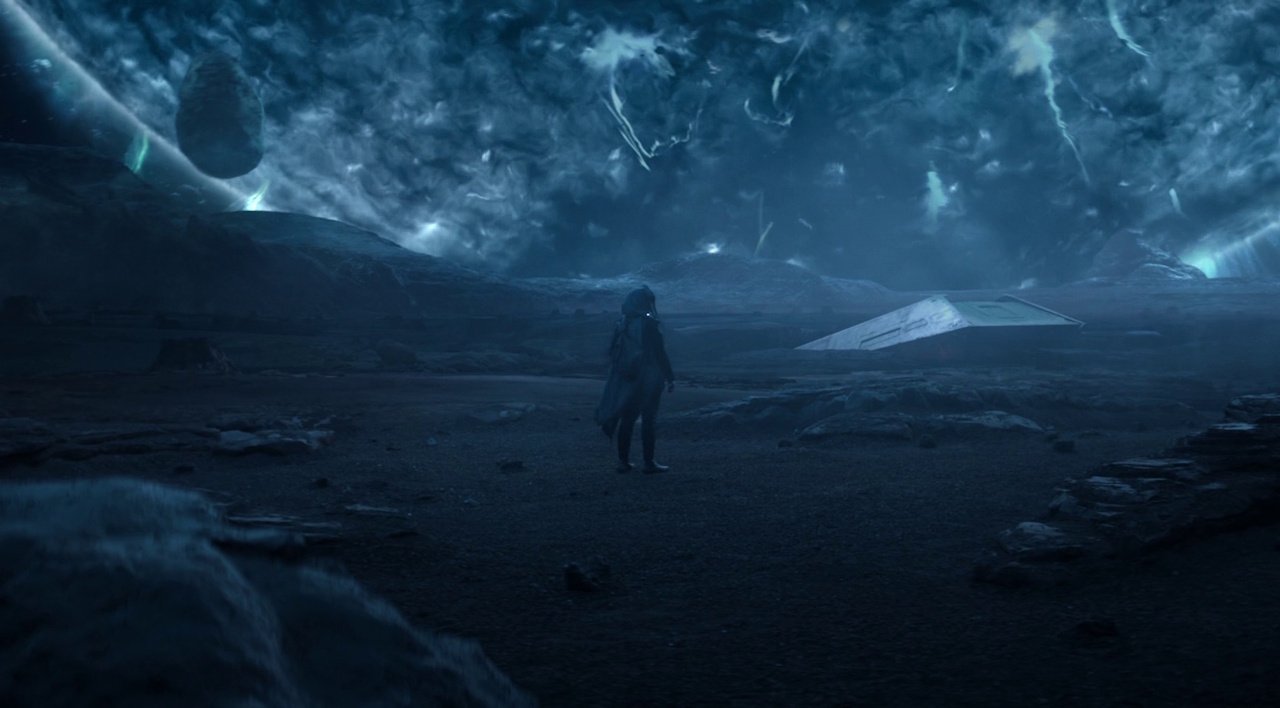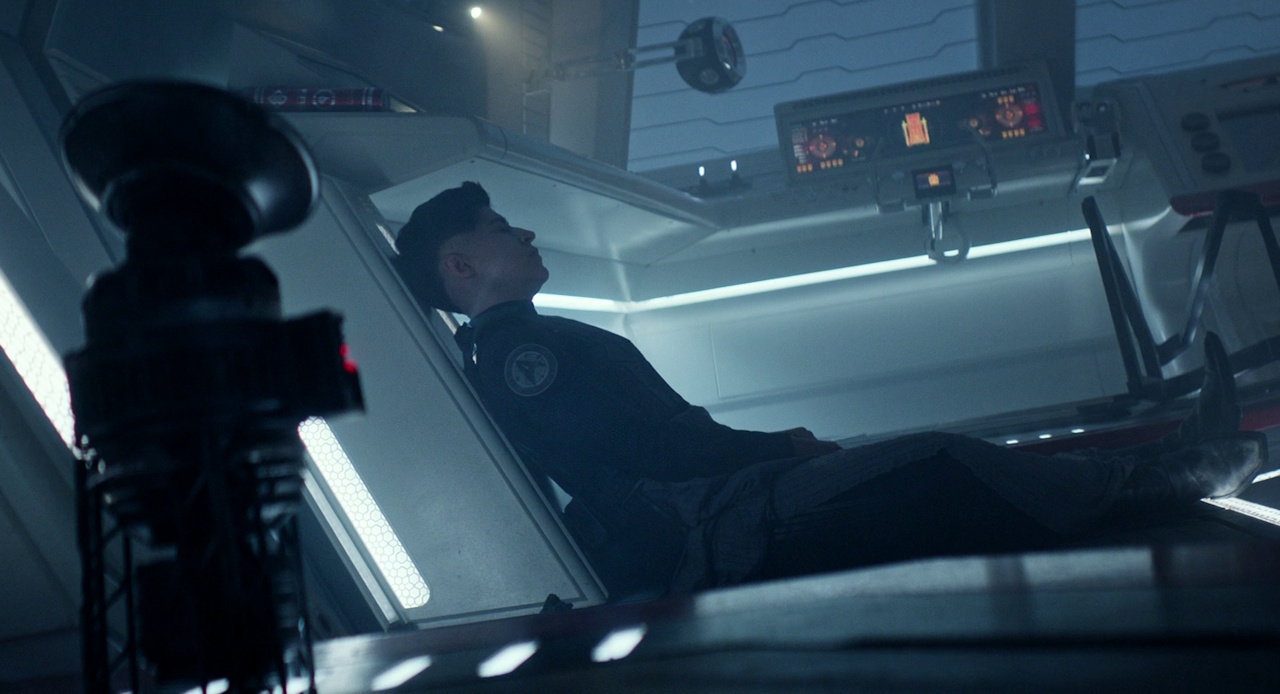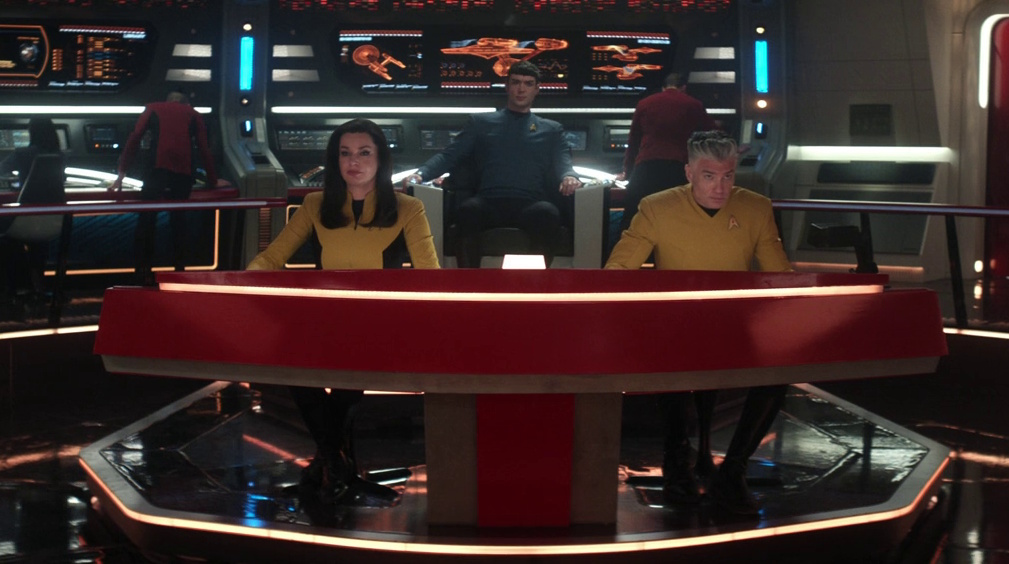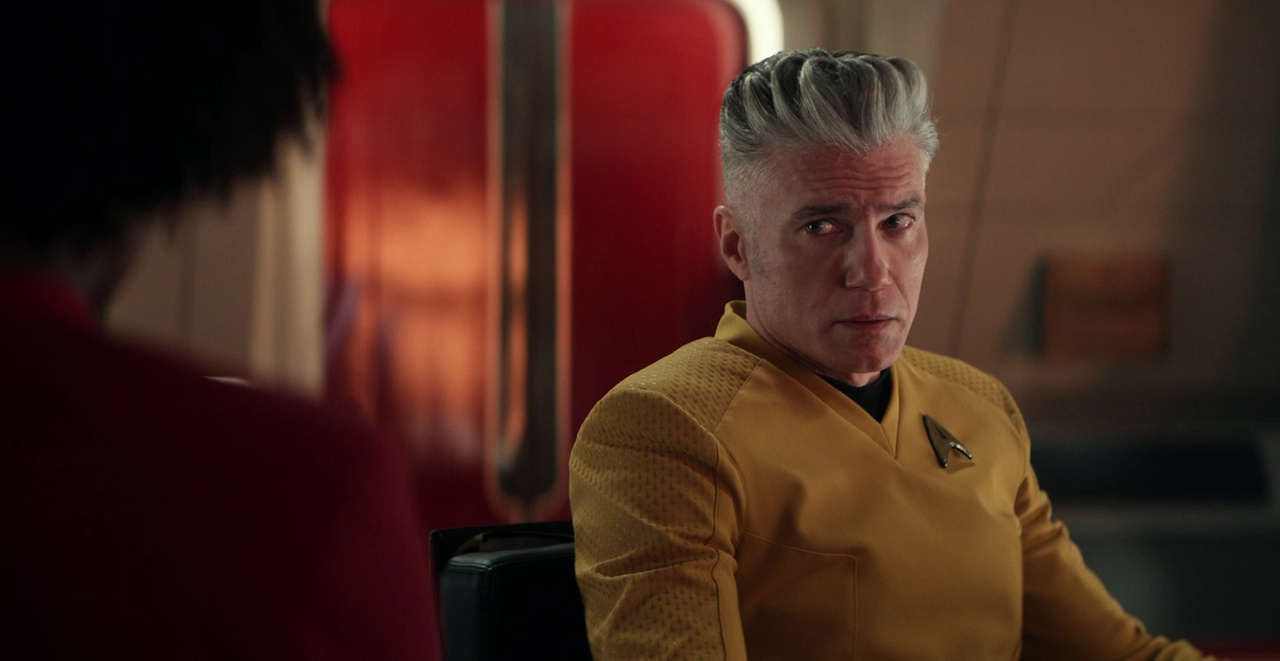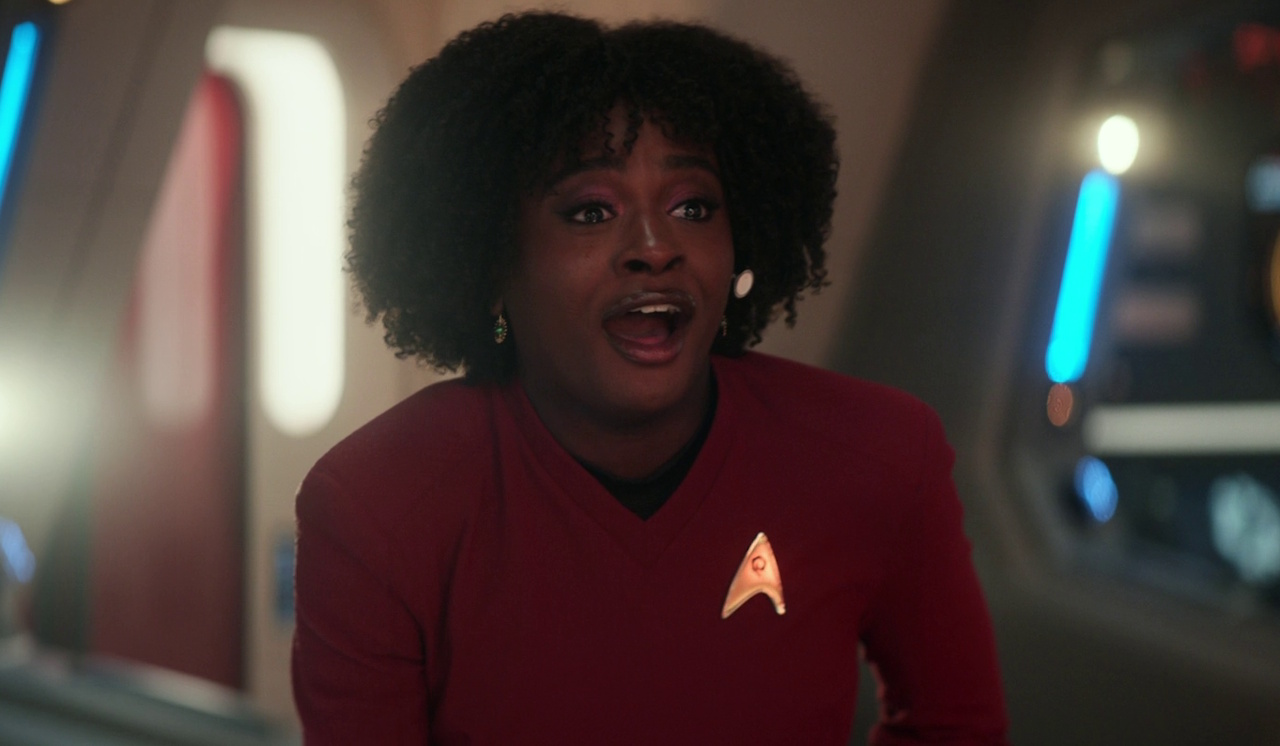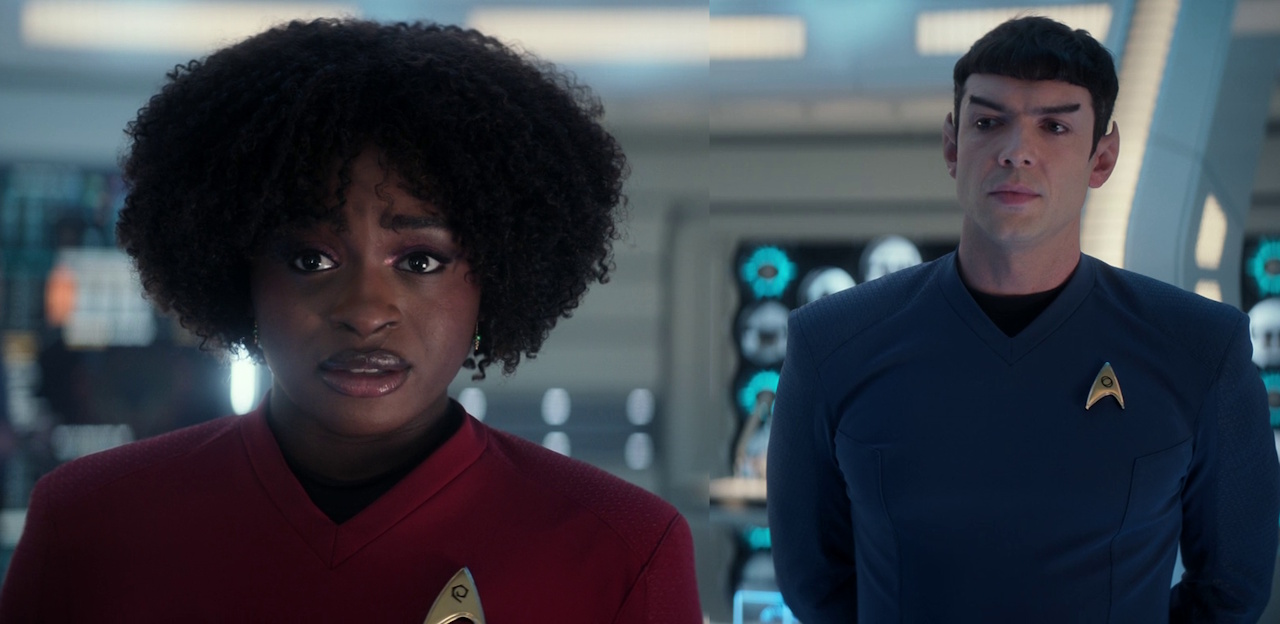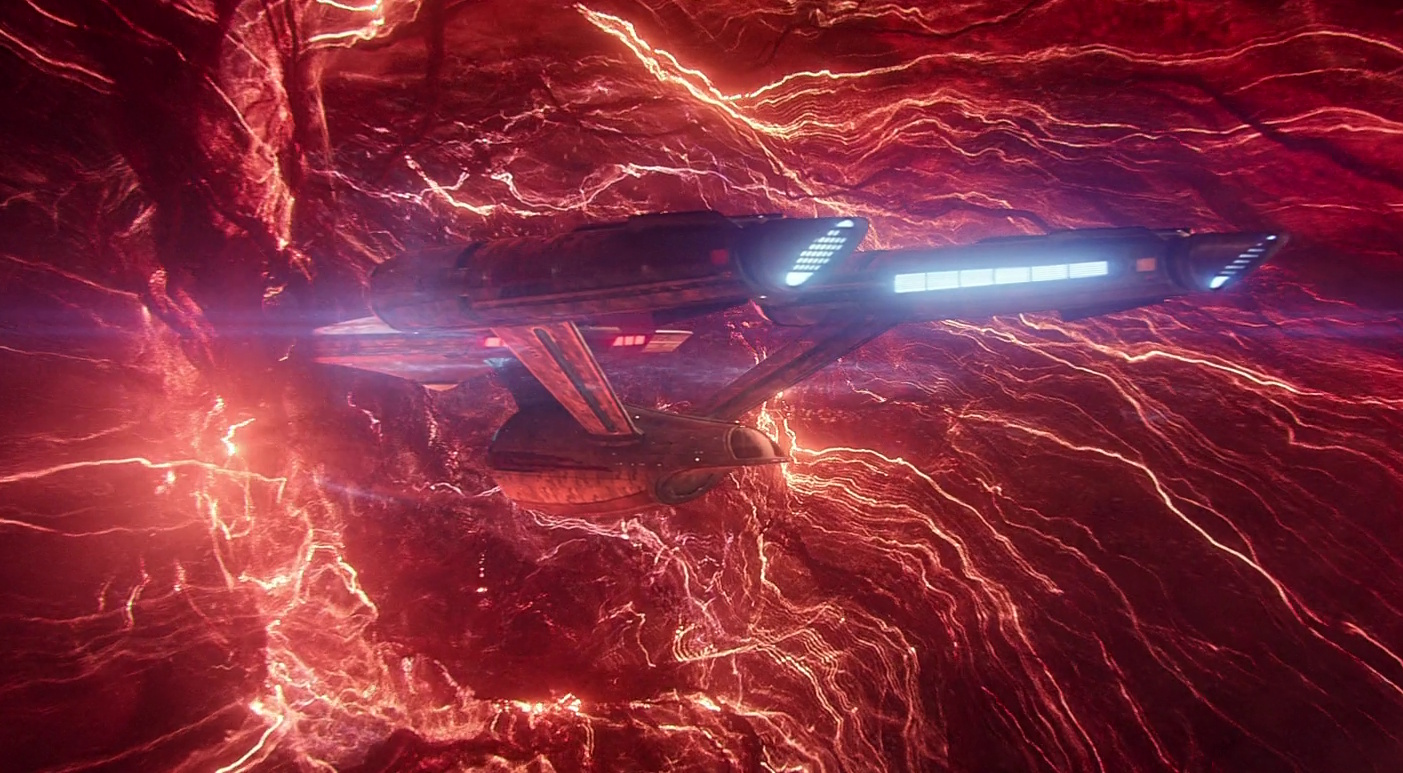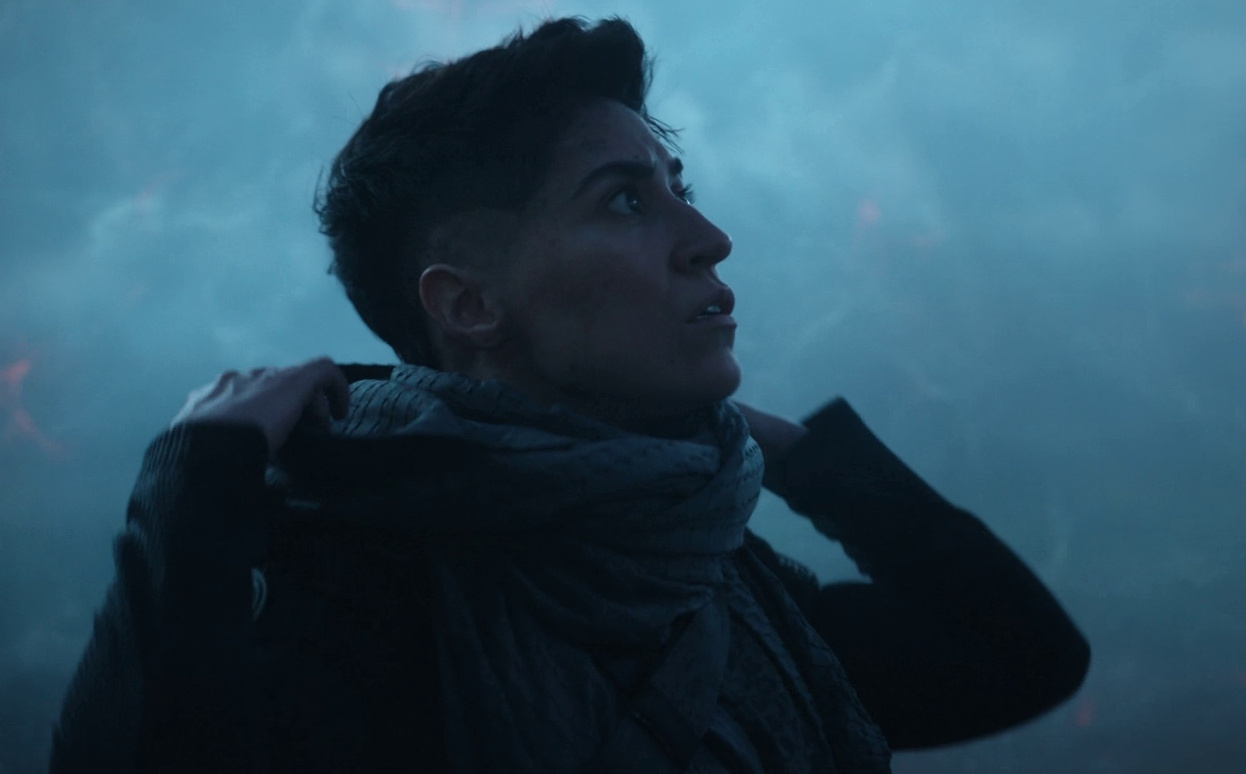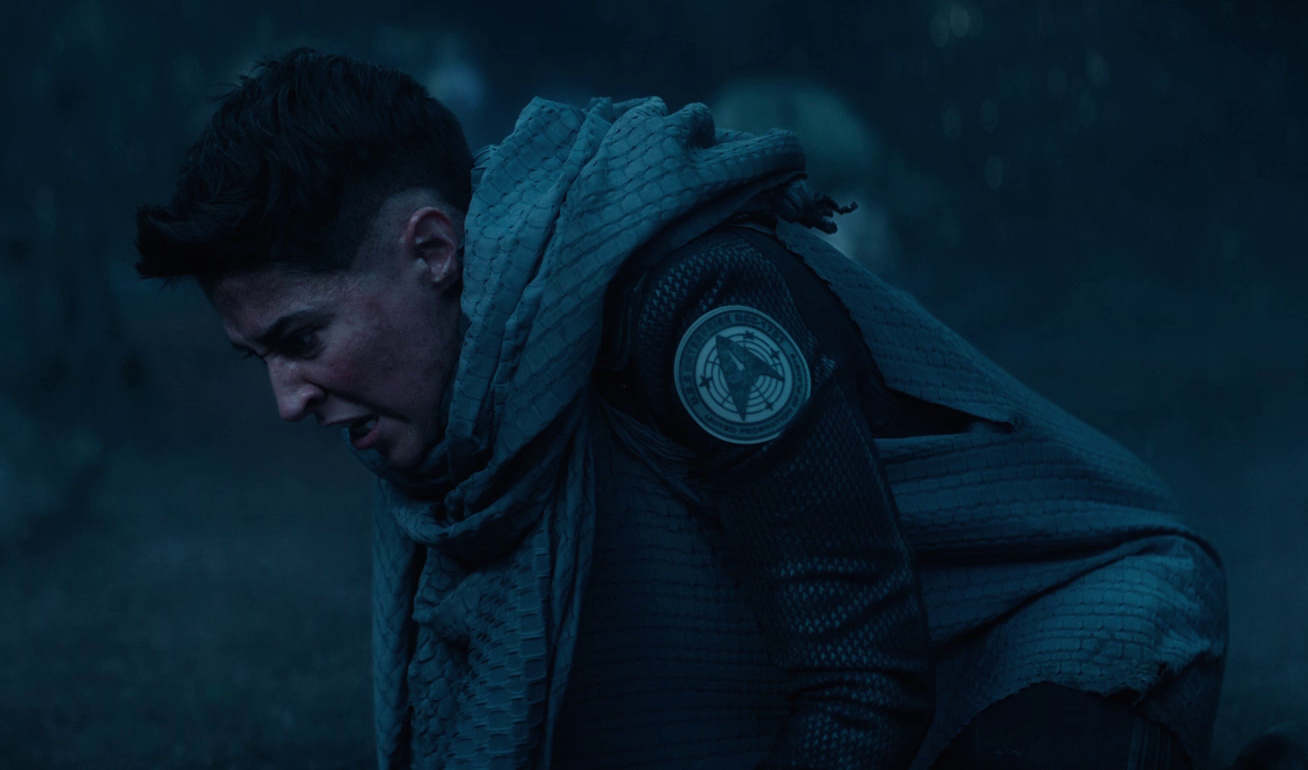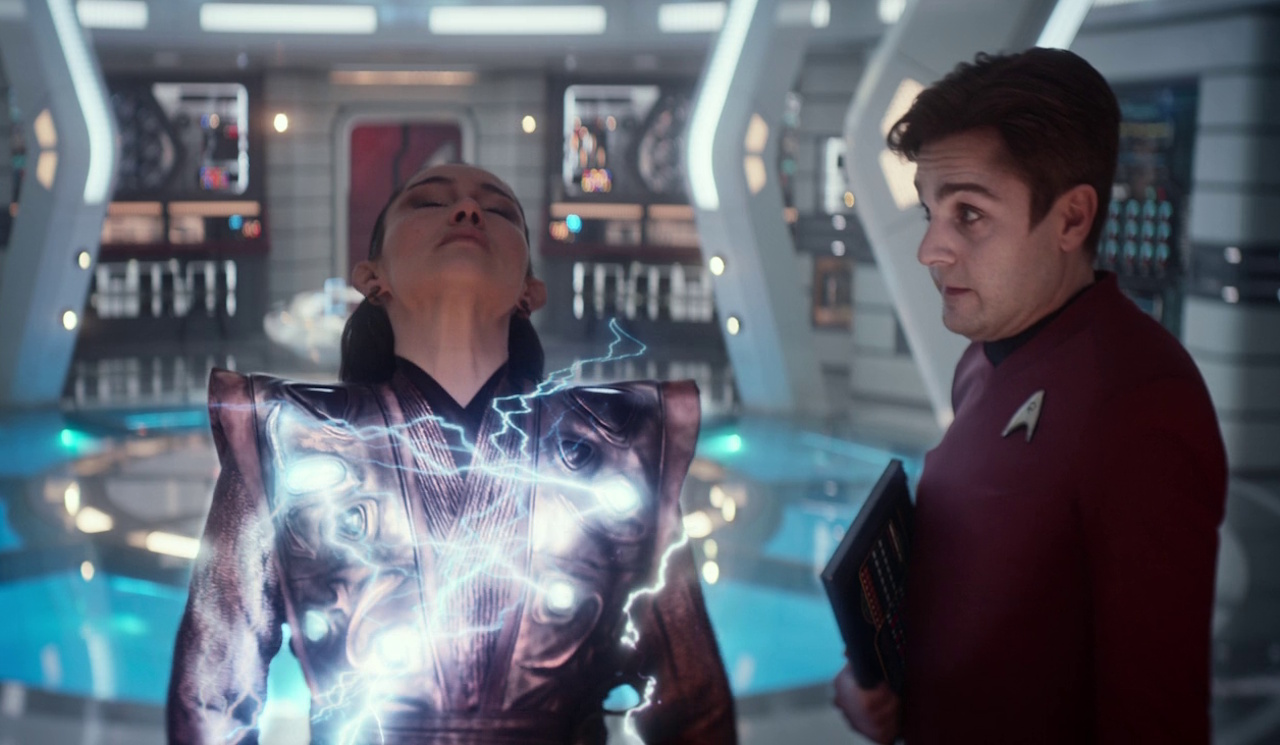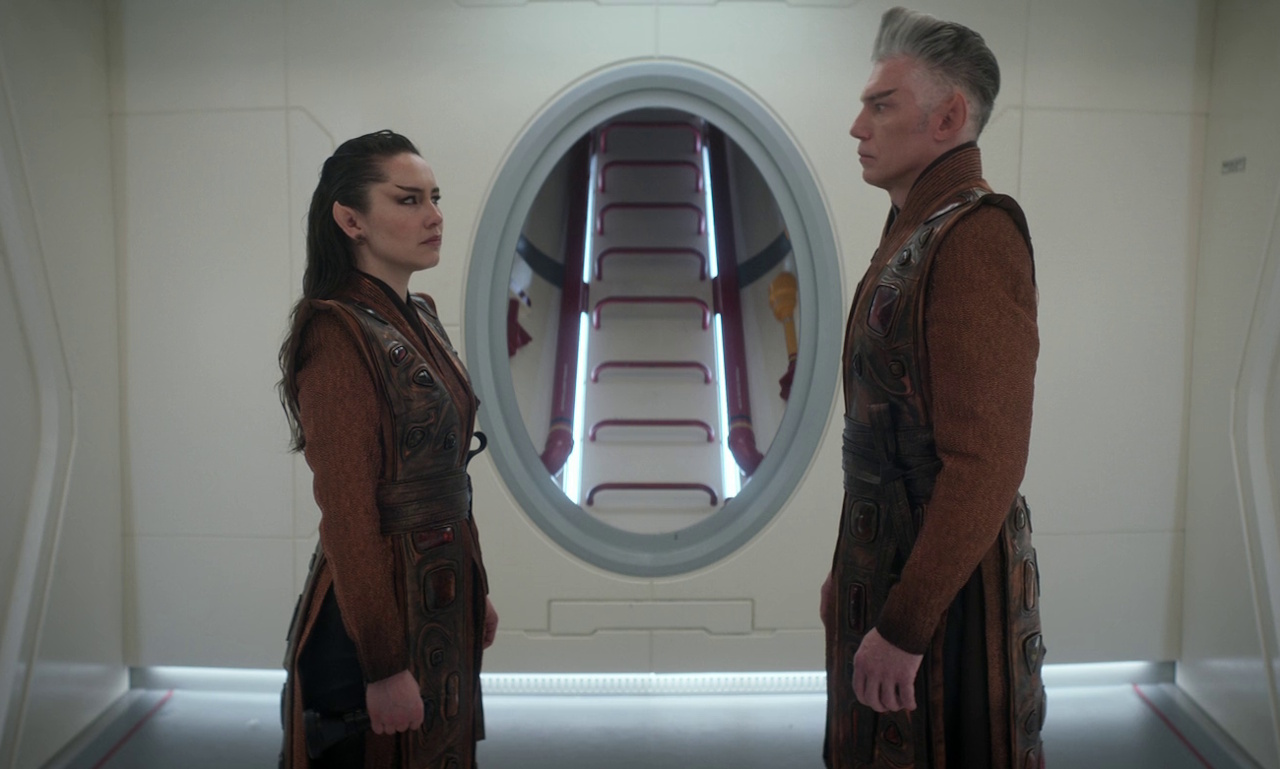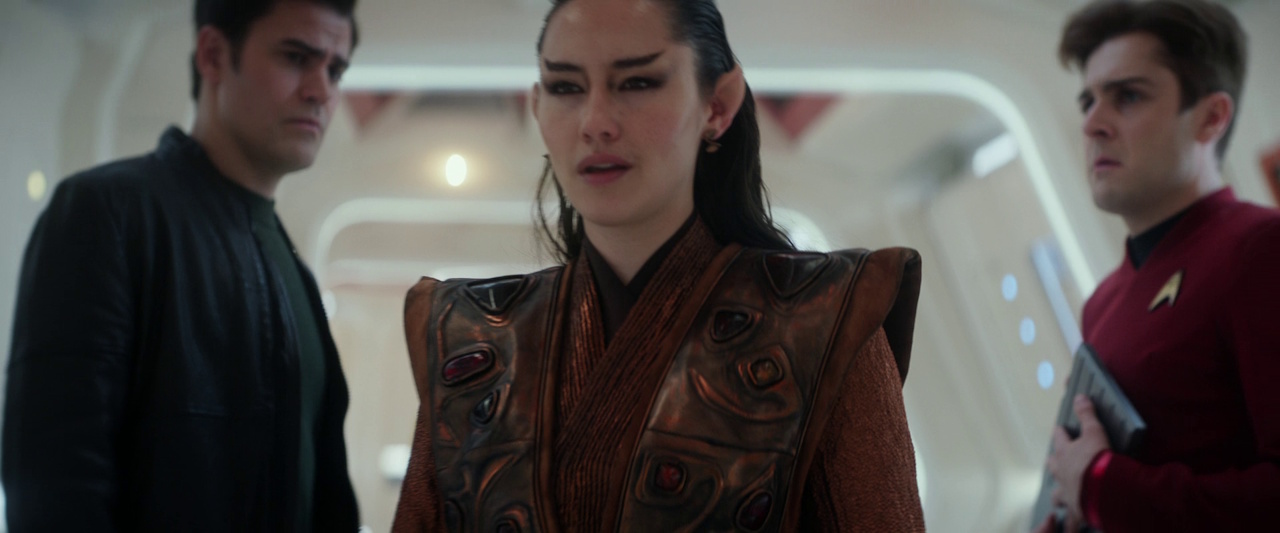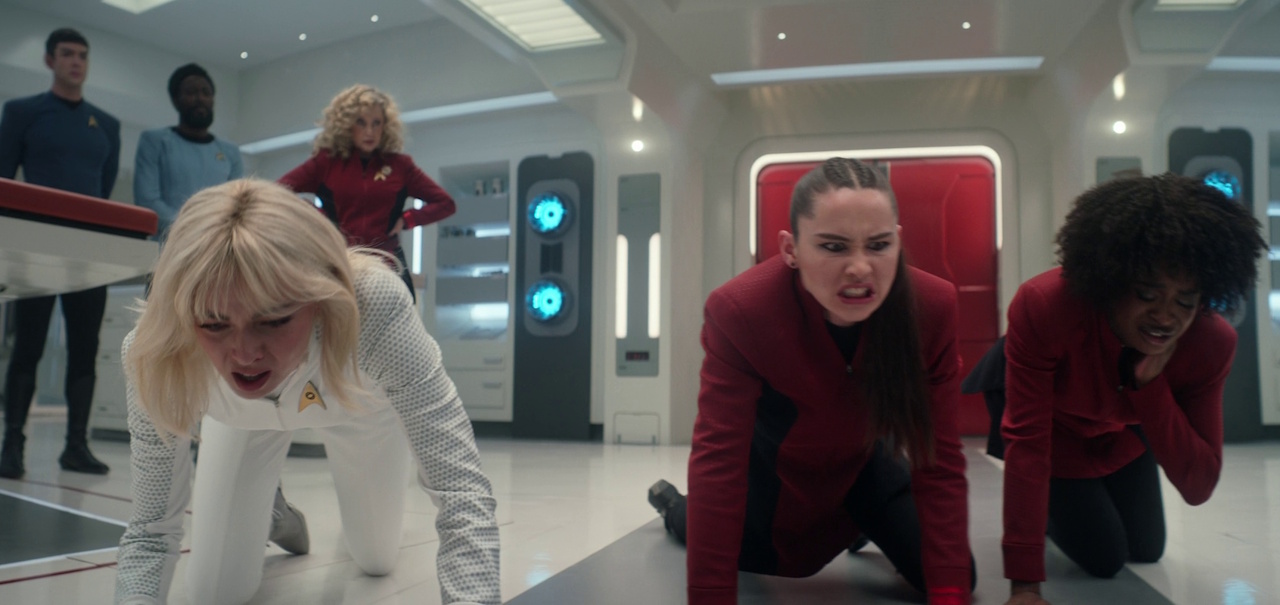
Star Trek: Strange New Worlds Episode Review – Season 4, Episode 7: Like Chronitons Through The Hourglass

A Star Trek-themed spoiler warning.

Spoiler Warning: There are spoilers ahead for Star Trek: Strange New Worlds Seasons 1-4. Spoilers are also present for the following Star Trek productions: The Original Series, The Final Frontier, and The Next Generation.

At the start of 2026, I wrote that Strange New Worlds’ fourth season was almost certainly a top contender for my coveted “TV Show of the Year” award. But now that we’re seven episodes in, I can put my hand on my heart and say that, honestly? I’ve really only enjoyed two of them.

And, as you might’ve guessed, Like Chronitons Through the Hourglass ain’t one of the two.

I’m kind of in two minds about the episode – and, as we go along, I’ll talk about one way that I think its story could’ve been salvaged, because there was a genuinely emotional story for Captain Pike that I think should’ve gotten more attention. On the one hand, the deliberately melodramatic soap opera stuff was so tacky and awful that I’m left scratching my head as to who thought it was a good idea. (As well as who keeps allowing writer Dana Horgan to remain employed). But on the other, Pike’s arc had merit – at least in theory – and I’m disappointed that this story of grief, loss, and mental health wasn’t explored in more depth and in a better way.

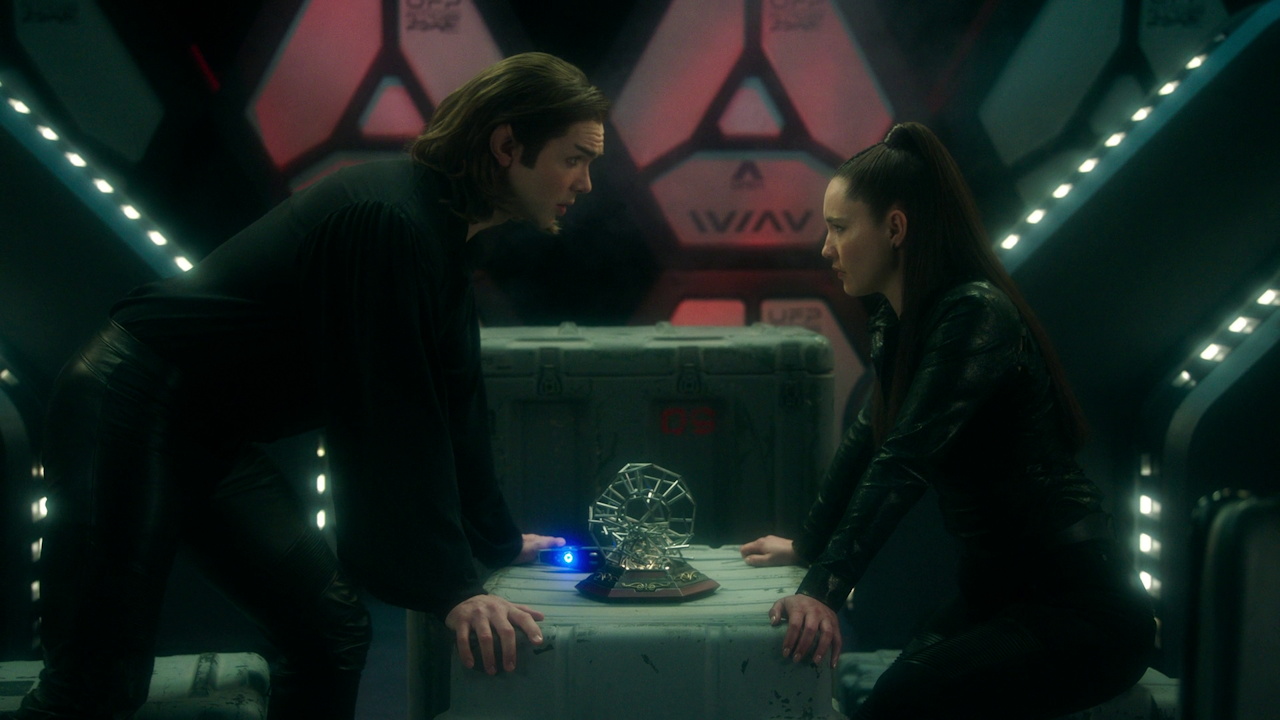
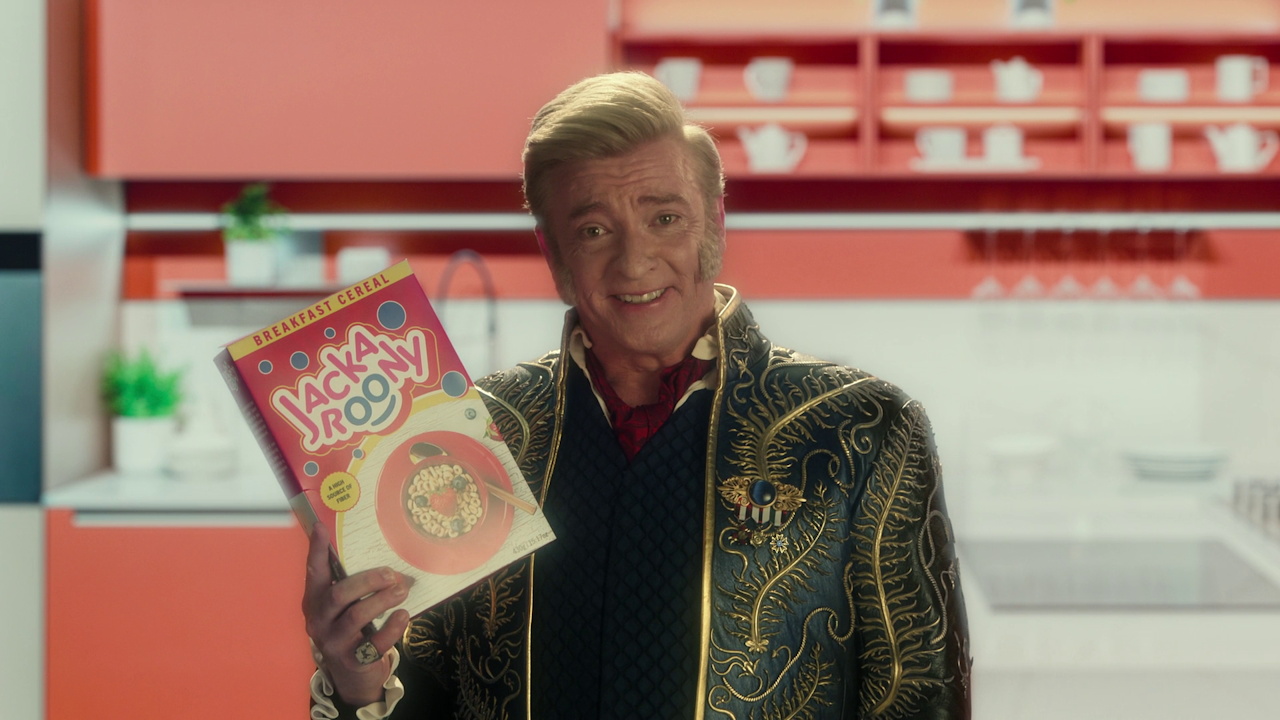
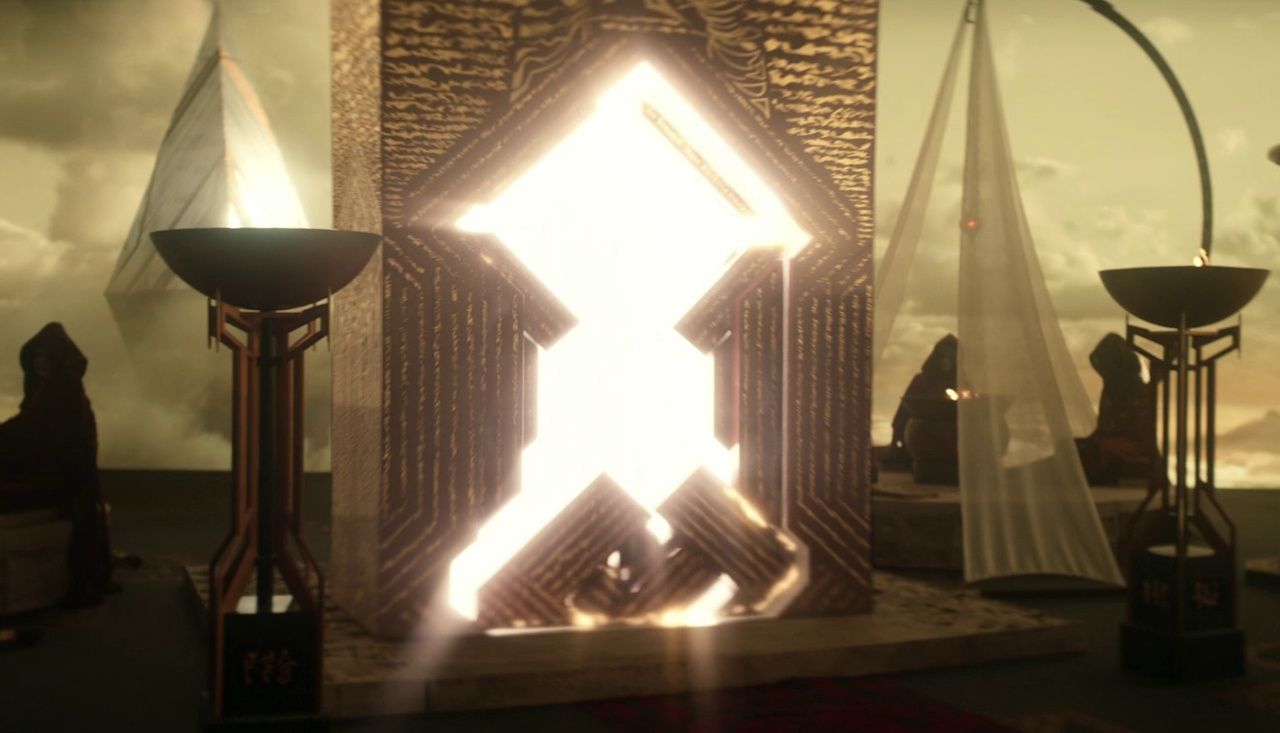
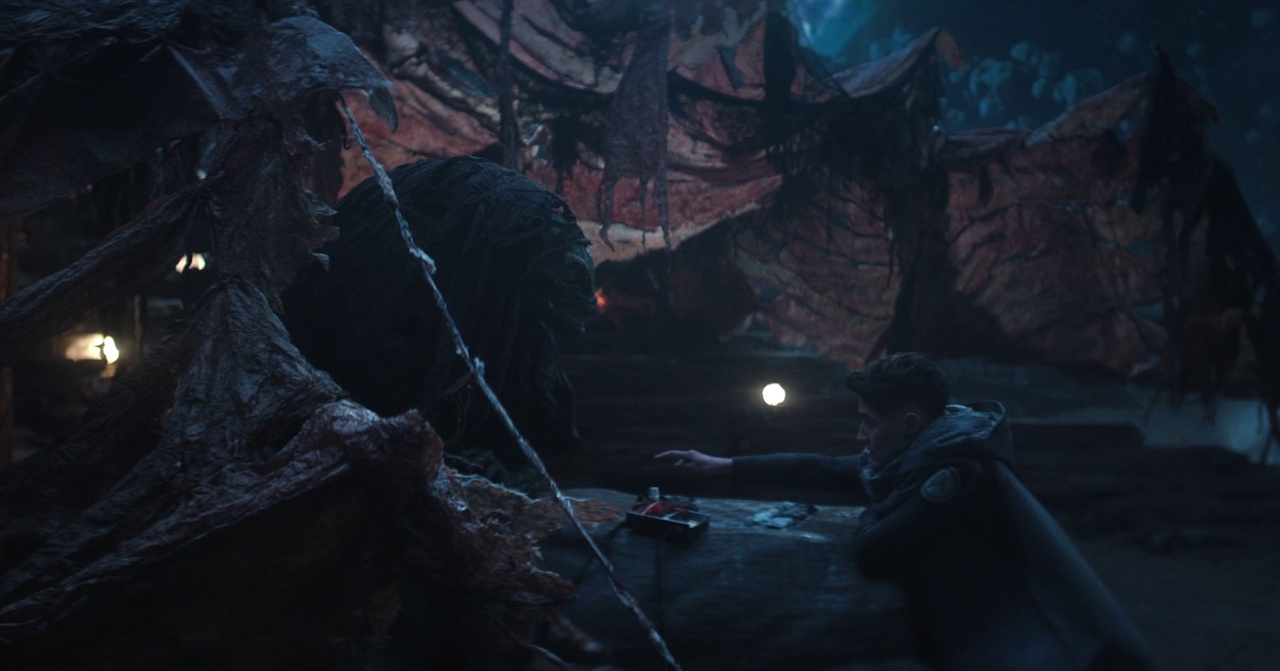
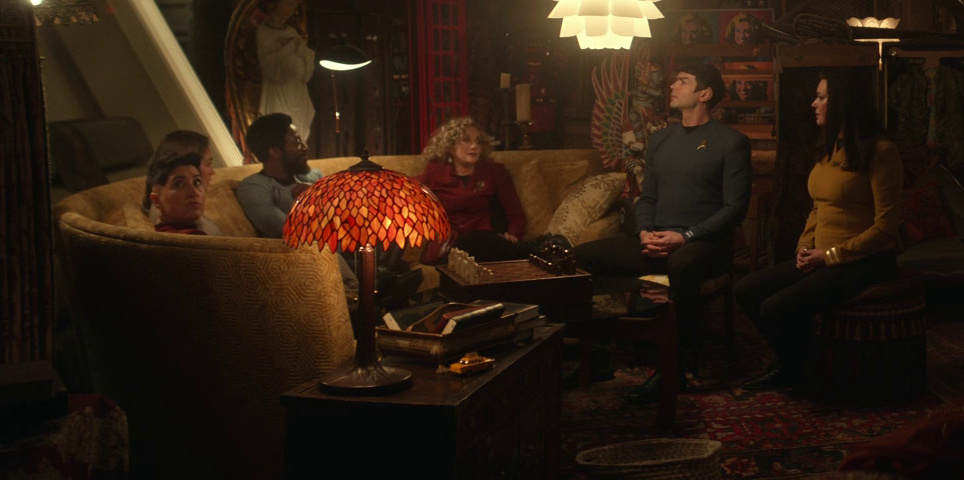
Still frame from Star Trek SNW 4x07 showing the fake title card
Yep. We’re really doing this.

I’ve said this before, particularly with Discovery and Picard, but modern Star Trek has been shockingly bad with its depictions of mental health. There have been some genuinely well-intentioned ideas; storylines involving our favourite characters and their struggles that absolutely are worth exploring. But in almost every instance, the execution of these character arcs and narratives have been, in a word, atrocious.

And so it was in Like Chronitons Through the Hourglass with Captain Pike.

It was a good idea to revisit what happened to Pike at the end of Season 3 and explore how losing a partner – and mourning the life they could’ve led – was causing him pain. This is something Star Trek has always done: looking at real-world issues through the lens of science-fiction. In this case, Pike *literally* saw and experienced that alternate life, but if you take it as a metaphor, many, many people have gone through loss, grief, mourning, and reflecting on the possibility of a different outcome and a different life.

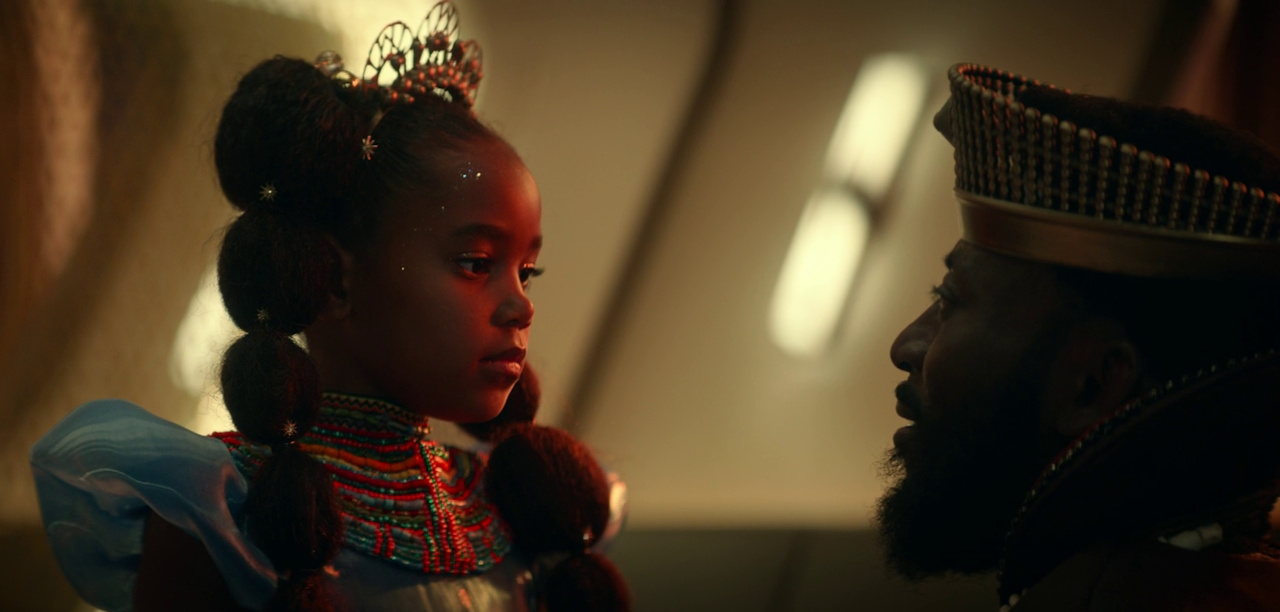
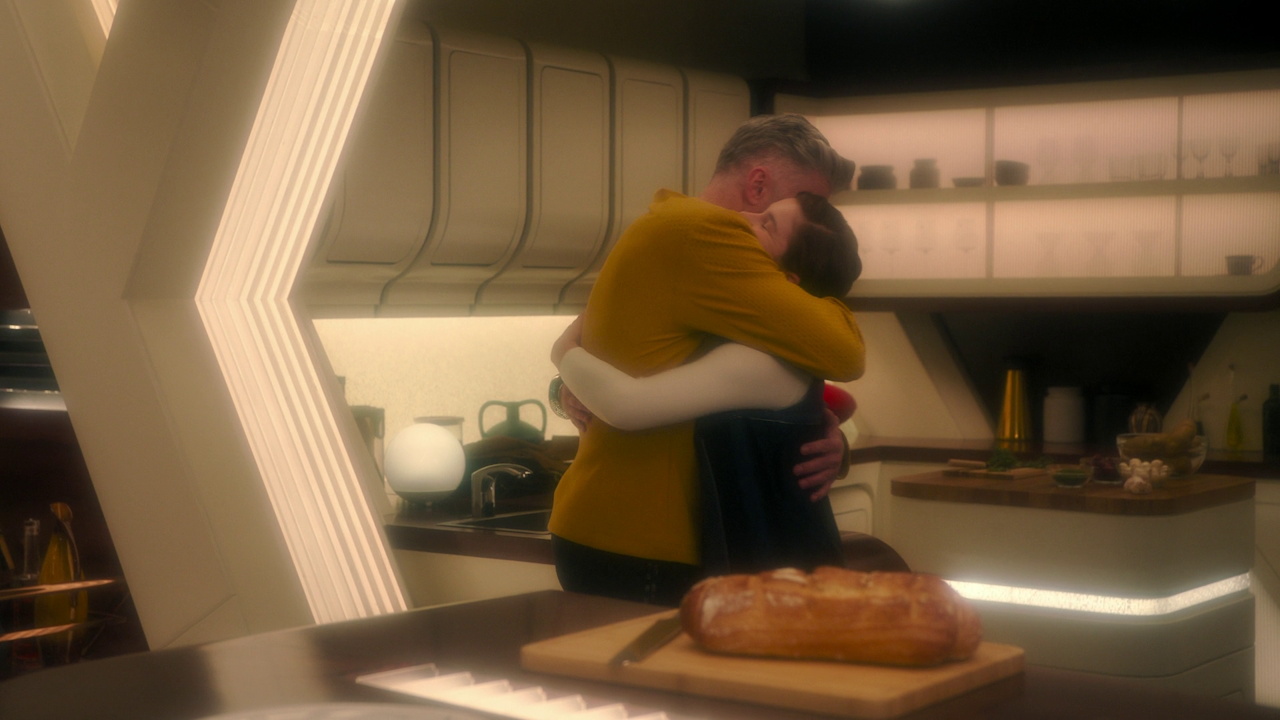
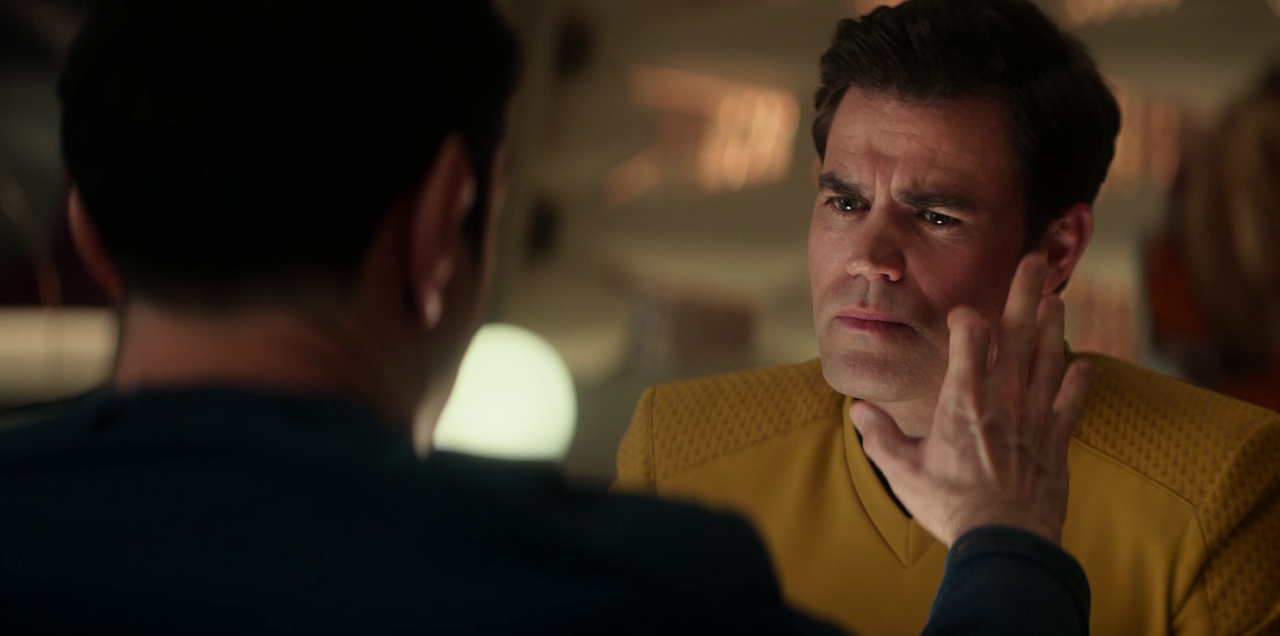
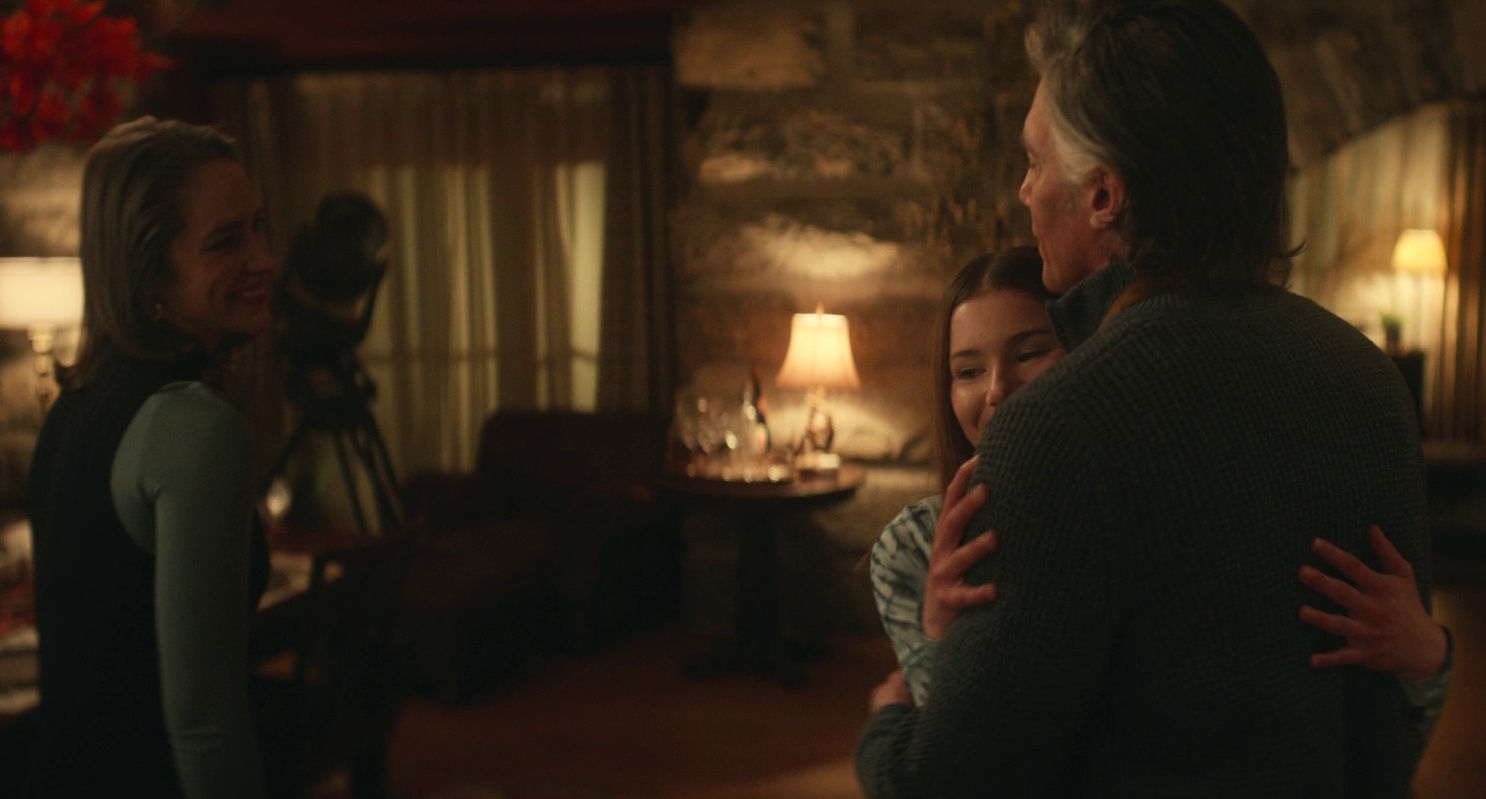
Still frame from Star Trek SNW 4x07 showing Pike and Juliet
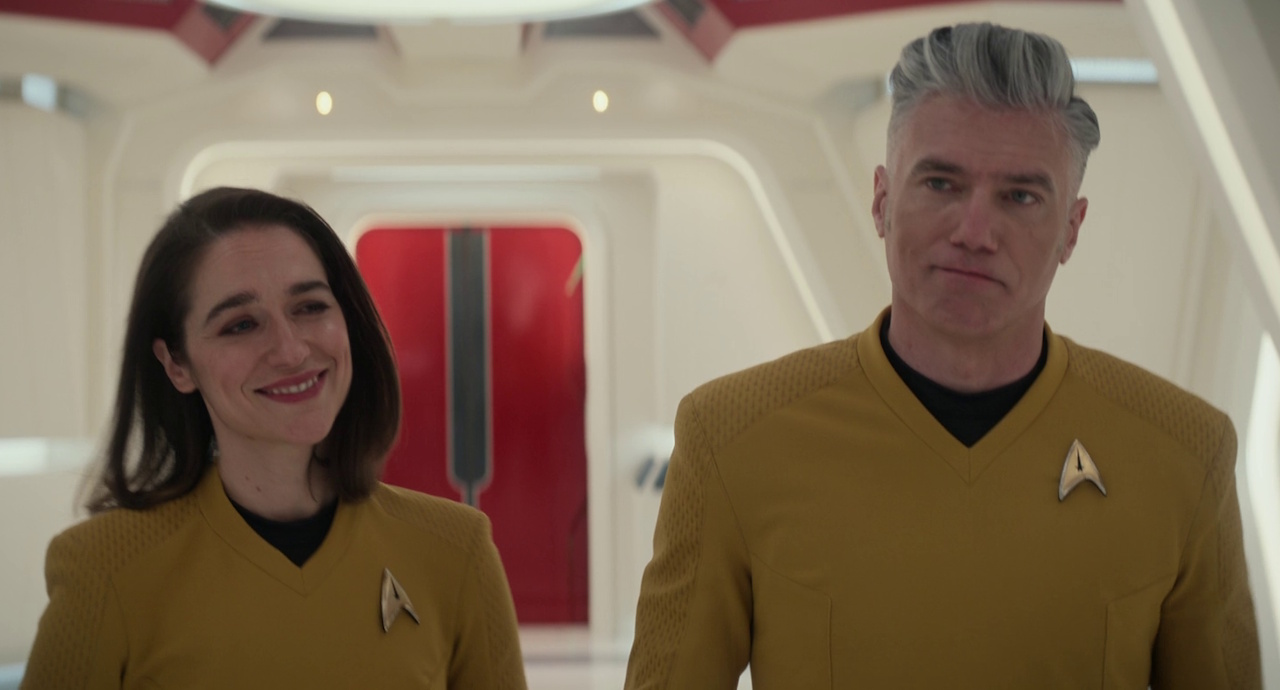
Captain Pike with his daughter.

Like Chronitons Through the Hourglass lets us see this from a different angle with La’an and Spock, too. Captain Pike is literally in mourning; grieving the death of not only Captain Batel but the nonexistence of his daughter, Juliet. La’an, though, is metaphorically “grieving” the end of her romantic relationship with Spock, understanding that their breakup was right for both of them, while still feeling that sense of emptiness and wondering what could’ve been.

Those storylines, had they taken place in a stronger, more grounded narrative framework, were absolutely worth examining. There was a point to be made about loss and grief, and how the end of a relationship can be devastating – even if it was the right decision. For La’an, as she potentially gears up for an exit from the Enterprise (in keeping with the season’s idea of “boldly going one step closer to where it all began”; i.e. moving characters into place in time for The Original Series), that could mean stepping away from the ship to help her move on from Spock (and Kirk, I guess). And for Captain Pike… well, we saw a tiny glimpse at the very end of the episode of how he’s still emotionally wrecked by what happened.

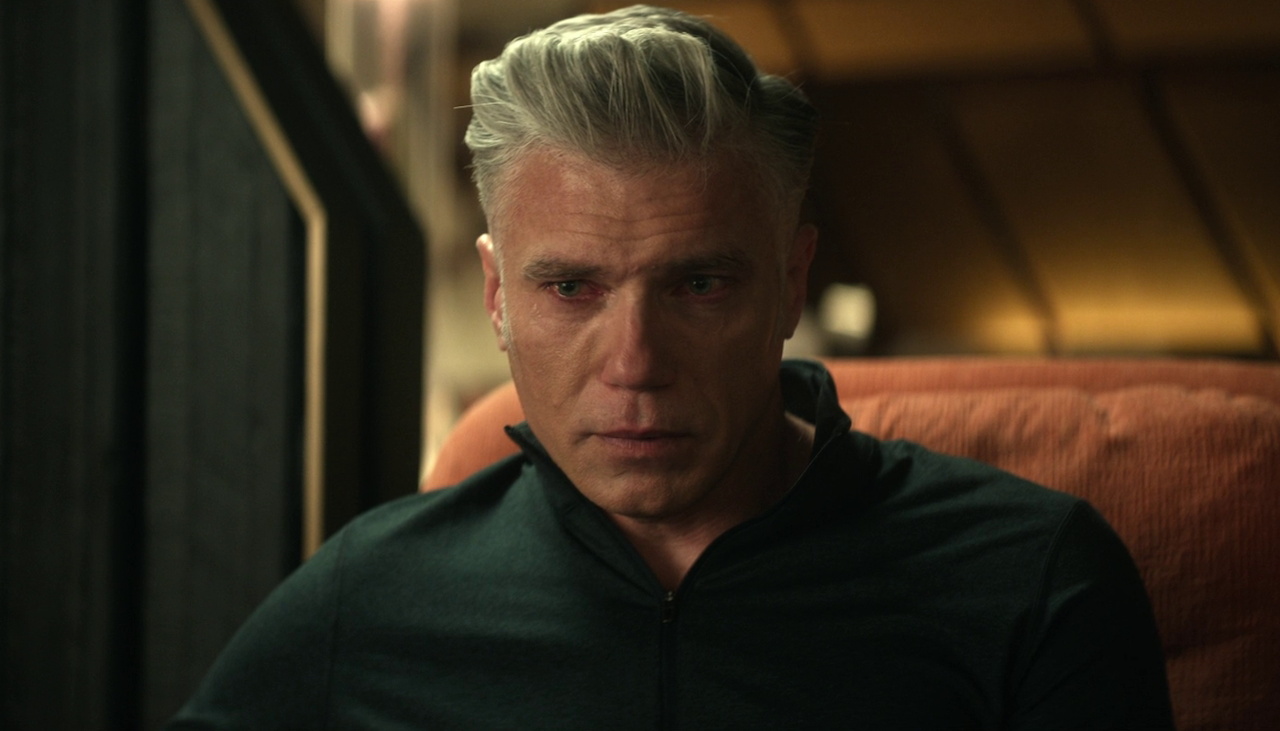
Still frame from Star Trek SNW 4x07 showing Pike in therapy
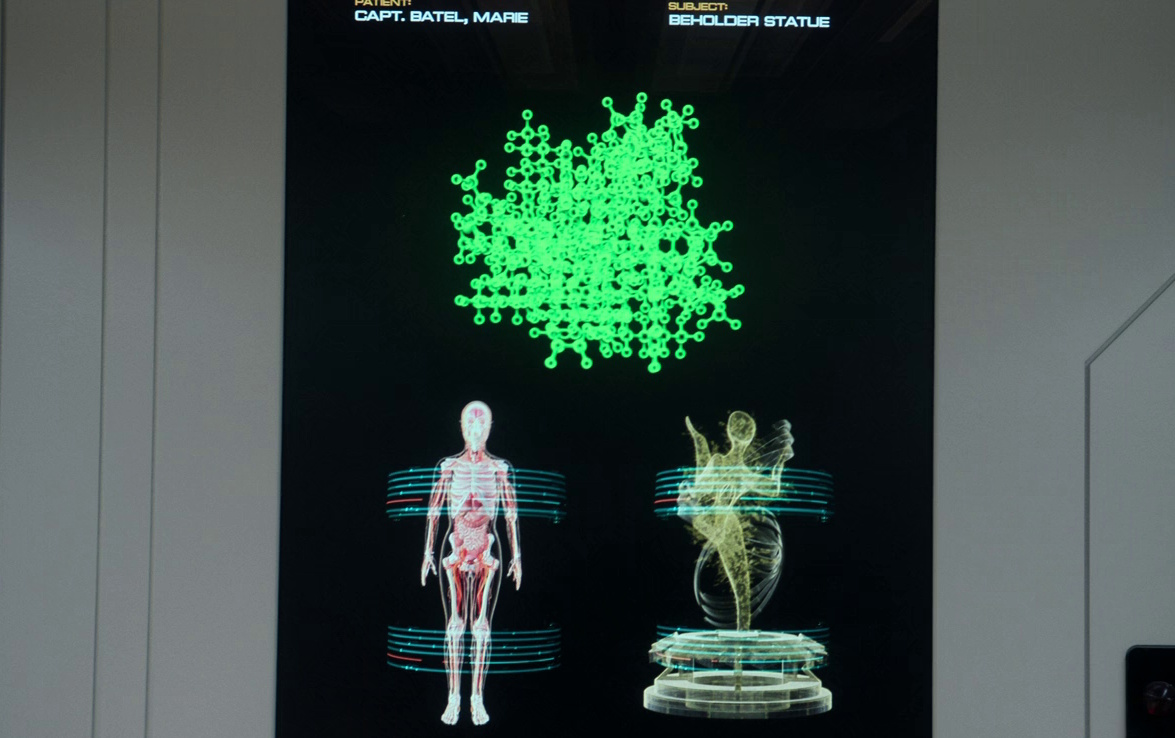
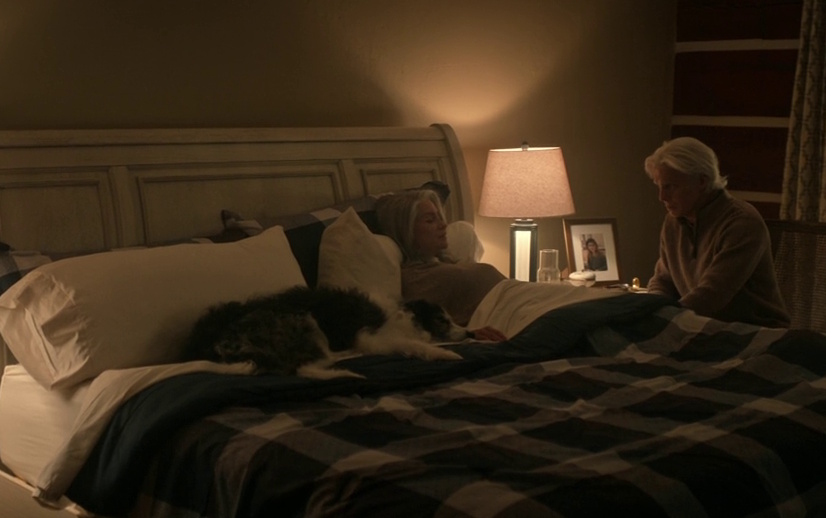
Captain Pike is still reeling from the death of Captain Batel, and the loss of their daughter, Juliet.

The soap opera story, though, completely ruined any chance of those narrative arcs being successfully explored, and I’m genuinely left feeling shocked at the stupidity of the show’s writers and producers – not for the first time this season, I should say. Did they *genuinely* think that this kind of overly-melodramatic soap opera spoof was the best way to examine complex themes of mental health, mourning, grief, loss, and more? What do they think this soap opera stuff added to the story? Could they not recognise that the tone of such a story is in complete contrast to its serious themes?

There are a couple of ways an episode like Like Chronitons Through the Hourglass could’ve been made to work. One would’ve been to lean fully into the soap opera stuff and treat it like a comedy story. Strange New Worlds has done several episodes with overtly comedic premises, and some of them have worked better than others, admittedly, but when they get it right, it works. Look at Human Best Friend earlier this season as an example: it leaned fully into its “Dude, Where’s My Car” and “The Hangover” inspirations, and what resulted was a genuinely fun, light-hearted story.

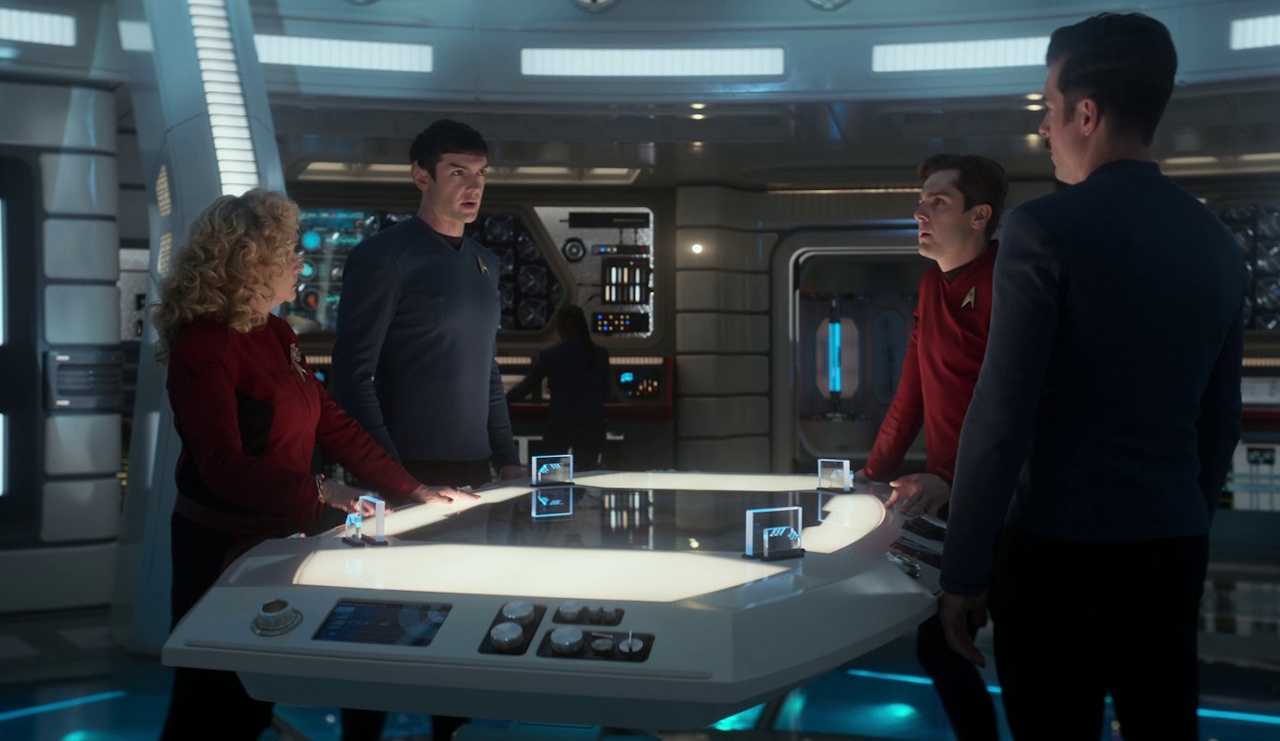
Still frame from Star Trek SNW 4x07 showing four character cards
The soap opera plot detracted from what could and should have been the episode’s core themes.

Alternatively, if the focus of the story was to be on such serious things for two of the show’s main characters, then the soap opera stuff could’ve been limited to short vignettes; we could’ve gotten a taste of Trelane’s meddling but without turning nine-tenths of the episode into a tonally jarring mess.

For me, I think themes as serious as grief and loss really need a dedicated storyline – one that *isn’t* wrapped up in the trappings of Strange New Worlds’ latest genre parody. And I feel the consequences of both modern Star Trek’s cut-down, ten-episode seasons as well as the show’s imminent cancellation in the way two completely, fundamentally incompatible concepts were forced together. The result was a mess; an episode that didn’t know whether it wanted to be silly or serious, tried to be both, and ended up succeeding at neither.

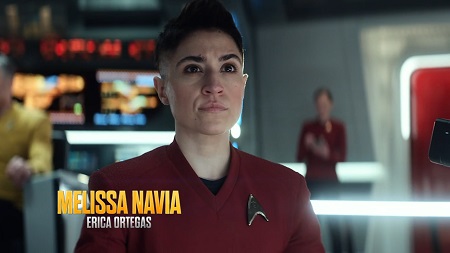
Still frame from Star Trek SNW 4x07 showing Ortegas
Ortegas.

Two groups of writers and/or producers clearly had competing ideas. One was to revisit Captain Pike’s family from the end of Season 3, and explore these themes of loss, mourning, and how Pike’s imagined reality could be a metaphor for people in the audience who are going through similar grieving processes. And the other idea? “Let’s do a silly soap opera parody with all the dramatic musical stings, close-up shots, and overblown lighting! Won’t that be fun?”

And then, somehow – perhaps because the show only had a few episodes per season, or because cancellation loomed – some utter, abject*moron* decided to put both ideas together into one single episode. Is it a coincidence that both Like Chronitons Through the Hourglass and Level-Five Transporter Accident, with its appalling ending, share a writer? Hmm.

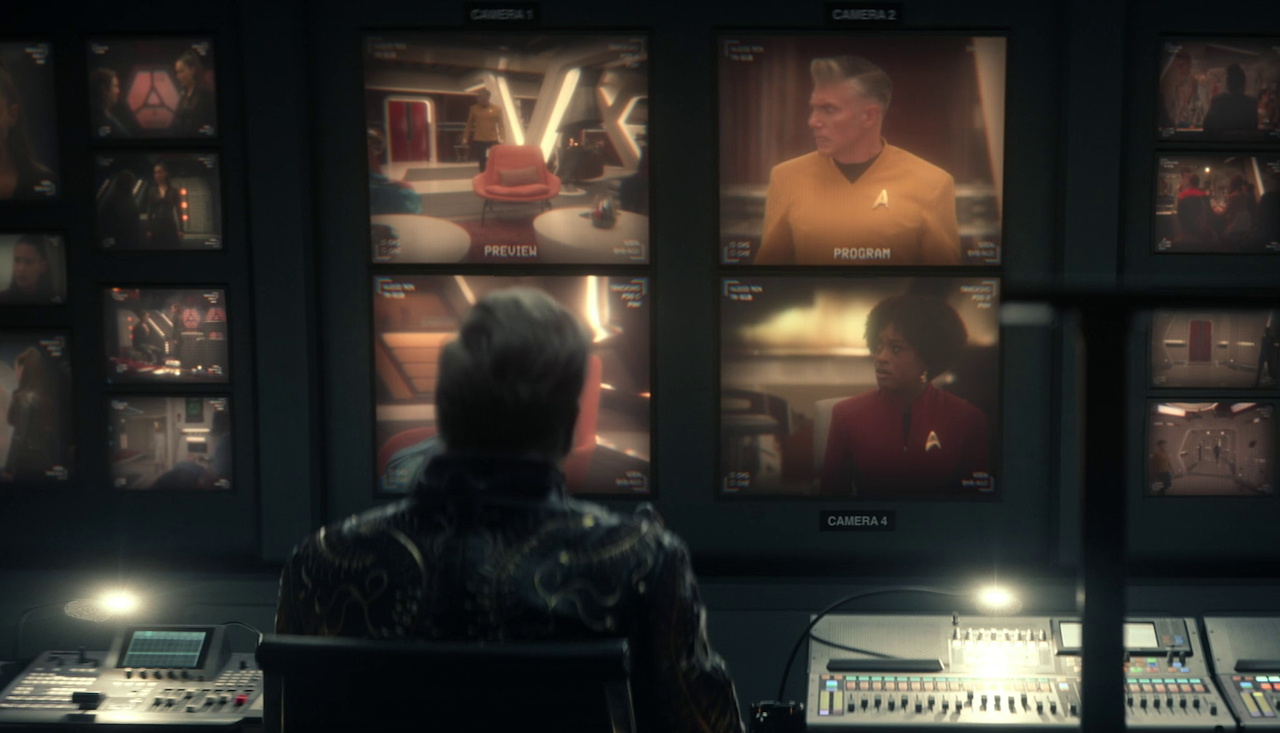
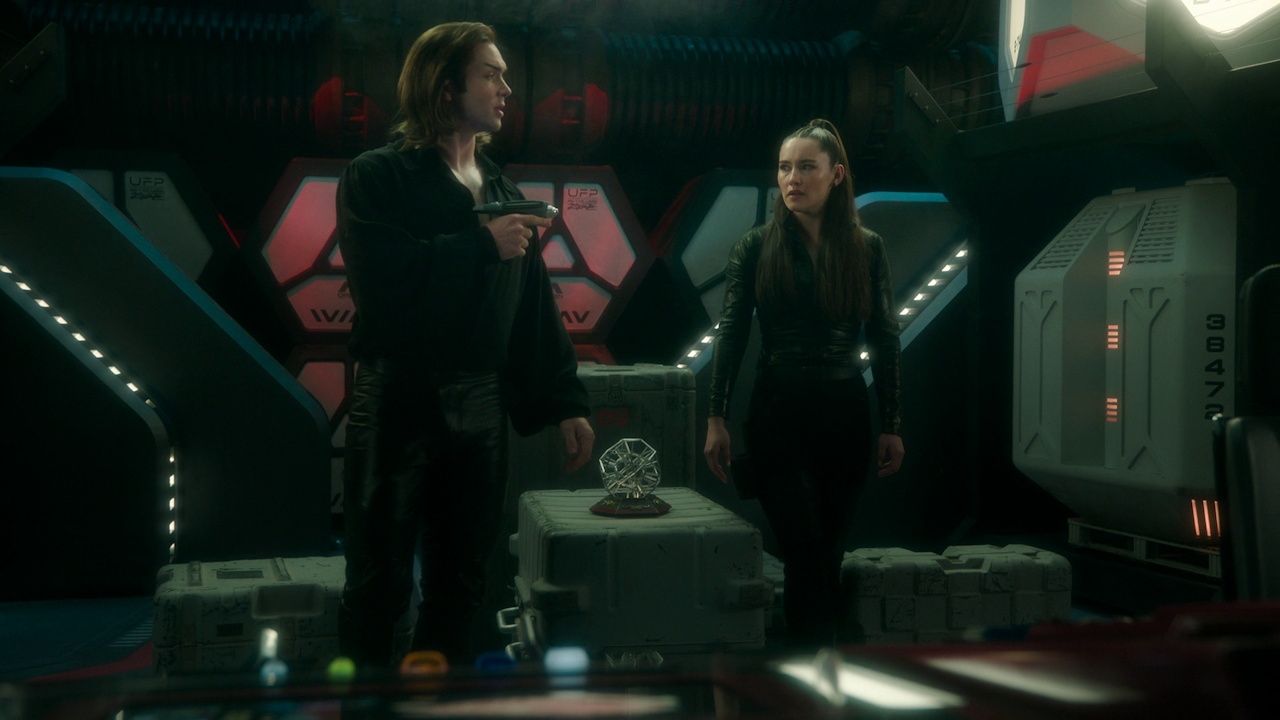
Still frame from Star Trek SNW 4x07 showing Trelane in the booth
Trelane watches his masterpiece unfold…

If I’d been Strange New Worlds’ showrunner, and two groups of writers had approached me with these ideas, I’d have picked the more serious one. That isn’t because Star Trek can’t be silly, Star Trek shouldn’t do comedy, or even because I don’t like genre parodies. All of those concepts can work in Star Trek, have already worked in Star Trek, and can be a lot of fun. But having already had several overtly comedic stories across the show’s run, *and* with several other “big swings” into different genres already on the books just in Season 4… I think I’d have said “no” to the soap opera and insisted on doing a more in-depth look at the themes on Pike and La’an’s sides of the story in a more straight-laced setting.

There *can* be value in contrast; in juxtaposing a serious idea against an inherently silly setting. But doing that successfully requires finesse, and frankly, it requires a level of production and writing quality that I don’t think either Strange New Worlds or indeed modern Star Trek as a whole have demonstrated themselves to be capable of. Ambition is great! We should all endeavour to be ambitious in our writing and with our creative ideas. But there comes a point where ambition runs into the brick wall of reality, and for me… I think some of the show’s producers and writers need to recognise their own limitations.

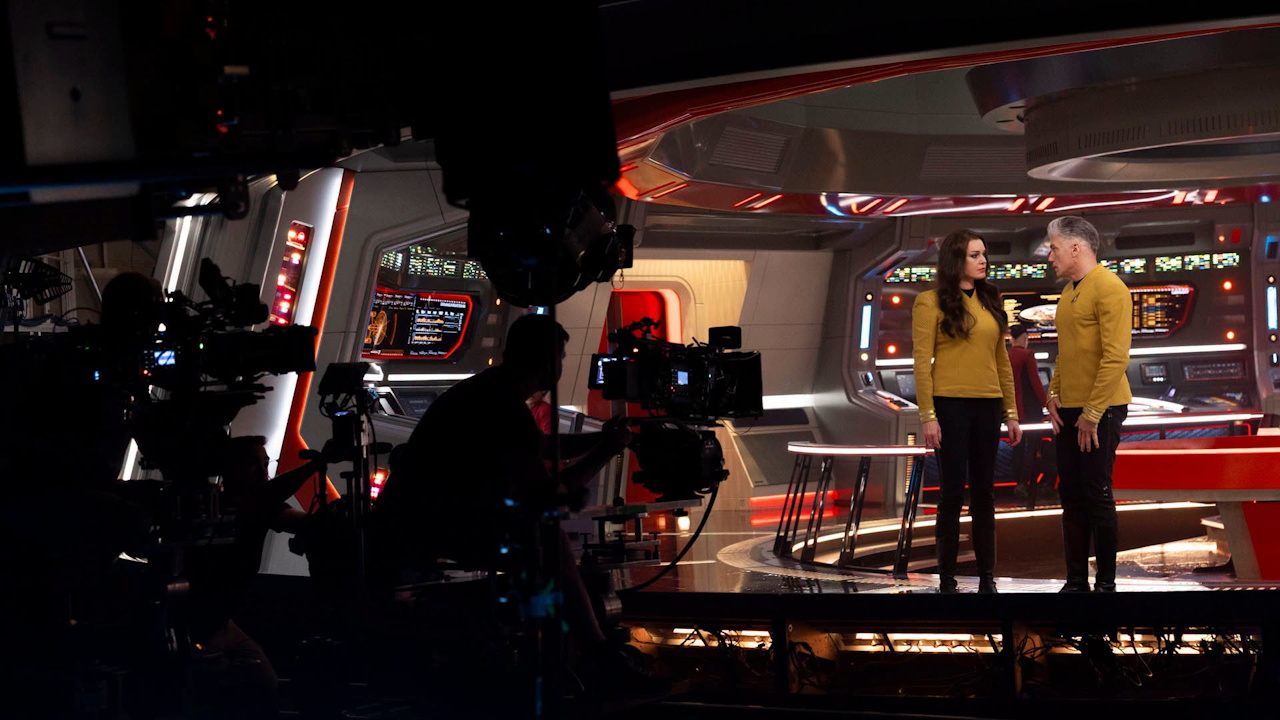
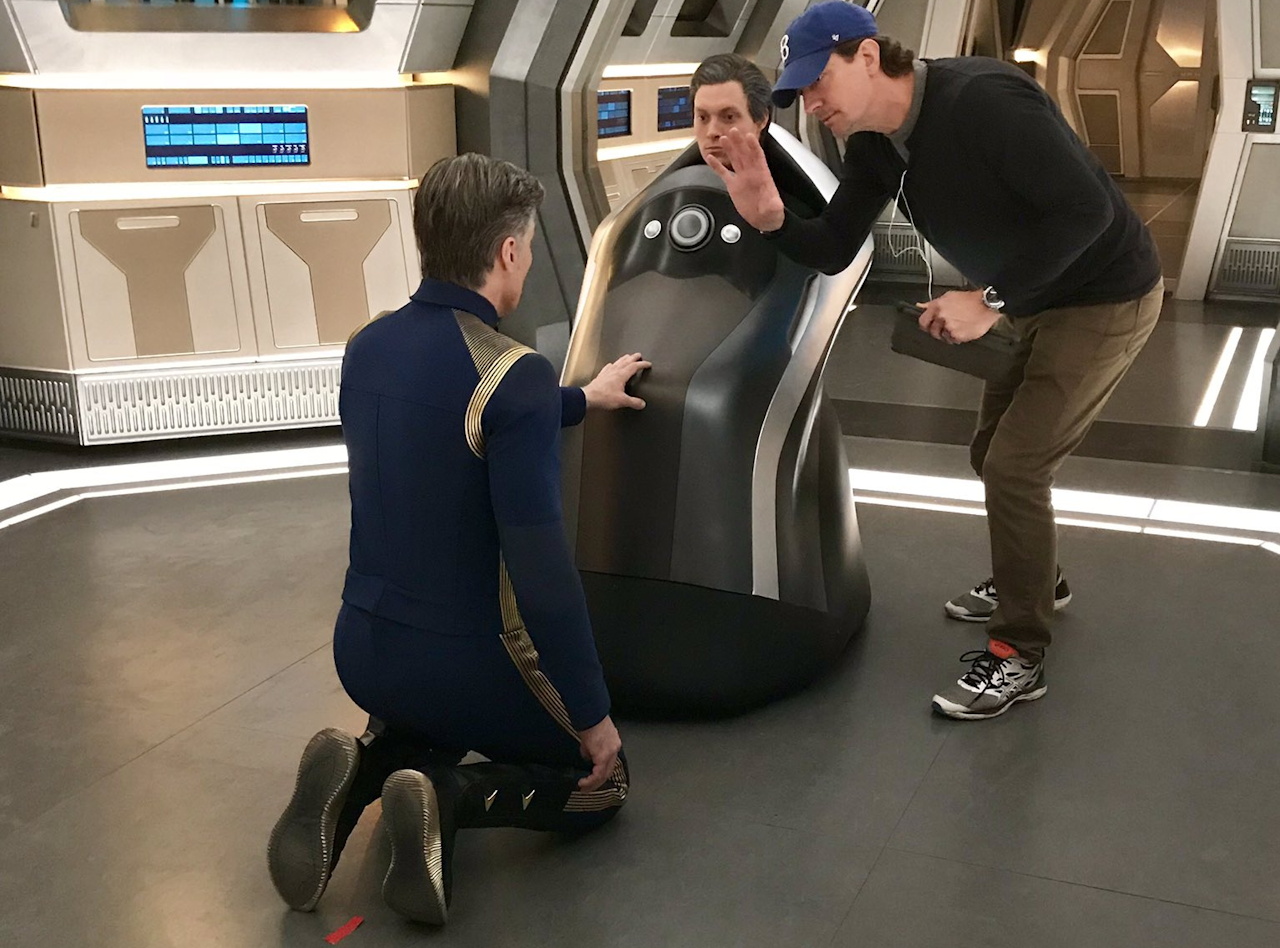
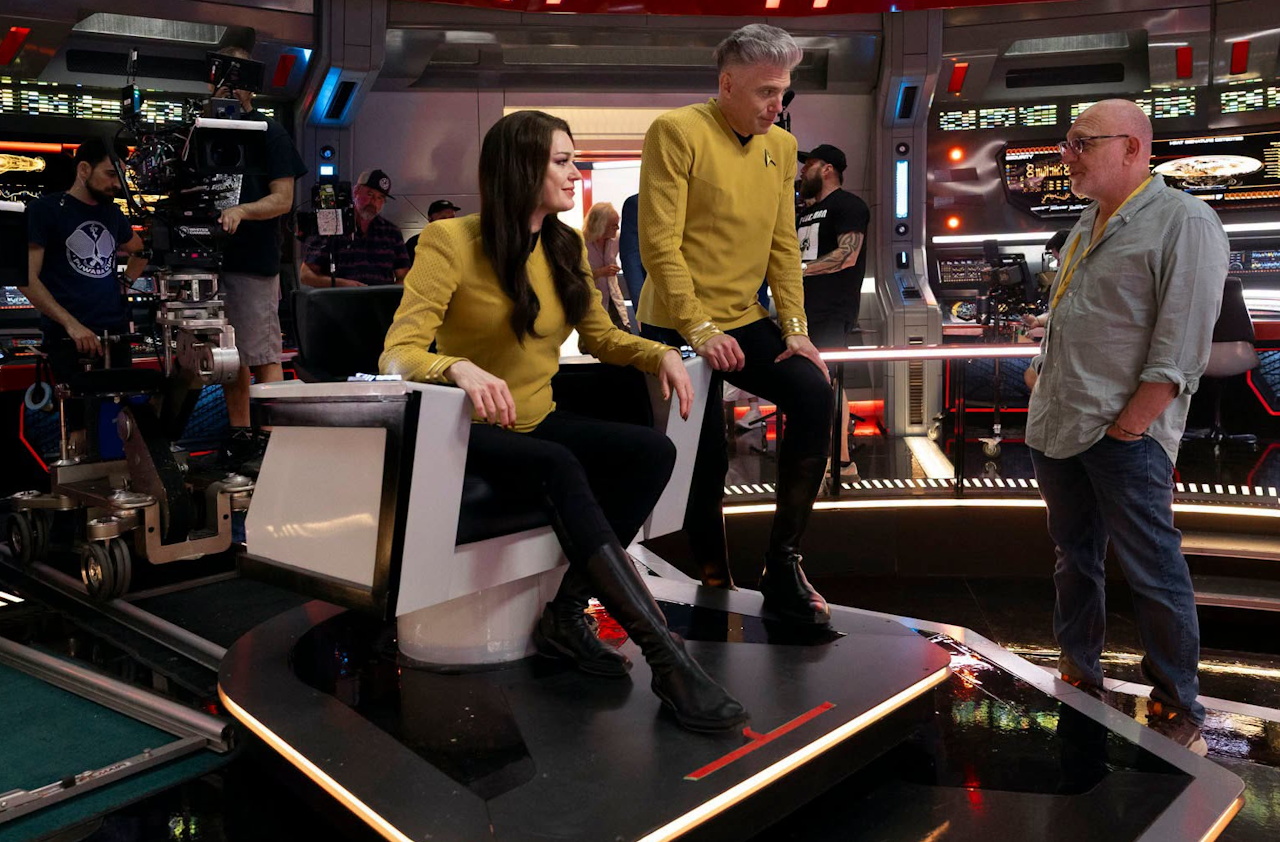
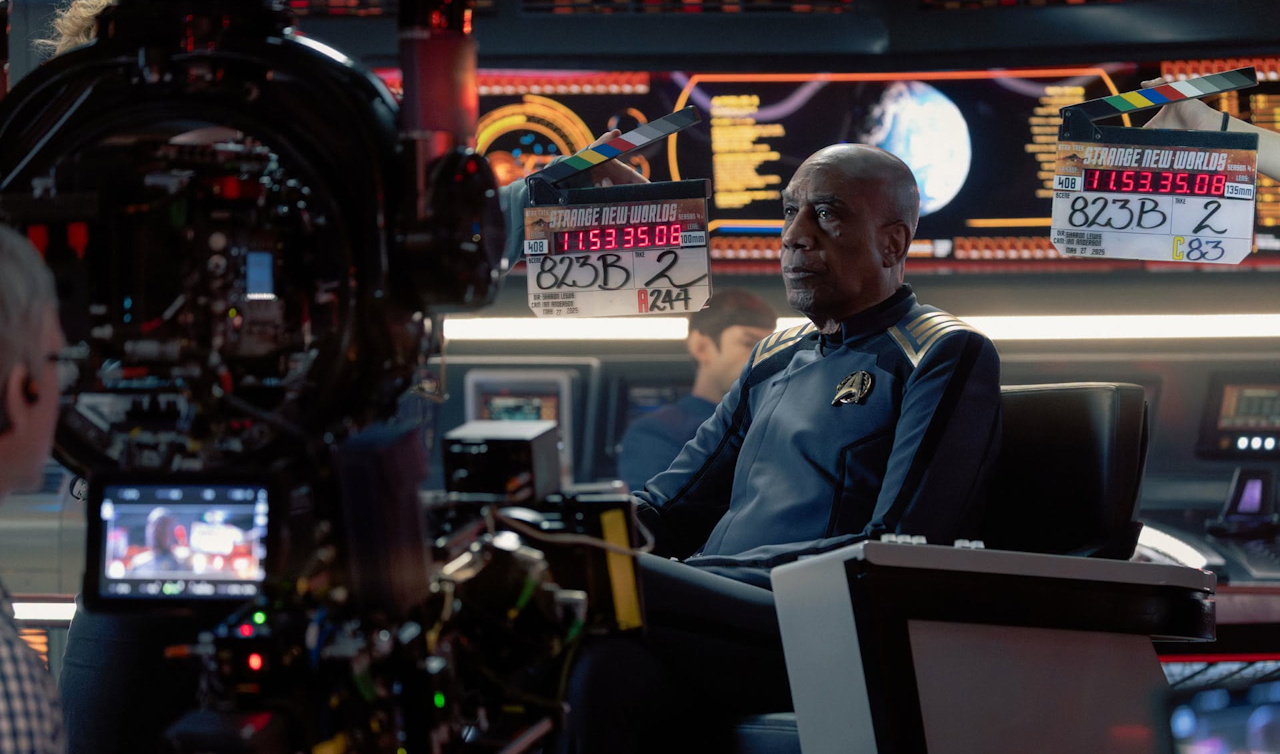
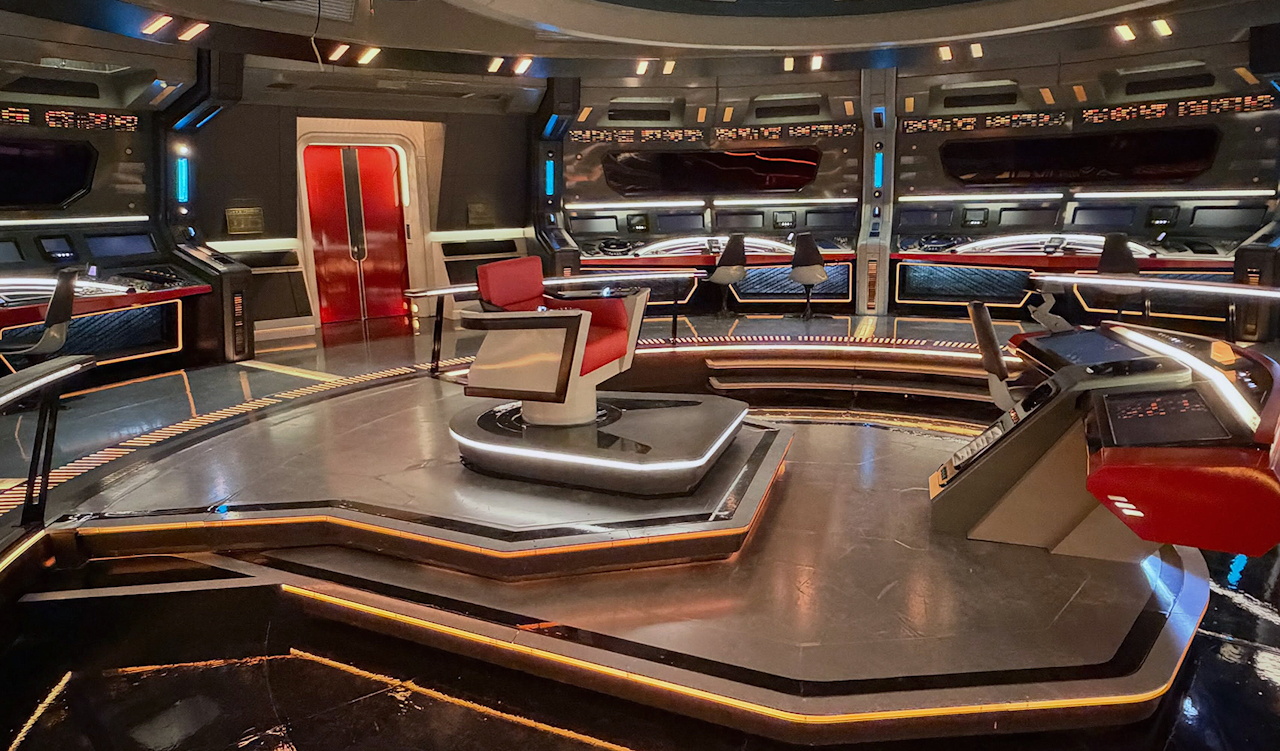
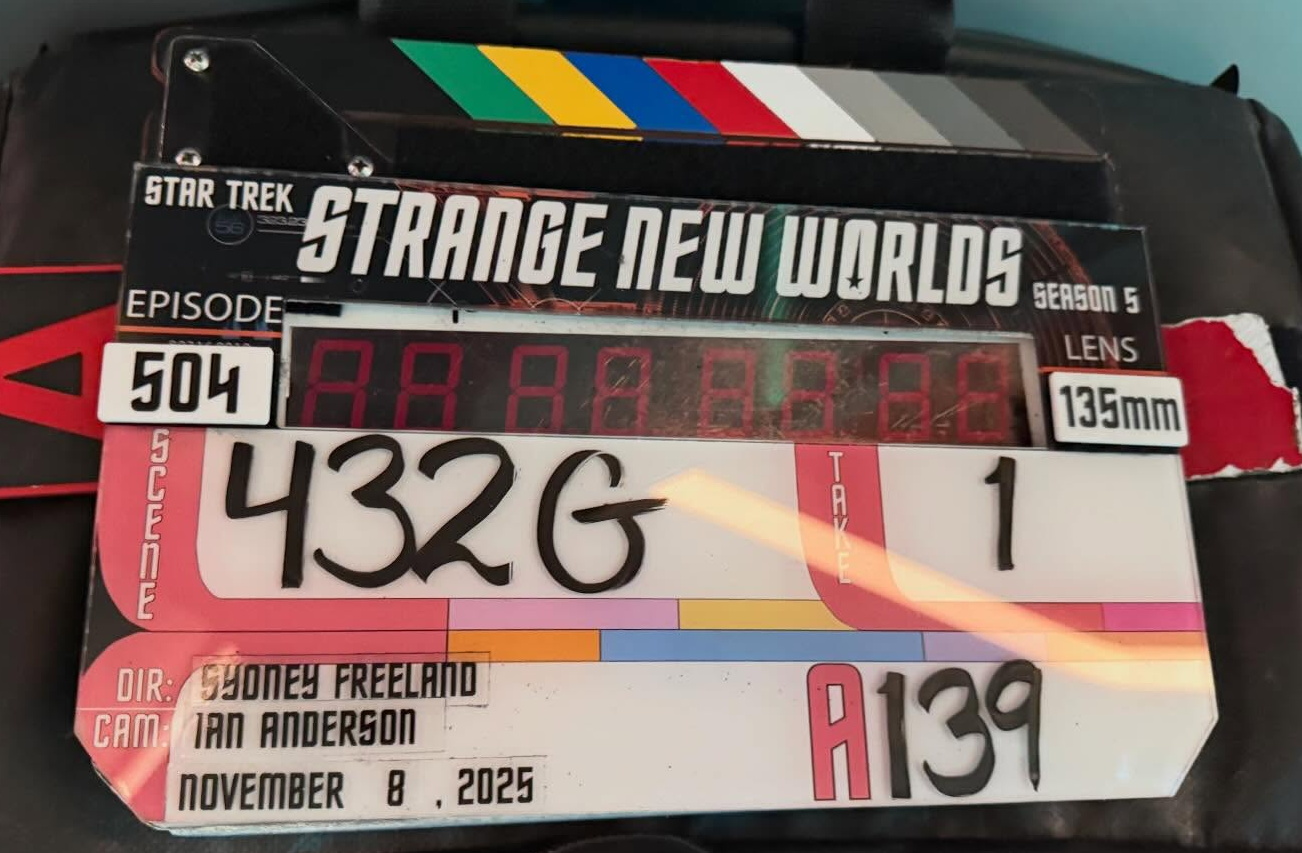
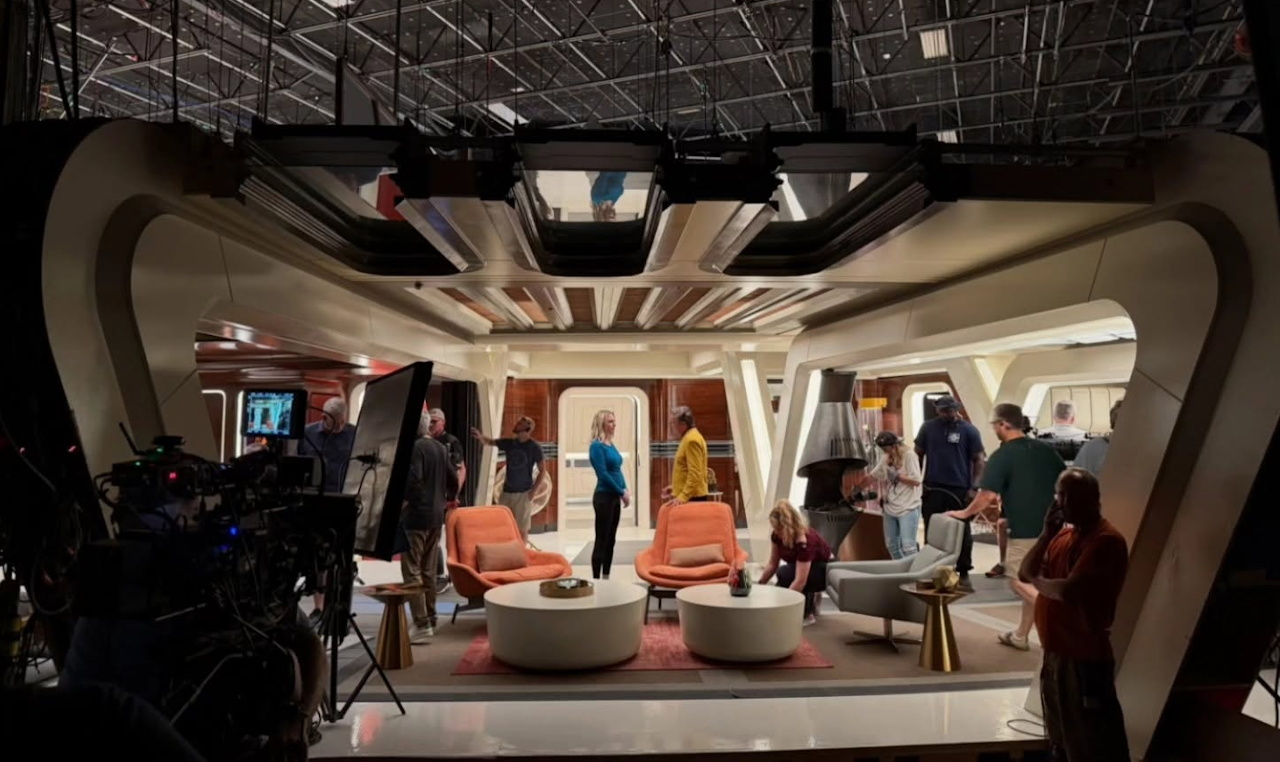
Behind-the-scenes photo from Star Trek SNW 4x07
Behind-the-scenes during production.

Maybe a really exceptional writer-director-producer combo could’ve pulled this off. But clearly, no one in the Strange New Worlds writers’ room or on the production side is at that level.

This episode’s writers *certainly* weren’t.

I’m also hyper-aware of the fact that this is now the *second* episode this season – after Level-Five Transporter Accident – where the bulk of the story didn’t “really” happen. Like Chronitons Through the Hourglass’ ending isn’t as bad as “but it was all just a dream” (though let’s be honest: nothing could be as bad as that), but despite leaving the characters with most of their memories of what took place… it still scrubs those events from the show’s internal reality.

Again: that’s pretty fucking weird, isn’t it?

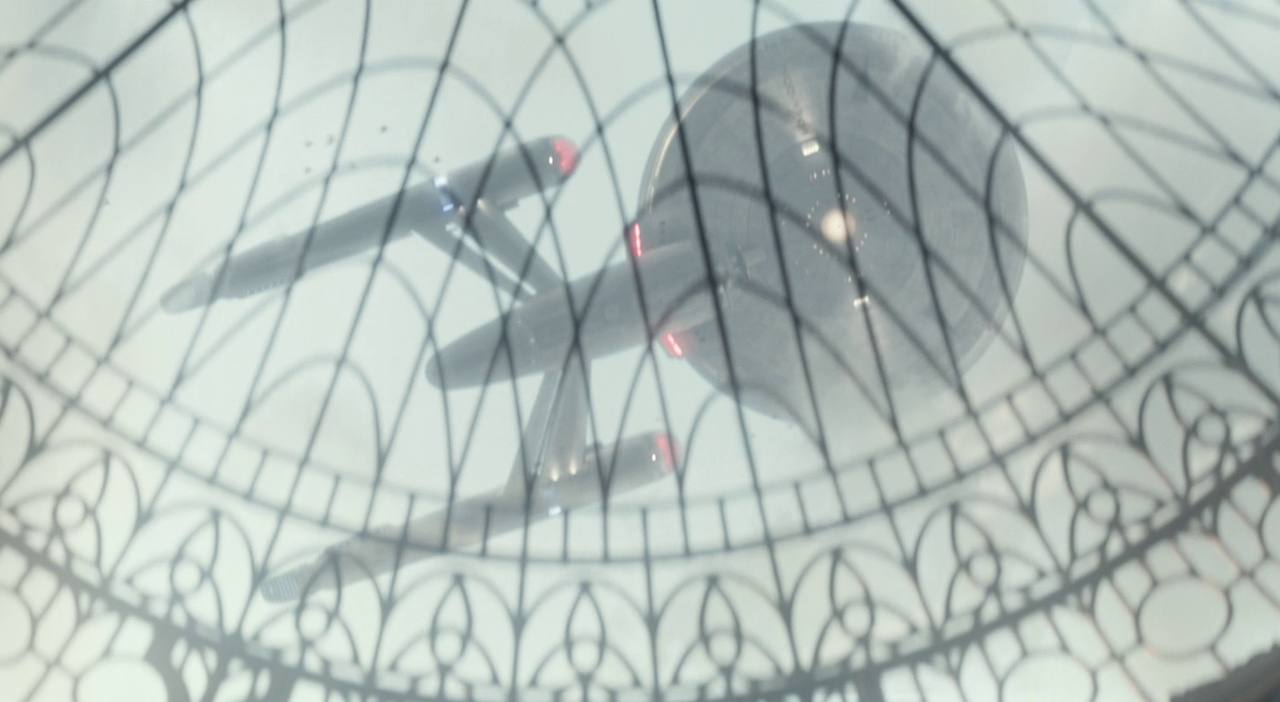
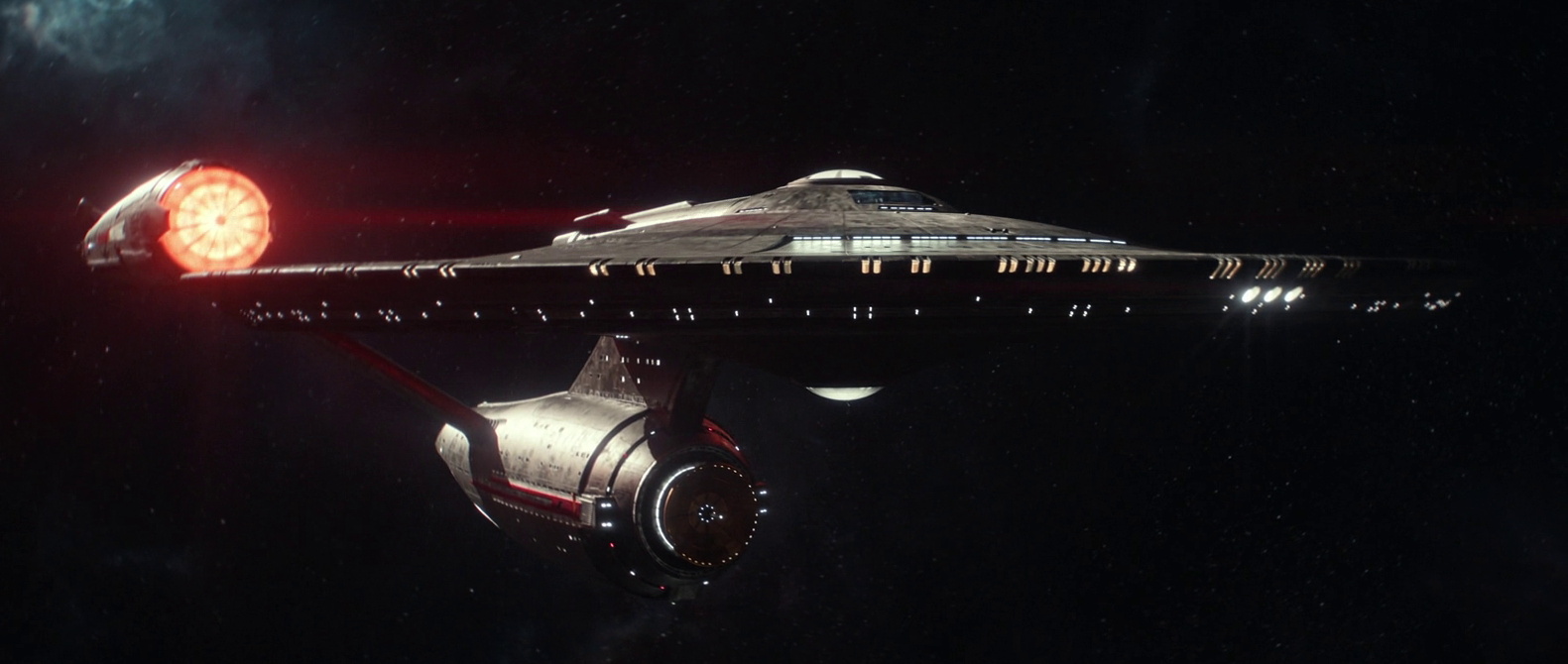
Still frame from Star Trek SNW 4x07 showing the USS Enterprise
The Enterprise is now back to normal.

Maybe there’s supposed to be a point about making emotional connections through fiction, and how the emotions we feel when reading a book or watching an episode of television are no less real just because it was fiction that elicited them. That might be an idea worth exploring – but again, such a concept would require higher-quality writing, a planned narrative arc, and less of a tonal clash between the soap opera silliness and the characters’ real lives.

In a way, I like this idea a lot. My website exists because I find value in fictional worlds like Star Trek; spending more time in those worlds, with those characters, is fun for me and always will be. And I don’t deny the power of all forms of media to evoke strong emotions. The emotional reaction we have to an episode of Star Trek, a movie, a book… those are *real*, even if the stories and characters aren’t. And there’d be value in an exploration of the idea of exploring that kind of emotional connection.

But that isn’t what Like Chronitons Through the Hourglass was going for – and even if it had been, it didn’t work.

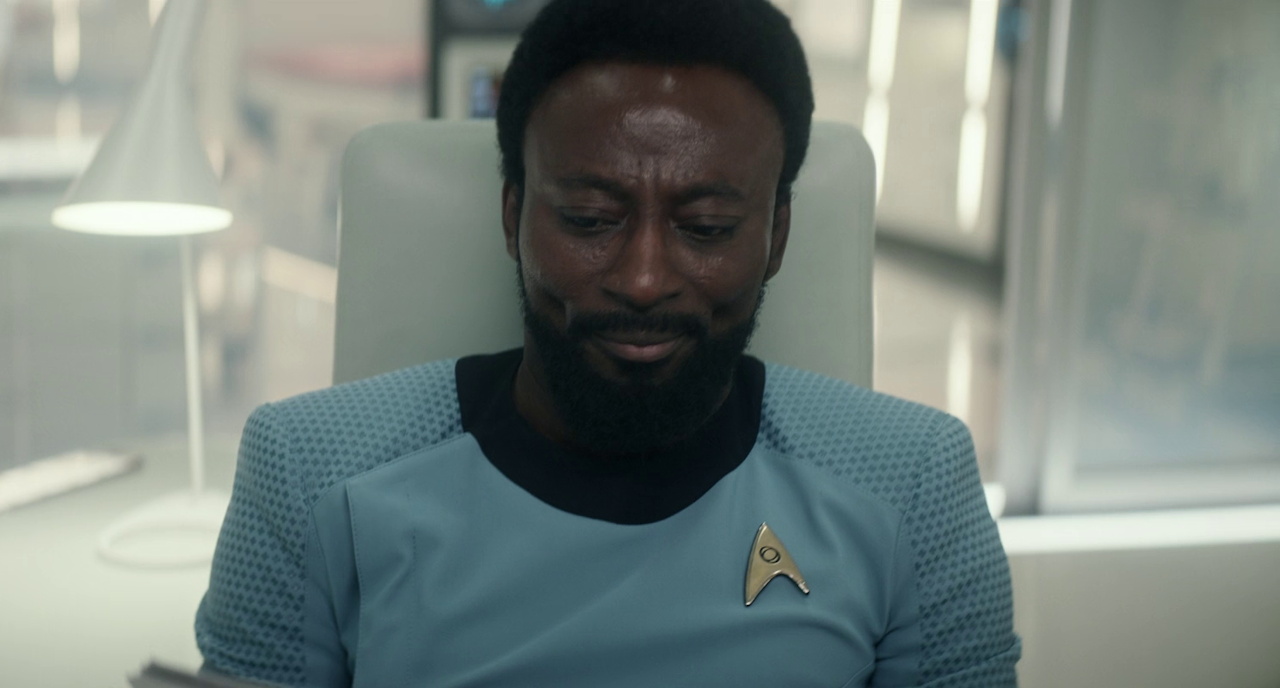
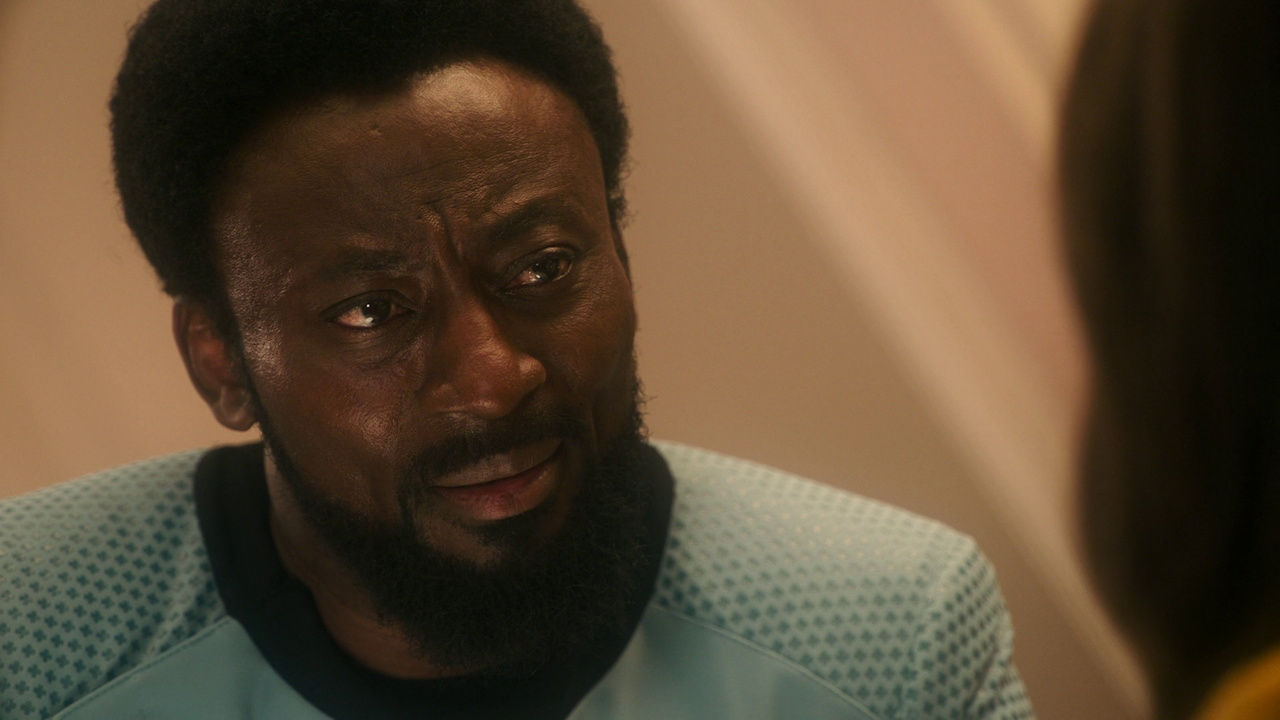
Still frame from Star Trek SNW 4x07 showing Dr M'Benga
Dr M’Benga.

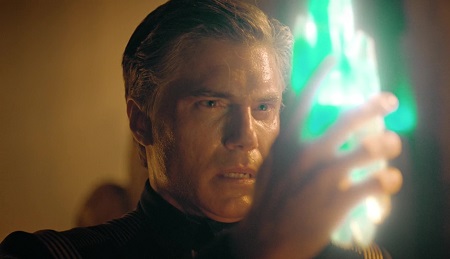
I feel rather sorry for Anson Mount. After being functionally absent for most of Season 4, his first real spotlight ended up being a tonally muddled episode where two clashing ideas just couldn’t be forced together cohesively. That means that what is objectively one of Mount’s best – and certainly his most emotional – performances in the role of Captain Pike came in an episode that’s honestly better left forgotten, for the most part.

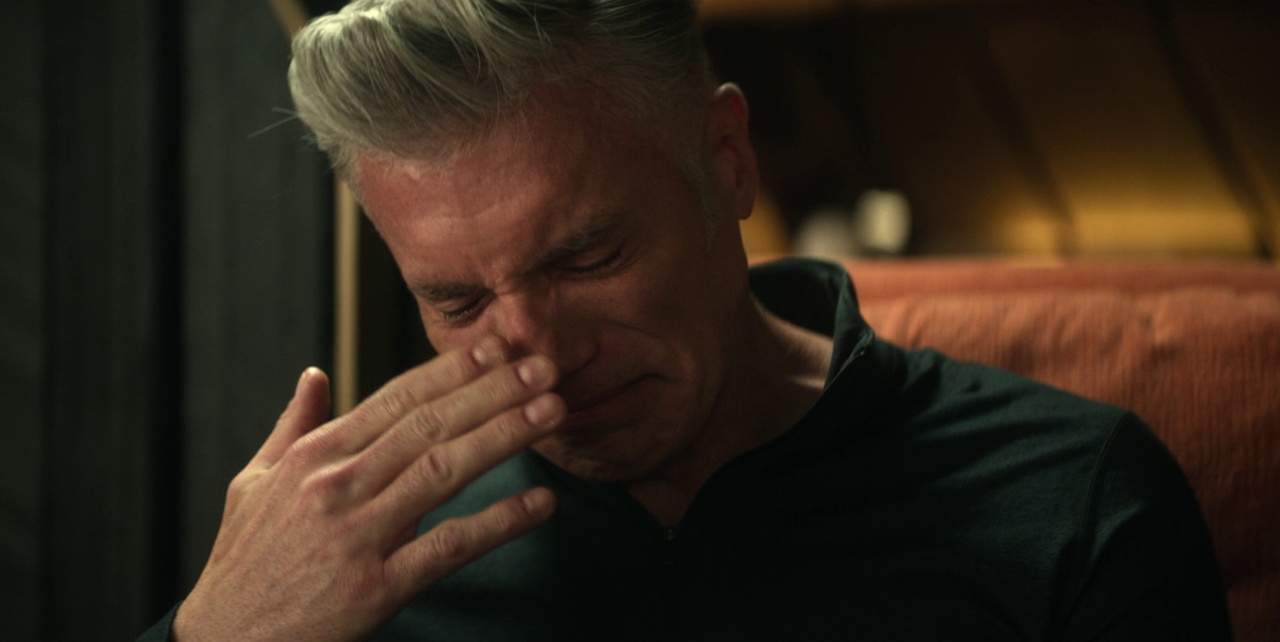
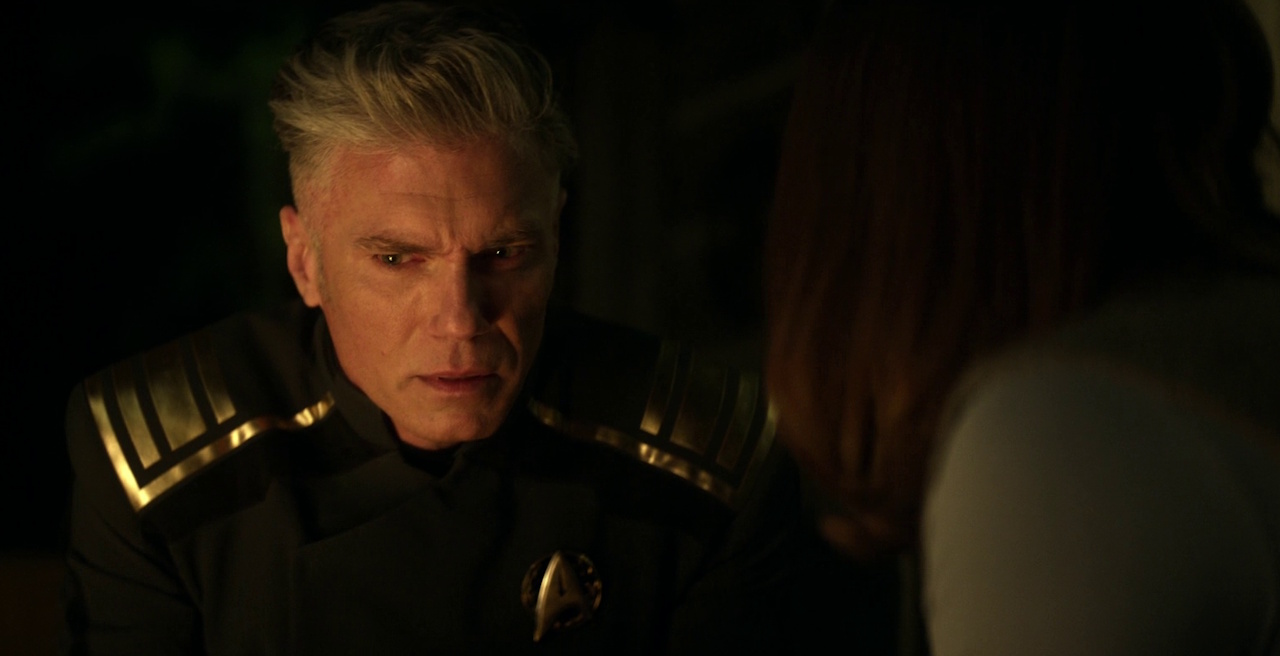
Like Chronitons Through the Hourglass managed to hit the right emotional note with Pike… at the tail end of the story. And seeing him break down, expressing those emotions he’d been holding onto since the end of Season 3 genuinely hit me. But they didn’t hit as hard as they might’ve if the rest of the episode had been stronger and more grounded, and because Pike’s moment of emotion came right at the end of the episode, just as the credits were about to roll… I just don’t think it landed as hard as it should have.

Still frame from Star Trek SNW 4x07 showing Pike in therapy
Captain Pike breaks down.

If Strange New Worlds wanted to do this kind of story, examining Pike’s mental health and his emotional state after losing Captain Batel and Juliet, then it realistically needed to be part of a completely different narrative framework. Trying to squash genuinely complex emotional storytelling for the man who’s (allegedly) the show’s main character up against this bizarre and over-the-top genre parody didn’t work.

What’s more, it should’ve been obvious from the *concept* stage that these two ideas couldn’t work together, which is why I stand by what I said above: the people who came up with this idea, turned it into a complete script, and greenlit it for full production are stupid, idiotic people who shouldn’t be working in this industry! It was *painful* to watch parts of Like Chronitons Through the Hourglass because of how cringe-inducing it was… and that would be bad enough on its own, but when you add into the mix that there was an actual, genuine story worth telling that the soap opera pastiche shat all over? It’s unforgivably bad, to be blunt.

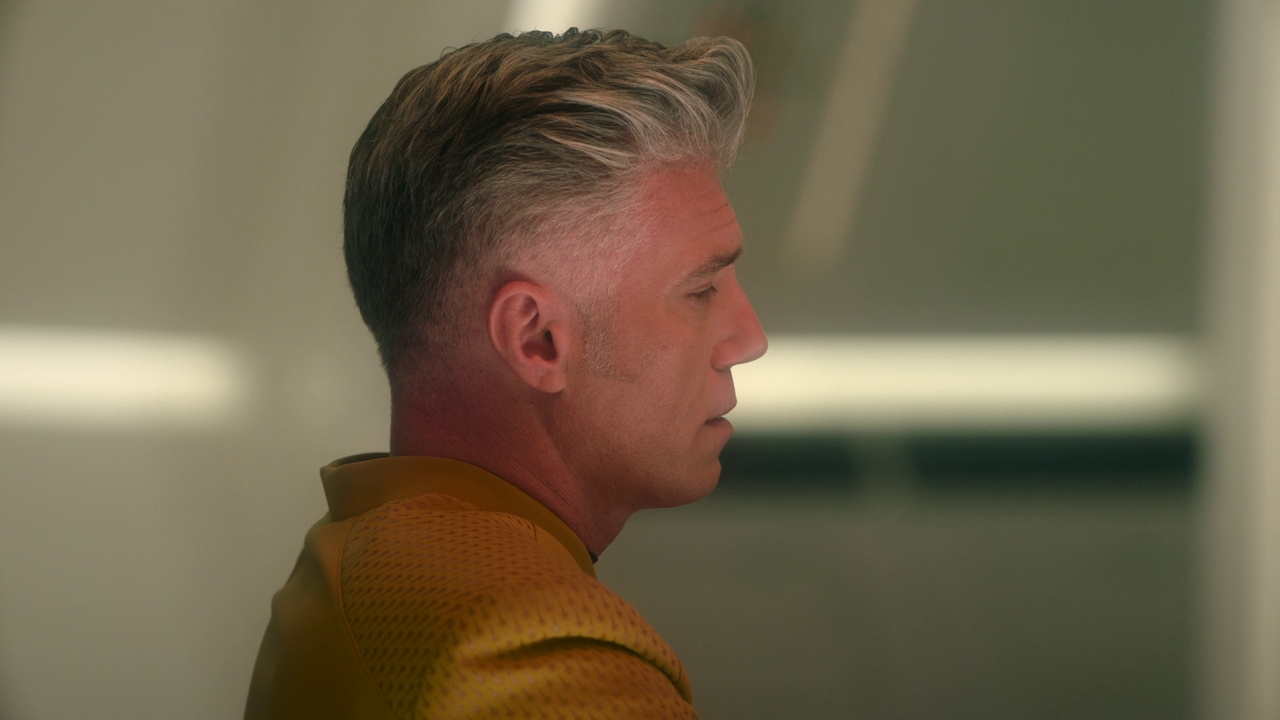
Still frame from Star Trek SNW 4x07 showing Pike (side angle)
There was a story worth telling for Captain Pike (and La’an) that got buried by an unnecessary and over-the-top spoof.

I’m in favour of Star Trek trying new things. And I’m in favour of Star Trek trying out stories in radically different genres and with completely different tones. Part of the franchise’s appeal, at least for me, is its episodic nature, and that the Enterprise can warp away to a new planet, new aliens, a new adventure, and a new kind of story each and every week. I’m not saying “don’t do these kinds of genre stories,” and I’m not saying “Star Trek has to be 100% straight-laced and serious every single time.” That wouldn’t be fun.

But what I am saying, at least in this case, is that the genre parody fundamentally could not work with the more complex themes that the other side of the episode wanted to address, and by trying to force these two diametrically-opposed ideas together, what resulted was neither a successful homage to soap operas nor a clever and relatable exploration of themes of loss and grief. And frankly, that should have been obvious to all involved well before the episode even had a finished script.

Still frame from Star Trek SNW 4x07 showing La'an with fake Sybok
La’an with Sybok. Sorry: “Sybok.”

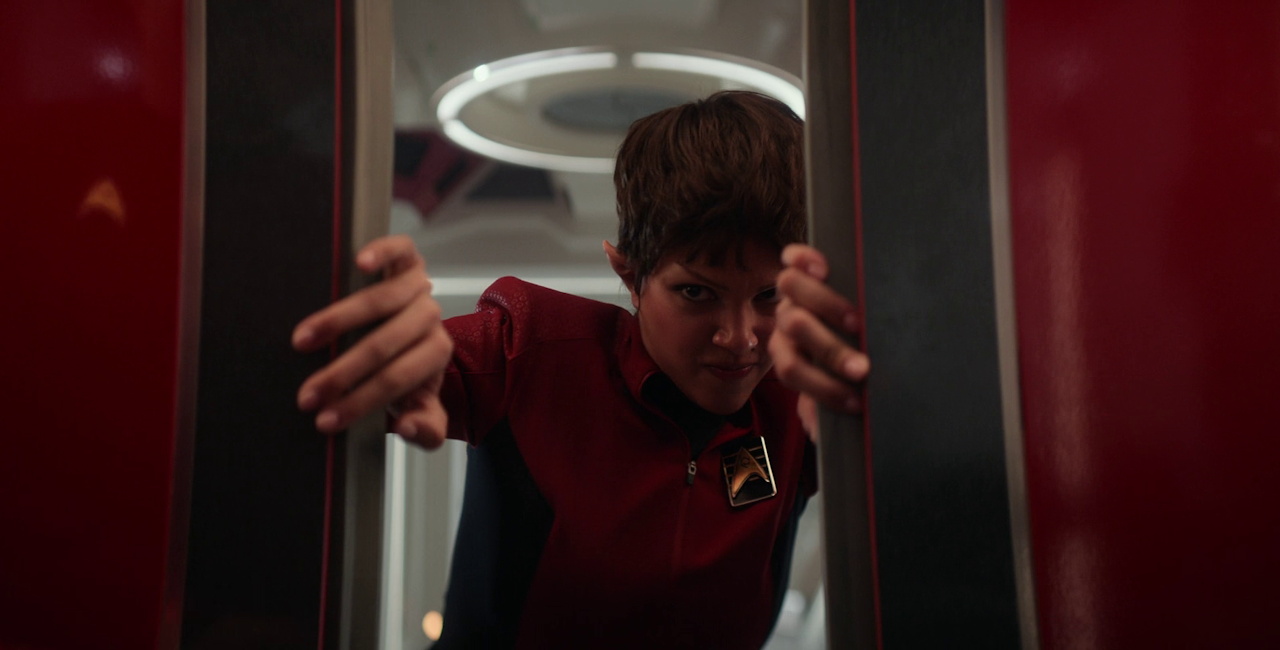
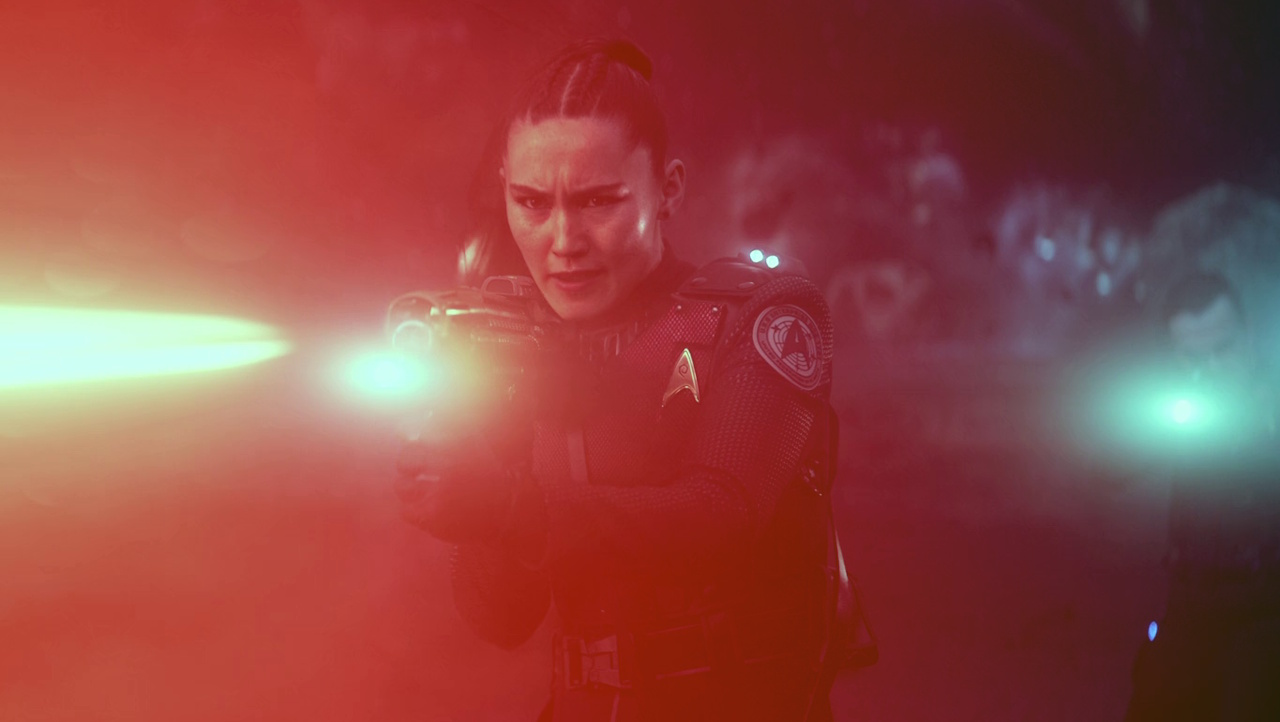
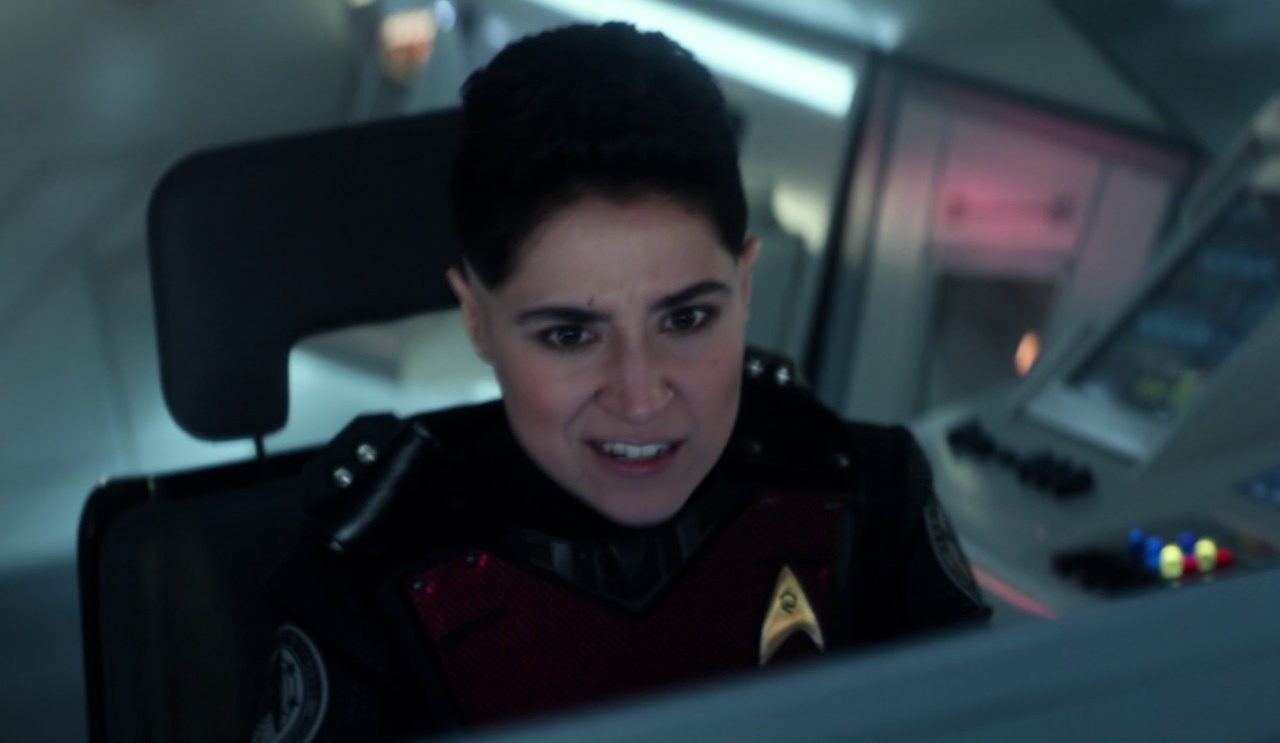
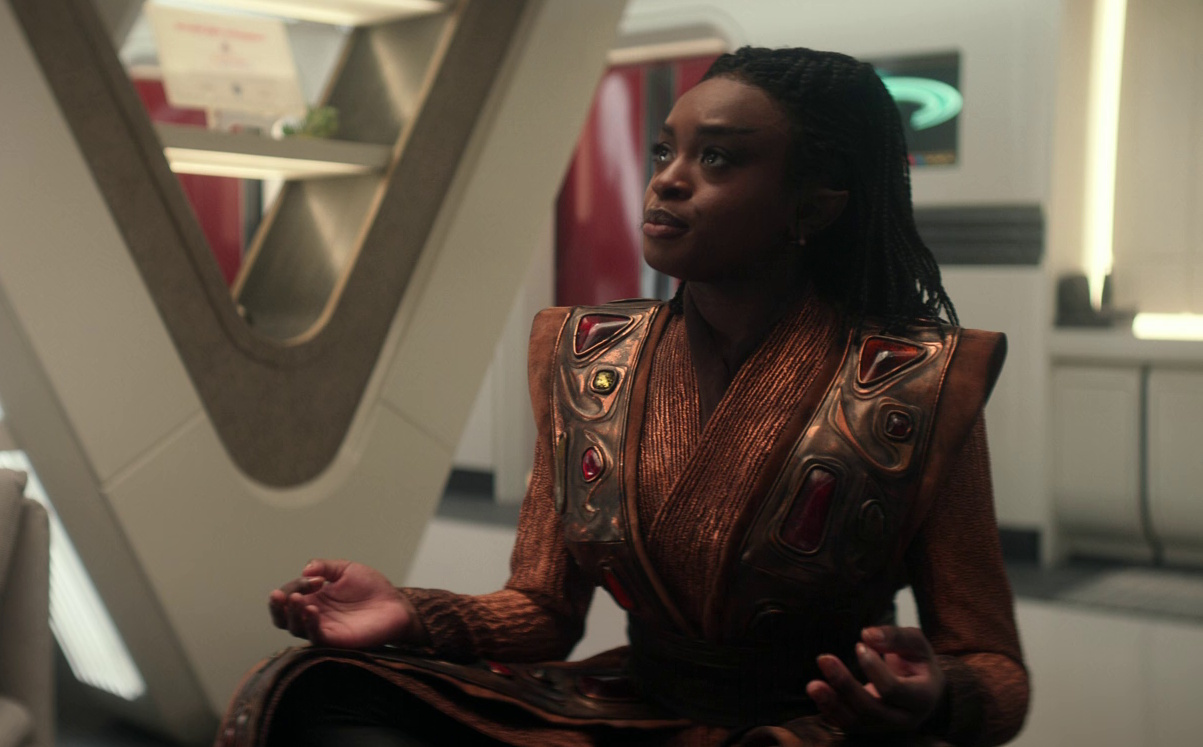
Uhura’s story, seeing Pike as her father (for inexplicable reasons) was little more than a piss-take of similar soap opera plots over the years. And I mean… I get it. Two totally unrelated characters, who viewers have known for years, are suddenly revealed to be father and daughter or mother and son or long-lost conjoined twins. I get it. It’s a soap opera trope. But did it need to be such a big part of Like Chronitons Through the Hourglass? And what was the point of it for Uhura?

For Pike, this story tracks insofar as it set up his arc of confronting what happened to his family in the life he led and lost. But for Uhura… what are we supposed to get from this storyline? Am I missing something? She sees Pike as an important mentor figure in her life. Great. We knew that already. But given where Uhura is in her character journey – and the season’s stated aim of moving characters “one step closer to where it all began” – what are we gaining by putting her, of all people, into this soap opera plotline with Pike? I know it wasn’t real (and it was obviously not supposed to be real), but still. This was such a big part of the episode – and not just from Pike’s perspective – and yet we gained basically nothing from it.

Still frame from Star Trek SNW 4x07 showing Pike and Uhura
What was the point of this story for Uhura?

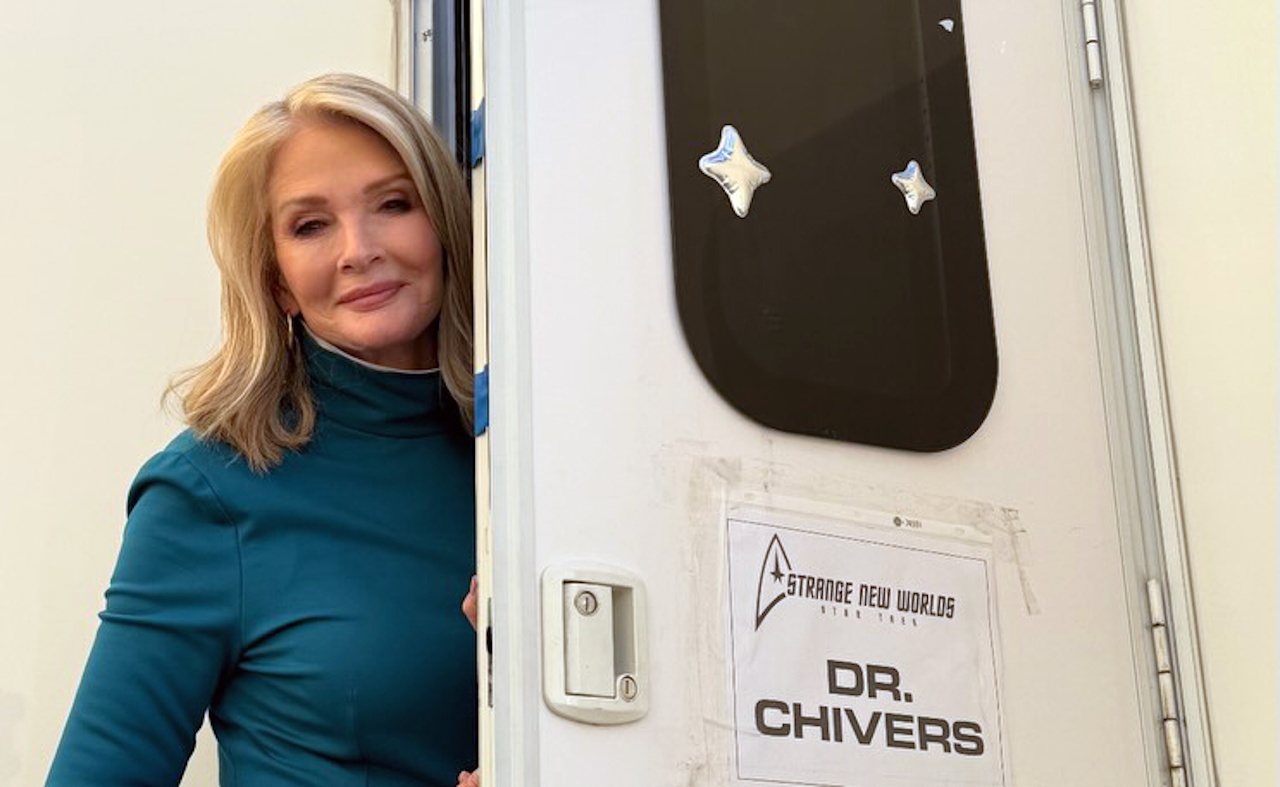
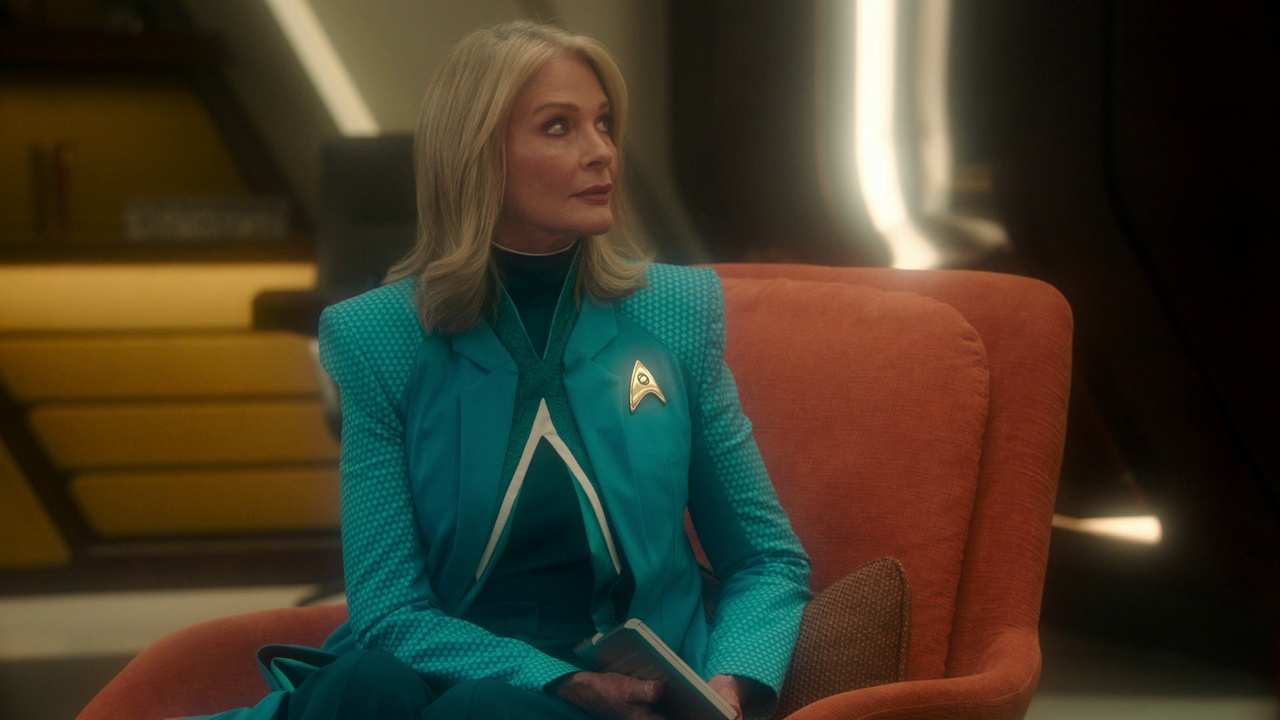
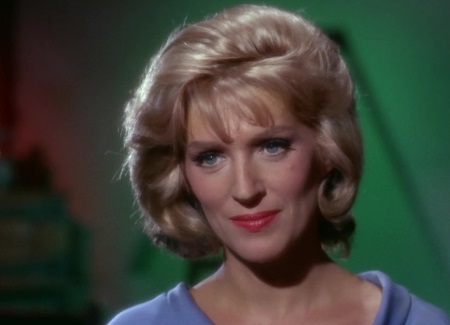
I’m not from the United States (and I’m not a viewer of American soaps), so I confess that I didn’t know who actress Deidre Hall was when she was introduced as Counsellor Eleanor Chivers. If you’re in the same boat as me, Hall has played one of the main characters on the American soap Days of Our Lives since 1976, so bringing her aboard for an episode with this soap opera style was a genuine coup for Strange New Worlds. If you’re British, like me, I guess this would be akin to bringing William Roache (Ken Barlow on Coronation Street) on board for a guest-starring role.

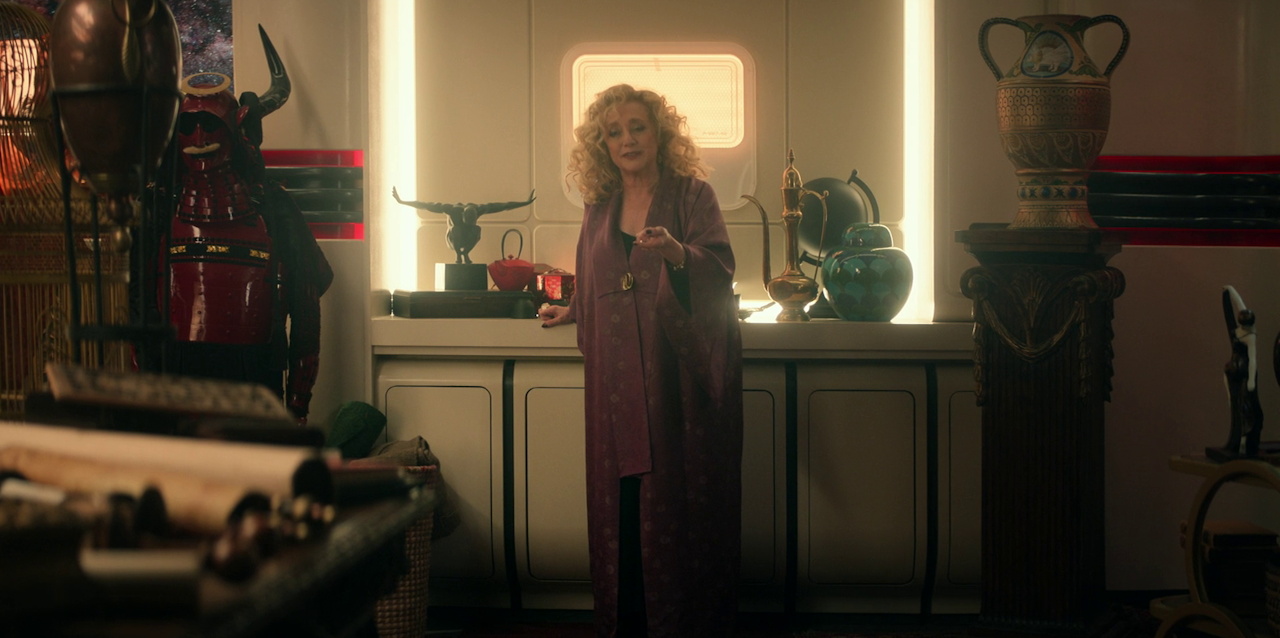
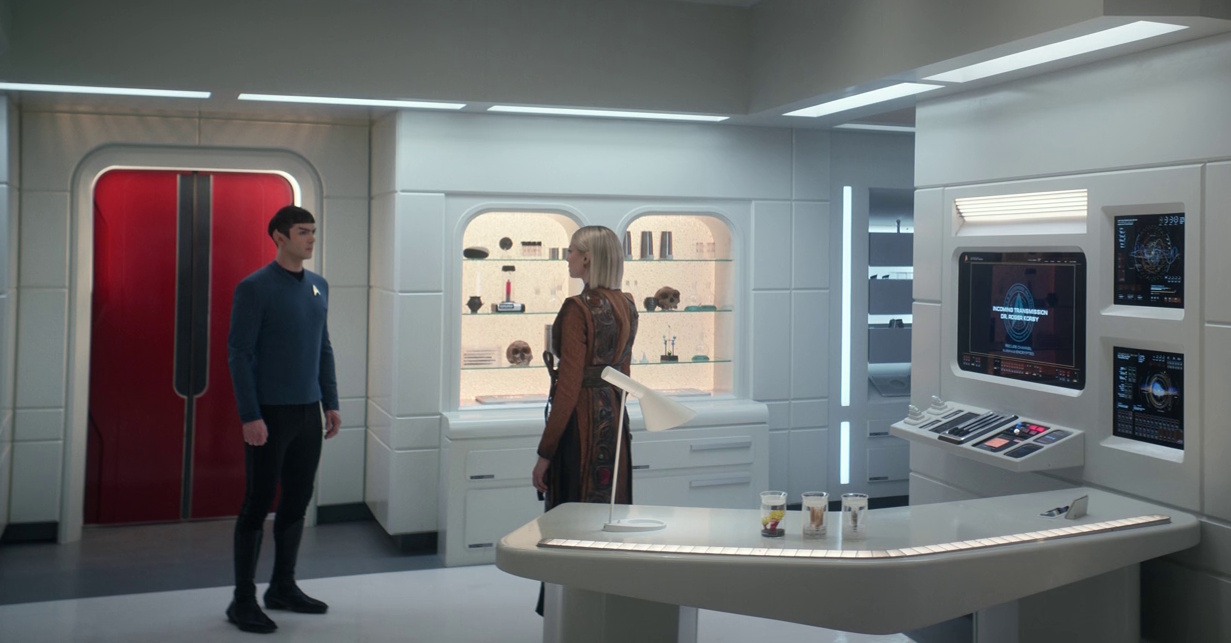
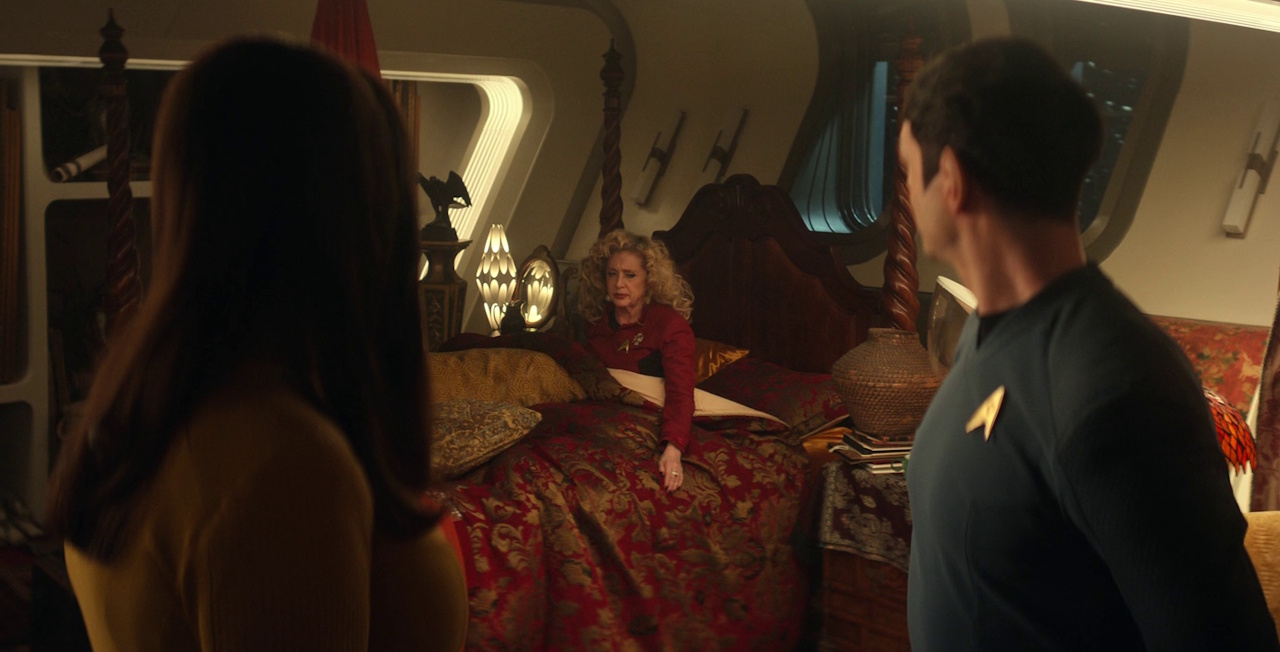
Outside of the soap opera pseudo-reality, we didn’t get to spend too much time with Chivers. I liked her outfit, which I felt drew a little on TNG’s Dr Crusher for inspiration, being a similar length and colour, but obviously a bit more elaborate with its collar and the way it fastened. And I think it’s interesting that, at least in this era, the Enterprise has a counsellor on board.

Still frame from Star Trek SNW 4x07 showing Chivers
Doctor (or Counsellor?) Chivers.

However, given last week’s (re)introduction of Dr Boyce – who, as the ship’s former chief medical officer, served as kind of unofficial counsellor to Captain Pike… well, bringing Counsellor Chivers into the mix as well might arguably complicate things. I thought, at first, we were going to learn that Chivers was one of Trelane’s creations, a fictional character he invented for the sake of his dramatic production. But Chivers is, apparently, a fixture aboard the Enterprise.

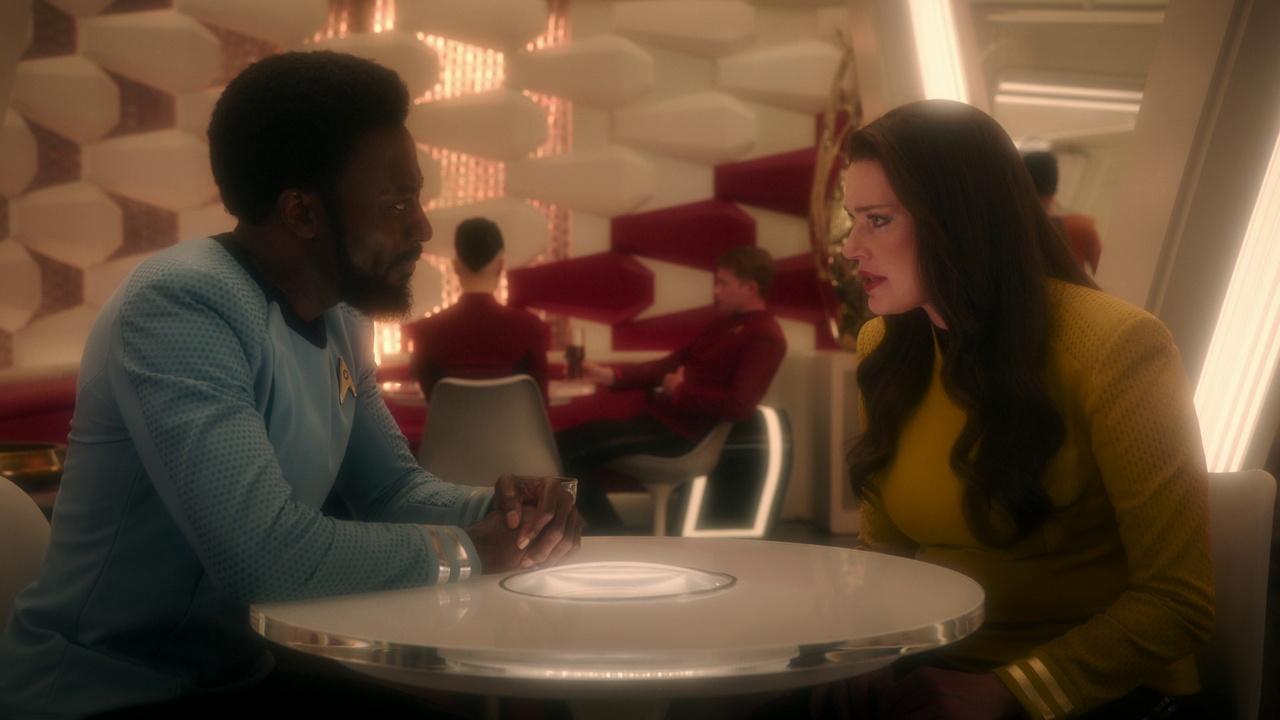
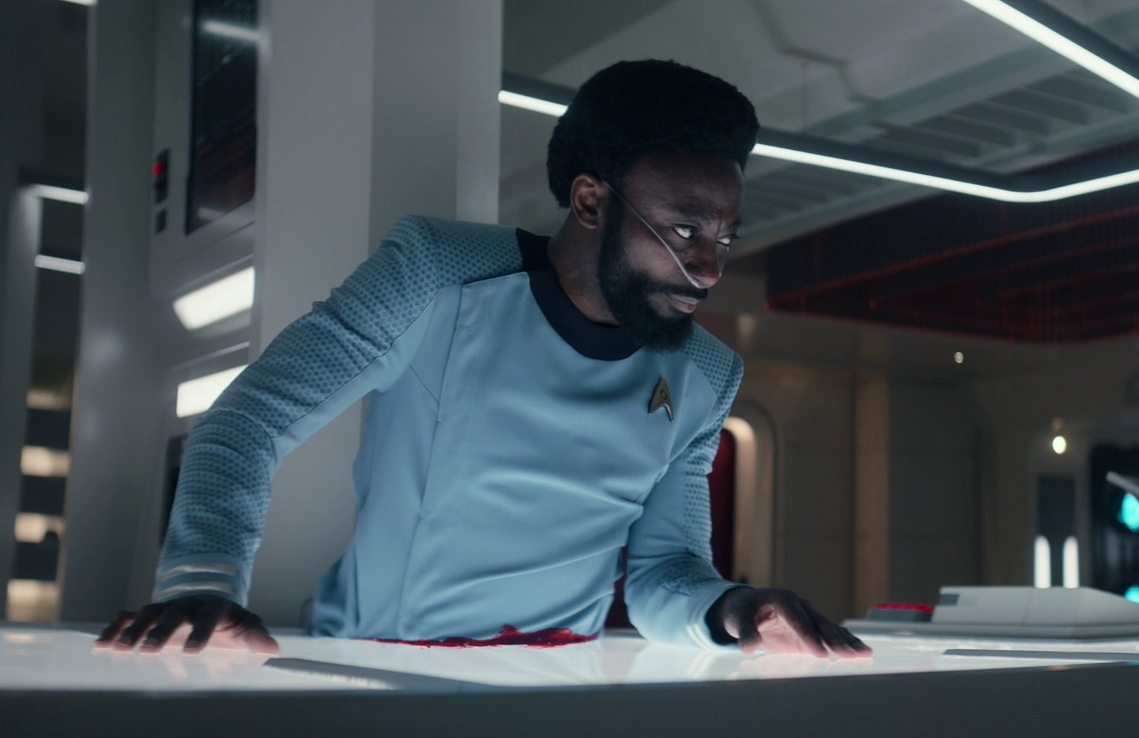
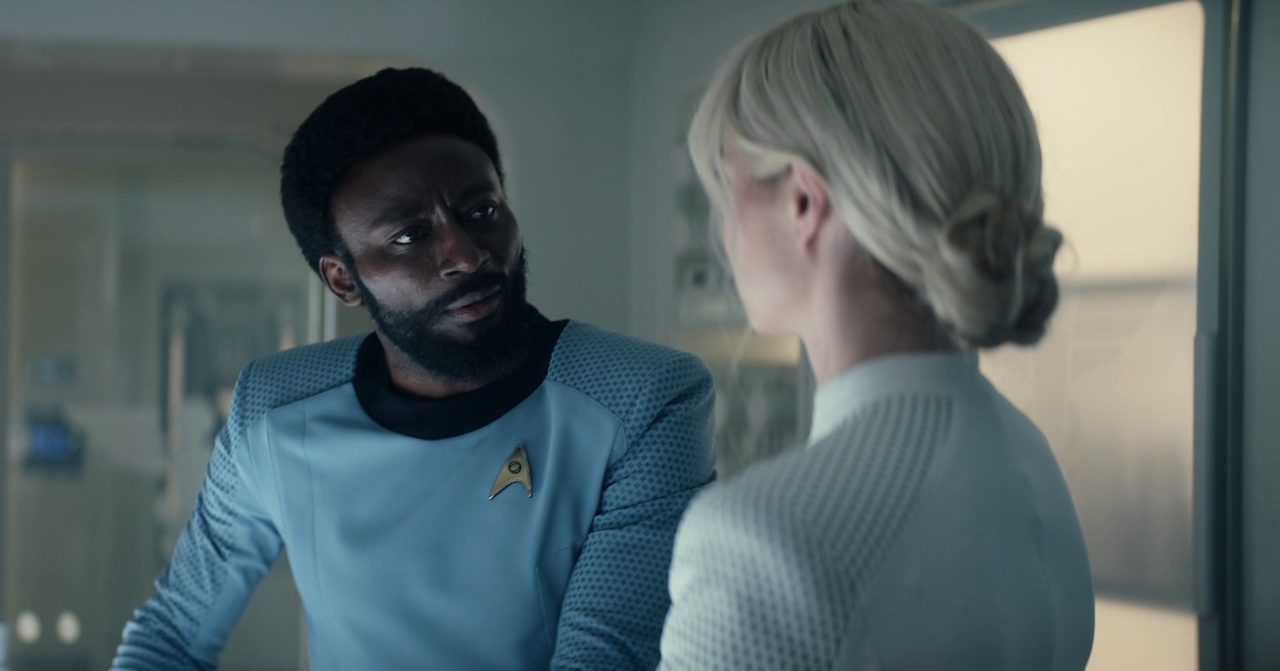
I think you could argue that it makes sense for Pike to seek out an *actual* counsellor, given where he’s at emotionally, instead of trying to talk to someone like Dr Boyce, Una, or Dr M’Benga, so it’s not necessarily a *bad* thing. And starships having counsellors is clearly not uncommon for Starfleet in this era; I think there was someone in that role aboard the USS Discovery, or at least I remember it being mentioned.

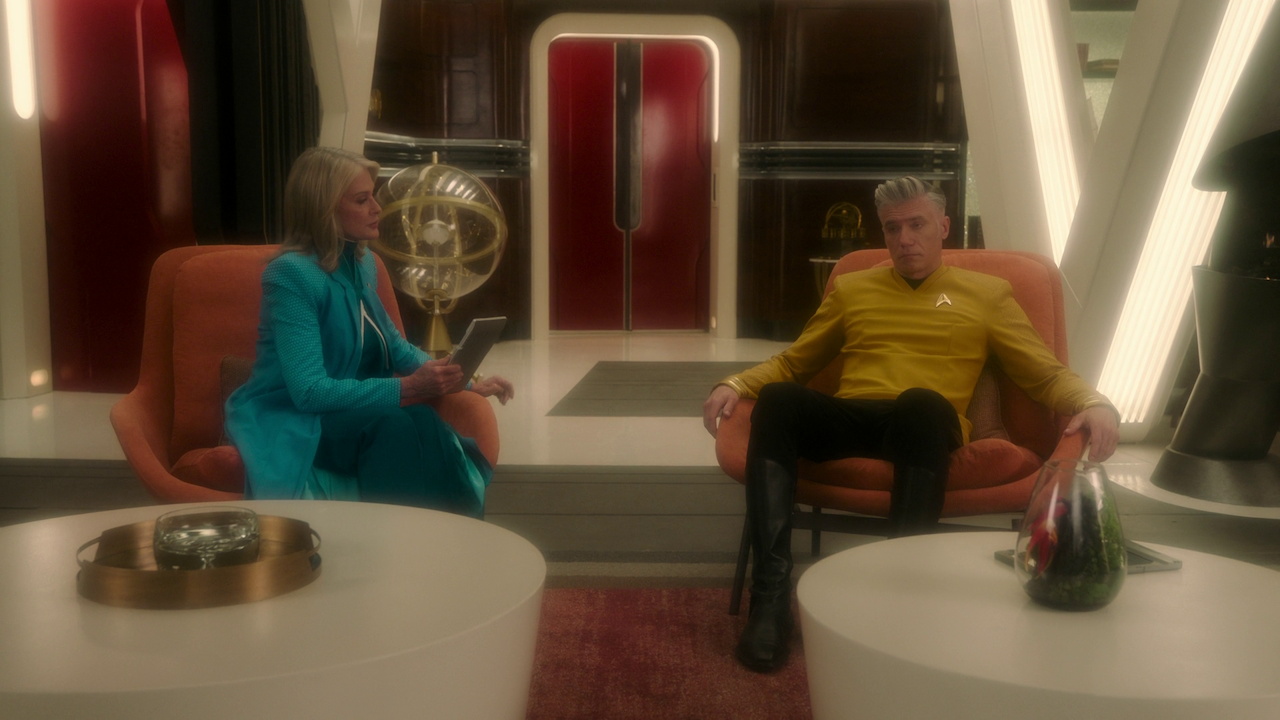
Still frame from Star Trek SNW 4x07 showing Pike and Chivers
Funnily enough, I had Pike’s expression on my face for almost the entire time I was watching Like Chronitons Through the Hourglass.

I would’ve definitely liked to have spent more time with Pike and Chivers outside of the soap opera sequences; Pike’s breakdown in her office had all of the ingredients to be the kind of hard-hitting moment that his storyline needed more of, and Anson Mount genuinely gave an exceptional performance in that scene. It was just cut too short for an episode that wanted to do other things.

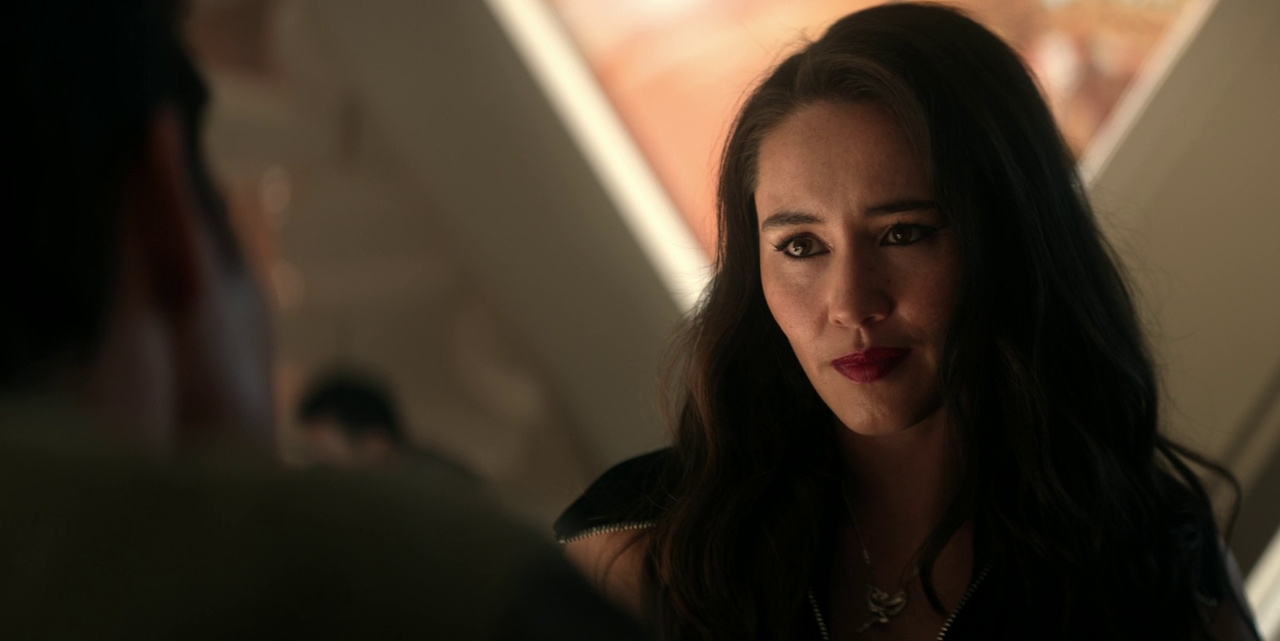
Within the soap opera reality, though, I don’t really know what to say. Chivers was – surprisingly, perhaps – the least-offensive of the soap opera fluff. Deidre Hall wasn’t hamming it up in the way that most of the show’s regulars were, leaving her character to feel like simultaneously the most-grounded and least-likely to be real at the same time. An odd mix… but then again, that’s Like Chronitons Through the Hourglass in a nutshell, eh?

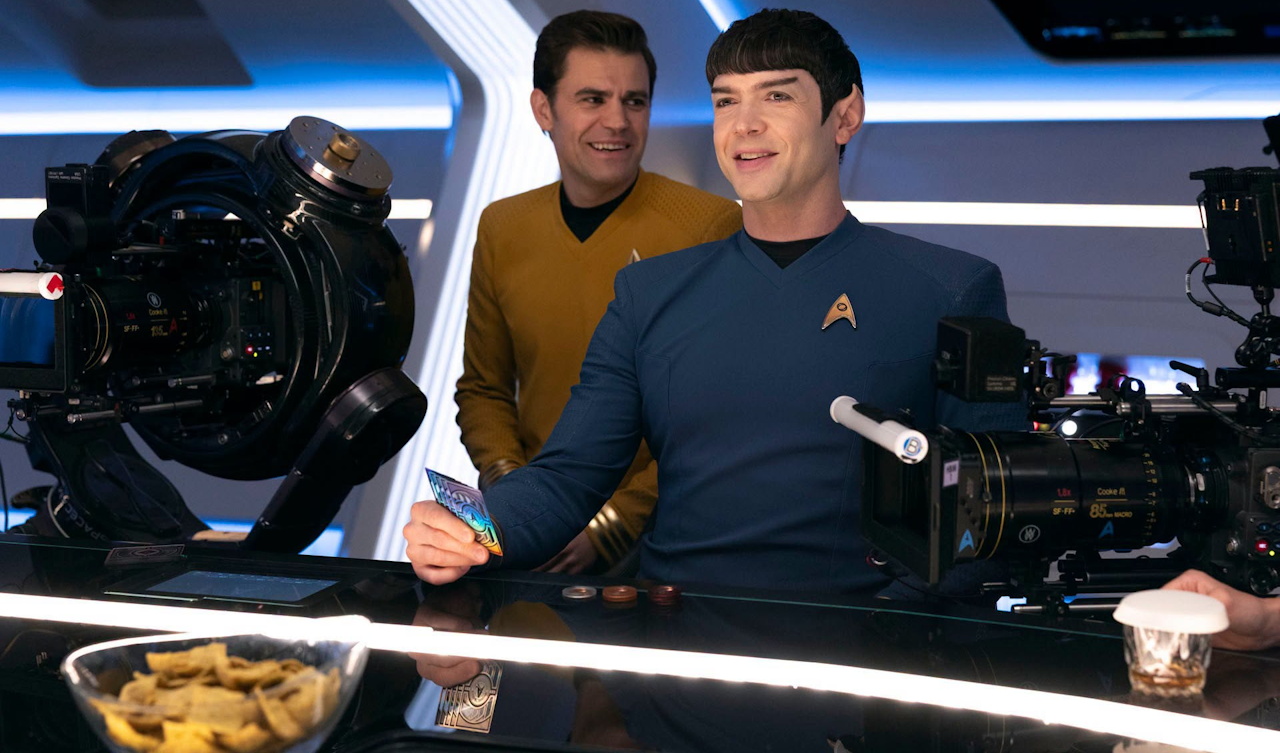
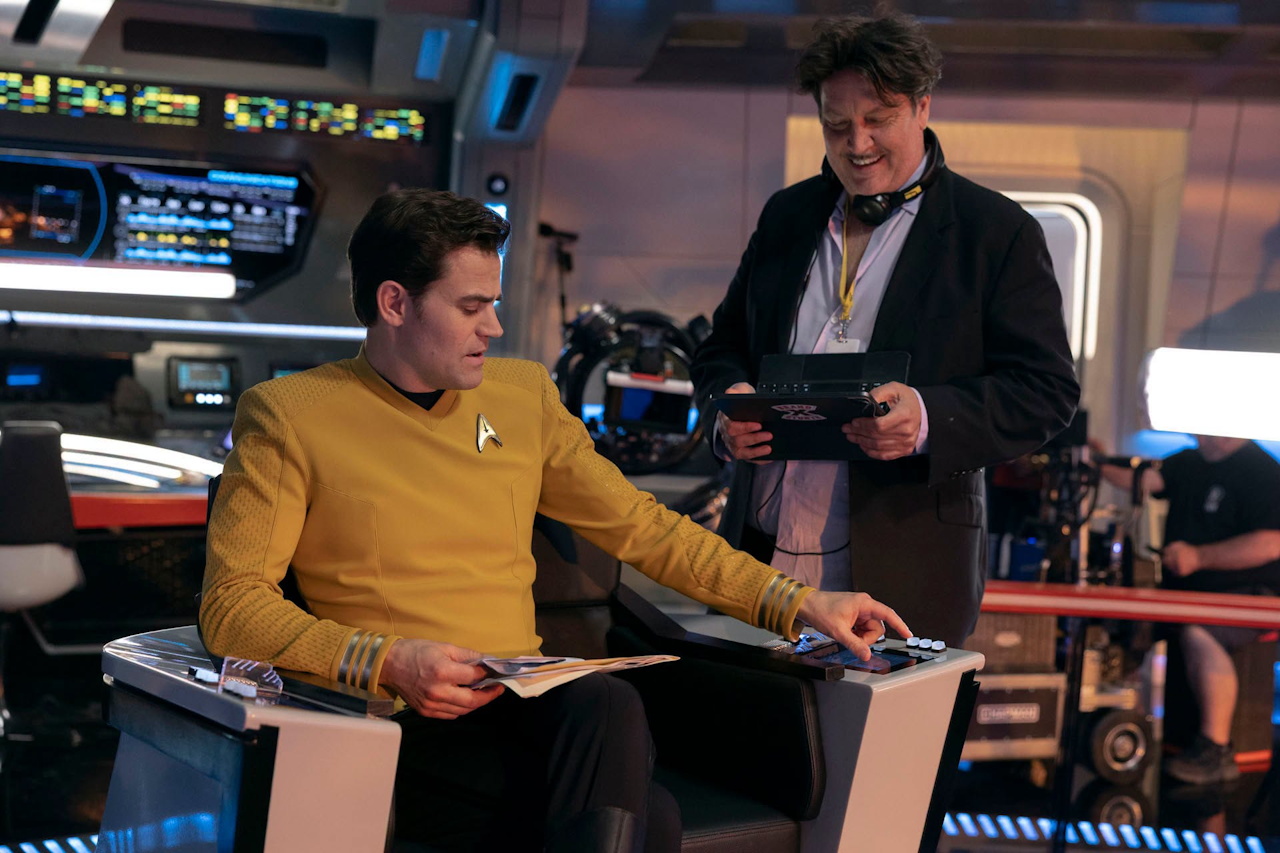
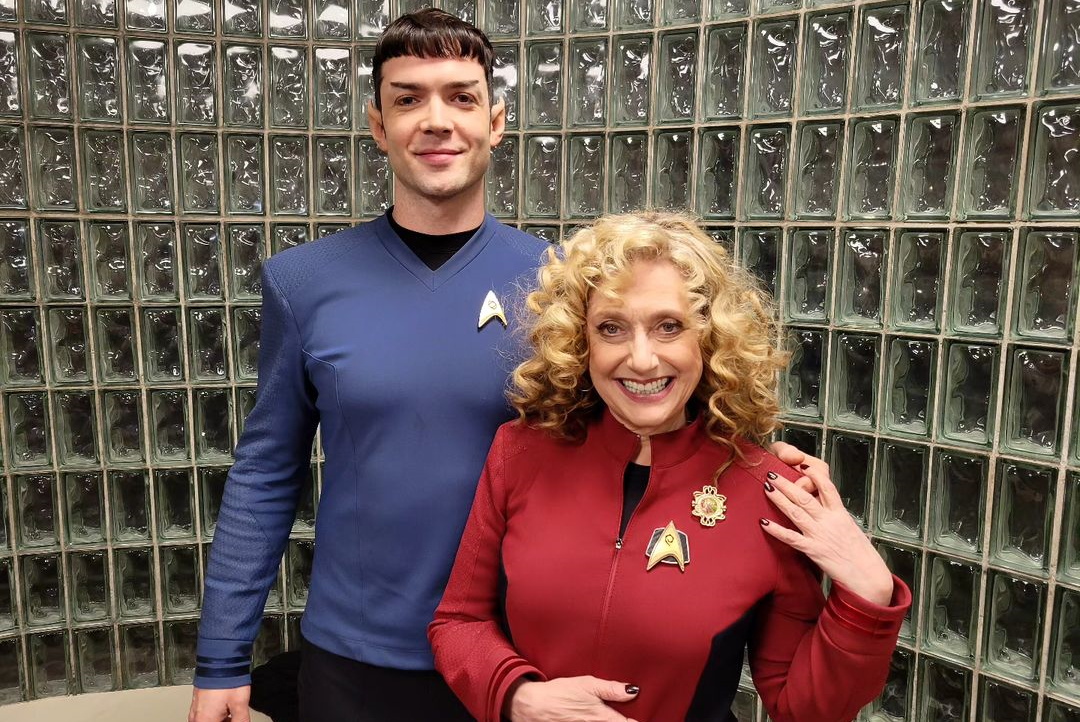
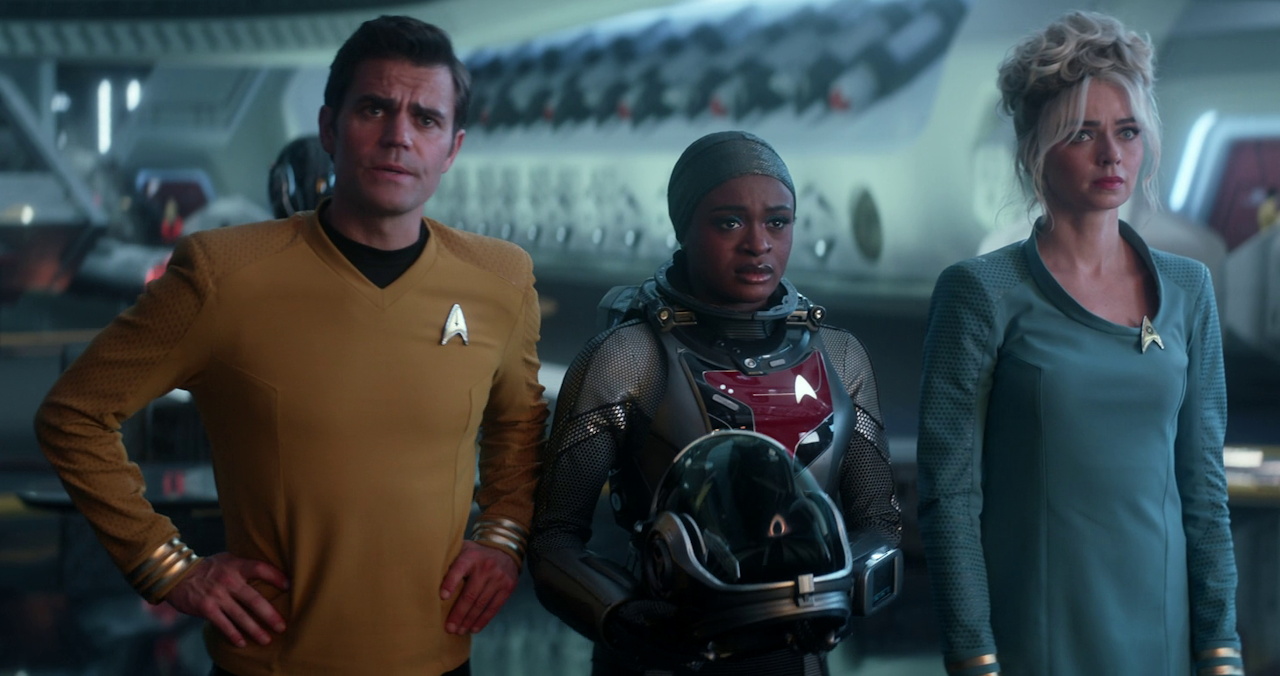
Behind-the-scenes photo from Star Trek SNW 4x07
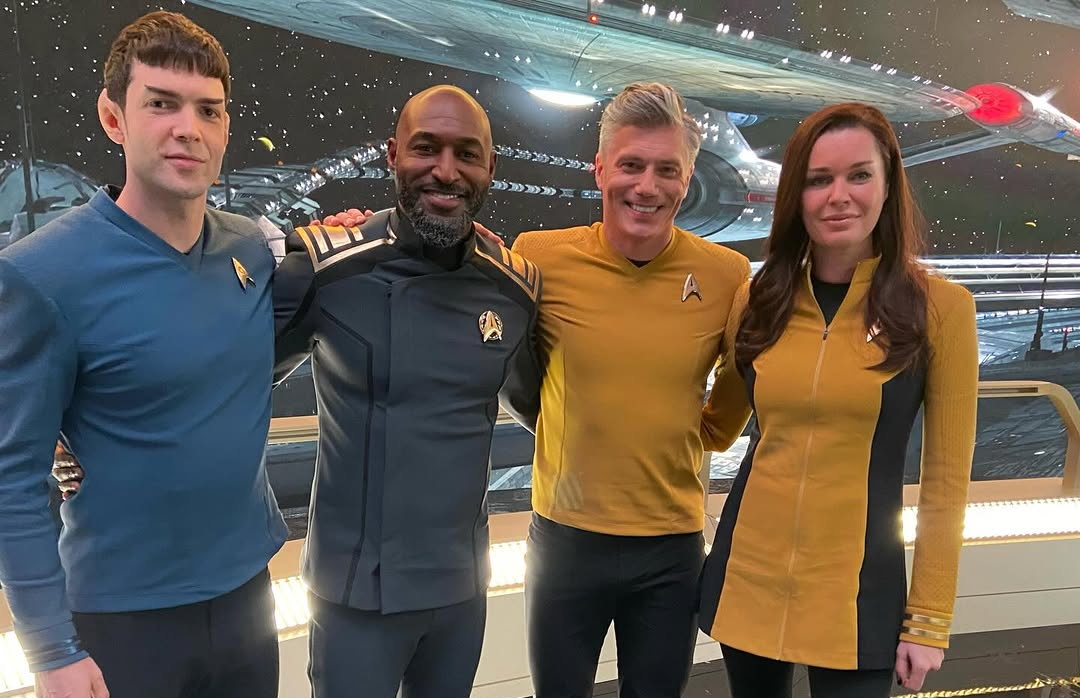
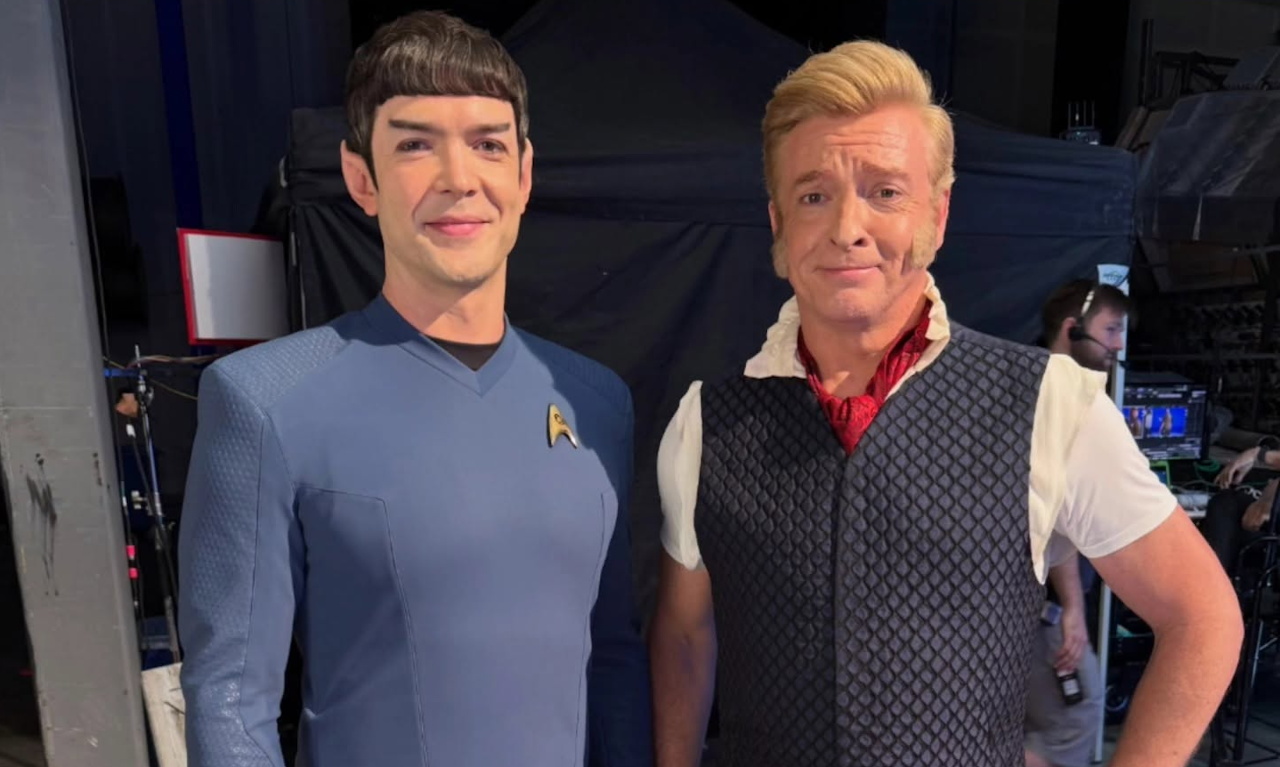
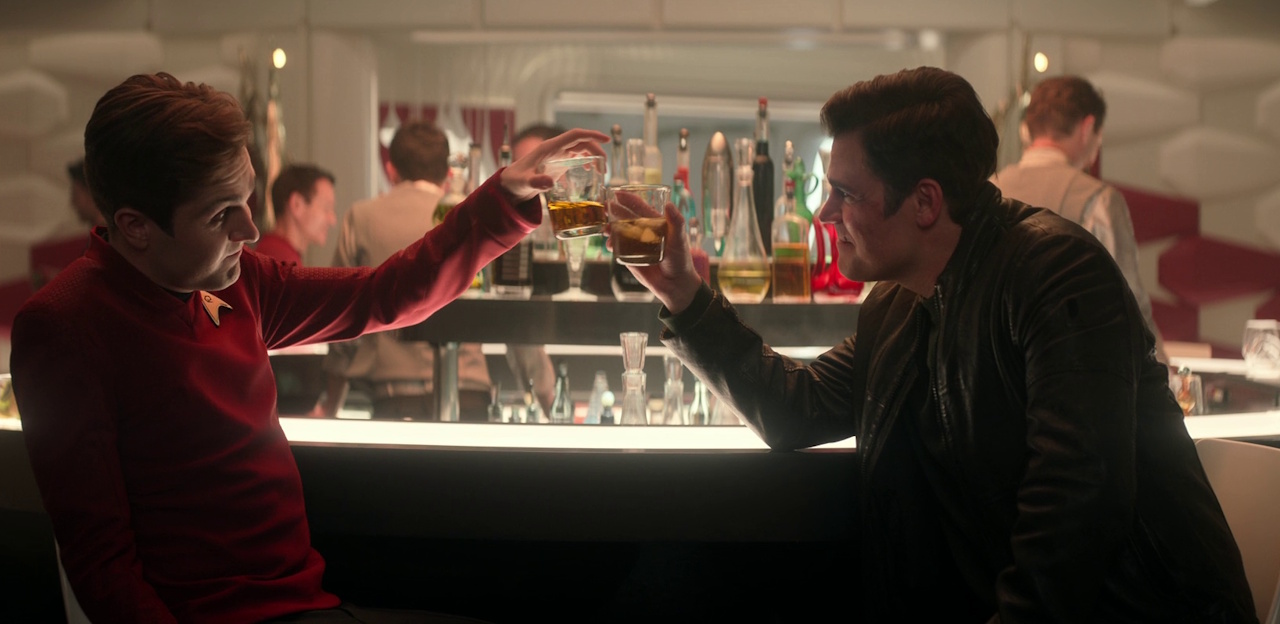
Ethan Peck (left) and guest-star Rhys Darby on the set of Like Chronitons Through the Hourglass.

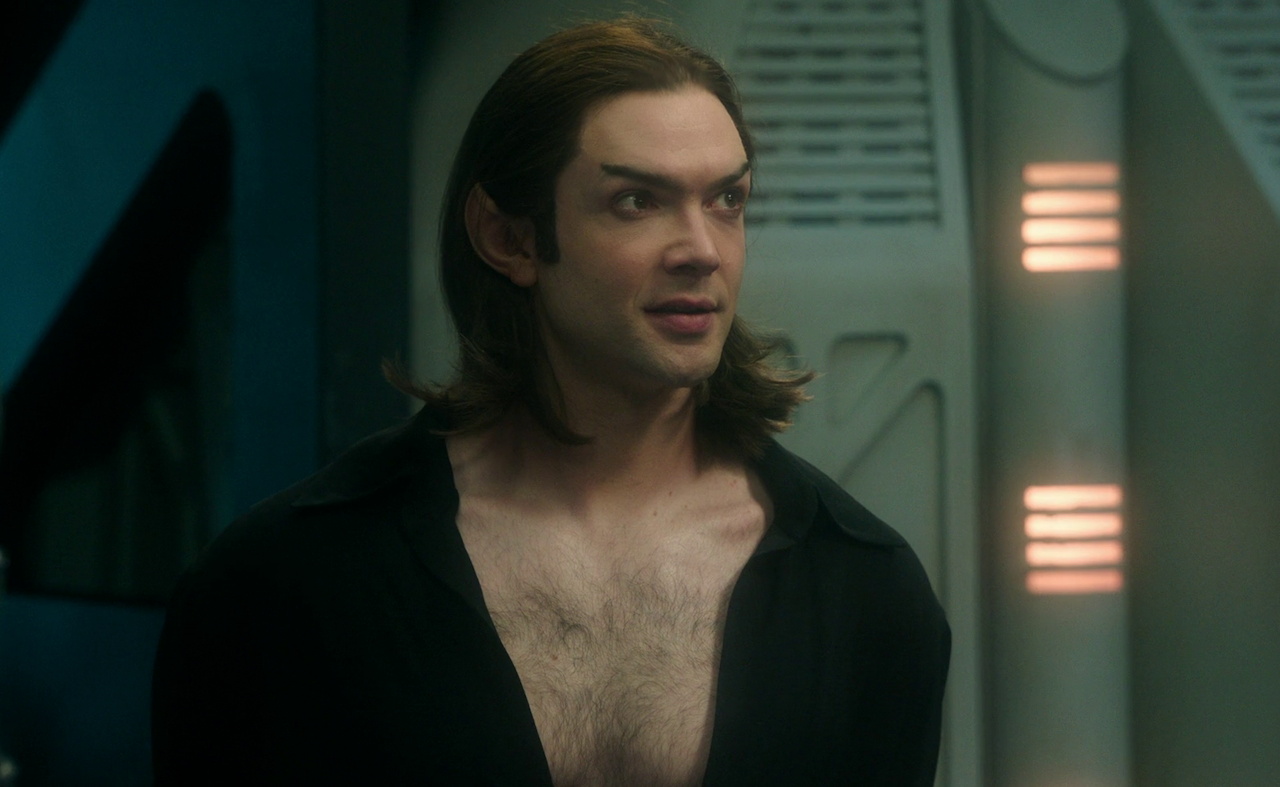
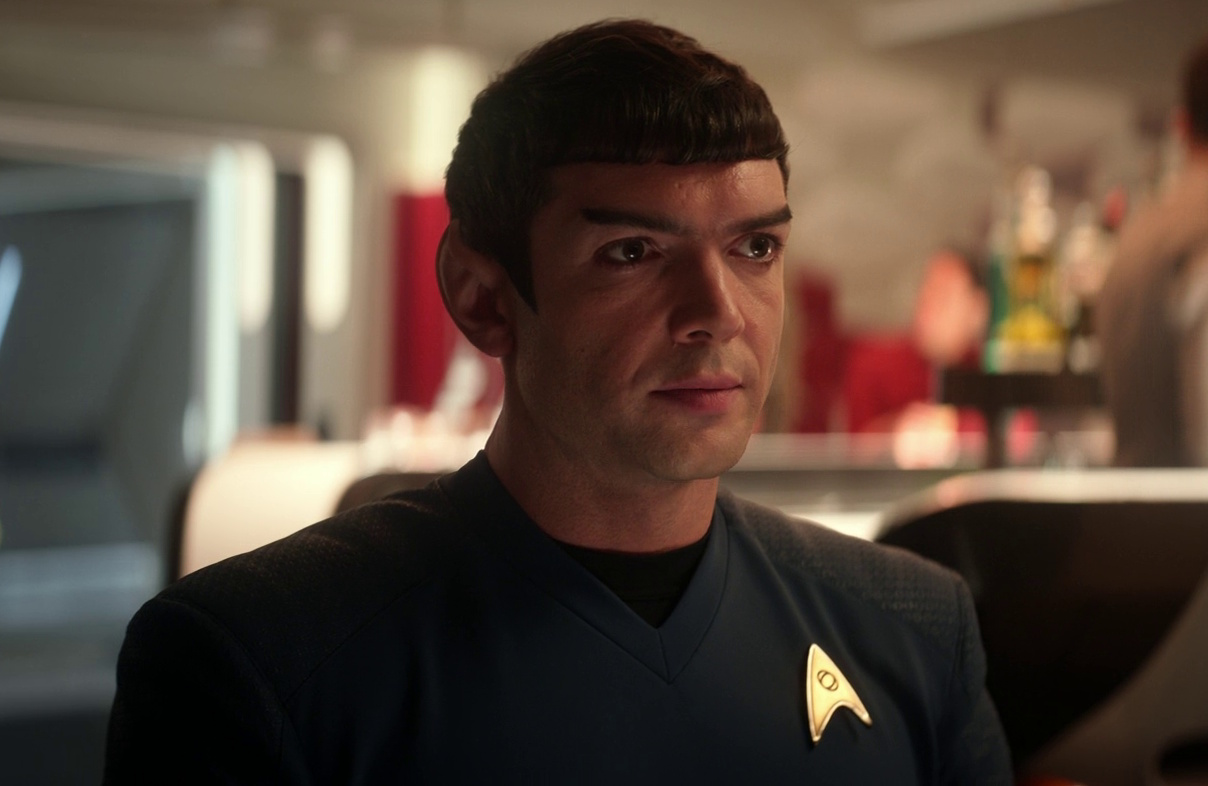
Season 1’s The Serene Squall reintroduced us to Spock’s half-brother, Sybok – albeit only briefly – and ever since, I think a lot of Trekkies have been wondering whether Sybok would be back before Strange New Worlds comes to the end of its run. And as I was saying above with Pike and La’an and their complex storylines… I would not have chosen to bring back “Sybok” in this form, if I had been in charge! In this case, though, that’s for a different reason.

Pike’s story (and La’an’s too, to a lesser extent) needed to be more grounded and serious if the messaging was going to stick the landing. But Sybok, because he’s such a uniquely interesting character within the broader lore and canon of Star Trek… well, I think he deserved to be handled better. Being reduced to essentially a joke; a gag parodying the “evil twin” cliché from bad soap opera storylines… I mean, I think even Sybok – who was a part of what is usually considered the weakest film, at least of The Original Series era – deserved better than that.

Still frame from Star Trek SNW 4x07 showing fake Sybok
The illusory “Sybok”.

Moreover, there was a chance for Strange New Worlds to explore the feud between Sybok and Spock – and perhaps between Spock and his father, Sarek, too – in more detail than we ever got in TOS or The Final Frontier. If I were making a list of potential characters and stories to return to for a potential “Captain Pike show,” I’m not sure I’d necessarily have picked Sybok. But having teased the character back in Season 1, I can see the value in revisiting him, expanding on his backstory with Spock, and going into more depth about their conflict.

Such a storyline could have set up the events of The Final Frontier, or at least leaned into Sybok’s “share your pain” philosophy that would be so important to the events of that film. And I’m left lamenting, really, that Strange New Worlds took nothing but this character’s name to do a very silly (and far too long) gag or bit with it. Once again… what was the point?

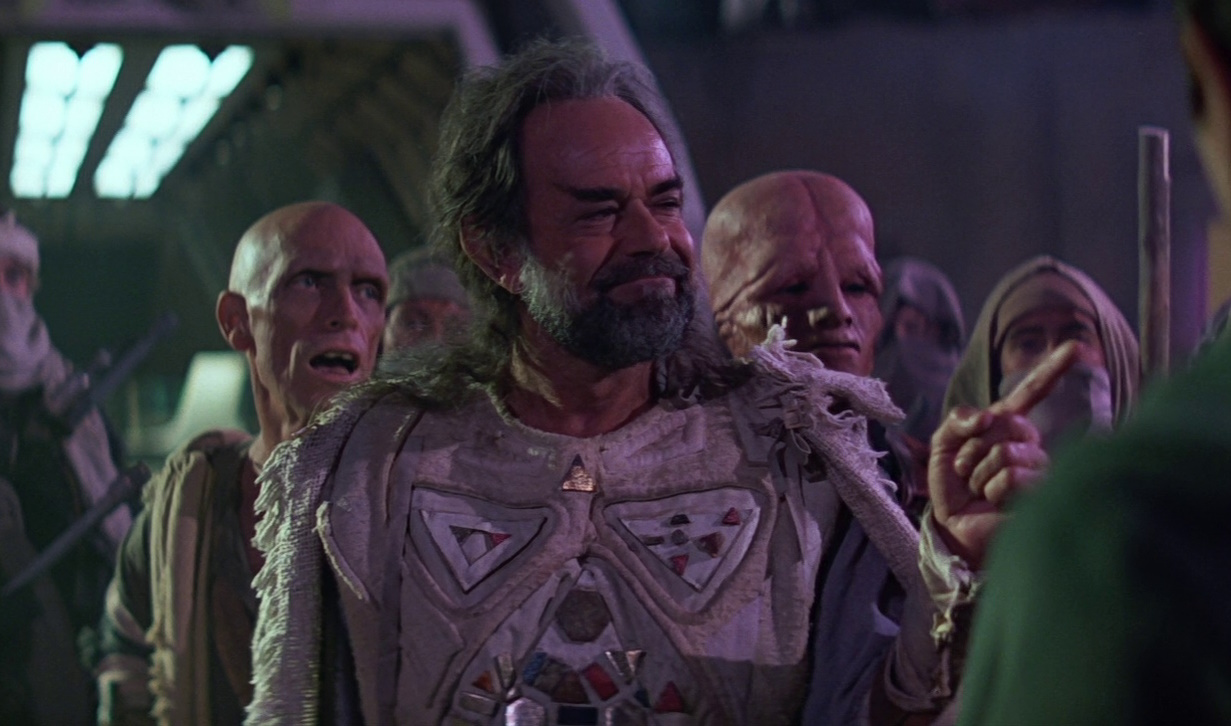
Still frame from Star Trek V showing Sybok.
Sybok in The Final Frontier.

That last question – “what was the point?” – could really apply to 90% of the episode, to be honest. Previous genre parodies have (usually) made the case for themselves; even if I didn’t personally like the finished product, I could at least see what the writers and production team were going for. But in this case, I’m really struggling to see what the intention was in doing a soap opera spoof other than… to do a spoof.

And is *that* a good use of the show’s time when there are a mere nine episodes remaining, and fewer than fifty in total?

If this was Season 1 or 2, with Strange New Worlds potentially looking at a six-, seven-, or eight-season run, I still wouldn’t *like* this episode, but I think it might’ve felt less offensive. However, we’re now nine episodes from the show’s finale, and I just don’t think there was time to waste on a genre parody or spoof that not only didn’t have anything to say in and of itself, but that also ended up actively detracting from what should’ve been a powerful, emotional, and relatable arc for two of the show’s main characters.

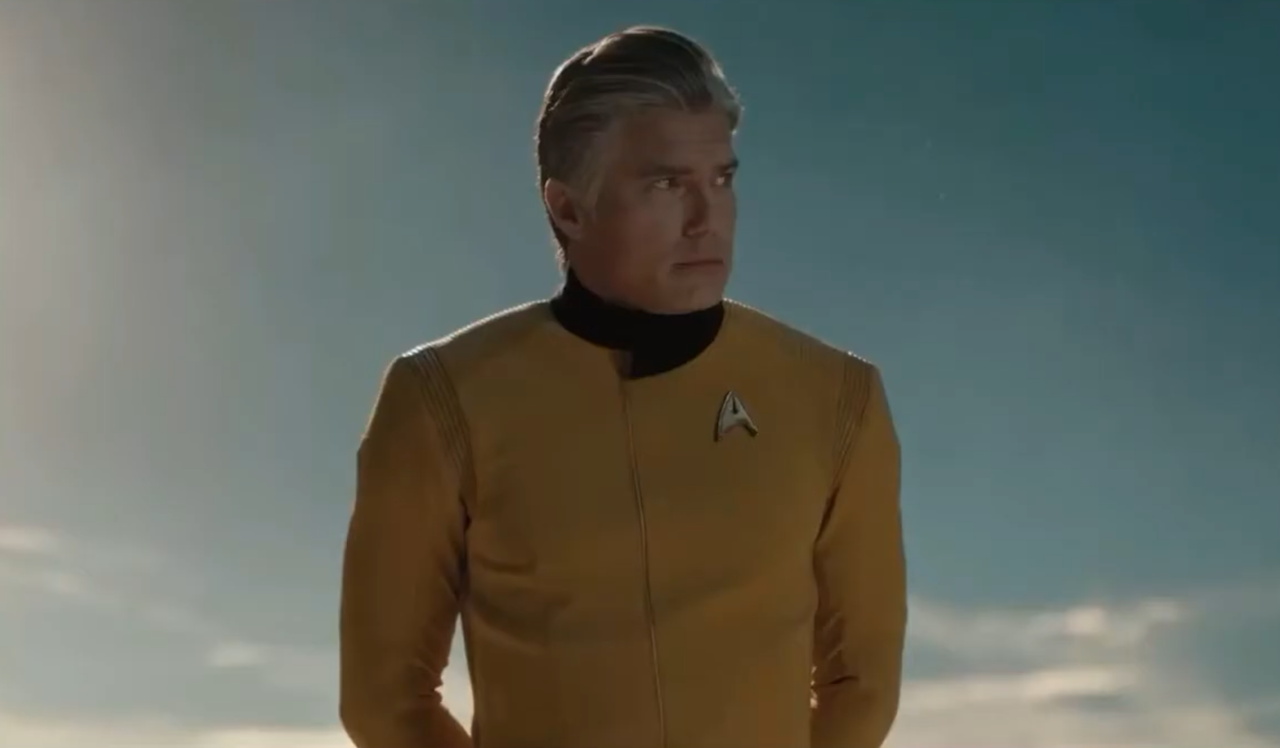
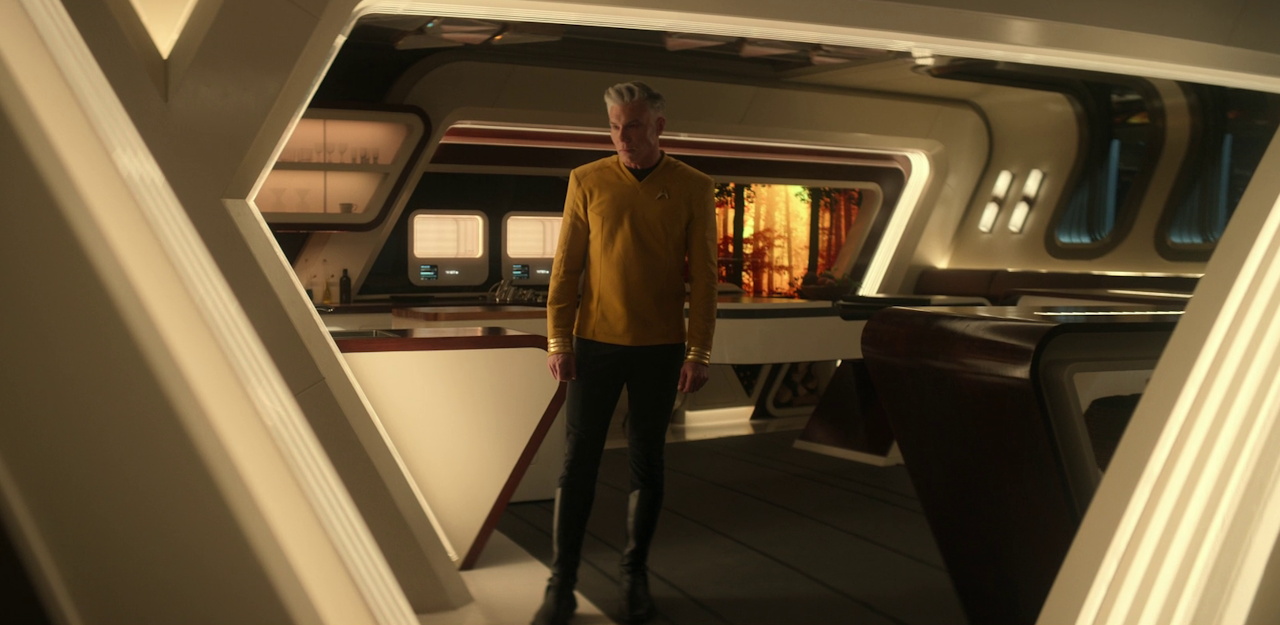
Still frame from Star Trek SNW 4x07 showing Pike
Captain Pike.

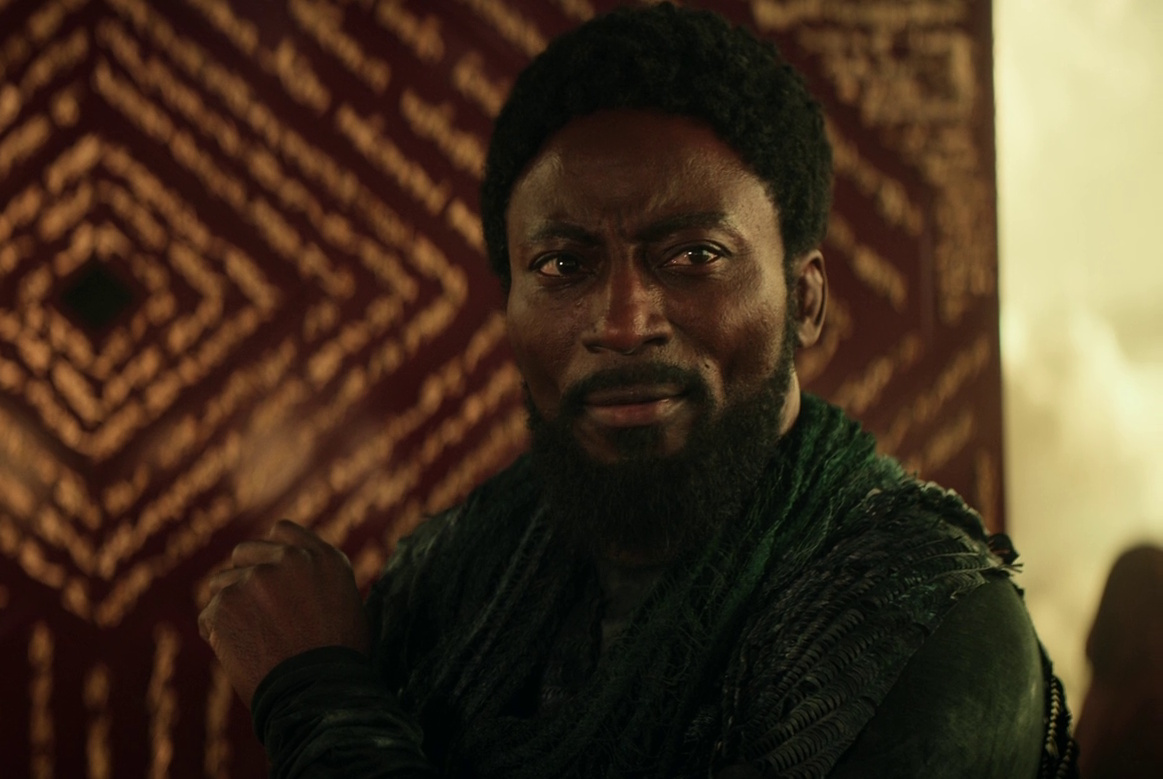
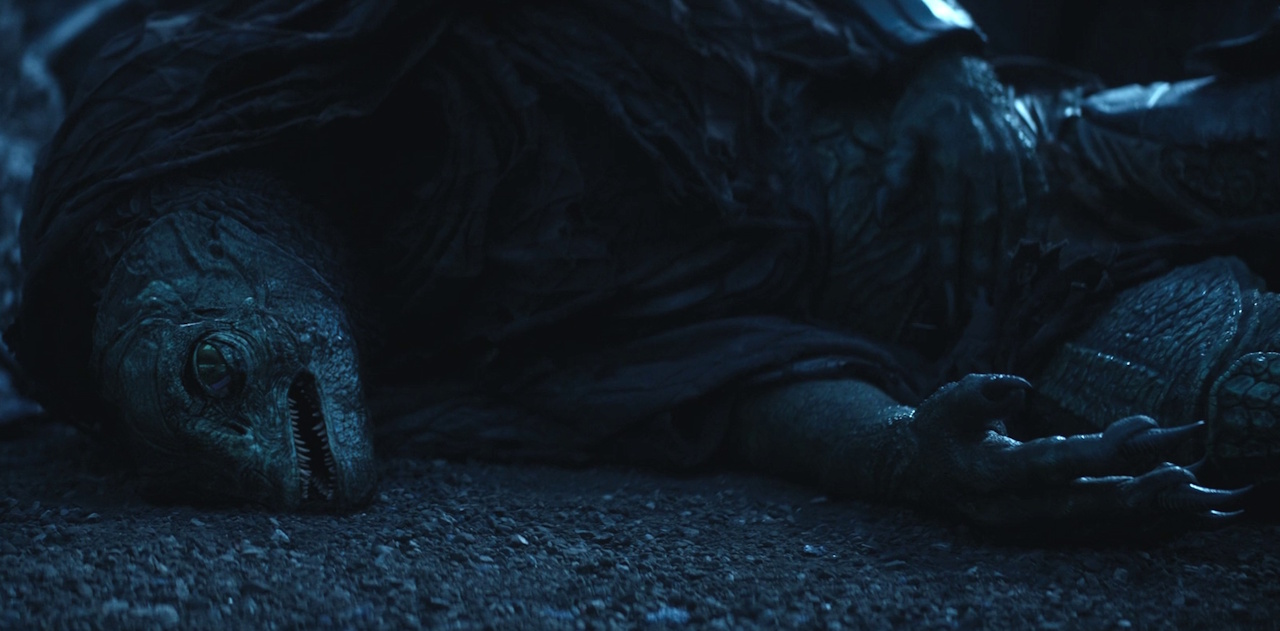
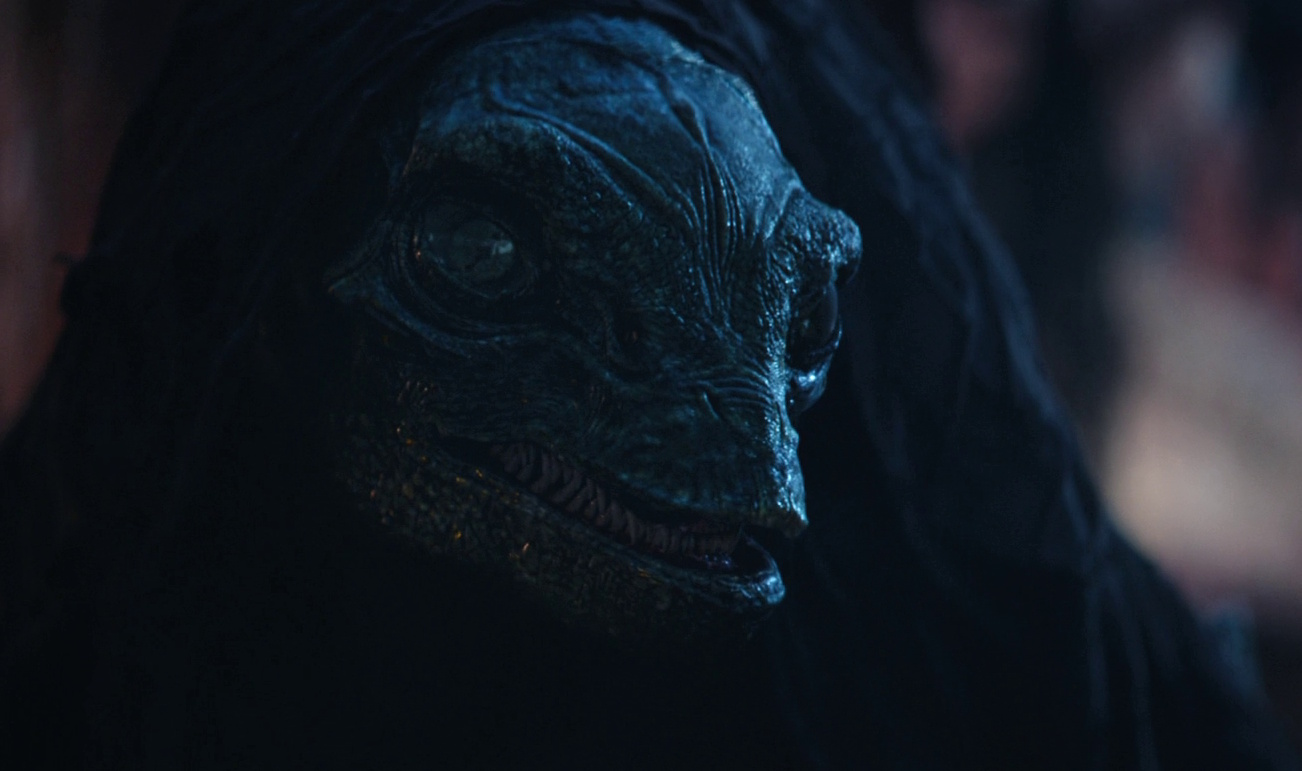
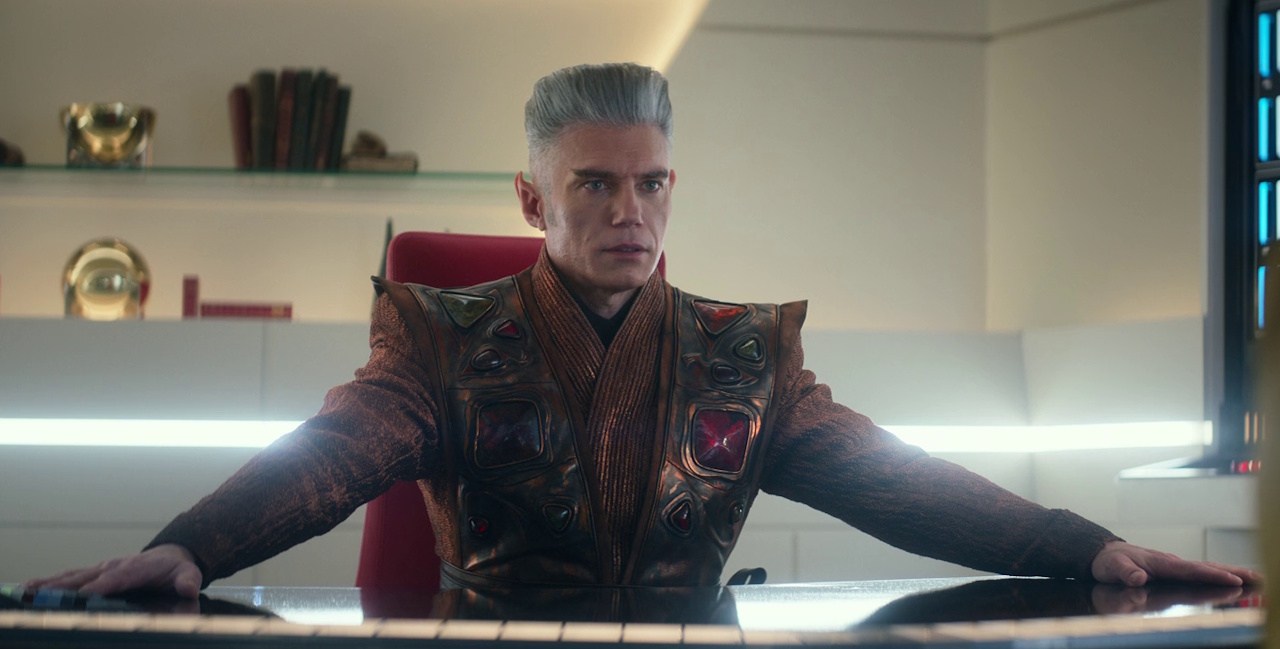
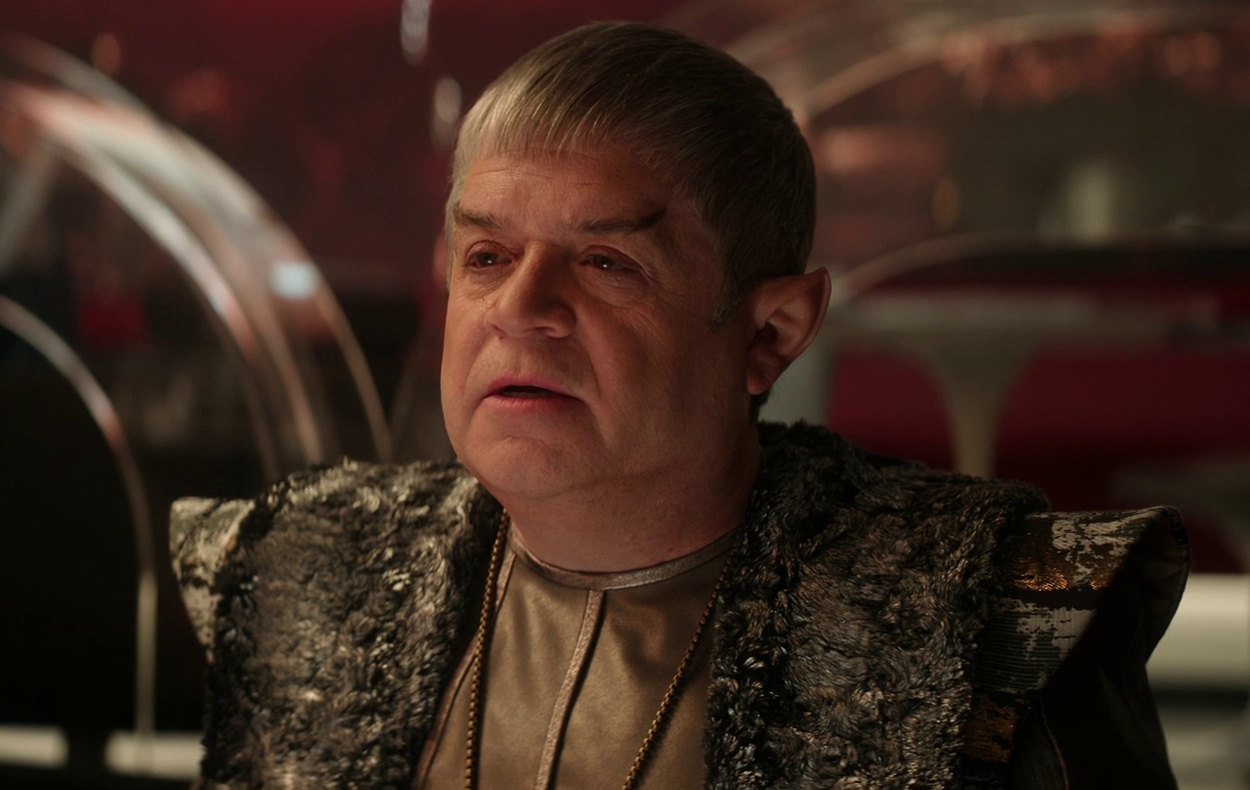
With the exception of Anson Mount, who did well with Captain Pike’s emotional torment, the only other performer I could really single out for praise is Rhys Darby, who reprised his role as Trelane from Season 3’s Wedding Bell Blues. We’re sticking with the idea that Trelane is a kid, and Darby brought almost a sense of childlike wonder to the character, despite having phenomenal powers and abusing them to toy with the emotions of the crew.

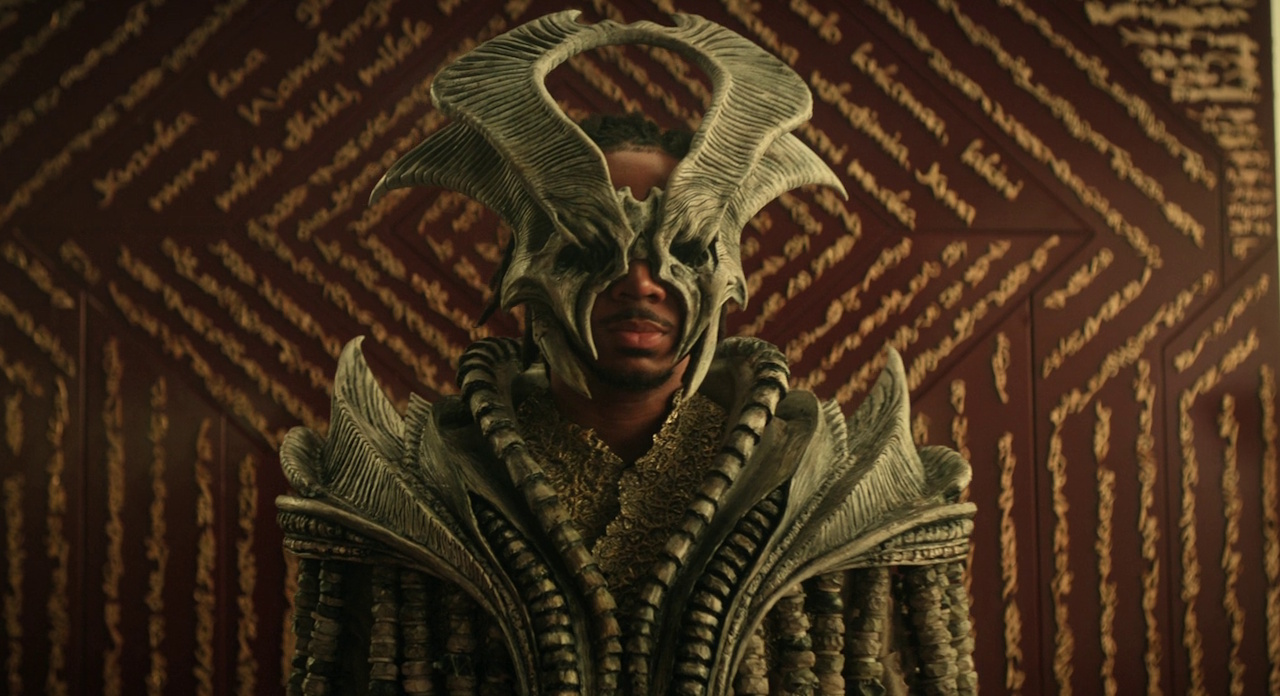
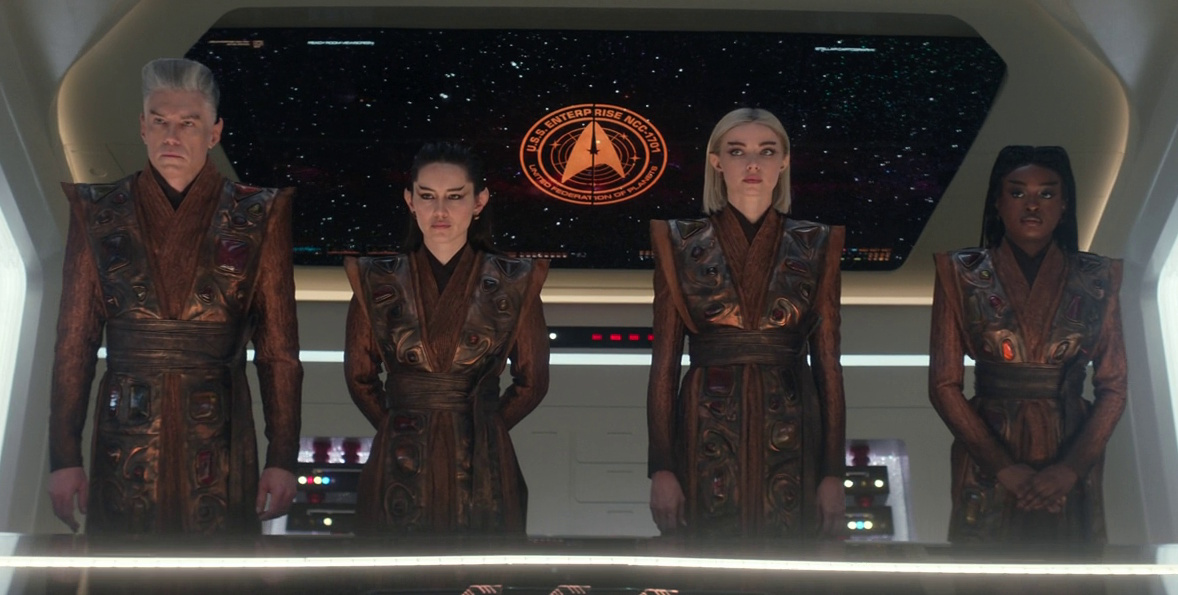
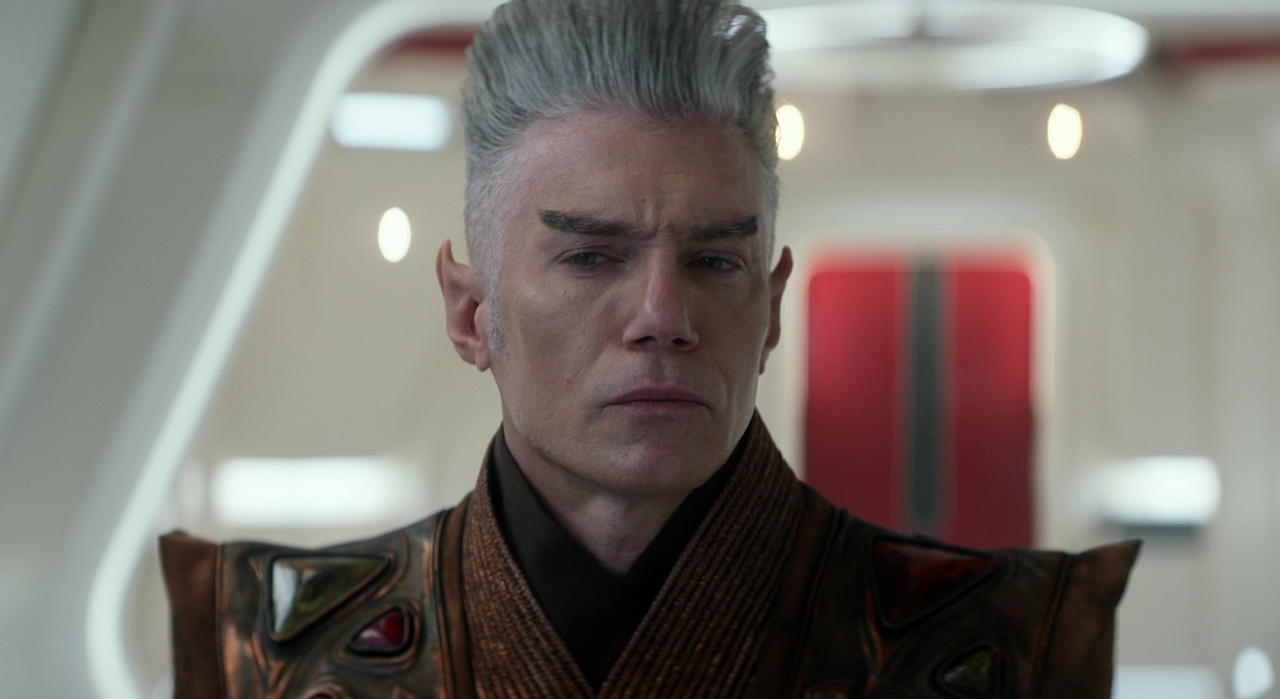
I also found it interesting that Like Chronitons Through the Hourglass introduced another member of the Q Continuum as Trelane’s teacher/advisor. I wasn’t wild about the Q-inspired costuming, though: the judges’ robes that Q wore in The Next Generation were meant to be a copy of something from Earth in the mid/late 21st Century, and I felt that leaning on that idea for inspiration kind of misunderstands or muddles that. A very minor point, admittedly, and one that you might say is a nitpick. But I like Star Trek to be consistent with itself, and for me, this other Q wearing an outfit clearly at least partially inspired by those judges’ robes wasn’t right.

Oh, and if you missed it last season: yes, Rhys Darby’s character is the same Trelane as Kirk will encounter in The Original Series, and he’s a member of the Q Continuum. Spoiler alert for Wedding Bell Blues, I guess!

Still frame from Star Trek SNW 4x07 showing Trelane (post-credits)
Rhys Darby is great as Trelane.

There were a couple of funny moments in Like Chronitons Through the Hourglass that successfully won a chuckle, or at least made me smile. Dr M’Benga having a disease as ludicrously-named as “space madness” was one of them, because it was just so utterly absurd and silly.

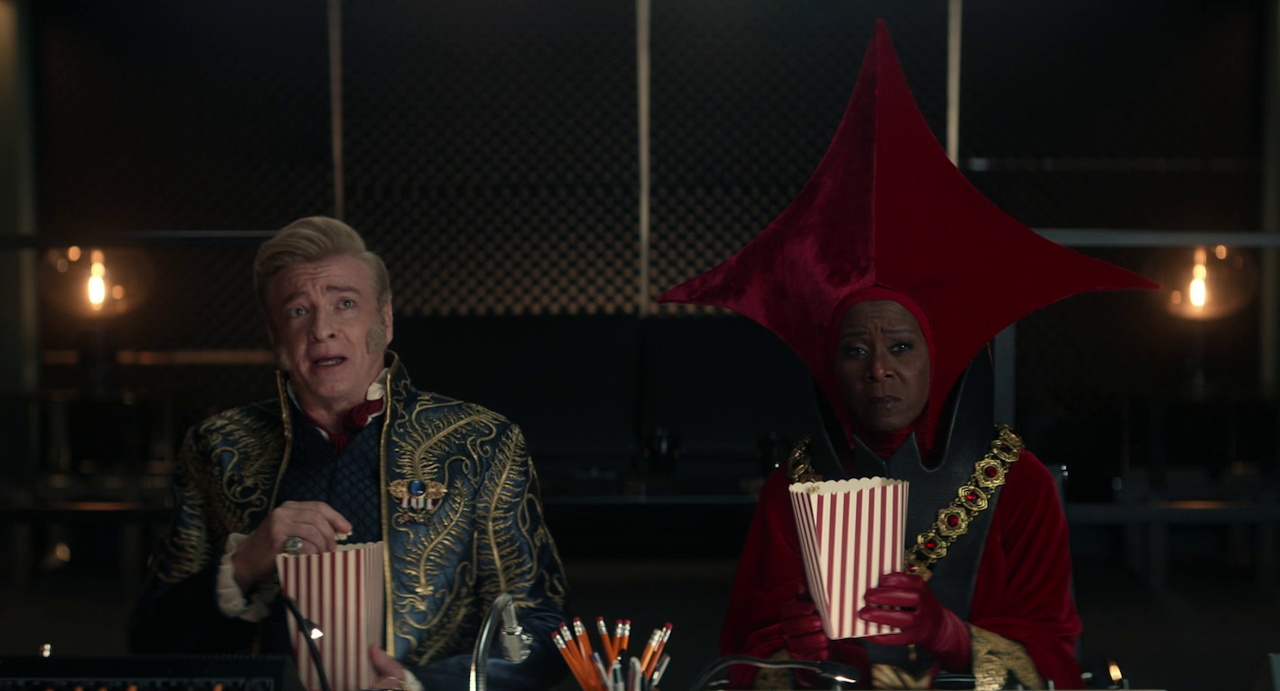
And it was also a funny bit to see Trelane and his teacher munching on buckets of popcorn as they watched Captain Pike wrangling with the memory of his daughter; neither of them expected that “storyline” in Trelane’s fantasy world, I guess. It was a funny moment, in any case.

But that’s really all the praise I have for this… well, this disappointing mess.

Still frame from Star Trek SNW 4x07 showing Trelane and his Q mentor eating popcorn
This was an admittedly funny visual.

Do I need to tell you, for the fourth or fifth time this season, that I can respect the commitment to the bit; that fully and whole-heartedly embracing everything about a genre in this kind of genre parody is, in some ways, commendable? Because I feel like I’ve been saying that a lot, of late!

Like Chronitons Through the Hourglass is the first episode, really, where I feel that everyone involved should’ve known that the core concept and storylines wouldn’t work. The hammy over-acting, the ridiculous dialogue, and the attempt to blend a full-throated soap opera pastiche with complex themes and long-running storylines for main characters was a genuinely bad idea. And I’d actually quite like to know how this concept made it all the way through the production process. How is it that no one – not one single person from this pretty accomplished group of television writers and producers – didn’t stop for a second and say, “yeah, this ain’t gonna work”?

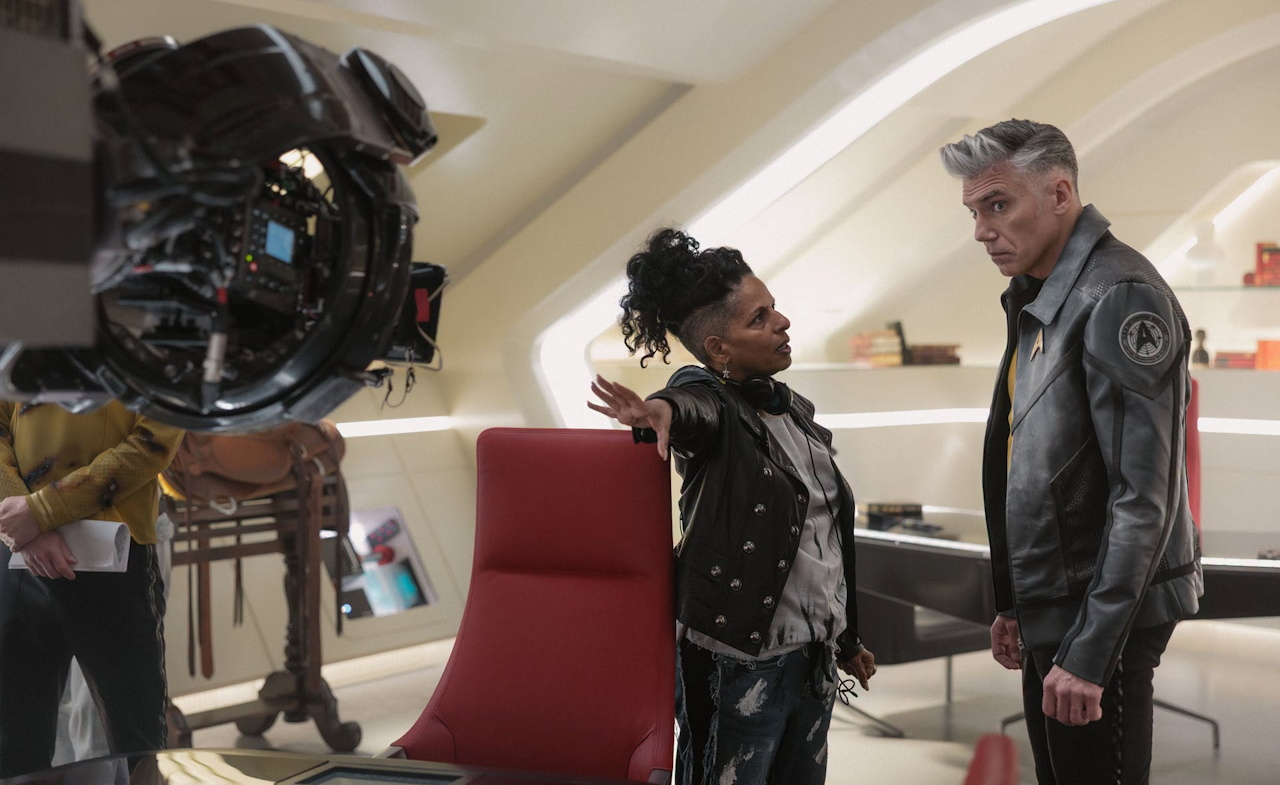
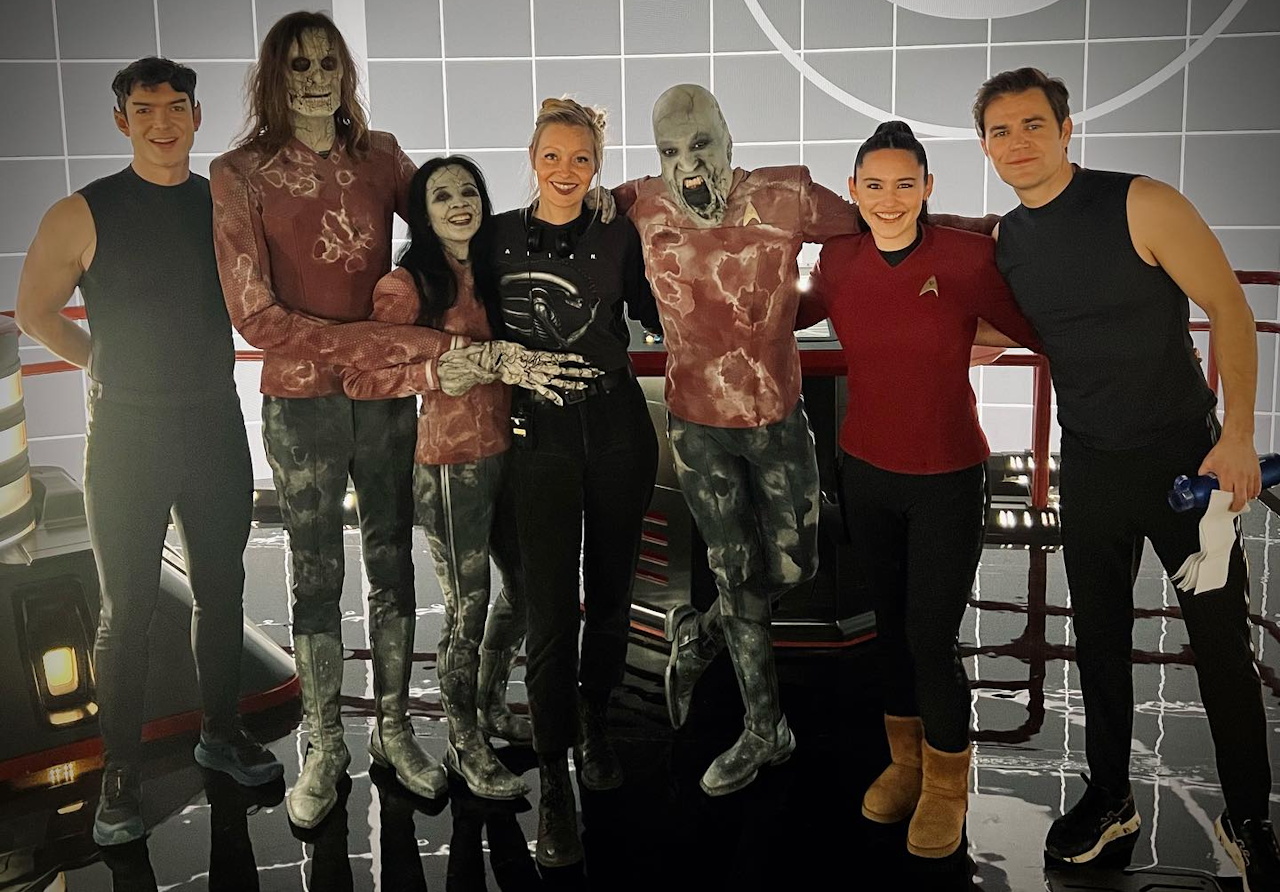
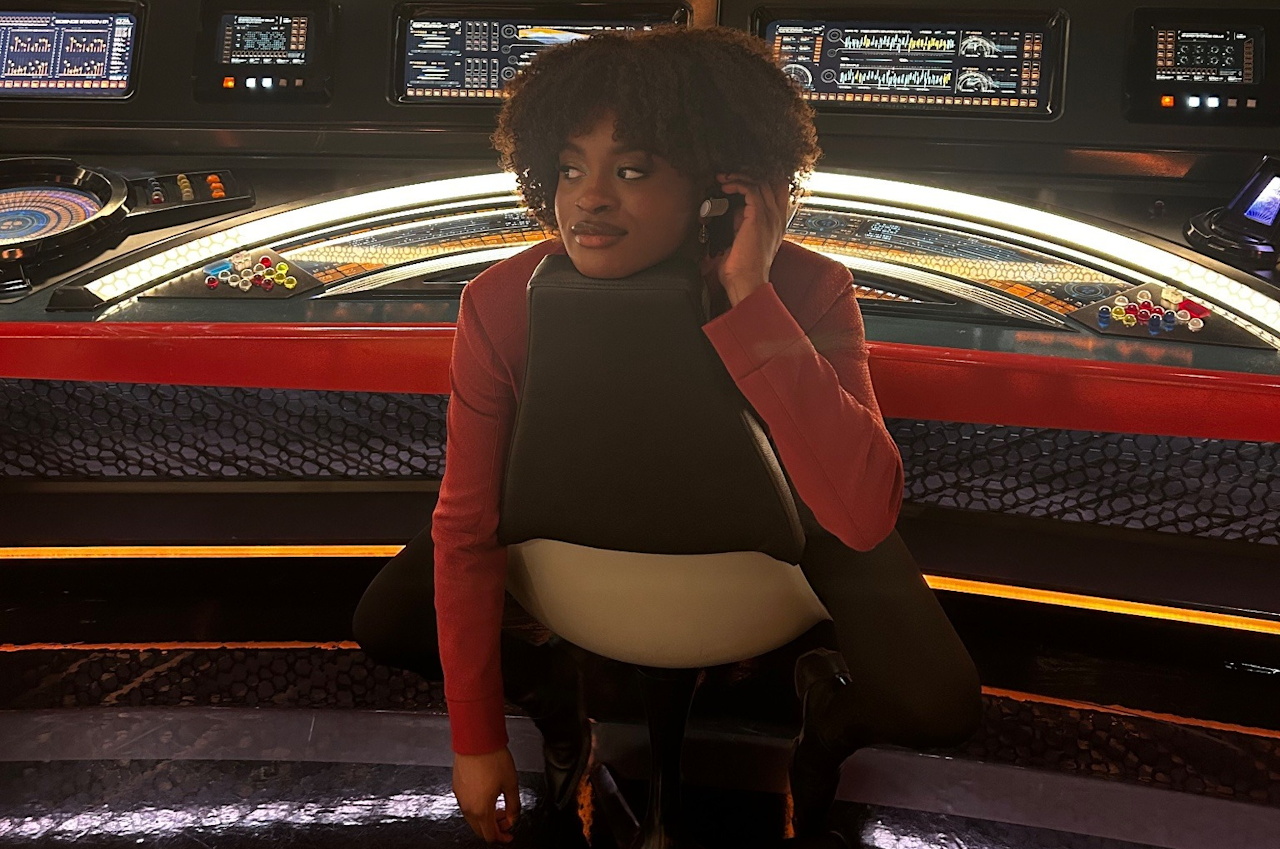
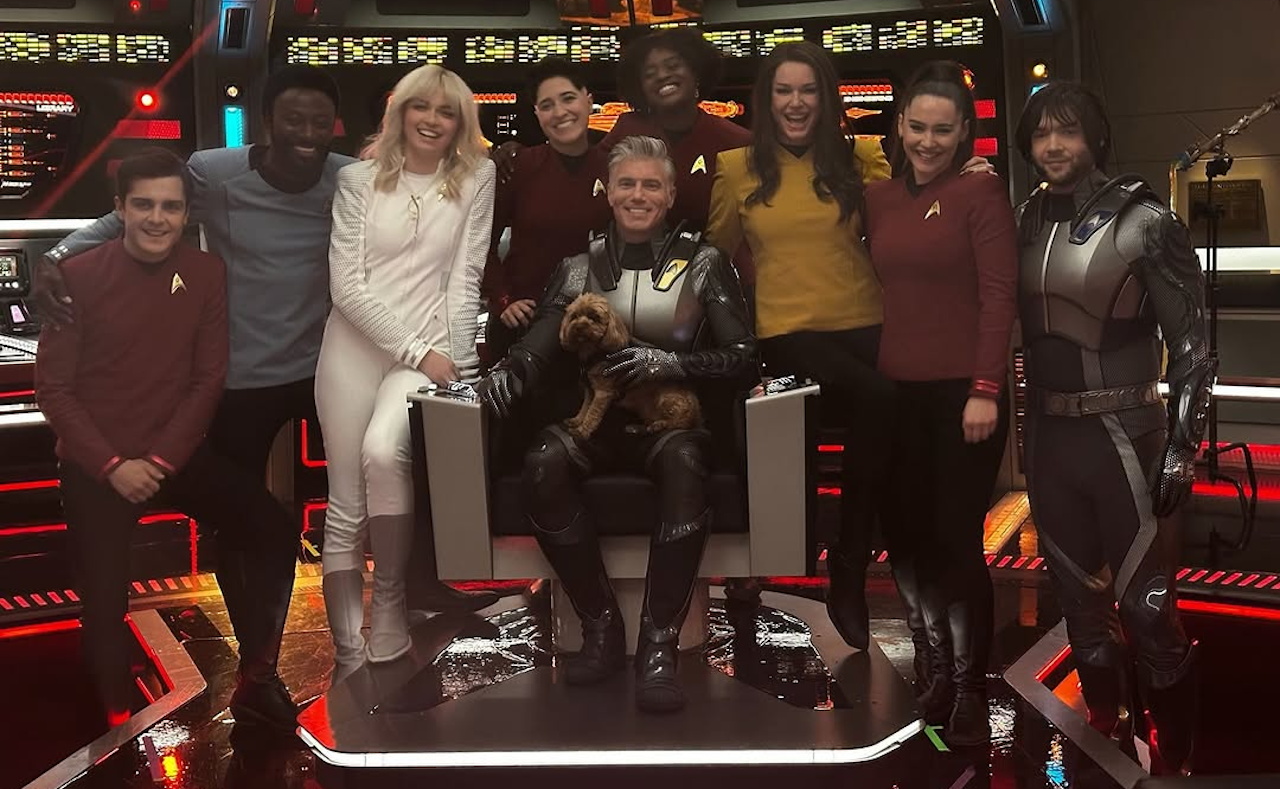
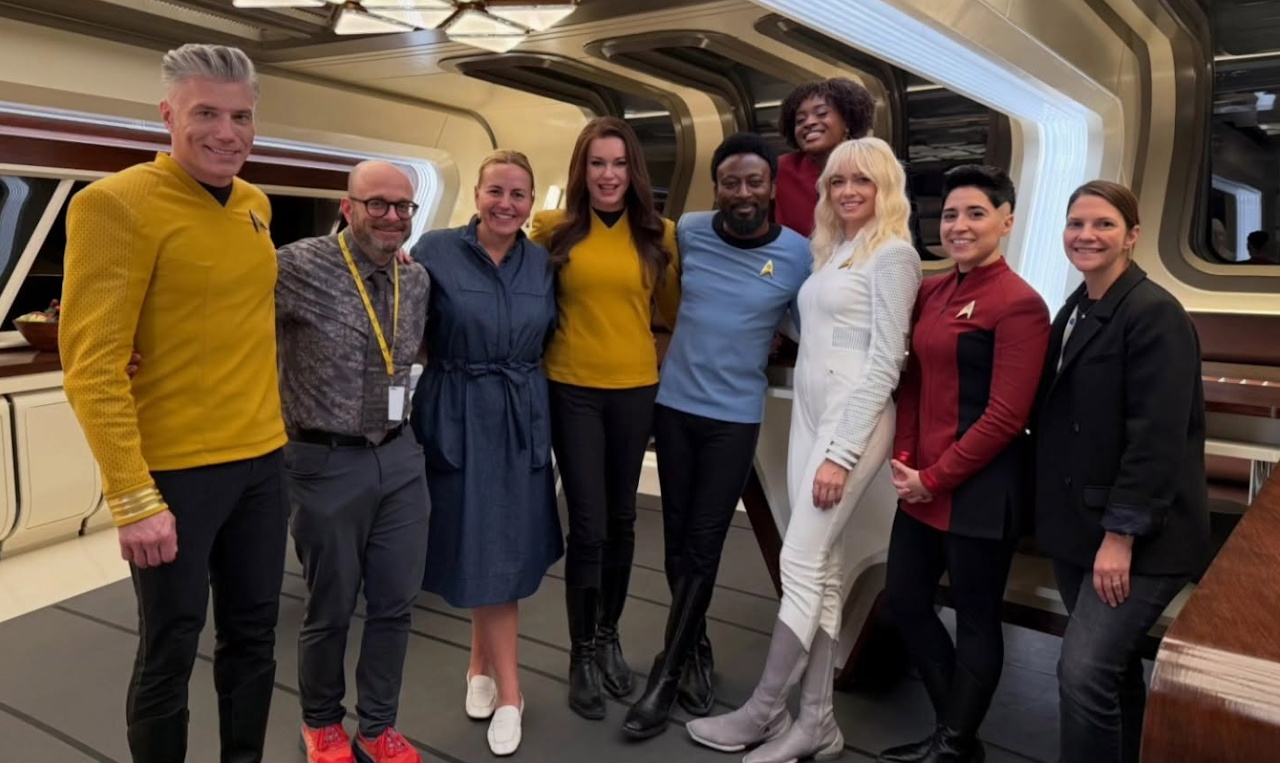
Behind-the-scenes photo from Star Trek SNW 4x07
Cast and crew behind-the-scenes.

Like Chonitons Through the Hourglass is saved from the title of “worst Strange New Worlds episode” by the existence of Subspace Rhapsody and the “but it was all just a dream” ending to Level-Five Transporter Accident. But that’s it. That’s the best I can say about it… and I guess that makes it the third-worst episode of the series.

Like Chronitons Through the Hourglass isn’t just a disappointment because its soap opera parody was over-the-top, hammy, and silly. Those things made me roll my eyes, sure, but as someone who isn’t a soap fan, perhaps that side of the story would never have been “my thing,” and that’s okay. Not every episode is gonna be a ten-out-of-ten for every viewer, especially with such narrative and genre diversity on display. But because the episode’s other side had an important and potentially powerful and emotional message about grief and loss… the failures of the soap opera fluff feel infinitely worse.

Still frame from Star Trek SNW 4x07 showing Una and M'Benga
Dr M’Benga and Una.

I would’ve been down for an episode exploring Pike’s grief, either through a sci-fi lens or just… by playing it straight. And I liked the attempt to draw a comparison between Pike’s grief and La’an’s feelings about her second heartbreak. But those ideas got precious little time and attention in an episode that wanted to be something else – something fundamentally incompatible with those loftier ideas. The choice should’ve been to either massively reduce the soap stuff to a few small vignettes, drop it entirely, or else abandon the serious themes and lean fully into the parody.

I know what I’d have chosen, if I had the option.

Star Trek’s sixtieth anniversary is in just a few days’ time, and we’re going into the anniversary with *this* as the most recent episode. That… would not have been my preference, I’m not gonna lie. And now that Strange New Worlds Season 4 is three-quarters done, there are still only two episodes that I can say I fully enjoyed and didn’t find glaring flaws in. It’s such a shame that this show – which I’ve said repeatedly has been my favourite of Star Trek’s modern revival – just isn’t on top form at the moment.

Next week, we’re going to get Orders of Magnitude – an episode which promises “an alien pursuit that grows far beyond its original orders.” Maybe that’ll be a better, more grounded, or more interesting story. Maybe it’ll be *orders of magnitude* better than a soap opera parody or an episode that ends with “but it was all just a dream.” We can but hope, I suppose.

Thanks for joining me for this review. I really don’t like being so negative about Star Trek, and especially about Strange New Worlds when there are so few episodes remaining. But… here we are, I guess. I’m crossing my fingers and hoping for better things next time.

I’ll be writing something celebratory on the 8th for Star Trek’s official sixtieth anniversary, so I hope you’ll join me for that. And earlier in the year, I wrote up re-watches of Where No Man Has Gone Before, which was TOS’s second pilot, The Royale, which was my personal “first contact” with the franchise, and a few other pieces, too, like my encounter with William Shatner, some “what-if” scenarios, and some fascinating fan theories that I found! I’ve also reviewed Season 1 of Starfleet Academy and the video game Across The Unknown, which is based on Star Trek: Voyager. I hope you’ll check out some of those pieces if you have the time. You can also find the rest of my Strange New Worlds reviews by clicking or tapping here. As always… Live Long and Prosper, friends!


Star Trek: Strange New Worlds Seasons 1-4 are available to stream now on Paramount+ in countries and territories where the platform is available. The first three seasons are also available on DVD and/or Blu-ray. The Star Trek franchise – including Strange New Worlds and all other properties discussed above – is the copyright of the Skydance-Paramount corporation. Days of Our Lives is the copyright of NBC/Corday Productions/Peacock. This review contains the thoughts and opinions of one person only and is not intended to cause any offence.
Star Trek: Strange New Worlds Episode Review – Season 4, Episode 6: Off-Hour

A Star Trek-themed spoiler warning.

Spoiler Warning: There are spoilers ahead for Star Trek: Strange New Worlds Seasons 1-4. Spoilers are also present for the following Star Trek productions: The Original Series, The Next Generation Season 5, Generations, and Discovery Season 2.

After last week’s absolute travesty, Strange New Worlds needed a win. And while the bar for success after Level-Five Transporter Accident was so low that it had melted through the basement like Chornobyl’s elephant’s foot, I’m pleased to say that Off-Hour was a massive improvement – and, in my subjective opinion, of course, the second genuinely good episode of the season.

Note that I said “good” and not “perfect,” though – because, despite being infinitely better than last week’s abomination, Off-Hour dialled up some of its drama just a tad too high for my liking, and when I make the obvious comparison – to The Next Generation’s stellar episode Disaster – I find it to be the lesser offering for that primary reason. We’ll get into all of this in a bit more detail as we go, but I felt the long shadow of Level-Five Transporter Accident hanging over Off-Hour, as I genuinely feared the return of “but it was all just a dream,” or some other kind of pathetic cop-out as the narrative seemed to reach an impossible crescendo.

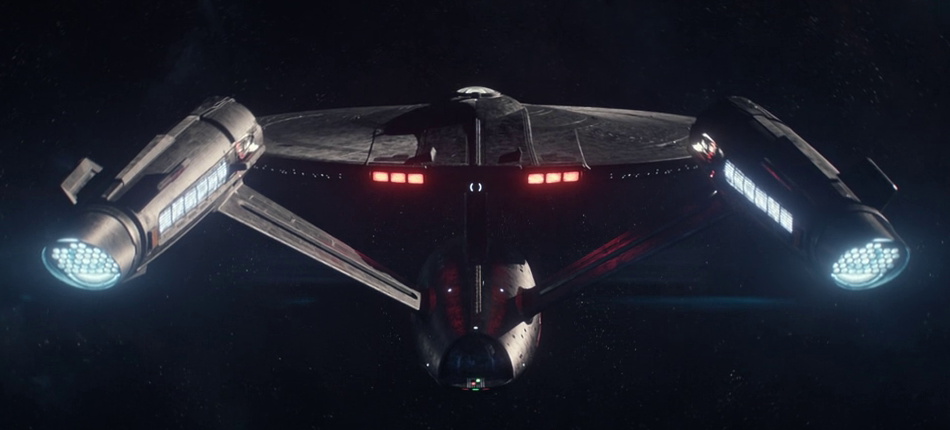
Still frame from Star Trek SNW 4x06 showing the USS Enterprise (cropped)
The Enterprise is about to experience a disaster!

There was also, I felt, a bit of a missed opportunity presented by Off-Hour’s unique narrative framework – something that, again, TNG did better some thirty-five years earlier.

None of this is to say that Off-Hour was in any way a “bad” episode; it’s probably my second-favourite of the season so far, and would easily crack a “top ten” for Strange New Worlds as a whole. I also appreciated several well-written callbacks to past iterations of Star Trek in this anniversary year – from The Cage to Court Martial and even a deep cut to That Which Survives, from The Original Series’ third season. Star Trek’s official sixtieth anniversary is in just over a week’s time, and I have to imagine that the writers and producers were at least aware that Season 4 would arrive sometime around then. Given that Skydance-Paramount as a whole doesn’t seem to be going overboard with the celebrations, it’s nice to get little references like that within the show itself – and we’ll talk about those in a bit more detail momentarily!

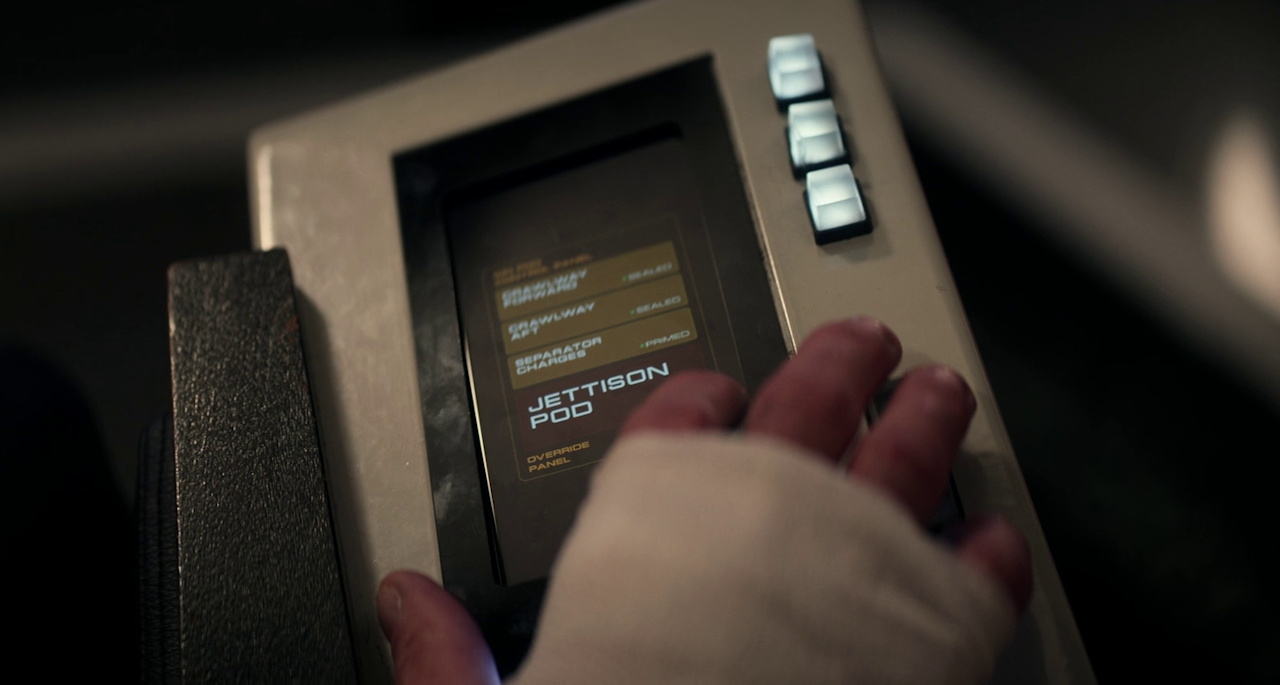
Still frame from Star Trek SNW 4x06 showing "Jettison Pod"
Who remembers Court Martial?

I would also be remiss not to tell you that this is the first Strange New Worlds episode I’m reviewing since meeting Ethan Peck and Christina Chong (Spock and La’an) at a recent Star Trek convention here in the UK. I haven’t written up a full piece about this year’s event; much of what I had to say would’ve felt repetitive, to be honest, after I wrote about my experiences barely twelve months ago. But if you join me later in 2026 for my annual “year in review,” I expect I’ll talk a bit more about Destination Star Trek then.

For the purposes of this review, well… it means I’ve personally met and shaken the hands of *three* of the principal cast, now! I met Martin Quinn (Scotty) last year, and it never ceases to be a strange feeling to look at someone on the screen and think to myself, “huh, I’ve met them!” But I’ll try not to let such things interfere with my analysis of Off-Hour – or, indeed, any future episodes going forwards.

And if you want to see what I made of 2025’s Destination Star Trek event, click or tap here! My thoughts haven’t really changed much after this year’s visit.

Still frame from Star Trek SNW 4x06 showing Spock and La'an's mind-meld
I got to meet both Ethan Peck and Christina Chong last weekend.

Okay, enough boring chit-chat about what I got up to at the weekend! Let’s get into Off-Hour.

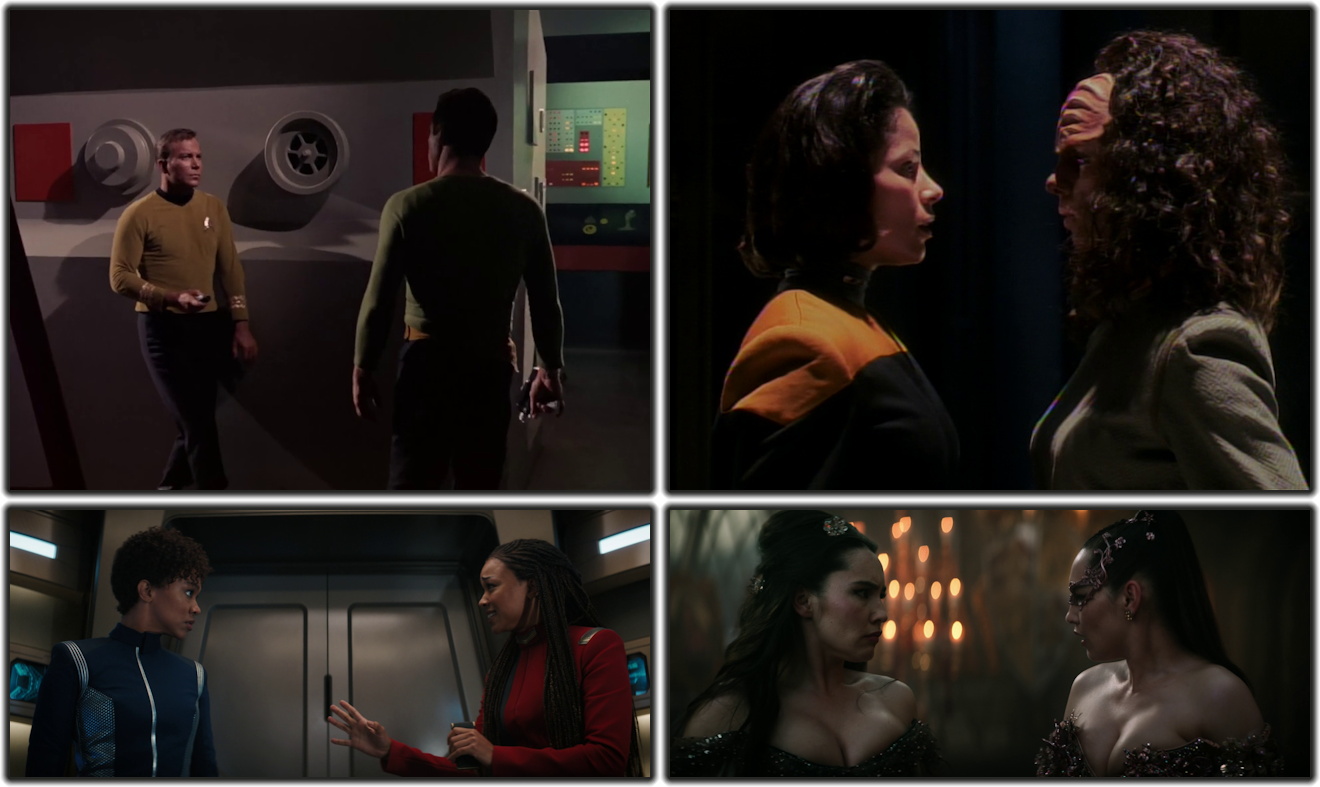
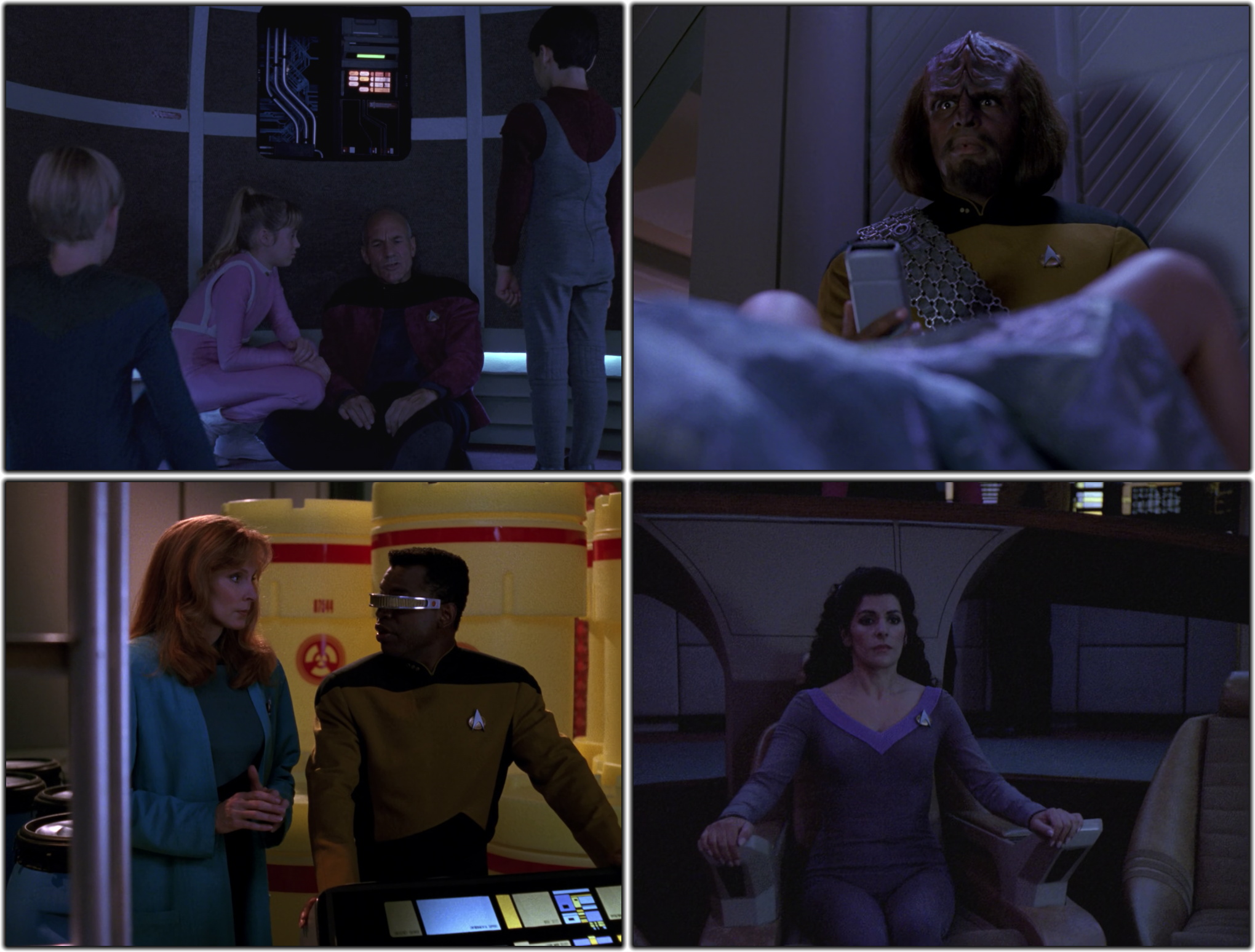
When The Next Generation premiered the fifth-season episode Disaster, the writers and creative team took advantage of the chaos aboard the Enterprise-D to bring together character groups and pairings that we didn’t often get to see. What’s more, the story then plunged several of those characters into situations way outside of their usual roles or areas of expertise – and what resulted is genuinely one of my favourite episodes from the show’s entire run.

We got to see Worf delivering a baby. Geordi and Dr Crusher spent more time together than… well, practically any other story I can call to mind. Deanna Troi took the conn, and had to wrangle with Ro Laren and Chief O’Brien as the ranking officer on the bridge. And Picard got stuck in his own personal hell: trapped with three young children!

Four stills from Star Trek TNG 5x06 showing Picard, Worf, Crusher and Geordi, and Troi
Disaster made creative use of TNG’s main characters.

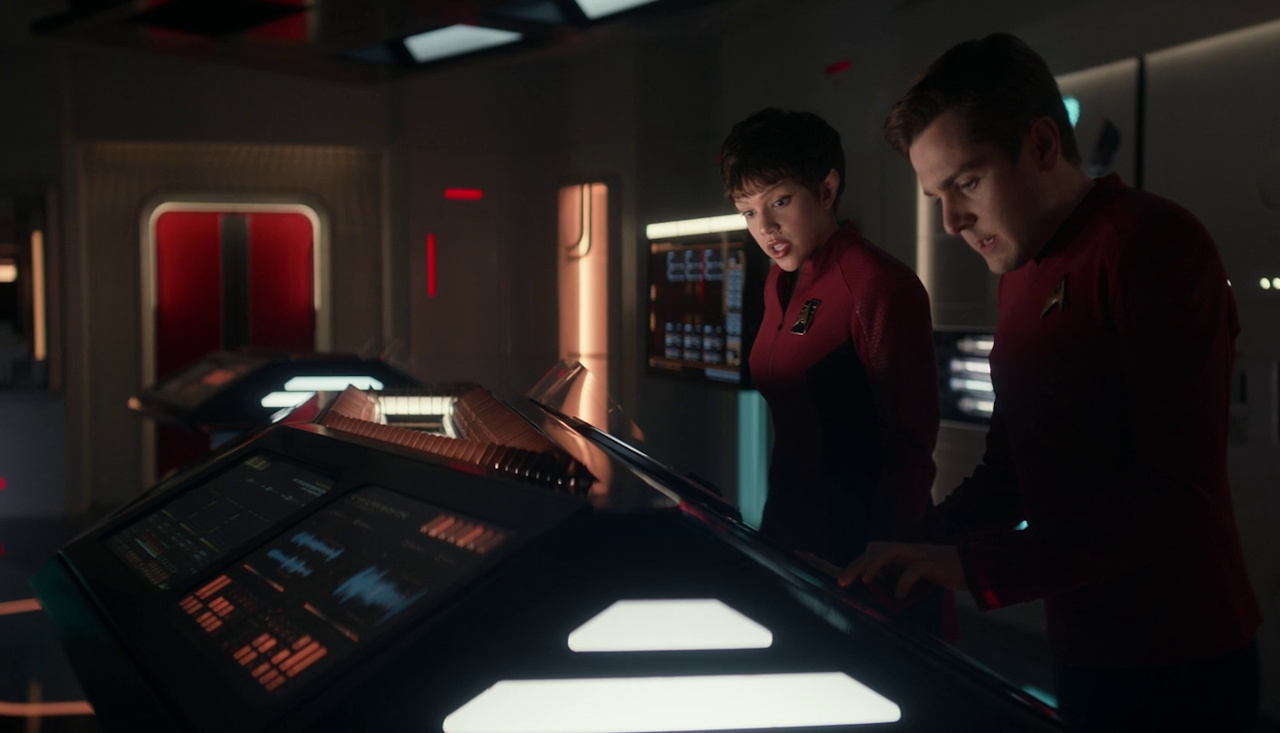
Off-Hour could’ve used its setup to do something similar, but the only “unusual” character pairing we got was Scotty and Cadet A’Sha – and, really, *any* character pairing with A’Sha would be out of the ordinary because of how little screen time she’s gotten across the season so far! I don’t dislike the scenes we got with Uhura and Ortegas on the bridge, Una, Spock, and La’an in the lounge, or Chapel and M’Benga in sickbay – but given the unique premise of the episode, *and* the addition of characters like Dr Boyce to add another medical officer… well, I can’t help but lament, in a way, a missed opportunity.

When we look back at Strange New Worlds’ run to date, how many times have we seen Ortegas and Dr M’Benga interacting? Or Chapel and Scotty, Spock and Una, or Pike and Pelia? There were so many possibilities for pairing up or creating groups of characters who don’t usually spend any time together, and this kind of story provided the *perfect* narrative framework for doing so. But the characters mostly stayed in their established pairings and groups, and when I compare that element of Off-Hour to The Next Generation’s similar offering… I just feel like full advantage wasn’t taken of this concept.

Still frame from Star Trek SNW 4x06 showing A'Sha and Scotty
A’Sha and Scotty formed the only uncommon character pair.

Partly, I’m afraid, the reason for that is that Off-Hour – like several Strange New Worlds stories (and many others in Discovery, Picard, and even Prodigy in recent years) dialled up the drama and stakes just a little too high. Dr M’Benga’s gruesome injury is the main culprit here, but the danger posed to the ship by the “warp slingshot” or “neutrio wormhole” or whatever we’re calling it is a big part of that, too.

And again, TNG’s Disaster is a great point of comparison. That episode had stakes and tension; there were injured characters and others were in mortal danger. But the way it communicated those storylines was ever so slightly less… melodramatic. Because of that, the story opened up, and it meant it was absolutely possible for an injured character like Picard to be stuck with some scared kids, or for Troi, on the bridge, to have to wrangle with potentially fatal decisions without the support of other senior officers. Dialling things back just a couple of notches worked wonders for Disaster, and it allowed the story more freedom to shake up TNG’s characters in fun and creative ways.

If any part of Off-Hour was lacking… well, there it is.

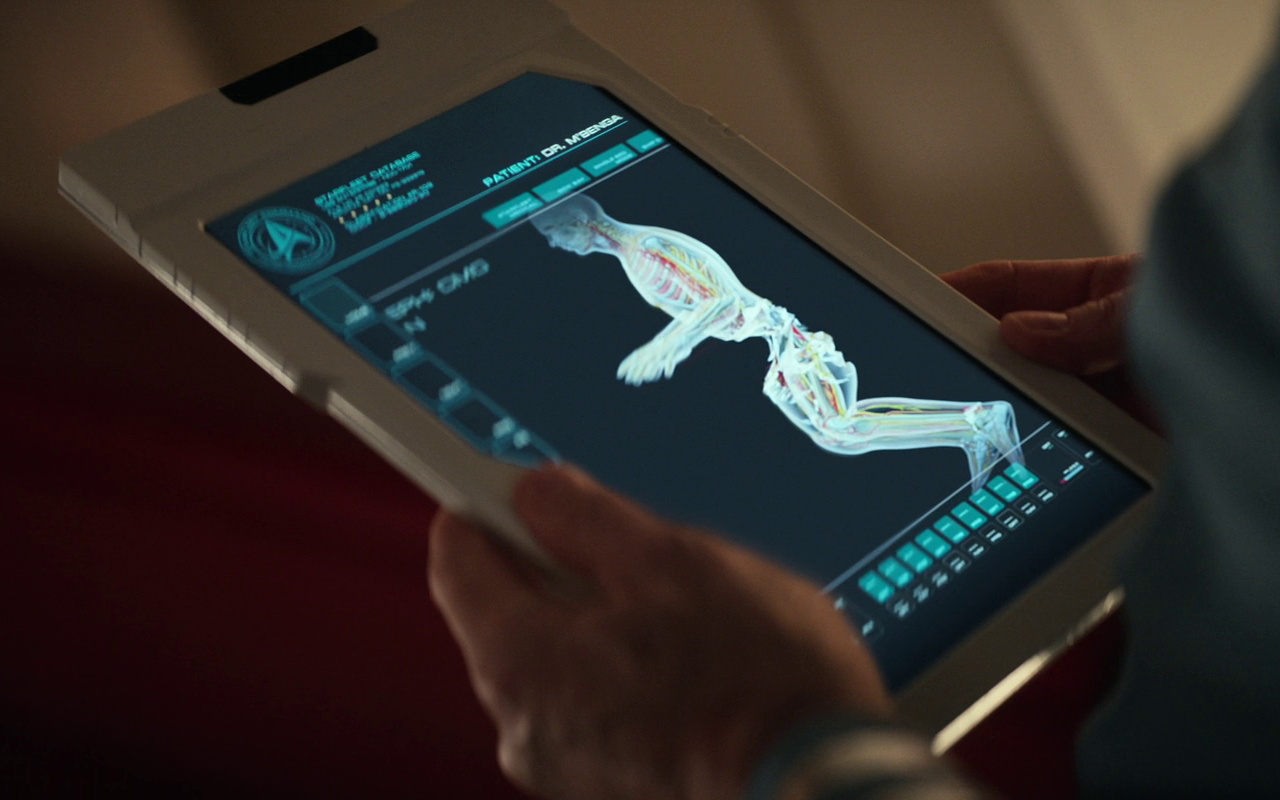
Still frame from Star Trek SNW 4x06 showing Dr Boyce's padd
Dr M’Benga’s injury as shown on a padd.

Since I mentioned Dr M’Benga’s injury, let’s head to Sickbay next.

I’m sorry if this is going to sound crude or facetious, but when Dr M’Benga was almost bisected by the rolling table, I could only think of one thing: the parody of Signs from the beginning of the 2003 “comedy” film Scary Movie 3. I know, I know… cringe millennial humour, right? But honestly, when Chapel revealed the scan of Dr M’Benga’s injury… that thought almost made me laugh out loud. Does that say more about me than Off-Hour? I mean, probably.

Perhaps a more casual audience isn’t aware of this, but Dr M’Benga is a minor character on The Original Series, making I think three appearances on the show alongside Dr McCoy. What that means, for those of us who did know that, is that Dr M’Benga is basically immortal in Strange New Worlds. And that fairly typical “prequel problem” robbed this storyline of much of its dramatic tension, unfortunately. Plenty of stories can still be thoroughly enjoyable even when you know how they end, but because of Strange New Worlds’ place in the timeline, any TOS character is an odd choice to place in mortal peril. Compare M’Benga’s injury in this episode to Ortegas’ injury at the start of Season 3 as a case in point; Ortegas could have been killed off, just as Hemmer had been in Season 1. But M’Benga is unkillable – and that knowledge detracted from this storyline, at least a little. And maybe that’s why my initial reaction was to recall that dumb scene from a pretty awful early 2000s spoof movie instead of being gripped by the tension that the episode was going for.

Still frame from Star Trek SNW 4x06 showing Dr M'Benga bisected
Half of Dr M’Benga…

The preamble to M’Benga and Chapel’s story saw them get into an argument. And while friends having disagreements and arguments is something that happens every day… this one felt just a little bit forced. It worked in the sense that it gave Chapel an extra motivation to stay with Dr M’Benga after he was injured; she didn’t want to prove him right by walking away, as he’d called her out for having “one foot out the door.” But if we stop to think about that… did Chapel need that as an extra reason to stay by her friend’s side? Aside from Spock, and the complicated romantic relationship there, Dr M’Benga is by far Chapel’s closest friend on the ship. They have a history that extends way back before the events of the series, and we’ve also seen Chapel as being dedicated to her patients on numerous other occasions. I just don’t think the argument and the conversations they had about which of them might be leaving really added much to *this* specific storyline.

However, given that Strange New Worlds is in the process of shuffling some of its characters around ahead of next season’s finale, talk of Dr M’Benga potentially stepping away from the chief medical officer role is noteworthy. This episode (re)introduced Dr Boyce – the Enterprise’s very first CMO from The Cage – and we also know that Dr McCoy has been cast for at least one Season 5 episode. As I said above, Dr M’Benga would serve aboard the Enterprise during Kirk’s time – but not in the chief medical officer’s role, so some kind of exit, or partial exit, seems to be on the cards, and I think we’ve seen the beginnings of that here.

Still frame from Star Trek SNW 4x06 showing M'Benga and Chapel
Is Dr M’Benga really going to leave the Enterprise?

I could appreciate, though, that Chapel got one of her best stories of the show so far – and that Jess Bush really got a chance to show off her range and put in an exceptional performance with this incarnation of the character. Even if the idea of Chapel being a bit “flaky” in her commitment to serving on the Enterprise felt less-than-developed as a premise, her dedication to saving her friend’s life when he was in danger was admirable, and we went through a range of emotions with her as she refused to confront what should’ve been a guaranteed death for Dr M’Benga.

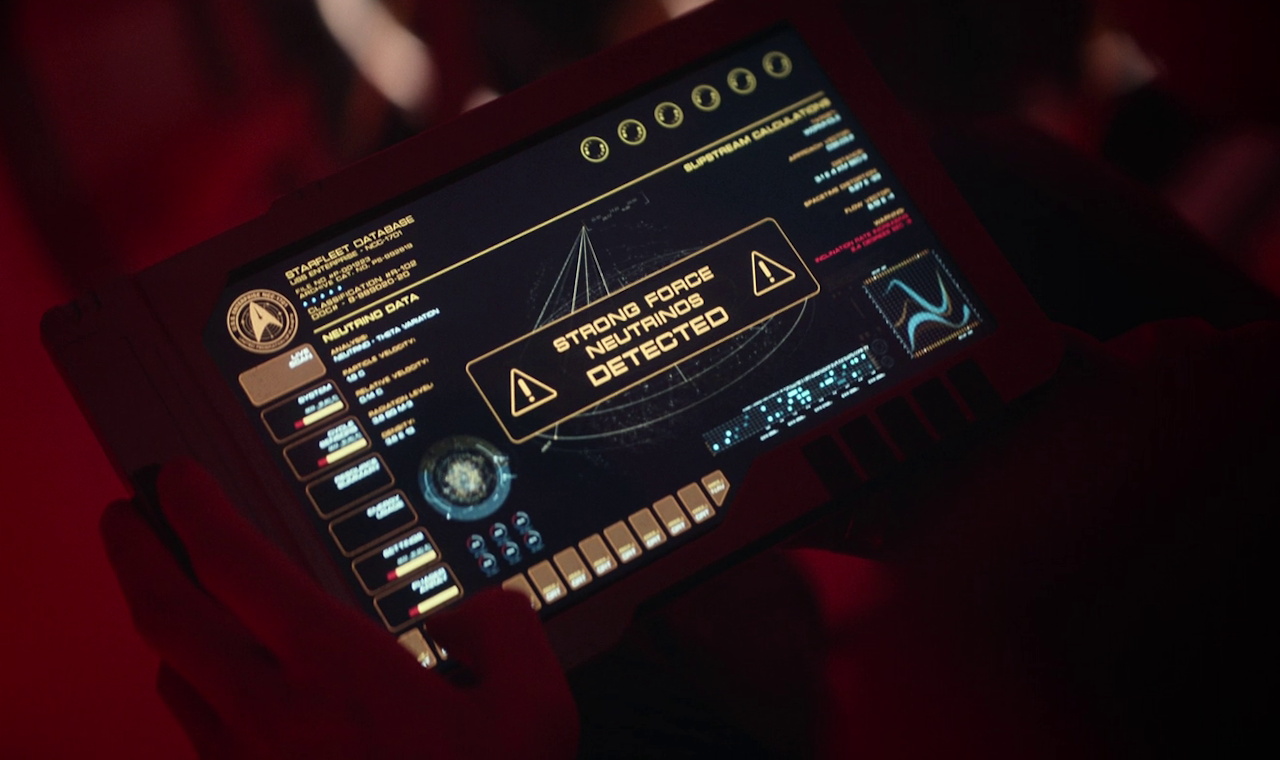
The technobabble macguffin that saved both M’Benga and the ship was, perhaps, a tiny bit lacking in explanation; we got some fun lines between Chapel, Pike, Scotty, and Pelia, but it felt a bit lightweight given the scale of what these “super-neutrinos” were capable of doing. Perhaps a stronger story would’ve used the neutrinos for one role, but not both – and found an alternative way to either save Dr M’Benga or refuel the ship. Again, that comes back to my point about the stakes and tension being cranked all the way up; in a story with marginally lower stakes, the magical neutrinos wouldn’t have needed to do *everything*.

Still frame from Star Trek SNW 4x06 showing a padd with neutrinos
These neutrinos sure are useful, eh?

Sticking with characters that Off-Hour endangered who, realistically, we knew were never in any danger… we also have Spock.

Again, as with Dr M’Benga, Spock was just a really odd choice for this kind of storyline. I appreciated the callback to Court Martial with the ion pod and how it could be jettisoned; that isn’t the issue. When the story really wanted us to feel that a main character was genuinely in danger of losing their life, the writers chose literally the only character from that group who couldn’t die. Dr Boyce, Una, or La’an could all have taken on Spock’s role in heading for the ion pod; there was nothing about it from either an in-universe point of view or for Spock’s character arc that meant it *had* to be him. And any of them – or the likes of Ortegas and other non-TOS characters – would’ve felt in danger in a way that Spock simply never did.

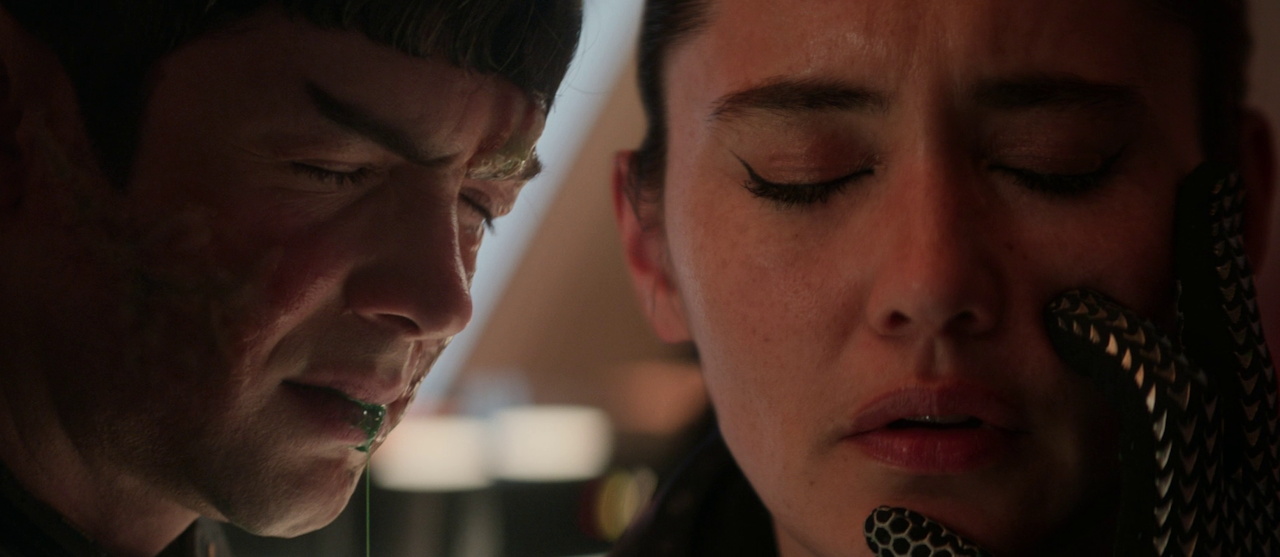
There were some creative visuals on this side of the story – Spock and La’an’s slow, painful climbs across the hull were both impressive-looking and tense. The animation work used to represent the wormhole and the neutrinos was fantastic. And on the practical side, Spock’s painful radiation burns were particularly gruesome, as was the visual of him spitting up blood. But the show’s status as a prequel, and the decision to put the one character who we know couldn’t be in any real danger into this situation, rather worked against this part of the story.

Still frame from Star Trek SNW 4x06 showing La'an in a spacesuit on the hull
La’an climbing over the hull.

La’an said it best herself: she’s “expendable,” at least in a narrative context! And given her concerns earlier in the season about her latent augment DNA, some kind of exposure to super-neutrinos or outer space radiation could be something that we follow up on in subsequent stories. Given that La’an had to go after Spock anyway, and her scene climbing over the hull was very similar to the one we’d just seen with Spock… I can’t help but feel that maybe other choices could’ve been made to make this storyline a bit more tense. Sending both characters out, one after the other, maybe even felt a tad repetitive – though I didn’t really notice that on my first viewing of the episode, to be fair.

La’an and Una had some great moments together in earlier episodes – particularly Season 1’s Ghosts of Illyria and Season 2’s Subspace Rhapsody, and I read their conversation here as a bit of a follow-up to that. That “big sister-little sister” dynamic hasn’t been as present with them lately, but it seemed to be back in play here. If – as I’ve repeatedly theorised this season – La’an may not be long for this world (or may be about to depart the Enterprise in some other way), then taking a moment to remind us of her friendship with Una is no bad thing.

Still frame from Star Trek SNW 4x06 showing La'an and Una
La’an and Una.

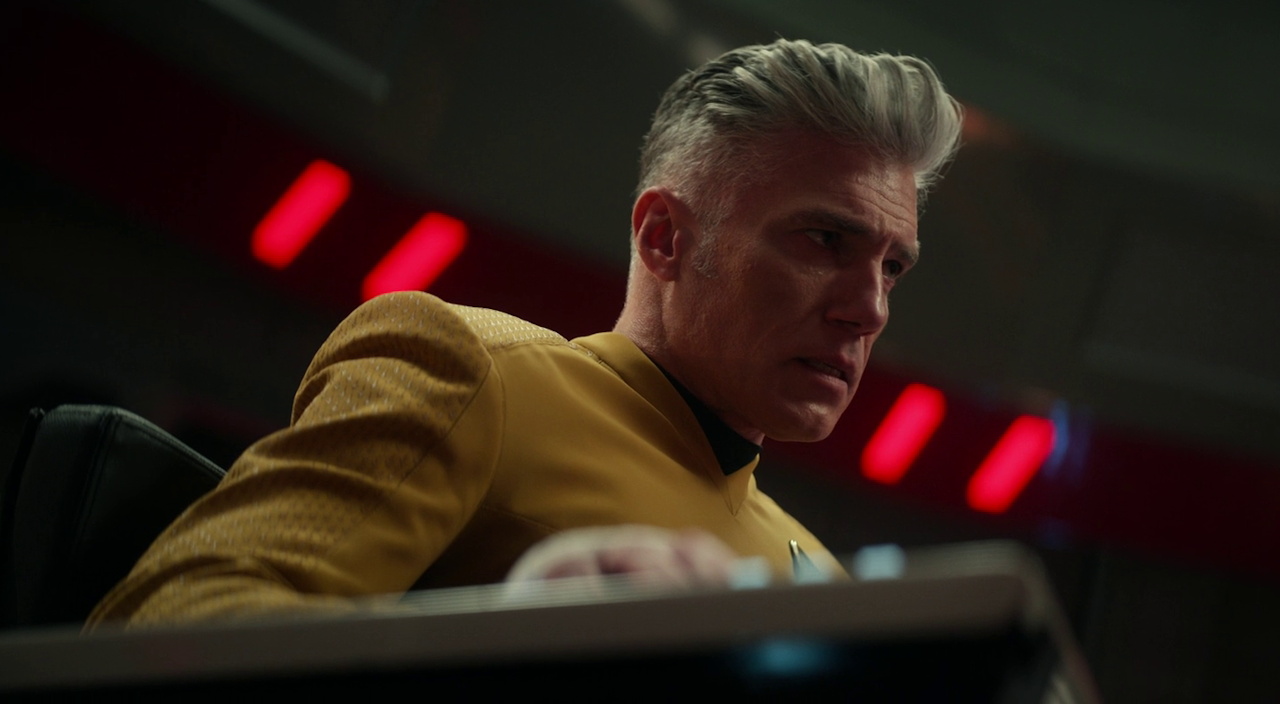
Is Strange New Worlds paying Anson Mount by the line, or something? Is that why Captain Pike has been such a small part of the show this season? On its own, Pike’s relatively small role in Off-Hour wouldn’t be noteworthy. He spent a good chunk of the episode unconscious, but he got a good moment of self-sacrifice as he risked his safety to activate the Enterprise’s deflector screens, and then got a moment later in the story when he had to make the tough decision to jettison the ion pod. But given how Pike’s roles across the season so far have been pretty minimal… I dunno. I continue to hope for more Captain Pike in what we used to call “the Captain Pike show,” I guess.

On its own, it wouldn’t matter. Off-Hour had good storylines for Scotty, Chapel, and M’Benga in particular, and Star Trek has *always* done episodes where some characters were more in focus than others. It just feels like we’ve now had five in a row where Pike’s role has been fairly small, and given that the original appeal of Strange New Worlds – the reason fans like myself were clamouring for more from this version of the character after his appearance in Discovery’s second season – was Anson Mount’s wonderful performance… well, it’s become noticeable. And I’d hope that we’ll get to spend a bit more time with the Enterprise’s captain between now and next season’s finale.

Still frame from Star Trek SNW 4x06 showing Pike
We don’t seem to be spending as much time with Pike this season.

Pelia has been one of my favourite characters in Strange New Worlds since she arrived back in Season 2, and I’m so glad to see her in the kind of mentoring role that this younger version of Scotty needs. Although I wouldn’t call Pelia and Scotty a “rare” or “unusual” pairing in the way I described above, they’ve had precious little time together since Scotty came aboard the Enterprise, sadly, and I’m glad that Off-Hour went some way to remedying that deficiency. The whole point of doing a prequel story for characters like Uhura, Spock, or Scotty is to show how they grew to become the people we’re familiar with, and given where Scotty started – and his existing relationship with Pelia – that’s something I’ve felt Strange New Worlds hasn’t really done enough of.

But Pelia got a genuinely enjoyable storyline this time, guiding Scotty less on the technical side and more in terms of boosting his confidence – and that’s *exactly* what this younger version of the character needed. I liked Scotty’s callback to the USS Stardiver (the ship he served on in Season 2, before he joined the Enterprise) and how his conversation with Pelia gave him enough of a boost to play a role in saving the ship.

Still frame from Star Trek SNW 4x06 showing Pelia in her quarters
Pelia’s just fantastic, isn’t she?

The only downside to this part of the story, really, is that Pelia’s confidence-boosting didn’t really lead to Scotty actively *doing* anything differently. He’d already made the adjustments to the ion pod and to the bussard collectors; all he really had to do was have faith that the ship would hold together despite passing its safe limits. And that was important, don’t get me wrong – we saw the genesis of Scotty the “miracle-worker,” willing to push the Enterprise and squeeze every last bit of juice from her engines! But what I mean is that, for all of Pelia’s nice words, it didn’t really change anything that Scotty *did* – with some slight changes, Scotty could’ve listened to something Pelia said and that might’ve given him a final boost to… I dunno. Technobabble something about an extra ounce of power to the deflectors; something to help the ship when it passed that threshold.

But that’s really just a nitpick. This Pelia-Scotty storyline was fantastic, and it’s something I’ve been waiting to see from Strange New Worlds for basically a season-and-a-half at this point! Scotty, since coming aboard, has kind of eclipsed Pelia in several engineering stories, and because she’s such a fun character, that’s been a little disappointing. So I’m really glad to see her in that senior role this time. It was also fun to revisit Pelia’s cabin and see some of the random nonsense she’s accumulated over such a long life! That will never cease to be a fun space to spend time in.

Pair of still frames from Star Trek SNW 4x06 showing Scotty and Pelia
This moment at the end of the episode was incredibly sweet.

A’Sha has been a bit of a non-entity so far this season. After what could’ve been a strong start in her initial scene with Uhura, she faded into the background quite quickly. But given the Strange New Worlds writers’ proclivity to put Vulcan characters into either slapstick comedy stories or soap opera-level romantic plots, it was a breath of fresh air to get a Vulcan who behaved… well, like a Vulcan, for once. And A’Sha’s scenes with Scotty this week were a lot of fun.

Even as the ship was in danger, A’Sha kept her head. She helped Scotty where she could, even coming up with the idea to turn off life support to non-essential areas of the ship, and later beaming him to just the right place to be able to make the modifications to the ion pod. I’m hoping there’s more to A’Sha than just being a “glorified redshirt,” like last season’s Ensign Gamble, but whatever may lay in store for the character, her scenes this week were pretty good – and by far her biggest outing of the season to date.

Still frame from Star Trek SNW 4x06 showing A'Sha opening the turbolift doors
Here’s A’Sha!

I wasn’t a huge fan of the 24-inspired clock or countdown on the screen. It did hammer home that (most) of the episode took place in real-time, which could’ve been fine, but after the first couple of appearances it just began to feel a bit gimmicky, to be honest, and I don’t think it really added a lot. The episode was already tense and dramatic – arguably just a little too much! And adding a ticking clock didn’t really do much for me to ramp that up much further.

What I liked a lot better, though, were the 24-inspired split-screen sections. Some of these were better than others, admittedly; a few of them were little more than just side-by-side close-ups of characters. But when they worked, they really worked, and it’s a creative technique that we don’t often see in Star Trek. The moving “wipes” from one character to another, and how the screen wasn’t always a perfect 50/50 split were also fun visual effects, and that kind of thing definitely helps Off-Hour stand out.

Still frame from Star Trek SNW 4x06 showing Chapel and Pike on a split-screen
One of the split-screen moments.

We mentioned Court Martial and the ion pod, and that was a fun callback. But one reference I never would’ve expected in a million years was to the TOS third-season episode That Which Survives. I don’t mean to be unkind, but is That Which Survives an especially memorable episode for you? Because it isn’t for me! So it was a ton of fun to get a deep cut to a random minor character from that episode: Lieutenant Rahda.

Rahda takes over the conn for the Enterprise’s beta shift (an earlier episode this season mentioned alpha and beta shifts, if I’m remembering correctly), and she’s the one who initially notices the problem of the warp-wormhole (or whatever we’re calling it). In That Which Survives, Rahda takes over for Sulu at the helm, so she kind of plays a similar role in both stories. It was a totally unnecessary callback – this could’ve been a brand-new character and she would’ve served the exact same function. But I love that Strange New Worlds went back to Star Trek’s past and pulled out a minor character like Radha for a moment like this. It adds depth to Star Trek’s world, and makes the franchise’s newest outing feel even more strongly tied to its first. In the sixtieth anniversary year… well, I love to see things like that.

Still frame from Star Trek SNW 4x06 showing Rahda and Pike
Rahda appeared in a Season 3 episode of The Original Series.

As the story unfolded, and especially as it seemed like both Dr M’Benga and the Enterprise were in mortal danger, I’m afraid I felt the hideous spectre of Level-Five Transporter Accident’s ending looming ever larger. If you read my review of last week’s episode, you’ll know that I felt the “but it was all just a dream” ending is probably the worst ending to an episode in the entire six-decade history of Star Trek, and when Off-Hour seemed to be writing itself into a corner, well… I began to fear the worst.

I didn’t think for a second that we’d get another identical “dream” story, but I did wonder whether – through some technobabble, perhaps – these super-neutrinos might rewind time or undo much of the episode’s story. Star Trek has done similar things on occasion, so it wouldn’t have been totally unprecedented. But after last week’s episode had so thoroughly shit the bed, I couldn’t *bear* the idea of another story being erased in any way, and as the tension ramped up and we got closer to the explosive conclusion… it was a real, genuine worry. The stench from Level-Five Transporter Accident’s ending will take time to dissipate, apparently.

Still frame from Star Trek SNW 4x06 showing the USS Enterprise in a wormhole
The Enterprise in the wormhole.

When Strange New Worlds was first announced, and before we knew anything about who would or wouldn’t be joining the cast, I wondered if we might see a new version of Dr Boyce. Boyce was the Enterprise’s doctor – and Pike’s counsellor of sorts – in The Cage, but obviously the Strange New Worlds team chose to adapt Dr M’Benga instead. So it was a real surprise, then, to see Dr Boyce in this episode – and to learn that he’s apparently playing second fiddle to Dr M’Benga after returning to the Enterprise from a different posting.

I gotta be honest: this version of the character seemed a lot harsher and less personable than the Dr Boyce from The Cage, to such an extent that they almost don’t feel like the same individual. I think it’s possible that Dr Boyce might reappear either later this season or next season, so maybe we’ll get to spend a bit more time with him and reestablish that softer or more personable side, or there could be a conflict looming with Dr M’Benga. Given that M’Benga might be on his way out… Dr Boyce could have a role to play in facilitating that, perhaps.

Still frame from Star Trek SNW 4x06 showing Dr Boyce
Dr Boyce.

I did like Dr Boyce’s no-nonsense approach, though. He was calm and professional, even under pressure, and although he might’ve seemed quick to dismiss Chapel’s pleas to try to save Dr M’Benga, that came from an understandable place. M’Benga’s life was only saved by magical nonsense, if you think about it, and Dr Boyce had other patients in need of treatment, so his attitude makes sense. I still think that he didn’t have quite the same charm or bedside manner as he did in The Cage, but given the stressful situation, I could understand where it was coming from.

Again, as with the ion pod and Lieutenant Rahda, this was a fun callback in this big anniversary year. It was also nice to get some (admittedly belated) explanation as to why Dr Boyce was no longer the Enterprise’s CMO after the events of The Cage, as that filled in a little bit of backstory in between events we’ve already seen on screen. As above, this character’s role in Off-Hour could’ve gone to someone brand-new, but returning to someone from Star Trek’s past – someone quite important, in this case – worked well and was a fun little callback for Trekkies.

Still frame from The Cage showing Dr Boyce
Dr Boyce, as he appeared in The Cage.

Speaking of callbacks, the damaged engineering being sealed off reminded me of a similar moment in Generations, shortly before the destruction of the Enterprise-D’s stardrive section. The engineer who sealed the room also had some pretty painful-looking radiation burns (and I have to assume that he, along with several of his colleagues, won’t have survived if they were sealed inside the irradiated engine room). This character was functionally little more than a redshirt, I guess, but it was nice to see engineering so lively and populated at the start of the episode; we’ve hardly spent any time in main engineering, really, even after Scotty joined the show, yet it’s such a fun space.

One thing that confused me was Dr M’Benga’s line about the temperature outside Sickbay being “-400 degrees.” Is that a Fahrenheit thing that I’m too non-American to get? Star Trek has (usually) used metric measurements in the past, and the temperature of outer space is famously -270° C. It just seemed like a very odd thing for Dr M’Benga to say – either he was exaggerating, delusional from his injury, or just… I dunno. It felt like a bit of an oddity, though.

Still frame from Star Trek SNW 4x06 showing Dr M'Benga frozen
A Dr M’Benga popsicle.

So that was Off-Hour. A good episode, but perhaps one that didn’t take full advantage of its unique premise.

Jess Bush and Martin Quinn were, for me, the standout performers this week. Both ran the gamut of emotions, taking their characters through very difficult and complex situations and journeys, and Scotty in particular has taken a massive step closer to the man we remember from The Original Series. There were several fun callbacks to Star Trek’s past, helping Off-Hour to feel just a little bit celebratory with Star Trek’s big anniversary right around the corner, and the episode put together a strong story… albeit one where the drama was just a notch or two too high for my personal taste.

Still, it’s one of the best episodes of the season without a doubt, and as things stand right now, I’d happily put Off-Hour in a hypothetical “top ten” of my favourite episodes from the entire show. After last week, Strange New Worlds desperately needed a palate-cleanser, and I’m pleased to report that Off-Hour successfully delivered on that.

Still frame from Star Trek SNW 4x06 showing Uhura
Uhura.

I hope this has been interesting… and you aren’t *too* jealous that I’ve now met Christina Chong, Ethan Peck, and Martin Quinn! I definitely felt that there was a low bar for this week’s episode after *that* ending last time, but even with that in mind, I think Off-Hour was good.

Next week, Like Chronitons Through the Hourglass promises to trap the crew inside “a soap-opera reality.” So… Star Trek: Discovery, then? Jokes aside, I’m not sure if I like the sound of that premise, to be blunt. We’ve already seen episodes like A Space Adventure Hour and The Elysian Kingdom doing these kinds of “what if Star Trek… but different?” ideas, and they haven’t all worked as well as I’d have liked. However, I shall endeavour to go into it with an open mind, and if nothing else, I like the idea of Captain Pike potentially taking centre-stage again.

So hopefully you can join me next week for that review! Thanks for checking out my thoughts on Off-Hour, and if you missed them, you can find the rest of my Strange New Worlds reviews by clicking or tapping here. And maybe, sometime soon, we should return to TNG’s Disaster for a re-watch! Until next time… and Live Long and Prosper, friends!


Star Trek: Strange New Worlds Seasons 1-4 are available to stream now on Paramount+ in countries and territories where the platform is available. The first three seasons are also available on DVD and/or Blu-ray. The Star Trek franchise – including Strange New Worlds and all other properties discussed above – is the copyright of the Skydance-Paramount corporation. This review contains the thoughts and opinions of one person only and is not intended to cause any offence.
Star Trek: Strange New Worlds Episode Review – Season 3, Episode 10: New Life and New Civilizations

A Star Trek-themed spoiler warning.

Spoiler Warning: There are spoilers ahead for Star Trek: Strange New Worlds Seasons 1-3. Spoilers are also present for the following Star Trek series: The Original Series, The Next Generation, Deep Space Nine, Voyager, Enterprise, Discovery, and Picard.

So this is it, then! Strange New Worlds Season 3 draws to a close after nine weeks. Perhaps in the days ahead we’ll take stock of the season overall, because there have been some fantastic episodes… and a couple that I was a lot less keen on! Season 4 has already wrapped, with production now underway on what will be Strange New Worlds’ fifth and final season, so there’s more to come – even though we are now, sadly, past the halfway point of the show’s run.

But all of that is yet to come! Today, we’re talking about New Life and New Civilizations – the dramatic and emotional final episode of Season 3. I’ll give you the lowdown, but first comes my usual caveat. This review is the subjective, not objective opinion of one old Trekkie. If you enjoyed the episode more than I did, completely hated it, or just don’t like my take on things… that’s okay. There’s plenty of room in the Star Trek fan community for differences of opinion and polite disagreement, and I share this review with my fellow Trekkies in that spirit.

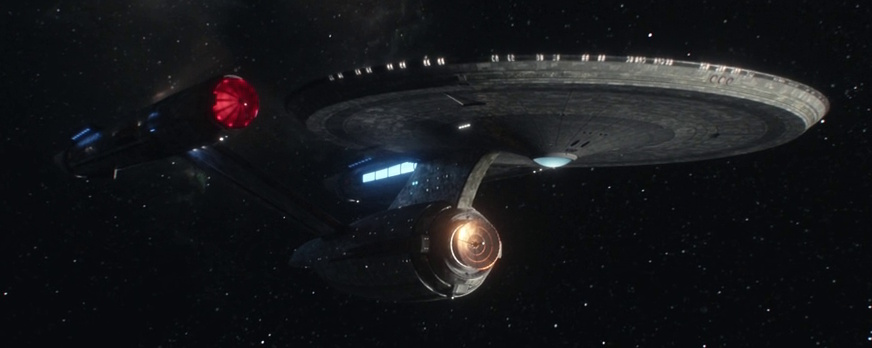
Still frame from Star Trek: Strange New Worlds 3x10 (New Life and New Civilizations) showing the USS Enterprise.
The Enterprise at the beginning of the episode.

Was New Life and New Civilizations a good episode? I would say yes. Was it a perfect episode? That’s a much higher bar to clear, and I’m afraid I have to say no. I think the episode got a lot of things right, building on story threads from across Season 3 in a way that made sense – while also having time for a genuinely unexpected twist. However, there were issues with the way large parts of the episode were paced, resulting in moments that were too short or where more debate and conversation were needed, as well as quite a bit of jumping around. I also felt that, of all the ways Kirk was brought into stories this season, the excuse here was the flimsiest – even though at least part of the result was positive.

While there were some imperfections, some of which admittedly straddle the line between legitimate criticism and nitpicks, New Life and New Civilizations had heart, and managed to successfully build to an emotional climax – particularly for Captain Pike. This was once known to fans as “the Captain Pike show,” and I’ve noted more than once in recent episodes that Pike himself seems to have taken a back seat. So it was good to get a story that brought him in in a big way, while connecting to the themes of destiny and inevitability which have arguably defined this incarnation of the character.

Still frame from Star Trek: Strange New Worlds 3x10 (New Life and New Civilizations) showing Captains Batel and Pike.
Captains Batel and Pike.

The first thing I wrote in my notes after the credits had rolled was that New Life and New Civilizations felt like a series finale. The final sequence on the bridge with Pike and the crew reminded me of Kirk at the end of The Undiscovered Country, Picard after All Good Things, and even Burnham in Discovery’s final episode. After the main story had wrapped up, and we’d been treated to one of the most emotional moments in the entire series so far with Pike and Una, that closing scene felt almost eerie. I wonder if, behind the scenes, there was no guarantee of a fourth season, so the decision was taken to wrap everything up and write an ending that could’ve – if necessary – served as a series finale. If that was the objective, I think it worked! Though I’m glad it doesn’t have to be the finale; I’m not ready to lose Strange New Worlds just yet!

Deep Space Nine and Voyager probably got the most comprehensive finales in the franchise, with DS9’s crew going their separate ways and the USS Voyager finally making it back to Earth. But the way this closing scene was scripted and shot was definitely giving me a “series finale” feel. Compared to last season’s cliffhanger, it’s a noticeable change of pace. It was neat, after almost every other Star Trek show of the last few years had told single-season stories, to get that kind of continuing story last time. I could certainly entertain the argument that a two-part version of New Life and New Civilizations might’ve had more room to breathe! But I think it’s noticeable, at least, that this episode seems to have been deliberately crafted in such a way that it could’ve wrapped up the entire show if it had been called upon to do so.

Still frame from Star Trek: Strange New Worlds 3x10 (New Life and New Civilizations) showing Pike and the crew on the bridge at the end of the episode.
This could’ve been the series finale.

In the run-up to this week’s episode, it felt pretty likely that the Vezda – who appeared in the thoroughly excellent Through the Lens of Time earlier this season – would be making a return, if for no other reason than to tie up that dangling narrative thread. And I saw some fans speculating online about the Vezda’s “true identity” – as I’ve done here on the website with other new additions to Star Trek, like Picard’s super-synths and Discovery’s Species 10-C. But you know what? I’m glad that the Vezda are new to Star Trek, and given the way the franchise has often tried to tie in new storylines to pre-existing alien races and factions – even when they don’t exactly fit the bill – I think it was the right call.

Imagine if, in The Next Generation, we never got to meet the Borg or the Cardassians, because the Romulans and Klingons kept coming back to fill those roles. And instead of meeting, say, the Sheliak or Ux-Mal, we’d gotten episodes with the Tholians or Metrons. Star Trek would feel… smaller. The franchise needs to introduce new alien races, sometimes, in order to grow, and while it can be fun to speculate and theorise about who or what a new faction might be connected to… in this case, I think making the Vezda a brand-new race was the right call.

Still frame from Star Trek: Strange New Worlds 3x10 (New Life and New Civilizations) showing the Vezda aliens.
The Vezda.

It was also a huge shock to see Chris Myers again – reprising his role as the Vezda-possessed Ensign Gamble. Or perhaps we should say the Vezda who assembled a Frankensteinian-transporter-clone of Gamble? I genuinely wasn’t expecting this, even though the Vezda being seen again seemed likely. It was properly hidden ahead of the episode’s premiere, and Myers did an exceptional job in the role – as he had in Through the Lens of Time.

And I think an episode like New Life and New Civilizations needed someone familiar in that villainous role. This is a story we’ve been building to, in different and not-so-obvious ways, perhaps, all season long. It didn’t have to be Gamble from a narrative point of view; the Vezda could’ve cloned someone else, or beamed itself off the Enterprise and possessed a random alien’s body. But having Gamble there, with that extra link to Dr M’Benga and the others – as well as being a familiar face for us as the audience – it added a lot and made this side of the story feel more complete.

Still frame from Star Trek: Strange New Worlds 3x10 (New Life and New Civilizations) showing Ensign Gamble possessed by the Vezda.
This reveal was fantastic.

Let’s talk about the main issue I have with New Life and New Civilizations – its pacing.

In short… this feels like a two-part episode that’s been torn and crumpled to fit into the runtime of a single story. And the result of that is that some scenes were too short, characters seem to jump to wild conclusions incredibly rapidly, Pike and Batel’s fantasy life was raced through, and perhaps most crucially, Batel’s climactic showdown with the Vezda was over far too quickly. We’ll address each of these points in turn, but suffice to say that I don’t think this episode needed another ten minutes – it really needed another forty-five to truly reach its potential.

Two points stand out where characters appeared to make completely wild and almost nonsensical leaps in logic without enough information or buildup. The first was when Dr M’Benga, having read one line above the doorway, decided that this pretty vague and ambiguous statement just had to be all about him and his life. (Even though it referenced an event we’d never heard about before, let alone seen on screen). The second was Captain Batel, when talking with Pike and the others in the science lab, immediately deciding that it was her destiny to defeat and imprison the Vezda for all eternity – while claiming she had all the knowledge she needed to do so.

Still frame from Star Trek: Strange New Worlds 3x10 (New Life and New Civilizations) showing Batel's end.
Did this have to be Captain Batel’s fate?

To be clear: I think both of these story ideas can be made to work. But the pacing is throwing me off. Captain Batel went from “I’m ready for a new assignment as head of Starfleet’s legal division,” to “well obviously I’m the guardian/prison warden who saves the universe from these monsters” in one short conversation, and there just wasn’t enough time dedicated to exploring this idea, what it really means for her, for her relationship with Pike, and the kind of sacrifice it entails. There also wasn’t nearly enough time to explain how or why she feels capable of doing this.

Batel declared, partway through the meeting in the science lab, that she possesses “all” of the knowledge of every species to ever fight the Vezda. But that’s bullshit. She possesses at best the genetic information of two-and-a-bit species – human, Gorn, and, at a stretch, Illyrian. But part of the conversation framed the Vezda as a kind of “ancient evil” that every race and culture in the galaxy had faced in the distant past. So how can having the knowledge of three of them mean she’s qualified to stand up to them? That wasn’t explored at all, and it seems to be at least a worthwhile counterpoint that a longer conversation here could’ve considered.

Still frame from Star Trek: Strange New Worlds 3x10 (New Life and New Civilizations) showing Captain Pike and Captain Batel.
Batel makes her case to Pike.

This whole preamble just seemed to race by. Scotty realised the transporter had been used to clone Gamble. That took all of about a minute. Then from Pike being summoned to sickbay through the entire science lab conversation? Five minutes. It’s just not enough time on a setup that effectively “kills off” a major recurring character and the love interest of the series’ protagonist. We needed these scenes to last longer, particularly the conversation in the science lab. Other possibilities needed to be considered, and a more solid foundation built for Captain Batel’s sacrifice.

I also feel that the old “show, don’t tell” adage is a bit of a problem on this side of the story. The Vezda, since showing up in Through the Lens of Time, have killed precisely one named character: Ensign Gamble. Pelia made an elaborate speech about how evil they are, and this week even the logical Spock leaned into this idea of the Vezda as an unstoppably powerful “prehistoric evil.” But, for all the talk, we didn’t really see the Vezda do a lot of damage – and thus we don’t fully grasp the stakes involved. Sure, if the Vezda break out of prison, it won’t be great for the pre-warp citizens of Skygowan. But… so what? What, precisely, are the Vezda going to do to them? And what are they going to do to Starfleet and our heroes?

Still frame from Star Trek: Strange New Worlds 3x10 (New Life and New Civilizations) showing Gamble possessed by the Vezda.
What were the Vezda planning… and why was I meant to care?

The Vezda are not akin to the Gorn – or to invading aliens from other iterations of Star Trek, like the Dominion or Borg. They don’t even possess spaceships, and if the ones we saw in the prison are all the Vezda that exist… I mean, one photon torpedo from orbit would be all it would take to end their entire civilisation. They’re talked up as being hugely powerful, unstoppable, and evil – but we don’t actually see a ton of that on screen. We’ve only met one Vezda – the one who possessed Gamble. And for all we know, he could be an outlier.

My point is this: this moment needed more time on screen. Captain Batel makes a life-changing decision based on the very un-Starfleet ideas of fate and destiny in way too short a span of time, without really listening to or considering alternatives. And the reason why she makes this decision – to stop the Vezda and keep them contained in a prison – is based on information which is incomplete at best. Surely Starfleet – an organisation dedicated to, y’know, seeking out “New Life and New Civilizations” – would want to study the Vezda, learn more about them, and then come to a conclusion about whether to pursue this kind of conflict. Instead, Batel and the others simply declare them to be “pure evil” based on one interaction with a single individual.

Still frame from Star Trek: Strange New Worlds 3x10 (New Life and New Civilizations) showing Gamble possessed by the Vezda.
“Ensign Gamble.”

Then, during the away mission, we have Dr M’Benga deciding that a random inscription – which was pretty vaguely-worded – can only be about himself. No time was taken to consider alternatives, or to come to this realisation at a more reasonable pace. This part of Dr M’Benga’s backstory was also, as far as I can recall, not even known to us as the audience ahead of time. Why not, for example, use Dr M’Benga’s murder of the Klingon defector from last season’s Under the Cloak of War to set up this story point? It would’ve at least been a callback to something we’ve seen for ourselves.

I liked the idea that Gamble needed Dr M’Benga to open the doorway; that there was a narrative reason for the inscription and for Gamble to have to wait. I just felt, as above with Captain Batel, that the pacing of the way M’Benga arrived at the realisation was simply too fast, and that it doesn’t make sense in-universe. If it had used his name, for example, or even if it was just worded less ambiguously, I think it could’ve been stronger. But several factors came together to make it feel rushed and less impactful than it should’ve been.

Still frame from Star Trek: Strange New Worlds 3x10 (New Life and New Civilizations) showing the portal.
The door to the prison.

“A young boy was not yet a man, but his time had come, to kill or be killed; a knife in his hands.” That’s the full line that Dr M’Benga read before deciding that this vaguely-worded and poetic line could only be referring to himself. And no one else stepped in to say “uh, hang on a minute there, Dr Self-Centred, it’s a pretty ambiguous statement, don’t ya think?” Taking just an extra couple of minutes on this sequence, with the other members of the away team considering possible interpretations before Dr M’Benga interjected with that fact about himself would’ve done a lot to sell me on it. And if we’d known already about Dr M’Benga’s childhood, or connected this line to something we’ve already seen on screen, such as his Klingon War service, that would’ve improved things a lot.

This is what I mean about pacing: we can use the same words and get to the same conclusion… but if the route is too quick, it undermines what the story wants to say. Dr M’Benga finding a statement carved in stone on an alien world that’s all about him is, in theory, an interesting idea that ties into the episode’s story about time and linearity, and contributes to the idea of the Vezda as being significantly more powerful than the Federation. But if you rush it, you botch it. When this fact about Dr M’Benga’s past was brand-new, and the wording that led him to that conclusion was so vague… we needed to spend more time here. Or the reference needed to be more overt: “The portal only opens for the one you call… M’Benga.” There. Fixed it.

Still frame from Star Trek: Strange New Worlds 3x10 (New Life and New Civilizations) showing Dr M'Benga on the away mission.
This moment was horribly rushed.

I have enjoyed Paul Wesley’s take on Kirk since he first appeared in the Season 1 finale. Most of Kirk’s appearances have made sense in context… but of all the excuses to bring Kirk into Strange New Worlds, the one this week felt the weakest. I’ll try to explain what I mean. Firstly, Captain Pike reached out to the Farragut… but didn’t speak directly with Captain Whatshername (the Vulcan). Instead, for some reason, he speaks with the first officer. That was already a bit… odd.

But then, later, Spock decides he needs to mind-meld with someone in order to coordinate this “two ships firing phasers at the same time” idea. But… why? The crew could reasonably infer Gamble’s intention: that he wanted to go to Vadia IX and free his fellow prisoners. And Pelia, in another disappointingly weak and underdeveloped scene, confirmed that one of the “interdimensional ley lines” from Skygowan led directly to Vadia IX. So… why did Pike and Batel need to open the portal when they could’ve just warped there in the Enterprise? It’s not like getting into the Vadia IX prison was complicated; all it needed was a pinprick, and Captain Batel is dead set on staying there anyway. So all of this mind-melding and phaser coordination just felt like a totally unnecessary narrative diversion. In a stronger, better-paced episode, perhaps it would’ve been less noticeable. But in an episode where the main story was desperate for more time on screen, it’s a particularly egregious waste of time.

Still frame from Star Trek: Strange New Worlds 3x10 (New Life and New Civilizations) showing Pelia, Spock, Scotty, and Sam Kirk in the lab.
The crew already knew the Vezda’s destination… so why not warp there?

In The Sehlat Who Ate Its Tail, I said that I really liked seeing Kirk and Spock’s burgeoning bromance. After Uhura had been the one to introduce them, their friendship seemed to be growing and developing really well. But… does New Life and New Civilizations at least imply that the reason they’d become such good friends is because they shared a mind-meld? If so… how do we feel about that? I said earlier in the season that Kirk serving under a Vulcan captain – especially when she’s such a nonentity that I’ve forgotten her name – comes a bit close to treading on the toes of his friendship with Spock, and how the two of them worked to overcome the cultural differences between humans and Vulcans in The Original Series. But now… is this episode not saying that at least part of why they’re such good friends by the time of TOS is connected to the mind-meld? If so, I’d argue very strongly that it detracts from their friendship and from one of Star Trek’s most important and iconic character duos.

Any prequel needs to tread carefully. And speaking for myself, I don’t really like the implication in New Life and New Civilizations that Kirk and Spock’s friendship was, at the very least, accelerated or enhanced by a mind-meld. To me, it seems to take something away from the organic and natural chemistry they’ve always had. As I’ve said more than once when discussing Star Trek’s various prequels: not everything demands an on-screen explanation down to the finest detail. Kirk and Spock are friends – perhaps more than friends. There doesn’t have to be a reason; people can just like each other and develop strong bonds.

Still frame from Star Trek: Strange New Worlds 3x10 (New Life and New Civilizations) showing Spock about to mind-meld with Kirk.
Spock and Kirk’s mind-meld.

Given that this setup felt pretty flimsy, and that I don’t like the implication of the mind-meld for Kirk and Spock’s friendship… I actually felt their scenes together were pretty great. Set aside whether the story actually needed them to fire phasers exactly in sync, and whether Pike should’ve talked to Kirk’s captain first. The Spock and Kirk scenes themselves were a lot of fun. I particularly liked Kirk calling their meeting a “date,” or at least implying that it could be – whether jokingly or not. I noted a few weeks ago that, with Strange New Worlds’ writers apparently set on making Spock sleep his way through all of the female members of the Enterprise’s crew, they seemed to be going out of their way to erase any possibility of “Spirk” in canon. (“Spirk” referring to the fan theory/fan-fic that Kirk and Spock were romantically involved). This “date” line definitely puts that back on the table for folks who want to see or believe in that – and I was pleased to see it.

It was also undeniably cool to see Spock and Kirk making those perfectly in sync movements. And the CGI on this side of the story – putting the Farragut and Enterprise together in a kind of “ballet in space,” was a really cool visual effect. It reminded me of both Picard’s linked-up fleet in the 25th Century and the Klingon ships during last season’s musical episode, which also seemed to be “dancing” with the Enterprise.

Still frame from Star Trek: Strange New Worlds 3x10 (New Life and New Civilizations) showing the Enterprise and the Farragut.
This was a really cool visual.

With Captain Pike and Captain Batel, the writers of New Life and New Civilizations clearly had a lot they wanted to do. Unfortunately, because this story really needed to be a two-parter, I don’t think either of the main ideas worked as well as they should’ve done.

Captain Batel’s climactic fight against the Vezda was over in… what? Less than two minutes. That’s all the time it took her, after the end of the fantasty-life/alternate timeline sequence, to use her magic Gorn-Illyrian powers to defeat and imprison them, then turn herself into a statue. It didn’t feel like the war of good versus evil that it was set up to be… because it was over in a flash. If you stepped away from the screen to grab a glass of water, you’d have missed the whole thing.

Then we have the fantasy sequence itself. Obviously something like this is going to be jumpy – you can’t condense a lifetime into a short runtime without skipping over years or decades. But really, if what the writing team wanted to go for was something comparable to The Inner Light from The Next Generation, this needed to be basically an entire episode all by itself. This is where I’d have made the biggest change to New Life and New Civilizations. Half of “Part One” would’ve been taken up reaching this point, then the second half and the entire first half of “Part Two” would’ve been just the fantasy sequence. It needed room to breathe and, because it had to be packed in with everything else in the story… it didn’t get it.

Still frame from Star Trek: Strange New Worlds 3x10 (New Life and New Civilizations) showing the Vezda prison.
The Vezda’s prison.

I’ve said before that I’m not a particularly big fan of The Inner Light. But compared with that story, this premise actually feels a lot stronger. We’re seeing Pike and Batel living their lives – a fantasy version, at least. A world in which Pike doesn’t get injured, in which he and Captain Batel get married, have a daughter, and grow old together. Compared with the disconnected story of The Inner Light, which took place centuries in the past and didn’t involve anyone from The Next Generation save for a version of Picard, that’s a really strong and incredibly emotional idea.

And to be clear: we got a lot of that emotion in New Life and New Civilizations. I just don’t think we got all that we could’ve. If we’d spent more time with these versions of the characters, perhaps seeing Pike’s relief at not becoming disabled, spending more time with the younger version of Juliet, watching her grow up… there were a lot of opportunities that were missed to really ramp up the emotional side of things because this entire sequence could only last ten minutes. Again, when you compare it with The Inner Light – or just consider what a forty-plus-minute cut could have looked like – it doesn’t have the same impact. It comes up short, which is a real shame, because the bare bones of the idea work so well and there’s so much potential here.

Still frame from Star Trek: Strange New Worlds 3x10 (New Life and New Civilizations) showing Batel and Pike on the couch in their fantasy life.
Batel and Pike in their fantasy life.

The point of the fantasy sequence was for Batel to show the sacrifice she was making, but also for Captain Pike to catch a glimpse of the life he could have led. Given Pike’s impending fate – which, again, is set in concrete and cannot be altered – that’s such a cruel tease. He got to see the daughter he’ll never have, marry the love of his life, go through the elation of avoiding a debilitating condition that he thought was guaranteed to happen… then it was all ripped away from him. As we saw with Picard after The Inner Light, I expect we’ll see at least some kind of follow-up to this story next season. But… that follow-up isn’t going to be as impactful as it might’ve been if this sequence had been longer and stronger.

Did Pike experience his entire fantasy life in real-time… or did he only see the moments that we as the audience also got to see? That was left totally up in the air by the time the credits rolled, and I think Strange New Worlds had an opportunity to take the basic concept behind not only The Inner Light but also stories like Deep Space Nine’s Hard Time and really expand upon it. The idea of someone living a full life in this kind of fantasy world, then being dragged back – unwillingly – to the real world and having to face the consequences of that… it’s an interesting story idea that past iterations of Star Trek, being wholly episodic, could only take so far. And I really do look forward to seeing how Pike handles this experience in Season 4, and to what extent it will have an impact on him. I just wish the sequence itself had been longer and more fleshed out in this week’s episode.

Still frame from Star Trek: Strange New Worlds 3x10 (New Life and New Civilizations) showing an older Pike in the fantasy life.
Did Captain Pike live an entire lifetime… or just experience parts of it?

There’s a lot to love in the fantasy-life sequence. And I think it achieved at least some of what it was supposed to in terms of ramping up the emotional nature of Batel’s sacrifice, and keeping the focus grounded on two characters and their lives, rather than straying too far into lofty ideas about “pure evil” and “saving the galaxy.” Given the weaknesses on that side of the story… New Life and New Civilizations benefited from this change in focus.

And for Captain Pike, whose future is still predetermined, it’s such a rug-pull that it feels cruel. Pike got to see what his life might’ve been like under different circumstances – having a wife, a daughter, and remaining in good health – and then it was taken away from him again. Depending on your outlook, having had a taste of something, only to lose it, can be worse than never having experienced it at all – and so it may be for Captain Pike. Obviously we aren’t going to spend Season 4 with Pike sulking in his quarters, and I think the end of New Life and New Civilizations at least tried to set up that Pike is back in the captain’s chair and ready to resume his mission. But… dealing with the lingering emotional consequences could be an engaging storyline next time, if handled well.

Still frame from Star Trek: Strange New Worlds 3x10 (New Life and New Civilizations) showing Pike after avoiding his accident in the fantasy life.
Captain Pike got to see what life could be like if he and Batel escaped their fates.

Taking all of the above into account, particularly the problems with pacing, the overstuffed story, and the need for this particular episode to have really been split into two parts… where do we stand?

In my opinion, New Life and New Civilizations has a lot going for it. It’s a lot better than, for example, Four-and-a-Half Vulcans or Subspace Rhapsody. But it’s also the weakest of the three season finales that we’ve seen so far – A Quality of Mercy and Hegemony are significantly better, more tightly-focused, and a lot more enjoyable.

But there are things to appreciate, and having talked about what I didn’t like, I think it’s only fair to move on to what worked well in New Life and New Civilizations.

Still frame from Star Trek: Strange New Worlds 3x10 (New Life and New Civilizations) showing the sickbay monitor and a scan of Captain Batel.
Scans of Captain Batel and the statue.

Although not as strong or as well-developed as I’d have liked, the fantasy-life sequence was genuinely interesting and emotional. It challenged our perceptions of Pike, and what kind of life he and Batel could have led if things were different, but both characters stayed true to themselves throughout. I’m not convinced that Pike, being aware of what lay in store for him, would have chosen to get married – let alone have a child – but having a rock-solid family life definitely upped the stakes and ramped up the emotional storytelling. I’m working with the head canon explanation that this fantasy-life was created entirely by Captain Batel based on her ideas of what an ideal life would’ve been like, and I think that’s more than enough to explain any apparent discrepancies. It’s also why I’m calling it a “fantasy” as opposed to something like an “alternate timeline.”

We don’t get to see Pike as a nurturing family man very often, and I really liked catching a glimpse of what that could look like. It was bittersweet in the best possible way (if that even makes sense), as we saw Pike living in a beautiful house, with Batel by his side, a daughter, and even a pet dog. If the worst thing I can say about that is “I wish we’d spent longer here and seen more of it,” well… that’s not exactly a damning criticism, is it?

Still frame from Star Trek: Strange New Worlds 3x10 (New Life and New Civilizations) showing Pike with his family in the fantasy life.
Pike with Batel and their daughter, Juliet.

I also liked the idea of Pike and his daughter, Juliet, having such a strong bond that he’d be the first to know about her engagement. I’m not sure making her fiancé Admiral April’s son was necessary, but we got a cute connection between Pike’s family and “Uncle Spock,” which was just really sweet. Pike having perhaps retired from Starfleet is an interesting direction for his character in this fantasy sequence; I like to think that he’d have been worried about making changes to the timeline after the events of A Quality of Mercy.

And for Captain Batel, who I guess knew all along that this was just a fantasy… again, that’s heartbreaking. It was performed incredibly well by Melanie Scrofano, who’s been a wonderful recurring star on Strange New Worlds. I said ages ago that her relationship with Captain Pike had a “time limit,” but for it to have ended this way – prematurely, even, from Pike’s point of view – is tragic. Her final act was one of sacrifice, and even though there were narrative weaknesses with the Vezda that I would argue kept us from fully understanding the nature and necessity of that sacrifice, as a grounded and emotional storyline, it worked incredibly well.

Still frame from Star Trek: Strange New Worlds 3x10 (New Life and New Civilizations) showing Captain Batel on her "deathbed" in her fantasy life.
Captain Batel and Captain Pike at the end of their fantasy life.

Toward the end of the episode, Pike and Una shared a moment together as he recovered from the loss of Captain Batel. Since Pike went out on a limb for Una back at the beginning of Season 2, we haven’t seen them spend that much time together, so this was a sweet moment. For Una to be the one he’d turn to when at such a low ebb said a lot about the nature of their friendship, I felt.

This closing montage also showed us Sam and Jim Kirk sitting down together, Pelia and Scotty working on something together in the science lab, Ortegas, Uhura, and Una sharing a drink, Spock and La’an meditating, and Dr M’Benga reuniting with Chapel in sickbay. These small clips were cute, and they added a lot to the ending of the story. Again, there’s that “series finale” vibe to this montage, but the individual clips – and the voiceover tying them together – were great.

Still frame from Star Trek: Strange New Worlds 3x10 (New Life and New Civilizations) showing Una and Pike drinking together.
Una and Pike sharing a drink.

At the beginning of the episode, we got another fun sequence with the crew in Pike’s quarters – and Scotty being the latest victim of the “showing up in your dress uniform” prank that Uhura also fell for back in Season 1. I liked Scotty’s flustered reaction, here, it was cute. And Martin Quinn (whom I met at a Star Trek convention here in the UK not long ago) showed off that side of the younger Scotty incredibly well. There was also a Doctor Who reference during this sequence – Pelia mentioned having once known a “time-travelling doctor.” Obviously this was just a little easter egg; a nod and wink to fans of sci-fi. But it was a fun inclusion, and I like to see Star Trek making little in-jokes like that from time to time.

Dr Korby, although his role was smaller this time, made a welcome return. His presence this season has been a thread of continuity, binding different episodes together, and I think his relationship with Chapel is played well by both Jess Bush and Cillian O’Sullivan. Dr Korby took what he’d learned on Vadia IX and continued to pursue it, again in the name of finding some pathway to eternal life. There’s a lot of deliberate foreshadowing here, setting up Korby’s role (and ultimate demise) in The Original Series.

Still frame from Star Trek: Strange New Worlds 3x10 (New Life and New Civilizations) showing Dr Korby and Nurse Chapel.
Korby and Chapel.

The first away mission to Skygowan (before the crew apparently gave up on the idea of going incognito and, y’know, following the Prime Directive) included some wonderful colourful costumes, and I really liked the way Una, Uhura, Chapel, La’an, and Dr M’Benga looked. Those costumes felt like they came straight out of The Original Series or The Next Generation, which I really do mean as a compliment. I also liked the way the aesthetic of Vadia IX’s prison from a few weeks ago was retained, but given a more lively feel. The use of the AR wall was pretty solid here, too.

Despite some narrative weaknesses on his side of the story, Anson Mount put in a spectacular performance. Particularly towards the end of the episode, I really felt Pike’s grief and the weight of what he’d lost – not only Captain Batel, but the fantasy life that he could have led. This was a challenging role, one which involved putting Pike in old age makeup as the fantasy timeline unfolded, showing him wrangling with the changes to the timeline, gaining and then losing a family, and really going through a range of emotions. Mount did an exceptional job.

Still frame from Star Trek: Strange New Worlds 3x10 (New Life and New Civilizations) showing Captain Pike in his away mission jacket.
Anson Mount did a fantastic job in this episode.

Before we wrap things up, I want to talk about one more topic.

Star Trek is science-fiction, and some of its storylines lean heavily on the “fiction” side of that little hyphen! But one area where I’ve felt Star Trek has been more detached and rational in its approach is when it comes to questions like “fate” and “destiny.” Even Captain Pike’s story – with its ending set in stone – isn’t treated as his “destiny,” but rather as the consequences of choices he made. As Pike said in Discovery: “I’m not going to abandon the things that make me who I am because of a future… that contains an ending I hadn’t foreseen for myself.” Whatever we think of “time crystals” and the Klingons on Boreth, the way the story was presented made it clear that it was still Pike’s choice. A Quality of Mercy, with its time-travelling future Pike, doubled-down on that, explaining that Pike does have the freedom to avoid his accident, but that it comes at a price.

This story, in contrast, really went out of its way to lean into the ideas of fate and destiny… and I gotta be honest: I don’t love that for Star Trek. Some stories in fantasy settings work really well with the idea of a character’s fate or the outcome of a battle being predetermined, but I don’t think it’s right for a sci-fi series like Strange New Worlds. I didn’t like it when Deep Space Nine messed about with Sisko’s birth, saying it was caused by the Prophets so he could be their Emissary, and I don’t like it here with Captain Batel, either. It feels, to me, too far removed from the more objective and scientific way that Starfleet officers handle things.

Still frame from Star Trek: Strange New Worlds 3x10 (New Life and New Civilizations) showing Captain Batel's sacrifice.
This was Captain Batel’s “destiny.”

There was a creditable attempt to explain this, with Spock talking about “effect coming before cause,” and time being non-linear. That throws a scientific bone in the direction of this story about fate. But at no point did it seem as if Captain Batel had a choice or could regain control of her life and her future. Once Chapel established that Batel was the Vadia IX statue, and she’d decided it was her destiny… that was it. Everyone just kind of went along with it. And this isn’t just a question of pacing, though a longer version of this story could have dedicated more time to this debate. But rather it’s a question of whether a story about predetermination and fate – presented in this manner – is right for Star Trek. I’d argue that it’s not. It wasn’t right with Sisko and the Prophets, and it isn’t right with Batel and the Vezda, either.

There are other Star Trek stories which have come close to this line. Daniels and Archer in Enterprise, Picard with Q in The Next Generation, and even The City on the Edge of Forever all looked at questions of destiny and unavoidable fates. But it’s about how these stories are presented, not so much their content, and for me at least, New Life and New Civilizations went too far with the idea of Captain Batel having a predetermined “destiny” in a way that felt closer to fantasy than sci-fi.

Still frame from Star Trek: Strange New Worlds 3x10 (New Life and New Civilizations) showing a close-up of Spock.
Spock talked about effect coming before cause and time being non-linear.

Here’s a question: with Captain Batel being written out of the series… does that mean there’s now an open slot for a new recurring character? If so, it’s bound to be someone else from The Original Series, right? Maybe in a future piece we’ll have to speculate about that! I’ll also go into this in more detail another time, but I generally liked what Strange New Worlds did with recurring characters this season. Kirk, Dr Korby, and Captain Batel all had roles to play in some episodes, but not all, and I felt they worked pretty well.

But after Kirk’s first appearance came in the Season 1 finale and Scotty showed up at the end of Season 2, I can’t have been alone in wondering if we might’ve gotten a new TOS character this time! I’m kind of glad we didn’t, though, and I could absolutely entertain the idea of Season 4 not introducing anyone new, but rather narrowing its focus on the characters already in play. Some folks, like Pelia, haven’t had a lot of time in the spotlight, so bringing in someone like Sulu, McCoy, or even a secondary character like Kor to fill the slot vacated by Batel isn’t strictly necessary.

Still frame from Star Trek: Strange New Worlds 3x10 (New Life and New Civilizations) showing Pike and Batel exchanging presents in their fantasy life.
Will Strange New Worlds replace Captain Batel with a TOS character?

So let’s bring this review to a conclusion.

“Good but not great.” That’s my four-word summary, I guess. In a season where some episodes have been truly fantastic, I don’t think New Life and New Civilizations reached the highest bar. But it wasn’t the season’s weakest offering by any stretch, and my complaints mostly focus on the fact that potentially interesting storylines were cut too short, paced poorly, and not given enough time to shine. I think, if I were in charge, I’d have cut an episode like Wedding Bell Blues or Four-and-a-Half Vulcans in favour of a two-part version of this story.

But that doesn’t mean I hated New Life and New Civilizations. The decision to keep the Vezda as a brand-new alien race was a good one. The sets and costumes were great, and there were some fantastic uses of the AR wall, as well as a beautiful starship “dance” in space. Though Kirk’s inclusion in the story felt particularly flimsy, I liked his scenes with Spock overall, and furthering their relationship was a good choice. Dr M’Benga got an emotional turn with Gamble, and Pike’s fantasy-life sequence could, potentially, set up something for him in Seasons 4 or 5.

Still frame from Star Trek: Strange New Worlds 3x10 (New Life and New Civilizations) showing the USS Enterprise at warp.
The Enterprise warps away to her next adventure.

So that’s a wrap on Season 3. It was a two-year wait after Season 2 ended, but that was partially due to strikes over in Hollywood. With Starfleet Academy on the schedule for the first half of 2026, and presumably taking up time and resources in post-production, I wouldn’t expect to see Season 4 of Strange New Worlds for at least a year – and 2027 isn’t off the table. So… watch this space, I guess! Having finally reviewed all ten Season 2 episodes – and gotten around to Season 3 in a much more timely manner – I’d like to go back and write up re-watches of Season 1 in the months ahead. I hope you’ll join me for some of those!

And there’s more Star Trek content to come here on the website. Later in the autumn, I’d like to do a review of the Khan audio drama, I’m planning a couple of episode re-watches involving actors that I met at a recent Star Trek convention, and there’s the upcoming Voyager video game that I’m looking forward to, too. And, of course, there’s my usual chatter, previews, and theory-crafting! So even though Strange New Worlds Season 3 is over… don’t be a stranger. Check back from time to time, because I’m sure I’ll have plenty more to say about Star Trek.

Live Long and Prosper, everyone!


Star Trek: Strange New Worlds Seasons 1-3 are available to stream now on Paramount+ in countries and territories where the platform exists. The first two seasons are also available on DVD/Blu-ray. The Star Trek franchise – including Strange New Worlds and all other properties discussed above – is the copyright of Skydance and/or Paramount. This review contains the thoughts and opinions of one person only and is not intended to cause any offence.
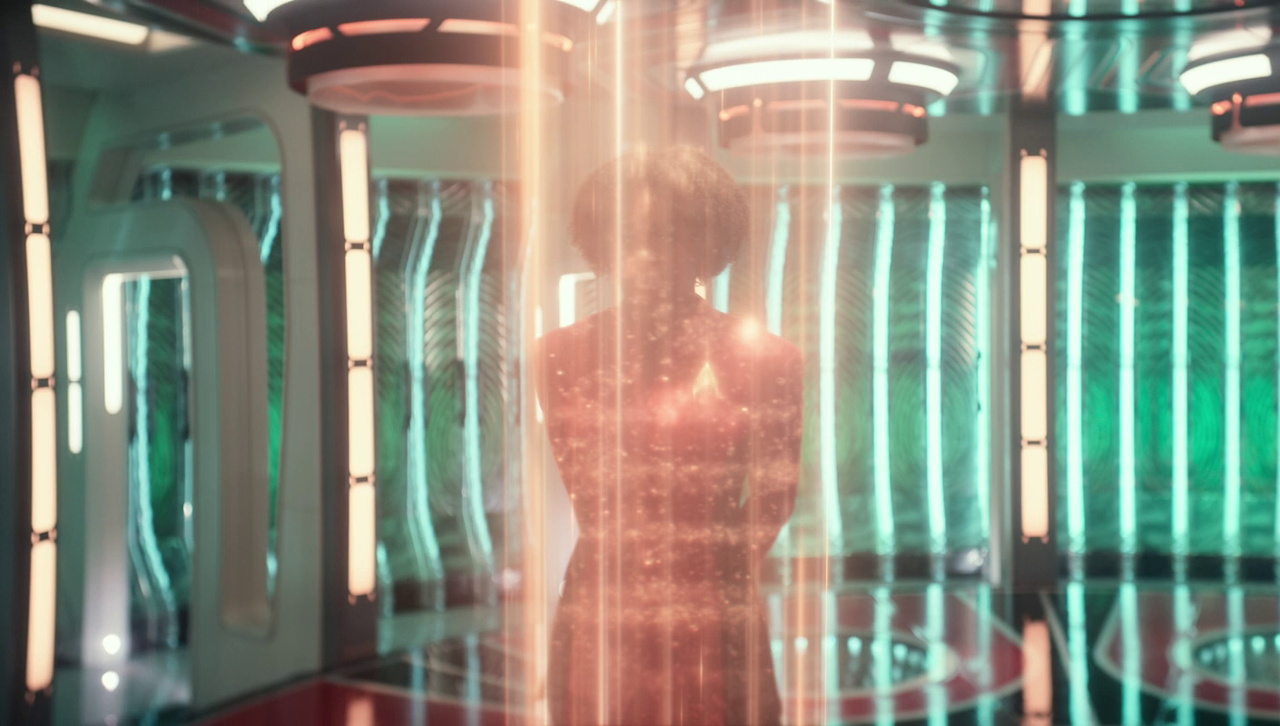
Star Trek: Strange New Worlds Episode Review – Season 3, Episode 9: Terrarium

Star Trek-themed spoiler warning.

Spoiler Warning: There are spoilers ahead for Strange New Worlds Seasons 1-3. Spoilers are also present for the following Star Trek productions: The Original Series Season 1, The Search for Spock, The Next Generation Season 3, Discovery Season 2, and Picard.

Of all the main characters on Strange New Worlds, we’ve spent the least amount of time with Erica Ortegas. She’s been a presence on the show and has had some memorable scenes, but she hasn’t gotten a major storyline or a spotlight episode… until now. There are reasons for that, of course, and we don’t have to go over all of it again. But I know that a lot of Trekkies – myself included – have been waiting for an episode in which Ortegas would get her moment to shine.

And what an episode it was!

Terrarium was intense, dramatic, emotional, and just fantastic. It’s rare for me to sit down to write a review having taken no notes, but I was so absorbed in the story that I genuinely didn’t have a second’s pause to write anything. The only negatives I can find from Terrarium are total nitpicks; the kinds of silly things only the most detail-obsessed Trekkies might ever care about. The episode really was exceptional. One of the best from all three seasons of the show without a doubt.

Still frame from Star Trek: Strange New Worlds 3x09: Terrarium, showing the crash site and Ortegas.
Uh-oh, Ortegas is in a spot of bother…

Because Strange New Worlds is a prequel, and because we know that several of the characters it includes will go on to have careers in Starfleet during The Original Series era, it isn’t always easy for the show to create a genuine sense of danger. We know Pike’s fate, we know where Spock will end up, and we know Uhura, Scotty, Chapel, Dr M’Benga, and others all have futures beyond the series. In the modern entertainment landscape, that can change how we perceive stories which put these people in the firing line.

In the aftermath of shows like The Walking Dead and Game of Thrones – shows which use what I’ve termed the “disposable cast,” where any main character can be killed off at almost any moment – television storytelling has shifted. Being a main character is no longer a guarantee of safety. Star Trek has struggled to keep pace, with characters in Picard and Discovery almost all surviving even the most apocalyptic dangers (or being resurrected afterwards!) But Strange New Worlds has already been different – Season 1 saw the untimely demise of the brand-new character of Hemmer. Terrarium got me to feel like Ortegas was genuinely in danger of losing her life and being written out of the show in a way that stories like Shuttle to Kenfori simply couldn’t for Pike and M’Benga. And I think that shows the advantages, in this new media environment, of using brand-new characters as opposed to relying too heavily on legacy characters whose fates and futures are set in stone.

Still frame from Star Trek: Strange New Worlds 3x09: Terrarium, showing Ortegas right after the crash.
This genuinely felt like it could’ve been the end for Ortegas…

I said recently that I don’t like when Star Trek stories blatantly rip off what’s come before, but I appreciate it when they “rhyme.” And for me, Terrarium reminded me of The Next Generation Season 3 episode The Enemy, in which Geordi La Forge and Bochra, a Romulan, are similarly trapped together on the desolate planet of Galorndon Core. The barren, stormy world, the pairing up of a Federation officer with a member of an enemy faction… Terrarium uses these same elements in a similar way, but still feels like a totally distinct story. That isn’t easy to pull off, and the differences between the stories – the shuttle crash, the wormhole, the difficulty of communicating with the Gorn, and Ortegas’ hostility toward the Gorn as she still processes her trauma – are a big part of what makes Terrarium work.

If I might make one criticism that falls outside of nitpick territory, it would be the editing and pacing of a few of the scenes. In short, Ortgeas seemed desperate for food and water immediately after crash-landing, and the passage of time was not particularly well-communicated at first. Pike said, at one point, that they’d been searching for her for over two days, and by the time she was eventually rescued, even more time seemed to have passed. Ortegas might’ve spent a couple of days on the moon before encountering the Gorn. Or a week. Or a few hours. Or maybe she and the Gorn lived together for a couple of weeks before the rescue? Some of those scenes just felt a little… choppy, if that makes sense – particularly the sequence after Ortegas crash-landed, and the scenes in the run-up to her first meeting with the Gorn. I can’t help but feel adding a card or some text saying “48 hours later…” or something like that might’ve helped at a couple of points.

Still frame from Star Trek: Strange New Worlds 3x09: Terrarium, showing Ortegas on the shuttle, resting.
It wasn’t totally clear to me how much time passed in between some of these sequences.

Can I skip to the end and talk about that? Because the end of Terrarium was brutal. After working together, surviving together, and planning out an escape together… for Ortegas’ Gorn friend to just be gunned down by La’an and the redshirts was harrowing. Star Trek stories almost always present our heroes as being in the right – even if they do something bad or against the rules, it’s almost always for a noble reason. La’an and the security team just opened fire without warning against an unarmed opponent, killing her in cold blood. I was shocked – and I’m genuinely struggling to call to mind a similar moment anywhere in Star Trek, in which the death of a friendly character was handled with such ruthlessness by Starfleet personnel.

The writers took a narrative necessity – that the Federation couldn’t have a Gorn just hanging out aboard the flagship years before the events of Arena – and turned it into a truly shocking twist ending for this kind of “let’s all learn to live together in peace” storyline. Ortegas is probably the second character, after La’an, to have held such genuine fear and hatred for the Gorn, and it seemed as if Terrarium was trying to echo Arena and similar Star Trek “morality plays” with a story all about overcoming hatred, finding common ground, and learning to work together. All of that was ripped away with seconds to spare – after Ortegas and the Gorn had risked everything to achieve rescue. It was… well, it was brutal. There’s no other word for it.

Still frame from Star Trek: Strange New Worlds 3x09: Terrarium, showing the dead Gorn.
Shocking and brutal.

Ortegas still learned a lot, of course. She overcame her fear and hatred for the Gorn, and as the Metron told her at the end of the episode, that was real and she’ll be able to retain all of that knowledge and those feelings. She’ll also be able to convey to Starfleet that the Gorn can, under the right circumstances, be dealt with, reasoned with, and communicated with – which, hopefully, are things that could set the stage for dialogue in the future. So those “morality play” ideas are still present, they still matter, and they’re still a big part of the episode’s story. It feels very “Star Trek” in a way that not every modern episode has done!

But the ending is straight out of the modern entertainment playbook! Arena ended with Kirk injuring the Gorn, but refusing to kill him. The Enemy ended with La Forge and his Romulan counterpart being rescued. But Terrarium went for the twist ending, the shock of seeing Ortegas’ new friend gunned down right at the moment of victory. Betrayed by Starfleet – unintentionally, perhaps, and even arguably understandably – but that doesn’t make it feel better.

Still frame from Star Trek: Strange New Worlds 3x09: Terrarium, showing La'an firing her phaser rifle.
La’an firing her phaser rifle.
(Colour/brightness tweaked for clarity)

If anything, I’d say this kind of ending ramps up the “morality play” angle. Terrarium is different from the likes of Arena and The Enemy, which got happier, or at least more positive endings. But the final act of Terrarium hammers home its message about bridging cultural divides, working with someone from a different race, and finding comradeship with an enemy. Ripping that away so coldly, and for no good reason, shows us how far Starfleet and the Federation still have to go – and how the “good guys” can still make mistakes or be too quick to anger.

This is what Star Trek has always been about – just updated with a more modern style. What was the point of The Enemy, if not learning to see an enemy as an equal? Or Arena – that “the other” is not a monster, but a person? Kirk starts his battle with the Gorn by talking of the revulsion he feels for the reptilian monster, but stops short of killing him at the end. Terrarium builds from the same narrative foundation, but twists the knife right at the end. Ortegas may have learned to let go of her fear and her hate… but Starfleet is still too quick to reach for the phaser.

Still frame from Star Trek: Strange New Worlds 3x09: Terrarium, showing a close-up of the Gorn.
Ortegas came to see the Gorn as a friend.

Despite feeling like she was genuinely in danger the entire time, I’m glad Ortegas lives to fight another day. The opening act of Terrarium, which showed Ortegas with Spock and Uhura, felt comparable in tone to how Discovery set up Airiam’s death, or how, earlier this season, Ensign Gamble was sent on the away mission that claimed his life. That kind of setup, knowing what we know of modern Star Trek, has an almost eerie feel, so when Ortegas’ mission went wrong and she crash-landed, I really did feel like she was in danger.

Given that Strange New Worlds has been adding to its roster of legacy characters, fleshing them out, and even trying to set up a “Year One” spin-off focusing on the likes of Kirk, Spock, and Scotty… I wondered if Ortegas might be about to be brushed aside to bring someone like Sulu on board. But I’m very glad that didn’t happen (or at least, it hasn’t happened yet) because she’s someone we’re still getting to know – and she’s such a fun character. Ortegas is cut from the same cloth as Voyager’s Tom Paris insofar as she’s a genuinely passionate pilot, not just a helmsman. Having that kind of person in the pilot’s seat – both of the Enterprise and in shuttlecraft – is a ton of fun, and I can feel her passion for the role every time she takes the helm. Shuffling her out of the way to make way for Sulu (or another legacy character) wouldn’t sit right with me.

Still frame from Star Trek: Strange New Worlds 3x09: Terrarium, showing Ortegas piloting her shuttle.
Ortegas is at home in the pilot’s seat.

Speaking of piloting… what do we make of Captain Pike taking the helm? I absolutely loved it – and I think Terrarium is a great episode for Pike, despite him not being the centre of attention. I wrote last week that, across the three seasons of Strange New Worlds that we’ve had so far, several episodes saw Pike transformed into a different person, recreated as a hologram, or just… behaving out-of-character. It’s gotten to the point where I feel like it’s almost a refreshing change of pace to see Pike as the upstanding, decent, honourable Starfleet captain that we remember – the character who, as Trekkies, we were so desperate to see given his own show.

Pike taking the helm also reminded me of another Next Generation Season 3 episode: Booby Trap. That episode sees Picard – to the shock of everyone on the bridge – take the helm to guide the Enterprise-D out of a sticky situation, and Pike’s turn at the helm definitely brought up echoes of that story for me. I would’ve liked to see Pike take his seat, perhaps… but maybe that would’ve been too similar, I don’t know. Either way, it was a really great moment, and it drew on Pike’s history as a Starfleet test pilot, which Strange New Worlds has brought up on a few occasions. I like that this is an ongoing aspect of his character and wasn’t newly-invented for Terrarium; these consistent story threads make a series and a setting feel so much more real.

Still frame from Star Trek: Strange New Worlds 3x09: Terrarium, showing Spock in the captain's chair with Una and Pike at the helm/navigation console.
Captain Pike at the helm.

Pike’s side of the story also brought up the weight of command and the difficulties of making command decisions. This is something we know weighs on the captain – in The Cage (and The Menagerie) Pike spoke about how he felt the burden of command and how being responsible for the ship and crew was taking a toll on him. In Terrarium, Pike had to balance the needs of the many with the needs of the one (to quote a future Mr Spock), wanting to do everything in his power to search for and save the wayward Ortegas – but having a time limit to deliver vaccines to a colony world.

I loved Pike’s line to Uhura that he knew she “fudged the numbers,” and he would’ve undertaken the rescue mission regardless. I think that says a lot about the kind of captain he is, and the way he handles his ship and crew. Pike was confronted with a genuinely impossible situation, but he stayed calm, he did everything he could to buy his crew as much time as possible to look for Ortegas, and his role this week reminded me exactly why I was so keen on “the Captain Pike show” back in 2019!

Still frame from Star Trek: Strange New Worlds 3x09: Terrarium, showing Pike looking at Uhura.
This was a great episode for both Uhura and Pike.

Did you spot a reference to The Doomsday Machine? Decker – a commodore by the time of The Original Series – was in command of the USS Constellation, the ship Pike and the Enterprise were set to rendezvous with in Terrarium. I just thought that was a neat little reference. It doesn’t need to be expanded into something massive, with the Constellation and Commodore Decker being shown on screen next week, but it was a cute little nod and wink to Trekkies – and another reminder that all of these stories are taking place in a shared setting. It wasn’t a big thing, but it was neat that the writers went the extra mile, instead of saying that the vaccines were to be delivered to Captain Bob of the USS Whatsisname.

Terrarium was also a fantastic episode for Uhura. Her empathy and love were on full display as she supported Ortegas ahead of her first solo mission in months, then became the strongest advocate for searching for her, even when Spock seemed (perhaps a little too keen) to throw cold water on her plans. We’ve seen Uhura grow in confidence across Strange New Worlds so far, and as Pike remarked, bending the rules is a new frontier for her! But it came from an understandable place, and had been set up incredibly well earlier in the episode.

Still frame from Star Trek: Strange New Worlds 3x09: Terrarium, showing Uhura on the bridge, happy.
Uhura at the episode’s climax.

Uhura has had several “moments” across the first three seasons of Strange New Worlds in which she becomes more confident, solidifies her relationship with Starfleet, or just grows in some way. And Terrarium was another great example, building on storylines like visiting the comet, bonding with Hemmer, and inspiring the crew to sing their way out of trouble. The notion that Uhura would do anything to help a friend in need… that’s a core part of the character we remember, and seeing her bend the rules, thinking that was the only way to help Ortegas? It sets up Uhura joining Kirk’s mission to steal the Enterprise in Star Trek III, as well as countless other examples of her going out of her way to help her friends.

Spock was, perhaps, a little too quick to dismiss some of Uhura’s ideas – but this was never really presented as a conflict; more so a hurdle for Uhura to overcome. And Spock, despite his initial predictions of failure, didn’t come across as being a jerk for the sake of it. He even stayed with Uhura, continuing to help her work on her simulations, which I think also says a lot about how far he’s come across the show so far. After so many “Spock comedy” storylines – something I talked about at length last week – it’s nice to see Spock in a more familiar and straight-laced role. It’s also nice to see Spock contributing, but taking a back seat to other characters. This side of the story mostly looked at Uhura and, to a lesser extent, Pike. Spock played a role, but he doesn’t always have to be centre-stage.

Combo of two still frames from Star Trek: Strange New Worlds 3x09: Terrarium, showing Spock and Uhura in the science lab.
Uhura and Spock.

So let’s return to the main part of the story: Ortegas and the Gorn.

I really liked the moon that Ortegas crashed on. It made fantastic use of the AR wall, and just felt like such a barren and desolate place. Seeing the wind sweeping across the surface of the moon, with nothing but dust and rocks in sight, with occasional quakes and rumbles shaking the ground… it made for a very unnerving place to have crash-landed; very lonely, very bleak. The addition of the flaming blue gas giant in the sky obviously added a huge sense of impending danger, which was intimidating. The camera work on the surface of the moon, combined with the AR wall, actually led to a really great effect – something Paramount hasn’t always been competent at if you look back at some other recent Star Trek projects, like Discovery’s fifth season.

And this sense of being lost, alone, and trapped in a desolate, barren wasteland was really hammered home by the presence of the wormhole. I don’t think we ever learned exactly how far away the wormhole’s terminus was from where the Enterprise was situated – but, as Spock said, it could be basically anywhere in the universe. That added so much to the sense of isolation and abandonment compared to, say, an episode like The Enemy, in which the Enterprise-D was still in orbit, even if for technobabble reasons it wasn’t possible to beam out Geordi right away. Again, that sense of genuine danger – that we might be about to lose Ortegas from the series entirely – was ramped up by just how badly wrong this mission was going.

Still frame from Star Trek: Strange New Worlds 3x09: Terrarium, showing the USS Enterprise wedged in a wormhole.
The Enterprise in the wormhole.

A couple of weeks ago, I said that I was worried that Ortegas’ injury and trauma from the beginning of the season hadn’t been picked up in a big way, and that if it did come back, it would be harder to pull off effectively after having seen her “back to normal.” And I stand by that to an extent – I think if, instead of Terrarium, we’d gotten a Discovery-style “let’s all talk about our feelings” story, it would have been difficult to put Ortegas into that after several episodes had passed in between her injury, her insubordination, and her apparent recovery. But because of the way Terrarium approached it – putting her face-to-face with a Gorn for the first time since the end of Hegemony, Part II – it actually worked incredibly well.

Ortegas’ character arc built on her earlier encounter with the Gorn and the lingering trauma it caused her without feeling like we’d missed a step. By throwing her into this tense survival situation, we got to see her going from “just kill me already you alien monster,” to “okay, we can be friends.” And Terrarium built this up slowly and carefully, taking us from Ortegas’ shock at spotting the Gorn, trying to hide, fearing for her life, and eventually coming to terms with the fact that they’d have to work together to have any chance of escape. It was incredibly well written – and given that Melissa Navia was the only one to actually have any dialogue on this side of the story, incredibly well performed and emoted. Having to act out an incredibly intense and emotional storyline against a person in a Gorn suit can’t have been easy – but she made it look easy! This is why, for almost three full seasons, a lot of us have been champing at the bit for a proper Ortegas episode!

Still frame from Star Trek: Strange New Worlds 3x09: Terrarium, showing Ortegas inside the shield dome.
Melissa Navia absolutely excelled.

We got to see Ortegas run the gamut of emotions. The elation of her mission and the piloting challenge, the anxiety and loneliness after the crash-landing, the sheer terror of her first Gorn encounter, a slowly-developing friendship which culmintaed in board games, and the abject grief at her new friend’s utterly brutal execution. And Melissa Navia had to do all of that (well, almost all of it) on her own, with no other actor to bounce her lines off of. It’s an incredible solo acting performance, one which really encompasses a huge range of different emotional states across a dangerous and nearly fatal away mission.

After Strange New Worlds has reimagined the Gorn to be closer to Alien’s Xenomorphs or other horror movie monsters, it was incredibly refreshing to see a different and softer take this time. We got to see a Gorn – for the first time in the entire series, really – not as “the other,” or a monster, but as a person. This Gorn showed Ortegas – and by extension, us as the audience – that the Gorn are more than just mindless killing machines who see humans as food. They have a complex language, a culture, they enjoy playing games, they can get sick and injured… again, to tie into the theme of Star Trek stories as “morality plays,” we’re seeing the Gorn – through Ortegas’ eyes – as people… basically for the first time since they were re-worked for Strange New Worlds. This only makes the brutal killing of the Gorn at the end of the story hit so much harder and feel so much worse.

Still frame from Star Trek: Strange New Worlds 3x09: Terrarium, showing Ortegas on her knees.
Ortegas at the end of the story.

May I nitpick? If you know me… you know I must!

If you can transport down to a moon, it stands to reason that you can also transport up from a moon, right? So why did La’an have to beam down to search for Ortegas? And why did La’an beam down with a squad of redshirt tactical officers for a rescue mission, instead of – oh, I dunno – a doctor? The “we have to deliver these vaccines on time” added an extra source of tension to the episode, but it felt a bit exposition-y – mostly because of the timing of its introduction. If the episode had begun with Pike saying, “we’re en route to deliver these vaccines, but we stopped off briefly to study this unusual phenomenon,” I think it would’ve worked a lot better than Una springing it on us after Ortegas had already gone missing. The “scanning ability” percentage wasn’t really explained, and I could’ve entertained a brief line of technobabble discussing it, especially given its importance to Uhura and Pike’s storyline.

But, as I said, all of those are incredibly minor points, and none of them detracted from the finished product. I include them here because, well, I’m a Trekkie – and as Trekkies, we love nothing more than to pick at the tiniest little details in Star Trek, sometimes!

Still frame from Star Trek: Strange New Worlds 3x09: Terrarium, showing the away team beaming down.
The rescue team beams down.

Terrarium joins Shuttle to Kenfori and Through the Lens of Time as one of my favourites from Season 3. It was fantastic all around, with great moments for Pike and Uhura, as well as an incredibly intense story for Ortegas.

I loved this completely different way to include the Gorn. Don’t get me wrong – I’ve enjoyed Strange New Worlds’ reinterpretation of the Gorn, by and large. But I also think we were beginning to come up against the limits of the “alien monster” idea, so to show a softer, more personable side to the Gorn – and to put Ortegas, who had suffered so severely at their hands, right in the middle of it – was a fantastic storytelling decision, and one that was executed incredibly well. Melissa Navia got her first major spotlight episode – and rose to the occasion, overcoming a difficult acting challenge.

I really can’t heap enough praise on Terrarium, as you can probably tell! It truly is an outstanding episode, one that harkens back to the likes of Arena and The Enemy from those older shows, but puts a completely different spin on a familiar setup thanks to a brutal ending. I’m not sure I’d have chosen to include Arena’s Metrons; I’m just not convinced that brief scene at the end added an awful lot or that the story really needed it. But doing so helps to square a circle, perhaps, while hinting at a “different” take on the Gorn by the time of Kirk’s encounter in Arena.

Still frame from Star Trek: Strange New Worlds 3x09: Terrarium, showing Ortegas and the Gorn playing chess.
Playing chess with a Gorn.

So that was Terrarium. Absolutely fantastic. No notes – literally, in my case!

Season 3 has been pretty good, overall. Strong episodes like Terrarium are a nice balance after a weaker offering like Four-and-a-Half Vulcans last week, and I’m rooting for an excellent season finale to close things out with a bang! Can you believe Season 3 is almost over, already? I’m actually feeling pretty sad about that.

The final episode of the season will be titled New Life and New Civilizations. So far, there’s been nothing released – no promo photos, no blurb, no trailer. Something big could be hiding under the surface, then! Check out my latest theory about Captain Pike and Captain Batel, if you’re interested – you can find it by clicking or tapping here. And join me next week for the final episode review of the season. Oh, and if you missed it, I met Martin Quinn (Scotty) over the weekend at a Star Trek convention here in the UK. Click or tap here to check out my write-up of the events of the day. Live Long and Prosper, friends!


Star Trek: Strange New Worlds Seasons 1-3 are available to stream now on Paramount+ in countries and territories where the platform exists. The first two seasons are also available on DVD/Blu-ray. The Star Trek franchise – including Strange New Worlds and all other properties discussed above – is the copyright of Skydance and/or Paramount. This review contains the thoughts and opinions of one person only and is not intended to cause any offence.
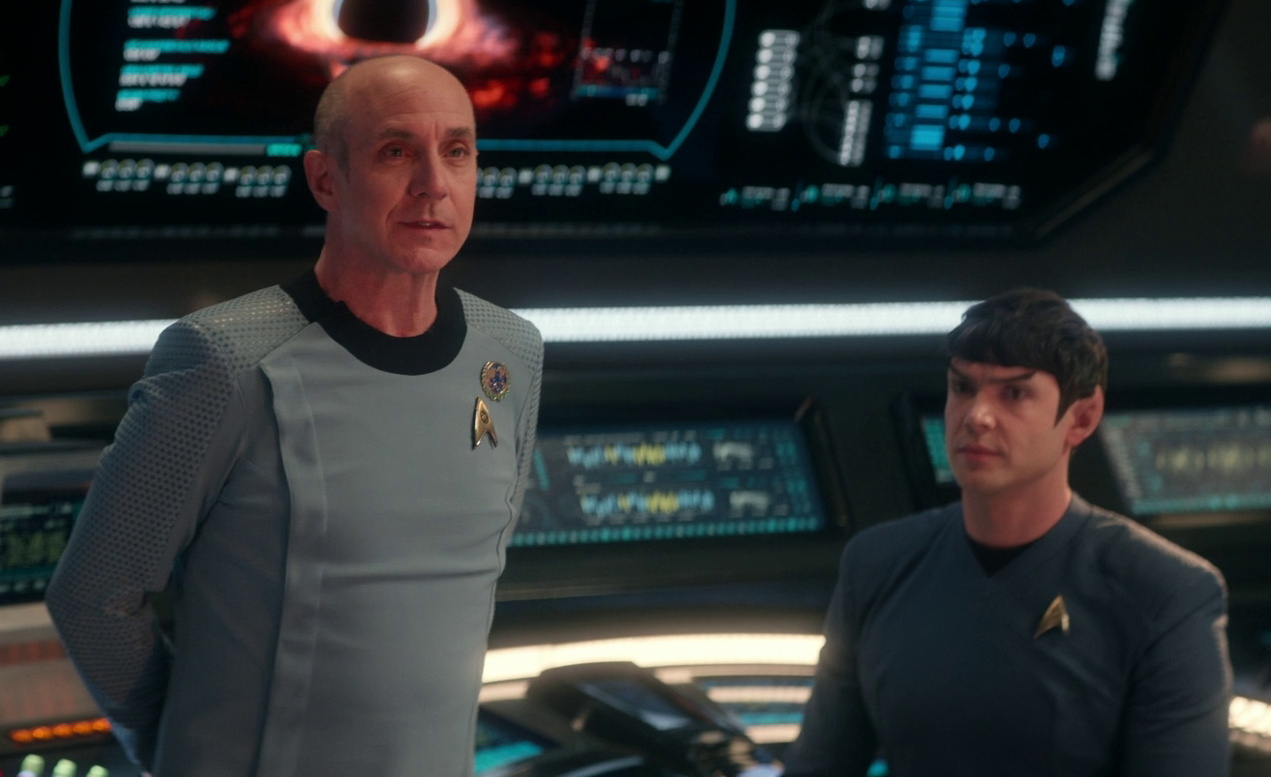
Star Trek: Strange New Worlds Episode Review – Season 3, Episode 8: Four-and-a-Half Vulcans

A Star Trek-themed spoiler warning.

Spoiler Warning: There are spoilers ahead for Star Trek: Strange New Worlds Seasons 1-3, and Discovery Season 3.

Last week, Strange New Worlds surprised me with an episode styled like a documentary. I approached Four-and-a-Half Vulcans much more keenly aware of the kind of story I was getting into… and I set my expectations accordingly. For the kind of light-hearted episode that it was, I think Four-and-a-Half Vulcans was, as Mr Spock might put it, adequate. There were actually some genuinely funny scenes and lines in the mix, and I laughed more than I expected. This was not the total cringe-fest I feared it would be.

However, it’s also an episode I’m in no hurry to revisit, and I’d probably rank it in the lower half of the Strange New Worlds episodes that have aired so far. Comedy has been a part of Star Trek since the beginning, and I’m not opposed to episodes and stories which firmly place themselves in that genre. However, a light-hearted tone and a comedic premise do not cover up any and all flaws; “it’s just a comedy episode” is not a good enough excuse for dodgy writing, weak characterisation, or hand-waving away one of the most significant elements of one of Star Trek’s most well-explored and understood races.

Still frame from Star Trek: Strange New Worlds, 3x08, Four-and-a-Half Vulcans showing Captains Batel and Pike.
Captains Batel and Pike.

I’m going to start with the positives this week.

Four-and-a-Half Vulcans genuinely made me laugh. Like… out loud. Multiple times. A lot of the comedy, even though some of it wouldn’t usually be “my thing,” stuck the landing thanks to a combination of clever writing and creative performances, backed up by some well-planned staging, solid camera work, and even editing. Spock and La’an’s battle-come-dance sequence at the end of the episode, in which they moved through different areas of the ship, was incredibly well-executed, and that’s just one example.

Though this was an undeniably silly premise for a story, the way everyone involved really threw themselves into it made Four-and-a-Half Vulcans feel earnest in a way that not every Strange New Worlds comedy episode has done. But that’s the double-edged sword, and, for me, part of why Four-and-a-Half Vulcans doesn’t feel so special: it’s repetitive. Strange New Worlds has used a very similar premise several times already. If this were the show’s first comedy episode – or even the first Vulcan comedy or Spock comedy episode – I think it would’ve felt stronger, or at least more original. When I saw the promo photos and the teaser clip, I was already rolling my eyes and getting ready to complain because of how overused this core idea has been in a series that still hasn’t reached the thirty-episode mark.

Still frame from Star Trek: Strange New Worlds, 3x08, Four-and-a-Half Vulcans showing four humans transformed into Vulcans.
Vulcan comedy… again.

And that side of Four-and-a-Half Vulcans was very much a let-down. Strange New Worlds’ writers seem utterly fascinated – borderline obsessed – with the idea that “Vulcans are stuck-up, rigid, and unemotional… isn’t that hilarious?” There hasn’t been a single straight-laced Vulcan story in the show so far. We now know that cancellation is coming, and Strange New Worlds has actually passed its halfway point. I really, sincerely hope that if the show revisits the Vulcans in Seasons 4 or 5… we’ll get a different kind of story.

Because for all of its genuinely funny and engaging moments, Four-and-a-Half Vulcans was weighed down by that sense of repetition. We’ve been here before – more than once, and in all three seasons. We’ve done the whole “what if Vulcans were hilarious,” “what if Spock had emotions,” and “aren’t these autistic-coded aliens just a hoot” things so many times… I’m beyond over it. That didn’t stop me laughing at some of the episode’s well-played jokes and genuinely fun moments. But it drags it down several notches. More than anything, I hope Four-and-a-Half Vulcans will be Strange New Worlds’ final attempt to go down this road. And hey, if the writers have zero other ideas for what to do with Spock and the Vulcans? Just don’t use them. That would honestly be better, at this point, than another attempt at “Spock comedy.”

Still frame from Star Trek: Strange New Worlds, 3x08, Four-and-a-Half Vulcans showing Spock.
Spock.

Sorry, this was meant to be the “positives,” wasn’t it?

Anson Mount is funny. He has good comic timing, and I enjoyed his weird and quirky take on a human-who’s-not-quite-Vulcan. A character like pseudo-Vulcan Pike would be absolutely awful to watch week in, week out… but as a one-off and a change of pace? I liked it. And Mount’s performance was a big part of that, I think. I can see just by watching the scenes he had in sickbay and in Pike’s quarters that it must’ve been a ton of fun to perform.

However… we’ve had Pike the cowardly courtier in The Elysian Kingdom. Pike without his memories in Among The Lotus Eaters. Pike the singer in Subspace Rhapsody. And earlier this season? Pike the holo-TV producer in A Space Adventure Hour. That’s four episodes in which Captain Pike isn’t Captain Pike… in what we used to call “the Captain Pike show,” back when Strange New Worlds was little more than the target of a fan campaign. As with “Spock comedy,” I’m kinda done with the whole “let’s turn all our characters into totally different people!” premise. Strange New Worlds isn’t the only Star Trek show to have done this. But it is the only Star Trek show to have done it so often in such a short span of time. These aren’t twenty-five episode seasons of a show that’s gonna run for seven years. Forty-six episodes of Strange New Worlds are all we’re getting. And in several of them, Captain Pike isn’t himself. Again… I’m kind of over that premise. Let Pike be Pike!

Still frame from Star Trek: Strange New Worlds, 3x08, Four-and-a-Half Vulcans showing Vulcan Pike.
How about a Captain Pike episode in the Captain Pike show where Captain Pike… gets to be Captain Pike?

Sorry, sorry. Positives.

I liked Kirk and Scotty’s burgeoning bromance. I was surprised to see Paul Wesley back as Kirk so soon after his big turn in the captain’s chair. But building on his new friendship with Scotty was a fun angle, and it was actually one of the few elements of Four-and-a-Half Vulcans that was played pretty straight. Yes, Kirk and Scotty found themselves in a weird situation with Vulcan/Romulan La’an… but their friendship continues to grow. Paul Wesley and Martin Quinn genuinely work well together. Kirk is beginning to come into his own as the captain we remember, but Scotty still has an edge of nervousness or a lack of confidence that comes from youthful inexperience. There’s a cute vibe to how they interacted, this week… and I really liked it.

Kirk and Scotty got what was one of Four-and-a-Half Vulcans’ most over-the-top storylines, with La’an plotting and scheming her way to a multi-front war. I think the boys’ side of things was the better one, and certainly the most grounded. Two stellar performances kept things focused mainly on the younger versions of these characters, despite the shenanigans happening around them.

Still frame from Star Trek: Strange New Worlds, 3x08, Four-and-a-Half Vulcans showing Scotty and Kirk clinking glasses.
Scotty and Kirk make a pretty good team.

Since I mentioned La’an, let’s talk about her next. I haven’t really had the chance to discuss this very much… but La’an’s connection to iconic Star Trek villain Khan has been, for me, almost a complete waste so far. Only a couple of episodes have so much as touched on La’an’s ancestry and the potential lingering effects of augmentation, and to be blunt, that’s not been good enough from Strange New Worlds. There are ways to use a character like La’an to talk about things like collective guilt, the dangers of eugenics and genetic engineering, or generational trauma. So far, we haven’t got much of that… making me feel, as time has gone by, that La’an should’ve probably been created as an original character without that connection to Khan.

However, this storyline did belatedly address some of that. It wasn’t a huge part of it, with La’an’s famous relative and augmented DNA only being referenced right at the end. But that explanation made sense to me and seemed to account for La’an’s changed persona when in Vulcan form. As an admittedly small and easily-overlooked nod to this under-utilised aspect of her character, I liked it.

Still frame from Star Trek: Strange New Worlds, 3x08, Four-and-a-Half Vulcans showing Scotty stopping La'an.
La’an being zapped.

The scene between Pike and La’an in their Vulcan/Romulan guises was pretty funny. And I liked that Strange New Worlds linked up these two characters – both of whom are, as far as we know, the only people in Starfleet at this point in time to be aware of the connection between Romulans and Vulcans. The fact that they both had to cover this up to comply with the Temporal Prime Directive was alluded to, and added a lot to the scene. Obviously Pike came to learn about the Romulans in the Season 1 finale, and La’an did last season in her team-up with an alternate timeline version of Kirk.

The implication of this is interesting, though, if we take a step back. La’an basically turned into a Romulan, not a Vulcan, and Spock seemed to suggest that her augmented ancestry played a role in that. Is that a clue about the split between Vulcans and Romulans? Enterprise showed us our most comprehensive look so far at Vulcan history – including the Time of Awakening, after which the proto-Romulans left Vulcan. But it’s interesting, at least, to get this hint at genetic manipulation possibly playing a role in either the early history of the Romulans, or even in their society in general.

Still frame from Star Trek: Strange New Worlds, 3x08, Four-and-a-Half Vulcans showing La'an and Pike.
La’an and Pike.

Or perhaps the story wanted to highlight how thin the dividing line is between Romulans and Vulcans. That’s also an interesting idea, especially in light of Discovery’s far-future Ni’Var storylines. At any rate, I liked the idea that there could be some kind of augmentation at some point in Romulan history – and I felt that idea expands our understanding of the Romulans without treading on the toes of previous storylines.

Given how other parts of Four-and-a-Half Vulcans really leaned into the idea of “logic,” La’an’s transformation was a refreshing change of pace. Christina Chong can take a villainous turn remarkably well, and her performance – while no less over-the-top than any of the others this week – was still a lot of fun to watch. Again, this seems like an episode that would’ve been a blast to work on.

Still frame from Star Trek: Strange New Worlds, 3x08, Four-and-a-Half Vulcans showing Kirk, La'an, and Scotty.
La’an becoming a Romulan, not a Vulcan, was a fun idea.

So let’s talk about the other Vulcans, then, and their transformations.

Though there was an attempt to address why Pike, Chapel, and Uhura were so emotionally repressed and logical, I felt it was a pretty flimsy way to hand-wave away an incredibly important part of Vulcan lore and history. Vulcans are not, by nature, stoic and logical. It takes a lot of effort and work on their part to box up their emotions the way they do, and just being physically Vulcan should not bring with it the decades of training that Spock went through to reach his more mature and logical state.

This was a narrative hurdle that I was really worried Four-and-a-Half Vulcans would trip over. And while we can say that the episode avoided the most flagrant violations of canon on a technicality… I’m still not sure that I like the result.

Still frame from Star Trek: Strange New Worlds, 3x08, Four-and-a-Half Vulcans showing three characters partway through their Vulcan transition.
The transformation process doesn’t look very pleasant…

Regular readers will have heard me talk about internal consistency before. I believe internal consistency is one of the absolutely foundational components of suspension of disbelief when engaging with any work of sci-fi or fantasy. Once it’s been established that magic, fictional technologies, or alien races behave a certain way, that’s gotta be something subsequent storylines stick with. If Star Trek was constantly changing how warp drive worked, for example, it would soon erode the core of one of the franchise’s key technologies. And when it’s been established that Vulcans are intensely emotional people who have to train for years to keep their emotions in check and present a logical face to the world… future stories have to stick with that.

However, by showing the flaws and weaknesses in each of the transformed characters’ applications of logic, Four-and-a-Half Vulcans actually does something genuinely interesting with this idea. It’s more than just cringe humour, and while I maintain that it feels like something that’s dangerously close to crossing the line into an outright violation of canon, there was at least somewhat of a point to it. And more nuance than I’d been expecting.

Still frame from Star Trek: Strange New Worlds, 3x08, Four-and-a-Half Vulcans showing Pike at his desk.
Captain Pike was… illogical.

Pike, La’an, Chapel, and Uhura were completely unprepared for what being a Vulcan would feel like. And they found it impossible to adhere to a genuinely logical pattern of behavior, with all of them crossing lines and behaving like, as Spock put it, jerks. In that sense, I think we did actually learn a little more about what it must be like to be a Vulcan, and how intense their training and education must be to keep a logical lid on some truly illogical impulses and desires.

This was more than just pure comedy, and breaking it down, we catch a small glimpse at what being a Vulcan might feel like – something that, if you think about it, we haven’t seen much of outside of Enterprise. Parts of Four-and-a-Half Vulcans seemed to build on T’Pol’s storylines from Enterprise in an interesting way. Whether that was the intention or not… that’s how I read it. And perhaps I’m reaching, trying to find positive glimmers amidst a storyline I generally didn’t like. But I think that interpretation is there, and stepping back to Enterprise gives context to some of these scenes.

Still frame from Star Trek: Strange New Worlds, 3x08, Four-and-a-Half Vulcans showing Spock and Chapel in sickbay.
The episode explored a bit more about Vulcans.

Pelia is legitimately one of my favourite characters on Strange New Worlds, and almost every scene she’s in is just… delicious. She’s so funny, she adds so much light-heartedness to the show, and even in an episode like this, where comedy was the focus, her scenes still stood out. It was also a change of pace to put Pelia with a different combination of characters. We saw her with Ortegas, Dr M’Benga, Spock, and Una, and I honestly can’t remember many (or any) times she’d really spent time with most of them. She’s the chief engineer, and though we do now have Scotty as a junior officer, the chief engineer role on a Star Trek series is still an important one.

What I got from Pelia’s scenes, more than just a good laugh, was how she is genuinely friends with the rest of the crew. They like her, and she likes them. Because of how little screen time Pelia tends to get, and how inconsistent her appearances are – with her disappearing for multiple stories in a row, sometimes – there’s been less of an opportunity to show that. This week, with everyone hanging out in her quarters, I felt like she was a fully-fledged member of the crew. And I liked it. Oh, and Pelia’s quarters being shielded from the ship’s sensors? Love it.

Still frame from Star Trek: Strange New Worlds, 3x08, Four-and-a-Half Vulcans showing Pelia in bed.
Pelia is so funny. I love her.

Though Chapel and Uhura got arguably the less-interesting Vulcan storylines, both had their moments. Uhura trying to solve problems with mind-melds and forcibly “brainwashing” Beto was… weird. But it was nice to welcome back Mynor Lüken on this side of the story. I still think Beto and Uhura have good chemistry, and giving the younger Uhura a romantic interest is – if done well and explored more in future – a solid idea I can get behind.

Chapel’s single-minded focus on work was also interesting, especially as she began severing relationships and friendships in the name of efficiency. I felt a little of Seven of Nine in this characterisation, as Chapel prioritised doing as much work as possible ahead of everything else. Bringing back Dr Korby in the closing moments of the episode rounded out this storyline quite well.

Still frame from Star Trek: Strange New Worlds, 3x08, Four-and-a-Half Vulcans showing Uhura meditating.
Uhura in her Vulcan form.

If I might nitpick… Dr M’Benga and Una both said that they couldn’t force Pike and the others to return to their human states. And Una was unwilling to remove Pike from command, despite his erratic behaviour. But surely on medical grounds… the affected officers could have been relieved of duty. When it became clear that Pike could no longer effectively command the ship, and was issuing nonsensical orders like 45-minute shift changes, or when La’an was rigging the ship’s weapons for all-out war… intervening at that stage was definitely an option. In fact, it should have been mandatory.

In previous iterations of Star Trek, we have seen officers relieved from duty for less! I can appreciate why, in the beginning, Una and Dr M’Benga might’ve taken a “wait and see” approach, rather than trying to force Pike and co. to return to their human states. But when it became clear that they were being adversely affected by their transformations, steps would surely have been taken by a competent commander and medical professional to, at the very least, take them off duty for a while.

Still frame from Star Trek: Strange New Worlds, 3x08, Four-and-a-Half Vulcans showing the crew chatting in Pelia's quarters.
These characters could (and arguably should) have intervened before things went too far.

Doug was an interesting character, but in a busy episode, I don’t think we got enough time with him to really explore who he is or what he was even doing. He and Una made a fun pair, but we never really understood why they have such an unstoppable effect on one another. “Pure lust” doesn’t seem like something Una would experience, to be blunt about it, and even if she did… even if Vulcans and Illyrians have some kind of effect on each other… surely two grown adults are capable of behaving themselves long enough to have a serious conversation. It was a silly aspect of an already silly story… and one that was too over-the-top for my taste in an episode which had no shortage of such moments.

I was also disappointed that, after all the buildup to Doug’s arrival, we didn’t actually see him do anything of consequence to the plot. The writers and producers chose to show Doug – played by wonderful guest star Patton Oswalt – flirting with Una, sharing an awkward drink with Spock, and then doing whatever Vulcan magic he did entirely off-screen, before reuniting for one final flirty scene with Una. “Show, don’t tell” is something they teach every budding writer in their first ever lesson… and with Doug’s Vulcan katra magic being the climax of the episode’s story… it felt wrong that it happened entirely off-screen. Was it really straightforward? Did Doug just… snap his fingers, putting everyone to rights? Or did it take him a week of intense study, meditation, and working in a lab? We don’t know because we saw zero seconds of any of it.

Still frame from Star Trek: Strange New Worlds, 3x08, Four-and-a-Half Vulcans showing Doug.
Doug.

Four-and-a-Half Vulcans was funnier than I expected, and a better episode all around than I feared it would be from the photos and promo clip. But it wasn’t fantastic, it still has some significant weaknesses and contrivances, and above all, it relies on a premise that Strange New Worlds has thoroughly burned out. Please… please… let this be the last “Vulcan comedy” episode we get in this show. I can handle more light-heartedness, and I’m fine with more episodes that use overtly comedic premises and styles. But not another one where the focus is Spock and the Vulcans. We get it: Vulcans can be funny. But that’s enough for now. Try something else with the Vulcans, perhaps. Or give Spock a storyline that isn’t either slapstick comedy or depicting him slowly sleeping his way through every female member of the Enterprise crew. If you can’t think of anything that fits the bill… sideline Spock for an episode or two and do something else. Because I am thoroughly, utterly, and completely done with these kinds of stories at this point.

So that’s all for now, I guess! I didn’t hate Four-and-a-Half Vulcans. I didn’t even dislike it as much as I half-expected, half-worried that I would. But I did find it repetitive, perhaps a little too silly or over-the-top in places, and its strengths – like a genuinely good storyline for Kirk and Scotty – couldn’t outweigh its weaknesses. The result is an episode I probably won’t watch very often in the future.

Next week, we have Terrarium, which I know absolutely nothing about at this stage. The name doesn’t give very much away, and there haven’t been any photos or clips released ahead of its premiere yet. Maybe that’s because there’s some big secret being kept? “Terra” could hint at the Mirror Universe, perhaps – though I hope that’s not the case, to be honest! Or a “terrarium” could refer to an enclosure, perhaps suggesting Pike and the crew will become trapped. Those are total guesses, though. I guess we’ll have to tune in to find out!


Star Trek: Strange New Worlds Seasons 1-3 are available to stream now on Paramount+ in countries and territories where the platform exists. The first two seasons are also available on DVD/Blu-ray. The Star Trek franchise – including Strange New Worlds and all other properties discussed above – is the copyright of Skydance and/or Paramount. This review contains the thoughts and opinions of one person only and is not intended to cause any offence.
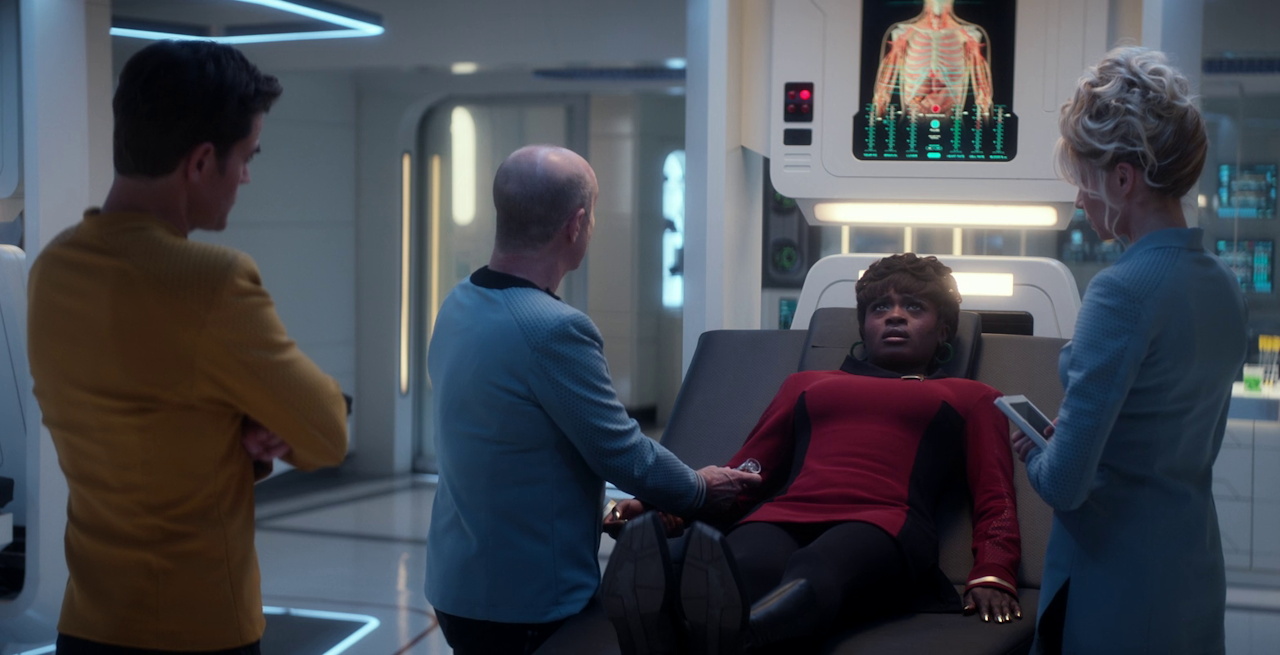
Strange New Worlds: Thoughts on Captain Pike’s crew

Spoiler Warning: There are spoilers ahead for Star Trek: Strange New Worlds, Star Trek: Discovery Season 2, and Star Trek: The Original Series.

Though we still haven’t seen a trailer for Star Trek: Strange New Worlds Season 1, which is on the schedule for next year, last week’s Star Trek Day broadcast finally introduced us to members of the crew of the USS Enterprise who will be joining Captain Pike. Along with Pike, Spock, and Number One, who are returning to their roles from Season 2 of Star Trek: Discovery, we briefly met six other characters.

We’ll look at each of these characters in turn to see what we can gleam and if we can figure out anything about the direction of any of Strange New Worlds’ plotlines, but first I wanted to cover an omission. Ever since Strange New Worlds was announced last year, fans had been speculating about who may or may not join Captain Pike on the Enterprise, but one character I felt had a strong chance of making an appearance was Cadet Sidhu.

Captain Pike with Cadet Sidhu in engineering.

Cadet Sidhu was introduced in the Short Treks episode Ask Not in 2019, and played a major role in that story alongside Captain Pike. Though Ask Not was primarily a vehicle for Anson Mount to reprise his much-loved role, almost any story aboard the Enterprise could’ve been invented for that purpose. To tell a story that focused on Cadet Sidhu and her being assigned to the USS Enterprise felt like a deliberate character introduction, and even though Strange New Worlds hadn’t been announced at that point, the series was clearly something that Star Trek was building up to.

I felt that Ask Not was a strong story, and that Sidhu actor Amrit Kaur put in a solid performance. It was a little surprising to see that she wasn’t part of the main cast at Star Trek Day, and while it’s still possible the character could return in some form, the inclusion of Cadet Uhura – whose role we’ll come to in a moment – seems like it’s potentially occupying a very similar space to the role that Sidhu might’ve played. Although the two characters are in different departments – Sidhu in engineering, Uhura in communications – in terms of narrative structure and character roles it seems unlikely that Strange New Worlds would have space to do justice to the stories of two cadets. If Sidhu is included, then, it seems certain that her role will be much less prominent than I’d have initially expected.

Cadet Sidhu doesn’t seem to be coming back – despite Ask Not seemingly setting her up for a role aboard the Enterprise.

Now that we’ve covered one non-appearance, let’s look at who will definitely be part of Season 1! The character about whom we know the least right now is Erica Ortegas, played by Melissa Navia. This lieutenant appears to occupy a role on the bridge, perhaps in either the helm or navigation positions in front of Captain Pike. Wearing a red shirt, however, could mean she has a role as a security officer, tactical officer, or engineer either in addition to or instead of a permanent role on the bridge.

Lieutenant Ortegas does not appear to be connected to any known Star Trek characters, either from The Original Series era or any other Star Trek production, so that speculation is really the extent of what we know! We can assume that she’s of Spanish, Latin American, or Hispanic-American origin simply based on her name and casting, which would make her the first major character in the franchise to be from one of those backgrounds.

Lieutenant Ortegas on what appears to be the bridge of the Enterprise.

Interestingly, the name “Ortegas” is not new to Star Trek. Gene Roddenberry’s original pitch for Star Trek, prior to commencing work on The Cage, included a character named José Ortegas who would occupy the role of the ship’s navigator. By the time The Cage entered production, however, this character had been changed. José Tyler (whose first name wasn’t mentioned on screen) replaced Ortegas. This subtle nod to Star Trek’s origin is incredibly sweet, and if we can infer anything at all from this connection, it could mean that Lieutenant Ortegas will indeed occupy the role of navigator on the bridge.

Up next is the other character who appears to have no connection that we’re aware of to anyone else in Star Trek: Hemmer, played by Bruce Horak. Horak was not part of the announcement of the cast of Strange New Worlds earlier in the year, so his inclusion was a bit of a surprise for more than one reason! Most interestingly, though, Hemmer appears to be an Aenar – an Andorian race first encountered in Enterprise.

It’s Hemmer time!

Most Aenar were known to be blind, and actor Bruce Horak is himself legally blind. This aspect of Hemmer’s character wasn’t discussed at all during Star Trek Day, which was a little odd considering it’s a significant step for the franchise. The character of Geordi La Forge in The Next Generation was also blind, but in his case a visor allowed him to see. Hemmer will potentially be the first blind character on Star Trek whose sight hasn’t been restored through technological means. What that means for his role aboard the ship isn’t clear, though.

Hemmer was wearing the red shirt of the security or engineering departments, and the very brief clip of him appeared to show him in a different area of the ship. Perhaps we can infer from that that he isn’t a bridge officer and may work in engineering. The Aenar in Enterprise were known to have extensive telepathic abilities, which could give Hemmer an edge when it comes to things like diplomacy or even a medical field. Hemmer is already a fascinating character, and I love the nod to Enterprise. His inclusion is a positive one for the visually-impaired, and for folks with disabilities of all kinds. Not only that, but it was done in a very “Star Trek” way – casting a character who is a member of a blind race of aliens doesn’t tread on the toes of things like Geordi’s visor and the prospect of offering a cure for blindness in Star Trek’s optimistic future.

Geordi La Forge in The Next Generation.

Now we’re coming to characters who may be a little more familiar. La’an Noonien-Singh, played by Christina Chong, shares a family name with Khan Noonien Singh (albeit with a hyphen, though that could be a mistake). It seems incredibly unlikely to me that that’s a coincidence, so the question it raises is to what extent is La’an connected to Khan? At this point in the timeline, Khan is still in stasis aboard the SS Botany Bay. He wouldn’t be encountered by the Enterprise and awakened until after Captain Kirk assumed command of the ship, so La’an seemingly can’t be a direct relation.

It’s possible that she’s a distant descendant, then. Though Khan was genetically augmented, the practice was banned after the Eugenics Wars and thus it seems unlikely that La’an could be an augment herself. However, genetic traits found in Khan may still be present after several generations and she may have increased strength or mental faculties as a result.

La’an may be in sickbay during this scene.

One storyline that could be interesting for a character like La’an is how she might want to move away from her family history. Assuming that she does have a family connection with Khan, the choice to either embrace or reject his legacy could be something we see the character struggle with at points. Some people struggle with a family name and family legacy, and this can be a source of drama in fiction. Though Kylo Ren’s story went completely off the rails in the Star Wars franchise, it began with lofty ambitions of depicting a man struggling with different parts of his family history. Perhaps we’ll see something similar with La’an Noonien-Singh.

Other than that implied connection with Khan, all we can say about La’an is that she’s also wearing the red uniform of either the security or engineering divisions. Either could be a good fit if there’s any kind of genetic legacy from Khan and his augments – a security officer with enhanced strength and endurance would have an advantage, and an engineer whose brain works faster than everyone else would likewise be an incredibly useful asset to any engineering team.

What connection might La’an have to iconic Star Trek villain Khan Noonien Singh?

Those three characters are brand-new to Star Trek – even though there are connections to the rest of the franchise. Strange New Worlds also re-introduced us to three other characters who are returning! These three all appeared in The Original Series. We’ll begin with Dr M’Benga, who appeared in just two episodes. When Dr McCoy was absent, Dr M’Benga appeared to be in charge, so he could’ve been the deputy chief medical officer by the time of The Original Series.

Though never confirmed on screen, the character’s first name was intended to be Joseph, and Dr M’Benga would’ve been born in Uganda in Africa. By the time of Geordi La Forge’s birth around a century later, an organisation called the African Confederation was known to exist, so it’s possible that Dr M’Benga may have originated from there as well. The actor taking on the role, Babs Olusanmokun, was born in Nigeria, so it’s possible that Dr M’Benga’s origin could be changed to give him a west African ancestry.

Dr M’Benga holding a padd in what could be sickbay.

The Original Series clarified one thing about Dr M’Benga – he was somewhat of an expert on Vulcan physiology having spent some time on Vulcan. It’s possible that we could see him strike up a friendship with Spock based on that, or prove useful if Spock requires medical attention. Given Dr M’Benga’s status by the time of The Original Series I’m not convinced that he’ll be the chief medical officer – if so, why would he seemingly have taken a demotion to serve under Dr McCoy a decade later?

Dr Boyce, who we met in The Cage, appeared to be a friend and confidante of Captain Pike as well as the Enterprise’s chief medical officer. It’s possible this character may yet return in some form, and that Dr M’Benga is again a deputy. Or perhaps Dr Boyce has taken a leave of absence leaving Dr M’Benga in charge temporarily. Of the returning characters from The Original Series, Dr M’Benga offers the creative team behind Strange New Worlds the most freedom. We saw him on only a couple of occasions, so his character is still largely unwritten.

Dr M’Benga in Season 2 of The Original Series – played by actor Booker Bradshaw.

Staying in sickbay, we come to Nurse Chapel. Along with Una (Number One), Nurse Christine Chapel was played by Majel Barrett during The Original Series and was a mainstay in sickbay alongside Dr McCoy. Jess Bush is taking on the role for Strange New Worlds, and presumably will share a number of scenes with Dr M’Benga. The two characters knew one another by the time of The Original Series, and even worked together to treat Spock in the episode A Private Little War.

Despite appearing in twenty-five episodes of The Original Series, as well as in The Animated Series and two films, I’d argue that Nurse Chapel is still quite an underdeveloped character open for Strange New Worlds to explore in more depth. Many of her appearances in The Original Series were as an assistant to Dr McCoy, and learning more about her as a person away from her medical duties could be something the new show does.

Jess Bush as Nurse Chapel in what appears to be sickbay.

There’s also the romantic feelings that Nurse Chapel developed toward Spock. Does she have a crush on him at this early stage? If not, perhaps the series will show how that came to be. Though I’m sure her characterisation won’t just be about that – the trope of female characters having nothing to think about but men is a tired one that needs to be retired – it could be one element among many that we see. Chapel was engaged to a man named Roger Korby by Season 1 of The Original Series, and this relationship could also be explored.

As a character that we’re at least a little familiar with, Strange New Worlds will have to tread somewhat carefully with Nurse Chapel. Though there is scope, as mentioned, to dive deeper into her characterisation and learn more about her, there are some constraints based on what we know of her from The Original Series that the show will have to respect.

Nurse Chapel in Season 1 of The Original Series.

Finally we come to the character that got many fans incredibly excited. Strange New Worlds was even trending on Twitter for a time following the reveal that Cadet Nyota Uhura will be a member of the crew. With the exception of Spock and, to a degree, Captain Pike, Uhura is the character fans are most familiar with, as she appeared in sixty-nine episodes of The Original Series, all but three episodes of The Animated Series, and all six films starring Star Trek’s original cast. She also appeared in the alternate reality Kelvin timeline films.

As such, there’s less scope to reshape or change Uhura’s character than there is for any of the others. However, as Discovery did with Spock in Season 2, there’s a lot of potential to show where Uhura came from and how she came to grow into the person we came to know and love during The Original Series. She can’t be too fundamentally different, but she can certainly start in a different place and slowly become the person we’re more familiar with. This was Spock’s journey, in some respects, in Discovery.

Cadet Uhura. We can clearly see Pike in the captain’s chair behind her, so this must be on the bridge.

We know from both her original depiction and her Kelvin timeline depiction that Uhura has a knack for alien languages. Perhaps her unique skillset is what landed her a role on the Enterprise to begin with, as it seems unlikely that a cadet would ordinarily be a regular on the bridge! In that sense we could see her akin to Hoshi Sato from Enterprise – still finding her feet on the ship, but confident in her particular field.

A young cadet or newly-graduated officer is a character archetype that Star Trek shows have used in the past to great effect. Wesley Crusher, Harry Kim, and Sylvia Tilly come to mind first and foremost, but I’d also point to Dr Bashir in his first appearances, as well as Pavel Chekov, D’Vana Tendi, and the aforementioned Hoshi Sato as great examples. These kinds of characters present a strong contrast with the more experienced members of the crew, and can offer different perspectives as a result. Not only that, but any character who’s new aboard the ship makes for a great introduction and point-of-view character for us as the audience. It’s possible that Uhura will fill this role at the beginning of Strange New Worlds.
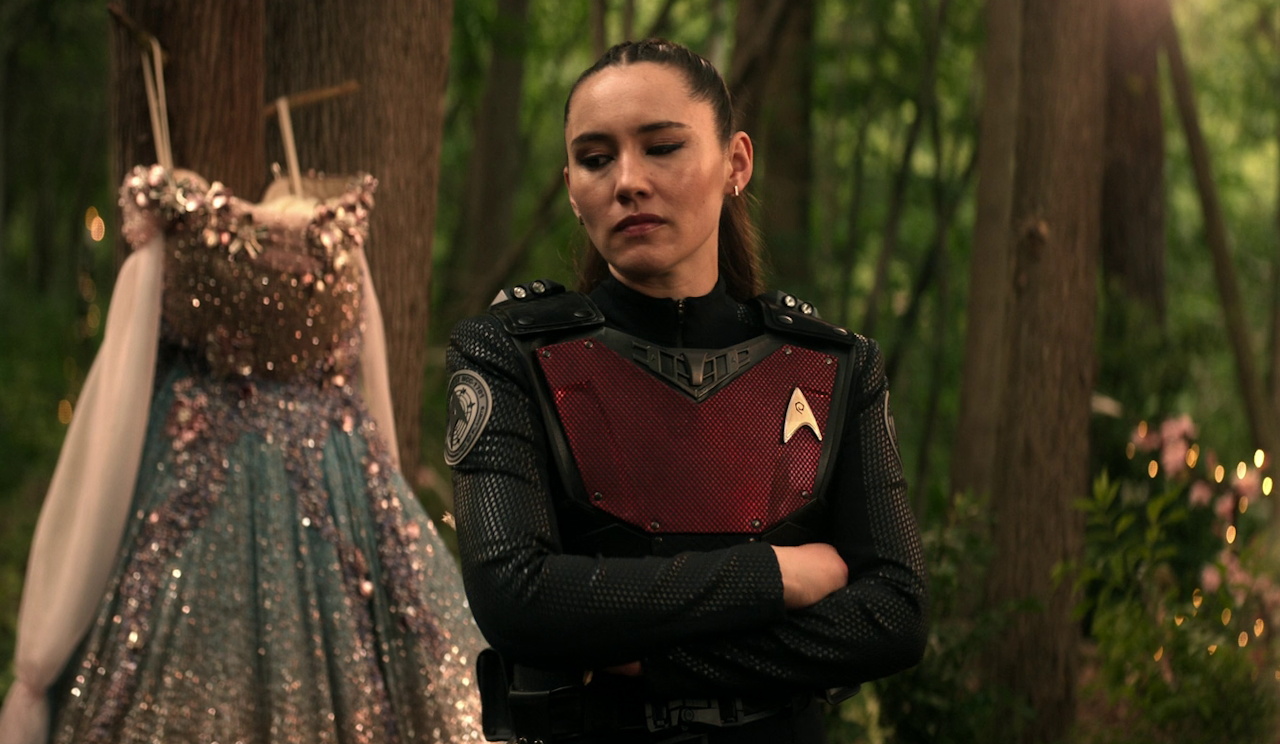
Uhura in Season 3 of The Original Series.

Before we wrap things up we can also talk about Una Chin-Riley, also known as Number One. She’s Captain Pike’s first officer, and though we spent a little time with her in Discovery Season 2 and Short Treks, there’s still a lot that we don’t know about her. Her depiction in The Cage was as a rather unemotional, straight-laced person. In particular the Short Treks episode Q&A showed us that there is a fun side to her – and this is something we could definitely see more of. Number One seems like someone with a very professional attitude, and perhaps a very clear line between friends and co-workers. Captain Pike and Spock may have bridged that line – but who else will?
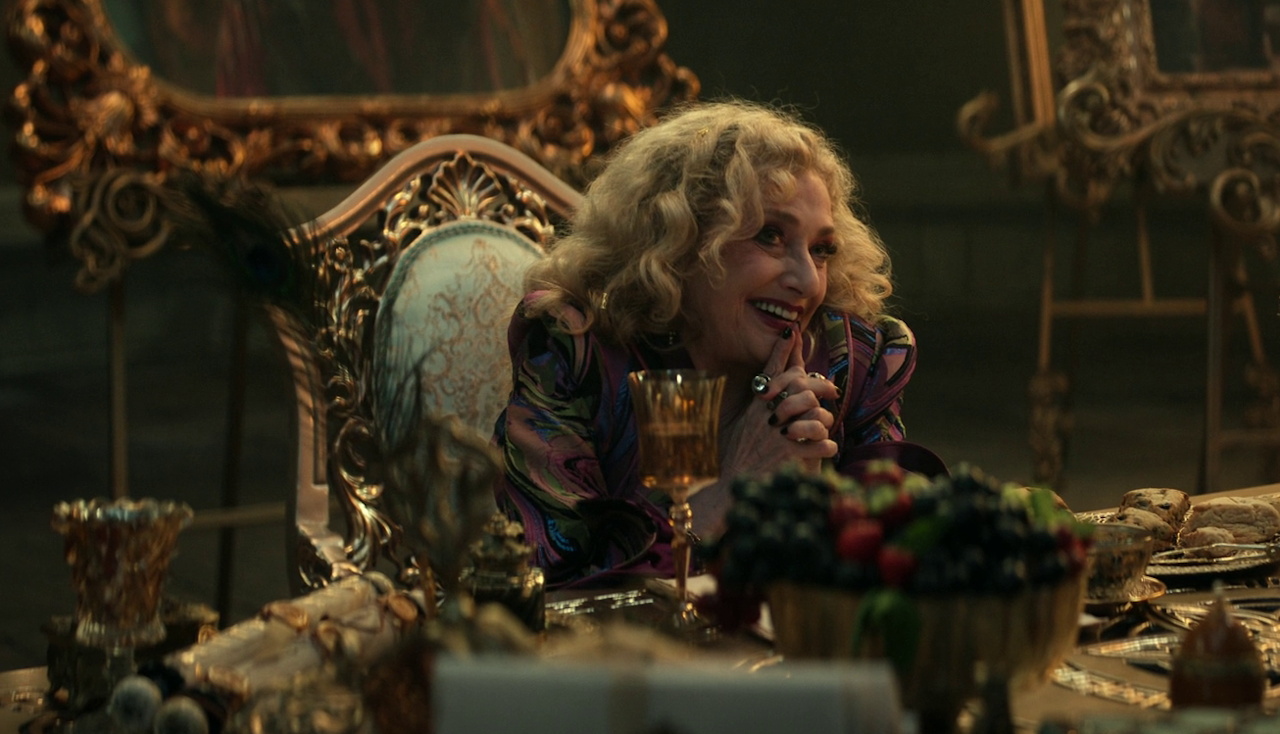
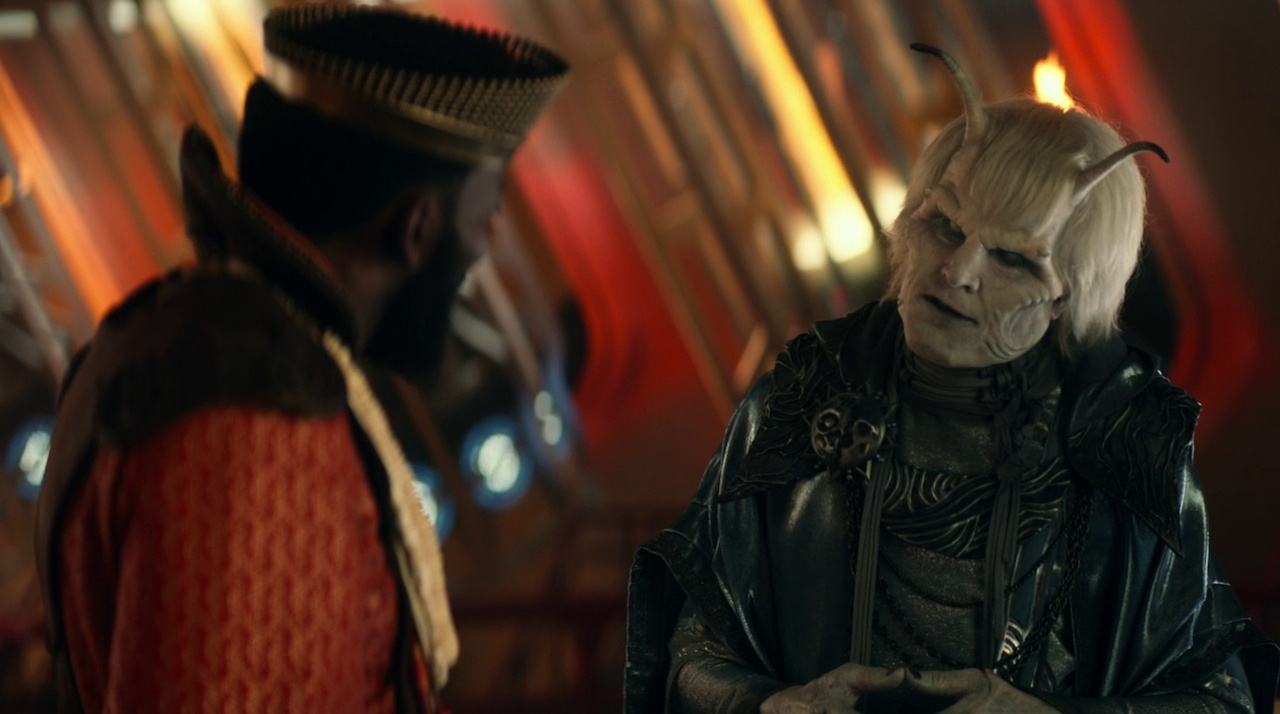
Rebecca Romijn, who plays the character, told us that Una is “way more complex” than we might expect, which is tantalising to say the least! She also said that Strange New Worlds will take the opportunity to “flesh out” the character in more detail, which sounds fantastic. Though the original portrayal – and to an extent what we’ve seen in Discovery – does act as a constraint on where the character could go, I think there’s still plenty of scope to explore who Number One is.

Number One passes Spock on what seems to be the bridge.
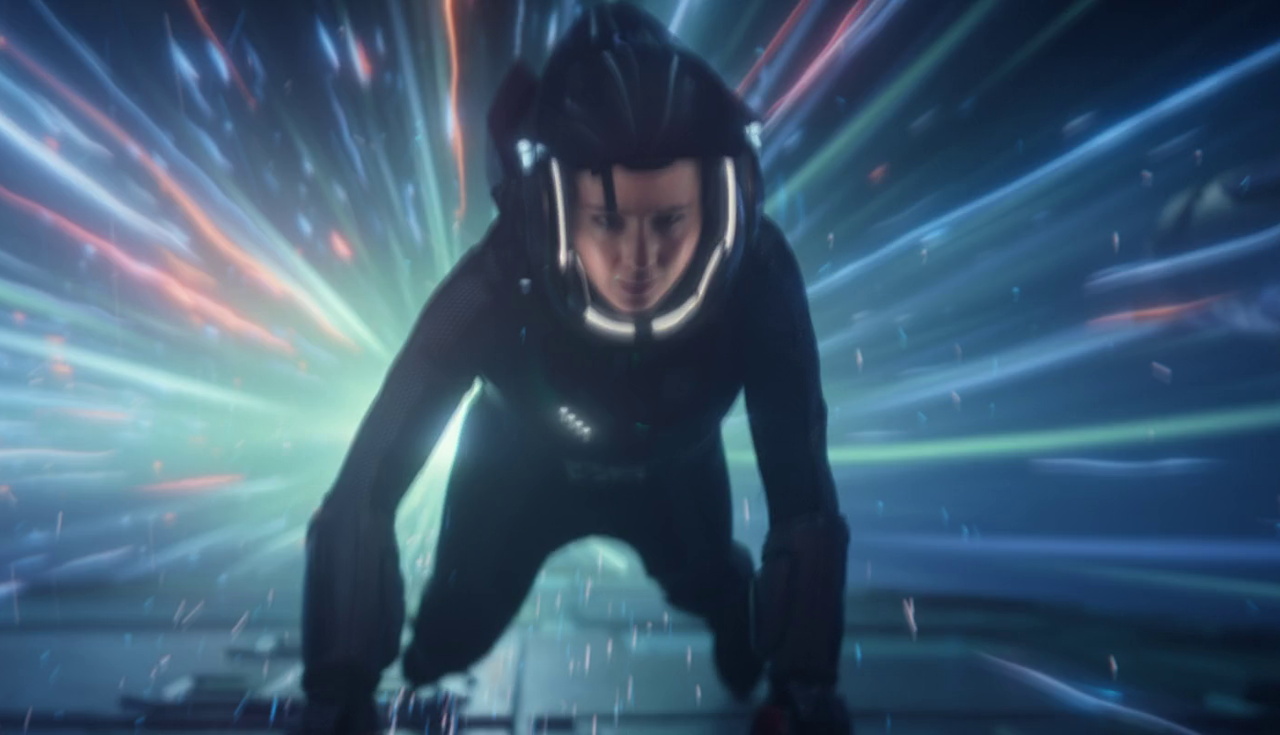
The uniforms have been redesigned for Strange New Worlds, with most characters sporting a V-neck variant without the high collar or much of the piping and stitching seen in Season 2 of Discovery. Number One appears to have her own unique variant with a zip collar and black undershirt, and more black or dark patches on the sides of the torso. It’s not clear why she gets a special uniform – or indeed if this is what she’ll wear most often. But it’s interesting, and makes her stand out from the rest of the crew.
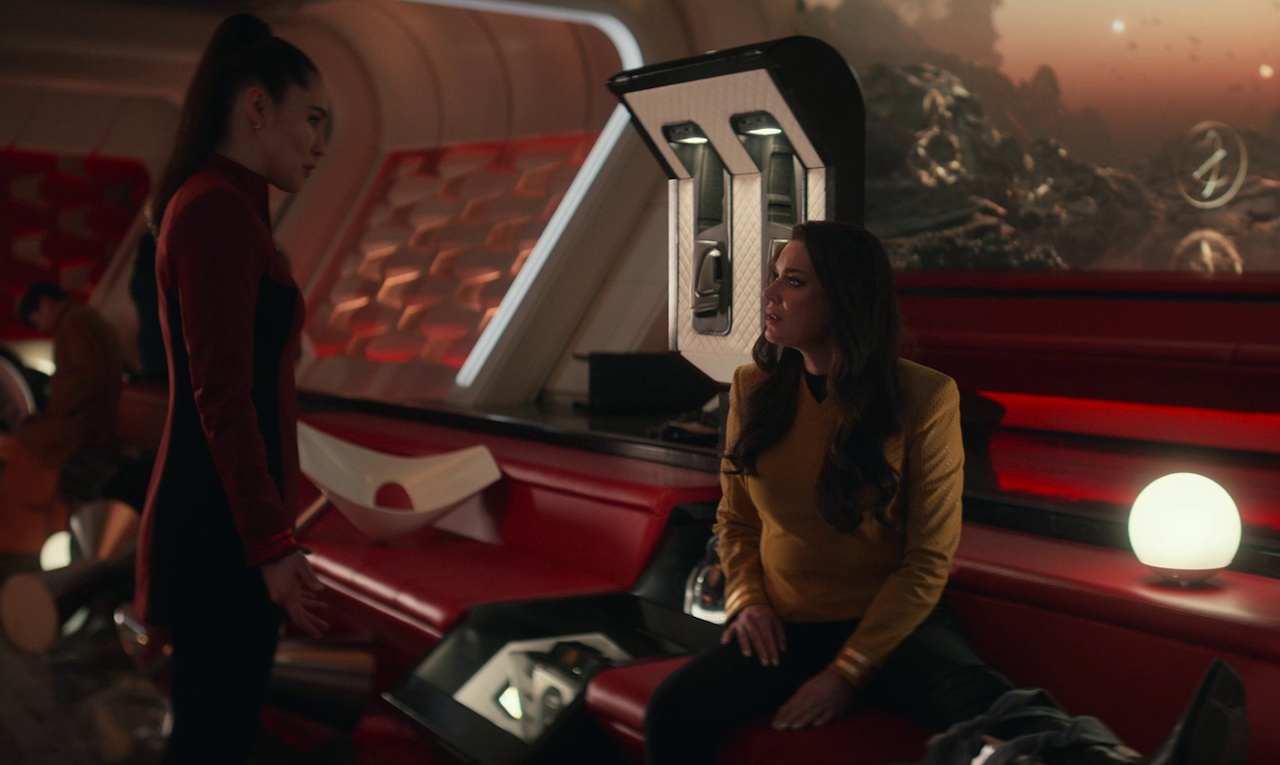
Of course we also have Captain Pike and Spock returning as well – but I daresay you know at least a little about both of them already! We didn’t really learn too much more about either of them at Star Trek Day, though there was talk of Captain Pike potentially inviting members of his senior staff to his quarters and cooking meals for them. That seems like a neat addition to his character. In Discovery Season 2 we came to see Captain Pike as the embodiment of Starfleet’s values and the epitome of what it means to be a leader. I daresay that side of his characterisation will remain.

Captain Pike wearing the new V-neck uniform tunic.

When it comes to Pike, one element of his story that I’m most interested in is how he’s going to handle the knowledge of his impending accident and disability. He chose that future for himself in Discovery Season 2, and now it’s locked-in. As someone who’s disabled and suffers from a complex set of health issues, I’ve been in the position of knowing something is wrong and only going to get worse. I’ve heard bad news from a doctor, knowing there’s nothing I can do to change the outcome. Seeing how Pike will respond to being in a comparable situation has to be one of the things I’m most anticipating when it comes to his role in Strange New Worlds.

However, I’m also looking forward to spending time with Pike himself outside of that. There’s more to him than just one storyline, and we could see him, for example, attempt to make contact with Vina on Talos IV again, or furthering his friendships with Spock and Number One. I’m curious to see him interact with some of the other members of the crew, particularly those we remember from The Original Series era.

Captain Pike traded his future health for a time crystal in Discovery Season 2.

Finally we have Spock. As the character we know best, and as someone who’s been a major part of Star Trek for practically its entire history, there’s far less scope to radically change Spock. Additions can be made to his character – as we saw with Michael Burnham in Discovery – but at a fundamental level, who he is as a person is set in stone.

We may see Spock’s human and Vulcan sides in conflict in Strange New Worlds as he tries to bury his emotions. At Star Trek Day, producer Akiva Goldsman made reference to The Cage and how Spock was depicted there. How “smiley Spock” became the character we know, perhaps influenced by the loss of Michael Burnham, could be one element of his character that the new show will explore.

Spock aboard the Enterprise.

I think it’s more important for Spock to stay true to his past characterisation than it is for any of the others. Spock has appeared in The Original Series and its films, The Next Generation, and the Kelvin timeline films, and was a major character much of the time. There is still scope to explore unknown aspects of his character – and we could see, for example, how or why he came to have a falling-out with Sarek – but generally speaking this is the character that Strange New Worlds has to be the most careful with.

Production has now finished on Season 1 of Strange New Worlds. Though I fully expect a second season is already being worked on behind closed doors, there’s been no official announcement as of yet. If the show follows a similar pattern to Discovery and Picard, it might not be until the first season is about to premiere that we’ll learn a second is going to happen. Regardless, I think it’s a safe bet right now that, after all the effort and work that’s gone into Season 1, Strange New Worlds won’t just run for a single season!

The cast of Strange New Worlds Season 1.
Photo Credit: Rebecca Romijn on Twitter.

Promising a return to a more episodic format, and bringing back Captain Pike and Spock after their excellent roles in Season 2 of Discovery, Strange New Worlds was already high up on the list of shows I’m most excited for. But I have to say, after seeing the casting announcements (and, perhaps, because Picard Season 2 has dropped down a little) it’s now officially right at the top! 2022 can’t come soon enough, to be honest!

Each of the new characters look genuinely exciting and interesting, and the series seems to be doing a good job at walking the line between staying true to Star Trek’s past and carving out its own niche. That isn’t always going to be easy, and the producers have certainly taken on a challenge by bringing back fan-favourites like Uhura. But everything I’ve seen and heard fills me with confidence that Strange New Worlds is going to be utterly fantastic. I cannot wait to see the show when it premieres next year.

Star Trek: Strange New Worlds will be broadcast on Paramount+ in the United States (and other regions where the platform is available) in 2022. Further international distribution has not yet been announced. The Star Trek franchise – including Strange New Worlds and all other properties mentioned above – is the copyright of ViacomCBS. This article contains the thoughts and opinions of one person only and is not intended to cause any offence.