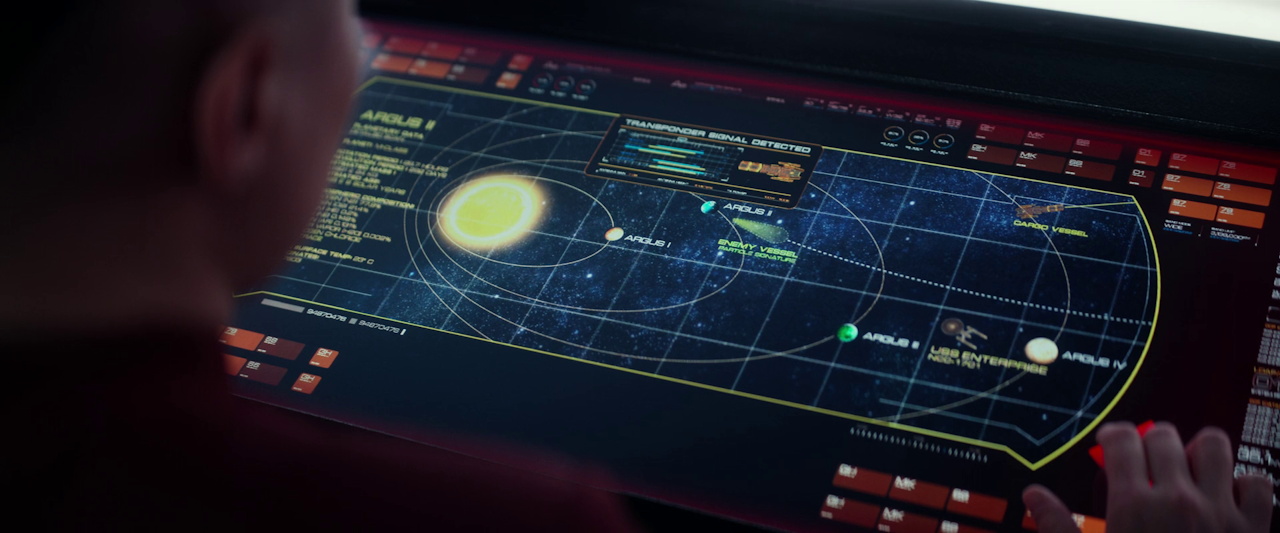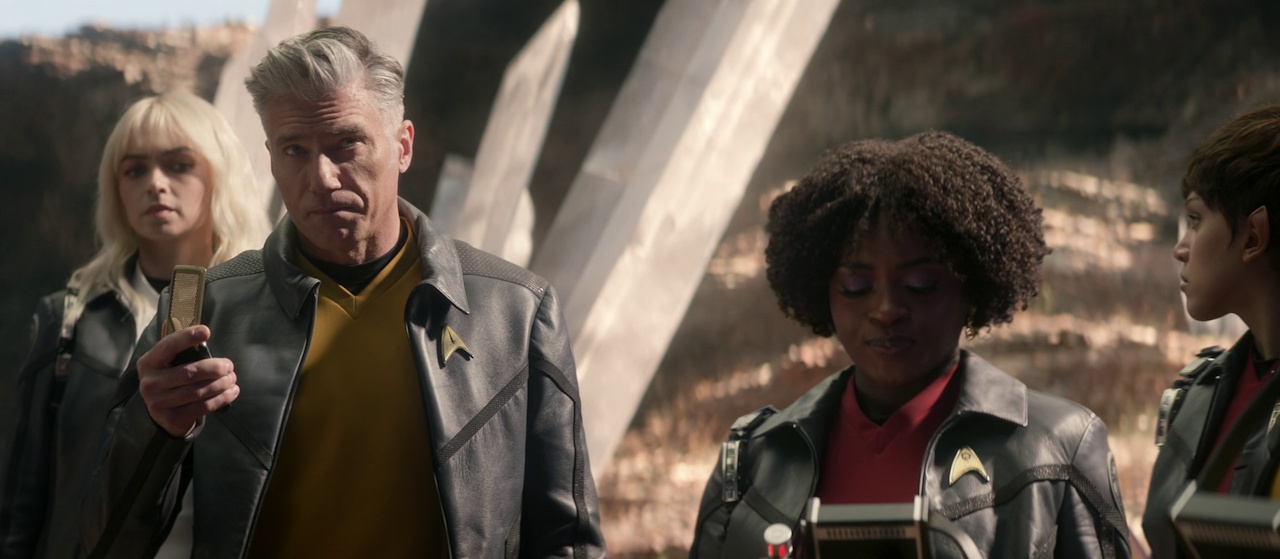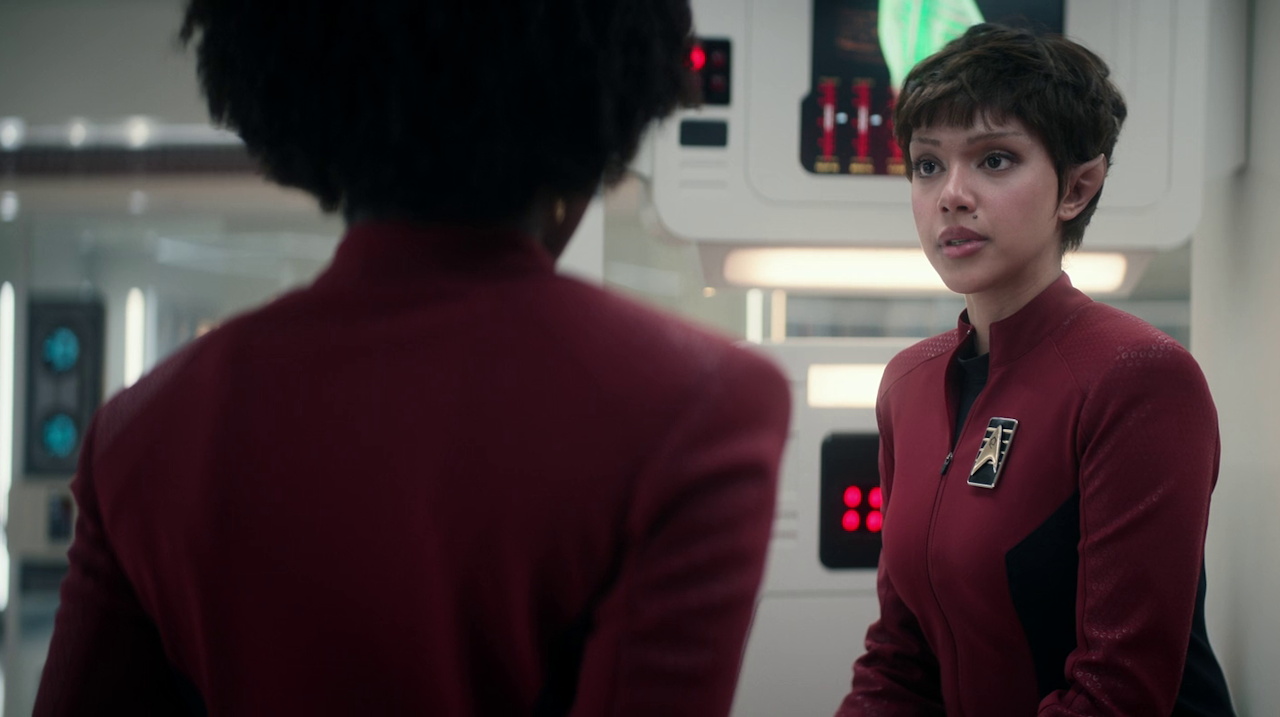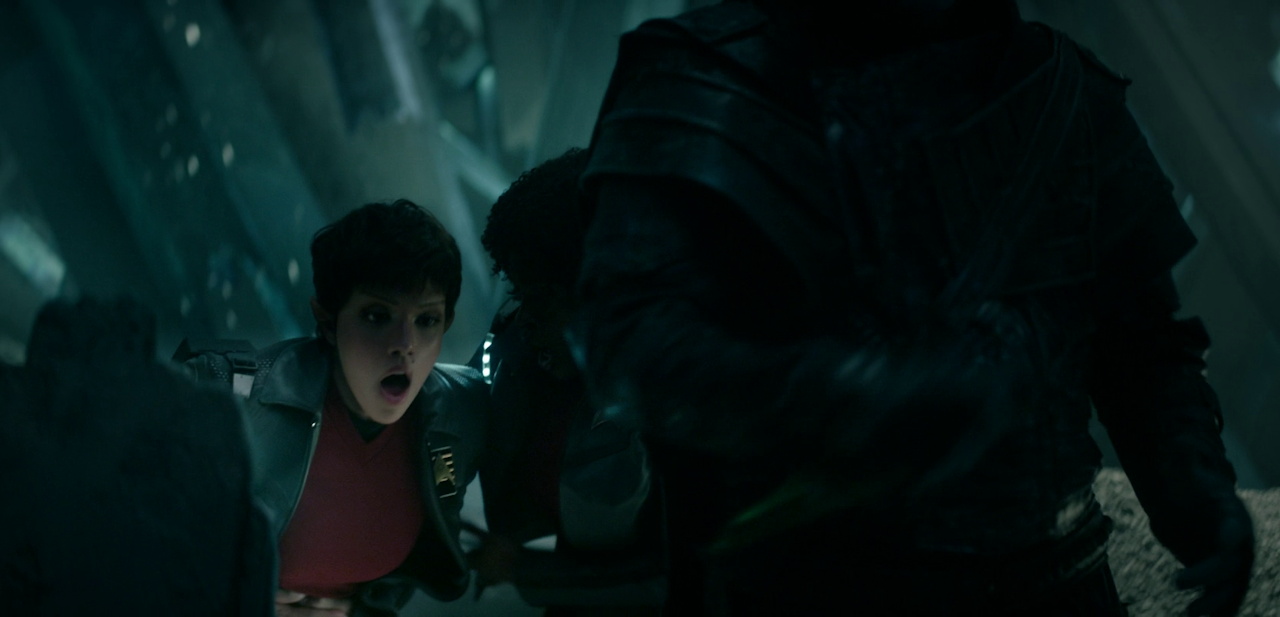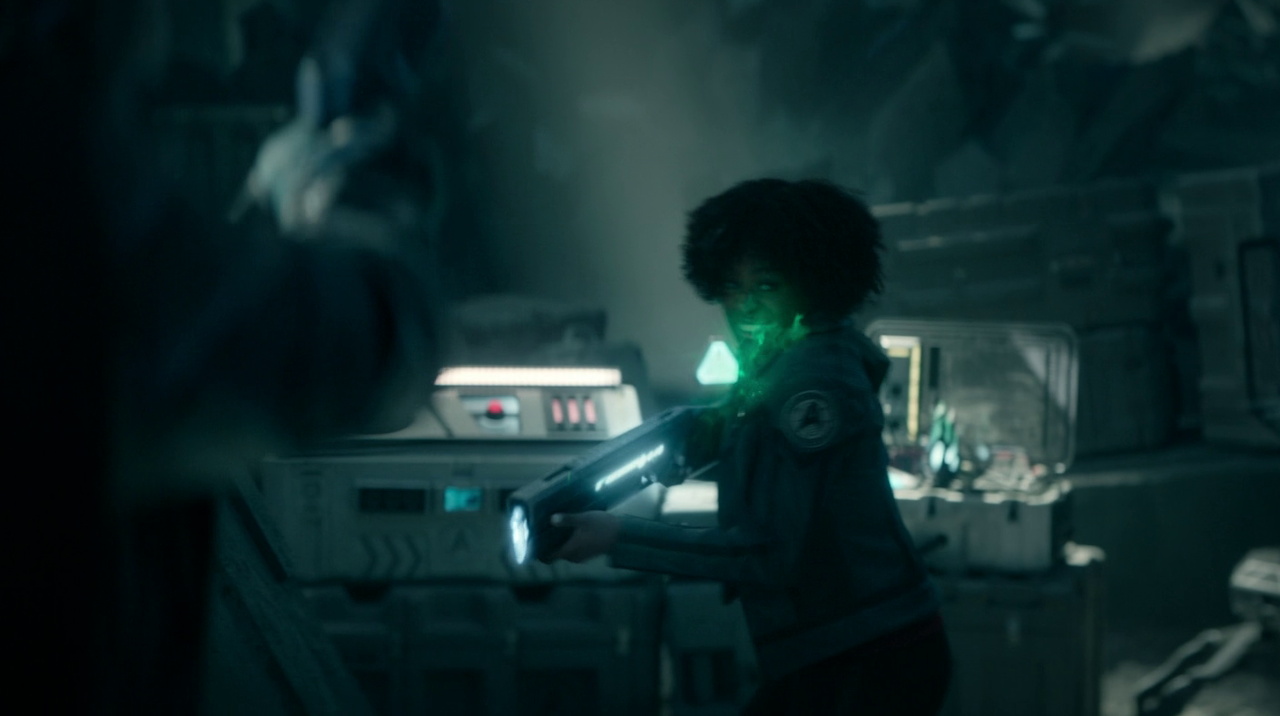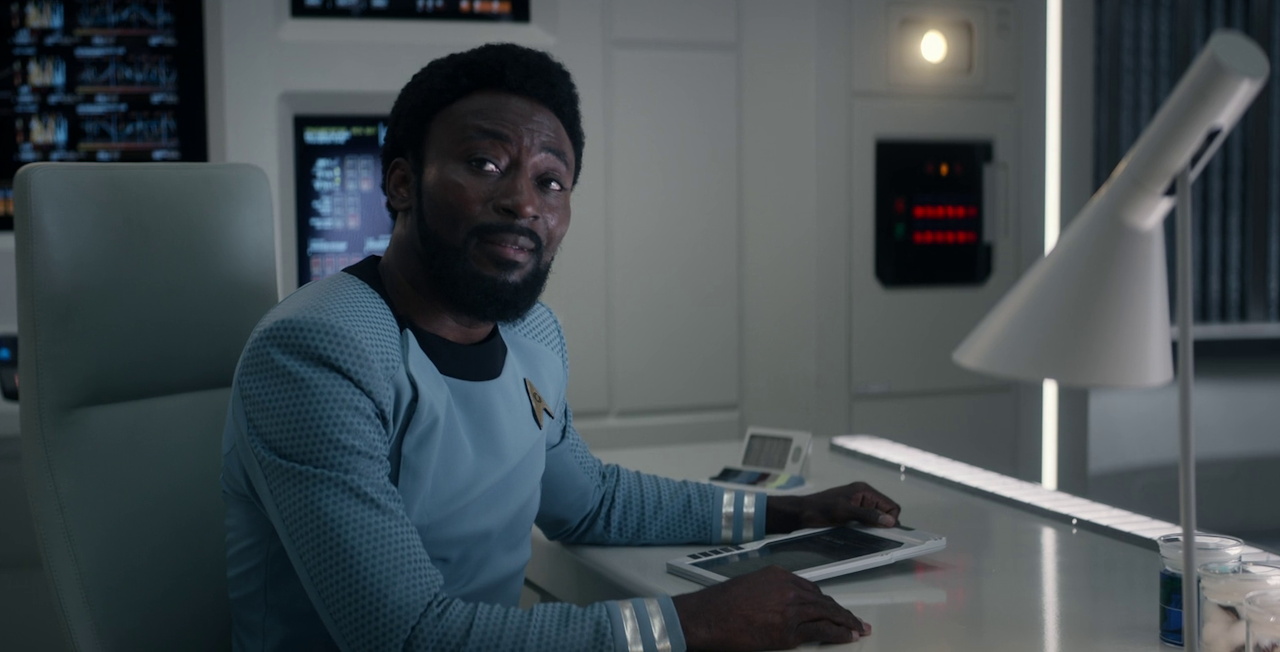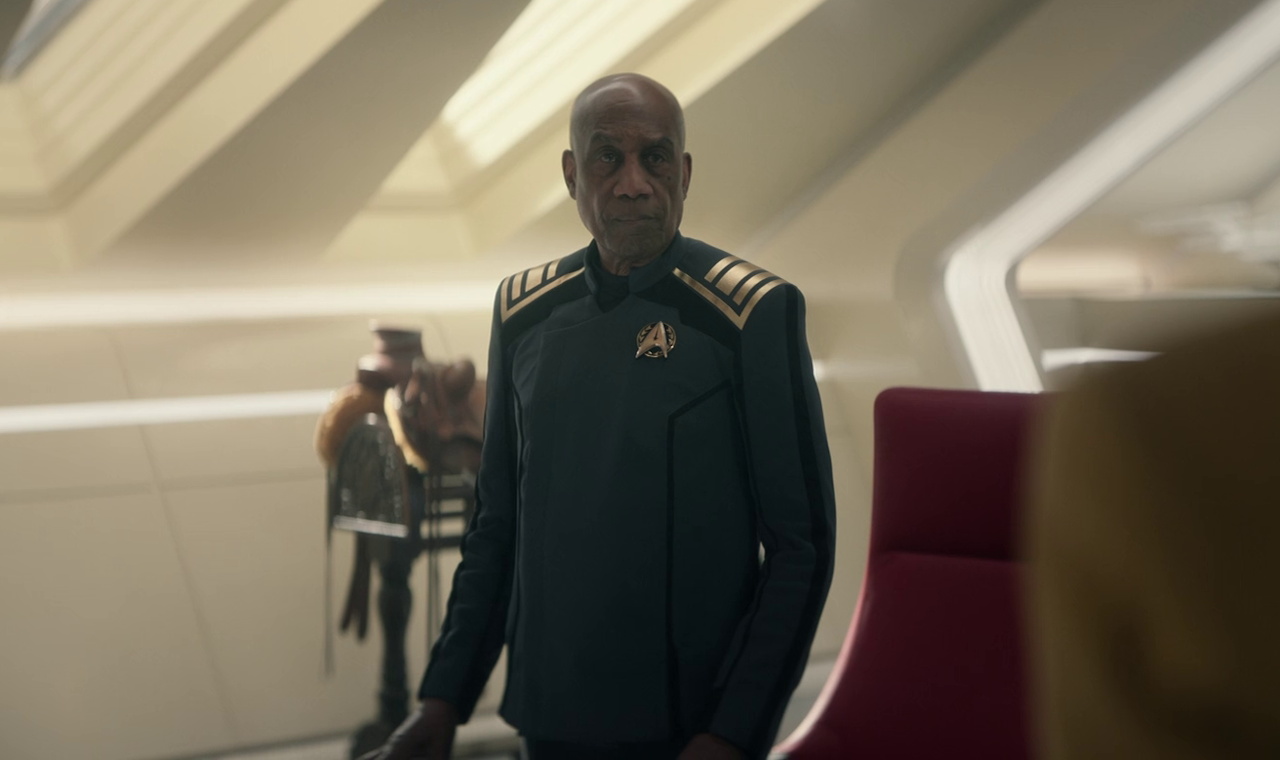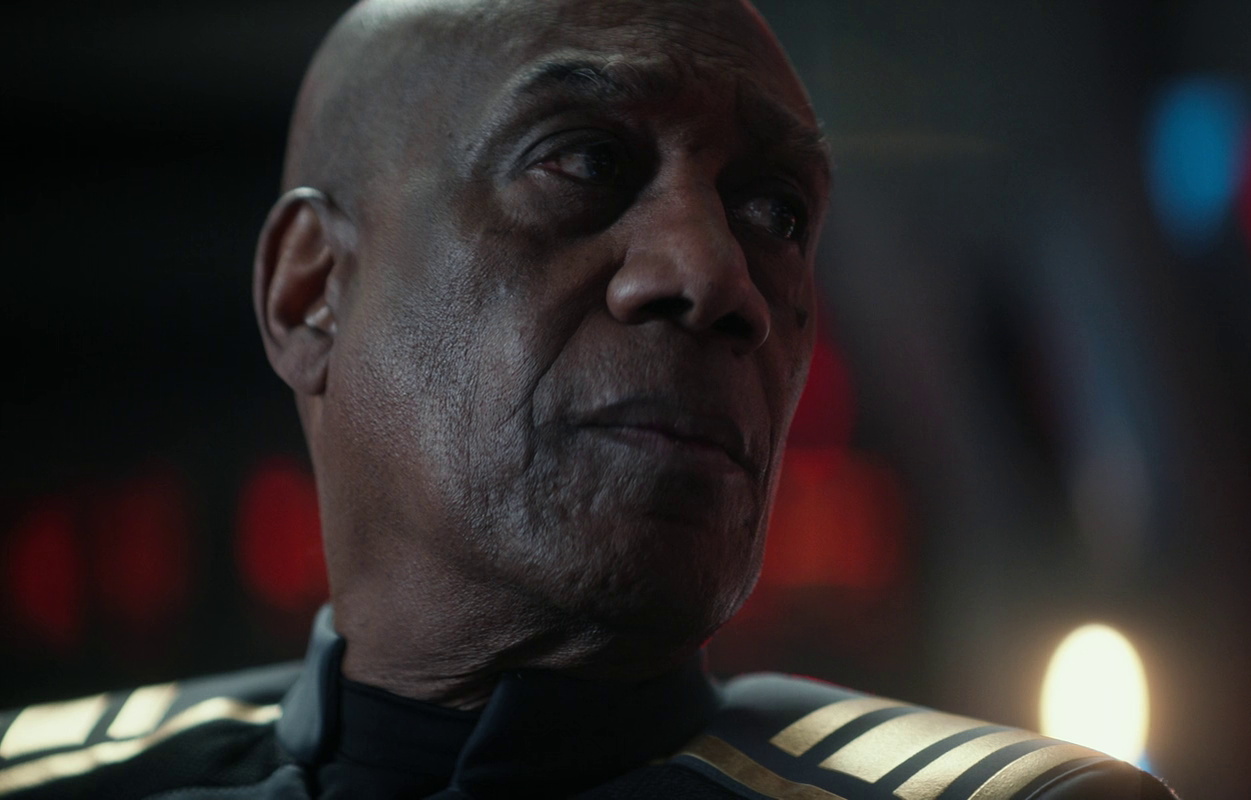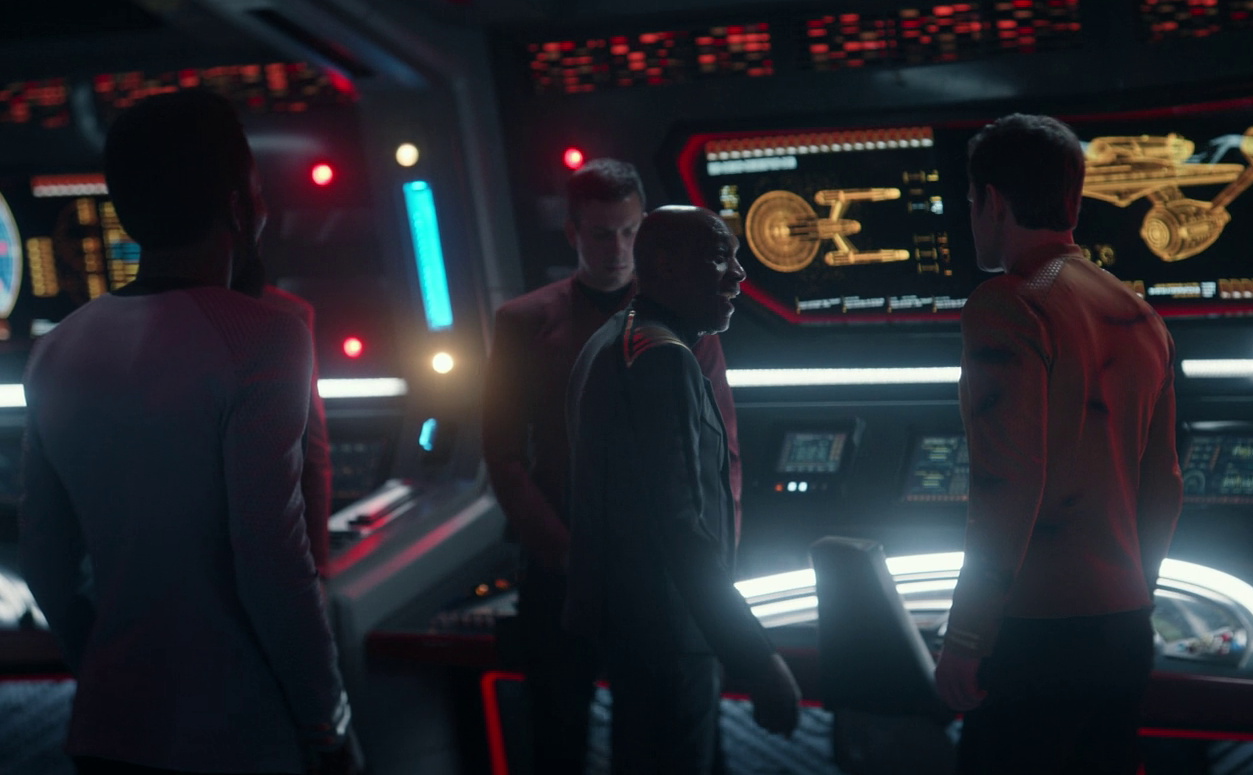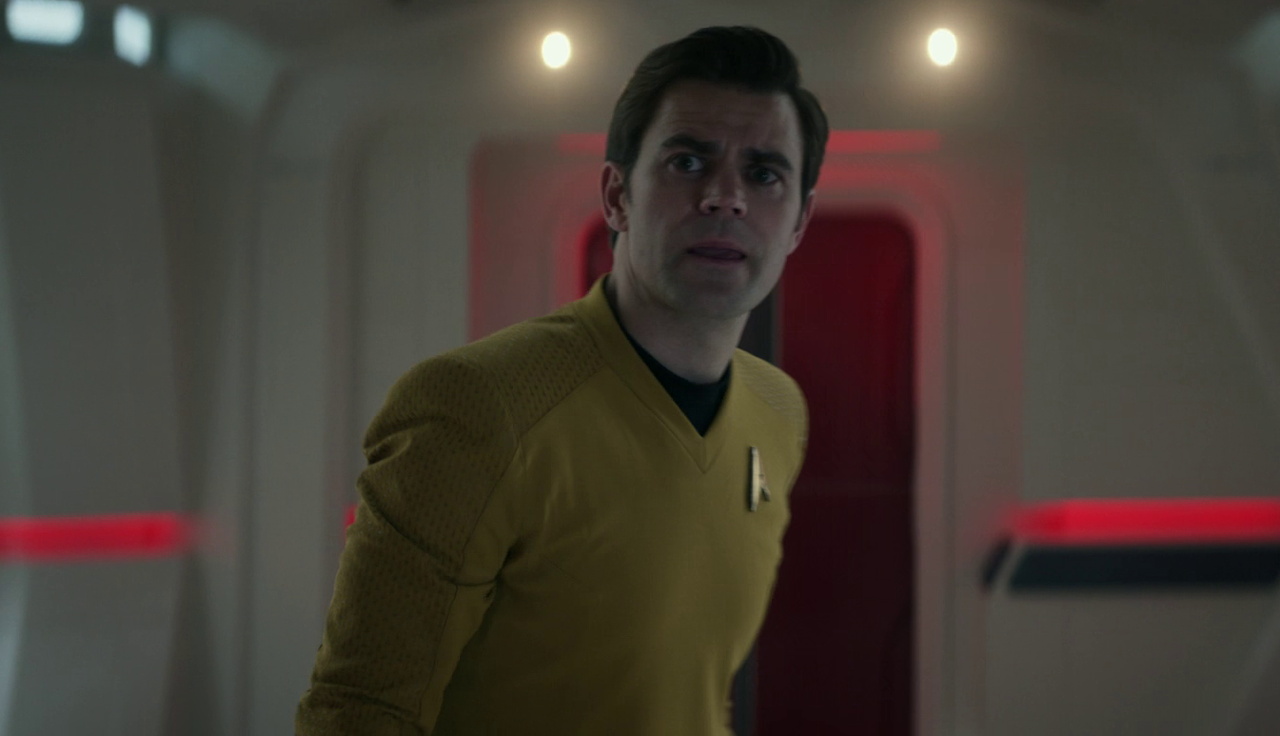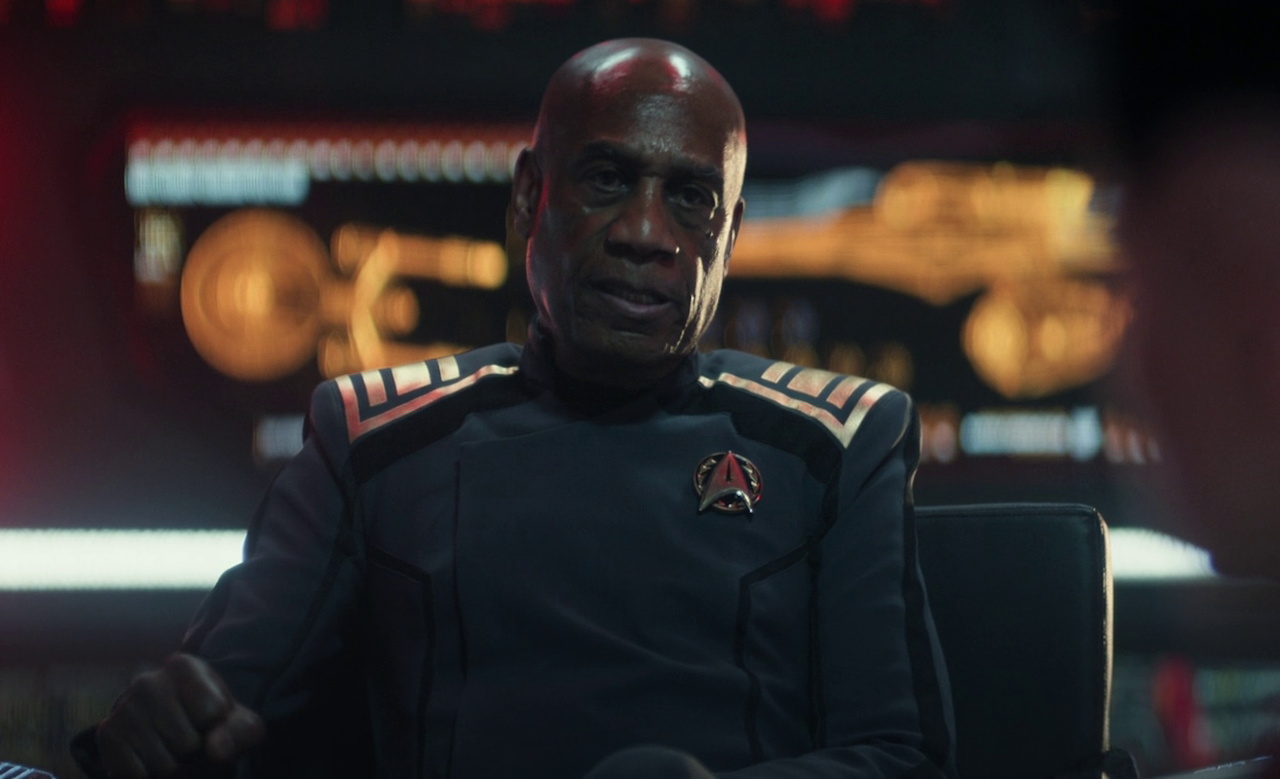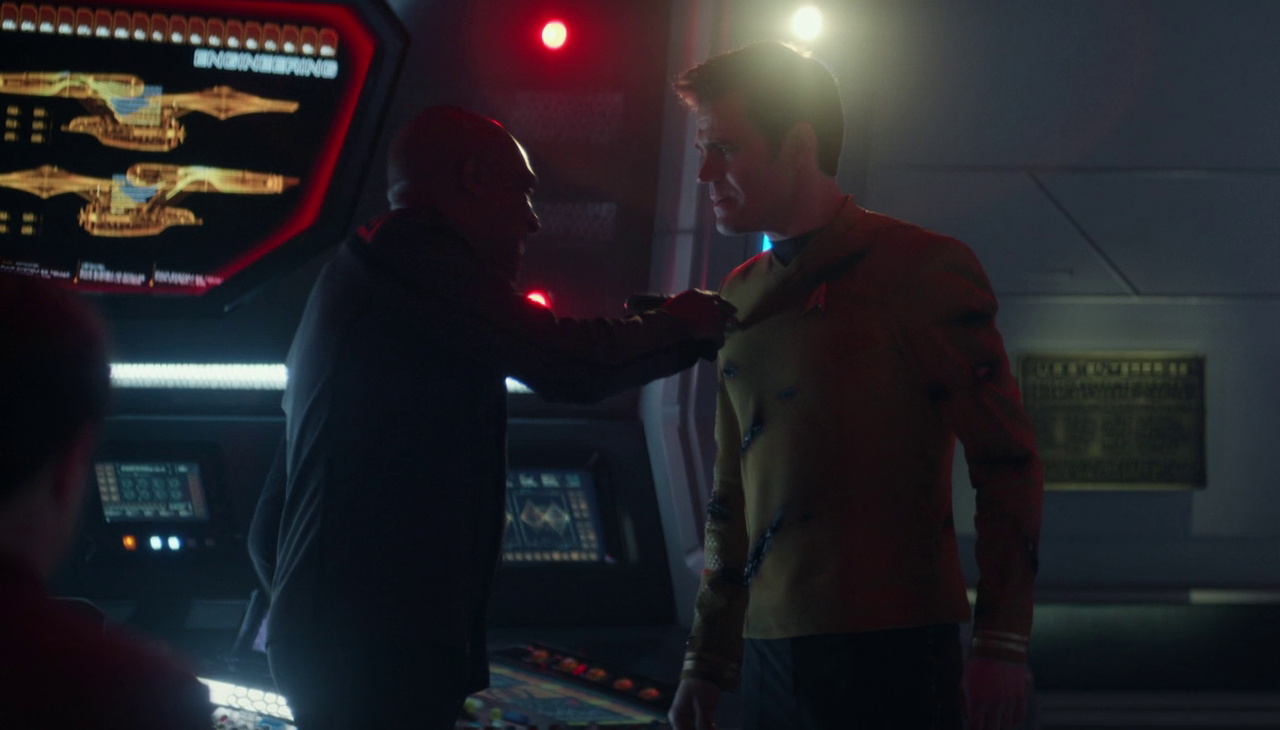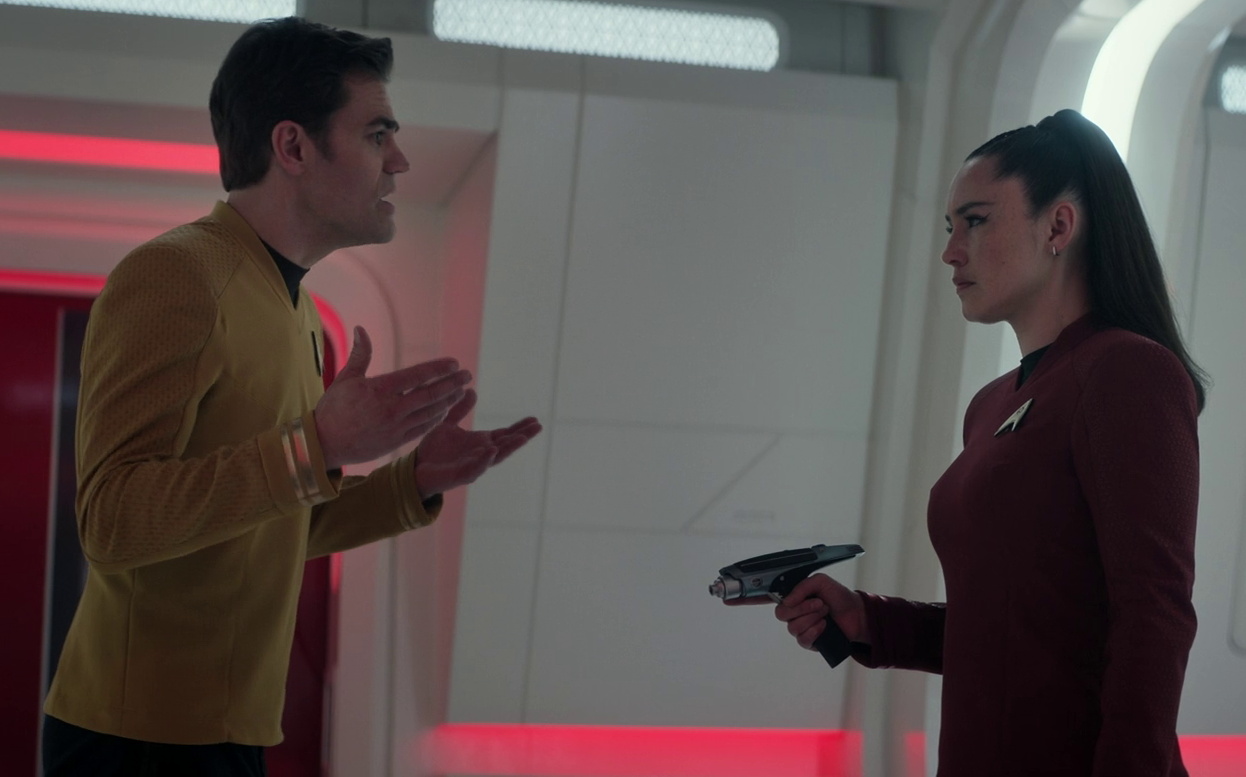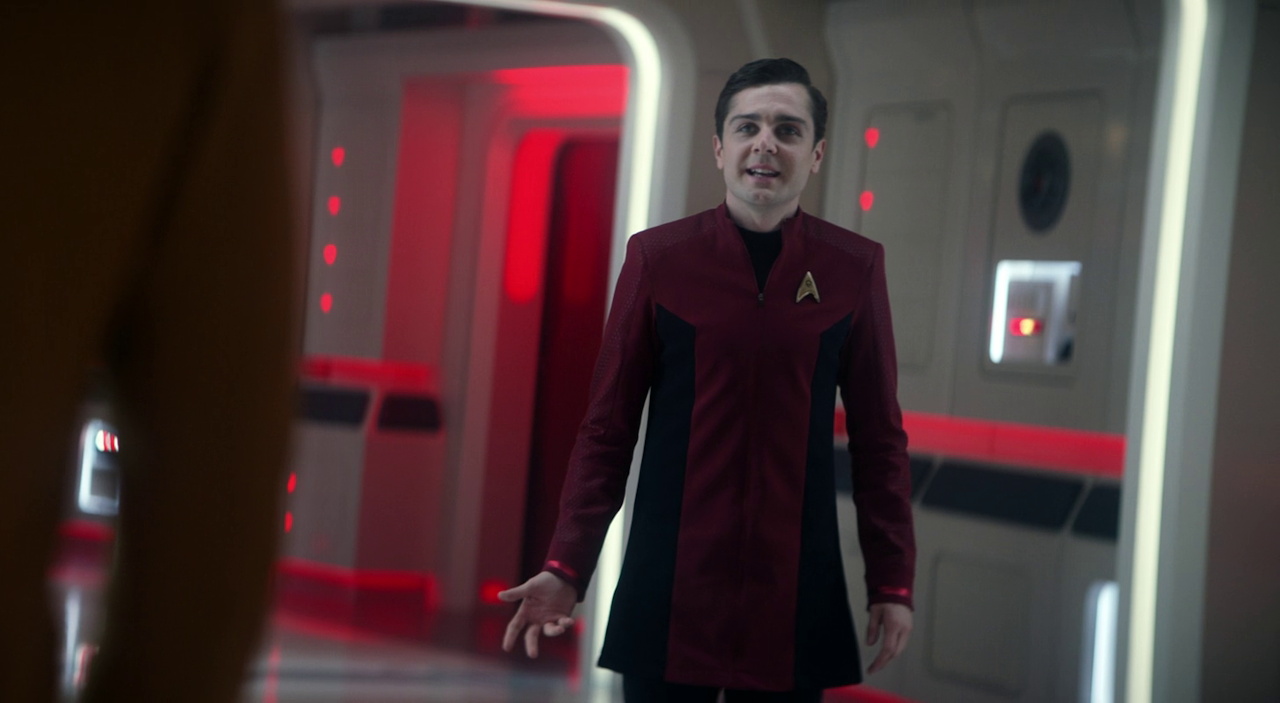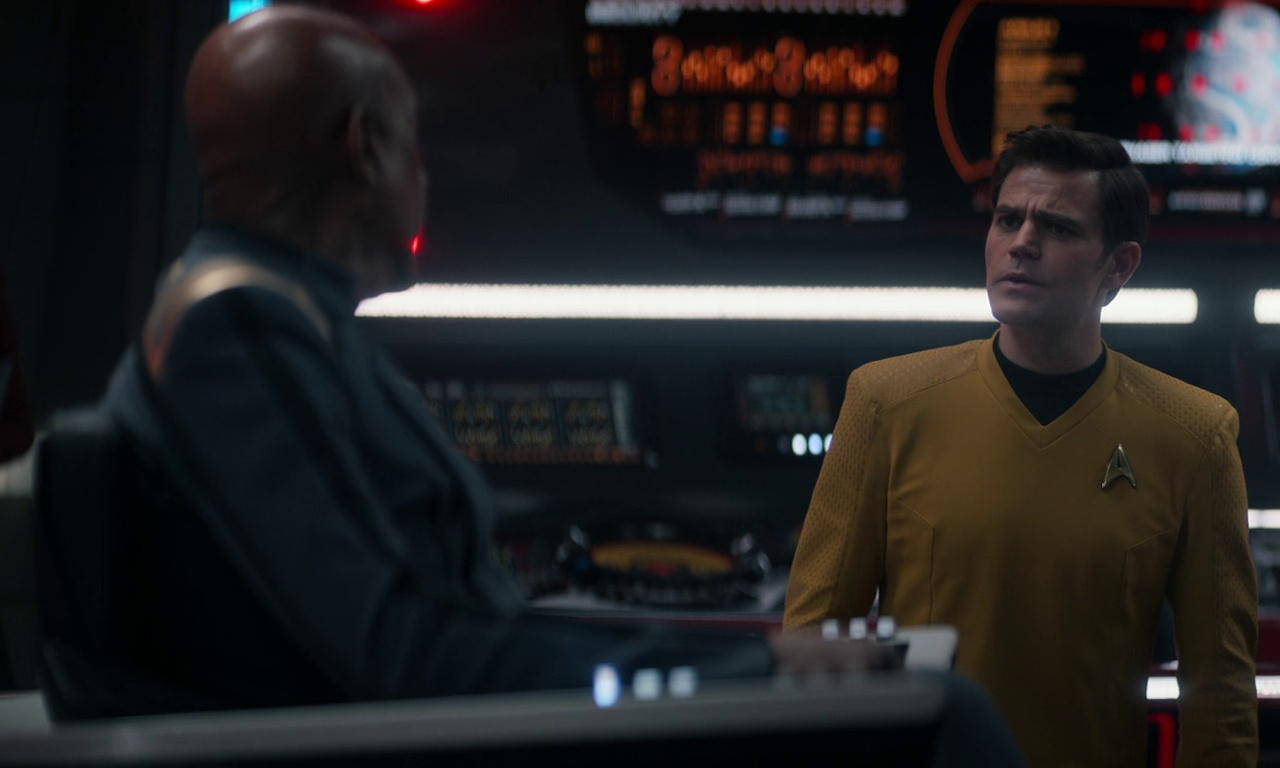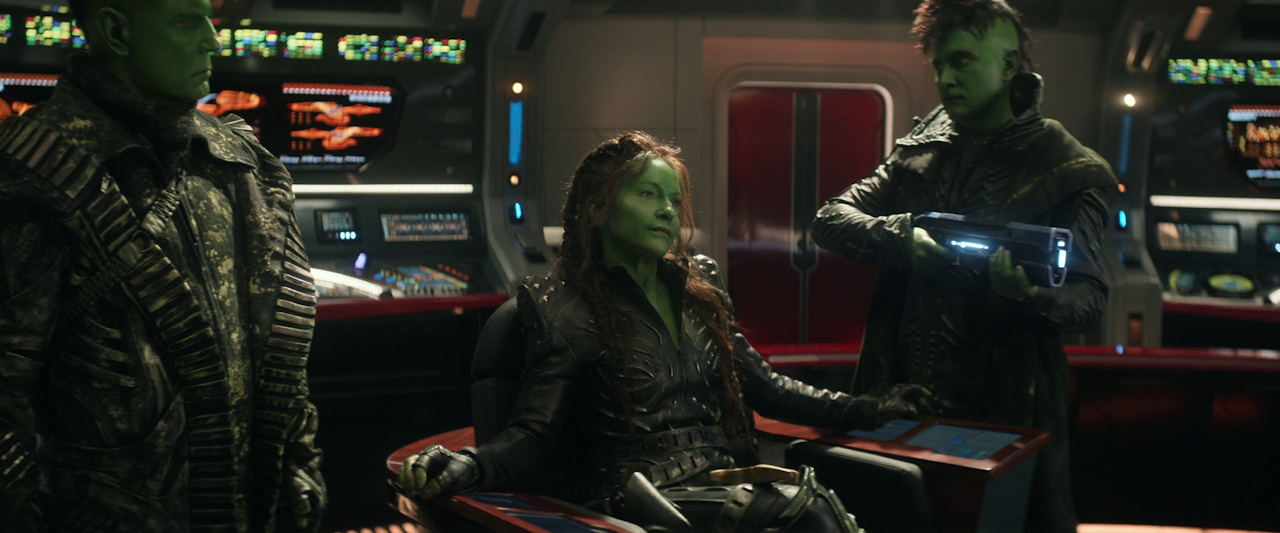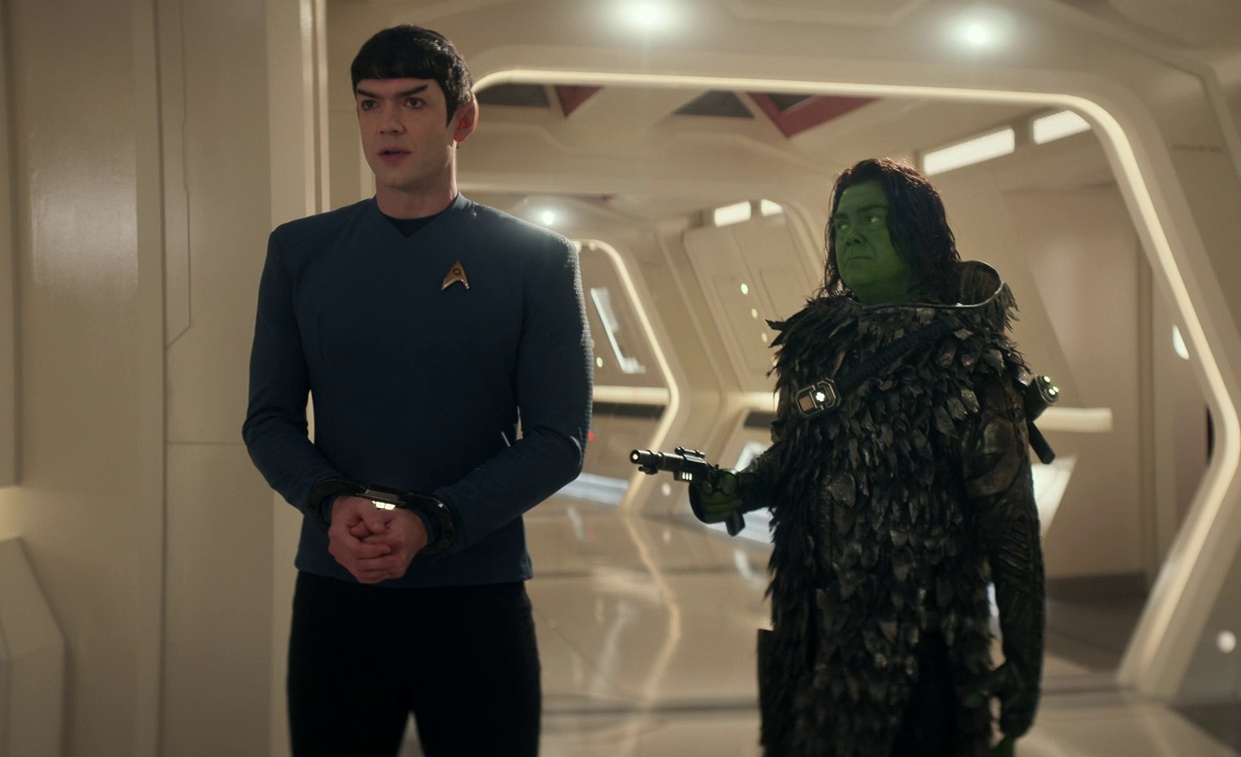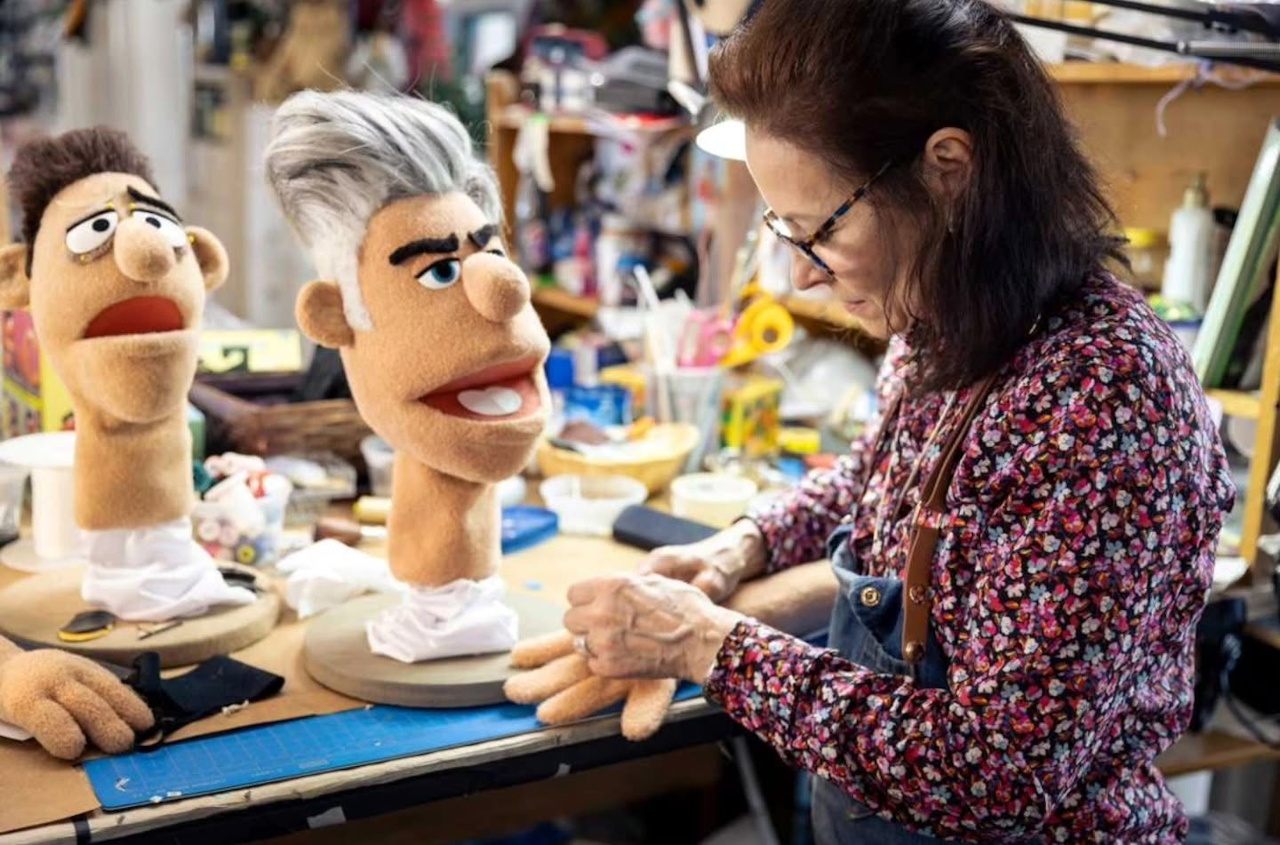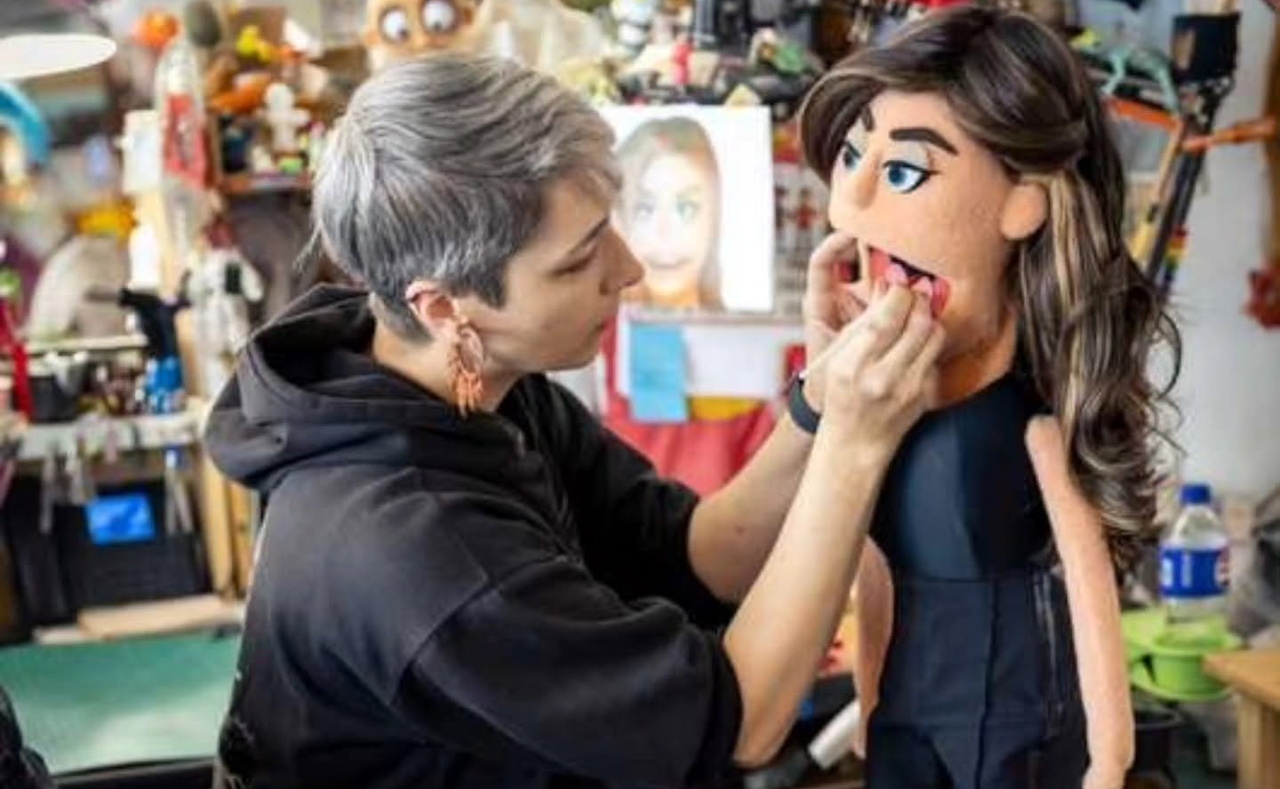
Star Trek: Strange New Worlds Episode Review – Season 4, Episode 10: Tomorrow’s Enterprise

A Star Trek-themed spoiler warning.

Spoiler Warning: There are spoilers ahead for Star Trek: Strange New Worlds Seasons 1-4. Spoilers are also present for the following Star Trek productions: The Original Series, The Next Generation, Deep Space Nine, Discovery, and Picard.

After a rollercoaster ride across Season 4 – which, I’m afraid, had more downs than ups, and also brought two of the worst episodes in the entire series to the table – I was hoping, if not positively *praying,* that Tomorrow’s Enterprise would at least end things on a high note. I wasn’t sure whether to expect a cliffhanger, like we got in Season 2, or a self-contained story – and we kind of got a bit of both, at least for one character in particular.

But above all, I’m happy to report that, despite some misfires earlier in the season, Tomorrow’s Enterprise was a good, solid finale that I enjoyed from beginning to end.

There will be time in the weeks ahead to take stock of where Strange New Worlds as a whole finds itself ahead of its truncated fifth and final season, but I want to touch on a couple of points briefly, at least insofar as they pertain to Tomorrow’s Enterprise. For much of the season – including in this episode – most of the show’s new, original characters took a back seat, and those with roles in The Original Series were more central. We saw that not only with Uhura, but also with Chapel, Spock, Scotty, and Kirk – all of whom overshadowed or outright replaced their Strange New Worlds counterparts, or original characters who could’ve filled those roles. And despite this being a fantastic all-around episode for Uhura, I can’t help but feel the curtain has fallen on a season that sidelined not only its new characters, but also Captain Pike himself – and it was Anson Mount whose incredible performance led to calls for a “Captain Pike show” a few years ago.
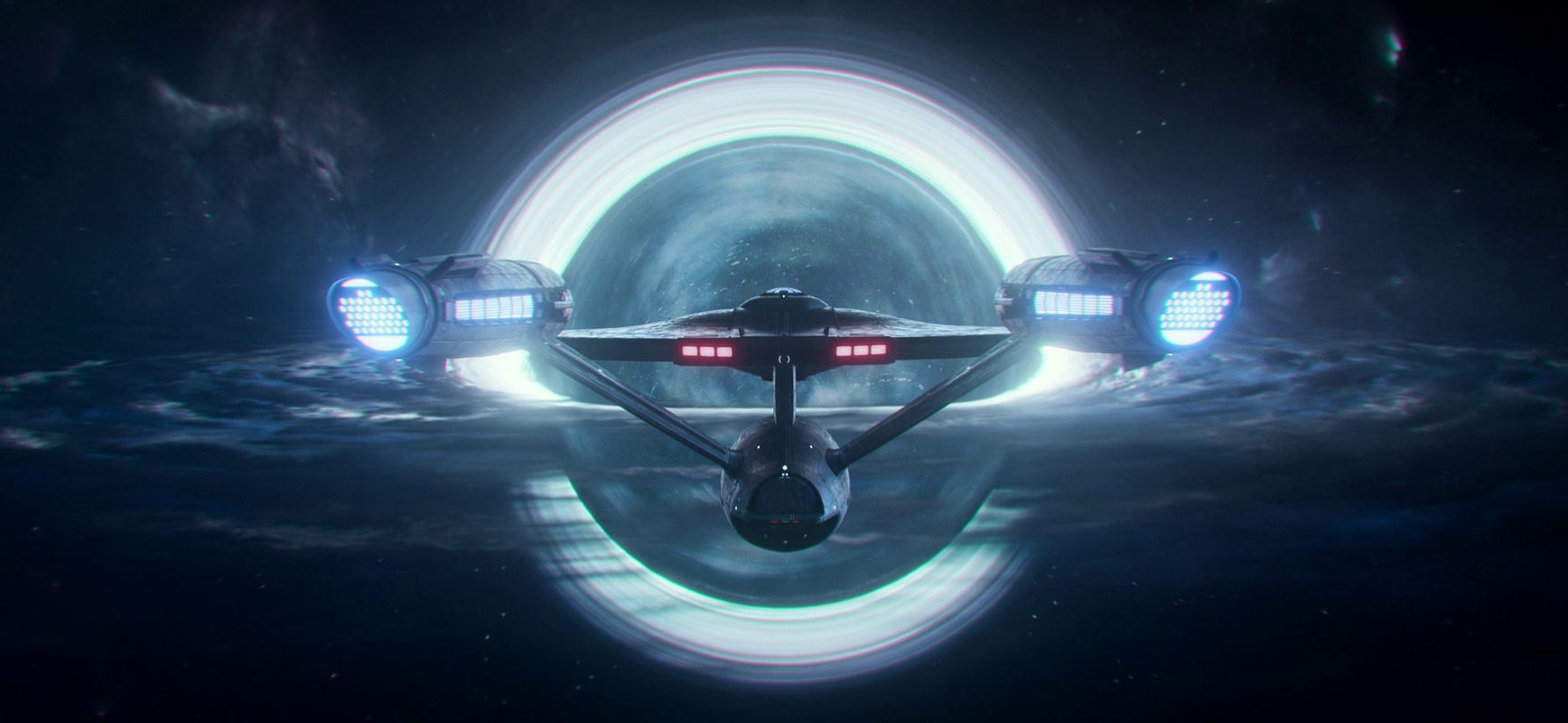
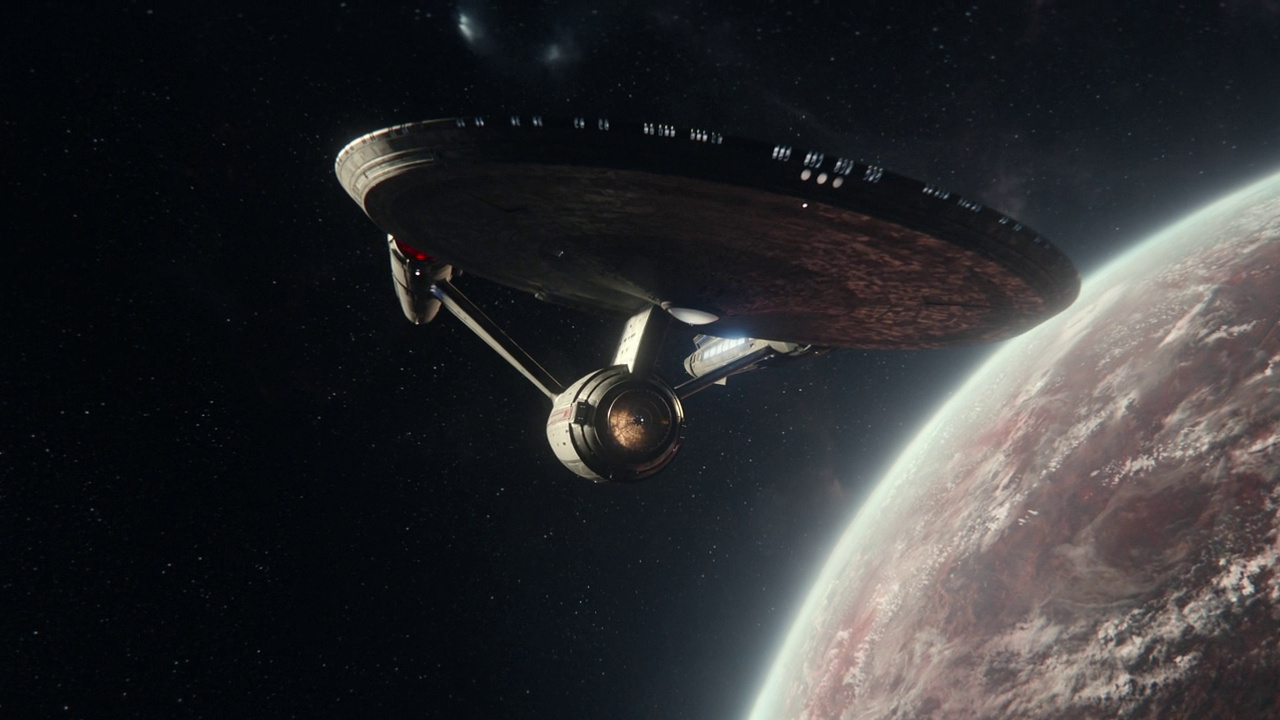
Still frame from Star Trek SNW 4x10 showing the Enterprise and a white hole
The Enterprise approaches a white hole.

But I guess we’ll have to dissect that in a longer article in the weeks ahead.

Time travel, time loops, and temporal paradoxes are far from my favourite storylines – either in Star Trek or in sci-fi more generally. So for me, of all people, to come away from Tomorrow’s Enterprise feeling that the episode took that narrative framework and built it up into a successful episode? That’s almost inconceivable!

Yet here we are: this rare unicorn of an episode managed to make a time travel plot work in a way that was understandable, but also intense, emotional, and just plain fun. There are a few nitpicks (and you know we’ll get into them as we go along), but overall? I had a really good time with Tomorrow’s Enterprise.
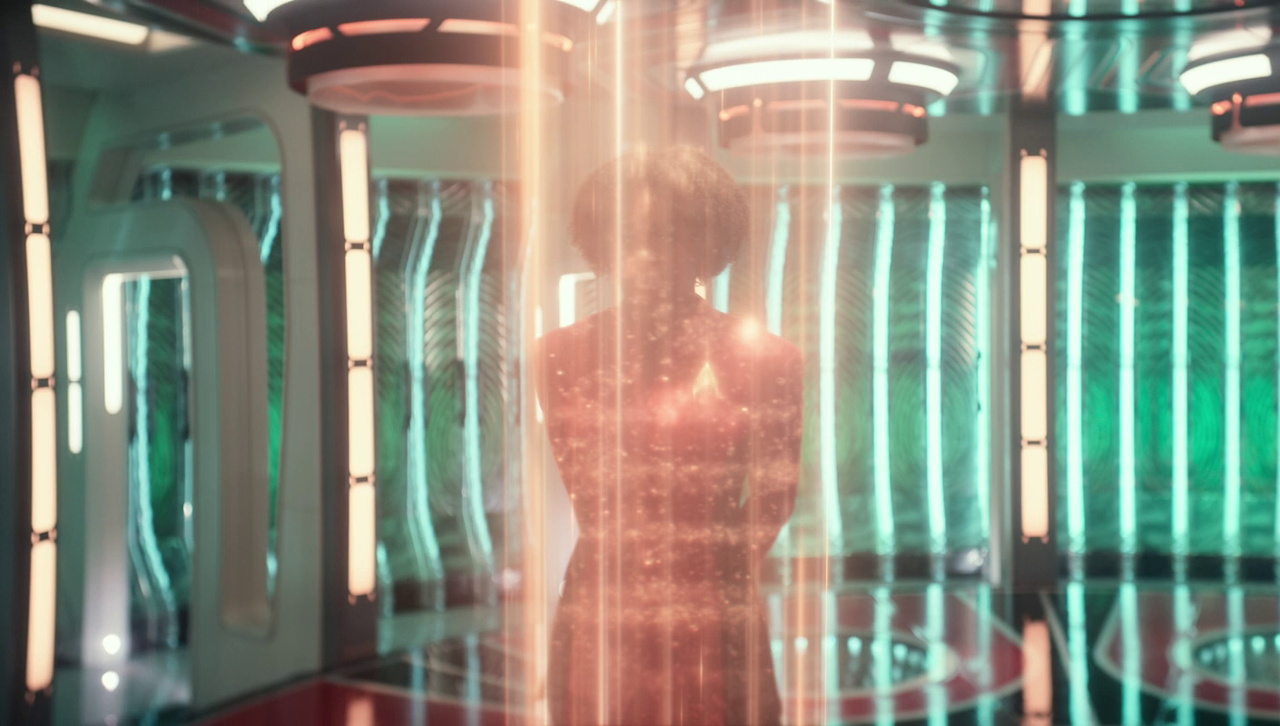
Still frame from Star Trek SNW 4x10 showing Uhura beaming in
Lt. Uhura beaming in!

Sometime after it was announced that Strange New Worlds would end with Season 5, we got news that the show had cast both Sulu and Dr McCoy for that final season – and when this time travel story seemed to take Uhura into her own future, I wondered whether we might catch a glimpse of either character. However, I think it was good that we didn’t see *even more* TOS characters in this episode in particular, given that they would’ve arguably been a bit of a distraction from the main plot as it followed the two different versions of Uhura. And I can also see why Strange New Worlds wouldn’t want to play *all* of its cards too soon! Keeping those characters in reserve for whatever roles they may have in Season 5 was a genuinely good call.

One thing I found odd, though – not just about Tomorrow’s Enterprise, but going back to Off-Hour and even (kind of) Like Chronitons Through the Hourglass, too – was Dr Boyce’s role. In The Cage (and The Menagerie), Dr Boyce was a confidant, friend, and somewhat of an unofficial counsellor to Captain Pike, and they seemed to have a pretty good relationship. Yet in both of his appearances this season – and when Pike was at his lowest ebb and in need of someone to talk to – Dr Boyce and Captain Pike weren’t even in the same room. They never spoke to each other, never interacted at all… and that’s just a bit of an oddity.
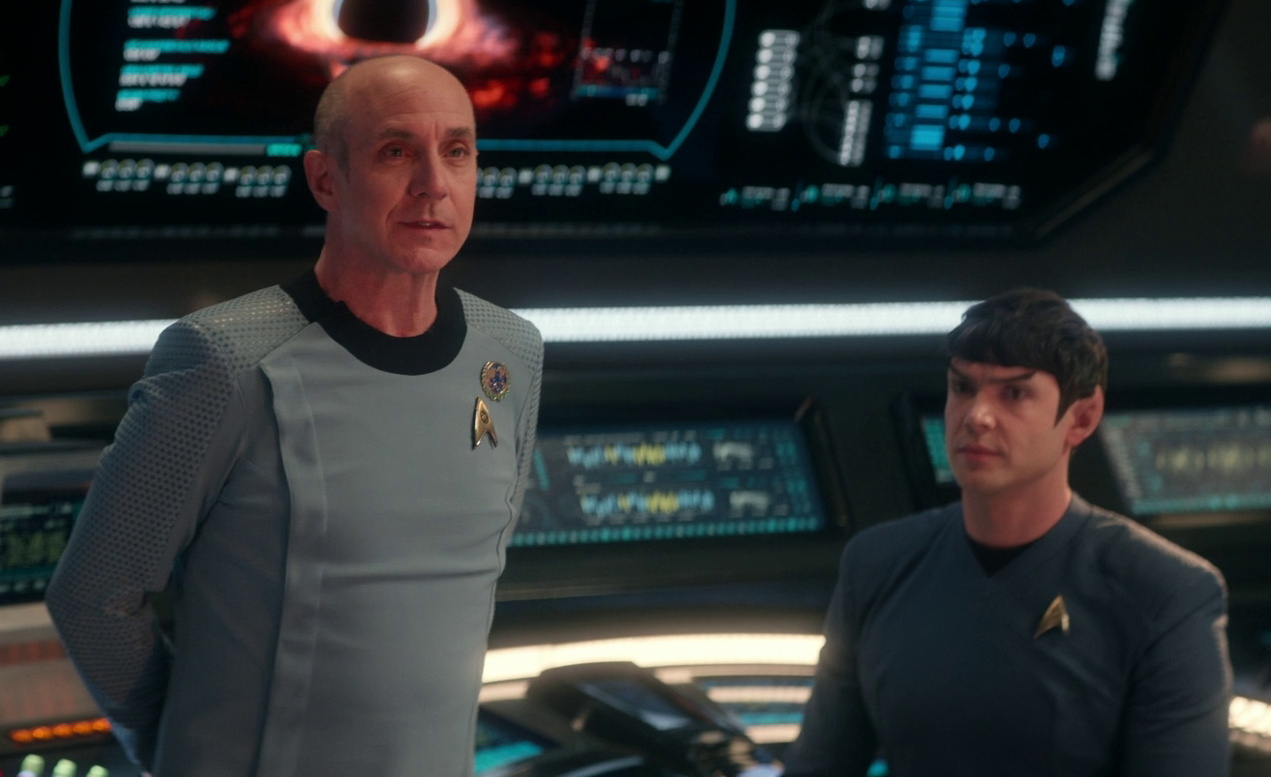
Still frame from Star Trek SNW 4x10 showing Boyce and Spock on the bridge
Dr Boyce with Spock.

I liked seeing Dr Boyce in action in sickbay this week, as well as learning that he had a previously-unseen role aboard Kirk’s Enterprise, at least in the early years of his command. That was neat – and I liked that we got a bit more of an expanded look at Kirk’s early days in command; the “crew transition,” as I think Scotty or Uhura called it at one point. But it still strikes me as odd that this Pike-centric character, one of the few characters from The Cage to come aboard Strange New Worlds after the series had been running for a while, got no screen time at all with Pike.

Now, that *could* come in Season 5, sure. But we only get six episodes next time – six episodes to wrap up the show, move characters along, potentially kill someone off (more on that in a second), and… will there be time for that? A sickbay storyline showing Dr M’Benga getting ready to leave the ship, Chapel wrangling with all of that, Dr McCoy coming aboard… where would a Dr Boyce-Captain Pike scene even fit?

Is it the worst thing in the world? No. But it’s… well, as I say, it feels odd.
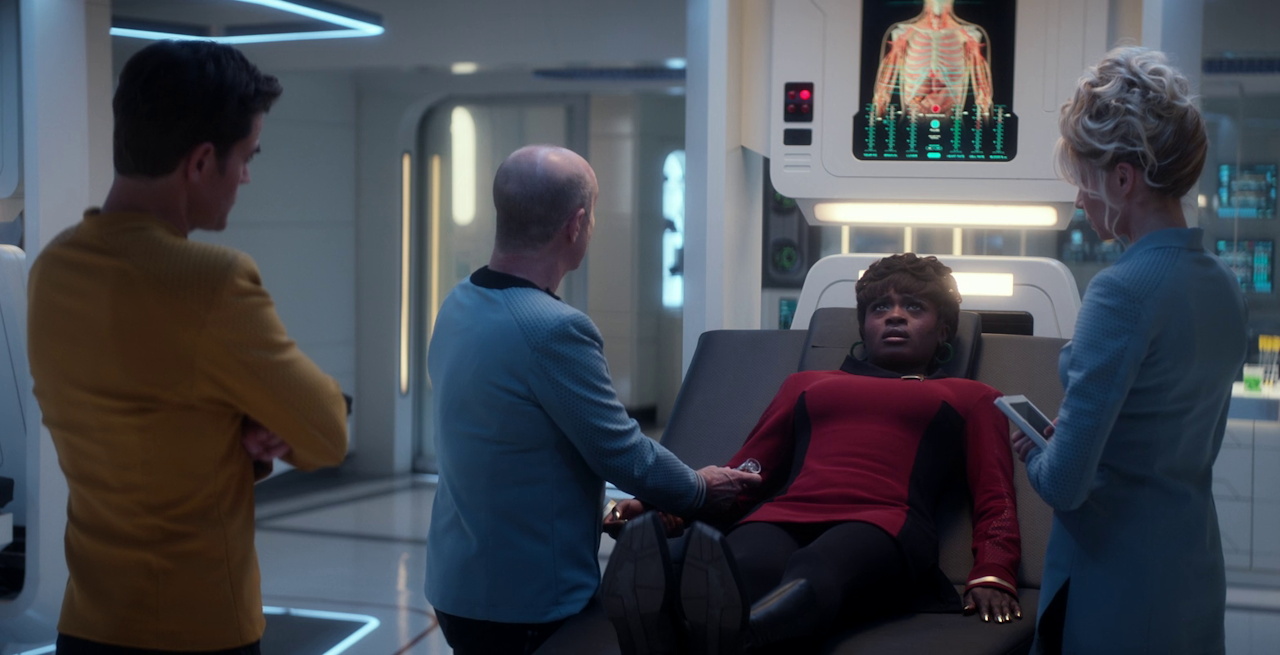
Still frame from Star Trek SNW 4x10 showing Kirk, Uhura, Dr Boyce, and Chapel at a bio-bed in sickbay
Uhura is being treated by Dr Boyce.

Last season, I said that the episode The Sehlat Who Ate Its Tail felt like a “backdoor pilot;” a pitch that the show’s producers and writers were making for their Year One spin-off idea, which would’ve focused on Kirk’s early days in command. That concept, by the way, is clearly not going ahead – something we’ve known for a while, but that was hammered home when the Strange New Worlds sets were torn down earlier this year. But that’s beside the point!

Tomorrow’s Enterprise – large chunks of it, anyway – felt like a second “backdoor pilot,” or, I guess… a “backdoor episode two?” That was *definitely* the sense I got from seeing Kirk in command, Ortegas, La’an, Una, and Dr M’Benga either gone or in the process of leaving, and the crew in that “transitional” state. I’m not sure that a time travel story like this was the best way to show off the potential in Year One as a spin-off, but I can absolutely feel the producers’ intentions in the way that side of the story was structured.

If you want to check out my thoughts on Year One in more detail, click or tap here. It’s a bit of a moot point now that the spin-off definitely ain’t happening… but it’s an interesting thought experiment nevertheless.
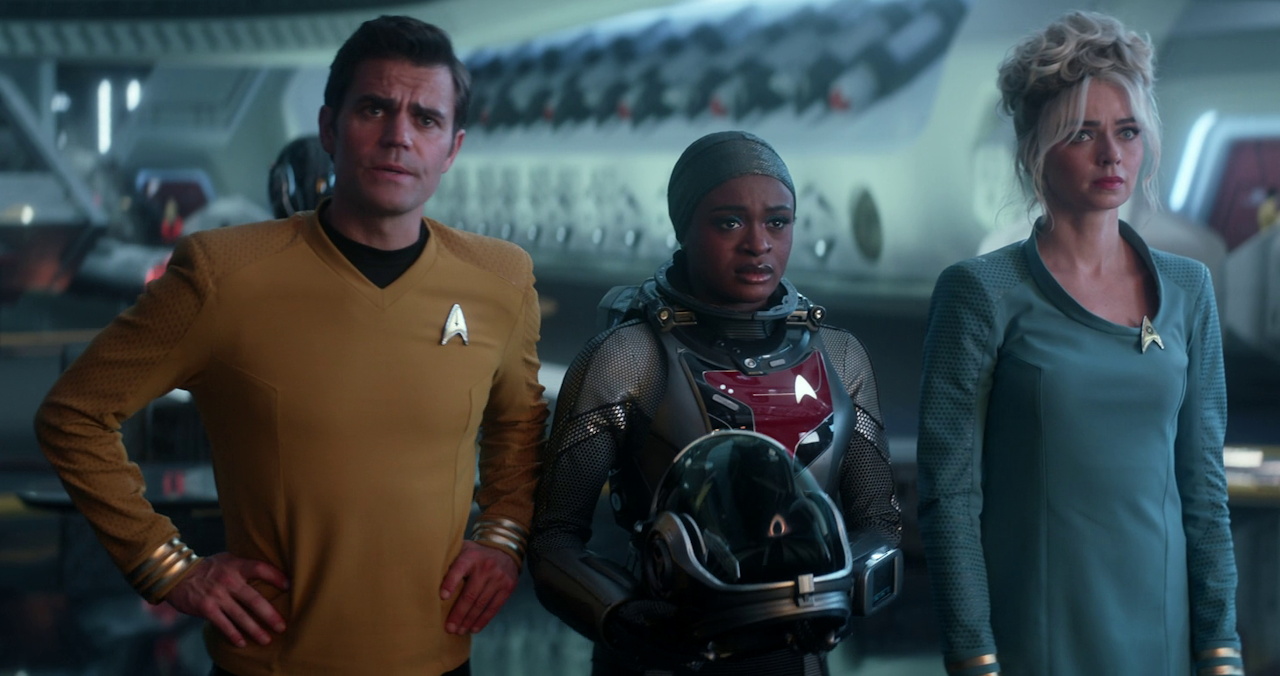
Still frame from Star Trek SNW 4x10 showing Kirk, Uhura, and Chapel in the shuttlebay
Did this feel like another “backdoor pilot” to anyone else?

However, dedicating so much time to two backdoor pilots – as well as other episodes and storylines that expanded upon or fleshed out TOS characters – has meant that we’ve spent less time with not only the show’s original creations, but also Captain Pike, Una, and Dr M’Benga, too. And Season 4 has massively accelerated that trend, with really only a couple of episodes where either Pike or one of the other non-TOS characters were front-and-centre.

Again, we’ll get into that in more detail on another occasion, but I think it’s worth keeping it in mind. As strong and as fun as Tomorrow’s Enterprise was, it came at the end of a season where not only the likes of Spock, Kirk, Scotty, and Chapel have all had major storylines and roles, but where Uhura herself got such an impressive spotlight just a couple of weeks ago that I literally said: “even if we never get to spend another second with Uhura (and I certainly hope and expect that we will, by the way!) we can now consider her character growth and prequel arc to be complete.”

That *is not* to call Uhura’s starring role this time in any way “repetitive!” It was nothing of the sort. But it is interesting – and a tad disappointing, I’m afraid – to see this trend in favour of TOS characters growing in strength as the series reaches its premature conclusion.
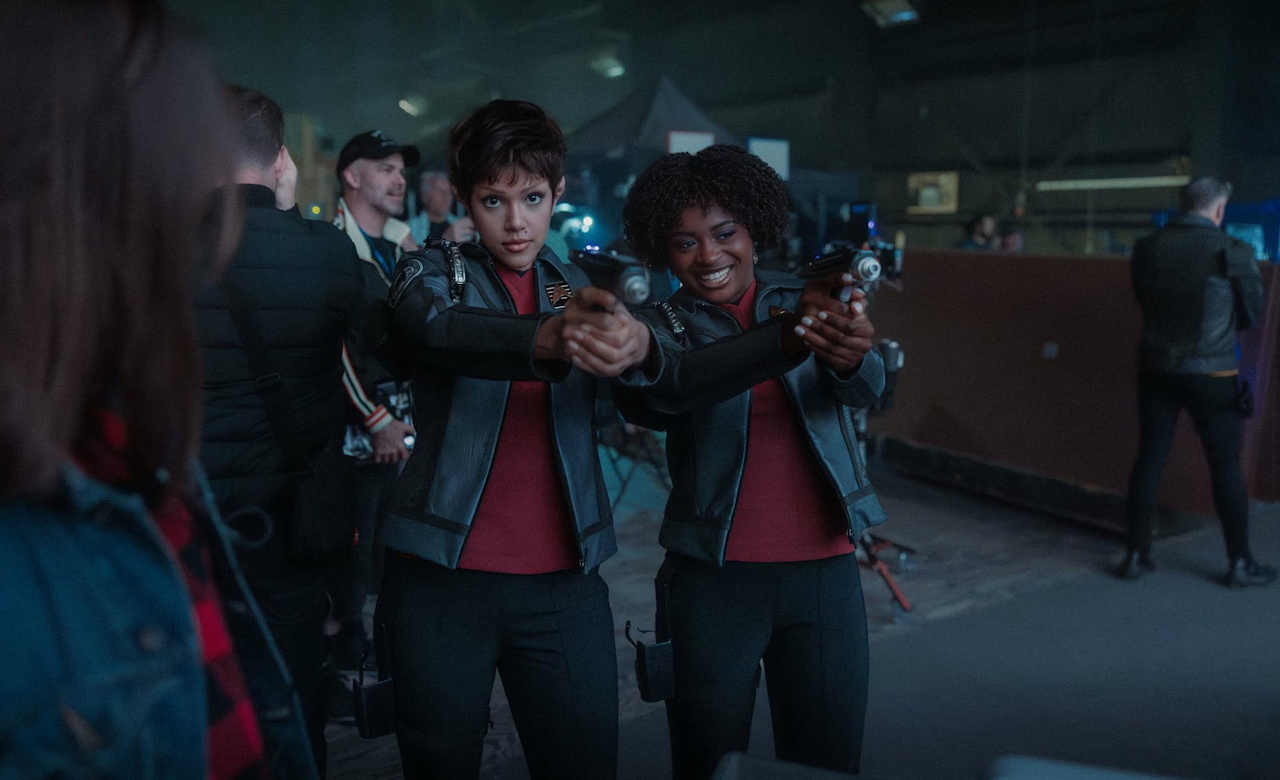
Behind-the-scenes photo from Star Trek SNW 4x08 showing Bianca Nugara and Celia Rose Gooding on set
Behind-the-scenes on the set of Orders of Magnitude with Celia Rose Gooding (R) and co-star Bianca Nugara.

In the episode Off-Hour, I said that Dr M’Benga was a strange choice of character for the story to place in mortal peril. Why? Because, as a recurring character from The Original Series – set years later – we know that Dr M’Benga is effectively “unkillable” in Strange New Worlds.

And I felt *exactly* the same way with this side of Scotty’s storyline this week.

I know that there was the relationship drama stuff between Uhura and Scotty that was meant to add an extra dimension to Uhura’s quest to save his life. We can argue the toss about how well that was set up, how much chemistry the characters and performers had, and whether it treads on the toes of “canon,” if you like, but I want to posit a much more fundamental point: Scotty was a stupid choice for this role in the story. Because he’s a TOS character – and a major one, at that – there was no way Scotty could be in real danger in Tomorrow’s Enterprise, and for me, at least, that put a serious dampener on how intense, emotional, and dramatic this otherwise well-scripted and beautifully-performed story was.
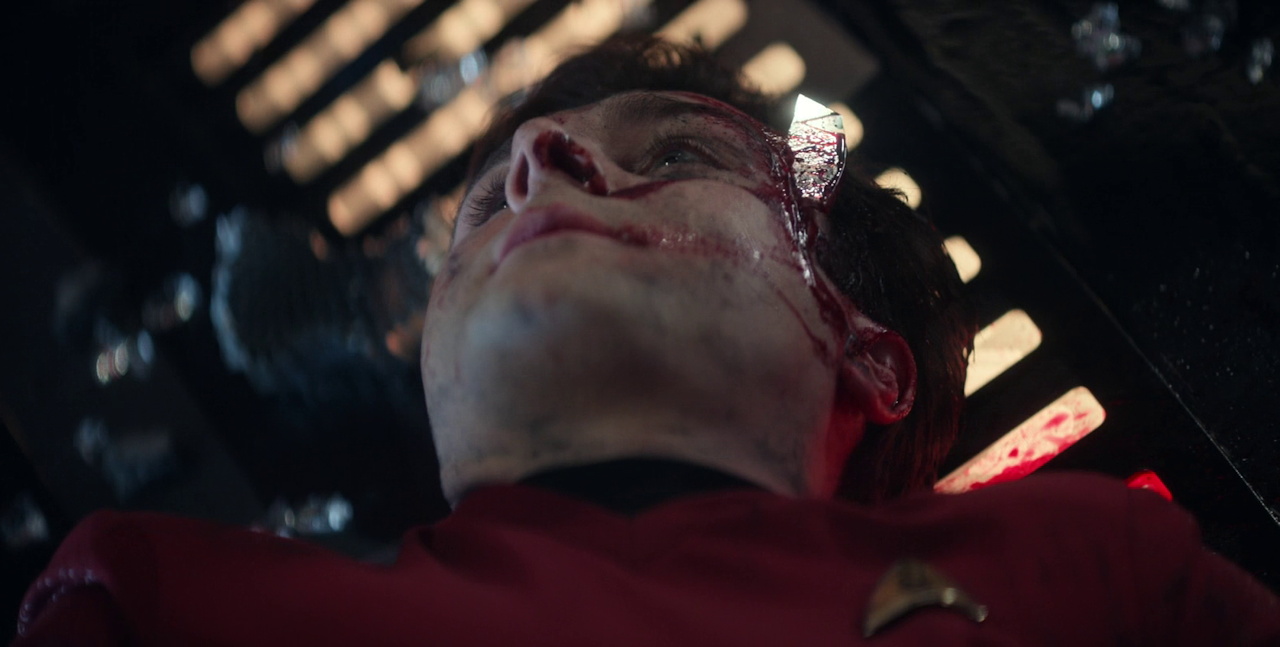
Still frame from Star Trek SNW 4x10 showing Scotty dead
Though I get why Tomorrow’s Enterprise put Scotty into this role, he wasn’t the best choice of character to endanger.

Breaking apart the two aspects of the story could’ve seen Uhura learning to “embrace the now” and say yes to Scotty’s advances while *also* actually saving the life of an unrelated character – a character like Ortegas or Una, perhaps, who genuinely would’ve felt like they were in danger. Or if (as I’ve repeatedly theorised) a character like La’an may not make it all the way to the end of the show… that could’ve been a final twist of the knife in a story like this one. Maybe the two Uhuras were able to successfully deliver the “space baby”… but couldn’t save La’an.

This is a trend we’ve seen this season. Strange New Worlds’ writers seem to be doubling-down on making the exact same mistakes in multiple episodes, and it leaves me more than a little anxious that the fifth and final season will have similar issues. Without being able to learn and take on board feedback (because Seasons 4 and 5 were in production before Season 3 even finished airing), there hasn’t been time for the production team to properly take stock of what worked… and what didn’t. As a result, we’ve seen several mistakes repeated, almost beat-for-beat, in multiple episodes… and this one – placing a functionally immortal character in danger of “death” – is just the latest example.
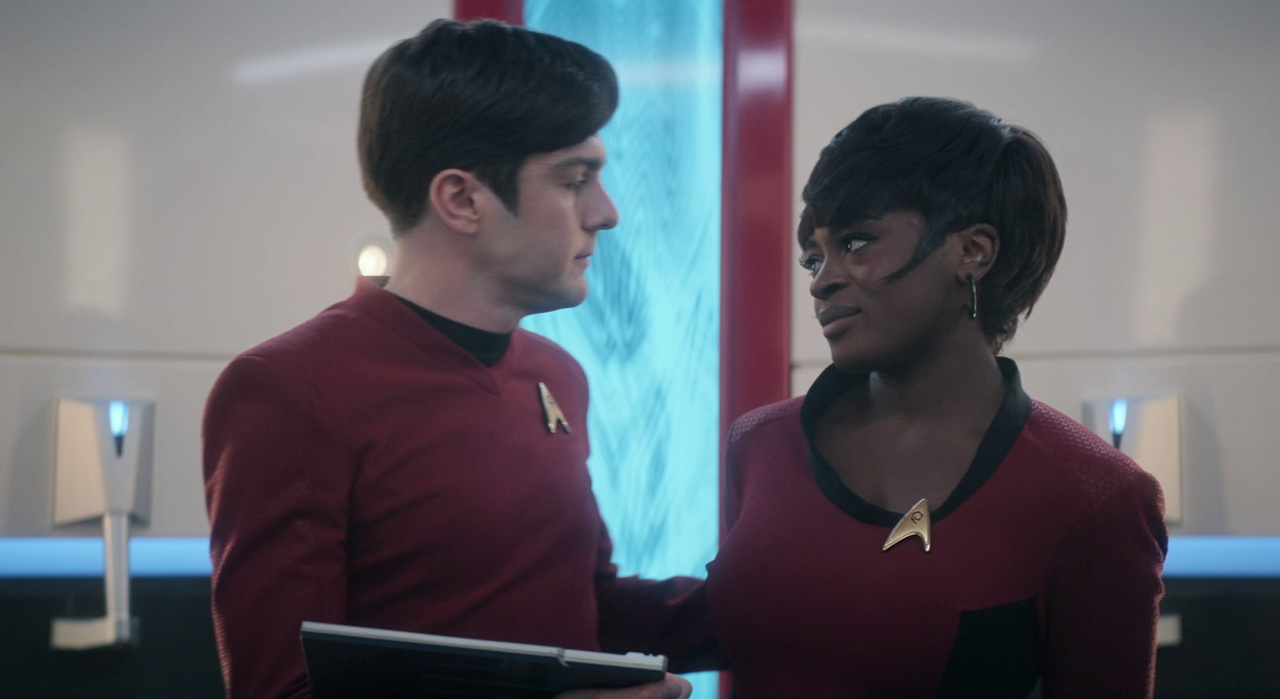
Still frame from Star Trek SNW 4x10 showing Scotty and Uhura in the turbolift
Scotty with Uhura.

And because this story could have worked just as easily if it were another character in danger… it just doesn’t make a lot of sense to me. Sure, Uhura and Scotty had their (brand-new for this episode) romantic sub-plot, and that *did* add to the tension when Uhura felt he was in danger of death. And I will also say that, in any work of fiction, the way the characters in a story respond to events can still be impactful even if we as the audience know something they don’t – like, in this case, that Scotty will definitely survive.

I don’t want to take away from Celia Rose Gooding’s excellent performance – taking on, really, two very challenging related roles!

But at the same time, because we know Scotty’s going to survive, *and* because this whole romance angle was completely new (and seemed to come from nowhere), there was a way to tell a very similar story without the prequel constraint. And if this was a one-off, maybe I’d feel a bit more lenient. But because Strange New Worlds literally made this exact same mistake just a few weeks ago with Dr M’Benga… well, unfortunately I think it needs to be pointed out.
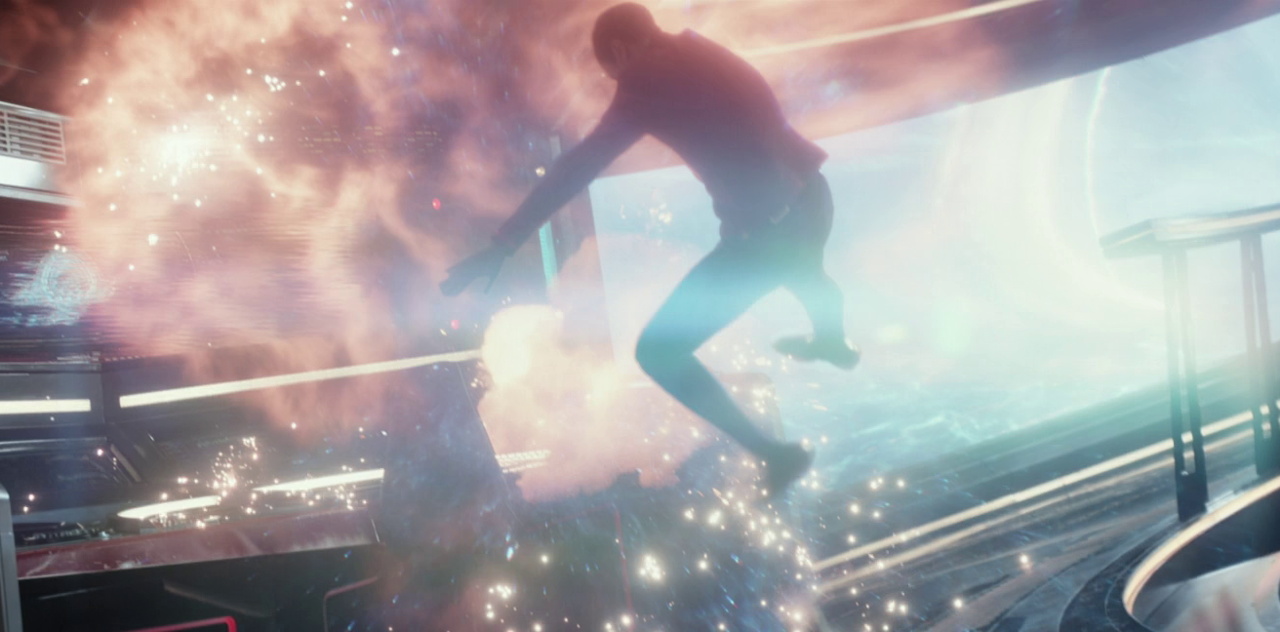
Still frame from Star Trek SNW 4x10 showing Scotty in an explosion
Kaboom!

Sometimes – especially this season – I’ve felt like some of the writers don’t seem to remember that they’re working on *a prequel* with the way certain character decisions were handled. Other times, of course, they’re almost *too* aware of that fact – and choose to place TOS characters into major roles! But with these Scotty and M’Benga storylines, and the way they repeat a simple mistake… I can’t help but feel someone, at some point in the production process, could’ve raised the red flag.

It didn’t “ruin” the episode, of course – and the way Uhura and other characters reacted to Scotty’s death did still stick the landing. But for me, as a long-time Trekkie watching the latest episode, the plain and simple fact that Scotty was always going to survive was inescapable, and it makes me wonder why another character wasn’t chosen for this “danger of death” story. Even if the outcome was beat-for-beat the same, it could’ve been a more engaging and entertaining ride if – on that first viewing, at least – we weren’t 100% sure if they were going to survive.
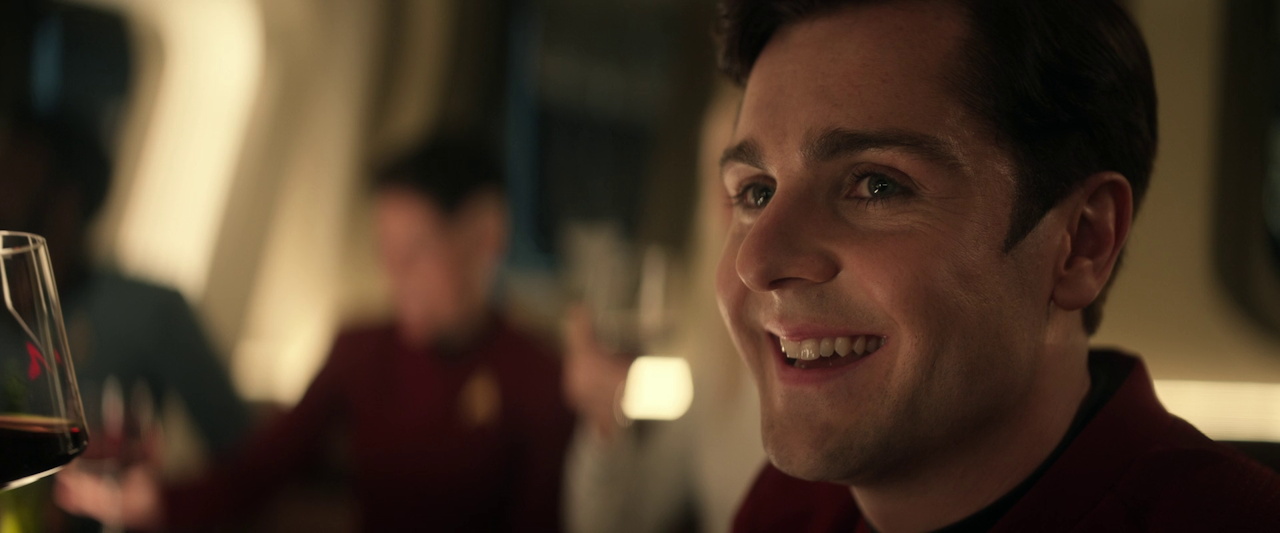
Still frame from Star Trek SNW 4x10 showing Scotty
Scotty at the end of the episode.

Sticking with the theme of characters surviving… what do we make of Kirk’s hesitation when asked about La’an? It felt too intense to be a simple misdirection on the part of the production team, didn’t it? But then again, given that La’an and Kirk might be on the verge of some kind of romantic relationship, Kirk could just as easily be upset about a bad breakup… so I guess there’s wiggle-room there, depending on what you want to believe! But either way, Season 5 owes us an answer as to why Kirk was so reluctant to talk about La’an.

I’ve said this before, but La’an remains at the very tippy-top of my “death watch” list ahead of Season 5. She may have survived the events of this episode, but the whole “latent augment DNA” angle that Season 4 introduced, as well as her absence from the Enterprise after Kirk assumes command, all lead me to believe that she may not be long for this world – and Kirk’s refusal to talk about that with a time-travelling Uhura *really* seemed to hammer that home. It could still be a red herring, of course, and I don’t *want* La’an (or any other main character) to be killed off! But I think at least one of the show’s original creations won’t survive past Season 5, and right now, if I had to guess? It would still be La’an.
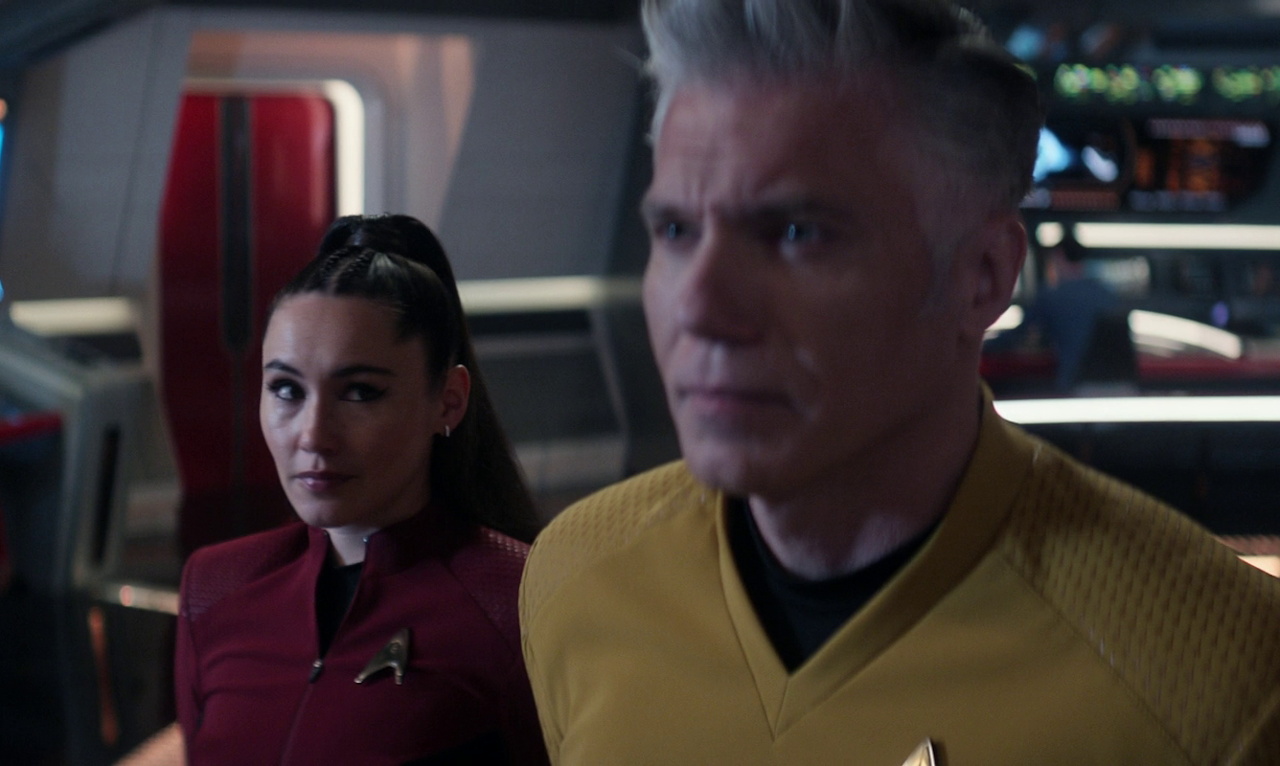
Still frame from Star Trek SNW 4x10 showing Pike and La'an
Do we reckon La’an survives to the end of Season 5?

Tomorrow’s Enterprise is now the *third* episode of Season 4 in which the events we see on screen either didn’t happen at all or aren’t going to be remembered by most of the characters involved. We had the irredeemably awful writing failure of “but it was all just a dream” in Level-Five Transporter Accident, then Trelane’s meddling in Like Chronitons Through the Hourglass, and now it turns out that only Uhura will remember what transpired – and several key events were literally undone – in Tomorrow’s Enterprise.

As I said above: the show is doubling- and tripling-down on some… odd choices.

This week’s episode is so much stronger than those other two examples that it almost feels unkind to compare it to them! But I think it’s worth pointing out, as we consider how this episode fits in with the rest of the series, that we’re now at three out of ten episodes – just within Season 4 – where events we saw as the audience either didn’t happen at all or aren’t going to be remembered by most of the characters. I’d *happily* erase both Level-Five Writing Accident and Like Chronitons Through the Hourglass, and I think if neither of those episodes had existed, this aspect of Tomorrow’s Enterprise would be a complete non-issue. But coming at the end of a season where two other episodes have had stories that won’t actually be remembered by the characters involved (or just outright didn’t happen)? It’s another place where I feel the series repeating itself, at the very least.
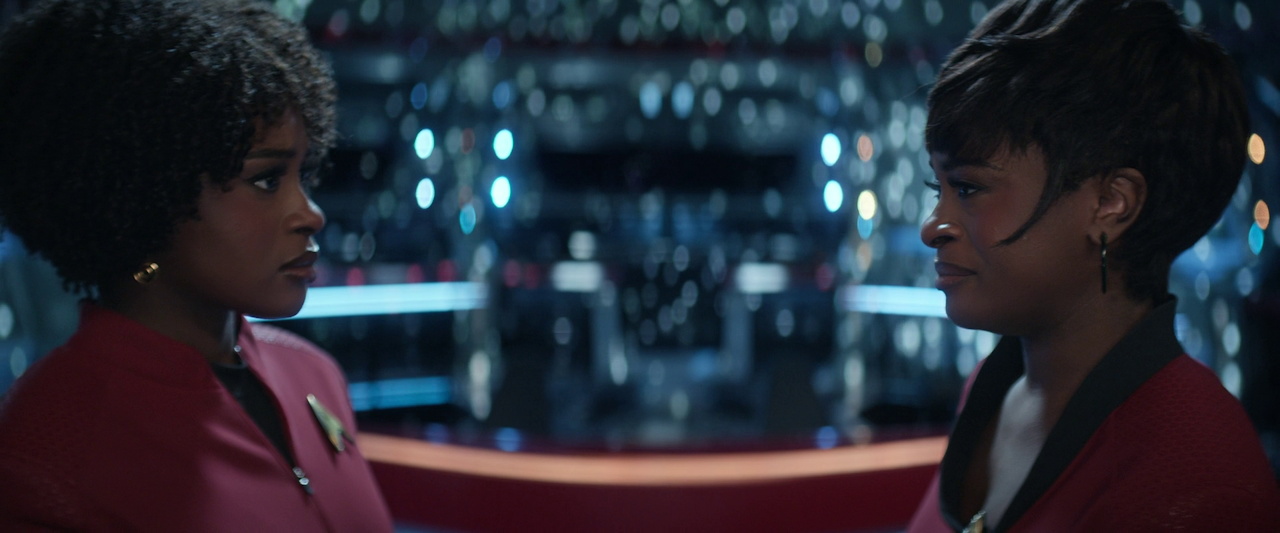
Still frame from Star Trek SNW 4x10 showing two Uhuras
For everyone except Uhura… none of these events happened.

Tomorrow’s Enterprise went out of its way to really lean into TOS’ 1960s style for all of its time-shifted characters, and I really enjoyed the way they looked. Hairstyles changed – very obviously for the likes of Chapel and Uhura, but subtly for the likes of Scotty, too – and we saw uniforms directly inspired by The Original Series, too. It was great to see Strange New Worlds embracing the idea that fashion and hairstyles can change over time – just like they do in the real world – and make an attempt to bridge the gap between this series and TOS in a way that felt natural.

One of the silliest criticisms of Discovery, when that show was announced, was how “out-of-place” it looked, from a visual standpoint, compared to TOS. And I would guess some folks will have said the same about Strange New Worlds, too. But for me, I was really never bothered by the aesthetic changes, and I don’t think it’s a stretch to say that things like fashion, hairstyles, uniforms, and so on change and evolve over time. The fashion of the ’70s was very different from that of the ’80s – at least here in the west – and even if we don’t notice at the time, because things just look “modern” or “normal,” trends stick out like a sore thumb after some time has passed! I just don’t think it’s much of an issue at all to say that similar trends and changes take place within the Star Trek galaxy, and I appreciate Strange New Worlds acknowledging and leaning into that idea.
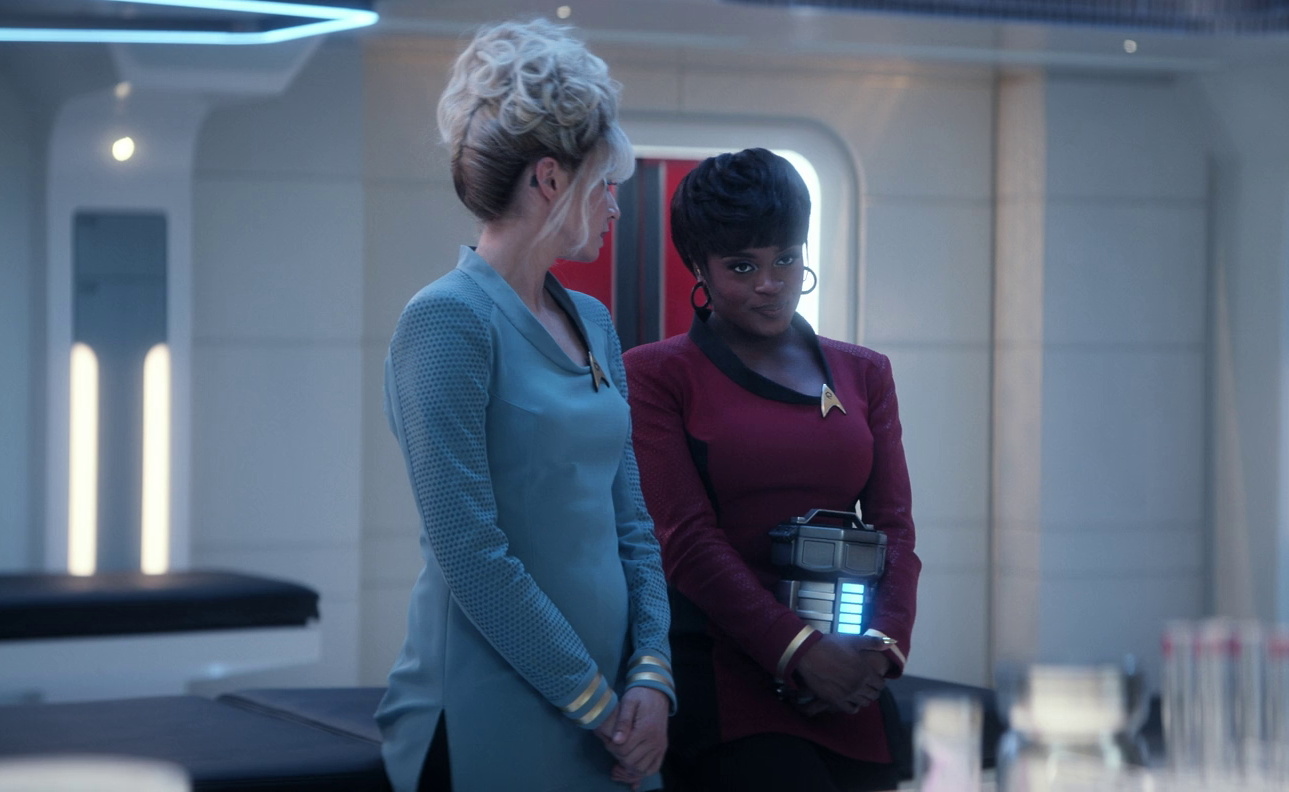
Still frame from Star Trek SNW 4x10 showing Chapel with Uhura
There were some great costumes (and hairstyles) in this week’s episode.

I would extend that compliment to the performances, too. Martin Quinn, Celia Rose Gooding, Ethan Peck, Paul Wesley, and Jess Bush all honed or refined their performances to draw even more heavily on the original incarnations of their characters – and it really showed.

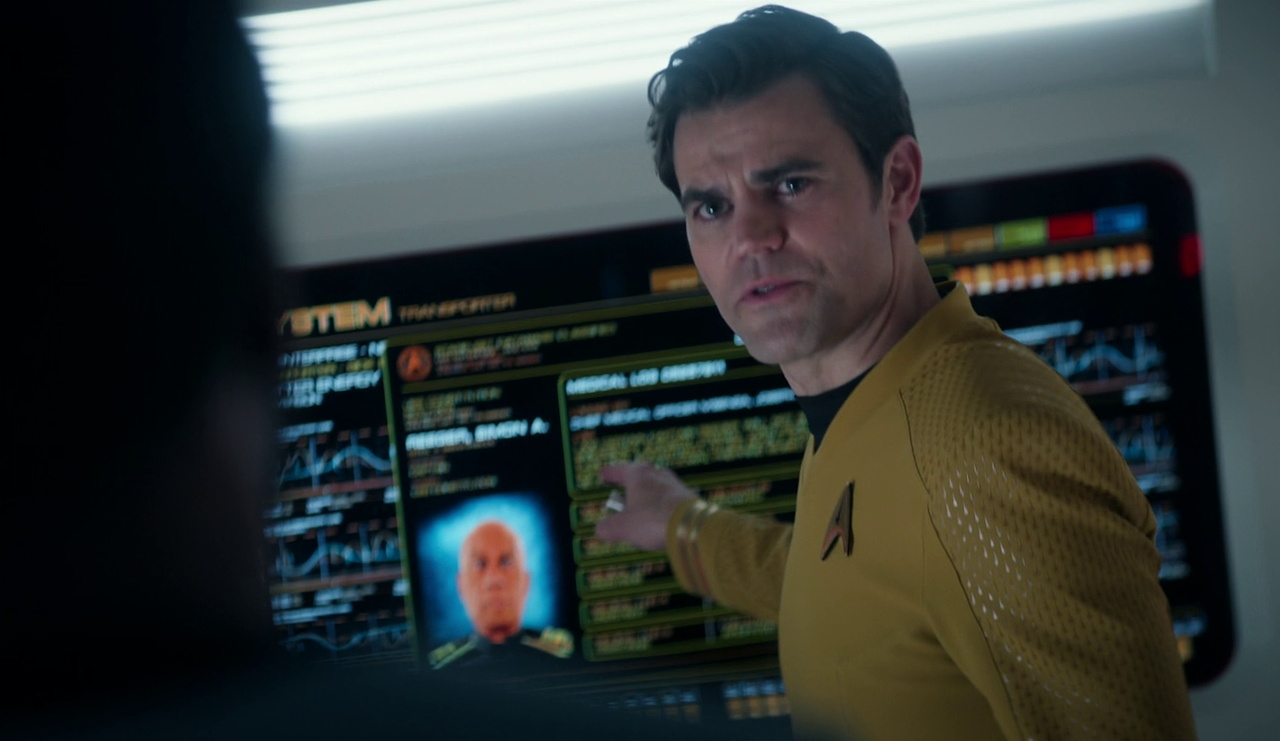
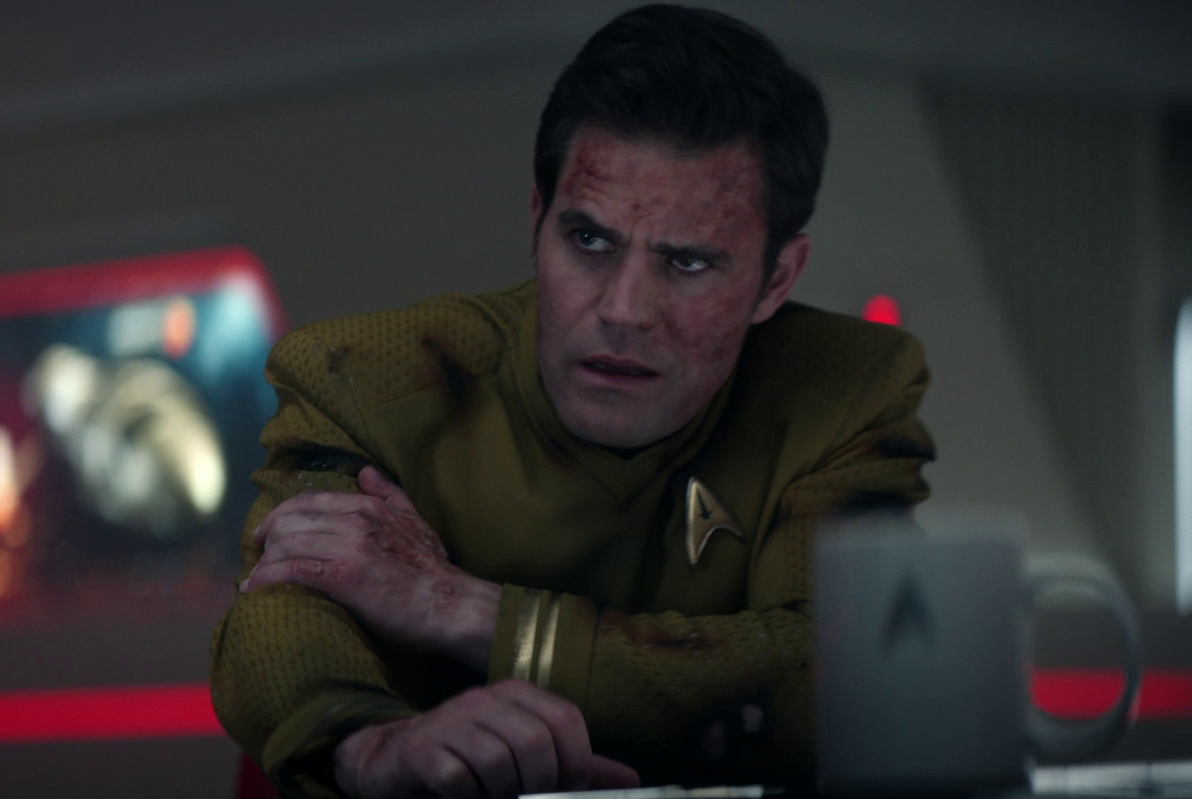
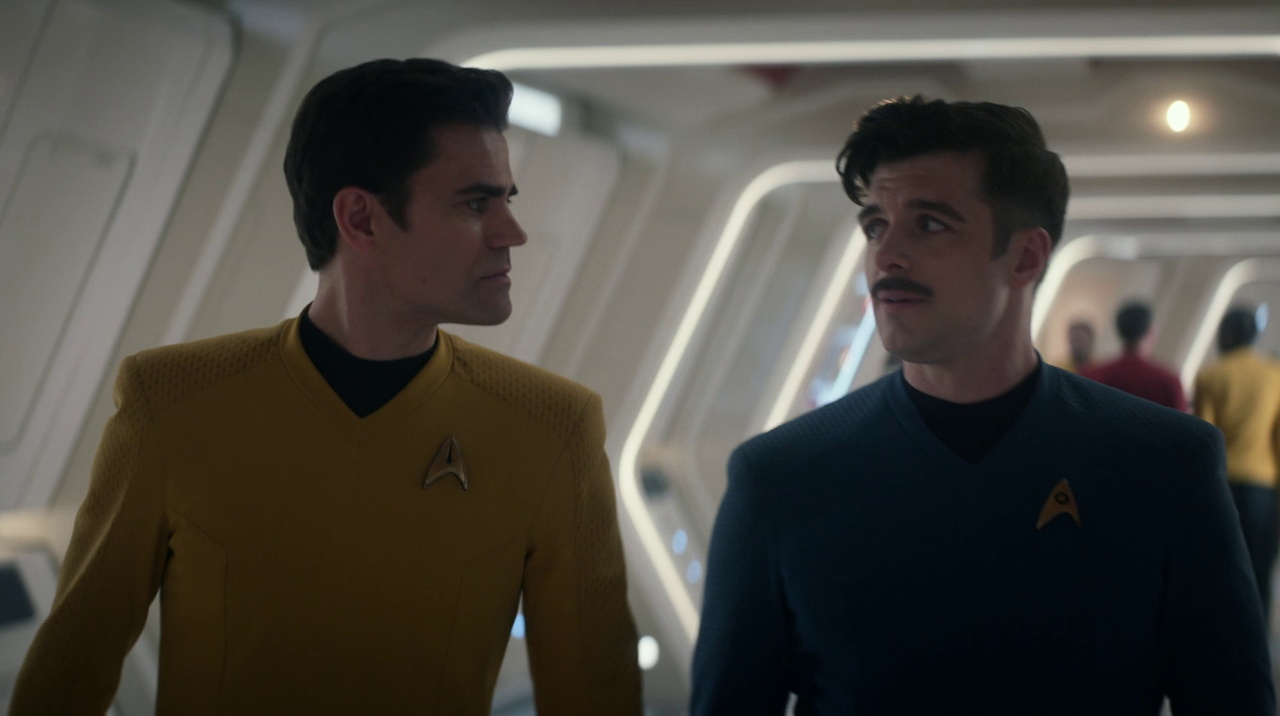
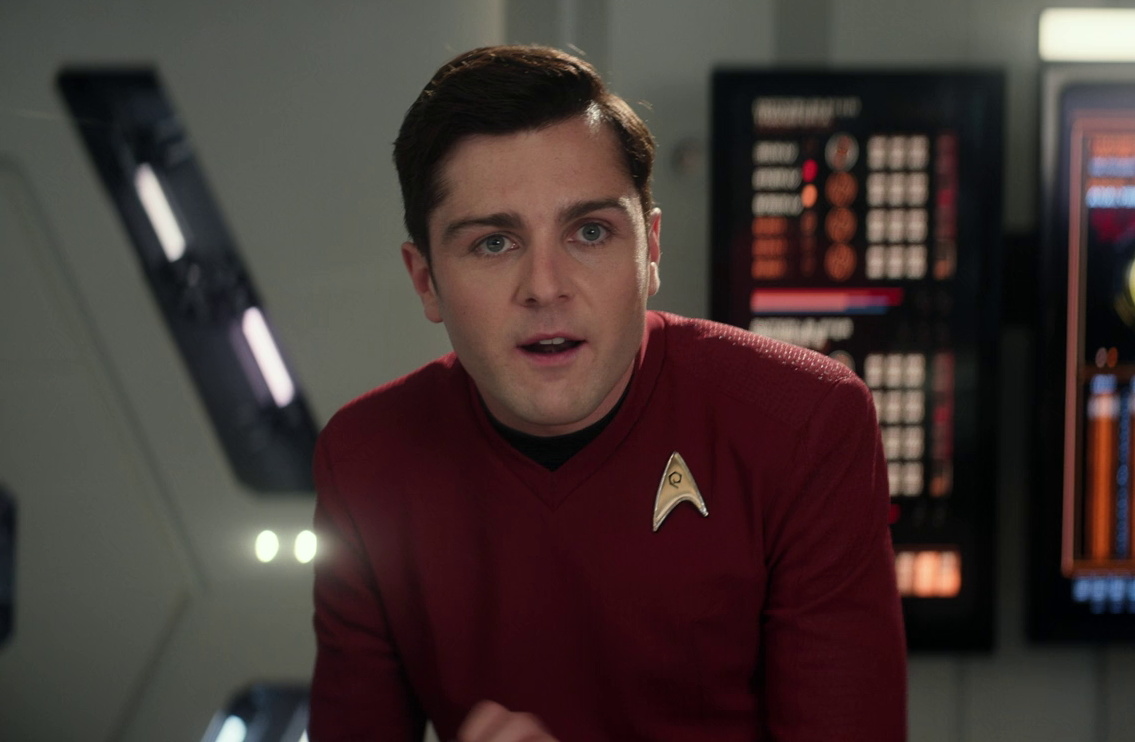
Paul Wesley has been great as Kirk, and I wouldn’t have said his performance really needed much alteration. But in Tomorrow’s Enterprise, I really felt that Wesley was leaning even more on William Shatner’s original (and iconic) portrayal to take his version of the character even closer to that TOS presentation. The same was true of Martin Quinn with Scotty; you could see the way he stood, the way he held himself, and how he was almost channelling his inner James Doohan! Celia Rose Gooding had the most time on screen (and we’ll talk about her split role with both Uhuras in a moment), but she was also excellent. Jess Bush also worked hard to bring Chapel even closer to the way she felt in TOS, as did Ethan Peck with his short scenes as Spock.
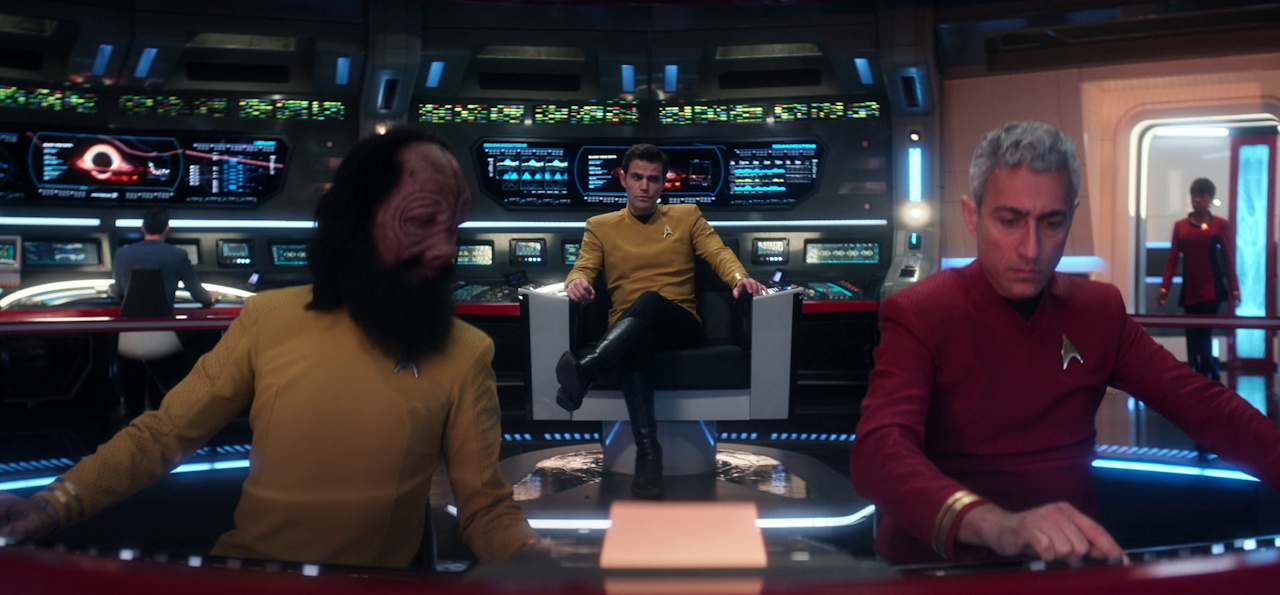
Still frame from Star Trek SNW 4x10 showing Kirk in command on the bridge
Kirk in command.

Tomorrow’s Enterprise also had a great score – which, again, felt like a bit of a throwback to TOS in some places. In fact, I half-expected to hear the familiar ending theme from The Original Series when the episode’s credits rolled! There was still a modern edge to some of the music; I don’t mean to say that it was identical to something you’d have heard in the ’60s. But, more so than any other Strange New Worlds episode, at least this season, it felt more “classic,” more of a throwback. And I really liked that.

The visual effect of the black hole (and the “white hole” on the other side) was solid. We’ve seen black holes using this Interstellar-inspired look in modern Star Trek before, so in that sense it wasn’t unique, and it wasn’t as stunning or spectacular as if it were brand-new. But as the episode’s main CGI creations, it was important to get the black and white holes looking right – and I’m happy to say that they looked great.
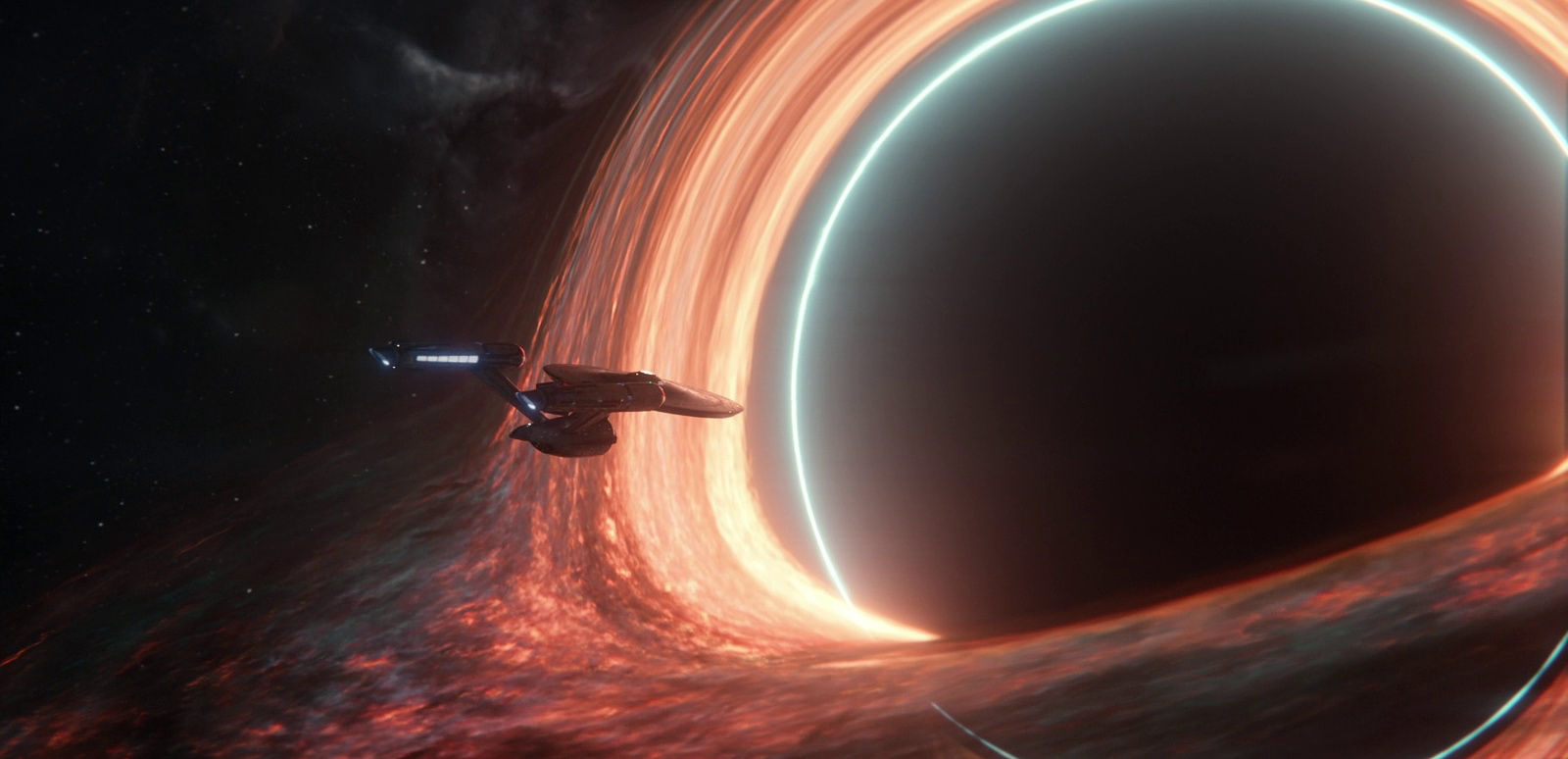
Still frame from Star Trek SNW 4x10 showing the USS Enterprise and a black hole
The black hole.

After a couple of places earlier in the season where I felt the AR wall hadn’t been used especially well, I also want to credit Tomorrow’s Enterprise for its well-constructed shuttlebay set. The AR wall worked really well as part of this set, and the shuttlebay felt as large and expansive a space as it needed to. The shuttlebay isn’t always going to be an area where we’ll spend a ton of time, but it’s important that it should feel large enough for its purpose, and I liked the way it came across this week.

There were also some creative physical props and costumes: did you notice Aleek-Om and M’Ress? I *adored* the way they looked, and while it’s not officially confirmed that the Caitian and Aurelian we glimpsed in the episode are the characters from The Animated Series… I mean, they were clearly meant to be, right? I always love seeing Caitians in live-action, so to catch a glimpse of M’Ress was just really neat.
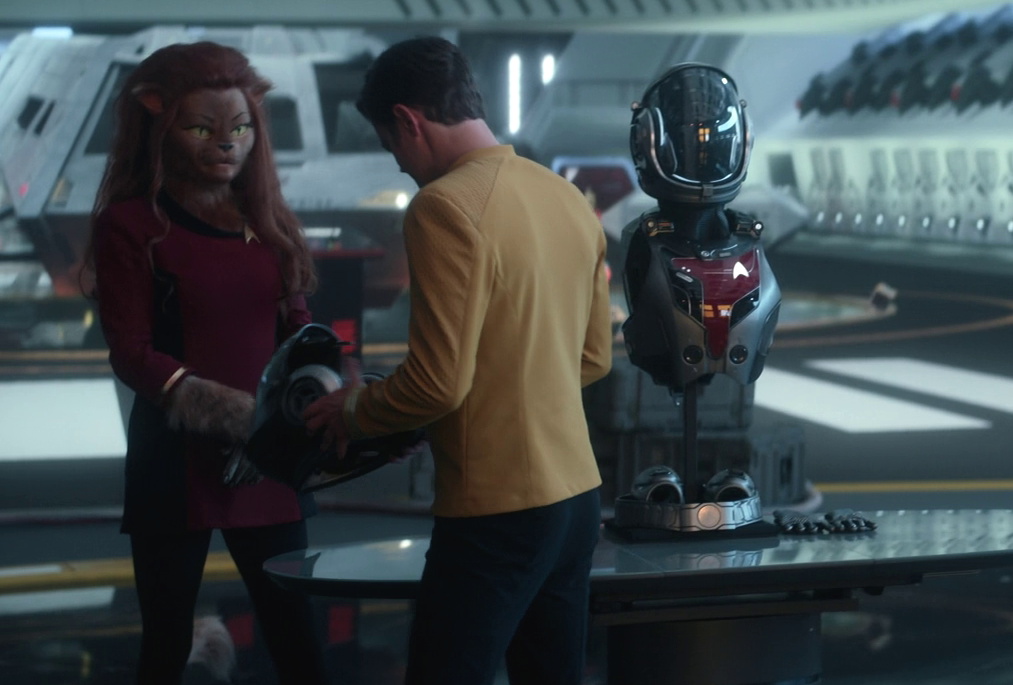
Still frame from Star Trek SNW 4x10 showing Kirk with a Caitian officer (maybe M'Ress?)
Kirk with a character I assume is M’Ress.

Sticking with cameos: did you hear Kirk mention Gary Mitchell? Mitchell was a character from the episode Where No Man Has Gone Before, which showed his transformation into a powerful entity after an encounter out in space. It was neat to get a mention of Gary Mitchell, of course, but what was even more fun was how he was connected to Jenna Mitchell – a new character created for Strange New Worlds and who we’ve seen on the bridge a few times in earlier seasons.

Cameos like these go a long way to helping Star Trek feel like a cohesive, connected setting – and while modern Star Trek hasn’t always done a good job with that, I can appreciate the effort being made here to connect Strange New Worlds to The Original Series, The Animated Series, and the TOS movies. These felt like little “Easter eggs” for long-time Trekkies like us, and even if it might’ve been fun to get a whole episode focused on Caitian or Aurelian characters, I enjoyed the cameos for what they were.
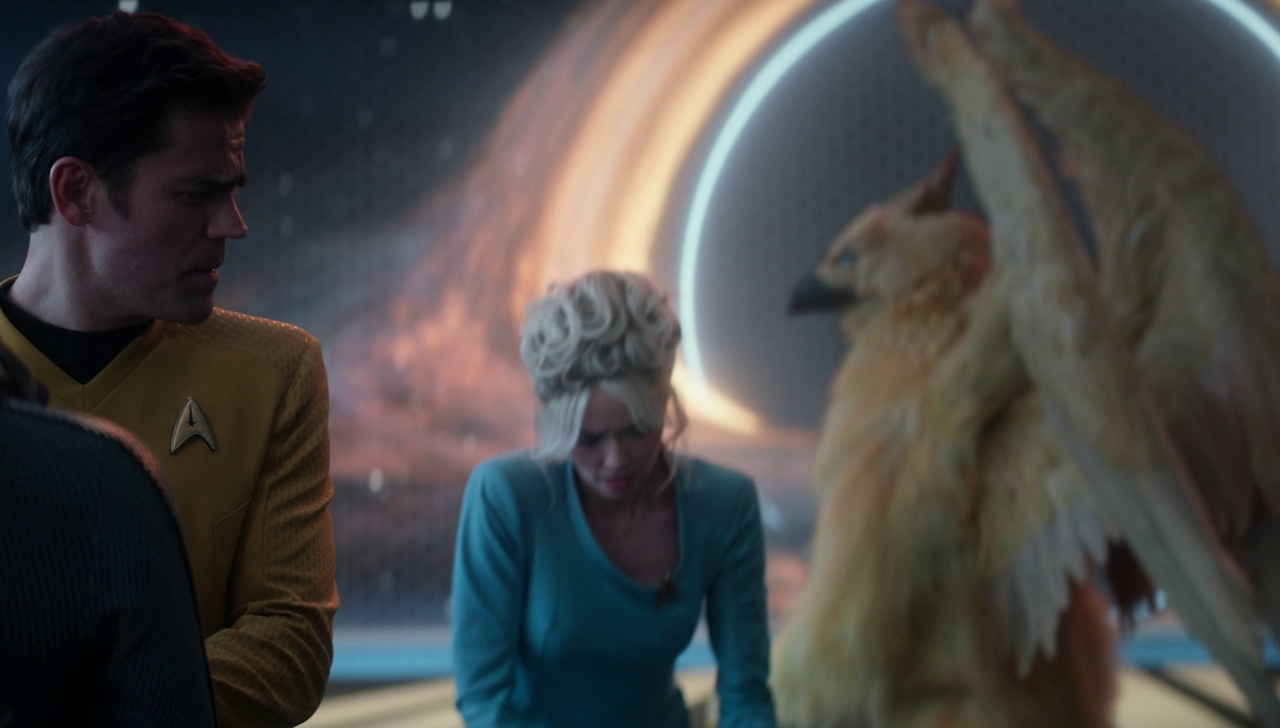
Still frame from Star Trek SNW 4x10 showing Kirk, Chapel, and an Aurelien (maybe Aleek-Om?)
This winged character is an Aurelien – perhaps Aleek-Om.

Did you feel echoes of The Next Generation’s finale, All Good Things, in the way that time seemed to flow “backwards” between the black and white holes? Because I certainly did!

Now, the two storylines are not really comparable in lots of other ways – and I really liked the idea of Uhura in the past setting up things that Uhura in the future would be able to use. We saw this with the dilithium diamond, Spock’s equation, and the mural recording the music. That was an incredibly creative way for a time travel/temporal paradox story to use its key narrative feature in a way that made sense – and in a way that most Star Trek stories dealing with similar ideas have never really done.

In All Good Things, to pick on that as an example, Picard was able to move between three different time periods, but actions he took in one seemed to have no effect on the other two. And in Past Tense, from Deep Space Nine’s third season, actions in the past *did* have a negative impact on the future, but not for our main characters. These differences help Tomorrow’s Enterprise stand apart even from superficially similar time travel stories – which is fantastic!
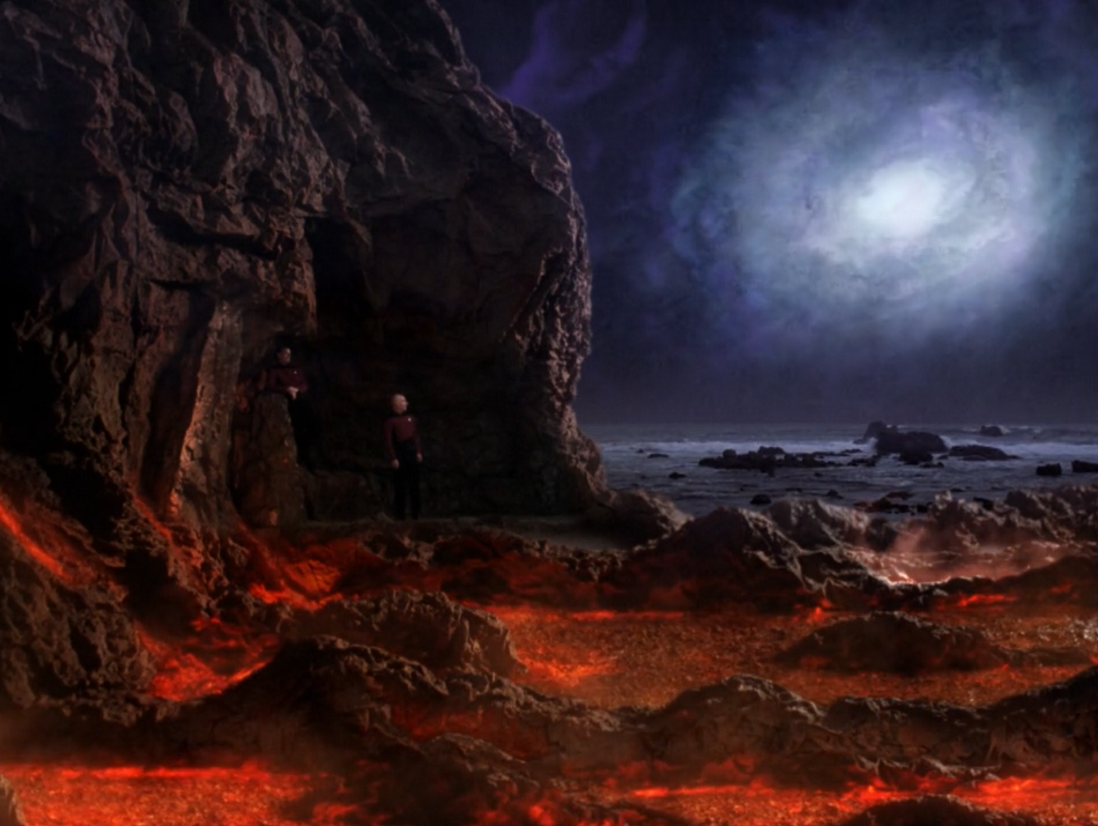
Still frame from Star Trek TNG All Good Things showing anti-time in the past
All Good Things’ anti-time eruption.

It was also a really creative idea to have one character split into two time periods, having to solve this puzzle from both ends. The way that time travel was integral to solving the mystery was handled just brilliantly, with Uhura from the future guiding her past self, and eventually setting up important things that would pay off a year later. But more than that, we got two different takes on Uhura – one that was, perhaps, a tad regressive and closer to her presentation in earlier seasons, and one that was very definitely trying to lean into the calm confidence of Nichelle Nichols’ character from TOS.

Last week, I talked about how Christina Chong took on a complex acting challenge – playing two different roles that had to come together. And Celia Rose Gooding stepped up to the plate this time to do something similar. Playing a younger version of a beloved character in a prequel is *already* a tough ask, so having to take on a version of Uhura who’s even closer to that familiar TOS presentation is even more of a challenge.

And Celia Rose Gooding nailed it.
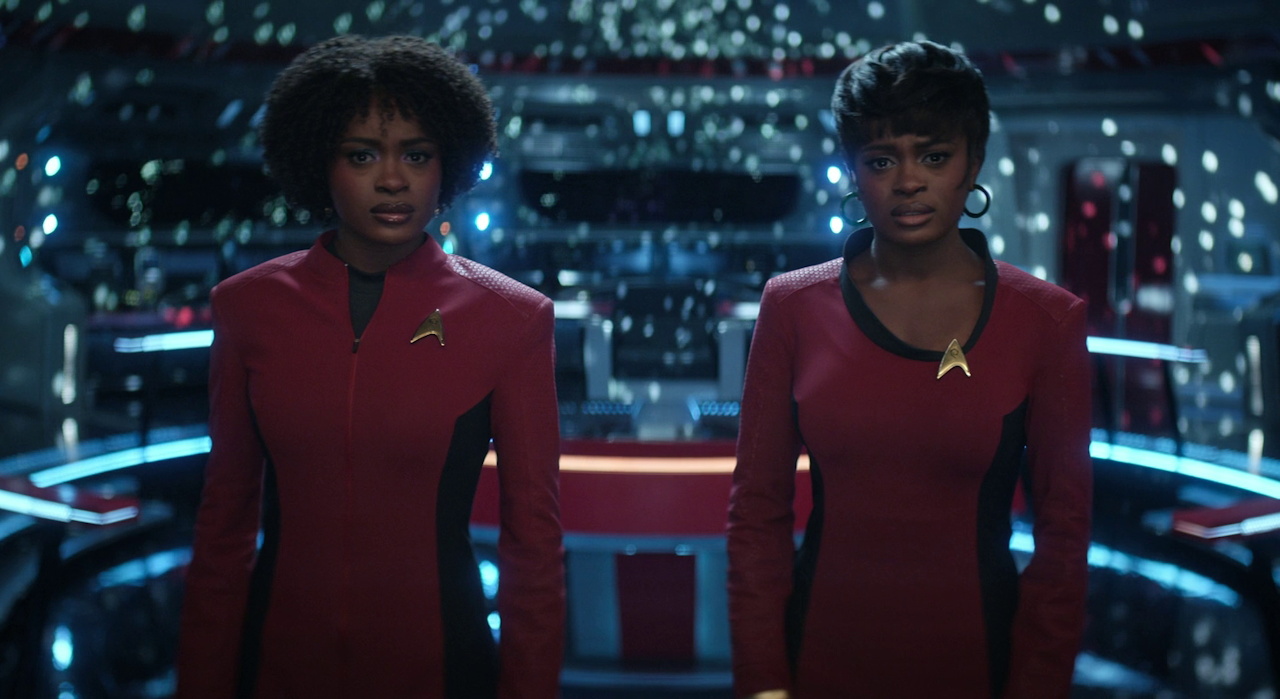
Still frame from Star Trek SNW 4x10 showing two Uhuras
A pair of Uhuras.

There’s a line to walk when differentiating two versions of the same character, and I don’t just mean costuming and hairstyles – though those did serve as important visual cues for us as the audience. In order to buy into the fact that one Uhura was older than the other, Tomorrow’s Enterprise played up – and, perhaps just a tad, exaggerated – these differences, and it worked well most of the time.

The only thing I’d say about that is that I felt maybe there was a bit more than just one single year’s worth of changes in between past and future Uhura. These were balanced between the two characters about as well as possible – with the younger version seeming to take a step back to become less secure and confident, and the older version becoming even more mature – which was a good call. And in a single episode of television, I think asking for too much subtlety would’ve lost something important; if both characters felt functionally the same, a big part of the episode’s core would’ve been lost.

But if Tomorrow’s Enterprise had been set, say, three years into the future instead of just one? Maybe it would’ve worked just a bit better!
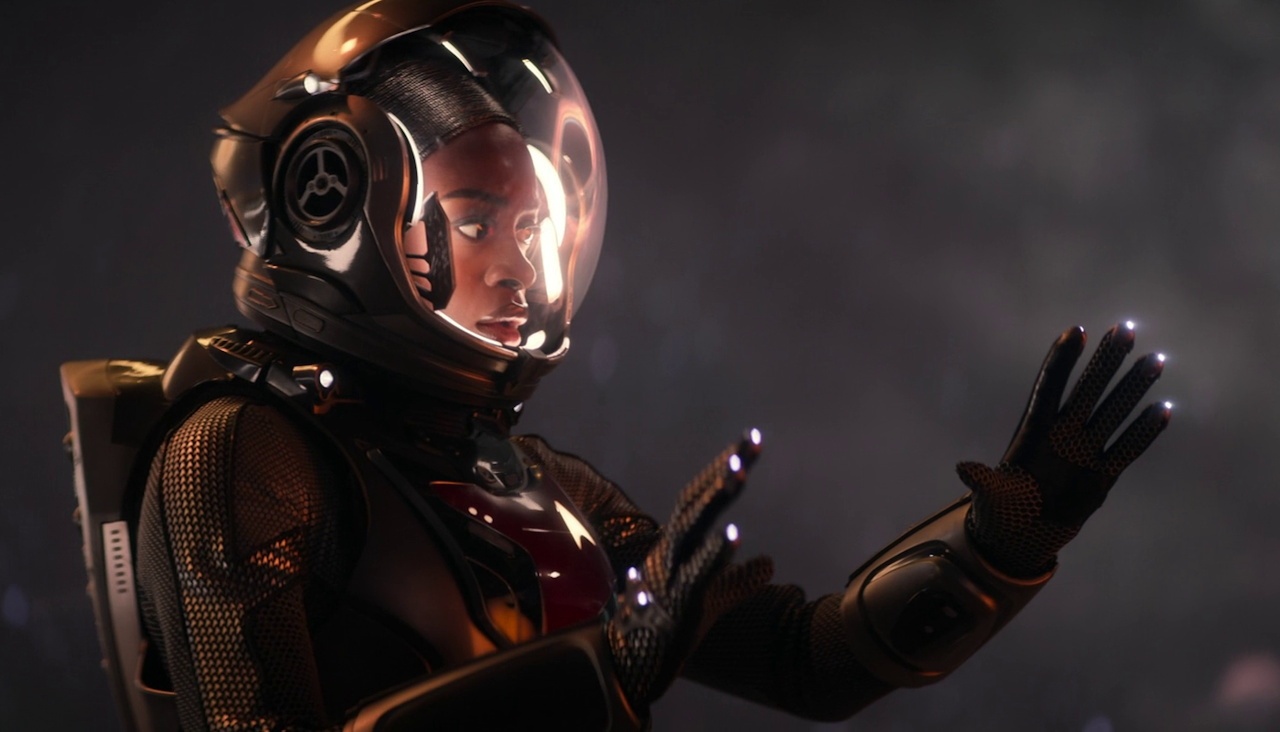
Still frame from Star Trek SNW 4x10 showing Uhura in an EV/space suit
Uhura jumped approximately one year into the future.

A longer time-jump could’ve also accounted for things like Ortegas’ apparent promotion – all the way from Lieutenant up to Captain, if Spock’s statement in the transporter room was accurate. Such things have happened before, of course, and Ortegas is an instructor rather than a starship commander… but even so. It was also interesting to see that Pike had been promoted not to “Fleet Captain,” as in The Menagerie, but to the full rank of Admiral. I wonder if that’s setting up a plot point that Strange New Worlds will revisit in Season 5… or if it was just a throwaway line.

To get back to Uhura, though, I stand by what I said after Orders of Magnitude: she’s gotten by far the best and most complete prequel arc on the series, taking her from a fresh-faced, uncertain cadet in Season 1 to now the literal embodiment of Nichelle Nichols’ character as of the end of Season 4. The way Uhura was written this time was pitch-perfect, the way Celia Rose Gooding was able to amplify different parts of the characters to sell the illusion of there being two temporally-displaced Uhuras was fantastic, and at every stage, Tomorrow’s Enterprise absolutely excelled as an Uhura spotlight episode.
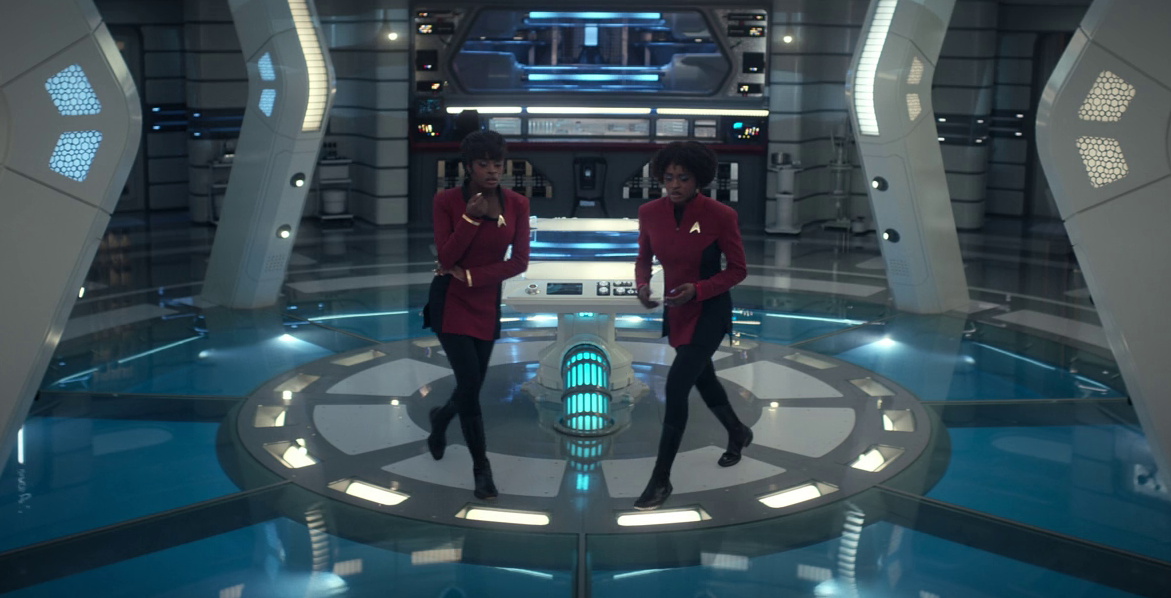
Still frame from Star Trek SNW 4x10 showing two Uhuras
We got two different – but related – takes on Uhura.

At first, I thought that Uhura was a bit of an odd choice to get a second major turn in this kind of role, coming just a couple of weeks after her excellent outing in Orders of Magnitude. But I can see the merits in putting a character like that into this kind of story – and it really did work incredibly well. Given where the episode wanted to take its time jump, with all of the TOS theming, it realistically demanded a TOS character to move between the two different eras, so Uhura was a great fit.

There was also the question of the black hole aliens’ transmission: as the Enterprise’s communications officer, Uhura was best-placed out of anyone in the crew to decipher this strange, musical message. I felt echoes of Season 1’s Children of the Comet, which had a similar musical influence, and was Uhura’s first major spotlight in Strange New Worlds, but these stories unfolded differently enough that neither treads on the toes of the other.
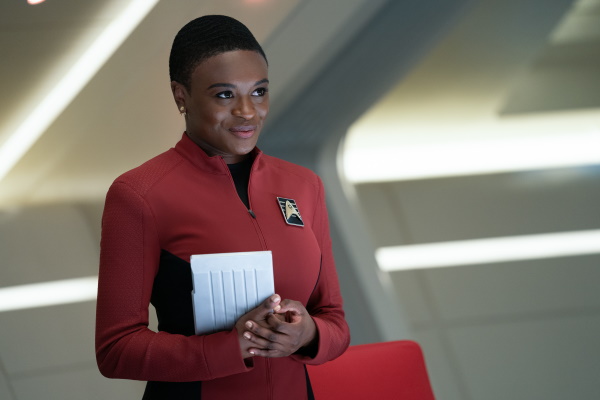
Promotional still from Star Trek SNW 1x03 showing Uhura
The musical side of the story reminded me of Season 1’s Children of the Comet – also an Uhura spotlight.

One thing I felt wasn’t particularly well set up was Scotty’s interest in a romantic relationship with Uhura, and her reaction to it. Obviously Scotty and Uhura have spent *some* time together over the past couple of seasons… but can you call to mind a moment between them in either Seasons 3 or 4 that might’ve so much as hinted at something like this? Because I can’t – and that put the brakes on this, at least for me.

I mean no disrespect to either Martin Quinn or Celia Rose Gooding, but I didn’t really feel much chemistry between their characters in Tomorrow’s Enterprise, either. Given that their relationship came from nowhere at the beginning of this episode, with absolutely no setup earlier in the season, we needed to feel *something* from the characters themselves to sell this. And while it wasn’t cringe-inducing or bad in any way, I just didn’t think it felt like a natural development for either of them. If anything, Scotty’s time on screen this season could’ve built up to some kind of crush on Ortegas, and Uhura, at least in Season 3, seemed to go back-and-forth a bit with Ortegas’ brother, Beto.

I just wasn’t feeling the spark, I guess, between these two established characters.
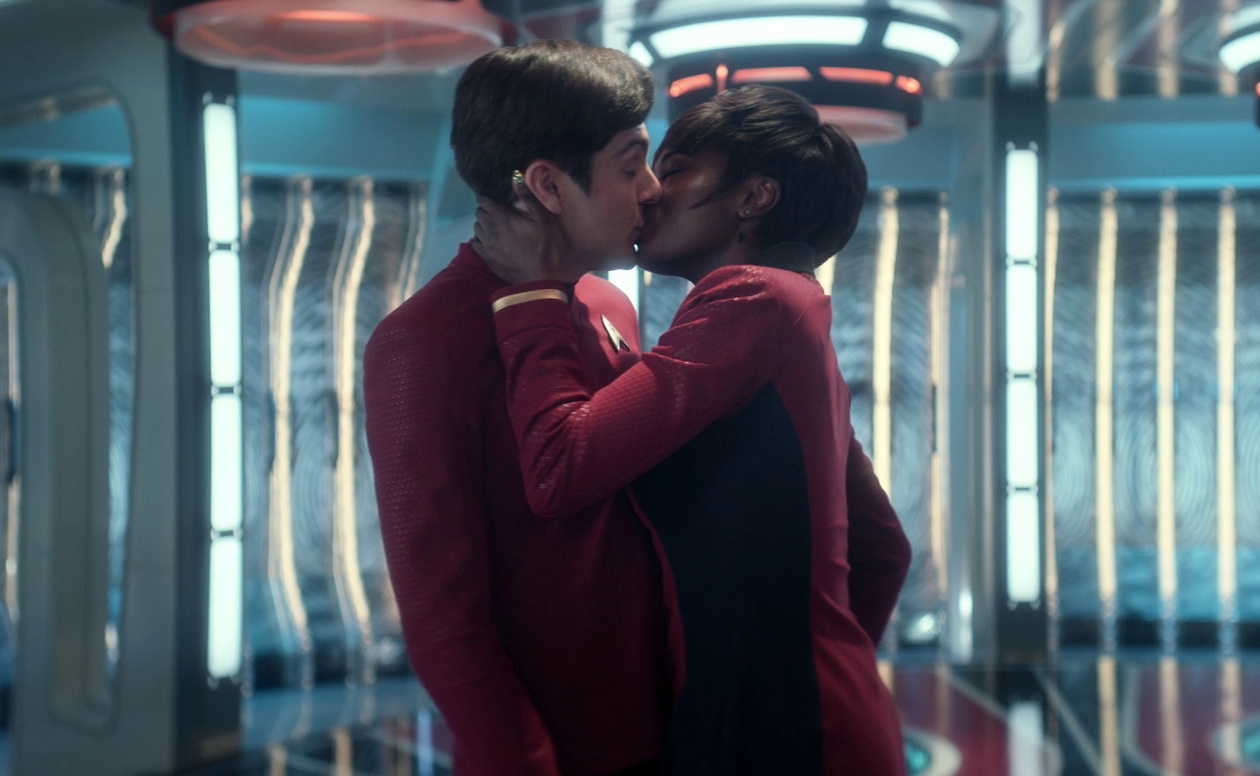
Still frame from Star Trek SNW 4x10 showing Uhura and Scotty kissing
Kissy kissy.

However, I’m not gonna argue that Uhura and Scotty having some kind of “casual” relationship or fling in the years before TOS is in any way a problem for “the integrity of canon!” All that’s required is to say that Scotty and Uhura had a moment, and that moment passed. People can get out of relationships and still remain friends or close colleagues, and I really don’t think that this is in any way a “canon-breaking” moment for either of them.

So this aspect of the story served a narrative function insofar as it gave Uhura more of a reason to want to save Scotty. Did Uhura need that extra motivation? Personally, I’d say “no,” and given that these two characters didn’t actually have much on-screen chemistry, *and* the aforementioned “prequel problem” meaning that Scotty never actually managed to feel like he was in real danger… I could’ve lived without it. Or, at the very least, I might’ve preferred it if the relationship stuff was limited to Uhura learning the key lesson of her arc: that sometimes it’s okay to “live in the now.”
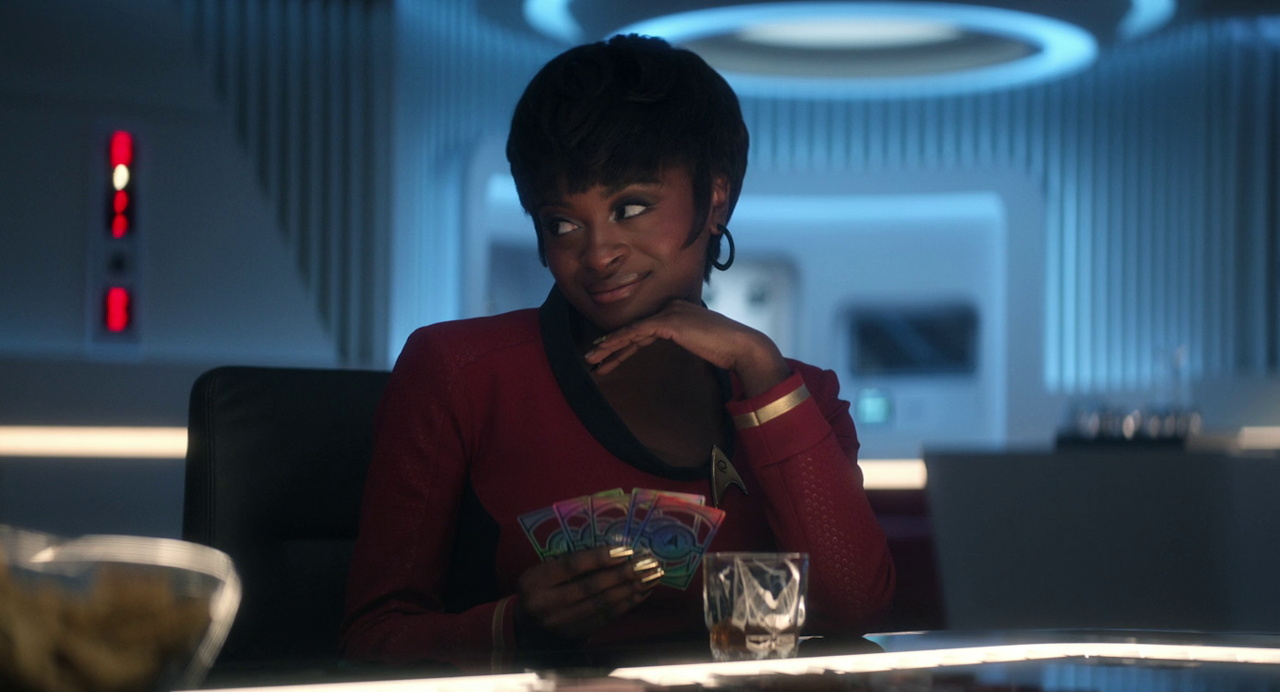
Still frame from Star Trek SNW 4x10 showing Uhura playing poker
Uhura playing poker at the end of the episode.

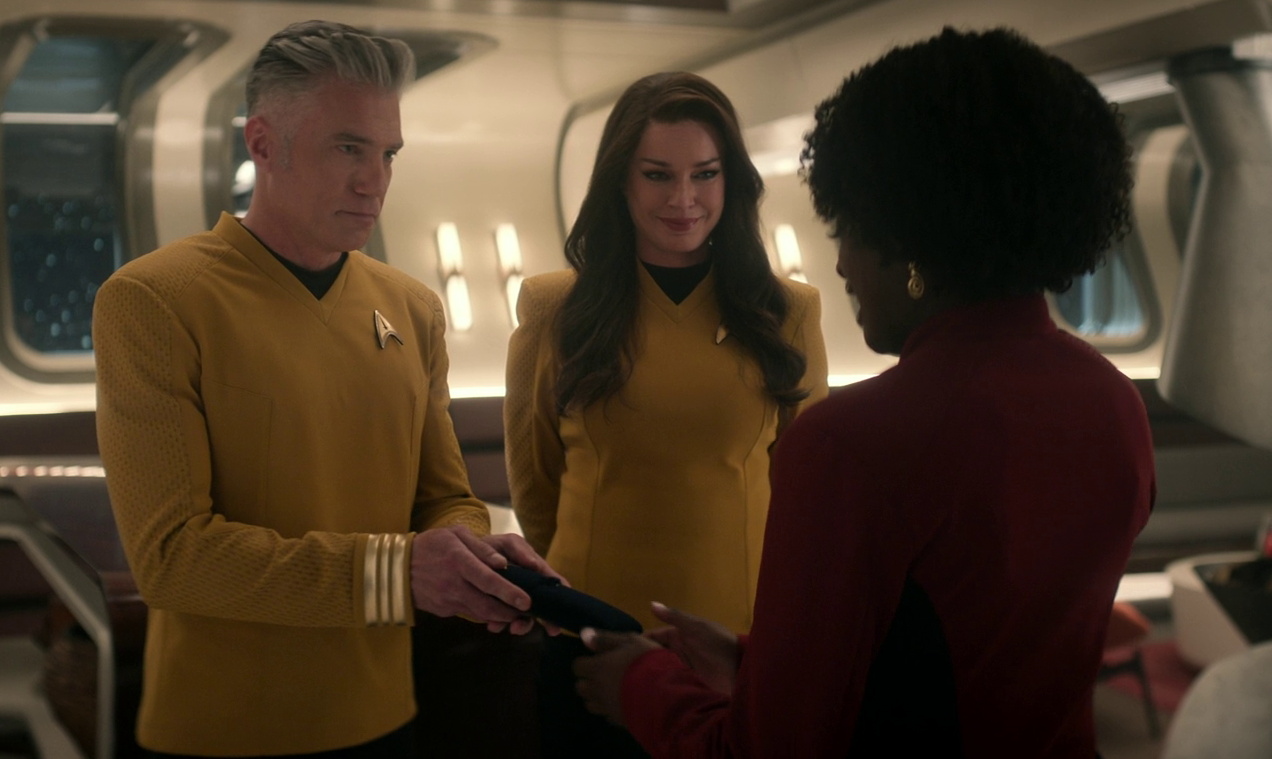
Uhura got moments with Kirk and Chapel that I really enjoyed, as well as her future counterpart’s scene with “Admiral” Pike. The mutual respect that Pike and Uhura showed for one another was played just perfectly, and despite Anson Mount not having a huge role in this week’s episode, what we got was more than enough to remind me of why I was so keen to see this “Captain Pike show” in the first place! It also felt bittersweet, as if both Pike and Uhura were saying a final goodbye to one another. In Uhura’s timeline, Pike’s accident shouldn’t have happened yet, and although he’s no longer a part of her day-to-day life… I’m not sure I understand why Uhura was treating the moment with such finality. However, from the point of view of us as the audience, looking in from outside, I think it worked really well. If Pike and Uhura don’t get another moment together before the show ends, this goodbye will still work.

La’an and Uhura haven’t (to my recollection, anyway) spent much time together across all four seasons of the show. They’ve been present at the same time in some stories, and I’m sure they’ve at least spoken to each other… but I can’t really recall a single major La’an-Uhura storyline. So I liked that we got at least one scene between them, focusing on a conversation they had, before the show wraps up. La’an gave Uhura some useful advice about time travel based on her own experiences with it in Season 2, and I liked the way La’an had to be cagey in how she referenced what happened. It wasn’t the biggest part of the episode, but it was nice to give Uhura a one-on-one moment with a character she doesn’t always get to chat with.
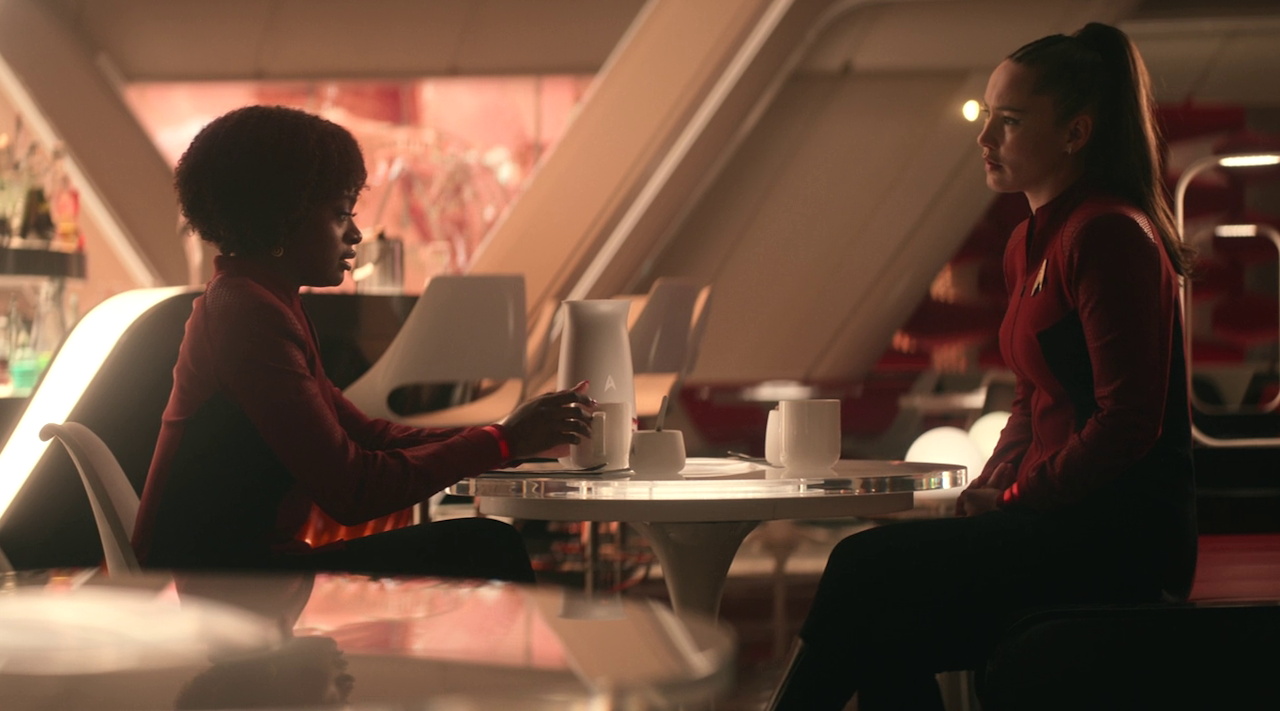
Still frame from Star Trek SNW 4x10 showing La'an with Uhura
La’an and Uhura talk time travel.

Star Trek can do action-packed stories very well – and some of those, from The Wrath of Khan to The Best of Both Worlds and beyond – are all-time fan favourites. But one of the core appeals of a franchise like Star Trek, at least to me, is that there are often scientific puzzles to solve, and ways to resolve stories that *don’t* require resorting to violence, phaser fire, and blowing things up. So I really appreciated that Tomorrow’s Enterprise was a purely scientific puzzle for Uhura and her counterpart to solve, not a story with a nefarious villain to be defeated.

And coming after Discovery, Picard, and other modern Star Trek shows have gone all-in on serialised story arcs with a massive, galaxy-threatening villain, conflicts, wars, and so on… this kind of story feels all the more refreshing. Some of Star Trek’s action-packed episodes are fantastic, don’t get me wrong, but a scientific puzzle like this feels… well, it just feels very “Star Trekky,” for want of another term.
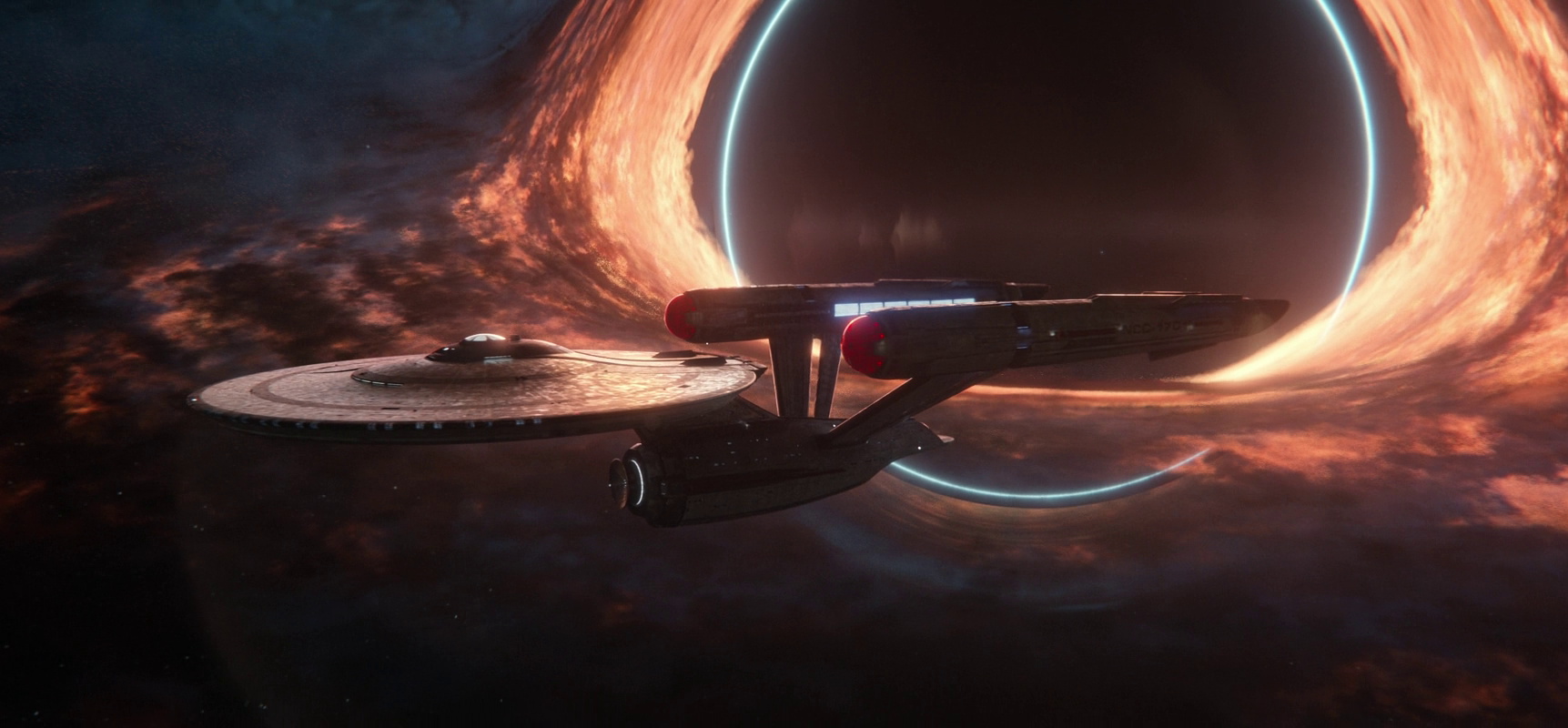
Still frame from Star Trek SNW 4x10 showing the USS Enterprise by a black hole
The episode’s scientific puzzle was fantastic.

In a similar vein, I felt that Tomorrow’s Enterprise didn’t overdo its character drama. Yes, the romantic relationship for Scotty and Uhura was new, and yes, that was a secondary motivating factor for her when it came to wanting to save his life. But it didn’t feel melodramatic in the way that Discovery might’ve tried to play a similar idea; Celia Rose Gooding played Uhura at just the right level to seem convincingly worried for Scotty’s safety without going overboard. Again, after missteps and failures elsewhere in modern Star Trek, I really appreciated that!

Earlier in the season, I heavily criticised The Griffin Incident for not having an actual ending or resolution to its story. And a story like Tomorrow’s Enterprise is a great example of something I said in my review of that episode: you don’t have to get a down-to-the-millimetre explanation of every aspect of an alien race or interstellar phenomenon in order to write a story that feels narratively complete.
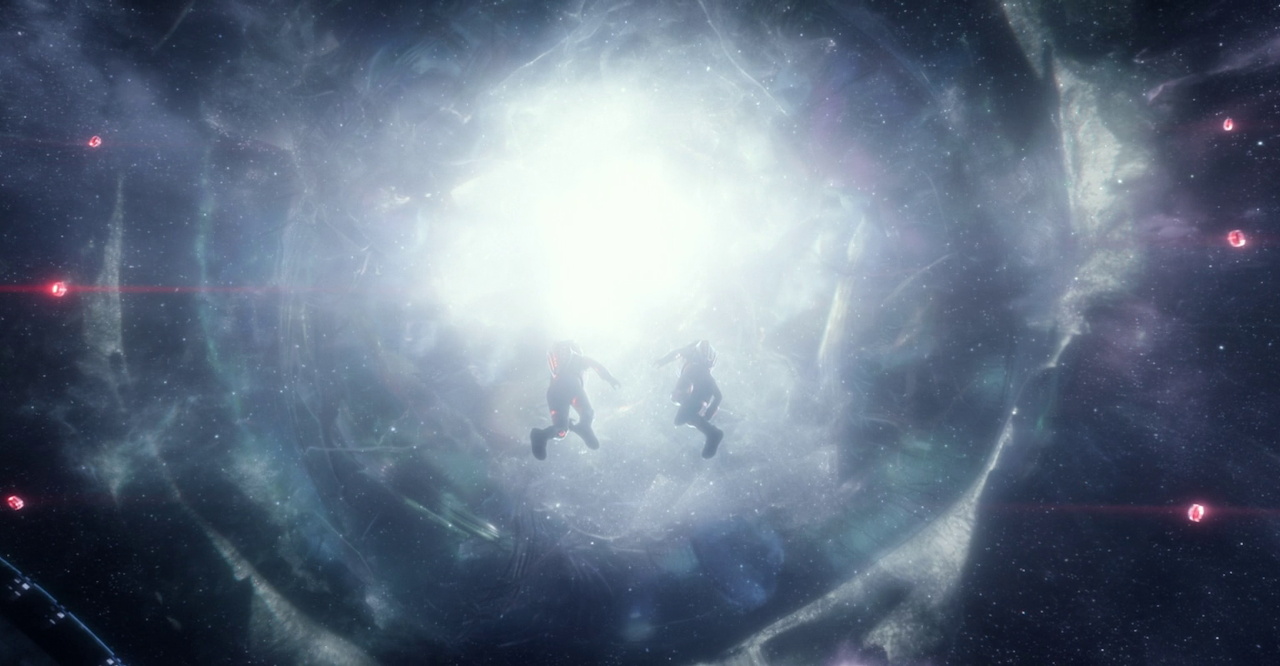
Still frame from Star Trek SNW 4x10 showing the "space baby"
The birth of a “space baby.”

This week, we didn’t learn who the “midwives” were or what the “space baby” they were trying to deliver was. We didn’t learn why a black hole and a white hole were the incubator for this new life form, either. But we got enough from Uhura’s story to understand what was happening to her and to the other characters we care about, as well as what she needed to do to save a life – or two lives, really, including the baby – and restore the correct version of the timeline. We didn’t need a ton of technobabble about giving birth in space, black holes, or time travel, and we didn’t even need so much as a name for either of these aliens. We got enough from the story to make the ending feel satisfying – and compared to The Griffin Incident earlier in the season, that’s more than enough.

I will say, as an aside, that I didn’t really like the name “space baby” for this phenomenon! Though I will credit the episode with at least being self-aware enough of that silly name to have Uhura herself comment on it in the story.

I mentioned All Good Things (the TNG series finale) a moment ago, and there was one other way in which Tomorrow’s Enterprise seemed to borrow from that episode: the poker storyline.
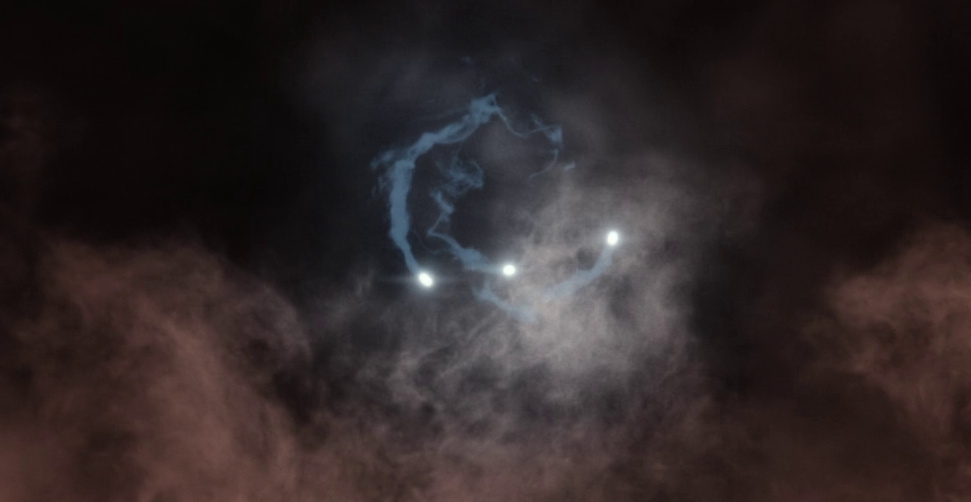
Still frame from Star Trek SNW 4x10 showing the "space midwives"
The “space midwives.”

We got an overhead shot of a poker table that felt eerily similar to the one in All Good Things (which was also copied in the Picard series finale, too), and the emphasis on Kirk and his crew playing poker together felt like it was drawing on a Star Trek tradition which has been present since The Next Generation. I think I’m right in saying that we never saw Kirk and co. playing cards together in TOS (though Kirk and Spock famously played chess, of course), but I liked that not only is this another way to show Kirk being closer and more friendly with his crew, but also how it’s another little through-line connecting different parts of the franchise together.

In this case, not only did the poker game have some relevance to the story – with Kirk able to suss out that Uhura was an imposter aboard his version of the Enterprise – but it also links Strange New Worlds not only to The Original Series, but to The Next Generation as well. The shot of Kirk, Uhura, and others playing cards together was a great way to close out the episode.
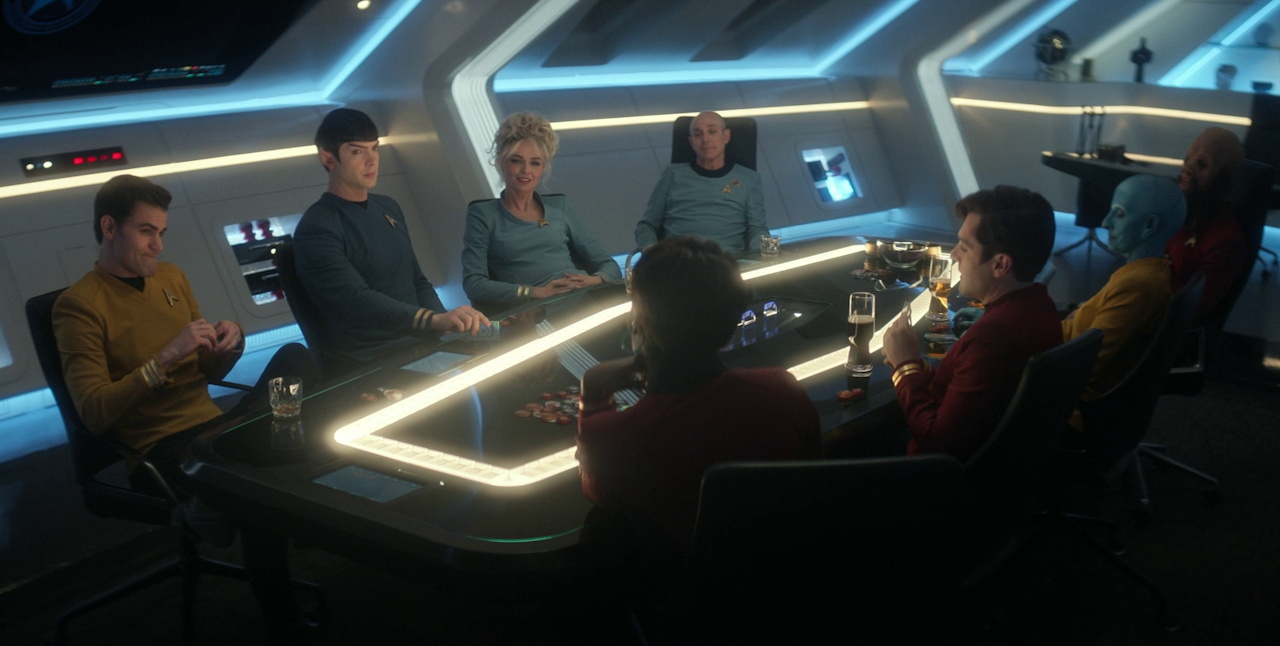
Still frame from Star Trek SNW 4x10 showing Kirk, Chapel, Spock, Boyce, Uhura, and Scotty at the poker game
The poker game links Strange New Worlds to The Next Generation in a fun way.

And I think that’s a good place to start to wrap things up!

Uhura got an epic time-splitting episode to end out the season, and while there are some disappointments as the curtain falls… mostly they’re in what we *didn’t* get to see rather than the way Tomorrow’s Enterprise itself comes across.

I was unsure, when I saw the promo images and the trailer, whether a time travel episode would really be good enough to draw a line under what has been, I’m sorry to say, an underwhelming season on the whole. And while I don’t think it was so stunningly spectacular that we can just forget all of the missteps and cock-ups in weeks gone by – looking at you, Level-Five Writing Accident – I think we can at least say that the season ended with one of its strongest episodes.
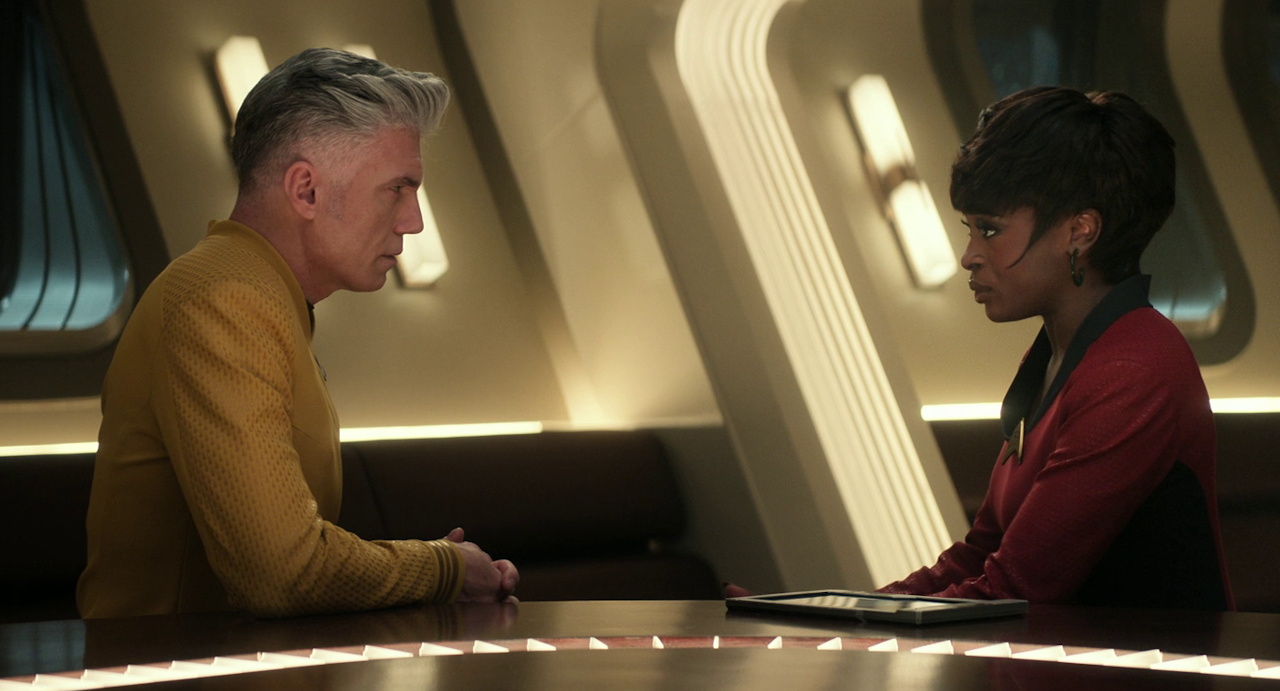
Still frame from Star Trek SNW 4x10 showing Pike and Uhura
Captain Pike with Uhura.

In the days or weeks ahead, I’ll write up my preliminary thoughts on where Strange New Worlds stands ahead of Season 5, so I hope you’ll join me for that. And before Season 5 airs next year, it’s my hope that I’ll have time to write up re-watches of all ten Season 1 episodes, too; Paramount’s utterly ridiculous decision to cut the show off from international fans meant I didn’t write episode reviews back in 2022. So, again, please join me for those if you can!

I have reviews of every episode from Seasons 2, 3, and 4 – you can find them by clicking or tapping here. Earlier this year, I also reviewed Starfleet Academy’s first season, which you can find by clicking or tapping here, and the Star Trek: Voyager video game Across The Unknown, which you can find by clicking or tapping here. And if you missed my celebratory piece for Star Trek’s sixtieth anniversary earlier in September, you can find that by clicking or tapping here.

There’s more to come here on the website, though, even as Strange New Worlds goes off the air! I have reviews of other films, games, and TV shows in the works, and there’s bound to be more to say about Star Trek, too! The Star Trek franchise will be at New York Comic-Con next month, and there could be a trailer or teaser clip for Starfleet Academy Season 2, and perhaps something for Strange New Worlds Season 5 as well. If and when we get news or trailers for either of those, I’ll do my best to cover that here on the website. Next month will also bring us the video game Outposts Unknown, which I covered the demo of a while ago, so I’ll try to take a look at that, too.

Thanks again for joining me for this review. And, as always… Live Long and Prosper, friends!


Star Trek: Strange New Worlds Seasons 1-4 are available to stream now on Paramount+ in countries and territories where the platform is available. The first three seasons are also available on DVD and/or Blu-ray. The Star Trek franchise – including Strange New Worlds and all other properties discussed above – is the copyright of the Skydance-Paramount corporation. This review contains the thoughts and opinions of one person only and is not intended to cause any offence.
Star Trek: Strange New Worlds Episode Review – Season 4, Episode 8: Orders of Magnitude

A Star Trek-themed spoiler warning.

Spoiler Warning: There are spoilers ahead for Star Trek: Strange New Worlds Seasons 1-4. Spoilers are also present for the following Star Trek productions: The Original Series, The Search for Spock, The Undiscovered Country, and Star Trek ’09.

Happy sixtieth anniversary to the Star Trek franchise! On the 8th of September, 1966 (or the 6th of September in Canada), The Original Series premiered with the episode The Man Trap. And I just wanted to take a moment before jumping into the review of Star Trek’s latest episode, some six decades later, to acknowledge that milestone. I also have a short piece that I wrote to commemorate the anniversary; click or tap here to check it out if you’re interested!

Okay, on to Orders of Magnitude – a completely different episode, in so many ways, to The Man Trap… but at the same time, the DNA of what makes Star Trek “feel like Star Trek” was present, I felt.

I’ve tried to go into every Strange New Worlds episode this season with an open mind, even when the latest “big swing” or genre spoof didn’t really hold much appeal. But Orders of Magnitude was the first episode since really the premiere where I felt a sense of real optimism before I even pressed “play.” Having seen a very brief trailer on social media (in vertical format, unfortunately), it seemed like the teased episode would be action-packed and explosive. And so it proved to be.

Still frame from Star Trek SNW 4x08 showing La'an stunned
Uh, La’an? You okay there?

When a franchise has existed for as long as Star Trek has – telling close to 1,000 stories across six decades – there are bound to be stories that just… rhyme. And for me, I felt echoes of several familiar episodes, films, and character archetypes in Orders of Magnitude. On one side of the story was a fairly nondescript gang of mercenaries, holding members of the away team captive and forcing them to perform some feat of technobabble. And on the other? The latest in Star Trek’s long and storied history of “badmirals!”

Orders of Magnitude ran to basically an hour, including the opening titles, and the episode *needed* all of that time to make its two storylines work. When it became clear that Pike’s away mission to the crystal caves was going to be more than just a convenient excuse to give Admiral Reeger command of the Enterprise, I was a little worried that we were going to run out of time for both sides of the episode to really shine. And there were a couple of places back on the Enterprise where I would, in hindsight, have liked to have spent just a tiny bit more time. But overall, I think Orders of Magnitude worked well at balancing two powerful storylines for Kirk and Uhura.

Still frame from Star Trek SNW 4x08 showing a map on Ortegas' helm console
This was a good episode.

Orders of Magnitude had a fantastic score. My number one rule for music in any episode (or film, TV show, game, etc.) is “do no harm;” i.e. the music shouldn’t be overbearing, tonally clash with what’s going on, or otherwise take me out of a scene. And most of the time, modern Star Trek does its music so well that I barely even register it while I’m watching! But this time, I felt the episode’s score was fantastic; there were tense pieces, mysterious pieces, dramatic ones, and exciting ones all at the right moments. When Kirk scrolled Admiral Reeger’s padd, taking those first steps to uncovering a mystery… the music absolutely elevated that moment in just about the best way possible.

Visually… I think it was a bit of a mixed bag, though. I loved the dark tone aboard the Enterprise, as set by the dimmed lights of the ship’s red alert status. Kirk’s radiation burns were suitably gruesome, and so was A’Sha’s injury on the planet. And the set constructed for the inside of the crystal cave was solid enough, although not particularly original. However, the exterior of the crystal cave was less impressive; a recycled location that we’ve seen before with a few giant crystals superimposed. Thankfully, we weren’t in that space for too long, but it was enough to be noticeable. Also on the visual side – or rather, the *lack* of a visual side – we saw nothing at all of the attack on Vaardan; the storyline’s inciting incident. And although the point of the story was that the ship was cloaked, we also saw nothing of the ship, its wake, or even the planet it landed on. Even the attack on the cargo ship near Argus II was fuzzy and only appeared briefly. I just felt we could’ve gotten a little more on the visuals/CGI side to add a bit more depth to this side of the story.

Still frame from Star Trek SNW 4x08 showing Pike, Chapel, Uhura, and A'Sha on the away mission
The away team.

Let’s tackle the away mission first, and then move on to Kirk and the badmiral.

Call me a cynic, but the second I saw Cadet A’Sha on the away mission, my first thought was “redshirt!” As Strange New Worlds had done with Ensign Gamble last year (and as Discovery did several times across its run), I suspected that our new Vulcan cadet might not be long for this world. That feeling only intensified when Uhura made her comment about how she insisted that A’Sha be invited to join the away team.

And it seemed, for a time, that I was about to be proven right – only for the episode to take a couple of last-minute twists with A’Sha’s story. After being injured and suffering some kind of crystal-induced ailment, Uhura worked overtime to save A’Sha – only for the cadet to decide, in the episode’s final moments, that life in Starfleet wasn’t right for her, after all. A logical reaction, perhaps, to nearly dying from crystal wounds on a random moon!

Still frame from Star Trek SNW 4x08 showing Uhura with A'Sha in Sickbay
A’Sha has decided (perhaps understandably) that Starfleet isn’t right for her, after all.

Joking aside, I quite liked the direction this storyline took, and that it wasn’t as predictable as I feared it would be. Redshirts in Star Trek are a trope, of course – The Man Trap, sixty years ago, contained the very first such example – but it can be nice when an expected storyline has a twist or a surprise; something to keep us on our toes and make things feel a bit… different. A’Sha’s survival was the first twist, but her decision to leave Starfleet shortly thereafter was the second.

Obviously, A’Sha is not a particularly well-developed character. Her biggest outing, aside from this week, came in Off-Hour, where she worked with Scotty in the turbolift and transporter room. But she’s arguably the only Vulcan character in Strange New Worlds to have been played straight; the likes of T’Pring have usually been thrown into slapstick, comedic, or romantic storylines that (in my opinion) are not especially well-suited to the Vulcans, and rely on a joke or a bit that’s just been stretched way too far. So A’Sha has been a breath of fresh air, in that sense, and I’m sad to see her go.

Still frame from Star Trek SNW 4x08 showing A'Sha after being stabbed
A’Sha after being stabbed.

A’Sha also turned out to be an important character for Uhura, following up on an (admittedly too short) scene from the season premiere. Uhura, having been assigned to the role of mentor, has demonstrated arguably the most growth of any of the show’s regular characters (so far, anyway), going from a fresh-faced and unsure cadet back in Season 1 to a more confident and settled mentor of cadets by Season 4. If we keep in mind that part of the objective of this season in particular has been, to quote the show’s tagline, to “boldly go one step closer to where it all began,” then we can see Uhura’s arc as bringing her closer to her TOS role ahead of the show’s finale.

And, I would argue, Uhura’s arc is now pretty much complete – as capped off by her promotion at the end of the episode.

I want to spend more time with this incarnation of Uhura, of course! In fact, I’m not ready to say goodbye to any of these characters, yet, and I just know next season’s finale is going to be an emotional sucker-punch. But… if this is the final Uhura spotlight that Strange New Worlds has time for, then I think we can consider her arc well and truly complete. Strange New Worlds hasn’t always made good on its prequel status, but in Uhura’s case, it really did succeed. The show has shown us the character’s younger days in a way that made sense, taking her from a cadet with doubts about her abilities and her role in Starfleet through to a newly-promoted lieutenant. If there’s no time for anything else, and even if Strange New Worlds fumbles the ball with all of the other TOS characters, we’ll always be able to point to Uhura’s arc as a success; a way in which the show expanded the world of Star Trek in a way that made sense and felt good for her character.

Still frame from Star Trek SNW 4x08 showing Pike and Una promoting Uhura
Uhura’s promotion caps off an impressive character journey across all four seasons of the show.

This week, Uhura’s story excelled in two key ways.

Firstly, we see her taking a stand – even if that meant clashing with Captain Pike. You would never have seen Season 1 Uhura talking to Captain Pike the way she did in Orders of Magnitude, which just emphasises what we were saying about how far she’s come in her character journey. That confidence – partly inspired by Hemmer, early on – led to her taking on a very risky rescue attempt, butting heads with her own captain in the process.

Secondly, the way Uhura’s story subtly leaned into both her role as a communications officer and her knowledge of the Andorians and their sensitivities was fantastic. I don’t think someone like Captain Pike could’ve as easily gotten away with jury-rigging the mercenaries’ machine to emit a debilitating sonic pulse; it took someone like Uhura, who has those linguistic skills and that connection with Hemmer, to be able to pull off something like that in a way that felt natural and not like a complete deus ex machina!

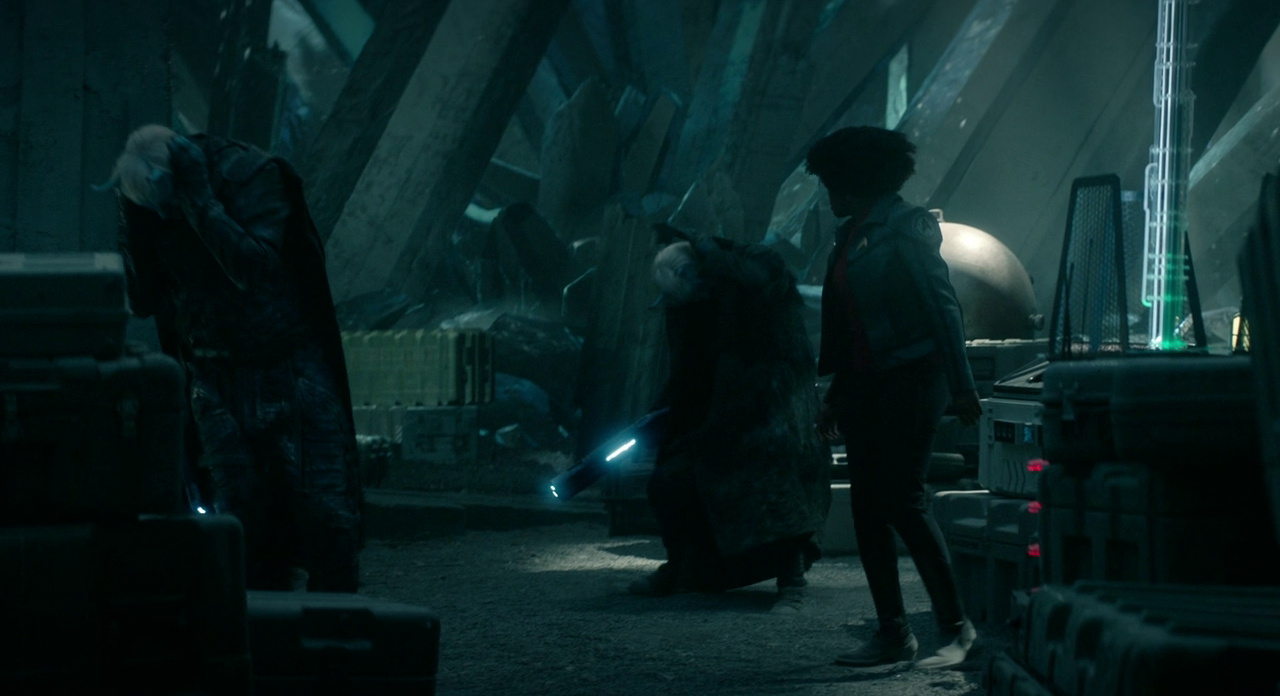
Still frame from Star Trek SNW 4x08 showing Uhura's attack on the Andorians
The way Uhura took on the Andorians felt clever – and in keeping with her character and her role on the ship.

This led to a firefight with the mercenaries, and perhaps this was where I felt the episode dragged its feet just a little. Don’t get me wrong: it was cool to see badass Uhura kicking Andorian butt! But having gone to the trouble of setting up a more complex solution – the sonic attack – to then descend into a bog-standard firefight kind of took away from Uhura’s unique accomplishment and what we were just saying about how she was the only one able to pull off something like that. Any idiot could get in a firefight; Uhura’s skills were better-displayed when she used her technical and comms know-how to reconfigure the mercenaries’ machine – and I just think *that* would’ve been a better way to defeat the mercs.

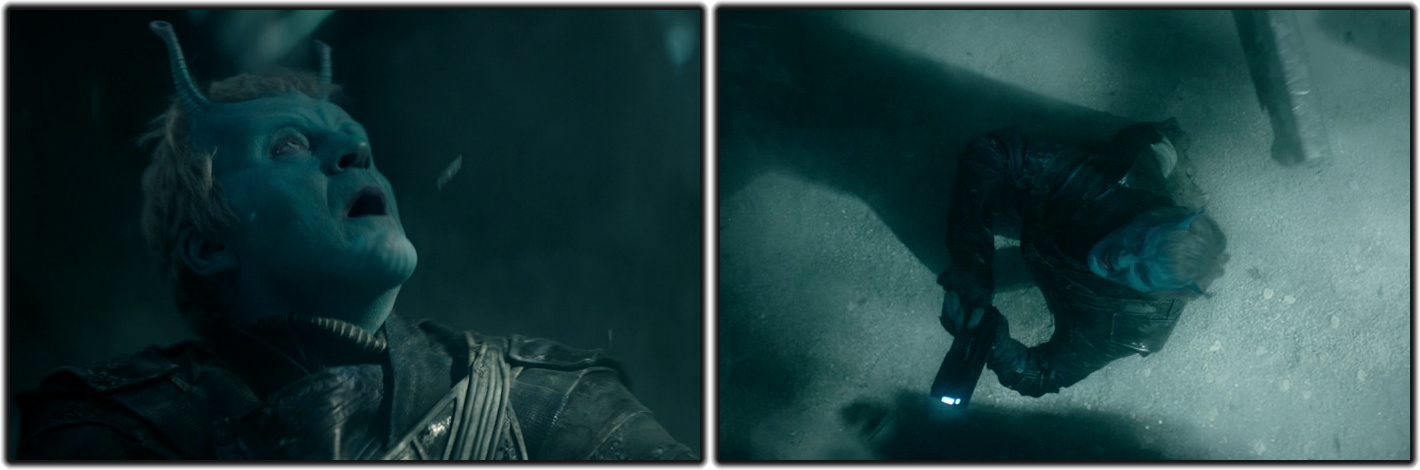
That being said, there were some neat moments during the firefight, as well as plenty of tension, too. The only other thing that I didn’t like as much was the death of the mercenary leader; the whole “noooo!” thing while staring up at the camera (and not even *trying* to get out of the way or move at all) just… felt like a bit of a tropey way to end what had been an otherwise pretty good storyline for Uhura.

Pair of still frames from Star Trek SNW 4x08 showing the Andorian's death
Just move out of the way, you daft bastard.

Speaking of the mercenaries… well, what is there to say? Bog-standard, bland, and really only noteworthy for being Andorians. I don’t think we learned any of their names, nor really what their scheme was beyond “general piracy and/or smuggling,” and while the gang served a narrative function as antagonists for Pike, Uhura, and the rest of the away team… I mean, I don’t think anyone’s going to come out of Orders of Magnitude desperate to learn more about this group.

And that can be okay. The episode already had a memorable antagonist on the other side of the story in Admiral Reeger, and as I said, the Andorians had a role to play in the narrative and played it just fine. All I’m saying is that there are better pirates, better mercenaries, better criminals, and better Andorians in Star Trek – and you don’t have to look far for examples!

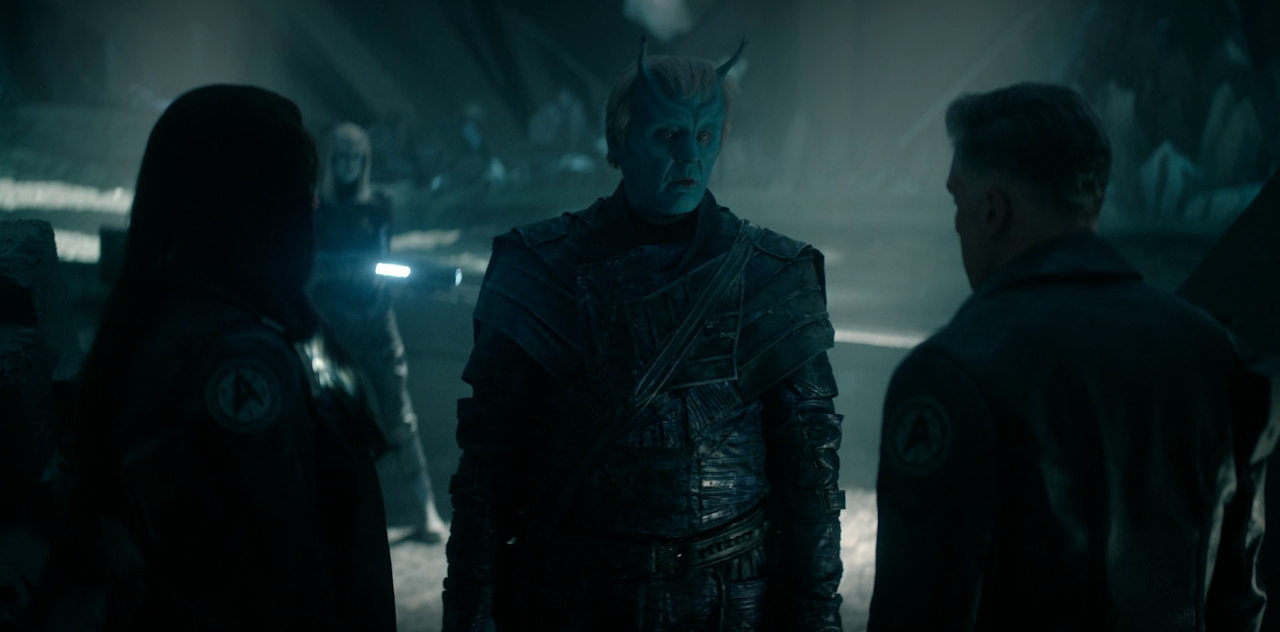
Still frame from Star Trek SNW 4x08 showing Una and Pike with the Andorian leader
The Andorian pirates/mercenaries weren’t the greatest or most-developed antagonists that the franchise has to offer…

Uhura’s promotion, which closed out the episode, was just wonderful. Everything about it, with Pike and Una setting it up, felt pitch-perfect, and I think it was great for Uhura to get that moment with the captain after their earlier clash. Pike clearly respected Uhura taking the initiative, and wanted to reward her not only for that one moment on the away mission, but really for her entire service aboard the Enterprise to date.

And as Strange New Worlds adjusts and repositions its characters ahead of the end of the show – and, in-universe, the start of TOS and Kirk’s famous five-year mission – that makes sense. Uhura is now basically where she needs to be, and as I said above: if we get no more spotlight storylines for this character, Strange New Worlds has more than done its duty as a prequel, taking her character from the fresh-faced cadet we met in Season 1 to the more confident, established bridge officer Kirk could rely on in TOS. A successful arc indeed.

Still frame from Star Trek SNW 4x08 showing Uhura getting shot
Uhura gets shot.

Before we hit up Kirk and the badmiral, a brief diversion to two other characters: Dr M’Benga and Nurse Chapel.

This whole “Dr M’Benga wants to leave” storyline seems to have come out of nowhere, doesn’t it? I mean, I’m not making that up, am I? We knew, of course, that Dr M’Benga couldn’t remain as the Enterprise’s *chief* medical officer heading into TOS, and we also know that Dr McCoy will make at least one appearance in Season 5, thanks to a casting announcement from Paramount. But I’m just not convinced that his potential departure/demotion/disappearance needed this… soap opera quality, with Chapel getting all offended and sulky and Dr M’Benga himself seeming to connive and engineer his route off the ship or to a lower duty station.

Then there’s the question of how much sense it makes *in-universe* for this storyline to play out as it was set up by the end of Orders of Magnitude. One: Dr M’Benga “admitted” (though his confession was a lie) to abusing his position as a doctor to illegally drug a senior flag officer, compromising a mission in the process. And two: Admiral Reeger’s reputation is now in ruins, surely, so his ability to enact revenge is going to be stymied, at best, by the events of this episode. So we’re either looking at Dr M’Benga being struck off and having his medical license revoked for what he confessed to doing, or we’re looking at… nothing at all, because Admiral Reeger is going to suffer the fallout of his lies being exposed. It just feels like a bit of a contrivance and a complication, and one that – I would argue – doesn’t even serve a major narrative function. Dr M’Benga will continue to serve aboard the Enterprise in some capacity after Pike departs the ship, and I just don’t think there needs to be a massive in-universe explanation for why he ceded the role of CMO to Dr McCoy… especially not one so convoluted.

Still frame from Star Trek SNW 4x08 showing Dr M'Benga
Dr M’Benga.

Admiral Reeger is the latest “badmiral” in a long, long line! In fact, I’m pretty sure that Starfleet has more evil, nasty admirals than it does genuine good guys, at this point! But that’s okay… Reeger made for a fun and occasionally complex antagonist for Kirk – though, as we’ll discuss, he wasn’t perhaps as nuanced as he could’ve been, and trying to give him not one but *two* backstories to explain his villainous turn and conflict with Kirk was, perhaps, a step too far given the amount of time we spent with him.

So let’s start with Admiral Reeger being a brand-new character. This is common in Star Trek for “badmirals” and other antagonists, of course – but because he’s a new creation for Orders of Magnitude, it means we’re introduced to him, spend time with him, and see his downfall all in the span of a single episode – or rather, two-thirds of an episode. And that limits how much of an impact a character like this can have. In this case, I think Admiral Reeger worked about as well as he could’ve, but part of me wishes that some part of his character or backstory had been established in an earlier episode.

Still frame from Star Trek SNW 4x08 showing Reeger
Admiral Reeger: Star Trek’s latest “badmiral.”

We see both Ortegas and La’an seemingly reverent toward the admiral’s wartime service, and the Battle of Zeta Reticuli in particular. But because, again, this event is brand-new – and neither character spent much time in the spotlight this week – it doesn’t hit as hard as it could’ve. Past iterations of Star Trek got away with this because they were entirely episodic, but with the franchise having more ongoing arcs and storylines in its modern incarnation… I can’t help but feel an opportunity was missed, earlier in the season, to name-drop the admiral, the battle, or some other part of his story in a way that would’ve added something to this setup.

Is that an unfair criticism? Maybe. But given how Season 4 has taken diversions into a variety of different genre parodies and spoofs… I mean, I don’t think we would’ve really missed the soap opera fluff or the puppet silliness if one of those stories had taken a couple of minutes to set up something that would’ve been important this time. In fact… dumping one of those episodes entirely to allow both halves of Orders of Magnitude to be their own full story? That wouldn’t have been a terrible idea.

Still frame from Star Trek SNW 4x08 showing a close-up of Reeger
Doing more to set up Admiral Reeger wouldn’t have gone amiss.

But okay, let’s review the storyline we got rather than the one we might’ve preferred to get!

Admiral Reeger was a compelling character. But in the time allotted to his story, I think one backstory or the other – either the deaths of his family spurring him on to get revenge *or* the stolen valour/George Kirk angle – would’ve been a better call. Trying to cram in both left absolutely no margin for error, and given Reeger’s role as a foil for Kirk, I just don’t think the “family revenge” angle was sufficiently deep or well-explored. It felt more like a narrative excuse for Reeger to go off the rails – and a better-written story could’ve seen Kirk pushing his buttons in just the right way to make the lies and the cover-up a more compelling and exciting revelation.

That isn’t to say that what we got was “bad,” and I found Joe Morton’s performance in the role to be absolutely one of the best parts of the episode. But rather, given that this episode, in spite of its long runtime, had a lot to do… two separate backstories for Reeger (neither of which we actually got to see any part of on screen) might’ve been a bit much, and given where the story wanted to take Reeger and Kirk, the George Kirk/stolen valour angle would’ve been more than sufficient to explain his clash with Kirk – and Kirk’s insubordination.

Still frame from Star Trek SNW 4x08 showing Kirk, Reeger, and M'Benga
The climactic clash.

Remember at the beginning of Star Trek: Discovery when Michael Burnham led what I’ve since termed “the moron’s mutiny” against Captain Georgiou? That was pretty awful… but *this* is how you write an insubordination-to-mutiny storyline in a way that makes actual narrative sense and doesn’t harm or ruin anyone’s characterisation! Kirk began to unfold a mystery involving Admiral Reeger, Dr M’Benga, his father, the USS Constitution, and the Battle of Zeta Reticuli… and it was utterly compelling stuff.

There was a sense, as Kirk’s story unfolded, that it was *he* as much as (or perhaps even more so than) Reeger who was personally compromised by what was happening; that Kirk’s determination to prove Reeger had stolen credit for his father’s actions was what drove him – not any sense of compassion, empathy, or concern for the lives of the people of Argus II. And that angle added some much-needed moral ambiguity to what was unfolding. Kirk had a personal vendetta here, almost as much as Reeger did – and the story was structured in such a way as to make you feel like neither man was wholly in the right.

Still frame from Star Trek SNW 4x08 showing Kirk
Kirk and Reeger’s stories complemented and paralleled each other, in places.

I liked that Reeger wasn’t a completely typical “badmiral,” either. He wasn’t “evil for the sake of it,” he wasn’t a traitor, nor horribly corrupt; he felt more like someone out of his depth – a man promoted above and beyond his capabilities, and who didn’t really have any business commanding a starship. That gels with Dr M’Benga’s line to Kirk about Reeger’s promotion having more to do with getting him off the bridge and behind a desk rather than anything else. And I really felt that in Reeger’s characterisation.

I also liked the idea of Star Trek tackling this “stolen valour” idea in a way that I don’t think we’ve ever really seen before. Reeger had, for years, been taking credit for another man’s accomplishments – and both George Kirk and Starfleet at large had let him get away with it in the interests of overall morale. Reeger developed a personal legend – a legend that characters like Ortegas and La’an fully bought into – on the basis of a lie, and his determination to keep that covered up could have been a bigger motivating factor for him as the story unfolded. I liked what we got to see of it, and I liked how it made Reeger a different kind of “badmiral” than the likes of, say, The Undiscovered Country’s Cartwright or DS9′s Layton.

Still frame from Star Trek SNW 4x08 showing Reeger in the captain's chair
Reeger was a slightly different take on the “badmiral” idea.

However, I felt that Reeger’s arc seemed to take him from “war hero” to “war criminal” almost instantly; his decision to enact General Order 24 and order the total destruction of an inhabited planet seemed to come *very* quickly, when realistically, I think it was such a major turn that we needed to see more of Reeger’s slide into “madness” or obsession for ourselves. If you look at comparable characters on revenge quests or obsessions – like Moby-Dick’s Captain Ahab, basically the archetype for this kind of character – their descent is always slower-paced. Other characters might even go along for (some of) the ride, sticking with a character on an obsessive quest for a time. But Reeger – partly because of the confines of the story – had to make that switch in an instant when ordering the destruction of the planet.

And this same issue recurred later, when Reeger – as we’d subsequently learn, under the influence of a drug – began ranting and raving on the bridge.

I felt echoes of Star Trek ’09 in the climactic confrontation between Kirk and Reeger – the physical altercation, the emotional outburst, and finally, Reeger being relieved of command all mirrored Spock’s role in that film, which saw Kirk ascend to command the alt-timeline Enterprise. As I said above, after six decades and a thousand stories, some are bound to rhyme!

Still frame from Star Trek SNW 4x08 showing Reeger pointing a phaser at Kirk
This moment reminded me a lot of Star Trek ’09.

If Reeger had an obsession with the cloaked ship, so too did Kirk develop an obsession with exposing Reeger and proving his father was more of an upstanding officer – and there were parallels in the two mens’ arcs that bounced off each other really well. As I said above, this gave Kirk and Reeger enough complexity and ambiguity – at least, for most of the story – to keep things genuinely interesting. As Trekkies, of course we’re inclined to support Kirk over some random “badmiral-of-the-week,” but that didn’t mean that the way Kirk handled himself and his conflict with Reeger was perfect!

In fact, Kirk’s arc this time arguably sets up some of his other conflicts and run-ins with authority figures further along the timeline. There are several occasions in TOS and beyond where we’d see Kirk seemingly disobeying orders or striking out on his own – most notably, perhaps, in The Search for Spock, where he’d steal the refitted Enterprise.

Still frame from Star Trek SNW 4x08 showing Kirk accessing medical records
Kirk accessed Admiral Reeger’s medical file without authorisation.

And that makes an interesting point of comparison between Kirk’s story and Uhura’s.

If Uhura’s story was about bringing her over the line; getting her from her younger, less-confident prequel version closer to the person we remember, Kirk’s was more to do with setting up a specific kind of self-reliance, an anti-authority streak, and – arguably – a single-mindedness that could veer into obsession, as we’d see not only in films like The Search for Spock, but in episodes like The Conscience of the King, too.

What I was a little surprised about – especially given that it was explicitly referenced in the “previously on…” compilation right at the start of the episode – was that Kirk’s brief tenure in the captain’s chair of the USS Farragut, and the destruction of a comparable pirate-raider ship, didn’t so much as get an oblique reference. I felt *certain* that Kirk would’ve drawn on his own experience in The Sehlat Who Ate Its Tail from just last season when trying to make his case to Admiral Reeger… but if that was ever an idea, it either didn’t make it to the script or else ended up on the cutting-room floor. Which makes it all the more of an oddity, in some ways, to see a clip from that episode right at the beginning. Why bring it up if it ultimately wasn’t going to matter for Kirk’s arc this week?

Still frame from Star Trek SNW 4x08 showing Kirk burnt
Was it too difficult to connect Kirk’s experience on the Farragut to this week’s story?

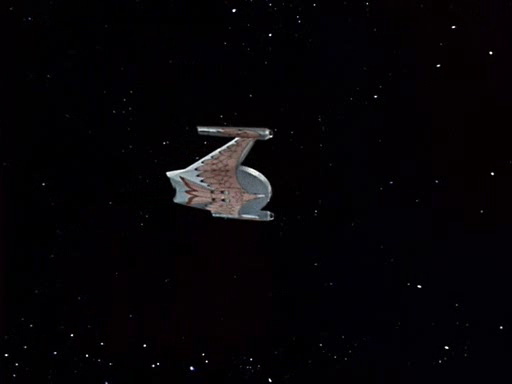
One thing I noticed, albeit very briefly and only on a single star map, was that the cloaked ship that Admiral Reeger was tracking seemed to be flying rather close to the Romulan Neutral Zone. The Neutral Zone was prominently featured on that star map, and given that we know the Romulans use cloaked ships – and that, just a few years from now, Kirk will face off against a similar cloaked intruder – well… put the pieces together! Could this be yet another reference to the events of Balance of Terror, and to the burgeoning conflict with the Romulan Empire? Orders of Magnitude left things ambiguous on that front, and after A Quality of Mercy already delved deeply into that idea in Season 1, I’m sure that was the right call. But it’s interesting in any case.

If it isn’t the Romulans, who else could it be? The Klingons use cloaked ships, of course, but after a recent war with the Federation, would they risk being so aggressive again so soon? Otherwise, we have the Suliban, I guess, from Enterprise, but that’s about it. I suppose a pirate ship or something like that is a possibility – but then, why would pirates massacre an entire planet? Perhaps this is setting up something we’re yet to discover; I note that the Season 4 finale is titled “Tomorrow’s Enterprise,” and makes reference to “the future Kirk will one day inherit” in its blurb. So could that be another hint at the Romulans, Balance of Terror, or some other cloaked ship? It’s definitely a head-scratcher, eh?

Still frame from Star Trek TOS 1x09 showing the Bird of Prey
Was the cloaked ship meant to be Balance of Terror’s bird-of-prey?

I’d be surprised if, after A Quality of Mercy already did so – and did it quite spectacularly – Strange New Worlds would return to Balance of Terror for a *second* time… especially if it’s another time-travel plot. However, after “but it was all just a dream” and other nonsense this season, I suppose anything’s possible, eh?

But we’re speculating about future storylines, and that’s not really a good use of our time!

Orders of Magnitude brought James and Sam Kirk together for the first (real) time this season, and I really enjoyed the way the brothers played off each other. Dan Jeannotte kind of drew the short straw in Strange New Worlds, especially when the show started bringing James Kirk into stories more frequently, but he was well-used here, as Sam added a lot of context to James’ quest to uncover the truth about what happened between their father, George, and Admiral Reeger.

Still frame from Star Trek SNW 4x08 showing Jim and Sam Kirk
The Super Kirk-io Brothers.

Kirk also got a bit of closure with La’an after the events of The Griffin Incident earlier in the season. I didn’t really like the way this storyline kicked off; Ortegas’ remarks to La’an felt completely wrong and tone-deaf given what happened between La’an and Kirk, and I was just a bit taken aback by the flippant way Ortegas brought up Kirk’s arrival on the ship.

However, Kirk’s line to La’an about how she “did stab [him]” felt suitably in-character for the Kirk we know and love, and I liked that line and the way Kirk kind of got his own back by stunning La’an with her own phaser. Again, if we’re talking about parallels between Kirk and Reeger, there’s another one on the “revenge” side, I guess! La’an having a lucky charm wristwatch, though, seemed to come out of nowhere, and it didn’t really serve any purpose – other than allowing Kirk to come up with a distraction to snatch her phaser. A bit of an oddity. Overall, though, I guess I’d say Kirk and La’an somewhat ended the awkwardness of their time on the USS Griffin, though they might’ve just set up *another* conflict or reason to avoid each other in the process. Not sure I like the implication of La’an – fresh off her breakup with Spock – being allegedly interested romantically in Kirk again, though; we finally dealt with that back in Season 2.

Still frame from Star Trek SNW 4x08 showing La'an pointing a phaser at Kirk
So, uh, are Kirk and La’an good now?

Most of the other characters got relatively minor roles this time, which is okay. I wasn’t clear whether Pike and/or Una knew what Uhura was planning to do when she began her feint to take on the Andorians; I read the scene as Pike *not* knowing, otherwise he might’ve volunteered to do something himself. And for Uhura’s arc, I think it works better if we say that Pike and Una didn’t know what she was planning.

Pelia was absent, which was a bit of a shame – I always like seeing her, and I think she could’ve been an interesting character for Kirk to consult or for Reeger to boss around. However, I liked the moment we got with Scotty this time – and his appearance in the skant variant of the uniform. He looked cute like that, and I think it kind of fits with his dress uniform kilt that we saw in Season 2 (or 3?)

Still frame from Star Trek SNW 4x08 showing Scotty in a skant
Scotty in the skant uniform variant.

So let’s wrap things up.

Orders of Magnitude was an action-packed, exciting episode featuring a great “badmiral” as an antagonist. It had enough narrative similarities to Star Trek’s past to feel a lot more celebratory, at this milestone anniversary moment, than last week’s soap opera mess, and its Uhura storyline in particular did a lot to justify the show’s place in the timeline and prequel status. Even if we never get to spend another second with Uhura (and I certainly hope and expect that we will, by the way!) we can now consider her character growth and prequel arc to be complete.

And for Kirk, while I don’t think he grew or changed as much over the course of his adventure as Uhura did, Orders of Magnitude established and/or cemented important character traits that will go on to be important further along his character journey in The Original Series and beyond, adding to that sense that Strange New Worlds is finally starting to justify bringing Kirk in for a prequel arc. His clash with Admiral Reeger furthers a “challenge to authority” character trait that we know Kirk has, and his willingness to bend and break the rules is something we’ve seen countless times in The Original Series, The Animated Series, the movies, and more.

Still frame from Star Trek SNW 4x08 showing Kirk with Reeger on the bridge
Reeger and Kirk on the bridge.

I have not been Strange New Worlds’ biggest fan or cheerleader this season. In fact, I’m pretty disappointed with more than half of the episodes we’ve gotten so far, for a variety of reasons. I don’t think some of the “big swings” and genre spoofs have worked as well as they could’ve, and I don’t think the writing has been top-quality, either, unfortunately. So it’s great to be able to put my hand on my heart and say that Orders of Magnitude joins Off-Hour and Human Best Friend as one of “the good ones;” episodes from this season that I’ll happily return to for a re-watch in the months and years ahead!

Next week, Strange New Worlds promises “a genuine fantasy world” and “fairy tale” in Once La’an A Time. Could this be the moment where La’an gears up for an exit from the Enterprise, as I’ve repeatedly speculated? I guess we’ll have to tune in to find out! Though I confess, I feel echoes of Season 1’s The Elysian Kingdom already, and after such a solid, upstanding, and “Star Trekky” episode this week, I’m not thrilled about a return to the “big swings” and genre spoofs next time. But I’ll try to approach it with an open mind – and hope to have my doubts proven wrong!

Still frame from Star Trek SNW 4x08 showing the USS Enterprise in orbit
The Enterprise in orbit of the crystal moon.

Thanks for joining me this time. I hope this review has been interesting. I’m aware of the fact that, over the season as a whole, most of the episodes I’ve favoured have been the action-packed ones, which I wouldn’t have necessarily expected a couple of months ago. But some of these other genre spoofs and pastiches haven’t worked as intended, at least for me… so here we are, I guess!

I’m glad that, after three of the last four Strange New Worlds episodes have been flawed, tropey, or otherwise just plain unenjoyable, the series has once again demonstrated that it can find its feet. Sure, it’s a bit late in the season, and Orders of Magnitude can’t wipe away some of the disappointments of prior episodes. But as a Trekkie, I sit down to watch Star Trek because I want to have a good time – not because I want to write a 3,000-word teardown of the latest ill-conceived or poorly-executed genre spoof. Orders of Magnitude has been, in that sense, a pleasant and refreshing change of pace!

See you next week for Once La’an A Time… and until then: Live Long and Prosper, friends!


Star Trek: Strange New Worlds Seasons 1-4 are available to stream now on Paramount+ in countries and territories where the platform is available. The first three seasons are also available on DVD and/or Blu-ray. The Star Trek franchise – including Strange New Worlds and all other properties discussed above – is the copyright of the Skydance-Paramount corporation. This review contains the thoughts and opinions of one person only and is not intended to cause any offence.
Star Trek: Strange New Worlds Episode Review – Season 4, Episode 5: Level-Five Transporter Accident

A Star Trek-themed spoiler warning

Spoiler Warning: There are spoilers ahead for Star Trek: Strange New Worlds Seasons 1-4. Spoilers are also present for the following Star Trek productions: The Next Generation Season 6, Into Darkness, Lower Decks Season 2, Discovery Season 3, and Starfleet Academy Season 1.

Well… uh… where to start?

Last week, I began my review of A Case of Chiaroscuro by telling you that I always try to keep in mind what an episode of Star Trek was intending to achieve – and how well it measured up to its ambitions – when writing my reviews. That doesn’t mean I’m being “objective” in any sense of the word, but rather than just telling you whether I personally liked an episode or not, I think it’s important – *especially* in a series like Strange New Worlds, which regularly dips its toes in different genres and styles of storytelling – to try to gauge what an episode wanted to be rather than merely make a snap judgement about the final product.

But I gotta be honest: I’m having a hard time doing that with Level-Five Transporter Accident.

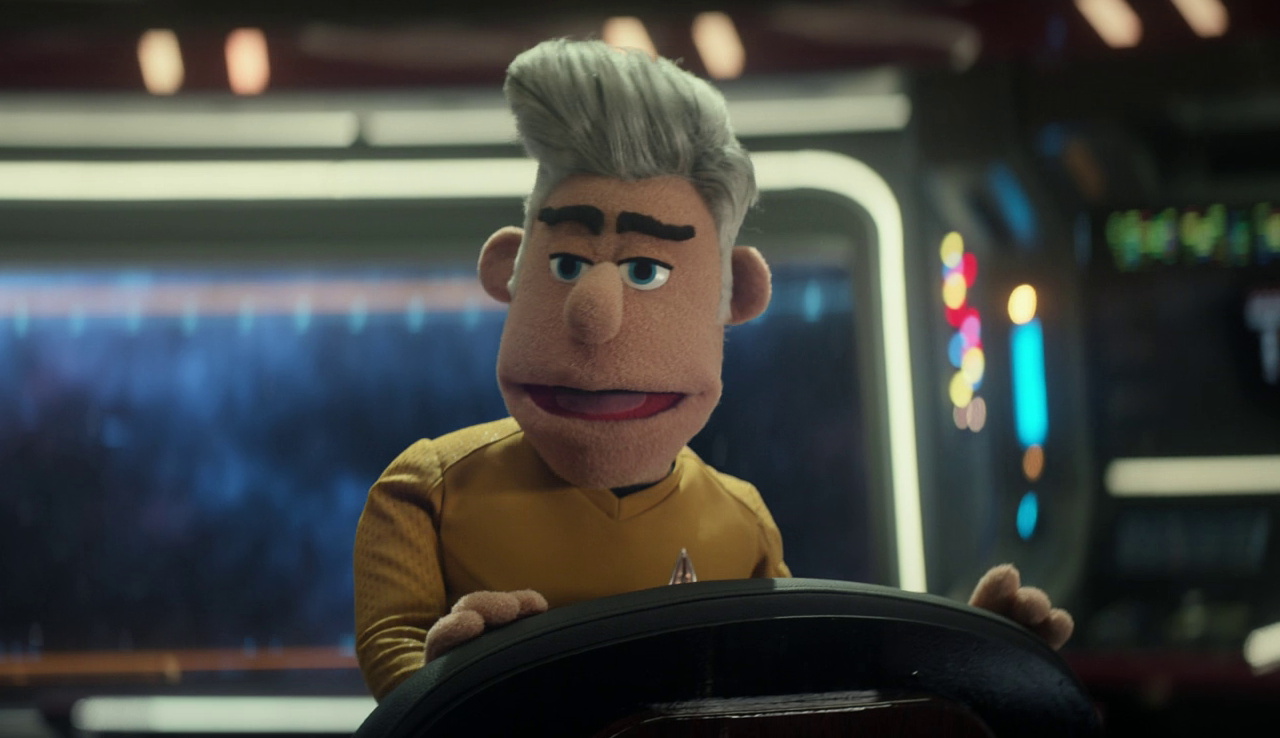
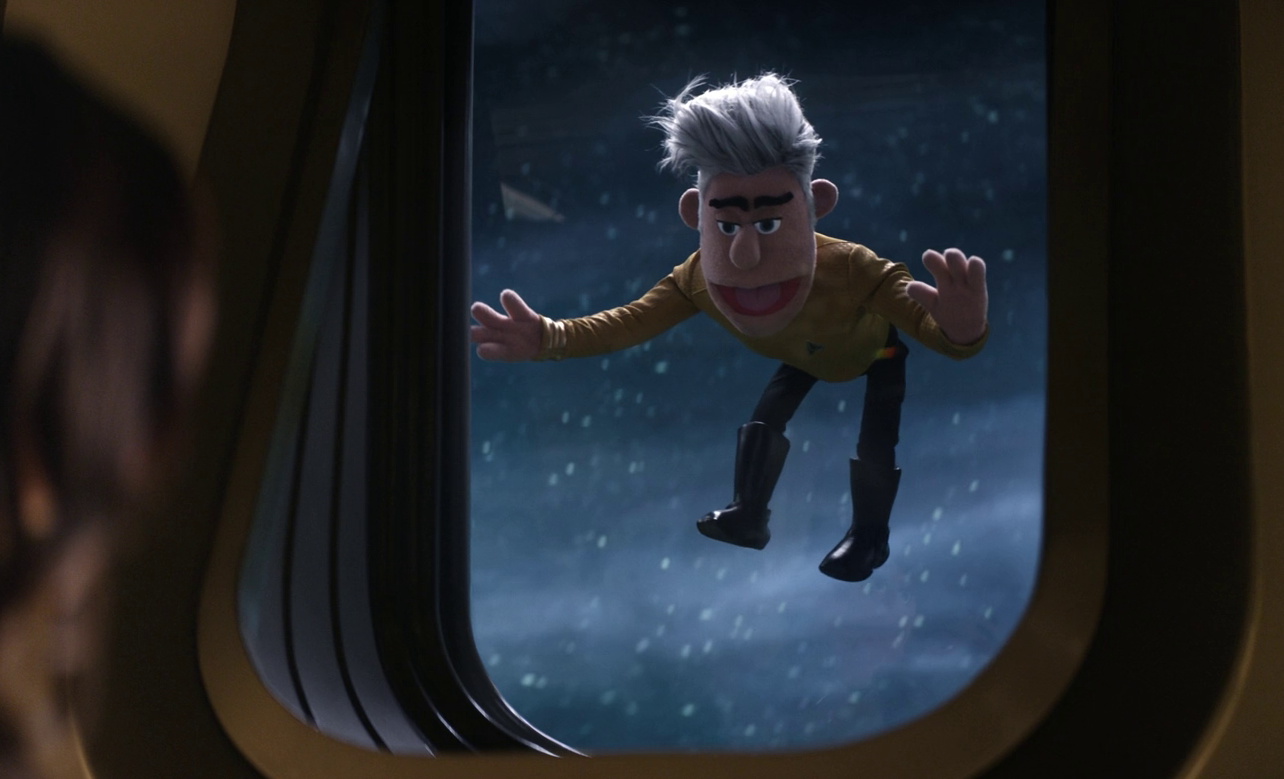
Still frame from Star Trek SNW 4x05 showing puppet Pike
It’s Captain Pike…

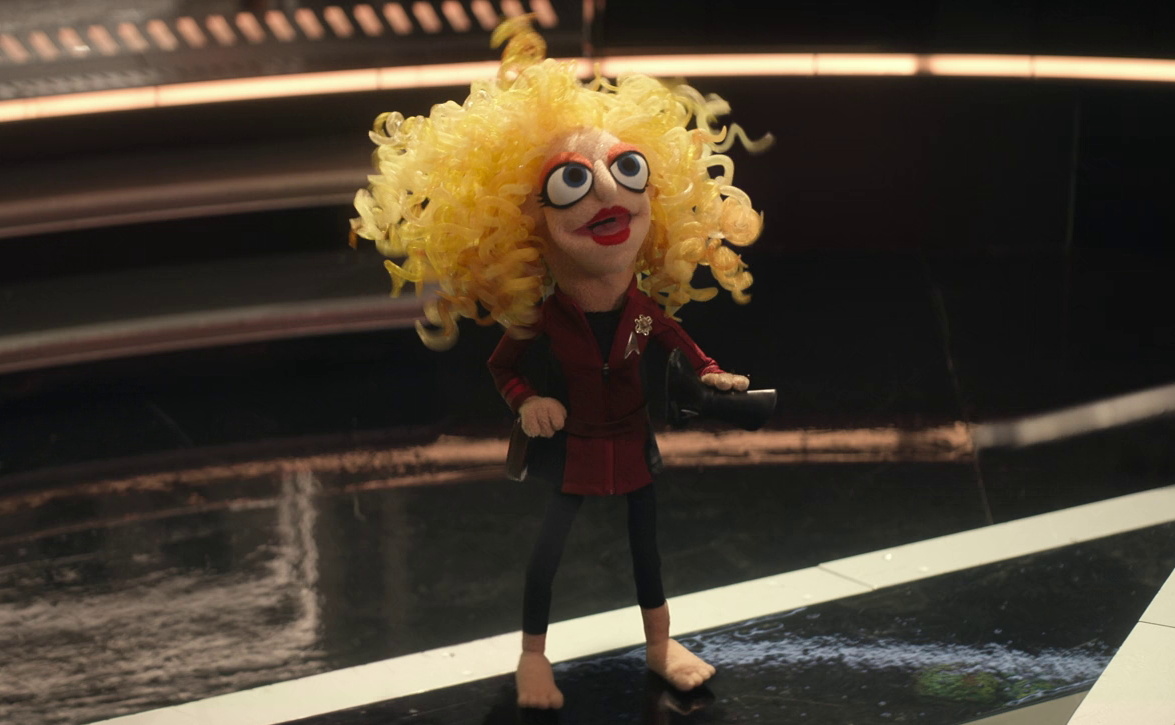
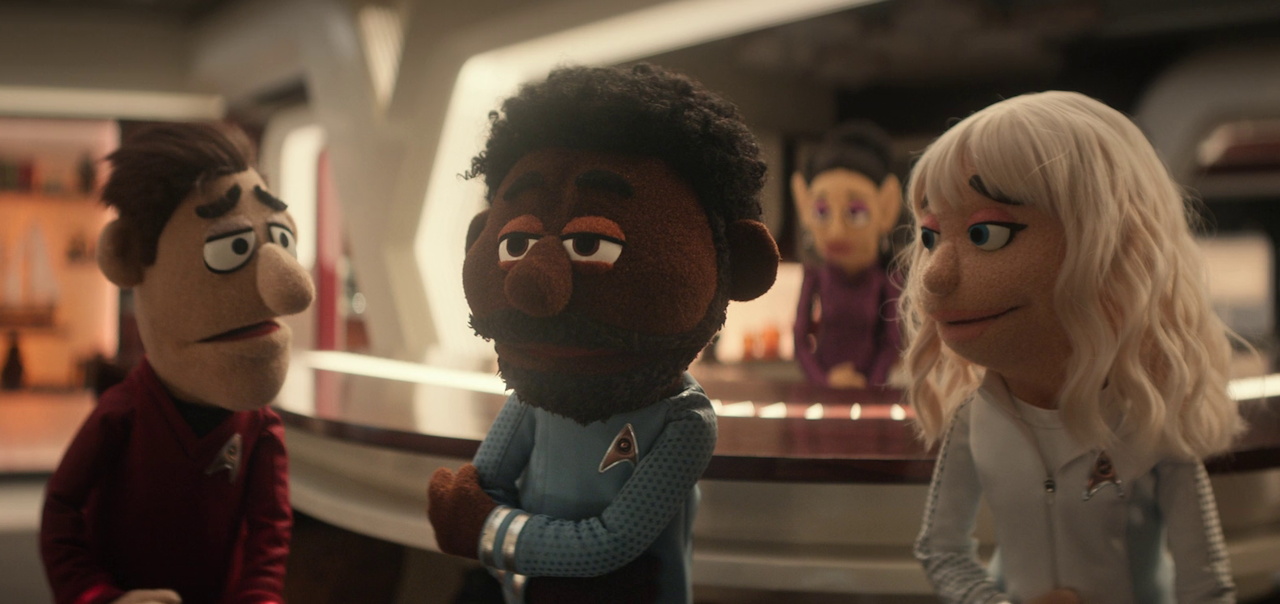
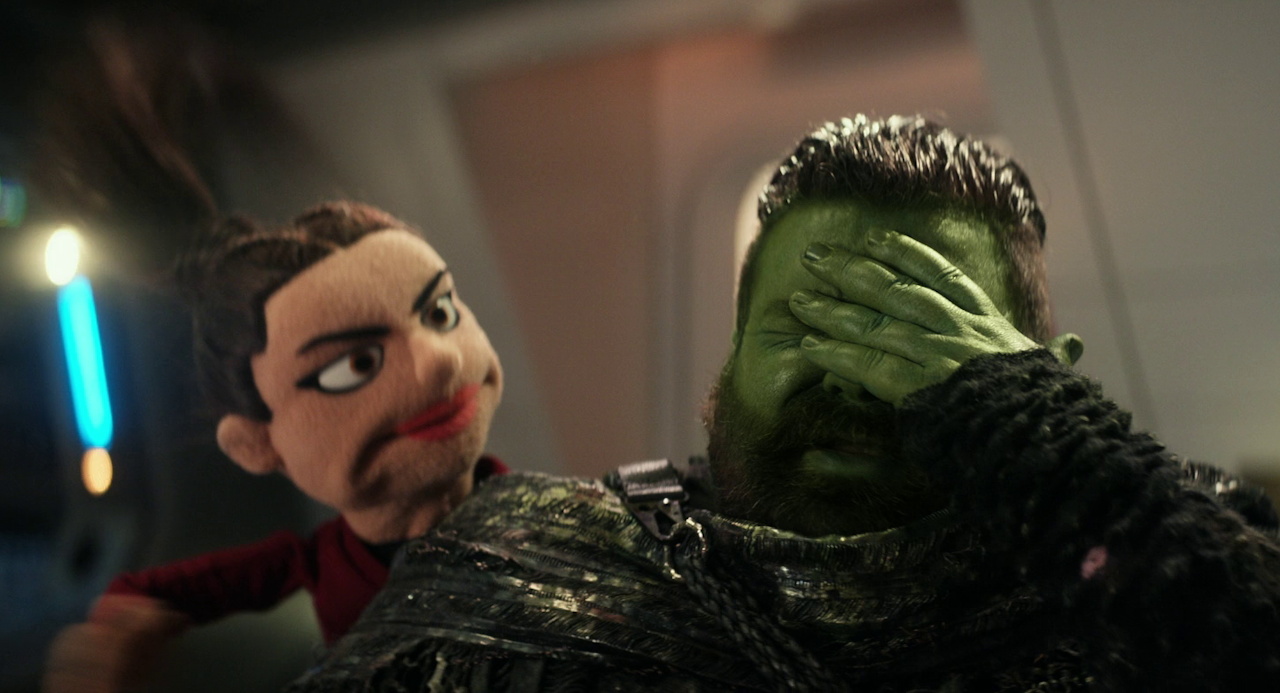
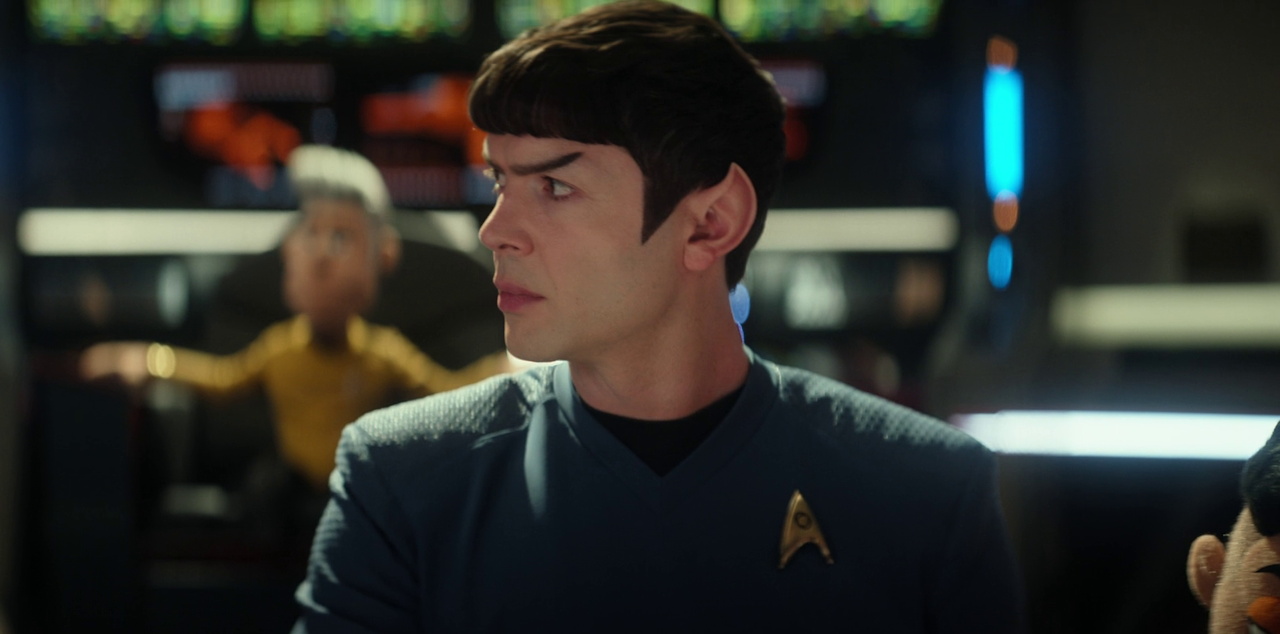
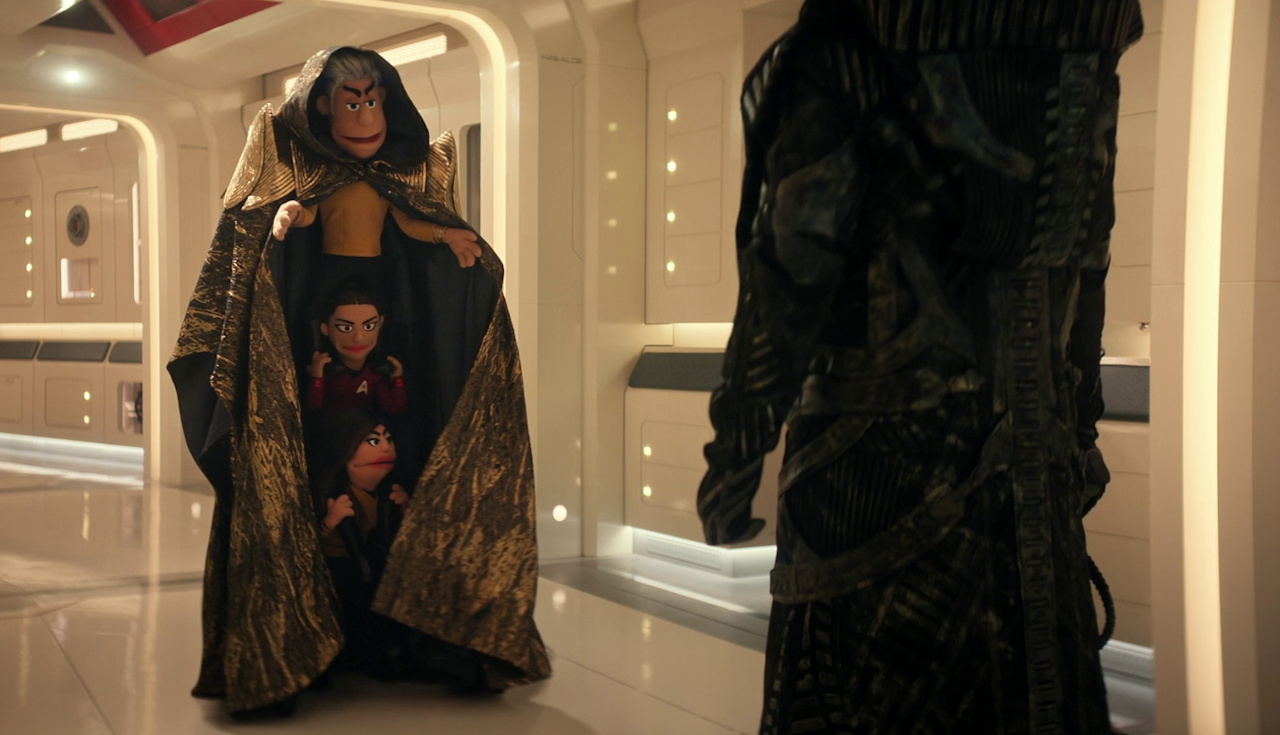
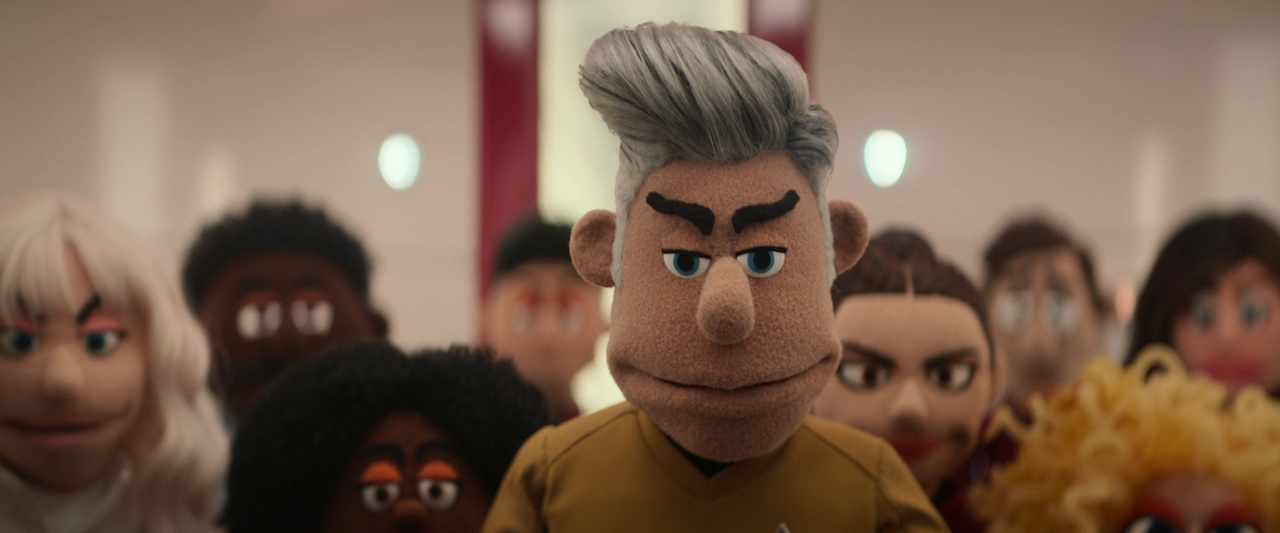
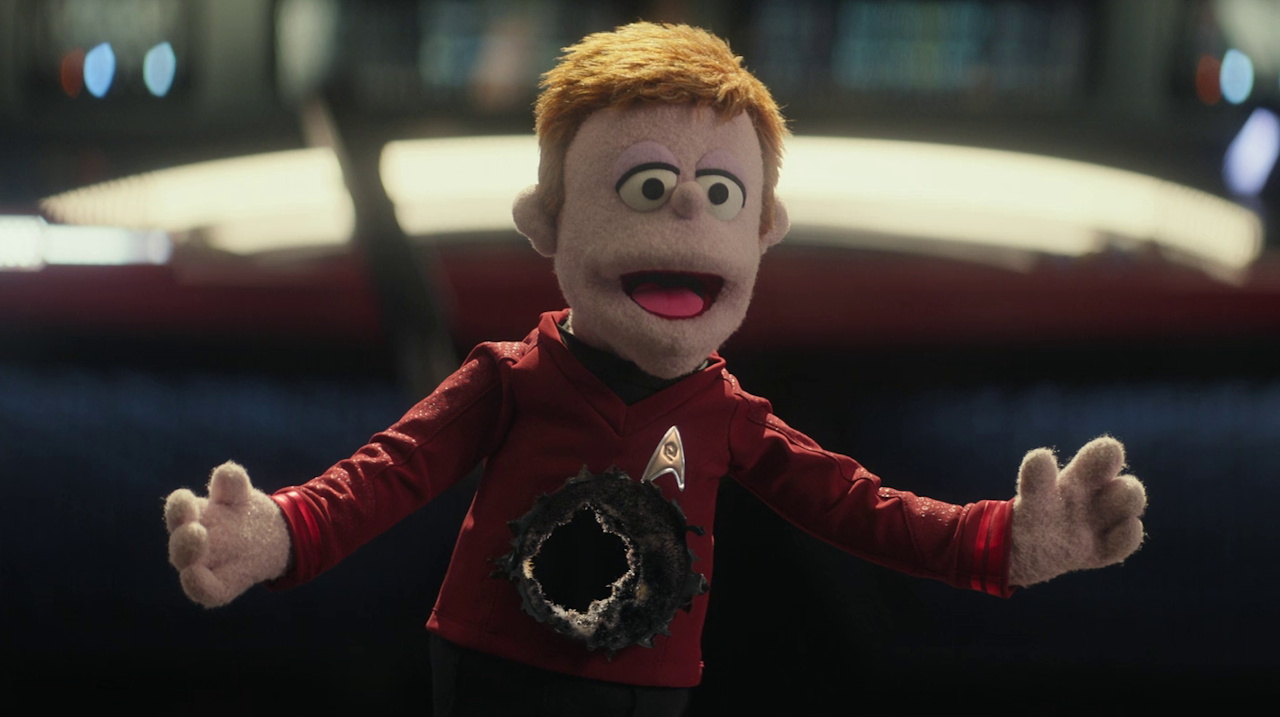
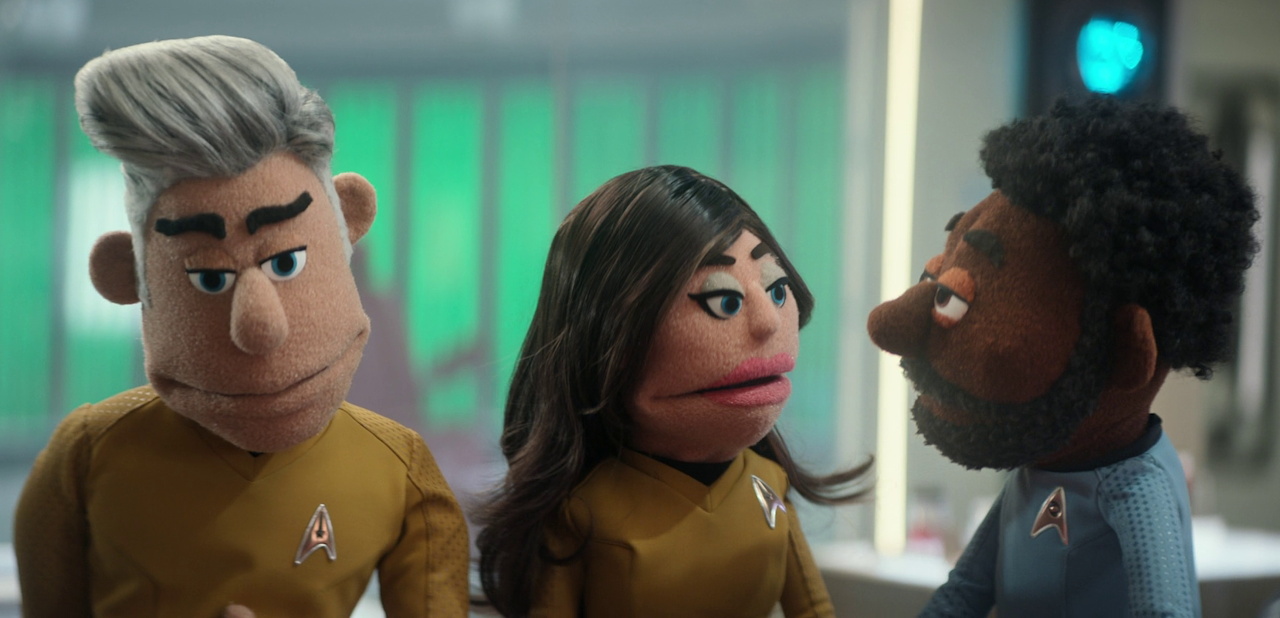
The Muppets, upon which the episode draws inspiration, is inherently silly. And if there’s one word I’d use to describe this week’s episode, it would be “silly.” I mean that in an almost entirely negative way, unfortunately, because while I can respect that Level-Five Transporter Accident knew exactly what it was doing and just went for it in the most honest yet unhinged way… the finished product was, to be blunt, a complete mess.

For a lot of Trekkies, and whatever wider audience might still be watching Strange New Worlds, this will undoubtedly be seen as the moment where the series “jumped the shark,” if it hadn’t already done so after episodes like Subspace Rhapsody.

As I said last week in response to the “film noir” black-and-white episode: I can respect the commitment to the bit. The writers, the director, the designers, the cast… everyone involved knew what kind of story they wanted to tell and they whole-heartedly embraced the silliness. There was even an *attempt* at a message, I think… about trauma and stress, the importance of talking it out, and, perhaps, how leaning into the absurd can be helpful. That messaging, however, was lost in a bumbling, childish mess of an episode, and an ending that utterly ruined whatever could’ve been salvaged.

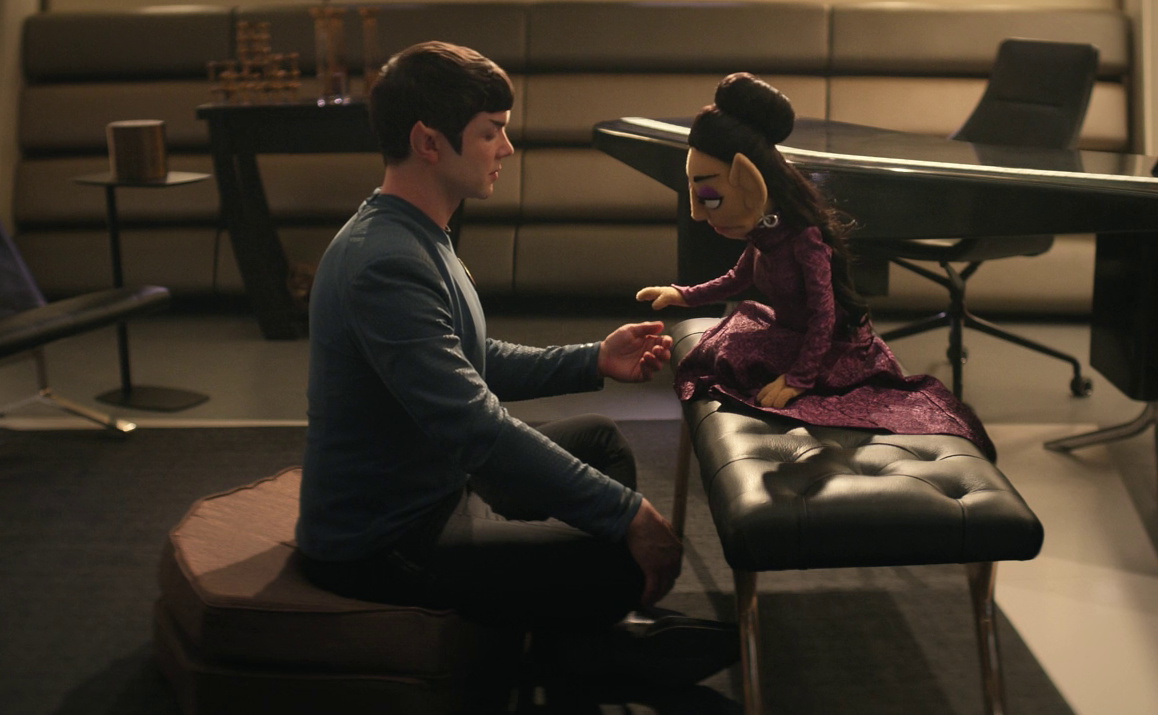
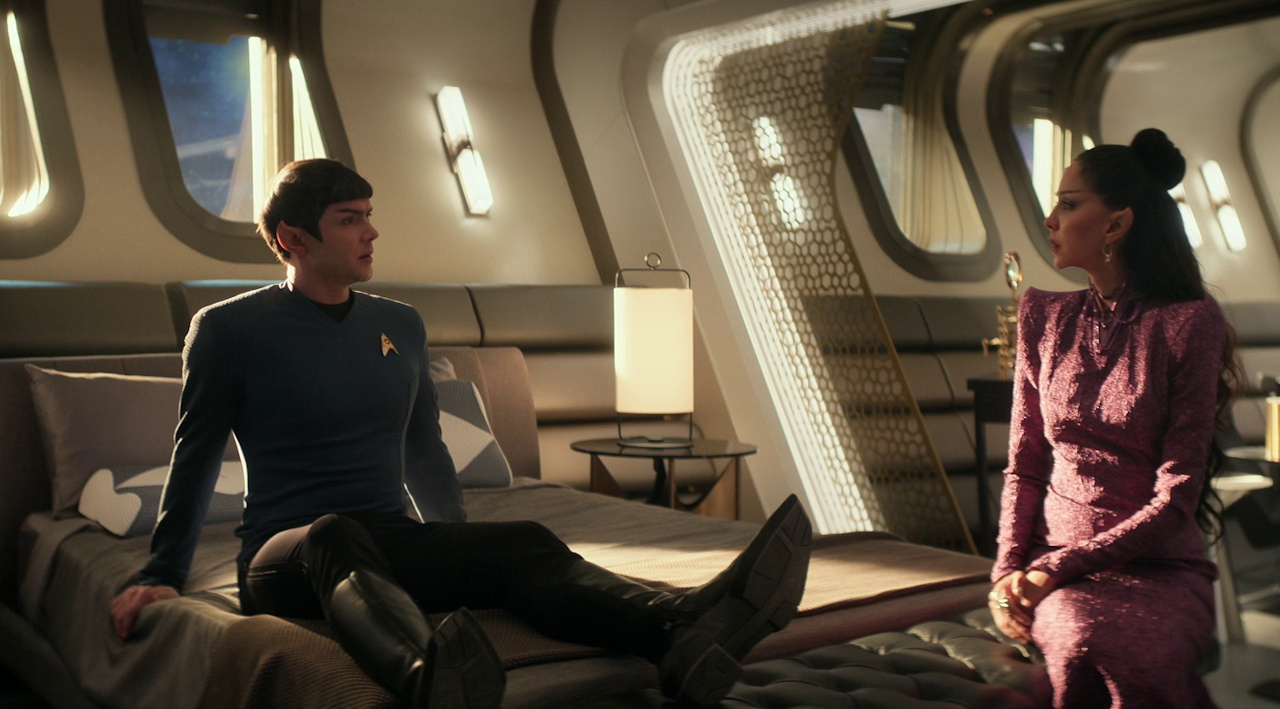
Still frame from Star Trek SNW 4x05 showing Spock's video call with T'Pring
There could’ve been a story about trauma, stress, and burnout.

When I write these reviews, I try not to come across as one of *those* Trekkies – the ultra-nerdy folks who hyper-fixate on the tiniest minutiae of “canon,” who can’t accept that Star Trek has a sense of humour, or who refuse to acknowledge that the franchise changes and evolves over time. I don’t want to gatekeep the fandom, rain on anyone’s parade, or sound like I’m insisting that Star Trek should always be uptight and taking itself 100% seriously. Episodes like that can be great, sure, but part of the franchise’s appeal has always been its light-hearted moments and its sense of humour, and the last thing I ever want to be accused of is taking Star Trek “too seriously.” There’s a place for comedy, joking around, and completely unscientific absurd premises in Star Trek… and there always will be for as long as the franchise exists.

But… even with that in mind, and even having appreciated the genuine successes of the likes of Human Best Friend a couple of weeks ago, or some of the more overtly comic offerings in Lower Decks, I’m afraid that Level-Five Transporter Accident was, for me, a bridge too far. There were a handful of interesting ideas in the mix – and I promise we’ll cover them as we go along – and in terms of the way the puppets themselves were designed, operated, and brought to life… I don’t really have much to criticise. But the story just didn’t do it for me at all, and any potentially salvageable moments were completely expunged by what is literally the most clichéd, “avoid-this-at-all-costs-even-if-it’s-your-first-time-writing-anything” ending.

Still frame from Star Trek SNW 4x05 showing Spock with the T'Pring puppet
The episode’s ending was probably the worst in the entire franchise to date.

I mean… “it was all just a dream.” Seriously? Is that the quality level we should accept from Strange New Worlds? Or *any* big-budget streaming series? If that’s the best thing this group of writers could come up with to end the story, then thank god Strange New Worlds is almost at the end of its run. I’ve talked before about the potential upsides to Star Trek getting a bit of a refresh in the years ahead, and that kind of absolutely pathetic, awful, clichéd way to end an episode absolutely hammers home the need for new producers, writers, directors, and creatives. I hope the new Skydance-Paramount team is planning to have a proper clearing of the decks.

I will return to discuss the ending a bit later on, but for now… let’s get into the weeds with Level-Five Transporter Accident as best we can.

This was the first Strange New Worlds episode where a big part of the premise – i.e. the Orions’ attempts to capture the Enterprise – felt derivative. Not just because we’ve seen this in Discovery with the Emerald Chain, or as far back as The Next Generation with Starship Mine… but because Strange New Worlds itself literally did a “pirates are taking over the ship” story back in Season 1. The Serene Squall had a very similar setup, minus the puppets, and again, as I said above, if we’re at a point of recycling pretty basic narrative ideas because no one can come up with anything better… it’s time to let someone else take the helm, you know?

Still frame from Star Trek SNW 4x05 showing the Orions
Haven’t we already seen this story?

The Serene Squall also put Spock in a comparable position as the pirates’ captive, one of the only main characters aboard the Enterprise able to do anything, and talking about his personal life with one of his captors. It was just derivative and repetitive all around to see so many of those same points re-used this time. And that wasn’t the only “Spock recycled” aspect of Level-Five Transporter Accident, sadly.

It’s been clear for a while that Strange New Worlds’ writers have latched onto this idea that “these autistic-coded Vulcans are all stuck-up, stoic, and weird… isn’t that just hilarious?” And they seem to want to throw Spock (and other Vulcan characters) into one of two situations: slapstick/cringe comedy or soap opera romance. And both of those were present in Level-Five Transporter Accident. As I said last season (I think it was in my review of Four-and-a-Half Vulcans): if the writers don’t know how else to use Spock, or what other storylines could work for this incarnation of the character… just don’t use him in a major role. It’s okay! Star Trek is sixty years old, and between Discovery, Strange New Worlds, The Original Series, the movies, The Next Generation, and the Kelvin timeline, we’ve spent plenty of time with him! Instead of doing another tired, overused, pretty boring “Spock comedy” or “Spock love triangle” plot for the eighth or tenth time, respectively, just… don’t. Level-Five Transporter Accident would genuinely have been a better story if another character – La’an, Una, Chapel, Dr M’Benga, or even Scotty – had taken over Spock’s role.

Still frame from Star Trek SNW 4x05 showing Spock captured by an Orion pirate
Spock is taken captive by pirates. Again.

Spock’s break-up with La’an – or rather, hers with him – was fine, I guess, and not unexpected after events earlier in the season. It does seem to stack more evidence in the “La’an might not be long for this world” column; a theory I’ve been toying with since La’an (clumsily) brought up the question of her latent augment DNA in the season premiere. Giving Spock a romantic interest has – as I said above – completely run its course for me as an interesting storyline, and seeing Spock sleep his way through the Enterprise’s female crew complement hasn’t been the best part of the show by any stretch. So I’m fine with this relationship coming to an end.

Season 4’s tagline/motto is: “boldly go one step closer to where it all began.” And I think we can see Spock and La’an’s break-up through the lens of the show moving its characters around to get them closer to their Original Series roles. Other aspects of Level-Five Transporter Accident arguably work against that for Spock, but this break-up, and the way both of them handled it, was far from the worst part of the story. Did I roll my eyes when it looked like we were about to get another “Spock in love” or “Spock’s heartbroken” storyline? Yeah, a little. But the positives probably outweigh the negatives, and I did appreciate that both characters referenced the events of The Griffin Incident, noting that what happened aboard that derelict ship has been weighing on them. Whether that’ll set up something more for Spock, La’an, Kirk, or all three, I’m not sure – but I’m glad, at least, that such a traumatic experience wasn’t simply locked away, never to be mentioned again. If this conversation is all the follow-up we get, at least we can say we got *something*.

Still frame from Star Trek SNW 4x05 showing La'an breaking up with Spock
La’an and Spock have broken up.

Level-Five Transporter Accident was known as “the puppet episode” for more than a year, I guess, ever since we caught a glimpse of one of the puppets in a pre-season teaser clip. If Star Trek is gonna do an episode featuring puppets, it’s important that the puppets themselves look good – and I gotta say that they really did.

Paramount worked with The Jim Henson Company – famous for its work on The Muppets, Sesame Street, The Dark Crystal, and other puppet-focused projects. And this was a genuinely good choice; The Jim Henson Company is light-years ahead of any other puppet shop in the industry when it comes to creating something like this. And that partnership paid dividends – at least in design and aesthetic terms. All of the puppets – yes, even Pelia’s – looked fantastic, they all resembled the real-life versions of the characters they were supposed to depict, and the way they moved and (for want of a better term) emoted was exaggerated, but mostly in a fun way.

Behind-the-scenes photo from Star Trek SNW 4x05 showing the puppet shop
A puppet-maker creates the episode’s puppets.

The puppets themselves are not the problem with this story – and I know that sounds a bit weird, given everything we’ve talked about, but let me try to explain what I mean.

I felt that the puppets themselves looked fantastic, they moved well, were well-articulated, and although prone to exaggerated expressions and movements, that kind of thing *could* work if it had been part of a stronger story. Most of the main cast put in solid voice performances – though I would say that Christina Chong and Celia Rose Gooding in particular seemed to over-exaggerate just a bit too much for my ears. But a combination of great-looking puppets and a cast who’ve inhabited these characters for three-and-a-half seasons was generally pretty good.

They were let down, though, by a story that was just too wacky and silly.

Behind-the-scenes photo from Star Trek SNW 4x05 showing the puppet shop
Una’s puppet being worked on behind-the-scenes.

What might’ve worked better is if the *entire* episode had been done with puppets – Spock included, and any villains or aliens, too. And, just like last week with the black-and-white, or like Human Best Friend with its “atmosphere that makes you drunk,” some hand-wavey line of technobabble could’ve explained why everything looked like that. Or… maybe it didn’t even need that. Maybe just play it straight: do a regular Star Trek episode, just… with puppets. That would’ve almost certainly been better than what we got.

I almost feel like there’s no point in dissecting Level-Five Transporter Accident’s main narrative because of the absolutely pathetic “it was all just a dream” ending. But I suppose we should, if only to criticise what didn’t work, eh?

Still frame from Star Trek SNW 4x05 showing Spock, the Enterprise, and a shuttle cockpit
I liked this shot of the Enterprise from the shuttle’s cockpit…

Star Trek has done silly “the transporter done goofed” storylines before. Crossing over to alternate dimensions, fusing two characters together at the molecular level, and perhaps the most apt comparison in terms of both narrative and comedic tone: when The Next Generation turned Captain Picard, Guinan, Ensign Ro, and Keiko O’Brien into children. That premise is not a million miles away from what we got in Level-Five Transporter Accident, with the de-aged characters having to fight off a Ferengi invasion of the Enterprise-D. And the resulting episode is genuinely enjoyable; it was a fun premise that was well-executed.

I had Rascals in my notes ahead of Level-Five Transporter Accident because I wanted to use it as a point of comparison to show that Star Trek has always had this comedic side, and that similar premises have worked well in previous incarnations of the franchise. And when I read the blurb for this week’s episode, it was literally the first thing that came to mind. I thought it could be a fun comparison, but also a reminder to some of *those* Trekkies – the “nu-Trek” haters who seem to insist that Star Trek always has to be straight-laced and super serious – that the franchise has always done similar absurd ideas… and generally made them work.

Still frame from Star Trek SNW 4x05 showing Ortegas, the helm console, and transporter beams
Plenty of “transporter accident” stories have worked well in the past.

But I think Rascals now serves as a different kind of comparison: it shows how that kind of story, using a very similar setup, can work well in Star Trek… if you have the writing quality to back it up. And for me, Level-Five Transporter Accident absolutely did not.

I’m saying all of this because I really want two incredibly important points to come across in this review. One: I wanted to like Level-Five Transporter Accident. I wanted to enjoy the comedy, the inherent silliness of the premise, and to get a fun, light-hearted adventure with Pike and the crew. And two: I really gave the episode a chance to impress me. I went into it with an open mind, not pre-judging it or thinking I’d end up disliking it, and I’d even prepared, in my notes, points of comparison from Star Trek’s past to – for want of a better term – defend its honour against some of the lines of criticism that I could tell were going to come from certain corners of the fan community.

The tl;dr? I *really wanted* to come away from Level-Five Transporter Accident having had a whale of a time, and I hoped to be able to tell you that this silly idea, despite what some naysayers might think, had just plain *worked*. But I can’t. Because it didn’t.

Still frame from Star Trek SNW 4x05 showing puppet Pelia
Pelia was great, though. She’s always great!

There was enough of a technobabble excuse from Scotty, who had concocted a long-range beaming scheme, to make the core “everyone’s a puppet now” idea believable enough within our understanding of the Star Trek galaxy. Is it unscientific to a ridiculously silly degree? Sure. But so are a ton of things in Star Trek – from brain-stealing aliens and god-like tricksters to time-loop paradoxes and sexy ghosts – so I think we could have overlooked that in a stronger story.

I also felt, on Scotty’s side of the story, that his transporter-range-extension plot made sense. We know, thanks to Star Trek Into Darkness, that Scotty eventually developed something known as “transwarp beaming,” a way of massively extending the range of transporters that enabled someone on Earth to beam all the way to Qo’noS – a distance of dozens of light-years. So, if we look at the season’s core premise – moving these characters closer to their original incarnations – we know that Scotty’s work on long-range transporting is something that fits with his character. And after emerging from transporter suspension in the late 24th Century, he’d continue to work on it.

Still frame from Star Trek SNW 4x05 showing Scotty
There was a believable enough core to Scotty’s story which this episode could have tried to build on.

That technobabble, and Scotty’s obsession with outdoing an old Academy rival, could have set the stage for a believable (or believable enough) “the transporter done goofed” story. And in addition, an episode of Lower Decks’ second season also saw a character turned into a puppet, only to have that process reversed so he could continue to serve aboard the USS Cerritos. So if you wanna be technical, we’ve already seen this kinda thing before. In “canon,” puppets can exist in Star Trek, and being turned into a puppet is not necessarily a death sentence!

But… all of that would’ve needed the main thrust of the story to be better, stronger, and more engaging.

And not to be undone with seconds to go right at the end with the “but it was all just a dream” cliché.

Still frame from Star Trek SNW 4x05 showing Scotty, M'Benga, T'Pring, and Chapel as puppets
Several of the puppets.

After being puppet-ified, we get into the repetitive “pirate attack” and “Spock’s been captured” storylines from Season 1… only worse. The Orions were so one-dimensional, slapstick, and just plain *stupid* that they were impossible to take seriously as a threat to anyone, and while I can recognise that the way they were written is clearly drawing inspiration from the same slapstick comedy as The Muppets… it just didn’t work in this context. Even going back to the episode to re-watch it, knowing that it’s all just a dream and that they aren’t real people… they just don’t work as villains.

I’ve said a few times, when Strange New Worlds has done one of these “big swings” in terms of genre, that I can respect the commitment to the bit; that fully and whole-heartedly embracing the tropes of whatever genre of style of storytelling the show’s trying out is, in some ways, admirable. Even if I didn’t like the finished product, I can at least acknowledge that the writers and creative team totally went for it, and they jumped in head-first to this kind of Muppets-inspired slapstick comedy.

Still frame from Star Trek SNW 4x05 showing puppet La'an and an Orion
Puppet La’an beating up an Orion pirate.

But committing *so hard* to any “bit” means you import all of the genre’s weaknesses and flaws. Last week, that meant Strange New Worlds didn’t just get the black-and-white, the soft-focus close-up shots, and the smoke-filled alleyways of film noir, but the cardboard cut-out secondary characters and unnecessary melodrama, too. And this week, it means that the episode was plagued by ridiculously over-the-top slapstick baddies that came right out of children’s television, a paper-thin, repetitive story that the show has literally already done, and the most pathetic cop-out ending that would earn you a grade F even in a primary school creative writing class.

There were *some* positives and creative ideas, though – at least until the ending ruined all of them.

Pike’s assertion that the crew had to “think like puppets” if they were going to help Spock and retake the ship made sense in context, and I clocked pretty early on that the best way for the apparently immortal puppets to outmanoeuvre the Orions would be to turn off life support. The way it was executed – i.e. the slapstick fight on the bridge – went on a bit too long, but they got to the right answer even if it dragged out a bit.

Still frame from Star Trek SNW 4x05 showing Pike floating at the window
Captain Pike floating in space.

There was creative potential in the “the puppets are basically unkillable” idea that parts of Level-Five Transporter Accident took advantage of. Pelia being sliced in half was simultaneously brutal and kind of funny, the unnamed navigator getting a hole blasted right through him (and then just staying like that for the rest of the episode) was also neat, and there was a genuinely beautiful – if admittedly absurd – moment as the puppet-ified crew floated in space, taking full advantage of their puppet forms to do something they’d never be able to do otherwise.

Star Trek, from its inception, really, told stories that had real-world parallels or messages that could be important. And I can appreciate Level-Five Transporter Accident’s attempt – however flawed and ultimately disappointing it may have been – to showcase how trauma and stress can impact even the most disciplined mind. This was the arc intended for Spock – to show how he’s been struggling, and how piling too much work on one individual, even if there seems to be a good reason for doing so, can lead to burnout and mental health struggles. We can debate whether *Spock* was the right character for this kind of storyline, but I think that’s all pretty much a moot point in light of the way the story ended.

Still frame from Star Trek SNW 4x05 showing Spock with puppet Pike in the background
A better story could’ve made more of the stress and burnout angle.

But as a broader point, I’ve always tried to support the Star Trek franchise’s examinations of real-world issues through the lens of sci-fi, and there were some ideas in Level-Five Transporter Accident that a stronger core story could’ve made more of. Spock isn’t just suffering because of workplace stress, but he’s still unsettled by what happened to him aboard the USS Griffin – a traumatic incident – and then, on top of that, his girlfriend dumps him. That sets the stage for Spock to be feeling down and just not at his best, before the stress of being the only one on the ship capable of operating anything at all pushes him over the edge.

A more grounded story could’ve taken a different approach to stress, burnout, and mental health, and what resulted would’ve certainly been more impactful with its messaging. I guess you could argue that the ridiculousness of the puppet dream is part of the point; a character like Spock would only ever have such an absurd dream *because* of the mental health struggles he was going through, and that the way he was forced to play every role on the ship when everyone was puppet-ified was a manifestation of how he’d been feeling. But… well, a story like that needed stronger, more down-to-earth writing if that was the intention, and while I can respect the core idea, and I think there’s merit in Star Trek looking at issues like workplace stress, burnout, and so on, this way of communicating it was poor.

Still frame from Star Trek SNW 4x05 showing the puppet tower and cloak
A tower of puppets…

What can I even say about “it was all just a dream,” though?

Literally *any* good points that Level-Five Transporter Accident might’ve been able to claim to have had simply evaporated; they went up in smoke as soon as Spock woke up. I had in my notes that there were some positive ideas in the mix, even if the story’s slapstick comedy and childish tone worked against them most of the time, but when the episode’s final scene revealed that none of it was even real? I was genuinely stunned by the sheer *audacity* of whoever wrote that, whoever approved that story beat, and Strange New Worlds as a whole.

If I’d been the show’s executive producer or showrunner, and you were the writer who showed up with *this* way of ending the story? You’d have been fired on the spot. This is the kind of narrative cliché that literal primary school children are warned to avoid. To see it as the honest-to-god ending to a brand-new Star Trek story in 2026 is… I mean, I don’t have the words for it.

Still frame from Star Trek SNW 4x05 showing Spock and T'Pring at the "but it was all just a dream" ending
Who in their right minds would’ve written an ending like this?

Actually, I lied. I *do* have the words.

Pathetic. Creatively bankrupt. Shoddy. Awful. Amateurish. Childish (though that actually feels like an insult to children, many of whom could write better than this). Appalling. Shockingly bad. Disgraceful. A sacking offence. Feeble. Worthless. Lame. Revolting. Disgusting. Lousy. A festering pile of absolute dog shit.
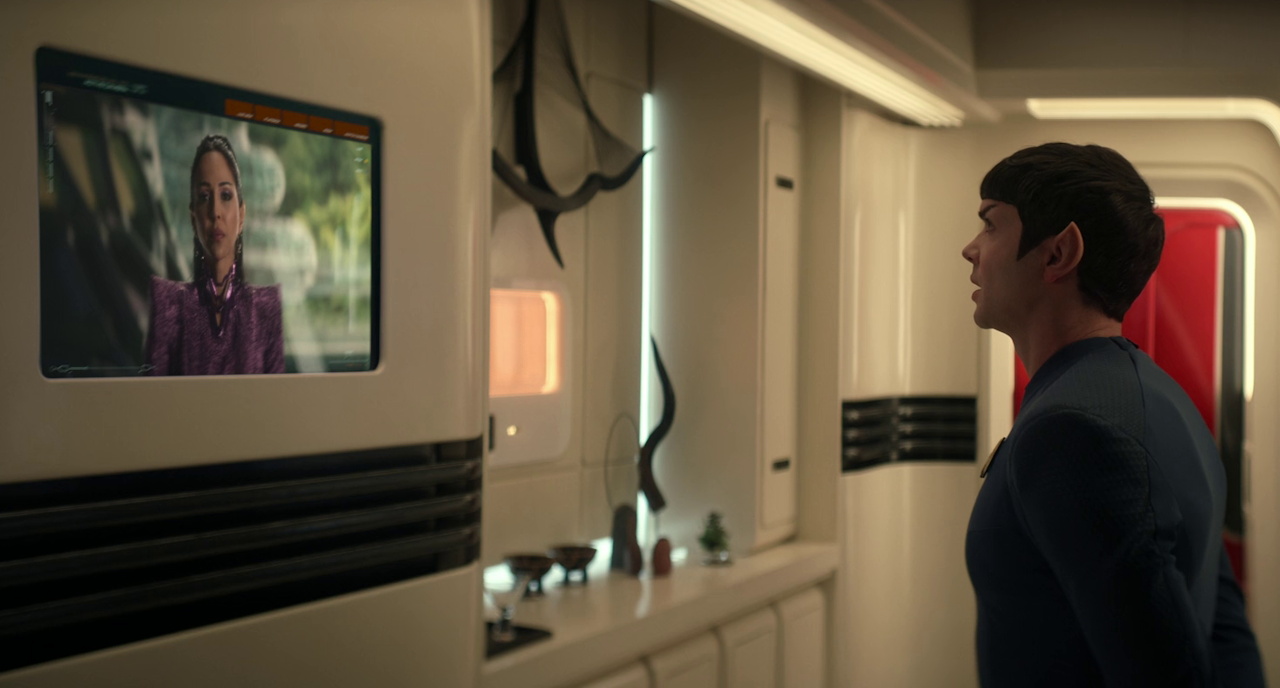
I want a refund on this month’s Paramount+ subscription. Paramount literally owes me my money back after presenting *that* ending as if it were a genuinely serious way to close out an episode of one of its flagship big-budget streaming shows.

Still frame from Star Trek SNW 4x05 showing Spock and T'Pring on the bed
Paramount, I want my money back.

This episode was co-written by Dana Horgan (whose other credits include Subspace Rhapsody, A Space Adventure Hour and Four-and-a-Half Vulcans) and showrunner/executive producer Henry Alonso Myers. And I *never* like to call out individual creators by name, but in this case I’m making an exception because of how shockingly awful that ending was. Unfortunately, Strange New Worlds has already wrapped production on both Season 4 and Season 5, so we can’t take their pens or laptops away from them. I just hope to god that neither of them was trusted to write another *line of dialogue*, let alone an entire story, after this absolutely pathetic abomination of an ending.

I shouldn’t need to do this, but let’s briefly recap why “but it was all just a dream” is such an atrocious way to end a story, for the benefit of both Dana Horgan and Henry Alonso Myers – who evidently slept through that lesson when they were in primary school.

This episode was co-written by Dana Horgan (left) and Henry Alonso Myers (right).

Firstly: it’s a played-out cliché. It’s arguably the *most* clichéd cliché to ever be a cliché in the realm of creative writing. Secondly: it’s a cop-out. It’s a cheap, nasty way to end a story when an incompetent, sub-par writer realises they don’t know how to get out of the narrative corner they’ve painted themselves into. Third: it completely undermines and invalidates *any* points in the story, because if it was “all just a dream,” why should I as the reader or viewer give a shit?

Fourth: it renders any advancement of character arcs or long-running storylines completely dead, because nothing we saw or read actually happened in the characters’ real lives. Fifth: it’s a complete betrayal of the audience’s trust. We were asked, in this case, to get invested in a silly story about puppets, but the ending comes across as *laughing at the audience* for believing it was real. It’s mean-spirited. And finally: none of the characters, Spock included, learned anything, grew in any way, or even experienced anything of consequence. Most dreams fade away within minutes of waking up, and none of the other characters even experienced these events.
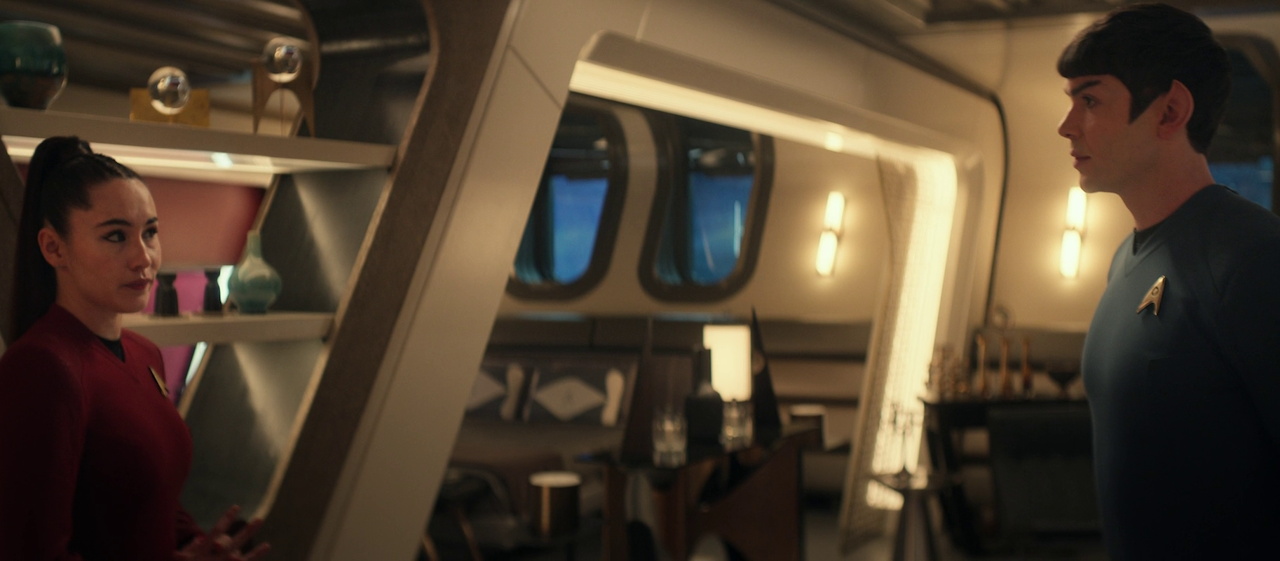
So Dana Horgan and Henry Alonso Myers? Please don’t write another Star Trek script (or anything else, for that matter) until you’ve gone back to primary school and sat through that English lesson.

Still frame from Star Trek SNW 4x05 showing Spock at the "but it was all just a dream" ending
Me when I realised that they were really doing the “but it was all just a dream” cliché…

Look, I know how this review comes across. And if this is your first time reading any of my reviews, I want to assure you that I’m not usually this negative about Star Trek. Please go back to earlier seasons of Strange New Worlds to see that, or to my reviews of Picard, Discovery, and Lower Decks. I’m not a hater, I’m not a “nu-Trek” avoider, and I’m not someone who thinks that comedy has no place in Star Trek, or even that the franchise’s modern incarnation is substantially worse than Star Trek was during The Next Generation era. I genuinely wanted to have a good time here, and even when the episode felt too slapstick and silly for my taste… I could at least appreciate the earnestness with which it approached this absurd premise.
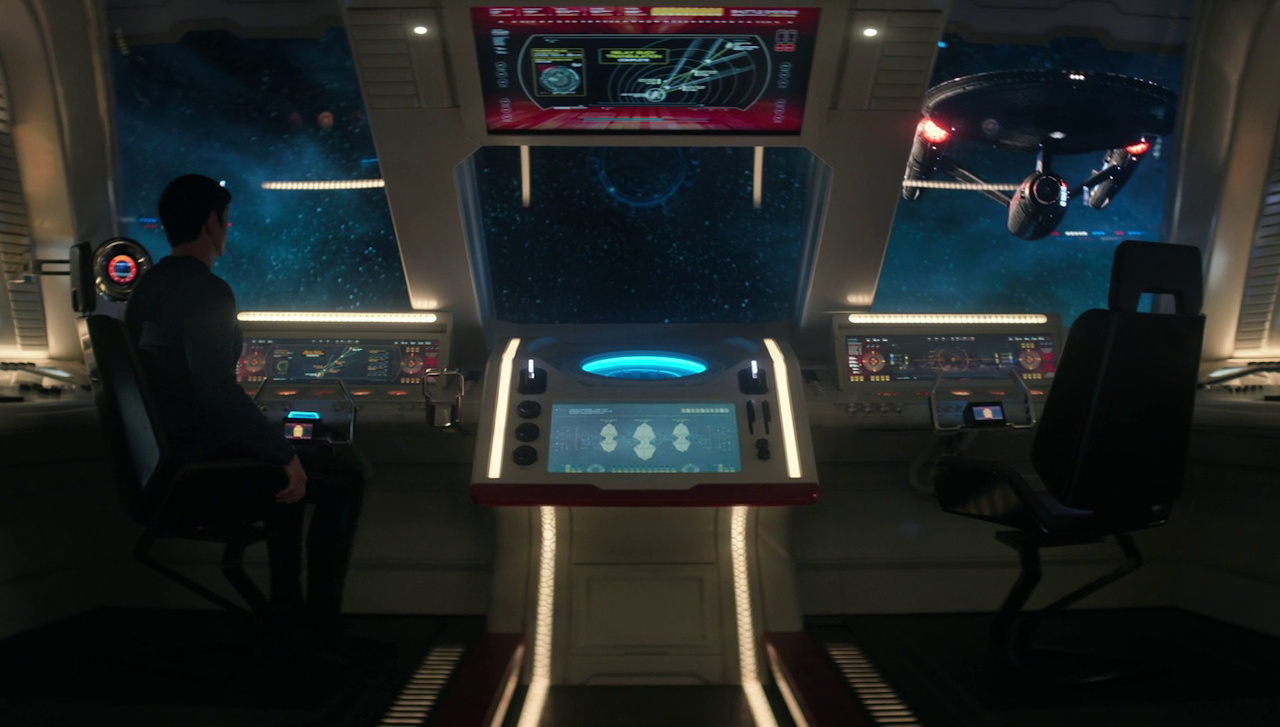
Until the ending robbed Level-Five Transporter Accident of any value it could’ve conceivably had.
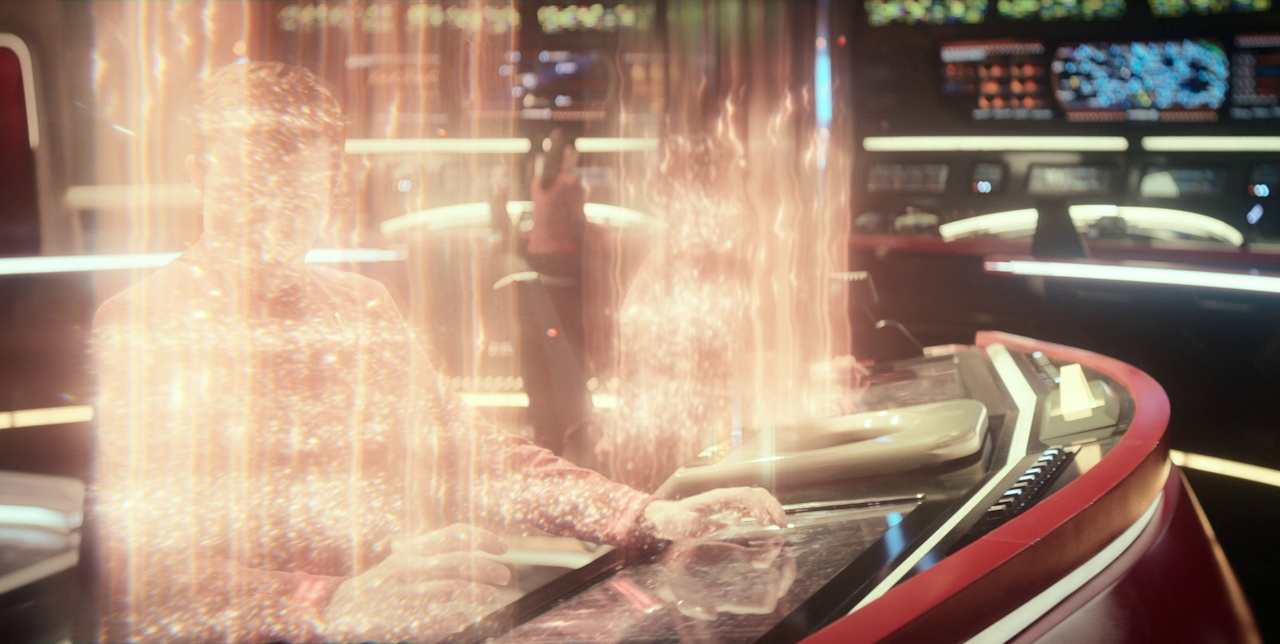
I think I’d better wrap this up. Truth be told, returning to Level-Five Transporter Accident to take notes and map out this review was not a fun experience, and writing such a negative review just… well, it makes me sad, to tell the truth. There are only a handful of episodes left before Strange New Worlds – my absolute favourite series of Star Trek’s modern revival – will come to an end, so to get one like this that I so utterly detest… it’s just unfortunate.

Still frame from Star Trek SNW 4x05 showing puppet Pike and the puppet crew
Pike and the crew arrive to re-take the bridge.

I don’t know what the Trekkie consensus, the critics’ opinions, or a wider audience’s take on Level-Five Transporter Accident is going to be. I never read other reviews or expose myself to others’ opinions before writing my own reviews if I can possibly help it, and based on my track record across Season 4 so far, I think I’ve been in the minority in all four episodes! I liked stories that others didn’t, and I criticised episodes that others seem to have enjoyed. So… could Level-Five Transporter Accident surprise me by being everyone’s pick for the best of the season? I mean… who even knows any more!

If you did enjoy this episode more than I did, or if you feel my criticism of its slapstick comedy or its ending are unfair or unnecessarily harsh… that’s okay. All of this is subjective, at the end of the day, and there ought to be room within the Trekkie community for differences of opinion when it comes to what makes for a good or enjoyable story. I share my thoughts with you in that spirit, and it’s not my intention to stir the pot, start an argument, or add to the toxicity that exists within certain small corners of the fandom.

Still frame from Star Trek SNW 4x05 showing the puppet navigator with a hole shot through him
It couldn’t possibly be a visual metaphor, could it?

And hey, I hope you liked Level-Five Transporter Accident. I hope *someone* did, anyway! I want Star Trek to succeed because I want Star Trek to stick around, or at least to be resurrected sometime soon if a hiatus is coming up. The best way to guarantee that that can happen is if fans share their enjoyment and their love for this franchise, and I’m happy to acknowledge that some fan-favourite episodes – going all the way back across most of the franchise’s various shows – haven’t always been “my thing.” And conversely, that some episodes fans really don’t enjoy are fun for me!

At the end of the day, we’re still talking Trek. And maybe, just maybe, a wacky, wild, unhinged episode like Level-Five Transporter Accident will bring new eyes and new attention to Star Trek at a time when the franchise’s new corporate overlords are still deciding what to do and where to take it. That *could* be a positive thing. But… maybe that’s a little too much positivity after an episode like this one, eh?

Still frame from Star Trek SNW 4x05 showing puppets of Pike, Una, and M'Benga
Not my favourite episode…

Next week, Strange New Worlds will premiere Off-Hour – an episode which promises a “warp emergency” and “pushing the Enterprise to its limits.” Level-Five Transporter Accident certainly pushed me past my own limits, but I’m crossing my fingers and hoping that, after two weeks on the trot of generally unenjoyable episodes – and, to be blunt, four out of five so far this season that were weaker than I hoped for or that came with glaring narrative flaws – Off-Hour will be a return to form. I guess we’ll have to wait and see.

Star Trek’s landmark sixtieth anniversary is only a few weeks away, and throughout 2026 I’ve been writing all about the franchise to celebrate that milestone. In addition to my Strange New Worlds Season 4 reviews, I reviewed Starfleet Academy’s first season, and talked about the Doctor’s role in that series, as well as an unexpected storyline involving another character from The Next Generation era. I also reviewed Across The Unknown – the new video game based on Star Trek: Voyager, and wrote up re-watches of Where No Man Has Gone Before, The Original Series’ second pilot, and The Royale, which was my personal “first contact” with the franchise all the way back in 1991. Also this year, I got to meet William Shatner in person, and I’ve had a bit of fun talking about fan theories and some what-if scenarios. Click or tap any of those links to check out those pieces.

Thanks for joining me for this review. Here’s hoping next week’s won’t be anywhere near as negative. As always… Live Long and Prosper, friends!


Star Trek: Strange New Worlds Seasons 1-4 are available to stream now on Paramount+ in countries and territories where the platform is available. The first three seasons are also available on DVD and/or Blu-ray. The Star Trek franchise – including Strange New Worlds and all other properties discussed above – is the copyright of the Skydance-Paramount corporation. The Muppets and associated properties are the copyright of The Jim Henson Company and/or The Walt Disney Company. This review contains the thoughts and opinions of one person only and is not intended to cause any offence.