Nintendo Switch 2: The Price Problem

When I took a look at Nintendo’s Switch 2 broadcast earlier this month, I noted that the price for games has gone up – and that could be offputting for some players and families. It turns out that Nintendo’s self-inflicted price problem has blown up and quickly became one of the biggest talking points coming out of the presentation… so today I thought we could look at the issue in a bit more detail. We’re also going to answer a deceptively simple question: will it matter? Or by the time the console launches, will most people simply brush off the price hike and buy one anyway?

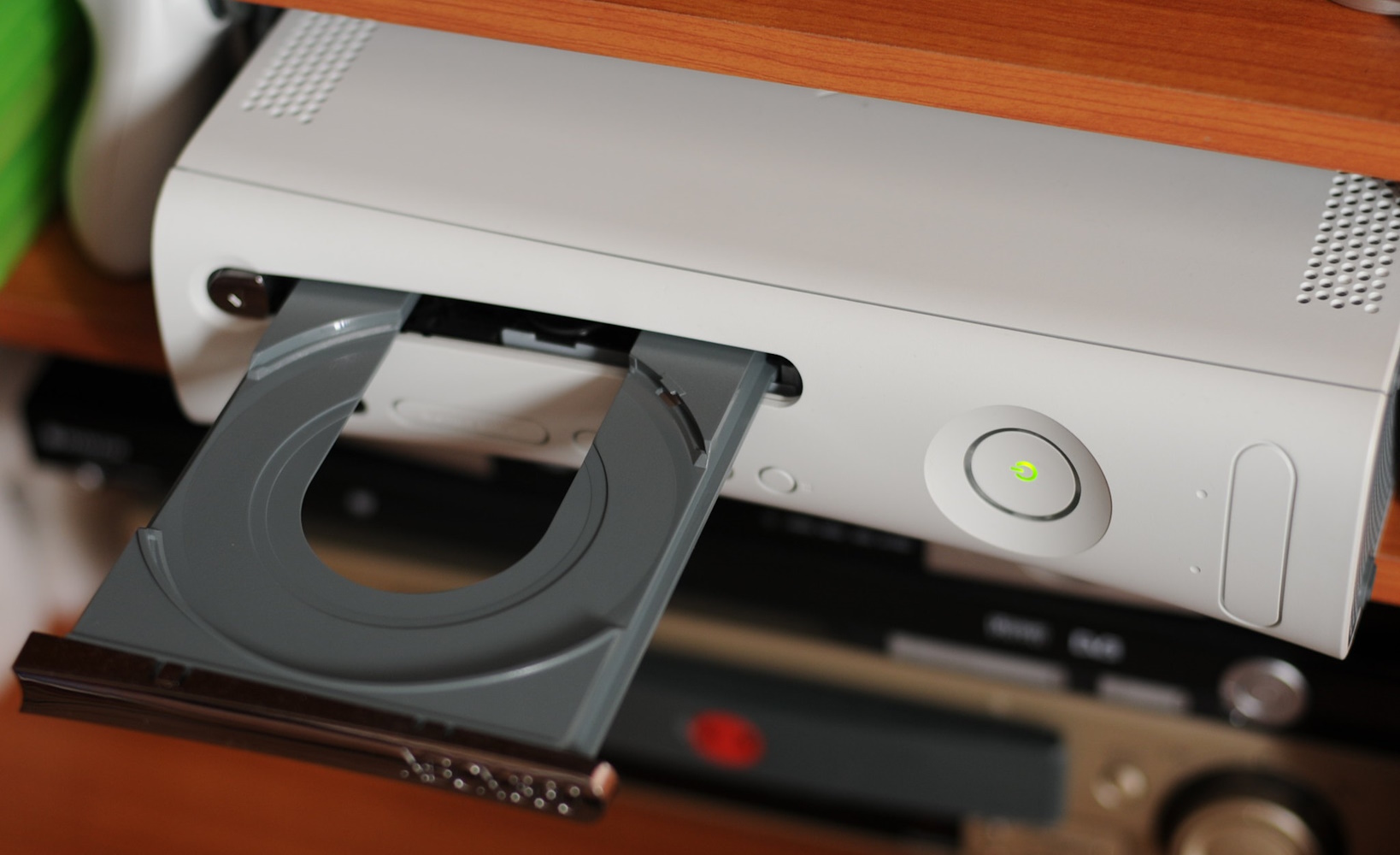
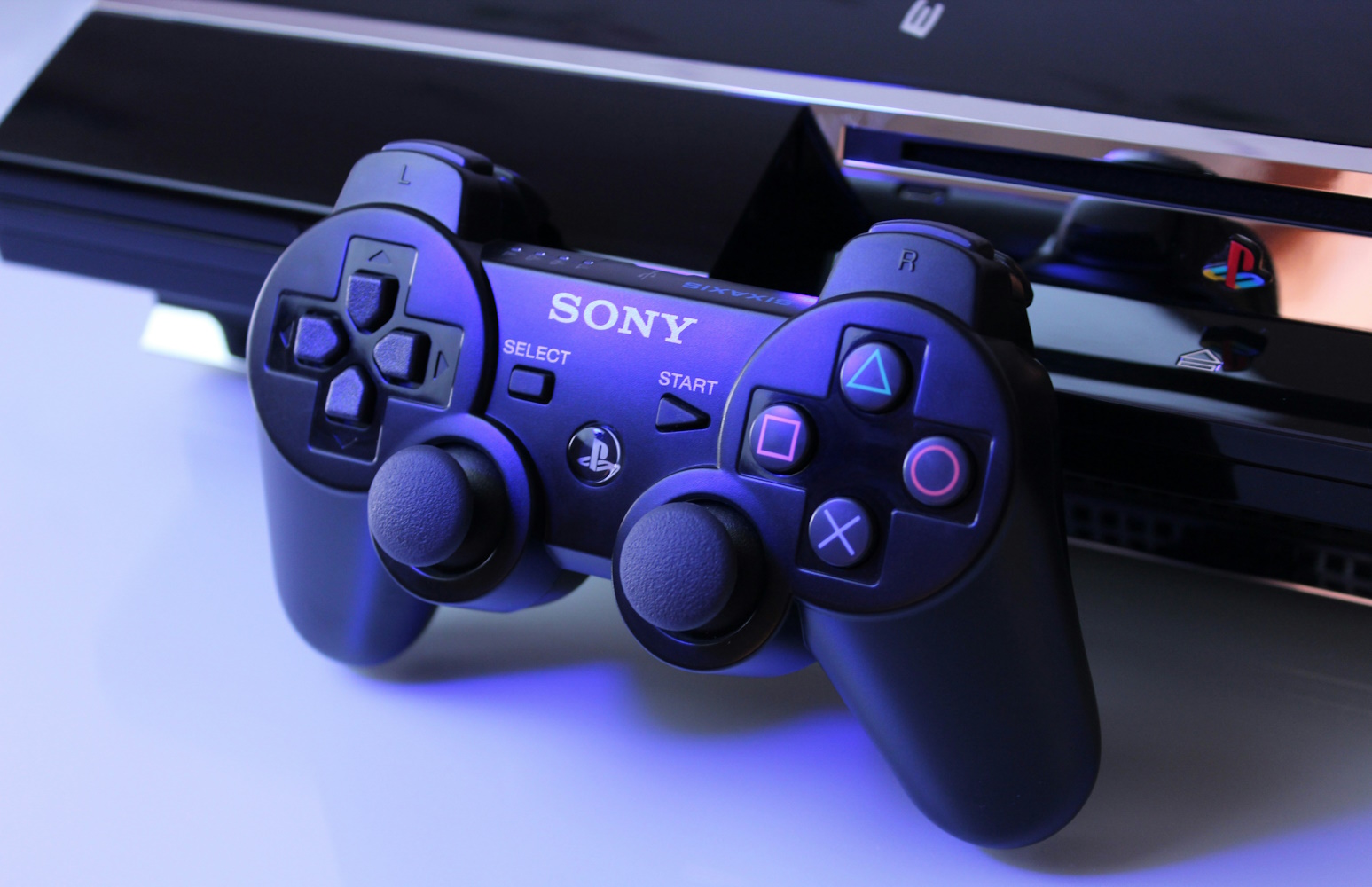
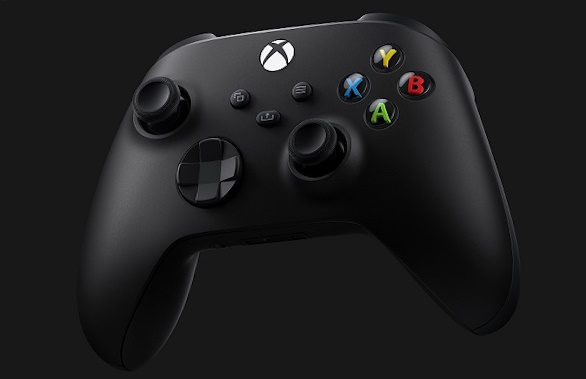
First of all, let’s separate the price of the Switch 2 console itself from the price of at least some of its flagship games. £400/$450 – which is the current price at time of writing, prior to any tariff-related adjustments – didn’t strike me as being terrible. It’s more or less in line with the current-gen Xbox and PlayStation consoles, sitting somewhere in between those consoles’ cheaper and more expensive variants. But is that the right price point for a Nintendo console – particularly one which is a hybrid, and far less powerful than its competitors?

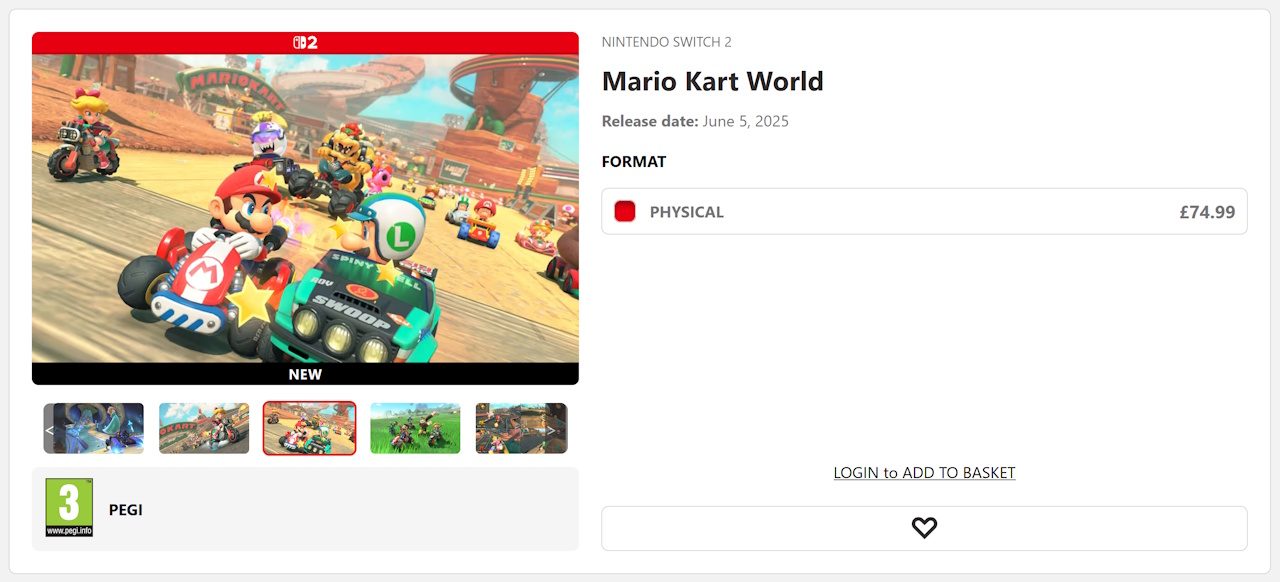
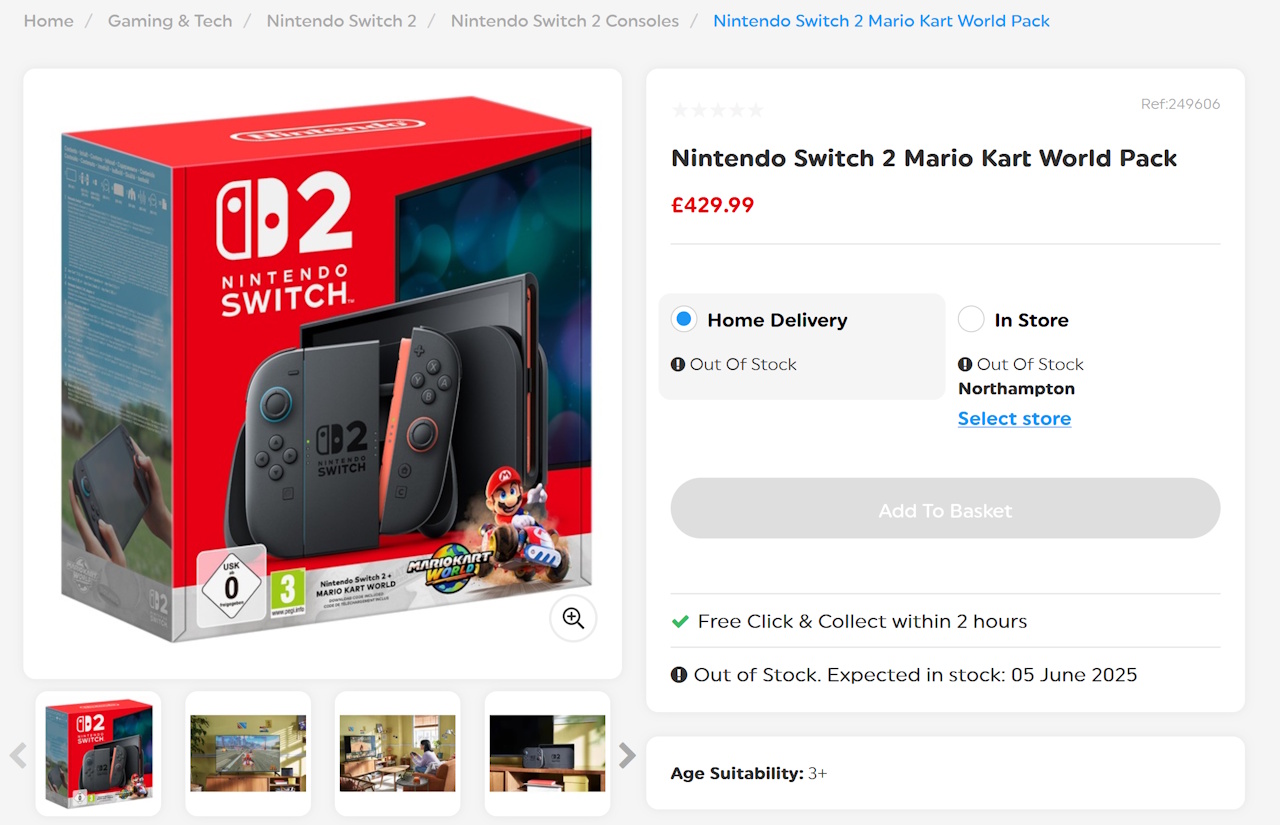
Screenshot of Smyth's UK website showing the Switch 2 listing.
The Switch 2 will sell for £430 here in the UK.
Image Credit: Smyth’s UK

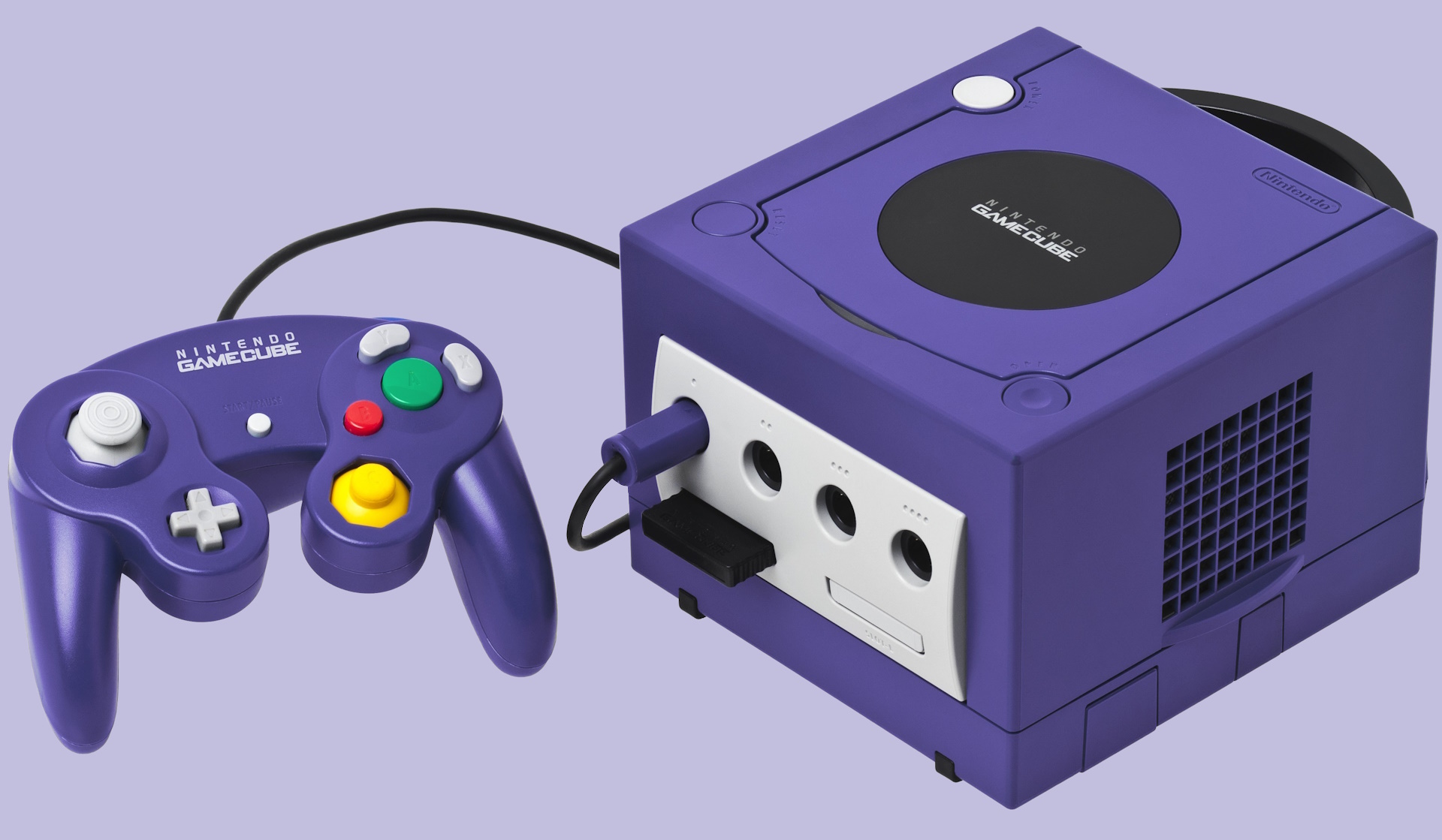
In 2018, I paid £280 for my Nintendo Switch. That’s just seven years ago, yet the price of a Nintendo console has gone up by 42% in that short span of time. That doesn’t feel right the more I think about it – and going back to earlier console generations, this is Nintendo’s biggest price jump… ever. In the ’90s, the price of Nintendo’s consoles stayed at $199 in the United States, even as inflation set in. The GameCube in 2002 cost the same $199 at launch as the Super NES had in 1991. From there, Nintendo consoles jumped up an average of 22% each generation from the GameCube to the original Switch. You can check out the numbers and do the sums for yourself if you like – all this information is publically available online.

All of this leads to a reasonable question. What is the Switch 2 offering to justify a 42% price hike over its predecessor?

It isn’t innovation. As we discussed last time, Nintendo seems content to double-down on the Switch format, not doing anything radically different. The Wii U, Wii, Nintendo 64, DS, 3DS, and other Nintendo machines all offered some kind of new or innovative way to play when they launched, but the company seems to have thrown in the towel on that front – at least for this current generation.

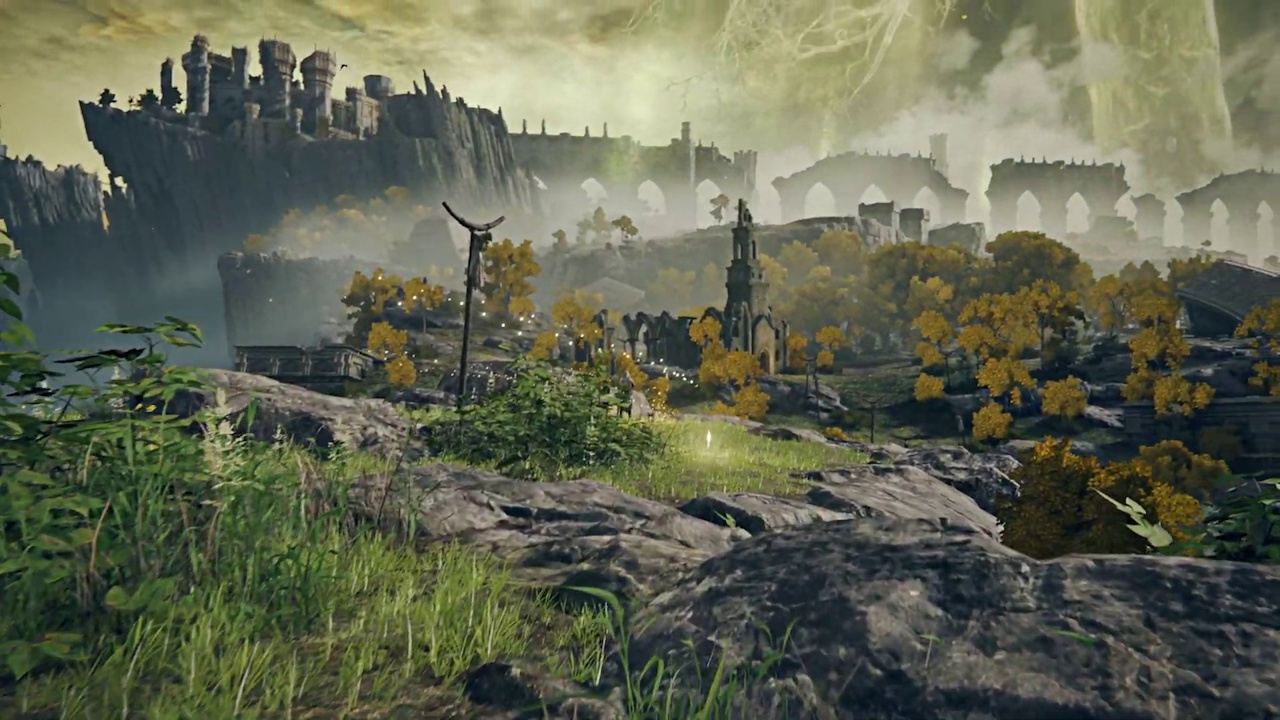
Still frame from the Nintendo Direct: Switch 2 broadcast showing Elden Ring.
Elden Ring – as it will appear on Switch 2.

It isn’t better graphics, either. The Switch 2, as I noted in my response to the Nintendo Direct, looks okay, but nothing blew me away in graphical terms. Some titles – like Elden Ring, Cyberpunk 2077, and Hogwarts Legacy – look noticeably worse on the Switch 2 than they do on other consoles or PC. Look at the trees in the screenshot above – see how flat and two-dimensional they look? Compare that screenshot from the Switch 2 to a comparable one from Elden Ring running on a PlayStation 5 or Xbox Series console and see how there’s a significant downgrade.

So the Switch 2 is, in essence, an iterative improvement on the original Switch format. It retains the branding, the same colour scheme, the same cartridge format, the same hybrid nature, and the same controls, too. Graphically, it may be an incremental improvement – but it’s going to be running cutting-edge titles in a noticeably worse way than its two similarly-priced competitors. Some of the biggest games around – Grand Theft Auto VI most noticeably – won’t run or even attempt to run on the system, too.

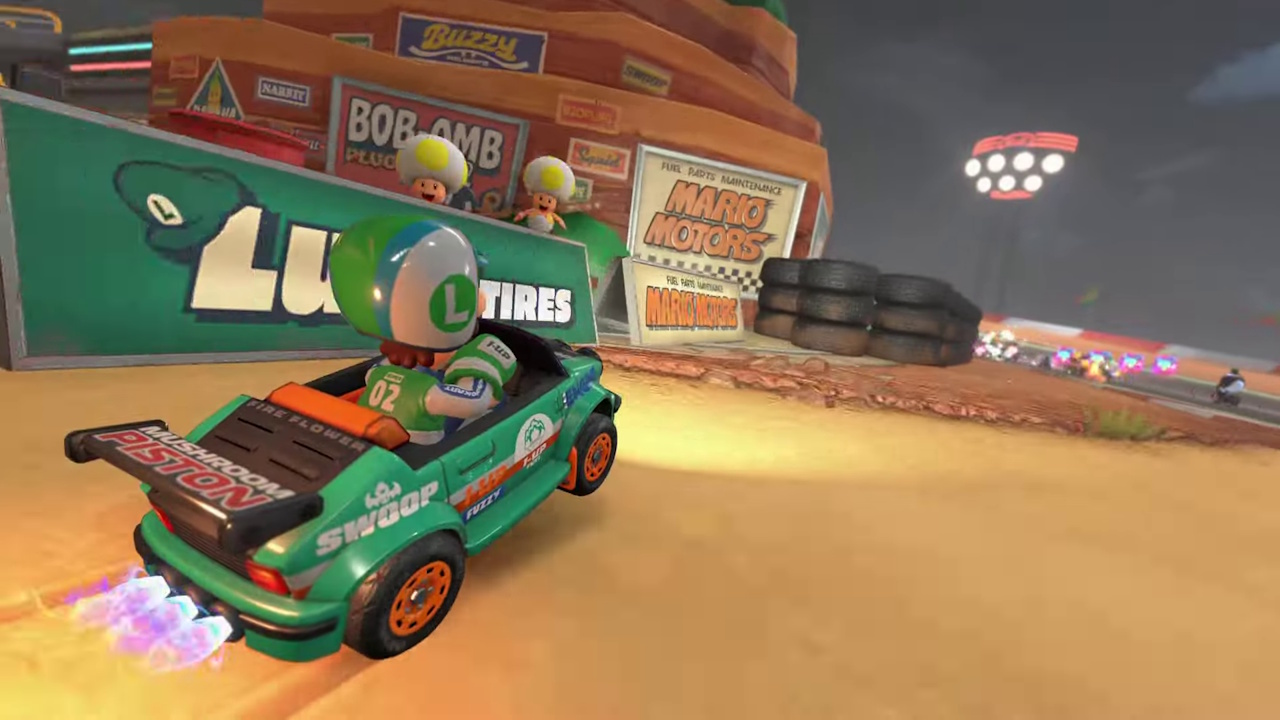
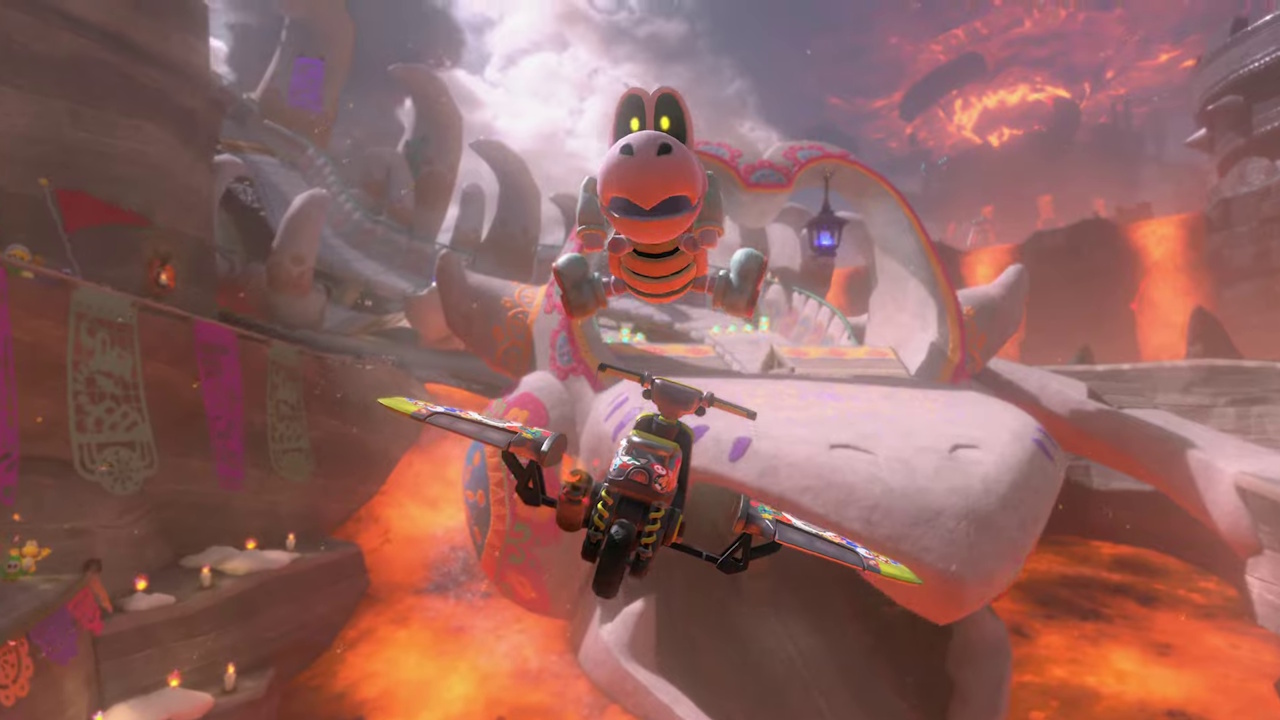
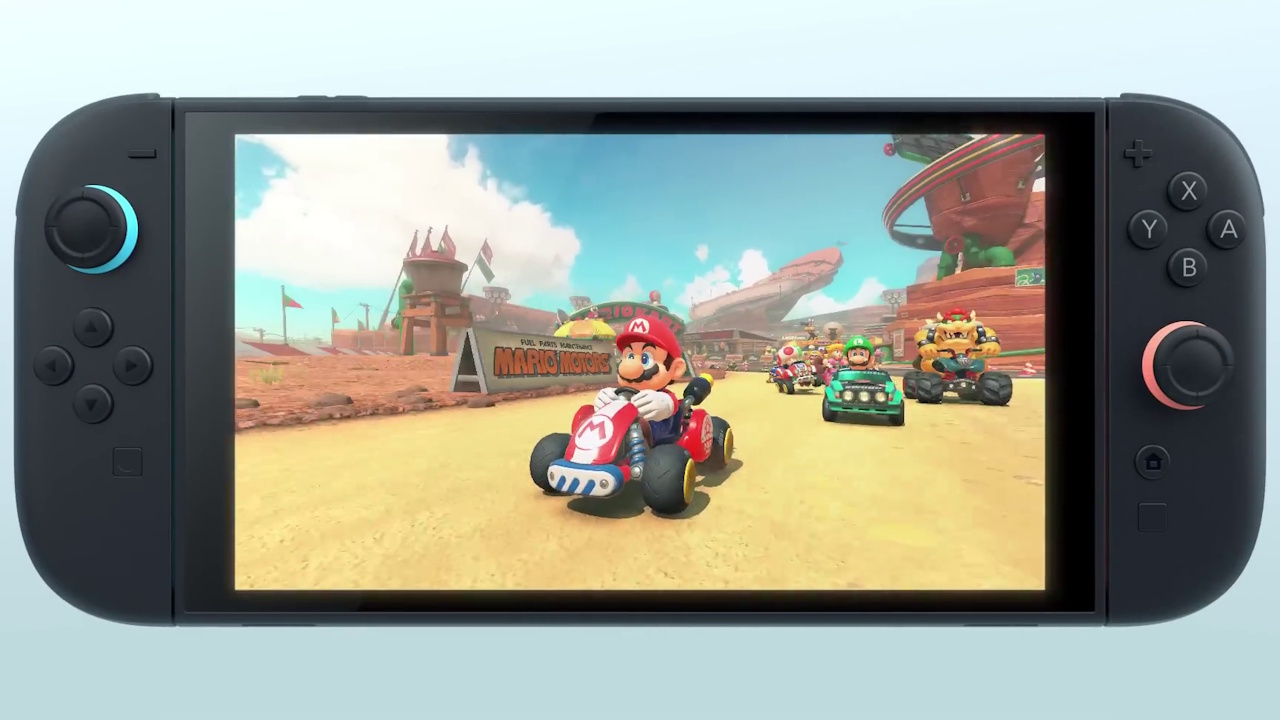
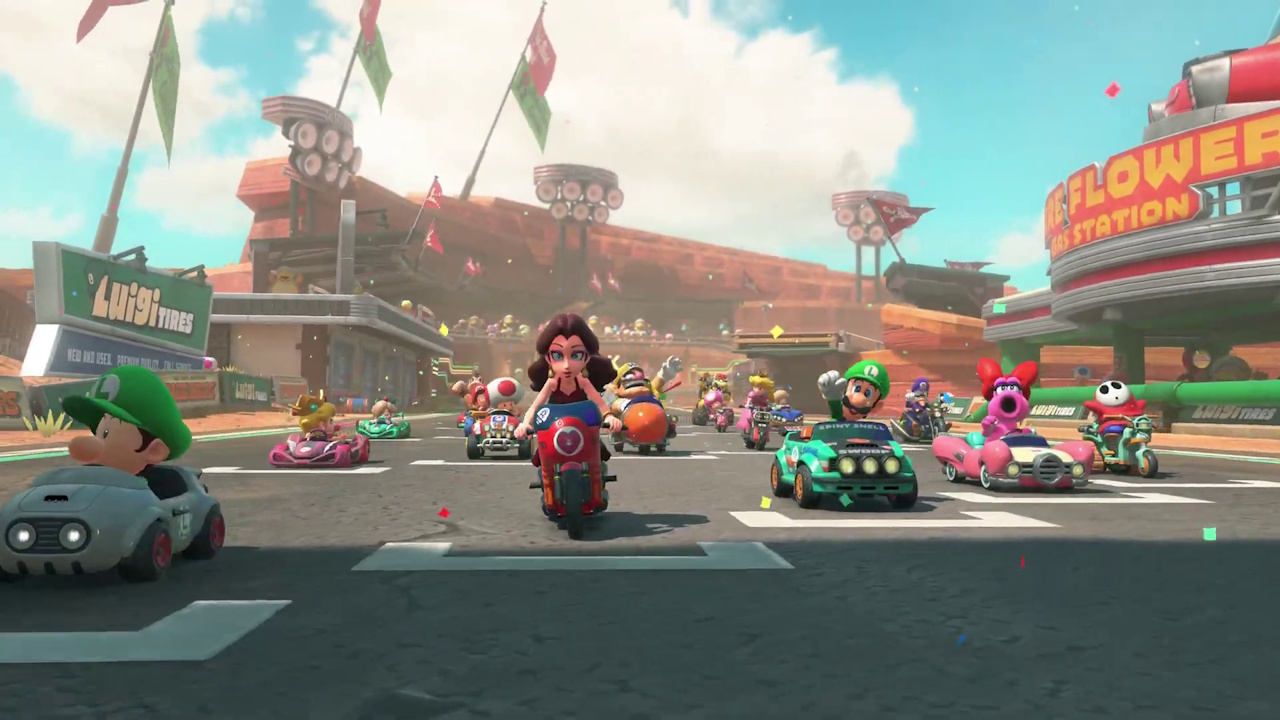
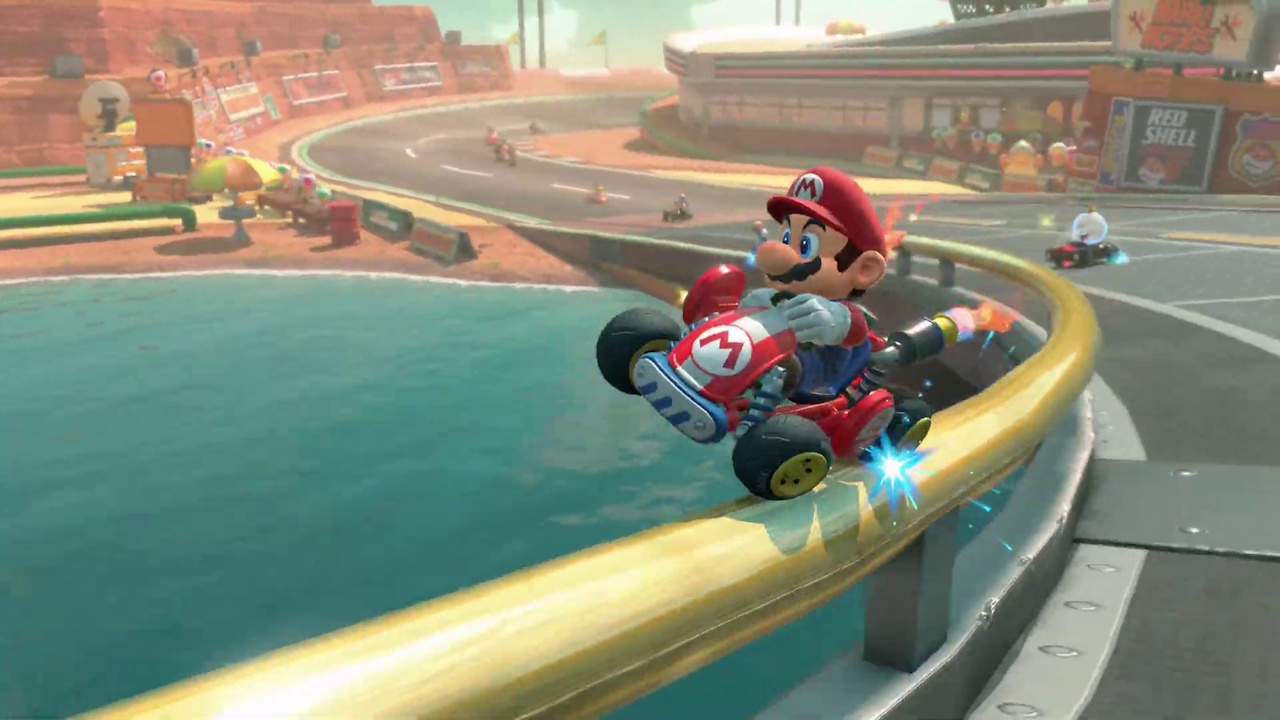
Still frame from the Nintendo Direct: Switch 2 broadcast showing Mario Kart World.
Mario Kart World running on a Switch 2 in handheld mode.

But people don’t buy a Nintendo console to play Elden Ring, right? Not as their primary console, anyway. Most folks I’ve spoken to have enjoyed the Switch’s portability, and have commented on the novelty of playing full AAA games like The Witcher 3, Monster Hunter, or Minecraft on a portable device. But those same people have, almost universally, owned a PC or another console which they’ve used as their “primary” gaming machine.

Look at the best-selling Switch games: they’re almost all Nintendo originals. Super Mario Odyssey, Animal Crossing: New Horizons, Breath of the Wild, the Pokémon series… these are the games people buy a Switch for. And in comparison to the current Switch, there’s no doubt that the likes of Mario, Luigi, Donkey Kong, and Pokémon are going to look better on the new machine. Nintendo has even shown off “enhanced editions” of some popular Switch games that will get visual upgrades on Switch 2.

Is the $450 price point too high for a console like that, though?

A stock photo of a hand holding a stack of $100 bills.
Is the Switch 2 overpriced?

Speaking for myself, I won’t be buying a Switch 2 this year. My original Switch felt like a good deal at under £300, but I’ve only seriously played four games on it in the seven years I’ve owned it: Luigi’s Mansion 3, Super Mario Odyssey, Animal Crossing: New Horizons, and Mario Kart 8 Deluxe. I’ve tried my hand at a few other games, but that’s it. Four games in seven years. And I won’t be the only person in that position… the reality is that Nintendo consoles have a pretty specific use, and the days of people choosing a Nintendo console instead of an Xbox or PlayStation are pretty much gone. So… who’s gonna pay $450 for a secondary console? Or a console that their kid is asking for?

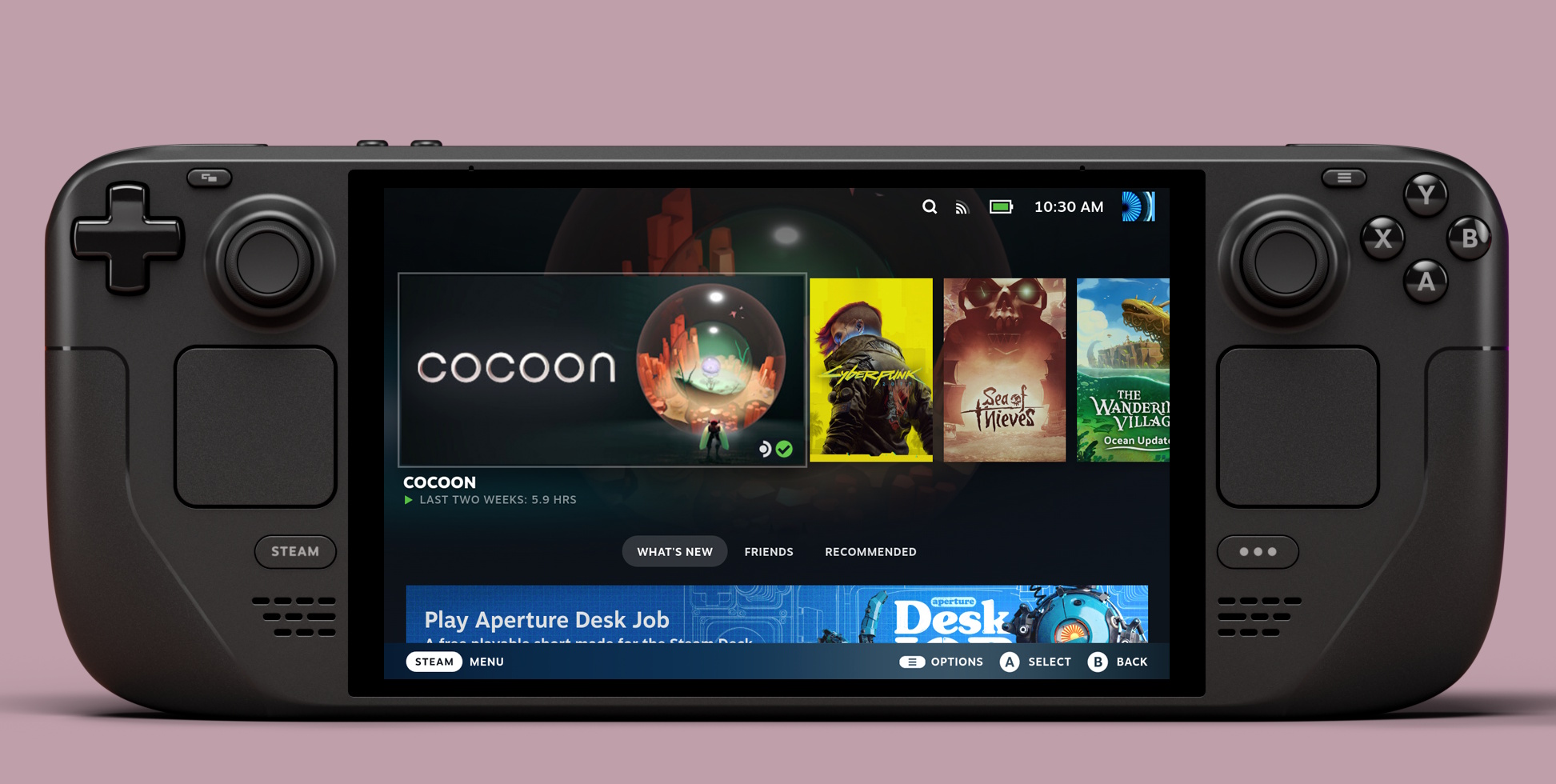
By pitching the Switch 2 at the same price point as an Xbox, a PlayStation, and more importantly, handheld PCs like the Steam Deck, Nintendo is inviting comparisons to those devices. A Steam Deck, which starts at $349 in the United States, would be a much more versatile machine in many ways, and arguably a better purchase than a Switch 2 for someone looking to play games on the go. Can Nintendo really win over players and parents at this price point?

Promo photo of a Steam Deck.
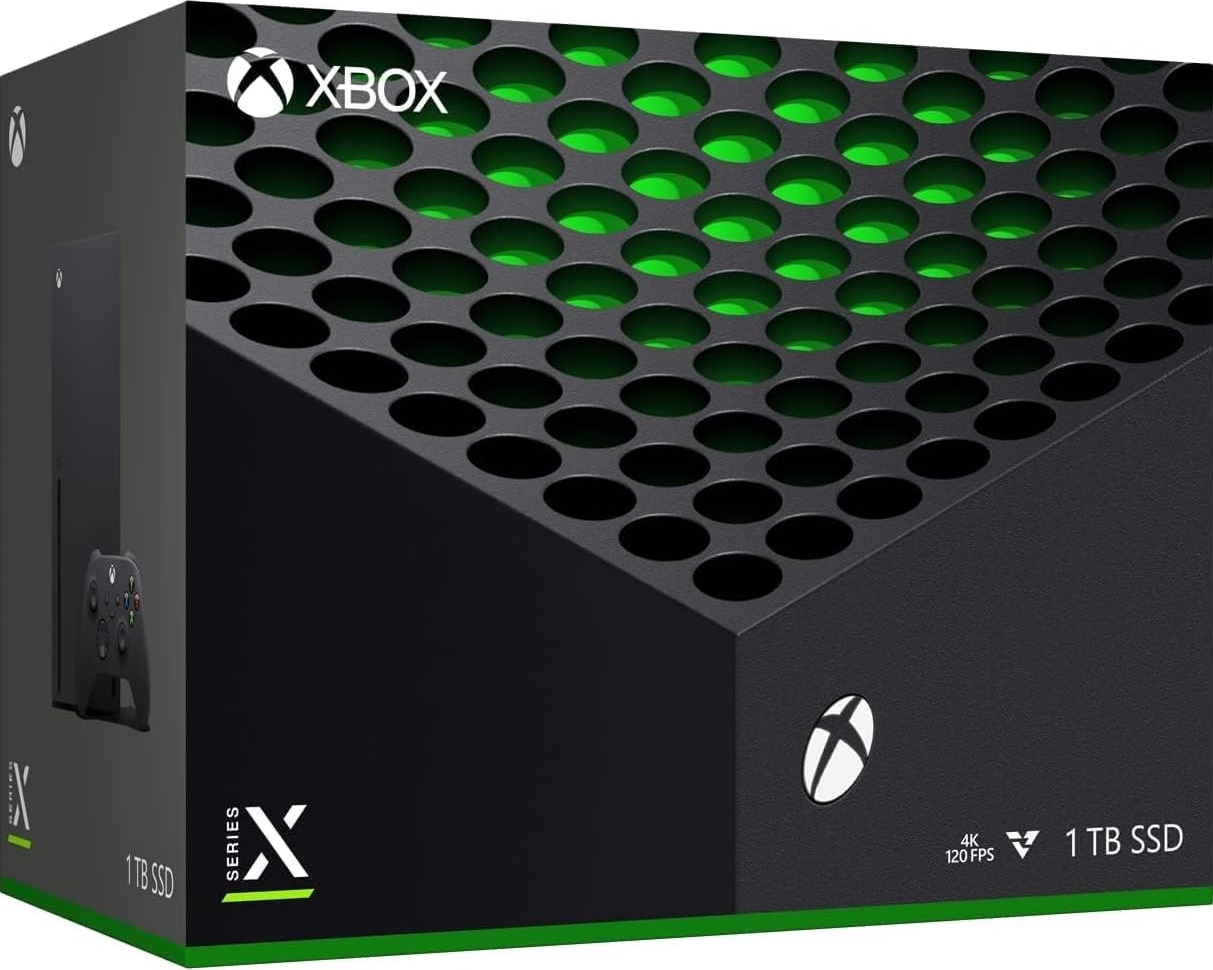
The Switch 2 will be more expensive than a base model Steam Deck – and almost the same price as an Xbox Series X.

Really, the only thing the Switch 2 has going for it are its exclusives. And I gotta be honest here: the Nintendo Direct really only showed one which I could see being a system seller. Donkey Kong Bananza is the kind of game you buy when you’ve already got the console and you’re shopping for things to play. There’s no new Mario game or Mario spin-off. And there’s no Animal Crossing title, either, which could’ve taken advantage of the casual audience that showed up in droves for New Horizons. The Switch 2’s “killer app,” at least at launch, is Mario Kart World. That’s it. Everything else has either much more of a niche audience or just… won’t shift consoles on their own.

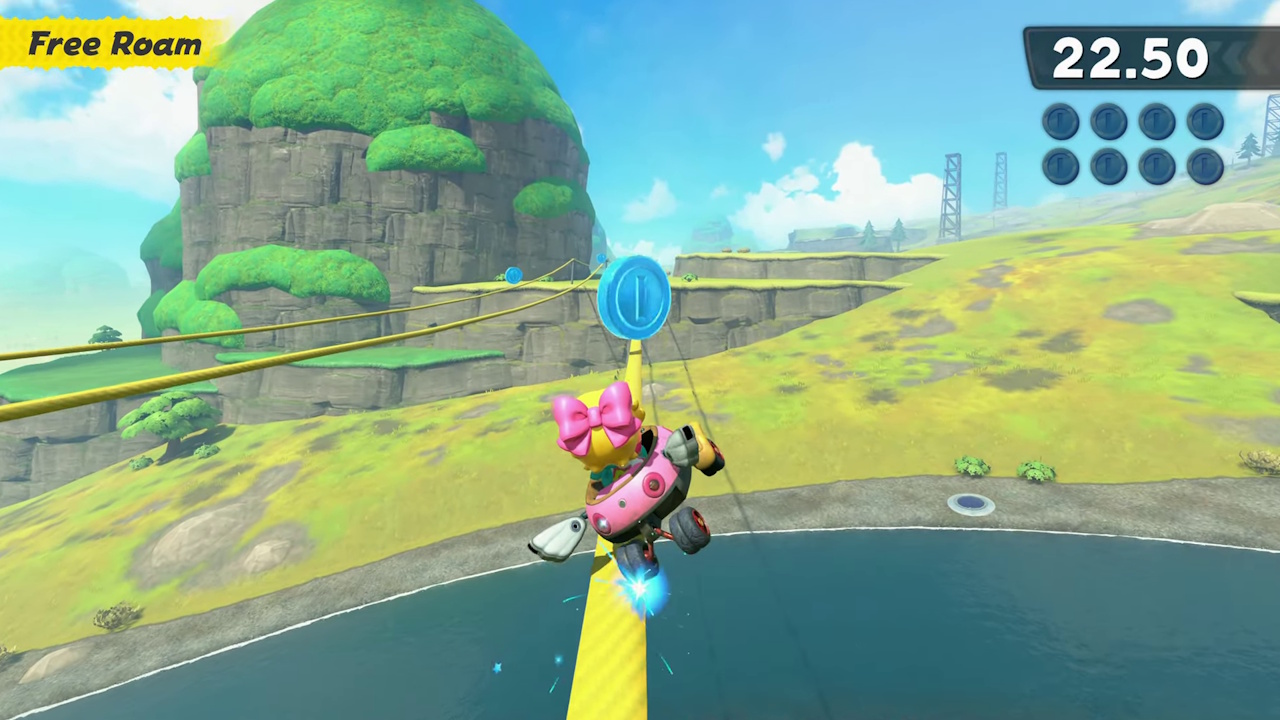
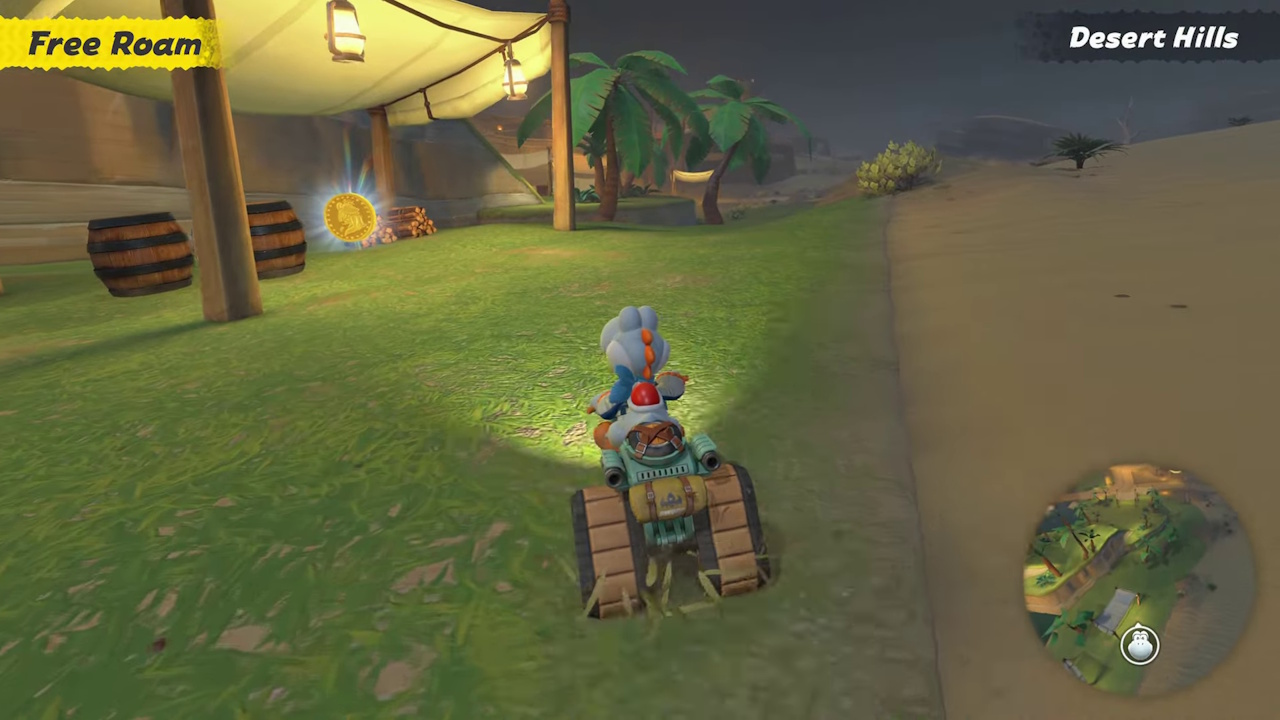
I don’t want to undervalue Mario Kart World. The game does look good, no question. Nintendo has always had the premiere kart-racer, and that shows no signs of changing! But as I said in my look at the Switch 2 Direct… I can’t justify £430 (which is the bundle price for the Switch 2 + Mario Kart World here in the UK) to play one game. And this is where the next problem comes in, because for a lot of people… one game might be all they can afford.

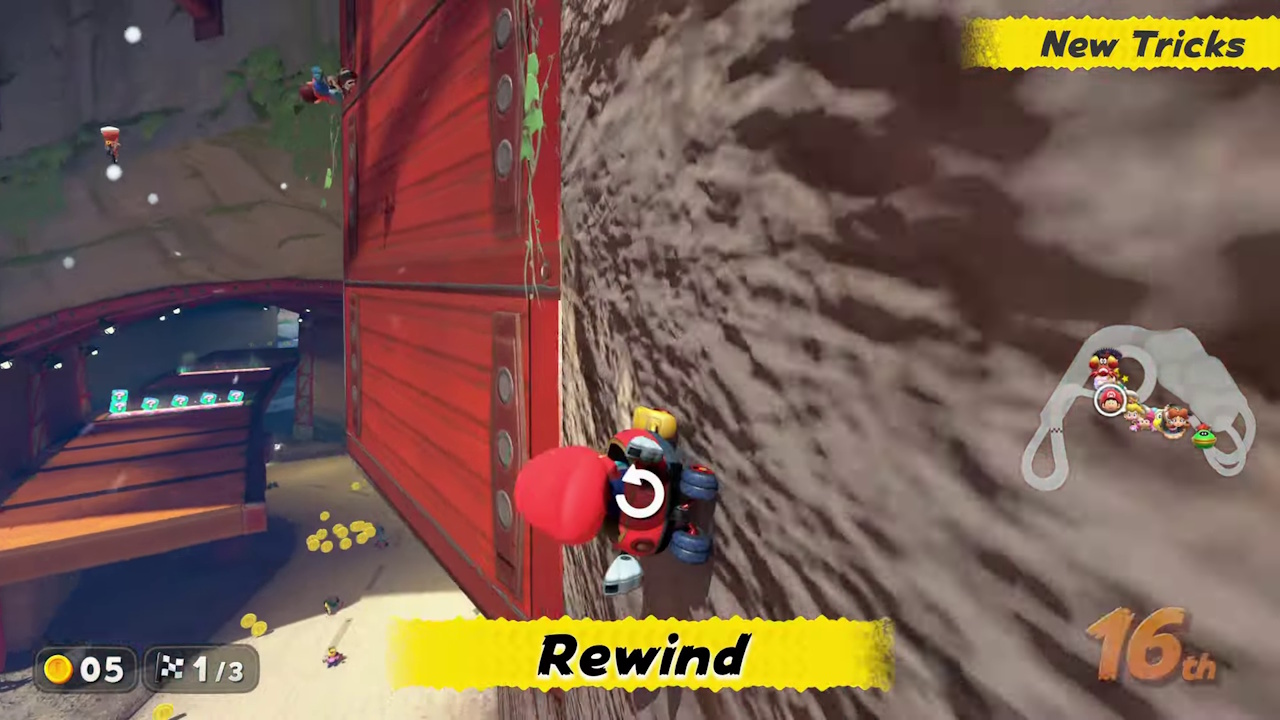
Still frame from the Nintendo Direct: Switch 2 broadcast showing Mario Kart World.
Mario Kart World.

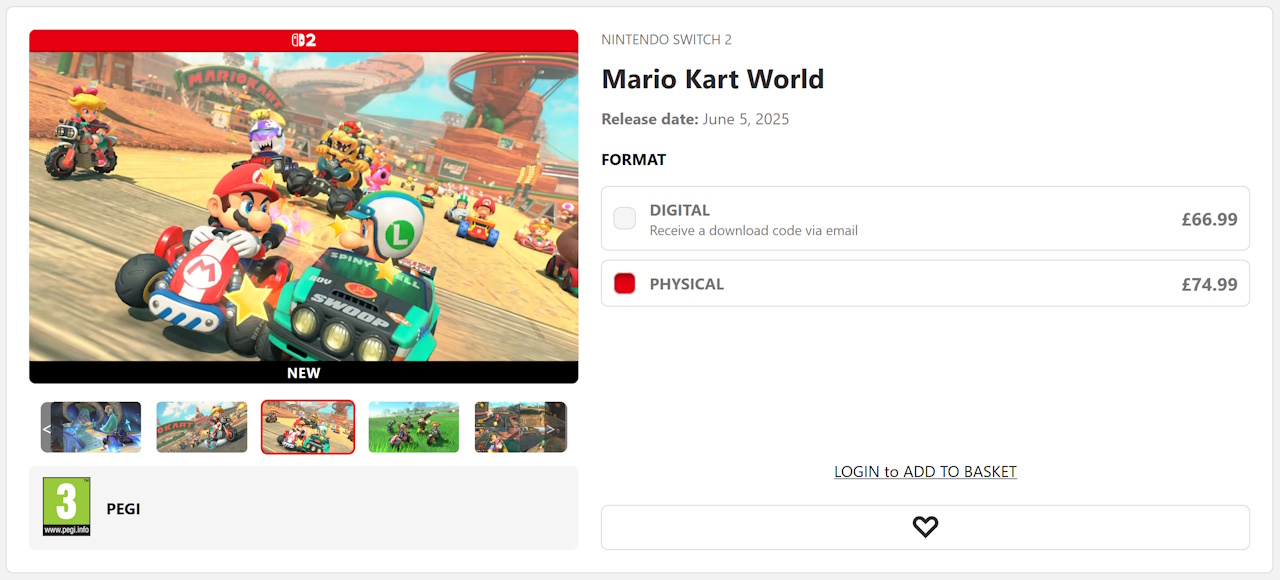
£75 ($80 in the US) for Mario Kart World is just obscene. Not only is it a ridiculous price for a simple kart racing game, but it’s a massive jump from the price of Mario Kart 8 Deluxe – and other games on the current-gen Switch.

I paid £41 for Mario Kart 8 Deluxe on the Switch, a similar price for Mario Kart 8 when I was one of about seven people who owned a Wii U, and I paid £32 for Mario Kart Wii in early 2009. Even allowing for inflation – which has punched all of us in the face in the last few years – we’re talking about game prices almost doubling from the Switch to the Switch 2 in some cases. I don’t have receipts for every Switch game I’ve bought, but the ones I could find average out at around £45. At the high end I’d pay £50, at the lower end closer to £30 or £35 for a brand-new Switch game. Even going from £50 – the RRP for Mario Kart 8 Deluxe – to £75 is a jump of 50% from one generation to the next; if a new Animal Crossing game is similarly-priced it’ll have basically doubled. These are massive increases, there’s no two ways about it.

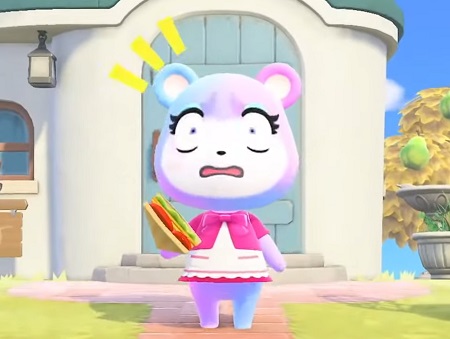
Still frame from the Nintendo Direct: Animal Crossing broadcast showing an animal villager being surprised.
The next Animal Crossing game could easily be £75/$80 too.

There does seem to be some flexibility with pricing, as Donkey Kong Bananza will be less costly than Mario Kart World. So perhaps Nintendo is aiming to use the highest price only for its flagship titles, with “lesser” games in second-tier franchises coming in at the slightly lower price point. That’s not a bad idea in theory – and it’s something that the games industry has always done. But if the “lower” price for titles like Donkey Kong Bananza is still north of £60/$70… that’s not gonna feel like much of a saving.

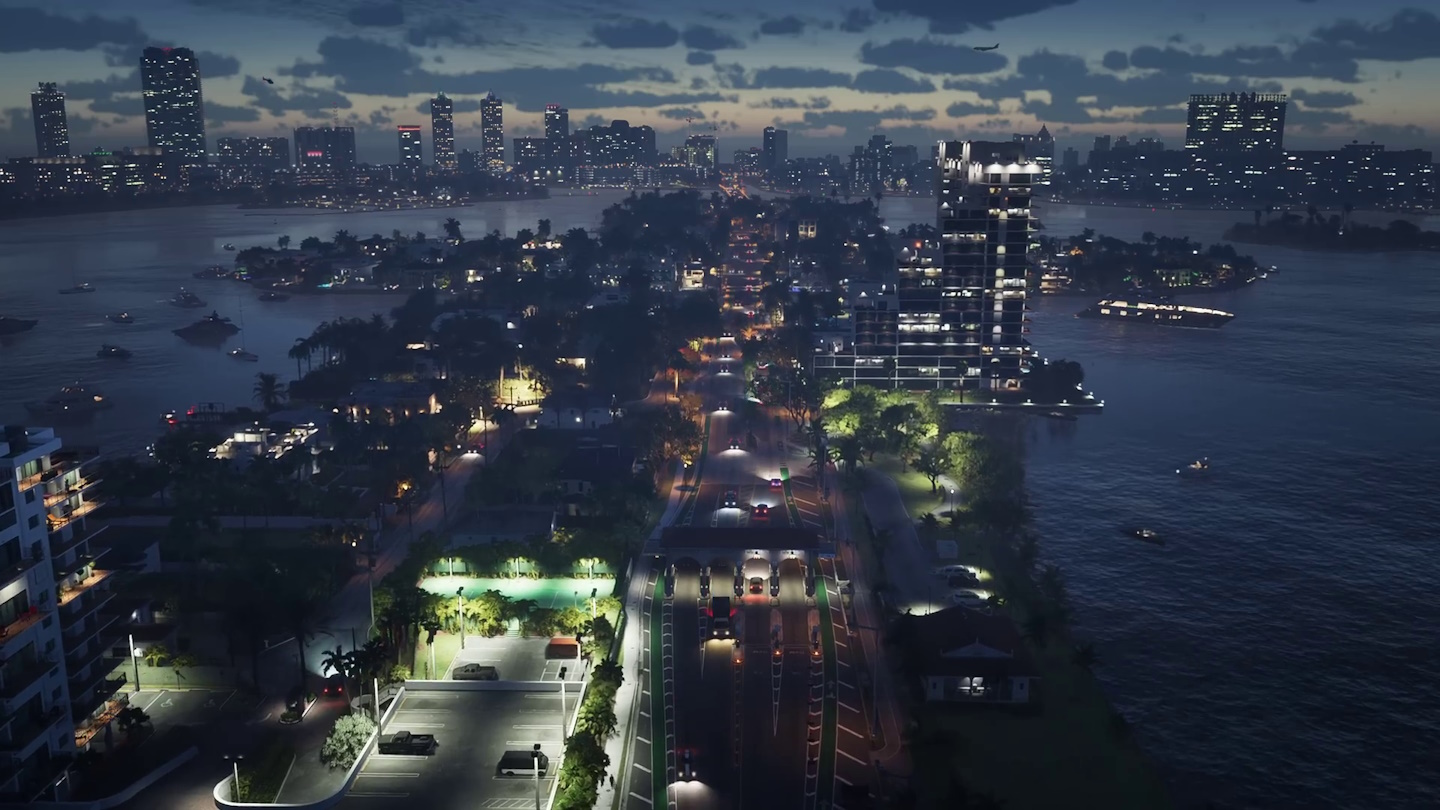
There was talk earlier in the year of Take-Two Interactive and Rockstar potentially pricing Grand Theft Auto VI at $80, $90, or even $100 when it launches, and Nintendo’s price hike may well have cemented that – if it wasn’t guaranteed already. And this is another area where players are rightly concerned: if Nintendo gets away with jacking up its prices, what’s to stop everyone else in the industry from following suit? Gaming could be about to get a lot more expensive – less than five years after the basic price of many titles already leapt up by $10.

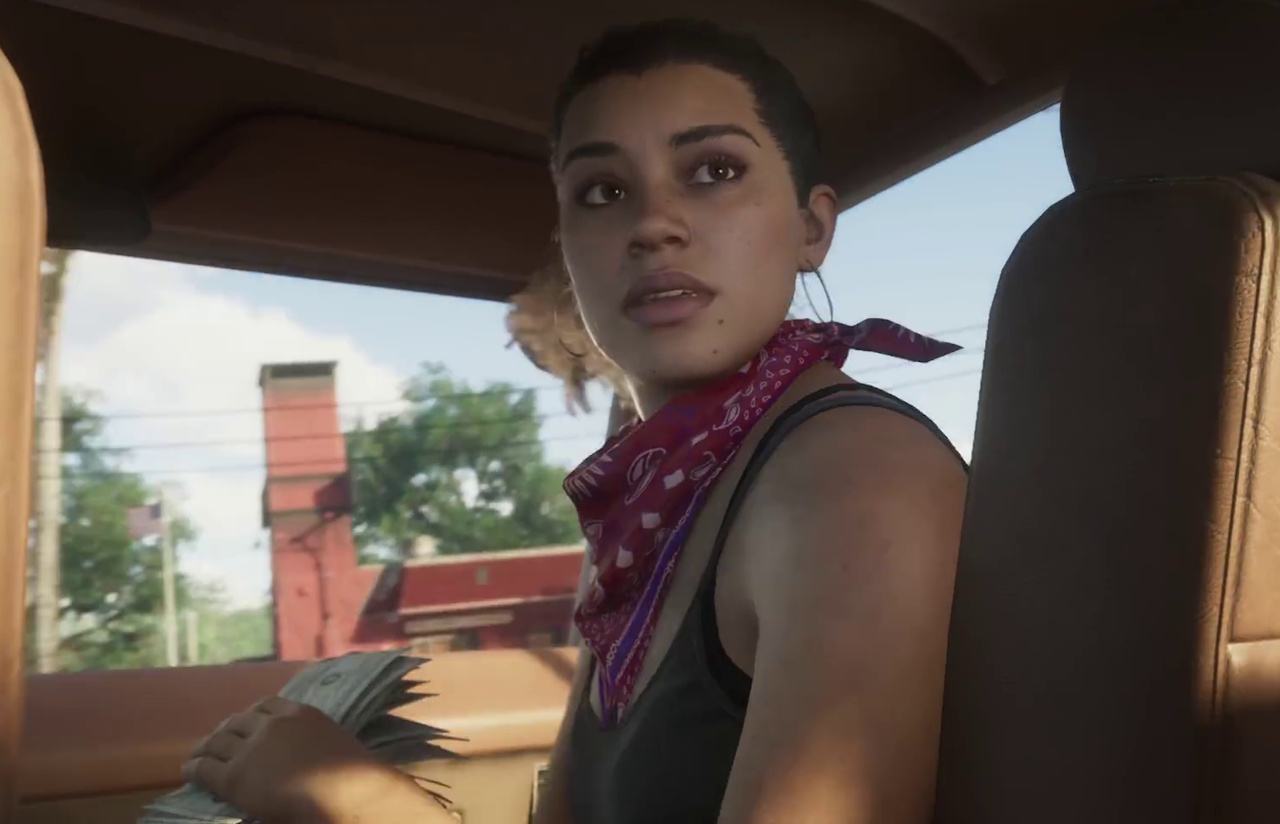
Still frame from the Grand Theft Auto VI trailer showing a character waving her arms in celebration while riding in a car.
Take-Two and Rockstar must feel like celebrating right now!

This is not entirely Nintendo’s fault, of course. And there’s truth to the argument that these price rises were going to happen sooner or later anyway, if not with the Switch 2 then with Grand Theft Auto VI, and if not then then at the very latest by 2028 or 2029 when new Xbox and PlayStation consoles launch. But I don’t think that absolves Nintendo of blame; despite what the corporation’s mega-fans might want to tell you, it’s a greedy, money-grubbing company that will do anything to make an extra buck or two. Look at the Pokémon series as a prime example: two nearly-identical versions of most games are released. Why? To wring extra money out of Pokémon’s biggest fans. Nintendo, unlike most other gaming powerhouses, rarely puts its titles on sale – and if it does, the discounts are far less generous than those you’d see elsewhere. Despite its attempt to cultivate a family-friendly image, Nintendo is as ruthless and greedy as every other big corporation out there – something hammered home by this price hike.

So the question players will have to wrangle with is this: no matter how good a game like Mario Kart World might look, could it possibly be worth $80? Is any game worth that much? And given that at least one DLC or “season pass” seems like a guarantee, is Mario Kart World going to be worth the $110-140 that the complete version will cost? I’m a Mario Kart fan and have been for decades, but when you start talking about the next entry in the series hitting triple figures like that… I mean, it’s pretty offputting.

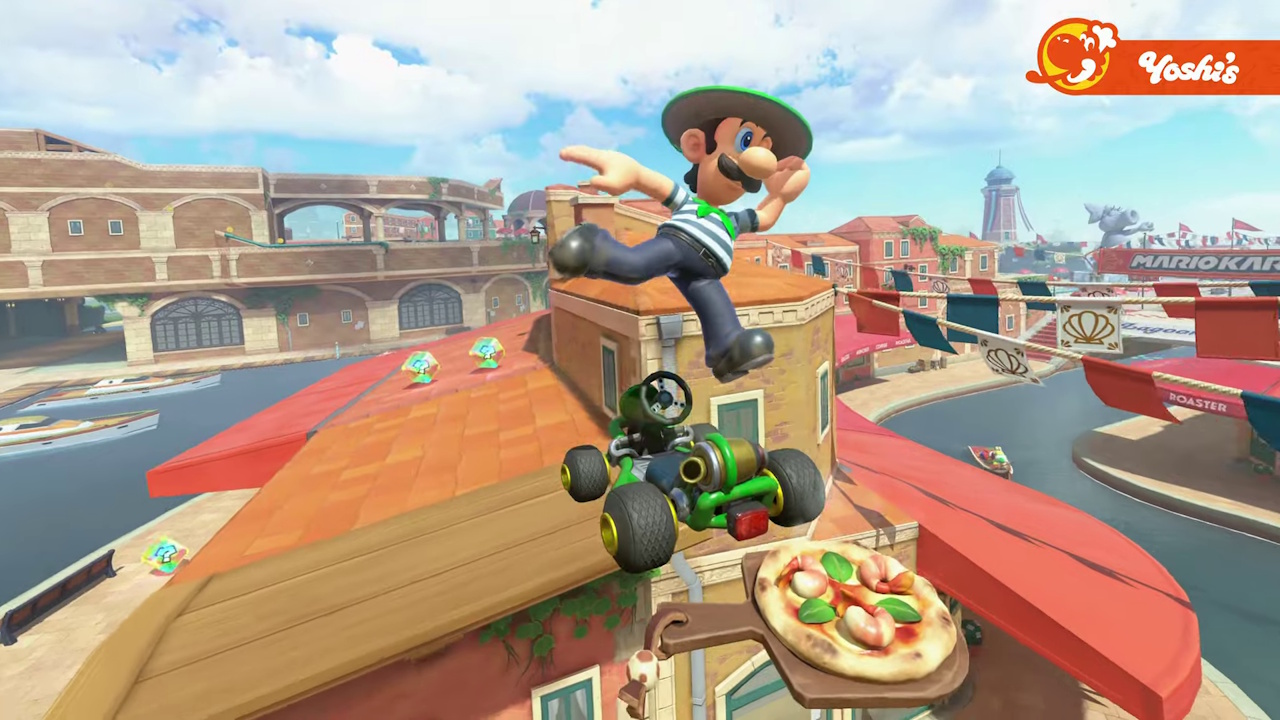
Still frame from the Nintendo Direct: Switch 2 broadcast showing Mario Kart World.
If Mario Kart World is getting the expected DLC or a season pass, the price could be well above the currently-stated £75/$80.

There are die-hards who turn up for every Nintendo game and every console – and the company knows it has those people in the bag. But where Nintendo has found success over the past twenty years has been with a more casual audience. People who don’t play a lot of games might pick up a Switch to play one or two party games or cozy titles like Animal Crossing. Folks who already have a PlayStation or Xbox might pick up a Switch as a secondary console to play some first-party Nintendo games or to play their favourite titles on the move. The price point of Switch 2 games really gets in the way of that casual approach. It transforms the way folks will think about the console and its games from a secondary machine or a casual multiplayer experience into a bigger investment. And that could be seriously detrimental to its prospects. If Nintendo has mis-read where the bulk of its audience is, and misunderstood the reasons for the Switch’s success, this unashamed greed could prove the Switch 2’s downfall.

With all that being said, my gut feeling at this point is that the Switch 2 will find an audience. It may not launch to the unparalleled success of its predecessor right away, and it might never catch the Switch’s incredibly impressive 150 million sales. But I don’t think we’re looking at the next Virtual Boy or even another Wii U situation; there are enough players invested in Nintendo’s core titles to make the Switch 2 at least somewhat profitable. And, despite what we’ve talked about, there’s evidence from players already that price rises are acceptable. There will be complaints, no question – but at the end of the day, there are plenty of examples of players being vocal and upset about the price of a new game, only for that game to sell really well. It happened at the start of this current generation when prices went up, it’s happened incrementally with premium special editions and the like, and I see no reason why it won’t happen for Nintendo this time.

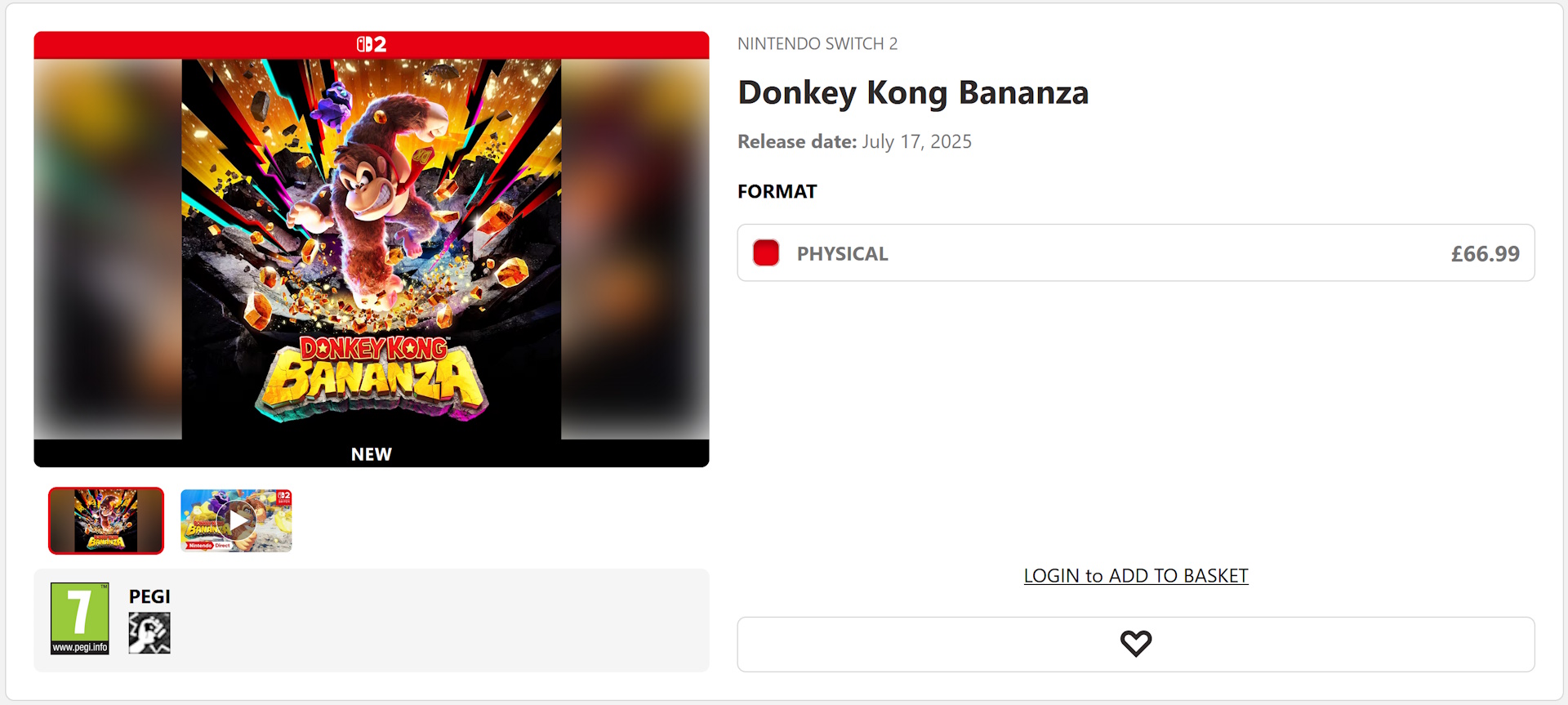
Still frame from Nintendo's website showing the price of Donkey Kong Bananza.
Donkey Kong Banaza will cost more than most other big releases this year, like Assassin’s Creed Shadows and Kingdom Come Deliverance II.

What all this means, then, is that gaming is about to get even more expensive. If you think PlayStation and Xbox will sit idly by and let Nintendo raise its prices while they don’t… I’m afraid you’re going to be proven wrong. It might not happen on the day the Switch 2 launches, but as we’ve already seen from Xbox and PlayStation this generation, if they can get away with it they will. And if there was any lingering fear at Take-Two headquarters about jacking up the price of Grand Theft Auto VI, I think we can safely say that’s gone, too. If GTA 6 launches later this year as scheduled, we might be looking at $90 or even $100 for AAA games across the board by this time next year.

Inflation has impacted games companies. But when they’re also making record profits… I really don’t have a lot of sympathy. Nintendo’s share price recently dropped a little due to tariff-related shenanigans that have impacted basically every publically-traded corporation, but the company made record profits across the Switch’s lifespan. “Game development is too expensive” doesn’t really fly as an excuse when Nintendo made $3.25 billion in profit last year.

Still frame from the Nintendo Direct: Switch 2 broadcast showing three Nintendo developers holding a Switch 2 console.
Three of Nintendo’s senior developers.

Most of us in the real world haven’t seen our incomes rise with inflation, and even in the games industry that’s true for developers and other employees. As Nintendo jacks up prices by 40% for its consoles and 33% for games, do you really think that money is going into the pockets of the folks who work there? Is anyone at Nintendo – aside from the executives, naturally – getting a 40% pay rise? I doubt it.

Food for thought, anyway, if you’re considering buying a Switch 2.

Gaming is getting more and more expensive, that’s for sure. With Nintendo pitching the Switch 2 at a comparable price point to Xbox and PlayStation consoles, as well as portable PCs, while jacking up the prices of its games beyond the current industry standard… all I can really forsee at this stage is comparable price hikes from other corporations. But maybe Nintendo’s gamble won’t pay off. Maybe we’ll look back on this decision in a couple of years’ time and say that the hefty price tag doomed the Switch 2 before it could even get out of the gate. I’m not rooting for it to fail, but I will be keeping an eye on the situation!


The Nintendo Switch 2 launches on the 5th of June. Pre-orders for the Nintendo Switch 2 are available now. The Switch 2, Super Mario, Mario Kart World, and other properties discussed above are the copyright of Nintendo. This article contains the thoughts and opinions of one person only and is not intended to cause any offence.

Nintendo Switch 2 Direct: Thoughts and Impressions

Yesterday was a big day for the entire world. No, not because of Trump’s tariffs… there was a Nintendo Direct all about the upcoming Switch 2! I thought it could be interesting to break down what was revealed (and talk about a few things that weren’t, too) so that’s what we’re going to get into today.

First of all, I have to admit that I’m surprised about the name and branding, as well as the overall look of the console. Last year, I said that I felt pretty sure that Nintendo wouldn’t use the name “Switch 2,” and that the console would likely come with a new colour scheme to distinguish itself. I was wrong on both counts… and I hope that won’t lead to any confusion. Switch 2 game cards are going to be the same size and come in similar packaging, with the same red colour. There could be some disappointed kids on Christmas morning unwrapping a Switch 2 game when they only have an original Switch – and I’m a little surprised that Nintendo didn’t do more to help the console differentiate itself from its predecessor.

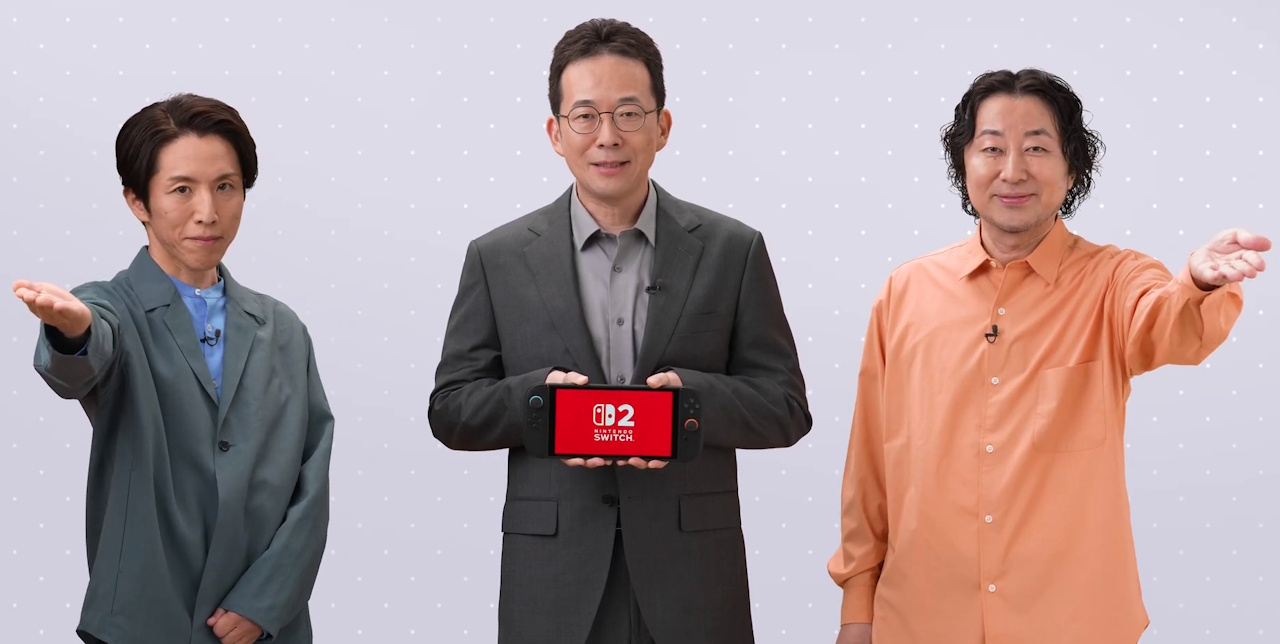
Still frame from the Nintendo Switch 2 Direct showing three Nintendo executives and the Switch 2 console.
Nintendo executives Kouchi Kawamoto, Tetsuya Sasaki, and Takuhiro Dota presented the Switch 2 broadcast.

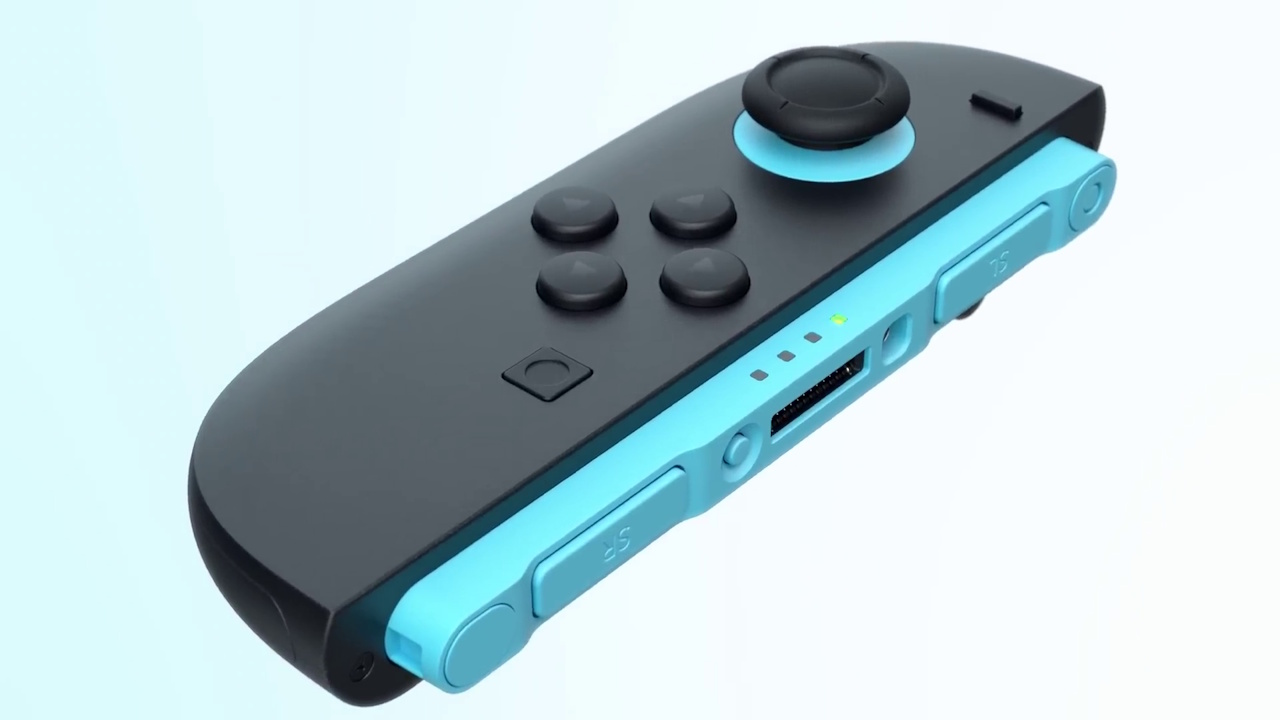
The same is true of the name. Every Nintendo console so far has had a unique name, even if those names were similar. The Super Nintendo Entertainment System followed the Nintendo Entertainment System, for example, but where a lot of folks seemed to get confused was with the Wii U. “Switch 2” is much more straightforward, so I don’t think there’ll be anywhere near the same level of confusion from the general public! But I am a bit surprised that the new console retains the Switch name, colour scheme, branding, and even really the same design. There are changes, particularly with the new Joy-Cons, but on a superficial level it’s hard to tell the consoles apart.

And I guess Nintendo is playing it safe. The Switch has been a massive success, so why risk doing something new and innovative when there’s clearly still a huge demand for this kind of hybrid system? The drawback, as a player, is that Nintendo has been the last of the massive game companies to really invest in innovation, and if they’re stepping back from that… it kind of leaves the gaming landscape feeling pretty static going into the second half of the 2020s. I mean, no one really expects a new Xbox or PlayStation to do something wild and unexpected; Nintendo has been the only game in town when it comes to inventing new control schemes and new ways to play. Not all of those have worked, of course, and playing it relatively safe is probably the smart move from a business point of view. But there was nothing earth-shattering in the Switch 2 Direct in the same way as there was when the original Switch, Wii U, Wii, or even GameCube were announced.

Still frame from the Nintendo Switch 2 Direct showing the Switch 2 console.
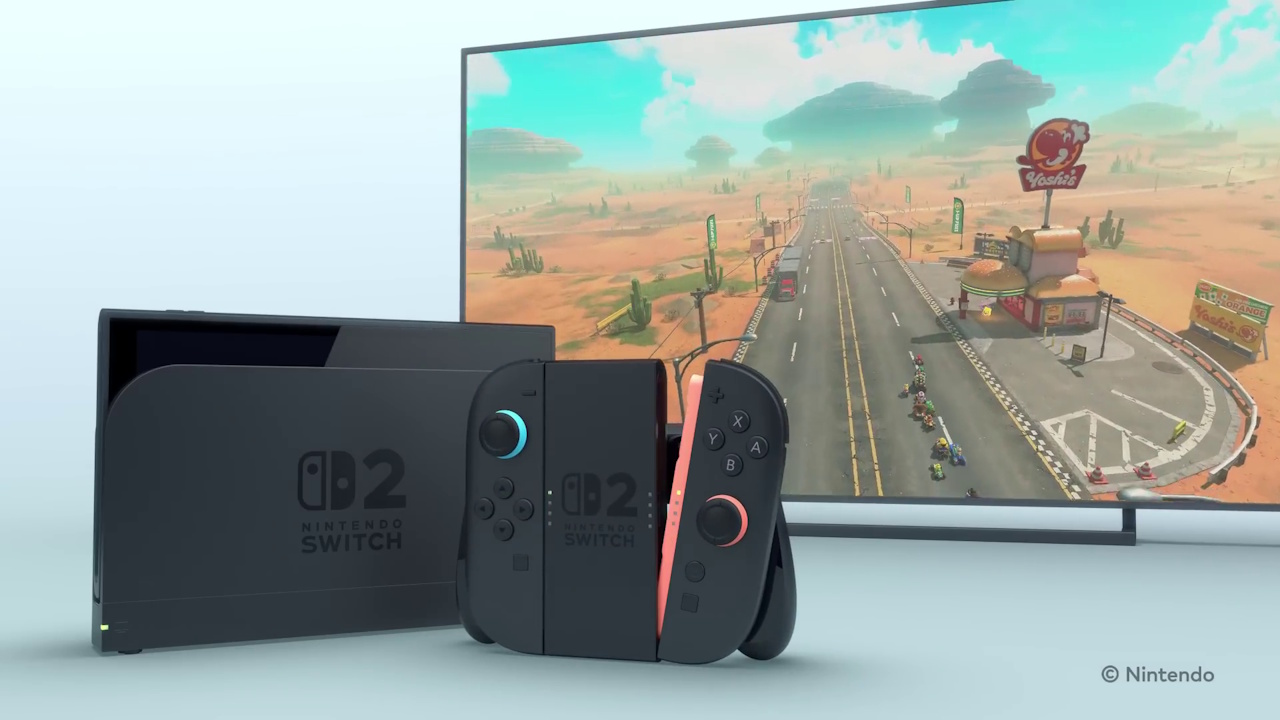
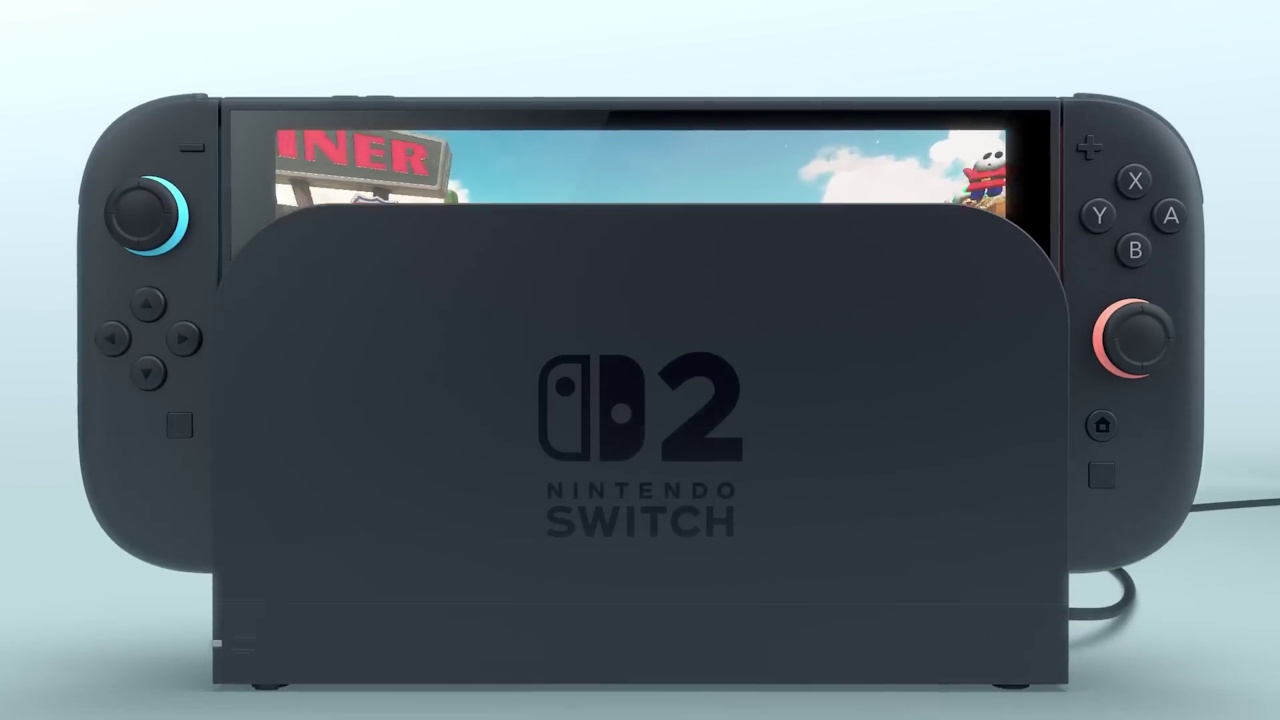
The Nintendo Switch 2.

Even though my platform of choice these days is PC, I confess that I really only use the mouse for strategy games; I generally prefer to use a control pad most of the time. But if there’s one thing I could say about the Switch 2 that feels different and interesting, it’s using a Joy-Con like a computer mouse. Nintendo isn’t new to this, by the way – there was a SNES mouse in the 1990s that was used in titles like Mario Paint. But it’s a first for a home console in the current generation, and Nintendo seems to be leaning into the mouse idea in a big way. I can see it being phenomenally useful in games like Civilization VII, which will be coming to the Switch 2, and I’m sure fans of first-person shooters will appreciate the idea of using it in titles like Metroid Prime 4, too.

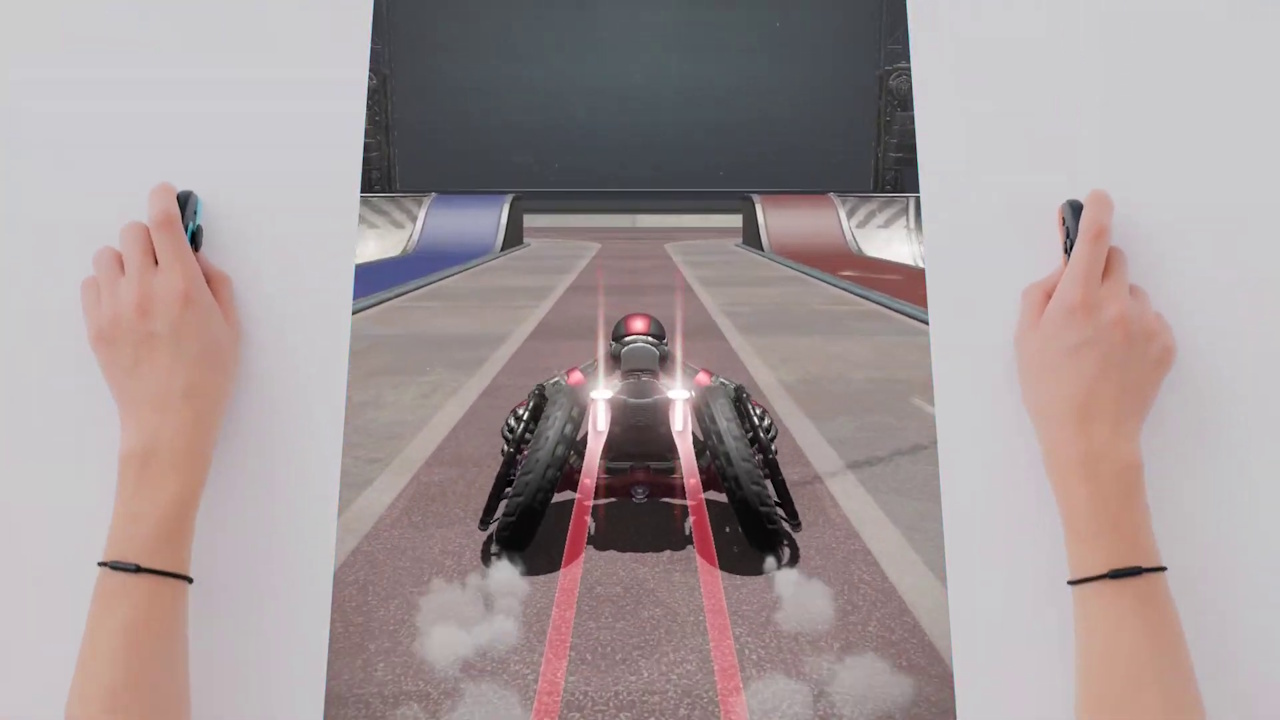
What most intrigues me, though, is the idea of using both Joy-Cons at the same time – basically like having two mice. I’ve never seen a game which played that way, yet if you think about it, the possibilities for dual-mouse gameplay seem almost limitless! It’s something quite simple, yet it’s never been tried before (or if it has, it never caught on). Nintendo showed off a basketball-inspired game called Drag X Drive which seems to use the two Joy-Cons in this way – but I hope it won’t be the only game to offer that kind of control scheme. Drag x Drive looks great, and it’s wonderful to see some disability representation in a presentation like this, too. I’d really like to see what other developers might be able to do with this way of controlling a game.

Still frame from the Nintendo Switch 2 Direct showing the Joy Con controllers and Drag x Drive.
Using two Joy-Cons like this could be a really creative way to play games.

We’ll talk more about games in a moment, but if we stick with hardware for now… I was a bit surprised that Nintendo didn’t go into more detail about the Switch 2’s specs. We got a bit of information about the built-in screen, which will now be 1080p (full HD) instead of 720p, and that the Switch 2 can also scale up to 4K when docked. But there wasn’t a lot of meat on the bones; what kind of processor does the system have, how much VRAM, and pretty basic things like that weren’t mentioned.

I have to assume that this was a deliberate choice – that Nintendo knows the internals aren’t spectacular, so opted to talk about cameras and voice chat instead. From a totally unscientific look at the Switch 2 Direct – with the obvious caveat that a video presentation compressed for YouTube isn’t going to look its absolute best – I was underwhelmed with the graphics. It didn’t help that most games shown off aren’t brand-new, but nothing about the graphics on display really impressed me. If I had to guess, I’d say the Switch 2 is probably about on par with something like an Xbox Series S, which in turn was comparable to the previous generation of home consoles. So we’re talking about graphical fidelity that might’ve looked great in 2012… but is nothing special in 2025. That’s nothing new for Nintendo, of course, and it isn’t to say that (most of) the games on display didn’t look good! But it is notable that there doesn’t seem to be a significant graphical leap considering the price of the console and its games.

Still frame from the Nintendo Switch 2 Direct showing Welcome Tour.
We didn’t get much of a look at the Switch 2’s internals this time.

One part of the Switch 2 that has me nervous is the magnetic Joy-Con connection. Despite Nintendo’s promises, the dual magnets to hold the controller in place when in handheld mode just don’t seem as sturdy as they would need to be to keep the console safe. The way it was explained in the Direct also made it seem like something that could be accidentally knocked, so even if the magnets are as strong as advertised, the mechanism to keep them working might be vulnerable to bumps, drops, and knocks. If you want to screw with your friend when they have a Switch 2, flicking the little magnet button might be a naughty way to mess up their gameplay!

Alright, let’s talk about price. The console itself doesn’t feel over-priced. It’s an increase from the Switch, but after eight years (and an inflation problem in the interim) that’s to be expected. But the price of games has jumped up quite a lot, too, with Mario Kart World seeming to retail at £66 for a digital-only version and a whopping £75 for a physical game cart in a box. That’s more than the so-called “standard price” of most other video games on PC, PlayStation 5, and Xbox Series consoles, at least here in the UK. Assuming other titles will be similarly-priced, the Switch 2 seems like an expensive proposition right now.

Screenshot from Smyth's showing the Switch 2 pre-order page.
The Switch 2 – with Mario Kart World included – retails for £430 here in the UK.
Image: Smyth’s UK

There are other gripes with the way things are priced, and a lot of this is the typical and expected anti-consumer shite from Nintendo that the company’s fans always try to pretend doesn’t exist! Selling the Switch 2 camera separately is fine; not everyone is going to want one. But charging £50 for what looked like a cheap, crappy webcam that, even in Nintendo’s own marketing broadcast, didn’t seem to output a particularly high-quality image? That feels like highway robbery.

Why on earth is Switch 2 – Welcome Tour something to pay for? Nintendo bundled Wii Sports with the Wii when that console launched, introducing players to the Wii remotes and motion controls. If there are things I need to know about my new Switch 2, and Nintendo has created an interactive presentation for the express purpose of explaining those things… it’s not unreasonable to expect that to be included in the price, is it? The console is going to be £400 ($450 in the United States) at a minimum, so why be so stingy with this Welcome Tour thing? It also feels like an exceptionally bone-headed move… who’s really going to buy Welcome Tour, even if it’s only like £5? I can’t see it being a popular item.

Still frame from the Nintendo Switch 2 Direct showing Welcome Tour.
Why is Welcome Tour something I have to pay for?

I can’t help but feel Nintendo missed a trick with its Game Chat feature, at least based on the way it was marketed in the Direct. Being “alone together” would’ve been great… five years ago when it was lockdown! But now? I know online gaming is huge and it’s gonna find an audience, but the choice of marketing language just strikes me as odd. It’s as if Nintendo thinks people are still stuck at home, desperate to find ways to connect. There were other ways to show off this feature without harkening back to the covid era which, quite frankly, a lot of people want to forget.

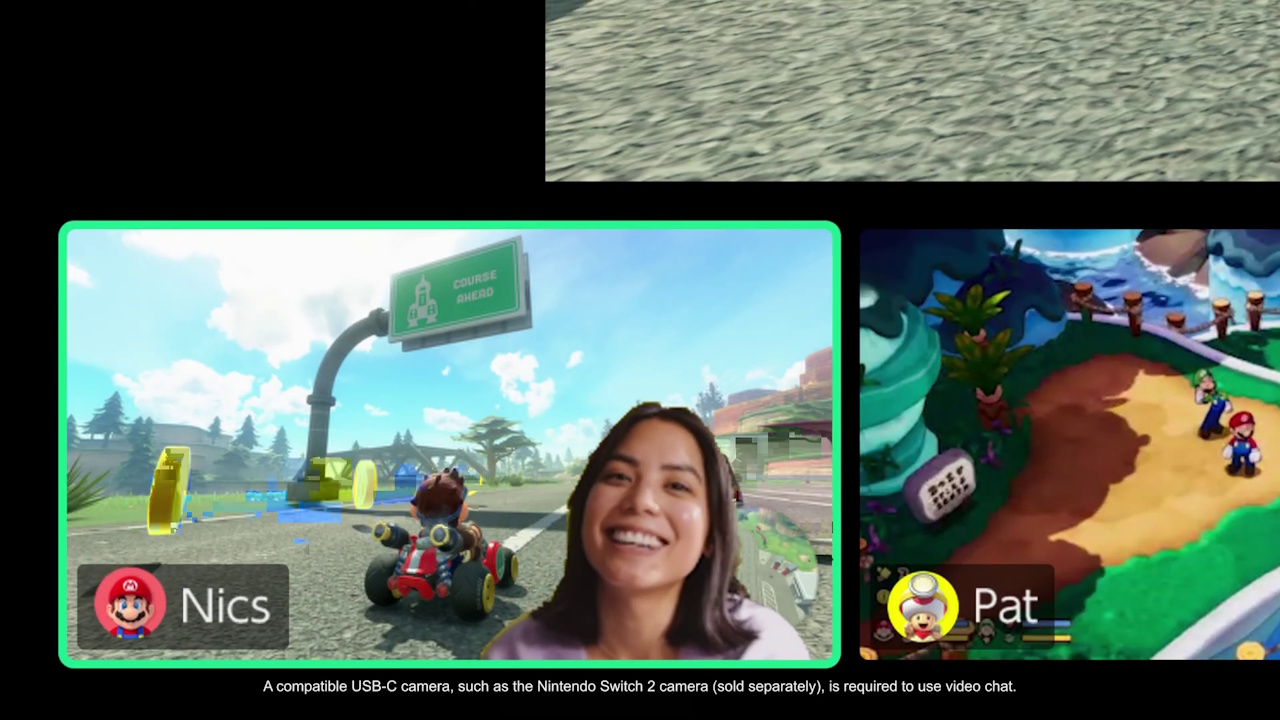
Game Chat, on its own, is nothing new or revolutionary. People have been using voice chat while gaming for literally decades at this point, so Nintendo is unusually late to the party. I do, however, like the promise of a microphone that can isolate a voice and cut out background noise, and a camera that can crop out the background. Neither of these things are new; streamers have been using green screens to appear in their live streams for years. But to have it work smoothly, in real-time, with several people at once… that’s impressive. If it works as advertised!

Still frame from the Nintendo Switch 2 Direct showing a gamer using the Switch 2 Camera.
The Switch 2 will have a camera accessory.

Let’s get into the games! After all, what good is a console without any games?

I’ll do the third-party titles first, because I don’t really have that much to say about them. As I said above when we were talking graphics, none of the third-party games blew me away. In fact, Elden Ring in particular seemed to have gotten a noticeable downgrade, at least based on gameplay and screenshots that I’ve seen. The trees in particular looked exceptionally flat and two-dimensional, and I just didn’t think the game looked its best. The same was true of Cyberpunk 2077, which looks and runs great on my PC but seemed downgraded and less visually impressive on the Switch 2.

On the one hand, these are large, demanding games, so the fact that they’ll run at all on Switch 2 is impressive in itself. But… Cyberpunk 2077 is a game approaching its fifth anniversary and that launched on last-gen hardware (albeit in a poor state). So, the fact that it doesn’t look great on the Switch 2 seems to suggest that the internal hardware is lacking, which could have a knock-on effect for games later in the console’s lifespan. Maybe Switch 2 games in 2025 will look pretty good, but by the time we get to 2029 and a new PlayStation and Xbox are in the offing… what will players make of the Switch 2’s capabilities by then?

Still frame from the Nintendo Switch 2 Direct showing Elden Ring.
Elden Ring’s open world has never looked… flatter.

I’ve been intrigued by IO’s Project 007 since it was announced, and I’m a tad disappointed that we didn’t get so much as a whiff of gameplay. The game was teased… but that’s all! It’s not a bad thing necessarily, and it’s great for Nintendo fans to know a new Bond game is coming to Switch 2. But given that the game was prominently included in the Switch 2 Direct, I would’ve liked to have seen something more!

Onward to Nintendo’s own games!

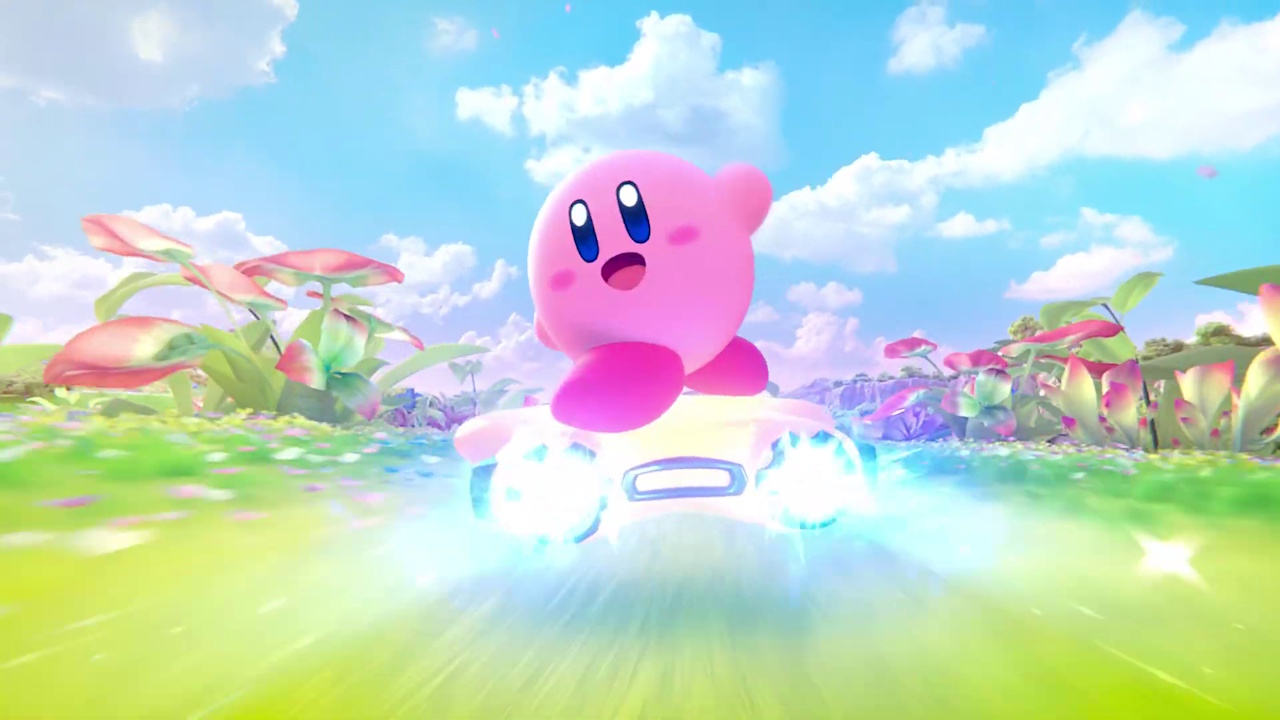
So… the Switch 2 is launching with two cartoony racing games? Did I get that right? In addition to Mario Kart World, there’s also going to be Kirby Air Riders, which is the sequel to a GameCube title that I think I might’ve played once. As with so many things Nintendo does… this has confused me. By all means, have both games on the Switch 2. But should they both be releasing in the same year, perhaps just weeks apart? And should they have both been shown off as part of the new console’s marketing campaign? Really, Nintendo… you couldn’t have prioritised another game for 2025 and pushed Kirby Air Riders to next year? It just seems… repetitive.

Still frame from the Nintendo Switch 2 Direct showing Kirby Air Riders.
Did the Switch 2’s launch announcement really need two cartoony racing games?

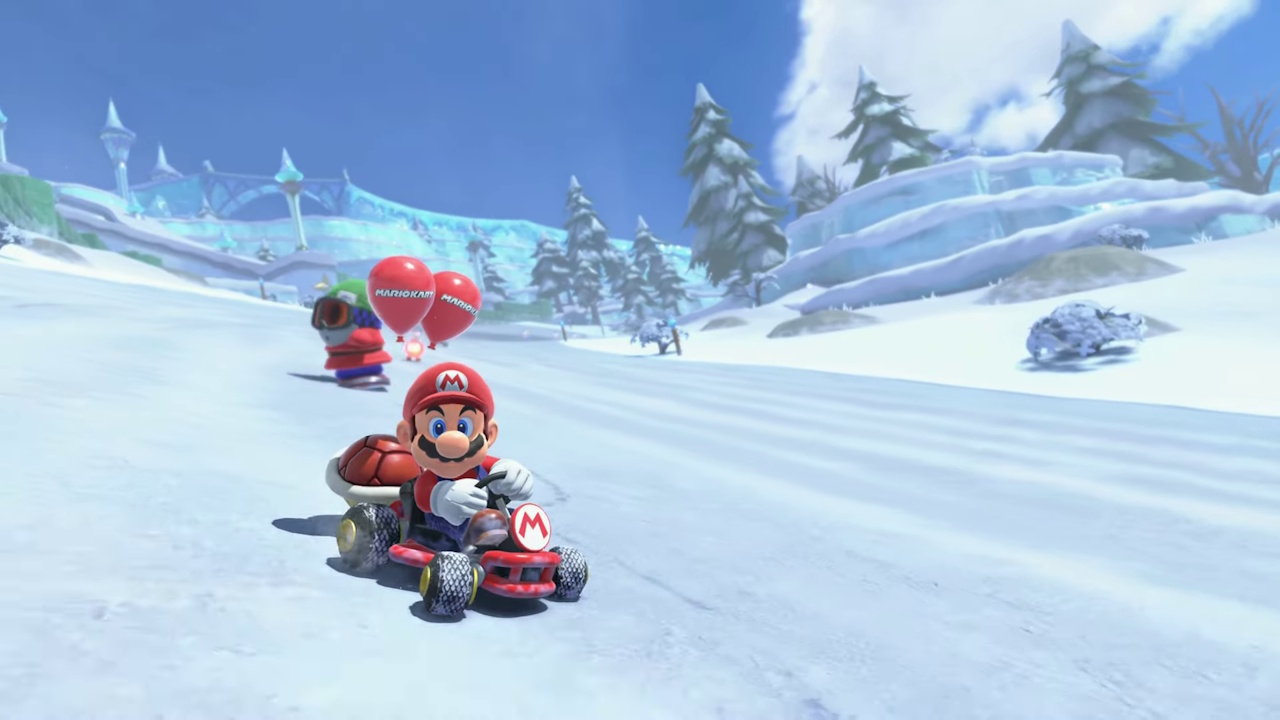
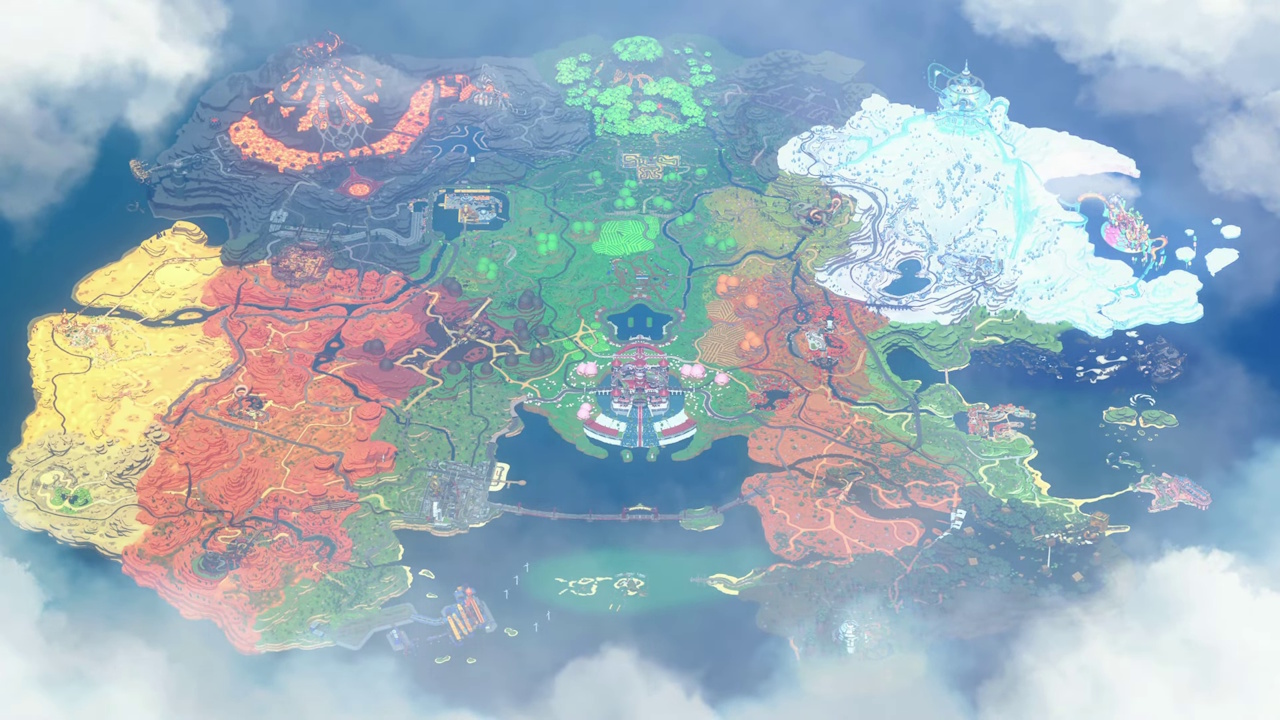
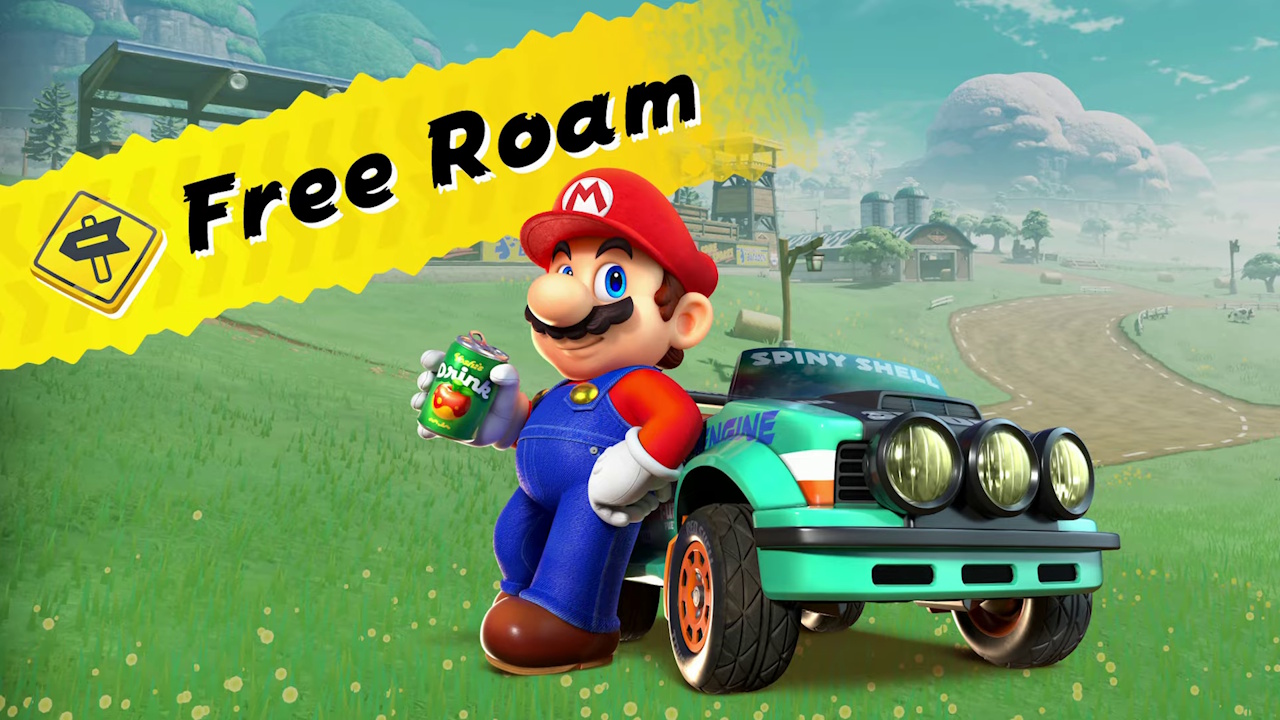
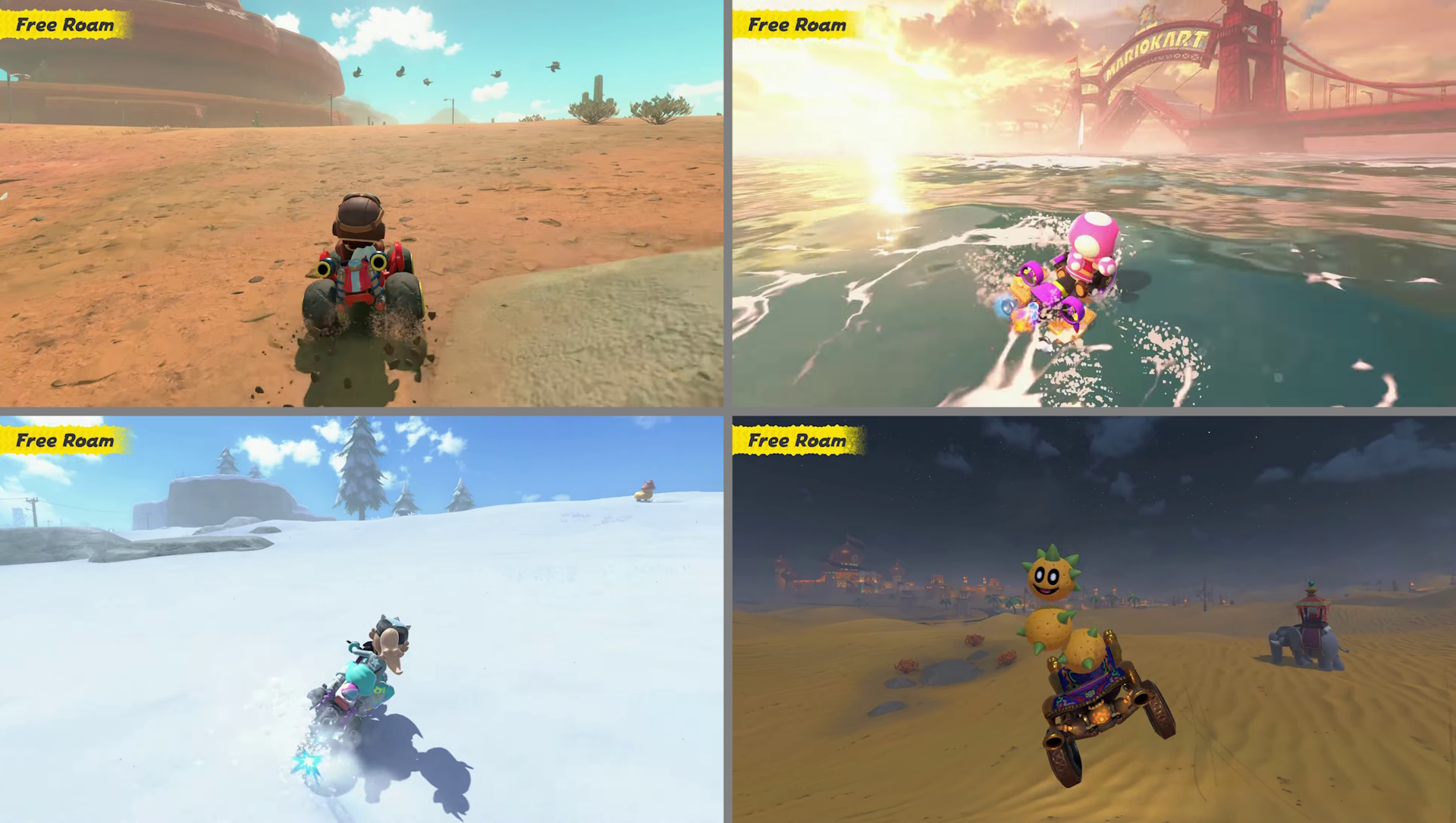
When the Mario Kart World broadcast arrives later this month I might have more to say! But for now, I like the look of the new game. I’m not sold on the “free roam” idea necessarily, but it could be a fun addition and a way to shake things up. Games like Forza Horizon have done fun things with more of an open world design, and as long as there’s content and not just empty roads and fields, it should be okay. The Mario Kart series has always given players options, so adding new modes like “free roam” and the knockout race should be fun. I’m not sure how much I’d personally play either, but I can see them both becoming beloved by some Mario Kart players.

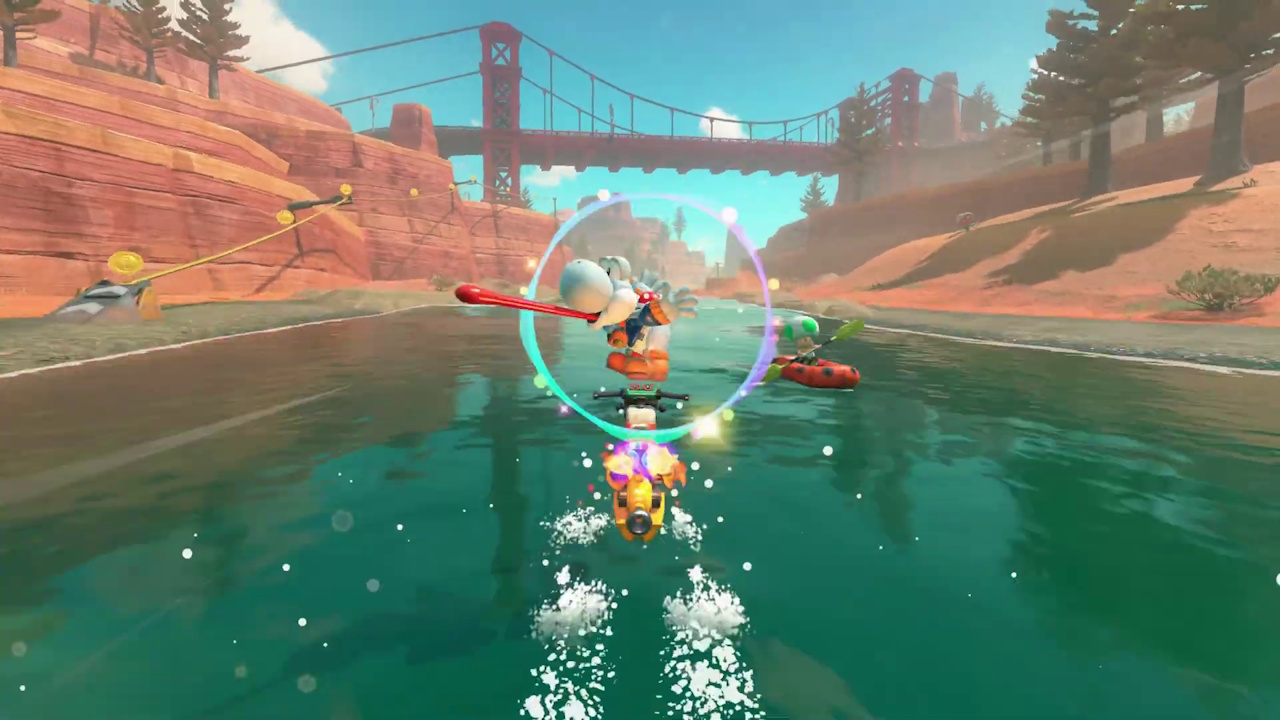
There seem to be character costumes in Mario Kart World, which is fantastic. And new mechanics seem to include transforming vehicles (I saw a boat, a plane, and a snowmobile), bouncing off walls, and even grinding on rails and cables. I’m not sure how big all of these new features will be, or whether they’ll only be available at certain places in certain racetracks – that’s almost certainly gonna be the case for the big articulated lorry that we saw! But these features all look like a lot of fun. Mario Kart 8 Deluxe has been great on the Switch, and I’m hopeful for Mario Kart World’s prospects on the Switch 2. I just hope Nintendo won’t ruin the game by overly monetising features like alternate costumes.

Mario Kart World is getting its own dedicated Direct in a couple of weeks, so there might be more to add then. Be sure to check back!

Still frame from the Nintendo Switch 2 Direct showing Mario Kart World.
Mario Kart World is the Switch 2’s big launch title.

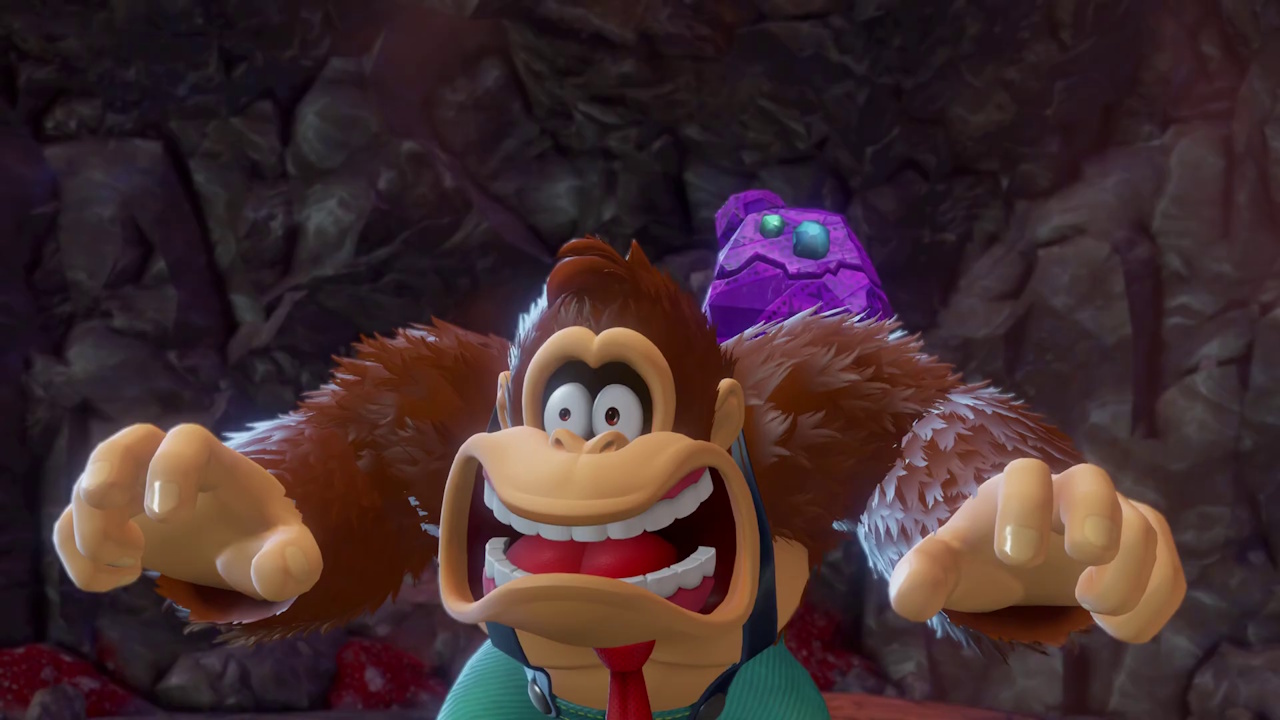
The final game to talk about is Donkey Kong Bananza. I was hoping for a new 3D Donkey Kong title – the first since Donkey Kong 64 a quarter of a century ago – and Bananza looks… well, it looks okay. I was kind of getting more of a Yooka-Laylee vibe than an Astro Bot vibe from the reveal, if that makes sense. I’m not sure it’ll be the first game I buy for the Switch 2, but if it reviews well I’ll definitely give it a try. I enjoyed Donkey Kong 64 on the Nintendo 64, and it’s definitely a treat to welcome back DK for another 3D adventure.

There were a couple of absences from the game lineup, though. There was a tiny glimpse of what looked like Animal Crossing: New Horizons, but other than that there was no mention of the series. Given that New Horizons is the best-selling Switch-exclusive title, that’s a bit of an oddity in my opinion! I guess that means a new Animal Crossing game isn’t imminent. There was also no new 3D Mario game – nor a 2D Mario game or a Mario sports title, come to that. A new 3D Mario title is unlikely to be too far away, and Donkey Kong Bananza is clearly intended to be in the same space for players. But I was a little surprised to see absolutely nothing from either of these big titles which I assume are in development.

Still frame from the Nintendo Switch 2 Direct showing Donkey Kong Bananza.
Donkey Kong is back for his first 3D adventure in a quarter of a century!

The final thing to talk about is pre-ordering. If you’re a massive Nintendo fan, you pay for Switch Online, and you play a ton of games… you still might not be able to pre-order a console. Why? Because even if you’re a paid Switch Online member and have been for years, if you haven’t opted in to marketing emails from Nintendo, you can’t pre-order from the Nintendo shop. What utter dog shite is that?

I had hoped Nintendo would’ve learned from the Wii and Switch about ensuring there’ll be enough consoles to meet demand, but apparently not. Nintendo seems to be deliberately setting up pre-orders in such a way as to assume there won’t be enough to go around… or, if I put my cynical hat on for a moment, to create an artificial and forced sense of scarcity. An attempt to drive up sales by playing on fans’ fears of missing out is just scummy, and I really hope that there will be enough Switch 2 consoles for everyone who wants one on launch day – and especially later in the year as Christmas approaches.

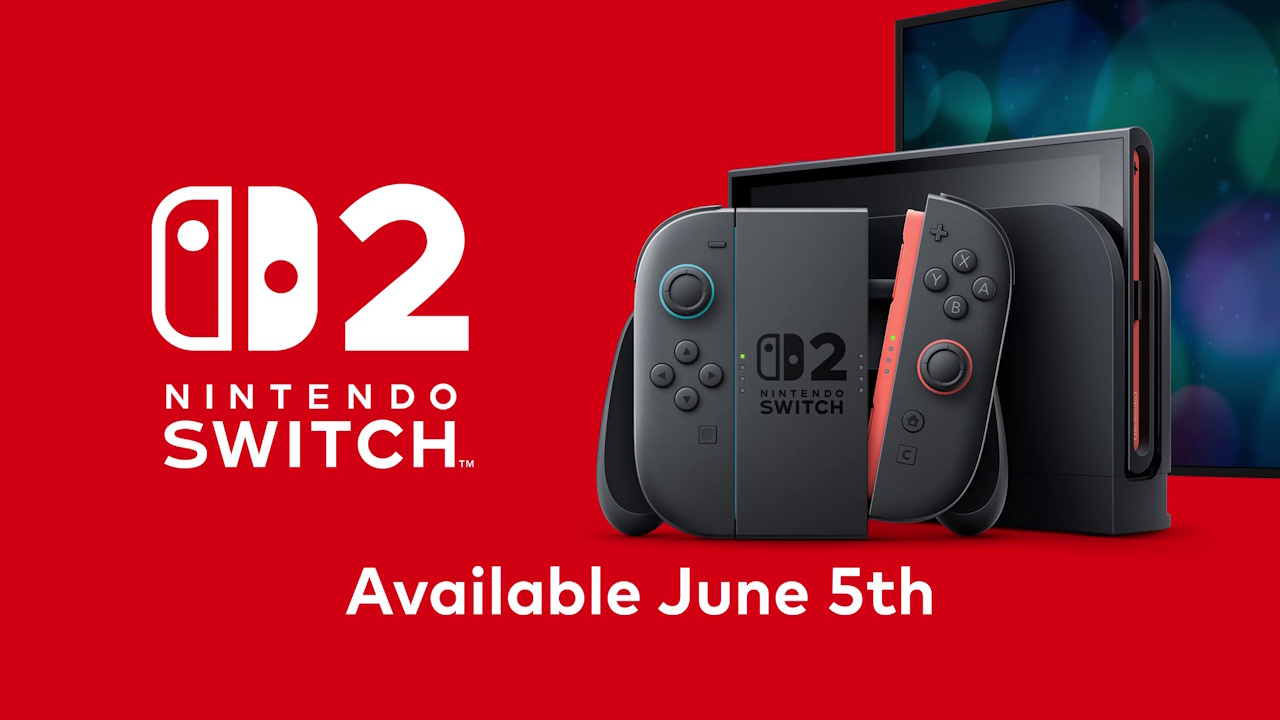
Still frame from the Nintendo Switch 2 Direct showing the console and its release date.
Given the weird pre-order requirements, will there be enough Switch 2 consoles for everyone who wants one on launch day?

So I think that’s everything from my notes!

Will I buy a Switch 2? Probably… but it’s unlikely to be in 2025. I really do like the look of Mario Kart World, and as someone who’s been playing Mario Kart since the first game back in the SNES days, I’m definitely excited to try it out for myself. On its own, though, Mario Kart World is a big ask when you’re talking about spending £430! Maybe when there’s news of a new 3D Mario game and/or the next Animal Crossing title, the Switch 2 will feel more like a “must-buy!”

So if you’re planning on pre-ordering a Switch 2, I guess you’re glad to hear that there’s at least one fewer competitor out there for what could be a limited number of consoles at launch!

Still frame from the Nintendo Switch 2 Direct showing Mario Kart World.
I don’t think I can justify the expense of picking up a Switch 2 in June!

The Switch 2 Direct was interesting, but I think it’s too early to really judge how successful the console will be. On the one hand, the original Switch has been a resounding win for Nintendo. But on the other, the high price of games on Switch 2 could be a hindrance, and while I could be alone in this, I feel that the new console’s design and marketing haven’t given it a strong identity of its own. Piggybacking on the Switch’s success could prove to be a masterstroke for Nintendo… but someone at the company said the same thing about the Wii U drawing on the popularity of the original Wii, and look how that turned out!

After the Mario Kart World Direct later this month, I may have more to say about that title. And as the year rolls on and the Switch 2 launches, I’ll definitely be checking out the reviews. I daresay I’ll have more to add before too long – so be sure to check back from time to time for more coverage of Mario Kart, the Switch 2, and Nintendo in general. I hope this look at the Switch 2 Direct has been interesting!


The Nintendo Switch 2 launches on the 5th of June. Pre-orders for the Nintendo Switch 2 go live on the 8th of April. The Switch 2, Super Mario, Mario Kart World, and other properties discussed above are the copyright of Nintendo. This article contains the thoughts and opinions of one person only and is not intended to cause any offence.

Civilization VII: Further Thoughts

Since writing up my first impressions of Civilization VII a few weeks ago, I’ve continued to play the game. Today, I wanted to cover a few points that I didn’t make in that original piece – which I wrote after about six hours of gameplay – as well as make one amendment to something I feel was unclear last time.

For the record, I still think Civilization VII has a lot of potential. But right now, there are things holding it back – as well as a few bugs and issues that I didn’t notice at first that really need to be patched out as quickly as possible. I’ve kind of hit the wall with Civ VII after about 40 hours of gameplay, and I probably won’t jump back in until the next update. There’s a reason for that, and we’ll begin there.

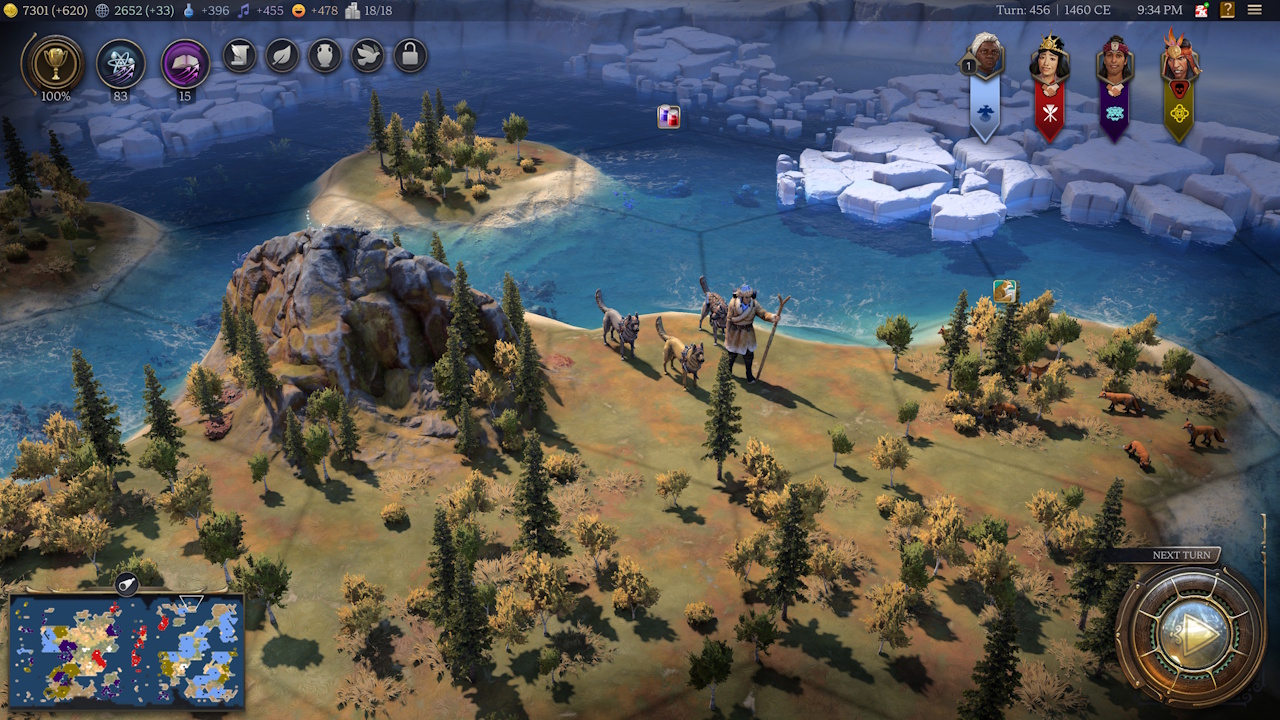
Screenshot of Civilization VII (2025) showing a scout, forests, and ice.
A scout near the edge of the map.

At time of writing, there’s a bug – or at least a major imbalance – that has totally ruined several games for me. In short, either AI civs are underpowered or barbarian city-states are overpowered. In several recent games I’ve played – or rather, attempted to play – this has led to barbarians conquering and defeating AI players before the game can really get going. There’s no way to increase the number of AI players in the game to try to counteract this, and it isn’t something that’s only happening on lower difficulty settings or certain maps, either.

Having barbarians and hostile city-states is great, it adds a whole extra dynamic to gameplay and it makes the very early game feel more tense and dangerous. But these mini-factions have to be balanced better, because they shouldn’t be able to knock out AI civilisations except under rare and unusual circumstances. Making them an obstacle for human players is great – but making them so overpowered that they can kill one, two, or even three civs in the ancient era before the game has a chance to get going… that ruins the game for me. And I’m sure it has for other players, too.

An AI city facing a barbarian raid…
…and the same city a few turns later after being captured.

I’m mostly familiar with Civilization VI. That was the first game in the series I played extensively, so it’s my point of comparison. Barbarian tribes in that game could be aggressive, particularly in the early game. And while I can’t call to mind any specific examples, it must’ve happened at least once that an AI civ was knocked out of the game by a particularly strong barbarian attack. If that did happen, though, it was a rare occurrence no matter what the settings were, and it simply isn’t something that should be happening so often in Civilization VII.

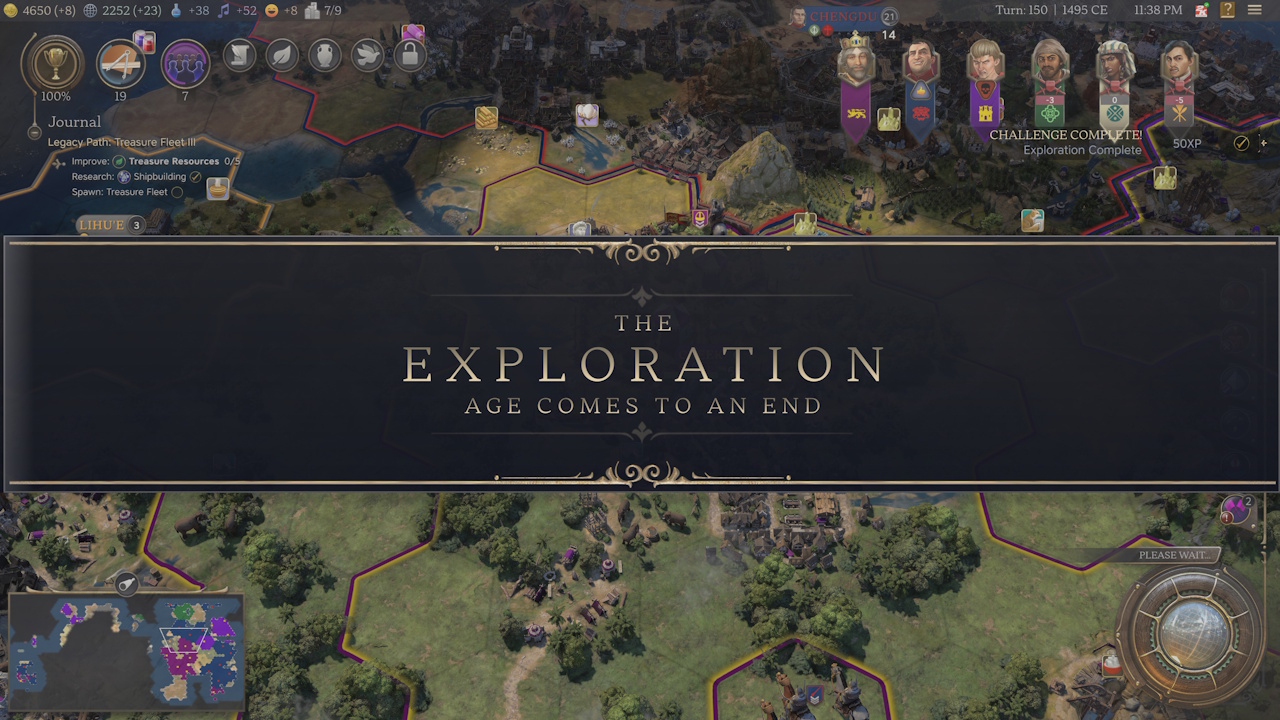
Because of the way Civ VII’s eras work, knocking out an AI player cuts down the amount of time an age lasts. In one recent game, the ancient age seemed to be over in a flash after not one but two AI players were defeated off-screen – presumably by barbarians. The game only has three eras to begin with… so speed-running one of them in this fashion isn’t great.

Screenshot of Civilization VII (2025) showing a barbarian camp/village.
A hostile city-state/barbarian village.

That leads into my next point. This is much bigger for Civilization VII and much less easy to fix… but there really aren’t enough ages in the game, and the way they operate as effectively three mini-games in one feels limiting.

I’m an adaptable person, and Civilization VII’s new rules and new gameplay mechanics should be surmountable for me. I’m not lashing out at the game because I “don’t like change,” or I want to keep playing Civ VI. Having played quite a few games now, with different leaders and factions, I’m beginning to get used to most of the changes and differences – but the way eras function is something I’m still struggling with.

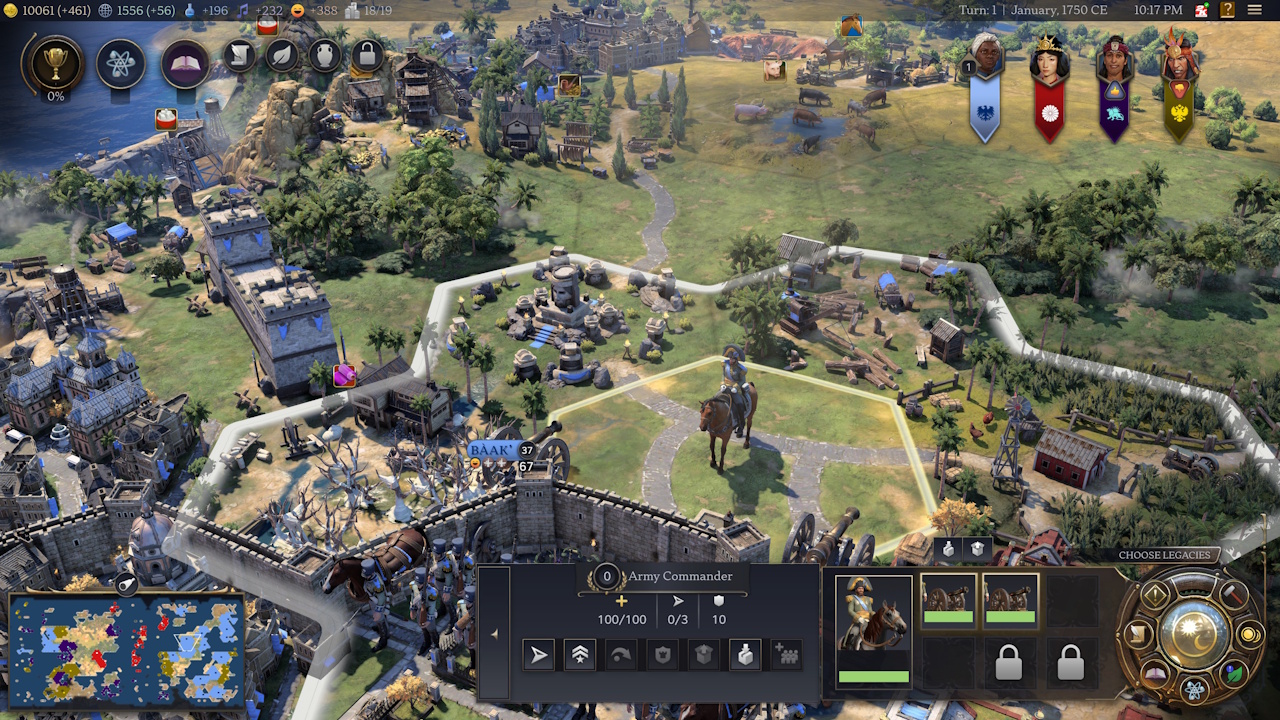
I mentioned in my first impressions that war doesn’t carry over from one era to another – nor do most units. Even units that survive an era transition don’t remain where they had been placed on the map; they’re either grouped together in an army or dropped one by one into cities and towns – which also don’t survive the era transition in their previous form. All cities except for the capital revert to being towns, losing all of the bonuses cities get and forcing you to re-convert them later.

Screenshot of Civilization VII (2025) showing an army commander and a city.
The beginning of a new era removes some units entirely, relocates others, and changes most cities back into towns.

This really limits the way Civilization VII plays. To give one example: if I want to wage war in the ancient era, I basically have to build up my military from turn one and choose the first civ I meet as my target for conquest. There just isn’t enough time – even in a game with the maximum number of turns and eras that are as long as the game allows with its current, very limited options – to do things any other way. However you look at it, this is a limitation on play styles, because I’m forced to do one of two things. Either I have to write off the idea of an early war and conquest of a neighbour – which can be limiting and annoying, as AI civs have a tendency to forward-settle, placing cities right next to mine or even in the middle of my burgeoning empire. Or I have to prepare for war from turn one.

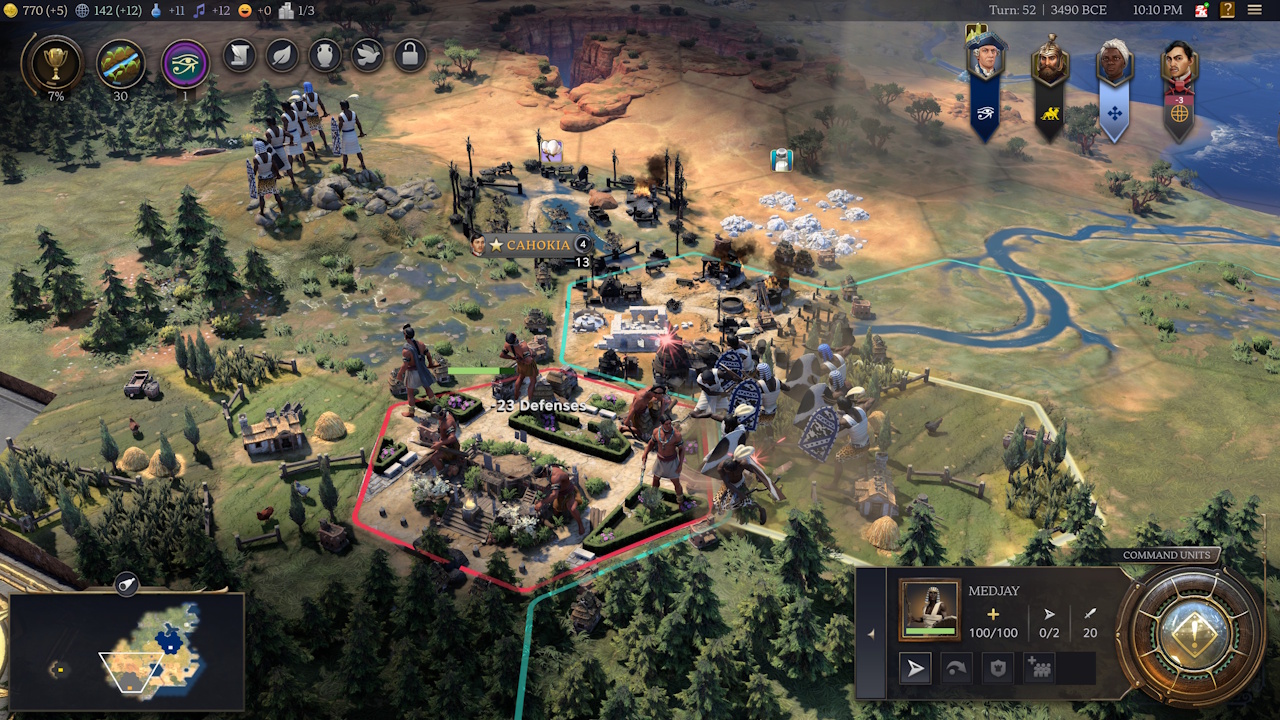
War can be time-consuming in a game like Civilization VII, and if you’re coming up on the end of an era, there’s basically no point in even starting one. The end of an era forces you to make peace with anyone you’re fighting, and it also removes units from the board and repositions others, meaning it isn’t possible to instantly re-start a conflict after the transition. This makes war in the early game much more limited – either you launch an attack as early as possible against whichever unlucky civ you’re right next to, or you’re stuck on the defensive, lacking enough time to build up a sufficiently-sized army to launch a full-scale conquest.

Screenshot of Civilization VII (2025) showing an Egyptian unit attacking a city.
War in the ancient era.

The one thing a 4X strategy game like Civilization VII mustn’t do is limit your options. War, diplomacy, exploration, peace… everything should be on the table, and as the player I should feel in control. Sure, there are gonna be times where I’m under attack and on the defensive. And there should be unpredictable elements in there. But if I know for a fact that there’s basically no point starting a war once the era clock reaches a certain point, or that all I have to do is hold on for a few more turns because a mandatory peace treaty is coming as soon as the era ends… that puts real limits on even defensive wars.

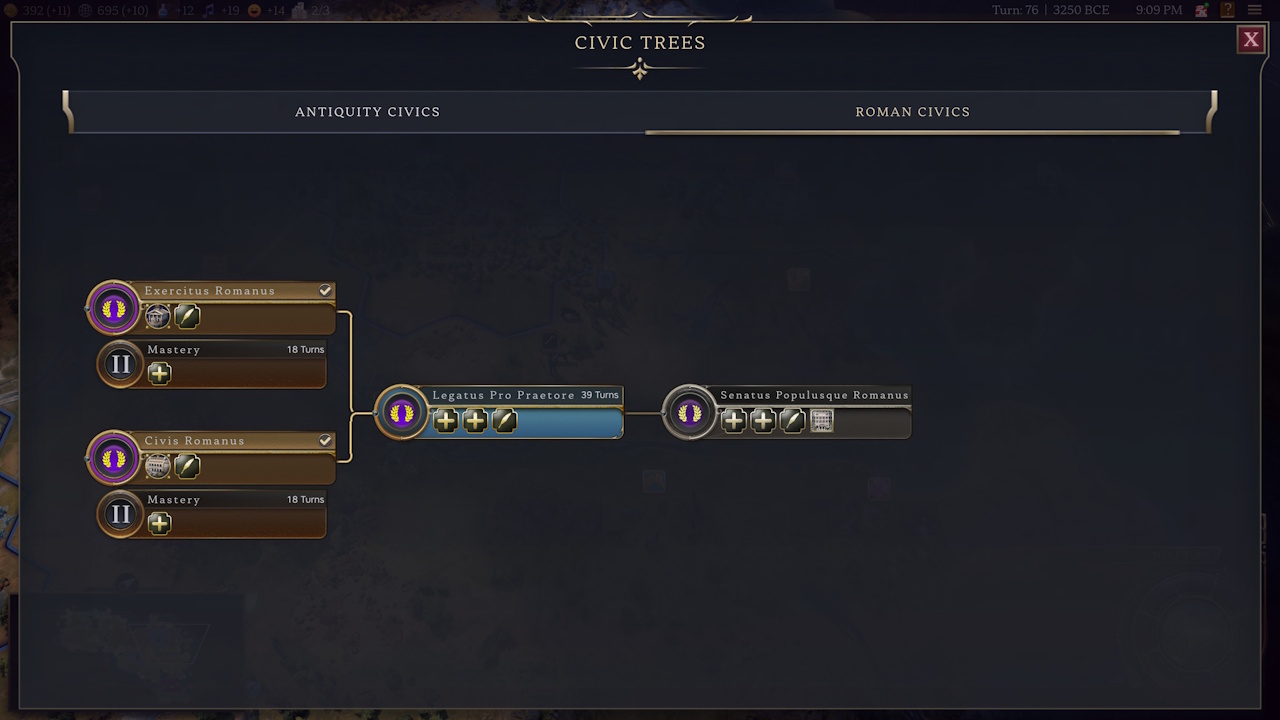
Beyond just war, though, I find the way eras are handled to be pretty limiting. Each faction has unique civics to unlock, for example, but these come at the expense of the regular civics tree, and with one civics tree per era your choice is either fall behind the AI or sacrifice those unique policies and bonuses. In a longer game with one civics tree, it might be easier to catch up – or to race ahead in order to dedicate time later on to unlocking those dedicated civilisation civics. But the eras limit this mechanic in a pretty disappointing way.

Screenshot of Civilization VII (2025) showing the Roman unique civics tree.
Each faction gets its own unique civics tree.

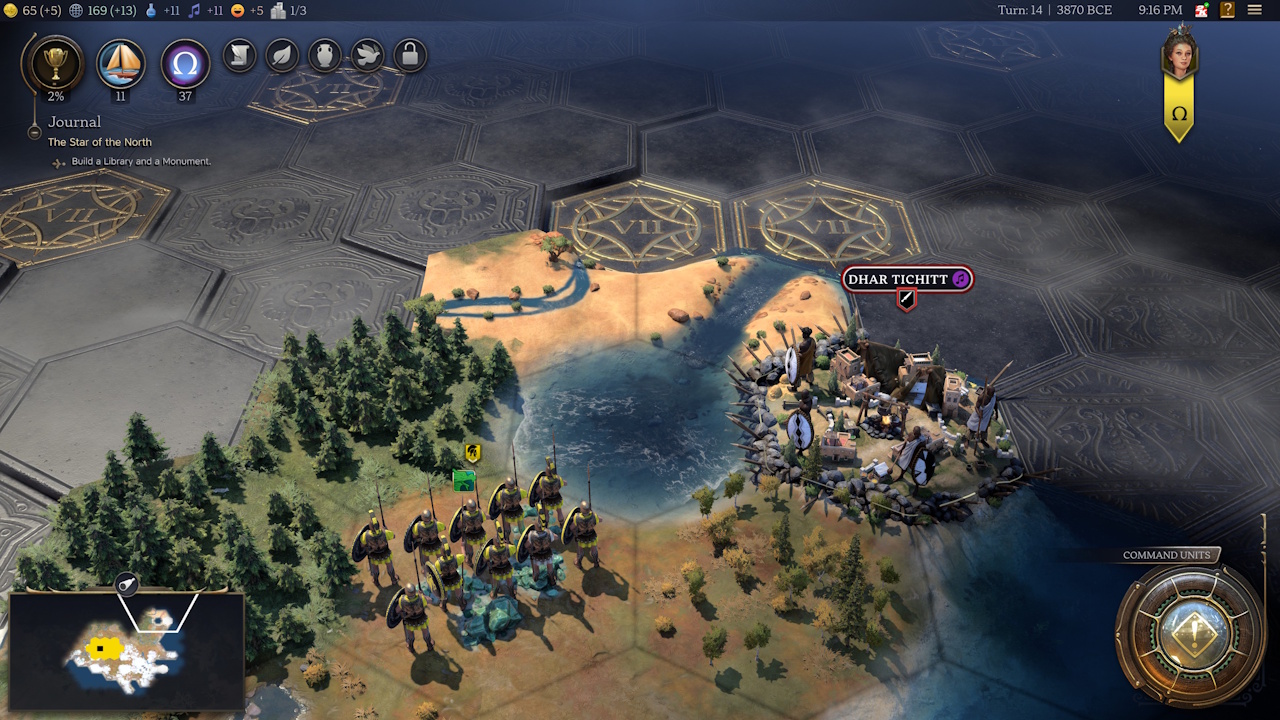
Eras also limit exploration, and by extension what kinds of maps are available. Because the middle exploration era is entirely focused on colonisation, it’s impossible to speed-run a tech like celestial navigation in order to settle islands or continents that are separated from your starting area by ocean tiles. There are also resources – like cocoa, for instance – that are locked until the exploration era. It isn’t even possible to explore islands and continents elsewhere on the map before the game deems it acceptable.

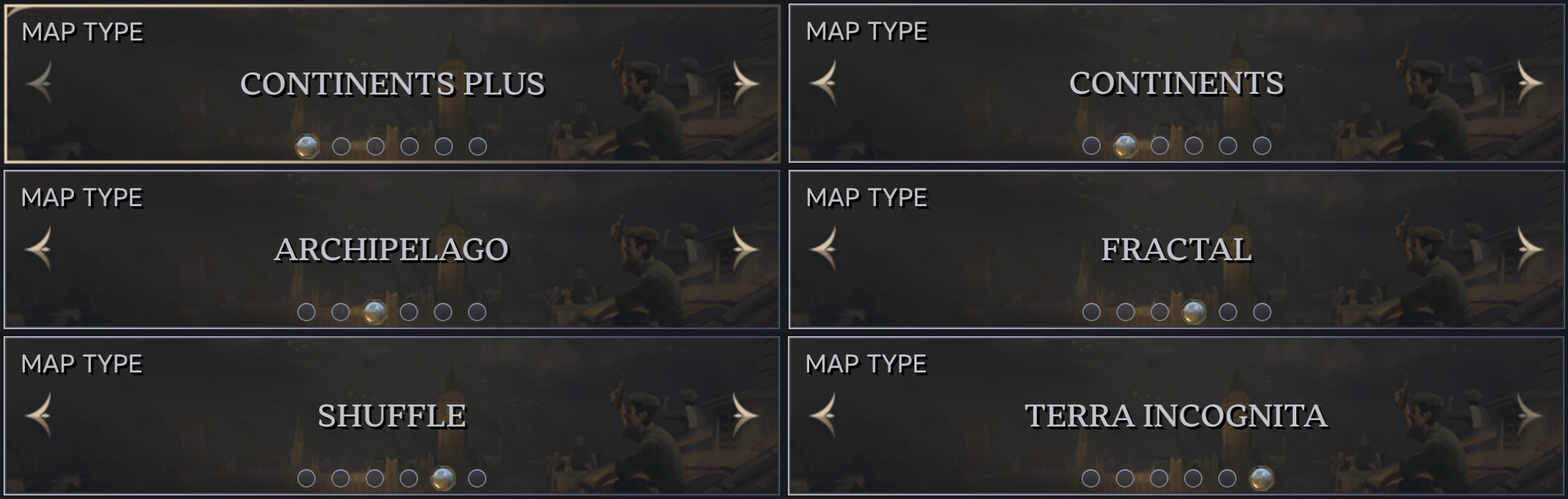
Again… this is really limiting. I can’t build a ship or a scout and send them off to the far corners of the map; I’m stuck on my starting continent or island until one-third of the game has passed. This, in turn, limits what kind of maps are available – there are no Mediterranean maps, for example, with land surrounding a body of water, or single-continent maps with outlying islands. There are fewer map types and less map variety in order to accommodate this eras system… and for me, the trade-off isn’t close to being worth it.

Screenshot of Civilization VII (2025) showing all six map options.
All six of the available map types.

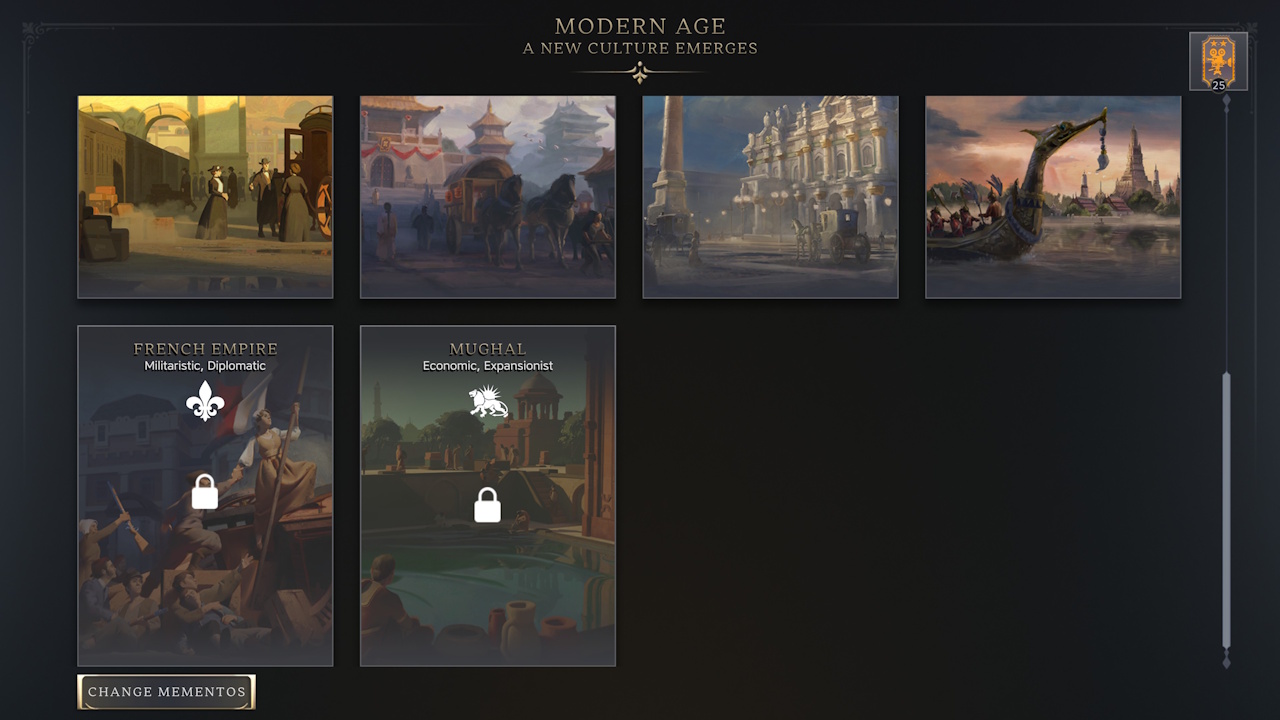
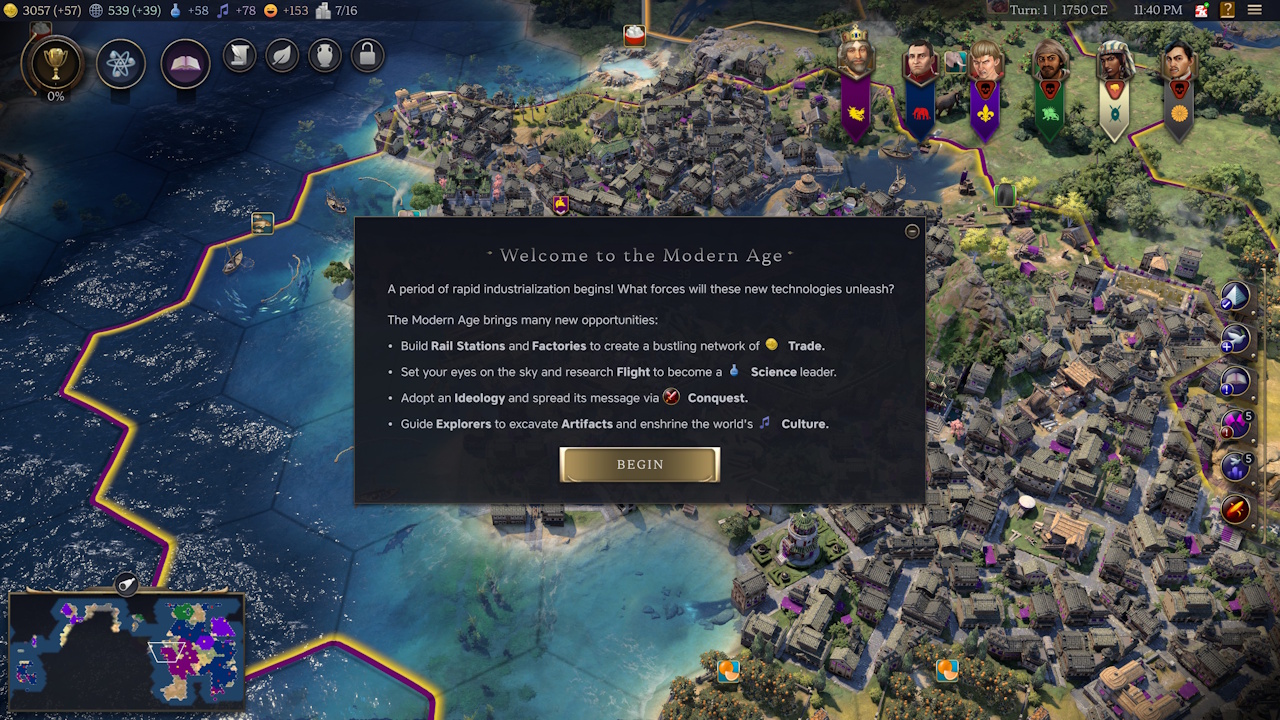
Then we come to era transitions, and choosing new factions. In my first impressions, I noted that most factions are locked until certain gameplay requirements are met to unlock them – and I should clarify that I was referring to this transition between eras. In one case, I had been playing as Isabella and chose Spain for the exploration age. But when the era ended, I literally only had one option for the modern age: Mexico. All of the other modern era civs were locked because I hadn’t, for instance, settled a city on tundra or dug three oil wells. Because these requirements were not communicated well – and were not communicated at all in the preceding era – I had no choice but to finish that game as Mexico.

Obviously I’ve got nothing against playing as Mexico, and I would’ve picked that civ eventually. But why should Civ VII be so restrictive with its faction choices? Even in more recent games where I’m more aware of these limitations and I’ve tried to overcome them, there are always some civs locked when the ancient age transitions to the exploration age, or when the exploration age gives way to the modern age.

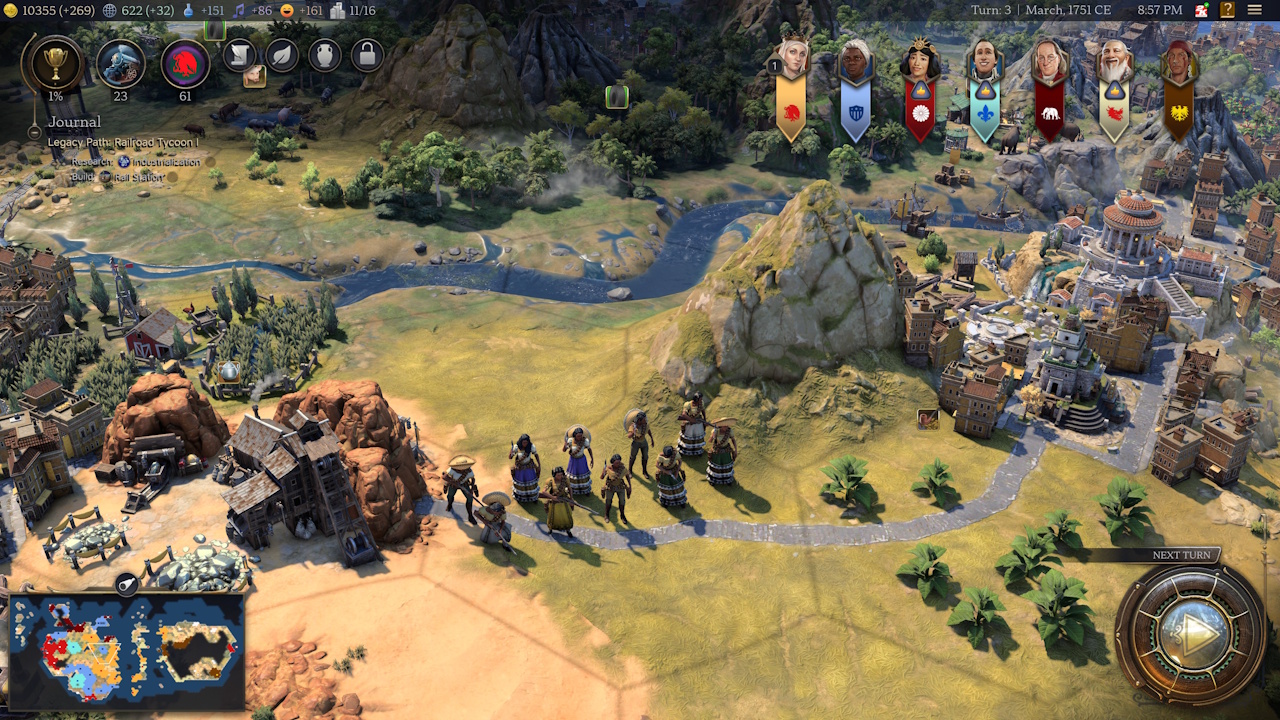
Screenshot of Civilization VII (2025) showing a Soldaderas unit on a road.
Mexico’s unique unit: the Soldaderas.

I can understand the developers wanting to make sure players don’t accidentally shoot themselves in the foot by choosing a civ with bonuses that aren’t applicable or with unique abilities that they’d struggle to take advantage of because of the way earlier era(s) have unfolded. But these restrictions feel way too limiting as they’re currently implemented, and with the whole “choose one civ per era” mechanic being Civilization VII’s biggest new feature, it shouldn’t be so difficult and finicky to work with. This is basically the entire selling-point of the game – so why make it so limited and restrictive?

Part of the appeal of Civilization VII is the idea that I can chart my own unique route through history. I can start as Egypt, then become the Inca, before ending the game as Prussia. If I play as Spain and find I can only transition to become Mexico… that completely robs this aspect of the game of its one unique selling-point, and is yet another limitation on gameplay styles in a game that already has no shortage of those.

Screenshot of Civilization VII (2025) showing several modern age factions.
In this example, two modern age civs are locked.

I want to be able to choose in what order I move units or set policies. Sometimes, Civilization VII will arbitrarily limit this, forcing me to choose the benefits of a celebration before I can move units. If I’m in the middle of a war or trying to lay siege to a city, I want to focus on that first and foremost! If I select a unit, I shouldn’t be forced to do something else before I can order it to move or attack.

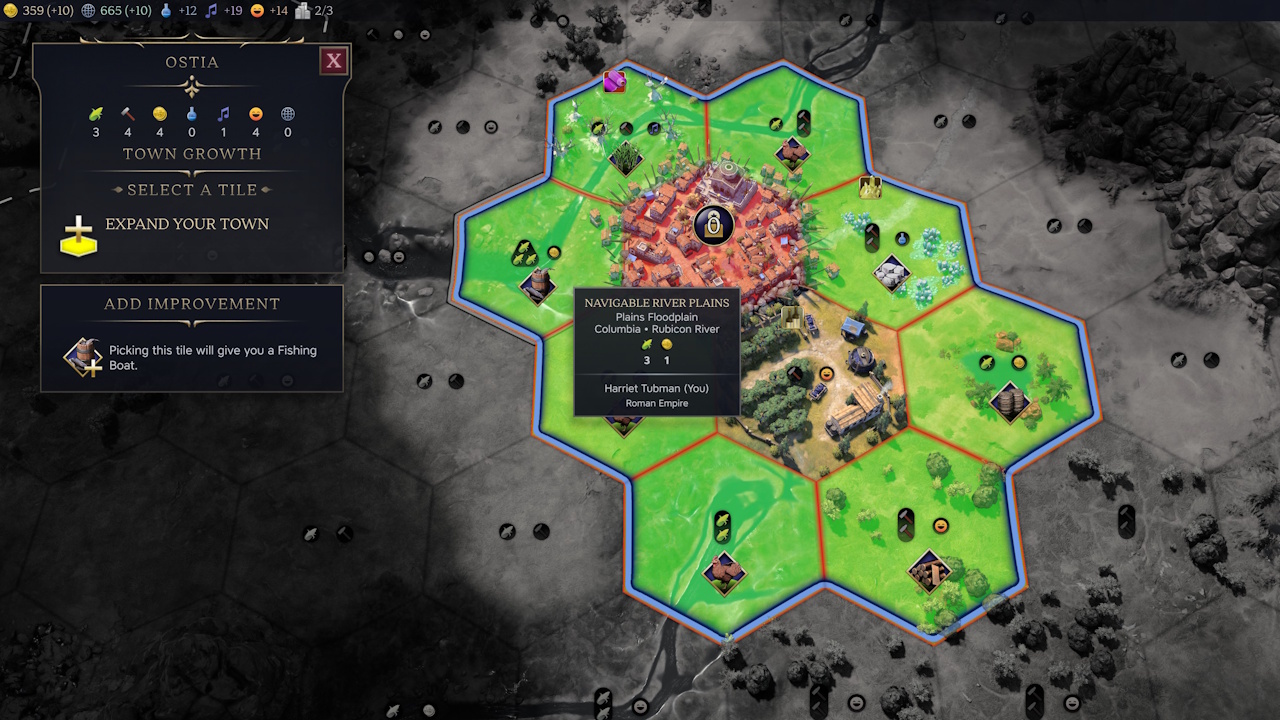
There also seems to be a bug where, after building the Dogo Onsen wonder, every city in my empire gains population (meaning I have to manually grow each city by adding a tile or specialist). This is pretty annoying, especially when you have twenty-plus cities; having to manually click through all of them, adding a tile or specialist, before the game will let you do anything else takes up a lot of time. Hopefully this bug can be fixed in the next update.

Screenshot of Civilization VII (2025) showing a town being expanded.
Growing a town is fun… growing twenty in a single turn? Less so.

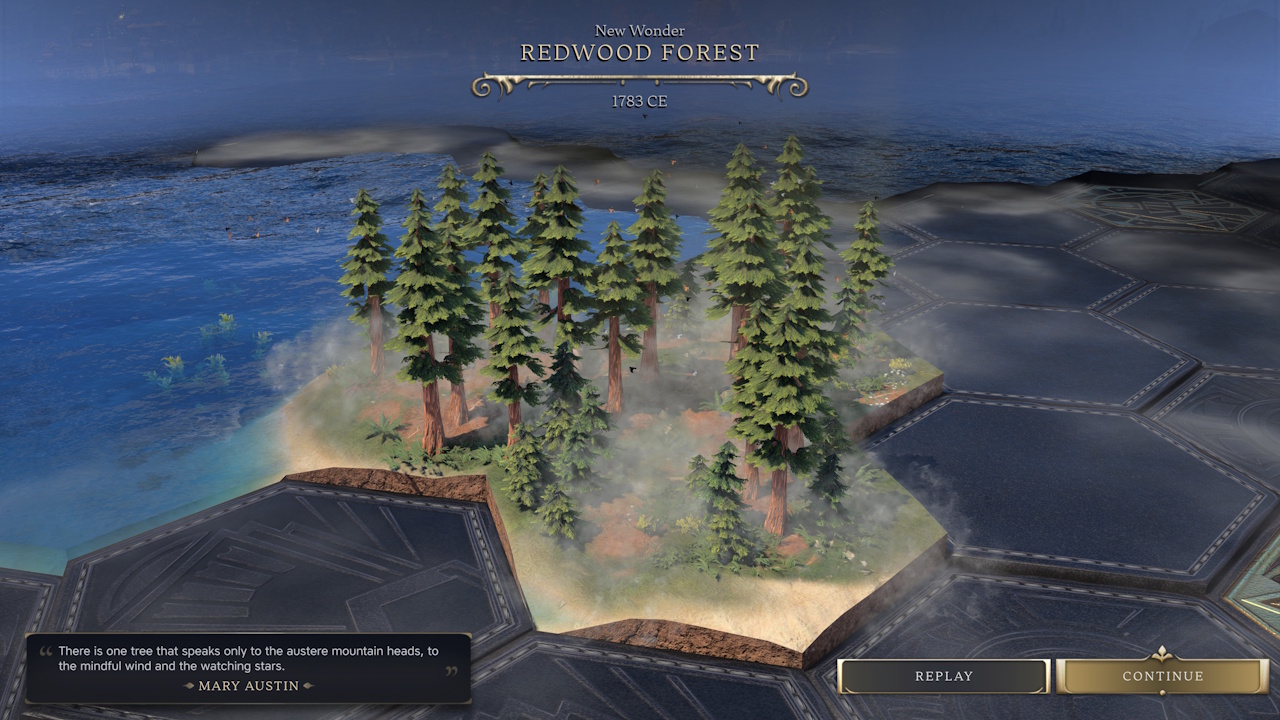
Speaking of bugs, I’m concerned that natural wonders are glitched. In short, every single game I’ve played has had the same three natural wonders: the Grand Canyon, the Redwood Forest, and Zhangjiajie. I’ve seen the Great Barrier Reef once in one other game – and that’s it. There are, according to the Civ Wiki, fourteen others… but I’ve never seen any of them even once, not in any of the games I’ve played. And this isn’t because I always pick the same civ or the same map type: I’ve played most leaders and most civs at least once, and I’ve tried out all of the map types (but not every size of map, to be fair).

So… is this a bug? Or in forty-some hours of gameplay, have I just been randomly unlucky to continually encounter the same three natural wonders every time? There’s something to be said for that level of random chance… so maybe I should buy a lottery ticket this week! Seriously, though, there are already a pretty sparse amount of these natural wonders – way more need to be added. To keep encountering the exact same ones is just boring and repetitive. If this is a bug I hope it’s patched out. If not… what the heck’s going on?

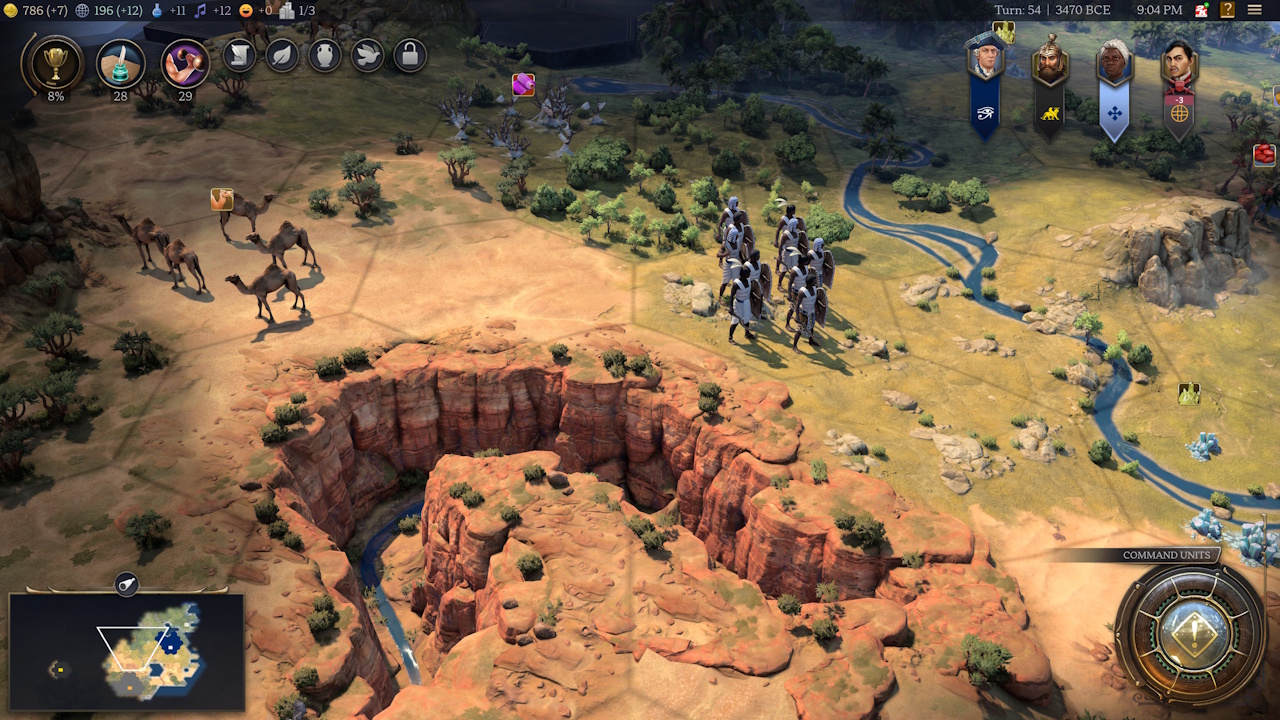
Screenshot of Civilization VII (2025) showing the Grand Canyon natural wonder.
There are more natural wonders… right?

I like the idea of crises. But unfortunately, this is another area where I fear a bug is causing games to feel repetitive and less-interesting – to the point where I’ve started turning off the crisis option when starting a new game. Crisis events throw up a challenge for your civilisation and force you to implement certain policies which have to be accommodated and worked around. But as above, in every single game I’ve played so far, I’ve encountered the exact same crisis in every age every time.

In the ancient age, I’ve only ever gotten the “revolt” crisis, which sees my empire tested by towns and cities losing happiness due to a variety of factors. There’s some potentially-interesting storytelling here, which is neat… but it gets boring game after game. In the exploration era, every game saw my cities laid waste by plagues. Again, this was potentially interesting, but it wore off after the fourth or fifth time I saw it in successive games. Then, when it came to the modern era, I don’t know if there even are any crises to be had – I haven’t encountered any.

Screenshot of Civilization VII (2025) showing a city suffering from plague.
A city afflicted by plague in the exploration age.

Adding in these kinds of events should be interesting. But if the same ones trigger every single time… is that a bug? I don’t play the game the same way every time, and with different leaders, different civs, and the game set up in totally different ways on different maps, why should I constantly encounter the same crisis events? It’s just another thing that feels, well, limiting. And it got to the point where I decided to just turn off crisis events altogether rather than have yet another instance of the same thing making my game feel repetitive and dull.

Finally, I’d like to talk about Civ VII’s art style – and particularly the way cities look.

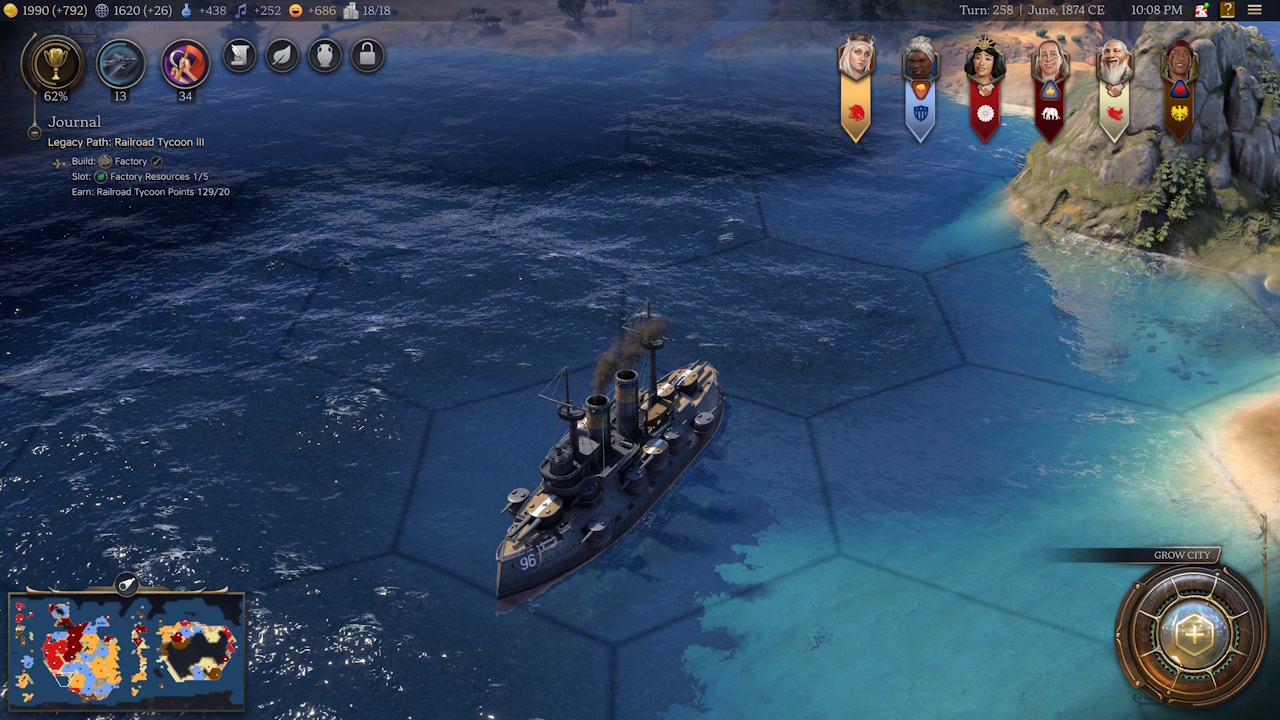
I love Civilization VII’s graphics, and going for a more “realistic” look after the stylised and cartoonish Civ VI is a choice that I personally appreciated. It might not be to everyone’s taste, but I felt it was a step up, and I really like the way the game represents water and ships at sea in particular.

Screenshot of Civilization VII (2025) showing a battleship.
A battleship on the ocean.

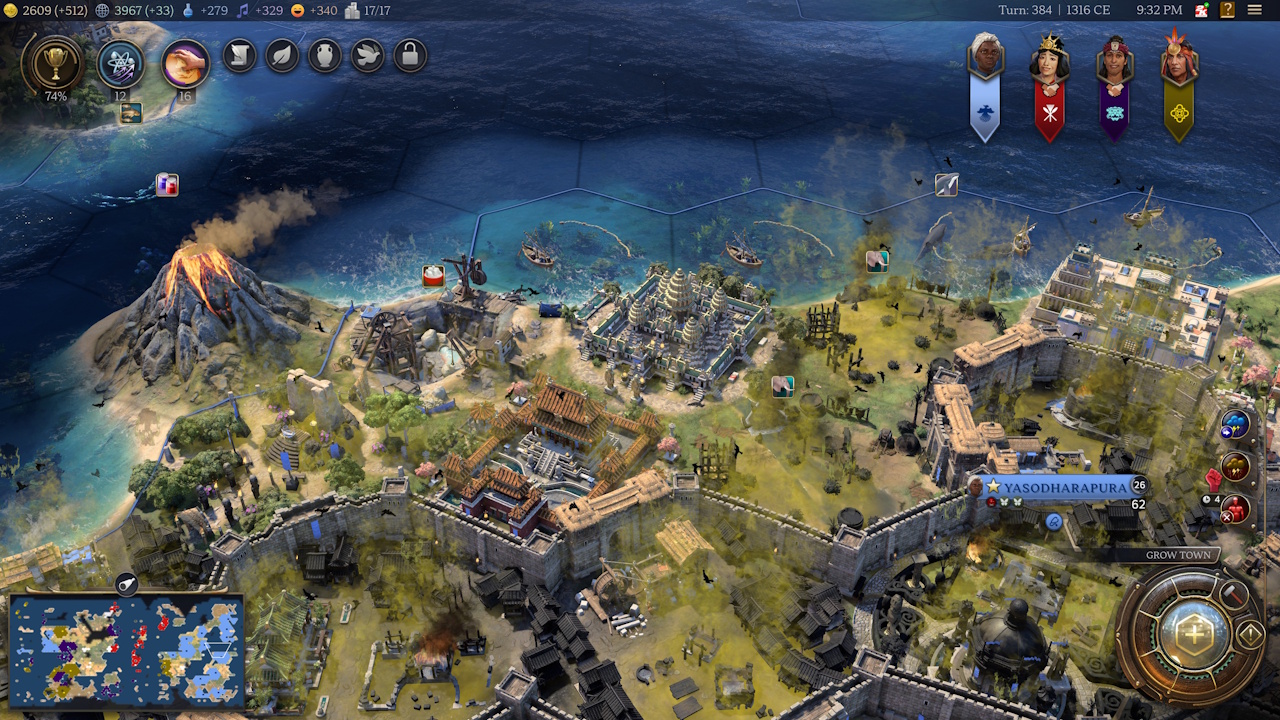
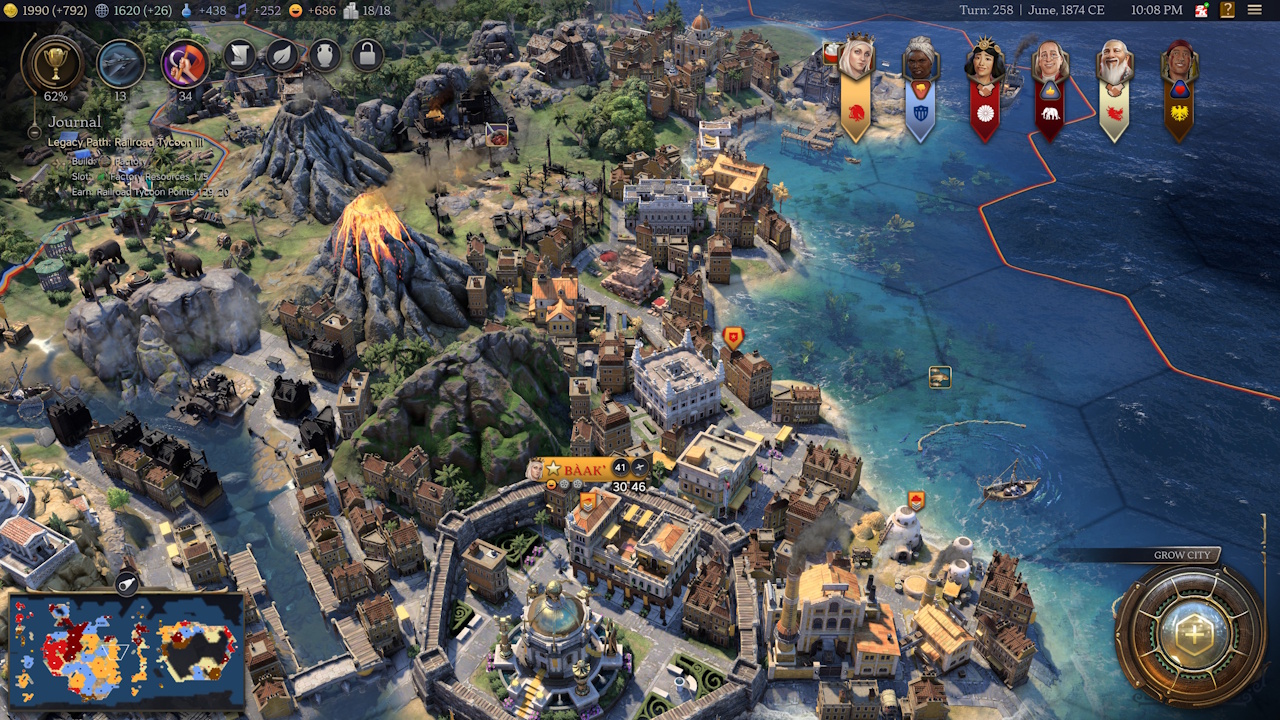
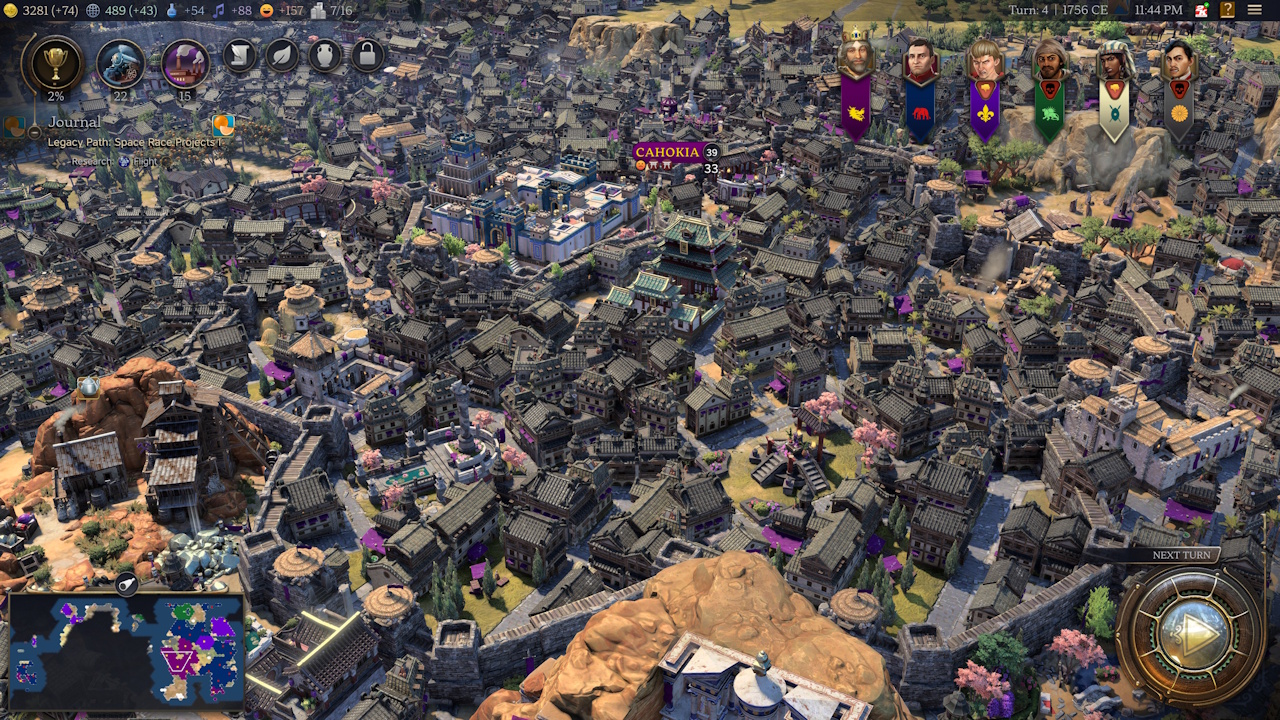
However, there’s a problem – and I didn’t really notice it at first. In Civilization VI, it was really easy to tell at a glance which buildings you’d constructed in a city. Campuses and science buildings were blue, for example, and military buildings had red detailing. But in Civ VII, most buildings look very similar to one another, and with no districts or zones that are specific to certain types of building, they can be literally anywhere in a city. This makes it really hard to tell, without zooming in closely or digging through a menu, whether you’ve built all of the libraries and science buildings you wanted to, or whether a city has an important building like a railway station or a market.

This isn’t insurmountable, as it just takes a bit of checking. But when you have a sprawling empire of twenty-plus cities in the late game, it can be hard to keep track of every building. In order to ensure you’re getting the most out of your settlements and maximising your available yields, you need to be on top of what buildings you have and which ones you need. Being able to see, at a glance, which ones are present in which settlement is useful – and stripping this away to leave very generic-looking buildings and urban districts just gets in the way of that. It might make cities look “more realistic,” but it’s less useful and feels like a bit of a hurdle to smooth gameplay.

Screenshot of Civilization VII (2025) showing a Mexican city in the modern era.
Can you tell at a glance which buildings this city has and where they are?

So after playing a bit more Civ VII (okay, quite a lot more) those are some additional points that I wanted to make. Later in the year, after the game has received more updates, patches, and its first pieces of DLC, I’ll definitely jump back in and see if I want to write an updated review or some additional notes.

I still believe Civ VII is fun – I wouldn’t have played multiple games over forty-plus hours if I wasn’t having a good time most of the time. But there are more limitations than there were in Civilization VI, and the core eras mechanic is one that I feel is doing more to hold the game back than it is to improve it, at least as things sit in March 2025. I’d love to see some bug fixes, changes to the way menus and tech trees are displayed, and perhaps some visual or graphical changes to make certain key buildings more obvious. Those things feel achievable in the short-term, and perhaps updates or expansions could address some of the bigger issues I’ve found.

I hope this has been interesting. I paid a lot of money for Civilization VII, so I definitely want to see the game succeed. I raise these points not out of spite but because I want to see Civ VII improved. There’s a lot of potential in this game… but some of it is being denied or restricted by creative decisions that have limited key aspects of gameplay. There’s plenty of time to make changes and improvements, though, and it’s still early days. I’m hopeful that, in the next few months, things will get noticeably better for Civ VII.


Civilization VII is out now for PC, Mac, Linux, PlayStation 4, PlayStation 5, Nintendo Switch, Xbox One, and Xbox Series S/X consoles. Civilization VII is the copyright of Firaxis and/or Take-Two Interactive. This article contains the thoughts and opinions of one person only and is not intended to cause any offence.

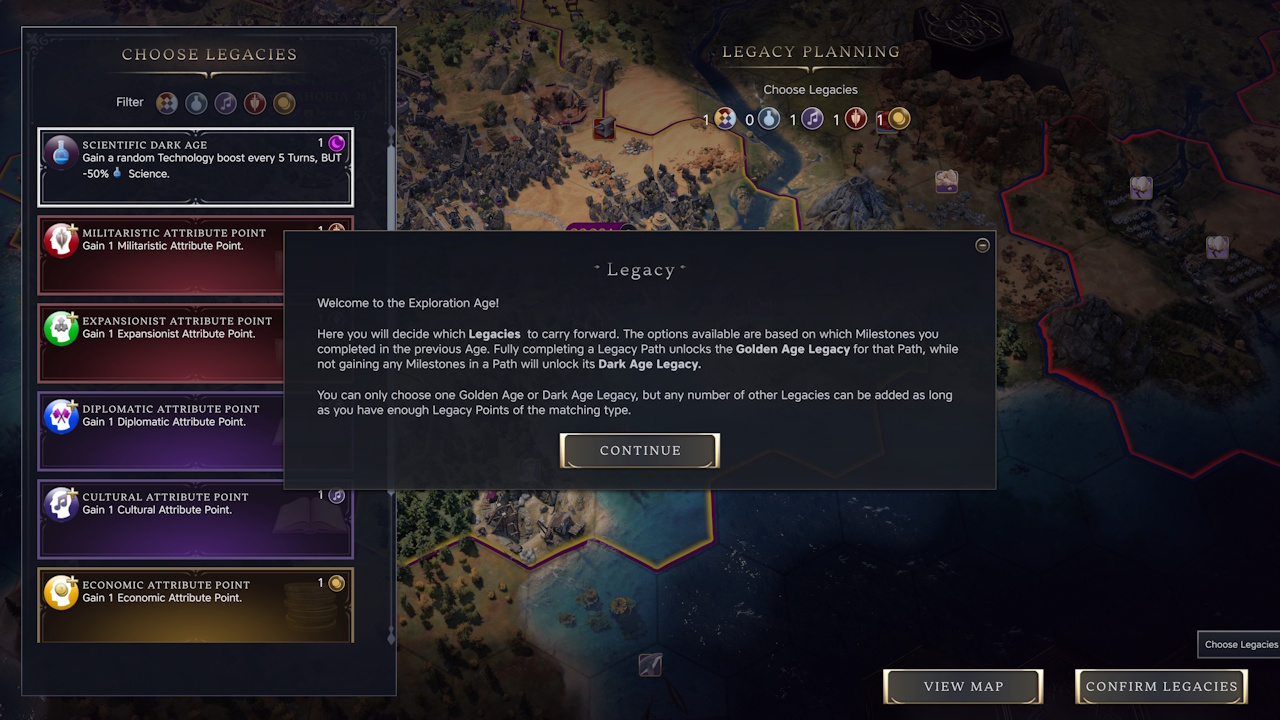
Civilization VII: First Impressions (From a Civ VI Fan)

I did something I never usually do: I pre-ordered a game. Violating yet another of my own game-buying rules, I paid extra for the “founder’s edition,” which – among other things – granted me access to Civilization VII on its actual release date instead of five days later. Do I detest myself for succumbing to that? Just a little. Was it worth the £120 (that I put on the credit card and plan to spread over a few months)? Well… read on to find out, I guess.

This piece is my “first impressions” of Civilization VII, and I suppose I should first define that term so we’re all on the same page! A game as massive and varied as Civilization VII will take days – weeks, even – to fully get a handle on. Having only played the game for around six hours (split into two sessions) and completed a single game, I can’t in good conscience call this a “review.” I’ve had an opportunity to jump in, played around with some of the settings, and completed what was basically a tutorial game. That’s enough to give me a taste of a game this massive, but not enough for an article that I could reasonably title a “review.” So in this piece I’m going to share my immediate thoughts and feelings about the game – and later in the year, perhaps when there have been one or two updates, patches, and pieces of additional content, I’ll return and share some further thoughts.

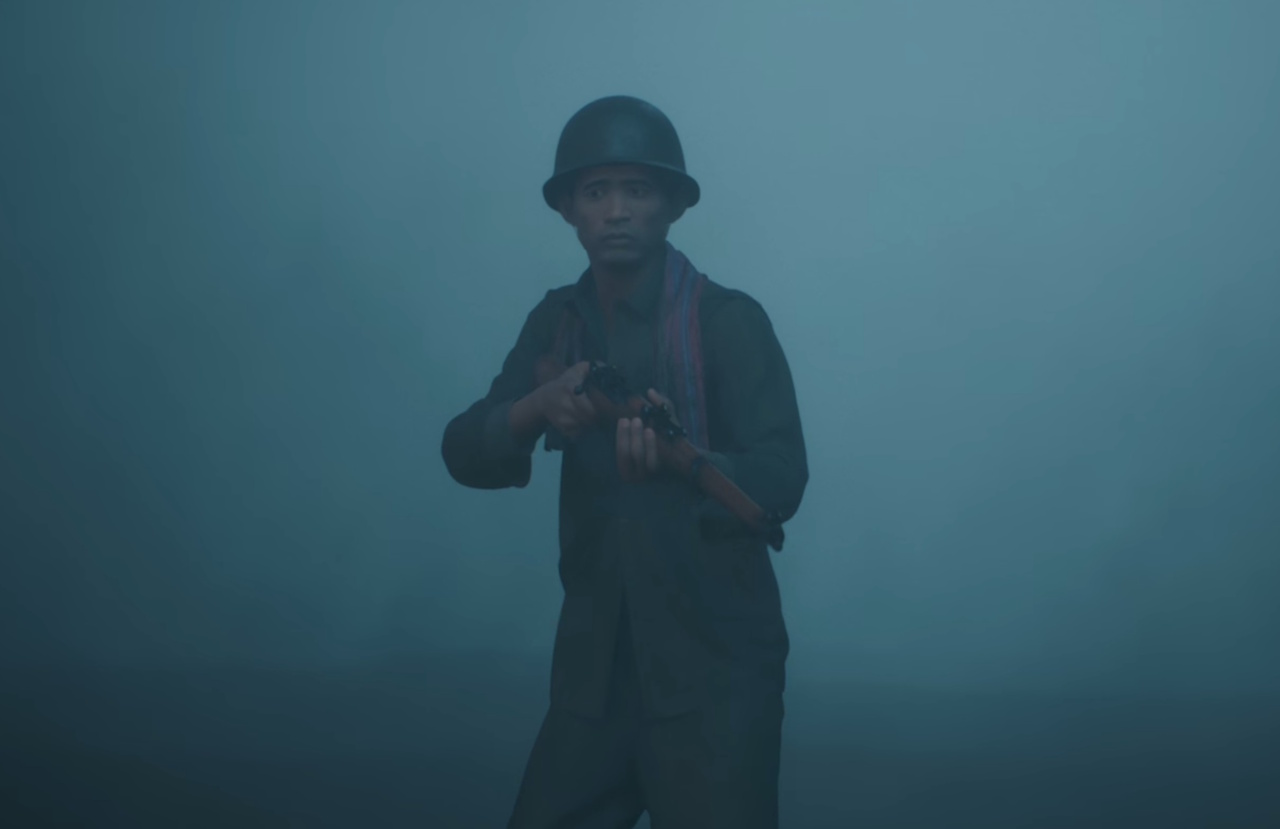
Screenshot of Civilization VII (2025) showing a solider from the opening cinematic.
A solider in the opening cinematic.

If that’s not what you’re looking for, that’s totally okay. I won’t be offended if you jump out and read someone else’s review instead! But if you like the sound of what I’m doing today, I hope you’ll read on.

For some context, I came late to the Civilization series. I think I played either the first game in the series or Civilization II in the mid-1990s, but only briefly on a friend’s computer. When I started getting into strategy games around that time, it was real-time strategy titles like Command and Conquer, Red Alert, and Age of Empires that I enjoyed the most. Turn-based strategy didn’t hold much appeal to me… not until Civilization VI came along twenty years later!

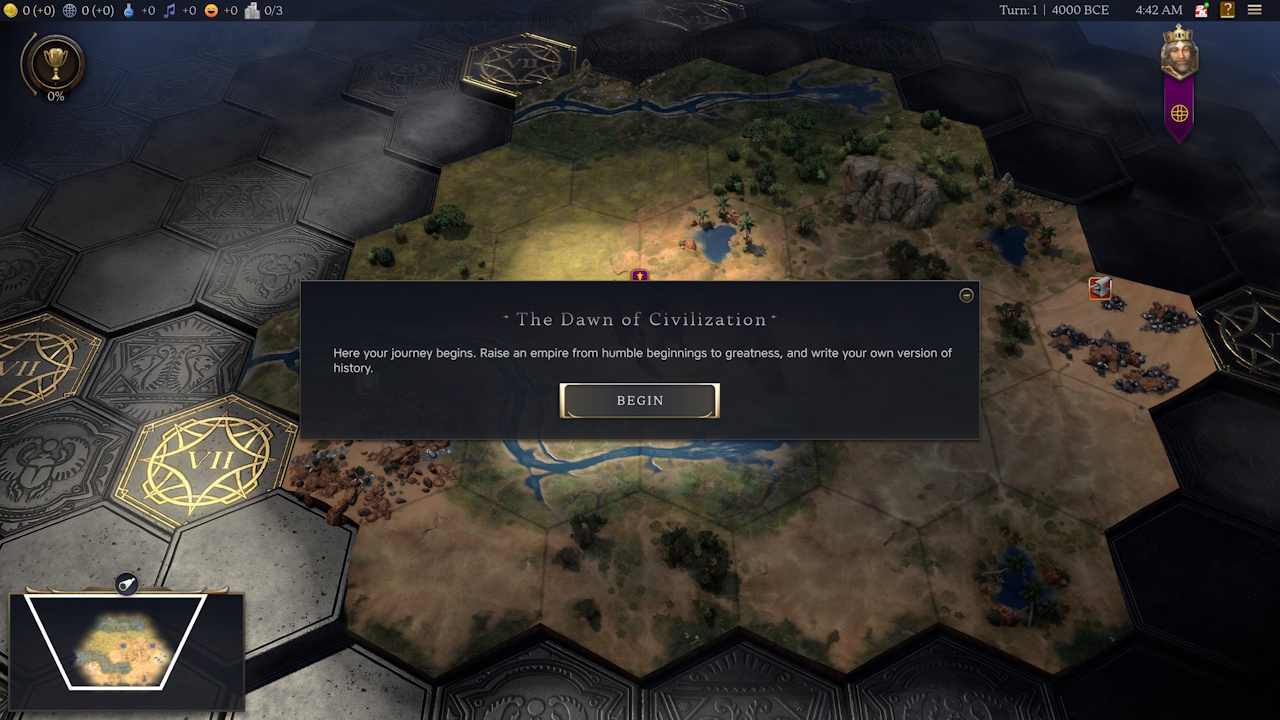
Screenshot of Civilization VII (2025) showing the beginning of a new game.
It’s time for the dawn of Civilization VII!

I’ve sunk well over 1,000 hours into Civilization VI since it launched in 2016, and it quickly became one of my favourite strategy titles of all-time. I’ve bought every single piece of DLC for it, played a bunch of scenarios and special campaigns, and I’ve had an absolute blast. When Civilization VII was announced last year, it shot right to the top of my “must-play” list, leading to me pre-ordering it so I could pre-install it and play it as soon as it was available! There are very, very few games for which I’d break my “never pre-order or pay for expensive premium editions” rules – so I hope Sid Meier, Firaxis, and Take-Two are especially grateful today!

If you just want the headline, I’ll say this: Civilization VII is already a lot of fun, and I only encountered one bug in my first six hours of playing. However, there are missing features that have been part of the series going all the way back, paywalling content at launch – including entire civilizations and leaders – is pretty scummy, and while the base game feels solid… it’s incomplete. There will undoubtedly be DLC packs over the next few months and years that add in a lot of the missing content and features, but all that will do is push up the price of a game that I’ve already paid a lot of money for. If you’re a Civilization VI fan ready to move on to a new challenge, Civilization VII feels like a no-brainer, and just getting started with the game and understanding all of the changes will take time. But if you’re brand-new to the series and looking to get started with a game that’s already complete… pick up the complete edition of Civilization VI when it’s on sale!

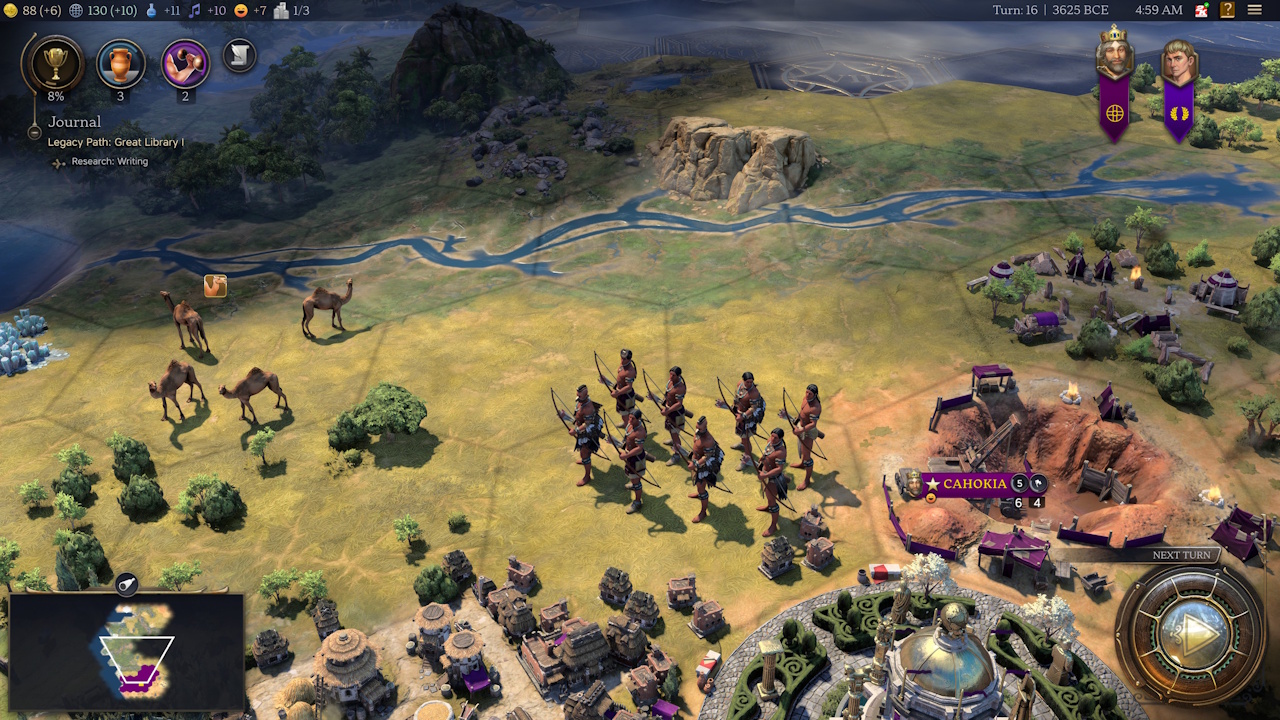
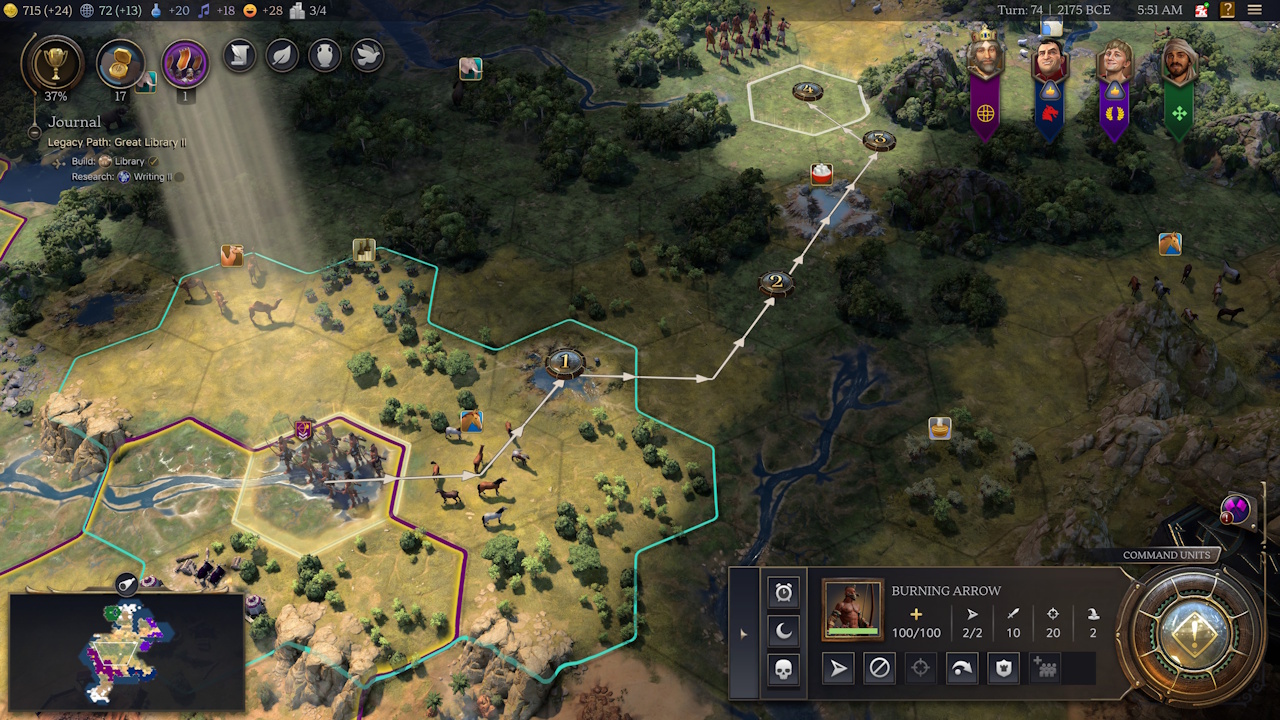
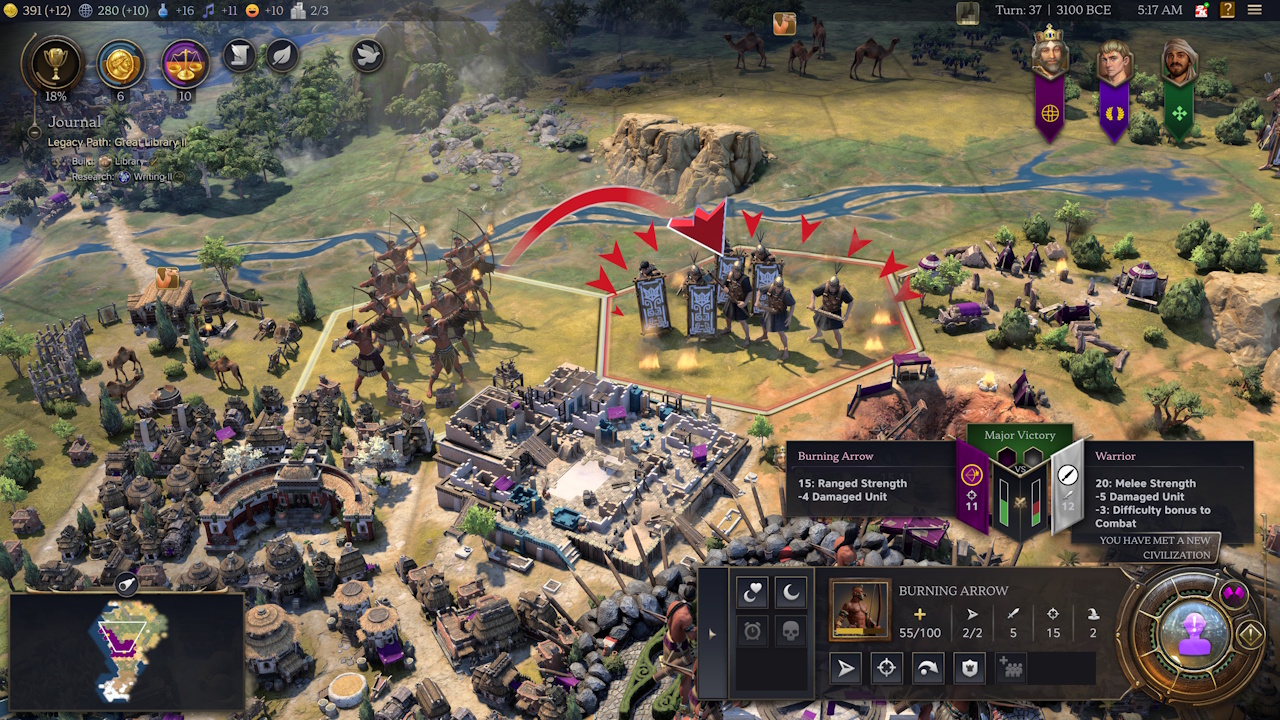
Screenshot of Civilization VII (2025) showing a small settlement and a unit of Mississippian Burning Arrow.
Mississippian archers (their unique unit) next to a city.

Visually, Civilization VII is stunning. I was surprised to see just how graphically impressive the game is considering its relatively small install size (Civilization VII takes up about 15GB of disc space) and that it’s a game that also has to function on the Nintendo Switch. I played the PC version, just so you’re aware of that. Units all have smooth animations for movement and combat, and there’s a ton of variety in the way units and buildings look depending on what era you’re in and which faction you’re playing as. There also seem to be more unique military units – each of the three civs I played as had at least one, which is noticeable coming from Civilization VI.

Environments look stunning, too. Mountains, deserts, and grassland all looked great – but where I was most impressed was in looking at coastal waters, rivers, and forests. These places feel genuinely alive in a way that they just didn’t in Civilization VI, and sending a unit marching into dense jungle or forest had a different feel to it as a result. Water looks great in the game, too, which is something some titles can struggle with. And the addition of navigable rivers adds a whole new challenge to exploration and combat.

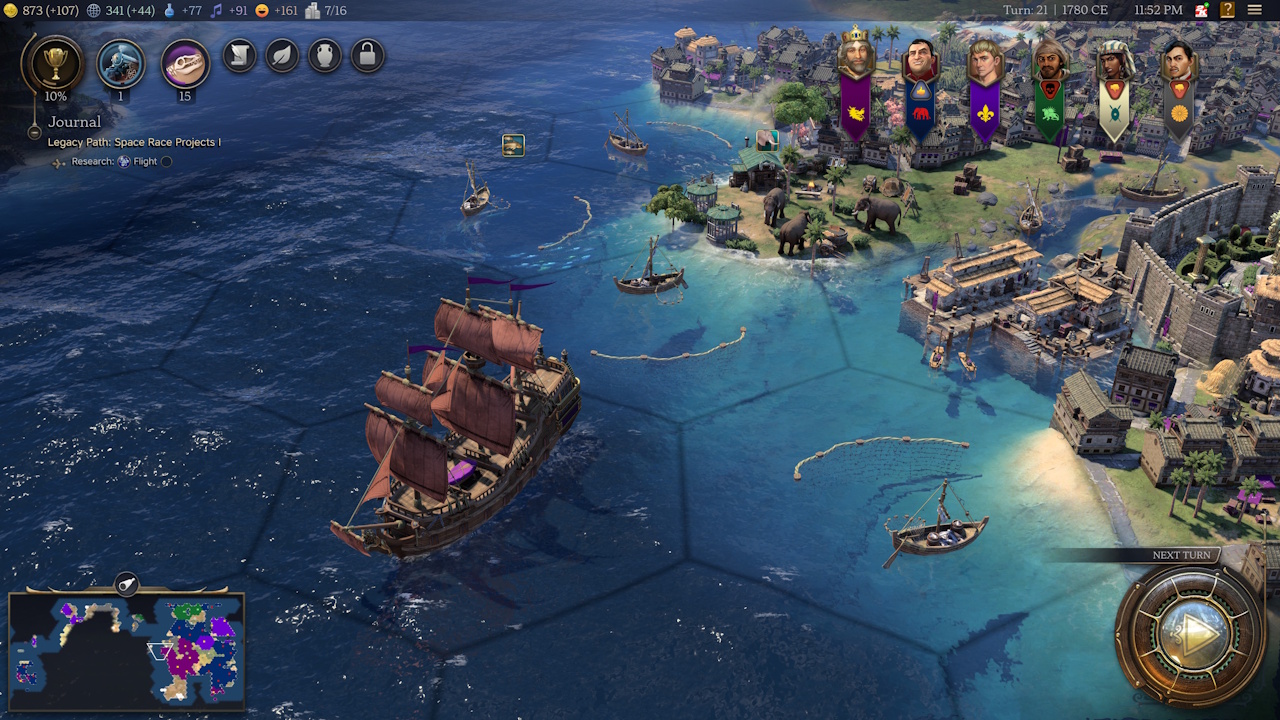
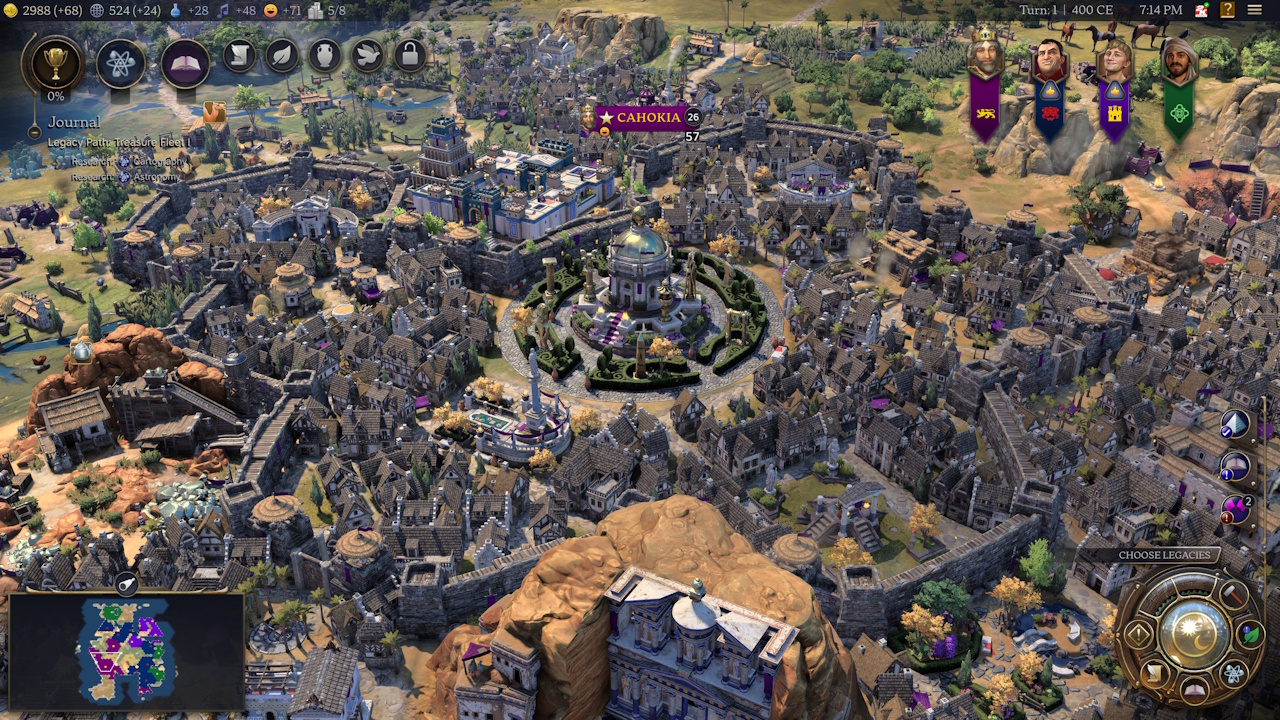
Screenshot of Civilization VII (2025) showing a city, some elephants, and a large ship.
There are some beautiful environments in Civilization VII.

Let’s talk about Civilization VII’s biggest and most-discussed new feature: choosing leaders and factions separately from one another. This was a big part of the game’s marketing and one of the main ways Civilization VII stands apart not only from Civ VI but from other entries in the series, too. This isn’t a totally unique thing to Civilization VII, as choosing a new faction in each era was also a big part of the turn-based strategy game Humankind a couple of years ago – and I think that’s worth keeping in mind. But as to how it works in Civilization VII… I have to admit that I’m still on the fence.

On the surface, picking one leader and then being able to choose up to three different factions (one per age) as the game progresses is interesting. Not only that, but it means the number of potential combinations of leaders + civs is huge! Someone smarter than me will have to crunch the numbers on that, but if we assume new leaders and factions will be added periodically, the sheer variety on offer should mean that games never get old or feel repetitive. But is that really how it’s going to work?

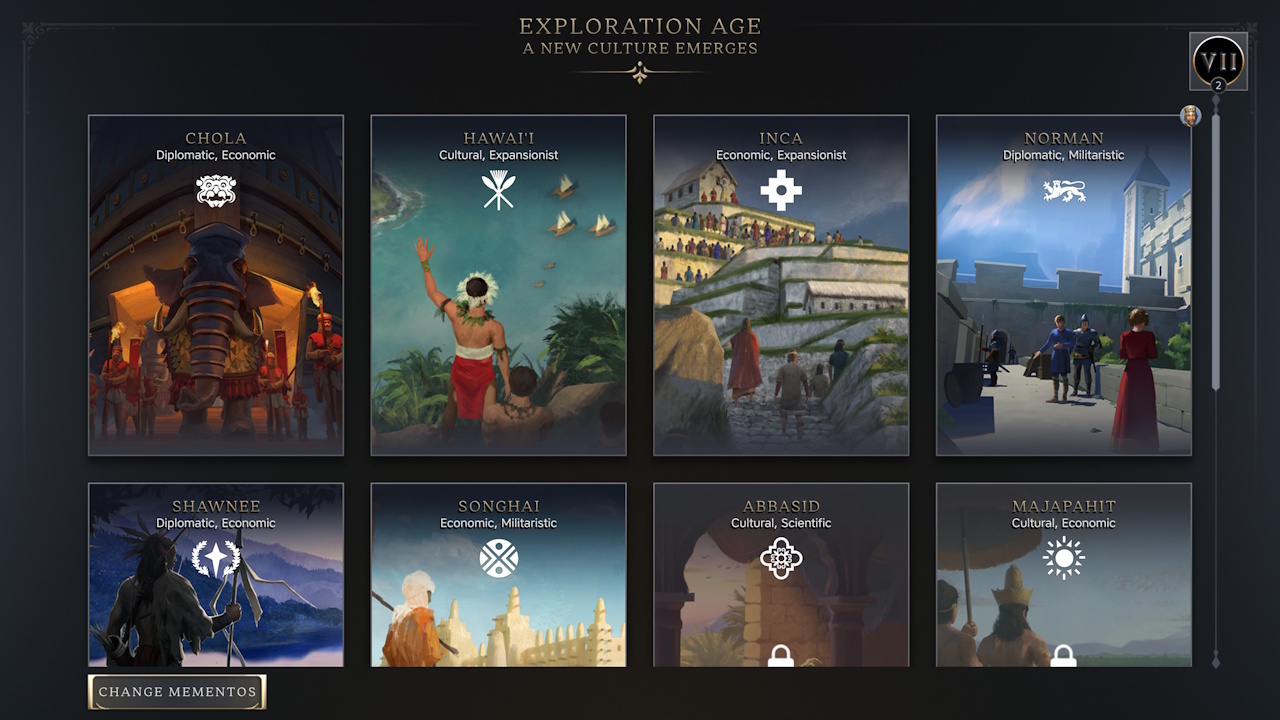
Screenshot of Civilization VII (2025) showing the civ selection screen at the beginning of the Exploration Age.
Choosing a faction one-third of the way through the game!

Two things. Firstly, it seems to me that, in order to make sure every combination of leader + faction is competitive or at least functionally playable, some of the most different – and outstanding – unique features have to be toned down. A faction like Civilization VI’s Polynesians – whose unique traits were that they started with a ship at sea and could navigate ocean tiles from the start of the game – could never work with Civ VII’s random leaders and heavy focus on the middle age being one of maritime exploration.

It’s also clear that the developers want to prevent players from accidentally screwing themselves over by picking a leader whose traits make them somehow incompatible with a particular civilisation, or whose bonuses would be completely useless. As another example from Civilization VI, Canadian leader Wilfrid Laurier is granted bonuses for building on snow and tundra, while the Brazilian civ gets bonuses from rainforest tiles – which don’t spawn anywhere near snow and tundra. In order to avoid these problems and counteract them, Civilization VII’s leader bonuses and civilisation-specific bonuses feel a little bit more restricted. That isn’t to say they’re bad, it’s just they’re arguably toned-down from what they might’ve been if leaders and civs were joined at the hip as in past titles.

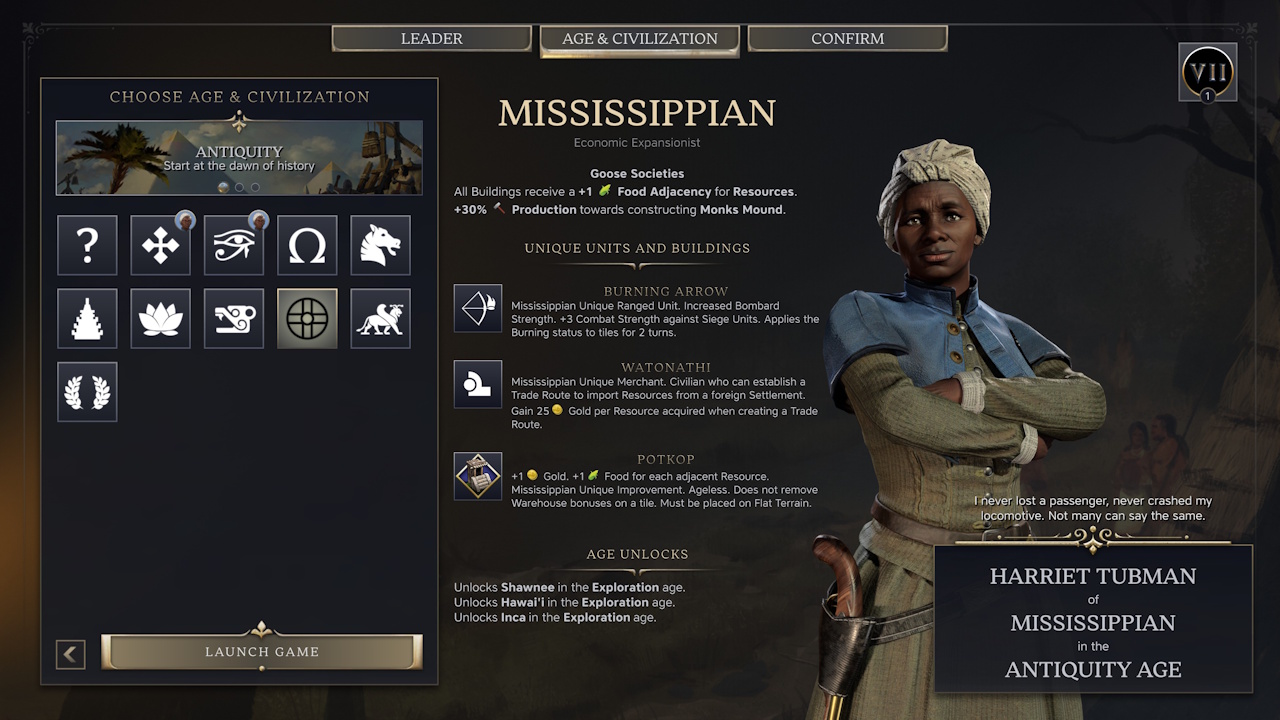
Screenshot of Civilization VII (2025) showing the civ selection screen with a leader already chosen.
Choosing a leader and civ separately is a first for the Civilization series.

This isn’t always a comfortable topic, but the Civilization series – and many other historical and strategy games, too – come in for criticism sometimes for being historically inaccurate or insensitive. Because of the way it breaks leaders and factions apart, it’s possible in Civilization VII for Napoleon to take charge of Egypt or Harriet Tubman to lead Prussia. While Civilization VII veers away from any truly controversial picks (there’s no Hitler or Chairman Mao, for example) some of the combinations are odd at best. The AI, for its part, doesn’t seem to really care which leaders and civs it chooses, so expect some truly random ones if, like me, you mostly play against the computer.

For all the criticism of past Civilization games for being western-centric, not reflecting real history, and so on… at least they could claim to attempt to fictionalise real-world empires and historical factions. This disconnect between leader and civ is going to take some getting used to on my end – which is to be expected, I admit – but something about it also feels a bit… I don’t know. Uncomfortable in a sense, perhaps. Maybe it’s because I was a student of history (it’s the subject I studied at university) but something about breaking leaders and their civs apart is something I don’t feel thrilled about.

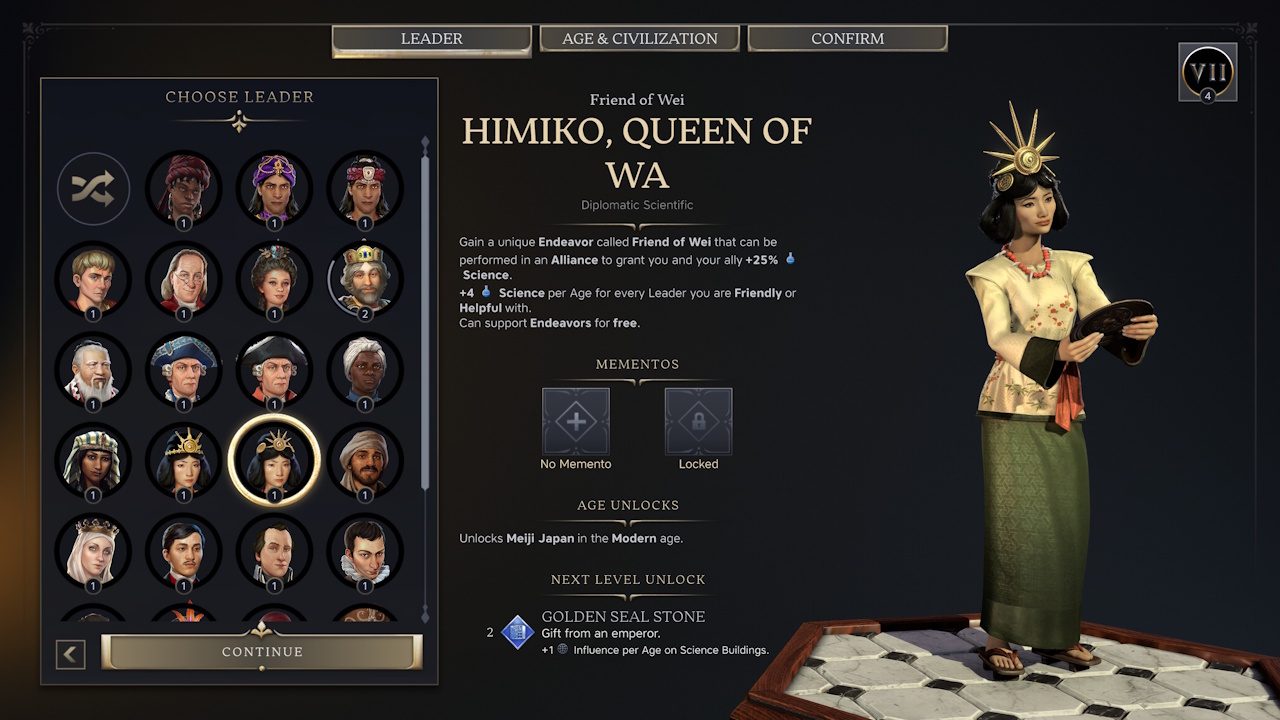
Screenshot of Civilization VII (2025) showing the leader selection screen.
I’m not sold on the separate leaders and civs… not yet, anyway.

Mechanically, this separation also leads to one of Civilization VII’s biggest weaknesses: there are only three eras. In Civ VI, there were eight at launch, with a ninth added later. Not only that, but eras in that game were expanded to add “golden” and “dark” ages, giving new policies and other effects. There are a few “golden” and “dark” age elements in Civilization VII, but they don’t seem anywhere near as impactful. And to be fair, how could they be? If there are only three eras, who wants to spend at least one-third of the game in a dark age with all of the drawbacks that could bring? But to me, that highlights the difference between the two titles… and I’m not sure it’s an improvement.

What arguably is an improvement, though, is that every player in every age should be playing a civ with era-specific advantages. In Civilization VI, if you were playing a faction like Egypt, the majority of your bonuses and your only unique units were only any use in the early game. And if you played Germany or the United States, you’d have to wait until the late game to take advantage of your bonuses and unique advantages… if you could last that long. Civilization VII feels more balanced in that respect, with each civ having bonuses and advantages – based on real history – that make sense and work in their eras.

Screenshot of Civilization VII (2025) showing the beginning of the Age of Exploration screen.
There are fewer eras, but more civs that have relevant bonuses and unique abilities in those eras.

I was a little disappointed to see so few options when starting a new game. There are only a handful of map types – and they’re all pretty basic. As someone who prefers longer, slower games over short, fast-paced ones, there don’t seem to be a lot of options to play on a “massive” map over a longer time frame, which is also a bit of a letdown. Most leaders and factions are also locked until certain gameplay requirements are met to unlock them… which might be fun for you if you like the challenge that comes with unlocking things. For me, I’d usually rather everyone was available to play straight away, with those challenges and unlocks saved for things like achievements.

I’m also disappointed that, for some reason, it isn’t possible to re-name cities and towns. This is something I always like doing in any strategy game, and it was possible in Civ VI so I have no idea why it hasn’t been implemented here. There’s a petition on the Civilization forums to add city re-naming to Civilization VII, so I have to imagine it will be implemented sooner or later, but why couldn’t it be part of the game at launch? That doesn’t make a lot of sense to me.

Screenshot of Civilization VII (2025) showing a city with a wonder and a palace.
Why can’t I rename my cities?!

While we’re nitpicking and talking about relatively small things: why can’t I quit to the desktop from the in-game pause menu? That was possible in Civilization VI, and it’s silly to force me to go back to the menu only to have to quit to the desktop from there. A minor annoyance, sure, but a pretty basic thing to resolve that someone should’ve picked up on before Civilization VII launched!

In terms of gameplay, I found some AI units seemed to occasionally take a very circuitous route before attacking, which didn’t really make a lot of sense to me. While standing one tile away, you’d think they’d move to the next tile and attack. Instead, some AI units seemed to walk the longest route around before starting their attacks – and there wasn’t an obvious reason why. As far as I could tell they weren’t doing this to avoid terrain disadvantages or to link up with allied units; it was just a quirk of the game’s pathfinding or AI.

Screenshot of Civilization VII (2025) showing a route being planned out by the game for a unit.
AI pathfinding feels imperfect right now.

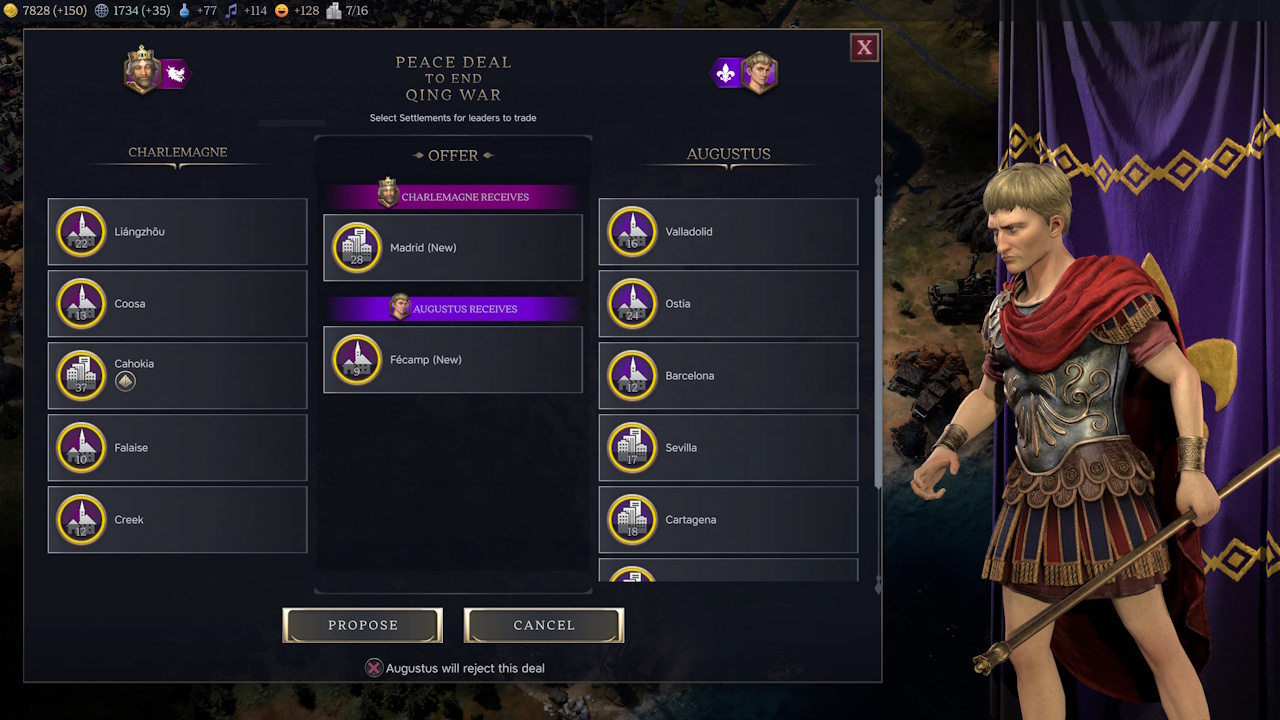
Diplomacy leaves something to be desired, unfortunately. Making friends and alliances with another faction works well enough, and while the system is different from Civilization VI it’s something I daresay I’ll get used to in time! But when a war comes to an end, it’s very odd – and very limiting – that there are so few options for making peace. In Civ VI, to end a war you could offer or demand money, great works, rare resources, and so on. In Civ VII, the only options on the table when trying to end a war are cities – and in some cases, it seems like an enemy won’t accept a peace offer if you refuse to give up a city – even if they haven’t conquered any of your cities or even killed a single unit in combat.

This really limits the way war works, and unless it’s addressed it’s going to be a weight around the game’s neck. There are occasions where, after capturing a city, I’ll want to keep it or sell it back as part of a peace treaty. But that’s far and away not the only way I want to make peace – in fact, in Civ VI cities were usually the bottom of my list when negotiating. The fact that some war-hungry powers won’t make peace very easily makes the game feel unbalanced, and it means war and combat – two of the most important features in a 4X strategy game – are less useful. Starting a war is always going to be a risk, but if I know that making peace is painfully difficult in some cases, it makes me far less interested in even attempting to play the game that way. Again, this is limiting.

Screenshot of Civilization VII (2025) showing the peace treaty screen.
The peace treaty system needs some work.

Weirdly, declarations of war don’t seem to survive the transition from one era to another. In short, if you’re at war with someone when the age ends, you won’t be when the new age begins. Since we were speaking of things that limit the warfare and combat system… that’s another.

Think about it: if you’re running out of time in the ancient or exploration ages, why would you start a war that you’d be unlikely to finish in time? I’m kind of hoping this is a bug or something that will be changed, because automatically ending a war just because the clock rolled over feels like something that really puts the brakes on that side of the game. Eras can be long, sure, but by the time you’ve got research and unit upgrades done, there might not always be time for a full-blown conquest. Now, the flip side is that this adds another level of strategic planning to the game, which some folks might appreciate. But in Civilization VI, if you were at war in one age you’d remain at war when the next one rolled around.

The exploration age ended while I was at war with three civs…
…but we were at peace when the modern age began in the very next turn.

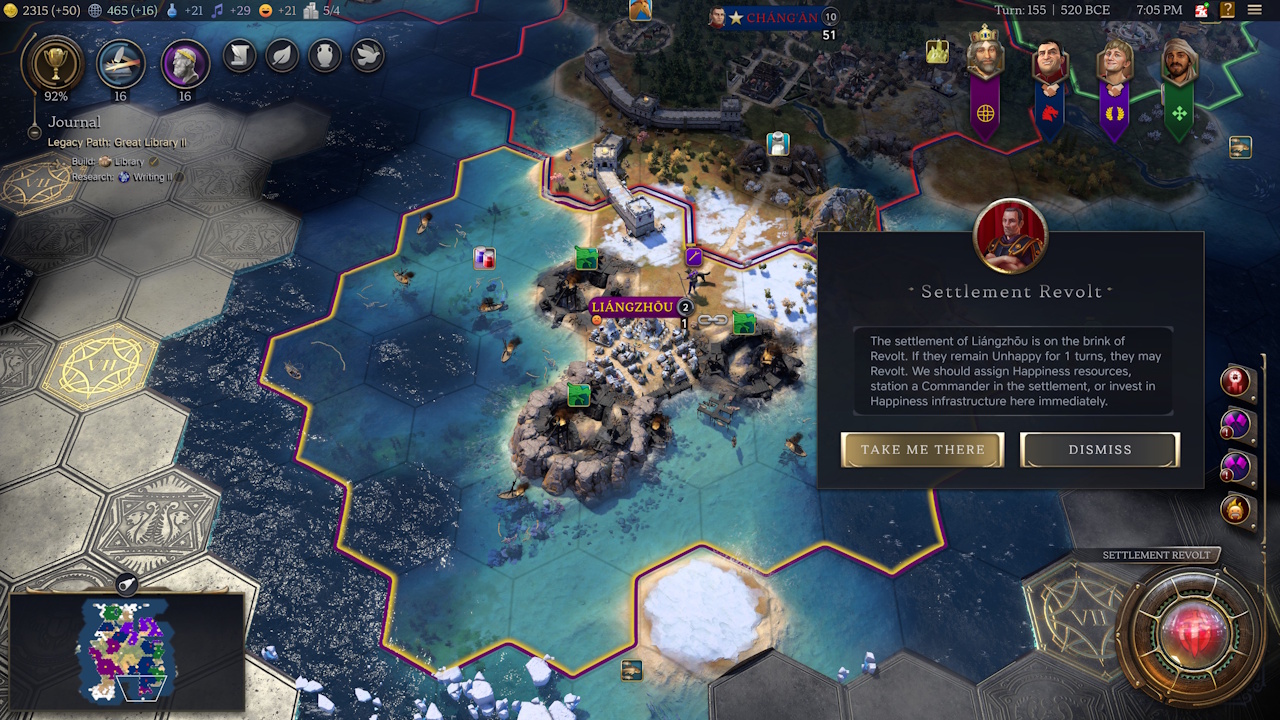
I struggled with cities and towns rebelling – but not in the way you might think! Relatively early in my game, one nearby city rebelled from its founder and asked to join my empire (who wouldn’t want to be part of the great Empire of Dennis, after all?) This city then spent the rest of the game threatening to rebel against me… but without ever doing so. I don’t know why it never went into full-blown revolt; I had a military unit stationed there, but that was all. It became annoying to keep seeing these pop-ups warning me of an imminent rebellion, when no rebellion ever came.

It’s great, though, that cities can revolt if certain conditions are met. I just wish I knew what the conditions were so I could either trigger them in enemies or avoid them in my own settlements! This feels like an evolution of the way it worked in Civ VI, and it’s definitely something I want to dig into more in my next game.

Screenshot of Civilization VII (2025) showing a warning of an imminent revolt in a settlement.
I kept getting this message warning me that a revolt was imminent… but it never came.

Gwendoline Christie has taken over the role of narrator for Civilization VII. She has a wonderful voice, and particularly in the opening cinematic I think she did a good job. But… there… are… some… sentences… that… she… reads… with… a… lot… of… unnecessary… pauses… in… between… words… and… clauses. It’s almost like she’s doing a William Shatner impression – which, unfortunately, I don’t mean as a compliment. She also seems to have a tendency toward over-enunciating certain words, which I definitely picked up on. It’s not the worst thing in the world, sure, and I’ll get used to it. These lines can be skipped, too, with a simple click of the mouse. But I thought it was worth noting.

As in any new game, there are changes to the rules that can feel a little arbitrary. But given enough time, I’ll get used to all of them. I didn’t do spectacularly well in my first game, but I feel like I learned a lot and I’m starting to understand how some of the changes work. Civilization VII feels like a solid start, with plenty to build on in the months and years ahead.

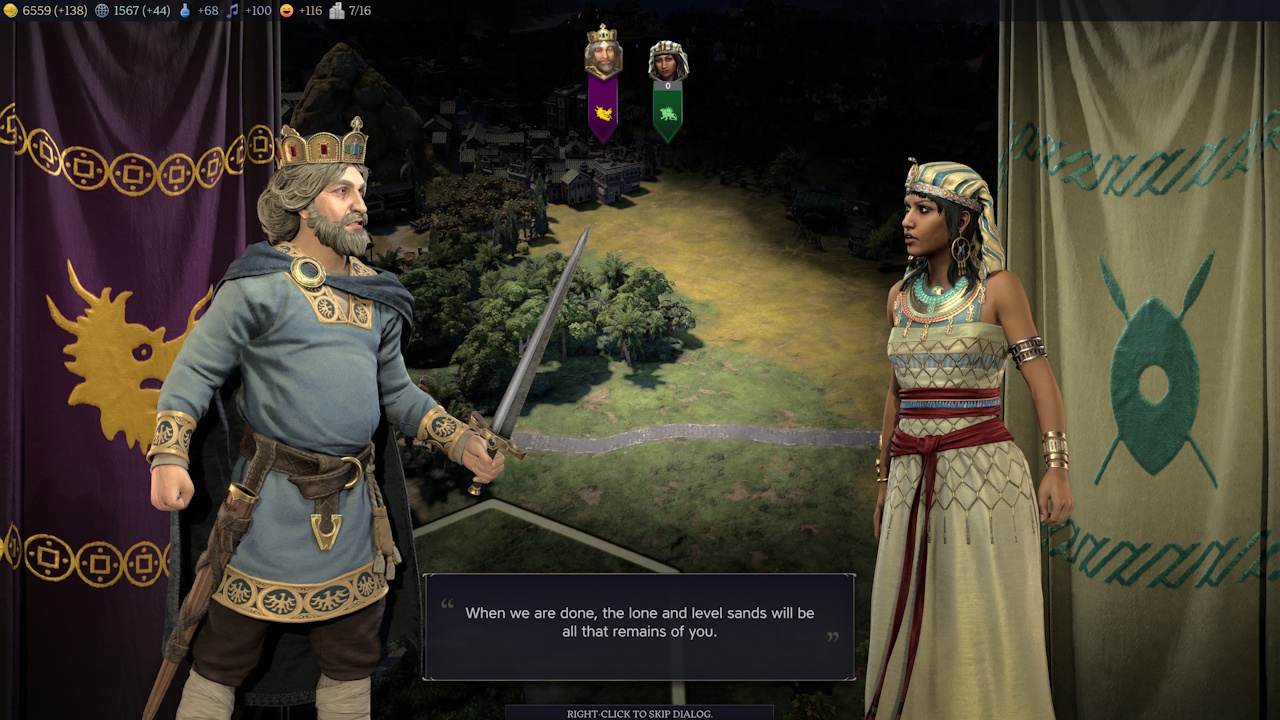
Screenshot of Civilization VII (2025) showing two leaders declaring war.
Charlemagne and Hatshepsut are going to war!

One of the biggest changes for me was the lack of a builder unit. Builders in past Civilization games have played different roles, but I think I’m right in saying they’ve always been present in some form. Civilization VII doesn’t use builders, with buildings and occupied tiles being handled from the city menu. That’s definitely gonna take some getting used to!

Cities being different from towns is also a big change. Towns can’t construct wonders and can only purchase buildings and units with gold, but can also specialise and focus on one thing – food, happiness, gold, etc. – adding more of the chosen resource to your civilisation’s total. Again, this is something I’ll need to spend more time with to really get the hang of, but I think it’s at least an interesting change.

Screenshot of Civilization VII (2025) showing a sprawling city of the Qing Empire.
A large city in the modern age.

Civilization VI introduced several gameplay mechanics revolving around climate change – and these have been removed from Civ VII. I will concede that the implementation of sea level rise and climate mitigation in the previous game was imperfect, but it added a lot to the late game in particular – as well as forcing players to consider how they use resources earlier in the game, too. It made for a lot of calculations like whether I could risk waiting for the technology to do nuclear power and renewables or whether I’d have to industrialise and use coal and oil, then try to clean up the mess later! It was a creative inclusion, and one that I’m sure could’ve been adapted this time.

I wonder if things like climate change and sea levels will be added as DLC somewhere down the line. These mechanics weren’t part of the launch version of Civilization VI, so maybe the plan is to see how they could be implemented once Civ VII gets going. If so, I guess I can get on board with that.

Screenshot of Civilization VII (2025) showing the Redwood Forest natural wonder.
Discovering a natural wonder!

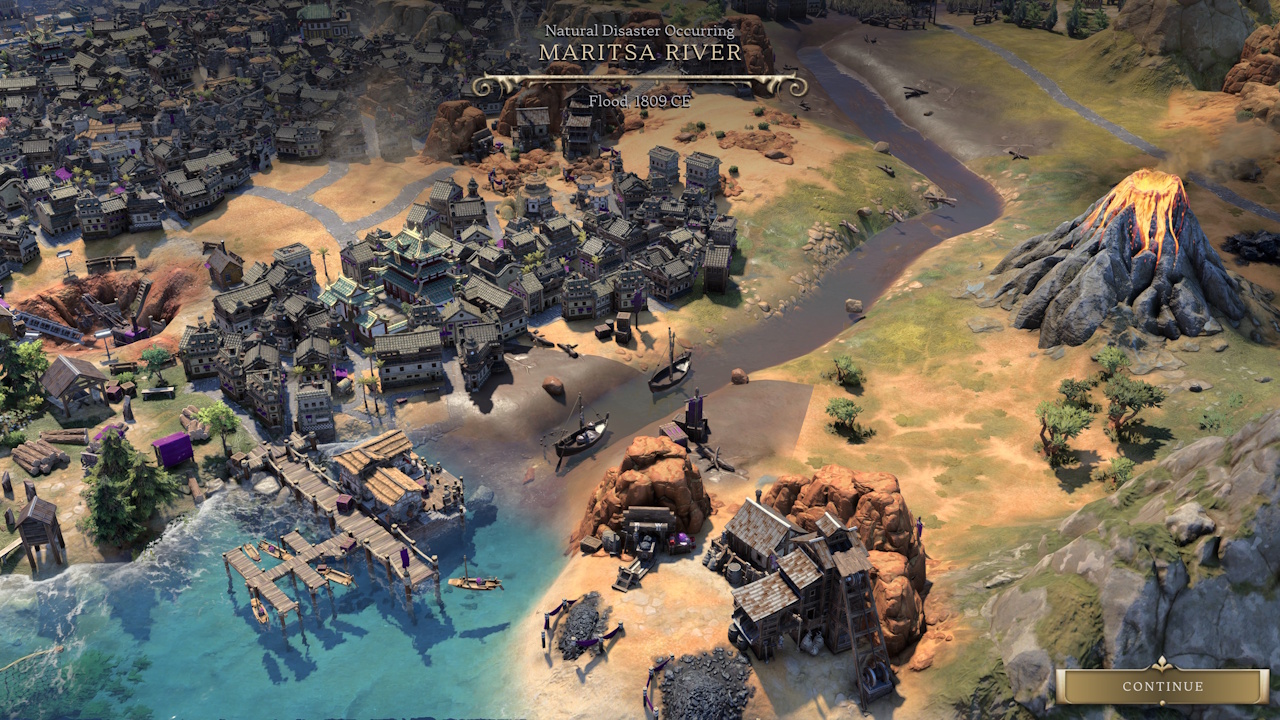
One element from Civ VI that its sequel retains, though, is natural disasters. In my first game I encountered a storm at sea, a blizzard, tornado outbreaks… and so many river floods. Seriously, there’s gotta be a way to tone down the frequency of some of these natural disasters, because when the same river has flooded for the twelfth time in a single playthrough… it starts to get annoying!

There also didn’t seem to be an easy way to ask for aid – in Civ VI, after suffering a natural disaster, players could request help in the form of gold. This added another layer to the game’s diplomacy, but it seems to be absent here. If natural disasters (floods especially) were less frequent, maybe I wouldn’t have even noticed!

Screenshot of Civilization VII (2025) showing a river flooding.
I genuinely lost count of how many times the rivers flooded in just one game.

So I think that’s everything I had in my notes.

Civilization VII has a lot of potential to be a fantastic strategy game, one I can already see myself playing for hour after hour. There are a lot of changes from Civ VI – some of which feel rather arbitrary – and some weaknesses compared to that game, too. For me, I think the biggest weakness right now is that there are only three ages (or eras) to play through. While these are different, and arguably bigger and better than they have been in the past, it makes Civilization VII feel… smaller.

I’m also not fully sold on the separate leader and civ mechanic – at least, not yet. I like that different factions in different eras all feel tailored to those eras, avoiding the problems that could come from playing a civ with bonuses that only worked in one part of a longer game. But in order to keep things relatively fair, I can’t help but feel some of the most unique and interesting leader and civ bonuses and abilities have had to be toned down.

Screenshot of Civilization VII (2025) showing a ranged attack being readied.
Archers preparing a ranged attack.

All that being said, my six hours flew by and I had a lot of fun getting into my first Civilization VII game. I tried my hand at exploration, diplomacy, war, combat, trading, and I even founded my own religion. There are a lot of fun-sounding civs to try out, including plenty that aren’t western or European, which is great to see. And as always, Civilization VII has a fantastic soundtrack!

Visually, the game shines. Animations look great, the landscape looks beautiful, and there are plenty of unique features in every civ in terms of the way units and buildings look. This definitely keeps things interesting and gives the game a ton of variety. I would say that, compared to Civ VI, Civilization VII is leaning more toward “realism” and going for a less cartoonish or board game-inspired look. Whether that’s your preference or not is going to be subject to personal taste!

Screenshot of Civilization VII (2025) showing a walled town and a ship.
A walled town.

I hope this has been interesting and informative. I tried to hit all of the big points from my first Civilization VII game so I could share my first impressions fairly, but there’s a lot more to this game that I need to explore. Later in the year, perhaps after some of the first patches, updates, and pieces of DLC have been released, I’ll definitely have more to say.

Now that I’m done writing this… I’m gonna jump back into Civilization VII, pick a new leader, and go around again. And if that isn’t a ringing endorsement (or a desperate cope from someone who spent £120 on this game) then I don’t know what is!

Seriously, though, unless you’re some kind of super-fan… just get the base game. I was silly to reward Firaxis and Take-Two for their shitty business practices, and I’m not pleased with myself for wasting extra money on in-game silliness that I didn’t need.


Civilization VII is out now for PC, Mac, Linux, PlayStation 4, PlayStation 5, Nintendo Switch, Xbox One, and Xbox Series S/X consoles. Civilization VII is the copyright of Firaxis and/or Take-Two Interactive. This article contains the thoughts and opinions of one person only and is not intended to cause any offence.

Switch 2: Five Games Nintendo Should Learn From

Now that we have a bit more information about the Nintendo Switch 2, I thought it could be interesting to look ahead. My first-ever home console was a Super Nintendo, and I’ve also owned an N64, Wii, 3DS, Switch – and I was even one of about seven people who owned a Wii U ten or so years ago. So I like to think I have a tiny bit of a track record when it comes to Nintendo!

I gotta admit that I’m surprised about the Switch 2. Nintendo are the kings of innovation in gaming, with each of the company’s consoles having something different to entice players. The Switch 2 will be the first console in several generations (since either the GameCube or the Super Nintendo, depending on how we think about it) to play it so exceptionally safe. If I were being deliberately unkind, I might even suggest that the Switch 2 looks underwhelming and repetitive.

Still frame from the Nintendo Switch 2 trailer.
The Switch 2 in docked mode.

Until we’ve got a better look at the internals of the Switch 2, though, we won’t know for sure how different the machine really is and what its capabilities will be. I’m hoping to put a Switch 2 on my list of things to buy this year (or in 2026, if it won’t be launching in time for Christmas) but that will depend to a great degree on what games the console launches with – and how much better they might look compared to the current iteration of the Switch.

The Switch has some great games, that isn’t even a remotely controversial statement! And I’ve definitely been surprised to see that some very big, demanding games have survived being ported to the platform in a playable state. I’m thinking of titles like Hogwarts Legacy and The Witcher 3 in particular, but I’m sure there are others.

Still frame from the Nintendo Switch 2 trailer.
A Switch 2 joy-con controller.

When it comes to Nintendo’s first-party titles, the Switch has excelled, too. Mario Kart 8 Deluxe, Super Mario Odyssey, and Animal Crossing: New Horizons ought to be in anyone’s top ten, with all three games taking established series and putting a new spin on them.

And it’s games I’d like to talk about today.

For all the innovation and advances that Nintendo has made, there are other companies in the gaming space that have gone beyond what Nintendo and the Switch have been capable of. As technology has improved, I don’t think it’s unfair to say that the Switch has, in some respects, held back Nintendo’s developers. Over the past few years, there have been quite a few games released in genres that Nintendo used to dominate… titles that have gone above and beyond the company’s recent output.

Nintendo's logo.
The Switch 2 will be Nintendo’s first console since 2017.

Today, we’re going to look at five games from the last few years that Nintendo needs to learn from in order to make their games on the Switch 2 the best they can be. Some fans will always be satisfied with more of the same – and that’s great! If you’re in that camp, that’s okay and I don’t intend any of this as some kind of attack. Speaking for myself, though, I’ve played several games in recent years (and watched gameplay from other titles, too) that genuinely eclipse anything Nintendo has created. Partly that might be down to the limitations of the Switch – but it’s also down to the inescapable fact that other companies and developers are innovating and pushing the boundaries in a way that Nintendo hasn’t been.

If Nintendo is to make the Switch 2 a success, then the company will need to read the room! Player expectations are always changing, and Nintendo can’t afford to remain stagnant and try to coast on past successes. A new console – with new, more powerful hardware at its heart – is an opportunity to catch up on a decade-plus of evolution and enhancements in game development, bringing at least some of Nintendo’s flagship series and franchises into the 2020s for the first time.

Still frame from the Nintendo Switch 2 trailer.
The Switch 2 in its docking cradle.

So let’s take a look at five games that I think Nintendo can learn from.

As always, a couple of caveats. Firstly, please keep in mind that all of this is the subjective opinion of just one person. If I make a point you disagree with, highlight a game you hate, or recommend a change that you think doesn’t need to be made… that’s okay! Nintendo fans are a passionate bunch, but there ought to be enough room in the fan community for civil discussion and polite disagreement.

Still frame from the Nintendo Switch 2 trailer.
Joy-cons will attach to the Switch 2 with this… delicate-looking connection!

I’ve also tried to be realistic in my selections. I’m not going to try and argue that Nintendo should turn the next Mario game into a gritty Red Dead Redemption II open-world, or that the next Animal Crossing ought to be an L.A. Noire-style murder mystery. I’ve chosen titles in either the same genre or a similar space that I believe Nintendo can learn from as the first few Switch 2 games are being worked on.

With all of that out of the way, let’s take a look at the list!

Game #1:
Palworld
Pokémon franchise

Promo screenshot of Palworld showing a yellow monster with a large gun.
A gun-toting monster from Palworld.

This is the game that really inspired me to put this list together! Last year, Palworld was a surprise hit. It took the monster-battling sub-genre and put its own spin on it, bringing in huge numbers of players in the process. I know several die-hard Pokémon fans who absolutely adore Palworld, and even looking in from the outside, I can see many ways in which the game goes beyond anything the Pokémon series has ever done.

Recent Pokémon titles have been pretty stale and stagnant – if they even worked at all. Sure, they might add new monsters to the roster or be set in a different region of the franchise’s world, but Pokémon’s basic gameplay hasn’t changed in years. The series needs a good shake-up, and Palworld’s success should be the kick in the backside that Nintendo, Game Freak, and the Pokémon Company need.

Promo screenshot of Pokemon Scarlet or Pokemon Violet showing the three starter Pokemon.
The starter Pokémon from Pokémon Scarlet/Violet.

Unfortunately, things aren’t looking great on this front. Nintendo has inexplicably chosen to try to sue Palworld and its developer out of existence with a frivolous lawsuit, something that shames Furukawa, Miyamoto, and all of the other cowardly executives. As I wrote last year: the history of gaming is one of piecemeal innovation, with companies from all across the industry seeing what works and building on it. Pokémon wouldn’t exist without the role-playing games, deck-building games, and top-down fantasy titles that came before it, and Nintendo doesn’t have the right to claim ownership of an entire genre.

So I hope, once the dust settles and the lawsuit is inevitably dismissed, Nintendo can do what it should’ve done from day one: learn what worked in Palworld and what players liked, and apply those findings to the next Pokémon game. That doesn’t mean copy Palworld beat-for-beat, but taking the best bits and the things players loved the most and using that knowledge to make Pokémon better.

Game #2:
Sonic Mania
2D Mario

Promo screenshot of Sonic Mania.
Sonic and Tails.

Super Mario Bros. Wonder has been very well-received by Nintendo fans – and that’s great! Ever since 2D Mario games returned from a decade-long hiatus almost twenty years ago, though, they’ve more or less retained the same art style. Wonder definitely added a lot of new things to the mix, and there have been new power-ups and levels with different settings… but maybe it’s time to take a step back and really go back to Mario’s roots.

Sonic Mania is a fantastic title that has a really interesting development history. It was originally a fan project, but Sega saw the potential in the game and swooped in, licensing it as an official entry in the Sonic series. And I don’t think it’s an exaggeration to say that Sonic Mania is one of the best Sonic games since the Mega Drive days.

Promo screenshot of Super Mario Bros. Wonder.
Mario in Super Mario Bros. Wonder.

I’d love to see Nintendo really lean into the NES or SNES visual style with their next 2D Mario game. It could be a side-project rather than a full mainline game, and I wouldn’t necessarily expect an “old-school” 2D Mario as the Switch 2’s big launch title. But as a love letter to fans in Super Mario’s 40th anniversary year… what could be better?

Sonic Mania genuinely feels like a 16-bit Mega Drive game, bringing back not only the visual and art style of that era, but gameplay mechanics, too. After all the talk of doing better and pushing the boat out, maybe this seems like a bit of an oddity – and I fully accept that. But as someone who really got into gaming in the early 1990s, I would love nothing more than to return to that style of 2D platformer. Sonic Mania could be the template for how to do that – and do it right.

Game #3:
Disney Dreamlight Valley
Animal Crossing series

Promo screenshot of Disney Dreamlight Valley showing the furniture placement screen and a custom character.
A player showing off their home in Disney Dreamlight Valley.

If you read my review of Disney Dreamlight Valley a couple of years ago, you might remember me saying that the game took basically all of my complaints about Animal Crossing: New Horizons and fixed them, while also adding in compelling characters and story missions to boot. I’m not sure that the next Animal Crossing needs a “main quest” of sorts… but there are so many other things that Dreamlight Valley does well.

Firstly, Dreamlight Valley has much more freedom in terms of decorating – both inside and out. With a simple button press, everything from small items of furniture to houses and trees can be moved, placed, and deleted, and there’s a near-unlimited amount of free choice in where things are placed and how many things can be placed. New Horizons, thanks to the Switch’s limited processing power, is notoriously laggy when too many items are placed outdoors – but the next game in the series should, at least, not suffer from that limitation.

Still frame from the Animal Crossing: New Horizons expansion pack trailer.
Even with its expansion pack, New Horizons wasn’t all it could’ve been.

Dreamlight Valley’s characters also feel more compelling and unique. Partly that’s because everyone gets a quest or series of quests, but it’s also because each character has a distinct personality – reflected not only in their choice of outfit and decoration, but dialogue, too. One of my biggest criticisms of New Horizons was how awfully repetitive the dialogue got after only a short amount of time – and without mini-games or other events to spice things up, as well as such a small number of villager “types” – I found I was getting the exact same line of dialogue over and over and over again from different characters.

In terms of design, customisation, character interactions, and more, Dreamlight Valley not only eclipses Animal Crossing… it blows it out of the water. There are pitfalls to be avoided, sure – Dreamlight Valley is too heavily-monetised for my taste – but it should be seen as a template for how to improve the Animal Crossing formula.

Game #4:
Doom Eternal
Metroid Prime series

Promo screenshot of Doom Eternal showing a first-person viewpoint.
Doom Eternal is fast-paced and fun.

With Metroid Prime 4 due for release on the Switch this year – presumably before the Switch 2 launches – there’s limited room for serious improvements. But if the Metroid Prime series continues and will get a new entry in the years ahead, the fast-paced combat of Doom Eternal should be the high bar that the series aims for.

I haven’t played a Metroid Prime game since the GameCube days, so maybe I’m not the best person to offer advice on this series! But I know what I look for in a single-player first-person shooter, and of all the games in that genre I’ve played over the years, none felt as energetic and exciting as Doom Eternal. With the Switch 2 offering the chance for a serious upgrade, the next Metroid Prime game could have more enemies on screen at the same time, a wider range of enemy types, more weapons, and so on.

Promo screenshot of Metroid Prime 4 showing the HUD, a weapon, and several enemies.
Metroid Prime 4 is due for release this year on the Switch.

Doom Eternal’s grappling hook mechanic also worked exceptionally well, and something like that could be a fine addition to the Metroid Prime series, too. Adding in some platforming and puzzle-solving elements along with fast-paced combat could be a ton of fun.

I’d also be remiss not to mention the fantastic soundtrack that the modern Doom titles have had. A hard rock/heavy metal soundtrack was pitch-perfect for those games, and added so much to the wild action and thrill of gunning down hordes of demons. Metroid Prime doesn’t need to go down the heavy metal route, of course, but a soundtrack that helps bring the game to life and fits with its design philosophy will be essential.

Game #5:
Astro Bot
3D Mario

Promo artwork for Astro Bot.
Astro Bot is everything a 3D platformer should aim to be in 2025.

A moment ago, we talked about the next 2D Mario game and how I’d like to see the series go back to its roots – both in terms of gameplay and visual style. But 3D Mario should really aim to go above and beyond, pushing the Switch 2’s hardware to its limits while retaining the charm of titles like Super Mario 64 and Odyssey. PlayStation’s Astro Bot – which was in the running for game of the year on many publications’ lists in 2024 – is exactly the kind of game Nintendo should be paying attention to.

I have to admit that I haven’t played Astro Bot for myself; I don’t own a PS5 and, as much as I might want to, I can’t justify the expense of buying one just to play one game! But I’ve seen a lot of gameplay online, and Astro Bot looks like the kind of game that knows what it’s trying to be… and absolutely nails it.

Screenshot of Super Mario 64 showing Mario in the castle lobby.
Super Mario 64 is still one of my favourite games.

Many critics have noted – quite correctly – that Astro Bot is drawing inspiration from Nintendo’s 3D platformers. But graphically and in terms of level design, it seems to go beyond them, too. Super Mario Odyssey, arguably the best and certainly the biggest 3D Mario game, is now almost eight years old, so fans are absolutely right to expect to see significant improvements when the next entry in the series is ready. Astro Bot shows how beautiful a 3D platformer can look with modern hardware, and it’s also a masterclass in level design.

I’m pretty sure that Nintendo will be hard at work on the next 3D Mario already. We’ve caught a glimpse of a new Mario Kart in the recent Switch 2 teaser, so that could well be the console’s big launch title. But a new 3D Mario is unlikely to be far behind. I hope some of the developers and producers have played Astro Bot to get a feel for how that game works and to see what it does well.

So that’s it!

Still frame from the Nintendo Switch 2 trailer.
It looks like a new Mario Kart game is coming soon!

We’ve taken a look at five games that I think Nintendo needs to examine closely and learn from as the Switch 2 and its games are in development.

The Switch 2 is definitely on my wishlist – if for no other reason than a brand-new Mario Kart game is always gonna be something I’ll want to play! But I’m curious to see how much more powerful the console can be, and whether Nintendo (and other third-party developers, too) are going to be able to fully take advantage of that. Better graphics and shinier-looking games should be a guarantee – but I’d love to see Nintendo also paying attention to the improvements and evolution in some of these genres. Although there’s been less of that in the last ten years than there was from, say, 1995 to 2005, there are still plenty of areas where Nintendo can improve.

When we learn more about the Switch 2 in April, I’ll definitely be sharing my thoughts on how the console is shaping up. I’ll be keeping my ear to the ground for news on launch titles, too! So when we have more news about Nintendo and the Switch 2, I hope you’ll join me here on the website. Until then, I hope this has been a fun and interesting look ahead.


The Nintendo Switch 2 will be officially shown off in April and will launch in 2025 or early 2026. All titles discussed above are the copyright of their respective publisher, developer, studio, and/or corporation. Some promotional art and images courtesy of Nintendo and IGDB. This article contains the thoughts and opinions of one person only and is not intended to cause any offence.

Grand Theft Auto VI Should Be Free

I recently read an article about the price of the highly-anticipated upcoming video game Grand Theft Auto VI. According to the journalist, a number of analysts and businesspeople in the games industry are “hoping” that Take-Two Interactive and Rockstar will price Grand Theft Auto VI higher than the current $70/£70 that has become standard since 2020. The reason for this is simple: it will open the door for other publishers to follow suit, increasing the prices of games across the board.

To me, that sounds absolutely repulsive. The corporations that make up the games industry have literally never made more profit than they’re making right now. Even expensive failures like Concord last year hardly registered as a blip on the charts; these corporations are making money hand over fist in a way they could’ve only dreamed of a few short years ago.

A still frame from the Grand Theft Auto VI trailer showing Lucia holding a wad of cash.
The games industry has never been richer and more profitable.

So today I’d like to propose a counter-argument: Grand Theft Auto VI should be free-to-play for everyone.

First of all, let’s clear up this myth surrounding the so-called standard price of video games. In most cases – and especially for AAA games released through corporate publishers – £70 only gets your foot in the door. The true price of fully feature-complete games has been well above £70 for years, and it’s only getting worse. So-called “premium editions” or “deluxe editions” aren’t giving players something extra, they’re cutting out content that was developed alongside the game, fully-integrated into it, and selling it back to us for a premium fee. Some of these special editions can be well over £100 – so that’s the true price tag of most AAA video games in 2025.

We’ve seen a recent trend in which AAA publishers are adding “early” access into deluxe editions of games, too. Charging players extra to play the game on its real release date instead of up to a week later is pretty shitty when you think about it, and just another way that corporations like Take-Two – and others in the AAA space – exploit their players.

Screenshot of the different editions for NBA 2K25.
Take-Two’s own NBA 2K series comes with “standard” and “all-star” editions, the latter having more content.

Grand Theft Auto VI will have a single-player campaign, and although Take-Two has cheaped out on development, cutting off PC players for some incomprehensible reason, I gotta confess that I’m genuinely looking forward to playing it. The Grand Theft Auto series has usually been good fun, and I’ve been playing since the first title was released in the late ’90s. Remember playing the first Grand Theft Auto with its top-down view? Those were the days, eh?

But let’s be honest: Grand Theft Auto VI is, first and foremost, a multiplayer title. That’s how Rockstar and Take-Two see it, and after the rampant success of Grand Theft Auto V’s online mode, they’re not wrong about that.

Screenshot of the Rockstar Store showing Grand Theft Auto V "Shark Cards" for sale at different price points.
In-game sales, like these Shark Cards for Grand Theft Auto V, are where Take-Two and Rockstar will make the most money.

Grand Theft Auto V isn’t just any online multiplayer game, though. It’s a game that has been monetised to death, incorporating basically every scummy pay-to-win trend going – and pioneering new ones that other corporations in the games industry have latched onto like parasites. Most games that charge players real money for an in-game currency, skins, cosmetic items, and particularly that charge for gameplay-enhancing vehicles, weapons, and items have something in common: they’re free.

So to reiterate: Grand Theft Auto VI should be free-to-play, and Take-Two should be content with making all of the money in the world from sales of in-game currency and pay-to-win items. Charging even £1 for the game up-front – let alone £90 or £100 as some corporate leaders are soiling themselves in anticipation over – just feels obscene for a game that’s going to be monetised to hell and back.

A still frame from the Grand Theft Auto VI trailer showing a flock of flamingoes.
A flock of flamingoes from the Grand Theft Auto VI trailer.

By including all of these pay-to-win mechanics, Take-Two and Rockstar want to have it all. They want to charge players money up-front, then keep charging them for in-game items, currency, and more. But that isn’t a fair approach – most publishers pick one or the other, and with Grand Theft Auto VI clearly having an online focus, it’s only right that it’s made available for free to everyone who wants to play it.

Do I think that’s a realistic outcome? Well… why not? Corporations are gonna try to grab as much cash as possible, of course, and there will be some desperately disappointed analysts, executives, and investors if Grand Theft Auto VI goes free-to-play from day one. But it would also be a statement; Rockstar and Take-Two could argue that they’re taking a stand and win some free positive PR in the process. Given that the overwhelming bulk of the money Grand Theft Auto V had made (and Grand Theft Auto VI intends to make) comes from in-game transactions anyway, it wouldn’t actually be a huge loss to Take-Two. Grand Theft Auto VI will still be hugely profitable.

A still frame from the Grand Theft Auto VI trailer showing Lucia wearing an orange prison uniform.
Grand Theft Auto VI should be free.

So that’s my proposal! Forget these desperate attempts to start the base price of the game at £80 or £90 and just go free-to-play. It’s the right thing to do for an online multiplayer game that’s sure to be crammed with pay-to-win mechanics, an in-game currency, and more cosmetic items and skins than you can count. It would also be a wonderful middle finger to corporate leaders, investors, and analysts who are already making more money than they’ve ever made before and are just being greedy. Plus, from Take-Two’s point of view, it would be a marketing and PR masterstroke if handled well.

So go on, Take-Two and Rockstar! It’s the right thing to do, it’s bound to score you plenty of free publicity and positive press, and it would be hilarious to boot. The Grand Theft Auto series has long satirised corporate America, get-rich-quick schemes, and greed… so why not pull the ultimate power move by making the newest entry in the series totally free for everyone to play? I think it’s a fantastic idea!

Will Grand Theft Auto VI really be free-to-play? Maybe we should start a rumour that it will be and see how panicked the games industry and its corporate overlords get!


Grand Theft Auto VI is still in development and is planned to be released on Xbox Series S/X and PlayStation 5 consoles in late 2025. Grand Theft Auto VI is the copyright of Rockstar Games and/or Take-Two Interactive Software. This article contains the thoughts and opinions of one person only and is not intended to cause any offence.


Multiple sources have reported on the “hope” in the games industry for a price hike from Take-Two and Rockstar when Grand Theft Auto VI launches. I’ve linked a handful below.

My Favourite Places in Shenmue

A Shenmue-themed spoiler warning graphic.

Spoiler Warning: There are spoilers ahead for Shenmue.

This year is all about Shenmue’s 25th anniversary! A little while ago, I wrote up my reflections of the game to mark the anniversary of its launch in Japan, but I find myself with more to say about this landmark, transformative game. So today I thought it could be a bit of fun to explore Shenmue’s game world together and visit a few of my favourite locations.

Shenmue was the first game I played that gave me a profound sense of freedom. The game’s world was open and explorable – and many buildings could be entered and investigated, too, including those that had nothing to do with the main quest. That was revolutionary twenty-five years ago, and went a long way to making Shenmue into the incredibly immersive title that it was. It wouldn’t be overstating it to say that Shenmue showed me what the future of gaming could look like in the 21st Century – and kept me playing at a time when I might’ve otherwise drifted away from the hobby.

Concept art for Shenmue (1999) showing Ryo Hazuki.
Concept art of Ryo Hazuki.

That’s really just a summary, though, so if you want to read more about my recollections of playing Shenmue, you can find the full article by clicking or tapping here.

A couple of caveats before we go any further! Firstly, all of this is just the subjective opinion of one player. If I highlight places and locales you hate, ignore somewhere you think is important, or you just don’t like what I have to say… that’s okay. There’s a lot to love about Shenmue, and there ought to be room in the fan community for differences of opinion and polite discussion.

A Sega Dreamcast console and control pad (USA/Japan edition) on an orange and blue background.
Shenmue was released in December 1999 for the Dreamcast.
(2000 in North America and Europe)

Secondly, I’m only going to be looking at locations from the first Shenmue on this occasion. When Shenmue II celebrates its 25th anniversary in September next year, I’m planning to do a similar write-up of the game… and possibly another piece like this one (assuming I’m still around and assuming I remember!) So don’t worry, I haven’t forgotten about Shenmue II… but it isn’t the focus of this piece today.

Phew! With all of that out of the way, let’s get started.

Location #1:
Hazuki Residence: The Kitchen

Screenshot of Shenmue (1999/2000) showing the Hazuki kitchen, with Ine-san.

Let’s start at home: which for Ryo is the Hazuki residence and dojo in Yamanose. There are plenty of iconic places around here – but an underrated one has to be the kitchen. In a normal house, the kitchen is usually a hub of activity; it’s where we cook, where we sit and eat, and a room we generally spend a large amount of time in. But in Shenmue – and many other similar games, to be fair – the kitchen is just… set decoration. It exists because without it, Ryo’s house would feel incomplete. But there’s not really much of a reason to spend time here, and aside from a couple of cut-scenes, the game’s story largely passes this room by.

And I think that’s what makes this room (and several of the other places on this list) so interesting to me. It’s a space where nothing happens, but it’s important for the immersion and world-building that a game like Shenmue needs. There are also a few interesting little things in the kitchen; Ryo can find a can of tuna for the kitten, for example. Cupboards and the fridge can be opened and examined, which is something that felt really immersive in 1999/2000. And it’s possible to chat with Ryo’s house-keeper/surrogate mother, Ine-san, too, as she spends a fair amount of her time in the kitchen.

Location #2:
The Harbour: Fishing Spot Behind the Lounge

Screenshot of Shenmue (1999/2000) showing Ryo walking at the harbour.

The harbour is one of my favourite places in Shenmue; it’s just so atmospheric. And for someone who grew up near a working harbour, it’s also the location in the game that probably feels the most familiar – at least in some ways. Directly behind the lounge, past the steps where the homeless man sits, is one of my favourite spots in the harbour. This is an area you’ve definitely walked through and driven through, but probably haven’t spent a lot of time in! There are occasionally fishermen here, as well as an NPC with a sketchbook, but other than that, Ryo has no reason to ever stop here; it’s a connection point between other, more densely-packed or story-rich areas.

I find something peaceful and serene about this area, though – especially after dark. The view across the water shows the far side of the bay, and there’s a large warship or other vessel in the distance. But this part of the harbour doesn’t see much action – aside from the odd pedestrian or forklift during daylight hours, you’re on your own. And that makes it a peaceful, easily-overlooked spot. The world of Shenmue – which feels so rich and deep thanks to its numerous NPCs with their own schedules – simply rolls along, passing you by as you take in the sights and sounds of the harbour.

Location #3:
Dobuita: Game You Arcade

Screenshot of Shenmue (1999/2000) showing the interior of Game You Arcade.

I grew up in a rural area, and where I lived there weren’t any video game arcades. I visited one a few times as a kid, when we’d visit a bigger city, but I never really had the arcade experience that many folks my age did – and I think it’s for that reason that I fell in love with Shenmue’s arcade. I’d played Hang On – or a motorcycle game similar to it, at any rate – at least once before, but Space Harrier was brand-new to me. I spent hours in the Game You arcade playing those titles, as well as the darts mini-game which was also surprisingly fun.

The arcade is compact, but beautifully detailed. The room is lit by old fluorescent lights, and the cabinets seem to glow, even from a distance. The whole thing has a very artificial feel – which, ironically, perfectly recreates this kind of environment. The arcade always has at least one other person present, yet it can feel empty and almost like a “liminal space;” the room exists to guide you to the mini-games, yet it’s a beautiful rendition of an ’80s video game arcade in its own right. It’s a very atmospheric space.

Location #4:
Yamanose: Down the Stairs

Screenshot of Shenmue (1999/2000) showing Ryo descending the stairs in Yamanose.

In Ryo’s hometown of Yamanose, there’s a flight of stairs that you’ll have passed by countless times on your adventures. But did you ever once descend those stairs to see the houses below? There’s only one reason to visit this area, and it’s easily overlooked: if you feed and pet Megumi’s kitten at the shrine, eventually it gets better and wanders off – and you can find it by one of the homes down these steps. But that side-quest is very much optional – so many players will have missed it.

For me, these houses just have a vibe to them that’s hard to put into words. They’re traditional Japanese houses, which I guess is part of it. But they help make Shenmue’s world feel lived-in and real; the people inside seem to have lives of their own, like everyone else in the game world. It would’ve been really easy for Shenmue’s developers to make this area inaccessible; set dressing for Yamanose. But you can explore this area, knock on doors, and even see the clotheslines, wheelbarrows, bicycles, and other little pieces of these people’s lives. Little details like that are what made Shenmue stand out to me when I first played it – and I always like taking a little detour to this uninteresting little corner of Yamanose.

Location #5:
Dobuita: Nagai Industries (The Yakuza Den)

Screenshot of Shenmue (1999/2000) showing the way into Nagai Industries.

Have you ever walked into a room and instantly known you weren’t supposed to be there? That’s the feeling I get when Ryo enters Nagai Industries in Dobuita, which is a Yakuza den masquerading as a legitimate business. That feeling is really hard to pull off in any form of media, and Shenmue absolutely nails it here. Ryo can be directed to Nagai Industries as part of his quest to find “men with tattoos,” but it isn’t an essential part of the story and it can be accessed at other times, too.

The conversation Ryo can have with the obviously shady man inside made the hairs on the back of my neck stand up the first time I accidentally triggered it – it’s so well-written. Even if you do find yourself going here as part of Ryo’s quest, you won’t spend long in the building – yet it’s a unique space in the game’s world. Ryo does get mixed up with a gang later on in the story… but it isn’t this gang. These criminals are just doing their own thing, and Ryo can wander into their office almost at random. It’s a strange interaction – and a fun place to visit.

Location #6:
The Harbour: Harbour Lounge

Screenshot of Shenmue (1999/2000) showing the harbour lounge while it's empty.

There’s a strange kind of beauty in urban decay… at least, sometimes there is. The harbour lounge feels like a well-used space that’s in need of a new coat of paint and a bit of TLC, and that’s exactly the kind of vibe that the developers wanted to convey. The paint on the walls is chipped and peeling, the leather seats have seen better days, and I just get the sense that the lounge is a heavily-trafficked space, probably bustling with sailors, harbour workers, ferry passengers, and the like. The soundscape for this area has inaudible conversation chatter playing, too.

Which makes it all the more eerie that the harbour lounge is usually all but deserted. Aside from the small shop counter in one corner, which is always staffed, the harbour lounge is usually empty. At most, you might encounter one or two people in here. Again, it’s giving me “liminal space” vibes; there’s an almost otherworldly feel to a place that should be packed with people – and has all the evidence of being well-used – yet is often empty.

Location #7:
Dobuita: Yamaji Soba Noodles

Screenshot of Shenmue (1999/2000) showing the inside of Yamaji Soba Noodles, including the owner.

The owners of Yamaji Soba Noodles clearly know Ryo, and one of the people Ryo needs to speak to on his quest is a regular patron. But there’s no reason to set foot in this noodle parlour… other than for the fun of exploring Dobuita and Shenmue’s game world. In 1999, no one knew what the term “open world” would come to mean, but to me, a shop like Yamaji Soba Noodles in Shenmue perfectly encapsulates the open world idea. It’s the kind of place that needs to exist in a real town; the denizens of Dobuita need places to eat. But from a gameplay perspective, it doesn’t have a purpose. It’s the kind of place that was created for the sole purpose of adding depth to Shenmue’s world… and I really admire that.

The noodle shop itself is compact with a bar area for patrons to sit, and behind the counter the owner can be seen working away. A member of the restaurant’s staff can be encountered out in Dobuita, and you can even find his apartment elsewhere on Dobuita Street. You can’t go inside… but again, this adds so much depth to the game world and makes these NPCs feel real in a way some open world games struggle with even today.

Location #8:
Dobuita: Car Park

Screenshot of Shenmue (1999/2000) showing Ryo entering the parking lot.

The car park near the end of Dobuita Street has an in-game function: it’s one of only a few places where Ryo can practice his moves in between fights. But I think it’s also worth acknowledging the area on its own merit – it’s more than just an empty arena to throw kicks and punches around! There are no cars on Dobuita Street – but there are plenty on the main road just beyond. The car park is, therefore, a space for both residents and visitors to leave their vehicles before venturing out on foot.

I’d never paid any attention to a car park in a video game before. I’m sure titles like Grand Theft Auto had car parks in their game worlds, but because of how rich and detailed Shenmue was, I felt compelled to explore this space more than I ever had before. The way it was integrated into the game, too, worked really well – and it quickly became my favourite place to practice Ryo’s martial arts moves.

Location #9:
The Harbour: Old Warehouse #8

Screenshot of Shenmue (1999/2000) showing the interior of Warehouse #8.

Nobody likes mandatory stealth sections in games… especially mandatory stealth sections in old games with janky controls and awkward AI. But once you get past the “sneaking in” portion, Old Warehouse #8 – home of Master Chen and Guizhang – is a really interesting place to be. Most of the time you’ll spend here comes in cut-scene form, but if you take a break from the story and just visit the warehouse, there’s a lot to see. It has a quiet, understated feel that contrasts with the bustling harbour outside.

I like antiques, and the warehouse isn’t the only place in Shenmue to find old and interesting artefacts! But there’s something special about walking around the warehouse, looking at some of the items on display. It’s an interesting place to spend a little time, and one that’s easily overlooked.

Location #10:
Sakuragaoka: The Taxi Cab

Screenshot of Shenmue (1999/2000) showing Ryo approaching a parked taxi.

At the end of the road in Sakuragaoka, past the park, you can find a taxi cab. Ryo can’t take a taxi anywhere, and because it’s located beyond both the park and any houses in Sakuragaoka that you might want to visit… there’s really no need to come here. But the taxi is interesting; it feels like more than just set dressing. There’s a man – Nomura-san – who Ryo can speak to who drives the taxi, and he clearly knows Ryo and will tell him a little about his life. Nomura-san can also be encountered in Dobuita, as well as seen tending to his taxi.

Walking beyond the “edge” of a game world can often feel empty; the world stops where the developers say it stops. But Shenmue has content beyond the edge of where its story takes place – there’s no reason to come here or talk to the taxi driver other than “because they’re there,” and I really love that about the game. Standing here, at the end of the street, doesn’t feel like the edge of a video game level with an invisible wall… it feels like a road with a taxi parked on it.

So that’s it.

Screenshot of Shenmue (1999/2000) showing Ryo at the end of the game.
Ryo is headed for Hong Kong!

We’ve taken a look at some of my favourite places in Shenmue… places that, maybe, you wouldn’t have expected to see on a list like this!

I wanted to convey just how immersive and interesting Shenmue’s world was twenty-five years ago… and still is today. Even in the smaller places, and areas with no storylines or quests, there are still interesting things to see, NPCs to talk to, and ways to soak in the atmosphere of this incredible game. Shenmue pioneered open-world designs and features that titles today are still striving for – and many modern games either miss out or don’t get right. It really is a landmark title, and one that I wish more people had paid attention to back in the day!

Screenshot of Shenmue (1999/2000) showing Ryo with Santa Claus.
I know Christmas is over… but it’s Ryo and Santa!

So I hope this has been something a bit different. I was inspired by a couple of YouTube channels: Wandering Through Shenmue, whose channel I encountered while looking for screenshots of specific locations in the game world when writing a couple of my other articles about Shenmue, and Any Austin, whose video essays on video game levels and designs are genuinely interesting. I hope you’ll check out both of those channels if you have time.

If you missed my piece celebrating Shenmue’s twenty-fifth anniversary, you can find it by clicking or tapping here. And if you want to check out my thoughts on whether the Shenmue saga might have a future in light of some recent news, you can find that by clicking or tapping here.

I honestly can’t believe that it’s been twenty-five years – a quarter of a century – since Shenmue launched. At any rate, I hope revisiting some of these locations with me was a bit of fun!


Shenmue I & II and Shenmue III are available now for PlayStation 4 and PC. Some images, promo artwork, and screenshots courtesy of Wandering Through Shenmue on YouTube and Shenmue Dojo. This article contains the thoughts and opinions of one person only and is not intended to cause any offence.
Looking Ahead To 2025

A spoiler warning graphic (featuring Sauruman).

Spoiler Warning: Beware of minor spoilers for some of the titles below.

Happy New Year!

I hope you had a wonderful time last night ringing in 2025 – and that you’ve recovered by now! As the year begins, it’s the perfect time to look ahead to some of the entertainment experiences we’ll hopefully be enjoying between now and next New Year’s Eve!

So today, I’ve picked out seven films, television programmes, and video games that are on my radar in 2025. I’ll share my thoughts on each of them – including what I’m most interested in or excited about. I like to do this every year; it’s a fun way to start things off, and it also gives me something to look forward to! I hope you can take a break from packing away the Christmas decorations and join me!

A stock photo of tangled Christmas lights.
The holidays are over for another year…

As always, a couple of caveats. This list is the subjective opinion of just one person – so if I don’t mention your favourite upcoming title, or I get excited about something that sounds like shit to you… that’s okay! There should be enough room for polite disagreements and differences of opinion. It’s also possible that some of these titles will be delayed and may not be available in 2025.

I think 2025 looks like a solid year. There are plenty of entertainment experiences on the horizon that have, at the very least, piqued my interest. So without any further ado, let’s jump into the list and talk about them!

Film #1:
28 Years Later

Still frame from the 28 Years Later trailer showing a man with a bow and arrow.

Horror really isn’t my thing – and after the 2010s were dominated by zombies and post-apocalyptic media in general, there are reasons to feel burned out on 28 Years Later’s premise! But I really loved 28 Days Later when it was released back in 2002; it’s a genre-redefining zombie film that genuinely frightened me. The “infected” zombies that debuted in 28 Days Later are terrifying – and it’s no coincidence that many of the best zombie films and games of the past twenty-plus years have drawn inspiration from the way Danny Boyle presented them.

28 Years Later recently premiered a fantastically haunting trailer, and I can really feel myself getting hyped up. The new film looks like it’s retained what made the original so special, while potentially expanding on the story to see what became of the UK and the rest of the world in the aftermath of 28 Weeks Later and the revelation that the rage virus may have escaped the confines of Great Britain. There’s one annoying thing for a pedant like me, though: it’s only been 23 years since the first film was released!

Film #2:
Lilo & Stitch

Logo for the Lilo and Stitch remake.

I wouldn’t say I’m “excited” about this live-action adaptation. It’s more a case of morbid curiosity – I’m interested to see whether Disney will be able to recreate even 1% of the charm of the original Lilo & Stitch when it moves to live-action. For me, Disney’s recent live-action adaptations have been more hit than miss, but even the best of them haven’t been as impactful (or as good) as the original animated films they were based on.

I can kind of understand the desire to remake a film like Snow White or Cinderella – both of which are decades old. But Lilo & Stitch was only released in 2002, making it the most recent Disney film to get the live-action treatment so far. I’m not convinced that it needed a remake, nor that the remake will be particularly good… but I’m going to tune in anyway to find out!

Film #3:
Star Trek: Section 31

Still frame from the Section 31 trailer showing a spaceship landed on an orange-tinted planet.

Do we count Section 31 as a “film?” I mean, it’s really a TV movie… but it’s my list, so I’m sticking it in this category! As you may know if you’ve read my article about the Section 31 trailers, the film doesn’t feel like it’ll be “my thing.” I’d love to be proven wrong, and I always give the Star Trek franchise a chance to impress me… but something about the “Star Trek does Suicide Squad” presentation from the trailers, and the potential for disappointing backsliding from the film’s main character have definitely left me feeling underwhelmed.

That being said, Section 31 has the potential to bring new eyes to Star Trek in a way that no other project has done since the 2009 reboot. Starring Oscar-winner Michelle Yeoh and with a tone and presentation clearly inspired by popular superhero flicks, I feel optimistic about Section 31′s prospects. I still don’t think I’m gonna love it… but we’ll know for sure in about three weeks’ time!

Film #4:
A Minecraft Movie

Still frame from the Minecraft Movie trailer showing Jack Black's character and a glowing portal.

I can’t tell whether A Minecraft Movie is going to be good, or whether it’s gonna end up being one of those “so bad it’s ironically good” films… but I’m keen to find out! Popular video game Minecraft wouldn’t have been my choice to adapt for the big screen, simply because it isn’t really a narrative adventure. Certainly my experiences of playing Minecraft – including back in 2011 while it was still in beta – were about creativity and “making your own fun” rather than following any kind of story.

I’m not convinced that Minecraft’s gameplay lends itself to a narrative adaptation. But I’ve been wrong before, and the tongue-in-cheek, silly fun vibe that I got from the trailer left a positive impression. There have been other expansions to the world of Minecraft that I haven’t played, so there’s definitely lore for the film to build upon. And any film featuring Jack Black will have, at the very least, one solid and entertaining performance to make me smile!

Film #5:
The Electric State

Still frame from the trailer for The Electric State showing several characters and robots.

The Electric State looks… interesting. A film set in a world where rebellious robots have been defeated and consigned to their own patch of land has, at the very least, a unique premise. I’m definitely getting a “more than meets the eye” feel from the trailer, and I expect the film to unravel the reason behind the aforementioned robot revolt – while the protagonists search the robots’ territory for a missing boy.

In a cinematic landscape dominated by sequels, franchises, and spin-offs, hopefully The Electric State can be something a little different. Chris Pratt and Stranger Things’ Millie Bobby Brown are in the lead roles, and the film will also star Woody Harrelson, Stanley Tucci, and Brian Cox, among others.

Film #6:
Train Dreams

Promo photo for Train Dreams showing two of the main characters laying down.

Based on a book from 2002, Train Dreams is going to be a particularly bleak drama film. Starring William H Macy, Felicity Jones, and Joel Edgerton, the story takes place in the first years of the 20th Century and focuses on a man who works on building the railroad across the western United States. The book won several awards in 2002/03, and this film adaptation seems genuinely interesting.

I’m not familiar with director Clint Bentley, but the main performers in Train Dreams all have pedigree. I think this picture has potential, and I’ll be interested to see how it’s received by audiences when it premieres.

Film #7:
Superman

Promo photo for Superman (2025) showing Superman and his pet dog.

I’m not the biggest fan of comic book/superhero movies. And Superman in particular can feel overpowered! But there have been some good Superman adaptations over the years, and this latest one, from director James Gunn, at least has potential. Superman is supposed to kick off a rebooted “Universe” of DC Comics films, which will also include a film based on Supergirl, among others.

DC has struggled to keep up with rival Marvel, whose MCU has been a driving force in cinema for fifteen years at this point. With Marvel seemingly faltering, however, perhaps the time is right for DC to strike – and with Superman, the company is at least trying to put its best foot forward. Whether this version of the character, and this film, can live up to fan expectations… we’ll have to wait and see!

TV Show #1:
Phineas and Ferb

Still frame from Phineas and Ferb Season 4 showing Phineas pointing and Ferb wearing a welding mask.

2025 is set to be the year that Phineas and Ferb returns to our screens! It’s been almost five years since Candace Against the Universe, and a full decade since the series finale, but I really can’t wait to go on some new adventures with the brothers and their friends. There are always concerns when a beloved property is brought back after such a long absence, but Candace Against the Universe demonstrated that co-creators Dan Povenmire and Jeff “Swampy” Marsh haven’t run out of ideas.

Phineas and Ferb has become one of my “comfort shows;” something I drift back to when I’m feeling low and need a pick-me-up. I’m optimistic about its revival, which has brought back most of the original voice actors, and I will be eagerly tuning in for every new episode.

TV Show #2:
King and Conqueror

Promo photo for King and Conqueror showing William on a battlefield holding a large shield.

Co-produced by the BBC here in the UK and American broadcaster CBS, King and Conqueror will tell the story of William the Conqueror and his fight to become King of England in 1066. Having cast Game of Thrones’ Nikolaj Coster-Waldau in the role of William, and with several other well-known names amidst the cast, I have pretty high expectations for this one!

There have been some great historical dramas over the years – but this is the first that I can recall that will look at the conflict between Harold and William in 1066. I first studied the Battle of Hastings years ago at school, and it’s one of those seminal moments in history that, at least in England, we give a lot of importance to. I’m quite eager to see a big-budget recreation of those events.

TV Show #3:
Star Trek: Strange New Worlds

Still frame from Star Trek: Strange New Worlds Season 2 showing the USS Enterprise in space.

I still have to catch up on a couple of episodes from Season 2, but Strange New Worlds’ third season is on the schedule for this year. For me, Strange New Worlds has become the high-water mark of modern Star Trek; an excellent mix of episodic and serialised storytelling that I wish other parts of the franchise would try to emulate. Anson Mount is perfectly cast as Captain Christopher Pike, and I look forward to seeing what adventures the crew of the Enterprise will get caught up in this time!

There are several new secondary characters who will join the series this time, and perhaps we’ll begin to see Strange New Worlds bridging the gap between the Discovery era and The Original Series a bit more. I don’t want the show to go overboard with TOS characters and storylines, though! If Section 31 is what I’m kind of expecting it to be, then Strange New Worlds will undoubtedly be the highlight of the year for this old Trekkie!

TV Show #4:
The Rig

Promo poster for The Rig showing several main characters. Cropped.

I enjoyed the first season of The Rig a couple of years ago, and it ended on a cliffhanger! It seemed for a moment as if Amazon wouldn’t greenlight a second season – but they belatedly did, and Season 2 will premiere literally tomorrow! So I guess we won’t have to wait long to see if The Rig’s second season will be as good as its first.

I noted elements of films like The Thing and The Abyss in the show’s first season, and I’m genuinely curious to see the next part of its sci-fi/fantasy storyline unfold. Some parts of The Rig could be a little heavy-handed with its environmentalist messaging – which is ironic, as the show is produced by Amazon, one of the biggest emitters on the planet! – so I hope that can be toned down a little this time. Still, I’m pleased that a second season has been made, and I shall be tuning in tomorrow!

TV Show #5:
Spider-Noir

Promo artwork of Spider-Noir (the comic book version of the character).

Nicolas Cage starring as Spider-Man in a film noir-inspired story? That sounds great… doesn’t it? Spider-Noir is set in an alternate timeline, one in which Spider-Man is semi-retired and down on his luck. It’s set in the 1930s, and I think we can expect a lot of references to old detective movies and black-and-white crime dramas!

I like Nicolas Cage’s work, and to be honest I think he’s well-cast here. Spider-Noir also sounds like something a bit different in a superhero genre that can be repetitive and stale, which is something I definitely appreciate. At time of writing I don’t think filming has wrapped, so Spider-Noir most likely won’t premiere until later in the year. Still, one to keep an eye on!

TV Show #6:
Zero Day

Promo photo for Zero Day showing two characters in the Oval Office.

Zero Day has an interesting premise: a devastating cyber-attack takes place. The series is billed as a “political thriller” looking at the aftermath of this attack, the conspiracy around it, and the government’s response to it. I feel echoes of British thriller Cobra, from a few years ago, which looked at the UK government and Prime Minister in the aftermath of a natural disaster.

Starring Robert de Niro, Joan Allen, and Angela Bassett, and with Eric Newman of Narcos serving as showrunner, I think there’s a huge amount of potential in Zero Day. I love a good political thriller, and Zero Day could be a timely and modern examination of the government at a moment of crisis.

TV Show #7:
The Terror: Devil in Silver

Promo graphic for The Terror: Devil in Silver showing the season's logo.

The Terror has had two wonderful seasons under its belt – but with lower viewership for Season 2, it seemed for a time as if AMC had killed off the nascent anthology series. But The Terror is back in 2025, this time based on the novel The Devil in Silver, and set at a suitably creepy asylum!

The novel (which I admit I haven’t read) sees a man committed to an asylum, where he discovers that one of the other patients may be demonic – or even the devil. Stories about demons and supernatural things usually scare me, so I think The Terror: Devil in Silver might be perfect Halloween viewing later this year!

Video Game #1:
Civilization VII

Promo screenshot of Civilization VII showing tanks and planes in the game world.

Civilization VI is my most-played game of the last few years. I picked it up in 2016 and I’ve sunk hundreds of hours into it since then. So the next entry in this long-running series is definitely on my radar! I admit that I’m not fully sold on the game’s “change civilisation and leader” mechanic – not yet, anyway. It feels like a bit of a rip-off from 2021’s Humankind rather than something that the Civilization series developed on its own. But I’d love to be proven wrong about that!

There will be other changes and improvements, and it will probably take a while for me to adjust! Civilization VII might be the kind of game that’s best picked up a year or more after its launch, as there will have been time for rebalancing and fixing problems… but I daresay I’ll be ready to jump in on day one!

Video Game #2:
Tokyo Xtreme Racer

Promo screenshot for Tokyo Xtreme Racer (2025) showing an empty highway.

I did not have a revival of the Dreamcast-era racing game Tokyo Xtreme Racer on my bingo card… but here we are! Apparently Tokyo Xtreme Racer will be returning, and I’m not sure what to expect, to be honest! This feels like a game that could go either way; I was excited for Test Drive Unlimited’s return in 2024 but it turned out to be a bust… so this is definitely a “wait and see” rather than a “buy on day one” kind of game.

That being said, if Tokyo Xtreme Racer is the kind of old-school throwback that its name suggests, it could be a really fun experience – and something a little different. I’ll be following its progress and hopefully checking it out for myself later in the year.

Video Game #3:
Locomoto

Promo screenshot for Locomoto showing a train.

A game that brings together the kind of cozy gameplay that I’ve come to love with… a train? That sounds perfect! Locomoto bills itself as a “cozy life-sim adventure set on a train,” and I’m intrigued by the idea. Customising and decking out my very own train, meeting the passengers, and setting off on a journey just sounds whimsical and magical!

The art style and use of animal characters is giving Locomoto an Animal Crossing kind of vibe, and I’m definitely okay with that! I love the idea of having that kind of gameplay set on a moving train, and I’m hopeful that Locomoto will be a gentle but fun adventure.

Video Game #4:
Atomfall

Promo screenshot of Atomfall showing a bearded man with a gun, a cast iron signpost, and a house.

Atomfall is “British Fallout,” or at least that’s the idea! An open nuclear-ravaged wasteland to explore with post-apocalyptic monsters to battle… but this time it’s set in England’s Lake District! I love the idea, and while I think the Fallout comparison may end up setting expectations a little too high for some folks, I’m still hopeful that Atomfall will be able to deliver an engaging adventure.

Being able to explore a virtual world based on places I remember actually visiting will be a lot of fun; there aren’t that many games set in the UK, when you think about it, so Atomfall will stand out from the pack in that sense. The first trailer for the game looked solid, and there’s plenty of time to give Atomfall some polish if needed.

Video Game #5:
Winter Burrow

Promo screenshot of Winter Burrow showing the craft/cooking menu.

Another self-described “cozy game,” Winter Burrow sees players take on the role of a mouse restoring their family’s burrow. The game promises baking, knitting, decorating, and all of the things you’d expect – while also having some “survival” elements. I really love the animated art style that I’ve seen in promotional material – it reminds me of cartoons like The Animals of Farthing Wood.

Combining a hand-drawn style with some potentially complex crafting, and hopefully with a lot of aesthetic and decorative options… I really think that Winter Burrow could be a ton of fun this year. I’m trying not to get overly excited… but this really does look like it’s gonna be a time-sink for me!

Video Game #6:
Avowed

Promo image for Avowed showing a large glowing mushroom.

Avowed is an action RPG in a fantasy setting, crafted by Obsidian Entertainment. Aside from the excellent Knights of the Old Republic II, Obsidian has also made The Outer Worlds and Fallout: New Vegas, both of which got rave reviews. Avowed will be set in the same universe as the Pillars of Eternity series, so there’s established lore to work with.

I gotta say that all things considered, Avowed looks like it’s shaping up to be a fun time. There’s a studio with pedigree behind it, and the teasers and trailers have looked fantastic. A lot of players have been comparing the way the game looks to Bethesda’s Elder Scrolls series – but hopefully Avowed will bring some improvements to the table!

Video Game #7:
Crimson Desert

Promo screenshot for Crimson Desert showing a character on horseback overlooking a lake or bay.

I feel a little sceptical about any game that seems to be promising the moon… so time will tell whether Crimson Desert can really live up to the hype it’s already beginning to generate. I’m also not entirely sure that a game that has already been delayed by over a year will actually launch in “late 2025” as currently planned, but again time will tell!

According to a lot of players, Black Desert Online – the game upon which Crimson Desert was originally based – has one of the best character creators ever, so I’d love to see that in Crimson Desert, too. The scale of the game’s open world has also been talked up, and as long as there’s enough content relative to the size of the map, that’s a mark in its favour. I’ll definitely take a look at the reviews before I jump in… but there are reasons to be hopeful!

So that’s it!

Stock photo of a woman holding a television remote while eating popcorn.
We’ll look like this in 2025!

We’ve picked seven games, seven TV shows, and seven films that I think will be worth checking out between now and Christmas. Some are arriving this month, others not until later in the year.

Usually I’d say my most-anticipated film or show would be anything Star Trek – and Strange New Worlds’ new season should be great, for sure. I’m less sold on Section 31, though, and I think there are some other upcoming projects that look great. If I had to pick just one – which is nigh-on impossible – I guess I’d say Phineas and Ferb’s revival is at the top of my list.

Still frame from Phineas and Ferb Season 4 showing the brothers under a tree in their back yard.
Phineas and Ferb is coming back this year.

Once again, let me wish you a happy new year! I hope that 2025 has some fun entertainment experiences in store for all of us, and moreover that it’ll be a great year. Whatever your goal might be for the year or your new year’s resolution, I hope you achieve it. And I hope that this list has given you something to think about and maybe even look forward to!

As for me, I’ve got some tidying up to do! And I’ve got to finish taking down the Christmas lights and pack them away for another year. January can feel like a bare month, sometimes, with empty spaces left over when all the decorations come down. But at least we have some films, games, and TV shows to look forward to, eh?

I hope you have a great start to 2025, and please join me as the year rolls on for more reviews, commentary, and geeking out!


All titles mentioned above are the copyright of their respective studio, publisher, distributor, broadcaster, etc. Some photos and promotional art courtesy of IMDB. This article contains the thoughts and opinions of one person only and is not intended to cause any offence.

End-of-Year Awards 2024

A spoiler warning graphic.

Spoiler Warning: Beware of minor spoilers for some of the titles below.

Another year has gone by in the blink of an eye, it seems! It feels like just a couple of days ago that I was writing about my favourite entertainment experiences of 2023… and then 2024 just sprinted past. With only a few hours left to go until 2025, it seems like the perfect moment to take stock of what was a fun year, entertainment-wise.

As always, a couple of important caveats. Firstly, I’m just one person, and I don’t have every hour of the day to dedicate to entertainment. There are several big titles from 2024 that seem to have entirely passed me by for one reason or another, even though I may have originally intended to watch or play them! As a result, they can’t be entered into consideration for an award.

19th Century photo showing six men standing and sitting next to several trophies.
Who will win this year’s top awards?

Secondly, all of this is the entirely subjective opinion of one individual critic. If I give a made-up award to a title you despise or disregard one of your favourites… that’s okay. There should be enough room for respectful disagreement – and while I’ll try to make the case for why I think a title is worthy of a coveted Trekking with Dennis award, I know not everyone will agree. That’s totally okay, and there’s no need to get upset about pretend trophies and imaginary statuettes!

These awards are divided into categories and sub-categories. Where possible, I’ve selected a runner-up and a winner (second and first place, if you prefer), but for some there’s just a winner and no second place. I’ll try to explain what I liked (or didn’t like) about all of them.

With all of that out of the way, let’s hand out the End-of-Year Awards for 2024!

🏆Winner🏆
Michael Palin in Nigeria

Promo banner for Michael Palin in Nigeria with artwork/AI of Palin.

I was a huge fan of Michael Palin’s travel documentaries when he worked for the BBC. Around the World in Eighty Days, Pole to Pole, Sahara, and my top pick – Himalaya – are among my favourite TV programmes… ever. Full-stop. So it’s a little embarrassing to admit that I thought the ex-Monty Python star had hung up his boots years ago. I was wrong, and Palin has continued to produce travelogues for Channel 5, visiting North Korea, Iraq, and in 2024, Nigeria.

Nigeria is one of the world’s fastest-growing countries, and as its influence in Africa and beyond continues to grow, it’s natural to take an interest! I knew very little about Nigeria beyond the basics before Michael Palin took me on a whirlwind tour of the country, and as usual, his documentary was informative, creative, humorous, and exceptionally well-presented. Despite being 81 years old, Palin hasn’t lost a step and remains a wonderful and often funny guide to different parts of the world.

🥈Runner-Up🥈
Oceanliner Designs

Promo photo for Oceanliner Designs showing a man in a suit next to a painting of the RMS Titanic.

Oceanliner Designs is a brilliant and informative YouTube series all about ships and shipping. The RMS Titanic often features on the channel, but so do other, lesser-known ships and shipwrecks. As a fan of history, machinery, and ships, Oceanliner Designs is right up my alley! But even if you only have a passing interest in all things nautical, I still think the channel is worth checking out.

Mike, the presenter, has a gentle way of speaking, and scripts his videos incredibly well. Following the narrative of a doomed ship from the moment it left port – or even earlier, sometimes – is riveting and often harrowing stuff, but the tone of the videos keeps things grounded. I’ve learned a lot about ships and shipwrecks thanks to this channel – and I even discovered the wonderful Project 401 interactive Titanic experience via Oceanliner Designs.

🏆Winner🏆
Adventures in Aardia
(Roll for Sandwich)

Title card for the YouTube version of Roll for Sandwich ep. 337.

This is the first time I’ve picked a TikTok series for my Best Web Series award, which I think also reflects the growth of that platform over the past few years… as well as how much more time I’ve been spending with it! Roll for Sandwich is a whimsical yet simple concept: each component of a sandwich is determined by a roll of the dice in a Dungeons and Dragons-inspired way. It’s a really creative idea, and one that’s been so much fun that it’s spawned its own little sub-genre of foodie shows on TikTok: I’ve seen people making their own versions for barbeque food, hot chocolate, and even breakfast cereal.

Across 2024, I don’t think I’ve missed an episode of Roll for Sandwich. The short episodes are a ton of fun, even when the dice lead to some truly unfortunate or unpleasant combinations of ingredients! The addition of cantrips and spells for things like toasting the bread or swapping out an ingredient has been fun, too, and continues the Dungeons and Dragons theme. An all-around brilliant idea – and one that I’m so pleased has taken off!

🏆Winner🏆
Liz Truss loses her seat

Still frame from Sky News showing Liz Truss losing her seat on election night.

Depending on your political persuasion, you might not think it’s been a great year for election results. And I get that – believe me! But one result in particular was thoroughly deserved as well as being incredibly funny and cathartic. Disastrous former Prime Minister Liz Truss lost her seat in Parliament in the early hours of the 5th of July… and it was a truly delicious thing to watch.

Usually I don’t take much delight in the misery of a real human being… but after the damage Truss’ brief premiership inflicted on the UK and our economy, seeing her kicked out by her own party and her own constituents was schadenfreude of the best possible kind. I don’t agree with the talking heads and political journalists who say that this was a “Portillo moment,” either. Michael Portillo lost his seat in 1997 because he was a Conservative; Liz Truss lost her seat because she was Liz Truss. And I am so very glad that I stayed up all night watching the results – it was worth it for this moment alone.

🏆Winner🏆
That Christmas

Still frame from That Christmas showing two characters building an igloo.

It’s been a few years since a brand-new Christmas film won me over – but That Christmas really was fantastic. Writer Richard Curtis weaved together a set of connected stories in a way that reminded me of his earlier film, Love Actually, and there was Christmas magic galore in the small English town of Wellington-on-Sea.

The holidays are coming to an end now, but if you missed That Christmas in 2024, make sure it’s on your watch list for next year! I really don’t think you’ll regret it. Oh, and is that the first time you’ve seen someone mention Christmas 2025?

🏆Winner🏆
Spellbound

Still frame from Spellbound showing Princess Ellian.

At the start of 2024, I really thought that Disney’s Wish would swoop in and take this award. And while I didn’t hate or even particularly dislike Wish, I didn’t feel it was anywhere near as good as Spellbound – from Netflix and Skydance Animation. The film was creative, funny, and clever, and had an interesting premise that I’m sure will have kept younger viewers hooked. Add in a couple of solid songs and you’ve got a film that can absolutely go toe-to-toe with Disney.

Rachel Zegler excels in Spellbound’s lead role, and the film is really sweet and touching in places, as well as having a creative main story. Some great animation work brings all of the characters to life, making Spellbound a must-watch for kids and adults alike.

🏆“Winner”🏆
Rebel Moon
(Parts One and Two)

Still frame from Rebel Moon Part One showing a shirtless man riding a large bird.

Zack Snyder, you’ve done it again! For the second time, a film directed by Zack Snyder takes this award. After the boring slog that was his cut of Justice League a few years ago, Snyder’s Rebel Moon takes the “award” for worst film of 2024. Rebel Moon – which was released in two parts and was supposed to be the beginning of a Star Wars-inspired sci-fi universe – was derivative, poorly-written, bland, and ultimately forgettable.

I actually had to go back to Rebel Moon just to remind myself of some of the names of characters and factions – even though I’d only seen it a few months ago. Nothing about Rebel Moon feels memorable, interesting, or worth revisiting, and while I commend Zack Snyder, Netflix, and the other studios and investors that bankrolled the project for stepping out of the shadow of existing sci-fi franchises to try and create something new… this wasn’t the way to do it.

🥈Runner-Up🥈
Twisters

Still frame from Twisters showing a character in a car wearing sunglasses.

I wasn’t at all convinced that the 1996 classic disaster film Twister needed a semi-sequel. And to be fair, Twisters is less a sequel and more a cynical attempt to cash in on a familiar name! But you know what? I enjoy a good disaster film, and taken on its own merit, there’s nothing wrong with Twisters at all. It kept me entertained for a couple of hours while I munched on some popcorn – and that’s basically all I needed it to do.

Twisters is never gonna be anyone’s idea of high art, but that’s okay. Sometimes we all need to switch off for a couple of hours and watch some action, some adventure, and some unfolding disasters!

🏆Winner🏆
Civil War

Still frame from Civil War showing abandoned vehicles.

I thought Civil War was a very creative film. Going into it, based on the trailers, I was expecting a deeply political film… but it really wasn’t. Instead, it was more of a thoughtful examination of how people might react under challenging circumstances; a road trip movie with individual characters at its heart. The titular civil war was really the background for this story to play out in front of.

There were some well-composed scenes and sequences, creative use of sound and silence, and some pretty brutal depictions of conflict and death. With the story being told from the perspective of unarmed journalists, there was tension and a sense of danger all the way through – and some of the deaths were truly harrowing to watch. All in all, a very clever and thought-provoking picture that I’m happy to say was my favourite of 2024.

🏆Winner🏆
Star Trek: Lower Decks
Season 5

Promo image for Star Trek: Lower Decks Season 5.

In 2025, I simply must get caught up with Lower Decks. But I couldn’t let the show’s final season pass unnoticed in my year-end awards; it’s been a great run, and I’m sad to see Lower Decks being wound down. The show’s light-heartedness, episodic nature, and fun characters have been fine additions to the Star Trek franchise, and I hope its cancellation won’t be Star Trek’s last adventure in the animated realm.

After I kind of burned out on Star Trek back in 2023, I’m still slowly working my way back. I watched Discovery’s fifth and final season this year, and I’ve been working through the episodes of Strange New Worlds that I missed, too. I’ll get around to Lower Decks sooner or later – but until then, I wanted to acknowledge the show and what it’s done for Star Trek.

🏆“Winner”🏆
Star Trek: Discovery
Season 5

Cropped promo poster for Star Trek: Discovery Season 5.

From one Star Trek project to another… and while I don’t like to pick on the Star Trek franchise too much, I’m afraid I have to say that Discovery’s fifth season was the most disappointing thing I watched in 2024. If you read my review earlier in the year you’ll know why, but the long and short of it is that the season was incredibly repetitive. Its main plot was another re-use of “the whole galaxy is in danger and only Michael Burnham, the Chosen One, can save it!!!” And major side-stories involved Burnham’s rocky relationship with Book, a pair of villains with a connection to a main character, and so on.

After four seasons that had used and re-used those same story outlines, I felt hopeful that Season 5 might try something different. Trailers and marketing material hinted at a kind of adventure quest, which could’ve seen Burnham and the crew setting off on a very different kind of mission. But unfortunately Discovery’s writers and producers lacked the boldness and/or the skill to do something genuinely different with the show and its characters. With that being the case, I stand by what I said in my review: it was the right time for Discovery to end.

🥈Runner-Up🥈
The Lord of the Rings: The Rings of Power
Season 2

Still frame from The Rings of Power showing Estrid and Isildur on horseback.

The Rings of Power is – a little too slowly for some folks, perhaps – setting the stage for an engaging fantasy series. I thought that Season 2 was basically more of the same, so fans of Season 1 will have been pleased… but there was perhaps less on offer for people who didn’t feel Season 1 lived up to their expectations. I particularly enjoyed the arcs of Adar and Celebrimbor this time around, but the show’s connected storylines all had fun and interesting moments.

Durin and the dwarves continue to be a ton of fun – though I admit, I missed the bromance between Durin and Elrond this season. It can be hard to properly judge the middle seasons of a fully-serialised TV show; how we feel about what happened this time may ultimately change depending on how storylines and characters land in the future. But for now, suffice to say that The Rings of Power – with its big budget, intertwined storylines, and high fantasy setting – was one of the highlights of the year.

🏆Winner🏆
3 Body Problem
Season 1

Still frame from 3 Body Problem Season 1 showing Ye Wenjie.

Netflix’s adaptation of a Chinese novel series, helmed by David Benioff and DB Weiss, is my pick for the best TV show of the year. 3 Body Problem was fantastic; grown-up science-fiction of the very best kind. There’s so much going on here, with a story about unseen aliens, humanity’s first contact with extraterrestrials, a cultish plot to cover it all up, and finally a warlike response from humanity to the threat posed by the San-Ti.

I was on the edge of my seat – not just because of the show itself, but because it seemed for a while as if Netflix wasn’t going to greenlight a continuation. We have belatedly learned that two more seasons are coming – and I genuinely cannot wait! There were moments of mystery, history, action, and adventure – so if you somehow missed 3 Body Problem, go back and check it out. I really don’t think you’ll be disappointed.

🏆Winner🏆
EA Sports PGA Tour

Screenshot of EA Sports PGA Tour showing a custom character swinging their club.

PGA Tour wasn’t released this year (it came out in 2023) but it’s my most-played game of the year by quite a long way. I would be remiss to let the year end without acknowledging that, because I’ve really had a lot of relaxing fun playing this unexpectedly enjoyable title. PGA Tour took me back to playing the likes of Actua Golf 2 in the late 1990s, bringing back nostalgic memories while also serving up a detailed and graphically impressive golf experience.

I don’t give a shit about golf in real life – and if you asked me who the current world champion is or even what the difference is between a wood and an iron, I wouldn’t know. There’s a lot of your typical EA monetisation nonsense in PGA Tour – and that’s offputting, especially as I only want to play in single-player mode. But despite all of that, I had a lot of fun on the golf course in 2024.

🏆“Winner”🏆
South Park: Snow Day

Promo screenshot of South Park: Snow Day including the game's logo.

The creators of South Park had already perfected the video game formula: The Stick of Truth and its sequel, The Fractured But Whole, were fantastic. Those two games genuinely felt like playing through an extended episode of the TV show – and the visual style was just perfect. Both games nailed the look, sound, and feel of South Park.

So why – why?! – was this absolute abomination created? There was a way to make a multiplayer South Park game using the same engine or at least the same visual style as the previous titles, but this boring battle royale/multiplayer game looks at least two generations out of date and just… shit. If The Stick of Truth had never existed, I still don’t think Snow Day would’ve been anyone’s pick for game of the year. But having seen what a proper South Park game could look like… the disappointment was off the charts.

🏆Winner🏆
Palworld

Promo screenshot of Palworld.

After years of ripping off its players, stagnating, and failing to improve in any meaningful way, the Pokémon series encountered something brand-new in 2024: a genuine, bona-fide competitor. And Palworld has clearly shaken the cowardly executives at Nintendo to their core, as the little bed-wetters have resorted to trying to sue the game and its developer out of existence. That is shameful.

Palworld took the Pokémon formula and, by all accounts, improved on it in many different ways, creating a game that even die-hard Poké-fans admit is just plain fun. After years of having the monster-battling sub-genre to itself, Nintendo has stagnated and now doesn’t know how to respond. Palworld was the kick up the backside that Pokémon needed – and a solid game in its own right.

🏆“Winner”🏆
Red Dead Redemption
PC Version

Promo screenshot of Red Dead Redemption with added dollar bills.

Rockstar… does your shameless greed know no bounds? A basic port of a fourteen-year-old game with no graphical upgrades or gameplay improvements should not be on sale for £40. Don’t get me wrong, I’m glad that Red Dead Redemption is finally and belatedly available for PC players, and I’d love to give it a try one day. But £40 is way too high a price for a bog-standard port. There are brand-new games on the market for less than that; this version of Red Dead Redemption isn’t worth it.

For a company that started out by making PC games, Rockstar has a weirdly antagonistic relationship with PC gaming nowadays. We already know that Grand Theft Auto VI isn’t going to get a simultaneous PC release – because Rockstar, despite the billions of dollars coming in from Grand Theft Auto V’s online mode, has cheaped out on development. Red Dead Redemption II was also late with its PC release. But I really can’t understand this move – pricing Red Dead Redemption at, say, £15-20 would’ve been fair and would’ve generated some positive buzz around the port. Every review I’ve seen of the port has talked about its price in a negative light, and there was just no need for it. It’s greed, plain and simple.

🥈Runner-Up🥈
War Hospital

Promo screenshot of War Hospital.

A big caveat here: War Hospital launched back in January with some noticeable bugs and issues. However, there have been updates since then that have improved the experience, and it’s now in a state where I feel it’s earned its award. War Hospital has a unique premise – running a hospital during the First World War, managing resources, and caring for patients. Think Theme Hospital, but grittier and more depressing!

I felt that War Hospital had a genuinely creative idea at its heart, and that’s what drew me to the title. The gameplay was solid, making good on the original premise. I’d love to see the game expanded upon somehow – or perhaps a sequel created that allows for a bit more freedom, as I found War Hospital to be a little more linear than I’d expected. Regardless, it was an interesting experience – and something a little different in the strategy/tycoon genre.

🏆Winner🏆
Manor Lords

Promo screenshot of Manor Lords showing a village.

Manor Lords reminds me of one of my favourite city-builders: Banished. But the game goes far beyond what Banished had to offer, with more buildings, unit types, professions, and a much more in-depth and complex management system. It’s a game that I want to spend more time with in 2025, as I feel I’ve only just scratched the surface.

Being able to walk around the town I’d built in third-person was really a lot of fun. It added so much to the experience to be able to jump in and roam the streets (alright, mud tracks), meeting the villagers who call the place home. There’s more to come from Manor Lords, as the game is still technically in “early access,” so watch this space. I expect to see improvements and new features in 2025 and beyond.

🏆Winner🏆
Tiny Glade

Screenshot of Tiny Glade showing a house in a forest.

I thought I was mastering Tiny Glade – a cute little “diorama-builder.” But that was before I hopped online and saw the incredible creations that other players have made! They put my poxy little huts and towers to shame! But that’s okay… I had a blast playing Tiny Glade this year and putting my artistic hat on.

Tiny Glade is all about crafting a scene. Using some pretty simple tools, it’s easy to add everything from trees to ponds, but buildings are the real stars of the show. I love the idea of creating a cozy cottage in the middle of a forest – or an intimidating tower overlooking a bridge. There’s a lot of fun to be had here, but it’s the kind of gentle fun that doesn’t require a lot of fast button-mashing!

🥈Runner-Up🥈
The Plucky Squire

Promo screenshot of The Plucky Squire.

The Plucky Squire wasn’t on my radar at all in 2024, but it came out of nowhere to genuinely impress me. Developers All Possible Futures crammed so many different and creative gameplay ideas into this one single title that it’s hard to know where to begin! There’s also a cute story at the game’s core, pushing you forward.

The transition from 2D to 3D gameplay works so well in The Plucky Squire, and feels a cut above the way it worked in Super Mario Odyssey. The game is fundamentally a platformer, but it has so much else going on across a relatively short eight- or nine-hour runtime. If you missed The Plucky Squire – as I very nearly did – please give it a look. I really don’t think you’ll be disappointed.

🏆Winner🏆
Little Kitty, Big City

Screenshot of Little Kitty, Big City showing the feline protagonist on a rooftop.

Little Kitty, Big City is absolutely adorable. An adventure game in which you get to play as a cute black cat feels like something tailor-made for me, and I was really excited to jump in. What I found was nothing short of beautiful – a game with a fantastically old-school art style, but one that genuinely made me feel like I was a cat. The scale of the world, the verticality of some of the buildings, and the jumping and pouncing animations… it was all pitch-perfect.

There are even hats to collect to dress up your adorable kitty cat – and plenty of other animals and critters to meet on your journey back home. This really was an incredibly sweet and cute game, the most enjoyable I’ve played all year. So, little kitty, come and collect your well-deserved award! Or, y’know… push it off the counter onto the floor.

Photo from the 2024 Golden Globes showing two award-winners.
We’ve handed out this year’s imaginary statuettes!
Photo Credit: Getty/BBC News

Did any of your favourites win a Trekking with Dennis award? Or did I surprise you with my choices this year? In any case, I hope it’s been a bit of fun to stroll through 2024 with me, picking out some of my favourites – and a couple of less-favourite entertainment experiences, too!

There’s more to come in 2025, and the website isn’t going anywhere. In the next few days, I’ll take a look ahead to some of the films, TV shows, and video games that I’m most looking forward to in the new year – and I hope you’ll join me for that. But before that, we’ve got New Year’s Eve to prepare for!

Still frame from 2000 Today showing Millennium Eve in London, Fireworks, and Big Ben.
The fireworks display in London on Millennium Eve.

Whatever your plans are for tonight, I hope you have a wonderful time ringing in the new year. 2025 will be the beginning of the second half of the 2020s, if you can believe that! The halfway point of the decade seems to have come around very quickly – and 2024 also seems to have raced past.

Here’s hoping that 2025 will be a safe, healthy, and enjoyable year for us all! I hope you have fun tonight – and I hope my silly little End-of-Year Awards were interesting and/or entertaining, too.

See you next year!


All titles listed above are the copyright of their respective studio, publisher, broadcaster, distributor, etc. This article contains the thoughts and opinions of one person only and is not intended to cause any offence.
Video Game Spotlight: Shenmue

Spoiler Warning: There are spoilers ahead for Shenmue.

We’re marking an important anniversary today! Shenmue – a title which, for many folks, came to define the Dreamcast and Sega – launched in Japan on the 29th of December 1999. This game is one of my favourites, not only of the Dreamcast nor of the early 2000s, but… ever. Even twenty-five years later, and despite all of the problems that the saga has faced, Shenmue is still up there as one of my favourite games of all-time.

Here in the UK, we didn’t actually get Shenmue in December 1999. We’d have to wait eleven months for the game to arrive, but I already owned a Dreamcast at that point and I really couldn’t wait! I’d read all about Shenmue in the first issue of the UK’s Official Dreamcast Magazine, and I was immediately hooked in by how the game looked in those very first teaser screenshots, but more importantly how it was being described. This felt like a genuinely revolutionary title.

Crop of the Official Dreamcast Magazine (UK) November 1999 issue cover, featuring Shenmue.
Shenmue was teased ahead of its launch in the Official Dreamcast Magazine.

So for months I was left in limbo, waiting to get my hands on the game for myself! After the dust had settled on the excitement of the celebrations for Millennium Eve, a new year got underway – and I knew that, at some point in the year 2000, I’d finally be able to play Shenmue! It really was one of the entertainment experiences that I was most looking forward to – and it remained in that position all year.

Perhaps it’s because I picked up Shenmue in early December, but it’s a game that I associate with this time of year. There are some in-game Christmas events, too, with a Santa Claus figure appearing in Dobuita, snow falling, and Christmas Day being noted – if you’re still playing when the calendar reaches that point! So for me, Shenmue and the holiday season have always been joined at the hip, and it’s a game that feels particularly well-suited to this time of year. Playing Shenmue in December also, I would argue, adds a little something extra to the role-playing side of things!

Screenshot of Shenmue (1999) showing Ryo meeting Santa Claus.
Ryo can meet Santa Claus in Dobuita!

I’ve enjoyed video games since I first picked up a joystick at a kids’ club in the late ’80s. This’ll have to be the subject of a longer piece one day, but I think what fascinated me the most about gaming was being able to control what was happening on the TV screen. I can’t remember a time without TV, and being able to be “in charge” of what was going on on the most important screen in the house… I remember it being a really powerful and exciting feeling.

But by 1999, I was beginning to feel that I’d gone as far as I could with games. Most games I’d played on the Super Nintendo and N64 were basically digital toys – and I don’t say that with too much disrespect intended! There had been some fun games on the N64, which was the console I’d owned before picking up a Dreamcast, and I was still enjoying several of them in 1999/2000. But none of those games were what you’d call “cinematic” or “grown-up,” and I guess I was beginning to feel like I was ageing out of the gaming hobby – particularly as I was working, commuting, going to school, and trying to balance all of that with my social life and finding time for friends and family.

Stock photo of a Dreamcast console.
Shenmue was released for the Dreamcast on this day in 1999.

But Shenmue changed all of that. It was the first game I played that felt gritty, realistic, and genuinely cinematic, telling a modern-day story set in the real world that would’ve been right at home on the big screen. It’s hard to speculate and deal in “what-ifs,” but I’ve wondered more than once if I’d have kept playing games beyond the early 2000s if it hadn’t been for Shenmue showing me what interactive media could be when it’s at its best.

It’s hard to put into words how many ground-breaking gameplay, visual, and narrative elements were present in this one single title. Things players have taken for granted for years – like lip-synced dialogue or hands with individual fingers – leapt out at me when I finally got my hands on the game for myself, and they felt like a gigantic leap forward from the blocky, polygonal graphics of the N64 generation.

Screenshot of Shenmue (1999) showing Ryo holding a Sonic the Hedgehog toy.
Being able to hold in-game items and examine them up close was ground-breaking in 1999!

Perhaps the most impressive feature of Shenmue was its world. No one in 1999 knew what the term “open world” would come to mean, but Shenmue was the first game I played that is reasonably close to that category. The limitations of the Dreamcast still kept Shenmue divided up into several areas – but these were large, densely-packed, and diverse. Moreover, they were incredibly well-detailed, making just strolling down the street in Ryo’s home town of Yamanose feel like being transported thousands of miles across the sea to Japan.

Within Shenmue’s open world, every non-player character had a purpose. They ran a shop or went shopping, they swept the road outside their house and then went inside to take a break; they had jobs, they had objectives… and they felt real in a way that, even today, many NPCs just don’t. These characters, their schedules, and the way shops and businesses would open and close as the day wore on… they were completely revolutionary things at the time, and features that some open-world games today are worse and less realistic for failing to include. Shenmue also opened up almost every shop and building in the game for exploration – even those that had nothing whatsoever to do with the main story.

Screenshot of Shenmue (1999) showing the bakery in Dobuita.
NPCs going about their lives in Dobuita.

For someone who had grown up playing games that had been, up until that point, pretty linear experiences, the freedom Shenmue allowed me felt incredible. I was free to totally ignore Ryo’s quest, instead taking his pocket money and squandering it on collectible figures – or at the arcade! An arcade which, need I remind you, contained two full-size games from the 1980s, as well as a fun darts mini-game and a QTE mini-game to boot.

I hadn’t played Space Harrier before I played Shenmue, but I have a vague recollection of playing Hang On – or a game like it, at least – on a rare visit to an arcade at some point in the late ’80s or early ’90s. So to get that experience again inside of another video game… it was a huge treat. I spent hours playing these games-within-a-game; it was just so much fun to visit the arcade and put other activities and the quest on the back burner!

Screenshot of Shenmue (1999) showing the arcade.
I spent hours of my life (and Ryo’s) in the arcade…

Having Space Harrier and Hang On inside Shenmue’s arcade felt like a real power play from Sega – wrapping up two games inside of a much bigger, more elaborate game was a real flex and a way to show off how much bigger and better the Dreamcast was. And for someone who grew up in a rural area where there weren’t any arcades, being able to visit a digital arcade was pretty cathartic, too!

Shenmue began life in the mid-90s as Virtual Fighter RPG, a spin-off from Sega’s established fighting game series. Taking one of the Virtua Fighter characters as a starting point, creator Yu Suzuki began to build his magnum opus. Development was originally planned for the Sega Saturn console, but this later switched to the Dreamcast. The connection to Virtual Fighter was also abandoned, with the game taking on a fully standalone story. Shenmue and its sequel – Shenmue II – were in development at the same time, with work on the second game being well underway by the time the first game was released.

Concept art for Shenmue (1999) showing two sketches of Ryo.
Early concept art of Ryo Hazuki.

Shenmue is famous – or rather, infamous – for its development budget. In 1999, it was reported that the game cost over $70 million to make, though this also includes part of the development costs of Shenmue II. Regardless, Shenmue was an expensive undertaking, and a big gamble for Sega. If the Dreamcast had sold as Sega hoped, and Shenmue had been its “killer app,” recouping that investment would’ve been possible. But with the Dreamcast underperforming, there was no way for Shenmue to make its money back, leading to the game being best-remembered outside of its fan community as one of the most expensive failures in video gaming history – at least for the time.

Of course, I didn’t know any of that at the time I bought a Dreamcast! I was dimly aware of the game’s reputation as an expensive undertaking, but at the time that just seemed like an even bigger boast on the part of Sega! “The most expensive game of all-time” shipped with some incredible features and an insane level of detail, genuinely changing my relationship with games and setting expectations that, time and again, other titles fail to live up to in one way or another.

Screenshot of Shenmue (1999) showing Ryo in the cafe.
Ryo at the harbour cafe.

At the heart of Shenmue’s story was a relatable protagonist caught up in a quest for answers – and revenge. Ryo Hazuki is an incredibly well-written character, someone who’s sympathetic and relatable, while also being from a completely different culture and having at least some characteristics of an anti-hero. Several times in Shenmue, Ryo’s friends and confidants would try to dissuade him from pursuing his quest for revenge, but he’d remain steadfast.

The concept of revenge is a difficult one, and the game doesn’t shy away from that. Rather than reporting the crime of his father’s murder to the police – which you can literally attempt to do in-game using the telephone – Ryo is determined to solve things on his own. He wants to kill the man who killed his father – but along the way, he’s forced to confront difficult questions about who his father truly was and how well he really knew him. There’s a lot of complexity and nuance to this story, and while Shenmue firmly places the player in Ryo’s shoes, questions linger about how justified he is in taking this course of action.

Screenshot of Shenmue (1999) showing Lan Di standing over Iwao at the beginning of the game.
Shenmue is a classic revenge story.

There are areas of Shenmue that, by today’s standards, seem a little dated. The control scheme was designed before twin analogue sticks were a standard part of control pads, and on the Dreamcast, movement still used a four-way D-pad. This could feel clunky and often led to awkward moments as Ryo struggled to navigate a doorway or successfully climb a flight of stairs!

The clunky controls also extended to fighting sequences. Complicated multi-button combos worked well in Virtua Fighter and other 2D fighting games of that era, but I never felt they translated all that well to a fully 3D environment. I’m far from the best gamer, but even in the Dreamcast days I’d find Ryo flailing around, swinging punches and kicks at mid-air as an opponent moved out of range or to one side. In bigger fights with multiple enemies, that was less of a problem. In one-on-one situations, though, it could occasionally get annoying!

Screenshot of Shenmue (1999) showing Ryo fighting Chai at the arcade.
Ryo swings a kick at a villain.

In keeping with Shenmue’s philosophy of F.R.E.E – full reactive eyes entertainment; an early open-world, free-roaming idea – it was possible to practice fighting in one of several areas around the game world. I confess that I probably didn’t practice as much as I should’ve, and I didn’t make use of very many of the more complicated multi-button moves that Ryo could learn. I found that once I had a couple of solid kicks and strikes in my arsenal, the rest were just superfluous! Was that the right way to play? Well… isn’t that the fun of a game like Shenmue? That there are different ways to approach some of these sequences?

For me, the fighting portions of the game were really just bridges in between exploration and story sections. As long as I could get through a fight without losing repeatedly, I was content to play through them to advance the story. And that was a genuinely new feeling for me at the time – the idea that a video game could have such an engrossing story that the actual gameplay side of things was in a distant second place. Sure, I’d played story-driven games before Shenmue – titles like Shadows of the Empire and Jet Force Gemini come to mind – but this really was the first game with a realistic, gritty, and truly engaging story that I found myself getting lost in.

Screenshot of Shenmue (1999) showing Ryo with his father's sword.
The katana.

For better or worse, Shenmue was the game that coined the phrase “quick-time event” and introduced this mechanic to a wider audience. We can debate whether QTEs were invented by Shenmue or not, but Shenmue’s marketing came up with the name – and QTEs have, in the years since, become rather controversial!

I’d like to defend quick-time events in Shenmue. Firstly, they felt genuinely new and revolutionary at the time, taking a part of the game that would’ve otherwise been a non-interactive cut-scene and making it part of gameplay – with consequences for messing up. And secondly, QTEs as they appeared in the first Shenmue didn’t feel overdone or particularly obtrusive. Shenmue’s QTEs felt like a big leap forward in terms of interactive storytelling.

Screenshot of Shenmue (1999) showing Ryo chasing a travel agent during a quick-time event.
Shenmue even found a way to make cut-scenes interactive.

Quick-time events have acquired a reputation through over-use in other titles in the years since Shenmue – rather than because of the way they were used in this game in particular! And sure, as the title that popularised QTEs, Shenmue might come in for some criticism – and I get that. But I maintain that the way they’re used in Shenmue itself is actually fine, and if other games stuck to that formula, maybe players today would have less of an issue with QTEs. But we’re dangerously close to veering off-topic.

Aside from Ryo himself, who was an especially well-written protagonist, Shenmue’s world was populated with some wonderful secondary characters. Ryo’s friend/crush Nozomi is sweet, and the interactions the two have across the game really raise the stakes when she’s put in danger later on. Tom, Ryo’s friend who sells hot dogs, is a great character too – and the friendship the two built up really packs an emotional punch, especially when Tom leaves Japan toward the end of the game. Fuku-san and Ine-san are the familiar faces of home that Ryo leaves behind – and occasionally seems to push away – as part of his quest. And Ryo’s other friends all have an impact, too.

Screenshot of Shenmue (1999) showing Ryo and Nozomi on a motorcycle.
Ryo and Nozomi.

Then there are the villains. Lan Di, though only seen in person at the beginning of the game, just oozes strength and power, and the mystery tied up with Iwao, Ryo’s father, is tantalising. Then there’s Chai – a genuinely disturbing, weird little guy! Chai’s way of speaking, his facial appearance, and his crouching gait all come together to make a really unsettling presentation. The way Chai interfered with Ryo’s quest was infuriating, too – deliberately so! A truly well-crafted villain that, to this day, makes my skin crawl!

At the harbour we also have the occupants of Warehouse #8: Master Chen and Guizhang. This mysterious father-and-son duo have a connection to Ryo’s father – and to Lan Di. Just tracking them down is a whole mystery in and of itself, and sneaking into their base can be difficult! I’m not really in favour of mandatory stealth sections in games, but once you know what you’re doing and get your bearings in the Old Warehouse District, getting there shouldn’t be too difficult.

Screenshot of Shenmue (1999) showing Ryo hiding from security guards at the Old Warehouse District.
Hiding from guards in the Old Warehouse District…

The harbour is probably my favourite individual area of Shenmue’s game world. It’s so atmospheric, with large warehouses, a rippling sea, and tired sailors and workmen all milling around. Particularly at night, the harbour really feels like a real place – but also a strangely nostalgic one, if that makes sense. I could spend hours at the harbour just walking around, soaking it all in.

The harbour is also where Ryo would get a job – and despite what you might’ve heard, driving a forklift and stacking crates was a lot of fun! The forklift race at the beginning of each day was great, too – and another totally unexpected gameplay feature in a game laden with mini-games, creative mechanics, and different things to do. The forklift gameplay was also strangely relaxing; the kind of “cozy” gameplay that makes people fall in love with simulator titles. Picking up crates and stacking them just right was a lot of fun.

Screenshot of Shenmue (1999) showing Ryo driving a forklift at the harbour.
I genuinely enjoyed being a forklift driver.

The only downside to Ryo’s forklift job is that it’s relatively short and comes at the beginning of the end of Shenmue. By the time you start the job at the harbour, you’re basically on the path to the endgame and the climactic final battles – and I could’ve happily spent an in-game month or two just having fun playing forklift driver at the harbour!

Ryo and Guizhang team up to take on seventy opponents at the end of the game; an epic, climactic battle that throws wave after wave of opponents at them at the harbour. This battle is difficult, but it’s also a ton of fun compared with some of the earlier one-on-one boss fights. Ryo has moves that can knock back several people at once, like his spinning kick, and smashing your way through huge numbers of gangsters… there was nothing like it at the time! The closest comparison I can think of to the game’s climactic seventy-person battle (from the same time period) is Dynasty Warriors 2, which released about six months later.

Screenshot of Shenmue (1999) showing Ryo and Guizhang preparing to do battle.
Ryo and Guizhang.

Shenmue was more than just a game. This landmark title completely changed how I came to see interactive media, set expectations for narrative games that, even today, many titles fail to live up to, created a living, breathing world years before anyone else even tried it, and above all, kept me invested in gaming as a hobby at a point in my life where I might’ve otherwise began to drift away. Twenty-five years on from its launch, it remains one of my favourite games of all-time.

For me, that’s Shenmue’s real legacy. It’s a game that set the bar for narrative action/adventure experiences, and even today I find myself comparing brand-new games to Shenmue, or noting that Shenmue was the first game I played with a particular feature or gameplay mechanic. I revisited Shenmue in 2017, shortly after it was re-released on PC, and I had a blast getting lost in that world all over again. Although some aspects of the game are definitely dated today, it’s amazing how well the world itself holds up.

Screenshot of Shenmue (1999) showing Ryo walking toward the bus stop near the end of the game.
Ryo with his backpack, headed for Hong Kong.

I wanted to acknowledge Shenmue’s milestone quarter-of-a-century anniversary, and I hope I’ve been able to adequately convey just how much this game meant to me – and how much it continues to matter all these years later. Despite the disappointment I felt at the developers’ inability to bring the story to a conclusion, I still look back on Shenmue with incredible fondness.

I’m so glad I got to play through this game on the Dreamcast, and it’s still a title I find myself recommending to players who missed it the first time around. With a port currently available on PC and PlayStation 4 – usually at a reasonable price, especially when there are sales – it’s incredibly easy to get started with Shenmue, and I honestly can’t recommend it enough. Sure, it’s a piece of gaming history nowadays – but it’s also an incredible narrative experience.

Screenshot of Shenmue (1999) showing a cut-scene at the harbour with Ryo, the foreman, and a forklift.
At the harbour.

A few weeks ago, I tackled the difficult question of whether the Shenmue saga has a future. Five years on from Shenmue III, is there a chance of yet another reprieve for this incredible – yet overlooked – series? Check out my answer to that question by clicking or tapping here! And at some point soon, I’d love to watch and review Shenmue – The Animation; the anime adaptation of the first two games. So be sure to check back for that.

Until then, I really hope this has been an interesting look back at one of my favourite games… ever. Shenmue blew my mind twenty-five years ago, and I really wanted to celebrate its anniversary in style. If you’ve never played it, do us both a favour and try and track down a copy! If you like games with a strong story, I really don’t think you’ll regret it. If you loved Shenmue in the Dreamcast days, or came to it after the fact when it was re-released, I hope you’ll join me in raising a glass to one of the most revolutionary, creative, and transformational games of its era.

Happy anniversary, Shenmue!


Shenmue I & II is available now for PC and PlayStation 4. Shenmue – The Animation may be available to stream on CrunchyRoll. Shenmue is the copyright of YSNet and/or Sega. Some images, screenshots, and artwork courtesy of Sega, YSNet, Shenmue Dojo, and Wandering Through Shenmue on YouTube. This article contains the thoughts and opinions of one person only and is not intended to cause any offence.

Some Great Holiday Sale Deals For PC Gamers

A spoiler warning graphic (with Father Christmas!)

Spoiler Warning: Beware of minor spoilers for some of the entries on this list.

Every year, I like to share a few of my recommendations when PC games go on sale. With only a few days left until Christmas, Steam, GOG, and Epic Games have all kick-started their annual holiday sales – and there are some great games available at a discount.

These sales are great for gamers – and they help make up for the fact that PC gaming can be more expensive to get started with when compared with a home console. Or at least, that feels like a good rationalisation when buying expensive PC components! The fact that many titles can be discounted even within just a few months of release makes PC gaming feel like a good deal – and the best platform for enjoying interactive media!

A stock photo of the inside of a gaming PC, with spinning fans, a graphics card, and a motherboard all visible.
Some powerful hardware!

So as I do every year, I’m going to pull out a few games that I think are worth your attention now that they’re discounted. If you missed any of these titles when they were new, or if you’ve been hanging around hoping they’d go on sale, now could be a great time to pick them up – either as an early Christmas treat for yourself or as a gift for someone else.

Now for the important bit! All prices below were correct at time of writing and are in pounds sterling as I’m based in the UK. Prices may vary by region and/or currency, and will no longer be accurate as of January when the sales end. It’s up to you to check with the store and make sure you’re happy with the price as well as any other terms and conditions that may apply; I’m just a random person on the internet making a list of games!

Title card of the Star Trek episode The Ultimate Computer, with the USS Enterprise visible.
Ready to play some games on… the ultimate computer?

As always, everything we’re gonna talk about is the wholly subjective opinion of just one person – so if you hate all of my recommendations or I exclude one of your personal favourites… that’s okay. There’s plenty of room in the community for differences of opinion and disagreements. I share this list in the spirit of the holiday season, and to hopefully draw your attention to a game or two that you may not have considered.

Let’s jump into the deals!

Deal #1:
Star Wars Jedi: Survivor
Steam: 75% discount, £14.99

Screenshot of Jedi: Survivor showing Cal posing with his lightsaber (and a handsome moustache).

Truth be told, I didn’t enjoy Jedi: Survivor anywhere near as much as its predecessor. Jedi: Fallen Order was fantastic – and its sequel didn’t do enough, for me anyway, to live up to that. However, with the game being so heavily discounted, it’s an easy recommendation for either Star Wars fans, fans of the first game, or just players who enjoy a single-player action/adventure title.

There are still bugs left over from a rocky launch, but your mileage may vary with the game’s narrative – and if you enjoy Cal’s adventure more than I did, you might look back at this one as being a steal! With a sequel in the works, it’s worth sticking with Jedi: Survivor… if only in the hopes that a better continuation of the story is right around the corner.

Deal #2:
The Plucky Squire
Steam: 25% discount, £18.74

Promotional screenshot of The Plucky Squire.

Spoiler alert for later this month, but The Plucky Squire is one of my favourite games of 2024. I adore the art style, the cute characters, and the incredibly fun and creative approach to gameplay. There’s a lot going on in this relatively short experience, and this is the type of game you can play through in an afternoon or two – it’s not something that requires a huge time commitment.

Considering it only released in September, and it’s been getting rave reviews, a 25% discount at this stage feels generous! If you missed The Plucky Squire this autumn, though, I really do think you’ll enjoy it if you give it a shot. There’s a lot to love here.

Deal #3:
Ghost of Tsushima
Steam: 20% discount, £39.99

Promotional screenshot of Ghost of Tsushima showing Jin looking out over a landscape.

Ghost of Tsushima had been on my radar for a while, and I’m glad to have finally picked it up. The game is, by all accounts, one of the best open-world action games of the last few years, and the samurai/ninja warrior game we all used to fantasise about when we were kids! There’s a beautiful, realistic open world set on the Japanese island of Tsushima to explore, and the Mongolian horde to defeat.

I’d been looking forward to the PC port of Ghost of Tsushima for a while, so I’m glad to finally have the chance to jump in. There are so many glowing reviews out there that it’s impossible not to recommend Ghost of Tsushima while it’s on sale.

Deal #4:
Alan Wake 2
Epic Games: 50% discount, £19.99

Promo image of Alan Wake 2 with an FBI Agent standing in the middle of a road.

I played and adored Remedy Entertainment’s Control a few years ago, and although I didn’t know it at the time, there were some subtle story connections to their earlier title Alan Wake. Alan Wake 2 came out just over a year ago, and was well-received by critics – though with many noting that the game’s tone has shifted in more of a survival horror direction.

I’m not usually a horror fan, but I enjoy the mysterious worlds that Remedy have been able to create. There’s something otherworldly about their stories, but at the same time, having everyday people with understandable motivations at the centre helps keep things grounded. At half price, who could say no? And while you’re at it, the remastered version of the original game is less than £7.

Deal #5:
Star Trek: Voyager – Elite Force
GOG: 25% discount, £6.29

Screenshot of Star Trek: Voyager - Elite Force showing a first-person viewpoint.

Elite Force is one of the rare Star Trek games to have genuinely crossed over and picked up players outside of the Trekkie community! Shortly after its release (which is now almost a quarter of a century ago; I’m ancient) the game’s multiplayer scene was buzzing. In the days of LAN parties and the beginning of online multiplayer titles, Elite Force put in a creditable showing.

There’s also a fun and engaging single-player campaign that Trekkies will appreciate. It’s true that the game’s graphics look outdated by today’s standards, but most of the Voyager cast reprise their roles in voiceover, and there’s a strong story for players and Trekkies able to look past the game’s visual presentation. Elite Force feels like playing through an extended episode of the series.

Deal #6:
Mass Effect: Legendary Edition
Steam: 92% discount, £3.99

Screenshot of Mass Effect 3 showing Commander Shepard crouching behind an obstacle.

You basically have no excuse not to pick this up. I mean, three of the best single-player sci-fi action-RPGs ever made for the price of a coffee? How could anyone pass that up? Jokes aside, while I have some major gripes with the laziness of BioWare’s “remaster” of the Mass Effect trilogy, getting all three games and all of their DLC in one package is a great way to either get the games for the first time or re-acquire them on PC… and for such a low price it seems like a fantastic opportunity.

The world of Mass Effect is rich and detailed, and the story the trilogy tells is intense, action-packed, and emotional. Anyone who missed the games during the Xbox 360 era should definitely give them a shot, and while Legendary Edition isn’t all it could be, it’s by far the best way to get started with Mass Effect.

Deal #7:
Baldur’s Gate 3
Steam/GOG: 20% discount, £39.99

Screenshot of Baldur's Gate 3 showing the character creator - and a custom halfling character with green skin.

I think I’m going to be recommending Baldur’s Gate 3 to everyone I meet for as long as I live! The game is an absolute masterpiece in every sense of the word; a role-playing game with genuine roles to play that are distinct and different from one another. In many games, it doesn’t really make much difference what class or background you choose when making your character – but in Baldur’s Gate 3 it can impact everything from gameplay to character interactions and more.

There are so many ways to play Baldur’s Gate 3 that the game feels like a completely different experience on a second or third playthrough. There are incredibly in-depth systems for magic spells, combat, persuasion, and more – and the ever-present dice rolls help spice things up, too! It’s one of the best games I’ve ever played – and if that’s not a good enough endorsement, then I don’t know what’ll convince you to check this out!

Deal #8:
Little Kitty, Big City
Steam: 30% discount, £14.69

Screenshot of Little Kitty, Big City showing the player character - a black cat.

Another spoiler alert, but Little Kitty, Big City is another of my favourite titles of 2024! I absolutely adored roaming the streets of a Japanese city as an adorable black cat, meeting other animal critters, and generally causing mischief. I’m a cat lover, so a game like this was always going to be fun for me, but I was genuinely impressed at how well-built Little Kitty, Big City was.

I know it sounds silly, but I actually felt like a cat while playing this game. The scale of the world compared to the small cat, the jumping and pouncing abilities that had such cute animation work… the whole thing came together to really hit me with that sensation in a way I wasn’t expecting. It’s an adorable game, a cute, sweet, and fun experience – and one I cannot recommend highly enough!

Deal #9:
Manor Lords
Steam/Epic: 30% discount, £24.49

Promo image of Manor Lords showing a medieval village in the snow.

I haven’t played as much of Manor Lords as I should’ve this year… but the game is fantastic. If you’re familiar with the likes of Banished (which is a game I also recommend, especially when it’s on sale for £7.49) then you’ll know the basics of Manor Lords. But this game goes beyond Banished, with a region map of areas that can be colonised, more types of crops, buildings, and professions, and other additions, too.

Manor Lords feels like a game that might take a little while to get the hang of – but when you know what you’re doing and get started, there’s a huge variety of options for your little medieval settlement! Balancing villagers’ needs isn’t easy, nor is acquiring and storing all of the resources you’ll need to get through the winter. But there’s a ton of fun to be had here, so if building and simulation are your thing, don’t sleep on Manor Lords… even though it’s technically still in early access!

Deal #10:
Disney Dreamlight Valley
Steam: 25% discount, £25.11

Promo image of Disney Dreamlight Valley showing a player character, Rapunzel, and a capybara.

Be careful with Disney Dreamlight Valley – my earlier recommendation of the game from a couple of years ago now comes with the caveat that there’s a lot more monetisation in play. But if you can look past that, there’s a really cute and fun Animal Crossing-esque experience here. In fact, I’d argue that Disney Dreamlight Valley has completely eclipsed the Animal Crossing series – and should give Nintendo a serious kick up the backside!

All of your favourite Disney characters are here, living together in a beautiful little valley. Each character has their own house, and there are character quests and a main quest to get stuck into – uncovering the mysteries of the valley! There are also many different cosmetic items and pieces of furniture to both dress up your character and decorate their home. New content is added all the time – though some of it is either wholly or partially paywalled. I still love Disney Dreamlight Valley, but just remember to turn on parental controls if you have little ones!

Deal #11:
The Elder Scrolls III: Morrowind
Steam/GOG: 60% discount, £5.19

One of Morrowind's loading screens showing artwork of a Netch.

If you’re burned out on Bethesda’s latest game – Starfield – but still craving something similar to play, why not step back to Morrowind? Most people have played Skyrim by now, but Morrowind – which was released on PC and Xbox back in 2002 – may have been too early for some of you young’ins! With some modern graphics mods, though, the game doesn’t need to look like a twenty-year-old title.

Here’s why Morrowind remains, for me, Bethesda’s high-water mark and the title to which I compare all of their subsequent games: there’s so much to do. There are literally quests in Morrowind that I haven’t played twenty years later. There are more weapon types, magical spells, and characters to interact with than in either Oblivion or Skyrim, and the game has a world that’s so rich, so detailed, and so different and alien in the way parts of it feel that it really is possible to get lost there, or just spend hours walking around, soaking it all in.

Deal #12:
The Last Of Us Part 1
Steam/Epic: 50% discount, £24.99

Promo screenshot for The Last Of Us Part 1 showing Ellie and a herd of giraffes.

The Last Of Us Part 2 is coming to PC next year – so it could be a great time to catch up on or re-play the first entry in the series. A mushroom apocalypse might sound weird at first, but the game is beautifully-written and incredibly well-paced, with intense moments of action as Joel and Ellie navigate a road-trip across a post-apocalyptic United States.

I adored The Last Of Us on the PlayStation 3, and while I don’t think it needed a remaster or a remake – and it certainly didn’t need two – there’s no denying that the game looks fantastic on PC when you crank the settings up! There’s some great gameplay here, but what makes The Last Of Us truly special are its story and characters.

So that’s it!

Black-and-white photo of a person holding a video game controller.
Let’s play some games!

We’ve picked out a few deals from the various sales that are going on in the PC gaming space at this time of year. For 2024, I seem to have almost entirely chosen third-person, single-player action/adventure games and RPGs… that wasn’t intentional, but those are just the kinds of games I’ve enjoyed playing, I guess!

Do keep in mind that not every game is on sale (or given the same discount) in every digital shop; several examples just on this list are discounted in one place but not in another, so it’s always worth double-checking to make sure you’re getting the best discount and the best deal.

If I’ve helped even one person find one new game to play this holiday season, I reckon I’ve done a good job!


All titles listed above are the copyright of their respective studio, developer, and/or publisher. Some screenshots and promotional artwork courtesy of IGDB. This article contains the thoughts and opinions of one person only and is not intended to cause any offence.
The Elder Scrolls VI: A Game In Peril?

It seems silly to be talking about a game this far out from its potential launch – and I can appreciate that. However, I find myself with things to say about The Elder Scrolls VI, in part to expand upon something I touched on earlier in the year when discussing Starfield’s absolutely disgusting microtransaction marketplace, and with news breaking in 2024 that Bethesda Game Studios is ramping up development on The Elder Scrolls VI… well, it can’t hurt to share my thoughts at this early stage, right?

Let’s briefly re-tread some ground so we’re all on the same page. The Elder Scrolls III: Morrowind is one of my favourite games of all-time, and I also enjoyed Oblivion, Skyrim, and Bethesda’s entries in the Fallout series. In 2023, I got swept up in the hype for Starfield… only to crash and burn on that game pretty quickly when I found it to be last-gen, small, and basically just boring. I am not any kind of “hater” of Bethesda or their games – and I’m definitely not trying to pick on any individual developers, producers, or creative folks. I approach this subject as someone who desperately wants to enjoy The Elder Scrolls VI… but I feel so incredibly turned off the game at this early stage that it would take a miracle to even convince me to play it.

Screenshot of Morrowind showing the settlement of Ghostgate (two buildings, a gateway, and a magical fence).
Morrowind is one of my favourite games of all-time.

The Elder Scrolls VI feels vulnerable right now. Bethesda is, to be frank, coming off not just one poorly-received game… but a decade’s worth. Fallout 4, while enjoyable enough, is generally considered to be less impressive than its predecessor, with fans proclaiming Obsidian’s spin-off Fallout New Vegas as the “best” entry in that series since Bethesda acquired the license. Fallout 76 has, to my surprise I will admit, clawed back some players and gone some way to rehabilitating its reputation as a multiplayer title… but it launched in such a shockingly poor state that there was a very low bar. And then we come to Starfield and its Shattered Space expansion.

Starfield was the game that, for me, hammered home how little Bethesda has learned and how unwilling the company is to adapt and evolve. Starfield was built on the creaking reanimated corpse of a twenty-five-year-old game engine… and it showed. Massively outdated gameplay was compounded by weak world-building and an uninspired and incomplete main quest – leading me to uninstall the game after a meagre thirty hours of gameplay. I was then massively disappointed to see Bethesda add paid mods and microtransactions to this single-player title.

Screenshot of Starfield showing a first-person perspective, a rifle, and a custom spaceship.
Starfield has led to me feeling sceptical about Bethesda’s next game.

The microtransactions really stand out to me. They reveal how Bethesda sees Starfield – and by extension, how the company will presumably treat The Elder Scrolls VI, too. Instead of making a complete game with an expansion or two – like they used to do in the Morrowind days – Bethesda sees its games as platforms for every shitty monetisation trend going. Starfield’s in-game marketplace looks like something out of a free-to-play mobile game, complete with an in-game currency that has an awkward exchange rate, tiny packs of massively overpriced skins and cosmetic items, and even whole missions locked behind a paywall. I was disgusted to see the game descend so quickly into this overly-monetised mess – even more so because Bethesda hid the extent of microtransactions during Starfield’s important first few months on sale.

Paid mods will have to be the subject of a longer piece one day, but for now it’s sufficient to say that I’m not a supporter of the idea and never have been. But to see Bethesda greedily trying to grab even more money for something they didn’t even make… it makes me sick to my stomach to see how ridiculous Starfield’s in-game marketplace is.

Screenshot of the Starfield in-game shop showing one of the items available for purchase (a pack of cosmetic items).
One of Starfield’s many microtransactions.

And that, I’m afraid, has completely changed how I feel about The Elder Scrolls VI.

I could have written off Starfield as an unsuccessful experiment; a game with some good ideas but that was let down by an overreliance on outdated tech and poor world-building that never succeeded at generating that sense of scale that a game set in space needs to have. I would have been content to put Starfield back on the digital shelf and see what Bethesda could do with the next entry in a series that I have a genuine fondness for.

There would still have been concerns, of course. The Creation Engine is so outdated that using it for yet another game feels like a seriously bad idea, one that could harm The Elder Scrolls VI immeasurably. But I would have looked past that if the story and world-building were good enough – just as I can look past the jankiness of titles like Morrowind.

The logo of Bethesda's Creation Engine 2.
Bethesda’s insistence on retaining the outdated Creation Engine was always going to be a cause for concern.

But having seen the microtransaction hell-hole that Bethesda created, paywalling off little packages of content left, right, and centre in a game that – let’s be blunt – wasn’t exactly brimming with content to begin with… I feel increasingly sure that that’s how the company plans to make games from now on. The Elder Scrolls VI may launch with no microtransactions, but if it follows the Starfield pattern they’ll be added in within the game’s first few months – and you can expect to pay extra for anything from a shiny new pair of boots to an entire questline or faction.

I loathe this approach to single-player games, and I really don’t think it’s too much to ask for to be able to buy and play a complete game. Look at other titles in the single-player action/RPG space: Cyberpunk 2077, Elden Ring, Kingdom Come: Deliverance, Baldur’s Gate 3… what do they all have in common? They might have an expansion pack or two, but they don’t paywall fan-made mods, they don’t make you pay for in-game currency, and they don’t try to sell you skins, cosmetic items, and missions.

Promo image for Baldur's Gate 3 showing the game's box art, logo, and main characters.
If Baldur’s Gate 3 can succeed and turn a profit without microtransactions, why can’t Bethesda’s games?

But that’s just my personal take on Bethesda, Starfield, and how I feel about The Elder Scrolls VI. There’s more to say – and I think there are legitimate reasons for Microsoft and Bethesda to worry about the prospects of this game as it’s currently envisioned.

Starfield was in development for a long time – and Bethesda, over the past few years, has taken anywhere from four to six years on development. Rumours abound that Starfield was forcibly delayed by Microsoft in order to quash as many bugs as possible, with perhaps as much as a year of “polish” and bug-fixing after the game’s primary development was complete. It doesn’t seem unreasonable to me to think a similar five- or six-year timeframe is likely for The Elder Scrolls VI.

Screenshot of Starfield showing a first-person perspective and a circular building in the distance.
Starfield took Bethesda years to create.

If we generously assume that Bethesda jump-started full development on The Elder Scrolls VI the second Starfield was out the door in September 2023, that puts the game’s potential launch in late 2028 or even 2029. Forget these so-called “rumours” of a 2026 launch… that seems like a total fantasy to me. It will take time to develop a game like this… and if I dare to hope, Bethesda may be taking on board feedback from Starfield and perhaps making some changes – like reducing the need for loading screens in between areas – which may make things take even longer.

So what else might be happening in 2028 or 2029? Well… in 2024 we’re about halfway through the current generation of home consoles, right? It doesn’t seem impossible to me that the PlayStation 6 and perhaps a new Xbox console could be targeting a 2028 or 2029 launch; I’d be surprised if we don’t see the next generation of home consoles before the end of the decade. With a new console generation there will be new games – and new improvements to graphical fidelity and gameplay. That doesn’t bode well for a game that’s being created on underlying technology that will be thirty years out of date by the time it launches.

A PlayStation 2 Emotion Engine chip; a silver chip mounted to a green circuit board.
By the time The Elders Scrolls VI is ready, a new generation of home consoles could already be on the way.
Pictured: A PlayStation 2 Emotion Engine chip.

I’m not saying that The Elder Scrolls VI will be exclusive to next-gen hardware; I think it’s almost guaranteed that it’ll launch on the Xbox Series S and X – with the possibility, perhaps, of a deal to bring it to PlayStation 5 further down the line. But what I am saying is that, if the game arrives in 2028 or 2029 as predicted above, it’ll be landing in a very competitive marketplace, one where people are beginning to get hyped for new consoles – or where new consoles may even have launched.

That isn’t to say being late to the party in a console generation is always a bad thing. The Last Of Us was one of the final PlayStation 3 exclusives, for example, and it launched to critical and commercial acclaim. Microsoft could well be hoping that The Elder Scrolls VI will net Xbox a late consolation goal – ending a troubled console generation on a high note. That’s a good aspiration to have, I guess.

Still frame from the 2018 teaser trailer for The Elder Scrolls VI showing mountains in the mist.
Is Microsoft banking on The Elder Scrolls VI to see out this generation with a bang?

But even if the PlayStation 6 and the next Xbox aren’t out by the time The Elder Scrolls VI launches, it’s quite possible that players will already be seeing trailers and teasers for those consoles’ launch titles – and those games could look bigger, better, and much more visually impressive than anything Bethesda is capable of. The Elder Scrolls VI could seem underwhelming or disappointing to an audience already preparing to move on from this console generation.

There’s also a perception – an incorrect one, but one that Bethesda inflicted upon itself – that The Elder Scrolls VI has been in development since 2018. While it’s true that early pre-production was going on during Starfield’s development, it simply won’t be true in 2028 that this game “took ten years to make.” But I already see this idea taking root, and even some commentators and critics who should know better have been talking about The Elder Scrolls VI as a game that’s been in development since 2018.

Still frame from Bethesda's 2018 E3 presentation showing producer Todd Howard.
The Elder Scrolls VI was announced in 2018.

By announcing The Elder Scrolls VI so early, before any major work had been done on the game, Bethesda has set some dangerously wrong expectations. If the game is bad – or even if it’s good but not great – people will ask “what did you waste ten years doing?” or “how did a game this mid take a decade to make?” There’s nothing that can be done about that now; the 2018 announcement is out there and has been part of the gaming landscape for six years at this point. But it was an own goal from Bethesda; the company shouldn’t have rushed to announce a game that they weren’t actively working on and that they knew wouldn’t be ready any time soon.

Skyrim is, for many folks, Bethesda’s high-water mark. It was a landmark title that did a lot for the fantasy genre in gaming as well as action/RPGs. There hasn’t been a new mainline Elder Scrolls game since 2011; by 2028 we’ll be closing in on Skyrim’s 20th anniversary. Such a huge gap in between games brings with it its own expectations, and players will expect to see genuine improvements in everything from combat and exploration to world-building and voice acting. Failing to live up to those expectations will cause the game to suffer – and if there’s a gulf in between player expectations and reality, that could be catastrophic.

Screenshot of Starfield showing the player reaching an invisible wall at the edge of the map.
“Walk on, brave explorer.”

Bethesda is also a company that I would argue massively over-promises – to the point where some statements in the run-up to Starfield’s launch felt borderline deceptive. Remember “walk on, brave explorer?” Well, it turned out you could “walk on” for about ten minutes before hitting an invisible wall… which wasn’t exactly a great look. You can shout at me till you’re blue in the face that technically nothing they said was an out-and-out lie, but there’s no doubt in my mind that Starfield’s marketing was mishandled and that Bethesda deliberately encouraged excessive hype – hype that ultimately ended up harming many players’ enjoyment of the game.

The Elder Scrolls VI needs to be marketed fairly and honestly – even if it’s not actually that good! The basic job of marketing is to show a product in the best possible light, but it’s also incumbent upon a good marketing department not to set incorrect expectations nor allow hype to get out of control. That happened with Starfield, and the result was that too many players crashed down to earth pretty quickly when they hit the game’s limitations – and loading screens.

Screenshot of Starfield showing an NPC on a medical bed.
It must be some kind of visual metaphor…

For me, The Elder Scrolls VI is – at best – a game I’m going to wait a year to decide on after it launches. Bethesda was duplicitous with Starfield’s microtransactions and paid mods, concealing them as best they could during the game’s first few months on sale – and while reviews were being written – before adding them in later. If Bethesda won’t explicitly commit to having no such marketplace in The Elder Scrolls VI, then I’m going to wait at least a year to see if they add one in and how bad it is. If it’s anything like Starfield, I really don’t think anyone will be able to convince me to play it.

But there are other reasons to be sceptical of this game. Bethesda’s refusal to modernise – in terms of the underlying game engine as well as in both writing and game design – left Starfield feeling decidedly out of date; a game surpassed in so many ways not only by its contemporaries, but by games that were several years old by 2023. Without major changes internally, I worry that The Elder Scrolls VI will be in the same boat. If that’s what fans want – and some fans will clearly be satisfied with “just” another Bethesda game that’s no different from all the others – then that’s okay, I guess. But when I look ahead to the second half of the 2020s and beyond, I hope and expect to see improvements in game design… improvements that Bethesda has shown absolutely no signs of making.

Promotional screenshot of The Witcher 3 showing Geralt on his horse.
Bethesda doesn’t seem to have learned anything from its competitors in the action/RPG space.
Pictured: The Witcher 3 from CD Projekt Red

So that’s where I am when it comes to The Elder Scrolls VI… at least at this early stage. There are red flags galore and plenty of reasons to leave this game on the shelf, even if it launches to positive reviews. And after a difficult few years for Bethesda – a decade, basically, in which their least-bad title is arguably Fallout 76 – there is a lot riding on the success of The Elder Scrolls VI. Despite Starfield’s issues, its mediocre reviews, and a player base that seems to have largely deserted the game, Microsoft seems content at this stage to let Bethesda do its thing and push ahead with The Elder Scrolls VI. I find it impossible to think that Microsoft and Xbox will tolerate another disappointment on that scale, though.

Bethesda may have earned some goodwill through publishing titles like Doom Eternal and Indiana Jones and the Great Circle – the latter having become a surprise hit just this month. But the company’s development arm is struggling, and Microsoft has shown it can be brutal when it comes to shutting down studios that fail to deliver. It’s incredibly important for Bethesda that they get this right.


The Elder Scrolls VI is currently in development and will release on PC and Xbox Series consoles at an unknown future date. The Elder Scroll series, Starfield, and other properties discussed above are the copyright of Bethesda Softworks, ZeniMax Media, Inc., and/or Microsoft. This article contains the thoughts and opinions of one person only and is not intended to cause any offence.
Does Shenmue Have A Future?

One of the first subjects I wrote about here on Trekking with Dennis almost five years ago was the Shenmue saga – Shenmue III specifically. With 2024 being the fifth anniversary of Shenmue III and the twenty-fifth anniversary of the first Shenmue… I thought it could be interesting to look at what – if anything – may lie ahead for the series.

For context, I played and loved both Shenmue and Shenmue II when I owned a Dreamcast just after the turn of the millennium. I was left disappointed by Sega and Yu Suzuki’s inability to conclude the story, as I found it incredibly fun and engaging. As I’ve said more than once here on the website, Shenmue was the first game I played that felt truly cinematic; as if its story would be right at home on the big screen. The combination of its open level design, realistic NPCs who seemed to have lives of their own, the modern-day setting, and engrossing narrative all came together to make it one of the best games I’ve ever played – and its sequel was just as good.

Screenshot of Shenmue I showing Ryo in Dobuita.
Shenmue’s world was unlike any I’d ever experienced in a video game before.

But here’s the thing: Shenmue was a failure. While critically acclaimed and spawning a vocal fan community that persists to this day, by every other metric the Shenmue saga completely failed. The incredibly expensive undertaking never came close to making its money back for Sega, and the failure of the Dreamcast meant that there was no way to recoup most of the two games’ development costs. Even a release of Shenmue II on Xbox didn’t help things. As bitterly upset as I may have been, I came to accept that this ahead-of-its-time masterpiece was underappreciated and would remain unfinished.

When Yu Suzuki and his independent development studio YSNet were able to buy the rights to Shenmue from Sega, it seemed as if things might be looking up. A Kickstarter campaign came along at just the right moment – when interest in crowd-funding was close to its peak – and the latent Shenmue fan community stumped up an astonishing $7 million with the hopes of concluding the saga. Backed up by additional investment from Sony, Epic Games, and others, it seemed as if the failed series was about to get one last chance.

Logo of YSNet.
Shenmue III was developed by YSNet.

A re-release of Shenmue I & II came to PC and PlayStation 4 consoles a couple of years ahead of Shenmue III’s launch. For the first time in well over a decade (since I put my Dreamcast and most of its games in a box in the attic) I re-played the games – and I had a blast all over again. But then came what I considered to be devastating news from YSNet.

The Shenmue saga was always planned as a multi-game story. Shenmue and Shenmue II told the first chapters, but there were several chapters still to tell. For reasons that, years later, I still find pig-headed and incomprehensibly stupid, YSNet was unwilling to adapt the planned story to make Shenmue III the saga’s finale. Instead, it would simply move the story along… presumably with the expectation of high sales or another crowd-funding campaign to keep Shenmue going. That always seemed completely impossible to me – and as much as I hate to say it, I was right about that. I didn’t even bother to buy Shenmue III in 2019, because what was the point? The game had, in my opinion, one job: to finish the Shenmue story. Yu Suzuki and his studio had been given a once-in-a-lifetime chance to do that by a dedicated group of fans… and they blew it.

Photograph of Yu Suzuki.
Yu Suzuki, creator of the Shenmue series.
Photo Credit: YSNet; ysnet.games

The re-release of Shenmue I & II (and no, I don’t consider it a “remaster” or anything close; it’s a port) didn’t sell particularly well on PC and PlayStation – which was an ominous warning sign for Shenmue III. When Shenmue III finally launched amidst controversy over its Epic Games exclusivity on PC, it also didn’t sell very well. It seemed to me as if most of the people who might’ve conceivably been interested in buying it had already backed the Kickstarter project – one of the benefits of which was a copy of the game upon release. In its first week, Shenmue III grazed the lower reaches of the PlayStation sales charts in Japan… but didn’t even register anywhere else.

I did eventually buy Shenmue III when it was on sale on Steam. I haven’t played it yet, despite owning it for a while, and I have no real plans to. But when it was on sale for £15 or so, it seemed like a reasonable purchase. And if there’s ever news of a fourth game… maybe I’ll get around to checking it out.

Promo image for Shenmue III with the game's logo attached.
I did belatedly purchase Shenmue III… but I have no plans to play it right now.

The way I see it, lacklustre sales for both the re-release of Shenmue I & II and Shenmue III demonstrate pretty clearly that this series has no mainstream appeal. Shenmue III was the last opportunity to change that – but again, the game failed to do so. So at this point, the remaining fans of the series are pretty much shouting into a void; tweet-a-thons that garner a few thousand posts at the very most feel like the last wriggles of a series in its death throes.

Shenmue’s anime adaptation also failed to bring renewed interest to the saga. I don’t have the numbers to hand, but Shenmue: The Animation ran for a single season back in 2022, and during that time, sales of the re-release and Shenmue III barely moved.

Still frame from Shenmue: The Animation showing Ryo and a female character.
There was an anime adaptation of Shenmue a couple of years ago.

Shenmue: The Animation was itself cancelled after just one season. Having adapted the story of the first two games, there was scope for a second season to dip into Shenmue III or perhaps even go beyond that… but the audience just wasn’t there either in Japan or in the west.

There was finally some Shenmue news just a few days ago, though. A new publisher – ININ Games, a company with a focus on older, retro titles – picked up the publishing rights to Shenmue III, and there’s been talk of potential ports to the Nintendo Switch and other platforms. This is by far the biggest news for Shenmue since Shenmue III’s launch back in 2019… and while I don’t expect it to really go anywhere, it’s at least noteworthy that someone, somewhere, thinks Shenmue is worth spending a little money on.

Promo image for Shenmue II showing Ryo in Hong Kong.
Ryo in Hong Kong.

At this point, twenty-five years on from the first game and five years after Shenmue III failed to light up the board, I really don’t see Shenmue IV ever getting off the ground. YSNet burned a lot of its bridges with members of the fan community with their first Kickstarter campaign, and with the decline of crowd-funding in general, raising millions of dollars that way seems like it’s off the table. With a clear and demonstrable lack of success with both the re-released titles and Shenmue III, getting significant outside investment also feels pretty unlikely.

However, the new publishing deal for Shenmue III and talk of a potential port of the game to a new platform has raised some hopes in the fan community. So let’s think about what Shenmue IV could and should look like.

Screenshot of Shenmue I showing Ryo and Santa Claus in Dobuita.
Meeting Santa Claus in Dobuita.

For me, the bottom line is this: Shenmue IV needs to be the end. I don’t care how many chapters Yu Suzuki originally planned in the ’90s. I don’t care how much of the story would need to be slimmed down or skipped in order to get to the end. At this point, if the stars align and through some absolutely miraculous good fortune Shenmue IV is able to get off the ground, it simply must bring the story to an end. That was what Shenmue III was supposed to do – and having failed again, there may not be another chance.

Shenmue IV won’t bring in new fans – not in any significant numbers, anyway. The re-release didn’t do that and neither did Shenmue III, so as much as I wish the games were held in higher esteem and celebrated more widely, it’s time to acknowledge that Shenmue is and always has been a niche product with a small audience. But that could be a positive thing! Without needing to worry about making a game with broader appeal, YSNet could tailor Shenmue IV to the built-in audience it already has, keeping things simpler for the team.

Promo image for Shenmue III showing Ryo driving a forklift.
A promo image for Shenmue III.

And there are ways to tell other chapters of the story if Yu Suzuki is still insistent on doing so. A book, graphic novel, or even a series of cheaply-animated YouTube shorts could cover whatever gaps may emerge from condensing two or three games’ worth of story into a single title. Shenmue IV wouldn’t need to cut out one massive chunk of narrative, either: it could pick up different pieces of the story with in-game cut-scenes covering the basics of the rest. In short, there are ways around this stumbling block – as there were in the 2010s when Shenmue III was being developed. Unlike last time, however, someone needs to come in and make cuts to the bloated story and gameplay – and if Yu Suzuki and his team can’t or won’t do it, then it needs to be an outsider.

I haven’t played Shenmue III and I’ve managed to avoid major spoilers since it launched. But clips of the game that I’ve seen have included things like mini-games, a stamina system that limited how far Ryo could run, and other such bloat. Cutting some of this stuff out to focus on the core narrative – that of Ryo’s quest to track down the murderous Lan Di – would go a long way to helping a hypothetical next title move along at a much more reasonable pace.

Screenshot of Shenmue III showing a tortoise race.
Cutting back on things like mini-games could help a future Shenmue game stick to what matters: the story.

There’s an expression that I think is relevant here: “don’t let ‘perfect’ be the enemy of ‘good.'” In this case, I will happily concede that a cut-down Shenmue IV with some of its QTEs, mini-games, and open-world exploration elements removed wouldn’t be the ideal experience. It wouldn’t be completely true to the Shenmue series, either. But if it finished the story – a story I began almost a quarter of a century ago – it would be worth it. I’ll make that compromise to see the end of Ryo’s story… and that’s what I genuinely expected would happen with Shenmue III. In that sense, I’ve already committed myself to and steeled myself against those kinds of compromises.

Both Yu Suzuki himself and some die-hard Shenmue fans evidently hate this idea. But my question to them is a pretty basic one: if it’s this cut-down game or nothing, what would you rather have? I know that, speaking for myself, I’d rather see the story brought to an end, even if the journey to that end point is shorter and less free-roaming than the first chapters of the story. If you don’t agree… how long are you willing to hang on in the hopes that the “perfect” version of Shenmue IV and Shenmue V that you have in your head will ever make it to release?

Wouldn’t something be better than nothing at all?

Promo wallpaper for Shenmue/Shenmue III showing Ryo raising his fist.
Them’s fightin’ words!

I’m not getting any younger. I’m the wrong side of forty and, as regular readers will know, I’m not in great shape health-wise. There’s a non-zero chance that I won’t be here in ten years’ time, and with arthritis already affecting my hands and fingers, my ability to play games is beginning to wane. In short… I don’t have the time to wait for a mythological Shenmue-loving corporation to step in and fund development. If I was Elon Musk I’d happily do it… but who has that kind of money just lying around?

Shenmue is one of my favourite games of all-time. More than that, it’s the game that showed me what interactive media could be in the new millennium, and at a time in my life where I might’ve begun to drift away from the hobby, it’s a title that kept me engaged and kept me playing. I love Shenmue and Shenmue II. And I would have given anything to see its story continue. But we’re at a point now where repeated failures and some poor decision-making have left the series’ future not so much uncertain as dead. Shenmue is, in my opinion at least, almost certainly not coming back.

Box art/promo art for Shenmue I showing Ryo, Shen Hua, and Lan Di.
I’d love to be wrong, but I don’t see a future for Shenmue right now.

Maybe you’re of the opinion that, even if it takes another quarter of a century, we should let YSNet do its thing and tell the story they want to tell in the way they want to tell it. I’m telling you now: I don’t have that kind of time. If this new publisher is interested in another game – and despite my scepticism, I hope that they are – then my only request is this: make it the final game. Finish the story somehow, even if that means cutting back on the scope of the narrative and/or gameplay. If Ryo is going to get a miraculous third chance that, from a business standpoint, he categorically does not deserve, then have the decency to finish his story and bring the Shenmue saga to a belated conclusion.

But that’s the same red line I had back in the 2010s, and YSNet blew it. Yu Suzuki and his studio squandered the best (and probably the only) chance they had to conclude Ryo’s story, and as much as I’d like to think they’ll get a reprieve… I still struggle to see it. Five years on from Shenmue III and I feel more justified than ever in my stance back then. I said in 2019 that I was unwilling to pick up the threads of that story only to end up disappointed for the second time when it’s yet again left incomplete – and with nothing beyond vague suggestions about what YSNet might like the next game to look like, as well as sales so underwhelming that they’d make any company baulk at the notion of signing on, I get to take a very bitter victory lap… one I really don’t want to take.

Promo image for Shenmue III showing Shen Hua.
Shenmue III was the best chance to tell the rest of the story.

If you asked me now, in November 2024, whether we’ll ever see a fourth Shenmue game, my answer would be almost certainly not. I don’t see how the series has a future, despite a new publisher signing on and talk of a potential Shenmue III port to another console. A few thousand remaining fans tweeting into the void isn’t gonna change that, because as loud and vocal as Shenmue fans can be, we’re a tiny and ever-diminishing number.

There are multiple tragedies in the Shenmue saga. The first game was light-years ahead of its time, pioneering a dense, lived-in open world years before anyone else even tried it. The world of those first two games still outpaces many modern titles in terms of depth and complexity. The demise of the Dreamcast and a player base that preferred faster-paced action-packed titles doomed the series… but that isn’t where the tragedy ends.

Screenshot of Shenmue II showing Ryo in Hong Kong.
The harbour in Hong Kong.

YSNet’s failure to recognise that the crowd-funding campaign was lightning in a bottle; a once-in-a-lifetime chance to bring a dead series back to life… that’s the final tragedy of Shenmue. Fans gifted Yu Suzuki a golden opportunity to conclude the story he started more than fifteen years earlier… and he blew it. He allowed “perfect” to become the enemy of “good,” and stubbornly refused to deviate from a planned multi-game series even when it should’ve been clear that there would never be another opportunity to bring Ryo’s story to an end.

I could’ve lived with Shenmue and Shenmue II as a disappointingly incomplete story; a millennial masterpiece that, for reasons beyond anyone’s control, would remain unfinished. But I’ve really struggled to forgive Yu Suzuki and YSNet for taking the incredible opportunity presented to them by the fan community and pissing it away on a frivolous, bloated, still-unfinished third game.

And as to the future? Maybe the jury really is still out. Maybe this ININ Games genuinely sees the potential in Shenmue IV. But until the game’s officially in production and ready to go, I’ll be sceptical. I’m pretty sure that this is where the Shenmue saga ends.


Shenmue I & II and Shenmue III are available now for PC and PlayStation 4. The Shenmue series – including all titles and properties discussed above – may be the copyright of YSNet, ININ Games, Sega, and others. Some images courtesy of Shenmue Dojo and IGDB. This article contains the thoughts and opinions of one person only and is not intended to cause any offence.
The Mass Effect TV Series Has Been Announced (Again)

A spoiler warning graphic.

Spoiler Warning: Beware of spoilers for the Mass Effect trilogy.

I think it was back in 2020 or 2021 when I first covered the news that Amazon’s television studio had picked up the rights to Mass Effect. Since then we’ve heard next to nothing about the project, even as the triolgy’s Legendary Edition came and went, and I kind of assumed that it was either stuck in development hell or that Amazon’s executives had passed on whatever had been pitched. Not so, it seems!

Although details are still pretty sparse, we’ve recently heard from Amazon and game developer BioWare that the Mass Effect TV series is still happening, so today I wanted to talk a little about it and consider what the show might eventually look like. We’re going to talk spoilers for all three mainline Mass Effect games, so if you haven’t played the trilogy and want to go into it un-spoiled, this is your last chance to jump ship!

Screenshot of Mass Effect 2 showing Commander Shepard jumping aboard the Normandy.
Jumping ship… get it?

A couple of caveats before we get started. Firstly, I have no “insider information” from BioWare, Amazon, or any of the other studios that may or may not be attached to this project. I’m speculating based on publicly available information and sharing my own thoughts and opinions on the potential series – which may never even see the light of day given how early in its pre-production it seems to be!

Secondly, this is just the subjective opinion of one Mass Effect fan. If you don’t agree with my take on where the TV series could or might go, or if I ignore some aspect of the games that seems important to you… that’s okay! There ought to be enough room in the Mass Effect fan community for differences of opinion and polite discussion. Nothing we’re going to talk about today is in any way official or confirmed in any case.

With all of that out of the way, let’s talk about what a Mass Effect television series could look like.

Concept art from Mass Effect 1.
Concept art of the main characters from Mass Effect 1.

The first thing to say is this: Amazon has a crap ton of money! And as we’ve seen from the corporation’s investment in titles like The Expanse, Fallout, The Boys, and The Rings of Power… Amazon doesn’t mind splashing the cash when it comes to making scripted TV shows. On the surface, this bodes well for a Mass Effect series, as Amazon has the resources to give the show a decently high budget.

This matters because creating a sci-fi galaxy from scratch is going to be expensive. Sets will have to be built for spaceships, location shoots will be necessary to capture the look and feel of visiting wildly different planets, and the combination of practical and digital effects necessary to create some of Mass Effect’s non-humanoid aliens will take a lot of time and money.

Screenshot of Mass Effect 3 showing the Silversun Strip from the Citadel DLC.
Part of the Citadel – the capital of the Mass Effect galaxy.

On that last point, one of the things I like about the Mass Effect games is how they introduce several very “alien-feeling” alien races. The likes of the Krogan, Hanar, and Volus all feel much less human and much more extraterrestrial than many races from comparable sci-fi stories. BioWare was initially able to create these non-humanoid aliens because the world of Mass Effect was created for a video game; there were no constraints in terms of prosthetics or make-up that have forced the likes of Star Trek and Star Wars to rely primarily on humanoid life-forms.

Transitioning some of these races to the small screen will be a challenge, but it’s one that should be surmountable. I’d love to see a combination of practical special effects and prosthetic makeup with CGI, instead of relying entirely on animation to breathe life into the likes of the Krogan and Turians. In recent years we’ve seen this from other sci-fi franchises like Star Trek, so I really think it’s achievable to use a combination of puppets, prosthetics, and practical special effects alongside CGI.

Screenshot of Mass Effect 1 showing a Hanar character.
Bringing non-humanoid races like the Hanar to the small screen may prove challenging!

I don’t want to get into the minutia of things like filming locations or casting; there’s plenty of time to think about who should play some of the franchise’s iconic roles! It would be great if the likes of Jennifer Hale and Mark Meer could be involved in some way – the duo voiced the female and male versions of Commander Shepard respectively, and could at the very least be offered cameo roles in the show.

But that leads into my next point: is this (and should this be) a direct adaptation of the story of the Mass Effect games?

Concept art for Mass Effect 1 showing several characters in a sci-fi city.
Concept art for Mass Effect 1.

My inclination at this stage is that re-telling the Mass Effect story in a new format is a great idea, so I’d be happy to see the trilogy’s story adapted as a TV show. I think it’s a strong story with a great cast of characters, and while it would be an adjustment to get used to some different portrayals in those key roles… I think the story of the Mass Effect trilogy offers the show the best chance of success when compared to trying to tell a brand-new story set in the same world.

We have a couple of examples to point to. The TV adaptation of The Last of Us was a more or less straight adaptation of the video game it was based on. The Halo TV series took the barest bones of the Halo story but made significant changes. One was critically and commercially successful, the other was recently cancelled after just two seasons. There are counter-examples: Amazon’s own Fallout adaptation is a new story set in the same world, for example. But for my money, the story of the Mass Effect trilogy was so strong, so powerful, and such a singular event in its setting that trying to re-make it from the ground up or stepping away from it to do something completely different just doesn’t seem like a good idea. Why go to all the trouble of licensing a successful story if you aren’t going to adapt that story, after all?

Still frame from Halo Season 2 showing the Fall of Reach.
The Fall of Reach played out very differently in the Halo TV series compared to the games.

Is it possible that a Mass Effect TV show will start somewhere else, like humanity’s first encounter with a Mass Relay or the war between humans and Turians? Sure. It’s possible. But would that be the strongest foundation to take this rich and wonderful sci-fi universe to a new audience and a new medium? I’m not convinced – and I think the struggles of the likes of not only the Halo series but also Amazon’s The Rings of Power (which has diverged from its source material in a way that has upset some fans of Tolkien’s Middle-earth) show the pitfalls in that approach.

Every writer and producer wants to put their own unique stamp on the projects they work on – and I get that. But when you’re taking a successful, much-loved story and adapting it, fans have certain expectations for what they want to see. I’m sure there are some Mass Effect fans who’d love to see a story about humanity’s first forays into space or how humans came to be accepted by the other Citadel races. But I’m not sure that such a story would be strong enough to carry Mass Effect to a wider audience – and when there’s a fantastic, deep, and emotional story populated by a stellar cast of characters just sitting there, it almost seems like malpractice to ignore it or make radical changes to it.

Screenshot of Mass Effect 3 showing Shepard and Javik.
Commander Shepard with Javik in Mass Effect 3.

If we assume, then, that the Mass Effect TV series will be a straight adaptation of the original Mass Effect trilogy, that raises some questions of its own! Firstly, a big part of the Mass Effect games – the first two, anyway – was that players had a lot of freedom to make narrative-altering choices. In the first game, for example, whole companions could be ignored and never recruited, and in Mass Effect 2 practically everyone on Shepard’s squad could die in the game’s climactic final act. Mass Effect 3 arguably failed to do enough to give many of these choices the impact they should’ve had, but even in that game there were hugely consequential choices that players could make.

So if the Mass Effect TV show is going to adapt the story of the Mass Effect trilogy, here’s my question: which story, exactly? There are dozens of inflection points in the games, places where the story can branch in different directions. Helping one character could lead to conflict with another, main characters can die, new characters can appear to take over their roles, and even Shepard can be a radically different person depending on the choices players make. No TV show could reasonably take into account all of these choices – producers would have to pick one route through the story and follow it to its conclusion.

Screenshot of Mass Effect 2 showing Tali pointing a weapon at Legion.
All three games have moments where players have to make decisions.

It seems pretty obvious to me that for the TV series to be entertaining, Shepard will have to mostly fall on the paragon side of things. Nuanced and complex characters are great, and there’s still scope for a paragon Shepard to make renegade-leaning decisions from time to time. But setting up the character to be quick to anger, rude, and excessively violent… it would make Shepard into a difficult protagonist to root for. So a paragon Shepard who occasionally makes renegade decisions seems like the least-bad option here.

But would Commander Shepard be a man or woman? When writing about Mass Effect I usually use “they/them” when referring to Shepard; the character can be male or female depending on the player’s choice. Given that a Mass Effect TV series would only have room for one Commander Shepard, a decision will have to be taken as to which option to go with. And no, I don’t think a non-binary or genderfluid Shepard is on the cards… as much as some people might want that!

Concept art for Mass Effect 3 showing two different versions of Commander Shepard.
Should the Mass Effect TV show cast a male or female performer as Commander Shepard?

I genuinely don’t know which way the show’s writers and producers would go. There are pros and cons whichever way you look at it, and I can see the casting choice for Commander Shepard being controversial no matter how it’s handled. I don’t think it would really be possible to split the role in two, either – having twin Shepards (like the Ryder twins from Andromeda) or even giving Shepard a second-in-command. A huge part of what made Mass Effect work was Commander Shepard, so if the TV show adapts this story, getting the right performer in the lead role will be incredibly important.

Unfortunately, I see this as a likely point of contention. If Commander Shepard is cast as a woman or person of colour, I can see the “anti-woke” crowd attacking the series and trying to get it cancelled before a single episode has aired. Look at the reaction to “black dwarves” in The Rings of Power or the triggering power the mere presence of a non-binary character had in Dragon Age: The Veilguard. It’s a shame that discussion of media and entertainment online so quickly descends into these dark places… but it’s something that the producers of the Mass Effect TV show will have to contend with one way or another. The original games featured a pretty diverse cast, but cries of race- or gender-bending will be hurled at the series if any of these characters’ fundamentals are altered.

Screenshot of Mass Effect 3 showing Shepard in the Normandy's cockpit.
Commander Shepard on the bridge of her ship.

I think most fans would accept a female Commander Shepard. Female-led shows and films from Alien and Star Trek: Voyager to Fallout and Everything Everywhere All At Once have been well-received, and with “femShep” having been a part of Mass Effect since the beginning, critics would really have very little to complain about. Adding a new female-led sci-fi show to the lineup would, in my view, be a positive thing. The casting needs to be right first and foremost, and I’m not saying Mass Effect needs a woman in its lead role. But why not? It could be great to see a female Commander Shepard taking the fight to the Reapers!

Let’s try to set that aside for now! I hope that whoever is cast in the lead role will do a great job, and will end up making any criticisms from the “anti-woke” crowd seem even sillier than usual.

Screenshot of Mass Effect 3 showing Shepard crouching behind a wall.
A male Commander Shepard taking cover.

I’d like to talk next about the potential structure of a Mass Effect television series – because there really are interesting ways to adapt the games’ side-missions and secondary storylines.

One thing I love about television compared to film is how much more time there is to spend with characters, and how much richer and deeper their stories can be as a result. The same is true of video games, and the Mass Effect trilogy is a fantastic example of interactive storytelling. Characters grow and change over the course of their adventures, and the bonds between them strengthen as they get to know and trust each other. There are themes of bridging racial and social divides that could be incredibly relevant, and character arcs and pairings that are just beautiful to watch unfold. All of these things could – and should – be part of a Mass Effect TV series, as its the characters that make the story into something special.

Concept art for Mass Effect 2 showing the main companions.
Most of the main companions from Mass Effect 2.

As someone who loved shows like Star Trek: The Next Generation, Space Precinct, and Buffy the Vampire Slayer in the ’90s, believe me when I say that I love episodic storytelling. Any Mass Effect TV series would be a wholly serialised affair, in the mold of recent hits like Game of Thrones. But that doesn’t mean there isn’t room for some degree of episodic storytelling – and that’s where the aforementioned side-missions and quests come in.

Again, for the purposes of this argument we’re assuming that the TV show will be based on the original Mass Effect trilogy. Those games all had side-quests, lower-priority missions, and storylines focusing on individual companion characters. It would be tempting for a serialised show to skip all of that and focus on Shepard and the Reapers… but I think that would be a mistake. Not only do these missions have some of the best storytelling and most emotional moments in the entire series, but they add so much to the world of Mass Effect and to Shepard as a leader.

Screenshot of Mass Effect 3 showing the SSV Normandy taking off from a planet.
The Normandy.

There are ways to mix episodic storytelling with multi-season narrative arcs. Look at Star Trek: Strange New Worlds as a great example of this; the show follows its characters as they take part in a wide range of missions and stories, but they retain their growth and development from one episode to the next, even when those episodes are completely different in story, structure, and tone. There are season-long storylines running in the background, too, even when the focus of one episode is mostly elsewhere.

In short, a Mass Effect TV show wouldn’t need to skip over the likes of the Rogue VI mission from Mass Effect 1, or the character loyalty missions from Mass Effect 2 – these could be integral parts of the show, while also breaking up the main plot to take Shepard and their companions to different places. Some of the side-missions cement Shepard’s relationships with characters who will be among their closest friends for the entire story, and without including missions like “Find Dr Saleon” or “Family Armor” from Mass Effect 1 Shepard’s relationships with Garrus and Wrex might feel… less impactful.

Screenshot of Mass Effect 3 showing Garrus on the Citadel.
Garrus Vakarian: Shepard’s BFF.

I’m not saying that the Mass Effect TV show should recreate every single side-mission. But there’s something to be said for a series that doesn’t always do the same thing, and changes in style, tone, and which characters are in focus can break things up and make for a more interesting presentation. Not only that, but some of the missions that are nominally optional in the games can have a big impact on other storylines.

Take the “Rogue VI” mission from Mass Effect 1 as an example. I hated playing through this; it’s a boring slog of a mission which involves using the Mako (barf) to visit four identical outposts at which Shepard and co. have to fight through generic enemies and push a button to shut down an advanced computer that’s gotten out of control. But you later learn, in Mass Effect 3, that the out-of-control VI was the source of EDI’s programming and personality – completely reframing the mission and tying it into one of the game’s main characters. It was a great bit of storytelling that made re-playing an otherwise bland side-mission feel a lot better on repeat playthroughs.

Screenshot of Mass Effect 1 showing the Mako on Luna.
The “Rogue VI” mission.

There are also some great moments of characterisation in the Mass Effect 2 loyalty missions. Jack uncovers the truth behind her shocking childhood at the facility she escaped from. Jacob reunites with his estranged father – but in the worst possible way. And Shepard ends up in serious danger while helping Samara track down her daugher… who’s a serial killer. These missions vary in terms of location, but they also vary wildly in tone, with some being light-hearted and even fun while others are intense and violent. There’s a lot to be said for finding ways to include as many as possible.

According to the website HowLongToBeat, playthroughs of the Mass Effect trilogy can take anywhere from 60-140 hours. This varies a lot depending on things like the difficulty setting and how much of the side-content players engage with. My own estimate would be somewhere around 90 hours; that’s how long my most recent playthrough of the trilogy took. So this is a long story – and one that’s going to take multiple seasons of television in order to tell.

Screenshot of Mass Effect 1 showing the Council.
The Citadel Council.

There are things from the games that can be cut out. Some levels are deliberately padded out with generic enemies to stomp just to give the player something to do; a mission that might’ve taken an hour to play doesn’t necessarily need to be an entire episode of TV on its own. But we’re still talking about a show that would need to be at least five seasons – assuming eight to ten episodes per season, as is common nowadays. I don’t think three seasons (one per game) would be enough to really get to grips with how deep the world of Mass Effect really is, especially when you consider that a new audience is going to need an introduction to this brand-new universe.

In 2012, Mass Effect 3 came in for a lot of criticism, particularly of its ending. I wasn’t wild about the “pick a colour” ending, but I felt that wasn’t actually the worst part. Where I felt most let down by the game was how different choices – or combinations of multiple choices across the trilogy – just didn’t seem to matter and weren’t even mentioned as the story reached its crescendo. The example I’ve given before is this: through careful choices across all three games, it’s possible at a crucial moment in Mass Effect 3 to save the Quarians and Geth when it looks like it should only be possible to save one. This is not easy to pull off… but after the mission is over, there’s basically no impact at all apart from a few static images in the war assets menu.

Screenshot of Mass Effect 3 showing a Mass Relay detonating.
The final third of Mass Effect 3 needed work.

Long story short, I think a Mass Effect television series could do more with some of these storylines than the games did – and by choosing a single outcome to include in the series, there’d be more freedom to tailor the story to fit. If the TV show kills off Wrex, for instance, there’d be no need to have Urdnot Wreav behave quite the same as he does in the games where he’s basically a stand-in for the missing Wrex; he could be his own character. And much more could be made of the Quarians and Geth coming together to achieve peace. By cutting out different narrative outcomes, we could get a much more detailed look at some of the choices that I felt weren’t properly acknowledged in the original games.

Finally, there’s the elephant in the room: Mass Effect 4… or whatever we’re calling the next game in the series. At time of writing, BioWare is working on a new Mass Effect game, and based on the very brief tease that was shown off a couple of years ago, it will feature at least one main character from the original trilogy. Would BioWare, EA, and Amazon want to create a TV show that’s based on or directly connected to the new game? Given how early in development both projects are, could there be an attempt to get them to release at more or less the same time?

Graphic based on the Mass Effect teaser trailer showing a mock-up of a Mass Effect 4 box.
Will the TV show tie in with Mass Effect 4 in some way?

If so, does that mean that a re-telling of the original trilogy is off the cards? While I can understand the temptation of making a game and TV show that are connected, I wonder if that’s the right approach. If Mass Effect 4 is going to be a direct sequel to the original trilogy, not a spin-off or prequel, having the TV show re-tell that story could actually work really well. It could give fans who might be turned off by playing older games an easy route into the story just in time to pick up the newest entry in the series.

Of course, that might not be the route BioWare and Amazon want to go down. And there are points in favour of setting the TV series in the same timeline as the new game. Doing so could draw a line under the original Mass Effect story, setting the stage for something brand-new. The concern I’ll have, if that’s the way things go, is whether the new story will be as good as the original one, or whether this iteration of Mass Effect can live up to what came before.

Screenshot of Mass Effect 3 showing Shepard opening a door.
Hacking a locked door.

So I think that’s everything I had in my notes. It goes without saying that the Mass Effect television series is several years away at least – and that it could be delayed again or even cancelled outright. The show seems to be in a very early stage of development, and while I welcome Amazon’s re-commitment to it, until we get more concrete information, part of me will remain sceptical about whether I’ll ever get to see it! I’m not getting any younger (or healthier) after all!

The Mass Effect games built up a rich, detailed, lived-in world that feels ripe for exploration in a different way. As much fun as it was to play through those games, I’m genuinely thrilled at the prospect of being able to enjoy the story all over again in a different way. It won’t be the same – and it will be an adjustment getting used to different performers in key roles and perhaps slightly different designs and aesthetic choices. But I don’t think it’s an exaggeration to call Mass Effect one of my favourite sci-fi stories… ever. If and when it makes it to the small screen, I’m really hopeful that it will be an exciting and enjoyable ride.

Screenshot of Mass Effect 3 showing Shepard speaking with Mordin via a holo-communicator.
Here’s hoping we’ll get an excellent adaptaion!

I hope this has been interesting. I know we got into wildly speculative territory, but there was a surprising amount to say about a TV series that’s still in early production! I could be wrong about re-telling the story of the original games, and I’ll try not to be too disappointed if the show ultimately tells a story that ties in with Mass Effect 4 or shoots off to the Andromeda galaxy!

I haven’t played Mass Effect in a while, so maybe it’s time to re-install Legendary Edition and go round again!


The Mass Effect video games – including Legendary Edition – are the copyright of BioWare and Electronic Arts. The Mass Effect television series (currently untitled) may be the copyright of Amazon Studios, Amazon Prime Video, and/or Electronic Arts. This article contains the thoughts and opinions of one person only and is not intended to cause any offence.
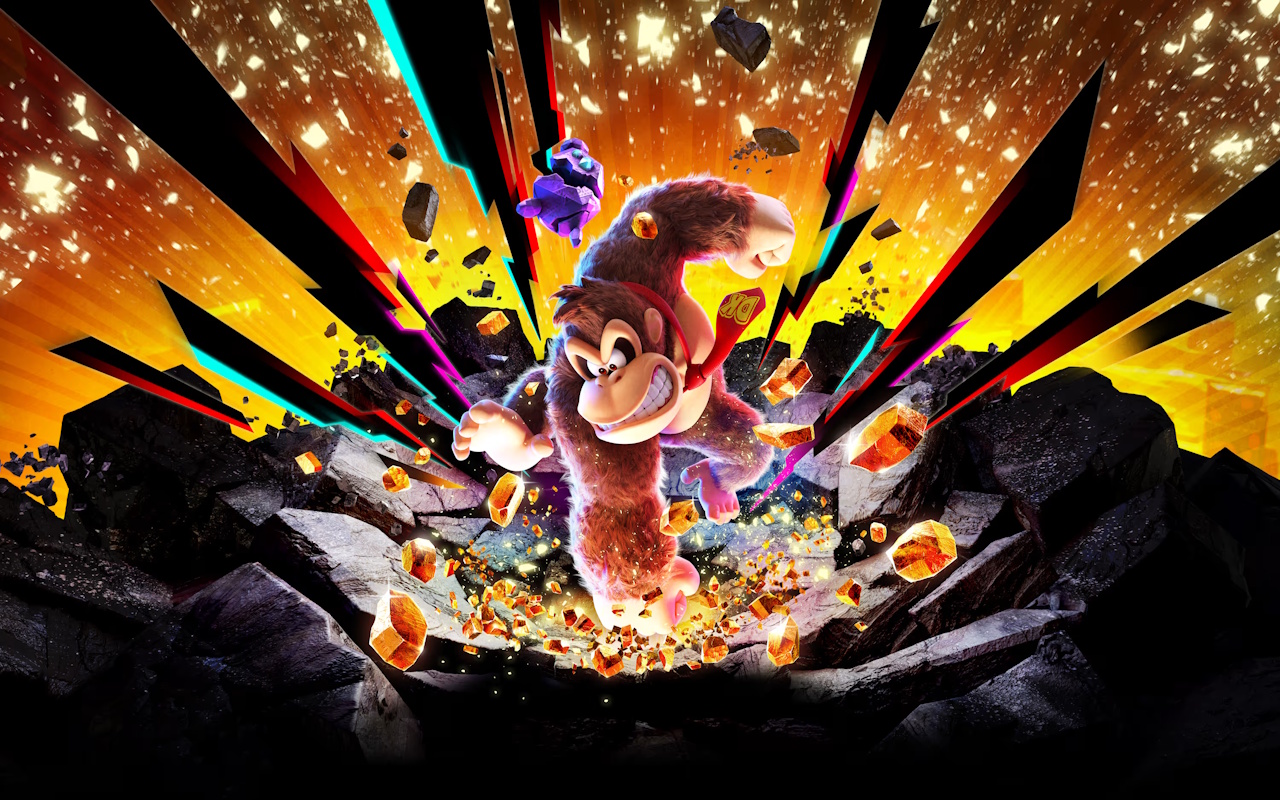
Games Industry “Hot Takes”

A few months ago, I put together a list of “hot takes” about video games. As much as I enjoy gaming as a hobby, there are things that annoy me and things to criticise! There were a few other things that I considered including, but they didn’t really fit with that list. These “hot takes” have less to do with games themselves and more to do with the games industry, development, and gaming as a whole – so that’s what we’re going to discuss today!

If you’re interested in checking out that earlier list, by the way, you can find part one by clicking or tapping here, and part two by clicking or tapping here.

Whenever I use the term “hot take” it’s because I’m acutely aware that we’re talking about something contentious! So before we get started, let’s re-emphasise that: these are all topics of debate among players and critics, and mine may well be the minority position. I don’t pretend to be 100% right, and I welcome disagreements and differences of opinion.

A stock photo of a crying girl.
Let’s not throw a tantrum if we disagree, okay?

I worked in the games industry for close to a decade, and I worked with large and small games companies in that time. I’ve got a bit of a feel for how development works from the time I spent “on the inside,” and I know that developers are passionate people who care deeply about their art. But that doesn’t mean games get a free pass; a bad game is a bad game, no matter how well-intentioned it may have been!

As I always like to say: all of this is just the subjective opinion of one player, and I believe that there should be enough room in the community for differences of opinion and respectful disagreement. The topics we’re going to get into today are the subject of discussion and debate, and there isn’t a right answer – just opinions.

If you aren’t in the right headspace to see some potentially controversial games industry opinions, this is your final chance to nope out – because we’re about to jump into the list!

“Hot Take” #1:
“Game development is hard” isn’t an excuse for selling a sub-par title.

Stock photo of a woman working at a computer with two monitors.
A lot of people work really hard on some absolutely shite games…

Speaking as both a player and as someone who used to work in the industry, believe me when I say that I get it. Game development is undeniably difficult, it isn’t straightforward, and there are many, many reasons why a game may not be as good, enjoyable, or polished as we’d like it to be. There can be problems getting an engine to work, fixing one bug might cause ten more to pop up elsewhere, and the more complex and in-depth a title is, the greater the chance of these kinds of issues occurring. Publishers and corporations also meddle, moving the goalposts and pushing developers to hit unreasonable deadlines. So I get it. But that doesn’t make “development is hard” a good enough excuse.

Here’s a helpful analogy: suppose I buy a house, move in, and every time I turn on the washing machine, the electric goes off. Then when I ring the electrician, he basically says “wiring a house is really hard. You wouldn’t get it because you aren’t an electrician.” That’s not an excuse. If I go to a bakery and the bread is stale and mouldy, I likewise wouldn’t accept the excuses that “baking is really difficult,” or “running a business and keeping track of sell-by dates is hard.” The same basic principle applies to video games.

Stock photo of loaves of bread in a bakery.
You wouldn’t accept sub-par bread from a baker, so why should you accept a sub-par game from a developer?

I will acknowledge and agree that game development is hard, and that bigger games are harder to make; it’s an almost exponential scale of difficulty. But trying your best and failing is still failing, and in a competitive marketplace where most games aren’t free, if you release a sub-par, broken, uninspired, or inferior game, you’re gonna get called out for it. Media criticism exists for this purpose, and just because a critic has never worked in the games industry or has no experience with development doesn’t invalidate their criticism.

When a game is listed for sale, even if it’s discounted or at a low price, players still have expectations – and those expectations aren’t “wrong” just because they didn’t see how hard the game was to create. If you’re a brand-new developer releasing your first-ever game for free and asking for feedback, then maybe some of the harshest words should be held back. But this asinine argument is too often made by publishers and executives who work for massive companies. When a game underperforms, they trot out the trusty old “game development is hard” argument as a rebuttal to critics.

Screenshot of The Lord of the Rings: Gollum showing a serious bug.
The Lord of the Rings: Gollum was widely criticised upon its release for being riddled with bugs and glitches.

In no other business or industry would customers be told that “my job is hard, you should be grateful for what you got” as a response to genuine criticism. Selling a game that’s outdated, riddled with glitches, or just not fun can’t be excused in this way, and developers – no matter how hard they may have worked and no matter what programming hurdles they may have had to overcome – have to accept that. Criticism is inevitable in entertainment and media, and even if a developer had created an impossibly perfect game, there’d still be players who didn’t like it in whole or in part, or who just weren’t interested in its narrative or its gameplay. That’s unavoidable.

Some developers and studios actively make things worse for themselves by trying to respond to criticism in this way. It never works, it never succeeds at garnering sympathy, and practically zero players come away from this conversation having more positive thoughts about the game. It’s an argument that needs to go away, and developers and publishers should think long and hard before reacting to genuine criticism with this irritating whine.

“Hot Take” #2:
Subscriptions are happening and physical discs and cartridges are dying out.

A stock photo of Mega Drive games.
A selection of Sega Mega Drive game cartridges.

This is a subject I’ve tackled before in a longer column here on the website. In that piece I took a look at the media landscape in general, talking about how the move away from physical media started with music, then moved to film and TV, and is now belatedly arriving in gaming, too. You can find that piece by clicking or tapping here, if you’re interested! But for the games industry specifically, a move away from discs and cartridges has been happening for a long time – and the rise of subscriptions could well be the final nail in the coffin.

In the very early days, no one owned a video game outright. If you wanted to play a game, you had to go to where the games were: an arcade. It was only with the growth of home consoles in the ’80s that physically owning a video game became possible for a mainstream audience, and even then, renting games or even whole systems was still a big deal. Many of the SNES, Nintendo 64, and Dreamcast games that I played in through the ’90s and into the new millennium were rented, not purchased outright. The idea of owning a massive media library is, when you think about it, a relatively new phenomenon that was kicked into a higher gear when DVD box sets became a thing in the mid-2000s.

Concept art for Wreck-It Ralph showing the arcade.
Arcades (like this one from Wreck-It Ralph) used to be the only place to play video games.

In that sense, we could argue that subscriptions aren’t “changing” the way people engage with media, they’re just a return to the 20th Century status quo. For much of the history of film, television, music, and gaming, audiences have had a temporary or impermanent relationship with media… and to me, that’s absolutely fine. It’s a trade-off I and many other players are happy to make.

I could probably count on my fingers the number of games I’d want a permanent hard copy of… because most games aren’t gonna be played on a loop forever nor returned to every few months. Just like when I used to rent SNES and N64 games in the ’90s, I’m totally okay with not having a huge library of titles gathering dust on a shelf (or metaphorical dust in a digital library), because once I’ve beaten a title like Donkey Kong 64 or Bioshock, I’m in no rush to play them again.

Promo screenshot of Red Dead Redemption II.
Red Dead Redemption II is one of just a handful of games I might conceivably want a hard copy of.

Speaking as someone on a low income, subscription services like Netflix and Xbox Game Pass open up a huge library of titles to me – allowing me to play more games than I’d ever be able to afford if I had to buy or even rent them individually. I’ve played dozens of games over the past couple of years that I’d never have bought for myself, and some of them have become personal favourites. Subscriptions like Game Pass are a great way into gaming for players on a budget – because for a single monthly fee a huge library of titles become available.

If the trade-off for that is that titles are occasionally removed from the platform and become unplayable… well, I’m okay with that. And for one-in-a-generation masterpieces like Red Dead Redemption II or Baldur’s Gate 3, I’m happy to splash out. When you consider that an annual subscription to Game Pass is more or less the same price as buying one or two games… you start to see why people are choosing to sign up. I wouldn’t be surprised at all if Xbox, PlayStation, or both choose to go all-digital later in the decade when their next-generation machines are ready.

“Hot Take” #3:
Microtransactions have no place in single-player games.

A screenshot of part of Starfield's in-game shop.
*cough* Starfield *cough*

I’m not wild about microtransactions in general – but in online multiplayer games and especially free-to-play titles, I accept that they’re an established funding model. They should still be regulated and prevented from being exploitative, but in those genres the microtransaction model seems to work well enough. But in a single-player game? Microtransactions need to GTFO.

Going back decades, games have released expansion packs – and large pieces of content that add new maps, quests, characters, and so on are usually okay. Look at something like Morrowind’s expansion Bloodmoon, or a more recent example like Phantom Liberty for Cyberpunk 2077. These are the kinds of expansion packs that have always been okay. Some are better than others, sure, and some expansions offer much more in terms of value. But as a general rule, I’m okay with expansion packs.

A still frame from the trailer for Cyberpunk 2077: Phantom Liberty showing Johnny Silverhand in a helicopter.
Phantom Liberty is a great example of an expansion pack that offers good value.

But in a single-player game, I shouldn’t be asked to purchase a “premium currency,” weapon skins, cosmetic items, and so forth. These microtransactions have no place in a single-player title, and there’s no excuse for adding them in other than pure, unadulterated greed. If a game like No Man’s Sky can remain profitable for Hello Games for close to a decade without charging for a single additional piece of content, there’s no excuse for the disgusting in-game marketplace in a title like Starfield.

I love a game with cosmetic customisation. Making my character feel personal to me goes a long way to enhancing the experience and making my playthrough feel like “mine,” so I enjoy having the option to change a hairstyle, outfit, or do things like re-paint a vehicle. But these things are an integral part of the game experience – not something to charge extra for. Exploiting players by locking basic items behind a paywall is despicable – and that’s before we say anything about “XP boosters,” damage multipliers, and other pay-to-win or pay-to-skip-the-grind items.

Steam page for No Man's Sky showing that the game has no DLC.
Oh look, it’s all of the DLC available for No Man’s Sky

I’ll also include in this category “super premium deluxe editions” of games that come with exclusive content. You might think that Han Solo’s vest in Star Wars Outlaws is okay to lock behind a paywall, but some games do this with whole quests. Hogwarts Legacy infamously locked an entire mission behind a paywall, and it’s far from the only game to have done so in recent years. Offering an in-game item as a pre-order bonus is one thing, locking a whole chest full of items and even pieces of gameplay behind an expensive “luxury edition” that can easily run to $100 or more is just scummy.

If I’m paying full price for a game, I don’t expect that game to reach into my wallet and try to grab even more cash every time I want to use a consumable item or change my character’s appearance. I tend to avoid online multiplayer games, where this phenomenon primarily exists, but inserting a microtransaction marketplace into a single-player game where it has absolutely no business being is enough to make me uninstall that title and never return to it. I’ll even refund it if I can. Some studios have even taken to concealing in-game marketplaces at launch, hoping to garner better reviews and more sales, before adding them in a few weeks or months later. Truly disgusting stuff.

“Hot Take” #4:
You aren’t paying for “early access,” you’re being charged an additional fee to play the game on its real release date.

Early access info for Indiana Jones and the Great Circle.
An example of what I’m talking about.

“Early access” is controversial in general, but let me just say before we start that I’m generally supportive of smaller studios and indie developers using early access as a way to get feedback and even to keep the lights on during what can be a difficult process. I very rarely touch an early access title, but independent devs should always feel free to use whatever tools are available to them, including launching an early access version of their game. But that’s where my patience with early access ends.

Recently we’ve seen two pretty shitty trends in the games industry: firstly, massive studios backed up by big publishers have been abusing early access, sometimes leaving a game officially unreleased for four, five, or six years, charging almost full price for it all the while. And secondly, the issue we’re looking at today: “early” access for an extra charge.

Promo graphic for Star Wars Outlaws showing the different versions of the game.
Ubisoft wanted to charge players an extortionate amount of money to play Star Wars Outlaws on its real release date.

This kind of “early” access usually grants players access to a game a few days or maybe a week ahead of its official release date, but by that point the game is finished and should be ready to go. The “early” version that players get is usually no different from the launch version, and there’s no time for a studio to act on player feedback or patch bugs. This is a scam, plain and simple, and an excuse for wringing even more money out of players.

If a game launches on the 1st of September for players who pay £100, and the 6th of September for players who “only” pay £65, then the release date is the 1st of September. They’ve just charged more to players who want to play on release day – or, if you flip things around, deliberately penalised players who didn’t splash the extra cash. These versions of games – which I think we should call “real release date” versions – are often $20, $30, or $40 more expensive than their delayed counterparts.

A stock photo of a hand holding burning dollar bills.
And who has that kind of money to waste these days?

Buying a game on day one is a risk nowadays. So many games – even those that go on to be hailed as masterpieces – arrive on launch day with bugs, glitches, and other problems. So paying extra to play what is almost always a demonstrably shittier version of a game just feels… stupid. I’ve been burned by this before, and just as with pre-orders, I’ve sworn to never again pay for so-called “early” access.

I’d like to see digital stores like Steam, Epic Games, and ideally Xbox and PlayStation too clamp down on this practice. Early access should be reserved for studios that need it, and charging players extra to play a game on release day is something that should be banned outright.

“Hot Take” #5:
Players’ expectations aren’t “too high.”

A stock photo of an angry man holding a PlayStation control pad.
It isn’t the players that are wrong…

There have been some fantastic games released over the last few years. Red Dead Redemption II, Baldur’s Gate 3, and Kena: Bridge of Spirits all come to mind in the single-player space, but I’m sure you have your own favourite. These games are, in a word, masterpieces; titles that did everything right and are rightly considered to be at the very pinnacle of not only their genres but video games as an art form in general. So… if your game doesn’t get that kind of glowing reception, whose fault is it?

Some developers think it’s the fault of players, and that we’ve had our expectations set “too high.” They argue that it was unrealistic to expect their game to be as engaging or entertaining as others in the genre, and we should be grateful for what we got. They worked hard on it, after all.

A screenshot from Starfield showing a first-person perspective and three NPCs.
I wonder which game might’ve prompted this “hot take.”

The tl;dr is this: it isn’t the fault of players if they don’t like your game – it’s yours. Complaining about high expectations makes no sense when other titles have demonstrably been able to meet and even exceed those expectations, so if you learned nothing from your competition, once again that isn’t anyone else’s fault but yours! That’s to say nothing of the out-of-control and frequently dishonest marketing that promises players way more than the game can deliver. Studios and publishers are responsible for reining in hype and keeping their marketing honest. That, more than anything else, will help players set appropriate expectations.

I get it: it isn’t fun to be criticised or see your work picked apart. It’s even less fun to see a game you worked hard on for a long time compared negatively to another title in the same space. But to lash out at players – the people who are supposed to be your customers and the people it’s your job to entertain – just doesn’t make any sense to me. Not only is it wrong, but it also risks building up resentment and ill-will, so the next time you work on a game and get it ready for launch, players will be even more sceptical and perhaps even quicker to criticise.

A stock photo of a smartphone showing social media apps.
This is a problem exacerbated by social media.

Thankfully, it isn’t all developers who say this – at least not in public! I heard complaints like this from time to time when I worked in the industry, but most developers I worked with were smart enough to keep such thoughts to themselves if they had them. So we’re fortunate that it’s only a minority of developers who take this argument into the public square.

Some developers need to get off social media. Social media is a great tool, don’t get me wrong, and being able to communicate directly with players can be useful in some situations. But if a developer is so thin-skinned that they feel the need to react in real-time and respond to every armchair critic and Twitter troll… that can’t be good for them, and it certainly isn’t good for the company they work for. For their own good, some developers need to shut down their social media profiles!

So that’s it… for now!

A promo graphic of an Xbox Series control pad.
I hope this wasn’t too controversial!

I’m always finding more “hot takes” and things to criticise in the games industry, so I daresay this won’t be the last time I put together a piece like this one! Despite what I’ve said today, I still really enjoy gaming as a hobby and I find there are far more positives than negatives. And if you hated all of my points, just remember that all of this is the entirely subjective opinion of a single old gamer.

So I hope this has been a bit of fun… and maybe a little thought-provoking in places, too. If you don’t agree with any of my points that’s totally okay! I tried my best to present my arguments as articulately as possible, but these are “hot takes” so I’m sure plenty of people can and will disagree with all of them. If I gave you a chuckle or you found this discussion interesting in some way, then I reckon I’ve done my job!

Until next time… and happy gaming!


All titles discussed above are the copyright of their respective publisher, studio, and/or developer. This article contains the thoughts and opinions of one person only and is not intended to cause any offence.
Five Years, Five Recommendations

A spoiler warning graphic.

Spoiler Warning: Minor spoilers may be present for some of the titles on this list.

This month (November 2024) marks the fifth anniversary of Trekking with Dennis! That’s right, I’ve been online talking about Star Trek and the wide world of geekdom for almost five years – and what better way to celebrate or mark the occasion than by making five recommendations to you based on the films, games, and TV shows that I’ve enjoyed in that time? This isn’t my “end-of-year awards” piece for 2024; that’s still on the schedule for late December. Instead, what I’m going to do today is highlight five films, five games, and five TV shows from late 2019 through late 2024 that I think could be worth a look.

We’ll get into more personal reflections and a bit of a retrospective look back at the website’s progress later this month, but for now suffice to say that I’m satisfied with things. I don’t write as often as I did when I was getting started, and I have certainly experienced periods of writer’s block and burnout. But by and large I’m still enjoying what I do here; this little side-project gives the old brain cells a bit of a workout!

A stock photo of a person typing on a laptop.

As always, I have a couple of caveats before we jump into the list. First of all, I’m picking titles that were released between November 2019 – the month Trekking with Dennis first came online – and November 2024. Older titles won’t be included. Secondly, this isn’t meant to be a “top five” or my “all-time favourites;” these are just titles I’ve enjoyed that I’m happy to recommend. And finally, as I always say: all of this is just the subjective opinion of one person. If I include something you hate or miss out something you love… that’s okay! We all have different opinions when it comes to media and entertainment.

Phew! With all of that out of the way, let’s take a look at a few films, games, and TV programmes from the last five years.

Film #1:
Raya and the Last Dragon

Still frame from Raya and the Last Dragon showing Sisu wearing a hat.

Raya and the Last Dragon was unfortunate to be released while many cinemas were either still closed or limited in the amount of seats they could sell, and the film wound up on Disney+ shortly after its release – for an additional charge, naturally. As a result, I don’t think it picked up as much attention as it otherwise might’ve done, and that’s a shame because it’s a genuinely enjoyable film with a strong story.

Titular heroine Raya must travel across the broken land of Kumandra – a fictional realm based loosely on South-East Asia. In her quest to bring back the dragons and defeat the deadly Druun, she encounters a host of fun characters, visits diverse locations, and is swept up in a thrilling adventure. I had a blast with this film – though it was a little odd that there were no musical numbers in a Disney animated picture!

Film #2:
The Super Mario Bros. Movie

Still frame from The Super Mario Bros. Movie.

Alright, I admit it: the 1993 live-action Super Mario Bros. is a “guilty pleasure” favourite of mine! But there’s no denying that the animated film from last year blows it out of the water in every possible way. Nintendo was understandably cautious with its top-tier franchise after the reaction to the live-action version in the ’90s, but the corporation was eventually persuaded to give Mario another chance at the box office. What resulted was my favourite film of 2023 by far.

The Super Mario Bros. Movie puts an updated twist on the tired “save the princess” trope by putting Luigi in danger and having Mario team up with Peach to rescue him from Bowser. Practically all of the Mushroom Kingdom gang join the fun, and there’s even a fun sequence based on the Mario Kart games. Visually, the film was an absolute treat, with the Mushroom Kingdom being brought to life and looking better than ever. A great soundtrack was the icing on the cake for a truly delightful film.

Film #3:
Civil War

Still frame from Civil War showing abandoned vehicles.

Earlier this year I watched Civil War, a fascinating film about a near-future America that was at war with itself. The film didn’t have the political angle that I’d been expecting based on its marketing material, with the titular conflict being more of a backdrop for a road trip the main characters took through different parts of a war-ravaged nation. There were some incredibly brutal depictions of violence, showing how the breakdown of social order can turn average, everyday people into killers.

The main characters were all interesting, and a focus on journalists lent the film something a little different in a war genre that can sometimes get repetitive. The final sequence involving the storming of the White House and the killing of an apparently very unpopular president has parallels that are genuinely disturbing and thought-provoking, too.

Film #4:
Dune (Parts One and Two)

Still frame from Dune: Part Two.

I was very worried that Denis Villeneuve might not get the opportunity to complete his two-part adaptation of Dune – but I’m so glad to have been proven wrong about that! The book has proven notoriously difficult to adapt thanks to a dense story, and realistically we could have a multi-season TV series based on just the first entry in the series. But this two-part film adaptation (which will shortly be joined by a prequel TV show set in the same universe) was absolutely fantastic.

What’s great about Dune and Dune: Part Two is how both films brought in a much bigger audience than you’d expect for a sci-fi property. Expanding the genre to new fans is a great thing, and it’s something to celebrate. In terms of cinematography, sound design, acting performances, and basically everything across the board, this two-part adaptation of Dune was beautiful science-fiction perfection.

Film #5:
The Matrix Resurrections

Still frame from The Matrix Resurrections showing Neo in the Matrix.

Maybe it’s a “hot take” to say this was a brilliant film… but it genuinely resonated with me in a way that very few titles ever have. I respect director Lana Wachowski for returning to the world of The Matrix almost twenty years later, and bringing back a deeply metaphorical style of storytelling.

I described The Matrix Resurrections as brutal and raw, and it could even be an uncomfortable watch in places. Some viewers these days have an understandable bias against franchises being brought back or revisited – because all too often, the reason corporations do so is purely to profit off of a successful name. But Resurrections (despite its name) is different, and it finds a story worth telling and an analogy worth paying attention to. I’d encourage anyone who missed it to at least give it a chance.

Video Game #1:
Star Wars Jedi: Fallen Order

Concept art for Jedi: Fallen Order showing Cal, BD-1, and a landscape.

Jedi: Fallen Order isn’t just a great game, it’s one of the best pieces of Star Wars media of the last five years, period. The game follows Cal Kestis – a young Jedi who barely survived the events of Order 66 (as depicted in Revenge of the Sith) as he goes on a galaxy-spanning adventure and rediscovers his connection with the Force. It’s an intense and, at times, emotional journey, and there are some great moments of characterisation as Cal develops friendships with some of the people he meets along the way.

Mechanically, Jedi: Fallen Order is a “souls-like” third-person adventure game, but from my point of view it has an easier mode so that’s great! There were a couple of things I didn’t like as much – like having to re-play whole chunks of the same level – but by and large it was a blast. It’s a shame its sequel came with a much weaker story!

Video Game #2:
Cyberpunk 2077 (plus the Phantom Liberty DLC)

Screenshot of Cyberpunk 2077 showing a combat encounter.

I genuinely did not expect to ever be in a position where I could recommend Cyberpunk 2077 in good conscience. The game launched in an appalling state back in 2020, a fact made worse by the lies its developer, CD Projekt Red, told about the condition it was in. It took several years of continued development just to patch out the bugs, and even then the game was held back by outdated mechanics and systems.

But last year’s massive 2.0 update and the launch of Phantom Liberty completely changed the Cyberpunk 2077 experience, and now the game really is a must-play for fans of role-playing games, action games, or even just great single-player stories. The narrative was always strong enough to keep me playing, even when I was underwhelmed by other aspects of the gameplay. But with many of my original complaints having been completely fixed… this could be one of the best games of the decade.

Video Game #3:
Kena: Bridge of Spirits

Screenshot of Kena: Bridge of Spirits showing the game world.

My pick for “game of the year” in 2021 was this delightfully old-school adventure game with 3D platforming elements. Kena: Bridge of Spirits was the first-ever game by a new indie studio, and the developers took their experience from working on CGI in the film and TV space to create one of the best games of the past few years. Collecting cute critters isn’t just a fun side-activity, it’s an integral part of how you progress through the game. The enchanted forest and village are wonderfully interactive environments. And the game is perfectly paced; neither outstaying its welcome nor ending too soon.

I also felt that Kena: Bridge of Spirits wasn’t a game that held my hand. It gave me all of the pieces I needed to solve a puzzle or navigate an obstacle, but it didn’t point out everything with a map marker or giant arrow. I could infer from the skills Kena had recently learned what I was supposed to do, and I really appreciated that. The graphics are also absolutely stunning, with the game looking like an interactive Disney or Dreamworks movie.

Video Game #4:
Fall Guys

Promo image for Fall Guys.

I haven’t played Fall Guys in a while, but I was obsessed with this adorable battle royale when it launched back in 2020. The game has since gone free-to-play, but its monetisation didn’t feel aggressive or in-your-face the last time I jumped in. Fall Guys is, in brief, a game about running obstacle courses and taking part in multiplayer challenges. Sixty players start each round, but only one will progress through to become the ultimate champion!

There are some wonderfully creative rounds in Fall Guys, from standard obstacle courses to team games, and some have different themes like sci-fi or the holiday season. There’s no story to speak of, and while I’d usually never be interested in an online competitive multiplayer game… Fall Guys really did succeed at pulling me in. I spent hours playing it in 2020 and 2021, and I really should revisit it one day.

Video Game #5:
EA Sports PGA Tour

Screenshot of PGA Tour showing a golfer putting the ball.

I know this seems like a strange pick, but I’ve lost count of the hours I’ve spent playing PGA Tour this year. The game relaxes me in a way few titles do, and reminds me of playing the likes of Actua Golf 2 on my PC in the late ’90s or Wii Sports with friends a few years later. For a game about golf – a sport I have absolutely no interest in and never watch – it sure does succeed at giving me nostalgic, cozy feelings!

There are plenty of things to criticise. This is an EA Sports title, which means it’s pumped full of microtransactions and ways to part with your money. Some of the graphics and animation work for characters feels outdated. And I’d be happy if more lines of commentary were added! But I’m going to end 2024 with PGA Tour as my most-played game by far, and it’s a title I go back to when I need to de-stress, take a break, and play something that’s challenging but not too physically demanding on my arthritic hands.

TV Show #1:
Star Trek: Strange New Worlds

Still frame from Strange New Worlds Season 2 showing the USS Enterprise.

Strange New Worlds is, for me, the absolute highlight of modern Star Trek. Technically a spin-off from Discovery, the show returns the franchise to its episodic roots while retaining modern trappings like character development and season-long arcs that rumble in the background. In just two seasons the series has dipped its toes in genres from musical to horror, and there’s plenty more to come with two upcoming seasons still waiting to be broadcast.

Returning to the USS Enterprise to see Captain Pike in command has proven to be an unexpected masterstroke for the Star Trek franchise, and stepping back to a more episodic style of storytelling after Discovery and Picard were both much more serialised has been incredibly cathartic for this old Trekkie. I would challenge anyone who didn’t enjoy those other live-action Star Trek shows to give Strange New Worlds a chance – I really don’t think you’ll regret it! It’s my hope that this will become the franchise’s new “flagship” series, carrying Star Trek forward through its sixtieth anniversary and beyond.

TV Show #2:
Silo

Still frame from Silo showing Juliette Nichols at her desk.

A different kind of post-apocalyptic drama, Silo was one of the highlights of 2023 for me. Taking place in an underground bunker (the titular “silo”), the show follows an intriguing murder mystery which threatens to unravel the carefully-constructed subterranean world. Rebecca Ferguson leads a star-studded cast, and her character Juliette Nichols makes for a wonderful protagonist.

Apple TV+ invested heavily in Silo, and I think the result of that investment speaks for itself. The show is incredibly well put-together, with everything from sound design and special effects to set design and costumes all building up a creative post-apocalyptic setting. Season 2 is scheduled to premiere in just a few days’ time – and I can’t wait!

TV Show #3:
3 Body Problem

Promo poster (cropped) for 3 Body Problem.

I’m so glad that Netflix belatedly renewed 3 Body Problem, as it’s probably my favourite show of 2024. A really creative work of sci-fi based on a Chinese novel series, 3 Body Problem depicts humanity’s first encounter with an extraterrestrial race – and the incredibly “alien” nature of the San-Ti can be both shocking and frightening. The first season feels like a really solid start for building up a great story, and with the book series already complete, there’s less danger for co-creators David Benioff and DB Weiss than there was with Game of Thrones!

A modern-day setting served 3 Body Problem well, and I loved seeing its seemingly-disconnected storylines and characters slowly come together over the course of several episodes. There were elements of mystery, drama, and horror to go along with a sci-fi premise that could feel quite weighty… and I cannot wait for Season 2 to pick up this story and tell the next part of the tale.

TV Show #4:
The Lord of the Rings: The Rings of Power

Still frame from The Rings of Power showing Galadriel and her ring.

After two seasons, I think The Rings of Power has laid the groundwork for a successful fantasy series. There are things to criticise, and I’m not sure that enough has been done – yet – to fully justify the price tag of one of the most expensive TV shows of all time… but there are plenty of positives to take away from this return to Middle-earth. Interconnected stories, elements of mystery, and some great character moments all give me reasons to keep watching.

I’ve been in love with Tolkien’s world since I first read The Hobbit as a geeky little kid, and getting to see another story like this unfold on the small screen has been fantastic. I just hope that future seasons can be ready a bit faster; waits of two-plus years in between truncated eight-episode seasons puts a bit of a downer on things! But overall I’ve had a good time with The Rings of Power and look forward to its continuation.

TV Show #5:
Five Days at Memorial

Still frame from Five Days At Memorial showing the flooded hospital.

This miniseries had the difficult task of dramatising a recent real-world event: Hurricane Katrina and the effect it had on Memorial Hospital in New Orleans. For my money, everyone involved did a fantastic job. Five Days at Memorial could easily have come across as sensationalist or overplaying its hand, but it manages to be restrained in its criticism of the real people involved while remaining a gripping and occasionally harrowing watch.

The miniseries is also very well-balanced, refusing to condemn or totally exonerate the people involved, choosing instead to show the decisions they made in the context of an incredibly difficult situation. I remember the news reports about Memorial Hospital in the wake of Hurricane Katrina, but seeing the story like this, from the point of view of those involved, was really intense stuff. The sense of abandonment that the staff felt echoes how many people – particularly African Americans who lived in New Orleans – felt and continue to feel to this day. The scars of Hurricane Katrina still haven’t fully healed.

The Best of the Rest

In this category I’m going to make five other recommendations that don’t fit in any of the categories above. These are all entertainment and media-related, but I felt they either deserved their own spotlight or didn’t easily slot into any of the categories above.

Social Media Platform:
TikTok

TikTok's logo on a white background.

I’ve found myself spending a bit more time with TikTok over the past couple of years. At first I was pretty dismissive of the platform; short-form videos in a vertical format didn’t really hold much appeal! But there are some incredible creators on TikTok who use the platform in interesting ways, and you can find everything from cookery to political commentary and travelogues to media criticism.

TikTok’s “For You Page” format also works well, and the app’s algorithm seems to be creepily clever in the way it chooses videos to recommend! I swear that I’ll have been thinking about something, only to see a video about it pop up a few moments later during my next TikTok scrolling session. YouTube is belatedly trying to catch up with Shorts, but TikTok is well on its way to becoming the dominant video app for the younger generation in particular.

Web Series:
Food Wishes

Title card for Food Wishes.

What I like to watch on YouTube can vary a lot, but I’ve always loved a good cookery show. Food Wishes has been running since 2007, and what’s remarkable is how little it’s changed in that time. Host Chef John doesn’t usually appear on camera, making the food he’s preparing the real star of the show. At time of writing there are well over 1,000 videos on the channel, and more are added almost every week.

Chef John teaches us how to cook everything from sandwiches to a full thanksgiving dinner, and often prepares dishes from cuisines and cultures that I would have never thought of! I’ve tried a few recipes for myself, and even though I’m far from the best cook, Chef John’s instructions make things feel simple. Food Wishes is easily one of my favourite web shows of all-time.

Documentary:
We Need To Talk About A.I.

Still frame from We Need To Talk About A.I. showing a digital brain.

Though arguably a little alarmist, We Need To Talk About A.I. was an interesting watch – and is made even more relevant by developments in the few short years since its original broadcast. Keir Dullea, famous for his role in 2001: A Space Odyssey, is the documentary’s presenter and narrator, and he brings a much-needed weight to the role.

The film interviewed several interesting people, including director James Cameron and several A.I. researchers, as it charted humanity’s potential path to creating general artificial intelligence; a sentient machine. A lot of people have been ringing alarm bells about what a hyper-intelligent, sentient machine might be able to do if it were ever created, and this documentary examines some of the worst-case scenarios! With advances in A.I. seemingly happening all the time, perhaps we’re closer to that future than we might think right now.

Browser Game:
Wordle

Screenshot of the browser game Wordle.

Yes, I still play Wordle! I lost for the first time in ages a few weeks ago and it really pissed me off! But that aside, this fun little browser game has become a part of my daily routine – and I don’t know where I’d be without it! I was never one to play anagrams, word searches, or sudoku, but something about the elegant simplicity of Wordle has kept me playing for over two years at this point.

And as long as Wordle remains online, I daresay I’ll keep playing. The hype around the game seems to have died down – it seemed for a while that you couldn’t move on social media without seeing people sharing their Wordle scores – but it obviously retains a sizeable player base.

Subscription:
Xbox/PC Game Pass

Promo graphic for Xbox Game Pass.

I’ve said it before and I’ll say it again: Game Pass feels like a really good deal. If I were asked what the most cost-effective route into current-gen gaming is, I’d say without hesitation that an Xbox Series S with a Game Pass subscription is far and away the best option for players on a budget. Game Pass opens up a huge library of titles for a single monthly fee, and I remain surprised at how much pushback it continues to receive in some quarters!

I’ve been a subscriber to Game Pass on PC for a couple of years, and I’ve tried brand-new games I’d never have been able to afford, experimented with some very different titles I’d almost certainly never have even heard of, and jumped head-first into some big blockbusters all thanks to the service. Sure, there are drawbacks to Game Pass… but subscriptions feel like the way media in general is going, and I’m pretty confident that Microsoft will be able to iron out the bugs and inconsistencies to make Game Pass even better than it already is.

The Best Is Yet To Come…

Before we wrap things up, I want to highlight five announcements that have been made over the past few years. These are all projects that I’m really looking forward to in the months and years ahead.

Announcement #1:
Wicked

Promo poster for Wicked (2024).

The (long-overdue) cinematic adaptation of Wicked is now just a few weeks away, and I really am looking forward to seeing this fantastic story on the big screen for the first time. Years ago I had the privilege of seeing Wicked on the stage in London, and I fell in love with its story, characters, and songs. I’m not usually someone who loves musicals, but Wicked has a truly outstanding soundtrack that I can’t wait to see recreated.

The decision to split Wicked into two parts is interesting, but hopefully will be more of a positive than a negative. Everything I’ve seen so far has just increased my excitement, so I really hope Wicked doesn’t let me down when I’m finally able to sit down and watch it!

Announcement #2:
Future Star Trek projects

Announcement graphic for a new live-action Star Trek series.

At time of writing there are at least two brand-new TV shows in development for the Star Trek franchise, as well as two new seasons of Strange New Worlds. This will keep Star Trek on the air well past its sixtieth anniversary in 2026, which is fantastic news. The likes of Section 31 and Starfleet Academy have the potential to reach out beyond Star Trek’s usual niche to whole new audiences – something the franchise needs to do in order to survive and remain relevant – and that’s positive, too.

I’ve been a huge Trekkie since I first got into The Next Generation in the early 1990s, and to think that there’s still more Star Trek to come in the years ahead is great news. It’s true that I’ve gone through a bit of burnout with Star Trek, and that not every recent project has been fantastic, but there’s still a lot to love in my favourite franchise – and a lot to be excited about as Star Trek continues.

Announcement #3:
Phineas and Ferb Seasons 5 and 6

Still frame from Phineas and Ferb Season 1.

I really was pleased to see Phineas and Ferb get the green light for a full-blown revival. The cartoon has become one of my “comfort shows;” something I drift back to on days when my mental health isn’t great and I’m not feeling my best. The bright colours, wacky storylines, and fun characters just feel comfortable and safe. There’s a lot to love in Phineas and Ferb for an adult audience, too, as the show has plenty of jokes and storylines that aren’t just for kids.

Bringing back a beloved series after a long time away is a risk, but I’m hopeful that creators Dan Povenmire and Jeff “Swampy” Marsh have new ideas for where to take Phineas, Ferb, Perry, Dr Doofenshmirtz, and the rest of the gang. New adventures and inators await!

Announcement #4:
Grand Theft Auto VI

Still frame from the GTA 6 trailer.

One of the first subjects I wrote about here on the website back in 2019 was Grand Theft Auto VI… and the game still isn’t out! I’m pretty annoyed with Rockstar for continuing to milk Grand Theft Auto V at the expense of everything else, and I’m even more disappointed that its sequel isn’t going to get a simultaneous PC release. For a company like Rockstar to cheap out on development given the growth of PC gaming over the last few years is pretty stupid to say the least.

However… I will eventually get my hands on this game, and from what I’ve seen and heard so far, it looks like it’s gonna be a fun time. Maybe it won’t hit the heights of Red Dead Redemption II, but then again, could any game manage that? I’m trying to keep my expectations in check, but there’s no denying that I’m very keen to play Grand Theft Auto VI after such a long wait.

Announcement #5:
Nintendo’s next console

Nintendo's logo on a red background.

Earlier this year we heard from Nintendo that the company’s still-untitled new console is well underway. I’m expecting to see a release sometime between April 2025 and March 2026, so we might be pretty close! I’m already excited at the prospect of a new 3D Mario game, a new Animal Crossing title, a new Mario Kart game… and so on! I had fun with my Nintendo Switch, but I agree – it’s time for a new console.

There are reasons to be sceptical about Nintendo – their attempt to sue a competitor to the Pokemon series out of existence being just one of the shitty things the company has done of late. But as someone who’s been a Nintendo fan since I bought my first ever home console, I’d be lying if I said I wasn’t really excited to see what Nintendo is going to do next. The smart money is on another hybrid console; a more powerful Switch. But I wouldn’t be surprised if Nintendo has a new gimmick in store to help the new machine stand out.

So that’s it!

A stock photo of a smart TV with streaming apps.

Five years, five recommendations in a bunch of different categories. I hope this has been a bit of fun!

I certainly enjoyed returning to these titles! In some ways, it feels like no time at all since I was first beginning to put together the pieces of what would eventually become Trekking with Dennis. But in other ways, a lot has happened over the past five years – both personally and in a more general sense. The world of entertainment feels less stable, in some ways at least, than it did back then.

I hope you’ll join me at the end of November for a more individual perspective on the last five years. This website is, rather embarrassingly, the longest-running project I’ve ever had. It’s outlasted any job I’ve ever had, any other hobby or side-gig, and even though I spend less time writing here than I did when I first started, I still enjoy having my own little slice of the interweb where I can share my thoughts on some of my favourite (and least-favourite) titles. I hope to see you again soon!


All titles discussed above are the copyright of their respective publisher, broadcaster, distributor, corporation, etc. This article contains the thoughts and opinions of one person only and is not intended to cause any offence.
Shattered Space: Thoughts and Advice for Bethesda

Remember Starfield? That space game we got all excited about in 2023? I wouldn’t blame you if you’d forgotten all about it by now; I haven’t touched the game in months myself and I have no real plans to go back to it. Any lingering feelings of positivity I might’ve had toward the game – and developer Bethesda Game Studios in a more general sense – evaporated pretty quickly when microtransactions and paid mods were added to this single-player title, so I’ve pretty much moved on.

But the launch of Shattered Space – the first of several larger pieces of DLC that are planned for the game – has dragged up the shambling corpse of Starfield for me once again, and I couldn’t let it pass by without sharing my thoughts on what I’ve seen… and offering some unsolicited advice to Bethesda and parent company Microsoft. There are things to consider for both Starfield’s future as well as any potential new games that Bethesda may be lucky enough to make. Let’s get into all of that today.

Still frame from the Shattered Space launch trailer showing a character approaching an alien structure.
So far at least, Shattered Space doesn’t appear to have saved (or even really helped) Starfield.

The reaction to Shattered Space has been mediocre at best outside of Bethesda and Starfield mega-fans. The expansion is currently sitting at a “mixed” rating on Steam… but far more worrying for Microsoft and Bethesda should be the real lack of engagement that Shattered Space is driving. There are, at time of writing, fewer than 1,000 reviews of Shattered Space on Steam – a number that seems pitifully small for the first major expansion pack for the newest Bethesda role-playing game. And the release of Shattered Space didn’t give the game much of a boost in terms of player numbers, either; Starfield was beaten by both Fallout 4 and Skyrim on the day the expansion launched and every day since.

This is even more alarming when you consider that many players will have already pre-purchased Shattered Space last year. In order to pick up the “deluxe” version of Starfield (or whatever it was called), which gave players access to the game on its real release date instead of almost a week later, players had to fork over an additional £35 on Xbox, Steam, and even Game Pass. Included in that price was Shattered Space, so even players left underwhelmed by the base game should have still had access to this DLC. The fact that so few of them could be bothered to even download it or check it out should be ringing alarm bells at Bethesda HQ and for Xbox, too.

Screenshot of SteamDB and Steam showing player counts for Starfield and reviews for Shattered Space.
Shattered Space’s launch (date highlighted) didn’t bring in a lot of players.
Image Credit: SteamDB (above) and Steam (below).

The mixed reception to Shattered Space from those who did bother to fire it up is something that I think could’ve been avoided – and could at least be mitigated in the future. But it would require a change in approach from Bethesda. I’ll try to explain what I mean.

Over the last few weeks and months, Bethesda has been rolling out updates to Starfield. Among the biggest of these have been the rover/buggy, which allows players to traverse the game’s maps more quickly, and also the ability to decorate the interior of spaceships. Both of these were highly-requested by players, and the fact that Bethesda added them is a positive thing.

But part of the disappointment some players and critics are noting with Shattered Space is that it’s “only” a story expansion. The DLC doesn’t add anything of substance to Starfield beyond one new planet and some quests, and that’s leaving some people feeling underwhelmed yet again.

Still frame from the Shattered Space launch trailer showing a character praying.
A scene from the Shattered Space trailer.

A few months ago, I wrote a piece here on the website in which I argued that Starfield’s first piece of DLC needed to be comparable in how transformative it is to Cyberpunk 2077′s Phantom Liberty, which was released last year. That expansion came with a new area of the map and new quests – just like Shattered Space. But it also came with a major update that overhauled whole in-game systems, completely fixed some of the biggest disappointments with the game, and significantly improved the experience. That’s what Starfield needed… and that’s what it still needs.

The conversation around Shattered Space might’ve been different if things like detailed city maps, interior ship decorating, and the rover vehicle had all arrived along with it. It wouldn’t have fundamentally “fixed” Starfield, but it might’ve given the game more of a boost and gotten more players talking about the game in a positive light for a change. Instead, this opportunity was missed.

Still frame from the Shattered Space launch trailer showing a rover.
Starfield has a rover now.

So here’s my advice for Microsoft and Bethesda: stop the trickle of minor updates. Obviously you’ve gotta keep working on fixing bugs, so there can’t be a total lack of patches, but from now on, everything should be saved up for the next DLC. The next and final DLC.

Take two years – or three, if that’s what you need. Use that time to craft a larger expansion to Starfield’s world and story – perhaps one with an actual ending to the game’s main quest. But save up all of the smaller things that might’ve been added along the way, and add them all at once. Instead of trying to wring as much money as possible out of a disappointed and shrinking player base, focus on transforming the game into something that more people might actually want to buy. For me, that also means stripping out the entire microtransaction marketplace… but since that doesn’t seem realistic, at the very least focus on making one significantly larger expansion that can launch alongside overhauls to in-game systems. In a word, make Phantom Liberty… but for Starfield.

Still frame from the Starfield Direct (2023) showing executive producer Todd Howard.
Starfield’s executive producer Todd Howard.

Starfield feels like a very greedy game right now, and £35 for a single expansion pack that only really adds one new location and questline isn’t doing anything to change the narrative. A “single-player live service” type of game – which is clearly what Bethesda wanted to create – is absolutely not my thing and never will be, and for that reason I’m almost certainly never going to play Starfield again. But even knowing that, and knowing what kind of penny-pinching game this is… Shattered Space still seems pretty unexceptional.

There should be a way around this, but only if Bethesda and Microsoft are willing to listen to feedback. Right now, Starfield is on its last legs. It’s been surpassed in so many ways by its contemporaries, and most players have just moved on already. Shattered Space, because of how it was designed and launched, was never going to bring them back en masse. And part of that is because of the way the DLC was structured and how these other free updates have been drip-fed to players over the months since Starfield launched. At a time when the game needed a win, decisions taken earlier in the year tripped up Shattered Space’s launch… and the end result seems to be that most players just aren’t paying attention any more.

Screenshot of the Xbox store showing in-game currency packs for Starfield.
Microtransactions and paid mods have been added to Starfield since the game was released last year.

For me, Starfield would only become playable again if the microtransactions and paid mods were removed and all of that content added either totally for free or as part of the next expansion. Given the lack of things like costumes, skins, and other cosmetic items in both the base game and Shattered Space, I’d argue that all of those should be added for free. But rather than doing so bit by bit in small updates over the span of months, what Starfield really needs is one big update and one big expansion that can get players talking about the game once again. Phantom Liberty for Cyberpunk 2077 is my go-to point of comparison, but I’m sure you can think of other similarly large and similarly transformative expansion packs that have been released over the years.

As to the content of Shattered Space itself… I have to say that, based on what I remember of the game, this House Va’Ruun stuff seems like it should’ve been part of the base game from day one. I mean, you literally have a companion character who’s an ex-member of this faction, and they’re mentioned multiple times across the main quest. Shattered Space, having been planned and developed alongside Starfield, basically feels like cut content to me.

Screenshot from Starfield (2023) showing a first-person view.
I’m over Starfield at this point.

I’m not surprised that Shattered Space hasn’t turned things around for Starfield based on what I’ve seen. And as someone who was genuinely looking forward to this game once upon a time, my concern now is that Bethesda is running out of chances to make Starfield into the game that I thought it should’ve been. Without a serious re-think and complete change in approach, I don’t see that happening. And given how brutal Microsoft can be when games and studios aren’t performing to their high expectations… well, let’s just say it probably isn’t a great time to be a Bethesda executive right now.

Despite how I feel, I will be keeping up with the latest Starfield news to see if there are going to be changes or improvements in the future. I sincerely hope that Bethesda takes its time with the next update and expansion, because that feels like the game’s best chance to come back strong and re-capture at least some of its lapsed players.

But I have to be honest: the microtransaction marketplace has killed any residual support I had for the game, and it will be a weight around its neck for as long as it continues to exist. Charging £10 for a single mission, £7 or £8 for a tiny pack of cosmetic items, and selling in-game currency at the usual awkward exchange rate are all truly scummy, shitty things for a massive company to try to get away with. I loathe Starfield’s microtransactions, and seeing the way Bethesda has behaved not only with this game but with Skyrim’s “creation club” and Fallout 76 too… it’s really put me off The Elder Scrolls VI. I can’t root for Starfield’s redemption as long as this stupid live service marketplace remains in a single-player game.


Starfield and the Shattered Space DLC are out now for PC and Xbox Series consoles. Starfield, Shattered Space, and all other properties discussed above are the copyright of Bethesda Softworks, Bethesda Game Studios, Xbox Game Studios, and/or Microsoft. This article contains the thoughts and opinions of one person only and is not intended to cause any offence.
The PlayStation 5 Pro Is An Omen Of Worse To Come…

By now I’m sure you’ve heard about the PlayStation 5 Pro controversy. Sony’s mid-generation update to its flagship console will come with an outrageous price tag, will be missing basic components, and doesn’t even seem – at first glance, anyway – to offer a significant visual upgrade. With better frame-rates and higher resolutions being basically the only reason to pick up a PS5 Pro for someone who’s already a PlayStation customer… that’s not great.

But I think there’s a lot more to say – and unfortunately, it gets worse! At time of writing, pre-orders for the PlayStation 5 Pro haven’t gone live in the UK, but there’s already a ton of interest in the console, its missing disc drive, and even its ridiculously overpriced stand. The stand is basically just a small ring of metal and plastic, and shouldn’t be worth anywhere close to its purported £25 price tag. But it seems as if eager fans and gamers are queuing around the digital block to pick up the console and its add-ons; pre-orders for the disc drive have sold out in some places in the United States already.

The overpriced stand.

I’ve already criticised Sony here on the website for hiking up the price of the base PlayStation 5 at a time when the corporation is making record profits. To clarify that: Sony has never, in its corporate life, made more money or had a greater profit margin than it has right now – and yet these ridiculous price hikes continue. Microsoft is not immune from this, either – and I’ve been critical of Xbox in recent months too, so please don’t think I’m coming at this issue from a “console war” perspective! If anything, I’m trying to approach this subject from a consumer perspective and a basic fairness perspective. Nintendo… the jury’s out. But I wouldn’t be surprised if the new Nintendo console follows suit and is similarly burdened with a high price tag.

There are two reasons why I find the PlayStation 5 price tag so disturbing, and we’ll look at these issues in turn.

First of all, despite the outrage and dissatisfaction on social media, as mentioned there are plenty of people who seem quite happy to pay the inflated price for the new console – as well as its expensive add-ons. In fact, I wouldn’t be shocked to see the PlayStation 5 Pro become one of this year’s festive bestsellers, with high demand from gamers and parents as Christmas draws nearer. It will almost certainly out-sell anything that Xbox has to offer, and with Nintendo’s new console not due until next year at the earliest, the PS5 Pro could have a fairly open market when it launches this November.

A PS5 Pro DualSense control pad.

Video games are a consumer marketplace – and that means if there are willing buyers, Sony will be able to get away with selling this underpowered, overpriced, incomplete console to all and sundry. We often hear some variant of the expression “social media is not real life,” and for all of the outrage and criticism that has been thrown at Sony since the PlayStation 5 Pro was announced… that won’t actually matter to the company’s bottom line if people still show up and buy the damn thing en masse. And it seems like that’s exactly what’s gonna happen.

Which leads into my second problem with Sony’s price hike: other companies in the games industry are watching, they’ll see Sony succeed, and they’ll follow suit. Maybe Xbox will release an updated console with a disc drive sold separately. Maybe Nintendo will see Sony’s high price point and bump up the price of its next console by £50 or £100. If Sony’s getting away with it, it will encourage everyone else to do the same thing.

Other companies will be watching to see if Sony’s high price point succeeds.

When Sony jacked up the price of the base PlayStation 5 a couple of years ago, Microsoft was quick to jump in and promise that the price of the Xbox Series X would stay the same. And that lasted all of a few months before the price was quietly raised. At the beginning of this generation – less than four years ago – the base price of a standard video game was usually £55 here in the UK – $60 in the United States. 2K Games then announced that their next-gen sports titles would be priced at £65/$70… and what happened next? There was a fuss online… but then those games sold pretty well and every major publisher in the industry followed suit and jacked up the prices of their games, too.

It will happen again with the PlayStation 5 Pro, so I hope you’re prepared to pay £700 or more for a video game console. By the time the next generation of machines are ready in, say, 2028 or 2029… could it be more? Could a PlayStation 6 be £900? Who will be the first to break the £1,000 barrier for new consoles? It now feels like a matter of “when” not “if” that happens.

Gaming is getting more expensive all the time.

In the early days, video game consoles actually were pretty expensive. The Atari 2600, one of the earliest home consoles to sell a significant number of units, was priced at $190 in the United States when it launched in 1977 – the equivalent of more than $900 today when accounting for inflation. Its competitors, like the Magnavox Odyssey 2 and Intellivision, were similarly-priced. But the price of consoles came down with the price of home computers in general, and by the time I was buying my first console – a Super Nintendo – in the early 1990s, prices were similar to where they are today when you account for inflation. My SNES was £150 when I bought it (after saving up my pocket money for ages!) which is close to £400 in today’s money.

So for a long time – several generations at least – consoles have been hovering around that price point. There have been some that were cheaper and some that were more expensive, like the Xbox One, but by and large folks have come to expect that home consoles will be affordable. £700 is really pushing the boat out; that’s approaching the kind of money you could spend on a gaming PC. In fact, after a brief Google search I found several gaming PCs at that exact price point!

At time of writing you can get this gaming PC – and many others – for the same money as a PS5 Pro.

I’m sick of profiteering and price-gouging by these corporations. The so-called “cost of living crisis” that we’ve been going through for several years now is at the very least being exacerbated by greedy corporations that are trying to use it as an excuse to grab as much money as possible and make as much profit as possible. There have been record-breaking profits announced by everyone from supermarkets and tech companies to oil companies and banks… and it all comes at our expense. That’s the lens through which I view the PlayStation 5 Pro’s exorbitant price tag.

The sad thing is that, in lieu of better options, people will shell out for the PS5 Pro this winter. Folks who don’t have a PlayStation 5 yet may wait to get the refreshed model, and some will undoubtedly be tempted by promises of higher frame-rates and more visually stunning games. Even though the comparison between the base PS5 and the PS5 Pro leaves a lot to be desired, in my opinion!

Will the PS5 Pro be worth the upgrade?

And as I said at the beginning, this feels like an omen of more price rises to come. Nintendo, Microsoft, and other big players in the games industry will be watching the PlayStation 5 Pro. They’ve already taken note of the criticism and backlash it received… but if it still sells like hot-cakes, we can surely expect further price rises when other companies follow suit. It’s disappointing, but honestly not unexpected in this late-stage capitalist marketplace that we all have to wade through.

Sony should be riding high at the moment. The PlayStation 5 has been selling really well, recent console exclusives like Astro Bot and Helldivers II have been well-received, and in spite of Concord proving to be a high-profile flop, the company is raking in money and seems to be at the pinnacle of the games industry right now. The company’s reputation will take a hit from this price hike and the ridiculously expensive add-ons for the PS5 Pro… but as I said a few weeks ago when talking about Concord, I doubt it’ll matter in the long run. Sony probably priced in a certain amount of anger and backlash, and from the company’s point of view it won’t matter as long as players turn up and buy the console; even a begrudging sale is still a sale, at the end of the day.

As we pass the midpoint of this console generation, and with Nintendo preparing its new machine for release, I think the PlayStation 5 Pro and its price tag are just the beginning. A harbinger of things to come.


The PlayStation 5 Pro will be release in the UK on the 7th of November 2024. The PlayStation brand and all related properties discussed above are the copyright of Sony Interactive Entertainment. This article contains the thoughts and opinions of one person only and is not intended to cause any offence.
The Official* Star Wars Tier List

A spoiler warning graphic.

Spoiler Warning: There are spoilers ahead for practically the entire Star Wars franchise.

I don’t know who first came up with the format, but I really like the way tier lists work. Instead of trying to rank every film or episode in a series in perfect order, we can just give them a grade – which is a nice and easy way of expressing how we feel! So today, I thought it could be fun to make The Official* Star Wars Tier List… of all the shows and films that I’ve seen, at any rate.

I first came to Star Wars in the early 1990s, when I watched the original trilogy at the insistence of a schoolfriend. He had just bought the films on VHS, and even though I’d been getting into sci-fi with TV shows Star Trek: The Next Generation, Space 1999, Captain Scarlet and the Mysterons, and films like Flight of the Navigator, E.T., and Back to the Future, somehow Star Wars had completely passed me by. I might’ve seen a few toys in the shops, but that was all. I grew up in a rural part of England in the ’80s and ’90s – but I was too young to have seen any of the Star Wars films at the cinema, so I just hadn’t engaged with the franchise at all.

The Star Wars trilogy on VHS on a starry background.
I first watched the Star Wars trilogy on VHS in the early ’90s.

I was aware of the Star Trek-versus-Star Wars rivalry that fans at the time were still battling out, and as such I recall being unimpressed with Star Wars on that very first viewing. I felt it was somehow in opposition to “my” fandom – Star Trek: The Next Generation – and that some of its storylines were pretty basic and violent compared to what I guess I considered to be the more sophisticated and “grown-up” Star Trek. But that attitude didn’t last long – and after watching the films a couple more times and playing Super Star Wars on the SNES, as well as spending more time with my Star Wars-loving chum, I was officially a convert! I was a Star Wars fan!

And a Star Wars fan I remain to this day – even if I haven’t loved everything that the franchise has put out in the thirty-plus years I’ve been following it. But that’s a brief summary of my history with Star Wars to give you a bit of background as we put this tier list together.

A blank tier list.
Let’s fill out this tier list together!

Before we jump into the list, a couple of important caveats. As I always say, all of this is the entirely subjective opinion of just one fan. If you hate all of my rankings, if I put a film you hate way too high, or a series you adore way too low… that’s okay! Nothing about this is in any way “objective,” and while I will try to justify my rankings and explain why I placed each production in its tier, you are free to disagree vehemently. There should be enough room in the Star Wars fan community for civil discussion and polite disagreement.

Secondly, I will be ranking a number of Star Wars films, television shows, and – perhaps somewhat controversially – video games. I don’t know about you, but speaking for myself some of the best Star Wars stories have come from interactive media, and there are a couple of Star Wars games that I genuinely believe surpass the films and TV shows in terms of the quality of their storytelling, characterisation, and so on. It wouldn’t feel right to exclude those stories from this tier list… so I’m not!

Lego Star Wars minifigures.
We won’t be including every single Star Wars production this time!

Finally, I won’t be including any production that I haven’t seen for myself. What would be the point in pretending to rank a series or film I haven’t seen, after all? At the end I’ll make a note of these, but for reasons that I hope are obvious they aren’t going on the list.

I will be giving each Star Wars production one of the following grades: S, A, B, C, D, and F. These work like grades you might remember from school: F-tier is reserved for the worst of the worst, D-tier is pretty bad but a step up, C-tier is mediocre but not terrible, B-tier is generally good, A-tier is pretty great, and S-tier is the absolute cream of the crop! I will rank each production that I’ve seen/played in release order, beginning with the original Star Wars in 1977 and going through to 2024’s The Acolyte – which is the most recent Star Wars production at time of writing.

Phew! With all of that out of the way, let’s jump into the list.

Star Wars
(Episode IV: A New Hope)
1977
Tier: A

Still frame from Star Wars (1977) showing the main characters aboard the Millennium Falcon.

I think we have to rank the original Star Wars pretty highly, right? This is the film that created the entire franchise; without it, Star Wars wouldn’t exist. It introduced us to some great characters, established a setting that was crying out to be expanded upon, and above all told a really engaging story about the Rebel Alliance, the evil Empire, and a young man caught in the middle of it all. Luke Skywalker is a wonderful protagonist, point-of-view character, and introduction to this world.

The Death Star trench run has become iconic, as have the designs of ships like the X-Wing and Millennium Falcon. The characters of Ben Kenobi, Princess Leia, and Han Solo all felt like they had their own personalities and motivations, seeming to be real people inhabiting this fictional setting. The villainous duo of Darth Vader and Grand Moff Tarkin had weight, meaning our heroes felt like they were in constant danger. All in all, a wonderful start to the franchise and a film I’m always happy to revisit.

Episode V: The Empire Strikes Back
1980
Tier: S

Still frame from The Empire Strikes Back (1980) showing Luke Skywalker's crashed X-Wing.

I’m not alone in considering The Empire Strikes Back to be Star Wars’ high-water mark, and I think you’ll see it right at the top of many folks’ ranked lists! And it’s easy to see why: this is a fantastic film. The opening scenes on Hoth set the tone for a story where the villains are on the march, and everything our heroes accomplished last time is at risk of being undone. Luke is able to follow in his father’s footsteps and pick up his Jedi training with the absolutely iconic Yoda, while Han and Leia are betrayed on Cloud City.

The Empire Strikes Back also contains one of the most iconic scenes in all of cinema: when Luke finds out that Darth Vader is his father. This was a pretty shocking twist, and one that reframed much of the story. Lightsaber duelling stepped up about ten notches in this film, and we were also introduced – albeit briefly – to Darth Vader’s master: the Emperor. Iconic designs like the AT-AT and Snowspeeder debuted here, and the Battle of Hoth is still one of the most tense and exciting that the franchise has ever produced. No doubt that The Empire Strikes Back is a top-tier Star Wars production.

Episode VI: Return of the Jedi
1983
Tier: C

Still frame from Return of the Jedi (1983) showing Princess Leia holding a blaster.

On that first viewing of the Star Wars films that I told you about, my friend’s father insisted that Return of the Jedi was a crap film and a poor way for the trilogy to end. And this was not an uncommon view at the time: a second Death Star already feels pretty derivative, the conflict at Jabba’s palace drags on too long, and the Ewoks were an army of teddy bears that disrupted the Emperor’s carefully-laid plans! I wouldn’t say Return of the Jedi is “bad,” but I would say it’s nowhere near as good as its predecessors.

Return of the Jedi also retconned the relationship between Luke and Leia. I maintain that this decision was a mistake, one that’s been compounded by subsequent productions. Having Luke be Vader’s son was a shocking twist that worked; having Leia be Luke’s sister was an attempt to replicate that… but it didn’t live up to what had come before and doesn’t make a ton of sense, either. Return of the Jedi is also the film that introduced “from a certain point of view;” an overly complicated work of semantic gymnastics to justify the retcon in The Empire Strikes Back – and something that was not only entirely unnecessary, but that has also proven damaging to other stories as the franchise has doubled-down.

The Super Star Wars trilogy
1992-1994
Tier: B

Box art for the SNES game Super Star Wars.

The first part of this trio of SNES games was my first introduction to Star Wars in the video game realm – and it was a lot of fun. These games are challenging 2D platformers, and they don’t always succeed at faithfully adapting the story of the films! In order to make some Star Wars scenes and settings fit the 2D platforming mould, some pretty big liberties were taken and the games diverge from those stories in a significant way. However, there’s plenty of enjoyment to be had jumping and blasting your way across a variety of Star Wars environments… or at least there was in the early ’90s!

X-Wing and TIE Fighter
1993/1994
Tier: B

Screenshot of TIE Fighter (1994) showing a space battle.

Although undeniably dated by today’s standards, I loved playing TIE Fighter in the mid-90s. I didn’t go back to play X-Wing for several years (I didn’t own a copy at the time), but when I did I enjoyed that game, too. Both of these titles really let players feel like they were genuine starfighter pilots in a galaxy far away – even more so if you played with a joystick! These games were tremendous fun… but also pretty difficult! I imagine returning to them nowadays would be pretty hard, and I admit that I’m definitely cruising on my gamer nostalgia here!

Shadows of the Empire
1996
Tier: A

Box art for Shadows of the Empire (1996).

Shadows of the Empire was one of the first games I bought after getting a Nintendo 64 for Christmas in 1997, and I had a blast going on my very own Star Wars adventure. Shadows of the Empire introduced a brand-new character – Dash Rendar – and dropped him into the story of The Empire Strikes Back. After playing through the Battle of Hoth, Dash has his own adjacent adventure that sees him team up with all of the heroes of the original trilogy while battling against the likes of Boba Fett and IG-88.

This was the first game to really give me the sense of being part of the Star Wars galaxy on my own terms, and I think that’s because of how well-written Dash is as a protagonist. He feels like a real character with his own story to tell, and unlike in games like Super Star Wars, where you’d play as Luke and other characters, introducing someone brand-new really expanded the story. It was a ton of fun to go on this adventure through some wonderfully diverse levels – and the combination of gameplay in space and on the ground was neat, too.

Rogue Squadron
1998
Tier: B

Screenshot from Rogue Squadron (1998) showing an X-Wing.

Another classic from the Nintendo 64, Rogue Squadron felt like a huge step up from TIE Fighter thanks to its 3D models and more diverse levels. It was also a lot easier than those other titles, with a better control scheme and more forgiving gameplay. There were also different spaceships to pilot: the X-Wing, of course, but also the A-Wing, Y-Wing, and Snowspeeder, each of which had different weapons that could be useful in different missions.

Episode I: The Phantom Menace
1999
Tier: F

Still frame from The Phantom Menace (1999) showing the pod race.

I went back and forth on this, trying to decide if The Phantom Menace does enough to scrape its way into D-tier. But unfortunately it doesn’t, and the film remains one of the low points of the Star Wars franchise for me. I remember the buzz and excitement The Phantom Menace generated on its release in cinemas… and I also remember the controversy and disappointment it caused.

I’ve addressed this before, but the short version is that The Phantom Menace kick-started a story that just didn’t need to be told. We knew everything we needed to know about Anakin, Palpatine, and Obi-Wan Kenobi from the original trilogy, and seeing the rise and fall of Anakin Skywalker just wasn’t necessary. The Phantom Menace also contained some poorly-written dialogue, a convoluted storyline, some questionable character inclusions, and more. However, I will give the film credit for successfully bringing a whole new generation of Star Wars fans on board – and that, more so than anything else, was its objective.

Episode I: Jedi Power Battles
2000
Tier: B

Screenshot of Jedi Power Battles (2000) showing a Jedi fighting battle droids.

Although less well-remembered than Episode I: Racer these days, Jedi Power Battles was a surprisingly fun action-platformer. The film it was based on may have been a disappointment, but Jedi Power Battles turned out to be a genuinely good time. I picked it up on the Dreamcast, and playing it co-op with a friend on the couch was a lot of fun (especially after a few drinks!)

Jedi Power Battles expanded the roster of characters, with some minor and background Jedi from the film becoming playable. As with Shadows of the Empire above, taking on different roles and playing as new and unknown characters felt pretty good, and the additional characters played well with the game’s expanded story. All in all, a fun romp – albeit held back by the source material’s weak story.

Episode II: Attack of the Clones
2002
Tier: D

Still frame from Attack of the Clones (2002) showing the CGI clone army.

Attack of the Clones was Star Wars’ chance to redeem itself after The Phantom Menace… and if that was its objective, the film failed miserably. The writing and dialogue could be shockingly bad (“I don’t like sand,” anyone?) and the film’s overreliance on green screens and CGI that just wasn’t at the level it needed to be has meant it’s aged incredibly poorly. Seriously: the original trilogy, made more than two decades earlier, looks a heck of a lot better than Attack of the Clones, which looks like a Dreamcast-era cut-scene in places.

Attack of the Clones also continued Star Wars’ annoying trend of making every major and minor character related to someone else. In this case we meet Jango Fett – father of Boba Fett and the “template” for the Kaminoans’ clone army. I like watching Palpatine’s scheme unfold, and Count Dooku – played by the late great Christopher Lee – is a fine addition as a villain. But overall, the film still struggles. Attack of the Clones also has characters and story beats that were either set up or expanded upon in comics or other spin-off media, and this left it feeling somewhat incomplete when the credits rolled.

Knights of the Old Republic
2003
Tier: A

Concept art for Knights of the Old Republic showing Darth Malak.

Now we’re getting somewhere! Knights of the Old Republic helped me to fall in love with Star Wars all over again and put the disappointment of the first two prequel films to bed. There are prequel-era references throughout, of course, but KOtoR told a story that stood on its own two feet, fully separate from the characters of both the original films and prequels for the very first time. I absolutely adored this adventure, and creating my own character and taking them across the galaxy was just fantastic.

KOtoR’s innovative light side-dark side system was a blast, giving the game more replayability. The companion characters and villains were all absolutely incredible, and the variety of levels and missions on offer was outstanding, too. And the twist! I genuinely did not see the game’s big revelation coming until almost the last second, and when it was revealed I can vividly remember sitting on my couch, holding my Xbox control pad with my mouth just hanging open in shock. After the Vader-Luke reveal in The Empire Strikes Back, KOtoR’s twist is the best the franchise has ever pulled off.

Knights of the Old Republic II: The Sith Lords
2004
Tier: S

Screenshot from Knights of the Old Republic II showing a Quarren character.

As great as the first KOtoR had been, its sequel was even better. Despite being a rushed game with some content having to be cut, the story is just absolutely phenomenal, with stunning planets to visit, a war-torn protagonist still suffering the effects of their service and choices they made, and a stellar cast of secondary characters who all feel like real people. My Star Wars love is Visas Marr, by the way, and her arc from Sith assassin to Jedi apprentice is one of the best and most touching in any Star Wars production to date.

There are some wonderful set-pieces in KOtoR II, as the Jedi Exile travels the galaxy in search of the few remaining Jedi Knights and the Sith Lords who had been hunting them. Boss fights against these Sith – and the final climactic fight against Darth Traya – are tense and a ton of fun, and the game’s story is gripping from start to finish. Twenty years later and I’d still love nothing more than to get a proper sequel to this game.

Battlefront and Battlefront II
2004-2005
Tier: B

Screenshot from Battlefront II (2005) showing a Stormtrooper engaging Rebel soldiers.

The original Battlefront games – before EA sunk its money-tainted claws into the series – were great fun. I’m not really a multiplayer gamer, and I like games with strong narratives first and foremost, but there was a lot of enjoyment to get from both of these games. Even the levels focused on the prequel trilogy were solid, and fighting wave after wave of enemy soldiers was something that most games at the time didn’t offer – not like this, at any rate.

In multiplayer was where Battlefront and Battlefront II really excelled, though, and if you could find three friends to play with on the couch, you were definitely in for a fun night!

Episode III: Revenge of the Sith
2005
Tier: C

Still frame from Revenge of the Sith (2005) showing Anakin Skywalker in a hooded robe.

The final part of the prequel trilogy went some way to redeeming the story, and was certainly a cut above what had come before. There are still issues with visuals and CGI as well as some clumsily-written dialogue, but there are also some tense and exciting moments as the Jedi Order falls and Anakin loses himself to the dark side. The main lightsaber duel between Anakin and Obi-Wan runs way too long for me, but other fights earlier in the film – including against Grievous and Count Dooku – were pretty great.

A critic far smarter than I am once suggested that an extended Revenge of the Sith could have replaced the prequel trilogy, and I don’t think that’s a bad idea on the whole. There would’ve been more time for Anakin’s premonitions and slide to darkness to be shown, and for Palpatine’s manipulation of the situation to play out. All in all, though, Revenge of the Sith may not be perfect, but it’s by far the best part of the prequel trilogy.

Lego Star Wars: The Complete Saga
2007
Tier: A

Screenshot of Lego Star Wars: The Complete Saga (2007) showing two characters on Tatooine.

I wasn’t sure whether to include this game, but it’s a ton of fun so why not? This compilation brought together the two earlier Lego Star Wars titles into one package – and with Star Wars apparently complete as a six-film series, it took a comedic romp through the entire story. Lego Star Wars: The Complete Saga was just overstuffed with content – so many characters to unlock, things to collect, and areas of levels that weren’t accessible on a first run. The lack of dialogue and mumbling also made the game feel light-hearted and funny – and after the relative disappointment of the prequel trilogy, putting a different spin on Star Wars to make it fun and entertaining again was just what I needed!

Episode VII: The Force Awakens
2015
Tier: D

Still frame from The Force Awakens (2015) showing Kylo Ren holding a lightsaber to Rey's neck.

In 2015, I adored The Force Awakens. Returning to Star Wars’ “greatest hits” seemed to be just what the doctor ordered as a new era for the franchise got underway. However, with the benefit of hindsight the film’s weaknesses come into full view. The decision to have Luke Skywalker go missing – with no reason for why he’d disappeared being written – was a mistake, and with the death of Han Solo, any chance of reuniting the trio of heroes from the original trilogy was gone. The film is also incredibly derivative to the point of outright copying: a young Force-sensitive person from a desert planet joins a rebellion against a faction of space fascists and helps them blow up a planet-destroying super-weapon. There’s even a “trench run,” for goodness’ sake.

Unfortunately, The Force Awakens was a weak foundation upon which to build the rest of the sequel trilogy, and the decision to allow each writer/director free rein to do whatever they wanted led to a jumbled narrative mess. There were positives in The Force Awakens – the character of Finn, for instance, and his story of defecting from the First Order and overcoming his indoctrination, as well as a story that involved an older Han and Leia reuniting to try to save their son. But there were too many missteps and mistakes – and I just can’t forgive that the film squandered so many of the opportunities that a Star Wars sequel should have had.

Rogue One: A Star Wars Story
2016
Tier: S

Still frame from Rogue One (2016) showing the Death Star being assembled.

I didn’t really have high expectations for Rogue One when I heard about it. A prequel all about stealing the Death Star plans just didn’t sound all that exciting – but I was wrong about that! Jyn Erso made for a wonderful protagonist, and her story took her from being apathetic and sitting on the sidelines to leading the mission that inspired the Rebellion. Cassian Andor was such a great character that he ended up getting his own spin-off. The decision to kill off practically all of the main characters was also incredibly bold for this franchise.

There are so many great moments and sequences in Rogue One that we’d run out of time trying to list them all! The mission to Jedha was incredible, characters like Krennic and Saw Gerrera have become iconic, and while I never felt that the destruction of the Death Star needed an in-universe explanation, learning how it came to be sabotaged was genuinely interesting. An unexpected story that expanded upon the lore of Star Wars in a really fun way.

Episode VIII: The Last Jedi
2017
Tier: A

Still frame from The Force Awakens (2017) showing the Holdo manoeuvre.

The Last Jedi is a great film. It isn’t as great as it wants to be, and there are places where it misses the mark or where its storytelling gets too in-your-face. But it represents a brave attempt to take the franchise in a different direction, far away from the copycat narrative of its predecessor. Some of the things introduced here really work well and expand our understanding of the Star Wars galaxy. I really like the Holdo manoeuvre, for example, and how the film took a look at the galaxy’s mega-rich citizens who are content to sit out the war, knowing that whichever side wins they’ll still come out on top.

Moreover, the film puts two big twists on the story of the sequels. First, Rey turned out not to be descended from a known character. For me, this made her far more interesting and set her up as a protagonist in her own right. Secondly, Kylo rejected any pull to the light side and tried to seize power for himself, setting himself up as the ruler of the First Order. Both of these twists worked exceptionally well… before they were immediately undone in the final instalment of the trilogy.

Solo: A Star Wars Story
2018
Tier: C

Still frame from Solo: A Star Wars Story (2018) showing Lando and Han in the cockpit.

There’s nothing wrong with the main thrust of the plot in Solo: A Star Wars Story… but nothing about the film feels all that special or interesting, either. The story basically doubles down on Star Wars’ prequel problem; we just didn’t need to see this chapter of Han Solo’s life to understand who he is or what his priorities are. We’d already been able to infer all of that from his earlier appearances, and while we learned a bit more about Han in a strictly factual sense… none of that really mattered.

I also loathe the resurrection of the obviously-dead Darth Maul and his insertion into Disney-era canon. Star Wars has continually struggled to let go of characters – even relatively minor and unsuccessful ones – and to see Maul popping up as a “crime lord” of all things was just… ugh. I hated it. The central heist at the film’s core was good enough and there were some solid moments of characterisation. But the film was let down by its fundamental premise.

The Mandalorian
2019-Present
Tier: C

Still frame from The Mandalorian Season 1 (2019) showing the title character knocked down on the ground.

The Mandalorian has some fun scenes and great design elements, introduces some creative new characters, takes us to new worlds, and tells a story that dives deeply into a little-known faction. But for me, The Mandalorian didn’t really hit the mark. Its premise of following “the adventures of a gunslinger beyond the reach of the New Republic” sounded spectacular… but within two episodes the show brought the Force back into play. Things only got worse from there, with Luke Skywalker eventually showing up in person to hammer home that this series can’t escape the clutches of nostalgia.

Worse, though, was the protagonist himself – who seemed, for the first season-and-a-half at least, to have no understandable motivation for doing… anything. Mandy seemed to act at the behest of a room full of TV writers, and it showed, with massive story points like betraying his client to save Baby Yoda coming from nowhere. The series is also too short, with Seasons 1 and 2 barely amounting to the runtime of just one season of television – and sharing two halves of a story that would’ve been a lot better if it had played out in a single season instead of two. Things have improved and the series has grown on me, but I can’t escape the feeling that there’s some wasted potential here.

Jedi: Fallen Order
2019
Tier: A

Screenshot of Jedi: Fallen Order showing the player character sliding down an icy canyon.

I had a great time with Jedi: Fallen Order. After the disappointments of both The Mandalorian and The Rise of Skywalker (which I watched before playing the game), I was glad to see that I hadn’t entirely fallen out of love with Star Wars. Cal’s story of re-establishing his connection to the Force, rediscovering his Jedi side, and going on a rip-roaring adventure across the galaxy was great, and I felt like I was right there with him thanks to some outstanding voice acting and animation work.

Jedi: Fallen Order also gave me what is probably my favourite Star Wars video game moment: piloting an AT-AT! This sequence is one of the best in the game and is just perfectly-paced. There are a few points that come together to deny Fallen Order S-tier status, though: overuse of Super Mario 64′s sliding mechanic, having to both re-play levels and backtrack through them after finishing an objective, and a confusing false choice early in the game all took some of the shine off of what was an otherwise fantastic experience.

Episode IX: The Rise of Skywalker
2019
Tier: F

Still frame from The Rise of Skywalker (2019) showing General Hux wounded.

What an atrocious film. The Rise of Skywalker jumps around, barely spending more than a few seconds per scene, desperately trying to undo the big story points from The Last Jedi. It basically tries to cram two films’ worth of plot into the runtime of a single title, and so many of the storylines it tries to include just fall flat on their face. The clumsy insertion of Palpatine into a story that was never meant to be his not only ruins this film, but manages to make the rest of the sequel trilogy and even the original trilogy feel worse in retrospect.

The Rise of Skywalker betrays or completely misunderstands most of the characters it includes, like Kylo, Rey, and General Hux, undoing key parts of their stories and characterisations. It ignores altogether major characters like Rose and Finn, relegating them to the sidelines and having no idea how to use them. And finally, it contains probably the single worst line of dialogue in the entire Star Wars franchise: “Somehow Palpatine returned.” I don’t like to single out individual writers or creatives for criticism, but I genuinely hope that the people who wrote that line, approved it, and got it into the film never work in the entertainment industry again.

Star Wars Squadrons
2020
Tier: B

Screenshot from the Star Wars Squadrons trailer showing a starfighter cockpit.

Squadrons feels like an updated TIE Fighter or Rogue Squadron – and yes, those are compliments! Thanks to major advances in graphics, sitting in the pilot seat of a starfighter has never looked more beautiful, and the game really succeeds at capturing that sensation in a way few titles ever have. Narratively there wasn’t a lot to say, but the story was worth following to its conclusion, and the side characters were solid in their own ways. I haven’t fired up Squadrons for a while, but I really should jump back in and have another go – it really is the best Star Wars simulator out there right now.

The Disney+ Lego Star Wars Specials
2020-Present
Tier: A

Still frame from The Lego Star Wars Holiday Special showing the main characters and a Christmas tree.

There have been three Lego Star Wars specials made for Disney+ at time of writing – though a fourth is arriving imminently. And all of them have been great fun! I like the less serious tone of these specials, and how each one so far has had a seasonal theme. Terrifying Tales also did more to give backstory to Ben Solo and the Knights of Ren than the entire sequel trilogy had done, and it was quite cathartic to see that!

Star Wars shouldn’t be taken too seriously all the time, and these Lego specials really lean into the more fun, light-hearted, and casual side of the franchise. At the end of the day, Star Wars is supposed to be entertaining – and if there’s one thing I can say about the Lego Star Wars specials it’s that they absolutely entertained me!

The Book of Boba Fett
2021
Tier: A

Still frame from The Book of Boba Fett showing the famous "like a bantha" scene.

I really did not expect to like The Book of Boba Fett. Boba himself always felt like a non-entity to me; a minor character elevated, somehow, through high sales of his action figure, but who did nothing of consequence in the original films and who died incredibly easily in his only big fight! The series also had a huge hurdle to overcome: how did Boba survive dying in Return of the Jedi? I wouldn’t have chosen to greenlight The Book of Boba Fett if I’d been in charge!

But I was wrong, and I found a surprisingly entertaining series with heart. Boba’s adventure on Tatooine was just plain fun in a way that I really hadn’t been expecting, and this miniseries about a character I’d always been underwhelmed by was much, much better than I could have expected. It wasn’t perfect, of course, and in some ways it felt closer to The Mandalorian Season 3 than a standalone project. But I had fun with The Book of Boba Fett for what it was, and I enjoyed its contribution to the Star Wars galaxy.

Obi-Wan Kenobi
2022
Tier: F

Still frame from Obi-Wan Kenobi showing an Inquisitor and a large group of Stormtroopers.

Obi-Wan Kenobi has done the impossible: it has eclipsed both The Phantom Menace and The Rise of Skywalker to become my least-favourite Star Wars project of all time. The series was already going to tell the least-interesting chapter in Obi-Wan’s life, but it ended up completely ruining his character and undermining one of the most powerful moments in A New Hope. It’s the textbook example of why prequels and mid-quels have to be handled with care, and honestly I could write a book about all the things this series got wrong.

In principle, the idea of Obi-Wan leaving Tatooine to rescue Leia could have worked, but it would’ve needed to be a completely different story, one that kept Darth Vader completely out of it. Bringing back Vader for yet more lightsaber duelling with Obi-Wan just felt desperate and tacky, and the entire series fell apart. It was unnecessary in the first place, poorly-written, and with a central premise that completely undermines Ben Kenobi’s role in A New Hope.

Jedi: Survivor
2023
Tier: D

Screenshot from Jedi: Survivor showing a customised Cal Kestis.

I was properly excited to get a sequel to Fallen Order and to get back out in the Star Wars galaxy with Cal and the crew of the Stinger Mantis. But the story Jedi: Survivor told was pretty weak and convoluted by comparison. The sheer randomness of parts of the story – like Greez just accidentally building his cantina atop ancient Jedi ruins – went a long way to undermining it, the surprise return of Master Cordova completely fell flat, an ancient Jedi sealed in a bacta tank for centuries was kind of silly, and a “lost” planet that no one could reach just felt like a boring macguffin. Fallen Order gave Cal a quest that I could follow and that seemed to flow naturally from point to point. Survivor felt much more artificial and constructed.

The game was also let down, in my view, by a reliance on open-world level design that just didn’t fit the story. The supposedly hidden, off-the-beaten-path settlement of Ramblers Reach was located a stone’s throw from two huge Imperial bases and the headquarters of a pirate warlord, and the Jedi outpost on Jedha was walking distance from two massively important areas, too. And of course, there was a traitor in Cal’s group who was so incredibly obvious from his first second on screen that he might as well have had the words “secret bad guy” tattooed across his forehead. The game being released way too early while unfinished and full of glitches didn’t help matters, either.

The Acolyte
2024
Tier: B

Cropped promo poster for The Acolyte.

So we come to The Acolyte – the latest Star Wars series at time of writing! Although it proved to be controversial, I generally liked what I saw in this one-and-done series. Stepping away from the “Skywalker saga” to tell a story in a different time period is something I’d been wanting to see on the big or small screen for a long time, and a focus on the Sith was also something interesting. I don’t think The Acolyte hit all of the high notes it was aiming for, but it was decent nevertheless.

If Star Wars is going to survive long-term, stepping away from familiar characters and the time period of the Empire will be necessary, and The Acolyte is the franchise’s first real attempt to do so. That is admirable, even if it comes a bit late in the day! The story also framed the Jedi Order in somewhat of a negative way, showing how it can fall prey to internal politicking, emotion, and disagreement – all of which were themes that were present in the prequel and sequel trilogies.

So that’s it!

Still frame from Star Wars (1977) showing Old Ben Kenobi.
It’s Old Ben Kenobi!

I’m pretty sure that those are all of the Star Wars films, games, and TV shows that I’ve spent enough time with to place on this list. You’ll note some absences: the animated Star Wars shows of the 2000s/2010s, as well as Andor, Ahsoka, and the Force Unleashed games, to name but a few. I haven’t watched or played everything in the Star Wars franchise – and I probably won’t get around to all of them. That’s why they’re not part of this list.

Let’s take a look at how the final tier list looks:

A tier list showing various Star Wars productions.
You can open this image in a new tab if you want a closer look!

Putting this tier list together has been great fun, and it’s been interesting to revisit some of these Star Wars projects. It’s been a long time since I so much as thought about the TIE Fighter game, and I haven’t re-watched the likes of The Mandalorian Season 1 since it premiered, so going back to them has certainly been something different.

I hope none of these opinions proved to be too controversial! At the end of the day, I’m a Star Wars fan – but I don’t enjoy every single thing that has been produced for the franchise. Still, whether we agree or disagree on what the highlights are, I think you can see that there are more positives than negatives in this wonderful space epic!

All that remains to say is this: May the Force be with you! And I hope you’ll check back soon for more Star Wars discussion here on Trekking with Dennis.


*Obviously this list is not official in any way. The title is a joke!

Most films and TV shows in the Star Wars franchise can be streamed on Disney+ or purchased on DVD, Blu-ray, or digitally. Some games discussed above are out-of-print, others may be available on PC, Xbox, PlayStation, and/or Nintendo consoles. The Star Wars franchise – including all films, games, and television shows discussed above – is the copyright of Lucasfilm and The Walt Disney Company. This article contains the thoughts and opinions of one person only and is not intended to cause any offence.
Mario Kart 9: Let’s Predict the Retro Racetracks!

Last year, I put all ninety-six of Mario Kart 8 Deluxe’s racetracks into a tier list! Since then, I’ve kind of taken a break from writing about Nintendo’s premiere kart racing series; with no new tracks being added and with Mario Kart Tour also on its last legs, there hasn’t been a lot to say. But with Nintendo planning to launch its next console within the next year-ish, it’s quite possible that a new Mario Kart game could be closer than we think! With that in mind, I thought it could be a bit of fun to predict which racetracks from previous games might be in Mario Kart 9 at launch.

Those last two words – “at launch” – are critical here, because I believe that Nintendo will see Mario Kart 9 as a kind of live-service title, building on what was accomplished with Mario Kart 8′s DLC, Tour, and finally the Booster Course Pass. Across Mario Kart 9′s lifetime, I expect to see new racetracks added periodically – and perhaps new and different variants of tracks as well. So I guess that’s my first prediction about Mario Kart 9: the game will be an ongoing “live-service” type of experience, perhaps with some kind of additional charge to download all of the new racetracks as they’re created… or god forbid, a monthly subscription and microtransactions!

A tier list showing all the racetracks in Mario Kart 8 Deluxe.
This is my full Mario Kart 8 Deluxe + Booster Course Pass tier list, in case you missed it last year!

For this list, I’m going to assume that Mario Kart 9 will launch with the same number of racetracks as Mario Kart 8 did in 2014. I was one of about seventeen people who owned a Wii U at the time, so in case you weren’t – or in case you’ve forgotten because it was literally a decade ago – Mario Kart 8 arrived with 32 racetracks. Sixteen were brand-new and sixteen retro tracks returned from earlier games in the series. I’ll be picking sixteen retro tracks today that either seem very likely to be part of the next Mario Kart game or that I’d really like to see included.

As always, an important caveat: this list is the entirely subjective opinion of one Mario Kart fan. Nothing I say is in any way “objective,” so if you hate all of my choices or I exclude a racetrack that seems blindingly obvious to you… that’s okay! There’s enough room in the Nintendo fan community for polite discussion and differences of opinion. Secondly, I don’t have any “insider information,” and I’m not trying to claim that any of these racetracks will be part of the next Mario Kart game. I’m not even certain that Mario Kart 9 is in development – and a port of Mario Kart 8 Deluxe + The Booster Course Pass could be just as likely to be part of the launch lineup for Nintendo’s next console.

Screenshot from Mario Kart 8 Deluxe showing Dry Bones on a racetrack.
Dry Bones racing on SNES Mario Circuit 3.

I’ve placed my sixteen retro racetracks in four “cups” – just like they would appear in a real Mario Kart game. I’ve tried not to pick too many tracks from the same game, nor exclude any of the games in the Mario Kart series. While I’ve prioritised racetracks that didn’t appear in Mario Kart 8 Deluxe and the Booster Course Pass, there will undoubtedly be some retro racetracks from that game and its expansion pack, so I haven’t excluded them.

Phew! With all of that out of the way, let’s take a look at my predictions!

The Dennis Cup

Fictional Mario Kart cup icon.

Track #1:
SNES Vanilla Lake 1

Screenshot from Mario Kart Tour showing Vanilla Lake 1.

I genuinely thought we’d get a Vanilla Lake track in the Booster Course Pass – but we didn’t! This snow and ice track was part of Super Mario Kart way back when, and it provided a bit of variety thanks to its slippery surface and wintery theme. Of the two Vanilla Lake tracks in Super Mario Kart, the first one actually has a little more variety with a narrow section near the finish line and a couple of patches of melted/broken ice as hazards to avoid. I think there’s a lot that Nintendo could do with this track, in spite of its pretty boring circular layout, as we’ve seen with other recreated SNES and GBA tracks.

Track #2:
3DS Wuhu Mountain Loop/Maka Wuhu

Screenshot from Mario Kart 7 showing Maka Wuhu.

Mario Kart 7 was the first game in the series to have racetracks split into sections instead of laps – and Wuhu Mountain Loop was an incredibly fun and diverse racetrack as a result! Based on the island setting of Wii Sports Resort, Wuhu Mountain Loop takes racers on a real journey right across the island, and includes beach scenes, a road, a town, a cave, an underwater section, and a long glide to the finish line. Unlike most racetracks – which only use one or two themes – Wuhu Mountain Loop has basically everything that Mario Kart 7 had to offer.

Track #3
Wii Toad’s Factory

Screenshot from Mario Kart Wii showing Toad's Factory.

I know this is a minority opinion… but I really don’t enjoy Toad’s Factory. Its layout isn’t anything special, there are a couple of awkward pinch points, and its musical accompaniment is one of the worst in Mario Kart Wii in my opinion. All that being said, Toad’s Factory is probably the most memorable and unique Wii racetrack that hasn’t yet made a return. Speculation was rife that it would be part of the Booster Course Pass, and it feels all but certain to join the roster of the next Mario Kart game… even if I wish it wouldn’t!

Track #4:
Tour Piranha Plant Pipeline

Screenshot from Mario Kart Tour showing Piranha Plant Pipeline.

Not to be confused with the 3DS track Piranha Plant Pipeway, this Tour track is the only one from the game not to have been brought into the Booster Course Pass. As such, I feel it’s a dead cert to join the next Mario Kart game. I haven’t played this one for myself, but from the gameplay I’ve seen online it looks like a fun romp through some of the Mushroom Kingdom’s famous warp pipes. There are a couple of different variants, so this could be one that has a different layout for each lap as we’ve seen with other Tour tracks.

The Chris Pratt Cup

Fictional Mario Kart cup icon.

Track #1:
N64 Luigi Raceway

Crop from the Mario Kart 64 guidebook showing Luigi Raceway.

Every Mario Kart game needs one or two relatively straightforward racetracks to ease newbies into the experience, and Luigi Raceway from Mario Kart 64 fits the bill. When I first played it on the N64 I remember being blown away by the big screen above the tunnel that showed my driver in action – that was an incredibly cool feature at the time! This racetrack returned in Mario Kart 7 and Tour, so I think it’s a pretty good candidate for a full-scale remake.

Track #2:
DS Luigi’s Mansion

Promo art of Luigi for Mario Kart Tour.

There have been plenty of dark, spooky, ghostly racetracks across the Mario Kart series… but none are as unique as Luigi’s Mansion. Based on the GameCube game of the same name, this racetrack takes the haunted house theme in a really fun direction. There’s a swamp and part of a forest outside, and the race through the mansion passes by several locations from the first game in a series that’s now established itself as one of Nintendo’s best-sellers. If a fourth Luigi’s Mansion game is in the offing, bringing this racetrack back could be a great decision.

Track #3:
Wii U Animal Crossing

Screenshot from Mario Kart 8 Deluxe showing Dry Bones on Animal Crossing.

I just adore this racetrack. I love how there are four different versions for different times of year, the music is beautiful, and the racetrack is overstuffed with characters, buildings, and other references from the Animal Crossing series. New Horizons is the second-best-selling Switch game, and a new entry in the series is surely coming, so adding this racetrack into the next Mario Kart game is a great way to keep the series in players’ minds. The only reason I could see Nintendo opting not to include this racetrack is if the developers of Mario Kart 9 wanted to create a four-track Animal Crossing cup, with different racetracks based on different parts of the Animal Crossing island.

Track #4:
Tour New York Minute

Screenshot from Mario Kart 8 Deluxe showing Dry Bones on New York Minute.

I would argue that there were probably too many Mario Kart Tour city racetracks in the Booster Course Pass, and by the end the novelty of racing through real-life locations had begun to wear off. With that in mind, I doubt that all or even most of the cities will return when Mario Kart 9 launches – though they may be added later, if my theory of regular racetrack additions proves accurate! If Nintendo picks only one of these to bring back at the beginning, though, I hope it’s New York Minute. I adore the jazz soundtrack, the city and its locations feel really great, and I even recognised some of the places from my own visit to New York City some years ago.

The “Why Does Pink Gold Peach Exist?” Cup

Fictional Mario Kart cup icon.

Track #1:
GBA Lakeside Park

Screenshot from Mario Kart Super Circuit showing Wario on Lakeside Park.

I love this track’s primaeval feel, with a jungle and volcanoes in the background. The volcanoes also begin to erupt once the race reaches lap 2 – something pretty creative for the Game Boy Advance! Though it doesn’t have a ton of Mario or Nintendo theming, there’s a lot to love about this track’s aesthetic and design. It’s also been brought back in Tour – but a proper remake, perhaps incorporating new features like gliding or underwater racing, could be an absolute blast.

Track #2:
Switch Squeaky Clean Sprint

Screenshot from Mario Kart 8 Deluxe showing Dry Bones on Squeaky Clean Sprint.

Shrinking down Mario and the gang for a race around a bathroom was a surprising amount of fun in the Booster Course Pass! The race down the plughole, complete with muck and grime, felt truly icky the first few times I raced on this track, and there’s just something humourous about a bathroom setting that makes Squeaky Clean Sprint feel… well, fun! There are a few ways that I could see it being adapted for new styles of play, too, perhaps with some way of shrinking and growing racers through different sections of the track, for example.

Track #3:
N64 Bowser’s Castle

Crop from the Mario Kart 64 guidebook showing Bowser's Castle.

Every Mario Kart needs at least one retro Bowser’s Castle track… right? For me, the Nintendo 64 version of this Mario Kart staple is still the high-water mark that others have yet to reach. Giving it a full remake, perhaps adding in a couple of new features or places where gliding or anti-gravity are present, could work wonders. This track’s theming, music, obstacles, and layout are damn near perfect, though, so I hope the developers don’t change it too much!

Track #4:
GCN Mushroom City

Screenshot from Mario Kart Double Dash showing Mushroom City.

Mushroom City is one of a handful of racetracks from the GameCube to have never returned – and I think it’s time to change that! Moving vehicles always make for interesting obstacles in Mario Kart, keeping races on the same track feeling different and perhaps a bit more tense! Mushroom City is certainly a good example of how well this can work, and its night time setting in an urban cityscape is something a bit different for the series, too.

The Mario’s Moustache Cup

Fictional Mario Kart cup icon.

Track #1:
Switch/Tour Merry Mountain

Screenshot from Mario Kart 8 Deluxe showing Dry Bones on Merry Mountain.

I adore Merry Mountain’s Christmas village theming, and the musical accompaniment is perfect, too. Maybe the final downhill portion could be worked on to make it a bit more interesting, but I really can’t fault this wonderful Christmassy track. Both Mario Kart Tour and the Booster Course Pass can lay claim to this one; it was released for both games at about the same time. It’s always a blast to see Mario and the crew racing through Santa’s village, past a flying Christmas train, and down the mountain to the finish line!

Track #2:
3DS Shy Guy Bazaar

Screenshot from Mario Kart 7 showing Shy Guy Bazaar.

Desert racetracks in Mario Kart are seldom my favourites. They tend to be a bit too one-note and bland – but Shy Guy Bazaar put a totally different spin on the theme. Set at an Arabian Knights-style marketplace after sunset, the track just has a really nice vibe to it that’s totally different from any other desert track in the series. I hoped it would come back in the Booster Course Pass – but maybe Nintendo has been saving this one for Mario Kart 9!

Track #3:
SNES Ghost Valley 1

Screenshot from Mario Kart Tour showing Ghost Valley 1.

Boo Lake’s remake in the Booster Course Pass showed what Nintendo can do with a retro ghost-themed track, and I think we need to see more racetracks from the first game in the series! Ghost Valley 1 has a fun shortcut that, with a little bit of work, could be adapted in all sorts of fun and interesting ways. I like the boardwalk and the creepy yet understated music as well as a fun layout. Ghost Valley 1 could be the perfect track to race through next Halloween!

Track #4:
GCN Rainbow Road

Screenshot from Mario Kart Double Dash showing Rainbow Road.

My heart says that Nintendo should take another crack at recreating N64’s Rainbow Road because that’s my favourite, and my head says that SNES Rainbow Road will be back for the fifth game in a row because of how popular it is – but this time I hope Nintendo revisits one of the only Rainbow Road tracks that has never been recreated. This version, from the GameCube, has some really fun features in its own right, as well as a cool design and a great soundtrack. Bringing back tracks that haven’t been seen in a while should be part of the next game – and there’s room for at least one Rainbow Road in the lineup!

So that’s it!

Screenshot from Mario Kart 8 Deluxe showing a racer reversing.
Did your favourite make the list?

Those are my totally-not-official predictions for the racetracks that Nintendo could choose to include in the launch version of Mario Kart 9 – or whatever the next game in the series will be called!

I’m in two minds about when we could see a new Mario Kart game. On the one hand, the upcoming launch of a new Nintendo console and the fact that Mario Kart 8 is now more than ten years old should surely mean that a new entry in the series is imminent – perhaps even as a launch title for the new console. On the other, the Booster Course Pass only wrapped up a few months back, and there’s a case to be made that porting Mario Kart 8 Deluxe to the new console instead of creating a brand-new game is the way to go. Players are still enjoying the Booster Course Pass – and I’ve only played some of the tracks in the final couple of waves a few times apiece. So… I genuinely couldn’t tell you whether Mario Kart 9 is going to arrive next year or not for several years!

Screenshot from Mario Kart 8 Deluxe showing two racers.
Dry Bones using a super horn to overtake Baby Daisy at Sunshine Airport.

That being said, I hope this has been a bit of fun. I tried to concentrate on racetracks that haven’t had a lot of attention in recent years, as well as a few of my personal favourites. It’s amazing how often those two categories overlap, now that I come to think of it! I had a blast going back to revisit some of these racetracks while putting together this list, at any rate.

Whether we get a brand-new Mario Kart game in the next few months or whether we’ll have to make do with a port, I hope you’ll stay tuned here on the website. When we eventually get news about Nintendo’s next console and its launch lineup, I’ll do my best to take a look and share my thoughts.

Until then… see you on the racetrack!


Mario Kart 8 Deluxe and the Booster Course Pass DLC are available now for Nintendo Switch. Mario Kart Tour is available for iOS and Android devices. The Mario Kart series – including all titles and properties discussed above – is the copyright of Nintendo. Some screenshots courtesy of the Super Mario Wiki. This article contains the thoughts and opinions of one person only and is not intended to cause any offence.
Concord… Oof.

We’ve just seen one of the biggest and most expensive failures in the history of video games. That isn’t hyperbole: Sony’s hero-shooter Concord is now one of the worst flops of all time. Whole books could be written on this topic, with Concord becoming a case study in how not to develop and launch a game – but for now, I’ll try my best to break down what happened, what went wrong for Sony… and most curiously of all, why it won’t actually matter to the company or its PlayStation brand.

The tl;dr is this: Concord was launched years too late into a massively competitive genre, one that has already seen high-profile flops from big studios and developers. Its art style was generic, it didn’t stand out from the pack, and it offered prospective players no reason to switch from other, better-established titles in the hero-shooter genre. But worst of all, Sony was demanding $40/£35 for a game in a genre where the most successful titles are free-to-play. There was no way players were gonna take a punt on an expensive new game when there are so many free ones with huge, established playerbases.

Still frame from the release trailer for Concord (2024) showing gameplay.
Everything about Concord just screams “generic.”

But that isn’t all there is to say. Concord caught criticism for “being woke,” finding itself on the wrong side of the culture war in the video games arena. Releasing at the same time as both Dustborn – which was also highly criticised for its social justice narrative – and Black Myth Wukong, which the “anti-woke” crowd have rallied around thanks to dubious claims surrounding its development and supposed rejection of “interference” by companies allegedly pushing “an agenda.” Concord was harmed by these comparisons, no doubt.

There’s also the fact that the live service/games-as-a-service marketplace is oversaturated. There are only so many players who want always-online competitive multiplayer titles, and most of them are already committed to one or two games. If Concord had been free-to-play, more people might’ve been willing to at least fire it up and give it a try. But for the stupidly high price that Sony demanded? It’s really no surprise that Concord failed to make a dent in this very difficult market.

Still frame from the release trailer for Concord (2024) showing the game's tagline.
Concord promised to let players “battle across the galaxy!”

Shortly before I started to write this article, Sony announced that everyone who bought Concord would be given a full refund and the game would be pulled from sale. The game was only released at the end of August; Concord didn’t even last two weeks before Sony pulled the plug. And unlike in the past when some publishers have killed their live-service games… I completely understand why Sony did it and I can even say without a hint of irony that it was the right call. If no one is playing your live service game – and Concord, at least on PC, was seeing player counts of well below 100 concurrent users – then keeping it online is only going to cost money. And Concord has already proven to be a huge expense for Sony.

The claim that Concord had been in development for “eight years” seems to stem from a single quote from one of the developers and hasn’t been fully confirmed. But at the very least, the game was in full development for well over five years, and Sony even pulled resources away from other titles to support Concord. The game has cost Sony well over $100 million, not even counting the money spent on marketing it over the last couple of months. This is certainly one of the most expensive failures that the video games industry has ever seen.

Screenshot showing Concord's player count.
Concord’s player count on the 3rd of September 2024.
Image Credit: SteamDB.info

But the strange thing is that Concord’s failure really won’t have much of an impact on Sony. The company doesn’t have all of its eggs in one basket, and both its hardware and software divisions are making money hand over fist elsewhere. Sony may even be able to write off Concord’s development costs – or a large portion of them, at any rate – as a loss against its tax bill, further reducing the impact of the game’s catastrophic launch.

This is something that’s increasingly happening in the video games industry. The few massive corporations that dominate the gaming landscape are quite happy to spend vast sums of money on creating new games, because they only need to find one successful title out of a whole bunch. Sony can write off Concord without doing much harm to its broader business model. Would the company have preferred it if Concord had been the next big thing, dethroning Overwatch and Grand Theft Auto V to become the best-selling multiplayer game of the decade? Sure! But you can bet that no Sony executive will lose any sleep over its failure. They have many more titles coming along across a range of genres – and they only need one or two to become big hits.

Screenshot of Sony's profits in the first quarter of FY 2022.
Sony’s profits from the first quarter of 2022. The company absolutely will not care or even notice Concord’s failure.

If developer Firewalk Studios had been working independently, Concord’s failure would have undoubtedly ruined the company and its leadership team. And while it’s still quite possible – likely, even – that Firewalk will be shut down by Sony as a result of this situation, Sony itself will carry on virtually unscathed. Such is the nature of the business now that gaming has gone down this corporate path.

Concord was created to be Sony’s answer to Overwatch, Apex Legends, and Valorant. The company saw the potential in the hero-shooter genre and thought it could find a way in, hoping to print money on the scale of some of those other games. But nothing about Concord stood out – the game itself looked like a cheap copy of more successful titles. Which is what it was, at the end of the day.

Still frame from the release trailer for Concord (2024) showing gameplay.
Concord was supposed to be a competitor to the likes of Overwatch and Apex Legends.

Games need something to get players interested. The first thing many players notice – consciously or subconsciously – is the way a game looks. And everything I’ve seen of Concord from its level design, weapons, and characters just looked derivative and unimpressive. There’s nothing wrong with games taking inspiration from successful titles – remember when first-person shooters were literally known as “Doom clones?” But in the current highly-competitive market, a new title trying to garner attention and support from players who are already immersed in other titles needs something to stand out. And Concord had nothing.

I feel for the developers who poured years of work into Concord. I spent a decade working in the games industry, and I know that developers are passionate people who genuinely care about making the best, most creative titles they can. Concord’s failure will be a crushing blow to the people who worked hard to bring it to life, and we mustn’t forget the human element in this story. The game could also be damaging to people’s careers and future prospects in the industry – particularly if Firewalk Studios is shut down, as seems likely.

Firewalk Studios' logo as of 2024.
Will Sony keep Firewalk Studios around after this flop?

Because Concord’s potential failure was built into Sony’s plans, nothing will happen to the company. The situation is embarrassing for Sony, sure – no one wants to win the gold medal for “worst-selling game of all-time.” But Sony has the money and the market share to walk it off, and when Concord is completely forgotten in a few weeks’ time, there genuinely won’t be any consequences for the company or for the executives who pushed for this game to be created, marketed, and sold in the way that it was. Sony will refocus its efforts on its next live service, always-online multiplayer title… and then the next one after that, if it also ends up like Concord.

We are firmly in an era of “live service spirals,” and the industry’s big corporations can afford to keep sharting out games like Concord every few months, if necessary. They’re all just hoping to either create or buy the “next big thing,” and they’re willing to waste as much money as necessary to ultimately make as much money as possible. This is why Microsoft bought Activision and why Sony shelled out to buy Bungie, just to pick on two recent developments.

Screenshot of Sony's blog post announcing Concord's imminent shutdown.
The “important update” turned out to be the game’s imminent shutdown and de-listing.

Concord was dead on arrival. Asking for £35 in a marketplace where other games are free-to-play while offering nothing interesting-looking or unique would have doomed it regardless of other factors. Releasing alongside the popular and successful Black Myth Wukong and the derided Dustborn didn’t help by comparison, but the fundamental premise of the game was really what killed it. For a game that took five-plus years to make and cost well over $100 million, that’s appalling. These corporations need people, somewhere in the chain of command, who know the industry and its trends and will pull the plug or restart development way before release. Concord should have been shut down or completely changed months if not years ago – and it’s on Sony’s leadership that that didn’t happen.

Sony is capable of doing that: remember when the Knights of the Old Republic remake was almost killed? That was, at least in part, Sony’s doing – the company saw a “vertical slice” of the game and hated it so much that the development studio that had been working on it was removed and production completely re-started. If they could do that to the KotOR remake – a title that should be a guaranteed hit – why was no one stepping in to insist on changes to Concord?

Still frame from the release trailer for Concord (2024) showing playable characters.
The playable characters from Concord.

It’s a shame. I never like to see a big game fail in this way, and I really feel sympathy for the development team who undeniably worked their socks off to make Concord. But this failure is a consequence of the way modern games are created – Concord wasn’t an organic idea that a passionate developer had. It was a corporate product, designed from day one to make as much money as possible by piggybacking on successful trends. Sony won’t care that it didn’t work, because the company has other upcoming titles that its executives hope will succeed.

So farewell, Concord. Despite Sony’s ambiguous wording leaving open the possibility of the game returning one day, perhaps in a free-to-play form, I suspect that won’t happen. The embarrassment associated with the name “Concord” has hardened hearts against it, and wasting even more money trying to convert it to a freemium title honestly won’t be worth it. Even if Concord re-launched in a few months’ time as a free title, I don’t see it getting off the ground, so the least bad option is to just quietly kill it off. I hope that Firewalk Studios and its developers will be able to move on to other, more successful projects.

Unfortunately, Concord’s failure was all but inevitable.


Concord is in the process of being de-listed with refunds offered to all players. Concord will be fully shut down on the 6th of September 2024. Concord remains the copyright of Firewalk Studios and Sony Interactive Entertainment. This article contains the thoughts and opinions of one person only and is not intended to cause any offence.
Thoughts on Nintendo’s New Console

A few weeks ago, Nintendo broke the news that we’ve all been waiting for: they plan to release a new console sometime in the next fiscal year. The company did so in an incredibly barebones, investor-focused Twitter/X post, but that was enough to get the rumour mill going and to send Nintendo fans into a frenzy! It’s gotten to the point where Nintendo had to say that it won’t be talking about its new console ahead of the latest Nintendo Direct broadcast just to avoid fans and spectators getting upset.

Although no details about the console have been announced – and its release window is any time from April 2025 to March 2026 – today I thought it could be interesting to look ahead and speculate about what the console might be… as well as what it might not be! My usual caveat applies: I have no “insider information.” All I’m doing is speculating and perhaps taking a look at a couple of prominent rumours.

This Tweet/X post officially confirmed that a new Nintendo console is in the works.

First of all, let’s talk about the name. Thus far, when communicating in English, Nintendo has referred to its next machine as “the Nintendo Switch successor console.” Some fans have taken to using the names “Switch 2” or “Switch Pro” basically as placeholder titles whenever the console is being discussed – but I’m confident that Nintendo won’t use either of those names! In fact, I doubt very much whether Nintendo will re-use the “Switch” branding at all, and I expect the new console to have a brand-new monicker.

Although the Switch has been a successful console that has sold incredibly well for Nintendo, it’s not the company’s core identity. Sony has PlayStation and Microsoft has Xbox – and those gaming brands have become well-known for those corporations. But Nintendo is Nintendo – and its consoles have always been known by their names or nicknames. Furthermore, the only time Nintendo has tried to capitalise on the well-known branding of a console to help popularise its successor, it failed spectacularly!

The Wii U did not succeed at replicating the Wii’s success.

The Wii U tried to recycle or retain the “Wii” branding, with Nintendo incorrectly assuming that it would be a selling-point. It turned out not to be, in part because the confused naming and branding led many casual players and parents – a core part of Nintendo’s audience over the past couple of decades – not to fully understand what the Wii U was. Even as late as 2014, two full years after the console’s underwhelming launch, I was still encountering players who believed that the Wii U was nothing more than an accessory for the original Wii.

Nintendo will have learned a lesson from that, and that leads me to beleive the new console will have a new name, and that the company will fully break with the “Switch” branding. As Nintendo has done in the past, a new colour is even likely to come along to help visually brand the new machine. The GameCube had indigo, the Wii had white, the Wii U had a kind of aqua-blue, and the Switch has had bright red. I don’t know what the new colour will be – but I think we can safely assume it won’t be Xbox green or PlayStation blue!

Every Nintendo console (of the past twenty years, at least) has had its own distinct colour scheme.

As for the console itself… I’m in two minds at this point. Will Nintendo stick with the handheld-home console hybrid format that has worked so well for them with the Switch? That seems to be the prevailing wisdom; why change something that’s clearly working and that gamers clearly want, after all? But on the other hand, for the past twenty years Nintendo has been focused on innovating and trying out new and different ways to play. We saw that with the Wii’s motion controls, with the Wii U’s gamepad and asymmetrical multiplayer, and with the Switch’s hybrid system. Will the company be content to simply build a more powerful version of the Switch… or will this desire to innovate mean that Nintendo’s new console will look completely different?

We’ve seen in recent years other companies trying to replicate Nintendo’s hybrid success. PlayStation has a handheld accessory for the PlayStation 5, allowing players to take their favourite PS5 games on the go… at least within their own house. And handheld PCs like the Steam Deck and the ROG Ally are taking the handheld gaming console to new heights of performance. These devices and others are all, I would argue, firmly inspired by Nintendo… but they also surpass what the Switch is capable of in different ways. They also offer players who were unimpressed with the Switch a more powerful handheld experience.

Other companies have jumped on the hybrid model that the Nintendo Switch pioneered.

Perhaps the next Nintendo console might look more like the PlayStation 5 and less like the Switch, with a home console for players who want to play on the couch and a handheld accessory for gaming on the go. If the two systems were linked, sharing a single account, players could have both and get the “best of both worlds.” Or maybe it will look like a beefier, more powerful Switch – a handheld console with a dock to connect it to a TV or bigger screen. I wouldn’t be surprised to see Nintendo follow Xbox and PlayStation in releasing two models – one that has a slot for game cartridges and one that’s digital/download only.

Beyond those ideas, though, I really do wonder whether Nintendo’s desire for innovation will lead to a very unpredictable console! Having experimented with motion controls, could the new Nintendo machine have a more refined and accurate motion controller, for example? Or could it ditch the controller altogether, opting for a gesture-based interface like Microsoft tried to achieve with Kinect? Maybe Nintendo will ditch physical buttons and analogue sticks in favour of a touch-screen interface, reaching out to players who are used to gaming on phones and tablets. Any of these things – and many more that I can’t even think of – seem plausible right now!

Nintendo has never been afraid of innovating – like when they released the bazooka-looking Super Scope for the SNES!

Then there’s the question of games. Nintendo is already working with other companies in the games industry to bring third-party titles to the new console. Development kits have been sent out to some of the industry’s biggest names, so we can expect to see some popular titles and upcoming games join the system on release. As for first-party games, though… I’m not sure what to expect.

There has only just been a new Zelda title – Tears of the Kingdom was released in mid-2023. And Mario just got his latest 2D platformer a few months ago, too. Both of those games could be ported to the new console – and I expect they will be if for no other reason than to pad out the launch lineup. But Nintendo will have to do more than that; the company needs a “killer app” to really get players excited on launch day.

Mario has just had another 2D adventure on the Switch.

There are a couple of games that I think Nintendo might be planning on releasing alongside the new console. The first is a new 3D Mario game – Odyssey was almost seven years ago already, so surely the next game in that series has to be in development. As with the name “Switch 2,” don’t expect to see Mario Odyssey 2 – I’m confident that Nintendo will have a new adventure planned for its mascot! But a new 3D Mario title could build on the success of Odyssey in many ways, and take 3D platforming to new heights.

The second game that I increasingly feel Nintendo will be planning to launch either alongside the new console or within its first few months is Animal Crossing. Now, I’ve been critical of Animal Crossing: New Horizons on the Switch… but the game sold incredibly well, and is the best-selling Switch-exclusive game. No, Mario Kart 8 Deluxe doesn’t count: that’s a port! So with Animal Crossing having exploded in popularity, Nintendo would be well-advised to get the next entry in the series ready in time to launch alongside its new console!

A new Animal Crossing game could be on the cards.

I mentioned Mario Kart 8 Deluxe there… and while I truly believe a new Mario Kart game is coming some time soon, I wouldn’t be shocked at all if Mario Kart 8 Deluxe ended up being ported to the new console, too. Perhaps it would be bundled with the Booster Course Pass – as Mario Kart 8 was bundled with its Wii U DLC packs when it was ported to the Switch. But in lieu of Mario Kart 9 and with the Booster Course Pass having only recently finished adding new racetracks and characters, I wouldn’t be shocked to see Nintendo choosing to double- or triple-down on that game as a relatively easy money-maker on its new console.

So that’s where we’re at, at least as I see it. The name “Switch” is almost certainly going away, and I fully expect to see a brand-new console with a new name, new design, new colour scheme, and so on. Nintendo will surely seek to take advantage of more online features, more live-service/recurring revenue ideas, and the like… but I still believe we’ll get a machine that can be used like a regular old home console. I’m not convinced we won’t see some brand-new gimmick, too – perhaps something that’s not on anyone’s radar right now!

If Nintendo plans to launch its new console next spring – say in April or May – then we could see a full announcement as soon as next month. Regardless, as and when that happens I’ll do my best to take a look at it here on the website – so I hope you’ll check in for that! Until then, I hope this has been an interesting look ahead.


The new Nintendo console is currently scheduled for release between April 2025 and March 2026 to coincide with Nintendo’s next fiscal year. All properties, games, and other titles discussed above are the copyright of Nintendo. This article contains the thoughts and opinions of one person only and is not intended to cause any offence.
$tarfield

As part of Xbox’s Summer Showcase event last month, we got some big news about Bethesda’s failing space game Starfield… and it isn’t good. In fact, I’m beyond disappointed in the latest updates about the game, and I now feel incredibly sceptical about Bethesda’s longer-term future and its upcoming titles in the Elder Scrolls and Fallout franchises. Today, I’d like to talk about what it is that I don’t like – and why it should matter to fans of Starfield, haters of Starfield, and even folks who’ve never played a single Bethesda Game Studios title.

Last year, I had pretty high hopes for Starfield. But as you may already know if you’ve read my first impressions of the game – and my other post-launch articles – I didn’t enjoy what was on offer. The world-building and setting just didn’t grab me in any way, and I progressed through some pretty boring missions and bland environments not really giving a shit about the galaxy that Bethesda had created or the characters who inhabited it. After spending as much time with the game as I reasonably could, I put Starfield down and haven’t returned to it – save for taking a few screenshots here and there to use on the website.

Screenshot of Starfield showing a first-person viewpoint.
Screenshots like this one!

But what we’re going to talk about today doesn’t come from a place of “hate.” I’m not blindly attacking these decisions from Bethesda and Xbox because Starfield left me disappointed and I want to twist the knife even more. On the contrary: it’s precisely because I’ve enjoyed other Bethesda titles and because I had hoped to enjoy new ones in the future that I feel compelled to share my criticisms.

In short, Starfield is being catastrophically over-monetised. Bethesda and Microsoft seem desperate to wring every last penny out of the game, no matter what. Not content with making a lot of money from sales and subscriptions to Game Pass, Xbox and Bethesda are greedily grabbing every penny they can using every dirty trick from the games industry playbook. Having already charged £35 extra to players who wanted to play the game on its real release date, Bethesda and Xbox have now set up an in-game marketplace that wouldn’t look out of place in a crappy free-to-play mobile game, one that charges players for basic items and even fan-made mods.

Screenshot of Starfield's microtransaction marketplace.
What the fuck is this shit?

Shattered Space is going to be one of several larger pieces of DLC, and I’ve always given big expansion packs a lot of leeway when it comes to criticisms like this. But the fact that Shattered Space was planned during development of the base game – and appears to contain a faction that I would argue should have been part of the main game given its prominence and relevance to the plot and to major characters – even that starts to feel shady. The fact that Bethesda and Xbox were selling pre-orders for Shattered Space before Starfield even launched last year is just more proof of that. This is basically cut content: storylines and missions developed alongside the game’s main content that were carved out to be sold separately later on.

Whether you love or loathe Starfield, you have to admit that this is a poor way to run a single-player game. Look around at some of Starfield’s biggest competitors in the single-player action-RPG space. Baldur’s Gate 3 was complete at launch, with no major DLC and only one small content pack being sold separately. Cyberpunk 2077 comes with a single piece of DLC – and it’s a massive, game-changing one. Elden Ring likewise only has the one piece of DLC, too. None of these games paywall their fan-made mods, either.

Concept art/logo for Elden Ring - Shadow of the Erdtree.
Comparable games – like Elden Ring – aren’t subject to this ridiculous level of monetisation.

If this is the route Bethesda wants to go down – and it clearly is, as we’ve already seen with Fallout 76′s microtransactions and expensive add-ons – then I don’t think I want them to make The Elder Scrolls VI any more. Or Fallout 5. The Elder Scrolls III: Morrowind is one of my favourite games of all-time, and even though it’s been a while since I last played Skyrim or Oblivion, I still felt a sense of excitement knowing that a return to the world of Tamriel was on the cards. But now? Fuck it, I’m out.

Gamers have become desensitised to this kind of over-monetisation, but for a single-player title Starfield’s in-game marketplace is one of the worst and most egregious I’ve ever seen. We’re looking at a single mission that costs $10, item packs containing a scant handful of items for £10 or more, and much more besides. Players also need to buy an in-game currency – at the usual awkward exchange rate – before they can buy any of these microtransactions. More games industry bullshit from Bethesda there.

Screenshot of Starfield's microtransaction marketplace.
The in-game currency packs at time of writing.

I get that developers need to be paid for their time and work. But this isn’t the way to do it. If Larian Studios and FromSoftware can release profitable games that don’t need to rely on this kind of shocking in-game marketplace, surely Bethesda can too. And if CD Projekt Red can recover from Cyberpunk 2077′s shockingly poor launch (and even the game’s removal from an entire platform for months) to turn a huge profit from a game that only has a single piece of DLC, why can’t Bethesda? I don’t buy the excuse that Starfield wouldn’t be profitable without this microtransaction storefront – especially given that many of the offerings are fan-made mods that didn’t cost Bethesda a penny to create.

Maybe I’m too old and times have changed, but I’ve always believed that fan-made mods should be free. They’re a passion project, something players do for a bit of fun or to tweak a game they enjoy to be more to their liking. The idea of paying for mods has never sat right with me, and while I love the idea of up-and-coming or budding developers viewing modding as a way into the industry… they shouldn’t be expecting to make modding someone else’s game their full-time job. So paid mods are already a no-no for me, but knowing that Bethesda and Xbox are taking a cut of the proceeds for something they didn’t even make? It’s sickening.

Screenshot of Starfield's microtransaction marketplace.
Another expensive cosmetic add-on.

I said months ago that, with Shattered Space just being the first of several pieces of planned DLC, the total cost of Starfield could soar well past the £200 mark – but I didn’t expect that warning to come true so quickly. At time of writing, just to pick up the microtransactions in the “featured” category you’ll need to spend over £50 – on top of buying the base game for £60 and Shattered Space for £35. With more microtransactions being added all the time, it won’t be long before Starfield will be asking for north of £500 or even £1,000 for the complete package. That’s completely unacceptable to me for a single-player title.

It’s not wrong to want good, high-quality, complete games from studios. Other developers are capable of turning a profit by making and releasing games, so there’s no justification for this cash-grab from Bethesda and Xbox. And if this is how the company plans to make and monetise its games, then quite frankly I hope Bethesda Game Studios goes the way of Tango Gameworks and Arkane Austin. Given the abject failure of Starfield already, and the controversy that these microtransactions are bound to cause, maybe Microsoft ought to consider taking The Elder Scrolls VI and the Fallout license away from Bethesda. The corporation has enough other studios under its umbrella at this point that it would be quite feasible to pass these titles to someone else.

Logo for The Elder Scrolls VI.
Maybe someone else should make The Elder Scrolls VI.

I’ve lost all interest in The Elder Scrolls VI now, anyway. And unless Microsoft were to announce a massive change in that game’s development, I doubt I’ll pick it up. It’s clear to me now how Bethesda sees its games – less as complete experiences than as platforms for monetisation, microtransactions, and expensive in-game purchases. Rather than creating games to be published and sold, Bethesda is going all-in on live services and “recurring revenue,” hoping to monetise its titles for years after release. If the company was making multiplayer games, where this business model has worked, I’d leave them to it. But in the single-player space I find it objectionable… actually no, I find it disgusting.

This time last year, coming out of Bethesda’s big Starfield presentation, I could hardly have been more excited about the game and its prospects. A friend of mine said to me that they genuinely felt Starfield “could be the best game either of us will ever play” – such was the level of hype and excitement that Bethesda and Xbox had successfully built up. But it wasn’t meant to be.

Pre-release concept art for Starfield showing a space station corridor.
Pre-release concept art for Starfield.

Instead, Starfield was a game that was mediocre at best; a title comprised entirely of systems and mechanics that other titles have been doing better for years. As I wrote once, Bethesda should have been less focused on turning Starfield into a “ten-year experience” and instead ought to have been spending time catching up on a decade’s worth of improvements in game design and development. The company’s executives were entirely focused on the wrong ten years!

At the end of the day, I could have overlooked bland gameplay, uninspired mission design, and even a lack of decorative and cosmetic options if the world-building and narratives present in Starfield had been up to scratch. But they weren’t – and all of this lacklustre gameplay was taking place in a boring, small-scale world that I couldn’t find a way to get invested in or care about.

Screenshot of Starfield showing a player character at a mission board.
Starfield’s world-building was disappointing.

All of this leads to one question: why on earth is Starfield – with its bland, uninteresting, small world and outdated, mediocre, often-buggy gameplay – worth spending more money on? The kinds of things that these microtransactions are adding should be free – and given the crap state that the game remains in almost a year after its underwhelming launch, Bethesda should be continually adding new features, new missions, new cosmetic items and the like. And if there are going to be paid-for expansion packs like Shattered Space, then realistically they need to be as big and as transformative for Starfield as Phantom Liberty was for Cyberpunk 2077.

Without that kind of large-scale change to the game, I don’t see Starfield surviving. Many of the players who picked it up on launch day or in the latter part of 2023 have already drifted away and are finding new gaming experiences to get stuck into. It’s already a tough sell to win back disappointed ex-players, and adding microtransactions – including a single mission for $10 – is categorically not the way to do it. It would be bad enough if Starfield was a popular title with a large playerbase… but it isn’t. And this kind of egregious in-game shop isn’t going to do anything to bring players back.

Screenshot of Starfield's microtransaction marketplace.
Starfield’s first $10 mission. Expect to see more like it.

So I guess I really am done with Starfield. I held out hope for a while that there might be an update or DLC pack that would genuinely transform the game, bringing it closer to the original promises that Bethesda made and making it a title I might actually enjoy playing. But with the company seemingly wedded to this microtransaction and paid mods approach that wouldn’t feel out of place in a free-to-play mobile game… I’m out. This game isn’t worth it, and even if it had been a title with a fun story and great world-building, I think I’d still be so turned off by the over-monetisation that I’d walk away.

On the one hand I get it: I’m a dinosaur in a gaming marketplace that’s changed. Morrowind, with its two expansion packs, was more than twenty years ago, and many developers nowadays go down the route of microtransactions, “gold editions,” paid early access, and so on. But there are still games that don’t, especially in the single-player space, and I don’t think it’s unreasonable to ask for a game that I play alone and offline to be basically feature-complete and not try to grab every penny out of my wallet every time I want to change my character’s outfit or decorate their living space.

I’ll finish this piece with a warning for Xbox and Bethesda: players will remember what you tried to pull with Starfield when the next Fallout game or The Elder Scrolls VI are being readied for launch.


Starfield is out now for PC and Xbox Series S/X consoles. The Shattered Space DLC pack will be released in autumn 2024. Starfield is the copyright of Bethesda Game Studios, Xbox Game Studios, and Microsoft. This article contains the thoughts and opinions of one person only and is not intended to cause any offence.
We’re Halfway Through 2024!

A Spoiler Warning graphic.

Spoiler Warning: Beware minor spoilers for some of the titles below.

Although I can scarcely believe I’m writing these words… 2024 is officially halfway over! The summer solstice has passed, the nights are getting longer, and before you know it the leaves will be falling from the trees and we’ll be thinking about getting the Christmas decorations out of storage! Maybe that’s a depressing thought for some of you, but I gotta be honest: I love the autumn and winter seasons!

The last day of June marks the halfway point of the year, and I think that makes it a good opportunity not to look behind, but ahead. In late December I’ll dish out my annual End-of-Year Awards, but today is about looking forward to some of the entertainment experiences we might enjoy between now and Christmas. I’ve picked six films, six video games, and six television shows that I think could be fun to watch or play in the second half of 2024.

Still frame from the BBC's New Year's Eve coverage showing Big Ben and the London Eye.
Have you started making plans for New Year’s Eve yet?

As always, a couple of caveats! This list is just one person’s subjective opinion, so if I highlight a production that looks just awful to you, or if I miss something that you think is super obvious… that’s okay! There are loads of things to get excited about and I can’t cover all of them. Secondly, with strikes, pandemics, and other possible issues, it’s possible that some or all of these titles will miss their intended release dates or even slip back into 2025. Everything listed below is scheduled for 2024 at time of writing, but things can change!

With all of that out of the way, let’s look ahead to some of the entertainment experiences we might be enjoying between now and New Year’s Eve.

Films:

Stock photo of a popcorn bucket.
Shall we go to the movies?

I have to be honest: I haven’t seen any brand-new films so far this year! There are a couple on my radar from the first six months of 2024: Civil War, for instance, and the two-part Rebel Moon, but I just haven’t made time for any of them yet. Hopefully that’ll change… I’d love to get a review or two written in the weeks ahead!

Film #1:
The Lord of the Rings: War of the Rohirrim

Promo image for War of the Rohirrim showing a girl wielding a sword.
Promo image for War of the Rohirrim.

2024 is shaping up to be an interesting year for Tolkien fans. The Rings of Power is returning for its second season, but we’re also getting the first of several brand-new projects: War of the Rohirrim. Set a hundred years before the events of The Hobbit and The Lord of the Rings, War of the Rohirrim will focus on the “Riders of Rohan” and the King of Rohan Helm Hammerhand. Helm and his men will defend their kingdom… and presumably establish the legendary fortress of Helm’s Deep.

One interesting thing about this film is that it’s animated rather than live-action, and its success could pave the way for more animated Middle-earth projects, perhaps. Director Kenji Kamiyama is well-known in Japan for his work on anime titles like Ghost in the Shell and Eden of the East. As someone who doesn’t know the first thing about anime… I’ll be very curious to see what comes of this fusion of Tolkien’s world with a uniquely Japanese filmmaking style.

Film #2:
Megalopolis

Title card for Megalopolis.

Francis Ford Coppola’s epic film has been decades in the making, and the legendary director has poured a lot of his time, effort, and talent into creating it – and no small amount of his own money, too. I genuinely don’t know what the result will be; are we going to get a picture comparable to the likes of Coppola’s own Apocalypse Now… or a truly spectacular flop? Some folks seem to have already decided that Megalopolis will be the latter, but until I’ve seen it for myself I don’t want to pass judgement!

The film is set against the backdrop of a New York-inspired city having been destroyed, and the attempts to rebuild it being hampered by a corrupt elite. There could be an interesting message there, perhaps, given events out here in the real world. Either way, I’ll be curious to see what this long-awaited film actually looks like when the dust settles.

Film #3:
Horizon: An American Saga
Parts 1 & 2

Cropped poster for Horizon: An American Saga showing Kevin Costner's character.
Kevin Costner wrote, produced, directed, and stars in Horizon: An American Saga.

Some folks will tell you that the western died a long time ago… but I don’t think that’s really true! There have been fewer westerns produced in recent years than there were at the genre’s peak, but new titles are still making their way to the big screen. Kevin Costner’s Horizon: An American Saga is one of them – and the first two of a purported four-part series are slated to be released this year. I love a good western, and some recent titles in the space have done very different things, from gritty realism to flipping traditional narrative archetypes on their head.

Horizon: An American Saga is set before and after the American Civil War, and all we really know at this stage is that it will depict different characters and families as they settle the western portion of the United States. There are some good actors in the ensemble cast, including Kevin Costner himself, Avatar’s Sam Worthington, Will Patton, and Michael Rooker from The Walking Dead.

Film #4:
Moana 2

Promo artwork for Moana 2.
Maui and Moana (and a bioluminescent whale) in a promo image for Moana 2.

I felt it was a tad unfortunate that the original Moana was released the same year as Zootopia, as the latter film seemed – for a time, anyway – to have really captured the attention of a younger audience! Over time, however, I think Moana has done very well for Disney, and is arguably one of the corporation’s last animated feature films to have been a major success in its own right. Disney has since pivoted to sequels and live-action remakes… which is why we’re getting not only Moana 2 but a new adaptation of the original film!

Disney’s sequels have always struggled with one problem: what comes after “happily ever after?” For most of the company’s animated films, the answer has been “not much,” with the resultant pictures going straight-to-video or being worked into Disney Channel series! But Frozen II showed that Disney can do high-quality sequels on the big screen… so there’s hope for Moana 2, at least.

Film #5:
Red One

Promo photo for Red One showing Santa's sleigh and reindeer.
Ho ho ho…

Santa Claus gets kidnapped? And his chief of security, The Rock, has to rescue him? That sounds like the setup for a film that could be absolutely awful… or maybe brilliant! Truth be told, I love a good Christmas story, and Red One seems to be putting an action-comedy spin on the whole “Christmas is in danger” concept that’s become a timeless holiday staple.

Red One features a stellar cast, including Chris Evans, J.K. Simmons, and Lucy Liu alongside Dwayne Johnson. A couple of years ago I was hearing talk of the film being the first part of a kind of “expanded universe” of holiday-related films. Not sure if that’s still going ahead, but Red One could be a fun title regardless. Whether it’ll be the kind of classic that we’ll want to return to at Christmas time every year… I’m not sure! But you never know.

Film #6:
Wallace and Gromit: Vengeance Most Fowl

Promo image for Wallace and Gromit: Vengeance Most Fowl showing Feathers McGraw's mug shot.
Guess who’s back?

The most evil penguin in the world – and one of cinema’s great villains – is finally returning this Christmas! Vengeance Most Fowl will see the long-awaited return of Feathers McGraw, and he seems set on getting his revenge on those who wronged him all those years ago! I’m genuinely looking forward to this one – the Wallace and Gromit pictures have all been a ton of fun, and stop-motion with plasticine figures is something genuinely different in an animation landscape overrun by CGI.

As to the plot… I confess that I’m not entirely convinced that returning to a storyline from a previous adventure is the right move. I could certainly have entertained the idea of telling an entirely new story. But I’m definitely going to be checking out Wallace and Gromit’s latest adventure no matter what!

Television:

A dusty CRT television set.
What’s on the haunted fishtank this year?

The first half of 2024 has seen some interesting TV shows. My current favourite has to be Netflix’s 3 Body Problem, which has belatedly been renewed for two further seasons. I have a review you can find by clicking or tapping here if you’re interested! But there’s more to come, and the next six months promise some new and exciting programmes to enjoy.

TV Show #1:
Lego Star Wars: Rebuild the Galaxy

Promo image from Lego Star Wars: Rebuild The Galaxy showing Jar Jar Binks holding a lightsaber.
Did Disney just confirm the “Darth Jar Jar” theory?!

Here at Trekking with Dennis, we love and support the Lego Star Wars specials on Disney+! There have been three so far: one Christmas-themed, one Halloween-themed, and one set in the summertime. All have been fantastic, light-hearted takes on Star Wars… and given the bitterness and division in the Star Wars fan community, that can be just what we all need to see sometimes!

Rebuild the Galaxy sounds like it will be a time-travelling tale of undoing mistakes and restoring the correct timeline… with a few fun alternative ideas about Star Wars in the mix, too. Darth Jar Jar, anyone? Hopefully it’ll be a ton of fun, with Mark Hamill and Ahmed Best joining in to voice their iconic characters.

TV Show #2:
The Lord of the Rings: The Rings of Power
Season 2

Still frame from The Rings of Power Season 2 trailer showing a tower and a desolate landscape.
Sauron’s tower rises…

As I said when I took a look at The Rings of Power’s upcoming second season a few weeks ago, there are reasons to be positive as the series returns after a two-year hiatus. But I also don’t see any kind of reboot or resetting of a series that, in some quarters, has proven to be controversial, which could mean that this incredibly expensive production will continue to struggle to win over both longstanding fans of Middle-earth and a wider audience.

For what it’s worth, I enjoyed what The Rings of Power did. Particularly when the series stepped away from big questions about Sauron’s reign and the shape of the world and told smaller, more character-oriented stories, I felt there were sparks of genius. And I will never not be interested in a high-budget production that expands our understanding of one of the original, foundational fantasy worlds. Maybe The Rings of Power is imperfect, and maybe Season 2 won’t be the soft reboot that it arguably needed… but I’m still looking forward to it!

TV Show #3:
Phineas and Ferb
Season 5

Still frame from Phineas and Ferb showing Candace looking at the boys on a TV screen.
Phineas and Ferb will be back on our screens before too long!

This one is tentative, but Phineas and Ferb’s return is supposedly still on the schedule for 2024. We don’t have anything official on that, and we haven’t seen any trailers, but it would be great to see Phineas and Ferb back on our screens this autumn or winter. I felt that the TV film Candace Against the Universe was fantastic, and if the writers have found new and exciting storylines for the kids and Dr Doofenshmirtz, we should be in for a fun time!

Phineas and Ferb has become one of my “comfort shows,” and I often drift back to it on days when I’m struggling with my mental health. From my perspective, I’m really happy at the prospect of getting some new adventures with Phineas, Ferb, Perry the Platypus, and the rest of the gang. The challenge for any revived or renewed series is finding a way to recapture the magic of those earlier seasons… and finding a better justification for a return than “because money.” I’m crossing my fingers… but I’m more than happy to wait until 2025 or even 2026 if it means better episodes and stories.

TV Show #4:
Those About To Die

Promo photo for Those About To Die showing the Roman Emperor.
Anthony Hopkins in Those About To Die.

Those About To Die is a series focusing on gladiators in the Roman Empire. It will star Anthony Hopkins as the Roman Emperor… and that’s about all I know at this stage! The trailer left me with echoes of Game of Thrones (and not just because of the presence of actor Iwan Rheon) with themes of politicking, backstabbing, and control of the Empire all seemingly in play.

There hasn’t been a big-budget production set in ancient Rome for quite some time, so I’ll be curious to see what director Roland Emmerich can do with this unique setting. Hopefully we’ll get some action and excitement at the very least!

TV Show #5:
Star Trek: Lower Decks
Season 5

Still frame from Star Trek: Lower Decks Season 2 showing the four main characters at at table.
The four ensigns in Season 2.

I really need to climb out of my Star Trek doldrums and watch Season 4 of Lower Decks before I can get too excited about Season 5! Unfortunately, this is set to be the final outing for Mariner, Boimler, and the rest of the crew of the Cerritos, as Paramount cancelled the series earlier this year. Hopefully we’ll get a fitting send-off for an enjoyable series and cast of characters.

Lower Decks has been an interesting experiment for the Star Trek franchise – one that would probably have worked better were it not drowned out, at times, by too many other Star Trek productions on our screens all at once. But I hope this won’t be the end for the franchise’s flirtation with animation – it’s a format that has worked well. Lower Decks also took Star Trek back to an older, more episodic style of storytelling, which is something I continue to appreciate.

TV Show #6:
Leonardo da Vinci

A page from Leonardo da Vinci's sketchbook.
One of da Vinci’s designs.

I’ve been a big fan of Ken Burns’ work for a long time, and Leonardo da Vinci will be the acclaimed filmmaker’s first documentary about a non-American subject. Da Vinci led a fascinating life, and I have no doubt that we’ll all learn a lot about the legendary scientist and artist through this new two-part miniseries.

Ken Burns has a unique style that makes his documentaries for PBS really stand out, so I’m looking forward to seeing what his take will be on one of the greatest polymaths of the Renaissance era.

Video Games:

Photo of a young child playing a racing video game.
There are some fun games on the horizon.

Don’t tell anyone, but I think I already know what my “game of the year” will be when I hand out some imaginary statuettes in December! Little Kitty, Big City is an adorable and incredibly fun title, but I’ve also had fun in the first half of 2024 playing EA Sports PGA Toura golf game. There’s a lot more to come before Christmas rolls around, though!

Video Game #1:
Star Wars: Outlaws

Promo image for Star Wars: Outlaws showing the main character.
Protagonist Kay Vess and her pet… lizard-axolotl-thing.

One of the things I’ve argued that Star Wars needs to do is step away from the Jedi, Sith, and the Force and show us more about how the regular citizens of the galaxy live. Outlaws seems poised to do just that, focusing on the criminal underworld that we’ve caught glimpses of in other productions. This is, however, a Ubisoft open-world title – and Ubisoft’s particular formula for making games like that is arguably played out at this point. Not to mention there are about a dozen different “editions” of the game, all of which offer some kind of exclusive content and cost a lot more money!

I wouldn’t say that I have sky-high expectations for Outlaws, and having come away from last year’s Jedi: Survivor feeling pretty disappointed, this is a game I admit that I have reservations about. If it all comes together, though, I think we could finally get that personal Han Solo-inspired adventure that many Star Wars fans – myself included – have been interested in for a long time. Just please… don’t make protagonist Kay Vess another “secret Jedi in disguise!”

Video Game #2:
Life By You

Title card of the cancelled Life By You.
What a disappointment.

I was all ready to tell you about how genuinely excited I was at the prospect of a proper competitor to The Sims… only to belatedly learn that publisher Paradox cancelled Life By You just months before it was scheduled to be released. That’s disappointing – not only for those of us who might’ve wanted to play it, but for the developers who’d been working on it for over five years at this point.

The Sims has had this genre almost all to itself for a long time, and the result has been a game drowning in expensive add-ons and “content packs.” Life By You could, perhaps, have shaken up a stale genre and done things differently. We’ll never know what might have been.

Video Game #3:
Star Trucker

Promo image for Star Trucker.
Ready to get behind the wheel… or control stick?

Euro Truck Simulator meets science fiction! If that sounds like fun to you, maybe you’ll like Star Trucker. As the name suggests, it’s a game about piloting – or should that be driving? – cargo ships in a sci-fi setting. It looks like a ton of fun; the kind of “cozy game” that I can find myself losing hours of my life playing!

Star Trucker hadn’t been on my radar at all until I saw it at Xbox’s Summer Showcase event a few weeks ago, but now I’m definitely curious to give it a go. I’ve played a fair amount of games like Euro Truck Simulator and Train Simulator, and taking that kind of gameplay to a weirder outer space setting seems like it could be a blast.

Video Game #4:
Indiana Jones and the Great Circle

Promo image for Indiana Jones and the Great Circle showing first-person gameplay.
Let’s punch some Nazis!

I have to be honest with you: I’m not sure about this one. Something about the marketing material for Indiana Jones and the Great Circle is just rubbing me the wrong way, and the game’s visuals feel decidedly underwhelming, too. Still, as a child of the ’80s I feel a strong connection with the Indiana Jones series… and after recent films have failed to impress, surely Indy is overdue for a hit?

The likes of Tomb Raider and Uncharted have shown that video games can do incredibly well with these kinds of historical mystery-adventures, so it could be great to give the granddaddy of the genre one more chance in the video game realm. Maybe, just maybe, I’m wrong about this one and Indiana Jones and the Great Circle will be the kind of rip-roaring adventure I’m looking for. Fingers crossed, eh?

Video Game #5:
Super Mario Party Jamboree

Promo image for Super Mario Bros Jamboree.
Promo image for Super Mario Party Jamboree.

I’ve had a soft spot for the Mario Party series since I played the first entry on the Nintendo 64 way back when! It’s great to see that Nintendo is keeping this fun, family-friendly party series around, and even more so to see that a couple of game boards from those early N64 titles are being recreated this time around. It looks like there will be plenty of fun to be had for Mario and the gang!

As the Nintendo Switch begins to wind down and rumors of a new console have even been confirmed by Nintendo, Super Mario Party Jamboree could end up being one of the last big first-party titles created for the machine. With more than 100 mini-games, seven game boards, and a robust online mode, it seems like it’ll be a great send-off for the Switch.

Video Game #6:
Tales of the Shire

Promo image for Tales of the Shire (2024).
Hobbit-holes!

Tales of the Shire feels like it could be The Hobbit meets Animal Crossing! Pitched as a life sim set in the world of Tolkien’s Middle-earth, it looks like there will be a lot of customisation for both player characters and their Hobbit-holes, and a lot of fun, cozy gameplay to get stuck into.

There’s a lot of Middle-earth content on the way, including several new films that were announced earlier in 2024. There’s definitely space for a title like Tales of the Shire… let’s just hope it fares better than Gollum did last year!

So that’s it!

Two coconut beverages with straws on a pier overlooking the sea.
What are your plans for the summer?

We’ve taken a look at a handful of films, TV series, and video games that I think are worth keeping an eye on as the second half of 2024 gets underway. Though it scarcely seems like any time has passed since we were taking down the last of the Christmas ornaments (and I still have an uneaten Christmas pudding in my cupboard), time’s marching on, and the autumn and winter seasons will be upon us before too long!

I hope I’ve given you an idea or two, at any rate. There are plenty of interesting-sounding titles that didn’t make the list this time around, and as I noted just last year, some of my favourite entertainment experiences came out of nowhere and completely surprised me! So I hope there will be some unexpected titles in the mix in the second half of 2024, too.

As the summer season gets underway, I wish you all the best.


All titles discussed above are the copyright of their respective owner, distributor, studio, broadcaster, publisher, etc. Some images and promotional artwork courtesy of IMDB and IGDB. This article contains the thoughts and opinions of one person only and is not intended to cause any offence.
Let’s Play… Golf?

In 1997 or 1998, I had a lot of fun playing Actua Golf 2 on my PC. I didn’t have a lot of PC games at the time – my platform of choice in the second half of the ’90s was a Nintendo 64 – but Actua Golf 2 was a game that ran well on a fairly limited computer that was supposed to be used primarily for school work! It’s strange that I would’ve been interested in a game like that, but having played a demo version and with the game not being particularly expensive, I didn’t mind splashing out.

I found Actua Golf 2 to be a fun and surprisingly challenging title. It was more strategic than most sports games and less about hitting fast button combos, and I found that lining up my shots, choosing which club to use, and so on was a blast – certainly way more entertaining than I would’ve expected. There was a thrill to hitting the ball just right after making all of the right choices, and landing it within touching distance of the hole.

Screenshot of Actua Golf 2 (1997).
Actua Golf 2 was released for PC and PlayStation in 1997.

When the Nintendo Wii came along in 2006, I was on a long waiting list for a console. Even in those days, manufacturers couldn’t keep up with demand! The Wii launched with Wii Sports bundled alongside, and one of the events included was golf. Tennis and bowling were fun too, don’t get me wrong – and maybe one day we’ll have to take a longer look at Wii Sports! But for now, suffice to say that I had a blast playing golf with my little Wiimote, and of the games included in the package, it was by far the most fun to play on my own. Tennis, bowling, and boxing were definitely games that benefited from having a second player!

Wii Sports was obviously a very different kind of experience from Actua Golf 2, with a much more arcadey, casual feel. Using the Wii’s motion controls felt gimmicky at first, I must admit, but even though due to my declining health I could only play while seated, I still had fun with it. Nintendo really nailed the whole “casual game” concept with the Wii, and the nature of golf makes it a great sport to use for a gentler, less intense experience. It still took full advantage of the Wii’s motion control system, but in a completely different way from the tennis or boxing games.

Promo screenshot of Wii Sports (2006).
Wii Sports was a ton of fun!

I’ve never been a particularly sporty person in real life. Even as a kid, when I wasn’t bedevilled by health issues and disability, playing sports wasn’t something that held a great deal of appeal. I played rugby at school – but only when forced to in PE lessons – and as a kid, football was regularly played at one of the clubs I attended. But the rest of the time, I’d have my nose in a book or I’d be doing other things. One kid I knew at school had a dad who played golf regularly, but I never went to the course with them. The closest I’ve ever gotten to playing a real round was when I went to the mini-golf course!

All of this is to say that I have a weird history with golf and golf games! It’s not a sport I care about in the slightest, and if you asked me to explain what the difference is between a wedge and an iron, or who the current champions are on the world tour, I wouldn’t have the faintest idea. But as a casual gamer, and as someone who enjoys slower-paced, “cosy” gaming experiences, I find golf games fit the bill. And that’s how I came to spend much of the first half of 2024 playing EA Sports PGA Tour on my PC.

Screenshot of EA Sports PGA Tour (2023) showing a close-up of the player character.
It’s true… I’m a golfer.

I’ve been a subscriber to Microsoft’s PC Game Pass service for a couple of years now, and having that subscription has felt like a pretty good deal most of the time. I got to play games I never would’ve purchased for myself – especially at full-price – thanks to Game Pass, and I’ve even tried out titles that wouldn’t have even been on my radar. Not all of them have been “my thing,” and there have been some disappointments with Game Pass along the way, too. But by and large, I’m someone who’ll speak positively about Game Pass. In my opinion, it’s a great way for players on a budget to get into current-gen gaming.

But I think we’re slightly off-topic!

Microsoft has a deal with Electronic Arts that has brought more than eighty EA games to Game Pass. I don’t think Game Pass gets the most up-to-date versions of all of EA’s sports games – the likes of EA Sports FC and the Madden American football titles don’t seem to join the service on release day. Don’t quote me on that, but I think that’s how it works. Anyway, one of the EA sports games that has recently joined the Game Pass lineup has been the aforementioned EA Sports PGA Tour. And although it had been a while since I last played much simulated golf, I thought I’d give it a whirl.

EA Sports logo.
Microsoft and Electronic Arts have a deal that’s brought a number of EA Sports titles (and other EA games) to Game Pass.

I don’t play a lot of sports games or even really games published by Electronic Arts. And it’s definitely worth taking a detour to talk about just how over-monetised EA’s sports franchises have become. FIFA – or EA Sports FC as it’s now known – has become notorious for its random in-game gambling, and for selling expensive items and in-game “points,” but I confess that I was surprised to see how corrupt PGA Tour is in that regard, too. I’m not an online gamer, but even in PGA Tour’s offline mode, spending in-game currency is required to get all but the most basic golf clubs and outfits for the player character, and there are plenty of “XP boosters” and other single-use items to briefly improve your stats.

An article or essay on the shocking state of microtransactions is long overdue here on the website. But for now, suffice to say that I find these things offensive. A simple piece of clothing like a hat or a pair of shoes, or basic cosmetic equipment like different ball colours or club designs – none of which have any impact on gameplay – are not things that should be locked behind a paywall. In-game currency is “earned” at an impossibly slow rate when playing in single-player mode, and PGA Tour also employs a storefront that only carries a handful of items at a time – presumably to heighten the need for players to pay extra for in-game currency for fear of missing out. These psychological tricks are manipulative and obscene, yet they’ve become so common in modern titles that I doubt any player would even bat an eye at the state of a game like PGA Tour any more.

Screenshot of EA Sports PGA Tour (2023) showing the in-game storefront.
Part of the in-game microtransaction shop.

I enjoy a game with good customisation options, and a title like PGA Tour – where you see your character all the time from a third-person perspective – should be one where changing outfits and trying on different shirts, hats, and golf club designs simply adds to the fun. EA has chosen to monetise this as much as possible, providing a meagre selection of basic cosmetics at the start of the game and effectively locking the rest behind an expensive paywall. I get it: this isn’t The Sims or a role-playing game where outfits and costumes are a huge part of gameplay. But the fact that these basic items are unavailable except to players who are either willing to grind through a bunch of deliberately awkward challenges or pay up… it makes me angry, to be honest. And as we’re going to talk about, that’s not what I come to a golf game for!

When the Star Wars Battlefront II debacle exploded a few years ago, I really thought that the industry might be about to turn the page on microtransactions and randomised lootboxes. The backlash to that game was so intense that even governments started getting involved, and it seemed for a brief moment as if genuine change was a possibility. Slowly, though, the greedy corporations at the top of the industry have kept pushing, and microtransactions in games today are at least as bad – and in some cases, are much worse – than they ever were in Battlefront II. For me, PGA Tour is a disappointing example of this – but I’m sure you can think of a great many others.

Screenshot of EA Sports PGA Tour (2023) showing a golf ball making its way to the hole.
A golf ball in flight.

However, when I step away from the microtransaction marketplace… I gotta admit that I’m having a lot of fun playing EA Sports PGA Tour. There are some things about the game that I don’t like, sure, but by and large it’s recapturing that feeling that I used to get from Actua Golf 2 almost thirty years ago. It’s gentle, more often than not relaxing, but still a game that poses a challenge and that requires some thinking. Button-mashing won’t get you very far – and that’s something I appreciate!

I’ve mentioned this before here on the website, but I suffer from arthritis that affects my hands and fingers. My dominant hand has been made worse this past year after I suffered several broken bones in a fall, and I find that my ability to make frame-perfect button presses or complicated multi-button combos is greatly diminished. I was never the world’s best gamer by any stretch, but my abilities continue to decline thanks to health-related issues. Faster-paced titles like fighting games or first-person shooters are increasingly difficult!

Screenshot of EA Sports PGA Tour (2023) showing a golfer swinging their club.
Swinging the golf club.

One thing I’ve enjoyed about playing PGA Tour is how few buttons I need to press and how I don’t have to continuously grip the control pad. The default control scheme when using a control pad involves pulling back and flicking one of the analogue sticks to swing the club and strike the ball, and I actually really like this method. It feels interactive; like a half-step (or a quarter-step, I guess) between the simple button presses or mouse clicks of older golf games and the full motion controls of the Wii. And most importantly from a selfish point of view: it’s something I can do without pain!

That’s not to say I’m especially good at it; my timing can still absolutely suck! But controlling a golf game this way feels surprisingly intuitive. I know I’m probably a decade late (or more) with this compliment, but I really enjoy what this control scheme has done for what was already a fun experience. After lining up my shot, I like that I can set the controller down and really focus on getting my “swing” just right!

Screenshot of EA Sports PGA Tour (2023) showing a golfer putting.
Putting the ball.

There are a good number of golf courses in PGA Tour, and these range in terms of difficulty. I think there’s perhaps an overabundance of courses in the United States, and this comes at the expense of other parts of the world. There are no courses at all from Asia, Africa, or South/Central America, for instance, and only one each from France, Italy, New Zealand, Canada, and the Dominican Republic. If PGA Tour is still being supported and updated, adding a handful of new courses from different parts of the world would be a nice touch.

There is diversity of environments in the courses on offer, though, with courses built in desert locales, mountains, and on coastlines all being present. And all of them are rendered beautifully.

Screenshot of EA Sports PGA Tour (2023) showing a flyover of St. Andrews.
St. Andrews: the home of golf!

PGA Tour is nothing special when it comes to the way human characters look, and facial expressions in particular can be pretty lacklustre. Nothing about the way people look feels current-gen, and some of the crowds can actually feel quite outdated in terms of both appearance and their simplified, copy-and-pasted animations. Player characters look a bit better, but still unspectacular. Compared with what we know is possible on current-gen hardware, there’s a lot of work to do for the next iteration of this series!

But the courses themselves are something else. They look outstanding, with grass, trees, plants, and even water being beautifully recreated. Running on my PC, with an RTX 3070 Ti graphics card, these courses have all looked absolutely fantastic, and sometimes it’s been fun to just watch the flyover of each hole and take in the setting. I’m never gonna get invited to any of these fancy places, so seeing them digitally recreated is the closest I can hope to get! Thankfully, PGA Tour does a good job.

Screenshot of EA Sports PGA Tour (2023) showing a flyover of TCP Scottsdale.
There are some beautiful courses in PGA Tour.

I think the beautiful and realistic courses are another reason why playing PGA Tour has been so relaxing for me over these recent months. Getting lost in a digital setting isn’t always an easy feeling for any game to conjure up, so when a title can bring its environments to life like this… it really is a thing to see. I don’t think we’re at quite the same level of graphical beauty as a title like Kena: Bridge of Spirits or Red Dead Redemption II managed… but it’s not a million miles away.

As with many other sports games, PGA Tour features commentary from real commentators. I confess that I had no idea who any of them were before playing the game, but I daresay folks who regularly watch golf events on television will, and the inclusion of familiar voices in the commentary box will be another fun addition. One thing I’ve enjoyed about the commentary in PGA Tour is how the commentators will share their knowledge of not only each course, but most of the individual holes as well; rather than just commenting on events as they unfold, that little bit of extra information at the beginning is neat.

Screenshot of EA Sports PGA Tour (2023) showing a golfer teeing off.
It can be worth listening to what the commentators have to say at the beginning of each hole.

There are places where the commentary is limited, of course – as you’d expect from any sports game, really! I find that I hear a few lines repeated quite often, and in some situations the game only has a single line from the commentators, so there isn’t always a lot of variety. If, like me, you regularly miss your longer putts and end up having to take an extra shot, well… be prepared to hear the commentators take note of that. Over and over again!

Jokes aside, I’ve been having a fun time with PGA Tour. It reminds me of playing Actua Golf 2 way back when, and it’s been both an entertaining challenge and a surprisingly relaxing experience. I would never have chosen to go out and buy a golf game, but when I was browsing Game Pass it leapt out at me, and I’m glad I gave it a whirl. It’s not gonna be anyone’s “game of the year” or anything like that – not unless you’re a hardened golf fanatic! But I’ve sunk quite a few hours into the game by this point, and in spite of some limitations and a downright aggressive in-game storefront, I’ve had fun.


All titles discussed above are the copyright of their respective studio, developer, and/or publisher. Actua Golf 2 and Wii Sports are currently out of print, but second-hand copies are often available for purchase. EA Sports PGA Tour is out now for PC, PlayStation 5, and Xbox Series consoles. This article contains the thoughts and opinions of one person only and is not intended to cause any offence.

Answering Ten of the Biggest Geeky Questions!

A spoiler warning graphic.

Spoiler Warning: Spoilers may be present for some of the franchises/properties discussed below.

There are a handful of “big questions” that define one’s place in geekdom – and today it’s my turn to answer some of them!

I thought it could be a bit of fun to consider some of the biggest questions that geeks like us have to wrangle with. Which fictional character is stronger? Which gaming platform is the best? These questions are contentious, especially here on the interweb – but I hope you’ll engage with this piece in the spirit of light-hearted fun! That’s how I’m choosing to present my answers, in any case.

As I always like to say, nothing we’re going to talk about today is in any way “objective!” These are my wholly subjective takes on questions that are intended to evoke strong reactions, so I hope you’ll keep that in mind! Although I’ve said that these are ten of the “biggest” geeky questions, I’m sure you can think of others – so this is by no means a definitive list.

A stock photo of a contemplative man surrounded by question marks.
Let’s contemplate some big questions together!

I’ve considered myself a geek – and been considered a geek by others – for basically my whole life. As a kid and a teenager, I moved in nerdy circles and friend groups where the likes of fantasy, sci-fi, horror, and video games were frequent topics of conversation. And in the ’80s and ’90s, those things were far less “mainstream” than they are nowadays! It’s actually been really cool to see the likes of The Lord of the Rings, Star Wars, and Marvel become some of the biggest entertainment properties on the planet – as well as the explosion in popularity of video games. When I was at school, and even into my young adulthood, admitting to being interested in those kinds of things could lead to mockery and even bullying!

For these questions today, I’ve set myself the rule of providing an actual answer – no cop-out, fence-sitting, “I like both equally” answers here! As I’ve already said, all of this is just one person’s opinion – and at the end of the day, this is supposed to just be for fun. So please try not to take it too seriously; none of this is worth getting into an argument over!

With the introduction out of the way, let’s answer some tough geeky questions!

Question #1:
Who’s the best Doctor?
Doctor Who

A promo image for Doctor Who showing all of the various incarnations of the titular character.
All of the Doctors – so far!

I don’t really remember watching much Doctor Who as a kid. The original incarnation of the long-running BBC sci-fi series was coming to an end when I was younger, and by the time I was getting interested in the genre, it was Star Trek: The Next Generation that really captured my imagination. As a result, I’m going to exclude all of the pre-2005 Doctors from consideration; I simply haven’t seen enough of any of them to really have a favourite.

Of the Doctors that have been part of the revived series, the Twelfth – played by Peter Capaldi – is my favourite… but with a big caveat! Capaldi gave the best individual performance as the Doctor in the role – hands down. No disrespect meant to any of the others… but I don’t think it’s even close. He’s a performer with exactly the right style, look, and gravitas – and in my view, he played the role absolutely perfectly. That’s why I didn’t hesitate when it came to naming him as my favourite!

Still frame from Doctor Who (2005) showing Pearl Mackie and Peter Capaldi.
Peter Capaldi’s Twelfth Doctor is my personal favourite.

But there’s a catch, as I said. Capaldi’s seasons as the Doctor – Seasons 8 through 10 of the post-2005 series – were almost universally terrible. There was one decent companion (Bill, played by Pearl Mackie) but her character was treated almost as an afterthought and she met a stupid and unsatisfying end. There were hardly any decent villains or antagonists, no truly standout episodes, and really very few memorable moments at all. In fact, Capaldi’s tenure as the Doctor marked a significant decline in Doctor Who’s quality… and the series doesn’t seem to have recovered.

In terms of the best seasons of the revived Doctor Who, I’d have to give the award – somewhat begrudgingly – to Seasons 2 through 4, which starred David Tennant in the title role. The quality of the stories produced at that time was so much higher, with some truly outstanding adventures in the mix. If only there was some way to go back in time and combine Capaldi’s performance with Tennant’s storylines. Where’s a Tardis when you need one, eh?

Question #2:
Who would win in a fight: Batman or Superman?
DC Comics

Cropped poster for Batman vs Superman (2016) featuring the title characters.
Wasn’t there a mediocre film dedicated to answering this question?

Uh, this one should be obvious. It’s Superman, right? It has to be – if you gave any other answer then I don’t think you’ve been paying attention! Who would win in a fight between an overpowered demigod and a billionaire with some expensive gadgets? Yeah… the demigod is gonna win this one. He could launch Batman into the sun, punch him so hard that every bone in his body would shatter, use his heat-vision on him from half a mile away… the list of ways in which Superman could not just defeat but murder and utterly annihilate Batman is nearly endless!

Superman is, I would argue, increasingly difficult to depict in film because of how blatantly overpowered he is. If you read my review of Zack Snyder’s Justice League a couple of years ago, you might remember me saying that the film flopped around, desperately trying to find a way to include the rest of its cast of superheroes… but to no avail. There was no getting away from the simple fact that Superman could do it all single-handedly without even breaking a sweat.

Cropped cover of Action Comics #19 showing Superman.
Superman on the cover of Action Comics #19 in 1939.

At the time the character of Superman was first created, all the way back in 1938, it wasn’t a problem. In fact, creating an “all-round, all-American hero” for comic books aimed at children was exactly the point. Superman is textbook escapism – he’s the perfect hero archetype that can do it all. In context, Superman works, and when all you want is a “good guy” to save the day and stop the evil villains, he’s perfect for the part.

But any story that puts Superman in genuine danger has to come up with a reason why. The man’s basically invincible, save for the mysterious crystal known as kryptonite, and I think at least some of Superman’s big-screen and small-screen adventures suffer as a result of that. But to get back on topic: Superman would win in a fight, and he’d win incredibly quickly and incredibly easily!

Question #3:
Console or PC?

A Super Nintendo console on a red background.
A Super Nintendo – or SNES.

In the early ’90s, the first home console I ever owned was a Super Nintendo. From then on, all the way through to the middle of the last decade, console was my preference. I liked the pick-up-and-play nature of consoles, with no need to check system requirements or fiddle with settings to just get a game running. The underpowered PCs that I had in the ’90s weren’t much good for gaming, so I think that’s part of it, too. But you have to also remember that, for a long time, consoles were just better in terms of performance – and especially in terms of value – than PC.

But nowadays I’m firmly on Team PC! I built my own PC for the first time a couple of years ago, and prior to that I had a moderately-priced “gaming” PC. Since about the middle of the 2010s, PC has been my platform of choice for practically everything. I will consider picking up Nintendo’s next machine when it’s ready, but my Nintendo Switch has been gathering dust since I stopped playing Animal Crossing and Mario Kart 8… so I’m not sure how great of an investment that’ll really be!

Stock photo of a gaming PC.
A very pretty gaming PC setup.

PC offers the best of both worlds. Wanna play an in-depth strategy game or city-builder with loads of options and menus that really need a mouse and keyboard to navigate? PC can do that. Wanna plug in a modern control pad to play a third-person adventure title? PC can do that too. Wanna install a virtual machine and play games from the Windows 95 era? PC can do that! Wanna emulate every console from the Atari 2600 to the Dreamcast and play games that are out-of-print everywhere? PC can do that too!

With Game Pass bringing a lot of new titles to PC on launch day, and with Sony even porting over some of its previously-exclusive titles too, PC really feels like the place to be. It’s a lot more expensive to get started with – and that’s still a massive point in favour of consoles for players on a budget. But once that initial expense is out of the way, the abundance of sales on platforms like Steam means that a lot of titles – even newer ones – can be picked up at a discount. I’m really happy with my PC as my main gaming platform, and I doubt I’ll be picking up an Xbox or PlayStation this generation.

Question #4:
What would be the best fictional world to live in?

There are plenty of fictional worlds to choose from!

There are loads of absolutely awful answers that people give to this question! Who’d want to live in Star Wars’ fascist-corporate dystopia, for example, which seems absolutely terrible for anyone not blessed with space magic? Or any fantasy setting with a medieval level of technology? Sure, you might have a magic elf as your buddy… but if there’s no central heating, antibiotics, or flushing toilets… you’re gonna have a bad time!

My pick is simple: Star Trek’s 24th Century. There are things to worry about, sure: the Borg, the Cardassians, and the Klingons to name but a few threats! But there are so many wonderful inventions and technologies that would make life so much better. For me, as someone with disabilities, the idea of some or all of my health issues being cured is perhaps the biggest – but there are plenty of others, too.

The USS Enterprise orbiting Earth.

Star Trek does not depict, as some have tried to claim, a “communist utopia.” As we see on multiple occasions throughout the franchise, private property still exists, and people have a great deal of freedom and autonomy. Star Trek’s future could be more accurately described as a post-scarcity society – one in which technological improvements have brought unlimited power generation, food, and other resources to the people.

There are some dark spots in Star Trek’s future – but these tend to be places outside of or separate from the Federation. Assuming I could live somewhere in the Federation, and have access to replicators, warp drive, weather-controlling satellites, and Starfleet for defence… I think it would be bliss! And so much better than anywhere else I can think of.

Question #5:
Martin or Tolkien?

Who’s the superior author?

I don’t need to think too long about this one! JRR Tolkien is, for me, one of the greatest authors of all-time. George RR Martin, in contrast, can’t even finish his own story, and seems far too easily distracted by other projects – including writing TV episodes and working on video games. And c’mon… he literally copied the “RR” part of Tolkien’s name for his own pen name!

Jokes aside, I think both writers are pretty great. Tolkien could be, in places, a little too black-and-white with his protagonists and antagonists, with the goodies being pure and virtuous and the villains being corrupt and evil. Martin’s work deliberately upends many of those notions, and he places imperfect and even selfish characters at the heart of his stories. Some of George RR Martin’s characters feel more nuanced – and dare I say more human – than Tolkien’s.

The Fellowship of the Ring at Rivendell from the 2001 film adaptation.

But Tolkien was a pioneer, writing the first modern fantasy epic. Martin, and countless other writers, are simply following in his footsteps. While Martin’s work is hardly derivative, some of the choices he makes in his writing are a reaction to the way Tolkien’s worlds and characters were set up. It’s impossible to critique A Song of Ice and Fire without making multiple references to Tolkien – whereas Tolkien’s work has always stood on its own two feet.

I would love it if George RR Martin would finish his magnum opus, but as time passes I feel less and less sure that he’s even interested in doing so. Now that Game of Thrones has finished its run on television, and Martin has seen the overwhelmingly negative reaction to its ending – which will have contained at least some elements that he planned to include in the remaining books – I just don’t get the impression that his heart is in it in the same way it was a few years ago. Tolkien’s work, in contrast, is complete and has been for decades – and people are still interested in new adaptations.

Question #6:
Who’s the best Star Trek captain?

Promo banner for Star Trek Day showing multiple characters.
Multiple captains on a promo banner for “Star Trek Day.”

I’ve always struggled with this question. But I’ve gone on record several times here on the website as saying that if you put a gun to my head and forced me to choose – as this question is metaphorically doing – I’d pick Deep Space Nine’s Captain Benjamin Sisko. So that’s gonna be my answer!

There’s a lot to be said for Captain Kirk – Star Trek’s first captain. He paved the way for all of the others, and without him, Star Trek would not be the same today – if it even existed at all. And Captain Picard was my personal first captain; it was through The Next Generation that I became a Trekkie in the early ’90s. Without him and the crew he led, there’s a chance I would never have fallen in love with Star Trek in the way that I did. And all of the other captains from Janeway and Burnham to Archer and Pike all have wonderful qualities that make Star Trek into the franchise it is today.

Still frame from the documentary What We Left Behind showing Avery Brooks as Captain Sisko in a remastered clip.
Captain Benjamin Sisko.

But Captain Sisko has always stuck out to me. In the first few seasons of Deep Space Nine he only held the rank of Commander, so we got to see his rise to the rank of captain as the story of that show unfolded. He was also a man with a deeply traumatic past, having to come to terms with the death of his wife while raising his son alone. He was a fantastic leader – not just of a crew, but of a community. Sisko could reach out across the cultural divide to Ferengi, Klingons, changelings, Bajorans, and more. He turned DS9 from a military outpost into a friendly place to visit and a bustling port.

Although words like “scientist” and “explorer” might not be the first ones that spring to mind when we think of Captain Sisko, he had those traditional Starfleet qualities, too. We’d see him as a pioneer of exploring the Gamma Quadrant and the wormhole, as well as interacting with the non-corporeal Prophets – the very definition of seeking out new life! Sisko could also be a soldier and a diplomat when he needed to be – and to me, he embodies the very best of Starfleet in the 24th Century.

Question #7:
Marvel or DC?

The logos of both Marvel and DC.

I don’t read comic books – and I never did, even as a kid. So my limited knowledge of both of these brands comes from their cinematic outings, not the original source material! I wanted to get that caveat out of the way before we got into the weeds with this one.

If you were to ask 100 people on the street to name a superhero, I think Superman and Batman would probably be the two names you’d hear most often. So DC, at least in my opinion, has produced the two most memorable and noteworthy superheroes. But Marvel, at least on the big screen, has a bigger and stronger ensemble – as we saw when Avengers Endgame briefly became the highest-grossing film of all time.

Still frame from Batman & Robin (1997).
Batman & Robin (1997).

Although I want to say that I’ve gotten roughly equal enjoyment from DC and Marvel over the years, I promised you no fence-sitting and no cop-outs! Based on the strength of characters like Batman, who have starred in some really great films over the years, I think I have to give the win to DC. Marvel’s output is becoming increasingly convoluted, and just keeping up with the franchise to know who’s who and what happened last time can feel like a full-time job! At least DC still produces some standalone or semi-standalone films and TV shows that I can dip in and out of.

Aside from Batman and Superman, though, DC hasn’t really been able to successfully capitalise on its other superheroes – let alone turn them into household names. Wonder Woman, Aquaman, the Flash, and Green Arrow have all had limited success in a single film or TV series, but others have struggled. Batman may drag DC over the finish line this time… but there’s still room for improvement!

Question #8:
Star Wars or Star Trek?

Still frame from Star Wars (1977) showing the Death Star.
The Death Star at Yavin IV in Star Wars.

If you’ve read the name of this website, I’m sure you can guess which way this one’s going to go! Thankfully the whole “Star Wars versus Star Trek” rivalry that was a big deal a few years ago has more or less died out, and fans no longer feel quite so tribal about which is the best. There’s been a lot more crossover in recent years, with Trekkies and Star Wars fans happy to enjoy both franchises.

I consider myself a Trekkie first and foremost – so I’ll answer this question by saying that I prefer Star Trek over Star Wars. But that doesn’t mean I hate or dislike Star Wars by any stretch. In fact, some of my favourite entertainment experiences of all-time have come courtesy of the Star Wars franchise: games like Knights of the Old Republic and films like Rogue One are genuinely fantastic.

Promo photo of the main cast of Star Trek: The Next Generation Season 2 (1988).
The cast of Star Trek: The Next Generation Season 2.

What I like about Star Trek is that many of its stories aren’t about fighting a villain or defeating an adversary – but about exploration, science, engineering, and just what it might be like to live in space in the future. Star Wars, by its very nature, is more violent, with more of a focus on conflict. That’s fine when I’m in more of an action mood – but there are times when a story about seeking out new life or learning to communicate is what I’m looking for.

It’s also worth pointing out that there’s a heck of a lot more Star Trek than Star Wars! At the time I first encountered the franchises, it wouldn’t be totally unfair to say that there were two good Star Wars films and one okay-ish one – at least in the opinion of a lot of folks! Star Trek already had more than 100 episodes of TV and five films under its belt, so there was plenty to get stuck into as a viewer in the early ’90s! Quantity over quality is never a good argument, of course… but if I’m enjoying something I’m always going to be happy to get more of it! Star Wars is slowly catching up to Star Trek now that Disney has commissioned several made-for-streaming series, but there’s still a long way to go to reach Star Trek’s 900+ episodes!

Question #9:
Sci-Fi or Fantasy?

The NeverEnding Story (1984) was one of my favourite films as a kid.

This may come as a surprise, but fantasy was my first love long before I got interested in sci-fi, space, and the “final frontier!” Among my earliest memories is reading The Hobbit – a book that was originally intended for children, lest we forget. I can even remember pointing out to my parents that there was a typo on one page; the word “wolves” had been misprinted as “wolevs.” Aside from Tolkien’s legendary novel, I read other children’s stories including Enid Blyton’s The Faraway Tree, and watched films like The Neverending Story.

But it’s not unfair to say that sci-fi became a much bigger deal for me by the time I was reaching adolescence. Inspired by Star Trek: The Next Generation I immersed myself in science fiction, reading as many books about space and the future as I could get my hands on, and watching films like Alien and the Star Wars trilogy. TV shows like Quantum Leap, Space Precinct, and Buck Rogers in the 25th Century graced my screens in the ’90s, as did more kid-friendly offerings like Captain Scarlet.

Star Trek: The Next Generation turned me into a sci-fi fan!

So while I can happily say that I enjoy both genres for what they offer, sci-fi has been my preference going back more than thirty years at this point! Star Trek opened my eyes to science fiction and remains one of my biggest fandoms to this day! But there are many other sci-fi films, shows, books, and video games that I’ve enjoyed – everything from Mass Effect and Foundation to Battlestar Galactica and Halo. Sci-fi is great escapism, and I love the feeling of being whisked away to another world or another moment in time.

Though I haven’t forgotten my roots as a fan of fantasy, and still enjoy many fantasy titles across all forms of media, if I had to choose I’d definitely say that I’m a fan of sci-fi first and foremost. Sci-fi feels broader and more varied in some respects – there are radically different presentations of humanity’s future, the kinds of aliens we might engage with, and so on. Modern fantasy tends to stick to a medieval level of technology and use the same kinds of magical spells and the same handful of races – Elves, Dwarves, Orcs, and so on – in different combinations depending on the story.

Question #10:
What’s your favourite anime/cartoon series?

Still frame from Shenmue: The Animation showing Ryo and Fangmei.
There’s an anime adaptation of Shenmue.

I have to confess something at this point: I’ve never seen any anime. I don’t know why exactly – I’ve never really been in friendship groups where anime was a topic of conversation, and when I was a kid, there wasn’t any anime on TV or in the cinema that I can recall. I’ve yet to encounter an anime series that felt like a must-watch – with the only exception being the adaptation of Shenmue that I really ought to get around to watching one of these days! But until I do… no anime for me.

I had to think about this question for a while, though. There are some great adult animation programmes: Lower Decks, Futurama, Rick and Morty, South Park, and The Simpsons all come to mind. The Simpsons in particular was a pioneer of adult animation, and a series I remember with fondness from its ’90s heyday here in the UK! The fact that my parents – and many others of their generation – absolutely loathed The Simpsons was a huge mark in its favour for a renegade adolescent!

Still frame from the Phineas and Ferb Season 3 episode What A Croc showing the kids on jet skis.
Phineas and Ferb.

But on this occasion, I’m giving the award to Phineas and Ferb. Regular readers might remember me talking about this series as one of my “comfort shows;” a programme I often return to when I need a pick-me-up. I recall watching a promo for the series circa 2007-08, and although kids’ cartoons on the Disney Channel should’ve held no appeal… something about Phineas and Ferb called out to me. I tuned in and I was hooked from almost the first moment.

Phineas and Ferb’s two-and-a-half story structure – with the kids making an invention, their sister trying to bust them for it, and special agent Perry the Platypus on a mission to fight evil – felt incredibly fun and innovative, and more often than not the storylines would intersect in creative and unexpected ways. There are also some fantastic moments of characterisation in Phineas and Ferb, particularly with the breakout character of Dr Doofenshmirtz. I was thrilled to learn that the series will be returning for two new seasons and a whopping forty new episodes, and I really hope it will be as good as it was the first time around.

So that’s it!

The famous "that's all folks" card shown at the end of Looney Tunes cartoons.
That’s all for now!

I hope this has been a bit of fun – and maybe bolstered my geeky credentials just a little. As I said at the beginning, I don’t think any of these subjects are worth fighting about or losing friends over, but I’ve had fun sharing my thoughts and nailing my colours to a few different masts!

The great thing about sci-fi, fantasy, gaming, and the wide world of geekdom is just how much of it there is nowadays. There are so many high-budget productions on the big screen, the small screen, and in the gaming realm that we’re really spoilt for choice. As much fun as it is to play favourites and pick one series or franchise over another… more than anything else I’m just glad to be living through a moment where geekdom is having its turn in the spotlight! That may not last forever – a return to action movies, westerns, or whatever else might be on the cards one day. So we should all make the most of it and enjoy it while it lasts!

It’s been interesting to consider some of these questions, and I hope reading my answers has been entertaining for you, too!


All properties discussed above are the copyright of their respective owner, company, distributor, broadcaster, publisher, etc. Some stock photos courtesy of Unsplash. This article contains the thoughts and opinions of one person only and is not intended to cause any offence.
What’s Going On At Xbox?

Uh, Xbox? You okay there?

I’m genuinely flummoxed by recent decision-making over at Xbox. I’ve said before that, while I’m a Game Pass subscriber on PC, I don’t own either of the current-gen home consoles – so I’m not coming at this from some kind of console war/fanboy perspective. But it’s pretty concerning to see Xbox flopping around like a dying fish, seemingly unable to turn its massive and ever-expanding gaming empire into anything remotely profitable.

If you haven’t heard the news, Xbox recently announced the closures of four subsidiary studios. One of those is the beleaguered Arkane Austin, developers of Redfall – which was one of the biggest flops of 2023. I’m never in favour of a studio being shut down after one failed project – especially when that studio has a previous track record of success. But I could at least understand why something like that might happen; we’ve seen it often enough with publishers like Electronic Arts, for example. Blame for a failed title gets pushed onto the developer – often unfairly, as studios are increasingly pushed to work on titles outside of their areas of expertise by publishers – and then they end up being closed down. It sucks, but it’s happened before.

Arkane Austin, the developer of the ill-fated Redfall, has been shut down.

But what I honestly cannot understand is Microsoft’s decision to close Tango Gameworks – developers of Ghostwire Tokyo and Hi-Fi Rush, both of which have been successful titles for Xbox and Game Pass, with the latter even being launched on PlayStation to great fanfare. Closing down a studio after a high-profile failure is one thing, but after releasing critically-acclaimed titles that achieved more than anyone could have expected? It makes absolutely no sense – and seems to be indicative of a company in disarray.

Microsoft and Xbox may have bitten off more than they could chew with the recent Activision-Blizzard acquisition. Although that side of the company is one of the only profitable spots for Xbox at the moment, the massive outlay to purchase the company in the first place has clearly burned a hole in the once-infinite pockets of Microsoft, and that appears to have led to some very short-term thinking on the part of some executives. They’re scrambling, looking for any and all money-saving options.

Twitter screenshot showing a post by Aaron Greenberg.
VP of Xbox Marketing Aaron Greenberg hailed the success of Hi-Fi Rush… shortly before the developer that made it was shut down.

Xbox has been running way behind PlayStation since the end of the Xbox 360 era, and that shows no signs of changing any time soon. PlayStation 5 consoles are outselling Xbox Series S and X consoles by a huge margin, and Microsoft has been struggling with that for a while. But Xbox’s ace in the hole should be Game Pass – as I’ve said more than once, subscriptions seem to be the direction of travel not only in the gaming marketplace, but in media in general, and Xbox has been first out of the gate with the biggest gaming subscription around. There have even been calls in some quarters for Xbox Game Pass to launch on PlayStation, such is the demand for the service.

But Game Pass is, as we’ve also discussed, somewhat of a double-edged sword. More people signing up naturally means fewer direct sales of games – because any player who’s joined Game Pass is incredibly unlikely to shell out extra money for a copy of a game they can already play. When some critics of Game Pass tried to spin this as a major “problem,” I pushed back on that, saying it was a silly argument. Microsoft and Xbox know what they’re doing, I argued, and a short-term hit to individual sales will have simply been an expected part of the equation as Game Pass establishes itself. But apparently I’ve over-estimated the intelligence of some of Microsoft’s executives…

A promo graphic for Xbox Game Pass.
Does Microsoft not know how to handle Game Pass?

Senior folks at Xbox have been seen in public expressing concern over “flat” sales, and the company doesn’t seem to know how to handle its own Game Pass subscription service – you know, the platform it set up with the explicit intention of changing the way in which Xbox and PC players pay for and engage with games. How on earth that managed to happen is just beyond me, and some of this ridiculous short-term thinking on the part of senior management at Xbox seems to run completely counter to the company’s stated longer-term goals.

Maybe Game Pass isn’t doing as well as Microsoft hoped. It seems, from publicly available data, that the service hasn’t seen a huge influx of new subscribers over the past twelve months, even with the release of major titles like Starfield. But as any film/TV streamer could tell them, building up a user base takes time, and there are bound to be bumps in the road along the way. Hitting the panic button after a few rough months and closing down studios that should be making exactly the kinds of games that Xbox claims to want to prioritise is so stupidly short-sighted that it’s almost incomprehensible.

Screenshot of Starfield (2023) showing three citizens in New Atlantis.
Starfield doesn’t appear to have led to a massive influx of new Game Pass subscribers.

Not for the first time, I feel echoes of Sega’s rather unceremonious exit from the console war some twenty-plus years ago. Perhaps that’s the next step for Microsoft, with its gaggle of newly-acquired studios. Rather than becoming a gaming powerhouse like Nintendo or Sony, producing a glut of high-quality exclusive content, Microsoft is instead going to end up as another Electronic Arts – a publisher owning a number of different studios, ready to close all of them at the drop of a hat if there’s so much as a whiff of underwhelming sales numbers.

That would not be good for gaming. Whatever you may think of Xbox consoles or Game Pass, the games industry needs competition in order to innovate, grow, and provide some semblance of consumer-friendliness. With Nintendo not directly competing with PlayStation for the same audience – being off to one side carving out its own niche – it’s up to Xbox to be the competitor that the gaming landscape needs. If Xbox is indeed failing, in danger of crashing out of the market… that’s not going to be good for anyone in the longer-term.

Packaging for an Xbox Series X console.
An Xbox Series X box.

I don’t believe for a second that this will be the end of the line for Game Pass, nor for subscriptions in gaming in general. Those things are here to stay – even if Microsoft and Xbox can’t figure out how to make them work properly right now. The direction of travel in media is still toward subscriptions and away from box sets and physical discs, and I don’t see that changing in the short-to-medium term. Game Pass, while it may be struggling to attract new users right now, is still an exceptionally good deal and a great way into current-gen gaming for players on a budget… but it’s on Microsoft and Xbox to find a better way to take advantage of that. Top tip: shutting down studios that could produce brand-new titles to add to the service that would attract new subscribers is categorically not the way to do it!

On a personal level, it’s hard not to feel for the folks at Arkane Austin, Tango Gameworks, and the other studios that Microsoft has killed off this month. And for the dozens of other studios that other big publishers have shut down. The games industry in general feels quite unstable right now, with high-profile flops, studio closures, and large numbers of people being laid off left, right, and centre. Corporate greed accounts for a huge chunk of that, by the way, and don’t let anyone tell you otherwise. Many of these decisions are being taken to boost already record-breaking profits and to provide even more money for shareholders and investors.

There was no need to shut down Tango Gameworks.

All of this self-inflicted bad news for Xbox comes just a few weeks before the company’s big Summer Showcase event, at which several new titles are supposed to be revealed. Indiana Jones and the Great Circle, Avowed, Flight Simulator 2024, and Starfield’s Shattered Space DLC are all likely to be shown off in detail at the event, and there’s even going to be a special Call of Duty-themed presentation following Microsoft’s acquisition of Activision. But it’s hard not to see that event being totally overshadowed by recent closures and lay-offs, and the general sense that Xbox as a brand is struggling to find a direction and an identity right now.

For players who might tune into the Showcase, or who might be subscribed to gaming news publications that will cover the event… what are they to make of Xbox, when the company seems to be all over the map with its exclusives, lack of exclusives, new studios, and studios that have just been shut down? With some of Xbox’s precious few exclusive titles already making their way to competing platforms, and studios that developed popular and successful titles being unceremoniously killed off, how can any player have faith in Xbox and the upcoming titles it wants to highlight?

Promo graphic for Xbox's 2024 Summer Showcase.
The Xbox Games Showcase is just a few weeks away.

Suppose Shattered Space doesn’t cut it for Starfield, and player numbers remain low. Will Xbox insist that future development on Bethesda’s attempted space epic is halted? What if Avowed does incredibly well and wins some big awards… but executives decide to shut down Obsidian Entertainment anyway? If I’m looking on as a potential player… why shouldn’t I just wait six months until some or all of these games come to PlayStation or to Nintendo’s next console? What’s the point in buying an Xbox any more?

All of these are questions that Microsoft has opened up by some truly bizarre and desperately short-term moves over the past few weeks and months. If you’d asked me even a year ago what Xbox’s strategy was, I’d have said clearly that there’s a focus on building up Game Pass as a subscription service with a guaranteed income, backed up by some expensive studio and publisher acquisitions to make new titles to add to the platform. But now? What is Xbox trying to do? Where’s the longer-term planning, and where does Microsoft see the Xbox brand in ten years’ time, five years’ time… or even just this time next year? I genuinely don’t know any more.

Promo graphic of an Xbox Series X control pad.
Where will Xbox be five years from now?

It’s a strange time to be following the games industry – and I suppose that’s been true for a while now, really. Despite the predictions of some doomsters, I doubt very much that we’re heading for a 1983-style “market crash.” Gaming has grown so much since those days, and I just can’t imagine a collapse of that nature happening… at least not in the immediate term. But bigger changes may be afoot, and if Xbox is losing money and unable to keep up with PlayStation, well… sooner or later, something’s gotta change.

As I said a few months ago when talking about Xbox and its exclusivity problem, I don’t believe that the company ceasing to produce consoles would be a good move for the market overall. But, as Sega found just after the turn of the millennium, focusing on software instead of fighting a losing battle on the hardware front might be what’s needed to save the brand.

Strange times indeed.


All titles discussed above are the copyright of their respective developer, studio, and/or publisher. This article contains the thoughts and opinions of one person only and is not intended to cause any offence.
Little Kitty, Big City: Video Game Review

Little Kitty, Big City caught me off-guard. I’d added the game to my wishlist a long time ago, and I knew it was on the cards for 2024 – I even included it on my annual “look ahead” list just after New Year. But I’d missed developer/publisher Double Dagger Studio announcing an actual release date – so you can imagine my pleasant surprise to receive an email saying that the game had been released and was available to pick up!

A couple of years ago, another indie title called Stray took the “playing as a cat” idea in somewhat of a serious direction. That game was one of my favourites of 2022, and as a big cat person, I was champing at the bit for another cat game! Little Kitty, Big City isn’t going to be very complex or taxing – even on my ageing, arthritic fingers and thumbs. It’s a sweet, gentle game with lots of heart, plenty of sunshine and bright colours, and a charming art style that harkens back to the “glory days” of ’90s and early ’00s 3D platformers.

The logo of developer/publisher Double Dagger Studio.
Little Kitty, Big City is an indie title developed and published by Double Dagger Studio.

I’ll make a bold prediction right now, with less than half of 2024 in the bag and some big, exciting releases still on the calendar: Little Kitty, Big City is absolutely going to be in contention for my “game of the year” award. At the very least it’s likely to go down as the best 3D platformer I’ll play this year, but its incredibly cute main character, heartstring-tugging premise, and gameplay that’s just good fun should absolutely put it in contention for the top prize.

Check back in late December to see if the little kitty manages to snatch the award – or rather, knock it off the shelf!

I felt echoes of the likes of Banjo Kazooie in Little Kitty, Big City. Gameplay-wise, the combination of 3D platforming with hidden collectables definitely reminds me of that style of game – but also the way in-game dialogue is presented through text boxes with animal noises also felt reminiscent of games of that era. For a game clearly pitched at a younger audience, it’s refreshing to see some decidedly old-school trappings!

Screenshot of Little Kitty, Big City (2024) showing a dialogue box.
Chatting with a crow.

I adore cats. My oldest is just shy of her tenth birthday, and most cats I’ve rescued over the years are black cats. There are some silly superstitions about black cats and bad luck that often sees them abandoned or never being adopted, with some even having to be put down as a result. As a black cat lover, then, it’s so incredibly sweet to see the protagonist of Little Kitty, Big City as a black cat – at least by default. I’m sure mods will be created for the PC version (if they haven’t been already) to transform the kitty with all manner of fur coats and patterns! Watch this space.

This game feels perfect for cat fanatics like me, and I’m sure that there will be plenty of cat owners and cat-obsessed kids who will fall in love with it as a result. With the exception of Nintendogs + Cats and the aforementioned Stray, there really aren’t many experiences like this; animal protagonists in general are a relative rarity. The concept could, in a worse game, come across as gimmicky… but in a title built from the ground up with its furry protagonist in mind, it doesn’t feel that way at all. In fact, the game’s levels are perfectly-designed for feline exploration, with collectables tucked away out of human reach!

Screenshot of Little Kitty, Big City (2024) showing the inventory screen.
There are some cute hats to try on!

With Little Kitty, Big City being set in Japan, the titular city has a lot of Japanese theming. It doesn’t feel “generic” by any stretch, and if you’ve played games as diverse as Ghostwire Tokyo or Shenmue – or, of course, if you’re lucky enough to have been to Japan – there’ll be a lot of things that feel familiar. When I first booted up the game and got started with exploring the city, it was the depiction of Japanese homes in Shenmue that first leapt to my mind. I’ve never been to Japan, but having that frame of reference gave some familiarity to Little Kitty, Big City and its streets.

In terms of gameplay mechanics, I love the addition of what we might call “cat-specific” moves to the standard 3D platformer lineup! Being able to swipe at objects to knock them off shelves or walls is incredibly cute, picking up objects and carrying them by mouth is also ridiculously adorable, and changing the name of “sprint” to “zoomies” was just pitch-perfect. The titular kitty can crawl, run, pick up objects, knock things out of their way, and – of course – jump.

Screenshot of Little Kitty, Big City (2024) showing a jump preview line.
Lining up the perfect pounce.

The way the jump mechanic is handled here is actually really great. I can’t remember playing another 3D platformer with a “jump preview,” showing both the intended arc and landing site, but being able to see exactly where the kitty cat will jump and land simply by holding down the jump button is a great inclusion. It means less time wasted trying to line up impossible jumps, as well as making sure you’re going to land in the right place before hitting the button. This kind of thing could – and arguably should – be an accessibility feature in other titles, and I think some other developers could take notes from the way “jump previews” are implemented here. Obviously it’s not something that every game needs – but it works incredibly well in Little Kitty, Big City.

With everything from roads and buildings to traffic cones and empty soda cans sized up, the scale of the city really does hit you in those first few minutes. The sense of being genuinely lost is something that many folks don’t experience very often – even less in the days of Google Maps and smartphones. But there’s something about the combination of being small in this very large world and being lost and alone that I felt drew on shared memories of childhood. How many times can you remember, as a kid, getting lost in a supermarket or on the high street, and feeling very small in a world that was too big for you? For me, at least, Little Kitty, Big City really nailed that very specific feeling in a way that I wasn’t really expecting.

Screenshot of Little Kitty, Big City (2024) showing the cat on a street.
Everything feels huge when you’re a small kitty cat!

At the core of the game, of course, is the idea of being lost and alone – and while this is masked, to an extent, by fun gameplay and a vibrant colour scheme, there’s still something dark and worrying hiding inside. The protagonist of Little Kitty, Big City – through whose eyes we experience this beautifully-crafted game world – is desperate to get home, to escape this strange world in which they find themselves. There’s a primal fear, perhaps, as a kid of being separated from one’s caregiver, and being unable to get back to safety. Little Kitty, Big City draws on this – and while there’s still plenty of light-hearted fun with talking crows, jars of jam to knock down, pedestrians’ phones to steal, and so on… I found myself empathising with the protagonist all the more because of those distant memories.

But maybe I’m turning into my old English teacher and over-analysing something that should just be treated as good, solid fun! That’s what Little Kitty, Big City is, at the end of the day. It’s an incredibly fun platformer with an adorable feline protagonist. Jumping on cars, nuzzling pedestrians, and causing more than a little chaos as a black cat is genuinely one of the most enjoyable gaming experiences that I’ve had in a long time – and certainly one of the best of 2024 so far.

Screenshot of Little Kitty, Big City (2024) showing the cat holding a smartphone in its mouth.
Stealing someone’s smartphone has never been more fun… or cuter!

If you have Game Pass, Little Kitty, Big City is available there and it’s really a no-brainer. It’s a small file to download at 1.4GB, meaning you can be playing it in a matter of minutes! I also think the game will be fantastic on Nintendo Switch; being able to play it on the go, during a lunch break, or while commuting is going to be amazing. Little Kitty, Big City is also a title that I feel is priced appropriately: there’s no £60/$70 “base version” here; the game’s developers understood that it’s not the kind of game that needs that price point. It’s not an especially long game – but the different hats to collect and the fun, gentle gameplay give it a lot of replayability in my opinion. At time of writing, Little Kitty, Big City is slightly discounted on Steam, but even at its RRP it’s an easy title to recommend.

I’ve been having a whale of a time with Little Kitty, Big City – and as soon as I’m done writing up this review I’m going to jump back in! It’s easily my favourite game of 2024 so far.

Little Kitty, Big City is available now on Nintendo Switch, PC, Xbox Series S/X, and Xbox One consoles. Little Kitty, Big City is the copyright of Double Dagger Studio. This review contains the thoughts and opinions of one person only and is not intended to cause any offence.
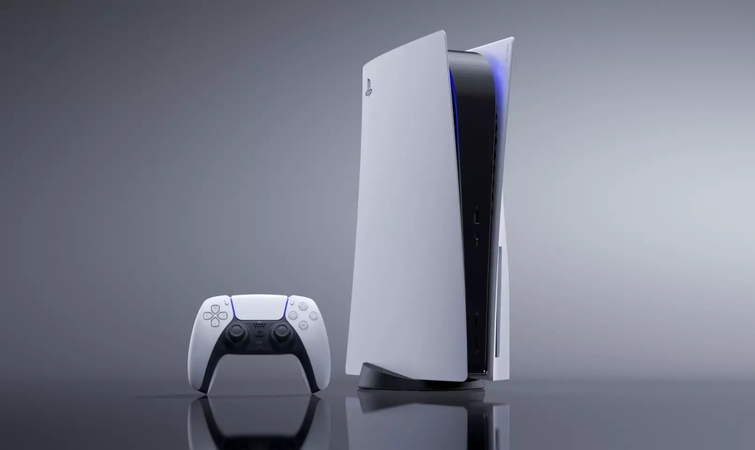
Ten Ways To Improve Starfield

A spoiler warning graphic.

Spoiler Warning: There are spoilers ahead for Starfield’s main quest – including its ending.

I know, I know: I keep telling you that I’m “done” talking about Starfield… only to pop up again a few weeks later with another new article or something else to add! So perhaps I’d better stop saying that this will be my last-ever piece about Starfield and just take it as it comes!

Over the past couple of weeks, Starfield has come back into focus for me. The recent Fallout television series has seen a surge of interest in Bethesda’s other sci-fi property, with both Fallout 76 and Fallout 4 seeing massive player numbers in April 2024. Both games were already running ahead of Starfield – which seems to have dropped out of the charts altogether by this point – but with talk of Bethesda potentially greenlighting some new Fallout project to tie in with the second season of the show, it really puts into perspective how far Starfield has fallen.

Don’t forget to check out my review of the Fallout TV series, by the way. You can find it by clicking or tapping here.

Cropped promo poster for the Fallout TV series.
The Fallout TV series has given a big boost to the games.

So here’s the deal: if you’ve read my first impressions of the game, or any of my other post-launch articles, you’ll know that I was underwhelmed by Starfield. There were elements of the game that had potential – but none that truly lived up to the hype. I didn’t hate Starfield by any means, and when I looked back at the worst or most disappointing gaming experiences of 2023, it didn’t seem fair to include it there, either. But the game was clearly not all it could’ve been.

Today, what I’d like to do is throw out a few of my (totally unsolicited) ideas for how Starfield could be improved. None of these are “magic bullets” capable of turning the game into a 10/10 perfect experience. I think that ship has sailed! But even within the confines of Starfield’s limitations, there are ways in which the game could be improved to make it worth returning to. I’m not proposing a total overhaul or re-making of the game, nor am I asking for something totally unrealistic like a brand-new main quest or recreating the game in a new engine. Instead, I’m trying to propose reasonable changes to certain systems or additions that wouldn’t undermine or fundamentally break the game as it currently exists.

Screenshot of Starfield (2023) showing the player character wearing a spacesuit.
My character on the surface of an icy moon.

If that sounds like something you’re interested in, let me begin with my usual caveats! First of all, I have no “insider information.” I’m not trying to claim that anything discussed below can, will, or must be included in a future update or expansion for Starfield. This is a wishlist from an ex-player, and nothing more.

Secondly, all of this is my entirely subjective opinion. If you loved Starfield in its original form, think the game is utterly irredeemable, or just hate all of my suggestions, that’s totally okay! There’s plenty of room in the Starfield and Bethesda fan communities for polite discussion and disagreement – and we don’t need to get into an argument about hypothetical ideas for the game that Bethesda may never include.

With all of that out of the way, let’s get started!

Number One:
Empty Planets.

Screenshot of Starfield (2023) showing the player approaching a structure.
A man-made structure on a random planet.

Considering that one of the biggest complaints I repeatedly hear about Starfield is that “too many of the planets are empty and boring,” this might seem counter-intuitive. But bear with me, because I genuinely believe that making a portion of the game’s planets completely empty would be a significant improvement.

One of the things I wanted most of all from a game like Starfield was the sense of going “where no man has gone before,” and being the first person to set foot in an alien landscape. Like a Starfleet officer, I wanted to explore the galaxy – after all, isn’t that supposed to be the mission of Constellation, the main faction that players are forced to join in Starfield?

Screenshot of Starfield (2023) showing the player's spaceship on the surface of a moon.
Landing on a planet where people have already been – and are still actively living – isn’t really “exploration,” is it?

But instead, the way Bethesda chose to create planets has meant that there are none – literally zero – that are empty. Humans have set foot on all of Starfield’s 1,000 planets, and it’s completely impossible to pick a landing zone that doesn’t already have pre-made structures, points of interest, shipwrecks, spaceship landing sites, and more. Any chance to feel like a bona fide explorer was lost… and for me, one of the single most crucial elements of a “space game” melted away as I came to realise that.

Empty planets in Starfield could serve a variety of purposes. Building outposts and habitats is one – because honestly, who wants to build their dream home or pirate base a few metres away from a spacer hideout, a commonly-used landing site, and an abandoned research tower? Such worlds could also contain more resources – and with a potential overhaul to the way resources are collected and used in-game, becoming a miner or space-trucker could become viable in-game career options.

Screenshot of Starfield (2023) showing the starmap.
Scanning a planetary body from orbit.

I loved the idea of finding a desolate planet, far away from civilisation, and building my luxury space penthouse there. I loved the idea of hopping from world to world, collecting rare resources that could be sold or traded, and upgrading my ship so that I could carry more and more cargo. Starfield offers the illusion of this through “mission boards,” but these are so barebones and non-interactive that they hardly even count.

I’d take the core of the Settled Systems – worlds around Sol, Alpha Centauri, and Cheyenne – and leave them more or less as they are. But the further out players get from those core worlds with their bigger settlements, the greater the number of genuinely empty planets there should be. I think this change could work wonders for Starfield, especially if it were to be combined with some of the other suggestions and proposals on this list.

Number Two:
New and Modified “Points of Interest,” Including Different Variants.

Screenshot of Starfield (2023) showing the player approaching a structure.
Arriving at a “deserted biotics lab.”

Within my first few hours of playing Starfield, I’d been to the same “abandoned research tower” and the same “abandoned mine” four or five times each. I hoped that I was just unlucky – that there were many more of these copy-and-paste structures out there and I’d just run into the same couple of them a few times. But there really are only a few of these – some of which don’t have much going on. Considering how big the game is and how Bethesda expected players to want to spend hundreds of hours playing Starfield over the span of a decade, that’s pretty poor, and has been a huge weight around Starfield’s neck.

What the game desperately needs is many, many more of these so-called “points of interest.” Just to start, I’d say there ought to be four times as many as there currently are, and every free update should be adding new ones on top of that. But even if that were to happen, the fact that all of these structures – and everything within – are literally identical from one appearance to the next means that further changes are needed.

Screenshot of Starfield (2023) showing the player discovering a structure.
Discovering another copy-and-paste location.

So here’s my next proposal: each point of interest should come with multiple variants. I wouldn’t mind encountering the same structure half as much if the NPCs and loot contained within were in different configurations every time! It would make approaching one of these structures feel a bit more tense, too – you wouldn’t know whether you were about to encounter friendly NPCs, hostile enemies, alien monsters, or something else.

Taking the “abandoned research tower” as an example (because I played through several of those!) Here are some variant ideas: one variant could be the same as it is now, with hostile pirate NPCs having made the tower into their base. A second variant could contain scientists and researchers, perhaps even with a quest-giver to provide radiant quests or missions on the planet. A third could also have scientists, but be guarded by soldiers belonging to one faction or another, with players who haven’t gained enough ranks in that faction being turned away… or having to sneak in! A fourth variant could be totally empty, but with audio logs and notes suggesting something bad happened. A fifth could be filled with terrormorphs or other hostile monsters. And so on. How much more interesting would it be to approach an “abandoned research tower” if you didn’t know which variant you were going to get?

Screenshot of Starfield (2023) showing an NPC using a welder.
A non-hostile NPC at a random location.

There could also be unique once-per-playthrough points of interest that still appear at random but are never repeated. These could be variants of common structures or complete one-offs – ideally a mix of both. Some might spawn randomly on a certain planet or only in a certain biome, and others could be 100% random, with exclusive loot or quests to participate in. Clues could be left behind in the world to guide players to their locations.

In any case, one of the biggest things holding Starfield back is the incredibly repetitive dungeons/points of interest. I don’t think they can be entirely scrubbed from the game due to the way it’s made, but even just adding new and different variants of the current points of interest would be a start. Creating brand-new ones to add to the game ought to be a priority, too.

Number Three:
Changes to the Ship-Builder.
(Part One)

Screenshot of Starfield (2023) showing the ship-builder.
Starfield’s ship-building system.

Starfield’s ship-builder is one of the game’s best features… but it’s imperfect, finicky, and in serious need of some quality-of-life improvements. Firstly, it’s a pain in the arse to have to trek from one vendor to another to be able to design my ship exactly how I’d like it! Enabling players to access all ship parts at all vendors – or to unlock different constructors’ parts and use them from that point on – would massively improve the ship-building experience.

Being able to unlock different parts or groups of parts and then use them at all ship-building stations would be a massive improvement, one that this otherwise decent system desperately needs. The easiest way, I think, would be for each manufacturer to grant players a “license” (or other in-game jargon) for their pieces, permanently unlocking them. This would mean that players would still have to work to unlock all the different parts; they wouldn’t just be there by default. But it would also mean that there’d be no need to keep travelling between star stations and planets to add one component that’s only available in one location.

Screenshot of Starfield (2023) showing an NPC in dialogue.
It’s a pain to have to continually travel between locations to access all of the different spaceship components.

Secondly, I’d want to see Starfield combine its interior decorating – which is currently only present in the outpost builder – with ship-building. This could be optional, meaning that players who aren’t interested wouldn’t have to participate. But one area of the ship-builder that I felt really let down the whole system was the lack of interior customisation.

It’s possible for players to drop items aboard their ship and have them remain where they fall – something that was epitomised by “sandwich lady” in the Starfield Direct marketing broadcast. But this is a Bethesda game hallmark that’s been present since Morrowind… and it hasn’t been improved in any way for almost a quarter of a century. Not only that, but any modification to a ship – even if those modifications don’t change the interior or layout in any way – would lead to all items being removed and dumped in the ship’s inventory. So even that very, very basic amount of interior customisation comes with a massive downside!

Screenshot of Starfield (2023) showing the player placing an item aboard their ship.
It’s possible to drop and clumsily reposition items on your ship – like this wooden duck.

At the very least, I’d like to be able to choose colours for the walls, floors, and doors, as well as choose where doors and hatches in between modules will appear. At present, there are only pre-set colours and doors appear at random; this should be easily added with a modicum of effort!

If I dared to dream, I’d like to see furniture options for each module, posters and wall art to decorate the ship, and everything from rugs to kitchen appliances, all with different designs and colour variants to choose from. One of the disappointing things for me was that, despite making my ship look the way I wanted from the outside, it never really felt like “mine” when I was exploring the inside. There was a half-eaten sandwich on a table that my character didn’t bite. There were math equations on a whiteboard in my captain’s cabin that I didn’t write. And I would have never chosen such a ghastly colour scheme!

Number Four:
Changes to the Ship-Builder.
(Part Two)

Screenshot of Starfield (2023) showing an NPC.
The ship services technician on Akila.

Sticking with Starfield’s ship-builder, there are a few more places where I think improvements could be made. Firstly, having to manually “assign” weapons is finicky and annoying, and there has got to be a better way to do this. Ideally, weapons would be automatically assigned as soon as they’re added to a ship, with the same slot always being used for the same weapon type. Heck, there are only four types of shipboard weapons in the game – so ensuring that each one is always assigned the same button shouldn’t be that difficult!

Secondly, adding the option to rotate ship pieces would be nice. Maybe not every single piece would need to be rotatable – engines, for instance, as well as cockpits might be tricky. But some layouts might work better a different way around, and being able to have some hab modules running “sideways” could open up a lot more combinations. There are also visual and aesthetic reasons for wanting to be able to rotate certain ship pieces – and this must surely be achievable without ruining the ship-builder!

Screenshot of Starfield (2023) showing the ship-builder.
Having to manually “assign” weapons is a pain in the arse.

It would also be great if there was some way to preview how different ship pieces look on the inside without having to buy them. The in-game descriptions of the likes of the brig and armoury are pretty barebones, and it’s only after purchasing an expensive hab and installing it that players actually get to see what it looks like. If the look isn’t right, if it doesn’t match the rest of the ship, or if it doesn’t do what players had been expecting… it can end up being a waste of time and credits.

This could be combined with the interior decorating and doorway positioning additions that I suggested above. The preview window could show different colour variants, for instance, and also allow players to choose where to place hatches, doorways, and even ladders.

Screenshot of Starfield (2023) showing a module in the ship-builder.
Adding a new module in the ship-builder.

Finally, if players have a particular ship component on another vessel in their fleet, it should be possible – somehow – to swap parts between ships. Even if removing a part from one ship to add it to another made the first ship un-spaceworthy, if that wasn’t the player’s currently-assigned ship, then it should be okay. It seems silly to allow players to amass a fleet of ships that could have perfectly usable components, but be unable to swap them between different vessels in the fleet. Having to buy the same part more than once – especially if other ships are unused and just sitting there – feels like something that could be avoided.

The ship-builder is definitely one of the better game modes that Starfield introduced, building on the likes of Fallout 4′s settlement system. But there are ways in which it could be improved, allowing players to really make their ship into the flying home of their dreams!

Number Five:
Alternate Starting Points for Different Character Backgrounds.

Screenshot of Starfield (2023) showing an NPC in the game's prologue.
Every character starts here – regardless of how they’re set up.

It never made a lot of sense to me that a xenobiologist, a professor, or a diplomat would have ended up working in a mine. Sure, an ex-soldier or a criminal on the run might’ve taken a gig like that… but some of Starfield’s backgrounds just don’t gel with the game’s opening act. Rather than changing the entire opening (starting from a prison cell would’ve worked better, IMHO) perhaps Bethesda could add just a couple of alternate starts to account for some of these different backgrounds.

Look at what Cyberpunk 2077 did with its life paths as an example. There are three different starts in that game, each of which sees V living a different life in a different place. They all come together to kick-start the main storyline, but the journey to that point is pretty different. Even though the life paths don’t matter once the game gets going (there’s one mission apiece midway through, but they were pretty basic and uninteresting), the way the game begins offers players a different role-playing experience.

Screenshot of Cyberpunk 2077 (2020) showing the three "life paths" available to players.
Starfield could offer alternate starts that work similarly to Cyberpunk 2077′s life paths.

Each Starfield starting point could still see players grabbing an artefact on the mining planet of Vectera if that’s important to Bethesda, but how players get to that point could change depending on which start was chosen. For example, players who wanted to imagine their character as a spacefarer could begin in space, landing on the planet to transport the unearthed artefact to New Atlantis. Or players could begin working in the mine’s laboratory, studying the artefact.

I’d also like to see at least one starting point that didn’t force players down the Constellation/main quest route immediately. Players could choose not to engage with the artefact, for instance, or could choose not to accept Barrett’s offer. After the pirate attack on Vectera, players could commandeer the pirate ship instead of being given the Frontier. These are just a few ideas off the top of my head!

Screenshot of Starfield (2023) showing the character creation menu.
Many of the available backgrounds don’t line up with working in a mine at the beginning of the game.

I don’t think Bethesda would need to go overboard here. There could be two or three mining-adjacent roles that could see players on Vectera in just the right place at just the right time to pick up the artefact. But these could be different enough from one another to take into account the different player backgrounds on offer in Starfield, which is something that I think would make a lot more sense.

If nothing else, adding a couple of alternate starting points would add to the game’s replayability, as it has for Cyberpunk 2077. There are ways to implement something like this without radically changing the game’s main story or even its opening act, and when it comes to the role-playing side of things – the side that makes me want to lose myself in a character and their fictional world – it would be a huge improvement.

Number Six:
Make In-Game Careers Viable.

Screenshot of Starfield (2023) showing the player at a mission board.
I was unimpressed with Starfield’s mission boards.

One of the things I love to do in a big open-world game is to step away from the main story and get lost in the world. In order to do that, my character needs to be more than just a generic adventurer… so in-game career options need to exist. And no, I don’t mean getting a job with one of the factions that quickly sees the player character climb the ladder to become its leader! I mean jobs that are off to one side, not really connected to any of the main questlines.

For example, it could be possible to be an explorer: charting unexplored and unvisited planets. Players could send probes to the surface, like in Mass Effect 2, to scout landing sites, then disembark and either map the area or collect different resources. These planetary surveys – which would actually require work to complete – could then be returned to Constellation for a profit… or sold to one of the game’s other factions. As players acquire a reputation for exploration, new quests could even arise, with factions offering players bigger rewards to survey planets further and further afield.

Screenshot of Starfield (2023) showing the mission board.
The mission board in New Atlantis.

Being a long hauler – one of the actual in-game backgrounds – could also be a career option. Using the mission boards, players could collect cargo from one planet and take it to another, either under contract or just to buy and sell. Different planets or settlements could have different resources or items that they’re asking for, and this could change week-to-week.

These missions would need to be much more interactive than they are currently, with players having to manually load and unload cargo, perhaps, or travelling to meet up with different NPCs inside settlements instead of just having a mission marked as “complete” as soon as the ship touches down! But there’s potential in this system to expand it and make it into a bona fide “space trucking simulator.”

Screenshot of Starfield (2023) showing the player character mining a resource.
Mining a resource.

Finally, for a game that kicked off deep inside a mine… there’s basically no reason to do any actual mining in Starfield. Resources are so worthless and sparsely spread out that I found there was absolutely no point in mining them when exploring a planet. If I desperately wanted to complete a research project or something, it was easier and quicker to loot a spacer base, sell the items for credits, and buy whatever resource I was missing.

But all of that could change! Making resources more abundant and accessible on different planets could make mining a viable in-game career. Tweaking the value of these resources could also make it much more worthwhile, and it could be strangely relaxing to spend an hour or two mining mercury or lithium to haul back to New Atlantis and sell it. I’m not alone in enjoying those kinds of slower-paced, “cosy” experiences… and it’s actually something I was hoping to get out of Starfield. As things stand, it’s way too unbalanced and grindy, but I can see the potential for a fun time hiding just under the surface!

Number Seven:
An Alternate Ending/Reframe the Starborn.

Screenshot of Starfield (2023) showing an NPC wearing a spacesuit.
One of the Starborn early in the game.

I hesitate to call this an “alternate” ending… because one of Starfield’s big narrative problems is that many of the fundamental questions present in its main story didn’t get any kind of conclusion in the first place. But that’s beside the point! What I’d like to see, as players reach the final act of the main quest, is the option to reject the Unity and to really push back against the whole concept of becoming Starborn. Not simply choosing not to go through the Unity, but actively stating how evil it is and the Starborn are and rejecting the whole thing.

The game puts Starborn adversaries in the player’s way, but most of these are unexplained, nameless non-entities that don’t really feel like actual people. The only two Starborn characters that players can engage with, the Hunter and the Emissary, have both been “reborn” hundreds or thousands of times over in many different universes – and the game actively pushes players to do the same thing. In fact, it’s the only way to fully complete the main quest.

Screenshot of Starfield (2023) showing a mission prompt.
Completing the main quest requires players to travel to a new universe.

But there are huge implications to abandoning one’s entire universe and everyone in it, and Starfield doesn’t do much more than pay lip service to this. It’s possible, for instance, for players to have a romantic partner or even get married – but their spouse doesn’t travel to a new universe with them. It’s implied that, based on choices the player has made, their universe of origin will be permanently changed in some way by their becoming Starborn… but this raises some massive ethical questions. Again, Starfield does nothing with these ideas.

So here’s my proposal: introduce new dialogue during the final act of the main quest that makes clear that the player rejects the entire concept of the Unity and becoming Starborn – and not only that, but they want to kill the Hunter and the Emissary to make sure that no one else can ever become Starborn either. However many universes these two might’ve fucked up… it ends here.

Screenshot of Starfield (2023) showing the final mission in the game.
I’d like to see a “rejection” option added to the end of the main quest.

This is what I’d want to do if I found myself in that situation, confronted with a weird mirror image of myself telling me that “the Creators created everything,” and that becoming a Starborn is my destiny. No – fuck that. I’m from this universe, I want to stay in this universe, and I want to make damn sure that these Starborn clowns won’t be able to harm or kill anyone in the next universe, either. This universe-hopping quest ends here – not just for my character, but for all of the Starborn.

The Starborn and the Unity are the game’s real villains – at least until we get a proper explanation for the artefacts, their purpose, and where they came from. And I would want to see that reality reflected in the game’s final act, with players able to choose to reject the very idea of the Unity and the Starborn and ensuring they can’t go on harming people across countless parallel realities.

Number Eight:
Quests with Multiple Pathways to Completion.

Screenshot of Starfield (2023) showing a combat encounter.
Battling a Spacer Captain at the climax of a quest.

One very disappointing thing about Starfield is how damn linear so many of its quests are. Most quests only have one route from beginning to end, and playing the game can feel like you’re riding a bike with training wheels half of the time. It ought to be possible to complete at least some quests in different ways, utilising different combinations of combat, tech, stealth, and even piloting skills depending on how players have set up their characters and which skills they’ve chosen to invest in.

Perhaps Starfield was harmed by comparisons with Baldur’s Gate 3, which was released just a month earlier. Actually, scratch that. Starfield was undeniably harmed by those comparisons! Baldur’s Gate 3 opens up practically all of its quests and characters, giving players a huge amount of freedom to decide how they want to tackle the game – leading to some incredibly fun gameplay moments. It’s possible for practically everyone in the game to die – something Starfield doesn’t allow with its “unkillable” NPCs – and for many quests to be tackled in radically different ways.

Promo artwork of Baldur's Gate 3 (2023).
Baldur’s Gate 3 is overflowing with player choice and different ways to complete quests.

Where I got frustrated with Starfield was when the game presented the illusion of choice. At one now-infamous mission on Neon, players are teamed up with Walter to acquire another artefact. Walter states multiple times that there will be different ways to approach this interaction – but that turns out to be a lie. The game forces players down one path, and one path only.

Just taking this one mission as an example, it should be possible to abandon Walter and acquire the artefact alone, either by stealthily stealing it, killing the person carrying it, or causing panic at the nightclub and seizing it in the chaos. Then, after the player’s ship is impounded, there should be multiple options for escaping Neon. Players could sneak to the landing pad, knock out the guards, and disable the lockdown, or even rush over to another landing bay and steal a different ship. Just within this one mission there are so many ways things could go – but Bethesda has insisted that players must be locked onto one very specific route.

Screenshot of Starfield (2023) showing dialogue options in a main story mission.
There should’ve been multiple approaches to this mission on Neon.

And there are many missions like this – both in main questlines and just out in the world. One side-story that I encountered involved a group of families on different planets and moons who found themselves in conflict with a gang of spacers. But there was only one way to complete every step of this mission – getting their communications back up and running, solving a conflict within the group, and then boarding the spacers’ station and killing them all. There should be so many different options in a mission like this – such as siding with the spacers for a reward, picking one family over the other when they argue, sneaking aboard the spacers’ station and opening all of the airlocks, or building a missile launcher on one of the moons and blowing it up from 10,000km away. Those are just a handful of ideas off the top of my head.

It’s obviously true that not every mission can have 100 different outcomes and routes to completion. But there should be some degree of choice in a role-playing game, for goodness’ sake! Even if all Bethesda can do at this point is make it so that some unkillable NPCs can now die and add one new alternate path for a handful of main story missions… that would still be a noticeable improvement.

Number Nine:
More Cosmetic Items and Apparel.

Screenshot of Starfield (2023) showing the player and an NPC wearing the same outfit.
It doesn’t take long to find NPCs wearing the same outfit as you!

I was quite disappointed with Starfield’s lack of cosmetic items – clothing in particular. For some reason, clothing only comes by way of whole outfits, with no option to mix and match different tops, trousers, or shoes – and there are almost no skirts, shorts, or different kinds of headgear beyond basic baseball caps and the occasional cowboy hat. Even Starfield’s omnipresent spacesuits are cosmetically limited, with the few available options having no colour variants.

It seems a given that Bethesda and Microsoft plan to add skins as paid-for microtransactions at a future point. You can even see in the game just where these skins will appear when they’re ready to be rolled out. But in my opinion, cosmetic microtransactions have no place in a wholly single-player game, and Bethesda should’ve added a lot more cosmetic variety to Starfield for free from day one.

Screenshot of Starfield (2023) showing apparel at a vendor.
Clothes shopping in Starfield isn’t much fun.

As far back as Morrowind it was possible to play dress-up by choosing different trousers, tops, shoes, and even individual pieces of armour. This would already make Starfield’s whole-body costumes feel like a backwards step even if there weren’t so few of them… but a combination of a lack of different costumes combined with the inability to select individual pieces of clothing comes together to make for an apparel system that’s underwhelming in the extreme.

For me, one part of the role-playing experience is getting my character to look exactly the way I want them to, and when Starfield offers such a limited range of costumes, that’s impossible. Most outfits in Starfield fall into one of two categories: generic “futuristic” sci-fi or western/cowboy. There’s very little diversity, no way to reflect different cultures and backgrounds… and for a game that makes a selling-point of its photo mode, there’s very little worth photographing from the available outfits.

Screenshot of Starfield (2023) showing the player character in photo mode.
Wearing a cowboy hat in Akila City.

Things like fashion sense and personal style are, of course, incredibly subjective – so you might enjoy the outfits and spacesuits that Starfield has to offer. That’s great – but even if you like some or all of the costumes available, adding new ones into the mix, as well as expanding the existing lineup with new colour variants and designs, can only be a good thing! I’d love to see Starfield add a lot more costumes and outfits, as well as skins and colour variants – all for free. There shouldn’t be paid skins in a game of this type.

And while we’re at it, let’s create some wholly unique cosmetic items that can only be found once per playthrough. One of the fun things about past Bethesda games used to be exploring dungeons and following questlines and being rewarded with something shiny and new! The only outfit in Starfield that comes close to falling into that category is the Starborn spacesuit… and I wasn’t especially wild about the way it looks.

Number Ten:
Actual Spaceflight/Piloting.

Screenshot of Starfield (2023) showing a custom spaceship.
There’s not much of an opportunity to be a pilot…

Starfield is a game set in space. It encourages players to build and customise their own spacecraft. Ship-to-ship combat takes place in real-time in space. But there’s absolutely no spaceflight in this game. Let me explain what I mean by that: players can’t get in their ship and manually fly it from one location to another. The only option is a modified form of fast-travel that generates a small bubble of space around the player’s ship. As some folks have demonstrated, there are no “real” planets or objects within that bubble; they’re just jpegs floating in the background.

Of all the points I’ve raised today, this could be the hardest to fix. Starfield is built from the ground up around fast-travelling between locations, and the way in which pockets of space are generated in orbit of planets or near starstations would need to be expanded and changed in a significant way in order to make real spaceflight work. Ships, too, would need to change – with better and faster engines being options for players who long for that space-sim experience.

Screenshot of Starfield (2023) showing the starmap.
Starfield appears to be built around fast-travelling from the galaxy map.

So there are real logistical issues in the way of adding bona fide spaceflight to Starfield. But I think it’s worth trying, at least – because if the only option is to fast-travel between locations, much of what appeals about taking to the stars is lost. Locations don’t feel far away from one another if players can teleport there in a few seconds, meaning much of the scale of Starfield’s galaxy – something that already feels diminished in light of its tiny cities, repetitive NPCs, and copy-and-pasted points of interest – is lost.

In past Bethesda titles, the journey from place to place was a significant part of the gameplay in and of itself. Walking from Seyda Neen to Balmora in Morrowind could lead to random combat encounters, side-quests, and interactions with NPCs. In Fallout 3, travelling from Megaton to the radio tower likewise saw the player presented with new opportunities to get lost in the game’s world and have fun. Heck, the recent Fallout TV series even referenced how exploring the wasteland often leads to getting side-tracked!

Screenshot of Starfield (2023) showing a custom spaceship taking off.
Part of the fun of past Bethesda games was journeying from place to place and stumbling upon new adventures along the way.

In short, the lack of spaceflight means there are fewer opportunities for players to take their time and explore Starfield’s galaxy in their own way at their own pace. When not on the surface of a planet – or approached by a random ship in orbit – there’s basically no way for players to get side-tracked by being offered a totally different quest or mission in a way that feels natural.

Starfield having functionally no spaceflight doesn’t just harm the game from a space-sim or space game perspective, it also denies players one of the fundamental building blocks of a Bethesda open-world game, too. I don’t know how it could realistically be implemented at this stage – and flying in between star systems would probably have to remain as fast-travel only. But making an effort to get proper spaceflight up and running would be worth it as it would be a huge improvement to Starfield’s immersion and gameplay.

So that’s it!

Screenshot of Starfield (2023) showing an NPC on a medical bed.
Does Starfield need to be rushed to the medical bay?

We’ve considered ten ways that Starfield could be improved – in my humble opinion, of course.

Although I spent close to a decade working in the games industry, I’m not a developer. I don’t know whether some or all of these ideas might’ve once been considered for Starfield, but were ultimately cut because they proved to be unpopular, impractical, or unworkable. The game’s very existence is, in some respects, a technological achievement; that Bethesda managed to build something this complex using the zombified remains of a game engine that’s more than twenty-five years old should count for something, right?

But I’m not alone in finding Starfield to be an underwhelming experience to play, and the fact that it didn’t win any big awards and seems to have dropped out of our collective cultural conversation after just a few months is testament to that. Starfield was being regularly beaten by Skyrim and Fallout 4 in terms of active players even before the Fallout TV show brought renewed attention to that franchise… and unless Microsoft and Bethesda take bold action in the months and years ahead, Starfield may very well end up being forgotten.

Screenshot of Starfield (2023) showing a custom spaceship on a landing pad.
A custom spaceship on the landing pad at New Atlantis.

I’ve said before that I believe the only way to save Starfield is if its first major expansion is at least as big and impressive as Cyberpunk 2077′s Phantom Liberty DLC was last year. Tinkering around the edges won’t cut it, and if Bethesda can’t find a way to build a significant improvement to Starfield – not just a narrative addition or the inclusion of a new questline – then I think the game’s longer-term prospects will remain bleak.

I’ve had my say, and I’ve made my suggestions! Maybe not all of them would work, and maybe some of them are impossible due to the technical limitations of Bethesda’s game engine or the less-powerful Xbox Series S console. But Starfield would be a damn sight better if they were included… and really, some of these things should have been present at launch.

Could Starfield get its redemption arc one day? Never say never…


Starfield is out now for PC and Xbox Series S & X consoles. Starfield is the copyright of Bethesda Game Studios, Bethesda Softworks, Xbox Game Studios, and/or Microsoft. Some promo images and screenshots used above courtesy of Bethesda. This article contains the thoughts and opinions of one person only and is not intended to cause any offence.

Video Game Spotlight: Midtown Madness

Twenty-five years ago today – that’s literally a quarter of a century – a brand-new racing game arrived on Windows 98 and Windows 95 PCs. Midtown Madness was an absolute blast and quickly became one of my most-played games of the year. With the millennium fast approaching, nothing was more fun than tearing up the streets of Chicago, getting into scrapes with the police, and taking part in some wild and dangerous races against the AI!

Midtown Madness celebrating its 25th anniversary makes me feel so incredibly old… but I’m glad to have the opportunity to talk about one of my favourite racing games of that era. Midtown Madness did something that I hadn’t really seen before in a video game – it opened up its entire city and let me drive wherever I wanted, however I wanted… even if that meant off-roading across grassy parks, scaring pedestrians on the pavement, or jumping over an open drawbridge! Two-and-a-half years before Grand Theft Auto III would take that series’ titular mayhem to an open-world environment, Midtown Madness was doing something remarkably similar.

Screenshot from Midtown Madness (1999) showing the game's title screen.
The game’s main menu – with a funky custom mouse cursor!

Although it didn’t feel that way at the time, when I look back at Midtown Madness with a quarter of a century of hindsight, it feels like a gaming landmark; an important title that did the “open world chaos” thing in its own way before some of the better-known titles in that space. In 1999 it felt incredibly new and innovative; a game that seemed to take the chaos of the likes of Grand Theft Auto but made it fully 3D. Looking back, it feels like a half-step between 2D games, racing games, and the kind of fully open-world titles that were right around the corner.

I’d also place Shenmue in that same category: the “almost-open-world” games that were the progenitors of the format. Released the same year as Midtown Madness, but in a completely different genre, Shenmue was also an early pioneer of many of the features that open-world games continue to take advantage of to this day. 1999, it seems, was one of the most important years in the development of open-world titles!

Screenshot of Midtown Madness (1999) showing a City Bus on a street by a river.
Driving a City Bus through the streets of Chicago!

I don’t have the receipt, unfortunately, but I think I must’ve picked up Midtown Madness within a week or two of its launch. I remember playing it that summer and into the autumn; it was one of the only up-to-date PC games that I owned at the time. I’d seen a preview of it in one of the gaming magazines that were prominent on newsagents shelves in those days, and it just looked like such chaotic fun that I could hardly wait to get my hands on it! I didn’t have a PC racing wheel or any fancy equipment – and as you’ll know if you’ve ever tried it, playing a racing game with a mouse and keyboard is painful! But that didn’t stop me, and I must’ve logged dozens upon dozens of hours in Midtown Madness… in between studying and working my part-time job, of course!

Taking on races was the only way to unlock half of the vehicles in the game – the other half were available right from the start. So I definitely took part in as many races as I needed to in order to unlock the likes of the city bus and the GTR-1 racecar! But where I had the most fun with Midtown Madness was driving around the city in free-roam mode – both as chaotically and as calmly as possible! The game’s rendering of downtown Chicago – while undeniably dated by today’s standards – felt like a technological marvel in 1999, and I loved every minute of exploring the city.

Screenshot of Midtown Madness (1999) showing a first-person perspective.
Driving around Chicago in Midtown Madness was a blast!

This wasn’t my first encounter with the Windy City. I’d been a huge fan of the medical drama ER in the second half of the ’90s, following every episode and every season as they were broadcast here in the UK. I think by mid-1999 we were on Season 3 or 4 of the show, which at that point still featured George Clooney and Julianna Margulies in starring roles! But because I felt a familiarity with Chicago – from its Lake Michigan waterfront to its “L” trains that ran on elevated tracks above the streets – I felt even more drawn to this digital recreation of the city. In fact, it was one of the first digital recreations of a real-world city that I can remember spending much time with.

Going into the millennium, I’d have had Midtown Madness’ in-game map pretty much committed to memory! I could find my way from one side of the map to the other, stopping to see the sights along the way – and the game recreated some of Chicago’s most famous landmarks. I’ve already mentioned the “L” – Chicago’s elevated metro system. But there was also the Sears Tower skyscraper, Navy Pier on the Lake Michigan shorefront, the planetarium, the Wrigley Field baseball stadium, and even the airport! All of these were a ton of fun to race through and explore.

Screenshot of Midtown Madness (1999) showing Wrigley Field.
Wrigley Field as it appears in the game.

Although the game came with options for tuning the physics engine and car performance, I didn’t spend too much time tinkering. The default settings seemed to work well enough, and I was always reluctant to mess about with them too much! Midtown Madness performed very well on the PC that I had at the time, with none of the bugs and glitches that seem to plague games today. Perhaps I’m looking back with rose-tinted glasses when I say that… but I genuinely cannot remember any bugs or performance issues that got in the way of the fun.

Obviously when you compare Midtown Madness with a racing game from the 2020s, like Forza Horizon 5, or open-world car games like Grand Theft Auto V, it feels incredibly dated. Graphics that felt great at the time look blocky in 2024, with far too few polygons, and the game has the overall look of a title from the late ’90s. The turn of the millennium would see advancements in graphics that would make Midtown Madness 3 – released less than four years later – look an awful lot better.

Screenshot of Midtown Madness (1999) showing the vehicle selection screen.
Choosing a car to race with!

And in terms of the game’s world, the relatively low numbers of vehicles on the road and pedestrians on the pavements doesn’t feel right for a massive metropolis like Chicago. There’s also a lack of diversity – there are only a handful of vehicle types and pedestrian models, and you’ll pretty quickly see all of them if you spend much time with Midtown Madness.

But those were the restrictions that game developers had to work with in 1999, and obviously an open-world city like Cyberpunk 2077 or a racing title like Gran Turismo 7 is going to surpass Midtown Madness in every way a quarter of a century later. That’s not what makes it such a special title – and no one is really asking it to go toe-to-toe with modern racing and open-world titles.

Promo image for Forza Motorsport (2023).
Ideas and gameplay mechanics that Midtown Madness pioneered are still in use in modern open-world and racing games today.

Instead, we have to view Midtown Madness – and, by extension, video games in general – as a stepping-stone. The premise or DNA of later titles like Test Drive Unlimited, Project Gotham Racing, or the Forza Horizon series is present in Midtown Madness, and the game was among the first to demonstrate open-world and free-roaming elements in a racing game, as well as the merits of letting players cause chaos and create their own fun. Those gameplay ideas have become commonplace in the years since Midtown Madness was released – and now extend far beyond the racing genre.

For me, Midtown Madness is an incredibly nostalgic title. I’d love to be able to play it again – but getting it to work on a modern PC, even with a virtual desktop running Windows 98, is a pain. The game can be easily found online in its complete form, but it would be fantastic if Microsoft could work with a company that specialises in porting retro games to modern systems and give it a proper re-release. After 25 years, I think Midtown Madness deserves better than to be left behind! Many other retro titles have been brought back over the past few years, so there’s almost no reason not to do it!

Screenshot of Midtown Madness (1999) showing the player's car being crashed into.
Getting side-swiped by a police car during a race. Ah, the memories!

I had such a great time with Midtown Madness as the millennium approached. It was one of the games I encountered in the late ’90s that seemed to be pushing boundaries and trying something different – and something genuinely engaging and fun. It felt like a step up from basically any other racing game I’d played up until that point, and one that definitely captured and held my attention.

As we mark the milestone 25th anniversary of Midtown Madness, I look around at open-world titles and racing games and still see a number of features that I first encountered in this landmark title. It was a truly fantastic game that gave me a ton of fun and with which I made some wonderful memories.

All that remains to say is this: happy anniversary, Midtown Madness!


Midtown Madness is currently out of print, but copies may be available second-hand. Midtown Madness remains the copyright of Microsoft, Angel Studios, and/or Rockstar San Diego. Some screenshots and still frames courtesy of LGR’s retrospective review and The Racing Madness Wiki. This article contains the thoughts and opinions of one person only and is not intended to cause any offence.
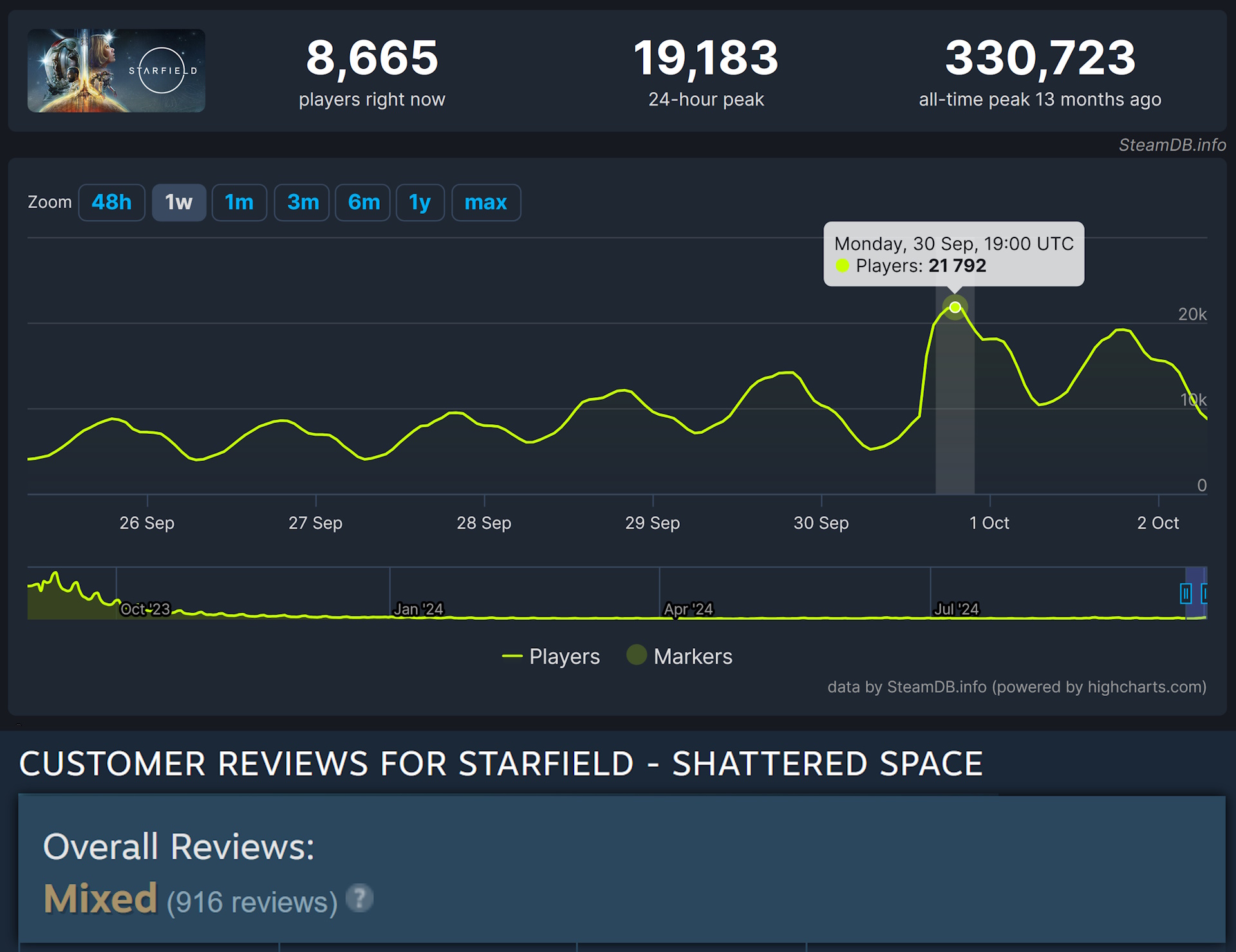
Xbox Series X & PlayStation 5: At The Halfway Point

If we assume that the current generation of home consoles will last roughly as long as the last couple of generations have, then the Xbox Series X and PlayStation 5 are close to the halfway point. Both devices were launched in late 2020, and as we’re now well into 2024, I think it’s fair to say we’re approximately halfway through their estimated lifespans. So today, I thought it could be interesting to consider the state of both platforms and look at how well – or how poorly – they’ve been performing!

For some background, I spent a decade working in the games industry, and in that time I worked with companies that released games on both Xbox and PlayStation consoles. As someone whose primary gaming platform these days is PC, I don’t really see a need to take sides in the so-called “console war,” so I’ll do my best to judge both machines on their own merits, as well as give my thoughts on the ninth generation of home consoles as a whole.

Promo photo of a PS5 console and control pad.
A PlayStation 5 console.

Let’s start with something I’ve talked about before: both the Xbox Series X and PlayStation 5 were released far too early. Not only were there brilliant games that were only just beginning to take full advantage of previous-generation hardware – like Red Dead Redemption II, God of War, and Marvel’s Spider-Man, to name but a few – but there were catastrophic problems with production and the supply chain thanks to the shit-show that was 2020. Both machines were launched with wholly inadequate levels of stock, leading to predictable results!

PlayStation 5 and Xbox Series consoles were out of stock everywhere for well over a year; here in the UK folks were on waiting lists that could be months long, and even as the consoles’ second holiday season approached, the only choice many players and parents had was to pay massively inflated prices to scalpers. Neither Microsoft nor Sony did enough to prevent touts and scalpers from using bots to buy up available stock, and throughout the launch window and well into 2021, both companies failed to improve manufacturing and supply chain issues.

A container ship at sea.
“Supply chain issues” quickly became an excuse for why both consoles were out of stock.

Thankfully, those issues have largely abated – at least here in the UK. But now that the availability problem has been solved and the consoles have trudged their way to the halfway point in their life cycles… is it even worth picking one up?

I have to say that, even at their recommended retail price, both consoles feel like a hard sell right now. There are so few exclusive titles to make an expensive purchase like that worthwhile, with a huge majority of games still being released on PlayStation 4 and Xbox One as well as on the current generation of machines.

A tumbleweed on a dirt road.
A visual representation of every Xbox Series X exclusive title.

There have always been cross-generation titles, of course, but usually by this point – more than three years into a console generation – there are fewer and fewer of them. But at time of writing I can only call to mind a handful of games that are genuinely PlayStation 5/Xbox Series X exclusive – the likes of Starfield, Jedi: Survivor, and Baldur’s Gate 3 come to mind, but I really can’t think of many others. Some of the biggest releases and most successful titles of the last few years – like Elden Ring, the Resident Evil 4 remake, and Halo Infinite – have all been released on both current- and last-gen platforms.

Is it worth spending upwards of £450 on a console to be able to play one or two games that aren’t available elsewhere? Don’t get me wrong: great games can and always have been system-sellers. But if I’m considering such an expensive investment, I really don’t think it’s too much to ask that I’m able to play more than just a couple of exclusive games! For a lot of players, there’s really very little advantage to buying one of these new machines in 2024… because most games are still available on PlayStation 4 and Xbox One consoles, which are a lot less expensive and which they may well already own.

Promo graphic of an Xbox Series X and its control pad.
An Xbox Series X console.

We are starting to see a shift in that area, but it’s far slower than it has been in previous generations. 2023 saw the release of titles like Starfield and Marvel’s Spider-Man 2, both of which were exclusive to next-gen platforms. But unless those games were on your “must-play list,” there really isn’t a hugely compelling reason to invest in either console at this point.

I noted in 2020, before the launch of PlayStation 5 and Xbox Series X, that the jump in graphical quality would be far smaller and less noticeable this time around than it had been in years past – and I think that’s been entirely born out by the abundance of cross-generation titles. There are advantages to current-gen machines compared to last-gen ones, of course, but they tend to be in less obvious areas like loading times and control pad battery life as opposed to things like graphical fidelity and visuals.

Screenshot of Starfield showing a first-person viewpoint, a rifle, and a cityscape.
Despite being a current-gen-only title, Starfield is hardly groundbreaking in the graphics and visuals department.

One thing that’s definitely happened this generation has been a massive growth in file sizes! With most games now being either wholly digital or coming with massive patches and updates even on day one, downloading 100GB+ files has become commonplace. For those of us with slow internet connections, that can easily mean a couple of days to download a single game or update! That’s an annoyance in some ways, especially considering how some games with massive file sizes don’t actually seem to look much better than their counterparts from a few years ago that were one-third as big.

But large files and downloads are here to stay, I suspect. With both current-gen machines having solid-state drives (and expansion slots to add extra storage, if needed) it’s possible to create larger and more detailed game worlds than ever before. Relatively few games have taken advantage of this yet – and some of those that have, like Starfield, haven’t done so particularly well – but, despite my personal gripes with massive downloads, there’s at least potential here. Larger and faster drives on home consoles can open up new possibilities in game development, and that could lead to bigger and more immersive worlds in the years ahead.

Screenshot showing the file size of the game Jedi: Survivor.
Many titles released this generation have file sizes well over 100GB.

The question of value for money has come up a lot over the past couple of years, and while we’ve partly touched on that with the lack of exclusive games, I want to consider the price point that both consoles are at. For literally decades, console prices have come down incrementally as they get further into their life cycle. Recent console generations have seen cheaper versions produced partway through, with the likes of the Xbox 360S and PlayStation 4 Slim both arriving at around the halfway point in their respective life cycles.

This time around, however, we’ve seen price rises rather than price reductions, with PlayStation 5 consoles now £30 more expensive here in the UK than they were at launch in 2020. Despite initially suggesting no price rises were imminent, Microsoft followed suit a few months later, again rising the price of Xbox Series X consoles by £30 here in the UK. That’s despite both consoles arguably having the least-convincing lineup of exclusive games, and thus having the weakest justification for such an unfair price hike. Sony and Microsoft are billion-dollar corporations whose gaming divisions have been making money hand over fist… so these price hikes – which come on top of the rise in the price of the standard edition of many games – are honestly just disgusting. Price-gouging in the middle of an inflation and cost-of-living crisis is sickening.

A chart showing Sony's consolidated results for Q1 2022.
Sony boasted to its investors about record-breaking profits… before turning around a few weeks later and hiking up the price of PlayStation 5 consoles.

At the end of the day, I’d have expected more from both the PlayStation 5 and Xbox Series X at this point in their generation. There have been some great games over the past three-plus years… but many of them aren’t exclusive to this generation of home consoles, leaving me with a resounding sense best summed up thus: “what’s the point?” Neither console has, in my view, given a compelling answer to that question yet. There have been a handful of titles that I could see some folks picking up a console for, but there are undeniably far, far fewer of those at this point in the ninth generation than in any prior home console generation.

There have also been plenty of duds; broken, half-baked, or underwhelming titles. That happens, and while it isn’t the fault of either console specifically, the sheer number of buggy “release now, fix later” titles has done nothing to help current-gen gaming or make it feel like a worthwhile investment.

Screenshot of The Lord of the Rings: Gollum showing a character in an out-of-bounds area.
The Lord of the Rings: Gollum will likely be remembered as one of the worst releases of the generation.

The best experiences of the last few years, I would argue, have come not on the Xbox Series X or PlayStation 5, but on the Nintendo Switch and PC. PC gaming has gone through somewhat of a renaissance, with titles that were once exclusive to Xbox and PlayStation making their way onto the platform, as well as a glut of high-quality titles. And Nintendo has been consistent in its releases on the Switch, even as that less-powerful console reaches the end of its life. Whether we’re talking Animal Crossing: New Horizons, Super Mario Bros. Wonder, the remaster of Metroid Prime, or the Booster Course Pass expansion for Mario Kart 8 Deluxe, Nintendo has been serving up hit after hit, and offering players genuine reasons to pick up their machine.

As the ninth generation got underway in 2020, I was content to watch and wait. Even though PC has been my primary platform for several years, I’m not averse to playing on console if there’s a compelling title that seems like a “must-play.” I bought a PlayStation 3 toward the end of its life so I could play the likes of The Last of Us, I picked up a Switch to play Mario Kart 8 Deluxe, Mario Odyssey, and more, and I bought a PlayStation 4 during the previous generation in order to play games like Horizon Zero Dawn and Uncharted 4. But no games of that calibre have leapt out at me this time around. Maybe one or two will before this generation comes to a close… but I’m not convinced.

A photo of a gaming PC with two monitors.
A fancy gaming PC. No, it’s not mine!

So here’s the real takeaway from the ninth generation of home consoles: buy a PC! Most Xbox and even PlayStation titles are coming to PC these days; I’m particularly excited for the upcoming PC port of Ghost of Tsushima, for instance. Having built my own PC a couple of years ago, and upgraded my graphics card just last year, I know for a fact that it’s more than a match for both current-gen consoles. Unless one of them can rope me in with an exclusive title that I can’t get anywhere else – and can’t live without – this could be the first generation of home consoles since the days of the NES and Atari 7800 that I don’t end up buying into.

As the Xbox Series X and PlayStation 5 reach the halfway point in their life cycles, I confess I feel a sense of disappointment – and more than a little “I told you so.” Both machines are powerful, there’s no question about that. But so far, it doesn’t seem as if anyone has really taken advantage of that power to really innovate and push gaming forward by anything more than the smallest iterative step. I knew going into the ninth generation that changes and improvements would be minimal… but even with that low bar, I’m unimpressed.

There have been some great games in the last few years. 2023 in particular will be well-remembered for releases like Baldur’s Gate 3. But titles like that feel like they exist in spite of, rather than because of, the PlayStation 5 and Xbox Series X. As we reach the halfway point… neither console has yet come close to reaching its potential.

PlayStation 5 and Xbox Series S/X consoles are on sale now. All titles discussed above are the copyright of their respective developer, studio, and/or publisher. This article contains the thoughts and opinions of one person only and is not intended to cause any offence.
Xbox & Bethesda Probably Have One Chance To Save Starfield…

Spoiler Warning: There are spoilers ahead for several main story missions in Starfield.

I was excited about Starfield last year. By the time the game’s big showcase had wrapped up in June, Starfield had rocket-boosted its way to the very top of my most-anticipated games list, and it held onto that position even as Baldur’s Gate 3 diverted my attention. But despite doing my best to give the title a fair shake, sinking more than twenty-five hours into it, and really wanting to love it… I didn’t. Starfield just didn’t have that “Bethesda magic;” the “je ne sais quoi” that has made some of the studio’s previous games into all-time classics.

And I’m far from the only person who feels that way. Despite launching to generally positive reviews from both players and professional critics, the longer folks have spent with Starfield, the further the game’s ratings have slipped. Although there are multiple areas of criticism from writing and dialogue through to the game’s outdated underlying technology, the general consensus is that Starfield is disappointing, shallow, and lacking in the replayability that Bethesda desperately tried to build into it.

Screenshot from Starfield (2023) showing a character sitting in a chair aboard a spaceship.
An NPC aboard a spaceship in Starfield.

But it’s 2024, and if there’s one thing the games industry knows it’s this: you can launch half a game today and promise to patch out all of its issues later! The dreaded business model that I’ve dubbed “release now, fix later” has firmly embedded itself in the games industry – and Bethesda is no stranger to utilising it. The company’s most recent title before StarfieldFallout 76 – has received years’ worth of patches and updates, and even though it endured an appalling launch, it’s in a much better state today than it was five years ago. In fact, Fallout 76 is now sitting just ahead of Starfield in terms of average reviews on Steam.

There are some areas of Starfield that patches, updates, and DLC have the potential to improve or fix. In a game all about exploration, being forced to re-play the same handful of copy-and-paste structures filled with nameless, mindless enemies got old fast – so how about quadrupling the number of these structures, creating some unique ones that only appear once per playthrough, and adding new and different types of enemies and loot to fill them. Or how about making at least some of the game’s 1,000 planets genuinely empty, with no pre-built structures at all. That sense of exploration, of being the first person to set foot in a “strange, new world” is what I wanted from a game like Starfield… and it seems like something that could be implemented into the game without too much effort.

Screenshot from Starfield (2023) showing a first-person view over a procedurally-generated landscape.
It’s hard to convey how disappointing it was to land on a “deserted planet” only to find buildings and bases full of nameless, meaningless NPCs.

Then there’s the game’s main story. It was left deliberately open-ended to push players into New Game Plus – and I firmly believe this was one of the first and most important ideas conceived for Starfield during its creation – but it’s led to a fundamentally unsatisfying end to the game’s main quest. So Bethesda could write a better ending – and a more conclusive one. Who created the artefacts? What was their intention? Could the player character interact with these “Creators” somehow? Again, that seems like something that should be achievable.

Adding in new and varied paths through certain quests is also something that should be doable. A notorious mission in the main quest sees the player character travel to the “pleasure city” of Neon to acquire another artefact, but this quest is about as on-rails as it’s possible to be. No matter what choices the player makes, there’s only one way to get the artefact and complete the mission. It should be possible to tackle a quest like this in more than one way – and adding that in wouldn’t break the rest of the story or other parts of the game. For example, being able to kill the character who has the artefact, or finding another way to escape Neon after the deal goes down are things that would only impact that one quest – and being forced to play it in one specific way isn’t what a lot of folks wanted or expected from a game like Starfield.

Screenshot from Starfield (2023) showing a conversation and dialogue options during a mission.
This mission offers the illusion of choice, but ultimately forces players down one very specific route.

There are, of course, some things that can’t be fixed in Starfield, no matter how much of an annoyance they seem to be! I wasn’t personally all that bothered by the game’s loading screens when opening an airlock or entering a building – but I know that the loading screens have been an area of complaint for a lot of folks. Starfield is built on the creaking, zombified remains of a twenty-five-year-old game engine, though… so I don’t see a way to remove them. Nor could the game’s fundamental spaceflight problem be fixed; Starfield is built on the player and their ship fast-travelling between locations, so any opportunity for actual piloting or flying is basically gone at this point.

So we need to be realistic about what we could reasonably see from updates and future DLC; Starfield won’t change fundamentally in terms of either gameplay mechanics or narrative. But that doesn’t mean there can’t be significant improvements that could mean the game will be worth re-installing and giving a second chance. And yes, in case you were wondering: I’ve already uninstalled Starfield.

Screenshot of Starfield (2023) showing the in-game map.
Things like adding better in-game maps for towns and other locations should be achievable.

But here’s the thing: Bethesda basically has one chance to do this.

Many players who tried out Starfield are already moving on. Games like Baldur’s Gate 3 and Cyberpunk 2077′s Phantom Liberty DLC emerged around the same time and have, by comparison, highlighted many of the fundamental weaknesses in Starfield – as well as how far behind Bethesda has fallen in terms of game design and development. Bringing back players like myself who tried and gave up on Starfield – or convincing sceptics to try it for the first time in light of mediocre reviews – is not an easy task.

Phantom Liberty has done the impossible for Cyberpunk 2077, completely changing the way whole mechanics work, adding a massive new area of the map, new missions, and much more. Starfield needs its first piece of DLC to be at least as substantial and as transformative as Phantom Liberty given its shortcomings, and it needs this DLC to be well-received. If not… a lot of those players we’ve been talking about will be forever lost, with Starfield being brushed aside in favour of newer, better gaming experiences.

Promotional screenshot of the Phantom Liberty DLC for Cyberpunk 2077 (2020).
Phantom Liberty quite literally transformed Cyberpunk 2077.

Starfield is basically a “single-player live service” game. That’s the model Bethesda and Xbox chose to adopt, and we can see inside Starfield just where the paid skins and cosmetic items will appear when they’re ready to be pushed out. But like any live service, Starfield has to be basically good enough to build up a playerbase before anyone should be thinking about microtransactions, cosmetic loot, or paid mods. If Starfield’s first big expansion isn’t good enough, I don’t see the game retaining enough players to make that kind of “ten-year experience” anywhere close to viable.

Look at other games in the live-service space. Whether it’s Anthem, Marvel’s Avengers, or Ghost Recon: Breakpoint, it’s incredibly easy for even massive publishers with huge brands to fail. And there are relatively few titles that launch to such a mixed reception that go on to make a recovery. The jury’s still out on the likes of Halo Infinite and Suicide Squad: Kill the Justice League, but to say they’re limping along wouldn’t be unfair. Asking for a single patch or update to transform the fortunes of titles like that seems like a big ask… but it’s where they’re at. Just like Starfield, they’re in the last chance saloon.

Promo graphic showing future content for the video game Suicide Squad: Kill the Justice League (2024).
We’ll see how much of this promised content for Suicide Squad: Kill the Justice League actually gets released…

Gaming is a marketplace – and a very competitive one at that. New titles are being released all the time, and while once-in-a-generation masterpieces like Red Dead Redemption II or Baldur’s Gate 3 are comparatively rare, there are enough good games out there – even in the single-player and role-playing spaces – for players to very quickly move on from a disappointing or underwhelming experience. Most games don’t even get a second chance; by the time developers have been able to address issues and roll out updates, the damage has been done and players have left, never to return.

Starfield is lucky in that Bethesda’s pedigree and Xbox’s sky-high marketing budget will almost certainly grant it a second chance and a second look from a decent number of players. But that second look had better be substantially different and a massive improvement – with changes and fixes across the board. Because there damn well won’t be a third.

Screenshot of Starfield (2023) showing a first-person view of a spaceship cockpit and a planet in the distance.
Starfield has already had a chance to impress me.

Xbox won’t willingly burn money on Starfield if things don’t improve, just like Electronic Arts didn’t with Anthem or Square Enix didn’t with Marvel’s Avengers. Publishers pretty quickly hit their limit when it comes to supporting a failing game – so Starfield’s life-support can’t last forever. The game sold a decent number of copies at launch, and drove at least some new subscribers to Game Pass, so it’s probably bought Bethesda some time. But that time is finite, and if, at the end of it, the DLC or update isn’t good enough… I can see that being the end of the road for Starfield.

One interesting example here is No Man’s Sky. After that game was poorly-received by a lot of players upon release, Hello Games knuckled down and got back to work. Over the span of years, No Man’s Sky received dozens of updates that brought it much closer to its original vision. But those updates were all free, and players who stuck with the game were rewarded for their support and patience. Hello Games didn’t have the audacity to charge extra for completing the work that should have been done ahead of release… so perhaps there’s a lesson there for Bethesda and Xbox, too.

Screenshot of Starfield (2023) showing the interior of a custom spaceship.
Some big free updates wouldn’t go amiss!

At the end of the day, despite whatever positive spin the PR departments at Microsoft and Bethesda might try to put on it, Starfield is in trouble. I gave up on the game after giving it more than enough time to impress me, but what should be even more concerning for Bethesda are the reports from folks who stuck with the game to the end – only to say it isn’t worth re-playing. The game’s launch did not go to plan, and the purported “ten-year experience” seems to be disintegrating before our very eyes.

We can discuss how all of this happened, where Bethesda went wrong, or what the worst aspects of the game are. There are already plenty of articles and essays about all of those subjects – and many different answers to those questions. But there is still a glimmer of hope for Starfield, that updates and improvements could bring it closer to the game we were all hoping for. But time’s a-ticking, and there’s one last chance to get it right.

Let’s cross our fingers and hope that Xbox and Bethesda seize the opportunity.

Starfield is out now for Xbox Series S and X consoles and PC, and is also available on Game Pass. Starfield is the copyright of Bethesda Game Studios, ZeniMax Media, Xbox Game Studios, and Microsoft. This article contains the thoughts and opinions of one person only and is not intended to cause any offence.
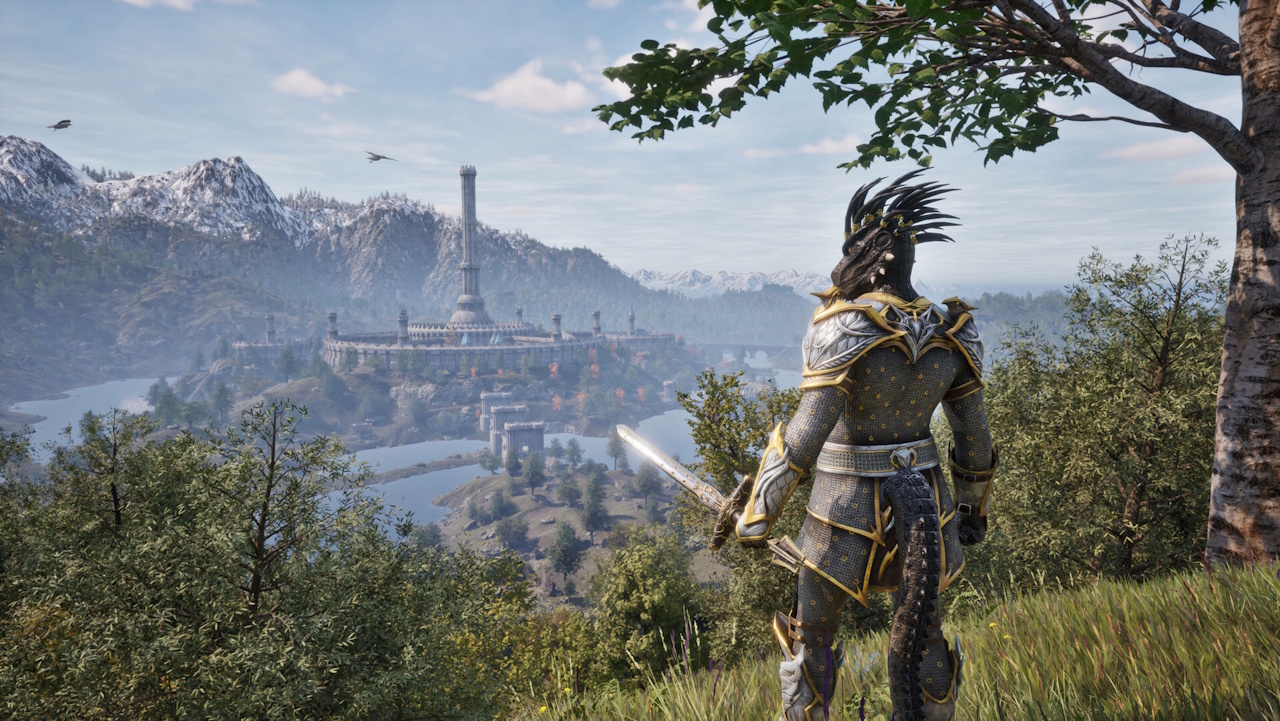
The Way We Engage With Media Is Changing… Get Over It!

Earlier this year, a quotation from Ubisoft director of subscriptions Philippe Tremblay was doing the rounds. Many news outlets seized upon it, as did bloggers and commentators – and the reaction, at least from what I’ve seen, was pretty negative. Tremblay suggested that players will get comfortable with “not owning [their] games,” and that four-word phrase sent usually sensible critics and analysts into a state of meltdown.

As I state in the title of this piece, the way in which practically all of us engage with and consume media has changed dramatically in the last few years – and that change is continuing. I’ve been through multiple stages of this transition myself with different forms of media for at least twenty years, if not more. It began with music, with digital downloads replacing cassette tapes and CDs. It happened again with DVDs and Blu-ray discs losing out to video-on-demand. It’s happened already in gaming with the move from cartridges to discs and then the decline of optical discs in favour of digital downloads.

And all of that is before we get into subscription services and streaming.

Promo graphic for Xbox Game Pass.
Xbox Game Pass is the first major gaming subscription service… but it won’t be the last.

Twenty years ago, I couldn’t have predicted the rise in streaming and subscription platforms – but now they’re everywhere. Many people, especially younger people, have never purchased so much as a single song or film – they’ve grown up streaming their music and videos. Forget about physical discs or tapes, there’s a whole generation of younger people who’ve never even bought a song on iTunes or paid to watch a film or TV series on demand. Subscriptions have become the way many people want to engage with different forms of media – and it’s easy to see why.

Subscriptions offer a “best of both worlds” approach. Like a cable or satellite TV package, they offer a good deal of choice. And like video-on-demand or a DVD box set, they let viewers choose when they want to watch. Music streaming, too, has these same advantages: an abundance of choice and the freedom to choose what to listen to and when. Audiences no longer have to put up with the rigid schedules of broadcasters and TV channels, while also having access to far more viewing or listening options than they would with CDs or DVDs. For a relatively low price per month, massive libraries of content become available – opening up far more titles than any of us would ever be able to reasonably expect to purchase. This was the original appeal of streaming, and while in the film and TV space there are problems resulting from the “streaming wars,” it remains the major appeal of the format.

Paramount+ logo on a blue background.
Paramount+ is one of a growing number of film/TV subscription services.

I don’t have a crystal ball, so I can’t predict what the media landscape might look like another twenty years down the line. It’s quite possible that further changes and disruptions will have come along, and streaming may no longer be the flavour of the month. But right now, as things stand, it’s the direction of travel for music, television, film… and even gaming. Anyone who doesn’t acknowledge that is simply wrong, and unfortunately for folks who want to push back against it… I think that’s a losing battle right now. Is it worth being aware of the shortcomings of streaming and subscriptions? Absolutely! Is there a reasonable chance of reversing this trend in the next few years, and can we expect people to go back to buying cassette tapes and DVDs? Absolutely not.

It’s no shock to me that gaming is also moving toward a subscription model. The only real surprise, if I’m being honest, is that it’s taken until now for subscriptions to begin to take off. An all-digital product like a video game is well-suited to being bundled into a subscription package, and gamers – who tend to be a younger demographic on the whole – are exactly the kind of tech-savvy people who are already engaging with other forms of media in this way. It makes perfect sense that subscriptions would be the “next big thing” in the gaming market.

A selection of PlayStation 4 games in boxes.
A subscription model for video games actually feels overdue!

Here’s the fundamental question at the heart of this controversy: do I, as a player or viewer, need to own outright the media that I’m engaging with? Because answering this question should go some way to explaining why some people are so angry at Ubisoft for this comment, and why others seem to be just fine with it.

I’m happy to watch a movie or TV show once and never come back to it again. I can think of many, many films and TV shows in that category. I watched them, I enjoyed them, but I have absolutely no need or desire to go back to them. Buying the DVD box set of a show like Battlestar Galactica just to watch it once seems wasteful, and while I could re-sell it afterwards, I wouldn’t get most of my money back. I could rent it – as we used to do in the days when Blockbuster and other video rental stores were in every small town… and that’s basically what streaming subscriptions are. Yes, you don’t own the media you consume when you subscribe to a platform. You pay to access it – i.e. you rent it.

Logo for the 2004 Battlestar Galactica reboot series.
No offence, Battlestar Galactica

For a lot of TV shows and films, that’s totally fine. Last year, for instance, I watched Ladybug and Cat Noir: The Movie. It was a decent enough film; a perfectly enjoyable superhero adventure for kids. But I don’t need to own a copy of Ladybug and Cat Noir: The Movie… because I’m almost certainly never going to watch it again. Paying £15-20 for a DVD, Blu-ray, or digital copy just seems wasteful.

And that mindset also applies to games. There are many, many games that I’ve played over the last thirty-plus years that were one-and-done affairs. These are titles I enjoyed but just see no need to revisit… such that owning them outright, either digitally or on a disc/cartridge, is unnecessary. So if a streaming service is going to come along and let me essentially rent the games that I want to play – while also giving me access to a library so colossal that I could never afford to purchase even one-tenth of the titles on offer – then heck yes. Sign me up!

A selection of "trending" titles on PC Game Pass in February 2024.
A selection of “trending” titles on PC Game Pass in February 2024.

When I first started talking about Microsoft’s Game Pass service in 2020, that was how I felt. And I will admit that subscriptions in the gaming space have some bugs and kinks to be worked out – in particular how DLC and expansion packs should be handled. But those are surmountable hurdles, and the benefits of the subscription model, particularly to low-income folks like myself, outweigh the disadvantages. If you asked me right now, in early 2024, what would be the most cost-effective route into current-gen gaming, I would say without hesitation that an Xbox Series S console and a Game Pass subscription is by far the best option for folks on a budget.

At present, there are no titles (of which I’m aware, at any rate) that are only available to people who sign up for an expensive subscription package. That means that players can still choose to purchase – and own outright – any game or games that they choose to. Some developers and studios, such as Baldur’s Gate 3 creators Larian, have indicated that they won’t put their games on any subscription service in the near future – and that’s okay, too. An independent publisher or studio will always have the freedom to choose whether to engage with subscription platforms – and which to sign on with, if any.

Screenshot of Baldur's Gate 3 showing the character creator.
Developers Larian Studios have pledged not to put titles like Baldur’s Gate 3 on subscription platforms for the foreseeable future.

Permanently owning media is, if you think about it, a relatively new concept. When films came along in the first years of the 20th Century, they’d be shown in cinemas – but there was no way for the average person to own a copy of a film until really the late 1970s. The same applied to television shows: audiences would be entirely dependent on broadcasters to watch their favourite shows, with no way to purchase their own copy. This was even true of shows that eventually spawned long-running series and franchises: Star Trek, for instance, and Doctor Who, both started off in the 1960s, when viewers could only ever hope to re-watch their favourite episodes when television networks would do re-runs.

Even within my own lifetime, owning a copy of a film or television series was a relative rarity. When I was very young we didn’t have a video recorder at home, and it was only in the late ’80s that my parents purchased a Betamax system, and then later still a VHS recorder. I could count on my fingers the number of video cassettes I owned as an adolescent, and most of those were blank tapes used for recording programmes directly from the TV; even in the ’80s and into the ’90s, the idea of purchasing and owning a vast media library was far from the norm.

A collection of (mostly horror) films on VHS cassette.
Nobody that I knew in the ’80s or ’90s had a collection like this one!

In gaming, too, this idea of permanent ownership hasn’t always been around. Games started in arcades, where players would have to pay to play a game that they didn’t own. And in the ’80s and ’90s, renting individual games and even entire consoles from rental shops was commonplace. I still remember the mad rush of trying to complete a game the night before it was due to go back to the shop!

With streaming and subscriptions growing in the music, film, and television spaces, their arrival in gaming was inevitable. And perhaps in the future we’ll look back on the period of media ownership from the 1980s through to the early 2020s as a bit of a blip; an outlier in a media landscape that has tended to favour a less permanent relationship with audiences. I don’t have a great track record at predicting the future… but that seems at least plausible to me, at any rate!

Stock photo of a neon sign advertising psychic services.
I don’t claim to predict the future…

I could probably count on my fingers the number of films, television shows, and video games that I’d want hard copies of, because there really aren’t that many that I consider to be the kinds of masterpieces that I need to return to over and over again. There are a great many games that I’m happy to only play once, and that I don’t need to own outright because I’ll never play again. Paying the inflated asking price of £60/$70 for a game in that category feels wasteful… even more so to think that a physical copy of the game would just end up gathering dust on a shelf.

All that being said, I don’t expect to see “physical” copies of games disappear entirely. As we’ve surprisingly seen with the resurgence of the vinyl and cassette markets in music, there’s a hard core of collectors (and hipsters) who long for those slightly archaic formats – and the same will almost certainly be true of video games, too. Many games that began as digital-only products end up releasing a physical copy on a disc or cartridge – Hades, one of my favourite games of 2021, is one such example. And “collector’s editions” of games aren’t going anywhere, either. So for collectors and fans of games in boxes, I don’t think they’re going to entirely disappear. Whether they’ll remain affordable is another matter, of course!

Olivia Rodrigo's album Guts in vinyl format.
Many modern artists release their albums on vinyl.

Returning to the quotation that prompted all of this, though, here’s what I have to say: I’m totally fine with renting most of the games I play. I can think of several titles from just the past couple of years that I paid full price or close to full price for that 100% did not deserve it, and if I could’ve tried those games as part of a subscription package, I could’ve saved myself some money and bother! For the way I personally play games, subscriptions and renting are perfectly fine. And for those occasional once-in-a-generation masterpieces like Baldur’s Gate 3? I’m happy to splurge!

The way all of us engage with media has changed a lot over the past decade – and it changed in the decade preceding it, too. There will undoubtedly be more changes to come in the years ahead, and it’s entirely plausible that a return to one-off purchases and full ownership will be on the cards. But right now, subscriptions and renting are the way things are going. The transformation has already happened in music, it’s ongoing if a little unsettled in film and television, and gaming is just beginning to catch up. There are drawbacks, of course, and we mustn’t kid ourselves: corporations are doing this for their benefit, not ours. But as someone on a low income, and who remembers growing up as a gamer with literally a few pennies in my pocket, having access to a massive library of titles for one monthly price still feels like a great deal. And if I don’t own any of those titles and can’t replay them if they get taken off the service… well, that’s a trade-off I’m okay with.

All titles discussed above are the copyright of their respective studio, publisher, and/or developer. This article contains the thoughts and opinions of one person only and is not intended to cause any offence.

I’m Not Sure What Xbox Is Doing Any More…

I don’t usually like to cover rumours here on the website, but the growing controversy swirling around Microsoft and Xbox is proving difficult to ignore. If you haven’t heard, a number of reputable outlets have been reporting that Microsoft is planning to make some of its biggest current and upcoming console-exclusive titles available on PlayStation 5 consoles – including the likes of Indiana Jones, Starfield, and the Gears of War series.

This feels like a potentially massive shift in the gaming landscape, perhaps on a scale we haven’t seen for a long time. And I have to admit that it leaves me with pretty big questions about Microsoft’s strategy. What does the company hope to achieve in the longer-term with a move like this… especially after having spent so much money buying up companies like ZeniMax and Activision-Blizzard?

A graphic promoting Microsoft's acquisition of Activision-Blizzard.
Microsoft spent a lot of money to purchase Activision-Blizzard recently.

Console exclusives suck. Let’s make that clear right off the bat. It would be better for players if every game could be available on every current-gen system with no limits… but that isn’t the world we live in. Nintendo games are exclusive to the Switch, and that’s gone a long way to helping the company shift well over 100 million consoles. PlayStation exclusives have likewise helped Sony dominate two console generations in a row. And Microsoft has been lagging behind since the end of the Xbox 360 era in that department.

But the company has seemed determined to course-correct. Microsoft has spent lavishly over the last few years, buying up the likes of Obsidian, Bethesda, and of course Activision, and using those long-established companies to create new exclusive titles. After launching Game Pass and bringing in tens of millions of subscribers in a few short years, Xbox’s plans seemed pretty clear: develop more and more exclusive games for consoles and PC, and turn the brand back into the powerhouse it was in the 2000s.

An Xbox 360 console with an open disc tray.
Xbox dominated the console market in the mid/late 2000s with the Xbox 360.
Image Credit: Mario A.P. via Flickr, CC BY-SA 2.0

If these rumours of exclusive games going to PlayStation are even close to being true, that corporate strategy is no longer one that Microsoft is pursuing. And to me, it feels short-sighted almost to the point of desperation. Putting a game like Starfield on PlayStation might bring in some cash in the short-term as players who had previously been locked out will be able to pick it up. But in the longer-term… why would anyone buy an Xbox or even consider subscribing to Game Pass?

If Microsoft is willing to put games that it owns on a competing platform, but that competitor isn’t reciprocating, that’s tantamount to admitting defeat and throwing in the towel. Players will quickly realise that PlayStation is the place to be, because it allows them to play almost every title going – whereas Xbox doesn’t. PlayStation exclusives like God of War, Horizon: Zero Dawn, and The Last Of Us have been hugely influential in Sony’s success over the past decade or so, and if games that had previously been only available on Xbox also join the PlayStation lineup… that’s a great deal for PlayStation gamers.

A graphic promoting Xbox Game Pass.
Will we soon see Game Pass available on PlayStation consoles?

So what’s Microsoft’s move here? Are Xbox consoles to be discontinued, going the way of the Atari Jaguar and Sega Dreamcast? Have sales of the Xbox Series S and X been so poor over the past three years that Microsoft is considering getting out of the hardware market? If so… where would that leave the gaming landscape? If PlayStation and Nintendo are the only ones left, that might not be good for gaming and competition in the marketplace.

Sony learned a lot of harsh lessons during the PlayStation 3 era when the Xbox 360 sold more than 80 million units and gave the PS3 a real run for its money. That competition spurred Sony on and led to better things a few years later. With Nintendo effectively off to one side doing its own thing, Xbox has been PlayStation’s main competitor for the past twenty years – and having competition is necessary for a healthy marketplace. I don’t want to jump the gun and write Xbox’s eulogy, but if previously exclusive games start appearing on PlayStation… it feels like a harbinger of worse news to come.

A PlayStation 3 controller.
PlayStation had to play catch-up during the PS3 era.

If Microsoft is finding that their current-gen machines aren’t selling as well as they’d hoped, there are other options besides a total surrender or abandoning hardware production. Nintendo ditched the Wii U well ahead of schedule, launching a brand-new machine less than five years later. That could be one route for Xbox to follow. If the Xbox Series S is proving troublesome from a development perspective, retiring that console in favour of the Series X could also be possible. Even just waiting, treading water in anticipation of bigger exclusives in the next few years might be better than abandoning exclusivity altogether for the sake of some short-term cash.

Microsoft has some upcoming games that have the potential to be console-movers. Indiana Jones is one – albeit one that I personally wasn’t taken with when it was shown off a few weeks ago! The sequel to Skyrim is also bound to be a big deal when it’s ready in a few years’ time, and that’s before we’ve looked at some of the franchises and games that Microsoft owns the rights to after its recent acquisition of Activision.

CGI render of The Elder Scrolls VI from Bethesda's E3 announcement.
The Elder Scrolls VI could be a console-seller if it’s an Xbox exclusive.

With so many studios coming “in-house,” Microsoft’s future in the gaming marketplace looked to be getting brighter. Game Pass continues to add subscribers, and with subscriptions being the current direction of travel across various forms of media, Microsoft is actually ahead of the curve in the gaming realm; Game Pass is streets ahead of any comparable offering from any other company. Game Pass’ current success could pave the way for a subscription-based future for the Xbox brand. But Game Pass – and Xbox consoles in general – need exclusive titles to make it work.

I don’t really have a dog in this fight; the only current-gen console I own is a Nintendo Switch. But even as PC player, what happens on console has an impact. Microsoft’s seemingly abrupt change in strategy could have implications down the line for Game Pass, for ongoing and upcoming titles, and more.

An Xbox Series X control pad.
What will this mean for Xbox?

I’m all in favour of shaking things up in the games industry, but Xbox seemingly surrendering its already mediocre lineup of exclusive games isn’t how I’d have expected – or wanted – things to go in the first part of 2024! And as I said at the beginning, I really don’t understand what it’s supposed to achieve beyond a short-term injection of cash. If Microsoft’s gaming division is so short of money that it needs a few hundred thousand sales of Starfield on PlayStation 5… then something’s gone very wrong indeed.

This is great news for PlayStation owners – assuming that these rumours turn out to be correct, that is. For people who’ve invested into the Xbox brand, though, I can understand why there will be some degree of upset. There’s tribalism, of course, with some Xbox die-hards determined to cheer for “their” console, but that isn’t really what I mean. Stepping back and trying to look at things as reasonably and objectively as possible… PlayStation is looking like a way better deal. If Microsoft’s biggest exclusives join its already impressive lineup, I can absolutely understand why players who shelled out for an Xbox Series X would feel hard done by.

Still frame of Phil Spencer at the Xbox Series X announcement event.
The Xbox Series S and X consoles are still relatively new.

It’s that sense of regret, of having made the wrong decision. By sending their games to PlayStation, Microsoft will be giving that platform a boost and making it the better deal for players – leaving current Xbox gamers and supporters feeling understandably upset. If they’d known this was going to happen when purchasing a new console, PlayStation 5 would have been the logical choice.

We’ve all experienced that kind of regret or envy, even if just on a small scale. How many times have you chosen the wrong line at the supermarket, only to see the other lines moving faster? Or ordered a dish at a restaurant only to see your friend or partner’s plate look way better? It’s those kinds of feelings that I think we can all relate to; this is something that goes beyond merely “Team Green versus Team Blue.”

Promo artwork of the PlayStation 5 console.
It could be a good time to consider buying a PlayStation 5…

So we’ll have to watch and wait for official news from Microsoft – as well as an explanation, if this does end up going ahead. I wanted to share my two cents on the subject, at any rate. Console exclusivity isn’t great, but what’s worse is seemingly promising players exclusive titles, using exclusivity as a major selling-point, and then U-turning on it midway through a console generation. Some players will feel that they’ve been left high and dry by Microsoft and Xbox… and the damage that could do to the brand, with some of its biggest fans and supporters potentially souring and turning away, should not be underestimated.

Is a bigger shake-up of the gaming landscape imminent? Will Xbox drop out of the hardware market altogether? Will a reciprocal deal be struck to bring titles like Spider-Man 2 and God of War Ragnarök to Xbox and PC? Is this the end of console exclusivity?

There are some big questions floating around… and all we can do is watch this space. Be sure to check back in the days and weeks ahead, though, because if there really is massive news from Xbox, I’m sure I’ll have more to say.

Xbox Series S/X and PlayStation 5 consoles are available for purchase now. All titles discussed above are the copyright of their respective developer, publisher, and/or studio. This article contains the thoughts and opinions of one person only and is not intended to cause any offence.
Palworld: No One Owns A Genre…

I have very little interest in the new survival/monster game Palworld. I’ve never engaged with titles like Monster Hunter or Pokémon, so the game just wasn’t on my radar. But an issue has come up for Palworld that I think is an important one not only for the games industry, but for entertainment and media as a whole, and I felt compelled to add my two cents to the conversation.

If you haven’t heard, Palworld has been accused of “ripping off” or plagiarising the long-running Pokémon series. The game uses some familiar designs for its monsters, and although I haven’t bought it or played it for myself, I understand that some elements of its gameplay are similar, too, with players being able to “catch” monsters and use them in battles.

Sheep-like critters with machine guns in a promo screenshot for Palworld.

Nintendo and The Pokémon Company, who jointly own and develop the Pokémon series, have even commented on this, with the latter releasing a statement saying that they “intend to investigate” Palworld and “take appropriate measures to address any acts that infringe on intellectual property rights.” I’ve linked to The Pokémon Company’s full statement at the end of this piece so you can read it in full if you’re interested.

Whether you like Palworld or not, the issue this raises is a genuinely interesting one – and it’s one that the games industry hasn’t really wrangled with for a long time, at least not in public. The basic question is this: can any company claim ownership of, and potentially patent, trademark, or copyright, an entire genre, style of game, or gameplay mechanic?

Promo screenshot from Pokemon Violet featuring a character holding a red and white ball.
Do Nintendo and The Pokémon Company have a monopoly on designs and gameplay elements?

The answer should be obvious: no, of course not, don’t be stupid. The Pokémon Company and Nintendo can’t own the concept of a game with battling monsters any more than Rockstar could own the open-world sandbox crime genre, or PlayerUnknown’s BattleGrounds could own battle royale. The developers of PlayerUnknown’s BattleGrounds tried in vain to claim ownership of the battle royale genre, even going so far as to try to sue Epic Games, creators of Fortnite, over the perceived “copying.” That lawsuit went nowhere – and rightly so.

I’m old enough to remember when first-person shooters were literally called “Doom clones.” Doom popularised the first-person shooter in the early 1990s, and on the back of its success, dozens of other FPS titles were developed. But Doom’s creators didn’t lawyer up and try to prevent anyone else from making a first-person shooter at the time, nor did Rockstar go after the likes of the Saints Row series in the mid-2000s.

Screenshot from Doom (1993) showing a gun being fired.
Doom (1993) popularised – but did not invent – the first-person shooter.

Going all the way back to the earliest video games, new titles have come along that used similar styles, designs, and gameplay elements. Some of these games have gone on to innovate, pioneering entire sub-genres and gameplay mechanics, and if they’d been shut down or prevented from existing by excessive copyright lawsuits or patents, gaming today would be in a much worse place. The history of gaming is one of piecemeal innovation, and of companies jumping on popular genres, innovating, and pushing boundaries.

There were first-person titles literally decades before Doom, with 1980’s Battlezone in particular being a noteworthy progenitor. And there were crime games and open-world titles years before Grand Theft Auto III came along. So in neither case can the developer claim to have wholly independently “invented” something, even if their title was the one that popularised it. That was the fundamental flaw in the PlayerUnknown’s BattleGrounds lawsuit.

Promo image advertising PlayerUnknown's Battlegrounds (a.k.a. PUBG Battlegrounds).
PlayerUnknown’s BattleGrounds didn’t win its lawsuit against Epic Games.

Stepping away from gaming, we can look to cinema and even literature for other examples. No one would try to make the claim that only Tolkien should be allowed to write fantasy, or that fictional races like elves and orcs are somehow copyrightable. Nor would anyone be able to argue that the owners of 1927’s Metropolis should be able to trademark the entire sci-fi genre. That isn’t how art and media work or have ever worked.

Look at a film like Galaxy Quest, or a TV series like The Orville. Both lean heavily on the Star Trek franchise for inspiration (and parody), but Paramount wouldn’t have a leg to stand on if it tried to take their creators to court. And once again, that’s because Paramount doesn’t own the sci-fi genre, or even the “explorers on a faster-than-light spaceship seeking out new life” sub-genre of sci-fi. Anyone is allowed to tell their own stories – as long as they don’t use trademarked names or characters for profit.

Still frame from Old Wounds, the premiere episode of The Orville, showing the bridge of a spaceship.
The Orville pays homage to the Star Trek series in more ways than one.

If Palworld had its own Pikachu or Charizard, maybe Nintendo and The Pokémon Company would have an argument here. But from what I’ve seen, the game’s monsters all have unique names, and while they may look similar to critters from the Pokémon series… so what? You can’t claim ownership of any and all yellow-haired monsters in every video game. That’s the kind of claim that would be laughed out of court.

Maybe The Pokémon Company and Nintendo have been complacent, because there hasn’t really been a serious challenger to the Pokémon series before. Monster Hunter exists in a similar space, as do games in the Digimon series, but Pokémon has been a force unto itself for a long time. Perhaps the sudden arrival of Palworld struck a nerve, or perhaps Nintendo is worried because recent Pokémon titles haven’t been well-received.

Promo screenshot of Palworld featuring a yellow monster holding a gun.
I can see why Palworld appeals to fans of the Pokémon games.

But none of that actually matters. Palworld has as much right to exist as any of the 873 Pokémon games, and if its better than anything that The Pokémon Company has done in recent years… well, they’ll have to adapt and do better. They’ll have to make better games, actually finish working on them before releasing them, and maybe even look at some of the features included in Palworld that players have enjoyed. Pokémon has arguably been pretty stagnant for a while, at least from what I can see looking in from the outside, so a kick up the backside from a genuine competitor could be just what the series needs. Complacency breeds stagnation and ultimately decline, but competition can revitalise a flagging series.

Rather than seeing Palworld as a problem to be crushed, The Pokémon Company and Nintendo should view its entry into the marketplace as a window of opportunity. After years of having the monster-battling space all to themselves, there’s now the potential to look at how other developers might handle that kind of game – and even opportunities to learn and grow. But that would take the kind of critical thinking that Nintendo doesn’t always have a knack for!

Screenshot from Pokemon Blue (1996).
The Pokémon series has been running for decades, so a challenge and shake-up couldn’t hurt.

Either way, Palworld is here to stay. I can’t imagine that the game will be pulled from sale or forced to be shut down because of a complaint from Nintendo and The Pokémon Company, because any threat of legal action would surely be doomed to failure – as it has been every other time it’s been tried by other publishers and developers. Even if we accept that Nintendo and The Pokémon Company originated the monster-battling sub-genre (which is very much up for debate, as Pokémon itself is a variation on the role-playing game genre), they don’t get to claim ownership of it exclusively. And even if Palworld uses similar designs, visual styles, and gameplay mechanics… none of those things are copyrightable. This argument will go nowhere.

I will concede that, from what I’ve seen, parts of Palworld do look similar to the Pokémon series. And from the point of view of a fan or player, I can absolutely understand wanting to leave it a negative review pointing that out, or even to boycott it and refuse to play it because of its perceived “ripping off” of the Pokémon series. That’s absolutely fine on an individual level – and I can definitely appreciate why some Pokémon fans might see things that way. But that’s very much a personal, individual decision – and one that has no bearing on any copyright law or trademark case!

For my money, Palworld is a title I’m happy to skip. It’s not my thing – just like Pokémon isn’t. But I found this argument to be interesting – particularly when The Pokémon Company itself weighed in. I doubt we’ll hear much more about this; if The Pokémon Company has decent lawyers, they’ll tell them pretty quickly that nothing in Palworld comes close to violating copyright laws. But hey, I’ve been wrong about these things before… and in a way, I’d quite like to see this issue litigated, especially if it ends up embarrassing Nintendo and The Pokémon Company and costing them a lot of money!


You can read the full press release from The Pokémon Company by clicking or tapping here. (Warning: Leads to an external website)


Palworld is out now for PC, Xbox One, and Xbox Series S/X consoles. Palworld is the copyright of Pocket Pair. All other titles discussed above are the copyright of their respective publishers, developers, and/or distributors. This article contains the thoughts and opinions of one person only and is not intended to cause any offence.
Looking Ahead To 2024

A "Spoiler Warning" image.

Spoiler Warning: Minor spoilers may be present for some of the titles on this list.

Happy New Year! I hope you had a wonderful time on New Year’s Eve ringing in 2024. As we pack away the last of the Christmas ornaments and begin to figure out what day of the week it is, it’s also time to look ahead! As I do every year, I’ve picked out a handful of films, television shows, and video games that I think are worth keeping an eye on over the next twelve months.

And you never know, one of these might make a great Christmas present when December rolls around. Is that the first time you’ve heard someone talk about Christmas 2024? I certainly hope so!

A family decorating a Christmas tree.
Christmas will be here again before you know it!

2023 was a decent year… at least in terms of entertainment. There were some solid television shows, excellent video games, and exciting films that kept us entertained. Here’s hoping that 2024 can continue the trend!

As always, a couple of caveats before we get started. All of this is the entirely subjective opinion of just one person. There are going to be tons of entertainment experiences to get stuck into in 2024 – so if your favourite doesn’t make the list this time around, or if I include something that sounds atrocious to you, that’s okay! This is far from an exhaustive list, and all I’ve done is pick a handful of titles that appealed to me.

A movie theatre/cinema.
What are you most excited to watch or play in 2024?

It’s also possible that some or all of these titles will be delayed. Between strikes, the pandemic, and other issues, the creative process is more complicated than ever – so no release date can be considered safe or set in stone. Any of the titles we’re going to talk about today could miss their intended release/broadcast date – and some could even slip into 2025 or beyond.

With all of that out of the way, let’s get started! I’ve picked six films, six television series, and six video games that I’m looking forward to in 2024, and I’ll briefly talk about each of them.

Films

I didn’t watch that many films in 2023. As my health has declined, I’ve found it impossible to get to the cinema, so I’m stuck waiting for films to release on DVD or a streaming platform! That being said, I had a blast with last year’s Super Mario Bros. Movie… so I’m hopeful that there’ll be a solid film or two in 2024.

Film #1:
Wicked: Part One

Cynthia Erivo in Wicked: Part One.

I’ve been following the production of Wicked for a while – and the film is due to be released in November, all being well. I was incredibly lucky to see the stage production in London, and I fell in love with the story and its wonderful songs. The musical seemed to be crying out for a proper big screen adaptation, and I’m so glad that it’s finally getting one! The inclusion of Tony- and Grammy-award winner Cynthia Erivo is sure to be fantastic, and I look forward to seeing what Ariana Grande might do with the role of Glinda, too.

At some point in its production, Wicked was cleaved in two. The theatre production is close to three hours long, so splitting it into two films could make sense – depending on how much new content has been added. As long as Wicked hasn’t been over-stretched, I think it should be a net positive, at any rate!

Film #2:
Twisters

Cropped promo poster for Twisters (2024).

The 1996 film Twister has long been a favourite of mine. Disaster films are kind of a guilty pleasure for me, and Twister was definitely one of the better additions to the genre from the ’90s. So this reboot/reimagining has piqued my curiosity – though whether I can truly say I’m “excited” about it is an open question! Not every film can be given a sequel, and not every intellectual property can sustain being spun off into a franchise… and for me, Twister is firmly a one-off type of film.

So it remains to be seen whether Twisters can recapture the magic of the original film, or tell a story that will be as enjoyable. But I’m content to give it a chance to impress me, and at the very least I expect to see high-quality visual effects that should make the titular tornado (or might that be tornadoes, plural?) better than ever.

Film #3:
Despicable Me 4

Cropped promo poster for Despicable Me 4.

Gru and the Minions are coming back for another outing – and I’m quite looking forward to that! I enjoyed Minions: The Rise of Gru a couple of years ago, and while I’m not any kind of super-fan, the Despicable Me series and spin-offs have usually been good for an evening’s entertainment.

Despicable Me 4 will hopefully be more of the same; another wacky adventure with Gru, the Minions, and the rest of the family. I don’t know much about the plot, but it seems like most of the voice cast are reprising their roles. Fingers crossed for a bit of fun!

Film #4:
Civil War

Promo photo of Kirsten Dunst in Civil War (2024).

Civil War comes along at an interesting time – with political tensions on the rise in the United States. I fear that some of its social commentary may be a little heavy-handed, but I’m willing to give the film a chance. Hopefully it can build up an engrossing narrative either way! Director Alex Garland may not be a well-known name, but he was nominated for an Academy Award for 2014’s Ex Machina, and I also enjoyed his 2018 picture Annihilation. So there’s reason enough to be optimistic!

The film will star Kirsten Dunst, playing a journalist reporting on the “rapidly escalating” conflict. I wouldn’t say I have sky-high hopes… but I’m definitely going to tune in when Civil War makes its way to a streaming platform later in the year.

Film #5:
Dune: Part Two

Promo photo of Stellan Skarsgård in Dune: Part Two (2024).

If you’ve been a regular reader for a while, you might remember that back in 2020 or 2021 I said that I was worried about Dune: Part Two! The novel Dune has been notoriously difficult to adapt, and I feared that a lacklustre reception to the first film might’ve meant Part Two would be canned. Thankfully, Dune was one of the best films of 2021 – meaning that its sequel has leapt to the top of my must-watch list!

Picking up where 2021’s Dune left off, Part Two will bring the story to a conclusion. The principal cast from the first picture are all returning, and Dune: Part Two looks set to be one of the year’s biggest sci-fi blockbusters.

Film #6:
Alien: Romulus

Promo photo for Alien: Romulus (2024) featuring a juvenile alien.

The Alien series… well, let’s just say it probably has more flops than hits at this point. But I’m still willing to give Alien: Romulus a chance! The film is picking up the baton for the long-running sci-fi/horror series, and its main selling-point right now is that it’s set in between the first two films in the series. There’s scope, perhaps, for an exciting story set in the same universe.

I’m not familiar with any of the cast or crew… but that can be a good thing sometimes! If I’m being realistic, I don’t expect Alien: Romulus to blow me away, but if it’s good enough it might just lay the groundwork for the success of the upcoming Alien TV series or other projects.

Television Shows

Most of the TV shows coming up in 2024 are new seasons of ongoing productions, but there are a few new titles in the mix that sound potentially interesting. 2023 felt like a good year for TV (and streaming series), so hopefully there’ll be more successes this year, too.

TV Show #1:
Star Trek: Discovery
Season 5

Promo photo for Star Trek: Discovery Season 5 featuring the main cast.

Let’s get the obvious one out of the way first! Although I found myself burning out on Star Trek partway through 2023, Discovery’s fifth and final outing could just be the project that pulls me back in. After four seasons of “the whole galaxy is in danger and only Burnham can save it!!!” Discovery seems ready to finally try out a different premise. It’s unfortunate that the change came too late to save the show – and if Season 5 turns out to be a cut above the rest, we might be lamenting that Discovery’s writers and producers didn’t do this sooner.

I have a specific concern about the series finale – i.e. that it was never written to be a finale, and that worry bleeds over into the rest of the season. This is going to be the crew’s final outing, but if the story wasn’t written that way in the first place… can it be satisfying enough? I guess we’ll have to wait and see!

TV Show #2:
Election Night(s)

A still-frame from CNN's 2020 election coverage.

This one’s a bit “out there,” so bear with me! 2024 is going to be a big political year, with elections taking place in the United States and almost certainly here in the UK, too. Election night programming is incredibly interesting to me, and watching the results come in – often in the middle of the night – can feel quite tense and even exciting.

I find much of the passion and enthusiasm behind individual candidates or political factions to be a younger person’s game; as you see more and more elections play out, the claim of any of them being the “most important in our lifetimes” starts to wear thin! But that doesn’t mean election night programming can’t be fun, and in the United States in particular, there’s a lot on the line. Big questions persist over both the Republican and Democratic parties and their presumptive candidates of choice… so it could be a fascinating night in November.

TV Show #3:
The Lord of the Rings: The Rings of Power
Season 2

Robert Aramayo as Elrond in The Lord of the Rings: The Rings of Power Season 1.

Season 2 of The Rings of Power was also on my list of things to look forward to in 2023, so it’s fair to say that production is taking a while! After Season 1 had been filmed in New Zealand, production switched to the UK due to pandemic regulations, necessitating some major changes. That partially explains why it’s taking so long… but after a break of potentially two full years, it will be a challenge for the show to pick up where it left off.

Not everyone liked The Rings of Power… and I get that. But I named it my favourite series of 2022 for a reason, and there were some fantastic character-driven stories in the mix – some of which I’d love to see more of this time. With a new production location and several re-cast characters, Season 2 could also be the kind of “soft reboot” that wins over some of the show’s critics.

TV Show #4:
Fallout

Still frame from the Fallout TV series trailer featuring a desolate beach.

There are quite a few video game worlds and settings that feel ripe for a big screen or streaming adaptation – and this time it’s Fallout getting the small-screen treatment. The first Fallout games were CRPGs in the late 1990s, but the series was later acquired by Bethesda, who’ve now made or published four 3D action-RPG titles. Fallout is set in a post-apocalyptic future, one in which a major nuclear war has devastated much of the world. But notably, it has a lot of ’50s Americana aesthetic and musical trappings – which have created a unique world ripe for further exploration.

I would expect the first season of an adaptation like this to play things fairly safe – i.e. not to stray too far from the source material. So I think we can expect to see vault-dwellers in blue boiler suits, irradiated mutants, ’50s-inspired designs, and a lot of post-apocalyptic ruins! As to the show’s story, though… we’ll have to tune in to find out!

TV Show #5:
Manhunt

Promo photo of Patton Oswalt in Manhunt (2024).

Not to be confused with a film or several other TV series of the same name, 2024’s Manhunt focuses on the aftermath of the assassination of Abraham Lincoln and the search for his killer, John Wilkes Booth. American history – and the Civil War in particular – has been an interest of mine for some time, so Manhunt is exactly my kind of show!

The story of John Wilkes Booth’s attempted escape from justice is an interesting one; he broke his ankle immediately after firing the shot that killed Lincoln, struggled to escape the Washington area by boat, and was eventually cornered in a barn. The miniseries will focus on the chase – and how federal officials were able to track down the most wanted man in the country. It should be a fascinating retelling of the story.

TV Show #6:
Star Wars: The Acolyte

Logo for Star Wars: The Acolyte (2024).

Could Star Wars finally be stepping away from the time period and characters that we’re most familiar with? It seems so, because The Acolyte is purportedly set a full century before The Phantom Menace, tying into Disney’s “High Republic era” that has been featured in a few novels and comics. That alone has piqued my curiosity, as I’ve argued for a long time that what Star Wars needs to do is explore different settings and new characters.

I haven’t been overly impressed with Star Wars on Disney+ so far. The exception was The Book of Boba Fett, which I genuinely did not expect to enjoy as much as I did! But there’s potential in The Acolyte… and I shall be tuning in with my fingers crossed!

Video Games

2023 will undoubtedly be remembered as a good year for gaming as a medium! There were some fantastic titles released over the last twelve months… so how will 2024 compare? My pick for “game of the year” ended up being a title that wasn’t even on my radar… so there could be some surprises in the mix, too!

Video Game #1:
Expeditions: A MudRunner Game

Promo screenshot of Expeditions: A MudRunner game featuring an off-road vehicle.

MudRunner and SnowRunner are unique titles, carving out their own very particular driving simulation niche. Expeditions looks set to build on the off-road driving gameplay of those earlier titles, while adding a few new features into the mix, too. Off-road driving can be difficult to get right – even in racing titles – and the way it’s been handled in this series so far has been fantastic.

The addition of a scientific element to Expeditions could help it stand out from its predecessors, as will things like piloting a drone. But at its core, driving a variety of off-road trucks and vehicles through incredibly challenging environments is going to remain Expeditions’ bread-and-butter. And I think it’s going to be a blast! These titles have always been fun, challenging, and something a little different – so there’s a lot to look forward to as the series continues.

Video Game #2:
Little Kitty, Big City

Banner for the upcoming video game Little Kitty, Big City,

If you aren’t excited to play Little Kitty, Big City… do you even have a heart? Jokes aside, the game looks adorable! Players will take on the role of a black cat who’s trying to get home after getting stranded in a city, and developers Double Dagger Studio have promised that we can make friends with other animals, wear cute hats, and cause chaos! What’s not to like?

After Stray took the “playing as a cat” idea in a somewhat serious direction a couple of years ago, Little Kitty, Big City looks to be a more lighthearted affair. A bright and cartoony art style feels pitch-perfect for this game, and I’m crossing my fingers and hoping for some cute and adorable kitty cat fun!

Video Game #3:
Star Wars: Dark Forces
(Remaster)

Still frame from the trailer for Star Wars: Dark Forces Remaster featuring a Stormtrooper.

I’m quite interested to see what Nightdive Studios can do with one of the Star Wars franchise’s best-remembered titles of the ’90s! Dark Forces was a “Doom clone” first-person shooter, one that had a fairly strong story set in between Star Wars and The Empire Strikes Back. This remaster won’t transform the game, but will make it playable on modern machines and offer things like widescreen support and higher frame-rates.

It’ll be a blast to replay Dark Forces for the first time in… well, a long time! Some recent Star Wars games (and films) haven’t lived up to expectations, so stepping back in time to one that did feels like it should be a sure thing. As long as Dark Forces can avoid being released in a broken state, this feels like a guaranteed hit.

Video Game #4:
Open Roads

Promo screenshot for Open Roads (2024) featuring an animated landscape and building.

Open Roads sounds like a title that could offer quite a different experience. Billed as an “interactive movie,” and sporting an art style that looks almost hand-drawn, the game will feature a mother-and-daughter duo on a road trip… with elements of exploration and mystery. Publisher Annapurna Interactive – who are responsible for titles like Donut County and Kentucky Route Zero – promise that the game will feature a “unique and engaging interactive dialogue system,” which sounds pretty fancy!

The clips and images that I’ve seen of Open Roads so far have definitely piqued my curiosity, and I’ll be interested to see what the “interactive movie” feels like to play when it’s released.

Video Game #5:
Banishers: Ghosts of New Eden

Promo image for Banishers: Ghosts of New Eden featuring a human and a skeleton.

Hunting ghosts seems to be the name of the game in Banishers: Ghosts of New Eden. The game promises to be emotional and atmospheric, with dual protagonists and a story where player decisions can lead to “dramatic consequences.” I’m always up for a bit of ghost-busting… and as a new property, Banishers might just be a title that stands out in a gaming landscape littered with franchises and sequels.

Developers Don’t Nod have pedigree, having created acclaimed titles like Life is Strange and Vampyr. At least in terms of graphical fidelity, Banishers: Ghosts of New Eden looks set to be the developers’ most impressive – and challenging – title yet.

Video Game #6:
Microsoft Flight Simulator 2024

Promo image of Microsoft Flight Simulator 2024 featuring an aircraft.

Flight Simulator 2024 is already controversial in some circles, coming so soon after the most recent entry in the series. The current Flight Simulator was supposed to be supported for longer, but it seems as if development switched pretty quickly to a new title instead. Hopefully, though, Flight Simulator 2024 will be able to push through all of that and represent an improvement over an already visually stunning title.

I’m not a hard-core simulator enthusiast, and what I appreciated about Flight Simulator (the 2020 version; names are confusing) was its level of accessibility to the layperson. For professional pilots the realism can be cranked way up… for those of us looking for more of an arcadey experience, it can be dialed back. Hopefully Flight Simulator 2024 will be equally as accessible!

So that’s it!

Still frame from the BBC's New Year broadcast in 2012 featuring Big Ben and the London Eye.
How did you ring in the new year?

We’ve taken a look at six films, six television shows, and six video games that I’m looking forward to this year. As the dust settles on 2023 and things start to get back to normal after the disruption of the holiday season, there are already some highlights to look forward to. January can feel like a depressing month, sometimes… but there are definitely things to feel positive about as a new year gets underway!

I hope you had a fantastic New Year’s Eve, and let me once again wish you and yours a Happy New Year!

Trekking with Dennis isn’t going anywhere, and across 2024 I hope to talk in more detail about some of the titles discussed above – as well as anything else that comes along and captures my interest! See you out there!

All titles listed above are the copyright of their respective studio, publisher, broadcaster, distributor, etc. This article contains the thoughts and opinions of one person only and is not intended to cause any offence.
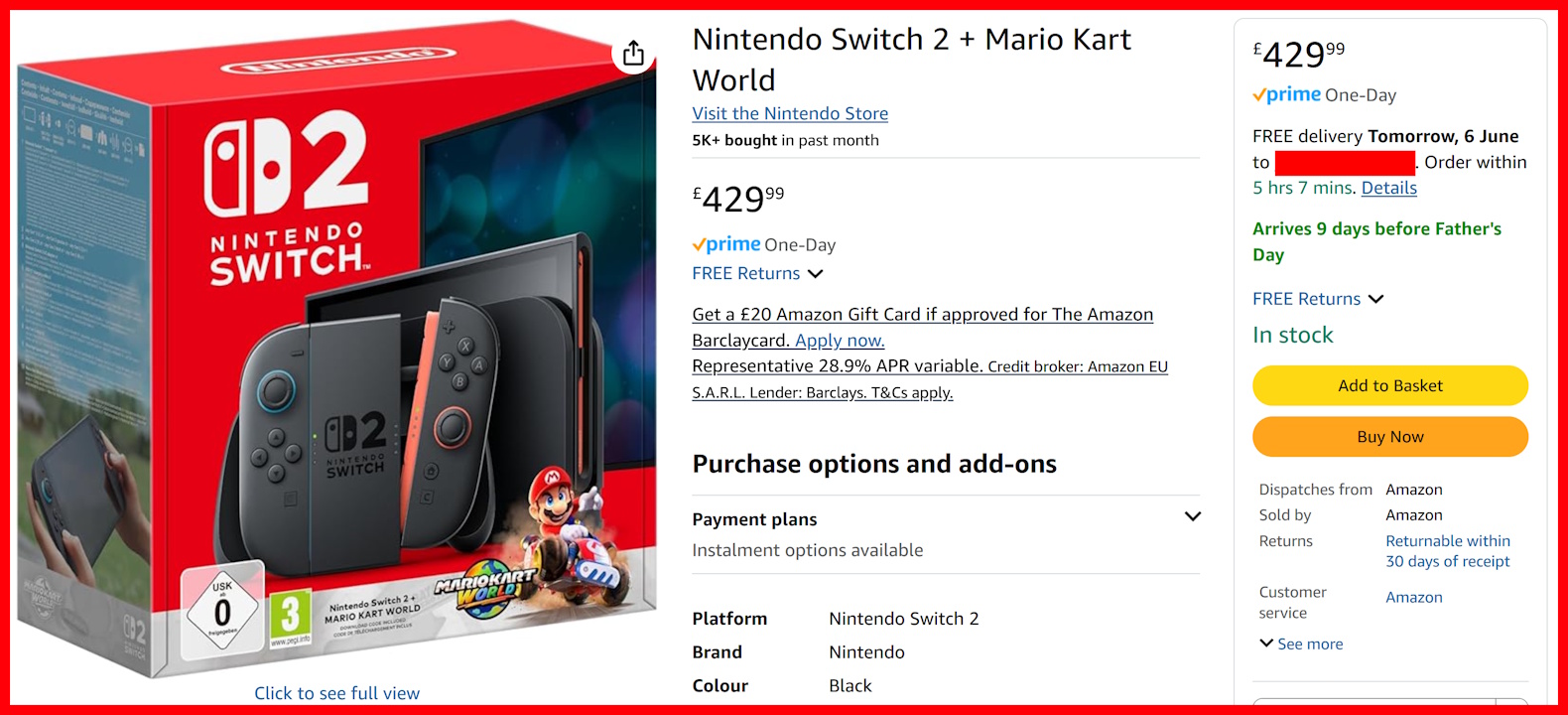
End-of-Year Awards 2023

Spoiler Warning: Beware of minor spoilers for some of the titles below.

Where has all the time gone? We’re just hours away from the end of yet another year – and that can only mean one thing: it’s time for my annual End-of-Year Awards! Today I’ll be handing out some imaginary statuettes to some of the best (and worst) entertainment experiences of the year. I hope it’ll be a bit of fun – and not something to get too worked up over!

As always, I have a couple of important caveats. The first is that I’m just one person – and as such, I didn’t watch every film or play every game that came out this year. Titles have to clear two hurdles to win an award, and the first one is arguably the biggest: they had to convince me to try them out in the first place! I don’t have every hour of the day to dedicate to entertainment, and there are a lot of films, TV shows, and games that were released this year that won’t get a look-in because I didn’t watch or play them. They might be fantastic… but they can’t be included this time for reasons that I hope are obvious!

It’s time to dish out some awards!

Secondly, all of this is my entirely subjective opinion! I’m not trying to claim that these are somehow “objectively” the best entertainment experiences of the year and the only ones deserving of an award! That would be silly – this is just my opinion, and you are free to disagree vehemently with some or all of my choices. I share these made-up awards with the world in that spirit.

I’ve broken down my picks into a few categories and sub-categories, some of which have both a winner and runner-up and some of which just have a winner. I’ll briefly explain what it was that I liked (or didn’t like) about each.

So let’s get started, shall we?

🏆Winner🏆
Now and Then – The Last Beatles Song

Published on YouTube at the beginning of November, this twelve-minute short documentary provided a fascinating look at the complicated production of Now and Then – a song featuring performances by all four members of The Beatles. Billed as “the last Beatles song,” Now and Then reached the number one spot on the charts here in the UK, and learning a bit more about how it came together was genuinely interesting.

Now and Then was a demo recorded by John Lennon at his home some time in the 1970s, but the recording was relatively low-quality and wasn’t deemed suitable for release. In the ’90s, the three surviving Beatles got together, and Now and Then was one of the tracks that they worked on – but again it wasn’t able to be salvaged. It’s only in the last couple of years, with the advent of AI and the ability to isolate and separate various instruments and vocals, that the song was finally ready to be worked on. Performances by John Lennon, George Harrison, Ringo Starr, and Paul McCartney were brought together – and the song was finally released.

🏆Winner🏆
The American Buffalo

I have a review about this in the works – but it’s gotten buried in the pile! Ken Burns is one of my favourite documentary filmmakers, so any new production of his is going to be on my must-watch list! This year, Burns turned his attention to the Bison – or the titular “American Buffalo” – and looked at the history of the species and its near-miraculous survival from the brink of extinction.

Ken Burns and the team at PBS Studios put together a truly engrossing two-part documentary that goes into incredible depth about the history of the species and how humans have interacted with it. It’s a riveting documentary, perfect for anyone interested in the history of the United States, Native American peoples, the “Wild West,” or the titular “buffaloes” themselves.

🥈Runner-Up🥈
Imperial War Museums

It’s been a long time since I was able to visit the Imperial War Museum in London. Despite its offputting name, it’s worth checking out if you’re in the area – as are the Imperial War Museums’ videos on YouTube. I’m a bit of a history buff, and although some of the channel’s content is simplified for an audience who might not be familiar with the subject matter, I still found that there was a lot to learn and plenty of interesting facts in the mix.

Imperial War Museums’ videos are well-presented and explained, and in particular I’d highlight some of the channel’s short documentaries about the First World War from earlier in the year. I didn’t know that the Imperial War Museums had a YouTube channel, but I’m glad I found it. There are some genuinely interesting videos here that are well worth a watch.

🏆Winner🏆
Food Wishes

I honestly can’t believe that in more than four years of writing here on the website I’ve never mentioned Food Wishes! This is one of my favourite YouTube cooking channels – and one of the longest-running series on the entire platform. Chef John began uploading videos to the platform all the way back in January 2007, which is almost seventeen years ago! And perhaps the most astonishing thing about Food Wishes is how little things have changed in all that time.

This year, Chef John has continued making recipe videos. The format is relatively simple, but there’s plenty of humour and fun alongside the instructional recipes. With well over 1,000 videos on the channel, you’d worry that there might be fewer interesting or appealing recipes… but somehow that isn’t the case! There have been some incredibly mouthwatering creations this year, and I look forward to seeing what 2024 has in store for Food Wishes, too.

🏆Winner🏆
Worldwide Privacy Tour
South Park

South Park is one of the entertainment industry’s great equalisers. Its creators poke fun at pretty much everyone, from politicians and celebrities to whole industries and nations. In Worldwide Privacy Tour, Harry and Meghan – better known as the Duke and Duchess of Sussex – were firmly in the crosshairs. And the episode was absolutely hilarious, lampooning the hapless, talentless duo for simultaneously crying about “privacy” while jetting off to California to live as celebrities.

I’m no monarchist. In fact, I’m a small-R republican, which in a British context means that I’m someone who wants to see the outdated and corrupt monarchy abolished. But even I find Harry and Meghan to be grating, at times – even while I’m pleased that some of their statements and escapades are eroding support for an institution I’d like to see the back of. The pair are among the most privileged people on the planet, but they’re also useless hypocrites. Whether it’s lecturing people about climate change before hopping on a private jet, complaining about being bullied while being a serial harasser of servants and staff, or whining about “privacy” while sitting down for an extensive interview and writing a tell-all book, Harry and Meghan deserved everything they got from South Park… and then some.

🏆Winner🏆
The Fall of the House of Usher

It’s relatively rare – in this age of franchises, sequels, and spin-offs – for a big budget to be afforded to a one-off miniseries. Netflix’s The Fall of the House of Usher, which is based on the works of American gothic horror author Edgar Allan Poe, is one of the year’s best examples. I don’t usually go for horror, but with Halloween approaching I decided to give The Fall of the House of Usher a shot – and I’m glad that I did!

The miniseries keeps the tense and disturbing atmosphere of Poe’s stories, but changes many of the characters and plotlines, as well as setting things firmly in the modern day. You might think that there’d end up being a clash, but the production pulls out a surprisingly coherent and entertaining story. There are moments of gore and a handful of jump-scares, but nothing too offputting for someone who isn’t the world’s biggest horror fan.

🥈Runner-Up🥈
Star Trek: Picard
Season 3

For the past few years, Star Trek episodes have been afforded their own category when I’ve dished out my End-of-Year Awards, but as I kind of burned out on the franchise midway through 2023, there are a lot of episodes that I just haven’t seen. Picard’s third season was imperfect, containing a villain who was built up only to be discarded, yet another return of an over-used faction, and a story that felt a bit stretched and occasionally muddled. But it also had some incredibly well-executed emotional moments, and I can’t deny that I enjoyed seeing the crew of the Enterprise-D reunited for another adventure.

In the new year – or at some point in the future, at any rate – I’ll talk about what worked and didn’t work in Season 3 in a bit more detail. Because I have thoughts, don’t you know! But for now, suffice to say that Picard’s third season was one of the highlights of 2023… even if it wasn’t perfect. I’m still holding out hope that there’ll be a new Star Trek series taking place in the time period that Picard established.

🏆Winner🏆
Silo
Season 1

Silo was an impressive sci-fi series with a distinct air of mystery. I particularly enjoyed its subterranean setting, and the idea that the people in the titular silo didn’t know what had happened on the surface, nor why they were forced to live underground. Playing out against that backdrop was an engaging murder mystery, a struggle for power within the confines of a sealed community, and much more besides.

There were several familiar faces in Silo, including Tim Robbins and Will Patton, both of whom excelled. I greatly enjoyed Rebecca Ferguson’s performance in the lead role, too. A second season of Silo is already in production, and I will be eagerly awaiting its arrival in 2024.

🏆Winner🏆
Ladybug and Cat Noir: The Movie

With the major caveat that I haven’t watched Disney’s Wish yet, I want to highlight Ladybug and Cat Noir: The Movie. I don’t think it turned a lot of heads when it was released, but it’s a creditable adaptation of a fairly long-running animated series that offers a new look at its titular heroes. The film could be a great introduction point for someone new to the world of Miraculous, serving less as a reboot than a reimagining of the show and its characters.

The story was easy to follow for younger eyes, but still strong and engaging, and the film had an uplifting message at its core that’s sure to resonate with its intended audience. The idea that anyone can become a hero is always going to be appealing, and the idea of people doing bad things with good – albeit selfish – intentions is likewise important. All in all, a solid film that I enjoyed – and one that I’m sure many kids will, too.

🥈Runner-Up🥈
Barbie

I really wasn’t sure what to expect from Barbie. Director Greta Gerwig had pedigree, with titles like Lady Bird earning her nominations for the top awards. But I really didn’t know what she’d do with the world-famous Barbie name and brand. I’m surprised that Mattel, the makers of Barbie dolls, greenlit a film like this – because Barbie really isn’t a film for kids, despite its name and source material. But I’m glad that the film was able to go ahead, because it was funny and clever; a really unique picture.

I daresay Barbie isn’t for everyone; the film can feel quite subversive, challenging the expectations of its audience in places. But it has an important message – and considering that it’s basically a corporate cash-in on a famous brand, that’s actually pretty great. Margot Robbie is, of course, the film’s star – but I’d also say that Will Ferrell was particularly well-cast as the chief executive of Mattel.

🏆Winner🏆
The Super Mario Bros. Movie

I adored The Super Mario Bros. Movie, and although it might seem like a bit of a silly pick, I’m happy to crown it my favourite film of 2023. The film did such a good job of adapting the familiar world of Nintendo’s Mushroom Kingdom for the big screen, while at the same time putting a nice twist on the tired “save the princess” trope. There were cameos and callbacks to many different things from the video games, and a few new ideas that I’m astonished to see Nintendo has failed to take advantage of!

As a film aimed at kids, the main story here isn’t anything groundbreaking. But what there is is just so much fun and is presented in such a bright, vibrant style that I found it impossible not to smile. The Super Mario Bros. Movie is going to become a textbook example of how to successfully adapt a story for the cinema – so other studios should be taking notes!

🥈Runner-Up🥈
The Lord of the Rings: Gollum

Maybe you were never sold on the idea of playing as the contemptible Gollum, but I’d been following the development of this title for years and felt that it could’ve offered something a bit different. You know the story by now, though: Gollum was released in an unfinished, practically unplayable state, and was shredded by professional critics and players alike. I maintain that the game could have found an audience had it been marketed correctly – and, y’know, finished – but unfortunately it wasn’t to be.

As the video games industry seems to be consolidating around relatively few genres and ongoing franchises, what appealed to me about a title like Gollum was that it seemed to be something different. In terms of narrative and gameplay, its developers had a vision for what they wanted to create, and it seemed like something that could have been fun. Unfortunately, for what seems likely to be a multitude of reasons, Daedalic Entertainment lacked the skill, resources, or money to pull it off.

🏆“Winner”🏆
Star Wars Jedi: Survivor

As with Gollum above, Jedi: Survivor was released in a broken, bug-riddled state. The fact that I struggled to play the game even after waiting for several months and after seeing several major patches roll out is shocking, and the blame lies at the door of publisher Electronic Arts. However… there’s more to the Jedi: Survivor story than just bugs. What I found underneath the buggy veneer was a game that was narratively weak and that failed to live up to its illustrious predecessor.

I won’t say too much lest I spoil Jedi: Survivor’s story for you, but suffice to say a major plot point in the game’s narrative felt ridiculously obvious and seemed to be telegraphed from almost the first moment. The return of a major character from the first game was handled poorly, and while I liked some of the customisation options for protagonist Cal Kestis, the amount of these and the way they were unlocked felt ridiculously unbalanced. An open-world setting did not suit Jedi: Survivor, and the game was notably worse for trying to go down this route.

🏆“Winner”🏆
Hogwarts Legacy

I was surprised at the number of people who outed themselves as being what I shall generously call “fairweather allies” to the LGBT+ community over Hogwarts Legacy. The game is, by all accounts, a bog-standard open-world affair with a fairly uninspired main story, boring side missions, and a map outside of the main Hogwarts castle that just screams “generic.” The fact that the game is nowhere on anyone’s “game of the year” lists speaks volumes; Hogwarts Legacy turned out to be forgettable fluff.

Which makes it all the more sad and upsetting that people ended friendships and got into massive online arguments over this game. Hogwarts Legacy was not worth the hassle, the hurt, or the destruction that it caused. I don’t agree with the “hot take” that says that anyone who played or bought the game is automatically a transphobe – even though the Harry Potter series’ creator has said, on the record, that she considers sales of the game and all other merchandise as being acceptance and agreement with her transphobic views. But for the folks who chose to die on this hill earlier in the year, and who prioritised such a mediocre game over allyship and friendships… I hope it was worth it.

🏆Winner🏆
Civilization VI

I’ve played quite a bit of Civilization VI this year – thanks in part to the game’s ongoing support and the addition of new leaders. It’s been fun to jump back into the game and find several new factions and leaders to both play as and play against, as well as other updates. Although I’ve played Civilization VI on and off since its launch back in 2016, the game can still surprise me – and there are still plenty of Steam achievements that I’m yet to unlock! I finally managed to win a religious victory this year, though, so I can cross that one off my list!

In addition to new leaders, some of Civilization VI’s updates have introduced climate change mechanics and rising sea levels, as well as imaginary near-future technologies and government types. These are a blast, and stomping a city with a Giant Death Robot that I’ve named “The Danger Roomba” will never not be fun! Civilization VI can be expensive to pick up, and I’m always wary about recommending a game with £100+ of DLC and expansion packs. But for the amount of enjoyment it’s given me this year, I couldn’t leave Civilization VI out.

🏆Winner🏆
Cyberpunk 2077

A little over a year ago, in early December 2022, I said that Cyberpunk 2077 was a fairly average, unremarkable game that was elevated slightly by a solid story. I felt that the game’s bug-riddled launch actually distracted from its real mechanical flaws – and in a perverse way, that probably helped CD Projekt Red. But a year later, it’s stunning to me just how many of my complaints have been fixed! To coincide with Phantom Liberty, the game’s first and only expansion pack, a major update was released that completely reworked entire gameplay mechanics and systems, improving the game dramatically.

A review of Phantom Liberty is still a ways off, but I hope you’ll stay tuned for my full thoughts sometime in the new year. For now, suffice to say that Cyberpunk 2077 is much closer to that original vision, and a far, far better game than it was a mere twelve months ago. The transformation may seem subtle at first, but when you start levelling up your character and getting into combat encounters, you’ll see a huge difference.

🏆Winner🏆
Baldur’s Gate 3

If you’re a regular reader, you’ll have seen this coming from a mile away! Baldur’s Gate 3 is an absolutely fantastic game, one of the best I’ve played in years. And to think I only bought it because I was looking for something to play while waiting for Starfield! I had no idea what I was getting into, because I’ve never played Dungeons and Dragons, but I ended up having a whale of a time. The game has an incredibly strong story with some great characters – and fantastic voice acting – but it’s a mechanical masterpiece, too. There are weapons and spells galore, and so many choices to make that really do make each playthrough feel unique.

I’m about to kick off a second run through the game – after delaying it for a while – and I’m really looking forward to creating a completely different character and trying new things. There are two large chunks of the map that I didn’t explore last time around, characters and companions that I didn’t get to meet, and so much to get stuck into that it’ll feel almost like a brand-new game all over again. A thoroughly deserved win for one of the best games of the last few years.

Did your favourite win a trophy?

I sincerely hope that you’ll join me for more reviews and commentary in the new year – because I’m sure there’ll be plenty of fun things to talk about in 2024!

2023 has been a solid year, entertainment-wise. The disruption of the pandemic seems to be settling down, and we got some decent films, decent games, and decent TV shows to get stuck into. I didn’t get around to seeing or playing all of them… but there’s always next year, right?

What does next year have in store?

Hopefully these awards have been a bit of fun. I enjoy putting these together once a year, and I think it’s important to show off some of the best and most enjoyable titles of the year. We won’t always agree on which ones should win an award… but that’s okay. There should be plenty of room for polite discussion and disagreement – and it’s in that spirit that I share my choices.

Whatever you’re doing for New Year’s Eve, I hope you have a fun (and safe) time ringing in 2024. I’ve bought myself a suitably silly New Year-themed hat that I shall be donning… as I hang out with the cats and possibly watch some of the fireworks on TV! To those of you who’ve been regular readers all year long, thank you for sticking with me! And I look forward to sharing my thoughts with all of you once more in 2024.

Happy New Year!

All titles listed above are the copyright of their respective studio, publisher, broadcaster, distributor, etc. This article contains the thoughts and opinions of one person only and is not intended to cause any offence.
Some great holiday sale deals for PC gamers

Spoiler Warning: Beware of minor spoilers for some of the games on this list.

It’s that time of year again! As I do every year, I’ve picked out a handful of discounts on Steam and the Epic Games Store that I think are worth taking a look at! Getting started with a gaming PC can be expensive – but if you reckon that you can often get relatively new games at a steep discount at least twice a year on platforms like Steam, it can be worth it in the long run. That’s my justification, at any rate!

I’ve picked twenty games that I think represent great value now that they’re on sale, and this year I’ve gone for a mix of up-to-date and older titles. I’ve personally played most of the games listed below; one or two are titles I’m less familiar with or aren’t necessarily “my thing,” but I’m happy to add into consideration for one reason or another.

A fancy gaming PC.

Now for the important bit!

All prices are listed below in GBP and were correct at time of writing. These sales end in early January, at which point this list will no longer be accurate. Prices and discounts may vary depending on where you are in the world. And I’m sure there’s some legalese about refunds, price changes, and the like.

As always, everything we’re talking about today is the wholly subjective opinion of one person only. If you hate all of my suggestions, or if I exclude games that you think are the best of the best, that’s okay! We’re all entitled to our opinions, and I share this list with you in that spirit.

Let’s get into the deals!

Deal #1:
Starfield
Steam: 30% discount, £41.99

For one of the biggest releases of the year – on PC and Xbox, at any rate – Starfield’s discount feels pretty generous. The game only launched in late August, so to get such a steep reduction after a mere four months makes it well worth considering. Personally, I have mixed feelings about the game itself. Starfield is a big game with a lot of things going on, and some experiences – like building my own spaceship – were definitely fun! But there are also limitations to be aware of; this isn’t Bethesda’s magnum opus by any means.

Still, when it’s on sale I’m happy to recommend Starfield. It could be worth picking it up now, while it’s discounted, and then waiting to see how the promised updates and patches add to and hopefully improve it in 2024. I put Starfield down a while ago (and I’ve actually uninstalled it already), but I’d love to be able to return to it in the future.

Deal #2:
Civilization VI (Platinum Edition Bundle)
Steam: 91% discount, £13.49

The base version of Civilization VI is a mere £4.99 in the current sale, but for less than a tenner more you’ll get all of the DLC, too. I think it’s worth it – especially when you consider that Civilization VI would cost over £100 to buy in full at any other time of year! This is one of my most-played games of the last few years… I’ve literally sunk over 500 hours into it!

Civilization VI is a turn-based strategy title; a digital board game played on random maps. There are a growing number of empires and leaders to choose from, each of which have unique bonuses and play styles. Every single game is different, and even though Civilization VI is now more than seven years old, DLC and updates have continually refreshed it.

Deal #3:
Elden Ring
Steam: 40% discount, £29.99

Elden Ring is categorically not “my thing.” Souls-like games, with their deliberately punishing difficulty, are just not enjoyable – or even playable – for me… but the overwhelming consensus is that Elden Ring is one of the sub-genre’s all-time greats. Many players picked it as their “game of the year” in 2022, so to get it at a reasonably steep discount just a year later feels pretty generous!

I can’t tell you much more about the game, really… but if you decide to give it a go, I hope you have as much fun as everyone else! I’ll be sitting this one out, but I can appreciate Elden Ring from afar.

Deal #4:
Red Dead Redemption II
Steam/Epic Games: 67% discount, £19.79

Speaking of games that are considered to be masterpieces, Red Dead Redemption II is on sale, too! Rockstar – the developers of the Grand Theft Auto series – took their signature open-world formula to the late 19th Century, and what results is one of the best games I’ve ever played. Red Dead Redemption II is intense, detailed, emotional, and incredibly fun to play.

With Grand Theft Auto VI still a ways off – and even further away, perhaps, for those of us who play on PC – Red Dead Redemption II could be a great substitute! If you haven’t played it yet it’s incredibly easy to recommend, and if you have… why not go around again?

Deal #5:
Kena: Bridge of Spirits
Steam: 60% discount, £12.79

Kena: Bridge of Spirits was my pick for game of the year in 2021, and for good reason! The 3D platformer is fantastic – and deceptively simple. Its story was incredible to follow, and the game was visually beautiful – feeling almost like something you’d expect to see from a Walt Disney film. More than once I found myself just staring at a stunning landscape or vista, almost in awe of how incredible the game looks.

In some ways, Kena: Bridge of Spirits also felt like a throwback to an older style of video game. There are puzzles to solve, 3D platforming elements to challenge you, and at practically every step of the way there’s something to do or watch out for! Narratively, visually, and mechanically, Kena: Bridge of Spirits absolutely excels. For such a low price it feels like a steal – but be sure to pick it up on Steam this year, as it isn’t discounted on the Epic Games Store for some reason.

Deal #6:
The Lord of the Rings: Return to Moria
Epic Games: 50% discount, £15.84

It hasn’t been the best year for Lord of the Rings in the video game realm. The less said about Gollum the better… but maybe Return to Moria will be the series’ saving grace! For a game that’s only been out for a couple of months, a 50% discount may seem generous – and may speak to the game’s less-than-perfect reception in some quarters. For my money, though, if you set appropriate expectations I think there’s enough going on in Return to Moria to have a good time.

Return to Moria stars the dwarves – and features a pretty basic character creator. There’s base-building, mining, crafting, and most of the things you’d expect from a game that bills itself as a survival title. The addition of online multiplayer could make this a fun one to play with a buddy, and perhaps the addition of friends would improve the experience. Maybe it isn’t the perfect game – but there’s still fun to be had here, especially at this price point.

Deal #7:
Ryse: Son of Rome
Steam: 65% discount, £2.79

For less than the price of a coffee, Ryse: Son of Rome is incredibly easy to recommend! I paid full-price for the game the day it was released; it was my first purchase for my brand-new Xbox One console. And although Ryse is a relatively short experience, clocking in at around six hours, I had fun with it. At the time I was mostly concerned with its jaw-dropping visuals; graphical fidelity that really highlighted the strengths of what was a new console generation. But there’s a decent story to follow, too, as well as some fun hack-and-slash gameplay.

I took a more detailed look at Ryse: Son of Rome a few weeks ago to mark the tenth anniversary of its release, and you can find that article by clicking or tapping here. For such a low price, you’ve almost got nothing to lose by giving Ryse a try!

Deal #8:
Return of the Obra Dinn
Steam: 33% discount, £11.22

If you’re looking for a genuinely different experience – visually, narratively, and mechanically – then look no further than Return of the Obra Dinn! The game’s deliberately retro aesthetic helps it stand out from the pack, but that’s just the start. There’s a complex and tragic mystery at the heart of Return of the Obra Dinn, and it plays out in absolutely phenomenal style.

The game’s art style will either grab you or turn you off completely – but I’d encourage you to push through if you fall into the latter camp. It’s a gimmick, for sure… but it’s one that works remarkably well. Return of the Obra Dinn wouldn’t be the same without it.

Deal #9:
SnowRunner
Steam/Epic Games: 50% discount, £12.49

Aside from its predecessor MudRunner – and upcoming sequel Expeditions – there really isn’t anything quite like SnowRunner! It’s an off-road driving simulation, with trucks and four-wheel-drive vehicles to climb behind the wheel of. There’s a realistic representation of mud and, of course, snow – with vehicles getting bogged down and stuck. Off-road driving in a lot of open-world and even racing games can be way too smooth; SnowRunner is completely different, and driving can be a real challenge!

Most of us aren’t going to go off-roading in a jeep, let alone ever drive a big truck in difficult conditions, so this game offers a unique experience – while at the same time respecting the real-world truckers and drivers who keep society functioning! It’s a blast to get stuck into – literally. And SnowRunner is also a very appropriate game for this time of year!

Deal #10:
Banished
Steam: 66% discount, £5.09

Banished has become a mainstay of my lists here on the website; I hardly ever miss an opportunity to recommend it! Banished is a deceptively simple town-building game, and it’s a ton of fun. It’s one of those games that feels really easy to get started with… but that’s very difficult to master at the same time. There aren’t a huge number of buildings, nor jobs for citizens… but striking the right balance to keep everyone fed, healthy, happy, and warm is no mean feat!

I always have to point out that Banished was created by a solo developer. That absolutely blows my mind – because the game is so good that I’d be including it on a list like this even if it’d been created by an entire studio! I have a longer piece about Banished, and you can find it by clicking or tapping here if you’d like to read more.

Deal #11:
Cyberpunk 2077 (Ultimate Edition)
Steam: 43% discount, £42.53

This time last year, I didn’t expect I’d ever be in a position where I could recommend Cyberpunk 2077 to anyone in good conscience! The game’s appalling launch and borderline-unplayable state gave way to a title that was just… pretty average, to be honest. Average in some respects and outdated in others. But then along came the 2.0 update and Phantom Liberty – the first (and supposedly only) major expansion pack.

Most of the mechanical complaints that I had about Cyberpunk 2077, from armour and clothing to police spawning and levelling up, have been fixed, and the addition of a new storyline is fantastic to boot. Best pick this one up on Steam, though, because it’s another case of Epic Games not offering the same discount for some reason.

Deal #12:
Star Trek: Resurgence
Epic Games: 40% discount, £19.01

Regrettably, I didn’t get around to trying Star Trek: Resurgence for myself this year. I’ve been feeling a bit burned out on the Star Trek franchise in general for the past few months, so that’s partly why. But according to reviews and anecdotal evidence from friends and fellow Trekkies, it’s a great game for fans of the long-running sci-fi franchise. A narrative experience with a strong story in which choices genuinely matter, Resurgence has definitely picked up some positive buzz.

The game was developed by several people who used to work at Telltale Games – the studio behind popular titles like The Wolf Among Us and The Walking Dead – so Resurgence has some pedigree! This is a title I shall be picking up while it’s on sale… and I hope to get stuck into it in the new year!

Deal #13:
Gylt
Steam: 50% discount, £8.49

When it was first released, Gylt was one of the only titles that was exclusive to Stadia. You remember Stadia, right? Google’s short-lived foray into gaming? Not ringing any bells, is it?

Anyway! Gylt is a surprisingly charming and frightening action-horror-puzzle game in which the protagonist – a young child – must navigate a nightmarish realm while searching for her missing cousin. Seeing things through a younger person’s eyes completely reframes them, and Gylt really nails this aspect of gameplay, giving everything a larger-than-life and unsettling vibe. I’m not usually one for horror titles, but I made an exception for Gylt.

Deal #14:
Monkey Island Collection
Steam: 59% discount, £20.37

The Monkey Island games are a ton of fun – and the way they’re presented in their remastered form brings them up-to-date. I had a blast playing the first two games in the series in the early 1990s on my first-ever PC – and revisiting them in a new art style decades later was certainly an interesting experience!

The first two games in particular hold a lot of nostalgia for me personally, but the third game (out of a total of five, now) might realistically be the series’ high-water mark. A thrilling pirate adventure awaits ye, should ye choose to venture to Monkey Island!

Deal #15:
Lego Star Wars: The Skywalker Saga
Steam/Epic Games: 80% discount, £7.99

If you enjoyed playing the Lego Star Wars games (or any other Lego game, come to that) during the Xbox 360 era, The Skywalker Saga is basically more of the same – but shinier! I had a blast with it when it finally launched after several long delays, and while nothing about it feels revolutionary or groundbreaking… it’s perfectly fine for what it is. You know what you’re getting into with a Lego Star Wars game, and The Skywalker Saga is exactly what you’d expect.

I’m not wild about the “character packs” that are sold separately, but I would say that the base game provides plenty of characters to play with and a lot of content. All nine mainline Star Wars films are represented in the game, and characters from all three of the cinematic franchise’s main eras are present. It’s a bit of silly fun, so if you have younger kids or someone to play with on the couch, it’s an easy recommendation!

Deal #16:
Jade Empire: Special Edition
Steam: 75% discount, £3.74

In between Knights of the Old Republic and Mass Effect, BioWare developed this underappreciated game! It follows the standard BioWare formula, but it’s set in a world loosely based on China – full of magic and martial arts. I played the game on the original Xbox – where it was a console exclusive – and I was thrilled to see it available on Steam a few years ago.

For such a low price you’re getting a full BioWare role-playing game complete with fun and engaging characters, a story of revenge, and a unique setting. I’d love to see a full-blown remaster of Jade Empire one day… but for now, this version is still perfectly enjoyable.

Deal #17:
Forza Horizon 5
Steam: 50% discount, £24.99

I had a blast playing Forza Horizon 5. The Horizon series is the less-serious, more arcadey cousin to Forza Motorsport, Microsoft and Xbox’s flagship racing series. And it’s a ton of fun with hundreds of cars to choose from, a massive open world to drive across in between races, and so many different kinds of races from supercars on racetracks to off-road buggies in the jungle.

Forza Horizon 5 has a really positive and almost uplifting tone to it, one that really goes out of its way to celebrate the different cars on offer. And there really are a lot to choose from! It’s a delightful racing game – and after the disappointment of this year’s Forza Motorsport having so few racetracks, Forza Horizon 5 feels even better by comparison!

Deal #18:
Halo: The Master Chief Collection
Steam: 75% discount, £8.49

The Master Chief Collection gives you the first six Halo titles in one package – and I think it’s great value. I’m more interested in the single-player campaigns – though I enjoyed the first two games for their multiplayer on the original Xbox – but there’s a bustling online multiplayer scene if you’re more interested in that side of Halo.

The consensus seems to be that Halo has gone off the rails with its more recent offerings, so stepping back in time to re-play the first entries in the series might be the best way to enjoy it! The games are all fun, fluid, and fast-paced first-person shooters in an original sci-fi setting. If you’ve been sleeping on Halo, now could be the time to give it a shot.

Deal #19:
Control: Ultimate Edition
Steam: 75% discount, £8.74

I didn’t really know what to expect when I booted up Control for the first time – but I had an absolute blast with its eerie setting and mysterious tone. Control is also one of the most accessible games I’ve ever played, with a ton of different features that ensure the game can be played by people with disabilities and health issues. Speaking as a disabled person, I really appreciated that!

Control has a compelling story, as protagonist Jesse searches for her long-lost brother. The human side of the story kept it grounded even as supernatural shenanigans played out, and that was handled particularly well. I enjoyed exploring the game’s world – what seemed, at first, to be a fairly plain office building held a lot of secrets and surprises!

Deal #20:
Command & Conquer: Remastered Collection
Steam: 75% discount, £4.49

Command & Conquer and Red Alert were great games in the mid-90s – titles that helped to define and popularise the real-time strategy genre. I had great fun playing them at the time – so welcoming them back, in this remastered form, has been wonderful! I was always more a fan of Red Alert than Command & Conquer; I think its factions and setting being based more on the real world is part of the reason why. But both titles are present here.

In their remastered forms, Command & Conquer and Red Alert are well worth playing for anyone who missed them first time around! Not only will you be picking up a piece of gaming history, but you’ll be getting two real-time strategy games that are well worth playing in their own rights, too.

So that’s it for 2023!

Merry Christmas – and Happy Holidays!

Christmas Day is getting closer by the hour, so I hope you’ve done all your shopping! If you get a Steam or Epic Games gift card from a certain jolly man in a red suit, perhaps I’ve given you an idea or two for how to spend it. If not, I hope this has been a fun look at a few games that I like or that I think might be worth your time. There are plenty of titles on sale at the moment, and I tried to pick out a selection of mostly single-player titles – because that’s how I like to play – across a few different genres.

I made one deliberate exclusion from this list that I want to briefly address: Baldur’s Gate 3. Technically the game is on sale on Steam, but I felt that its 10% discount – while generous for a brand-new game that’s just won a bunch of the top awards – wasn’t big enough to warrant being included this time. But if you want to pick it up at a slight discount, it’s my pick for game of the year and I can’t recommend it enough!

So that’s all for now. There will be more to come before the new year, though – including my annual end-of-year awards! I hope you’ll stay tuned for that in the days to come. Take care – and Merry Christmas!

All titles listed above are the copyright of their respective studio, developer, and/or publisher. Some screenshots and promotional artwork courtesy of IGDB. This article contains the thoughts and opinions of one person only and is not intended to cause any offence.
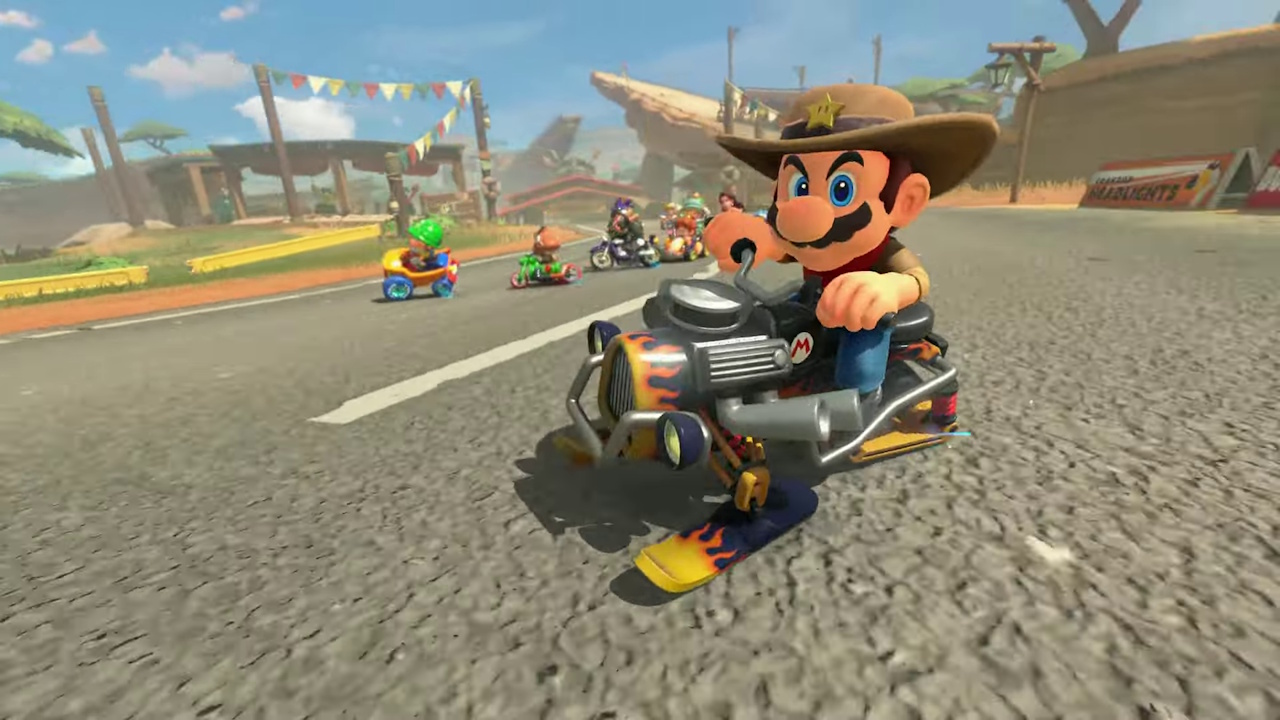
Ten Games To Play While You Wait For GTA 6

Spoiler Warning: Minor spoilers may be present for some of the games on this list.

The recent trailer for Grand Theft Auto 6 has got a lot of gamers salivating! We really ought to try and avoid boarding the hype train, but with Grand Theft Auto 6 being the long-overdue sequel to the most successful and profitable video game of all-time, a bit of excitement is understandable! However, the game won’t launch until sometime in 2025 – and probably even later for PC players like me, unfortunately – so until then we’re all facing a dilemma: what should we play?

I’ve picked out ten games that I think could be fun substitutes for Grand Theft Auto 6. I’ve tried to avoid the most obvious pick: Grand Theft Auto V! But I’ve selected games in the same open-world space, with comparable driving and third-person action gameplay, or with a focus on crime and criminality. There are bound to be hundreds of “what to play before GTA 6” lists floating around… so you may have seen some of these ideas already. But maybe – just maybe – there’ll be something a bit different in the mix this time!

A screenshot from the Grand Theft Auto 6 trailer showing the fictional Vice City from above after sunset.
Vice City after dark.

As always, this list is the entirely subjective opinion of one person only! If you hate all of my ideas, think they’re too obvious, or you’ve seen a far better selection of games elsewhere – that’s okay! There’s no need to take anything too personally or get into an argument.

I’ve already shared my thoughts on the recent trailer for Grand Theft Auto 6, and you can find that article by clicking or tapping here.

With all of that out of the way, let’s get started!

Game #1:
Saints Row 2 (2008)

Promotional screenshot of Saints Row 2 featuring a character firing a handgun.
Running and gunning!

For me, Saints Row 2 is where the series managed to strike the right balance between being a pure “GTA-clone” and the utter silliness and wackiness that would come to define its later entries. There was an attempt to reboot the Saints Row series earlier this year, but unfortunately it wasn’t well-received so I can’t recommend it. But if you don’t mind stepping back to the Xbox 360 era, Saints Row 2 could scratch that open-world crime itch!

Saints Row 2 is comparable to Grand Theft Auto 4 in terms of graphics and gameplay – but with a less-realistic physics engine that seemed (to me, anyway) to make driving a bit more arcadey and fun. It also has a bit more of a grounded story when contrasted with later Saints Row games – there’s no visiting Hell or battling aliens from outer space in this one. There’s an open-world city to cruise around, cars to jack, missions to get stuck into, and basically all of the Grand Theft Auto trappings with a less-illustrious name attached. It was great fun in 2008 – and although I haven’t played it in a while, it’s still a game I heartily recommend!

Game #2:
Sleeping Dogs: Definitive Edition (2012; 2014)

Promotional screenshot of Sleeping Dogs showing protagonist Wei Shen holding a shotgun.
Wei Shen in Hong Kong.

Sleeping Dogs takes the Grand Theft Auto formula but puts two very distinctive spins on it. Firstly, the player character is a cop, not a criminal – albeit an undercover cop who seems to have no qualms about breaking a few laws! And secondly, the game is set in Hong Kong, not the United States. Both of these elements help it stand out from other open-world crime games!

You’ll occasionally hear Sleeping Dogs discussed in conversations about underrated games – and rightly so! It’s a fantastic title that was criminally under-appreciated when it was released. The game’s underwhelming sales at launch led to the cancellation of a potential sequel – but Sleeping Dogs is still a fantastic standalone experience. If you play on PC, the game is frequently available at a steep discount during Steam sales, and with the winter sale coming up soon, you might be able to pick it up for less than the price of a coffee. Surely it’s worth a shot for a few pounds or dollars!

Game #3:
Expeditions: A Mudrunner Game (2024)

A promotional screenshot of Expeditions: A Mudrunner Game showing first-person driving.
Driving up-river!

You won’t have to wait too long for this sequel to Mudrunner and Snowrunner; it’s due for release in March. I’ve had a surprisingly fun time with Saber Interactive’s off-road vehicle simulation games, so if the driving side of Grand Theft Auto is what you liked the most, I’d happily recommend all three. If you’re sick of racing games and are looking for a different kind of vehicular challenge, Mudrunner, Snowrunner, and the upcoming Expeditions could be just what the doctor ordered!

Snowrunner has several large open maps and plenty of vehicles to choose from – and the off-road part of the driving simulation is really the focus of the game. I expect Expeditions will do something similar – but according to the developers, it’ll also be adding new features like a recon drone, metal detector, and of course, new vehicles!

Game #4:
Red Dead Redemption II (2018)

Promo screenshot of Red Dead Redemption II featuring protagonist Arthur Morgan and a horse.
Howdy, partner!

Alright, I suppose we couldn’t put together a list like this without talking about Rockstar’s most recent title! Red Dead Redemption II is, in my humble opinion, Rockstar’s magnum opus – and one of the most incredible video games ever made. If you haven’t played it… what are you waiting for? I’ve only played it once, and I’m seriously considering going around for a second playthrough sometime soon.

Red Dead Redemption II takes Rockstar’s open-world formula to the 19th Century, with an incredible map based on parts of the American midwest, the Rocky Mountains, the Deep South, and more. The single-player campaign features one of the best stories ever told in a video game, with incredible characters and an intense, deeply emotional narrative. I can understand being put off by the time period if you’re craving a game set in the modern day… but give it a shot, especially if you can find it at a discount. I really don’t think you’ll be disappointed!

Game #5:
Crime Boss: Rockay City (2023)

Promotional screenshot of Crime Boss: Rockay City featuring Chuck Norris' character.
Outer space exists because it’s afraid to be on the same planet as Chuck Norris.

I’d argue that Crime Boss: Rockay City was unfairly criticised upon release by folks who’d either over-hyped it or had set the wrong expectations. If you go into it expecting a first-person Grand Theft Auto experience with all of the bells and whistles of a Rockstar game… sure, I guess it’s fair to say it comes up short. But if you look at the game for what it is – a fairly straightforward and linear FPS that’s more comparable, in some respects, to the Payday series – there are more than enough charming features to make it worth playing.

Crime Boss: Rockay City has voice acting from the likes of Chuck Norris and Danny Trejo, and its ’90s setting is something a bit nostalgic. The game is also set in a fictional city based on Miami – just like a certain upcoming crime game that we’re all looking forward to! Crime Boss: Rockay City is reasonably priced, and didn’t try to overcharge. That being said, it could well be available at a discount when holiday sales get going this month – so keep an eye on it!

Game #6:
Cyberpunk 2077 + Phantom Liberty (2020; 2023)

A screenshot of Cyberpunk 2077, looking out over an apartment building.
The view from V’s apartment.

As I said recently, I never thought I’d be in a position where I could recommend Cyberpunk 2077 to anyone in good conscience! However, the addition of the game’s big 2.0 update and the Phantom Liberty DLC has been a game-changer – quite literally! Cyberpunk 2077 had been slowly but surely rebuilding its reputation after a disastrous launch three years ago, and by the time I got around to fully playing through it, the worst and most egregious of the bugs and glitches had been fixed. But the 2.0 update and Phantom Liberty have genuinely transformed the experience.

Many of the complaints that I had about Cyberpunk 2077′s gameplay – from the way clothing and armour worked to how police would randomly spawn in Night City – have been addressed and completely fixed, and the addition of a new story campaign has been fantastic, too. I can understand not wanting to play the game or to support a developer who behaved deceitfully – and we should never forget how CD Projekt Red acted in the run-up to the game’s release. But if you haven’t played Cyberpunk 2077 yet… you are honestly missing out on a great story and a fun experience.

Game #7:
Grand Theft Auto: Vice City (2002)

Loading screen art from the game Grand Theft Auto: Vice City featuring protagonist Tommy Vercetti.
Protagonist Tommy Vercetti.

Is this one too obvious? With a return to Vice City on the cards in 2025, it could be fun to step back in time to see its first appearance! I really enjoyed Vice City at the time – it felt like a step up from Grand Theft Auto III with a bigger map, more vehicles, and a fully-voiced protagonist. I’d go so far as to say that Vice City’s homage to the likes of Scarface and Miami Vice has me genuinely questioning how well Grand Theft Auto 6 will work when it takes the iconic Miami-inspired city out of the ’80s and into the modern day.

If you grew up on Grand Theft Auto V and other games of that generation, stepping back to Vice City could feel like a downgrade – and I fully appreciate that. But the game has a fun story, and if you can overlook the admittedly outdated graphics and the technological limitations that come with a two-decade-old game, it’s absolutely worth playing. I had a blast with it in 2002 – and knowing that that was more than twenty years ago makes me feel absolutely fucking ancient!

Game #8:
Shenmue I & II (1999; 2001)

Cropped poster of Shenmue I & II.
A promo poster showing some of the games’ characters.

Before Grand Theft Auto III came along, the original Shenmue on the Dreamcast was an early open-world pioneer. In some ways, its world is more detailed than even Grand Theft Auto V’s, with a day-night cycle that actually matters to characters’ schedules, dynamic weather, mini-games, and more. I absolutely adored Shenmue back when I owned a Dreamcast – and I never miss an opportunity to recommend the game to players who might’ve missed it when it was new.

Shenmue tells a compelling story of revenge. Protagonist Ryo Hazuki must track down the man who murdered his father, and his quest takes him from his home town in Japan across the sea to Hong Kong and beyond. It’s a relatively slow-paced game with a lot of dialogue and investigating, but these sections are broken up by intense hand-to-hand combat battles that use a variety of martial arts moves, as well as quick-time events… which Shenmue can claim to have invented. For better or worse! Both games are available in one package, and this could be another one to add to your wishlist and keep an eye on.

Game #9:
Mafia: Definitive Edition (2002; 2020)

A promotional screenshot of Mafia: Definitive Edition featuring a character holding a gun walking past two cars.
Promo screenshot of Mafia: Definitive Edition.

When I first played Mafia on the original Xbox, I thought it was basically going to be “Grand Theft Auto in the ’30s” – but that hardly does it justice. The game – and its two sequels – have been remade from the ground up in recent years, putting to shame Rockstar’s appalling Grand Theft Auto III Trilogy “remaster” from a couple of years ago. Of the three, the original Mafia is probably the title I’d recommend most highly – but the entire trilogy can be picked up as one set.

All of the elements of a Grand Theft Auto game are present, but the ’30s setting and heavy focus on the titular mob makes for a completely different kind of story. Many of the gameplay elements will be familiar, but different and distinct enough to make this open-world crime title stand out from the crowd. I enjoyed the story of Tommy Angelo, a “made man” in the mob, and Mafia: Definitive Edition is an easy game to recommend to any fan of the GTA series.

Game #10:
Baldur’s Gate 3 (2023)

A screenshot of Baldur's Gate 3 showing a dice roll.
Ready to roll some dice?

I know, I know: this one’s a bit “out there,” as Baldur’s Gate 3 seems to have very little in common with the Grand Theft Auto series. It’s a completely different style of game – but as players, we’re willing and able to try out new experiences, right? If you’re at all interested in games with incredibly strong and compelling narratives, give Baldur’s Gate 3 a chance to show you why it’s my “game of the year.”

A turn-based role-playing game with a branching storyline, incredibly fun characters, and one of the best character creators I’ve ever seen, Baldur’s Gate 3 seemed to come out of nowhere this year and completely blew me away. I had an absolute blast playing it this summer and autumn, and even after sinking more than eighty-five hours into a single playthrough, there are characters I haven’t met, whole areas of the map that I missed and didn’t explore, and so much more to try! I really need to start that second playthrough sometime soon!

So that’s it!

A screenshot from the Grand Theft Auto 6 trailer showing characters on a beach during the day time.
Characters on the beach as seen in the Grand Theft Auto 6 trailer.

We’ve taken a look at ten games to play while you wait for Grand Theft Auto 6. I hope I managed to pick one or two that you might not have been expecting! I’m sure I’m not the only one putting together lists or compilations like this one; there’s a lot of buzz around the next Grand Theft Auto title, and people are definitely going to be looking around for comparable experiences in the meantime. If I helped even one person find one game to try, then I’ve done my job and contributed something positive to the discussion!

Because I play on PC – and because Rockstar, despite its insane financial resources, is cheaping out on Grand Theft Auto 6′s PC release – it might be 2026 or even 2027 before I’ll be able to get my hands on it. I might not live that long… but if I do, I hope you’ll swing by Trekking with Dennis for a review! If there’s significant news about the game between now and then, I’ll do my best to cover it and discuss it here on the website. And if you missed it, you can find everything I had to say about the December 2023 trailer by clicking or tapping here.

Have fun out there – and happy gaming!

Grand Theft Auto 6 is currently in development and will be released on PlayStation 5 and Xbox Series S/X in 2025. No PC release date has been set. All titles discussed above are the copyright of their respective studio, developer, and/or publisher. Some promotional screenshots courtesy of IGDB. This article contains the thoughts and opinions of one person only and is not intended to cause any offence.
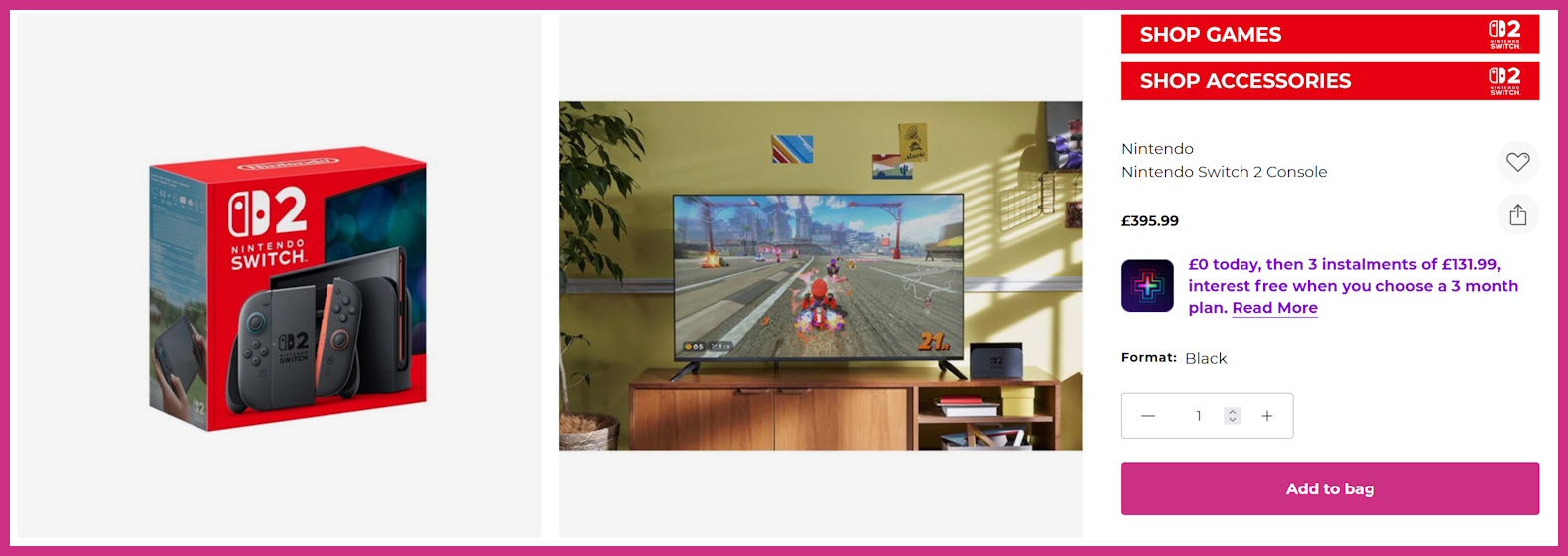
The Game “Awards” – Please Wrap It Up

If you missed it, the so-called Game “Awards” was broadcast a few days ago. I don’t usually pay a lot of attention to the event – I have my own End-of-Year Awards to prepare for, after all! – but one particularly striking image has come out of the highly-commercial event, and I wanted to share my two cents.

Overshadowing the awards ceremony itself, and even many of the award winners, was a simple phrase that was shown on a massive prompt facing the stage: “Please Wrap It Up.” After being given as little as thirty seconds to speak upon receiving an award, the message would be displayed to developers and award-winners – before music would begin to play and they’d be ushered off-stage. Out of the entire three-hour broadcast, barely ten minutes was given to the award-winners themselves – who are, surely, supposed to be the stars of any awards ceremony. The rest of the time was dedicated to advertisements, trailers, speeches by the presenters, and even musical acts. Some awards weren’t even presented at all, being skipped over in a mere couple of seconds.

The now-infamous sign.

I’m far from the only person to have noticed this, and that’s surely because the Game “Awards” has become incredibly unbalanced. By prioritising trailers and presenters plugging upcoming games live on stage over the actual awards, the Game “Awards” is in danger of losing its audience. People turned up hoping to see their favourite titles of the year being honoured, not ushered off-stage after thirty seconds to make way for an incoherent ramble from an overhyped developer about his latest (completely unseen) title. Yes, I’m talking about Hideo Kojima. Or to make way for yet another trailer or commercial – practically all of which, this year, were entirely CGI creations that didn’t show any gameplay.

There’s a line to walk here. I think a lot of folks would agree that the likes of the Academy Awards and Golden Globes, which honour the best films of the year, can be pretentious and can feel like an industry congratulating itself and inflating the egos of its stars a little too much. Fewer and fewer people pay attention to the Oscars and Golden Globes as a result; those broadcasts have been losing viewers by the boatload over the past few years.

Nicolas Cage at the 1997 Oscars.

But would more people tune in to the Oscars if half of the awards weren’t presented on-screen, actors and directors were given less time to speak, and the broadcast was overstuffed with adverts and trailers? I mean, more than half of the Game “Awards” three-hour presentation consisted of trailers and adverts. That seems excessive, and there has got to be a way to strike a better balance.

The creators and producers of the Game “Awards” are trying to frame the event as video gaming’s equivalent to the Oscars or the Golden Globes… but if the games industry wants that kind of prestige, the ceremony has to be handled better. Right now, it’s an overblown advertisement – worse, somehow, than the likes of E3, because at least with E3 I knew from the start what I was getting into. The Game “Awards,” by putting its emphasis on the statuettes it plans to hand out, feels deliberately dishonest in its marketing. But at least it has that in common, rather ironically, with many of the video games it advertises.

Look, it’s a new Jurassic Park game!

It feels incredibly disrespectful to developers to invite them to a fancy ceremony under the guise of potentially receiving an award – only to then give them in some cases literally no time whatsoever on the stage to accept that award. If these awards are, as the organisers would like you to believe, the most prestigious in the industry… shouldn’t they want to see people receiving them? Shouldn’t that part of the broadcast be the biggest deal? After all, if receiving a Game Award is so unimportant that it’s relegated to a footnote in its own live presentation, why should anyone give a shit about who the winners or nominees are? If the titular trophies are so meaningless to the Game “Awards” itself… what’s the point?

I don’t like to throw the word “scam” around lightly; I think too many people do that these days, leading to the word’s impact and severity being diminished. But if you entice audiences to turn up to your event under false pretences… we’re definitely getting close to “scam” territory. The Game “Awards” pretends to be an Oscars-style ceremony with fancy suits and statuettes, then it flips the script on viewers and shows them basically two-plus hours of ads and barely ten minutes of actual award-winners. What else can we call such duplicity?

Geoff Keighly, principal organiser and presenter of the Game “Awards.”

Maybe some folks like tuning in to watch the trailers – and that’s okay. I like a good trailer as much as the next person, and it can be fun to look ahead to games that we might hope to enjoy in the months and years to come. Some of these trailers can be well-made, with creative visual effects, great soundtracks, celebrity endorsements, and much more. But that isn’t the point I’m making. If I choose to watch ads and trailers, that’s up to me and I can do that all I want. But if the Game “Awards” pretends to be an awards ceremony just to trick me into watching two hours of ads… well, I don’t appreciate that.

And let’s be honest: that’s exactly what’s happening here. The organisers of the Game “Awards” would ditch the statuettes in a heartbeat and make the entire event nothing but trailers, celebrities, and advertisements if they could get away with it. They don’t give the tiniest of shits about handing out awards or honouring the best and most creative titles of the year – all they care about is selling more and more advertising space and making a metric fuckton of cash, and they’ve done that by diminishing and minimising the actual awards portion of the broadcast so much that it feels like a footnote.

Baldur’s Gate 3 won “game of the year.”

So what’s the solution? I don’t really have one, if I’m honest. Maybe the complaints received about the “Please Wrap It Up” screen will prompt some minor changes, and perhaps for the next year or two you might see award recipients being given sixty or perhaps even ninety seconds to speak. But sooner or later the desperation to grab as much cash as possible will overwhelm the Game “Awards” organisers once again, and the excessive ad-to-award ratio will be back.

The only thing we can do, as consumers in this marketplace, is register our disapproval. Don’t tune in to the next Game “Awards” and let the organisers know that we care as little about their made-up trophies as they seem to. If fewer and fewer people tune in, and make it clear that the reason we aren’t bothering to watch is because of how unbalanced the broadcast is in favour of trailers and ads, maybe the message will get through. As we’ve seen with the collapse of E3, no event in gaming is sacred or safe – they rely on our viewership and patronage to remain relevant.

I won’t bother watching another Game “Awards,” because what’s the point? If the organisers care so little about the actual awards, why should I?

All titles mentioned above are the copyright of their respective developer, studio, and/or publisher. The Game Awards can be streamed now on YouTube. This article contains the thoughts and opinions of one person only and is not intended to cause any offence.
Don’t Reply To Negative Reviews, Bethesda…

Just when I thought I’d said everything I was ever going to say about Starfield

Bethesda’s customer support/public relations team has had to handle some absolute nightmares over the past few years. The line “we aren’t planning on doing anything about it” in response to a complaint about the Fallout 76 “canvas bag” fiasco will be forever etched in my mind – and that’s just the start! I used to work in the games industry, specifically in marketing, so this kind of story is right up my alley… so to speak.

If you haven’t already heard, Bethesda’s PR team has begun posting replies to negative reviews on Steam… and it’s going about as well as you might expect.

An example of a response to a negative review of Starfield from Bethesda.
(I have redacted the developer’s username for the sake of privacy.)

Here’s a great rule of thumb for any developer, publisher, or creative of any kind: don’t reply or respond to reviews. Ever. Period. End of story. Just don’t do it – it never goes well, and ends up coming across as whiny, arrogant, or both.

There are legitimate points of criticism in practically any work of media, and there are always going to be differences of opinion even among professional critics and journalists. A developer might think that they’ve made the “perfect” video game – but it’s a universal truth that even the absolute best of the best receive the odd negative review. Going after critics and players who have something negative to say is just a bad look – and it shouldn’t happen.

A view of New Atlantis in Starfield.

If Starfield was some obscure indie title made by a couple of amateur developers, I’d still encourage them never to reply to negative reviews – but I could at least understand, on a purely human level, where such responses were coming from. If a project that I’m passionate about and poured a lot of work into suddenly seems to be coming under attack, it’s natural to want to react to that, either to try to convince reviewers to change their minds or to “fight back.” It’s still a bad idea, but at least it’s understandable in that case.

But Bethesda is a big company, and it’s backed up by Microsoft – one of the largest and most valuable corporations on the planet. For these companies to literally pay some of their employees to use official Bethesda developer accounts to reply to negative reviews is just… well, it’s pretty shocking, to tell the truth.

Another response to a negative Steam review.
(Developer username redacted.)

Whether you think Starfield is the “game of the year” or a dumpster fire, you have to accept that other people have different points of view. And Steam reviews are one way in which players can express their opinions about the game. A company the size of Bethesda has to accept that not every review can be positive – and they kind of have to take that on the chin when it happens. It’s a reality of the games industry.

The internet has democratised media criticism – and that’s a fantastic thing. No longer are reviews the sole domain of professional journalists with university degrees; anyone can now offer up their half-baked thoughts and opinions on films, games, and TV shows. And I think that’s absolutely wonderful. One of the best things that Steam does – and other platforms like Metacritic and Rotten Tomatoes do, too – is aggregating reviews, presenting audiences with an overall picture of how players feel about the titles on offer. No one individual review is, therefore, a deal-maker or deal-breaker; players are now able to consider a much broader range of opinions.

The internet has opened up media criticism to anyone with a keyboard – and there are going to be a whole range of opinions on practically every video game, film, and TV show.

But the fact that any old idiot can set up a website – or post a review on a platform like Steam – means that not all reviews are going to be fair, accurate, or even relevant. Some reviews of Starfield criticised the game for absolutely silly reasons, and again on a human level, I can understand wanting to react to that and scream “it’s not fair!” But as a corporation, Microsoft has to be better than that. Bethesda and Xbox have to be professional.

Telling a player that they’re “wrong” to feel the way that they do about Starfield is bizarre – and it doesn’t do anything to endear Bethesda to its fans. Many reviews of Starfield echo my own thoughts on the game: people genuinely wanted to enjoy it, but found it to be visually last-gen, narratively weak, repetitive, and so on. Those criticisms may feel harsh to the talented developers who put a lot of time and effort into creating Starfield… but telling players that they shouldn’t feel that way or they just “don’t get” what Starfield was meant to be is an incredibly silly way to react.

Computer panels in Starfield.

There are two good ways to respond to criticism. Firstly, Bethesda and Xbox can prioritise fixing commonly-noted issues with the game. Rolling out updates and patches that, for example, improve the quality of the in-game map or reduce the frequency of copy-and-paste levels and environments would be a good place to start. Saying to players “we hear your concerns and we’re acting on them” is the appropriate reaction.

Look at what Hello Games did when No Man’s Sky came in for some absolutely ruthless criticism upon launch. Instead of lashing out at players, telling them to appreciate what the game had to offer, they knuckled down and got back to work. That game has received more free updates and patches than I can count – and it’s now in a far better and more enjoyable state than it was when it launched. Hello Games prioritised adding features that players wanted and fixing issues that players criticised – and the result is that, several years later, the game can claim to have made a comeback.

Bethesda could learn more than one lesson from Hello Games…

The second way to react to criticism is to make sure that the things players don’t like won’t be present in the next game a studio creates. While I personally wasn’t offended by Starfield’s abundance of loading screens, it’s one of the most common complaints about the game that I’ve read over the past couple of months. I don’t believe it’s possible to remove the loading screens in Starfield – thanks to the game’s reliance on the outdated Creation Engine that Bethesda has been using, in some form, for close to a quarter of a century – but it *is* possible for Bethesda to acknowledge the way players feel about loading screens and ensure that they won’t be present to the same extent in The Elder Scrolls VI.

Although the first Mass Effect game was well-received, it picked up criticism in 2007 for its inventory management and weapon overheating. By the time Mass Effect 2 rolled around a few years later, those problems had been fixed. Inventories were streamlined, weapon overheating was gone, and players had a much better time with the game. BioWare took those criticisms on board and worked to ensure that the things players didn’t like were gone from the next game in the series.

Inventory management was criticised in Mass Effect 1 – so BioWare streamlined it in Mass Effect 2.

When Bethesda responds to criticisms of Starfield being “boring” – in the subjective opinion of one player – by saying things like “When the astronauts went to the moon, there was nothing there. They certainly weren’t bored.” it feels incredibly arrogant and smug. Trying to shut down “wrong” opinions about the game by attacking players – some of whom spent dozens or hundreds of hours playing before leaving their reviews – is genuinely shocking coming from a major studio. I’ve never seen anything quite like it, in fact – not on this scale, at any rate.

So Bethesda, here’s some free advice from someone who used to work in video games marketing: just stop. Stop what you’re doing – and if possible, apologise to the players you attacked. Refrain from ever responding to reviews again, and take the criticism as it comes. Even if you’d made an impossibly perfect game, there’d still be some people who didn’t like it or felt it wasn’t for them. That’s the way it goes, and you can’t afford to be so thin-skinned in this marketplace! You are doing actual damage to your reputation by retaliating in this way – so stop it.

A custom spaceship landing on a planet in Starfield.

What a mess, eh?

I really felt that I was done talking about Starfield until this came along. I was quite content to put the game back on the shelf, perhaps returning to it in a year or two to see if expansion packs and updates had improved it. But never in a million years did I expect to see Bethesda lashing out in this way. It’s unprofessional, petty, thin-skinned, and just plain wrong. It has done nothing to address legitimate points of criticism of the game, nor has it helped the reputations of either Starfield or Bethesda itself. I’m genuinely shocked to see this.

Somewhat ironically, given Starfield’s copy-and-paste buildings and “points of interest,” at least some of these reviews seem to have themselves been copied-and-pasted… or perhaps written by an AI bot. I hope Bethesda learns another lesson from this mess and doesn’t keep up this attack on critics of Starfield. No matter how great you might think the game is, and how much fun you had with it, you have to concede that not everyone feels the same way, and that there are genuine reasons to be dissatisfied, underwhelmed, or even downright pissed off at Starfield.

Do better, Bethesda.

Starfield is out now for PC and Xbox Series S/X, and is also available via Game Pass. Starfield is the copyright of Bethesda Game Studios, Xbox Game Studios, and Microsoft. This article contains the thoughts and opinions of one person only and is not intended to cause any offence.
Grand Theft Auto 6 Trailer: Thoughts and Impressions

Spoiler Warning: Minor spoilers may be present for the Grand Theft Auto series.

One of the first subjects I ever wrote about here on the website was Grand Theft Auto 6. That was all the way back in 2019 – and I said at the time that Grand Theft Auto V felt like it had been hanging around for a little too long! Suffice to say that official news about Grand Theft Auto 6 is long, long overdue – and before we go any further, I think we should acknowledge that.

Rockstar has milked Grand Theft Auto V dry, and the company’s obsession with keeping that game going across three entire console generations has clearly come at the expense of other projects. Red Dead Redemption II’s online mode didn’t get the support it should have, and the less said about the appalling Grand Theft Auto Trilogy remaster the better. Even Grand Theft Auto V’s single-player mode was sacrificed at the altar of Rockstar’s obsession with online multiplayer: the game never received the single-player DLC that had been planned back in 2013.

So we come, belatedly, to Grand Theft Auto 6. The game has one heck of a legacy to live up to – and only time will tell if it will be up to the task.

Lucia and her as-yet-unnamed co-star.

If you’ve followed the story online or on social media, chances are you’ll already be aware of the big leak that hit Grand Theft Auto 6 a year or so ago. Early footage of the game made its way online and has been doing the rounds for months, so in that sense I wasn’t stunned or blown away by any of the reveals in the trailer; I’d seen the outline of the game already. And I have to say up-front that there are a couple of pretty big disappointments.

The first is the game’s setting. Returning to Vice City is just not what I’d hoped to see; it’s too samey and too similar to Grand Theft Auto V’s Los Santos. Both are sunlit, tropical cities by the beach, both are set in the modern day, and while there will undoubtedly be improvements mechanically and visually from the previous entry in the series, I’m just not convinced at this stage that Grand Theft Auto 6 will be able to truly differentiate itself from its predecessor and stand out in the way it needs to.

Another tropical city by the beach.

For me, the game’s world, time period, and overall setting are hurdles that it will have to overcome – and they’re totally unnecessary ones. Grand Theft Auto V stood apart from its predecessor by hopping across the country, leaving a New York City stand-in behind. Red Dead Redemption II likewise made some big decisions in terms of setting, choosing a setting inspired by parts of the Rocky Mountains, Midwest, and Deep South instead of simply returning to the world of the first game. And both titles stood out because of those decisions.

A few months ago I saw a poll somewhere on social media. Unscientific, I know, but I think the results were interesting. The question posed was “where should Grand Theft Auto 6 be set?” and while Vice City put in a creditable showing, it ended up in a distant second place behind the preferred option: “somewhere new.” At least some players agree with me, then: it would’ve been preferable if Grand Theft Auto 6 could’ve been set in a new location, perhaps somewhere other than a sundrenched coastal city decked out in palm trees.

A boat as seen in the trailer.

There’s also a case to be made, I’d argue, that teasing a game that won’t be ready for potentially two full years – barring any major delays – is too early. It’s not as bad as something like The Elder Scrolls VI, which was teased back in 2018 and may not be ready until 2028, but there’s still a lot of work to be done on Grand Theft Auto 6. The trailer, as you can see, wasn’t showing bona fide gameplay but rather a combination of “in-engine footage” and CGI.

Rockstar has been notorious in the games industry for its culture of “crunch” – the borderline-abusive practice of forcing staff to work ridiculously long hours in the run-up to a title’s launch. This happened with Red Dead Redemption II – and although Rockstar has pledged to do better, promising gamers a deadline of 2025 for Grand Theft Auto 6′s release could lead to the same old problems all over again. Although the end of 2025 may seem a long way off, developing a game as large and complex as Grand Theft Auto 6 will surely be a time-consuming and difficult process, and even with some work having already begun, two years – at the very most – isn’t actually all that long when it comes to modern game development. We’ll have to watch this space for leaks from within Rockstar to see how bad “crunch” and working conditions get.

A fabulously festive flock of flamingoes.

One major disappointment for me, as someone who plays on PC, is the apparent lack of a simultaneous PC release. Rockstar’s official press release only mentioned Xbox Series and PlayStation 5 consoles, so reading between the lines that seems to leave out PC. Grand Theft Auto V and Red Dead Redemption II both launched on PC more than a year after landing on home consoles, so Rockstar has done this before… but what are the executives spending all of the billions of dollars that they made from Grand Theft Auto V on if not making sure the new game will be available to everyone who wants to play it?

Cutting off PC players is a mistake – one that I hope can be rectified before launch. Delaying the game on console by a few months, if necessary, would be worth it to get that simultaneous release. Practically every other major release from AAA publishers can manage this, and with Rockstar’s insane financial resources, there’s no reason why they can’t, too. Trying to spin this as some kind of “point of principle” in favour of home consoles over PC is just… stupid. That argument made no sense to me when Rockstar has tried to pull it in the past and it makes no sense now. It’s the company cheaping out, hoping to get away with spending less money on development and testing – and nothing more.

A Mustang-esque muscle car.

So… more Grand Theft Auto. That’s basically the takeaway from this trailer for me. More of the same from a series that could’ve tried something a little different. Having a woman protagonist is great, and I hope that the writers will create an engrossing single-player story that will be fun to see unfold. I’m not a multiplayer gamer, so that’s the side of Grand Theft Auto 6 that I’m interested in.

As for the setting, I have to say I’m disappointed. I knew that this was coming based on the leaked gameplay, but I still half-wondered if Rockstar might’ve had time to change things up and go for something a bit different. I guess the company has decided to not rock the boat too much in light of the rampant success of Grand Theft Auto V… but to me, it feels that Rockstar is playing things a little too safe. I’d have liked to see a bit more boldness in choosing a genuinely different setting – perhaps a city based on Chicago or Washington DC, or setting the game in a time period like the ’70s or the ’90s. That would’ve helped Grand Theft Auto 6 develop its own identity. That’s already a tough task, as the game will be living in its predecessor’s shadow for a long time, but it’s one Rockstar seems to have made more difficult with some of these creative decisions.

The game’s official logo.

Maybe I’m showing my age here, but part of what I felt worked best about Vice City was its ’80s setting. Leaning into the likes of Scarface and Miami Vice for inspiration really took that game to a different thematic place, feeling distinct from Grand Theft Auto III. Taking Vice City out of the ’80s and into the modern day is perhaps a bit of a challenge; there’s an open question as to how well Rockstar’s Miami stand-in will work in a contemporary setting. That’s a concern, too.

Based on what we saw in the trailer, I feel that it’s actually difficult to judge how the game might play. No real gameplay was shown, after all. But knowing that Rockstar is playing it safe with Grand Theft Auto 6, I think we can reasonably make the assumption that it won’t look, feel, or play much different from its predecessor. There will be guns to shoot, cars to jack, and an open world filled with crime to get stuck into.

This camera angle from the trailer is almost reminiscent of the original GTA games!

For me, Red Dead Redemption II is Rockstar’s magnum opus. If I dared to dream, I’d say that I’d hope Grand Theft Auto 6 could reach comparable heights… but I don’t want to put too much pressure on the developers. Some games are genuinely once-in-a-lifetime masterpieces, and asking for “another one like that” probably ain’t gonna happen – as much as we might want it to! So what I guess I’m trying to say is that I want to set appropriate expectations for Grand Theft Auto 6 and not over-hype the game to the moon and back. There will undoubtedly be a lot of excitement for the game as its launch gets closer… but keeping that in check as much as possible is absolutely worth trying. Don’t forget what happened with Cyberpunk 2077! Or Starfield.

To end on a positive note, the release of a new entry in the Grand Theft Auto series is something I’d be lying if I said I wasn’t looking forward to. I played the first game back in the ’90s – along with its London-based spin-off – and had a blast with it at the time. Watching the series make the transition to 3D was also fun to see in the early 2000s. So I’ve been a fan of the series for a long time.

Everybody who’s excited for Grand Theft Auto 6 raise your arms!

The trailer showed off some impressive-looking environments and character models; on par, at least, with those seen in Red Dead Redemption II. Nothing blew me away – but by the time the game has been fully-built and is in our hands, I daresay we can expect high graphical fidelity and a visually pretty title.

So that’s all for now, I guess. I’ll be waiting to see whether Rockstar can be bothered to launch the game on PC in 2025 – if not, it might be 2026 or beyond before I’m able to get my hands on it.

Assuming I live that long, I hope you’ll check back in for a review – and in the meanwhile, if we get more information, another trailer, or more juicy details about Grand Theft Auto 6, I’ll do my best to cover it here on the website.

Grand Theft Auto 6 is currently in development and will be released on PlayStation 5 and Xbox Series consoles in 2025. Grand Theft Auto 6 is the copyright of Rockstar Games and/or Take-Two Interactive Software. This article contains the thoughts and opinions of one person only and is not intended to cause any offence.
So you’re burned out on Starfield… what next?

Spoiler Warning: There are minor spoilers ahead for some of the entries on this list.

Although I was generous to Starfield when it launched back in September, I quickly ran out of patience with the game. In summary… Starfield just wasn’t what I’d been expecting, and I couldn’t find a way to lose myself in either its world or its narrative. I like to think I gave it a fair shake after thirty-plus hours of playtime, but I just wasn’t enjoying myself. While the game is ambitious in scope and a technological achievement in some respects, it’s also limited in its designs, held back by an outdated engine and mid-tier graphics, and just… boring. Starfield never quite “clicked” for me… and I’m okay with that!

But it does leave me with a dilemma. I’d hoped Starfield would be my “game of the autumn,” giving me hours of fun as the nights are drawing in and Christmas time is approaching! Having stepped away from the game, I found myself unsure of what to do next. What game should I play to fill the void left by Starfield?

What should we play instead of Starfield?

This could also be a good list if you’ve played Starfield to death and you’ve done everything you can with the game. If you (somehow) managed to dedicate several hundred hours to it, and you’ve beaten all of the faction questlines, the side-missions, and gone through a dozen New Game Plus playthroughs… maybe you’re also looking to play something else for a while! Even the best games can wear out their welcomes after a while.

So that’s what I thought we could consider today: a few different games (and a TV show, too) that might replace Starfield for those of us who didn’t stick with it… or for folks who just need a break from it.

Boxman, my favourite Starfield character…

As I always say: everything on this list is entirely subjective! If you hate all of my picks or I miss something that seems obvious, that’s totally okay! We’re all entitled to our opinions, and there should be more than enough room in the gaming community for discussions and disagreements.

I’ve picked a few different categories of games based on some of my expectations for Starfield, and I’ve tried to include a few different and perhaps unexpected titles, too.

So let’s jump into the list!

Bethesda Game:
The Elder Scrolls III: Morrowind

A Bethesda classic!

Starfield is a Bethesda game… which may or may not be a good thing, depending on your point of view! I could certainly entertain the notion that Bethesda could do with modernising the way it creates its missions in particular, but that may be beside the point. If you’re craving this specific kind of game, there really is no substitute for what Bethesda brings to the table.

With that in mind, I’d like to suggest Morrowind as the first candidate for a game to play instead of Starfield. A lot of folks have played Skyrim to death already – with that game having been released and re-released more times than I can count over the past few years – but Morrowind may have slipped through the cracks for some players. If you missed Morrowind when it was new, now could be a great time to revisit it.

Creating a custom class in Morrowind.

Morrowind may have been released in 2002, but it doesn’t have to look like a two-decade-old game if visuals are a concern. There are some fantastic graphics and visual mods out there that can genuinely transform the way Morrowind looks. It might be a stretch to say that it can look “brand-new,” but it can certainly give other Bethesda games a run for their money!

Morrowind was my first Bethesda game, and I played it to death in the early and mid-2000s. But even with the countless hours I spent playing the game, there are quests I haven’t completed and achievements I haven’t gotten. It’s overstuffed with content, having more NPCs, weapon types, and factions than Skyrim. If you haven’t tried it yet – or if it’s been twenty years since you last picked it up – it could be a great replacement for Starfield.

Spaceship Builder:
Star Trek: Starship Creator – Warp 2

Modifying a Galaxy-class starship.

I don’t know what element or component of Starfield may have appealed to you the most – but for me, building and piloting my very own spaceship was at the top of the list! Relatively few games had offered anything quite like Starfield’s shipbuilder, but this offering from the Star Trek franchise just after the turn of the millennium was one of them.

This game was a niche product even in the year 2000, and I fully appreciate that! Trekkies will get a lot more out of Starship Creator than a general audience, and there are arguably other games that we could’ve picked for the spaceship builder category. If you’re looking for a more modern title, the likes of Space Engineers or Kerbal Space Program are definitely interesting options!

Selecting a ship to work on.

But for folks who enjoy the Star Trek franchise, Starship Creator is a unique experience that few other video games from the franchise have really offered. In 2000, it was a blast to import your own photo (or a photo of a friend or even a celebrity) to add to your virtual crew, and while the ship-building options are limited by the technology of the time, it’s still a ton of fun to remake classic Federation starships in new ways.

When I looked ahead to Starfield, the shipbuilder reminded me of Starship Creator. I said in the run-up to Starfield’s launch that one of the things I really wanted from the game was the ability to build and customise my own ship and take it on adventures! Unfortunately, Starfield’s lack of real spaceflight and overreliance on fast-travel meant that the custom ship I worked so hard on never really got much of an outing.

First-Person Role-Playing/Shooter:
Cyberpunk 2077 + Phantom Liberty DLC

Promo screenshot of Phantom Liberty.

At time of writing, some digital shops on PC still have their Black Friday/Cyber Monday deals available, and I’ve seen the base version of Cyberpunk 2077 at a fair discount on both Steam and Epic Games. If you missed the deals this time, I expect we’ll have winter/holiday sales to enjoy within a month or so, so you might not have to wait too long!

If you’d told me a year or so ago that I’d be recommending Cyberpunk 2077 to anyone I’d have been sceptical! I didn’t hate the game, but I felt it was overhyped, surprisingly linear, and with gameplay elements that I’d seen before in other (better) titles. For what it was, though, Cyberpunk 2077 was decent enough, and I had some fun with its corporate dystopia, fully-realised cityscape, and Keanu Reeves’ character of Johnny Silverhand!

A side-mission in Cyberpunk 2077.

After waiting to ensure that Phantom Liberty was well-received and not bedevilled by the bugs and glitches that will forever define Cyberpunk 2077, I recently picked it up. A review will come when I’ve fully played through the new content, but suffice to say that the overhaul to Cyberpunk 2077 has been impressive, with changes made to the game’s levelling up system, skill tree, and one that was desperately needed: armour! The version of Cyberpunk 2077 that you’ll play in 2023 is significantly better than it was even just last year, and when the game has an entertaining story, I think it’s well worth playing for any fan of first-person role-playing shooters.

Starfield has also put Cyberpunk 2077′s gameplay and world-building into perspective for me. The open world of Night City in particular is miles ahead of anything in Starfield, feeling like a genuinely lived-in city populated by real people. The main story is much stronger than Starfield’s, too, and I think there are other favourable comparisons.

Spaceflight:
Star Wars Squadrons

Ready to become a starfighter pilot?

As indicated above, one of the disappointing things about Starfield for me was the lack of functional spaceflight. After working hard on my custom spaceship, I genuinely expected that I’d be able to launch it into space and actually pilot it to my destination. Instead, travelling from planet to planet is all done by fast-travel menus, which really rips me out of the immersion. Relatively early in the game, I picked a mission from the “mission board” in New Atlantis, only for the so-called mission to basically play itself with practically no interaction required.

But we’re off-topic already! Star Wars Squadrons is the starfighter game of your dreams; the game that we all thought we were playing in the ’90s when we booted up the likes of Tie Fighter or Rogue Squadron. The visuals are absolutely gorgeous, and sitting at my desk I genuinely got the sense that I was in the pilot’s seat of an X-Wing.

Sitting in the pilot’s seat of an X-Wing has never felt more real!

I’m not sure if Squadrons still has an active multiplayer scene, but there’s a fun campaign to play through and it’s also possible to take on the AI, so there should still be plenty to get stuck into. I think the game is an absolute blast, and it’s one I really should get back into! In terms of spaceflight, which is the category I’ve assigned to it, I definitely felt there was a lot more to get stuck into here than there was in Starfield.

Because Squadrons puts you in the seat of a starfighter, you aren’t going to be hauling cargo across vast expanses of space. There are other games that offer that kind of experience, though, if you really want it. But if you’re looking to pilot small ships, get into fun dogfights, and try out some of the iconic vehicles from the Star Wars franchise, there’s really nothing quite like it!

Role-Playing Game:
Baldur’s Gate 3

A combat encounter in Baldur’s Gate 3.

With only a month of 2023 left to go, I can’t see another game coming along to dethrone Baldur’s Gate 3. It will almost certainly be crowned “game of the year” at my annual end-of-year awards! It’s one of the best games I’ve played in years, offering branching storylines, a massive variety of play styles, character classes, and so much more.

I’d missed out on the first Baldur’s Gate in the late 1990s, and this game ended up being my first foray into the world of Faerûn. It was overwhelming at first, because the game hits you with a ton of options right off the bat – but I ended up having a whale of a time. I chose to play as a drow (or dark elf) druid, but there are a huge variety of character options and play styles, with different weapon types, magical spells, and more. I’m going to start a second run through the game sometime soon so I can try something different and have a completely different experience!

Creating a character.

Starfield offers players different backgrounds and skills to level up, but in the time I spent with the game I didn’t really find much by way of unique content to match either the character I’d made or the way I hoped to play the game. Baldur’s Gate 3 does a much better job in this regard, with character classes that have a massive impact on the way the game plays.

There are some absolutely incredible characters to meet in Baldur’s Gate 3, all of whom are voiced beautifully and feel like real, well-rounded people with their own motivations. Keeping them all happy and working together is part of the experience, too. Just thinking about the game again has got me salivating; I can’t wait to jump back in for that second playthrough!

Sci-Fi Adventure:
The Mass Effect Trilogy

Commander Shepard’s crew in Mass Effect 2.

You can pick up the complete Mass Effect trilogy in one bundle called the Legendary Edition, which includes all three games plus their DLC. This could be another title to look for when it’s on sale, as I’ve seen Legendary Edition at a fairly steep discount in some recent Steam sales. If you’re new to the trilogy, or returning to it for the first time in a long time, it’s the easiest way to get the complete experience.

When I think about a sci-fi adventure set in a unique world, Mass Effect and its two sequels leap to mind. The trilogy isn’t an open-world experience; it’s much more linear than a game like Starfield in that respect. The games build up a main story focusing on a galaxy-ending threat, but also smaller character-focused stories featuring a diverse (and occasionally wacky) cast. Again, the voice acting to bring these characters to life is incredible, and all of the folks who join the crew of the Normandy are fun, fascinating, and frightening to various degrees!

Take cover!

The Mass Effect trilogy was criticised for its ending back in 2012, and I think it’s worth stating that some of that criticism was absolutely fair. There should have been a way for the third entry in the series to pay off more decisions and choices that had been made. But even with that weakness, I still feel that the trilogy is worth playing for any fan of sci-fi. The characters and world-building in particular are incredible.

And in terms of gameplay, there’s a lot to love with Mass Effect. A third-person cover-based shooter is already a blast, but Mass Effect adds both tech and magical powers into the mix, shaking things up. Different character builds play quite differently from one another, making it worth going back to replay all three games to get a new experience.

Open World Game:
Red Dead Redemption II

Dashing through the snow…

Red Dead Redemption II is a masterpiece; one of the finest video games ever made. And director Todd Howard had the audacity to suggest, in a pre-launch interview, that Starfield was drawing inspiration from the way in which its open world was designed and built. Perhaps he shouldn’t have said that, because the comparison it invited is… well, let’s just say it’s an unfavourable one for Starfield and leave it at that.

I’ve had a fascination with the American “Wild West” since my schoolfriends and I used to play “Cowboys and Indians” on the playground. Red Dead Redemption II transported me to that time and place in a way I truly did not believe was possible, and I found myself having dreams about the game during my playthrough. I absolutely adored the time I got to spend in that world – over 100 hours on a single playthrough.

Promo image of protagonist Arthur Morgan.

The story of Red Dead Redemption II is dense, adult, and deeply emotional, packing a real punch as it reaches its crescendo. When people say that “video games can be artistic” or “video games can be just as good as films and TV shows,” it’s stories like Red Dead Redemption II that we can point to.

But more than that, the world in which the game was set was beautiful and jam-packed with things to do. It’s possible to wander on foot or on horseback through the wilderness, into the mountains, across the grassy plains, and beyond… just taking it all in. I’d heard great things about Red Dead Redemption II and knew I was in for something special, but even with the hype and high expectations, the game absolutely blew me away. It’s one of the best games I’ve ever played in my life.

Narrative Experience:
Shenmue I & II

Promo poster of Shenmue I & II.

I never miss an opportunity to talk about Shenmue! This was one of the first games I played that felt truly “cinematic;” as if its story would be right at home on the big screen. I absolutely adored that experience, and while some aspects of the first Shenmue in particular can feel dated by today’s standards… at the time it was genuinely groundbreaking.

Unfortunately, Shenmue I & II has to come with the caveat that its story is incomplete. Beautifully written, gripping, and populated with a fantastic cast of characters… but nevertheless without an ending. I was deeply disappointed in 2019 when I learned that Shenmue III – a game that fans donated their own money to help create – would not be finishing the story, as I felt that was its only objective.

Protagonist Ryo Hazuki meets Santa Claus.

But we’re drifting off-topic once more! The first two Shenmue games – which can be picked up in one package, at least on PC – were fantastic during the Dreamcast era. They’re well worth playing in their own right to follow a genuinely enjoyable story, but twenty-plus years later, I also feel that Shenmue is a piece of gaming history. This was one of the first titles to come close to offering an open world, one of the first games to pioneer systems like dynamic weather and NPCs with routines, and one of the first to allow players to step away from the main quest to pursue mini-games and other activities. Shenmue pioneered ideas that many modern games now take for granted.

It also created the quick-time event… which may be a mark against it, depending on your point of view! For me, Shenmue feels like a game that was ahead of its time, pushing the boundaries and taking gaming in a new direction. Maybe some folks weren’t ready for that in 1999/2000. But Shenmue I & II are well worth revisiting, if for no other reason than to take part in an engaging and somewhat mysterious story.

Base-Building:
Banished

A town in Banished with a forest, houses, a chapel, and pastures.

Another game I never miss a chance to discuss is Banished! Maybe it’s stretching the name to call this a “base-builder,” as it’s more of a town-building game akin to a stripped-down Sim City, but for players who were interested in building settlements and bases in Starfield, I think there are enough similarities to warrant its inclusion on a list like this one!

Banished is fantastic. Its charm lies in its relative simplicity, as there aren’t so many buildings and jobs for citizens to be overwhelming. But that simplicity blankets a surprisingly challenging game, and getting the right balance of resources to keep the town going is far trickier than it seems! Banished is a balancing act, requiring farms, orchards, blacksmiths, and other buildings and professions to keep the citizens of a small town fed, healthy, and happy.

A hospital and a field of wheat in Banished.

I’ve sunk countless hours into Banished, and every few months or so I find myself drifting back to the game, ready to start a new save file. It always boggles my mind that the entire game was created by a single developer – I’d still have found it to be a fun and impressive game if it had been worked on by an entire studio!

If part of the appeal of Starfield was striking out for a new land, creating a settlement, and harvesting resources, maybe a game like Banished will scratch that itch. Even if not, it’s well worth playing in its own right, because building, maintaining, and managing a town successfully is a fun challenge. I have a longer piece about Banished, and if you’d like to read it you can find it by clicking or tapping here.

TV Series:
The Expanse

Title card for The Expanse.

The Expanse is one of the best sci-fi shows of the past few years without a doubt. In a similar way to Starfield, it shows a near-future level of technology and a solar system populated entirely by humans – without any aliens to be seen. Humanity has splintered into different factions, each of which has its own agenda, but at its core, The Expanse follows a few compelling characters rather than taking a birds-eye view of the political landscape of the solar system.

It’s hard to say too much about The Expanse without spoiling it, but aesthetically there are some similarities to Starfield. The way spaceships are designed in The Expanse feels similar, at least in some respects, to the way they’re presented in Starfield – so if that kind of NASA-inspired look is part of what drew you to Starfield, you’ll see at least some of that in The Expanse.

The spacecraft Rocinante in The Expanse.

Obviously a TV series is completely different from a video game, and I don’t think The Expanse can ever be a like-for-like replacement. But if you haven’t seen it and you’re not sure what to do with yourself after burning out on Starfield, I’d absolutely encourage you to check it out. It’s well worth a watch, and it has at least some points of comparison with Starfield.

I had a great time with the show, and I was pleased to see Amazon pick it up after it was dropped by its original network. The Expanse has now completed its six-season run, and you can binge-watch the entire thing on Amazon Prime Video at time of writing.

So that’s it!

You cannot go that way!

We’ve found a few things to play instead of Starfield. If, like me, you didn’t get on with Starfield, or if you’ve just spent so much time with it that you need a break, I hope this list has given you some inspiration! Some of the titles discussed above can be found at a discount when sales roll around, so it might be worth adding some or all of them to your wishlist ahead of the holiday season.

I really wanted Starfield to be my “game of the season,” carrying me through to Christmas and into the new year. Unfortunately, it didn’t live up to the hype or the expectations I had for it, and after about thirty hours of trying to push through and waiting for it to “get good,” I gave up. Starfield is still installed on my PC at time of writing, but I have no plans to return to the game any time soon.

I hope this has been a bit of fun, and if I gave you an idea or two then I’ve done my job!

All titles discussed above are the copyright of their respective developer, publisher, and/or studio. Some screenshots and promotional artwork used above courtesy of IGDB. This article contains the thoughts and opinions of one person only and is not intended to cause any offence.
Video Game Spotlight: Ryse: Son of Rome

On the 22nd of November 2013 – a decade ago today – Ryse: Son of Rome was released. And on that very day, I bought a copy! Ryse: Son of Rome was one of the launch titles for the Xbox One, a console I also picked up on release day. With it being the game’s tenth anniversary, I thought it could be a bit of fun to shine a spotlight on this underappreciated title.

Ryse: Son of Rome was a good game to get started with as a new console generation was landing. For all of its flaws (especially with the original version of the machine), the Xbox One was a beefy system by 2013 standards; a powerhouse built for high-definition screens and great-looking games. Ryse: Son of Rome took full advantage of the Xbox One’s hardware to create characters and environments that still hold up ten years later.

Box art for Ryse: Son of Rome.

I still remember the excitement I felt as I headed into the city on the day the Xbox One launched. I didn’t know what game or games I might be able to afford, but the launch of a new console generation felt like a really exciting moment. At that time I was still working in the games industry so I’d been following the new consoles as their launches approached. The Xbox One had already stumbled, with controversies surrounding its always-online nature, sharing games between accounts, and the mandatory Kinect accessory that bumped the price up to $100 more than a PlayStation 4. But I’d been an Xbox player for more than a decade at that point and had played on both earlier consoles – and I’d even tried out the original Kinect – so I thought I’d stick with what I knew!

The only Xbox One bundles that were available to me included FIFA 14, so I ended up with that game and enough spare cash for one other. After checking out little more than the box art, I settled on Ryse: Son of Rome. It was one of only a handful of Xbox One-exclusive titles in November 2013, along with the likes of Forza Motorsport 5 and a rail-shooter called Crimson Dragon. There were a few other multiplatform titles, but one of the drawbacks to the Xbox One across really its entire lifespan was a lack of solid exclusive titles. Looking back, Ryse: Son of Rome was one of the better offerings.

Ryse: Son of Rome was an Xbox One launch title.

I’m a history buff, having studied the subject at university, and I have a soft spot for historical settings as a result. Even now, a full decade on from Ryse: Son of Rome’s release, there aren’t that many games that visit Ancient Rome. In fact, aside from strategy titles like Civilization VI or Age of Empires, I can’t think of many other games that even mention the Romans – let alone action/adventure titles that take place in that time period. In that sense, Ryse: Son of Rome still represents something a little bit different.

What I remember most about Ryse: Son of Rome was how darn good it looked! There was so much more detail in the faces of characters, in the weapons they wielded, and in the environments they battled through when compared to games I’d been playing on the Xbox 360 and PlayStation 3, and it felt like a new chapter for gaming as a hobby. Though titles like Mass Effect 2 or Grand Theft Auto V had looked decent on those machines, I could definitely feel the Xbox One and Ryse: Son of Rome kicking things into a higher gear.

Ryse: Son of Rome is a good-looking game!

The story of Ryse: Son of Rome was fairly formulaic and nothing exceptional, but it was still entertaining and well worth following to its conclusion. It’s a swashbuckling tale of revenge told through a frame narrative – with echoes of the likes of Gladiator, perhaps. I won’t say too much lest I spoil it for you, but while I’d never rank Ryse: Son of Rome as one of the all-time great gaming narratives, it was solid and enjoyable for what it was.

I was surprised, when I revisited the game earlier this month, at just how well it performs and how new it still manages to feel. If I picked up Ryse: Son of Rome today, on its tenth anniversary, I think I could be led to believe that it was a brand-new game. That says a lot about its art style and graphical fidelity – but also, perhaps, a little about how technology hasn’t advanced as much in the past decade as it had in the previous ten years.

Concept art for Ryse: Son of Rome.

I was a little surprised to see that Ryse: Son of Rome isn’t available on PC Game Pass – though it seems to be available on the console version of Microsoft’s subscription service. If you have an Xbox One or Xbox Series S/X and a Game Pass subscription, it’s an incredibly easy title to recommend to any fan of action/adventure games and single-player narrative experiences. Without the subscription, Ryse: Son of Rome is often on sale, and I think it was one of the titles in a recent Steam sale on PC that was less than £5. For that money, it’s once again an incredibly easy recommendation!

For full-price on launch day in 2013, I was satisfied – and if Trekking with Dennis had existed back then, you’d have seen a positive review. I would’ve mentioned the game’s relatively short length as a caveat (Ryse: Son of Rome clocks in around the six-hour mark), but with relatively few other exclusive titles, it was worth it at the time.

Ryse: Son of Rome was my gateway into the Xbox One generation!

So that was my experience with Ryse: Son of Rome! I think it’s an underappreciated title from the early days of the Xbox One; a hidden gem that a lot of folks aren’t aware of. With holiday sales coming up next month, it’s worth putting it on your wishlist or keeping an eye on it, because it really is a fun, somewhat different, and visually impressive adventure.

I promised I’d do more of these “spotlight” pieces, taking a retrospective look at some older titles that I enjoyed. So far, the only other game to have gotten the spotlight treatment is Banished, a PC town-building game that, again, I thoroughly recommend! You can check out my thoughts on that title by clicking or tapping here, and I hope you’ll stay tuned for more spotlights like this one in the future.

All that remains is to say this: happy tenth anniversary, Ryse: Son of Rome!

Ryse: Son of Rome is out now for Xbox One and PC and is also playable on Xbox Series S/X. Ryse: Son of Rome is the copyright of Crytek and/or Xbox Game Studios. Some screenshots and promotional artwork used above courtesy of IGDB. This article contains the thoughts and opinions of one person only and is not intended to cause any offence.
Ten Gaming “Hot Takes” (Part 2)

A few days ago, I shared the first of my gaming “hot takes,” and today we’re going to finish the job. I’ve got five more “hot takes” to round out this list, and I think we’ve got some spicy ones in the mix!

As I said last time, this isn’t clickbait! These are opinions that I genuinely hold, and I’m not inventing things for the sake of being controversial or to score “internet points.” I’m also keenly aware that I’m in the minority, and that plenty of folks can and will disagree. That’s okay – there should be enough room in the gaming community for differences of opinion and friendly discussion of these topics. This is all subjective, at the end of the day!

So if you missed the first part of the list, you can find it by clicking or tapping here. Otherwise, it’s time to get started!

“Hot Take” #6:
Story matters more than gameplay (in most cases).

Starfield (2023).

When discussing Starfield a few weeks ago, I said something rather telling. I didn’t really appreciate it in the moment, but looking back, I think it sums up my relationship with video games as a hobby quite well: “I’m someone who’ll happily play through some absolutely bog-standard gameplay if I’m enjoying a story or getting lost in a fictional world…” If you want to see the full quote in context, by the way, you can find my piece on Starfield by clicking or tapping here.

That line pretty much sums up how I relate to most games I play – and almost all single-player and action/adventure titles. There are some exceptions: Mario Kart 8 Deluxe springs to mind, as does Fall Guys, and some turn-based strategy games, too. But when I look at the games I’ve enjoyed the most since at least the second half of the ’90s, it’s story more than gameplay that appeals to me.

There are some exceptions!

It was a solid story and great world-building that convinced me to stick with Cyberpunk 2077, even when I felt its gameplay was nothing special. And on the flip side, it was a mediocre story set in a boring, empty world that led to me giving up on Starfield after less than thirty hours. When I fire up a single-player game, I’m looking for a story that grabs me, and a world I can lose myself in.

It doesn’t feel controversial to say “I want a game to have a good story,” but that isn’t really the point I’m trying to make. For me, story almost always trumps gameplay. While there can be exceptions – games with either incredibly innovative gameplay in which the narrative is less relevant or games that are so mechanically poor or bug-riddled that even the best story couldn’t salvage them – for the most part, that’s what I’m looking for in a new release.

I stuck with Cyberpunk 2077 because of its story.

It was Shenmue, around the turn of the millennium, that stands out to me as an example of this. Shenmue was the first game I’d played where the story seemed like it would be right at home on the big screen, and I absolutely adored that. Many games have come along in the years since with compelling characters, wonderful worlds, or magnificent mysteries… and I think that’s part of why I still love playing video games after more than thirty years.

If games had stuck to being glorified toys; story-less arcade boxes where the only objective was either “kill everything on the screen” or “keep walking to the right,” then I think I’d probably have drifted away from the hobby. But I was fortunate enough to play some absolutely phenomenal titles as gaming made that transition and many incredible stories were written.

“Hot Take” #7:
More complexity and additional gameplay elements do not make a game “better.”

Darn young’ins.

Some modern games try to cram in too many features and gameplay mechanics that add nothing to the experience – and in some cases actively detract from it. I know this probably comes across as “old man yells at cloud;” an out-of-touch dinosaur whining about how modern games are too convoluted! And if this was something that only happened in a handful of titles, I guess I’d be okay with it. But it seems to happen all the time!

Strategy and “tycoon” games seem to fall victim to this very easily. I adored Rollercoaster Tycoon when it launched in 1999; it felt like a game that was simple to get started with but difficult to master. In contrast, when I tried 2016’s Planet Coaster… I was hit with such a huge wall of options and features that it was offputting. I didn’t know where to start.

Games used to be simpler…

There’s a balance that games have to find between challenge and complexity, and some titles get it wrong. I don’t have the time (or the energy) to spend tens or hundreds of hours becoming a literal rollercoaster engineer; I want something I can pick up and play, where I’m able to throw down a few theme park attractions without too much complexity. If the game had those more complex engineering sim elements in addition – as optional extras for players who wanted them – that could be okay. But when booting up a new game for the first time, I don’t want to encounter a dense wall of features and content.

This doesn’t just apply to strategy games, either. An increasing number of shooters and action/adventure games are incorporating full-bodied role-playing systems, and again it just feels wholly unnecessary. Look at a game from the early 2000s like Halo: Combat Evolved. It was a shooter – your character had a handful of weapons to choose from, and you blasted away at aliens. There was no need for levelling up, for choosing traits or skills, or anything like that. But more and more modern games, even in the first-person shooter or stealth genres, are going for these kinds of role-playing mechanics.

Skill points and levelling up in Assassin’s Creed: Mirage.

Don’t get me wrong: I love a good role-playing game. But when I boot up something like Assassin’s Creed or Destiny, the last thing I want or expect is to spend ages in menus micromanaging a character who, to be blunt, doesn’t need that level of engagement. Partly this is about balance, and in some cases it can be fun to level up and gain access to new equipment, for instance. But in others it really is a question of simplicity over complexity, and what kind of game I’m playing. Not every game can or should be a role-playing experience with a complex set of stats and skills.

Some titles really emphasise these elements, too, seeking to win praise for including a convoluted levelling-up system and skill tree. And a lot of the time, I find myself rolling my eyes at that. Leave the role-playing to RPGs and leave the overly-complicated systems to simulators and let me pick up and play a fun game!

“Hot Take” #8:
I hate VR.

Promo image of the HTC Vive Pro 2 headset.

Is “hate” too strong a word to use in this context? I’m going to go with “no,” because I genuinely hate VR. I was worried when the first VR headsets started being released that the video games industry in general was going to go all-in on VR, because I felt if that were to happen that I wouldn’t be able to keep up. But thankfully VR remains a relatively niche part of gaming, and even if that were to change, it doesn’t seem like it’s going to replace regular old video games any time soon!

In the ’80s and ’90s, it seemed as if VR was something tech companies were working towards. It was a futuristic goal that was just out of reach… so when VR headsets first started cropping up, I really thought that they were going to be “the next big thing.”

TV shows like VR Troopers hinted at VR being the direction of travel for video games as far back as the ’90s.

But I’ve never found a VR system that I could actually use. I could barely manage playing tennis on the Wii – and even then I had to remain seated! I’m disabled, in case you didn’t know, and the move toward VR headsets and motion-tracking devices felt a bit threatening to me; these technologies seemed like they had the potential to lock me out of gaming.

There haven’t been many VR titles that have interested me, though. One of the only VR titles that did – Star Trek: Bridge Crew – was pretty quickly ported to PC without the VR requirement. While the influence of VR is still clearly present in that title, I think it demonstrates that at least some VR games can work without the expensive equipment.

Star Trek: Bridge Crew was quickly ported to non-VR systems.

There’s plenty of room for innovation in gaming, and for companies to try out different kinds of screens, controllers, and methods of interactivity. But for me personally, VR felt like a step too far. I’m biased, of course, because between vision problems and mobility restrictions I don’t feel capable of using any of the current VR systems – not to anything like their full capabilities, at any rate. But even with that caveat, I just don’t think VR has turned out to be anything more than a gimmick.

It’s possible, I suppose, that a VR system will come along one day that I’ll feel compelled to invest in. But it would have to be something I could use with ease, and none of the VR devices currently on the market fit the bill. So I won’t be jumping on the VR bandwagon any time soon!

“Hot Take” #9:
We need fewer sequels and more original games.

I’ve lost count of the number of entries in the Call of Duty franchise at this point…

Across the world of entertainment in general, we’re firmly in an era of franchises, sequels, spin-offs, and connected “universes.” This trend has been going on for well over a decade at this point… but it’s been to the detriment of a lot of stories. There’s always going to be room for sequels to successful titles… but too many video game publishers have gone all-in on franchises and a handful of ongoing series at the expense of creating anything original.

And unfortunately, some original titles that have come along in recent years haven’t found success. I mentioned Starfield above, which seems to be seeing a precipitous drop in its player count, but we could also point to games like Anthem, Forspoken, or Babylon’s Fall – all of which were new settings featuring new characters that struggled to get off the ground.

Forspoken didn’t exactly light up the board, unfortunately.

The reason why I consider this one to be a “hot take” is simply because of how many players seem content to go back to the same handful of franchises or series over and over again. Some folks have even gotten genuinely angry with developers for sidelining their favourite series in order to work on something new, as if a studio should only ever be allowed to work on a single series in perpetuity. Sequels, prequels, and spin-offs are all more popular and attract more attention than brand-new experiences, and I think that’s short-sighted on the part of publishers and narrow-minded on the part of at least some players.

And I have to hold up my hands here: I can be guilty of this, too. I’ve written articles here on the website looking ahead to the next Mass Effect game, for instance, while it seems clear that at least some of the folks at BioWare wanted to branch out and create something different. And I have to admit that a sequel to a game I enjoyed or a new entry in a franchise I’m invested in is exciting – more so, arguably, than the announcement of a brand-new project.

Lots of people are eagerly anticipating the next Mass Effect game.

Brand-new games are more difficult and more expensive to get people to pay attention to. They’re also comparatively risky propositions from a corporate point of view; a ton of people will turn up for a game with a well-known name attached, even if it’s not all that good. But a brand-new world has to be something truly special to attract players in the first place – let alone retain a huge playerbase and make a profit.

But it’s a shame that that’s the situation we’re in, because when developers are restricted to sequels and the same handful of franchises, creativity is stifled. Where’s the next breakthrough going to come from if the only games a studio is able to make are sequels and spin-offs to earlier titles? And when audiences get tired of the decreasing number of surviving franchises… what will happen?

“Hot Take” #10:
Graphics actually do matter.

Kena: Bridge of Spirits (2021).

This is perhaps the most contentious point on this list! I’ve lost track of the number of times I’ve heard some variant of the expression “graphics don’t matter” when discussing video games. But you know what? If you showed me two similar games in the same genre, with the key difference between them being that one was a ray-tracing Unreal Engine 5 beauty and the other looked like a Nintendo 64 game that had been sneezed on… I know which one I’d choose to play.

When I was really getting into gaming as a hobby in the 1990s, it seemed like the push for better and better graphical fidelity was never-ending. Games used their visuals as a selling-point, and that trend continued into the 2000s with consoles like the Xbox and PlayStation 2. It would’ve seemed wild in those days for a game to not only take a backwards step in graphical terms, but to celebrate doing so.

Grand Theft Auto: Vice City looked great in 2002.

We need to separate “graphics” from “art style,” because they’re really two different things. Some games can do wonderful things with cell-shading, for example, or a deliberately cartoony aesthetic. When I say that “graphics actually do matter,” I don’t mean that photorealism is the be-all and end-all; the only art style that games should pursue. What I mean is that games that prioritise looking great – within their chosen style – are going to grab my attention.

I think an interesting example here is South Park: The Stick of Truth. No one would argue that that game is “realistic” in its art style – but that’s the point. Developers Obsidian Entertainment worked overtime to recreate the look and feel of the South Park cartoon – and what resulted was a genuinely fun and interesting visual presentation. Playing that game really felt like taking part in an extended episode of the show. Compare the way The Stick of Truth and its sequel look to the upcoming South Park: Snow Day. I know which one I’d rather play!

South Park: The Stick of Truth stands out because of its visual style.

When a developer wants to go down the photorealism route, though, it’s great to see just how far they can push modern hardware. There were moments in games like Red Dead Redemption II where the environment felt genuinely real – and that feeling is one that games have been chasing since the inception of the medium. I really can’t wait to see how graphics continue to improve, and how realistic some games might be able to look in fifteen or twenty years from now… if I live that long!

At any rate, visually beautiful games are always going to catch my eye, and games that don’t prioritise graphical fidelity will always have a hurdle to overcome in some ways. Gameplay and story are important, of course, but graphics aren’t irrelevant. The way a game looks really does matter.

So that’s it!

A Sega Dreamcast console. I had one circa 2000.

We’ve come to the end of the list – for now! I’m sure I’ll have more “hot takes” and controversial opinions about video games that I’ll be able to share before too long.

I hope that this has been interesting – and not something to get too worked up over! As I said at the beginning, I know that I’m in the minority and that a lot of folks can and will disagree. Although some people take gaming a bit too seriously sometimes, I like to think that there’s room in the community for polite discussions and disagreements.

Have fun out there – and happy gaming!

All titles discussed above are the copyright of their respective studio, developer, and/or publisher. Some images used above courtesy of IGDB and Unsplash. This article contains the thoughts and opinions of one person only and is not intended to cause any offence.
Disney Dreamlight Valley: Buyer Beware?

Although it’s been playable for well over a year, Disney Dreamlight Valley still hasn’t been officially “released.” We should talk more one day about big corporations and publishers abusing the early access model, but that will have to wait. I want to ask an unfortunate question today: has Disney Dreamlight Valley been ruined even before its release day?

For some context, I played and adored Disney Dreamlight Valley last year. The game was my surprise pick for “game of the year” when I dished out my annual awards, it was my most-played game of 2022, and I’ve continued to play it this year as well. So I’m not approaching this subject as any kind of dyed-in-the-wool “hater;” I genuinely wanted to see Disney Dreamlight Valley succeed.

Promotional screenshot of Disney Dreamlight Valley.

I can summarise the fundamental problem with Disney Dreamlight Valley in a single word: greed. Between developer/publisher Gameloft and the Walt Disney Corporation itself, greed has quickly crept into what seemed to be a fun game with a lot of potential. I praised Disney Dreamlight Valley last year for being “Animal Crossing without the downsides;” an adorable life-sim game with many of the Disney characters that long-time fans know and love. It felt as if Gameloft had taken the Animal Crossing formula and honed it to near perfection, adding much-needed features and quality-of-life improvements, and updating that style of gameplay for a new generation of players.

That was the game I sunk over 150 hours into in 2022 – and have continued to play on and off through 2023 as well – and that was the game that gave me some genuinely fun and sweet experiences. As an early adopter of the game, I knew that Disney Dreamlight Valley was going to change as development continued and its official launch approached – but I hoped that those changes would be more positive than negative.

A recent update to Disney Dreamlight Valley added Halloween-themed content.

The original plan for Disney Dreamlight Valley was that the game would be free-to-play when it officially launched. Knowing that that was the plan, the fact that the game sold microtransactions and a “season pass” didn’t seem too bad, although I felt it was questionable to sell Moonstones – Disney Dreamlight Valley’s in-game currency – during its paid early access period. But I could at least understand why it was happening, and I even gave credit to Gameloft early on for rebalancing the rate at which Moonstones were generated in-game to be more generous.

However, Gameloft recently announced that Disney Dreamlight Valley will not be free-to-play, as had been the original intention. The timing of this announcement feels a bit sketchy in and of itself; it seems that Gameloft and Disney came to this decision a long time ago and deliberately kept fans and players in the dark until the last possible moment. But that’s almost beside the point, because what’s far worse – and will be far more noticeable to players – is the free-to-play economy that remains in the game. An in-game currency, a “season pass” for cosmetic items, and microtransactions are all part of Disney Dreamlight Valley, even though the game will no longer be free-to-play.

Different versions of Disney Dreamlight Valley – and their associated price tags.

It seems as if Disney and Gameloft want to have all of the money-making tools that modern games employ. They want to sell the game up-front, they want to sell large DLC packs, and they want the in-game currency and “season pass” that are the hallmarks of free-to-play titles. Most games pick one of those, or two at the very most, but Disney Dreamlight Valley is going all-in on monetisation, taking the total cost of the game easily above £100 – and that’s just to get started.

I guess we shouldn’t be shocked. I mean, this is Disney we’re talking about – a corporation that charges guests to park their cars at its hotels and sells bags of popcorn at Walt Disney World for like $15. And I know that modern games are almost never intended to be complete experiences when they launch, but rather ongoing projects with updates being rolled out over the span of months or years – with a steady stream of income all the while. But even with those caveats and that knowledge… this still feels hugely disappointing, and Disney Dreamlight Valley feels like a particularly egregious example of a greedy corporation trying to wring as much money as possible out of players.

Promo art for the first DLC pack – featuring at least one character who was originally implied to be part of the base game.

If Disney Dreamlight Valley isn’t going to go free-to-play – which is an understandable decision in some ways – then the in-game currency and microtransactions have to be stripped out. It isn’t fair to charge players up-front, charge more for expensive DLC add-ons, and still expect to get away with including all of the microtransactions that come with a free-to-play experience. That just shouldn’t be acceptable to anyone. It’s one business model or the other – not both.

I have no doubt that the content Gameloft and Disney plan to roll out in the months ahead will be enjoyable. Practically every update to the game thus far has added new characters and content that I’ve enjoyed… but the updates so far have come at no additional charge. It already seems as if Gameloft plans to paywall new areas of the map and new characters, and that’s before we get into paywalled “season pass” content and cosmetics. When all’s said and done, the full cost of the Disney Dreamlight Valley experience – to get all of the characters, levels, missions, and cosmetic content – will be massive.

The cost of Moonstones (Disney Dreamlight Valley’s in-game currency) on Steam in November 2023.

When Disney Dreamlight Valley was an early access title with a free-to-play future, I thought I knew what I was getting into. The microtransactions were still irritating in the early access phase, but at least I felt like I understood why they existed and what the plan was. Although it was hard to get enough Moonstones through general play, it was at least possible to acquire a certain amount; enough to get some of the cosmetics on offer. But now? Knowing the game will charge up-front, charge more for DLC, keep its in-game currency, keep its “season pass,” and continue to sell other microtransactions and cosmetic content? It feels excessive.

Gone are the days when a corporation like Disney would develop and release a complete game. Disney Dreamlight Valley has that live service component; it’s intended to be an ongoing experience with content being developed post-launch. But there has got to be a way to balance the cost of that development with an enjoyable and reasonably-priced player experience, and right now, the pendulum has swung way too far in the monetisation direction.

Oh god, there’s even a “roadmap”…

If you’ve been awaiting the release of Disney Dreamlight Valley – and especially if you saw my review last year and are still considering picking it up – it’s worth being aware of this change to how the game will operate. Last year, shortly after launch, the level of in-game monetisation felt acceptable. But with the game’s official launch approaching, it no longer does. That definitely affects my ability to recommend the game – especially to parents considering picking it up for younger kids. At the very least you need to be aware of this in-game currency issue and make sure you have some kind of parental control on in-app purchases on whatever system you’re using.

I still enjoy what Disney Dreamlight Valley has to offer… but that enjoyment is now tainted. It feels as if Disney and Gameloft haven’t been up-front with the game’s biggest supporters about these changes. And the game now feels like it’s going to be overly-monetised when it launches. That’s a real shame, and it takes a lot of the shine off of what has been a fun experience.

My recommendation of Disney Dreamlight Valley now comes with a huge caveat: beware of in-game monetisation and Gameloft’s shifting priorities.

Disney Dreamlight Valley is out now – in early access – for PC, Mac, Xbox One, Xbox Series S/X, PlayStation 4, PlayStation 5, and Nintendo Switch, and will be officially released on the 5th of December 2023. Disney Dreamlight Valley is the copyright of Gameloft and the Walt Disney Company. Some screenshots used above are courtesy of Gameloft. This article contains the thoughts and opinions of one person only and is not intended to cause any offence.
Mario Kart 8 Deluxe Tier List: Part 2

A couple of weeks ago, I put all 48 of Mario Kart 8 Deluxe’s racetracks into an internet-friendly tier list! But the Booster Course Pass has seen the launch of another 48 racetracks over the past couple of years, and now that the sixth and final wave has landed, it’s time to give each one a ranking!

The same rules apply as last time: racetracks will be given one of six rankings from F-tier at the bottom to S-tier at the top, and I’ll be basing their positions on criteria such as track layout, theming, music, and just how much fun I have with each one overall. Racetracks I hate or never choose to play will be at or near the bottom, and the ones I adore will be close to the top.

So what was the state of play when we ranked the first set of racetracks? I’m glad you asked!

  • F-tier: three racetracks,
  • D-tier: five racetracks,
  • C-tier: ten racetracks,
  • B-tier: twelve racetracks,
  • A-tier: twelve racetracks,
  • S-tier: six racetracks.

You can see the first tier list above, complete with all of the racetracks we ranked last time. If you want to check out the full list, including my comments on all of the above tracks, you can find it by clicking or tapping here.

I’ve enjoyed the Booster Course Pass on the whole. The decision to release racetracks in waves was fun, and gave me a reason to keep dipping back into Mario Kart 8 Deluxe. There have also been some wonderful inclusions from past games, as well as some wild new additions to the Mario Kart series. All in all, the Booster Course Pass has been good fun, and feels like good value for the asking price. When you consider you’re doubling the amount of racetracks from the base game, as well as getting a few new characters, the cost definitely seems reasonable to me!

Racetracks will be listed in the order in which they appear in the game, beginning with Wave 1 and ending with Wave 6. Each track will be given a tier ranking of either F, D, C, B, A, or S, and I’ll provide my reason(s) for my decision. Please keep in mind that not only is this just one person’s subjective take on the Booster Course Pass… but also that this is just for fun. If you hate all of my choices, that’s totally fine!

With all of that out of the way, let’s rank some racetracks!

Tour Paris Promenade (Golden Dash Cup)
Tier: A

Paris Promenade is a wonderful encapsulation of everything Paris wants to be, and in that sense it’s the exemplar of what Mario Kart Tour aimed to achieve with these city-themed tracks. Having visited Paris as a tourist (with a friend acting as a local guide) I have to say that the city itself is probably the worst I’ve ever had the misfortune to visit; it’s an absolute dump. But its idealised version makes for a fun racetrack, and hits all of the tourist hotspots that you’d expect, including the iconic Eiffel Tower and the Champs-Élysées.

I also absolutely love the accordion melody that accompanies the track; it feels wonderfully French!

3DS Toad Circuit (Golden Dash Cup)
Tier: B

Toad Circuit gets a lot of stick from people who say it’s “boring,” but I actually don’t mind it. It was a great first track to introduce new players to Mario Kart 7, and it’s been recreated in more or less its original form here. It was a solid track then, and it remains a solid track now. It’s a pretty basic layout set at a modern raceway – much like other tracks from other games with the “Circuit” name. But there’s nothing wrong with it at all, and I’m perfectly content to race through it.

Decent music, decent theming, and a decent layout come together to make a racetrack that’s… well, decent.

N64 Choco Mountain (Golden Dash Cup)
Tier: D

I felt that Choco Mountain stood out on the Nintendo 64… but this recreation feels decidedly mediocre. The all-brown colour palette manages to feel more akin to dirt than the titular chocolate, and I just don’t find much visual interest in the racetrack or its theming. There aren’t any really challenging points that are fun to master, and this is one of those racetracks where there isn’t one glaring flaw… but rather a lot of smaller things all come together to make it unappealing.

Nice bluegrassy music, though.

Wii Coconut Mall (Golden Dash Cup)
Tier: S

Coconut Mall is elevated to S-tier thanks in no small part to an absolutely amazing soundtrack! Honestly, the musical accompaniment to this racetrack is one of the best in the entire Mario Kart series, and I love the upbeat, fun energy that it brings. Coconut Mall is a fun setting in its own right, with a cartoony shopping centre to race through that’s something a bit different from other offerings in the game. There are plenty of twists, turns, and jumps – and the conversion of the final ramp into a glider section was a great way to update this track with newer Mario Kart mechanics.

There are so many positives here that Coconut Mall absolutely deserves its S-tier ranking!

Tour Tokyo Blur (Lucky Cat Cup)
Tier: C

There’s nothing particularly wrong with Tokyo Blur… but there’s not much about it that leaps out at me, either. I’m surprised, in a way, that Nintendo opted to go for Tokyo instead of Kyoto – the city where the company is headquartered. But maybe they’ll do that in Mario Kart 9 or Mario Kart Tour 2… who knows? Truth is that I’m waffling right now to fill some space because I really can’t think of much to say about a decidedly mediocre racetrack. It was nice to visit Tokyo and have a non-Western city included in the Booster Course Pass.

I just wish that Tokyo Blur had been a bit more… memorable.

DS Shroom Ridge (Lucky Cat Cup)
Tier: B

I like Shroom Ridge. It’s essentially a newer version of N64 Toad’s Turnpike; a racetrack with moving vehicles as obstacles, but with a somewhat more complicated layout. There are a few dips, sharp turns, and generally a bit more theming and scenery. Traffic poses a unique challenge, and darting in between different cars and vans manages to feel like good fun.

Races on Shroom Ridge can be chaotic – but the good kind of chaotic!

GBA Sky Garden (Lucky Cat Cup)
Tier: F

I don’t enjoy Sky Garden. Its “racing on clouds” schtick is dull, and the white-blue-and-tan colour palette isn’t the most exciting, either. The layout is pretty basic, and while we could say that’s to be expected for a racetrack that debuted in Super Circuit on the Game Boy Advance… look at what Mario Kart 8 Deluxe and the Booster Course Pass have done with several GBA and even SNES tracks. There was more that could’ve been done here – but even then, the bland theming would have let it down.

There’s a neat shortcut that can be fun to pull off online, though.

Ninja Hideaway (Lucky Cat Cup)
Tier: B

I should endeavour to play Ninja Hideaway more often, because it’s a racetrack with a unique Japanese-inspired theme that’s a lot of fun. It’s great when a racetrack offers branching paths that take more or less the same amount of time to traverse; it keeps things interesting and varied. Ninja Hideaway also has an easily-missed shortcut that involves breaking a wooden barrier, and an exciting glider section where landing on a higher or lower path is possible.

The theming carries this one a long way – but underneath all that, it’s still a great track to race through!

Tour New York Minute (Turnip Cup)
Tier: S

I adore New York Minute. The jazz soundtrack feels perfect for the “city that never sleeps,” and racing around Central Park and through the Rockefeller Center – where Nintendo’s official shop is situated – is an absolute blast. It’s been more than fifteen years since I last set foot in New York City, but several locations felt genuinely familiar to me, showing just how well the Booster Course Pass (and Mario Kart Tour) have recreated famous landmarks.

Could this be the best of the real-world city tracks? Read on to find out!

SNES Mario Circuit 3 (Turnip Cup)
Tier: S

Maybe it’s the nostalgia talking (again), but I absolutely love SNES Mario Circuit 3. As I said in the first part of this list when discussing SNES Donut Plains 3, everything I loved about Super Mario Kart is present here, and although the racetrack is flat and its theming is basic… the wave of nostalgia that washes over me every time I boot it up is more than enough to carry it into S-tier. I had so much fun with Super Mario Kart in the SNES days… to think I’m still racing through some of these tracks more than thirty years later is funny to say the least!

Definitely a blast from the past – but a solid racetrack in its own right, with a couple of fun shortcuts to pull off, too.

N64 Kalimari Desert (Turnip Cup)
Tier: S

Am I giving out S-tier rankings like they were E’s at a rave… or is the Turnip Cup just that good? Kalimari Desert is one of my favourite racetracks from the Nintendo 64, and the adaptations made to it for the Booster Course Pass take it to another level. I adore racing through the train tunnel, and that each lap takes a different path. I love that there are different routes to take, glider options, and a sneaky shortcut. And the musical accompaniment is just fantastic.

Kalimari Desert’s “American Southwest” theming felt wonderful on the Nintendo 64 – and if anything, it feels even better on the Switch!

DS Waluigi Pinball (Turnip Cup)
Tier: A

I’m not sure what Waluigi has to do with pinball… but there’s no denying that this is a great racetrack! I have fond memories of playing pinball – not at an arcade, but at a leisure centre. That pinball machine was a Star Trek: The Next Generation one, and it was an absolute blast! Everything you’d expect to see in a pinball machine is present in this racetrack, and dodging the giant rolling balls can be challenging! Waluigi Pinball is also the longest racetrack in the game, which is neat. Some tracks in Mario Kart 8 Deluxe can feel a tad short… looking at you, N64 Rainbow Road!

A great soundtrack, a fun and unique theme, challenging obstacles, and an exciting layout all come together to make Waluigi Pinball a great racetrack.

Tour Sydney Sprint (Propeller Cup)
Tier: B

Sydney Sprint takes racers through the Sydney Opera House and across Sydney Harbour Bridge. Those are basically the only two landmarks I know of in the city – the latter from seeing it lit up on New Year’s Eve – so from my point of view at least, it’s a racetrack that hits the major highlights of the city it’s recreating! I like the layout of the racetrack, with each lap feeling different from the last and the final lap actually going “backwards” from the direction the race started.

A solid city track.

GBA Snow Land (Propeller Cup)
Tier: B

I love snowy and wintery racetracks, and GBA Snow Land is a perfectly creditable addition to Mario Kart 8 Deluxe’s growing roster of those. The penguins add something a little different midway through, as the track veers off the road and onto a frozen lake. There’s a particularly complicated shortcut that really only works if you have a mushroom and you absolutely nail your drifting alignment… but pulling it off online, in the final lap, and jumping from being in tenth place to first in a matter of seconds? That’s pure racing bliss.

The wintery theming is doing a lot for Snow Land, but it’s a fun racetrack with a cool (get it?) shortcut.

Wii Mushroom Gorge (Propeller Cup)
Tier: A

Mushroom Gorge was great fun on the Wii, great fun on the 3DS, and it’s great fun again here on the Switch. The addition of an optional glider section makes the multi-mushroom jump section different, and perhaps a tad easier for players who find the bouncy mushrooms a bit tricky. I’m not wild about the musical soundtrack, but if that’s my only complaint about this well-laid-out racetrack… that’s not too bad!

A racetrack that’s an absolute blast – and that can lead to some fun and chaotic moments online!

Sky High Sundae (Propeller Cup)
Tier: F

Although it doesn’t officially have the “Tour” prefix, it’s worth pointing out that Sky High Sundae debuted on Mario Kart Tour shortly before it arrived in the Booster Course Pass. Food-themed racetracks are pretty “meh” for me, as I think I said last time, and Sky High Sundae really has nothing going for it. The music is uninteresting, the theming is dull, and the plain oval layout is pretty uninspired, too. Anti-grav does nothing to cover up Sky High Sundae’s flaws.

A racetrack that I almost always avoid.

Tour London Loop (Rock Cup)
Tier: A

I was born in London… and if you’d told me a few years ago that there’d be a Mario Kart track set in that city I don’t think I’d have believed it! London Loop hits most of the landmarks you’d expect: Tower Bridge, Big Ben, the Thames, Buckingham Palace, Marble Arch, and the London Eye being the ones that spring to mind. The soundtrack is fun, each of the three laps takes a different route, and there are many of the London/British staples that tourists and visitors love to see, like phone boxes and double-decker buses.

A fun track that captures the spirit of London.

GBA Boo Lake (Rock Cup)
Tier: D

I appreciate that Boo Lake features an actual lake in this reimagined version… but even a dash of underwater racing can’t salvage what is a pretty bland and uninteresting racetrack. There just isn’t all that much going on here: a fairly minimalist soundtrack, a plain boardwalk to race on, and only one pinch point that offers anything resembling a challenge.

Still, Boo Lake can be a bit of fun at Halloween!

3DS Alpine Pass/Rock Rock Mountain (Rock Cup)
Tier: B

On the 3DS, Alpine Pass (as we know it in the UK) felt like a racetrack that was there to showcase the all-new gliding system. As a result… maybe it wouldn’t be totally unfair to suggest that other parts of the racetrack were less of a priority. Still, there’s a fun soundtrack and some great theming, and I like that the glider sections come with the option to either rush back to the ground or keep sailing through the air. Both approaches feel like they have merit.

A lot of gliding… but most of it is fun!

Wii Maple Treeway (Rock Cup)
Tier: S

Maple Treeway is a beautiful autumnal racetrack that I’m so glad has returned. It looks stunning in 1080p HD on the Switch, and racing up and down a massive tree while the leaves are turning shades of red, orange, and gold… it’s just an incredible experience. The wigglers offer a bit of a challenge, there’s an interesting alternate route if you have a mushroom, and replacing the bouncing net with a short glider section mixes things up a bit.

Oh, and the music! The soundtrack to Maple Treeway is one of the best in the entire Mario Kart series without a doubt!

Tour Berlin Byways (Moon Cup)
Tier: B

Berlin Byways has one of the best musical accompaniments in the Booster Course Pass, and that really helps this city racetrack stand out. It’s been years since I’ve been to Berlin, but a couple of the racetrack’s tourist sites – the Brandenburg Gate and the Berlin Wall – felt familiar. I love the addition of Whomps in the Berlin Wall, too – that was a bit of fun, and a surprisingly bold move from Nintendo given that it might’ve seemed flippant and thus controversial.

All in all, a fun dash through the German capital.

DS Peach Gardens (Moon Cup)
Tier: B

Peach Gardens was always a decent racetrack in both its original form and when it was recreated on the Wii. It’s been shaken up this time around with its final lap now running most of the racetrack in reverse. This is a really fun inclusion, and really transforms Peach Gardens into something a bit more special. Racing through the gardens at Peach’s castle was always a neat idea, and although not much has changed visually from the racetrack’s original version on the DS, the titular garden looks better than ever.

Not many Mario Kart racetracks let you go backwards!

Merry Mountain (Moon Cup)
Tier: S

Although Merry Mountain is another racetrack that, if it was being honest, should come with the “Tour” prefix… I can’t really fault it! I love Christmas, and this racetrack’s “Christmas village” theme is beautiful. Part of why I love snowy and wintery racetracks is because of the association with the holiday season, so having an overtly Christmas-themed racetrack in the game for the first time is just fantastic. The music is great, the theming is fantastic, and there are a few fun twists and turns before the racetrack ends with a long, straight run to the finish line.

Merry Christmas! And no, it’s not too early to say that.

3DS Rainbow Road (Moon Cup)
Tier: A

This might be the best version of Rainbow Road in Mario Kart 8 Deluxe – even though it isn’t my all-time favourite Rainbow Road! This racetrack was a blast on the 3DS, and its recreated version takes all the beauty and wonder of racing through outer space to a whole new level. I love the soundtrack, which brings back the N64 Rainbow Road theme as part of a new, longer musical track, and hopping from the titular rainbow road to planetary rings and the surface of the moon will always be loads of fun.

3DS Rainbow Road really nails that feeling of wonder and magic that the racetrack should have.

Tour Amsterdam Drift (Fruit Cup)
Tier: F

Amsterdam Drift fails at the only real task it had: it doesn’t feel like Amsterdam. The racetrack spends far too long underwater in empty, featureless concrete ditches with crystal-clear water that don’t resemble Amsterdam’s world-famous canals in any way. And the rest of the track isn’t much better, either. The musical accompaniment isn’t noteworthy – nor does it have any features reminiscent of the Netherlands or Amsterdam – and the city sections feel bland and uninteresting. The tulip garden was a nice touch – but can’t salvage this racetrack.

Amsterdam is a beautiful city, and it deserves better than this!

GBA Riverside Park (Fruit Cup)
Tier: B

Riverside Park is fun – if a tad short! Jumping through a waterfall will always feel great, and the walking piranha plants are a different take on a familiar obstacle. There are a couple of turns that are fun to drift around, and because Riverside Park isn’t too long, when racing online you’re usually never too far off the pace – making it easy to catch up if you fall behind.

A good example of how to upgrade a classic track without completely changing it into something new.

Wii DK’s Snowboard Cross/DK Summit (Fruit Cup)
Tier: A

I don’t like comparing racetracks from different games to one another… but I can’t help it here because comparisons with Mount Wario are inescapable! DK’s Snowboard Cross might’ve cracked its way into S-tier were it not for Mount Wario taking the same concept and doing it far better. DK’s Snowboard Cross was outstanding on the Wii – and has been recreated in more or less its original form here. But having seen Mario Kart 8′s take on the same idea… it doesn’t seem quite as impressive as it once did.

I love racing through the half-pipe near the finish line – and there’s no denying that this is still a great racetrack.

Yoshi’s Island (Fruit Cup)
Tier: D

Yoshi’s Island is one of only two racetracks to make its debut in the Booster Course Pass. And it’s a shame it’s so disappointing! The theming here is on point, and I will absolutely give credit to Nintendo for recreating the look and feel of Yoshi’s Island. But the racetrack’s layout is dull and it comes with a glaring flaw: that awful flying button that unlocks a slightly shorter elevated path near the end of the lap. There are times when the button is literally unreachable; it’s drifted too far such that it becomes completely impossible to hit it no matter what angle you take from the glider ramp.

That’s poor design, in my view, and drags Yoshi’s Island down a peg.

Tour Bangkok Rush (Boomerang Cup)
Tier: D

I’ve never been to Bangkok, so I’m hardly a good tour guide to the Thai capital. But even with that caveat, I cannot believe that one of the most interesting, important, and noteworthy features of Bangkok is a multi-storey car park. It’s mind-boggling to me that this was included in the racetrack given that there must’ve been other touristy sights worth racing past. Beyond that weird inclusion, though, Bangkok Rush doesn’t do anything to stand out from a growing roster of city tracks.

It’s great to get another city outside of Europe and North America, though.

DS Mario Circuit (Boomerang Cup)
Tier: C

I’m not convinced that Mario Kart 8 Deluxe needed yet another “Circuit” track. Nintendo has made a significant alteration to DS Mario Circuit, adding a forested section with a sleeping Wiggler that wasn’t part of the original version. The inclusion of a couple of tight turns that are relatively fun to drift around just before the finish line help drag DS Mario Circuit out of D-tier… but only just.

A racetrack that just feels… unnecessary.

GCN Waluigi Stadium (Boomerang Cup)
Tier: D

Waluigi Stadium was near the bottom of the list in both Double Dash and Wii, and this revised version doesn’t do enough to make it feel any better or more interesting. The generic “motorsport stadium” theme is bland, the halfpipe sections are functionally useless, and there just isn’t much going on to elevate Waluigi Stadium into being anything better than the sum of its parts. It was a disappointment in both of its earlier appearances, and it is again here.

Waaagh!

Tour Singapore Speedway (Boomerang Cup)
Tier: B

Singapore Speedway is a lot of fun. It feels almost futuristic in places; a reflection, no doubt, of the city-state’s renowned infrastructure and technological prowess. Being set after dark makes the city and its buildings pop, and racing through Chinatown is a change of scenery from the high-rises and neon-lit skyscrapers of the rest of the racetrack.

Maybe it isn’t the best city track… but it’s far from the worst!

Tour Athens Dash (Feather Cup)
Tier: D

Athens Dash is another like Amsterdam Drift where I just don’t feel like its theming has been handled well. Athens – modern Athens, that is – has more to offer than the ruins of Ancient Greece, yet this racetrack ignores all of that and sticks only to the ruins of the Parthenon and the rest of the Acropolis. Including at least one modern building or attraction should’ve been possible, even if the racetrack were to keep its focus on the ruins. Athens Dash leaves me conflicted, because as enjoyable as parts of it are, I feel like it’s missing the point. Some of the buildings in the background are incredibly low-poly, even for a Tour track.

There are also a couple of genuinely confusing points in the racetrack that aren’t well-signposted.

GCN Daisy Cruiser (Feather Cup)
Tier: B

Daisy Cruiser is just… nice. It’s a pleasant track to race around with a sweet musical accompaniment and a fun theme. This version of the racetrack hasn’t really been enhanced beyond where it was in Mario Kart 7 (when it was recreated for the first time), but there’s nothing wrong with that. The underwater section had already added a lot, and it’s hard to see where else to take Daisy Cruiser without losing some of what makes the racetrack as fun to play as it is.

I like the sliding tables in the dining room, those always win a chuckle!

Wii Moonview Highway (Feather Cup)
Tier: A

Yes! Moonview Highway is back! I’d been hoping to see this racetrack make a return, as I’ve long felt it was underappreciated on the Wii. One of the more difficult racetracks in the game thanks to a combination of road traffic and some tight turns, Moonview Highway is a blast. It hasn’t been changed too much from its original incarnation, which is great – but I do lament the loss of Mii characters staffing the toll booths!

A fun, challenging racetrack that I’m happy to play over and over again.

Squeaky Clean Sprint (Feather Cup)
Tier: A

I didn’t think I was going to like Squeaky Clean Sprint when it was first announced. It just seemed, from those clips, like a pretty generic and uninteresting racetrack… but I was so very wrong about that! Ribbon Road proved that shrinking down Mario and the gang for a race was a great concept, and Squeaky Clean Sprint makes such good use of its “toy-sized racers” idea. Racing down the plug hole of a bathtub – past accumulated grime and dirt – felt genuinely icky the first few times I did it, and there’s something about the bathroom setting that’s just comical and fun. The design of the track itself is great, too, with alternate routes opening up in the second and third laps.

A surprise, to be sure… but a welcome one!

Los Angeles Laps (Cherry Cup)
Tier: F

What’s the one landmark that comes to mind when you think about LA? The Hollywood sign! Not only does Los Angeles Laps not race past the most famous landmark on the entire American Pacific coast, but it doesn’t even appear on the hills in the background. Instead, Los Angeles Laps worms its way through the most bland and generic city, with only the brief beach section near the start feeling like anything vaguely inspired by LA or California. And what was going on with that diversion through an oil field?

A boring, generic racetrack that ignores the most iconic emblem of the city it’s meant to represent.

GBA Sunset Wilds (Cherry Cup)
Tier: C

Sunset Wilds came within a hair’s breadth of a B-tier ranking… but then Nintendo opted to rip out its most unique feature! One of the best tracks from Super Circuit – and, I’d venture, one of the best desert racetracks in the entire Mario Kart series – Sunset Wilds lived up to its name in both its original incarnation and when it returned in Mario Kart Tour. The sun would actually set – with the final lap of the race taking place after the sun had gone down. For some reason, this version removes that iconic feature.

The racetrack left behind is still enjoyable… but it’s missing a key element of what made the original so much fun.

Wii Koopa Cape (Cherry Cup)
Tier: B

Koopa Cape was a blast on the Wii, and this version is almost as good. I don’t like the changes made to the warp pipe section; removing the obstacles and rushing water changed things a bit too much. But despite that minor downgrade, Koopa Cape is still fun to race through, and the river section in particular can lead to some fast-paced and hectic fun.

A solid addition to the lineup, all things considered.

Tour Vancouver Velocity (Cherry Cup)
Tier: B

Vancouver Velocity has some cute autumn and winter theming that I appreciate, and racing through both a park and an ice rink adds a bit of visual diversity to what could’ve easily been yet another city track. The anti-gravity section shakes things up, too. There’s also a pleasant soundtrack along with a night time setting that, again, adds something a little different to help Vancouver Velocity stand out a little.

The ice skating Shy Guys are cute, and I love seeing the aurora in the sky.

Tour Rome Avanti (Acorn Cup)
Tier: C

There’s nothing especially wrong with Rome Avanti, and it balances its historical and modern sites far better than Athens Dash. But there’s not a lot about it that leaps out at me, either, and along with a fairly convoluted criss-crossing layout, I just don’t find it a ton of fun to drive. I like the Chain Chomps in the Colosseum, and again the night time look gives Rome Avanti something to help it keep its head above water. But I guess I just don’t see much else about it that’s all that special or memorable.

Still, the standard of driving is far higher than anything ever seen in the real Rome!

GCN DK Mountain (Acorn Cup)
Tier: B

DK Mountain is fun, and it comes with a great musical accompaniment! The cannon section can feel painfully long, but once that’s out of the way, the race down the mountain/volcano feels fast-paced and exciting. The angry face on the volcano looks better than ever in this version of the racetrack, too, which is fantastic, and the return of the dangerous bridge just before the finish line was a much-needed inclusion! There’s a lot to love here.

Oh, and this version retains the shortcut from Double Dash and Wii (that I’ve never been able to successfully pull off!)

Wii Daisy Circuit (Acorn Cup)
Tier: A

Daisy Circuit always felt like an underappreciated racetrack on the Wii, and I’m glad to see it make a return. It’s not got an especially complicated layout, but the inclusion of the original shortcut – now with an added glider ramp – does provide an option if you have a mushroom to use. I like the aesthetic and music of Daisy Circuit, and racing around a sweet little seaside town at sunset will always feel like a ton of fun.

Probably one of the best racetracks to have the “Circuit” name!

Piranha Plant Cove (Acorn Cup)
Tier: A

Piranha Plant Cove is another track that should come with the “Tour” prefix, but we can forgive it because of how much fun it is! The use of the word “Cove” conjures up images of pirates, and this racetrack’s underwater ruins theme kind of plays into that. I like the night time setting, and it’s fun to get a racetrack that’s almost entirely underwater – only the second in the game after Dolphin Shoals to really lean into the underwater racing idea.

A fun concept that has been executed well – and a racetrack that looks outstanding on the Switch.

Tour Madrid Drive (Spiny Cup)
Tier: B

The best part of Madrid Drive is also the shortest: driving through the football stadium! But this short section definitely elevates a racetrack that can feel, in parts, a bit samey in a game with so many other European city tracks from Tour. In a way, Madrid Drive drew the short straw by being the final city track in the game; it’s easy to feel bored of the concept by this point. But its art gallery is fun, the Wiggler in the city square is just plain random, and the aforementioned football stadium – complete with ball-kicking Goombas – gives the track a unique element to help it stand out.

Not the best city track, perhaps… but definitely not the worst!

3DS Rosalina’s Ice World (Spiny Cup)
Tier: A

I love icy and wintery racetracks, and Rosalina’s Ice World really leans into the magic and wonder that snow and ice can provide. Heavily inspired by Super Mario Galaxy, the racetrack has a lot of those magical, mystical elements that really compliment its ice road setting. It was great fun on the 3DS, and this recreation feels faithful to the original while bringing much more visual detail.

As the final icy track in the game, Rosalina’s Ice World delivered!

SNES Bowser Castle 3 (Spiny Cup)
Tier: B

I adore the way in which the original Bowser Castle music from Super Mario Kart has been adapted here. The heavy metal cover brings it in line with the music for Mario Kart 8′s Bowser’s Castle – which is great! Overall, though… I can’t help but feel that this version of SNES Bowser Castle 3 is a little too different from its original appearance. Heck, it’s basically a brand-new racetrack altogether. It’s a good track, don’t get me wrong… I guess it just doesn’t give me the same nostalgic vibes as other SNES racetracks have.

It’s great to get another Bowser’s Castle track in the game, though!

Wii Rainbow Road (Spiny Cup)
Tier: A

I feel a little sorry for Wii Rainbow Road, because it would have almost certainly made S-tier were it not for Mario Kart 8 Deluxe having so many other versions of this iconic racetrack. By the time I reached Wii Rainbow Road at the end of the Booster Course Pass, I couldn’t help but feel it was just a little too samey. That’s not its fault at all, and the way it’s been recreated here is still wonderful. But it gets a little lost amongst other versions of the racetrack – including the 3DS one discussed above.

A solid end to the Booster Course Pass, though.

So that’s it!

We’ve put all 96 Mario Kart 8 Deluxe and Booster Course Pass racetracks into our tier list. Let’s take a look at the final standings, shall we?

  • F-tier: seven racetracks,
  • D-tier: eleven racetracks,
  • C-tier: fourteen racetracks,
  • B-tier: twenty-eight racetracks,
  • A-tier: twenty-four racetracks,
  • S-tier: twelve racetracks.

Let me just add those up on my calculator… yep, that’s all ninety-six racetracks officially ranked! Check out how the tier list looks:

As I said at the beginning, all of this has just been the wholly subjective (and occasionally arbitrary) take of one person. I’m a huge fan of Mario Kart – and I have been since the very beginning. I think you can see that there are far more racetracks in the upper half of the list than the lower half, and even those racetracks that I don’t enjoy every aspect of can still be fun to race through from time to time.

This has been a fun experiment. I’ve never made a tier list before, but the format is surprisingly good fun. I can already think of a few more ideas for tier lists… so this might become an occasional part of the website going forward!

I hope you’ve enjoyed this look at the different Mario Kart 8 Deluxe and Booster Course Pass racetracks. I’ve certainly had fun racing through all of them – though I was clever this time and took my time instead of trying to rush through all of them in quick succession! Now that the final wave of the Booster Course Pass has landed, I think it’s an easy recommendation for any Mario Kart player. Doubling the number of racetracks in the game really does expand it and give it a boost – and with Mario Kart 9 potentially still a ways off, that’s a good thing in my book!

I have more than 200 unused screenshots of Dry Bones (my favourite Mario Kart driver, if you couldn’t tell) racing around practically all of the racetracks in the game, so maybe I’ll put together some kind of gallery of those in the days or weeks ahead. And be sure to stay tuned for more Mario Kart and Nintendo content here on the website in future! If we start to get news about a new Nintendo console, Mario Kart 9, or anything else in that vein, I’ll do my best to cover it and share my thoughts.

Until next time!

Mario Kart 8 Deluxe is out now for Nintendo Switch. Mario Kart 8 Deluxe, the Booster Course Pass, and the Super Mario series are the copyright of Nintendo. This article contains the thoughts and opinions of one person only and is not intended to cause any offence.
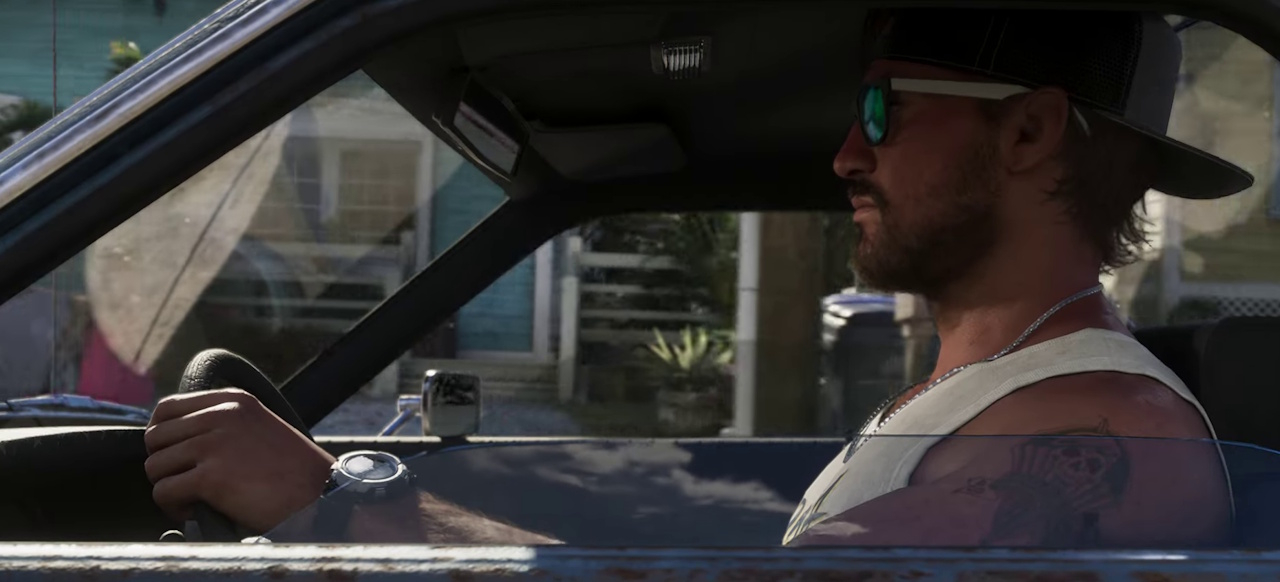
Ten Gaming “Hot Takes” (Part 1)

Today I thought we could have a bit of fun and talk about some of my more controversial gaming opinions! This is the first part of a two-part list, so be sure to stay tuned in the days ahead for five more gaming “hot takes.” There were too many to fit into a single piece this time around!

Although this is intended to be lighthearted and somewhat tongue-in-cheek, these are opinions that I genuinely hold; I’m not making things up for the sake of clickbait. I’ll always give the caveat that I’m a fan of video games and an advocate for gaming as a hobby… but that doesn’t mean that there aren’t things to criticise from time to time!

A Sega Mega Drive console.
Let’s share some controversial gaming opinions!

Gaming has changed a lot since I first picked up a joystick at a kids’ club in the ’80s, and I’ve seen the games industry and games themselves evolve dramatically! Most of those changes have been for the better… but perhaps not every last one.

As I always say when we talk about potentially controversial topics: these are my wholly subjective opinions! I’m not trying to claim that I’m right and that’s the end of the affair – on the contrary: I’m acutely aware that I’m in the minority here! I share these “hot takes” in the spirit of thought-provoking fun, and you are free to disagree wholeheartedly.

With all of that out of the way, let’s take a look at some “hot takes!”

“Hot Take” #1:
An open world isn’t the right choice for a lot of games.

A screenshot of Jedi: Survivor showing protagonist Cal Kestis outside of a saloon.
Jedi: Survivor is a recent game that employed an open world style.

Open worlds became a gaming trend sometime in the early 2010s, and too many publishers nowadays insist on forcing the formula onto titles that are entirely unsuited to it. Some open worlds are great… but I’d argue that relatively few manage to hit the golden combo of being both a well-constructed open world and one that suits the game in question. There have been some fantastic open worlds in which stories were told that didn’t fit, and some games that could’ve been wonderful that were undone by the fetishisation of the open world formula in some corporate boardrooms.

In many, many cases, having distinct levels or separate sections of a larger map just… works. It allows for the game’s narrative to create an often-necessary sense of physical distance in between locations – something that even the best open world maps are usually unable to manage. And for an awful lot of stories – even in games that we might consider to be masterpieces – that can be important to the immersion.

Ryo Hazuki, protagonist of Shenmue, encounters a man dressed as Santa Claus.
An early open world pioneer was Shenmue on the Dreamcast.

Take Red Dead Redemption II as an example. That game is one of the very best that I’ve ever played… but there were several points in its single-player story where the open world formula came close to being a problem. After escaping the town of Blackwater by the skin of their teeth in the game’s prologue, Arthur Morgan and the gang roam around in the mountains for a while, before eventually finding a new place to make camp… literally five minutes away from Blackwater. And this would happen again later in the game, when the gang would escape the town of Valentine only to settle at a new campsite just up the road.

The game’s narrative presented these locations as if they were far apart, but the open world of Red Dead Redemption II, for all of the content that it was filled with, didn’t always gel with that. It’s a scaled-down representation of part of the United States, and I get that. But narratively, it might’ve worked even better if the game’s main acts took place in separate, smaller open maps instead of merging them all into one larger open world.

Arthur Morgan, the protagonist of Red Dead Redemption II.
Red Dead Redemption II is a masterpiece.

Red Dead Redemption II is, without a doubt, one of the best games that I’ve ever played. So if the open world could be a problem there… well, you don’t need to think too hard to find examples of the open world formula tripping up worse and far less enjoyable titles! There’s absolutely nothing wrong with creating separate levels for a game – as has been done really since the beginning of narrative video games. Doing so often allows for more diversity in locations, environments, and terrain – and it’s something more titles need to consider taking advantage of.

I could probably count on my fingers the number of games that have genuinely made good use of an open world formula, and that have used that style of map properly. And when I think about modern games that I’ve really enjoyed such as The Last of Us, Jedi: Fallen Order, or the Mass Effect trilogy, they don’t use open worlds – and they’re much better for it.

“Hot Take” #2:
Every game should have a robust easy mode – it’s an accessibility feature.

The Skyrim options menu with difficulty settings highlighted.
Difficulty options in Skyrim.

I’m a big believer in making games accessible to as many players as possible. That can mean including accessibility features like colourblindness settings, disabling quick-time events, or ensuring that subtitles are available. But it also means that players need to be able to tone down the difficulty – yes, even in your precious Dark Souls!

I suffer from arthritis, including in my hands and fingers. I don’t have the ability to pull off complicated multi-button combos any more – if I ever possessed such an ability! And as with any skill or set of skills, gaming abilities vary from person to person; even someone who isn’t suffering from a health condition may simply not be blessed with the reflexes or hand-eye coordination necessary to progress through some of the industry’s more punishing titles. Not to mention that many folks don’t have the free time to dedicate to learning precise button combos or the intricate details of specific boss battles.

A promotional screenshot of Kingdom Come: Deliverance.
Kingdom Come: Deliverance was a title I found too difficult to play, despite wanting to enjoy it.

And that’s a real shame – because there are some outstanding games that everyone should be able to experience. Stories in some games are truly awe-inspiring, and can be better in some cases than films or television shows. For those stories to be denied to people with disabilities or people who may not have the time to repeat the same boss fight or level over and over again is just… sad.

I absolutely detest the expression “not every game is made for every player” when this debate rolls around. It’s absolutely true that people like different things, so if I’m not into online multiplayer shooters then I’m probably not going to enjoy the next Call of Duty title. But that doesn’t apply to difficulty, or to making a game that millions of potential players are locked out of because of a skill mismatch or health condition. That kind of gatekeeping is honestly just pathetic.

A toddler or young child playing a racing game.
Gaming should be accessible to as many people as possible.

I’d also add that the reverse is true here: certain games can be too easy for some players, and including the option to increase the difficulty in that case is likewise a good thing and something that developers should seek to include.

Difficulty settings have been a part of games going back decades, and they aren’t all that difficult to implement. At the very least, giving players the option to skip a level or boss battle after failing it multiple times should be achievable for every developer – and I can’t think of a good reason why a studio that cares about its audience wouldn’t want to implement something so incredibly basic. It doesn’t “hurt” the game to include an easy mode, nor does it damage the developers’ “artistic vision.” An easy mode only impacts players who choose to turn it on – and in a single-player game, why should anyone be judgemental about that?

“Hot Take” #3:
Artificial intelligence isn’t “coming soon,” it’s already here – and the games industry will have to adapt.

Still frame from the film Terminator (1984).
Are you ready for the “rise of the machines?”

One of the hottest topics of 2023 has been the arrival of easily-accessible generative AI software. It seems that anyone can now create an article like this one, a photorealistic image of just about anything, an audio recording of a celebrity… or even code for a video game. This technology has well and truly landed, and I don’t see any practical way to prohibit or ban it – so the games industry is going to have to adapt to that reality.

I can see a lot of potential positives to AI. Modding, for instance, can now get a lot more creative, and we’ve seen already mods featuring AI voices that are basically seamless and can add a lot to a character or story. For smaller developers and indie studios, too, AI has the potential to be a massively useful tool – doing things that a single developer or small team wouldn’t be able to achieve.

"Matrix code" from the 2021 film The Matrix: Resurrections.
AI is already here – and could prove incredibly useful to game developers.

But there are unquestionably massive downsides. The games industry has seen significant layoffs this year – despite most of the big corporations making record profits. Corporations in all kinds of industries are looking to replace as many real humans as possible with AI software… and for an all-digital product like a video game, the potential for divisions or even entire studios being shut down is firmly on the table.

The arrival of generative AI is going to shake things up, and because of the way it works, I can absolutely see there being less creativity in the games industry if too many big corporations go down that road. Because of the way these AI programmes work, they aren’t capable of truly creating – only reworking things that already exist and generating something with the same parameters. If major video games start using AI in a big way, you can say goodbye to innovation and creativity.

An example of AI-generated art.
An example of AI-generated art that was created (in less than ten seconds) from a prompt I entered.
Image Credit: Hotpot Art Generator

Whichever company cracks AI first is, in all likelihood, going to be rewarded – so there may even be a kind of “AI arms race” within the games industry, as some of the biggest corporations duke it out to be the first one to strike the right balance between AI and human-created content. What that might mean for games in the short-to-medium term… I can’t really say.

Generative AI is here to stay, though, and I don’t see a way around that. Some folks have suggested boycotting AI-heavy titles, but these consumer boycotts seldom succeed. If a new game that relied on AI during its creation ends up being fun to play, I daresay it’ll get played. Most players don’t follow the ins and outs of the industry, and may never even know the extent to which their favourite game was created using AI. I hope you’re ready for AI… because I’m not sure that I am!

“Hot Take” #4:
Sonic the Hedgehog doesn’t work in 3D.

Promotional screenshot from 2014's Sonic Boom: Rise of Lyric.
3D Sonic.

We’re going franchise-specific for this one! I adored the first Sonic the Hedgehog games on the Sega Mega Drive. I didn’t have a Mega Drive at the time, but a friend of mine did and we played a lot of Sonic in the early ’90s! Along with Super Mario, Sonic was one of the characters who scaled the mountain and was at the absolute peak of gaming… for a time.

But Sonic’s sole gimmick meant that the character struggled to successfully make the transition from 2D side-scrolling games to fully 3D titles. Extreme speed is something that works well in a 2D title, but it’s hard to code and even harder to play in a 3D environment.

Cropped box art for the re-release of Sonic the Hedgehog.
Sonic’s “gotta go fast” gimmick works in 2D games… but not in 3D.

The most successful Sonic game this side of the millennium has been Sonic Mania… a 2017 title that was originally created by fans of the series before Sega got involved. Sonic Mania is an old-school 2D platformer in the style of the original Mega Drive games. It’s great fun, and a real return to form for Sega’s mascot after years of mediocrity.

Sonic’s fundamental problem begins with his sole superpower: speed. Extreme speed was something that felt wonderful in 2D… and not to mention incredibly innovative! But in 3D, it’s just so much more difficult to build worlds suited to moving so quickly – not to mention that it’s tricky for players to control a character moving at such speed.

Promotional screenshot for 2017's Sonic Mania.
Sonic Mania has been the most successful Sonic game in decades.

There have been 3D Sonic games that tried to innovate, but even the best of them feel like they’re missing something. I remember playing Sonic Adventure on the Dreamcast and barely having to push any buttons; in order to make Sonic work in 3D, much of the interactivity had to be stripped out. That made for a far less enjoyable gaming experience.

When Sonic shows up in other titles – such as alongside Mario for an arcadey sports game, or in Sega’s Mario Kart competitor – then the character can be made to work. But those games almost always rob Sonic of his one defining trait: his speed. I’ve never played a 3D Sonic game that felt anywhere near as good as those original 2D titles.

“Hot Take” #5:
Google Stadia was a good idea (in more ways than one).

Promo image featuring the Stadia control pad.
Promo image of the Stadia control pad (right) next to a laptop.

The history of video gaming is littered with failed consoles and devices; machines that didn’t quite make it for one reason or another. 2019’s Stadia – Google’s attempt to break into the games industry – has become the latest example, being fully shut down after only a couple of years. There were myriad problems with Stadia, and Google has a track record of not backing up its projects and investments nor giving them enough time to deliver. So in that sense its failure is understandable. But I think I’m out on a limb when I say that it’s disappointing – and potentially even bad for the games industry as a whole.

Stadia offered a relatively inexpensive way to get started with gaming by relying on streaming. Gone was the need for an expensive console or PC; players could jump in using only their existing screen and a Stadia controller. Lowering the cost of entry to gaming is a good thing, and we should be looking around for more ways to do that!

Promo screenshot of Stadia-exclusive title Gylt.
Gylt was one of the only Stadia-exclusive games.

Secondly, Stadia represented the first potential shake-up of a pretty stagnant industry in nigh-on twenty years. Since Microsoft entered the video game market and Sega dropped out, there have been three major hardware manufacturers and three main gaming platforms. Disrupting that status quo is, again, not a bad thing in theory. Stadia, with Google’s support and financial resources, seemed well-positioned to be the kind of disruptive force that often leads to positive change.

Stadia won’t be remembered – except as the answer to an obscure pub quiz question in a few years’ time, perhaps. But it had potential when it was announced, both in terms of the way it could have brought console-quality games to people who couldn’t necessarily pay for a current-generation machine up-front, and in the way Google could’ve disrupted the industry, leading to competition and innovation.

A Google Chromecast device.
Stadia was designed to be compatible with Google’s Chromecast devices – as well as other platforms.

I didn’t buy into Stadia on day one. As someone who has a gaming PC, I didn’t really feel it was necessary. And there were limitations to Stadia: a lack of exclusive games, no subscription option, and Google’s well-known history of prematurely shutting down underperforming products and services. All of these things put me off – and undoubtedly put off a lot of other folks, too.

But in a way, I regret the demise of Stadia. Its short, unsuccessful life will surely be a warning to any other company that might’ve considered launching a new console or a comparable streaming device, and if there’s one thing I think we can all agree on it’s this: the games industry needs a shake-up from time to time! Stadia couldn’t do it, unfortunately… but I hope that another device will.

So that’s it… for now!

Screenshot of Starfield.
Starfield (2023).

Stay tuned, because I have five more “hot takes” that I’m currently in the process of writing up.

As I said at the beginning, none of these things should be taken too seriously – this is just intended to be a bit of thought-provoking fun, at the end of the day.

There’s a lot to love about gaming as a hobby, and the quality of video games in general is way higher today than I could’ve imagined even just a few years ago. There are some incredible games out there; masterpieces in every sense of the word that have given me some of the best entertainment experiences I’ve ever had. And there are some games that I didn’t enjoy, too! I hope this look at a few of my “hot takes” hasn’t gotten anyone too upset!

All titles discussed above are the copyright of their respective studio, developer, and/or publisher. Some images used above courtesy of IGDB and Unsplash. This article contains the thoughts and opinions of one person only and is not intended to cause any offence.
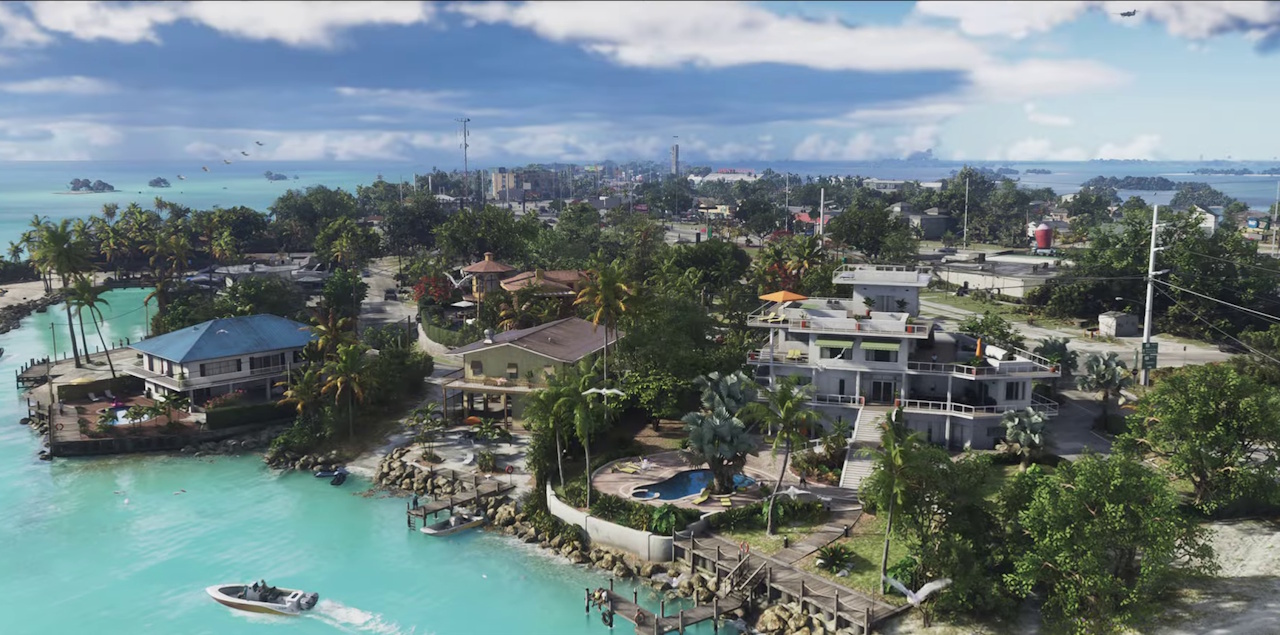
Twelve Mario Kart racetracks that can stay in the dustbin

Yesterday, Nintendo announced which eight racetracks have made the cut and will be included in the final wave of the Booster Course Pass for Mario Kart 8 Deluxe. And spoiler alert, but there are some incredibly fun ones! Returning to SNES Bowser Castle 3 – in its upgraded form – is perhaps the one I’m most excited about, but there were several others that look like an absolute blast.

But that got me thinking: which racetracks haven’t been included in Mario Kart 8 Deluxe or the Booster Course Pass? Nintendo has obviously been saving some real classics for Mario Kart 9, including some highly-requested fan-favourites. And with the Switch’s successor console potentially only a year or so away from launch… that seems absolutely fair enough! One of my only real concerns with the Booster Course Pass has been that Nintendo has used up a lot of good, solid racetracks – potentially leaving fewer to be remade next time around.

While there are some racetracks whose omissions from the Booster Course Pass will undoubtedly have upset fans, those aren’t the ones we’re going to look at today! Instead, we’re going to focus on a handful of racetracks from across the Mario Kart series that I’m perfectly happy to consign to the dustbin – permanently! These are racetracks that I didn’t enjoy either in their original games or when they returned as retro tracks in later games.

It goes without saying that all of this is the entirely subjective opinion of one person! If you love any or all of these racetracks, please don’t take it personally! We all like different things, and this list is supposed to be tongue-in-cheek fun. I’m a huge fan of Mario Kart, and the fact that I’ve found a handful of racetracks to dislike doesn’t change that.

Racetracks will be put into one of three “cups” (which have been given dustbin-appropriate names) just like they would be in any other Mario Kart game. And any racetrack that has appeared in a Mario Kart title is fair game. I’ve tried not to select too many tracks from the same entry in the series.

With all of that out of the way, let’s jump into the list!

Empty Baked Bean Tin Cup

Wario Stadium
Mario Kart 64

Wario Stadium’s unforgivable flaw is that it’s just… boring. There’s nothing interesting or exciting about the titular stadium or the dirt track set there, and while it has a decently twisty layout, all that manages to do is drag out the racetrack too much. There are a couple of turns that can be challenging to take, but even those aren’t anything to write home about. The musical accompaniment isn’t spectacular, either.

Probably Mario Kart 64′s least enjoyable offering.

Baby Park
Mario Kart: Double Dash

As you’ll know if you’ve already checked out my Mario Kart 8 Deluxe tier list, I detest Baby Park. The racetrack’s plain oval layout is bad enough, but what’s worse is how random it is. If you hit a run of bad luck you can end up in last place not because of any skill issue, but by sheer chance. That might keep things “interesting” in some online races… but it doesn’t feel like a lot of fun most of the time.

An admirable attempt to try something different… but one that did not succeed.

Desert Hills
Mario Kart DS

I’m not the biggest fan of desert racetracks. One or two per game might be okay, depending on what else they bring to the table apart from sand. But DS Desert Hills really only has sand. There just isn’t much else going on here that’s any different, and the racetrack has an incredibly bland colour palette that doesn’t offer much by way of visual interest either. Mario Kart can do better desert racetracks than DS Desert Hills – and it has done so on multiple occasions.

With that in mind, what place could there be for a racetrack like this one?

Sweet Sweet Canyon
Mario Kart 8
Mario Kart 8 Deluxe

I’m not wild about food-themed racetracks in Mario Kart, and nothing about Sweet Sweet Canyon jumps out at me as being especially fun or memorable. The bland colour palette drowns in tan, brown, and yellow tones, and the inclusion of an underwater section doesn’t seem like it adds much. There are no fun secret routes or shortcuts to learn, and Sweet Sweet Canyon tends to end up as a racetrack I skip every time I play Mario Kart 8 Deluxe.

Those massive donuts look delicious, though!

Dirty Nappy Cup

Toad’s Factory
Mario Kart Wii

There was speculation that Toad’s Factory might’ve been one of the racetracks to join the Booster Course Pass, but you know what? I’m glad that it didn’t! This is probably my least-favourite track from Mario Kart Wii, and one I’d seldom choose to play. The idea of a racetrack set at an operational factory is a fun one… and there were moments in Toad’s Factory that came close to living up to the promise. But there were also annoying pinch points, a pretty basic layout, and one of the worst pieces of music in Mario Kart Wii to drag it down.

I’m all but certain that Toad’s Factory will be back in the next Mario Kart, though!

Yoshi Desert
Mario Kart Super Circuit

Most of what I said above about DS Desert Hills also applies to GBA Yoshi Desert. Desert tracks too easily fall into the trap of being one-note and uninteresting, and while Yoshi Desert gets some credit for being one of the first desert racetracks in the Mario Kart series… even that’s not enough to save it. Also included in Super Circuit was the wonderful Sunset Wilds – a racetrack that took the desert theme in a completely different direction. Yoshi Desert is nothing in comparison!

Yoshi Desert returned in Tour, though… so maybe it’ll be back in a future Mario Kart game, too.

Koopa Beach 2
Super Mario Kart

I adore Super Mario Kart, and I’m not sure that it’s always fair to compare unenhanced SNES tracks with the best that modern Mario Kart has to offer. But that being said, Koopa Beach 2 is a pretty basic track even by Super Mario Kart standards, consisting of a fairly plain oval on a beach. There isn’t much else to say; at least Koopa Beach 1 had some moments of island-hopping to mix things up. This track just… doesn’t have a lot to offer.

Compared with other beach-themed racetracks, Koopa Beach 2 just comes up short.

Amsterdam Drift
Mario Kart Tour

I have a particular criticism of Amsterdam Drift: it doesn’t really feel like Amsterdam. The main reason for that is how much time is spent racing underwater. Now I know that Amsterdam’s canals are famous… but it just felt to me like too much of this racetrack was taken up with underwater racing in these deep ditches that had no points of interest within them. If the racetrack had been called “Canal Crunch” or something, and wasn’t meant to be a representation of Amsterdam, maybe that would’ve been okay.

But the racetrack fails at its one and only objective as far as I’m concerned.

Cigarette Butt Cup

Daisy Hills
Mario Kart 7

To be honest, it was a toss-up whether to include Daisy Hills or Mario Circuit from the 3DS… but Daisy Hills claims the “win” on this occasion. While there are some moments of visual interest and a soundtrack that’s at least okay, Daisy Hills is one of those easily-overlooked racetracks that just feels bland and generic. The brown dirt track, green grass, and blue sky combo has been seen on so many different racetracks with better layouts or more memorable musical accompaniments that it doesn’t feel interesting in the slightest here.

I’d almost forgotten that Daisy Hills existed.

Hyrule Circuit
The Legend of Zelda x Mario Kart 8 DLC
Mario Kart 8 Deluxe

You may disagree with this pick if you’re a big fan of The Legend of Zelda… but as someone who never played any of those games, I just don’t feel any connection to Hyrule Circuit. The nicest thing I can say about it is that it’s neat to race through a castle that isn’t filled with molten lava, but in every other way this track just feels bland and generic. I don’t think its gimmick of a hidden path that could be opened by hitting switches was particularly well-implemented, either.

Plenty of Zelda theming (I assume, anyway) but I just don’t care about that in the least.

Yoshi Falls
Mario Kart DS

Yoshi Falls is a plain oval with a few boost panels. Its brief waterfall sections are so short that they’re easily overlooked, and there just isn’t much else that’s exciting or even memorable about such a plain racetrack. The giant Yoshi egg gives it a small amount of visual interest, I guess, but even that’s not enough to salvage this one.

Yoshi has indeed fallen.

Rainbow Road
Super Mario Kart

SNES Rainbow Road is a great track, an all-time classic, and a nostalgic punch in the face for those of us who loved Super Mario Kart! So why on earth is it on this list? Simple: it’s been recreated in the last four Mario Kart titles (7, 8, 8 Deluxe, and Tour)… so it needs a break. Bringing it back again in Mario Kart 9 would be repetitive, and transforming the racetrack in the way some other retro tracks have been would take away from its unique charm.

Give SNES Rainbow Road the day off and bring back other racetracks instead!

So that’s it!

I hope your favourite wasn’t on the list… but if it was, sorry! Actually no, I’m not sorry… because this is just one person’s entirely subjective take, and we’re all entitled to our views on this wonderful kart racing series.

There’s only a few days left until the sixth and final wave of racetracks arrives for the Booster Course Pass… and with the development of new tracks for Tour seemingly coming to an end as well, does that mean production is shifting toward Mario Kart 9?! It’s been almost a decade since Mario Kart 8 debuted on the Wii U, so it’s about time for a new entry in the series! I hope that Nintendo doesn’t include the racetracks listed above in the next game… but if they’re present I daresay I’ll get over it! Not every track can be an absolute favourite, but I think every Mario Kart game so far has managed to have far more good ones than bad.

So I hope this was a bit of fun! Stay tuned, because the second part of my Mario Kart 8 Deluxe tier list is in the works! You can find the first part, in which I ranked all 48 racetracks from the base version of Mario Kart 8 Deluxe, by clicking or tapping here. And you can find my dedicated Mario Kart webpage by clicking or tapping here.

See you on the track!

Mario Kart 8 Deluxe is out now for Nintendo Switch. Mario Kart 8 Deluxe, the Booster Course Pass, and the Super Mario series are the copyright of Nintendo. Images of GBA Yoshi Desert, SNES Koopa Beach 2, and 3DS Daisy Hills courtesy of the Super Mario Wiki. This article contains the thoughts and opinions of one person only and is not intended to cause any offence.
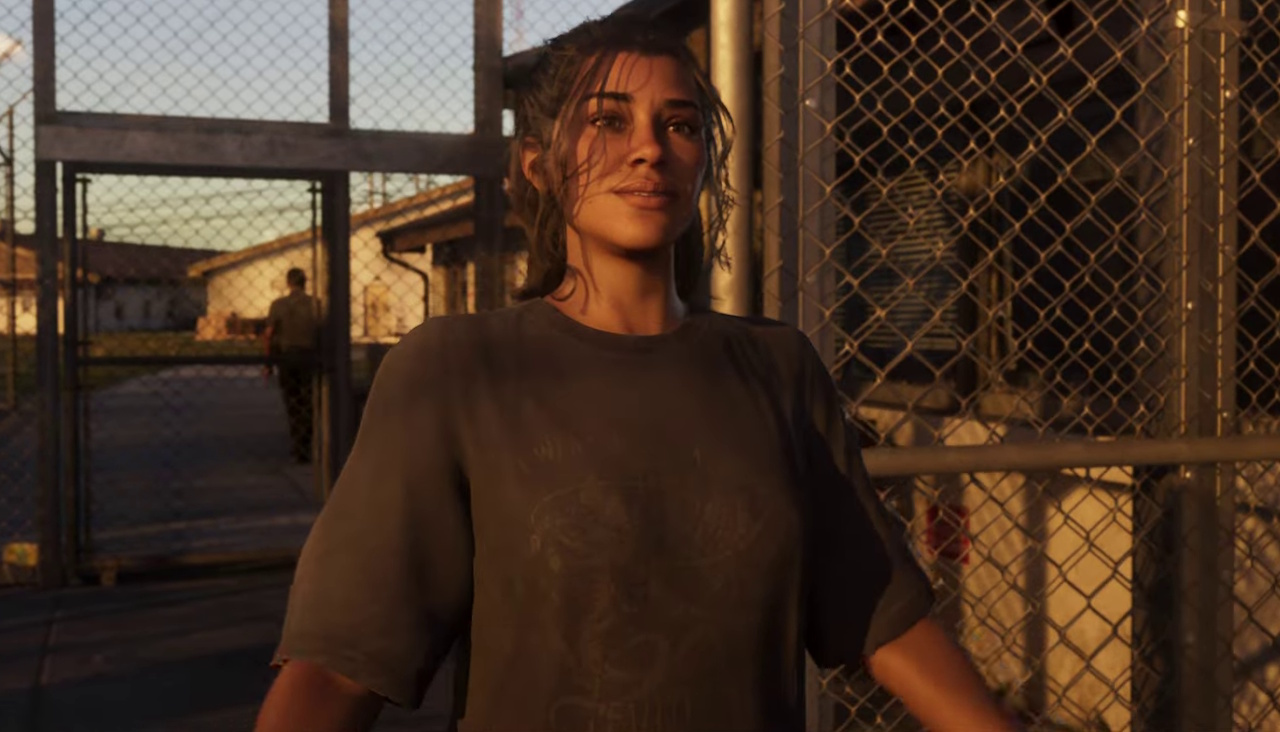
Forza Motorsport’s Biggest Problem…

This piece was going to be my first impressions of Forza Motorsport – the latest big racing simulation game developed by Turn 10 Studios for Xbox. But the longer I’ve sat with Forza Motorsport, the more the game feels overshadowed by one single problem, and this is getting in the way of what should be an exciting racing experience.

Forza Motorsport is a good game with a single glaring flaw. It has a great selection of cars, it’s visually stunning, it runs well on my PC, and it landed on Game Pass on launch day. Even though I’m not any kind of motoring enthusiast and I don’t know the first thing about how or what to tune to get two extra brake horsepower or more torque (what even is torque, by the way?) Forza’s cars feel like a ton of fun to drive. I’ll leave most of the tinkering to folks who know what they’re doing – but the fact that there’s such a huge array of tuning options is fantastic.

Forza has a problem…

But Forza Motorsport is lacking in one key department – and it’s one that feels like it should be an incredibly obvious thing for any racing game to get right. Forza Motorsport just doesn’t have enough racetracks.

At time of writing in October 2023, shortly after the game’s launch, there are a mere twenty racetracks. That’s compared with 32 racetracks in its (confusingly-named) predecessor, Forza Motorsport 7 from 2017. I can’t think of another recent racing game that launched with so few racetracks – not a serious racer, at any rate. Gran Turismo 7, which is Xbox and Forza’s big PlayStation 5 competitor, launched with almost twice as many tracks for players to race on.

There are plenty of cars, but not enough tracks to race them around.

When I owned a SNES console in the early 1990s, I had a game called Nigel Mansell’s World Championship. That game, which is now more than thirty years old, had sixteen racetracks – only four fewer than Forza Motorsport. Is that okay? Are players in 2023 willing to accept that the latest edition of one of the racing genre’s big beasts has only four more racetracks than a thirty-one-year-old SNES/Amiga game that hardly anyone remembers?

Let’s get the obvious out of the way: Turn 10 and Xbox Game Studios clearly plan to add more racetracks as paid-for DLC. The fact that the game launched on day one with purchasable car packs as add-ons says a lot about the state of monetisation in Forza Motorsport. But at least the base game came with a solid lineup of cars to choose from. The amount of racetracks, in comparison, feels incredibly lacklustre and downright stingy.

Nigel Mansell’s World Championship offered players a choice of sixteen racetracks in 1992.

For me, this lack of diversity in racing environments has crippled Forza Motorsport, cutting the game off at the knees and utterly annihilating any potential longevity it might’ve had. And I’m sure I won’t be the only one in that position. The game, in its current form, feels almost akin to a demo or beta version; an incomplete experience with promises of additional development to come at some nebulous future date. In a game that’s priced at £65/$70 – for the base version – I don’t consider that to be acceptable.

If Turn 10 wanted to add more racetracks but didn’t have time, why not delay the launch of Forza Motorsport? From Xbox’s point of view, the game isn’t essential at the present moment – sure, it’s great to get it out in time for Christmas, but with titles like Starfield doing big numbers and a relatively successful 2023 already under its belt, it’s not like the success or failure of Game Pass or the Series X was somehow riding on an early launch of Forza Motorsport. There was time to push things back if some racetracks weren’t ready.

Couldn’t Forza Motorsport have been delayed?

But I really don’t believe that’s the issue. It seems obvious to me that Turn 10 and Xbox are planning to release racetracks either as standalone pieces or in bundles – and charge players extra for them. That’s a pretty big disappointment considering how few tracks there are in the “standard edition” of the game. There are promises of free updates… but watch this space. I’d bet on at least some of these racetracks only being available to people willing to fork over some extra cash.

More and more games are going down this “live-service” route, and it’s disappointing. While Forza Motorsport runs well and seems to be free of major bugs and performance issues, it still feels like a game that doesn’t have enough content to justify its price tag… or, frankly, its early release. There’s a lot here that could be great… but when there aren’t many racetracks to sink your teeth into, the game feels like it gets old pretty fast.

A lack of racetracks is disappointing in a racing game!

I’d rather have seen 300 cars and 30 tracks instead of 500 cars and 20 tracks. Maybe that’s just me, but that would’ve been my preference if there were limited development resources. Or, alternatively, I’d have delayed Forza Motorsport until more racetracks were fully-developed and ready to be included as part of the base game.

I will caveat all of this by saying that I’m not a “car guy” or really any kind of racing sim expert. And if the general consensus from players is that they’d rather have more cars to toy with and that the number of racetracks and the diversity of racing environments don’t matter so much… then fair enough! This is all just one player’s subjective take, after all.

But I confess that I feel disappointed in Forza Motorsport as things stand. The game just doesn’t have as much to offer as I feel it should – and that seriously cuts into the enjoyment for me. I’ve put down the control pad for now… and I’m honestly not sure if I’ll bother to pick it back up.

Forza Motorsport is out now for PC and Xbox Series S/X. The game is also available as part of a Game Pass subscription. Forza Motorsport is the copyright of Turn 10 Studios, Xbox Game Studios, and Microsoft. Some promotional images courtesy of IGDB. This article contains the thoughts and opinions of one person only and is not intended to cause any offence.
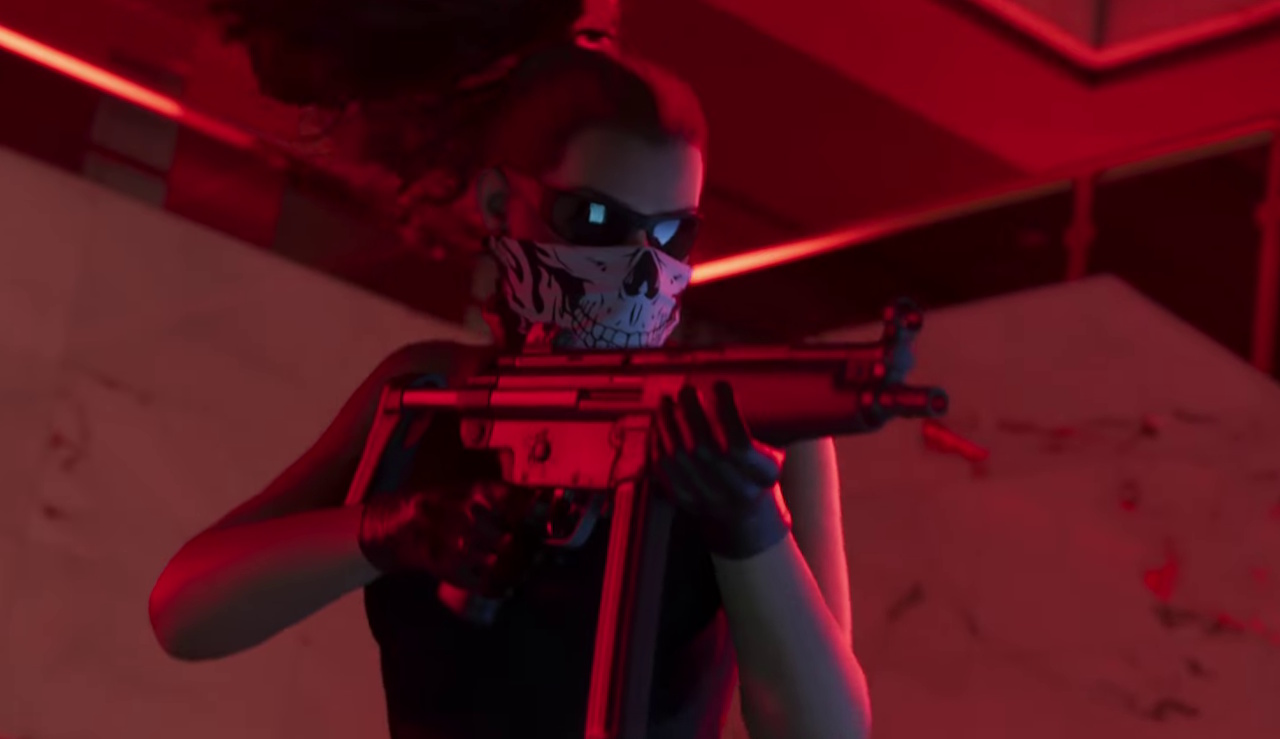
Mario Kart 8 Deluxe Tier List: Part 1

As promised, I’m going to put all of the Mario Kart 8 Deluxe racetracks into an internet-friendly tier list! In this first part, we’re going to look at all 48 of the racetracks that come with the base version of Mario Kart 8 Deluxe. Next time, when I’ve had a chance to fully play through all of the Booster Course Pass additions, I’ll put those 48 racetracks into a tier list as well – so stay tuned for that around the holidays or in the new year.

So… what’s a tier list? Well, I’m glad you asked!

Rather than ranking every racetrack from 1-48 – which would be pretty difficult, especially with tracks in the middle – each track is going to be given a rating. There are six possible ratings based on the “tier list” formula that you may have seen elsewhere online.

F-tier racetracks will be at the bottom; these are the worst or least-enjoyable tracks that I’d almost never choose. Next is D-tier: a step up from the worst of the worst, but still racetracks I either generally dislike or hate a particular aspect of. C-tier racetracks are right in the middle and have no major flaws… but relatively few impressive elements. B-tier is a step up from average; these are racetracks that are fun, but not quite perfect. A-tier is where we start to see the best that Mario Kart 8 Deluxe has to offer! And finally, S-tier racetracks are the absolute cream of the crop.

Why is “S” the uppermost tier? Why not A or A-star? Truth is… I have absolutely no idea. But that’s how other people have made their tier lists, so I’m sticking with the same basic formula and nomenclature. I guess I could Google it… but there’s no time for that now. We’ve got racetracks to rank!

It goes without saying that this tier list is the wholly subjective opinion of one person! I have my own criteria for determining what I like and what I dislike… and if you disagree or hate all of my rankings, that’s okay! There’s plenty of room for differences of opinion, and I’m in no way trying to say that this is the “objective,” definitive way that everyone should rate the racetracks in Mario Kart 8 Deluxe. This is just my opinion, and I share it in the spirit of light-hearted fun.

I’ll be going through the racetracks in the order in which they appear in the game and assigning each one a tier. With all of that out of the way, let’s get started!

Mario Kart Stadium (Mushroom Cup)
Tier: B

Mario Kart Stadium is a great introduction to the game. It’s not an especially complex racetrack – but it shouldn’t be, as it’s the first one that players will try out. The theming is fine, being set at a modern speedway at night, and Mario Kart Stadium introduces players to gliding and anti-gravity. The anti-grav section is pretty basic, but again, this is the first track in the game.

All in all, a solid start.

Water Park (Mushroom Cup)
Tier: C

Water Park is a racetrack I’ll occasionally choose. I like the theme park vibe that it gives off; it reminds me somewhat of the likes of Disneyland or Sea World. But nothing about Water Park screams “Mario Kart” to me. There isn’t much to firmly place the racetrack – which is only the second in the game – in the Mushroom Kingdom or the Mario franchise, and if I had to sum it up in one word it would be “generic.”

The very definition of a C-tier racetrack, I suppose!

Sweet Sweet Canyon (Mushroom Cup)
Tier: D

Another racetrack that just feels incredibly generic, Sweet Sweet Canyon is one I’d rarely choose to play. It has a very uninteresting colour palette, with lots of yellow, brown, and tan tones that all sort of blend into one, and a musical score that isn’t particularly memorable. The food theme is just kind of “meh” for me, and I know that Mario Kart can do better. It’s not the worst track in the game or anything… just not a particularly fun one.

And that’s coming from a fatso who loves sweets and doughnuts!

Thwomp Ruins (Mushroom Cup)
Tier: B

Thwomp Ruins has some fun theming, being set in an ancient temple that feels like something you might expect to see in the Tomb Raider series! The titular Thwomps are present at several key points along the racetrack, providing an extra challenge, and there are a couple of alternate paths to race along, as well as anti-gravity and underwater sections. There’s also a couple of excellent shortcuts if you have a mushroom (and the skill to use it right!)

This is definitely one to choose if you want a frantic race online!

Mario Circuit (Flower Cup)
Tier: C

There are several great racetracks where anti-gravity feels crazy and exciting… but Mario Circuit isn’t one of them. It’s only if you look into the background and see upside down or sideways trees and other detritus that you’ll even realise you’re racing in anti-gravity… and I just think that’s not great. Mario Circuit isn’t bad; it has a great soundtrack and I’ll always appreciate seeing Peach’s castle.

The layout just feels uninspired, and while there are long anti-gravity sections, they don’t feel all that special.

Toad Harbour (Flower Cup)
Tier: S

In 2013, I was lucky enough to play a preview build of Mario Kart 8 at a press event – and Toad Harbour was the racetrack I got to try out. It was the ideal track for such a demo, as it’s damn near perfect! Taking inspiration from both New York City and San Fransisco, this harbourside racetrack is incredible. Its theming is on point, it has a great soundtrack, and the addition of trolleybuses as moving obstacles keeps each lap feeling different and fun.

Definitely one of the best that Mario Kart 8 Deluxe has to offer – and no, I’m not just saying that because I got to play it before anyone else!

Twisted Mansion (Flower Cup)
Tier: B

Twisted Mansion is hands-down the best ghost-themed racetrack in the Mario Kart series to date. It brings together the ghostly Boos – mainstays of the Mario franchise – with elements from the Luigi’s Mansion games, and its haunted house aesthetic sticks the landing. The layout of the track itself is perhaps Twisted Mansion’s weakest element, because aside from the anti-grav section near the start, it doesn’t feel especially innovative. There’s a neat shortcut and an underwater-into-glider section… but other than that, the theming and music are doing most of the heavy lifting here.

Still, that’s more than enough to make Twisted Mansion a fun racetrack!

Shy Guy Falls (Flower Cup)
Tier: C

I love the idea of Shy Guy Falls way more than the execution. This is another track where Mario Kart 8′s signature anti-gravity mechanic just feels lacklustre. I never really manage to get the sense of racing up and down a waterfall; the racetrack’s waterfall sections feel like driving through a river. There’s nothing in the distance or surrounding the waterfall to really evoke the wonder of this setting – not until the very last second. The rest of the theming also feels pretty bland, but I’ll give Shy Guy Falls points for being decently pretty to look at.

There’s a tricky shortcut toward the end that’s a pain to learn… but it can be fun to pull off when racing online or with friends!

Sunshine Airport (Star Cup)
Tier: A

Sunshine Airport is a blast. There are so many little details in the theming that tie this racetrack into other parts of the world of Super Mario, including destinations on the departures and arrivals boards in the airport lobby. Racing along an active runway with a plane coming right at you is also an incredibly tense and exciting moment. I love the way that the track twists and turns, offering multiple paths around an aircraft or across its wings.

Sunshine Airport also has a great musical accompaniment!

Dolphin Shoals (Star Cup)
Tier: B

A racetrack that’s almost entirely underwater could’ve come across as being a bit too gimmicky, but Dolphin Shoals pulls it off well enough. I like tropical beach racetracks, and the crystal clear waters of Dolphin Shoals definitely play into that. The titular dolphins are only present for a brief moment, which is a bit of a shame – but the return of the giant eel from Super Mario 64 as an actual part of the racetrack was a masterstroke!

I’ll definitely give Dolphin Shoals extra points for being something a bit different.

Electrodrome (Star Cup)
Tier: S

Electrodrome is amazing. It’s one of the few tracks where two alternate anti-gravity routes are close enough that you can see other racers – and seeing people racing upside down (from your perspective, at least) is an absolute blast. The music here is fantastic, and the nightclub/discotheque theme is absolutely unique. This is the kind of racetrack that could only work in Mario Kart!

Oh, and the dancing piranha plants bopping in time to the beat? Adorable.

Mount Wario (Star Cup)
Tier: S

Two S-tiers in a row? Wow, the Star Cup is really doing some incredible things! I love snowy, wintery racetracks – when done well – and Mount Wario represents a fun twist on the standard snowy circuit that has been present throughout the Mario Kart series. Racing down a mountain (after jumping out of a plane) is a ton of fun, and the slalom skiing section toward the end is one of the most exciting in the game. There are so many twists and turns and changes in the scenery as you descend the mountain.

Mount Wario is one of the best snowy tracks in the entire Mario Kart series without a doubt.

Cloudtop Cruise (Special Cup)
Tier: D

Cloudtop Cruise has a long cannon section that I’m not wild about, a lot of plain white clouds at the beginning and end, and… not much else. The music isn’t great, the theming isn’t anything special, its one shortcut is a little too easy to pull off, and because the cannon takes such a long time it leaves you incredibly vulnerable to shells and other items.

This just isn’t a racetrack I’m all that bothered about, and I almost never choose to play it.

Bone Dry Dunes (Special Cup)
Tier: C

Argh, this is painful! I adore Dry Bones (if you haven’t figured that out by now), so to rank his first-ever track so low isn’t where I’d have wanted to be. But to tell the truth, I’m being generous giving this one a C-tier ranking, and it’s only Dry Bones’ presence that carries an otherwise bland and uninteresting desert racetrack over the line. I don’t care for the music, the track layout is pretty boring, and there are a couple of pinch points where I always seem to run off the track or into a fence.

There were so many ways to create a Dry Bones-themed racetrack… why go for such a boring desert?

Bowser’s Castle (Special Cup)
Tier: A

Mario Kart 64′s version of Bowser’s Castle is probably the best of the bunch, but this version of the iconic Mario Kart racetrack has to be a close second. There’s everything you’d expect to find in King Koopa’s castle – lava, giant statues, and even lasers! The heavy metal soundtrack is the perfect accompaniment to this difficult racetrack, too. There are plenty of obstacles to dodge, from lava plumes and fireballs to punching statues and rolling rocks, making this one of the most challenging racetracks in the game.

Definitely not the first racetrack to show to a beginner – but a ton of fun nonetheless!

Rainbow Road (Special Cup)
Tier: C

I don’t hate this version of Rainbow Road, but when I compare it to other absolutely iconic racetracks bearing the name… I find it comes up short. The space station idea could’ve worked well for another track with a different name, but I feel it gets in the way here and detracts from the whimsical magic of Rainbow Road. The music isn’t quite up to par with other versions of the racetrack, either.

The twisting anti-gravity paths (with no guard rails) do pose a challenge, though – and I can appreciate that, at least.

Wii Moo Moo Meadows (Shell Cup)
Tier: A

Moo Moo Meadows has always been a fun, relatively gentle racetrack – as was its predecessor, Moo Moo Farm. I like the American setting of this cattle farm; it reminds me of several farms that I saw while living in the United States. The soundtrack is just pitch-perfect for that kind of locale, too, and the overall theming carries Moo Moo Meadows a long way!

The cows on the farm are too cute! Extra points for adorableness!

GBA Mario Circuit (Shell Cup)
Tier: C

GBA Mario Circuit, in this modified form, feels like a less-exciting version of Mario Kart Stadium. The layout of both racetracks is similar, even down to the anti-gravity section with a tight turn. I will give points for adapting a fairly plain racetrack in a novel way, and for finding a way to shoehorn anti-grav racing into a retro track that never had it in its original form. But as with most tracks with the “Circuit” monicker, GBA Mario Circuit is nothing special.

I don’t hate it, but it’s not one I’m going to choose very often.

DS Cheep Cheep Beach (Shell Cup)
Tier: A

The tropical beach theme carries Cheep Cheep Beach a long way – but I like the adaptations made for underwater racing in this version of the racetrack, too. The tropical musical accompaniment is great, the sunshine, sand, and clear waters are beautiful in 1080p HD, and there are a couple of places where different routes open up. There’s a lot to love here!

Cheep Cheep Beach is definitely one of the better retro courses.

N64 Toad’s Turnpike (Shell Cup)
Tier: B

I detested this racetrack on the Nintendo 64, but the updated version has definitely improved things. Maybe I’m misremembering, but I feel that the N64 version was a lot less forgiving, with either more road traffic or less space in between the vehicles causing more frequent collisions – and after spinning out in Mario Kart 64, it took longer to get going again than it does in Mario Kart 8 Deluxe. Updating this racetrack has been good, then – but the anti-gravity path is utterly useless, and the occasional glider moments don’t really add much, either.

Still, a solid reworking of one of my least-favourite racetracks from Mario Kart 64.

GCN Dry Dry Desert (Banana Cup)
Tier: D

A boring desert track without much going for it… Dry Dry Desert scrapes its way above the dreaded F-tier because it has a brief underwater section themed around an oasis that breaks up the otherwise drudging monotony of this bland, uninteresting racetrack. Were there really no better options from Mario Kart Double Dash to recreate?

Aside from the oasis section – which you’ll race through in a matter of seconds – it’s hard to find another redeeming feature in this one.

SNES Donut Plains 3 (Banana Cup)
Tier: S

Maybe it’s the nostalgia talking, but I adore Donut Plains 3. The track has had less done to it than something like GBA Mario Circuit, but the subtle new additions really elevate it and make it something special. Underwater racing is now present, and I love how one of the bridges has fallen into the lake. The music hits all of the nostalgic notes for me, as someone who played and loved Super Mario Kart in the ’90s, and although it’s a relatively short and flat racetrack… I can’t fault it.

Donut Plains 3 brings back incredibly fond memories.

N64 Royal Raceway (Banana Cup)
Tier: A

If we were ranking the original versions of these racetracks, Royal Raceway would be in the S-tier without a doubt. But this updated version took away one of its most iconic and defining elements: the off-road area in front of Peach’s castle. This part of the racetrack was a little “Easter Egg,” allowing players to stop racing for a moment and enjoy driving in front of the iconic setting of Super Mario 64. Stripping it out feels unforgivable… but I still love Royal Raceway in spite of this shameful omission!

Great music, a fun, twisty layout that’s perfect for drifting, and another nostalgic punch definitely justify Royal Raceway’s A-tier ranking.

3DS DK Jungle (Banana Cup)
Tier: B

DK Jungle is a lot of fun. I love the Donkey Kong Country theme, as the first entry in that series is one of my all-time favourites from the SNES era, and this racetrack adapts it well. Or rather, it adapts the newer Donkey Kong Country Returns! The jungle feels dense and almost claustrophobic, and the banana temple is weird but totally on theme. The soundtrack is another absolute bopper, too!

The only thing I’d have added is some kind of DK-themed coin to replace the standard coins.

DS Wario Stadium (Leaf Cup)
Tier: F

I’m just flat-out not interested in anything Wario Stadium brings to the table. I don’t care for the music, the layout, or the generic “motorsport stadium” theming, and as a result it’s got to be one of my least-used racetracks. As a dirt track in a crowded stadium with jumps, at a couple of points I get almost a Motorcross Madness vibe from Wario Stadium… but even that can’t salvage what is a generally unenjoyable track.

Not sure what else to add, really.

GCN Sherbet Land (Leaf Cup)
Tier: C

Although I’m a big fan of snowy and wintery racetracks in general, GCN Sherbet Land feels decidedly average. I like the ice-skating Shy Guys, and I appreciate the addition of an underwater section in this adaptation. But nothing else about Sherbet Land really jumps out at me, and compared to other winter tracks, it comes up short. It’s not atrocious, and if I’m in the mood I’ll definitely play through it along with its wintery cousins. But most of the time, this is one I tend to skip over to get to more enjoyable racetracks.

The winter theme is definitely doing a lot of work to keep Sherbet Land out of D-tier status!

3DS Melody Motorway/Music Park (Leaf Cup)
Tier: A

Melody Motorway (as we know it in the UK) is fantastic. I love that driving across the various instruments actually changes the racetrack’s musical accompaniment – and hitting a “wrong” note leads to an off-key note being played! This feature alone adds a lot to Melody Motorway – but the racetrack also has a fun optional glider section, the ability to perform tricks in time with the beat, and a twisty layout that keeps things interesting.

Melody Motorway did for the 3DS what Electrodrome did for Mario Kart 8 – and this updated version is pitch-perfect!

N64 Yoshi Valley (Leaf Cup)
Tier: C

Yoshi Valley was a blast on the Nintendo 64. You couldn’t tell at a glance whether you were in first place or fifth, and the whole racetrack had a uniquely chaotic energy as a result. However, upon returning to Yoshi Valley… I think it’s one of those tracks where the concept is let down somewhat by the execution. A multitude of winding, maze-like paths that frequently cross over and intersect one another is a really fun idea, but the way it’s implemented in Yoshi Valley means there’s one “optimal” path and a bunch of others that you’d be almost silly to choose.

I do like the big Yoshi egg, though, and this is another one that hits me with the nostalgic feels.

DS Tick-Tock Clock (Lightning Cup)
Tier: B

I tend to overlook Tick-Tock Clock, but it’s undeniably a fun racetrack. The name and design harken back to the level of the same name in Super Mario 64, but the racetrack puts its own spin on the “clock mechanism” idea. The use of rotating platforms is neat, and the changing clock hands that can provide a shortcut is a clever concept, too. And once again, there’s some great music to bring it all together.

A fun racetrack… and one I should endeavour to use more often!

3DS Piranha Plant Pipeway/Piranha Plant Slide (Lightning Cup)
Tier: A

Piranha Plant Pipeway feels like a creative and fun take on the warp pipes that have been featured in every Mario game going all the way back to the ’80s. The underground sections of the racetrack really nail the feel of some of those early Super Mario Bros. underground levels, and there’s a fun underwater section to boot. It’s not the easiest racetrack to get the hang of, and there are several points where it’s easy to topple off the track or oversteer. But the challenge is part of what makes it great!

Who knew going down a warp pipe could be so much fun?

Wii Grumble Volcano (Lightning Cup)
Tier: D

Grumble Volcano’s gimmick of having pieces of the track fall away is interesting – and one I’d like to see reproduced on a better racetrack! I’m just not sold on the theming here, and the colour palette of the track doesn’t help it stand out. We’ve already got lava in racetracks like Bowser’s Castle… and even on the Wii, I didn’t really see what Grumble Volcano had to offer beyond its gimmick.

Not a racetrack I choose very often.

N64 Rainbow Road (Lightning Cup)
Tier: B

I’m so conflicted about this one. Rainbow Road – as it appeared on the Nintendo 64 – is one of my all-time favourite Mario Kart racetracks… but this version feels much less enjoyable than it ought to be. I think the key to the success of that original version was its relative simplicity: the neon characters in the background, the occasional Chain Chomps on the road… and that was all. Mario Kart 8 filled in too much of the background, created an entire city underneath the racetrack, turned the neon signs into bursts of fireworks, and added a flying train. But the real unforgivable mistake was making it last for only a single lap! In its original form, maybe Rainbow Road was slightly too long. But this one-lap version is too short.

Cracking music, though!

GCN Yoshi Circuit (Egg Cup)
Tier: B

Here’s an embarrassing admission: it took me way too long to realise that Yoshi Circuit is in the shape of Yoshi’s sprite! That layout provides for some surprisingly tight turns and fun twists, which elevate a racetrack that’s visually quite plain into something a bit more special. I love pulling off the waterfall shortcut – even though I’m not good enough to nail it every time – and when racing online, this is another track that can become quite frenzied.

This racetrack was a pleasant surprise when I bought the DLC for the original version of Mario Kart 8.

Excitebike Arena (Egg Cup)
Tier: A

A plain oval sounds like it should be boring as all hell to race around, but Excitebike Arena’s unique randomisation aspect really keeps it feeling fresh and fun every single time. Obstacles and ramps are randomly placed on the track, and there are more than 200 possible variations depending on where they end up. I also like the callback to Excitebike, a game I remember playing on a friend’s Nintendo console in the late ’80s or early ’90s. Excitebike was a fun game for its time… and it’s nice to see that Nintendo hasn’t forgotten some of these old classics!

The randomisation definitely lifts this track up… but the theming is great, too.

Dragon Driftway (Egg Cup)
Tier: C

I don’t hate Dragon Driftway… but I just can’t think of anything about it that’s in any way noteworthy other than its vaguely Chinese aesthetic. The dragon-themed track is fun enough, I suppose, but unless you’re driving slowly enough to admire the scenery that’s not really good enough to take Dragon Driftway into a higher tier. There are a couple of decent turns and good use of anti-gravity, but again… none of that really stands out to me all that much.

A fairly forgettable racetrack, but one where the theming helps it keep its head above water.

Mute City (Egg Cup)
Tier: S

I was a huge fan of F-Zero on the SNES (along with its sequel, F-Zero X, on the Nintendo 64), and it’s a colossal disappointment that Nintendo continues to sit on the series and do nothing with it! But I suppose an F-Zero Mario Kart track is a nice addition. Mute City is a blast, and as a racetrack it really manages to nail the F-Zero feel. The speed, the boost panels, and the futuristic cityscape all bring back wonderful memories of a series of old-school racers that Nintendo has all but forgotten.

The F-Zero sound effects were a nice touch, too!

Wii Wario’s Gold Mine (Triforce Cup)
Tier: C

Wario’s Gold Mine was decent on the Wii, but changing the minecarts from obstacles into moving boost panels really nerfed a significant portion of the racetrack. The overall mine theme isn’t spectacular, either, but I will give credit for the rollercoaster-like dip at the beginning and a fun piece of music. These two elements carry Wario’s Gold Mine a long way!

When I downloaded Mario Kart 8′s DLC on the Wii U, this wasn’t one of the tracks I was most excited to see.

SNES Rainbow Road (Triforce Cup)
Tier: B

SNES Rainbow Road is a classic, don’t get me wrong. And it makes sense to add it to the Mario Kart game that’s been around for the longest amount of time. But at the same time… SNES Rainbow Road had already been recreated several times, including in Mario Kart 7. This version doesn’t do much that 7′s hadn’t already, and I’d rather have seen SNES racetracks like Bowser Castle or Vanilla Lake brought back for the first time than play Rainbow Road again.

All that being said, it’s a challenging racetrack that looks great on the Switch – and it’s another one that brings back those nostalgic SNES memories!

Ice Ice Outpost (Triforce Cup)
Tier: B

I wasn’t sold on Ice Ice Outpost at first. It didn’t feel particularly special the first few times I tried it out, but it’s a racetrack that’s definitely grown on me since the DLC for Mario Kart 8 landed. I like that the iceberg/glacier theme takes the typical wintery track to a slightly different place, and while understated, Ice Ice Outpost’s musical accompaniment is solid.

The dual path design – complete with easily-missed shortcuts – is also something a bit different.

Hyrule Circuit (Triforce Cup)
Tier: D

Having never played any of the Zelda games, I have no connection to the land of Hyrule nor any frame of reference for the inclusions made in Hyrule Circuit. And it’s for that reason that this racetrack doesn’t do much for me. It’s neat to race through a castle that isn’t filled with molten lava for once… but that’s really all that Hyrule Circuit has to offer. For fans of Zelda, I can absolutely see this being a B- or even A-tier track, though. I liked the idea of hitting switches to unlock a hidden path… but the execution was poor and this feels too difficult to achieve consistently. Or maybe I’m just bad at video games!

All things considered, this racetrack just isn’t for me… and I’m okay with that.

GCN Baby Park (Crossing Cup)
Tier: F

This absolute abomination should be nowhere near Mario Kart! Okay, maybe that was too harsh. But Baby Park might be my least-favourite racetrack in the entire game. It’s boring as all hell, consisting of a single, short, unembellished oval. If this was Nascar, maybe that would be okay! Races on Baby Park also feel horribly unbalanced, as it’s too easy to hit a run of bad luck (or good luck, conversely), meaning that races end up feeling less about skill and more about random chance.

If this gets picked online, I might actually disconnect from the lobby rather than play through it!

GBA Cheese Land (Crossing Cup)
Tier: F

Oof, the Crossing Cup is off to a rough start. Cheese Land on the Game Boy Advance had a lot more personality than this bland, uninspired desert track. The titular cheese is all but absent, replaced by the most generic-looking sandy dirt that not only fails to live up to the racetrack’s name, but also feels incredibly boring and too similar to other desert tracks.

I appreciate the attempt to add anti-gravity, but that doesn’t do anything to salvage this thoroughly disappointing racetrack.

Wild Woods (Crossing Cup)
Tier: A

Wild Woods is a surprisingly fun addition to Mario Kart 8 – and the first step toward saving the reputation of the Crossing Cup! Its theming reminds me of books like The Faraway Tree, and the whole racetrack gives off a kind of “enchanted forest” vibe that’s really gentle and sweet. This stands in contrast to a very fast-paced racetrack with a rushing water section, lots of anti-gravity, and some tricky corners!

Races on Wild Woods can take unexpected turns, and the pacing of the racetrack overall feels fantastic.

Animal Crossing (Crossing Cup)
Tier: S

I’m a huge fan of the Animal Crossing series, and this racetrack is absolutely incredible. I love the “four seasons” idea, and the autumn and winter variants in particular are beautiful. Animal Crossing includes practically all of the major buildings, characters, and locales from New Leaf (the game upon which it was based), and racing through this wonderful setting feels absolutely amazing. The music is also inspired by the soundtrack to New Leaf – and has different variants for the four seasons.

Until Merry Mountain was released as part of the Booster Course Pass, Animal Crossing was the only track with any Christmas theming!

3DS Koopa City/Neo Bowser City (Bell Cup)
Tier: A

When I first played Mario Kart 7, I found Koopa City to be too difficult. I’m not sure if that’s been toned down very much in this revision or whether I’ve just gotten a little better at it, but in Mario Kart 8 Deluxe I’ve definitely come to appreciate the racetrack a lot more. I no longer quiver in fear when I see it pop up! The environment is a ton of fun, and something completely different from other Bowser-themed racetracks. In fact, Koopa City feels closer, in some respects, to an F-Zero racetrack than it does to Mario Kart. And yes, I mean that as a compliment!

A rain-soaked futuristic city with some sharp turns makes for a fun and challenging racetrack.

GBA Ribbon Road (Bell Cup)
Tier: B

Ribbon Road reminds me of a Dreamcast game called Toy Racer that I had a bit of fun with around the turn of the millennium. Shrinking down the racers and placing them in a bedroom surrounded by toys is a really fun idea, and I think Ribbon Road executes it quite well. If you pay attention to the background, there are a lot of references to other Mario and Nintendo games, which is fun, and reimagining some of the typical enemies and obstacles to be toys was neat.

Oh, and the rippling section of the track is a ton of fun to land tricks on!

Super Bell Subway (Bell Cup)
Tier: A

I like trains, so Super Bell Subway’s theme definitely sits right with me! I also love the subtle additions of things like graffiti to the titular subway, as it implies that graffiti and vandalism are a thing in the Mushroom Kingdom! There’s a fun shortcut to pull off if you have a mushroom, the moving trains take up a lot of real estate on the racetrack to pose a unique challenge, and there’s a great soundtrack to boot.

All in all, a solid addition to the lineup.

Big Blue (Bell Cup)
Tier: A

Rounding out this first set of racetracks is Big Blue, the second track based on F-Zero. And it’s another fun one! I like the rushing water section, the boost panels, and the incredibly fast-paced final third of the racetrack. Seeing jets (or spacecraft?) performing acrobatic feats in the background is a ton of fun, and Big Blue also manages to really recapture the F-Zero feel.

A fun and exciting way to wrap up the first 48 Mario Kart 8 Deluxe racetracks!

So that’s it… for now!

When I’ve had time to play through the final wave of Booster Course Pass racetracks – which aren’t out yet, but will be released before Christmas – I’ll put together the second part of this tier list. So we’re really only at the halfway point! I feel pretty confident about many of the Booster Course Pass tracks that have been released so far, but there are a few I’d like to spend a bit more time with before settling on an “official” ranking.

Speaking of rankings, let’s take a look at the tier list as things stand after the first 48 racetracks!

Here’s the breakdown:

  • F-tier: three racetracks,
  • D-tier: five racetracks,
  • C-tier: ten racetracks,
  • B-tier: twelve racetracks,
  • A-tier: twelve racetracks,
  • S-tier: six racetracks.

After going back to Mario Kart 8 Deluxe and replaying all 48 of these racetracks to capture screenshots for this piece, my poor arthritic thumbs need a break! I haven’t played Mario Kart quite so intensively for some time, and I’m definitely feeling the effects.

So I hope this was a bit of fun. I have a bunch of extra screenshots of Dry Bones racing around almost all of these racetracks, so I might put together a gallery of those sometime in the new year. And please don’t forget to come back after the final wave of the Booster Course Pass lands to see the second part of this list!

Mario Kart 8 Deluxe is out now for Nintendo Switch. Mario Kart 8 Deluxe, the Booster Course Pass, and the Super Mario series are the copyright of Nintendo. This article contains the thoughts and opinions of one person only and is not intended to cause any offence.

Eight Ideas for the Next Mario Kart

With the Booster Course Pass dumping new racetracks, characters, and content onto Mario Kart 8 Deluxe, it’s been a while since we looked ahead to what might come next for Nintendo’s flagship racing series. Although it seems pretty clear that the opportunity for Nintendo to launch a brand-new Mario Kart game on the Switch has come and gone, a new Nintendo console might be right around the corner. That can only mean one thing: Mario Kart 9 is on the way!

Okay, maybe I’m getting a little too excited. But with Mario Kart 8 Deluxe being the Switch’s top-selling game, and the Booster Course Pass giving it a bit of a refresh, I’m absolutely convinced that Nintendo will want to get a new title in the series onto the Switch’s successor console as quickly as possible – perhaps in time for the new machine’s first holiday season. If, as has been rumoured, a new Nintendo console might launch next year… we could be a mere twelve months away from Mario Kart 9!

A screenshot from Mario Kart DS.
Can you spot the mistake in this beta version of Mario Kart DS?

Or not. But either way, today we’re celebrating my dedicated Mario Kart webpage going live by considering five ideas that I think could make for neat inclusions in the next Mario Kart game – or in any game after that, if Nintendo doesn’t see fit to include them this time! If you missed the Mario Kart page, you can find it using the drop-down menu above… or just click or tap here to head there directly! All of my Mario Kart content will be available there – including my tier lists of all the racetracks in Mario Kart 8 Deluxe, which is something I’m currently working on! So check back for that at some point soon.

Before we go any further, I’ll give my usual caveat: I have no “insider information.” I’m not claiming that Nintendo is planning to include anything we’re going to discuss today in Mario Kart 9 – and I don’t even know for certain that Mario Kart 9 even exists or is in development! Also, everything we’re going to consider today is the entirely subjective opinion of one person – so if you hate all of my ideas or I don’t include something that seems obvious to you, that’s okay! We’re all entitled to our opinions on this wonderful racing series.

With all of that out of the way, let’s take a look at my ideas!

Idea #1:
A first-person mode.

A screenshot of Mario Kart 7's first-person perspective.
First-person racing in Mario Kart 7.

The first and only time that the Mario Kart series has offered a first-person view came in Mario Kart 7. In that game, it was possible to see the race from a first-person perspective – but only when also using the 3DS’ gyroscope to steer. It was a bit of a gimmick on the 3DS, and I didn’t use it extensively – but there’s something about racing in first-person that’s just fun.

I’d love to see Mario Kart 9 bring this back, using the more powerful hardware of Nintendo’s next console to allow us to get up close and personal with some great-looking karts and bikes. It would be a blast to be able to race in first-person mode using a standard control pad, without having to be tied to a gyroscope or motion controls, too.

A screenshot of Forza Motorsport (2023).
First-person racing in Forza Motorsport.

A first-person perspective is something offered by many racing games on other platforms, and is something most driving and racing titles have done for a long time. The Mario Kart series has long stood apart from racers that take themselves more seriously… but that doesn’t mean Nintendo can’t take inspiration from other titles in the racing space!

Racing in first-person puts you in the middle of the action, and it would also be a great excuse for Nintendo to design different steering wheels, handlebars, and kart interiors. There’s a lot of fun to be had here – and I hope Nintendo’s sole experience with a first-person mode in Mario Kart 7 won’t shoot down this idea.

Idea #2:
A logo maker (like in Mario Kart DS).

Recreating the website’s logo in Mario Kart DS!

Mario Kart DS allowed players to draw their own custom logos using a pretty basic in-game logo maker. Making a personal icon instead of using the generic ones made for each character adds a bit of customisation and personality to the game – and that’s always something fun to see!

Again, with more powerful hardware on the way, there’s the potential to expand this feature far beyond the capabilities of the Nintendo DS. Players could even get the option to give karts and bikes custom liveries – something seen in games like Forza Horizon 5, for example. But even if that’s not practical, making custom logos and taking them online would be a ton of fun.

The logo as it appears on a standard kart.

There’s obviously the potential for abuse here, unfortunately. And as we’ve seen in the past, some players will draw rude, offensive, or just plain silly things. But as we’ve seen with custom designs in the Animal Crossing series, for instance, it’s possible to give players these options in a way that’s safe and appropriate for sensitive eyes. Nintendo wouldn’t need to have a whole team of content monitors checking everyone’s logos… just make sure that it’s easy to report anyone with an inappropriate logo so they can be sanctioned.

I’m a big fan of customisation in games – even though I have the imagination of a sleep-deprived pigeon and the artistic skills to match. This could be a whole mini-game in itself… and I’d love to see some of the wonderful and creative ideas that other racers come up with!

Idea #3:
Identical stats for every racer and vehicle.

Let’s rebalance Mario Kart!

This is a subject I’ve covered already – and you can find that article by clicking or tapping here. But to summarise: Mario Kart is unbalanced. What that has meant is that there’s one “ideal” combination of driver + kart that, in many races, everyone online is using. It’s not a lot of fun to race online against eleven Waluigis all riding the same Wiggler kart!

Recent tweaks to Mario Kart 8 Deluxe haven’t actually helped this issue – they’ve just shifted the ideal combo to another character and another kart. So my proposal is simple: dump the stats and make every racer and vehicle behave the same way. This would completely negate the problem and open up the next Mario Kart game to allow players to choose who they want to race with and how they want to race.

Complicated stats in Mario Kart 8 Deluxe.

I find it disheartening, sometimes, to join an online race only to see almost everyone has picked the same kart and driver. Part of the fun of Mario Kart is mixing it up and trying out different combos. With such cosmetic variety, it seems a shame that, in order to remain competitive online or in time trials, there’s really only one (or at the most two) options that are viable.

Mario Kart isn’t a racing simulation, so things like tinkering with stats to get more horsepower… it just seems unnecessary. It would simplify Mario Kart in one way, but it would also open it up and diversify it in another.

Idea #4:
Racetracks with different variants.

The Booster Course Pass version of Kalimari Desert has different routes for each lap.

Mario Kart Tour introduced racetracks with different layouts and variants – and I think this is something that could be carried into the next main Mario Kart title. In the Booster Course Pass, several racetracks have different layouts for each lap, which is neat – but I’m thinking of racetracks with completely different layouts that could either be chosen or selected at random.

This could be a relatively easy way to add variety to the next game’s roster of tracks without having to create wholly new tracks with new assets. One variant of a track could be a simple loop, but a second could add additional twists and turns, for example. Both variants could use the same background, textures, and even some parts of the racetrack – like the start/finish line – as well as music. But there’d be something different for players to get stuck into each time.

It would be nice to get some varied tracks in the next game.

Mario Kart 8 launched in 2014 – and it looks set to reach its tenth anniversary before a brand-new mainline Mario Kart game will be ready. If Nintendo hopes to keep Mario Kart 9 around for even half as long, finding ways to keep the game varied and interesting to players will be essential. If the game came with 32 racetracks, but some of those had two, three, or even four different variants, that would go some way to accomplishing that objective.

I expect that the next Mario Kart title will be a kind of live-service experience, with Nintendo making changes and updates on the fly. Some of these updates could add new racetrack variants, which is something Nintendo has already done in Tour. That would be a possibility, too.

Idea #5:
Character costumes and outfits!

Mario in swimwear from Mario Kart Tour.

It would be great if every character could have different costumes to choose from. In Mario Kart 8 Deluxe, for example, there are different colours for Yoshi – but I’d love to extend this to every character in the game. And not just different colours, either, but costumes and hats that transform the look of our favourite drivers.

This could also be a way to simplify the roster. Mario variants (like Metal Mario or Tanooki Mario) could be merged into one, with those outfits being available to players who choose Mario. That doesn’t have to happen, but it could open up the driver list to new and exciting characters!

Princess Peach in a blue dress in The Super Mario Bros. Movie.

For other characters, different colour variants, costumes, and hats could all be included. I think Tour has done something like this, so clearly it’s something Nintendo has already been toying with. I think there’s a ton of potential to really mix it up – and it would be great fun to see what outfits people would choose when racing online!

At the end of the day, this is another point about customisation and personalisation. Without having to create entirely new character models, Nintendo could add a whole lot of variety to Mario Kart 9 and allow us to really get a tailored, personal experience from the game.

Idea #6:
Designs from The Super Mario Bros. Movie.

Kart racing in The Super Mario Bros. Movie.

After spending a lot of money on it, I’m surprised that Nintendo has made no effort so far to cash in on the wild success of The Super Mario Bros. Movie. There’s a ton of potential in bringing elements from the film into the next Mario and Mario Kart games… and the sooner the better!

The Super Mario Bros. Movie included a kart-racing sequence, and it was one of the most exciting and entertaining in the entire film! The sequence included several designs based on vehicles from the Mario Kart series – but also some brand-new designs, too. It would be great to see even one of these make its way to the next Mario Kart game.

The main characters.

There were also characters from the movie who could be included. Mario’s parents, for instance, or the penguin king from the opening act. Even including some of these designs as alternate costumes for characters like Luigi, Peach, and Donkey Kong would be a great way to connect with the success of the film.

Creating a racetrack – or better yet, four racetracks in the “Movie Cup” – would also be a fantastic idea. New tracks could draw on the film’s locations in both the real world and the Mushroom Kingdom, taking advantage of the new designs and adaptations that were created. Obviously a game will never be able to completely recreate the art style of a big-budget animated picture… but it could certainly take those designs as a starting point.

Idea #7:
Crossover characters from other franchises and properties.

Detective Pikachu!

“More characters” is always going to be a request when we’re talking about a new Mario Kart game – but that’s not really what I’m suggesting here! I think it’s a given that Mario Kart 9 will have an expanded driver roster, bringing in old favourites like Diddy Kong and newcomers to the Mario universe like Cappy.

Instead, what I’m hoping to see are licensed characters from other games and franchises. We’ve already seen Link from the Zelda games, characters from Splatoon, and Isabelle from Animal Crossing… but Nintendo can do better than that, surely!

Mario and Sonic.

Although it seemed unfathomable in the ’90s, when Sega and Nintendo were fierce competitors, we’ve seen Mario and Sonic the Hedgehog team up on several occasions over the past few years. Sonic is absolutely the kind of character I’m thinking of – but it needn’t stop there! Characters from games that have been popular on the Switch, like Minecraft or Fall Guys, could be great inclusions, too.

If Nintendo could strike deals with some of the gaming world’s big studios and publishers, there’s almost no limit to the character possibilities for the next Mario Kart game. Even just within the Nintendo extended family, though, there are literally dozens if not hundreds of possibilities.

Idea #8:
More real-world vehicles.

Mario with a Mercedes GLA.

Mario Kart 8 launched in 2014 with a surprising merchandising tie-in: Mercedes! Three Mercedes cars were reimagined as karts in Mario Kart 8, and have been retained in the Switch version, too. Although it was definitely a bit of a surprise to see the likes of Dry Bones and Wario driving scaled-down versions of real-life cars… it was a ton of fun, too!

I don’t pretend to be an expert on merchandising and product placement, so I have no idea how easy or difficult it might be for Nintendo to license real-world vehicles. But the success of the Mercedes tie-in surely makes it something worth considering!

A Koenigsegg CC850.

Car manufacturers are clearly open to this idea – otherwise why would they license their vehicles for games like Forza Motorsport? I’m not saying that Nintendo could necessarily get the likes of Lamborghini or Koenigsegg to sign on… but then again, why not? Scaled-down supercars could be an absolute blast… and maybe there could be something like a Tesla or other electric vehicle, too.

The possibilities are limitless, really – there could be classic cars, modern racing cars, and more. If we really branch out, we could look at monster trucks, lorries… even trains!

So that’s it!

Box art for Mario Kart 64.

We’ve considered eight possibilities for the next Mario Kart game. I’d love to see everything we’ve discussed above when the next game launches… but I’m not sure how likely all of these things are! Still, it was a bit of fun to speculate and fantasise about what Mario Kart 9 might look like.

So I hope this has been an interesting look ahead. As I said at the beginning, I have no “insider information,” and it’s likely that none of the things we’ve been talking about today will make it into any future Mario Kart game. But that doesn’t mean it isn’t fun to consider what the next Mario Kart game might look like! With the series being a mainstay of Nintendo consoles, and a new console potentially launching in the next eighteen months… we might be closer to a new Mario Kart game than it seems!

Remember to check out my dedicated Mario Kart webpage for more speculation and discussion. You can find it by clicking or tapping here.

Mario Kart 8 Deluxe is out now for Nintendo Switch. Mario Kart 8 Deluxe, the Booster Course Pass, and the Super Mario series are the copyright of Nintendo. Some images used above courtesy of the Super Mario Wiki. This article contains the thoughts and opinions of one person only and is not intended to cause any offence.
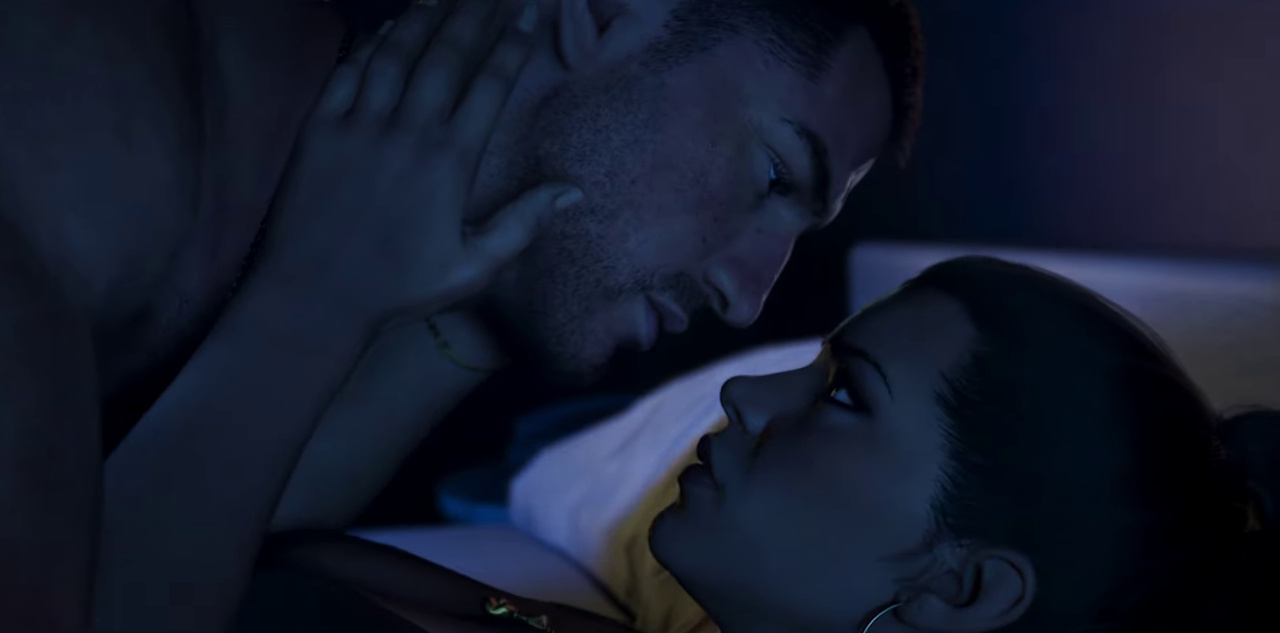
Starfield: Further Thoughts

Spoiler Warning: There are spoilers ahead for Starfield’s main quest, including its ending.

I have to confess that I haven’t played a lot more of Starfield since I last shared my thoughts on the game, its flaws, and how Bethesda might want to respond to some of the biggest points of criticism. But as I’ve sat with the game in the month since it released, I’ve found a few more things to say that I didn’t get to mention in either of my two big post-launch pieces about Starfield. It’s these points that we’re going to talk about today – and if you ignored the spoiler warning above, please know that we’re going to discuss the ending of the main quest and Starfield’s New Game Plus mode.

I feel that Skyrim’s unprecedented success changed something at Bethesda. The company ceased viewing its games as individual stories to be created, completed, and published, and instead began seeing all of its projects as ongoing, long-running experiences. Because Skyrim remained popular for years after its release, Bethesda seems to have internalised that and expected it to become the “new normal,” deliberately taking steps to build all future games with that goal in mind. We saw that most obviously with Fallout 76, but I’d argue very strongly that it happened with Starfield as well.

Starfield has landed…

In a recent interview with Insomniac Games (creators of Marvel’s Spider-Man, among other successful projects), Bethesda executive producer Todd Howard said that Starfield was “a good base of a game to build upon,” referencing the company’s plans for future DLC and additional development for years to come. This isn’t the first time we’ve heard of talk of years-long plans for Starfield. In fact, it seems that building a kind of single-player live-service title was one of Bethesda’s main objectives when developing the game.

My question is this: was Starfield screwed over by this idea?

Find me a recent game that billed itself as having a “ten-year plan” or a “five-year roadmap” that actually went the distance. Whether we’re talking about the likes of Anthem, Marvel’s Avengers, or Halo Infinite, many titles have come along promising something like this – only to fail to deliver. Games that genuinely last a decade or more are seldom planned that way; titles like Fortnite, Grand Theft Auto V, or Skyrim are lightning in a bottle. These one-off games succeed for almost unquantifiable reasons – and a massive amount of luck. Corporate planning to replicate that kind of once-in-a-generation level of success has almost never worked. Massive developers like Rockstar have faltered, and even some of the biggest brands and properties on the planet, like Marvel, have been unable to make a “five-year experience” work.

Anthem’s “roadmap” of content that was supposed to be added to the game.

And I can’t help but feel echoes of the likes of Anthem in Starfield. Parts of the game feel barebones and incomplete, as if waiting for future “content drops” and updates to round things out. There are plenty of missions and quests to get stuck into in Starfield, for example, but where are the cosmetics and skins? Why are there so few weapon styles, outfits, skins, and the like? I said when I wrote up my first impressions of Starfield that I was pleased to see the game wasn’t being excessively monetised… but looking at the lack of cosmetic variety and skins, it seems pretty clear that Bethesda plans to add these as paid-for DLC.

The corporation is no stranger to this. In fact, I’d argue that Bethesda is actually one of the guiltiest parties in the entire games industry when it comes to microtransactions – especially in the single-player space. Oblivion’s infamous horse armour DLC in 2006 was one of the most notorious examples of bad value cosmetic DLC in a single-player game, and one of the first to attract mainstream attention. Other companies saw Bethesda essentially getting away with it, and a truly unfortunate trend accelerated.

Oblivion’s horse armour DLC was released in 2006.

At time of writing in October 2023, the only skins available in the game come from expensive pre-order or premium editions of Starfield. That’s already a red flag, in my opinion, and it seems all but certain that future skins will also only be available as paid add-ons.

Starfield could look very different in six months or a year from now, with in-game purchases that could easily push the cost of the complete game closer to £200. Remember that in order to get the currently available skins, and pre-order Shattered Space, players are already having to fork over £100 to Bethesda for Starfield’s premium edition, so £200 when additional skins and cosmetics have been released doesn’t even seem like a stretch. By the time Bethesda finally stops working on Starfield altogether in the years ahead, the full price of the game plus all of its DLC and additional content could run to far more than that.

Skins are currently available as pre-order and special edition bonuses only.

So I’m rescinding my “doesn’t feel excessively monetised” statement from my earlier piece. Starfield feels like a game that’s being primed for additional monetisation – and rumours of paid mods have not escaped my notice, either. Paid mods will have to be the subject of a longer piece one day – but suffice to say for now that I’m not a supporter of them in any way, shape, or form.

Bethesda took a risk by turning Starfield into a single-player live-service title, and while I will say that the “base” version of the game still has a lot on offer – for people who are still interested in Bethesda games and the way they design their quests – I’m not sure it was the right decision. Building a good game with fun gameplay and an engaging story should have been priority number one – but it feels like both of these things took a back seat. Planning for a decade’s worth of add-ons and extra content became Bethesda’s main ambition. I’m not convinced all of these planned pieces of DLC will see the light of day.

This is where skins will appear – when Bethesda is ready to begin selling them.

When I really dig down, Starfield’s biggest issue for me personally isn’t actually that its gameplay feels outdated and uninspired. It’s that the game’s story just didn’t grab me and the worldbuilding was so bland and uninteresting that I didn’t care to spend any more time in it. The world of Starfield feels small, flat, and boring – and when the gameplay backing it up was lacklustre too, I couldn’t find a way to make progress. I’m someone who’ll happily play through some absolutely bog-standard gameplay if I’m enjoying a story or getting lost in a fictional world, but with Starfield offering neither an entertaining story nor an engaging world… sticking with the game lost its appeal.

I looked up spoilers online to see what happens further along Starfield’s main quest. I was bored to tears playing it, but if it picked up later on I thought I might be able to push through to get to the promised moment where the game would finally “get good.” But what I read actually surprised me – and I ended up feeling glad that I didn’t waste any more hours of my life playing through the story.

One of the artefacts at the heart of the game’s story.

What is one of the most basic pillars of storytelling? Any narrative needs a beginning, a middle, and an end. If a story revolves around a big mystery, solving that mystery is absolutely key to making it feel complete. Starfield’s writers chose to ignore this absolutely fundamental rule of narrative construction, and the result is that the game’s main story seems like it comes to a deeply unsatisfying “end.”

Starfield began by setting up a mystery: what is this artefact? What does it do? And who made it? Then the game introduces us to a team of people dedicated to figuring it all out. There are major structural weaknesses on this side of the story – like what anyone involved in Constellation actually does or has been doing for the past thirty years prior to the player character showing up – but that’s somewhat beside the point. After a series of glorified fetch quests that see us chasing different artefacts across the galaxy, Starfield introduces two antagonists and magical powers that we can learn… but then the story ends without explaining anything about what the artefacts were or who created them.

Starfield’s main story has a deeply unsatisfying ending – and the journey to get there isn’t much fun either.

Failing to solve the key mystery at the heart of the narrative, and refusing to even answer the most basic of questions about that mystery, ignores one of the fundamental tenets of storytelling. It makes the whole story – which then begins again in a weird kind of cyclical manner – feel incomplete and frustrating.

It seems to me that this aspect of the game – starting over by “travelling to an alternate reality” – is nothing more than a narrative gimmick to allow Bethesda to put a New Game Plus mode into Starfield.

And why would Bethesda want to add such a feature? None of the company’s previous titles included New Game Plus, after all. Oh, that’s right: because Starfield was built to be a “ten-year experience” rather than a complete game, and New Game Plus feels like an easy way to keep players engaged for longer.

I couldn’t even get through the game once

So we come full-circle, and I think we can reasonably make the case that Starfield has been harmed in more ways than one by Bethesda’s insistence on planning for the long-term at the expense of the short-term. Maybe Shattered Space, or some additional piece of DLC in the future, will resolve Starfield’s big mystery. And maybe, if that happens, the main story of the game will feel complete and worth experiencing. But if the best possible spin I can put on Starfield is that it’s an incomplete experience that needs additional content to actually feel like its story has a proper ending… that’s not great. It makes it feel no different from dozens of other incomplete live-service games.

I usually avoid live-service titles, and I do so for one basic reason: I don’t like to play an incomplete game. If a film or season of TV ends on a cliffhanger, with promises of a resolution to come next time, that’s one thing. But Starfield isn’t a film or a TV show, it’s a single-player game that shouldn’t depend on future DLC or updates to actually complete its main story.

Ready for boarding?

The longer I’ve sat with Starfield, the further the game has slipped down in my estimation. There are unfavourable comparisons with other recent releases that can’t be avoided, but at its core we’re stuck with a game that feels fundamentally incomplete. As Todd Howard himself admitted, Bethesda made a “base experience” that they intend to build on over the next few years – and that they also expect modders to help with. That might’ve been okay were it not for the outdated and buggy gameplay combined with an uninteresting and bland setting.

So like with other live-service titles, maybe Starfield will be worth revisiting after those promised updates, content drops, and DLC packs have been created. Maybe the “ultra deluxe anniversary edition” will be worth playing in 2030 – so if I live that long, maybe I’ll check it out. But I’ve been wasting my time on a game that, for all of its lofty promises, just isn’t what I’d been expecting. As I said last time: part of that is on me for internalising too much of the hype and excitement that built up in the months before Starfield’s launch. But a lot of the blame lies with Bethesda for creating an uninspiring setting, a bland, incomplete story, and for building a game that feels a decade out of date.

You cannot go that way.

Forget about Starfield becoming a “ten-year experience.” Bethesda needed to catch up on at least ten years worth of improvements and changes in game design and development. Those are the ten years that Bethesda should have been focused on. The company should have been looking at what comparable games in the open-world, action-adventure, and role-playing spaces have been doing since Skyrim launched and worked to incorporate some of those elements into Starfield. Instead, Bethesda took the Skyrim formula, cut out content to introduce later by way of paid DLC and add-ons, and planned for a decade’s worth of content for a game that already feels at least ten years out of date.

I wanted to love Starfield. The game’s overall aesthetic and many of its creative choices looked to create exactly the kind of sci-fi setting that appeals most to me. Blending real-world design elements with some of the sci-fi properties that I remember fondly from years past should have been exactly what I was looking for. I was worried that I was too harsh on Starfield and that I’d been treating the game unfairly or unkindly… but the longer I’ve sat with it the more I’ve seen its “ten-year plan” laid bare. I don’t care for live-services, for incomplete experiences, or for badly-written stories with cheap endings. I think I’m done with Starfield for now – though I will give the caveat that the game could be worth picking up again once its planned add-ons have been released.

Starfield is out now for PC and Xbox Series S & X consoles. Starfield is the copyright of Bethesda Game Studios, Bethesda Softworks, Xbox Game Studios, and/or Microsoft. Some promo images and screenshots used above courtesy of Bethesda. This article contains the thoughts and opinions of one person only and is not intended to cause any offence.
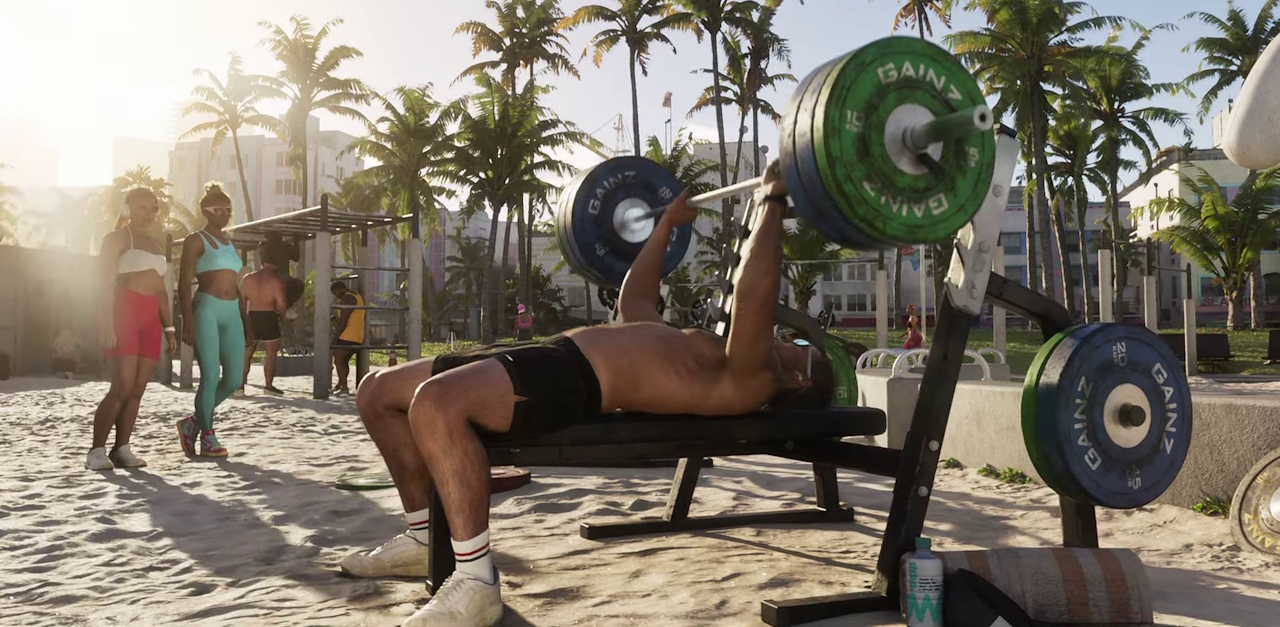
Xbox Game Pass: The DLC Problem

If you’re a regular reader, you might know that I’m an Xbox Game Pass subscriber. I play on PC, not on an Xbox console, but Microsoft’s “Netflix of games” has felt like a good value proposition to me over the past couple of years. I’ve been able to play several big games without having to buy them outright, and in addition Game Pass has introduced me to several titles that I’d never have thought to try for myself. Even though I’m not someone who plays video games every day, I still feel that I get good value for money from Game Pass.

You know there’s a “but” coming, though.

But Game Pass has a problem, and it’s one that might prove tricky to unstick. Although the service includes a good range of titles across different genres, and many brand-new ones join the Game Pass lineup on release day, a lot of these games are incomplete. To use a games industry euphemism: these versions are the “base game” – without any DLC being included.

Game Pass includes a lot of games – but many are incomplete.

There are exceptions to this, such as “game of the year” bundles of titles like Skyrim and Fallout 3 that come packaged with their DLC – but these games, when they exist, tend to be older titles, not brand-new ones. And in the case of Skyrim, while the Game Pass version does include DLC, it’s not the most recent “anniversary edition” that comes with additional content and visual improvements. Figuring out which version of a game is which and what add-ons and DLC come with which one can feel like navigating a maze at times!

This recently came up for me with two games: Starfield and Age of Empires II. I was a huge Age of Empires II fan around the turn of the millennium, and I’ve been thrilled with the Definitive Edition remake that was released a couple of years ago. When developers Forgotten Empires and Xbox Game Studios announced that there was going to be a new piece of DLC for Age of Empires II – one that would bring the original civilisations from the first Age of Empires into the new game – I thought it was something worth checking out.

Promo banner for the Return of Rome DLC.

But on Game Pass, the Return of Rome DLC isn’t included along with Age of Empires II. The only way to play it is to buy it – for the not-so-low price of £10. Even with a Game Pass subscription, it would cost a whopping £80 to buy the Age of Empires Collection – a bundle that includes all four games plus their various DLC packs. If I’m paying a subscription fee every month to access this service and these first-party games, that seems ridiculous and excessive.

Starfield, too, has irked me when it comes to DLC on Game Pass. Bethesda’s space-RPG launched on Game Pass not on “day one,” as was promised, but five days later – with those first five days gated off behind a paywall. Five days of so-called “early” access was only available to players who forked over an additional £35 – and I don’t think that should be acceptable. Too many companies have started charging extra to play their games as soon as they become available, using shady manipulative tricks to convince folks to cough up even more money. But paid “early” access will have to be the subject of a longer article in future.

The only way to get access to Starfield’s “story expansion” on Game Pass is to pay extra.

Also included in Starfield’s expensive £35 add-on on Game Pass was the first piece of planned DLC: Shattered Space. This DLC pack isn’t out yet and most likely won’t arrive until sometime next year, but even for Game Pass subscribers, the only way to get it will be to pay up. Shattered Space is described as a “story expansion” for Starfield; a piece of DLC that will add to the story present in the “base” version of the game. I’m beginning to get tired of this – being charged extra on top of a subscription.

The basic problem is this: we all know that most games in 2023 aren’t complete experiences. With a few exceptions, like Baldur’s Gate 3, most games nowadays are deliberately constructed to be incomplete, and to require DLC and “content packs” to make up for these inbuilt, deliberate deficiencies. When Game Pass only allows players access to the “base game,” what that really means is that it’s a service made up entirely of incomplete experiences.

Baldur’s Gate 3 feels like a rare gem in 2023: a game that’s actually complete without expensive add-ons.

Baldur’s Gate 3 is a great game, and I firmly believe it would still be lauded and held in high esteem even if the games industry wasn’t plagued with these problems. But one factor among many in its success, and one of the reasons why it’s being celebrated by players, is that it’s so rare nowadays to see a fully-complete game that doesn’t require expensive DLC or that doesn’t come bundled with an in-game shop and microtransactions. In a broken, greedy, money-grubbing marketplace, games like that stand out.

Incomplete games have become normalised, and that’s been the case for at least a decade. In 2012, Mass Effect 3 was released – and the “base game” had a whole chunk carved out that was sold as day-one DLC: From Ashes. This content, which was developed alongside the “base game” and perfectly integrated into it, was sold separately by EA for an additional fee. Although it remains a particularly egregious example of this phenomenon, it’s far from the only one. Day-one DLC and cut content are everywhere nowadays.

Mass Effect 3 was a pioneer of cutting out content to sell as DLC.

So if it’s increasingly rare that a “base game” can be considered anywhere close to a complete, well-rounded experience, what does that say about a service like Game Pass? To me, Game Pass feels increasingly like those demo discs that used to come stuck to the front of magazines or in cereal boxes in the ’90s. There’s some great stuff there – but if you want to play more than just the “base” version, you’d better be prepared to fork over some additional cash. Maybe £10 for Age of Empires II DLC seems reasonable to you, but £35 for Starfield DLC that might not be released for another twelve months feels like highway robbery.

Microsoft wants Game Pass to be “the Netflix of games,” and to transform the way players engage with playing games on its platforms. So let’s take the Netflix analogy as a starting point and consider this question: does Netflix charge extra for additional content?

Microsoft wants to make Game Pass the “Netflix of video games.”

Can you imagine logging into Netflix, excited to watch the second season of your favourite show, only to be told that you need to pay an additional fee? For many games, DLC is the equivalent of “Season 2,” continuing the story, rounding out the experience, and even patching out issues with the game in some cases. No video streaming service could get away with only making Season 1 of a TV series or the first film in a trilogy available to watch, with the rest only accessible for an extra fee. That would be ridiculous.

Having said that, I hope I haven’t given the penny-pinchers at Netflix any ideas!

But you see my point, right? It wouldn’t be possible for a video streaming service to only include some films and episodes in its “base version” and expect to get away with charging extra fees to watch the rest. Customers wouldn’t stand for that – so why does Microsoft think it can get away with doing that on Game Pass?

Imagine if Netflix tried to get away with charging extra to watch the second or third season of a series.

I suppose we should make a distinction between different kinds of DLC, in the interest of fairness. Single-use items in online games, in-game currencies, and maybe even some cosmetic items are the kind of things that could still be charged for separately. I’m not suggesting that Game Pass players should get infinite amounts of these things, especially in competitive online multiplayer games.

But for titles like Starfield with its single-player DLC, and even for Age of Empires II with its new story campaign and factions, I really do believe that these should be included in the cost of Game Pass. What are we paying Microsoft for if all we’re getting are incomplete experiences; games that will become less and less complete over time? The price of Game Pass should go toward the cost of developing DLC for these titles, especially since it’s taken as a monthly charge. There’s no better definition of a “recurring revenue stream” than that.

This is all about money, at the end of the day.

So this was a bit of a rant, but it’s something I’ve been meaning to bring up for some time now. While I don’t think it’s fair to ask for every single title to include all purchasable items as part of Game Pass, I absolutely believe that single-player titles and big expansion packs should be covered. The “base game” hasn’t felt like a full or complete experience for a long time, so when Game Pass only offers that, it feels less like a subscription service and more like an expensive demo disc.

At the very least, I’d like to see Microsoft’s first-party releases bring their major expansion packs and DLC to Game Pass. If I were to fantasize, I’d say that cosmetic items in single-player games, small content packs like cars in racing games or new guns in shooters should also be included as well.

This is something Microsoft will have to deal with sooner or later, because players aren’t going to be pleased if they have to keep forking over additional fees on top of their Game Pass subscription. If I have to pay £35 to get Starfield’s unreleased DLC, why even bother subscribing at that point? I might as well buy the “base game” right now and wait for the DLC to go on sale.

The Game Pass subscription service is available now for players on PC and Xbox game consoles. All titles discussed above are the copyright of their respective developer, publisher, and/or studio. This article contains the thoughts and opinions of one person only and is not intended to cause any offence.
Questions that Mass Effect 4 will almost certainly need to answer

Spoiler Warning: There are spoilers ahead for the Mass Effect trilogy (including Legendary Edition).

It’s been a while since we last talked about the next entry in the Mass Effect series, but to celebrate my dedicated Mass Effect webpage finally going live here on the website, I thought it could be interesting to consider a handful of big questions that the team at BioWare will need to answer before a new story can be written. If you missed it, I now have a brand-new webpage dedicated to the Mass Effect series, and you can find all of my Mass Effect commentary, theories, and articles there. You can find this page by using the drop-down menu at the top of every page or post here on the website – or you can click or tap here to head there directly!

There hasn’t been much by way of news about the next Mass Effect game for a couple of years. BioWare released a brief CGI teaser all the way back in December 2020 confirming that the game is in pre-production, but since then, updates have been few and far between. BioWare provided a brief update in November 2022, saying that pre-production is “proceeding very well,” which sounded positive. In August 2023, however, BioWare announced that there were going to be job losses at the company. With production currently focused on Dragon Age: Dreadwolf, and with these cuts taking place, the next Mass Effect game is unlikely to see the light of day before 2026 or 2027 at the earliest.

Commander Shepard in the Normandy’s cockpit.

But that doesn’t mean there aren’t things to talk about! We may not see the game I’m tentatively calling Mass Effect 4 for a long time, but the studio will have already taken a number of big decisions about the game, its setting, its characters, and its key storylines. Today, I’m giving my two cents on what some of those decisions may be – and there are some absolutely massive ones that have serious implications for the state of the Mass Effect galaxy.

As I’ve said before, there are questions about the Mass Effect galaxy that BioWare simply can’t ignore forever. Maybe a single game with a focused story could sidestep one or two of these questions, but if Mass Effect is to survive long-term with new games (and perhaps even a TV series) being produced… sooner or later answers will have to come. What that means is that some of the biggest decisions open to players in the original Mass Effect trilogy will need to be given a canon outcome, one that Mass Effect 4 can build upon. To players who were adamantly opposed to playing the game a certain way, that could lead to hurt feelings and disappointment – but I see no way around it. Some of these points are too big, and the implications too diverse, for a new story to be written that could take so many different outcomes into account.

Bypassing a locked door in Mass Effect 3.

Some Commander Shepards died at the end of Mass Effect 2. That game’s suicide mission could, under the right (or should that be wrong?) circumstances lead to Shepard’s death, and that meant that players had to either restart from an earlier save or start a new campaign in order to play Mass Effect 3. The third entry in the trilogy was able to take into account a lot of decisions from earlier games – but Shepard’s death was a bridge too far.

I bring this up because the Mass Effect series has taken big decisions like this in the past. Mass Effect 3 couldn’t happen without Shepard being alive, meaning players whose characters died at the end of Mass Effect 2 didn’t get to see their decisions carried forward. The same will have to happen in Mass Effect 4 – albeit on a grander scale.

So let’s try to look ahead to Mass Effect 4, and – assuming the game will be the sequel we’re all hoping for – pick out some of the biggest questions that will need to be answered.

Question #1:
What colour were the explosions?

An exploding Mass Relay.

This is a deliberately facetious way of asking the biggest question that any sequel to Mass Effect 3 cannot ignore: which ending was chosen? It simply isn’t going to be possible for the game to try to account for all three possibilities; the differences between them are too vast for a single story to encompass wildly divergent states of the galaxy. So one ending will have to be declared “official” – and if I had to place a bet, I’d say that the “destroy” ending is going to be the one that’s picked.

All of the endings of Mass Effect 3 have points in their favour from a narrative standpoint, but “destroy” was the one that Shepard had been working towards across the entire trilogy. Not only that, but it’s the only ending in which it’s even remotely possible – based on what we saw on screen – that Shepard could have survived. “Destroy” is, according to stats about Mass Effect: Legendary Edition that were released by BioWare, also the most popular choice that players made. So there are a lot of points in favour of making “destroy” the canonical ending to Mass Effect 3.

The damaged Citadel in orbit of Earth.

The state of the galaxy is going to be profoundly altered by whichever ending to Mass Effect 3 was chosen, and I just don’t see how a new game could possibly take that diversity and variety into account. Mass Effect 4 would essentially need to be three games in one in order to accomplish that – and that just doesn’t seem likely. If Mass Effect 4 is to continue the series, perhaps laying the groundwork for a new trilogy or series of games, that divergence will only grow over the course of its story. So there has to be a single starting point chosen – even if that means disappointing some players who were particularly attached to one of the other ending variants.

I felt that Mass Effect 3′s final chapter was trying to present “synthesis” as the better option. That was the one that was hardest to unlock, and in the epilogue, EDI seems to suggest that “synthesis” led to a kind of technological paradise, with the galaxy’s races living in harmony… but I always took umbrage with that idea. Not only was it literally the goal of the Reapers as stated by the AI that controls them, it was a completely different outcome to what Shepard had been fighting for. It was also not Shepard’s place to inflict such a radical change on the entire galaxy without anyone’s consent – and without even listening to a single other opinion on the matter! But more than that, “synthesis” doesn’t seem like it would lead to an interesting or relatable narrative. With human characters merged with AI, and with everyone living in a utopia… how could we as the audience get invested in the people or the world?

Question #2:
Did Shepard side with the Geth or the Quarians – or find a route to make peace?

Tali, Shepard, and Legion in Mass Effect 2.

The Geth-Quarian conflict was one of the most interesting in Mass Effect, and the way in which it came to a head in the final chapter was incredible. It was disappointing, however, that after the mission to Rannoch, the Geth and Quarians weren’t really mentioned much, and that all of the hard work involved in getting one or both of them to join the war effort was relegated to a couple of JPEG images in the war assets menu! But enough about the rushed end to Mass Effect 3!

There are galactic repercussions that will reverberate from the Geth-Quarian conflict, and how it was resolved will have a huge impact on the state of the galaxy in Mass Effect 4. If Shepard chose to side with the Geth, then chose the “destroy” ending… both races could be extinct. Or if Shepard found the pathway to peace and then chose either “synthesis” or “control,” both races could still be around and working together. Whichever outcome it is, whether the Geth, Quarians, or both are present in the galaxy is going to be a big deal.

Quarians in the Mass Effect 3 epilogue.

Here’s my pet theory: one way or another, BioWare will include both the Geth and Quarians in Mass Effect 4 – even if that means ignoring one of the consequences of the “destroy” ending. Depending on how much time may have passed in-universe, the new game could claim that the Quarians rebuilt the Geth after they were destroyed – or perhaps the Catalyst either lied about the Crucible destroying all synthetic life or simply got it wrong.

I think that given the popularity of both the Quarians and Geth – thanks in large part to their squadmate representatives, Tali and Legion – BioWare won’t want to throw either away. If we stick to a literal interpretation of the Catalyst’s warning in Mass Effect 3 and assume that “destroy” will be chosen as the canon ending, then perhaps the Geth will be absent. But I wouldn’t bet on that, and I think a technobabble explanation for their survival or resurrection is plausible and could be made to fit.

Question #3:
Did Shepard survive?

Does this moment represent Shepard’s survival?

This is the big one! While not as galaxy-altering as the way in which the Crucible was used or the literal survival of entire races… from a character point of view, Commander Shepard is the player’s avatar in the Mass Effect world. If there’s even a slim chance that they might’ve survived, at the very least we should find out!

I can’t decide right now whether Mass Effect 4 will go down the route of making Shepard the player character once again. After the disappointment of Andromeda, there will surely be a temptation to “stick with what works” in the Mass Effect universe – and Shepard is clearly a big part of that. That being said, I think there’s absolutely scope to create a new player character and to expand Mass Effect beyond Shepard and the crew of the Normandy. If the franchise is to continue long-term, that will have to happen sooner or later.

A male Commander Shepard aboard the Normandy.

But regardless, news of Shepard’s fate should reach us at some point during the game – even if it’s only to confirm that they died centuries earlier. One thing that a lot of folks found frustrating about Andromeda was that the outcome of the Reaper War was left entirely unresolved, and I don’t think that the next Mass Effect game could get away with repeating that mistake.

After everything Shepard went through to defeat the Reapers, they have definitely earned their retirement! But if the galaxy is in danger once more – and surely, somehow, it will be – they could be the person that has to step up once again and lead a new fight.

Question #4:
What became of the Rachni?

The Rachni in one possible epilogue scene.

Depending on choices made in both Mass Effect 1 and Mass Effect 3, it’s possible that the Rachni may have survived. The Rachni were an insectoid race that threatened to overwhelm the galaxy centuries before the events of the games – and were believed to be extinct. Shepard was given the option to save the last known Rachni queen on two occasions – and the presence or absence of the Rachni could have wider implications for the state of the galaxy.

If the Rachni queen was saved, Rachni workers join up with Admiral Hackett’s fleet and contribute to the Crucible project. Given the scale of the Crucible, I don’t think the Rachni’s survival could be hidden in the aftermath of the war, so any hope for a return to hiding away on an obscure planet seems to be out of the question.

The last surviving Rachni queen.

But not everyone would be thrilled about the Rachni’s return. The Krogan still view the Rachni as a kind of ancient ancestral enemy, and there may be Krogan and Asari who still remember the aftermath of the Rachni Wars. Even if the Rachni’s contribution to the success of the Crucible was public knowledge, there are many in the galaxy who would be wary – and some who might view them as a threat. Could an attack on the Rachni be the first sign of the Reaper War alliances breaking down?

Alternatively, it’s possible that the Rachni were never saved by Shepard and thus went extinct with the defeat of the Reapers. This would preclude their presence in the story as either a friend or foe – unless they could be revived, once again, by technobabble!

Question #5:
Did the Leviathans join the war effort?

The Leviathans were eventually tracked to their base.

Another pet theory of mine is that the Leviathans – who were originally DLC for Mass Effect 3 – will return as the “big bad” in a new story, seeking to reclaim a galaxy that they view as “theirs.” You can read more on that by clicking or tapping here, by the way. But for our purposes today, the question is whether they joined the war at all – or whether they were able to remain hidden.

Following the Leviathan story to its conclusion is not an essential part of Mass Effect 3, but it’s one that has far-reaching implications. The discovery of the Leviathans explains the origin of the Reapers, but it also introduces us to a very alien race – one that ruled the galaxy and enthralled other races aeons ago. Despite their defeat at the hands of the Reapers and the passage of tens of millions of years, the Leviathans seem to have lost none of their arrogant sense of superiority – so how they could possibly be integrated into a multi-racial galaxy is an open question.

Commander Shepard inspecting a Leviathan cave painting.

Regardless of whether they end up as the new game’s villains, though, I don’t think Mass Effect 4 could just ignore the Leviathans. Their numbers may be small, but with the Reaper threat gone it’s not inconceivable that the Leviathans would want to expand, leaving behind their watery planet. The consequences of this for the rest of the galaxy could be extreme – or not! But either way, the Leviathans will be a presence.
Players will want to know what happened after the Reaper War – and realistically Mass Effect 4 will have to at least pay lip service to all of the races and factions that were involved, telling us what became of them… or where they were last spotted. The Leviathans also have a lot to answer for, in a way, as the original creators of the Reapers!

Question #6:
Which of Shepard’s companions survived?

Concept art featuring Shepard’s crew from Mass Effect 2.

Across the Mass Effect trilogy, Shepard teamed up with nineteen main crewmates – and there were also a handful of others who served in that role on a temporary basis. Even if Mass Effect 4 doesn’t feature all of them, it would still be nice to get news of their fates. During the final battle of the Reaper War, it’s possible that not all of them would have survived, and Shepard had the opportunity to say goodbye to many of them before the final act of Mass Effect 3 got underway.

As of right now, we can safely assume that Liara survived! She was shown in the CGI teaser for Mass Effect 4 back in 2020, so it seems all but certain that she’ll make an appearance – somehow – in the new game. That doesn’t mean she’ll be a squadmate or playable character, but she could play a significant role. She could even be a kind of narrator for the game.

Liara as glimpsed in the 2020 teaser trailer.

Characters who were aboard the Normandy at the end of Mass Effect 3 seem to survive the end of the game – or at least most of them do, depending on the choices players made and how strong their war assets were going into the final clash. We can safely assume that the likes of Joker, Garrus, and Javik survived the immediate aftermath of the war, at least.

But that still leaves us with most of the folks from Mass Effect 2 – characters like Miranda, Samara, and Jack. All of them could have died before the endgame, but assuming they were alive going into the final fight… we don’t know what happened to them. If Mass Effect 4 is set many years later, discovering their fates could be spread across the game, and players could learn what happened to them without necessarily having them all make an appearance.
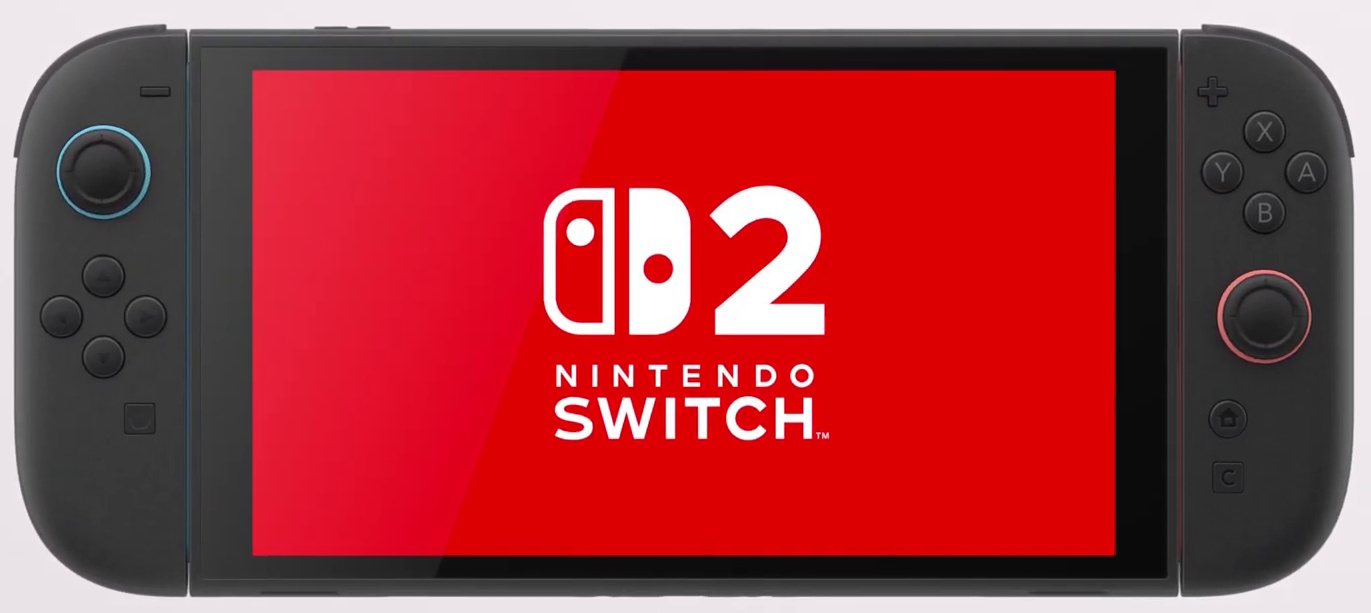
Question #7:
Was the Genophage cured?

A vision of Tuchanka if the Genophage cure was sabotaged.

Commander Shepard has the opportunity in Mass Effect 3 to cure the Genophage – or sabotage the cure. The Genophage was an artificial sterility plague that had been inflicted upon the Krogan by the Turians and Salarians, and there will be galactic-scale consequences depending on Shepard’s actions here.
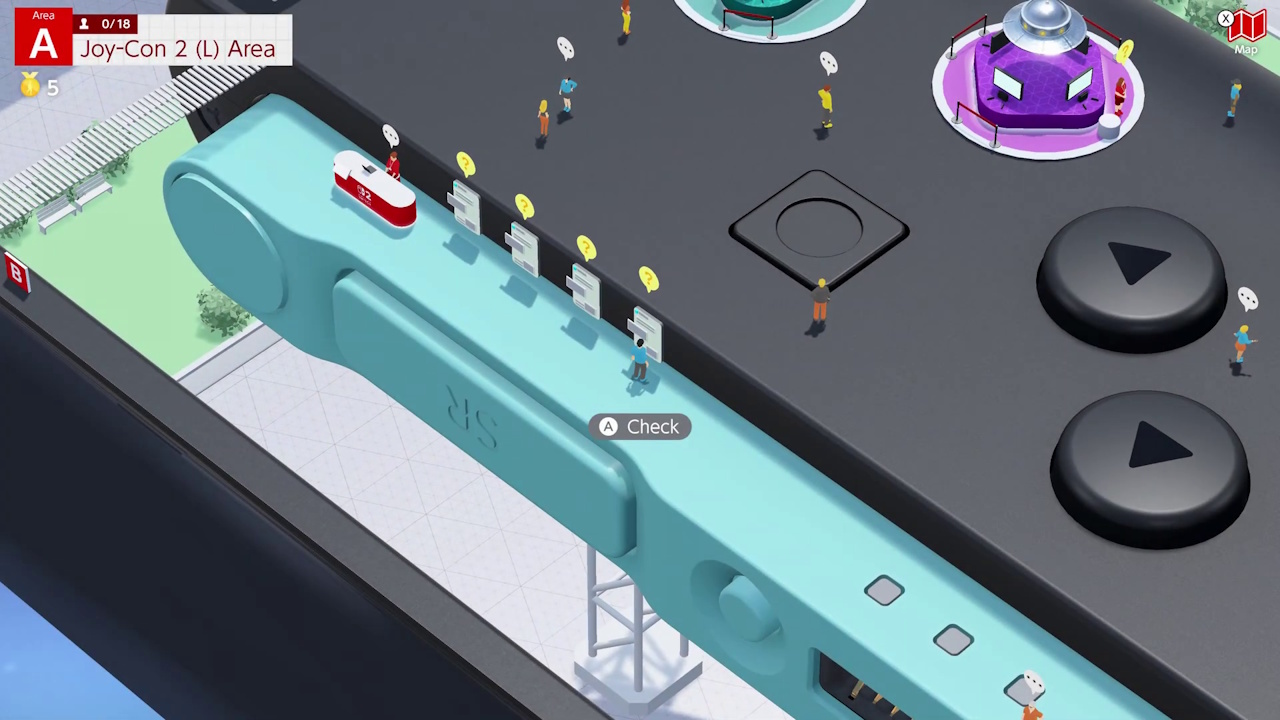
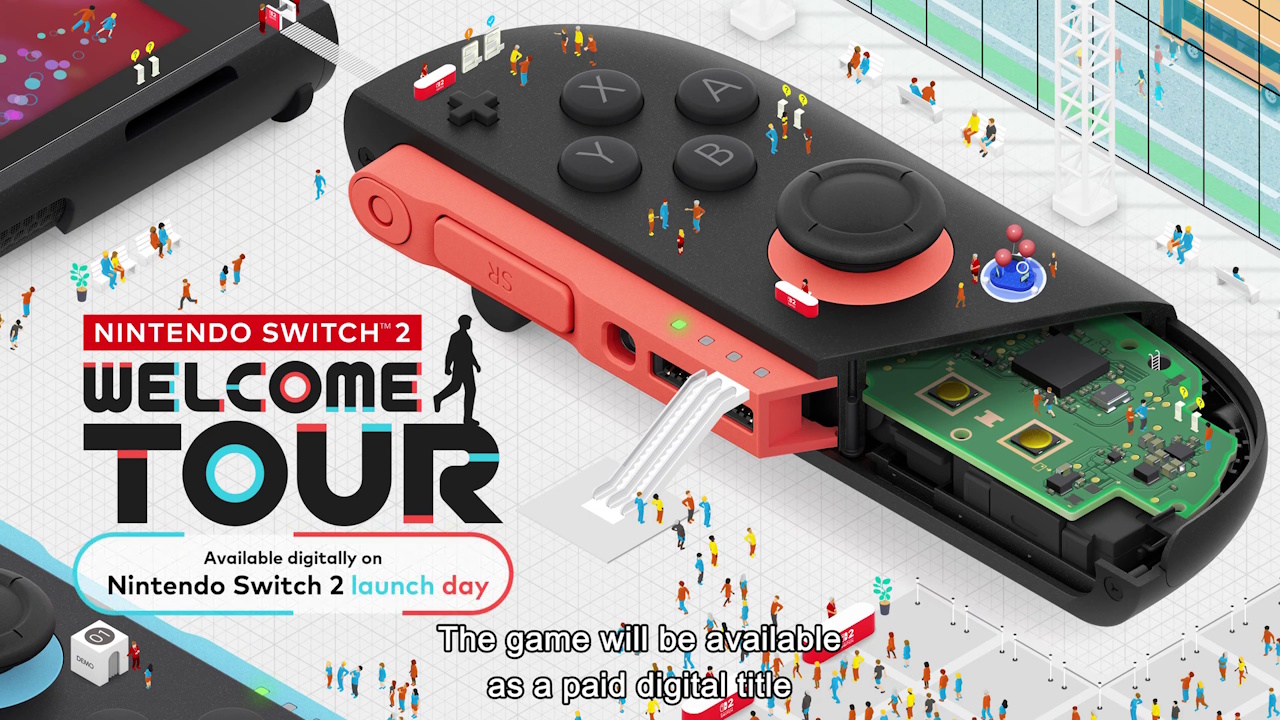
One day we’ll have to talk about this storyline in more detail – because I find it one of the most interesting and morally dubious storylines in the entire Mass Effect trilogy! But for today, suffice to say that curing the Genophage, or refusing to cure it, will have major ramifications for the whole galaxy.

Happy Krogan families – if the Genophage was cured.

If the Genophage was cured, there will be a lot more Krogan around – but they should be friendly, right? I mean, Shepard cured the Krogan people, and if Wrex and Eve survived to lead the Krogan, that knowledge will be passed down and celebrated. But there are some potential issues here! Even Wrex seemed to suggest that Krogan expansion was on the agenda – and centuries ago, Krogan expansionism led to war.

On the other hand, if the Genophage cure was sabotaged, the remaining Krogan will likely feel betrayed and could launch a new rebellion. At the very least, Krogan will be hostile and unfriendly if the Genophage wasn’t cured. Having spent a lot of time with Krogan characters across the trilogy, I think it would be hard to pull off turning them into villains next time around, even if there’s a narrative pathway that makes sense in-universe. But a story could be crafted in which, no matter what decision Shepard made, the cure was ultimately sabotaged and doomed to failure.

Question #8:
Who gets to be on the Council?

The Council in Mass Effect 1.

More broadly, we can even ask whether there’s a Council at all in the aftermath of the Reaper War – but somehow, I suspect there will be. In the Mass Effect trilogy, humanity’s rapid ascent from newly-encountered species to full Council membership was a contentious issue with some of the other races, and after everything that happened with the Reapers, a shake-up of the galactic order could be on the agenda.

From our own history, we can point to how World War II led to the creation of the United Nations, and how the pre-war order was transformed in the aftermath of the conflict. Something similar could happen in the Mass Effect galaxy, with races like the Krogan, Quarians, Batarians, or even the Rachni and Geth all being potential members of a broader, more diverse and democratic Council.

A Vorcha, Salarian, and Volus served on the Council… in the movie Blasto!

If several races were invited to join, those who were snubbed might feel particularly stung! And others, like the Leviathans, for example, may not wish to join a power-sharing arrangement – they might prefer to seek conquest and total power for themselves. But there are many who’d happily join the Council.

The pre-war order of the Salarians, Turians, and Asari being the dominant forces in galactic politics could be at an end – but will they be okay with that? Will the Salarians genuinely listen to Krogan input, and will the Asari really be willing to see the Quarians as equals? Will there be arguments about how to direct the resources necessary to rebuild? There could be a lot of points of tension!

So that’s it!

Shepard, Javik, and Tali.

We’ve looked at a few questions that the next Mass Effect game – or a future sequel to Mass Effect 3 if that game turns out to be something different – will have to address. Some of these points could be bigger and more important than others depending on what kind of story the new game aims to tell, but sooner or later there are big questions about the state of the galaxy that will have to be tackled.

Andromeda tried to sidestep these questions and do its own thing – which was probably not a bad idea in 2017, coming so soon after the trilogy had wrapped up. But there were other problems with Andromeda that meant the game didn’t stick the landing – and when it was already feeling like an overblown side-quest, some fans were left disappointed when it didn’t address any of the big questions facing the Mass Effect galaxy.

Take cover!

There’s an opportunity for the next game in the series to not only answer some of these big questions, but to use the answers to set the stage for a brand-new adventure. Taking what happened with the Leviathans, for example, and expanding on that story to create a new villain is one possibility that I think is worth keeping an eye on!

So I hope this has been a bit of fun, or at least interesting. There are definitely other story points that a new game could address that I didn’t include here; it’s by no means an exhaustive list. And we may return to some of these questions and ideas in the future to talk more about them or give them a longer write-up. I had fun thinking about where the next Mass Effect game could go, at any rate!

Earlier this summer I replayed the Mass Effect trilogy, and that was part of what prompted me to create a proper webpage for the franchise here on the website. Although I don’t talk about Mass Effect all the time, it’s a series I’ve enjoyed and I am certainly looking forward to seeing what comes next.

Don’t forget to swing by my new Mass Effect webpage. You can find it by clicking or tapping here.

The next Mass Effect game is in early development and most likely won’t be released for several years. Mass Effect: Legendary Edition is out now for PC, PlayStation 4, PlayStation 5, Xbox One, and Xbox Series S/X. The Mass Effect series – including all properties mentioned above – is the copyright of BioWare and Electronic Arts. This article contains the thoughts and opinions of one person only and is not intended to cause any offence.