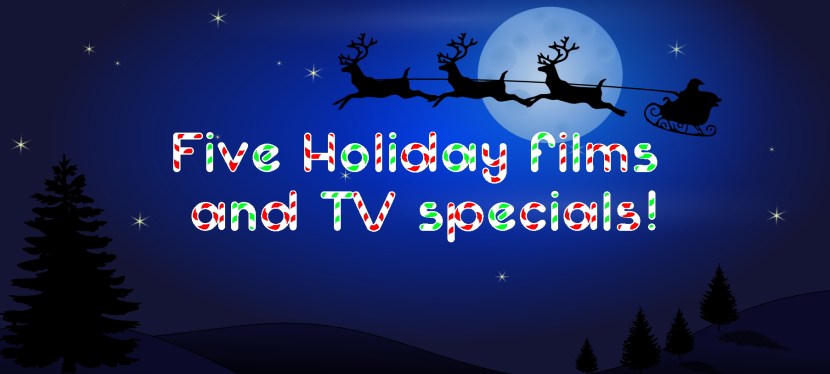
Five films (and TV specials) to watch this Holiday Season!

Christmas is edging closer by the day! The main event itself is now only a couple of weeks away, so we’re well and truly in the wintery grip of the Holiday Season. This time I thought it could be fun to take a look at five films and television specials that make for great festive viewing.

Although I’m not a religious person by any stretch, Christmas has always been an event I look forward to… beginning as early as September! Though not every Christmas was perfect when I was a kid, I have some pretty happy memories of this time of year, and there’s something about the juxtaposition of the cold, dark winter going on outside with the warmth and the twinkling lights of a Christmas tree inside that really makes this time of year feel special, almost magical!

Christmas is coming!

Between the lights, decorations, and festive pop hits, I think it’s fair to say I’m all about the secular, commercial side of Christmas; Santa Claus, not Jesus, stands out to me as the season’s main character! So that’s my mindset as we go into this list.

Please keep in mind, as always, that this list is wholly subjective. If you don’t like any of these Christmas films and television specials, that’s perfectly fine. I’m not trying to pretend that these are the “all-time best ever” Christmas specials, or anything of the sort!

With that caveat out of the way, let’s dive into the list!

Number 1:
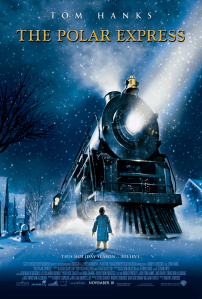
The Polar Express (2004)

The titular Polar Express.

When it was released in 2004, The Polar Express received criticism for its “creepy” CGI – but I think it’s safe to say that its semi-realistic animated style has aged pretty well. Tom Hanks stars in this modern animated classic, and takes on several different voice roles across the film. Not providing names for main characters is a risk (not to mention something you’d get a failing grade for in most creative writing classes!) but that doesn’t actually hamper The Polar Express. The nameless protagonists are arguably more relatable as a result, allowing the audience to project themselves onto the characters with ease.

There may have been a couple of Christmases when I was very young where I did, in fact, believe in Santa Claus (or Father Christmas, as we call him here in the UK). But my parents didn’t do the whole “all of your gifts come from Santa” thing, and among my earliest Christmas memories I can remember writing thank-you notes to family members for the gifts they’d given me. These things vary from family to family, though, and while I wouldn’t like to speak outside of my own experience, I think a lot of you probably have some recollection of believing in Santa Claus and subsequently losing that belief. It’s a theme that many different Christmas films have tackled – but The Polar Express gets it right. The protagonist learns, over the course of his adventures, to keep believing – a metaphor, perhaps, for valuing one’s childhood and remaining youthful.

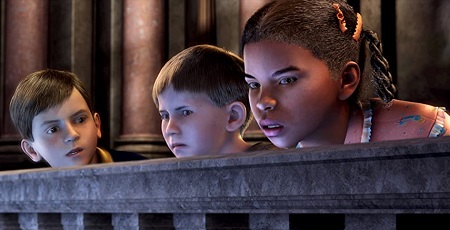
The nameless protagonists.

I’ve always liked trains, and The Polar Express shows us a beautiful CGI rendition of an old-fashioned steam locomotive. Trains – model trains in particular – have somewhat of an association with Christmas, but this method of transporting kids to the North Pole was certainly unique! It gives The Polar Express a sense of adventure that road trip films and other films about long journeys often capture so well, with scenes like running around on the train roof and the train skidding across the ice all playing into that.

The Polar Express is a film with heart, but it’s also something a little different from the typical “let’s go and meet Santa Claus” fare of many other shows and films aimed at children. There’s a sense of scale in the journey we see the protagonists undertake, and because it’s told from a child’s perspective, there’s still some of that mystery and wonder; the sense that the kids don’t really know how everything works on the train. That magic is part of what makes the holidays so special.

Number 2:
The Lego Star Wars Holiday Special (2020)

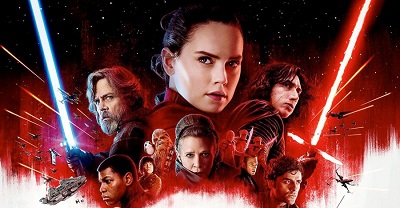
Promo image for The Lego Star Wars Holiday Special.

I’ve had a review of this one in the pipeline since last year, but for various reasons it got buried under too many other writing projects in the days before Christmas! Stay tuned, though, because I daresay I’ll get around to a full write-up eventually! For now, let’s hit the key points. The Lego Star Wars Holiday Special is hilarious, and I found it to be a great palate-cleanser after The Rise of Skywalker had been such a disappointment.

Unlike this year’s Lego Star Wars Terrifying Tales, which focused solely on Poe Dameron, The Lego Star Wars Holiday Special brings back all of the main characters from the sequel trilogy – then takes a wild ride through all three of Star Wars’ main eras thanks to some well-timed space magic! Star Wars fans should appreciate many, many callbacks to past iterations of the franchise – not least the notorious Holiday Special, which was released in 1978 to critical derision!

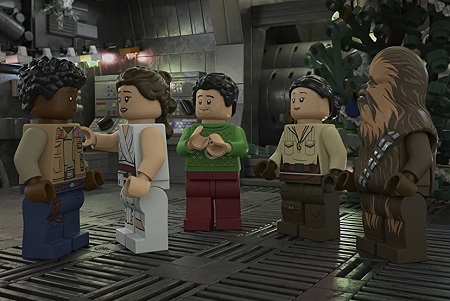
Finn, Rey, Poe, Rose, and Chewbacca.

The Lego Star Wars Holiday Special is full to the brim with gentle jokes and parodies that poke fun at the Star Wars franchise without ever coming across as mean-spirited or laughing at fans. Some humourless fans, or those who want to lose themselves in that world, might find that offputting, but I reckon that a majority will be able to enjoy The Lego Star Wars Holiday Special for what it is: non-canon fun.

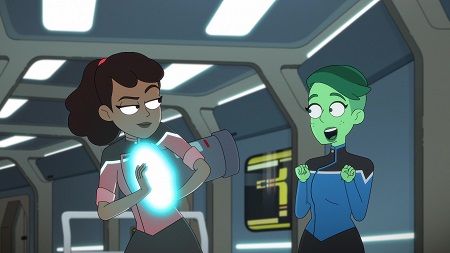
I was pleased to see that Disney+ is intent on doing more with the Star Wars brand than just serious projects like The Mandalorian, and in some respects I think we can argue that The Lego Star Wars Holiday Special – and other Lego Star Wars titles too – fill a niche similar to Star Trek: Lower Decks over in another wonderful sci-fi franchise. No Star Trek holiday special yet, though… but maybe one day!

Number 3:
I Won’t Be Home For Christmas
The Simpsons Season 26 (2014)

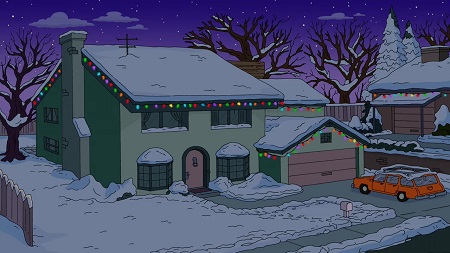
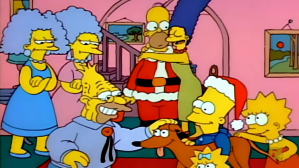
The Simpsons’ house all decorated for the season.

The Simpsons has undeniably lost its edge in recent seasons, and it’s increasingly rare to pluck out a genuinely good episode from the ever-growing pile – something I found out when I put together a list of a few of my favourite episodes earlier this year. But every now and then The Simpsons can still produce an episode somewhat akin to those from its more successful past. I Won’t Be Home For Christmas is, in my view anyway, among them.

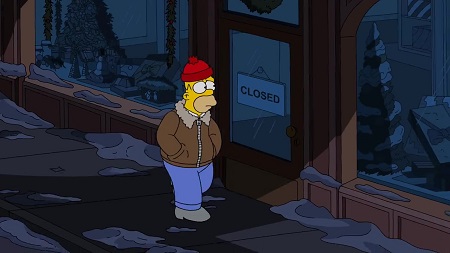
Perhaps it’s the holiday theme that elevates what might otherwise be a less-enjoyable episode, but I find that there’s something very relatable about I Won’t Be Home For Christmas. A few years ago, when I was suffering with undiagnosed mental health issues and in the midst of a divorce, I found myself wandering the dark, empty streets on Christmas Eve – trying to clear my head. The sequences in which Homer does something similar in this episode really hit home for me because I’ve been in a similar position myself.

I found this presentation of Homer to be very relatable.

When you’re watching what feels like the whole rest of the world closing their doors and enjoying the holidays without you, life can feel incredibly lonely. Homer meets a number of characters on his own journey, but that sense of loneliness and missing out on what’s supposed to be the most wonderful time of the year is still a prevalent theme that runs through the entire story.

On a more positive note, I Won’t Be Home For Christmas features a couple of genuinely good jokes and laugh-out-loud moments. It also kicks off with a Christmas-themed reworking of the show’s famous opening sequence, so if you’re watching on Disney+ don’t hit the “skip intro” button! You’ll miss something fun if you do. In a lot of ways I feel echoes of Simpsons Roasting on an Open Fire in I Won’t Be Home For Christmas – and not just because of its holiday setting. The episode feels like a throwback to earlier seasons, when The Simpsons as a whole was doing far better at producing stories like this one.

Number 4:
Winnie the Pooh and Christmas Too (1991)

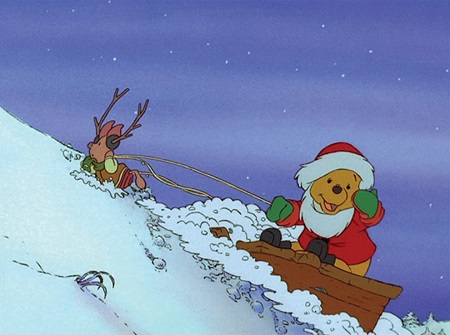
Is that Santa and his reindeer?

My younger sister received a VHS copy of Winnie the Pooh and Christmas Too as a Christmas present (I would guess in 1992) and watched it endlessly! As a result, it’s probably one of the Christmas specials that I’ve seen most often – it was a mainstay in our house in the run-up to Christmas for several years in a row! What’s more, the original Winnie the Pooh books by A. A. Milne were permanent fixtures on my childhood bookshelf, and I’m sure those books were read to me when I was very small. So the entire Winnie the Pooh series is something I have a great fondness for!

Christmas is a time for nostalgic steps back like this, forgetting the modern world and all of its troubles for a while. Winnie the Pooh and Christmas Too is an incredibly sweet Christmas tale set in the Hundred Acre Wood, perfect for a few minutes wrapped up in Christmas-themed cuteness and escapism. Or is that just the nostalgia talking?

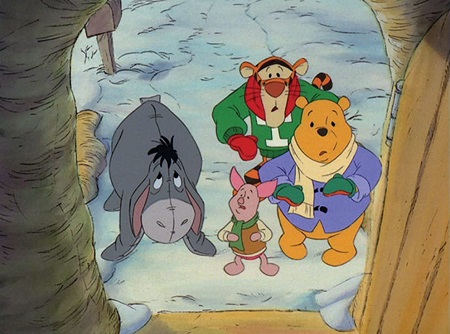
Eeyore, Piglet, Tigger, and Pooh.

Because Winnie the Pooh has always been pitched at very young children, the story here is rather basic. There’s a kerfuffle surrounding Christopher Robin’s letter to Santa, and Pooh tries to save the day. Despite those limitations, though, the story is incredibly cute, really sweet, and full to the brim with Christmas fun.

Winnie the Pooh and Christmas Too isn’t something I go back to year upon year; doing so would probably ruin the magic. But every once in a while I treat myself to this blast of very personal ’90s nostalgia and enjoy my memories of Christmases past. As 2021 looks set to be the second Christmas in a row where we may not be able to do everything we’d want, I think finding moments like that might be very important for a lot of folks.

Number 5:
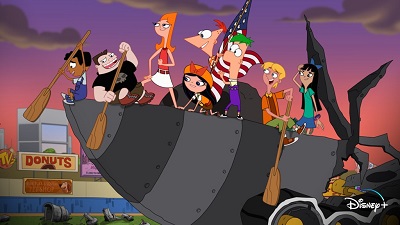
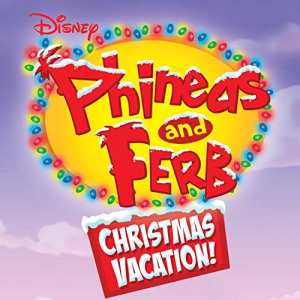
Phineas and Ferb: Christmas Vacation (2009)

The special’s title card.

As a childless adult, Phineas and Ferb is a series that shouldn’t have had much appeal for me! But as I’ve said many times before, the best kids’ shows have something to offer adults as well, and when I sat down to watch Phineas and Ferb for the first time back when I had the Disney Channel, I found a truly engaging and fun little cartoon.

That extends to the Christmas special too, which is one of the high points of the entire series – in my subjective opinion, naturally! I’m a total sap for the “Christmas is in danger, someone needs to save it!” plot cliché, and Phineas and Ferb: Christmas Vacation puts the series’ trademark spin on that familiar premise. It’s a lot of fun!

Perry and Dr Doofenshmirtz.

I never miss an opportunity to talk about Phineas and Ferb. The show finished its run in 2015, but last year returned for a one-off Disney+ original film, which was absolutely fantastic too. Unlike some of the other entries on this list, which I’ll happily rewatch on occasion, I return to Phineas and Ferb: Christmas Vacation every year without fail – something I’ve done for a decade now!

Phineas and Ferb: Christmas Vacation keeps the series’ trademark twin storylines – the boys and the other kids on one side, Perry the Platypus and Dr Doofenshmirtz on the other. Both stories come together in one connected narrative, but the show sticks to its two angles throughout – and what results is a story with moments of excitement, high drama, and emotion as the boys race to save Christmas.

Bonus:
Animal Crossing: New Horizons
Nintendo Switch (2020)

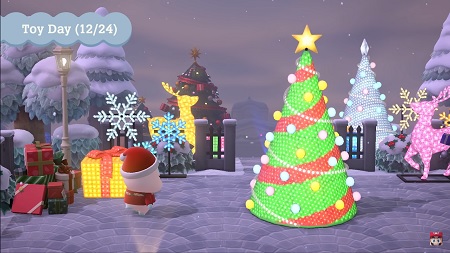
Promo for New Horizons’ Christmas event.

If you’re an Animal Crossing player, Christmas Eve is where it’s at! But throughout December it’s possible to buy special seasonal items, to see your island all decorated for the holidays, and to take note of what some of your island friends might want by way of gifts! The Christmas event is known as Toy Day in the world of Animal Crossing, and while it’s possible to ignore it and get on with your regular island life, it’s a bit of fun to play through these one-off events.

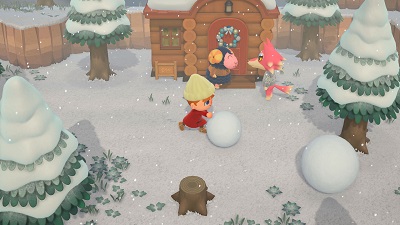
As December dawns on your island – at least if you’re playing on a Northern Hemisphere island – snow will start to fall. You’ll be able to build a snowman every day – and building the perfect one unlocks special ice-themed items. There are snowflakes to catch, which are used as DIY ingredients to craft new seasonal items too.

A wintery New Horizons island!

Later in December, Isabelle will announce that she’s decorated some of the island’s trees – but only the pine trees. When I played last year not every pine was decorated, but those that were looked adorable with their little festive lights! Shaking these trees also provided yet another crafting material which could be used to create holiday-themed items.

I’ve been critical of New Horizons for its longevity in particular, but there are few games that offer this style of gameplay. Last year I played through the Halloween, Thanksgiving, Christmas, and New Year events on my island, and I have to say I had a lot of fun with all of them. The Toy Day event on Christmas Eve (not Christmas Day!) is the kind of sweet Christmassy fun you’d expect from a game in the Animal Crossing series, and if you missed it last year it’s well worth playing through at least once.

So that’s it!

It’ll be the big day before we know it!

I’ve got a few more holiday-themed ideas for the website between now and Christmas – which is getting closer and closer by the day. I hope you like the festive banner and the little Santa hat on the website’s logo, too! I had fun messing around and putting those together.

There are lots of great festive films and holiday specials that I didn’t include on this list, so have a browse through the television listings or your streaming platform of choice. I’ll probably be checking out a mix of old favourites and new entries – there are always plenty of new holiday films every year. I’ve heard good things about 8-Bit Christmas this year, for example! I hope this list has been a bit of festive fun as we continue to get into a holiday groove!

All titles mentioned above are the copyright of their respective studio, distributor, broadcaster, streaming platform, etc. This article contains the thoughts and opinions of one person only and is not intended to cause any offence.

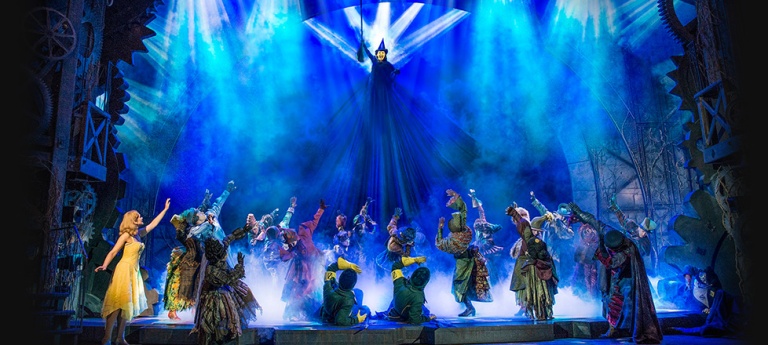
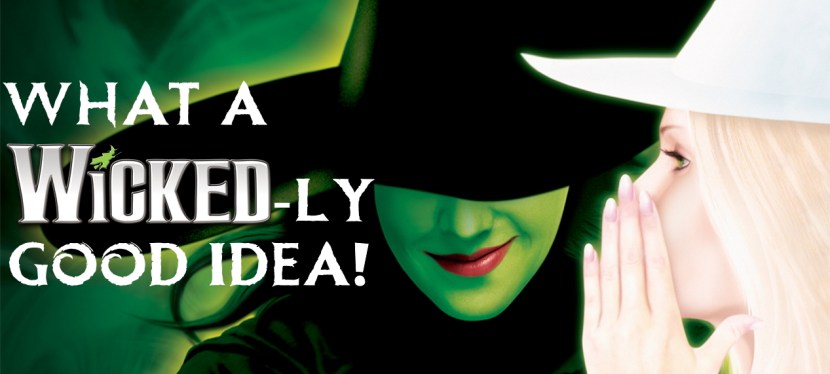
What a Wicked-ly good idea for a film!

Spoiler Warning: There are minor spoilers ahead for Wicked.

It’s just been announced that the popular musical Wicked is getting a film adaptation – and I think that sounds like a brilliant idea! Wicked is exactly the kind of musical that should make for a wonderful work of cinema, and it’s amazing in a way that it’s only now, almost twenty years since it made its Broadway debut, that a film adaptation has been greenlit. You’d think it might’ve happened sooner!

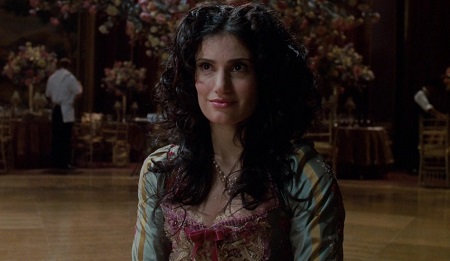
I was very fortunate to see Wicked when it came to London’s West End (the name for the city’s theatre district) in 2006. Idina Menzel – better known in recent years for her role as Elsa in Frozen and Frozen II – played the lead role, and I feel incredibly lucky to have seen her perform live. There’s something about seeing a musical like Wicked on the stage that really elevates it and makes it incredibly memorable – I miss being able to go to the theatre far more than I miss the cinema sometimes.

Idina Menzel in 2007’s Enchanted. She played the role of Elphaba in Wicked on the stage.

We can’t talk about Wicked without at least acknowledging its popular progenitor: the 1939 film adaptation of The Wizard of Oz. L. Frank Baum’s series of children’s books about Oz had been popular in the early part of the 20th Century, but the film adaptation of The Wizard of Oz is still what most people bring to mind first when they think about the fantasy setting. The film is an icon of cinema, and is responsible not only for the continued popularity of the setting, but was also hugely influential in the creation of the 1995 book Wicked: The Life and Times of the Wicked Witch of the West – upon which the popular musical is loosely based.

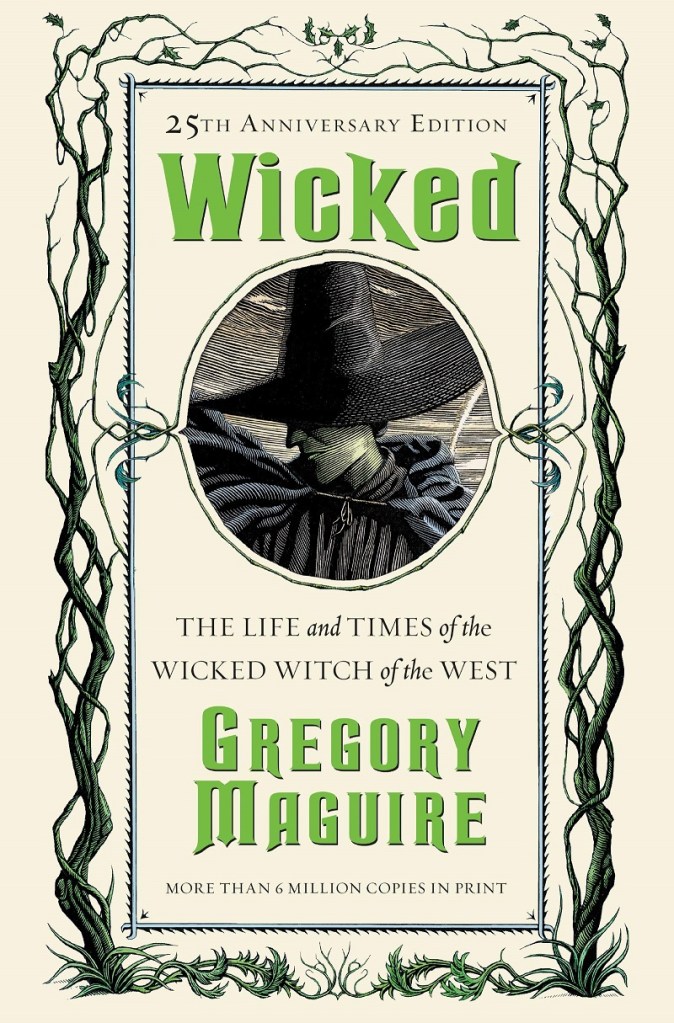
If you’re interested in a novel about existentialism and that deals with adult themes like cruelty and the treatment of people who are perceived as “different,” then check out Wicked: The Life and Times of the Wicked Witch of the West. It’s a difficult, dense, and occasionally harrowing read – one that’s very different in many ways from the musical that it inspired. But it’s a fascinating look at the concept of a genuine outsider – and takes the Wicked Witch (who its author names Elphaba, in honour of L. Frank Baum) to completely different thematic places. Far from being a one-dimensional cackling villain, she’s given nuance and understandable motivations for behaving the way she does.

Cover for the 25th anniversary edition of the novel Wicked: The Life and Times of the Wicked Witch of the West.

I came to the book after having seen the musical – I believe I bought my copy then and there in the theatre – and I was genuinely shocked at the complex themes and adult tone. Wicked is a beautiful musical, but many of the novel’s subtler themes are lost amidst the glitz, glamour, and greasepaint of the stage production.

Given today’s entertainment and media landscape, I feel all but certain that the film adaptation of Wicked will touch on these darker themes. An examination of what it means to be looked down on, mistreated, and pushed to breaking point are all themes which the novel encourages readers to consider, and while they may have felt too dark for a stage play in 2003, for a film in 2021 they feel pitch-perfect. Audiences have come to expect dark deconstructions of classics – and Wicked absolutely fits that mould.

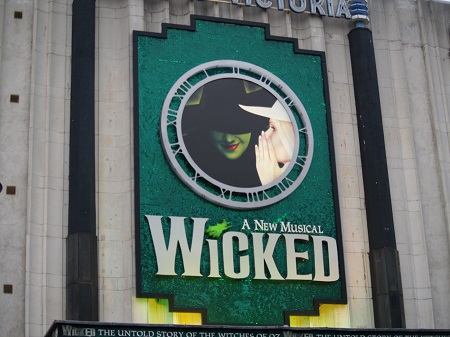
Advertisement for Wicked outside the Apollo Victoria theatre in London circa 2006.
Photo Credit: Trekking with Dennis.

Wicked can also be seen to follow on from Disney productions like Maleficent and Cruella as a film that will make the villain its star. The Wicked Witch of the West is most famous for her villainous role in The Wizard of Oz, but Wicked puts her centre-stage and tells her story through a generally sympathetic – or at least understandable – presentation. It’s a deliberate twist on The Wizard of Oz, flipping the script to show heroes as villains, villains as heroes, and the grubby shades of grey in between both.

Nuance, shades of grey, and supposedly-realistic depictions of individuals are what has driven modern cinema – and modern entertainment in general. Audiences don’t want or expect to see “boring” heroes who are totally perfect and virtuous, nor villains who are purely evil for the sake of it. The ideas that there are two sides to a story, and that which side we root for is entirely dependent on who’s telling the story, are intrinsic to the source material of Wicked – and I’m sure that’s one of the most appealing things about the project to its writers, producers, and director.

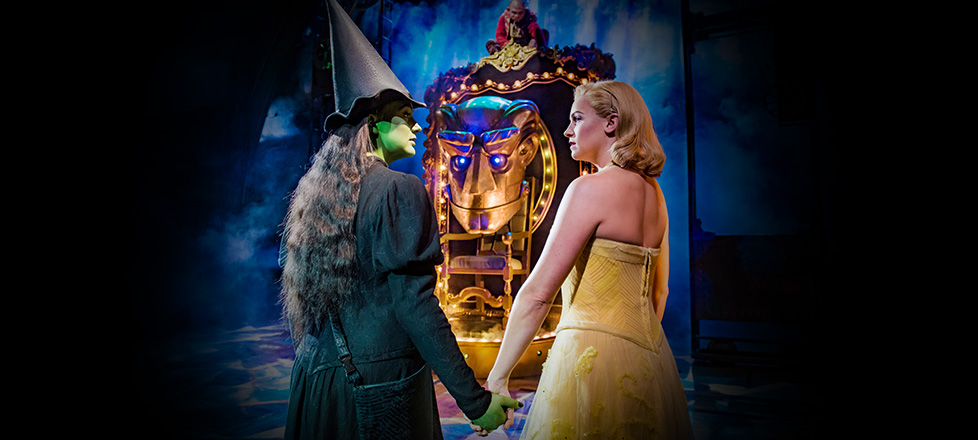
Elphaba and Glinda from the London stage musical.
Picture Credit: Wicked the Musical London.

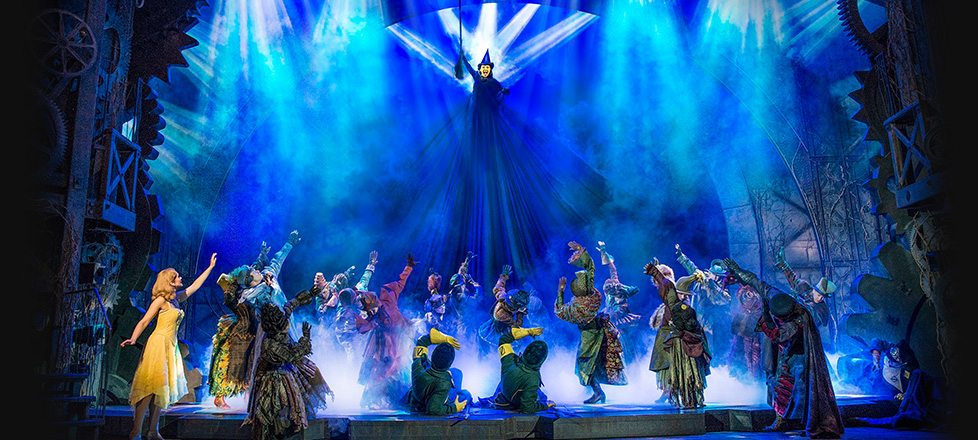
The film adaptation will be a musical, so we can expect at least some of the stage production’s classic hits to reappear. Defying Gravity is the show’s standout song, and it closes the first act in the theatre. Encapsulating a sense of individualism, self-reliance, and of course defiance, the powerful ballad sees the Wicked Witch set her choice in stone and fully commit to her rebellion against the Wizard.

Seeing Defying Gravity performed live is something I’ll never forget, and perhaps some folks will say that no cinematic adaptation of that scene could ever live up to its stage equivalent. But I’m more than willing to give it a chance – today’s cinematic visual effects are improving in leaps and bounds, and I’m genuinely intrigued to see what a film with a big budget can make of that exceptional moment.

Defying Gravity performed in London.
Picture Credit: Wicked the Musical London.

There can be a snobbishness to stage productions and the theatre, and perhaps this should be a longer discussion on another occasion. But as someone whose disability now precludes theatre visits, I get sick to the back teeth of hearing that a stage production is “irreplaceable” and that “one simply must see a production live” to get the best effect. The theatre has been beyond the reach of many people – physically and financially – for a long time, and there’s nothing wrong whatsoever with cinematic adaptations. If anything, Wicked will reach far more people in the weekend after its release as a film than the stage production has been able to in almost twenty years – and bringing such a powerful and beautiful production to more people and spreading art around should be celebrated, not denigrated.

But we’re drifting off-topic, and that discussion may be best saved for a longer article on another occasion.

There have been a number of attempts over the years to return cinema-goers to the Land of Oz. 1985’s Return to Oz was a financial flop – albeit one that has since picked up a bit of a cult following. I personally enjoyed what 2013’s Oz the Great and Powerful brought to the table, and that film fared significantly better in financial terms – but wasn’t much of a hit with critics and reviewers. But no title since The Wizard of Oz can be said to have truly succeeded at bringing in audiences to the Land of Oz; Universal Pictures and director John M. Chu are clearly hoping to change that.

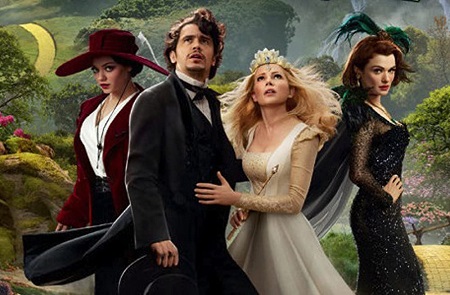
Mila Kunis and James Franco starred in Oz the Great and Powerful in 2013.

Wicked will have a lot of buzz around it simply because of the success of the musical. The stage production is one of the most successful musicals of all time, and aside from closures due to the pandemic has been running continuously since its 2003 inception. A lot of fans of the stage musical – myself included – will be very curious to see what the film adaptation will bring to the table.

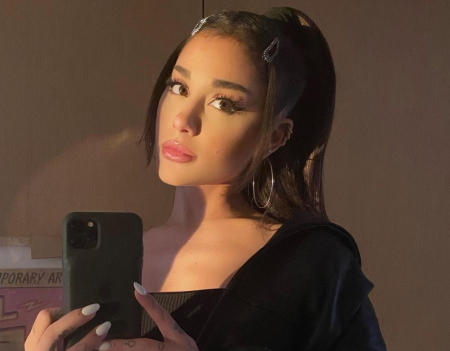
The casting of pop music superstar Ariana Grande as Glinda and Cynthia Erivo as Elphaba has also raised a lot of interest. Grande’s name in particular will be a big draw, and while I’m not terribly familiar with her acting work there’s no denying she’s an incredible talent when it comes to singing.

Ariana Grande will star in Wicked.
Picture Credit: Ariana Grande via Instagram.

Wicked is one of those projects that you almost feel should have been made already! The source material – both the book and musical – are so great and so genuinely different that it seems like a no-brainer. Apparently the project has been kicked around for some time, languishing for a while in the dreaded “development hell” before being officially greenlit. But now that it’s official, I think it’s absolutely something to look forward to.

There have been some high-profile musical misses in recent years. 2019’s Cats adaptation shows just how badly wrong a film can go, and also proves that big names are no guarantee of success. Cats should be a warning to the producers of Wicked – and a warning to anyone involved in cinema in general, but that’s beside the point! As long as Wicked can avoid the numerous problems and pitfalls which befell Cats… actually scratch that, it’s too low of a bar. Let’s just say that I hope Wicked will be a success!

So that’s all, really. The film is in pre-production and we won’t see it any time soon. But it’s one to keep an eye on – I think it has a lot of potential.

The novel Wicked: The Life and Times of the Wicked Witch of the West is the copyright of Gregory Maguire and/or HarperCollins. The musical Wicked – including its songs Defying Gravity et al. – is the copyright of Stephen Schwartz and Winnie Holzman. The film adaptation of Wicked is the copyright of Universal Pictures. This article contains the thoughts and opinions of one person only and is not intended to cause any offence.
Pixar’s Lightyear looks great!

Spoiler Warning: There are minor spoilers ahead from the Lightyear trailer.

We’re firmly in an era of sequels, spin-offs, and franchises. One type of story that a lot of companies are creating to squeeze another title out of their most popular creations is the “origin story” – basically a prequel that goes into detail about the background of a particular character. The Star Wars prequels showed how overexplaining a classic character can be more of a negative than a positive, but franchises push on regardless. From Willy Wonka to Hannibal Lecter, backstories abound in fiction.

Buzz Lightyear is not a character I would have ever chosen to write an entire origin story for. For one thing, Buzz Lightyear is a toy – he doesn’t have an origin story; he was made in a factory and shipped out to a toy shop where Andy’s family bought him! But I guess Lightyear isn’t taking that approach!

Buzz Lightyear has come to life!

The film’s trailer, which was a surprise release a couple of days ago, seems to show a “real” Buzz Lightyear inhabiting a sci-fi world. All of the elements that we know of were present: his rocket-ship, his colourful spacesuit, Star Command, and even his unrealistically large Desperate Dan-esque chin. But instead of simply being a toy for kids to play with, Buzz seems to be a fully-real person in his own right.

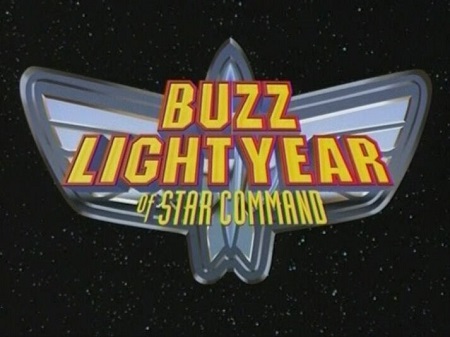
This isn’t actually the first attempt at that concept. Though I haven’t seen it, there was a short-lived television series called Buzz Lightyear of Star Command which aired in 2000-2001 and even spawned a video game adaptation for the PlayStation, Dreamcast, PC, and Game Boy Colour. The series might be one you remember, but it doesn’t seem to have been as big as some of the other Disney projects of the era – I hadn’t even heard of it until researching the topic for this article!

2000-2001 television show Buzz Lightyear of Star Command had a similar underlying premise.

It’s possible that Buzz Lightyear of Star Command’s remaining superfans might be treated to an easter egg or two in the new film, so if you fall into that category keep your eyes peeled! Disney and Pixar have a longstanding habit of harkening back to older titles and past iterations of their popular franchises, so I wouldn’t be shocked at all if a couple of sneaky references or callbacks to Buzz Lightyear of Star Command make it into the final cut of the film!

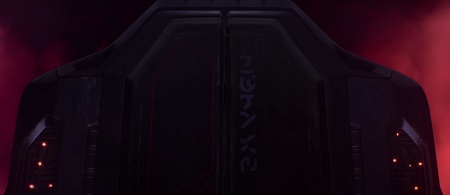
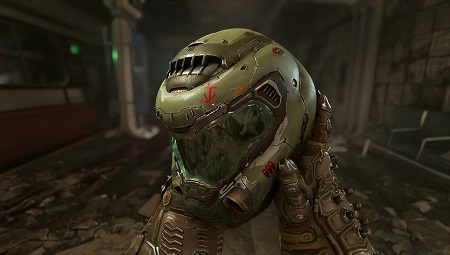
The trailer itself was exciting and surprisingly had more of a dark tone than I might’ve expected. There were some moments that clearly set up dangerous moments for Buzz as he goes on his adventure, and the dark, engraved door opening to reveal a red glow was incredibly well-done and provided a lot of tension. It almost gave me a Doom vibe – odd as that might sound!

Who will emerge from this door?

Buzz Lightyear as a character has, since his inception, been a uniquely Disney take on mid-century sci-fi. The likes of Flash Gordon, Forbidden Planet, and even Star Trek: The Original Series are present in his characterisation and aesthetic, deliberately so. But of course the biggest influence over Buzz Lightyear’s charmingly retro design comes from Walt Disney’s Tomorrowland and Epcot concepts – which have since been brought to life at Disney’s theme parks.

Anyone who’s ever ridden Space Mountain can see clear evidence of its inspiration in the trailer for Lightyear – Buzz’s rocket-ship resembles the ride vehicles and even the launch platform looked an awful lot like the track of the ride. The rings Buzz seemed to be flying through at one point also bore a striking resemblance to Space Mountain.

I definitely got Space Mountain vibes from the trailer.

A big part of the trailer concerned Buzz Lightyear taking a trip in his rocket-ship. There were influences from a lot of astronaut films and television shows in the way he was preparing for the journey, and he seems to have a colleague or friend at Star Command who’s helping him with his mission; perhaps someone who will serve as a point of contact at mission control.

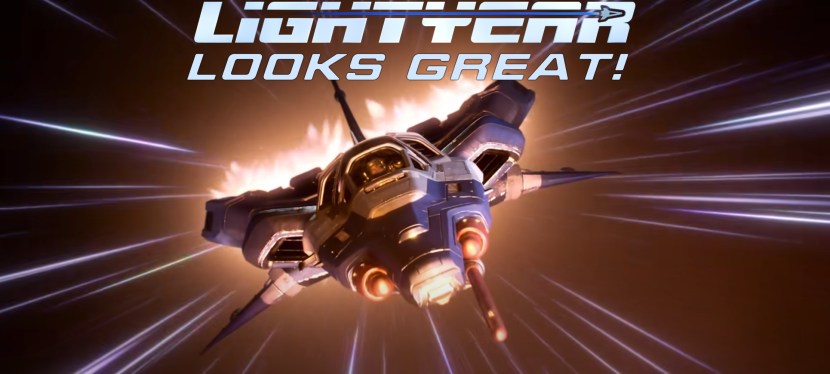
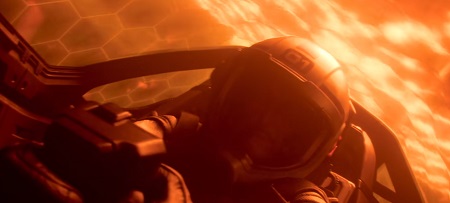
The animation in the trailer was outstanding. Seeing Buzz’s ship slingshotting around the star was truly striking, and reminded me that Pixar is renowned as one of the world’s best animation studios for a reason! As a Trekkie that moment reminded me a lot of slingshot effects in both Star Trek: The Original Series and more significantly in the 1986 film Star Trek IV: The Voyage Home, but there was also more than a little influence from more modern sci-fi titles like Interstellar in the way the star in particular was presented. Overall it was an astonishingly beautiful sequence.

The slingshot sequence was especially cool.

We have no idea at this stage what the story of Lightyear might be. Chris Evans – of Marvel fame – will star as the titular hero, but we don’t know who will play the film’s villain, Emperor Zurg. Zurg has been part of the mythos of Buzz Lightyear since his first appearance, but had a more fleshed-out role in Toy Story 2. Just like it’ll be interesting to see a “real-life” version of Buzz, so too will it be interesting to see how Emperor Zurg makes the jump from toy to real person.

If we continue the mid-century sci-fi analogy from earlier that we know Buzz Lightyear as a character draws from, I see Emperor Zurg as filling a role similar to the likes of Flash Gordon’s Ming the Merciless – but with an aesthetic inspired by early depictions of robots and even Darth Vader. I’ll watch for a casting announcement with trepidation – getting the right person who can play the character in suitably over-the-top style could be crucial to the film’s success!

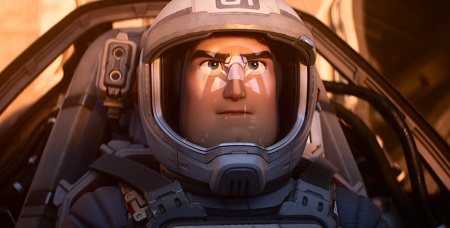
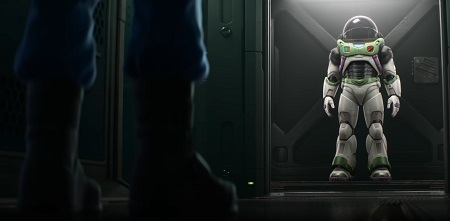
Buzz’s classic spacesuit.

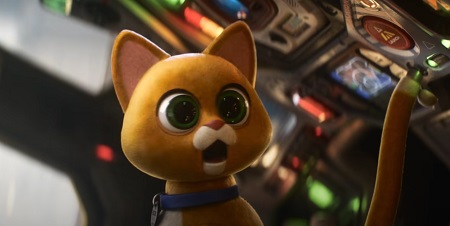
I’m not sure what to make of the toy cat in the trailer. Lightyear has been described by Disney and Pixar as “the definitive origin story” of the character, and while we’re assured that he is fully human (or at least not a toy) in the film, the presence of what seemed to be a toy cat – whose name is Sox – made me wonder! Is there something else going on here?

On the other hand, Pixar’s press release talked about the original inception of Buzz Lightyear during the creation of Toy Story. They specifically talked about how they envisioned the toy Buzz Lightyear as being merchandise for a blockbuster movie about an action hero – and how Lightyear is that movie! Kind of a film-within-a-film thing, except that Lightyear is a feature-length title in its own right!

What’s the deal with this cat?

The trailer was genuinely one of the best and most interesting that I’ve seen in months, and Lightyear is firmly on my list of titles for 2022! The film is currently scheduled for a June release window, and will presumably hit cinemas first before heading to Disney+ after a month or two – barring any pandemic-related delays or closures.

The retro sci-fi vibe that Lightyear seems to be wholeheartedly embracing appears to give the film a delightfully old-school charm, with clear influences from Disney’s Tomorrowland in particular. That alone would be enough to pique my curiosity, but the fact that there were some amazing visual effects and what seems to be a slightly mysterious and interesting story has seen Lightyear come from nowhere to rocket its way onto my list for next year. I’m genuinely looking forward to this one now!

Lightyear is scheduled to be released on the 17th of June 2022. Lightyear is the copyright of Pixar and The Walt Disney Company. This article contains the thoughts and opinions of one person only and is not intended to cause any offence.
Five horror films to watch this Halloween

Spoiler Warning: There are minor spoilers ahead for the titles on this list.

With Halloween fast approaching, it seems like a good time to once again dabble in the spookier side of cinema! Horror has never been my favourite genre, but at this time of year I’m not averse to the occasional spooky film.

This short list is a follow-up to a similar list I wrote last Halloween, so if you’d like to see five more horror films that I recommend, you can do so by clicking or tapping here.

It’s about to get spooky!

Horror as a genre can be incredibly varied. From jump-scares to the psychological terror of something unseen, and with such diversity of monsters, ghouls, and creepy critters, there are a lot of different titles that put their own spin on the horror concept. Whether you’re looking for serial killers, vampires, zombies, or demons, chances are you can find an excellent horror film that successfully brings them to screen!

I confess that I’m particularly sensitive to jump-scares, and now that I don’t feel the same kind of pressure to join in with horror titles as I did in my younger years (when watching horror films was almost a rite of passage!) I tend to favour films that don’t go for that style. Despite that, I hope you’ll find a varied mix of titles on this list!

Number 1: The Birds (1963)

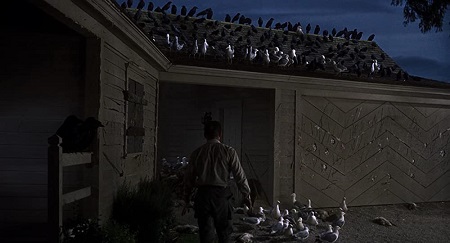
Those birds are up to something…

Alfred Hitchcock is still considered one of the greatest directors of the horror and thriller genres, and for good reason. His pioneering style put viewers right at the centre of his stories, and every shot and every sequence was meticulously planned and crafted to maximise suspense and fear. The Birds is one of Hitchcock’s later films, coming toward the end of his career and following on from the likes of Vertigo and, of course, Psycho.

As a kid, I can remember being terrified by The Birds. The slow, tense build-up that Hitchcock’s films are known for is on full display in the title, with every scene and sequence gradually ramping up the threat to a terrifying climax. But more than that, the sheer randomness of birds as the “villain” of the piece is genuinely unsettling.

Birds are generally harmless. The worst a bird might do is steal your chips at the beach, but The Birds asks a question no one ever thought to ask before: what if they were working together to a menacing and aggressive end? It’s this premise – taking something harmless that we generally pay little attention to and making it scary – that makes the film succeed.

Number 2: Sleepy Hollow (1999)

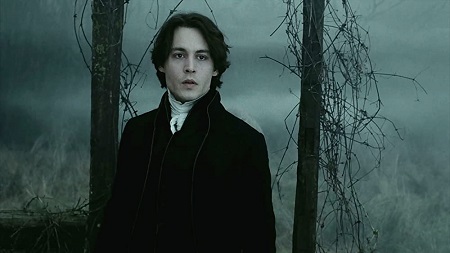
Johnny Depp as Ichabod Crane in Sleepy Hollow.

Johnny Depp stars in this adaptation of the famous Washington Irving story, and the film brings the Headless Horseman to life in genuinely frightening fashion! The story of Ichabod Crane and the Headless Horseman is an old one, dating back to the early 1800s, and Washington Irving is considered one of the first great American authors.

Unlike the earlier Disney adaptation, Sleepy Hollow takes a distinctly adult horror tone. Director Tim Burton makes a number of changes to the source material, making the film an unpredictable ride even for those familiar with the original short story. Johnny Depp puts in a wonderful dramatic performance as Ichabod, too.

There’s something inherently frightening about the undead, and the first time the Headless Horseman is seen on screen manages to capture that feeling pitch-perfectly. Johnny Depp manages to perfectly convey Ichabod’s fear as well, ramping up the tension and making Sleepy Hollow a truly scary and spooky watch!

Number 3: The Omen (1976)

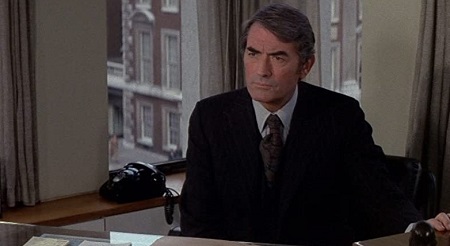
Gregory Peck as Robert Thorn in The Omen.

The Omen is an outstanding example of how to build up fear and tension without resorting to too many jump-scares or a lot of gore! It’s also a deeply disturbing film because of the implications of shadowy cults and conspiracies – and that’s before we even get to the birth of the literal anti-Christ!

When I first watched The Omen I was left unsettled for days afterwards. There’s a specific scene that I won’t spoil for you, but the build-up to a particularly shocking reveal in an Italian graveyard – and the implications it had for the film’s protagonist – left me stunned and disturbed! That particular memory is still vivid for me now, decades later.

As a film about demons, Satan, and the anti-Christ, The Omen was designed to be shocking and unsettling, especially to folks with any kind of religious convictions. And it succeeded beyond its wildest ambitions, becoming an absolute classic of the horror genre and spawning a franchise that still gets periodic updates and instalments today. Oh, and if you’re looking for a Star Trek connection, the film’s lead, Gregory Peck, was the grandfather of Ethan Peck – star of Discovery Season 2 and soon to be appearing in Strange New Worlds!

Number 4: 28 Days Later (2002)

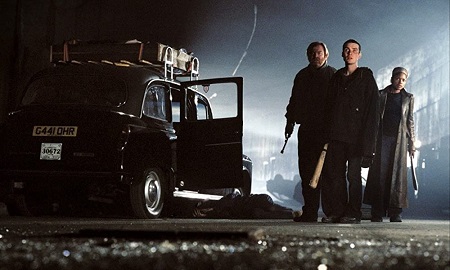
The infected are coming!

With 28 Days Later, director Danny Boyle reinvigorated the zombie genre in a new and truly terrifying way! Prior to the film’s 2002 release, most zombies in cinema followed a pattern first popularised by George A. Romero in Night of the Living Dead – slow, shuffling, mindless creatures that were scary en masse but could be outrun by anyone fit enough. 28 Days Later introduced us to the infected – humans who were still alive but infected with a virus that turned them into killing machines… killing machines that could sprint!

Seeing the zombie horde running after the film’s protagonists was a new and incredibly shocking experience in 2002. Though a number of titles have used this more aggressive style of zombie in the years since, for me the portrayal in 28 Days Later remains one of the best and most frightening.

Technically not a “zombie” film as the infected aren’t undead, 28 Days Later nevertheless has a post-apocalyptic feel that is present in a lot of zombie fiction. Anyone who’s seen The Walking Dead (or read the original comic books) should note an eerie similarity in the way 28 Days Later opens… and remember that the film was released before the first issue of the comics!

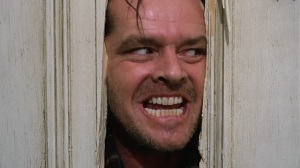
Number 5: The Shining (1980)

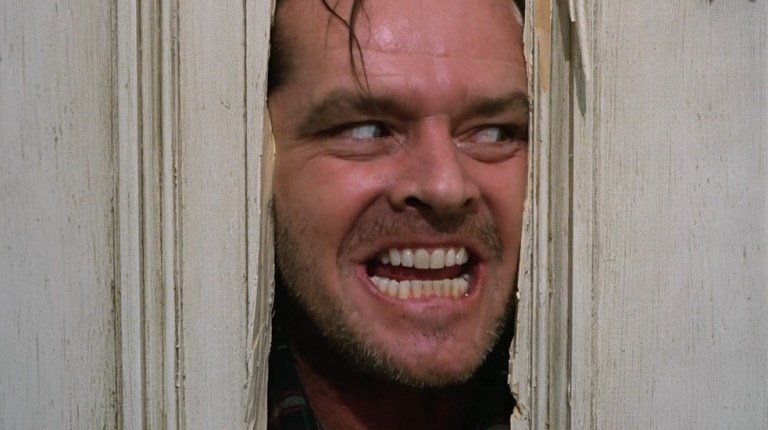
Here’s… a classic horror film!

The Shining is an adaptation of a Stephen King novel, and as such it’s an unpredictable and very disturbing ride. Stanley Kubrick directed one of his last films, and adapted the book in truly inspired style. Some of the best-known moments in The Shining, including the famous line referenced above, weren’t present in the original book, and the film adaptation is arguably a rare example of a film surpassing its source material.

The film features some truly outstanding special effects. The “blood flood” scene has gone on to become iconic, and was shot in miniaturised form using detailed scale models. The practical special effects give the film a unique charm that today’s CGI can’t match, and in some cases the use of incredibly realistic practical effects ramps up the fear factor.

Jack Nicholson gave the world one of cinema’s most iconic scenes. But The Shining is so much more than that, and his character’s slow descent into madness is what makes the film so tense, exciting, and frightening.

So that’s it! Five horror films to get you into the Halloween spirit.

Don’t have nightmares…

Remember to check out last year’s list for five more horror titles you might enjoy – you can find it by clicking or tapping here. And if you’re interested to see my review of last year’s television adaptation of another Stephen King work, The Stand, you can find that by clicking or tapping here.

I tried to put together a collection of films with different themes, styles, and subjects! Horror is an incredibly varied genre, and just in the five films above we have the natural world turned against us, an undead horseman, Satanism, technically-not-zombies, and finally a film with ghosts and a mad man. And we’ve barely scratched the surface!

Halloween is almost upon us, so stay tuned over the next few days – I have a couple more spooky ideas before the main event rolls around!

All titles included on the list above are the copyright of their respective studio, distributor, production company, broadcaster, etc. This article contains the thoughts and opinions of one person only and is not intended to cause any offence.
The Odd Duality of the Alien Franchise

Spoiler Warning: There are spoilers ahead for the entire Alien franchise, including films and video games.

Perhaps Ridley Scott’s 1979 film Alien wasn’t supposed to spawn a decades-long franchise. It was a great standalone horror film, but even as the credits rolled there was a sense that its Xenomorph – the titular alien – was a one-trick pony.

A while ago we discussed one of the problems Star Trek has had with the Borg. In short, even the most intimidating villain can end up feeling tame once we’ve seen our heroes defeat them over and over and over again, and certainly by the latter part of Voyager’s run the Borg had fallen into that trap. The Daleks in Doctor Who have likewise lost almost all of their intimidating factor. For the Alien franchise this is compounded by the Xenomorphs being the only real adversary – and the focal point of the franchise’s films and video games.

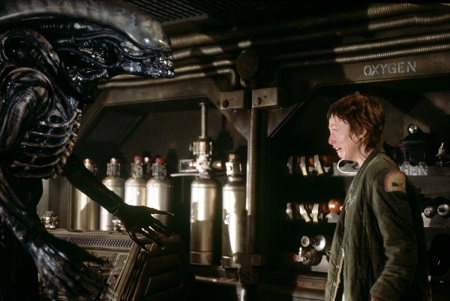
The Alien franchise only really has one kind of alien.

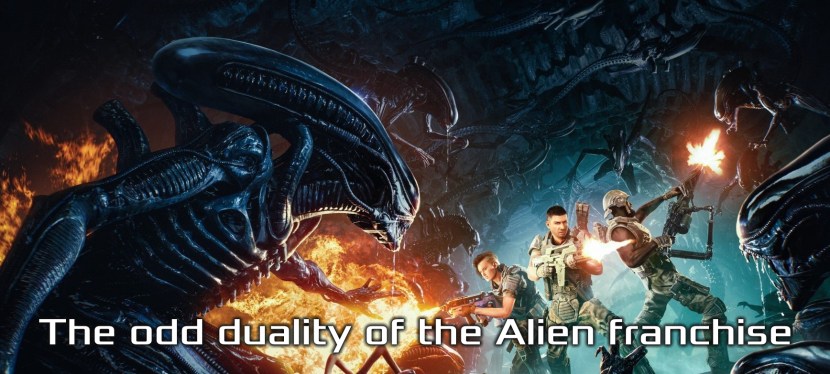
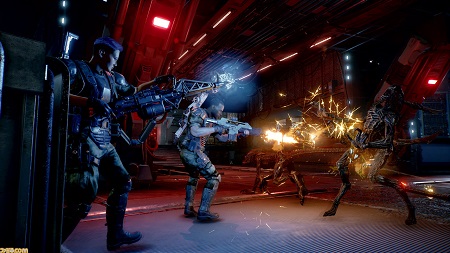
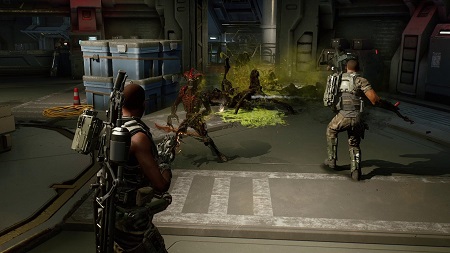
Speaking of video games, it was the recently-launched Aliens: Fireteam Elite that prompted this article and this consideration of the peculiar duality of the Alien franchise. Aliens: Fireteam Elite is a co-op game that sees players team up to take the fight to the Xenomorphs, killing the titular aliens by the dozens. It’s very much an action-shooter game, and the cannon fodder getting in the way of players’ guns are the Xenomorphs.

Contrast this to the single Xenomorph that Ripley encountered in Alien, or even the Xenomorph that provided the jump-scares in 2014’s Alien: Isolation video game. A single alien is all it takes in those titles; one Xenomorph is a significant adversary for a whole crew of humans. Some entries in the franchise go down this route, making the Xenomorphs out to be almost invincible, unstoppable killing machines. Other entries portray them as weaker, more easily-defeated creatures that are often little more than a bump in the road for our heroes on the path to victory.

The new video game Aliens: Fireteam Elite prompted this article.

This is the duality of the Alien franchise; a franchise that perhaps doesn’t quite know what it wants to be. On the one hand we have the horror vibe of the original film, followed up in titles like Alien: Isolation. These horror-style Alien films and games bring with them a single Xenomorph at a time – or at most a small group – and shows how utterly unprepared and incapable humans are of defeating them in combat. On the other hand we have action-oriented entries in the series – kicking off with Aliens and epitomised by titles like Fireteam Elite – where multiple Xenomorphs can be seemingly easy to defeat.

Many sci-fi properties can manage this kind of dual tone. There are moments in Star Wars, Star Trek, and others which fit both the action or horror moulds at different points, but the key difference is that those franchises aren’t trying to use the same alien race in both cases. Some alien adversaries can be all-conquering, unstoppable foes – like the aforementioned Borg or Daleks. Others can be cannon fodder that are easily dispatched – like Stormtroopers.

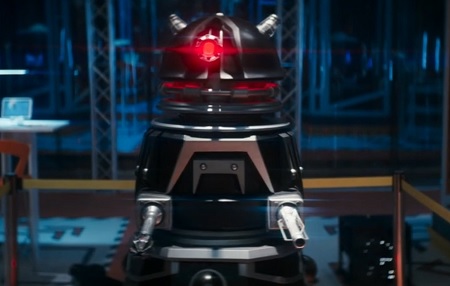
Doctor Who’s Daleks have been worn out as a threatening adversary by too many stories and too many defeats.

Imagine a Star Wars film or video game where a single Stormtrooper was painted as a terrifying villain. It would work on some level, perhaps, depending on how well the story had been set up and who the protagonist was. But it’d be difficult to pull off successfully because of how we’ve come to see Stormtroopers over past iterations of the franchise – as easily-killed cannon fodder.

As Star Trek and Doctor Who began to wear out the Borg and the Daleks respectively, the fear factor these once-mighty aliens inspired started to evaporate. At the back of our minds we felt that it was only a matter of time until our heroes prevailed – because they’d done so on so many past occasions. Like with Stormtroopers in the analogy above, we stopped fearing what had come to be seen as cannon fodder.

Stormtroopers have never felt particularly threatening in the Star Wars franchise due to the role they play.

And that’s where the Alien franchise is today, at least in some respects. Every action-heavy entry in the franchise diminishes the threat and fear factor of the Xenomorphs. That doesn’t mean that making another horror title in the franchise will become impossible, because good scripts and clever writing can go a long way to carrying a film. But it does mean that the Xenomorphs themselves feel less intimidating with every outing, and will eventually reach a point where they feel played out.

I’ve recently argued that Doctor Who should probably go back on hiatus. Sixteen years have passed since its 2005 revival, and the show has pretty much run its course. The Alien franchise is a little different, because it releases fewer instalments further apart, but eventually it will reach that point if care isn’t taken to remain in control of the kinds of stories it wants to tell.

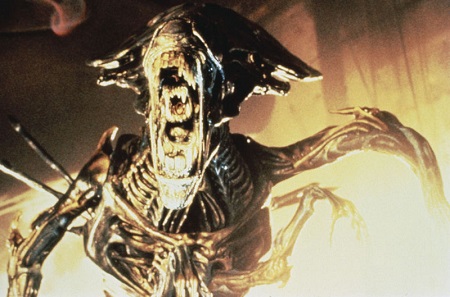
The Xenomorph Queen in Aliens.

Aliens: Fireteam Elite didn’t need to be a game with the Alien franchise license. It could’ve swapped out the Xenomorph textures for generic aliens or monsters, or it could’ve swapped them out for Borg drones and slapped a Star Trek label on. Nothing about the game looks or feels particularly “Alien” except for, well, the aliens. The story, such as it is, wouldn’t have to make many changes if the Alien license weren’t used. And under those circumstances, I have to question why it was released and why the Alien franchise continues to confuse its messaging.

Though Prometheus has made a creditable attempt to expand the lore and mythos of the Alien franchise, the Xenomorphs remain its principle alien monster. Unlike Star Trek or Doctor Who, which are able to draw on many different aliens, monsters, and settings, Alien really just has the Xenomorphs to offer. This means that the danger the franchise is in from the cheapening and diminishing of its only real foe is all the more significant.

Too many games like Aliens: Fireteam Elite will change the way audiences perceive the Xenomorphs – and make it harder to tell scary stories involving them.

Alien doesn’t work without the Xenomorphs any more than The Creature from the Black Lagoon would work without the creature from, y’know, the black lagoon. Alien doesn’t have to always use the same horror tone for its films and video games, but the move to an action-focused story naturally requires a more disposable cast of adversaries. With only one alien around, the Xenomorphs are dropped into that role; a role which, I would argue, does not really suit them nor fit with many of their depictions in the franchise.

Video games like Doom and films like Men in Black show how much fun it can be to have an action-heavy title that cuts down swathes of monsters or aliens. That concept works well in both forms of media, and audiences lap it up. But I guess it feels fundamentally different to what Alien offered in 1979, and even though its sequel Aliens in 1986 had already begun the process of transforming the franchise into something more action-oriented, that feeling persists.

1986’s Aliens had already started to transform the franchise – and the Xenomorphs.

Perhaps if the Alien franchise had stuck firmly to action after 1986 we wouldn’t be having this conversation. But in films and in video games, the franchise continues to try to do both action and horror. It almost seems as though every other title will come out with an alternate theme and tone; horror one time, action the next. This leaves the Xenomorphs in an odd situation. Their original appearance in Alien is still frightening, but every subsequent appearance in action titles, where they’re far more easily dispatched, has turned them into something less terrifying. There’s no longer a sense that Xenomorphs are truly unstoppable.

How will this play into the upcoming Alien television series? I’m not sure. But if you ask me, the people in charge of the Alien franchise need to very carefully consider their next moves. The style and tone of upcoming titles is incredibly important to get right – and once settled, it’s important to stay consistent. Right now it feels like there are two kinds of Xenomorph: the terrifyingly unstoppable ones seen in Alien, and the cannon fodder of games like Fireteam Elite. The danger is that the cannon fodder perception will creep into productions that want to have a horror vibe, and that could absolutely ruin them.


The Alien franchise – including all properties mentioned above – is the copyright of 20th Century Studios and The Walt Disney Company. Some promotional artwork courtesy of the aforementioned companies. This article contains the thoughts and opinions of one person only and is not intended to cause any offence.
The Suicide Squad – film review

Spoiler Warning: There are spoilers ahead for The Suicide Squad and other recent DC titles.

I always caveat my reviews of comic book films by saying that I’m not really a huge comics fan. I never read comic books as a kid, and while there have been some cinematic adaptations that worked well, for the most part the highest praise I can give most comic book films is that they’re moderately entertaining action fare.

My most recent encounter with a DC Comics film was Zack Snyder’s Justice League – and I really didn’t enjoy that film. But in 2016 I’d watched the first Suicide Squad and enjoyed it for what it was, so I figured I’d check in with this film to see what it had to offer. First, though, I had to figure out what The Suicide Squad is. Is it a sequel? A reboot? A soft reboot? In short, what’s going on with the confusingly similar title?

Poster for The Suicide Squad.

DC has struggled to compete with Marvel in terms of film adaptations, despite having just as many well-known and well-regarded superheroes at its disposal. Following disappointing results with some of the films of the DC Extended Universe, including the original cut of Justice League, DC opted to rework its cinematic offerings, and I think that’s why this film is called The Suicide Squad instead of Suicide Squad 2. DC hasn’t done a good job of communicating all of this, though, at least not to casual viewers. Hardcore DC fans who follow all the ins and outs of the brand and its news will know what to expect from The Suicide Squad, but there’s no doubt in my mind that its confusing name and the deeply muddled state of DC’s film universe is going to be baffling to many would-be viewers – if not outright offputting.

Compounding this was the fact that most of the cast of Suicide Squad didn’t reprise their roles this time around. Will Smith, Cara Delevigne, Jared Leto, and several other big names either chose not to return or saw their roles cut when the DCEU’s plans changed.

Though The Suicide Squad is tonally similar to its predecessor, when compared to the likes of Zack Snyder’s Justice League – a film which tried so desperately hard to take itself seriously that it became unintentionally funny – there’s a wild shift in tone. The dark humour and lack of seriousness in The Suicide Squad is a massive improvement over a film like Zack Snyder’s Justice League, and a far better fit for its source material, which was something I appreciated! But it does make DC’s recent cinematic output feel completely disjointed; wild jumps in tone and style make the two films feel like they couldn’t possibly be part of one supposedly-connected, ongoing world. Marvel comparisons again abound because that franchise handles this so much better. Marvel projects are generally consistent in basic things like their style and tone, and it’s seldom the case that one comes away from a Marvel film feeling it’s wildly out of kilter with other parts of the franchise.

The Suicide Squad had a light-hearted tone and knew what kind of film it wanted to be.

Humour is a very subjective thing, and not every joke or comedic moment will have landed for every viewer. But for me, the film’s sense of humour was generally on point. The Suicide Squad didn’t strive to take itself too seriously, and at the same time was able to successfully communicate the stakes involved for the protagonists. That isn’t a line that’s easy to walk sometimes, yet the film broadly stayed on the right side of it.

Keeping a relatively lighthearted tone throughout was to the film’s benefit. Not only was it appropriate for a story that bordered on the ridiculous (a giant starfish from outer space) but it provided The Suicide Squad with plenty of laugh-out-loud moments. A lighter style allowed the film to embrace much of the silliness that comes from comic book characters and their visual styles, and compared to other DC titles The Suicide Squad leaned into campiness in its costuming and took in its stride some truly wacky concepts, characters, and premises.

The Suicide Squad has a pretty wacky and silly premise, and the film leaned into that in a big way.

There were some definite visual misses in The Suicide Squad. The CGI and green-screen work was far from perfect, and though the worst moments were few and far between, in a film with a budget of more than $180 million that really shouldn’t be happening in the first place. There were some “uncanny valley” moments with the CGI, particularly CGI moments involving the film’s human characters. Then there were some moments where the use of green-screens was just incredibly obvious to the point of being offputting.

Interestingly, these issues also plagued Zack Snyder’s Justice League. In my review of that film I wondered if some of the visual effects misses might’ve been due to the lower budget afforded to the re-editing of the film. It now seems as though that wasn’t the case; DC just isn’t especially good at green-screen and CGI moments. In a film that relies heavily on visual effects, this isn’t just noticeable – it actively detracts from the experience and can completely ruin suspension of disbelief.

One of several green-screen moments that missed the mark.

After his recent controversy for apologising to the Chinese dictatorship, it was ironic – no, it was grotesque – to see John Cena playing a character whose defining characteristic is is love of freedom and peace. Though this character was always presented as a semi-antagonist, something about the casting really got under my skin. Cena’s portrayal of Peacemaker was fine – competent, even. But knowing how the actor favours Chinese money over basic human rights, seeing him spouting lines like “I would do it for liberty” was vomit-inducing.

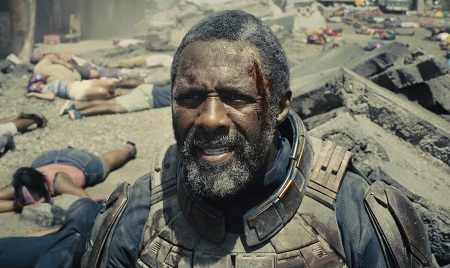
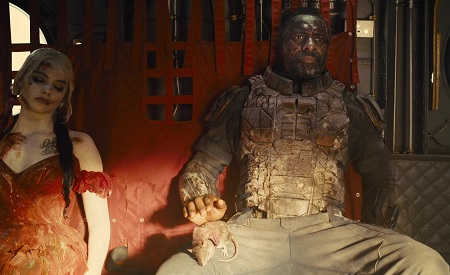
Idris Elba took the leading role in The Suicide Squad and put in a creditable performance as a mercenary “with a heart of gold;” taking on the dangerous mission for the sake of his daughter. Giving Bloodsport this extra motivation added an extra dimension to the character and kept him believable – despite the wacky situation and the chaos that unfolded around him. Elba had previously played Krall, the villain in Star Trek Beyond, and it was fun to see him in a different role on this occasion.

Idris Elba’s Bloodsport was the main hero of the piece.

Margot Robbie got top billing alongside Idris Elba, but in 2016 I felt her forced “American” accent as Harley Quinn was just plain awful, and unfortunately that situation has not improved in the slightest in the years since. Robbie put in an otherwise impressive performance as the damaged, psychotic Quinn, but her accent was never believable and that did detract from the character at points.

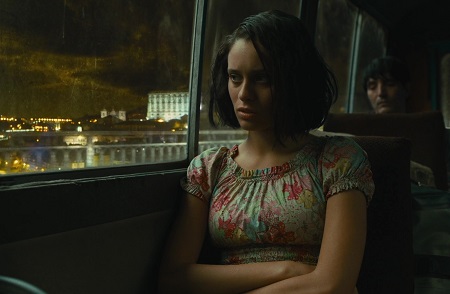
The surprise star for me was Portuguese actress Daniela Melchior, who played Ratcatcher 2. Her deeply emotional portrayal cut through what was a strange and even silly premise to become an unexpectedly impressive performance in a film laden with established stars. Her character arc, coming to terms with the loss of her father and finally putting to use his odd invention, was elevated far beyond what it could’ve been by Melchior’s performance, which is even more impressive considering that The Suicide Squad is one of her first ever English-speaking roles. She provided vulnerability and emotion to the character – and the paternal relationship between Bloodsport and Ratcatcher 2, while not fully developed, really formed the film’s entire emotional core.

Daniela Melchior put in an amazing and emotional performance as Ratcatcher 2.

The decision to begin the film with a fake-out – setting up a secondary “suicide squad” and then watching them get slaughtered – was a bold decision. Setting up a different crop of characters, and framing that part of the film from the point of view of one of them, did succeed at setting up Harley Quinn’s storyline and at communicating the stakes involved and the level of risk to the main characters. But at the same time it felt cheap; setting up minor characters – redshirts – to be killed off allowed most of the other main characters to survive their so-called suicide mission. Only one of the principal characters on Bloodsport’s team ended up dead by the film’s end, which might not be enough for a film literally called The Suicide Squad.

Perhaps the decision for all but the Polka Dot Man to survive is DC’s way of teeing up another sequel. If that’s the case, I would definitely be interested to see Bloodsport and Ratcatcher 2 return for another outing. The disjointed way DC still runs its cinematic arm makes me wonder if they have any such plans, though – and if they do, whether it’ll ever happen!

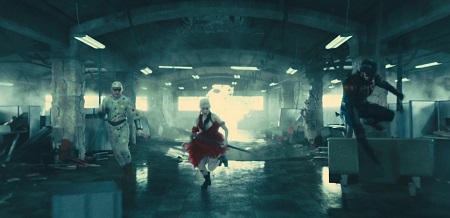
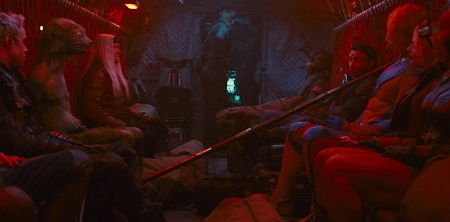
The characters from the film’s opening act were all killed (except one).

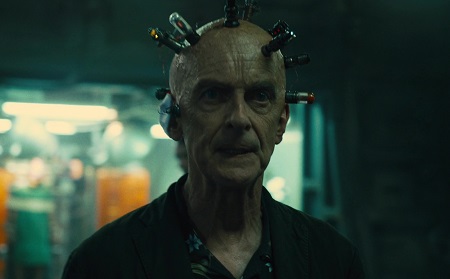
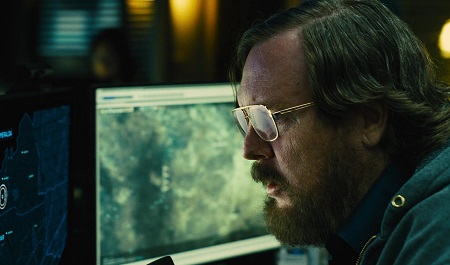
In a film with a larger cast, some characters can end up feeling underused, and Peter Capaldi’s Thinker definitely fell into that trap. Set up early on in the film as one of the main villains of the piece, he ended up being little more than a one-dimensional hurdle for other characters to blaze past on their way to completing their mission. Peter Capaldi is an actor I’ve admired in the past, yet in recent years he never seems to land roles that are honestly worthy of his time. His tenure in Doctor Who saw lacklustre stories, and now his role in The Suicide Squad was, at best, a run-of-the-mill “mad scientist” trope.

It was a little disappointing we didn’t spend more time with the Thinker, nor really learn what he was doing at Project Starfish. A brief scene showed off a number of caged folks infected with the Starfish’s face-huggers and a few gory-looking but unexplained experiments. Yet the Thinker, despite being the closest The Suicide Squad got to a supervillain, had no motivation, no real accomplishments, and seemed to exist simply to fill a hole in the script.

Peter Capaldi’s character of the Thinker felt underused.

The Suicide Squad wasn’t shy in its criticism of American foreign policy, particularly the way the United States can be selective when it comes to favouring liberty and human rights. There were echoes of American policies toward Cuba and nations in Central America in its portrayal of Corto Maltese, as well as the United States’ general policy of supporting “pro-American” dictators all over the world.

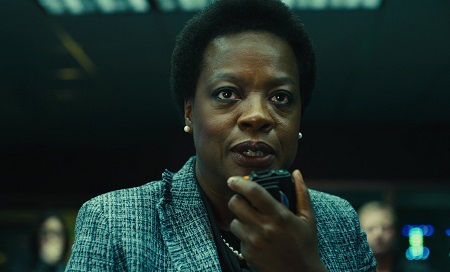
These themes have been explored better and in more detail in other films, and while their inclusion in The Suicide Squad wasn’t necessarily bad, it didn’t exactly make for biting satire either. Nor was it particularly original; the political themes present in the narrative had things to say that have already been said both in entertainment and non-fiction on many other occasions, and the film added nothing to this conversation that hasn’t already been discussed and dissected in many other projects. In that sense, the political stuff was a bit unnecessary. It added little to the film except to elevate the ambiguous morality of Viola Davis’ character of Waller, the leader of the suicide squad programme.

The political themes didn’t really add a lot to the film, and similar criticisms of American policies have been done better in other titles.

Seeing Waller get her comeuppance from members of her own team was satisfying, and perhaps this was the best-executed moment on that side of the film. Waller had been presented as ruthless in the first Suicide Squad, but on this occasion we saw her team grow increasingly uncomfortable with the way she handled the squad and their mission, culminating in her getting wacked on the head. It was definitely a satisfying moment, but as with a couple of other storylines it feels as though there was no real resolution to what happened between Waller and her team.

Even the post-credits scene, which revealed that the Peacemaker survived, didn’t see Waller getting her own back or even interacting with her team in any way. After being knocked unconscious she never says another word on screen to any of them, and that conflict, which had been expertly built up in a number of sequences across the film, feels like it reached its climax then fizzled out. Perhaps it’s something else to be addressed in a sequel?

Perhaps a future sequel plans to look at the conflict between Waller and her team in more detail?

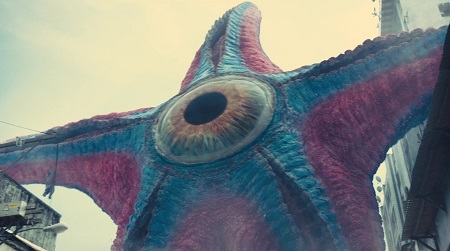
The Starfish alien, which was the reason for the story, was definitely one of the weirder villains I’ve seen in any comic book film to date. It was familiar enough to not be frightening in its appearance, yet it was also eerie in the way it moved. The face-hugging smaller starfish were like something right out of sci-fi horror classic Alien, but despite being unoriginal were still intimidating enough at first to seem to offer a degree of threat.

The fact that the suicide squad themselves were so easily able to fight off the smaller, mind-controlling starfish was poor, though. I’ve said this before, but the concept of a zombie virus, Borg assimilation, or anything else that can control minds and turn allies into enemies is deeply frightening; the thought of losing control of one’s body is, for many folks, a fate worse than death. Yet when it really could’ve mattered, The Suicide Squad wasted this concept. The only characters we saw get caught by the face-huggers were nameless goons (and one villain). As a result, the Starfish alien lost its only genuinely threatening aspect pretty quickly.

The smaller mind-controlling starfish only seemed to harm minor characters and extras.

It was still a giant monster to fight, and the squad had trouble taking it down. Because of the name of the film there was a sense that any of them could’ve been in danger, yet as noted only one character ended up being killed off during this climactic final battle. I had become somewhat attached to the likes of King Shark and Ratcatcher 2 (and the adorable Sebastian the rat) so on the one hand I’m glad that they all made it. On the other, it feels as though there could’ve been more casualties.

A film called The Suicide Squad and which sets up the premise of a forlorn hope type of mission seems like it should’ve ended with more casualties. Even one of the characters who appeared dead – Peacemaker – was later revealed to have survived, so at least part of the film’s premise doesn’t feel fulfilled. Though losing a protagonist is almost never fun, in some stories it feels right – and The Suicide Squad was certainly a story that could’ve seen more of its protagonists fail to make it home.

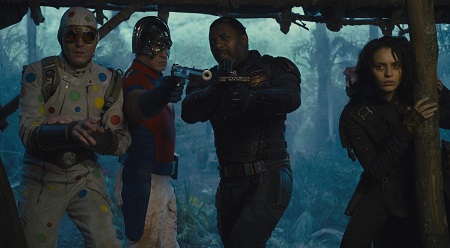
The main characters (bar one) survived to the end of the film.

Other superhero films using a team-up premise often set up at least some of their characters beforehand. As a result we know going in what to expect from them. In the case of The Suicide Squad, one negative point against the film is that none of the characters really felt like villains. We didn’t know any of them (except Margot Robbie’s Harley Quinn) before the film started, and though we heard from Waller and others that some of them had done bad things in the past, that never really came across on screen; none of them felt like bad people.

To me, this chips away at the premise of The Suicide Squad. It wanted to throw anti-heroes at a far worse villain, allowing us as the audience to feel like they were redeemable and not all bad. Yet because of the way the film started and the way the characters were introduced, none of them ever really felt like bad people or even people who deserved to be imprisoned. Perhaps if we’d seen for ourselves a montage of some of their worst moments earlier in the film that sense could’ve been present, and the moral ambiguity it would’ve brought to the film might’ve elevated it into something more complex. Instead we were given that fake-out sequence with the suicide squad B-team.

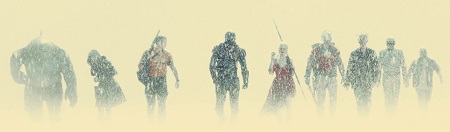
The titular suicide squad – and friends.

Overall, I had a good time with The Suicide Squad. It wasn’t the perfect film by any means, but it was funny when it wanted to be, it leaned into its over-the-top storyline in a way that was in keeping with its comic book origins, and featured a couple of truly outstanding emotional performances that I wasn’t expecting.

Though DC continues to struggle and not really know what kind of films they want to make, I would say they should try to make more like this one! It was everything I expected from a comic book film, and thanks to the emotional performances of a couple of its main characters, maybe even managed to be something more. There were some visual misses, some underdeveloped characters, and a childish storyline featuring a weird alien, but under that fluff I found a decent action-comedy that I decidedly enjoyed.

The Suicide Squad is currently available to stream on HBO Max in the United States. The Suicide Squad is the copyright of DC Films and/or Warner Bros. Pictures. This article contains the thoughts and opinions of one person only and is not intended to cause any offence.

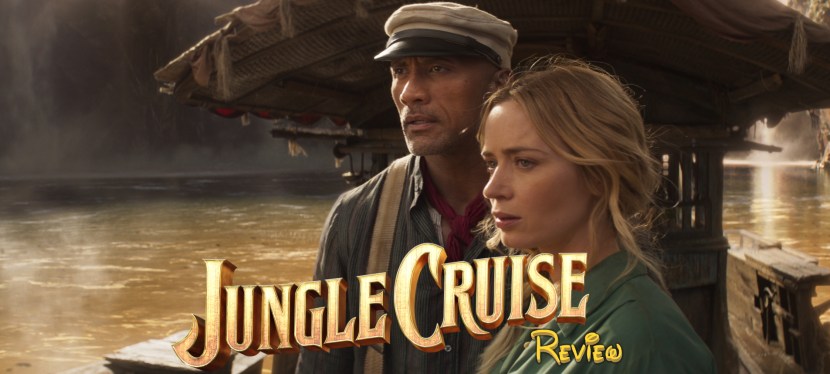
Jungle Cruise – film review

Spoiler Warning: There are spoilers ahead for Jungle Cruise.

Any review of Jungle Cruise on Disney+ needs to take into account the film’s price tag. Right now Jungle Cruise costs £20 in the UK or $30 in the United States to “unlock,” and thus the film’s value will vary from viewer to viewer. For my two cents, unless you’re a huge fan of the original Jungle Cruise ride at the Disney theme parks or a particular fan of either Dwayne Johnson or Emily Blunt, this is probably a film to wait for. In a matter of months, and certainly by Christmas, the film will be added to the regular Disney+ lineup, and though I had a decent enough time with Jungle Cruise, I’m not sure that I necessarily got £20 worth of enjoyment from it. If you’re on the fence, trying to decide whether to pay up or wait, I think this is one you can safely wait for.

That being said, Jungle Cruise was enjoyable. I’ve said this before, but in 2002-03 when Disney was talking about adapting Pirates of the Caribbean into a film, I thought it sounded like an atrocious idea! How could a theme park ride possibly translate to the screen, I wondered? I was wrong about Pirates of the Caribbean: The Curse of the Black Pearl then, and if I had similar doubts about Jungle Cruise eighteen years later then I was wrong again! The film was decent, and paid homage to a classic ride which has been part of Disneyland since the very beginning.

Jungle Cruise poster.

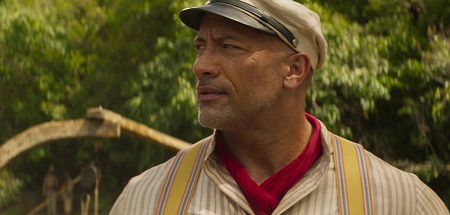
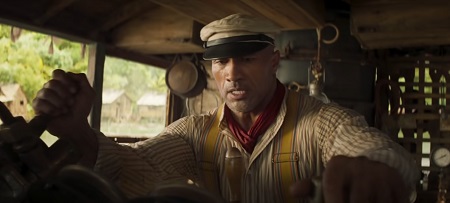
If you’re fortunate enough to have ridden Jungle Cruise, you’ll recall that there is a “story” of sorts to the ride itself. Obviously the film takes liberties with this, chopping and changing things to make the story more suited to the screen rather than a semi-interactive theme park attraction. But I was surprised at just how well Jungle Cruise captured the feel of the original ride, with Dwayne Johnson’s character of Frank taking the role of the Disneyland boat captain from the attraction.

There were nods to other aspects of the ride as well, particularly in the film’s opening act with Frank’s literal jungle cruise entertaining the tourists with the same mixture of dad jokes and props as the ride itself. As the story went on, the film naturally stepped away from being true to the ride to focus on a story that was not dissimilar to the aforementioned Pirates of the Caribbean film, complete with cursed undead sailors, a magical macguffin, and lashings of aquatic adventure.

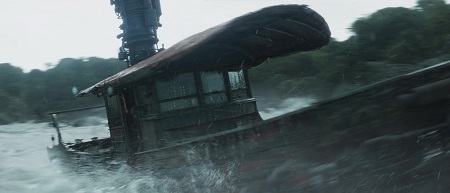
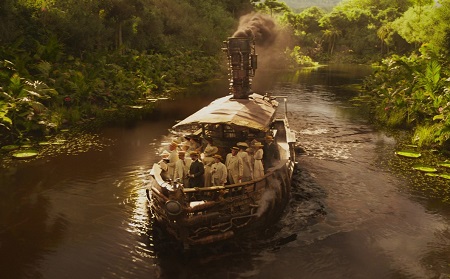
Quila hits the rapids!

There were several surprisingly poignant and emotional moments in Jungle Cruise which I wasn’t expecting. Aside from the typical Disney happily ever after ending (complete with a fake-out sad ending which preceded it) the tastefully handled moment where Jack Whitehall’s character of MacGregor came out to Frank was a very sweet inclusion. Not only did it add personality and dimension to both characters – MacGregor gained a backstory of rejection and further reason to follow Lily, and Frank came across as accepting and kind – but it was a huge step for representation and inclusion. Seeing MacGregor experience rejection yet find acceptance in the most unlikely of places is a powerful message, and the mere act of LGBT+ representation in a blockbuster film is always fantastic to see. Such a message is especially important for younger viewers.

While we’re discussing some of Jungle Cruise’s deeper themes, the film took a dim view of wealth, aristocracy, and closed societies – despite practically all of its main characters being drawn from the upper classes of their day. MacGregor’s unease at having to experience life away from his home comforts was initially played for laughs – though he did become more comfortable with it as the film reached its end. The villain of the piece being a German aristocrat was also a continuation of this theme, as was the initial depiction of Frank as the last independent river boat captain – and the poorest.

Dwayne Johnson as Frank, the riverboat captain.

Having seen a number of films with British villains over the last few years, the decision to make the German Prince Joachim the main adversary to Frank and Lily was actually a bit of a change. There was a time a few years ago where villains in cinema were often German – or of German extraction. But enough time has passed and enough other villains have come and gone that the return to a German villain didn’t feel like stereotyping or a trope in the way it might’ve done had Jungle Cruise been made in the recent past.

The story itself took a couple of unexpected twists. The revelation that Frank wasn’t who he seemed to be definitely came as a shock – but in a good way! Sometimes twists of this nature can feel rushed or like they jolt the story in an unwanted direction, but learning Frank’s true origin managed to avoid that pitfall. It made his character feel more rounded and gave him motivation. We learn why he wanted to take Lily upriver – and why he was so convinced she wouldn’t succeed in her quest to find the Tears of the Moon.

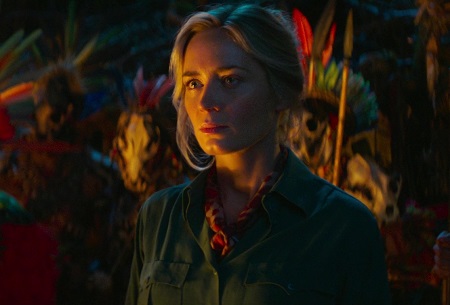
Lily was seeking the Tears of the Moon.

Frank’s “betrayal” of Lily and MacGregor – which he apparently set up off-screen with Trader Sam and her tribe – was perhaps the weakest moment in the story. It did nothing to endear us to Frank, and while it was arguably in character for him it robbed what was initially set up as a tense moment of practically all of its drama. Though the threat and peril were restored after a brief respite, the way the film handled this moment was poor overall.

Representation of native peoples and their relationship to colonists has come a long way in recent years, and when looking back at past Disney depictions of indigenous peoples – such as in Peter Pan or even the original incarnation of the Jungle Cruise attraction – the way the “headhunter” tribe was presented was an improvement. Considering the tribe played a relatively minor role in the film, what we saw worked well. The depiction retained some of the mystery that westerners have of indigenous peoples – something that the original ride drew on for part of its threat – yet at the same time made at least one key character relatable.

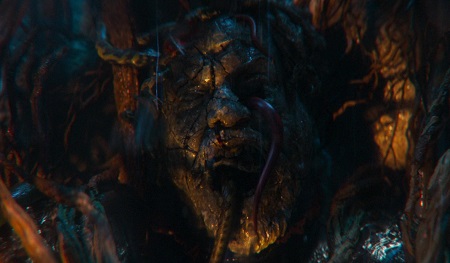
The tribal chief.

Jungle Cruise also didn’t shy away from depicting the brutality of colonisation, showing Conquistadors savagely attacking a tribe of native people even after being offered shelter, food, and medicine. However, the film then immediately strayed into once again mystifying the tribespeople by giving them magical powers seemingly connected to the Tree of Life. Overall, the way Jungle Cruise handled its characters’ interactions with indigenous people was better than in some Disney titles, particularly older ones, but arguably imperfect and verging into some of the tropes commonly associated with such tribes in fiction.

Aside from the opening act, which was set in London, and a few other scenes near the beginning of the piece, Jungle Cruise broadly stayed true to its premise as a film about a voyage on a riverboat. The boat itself had character, being old and beaten-up, and was memorable for the way it looked while again retaining some of the charm of the original Disneyland attraction. Quila (Frank’s boat) was not only the characters’ home and method of transportation, but also played a key role toward the end of the story by blocking the river water and saving Lily and MacGregor. Giving the boat more to do in the story than simply be an ever-present stage for the characters made a huge difference to the film, and made its setting feel meaningful.

Quila – the boat – was almost like an extra character in the film.

Though the Conquistadors wanted to kill Frank – and later Prince Joachim – they seem to have had similar objectives when it comes to acquiring and using the Tears of the Moon, and as a result some of the moments toward the film’s climax felt rather forced. Obviously Lily and MacGregor had an incentive to stop the Prince and his gang of German submariners, as they clearly had nefarious intentions for the magical macguffin. But the Conquistadors had basically the same objective as Frank – to lift their curse – and it felt like there could have been a moment near the end of the film where they had all realised that they didn’t need to fight. In fact I initially wondered if Prince Joachim’s betrayal of the Conquistadors was going to set up precisely that kind of storyline. It feels like a miss that it didn’t, as the film basically ended with the heroes defeating two parties of villains.

There’s always room in fiction for that kind of narrative; not every story has to depict an emotional coming together and teaming up to defeat a worse villain. But the disturbing implication to the way Frank’s story ended is that he simply left the Conquistadors to endure endless torture; they’re unable to die and it didn’t seem as though he took action to lift their curse. Perhaps this is Disney leaving the door open to a sequel?

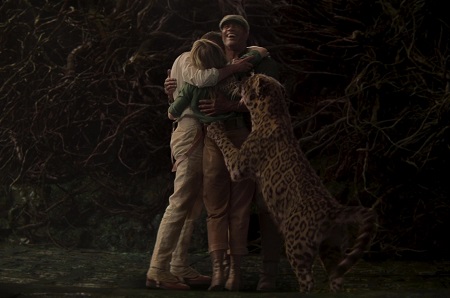
Did Frank and Lily condemn the Conquistadors to eternal torture?

Speaking of the way the film ended, with Frank and Lily only able to pluck a single petal from the tree, all Lily really got to do was write up her adventure and land herself a job. In the male-dominated world that the film depicted that is unquestionably a victory for her – but her original ambition had been to use the Tears of the Moon to “revolutionise medicine” and save countless lives, not least in the ongoing First World War. It seems as though this ambition was thwarted, yet the film skips over this point.

Jack Whitehall is not someone I would have expected to see in a film like Jungle Cruise, but he put in a creditable performance as MacGregor. His stand-up act often draws on his self-styled “posh” image, and his character felt like an exaggerated version of that in some respects. Emily Blunt was outstanding in the role of Lily, bringing real personality to the character and crafting a heroine that we as the audience wanted to get behind. Dwayne Johnson seemed at first to be playing a fairly typical “Dwayne Johnson” role, but the addition of an unexpected backstory for his character of Frank took the character to a different place and forced him to step out of his comfort zone and play things differently as the film passed the two-thirds mark. Though perhaps it wasn’t an Oscar-worthy performance, I found Frank to be a believable protagonist and someone I wanted to see succeed.

MacGregor and Frank shared a genuinely touching moment in Jungle Cruise that I wasn’t expecting.

Jungle Cruise relied heavily on CGI almost throughout, and not all of the animation work was as realistic as it could’ve been. Recent productions, even on television, have seen some truly outstanding CGI work, and while nothing in Jungle Cruise was awful or even immersion-breaking, there were quite a few elements that didn’t look quite right. At a number of points I felt that some of the CGI had that “too shiny,” plastic look that plagued CGI a few years ago, and I really thought that animation – especially cinematic animation – had begun to move past that particular issue.

I would’ve liked to have seen more physical props and practical effects, and the fact that a large portion of Jungle Cruise was filmed with green screens and other modern tricks wasn’t as well-concealed as it might’ve been. And perhaps this final point on visuals is a bit of a nitpick, but the fact that a number of the so-called “jungle” sequences were filmed not in South America but in Hawai’i was apparent to anyone who knows their flora! Different biomes do look different from one another, and a few scenes in particular which supposedly took place on the banks of the Amazon were very clearly filmed elsewhere. I know that’s a minor point that won’t have bugged many people, but I found it worth noting.

Happily ever after for the main characters!

So that’s about all I have to say, I think. Jungle Cruise certainly compares to the likes of Pirates of the Caribbean and other fantasy-adventure titles. It was fun, emotional at points, and set up its trio of main characters for a story that was easy enough to follow for kids while still having plenty to offer for adults as well. It stands up well against many adventure films, including classics of the genre like Indiana Jones – which Jungle Cruise was clearly channelling at points!

I had an enjoyable time with Jungle Cruise, and it was a fun way to spend a couple of hours. Whether it will be worth the cost of admission on Disney+ is something everyone will have to decide for themselves, but I think it’ll still be an enjoyable watch in a couple of months’ time. Jungle Cruise presented a fun story that drew inspiration from the likes of Pirates of the Caribbean, yet stayed true to its origins as a theme park attraction. It was a fun ride down the river with Frank, Lily, and MacGregor, and I’m sure I’ll have fun watching the film for a second and third time in the future; it’s definitely one to return to when I’m in the mood for adventure!

Jungle Cruise is available to stream now on Disney+ Premier Access (for a fee). Jungle Cruise is the copyright of Walt Disney Pictures and The Walt Disney Company. Some promotional images courtesy of The Walt Disney Company. This article contains the thoughts and opinions of one person only and is not intended to cause any offence.

Space Jam: A New Legacy – film review

Spoiler Warning: There are spoilers ahead for Space Jam and Space Jam: A New Legacy.

I don’t think I’ve re-watched Space Jam since I saw it at the cinema in 1996… so it’s been a while! But the film is adored by many, and has a following of its own within the broader Looney Tunes fandom. I’m not sure I’d go so far as to call it a classic of the 1990s, but I daresay a lot of self-proclaimed “90s kids” would – even though many of them were born far too late to truly warrant the label. But we’re off-topic already!

The original Space Jam was a unique offering. A blend of live-action and animation, a mixture of comedy and sport, it’s a film that’s hard to define and pigeon-hole, and as a result of its premise – and wacky, child-friendly humour – it’s well-remembered and held in high regard even a quarter of a century later. Going back to that premise for a second time always felt like a risky move for Warner Bros. simply because it can be very difficult to recapture the magic of such a genuinely different, one-of-a-kind title.

Promo poster for Space Jam: A New Legacy featuring the Road Runner.

But this is the reality of modern cinema. In the realm of kids’ films – a genre Space Jam: A New Legacy is surely included in, despite its appeal to the millennial generation – Disney has pushed the boat out ever further with its recent slate of remade classics, and in a broader sense the idea of reboots, soft reboots, and remakes is something practically every major film studio is throwing money at. In a sense, Warner Bros. doesn’t really care whether anyone actually likes Space Jam: A New Legacy, because they know that the name and branding alone will convince many fans of the original to turn up and see it no matter what the critics say. The film is, to use an outdated movie industry term, “bankable.”

I recently had this conversation with a family member who lamented the existence of Steven Spielberg’s remake of West Side Story – which is due out later this year, in case you care. They were despondent at the idea that one of their favourite films of all time was being remade, and I can sympathise. Remakes, by their very nature, are aiming low. They can only ever hope to be considered “just as good” as the original, but never even try to surpass it.

LeBron James in Space Jam: A New Legacy.

But remakes serve a purpose, at least from the point of view of corporations. They’re easy money, because film studios know that millions of fans of West Side Story or Space Jam will turn up for the new version – even if only out of morbid curiosity! There’s also an argument to be made that, in some cases, younger audiences aren’t interested in watching films that they deem to be “too old.” Thus a remake can, from an artistic point of view, be argued to bring a story or a setting to a new generation of prospective fans. Whether that’s the case with Space Jam: A New Legacy is debatable; the film isn’t a straight remake. Nor is it really a sequel, instead I think it’s best described as a riff on the original concept, taking some familiar and some new characters and throwing them into a similar – but not identical – story.

That’s the area that Space Jam: A New Legacy occupies. Not a sequel, not a remake, but a riff. A shaken-up copy made a quarter of a century later with, let’s be honest, business and financial reasons at its core. It’s not an artistic piece; it wasn’t made because its director or writer had a burning passion for the wonderful, underexplored universe of Space Jam. Nor was it made because the original film was desperately crying out for a sequel or an expansion. It was made purely because corporate executives at Warner Bros. were looking through their back catalogue in search of something to monetise, and Space Jam caught someone’s eye. If we were being cruel, we might say that Space Jam: A New Legacy is soulless.

Space Jam: A New Legacy could feel, at times, very corporate.

One of the reasons I was curious to see Space Jam: A New Legacy – beyond the vague interest in a follow-up to a film I remember with fondness from the ’90s – was the involvement of Sonequa Martin-Green. Martin-Green plays Michael Burnham, the main protagonist of Star Trek: Discovery, and like many Trekkies I’m always interested to see other projects involving stars of Star Trek. Though I haven’t always felt that Michael Burnham was the easiest protagonist to root for in the franchise, there’s no denying Martin-Green’s talent and hard work, and just like she excelled in The Walking Dead a few years ago, she put in a great performance in Space Jam: A New Legacy. Though her character played a supporting role, it was still great to see her and her performance elevated the film.

I’ve seen more Space Jam films than I have basketball games. Basketball isn’t a big sport here in the UK, and while I have tried it in PE lessons at school way back when, it isn’t a sport I follow, nor do I know much about it beyond the basic rules. LeBron James is among the few basketball players whose names I’ve heard, but that’s really where my familiarity with the sport ends.

Sonequa Martin-Green as Kamiyah James.

Space Jam: A New Legacy felt, at points, like a love letter to its star, which was a very strange thing to watch. Some films can feel like vanity projects – John Travolta’s Battlefield Earth, Kevin Costner’s The Postman, and even to an extent William Shatner’s Star Trek V: The Final Frontier all cross that invisible line, and Space Jam: A New Legacy comes close. The introduction of Don Cheadle’s Al-G Rhythm is a scene which has him reading aloud a list of James’ accomplishments on and off the court, and the film’s title sequence is likewise a flattering summary of his career. For a film where this man is the star, it makes watching those sequences feel more than a little weird.

I didn’t have high expectations for LeBron James as an actor, and while he won’t be winning an Oscar anytime soon he did, to my surprise, manage to put in a solid performance. His early scenes left me concerned that I’d find him too flat and wooden, as many sports stars and athletes can be when they try acting for the first time, but when the plot got going and he and his son were transported to the Warner 3000 server-world, the quality of the performance definitely improved.

LeBron James finds out that he’s been turned into a cartoon.

While we’re discussing the acting, Don Cheadle was clearly having a great time as Al-G Rhythm, and embraced the opportunity to play a cartoonish, somewhat over-the-top villain for a change! It was fun to see him in the role, and he did a creditable job. Cedric Joe, who took on the challenging role of young Dom James (a character inspired by LeBron’s real-life son) put in a great performance. He was believable as a young man who felt rejected by his father and overshadowed by his legacy, and his struggle to get his dad to “let me be me,” as he put it, was the emotional core of the narrative.

The voice cast who played the Looney Tunes did a good job, but I have to caveat that by saying that none of them really got much material to work with. Most of the ‘Tunes weren’t even secondary characters, but were relegated to background roles. They all got to show off their greatest hits from past Looney Tunes outings, but even the two main players – Bugs and Lola Bunny – didn’t get an awful lot to do for much of the film.

Most of the Tune Squad didn’t have a lot to do.

At the centre of Space Jam: A New Legacy, underneath the cartoon comedy and basketball trappings, was a story that aimed to be uplifting. It was trying to send a message to kids that everyone has different passions and different talents, and not being good at sports doesn’t mean you have no worth. The film also wanted to tell a story to parents about allowing their kids to step out of their shadow and embrace the things they like, to experience different things and figure out their own path. Those messages are important in a film like this, and their inclusion made it feel like Space Jam: A New Legacy had purpose.

However, that purpose was in danger of getting lost in a film that was very commercial. There was a lot of product placement in Space Jam: A New Legacy, including things like E3 (a video game industry event), Red Vines (an American candy), a whole lot of Nike, Mercedes, Dell, Bose, and many, many mentions of Warner Bros. itself. It’s been a long time since I saw a film so heavy on product placement, and there were moments where this marketing ploy felt overwhelming. It adds to the sense I mentioned above that Space Jam: A New Legacy is a corporate product first and an artistic work second.

Space Jam: A New Legacy had a lot of product placement.

I literally cannot fault the visuals and animation work in Space Jam: A New Legacy. For a film to incorporate fully live-action scenes, traditional cartoon animation, 3D computer animation, greenscreen CGI sequences, and even footage from older films is a monumental task, and the animators, CGI artists, and editors did an amazing job not only on the individual segments but at blending it all together. The film’s climax is the basketball game, and this sequence features real actors and CGI creations alongside each other, and it works seamlessly.

Space Jam: A New Legacy is thus a visually impressive film. Not every element is unique or beautiful in its own right, but the technical skill required to bring so many different things into the same project is truly impressive. Aesthetics are a matter of personal taste, and I’m sure some folks will criticise some of the designs used for the characters and settings, but on the whole I felt what was presented on screen looked fantastic, and unlike in many CGI-heavy titles, I honestly couldn’t find fault; there were literally zero moments where the animation work didn’t hit the target it was aiming for. That’s something I find quite amazing.

The film did well to blend so many different elements seamlessly.

There were a lot of callbacks and references to other Warner Bros. properties, including a number of scenes from famous films that the characters were inserted into à la Forrest Gump. This was unexpected, but many of these scenes and cameo appearances were funny and added a lot to the film. Space Jam: A New Legacy has a pretty childish sense of humour, but sometimes that’s perfectly fine, and its comedy generally stuck the landing as far as I’m concerned.

Seeing characters from other franchises, like the Night King from Game of Thrones or the titular characters from Rick and Morty meant that there was something for adults to laugh at too, and though the humour was hardly sophisticated, it was, at points, more than simple cartoon slapstick. Perhaps younger viewers will cringe at things like Porky’s awkward rap battle, but you know what? I’m going to admit right now that I found that whole sequence – and many others – hilarious!

LeBron James and the Tune Squad.

In fact, despite initially having pretty low expectations for the film, there were plenty of enjoyable moments under the corporate fluff, and I found myself chuckling more than I thought. Though the narrative was silly – playing a computerised basketball game in order to win freedom – the basic premise underlying it was a father learning to connect with his son and embrace what makes him special instead of trying to push him in a certain direction. That story shone through the cartoon wackiness at key moments, and was just enough of an emotional force to make Space Jam: A New Legacy a more enjoyable film than I might’ve thought.

Was it the perfect film, or the perfect vehicle for telling this kind of story about bridging the gap and coming to an understanding? Perhaps not. Its commercial aspects certainly detracted from that message at points, which was a shame. Also, in a film which was supposedly half about basketball and half about the Looney Tunes, the cartoon characters themselves didn’t exactly get much time in the spotlight. That was perhaps the biggest let-down for me, as it made the film feel less like “basketball meets Looney Tunes” and more like a LeBron James vehicle with some cartoon trappings.

Despite that, however, I had fun with Space Jam: A New Legacy. It probably wasn’t as good as the original – as films of this nature seldom are – but it was visually impressive, had a narrative that was relatable for kids and for adults, and the quality of the acting performance from its lead took me a little by surprise. All in all, it was a perfectly entertaining way to spend a couple of hours.

Space Jam: A New Legacy is out now in cinemas in the United Kingdom, United States, and certain other countries and territories. Space Jam: A New Legacy is available to stream on HBO Max in the United States, and will come to streaming platforms in other countries and territories at an unspecified later date. This article contains the thoughts and opinions of one person only and is not intended to cause any offence.

Zack Snyder’s Justice League – a non-fan’s perspective

Spoiler Warning: There are spoilers ahead for Zack Snyder’s Justice League. Minor spoilers are also present for other DC films and comic books.

Generally speaking, I’m not someone who cares too much about comic books or their associated films. Sometimes comic book/superhero films make for decent popcorn flicks – such as The Avengers and a few other Marvel titles. And the Dark Knight trilogy of Batman films were decent. But as someone who didn’t grow up reading comics, that’s about the highest praise I can heap upon their cinematic adaptations. That’s what I mean when I say I’m coming at Zack Snyder’s Justice League from the perspective of a non-fan.

I can’t actually remember if I’ve seen the original version of Justice League; superhero films tend to be somewhat forgettable, and judging by reviews and fan reaction, Justice League wasn’t one of the best. I’ve definitely seen other films in the DC canon, though, including Suicide Squad, Man of Steel, and about half of Batman vs. Superman (before I got bored and switched it off). In short, I’m not comparing the so-called “Snyder cut” to the original version of Justice League – because it was so forgettable that I’ve quite literally forgotten if I’ve even watched it.

Promotional poster for Zack Snyder’s Justice League.

Before we get into the meat of my review, I need to hold up my hands and admit to being utterly wrong about something. I never believed for a moment that DC fans would succeed in getting this version of the film released. The hashtag #releasethesnydercut trended online in the aftermath of Justice League’s lukewarm reception a few years ago, and I just dismissed it. These things often die down once the initial controversy over a film has had time to abate, and just like Disney and Lucasfilm were never going to edit or remake The Last Jedi, I felt certain that DC and Warner Bros. would simply ride out the criticism and move on with the rest of their planned releases. I was wrong, having underestimated the strength of feeling and persistence on the part of DC fans, and the fact that Zack Snyder’s Justice League exists at all is testament to their refusal to quit. In the age of social media – where stories and controversies often last a mere 24 hours before vanishing without a trace – that’s impressive.

It’s also indicative, in my opinion, of companies taking fan feedback more seriously than at almost any point in the past. In addition to Zack Snyder’s Justice League I’d point to Star Trek: Strange New Worlds – the so-called “Captain Pike series” – that was commissioned purely because of the overwhelming fan response to Anson Mount and Ethan Peck’s portrayals of Pike and Spock in Star Trek: Discovery. More than ever, big entertainment companies are listening to feedback, and that can only be a net positive for fans of any franchise or series.

As the movement to get this version of the film released gained momentum, even the actors joined in.

Onward, then, to Zack Snyder’s Justice League. This film was supposed to be DC’s answer to The Avengers, and any team-up story has to walk a line between relying on what previous entries in the franchise set up and charting a path casual viewers can follow. In that sense, Zack Snyder’s Justice League didn’t do an especially good job. There were a lot of story elements that built directly on top of past DC films, and for a casual viewer or non-fan coming to the film without all of that background knowledge, some events were hard to follow. When I reviewed the Marvel miniseries The Falcon and the Winter Soldier recently, I pointed out that, although returning fans would certainly get a lot more out of the series than I did due to references and callbacks to past films and shows, that wasn’t overwhelming and the production stood on its own two feet. Zack Snyder’s Justice League doesn’t – it feels like a direct sequel.

Avengers Endgame briefly became the highest-grossing film of all time. It did so on the back of casual viewers, not Marvel superfans who show up for every film and series. And because the Marvel producers recognised that, they did what they could to ensure the film didn’t rely excessively on past iterations of the MCU. Maybe the original version of Justice League balanced things better, but Snyder’s cut of the film relies very heavily on other DC titles, and as a result parts of it are nigh-on inaccessible to the casual viewer or non-fan.

Many elements of Zack Snyder’s Justice League – like the fate of Superman – relied 100% on viewers having seen prior films.

The film was very dark – and I mean in terms of lighting, not thematically. If you remember some of the criticisms fans levelled at parts of Game of Thrones Season 8 for poor lighting in some sequences, well Zack Snyder’s Justice League has the same problem almost throughout, as if Mr Snyder forgot to turn on the stage lighting – or deliberately ran the entire film through a crappy Snapchat filter. On a particularly fancy OLED television the darkness may be fine; it was occasionally irritating on my cheap and cheerful LED set. While we’re talking about visuals, it was odd to me to see a modern film shot entirely in the outdated 4:3 screen format. HBO claims that it was a creative choice… but it feels like it was done for no other reason than to give the film a gimmick and talking point.

Such things add nothing to cinema for me; I’d rather see a well-written, well-executed film in a standard widescreen format with proper lighting and colour temperature. These things are gimmicky in the extreme, and while that may be all well and good for arthouse films or Oscar-bait, in what is essentially an action film about superheroes from comic books made for children, these attempts at cinematographic “artistry” fall flat on their face. They’re indicative of a film taking itself far too seriously. Not only that, but the bland colour palette drowned in brown and grey tones; splashes of colour were desperately needed to liven things up.

Why make the film so dark, with such a boring palette? And why the 4:3 resolution? One word: gimmick.

Until just a few weeks before it was released, the plan had been to broadcast the film as a four-part miniseries; having seen it I think it could certainly have worked in that format. At over four hours (including the credits), Zack Snyder’s Justice League is a long film. That’s sometimes true of directors’ cuts, which is what this version of the film is, but it certainly makes it better-suited to streaming than to the cinema.

Speaking of streaming, the film is only available on HBO Max in the United States, and is accessible on a patchwork of other streaming and/or pay-per-view services in the rest of the world. This messy approach is caused, of course, by the fact that HBO Max is a US-only service at present. In short, where you live will determine how and even whether you can access Zack Snyder’s Justice League, which is never the best way to go about releasing a film, let alone one that was the subject of international fan attention. Sometimes companies need to be reminded of a simple fact: there’s a world (and an audience) outside of the United States!

Zack Snyder’s Justice League is available on HBO Max if you’re fortunate enough to live in America.

Everything about Zack Snyder’s Justice League feels like it’s deliberately made to stand in direct contrast to The Avengers and other Marvel titles. Marvel films have tended to embrace much of the light-hearted campiness that comes with the territory for a comic book adaptation, and though doing so can lead to some odd tonal moments where brightly-dressed superheroes find themselves in warzones or other semi-realistic scenarios, the sense of humour and lighter tone can work. DC films in general – and Zack Snyder’s Justice League in particular – seems to hate everything fun and light-hearted about comic books.

What I mean by that is that here we have a film that is going out of its way to be as gritty and dark as possible, to leave behind any of the joy and humour one might expect in a medium originally intended for kids and teenagers. I said earlier that the film takes itself far too seriously, and this is a case in point. These are cape-wearing superheroes of children’s fiction, yet Zack Snyder’s Justice League treats them as though they were hardened characters straight out of a gritty drama about a real-world war. In that sense, I would argue it’s a film that doesn’t know what it’s supposed to be; a film defining itself in opposition to two other projects – the original version of Justice League and Marvel films like The Avengers – but without knowing what its own identity is. What is there to fill the void?

The titular Justice League.

Because of how desperately seriously Zack Snyder’s Justice League tries to take itself, it became unintentionally hilarious at points, and I found myself chuckling at some of the lines and even character moments – the actors played the material they were given so deadpan and straight, and because of that, some moments that were meant to be important, tense, or dramatic ended up just being laughably funny.

Some of the names used for the heroes and villains just aren’t on the same level even as Marvel. “Thanos” has a somewhat poetic or classical quality to it; “Darkseid,” in contrast, does not. The fact that Darkseid is visually similar to Thanos, and his aim – to capture magical macguffins and conquer Earth – is not too far removed from Thanos’ ambitions either, makes the main villain of the piece feel like a knock-off. Maybe that’s unfair – the original version of Justice League was released before Avengers Infinity War brought Thanos to the fore. But even so, watching it after seeing the best Marvel has to offer leaves me with the distinct impression that DC has a long way to go to catch up.

Discount Thanos.

All in all, I found the plot to be rather pedestrian. There’s an ancient supervillain who’s able to return thanks to the Mother Boxes – another silly name for a macguffin – and he’s dead set on conquering Earth. One superhero isn’t enough, so Batman tries to get them to team up. Despite initial resistance from some of them – which was flat and one-dimensional at best – the heroes eventually get together to hatch a plan: bring Superman back to life as he’s the only one who can stop the bad guys.

Bringing someone back from the dead only to discover they aren’t the same as before they died is a trope as old as the written word. We see it in everything from ancient legends of necromancy and witchcraft all the way through to modern works like Stephen King’s Pet Sematary. So the Superman storyline wasn’t anything different or innovative, and the fact that Superman quickly returns to his old self after an encounter with his true love is a rather Disney-esque take on what could’ve been a theme that played out in a much darker way.

All he needed was a hug. Aww.

With Superman being so much more powerful than the other superheroes, Zack Snyder’s Justice League has a challenge to make their inclusion in the story after his resurrection feel worthwhile, and the film fails to rise to meet it. There’s simply no escaping the fact that the resurrected Superman didn’t need the others – he was perfectly capable of stopping Steppenwolf and the other villains on his own. The other heroes got moments, of course, as the film neared its climax, but the way Zack Snyder’s Justice League chose to present its own story and its own characters made it patently obvious that all but Superman were surplus to requirements.

Speaking of characters, I didn’t feel like any of the heroes or villains really saw any significant character development, despite the film’s four-hour runtime offering plenty of time for satisfying arcs to play out. Cyborg/Victor is the character who came closest, and was clearly wrestling with his feelings toward and about his father for much of his time on screen. But the others – Batman, Flash, Aquaman, Wonder Woman, and even Superman once he got over his initial shock at returning to life – were basically the same at the end of the film as they had been at the beginning. We know that these are heroic characters, people who will shoulder the responsibility of saving the world and put the needs of others before themselves. But in a film where several of them felt like spare parts already, having five almost-identical character types doesn’t make for the most interesting setup.

Several of the main characters felt very similar to one another.

The main storyline involving Steppenwolf and Darkseid seemed to be built on very shaky ground. In short, Zack Snyder’s Justice League asks us to believe not only that powerful aliens capable of travelling the stars were beaten 5,000 years in the past by the combined forces of Earth – including humanity, barely out of the stone age – but that they then somehow forgot the location of Earth, despite their obvious abundance of technology. If the villains in the film were the descendants of those who fought and lost millennia ago, I could kind of understand that they might not be aware of where these Mother Boxes were, but they’re supposed to be the same people – yet they didn’t even know what planet to go to.

The film tries to explain that the boxes only awakened after Superman’s death as there was no longer a force powerful enough to prevent the attack on Earth. But there are two problems with this premise: firstly, Superman is what? 35 years old or thereabouts? The boxes had millennia before Superman ever arrived on Earth when they could have awoken. And secondly, Darkseid, Steppenwolf, and the others should have always known that they were on Earth, even if they didn’t know the precise location of each box.

One of the magical macguffin boxes.

The Mother Boxes are, as mentioned, little more than magical macguffins to allow the story to flow and to give teeth to the villains. But the logical inconsistencies in their story makes it difficult to accept them as the foundation for the film’s narrative. How did Darkseid and Steppenwolf “lose” the location of Earth when they’d literally been here before? The film doesn’t explain or acknowledge this, yet it feels like a pretty major omission.

Compared to a lot of villains out there, both in comic book/superhero fiction and beyond, Darkseid’s objective is incredibly basic. He seems to want to conquer and kill for no other reason than “because.” He’s an evil-for-the-sake-of-it kind of villain, and those kinds of characters just don’t stand up to villains with more complexity and nuance. If I were being rude I might say that asking for complexity and nuance from a superhero film is too much, but there are many decent examples of villains in the genre whose motivations are understandable and hold up to scrutiny. Even if the overall objective is the same – conquering Earth – some villains just have a better reason for doing so than Darkseid. The film tries to throw in a revenge plot, saying that Darkseid’s earlier defeat is spurring him on, but that doesn’t answer the most basic of questions: why does he do what he does?

Steppenwolf, Darkseid’s henchman.

It was a profoundly odd choice for this version of the film to end with a long epilogue sequence that clearly set up a sequel – a sequel that we’ve known for four years isn’t going to happen. DC has completely reworked its film output, partly due to the perceived failings of the original version of Justice League, and several of the actors who took on the roles are done. Batman is being rebooted without Ben Affleck, Superman without Henry Cavill, and as far as I know there are no plans for Ray Fisher to reprise his role as Cyborg. Wonder Woman 1984 received mixed reviews, and while there are plans for a film involving this version of the Flash, as well as for a sequel to Aquaman, it seems all but certain that this version of the Justice League is finished.

Under such circumstances, I question the decision to end the film in this manner. It’s clearly teasing a sequel, but at the time Zack Snyder’s Justice League was being edited and compiled, Snyder and everyone involved knew that no sequel would be forthcoming. It feels almost mean-spirited to end on this note; it leaves the whole story feeling unfinished. And unfinished it is, as Darkseid wasn’t defeated and his planned invasion is coming – but it seems unlikely we’ll ever see that on screen.

The film’s final moments set up a sequel that everyone knows isn’t ever going to be made.

There were some great special effects and CGI moments in Zack Snyder’s Justice League, but there were also some awful visual misses. Cyborg is firmly in the uncomfortable uncanny valley, with half a human face and half a CGI face on a CGI body, and the two halves don’t mesh well at too many points. There were dozens of moments where the use of green screens was patently obvious; just off the top of my head I’d pick out several close-up shots of Barry/Flash running at high speed, and the queen of the Amazons on horseback as some of the worst examples of this. Although Justice League had a huge budget, perhaps some of these visual misses are due to the fact that this director’s cut had less money to work with? That’s a guess on my part but could explain some of the issues.

Zack Snyder’s Justice League is a film that tried very hard. At various points it wanted to be The Avengers, The Dark Knight, and even The Lord of the Rings. Though it clearly took inspiration from better films, the way it put them together and brought them to screen makes it a substantially weaker film than any of them; a popcorn action flick with delusions of grandeur. If this is what fans wanted, I’m genuinely happy for them, and the fact that I’m not really a comic book/superhero fan was perhaps always going to colour my impressions of Zack Snyder’s Justice League. Even with that caveat, however, I have to say I’ve seen far better comic book films.

So that was Zack Snyder’s Justice League. It’s probably the worst film I’ve seen so far this year. I don’t think I need to say anything more than that.

Zack Snyder’s Justice League is available to stream now on HBO Max in the United States, on Sky or Amazon in the UK (via pay-per-view), and via a patchwork of other streaming services internationally. Zack Snyder’s Justice League is the copyright of Warner Bros. Pictures and DC Films. This article contains the thoughts and opinions of one person only and is not intended to cause any offence.
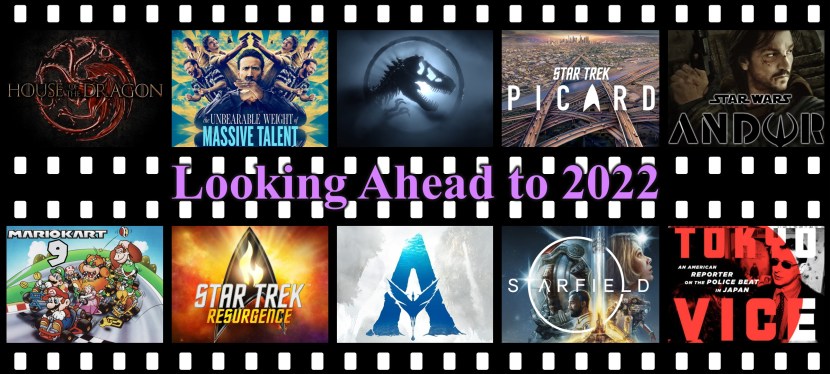
The Tomorrow War – film review

Spoiler Warning: There are spoilers ahead for The Tomorrow War.

Well this is a rarity for me – reviewing a film while it’s still new! I have to hold my hands up and confess that I was completely unaware of The Tomorrow War’s existence until about a week ago when previews started popping up on the Amazon homepage. But after watching the trailer it seemed like the kind of thing I might like, so almost as soon as it was available to watch I gave it a shot.

Though I like sci-fi in all of its forms, time travel stories have never been my favourites. They’re exceptionally difficult to get right, and when they go awry they can lead to narratives which are confusing or just plain annoying. With a title like The Tomorrow War, there was no way this film was going to be about anything other than time travel – and unfortunately it did contain one of the dumb time-loop story elements that I really don’t find enjoyable or satisfying. However, it managed to avoid many of the other pitfalls that time travel stories can succumb to, so it gets credit in that regard.

Publicity image for The Tomorrow War.

Chris Pratt is not a typical action hero, yet following his role in Guardians of the Galaxy he’s been tapped to take on a broader array of action-heavy roles. And as the film’s lead and main character he puts in a creditable performance. There were fewer moments of humour than in some of his other roles, and as an actor with great comedic timing that was a bit of a shame as one of his strongest suits was not put to use. But as an actor, taking on different roles is all part of the job, and Pratt did a solid job as the film’s protagonist. He was emotional at the right moments, strong and gung-ho at others, and fit the bill as The Tomorrow War’s action hero.

The rest of the cast likewise were competent in their roles and believable. We didn’t really get a broad cast of secondary characters; aside from Dan and Muri, everyone else played a comparatively minor role in the story, limited to a few scenes and generally one or two settings. JK Simmons, Sam Richardson, Edwin Hodge, and Betty Gilpin all played their parts well, with the caveat that their characters were limited by the script to bog-standard supporting roles.

Yvonne Strahovski and Chris Pratt were The Tomorrow War’s leading pair.

Among these characters we have Dan’s father, the conspiracy theorist-veteran-mad scientist, whose seemingly unlimited set of skills allowed Dan and the crew to get to Russia at a key moment later in the film. Other than the personal drama between them, which was performed well, this character was a pretty basic plot device. Dan’s wife, whose name may have been mentioned but I can’t actually remember, was an absolutely run-of-the-mill character type, the spouse of the soldier-hero, and didn’t get much to do beyond tell him she wished he didn’t have to go and greet him when he returned.

Charlie and Dorian were perhaps the most interesting of the film’s secondary characters, and each brought something different to the table. Charlie was comic relief, but his moments of humour were well-used and injected some light-heartedness into a film that definitely needed it. His moment in the stairwell was hilarious, and went a long way to making the first on-screen introduction of the whitespikes – the film’s alien antagonists – much more memorable. Dorian, the other African-American character, was much more serious, and there’s something relatable in the story of a terminally ill man wanting to choose his own time and method of dying.

Sam Richardson’s character of Charlie provided The Tomorrow War with just about the right amount of comic relief.

The very intense, loud musical score feels like typical action movie fare – until it comes to moments of near-silence, which are expertly used to create tension at key moments. The soundtrack made neat use of The Waitresses’ 1982 Christmas hit Christmas Wrapping right at the beginning, and I guess we could argue that The Tomorrow War’s Christmas-themed opening qualifies it – along with Die Hard – as a Christmas film! Speaking of the film’s opening moments, was that supposed to be Scotland playing in the World Cup Final?! Someone’s being incredibly optimistic if that’s the case… sorry, Scotland!

Any story about war is going to come with political themes, and The Tomorrow War is no different. In Dan’s draft, for example, we see criticisms of the way the United States handles its own military draft, and in the technology implanted in his arm we see fears about how technology and our personal data are used and tracked.

The dire warnings about Dan’s arm implant/bracer could be taken as a critique of the way data is used today.

The film had one very strange tonal moment. After returning to the present day from his tour of duty, Dan – and by extension the film – treats what happened as a defeat. Despite the fact that he saved the toxin, which was his objective in his final hours in the future, everything in the minutes afterward is set up to feel as though he was too late, or that it didn’t matter with the jump-link being offline. But anyone who’s ever seen a time travel story can tell you that going back in time opens up new possibilities; even Muri knew this, as among her last words to Dan were to “make sure this war never happens.” The only way he could do that was by producing the toxin and using it in the present day (or else storing it in time for the invasion).

This sequence chips away at the film’s premise and exposes one of the major flaws in time travel narratives in general. I can believe, for the sake of the story, that the future scientists were only able to create one functioning wormhole, tethered to their present and our modern day. But it seems as though there were better ways to use it than recruiting everyday people to be footsoldiers – like giving the people of Earth advance warning so they could do everything in their power to prepare for or even prevent the invasion. This is what Dan and his team scramble to do at the film’s climax, but it really does begin to stretch credulity to think that they’re the first and only people to put the pretty basic pieces of this puzzle together and figure out what happened.

A handful of untrained people manage to figure out how to stop the aliens in less than a day when the rest of the world couldn’t in several years? Hmm.

It takes Dan and his wife all of five minutes to figure out that “they were already here” – a theme present in alien invasion stories going all the way back to The War of the Worlds at the end of the 19th Century. You’d have thought that someone else might’ve come to that realisation sooner! The Tomorrow War gives this old premise a modern twist by involving climate change, and we could entertain the argument that the entire film is thus an analogy for the dangers in unchecked and unsolved anthropogenic climate change. In the film’s story, the aliens were buried in Siberian ice, and the melting ice set them free. Out here in the real world, the consequences of man-made climate change may not be quite so gory and extreme, but are nevertheless dangerous.

We can definitely expect to see more of these kinds of climate change stories in future, I think. A Song of Ice and Fire, upon which the television series Game of Thrones was based, is likewise a climate change analogy according to its author, and these kinds of stories can be powerful. I’ve spoken on a number of occasions about how the Star Trek franchise uses its sci-fi lens to look at real-world issues, and while climate change was not exactly front-and-centre in The Tomorrow War, it was present, and the film was better for the inclusion of this theme.

The team inside a glacier.

There were two twists in the narrative of The Tomorrow War, but both were rather pedestrian and easy enough to figure out ahead of time. The first is that the character who speaks to Dan on the radio immediately upon his arrival in the warzone was Muri, and the film didn’t succeed in any way at concealing that. Perhaps it didn’t want to, but the fact that it seemed obvious for much of the preceding twenty minutes made the ultimate reveal of Muri’s identity at the military base far less impactful; we as the audience knew well before Dan did.

The second twist came along like something out of Star Trek – the aliens never meant to invade Earth, and in fact the whitespikes aren’t even the “real” aliens; they’re animals being transported by whoever owned the spaceship. Their feral, animalistic behaviour and seeming lack of weapons, clothing, or a language, as well as their nesting behaviour all spoke to this, and though there was a moment aboard the wrecked alien ship where the team encountered a dead alien pilot that was well-executed, the twist itself seemed apparent well in advance of the characters making that discovery.

I quite enjoyed the reveal that the alien invaders never meant to come to Earth and were essentially just animals – even if it wasn’t exactly well-hidden earlier in the film.

Some action films can go all-in on the guns-blazing killing, and it was a nice change of pace for The Tomorrow War to step back and present a semi-scientific solution to the characters’ alien invasion problem. To continue the climate change analogy from a moment ago, this is the film’s way of saying that science is the key to finding a solution. For a film largely about war, with the word “war” literally in its title, that’s a surprisingly anti-military message!

There were some solid visual effects in The Tomorrow War, and Paramount, Skydance, and Amazon made good use of the film’s $200 million budget in that regard. Any film involving monsters – or aliens, in this case – will fall flat on its face if the creatures are not sufficiently realistic and threatening, and the whitespikes, while not exactly groundbreakingly original in their design, managed to look fantastic on the screen.

One of the whitespikes – the invading aliens.

So I think that’s about all I have to say about The Tomorrow War. It was solid, perfectly entertaining sci-fi fare. The plot was fairly standard-issue for a time travel film, complete with some of the problems that brings, at least from my point of view. But it was well put-together, featured some good performances by its leading duo of Chris Pratt and Yvonne Strahovski, and kept me entertained for a couple of hours.

Given the film’s unexpected Christmas-themed opening, it might be one I return to at that time of year in future! I didn’t really know what to expect, as The Tomorrow War wasn’t even on my radar until very recently, but I’m glad I gave it a shot. It’s a film with some ideas and themes buried beneath its alien invasion storyline, and those themes elevate it to something a little more than just a basic sci-fi action flick. Not every element works, and I would have liked to see better use of perhaps a slightly smaller secondary cast instead of a collection of underused characters who feel more like plot devices than fleshed-out people. But the pair of leads did well and carried the film, and in particular Dan’s motivation to save the world for his daughter’s sake transcended some of the sci-fi waffle and dragged the film’s worse elements over the finish line.

If you’re an Amazon Prime subscriber, The Tomorrow War is already in your library and you might as well give it a shot. Is it the one film that will overwhelm the hardened resistor and finally convince them that they need to sign up for Amazon Prime Video? No. It’s not worth it on its own merit. But it’s enjoyable enough for what it is, and I respect The Tomorrow War for at least trying to be something more than just a basic action sci-fi title, even if it doesn’t completely succeed.

The Tomorrow War is available to stream now on Amazon Prime Video. The Tomorrow War is the copyright of Amazon Studios and Paramount Pictures. This article contains the thoughts and opinions of one person only and is not intended to cause any offence.
We’re halfway through 2021!

It’s the last day of June, and as we bid goodbye to the month we also mark the halfway point of 2021. I think that makes it a good opportunity to take stock and look ahead to the entertainment experiences that lie before us between now and Christmas.

Pandemic-related disruptions continue across the entertainment industry, but after more than a year of evolving working practices due to coronavirus, I think it’s not unfair to say that many more projects have managed to enter or remain in production over the last few months than were able to at this point last year. This bodes well for upcoming titles across film, television, and video games, and today I’m going to pick out a small selection of each that I’m looking forward to before the end of the year.

Television:

It’s probably television that has the most to offer – at least for me personally – in the second half of 2021. There are several big shows coming up that I can’t wait to get stuck into, and I’m sure you can probably guess what some of them are!

Number 1: Star Trek: Discovery Season 4

Discovery’s third season was an entertaining ride, and succeeded at establishing the 32nd Century and the Federation’s place in it. In the aftermath of the Burn – the galaxy-wide catastrophe which devastated known space – and the shortage of dilithium, Season 4 will hopefully see the crew beginning to pick up the pieces.

The trailer for Season 4, which was shown off in April as part of Star Trek’s First Contact Day digital event, also showed Captain Burnham and the crew facing off against a “gravitational anomaly” which seemed to be wreaking havoc with the ship and the Federation at large. What is the “gravitational anomaly?” I don’t know – though I have a few theories! We’ll find out more when Discovery Season 4 premieres on Paramount+ (and on Netflix internationally) in the autumn.

Number 2: Star Trek: Lower Decks Season 2

After a hilarious first season, Lower Decks is returning to our screens in August – and this time Star Trek fans the world over should be able to watch the show together. Season 1 had the difficult task of taking Star Trek into the realm of animated comedy for the first time. Having proven to be a success with that concept, Season 2 can let its hair down and really double down on what fans loved last year.

There are a couple of lingering storylines left over from the Season 1 finale that I’m genuinely interested in seeing resolved. But beyond that, I can’t wait for more wacky Star Trek-themed hijinks with Mariner, Boimler, Rutherford, and Tendi! Luckily we won’t have to wait too long for this one; Lower Decks Season 2 will debut on Paramount+ (and on Amazon Prime Video internationally) on the 12th of August – barely six weeks away!

Number 3: Star Trek: Prodigy

This one has to be tentative. Upcoming children’s show Star Trek: Prodigy has been suggested for a 2021 broadcast, but with no date confirmed as of yet, and with the aforementioned Lower Decks and Discovery taking up the Star Trek broadcast slots for much of the rest of the year, I don’t know where ViacomCBS plans to fit Prodigy in.

Despite that, as we continue to learn more details about the series, it sounds genuinely interesting and looks set to be a lot of fun. The best kids’ shows manage to have something to offer adults as well, and I hope Prodigy can manage to do that while retaining an atmosphere that’s fun for children. Out of all the recent Star Trek projects, Prodigy feels like it has the most potential to introduce the franchise to a new generation of fans. There’s currently no date on the calendar, so watch this space.

Number 4: Rick & Morty Season 5

We’ve already had two episodes of the fifth season of Rick & Morty, but there are eight more to come over the next few weeks! The trademark brand of wacky, non-sequitur humour that the show is known for is still present, and it continues to be a barrel of laughs! Rick & Morty paved the way in some respects for Star Trek: Lower Decks, and there are similarities between the two shows in terms of sense of humour and animation style.

Rick & Morty’s largely episodic nature keeps the show fresh, and while there are some jokes and storylines that perhaps take things too far, on the whole the show has largely avoided the trap of going over-the-top or falling into being offensive for the sake of it. You know the formula and main characters by now, and Season 5 seems like it’s shaping up to offer more of the same – and that’s a compliment. Rick & Morty Season 5 is ongoing on Adult Swim in the United States (and on E4 in the UK).

Number 5: Foundation

Isaac Asimov’s genre-defining epic is being adapted for the small screen by Apple, and it will star Jared Harris. Harris was fantastic in Chernobyl and also put in a stellar performance in The Terror, so I can’t wait to see what he’ll bring to the role of Hari Seldon. Foundation is an incredibly ambitious project; the seven-book series spans hundreds of years of galactic history and deals with some very deep and complex themes.

Apple TV+ is very much a second-tier streaming service. This is its first big push to change that; Apple’s first real foray into big-budget scripted television. I hope the company can use its phenomenal financial resources to do justice to one of the seminal works of science fiction.

Number 6: Dexter

I watched several seasons of Dexter in the mid/late-2000s, but eventually the series started to feel repetitive so I switched off. I’m curious, however, to see what the passage of time will do for the show and its titular anti-hero when it returns in what has been variously billed as both a “reboot” and a “continuation” depending on who you ask! The concept of Dexter was interesting when it kicked off in 2006, and hopefully the new season can recapture the magic of those early years of the show.

The idea of a show about a serial killer where the killer is known to us as the audience, and not only that but is the protagonist was genuinely different. Dexter’s work with the forensic team was a big part of what gave the show its unique mix of police/detective series along with gritty, violent drama, and I’ll be curious to see where the new season has taken the character – as that will be the key to its success.

Number 7: The Dropout

If you aren’t familiar with the story of Elizabeth Holmes and Theranos, it’s one that’s simultaneously riveting and frightening. Holmes and her startup Theranos promised to revolutionise the way blood testing works, enabling people to take blood tests without needing to visit a doctor and in a less-painful way. But it was a fraud: the technology didn’t work and Holmes and her team covered it up.

There have been several great documentaries and news broadcasts going into detail on the Theranos case, and with Holmes and others still awaiting trial it remains unresolved. This adaptation of an ABC News podcast will be the first dramatisation of the events of the Theranos scam, and despite some production setbacks it looks like it has the potential to be truly interesting when its broadcast on Hulu (and on Disney+ internationally) before the end of the year.

Number 8: Amazon’s Lord of the Rings series (full title unknown)

I’m beginning to wonder if we’ll see the first season of this incredibly expensive television show this year. With half the year gone, there hasn’t been much news about Amazon’s Game of Thrones-killer. That aside, a return to Middle-earth sounds incredible, and by taking the action away from most of the characters we’re familiar with from the films, hopefully what will result will be a genuinely different experience that doesn’t try to mimic the films too heavily.

Amazon has thrown cinema-level money at its Lord of the Rings adaptation, so I’m expecting to see something incredibly impressive for that investment.

Number 9: The Witcher Season 2

I’ve never played The Witcher 3 or any of the other games in the series. But the first season of Netflix’s adaptation of the original novels was great, and it’s always nice to see a high-budget fantasy project make it to screen! The first season debuted in late 2019, and I had half-hoped to see Season 2 before now. It’s still possible it won’t happen before the end of the year, but a recent teaser from Netflix suggests that Season 2 is in post-production and progressing nicely.

After such a long break, I feel like I should probably re-watch Season 1 before sitting down to see any new episodes! Henry Cavill will reprise his role as Geralt, and all being well Season 2 will be just as good as Season 1.

Number 10: Tokyo Vice

This true-crime series is based on the memoir of an American journalist, Jake Adelstein, who spent several years in Tokyo. In short, he documented a lot of police corruption during his tenure as a newspaper reporter in the 1990s, and given HBO’s pedigree at making high-budget series, I think there’s a lot of potential here.

Speaking as a westerner, Japan can be somewhat of a mystery. Romanticised by some, ignored by others, the truth is that many folks who’ve never set foot in Japan don’t know the first thing about Japanese life – and Tokyo Vice may just blow the lid off the seedier underbelly of Japan’s capital city in a big way. I’m calling it right now: this show could be 2021’s Chernobyl.

Film:

An increasing number of films are coming straight to streaming platforms – or being released digitally at the same time as heading to the box office. This is great news for me personally, as I’m not able to go to the cinema in person. There are some interesting titles coming up in the second half of the year.

Number 1: Jungle Cruise

In 2003 I felt that making a film based on the Disneyland/Disney World ride Pirates of the Caribbean was a stupid idea. Shows what I know, eh? Pirates of the Caribbean was great fun, so I’m hopeful that Disney’s latest ride adaptation will be as well. The Jungle Cruise ride takes theme park guests on a riverboat through – you guessed it – a jungle!

Hopefully the excitement that the ride offers will translate well to the screen. Parts of the trailer looked very CGI-heavy, and I hope that won’t be too offputting or problematic. Otherwise all I can really say is I’m looking forward to seeing what the film has to offer.

Number 2: Free Guy

Ryan Reynolds stars as a video game character who becomes sentient. I don’t know what else to say other than that sounds like a hilarious premise, one well-suited to Reynolds’ comedic style.

Video games have been the subject of many different films over the years, both as plot points and as direct video game adaptations. But no film so far has taken this approach; Free Guy looks set to be a unique experience when it arrives on the 13th of August.

Number 3: No Time To Die

This is the third or fourth time I’ve put No Time To Die on a list of “upcoming” titles. But this time it really is going to be released! Right?! Delayed by almost two years at this point, Daniel Craig’s final outing as 007 looks set to be an explosive and action-packed experience, and hopefully will bring down the curtain on his tenure in the role in suitable fashion.

The film will feature Academy Award-winner Rami Malek as its main villain, and I’m very interested to see what he’ll bring to the table. All being well, No Time To Die will be released at the end of September – and I’m curious to see whether it’ll be released on Amazon Prime Video as well, following Amazon’s acquisition of MGM.

Number 4: Encanto

We don’t know too much right now about Disney’s next big animated film. It’s set in Colombia, so there’ll be a Latin/South American feel. The film will focus on a girl who’s the only one in her family unable to use magic. I think we can expect an uplifting story of someone learning to be themselves and discover their own talents!

Lin-Manuel Miranda, who composed the soundtrack to 2016’s Moana (as well as Hamilton, In The Heights, and many others) is collaborating with Disney for a second time on the soundtrack to Encanto. That alone makes the film very exciting and worth checking out. Currently Disney aims to release Encanto in cinemas with no word on a Disney+ premiere.

Number 5: The Green Knight

I’ve long had an interest in the legends of King Arthur, and this film adaptation of one of the lesser-known Arthurian works looks set to be interesting at the very least. I got almost a horror or supernatural vibe from the trailer for The Green Knight, and while I’m not a big horror fan personally, I think the film has potential.

I’m not familiar with the director or most of the cast, so I can’t comment on the film’s pedigree. But with a decent budget and solid source material, this could be an interesting one to watch when it arrives at the end of July.

Number 6: Space Jam: A New Legacy

I don’t think I’ve re-watched the original Space Jam since it was released in 1996. But despite that, the idea of a sequel to the fun basketball-meets-Looney Tunes flick seems like it’ll be a lot of fun! Starring Star Trek: Discovery’s Sonequa Martin-Green alongside basketball legend LeBron James, the film looks set to follow a similar formula to its famous ’90s predecessor.

Nostalgia is a big deal in entertainment at the moment, so I’m not surprised to see ’90s hits like Space Jam being brought back. Hopefully A New Legacy can live up to the original film when it’s released in just a couple of weeks’ time.

Number 7: Dune

As with Foundation above, Dune is an adaptation of an absolutely iconic work of science-fiction. Frank Herbert’s 1965 novel has been notoriously difficult to bring to the screen, and while this version is the first part of a duology, in many respects the complicated story might be better served as a television series than in the cinema.

Despite that, however, I’m looking forward to Dune’s November premiere. A huge budget, visual effects that look outstanding, and a star-studded cast will hopefully all come together to make this latest adaptation a success.

Number 8: Top Gun: Maverick

It’s been a long time since I saw Top Gun, the film which propelled Tom Cruise to superstardom. To produce a sequel 35 years after the original film is, in some respects, a risk. But as already mentioned, nostalgia is a huge driving force in the modern entertainment industry, and with Cruise stepping back into the shoes of fighter pilot Pete “Maverick” Mitchell, there’s already been a huge amount of interest.

Top Gun: Maverick will come to Paramount+ shortly after its theatrical release, which will hopefully give the streaming platform – Star Trek’s digital home – a nice boost.

Number 9: The Matrix 4

Although The Matrix 4 remains on the schedule for 2021, with so little information about the production – not even a name – I think we have to call this one tentative. 2003’s Reloaded and Revolutions seemed to bring the story to a pretty definitive end, so I’ll be interested to see where a new instalment takes the sci-fi/action series.

Most of the original cast are reprising their roles, and Lana Wachowski is set to direct. After the Wachowskis came out as transgender and completed their transitions, many critics have re-evaluated The Matrix and its “red pill, blue pill” analogy through the lens of trans experiences. As someone who’s recently been exploring my own gender identity, I’ll be very curious to see what the fourth film in the series has to say about the subject.

Number 10: Resident Evil: Welcome to Raccoon City

The Resident Evil film series, which ran from 2002 to 2016, is a rare example of a successful video game adaptation on the big screen. Following 2016’s The Final Chapter, Welcome to Raccoon City aims to reboot the film franchise, and bring it closer in line with the video games that originally inspired it.

The video game Resident Evil 2 was recently remade, and that game’s success may have inspired some of the choices made for the film, including the decision to incorporate several major characters from the video game series. Even though horror isn’t really my thing, the Resident Evil films always managed to be the right mix of frightening and action-packed, and I’m hopeful for something similar from this reboot.

Video Games:

Some folks felt that this year’s E3 was a disappointment because of how many games have been pushed back to 2022. That’s another consequence of the pandemic, unfortunately! But there are still a number of exciting games coming before the end of the year.

Number 1: Kena: Bridge of Spirits

Kena: Bridge of Spirits has been on my radar for a while. Its Disney-inspired art style looks utterly adorable, and I can’t wait to give the game a try. There’s always room for this kind of single-player action-adventure title, and the premise of being a “spirit guide” who helps the newly-deceased sounds unique and fun.

I’m hopeful that developers Ember Lab, working on their first game after transitioning from digital animation, will succeed at creating an enjoyable, perhaps somewhat different experience.

Number 2: Bear and Breakfast

One of the indie highlights of E3 in my opinion, the adorable-looking, vaguely Stardew Valley-esque Bear and Breakfast is scheduled to launch before the end of the year. The premise, in case you didn’t get it, is that you run a bed & breakfast in a forest, and you’re a bear. What’s not to love about that?!

The game’s cartoony visual style looks cute, the premise sounds unique and just the right kind of silly, and I’m just really looking forward to giving Bear and Breakfast a shot.

Number 3: The Lord of the Rings: Gollum

This one has to be tentative, as there’s been very little movement on the game all year. Its absence at E3 was noticeable, and we may learn that it’s going to be delayed until next year. However, Gollum is a very interesting project. What could a game where this vile, villainous character is the star possibly have to offer? There have been antiheroes in gaming before, but few characters are as repulsive as Gollum!

And I think that’s what’s so fascinating about this title. Taking on the role of Gollum, and experiencing an adventure in Middle-earth from his perspective is almost certainly going to make for a game that’s one-of-a-kind.

Number 4: Mario Party: Superstars

Though its price seems rather steep, Mario Party: Superstars is bringing back classic boards and mini-games from the original Nintendo 64 Mario Party games. I had great fun with the first Mario Party in particular, and being able to play remastered versions sounds like a blast of nostalgia and potentially a lot of fun.

I can’t escape the feeling that Superstars might’ve been better value were it half the price, or an expansion pack for Super Mario Party instead of being a full-price standalone title. But despite that, it sounds like fun.

Number 5: Halo Infinite

After a disappointing trailer last year, Halo Infinite was delayed and reworked, ultimately meaning it didn’t launch alongside the Xbox Series X last November. Following a year-long delay, the game is now set to launch in time for Christmas, alongside a free multiplayer mode.

Since Halo Infinite will be coming to Game Pass I daresay I’ll give it a go when it comes out. After a six-year gap – the longest in the history of the series – fans will be clamouring for more from the Master Chief, as well as looking to see whether 343 Industries have finally managed to get the elusive Halo formula right. With a television series also in the works, Microsoft is investing heavily in the Halo brand.

Number 6: Age of Empires IV

Sticking with Microsoft, the next big brand they’re bringing back is Age of Empires! After the first three games were successfully remade over the last few years, the launch of Age of Empires IV is the series’ real test. Can Xbox Game Studios craft a title that successfully brings the classic real-time strategy series firmly into the modern day?

Age of Empires II: Definitive Edition in particular has built up a solid fanbase, with plenty of folks playing the game competitively online. A lot of them will be interested to try Age of Empires IV, so the game has the potential to be a success. The original Age of Empires was my first real introduction to the world of real-time strategy, so I’m rooting for the success of the latest entry in the series.

Number 7: Lego Star Wars: The Skywalker Saga

This is another one we’ll have to call tentative. There’s been radio silence from Traveller’s Tales and Warner Bros. since the game was delayed back in April – having already been delayed twice previously. However, I’m still hopeful that we’ll see it before the end of the year – it would be a great stocking stuffer were it to launch in time for Christmas!

2006’s Lego Star Wars: The Complete Saga was absolutely brilliant; a comedic, light-hearted take on Star Wars. I’m hoping this new game can live up to that legacy and bring a dose of fun to Star Wars. Maybe it’ll even make the dire Rise of Skywalker bearable!

Number 8: Road 96

I can’t actually remember where I first saw indie title Road 96. But the idea sounds great: a procedurally-generated game in which your character has to escape from a dangerous country. Some of the landscapes shown off in the trailer looked similar to the American Southwest, and I love the visual style.

Road 96 promises “thousands” of routes and non-player characters to interact with, and it sounds like this could be a game with a huge amount of replay value. I’m looking forward to trying it out for myself.

Number 9: Shredders

There have been some classic snowboarding games in years past: 1080° Snowboarding on the Nintendo 64 and SSX Tricky on the Xbox/PlayStation 2, just to give two examples. Shredders, which was announced at E3, looks like it’ll pick up the baton and offer a fun snowboarding experience.

Any game set in a wintry environment has to get its snow texture just right, and it looks as though Shredders has – at least based on pre-release trailers. I’m hopeful for a fun time when this lands on Game Pass in the run-up to Christmas.

Number 10: Forza Horizon 5

Forza Horizon 4 was great fun, and I’m hoping for more of the same from its sequel. The semi-arcade racing hops across the Atlantic to Mexico for this iteration, with promises of more cars, a bigger map, and diverse environments to race through. All of that sounds great!

Racing games often manage to look visually stunning, and Forza Horizon 5 is no exception. The game looks fantastic, and if it plays well too it could be a huge time-sink heading into the autumn!

So that’s it!

We’ve looked at ten television shows, films, and video games that I think will be fun as we cross into the second half of 2021. Summer is always my least-favourite season, with early sunrises making it harder to sleep than usual, annoying insects buzzing around, and heatwaves that make me wish I could afford air conditioning! But there are plenty of things to look forward to even as we roll through my least-favourite part of the year.

Star Trek: Discovery Season 4 has to be my highlight; if I could only choose one thing to be excited about it would be that! But Tokyo Vice is incredibly interesting too, a series which I think could blow up and become the next Chernobyl. Film-wise, Encanto looks great; any project with a soundtrack by Lin-Manuel Miranda is worth paying attention to! Dune I’m hopeful for, and The Green Knight could sneak in and become something more than I’m expecting. Kena: Bridge of Spirits is such an interesting and cute-looking video game, and a rare new IP in an entertainment landscape where sequels and franchises dominate.

2021 still has a lot left to offer, even though we’re already halfway through! I hope you found something here to get excited about – or maybe something you hadn’t heard of that you can add to your list.

All titles listed above are the copyright of their respective owner, studio, developer, broadcaster, distributor, publisher, etc. Some promotional video game screenshots courtesy of IGDB. This article contains the thoughts and opinions of one person only and is not intended to cause any offence.
The Amazon buyout of MGM is another blow to cinemas

We’ve recently talked about how the pandemic may have a long-term impact on cinema attendance and the box office, with many folks getting used to the convenience and practicality of streaming big blockbusters at home. But it seems cinemas just can’t catch a break, because it was recently announced that Amazon will be buying legendary Hollywood studio MGM.

Make no mistake, this is all about streaming. Amazon Prime Video looks set to benefit greatly from this acquisition, helping the service compete with the likes of Netflix and Paramount+ in terms of films. Though Amazon does have its own film studio, and has had a hand in titles like the Academy Award-winning Manchester By The Sea, most films available to stream via Amazon Prime Video were licensed from other companies. As more and more companies try to launch their own streaming platforms, these licensing deals are increasingly difficult (and expensive) for the likes of Netflix and Amazon, so finding ways to get their own in-house content is hugely important.

Buying MGM will enable Amazon to add a huge library of titles to its Prime Video streaming service.

Netflix has branched out into making more and more of its own original films – for better or worse! But Amazon is one of the world’s largest and most successful companies, having grown massively during the last year, and can throw its money around to buy up studios – and the rights to properties like The Lord of the Rings. We’ve recently seen Microsoft do something similar in the gaming realm, buying up Bethesda and adding that studio’s games to Xbox Game Pass. Amazon is doing the same thing with MGM.

I’ve seen some outlets trying to make the case that this is Amazon further diversifying its business model. What began as an online bookseller in the mid-1990s has grown to sell practically everything and has involvements and holdings in industries as far apart as space technology and baby nappies. But this MGM acquisition is not about diversification. Amazon doesn’t want to break into the film distribution market any more than they’re already involved; they want films, both old and new, to add to Amazon Prime Video for the sole purpose of driving more subscriptions. It’s that simple.

Amazon announced a deal to buy famed American film studio MGM for $8.45 billion.

This is a hammer blow for cinemas and cinema chains already reeling from the pandemic and associated closures and cancellations. We’ve already seen many films that would otherwise have received a theatrical release go direct-to-streaming, and Amazon’s acquisition of MGM comes with the real threat of all future MGM titles following suit. There aren’t many studios the size of MGM, releasing multiple high-budget titles per year, so this is a coup for Amazon.

Upcoming titles like the sequel to Tomb Raider, Legally Blonde III, Soggy Bottom, and House of Gucci would have all been draws at reopened cinemas around the world, but their theatrical releases are now in doubt. And that’s before we even consider one of the biggest upcoming MGM titles (at least from a UK perspective!) No Time To Die, the latest instalment in the James Bond series.

No Time To Die may still manage a theatrical release… or it may not.

It’s not unfair in the slightest to say that British cinemas have been desperately waiting for No Time To Die’s release, as no other upcoming film has quite as much potential to bring audiences back after well over a year of closures, lockdowns, and cancelled titles. Even the mere threat of No Time To Die going direct to streaming is enough to make a lot of people involved in the UK cinema industry very nervous, and I’m not sure we can rely on promises that the film will still meet its planned theatrical release in September – especially if the pandemic causes further disruption in the months ahead.

As I said when Microsoft acquired Bethesda, companies don’t spend these vast sums of money and expect nothing in return. With Amazon making this move to shore up and expand its library of streaming titles, any future MGM release now has the potential to end up on Amazon Prime Video either exclusively or alongside a release in cinemas. Even if imminent titles like No Time To Die meet their theatrical obligations – which will almost certainly be due to pre-existing contracts if it happens – future titles, both announced and unannounced, are almost certain to join Amazon’s streaming line-up. In short, cinemas may get a temporary reprieve from the fallout of this acquisition, but it won’t last much beyond the end of 2021.

Amazon will be expecting a serious return on such an expensive investment – and that’s all focused on streaming.

The way people consume media has been changing for years. The pandemic may have accelerated some of those changes to light-speed, but it isn’t the fundamental cause of a shift in audiences away from cinemas and broadcast television to online on-demand streaming. Just like the pandemic isn’t the root cause of problems with many high street shops, it can’t be blamed for people moving en masse toward an all-digital streaming future. The future of companies like MGM is in the digital space, and unfortunately for cinemas that means fewer films, smaller audiences, and growing irrelevance as bigger titles bypass a theatrical release altogether. Even in the pre-pandemic years, going to the cinema had become, for many folks, an occasional treat rather than a regular outing, and this move is simply a reflection of the changing way in which people choose to watch films.

Amazon’s acquisition of MGM is a big deal, but it’s unlikely to be the last such move as the so-called “streaming wars” look for new battlefields. It isn’t yet clear how many streaming services people are willing to put up with, nor which will ultimately survive, so it seems inevitable that more big studios and distributors will eventually team up with – or be bought out by – other big players in the streaming landscape. None of which is particularly pro-consumer, it has to be said, but then again I’d rather see MGM films go to Amazon Prime Video – a streaming service I already have access to – than wait for MGM to set up their own “MGM Plus” or whatever they would’ve called it!

It’s a serious blow to cinemas in the medium-to-long-term, even if some titles scheduled for this year will still get a full theatrical release. But will audiences really care? As I said last time, the shift away from the cinema had already set in long before the pandemic struck, and with film studios and audiences alike having discovered the many advantages of at-home streaming, it seems like we’ll be seeing a lot more of this type of acquisition or merger in the months and years ahead, with many more films going direct-to-streaming in the very near future. MGM may be one of the biggest so far, but it won’t be the last. Cinema chains and owners are already feeling the effects.

All titles mentioned above are the copyright and/or trademark of their respective owner, studio, company, distributor, etc. This article contains the thoughts and opinions of one person only and is not intended to cause any offence.
Have we seen an unstoppable shift away from the cinema?

One of the consequences of the pandemic has been the long-term closure of many cinemas (movie theaters for my American readers). Aside from a short respite last July and August, most cinemas here in the UK have been shut since March 2020 – for well over a year now. Some, like a local independent cinema near me, have had no choice but to close permanently, even with the end of lockdown seemingly in sight. Even when cinemas are able to reopen, limits on capacity due to social distancing, the general unease among many people about sitting in a room with dozens of strangers with the pandemic still ongoing, and most significantly, the lack of major film releases in the near term will – in my opinion, at least – most likely mean it will be a long time before things are able to get back to normal.

But will things ever get back to normal? That’s the question I want to ask today.

Will empty cinemas be full again one day?

In the early days of the pandemic, most films scheduled for release in spring or summer 2020 were simply postponed; their release dates pushed back by a few months so that they could be released to full crowds when lockdowns were lifted in their key markets. But as the pandemic has dragged on and on, film studios have begun to switch the way they release many big titles – opting to send them to streaming platforms rather than wait.

Without Remorse was originally supposed to get a theatrical release, but premiered on Amazon Prime Video instead. Raya and the Last Dragon went directly to Disney+. Then there are titles like Zack Snyder’s Justice League, Mulan, The Little Things, Godzilla vs. Kong, Bill & Ted Face The Music, News of the World, and Tom & Jerry. Upcoming titles such as Jungle Cruise, Space Jam: A New Legacy, Black Widow, Malignant, and A Quiet Place II are all going to either be released directly on streaming or with a limited theatrical run at the same time as going straight to streaming.

Animated film Raya and the Last Dragon went straight to Disney+ earlier in the year.

Is this a one-time thing, purely caused by the pandemic? And if it is, will audiences be happy to return to cinemas once the pandemic has cleared and they can fully reopen? If you’d asked me in March or April last year, I’d have said yes to both questions without hesitation. But now I’m not so sure.

There are a lot of advantages to streaming compared to going to the cinema, and as more and more people come to see those advantages, the cinema becomes a less-attractive option in contrast. This trend is not new – cinema attendance has declined a lot from where it was a few decades ago, and with the rise of high-quality television series which can rival and even surpass films in many cases, this is a reckoning that cinemas have had coming for a while. The pandemic has accelerated that to light-speed, but the trend has been going in this direction for a while.

Paramount+ is one of many competing streaming platforms that have arguably benefited from the forced closure of cinemas during the pandemic.

So what are the supposed advantages of at-home streaming? The first has to be convenience. Viewers can watch what they want on their own schedule, with the ability to pause a film to take a phone call or go to the bathroom, watching before or after work, or even late at night. It’s possible to watch with subtitles, audio description, director commentaries, and even watch in other languages. Most folks are more comfortable in their own homes than they are in a cinema chair – even the nicest cinema seats aren’t as pleasant as a comfy armchair or couch. There are no distractions from (other people’s) noisy kids, people munching popcorn, or idiots on their phones. You don’t have to sit through half an hour of adverts and trailers to get to the film. If you’re using a phone or tablet it’s possible to watch on the go, or literally anywhere. And some of the things we might’ve considered to be disadvantages a few years ago – such as screen size, resolution, and audio quality – are all easily surmountable even for folks on a limited budget.

Obviously not all of these points apply in every single case, but as a general rule, as screens get bigger and better, the need to watch something in the cinema is dropping. The old adage that a particular film was “better in the cinema” or “made for cinemas” no longer applies in many cases.

Amazon Prime Video have snapped up a number of films that couldn’t get a theatrical release this year – including Without Remorse.

I have a relatively inexpensive 4K television that doesn’t have OLED or HDR or any of those higher-end features, just a bog-standard LED set. But this model, even when I was buying it a few years ago, only started at a 40-inch screen size, with sizes going all the way up to 60″ or 65″. Nowadays, 85″ and 90″ sets are on the market and within reach of many consumers. Sound bars and speakers that put out fantastic quality audio are equally affordable, with prices dropping massively from where they had been when 4K and large screens were new. Even on my cheap and cheerful set, films look great. And if you sit reasonably close, it really does feel akin to being in the cinema – in the comfort of my own home.

It’s difficult, in my opinion, for cinemas to compete on price or quality. Even the more expensive streaming platforms, like Netflix, cost around £10-12 per month. It’s been a while since I was able to go to the cinema – health issues prevent me from doing so – but the last time I was able to go, £10 wouldn’t even stretch to two tickets. For that money you get one month’s worth of access to a massive library of titles – including many brand-new ones and Netflix originals made specially for the platform.

Large, good-quality television screens are increasingly affordable and offer a cinema-like experience at home.

In the late ’40s and ’50s, when my parents were young, going to the cinema was a frequent outing. You’d see an A- and B-movie, as well as perhaps a newsreel or something else, and it would feel like good value. Since the early 20th Century, going to the cinema on at least a weekly basis was a big part of many peoples’ lives – but things have been changing, slowly, for quite a while.

For at least the last couple of decades, going to the cinema is something most folks have viewed as an occasional treat rather than a regular outing. The price and value of a cinema ticket – and the additional extras like drinks and snacks – have shot up in relation to earnings, while at the same time the number of advertisements and trailers have also increased. Though the cinema still has a place in many folks’ lives, that place had been slipping long before the pandemic arrived. In the ’90s and 2000s, the blame for that lay with cable and satellite television channels, including many dedicated film channels. Nowadays, the blame has shifted to streaming.

Netflix has picked up a lot of subscribers in the past year.

Many film studios are keen to play their part in this trend, too. Sharing a big chunk of their profits with cinema chains and operators was never something they were wild about, which is why we’re seeing more and more studios and production companies either partnering with big streaming platforms or else trying to launch their own. Paramount+ exists for this reason, as do Disney+, HBO Max, and many others. These companies don’t care in the slightest about the fate of cinemas – except insofar as they can use them to turn a profit. When the pandemic meant that wasn’t possible, many companies happily jumped ship and released their films digitally instead.

Though I know a lot of people who have told me they’re keen to get back to the cinema as soon as possible, when I probed most of them further and asked how often they would go to the cinema pre-pandemic, or what films they were most excited to see at the cinema next, all of the answers I got back up everything I’ve been saying. Most folks go to the cinema infrequently at best, and while they’ve missed some of the social aspects of the “cinema experience,” they certainly haven’t missed the adverts, loud seat neighbours, and hassle. Streaming, while not as glamorous or exciting in some ways, is a more enjoyable experience in others.

Some people have missed every aspect of being at the cinema… but many haven’t!

I know I have to acknowledge my own bias here. As someone whose disability prevents them going to the cinema, I’d be quite happy if every film I want to watch from now on comes directly to streaming! On a purely selfish level, that’s something I’m fine with. And while I stand by the fact that the trend away from the cinema in a general sense is real and demonstrable, the pandemic probably hasn’t killed the entire concept of the cinema stone-dead. Nor would that be a good thing. Many cinemas offer more than just the latest blockbusters, with classic films, recorded theatre plays and ballet performances, and other such events. In the rural area where I live, the idea of being able to see something like the Royal Ballet is beyond a lot of people due to the distances involved. But local cinemas occasionally show things like ballets, operas, and Shakespeare plays, bringing a different kind of culture and entertainment to the region. Cinemas are also big local employers, and it’s nothing to celebrate when a local business is forced to close.

So most cinemas will eventually re-open. But the question I asked is still pertinent, because I don’t know whether they’ll see pre-pandemic numbers of visitors for a very long time – if at all. The pandemic has forced the hand of film studios and distributors, and the result has been an uptick in the number of subscribers to streaming platforms. Many folks have tried streaming for the first time, and while there will always be holdouts, people who proclaim that it really is “better in the cinema,” I think a lot of people have been surprised at how enjoyable streaming a film at home can be, and how favourably it can compare to the cinema experience.

Many people haven’t missed the “cinema experience” as much as they expected.

A big home theatre setup is no longer necessary. With a relatively inexpensive – but still large – television set and maybe a sound bar or pair of satellite speakers, many people can have a truly cinema-like experience in their own living rooms. And a lot of people who’ve tried it for the first time, prompted by lockdown, may have no plans to return to the cinema any time soon – or if they do, they’ll be making fewer trips.

In my opinion, this is something that has the potential to continue to build over time. As screens continue to improve, and as more people eschew the cinema in favour of staying in, more films will go direct to streaming because companies will see more success and more money in it. Fewer films will end up in cinemas exclusively, so fewer people will go. And the cycle will continue!

Even if I’m wrong on that final point, I do believe that we’ve already seen a slow move away from cinemas in the pre-pandemic years. The pandemic came along and blew the lid off that, and while there will be a return once things settle down, at-home streaming is here to stay. It benefits viewers and companies – the only folks who are going to lose out are the cinema chains themselves. I’m not saying it’s a positive thing necessarily, although it does stand to benefit me in some respects, nor am I advocating for it. But when I look at the way things have been going over the past few years, and add the pandemic’s disruption into the mix, I really do feel that we’re seeing a big move away from the cinema in favour of at-home streaming.

All titles mentioned above are the copyright of their respective studio, distributor, production company, etc. This article contains the thoughts and opinions of one person only and is not intended to cause any offence.
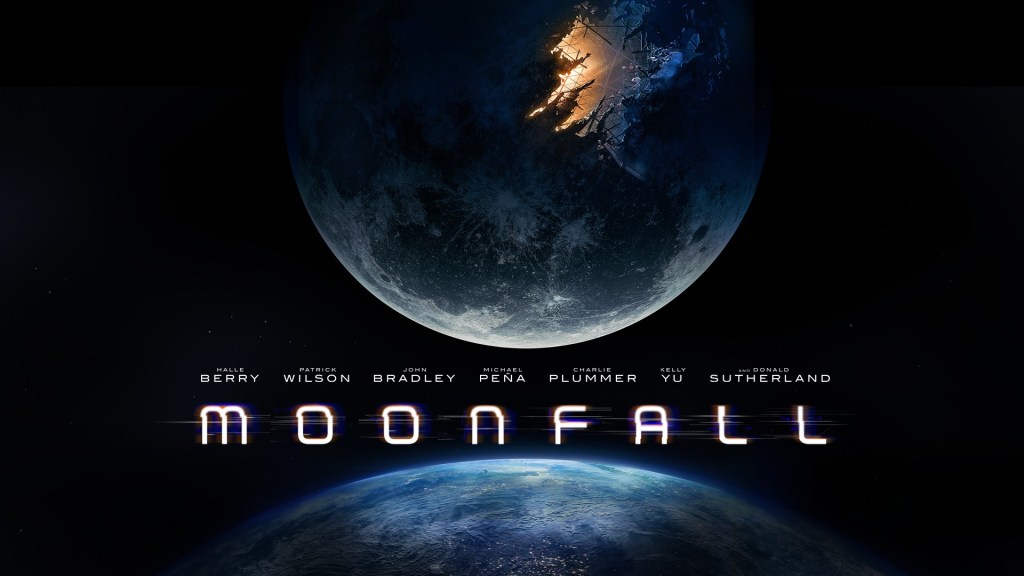
A year later, have I softened my tone on The Rise of Skywalker?

Spoiler Warning: There are spoilers ahead for Star Wars Episode IX: The Rise of Skywalker, and for the entire Star Wars franchise.

You can find my original review of The Rise of Skywalker by clicking or tapping here.

Star Wars Episode IX: The Rise of Skywalker premiered in December 2019, but it wasn’t until the spring of 2020 that I was able to see it. As I’ve explained on a few occasions, my health now prevents me from taking trips to the cinema, so I had to wait until it was available to watch digitally. It’s now been a year since I published my review (or should that be tear-down?) of the film, so I thought I’d revisit it and see what, if anything, has changed in that time.

Attitudes can soften with the passage of time, and a film or series that was once considered dire can find a new audience later on. The Star Wars franchise itself contains great examples of this: not only can we point to the growing popularity of the prequel trilogy, especially among fans who first saw those films when they were children, but even Return of the Jedi, which was once considered the weak link in the trilogy, is now held up alongside the original film and The Empire Strikes Back, with most fans not differentiating between any parts of the Original Trilogy.

Remember when everyone hated and derided the Ewoks?

Part of this is to do with age and when fans first encountered Star Wars, of course. And one year isn’t a lot of time to allow passions to settle, so perhaps I’m entering this with too high hopes! But despite that, I hadn’t re-watched The Rise of Skywalker since I first reviewed it until a couple of days ago, and if nothing else I was curious to see if I still found the film to be as bad as I did then.

Here’s my basic summary from last time: The Rise of Skywalker has problems with pacing and editing, with the film rushing from story beat to story beat never allowing the audience to catch a breath and process anything that’s happened. That makes it feel like nothing more than a mindless action film on par with the worst parts of series like Transformers or Sharknado. Then the film went out of its way to overwrite basically everything that happened in The Last Jedi.

Promo art for The Rise of Skywalker.

Whether you like The Last Jedi or not – and I do respect that there are strong feelings on this – you have to accept that, in a three-part trilogy, the third film simply cannot waste time doing this. By trying to overwrite The Last Jedi, The Rise of Skywalker ended up having to condense two films’ worth of story into one title – something which goes some way to explaining the awful pacing issue noted above.

Then there were story beats left unexplained or unseen. Palpatine’s message to the galaxy informing them of his (incredibly dumb) plan. Where was it? Surely we needed to see that on screen for ourselves instead of just seeing the reactions of other characters or reading it in the opening crawl. Oh, that’s right: Palpatine’s incredibly important message that set up the entire story of The Rise of Skywalker was only available to players of battle royale video game Fortnite. You read that right – Palpatine’s message was recorded, but thanks to a marketing tie-in with Fortnite it could only be heard in that game.

You could hear Palpatine’s message – the driving force behind the entire plot of the film – but only if you played Fortnite.

How did Lando Calrissian, making his return to the franchise two films too late, manage to recruit literally the entire galaxy for a mission to attack Palpatine? He just turns up at the end with the biggest fleet the film franchise has ever seen at his back, with no explanation given and not even a single frame dedicated to how he managed to convince everyone to join him. That might be a film worth watching.

The decision to get rid of the backstory established for Rey in The Last Jedi was fan-servicey and dumb. It was as if writer/director JJ Abrams spent twenty minutes looking at fan-fiction online and said “that’ll do,” then ham-fistedly inserted it into the script. Palpatine’s plan to launch a huge fleet of starships from his hidden base might make sense… but announcing it to the galaxy before the ships are in position and while they’re still vulnerable to attack doesn’t survive any degree of scrutiny.

Rey’s backstory was overwritten in The Rise of Skywalker.

I could go on, but this summary is already too long. In short, I considered The Rise of Skywalker to be an irredeemably bad film, the worst film I saw in all of 2020. So have I changed my mind now I’ve seen it again? Spoiler alert: no.

I won’t be all cliché and tell you it was worse this time around, but as I re-watched the film that was supposed to conclude the “Skywalker Saga,” the disappointment I felt a year ago is still there. The passage of time has not magically made bad storytelling good.

To provide some context, I also put myself through the torrid chore of re-watching The Phantom Menace, the film I considered Star Wars’ worst prior to The Rise of Skywalker. It’s been a while since I saw The Phantom Menace, and I likewise wondered if my attitude had shifted any. Both films are unenjoyable, but they fail for fundamentally different reasons. The Phantom Menace has a story that was carefully designed from the ground up. The problem was that story was disappointing and unnecessary fluff. The Rise of Skywalker has no real story, with the plot being made up of a cobbled-together mix of side-quests, failed twists, and fan-fiction.

I re-watched The Phantom Menace as well. It’s been a shit few days for films, to be honest.

Having re-watched both films, the one thing I would say has probably changed since last time is this: as much as I don’t enjoy The Phantom Menace, and indeed the prequel trilogy overall, The Rise of Skywalker is probably worse.

One thing I commented on last time that I definitely want to bring up again is the Sith dagger maguffin. This one prop is arguably the most important in the entire film, being the driving force behind a significant portion of what we’ll generously call the “plot.” But it just looks awful. The blade looks nothing like metal at all, not even old rusted metal. It’s made of some kind of plastic or foam rubber, and that’s incredibly obvious every time it’s shown on screen. In a film which otherwise manages to nail the visual effects, this prop should have been done better. And when it became apparent to the producers how bad it looked, some digital effects could have been added in post-production to smarten it up, at least in frames where it’s clearly visible on screen.

I have a second monitor which is a different make to my primary display, and I tried looking at the dagger there to see if it looked any better; perhaps it looked uniquely bad on my screen for some reason. I also tracked down still images and photos of the dagger to see if the Disney+ version of the film had some kind of weird visual quirk. But having investigated as much as I can (or can be bothered for a film this crap) I have to conclude that the Sith dagger, a maguffin integral to the story of the film, for whatever reason looks bad on screen. Other weapons in Star Wars look fine, and even in The Rise of Skywalker practically all of the other props were inoffensive. But this one, the most important one, manages to look like a cheap child’s toy; something you’d pick up in the bargain bin of a discount supermarket to keep a kid entertained for a few minutes.

For such an important prop, the Sith dagger looked awful.

Finn and Rose were both unceremoniously dumped by The Rise of Skywalker as its focus shifted to trying to mimic Luke and Vader using Rey and Kylo Ren. Both characters had potential in their first appearances, yet nothing ever came of that. Rose was the mechanic who lost her sister to the war and wanted nothing more than to do her bit to fight for freedom, yet she was insultingly given a few seconds’ worth of screen time and chose not to accompany Finn and Rey on their series of side-quests.

Finn was the first Stormtrooper we’ve spent much time with in Star Wars’ main canon. There was scope for his story of overcoming indoctrination and fighting back to turn into something genuinely inspirational, but he was relegated to a minor role that seemed to mostly consist of shouting at Rey – so much so that it became a meme. Finn was one of the “big three” – the three main characters of the trilogy, or so we were told. Yet while Poe and Rey got some attention in The Rise of Skywalker, Finn was essentially sidelined for the entire film. He played third fiddle to Rey and Poe, never really able to come into his own. It was a waste of a character – but that could be said of many characters across the sequel trilogy, really.

“Rey!” shouted Finn, repeatedly. For two-and-a-half hours.

John Boyega, who plays Finn, has been vocal about this, suggesting that Star Wars wasn’t sure what to do with his character. And I sympathise with that, because while Finn had some degree of character development, it all happened in the first few minutes of The Force Awakens, much of it wordlessly, and after that he just felt like a spare part.

The treatment of Rose was frankly just offensive, though, and it’s this decision that deserves the most criticism. Kelly Marie Tran, who plays the character, had been subjected to an absolutely vile torrent of abuse online in the weeks after The Last Jedi premiered, all of which came from complete morons who are incapable of separating their feelings about a fictional character from the actress who plays her. Though director Rian Johnson stuck up for Tran, as did some of her co-stars, Star Wars as a whole was largely silent. The decision to give Rose such a minor role was clearly the franchise pandering to those sexists and racists who went after the actress, and honestly that’s just appalling. Almost everything else wrong with The Rise of Skywalker concerns plot, characterisation, and so on. But this is something that actually affected a real person, and whatever you may think of Rose’s character in The Last Jedi, the decent thing for Star Wars and its producers to do would have been to take a stand in support of their actress. Cutting her from The Rise of Skywalker is nothing more than pandering.

Rose was entirely sidelined.

For some reason, The Rise of Skywalker needed to have a “shocking twist.” And this played out in perhaps the dumbest, most obvious way possible. General Hux was the First Order zealot we met in The Force Awakens. He works alongside new character General Pryde, and the film clumsily sets up that there’s a spy in the First Order. Naturally, the audience are supposed to think it’s Pryde. But no! In a truly stunning turn of events, Hux is the mole, feeding information to the Resistance because of his hatred of Kylo Ren.

Not only was the setup for this poorly handled in a jam-packed film that simply didn’t have enough time to set up a “mystery” of this nature, but the absolute stupidity of Hux being the traitor leaves me at a genuine loss for words. Seriously – ever since I first saw the film I’ve had a piece in my writing pile tentatively titled “General Hux,” with a vague plan to talk about how truly bizarre and stupid this character betrayal was. But every time I start it I genuinely cannot get more than a few lines in. The decision to go down this route is staggeringly dumb in a film that’s already overflowing with ridiculous character and storytelling decisions. I don’t even know where to start or how to unpack this utter nonsense.

Hux’s character betrayal was awful and didn’t even achieve its purpose as a “shocking twist.”

Hux, more than any other character in the Star Wars sequel trilogy, was steadfastly loyal to his cause. Even if we can accept the premise that his personal dispute with Kylo Ren had soured him, surely the arrival on the scene of Palpatine offered a better way out for Hux than betraying the entire First Order. And betraying the organisation to which he had dedicated his life when it was on the brink of victory makes no sense. It’s a “lesser of two evils” situation, from his perspective. Kylo might be someone he viscerally hates, but the First Order is more than just one man, and Hux’s desire to impose “order” on a chaotic galaxy is his driving force.

And so we come, inevitably, to Palpatine.

Even if everything else that was wrong with The Rise of Skywalker went away – and that would be no mean feat considering how much of an abject failure practically every aspect of the story was – Palpatine’s insertion into a story that was clearly never meant to have anything to do with him would ruin whatever remained. There’s no getting away from that.

Palpatine ruined the film.

Palpatine was not part of The Force Awakens or The Last Jedi, and the sole reference to him in the latter film was a throwaway line. JJ Abrams and others involved with the production of The Rise of Skywalker absurdly tried to claim that Palpatine’s return was “always the plan,” but that simply is not true. If it was the case, it was set up so badly across the previous two titles that everyone involved with writing, directing, and managing Star Wars should resign in shame and never try to tell another story again. But it wasn’t true. JJ Abrams arrived on the scene after The Last Jedi, and with Snoke dead and Kylo at the head of the First Order he clearly had no idea what to do or where to take the narrative.

Abrams was obviously in love with the idea of re-telling the basic story of Return of the Jedi, just as he’d re-told A New Hope four years previously. Rey was substituted in for Luke, Kylo Ren for Vader, but there needed to be a “big bad,” another villain at the top to make Kylo’s redemption and return to the light possible. In Abrams’ original vision for the trilogy – if such a vision existed, which is debatable – that villain was Snoke. But with Snoke dead and Kylo having assumed the mantle of Supreme Leader, the sequel trilogy’s story had already gone in a radically different direction. This was not something that could be halted or renegotiated; it had already happened.

Snoke’s death and Kylo’s elevation to the role of Supreme Leader could’ve led to The Rise of Skywalker going in a very different direction.

Instead of trying to tell a new story, or adapting the existing one to make it work with new or existing characters, the disastrous decision was made to bring back Palpatine. I can’t emphasise enough how utterly stupid this is. The one thing any fictional universe needs to have is internal consistency. It’s fine to have the Force, a magical power to move objects, perform mind tricks, etc., but when it’s been established roughly what’s possible, internal consistency kicks in and future stories have to be constrained by what’s already been established. This is a basic tenet of storytelling and of fiction in general.

Palpatine died. At the end of Return of the Jedi he was absolutely 100% dead. Not only that, but his absence in The Force Awakens and The Last Jedi, coupled with the rise of Snoke and the First Order instead of some continuation of the Empire, emphatically and solidly confirmed that Palpatine was dead. Say it with me folks: “Palpatine was dead.”

This moment in Return of the Jedi clearly and unambiguously showed Palpatine’s death.

Not only does The Rise of Skywalker bring him back, his return is not explained. Did he survive the Death Star’s explosion? Was he reborn? Is he a clone? All we got is an ambiguous line that isn’t even new for The Rise of Skywalker – it’s a word-for-word copy of a line spoken by Palpatine in Revenge of the Sith: “the dark side of the Force is a pathway to many abilities some consider to be unnatural.” The Rise of Skywalker can’t even be original with its shitty dialogue.

The worst line in relation to the Palpatine clusterfuck was spoken by Poe: “Somehow, Palpatine returned.” That line encapsulates how The Rise of Skywalker doesn’t care one bit about the detail of its story, and how the film is content to treat its audience like idiots. Rather than lingering over this point, the film skips ahead and then races through the rest of the plot. Perhaps the writers and producers knew that no explanation for Palpatine’s return could ever make even the tiniest modicum of sense, so they just opted not to add one. I would say that’s bold, but actually it just compounds how dumb the original decision was. If even the writers can’t find a way to explain or defend this awful story point, then it’s an awful story point.

“Somehow, Palpatine returned.” A contender for the title of worst-written line of dialogue in the franchise.

As I mentioned earlier, Rey’s backstory had been established in The Last Jedi. It wasn’t to everyone’s liking, perhaps, but considering the other sources of controversy that film generated, I think most fans were at least tolerant of it as the first stage of explaining her power and origin. The idea of the Force trying to balance itself by elevating Rey to match the growing power of Kylo was a theme present in both prior parts of the trilogy, and when Kylo explained Rey’s parents were “nobody” in The Last Jedi, that settled things.

That explanation worked very well, and it meant that Rey was in a unique position in Star Wars. Though we’ve known many Jedi characters, the main ones we met were Anakin and Luke, and the familial relationship between them demonstrated that the Force can be passed down from parent to child. But not every Jedi has to be the offspring of another Jedi, and there was something powerful in “Rey the nobody” that The Rise of Skywalker trampled in its mad rush to fetishise and copy the Original Trilogy.

Kylo Ren delivered the shocking(ly awful) news to Rey – and to us as the audience.

Rey’s background as the daughter of nobody special meant her rise and her skills were her own. She achieved the position she was in – and her status as a Jedi – on merit. By removing this key part of her character, The Rise of Skywalker throws away something incredibly valuable: the message that anyone can be a hero. For young people – and especially young girls – sitting down to watch the film, the idea of Rey as a heroine to aspire to, someone who came from nowhere and saved the galaxy, was stripped away, replaced with the laziest and most clichéd of all fantasy tropes: destiny.

Rey’s inheritance as a descendant of Palpatine explained her power. That was it. The Force in Star Wars’ cinematic canon functions like an aristocracy, with power passed from Anakin to Luke and Leia, then from Leia to Ben Solo, and from Palpatine to Rey. Gone is the concept, embodied in the “broom boy” scene at the end of The Last Jedi, that the Force can be present in even the most lowly individuals. What replaced it was fate, destiny, and the power of bloodlines – an amazing and powerful message cast aside for a cheap fan-fiction theory.

Rey learns her true origin… for the second time.

The climactic battle involving Palpatine’s fleet and Finn and Poe’s Resistance forces is incredibly dumb and makes no sense. Not only was the idea of fighting on the exterior hull of a starship so phenomenally stupid, but the very concept of a fleet that doesn’t “know which way is up” and has such a patently obvious weakness was ridiculously poorly handled.

Star Wars has previously introduced us to forces and machines that seem overwhelming, only to offer a “million-to-one shot” way to destroy them; at this point it’s almost a trope of the franchise, being present in two of the three original films and The Force Awakens. But in all prior cases – even with The Force Awakens’ Starkiller Base, which was a patent rip-off of the Death Star – it was handled so much better and made more sense in-universe.

A moment of brainless action designed for the trailer and pre-release marketing material.

Palpatine’s fleet is the only fleet ever seen in Star Wars to require some kind of external navigation aid; this concept is just plain dumb for a technological civilisation. Not only that, but the idea that without this maguffin the ships will be trapped and unable to move is awful. Really, irredeemably awful.

What this all means is that Palpatine’s fleet looked superficially large and intimidating, especially in the film’s trailer and other marketing material, but was ultimately incredibly easy to defeat; cardboard cut-out opposition for our heroes. What could have been a satisfying victory over seemingly overwhelming odds felt incredibly cheap and hollow as a result.

The Sith fleet was clearly designed to be easily defeated.

As mentioned above, Lando’s last-second arrival with half the ships in the galaxy at his back was designed to be a feel-good moment; “we the people” rising up against tyranny. But because we didn’t get to see any of Lando’s recruitment efforts, nor understand why the galaxy would turn out to help him when they ignored Leia at the end of The Last Jedi, it was nothing but an incredibly hollow moment that felt more like a deus ex machina than a rousing victory.

Given the lukewarm reaction to the sequel trilogy, Disney’s roadmap for upcoming Star Wars projects seems to be putting this era on hold. But if they ever do choose to revisit the sequel era in future, one story I think would be absolutely worth exploring is Lando’s mad rush to bring the galaxy together and lead them to Exegol – of all the things in The Rise of Skywalker, that might be the one story worth digging into.

How did Lando manage to get so many people to back him? Might’ve been worth showing a bit of that on screen, no?

I’ve already written far more than I intended to for what was supposed to be a short revisit to a crap film, so I think we’ll wrap things up. I didn’t even touch on the ridiculous Force healing power that Rey developed, nor how the plot seemed to take our heroes precisely where they needed to go by completely random chance. We also could talk about the dumb limitation imposed on C3PO and how he couldn’t translate the dagger, Palpatine growing Snoke-clones in a tank, and the fake-outs of Chewbacca’s death and C3PO’s memory wipe. There are so many ridiculously poor elements of The Rise of Skywalker that they don’t all fit in a single essay.

In summary, then, the film is still just as bad as it was first time around. Though visually impressive most of the time, especially when compared to the shoddy CGI of the prequel trilogy, and with a couple of successful moments of comedy, the film is a complete and total narrative failure. It was an appalling and disappointing end to the so-called “Skywalker Saga” – which should really be called the “Palpatine Saga,” apparently, since he’s been manipulating everything from behind the scenes and is thus the only character who has been able to act of his own volition.

Despite some adequate performances from its lead actors, The Rise of Skywalker remains a truly dire film and an unenjoyable watch from beginning to end.

In 2017-18, when some Star Wars fans were vocal about their hatred of The Last Jedi, I was pleased that I was still enjoying Star Wars. But The Rise of Skywalker threw a wrench into the whole sequel trilogy, and was so bad in the way some of its storylines unfolded and concluded that it makes both of its predecessors – and to an extent the Original Trilogy as well – significantly worse and less enjoyable to go back and watch.

Even though I’m not a big fan of The Mandalorian, there are some Star Wars projects on the horizon that seem to have potential, despite the fact that the franchise is still very much living in the shadow of its Original Trilogy. I’ve expressed on a number of occasions my wish to see Star Wars break away from that and try something new, and I remain hopeful that it will happen one day. Even though The Rise of Skywalker was a disappointment and a complete narrative failure, there’s still life in Star Wars as a franchise. I recently enjoyed Jedi: Fallen Order, for example, and I’m very much looking forward to its sequel. And at Christmas last year, The Lego Star Wars Holiday Special was good fun on Disney+.

Despite the failure of The Rise of Skywalker and my disappointment in the film, I remain a Star Wars fan. Having returned to the film to give it a second look, I’m now content to put it back on the shelf and concentrate on what comes next for the franchise. There’s no need to revisit this film again, and this will probably be the last time I ever watch it.

Star Wars Episode IX: The Rise of Skywalker is available to stream now on Disney+. The film is also available on Blu-ray and DVD. The Star Wars franchise – including The Rise of Skywalker and all other titles listed above – is the copyright of LucasFilm and The Walt Disney Company. This article contains the thoughts and opinions of one person only and is not intended to cause any offence.
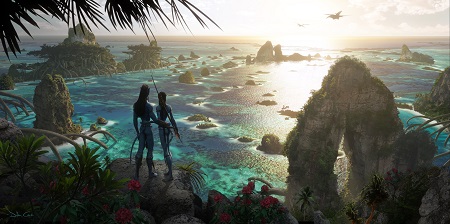
Star Trek 2023: could it be the ULTIMATE crossover?

Spoiler Warning: There are spoilers ahead for Star Trek: Discovery Seasons 1-3, Star Trek: Picard Season 1, the Kelvin timeline films, teasers for Star Trek: Discovery Season 4 and Star Trek: Picard Season 2, and for other iterations of the Star Trek franchise.

A few days ago, Paramount Pictures announced that a new Star Trek film is in the early stages of production, with a planned release date of June 2023. Though no further information about the project was given, that didn’t stop me speculating! I’ve already put together a list of a few possible Star Trek 2023 concepts, but I wanted to give this one the full article treatment.

At a few points in Star Trek’s history we’ve seen crossovers between the different shows. Usually this takes the form of a character or two from one series appearing in another. For example, we’ve seen Commander Riker appear in Voyager, Dr Bashir in The Next Generation, and Worf in Deep Space Nine. In Star Trek’s cinematic canon, Janeway made a cameo in Nemesis, Prime Spock appeared in Star Trek and Star Trek Into Darkness, and most significantly, we got to see Captains Kirk and Picard work together in Generations.

Captain Kirk and Captain Picard in 1994’s Star Trek: Generations.

So the Star Trek franchise has a history of main character crossovers going all the way back to Encounter at Farpoint, the moment at which Star Trek debuted its second entry and replaced its original set of characters. In all of these crossovers, though, even the substantial ones that were more than mere cameos, we’ve only ever seen characters from two shows interact. What if Star Trek 2023 plans to offer more than that?

In short, here’s my theory – and if it doesn’t come to pass in 2023 we can consider it a proposal or pitch for the future! As a celebration of all things Star Trek, perhaps the new film will be the ultimate crossover, featuring a cast of characters from across the entire Star Trek franchise. How would this be achieved? Some kind of time travel story, naturally, perhaps involving the extradimensional activities of a faction like the Q.

John de Lancie has recently announced that he’ll be returning as Q in Picard Season 2!

How amazing would it be to see Captain Archer from Enterprise working alongside Riker and Janeway? Saru and Michael Burnham could team up with Geordi La Forge and Miles O’Brien. Soji and Picard meeting Kelvin Kirk. Pike and Spock fighting alongside Worf and Malcolm Reed. The potential for such a story is almost limitless.

Comic books – and the films they’ve inspired over the last decade or so – have routinely done crossovers and team-ups, and fans tend to agree that they’re amazing when done well. Star Trek, as I’ve already mentioned, has had limited crossovers before, but nothing quite on the scale I’m thinking Star Trek 2023 could bring.

This could be Star Trek’s answer to The Avengers.

There have been over 60 main characters in live-action Star Trek to date, including films and television shows, and obviously it wouldn’t be possible for Star Trek 2023 to have an ensemble cast that large! But a handful of characters from different shows representing different time periods and different parts of the franchise could absolutely come together; a perfect mixture of all things Star Trek and a true celebration of the franchise as it approaches its sixtieth anniversary.

With this many different Star Trek projects all in production simultaneously, it makes so much sense to have some kind of “Avengers assemble!” moment to bring them all together. Even if such a story were limited to bringing in characters from current shows instead of Star Trek’s back catalogue, I still think it would be well worth doing. A suitable story would need to be devised, and a villain or problem for the protagonists to overcome would need to be created, but those are the basic tenets of storytelling anyway and aren’t obstacles.

Captain Pike – soon to appear in Strange New Worlds.

I tend to say that time travel stories are not my favourites within Star Trek – or in sci-fi in general. But time travel can work, as we saw in films like Generations and episodes like All Good Things. All it would require is a simplified explanation, perhaps involving some outside power, and if the stakes were high – a threat to the entire galaxy, for example – it would make sense to bring in as many legendary characters as possible to help defeat it.

If you’re a regular reader you’ve probably heard me say on more than one occasion that the Star Trek franchise could – and should – be doing more to tie its different shows and projects together. At present, every extant Star Trek project exists in a different time period wholly separate from everything else. There have been limited prospects for significant crossovers as a result, and while Discovery Season 3 saw perhaps the biggest connection to the rest of the franchise so far, it can still feel that all of the different parts of the franchise are doing their own things independently of one another.

The Discovery Season 3 episode Unification III referenced events from The Next Generation and Picard.

While too many ties and connections can be offputting, especially for casual viewers, not enough references or crossovers means there’s no incentive for the audience to stick with Star Trek and jump into other parts of the franchise. It’s possible to watch Discovery as a standalone show and not even be aware of the existence of Picard, for example – and vice versa. More of these connections between different parts of the franchise could, if done right, encourage viewers of one series to hop over and try out others – and Star Trek 2023 could potentially be the biggest opportunity so far to do that.

Perhaps some looming threat in the 32nd Century forces Michael Burnham to call upon Starfleet’s finest from centuries past, and she travels back in time to pick up a number of officers, scientists, and soldiers to help her defeat whatever it is that’s coming. Or perhaps an outside power like Q forces his friend Picard to work with different people from different eras to tackle some existential crisis. There are a million-and-one ways for Star Trek to introduce the kind of time travel scenario needed to link up some of the franchise’s superstars for one amazing crossover event.

“Let’s fly… to the past!”

So who would I pick to join the crew? I think we have to start with the main shows in production (and one that could be in production by 2023). Admiral Picard, Michael Burnham, Captain Pike, and Section 31 leader Georgiou would head up the cast, and from there we could bring in perhaps one additional member of their respective crews for a more significant role – maybe with smaller roles or cameos on the cards for others. Then I’d dearly like to bring back at least a couple of other characters from Star Trek’s past – someone like Dr Bashir, perhaps, or Tom Paris.

The film would follow these characters as they worked to solve whatever problem they’re facing, with each of the principal characters making use of their unique perspective and skillset to help contribute to the project. There could be teething problems with the team as they get to know one another, but generally I’d stick to having them work well as a team, with emphasis on how people from different backgrounds and with different outlooks can all find ways to contribute. Then there’d have to be some kind of tense final battle or confrontation before everyone – or at least, the survivors – part ways and return to their respective eras.

The Section 31 series could be underway by 2023…

I guess now we’ve crossed over from the realm of reasonable speculation into fan fantasy! And I’m not the first person on the internet to propose an “ultimate crossover” of Star Trek crews; such talk has been around since before Generations in the mid-1990s! While I don’t know whether Star Trek 2023 will go down this road, I do think that a major crossover could and should happen at some point in the future. Not only would it serve a purpose and tie together previously-separate parts of the franchise, but I bet it would be an incredibly fun film for Trekkies – and non-Trekkies too!

So that’s it, really. This half-theory, half-fantasy is that Star Trek 2023 will be the “ultimate crossover” and bring together characters from across the franchise to tell a single, epic story. Even if this film doesn’t do it, I still hope this kind of crossover event will happen one day!

The currently-untitled film Star Trek 2023 is being produced by Paramount Pictures and ViacomCBS. Star Trek 2023 has a tentative release date of the 9th of June 2023. The Star Trek franchise – including all shows, films, characters, etc. mentioned above – is the copyright of ViacomCBS. This article contains the thoughts and opinions of one person only and is not intended to cause any offence.
Star Trek 2023: what could it be?

Spoiler Warning: There are spoilers ahead for the entire Star Trek franchise, including the most recent seasons of Discovery and Picard, as well as recently-revealed teasers for upcoming seasons and projects.

The announcement a couple of days ago that a brand-new Star Trek film is in the works was incredibly exciting! There hasn’t been a feature film in the franchise since 2016’s Star Trek Beyond, the third film in the Kelvin (or JJverse) series. Since The Motion Picture made its debut in 1979, the Star Trek franchise has been reasonably consistent in its cinematic output, with the longest gap between films to date coming between Nemesis’ release in 2002 and JJ Abrams’ 2009 Star Trek reboot. Aside from that seven-year gap, we’ve seen Star Trek films every three or four years on average, and there have been thirteen films released since 1979.

I’ve always considered Star Trek to primarily be a television franchise, and its return to the small screen in 2017 felt like a proper homecoming. As interesting as the Kelvin timeline films were, I was far happier to see Star Trek back on television. That’s not because the Kelvin films – or any other Star Trek films – were bad, it’s just that the television format seems to work particularly well and lend itself to the kinds of stories Star Trek does best.

Star Trek will soon be back in cinemas!

As I said when I wrote up a short piece about the film’s announcement, no information was provided by Paramount Pictures or ViacomCBS about the film other than its June 2023 release date. So it would be foolish to speculate, wouldn’t it?

Foolish, perhaps, but also a lot of fun! So this time we’re going to take a look at a handful of possible settings, scenarios, and ideas for Star Trek 2023 and what it might be all about. My usual caveat applies: I don’t have any “insider information,” nor am I suggesting any of these film ideas will turn out to be correct. This is pure guesswork and speculation on my part. That’s all.

With that out of the way, let’s jump into the list!

Number 1: A direct sequel to Star Trek Beyond.

The redesigned USS Enterprise in 2009’s Star Trek.

Attempts have been underway since before the release of Star Trek Beyond to get a fourth Kelvin timeline film off the ground. At one point, rumours swirled of a script that would have brought back Kirk’s father George – who had been played by Thor actor Chris Hemsworth in the opening scenes of 2009’s Star Trek. Pre-production on that project appeared to make headway, but – again, according to widely-reported rumours – the salaries of some of the principal cast members, including Kirk actor Chris Pine, were said to have derailed the project.

Beyond ended with a strong tease at a potential sequel. Kirk and his crew gazed out over the new USS Enterprise-A as construction on the vessel was completed, and there was a sense that the film was setting up a new story. After more than five years it hasn’t happened, and as I said when I considered the pros and cons of a return to the Kelvin timeline, Star Trek’s return to the Prime Universe and the expansion of the franchise to new shows and projects means that, at least in my opinion, the Kelvin timeline doesn’t really feel like a good fit right now.

The Kelvin crew in Star Trek Beyond.

In many ways, it would make more sense for any new feature film to at least have some connection or tie to the shows currently being produced, even if it isn’t a direct spin-off from any of them. The Kelvin timeline was a way to reboot Star Trek in 2009 after three decades of near-continuous production had burnt it out in the minds of many viewers. That doesn’t feel necessary right now. And going back to the Kelvin timeline after years in the Prime Universe risks overcomplicating things for a more casual audience.

So there are mixed feelings on this one! On the one hand, the story of the Kelvin timeline abruptly ends after Beyond, despite teases of a sequel. And the Kelvin timeline films were incredibly successful, bringing in huge audiences and plenty of money! But on the other hand, the reinvigorated Star Trek franchise has gone in a different direction since 2017, and I don’t see where a Beyond sequel fits any more.

Number 2: Captain Worf.

Worf in First Contact.

Michael Dorn, who played Worf in The Next Generation, Deep Space Nine, and four Star Trek films, has often talked about his desire to reprise the role. Since at least the early 2010s, Dorn has talked at every opportunity about his pitch to Paramount and ViacomCBS for a “Captain Worf” series, miniseries, or film. Perhaps, after years of pestering them, he finally got his wish?

At this stage we can’t rule it out! Knowing so little about the upcoming project means, in theory, that practically any Star Trek pitch that we know about could be in contention. Maybe the “Captain Worf” concept was one that the company liked, and a feature film was considered the best possible option for it. One advantage to it, at least in theory, would be that Michael Dorn is well-versed in both Star Trek and the project’s central character, meaning it would be less challenging to get started with when compared to a wholly new concept. Given that the film has just over two years to go from announcement to release, that could be a significant help!

Worf in Season 1 of The Next Generation.

However, I’ve never been sold on the “Captain Worf” idea, personally speaking. Worf is a fun character, but I see two distinct disadvantages if he were to be the central focus of a new story. Firstly, Worf is the character we’ve spent the most time with in all of Star Trek to date – he appeared in 270 episodes and four films across fifteen years. We’ve seen most aspects of his life unfold on screen already, including his role as a father, husband, friend, and Starfleet officer. Do we really need more Worf?

And secondly, Worf is a great secondary character, but the “Captain Worf” concept would put him centre-stage. That’s great for Michael Dorn, of course, but I’m not sure Worf is the most nuanced or interesting character to spend so much time with. Both Worf and Voyager’s B’Elanna Torres have explored the “Starfleet-versus-Klingon” concept on many occasions, which is perhaps Worf’s biggest point of internal conflict and the best reason to do a project like this. It could be interesting, and a chance to return to the 24th or early 25th Century would be great. But I’m not sold on this being the right way to do it.

Number 3: Ceti Alpha V.

My Ceti Alpha V mock-up.

A few weeks ago I looked at a pitch by The Wrath of Khan and The Undiscovered Country director Nicholas Meyer for a miniseries tentatively titled Star Trek: Ceti Alpha V. That project was planned as a three-part miniseries, but it could have been adapted into a feature film, I suppose!

This concept would focus on iconic villain Khan in the years between his exile by Kirk in Space Seed and his return in The Wrath of Khan. He and his followers were marooned on the titular planet Ceti Alpha V, and had to endure disaster following the explosion of nearby Ceti Alpha VI.

Khan in The Wrath of Khan.

As I wrote then, I’m not convinced that we need to see that part of the story! It wouldn’t really explain anything from The Wrath of Khan, as seeing Khan’s descent into madness for ourselves across several hours of television – or an entire film – isn’t necessary in any way to explain his actions or characterisation. Everything we needed to know about Khan is present in Space Seed and The Wrath of Khan.

As a feature film, though, a project like this has merit. It would pull on those nostalgic strings, connect to the franchise’s most well-regarded piece of cinema, and feature an iconic Star Trek character. From Paramount’s point of view, those advantages may make it worthwhile!

Number 4: Borg Invasion.

A Borg Cube over Earth in The Best of Both Worlds, Part 2.

If you’re a regular around here you might remember a Borg Invasion concept being one of my “unsolicited Star Trek pitches” last month! This is a concept that I’ve long felt would be fascinating, and while I envisioned it as a television series, it could perhaps be made to work as a film trilogy instead – potentially making Star Trek 2023 the first part of a short series of films.

But we’re getting ahead of ourselves! The Borg are one of the franchise’s most iconic villains, participating in one of Star Trek’s most highly-regarded episodes – The Best of Both Worlds – and best films – First Contact. The faction itself also hasn’t been seen on screen in any major way since 2003’s Enterprise Season 2 episode Regeneration, perhaps making them due for a comeback!

Borg drones in the Enterprise episode Regeneration – the last time we saw any “active” Borg on screen!

Discovery’s second season told a story which had the potential to be a Borg origin story, and Picard Season 1 also touched on the Borg, in particular Picard’s lingering trauma following his assimilation. But neither series brought back the Borg in a big way, despite the potential existing for either to do so. Could that be because ViacomCBS knew that Paramount Pictures (its subsidiary) was in the early stages of working on a new Borg film? Maybe!

The Borg are terrifying, and such a film would be action-packed and tense in equal measure. It’s been 25 years since Star Trek: First Contact took the Borg to the big screen for their only visit to the cinema so far, so I can’t help but wonder if they’re about to make a reappearance! Whether a Borg story would look to bring back any familiar characters or not is not clear – it wouldn’t have to, but as always in Star Trek, I’d be thrilled to see practically anyone connected to the franchise make a return.

Number 5: The Kelvin timeline version of The Next Generation.

The Season 1 cast of The Next Generation. Is a reboot on the cards?

2009’s Star Trek reboot presented an opportunity to go back to the drawing board and take another look at Kirk, Spock, Dr McCoy, and the rest of the crew of The Original Series. Ever since, (some) fans have been wondering what would happen to The Next Generation in the alternate reality – would the same crew have been assembled, or would its members even exist given the dramatic changes to the timeline?

Perhaps this is something we should explore in more detail another day, but I think that the existence of Chekov in the alternate reality, and the fact that he joined Starfleet, could be taken as evidence of the alternate reality not straying too far from the Prime Universe. Chekov was born after the incursion of Nero’s ship and the destruction of the USS Kelvin, so in theory we could argue that most people we met in past iterations of the franchise should have an alternate reality counterpart – just as they have a Mirror Universe counterpart too.

Did this moment in Discovery Season 3 hint at something to come?

Discovery Season 3 made a small reference to the Kelvin timeline – or at least, an ambiguous reference that felt like a Kelvin connection! In the episode Terra Firma, Part 1, the mysterious Kovich told Dr Culber of a “time soldier” who crossed over from the alternate reality to the Prime Universe. This soldier was wearing a uniform style seen in the first couple of seasons of The Next Generation, so it seems as though there was a comparable era of Starfleet in the alternate reality.

Could Discovery have been dropping a hint at this film? Possibly! Even if that’s just coincidence, it reinforced the existence of the Kelvin timeline – a fact that was known to Starfleet by the 32nd Century. Perhaps it was a subtle reminder to Trekkies that the alternate reality still exists, getting us ready for a new project? The Next Generation is very popular with fans, and rebooting it may seem like a solid idea for Paramount Pictures. Though I know some fans who detest the Kelvin films – or who refused to watch on principle – there’s no denying the reboot was a success, and rebooting The Next Generation could be as well.

Number 6: A Discovery film – if the show ends with Season 4 or Season 5.

Captain Burnham at the end of Season 3.

Speaking as we were of Discovery, its fourth season is due for release later this year. While there is no word yet on Season 5 – at least officially – it seems likely that the show will be renewed for a fifth season, which would presumably be broadcast in 2022. But what will happen next?

Both The Original Series and The Next Generation were followed up by films starring the casts of the shows, and perhaps something similar could be on the cards for Discovery, with Captain Burnham leading her crew onto the big screen. By 2023 we’ll have had at least one – probably two – more seasons of Discovery, so the crew will be almost as familiar to audiences as Kirk and his officers were when The Motion Picture was in production!

The USS Discovery.

If there is to be a fifth season of the show, that would mean production on Season 5 would likely be ongoing at the same time as this film, so maybe this is an indication that there won’t be a Season 5. With a number of other Star Trek television projects in various stages of development – including the untitled Section 31 series which is itself a spin-off from Discovery – perhaps the plan is to end the series after Season 4 and turn it into a feature film franchise instead, with television attention refocused onto other projects.

It would be a big change, but I can see at least one big advantage to a Discovery film: it would firmly establish the 32nd Century in the minds of audiences. I’ve felt for a while that Star Trek needs to try to condense its disparate timelines and time periods as much as possible, and the 32nd Century is by its very nature totally open-ended when it comes to storytelling potential. A Discovery film could be a “soft reboot,” relaunching Star Trek in the 32nd Century and setting the stage for new projects.

Number 7: A Deep Space Nine film – the return of Sisko.

Captain Sisko in Take Me Out To The Holosuite.

I was perhaps overly-critical of a “Captain Worf” idea in the entry above, but one character who I’ve been hoping to see return for over twenty years now is Captain Sisko. The ending of What You Leave Behind – the last episode of Deep Space Nine – more so than any other Star Trek finale left things open. Sisko entered the realm of the Bajoran Prophets, but promised to return in due course.

That return could happen at literally any point in the timeline; the Prophets don’t see time as linear. Sisko could thus appear in the Strange New Worlds, Picard, or Discovery eras – despite the fact that those shows take place centuries apart! But given the importance of his return to Star Trek, perhaps a Sisko feature film is on the cards.

Sisko in Move Along Home.

Sisko would be such a great point-of-view character. His absence from galactic affairs for decades or even centuries would allow the writers of the film to dump a lot of exposition onto the audience without it feeling like it came from nowhere. His return could both set up the plot of a new Star Trek story and provide the audience with a way in; introducing us to new characters, factions, technologies, and the state of the galaxy itself in whatever time period he finds himself.

Such a story could also return to Bajor, looking at whether the Bajorans ever joined the Federation, as well as the aftermath of the Dominion War. The Dominion War arc is one of my favourites in all of Star Trek, and a follow-up of some kind would be absolutely amazing to see. If Sisko returned during the Picard era, he could reunite with people like Major Kira or Dr Bashir, and a mini-reunion of some of the Deep Space Nine crew would be wonderful.

Number 8: A Nemesis sequel.

The Enterprise-E undergoing repairs at the end of Nemesis.

A direct sequel to Nemesis seems unlikely, especially with Picard Season 2 underway and planned for next year. But the official announcement of Star Trek 2023 mentioned a film set after Nemesis as one possibility. That seems incredibly interesting! Would it be set in the Picard era, perhaps with the crew of La Sirena in major roles?

The surviving crew of the Enterprise-D and Enterprise-E have largely gone their separate ways, at least as of Picard Season 1. Riker and Troi live in semi-retirement on the planet Nepenthe. Picard is off with the crew of La Sirena. Worf and Geordi were mentioned by name, but there’s no indication that either are still even in Starfleet at this point! Season 2 of Picard may answer these questions, as well as establish what became of Dr Crusher, and if so that could set the stage for a reunion on the big screen.

Acting Captain Riker in the Picard Season 1 finale.

As above with Discovery, Picard Season 2 is currently filming, meaning that production on Star Trek 2023 would have to wait if it wanted to include Picard himself. But there is another possibility: that a Nemesis sequel would focus on other characters. Perhaps it would look at Riker and Troi in more detail, especially if they returned to Starfleet following the events of Picard Season 1.

Star Trek 2023 may follow Riker’s time in command of the USS Zheng He, and perhaps he reunites with Worf, Dr Crusher, Geordi, or even Wesley! Or we could see the return of characters from Deep Space Nine and/or Voyager, such as Ezri Dax or Tuvok. With Captain Janeway coming back in Prodigy, anything’s possible right now!

Number 9: A Kelvin timeline crossover with either Strange New Worlds or Discovery.

Captain Kirk in Into Darkness.

One of the really enticing possibilities that came up when Strange New Worlds was announced was the possibility of some kind of Pike and Spock crossover story. I would be surprised in some ways to see Strange New Worlds – a highly-requested but completely untested – series hit the big screen, but a Kelvin timeline crossover could be a great way to do it.

Pike and Spock could team up with their alternate reality counterparts, perhaps looking to return to their own universe following some kind of crossover event. The two “young Spocks” would have to logically stand off – Kelvin Spock has already met Prime Spock but he can’t let young Prime Spock know that! It might be confusing, with two different versions of the characters, but it could be a lot of fun too.

Captain Saru in Discovery Season 3.

Alternatively the Kelvin cast could cross over with Discovery’s 32nd Century. Not only have we had the aforementioned reference to the Kelvin timeline during Discovery’s third season, but we know that crossing between the two universes also seems to mean crossing into a different time period. Perhaps someone in the Kelvin timeline accidentally opens a black hole, sending them to Discovery’s 32nd Century.

The reverse would be interesting too, and could draw on themes present in episodes of Voyager like The ’37s. If Captain Burnham and the crew of Discovery found themselves in an alternate 23rd Century, how many of them would struggle with the idea of remaining there, trying to rebuild their lives in a different universe, but perhaps a setting more familiar to them than the 32nd Century? That could be fascinating to explore – as would any crossover between two sets of crews!

Number 10: The Earth-Romulan War.

The NX-01 Enterprise encounters two Romulan ships in the Season 2 episode Minefield.

Picard Season 1 brought back the Romulans in a big way, and they also appeared in Discovery Season 3. The faction is clearly a big part of Star Trek right now, but one aspect of their history has never been explored – despite plans to do so in 2004-05. The unproduced fifth season of Enterprise would – allegedly – have included the Earth-Romulan war, one of humanity’s first major interstellar conflicts.

Fans have long wondered what this would have looked like – even as far back as the Earth-Romulan War’s first mention in The Original Series Season 1 episode Balance of Terror. We saw the first hints of Romulan aggression in Enterprise, as they attempted to disrupt the Earth-Vulcan alliance and start a Vulcan-Andorian War. Captain Archer managed to prevent that from happening, but as we know from Star Trek’s history, conflict with the Romulans broke out regardless.

A Romulan Bird-of-Prey as seen in Lower Decks.

This would be a great opportunity to bring back Captain Archer, T’Pol, or other major characters from Enterprise. It wouldn’t necessarily be an “Enterprise film,” but it could be a film that included at least some of the same characters. A single film might not be able to tell the story of the entire conflict, but it could certainly look at its most decisive battle – and with so little information having been shared on screen, it’s an almost-blank slate for any new writer or producer to play with.

The drawback, really, is that it would be hard to connect such a film to the ongoing Star Trek franchise, which has series set in the 23rd, 25th, and 32nd Centuries. Going back to a time shortly after Enterprise would isolate Star Trek 2023, and while it could be the springboard for more 22nd Century adventures to come, it could also end up feeling disconnected.

So that’s it. Ten possibilities for Star Trek 2023.

It’s quite likely that all of these suggestions are completely wrong; Paramount Pictures and ViacomCBS are just as likely, in my opinion, to want to take the cinematic franchise in a new direction with a new crew than they are to revisit something from Star Trek’s past. But that doesn’t mean it wasn’t a lot of fun putting this list together and considering the possibilities!

Star Trek 2023 probably won’t bring back these uniforms!

Star Trek 2023 is a truly exciting prospect. I desperately hope that it will come to streaming instead of the cinema – as you may know if you’re a regular reader, my poor health means I can’t get to the cinema in person any more. Probably it will be given a theatrical release, though, which will mean months of trying to avoid as many spoilers as possible for me! Time will tell.

For now, though, suffice to say I’m intrigued by the prospect of the first new Star Trek film since Beyond, and potentially the first film to feature a different cast of characters since 2009. Whether or not this is the previously-announced project written by Discovery and Short Treks producer Kalinda Vazquez is also not clear. We know basically nothing about this film right now except its planned release date! Hopefully we’ll learn more soon, so stay tuned. I’ll be sure to take a look at any casting information, behind-the-scenes details, or any other news that comes our way.

The currently-untitled Star Trek film is scheduled for release on the 9th of June 2023. This film is the copyright of Paramount Pictures and ViacomCBS, as is the entire Star Trek franchise. This article contains the thoughts and opinions of one person only and is not intended to cause any offence.
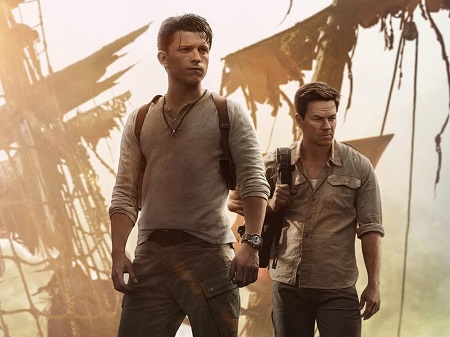
A Star Trek film is coming in 2023!

Spoiler Warning: There are minor spoilers ahead for the Star Trek franchise.

In case you missed the official announcement, a new Star Trek film has been officially greenlit by Paramount Pictures and given a release date: the 9th of June 2023! Better make a note in your calendar!

Unfortunately that’s literally all we know. Even the official Star Trek website didn’t have any more information, with whoever was tasked with writing up the announcement trying to pad out the piece… kind of like I’m doing now.

I would assume at this stage that this film is the project we recently learned was being written by Star Trek: Discovery and Short Treks producer Kalinda Vazquez, because that’s the only one we know of that’s actively in development. Other potential feature film projects – including a fourth Kelvin-timeline film, a Quentin Tarantino film, and a film by Noah Hawley that was described as “ready-to-go,” have all either been shelved or those involved have moved on to other things. But that doesn’t mean it’s necessarily the film written by Vazquez; it could be a previously-unknown film!

This could be another Kelvin film… but even StarTrek.com doesn’t know!

The post on the official Star Trek website mentioned the Kelvin timeline, but it also dropped a tantalising hint that it could be a new film in the Prime Universe set sometime after Nemesis. I’ve already looked at the pros and cons of a potential return to the Kelvin timeline, but there’s definitely scope to revisit the late 24th Century. Perhaps the new film will be set alongside – or even connected to – Star Trek: Picard.

There have been rumours about possible upcoming Star Trek projects for as long as there’s been a Star Trek fan community, and I’m at a stage now where I don’t believe any unless they’re officially announced or confirmed! There are just too many competing rumours out there to know for sure – and too many rumourmongers on the internet who like to spread nonsense. So while it may be fun to speculate – and I’m sure I will at some point soon – let’s not get ahead of ourselves when it comes to this new project. It’s very early days!

June 2023 is just over two years away, which is ample time to kick-start production of a feature film… at least, under normal circumstances! Hopefully the pandemic will not prove too disruptive, or too expensive, to this new project.

Maybe a post-Nemesis film is on the cards?

Personally I’d love to see this film come to Paramount+ (or whatever streaming platform they choose for UK distribution). As you know if you’re a regular here, my health precludes going to the cinema these days, sadly. But I expect, given that it appears to be a “proper” feature film and not a made-for-streaming affair, it will be given a theatrical release.

As and when more information is revealed, be sure to check back here on the website, as I’ll do my best to break down and take a closer look at whatever news we get!

So that’s it. That’s all we know at this stage.

New film. 9th of June 2023. Set a course and engage!

The currently-untitled Star Trek film is scheduled for release on the 9th of June 2023. This film is the copyright of Paramount Pictures and ViacomCBS, as is the entire Star Trek franchise. This article contains the thoughts and opinions of one person only and is not intended to cause any offence.
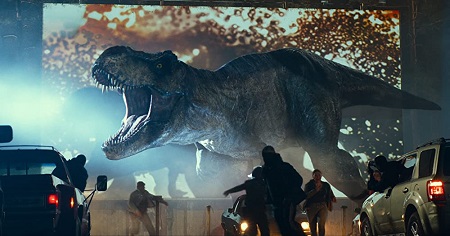
King of Kings (1961) – an Easter film with a Star Trek connection

I’m not a religious person, and thus Easter has never been an especially important time of year for me. As a kid, Easter meant two weeks off school and chocolate eggs. And as an adult, Easter means a long weekend… and chocolate eggs. That’s about all. But as someone who grew up in England and was frog-marched into church with other schoolkids – back in the days when every school was bound to the local church – I gained a passing familiarity with the holiday. Because I don’t enjoy hot weather, late spring and summer are my least-favourite times of year! Easter, as the event which signals the beginning of that time of year, has always felt at least a little unwelcome as a result, even if the abundance of chocolate serves as a suitable bribe.

But enough about my weather preferences! It’s Easter, and aside from chocolate, Easter means one thing: Jesus. Jesus of Nazareth was crucified, of this even non-Christians widely agree. Sometime between AD 30 and AD 40, Jesus was executed by Roman authorities in the province of Judea, and his resurrection three days later is what Christians celebrate at Easter. Jesus’ life and death have been depicted countless times in art and entertainment, and this time I thought it could be interesting to briefly look at a mid-century example: the 1961 film King of Kings.

The film’s opening title.

The title of this article promised you a Star Trek connection – since the Star Trek franchise is one of my biggest fandoms and a subject I write about often here on the website! The lead role in King of Kings is, naturally, the character of Jesus. In this case, Jesus is played by Jeffrey Hunter – better-known to Trekkies as Captain Christopher Pike, the original captain of the USS Enterprise.

Hunter’s life was tragically cut short, and he died aged only 42 following a fall that may have been caused by a stroke. Though he’s well-remembered today for his single Star Trek appearance – even more so since footage of him was incorporated into Season 2 of Star Trek: Discovery – he was a prolific actor in the 1950s and ’60s, appearing in films like Fourteen Hours alongside Grace Kelly, and The Searchers with John Wayne. He also appeared in a number of television roles, including in big ’60s shows like The FBI and Daniel Boone.

Jeffrey Hunter (1926-1969)
Photo Credit: jeffreyhunter.net

If you’re familiar with Star Trek’s early production history, you’ll recall that Hunter declined to reprise his role as Pike for the show’s second pilot, opting to focus on cinema instead. By the time The Menagerie was made – the two-part episode which reused most of the footage from the show’s first pilot – Hunter was unavailable, leading to the character of Pike being recast and creating the iconic disfigured, wheelchair-bound look.

But all of that is incidental! King of Kings was released in 1961, four years before Hunter would meet Gene Roddenberry and agree to work on Star Trek. The film received mediocre reviews, but was considered a box office success for film studio MGM. And having seen it for myself a few years ago, it was certainly an interesting experience!

Jeffrey Hunter as Jesus in King of Kings.

This was my first time seeing Jeffrey Hunter outside of The Cage – at least, that I’m aware of. Though he’s slightly younger and sports both Jesus’ typical long hair and beard he is recognisable in the role, and that was certainly something neat to see.

The film itself is typical mid-century fare. As I think I’ve explained on more than one occasion, the early 1960s is about as far back as I’m willing to go for most films and television shows, simply because the quality of practically every aspect of production declines more and more the further back in time a film or series was made. Early cinema holds an interest from an academic point of view – the way techniques were developed, how different genres came into being, how technologies were first pioneered, and so on – but I find that actual entertainment value, and my ability to get lost in a production really cannot survive the wooden sets – and wooden acting – of early cinema!

A Roman scene in King of Kings.

King of Kings falls into this trap at points, with some sets and backdrops being pretty obviously fake, and the general acting style being in line with other projects of its era. But it’s perfectly watchable despite those shortcomings.

The film aimed to be an “epic,” recreating the magic of earlier Biblical epic films like 1956’s The Ten Commandments, and of course Ben-Hur, which was released in 1959. Even the film’s poster imitates Ben-Hur’s visual style. I don’t know if I’m the right person to compare these films for you; all are roughly equal in terms of being watchable for me, with similar drawbacks that I find with films from this time period. What we can say, though, is that King of Kings is probably less well-remembered than the other two, with Ben-Hur in particular being widely considered a classic.

Hunter as Jesus of Nazareth at the film’s climax.

The story of Jesus’ life and death has been recreated in cinema on a number of occasions. The 1912 film From the Manger to the Cross is the earliest one I could find, and in the century since there have been countless others. One of the best-known in recent years is Mel Gibson’s epic The Passion of the Christ, which is a pretty gory and harrowing watch in parts – deliberately so. And who could forget Monty Python’s Life of Brian, a parody of the Bible story?

King of Kings fits somewhere in the middle, the kind of film I’d never choose to watch but for the combination of its Star Trek connection and the holiday we’re celebrating today. It’s a curiosity rather than something I could recommend for pure enjoyment, but if you’ve seen other, better-known depictions of the life and times of Jesus, King of Kings might’ve slipped under the radar. It’s worth a look if that’s the case!

Even for non-Christians, the basic message Jesus of Nazareth preached is worth listening to. Being kind and treating others with respect is something we can all aspire to, especially in today’s politically divided, pandemic-riddled world. King of Kings, like many Bible films, hammers that message home in what is, at times, a ham-fisted way. But the message itself is still worth paying attention to, and for one day a year, we can take a moment to appreciate that.

King of Kings is out now on DVD and Blu-ray, and may also be available to stream depending on location. King of Kings was directed by Nicholas Ray and may be the copyright of Metro-Goldwin-Mayer and/or MGM Holdings. This article contains the thoughts and opinions of one person only and is not intended to cause any offence.
A new Star Trek film is in the works

I’m a bit late to the party on this one, so you’ve probably already heard the news that a new Star Trek film is being worked on over at ViacomCBS/Paramount Pictures. It’s still interesting, though, so let’s take a moment to consider what it could be and what its inception may mean for the rest of the franchise.

Firstly, it now seems certain that the other Star Trek film projects that had been announced or discussed publicly are not happening. We should never say “never,” of course, and it’s not impossible that they may be revived in future, but for now it seems that the unified Star Trek team (working together since the 2019 merger that created ViacomCBS and reunited Star Trek’s film and television licenses) has decided to drop those projects and go in a different direction.

The new film is being created under the supervision of ViacomCBS.

The three films we knew about were: a fourth Kelvin-timeline film, a project that had been pitched by Quentin Tarantino, and a project by Fargo television series co-creator Noah Hawley that was supposedly ready-to-go. From what I can tell at this stage, none of these are happening now. To me, the continuation of the Kelvin timeline was perhaps the lesser of the three, but I was certainly interested to see what renowned director Quentin Tarantino would have brought to Star Trek, so the cancellation or shelving of his project is a little disappointing. Having been rejected once, I doubt Tarantino would be tempted to come back, especially if he’s moved on to other projects, and that’s a shame. Though we don’t have any confirmed details of his script or what the story would have entailed, I wonder if, as time goes by and we learn more about that project, it will come to be seen as a missed opportunity.

But enough about the Star Trek films we aren’t going to see! What about this new one?

All we know at this stage is that it’s being penned by Star Trek: Discovery writer Kalinda Vazquez. Vazquez wrote the Short Treks episode Ask Not, which brought back Anson Mount as Captain Pike, as well as introduced Cadet Sidhu – a character who may end up appearing in the upcoming series Strange New Worlds. She also wrote Terra Firma, Part II from Discovery’s third season, and served as a producer during that season as well.

Cadet Sidhu in Ask Not.

All in all, I think that’s a pretty good track record! Terra Firma as a whole was one of Star Trek’s best Mirror Universe stories – and that’s saying a lot, because the Mirror Universe is a setting I don’t generally enjoy. Ask Not was good fun too; a tense and dramatic short story that ended in a very uplifting way. Just based on those two stories – the sum total of Vazquez’s Star Trek output – the project would seem to be in good hands. Add into the mix that she’s worked on Fear the Walking Dead and it seems like the team over at ViacomCBS have made a solid pick. I’m already excited about the proposed film!

But not too excited yet. This is the fourth Star Trek film that has been publicly discussed in recent years, and as mentioned above, none of the other three were greenlit or entered production. So as interesting as this sounds, I think it’s best to try to keep the hype to a minimum and not get over-excited – at least not until filming has definitely begun.

Quentin Tarantino couldn’t get his Star Trek project off the ground. Will this new film succeed where his didn’t?
Photo Credit: Georges Biard, CC BY-SA 3.0 https://creativecommons.org/licenses/by-sa/3.0, via Wikimedia Commons

The film is said to be a new take on Star Trek, and I infer from that that we won’t be following an established crew. Despite Vazquez’s earlier work, this isn’t Star Trek: Discovery – The Movie! This concept – to bring in an entirely new crew for a feature film – is actually new to Star Trek. While the Kelvin films brought in a new cast that hadn’t previously been part of any Star Trek production, the characters they played were based on those from The Original Series. The other Star Trek feature films starred the casts of The Original Series and The Next Generation respectively, so starting entirely from scratch is a new model for a Star Trek film. It means attention must be paid to establishing who the characters are early in the story, as well as setting up where and when the action is taking place. It perhaps limits the main cast to a smaller number – three or four principal characters instead of a larger bridge crew – simply to allow us as the audience to get to know them better and follow their stories.

Starting afresh opens up the film to take almost any era, setting, and narrative that the creative team chooses. The Star Trek galaxy has at least 1,000 years of history to explore now that Discovery has firmly established itself in the 32nd Century, and there are whole areas of the galaxy that are unexplored. This means that there’s great potential for the new film to take a half-step away from familiar alien races and look at something new. That’s exciting, and I’m left at this stage with a sense that the project is very open in terms of what kind of story it could tell.

The galaxy is a big place!

It’s been suggested by some commentators that ViacomCBS would like to see a full theatrical release for this new film, but I couldn’t confirm that anywhere online; it seems to be opinion interjected by commentators. So I’d like to suggest for the record that this film could just as easily go straight to Paramount+. With ViacomCBS investing heavily in their new streaming service, as well as being keen to emphasise that it will be the new home for Star Trek going forward, it would make sense to bring new projects directly to their streaming service.

Disney+ has trialled the “premiere access” approach – asking subscribers to pay an additional fee to watch Mulan late last year and Raya and the Last Dragon this month. Time will tell how successful such an approach has been for Disney, but it’s something that Paramount+ could consider as well in lieu of a full release in cinemas. Obviously I have a bit of an agenda in this case – as you may recall if you’re a regular reader, my health makes it impossible for me to go to the cinema these days. But even though I’m biased, I still think we could see this project come to Paramount+ as an exclusive title!

So that’s really about all I have to say. The new film has potential, and I shall watch its progress with cautious interest. For me, while Star Trek has primarily been a television franchise, I’ve greatly enjoyed its feature films as well, so there’s definitely reason to be intrigued by the open-ended possibilities of a new project of this nature. Good luck to Kalinda Vazquez and the rest of the creative team!

The Star Trek franchise – including all projects mentioned above – is the copyright of ViacomCBS. This article contains the thoughts and opinions of one person only and is not intended to cause any offence.
Will the Avatar sequels improve the franchise’s standing?

Spoiler Warning: There are spoilers ahead for Avatar.

James Cameron’s 2009 sci-fi film Avatar never really managed to break into pop culture in quite the way he hoped. It was a huge financial success – in part because folks were curious to see what this new project was all about – but it never really became a top-tier entertainment brand in the way Star Wars or Harry Potter did. In 1977, Star Wars became a phenomenon, and in the years afterwards the film was constantly on fans’ minds. The Empire Strikes Back cemented its place at the pinnacle of the sci-fi genre… even if Return of the Jedi perhaps tarnished its halo a little!

Avatar just isn’t on that level. There was a lot of hype leading up to its release, with a decent (if rather boastful) marketing campaign spearheading 20th Century Fox’s efforts to push Avatar as the “next big thing.” But for a lot of moviegoers, the film was just okay. It wasn’t bad; it was a solid, enjoyable summer blockbuster that went toe-to-toe with the best pictures of 2009 – including the rebooted Star Trek! But after leaving the cinema, I never really got the sense that fans were clamouring for more in the way Trekkies, Potter-heads, and Star Wars fans are for their respective franchises.

Avatar was a successful film – but can it become a successful franchise?

The creation of Pandora – The World of Avatar at Walt Disney World in Florida is a great demonstration of this. The new land attracted attention when it was built, and for months after it opened its rides were queuing out the door! But that happens for almost any new Disney attraction, and when compared to the opening of Star Wars: Galaxy’s Edge in 2019, it pales in comparison. There was huge excitement to be transported to a galaxy far, far away. There was curious interest in Pandora… but that was all.

None of this is to say Avatar was bad. It wasn’t at all, and I thoroughly enjoyed it when I first saw it. But I was never desperate to re-watch it, and my latest revisit to the 2009 film – which may be the third or fourth time I’ve seen it – was prompted by nothing more than boredom. But it also led to this article, so at least I got something out of it!

Pandora – The World of Avatar at Walt Disney World.

This is a much broader point that ties into another piece I’ve been writing, but the difference between a good one-off story and a good story that becomes a larger franchise is world-building. Any film, television show, book, or even video game that hopes to be “the next Star Wars” needs to put time and effort into creating a world that fans want to explore. Star Wars and Star Trek did so, and they did so by showing fans a relatively small piece of what felt like a huge picture. The galaxies depicted in Star Wars and Star Trek are so much bigger than the few characters we met in their original incarnations; it feels like there’s much more to see beyond what was depicted on screen.

Avatar – and a lot of other wannabe-franchises too – doesn’t have that, at least not yet. Partly that’s because the film doesn’t hint at anything more than what we see – Earth, Pandora… and that’s it. And on Pandora there’s one major human outpost. There are starships flying back and forth, and the glimpses we got of Earth had a futuristic vibe, but the world Avatar created doesn’t feel as though it extends beyond the places we see. There’s no other planets that we could imagine humans or Na’vi colonising one day. There’s no fleets of starships on missions of exploration or fighting battles; the few ships we see just fly between Earth and Pandora.

A starship seen in Avatar.

Pandora itself is absolutely beautiful; a location painstakingly created. And the Na’vi are more than just a simple analogue for Native Americans or other indigenous peoples; Cameron and his team went to great lengths to craft Na’vi culture, even going so far as to write a fully-formed Na’vi language. Those efforts may yet pay off, but they don’t seem to have thus far. Because as interesting as the Na’vi are – and they are undeniably interesting – they’re all there is. One tribe of Na’vi and one human settlement on Pandora, and… what? Nothing else, as far as the film showed us.

There’s a sense of scale missing from Avatar, and its world-building, while wonderfully done, is small. There’s nothing wrong with focusing on one aspect of a story and a few characters – in the first film in a series that kind of needs to happen! But if the aim is to create a series with franchise potential, something to hook fans in and get our imaginations running, that sense of scale and the idea of a greater world beyond what we see on screen is essential. It’s the single most important element in building a larger story – and Avatar didn’t get it right.

So on to the question I posed at in the title of this article: can the planned sequels – of which there are four – improve the franchise’s standing? Can they spin out what was a decent one-off sci-fi blockbuster into something more? Can Avatar make the jump and become “the next Star Wars?”

Two Na’vi seen in concept art for the Avatar sequel series.

The length of time between Avatar and its sequels may be an issue. By the time Avatar 2 hits cinemas in December 2022 – assuming it meets its planned release date – thirteen years will have passed since the first title. Given the general apathy and lack of interest in Avatar this long after its premiere, the first part of this sequel series will have to spend at least some of its runtime refreshing audiences on what happened in the first film and what the setting is. When I sat down to re-watch Avatar earlier, I had only a vague recollection of the film, and I daresay a lot of folks will be in the same position.

When The Empire Strikes Back came out, it had been only three years since Star Wars had been in cinemas. And while Star Trek: The Motion Picture was released a decade after The Original Series ended, the only reason the film was made was because there was a growing fanbase who had watched the show when it was rebroadcast and those fans were clamouring for more. Is anyone clamouring for Avatar 2?

A scene on Pandora from concept art.

Avatar was a welcome addition to the sci-fi genre. Especially as the last decade has been dominated by reboots, adaptations, remakes, and sequels, it was a welcome breath of fresh air, and despite what I’ve said about its world feeling small, there is potential for it to be expanded upon. To say that the Avatar series can never be more than it already is would be ridiculous – there’s only been one film so far, and it was decent. It didn’t blow up the genre or redefine what a film could be in the way its pre-release marketing seemed to suggest, but it was good. I don’t dislike Avatar.

The sequels do have a pretty big job to do, though. The storyline of Avatar was exciting, but it was hardly original. Comparisons have been made to Dances with Wolves and even Disney’s Pocahontas, and while I don’t think it’s fair to call it derivative, it wasn’t a unique narrative by any means. That point of criticism will have to be addressed, and the sequels will have to try harder to be different from a story perspective if they’re to achieve the heights the films are aiming for.

Na’vi fly atop their banshees in more concept art.

The beautiful world-building that worked so well for Pandora and the Na’vi needs to be expanded upon. Perhaps we could see different Na’vi tribes and civilisations on Pandora, or better yet, expand the scope of the setting out into space. Are there other moons or planets in the Pandora system, perhaps? Or is there another human settlement on some nearby world? These are just a couple of ideas for how the Avatar series can build on the successes of the first film to be bigger – to achieve that sense of scale which the best and most successful franchises have.

Avatar was also a film which had contemporary real-world analogies. I noted influences of at least two of America’s recent wars in the depiction of the Marines, scientists, and Na’vi – Vietnam and Iraq. The dense rainforests of Pandora, and the way Jake and others had trouble navigating them, were the film’s answer to the jungles of Vietnam. And references to winning “the hearts and minds” of the locals was a phrase we heard often in relation to the Iraq war during the 2000s – which is when Avatar was in development. The latter of those themes is arguably less relevant in 2021 than it was in 2009, and Avatar 2 will need to adapt to changing times.

Night time on Pandora in this final piece of concept art.

One improvement we’re sure to see is in CGI and digital animation. Avatar was released at a time when CGI was improving – and was far better than it had been even five or ten years earlier – but there are still some aspects of its visual style that haven’t aged especially well. Some textures have that “too shiny” look that plagued cinematic CGI in the 2000s, and while viewing the film on a cinema or IMAX projector screen dulled the impact of some of that, on a television set in 2021 it’s something you notice. I wouldn’t say Avatar looks dated – but it’s right on the cusp. A film that relies so heavily on computer animation – many of Avatar’s sequences are basically fully-animated – is always going to run that risk, and while it has aged more gracefully than, for example, the Star Wars prequel trilogy, there are still noticeable places where the animation isn’t up to code.

There have been improvements in computer animation since 2009, which should mean Avatar 2 and the rest of the sequel series will be far more visually interesting. Pandora was already beautiful, but if that beauty could be expanded upon I think the sequels could really be something special. Some fans tend to turn up their noses at visuals, but if you think about it, a distinct visual style is another absolutely crucial element to a franchise. Star Trek has combadges, ships with saucer sections, Klingons, and the transporter. Star Wars has white-armoured Stormtroopers, lightsabers, Jabba the Hutt, and X-wings. Avatar introduced us to the blue-skinned Na’vi, but none of its technology, characters, costumes, or locations have become iconic in the same way as the other franchises we’ve mentioned. Part of that is down to the quality of the CGI, but partly it’s the film’s own art style. Avatar 2 could introduce a new design for a starship, character, or even just a costume that will go on to be emblematic of the series – in the way that Boba Fett became a symbol of Star Wars after his debut in The Empire Strikes Back, for example.

So yes, there’s work to do to expand on Pandora and the world Avatar created in 2009. But I’m really interested to see where Avatar 2 will take the story after the conclusion of the first film, and what the other films in the planned sequel series have in store. James Cameron is an amazing director, and having put so much work and effort into the Avatar series, I really hope it will see the kind of success he’s looking for. There’s always room for more sci-fi franchises!

Avatar is out now on Blu-ray and DVD, and may be streamed on Disney+ in the United States, United Kingdom, and other countries and territories. Avatar is the copyright of 20th Century Fox and the Walt Disney Company. Avatar 2 is due for release in December 2022. Logo and official promotional artwork courtesy of avatar.com. Stock photos courtesy of Unsplash. This article contains the thoughts and opinions of one person only and is not intended to cause any offence.
What might we watch and play in 2021?

Happy New Year! As we put the calamitous 2020 behind us, let’s look ahead to some of the entertainment experiences we might enjoy between now and Christmas. There’s only 51 weeks till the big day, you know. Better start your Christmas shopping!

The effects of 2020’s disruption are still being felt, and while we should hopefully see a return to normalcy slowly building over the next few months, there will undoubtedly be changes to come. From my point of view as a Trekkie, the big question is this: how much Star Trek will we get this year? After 2020 saw the release of three different Star Trek projects, it’s not inconceivable that the only episode we’ll see in 2021 will be next week’s finale of Star Trek: Discovery Season 3!

We do know, at least, that some big projects still intend to release this year. Let’s look at a few – in no particular order.

Cinema

The pandemic has not magically gone away with the arrival of the new year, and many cinemas look set to remain closed in the weeks ahead. The distribution of vaccines will be key to their re-opening, and thus to the release of at least some big films. However, there have been plans announced to bring some of 2021’s big releases to streaming platforms – either instead of or in addition to a theatrical release. How well this will work, and whether many of these plans go ahead if the pandemic is brought under control is up in the air right now – but it remains a possibility.

Number 1:
Dune

The latest adaptation of Dune is the first part of a duology, and was originally supposed to be released in 2020. Of course that couldn’t happen, and Dune is now set for a December release, and will supposedly come to HBO Max at the same time. Though the story has been notoriously difficult to adapt, this version has a huge budget, a stellar cast, and what look like wonderful visual effects based on the trailer. It feels like a film with great potential, and I’m eagerly awaiting its release.

Number 2:
No Time To Die

The latest Bond film – which is set to be Daniel Craig’s final outing as 007 – has been delayed by over a year. It was originally scheduled for an April 2020 release, but that has been pushed back to April 2021. There are no current plans to bring the film to streaming, and as it’s supposedly the most expensive Bond film of all time, perhaps that makes sense. April feels optimistic, but we’ll see how things go! Regardless, I’ve always enjoyed the Bond franchise, and it’ll be interesting to see what happens as this chapter of the 007 cinematic saga draws to a close.

Number 3:
Jungle Cruise

I love Disney World and the other Disney theme parks! When I heard that the House of Mouse was planning to make a film based on their Pirates of the Caribbean ride in the early 2000s I thought it sounded like a terrible idea – yet Pirates of the Caribbean: The Curse of the Black Pearl was an incredibly fun film with heart. Jungle Cruise is likewise based on a Disney World/Disneyland ride, one which, if memory serves, is cute and action-packed! The film adaptation will have to try hard to retain at least some elements of what makes the ride enjoyable, but if it can succeed it could grow to become an ongoing series like Pirates of the Caribbean.

Number 4:
The Matrix 4

As I said last time, I really don’t know where The Matrix 4 could possibly take the story of the series. However, I’m still fascinated to find out! This will be our first time back in this setting since 2003’s The Matrix Revolutions, and I’m sure a lot of fans are excited and nervous in equal measure. The idea of the world being artificial was somewhat of a novelty for the big screen when The Matrix did it in 1999, but we’ve since seen other takes on the concept. Will it stick to the late-90s/early-00s aesthetic for scenes set in the simulated world? Will there even be a simulated world if humanity broke free? We’ll soon find out.

Number 5:
Raya and the Last Dragon

After Disney saw success with the Polynesian-themed Moana, they have turned to Southeast Asia for inspiration for Raya and the Last Dragon. Kelly Marie Tran will voice the titular Raya, and Disney animated films have always been worth watching so I’m expecting an enjoyable film. Disney appears to be going through somewhat of a second renaissance in the aftermath of Frozen’s huge success in 2013, and hopefully this will be a continuation of that. I’m also rooting for Kelly Marie Tran after the awful treatment she had to endure at the hands of some so-called “fans” of Star Wars. Raya and the Last Dragon will take the approach pioneered by Mulan and be released on Disney+ for a fee.

Number 6:
The Suicide Squad

2016’s Suicide Squad won an Academy Award. Just in case you forgot! Was it an outstanding cinematic triumph that I’m happy to rewatch time and again? Not exactly, but it was a decent action-packed blockbuster that was an okay way to kill a couple of hours. And that’s what I expect from this direct sequel – nothing groundbreaking, but a solid film with some cute comic book elements.

Number 7:
The King’s Man

Kingsman was a surprisingly fun film when it was released in 2014, and the third entry in the series is a prequel. The King’s Man looks set to examine the outlandish spy organisation’s past and possibly its origins, as well as throw together another action-comedy that takes inspiration from the likes of James Bond. I think that sounds like fun! The King’s Man will feature some pretty big names, including Ralph Finnes, Charles Dance, and Rhys Ifans.

Number 8:
Uncharted

Films based on video games have not often performed well. Though some have become cult classics in their own right, most films adapted from video games have not been successful. Will Uncharted be any different? The project has been in development for a long time and seen many behind-the-scenes changes, but having settled on a script and director, Tom Holland was cast in the role of Nathan Drake. At the very least there’s potential for a summer popcorn flick; a blockbuster adventure film. Whether it will succeed at becoming “the new Indiana Jones” is up for debate – but maybe!

Number 9:
Death on the Nile

2017’s Murder on the Orient Express was great fun, and Death on the Nile is a sequel of sorts. Adapted from a 1937 novel by famed murder-mystery author Agatha Christie, Kenneth Branagh both directs and stars in the picture as detective Hercule Poirot. The cast list reads like a who’s who of British and international stars, including Jennifer Saunders, Rose Leslie, Russell Brand, and Gal Gadot. If you’re familiar with the book or one of the two earlier adaptations the ending will no doubt be known – but that doesn’t mean the journey there won’t be mysterious and thrilling!

Number 10:
Free Guy

Free Guy is about a non-player character in an open world video game who becomes sentient and tries to escape the game. And he’s played by Ryan Reynolds. Are you sold yet? Because that premise (and casting choice) was all it took to hook me in and decide that Free Guy would be worth a look! It sounds like fun, and Reynolds has great comedic timing as we’ve seen with titles like Deadpool. At the very least it’s a unique premise for a film, and one that seems like it could be really funny.

Gaming

With two new consoles barely a month old, both Sony and Microsoft will surely make moves to shore up their player bases this year. There are some titles on the schedule that look absolutely fantastic, and while the release of many of these on what is now last generation’s hardware will mean we won’t see the full power of the next-gen machines just yet, we should begin to see some improvements in what games are capable of. I better get on with upgrading my PC!

Number 1:
Mass Effect: Legendary Edition

Rumours swirled for much of last year of an impending Mass Effect trilogy remaster, and the project was finally announced a few weeks ago. Despite its controversial ending, the three games tell a deep and engaging story in a unique sci-fi setting, and were great fun during the Xbox 360 era. Has enough time passed to make updating the trilogy worthwhile? Mass Effect 3 was only released eight years ago, after all. And will the remaster do everything needed to bring these games up-to-date? With Mass Effect 4 on the distant horizon, it will have to! I’m cautiously interested in this one – it could be wonderful to replay these games, but as we’ve seen with some recent remasters, not every company manages to hit a home run when it comes to updating a beloved title.

Number 2:
Lego Star Wars: The Skywalker Saga

Though I didn’t have time to review it before Christmas, The Lego Star Wars Holiday Special was great fun over on Disney+. I had hoped to see Lego Star Wars: The Skywalker Saga last year, but it got pushed back and is currently due for release in “early 2021” – whatever that may mean! The first couple of Lego Star Wars games, which were released in the mid-2000s, were really great fun, and I’ve been looking forward to the latest bricky reimagining of the Star Wars saga since it was announced. Lego games have never tried to take themselves seriously, and the end result has always been titles which are just a lot of fun.

Number 3:
The Lord of the Rings: Gollum

What could a game starring Gollum possibly bring to the table? I have absolutely no idea! But games – and stories in general – focusing on an antihero can be wonderful, so I’m very curious to find out. It’s also great to see another big single-player title given the glut of live services and always-online multiplayer games. I’m a fan of Middle-earth and the world Tolkien built, so hopefully this game will be a fun return to that setting. Taking on the role of Gollum will offer a different look at Middle-earth, and whether it focuses on the main story from the books or not, has the potential to be fascinating.

Number 4:
Skull & Bones

Assassin’s Creed IV: Black Flag demonstrated that there’s still a lot of appeal in pirate-themed titles. Skull & Bones wasn’t something I was especially interested in at first, but upon learning it will feature a single-player campaign I was happy to add it to the list. It seems to be a game that will deal with the naval combat side of things, and as long as it can really nail ship-to-ship combat within its game engine it should at least be a solid title. Naval games are relatively rare in the combat/strategy/action genres, so perhaps Skull & Bones will offer something a little different.

Number 5:
Outriders

Outriders was one of the first next-gen games that reviewers really had a chance to get to grips with before the launch of the PlayStation 5 and Xbox Series X. The consensus was that it seems like a fun third-person shooter, even if it wasn’t quite as “next-gen feeling” as some had hoped. Regardless, Outriders has continued its development and will be released this year. The basic premise feels like a mix of sci-fi and superhero comics, and at the very least it’s a brand-new setting at a time when a lot of studios are focused on sequels and franchises.

Number 6:
GhostWire: Tokyo

I honestly don’t know what to expect from GhostWire: Tokyo. It’s a game shrouded in mystery! One thing we know for sure is that it will feature a supernatural storyline, and that alone sounds like it has potential. A teaser trailer released last year didn’t show much, but we know that the game will draw on Japanese mythology and will be a first-person action-adventure game with some supernatural horror elements. It might be wonderful… or it might not be my thing! We’ll have to wait and see.

Number 7:
Diablo IV

After disappointing fans with Diablo Immortal, and then messing up with the controversy around their decision to censor a professional player who supported the protests in Hong Kong, it’s not unfair to say that there’s a lot riding on Diablo IV for Blizzard’s reputation. Early indications are that the dungeon-crawler looks good, and could be a return to form. Diablo III had issues at launch, so this is very much one to take a “wait-and-see” approach with, but if the studio can recreate the magic of older titles then Diablo IV should offer a fun experience.

Number 8:
Super Mario 3D World + Bowser’s Fury

My most recent foray into Mario’s 3D adventures was underwhelming, as Super Mario 3D All-Stars was not actually all that great. However, Super Mario 3D World + Bowser’s Fury might be! The base game was released on the Wii U, but Bowser’s Fury is something altogether new. How substantial it will be remains to be seen, but taken as a whole the package seems to offer good value. I love the cat suits introduced in Super Mario 3D World, they’re cute and add a different element to Mario and the gang’s 3D adventures.

Number 9:
Humankind

Humankind initially attracted me because of how similar it looks to Civilization VI – one of my most-played games of the 2010s. But there’s more to it than that, and the concept of creating a unique civilisation by combining different historical empires and cultures is, at the very least, innovative. I love a good strategy game, and Humankind could be a big time-sink for me this year – if it can deliver on some pretty big ambitions!

Television

After 2020 saw major disruption to cinema, 2021 could be television’s turn. Though shielded from the brunt of the pandemic, a number of television shows planned for 2021 have seen major delays to production. Despite that, there are still plenty of options on the horizon, including some that look absolutely phenomenal.

Number 1:
Zack Snyder’s Justice League

I can’t actually remember if Justice League is one of the DC films I’ve seen or not. If you’re a regular around here, you’ll know I’m not a big comic book fan generally speaking. And it’s not unfair to say that DC is the lesser of the two comic book powerhouses right now! I honestly did not expect the so-called “Snyder cut” of Justice League to ever see the light of day, but after a campaign by fans the film will be released – as a four-part miniseries on HBO Max. I’m at least somewhat interested to see what all the fuss is about!

Number 2:
Star Trek: Prodigy

After Lower Decks took the Star Trek franchise in a different – and very funny – direction in 2020, I’m curious to see what Prodigy will bring to the table. Some shows made for kids can actually tell very meaningful and interesting stories, and it’s my hope that Prodigy will manage to offer at least something to Trekkies beyond its target audience. The addition of Kate Mulgrew to the cast – reprising her role as Captain/Admiral Janeway – is tantalising too, and although that’s about all we know at this stage, the series aims to have a 2021 release. That could be pushed back, but fingers crossed we’ll see Prodigy some time soon.

Number 3:
Amazon’s Lord of the Rings series

Despite not having so much as a title, Amazon’s Lord of the Rings series has been targeting a 2021 release. It seems certain that, if this is to happen, it will have to be later in the year; filming is still ongoing at time of writing. However, a return to the land of Middle-earth is truly an exciting prospect, as is a look at the setting away from most of the characters we remember. The series will take place thousands of years before The Hobbit and The Lord of the Rings, so there’s the potential to tell some very different fantasy stories in Tolkien’s world.

Number 4:
Station Eleven

Based on a 2014 novel of the same name, Station Eleven is a post-apocalyptic drama set after the world has been devastated by a pandemic. Timely, right? Though filming began in early 2020 the series is still being worked on, but could finally see the light of day on HBO Max at some point this year. It feels like a project that, simply due to bad timing, may be controversial – but that could simply increase its appeal! Regardless, I’ll be keeping an eye out for it.

Number 5:
Foundation

Isaac Asimov is one of the grandfathers of science fiction. Whether his work will translate well from page to screen is an open question… but one I’m very curious to see answered. This adaptation of Asimov’s Foundation series will star Jared Harris, an absolutely incredible actor you might recall from 2019’s Chernobyl. It’s being produced for Apple TV+ as one of their first big-budget productions – or at least, the first one I’ve come to care about. 2021 looks set to be a big year for some of these second-tier streaming services!

Number 6:
Star Trek: Lower Decks

Lower Decks has finally secured an international broadcast agreement, more than five months after its first season premiered for viewers in North America. That’s good news, because a second season is already in development and will be able to be shared by fans around the world when it’s ready. Season 1 ended with some surprising twists for an animated comedy, and it remains to be seen what the end result of those storylines will be for our young ensigns aboard the USS Cerritos. Lower Decks took a few episodes to really hit its stride – and there were some missteps along the way – but for my money it’s up there with the best animated comedies of recent years, and I hope that the combination of its international debut and second season will see the show get the admiration it warrants.

Number 7:
The Expanse

I haven’t yet sat down to watch Season 5 of The Expanse, which premiered last month on Amazon Prime Video. However, the first four seasons were outstanding, and Season 6 is set to be the show’s last. Hopefully it will go out on a high! The Expanse is a wonderful science fiction series, one which has tried to take a more realistic look at the dangers of space travel and alien life. Many sci-fi stories treat these elements almost as mundane, yet The Expanse approached them with wide-eyed wonder, making things like accelerating a spacecraft integral parts of its story. It’s a wonderful series, and its final season should be explosive, entertaining, and ever so slightly sad as we bid it a fond farewell.

Number 8:
The Witcher

I half-expected to see the second season of Netflix’s The Witcher last year, but for whatever reason the streaming powerhouse is taking its time. Henry Cavill was great in the title role in Season 1, and hopefully the second season will keep up the high quality. I always appreciate a new fantasy series, and while the show owes its existence to the popular video games, it’s distinct from them at the same time, drawing more on the original book series for inspiration. Its return to our screens – which may not be until later in the year – is highly anticipated!

Number 9:
Star Wars: Andor

I wasn’t exactly wild about the recent announcements of upcoming Star Wars projects. As I wrote at the time: “spin-offs to spin-offs and the increasingly minor characters given starring roles is indicative of a franchise out of ideas.” Part of that criticism was aimed at Andor, the series which will focus on Rogue One’s Cassian Andor. However, on its own merit the show – which bills itself as a “spy thriller” – may very well be decent, and I’m cautiously interested to see what Disney and Lucasfilm bring to the table. Rogue One was certainly one of the better offerings since Disney began producing Star Wars projects, so maybe Andor will surprise me and tell some genuinely different stories in the Star Wars galaxy.

Number 10:
Clarice

Alex Kurtzman’s latest project for ViacomCBS will focus on Clarice Starling – the FBI agent introduced in Silence of the Lambs. How well will a show about Clarice work without Hannibal Lecter? Well that’s an open question, quite frankly, because as far as we know, complicated licensing and rights agreements mean Dr Lecter can’t appear. The show is being pitched as horror, though, following Agent Starling as she investigates sexual crimes in the aftermath of the events of Silence of the Lambs. It certainly has potential!

So that’s it.

You may have noticed some exclusions – notably Star Trek: Picard, Star Trek: Discovery, and Star Trek: Strange New Worlds. While all three are in pre-production for their upcoming seasons, none have been confirmed for 2021 at this juncture. Given the state of the world and how badly production has been impacted, while I remain hopeful that at least one live-action Star Trek show will make it to air, it’s entirely plausible that none will. That’s why they didn’t feature on the list.

If all goes well, 2021 should be a good year for entertainment. I see a lot of projects in film, gaming, and television that have the potential to tell wonderful, engaging stories. If lockdowns and quarantines remain in place – where I live in the UK restrictions just got a lot tougher – then we’ll need all the distractions we can get!

Mark your diary for some upcoming releases!

The year ahead is unpredictable, and it’s possible that some of the projects I’m excited for won’t make it to release – or will end up being less enjoyable than expected. But on the flip side, there are undoubtedly films, games, and television shows waiting in the wings to surprise me; titles that didn’t make this list that I will come to greatly enjoy as the year rolls on. There were several wonderful surprises in 2020 that, had you asked me in January of last year, were not even on my radar. The same will perhaps happen this year too!

With everything going on in the world, having something to look forward to is important. Even if all you can think of that excites or interests you is a television show or video game, that’s okay. It gives you something to hang on to; light at the end of the tunnel. I wish you a very Happy New Year, and all the best for 2021.

All titles listed above are the copyright of their respective company, studio, developer, publisher, broadcaster, distributor, etc. Some promotional artwork and images courtesy of IGDB. Stock photos courtesy of Unsplash. This article contains the thoughts and opinions of one person only and is not intended to cause any offence.
End-of-Year Awards 2020

Spoiler Warning: There are spoilers ahead for some of the films, games, and television shows listed below.

Welcome to my first annual End-of-Year Awards! These are the best (and worst) entertainment events of the year – in my subjective opinion! Rather than writing a top ten list (like I did last year to mark the end of the decade) I’m instead choosing a few categories and awarding my picks for the best entertainment experiences of the year.

I’m including a few titles from the tail end of 2019 on this list simply because many people will have only got around to watching or playing them this year. These decisions are always difficult and I often feel that – because people put these lists together weeks or months before the end of the year – titles released in December tend to miss out. As such you’ll find a few titles from the final few weeks of 2019 being given an award – and perhaps next year there may be a title or two from the end of 2020 featured!

Most categories will have a runner-up and a winner; a few only have one, and in those cases that title wins by default.

A note about exclusions: if I haven’t seen or played a title for myself, for reasons that I hope are obvious it can’t be included. I’m only one person, and I don’t have every moment of the day to dedicate to entertainment. As such, some titles others may consider to be “massive releases” for 2020 aren’t going to be given an award. In the gaming realm, this also applies to titles that I haven’t completed. The exclusion from these awards of titles like Ghost of Tsushima and Tenet isn’t to say they aren’t good; they may be – but I have no experience with them so I’m unable to comment at this time.

With all of that out of the way let’s jump into the awards! If you like, you can try to imagine a fancy stage and some celebrity presenter handing out statuettes. That may or may not be what I’m doing as I write!

Web Series:

Nowadays many of us get at least a portion of our entertainment away from big-budget productions on websites and apps like YouTube. There are a number of top-tier YouTube shows that may have started off as typical amateur productions, but have since become far more professional. As better cameras and microphones become readily available, even low-budget YouTube productions can offer impressive audio and visuals.

Personally I watch a video or two on YouTube most days, and there are a number of channels which have produced top-quality entertainment this year. When the pandemic hit, many YouTube shows were able to keep going despite the chaos engulfing the wider entertainment industry. They had the means and the technology to do so, and that’s fantastic.

🥈Runner-up🥈
Linus Tech Tips

Linus Tech Tips is one of the first YouTube channels I began watching regularly, having stumbled upon it when looking for PC building tips a few years ago. Though some of what they do is complete overkill (what YouTube channel needs $20,000 cameras?) they have a lot of fun while doing it. Linus Tech Tips explores the high-end and cutting-edge of computers, cameras, and other technologies, and the presenters manage to make it entertaining.

The channel has continued its steady growth and now boasts a number of regular presenters in addition to the titular Linus, most of whom specialise in particular topics. There are also several other channels produced by the same team, including TechQuickie, Short Circuit, and TechLinked. The combined output of the main channel plus its subsidiaries means there’s at least one new video per day, which is great. Even less-interesting topics can be made fun when presented well, and the team at Linus Tech Tips manage to be interesting and entertaining every time.

🏆Winner🏆
SORTEDfood

I love a good cooking show. Not only can they be entertaining but also very relaxing. SORTEDfood has a usual output of two videos per week, and while in recent years they’ve stepped away from purely doing recipes and into things like kitchen gadget reviews, everything is food-themed and the enthusiasm that the five presenters have is infectious. During the coronavirus pandemic, London (where the show is recorded) was in lockdown. Despite that, the team found creative ways to get around it, and even incorporated it into their videos. In addition to recipes there were helpful things like reviews of food delivery services, which at the height of lockdown here in the UK was actually really useful. I was able to use a couple of the services they recommended to send gifts to people I couldn’t see in person; gift ideas I would never have had were it not for SORTEDfood.

Their pandemic programming was good, but when lockdown was lifted it was nice for the team to come back together and get back to their regular output. I’m a huge fan of their “ultimate battles” in particular, which pit the presenters head-to-head to create the best dish. The “pass it on” series, where all five take turns to create a single dish, is also fantastic – and often very funny. SORTEDfood manages to be both informative and entertaining, and their output during lockdown was phenomenal and undoubtedly helped many viewers during a difficult time. For all of those reaons, I’m crowing SORTEDfood the best web series of the year.

Documentaries:

I’m setting aside a whole category for documentaries because I’m a big fan. There have been some great ones in 2020, both standalone films and series. Netflix has surprised me over the last few years by growing to become a huge player in the documentary genre, funding many productions – including some Academy Award nominees. Disney+ joined the streaming wars late last year – or in March this year if you’re in the UK – and has also brought some fascinating pieces of documentary content to the small screen. It’s a great time for documentaries at the moment!

🥈Runner-up🥈
We Need To Talk About A.I.

This documentary was fascinating, if perhaps somewhat alarmist. Looking at the possible creation of general artificial intelligence, and the potential for such an AI to surpass humanity, it was a truly interesting peek behind the curtain at what researchers are doing on the cutting-edge of AI research. The documentary was presented by Keir Dullea, famous for his role as Dave in 2001: A Space Odyssey. That film saw his character go up against an out-of-control AI, and Dullea brings a gravitas to the role of narrator as a result.

The film made reference to a number of sci-fi films which look at rogue AI, most significantly Terminator 2: Judgement Day, whose director James Cameron was interviewed. From my perspective as a Trekkie, having just seen Star Trek: Discovery Season 2 and Star Trek: Picard Season 1, which both look at the potential for out-of-control AIs, the documentary brought the world of fiction uncomfortably close to the world we inhabit today. While most of the interviewees offered a fairly bleak look at future AI, particularly in the military realm, others did paint a more positive picture. The biggest thing I took away from it, though, it how little consensus there is among researchers and scientists not only on whether AI is a good idea, but whether it’s even truly possible, or how long it will take.

The film is a fascinating, slightly unnerving watch.

🏆Winner🏆
The Imagineering Story

Though it isn’t a subject I’ve talked about often here on the website, I have a great fondness for Disney’s theme parks. It’s doubtful given my health that I’ll be able to go any time soon, but I have fond memories of visits to several parks with both family and groups of friends. Combine that love of Disney with my aforementioned love of documentaries and I got what was one of the most underrated yet fascinating entertainment experiences of the year!

Prior to the launch of Disney+ in the UK in March, there was already a Disney-branded streaming platform here. I wasn’t sure what kind of an upgrade to expect when the new service arrived – except for The Mandalorian there didn’t seem to be much new. The Imagineering Story was one of the few documentaries on Disney+ at launch, but it’s absolutely fascinating, detailing the behind-the-scenes work that went into building Disney’s various parks and themed lands.

The addition of some National Geographic documentaries to Disney+ over the last year or so has made the platform into a good home for the format, though I would like to see more films and series either added from Disney’s extensive back catalogue or better yet, commissioned exclusively for Disney+.

But we’re off-topic! The Imagineering Story was beautifully narrated by Angela Bassett, and as a series made by Disney itself was able to get the perspectives of many senior people who worked at the parks and on many of the projects it covered.

Video Games:

Despite the all the chaos and pandemonium in the world in 2020, many new games – and two new consoles – managed to make it to release. While it’s true that some titles have suffered delays, by far the majority of planned and scheduled releases made it, and that’s no small accomplishment!

As a new console generation gets ready for its centre-stage moment, it’s often been the case that we get a quieter-than-average year as companies shift their focus. Despite that, though, we’ve seen some pretty big titles in 2020, including a couple that will likely be heralded as “game of the generation” or even “game of the decade!” If I’m still alive and kicking in 2029, by the way, check back as I may have a thing or two to say about that!

Though it’s far too early to say which of the two newly-launched consoles will do best in the years to come, 2020 has given all of us some great gaming experiences… and some crap ones.

Worst Game:

Let’s start by getting the worst games out of the way. 2020 has seen some stinkers, including big-budget titles from successful developers and publishers. They really ought to know better.

🥈Runner-up🥈
Marvel’s Avengers

Marvel’s Avengers is the Anthem of 2020. Or the Fallout 76 of 2020. Or the Destiny 1 of 2020. Or the The Culling II of 2020. Pick any of those live service, broken-at-launch disasters, and that’s what Marvel’s Avengers is. The “release now, fix later” business model has condemned what could have been a popular and successful title to failure. But Marvel’s Avengers hasn’t even failed spectacularly enough to be forever etched in the annals of gaming history alongside titles like 1982’s E.T. Instead it’s slowly fading away, and in six months or a year’s time, nobody will even remember it existed.

Disney and Square Enix looked at a long list of crappy video game business ideas, including paid battle-passes, console-exclusive characters, corporate tie-ins with unrelated brands like phone providers and chewing gum makers, in-game currencies, and microtransactions for each of the six main characters individually. They then decided to put all of these into the game, robbing it of any soul or heart it could have had and turning it into a bland corporate cash-grab. As soon as I heard the company planned the game as a “multi-year experience,” the writing was on the wall. If, underneath all of the corporate nonsense, there had been a halfway decent game with fun gameplay, perhaps more players would have stuck it out. But, as usual with these types of games, there wasn’t. I’m not the world’s biggest Marvel fan. So I’m not horribly offended by this game in the way some folks undoubtedly are. But I can sympathise with them, because fans deserve better than this steaming pile of crap to which Disney and Square Enix have attempted to affix the Marvel logo.

🏆Winner🏆
The Last of Us Part II

The Last Of Us Part II’s cover-based stealth/action gameplay is fine. Though better than the first game, I didn’t feel there was a colossal improvement in terms of gameplay – but that could be said about countless sequels over the last couple of console generations. Where The Last Of Us Part II fell down was its story. This was a game I was sceptical of from the beginning; the first title felt like lightning in a bottle, something that neither wanted nor required a follow-up. In 2020, though, practically every successful title ends up being spun out into a franchise.

With a theme of breaking the cycle of violence, The Last Of Us Part II considers itself “artistic” and clever. Unfortunately that theme led to a horribly unsatisfying narrative, with players not only forced to take on the role of the person who murdered Joel – the protagonist/anti-hero from the first title – but ends with Ellie letting her escape and refusing to take revenge. Had the same concept been part of a new game with new characters, it could have worked better. But crammed into this title it fell flat. I stuck with it out of stubbornness as a fan of the first title, but it was a profoundly unenjoyable ride, and that’s why The Last Of Us Part II is the worst game of 2020.

Best Casual Game:

How do we define a “casual” game? It’s a difficult one, and it’s one of those contentious topics where fans of a title who may have spent hundreds of hours in the game world will get upset at hearing their favourite game referred to as “casual.” When it came to choosing titles for this category, I looked at games that could be easily picked up for a short burst, then put down. Games that can be played for a few minutes and that have gameplay suited to that was one of the main criteria. Games in this category also had to be pick-up-and-play. Some casual games can indeed be hard to truly master, but for my money, any game to which we assign the “casual” title has to be accessible and easy to get started with.

So that was how I came to my shortlist. Now let’s look at the runner-up and winner… though if you’ve been a reader all year I doubt you’ll be too surprised!

🥈Runner-up🥈
Fall Guys

Fall Guys seemingly came out of nowhere in August. It wasn’t a title I’d heard of, let alone one I was looking forward to, but it turned out to be a lot of fun. Taking a format inspired by television game-shows like Gladiators or Total Wipeout, the basic gameplay consists of running a series of obstacle courses, looking to be the last one standing at the end to win a crown.

I’m not usually interested in online multiplayer titles, but Fall Guys was something so genuinely different that I was prepared to give it a go. And what I found was a game that was shockingly fun. Each round lasts barely a couple of minutes, meaning even if you don’t qualify it’s not a big deal. Just jump into the next game. Though there are microtransactions, at time of writing they aren’t intrusive and the game is quite generous with the in-game currency given out simply for playing. There are fun cosmetic items to dress up your adorable little jelly bean character in, and the whole game is cute and lots of fun. Though it did have a cheating problem for a while, the addition of anti-cheat software appears to have fixed things. I’m probably about done with Fall Guys as I move on to find new things to watch and play, but I had a wonderful time with it this summer and autumn.

🏆Winner🏆
Animal Crossing: New Horizons

With over 120 hours played, I’ve spent more time this year with Animal Crossing: New Horizons than with the next two games on my list put together. That’s no small accomplishment – even if my 120 hours seems paltry compared to the amount of time some players have put into this title. Time alone doesn’t make a title worthy of winning an award, though. Why Animal Crossing: New Horizons deserves the title is because practically all of those hours were enjoyable.

It’s true that the base game at launch was missing features from past entries in the series, notably 2013’s Animal Crossing: New Leaf. And I find that disappointing, even if updates have since improved the game. But despite the missing content, what the game did have was fantastic, and there really isn’t anything like New Horizons on the market. It’s cute wholesome fun, and the kind of game that can be played for even just a few minutes at a time. It doesn’t demand a huge commitment in the way some titles do – but if you get stuck into it, you’ll find yourself wanting to spend more and more time on your island.

Best Racing Game:

There’s only one game in this category this year, simply because the other racing games I’ve played in 2020 were released in previous years. I had a lot of fun with Forza Horizon 4 in particular, but as a 2018 title it can’t be included here for obvious reasons.

🏆Winner🏆
Hotshot Racing

Congratulations to Hotshot Racing for winning by default! Jokes aside, this game is a lot of fun. An unashamed arcade racer that makes no attempt at realism, it’s fast-paced, exciting, and ridiculous in equal measure! What attracted me to the game when it was released in September was its deliberately mid-90s aesthetic; a beautifully simple art style inspired by racing games of the Sega Saturn and PlayStation 1 era.

At a time when many games feel overpriced, the £15 I paid for Hotshot Racing actually feels cheap! For how much fun the game is, even when simply playing against the AI, it could arguably ask for a lot more money! Speaking of playing against the AI, that’s something Hotshot Racing encourages, and considering how many titles that supposedly offer a single-player mode still try to force players to go online, I appreciated that. In the mid-90s, some games could do four-player split-screen, but many titles were limited to just two players at the most, so racing against the AI was something all gamers had to do; that was just how those games were meant to be played!

As a visual throwback to games past, Hotshot Racing caught my eye. But there’s more to it than just the way it looks, and what’s under that cute retro skin is a genuinely fun arcade racer.

Best Star Wars Game:

It’s unusual for two games in a single franchise to release within a year of each other, but that’s what happened! There was even supposed to be a third Star Wars title this year – Lego Star Wars: The Skywalker Saga – but it was delayed until 2021.

🥈 Runner-up 🥈
Star Wars: Squadrons

Though Squadrons is less arcadey than classic starfighter titles like Rogue Squadron, it’s a remarkably fun game. If you’ve ever dreamed of being a pilot in a galaxy far, far away, this is about as close as you can get! Though I don’t play in VR, the option to use a VR headset – as well as to set up a proper HOTAS or other flight controller on PC – surely makes this the most immersive Star Wars experience out there. Even just with a control pad, though, Squadrons truly transports you to the cockpit of an X-Wing, TIE Fighter, or one of the game’s other starfighters.

The single-player campaign was fun, giving players the opportunity to fight on both sides of the war as the New Republic seeks to defeat the rump Empire – the game is set in the aftermath of Return of the Jedi. I’m not much of a multiplayer gamer, so the fact that there is an AI mode, allowing me to continue to have fun just playing against the computer, is fantastic. I had a truly enjoyable time with Star Wars: Squadrons, and I keep going back for more.

🏆Winner🏆
Star Wars Jedi: Fallen Order

Jedi: Fallen Order was released in November 2019, so including it on this list is a bit of a stretch, I admit. But I got to play it this year, and it was the first game where I fully documented my playthrough. Jedi: Fallen Order managed to feel like a cross between Knights of the Old Republic and the Uncharted series, with protagonist Cal taking on a quest to visit several ancient worlds in search of a Jedi Holocron.

There were twists and turns along the way, but the whole time I felt like I was taking part in a Star Was adventure all my own. After the disappointment of The Rise of Skywalker, playing through Jedi: Fallen Order convinced me that the Star Wars franchise was going to be okay, and that there were still new and original stories worth telling in this universe.

The gameplay was great too, with lots of exciting action and lightsabre-swinging as Cal took on the forces of the Empire. I won’t spoil the ending if you haven’t played it for yourself, but Jedi: Fallen Order was a wild and incredible ride, and one I heartily recommend.

Best Action or Adventure Game:

This category ended up with two first-person shooters, but I’m keeping the name the same! There were many great action, adventure, and first-person shooter titles released this year, and I didn’t have time to play all of them. Here are the two I enjoyed most.

🥈 Runner-up 🥈
Doom Eternal

The sequel to the wonderful 2016 reboot of Doom is just fantastic. Gone is the horror vibe that Doom 3 mistakenly introduced, and instead what you get is action and excitement – with some interesting platforming sections thrown in for good measure. There is a story, of course, but unlike many games I’m not really all that interested in it. I come to games like Doom Eternal to feel like a demon-killing badass, and that’s precisely what the game offers.

There was a lot of fun to be had in the days leading up to Doom Eternal’s launch, as it coincided with the launch of Animal Crossing: New Horizons. I greatly enjoyed the memes and artwork created by folks on the internet, depicting Doom Guy and characters from the Animal Crossing series together! All in all, this is just a fast-paced, fun shooter that doesn’t try to be anything more. It isn’t a jack-of-all-trades; it does one thing and does it to perfection.

🏆Winner🏆
Halo: The Master Chief Collection

Throughout 2020, developers 343 Industries have brought the Halo series to PC. Halo: Reach arrived late last year, and in the months since we’ve gotten every other title in the series – except for Halo 5! It had been a long time since I played Halo: Combat Evolved on the original Xbox, and I had a lot of fun rediscovering the series and enjoying it all over again. The updated graphics improved the experience in a lot of ways, but it was also fun (and innovative) to be able to switch between visual styles on the fly.

I hadn’t played either Halo 3: ODST or Halo 4, so I not only got to recreate my Halo experience from years past, but expand on it too. The setting the series uses is as unique and interesting as any sci-fi video game I’ve played, and I’m very curious to see what Halo Infinite can bring to the series when it’s eventually ready.

Television Shows:

There have been some wonderful television shows this year. While the pandemic led to the shutdown of cinemas and a delay in many films being released, a lot of television shows were able to press ahead – at least, those that had completed filming before the worst effects were felt. I hoped to include more categories, such as best miniseries, but time got away from me and I have a number of shows still on my list of things to watch!

Worst Television Series:

Luckily there’s only one in this category! If I’m not enjoying a television series I tend to just stop watching – unless there seems to be a real prospect of improvement. Likewise, if I feel something won’t be to my taste I’ll just skip it; life is too short, after all, for bad entertainment. That said, there are exceptions, and I found one in 2020.

🏆Winner🏆
Supernatural

Supernatural is the king of running too long – a crown it inherited from The Big Bang Theory! Fifteen years ago, when it debuted, there was a great premise as brothers Sam and Dean Winchester set out to hunt ghosts and monsters, all the while keeping an eye out for the demon that killed their mother and Sam’s girlfriend.

But by the time the show reached its third season, many of its ongoing storylines had concluded. The writers began reaching for new and different demons and creatures for Sam and Dean to tackle, and the quality dipped. By the time the show crossed over into the self-congratulatory fan-servicey mess it has been in recent seasons it had just become ridiculous; a parody of itself.

As the seasons dragged on, writers began pumping more and more Biblical themes into Supernatural, transforming its protagonists into invincible prophets anointed by God. An episode a few seasons back saw Sam and Dean cross over into a world where their adventures are a television show in what has to be one of the worst examples of fan-service I’ve ever seen.

Thankfully Supernatural has now wrapped up its final season. I tuned back in – against my better judgement – to see if the impending end of the series would make a difference to its quality. But it didn’t, and I stand by something I’ve been saying for years: many television shows have a natural lifespan. Supernatural had maybe three decent seasons, and should certainly have ended a long time ago.

Best Animated Series:

🥈 Runner-up 🥈
Rick & Morty

We got five episodes of Rick & Morty in 2020; the back half of Season 4, which had premiered last year. The show’s entire premise is wacky, sometimes over-the-top humour, and that doesn’t always stick the landing, especially when the creative team have been working on it for seven years already. So with that in mind, I consider four episodes out of five being decent to be a pretty good run.

When the show stopped flying under the radar and really hit the mainstream in 2017, there was a fear perhaps that the newfound popularity would lead to changes. But I don’t really think that’s happened, and I wouldn’t say that this year’s episodes were substantially different to those in past seasons. They weren’t necessarily any better, but certainly no worse.

There were some great jokes, some hilarious moments, and some weird and wonderful aliens as Rick and Morty (along with Summer, Jerry, and Beth) took off on their interdimensional adventures.

🏆Winner🏆
Star Trek: Lower Decks

It could hardly be anything else, right? Building on the success of both the Star Trek franchise and animated comedies like Rick and Morty, Star Trek: Lower Decks represented the franchise’s biggest attempt to try something new – and arguably its biggest risk – in a very long time. Despite the controversy surrounding Lower Decks’ lack of an international broadcast, judging the series on merit it was a very enjoyable ride.

There were plenty of laugh-out-loud moments in Lower Decks, but more than that, the show paid homage to my personal favourite era of Star Trek – the 24th Century. There were so many callbacks and references to events in The Next Generation, Deep Space Nine, and Voyager and the series managed to feel like Star Trek while at the same time having an overtly comedic style.

While its sense of humour won’t be to everyone’s taste, there’s no denying that Lower Decks was made by fans for fans, and I’m really excited to see its second season whenever that may come – especially now that the show’s international broadcast has been settled meaning that fans everywhere can enjoy it together.

Best Live-Action Television Series:

🥈 Runner-up 🥈
Cobra

Right at the beginning of the year I watched Cobra, a British thriller about a government dealing with the aftermath of a disaster. Such an interesting fictional concept, I thought. How innocent we were back then, eh?

Cobra wasn’t what I expected. Having read the pre-release marketing I was expecting a disaster series, something dealing with an apocalyptic event. Instead it’s much more of a thriller with elements of political drama. Even though that was completely not what I expected, I had an enjoyable time with the series.

Robert Carlyle – who plays the role of a British Prime Minister clearly inspired by Tony Blair – is an actor I’ve always felt was underrated. I saw him a few years ago in a miniseries called Hitler: The Rise of Evil, and ever since I’ve found him to be a decent actor who can take on a variety of roles. He was the star of Cobra – but didn’t overwhelm the series. It was an entertaining ride with some truly tense moments.

🏆Winner🏆
Star Trek: Picard

This should come as no surprise to anyone who’s followed my articles and columns this year! Star Trek: Picard did something I’d been desperately wanting the franchise to do for basically twenty years: move forward. Since Enterprise premiered shortly after the turn of the millennium, Star Trek has looked backwards, with all of its attention focused on prequels and reboots. Many of those stories were great, don’t get me wrong, but I wanted to know what came next, and Picard scratched that itch.

But its premise alone would not make it the best television series of the year! Star Trek: Picard told an engaging, mysterious story as the retired Admiral Picard set out on a new adventure. The story touched on contemporary themes of artificial intelligence, isolationism, and mental health, and was an enthralling watch. Though it stumbled as the first season drew to a close, the first eight episodes were outstanding, and have hopefully laid the groundwork not only for future seasons and more adventures with Picard and his new crew, but also for further Star Trek stories set at the dawn of the 25th Century.

It’s difficult to pick out one individual episode and say it was the best the season had to offer, because Star Trek: Picard is designed to be watched from beginning to end as one continuous story. But that doesn’t mean I won’t try!

Star Trek Episodes:

2020 was the first year since 1998 with three Star Trek productions, so there’s a lot of episodes to choose from! As Trekkies we’re spoilt for choice at the moment – long may that continue! This year I reviewed every single Star Trek episode that was broadcast. The year began with Picard in late January, then Lower Decks came along in August, and finally Discovery premiered in mid-October.

Worst Episode:

There weren’t a lot of options here, because the quality of modern Star Trek has been high. That said, every Star Trek show has misfires and duds from time to time, and this year was no exception.

🥈 Runner-up 🥈
Et in Arcadia Ego, Part 1 (Star Trek: Picard)

After an incredibly strong start, Star Trek: Picard stumbled as its first season drew to a close. My primary complaint about Et in Arcadia Ego as a whole (aside from that godawful gold makeup they used for the synths) was that it introduced too many new characters and storylines, most of which didn’t get enough screen time to properly develop. The first part of a finale needs to bring together everything that’s already happened, not dump an awful lot of new things onto the audience, but that’s what Et in Arcadia Ego, Part 1 did.

The episode was also very poorly-paced, which is down to a combination of scripting and editing. The story jumped from point to point without sufficient time for the audience to digest what was going on. It also skipped over what should’ve been massive emotional moments, like Picard and Soji learning Hugh’s fate, or Elnor learning of Picard’s illness. Dr Soong and Sutra in particular needed more development and more screen time – though Isa Briones’ terrible, one-dimensional performance means that’s something I’m half-glad we didn’t get!

Overall, this was Picard’s worst episode by far. The aesthetic, editing, and pacing were all wrong, and if the story of Season 1 wanted to include all of these new characters, factions, and settings, we needed not only more episodes, but to have brought them in much earlier.

🏆 Winner 🏆
Envoys (Star Trek: Lower Decks)

Envoys’ opening sequence, in which Ensign Mariner kidnaps a sentient energy lifeform “for a laugh,” was the closest I came to switching off Star Trek’s second animated series and not going back. Where Lower Decks succeeded was in making the regular goings-on in Starfleet comical. Where it failed was in attempting to set up Ensign Mariner as Star Trek’s answer to Rick Sanchez (from Rick & Morty). This sequence encapsulated all of Mariner’s worst qualities, and was about as un-Star Trek as it’s possible to get.

It’s a shame, because the episode’s B-plot starred Ensign Rutherford in what was one of his better stories as he hopped from role to role aboard the ship, trying out different postings in different departments. The main story stuck with Mariner and Boimler, and derived much of its attempted humour from her mean-spirited selfishness. The ending of the episode did go some way to humanising Mariner, and arguably set the stage for her becoming a much more likeable character across the remainder of the season. But that opening sequence in particular is awful, and is the main reason why I’m crowing Envoys as the worst Star Trek episode of the year.

Best Episode:

This is a much more fun category than the one above! And there are plenty of candidates. All three shows managed to have some real gems, and picking just two was not an easy task.

🥈 Runner-up 🥈
Far From Home (Star Trek: Discovery)

After Michael Burnham arrived in the 32nd Century in the season premiere, Far From Home saw Discovery and the rest of the crew arrive too. We were treated to an excellent crash landing sequence that was reminiscent of Voyager’s fourth season episode Timeless, and we got an interesting storyline which saw Saru and the crew forced to adapt to a very different and difficult future.

Saru and Tilly both stepped up, and the dynamic between these two characters has been continued through the rest of the season. As two main characters who hadn’t spent a huge amount of time together before this episode, their relationship was somewhat new and very interesting. Saru stepped up to become the captain we all hoped he could be in Far From Home, and Tilly showed us that there’s more to her than mere comic relief.

As the second half of the series premiere, Far From Home does a lot of world-building, establishing the violent, chaotic nature of the 32nd Century. It was also rare in that it was a Star Trek: Discovery episode with practically no input from Burnham – something which allowed many other crew members to shine in unexpected ways.

🏆Winner🏆
Remembrance (Star Trek: Picard)

I don’t think I’ve ever been more excited for a Star Trek episode than I was for Remembrance. This was the moment Star Trek returned to the 24th Century for the first time since 2002’s Nemesis – and it was the first time the overall story of the Star Trek galaxy had moved forward since we heard about the destruction of Romulus in 2009’s Star Trek.

Children of Mars – the Short Treks episode that served as a prologue to Picard – had been somewhat of a let-down, so there was a lot riding on Remembrance as far as I was concerned! And I’m so happy to report that it delivered. It was mysterious and exciting, with moments of tension and action, and although the now-retired Admiral Picard was not exactly the same as he was the last time we saw him, flickers of the man we knew were still there.

Remembrance set the stage beautifully for Season 1 of Star Trek: Picard. It took things slow and didn’t overwhelm us with storylines and heavy plot all at once. By the end of the episode we’d only really met two of the season’s principal characters. Perhaps seen in the light of the rushed finale this could be argued to be a mistake, and that we needed to get a quicker start. But I don’t think I agree with that assessment; Remembrance is perfect the way it is, and probably the best single episode of television I saw all year.

Films:

Let’s be blunt for a moment: 2020 has been a catastrophic year for the film industry. So many titles that should have been released simply didn’t come out due to the pandemic, and as a result it’s been slim pickings. A few bigger titles managed to premiere in January or February before the worst effects hit, but since the end of February very few titles have come out. We’ve missed out on films like No Time To Die, Ghostbusters: Afterlife, and Dune, all of which have been delayed to 2021. And there will be ramifications for years to come, as titles planned for 2021 are being pushed to 2022, and so on.

There have been some titles that managed to come out this year, and from my selfish point-of-view, I’m happy that more have come straight to streaming! My health is poor, and one thing that I sadly can’t do any more is get to the cinema (I haven’t been able to for several years). So in that sense I don’t feel that I personally have missed out in quite the same way! However, the massively-curtailed release schedule has had an effect, and as a result I don’t really have a lot of titles to choose from for this section of the awards. In another year I might’ve split up the films into several genres, but instead we just have three categories.

Worst Film:

Luckily there’s only one film in this category this year. If you recall my review of it from the spring, it perhaps won’t be a surprise!

🏆Winner🏆
Star Wars Episode IX: The Rise of Skywalker

The Rise of Skywalker is saved from being the worst Star Wars film solely by the existence of The Phantom Menace – and it’s not always clear which is worse. The clumsy insertion of Palpatine into a story that was clearly not supposed to have anything to do with him is perhaps the worst example of corporate-mandated fan service I’ve ever seen. Not only does Palpatine ruin The Rise of Skywalker, but the revelation that he’s been manipulating the entire story of Star Wars from behind the scenes undermines every other story that the cinematic franchise has tried to tell. It was a monumentally bad decision; the worst kind of deus ex machina. And his presence wasn’t even explained.

But while Palpatine stank up the plot, he wasn’t the only problem in The Rise of Skywalker. The ridiculously choppy editing meant no scene lasted more than a few seconds, leaving the audience no time to digest what was happening. There was some truly awful dialogue. General Hux’s story makes no sense at all and was totally out of character. Rose Tico was sidelined, despite her character being a huge part of the previous film. Palpatine’s plan – and his decision to announce it to the galaxy before enacting it – makes no sense. The stupid limitation to his fleet also makes no sense. Rey’s character arc across the trilogy was ruined by the decision to listen to bad fan theories. Poe and Finn basically did nothing of consequence. And the scenes with Leia – I’m sorry to say given Carrie Fisher’s untimely demise – were so obviously lifted from another film that it was painful.

JJ Abrams ran around undoing so many storylines from The Last Jedi that The Rise of Skywalker felt like two films haphazardly smashed together, but cut down to the runtime of a single picture. There was an occasional moment where either something funny happened or perhaps the nostalgia hit hard, but otherwise it was a total failure, and by far the worst film I’ve seen all year.

Best Animated Film:

🥈Runner-up🥈
Frozen II

Disney does not have a good track record when it comes to sequels. Most of the time their big animated features are one-offs, with any sequels being relegated to direct-to-video offerings. But Frozen had been such a cultural landmark after its 2013 release that a sequel was, perhaps, inevitable. And far from being an afterthought, Frozen II was a film that equalled – and occasionally surpassed – its illustrious predecessor.

There was some fantastic animation work in Frozen II, such as the effects used for the fog. There was less snow than in the first film, and the snow in Frozen was beautiful, so that’s a shame in a way! The soundtrack was fantastic too, with several catchy songs that are well worth listening to.

Frozen II’s story was engrossing and genuinely interesting, and unlike some Disney sequels managed to avoid feeling tacked-on. The parents of the two sisters at the heart of the story had been killed early in the first film – and Frozen II saw them learn more about what happened to them, as well as discovering the source of Elsa’s powers.

🏆Winner🏆
Phineas and Ferb the Movie: Candace Against the Universe

Phineas and Ferb went off the air in 2015, and as Disney Channel shows are usually one-and-done affairs I didn’t expect to see it return. But Candace Against the Universe premiered in August on Disney+ and was absolutely amazing.

After a five-year break the film brought back practically everything that made Phineas and Ferb great. There was a wacky but fun plot that brought together the kids and Dr Doofenshmirtz, there were some great musical numbers, and above all a deep story that had heart. Candace – the sister of the titular Phineas and Ferb – took centre-stage in a story that made depression accessible to even the film’s young target audience. It ended by telling a story that showed kids that they don’t have to be the centre of the universe to matter, and I think that’s an incredibly powerful message.

I’m a big advocate of sensitive depictions of mental health in entertainment. Not every story has to touch on the subject, of course, but Candace Against the Universe did – and it did so in a way that was relatable and understandable. But beyond that, it was a fun return to a series I thought was over. It’s possible the film could be the springboard for more Phineas and Ferb, but even if it isn’t I’m still glad we got to see it.

Best Live-Action Film:

Ordinarily I’d try to split up films by genre, and at least have sections for comedy, sci-fi, and maybe one or two others. But so few films have staggered out the door this year that there’s not really a lot of choice. As I’ve seen so few new films I just picked my top two. It wasn’t even all that difficult.

🥈Runner-up🥈
Sonic the Hedgehog

In any other year, Sonic the Hedgehog wouldn’t have got a look-in as one of the best releases. But this is 2020, and as we’ve already discussed, there aren’t a lot of options. After receiving backlash for its visual effects when the first trailer was released in 2019, the creative team behind Sonic the Hedgehog went back to the drawing board and redesigned the titular Sega mascot, bringing him closer to his video game appearance. The willingness of the studio to delay the project in response to fan criticism is appreciated, especially when many other studios have chosen to double-down in the face of such backlash.

The film itself is surprisingly fun, though as with 1993’s Super Mario Bros., features a storyline quite far-removed from the video game franchise it’s inspired by. Jim Carrey hasn’t exactly disappeared in recent years, but has been nowhere near as ubiquitous as he was in his late-90s heyday, so his performance here feels like a return to form. And that’s all I have to say, really. It was a fun film, and an enjoyable way to kill a couple of hours. Is Sonic the Hedgehog going to be hailed as a classic of modern cinema alongside Lincoln and Bohemian Rhapsody? Of course not. But out of the available titles this year, it’s one of the best.

🏆Winner🏆
1917

Now for a complete change of tone! 1917 was released in December last year, and is a truly epic war film that missed out on winning any of the top Academy Awards. However, despite the snub by the Oscars, it’s an outstanding piece of historical cinema, and though its novel “one-take” style of editing was perhaps less impressive than I expected it to be, it was nevertheless interesting.

I fully expect 1917 to be considered a classic of the war genre in decades to come, such is its quality. At its core is an emotional story of two young men thrown into a gut-wrenching situation. The First World War was one of the worst and bloodiest in history, yet few films have depicted that horror with such brutal accuracy as 1917.

Though it isn’t the kind of popcorn flick you’ll want to watch a dozen times in a row, 1917 is artistic and inspired in all the ways that matter. From the performances to the costuming to the camera work, every tiny detail has been honed and perfected. Director Sam Mendes deserves a lot of credit for putting together this masterpiece.

Announcements:

In this final section I’ll briefly cover a handful of announcements for upcoming productions that got me excited in 2020. There are so many interesting projects in the works, and while some of these may not see the light of day until 2022 or even later, they’re still genuinely appealing and I’m keeping my ear to the ground listening for news!

Video Games:

🏆Winner🏆
Mass Effect: Legendary Edition

I’d been hoping for an announcement of the remastered Mass Effect trilogy ever since rumours of its existence began to swirl earlier in the year. Though EA and Bioware kept us waiting, the remaster was finally announced a short time ago and is due for release in 2021. Whether it will really tick all the boxes, and whether enough time has passed for a remaster to feel like a substantial improvement are both open questions… but I’m very interested to find out!

Television Shows:

🥈Runner-up🥈
Alien

There’s a television show based on the 1979 classic Alien in development! Practically everything is being turned into a streaming television series right now, so perhaps that shouldn’t come as a surprise, but I’m truly interested to see what the Alien franchise can do with more than a couple of hours. Television as a medium allows for longer and more complex stories than can fit in a two-hour film, so there’s a lot of potential here.

🏆Winner🏆
Star Trek: Strange New Worlds

Almost since the moment he beamed aboard Discovery at the beginning of the second season, fans had been clamouring for a Captain Pike series, and Alex Kurtzman and ViacomCBS listened! Strange New Worlds was announced in May, along with a short video from its three principal cast members. The show has already begun production, and while I doubt it’ll see the light of day before 2022, it’s one of the things keeping me going right now!

Films:

🥈Runner-up🥈
The Matrix 4

Though I have no idea where the story of The Matrix 4 could possibly take the series, I’m cautiously interested. Filming has already begun, but was disrupted by – what else – the pandemic. The two sequels to 1999’s The Matrix didn’t quite live up to the first part of the saga, but nevertheless were solid action-sci fi titles. I’m hoping that, after the series has taken a long break and with access to better CGI than was available in the early 2000s, The Matrix 4 will be just as good as the first. Could this be the beginning of a greatly expanded franchise?

🏆Winner🏆
Dune

The first part of this new Dune duology should have been released this month, but because most cinemas remain closed it’s been pushed all the way back to December next year. Dune has previously been difficult to adapt, with at least one attempted film version never making it to screen, but this adaptation has clearly been a labour of love. It seems to feature a great cast, and based on the trailer will have some stunning visual effects. Here’s hoping that it can get the cinematic release that the director and studio hope for.

So that’s it!

Those are my picks for the entertainment highlights of 2020. It’s been a very unusual year in terms of what all of us have been able to watch and listen to. A number of big titles weren’t able to make it to release, especially in the realm of cinema. We’re also going to be feeling the knock-on effects of this disruption well into 2021 and 2022, even if things get back to normal relatively quickly – which hopefully will be the case!

2020 brought Star Trek back to the small screen in a huge way. There literally has not been this much Star Trek to get stuck into for decades, and as a big fan of the franchise I think that’s just fantastic. It’s also been a year which has accelerated the move toward streaming as a main way of accessing content. I wouldn’t like to guess how many cable or satellite subscriptions have been cancelled in favour of Netflix, Disney+, CBS All Access, and the like!

I hope that you managed to find some fun things to watch and play this year – even as the outside world seemed to be falling apart. Entertainment is great escapism, and we all needed some of that in 2020. This may be my last post of the year, so all that remains to be said is this: see you in 2021!

All titles listed above are the copyright of their respective company, studio, broadcaster, publisher, distributor, etc. Some promotional images and artwork courtesy of IGDB. Stock photos courtesy of Unsplash. This article contains the thoughts and opinions of one person only and is not intended to cause any offence.

Five things to watch at New Year (instead of fireworks)

Spoiler Warning: There are minor spoilers ahead for the titles on this list.

This year has seen a lot of cancellations, and as the end of the year approaches that has extended to New Year celebrations too. Around the world, fireworks displays and other big events are being shut down due to the pandemic, and while I’m sure most of you are too sensible to have even considered attending such an event in person, many of these parties and countdowns were scheduled to be televised, which leaves us with a gaping hole in our New Year’s Eve viewing. With parties also off the agenda for most of us, I thought I’d put together a fun list of things to watch instead as the minutes tick closer to midnight.

I’ve never been particularly impressed by fireworks. A professional display can be fun to see if you’re there in person, but on television much of the impact is lost. Despite that, for the last few years I’ve spent my New Year’s Eves with the London fireworks display on television – one of the many events that has been cancelled this time around – simply because there aren’t a lot of other options. At least, there weren’t until now!

I started thinking about other things to watch, and I came up with five potentially fun ideas (and a couple of bonus ones!)

Number 1: The Lord of the Rings: The Two Towers (2002)

Timestamp: 2:50:20 (Extended Edition Blu-ray)

“So it begins.”

I have to admit this one is not an original idea (I stole it from a meme). But if you want to begin the new year with Théoden of Rohan proclaiming “so it begins,” you can! If you start The Two Towers at precisely 21:09:40 (assuming you have the extended edition on Blu-ray), Théoden will utter that line at the stroke of midnight. Not only that, but you’ll begin the year with one of the best fantasy battles ever filmed: the Battle of Helm’s Deep.

Why not make New Year’s Eve a Lord of the Rings marathon while you’re at it? I could think of far worse ways to start the new year than with three of the finest films of the genre.

Number 2: Phineas & Ferb Season 4, Episode 2: For Your Ice Only/Happy New Year (2012)

Timestamp: 00:19:26 (Disney+ version)

Perry the Platypus.

Episodes of Phineas and Ferb come bundled in pairs on Disney+, so if you want to celebrate with Phineas, Ferb, Candace, Perry, and Dr Doofenshmirtz you’ll have to start this duo of episodes at precisely 23:40:34 on New Year’s Eve. That will ring in the New Year with a countdown, a ball drop (from outer space, no less) and one of Dr Doofenshmirtz’s wacky inventions.

The song from this episode, which itself is titled Happy New Year, has to be one of the show’s best, and is well worth a listen even if you don’t watch the entire story. I’ve been a fan of this Disney Channel cartoon since it premiered, and I recently reviewed Phineas and Ferb the Movie: Candace Against the Universe.

Number 3: Ghostbusters II (1989)

A crowd singing Auld Lang Syne in Ghostbusters II.

The climactic final act of Ghostbusters II takes place on New Year’s Eve in New York City, and if you’re up for some comedy to ring in 2021, this could be the way to do it! Though not as spectacular as the 1984 original, Ghostbusters II is nevertheless decent, and manages to have heart despite the ridiculous nature of its premise.

If you start the film around 22:30, you’ll get to the scenes on New Year’s Eve by midnight, and will have started the new year with a funny, heartwarming, and slightly spooky tale.

Number 4: Futurama – Season 1, Episode 1: Space Pilot 3000

Timestamp: 00:01:52 (DVD)

Fry in Space Pilot 3000.

Futurama premiered in 1999, and fittingly its pilot episode was set on Millennium Eve. Fry, a pizza delivery guy, ends up alone – before falling into a cryogenic stasis chamber and waking up 1,000 years later! If you begin the episode – at least, the DVD version – at 23:58:08 on New Year’s Eve, you’ll begin the new year not just with Fry, but with a surprisingly fun multilingual New Year’s countdown.

If you haven’t seen Futurama in a while, this could be a fun way to get back into it. So what do you say? Wanna go around again?

Number 5: Star Trek: The Next Generation – Season 3, Episode 26: The Best of Both Worlds (1990)

Timestamp: 00:43:58

Commanders Shelby and Riker in The Best of Both Worlds.

It wouldn’t be a Trekking with Dennis list without some Star Trek, right? If you begin watching The Best of Both Worlds (part one or the omnibus version on Blu-ray and Netflix) at precisely 23:16:02 on New Year’s Eve, you will begin the new year with Locutus proclaiming that “resistance is futile!” The Best of Both Worlds would be many folks’ pick for the absolute best episode of The Next Generation, and it’s an engrossing watch even thirty years later.

Stick around for the second part to see how Riker and the crew manage to overcome the Borg incursion into Federation space, and start the new year with one of the best and most iconic Star Trek stories there is. I’d challenge even non-Trekkies to be underwhelmed with that!

Bonus #1: Last year’s London fireworks!

The fireworks displays in London are centred around the London Eye.

This one is a total cheat because I said we would look at things to watch instead of the usual fireworks displays. But on YouTube you can find the official broadcasts of many different New Year’s Eve events, including the London fireworks. If you go for the official (BBC) broadcast of the 2019-20 fireworks show, you’ll need to start it at eleven seconds to midnight in order for the countdown to line up. That’s not a lot of room for error if you’re planning on having a busy evening!

There are many recordings of these shows available online, and you can check out the New York ball drop, Hogmanay in Scotland, and many more. Out of everything I’ve put forward, picking one of these would make for the most “normal” feeling New Year’s Eve, so if you’ve had anxieties or worries this year, or if you’re caring for someone who is keen on a return to normalcy, this could be a good option. You can even pick which year you’d like to relive. Personally I might go back and re-celebrate the Millennium!

Bonus #2: Animal Crossing: New Horizons (Nintendo Switch, 2020)

No that’s not the New Year’s event… but it could look similar.

Though I believe it hasn’t yet been officially confirmed, every past game in the Animal Crossing series featured a New Year’s Eve event, complete with countdown, party poppers, and an in-game fireworks display. New Horizons will almost certainly follow suit, with events taking place either side of midnight. If you’ve been spending a lot of time on your island this year, it could be fun to spend New Year with your animal friends.

Games like Animal Crossing: New Horizons provide players with these kinds of experiences. If you’re missing the party atmosphere and want to feel like you’re participating in an event instead of simply watching along, this could be perfect. Well not perfect, but a reasonable substitute nevertheless.

So that’s it. A few silly suggestions for what to watch on New Year. It’s not long now till 2020 will be finally over, and with the rollout of the coronavirus vaccine having already begun – at least here in the UK – hopefully by the time we’re thinking about the next New Year’s Eve, things will be much closer to normal.

Stay tuned because I have more festive and holiday-themed things to come before we reach 2021!

All titles listed above are the copyright of their respective studio, broadcaster, distributor, or production company. Header image courtesy of Unsplash. This article contains the thoughts and opinions of one person only and is not intended to cause any offence.
In Defence of Luke Skywalker

Spoiler Warning: There are spoilers ahead for The Last Jedi, The Rise of Skywalker, and other iterations of the Star Wars franchise.

This article deals with the sensitive topics of depression and mental health and may be uncomfortable for some readers.

The Last Jedi was an incredibly controversial film within the Star Wars fan community. Many people I’ve spoken with greatly disliked it, ranking the film as the worst in the franchise, with some even becoming “anti-Star Wars” as a result. Though recent projects like The Mandalorian have brought a lot of those folks back into the fold, there is still a significant contingent of ex-fans; people who have come to hate modern Star Wars.

There were many points of criticism from The Last Jedi’s detractors – the confrontation between Admiral Holdo and Poe, the hyperspace ramming manoeuvre, the death of Snoke, the Canto Bight storyline, and the character of Rose Tico being just a few off the top of my head. In this essay I’m not going to look at any of these in detail, though I would make the case that, by and large, while I understand the criticisms I don’t feel that any of them overwhelmed the film or made it unenjoyable. Instead I want to focus on what I feel is the most misunderstood point of criticism: the characterisation of Luke Skywalker.

We aren’t going to dive into every aspect of The Last Jedi on this occasion.

Of those fans who hated The Last Jedi most vehemently, many had been invested in the old “Expanded Universe” of novels, comic books, games, and the like. The Expanded Universe told a wholly different story to that of the sequel trilogy – a generally poor quality, incredibly convoluted and overcomplicated story, in my opinion – but one which put Luke Skywalker at the centre as an invincible hero, taking on all manner of enemies and challenges in the aftermath of Return of the Jedi. To fans who fell in love with that version of Luke – the all-conquering unstoppable hero of fan-fiction – the new version presented by Disney and Lucasfilm in the sequel trilogy is understandably jarring.

Even to fans who weren’t invested in the Expanded Universe, many had built up in their heads over more than thirty years a vision of where the Star Wars galaxy may have gone after Return of the Jedi. At the forefront was Luke and his plan to rebuild the Jedi Order – he was the embodiment, after all, of the “return of the Jedi.” There was an expectation, perhaps not unrealistically so, that Luke would succeed in this task, and that any sequel films which focused on him would depict that. He could be a wise old Master, having trained potentially hundreds of new Jedi in a rebuilt order that would, like the Jedi of the Old Republic, serve as peacekeepers and a check on the power of evil.

The Jedi Council in The Phantom Menace.

The Force Awakens set up a far bleaker view of both the galaxy as a whole and Luke himself in the years after Return of the Jedi. A new wannabe-Empire was on the rise, led by a dark side user named Snoke. And Luke’s attempt to rebuild the Jedi Order ended in failure when Ben Solo betrayed him, killing most of the students and swaying others to the dark side. Luke himself had vanished.

All of this was a “mystery box;” a style of storytelling common to many projects helmed by The Force Awakens’ director JJ Abrams. Initially contracted to tell the first part of a three-part story – a story that would, unfortunately, be split up and have practically no overarching direction – Abrams did what he does best and created a mystery. Where had Luke gone and why? Was he secretly training more Jedi? That’s what fans hoped, and as Luke stood in his Jedi robe in the final moments of The Force Awakens, that was at least a reasonable assumption.

JJ Abrams directed and co-wrote The Force Awakens, and was responsible for the “Luke is missing” storyline.

Photo Credit: Dick Thomas Johnson from Tokyo, Japan, CC BY 2.0 https://creativecommons.org/licenses/by/2.0, via Wikimedia Commons.

There was a two-year break in between The Force Awakens and The Last Jedi. For two years, fans speculated wildly about what the new film would bring, crafting intricate theories about all manner of things, including Luke. Many of these were appalling and would have made for awful stories, but fans latched on to some of the popular ones, convincing themselves that their pet theory was true and that The Last Jedi would surely prove it. When I write fan theories of my own – as I often do in the Star Trek franchise, for example – you’ll see me say that these are just theories, and that no fan theory is worth getting upset about. The reaction to The Last Jedi is a big part of why I feel the need to add in that little disclaimer.

Though it can be hard to look back even a few short years and remember the way people felt and the overall mood, especially in the aftermath of the film and its controversial reception, in 2017 the hype around The Last Jedi was growing, ultimately building to fever-pitch in the weeks before its release. This would be Luke Skywalker’s big return to Star Wars having been almost entirely absent in The Force Awakens. What happened after he met Rey on the clifftop on Ahch-To?

Fans speculated for two long years what would come next.

This moment had been built up for two years – and for more than thirty years since Luke’s appearance in Return of the Jedi. There were lofty expectations for what Luke would be and how he might act, informed in part by the Expanded Universe, fan theories, and the like. Those expectations were not met for many fans, because far from being the invincible hero they hoped to see, Luke was jaded, depressed, and uninterested in galactic affairs. When his attempt to rebuild the Jedi Order failed, he didn’t try again. He cut himself off from his friends and from the Force itself, and retreated to Ahch-To to die.

Luke Skywalker suffering from depression is not what fans wanted or hoped to see, but not only is it an incredibly powerful story, it’s one that many fans needed to see, whether they realised it at the time or not. There is an incredibly important message burning at the core of Luke’s story in The Last Jedi – and continued, to a degree, in The Rise of Skywalker. That message is simply this: anybody can fall victim to depression and mental health issues. I absolutely see Luke’s characterisation as a mental health story, and not only that, but one of the better cinematic attempts to depict mental health in recent years. It’s also a story which strongly resonated with me.

I found Luke Skywalker very relatable in The Last Jedi.

My health is complicated. In addition to physical health conditions which have resulted in disability, I also suffer from mental health issues, including depression. When I saw the way Luke Skywalker was presented: apathetic, lonely, withdrawn, and bitter, I saw myself reflected in Mark Hamill’s wonderful portrayal. Depression isn’t just “feeling sad,” as it’s often simplistically presented in fiction. Depression can be social withdrawal, apathy, a lack of sympathy, unintentional rudeness, and many other things. Luke doesn’t sit around on Ahch-To crying, he sits there overthinking, letting the intrusive thoughts dominate his life. He refuses to let anyone – even his sister or his closest friends – know where he is or help him, taking on the burden of his mental state alone. I’ve been there. I’ve been Luke.

One of the worst arguments put forward by The Last Jedi’s critics was some variant of this: “Luke Skywalker is a hero! He would never have run away. He would never act like this!” People making that argument are, in my opinion, incredibly lucky. It would seem from that ignorant statement that they’ve never had to deal with mental health or depression, either in their own life or with somebody they love and care about. If they ever had, they would recognise something in Luke that would elicit empathy, and a recognition that life isn’t as simple as it seems when you’re a child or teenager – which is when many critics first encountered Luke.

Luke’s story says that anyone can fall victim to depression.

I was born after Star Wars’ 1977 premiere. So anyone of my age or younger quite literally grew up considering Luke to be an epic hero, particularly if they encountered the original films in childhood. I first watched the original trilogy in the early 1990s, and I have to confess that much of the nuance was lost on me in my youth. It’s only going back, decades later, and re-watching the films with a more critical eye that I can spot elements within Luke’s character that clearly set up what The Last Jedi would do.

Luke made a mistake. He may have made a series of smaller ones leading up to it, but the big mistake we see on screen is his wordless confrontation with a sleeping Ben Solo. Luke, fearing the power of the dark side growing within his nephew, very briefly considers killing him. It was a flicker of a thought that lasted mere seconds, but when Ben noticed Luke’s presence and sensed what he was feeling, that was enough to tip him over the edge. What came next was Ben’s transformation into Kylo Ren and the destruction of Luke’s new Jedi Order.

Luke made a mistake – or a series of mistakes – and sunk deeply into regret and depression as a result.

Who among us hasn’t made a mistake? Who among us hasn’t considered or fantasised about – for the briefest of seconds – using violence in a certain situation? Who among us hasn’t had an intrusive thought that makes us feel uncomfortable or ashamed? If you can honestly raise your hand to all three of those points, then you’re very lucky indeed, and perhaps having never had such an experience, it’s easier to criticise others for it. The fans who attacked this characterisation of Luke are either conveniently forgetting their own mistakes, or they haven’t lived. Many are young, and perhaps that’s part of it too. As we get older we experience more, we grow, and we come to realise that no one is invincible, and no one is perfect. Luke Skywalker isn’t perfect, and he never was.

Upon seeing Ben Kenobi killed by Darth Vader, Luke’s reaction was to seek revenge, desperately firing his blaster in the vague direction of Vader. He then sat, depressed and dejected, aboard the Millennium Falcon. Princess Leia – who had very recently seen her family, friends, and practically everyone she knew murdered in the destruction of Alderaan – tried to comfort him, but did Luke ask if she was alright? No. He sat there sulking, selfishly absorbed in Ben’s death not thinking of others.

Luke sitting depressed and dejected aboard the Millennium Falcon following Ben Kenobi’s death.

In The Empire Strikes Back, Luke rashly cuts short his Jedi training, casting the Jedi Order aside to do what he believed was right. He ignored the advice of Yoda and Obi-Wan, believing he could take on Vader alone. That hubris ended up costing him his hand, and while he did return to his training afterwards, acting on a whim and doing things while unprepared are innate parts of Luke’s character.

And finally, Luke was tempted by the dark side of the Force in Return of the Jedi. In his final duel with Darth Vader he drew upon the dark side to give him the power to defeat his father, even considering killing the disarmed and defenceless Sith after beating him. That moment alone should be enough to prove to even the hardest of hardcore Luke Skywalker fans that there is, at the very least, a flicker of darkness within him. That he can suffer from those intrusive thoughts that we talked about. That he can act “out of character” when under pressure or in dire circumstances.

Luke was tempted by the dark side in Return of the Jedi.

So those points all show that Luke has at least a sliver of darkness, and that he’s capable of making mistakes. He was never the perfect, invincible hero of amateurish fan-fiction in the Expanded Universe. If he had been such a one-dimensional, boring character, the original trilogy would have been an exceptionally dull watch; what made it interesting was the nuance and conflict within Luke.

We also have to keep in mind that it’s been decades since we last met Luke, both within the story and outside it. The Expanded Universe was expunged, and though some fans may still cling to it, it has no bearing on The Last Jedi. Those events, canonically speaking, did not happen. The last meeting we had with Luke prior to The Last Jedi was 1983’s Return of the Jedi, and in the intervening decades he’s been through a lot. No one is exactly the same at age 60 as they were at 30; people change. Sometimes those changes can be positive, sometimes neutral, and sometimes they can be for the worse.

Luke’s new Jedi Order was destroyed by Kylo Ren.

Expecting Luke Skywalker to be the same man we left at the end of Return of the Jedi was naïve in the extreme, and fans should have known that. The experiences of half a lifetime have shaped his character, changing him in many respects into the man we meet at the beginning of The Last Jedi. Because some of those experiences have been incredibly powerful and transformative, there was no way to know how he’d be feeling, but one thing should have been clear: he was not going to be how we remembered him.

We can absolutely argue that seeing Luke’s transformation for ourselves would be a story worth showing within Star Wars, and indeed it could have been an entire trilogy of films all by itself. That’s a valid argument, and perhaps would have quelled some of the detractors’ criticisms had his descent into depression been allowed to unfold on screen. Of all the criticisms of The Last Jedi, this might be the one I consider to have the greatest merit, as it is an undeniable change in the way Luke’s character is outwardly presented, even if many of the elements and much of the groundwork already existed.

Perhaps seeing more of Luke between Return of the Jedi and The Last Jedi would have made his transformation easier to understand.

Regret can be a very powerful emotion. Anyone who’s actually lived a life will have regrets, some bigger than others. When the feeling of regret becomes overwhelming, depression may not be far behind. That’s what I see in Luke: regret, heartbreak, shame, and depression. His depression was caused by circumstances he believes himself responsible for, so he withdrew. Feeling himself a failure, considering himself incapable of guiding a new generation of Jedi, and ashamed of his actions, he became bitter and jaded, and travelled to Ahch-To to hide away and await the end of his life.

When you try your utmost at something and truly give it your all – as Luke did when training his young Jedi – failure can be devastating; even more so if that failure feels like it’s your own fault. Telling someone in such a situation to “just try again” is missing the point and demonstrates a clear lack of empathy. Luke wasn’t ready to train anyone else. He felt that the rise of Kylo Ren and the deaths of his students was his own fault; training anyone else could lead to a similar disaster, and he just can’t handle the thought of that. It takes time for someone feeling this way to even be willing to try, and it isn’t something that can be forced.

It took time – and the arrival of Rey – for Luke to confront and overcome his depression.

The lack of empathy for Luke shown by some critics of The Last Jedi was truly sad to see. Even with very limited knowledge of mental health, seeing someone suffering as Luke was should prompt a degree of empathy – at least, in anyone with a heart. When I saw the misunderstandings and the lack of empathy from people attacking the film, saying things like “Luke Skywalker is a hero, he would never be depressed!” I honestly felt upset. These kinds of statements, born of ignorance, not only went after what I saw as the film’s core emotional message, but they also showed that, on a fundamental level, as a society we have a long way to go when it comes to understanding mental health.

And this is why someone like Luke Skywalker becoming depressed is so important. It shows clearly that anyone, no matter how “strong and brave” they seem on the surface, can fall victim to this insidious illness. In Luke’s case we can find the cause – the loss of Kylo Ren to the dark side, and the deaths of his students, all of which he blames himself for. But in many cases, depression can hit someone from nowhere, coming out of the blue and bringing someone’s world crashing down. Seeing a character like Luke Skywalker go through this is incredibly powerful because it tells people suffering from depression that they aren’t some kind of freak; depression is normal and can happen to anyone.

The story of Luke becoming depressed is incredibly powerful and shows how anyone can suffer from mental health issues.

Young men in particular need to hear that message. The availability and quality of mental healthcare is improving compared to even a few years ago. But there is still a huge stigma around mental health, particularly for men. There’s a sense among men that in order to be “macho” or “masculine” you mustn’t show any weakness or vulnerability, and admitting to something like depression carries with it a stigma as a result. To take one of the most important characters in a massive entertainment franchise which probably still has a majority-male audience shows to young men that depression is real, it’s nothing to be ashamed of, and maybe, just maybe, the way Luke was presented in The Last Jedi actually helped someone out here in the real world. I know that it helped me.

It’s okay to be disappointed in a work of fiction, especially if it’s something highly-anticipated. I don’t pretend to tell anyone how to feel about The Last Jedi or the way Luke is portrayed in it; works of fiction are, despite what some of the film’s detractors like to say, subjective. But where I absolutely feel that people need to be willing to consider things from “a certain point of view” (as Ben Kenobi said in Return of the Jedi) is the way the film deals with mental health. You can disagree with me about Luke till you’re blue in the face if you believe he acted “wrong” or you didn’t like the performance or the storyline or for any one of a number of reasons, but don’t make the ignorant, asinine argument that “Luke would never be depressed.” Depression does not work that way; you don’t get to choose if it afflicts you, and being a strong, heroic character is no guarantee of avoiding it.

We can disagree about Luke’s characterisation in The Last Jedi. But mental health is an important subject that shouldn’t be ignored in fiction.

I sat down to watch The Last Jedi several months after it premiered in cinemas. My health precludes me from going in person these days, so I’d heard much of the criticism already. I had relatively low expectations for the film as a result, but I was pleasantly surprised. Not only did it tell a different story within the Star Wars universe, one which didn’t attempt to be a beat-for-beat retelling of a previous title, but specifically because of how Luke was presented. Here was the hero of Star Wars shown to be human. Vulnerable. Relatable. And as much as I disliked The Rise of Skywalker when I saw it earlier this year, it continued a theme we saw in the final act of The Last Jedi: hope.

Yes there was hope for the resistance, for Rey, and for ultimate victory in the galactic war. But that wasn’t all. Luke himself had found hope; he found a reason to believe in something again. Depression isn’t usually something one can just “snap out” of, and in that sense perhaps it’s the least-realistic part of the narrative. But it’s hard to tell a story about depression in two hours that doesn’t have at least an element of that if a character is to find a way out of depression by the end, so I give it a pass on that front.

Luke eventually found something to believe in again.

Not only did Luke himself find hope, but The Last Jedi conveys to sufferers of depression a sense of hope. After everything Luke experienced, he was able to move on. He found inspiration and was able to begin the process of getting back to his old self, a process we see continued in his ghostly appearances in The Rise of Skywalker. The way Luke came across in The Rise of Skywalker can feel like fan-service and certainly was a conscious effort to overwrite his portrayal in The Last Jedi, but if you remember that they’re two parts of one story, it’s possible to see the way Luke behaves as indicative of his overcoming depression.

I find that to be a powerful message to end a powerful storyline. Luke became depressed, just like anyone can. But he found a way out. For my two cents, different groups of fans needed to hear those messages, but in different ways. Folks going through their own difficulties needed to see someone like Luke falling victim to this condition to normalise it, to make them consider the way they feel, and perhaps even as a prompt to seek help. They could also see that, despite the way Luke was feeling at the beginning of The Last Jedi, by the end he found a way out; there is light at the end of the tunnel. And fans who have been lucky enough never to have to deal with mental health either in their own lives or with someone they care about needed to see that it’s real. That it can happen to anyone.

The Rise of Skywalker tried to overwrite large parts of Luke’s characterisation. But taken as two parts of a larger story they show his recovery from depression.

The way Luke was presented in The Last Jedi may not have been what fans expected or hoped to see. But it was a powerful story, one which resonated with me and, I have no doubt, with a lot of other people too. It built on what we already knew about Luke from the original trilogy in different, unexpected ways, but ways which were true to his character. His flicker of darkness, his occasional rashness, and his struggles were all present in those films and made Luke the kind of flawed protagonist worth supporting. Those elements remained in his characterisation in The Last Jedi, but so did his innate decency and ability to reach for the best in others and in himself. It just took him some time to rediscover that about himself; a journey that will be familiar to anyone who’s been in that position.

I don’t want to tell anyone disappointed by The Last Jedi that they have to like it. Nor do I want to say that the way Luke was portrayed is something they have to like either. Instead I wanted to present the other side of the argument, to defend Luke’s characterisation, and to explain why it resonated with me. We can disagree vehemently on this topic – and myriad others across fiction – and remain civil.

I’d like to close by saying that, however we may feel about Luke in The Last Jedi, in my mind there’s no way he wasn’t Luke. Some fans latched onto a comment by Mark Hamill saying the character felt like “Jake Skywalker” and not Luke, but I have to disagree. He was always Luke.

The Star Wars franchise – including The Last Jedi and all other titles listed above – is the copyright of Disney and Lucasfilm. This can be a controversial topic, so please keep in mind that this is all subjective. This article contains the thoughts and opinions of one person only and is not intended to cause any offence.
Five horror films to watch this Halloween

Spoiler Warning: There are minor spoilers ahead for the titles on this list.

Horror has never been my favourite genre for a number of reasons. But at this time of year, with Halloween imminent, I don’t mind dabbling in the occasional spooky film or two. There’s been a resurgence of the genre since about the turn of the millennium, and many recent titles have enjoyed big budgets and great visual effects. Gone are the days when horror was a total niche or a spin-off from fantasy and science fiction, and today titles such as It, Bird Box, and the Saw series are positively mainstream.

When I was at school and university, in the nerdy circles I moved in watching horror films was something of a rite of passage! Kids would compete to show how unperturbed they were at jump-scares and gory violence, and the topic of conversation was often “which scary film have you seen lately?” I joined in, of course, for fear of being labelled a “sissy” or a “wuss” for not participating! Nowadays, though, I seldom choose a horror title if I’m looking for something to watch. I readily admit that jump-scares almost always succeed at catching me off-guard, and while gruesomeness, violence, and gore really aren’t terribly offputting, jump-scares can be for me.

The usual caveat applies – the list is in no particular order, nor am I saying that these are the “all-time top five” horror films; instead these are five examples of horror titles that I think are pretty entertaining – in my subjective opinion!

Number 1: Drag Me To Hell (2009)

Not a blockbuster by any means, Drag Me To Hell is nevertheless a well-made film with an interesting premise and some great performances. Directed by Sam Raimi (of Spider-Man fame) it centres around a gypsy’s curse, and a woman who must find a way to escape the spell before she is – quite literally – dragged into hell by demons.

The desperation on the face of lead actress Alison Lohman as she realises what’s happening to her is pitch-perfect acting, and the film is packed with gruesome imagery and some genuinely frightening jump-scares. It’s also perhaps the “most Halloween-y” film on this list, as it deals with the supernatural, demons, and curses.

As the tale of an ordinary person forced into an unsettling and terrifying supernatural world, Drag Me To Hell manages to have a relatable protagonist, someone the audience can root for throughout her ordeal. In a genre overflowing with zombies and vampires, the curse is also something different, which I think makes Drag Me To Hell stand out.

Number 2: The Fly (1986)

David Cronenberg is considered the king of body-horror, and 1986’s The Fly shows why! Starring Jeff Goldblum in one of his most iconic roles, the film sees a scientist create a teleportation machine, only for things to go wrong when he accidentally teleports with a fly – causing their DNA to merge.

The monstrous mutations that Goldblum’s character suffers are truly grotesque, even by today’s standards, and the practical special effects still hold up more than thirty years later. His transformation into the titular fly is horrifying – but at the same time impossible to look away from! The Fly is a disturbing, weird watch, but truly one of the most interesting works of the genre.

Number 3: Alien (1979)

Though many people consider 1986’s Aliens to be superior, for my money you can’t beat the claustrophobic monster-horror feel of the first entry in the Alien saga. The film has rightly become a classic of both the horror and science-fiction genres, with sequels, spin-offs, and video game adaptations still being produced over forty years later. That’s a testament to the quality of Alien.

What makes this film great is that protagonist Ripley (played, of course, by Sigourney Weaver in what remains her best-known role) is facing down a single creature. Future films would show veritable armies of xenomorphs, but here there’s just one. That emphasises how deadly these creatures can be – as well as showing a much darker side to science-fiction than we see in many titles. Ripley is also at her best here, portrayed as much more human before her transformation in subsequent films to an invincible “badass.”

Alien also warns of the dangers of mega-corporations and of single-minded artificial intelligence in ways that other sci-fi titles are only now beginning to pick up on. And, of course, the film contains one of the most iconic scenes in the history of cinema. You know the one I mean! And if you don’t, well… you better watch Alien A.S.A.P!

Number 4: Let The Right One In/Låt den rätte komma in (2008)

This Swedish-language film was one of the most novel and interesting takes on the vampire genre that I’ve ever seen. It’s also a film which focuses primarily on two kids, making for some incredibly uncomfortable and unnerving sequences. I don’t watch a lot of foreign-language cinema, and precisely for that reason Let The Right One In feels even more otherworldly and eerie.

A few years after its 2008 release the film’s reputation led to a Hollywood remake. However, I would recommend watching the original version, as it feels more authentic and interesting.

Unlike some of the titles on this list, Let The Right One In has a slower pace, but that doesn’t make it any less tense – in fact, I’d argue it makes the tension even greater!

Number 5: Train to Busan/부산행 (2016)

The second foreign-language film on this list is a South Korean title. It wasn’t the plan to put two non-English films here, but the horror genre seems especially well-served outside of Hollywood! There are many Asian horror films that are considered among the best in the genre, and Train to Busan must surely be one of them.

I wouldn’t call it a unique or even especially different look at the zombie genre, especially in the aftermath of titles like 28 Days Later – which itself is worth a watch! But Train to Busan takes that premise and uses it expertly, with the titular train being both a sanctuary and an obstacle to the protagonists’ survival.

So that’s it. A few horror films to get you in a Halloween mood! I think we got a good mix of vampires, aliens, demons, mutants, and zombies to make for an interesting selection, though there are of course many more takes on the horror genre out there.

With only a couple of days to go, the big question is this: can I finish my playthrough of the Nintendo Switch game Luigi’s Mansion 3 in time for Halloween?! It’s not looking likely, is it?

All titles listed above are the copyright of their respective company, studio, and/or distributor. This article contains the thoughts and opinions of one person only and is not intended to cause any offence.
There’s no easy answer for film studios and cinemas right now

To perhaps nobody’s real surprise, three big films have recently announced delays: No Time to Die, Dune, and The Batman. With the coronavirus pandemic clearly not dying down any time soon – at least in the west – studios quite rightly feel that releasing their titles this year or even early next year won’t bring in audiences and won’t make enough money. They’re not wrong in that assessment; many people I know here in the UK would be uncomfortable visiting a cinema in person, even if the law or guidelines say that doing so is allowed. It’s going to take time – and, perhaps, a widely-available vaccine – for that mindset to change.

Over the summer, the UK government ran a scheme called “eat out to help out.” If you’re unfamiliar with it, the programme offered diners a 50% discount (up to a maximum of £10 per head) at participating restaurants. The goal was to encourage people anxious about the ongoing pandemic to get back into restaurants and, frankly, save the industry from collapse. It was successful, at least partially, with participating restaurants reporting increased takeup. However, such schemes are temporary, and there’s no way the government could run something like that for every impacted industry.

Cinema bosses have denounced decisions to delay releases – or, in the case of titles like Mulan – send titles directly to streaming platforms. Without big blockbuster releases, there’s no way to entice cinema-goers back, and the entire industry is on the brink. Cineworld, one of the world’s largest cinema chains, has announced it will close all of its US and UK sites until further notice – putting 45,000 people out of work. This is the real impact of the pandemic, and the longer it goes on, the worse it’s going to get.

Dune (2020) has been delayed.

There’s no “eat out to help out” equivalent coming to cinemas. The industry is on its own to handle the fallout from the pandemic – as are so many others – and there’s no easy fix. Until the public at large have confidence that it’s safe to go out, that it’s safe to sit in a big room with a couple of hundred strangers, there’s nothing that can be done. Even the release of Tenet in August failed to bring in sufficient numbers of viewers to make running a cinema financially viable. At this rate, the highest-grossing film of 2020 will remain Bad Boys for Life. Nobody would have predicted that in January!

I can understand from the cinemas’ perspective that film studios aren’t behaving appropriately. Cinemas and film studios are two parts of a greater whole, yet the studios have unilaterally acted to pull their films, either delaying them or sending them directly to streaming. And I can understand why that’s going to sting. Where there could have been a coming together, it feels like the bigger companies are acting selfishly; it’s everyone for themselves instead of a sense of community and togetherness.

And ultimately that’s going to make things more difficult. We’ve already seen Odeon, another large cinema chain, pledge to stop showing films from Universal Pictures in retaliation for Universal making Trolls World Tour a streaming-only title. As I wrote when looking at Mulan’s release on Disney+, if every cinema chain were to come together and announce a boycott of companies that acted this way, they could effectively prevent the release of any film they chose. There’s power in working together, but ultimately the question will be: who has that power?

Mulan (2020) went straight to Disney+, upsetting cinema chains worldwide.

Film studios clearly see streaming as a viable option. As television screen technology continues to improve – and as screens get larger – the adage that a particular film was “better in the cinema” doesn’t ring true for a lot of people any more. In some ways, the move towards streaming is something we can absolutely argue was coming anyway; like with many things, the pandemic may have accelerated the move, but it didn’t fundamentally cause it. Titles like Annihilation and the critically-acclaimed The Irishman began production with the intention of a theatrical release, but circumstances changed and they ended up going to Netflix instead.

Streaming titles have also been nominated for top awards, and when a film is released digitally nowadays, it’s become so commonplace that it scarcely gets a mention in reviews. When people of my parents’ generation were young, going to the cinema was at least a weekly outing, and not only was there an A- and B-movie but you’d probably also get a newsreel too. Those days have gone, and for increasing numbers of people pre-pandemic, the cinema was an occasional treat rather than a regular one. Attendance has been steady, but the likes of Netflix, Amazon, Disney+, and big-budget television series like Game of Thrones have slowly been eroding the need for cinemas. In short, if cinemas try to pick a fight with film studios over digital releases, I think they’ll likely lose.

But for film studios it’s not as clear-cut. Selling an already-made film to the likes of Netflix is a complicated undertaking. Netflix wants to make sure any purchase is going to be worth its while, and the gold standard is whether a title will bring in new subscribers. As a result, I think it’s not unfair to say that a lot of films would likely make more money at the box office than on a streaming platform. That’s why Mulan costs $30 instead of being available to anyone with a Disney+ account; Disney wants to make as much of the film’s budget back as possible.

Bringing a film to Netflix – or any streaming platform – is not straightforward and will not make as much money, in most cases, as a theatrical release.

Making a film is an expensive project, and the vast majority of any title’s money is made at the box office, not through streaming or sales. If film studios were to move to streaming-only releases, a lot of things would have to change. Budgets may have to fall in some cases, which would not only be to the detriment of the quality of films, but would also put more people in the industry out of work.

As I said at the beginning, there is no easy answer. Streaming is a short-term solution that may be viable for some projects, but certainly can’t replace the revenue of a full theatrical release for most titles. Mulan was a test case, but as a film that has received mixed reviews at best, it perhaps isn’t the best example for studios to look to. And besides, most film studios don’t have their own streaming platforms, meaning they have to negotiate with the likes of Amazon or Netflix to put their titles out.

One thing that history teaches us about the longer-term effects of a disaster on any industry is that things do eventually get back to normal. If one big cinema chain were to go out of business this year, within five years or so most of its empty cinemas will have been bought up and reopened by some other company. The desire for going to the cinema may not be present right now, but it will largely return when the pandemic is brought under control. At least, that’s the way I see it. Streaming has already been disruptive, but there’s still a sense of enjoyment in going to the cinema, and from the point of view of studios, streaming is far less profitable. That means that as soon as they can, film studios will want to encourage people to get back to the cinema.

How long the pandemic will continue to drag on, and how long studios and cinema owners can hang in there are the big questions right now. And unfortunately those are the same questions people are asking across many different sectors of the economy. When the pandemic is brought under control – and it will be, sooner or later – how many businesses will have survived? And how long will it take to rebuild? From the point of view of films, are we about to enter a “dark age” where budgets and quality drop? I don’t have a good answer to any of these questions. Only time will tell.

All titles mentioned above are the copyright of their respective studio and/or distributor. This article contains the thoughts and opinions of one person only and is not intended to cause any offence.
A look at Project 4K77

A lot of Star Wars fans haven’t seen the original Star Wars. Oh sure, they’ve seen A New Hope, but not the original film as it appeared in 1977 and the years after. In the late ’90s and early 2000s the original film was edited – heavily, in some places – and given the “Special Edition” monicker. It’s this version of the film that’s been the only one available to watch on DVD, Blu-ray, and streaming platforms ever since. So as I said at the beginning – many Star Wars fans haven’t seen the original film.

Even I hadn’t until recently. I’d been lucky enough to see the pre-Special Edition cut on VHS in the early 1990s, but even that version of the film had at least one significant edit – the title. In 1977, Star Wars was just Star Wars. A New Hope was the revised subtitle given to the film after the release of The Empire Strikes Back in 1980, which was also the time it was retroactively declared “Episode IV”. So even I hadn’t seen the original theatrical version!

In one of the most notorious changes made in the Special Edition of A New Hope, Greedo shoots at Han Solo in the Cantina.

The subtitle doesn’t really bother me. I tend to refer to the first film in the series as Star Wars anyway, unless discussing the wider franchise. Then it becomes necessary to differentiate the first film – just like how Star Trek can be called The Original Series. But what does bother me – at least a little – are many of the other edits and changes.

In a way, I can appreciate what George Lucas was trying to do. In 1977, a combination of budget and technical limitations meant that some of his ideas for how scenes could look had to be curtailed, and with the unlimited resources thrown his way in the late 1990s and early 2000s, he evidently felt he could bring the original films more in line with his vision by using CGI.

The opening crawl from the original theatrical version of Star Wars. Note the lack of a subtitle – the film was not called A New Hope in 1977.

The problem is, of course, that CGI in the late ’90s was pretty crap. Heck, CGI can be janky even today – just look at the catastrophic Cats film from last year for an example of that. The result of Lucas’ edits to Star Wars is that the film is, at best, a visually weird mix of poor-quality CGI and the original practical effects. At worst, the crappy CGI can be totally immersion-breaking.

There have been numerous other edits to Star Wars, including when it recently arrived on Disney+. Some fans noted that the currently-available version on both Blu-ray and streaming looks darker and washed-out, as if a filter has been applied.

CGI Stormtroopers, creatures, and ships in the Special Edition.

So what is Project 4K77? It’s a fan-made remaster of the original theatrical release of Star Wars – the 1977 version, digitally transcribed and available to watch in 4k resolution. None of the Special Edition features are included, and there are two versions – with and without digital noise reduction, which can help clean up the old film grain, but at the expense of not being as “pure”. The title is simply a reference to the fact that the finished version is in 4K resolution, and that the original Star Wars was released in 1977. Hence, Project 4K77.

It’s worth noting that the project is completely unofficial and unsupported by Lucasfilm or parent company Disney. The completed film exists in a legal grey area – it’s a copyrighted work, wholly owned by Disney and Lucasfilm, but the team behind Project 4K77 argue that the original version of the film has been abandoned by its parent company and thus is fair game. Big companies like Disney often jump on fan projects as they become aware of them; Project 4K77 has been out in the open since at least 2018, when the finished remaster of Star Wars was released, and in the two years since nothing bad seems to have happened and the website is still online. Perhaps Disney and Lucasfilm simply don’t care – I can’t imagine they’re unaware of the project after two years. But if you’re desperately worried about things like copyright, you should be aware of its status. The people behind the project also say that they expect everyone who downloads it to already own at least one copy of the film through official means.

The original version (top) and Special Edition revision (bottom). Note the difference in colour temperature and lighting for Obi-Wan and the two lightsabers in particular.

I have great admiration for anyone who takes on a big project and sees it to completion, but these fans have gone above and beyond. They’ve worked on this project basically for free in their spare time, and the result has been a complete restoration of the original film. Return of the Jedi has been remastered too, under the title Project 4K83, and The Empire Strikes Back is supposedly still being worked on. The expression “labour of love” can be thrown around very casually sometimes, but it absolutely fits here. There’s no other way to describe what these fans have accomplished.

Star Wars is in an unusual place as a piece of film history. It’s a classic film that spawned an entire franchise, but unlike many other classic works of cinema, the original film that accomplished so much has, in effect, been out of print for decades. When considering other comparable works, even within the sci-fi and fantasy genres, that hasn’t happened before. Alien, Star Trek: The Motion Picture, and even films like Flash Gordon can still be found and watched in their original forms. Star Wars can’t – or it couldn’t until recently.

This scene – featuring a crap-looking CGI Jabba the Hutt – wasn’t even included in the pre-Special Edition cuts of the film.

I don’t think it’s possible to understate the importance of what Project 4K77 has done. When future historians come to look back at late-20th Century cinema, there was a real risk that one of the most important works in the sci-fi/fantasy genres would only be available in a reworked, heavily-edited form. Thanks to this project, that’s no longer the case. The original film has been preserved in its original form, and the importance of that is profound.

While we may look at Project 4K77’s remastered Star Wars as an interesting curiosity, it’s so much more than that. And not only for Star Wars fans like myself who hasn’t seen the film in this form – but for countless current and future fans of sci-fi/fantasy and cinema in general. It’s a piece of history, and I’m all for the preservation of important historical documents and artefacts – by whatever means necessary!

Luke’s X-Wing in its original form – a physical model, not a CGI creation.

If you’re going to go looking for a copy, I daresay you’ll be able to find it through the usual methods for acquiring such content. But bear in mind the file size is particularly large – it hasn’t been compressed in any way. I watched it on my television – a 4K display, but just an LCD one, nothing special. On an OLED display it would look stunning, I’m sure – and even better if you have a proper home cinema setup with a 4K projector and screen!

The more copies of Project 4K77 that exist out there in the wild, the greater the chance it will survive long-term, which is important for the reasons discussed. But it’s something I feel every Star Wars fan needs to see at least once; this is where the franchise truly began. Everything that’s happened since in a galaxy far, far away is built on the shoulders of this film – and in particular, this version of the film. It’s a piece of cinematic history that George Lucas tried to bury. Fans decided not to let him, and Project 4K77 is the result.

The Star Wars franchise – including Star Wars and the rest of the original trilogy – remains the copyright of Lucasfilm and Disney. Project 4K77 is unofficial, and it’s your responsibility to stay on the right side of copyright law. This article contains the thoughts and opinions of one person only and is not intended to cause any offence.
How many “dark and gritty” Batman reboots do we need?

Trailer for The Batman, due for release in 2021.

I’m not a comic book fan, generally speaking. I wasn’t into comic books as a kid, and while I have a passing familiarity with some of the superheroes and other characters from film adaptations, it’s certainly not my favourite genre. Despite that, there have been some decent comic book adaptations over the years. The Dark Knight trilogy, which ran from 2005-12, was certainly enjoyable, and remains for many the best take so far on the character of Batman.

One of the things that can be quite jarring for me is when a comic book film takes itself too seriously. The aesthetic of comic book superheroes is cartoony and childish, and when contrasted with “gritty” realistic themes and scripts the mix all too often doesn’t work and falls flat. The Dark Knight trilogy was, for the most part, a rare exception to this, and while I wouldn’t place those films at the top of any list, they worked well.

Christian Bale took on the role in Batman Begins.

But even in the mere eight years since The Dark Knight Rises we’ve had several other attempts to bring Batman into a “dark and gritty” modern-day setting. There have been the films of the wider DC Comics expanded universe, including the likes of Suicide Squad and Batman v. Superman, in which Ben Affleck took on the role. There’s the Gotham television series which featured a young Bruce Wayne and took an in-depth look at many of Batman’s antagonists. There has been the Batwoman television series, the Joker film from last year, the Batman Arkham video game series, the Batman Telltale video game series, and a dozen or more animated features. The character has been referenced in the Arrowverse television franchise, and there are at least two Gotham spin-offs in development.

Almost all of these projects took the “dark and gritty” approach that many franchises have favoured since the millennium. Despite attempts to offer variety – for example by looking at Bruce Wayne as a child, or having Batwoman instead of Batman – a lot of them ended up feeling pretty derivative and unoriginal as a result.

The Batman doesn’t look like it will offer anything different.

Just considering Batman’s major appearances in cinema, the version of the character seen in Batman v. Superman and the other DCEU projects was fundamentally no different from that seen in the Dark Knight trilogy. There was no originality compared to what we’d had just a few short years prior. And it seems that the new Batman seen in the trailer just published will be more of the same. Maybe that’s what Batman fans want – the same thing over and over again. And I freely admit that as someone who is a casual viewer at best, the new film isn’t really being made for me.

But it’s supposed to be a big box office title, and as I say all the time, franchises aren’t just made for their hardcore fans. Reboots in particular are supposed to be made to appeal to new fans and bring in large audiences. I’m just struggling to see how The Batman is supposed to do any of that when it seems to offer more of the same.

Robert Pattinson in the recently released trailer for The Batman.

In the Star Trek franchise, which is a favourite of mine and something I talk about a lot here on the website, each new iteration offers something different. In recent years we’ve had the Kelvin timeline films, which aimed to reboot Star Trek and bring in more mainstream audiences. We’ve had Discovery, which is an action-sci fi show that took a serialised approach to storytelling. We’ve had Picard, which was a dramatic sci fi show that took a radically different approach to Star Trek than Discovery had. And of course now we have Lower Decks, which aims to be a comedic take. Four mainline entries in the franchise all bringing something new to the table.

Contrast that to the approach DC is taking with Batman, where they’re following up one “dark and gritty” take on the character with another equally “dark and gritty” take. If the fans and audiences want that and are going to lap it up, then okay I guess that’s fair enough. Tastes are, after all, subjective. I’m not trying to argue that this approach is fundamentally wrong, instead I’m simply saying that it doesn’t work for me. I like when new iterations bring something genuinely new to the table, not when they’re a rehash of what’s come before. For a franchise that hadn’t seen a new entry in decades, maybe that would hold some appeal – bringing back a classic. But Batman has hardly been off our screens at all since the late 1980s, and since 2005 when Batman Begins aired, every mainstream entry in the franchise has taken a very similar approach. I guess it’s just not my thing, even though the Dark Knight trilogy was pretty good.

The closest that the Batman franchise has come to something different has been 2017’s The Lego Batman Movie, which injected some much-needed humour into what has become a pretty grim and humourless franchise. Practically every other major release has stuck firmly to the formula Batman Begins established in 2005.

The Lego Batman Movie was something different.

It’s no criticism of Robert Pattinson, who will take the lead role in The Batman. He looks to be doing a perfectly solid job in the role, and were it not for fifteen years of samey takes on the character I might even be convinced to say I was looking forward to seeing this film. But I’m not, because it seems to offer nothing fundamentally original or interesting, just another “dark and gritty” take on a character and setting whose darkness and grit have been done to death.

I’d like to be proven wrong, and for The Batman to be a film that has something more to offer, so when it’s released next year I’m sure I’ll take a look to see what Pattinson and director Matt Reeves have to offer. Perhaps by setting a low bar for the film I’ll come out of it pleasantly surprised; it’s happened before! Because of the hype and buzz that surrounds any major comic book film these days they’re inescapable, and I found myself drawn to comment on this upcoming release.

I have enjoyed several Batman projects in the past, so perhaps The Batman will surprise me. Check back in 2021 (or 2022) to find out!

The Batman is the copyright of DC Films and Warner Bros. Pictures. This article contains the thoughts and opinions of one person only and is not intended to cause any offence.

Is the decision to bring Mulan straight to Disney+ a good one?

I’ve made no secret here on the website that I consider Disney’s live-action remakes of some of its classics to be very much lesser versions of those films. That’s for a variety of reasons, and I’m sure is at least partially influenced by the nostalgic feelings I have for some titles. 1998’s Mulan is an interesting film in many ways, but it’s always felt like a second-tier member of the Disney Renaissance, not quite reaching the same heights as The Lion King, Aladdin, or even Pocahontas. So its remake, which had been scheduled to premiere earlier this year, is a project I’ve been anticipating with muted excitement at best.

That was before the coronavirus pandemic disrupted everything. After abortive attempts to release the film in cinemas in March, then July, then finally August, Disney decided to try something they haven’t done before: bring a major release directly to their streaming service, Disney+. But Mulan won’t arrive on Disney+ ready to watch like any other title, instead it’s going to be paywalled with customers being asked to stump up an extra $30 on top of their regular Disney+ subscription fee in order to access it when it releases next month.

Mulan (1998) is getting a live-action remake.

On a purely mathematical level, I can understand the charge. Films are expensive to make, and Disney wants to recoup as much of that money as possible. $30 is around the price you might pay for 3-4 cinema tickets, so if you think that it’s the same money as a family going to see the film at the cinema, Disney obviously feels that it’s a fair price. But of course watching a film on streaming isn’t the same as going to the cinema, and I have to confess I was taken aback by how steep the cost of seeing Mulan is. As a single person, $30 (or whatever its equivalent in GBP will be) is excessive for seeing one film! That’s the equivalent of more than four months’ subscription to the streaming platform, and I have no doubt many will be as put off as I was.

My big question is this: why can’t Disney just be patient? It isn’t just film releases that have been disrupted, film production has been massively affected too. Disney has already postponed the release dates of many other titles that are currently in production as a result of the pandemic, and surely Mulan could have taken any one of those release slots once the disruption finally ends. Sitting on the film costs Disney very little – releasing it too soon could backfire and cost them massively.

Liu Yifei in the 2020 remake of Mulan.

Ever since broadband internet made it possible to stream and download large files, piracy has been a problem for big entertainment companies. Streaming services like Disney+ are able to survive in part because most people like to follow the rules, but also at least in part because they make it easy and affordable to do so. Who would even notice £4.99 a month – that’s how much Disney+ costs in the UK. Hardly anyone would, of course, and that’s how the service survives. But a sudden turnaround to charge more than $30 for a single film and suddenly a lot of people will be looking for other options.

Piracy is incredibly easy. A simple online search leads to dozens of websites that allow users to stream up-to-date films, and within hours of a film or television series going live, it’s been recorded and reuploaded countless times. When Mulan releases behind a paywall, it will very quickly be uploaded to pirate websites where people will be able to watch it or download it for free.

No, not that kind of piracy…

While Mulan’s release on streaming will almost certainly be lacklustre, it could have the unintended side-effect of harming Disney+ as a brand. Disney+ already is worse than its competitors in that the most recent seasons of its television series aren’t uploaded until months or even years after they debut on television, but if the service gets a reputation for paywalling content, many people will wonder what the point of paying for it is and will unsubscribe. Partly that’s on principle, and partly it’s because the cost of accessing Mulan is incredibly high.

Disney has also harmed its relationship with cinemas and distributors. The cinema industry is suffering greatly from months of closure, and here in the UK, while cinemas have been allowed to reopen since early July, many haven’t. Regular readers will know that disability precludes me going to the cinema these days, but in the past when I was able to, I favoured an independently-owned cinema in a nearby town – one of the few left in the UK. Its fortunes hang in the balance right now, and one thing that could have helped is a big release like Mulan to tempt people back. By cutting cinemas out of the equation and going direct to streaming, Disney has upset the apple cart. Why should cinemas go out of their way to show other Disney films in future?

Cinema owners will protest this decision vehemently.

At least one cinema chain – Odeon, which is owned by AMC – has stated that they will no longer show any films by Universal Pictures as a result of that company making a similar decision. Universal chose to release Trolls World Tour digitally as a result of the pandemic, and AMC and Odeon reacted swiftly, banning Universal films in their cinemas, of which there are many in the UK; Odeon is a big chain. Disney could end up in a similar situation, and if several big chains were to band together, they could effectively prevent Disney films being released almost anywhere. Any company, even a giant like Disney, needs to tread very carefully.

Disney has chosen to prioritise making as much money as possible as soon as possible ahead of all other concerns. And with the company losing money – Disney lost $4.7 billion in just three months this year – perhaps the higher-ups decided they needed to do as much as possible to offset that. Indeed, the decision to reopen as many of the company’s theme parks as they’re allowed to is also part of that – the losses made by having the parks open are clearly less than the losses made by keeping them shut. Evidently Disney has made the calculation that the short-term harm of releasing Mulan digitally is less than the harm of sitting on it for an unknown length of time.

For those willing to pay, Mulan will be available next month on Disney+.

The coronavirus pandemic has been hard to predict, but many medical experts and analysts are anticipating a renewed increase in cases as we move into the autumn and winter here in the northern hemisphere. Disney may have interpreted such statements to mean that regional lockdowns may not be going away any time soon, and even if the rules are relaxed, the general nervousness of the public about the disease – and the looming recession it’s triggered – may put people off going to the cinema anyway. With the USA, which is Disney’s biggest market, being much more seriously affected than the rest of the world, even if everywhere else were to get back to some degree of normality, it may take a lot longer before American cinemas will all be able to reopen.

All of these issues and more have fed into the decision, and I can understand it on a corporate level. But I think one of the key problems is that many higher-ups don’t appreciate just how much they’re asking people to pay to see a single film in their living rooms – or even on a phone screen. $30 is a lot of money to a lot of people, and while it may not be to someone who’s making megabucks at the top of a huge company, out here in the real world it is. $30 could be the back-to-school supplies for a child, a big takeaway meal for a family, or as already mentioned, more than four months of Disney+. People could do a lot with that money, and while many are happy to pay extra for a treat like a visit to the cinema, far fewer will be willing to cough up cinema-ticket prices for a film they’re watching in their living room or on their phone. Disney+ has been inoffensively priced until now, and that has won it many supporters and subscribers. Mulan is not inoffensively priced. In fact it’s priced in such a way as to be downright offensive to many people.

Disney evidently sees this as the least-bad option right now.

Speaking purely anecdotally, I haven’t found anyone willing to pay for Mulan. One person I asked suggested that if it were a better film, they might be willing to consider it, but definitely not for a remake of a B-tier film like Mulan. That was the closest I got to a “yes” out of everyone I spoke to. While there will be a market for it, as some people will desperately want to see this reimagining and others will be pestered into it by their kids, it won’t be enough for the film to break even and I have no doubt Mulan will have a seriously disappointing launch.

But even a serious disappointment may be good enough for Disney as they look for ways to slow their financial haemorrhaging. Mulan will undeniably bring in more money for the company than the precisely $0 it would if it remained unreleased. As long as it covers the costs of streaming it worldwide – which, given Disney+ already exists, it almost certainly will – it may be seen as a success. At the very least it will be something Disney can show to investors and shareholders to demonstrate that they’re trying new and creative ways to get through what could be many more difficult months that lie ahead.

Mulan and Disney+ are the copyright of the Walt Disney Company. This article contains the thoughts and opinions of one person only and is not intended to cause any offence.
The pros and cons of a fourth Kelvin timeline film

Spoiler Warning: There are spoilers ahead for the three Kelvin timeline films and for other iterations of the Star Trek franchise.

A couple of weeks ago it was reported that a fourth Kelvin timeline film, which has supposedly been worked on since at least 2019, was “paused”. That’s usually Hollywood-speak for “cancelled” and “never going to happen”, but there are other potential Star Trek film projects in the works, so the Kelvin timeline may yet be granted a reprieve. While rumours can be all over the place when looking at the production side of Star Trek, two things came up often in discussions around the potential film: the return of Chris Hemsworth’s character of George Kirk being a story point, and the salaries of some of the main cast – including Kirk actor Chris Pine – being a stumbling block. I have no idea whether there’s even a grain of truth to any of these rumours, but the potential for a fourth Kelvin timeline film got me thinking.

What would be the pros and cons of a new film in the alternate reality – especially now that we have prime timeline Star Trek back on the small screen? It’s a big question, and I’ve broken it down into a short list of points for and against making a new film in this series. Let’s look at them in turn.

Pro:
Star Trek Beyond clearly teased a sequel.

The Enterprise-A was seen at the end of Star Trek Beyond.

The Kelvin timeline story hasn’t ended. The crew are back together, and despite the loss of the original USS Enterprise, at the end of Beyond we saw the christening of a new Enterprise-A – the clear implication being that Kirk would assume command and bring his crew with him.

Something similar happened in the prime timeline at the end of Star Trek IV: The Voyage Home. In 1986, when that film premiered, Star Trek: The Next Generation was in early production, and some may have argued that Star Trek was moving on and didn’t need another Kirk-led film. While the next film in the series, The Final Frontier, was hardly a great success, The Undiscovered Country was – and it was a far better send-off for the original crew. If the Star Trek films had ended with The Voyage Home we’d have missed out on a great story and a more fitting end to Kirk and the crew’s adventures.

If the film series were to end now, it would arguably feel incomplete. The tease at the end of Beyond would still be there, taunting fans with a never-realised continuation to the story.

Con:
And which fans are those?

Look, it’s all of the Kelvin timeline’s hardcore fans.

Despite their popularity with a wider audience – something which we’ll look at in a moment – I’ve never really found that the Kelvin timeline films had much of a following of their own. They’re summer blockbusters in the vein of something like the Transformers series; popcorn flicks that people will happily watch – and then immediately forget about.

Within the Star Trek fan community, the Kelvin timeline films haven’t picked up a following of their own. I’m not even counting the many Trekkies who didn’t see the films because they didn’t like the premise; the Kelvin timeline just doesn’t have its own fandom. People have other iterations of the franchise that they prefer – the Kelvin timeline films are, at best, someone’s second choice.

There are sub-groups of Trekkies – some may like The Original Series, others favour The Next Generation or Deep Space Nine, etc. And the new Star Trek shows since 2017 have fans of their own too. But the Kelvin timeline films don’t seem to have that kind of following; there’s no group of dedicated Trekkies who favour them above everything else in the franchise. People I’ve spoken with are in two camps: they either detest the Kelvin timeline films or they think they’re just okay.

With all that in mind – who would a fourth film even be made for?

Pro:
The films brought in huge numbers of non-Trekkies.

The Kelvin timeline films appealed to a wider audience than any prior Star Trek production.

Though they may lack a hardcore following, the Kelvin timeline films succeeded beyond any other Star Trek project at bringing in huge audiences. 2009’s Star Trek was an overwhelming box office success, bringing in more than double the money of any other film in the series – and Into Darkness did even better, becoming the high-water mark of the entire Star Trek film franchise’s financial success. Beyond was considered a “disappointment” – but it still raked in over $340 million on a $180 million budget, making it hugely profitable for Paramount Pictures. 2009’s Star Trek also won an Academy Award – the only Star Trek film to ever achieve that feat.

So there’s clearly an audience for another film set in the Kelvin timeline, and any such project should be a guaranteed money-maker for Paramount and ViacomCBS. Bringing the crew back together and putting a seasoned director in charge – as they did in 2009 – would generate plenty of buzz, and the aforementioned wider audience that saw and enjoyed the first three films will surely show up for the next entry.

Star Trek isn’t made for Trekkies. That may sound odd, but it’s true. Hardcore fans will only ever be a small portion of any franchise’s audience, and I’ve said countless times that the Star Trek franchise needs to reach out far beyond this small pond if it’s to survive long-term. The new animated series Star Trek: Lower Decks has potential to help in that regard, but so does a new Kelvin timeline film.

Con:
The unique premise of the films no longer exists.

Cadet Kirk.

In 2008-09, during the buildup to the release of Star Trek, one angle that was really interesting was the idea that the films would show “young” Kirk and Spock in their Starfleet Academy years. We’d get to see how all of the characters came to meet one another, and although the films would be recasting the classic characters, we’d see them in their younger days, before Kirk assumed command of the Enterprise and set out on his five-year mission.

That premise no longer exists. The end of Star Trek saw the characters graduate from the Academy, and Beyond explained that Kirk and his crew were engaged in their five-year mission of exploration. That premise is exactly the same as The Original Series, and the unique aspect of the films is gone, replaced by a copy of what came before.

With Strange New Worlds looking to pick up the exploration angle of Star Trek, do we really need a Kelvin timeline film to do the same thing? It’s certainly arguable that we don’t.

Pro:
There’s the possibility for crossovers.

A Pike-Pike story? Heck yes, sign me up!

I mentioned this as one concept that could be fun to see in Strange New Worlds – but how about a crossover? Pike and Spock from the Kelvin timeline and Pike and Spock from the prime timeline working together to achieve some goal or defeat a nefarious villain could be a fascinating story and a great piece of cinema or television.

This concept doesn’t just have to be limited to Pike and Spock either; we could see crossovers with literally any group of characters. The idea of a ship and crew from one side of the divide between parallel realities having to work with others to make it home again is something that could be really fun to watch.

Con:
The Kelvin timeline will be retreading too much ground.

Spock, Kirk, and McCoy during their five-year mission.

Pike and Spock are the leads in their own upcoming series – Strange New Worlds. Do we really need two “young Spocks” in Star Trek? There’s a risk that the two productions will trip over one another, and that the Kelvin timeline film will do nothing for Spock’s character in particular that hasn’t been done in Discovery or Strange New Worlds.

That’s in addition to the point mentioned above – that we’ll be seeing Kirk, Spock, McCoy, and the rest of the crew undertaking the same five-year mission that was depicted in The Original Series. Some fans have argued for a return to Star Trek’s spirit of exploration, but with at least one television show focusing on precisely that, where would a Kelvin timeline film fit in?

Fundamentally this comes down to a couple of characters – most notably Spock. Ethan Peck’s version of the character has gone down very well with fans of Discovery, and I’m just not convinced the franchise has room for two identical characters. If I had to choose only one… I’m sorry to Zachary Quinto but I’d rather keep Ethan Peck’s take on the character.

Pro:
Quentin Tarantino may be working on a script.

Renowned director Quentin Tarantino has supposedly pitched a Star Trek film.
Photo credit: Georges Biard via Wikimedia Commons

Quentin Tarantino has written and directed some of cinema’s recent classics. Titles like Reservoir Dogs, Pulp Fiction, the Kill Bill duology, Inglorious Basterds, and Once Upon A Time In Hollywood are all hailed as phenomenal works of cinema. His violent style can be controversial – and some may argue a bad fit for Star Trek – but he’s an incredibly talented filmmaker, one that any franchise would love to bring on board.

It’s worth pointing out that there’s no guarantee his pitch – if it even exists and is still being considered – would involve the Kelvin timeline crew. But the timing of the rumour coincided with the Kelvin timeline’s production, so it’s at least a possibility.

I know some people dislike Tarantino’s style. But even they would have to admit that he does what he does very well, and any film that has his name attached draws a lot of attention – which translates into big numbers at the box office.

An R-rated Star Trek film just for the sake of it wouldn’t be my first choice. But if the story works well, I’m not opposed to it either. Recent Star Trek projects have not been shy about trying new things, so Tarantino could be a good fit for an expanded franchise.

Con:
Anton Yelchin’s tragic death means that a major character will be absent.

Anton Yelchin in 2015.
Photo credit: GabboT on Flickr via Wikimedia Commons
Image used under the Creative Commons Attribution-ShareAlike 2.0 license.

Anton Yelchin died tragically in 2016, shortly before the premiere of Star Trek Beyond. This is a sensitive topic, and I thought long and hard about including it here, but I think it’s important because it’s hard to imagine another film without him.

Yelchin had taken over the role of Pavel Chekov in 2009’s Star Trek, and while Chekov is arguably less of a “main” character than Kirk, Spock, or McCoy, he was still a big part of all three of the Kelvin timeline films. In 2016, the producers of Star Trek Beyond stated that the role would not be recast for any future films, and it would be very difficult for a new creative team to go back on that promise without the support of Yelchin’s family, the other cast members, and the wider fan community.

Chekov’s absence would be hugely significant and very noticeable; a hole at the heart of the crew. While it’s possible to work around that, as other films have done under similar circumstances, I’m not sure how well it would succeed. Chekov filled a unique role in the crew as its youngest member, and without his occasionally comedic presence, there will be a key element missing from any future story.

Pro:
The alternate reality setting allows for a huge amount of creative license.

Could we see Kirk face off against the Borg? Maybe… but only in the Kelvin timeline.

Now we come to perhaps the biggest point in favour of the alternate reality: nothing after Enterprise happened. Canon is nonexistent – aside from that established by the first three films – so writers and producers have a blank slate to tell any kind of story they want without worrying about treading on the toes of established canon.

Have you always wanted to know how Kirk would fare against the Borg? The Kelvin timeline could do that, as bringing the Borg into a story doesn’t affect prime canon. How about the Dominion War breaking out more than a century earlier? The Kelvin timeline could do that too. Or what if William Shater finally got his wish to reprise the role of Kirk? He mentioned it as recently as a few weeks ago, and the best way to bring back Shatner’s Kirk – who of course died in the prime timeline – could be in the alternate reality.

When considering 2009’s Star Trek as a reboot, one of the best things it did was use an alternate reality setting, because that has opened up endless possibilities for the film franchise going forward. The examples above are just a few options off the top of my head, but there are so many more, including stories that could never work in the prime timeline.

Con:
The Star Trek franchise will be more convoluted than it already is.

The official Star Trek website posted this guide to the franchise’s timeline(s) a few months ago.

It’s only fair to follow the biggest pro with the biggest con, and in my opinion the biggest drawback to continuing the Kelvin timeline films now is that the Star Trek universe is already incredibly complicated. It’s difficult for casual viewers to get the hang of which show is taking place in which time period, but if you throw an alternate reality into the mix as well, the whole thing just becomes convoluted.

Bringing in and retaining new fans is the key challenge for the Star Trek franchise going forward, and one thing that has to be avoided is putting people off. Star Trek has been running for so long and has so many different iterations that it can already feel overwhelming for newcomers; the Kelvin timeline films may draw large crowds, but if those crowds don’t stick around and jump over to other parts of the franchise because it’s too complicated, it’s almost not worth the trouble.

So that’s it.

Some of the pros and cons of making a fourth Kelvin timeline film. As always, the caveat applies that this is just my opinion; I don’t know whether a film will be made or is even under consideration.

Kirk and Spock (with John Harrison in the background) in Star Trek Into Darkness.

If it were left up to me, I think what I’d say is that the Kelvin timeline films have run their course. They achieved what they set out to: rebooting a Star Trek franchise which had become stale after decades in production, and set the stage for a resurgence in the franchise’s wider popularity, which culminated in Discovery, Picard, and Star Trek’s return to the small screen.

While there is certainly scope to use the alternate reality setting to tell more stories, I don’t feel that it’s necessary right now. There are so many other Star Trek projects in various stages of production that the franchise is hardly going to be lacking in content at least through the first half of the 2020s. A Kelvin timeline film would be a complete outlier when compared to the rest of the franchise, simply because of its setting. That’s not to say that there’s no place for a new film and never will be, just that it would be superfluous at the moment.

The Enterprise goes to warp.

Hopefully the Star Trek franchise, having found a new home on CBS All Access, will remain in production for a long time to come. Branching out into different genres, and telling stories in a more modern way has certainly helped build a foundation for future success. I’ll always be grateful for what the Kelvin timeline films did. They took Star Trek from a run-down franchise that was losing fans and viewership and turned it around. Not only that, they modernised the franchise and proved that it still had a huge potential audience. Star Trek’s current success is built on the shoulders of what these three films did. But despite that, I don’t think there’s a need to return to the same setting and the same cast to make another film.

One thing we’ve seen Star Trek attempt to do with Short Treks is tell one-off stories. Take a one-off story and make it last two-and-a-half hours and you’ve got a feature film – and there are so many possibilities within the franchise to tell such stories. With CBS All Access being Star Trek’s new home, the franchise could even experiment with direct-to-streaming films (something that may have to happen if this pandemic drags on), and there are countless possibilities for what kind of films could be made and what kind of stories could be told. There’s no reason why a Kelvin timeline film can’t be part of that… but there’s also no compelling reason that I can see why it needs to be either.

The Star Trek film franchise – including all titles mentioned above – is the copyright of Paramount Pictures and ViacomCBS. Photos and stock images courtesy of Unsplash and Wikimedia Commons. This article contains the thoughts and opinions of one person only and is not intended to cause any offence.
I don’t understand “fans” sometimes…

I’m not a big social media person. In fact, I don’t have any social media (Twitter, Facebook, etc) linked to this site. I like the pieces I write here to speak for themselves. But I follow some social media accounts of franchises I support, such as Star Trek and Star Wars. It seems with almost every update and every announcement posted, people will complain – even about shows that haven’t been broadcast yet!

Here on this website you’ll find criticism of entertainment companies and their films, shows, and games. That’s what I do here; I’m a critic, not a cheerleader for any franchise or company. But my criticism is reserved for things that I’ve seen and played for myself, and is directed at titles that I enjoyed or hoped to enjoy. I don’t seek out things to dislike on purpose, and when it comes to my favourite franchises I always start out hopeful and wanting to have a positive experience. Yet on social media I see so many negative and hateful comments directed at shows like Star Trek: Lower Decks – which hasn’t even aired a single episode yet.

Star Trek: Lower Decks has been criticised by people who haven’t even watched it yet.

There are reasons to criticise ViacomCBS. When thinking about Lower Decks, the fact that the show doesn’t seem like it’s coming overseas any time soon is an issue I’ve been vocal about. But the reason for that is that I want to see Lower Decks – I’m excited for it and not thrilled at the prospect of missing out. I guess I just don’t understand why someone who clearly hates Star Trek would bother to follow Star Trek’s official social media pages only to comment about how much they hate it. It just seems like such a waste of time, and why would anyone choose to live their life in such a negative way?

This extends to the so-called “fans” who set up groups and YouTube channels that deal wholly in negativity. You know the ones I mean – where The Last Jedi is an “objectively bad” film and where any Star Trek production post-Enterprise is automatically hated without even being watched. Passion in a fanbase is all well and good, but why channel it in such a negative way?

The Last Jedi prompted some “fans” to start a campaign of hate against everything to do with Star Wars.

I didn’t enjoy The Rise of Skywalker, the most recent film in the Star Wars franchise. And I was up front about the reasons why when I reviewed it. But that dislike of one film doesn’t mean I’m now a Star Wars hater who’s going to spend a lot of time talking about all the things I didn’t like about the whole franchise, and I’m certainly not going to be jumping on any new announcement to tell you why I think it’s going to be crap. There are films, shows, and games within Star Wars that I like and a few that I dislike. I’ve just finished playing Jedi: Fallen Order, for example, and had a great time with it. In the case of The Rise of Skywalker or The Mandalorian, unless I have something worth saying I’m not just going to keep harping on about how much I didn’t like them. There are so many other things to watch that I don’t have time to waste.

Many of the comments that I see when a show like Lower Decks is being shown off are just one-line things saying something like “this is gonna be shit”. What was the point of saying that? It added absolutely nothing to the discussion, and if someone really believed a new show was going to be that bad, the simple answer is: “don’t watch it then”. As Dr Tolian Soran said in Star Trek: Generations:

“Haven’t you got anything better to do?”

As with the Star Wars “fans” who have decided they hate anything other than the old expanded universe and the first few films, some Star Trek fans aren’t interested in the franchise’s more recent offerings. And that’s fine. Nobody is being forced to watch any show or film that they aren’t interested in or don’t think they’re going to enjoy. I just don’t understand all of the negativity and aggression that seems to plague fan communities.

If it were coming from a place of love, if it was constructive criticism or designed to make a positive change then that would be okay. I write about things I’m passionate about here, and sometimes that means speaking critically about a film or series that I wanted to enjoy but found disappointing. But these people seem to have already decided to hate something without watching it or knowing anything about it, and then take that negativity and toxicity and smear it all over social media. I truly don’t understand that side of “fandom”, nor how someone who behaves that way can consider themselves a “fan” of Star Trek, Star Wars, or anything else.

Representation of a “fan” screeching about a show or film that they’ve decided to hate.

Star Trek in particular has always tried to be a franchise with a positive outlook. Even its darkest stories all took place against the backdrop of an evolved, enlightened humanity, and the battles our heroes fought were against opponents who sought to tear down the bright future humanity had built for itself. That’s the foundation of Star Trek, and while there are definitely points to criticise in Discovery, Picard, and perhaps in Lower Decks too – though we won’t know for sure until we get to see it – blindly hating on something doesn’t seem like something the crew of the Enterprise would do.

As I’ve discussed before, many of these people aren’t interested in even having a conversation about Star Trek or whatever franchise they’ve decided to hate. Their whole identity is tied up in hating a franchise, and nothing will ever convince them to change. Though I find that sad and will always prefer to judge a series or film on its own merits, as I’ve made the mistake in the past of rushing to judgement, I’m fine with someone disliking something I enjoy or not being excited for something I’m looking forward to. We are all different and we all enjoy different things in life. What I don’t understand is the negativity, choosing to spend hours and hours on social media following a franchise just for the sake of being negative about it.

A short selection of negative comments taken from two recent Facebook posts from Star Trek about Lower Decks. Names redacted.

When I write critically about a work of entertainment, I take the time to watch it and I’ll often do other research looking into things like its production history, other works by the actors and director, etc. When I come to the conclusion that a story was unenjoyable for me, I put that into words and try my best to explain what I didn’t like specifically and why I didn’t like it. I didn’t just say “The Rise of Skywalker was crap” and leave it at that. I broke down the specific moments in the film and its story and tried to properly detail why I thought it was crap. These social media comments are often one or two sentences at most, and don’t even bother to explain what the person is taking issue with.

Everyone is entitled to an opinion. But social media has made it not only easier for everyone to express those opinions about every tiny little thing, but also to form communities in which only one opinion is acceptable. That side of things in particular has not been positive, and we’re seeing the consequences now when new announcements in practically every franchise are met with hundreds of negative comments that are often rude or even toxic in nature. I’m disappointed that so many people choose to engage in such toxic and negative behaviour, but it’s unlikely to change any time soon.

This post was, somewhat ironically, a way to vent my own frustrations at some of the comments I see plastered across social media. Just like the “fans” who need to spend less time following franchises they hate, I clearly need to spend less time reading the comments – it seems like that’s the way to avoid getting so worked up about it.

All shows, films, and games mentioned above are the copyright of their respective company and/or owner. Header image and other stock photos courtesy of Unsplash. This article contains the thoughts and opinions of one person only and is not intended to cause any offence.

Can we PLEASE stop calling things we don’t like “objectively” bad?

Quite possibly my biggest pet peeve when reading or listening to reviews and critical opinion is when a critic asserts that a film, video game, or television series that they personally dislike is “objectively bad”. This is something I’ve seen both amateurs and professionals do, and it absolutely needs to stop. It’s the single fastest way a commentator can invalidate their own argument and credentials, and it’s got to a point where it’s been proclaimed so often that any time I see or hear the phrase “objectively bad”, I stop reading or listening. Any critic making such a statement has lost my respect and lost the argument.

To briefly define the terms, “objective” refers to something definite and factual, whereas “subjective” refers to an opinion or personal taste. Specifically, the word “objective” – and its adverb “objectively” – should be used to describe only those things which are not influenced by one’s own opinion or personal taste.

The creative arts – including cinema, television, and gaming – are by their very nature subjective. Storytelling and narrative decision-making in particular are incredibly subjective, perhaps being second only to individual musical taste. Every single aspect of a film, television series, or game – from its narrative to its aesthetic to its editing – is 100% subjective, and anyone who tries to claim otherwise doesn’t understand the meaning of these terms. There are certainly established ways of doing things, but refusing to follow these routes is not only not “objectively bad”, it’s the only way there can ever be innovation. Even in a title which is universally panned, there is still a huge amount of subjectivity – this is why some poorly-received films go on to be cult classics, and why there’s a market for re-releases of B-movies like Return of the Killer Tomatoes.

George Clooney starred in this film early in his career. I’m not making that up.

Even on the more technical side of filmmaking, an aspect one person may find annoying – like incredibly fast-paced editing – is someone else’s idea of a stroke of brilliance. Setting aside those few video games that are released with so many glitches that they’re unplayable, the same is true there too. I remember reading a novel a few years ago called Cold Mountain – since made into a film – which had a really annoying writing style. There were no speech marks used to indicate dialogue, and the author appeared to be aware of precisely zero synonyms for the word “said”, using it over and over again for almost every line where a character spoke. I found these things to be incredibly dumb and gimmicky, yet when I spoke to a friend who’d recommended me the book, she thought it was masterful; a postmodern way to write.

While I’m sure people have been misusing “objectively” for years, where it came to prominence for me was in the discourse surrounding the 2017 film Star Wars Episode VIII: The Last Jedi. Many Star Wars fans disliked the film for a number of reasons, and while I personally enjoyed it, by and large I can understand the criticisms many folks had. Some decisions taken by Rian Johnson and others at Lucasfilm seem to have been almost designed to be controversial – and anything like that will always result in split opinions. But nothing in The Last Jedi was “objectively bad”, as many critics claimed. Whether someone liked or hated things like Luke Skywalker’s characterisation, the Admiral Holdo and Poe confrontation, the side-mission to Canto Bight, Snoke’s fate, or the hyperspace ramming manoeuvre, none of them can be said to be “objectively bad” storytelling decisions. Even if a significant part of the film’s audience felt some or all of those points failed, that’s still a subjective opinion on the part of those individuals. Picking on a single narrative element in a story – such as the way Luke’s character was handled – and deeming it “objectively bad” not only is incorrect, but it undermines one’s own argument and makes having a rational conversation on the topic impossible.

Even the most controversial parts of The Last Jedi were not “objectively bad”.

I don’t want to turn this essay into a critique or defence of The Last Jedi, because it’s hardly the only title in recent years that has seen “objective” bandied about and used incorrectly by critics. While I liked The Last Jedi overall, that isn’t the reason for my saying it can’t be called “objectively bad”. There are titles I personally didn’t like, even projects I felt completely failed, that I would make the same case for. Game of Thrones’ eighth season was not “objectively bad”. Nor was The Last of Us Part II, despite my saying recently that 3/10 seemed like a fair score for that game. Not even The Rise of Skywalker, which had myriad problems with its story as well as its pacing, could be described as being “objectively bad”. I greatly dislike or had serious issue with all three of these titles, but I could never say that about them because there simply is no such thing as an “objectively bad” narrative. They all have major issues and failings in my opinion – an opinion shared by many other people in some cases, but a subjective opinion nevertheless.

What a critic is trying to do by clumsily using the word “objective” is to shut down dissenting opinions. By asserting that their belief is “objective” and thus purely factual, they’re saying that no other opinions on the topic can exist, and that anyone who tries to make a counter-argument is automatically wrong with any points they make being invalid. This isn’t how criticism and discourse are meant to work. Setting aside the fact that the word is being used incorrectly, the implication is that the person making such an assertion is closed-minded. It’s a consequence in part of social media bubbles and YouTube channels feeding the same opinions to people repeatedly.

YouTube critics aren’t the only ones who make this mistake, but it’s something I hear frequently on that platform.

In the aftermath of The Last Jedi, this was taken to extremes by some of the film’s detractors. While some of these people would begin a discussion by saying something generic like “I respect your opinion”, often what would come next is plenty of evidence to the contrary. It wasn’t good enough for them that most folks they spoke to didn’t like the film, they wanted everyone to hate it just as passionately as they did, and any contrary opinion was taken as a personal attack. The reality is that there will always be a range of opinions on practically any film, game, or television series, and trying to convince oneself that everyone needs to share the same opinion will not lead anywhere positive.

The conversation around The Last Jedi became so aggressive, unpleasant, and toxic that I stopped engaging with the film’s critics. It was clear to me that most of them weren’t interested in a conversation nor in hearing any other opinion besides a differently-worded version of their own. Some of these folks seemed to be tying their whole identity to being anti-Disney or anti-Star Wars, and any difference of opinion was perceived as a challenge to their newfound sense of self. That appears to be at least part of the reason why we started to see the phrase “objectively bad” crop up more and more often in relation to that film.

Luke Skywalker’s characterisation in The Last Jedi may have been controversial and disappointing to some fans, but nothing about it was “objectively bad” – or “objectively” anything at all.

Calling something “objectively bad” – or indeed “objectively” anything else – has a finality to it. It seeks to shut down the debate and block off any chance of someone offering a different opinion. But it simply isn’t correct, and by taking even small steps to broaden one’s understanding of a work of fiction, it’s easily possible to see that there are a range of opinions. Some critical works may even cause a rethink, reframing the discussion or bringing up a point others have failed to mention. Even if these don’t cause anyone to change their mind, they are at the very least evidence that a title is not “objectively bad”.

In most of the titles mentioned above, there were choices made by the creators and storytellers that I wouldn’t have made. These choices made the stories less enjoyable – or completely unenjoyable – for many people. Whether we’re talking about cinema, television, or video games, stories can be poorly-written, and indeed the whole point of media criticism is to point that out. But even the most well-read academic or the most prolific storyteller is simply expressing their own opinion when they make such a point. If you’ve ever taken a creative writing class or subjected your fan-fiction to internet critique, you’ll know that. Criticism is an expression of one’s own thoughts and opinions on a subject. By the very nature of the medium, criticism is subjective, not objective.

I did not enjoy The Last of Us Part II, and criticised some of its storytelling choices. But I would never be so arrogant as to say my opinion is a fact and that the game is “objectively bad”.

Some people may be misusing a term that they don’t understand, in which case further education is needed. But unfortunately, many critics who are fully aware of the difference between subjective and objective use the wrong word on purpose. Occasionally it may be little more than hyperbole, but even then this kind of exaggeration does nothing to elevate the discussion around entertainment and media. Often it’s a cynical attempt to shut down debate; to attempt to discredit dissenting opinions by stating one’s own as cold, hard fact. I find this incredibly offputting, and the inclusion of the phrase “objectively bad” – unless clearly sarcastic or meant as a joke – is enough for me to click off and read or listen to something else.

There are some aspects of life which can be black-and-white, and where it makes sense to describe something in such clear-cut terms. But entertainment isn’t one of them, and never can be. Its very nature means that there will invariably be a range of opinions, and if we haven’t found any differing points of view, that in itself is a great argument to get out of whatever social media bubble we find ourselves in and seek them out. At the very least, let’s endeavour to stop calling films, games, and television shows we don’t like “objectively bad”. They aren’t – we just didn’t like them.

All properties mentioned above are the copyright of their respective studio, publisher, distributor, broadcaster, etc. This article contains the thoughts and opinions of one person only and is not intended to cause any offence.
Why fan petitions don’t work

There are plenty of projects in recent years that I took issue with. When passions run high, it’s natural to want to find an outlet for whatever anger or frustration we might have about a film, game, or television series. Just in the last few weeks I’ve looked at three big titles that I felt didn’t work for one reason or another – Game of Thrones Season 8, The Rise of Skywalker, and The Last of Us Part II.

All of these titles, and many more besides, have something in common: fans have set up online petitions to erase, edit, or rewrite them to fit what they think should have happened. Some of these petitions can get tens or even hundreds of thousands of signatures on websites like change.org – but what’s the point? Even if a petition got a million signatures, does anyone seriously think that Disney and Lucasfilm are going to say “oh okay then, I guess we’d better remake The Rise of Skywalker”?

The Last of Us Part II is the latest in a long line of titles to receive a petition demanding changes or cancellation.

Fan petitions can be a legitimate way to protest a decision in an entertainment product that you don’t like, and in that sense they arguably serve a purpose. I can understand the desire to make one’s voice heard – my website, after all, serves a similar purpose for me. Did anyone at Lucasfilm or Disney read my tear-down of The Rise of Skywalker? Doubtful. Even if they did, would it make one iota of difference? Absolutely not. But that doesn’t stop me writing. I’ve always loved to write, and I run this website just for fun.

As long as we remember to treat fan petitions in the same way as we might treat a YouTube comment or scathing Twitter post – i.e. by not expecting anything to come of it – perhaps it’s a harmless phenomenon. I think it’s comparable in that respect to review-bombing (the practice of leaving large numbers of negative reviews on sites like Metacritic and Rotten Tomatoes). As fans and members of the audience, we want to make our voices heard, especially when we feel a title has been disappointing. And similarly to review-bombing, seeing that hundreds or thousands of people share your opinion can be a good feeling. The desire to complain is as old as humanity itself; one of the oldest extant examples of writing is a complaint about poor-quality copper from ancient Sumeria! So it shouldn’t be a surprise that people in 2020 are using the internet to make their voices heard and to take complaints directly to those behind the shows, games, or films that they feel didn’t succeed.

The issue can be that some people take petitions very seriously. They consider their opinion to be the only one that’s acceptable and valid, and will attack anyone who disagrees, often viciously and offensively. In the aftermath of 2017’s The Last Jedi this happened a lot – many of the film’s detractors insisted it was “objectively bad”, as if that were the only opinion and the end of the discussion. The Last Jedi was not objectively bad – they just didn’t like it. In their subjective opinion. Nor can The Rise of Skywalker or The Last of Us Part II be said to be “objectively” bad. Storytelling is always going to be subjective, and there will be a range of opinions from the overwhelmingly positive to the horribly negative depending on the individual.

Lucasfilm and Disney aren’t remaking The Last Jedi.

Some of this comes with age – as you get older, you meet more people and get to see firsthand a variety of opinions on every topic. Getting out of a bubble is important – if you only ever talk to like-minded people and never try to get an opposing viewpoint or broaden your understanding of a topic, you’ll never have a chance to grow. This doesn’t just apply to entertainment, but to everything else in life too. Social media platforms like Facebook, YouTube, Twitter, and the like can amplify these bubbles – creating groups and networks where only one side of an argument is discussed and where only one opinion is acceptable. Often, at least in the context of entertainment, this is a negative, critical opinion, but not always.

Companies care about their bottom line. In practically every franchise, hardcore fans are a tiny fraction of the overall audience, and as such, companies can flat-out say that they don’t care what you think. At the end of the day, if their product is making money and has been successful, the opinion of a tiny number of people who disliked it or who felt its narrative choices were wrong does not matter to them in the slightest. And often, what you’ll find is that controversy can be turned into a selling point. A fan petition gets more people to hear about the title in question, and some of them will go on to pick it up to see what all the fuss is about – resulting in more sales, not fewer.

William Shatner once told Star Trek fans to “get a life!” Luckily this was a joke, but it illustrates how entertainment companies can view their franchises’ biggest fans.

I don’t sign petitions on entertainment topics as a rule. I have, very occasionally, lent my name to petitions on other issues when I felt strongly about something, but never on an entertainment subject. Before I founded the website I would usually just keep my opinions to myself or perhaps discuss things with friends, but of course nowadays I have this outlet! However, I don’t want to say you shouldn’t sign a petition if you feel you want to and that it warrants your time and attention. Just don’t expect a response, and especially don’t expect your petition to accomplish its goal of having that episode or film you hate struck from canon.

There are some very specific cases where fan feedback in a more general sense has led to changes. The one that springs to mind is Mass Effect 3 in 2012. After releasing to huge controversy for its pick-a-colour ending, EA and Bioware released a free piece of downloadable content – the Extended Cut – which provided some more dialogue, expanded some cut-scenes, gave more explanation to some story points, and generally padded the ending a little. This wasn’t in response to a single petition – though there was a popular one at the time – but rather it was a response to broader feedback from reviewers and fans that was practically universal. The changes they made through the Extended Cut didn’t fundamentally change the game – or even really address the basic issues people were complaining about – but at least fans felt that their feedback had accomplished something.

The Extended Cut of Mass Effect 3 was initially offered as free DLC and is an example of feedback resulting in a response.

Overall, though, one success story does not count as proof of concept. Fan petitions are ignored by big companies, and often mocked online as people ask: “do those whiny fans really think their petition is going to make a difference?”

Partly the reason why is that a petition is just a collection of names – in online petitions, often patently fake names like “Deez Nuts” or “Anony Mouse”. It takes almost no effort to lend one’s name – fake or real – to such a petition; most participants must merely write two words and then click or tap off the petition. When I see critical comments on social media, while many of them can suffer from poor spelling and grammar and be silly, nitpicky, or even rude, at least the individual writing the comment has made a basic attempt to string more than two words together to make their point or express their dislike. In that sense, fan petitions rank even lower than social media comments or short posts on Twitter. If they take so little effort, it makes sense why they’re so easily dismissed, and why it takes an exceptional case of negative feedback – which may or may not include petitions – to convince any big company to make even minor concessions, such as in the case of Mass Effect 3.

I’m not in the business of telling people what to do. And if you want to create a petition or sign a petition calling on a company to change or cancel a film, series, game, or episode, that’s your call. Nor am I saying that petitions in general are a bad idea – in the sphere of politics and when dealing with other issues out there in the real world, a well-constructed petition on a specific issue can be effective. They just tend not to be when it comes to entertainment companies. At the end of the day, most people don’t take things like Star Wars or Star Trek as seriously as we do.

A photo I took at Star Trek: The Experience in the UK. Most viewers aren’t super-fans and don’t attend events or attractions like this.
Photo Credit: Trekking with Dennis

The desire to express how one feels about something is natural and a fundamental part of the human condition. But there are better ways to go about it than signing a fan petition that will invariably fail to accomplish anything. Letter-writing may be a lost art, but I think many people will find that actually writing out their thoughts and opinions will not only be cathartic but can also be an enjoyable experience. Whether they choose to write directly to the company in question or do what I do and publish reviews and criticism in a publicly-accessible forum is a personal choice – some folks on the more introverted side of the spectrum may find the former is preferable, for example. I’d recommend giving it a try, in any case. Not least because I love stumbling across new blogs and critics to read!

In the days of the internet and social media, it’s easier than ever for fans to critique their favourite franchises, and storytelling decisions in particular. It’s also easier than ever to get sucked into social media bubbles where everyone is expressing differently-worded forms of the same opinion, and to make the mistake of thinking that opinion is objective truth or the only valid position to take. From the point of view of companies, while some feedback can be valuable, and while they undoubtedly take notice of the rare cases of overwhelming backlash online, if at the end of the day their film, game, or series is popular and profitable, they don’t really care. And they care even less about fan petitions. Sorry.

All films, games, and television series mentioned above are the copyright of their respective studio, distributor, network, developer, publisher, broadcaster, and/or corporation. This article contains the thoughts and opinions of one person only and is not intended to cause any offence.

2020 is halfway done!

Spoiler Warning: Though there are no major spoilers, minor spoilers may be present for some of the entries listed.

The end of June is the halfway point of the year, and it’s a nice opportunity to take stock for a few minutes. This isn’t going to be a major recap of what’s come before (I’ll save that for my “end-of-year” article in December) but I thought it could be fun to talk about some of the things I’m looking forward to in the next six months.

I don’t really enjoy the summer season. The weather is too hot (yes, even in the UK it gets hot sometimes), there are annoying insects buzzing around all the time, and the sun rises at an obscene hour. Seriously, it gets light here by 4 o’clock! The summer months are also when television schedules tend to be lighter, as more folks concentrate on their summer holidays. The standard “television season” runs from September to April or May, and while of course there are still lots of things to watch at this time of year, there tends to be less of interest to me. The decline of traditional broadcast television as we enter an age of on-demand streaming has lessened the impact of this, however, which is fantastic!

Summer – wonderfully represented by this stock photo – can honestly just piss off. It’s the worst season of the year.

The biggest story of 2020 is of course the coronavirus pandemic. This has massively disrupted production and release schedules across the entertainment industry, and what should have been a big summer season for films is practically nonexistent right now. Even the Olympic Games, which were to take place in Tokyo, and the Euro 2020 football tournament have been postponed until next year, both of which would have been big events to enjoy this summer.

So under the circumstances, what am I most looking forward to? It has to be Star Trek, of course! You probably already knew that. Star Trek: Discovery’s third season is due out any time now, and I’m still hopeful that we’ll see Lower Decks debut before the end of the year as well, per the original plan. I’m really interested – and a little nervous – to see what kind of story Discovery will tell having left its 23rd Century setting behind. I’ve already taken a look at the trailer for the upcoming season, and you can find my thoughts on it by clicking or tapping here. I really expected that we’d have seen a tentative release date – or even just a release window – when Star Trek: Picard was on the air, as using that show to plug Discovery would’ve made sense. The latest news seems to be that post-production work is practically finished; I’m anticipating a release date any day now.

Star Trek: Discovery will be back any time now… I hope!

We should also be seeing the fifth season of The Expanse before the end of the year, and perhaps a second season of Netflix’s The Witcher series. The Expanse is an absolutely fantastic near-future sci-fi show, and if you haven’t seen it yet I honestly cannot recommend it enough. After an extensive fan campaign to save the show from cancellation, Amazon bought the rights and it’s currently available on Amazon Prime Video – which is where you can also watch the first season of Star Trek: Picard if you haven’t already.

The fourth season of Rick & Morty wrapped up only a few weeks ago, having been split into two blocks of five episodes. It had debuted back in November last year, and while I’d be surprised to see the fifth season show up so soon after the fourth – especially given the series is notorious for its long waits between seasons – I can’t help but be a little hopeful that Season 5 could follow Season 4’s model and kick off in the run-up to Christmas.

The Terror – a horror anthology series – had a great first season and an okay second season, and while there hasn’t been any official confirmation yet, it would be great to see Season 3 some time this year too. The Terror made great use of two historical settings; another mini-series coming out in August with an historical basis is The Good Lord Bird. This will follow a fictionalised portrayal of real-life abolitionist John Brown in the years immediately prior to the American Civil War. As a history buff, I’m hyped for that!

Ethan Hawke will star in The Good Lord Bird.

The 1932 novel Brave New World is being adapted as a series, and will star Alden Ehrenreich (of Solo: A Star Wars Story fame). Not to be confused with Strange New Worlds, the upcoming Star Trek series, this is one that I’m tentatively adding to my watchlist when it debuts in July. Also coming in July is Intelligence, a sitcom set at GCHQ – the UK’s cyber-security headquarters and starring David Schwimmer.

July is a big month, as it could additionally see the Disney+ original Phineas and Ferb the Movie: Candace Against the Universe. The exact release date hasn’t been revealed yet, which leads me to think it may have been delayed. Regardless, I’m a huge fan of Phineas and Ferb so I’m looking forward to it! Although several characters from the animated show have popped up in Milo Murphy’s Law, this will be the first proper reunion since 2015. Could a fifth season be on the cards if this one-off special is successful?

Phineas and Ferb the Movie: Candace Against the Universe will debut on Disney+ sometime soon.

Changing genres – and tones – entirely, American Crime Story: Impeachment has nothing to do with the current occupant of the White House, but will instead focus on the impeachment of Bill Clinton. The first season of this anthology series back in 2016 looked at the trial of OJ Simpson, and I’m curious to see its dramatic take on the Clinton scandal. On CBS All Access – the new digital home of Star Trek in the USA – a new adaptation of Stephen King’s The Stand is scheduled to premiere. I put the first adaptation (from the 1990s) on my tongue-in-cheek list of things to watch while self-isolating, as it’s set in the aftermath of a plague. I’m curious to see how this new adaptation will unfold.

Speaking of plagues, The Walking Dead is getting a second spin-off. While I no longer follow the main series, as I feel it became repetitive and uninteresting somewhere around its fourth or fifth season, the new spin-off titled The Walking Dead: World Beyond promises to take a different look at the apocalypse. Fear the Walking Dead told a story set during the first days of the zombie apocalypse – something arguably missing from the original show – and World Beyond plans to look at the world more than a decade later, focusing on a new cast of younger characters. I’m curious, at least, to see what the producers have in store.

The Walking Dead: World Beyond will pick up the story more than a decade into the zombie apocalypse.

In film, there’s slim pickings at the moment. With cinemas tentatively set to reopen over the summer, at least here in the UK, things could pick up – but I think we need to be prepared for further delays and disruption if the pandemic situation changes. That being said, there are some films due out in the next few months as things begin to get back to normal. The King’s Man is the third entry in the Kingsman series of action-comedies, and has the potential to be a fun romp when it’s released in September. I enjoyed the first entry in the series as a send-up of Bond-esque films.

That leads us neatly to No Time To Die, which is set to wrap up the Daniel Craig era of James Bond films. Postponed from its original April slot, the film won’t release until November (which means I won’t get to see it until 2021). I’m expecting it to be an explosive finale – leading to a soft reboot of the 007 franchise in the coming years.

No Time To Die will be Daniel Craig’s last film in the role of the famous spy.

Bill and Ted Face the Music is the third entry in the series that helped make Keanu Reeves a household name. This one strikes me as an odd choice; the previous Bill and Ted films were very much of their time – the late ’80s/early ’90s. Returning to the franchise almost thirty years later is a bold move – will it pay off?

Starring Russell Crowe, Unhinged is billed as a thriller about a woman being stalked after a road rage incident. It has the potential to be interesting when it’s released in August. An adaptation of Agatha Christie’s Death on the Nile, a follow-up to the successful 2017 adaptation of Murder on the Orient Express, is set for release in October. Though I’m not a big fan of horror in general, Antebellum looks potentially interesting, at least in its premise – a modern-day black woman is sent back in time to be a slave in the American south.

Disney is releasing another live-action remake of one of their classics: this time it’s Mulan, which is scheduled to arrive in late July; the film will feature Rosalind Chao of Star Trek fame in a co-starring role. The original Mulan was great, but I haven’t really felt any of the live-action remakes that I’ve seen so far have lived up to their source material. Hopefully Mulan can buck the trend!

Mulan will star Liu Yifei in the title role.

Another remake of Dune will be released in cinemas in December, and this time there will be an all-star cast including Oscar Isaac, Javier Bardem, Jason Momoa, Josh Brolin, and Stellan Skarsgård. I’m half-curious, half-nervous about this one. The novel Dune has been notoriously difficult to adapt, and the 2020 version aims to be the first part of a duology – the second part of which, I fear, may never see the light of day if the first part isn’t well-received.

The video game industry is already gearing up for the release of the next generation of home consoles. The Xbox Series X and the PlayStation 5 are set to launch in time for the holidays – probably in mid/late November. Along with the new consoles will be a slew of launch titles and exclusives – PlayStation seems to have the upper hand in that department.

The Xbox Series X (pictured) and PlayStation 5 are coming later this year.

Cyberpunk 2077 will be a huge title when it releases in November. From famed developer CD Projekt Red, this game has been on a lot of folks’ radars since it was announced way back in 2013. After being delayed twice already, and with the new console generation looming, the pressure is on to meet this latest release date.

Rocket Arena, which was announced during June’s EA Play presentation, looks like a fun multiplayer title in the vein of Overwatch. EA Play also showed off the trailer for Star Wars: Squadrons, which is set to release in October. A Star Wars game all about piloting X-Wings and TIE Fighters has been something people have been asking for for ages – older titles like Rogue Squadron were great, and this looks to be a modern incarnation of titles like that. Also coming in the Star Wars franchise is Lego Star Wars: The Skywalker Saga.

Promotional artwork for Star Wars: Squadrons.

As a history buff, and a fan of strategy games, I’m interested to see what A Total War Saga: Troy brings to the table. The Total War series has been running for a long time, and I remember fondly its earlier iterations like Shogun: Total War and Medieval: Total War – the latter of which must’ve been one of my most-played games of the early-2000s!

Ghost of Tsushima could well fill the role for the PlayStation 4 that The Last of Us did for the PlayStation 3: being the console’s swansong and ending the generation on a high. A third-person action-adventure following a samurai as he battles the Mongols, this game has been looking amazing in pre-release marketing.

There’s still the possibility that Watch Dogs Legion and the remake of Star Wars Episode I Racer will be out before the end of the year. And there will be new entries in EA Sports’ annual franchise games, such as FIFA 21. I will be curious to see how, if at all, the sports games address the massive disruption to this most recent season in their career modes and commentaries. Having not picked up a FIFA title since FIFA 18, I had been considering FIFA 21 – it’s hard to justify buying new iterations annually, but after a three-year gap I should hope to find improved gameplay!

Placeholder image for FIFA 21.

There will be a weird Marvel’s Avengers game – weird because the developers didn’t get the rights or licenses to make their characters look like the actors from the Marvel Cinematic Universe, despite the game seeming to make use of an otherwise similar aesthetic. Hopefully that won’t be too jarring! Twin Mirror and Tell Me Why are also scheduled for release this year, and are from the team behind Life is Strange and Vampyr. And finally, a second remake of Tony Hawk’s Pro Skater 1 & 2 is due out in October. Unlike the version currently available, which took the older titles of the Dreamcast era and upscaled them, the new game bills itself as a full-on remake.

So that’s it. Well, that isn’t necessarily it, but that’s all I could think of that I’m looking forward to between now and Christmas based on what’s been announced (and what we can guess or assume is coming). Hopefully there will be a few surprises in there too.

If I had to pick a number one right now, it would be Star Trek: Discovery’s third season. But there are plenty of other things to look forward to!

All titles and properties listed above are the copyright of their respective studio, distributor, broadcaster, developer, publisher, or company. This article contains the thoughts and opinions of one person only and is not intended to cause any offence.

Frozen II – Disney’s best sequel?

Spoiler Warning: There will be spoilers ahead for both Frozen and Frozen II.

Disney doesn’t have a good track record when producing sequels to its animated hits. There have been a number of attempts over the years to follow up a successful title with a sequel, but usually the main focus of the studio was elsewhere, with the best writers and animators working on the next big title. The result has been that almost every sequel attempt has ended up as a direct-to-video affair, with an expected drop in quality. There have been some gems hidden amongst these titles – The Return of Jafar, the 1994 sequel to Aladdin, being one example – but generally speaking, Disney prefers to direct its attention to projects other than direct sequels.

Frozen II is something altogether different. With the exception of Fantasia 2000, a sequel to 1940’s Fantasia, and a couple of films in the Winnie-the-Pooh series, Disney hasn’t attempted a big-screen sequel that required anywhere close to the effort put in to Frozen II. The first Frozen, which I picked as one of my top ten films of the 2010s, was a runaway hit even by Disney’s standards. In 2013-14 Frozen merchandise was inescapable, and the film had as big of an impact – or bigger – as 1989’s The Little Mermaid, which kicked off the era known as the “Disney Renaissance”. The value of Frozen as a brand was phenomenally high, and cashing in on that success – especially in an era of cinema so dominated by sequels and franchises – was too tempting for the studio to resist!

The relationship between Elsa and Anna is the core of Frozen II.

Because I was living overseas in 2013 I missed practically all of the pre-release marketing for Frozen. It was only when browsing local cinema listing for English-language titles that I first heard of it, and while I had high hopes as I’d always been a Disney fan, I was absolutely blown away by just how amazing that film was. In my opinion at least, the “Disney Renaissance” can be stretched to include 2002’s Lilo and Stitch, but after that the quality of the studio’s output seemed to dip, and while there were still some enjoyable titles in the decade after, Frozen was on a completely different level.

Idina Menzel, who voices the co-lead role of Elsa, is someone I was quite familiar with before Frozen. I’d been lucky enough to see her on stage in the London production of Wicked – a musical about the Wicked Witch of the West from the Oz series. She’d also released three albums by the mid-late 2000s, all of which I owned, and as a big fan of Wicked I was used to hearing her belt out the show’s big hits like The Wizard and I, Popular, and of course Defying Gravity from the show’s soundtrack album. Menzel also had a co-starring role in 2007’s Enchanted, which is a fun parody of some of Disney’s tropes – made by Disney itself. She seemed like a great fit for a starring role in a Disney film, and I wasn’t disappointed by her performance; I’d always felt she was quite an underrated performer.

I guess we can admit – as Frozen II hints at itself – that the song Let It Go may have been played a little too often in the aftermath of the first film’s success, but nevertheless the Frozen soundtrack has to be one of Disney’s best. Robert Lopez and Kristen Anderson-Lopez returned for Frozen II, and the sequel benefits greatly from their involvement. The songs and music have always been a huge part of any Disney title, so getting that right is incredibly important!

Elsa’s reaction to Let It Go was pretty funny.

Elsa’s ballad from early in the film, Into the Unknown, was Frozen II’s answer to Let It Go from the first film. Music is, of course, something very subjective, and comparing two powerful ballads by the same composer sung by the same singer really boils down to “which did I like better?” While I obviously have to concede that my opinion is influenced by having heard Let It Go many more times, I think I prefer it over Into the Unknown. But that’s really just a subjective opinion.

The other two standout songs for me were Lost in the Woods and Some Things Never Change, which was played close to the beginning of the film.

The song Some Things Never Change from Frozen II.

Frozen II picks up the story a few years after the events of the first film. My initial concern on hearing a second film was in development is how it would get around the usual Disney sequel problem, which I can summarise thus: how do you tell a dramatic, engaging, and interesting story after the “happily ever after” moment in the original title? This isn’t a question exclusive to Disney; many sequels can falter when it comes to answering, but because Disney films like Frozen have self-contained stories that are wrapped up by the end, it’s something ever-present and noticeable in practically every Disney sequel. Frozen’s ending answered the question of Elsa’s magic, fixed the relationships between Elsa and Anna, and Anna and Kristoff, and saw the newly-crowned Elsa open up the kingdom of Arendelle and her castle, no longer feeling the need to isolate herself. Any sequel would have to find a way to get around these finalities.

In the film’s early scenes, we’re reintroduced to Elsa and Anna’s parents, who tell the young girls a story of a battle between Arendelle and their northern neighbours near an enchanted forest in a flashback sequence. The Northuldra tribe are evidently based on the Sámi (or Laplander) people who inhabit northern Scandinavia, and I believe Disney consulted Sámi leaders and historians to enhance the tribe’s appearance and portrayal in the film. The cause of the battle between the Northuldra and Arendelle forces is unknown, but as a result the enchanted forest has sealed itself off, shrouded in an impenetrable fog bank.

Frozen dedicated a lot of time and effort to getting its animated snow to look and behave just right in 2013, and that has carried over to this film too. But I want to also acknowledge at this point the fog effect, which is something that can be difficult to get right in computer animation. Frozen II absolutely nailed the way this fog looks and behaves – and as something that does get a fair amount of screen time, it ended up looking amazing and fit right in with the aesthetic of Frozen II’s world.

The fog in Frozen II was beautifully created and animated.

To get back to the plot, the basic premise that the princesses’ grandfather and the rulers of Arendelle were the “bad guys” who instigated the fight with the Northuldra wasn’t well-disguised – but it gets a pass for that as a kids’ film. I’m sure all of the under-tens in the audience were shocked at that revelation! However, it does draw comparisons to the big twist in the first film: that Anna’s fiancé, Prince Hans, was evil and the film’s villain. That twist caught everyone off-guard, simply because Disney had never pulled a stunt quite like it. There may have been some pressure on Frozen II to follow suit and throw in a twist or curveball, and while it was a success as a story point, it wasn’t a shock in the way the Prince Hans twist had been.

The second point to make from this twist is that it leans very strongly into the “white people bad, natives good” storyline that we’ve seen a lot of in recent years. The portrayal of the Northuldra tribe overall definitely veered toward a common trope in fiction called the “noble savage”, which is where native/indigenous peoples are portrayed as being peaceful, in touch with nature, and so on. Neither of these points need to be taken as criticism; we could spend years arguing the history of European colonialism and its lasting impact on the world and get nowhere. The fact that we’re dealing with a couple of tropes that, by 2019, have been used so often that they’re becoming clichéd doesn’t actually detract from the plot of Frozen II, nor make the film worse. But it is worth noting their inclusion.

The Northuldra tribespeople meet with the King of Arendelle and his guards.

In that sense, the way King Runeard is presented, and the way relations between the Northuldra and people of Arendelle unfold is comparable to another Disney classic from a few years ago: Pocahontas. Swap out King Runeard for Governor Ratcliffe, King Agnarr and Queen Iduna for John Smith and Pocahontas, Arendelle and the Northuldra for the English and Powhatan/Algonquian tribe and you have a similar setup and a comparable situation. In recent years Pocahontas has come in for some criticism for its portrayal of Native Americans, and we’ve seen Disney use films like Moana to try to broaden the viewpoints of its heroines to include more non-white and indigenous peoples. While Frozen II doesn’t give us native protagonists it does continue this trend of using fictional settings to at least give some of these aspects of history a cursory glance. And yes, I am aware that Elsa and Anna are revealed partway through the film to be of half-Northuldra descent, but it doesn’t really become a major point for either of their characters until the film’s final moments.

Frozen was a film which broke some of Disney’s self-imposed boundaries, and in particular threw away the idea of princesses as damsels in distress or characters without agency, who do nothing besides waiting for their handsome prince. Not only through the reveal of Prince Hans as a villain, but by making the film’s one great act of true love an act of sisterly love, Frozen placed Elsa and Anna firmly at the centre of the story. Kristoff, Anna’s boyfriend, actually takes on a role in Frozen II not unlike some Disney Princesses of the past – pining for and chasing after Anna. Some films and television shows receive criticism for the way they handle female characters because those characters spend all of their time talking to or about men. Kristoff’s entire storyline in Frozen II is about his relationship with Anna and trying to figure out the best way to propose to her. His big song midway through the film, Lost in the Woods, is one that in years gone by we might’ve expected a film’s female lead to be singing! Turning this trope on its head was fantastic, and it kept Elsa and Anna as the two main protagonists while still including Kristoff in a way that made sense.

Kristoff’s storyline in Frozen II is all about Anna.

The first Frozen took on almost a Christmas vibe due to its wintry setting and heavy use of snow. Elsa’s ice magic is still prominent, but there was certainly less by way of snow and that wintertime, holiday theme than had been present in the first title. The woods – where a large part of the film takes place – have more of an autumnal vibe, and early in the film we see what seems to be a harvest festival taking place. The setting is clearly the late autumn, but we haven’t quite arrived at winter. That’s really neither here nor there, but I thought it worth mentioning.

There are two fake-out character deaths in Frozen II – Olaf and Elsa both appear to succumb to the limitations of magic. Where the first film had clearly established that a “frozen heart” was something terribly damaging, thus explaining why Anna appeared to freeze solid at the film’s climax, the in-universe rules governing how ice magic works in Frozen II seem a little more lax. There was a vague warning about not diving too deep, but nothing that would explicitly mean Elsa should have frozen in the way she did. Olaf’s disintegration makes more sense, given that his existence was tied to Elsa, though. Despite this pretty small nitpick, both Elsa becoming frozen and Olaf evaporating into snow were truly emotional moments, not spoilt in any way by thoughts of why or how. Perhaps it’s best in a Disney film not to question such things anyway!

Olaf’s “death” was an emotional moment in Frozen II.

The climax of the story sees a dam which the princesses’ grandfather had constructed being torn down. The dam, far from being a peace offering to the Northuldra, was in fact a nefarious plot to control their land and water supply, and Elsa realises that the only way to fix things with the spirits and the Northuldra is to destroy it. Elsa and Anna realise why the people of Arendelle were forced to leave town earlier in the film – breaching the dam will release a flood, destroying Arendelle. Despite this enormous sacrifice, they go ahead with the plan and destroy the dam. But Disney could never let a whole city – and the princesses’ castle – be destroyed! Elsa’s return from the ice magic/spirit world means she’s able to use her magic to turn some of the water to ice, saving the town and everyone’s homes.

The reunion between Elsa and Anna, as well as the resurrection of Olaf, was an incredibly emotional moment, and is the heart of the film. Frozen II really succeeded in getting me invested in these characters. As a sequel, part of that is because they’re familiar from the previous film. But as we’ve seen many times, a bad sequel can take once-important characters and rob their stories of any emotional weight. Frozen II is at least on par with the first title when it comes to the emotional stakes – Anna and Elsa’s reunion, and Olaf being restored, parallels the moment in the first film where the one great act of love restored Anna’s frozen heart.

Elsa and Anna are reunited in Frozen II’s final act.

Both Elsa and Anna have very satisfying arcs in Frozen II, despite my initial concerns that they’d already accomplished so much in the first title. Elsa learns the true nature and source of her powers, and their presence in her life is finally explained. Anna learns to step out of Elsa’s shadow and truly become her own person, which sets the stage for her coronation at the end of the film when Elsa chooses to remain with the Northuldra. Cue Frozen III, perhaps?

Far from being the typical Disney sequel I was fearing, with a convoluted and tacked-on plot, Frozen II delivered an experience on par with its predecessor, and managed to tell an interesting, tense, and emotional story where the princesses remained the stars. The introduction of the Northuldra expands our knowledge of Frozen’s setting without feeling out of place, and the Scandinavian theme from the first title continued to be treated respectfully.

While a couple of the story points were a little more obvious than the Prince Hans moment in the first film, I don’t feel that really detracted from the story. And for many of the film’s young viewers, those moments would have been just as surprising. It was great to see the characters from the first film make their returns, as well as meet a handful of newbies.

The relationship between Kristoff and Sven was a great source of fun.

Some of the smaller moments that I liked that I haven’t had a chance to mention yet were: Olaf’s line directly to the camera saying: “you all look a little bit older”. At my age that starts to feel like an attack(!) but for the film’s younger viewers who are returning from the first title, it was a cute acknowledgement that they’re growing up. I’m sure it was appreciated. I liked how one of the girls in the village asks Elsa to make her a sextant from ice in one scene. I liked the uniforms used for the Arendelle soldiers. I liked that there were some hints of newer technology in Arendelle – such as gas lamps and railways – showing that the world is not stagnant or medieval, and that modernity is creeping in. Finally, I liked how Olaf retained his status as the film’s comic relief; he’s great in that role and Josh Gad’s performance was pitch-perfect.

The story of Frozen II was clever, and it didn’t feel like a tacked-on sequel, nor one that disrupted the princesses’ “happily ever after” for no reason. There was a story worth telling at the film’s core, one that had heart and that was entertaining. Compared to Disney’s past attempts at sequels – as well as memorable flops in other franchises – Frozen II is outstanding, and I had a great time with it from beginning to end.

Frozen II is available to stream on Disney+ in the USA, and will be available on Disney+ in the UK from the 3rd of July 2020. The film is also available on DVD and Blu-Ray. Frozen II is the copyright of Disney. This article contains the thoughts and opinions of one person only and is not intended to cause any offence.

Ten of my favourite Disney films

Spoiler Warning: There will be spoilers for the Disney films on this list.

Disney+ finally reached the UK in March, several months after its US release. I was actually already a subscriber to a different Disney streaming service, Disney Life, and had been for a while, but Disney+ is better-organised, sharper, and does offer more content. Given that you may find yourself with some time on your hands at the moment, it could be a good moment to check out this streaming platform – and I believe it’s free to try for seven days.

I don’t intend for this to be a review of Disney+, but just to discuss it in a little more detail, the service delivers what it promises. Disney’s library of films – including from brands now under the Disney umbrella like Marvel and Star Wars – and Disney Channel original television shows. There’s also a limited amount of content from National Geographic, including some documentaries made specifically for Disney+. I hope to see them add more to this in future, as I love a good documentary. There are also a couple of original shows, including the first live-action Star Wars show, The Mandalorian. But save yourself time on that one because I’ve honestly not seen such a boring series in a long time.

As a childless adult fast approaching middle-age, I admit I still feel a certain embarrassment at admitting I’m a huge Disney fan. Perhaps that’s a product of the time and place I grew up, as nowadays it seems far more acceptable! Disney has created some of the best animated feature films of all time, and even today, almost a century on from when Walt and Roy founded the company, Disney sets the bar that other animation studios wish they could reach. In the last couple of decades, the company has greatly expanded both its content and the brands it owns, growing to become one of the biggest and most powerful entertainment companies in the world.

For this list, I’ll be picking ten of my favourite Disney animated films. This isn’t a “Top Ten” ranked list; instead these are just ten films I really enjoy and I’ll be listing them in order of release. All of them are available to watch on Disney+ if you’re lucky enough to live in a part of the world where the service is already live. If not, I daresay you can find copies on DVD, Blu-ray, or by, shall we say, other means… matey.

So without further ado, let’s jump into the list. Please be aware that spoilers may be present, and that a couple of the entries on this list may have scenes that are outdated and/or insensitive.

Number 1: Peter Pan (1953)

The titular Peter Pan.

There’s a ride at Disney World – and I believe at other Disney parks too – based on 1953’s Peter Pan called Peter Pan’s Flight. If you ever find yourself at the Magic Kingdom I highly recommend it; it’s one of my favourite rides there.

By 1953 Disney was already well-established as the best studio in town for animation. Peter Pan retells – faithfully, at least by Disney standards – the JM Barrie story, which had been a play in 1904 and a novel in 1911. You know the story, of course: Peter Pan lives in Neverland, a place where children never grow up, and has adventures with the Lost Boys while trying to stay one step ahead of his pirate nemesis, Captain Hook. It’s a story which has become a classic, in fact it already was a classic when it was given the Disney treatment. Disney films have been incredibly successful using this formula – taking a classic story and presenting it in a child-friendly manner. In 1953 that explanation described a good portion of Disney’s back catalogue, as indeed it still does today.

Peter Pan introduces a number of characters who would become Disney favourites, including Captain Hook, who is, in some respects, the archetypal film pirate even today (though the “pirate accent” is based on another film of the 1950s, Treasure Island). Tinker Bell, Peter’s fairy friend whose magical dust allows him and the children to fly, also debuts here. Tinker Bell has become a legend in her own right in the wider Disney universe, and is the subject of numerous spin-offs including her own film series.

One thing that always surprises me about older Disney films is how good the animation is – even rendered in full HD on a big-screen television. I was downright shocked to learn, in my youth, that Snow White and the Seven Dwarfs was as old as it was; it still holds up today. As does Peter Pan – the animation, which was all hand-drawn and hand-painted, looks amazing and hasn’t aged a day. Unlike some computer-animated titles, Peter Pan and other hand-drawn films are timeless.

The story is a pure-hearted swashbuckling adventure, as Peter and Wendy lead the Lost Boys to victory against the nefarious Captain Hook. Some of the scenes and references are undeniably dated by today’s standards – I’m thinking in particular of the way Wendy’s leadership is only seen as something maternal, and of course the now-infamous portrayal of Tiger Lily and the Native American tribe. I don’t believe, however, that either of those things are reason to hide Peter Pan or try to pretend it doesn’t exist.

Number 2: The Aristocats (1970)

Abraham de Lacey Giuseppe Casey Thomas O’Malley… O’Malley the Alley Cat!

Often overlooked, as it came out only three years after the incredibly-successful The Jungle Book, The Aristocats is nevertheless a brilliant and fun film with some great musical numbers. Production began shortly before Walt’s death in 1966, and thus The Aristocats is the last film he actively worked on and approved before passing away.

1961’s 101 Dalmations had proven a great success as an adventure story with animal protagonists and human villains, and that basic formula was reused for The Aristocats too. When a rich older lady decides to leave her fortune to her cats – instead of to her butler – he schemes to get rid of them to get his hands on her money. Taking the cats far away from their home, they meet a fun and eclectic cast of characters on their journey home.

As someone with several cats of my own, I do enjoy a good cat-themed story! And while The Aristocats doesn’t do anything radically different or new in terms of its animation style or story – both of which are comparable to Disney’s earlier output – it’s a sweet film that’s greatly enjoyable. Its music celebrates the jazz era of its 1910s-20s setting, and there’s a distinctly old-fashioned feel throughout – but not in a negative way.

There are some great musical numbers, all of which fit into that jazz/swing theme, as the cats make their way home. Marie, one of the kittens, has become a permanent fixture on Disney merchandise, though many of the younger people picking up those items haven’t seen The Aristocats in full! If that applies to you or your little ones, I definitely recommend sitting down to watch the film.

Number 3: Robin Hood (1973)

The Lion King! Oh wait, wrong film.

I mentioned at the beginning that this list doesn’t rank the films in order of how much I like them, but if it did, Robin Hood would be the undisputed number one. It’s my all-time favourite Disney film. Purely from a subjective point of view, of course!

Disney’s output between the “classic” era of the 1930s-50s and the “Renaissance” of the late 1980s-90s that we’ll look at in a moment is often ignored by fans today, and I think that’s a great shame. Perhaps it’s because I grew up on titles like Robin Hood, but I think that it has a lot to offer.

The hand-drawn animation retains much of the Disney charm of years gone by, and though it doesn’t necessarily bring anything new to the table compared to earlier titles, it still looks fantastic today – and don’t let anyone tell you otherwise! There was some recycling present in the film’s animation – most notably in the character of Little John, which is a copy of Baloo, the bear from 1967’s The Jungle Book. In fact, both characters are actually voiced by the same actor – Phil Harris, who also voiced Thomas O’Malley in The Aristocats – which further drives home the point. Even this recycling was actually Disney being cutting-edge; the process used to make exact copies of drawings was an early precursor to photocopying.

Robin Hood is a classic story, an old-world legend of a bandit who steals only to turn around and give away his money to the poor people in the community. In Disney’s adaptation, all of the characters are anthropomorphic animals, but otherwise the story doesn’t really stray too far from the confines of its source material. The inept Prince John – represented by a cowardly thumb-sucking lion, which as a kid I found to be absolutely hilarious – and his evil cohort are outsmarted by Robin and his brave Merry Men. Disney has always been great at using animals perfectly – portraying the Prince’s adviser as a sneaky snake, and the Sheriff’s men as wolves and vultures is definitely a great example of that!

The opening of Robin Hood introduces one of my favourite Disney songs, too – the beautiful Oo-De-Lally.

Number 4: Beauty and the Beast (1991)

The Beast!

After The Little Mermaid revived both the fortunes and reputation of Disney animation in 1989, a period known as the “Disney Renaissance” kicked off, in which the studio churned out a series of films which were both critical and commercial hits. Beauty and the Beast is the second of these films, and it’s amazing.

One of the first animated feature films to use CGI, Beauty and the Beast is groundbreaking in that regard, and the lessons Disney learned about computer animation would bear fruit later in the decade with releases like Toy Story. In that sense, Beauty and the Beast is a very important moment in the history not just of Disney, but of animated films and indeed all of cinema – as CGI has gone on to be massively important in all kinds of titles.

Beauty and the Beast managed to tell an engrossing story that was tense and dramatic, as a cursed prince learns to love for the first time. After a spell was put on him, a prince and his household staff (which seems a tad unfair to them!) were cursed to live as non-human objects, with the prince himself turned into a monster. Belle, a social outcast in her village, falls for him while in captivity.

By making Belle the protagonist, Disney has changed up its traditional princess formula. Belle is a “commoner”; a girl from the village as opposed to aristocratic or royal by birth. She’s disliked and gossiped about for enjoying reading and being intelligent, and with these points Beauty and the Beast says that it’s okay to be smart, and that any girl can be a princess – being a princess is less about where you come from than about being a good person, a theme which has carried through other Disney titles in some ways.

Number 5: Aladdin (1992)

Aladdin and Abu.

Aladdin marked Disney’s first real attempt to make a major film based on a non-European or American legend. It’s a title which marked a change in the way Disney operated, and a risk which could have backfired. It’s a title which is now famous for the Genie – voiced by Robin Williams close to the peak of his career – who has gone on to be a major character in Disney’s merchandise empire.

The story of Aladdin was perhaps uniquely suited to get the Disney treatment as a non-European legend, as it was quite well-known even in Europe and North America, and had been for many years. I remember, as a child, seeing a pantomime version of Aladdin before the film came out. It was probably one of the very few stories from “elsewhere” that Disney could have readily adapted, at least at the time. Nowadays, with the exception of those people who want to screech “cultural appropriation!” at everything, making stories from all across the world into Disney films is something we’ve come to expect and would be fine with; in 1992 it was something different and its success was less than certain. In that sense, Aladdin paved the way for future titles – like Mulan and Moana.

Following The Little Mermaid and Beauty and the Beast, Aladdin kept the “Renaissance” going, winning critical and commercial acclaim for its fun characters, great musical numbers, and exciting storyline. The Genie was, of course, the breakout star – though apparently Williams and Disney didn’t see eye-to-eye on a lot of things during the film’s production and marketing. It would also win two Oscars, and became the highest-earning film of 1992.

There would be two direct-to-video sequels to Aladdin – the first of which, The Return of Jafar, is a rare example of one of these Disney sequels being a success (at least in my opinion!) The film would be remade in 2019 in a live-action format, and while it lacks much of the character of the original, it remains probably the most watchable of the live-action remakes.

Number 6: The Lion King (1994)

Simba and Mufasa in The Lion King.

For many people, The Lion King’s 1994 release was the high-water mark of the Disney Renaissance, and while there will always be a debate on that front, what shouldn’t be contentious is that this film is fantastic. A star-studded cast, including James Earl Jones, bring the characters to life, and Elton John provided an incredible soundtrack, resulting in The Lion King being spun-off to create a long-running West End and Broadway musical.

There was, at the time, some degree of controversy regarding how similar The Lion King was to a Japanese series called Kimba the White Lion, with some fans of the manga/anime franchise going so far as to accuse Disney of ripping off a significant amount of material. Whether you believe this was intentional or not, it’s worth noting that there are similarities in terms of plot and certain characters – I’ll leave the final judgement on that up to you.

The Lion King billed itself as the first ever Disney film to be a wholly original story. Setting aside the Kimba controversy, this marked a change in the way Disney would approach writing stories for its major motion pictures, and while the studio would return many times to legends, history, and existing works of fiction, The Lion King laid the groundwork for future original stories.

The cast included Jeremy Irons, Rowan Atkinson, and Whoopi Goldberg among other stars, and while The Lion King is Simba’s story, the whole main cast gets a turn in the spotlight, including being able to sing. Many of the film’s songs have become well-known classics, often heard on playlists and CDs representing the best of Disney music.

Number 7: Pocahontas (1995)

Colors of the Wind is the best-remembered song from Pocahontas.

Pocahontas remains an outlier in the Disney canon. Other films are based on folklore, legends, and other published works, but the characters in Pocahontas were all real people – people whose lives are surprisingly well-documented. As you may know if you’re a regular, I’m somewhat of a history buff, and the early 1600s – the period in which Pocahontas is set – is really when record-keeping in England had begun to vastly improve in quality. Records of England’s first colony in mainland North America were meticulous, and while some information has been lost over time, for the most part we know a lot about John Smith, Pocahontas, and others who lived at the time.

The film takes a lot of liberties with the real-life story, which is always a contentious topic in historical fiction. But if we can set that argument aside, what Disney created is a film that tries very hard to celebrate Native American culture, recognising that they were the victims in Europe’s rush to colonise North America.

Compared to earlier depictions of Native Americans – like the one we talked about in Peter Pan a moment ago – Pocahontas represents them in a much fairer and less stereotypical manner. There is definitely a case of the “noble savage” – the presentation of Native Americans (and other indigenous peoples in other works) as being “better off” without contact, living peaceful, natural lives that were disrupted. Stereotypes like this aren’t always true, and while the song Savages in particular has sometimes been criticised for portraying the conflict between English settlers and Native Americans as if both were equally in the wrong, it’s worth recognising that Native American tribes, like all groups of people everywhere for all of history, could be violent. I feel like I have to justify some of these aspects of Pocahontas, as the film has recently come in for criticism, so I apologise for going off on a tangent.

Following up The Lion King was always going to be tough, and I think for that reason some of the things Pocahontas did very well, in terms of its animation and music to name but two examples, were overshadowed, especially at the time it was released.

Number 8: Lilo and Stitch (2002)

The titular characters.

After seeing Lilo and Stitch in 2002, it was one of the first films I ever bought on DVD. I was so keen to be able to rewatch it that I even bought a DVD-player kit for my Xbox (it was cheaper than buying an actual DVD player at the time) to be able to watch it! I would go on to collect many other DVDs – before the rise of HD and streaming made the whole collection redundant.

The widely-accepted definition of the Disney Renaissance I mentioned earlier puts 1999’s Tarzan as the final film, but I’d absolutely include Lilo and Stitch alongside titles of that era. Unlike the other films of the Renaissance, Lilo and Stitch tells a wholly original story and introduces new characters to the Disney canon. Release of the film was delayed due to the 11th of September attacks in the United States in 2001, with one section of the film’s climax being reworked to avoid comparisons to that atrocity.

Lilo and Stitch steers away from the often-sanitised world of prior Disney titles, showing Lilo and her sister Nani as a dysfunctional family, with Lilo on the cusp of being taken into care by the state. By Disney standards, this was something radical and different, taking a look at the “real” world in a way no prior film really had. This is complemented by the film’s present-day setting. Lilo herself is a misfit – but someone who refuses to change or conform to fit in. The message she sends is that it’s okay for kids to be themselves, and even that it’s okay to be weird – something I wholly embrace!

Stitch is adorable, but also naughty in a way that undoubtedly appeals to kids. As the film progresses, he has a chance to show his good nature and big heart, in a story that tells the audience that genetics and how you’re born doesn’t matter – what matters is being a good person and making the choice to do the right thing. Stitch overcomes his innate badness – the desire to misbehave instilled in him by his creator – thanks to the time he spends with Lilo and her family, choosing at the end to remain with her on Earth.

The film’s soundtrack definitely deserves a mention. While there are a couple of great original songs inspired by the music of Hawaii (where Lilo and Stitch is set), the soundtrack also features several of Elvis Presley’s greatest hits, including greats like Devil in Disguise and Burning Love. As an Elvis fan, I couldn’t be happier about this, and introducing more than one new generation of kids to the music of the King is definitely something great that Lilo and Stitch has done.

Number 9: Frozen (2013)

Anna and her friends meet Olaf for the first time.

When Frozen was released in 2013 I was living overseas for work. While browsing local cinema listings for English-language titles, I spotted Frozen, and it was the first I’d heard of it! Having missed all of the marketing I had no idea what to expect – and I was absolutely blown away.

I’m a big Christmas fan, and being released a few weeks before Christmas and with such a wintry setting, Frozen was absolutely perfect for that time of year. It was the first Disney film I’d seen in years that I felt was on par with some of the studio’s offerings in the 1990s – the height of the “Renaisannce” we’ve already mentioned.

Focusing on two sisters instead of the traditional prince and princess, Frozen shakes up the traditional Disney fairytale formula while keeping things royal for the sake of its Disney Princess brand. It was a change that absolutely worked, and the film’s “one true act of love” being sisterly love instead of romantic love was beautiful.

The big twist that Anna’s beloved Hans is in fact a villain and not the heroic prince charming she thought he was was shocking – and I can still remember the audible gasp from the audience at the cinema at that moment! By Disney standards, this was absolutely stunning, and tied in perfectly to the level-headed reasoning Elsa had shown earlier in the film when she forbade Anna to marry him. Indeed in many ways, Frozen is a film of its time, just as earlier titles were films of theirs. Acutely aware of the fact that its princesses are often seen as role models by young girls, the need to be socially responsible within the story definitely led to some of these decisions.

Frozen also has the best soundtrack of any modern Disney title – with several memorable songs like Do You Want to Build a Snowman, Love is an Open Door, Fixer Upper, and of course Let It Go, which remains an amazing song despite how frequently it was heard for at least a year afterwards… but perhaps parents of young girls would disagree on that point!

I picked Frozen for one of my top ten films of the 2010s when I made a list back in December – you can find the full list by clicking or tapping here.

Number 10: Moana (2016)

Moana aboard her canoe.

In 2016, when it was released, at least some of the hype surrounding Moana was lost due to the release six months earlier of Zootopia – which was retitled, for some stupid and inexplicable reason, Zootropolis in the UK. We’d been used to only seeing one Disney film a year, at most, so this meant that some of the pre-release marketing surrounding Moana didn’t get as much attention as it otherwise might’ve. Zootopia was a big hit, but of the two films released in 2016, Moana was by far the more enjoyable title.

Disney had begun to diversify away from Old-World European fairytales and folklore for its inspiration as far back as Aladdin and Mulan, and had brought in other non-European protagonists and princesses in films like The Princess and the Frog and even Pocahontas, but Moana was the first foray into a lesser-known culture – lesser-known, that is, from the point of view of Disney’s western audience.

The history of Polynesian peoples is long, diverse, and fascinating, with a blurred line between history and legend due to stories being passed down orally. It’s also something most people in the west have never encountered; scattered across small and remote Pacific islands, most Polynesian legends stayed within their own communities or were recorded by academics and anthropologists and never made it into the cultural mainstream. Moana looks at one of these legends and spins it into a Disney tale for the modern age.

Moana is adamant that she isn’t a princess, even reacting angrily when Māui says she is. Where Frozen had finally told a Disney Princess story in which the princesses are the heroines and have genuine agency as characters, Moana amplifies that trend by having just a single protagonist. Her bravery and determination to overcome the obstacles in front of her drives the story forward, and eventually her courage leads her to stand up in the face of a terrifying foe. Moana had help, but ultimately she had to make those decisions and fight those battles – thus out of all the princesses in Disney’s canon, Moana is the bravest and most determined, which is a great message for the film to have.

The film also has a great soundtrack, with several hit tunes such as You’re Welcome going on to be played time and again.

So that’s it. The list doesn’t include live-action Disney films like the Pirates of the Caribbean series, so perhaps we’ll have to come to live-action Disney films on another occasion. However, several of the titles on this list have had live-action remakes – and in my opinion at least, not one of them has managed to live up to the original work. A couple of them are well worth a watch – Aladdin, in particular, was at least a decent film – but none of them come close to recapturing the Disney animation magic, at least not for me.

There are more films on the horizon, with Raya and the Last Dragon being the only one with a title so far, scheduled for release in 2021. Disney+ has, in some respects, changed the way Disney approaches its films and back catalogue. Gone are the days of the “Disney vault”, with titles given only limited home video releases. Instead, the company plans to leave all of its films available all the time, and in some cases will even be experimenting with simultaneous releases in cinemas and on streaming. That has the potential to really shake up the way films are released. From a selfish point of view, as someone who can’t go to the cinema in person any more, I think it’s a positive change. But whether it will work as intended is anyone’s guess.

Several generations of people have now grown up with Disney films – even my parents’ generation, people born in the 1940s and who are now well into their 70s, remember with fondness the Disney films of their childhoods. Which titles someone may prefer is probably, at least in part, dependent on when they grew up and which ones they saw at that time. But each “era” of titles, whether we’re talking about those made before Walt Disney’s death, the “Renaissance” of the 1990s, or the modern films like Frozen all have merit, and while the way they’re made may have changed through the years, the effort and attention to detail has not. Disney remains the market leader in animation because each film is meticulously created. There may be some flops and failures, but broadly speaking, the studio’s output has been phenomenal. The fact that they’re still around and still making films after such a long time is testament to that.

It was great fun making this list, and if it helped you decide what to watch on Disney+, then as Māui said… you’re welcome!

What can I say except “you’re welcome!”

I finally saw The Rise of Skywalker… (a review)

Spoiler Warning: There are spoilers ahead for Star Wars Episode IX: The Rise of Skywalker and for other films in the Star Wars franchise.

Health problems make it impossible for me to get to the cinema these days, and as a result it usually isn’t until films are released on home video or streaming services that I’m able to see them. In some cases, such as with the Star Wars franchise, the prevalence of online spoilers means I know the premise and plot before I’ve seen the film. With The Rise of Skywalker I was not impressed with what I’d read, and I adjusted my expectations accordingly. Something similar happened a couple of years ago with The Last Jedi, and despite expecting to be let down by that film, I came out of it feeling pleasantly surprised – so there was a glimmer of hope!

Sadly, it was not to be. The Rise of Skywalker is saved from being my least-favourite Star Wars film simply by the existence of The Phantom Menace – and at times, it’s a toss-up as to which film was worse. At one point while I was sitting down to watch The Rise of Skywalker, one of my cats sat in front of the television and proceeded to lick her arsehole… it was by far the most entertainment I got in the entire two-and-a-half hours.

The first teaser poster for The Rise of Skywalker (2019).

Let’s start with what I did like. There are some points in The Rise of Skywalker worth praising, despite my overall feelings. Firstly, most of the visual effects, especially the CGI and digital artwork, were outstanding. There’s no denying that The Rise of Skywalker is a visually impressive film; from its space scenes to the various settings on the surface of planets, many of the visual effects and set dressings were good. Compared to the incredibly rough late-90s/early-2000s CGI present in the prequel films and the updated original trilogy, digital effects have come a long way – The Rise of Skywalker thus stands up alongside the other two films in the sequel trilogy, as well as Rogue One and Solo, as being good-looking. There were some individual visual elements and props that I felt didn’t hit the mark, but we’ll deal with those later.

Next, there were a couple of genuinely funny moments where The Rise of Skywalker’s humour hit the mark. The scene in the serpent’s den where Rey ignites her lightsaber only for Poe to turn on a flashlight was quite amusing, and did win a chuckle.

I’ve always been a sucker for heroic stories about last stands – so despite the various plot complaints that I’ll come to in a moment, the desperate last-ditch effort by Poe and Finn’s rebel forces did manage to elicit some of the feelings it was clearly aiming for. And the scene where Lando arrived with a last-minute rag-tag collaboration of ships and people from across the galaxy did feel good in that moment. This kind of story – a heroic, seemingly doomed last stand where the day is saved at the eleventh hour – is one of my favourites, and even though it’s been told numerous times across different types of media through the years, it still has the potential to be exciting and emotional.

Adam Driver is a phenomenal actor, someone who I’m sure will win one of the top awards one day. The Star Wars franchise really lucked out to land someone of his calibre to play Kylo Ren, and he didn’t disappoint in The Rise of Skywalker in terms of his performance. Sometimes it can be difficult to separate the performance from the character, especially if the plot is a mess, but despite my misgivings about Kylo Ren’s storyline, Driver gave it his all and the film was significantly better for his presence in it.

Adam Driver has been outstanding as Kylo Ren across all three films.

Despite his limited screen time, I also enjoyed Richard E Grant’s performance as General Pryde. He is the kind of steadfastly loyal member of the “old guard” who I wish we’d seen more of in the previous two films. The First Order was, in some ways, presented as a youth-led rebirth of the ideology behind the Empire, but it was clear even in The Force Awakens that there needed to be more people than just Snoke who had lived through the Empire’s reign and wanted to reinstate it. The First Order could really only have come to exist because of people like General Pryde, so an acknowledgement of that was definitely worthwhile.

Finally, I appreciated the fact that, in a film that was otherwise completely overwhelmed by attempted nostalgia, there were new locations to visit instead of having the characters always retreading old ground. The planets of Pasaana, Kijimi, and of course Exegol are all new to the franchise, and the first two in particular were interesting locations.

Now let’s get to what I disliked – which, unfortunately, is the majority of the film and its story.

Palpatine has returned… somehow. That’s all the explanation he gets, yet his return presents a massive issue not just for this film, not even for this trilogy of films, but for the entire “Skywalker Saga”. I’ve written about this previously, but the inclusion of Palpatine, and the revelation that he’s been the driving force behind the entire plot of the sequel trilogy, means that the Skywalkers aren’t the focus of their own story. Anakin Skywalker, Luke Skywalker, and now Rey Skywalker (she adopted the name at the end of the film in a widely-mocked scene) aren’t really protagonists any more thanks to the return of Palpatine. They have no agency over their own stories, because it turns out that Palpatine was behind the scenes manipulating everything and everyone – the three main characters of the three Star Wars trilogies were just along for the ride; their stories were something that happened to them as opposed to something that they actually did. As I wrote previously, the “Skywalker Saga” should really be titled the “Palpatine Saga”, since all of the stories are his and he’s the only character who actually acts of his own volition.

Star Wars ceased to be Anakin, Luke, and Rey’s story and became Palpatine’s over the course of a tedious two-and-a-half hours, transforming the story at a fundamental level. And for what? What purpose did the return of Palpatine actually serve? The biggest factor in play is nostalgia, something which The Rise of Skywalker absolutely drowned in. The only other reason he was drafted back in was because JJ Abrams and the rest of the creative team couldn’t think of another villain.

There was clearly a desperate desire on the part of JJ Abrams for Kylo Ren to be redeemed – following the path of Darth Vader in Return of the Jedi, which The Rise of Skywalker was trying so hard to emulate. But even more so that Darth Vader, Kylo was irredeemable. He’d made his choice in The Last Jedi to commit to the dark path and claim the mantle of Supreme Leader for himself, and there was no going back for him. This is, after all, the character who murdered Han Solo in cold blood – are we supposed to forget about that?

Snoke’s death in The Last Jedi – which was Kylo’s moment of clarity and final commitment to the dark side – created a huge problem for JJ Abrams, who was evidently wedded to the idea of Kylo’s redemption. This concept, that Kylo could be redeemed and come back to the light, is part of a broader problem with the two JJ Abrams-led Star Wars films: they’re copying their predecessors. The Force Awakens crossed that invisible line between paying homage to A New Hope and outright ripping it off, and when it comes to many elements in The Rise of Skywalker, Kylo’s redemption included, it’s crossing that same line with Return of the Jedi.

The Rise of Skywalker shoehorned Palpatine into a story that was never meant to be his.

Kylo didn’t need to be redeemed. His storyline took him from wavering dark side devotee, desperately living in his grandfather’s shadow, right up to being Supreme Leader – something even Darth Vader never managed. He overthrew his master and claimed all of that power for himself, and in that moment he committed to the dark path. There should have been no going back from that, and the turnaround makes almost as little sense as General Hux’s betrayal of the First Order. Adam Driver plays Kylo perfectly as angry and entitled. He wouldn’t be a good leader; he lacks all the characteristics. But that didn’t stop him craving the position, and when he saw a chance to turn on Snoke he did; Snoke was little more than a foil for Kylo’s rise. His turnaround in a film which already suffers greatly from pacing issues feels like it comes from nowhere; there’s simply no time for exploration or development of that moment. One second he’s evil dark side “I’ll turn you evil too just you wait and see” Kylo, the next minute he’s back in the light as Ben Solo. There’s no process, no nuance. It’s black-or-white, with the flick-of-a-switch to change sides. Apparently that’s how the Force works: you’re on one side or the other, and switching is easy as pie. That’s despite the originals, prequels, and the first two sequels showing that to absolutely not be the case.

As you know if you’re a regular reader, I like to nitpick. And the biggest nitpick I have regarding the Palpatine plot is this: how the heck did he survive the Death Star blowing up? He was thrown down a deep shaft in the Death Star right before it exploded – and depending on what you read and where, that may have led directly to the station’s main reactor core. But let’s say that he did survive the destruction of the station somehow – why did he wait over thirty years to re-emerge? Why not simply hop on the nearest Star Destroyer, fly back to his palace on Coruscant, and continue to reign as Emperor? Even in Star Wars’ new canon, it took well over a year from the destruction of the Death Star for the Empire’s forces to be finally defeated – ample time for Palpatine to re-emerge and provide the fracturing Imperial forces with much-needed leadership. It would be much easier for Palpatine to have retained control of much of the galaxy and rebuilt his Empire by defeating the rebels than to have to re-conquer the entire galaxy all over again with the First Order.

Staying with Return of the Jedi, are we supposed to believe that this was Palpatine’s “grand plan”? To govern as Emperor for twenty years, get thrown down a reactor shaft, be blown up, wait thirty years while Emperor of nothing, and then return to re-conquer the galaxy with a new fleet? That reads like awful fan-fiction, not to mention that it’s incredibly convoluted, even by the standards of the old Star Wars Expanded Universe – which has thankfully been overwritten.

Palpatine’s survival and re-emergence also deprives Darth Vader of his redemption and makes his sacrifice far less meaningful. At the climax of Return of the Jedi, Darth Vader’s dedication to the Sith and the dark side is finally overcome – the love he has for his son brings him back to the light for the final time, and by killing Palpatine he not only saves his son, but sets the stage for bringing peace and freedom to the galaxy. That’s a heck of a legacy, though it doesn’t negate two decades’ worth of dark side evil. However, The Rise of Skywalker undoes that incredibly powerful ending to Darth Vader’s story. His one great act of redemption now marks little more than the halfway point in Palpatine’s rule instead of its end, and the sacrifice he made turns out to be meaningless in the overall story of the franchise. At best, Vader set back Palpatine’s plans by a few years. At worst, he contributed to making them happen by being – as all the main characters seem to have been – an easily-led pawn in Palpatine’s evil schemes.

Palpatine manipulated the entire story of Star Wars to get to this climax, even growing Snoke in a tank… apparently.

I don’t believe for a moment the argument coming from JJ Abrams and others that Palpatine’s return was “always the plan”. There’s simply no evidence to support this claim in the two previous films. Snoke was the First Order’s Supreme Leader, and there was no indication that he was anything other than the person in charge. Especially in his second appearance in The Last Jedi, Snoke was this trilogy’s version of Palpatine – continuing the theme of JJ Abrams essentially copying characters and story points from the originals. Neither Abrams nor Rian Johnson acknowledged in any way the possibility that Snoke was merely a pawn, a clone, or someone who lacked volition.

The insertion of Palpatine is a classic example of a deus ex machina. JJ Abrams had a problem when he commenced work on The Rise of Skywalker. He needed Kylo Ren to follow Darth Vader’s model and be redeemed, but with Kylo being the Supreme Leader, and with no other villains in the story, the only way to get to that specific endgame was some kind of deus ex machina – dumping a bigger, badder, evil-er villain into the story at the last minute. Even within that unnecessarily limited framework, however, there were other options. Just off the top of my head here are three: Snoke returns in some form (ghost, cloned body, etc), an ancient Sith emerges in some far-flung part of the galaxy, or General Hux stages a First Order coup and claims the title of Supreme Leader for himself.

Palpatine’s return is really the major point that ruined the film. There were plenty of other areas where things went wrong – and don’t worry, we’ll look at all of them – but the fundamental flaw in the story was Palpatine being desperately shoehorned in by a writer/director who had no idea what to do or where to take the story. Even if all of the other issues with The Rise of Skywalker disappeared, Palpatine would still loom over the plot, stinking it up.

So I think we’ve covered in sufficient detail why Palpatine’s return failed so hard. But this wasn’t the only point where the name “Palpatine” caused a problem, as The Rise of Skywalker changes Rey’s past to make her his granddaughter.

The Last Jedi firmly established that Rey didn’t have a lineage and wasn’t descended from one of Star Wars’ established families or characters. There had been internet speculation for two years leading up to The Last Jedi that she would be related to someone – Han Solo, Luke Skywalker, Palpatine, Obi-Wan Kenobi, Jabba the Hutt, etc. – but The Last Jedi made it crystal clear that she wasn’t. This became one of the points of criticism of that film, and one part of the reason for the backlash and division it caused, but overall I actually liked that story point. Like other Star Wars fans, I’d been happy to speculate after 2015’s The Force Awakens who Rey might be related to. But I also had the ability to recognise that these fan theories – convincing though they may be – were just that: fan theories. And the likelihood of any of them being true was pretty low. As a result, when we got the answer to Rey’s family in The Last Jedi I was satisfied – and more than that, I felt it was a good idea.

I know not everyone liked the idea of Rey being unrelated to anyone in Star Wars, so let me just explain briefly why I felt this worked so well. One of Kylo Ren’s most significant points is his background. He sees his lineage as both something he’s desperate to live up to, and something he’s embarrassed about. He wants to be Darth Vader, but he’s living with a weight on his back as the son of Han and Leia – two of the most significant leaders in the Rebellion. He also feels that he has a birthright, that his ancestry being so powerful in the Force gives him some kind of right to rule. By contrast, Rey has none of that. Her baggage stems from not knowing her family, barely remembering them, and being abandoned and alone. There’s an immediate contrast between Rey and Kylo that works incredibly well.

Rey’s lineage – or lack thereof – as established in The Last Jedi is overwritten by The Rise of Skywalker.

Secondly, Rey’s origin in The Last Jedi had a very powerful message – heroes can come from anywhere. Destiny and ancestry don’t matter, what matters is a person’s own character and how they behave. No one has a birthright to anything, least of all power – whether that means power in the sense of ruling or magical power like the use of the Force. Of all of the points in The Last Jedi, this was the one worth keeping. Not only does undoing that require the use of stupidly complicated semantic gymnastics that make Return of the Jedi’s “from a certain point of view” actually seem to make perfect sense, but it undermines the one established fact about Rey’s character and weakens the overall story of Star Wars. Force powers can be inherited, that’s something we already knew going back to the revelation of Darth Vader being Luke’s dad. But JJ Abrams seems to think that means that all Force-sensitive characters – main characters, at least – need to have inherited their powers from another main character. The idea that Rian Johnson had, which was not just present in Rey but also in “broom boy” at the end of The Last Jedi, is that Force sensitivity can manifest in anyone.

The final answer to the question of “is Rey a Mary-Sue character?” seems to be that actually, yeah, she kind of is. I stuck up for Rey for a long time in discussions like that, and especially after The Last Jedi I pointed to her origin as an argument in her favour. I felt that we needed to see her story in full before rushing to judgement, that there would be a valid reason for her innate Force abilities. This reason was at least hinted at in The Last Jedi, with the line: “darkness rises, and light to meet it”, implying that Kylo and Rey’s status as a Force duo was somehow connected to her power. But nope, it turns out it was destiny. Destiny and ancestry. I find the “destiny” excuse to be such an overused trope in fantasy, and it’s disappointing that Star Wars would send its protagonist down that path.

Many people in Star Wars, including Rey actress Daisy Ridley and Lucasfilm head Kathleen Kennedy, like to talk about Rey being a “strong female character” and use that to make some kind of pseudo-feminist point. But by saying the sole reason for her power is that she’s descended from someone powerful – a powerful man, in this case – she stops being the “anyone” character that young girls can look up to and feel inspired by. It’s no longer the case that any girl can grow up to be as powerful as Rey; she’s the galactic equivalent of a Disney Princess, whose power and authority comes from nothing more than her birthright. The Force is a great metaphor for aristocracy, apparently.

In a way, we can argue that this is a wider issue in Star Wars. The revelation of Vader being Luke’s dad was shocking and truly unexpected in The Empire Strikes Back, but the drawback to that big shocking moment was that Luke’s character changed from being a nobody from a backwater planet who happened to be in the right place at the right time to change the galaxy to someone who was fated and destined to play that role. The Star Wars franchise has leaned excessively into this trope, making practically every character somehow related or tied to every other character – something that happened a lot in the prequels in particular.

The final issue I have with Rey being a descendent of Palpatine is this – it’s fanservice. It’s as if JJ Abrams had read through a bunch of fan theories about Rey and said “hey, this one is popular so let’s use it”. It’s not so much that it’s nonsensical, but that it overwrites a major point from the last instalment. It’s a story beat that was clumsily dumped into the film for the sole purpose of pleasing the vocal minority of Star Wars fans who hated The Last Jedi. It’s corporate revisionism to attempt to placate upset fans, not an organic and natural story point. In fact that sentence could summarise basically the whole plot of The Rise of Skywalker – it’s corporate-mandated cowardice, caving to the angry reaction some fans had to the last film.

How else do we explain the greatly diminished role offered to the one significant character The Last Jedi introduced – Rose Tico? Kelly Marie Tran played the character well in both of her appearances, and in the aftermath of The Last Jedi found herself subjected to a campaign of online hate by the film’s detractors who, being brain-dead morons, could not separate the actress from the character. Some of this hate spilled over into racism and sexism, and Tran has been vocal about how the attacks affected her. For JJ Abrams, Disney, and the Star Wars brand to treat her with such blatant disrespect by writing such a minor blink-and-you’ll-miss-it role for her character is a disgrace. It was an attempt to appease that same group of angry fans by simply giving them what they wanted – the removal of a non-white female character. That was not the initial reason they may have had for disliking Rose Tico in The Last Jedi, but over the course of more than a year of aggressive attacks on the actress through 2018, while The Rise of Skywalker was in development, it became about more than just a character and the way she was written – and that’s something the Star Wars brand should have taken a stand on. Rian Johnson himself had been supportive of Kelly Marie Tran since her appearance in The Last Jedi, but I heard next to nothing from anyone else associated with Star Wars in support of her, even from Lucasfilm head Kathleen Kennedy, who likes to talk big about being a “feminist”. It seems that the higher-ups at Disney were content to throw the actress under the bus in an attempt to placate fans who were responsible for some truly vile sexist and racist statements. I guess sexists and racists still buy tickets and merchandise if you give them what they want.

Rose Tico was little more than an extra in The Rise of Skywalker, despite playing a large role in The Last Jedi.

On a somewhat-related note, I’m disappointed that Star Wars missed the opportunity for one of Poe or Finn to be gay. This is less about them being a couple; their bromance is a fun dynamic and I don’t think it needed to “evolve”. But I think we saw enough hints from the time they spent together in The Force Awakens that either of them could have been gay. Rose Tico complicates that particular plot point for Finn, but in The Rise of Skywalker, Poe is reunited with an old flame – and this new character was the perfect opportunity, as making them male instead of female would have changed nothing in the story. I don’t like to be all about “identity politics”, but it feels as though the franchise missed an open goal. Representation of LGBT+ people in all forms of media and entertainment is streets ahead of where it used to be. In Star Trek: Discovery, for example, we have a gay couple in Stamets and Culber. I don’t think it’s “absolutely necessary” for Star Wars to follow suit, but I’m left wondering why they didn’t. Was it another attempt to placate sections of the audience, particularly in less-tolerant parts of the world? We already know that one minuscule section of the film showing a same-sex kiss was censored in some markets. Did JJ Abrams and/or Disney want to make Poe gay but backed down in the face of opposition and lost revenue? I can’t help but wonder.

Let’s move on and look at a couple of the visual effects and aesthetic choices I felt didn’t work. Modern Star Wars films have, generally speaking, enjoyed great visuals, and as I mentioned already, those in The Rise of Skywalker were good on the whole. But there were some missteps. Firstly, the decision for Palpatine’s face to be illuminated by the flickering of lightning worked well in his first appearance to keep his face hidden until the right moment. Lightning for a villain is clichéd, but that doesn’t even matter when compared to the failure of the Palpatine plot overall. But the overuse of this lightning effect for practically all of Palpatine’s scenes rendered any impact it could’ve had completely impotent, and detracted from the look. In short, it was a cliché idea to begin with and it was thoroughly done to death.

Next, the Sith assassin’s dagger. For such an important macguffin, one that the characters spent a lot of time searching for then examining, it looked crap. It was made of foam-rubber or some other non-metal material, and that fact was painfully obvious on screen. Rather than looking like a dangerous fantasy-inspired weapon it looked like a cheap child’s toy. For one of The Rise of Skywalker’s main props that simply shouldn’t have happened, and if it looked that bad on camera then some digital effects should have been applied in post-production to improve its look.

A Stormtrooper holding the Sith Dagger macguffin.

We also need to talk about the scenes involving Carrie Fisher’s Princess Leia. Fisher passed away in 2016 – a year before The Last Jedi was released – and her role in this film was always going to be a hurdle for JJ Abrams to overcome. Tying into the theme of the trilogy overall lacking any sense of leadership and direction – which I discussed in more detail in a previous article that you can find by clicking or tapping here – Leia’s role needed to be addressed. There was a year in which to adjust, in a relatively minor way, The Last Jedi in order to bring her role in the franchise to a different end. Instead, Kennedy and Johnson opted to leave her role untouched in that film, despite the opportunity for a more heroic death presenting itself and despite the fact that there was scant leftover footage for The Rise of Skywalker to incorporate. As a result, the scenes with Leia are clumsy at best, nonsensical at worst, and the fact that they’re lifted from a different film is painfully obvious. While having Leia die off-screen would have been difficult too, starting the film with her funeral and with every character talking about her could have been an option and I’m sure a suitably heroic tale of how she came to pass away could have been written. Look at how Star Trek Beyond paid homage to Leonard Nimoy’s character of Spock for a smaller-scale version of the kind of thing I mean.

Leia’s actual death in the film was a poor shadow of Luke’s in The Last Jedi. Luke appeared to Kylo in a vision, standing up to the First Order to buy time for the Resistance to escape. Leia simply called his name – once – didn’t appear in any kind of visual form, didn’t say anything other than his name, and then died. Compared to other options for Leia’s death, this was a let-down. My first choice would have been to rework The Last Jedi to see Leia killed off during the space battle. There was a pitch-perfect scene included in that film which would have allowed her a death that was dramatic, impactful, and that mattered. The second-best option would have been for Leia to have died off-screen and for her brief role as Rey’s Jedi trainer to have fallen to Luke – perhaps with the explanation that Leia had trained Rey in the intervening years off-screen. And if JJ Abrams was wedded to the idea of Leia reaching out to Kylo, that could have been included early in the film, or in flashback form.

While I understand that there was a desire on the filmmakers’ part to treat Leia and Carrie Fisher with respect, they had ample time from her death in 2016 to find a way to rework the story to get around it. Luke’s death in The Last Jedi could have been cut with minimal effort so that Leia died and Luke survived to train Rey. Or if Luke had to die in The Last Jedi his inevitable Force ghost could have been introduced far earlier in The Rise of Skywalker to allow for Leia to die off-screen and be commemorated with enough time left over for Luke to fill her shoes as Rey’s trainer.

There’s no escaping the awkwardness of Leia’s scenes in The Rise of Skywalker, unfortunately. In 2019 and 2020 we might forgive that as the memory of Fisher’s passing is still recent. But The Rise of Skywalker will not age well, and these scenes will look even worse in the years to come – not that I’m in any hurry to rewatch the film, of course.

General Hux’s role in The Rise of Skywalker goes completely against his character as established in the previous two films. Hux was one of two surviving named villains as of the end of The Last Jedi. Captain Phasma had been thoroughly wasted in both of her appearances, of course, and with Snoke dead only Kylo and Hux remained. Domnhall Gleeson played the role perfectly, as he had done in both previous entries, but the decision for Hux to turn on Kylo and spy for the rebels wasn’t a clever subversion, it was ham-fisted and indicative of the fact that the plot couldn’t be made to work with the available characters. JJ Abrams needed a spy in the First Order for story reasons, and with no one else available, it had to be Hux.

Hux’s decision to switch sides made no sense.

Hux had the potential to be a far more interesting villain. I already proposed the idea that he could have staged a coup against Kylo, thanks to the loyalty he commanded from his forces. That was one option. But Hux was a dyed-in-the-wool First Order zealot, so the idea that he, of all people, would change sides simply because he doesn’t like Kylo is just stupid. Illogical and stupid.

The climactic battle between Palpatine’s Sith armada and the rebels doesn’t make sense, and the story behind it doesn’t survive even a brief first glance, let alone a deeper examination. While some of these points stray into nitpicky territory, taken as a whole the entire sequence is one big failure.

I can believe, in the context of a fictional universe, that certain starships may be built that require an external guidance system. It’s stupid, and no other ship in Star Wars to date has had that limitation, but as a basic concept it’s not wholly unbelievable. But given that no other ship in Star Wars has been so limited, why would Palpatine make that decision? Giving the entire battlefleet a crippling limitation is stupid, and while it may be something that could happen, it’s not a mistake someone like Palpatine would be likely to make. The line that the ships “can’t tell which way is up” is similarly ridiculous, because all they’d have to do is go up… the opposite direction to the planet’s surface. They could figure that out by looking out a window if they had to.

This dumb storyline was included to allow Palpatine’s fleet to look large and thus visually impressive, especially in the trailers and other pre-release marketing, but without making it too powerful. Giving the ships an artificial and unnecessary limitation opened the window for the rebels to defeat them, allowing JJ Abrams to write scenes for Poe, Finn, and others that harkened back to A New Hope and Return of the Jedi. If the fleet were utterly invincible, then of course the story would not have been able to come to a happy ending. But good stories find ways for their protagonists to prevail without making stupid choices and putting them up against cardboard cut-out opposition.

The huge Star Destroyer fleet looked impressive, but made no sense and was easily defeated.

Next, we have the decision to have Finn and his group of rebels land on the outer hull of one of the ships. This was included solely for the purpose of looking visually “cool”, and for someone solely interested in brainless action I guess it did for a few seconds. But thinking about it, even for just a brief moment, it becomes obvious that all the starship would have to do to to get rid of them is… move. The smallest move in almost any direction would have sent them tumbling, and rolling or rotating the ship would have meant they’d have all fallen to their deaths. The fact that no one on the bridge of the ship considered that option is not credible.

Equipping all of the ships with Death Star cannons makes a degree of sense, and as an in-universe concept the idea that the technology could be manufactured on that scale isn’t stupid. But again, as with the number of ships this is something which seems impressive for all of ten seconds, but quickly fizzles out without the weapons causing major damage or having much of an impact on the plot. Everything about the fleet, from the scale of it to the weaponry it’s equipped with is impressive-looking but ultimately lacking in depth. It’s shallow and show-offy but without anything substantial to back it up.

One thing from the battle that I would have wanted to see is how Lando managed to rally people from across the galaxy to the rebels’ cause – especially considering Leia’s failure to do so at the end of The Last Jedi. Was it Lando’s winning personality that convinced everyone? Was it the threat of Palpatine? How did he bring together so many people in such a short span of time, starting from nowhere? How did he even know he needed to, or where to send them? This could be a whole film in itself – and would be far more interesting than The Rise of Skywalker.

Finally, and this ties into Palpatine’s role in the film in general, is why Palpatine broadcast his intentions to the galaxy before his fleet was ready or even in position to be ready. All that did was allow his enemies the opportunity to organise – which is what we see them do for the entire film. As I’ve already noted, this robs the characters of agency in the story as all they do for the entire film is scramble to respond to Palpatine’s threat. But why make the threat now? Why not wait 24 hours until his fleet had got into position – especially considering the inbuilt weakness in the fleet that made them vulnerable at their home base? It’s a storyline written to look tense and dramatic on the surface, but without any depth to it to pay off the tension and drama. It was designed in such a way as to look like a desperate last stand, but with an obvious path to victory for the rebels.

The “Rey Skywalker” scene at the end of the film was widely mocked online and became a meme.

One of the few original elements present in The Rise of Skywalker was the concept of using the Force to heal wounds and even revive someone who had died or was close to death. This power has been present in some Star Wars video games – where it makes a certain kind of sense as an in-game mechanic – but was new to the films. And it opens a lot of plot holes for other films in the series. If the Force can be used to heal and even revive the dead, how do we account for the death of characters like Qui-Gon Jinn, or even Darth Vader? And why would Anakin have been so terrified of his wife suffering complications in childbirth if the ability to heal even life-ending injuries was possible through the Force? If The Rise of Skywalker were a new and original film it would have worked, but as the ninth part of a series it didn’t.

The Last Jedi shook up the story of the sequel trilogy, and whether we like that or not – and I respect that there are strong feelings on both sides – it narrowed down the choices for where The Rise of Skywalker could go. However, JJ Abrams decided not only to ignore large parts of the second film in the trilogy, he set out to actively overwrite them. Whether this is because of the reaction to The Last Jedi or because Abrams couldn’t detach himself from his own version of the story isn’t clear – perhaps a combination of the two things.

Where The Last Jedi tried to take Star Wars in a different thematic direction, The Rise of Skywalker drags it back, kicking and screaming, and tries to remake Return of the Jedi using story threads that are no longer suited for that purpose. Unfortunately the story JJ Abrams wanted to tell couldn’t be crammed into that mould, and what results is a horrible mess. The clumsy and stupid insertion of Palpatine into a story that was never his ruins the entire film, and that’s without accounting for the many other storytelling failures. Furthermore, Abrams’ need for The Rise of Skywalker to overwrite parts of The Last Jedi with his own ideas about what could’ve happened to the characters and story in the previous entry means that The Rise of Skywalker feels like two films condensed into one – it’s trying to tell parts two and three of the sequel trilogy, but in the runtime of a single film. As a result, it feels rushed and incredibly poorly-paced. This is not helped by the action supposedly taking place over a single 24-hour period for the most part.

Someone far wittier than I wrote in a review of The Rise of Skywalker when it was still in cinemas that it feels less like a feature film than a collection of Vines or TikTok videos set in the Star Wars universe, and that for a younger generation, raised on six-second video clips, maybe the manic pace and choppy editing will just seem natural. I can’t say I disagree when it comes to the pacing and editing. The film rushes from point to point and from character to character with no time for the audience to digest anything that happens. It also suffers from the longstanding Star Wars problem of needing new characters and character variants to turn into merchandise. The inclusion of some of these characters complicates and confuses the plot, and pads out a story that needed no padding whatsoever in light of the decision to overwrite parts of The Last Jedi. But how else do we explain “Sith Troopers”? They’re just red Stormtroopers. Or Poe’s girlfriend? Two words: action figures.

Sith Troopers were in The Rise of Skywalker to sell action figures.

When the reaction to The Last Jedi was so mixed and some people were angry and upset, I was glad that I hadn’t fallen out of love with the rejuvenated Star Wars. I hoped that The Rise of Skywalker would bring most of those people back into the fold and that with The Mandalorian coming on Disney+, there would be great Star Wars content to come for a long time. I was wrong, and I now have a not dissimilar reaction to that felt by many fans two years ago. However, one bad film does not ruin a franchise, and as much as I dislike The Rise of Skywalker (and was bored to tears by the snore-fest that was The Mandalorian) I remain hopeful of better projects to come. Rogue One was one of my favourite films of all-time, and I even picked it for my top film of the 2010s when I put together a list back in December – you can find that list by clicking or tapping here, by the way. So there is still hope within the franchise and the brand – Star Wars can be good. But The Rise of Skywalker is not good. It is not good at all.

I wrote parts of this article a few weeks ago, the same day I watched the film. But because it was something I genuinely did not enjoy I found writing this review to be hard-going, and as a result it slipped to the bottom of my writing pile and it’s taken several attempts to get it finished. I don’t like tearing down a film like this, especially in a franchise like Star Wars that I do generally enjoy. But honestly, not since I watched The Phantom Menace have I come away from a Star Wars film so deeply disappointed. I’m surprised that a big-budget film could be this bad – and that the trilogy it wraps up could have been constructed so poorly by a major corporation and a group of accomplished filmmakers. It beggars belief that they messed up this badly.

All that being said, I will happily trek back to Star Wars when the next big release is ready, hopeful to see something better and more exciting than The Rise of Skywalker. And I’m happy to rewatch The Last Jedi time and again, as I feel that film really goes above and beyond to show what Star Wars can be when it’s not bogged down in overused tropes and sad clichés.

Star Wars Episode IX: The Rise of Skywalker is out now on DVD and Blu-ray and may be available to stream on Disney+ (if not it will be soon, I didn’t bother to check). The Star Wars brand – including The Rise of Skywalker and all other titles mentioned above – is the copyright of Lucasfilm and Disney. This article contains the thoughts and opinions of one person only and is not intended to cause any offence.
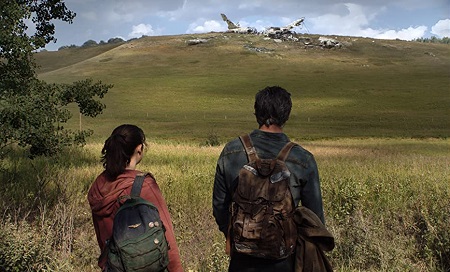
Ranking the Star Trek films

Spoiler Warning: There will be spoilers ahead for the films on this list.

One of the things people will ask about any franchise, really, is “what’s your favourite film in the series?” And it can be a difficult question to answer, especially in a franchise like Star Trek where the films tell different kinds of stories. Star Trek: The Motion Picture is a very different entity from its sequel, Star Trek II: The Wrath of Khan – and those are just the first two titles! The former is a more ethereal, slow-paced affair, whereas the latter is very much an action-sci fi film. People have preferences over which style they prefer, of course, and that’s to be expected, but comparing different styles of film and different kinds of stories is difficult. It’s like asking “do you like comedy or horror?” The answer can be “I like both”, or “it depends what I’m in the mood for in a given moment” – but neither of those answers makes for a satisfactory ranked list!

There have been, as of 2020, thirteen Star Trek films – with a fourteenth rumoured to be in the early stages of production. The films were released between 1979 and 2016, making Star Trek one of the longest-running film franchises, alongside such series as James Bond and Star Wars. The films have featured three different casts: the cast of The Original Series, led by William Shatner; the cast of The Next Generation, led by Sir Patrick Stewart; and most recently the reboot cast, led by Chris Pine. I have long felt that there is scope within the franchise for other crews to get a look-in; don’t get me started on the idea of a Deep Space Nine film or we’ll be here all day!

Initially I planned to do a proper ranked list, with each film in order from 1-13, but that was just too difficult. Instead I settled on this approach: the films will be split into four groups, which reflect their rough positions in my ranked list. There will be a bottom three, a lower- and an upper-middle, and a top three. Within the sections, films are listed in chronological order by year of release. It’ll make sense when you read it, don’t worry!

So without further ado, let’s rank the films!

The bottom three:

This wasn’t a particularly easy task, because generally speaking, I have enjoyed at least parts of all of the Star Trek films. While some of them do have issues in terms of things like plot, special effects, and dialogue, every single one has redeeming qualities that make for worthwhile and entertaining viewing. However, when considered alongside other offerings in the franchise, these are the films I feel are the weakest. Remember that these sections are in chronological order of release, not ranked in order of preference.

Star Trek V: The Final Frontier (1989)

Sybok, Spock’s half-brother, was introduced in The Final Frontier.

Where The Final Frontier arguably came undone was William Shatner’s involvement as writer and director. Due to contractual obligations with Paramount, after Leonard Nimoy had his turn in the director’s chair with The Search for Spock and The Voyage Home, William Shatner was able to exercise his right to write and direct his own Star Trek film. And he seized the opportunity to put Kirk at the centre of the story, as Sybok (Spock’s long-lost half-brother) used his power of pain removal to corrupt members of the Enterprise-A’s crew.

There were specific issues with some of the film’s visual effects, too, notably in its climactic final act. The “god entity” which Kirk and the crew encounter was widely criticised, even at the time, for being sub-par, and a now-infamous sequence with rock-aliens ended up being cut entirely from the film due to the visual effects being so poor. Shatner would blame this on using a new special effects company, as his first choice was busy on another project.

There are some great moments in The Final Frontier, though. The camping scene with Kirk, Spock, and McCoy was touching at points, and ended up being one of the last times we got to see the trio alone together before The Original Series era was over. The shuttle crash was also a high point for me, being sufficiently tense and dramatic. Scotty saying he knows the Enterprise “like the back of his hand” and then immediately walking into a bulkhead was genuinely funny – if slapstick. And finally, the setting of Paradise City on Nimbus III managed to perfectly convey that it was a run-down failure of a settlement – a metaphor for the peace initiative that it was founded for.

Star Trek: Nemesis (2002)

Nemesis would be the final outing for the crew of The Next Generation… until Star Trek: Picard brought some of them back!

Nemesis was, until January 2020, the furthest point in the main Star Trek timeline (except for some sequences set in the far future), and because of that I think its status may have been over-inflated. It isn’t a bad film per se, and it does try to tackle a number of different issues. Firstly, the premise of Picard vs Picard is interesting in theory, as is the film’s exploration of Romulan society and the introduction of the Remans. The Romulans had had a long presence in Star Trek, but Nemesis was the first time we’d seen them in such detail.

It’s often criticised for being “not very Star Trek-y”, with much of that criticism being aimed at its director, Stuart Baird, who admitted up front that he wasn’t familiar with the franchise when making the film. However, the main points about Picard being cloned, the Remans being telepathic, and the references to Deep Space Nine’s Dominion War story arc did, at least in my opinion, tie it to the rest of the franchise in an adequate way.

Data being killed off was also a point of significant criticism at the time, not just for the death itself but for how Data was handled in the story. Star Trek: Picard has recently rectified that – Data was able to have a proper goodbye, and it was shown how his legacy remains in the way his friends think of him. But for eighteen years the way Data’s death was handled was, for some fans at least, a bone of contention.

The buggy sequence at the beginning of the film – complete with a car-chase – was also something that many fans felt did not work. And it does, at the very least, feel like something that was shoehorned in rather than an organic element of the story.

Star Trek (2009)

Putting Spock and Kirk at odds with each other for much of Star Trek was seen as jarring by many fans.

Star Trek had been in continuous production for 19 years (or longer, depending on how we count things) when Star Trek: Enterprise was cancelled in 2005. For many, it felt like the end of an era and it seemed for a time that Star Trek was dead and not coming back. However, in 2006 rumours began circulating of a new film being in production, and this project – helmed by JJ Abrams – would eventually become Star Trek.

This film was a significant change from anything that had come before in that it was a stylised, action-heavy film – with some sci-fi trappings. The franchise had dipped its toes in the action-sci-fi world before (more on that in a moment) but for many fans, Star Trek took too much of an action-oriented approach to its story. While there were familiar elements – most notably the appearance of Leonard Nimoy as Spock – the time-travel and alternate universe elements of the story took a back seat to fighting and drama.

The decision to recast The Original Series characters, instead of using a new crew, was also a problem for some fans – I know several people who still, more than a decade on, have refused to see Star Trek simply for that reason. There were major aesthetic changes that went along with the recasting – notably the USS Enterprise itself, both inside and out. Many of the sets – which included a Budweiser brewery as the Enterprise’s engine room – simply felt very far removed from what had come before.

The recast crew behaved very differently to their Prime Timeline counterparts, which only added to the feeling that Star Trek was something radically different. The decision to have Kirk and Spock be at odds for large parts of the film may have given both characters a chance for development over the course of their arcs within the film, but was incredibly jarring to longstanding fans of The Original Series.

All in all, a combination of the various factors listed above came together to make 2009’s Star Trek a major change for the franchise. There are great moments in the film, but they’re interspersed with action sequences that would be more at home in another franchise.

The lower middle:

Leaving the weakest films behind we’re now approaching the middle of the road. All of the next four films have great moments – and a smattering of issues. They are, however, better than the ones we just looked at.

Star Trek III: The Search for Spock (1984)

The original USS Enterprise was destroyed in The Search for Spock.

For some reason, Star Trek III: The Search for Spock is the first film with The Original Series’ cast that I can remember watching. It’s possible I’d seen others while very young, but if so I can’t remember them. Because The Search for Spock is the middle part of a trilogy, I think some aspects of it were confusing in that first viewing!

I’ve mentioned a number of times on the blog, but my introduction to the Star Trek franchise, in the early 1990s, was The Next Generation. It wasn’t until later that I was introduced to The Original Series, and this film may well have been my first point of contact with its crew. So on a personal level, I think I have more of a connection to The Search for Spock than I otherwise might!

There’s a great villain here – Kruge, played by Christopher Lloyd of Back to the Future fame – and his relationship with Kirk, particularly in the latter stages of the film, is genuinely interesting. The death of David Marcus was also something shocking an unexpected for a Star Trek film of this era – particularly as he was a returning character from The Wrath of Khan.

The main thrust of the plot is somewhat convoluted, however. The idea of a death-and-rebirth narrative is interesting, but it’s also one which can be complicated and difficult to get right – as The Search for Spock shows in places. It also works to undermine Spock’s sacrifice in The Wrath of Khan, which was the emotional crux of that film. That’s not to say I want Spock to stay dead considering some of his subsequent appearances, but an immediate (or almost-immediate) resurrection can make a character’s death or sacrifice lose some of its impact, and I’m afraid that definitely happened here.

Star Trek IV: The Voyage Home (1986)

Scotty interacts with a 1980s computer while Dr McCoy looks on in The Voyage Home.

Time-travel stories are among my least-favourite in Star Trek. The mechanics of time travel are inconsistent across the franchise, with it being shown to be both something routine that starships are capable of as well as something technologically difficult or impossible to achieve. I also dislike stories where the crew travel to the present day, as I feel in every single case where it’s happened the stories have become dated.

The basic premise here is interesting, though, and it’s a great example of how Star Trek can use its science fiction setting to highlight real-world issues – in this case, the issues of pollution and a loss of biodiversity in the oceans. While the whale-probe was, I felt, visually uninspired and seeing the crew in the mid-1980s after travelling back in time dates the film considerably, there were some fun moments.

Scotty interacting with a 1980s computer was funny, as was the line about changing the timeline by giving someone the formula to make “transparent aluminum”. The franchise has always had a sense of humour, and after the very serious tone in both The Wrath of Khan and The Search for Spock, it was a welcome change to see a film which brought back these lighter moments.

Star Trek Into Darkness (2013)

Sulu, Kirk, and other bridge crewmen in Into Darkness.

In the months before Star Trek Into Darkness released, there was rampant online speculation about Benedict Cumberbatch’s character. Many fans correctly guessed that “John Harrison” was actually legendary Star Trek villain Khan, so going into the film having read all that the revelation didn’t surprise me as much as it should have.

However, Star Trek Into Darkness is, in my opinion, a decent homage to Star Trek II: The Wrath of Khan that manages to celebrate elements from that film without going too far and crossing the line into copying and ripping it off. Considering JJ Abrams would later cross that line – twice – in the Star Wars franchise, I’m thankful that he didn’t do so here.

Many of the issues I mentioned with 2009’s Star Trek are still present, but the Khan story always worked well in an action setting so I think that aspect of it, at least, can be forgiven. And despite the fact that we haven’t known this version of Kirk and Spock for very long, Kirk’s “death” in the Enterprise’s engine room was still an emotional hit in the same way Spock’s had been in the original.

Star Trek Into Darkness aimed to be a spiritual successor to Star Trek II: The Wrath of Khan and it did largely succeed. While it’s definitely the lesser of the two, it was a significant improvement over Star Trek, and remains for me the high-water mark of the JJverse trilogy.

Star Trek Beyond (2016)

Beyond’s release was overshadowed by the death of Anton Yelchin.

Star Trek Beyond is the most recent of all the Star Trek films (at time of writing). Director JJ Abrams left the franchise to focus on Star Wars, but his style was nevertheless present. Beyond attempted to move away from the high-octane action of Into Darkness and tell a story which focused on characters and the dangers of interstellar exploration.

There were some great visual moments – notably Starbase Yorktown, described as a “snow globe in space” – and the story did tie into some elements from Star Trek: Enterprise, which was a nice nod to fans. I also noted, in Chris Pine’s portrayal of Kirk, something that felt like a throwback to Jeffrey Hunter’s original Christopher Pike at the beginning of the film, as he deals with the heavy burden of command.

Penned by Simon Pegg, who also played Scotty, I appreciate what Beyond tried to do. It’s clear Pegg is a huge fan of the franchise, and that he wanted to tell a story that would have been at home in The Original Series. There were hits and misses in terms of the story, but he did an admirable job trying to nudge what was in danger of becoming an action franchise closer to past iterations of Star Trek.

One point I greatly disliked was Jaylah. Not the character herself, nor her portrayal, but the name. A homophone for “J Law”, aka actress Jennifer Lawrence, who at the time was famous for her role in The Hunger Games, I just felt that the reference was stupid and unnecessary.

Sadly, the film was overshadowed by the losses of both Leonard Nimoy and Anton Yelchin – the latter having taken over the role of Chekov, and was killed in an accident at the age of 27. While Nimoy’s passing was acknowledged in the film, the filming and much of the post-production work had already been completed at the time of Yelchin’s death, and while a simple message at the beginning commemorated him, some argued at the time that the producers behind Beyond should’ve done something more.

The upper middle:

Now we’ve arrived in the top half – and we’re finally looking at films which are good all-rounders. Any one of these could have broken into the top three, and they’re all films which I’m happy to go back to time and again.

Star Trek VI: The Undiscovered Country (1991)

The Undiscovered Country featured an assassination… and purple-blooded Klingons.

According to some rumours, The Undiscovered Country almost wasn’t made following the reaction to The Final Frontier two years earlier. However, the cast did reunite for a final outing – and this film finally saw them earn a decent pay packet for their roles. Gene Roddenberry saw The Undiscovered Country shortly before he passed away – and he hated it. It was a shift in tone from The Original Series, and he felt that presenting Starfleet as a military organisation, and in particular some of Kirk’s anti-Klingon racism had no place in his vision of the 23rd Century.

Regardless, his objections were overridden and what resulted was a much better film – in my opinion – than any other since The Wrath of Khan. Kirk’s portrayal was humanised by his flaws and failings, and the plot was dramatic and tense as a conspiracy within Starfleet – aided and abetted by the Romulans and some within the Klingon Empire – sought to disrupt a budding peace initiative.

The film’s special effects were great – and many even stand up today. The “Praxis Effect” is named for a location from The Undiscovered Country, and has been used many more times in subsequent pictures, which is certainly a testament to that particular visual effect!

The final scenes of the film are especially touching, as it was clear even at the time that this was to be the final outing for the cast. Kirk, Scotty, and Chekov would return in Star Trek: Generations and of course Spock was back in the JJverse, but this was the last time the full cast were together, and the ultimate finale of The Original Series in that respect.

Star Trek: First Contact (1996)

The events of First Contact had a huge impact on Picard.

A lot of people (of my generation, at least) would surely pick First Contact as their favourite Star Trek film. It’s often held up alongside The Wrath of Khan as one of the absolute best, and it’s hard to disagree with that assessment.

Picard is forced to confront the worst moment in his past when the Borg return, hell-bent on assimilating Earth once again. Though defeated in the Battle of Sector 001, the Borg and the Enterprise-E travel into Earth’s past – specifically to the day where humans and Vulcans made first contact.

Sir Patrick Stewart gives what is one of his best performances both inside and outside of Star Trek here, as Picard is haunted and overwhelmed by his history with the Borg. And the Battle of Sector 001 was one of the franchise’s best space battles – the last-minute arrival of the Enterprise still gets me even though I’ve seen it countless times!

Worf, who was a regular on Deep Space Nine at this point, did feel like he’d been shoehorned in as temporary captain of the USS Defiant, but that didn’t really detract from things. While I freely admit time-travel is not my favourite premise, because the setting was still in the future – the year 2063 – it didn’t feel awkward in the way some episodes and films do. And seeing humanity’s first warp flight, as well as learning a little more about the events in Earth’s history prior to the founding of the Federation was interesting!

Star Trek: Insurrection (1998)

Insurrection showed us Riker and Geordi as we don’t usually see them!

I feel like Insurrection gets an unfairly bad rap. While it could be argued that there were sillier elements to the film’s “fountain-of-youth” story, I feel like the points people often criticise about some of the behaviour of the main characters are actually the things I enjoyed most.

Picard and his crew travel to the Briar Patch, where Data has malfunctioned and gone rogue, exposing a secret Federation mission to observe a humanoid race. It turns out that the observation mission was simply a cover to harvest the planet’s life-preserving natural wonders – a scheme dreamt up by a rogue Admiral and a race called the Son’a. In what could be considered a mutiny, the crew race to save the planet’s inhabitants.

This kind of story, where a small crew has to work outside of the law to do the right thing, is exactly my jam. I love these kinds of stories – both inside and outside of Star Trek – so Insurrection was great for me. It also marked a change from seeing Picard and his crew as totally straight-laced, giving them freedom to let their hair down a little. It’s primarily for that reason – the crew seemingly acting “out-of-character” – that some people don’t like it, and I do understand and respect that. Sometimes that can be jarring. But in the context of Insurrection’s story, I just feel that it worked. And as a film that wasn’t just an action-fest but that told a story with heart, I feel that it captured perfectly the spirit of what Star Trek has always tried to be. Insurrection is the kind of story that could have been an episode of The Next Generation – which is why I like it.

The top three:

This is it, then! Out of all of the Star Trek films, we’ve arrived at my personal favourites.

Star Trek: The Motion Picture (1979)

Seeing the Enterprise for the first time in The Motion Picture is one of my favourite sequences in all of Star Trek.

Last year marked The Motion Picture’s fortieth anniversary. I wrote an article to commemorate the occasion – you can find it by clicking or tapping here. In short, The Motion Picture succeeded for me for several reasons. Firstly, as a slower-paced, ethereal story with a message, I feel that it fits in perfectly with what Star Trek is and aspires to be. Secondly, it set the stage for Star Trek coming back into the popular consciousness in a big way, and launched the franchise into the 1980s – the decade which would see several good films and a return to television with The Next Generation. Thirdly, much of the aesthetic of Star Trek, things we consider inseparable from the franchise, had their roots here – not in 1966. The sets built for The Motion Picture would be in continuous use on other Star Trek projects for years afterwards, in some cases right up to the cancellation of Enterprise in 2005.

The Motion Picture succeeded in bringing Star Trek back. And while it may not be everyone’s favourite, if it weren’t for the modest success it enjoyed in 1979 and early 1980 there would have been no more films, and probably no additional series either. Star Trek would have fizzled out and would be remembered today as a cult 1960s show with one failed film. That isn’t the case – and everything that’s happened in the franchise since 1979 has happened on the back of what The Motion Picture did.

As a story, I like that it’s not about defeating or killing an enemy. Instead, the climax of the film is about understanding, merging, and the creation of new life. Star Trek set out to seek out new life – and The Motion Picture showed us that the new life we might discover out in the cosmos could be almost entirely beyond our understanding. But despite that, Kirk, Spock, and the crew managed to bridge the gulf, solve a mystery, and save the Earth in the process.

While The Motion Picture may be, in some respects, dated from an aesthetic point of view (some sets and costumes are very seventies!) I do like some of the visual sequences. When Kirk and Scotty travel by shuttlepod to the refit Enterprise, it’s a genuinely emotional moment to see the ship in all its glory. And the music adds to that. While we’ve come to know The Motion Picture’s theme better as the theme to The Next Generation, it debuted here, as did Star Trek’s “golden age”.

Star Trek II: The Wrath of Khan (1982)

Kirk in the captain’s chair in The Wrath of Khan.

The Wrath of Khan needs no introduction. For many fans, this is the best film that the franchise has to offer – and arguably it’s the best story featuring the cast of The Original Series. Supervillain Khan returns, having been exiled by Kirk in Season 1 of The Original Series, and he’s determined to have his revenge.

The maroon uniforms that debuted here are among the franchise’s best, and aesthetically the film looks amazing. Some moments have been dated somewhat by the passage of time, but the recent 4K rerelease still held up on my television at least!

Featuring some amazing performances, including from Ricardo Montalbán, who reprised his role from The Original Series, The Wrath of Khan is a classic revenge tale in a 23rd Century setting. There are some amazing twists along the way as the Enterprise is catastrophically damaged, Kirk and his crew end up trapped inside a planetoid, and a project created by Starfleet scientists for the purpose of terraforming is co-opted and turned into a weapon of mass destruction.

The Battle in the Mutara Nebula was arguably Star Trek’s best ever space battle at the time – inspired by classic war films set on submarines, it was a claustrophobic, edge-of-your-seat ride as the damaged Enterprise tries to hide from and battle Khan’s USS Reliant. Both ship designs are now considered iconic in the franchise. The battle still holds up today, even compared to the franchise’s more recent offerings.

Spock’s sacrifice is hard to put into words. Though we now know he survived – after a fashion, anyway – the raw emotional moment of seeing him die in front of his friend, and then be launched into space, is incredible. Both Leonard Nimoy and William Shatner are outstanding here, and while Shatner in particular can be justly criticised for some of his performances in The Original Series, any critic should look at this film and the sequence with Spock in particular before writing him off.

Star Trek: Generations (1994)

Generations saw Kirk and Picard team up.

Dr McCoy made a cameo appearance in The Next Generation’s premiere, and both Spock and Scotty would also crop up in later seasons. However, for the most part, the show trod its own path and stayed clear of The Original Series. This was a good decision overall, as allowing the franchise the opportunity to flourish without its original crew arguably opened the door to its future success. But by 1994, The Next Generation was over as a series – Deep Space Nine and the soon-to-premiere Voyager were continuing in the 24th Century. It was also approaching Star Trek’s 30th anniversary, and so it was decided to bring together the two different eras and tell the ultimate crossover story.

Seeing Kirk and Picard together on screen, working in common cause, was amazing. It’s absolutely one of the high points of the franchise for me personally, as both characters are fantastic. Both Sir Patrick Stewart and William Shatner are on top form, and Kirk’s death toward the end of the film was a truly heartbreaking moment. The early part of the film also explored a small portion of the unseen years in between The Original Series and The Next Generation – an era which, I’d argue, would make for an interesting prequel film or series.

Malcolm McDowell plays Soran, who is a devious and truly impressive villain, and the film ties itself neatly to The Next Generation with the return of the Duras Sisters. Kirk’s death wasn’t the only devastating loss in Generations, either, as we also have to say goodbye to the Enterprise-D after seven years. Just as in The Search for Spock a decade previously, the loss of the Enterprise was a genuinely emotional moment.

Star Trek can tell deeply emotional stories – and Picard’s arc in the film as he loses his only remaining blood relatives, and is then tempted by the Nexus giving him a family of his own is a great example of this. The Nexus itself, and how exactly it works, is left a little ambiguous as of the end of the film, but it managed to avoid the trap of The Final Frontier and stay clear of portraying it in a quasi-religious way, even though the whole story with Soran being desperate to get back can, in some ways, be taken as an analogy for religious zealotry.

As a fan of both The Original Series and The Next Generation, and both captains, this crossover story always feels fantastic.

So that’s it.

I managed to get the films into some kind of vague ranking! It wasn’t an easy task, because on a given day I might have a craving to sit down and watch The Final Frontier or Star Trek Beyond, and even though I don’t consider them as good as others in the franchise, they still have enjoyable moments. When films in a series can be so different from one another, it can be hard to pin down which ones are subjectively “better”.

Nevertheless, I gave it my best shot!

The Star Trek franchise, including all films mentioned above, is the copyright of ViacomCBS. This article contains the thoughts and opinions of one person only and is not intended to cause any offence.
Inappropriate things to watch while self-isolating

Spoiler Warning: There may be spoilers ahead for the titles on this list. If you haven’t seen one and want to be certain of avoiding spoilers, skip ahead to the next entry just to be safe.

Depending on where you are in the world, you may have been suggested, requested, or outright forced into self-isolation as a result of coronavirus. I’m one of the people you’re keeping safe by self-isolating – I have a fairly complicated set of health issues, several of which tick the boxes for putting me at greater risk from the illness. So thank you for helping to keep me safe, I appreciate it!

But being stuck at home is awful if you aren’t used to it, so as a way of saying thanks for staying indoors and limiting the spread of this disease, here are a few television series and films that would make for highly inappropriate quarantine viewing.

Film #1: Contagion (2011)

Bodies being buried in mass graves in Contagion.

Contagion takes a realistic approach to a global pandemic, focusing on the doctors and scientists leading the response and trying to find a cure. It demonstrates how a pandemic can easily get out of control, and how those tasked with leading the response can be just as in the dark as everyone else in the early stages of an outbreak. There’s a great performance from Lawrence Fishburne in particular.

Film #2: I Am Legend (2007)

Will Smith in I Am Legend.

A scientist attempting to find a cure for cancer accidentally releases a pathogen which kills more than 90% of the world’s population and turns almost all of the rest into zombie-like creatures. Dedicated to his research, he stays in an eerily abandoned New York City trying to reverse the effects. I Am Legend is, in parts, a very emotional film, and its ending, while deliberately ambiguous, seems to suggest that the zombies were a lot more “human” than they were given credit for.

Film #3: 28 Days Later (2002)

London is deserted in 28 Days Later.

A man wakes up from a coma in a hospital to find it deserted and the world outside ravaged by zombies. No, this isn’t television’s The Walking Dead, but it’s 28 Days Later, a film directed by Danny Boyle. Set in the UK in the aftermath of a virus called “rage” that turns people into living zombies, a small group of survivors look to escape London and find safety.

Film #4: World War Z (2013)

Brad Pitt in World War Z.

This Brad Pitt-led film gets somewhat of a bad rap, perhaps because it was so different from its source material. As a zombie infection begins to spread, a scientist must travel across the world in search of a cure. Things get progressively worse as society collapses around him.

Film #5: The Road (2009)

Father and son share a drink in The Road.

Not specifically about a virus – though that could perhaps be the cause of The Road’s unspecified disaster – this film focuses on a father and son as they try to survive in the aftermath of an apocalyptic event. A strongly character-driven story looking at a dark, gritty post-apocalyptic environment where people will do anything to survive, it’s a fascinating, if depressing, film.

Film #6: The Shining (1980)

Jack Nicholson in one of cinema’s most iconic scenes.

What better to watch when stuck in place with no one to talk to than a film about a man being driven insane by being stuck in place with no one to talk to? This adaptation of the Steven King novel is a classic, and one of Jack Nicholson’s most legendary performances. It recently spawned a sequel – Doctor Sleep – but that film didn’t seem to have recaptured the magic.

Film #7: The Purge (2013)

Masked attackers terrorise a family in The Purge.

If you want to torture yourself with fears about being burgled and having your home broken into in these days of a supposedly limited police response to what they deem “less-important” crimes, why not check out 2013’s The Purge? In an America which has solved crime by legalising crimes for one night of the year, the film sees a family hunker down in their home as criminals try to break in. Can they survive the night?

Film #8: The Hole (2001)

Teenagers trapped underground in The Hole.

A group of teenagers end up locked in an underground bunker after a party goes wrong. They begin to run out of food and medicine while trapped, unable to leave the “hole” – they should’ve stockpiled toilet paper and pasta. A deeply claustrophobic film, The Hole is perfect quarantine viewing!

Television series #1: Survivors (2008)

Abby wakes up in a post-apocalyptic world in Survivors.

A small group of people must survive in a post-apocalyptic UK, after a disease has ravaged the world and killed the vast majority of the population. The disparate group must pull together to overcome obstacles in the world the virus has left behind, and contend with people who become incredibly selfish in the face of survival. As a show that examines the duality of human nature in the face of disaster, Survivors is a fascinating look at the post-apocalypse.

Television series #2: The Andromeda Strain (2008)

A dead body in The Andromeda Strain.

A loose adaptation of a Michael Crichton novel, The Andromeda Strain is a miniseries which looks at a disease that comes from space – an extraterrestrial microbe. Naturally humanity has no immunity or resistance to the infection, as it comes from space, and it quickly spreads through an American town. Primarily focused on the government response, the miniseries looks at how a situation can spiral out of control.

Television series #3: The Last Ship (2014)

The USS Nathan James in The Last Ship.

This show made my list of the top ten shows of the 2010s a few months ago, and for good reason. It’s a fascinating look at survival and rebuilding in a global pandemic. The action is focused on the crew of the USS Nathan James, a US Navy ship which is tasked with researching and curing a disease called the “red flu”. During Season 1, it becomes clear to the crew that the virus is far worse than they imagined and that society is on the precipice of collapse. Along with lone virologist Dr Rachel Scott, Capt. Chandler and his crew race to find a cure before it’s too late for humanity’s remaining survivors, but they must contend with a Russian ship which is also researching the disease. Later seasons introduce other antagonists, like the crew of a rogue submarine and pirates in East Asia, and look at how American society is slowly being rebuilt.

Television series #4: Pandemic: How to Prevent an Outbreak (2019)

Title card for Pandemic.

I actually have a review for this series already posted on the blog – you can find it by clicking or tapping here. A documentary looking at various aspects of pandemic prevention, including attempts to synthesise a general cure for all kinds of flu, Pandemic is an interesting look at its subject matter – if somewhat politically slanted and limited by its focus on specific individuals. It attempts to be a broad overview of the subject matter, and although an incomplete picture, it is genuinely interesting.

Television series #5: The Stand (1994)

Gary Sinise in The Stand.

Based on a Steven King novel, this miniseries looks at the accidental release of a biological weapon based on influenza, which is rapidly spread across the United States. The disease has a massive death toll, leaving only a few survivors worldwide. The miniseries featured some great performances from actors who either were big stars already or who would go on to find further fame later on, like Gary Sinise, Rob Lowe, and Molly Ringwald.

Television series #6: Helix (2015)

Promotional image for Helix.

Helix is one of those shows that starts off great but gets progressively worse as its story progresses. At a remote research station in the Arctic, a disease has infected a number of scientists and workers. A team from the CDC is dispatched to bring the infection under control, and the plot then spirals into a zombie story, a family drama, and a global conspiracy of silver-eyed immortals. Jeri Ryan (Seven of Nine from Star Trek: Voyager) guest stars, and the cast is led by Star Trek: The Next Generation guest star William O. Campbell.

Television series #7: The Strain (2014)

One of The Strain’s vampires.

The way this vampire story unfolds – particularly in its first few episodes – focuses very much on how the infection spreads from one “master” vampire to everyone else. Focusing on a CDC doctor in New York City, this show has a great cast – including David Bradley, whose performance is outstanding – and is a fun bit of fantasy-horror in a modern setting.

Television series #8: Twelve Monkeys (2015)

Title card for Twelve Monkeys.

Based on a film from the 1990s, Twelve Monkeys is a time-travel series that starts off with a fascinating premise: a man must travel to the present day from a future where a deliberately-released disease has killed off most of humanity. Over the course of the first season, the time-traveller unites with a doctor from our time to track down the source of the virus. Later seasons go off the rails and stop looking at the disease, focusing on a conspiracy to destroy time itself(?) at which point I stopped watching. But the first season in particular is outstanding and thoroughly worth a watch.

Video game #1: The Last Of Us (2013)

Promotional image for The Last Of Us.

Another one of my top tens of the 2010s, this time in the video games category, The Last Of Us is essentially a road trip that sees a man escort a young girl across America, twenty years after a fungus-based disease brought down society. In a few secure locations, some semblance of the American government still exists, but for the most part it’s everyone for themselves out in the wilderness. There are some beautiful locations for players to explore – even though the game was released on last generation’s PlayStation 3. And not to spoil anything, but the final act of the game is incredibly emotional and a great example of a videogame telling a story that would be just as at home on the big or small screen.

Video game #2: Plague Inc. (2012)

Promotional screenshot for Plague Inc.

Now available for PC, this game started on smartphones just at the right time, when phones were taking off and becoming a legitimate gaming platform. Rather than taking on the role of humans facing a disease, Plague Inc. sees players take on the role of the disease itself. There are various types from viruses to bacteria to fungal spores, and diseases must be upgraded in order to achieve the goal of wiping out humanity. Striking the right balance between being sufficiently contagious, able to remain undetected, severe enough to cause mass deaths, and able to adapt to and outsmart human researchers is no easy challenge – so be prepared for a lot of defeats before you’re finally able to get your version of coronavirus to kill everyone.

Star Trek has looked at diseases, quarantines, and issues surrounding isolation at many points in its history, so as an addendum to the main list, here are a few episodes from various iterations of the Star Trek franchise which would also make for inappropriate self-isolation viewing!

Star Trek episode #1: The Conscience of the King (The Original Series, 1966)

Kirk must solve the riddle of this man’s identity.

Years before he assumed command of the Enterprise, Captain Kirk was resident on a colony which ran out of food. In an attempt to save lives, the colony’s governor condemned half of the population to death so that the remaining food could be rationed among the other half – those he deemed worthy of survival. When a man beams aboard the Enterprise who may be the tyrannical governor, Kirk must put the pieces together.

Star Trek episode #2: The Deadly Years (The Original Series, 1967)

A terrified Chekov in The Deadly Years.

Several senior Enterprise crew members are afflicted with a disease which causes rapid ageing. Dr McCoy and his medical staff must try to find a cure – before it’s too late! Not even Spock is immune, and it seems as though the ship and its entire crew are in danger.

Star Trek episode #3: Starship Mine (The Next Generation, 1993)

Picard talks to the mercenaries in Starship Mine.

Trapped alone aboard a deserted Enterprise-D, Picard must contend with intruders set on stealing a byproduct of the ship’s warp drive. Without any of his friends or crew to help, Picard must outsmart the mercenaries using only what he can find on the deserted ship. Starship Mine is actually one of my favourite episodes of The Next Generation.

Star Trek episode #4: Genesis (The Next Generation, 1994)

Barclay attempts to diagnose himself, kicking off the events of Genesis.

An attempt to cure a case of the flu goes horribly wrong, resulting in the “de-evolution” of the Enterprise-D’s crew into various inhuman monsters. Picard and the immune Data must synthesise an antidote before it’s too late!

Star Trek episode #5: Armageddon Game (Deep Space Nine, 1994)

Chief O’Brien is in a bad way in Armageddon Game.

Infected with a biological weapon, O’Brien is dying and trapped in hostile territory with Dr Bashir. This episode would mark a major milestone in the friendship of these two characters, whose relationship would be a significant factor in later seasons of Deep Space Nine.

Star Trek episode #6: The Quickening (Deep Space Nine, 1996)

Dax and Bashir work on a cure.

The Dominion used a biological weapon (the titular “quickening”) to punish a wayward planet. Dr Bashir attempts to find a cure for the disease, which can cause rapid death, in an episode which was an interesting look at how doctors cope with an “unwinnable” situation.

Star Trek episode #7: Phage (Voyager, 1995)

Tom Paris and The Doctor work to help Neelix in Phage.

Voyager encounters the Vidiians, a species suffering from a centuries-long plague which causes their bodies to rot. They survive by becoming pirates, capturing others and stealing body parts to replace their own disease-ravaged ones. The Phage would crop up several times in Voyager, and despite the best efforts of the crew they never managed to find a cure.

Star Trek episode #8: Year of Hell, Parts 1 & 2 (Voyager, 1997)

The USS Voyager suffers extensive damage in the two-part episode Year of Hell.

A time-travel story in which the Voyager crew see their ship constantly attacked and running out of energy and resources. Crew members die and become maimed, the ship falls apart and whole sections become uninhabitable, and resources dwindle to the point where Capt. Janeway gives the order to abandon ship.

Star Trek episode #9: A Night in Sickbay (Enterprise, 2002)

Porthos in A Night In Sickbay.

Capt. Archer’s beloved pet dog becomes ill with an alien virus, and he spends a tense night in sickbay with Dr Phlox as they wait to see whether Porthos will pull through. A Night in Sickbay is a surprisingly emotional episode that any pet owner can relate to.

Star Trek episode #10: Observer Effect (Enterprise, 2005)

Sato and Tucker suffering from the effects of a virus.

Sato and Tucker are infected with a silicon-based virus in this Enterprise episode, while the crew are being observed by a noncorporeal race who want to see if they can figure out a cure in time. Observer Effect served as a semi-prequel to The Original Series episode Errand of Mercy, featuring the same alien race.

So that’s it. I hope we can all stay safe and well during these strange times, and if you are told to stay at home please follow the instructions of the authorities in your local area. I know it can be frustrating and that “cabin fever” is a real sensation, but if we all comply we’ll all come out the other side and life can get back to normal.

Staying at home isn’t just for your own selfish benefit – it helps people like me, who have health issues and would be more likely to suffer complications from coronavirus. It also helps doctors, hospitals, and healthcare providers to not become overwhelmed with tens of thousands of cases all at once. I’ve seen lots of people, including in some major national newspapers, arguing that because coronavirus is “not that bad” that everyone should just carry on as normal. And while we should all certainly be avoiding panic-buying, things cannot carry on as normal, at least not in the short-term. By staying in, avoiding as much contact with people as possible, and maintaining a high level of hygiene, we can slow the spread of the disease which will relieve the pressure on hospitals and allow more time for the development of a vaccine. Staying at home isn’t actually all that difficult, especially with YouTube, Netflix, Disney+, digital videogame platforms, hundreds of television channels, and the entire internet providing us with so much to do.

If none of the shows, films, or episodes I’ve semi-jokingly listed seem like something you’re interested in, then stay tuned because I’ll be bringing you more lists and reviews of things to watch while you’re stuck indoors. Once again, I urge all of my readers to follow local advice and requirements, and do what you’re told to avoid making things worse and inadvertently spreading this nasty disease to others.

Stay safe everyone!

All episodes, games, television series, and films listed above are the copyright of their respective studios, publishers, distributors, producers, etc. This article contains the thoughts and opinions of one person only and is not intended to cause any offence.

Predicting the 2020 Academy Awards (aka my picks for the Oscars)

Picture Credit: oscar.go.com

Because my health has been poor for some time now, I don’t get to the cinema any more. Which is unfortunate – not because I miss the “cinema experience” particularly, though going to see films with friends was an important part of my youth – but because it means I almost always end up seeing films several months after their release! By that point any hype and buzz has died down, and the conversation online has shifted to newer titles.

Nevertheless, as someone who follows the world of cinema and entertainment, I do stay as up-to-date as possible with at least some of the latest titles, and with the 92nd Academy Awards now a mere three days away, I wanted to have a first ever attempt at the longstanding tradition of making predictions!

You know how this works – I’ll make a few guesses at who might win in a few of the biggest categories. And then when we get the actual results on Sunday night (Monday morning here in the UK) you can have a good chuckle at how wrong I was!

My choices are from a combination of films I’ve seen and films I only know by reputation and review. These picks try to stay true to what I think the Academy will choose, but of course my own biases come into play as will my own hopes and preferences.

Let’s get started!

Best Visual Effects: The Lion King

This one might be a controversial choice. Should 2019’s The Lion King count as an animated film or not? I’d absolutely argue that it does – any film made using entirely digital creations is, by definition, a computer-animated film is it not? Notwithstanding that argument, the CGI used in The Lion King was outstanding. The animals and the environments looked photorealistic, such that it was impossible to tell you were looking at something wholly artificial.

This is a new direction for cinema. We’ve seen glimpses at this in other titles – 2016’s Rogue One springs to mind with CGI recreations of actors – but never quite on this level. For me personally, The Lion King was actually the worse for going down the route of extreme realism. In what should have been a fun kids’ film, with a story that is a modern-day Disney classic, the photorealism detracted from the story and the performances. Whether that’s simply because it’s something we’ve never seen before is a good question.

However, for me at least, I felt that the original film had much more character to it. It had more soul, more heart, and a uniquely “Disney” visual style. Whether photorealism will catch on for animation in a big way is thus something I’d question. The style and techniques used could absolutely feature in other titles, though, to supplement physical actors and props. The visual effects seen in The Lion King are unparalleled, and set an incredibly high bar for future titles to reach.

Best Film Editing and/or Best Cinematography: 1917

War epic 1917 had been on my radar for ages as one of the films I’ve been most interested in. It wasn’t until fairly recently, however, when director Sam Mendes was giving interviews regarding the film in the run-up to its release, that I learned how visually different the film was going to be.

1917 is filmed as if it were one continuous take, with the action following two British Army soldiers who are tasked with delivering a message to call off an attack and save lives. The film follows their journey through enemy-held territory to deliver the message in time, and was inspired by Mendes’ grandfather’s service in the First World War.

I think it’s absolutely up for Best Film Editing, but it could also nab Best Cinematography on the back of this incredibly ambitious one-take effect. It’s certainly something which is unique among 2019’s films, and the Academy loves uniqueness! There’s also a personal story – Mendes has talked at length in interviews about his grandfather, and because the First World War affected so many people, many families will have a connection to someone who fought in that conflict.

Best Original Song: (I’m Gonna) Love Me Again from Rocketman – Elton John & Bernie Taupin

Rocketman was very much a poor second to the other great musical biopic of the last couple of years, Bohemian Rhapsody. However, (I’m Gonna) Love Me Again, which was written specifically for the film, has picked up a lot of buzz when it comes to winning Best Original Song – picking up the Critics’ Choice Award and Golden Globe in this category, which are often seen as good indications for the Oscars.

As an interesting aside, the song I’m Standing With You – a competitor in the Best Original Song category – was written by Diane Warren, who penned Faith of the Heart, the theme song to Star Trek: Enterprise. The film it’s taken from, Breakthrough, was directed by Roxann Dawson, who is of course well known for playing B’Elanna on Star Trek: Voyager. As a Star Trek fan I wish them good luck, but it looks like (I’m Gonna) Love Me Again has this one in the bag!

Best Documentary: The Edge of Democracy

If you’ve been reading my articles for a while, you’ll know that I’m a big fan of documentaries as a genre. This year it’s interesting to see that all of the contenders in the Best Documentary category are foreign films, either wholly or partially in a foreign language. Of all of these, The Edge of Democracy is one that I think has a great deal of relevance.

Documenting the crisis in Brazilian politics, with a focus on the fall of Brazil’s last two presidents and the rise of Jair Bolsonaro, there are some parallels for the United States considering that Bolsonaro is called “the tropical Trump”, and his politics are somewhat comparable to the current American president.

Because it’s been on Netflix, and the Academy hasn’t always appreciated that, it might arguably be more of a long-shot, but I think the political themes present in The Edge of Democracy might push a few extra votes its way.

Best Animated Feature Film: Missing Link

There are some great animated films in the running this time. Netflix’s Klaus was a really cute Christmas film, but as mentioned above the streaming service isn’t exactly popular with the Academy. There was also Toy Story 4, the latest in that series and which was well-received, and of course the debate over whether The Lion King counts or not! But the Academy likes something different, and in an era of CGI and computer-aided animation, Missing Link absolutely fits that bill.

A stop-motion film with a great cast that unfortunately didn’t fare well upon release, Missing Link was nevertheless very well received by critics, and is exactly the kind of underappreciated, somewhat different and artistic film that the Oscars often like to honour. If it were to win, it would be the first stop-motion film, and the first film not to be computer-animated, to do so since the 78th Academy Awards in 2006.

Best Adapted Screenplay: Joker

Spoiler alert for the end of the list, but I don’t think Joker is going to be crowned Best Picture. To throw a bone to the superhero/comic book film genre though, it could well be awarded Best Adapted Screenplay instead.

Several high-profile folks in the film industry, like director Martin Scorsese, have gone on record saying that comic book films “aren’t real cinema” – a kind of artistic snobbery looking down on what “common people” like to watch, quite frankly. As a result, many comic-based films which have been hugely popular have ended up missing out on the industry’s top awards. And I don’t expect Joker to break the mould and win the top awards, but as the Academy often does, they may see fit to dish out a “lesser” award like Best Adapted Screenplay, or one of the Supporting Actor/Actress gongs.

Even though I’m not a particularly big fan of comic book films as a whole, there are some great films that have emerged from the genre, and Joker is absolutely among them. The film deserves some kind of recognition at least, and I think this could be one way of acknowledging it.

Best Original Screenplay: Knives Out

This one is going to be controversial in some circles because Rian Johnson is involved. Some Star Wars “fans” have been incredibly hateful toward the director of The Last Jedi; hate which is still present more than two years after the release of the middle part of the Star Wars sequel trilogy. Though I personally think that The Last Jedi was a good film, the trilogy as a whole has been a bit of a mess – you can find my thoughts on the production of the trilogy by clicking or tapping here if you’re interested to read more.

But Rian Johnson’s most recent project has been Knives Out, a murder mystery film featuring an ensemble cast. I don’t want to spoil the plot but the film has been incredibly well received by critics for its writing and sense of humour in particular, as well as the mystery and the “whodunnit” nature of the film. These elements in particular lead me to think it could be in the running for Best Original Screenplay, and from a personal perspective it would be a hilarious middle finger to some of the Star Wars haters, and that would really just be the icing on the cake!

Best Supporting Actor: Tom Hanks for A Beautiful Day in the Neighborhood

Tom Hanks in the trailer for A Beautiful Day in the Neighborhood.

Growing up in the UK, I wasn’t aware who Fred Rogers (better known as Mister Rogers) was. But over in the United States its not unfair to say he’s a cultural icon – someone who many Americans will be familiar with from their childhoods. His long-running show, Mister Rogers’ Neighborhood, was a mainstay of preschool and young childrens’ television for more than three decades, and Tom Hanks’ portrayal of the legendary figure in A Beautiful Day in the Neighborhood has received almost universal acclaim.

Hanks is one of contemporary American cinema’s greatest actors, and has performed some incredible roles in his career. He’s already claimed two Academy Awards for Best Actor – for Philadelphia and Forrest Gump. A combination of Hanks’ performance with the nostalgia and wholesomeness of Mister Rogers could absolutely net him his first award in the Best Supporting Actor category this time around.

Best Supporting Actress: Scarlett Johannson for Jojo Rabbit

Scarlett Johannson in the trailer for Jojo Rabbit.

Jojo Rabbit looks like an incredibly funny film – with a very serious subject matter. That can lead to a jarring disconnect for some viewers, and until I’ve seen it for myself it’s hard to judge. However, Scarlett Johannson has picked up incredibly strong support from critics for her role in the film, and could well be in with a shot here.

Interestingly, she could be the first ever actress (or actor of any gender) to win both Best Actress and Best Supporting Actress in the same year if she also wins for her role in Marriage Story. I’m not convinced she will, but the Academy does like to surprise us sometimes, so you can never tell!

Best Actor: Adam Driver for Marriage Story

Adam Driver in the trailer for Marriage Story.

Adam Driver is a phenomenal actor, and the range he shows in Marriage Story is incredible. I mentioned the Star Wars sequels earlier, but they lucked out to get someone of Driver’s calibre to play Kylo Ren.

Marriage Story being on Netflix may count against him here, unfortunately, and there has been a tidal wave of support for Joaquin Phoenix’s role in Joker. But the Academy doesn’t always like to follow trends, and if they decide to stay away from Joker for whatever reason, Adam Driver could still be in the running.

Best Actress: Saoirse Ronan for Little Women

Saoirse Ronan in the trailer for Little Women.

After being nominated twice before, for her roles in Brooklyn and Lady Bird, I think this could finally be Saoirse Ronan’s year. Little Women is perhaps an under-appreciated film from a popular point of view, but her performance has won praise across the board.

After having been nominated and rejected twice, she’s also in a strong position to stake a claim this time around. The Academy can be quite particular about bringing in a younger actor or actress into the club of Best Actor/Actress winners, but as she’s a little older and more experienced now than she was when nominated for her previous work, this could absolutely be her moment.

Best Director: Bong Joon-ho for Parasite

Parasite has been an incredibly well-received film. It would be a rarity for the Best Director award to go to the director of a non-English film, but with all the buzz surrounding Parasite it could very well happen this time.

The film looks at social class, and the division between classes. In that respect it’s not dissimilar to Bong’s other significant film Snowpiercer – which, by the way, is set to be remade as a television series soon.

The Oscars in recent years have been plagued by accusations of racism and racial bias keeping non-white actors and directors away from the biggest awards, and there could well be a swing toward giving one of the top awards to Bong Joon-ho and Parasite as a counter to that argument. Members of the Academy will, at the very least, be aware of the criticism.

But Parasite and Bong’s direction are absolutely worthy of an award in their own right, and after winning the Palme d’Or at Cannes, as well as many other awards, it could be a great night for the director at the Oscars too.

Best Picture: 1917

This award could absolutely go to Parasite as well, or the Academy could surprise me and give it to Joker. But as mentioned above, 1917 is a unique and visually distinctive film, one which I think has the potential to become a classic of the drama and war genres that people will be coming back to for decades.

Sam Mendes won for American Beauty twenty years ago, but hasn’t featured prominently at the Oscars since. This could definitely be his second win, though, because the Academy likes nothing better than a unique film with a dramatic premise.

There’s also that personal side, the story from the director’s grandfather, which paints a picture of 1917 as an homage to the First World War generation but with a distinctly personal take. In terms of being something altogether different from the other titles in contention, 1917′s appeal is cemented.

So that’s it. My predictions or picks for the 2020 Academy Awards. We’ll have to wait a few days to see if I’m right!

All films mentioned above are the copyright of their respective studio and/or distributor. The 92nd Academy Awards ceremony takes place on Sunday the 9th of February at 5pm local time – 1am on the 10th of February in the UK. This article contains the thoughts and opinions of one person only and is not intended to cause any offence.
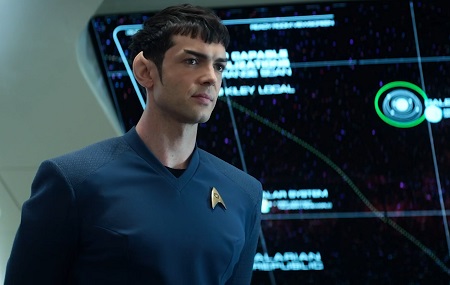
A festive list to get you in the holiday spirit!

Spoiler Warning: There are some minor spoilers ahead for the titles on this list.

Tis the season to be jolly… and all that. There are some fun Christmas films and television specials, and with it being only four days till the big day, I thought I’d share a few of my favourites. I’m sure most will be familiar to you, but they’re all worth a watch at this time of year.

With all of the controversy around projects like Star Wars, it’s nice to kick back with an old favourite at this time of year. Some of the titles below are full-on guilty pleasures, the kind of film you’d never watch if it wasn’t Christmas-themed. But there’s nothing wrong with that every once in a while.

These titles are in no particular order, but it’s a list so I had to number them.

Number 1: Carols From King’s (Annual)

Title card for Carols From King’s.

I’m by no means a religious person. In fact, I can’t remember the last time I set foot in a church. But when I was at school, every Christmas just before the end of term we all trooped down to the local church and attended a Christmas carol service. My English teacher would pick on a few of us every year to read aloud some kind of Christmassy poem or short section from a story, so every year while at school I got to take part. The only benefit was that we got to miss a few lessons in the run-up to the event, but that alone made it worthwhile.

Carols From Kings is basically the kind of Christmas carol service I remember from my schooldays – just much better quality(!) There’s a choir, and they sing a selection of Christmas carols interspersed with a few readings and churchy things. While the selection of carols varies somewhat year on year, most of the traditional English carols make an appearance, such as Once In Royal David’s City, or The First Nowell.

As a fan of Christmas music in general, Carols From Kings is a pleasant, calm television programme of the sort that I’d never be interested in at any other time of year. At the end of the day, all it really is is a church choir singing Christmas carols – but that’s okay. Of course if you just wanted to hear the music you could find 1,001 versions of all of these carols on any music streaming platform, but seeing it and knowing it was recorded live does make it a different experience, and focuses attention on the music and the event itself rather than letting the songs be background noise for whatever else you might be doing.

There are new editions of Carols From King’s recorded every year (or most years, at least). Several past years, including 2018, are available on YouTube at time of writing, and I believe the 2019 edition is to be broadcast on Christmas Eve here in the UK.

Number 2: The Polar Express (2004)

Poster for The Polar Express.

This film was a novel take on the “does Santa Claus exist?” theme that a lot of Christmas titles explore. Following a young boy who finds it hard to believe in Santa, The Polar Express takes the unnamed child on a whirlwind adventure to the North Pole, complete with snow, ice, and a weird train roof-riding hobo.

Notable at the time of its release for its CGI animation – which some critics called “creepy” due to its attempts at realism – the film has aged well and has rightly become a modern-day Christmas classic, one which is fun to return to year upon year. I’d especially recommend it for families – though with the caveat that very young children may find a few scenes frightening.

Tom Hanks is on form here, voicing several characters and giving each a unique sound. You might recognise him in the persona of the train’s conductor, such is the nature of semi-realistic CGI animation, but some great voice acting ensures his other characters are unrecognisable.

Trains – especially toy steam engines – have somewhat of an association with Christmas, so The Polar Express doesn’t come from nowhere. However, its unique approach to Christmas, Santa Claus, and the North Pole, as well as some comical moments, make for a fun modern Christmas film with heart. The message is that Santa is real, and for little ones wavering on that issue it might be a reassurance. And though it’s primarily a fun adventure for kids, there’s some entertainment for grown-ups to have here as well.

Number 3: Father Christmas (1991)

The VHS and/or DVD box art for Father Christmas.

A semi-sequel to 1982’s The Snowman, Father Christmas sets out to answer a simple question: what does Santa do for the other 364 days of the year? Apparently the answer is that he takes a massive round-the-world holiday. And gets drunk.

As a kid, the scene where Father Christmas (as Santa is known in the UK) gets completely trashed and starts hallucinating/dreaming and throwing up was a really weird thing to witness. And that sequence may be why this animated short doesn’t seem to be readily available at the moment. It is, of course, online on various streaming sites – none of which I’d happily recommend, so take your own chances – but it is on DVD at least here in the UK.

Clocking in at only 25 minutes, it’s a bit steep to pay a lot of money for a copy, but it is a fun, wholly British, and entirely tongue-in-cheek look at Santa’s everyday life. For some reason he lives in a terraced house in the UK. And has a pet dog and cat. And his neighbours seem blissfully unaware of his true identity.

The animation style is, frankly, outdated. It’s very much a product of its time, with a particular hand-drawn style that may not be to everyone’s taste. And as mentioned, a few scenes may be offputting for sensitive young ones. But there is a bloomin’ great song (which you can almost certainly find on YouTube).

Number 4: The Star Wars Holiday Special (1978)

Could it be? A Star Wars film worse than The Phantom Menace?

I’m kidding – no one should watch this nonsense.

Thankfully non-canonical, the Star Wars Holiday Special takes classic characters from the original film and sets up the premise of Life Day – a celebration on Chewbacca’s home planet.

It has been rightly ridiculed for its bad script, bad effects, and for being an all-round failure.

It is, however, a wholly unique piece of television. Sometimes bad films make for entertaining viewing simply because of how bad they are, and if you have a few Star Wars-loving friends (and a healthy amount of alcohol or other substances) maybe this could be a fun romp for you.

And since this came out before Empire Strikes Back is is technically the first Star Wars sequel.

Still, it’s better than The Phantom Menace.

Real Number 4: Miracle on 34th Street (1947; 1994)

Box art for the 1947 original Miracle on 34th Street.

I actually had a hard time deciding which version of this Christmas classic to put on this list. The 1994 version is a rare example of a successful remake – thanks largely to the wonderful performance of the late Richard Attenborough.

I’m not a huge fan of black-and-white films in general. Not so much the lack of colour itself, but primarily because older films tend to be very dated in their effects, sets, and especially their acting style. I know that’s a horribly subjective statement, but as a very general rule I’d say most films (and TV series) prior to the mid-1960s don’t really work for me. The original Miracle on 34th Street was an exception, however. I actually saw the remake first, probably not long after it was released, and for years I wasn’t even aware there was an older version. When I did encounter it, I was initially put off by the black-and-white and the year it came out, but when I gave it a chance I found the same heartwarming tale underneath.

When a Thanksgiving parade needs a replacement Santa Claus, a man named Kris Kringle steps up – and claims to be the real deal. After being briefly institutionalised, a court case find that (for differing reasons in the two versions) they cannot prove he isn’t Santa – so therefore he can go free.

Actor Edmund Gwenn won both a Golden Globe and an Academy Award for his role as Kris Kringle in the original film, and though his performance is in many ways iconic, Richard Attenborough took over the role for the 1994 version and also gave an incredible performance.

Number 5: Love Actually (2003)

Poster for Love Actually.

So here’s a conundrum – is Love Actually a Christmas film, or is it a romantic comedy with a Christmas background? I can’t decide.

Some films seem to pick a Christmas setting and hope it will cover all manner of sins. Not so for Love Actually, because while Christmas serves as a backdrop for the film and the various sets of characters, it’s actually (pun intended) rather good.

Taking multiple plot threads and a huge cast of characters, the completely different stories slowly work their way together over the course of the film. And there are some wonderful performances in there, as well as some funny ones. Hugh Grant’s take on the British Prime Minister came mere months after then-PM Tony Blair took Britain controversially into the Iraq War. And the scene in which Grant’s character stands up to a rude, pushy American President (a pitch-perfect performance from Billy-Bob Thornton) was, in a very real sense, something that large sections of the country were looking for and responded to.

Alan Rickman also gives one of his best performances here, and his on-screen chemistry with Emma Thompson is part of what gives the film its heart.

I didn’t expect Love Actually to become as culturally significant as it is when I first saw it. I dismissed it as “just another rom com”, having seen Hugh Grant in what felt like several dozen similar pictures by that point. But, helped by its Christmas setting no doubt, Love Actually is another modern classic which I think families will enjoy at this time of year for a long time to come.

Number 6: A Christmas Carol (1999)

The 1999 version of A Christmas Carol stars Patrick Stewart.

There are many adaptations of Charles Dickens’ famous novel – the book credited with bringing Christmas back into the popular imagination after a period in which it wasn’t widely celebrated. And many of those versions are good. Some are funny, some are animated, and some take great liberties with the source material. But if I had to pick just one adaptation, the 1999 made-for-TV version is my choice.

Starring Sir Patrick Stewart (hot off his role as Capt. Picard in Star Trek: Insurrection) this version of the story sticks fairly closely to the original novel. There’s nothing especially ground-breaking here, nothing that will change the way future adaptations are viewed. But as a pure adaptation of the novel, I don’t think the performances can be bettered.

Some of the effects, especially those for the ghosts, may look a little dated by now, but overall the film does a great job telling the classic story of bitter old miser Ebenezer Scrooge as he learns to embrace the spirit of Christmas. I’m a big fan of Sir Patrick (as you probably know by now if you’re a regular around here) but his performance here is a great example of why. He carries this film all the way, appearing in practically every scene, and if you can get over the fact that he’s not Jean-Luc Picard and simply enjoy the story being presented, you’re in for a treat because his performance is incredible.

Some actors are inexorably linked to their most iconic roles, and if you’re a huge Star Trek fan perhaps this version will be jarring for you. But stick with it if you can, because in my opinion this is the best adaptation of A Christmas Carol.

Number 7: Phineas and Ferb Christmas Vacation (2009)

Streaming icon for Phineas and Ferb Christmas Vacation.

You might remember from the list of my top television series of the decade, but I’m a big fan of this Disney Channel animated series.

Christmas Vacation is actually one of the best episodes as well, a feature-length episode in which the evil Dr Doofenshmirtz builds a machine to make everyone in town naughty – thus cancelling Christmas. The boys manage to save the day, of course, and there’s plenty of mayhem and fun along the way.

The soundtrack to this special episode is great, too, featuring a couple of Christmas classics and a few original songs – including a Christmas-themed version of the show’s opening song.

If you’re a sucker for the “Christmas is in danger, then someone saves it” plot cliché – and I absolutely am – then this will be a fun time. Yes it’s a kids’ show, but Phineas and Ferb has always been a series that holds some appeal to adults too, so it’s not without merit here. It’s by no means an original premise, but it is a uniquely Phineas and Ferb take on that premise, and as a fan of the series it’s great to come back to this special at this time of year.

The soundtrack album (which also includes a few tracks from a couple of other holiday episodes) is also well worth a listen. Yes, I bought it.

Number 8: Rudolph The Red-Nosed Reindeer (1964)

DVD box art for Rudolph The Red-Nosed Reindeer.

Every family has different Christmas traditions, and these traditions vary an awful lot from country to country. It wasn’t until I spent a Christmas in the United States that I became aware of this charming stop-motion film, and I think from people I’ve spoken to that it doesn’t have as big of a following over here.

Despite first encountering Rudolph The Red-Nosed Reindeer as an adult, I had a fun time with this film and enjoyed a look at another country’s idea of a Christmas classic. And a classic it certainly is – it was on TV dozens of times in the run-up to Christmas when I lived in the States, and almost everyone I spoke to reacted with incredulity when I said I’d never seen it.

It’s a re-telling of the Rudolph story with a few original characters that haven’t appeared elsewhere, like Yukon Cornelius, and Hermey the elf who wants to be a dentist. After facing rejection, the characters run away together, only to be welcomed back after their adventures in a heartwarming tale of… bullies that decide to stop bullying? I guess.

Number 9: Delia’s Classic Christmas (2009)

Delia’s Classic Christmas DVD box art.

I wanted to put at least one cookery programme on this list, because of all the various holidays and events throughout the year, none are so intrinsically linked to food as Christmas.

Delia Smith is the original British television cook, appearing on TV since at least the 1980s. Her 2009 outing – Delia’s Classic Christmas – is exactly what it sounds like. British Christmas classic dishes, presented in her trademark gentle style.

As a collection of classics, don’t expect much outside the mainstream of British cuisine. That’s actually what I like about this television special, because in many ways, Christmas is the one time of year where traditions dominate and it’s great to celebrate that. In this case, we’re talking about food traditions like roast turkey with all the trimmings. For my American readers, Turkey has been traditional Christmas fare in the UK for at least the last century. Though some families will still opt for ham or beef as their main meat of choice, turkey is still the king. And because we don’t have Thanksgiving, this is for most people their main turkey dinner of the season – possibly of the whole year.

But to get back to Delia’s Classic Christmas for a moment, Delia Smith’s style of presenting is just pleasant and enjoyable to watch. This is pure light entertainment at its festive best, and even if cookery shows wouldn’t normally be your thing, maybe you can make an exception at this time of year. It does wonders to get me excited for my Christmas dinner, anyway!

Number 10: Die Hard (1988)

Bruce Willis on the poster for Die Hard.

I debated whether or not to put Die Hard on this list. Is it a Christmas film? Or is it an action film with a couple of Christmas references? That argument will rage on and on, I fear.

Christmas film or not though, Die Hard is a classic of the action genre. While its sequels haven’t really lived up to the original, that doesn’t detract from the enjoyment here. Bruce Willis is on form as action hero John McClane – trapped in a building under siege and where terrorists have taken hostages (including his wife), McClane slowly cuts his way through the terrorist troupe.

Alan Rickman features on this list for the second time, in his iconic role as terrorist leader Hans Gruber. Though protagonist and antagonist only meet at the film’s climax, their radio communication earlier in the story is fantastic and the way Willis and Rickman portray their characters’ hatred for one another in this limited format is really something to witness.

Die Hard could’ve ended up like so many other action films of its day – a fun but mediocre gun-fest. But there’s something about the two leads, perhaps aided by the Christmas backdrop, that elevates the title to something better.

Number 11: Jingle All The Way (1996)

Poster or DVD box art for Jingle All The Way.

In the entry above for the Star Wars Holiday Special, I mentioned that sometimes a bad film can be entertaining. And make no mistake, Jingle All The Way is, by practically every conceivable measure, a bad film.

It’s on this list purely as a guilty pleasure, and were it not for its Christmas theme it would probably be long-forgotten. In Jingle All The Way, Arnold Schwarzenegger (future Governor of California) has to get his son a must-have Christmas toy… but they’re all sold out. What follows is a slapstick comedy in which Arnie fights with another kid’s dad to find the last one on Christmas Eve.

It really is as bad as it sounds – Arnie’s acting has always been wooden at best, and this is certainly not his best performance by a long way. The premise is dumb, and the comedy is really quite stupid in parts, but what’s hiding just below the surface is a story worth telling – one of a family man recognising his flaws and trying to redeem himself in the eyes of his son. Christmas is both the setting and the driving force for the main story, but the idea of a family coming back together from the brink of falling apart is a timeless one in many ways, and one that epitomises Christmas.

Number 12: Simpsons Roasting on an Open Fire (1989)

Several main characters from The Simpsons.

Simpsons Roasting on an Open Fire is actually the first ever episode of the long-running animated sitcom. And it is a classic in its own right, as Homer tries to turn his financial troubles into a successful family Christmas.

Much of what makes The Simpsons great is on display here. At the end of the day, the series has been so successful and lasted so long because it has heart. There are plenty of funny moments, but despite his failings, it’s easy to root for Homer. He’s a likeable protagonist in this episode.

Arguably this isn’t The Simpsons at its best, because the show probably took at least to the end of the first season to really hit its stride, but despite that, and despite the fact that many of what would become the show’s principal supporting cast aren’t present, it’s a solid episode.

And as a Christmas story, it’s oddly timeless. The down-on-his-luck dad, trying to hide his finances from his family and then having to get into deeper and deeper trouble to cover it up, all while trying to provide them with Christmas gifts is, in an unfortunate way, still as relevant today as it was thirty years ago. While life has changed in many ways since The Simpsons premiered, there are still too many people who don’t have enough money at this time of year – or indeed all through the year. That sense of a real-world situation comes through, despite the fact that we’re looking at a cartoon, and I think that’s what makes it so relatable.

Honourable Mentions:

I couldn’t possibly cover every Christmas film or television special on this list. There are far too many, and there are some real classics that I’ve probably forgotten all about. Here are a few more that could’ve made this list, and are definitely worth a look.

Santa Claws (2014) – Not to be confused with the 1996 horror film of the same name, this family adventure sees a litter of kittens save the day and deliver Santa’s presents – after he has an allergic reaction to them.
The Snowman (1982) – The predecessor to the 1991 film Father Christmas listed above, this animated short sees a boy and his magical snowman go on an adventure.
Home Alone (1990) – A holiday classic. When a young boy is left behind by his family, he has to cope on his own while fending off burglars who want to rob his mansion.
It’s A Wonderful Life (1946) – After losing his firm’s money, a desperate man contemplates taking his own life and wishes he was never born. His guardian angel shows him the effect his life has had on others.
The Flight Before Christmas (2008) – A reindeer who’s afraid of flying saves the day in this cute animated film.
Elf (2003) – A human raised by Santa’s elves at the North Pole travels back to the human world in this lighthearted comedy.
The Nightmare Before Christmas (1993) – Is it a Halloween film or a Christmas film? Either way, this stop-motion film directed by Tim Burton has become a classic.
The Morecambe and Wise Show Christmas Specials (1968-83) – For well over a decade in the late 1960s, ’70s, and into the ’80s, these variety shows by a comedy duo were the most-watched thing on British television on Christmas Day.
The Nativity Story (2006) – Future Star Wars actor Oscar Isaac features as Jesus’ father Joseph in this re-telling of the Biblical story.

So that’s it.

A few Christmas specials and films to get us all in the holiday mood now that we’re on the home stretch. Only four days left and then it’ll all be over for another year!

I hope you all have a Merry Christmas!

All titles mentioned above are the copyright of their respective studios, networks, and/or distributors. This article contains the thoughts and opinions of one person only and is not intended to cause any offence.

Reviews for The Rise of Skywalker are mixed

Spoiler Warning: While I have tried not to reveal any significant plot points from The Rise of Skywalker, this article does stray into somewhat spoiler-y territory. There will also be potential spoilers for The Last Jedi and The Force Awakens.

Last time I wrote this about The Rise of Skywalker: “if it’s only okay – and even if it’s good but not great – the online hate and anti-Disney sentiment will continue”. After all of the controversy surrounding Star Wars over the last two years, which began with the reaction to The Last Jedi and continued through Solo: A Star Wars Story – which significantly under-performed – this film needed to work especially hard to bring fans back together.

Pre-release reviews initially seemed to be positive, but now that we’ve hit release day in the United States and other territories around the world, the full picture is coming into view, and it seems as though The Rise of Skywalker is not being particularly well-received.

Promo poster for The Rise of Skywalker.

Critic reviews are not always a reliable metric for judging a film – after all, critic reviews for The Last Jedi were glowing and completely failed to predict that film’s divisiveness. But this time, it seems as though critics and a significant number of Star Wars fans are on the same side, believing The Rise of Skywalker to be a flop.

As a caveat, this isn’t a review. While I have read a synopsis of the story, I haven’t seen the film for myself, and I won’t until it’s available on home video in a few months’ time. My health unfortunately precludes me taking trips to places like the cinema, and because I knew I couldn’t realistically avoid spoilers for months I chose to read a summary of the plot when it became available. But I won’t dig too deeply into that here – I will save reviewing the film itself for when I’ve seen it in the new year.

What The Rise of Skywalker had to try to do is bring back together two groups of fans – those who liked and hated The Last Jedi. The way to do that wasn’t by picking a side, because by so doing one group or the other will end up feeling alienated. The only way to bridge this kind of gulf would have been to set aside The Last Jedi and neither overwrite it nor celebrate it. There are ways that The Last Jedi could have been built upon to tell a new story which wouldn’t have been controversial. By trying to retcon large parts of it, The Rise of Skywalker has picked a camp and will have unfortunately upset many fans of its predecessor.

As I said last time, bringing back Emperor Palpatine risked coming across as cheap and lazy – and by most accounts, that has been exactly the outcome. Palpatine’s appearance in The Rise of Skywalker – after only the scarcest of references in the last two films and having had essentially no impact whatsoever on their stories – seems to be a deus ex machina. And this is a direct consequence of who was brought in to tell this story – JJ Abrams, who’d set up a mystery box in The Force Awakens that he didn’t know how to solve. He didn’t know how, of course, because he never expected to be in this position.

The decision to break up the writing of the Star Wars sequel trilogy, giving each part to a new writer/director, is inexplicable. It is by far the biggest issue that these films have had, and I’m saying that as someone who loved The Force Awakens when I first saw it, and as someone who greatly enjoyed The Last Jedi. As much as I liked The Last Jedi, the shift in tone from its predecessor is noticeable, and apparently The Rise of Skywalker is yet another change in tone from that film.

After buying Lucasfilm and the Star Wars brand in 2012, Disney needed to get together one team of writers and task them with crafting a new story – one which would play out over three films. If they wanted a JJ Abrams-style of storytelling, leaning very heavily on the original trilogy, then okay. If they wanted someone like Rian Johnson to shake up the whole trilogy and take Star Wars in a new direction, that’s okay too. But pick one – by trying to do both they’ve ended up with a disjointed series of films that have literally gone out of their way to overwrite one another. When there are a grand total of seven hours to tell the story, there’s just no time for rushing around undoing parts of it to cram in something new.

Realistically, this began with The Last Jedi, where Luke Skywalker famously throws away his lightsaber. That moment, set up at the end of The Force Awakens was a literal passing of the baton from one writer/director to another. And instead of taking that moment and building on it, Rian Johnson threw it away and told his own story. And from what I’ve read about The Rise of Skywalker over the last couple of days, JJ Abrams has essentially done the same thing this time too.

Instead of a triumphant return to Star Wars after the disappointment of the prequels, this trilogy simply hasn’t known what it wanted to do or what it wanted to be. Is it supposed to be a reboot, retelling Star Wars’ “greatest hits” for a new generation? Or was it supposed to be a bold new direction for a forty-year-old franchise that had serious issues with its prequels? Someone needed to be in charge to make that decision, and not allow the trilogy to sit on the fence and try to be both – while ultimately ending up being neither.

Theatrical release poster for The Rise of Skywalker.

When I’ve had a chance to see the film for myself in its entirety I will review it, but for now suffice to say that the division in the Star Wars fanbase looks set to continue, and this last best opportunity to patch things up has been lost. That’s a huge disappointment – and an own goal from Disney, as they needed to bring back fans of the franchise who’d drifted away in the last two years. Despite my own personal misgivings about it, The Mandalorian television series has been well-received and hopefully that will go some way to mitigating the issues with Star Wars as a brand.

Indeed, The Mandalorian and its success may well have bought Star Wars some breathing room. Despite that, however, if the next Star Wars project underwhelms or disappoints, I wouldn’t be at all surprised to hear that there’s going to be a major shake-up, including cancellations or possibly even the brand going on hiatus. We should remember, after all, that it’s only in the last four years that we’ve had Star Wars as a franchise back. And it’s only since 1999 that the idea of Star Wars as ever being anything more than three films has existed. In short, we can’t take for granted that the franchise will just go on churning out new content, especially if that content doesn’t meet Disney’s objectives.

Reviews for The Rise of Skywalker, to get back on track, mostly seem to say similar things. The overriding feeling is that, for better or worse, there’s an absolute ton of nostalgic throwbacks and returning content from previous iterations of the franchise. And in addition, the film goes out of its way on a number of occasions to undo and retcon moments from The Last Jedi. Several reviewers have written that The Rise of Skywalker feels like it’s trying to be both Episodes VIII and IX – almost as if JJ Abrams has completely written The Last Jedi out of Star Wars lore and has tried to cram in two films of his own into the runtime of a single title.

One positive aspect of seeing films late is that I know what I’m getting myself into when I finally do get around to seeing them. And with The Rise of Skywalker I have suitably lowered my expectations – which may actually make for a better experience. When it came to The Last Jedi my expectations were similarly low owing to that film’s controversial nature, and I ended up really enjoying it (despite the shift in tone). So we will see – and I’ll report back when I’ve seen it in the new year.

One thing I hope all Star Wars fans could agree on is that more Star Wars on our screens should be a positive thing, whether we’re talking about films or television series. But there are some people who now feel that Star Wars in the Disney era is wholly without merit, and they won’t tune in for new shows nor show up at the box office for new films. That could be a problem for the brand going forward, and one that will have to be addressed. Even if future Star Wars projects are great, I fear some fans have already decided to essentially quit the fanbase, or at most stick to the original trilogy and the now-outdated expanded universe.

It really does feel as though the best opportunity to bring fans back together was missed with The Rise of Skywalker.

The Rise of Skywalker and the Star Wars brand are the copyright of Lucasfilm and Disney. This article contains the thoughts and opinions of one person only and is not intended to cause any offence.

It’s do-or-die time for Star Wars

Spoiler Warning: There will be spoilers ahead for Star Wars Episode VIII: The Last Jedi, as well as other films in the Star Wars franchise.

The final film in the Star Wars sequel trilogy, The Rise of Skywalker, releases tomorrow here in the UK. And it’s not unfair to say that there’s a lot riding on it for fans of the franchise.

Disney spent a lot of money to buy Lucasfilm – and with it the rights to Star Wars – back in 2012. Depending on what measure you use, they might’ve just about broken even by now, thanks to three successful titles at the box office, one headline series leading the charge for their new streaming platform, and sales of a ton of toys and merchandise. But breaking even isn’t good enough for a huge company, and with Solo: A Star Wars Story being the first title in the history of the franchise to fail to make its money back, there’s a lot riding on The Rise of Skywalker as far as Disney is concerned.

It’s also a critical time for fans.

The spectre of Palpatine looms over Rey and Kylo Ren on the promo poster for The Rise of Skywalker.

Personally I enjoyed The Last Jedi, though I think it works better as a standalone piece than it does as part two of a trilogy, or part eight of an ongoing series. The major shift in tone from The Force Awakens – as epitomised by the scene in which Luke Skywalker simply throws away his old lightsaber – is certainly jarring. And while I’m a fan of the film myself, I understand the criticism levied at it by some in the Star Wars fanbase.

The Last Jedi was, whichever side of the argument you’re on, an unquestionably divisive film. And unfortunately, one consequence of the controversy it generated is that fans have broken up into factions. Some fan groups have descended into pure hate, attacking Disney, Lucasfilm, Kathleen Kennedy, and even actors and actresses from the films. This insane amount of online negativity has damaged the Star Wars brand to an extent. The Rise of Skywalker has to find a way to get things back on track.

In the run-up to the release of Solo: A Star Wars Story, some groups of fans were planning to boycott the film and its merchandise as a way to register their dislike of The Last Jedi and disapproval of the overall direction of the franchise. How many of them stuck to their guns and didn’t see Solo is something impossible to measure, but the negative feelings and ill-will undoubtedly hurt the film, which came out only five months after The Last Jedi.

What The Rise of Skywalker has to manage to do is bring back those fans. It has to give them a reason to want to show up at the box office, but more than that, it has to give the story a satisfying conclusion – one which can reunite the fractured fanbase.

I honestly don’t know whether it can.

Adam Driver as Kylo Ren.

The problem isn’t that huge numbers of people will stay away. I think that most Star Wars fans, even those who felt that The Last Jedi was a terrible film, will head back to the cinema this time around, if for no other reason than morbid curiosity. At the end of the day, this franchise has been running since 1977, and the first phase of its story – that of Luke Skywalker and Anakin Skywalker – is finally coming to a close. That alone is reason to turn up and check out the film. Whether fans who found The Last Jedi to be a bad experience will find the conclusion of the story to be satisfactory is another question, however.

The Star Wars sequel trilogy failed to reunite its core three characters – Han, Luke, and Leia. By killing off Han Solo in The Force Awakens while Luke was still out of the picture, there was no opportunity for a reunion. And with the untimely passing of Carrie Fisher – as well as Luke’s supposed death in The Last Jedi – there’s now no chance to bring them back together even in a flashback sequence. In time, I suspect this will come to be viewed as a mistake. And as I wrote in my list of disappointments of the decade, the decision to have Luke going missing be the driving force for the plot of The Force Awakens will probably also be seen as problematic in hindsight.

There are, undoubtedly, missteps and mistakes to be overcome in The Rise of Skywalker. On the one hand, bringing back JJ Abrams for the film is a positive thing. He was, after all, responsible for creating characters like Rey, Poe, and Finn, and did initially draft out where those characters could go after The Force Awakens ended. But because the decision was taken to split up the storytelling of these films, giving each part to a different writer/director, Rian Johnson had the opportunity to ignore much of that story treatment when he wrote The Last Jedi – and that seems to be exactly what he did. Johnson was constrained by the concept of Luke being missing, but now Abrams is constrained by the ending of The Last Jedi too. And if it’s the case that the characters are in a completely different place than he intended them to be, then he basically will have had to write a whole new story for The Rise of Skywalker.

JJ Abrams is a good storyteller, and he can make films that are respectful of their place in a franchise but without feeling the need to entirely copy an existing story. His work on Star Trek Into Darkness shows this – that film pays homage to Star Trek II: The Wrath of Khan without copying it or overwriting it. But Abrams can also cross that line, and I’d argue that The Force Awakens strayed from being an homage to the first Star Wars film into copying it. Starkiller Base is, for all practical purposes, the Death Star, even down to the vulnerable hole at the end of a trench that a team of X-wings have to attack. When I first saw The Force Awakens I thought that kind of film is exactly what I wanted from Star Wars, especially after the disappointment of the prequel films a decade earlier. But looking back, it wasn’t the best take on Star Wars, and a little more originality would have been called for, as well as a better use of Luke Skywalker – or at the very least a reason for his absence.

“Mystery box” storytelling is what JJ Abrams has always done. He sets up a puzzle, a set of unexplained situations and circumstances, which draw in audiences and get people thinking. But he never writes a conclusion. His mysteries are beautifully set up – and then he disappears, leaving the ending to someone else. He did that in the television series Lost, which started well, but unfortunately became incredibly convoluted and ended with a controversial and, to many people, disappointing finale. So whether Abrams really was the right choice to bring the “Skywalker saga” to its end is something I’m not convinced of – at least, not yet.

The Rise of Skywalker has a difficult job to do if it’s going to be viewed as a success by both fans and detractors of The Last Jedi – and whether this division in the fanbase between the two camps will be temporary or permanent really does depend on how this film is received. If it manages to be a hit, then the fanbase can come back together and look forward together to new Star Wars projects. But if after release, fans remain divided into pro-Disney and anti-Disney camps, the biggest and best opportunity to heal that divide will have been lost. Also lost will be some fans – who will no longer turn up for new films and shows in the franchise. This happened to an extent with Star Trek, three times in fact: in 1987 with fans who didn’t want The Next Generation, in 2009 with fans who didn’t want the reboot films, and in 2017 when some fans didn’t want Discovery.

Any discussion of this topic would be remiss to not point out that some of the anti-Disney communities online actually make money – even a living in some cases – from their hate. And yes, a lot of it crosses the line from criticism into outright hate. For some of these YouTube channels, websites, and social media groups, controversy, division, and hatred are what drive clicks, views, and advertising revenue. If they were to come out and say “hey guys, The Rise of Skywalker was great and you should all go to see it!” they’d lose subscribers and viewers so fast they’d have nothing left. Many of the people who read and watch such content are there purely to see their own preexisting opinions reflected back at them, and the people creating this content know this. They know that their audiences expect a negative reaction to The Rise of Skywalker – and most of them will give them what they want, regardless of whether it’s what they actually think. And the reason is simple: attention and money.

With that in mind, The Rise of Skywalker has to go even further than any other title in order to be successful. It has to absolutely knock it out of the park, because if it does, maybe the overwhelming positive reaction from fans will force at least some of these people to concede. But if it’s only okay – and even if it’s good but not great – the online hate and anti-Disney sentiment will continue, because people are getting attention from the community and money from advertising on sites like YouTube for speaking out in that way.

It’s an uphill struggle then. But it’s one of Lucasfilm’s own making in a way – splitting up the story, and giving three different writers and directors essentially free reign to do whatever they wanted was an own goal. When creating any story, let alone one that has to be the follow-up to a genre-defining set of films, it’s important to take the time and plan it out. They needed to think carefully about legacy characters as well as plot out character arcs for the new ones. There’s no evidence that there was any proper planning or story work done – and that was a mistake.

Some of the story points which appear to be part of The Rise of Skywalker are questionable, too. Palpatine feels shoehorned in, especially given he was scarcely mentioned in the previous two films and had no impact whatsoever on their plots. A combination of fanservice, to appeal to those who hated The Last Jedi, and desperation, caused by the lack of a significantly imposing villain after Snoke’s death, seems to be why Palpatine has returned. Those reasons do not form the basis of a strong narrative, and the risk is that his appearance in the film will simply come across as cheap and lazy.

I’m sure Disney and Lucasfilm are aware of these issues, and others. There’s a lot riding on JJ Abrams and his storytelling, and in a very real sense The Rise of Skywalker will, for better or worse, set the stage for the next phase of Star Wars.

On a personal level, I really hope that the film will be a success. Not least because I want an ending to Luke and Leia’s stories that will be satisfying, but because I really want to see the division of the last two years put behind us as fans. There will always be disagreements over The Last Jedi – just like there are in Star Trek over who’s a better captain – but if the majority of fans can at least return to civility and get back to a place where new Star Wars projects generate almost universal excitement rather than arguments, I think The Rise of Skywalker will have done its job. Reviews from critics have come out in the last couple of days, and seem to be positive – but critic reviews for The Last Jedi were strong too, and failed to anticipate that film’s divisiveness. So we will have to wait and see.

If we can return to a place in the fanbase where debates are good-natured then that’s really going to be a positive thing. The negativity generated two years ago has been difficult to wade through, at times. There are enough things in the world today to divide people; we don’t need entertainment adding to that. Not when it’s supposed to be escapism and a distraction.

It’s my hope that The Rise of Skywalker will go a long way to mending fences, and that the Star Wars franchise can have a more united and secure future going forward.

The Star Wars franchise and The Rise of Skywalker are the copyright of Lucasfilm and Disney. This article contains the thoughts and opinions of one person only and is not intended to cause any offence.
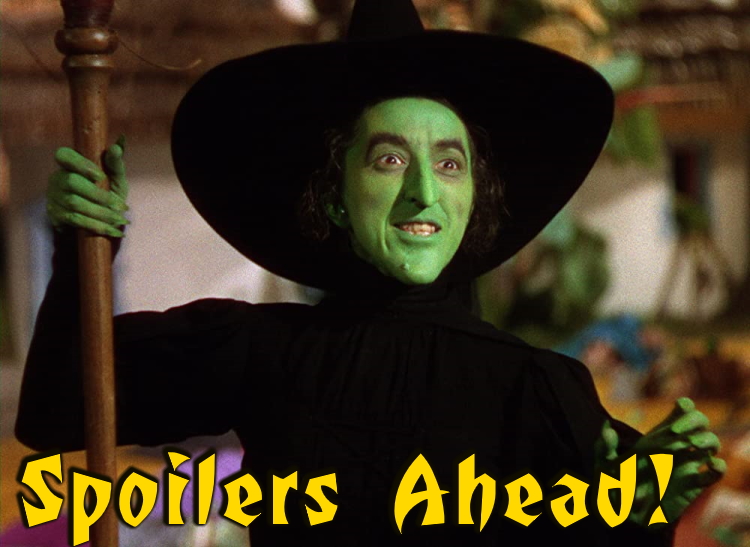
Disappointments of the decade

Spoiler Warning:
There will be spoilers ahead for the films, games, and television series listed below. If you don’t want to be spoiled, skip ahead to the next entry.

I initially thought about doing another top ten list for games, films, and television series that left me disappointed or underwhelmed in the 2010s, but the truth is that I don’t think I could reasonably find ten of each that I was genuinely disappointed by. There have been a few, but not enough to fill three full lists. So I’ve condensed what I had into one piece.

“Disappointment” is a very broad term when it comes to entertainment. For example, a television series I really enjoyed this decade was Terra Nova (it was in the “honourable mentions” section of my list of top ten television series), but despite it being a wonderful show, it was cancelled after one season with a story that hadn’t concluded. That’s a disappointment, undoubtedly. And of course there are films, games, and series that were just outright bad. I can be pretty brutal when it comes to switching off something I’m not enjoying – if it doesn’t seem like it’s improving or will improve, I’ll happily switch to something else. Life’s too short, after all, for bad entertainment.

That said, here are a few titles that, for a variety of reasons, I found to be disappointing in the 2010s. Please keep in mind that, as with previous lists, this is 100% subjective. This in my own opinion, and if you like any or all of these titles, that’s okay. You like what you like and I like what I like – and that’s great!

Film #1:
Guardians of the Galaxy (2014)

Promo poster for Marvel’s Guardians of the Galaxy.

You may remember from my comments on the list of top ten films that I’m not a Marvel fan, all things considered. I’m not a fan of superheroes, nor of comic books; I just never have been and even as a kid I didn’t read comics – my reading preference was for novels and books. Despite this, by 2014 I had managed to watch (most) of the Marvel Cinematic Universe films – albeit grudgingly in some cases – and I’d even started watching Agents of S.H.I.E.L.D. which was at the time a solid television series.

But then along came Guardians of the Galaxy. I found this film to be an absolute bore from start to finish. The comedy fell flat, the characters were either stupidly uninteresting or childish caricatures who couldn’t stop making (bad) jokes for even ten seconds. But worst of all was the plot. I just couldn’t find a way to care even the tiniest amount about the alien races I’d never seen on a planet I’d never heard of (and can’t even remember the name of) when it was under threat. There were no stakes and thus, no drama. At least in a film like The Avengers, it was New York and Earth that were attacked. In that case I knew the stakes – even if I found the film to be a bland, over-the-top action flick on par with something like Transformers. But Guardians of the Galaxy just failed across the board – uninteresting characters, meaningless aliens, and a threat to an unknown, insignificant planet about which I simply did not care.

On that final point, the film failed to communicate the stakes and get me invested in its world. A lot of sci fi and fantasy stories take place in worlds away from Earth. In The Lord of the Rings, Middle-Earth is threatened – yet I didn’t sit in the cinema thinking “who cares?” the way I did in Guardians of the Galaxy – because Peter Jackson’s films hooked me in and got me invested in its characters and its world. Likewise in the Star Trek franchise – the destruction of Vulcan in 2009’s Star Trek reboot had emotional weight because the film (and the franchise overall) had successfully got the audience invested in its world. This is the failure of Guardians of the Galaxy for me – it just couldn’t make me give a damn what happened. In most of the other Marvel films I’ve seen, I at least worked up enough investment in the films and their setting to want to see it through to the end. But by the end of Guardians of the Galaxy, I was done with Marvel. I skipped a lot of the next films in the series, and when I saw some of the Guardians characters pop up in Avengers: Endgame this year I let out a sigh of disappointment that I had to put up with their crap again. Just a disappointing, uninspiring, boring film that thinks itself to be far funnier and cleverer than it actually is.

Film #2:
Interstellar (2014)

Interstellar poster featuring Matthew McConaughey.

Interstellar reminded me exactly why I don’t like time travel stories. It basically takes everything that I find stupid and uninteresting about time travel and combines them into one slog of a film. It rightly received praise upon release for its visuals, including a stunning depiction of a black hole, but that aside there’s not much I enjoyed here, despite the hype.

Sometimes sci fi can be too science-heavy, with not enough attention paid to the “fiction” element – you know, the part which makes stories interesting. Interstellar falls into that trap at points, spending too much time explaining the relationship between gravity, speed, and the passage of time. And when it finally does get away from real-world science into a story, the plot is exceptionally convoluted, even for a time travel film, and it ties itself in knots in the second half basically creating a time loop – a form of paradox which just irks me.

It’s exceptionally hard to do time travel well, precisely for the reasons Interstellar shows. It’s too easy to write yourself into a corner, creating a scenario which is impossible to understand, let alone explain and communicate to your audience. And that just completely takes me out of it and ruins any enjoyment I might have otherwise got from the cast, who overall give good performances – just with a crap script.

Some people have told me I need to rewatch Interstellar four or five times in order to “get it” – as if that’s somehow a point in its favour. If a film is so bad that I barely made it through to the end the first time, I promise you I’m not going back for more. And if the only way your film is any good is on its fifth viewing, then I’m sorry but you made a crap film. And Interstellar, despite its star cast and great visual effects, is absolutely a crap film.

Film #3:
Into The Woods (2014)

Poster for Into The Woods.

Musicals aren’t usually my thing. They can work – especially in animation – but most of the time, the cast randomly breaking into song midway through a scene is something I find incredibly jarring. It takes me out of whatever I’m watching, ruining any suspension of disbelief. On the stage or in animation I’m always aware that I’m watching something fictional, but with today’s exceptional visual effects, as well as great costuming and set design, there’s a much greater sense of immersion than in previous decades – and that’s partly what makes the random songs in any musical so offputting, I think.

But anyway, that’s a more general point. Into The Woods features some truly crap songs – sung badly by actors and actresses who aren’t natural singers. So at the numerous points where the film is interrupted by song, the songs aren’t even good or enjoyable to listen to. It also fails as a fantasy film, plagued by over-the-top hammy acting of the kind usually seen in pantomime. In fact, if it were a pantomime, Into The Woods might’ve been alright.

But as with a lot of modern films, Into The Woods wants to make a point. Something about how actions have consequences, maybe? I was so bored by the end I’m not even sure if that’s what it wanted to say. It also tries to satirise the fantasy genre and criticise fairy tales, but instead of gentle parody and laughing with its targets, it comes across as mean-spirited and laughing at them – and at the people who enjoy those genres.

There might’ve been the kernel of an interesting concept buried somewhere in the pre-production of Into The Woods, but it never made it to screen. And the bad acting, bad singing, and overall bad intentions as well as the aggressive, mean nature of the film made it a truly unenjoyable experience.

Film #4:
Star Wars: The Force Awakens (2015)

The poster for The Force Awakens.

I actually really love this film. And I love its sequel, The Last Jedi, despite what many people have said about it. They are both great films – taken as standalone pieces. As two parts of a greater whole, however, they aren’t anywhere near as good.

The shift in tone from The Force Awakens to The Last Jedi is noticeable, and the reason why is that Disney and Lucasfilm decided that the way the sequel trilogy would be produced is that each writer and director would be given essentially free rein to tell whatever story they wanted. To me, that’s an absolutely absurd and inexplicable decision from a group of accomplished filmmakers. On what planet is that how storytelling works? If you’re creating a trilogy of films you need one writing team to tell a single, cohesive story – one story, told in three parts. Let alone that this trilogy is actually parts seven, eight, and nine to an already-existing series – and that that series happens to be one of the most important works of the genre. I just cannot fathom how this decision came to be made. It doesn’t make sense – and the result is a jarring tonal shift from one film to the next, epitomised by the scene at the very beginning of The Last Jedi where Luke Skywalker throws his lightsaber away.

As a standalone piece, The Force Awakens is a clone of A New Hope (aka Star Wars, the 1977 film). And on first viewing, I thought that was exactly what I wanted – especially after the disappointment of the prequels ten years previously. A return to what made Star Wars great was fantastic – but on looking at it again it’s clear that JJ Abrams crossed that invisible line which divides nostalgic throwbacks from outright copying. The strange thing is that two years previously, while working on Star Trek Into Darkness, Abrams had managed to pay homage to Star Trek II: The Wrath of Khan without falling into that trap. If he could do it there, how did he manage to go too far here?

One final point, the concept of “Luke Skywalker is missing”, which The Force Awakens sets up and uses as the driving force for much of its narrative was, in retrospect, a bad decision. Killing off Han Solo meant that fans of the original films never got to see any on-screen interaction between Han, Luke, and Leia – the trio of characters at the core of those films. As a sequel to a trilogy of films so reliant upon those three characters, I have to say I feel that was a big mistake. Carrie Fisher’s untimely death in 2016, as well as the supposed death of Luke Skywalker in The Last Jedi also means that we got very little Luke and Leia interaction on screen either. While I, like most Star Wars fans, left the cinema thrilled with what The Force Awakens did, looking back at it there are a number of issues which I’d say make it a disappointment.

Its sequel, while divisive, was much better and tried to take the franchise to different places. It was, however, constrained to a great extent by the concept of Luke Skywalker being missing, isolating himself on this small island. From that foundation, there weren’t many places to take the character and the story, and that contributes to the sense that The Force Awakens didn’t set up a strong narrative for the trilogy. But again, that failure is on the head of the producers, and their decision to allow the story to be split up. If one team of writers had worked from day one to tell a single story across three films, instead of three one-shots, the trilogy would arguably have been much better. The Rise of Skywalker – set to conclude the “Skywalker saga” – is to be released soon, and that could go a long way toward redeeming the series if it’s good enough. We’ll have to wait and see.

Television series #1:
Game of Thrones’ eighth season (2019)

Teaser poster for Game of Thrones’ eighth and final season.

This really boils down to the first three episodes of the season. After that it did improve, though the disappointment of what happened in those first episodes wasn’t wiped away by what came after.

In the premiere episode of Game of Thrones way back in 2011, the White Walkers are shown for the first time, and throughout the entire seven seasons leading to this point, the overall message of the show was that the politics and infighting may be interesting, but something far greater and more dangerous lies beyond The Wall and is coming – and it won’t care who’s in charge. In the background, behind all the wars and all the politics, slowly building up over seven seasons was The Night King and his army of the dead. Finally, at the end of season seven, he brings part of The Wall crashing down and is able to lead his army south – atop an undead dragon, no less.

As the eighth season begins, many of the main characters have arrived at Winterfell, and the first couple of episodes lead up to a climactic battle in the third episode – where The Night King finally unleashes his army and all of his firepower upon our heroes. This is the moment the entire show feels like it’s been building up to… and then, just like that, he’s dead at the end of it.

The Night King, built up over seven seasons as the greatest threat our characters have ever faced, doesn’t even last one episode south of The Wall and is killed in his first battle against any significant opposing army. To me, that’s an unforgivable storytelling mistake. Game of Thrones is rightly held up as one of the all-time great works of television, and is a seminal event in this decade’s storytelling, but this one moment, and the episodes preceding it when looking back in hindsight, threatens to undo all of that. It taints Game of Thrones with just how badly it was done.

I won’t go over all of it here – because I plan to do a full article or even a series on this topic – but Game of Thrones deserved a better final season than it got. Luckily, the remaining episodes were largely good and did go some way to saving the season, but even so it remains a disappointment and the way that The Night King didn’t even bring his “long night” for a single day, let alone years, is incredibly disappointing.

Television series #2:
House of Cards’ sixth season (2018)

Robin Wright on a promo poster for the sixth season of House of Cards.

House of Cards – a remake of a British series of the same name from the 1990s – is an incredibly important television series. While not on par with something like Game of Thrones, perhaps, it is nevertheless the show that pioneered Netflix’s original programming, and that was the first significant show to premiere all the episodes of its season in a single day. Other Netflix shows owe their existence to House of Cards, and Netflix’s decision to diversify into original programming – as opposed to merely licensing other peoples’ properties – is what will allow it to survive as we enter the “streaming wars”.

In 2017, Kevin Spacey, who played devious mastermind Frank Underwood in House of Cards, was accused of a number of serious sexual offences. His response to the allegations was widely criticised, and as a result he became persona non grata overnight, even being digitally erased from the film All the Money in the World. As the sixth season of House of Cards was in early production, Netflix quickly announced he’d be dropped from that too, and production was restarted without him.

As happens in a lot of cases when a main character leaves a series, the way in which he was written out (he died off-screen) was ham-fisted and just poor overall. For a main character to just be dumped never sits well, but in a story so focused on a single character like House of Cards, where Frank Underwood is so central to everything that happened, there’s basically no point in carrying on without him.

At the end of season five, Frank had resigned as President amidst a scandal (of his own making), thus arguably completing the “rise and fall” narrative of House of Cards. With Spacey embroiled in scandal there was no way Netflix could continue to work with him, so the decision should have been to pull the plug and end the series. The sixth season was just an unnecessary disappointment. This isn’t, by the way, a criticism of Robin Wright, who did an admirable job stepping into the role of protagonist/anti-hero that Spacey had occupied. It’s simply the fact that the series was never her character’s story, and jettisoning its main lead while production was underway and a deadline was coming up meant that the sixth season had to be rapidly adjusted to fit the new circumstances. And unfortunately, it came up short.

Television series #3:
The Walking Dead (2010-Present)

Promo poster for The Walking Dead featuring Andrew Lincoln.

Even speaking as someone who isn’t a huge fan of horror, the first couple of seasons of AMC’s zombie show were decent. Playing more on the post-apocalyptic setting than the zombies themselves, the earlier episodes of The Walking Dead had some great character moments and performances by the cast. But as time has passed, the series has completely run out of ideas.

Rick Grimes and his ever-changing group of survivors seem to stumble from bad situation to bad situation, and in recent years all of those bad situations have been essentially the same thing. When the zombies lost their fear factor a couple of seasons in, writers began looking for new threats for the group to deal with. And since then, every season has followed basically the same pattern – Rick and his group arrive in an area, other human survivors decide they don’t like Rick and his group, the two groups fight, and then that’s it. Roll on the next group of human survivors with an inexplicable and poorly-written anti-Rick agenda. The Governor came first, so he gets somewhat of a pass. But after him came the Terminus cannibals, then Negan, and it’s just become so boring and repetitive that I tuned out.

Fear The Walking Dead – a spin-off of the main show – is actually much better. It’s taken a look at the immediate aftermath of the zombie virus in a way that The Walking Dead didn’t, and thus its post-apocalyptic setting, while the same as that featured in the main series, feels like it has more of a foundation to build upon.

Any villain or enemy can be overused or overexposed. And when they are, when the protagonists have defeated them so many times, they lose their fear factor. And even though The Walking Dead was up there with Game of Thrones in pioneering the “disposable” cast (i.e. main cast members could be killed off at any time and you couldn’t be sure who’d survive), by this point in the show as it passes its tenth season, the vast majority of the original cast have gone, and the few survivors who are left from earlier seasons don’t feel like they’re in danger. Add to that that the new characters are less interesting and less well-known to the audience and the show has become boring. Some series have a natural lifespan – and The Walking Dead should’ve ended after perhaps four seasons or so.

Television series #4:
Doctor Who (2005-Present)

Peter Capaldi and Jenna Coleman on a promo poster for Doctor Who.

There have been some great Doctor Who stories this decade – The Day of the Doctor is brilliant, for example. But unfortunately, after Matt Smith left the role in the 2013 Christmas Special, things went downhill fast.

Peter Capaldi is exactly how I’d imagine The Doctor if someone just described the character to me. He has a certain quality, perhaps best described as “gravitas” or “weight”, allowing him to seamlessly and successfully step into the role of this ancient, time-travelling alien. Which is something that previous Doctor Who actors of the relaunched series arguably lacked.

Sadly, though, Capaldi just had nothing to work with. For the entire three seasons he was in the role, the writing and stories were just bad. They started bad and even managed to get worse over time, as the team being the series simply ran out of ideas. Modern Doctor Who has suffered from an overuse of three key villains – the Daleks most notably, but also the Cybermen and Weeping Angels. All of these adversaries were great in their initial appearances in 2005, 2006, and even up to the end of the last decade. But by the time Peter Capaldi took over they were played out. And the stories featuring new opponents for The Doctor simply didn’t get off the ground.

Clara, who had been the companion to the previous Doctor, was written out of the show in a bad way, and Maisie Williams of Game of Thrones fame is introduced as an incredibly annoying immortal character. The only decent companion of this era, Bill (played by Pearl Mackie) only lasted a single season and was treated as a complete afterthought in most of her stories – and also came to a stupidly annoying end.

I struggled on through Capaldi’s reign as The Doctor, waiting for the writing to improve so the show could finally shine, but unfortunately it never happened, and his departure was thus the last time I bothered watching. Doctor Who needs a root-and-branch overhaul, and since that seems impossible right now, it would be better to put it back on hiatus for a while. Perhaps we can come back to it in a few years when someone has a genuinely good idea for its revival.

Video game #1:
Fallout 76 (2018)

Fallout 76 box art.

What’s at the core of a great story? Whether we’re talking about a film, a television series, or a video game, characters are at the heart of any story. And the Fallout series, from its inception in the 1990s through the three more recent titles, have been story-focused games. So why, then, did Bethesda choose to release Fallout 76 – an online game where there are no non-player characters?

Forget about the bugs for a moment. Fallout 76 was riddled with glitches and graphical errors, but if, underneath all of that, there had been a story worth telling, a lot of that could have been and would have been forgiven. But there wasn’t, and the fact that Fallout 76 is essentially a big, empty world has meant that the issues which are present seem all the more egregious. I’m honestly not sure what the point of this game was. Aside from walking around to look at the decently pretty – if somewhat last-gen – environment, and fighting off a few monsters, there’s literally nothing to do.

I’m not a multiplayer gamer; I don’t enjoy playing online with strangers. But I fully understand that a lot of people do, and that this game was aimed at them. But even if that was the objective, it’s completely failed. The lack of story meant that even players who teamed up to tackle Fallout 76‘s environment together would be bored pretty quickly, and the shoddy gunplay – which Fallout’s signature VATS system concealed so well in Fallout 3, New Vegas, and Fallout 4 – means that it’s worthless as a multiplayer player-versus-player shooter like Call of Duty. So honestly, what was the point of this game? It’s been nothing but a massive PR own goal from Bethesda, and their damaged brand will take a long time to recover. If their next title isn’t absolutely fantastic, they’ll be in a mess of trouble.

Video game #2:
Mass Effect 3 (2012)

Female of Commander Shepard on the alternate box art for Mass Effect 3.

I picked Mass Effect 2 for my game of the decade – spoiler warning for that list. But its sequel struggled to conclude the trilogy in a satisfactory way. Mass Effect 3 told what should’ve been the most interesting part of the story. After Shepard is introduced to the idea of The Reapers – space-dwelling robot aliens who want to rid the galaxy of all intelligent life – in the first game, and the second game uncovers another part of their plan, this game features the actual war against The Reapers – and players have to fight battles and bring the galaxy together to defeat them.

On paper, it sounds like the best part. But, coming out only two years after Mass Effect 2, Mass Effect 3 was rushed. Gameplay remains solid, though not notably improved from its predecessor, and there are none of the bugs and graphical issues which would plague Mass Effect: Andromeda. But as the story ramps up, it’s clear that developers Bioware simply ran out of time to pull everything together.

It isn’t just the “pick a colour” ending – though that is a significant disappointment in itself – but the fact that choices made throughout the game, and indeed in the previous two games, not only don’t matter but aren’t even given lip service as Mass Effect 3 enters its final climactic fight.

To give an example, if players have followed a specific path across all three titles, it’s possible to save both the Geth species and the Quarian species when it seems like it should only be possible to save one or the other. This is an incredible moment in the game, and it feels like having both powerful fleets on your side will make a difference when you reach Earth – where The Reapers have massed their forces. But it doesn’t – literally the only difference comes in the cut-scene immediately after arriving at Earth, where the different fleets check in to confirm they’ve all arrived. Two seconds of dialogue reveals that you have both the Geth and Quarians on your side… then that’s it. And there are dozens of other instances throughout the final third of the game where an extra few months of development time would’ve allowed for a much more satisfying way of recognising the player’s choices.

In a series where players were promised that “every choice matters”, it turned out by the end of Mass Effect 3 that that simply wasn’t the case. And while the game is solid overall, it’s a poor relation to its predecessor.

Video game #3:
Shenmue III (2019)

Ryo Hazuki and Shenua on Shenmue III‘s box art.

I’ve already written an article detailing at length my problems with Shenmue III, but suffice to say it’s absolutely one of the biggest let-downs for me personally.

As a big fan of the first two Shenmue games, back when I had a Dreamcast, I was absolutely thrilled to hear that series creator Yu Suzuki had managed to buy the rights to the legendary series with a view to finally making a sequel. Eighteen years have passed since I left protagonist Ryo in a cave in China, and I was really looking forward to learning what happened next after that cliffhanger, as well as finally seeing the story brought to an end.

But Shenmue III doesn’t bring the story to an end – thanks to an absolutely inexplicable decision not to make cuts to the bloated story of the series. Yu Suzuki genuinely thinks he can get lightning to strike twice and that he’ll somehow get the money together to make Shenmue IV – and presumably V and VI as well? Fat chance.

His studio had been given a once-in-a-lifetime opportunity by a dedicated group of fans to conclude the story, and they blew it. The Shenmue series was as dead as it was possible to be, and Sega was only willing to part with the rights because they knew that it would never make them any money. As great as Shenmue was, it was a colossal failure, and Shenmue II managed to retain less than 10% of its fans from the first game, resulting in a massive drop in sales from one title to the next. By every conceivable metric, the games failed. And despite that, a small, vocal group of fans managed to stump up over $7,000,000 – some individuals contributing thousands of dollars.

I don’t claim to speak for all of them, but the one thing I expected from Shenmue III – in fact, the only thing I expected from it – is that it would finally complete the story. And if Yu Suzuki couldn’t find a way to cut it down to fit into one game, someone needed to be brought in to swing that axe and make those cuts. As a result of this, I haven’t even bought the game. And I won’t, because what’s the point? Get drawn back into that world, only to be left on another unresolved cliffhanger? No thank you.

So that’s it.

A few titles across entertainment that I found to be disappointing or underwhelming this decade. If your favourite is on the list, well I’m sorry. But we all have our own preferences and tastes. These are just my opinions, and are wholly subjective.

The 2010s have, overall, been a wonderful decade for entertainment. TV shows are better than ever, often with cinema-quality acting and visuals, video games continue to get bigger and better, and at the box office there have been some incredible films. But there are always going to be misses to go along with the hits, and this list just runs through a few that didn’t work – at least for me.

All titles listed above are copyright of their respective studio, developer, producer, and/or distributor. This article contains the thoughts and opinions of one person only and is not intended to cause any offence.
Obligatory end-of-the-decade list #1

Spoiler Warning:
There will be spoilers ahead for each of the films on the list. If you haven’t seen one and don’t want to have it spoiled, skip that entry and scroll to the next.

It’s December 2019, and with the 2020s just around the corner, it’s time to look back at some of the entertainment high points of the decade as it draws to a close. In this first list, I’ll be looking at my personal picks for the decade’s top films.

The 2010s saw some rather impressive technological leaps in cinema, particularly in the realm of special effects. The CGI of the 1990s and 2000s looks incredibly amateurish by today’s standards. Going back to some earlier films – even big-budget blockbusters – which rely heavily on CGI can seriously detract from the experience, especially on today’s large format 4K displays.

Narratively, the decade has seen franchises and sequels firmly dominate the box office, inspired by the success of Marvel in particular. It’s also been a decade where nostalgia and throwbacks to past films and franchises has been important. Many films have gotten sequels years or even decades after release – the revival of the Star Wars franchise being most notable.

By the way, the numbering here isn’t necessarily in order. The number one film is my favourite film of the decade, but the others could really be put in any order. All are great and while some have flaws or weren’t perfect, these are the films I enjoyed most. If your favourite(s) don’t make the list, just remember this is all subjective. You like what you like and I like what I like. And that’s great!

Number 10:
Harry Potter and the Deathly Hallows, Parts 1 & 2 (2010 and 2011)

Herminone, Ron, and Harry in the promotional poster for Deathly Hallows Part 1.

This is kind of a cheat because it’s two films, but it’s my list so that’s just tough. Looking back to the beginning of the decade, it’s hard to imagine that the Harry Potter series hadn’t yet concluded. But Deathly Hallows was split into two parts, coming out in 2010 and 2011, and they brought the series to an explosive conclusion. The decision to split up Deathly Hallows – which was, of course, a single book – into two films got a lot of criticism at the time for being a fairly obvious and shameless money grab, but the thing about the Harry Potter series is that there was always a lot of cut content from the books. So while it certainly was a moneymaking ploy on the part of studio Warner Brothers, it wasn’t one which damaged the films. If anything, the extra runtime makes Deathly Hallows a more enjoyable and fully-rounded experience.

Prior to JK Rowling messing with the characters (did you hear Dumbledore is gay now?) Deathly Hallows marked the end of the Harry Potter saga, which had been running since 2001’s The Philosopher’s Stone. Subsequent attempts to pull fans back in, with the two Fantastic Beasts films and the Cursed Child stage play haven’t managed to be anywhere near as successful, either in terms of story or financial results, so it would’ve been better in many ways if this had been the final entry in the series.

By this point in the film series, we’ve been with the characters for a long time, we’ve got to know the actors and watched them in a very literal sense grow into their roles. Deathly Hallows doesn’t shake up the formula or the aesthetic of the Harry Potter world. It’s more of the same, building on previous films and drawing the story to a satisfactory conclusion. The climactic fight against antagonist Voldemort had been building slowly over several films and when he was finally vanquished – with Harry’s trademark disarming spell, no less – it was a great and emotional moment. Aside from the awkward epilogue with several key characters having been “aged”, both films accomplish what they set out to. And as a fan of Harry Potter overall, it was a good way to say goodbye to the series. Or at least, to this iteration of it with these actors. I wouldn’t be shocked at all if Harry Potter returns as a big-budget television series in a decade or two.

Number 9:
Frozen (2013)

Promo poster for 2013’s Frozen.

In the autumn of 2013, when Disney’s Snow Queen-inspired Frozen was released, I was living in a different country, and perhaps it’s for that reason that I missed out on almost all of the advertising and hype for this film. It was only when browsing local cinema listings for English-language films that I even heard about Frozen, and decided from that to go to see it. Disney films have always been decent, so I wasn’t expecting to be disappointed, but I really was surprised at just how good Frozen was.

We could do a whole article on how the animators created the incredible snow for the film – important, obviously, in a film with such a wintry setting – because honestly the amount of work that went into that aspect alone is amazing. The snow in Frozen looks and behaves like real snow, right down to its powdery consistency, and the level of detail really took me by surprise. I understand that animators spent months working on just this one aspect of the film, and that attention to detail shows in the finished product. Frozen wouldn’t be half as good if it looked like Anna and her sister Elsa were trekking across a flat sheet of paper.

As a story, Frozen stands out for breaking the typical Disney Princess mould. Rather than being a story of a damsel in distress being rescued by a dashing prince, Frozen turns that on its head by having the central characters be two sisters, and the ultimate act of love be one of sisterly love. In addition, the dashing handsome prince featured in the early part of the film turns into a villain in what is, by Disney’s standards at least, a shocking and unexpected twist.

Despite being played perhaps more than a little too often in the years after Frozen‘s release, the soundtrack is also amazing. Let It Go, the main song from the film, is undoubtedly one of Disney’s best, and there are several others throughout the film which are memorable. It’s always nice to be surprised at the box office, and Frozen definitely did it for me this decade.

I’d like to give an honourable mention to Disney’s other great film of the decade, Moana. When I was writing this list I debated including Moana, but when it came down to a choice between the two, Frozen just edges it for me. Still a great watch though, and with Disney+ coming soon, there’s no excuse to not see both!

Number 8:
A Brony Tale (2014)

Ashleigh Ball on the promo poster for A Brony Tale.

I love a good documentary. I’d have put more docs on this list if I had more space, but considering the theatrical documentaries of the decade, A Brony Tale definitely earns its spot. The film could’ve easily descended into ridiculing the so-called Bronies (a portmanteau of “bro” and “pony”) but manages to stay away from mocking its subject matter, instead telling a more nuanced story.

The film follows My Little Pony: Friendship is Magic voice actress Ashleigh Ball as she prepares to attend a Brony convention. Prior to watching the film, I was loosely aware of Bronies – largely from internet memes – but I hadn’t really spend any time investigating the cartoon or its fans. Bronies, if you’re unaware of the term, are adults (usually men, but the community includes women too) who have become fans of the 2010 cartoon series My Little Pony: Friendship is Magic. Obviously the odd thing about this, for anyone who knows their cartoons and toy brands, is that My Little Pony is aimed at girls, specifically girls aged 6-12, so for adult men to be interested in this series raises a lot of questions.

The documentary tackles its subject matter in a respectful way, letting fans of the show speak for themselves without being overly judgemental or preachy. One story, recounted by the father of a fan, explained how someone dealing with depression and mental health had found an artistic outlet after being inspired by My Little Pony. And the fans themselves come from many walks of life as well as different backgrounds.

At the centre of it all was Ashleigh Ball and her decision to attend a convention. She specifically talks about how she’s used to being anonymous as a voice actress, and how it will be an unusual experience to be the star attraction and have so many people knowing and recognising her. The film documents her struggle to understand and come to terms with the phenomenon of adult fans. And again, the way it’s presented and the way the film explores both the fandom itself and Ball’s reaction to it was done tastefully and respectfully.

It’s also a reminder that any fandom can be seen as odd from the perspective of an outsider. Something like Star Wars is practically mainstream nowadays, but when I was at school, Star Wars was very much a nerdy franchise to be associated with, as was Star Trek or something in the fantasy genre. It’s fascinating to me to see how something like Game of Thrones became as popular as it did as a fantasy series, when not that long ago it was something mainstream audiences would’ve looked down on. The overall message of A Brony Tale seems to be: “let people enjoy whatever they want and try not to judge”. I like that message, and that’s what I took away from the film.

Number 7:
Lincoln (2012)

Daniel Day-Lewis won an Academy Award for his portrayal of the titular American President in Lincoln.

Now for a complete change of pace. The American Civil War – and American history in general – has always interested me, so Lincoln had been on my radar for a while prior to its 2012 release. And it was absolutely worth waiting for.

Telling the story of the last few months of Abraham Lincoln’s life, as he struggled with Congress to end the Civil War and emancipate southern slaves, the film and its spectacular cast do an amazing job portraying the complexities of negotiations and political manoeuvring. Sometimes a story can be uninteresting if its ending is known – and we know, of course, that Lincoln successfully freed the slaves and won the war – but in this film, how it played out is a joy to watch.

Aesthetically, Lincoln does a great job portraying Washington DC as it would’ve looked in the 1860s, and the costumes and set designs are absolutely on point. The dirty, gritty reality of life in those days is conveyed beautifully on screen, and supplements the story and acting greatly. People often downplay these aspects of a film, and while its true that some minimalist productions can do well – especially on the stage – as well as low-budget films that don’t necessarily have money to waste, in a title like Lincoln getting the look right definitely adds a quality to the film that just wouldn’t exist even if all other factors (the script, acting, direction, etc) were identical.

Lincoln stands up among other great works of cinema, and I think in future will be hailed as a must-watch classic of the history and drama genres. With Steven Spielberg directing and producing, alongside fellow producer and future Lucasfilm head Kathleen Kennedy, there was so much to this film that even after multiple viewing I still find new elements to enjoy and new moments to revel in. Overall a really stunning piece of cinematic history.

Number 6:
Star Trek Into Darkness (2013)

A different look at the Starfleet logo on the poster for Star Trek Into Darkness.

Star Trek Into Darkness isn’t my favourite Star Trek film. It’s probably not even in my top five, but it’s definitely the better of the only two Star Trek films released this decade. As a follow-up to 2009’s Star Trek reboot, Into Darkness builds on its predecessor and is a solid action flick with a twist (some) fans will have appreciated, and a flickering of that elusive “Star Trek-ness”. It’s also notable for being Leonard Nimoy’s final film role; unfortunately the decade has claimed many Star Trek actors.

So I have to admit that as a big Star Trek fan, it would’ve felt wrong to not include a Trek film on this list. That’s 100% my own bias coming through rather than a commentary on Into Darkness, which is a decent action film but probably not one of the best ones I’ve ever seen. What Into Darkness did, however, as with its predecessor and sequel, is keep the Star Trek franchise ticking over, giving it some breathing room while keeping it alive in the popular consciousness. It’s hard to see how we’d have got to see Discovery, Picard, or Lower Decks next year if the JJ-verse films hadn’t given the franchise a breath of fresh air. In that sense, Into Darkness – as arguably the best of the reboot films – is a key stepping stone in the franchise’s continued success. And while the film stands up on its own merits as a piece of Star Trek storytelling, in my opinion at least, its biggest accomplishment is paving the way for what’s come since.

The twist Into Darkness springs on fans was clever, but also had been rumoured to be happening, and the result of that rumour being all over the internet in the weeks before release detracted from it somewhat as I wasn’t surprised. Central villain John Harrison (played by Sherlock actor Benedict Cumberbatch) is revealed to be famous Star Trek baddie Khan, and what follows is a film which pays homage to The Wrath of Khan without going overboard. As a JJ Abrams film, in that sense I greatly prefer it to Star Wars: The Force Awakens, which went too far in copying its 1977 predecessor.

It’s become a recurring theme in this list, but the special effects and visuals were great in Into Darkness, and the difference between this iteration of Star Trek and what we’ve seen previously is huge. While some of the aesthetic changes haven’t sat well with fans of TOS, and I understand that, the effects, particularly in big set-pieces, look fantastic even six years later.

Number 5:
The Hobbit trilogy (2012, 2013, & 2014)

Cover of the DVD or Blu-Ray version of The Hobbit trilogy.

Realistically I should’ve just put the first two parts on this list, because the third film isn’t all that great. Indeed, The Hobbit is overall a poor relation to the previous decade’s epic Lord of the Rings trilogy, but nevertheless was an enjoyable return to Peter Jackson’s Middle-Earth.

Martin Freeman is the standout here, a perfectly-cast lead as titular Hobbit Bilbo Baggins. It’s through his eyes that we see Middle-Earth as we follow his adventure to The Lonely Mountain with the Dwarves, and Freeman’s strong performance carries what would otherwise be a much more underwhelming trilogy of films. Part of the criticism these films got is due to comparisons to Lord of the Rings, but that was inevitable, and other criticisms of the runtime, effects, and dialogue are valid.

When I saw the first and second parts in the cinema, I was able to see the “high frame rate” version, shot in 48 frames-per-second – a novelty for the big screen. While this seemed gimmicky and even offputting at first, once I got used to it it did make for an interesting experience. Disappointingly, the films have not been released anywhere in this format, as the DVD, Blu-Ray, and digital releases all stick to the standard cinematic 24 fps.

While the plot of The Hobbit suffered as a consequence of being dragged out across three films instead of one or two, and some of the added new characters fell flat, any time fantasy makes it to the big screen with such a big budget is going to be a positive thing. The plot of The Hobbit is certainly less exciting than Lord of the Rings, at least in the sense that nothing world-ending is threatening our protagonists. Peter Jackson tried to compensate for that by throwing in a lot of “foreshadowing” for the rise of Sauron in Lord of the Rings, but in this case it would’ve arguably been better to stick to the core story.

The final film is a rare example this decade of sub-par special effects, perhaps due to their overuse, and while there are some great moments (such as a Dwarf played by Billy Connolly) overall the first two films do a much better job of telling an interesting fantasy story. Some of the highlights for me included the creepy, claustrophobic time the party spends travelling through Mirkwood in a perfectly-shot sequence, the portrayal of Radagast by former Doctor Who actor Sylvester McCoy, and above all, being back in Middle-Earth once more.

Number 4:
Ready Player One (2018)

Lead actor Tye Sheridan on a promo poster for Ready Player One.

The second film on this list to be directed by Steven Spielberg is a geek’s paradise thanks to countless references, easter eggs, and nostalgic throwbacks to films of the 1980s in particular. The story is centred around players in a massive online world who are racing to gain control of that world by solving a series of puzzles its creator left behind when he passed away.

Ben Mendelsohn plays a truly nasty villain, giving the story much more weight and raising the stakes for the main characters. Ready Player One is laden with special effects, and because (most of the time) the effects aren’t trying to be hyper-realistic and imitate reality, but rather imitate a futuristic online game, many issues present in other titles simply vanish here. Because we know that what’s being shown on screen is taking place in a virtual world, there’s no expectation of it to be perfect, and thus none of the “uncanny valley” effect which some CGI-heavy films can fall victim to.

The plot is exciting – and it’s always great to root for an underdog in a fight or race against a big corporation. I have to confess I haven’t read the book upon which the film is based, and I have heard some criticism of the film from fans of the book. But as someone going in with no expectations, I was very impressed and found Ready Player One to be a very entertaining film.

Number 3:
Source Code (2011)

Jake Gyllenhaal on a promo poster for Source Code.

I didn’t know what to make of Source Code at first. It’s a complicated film – as time travel stories often are – and it took me a while after leaving the cinema to fully process what I’d seen. Some of the implications are actually a little disturbing – like whether lead Jake Gyllenhaal’s character actually stole someone’s body and identity.

Usually I’m not a big fan of time travel as a concept. It works in some instances, but in too many films and stories it gets convoluted and some stories completely tie themselves in knots either with inexpiable paradoxes or trying to over-explain the rules of time travel in their world. Fortunately, Source Code manages to avoid those traps for the most part, and what results is a genuinely thought-provoking film.

The basic premise is that a secret government programme has given an injured soldier a way to travel back in time to find out who was responsible for a terrorist attack. He only has a few minutes in the past before the explosion occurs and then the operators have to reset the loop and send him back again. It takes multiple visits to the past (or simulated past) before he gets the hang of things. To explain the entire thing would take more time than I have on this list, but suffice to say it’s a fascinating concept that is, for once, well-executed.

Strong performances from leads Jake Gyllenhaal and Michelle Monaghan carry the film, as their characters slowly work out what’s going to happen. It’s perfectly paced, well shot, with a couple of unexpected twists and revelations which keep things interesting. The real-world, modern day setting is a change of pace from a lot of science fiction films of this decade, and I found myself rewatching Source Code multiple times.

Number 2:
Deadpool (2016)

A promo poster for Deadpool.

Though it may seem heretical to some, I’m not really into superheroes. As a kid I didn’t read comic books, and the big-budget superhero films I’ve seen over the years – the likes of Fantastic Four or X-Men – just didn’t hold my interest. Even the Marvel films of the last few years haven’t really interested me all that much, and I found myself seeing them more out of obligation than enjoyment. Deadpool was different, however, as a comedy film and with Ryan Reynolds masterfully portraying antihero Wade Wilson.

Not knowing much about Marvel or any of its characters outside of Iron Man and The Avengers, I didn’t really know what to expect going in. I’d heard the film was funny, but it had some real laugh-out-loud moments that I didn’t expect.

I think the problem many superhero films have is that they simultaneously take themselves very seriously while having storylines, characters, and an aesthetic that is childish and inherently un-serious. That disconnect is jarring for me, and takes me out of it. In addition, as I’ve mentioned previously, much of the appeal of Marvel films – as with Star Trek, Star Wars, The Hobbit, and other franchises this decade – is nostalgia. The films appeal much more to people who grew up with these characters in the various comic books, and as someone who just didn’t have that experience I don’t have the same connection to those characters.

What was great about Deadpool, to get back to my original point, is that the whole point of the character is that he doesn’t take himself or his surroundings seriously. That was true in the comic books and it’s carried over to the film perfectly. Reynolds was an absolutely inspired casting choice, as his comedic range fits the character so well. The frequent breaking of the fourth wall – apparently a Deadpool trademark going back to his comic book days – was done perfectly and provided many fun moments.

The over-the-top action was great, as were the gory deaths which earned the film a more restrictive rating than it otherwise would’ve. But it’s hard to see how Deadpool could’ve worked as a film marketed at kids and teenagers; it needed to have the freedom to offend in order to accomplish what it set out to. Overall, I don’t really care whether it stayed true to its source material, but Deadpool was a hilarious send-up of the whole superhero genre.

Honourable Mentions:

Just before I declare my favourite film of the decade, I want to look briefly at a few other titles that almost made this list. I’ve picked ten – which absolutely could’ve been the top ten themselves. Obviously there are way more than ten or twenty films to enjoy from the 2010s, and while the decade has been dominated by sequels and franchises, there have been some great original and standalone works too.

Oz The Great And Powerful (2013) – A fun return to the Land of Oz, fronted by James Franco.
Jurassic World (2015) – An interesting attempt to reboot the Jurassic Park franchise. It was nice to see a fully-operational park.
Tomorrowland (2015) – An underrated film loosely based on the Disneyland attraction. Great performances and an interesting concept.
Bohemian Rhaposdy (2018) – Perfectly acted by Rami Malek, who won an Academy Award, this biopic of Queen’s front man is an entertaining look at the band’s rise.
Star Wars Episode VIII: The Last Jedi (2017) – Controversial and unfortunately divisive among fans, Rian Johnson’s film tried to shake up Star Wars after JJ Abrams played it very safe two years prior. And it succeeded.
Joker (2019) – I can’t rank this because I haven’t seen it. But everything I’ve heard has been great and I can’t wait to see for myself.
Moana (2016) – As mentioned above, a great Disney film with an inspirational story. And some catchy songs.
World War Z (2013) – Less a horror film than an action flick with zombies, it stands up as an interesting and different take on the zombie genre in a decade overrun by The Walking Dead.
Game Change (2012) – I fully admit this is a niche film (especially outside the USA) as it documents John McCain and Sarah Palin in their unsuccessful campaign. As someone who finds such things fascinating it was an interesting – if supposedly inaccurate – film.
Phineas and Ferb: Across the 2nd Dimension (2011) – What can I say except I really enjoy Phineas and Ferb? The film is based on the longest-running Disney Channel original cartoon, and is more of the same, playing out like a feature-length episode of the show.

Number 1:
Rogue One: A Star Wars Story (2016)

The Death Star looms over the beach on the plant Scarif in this poster for Rogue One.

When it came to naming my favourite film of the decade, I didn’t need to think twice. Rogue One took everything great about Star Wars and condensed it into a single standalone piece of cinema. Though I would argue the scenes with Darth Vader were unnecessary, the full power of The Empire is on full display here, and after The Force Awakens successfully took the story forward by a generation, Rogue One brought fans back to where it all began.

Jyn Erso is such an excellent protagonist; selfish and completely jaded when we first meet her, she becomes conflicted and eventually rises to inspire hope in the Rebellion over the course of the film. Each of the characters we meet is interesting and could reasonably have a whole film or series dedicated just to them. Rogue One is, in that sense, a perfect team-up film, bringing together a diverse array of characters from the Star Wars galaxy in a no-hope plot to steal the Death Star’s plans.

Ben Mendelsohn is on this list as a villain for the second time, and while he was great in Ready Player One, this is truly his outstanding performance. Though unfortunately his character is ultimately overshadowed in the final cut of the film thanks to Darth Vader’s appearances, Krennic is a kind of Star Wars villain we haven’t really seen – the career man who takes far too much glee in his work.

The CGI recreations of both Carrie Fisher and Peter Cushing were very, very close to being perfect. And I think in that sense, Rogue One has paved the way for technology that will become increasingly common in future.

Everything from the music, the aesthetic, the return to the era of the Original Trilogy was everything I wanted from a Star Wars film, and the decision to kill off basically the entire cast was an incredibly bold decision in such a franchise- and sequel-focused era of filmmaking. We need more films like Rogue One.

So that’s it.

My top picks for films of the decade, and while there are undoubtedly lots of enjoyable films I missed, these are the ones that were, at least, the most memorable. I’ll also take a look back on the decade’s best television series and video games in upcoming lists, so be sure to check back for those before 2020 rolls around.

All films mentioned above are the copyright of their studios and distributors. This article contains the thoughts and opinions of one person only and is not intended to cause any offence.
Looking back at Star Trek: The Motion Picture on its 40th anniversary

Spoiler Warning: There are spoilers ahead for Star Trek: The Motion Picture and other iterations of the Star Trek franchise.
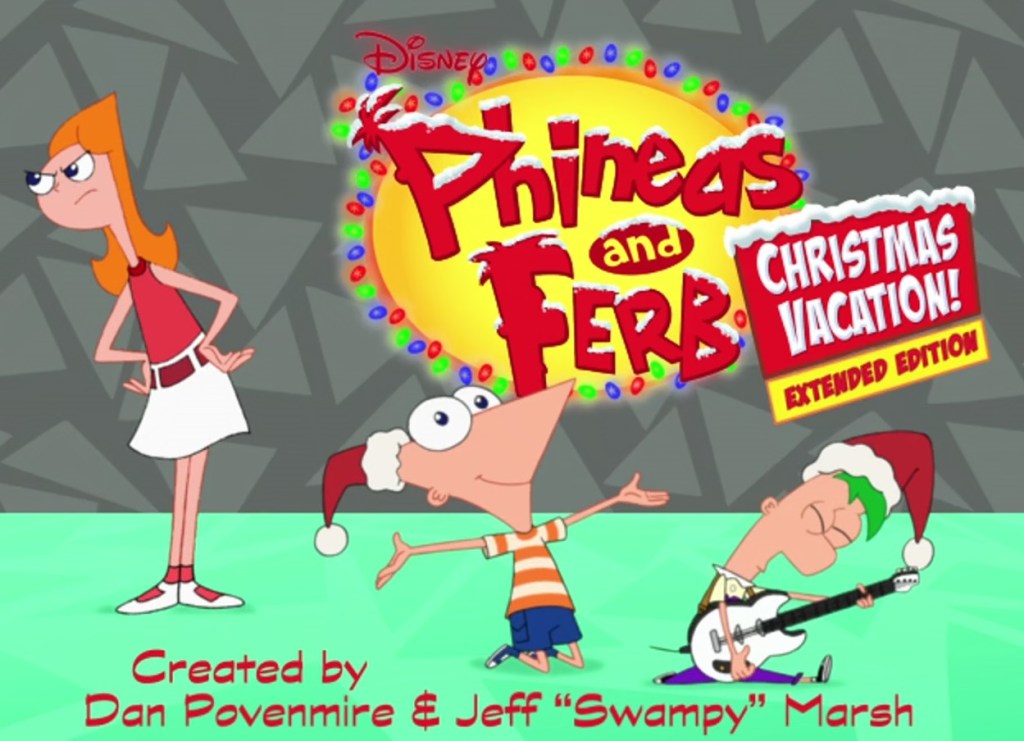
On the 7th of December 1979, ten years after going off the air (and five years since The Animated Series went off the air), Star Trek was back. Star Trek: The Motion Picture premiered, and while it has been overshadowed in many ways by its sequel, Star Trek II: The Wrath of Khan, the film was a success – albeit not an overwhelming one according to distributors and producers – and reinvigorated the franchise. Make no mistake, if it weren’t for The Motion Picture, Star Trek as we know it wouldn’t exist today – there would’ve been no Wrath of Khan, and from that there’d have been no Next Generation or any future series or film. In a very real sense, The Motion Picture paved the way for the franchise’s future, and the success Star Trek enjoys today owes a lot to this film.
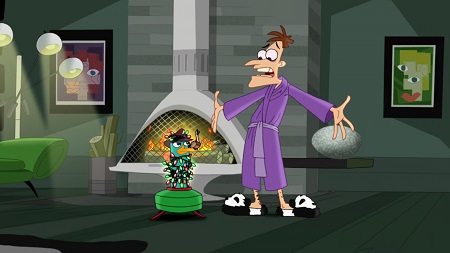
The Motion Picture was a risk for Paramount Pictures. Star Trek had shown that it had a number of very vocal fans – the letter-writing campaign in 1968 to get the series renewed demonstrated this – but its wider popularity was an unknown quantity, especially on the big screen. Reruns of The Original Series had garnered a larger audience than its 1966-69 original run, but there were still question marks over whether to make a new television series or to go down the box office route.

Star Trek: The Motion Picture turns 40 in December 2019.

Indeed, the project that would eventually become The Motion Picture started out life as Star Trek: Phase II, a television series that was to reunite the original cast – without Spock – for another five-year mission onboard the Enterprise. After a project called Planet of the Titans failed to get off the ground in the mid-1970s, by 1977 Phase II was officially in production. It has been said many times that the success of another 1977 project – Star Wars – is what led Gene Roddenberry and Paramount to reconsider the television series and make a film instead. While there is undoubtedly a kernel of truth to that, there were other factors at play too. The script which would eventually become The Motion Picture was originally set to be the pilot episode for Phase II but after a series of revisions and discussions between the creative team and the studio, the decision was made to enter production as a film instead, and two versions of the script were submitted – one by Gene Rodenberry and one by Harold Livingston, who’d been a producer on Phase II. Livingston’s script was chosen (by Michael Eisner – future CEO of Disney) and Star Trek: The Motion Picture was officially greenlit.

As an interesting aside, Phase II remained officially “in production” even after the decision was taken to switch focus to a film, and for much of 1977 the official line from the studio was that a series, originally set at 13 episodes, was being produced. It wasn’t until 1978 that the film would be officially announced.

Concept art of the bridge of the Enterprise that was created for Phase II.

So that’s a brief potted history of how it came to be. But despite making around $139 million on a budget of $46 million, Paramount considered the film a disappointment. The big risk had paid off, but not as much as they’d hoped. The expensive special effects and continued revisions to the script even during production were cited as reasons why, as was the less action-heavy, more ethereal storyline.

For me personally, it’s the lack of action and the deliberate slow pacing that gives this film something that others lack – a sense of “Star Trek-ness”. Star Trek was always into the weirder, more esoteric side of science fiction, especially prior to The Motion Picture, and this film stands alongside episodes of The Original Series as a pure science fiction work, not an action-sci fi film like The Wrath of Khan or First Contact. While some people might find its slower pace to be a grind, to me it makes it akin to watching a feature-length episode of the series, rather than just another action flick.

Leonard Nimoy, director Robert Wise, Gene Roddenberry, DeForest Kelley, and William Shatner during production on The Motion Picture.

Because of the overwhelming popularity of The Wrath of Khan within the fanbase, The Motion Picture often gets a bad rap. People have said that “all of the odd-numbered Star Trek films are bad”, including The Motion Picture in with Search for Spock and The Final Frontier. Both of those titles have good and bad moments – the latter suffering perhaps from too much involvement from William Shatner – but to me, The Motion Picture is in a different league.

Some criticism of the film is that it feels like a two-and-a-half hour episode of The Original Series. But why should that be a criticism? The Motion Picture masterfully builds up its drama – the V’ger cloud’s attack on the Klingons, its destruction of the Epsilon IX station, and finally the death of new character Ilia all add to the stakes. While none of these are particularly dramatic, nor gory, that doesn’t detract from the threat, it heightens it. V’ger is shown to be a being of such incredible power that it can make whole fleets of starships vanish in a heartbeat. We don’t need huge explosions or a punch-out to learn this. V’ger’s power is also confirmed by the reaction of characters. So as the film progresses, we know what’s at stake.

Kirk and the away team encounter V’Ger.

To change lanes completely, I happen to really like the aesthetic of The Motion Picture. It’s very 1970s in some ways – the orange and brown tones, and some of the uniform choices in particular, but that’s not necessarily a negative thing. Kirk’s uniform as an admiral happens to be one of my all-time favourite Star Trek uniforms. The high collar, the belted tunic, and the simple curved lines in grey and white combine with a metallic gold Starfleet insignia to make an understated yet interesting uniform. I’m not a cosplayer by any means, but if I ever were to make myself a uniform, that would be the one I’d go for. And while we’re talking about things that look great, the sweeping shot over the Enterprise when Kirk is being taken aboard by shuttlepod is absolutely perfect. Combined with an amazing score – for which composer Jerry Goldsmith was nominated for an Academy Award – the full sequence is one of the most inspiring and moving in all of Star Trek, speaking for myself as a fan. When the music ramps up right as we see the Enterprise from the front for the first time, it can be quite emotional. I could happily watch that sequence over and over again.

Many of the sets built in 1978-79 were in continuous use (albeit in modified form) right through to Enterprise‘s cancellation in 2005. Some of the reuses are quite apparent in The Next Generation, so in that sense, the design choices made in The Motion Picture carried through the next two decades of Star Trek as a franchise. The panelling and angles on corridors in particular can be seen on the Enterprise-D and the USS Voyager, and the idea of a warp core as a large upright glowing tube is also something that has carried on right through Star Trek – even cropping up in CGI form in the most recent of the Short Treks episodes. Much of what we consider to be “Star Trek” in terms of aesthetic has its roots not in 1966 but in 1979 – future productions built on what designers and artists had created here. The Next Generation and Voyager in particular owe significant parts of their design to The Motion Picture.

Some of these sets would be in continuous use – albeit with tweaks here and there – until Enterprise’s cancellation in 2005. They defined the “look” of Star Trek.

The storyline of The Motion Picture is certainly different from many science fiction outings. It isn’t a film about defeating and destroying an enemy, it’s a film about bridging the gulf and communicating with a new form of life. V’ger, set up to be the film’s antagonist, wanted to evolve – to merge physically with its creator. The crew of the Enterprise could’ve used that moment of weakness to attack it, and maybe even destroy it – and in a different film perhaps that would’ve been the finale. But The Motion Picture builds up to this moment, and it isn’t the death and vanquishing of a foe that we see, but communication, and ultimately the creation of new life. Klingons, Romulans, Cardassians, and the like may be fun to see on screen, but Star Trek is all about “seeking new life” – and what could be newer and more different than a hyperevolved, massively intelligent machine?

This side of Star Trek, though, has always been more of a niche product. When fans are asked about their favourite films, The Wrath of Khan and First Contact are usually somewhere up near the top, as well as episodes like The Best of Both Worlds, or DS9’s The Way of the Warrior. These are all action-heavy stories, and while Star Trek has enough room for both these and the slower-paced, thought-provoking ones, The Motion Picture falls firmly into the second category. With that comes being underrated and overlooked by fans who prefer more action-oriented stories.

Robert Wise, William Shatner, Leonard Nimoy, Gene Roddenberry, and DeForest Kelley at the film’s premiere.

When Spock describes V’ger as being little more than “a child”, he sets the stage for understanding, and from that, communication. The ultimate revelation that V’ger was, in fact, a probe of human origin was truly unexpected. The Motion Picture had an incredibly ambitious story which sought to blend these elements together. The cyclical nature of a returning spacecraft, the massive differences that almost certainly will exist between humankind and anything we might encounter in outer space, and at the heart of it all, the returning characters – not all of whom had enough to do, arguably. But the core dynamic between Kirk, Spock, and McCoy was still there. Perhaps The Motion Picture needed more fine-tuning, and perhaps its scope was too vast for a single film to properly encompass, but as a story it makes you stop and think. The galaxy isn’t just going to be humanoids, there are going to be things out there completely beyond our understanding. And the choices we make today – like probing outer space – may have consequences well into the future that we could never foresee.

As an inspirational message, I think that can’t be understated. Seeking out new life and new civilisations – the raison d’être of Starfleet – isn’t always going to be smooth sailing. But if we’re willing to look at things from a different point of view, to listen, to understand, and to communicate, we can find a way to coexist even with someone who seems to be big and threatening. I know the real world doesn’t always work that way, but Gene Roddenberry was always about showing us how humanity can be better than we are in the present day. Speaking personally, I find that aspect of The Motion Picture to be inspiring. As a work of science fiction, that’s the kind of message I admire and what I’d like to see more of on our screens.

Above all, The Motion Picture relaunched the Star Trek brand for a new decade, one which would culminate in The Next Generation and a return to television. If it weren’t for this film, Star Trek would look very different today – if it even existed at all. We can argue about which Star Trek film we like best, and at the end of the day it’s always going to be a subjective choice, but I’d definitely rank The Motion Picture highly on any list. Not just for what it did for the franchise, though that is incredibly important, but as a work of science fiction that wasn’t afraid to tell a thought-provoking story.

Star Trek: The Motion Picture is available to stream now on Paramount Plus in the United States, the United Kingdom, and other countries and territories where the platform is available. The film is also available to buy on DVD and Blu-Ray. Star Trek, Star Trek: The Motion Picture, and all other Star Trek properties mentioned above are the copyright of Paramount Global and/or Paramount Pictures. This article contains the thoughts and opinions of one person only and is not intended to cause any offence.