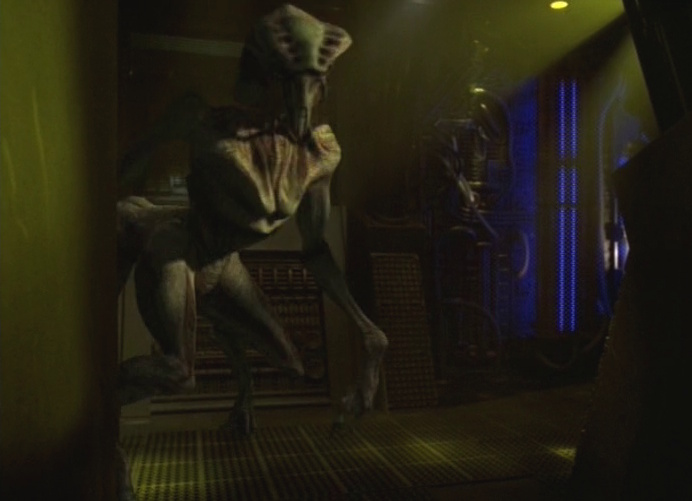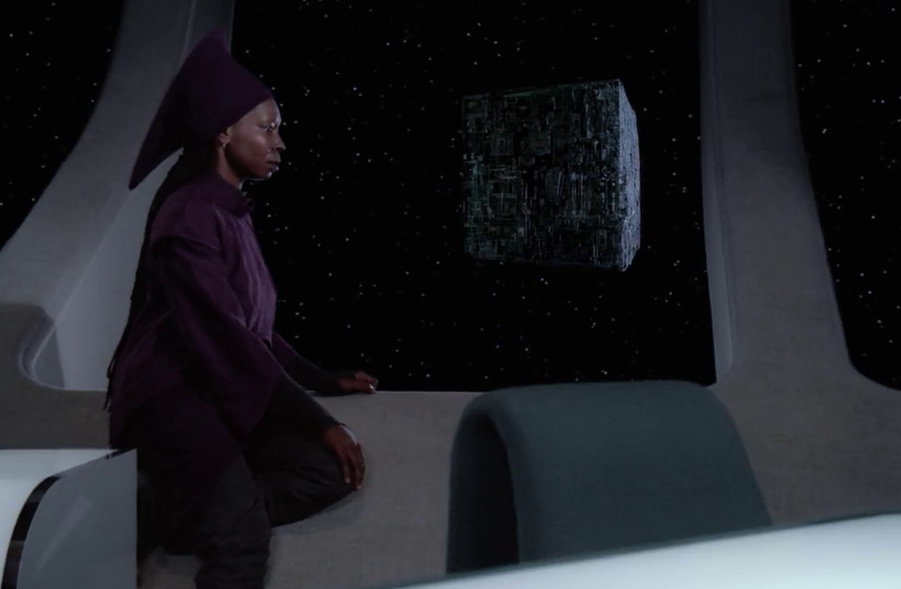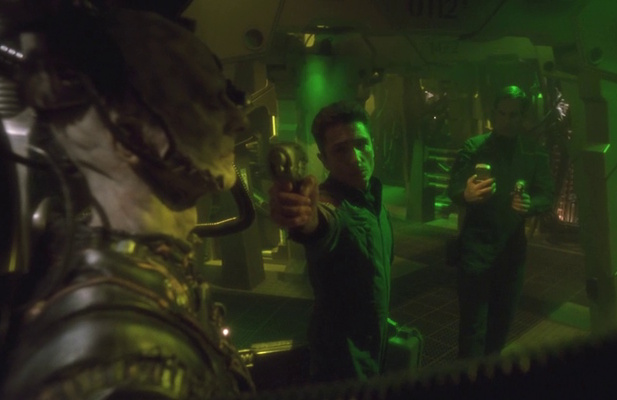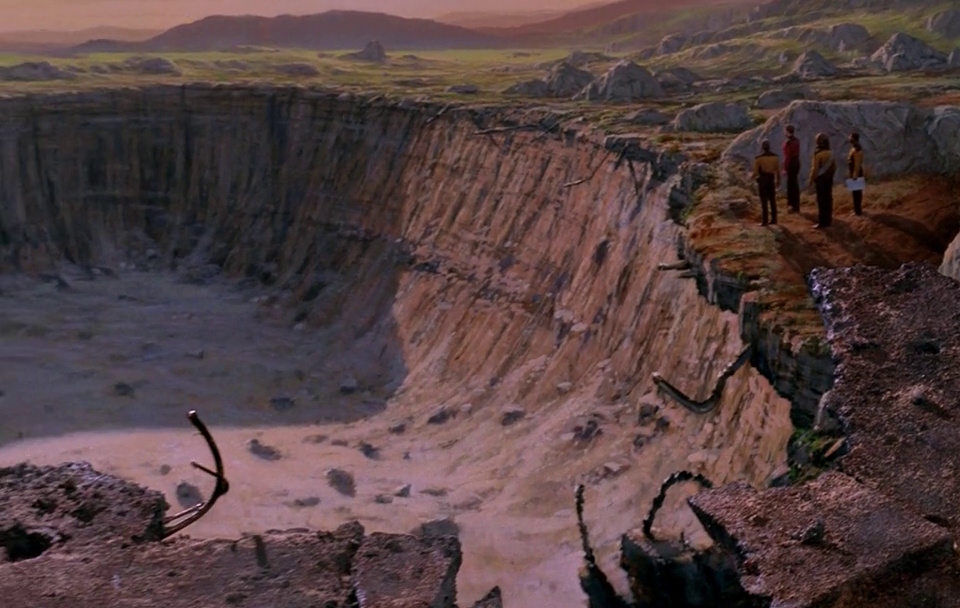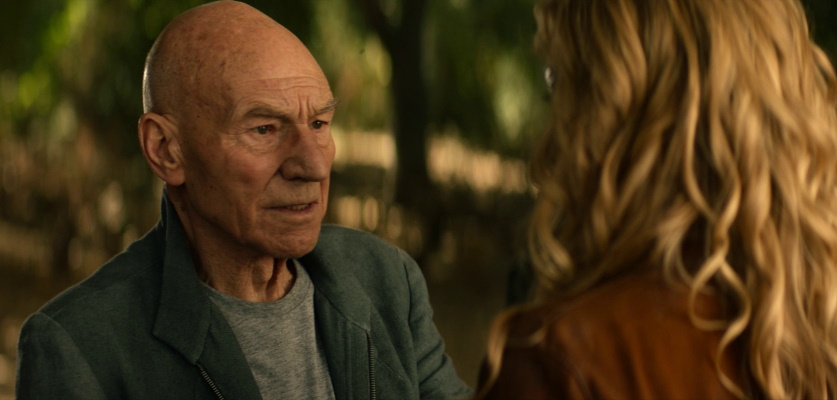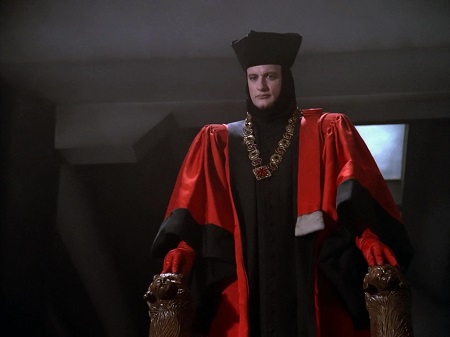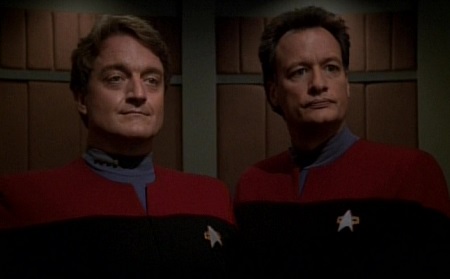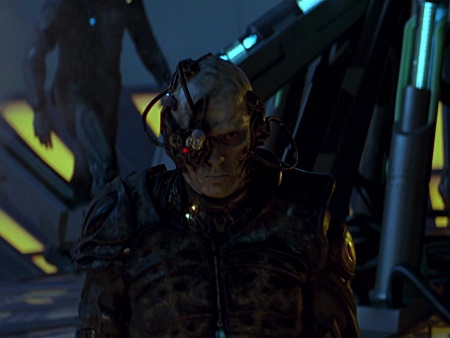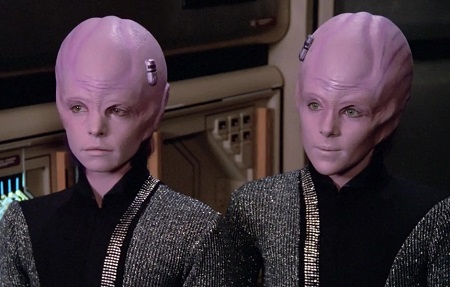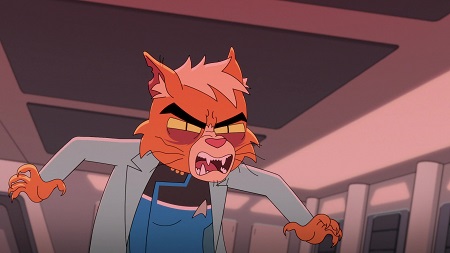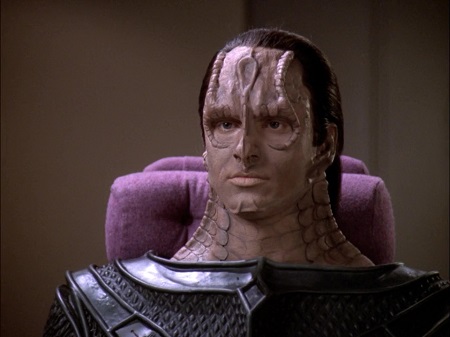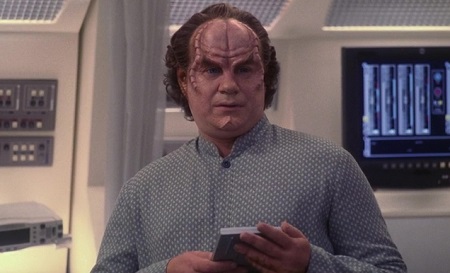
Which Narrative Clichés Would I Remove From Star Trek?

A Star Trek-themed spoiler warning.

Spoiler Warning: Beware spoilers for the following Star Trek productions: The Wrath of Khan, The Next Generation, Deep Space Nine, Voyager, Into Darkness, Discovery, Picard, Prodigy, Strange New Worlds, and Section 31.

I hope you all had a lovely Halloween! October was a busy month for me, but I did manage to put out a few Halloween-y posts, so I hope you’ll scroll back and check out some of those; they were a lot of fun to write!

Onward to the subject of today’s piece, then.

I was scrolling Facebook when I noticed a Star Trek fan page had posted a screenshot of a Tumblr poll (because that’s all social media is these days: screenshots of the same handful of pages being endlessly recycled!) But the original post, first shared on Tumblr by user “quasi-normalcy,” was one that I thought could be very interesting to address. In short, it asked the question “which clichés do you most wish you could remove from Star Trek?” followed by eleven options that form the basis of a number of Star Trek episodes.
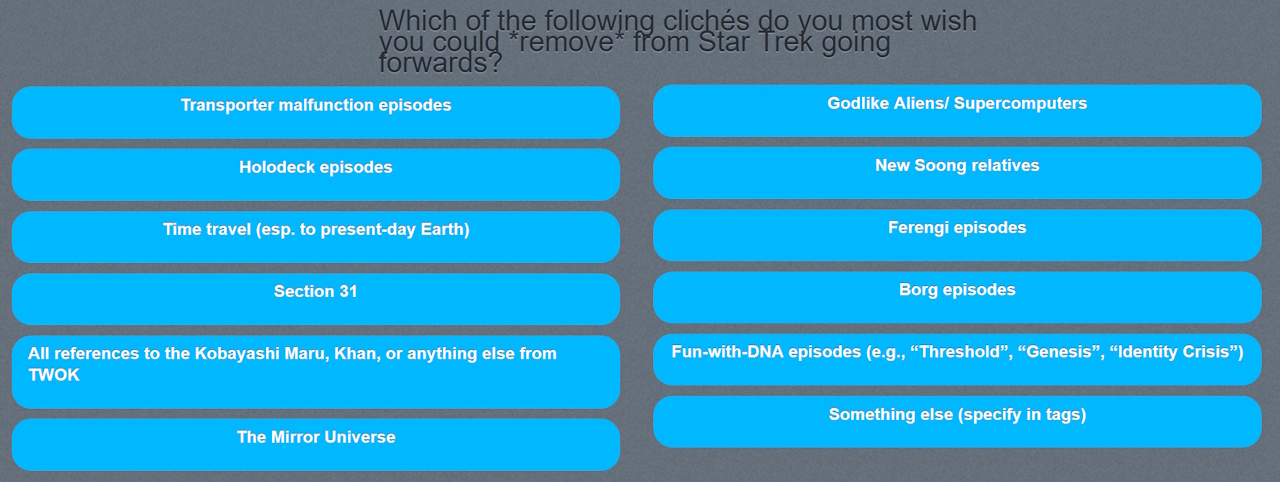
Screenshot of Tumblr showing a poll.
The original Tumblr poll upon which this piece is based…
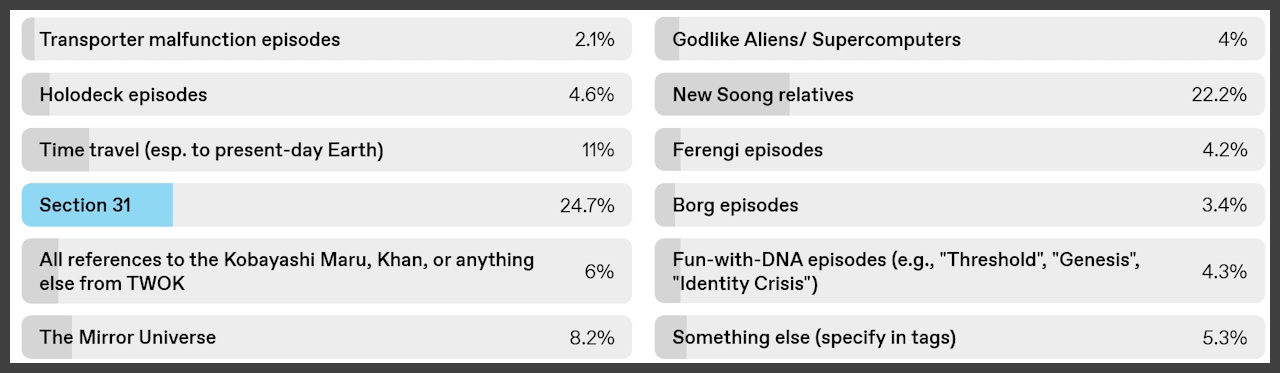
Screenshot of Tumblr showing the results of a poll.
…and the eventual results.

The original Tumblr poll has now concluded, but I’ll drop a link to the post below in case you want to see it or check out the original poster’s page – this is not a unique idea and I am not claiming to have come up with it! But I am going to do something a little different than just clicking or tapping on a poll! I’m going to address all eleven of “quasi-normalcy’s” Star Trek narrative clichés, explain what I like or dislike about them, and perhaps add one or two of my own, too!

So thank you “quasi-normalcy” on Tumblr, and random Star Trek fan page on Facebook, for introducing me to this idea. I think it’ll be interesting to talk about some of the narrative frameworks that Star Trek has used, in some form, on multiple occasions – and maybe a little controversial, too! My usual caveat applies: everything we’re going to discuss is the subjective, not objective, opinion of just one Trekkie. If you hate everything I have to say about these episodes, think I’ve totally misunderstood something, or if we just disagree on what makes for a fun episode of Star Trek… that’s okay! Star Trek is a big tent, and there’s room for all kinds of opinions. I share mine with the Star Trek fan community in that spirit.

That being said, if you don’t want to read some potentially controversial Star Trek thoughts, this is your opportunity to beam out! I’ll address each potential cliché in the order they were listed in the original poll, then give my verdict on whether it should be “removed from Star Trek” going forward!

Cliché #1:
Transporter Malfunction Episodes

Still frame from Star Trek: Picard showing a transporter energising.
Transporting.

This feels like too broad of a category to want to see removed, in my opinion. A “transporter malfunction” can be handled in so many different ways, with so many different outcomes. We can bring Scotty forwards in time by eighty years in Relics, then cross over to a parallel universe in Mirror, Mirror – with completely different results. The transporter is a key part of Star Trek, and when it goes wrong, it can lead to all kinds of stories which vary in tone, structure, and genre. With that in mind, I really don’t see this one as a problem. It can feel like a cliché sometimes, sure… I will concede that point. But because transporter malfunctions vary so much in terms of outcome, I don’t see them as an issue and I’m happy to have more “the transporter done goofed” stories going forward.

That being said, there are some places where more common transporter problems could be shaken up – or the frequency of these instances lessened. For example, the way transporters work or don’t work floats around at the behest of the plot, and it’s a pretty common trope for the transporter to break or not be able to work just at the moment when it’s needed. Think about it: how many episodes would’ve been completely different if the transporter didn’t stop working just when a character needed to be rescued? Generally, these episodes work well enough. But I’m certainly open to the “broken transporter” or “the transporter won’t work because of technobabble” kinds of story beat being reduced in frequency.

My Verdict: Keep It!

Cliché #2:
Holodeck Episodes
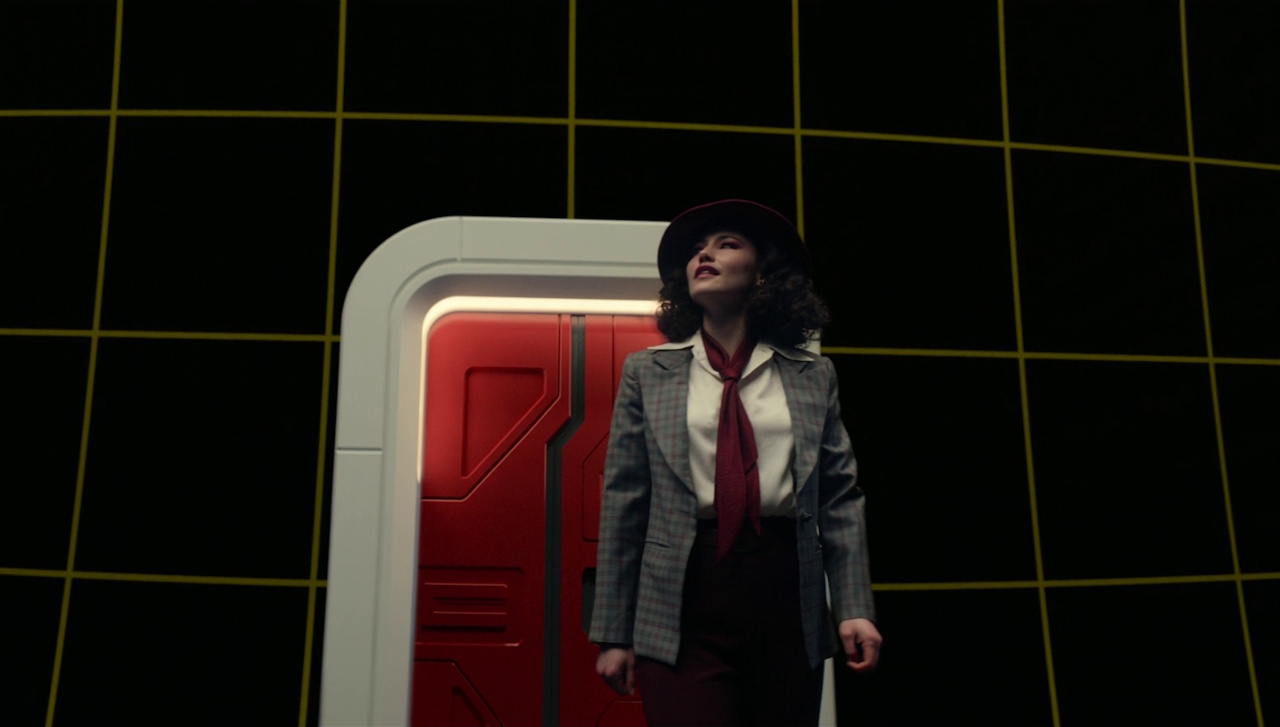
Still frame from Star Trek: Strange New Worlds showing La'an, in costume, on the holodeck.
La’an on the holodeck.

As above, there are so many different ways to take holodeck stories, and the ones we’ve seen have varied so much, that I don’t really consider this to be a “cliché” as such – they’re just one more type of Star Trek episode. As with any sub-genre, there are some holodeck stories that I enjoy more than others, and some I’m happy not to see repeated. But as a concept? I think holodeck stories can open things up, give the cast a chance to step out of their usual roles, and it can be a lot of fun to see them interacting in more of a social setting.

That being said, *modern* Star Trek shows, which tend to have fewer seasons as well as fewer episodes per season, don’t need nearly as many opportunities to do something like this. I noted in one of my Strange New Worlds Season 3 episode reviews that, out of fewer than thirty episodes at that point in the show’s run, characters like Pike and Spock had appeared out-of-character on at least four or five occasions apiece. Not all of those were holodeck stories, but the basic point remains. However, I think there’s still a place for stories set on the holodeck on occasion, as they can be fun ways to explore new characters, new locales, and just different themes than would be possible in a more straightforward episode set aboard a starship or planet.

My Verdict: Keep It!

Cliché #3:
Time Travel (Especially to Present-Day Earth)
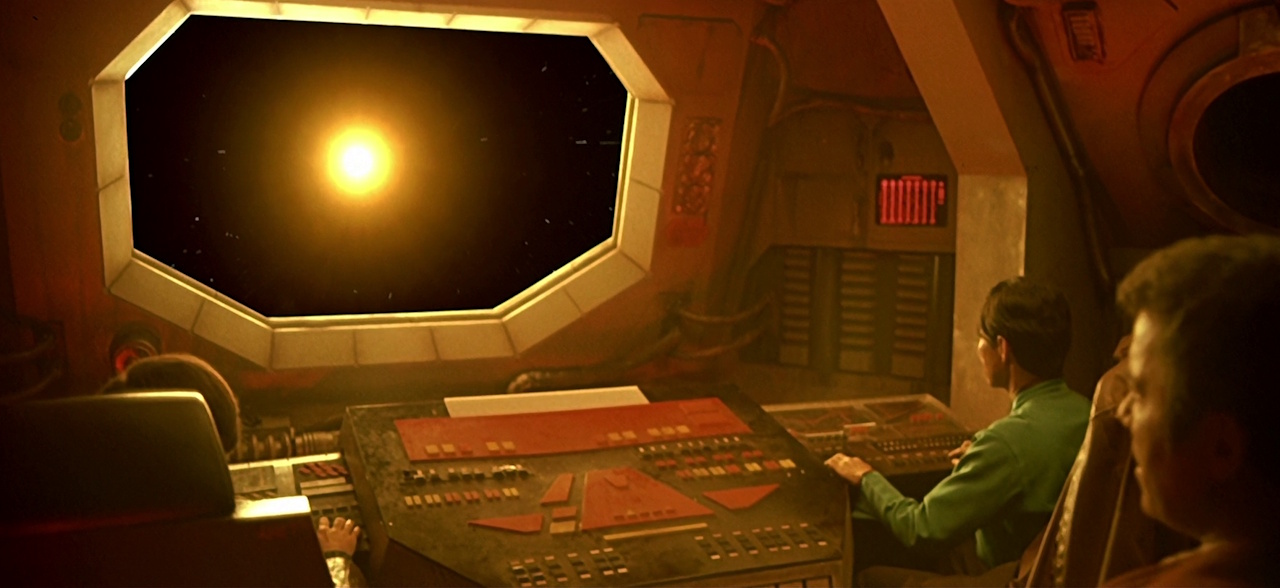
Still frame from Star Trek IV: The Voyage Home showing HMS Bounty approaching the sun.
Kirk and the crew prepare to travel back in time.

Can I break this one into two pieces?

Pretty please?!

Cliché #3-A:
General Time Travel
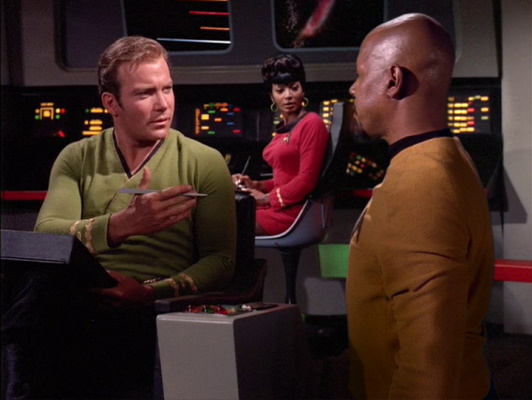
Still frame from Star Trek: Deep Space Nine showing Kirk and Sisko meeting.
Two Captains!

Okay, thank you for allowing me to split this one up! Time travel within Star Trek’s timeline – backwards and forwards – can be a blast. Viewers rank The City on the Edge of Forever as *the* best of The Original Series, and I adore episodes like Trials and Tribble-Ations, All Good Things, and Shattered. Time travel has been a key plot point in episodes like Time Squared, Twilight, Tapestry, Eye of the Needle, and many more. All of these are fantastic, and show what the franchise can do with time travel within the confines of its universe.

Discovery shooting forwards in time at the end of Season 2 arguably improved that series, with many interesting episodes coming after the leap to the 32nd Century. Strange New Worlds’ fantastic first-season finale leaned on time travel in a unique way, too. Face the Strange was especially creative, probably one of the highlights of Discovery’s fifth season. So modern Star Trek has utilised time travel phenomenally well. I wouldn’t want to see these kinds of stories erased from Star Trek.

My Verdict: Keep It!

Cliché #3-B:
Time Travel to Modern-Day Earth.

Still frame from Star Trek: Picard showing Los Angeles from above.
Contemporary Los Angeles in Picard.

This is why we had to split time travel into two separate pieces! Time travel within Star Trek’s fictional timeline can be a blast – even to Earth. But time travel to the modern day? Those stories tend to feel out-of-date pretty quickly. Look at The Voyage Home and Future’s End – not to mention Picard’s entire second season. Sometimes, stories like this work well, and use a modern-day setting in creative ways. But too often they lose too much of what makes Star Trek… feel like Star Trek.

Star Trek is about the future. And sometimes, figuring out how that future came to be can be interesting. But in a lot of cases, time travel episodes that visit contemporary Earth don’t have enough to say – or what they try to say is pedestrian and bland, like “climate change is bad.” Again, if we assume modern Star Trek shows will continue to have ten-episode seasons and four or five seasons max, I think the less time spent on modern-day Earth the better. As I said once: I can barely re-watch Picard’s second season – a full one-third of that show – because of how unenjoyable it is, a significant part of which is due to its modern Earth setting. So… yeah. Let’s give modern Earth a break, eh?

My Verdict: Vaporise It With A Disruptor!

Cliché #4:
Section 31
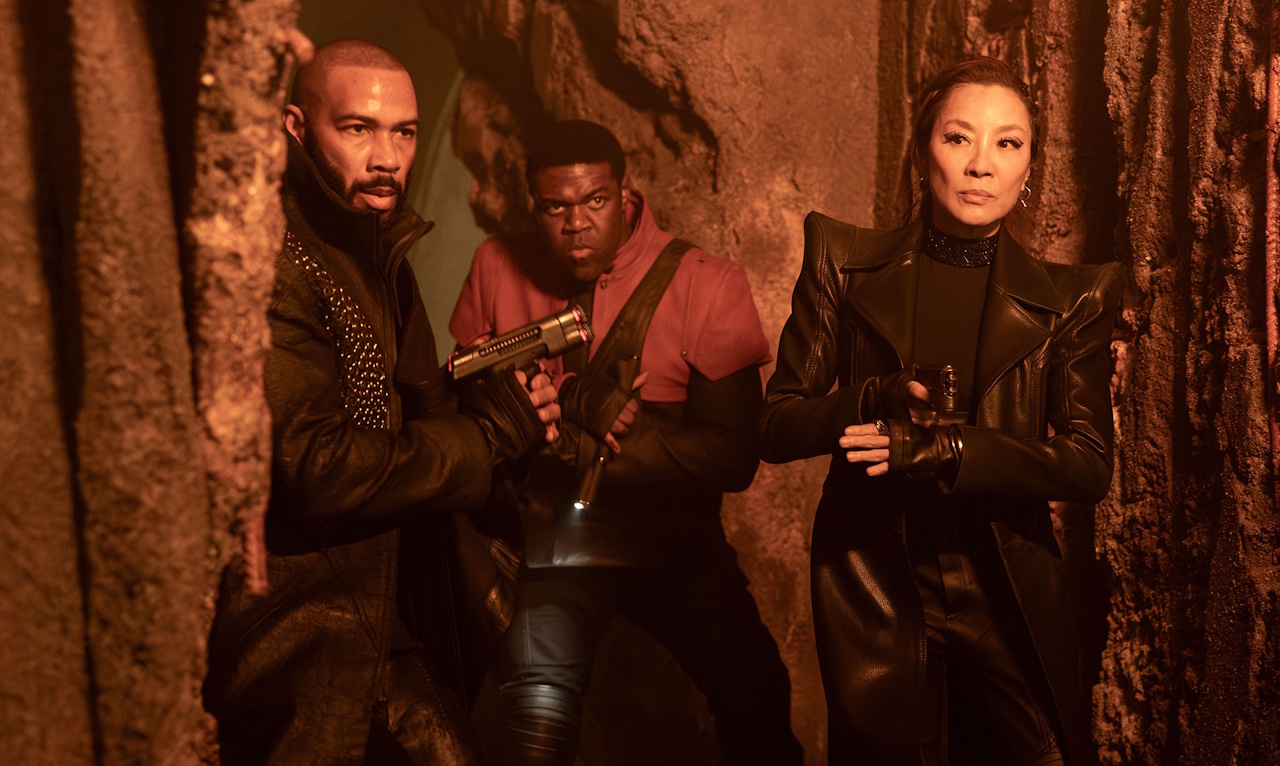
Promo photo for Star Trek: Section 31 showing Georgiou and two other operatives.
Three Section 31 operatives.

I believe the original Tumblr poll was written before this year’s Section 31 movie, so the author couldn’t have known what the reaction to that would be. Given the apparent disappointment of Section 31 to Paramount (and new owner Skydance), I have to assume that any more Michelle Yeoh-led Section 31 sequels or spin-offs won’t be going ahead. So in that sense, we already have part of an answer to this point!

Section 31 was incredibly controversial when Deep Space Nine introduced it. I remember furious debates on Star Trek message boards around the turn of the millennium about “Gene’s vision” and how Section 31 shouldn’t exist in the Star Trek universe. I gotta admit that I found the original idea and the original presentation of Section 31 to be interesting – and it seemed logical, to me, that an organisation as massive as the Federation would run this kind of off-the-books organisation. However, Section 31 as it was depicted in Discovery and the Section 31 film strayed a long way from that, and arguably trod all over the toes of canon by showing the organisation as being so out in the open more than a century before DS9. It would’ve been possible, perhaps, to show how Section 31 disappeared and went underground in the intervening years, but that idea was never picked up. I still think there’s potential in the idea of a “black ops” Federation organisation, but it has to be handled a lot better.

My Verdict: Keep It!

Cliché #5:
All References to the Kobayashi Maru, Khan, and The Wrath of Khan.
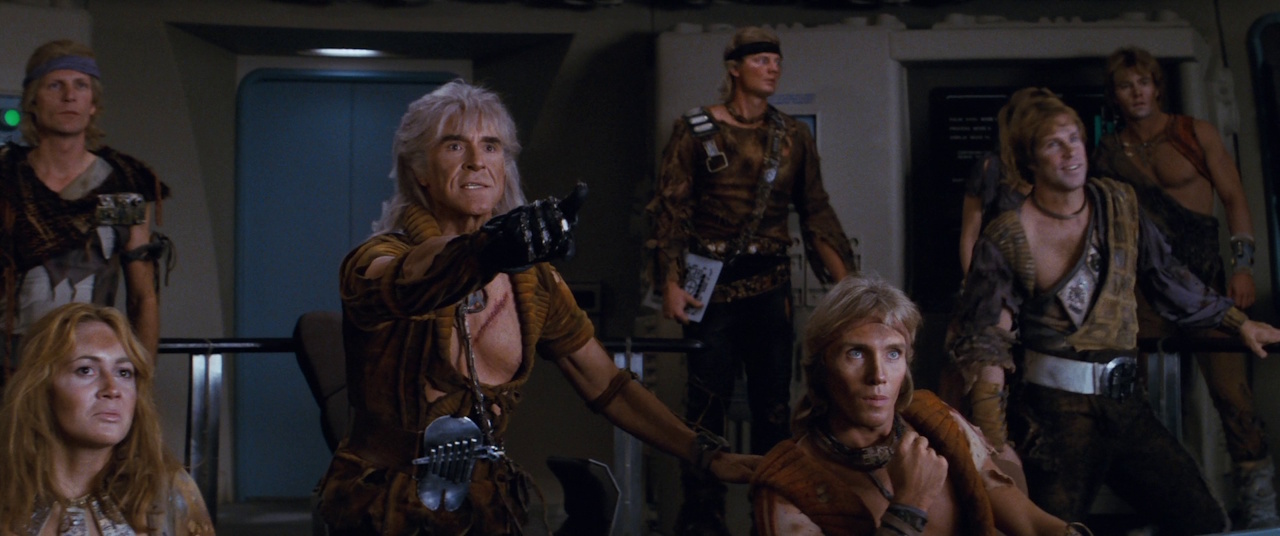
Still frame from Star Trek II: The Wrath of Khan showing Khan and his crew.
Khan and the augments on the Reliant’s bridge.

I think saying *all* references to The Wrath of Khan might be a bridge too far, but I get where this is coming from. I noted in one of my Strange New Worlds Season 3 episode reviews that making La’an a direct descendant of Khan has been a complete waste, and that basically nothing would’ve changed for her character if she’d been given a different last name. So in that sense, that kind of direct reference to Khan himself – particularly as SNW is a prequel – is something I’d happily live without. I’m not caught up on the Khan audio drama yet, but my initial reaction to a Khan-focused series wasn’t especially positive, either, as I felt we’ve already seen everything we need to see of Khan.

However, I think some things from The Wrath of Khan – like the Kobayashi Maru – can and have been used well elsewhere. Prodigy’s first season episode Kobayashi is a case in point: a great episode that built on those foundations. So while I think references to Khan himself can definitely be scaled back, if not dropped entirely for a while, this entry’s “all or nothing” attitude gives me pause. The Wrath of Khan is a great film, and some of the elements it introduced have gone on to be widely celebrated parts of Star Trek. There are new ways to approach things like the Kobayashi Maru scenario and human augments, and I wouldn’t want to rob future Star Trek writers of those.

My Verdict: Keep It!

Cliché #6:
The Mirror Universe
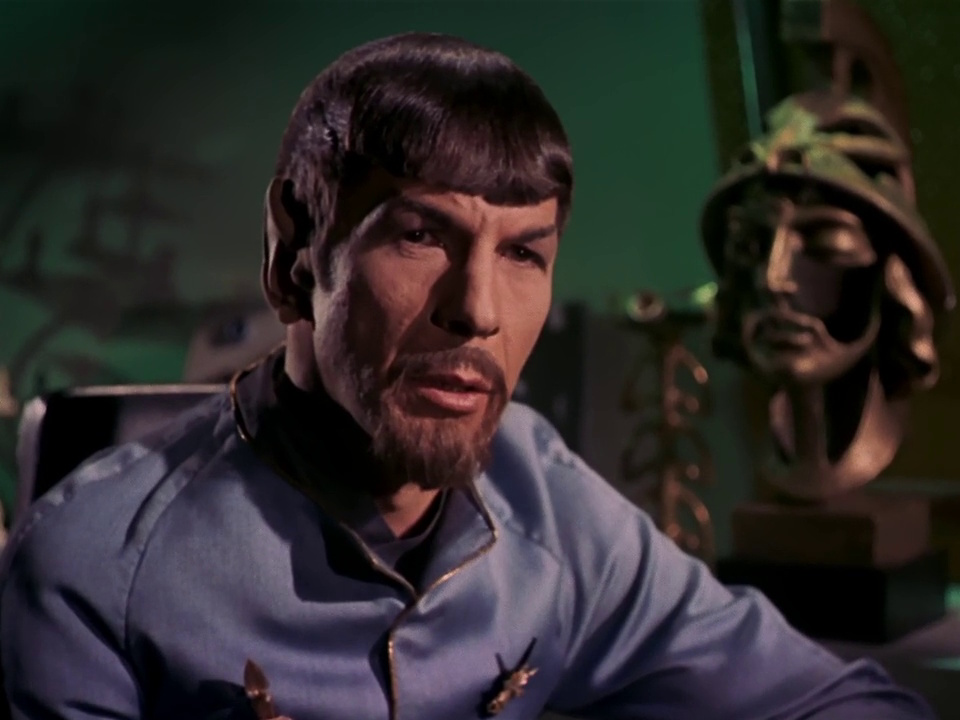
Still frame from Star Trek: The Original Series showing Spock from the Mirror Universe.
Mirror Spock.

If the Mirror Universe had been a one-off, I’d probably say it was worth re-visiting. But even as far back as Deep Space Nine, the Mirror Universe was played out. This is a setting where violence, murder, and torture are the norm, and it’s so boring and one-dimensional that it tricks even the best Star Trek actors into putting out hammy, over-the-top, ridiculous performances that are, in some cases, genuinely so bad that they’re unwatchable for me. The Mirror Universe *can* be interesting to visit for a single episode, on rare occasions, but where it’s failed has been repeat visits, recurring or main Terran characters, and just its general over-use.

Discovery did not benefit from any of its Mirror Universe storylines, and I don’t think Georgiou’s Terran Empire origin did wonders for Section 31, either. I don’t really understand why modern Star Trek writers have developed an obsession with the Mirror Universe (or Mirror Universe-inspired settings, like Picard’s Confederation of Earth), but I think we’ve seen more than enough of this parallel universe. The *only* Mirror Universe story I’d have even potentially been interested in was one involving the rescue of the Prime Timeline version of Captain Lorca – but I suspect that ship has sailed. The Mirror Universe can sail into the sunset with it!

My Verdict: Vaporise It With A Disruptor!

Cliché #7:
Godlike Aliens/Supercomputers
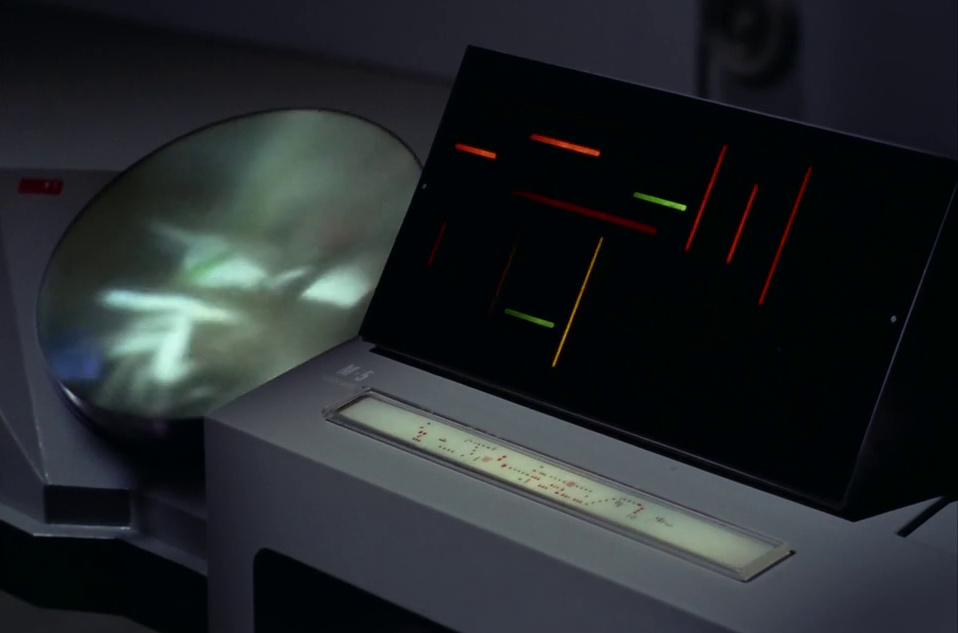
Still frame from Star Trek: The Original Series showing the M-5 computer.
The M-5 Multitronic Unit.

Not only does this one feel way too broad, but I think Star Trek has demonstrated that there’s huge value in exploring how we might interact with an alien or entity possessing “god-like” powers. There’s also the current trajectory of artificial intelligence here in the real world, and how some people feel we’re only a few years away from superintelligent A.I. systems. Star Trek has been an early pioneer of showing the dangers of A.I., as well as potential benefits.

I suppose, though, too many of these stories could feel samey. As with any sub-genre, it needs to be handled well, not over-exposed, and kept to a reasonable level. But I definitely think the positives outweigh the negatives, and in the near future, there could be a ton of value in exploring supercomputers and “god-like” A.I. systems in particular.

My Verdict: Keep It!

Cliché #8:
New Soong Relatives
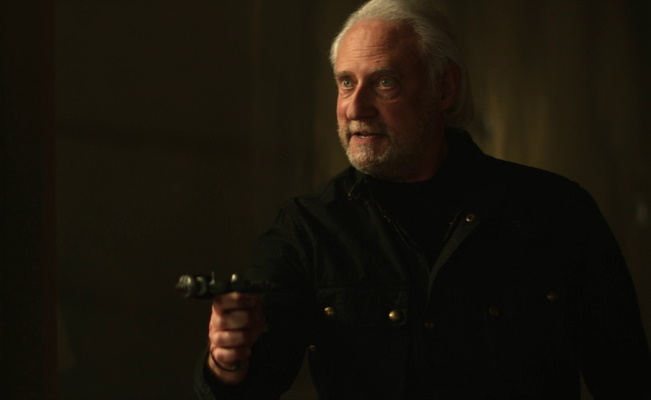
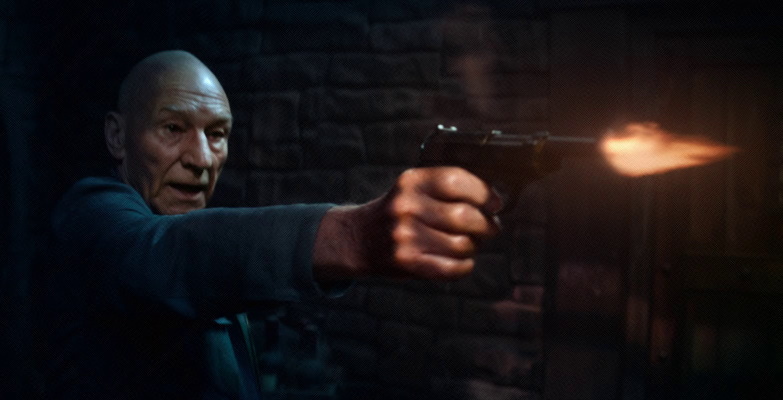
Still frame from Star Trek: Picard showing Adam Soong wielding a pistol.
One of the Soongs.

Noonien Soong, Arik Soong, Altan Soong, Adam Soong, and a couple of illusory Noonien Soongs. Then we have Lore, B-4, and the new Data android. Not to mention Kore Soong, and other Soong-type androids. Yeah… I think this is getting pretty silly now! I really didn’t like what Picard did with Data in Season 3: resurrecting him after he’d been so beautifully and fittingly laid to rest in Season 1 just felt wrong. And the inclusion of *two* new Soongs in Picard was definitely a bit too much. Brent Spiner is great, don’t get me wrong, and he can play villains and devious characters exceptionally well. But I think we’ve taken the family of Data’s creator as far as it can reasonably stretch – too far already, some might say!

With Legacy seemingly not going ahead, I don’t know what the future holds for the renewed Data. But with Altan Soong dead, that could be the last descendant of the Soong family – at least as of the dawn of the 25th Century. I don’t think we need to go back in time to see Adam Soong’s work on the augments, nor revisit Noonien Soong’s creation of Lore and Data. Some storylines just have a natural end point. Adding more Brent Spiners to the Soong family wouldn’t really add anything new to Star Trek at this point, either.

My Verdict: Vaporise It With A Disruptor!

Cliché #9:
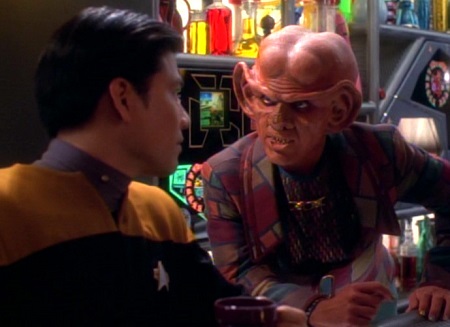
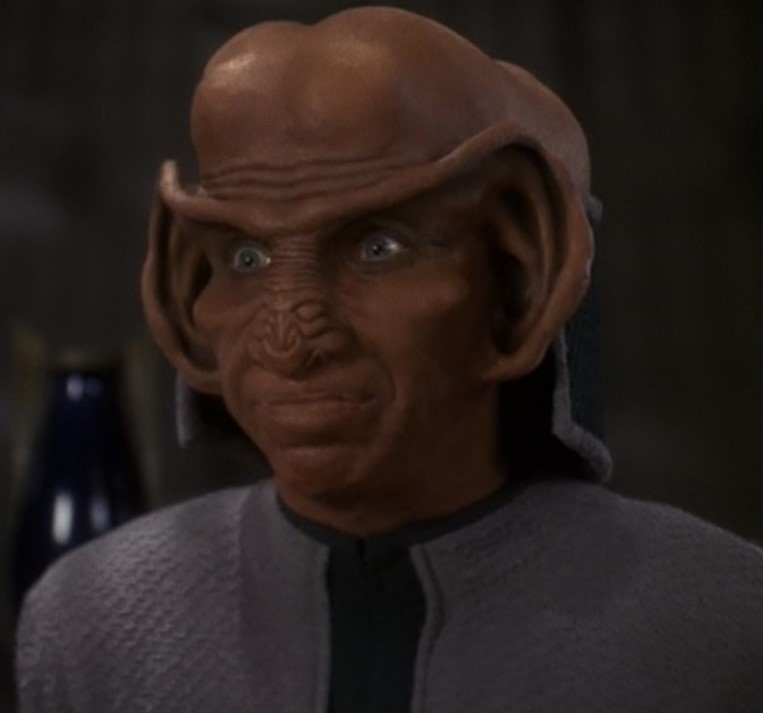
Ferengi Episodes
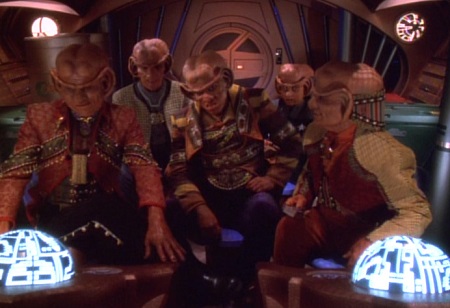
Still frame from Star Trek: Deep Space Nine showing a crew of Ferengi.
The Magnificent Ferengi!

Though we spent a lot of time with the Ferengi in Deep Space Nine, the faction hasn’t been seen very much this side of the millennium. With that in mind, I’m definitely down for more Ferengi stories! I’d love to see, for instance, how the Ferengi are coping in the 32nd Century. Did they ever join the Federation? Are they still obsessed with latinum and profit? And in the Picard era, too, were a new series ever to be commissioned, it would be lovely to catch up with Grand Nagus Rom in live-action.

In DS9, Ferengi episodes often took on a comedic tone, and I think I’d happily entertain less of that; a more straight-laced and serious Ferengi story could be an interesting change of pace. Though we know a lot about the Ferengi thanks to Quark, Rom, and Nog in particular, there’s still a lot that can be done with the Ferengi, and there are certainly more stories to tell where Ferengi characters are in focus.

My Verdict: Keep It!

Cliché #10:
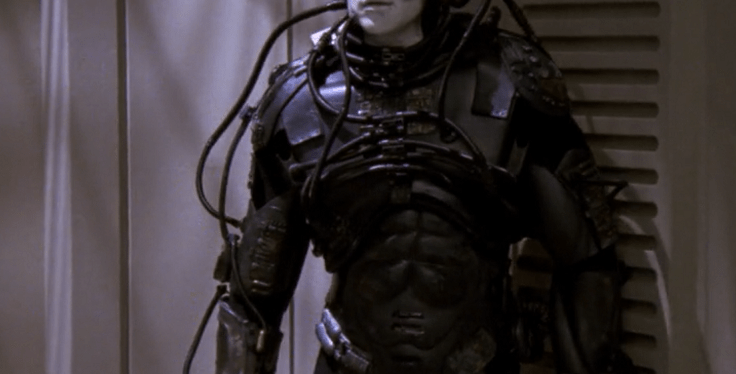
Borg Episodes
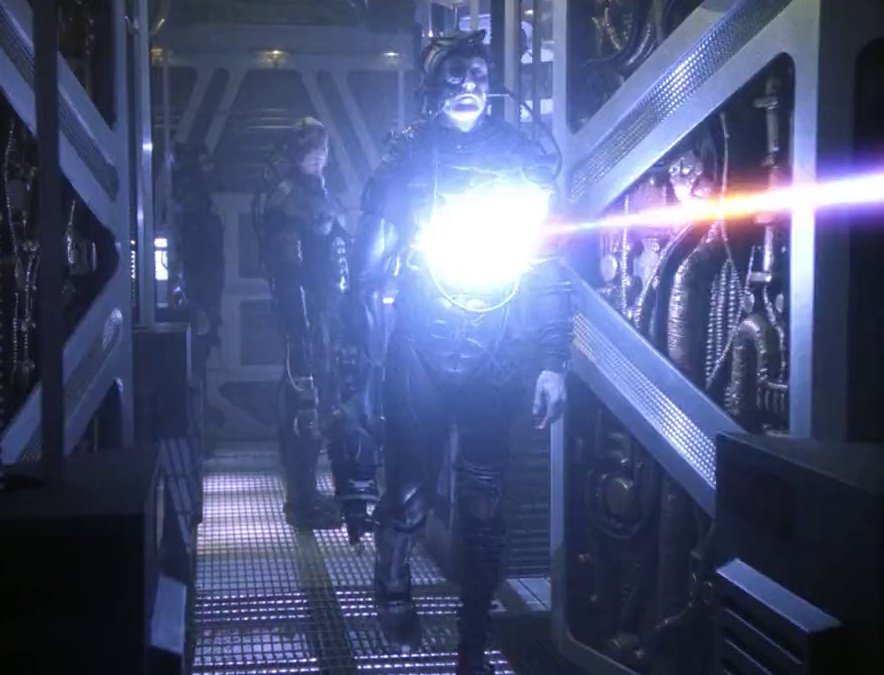
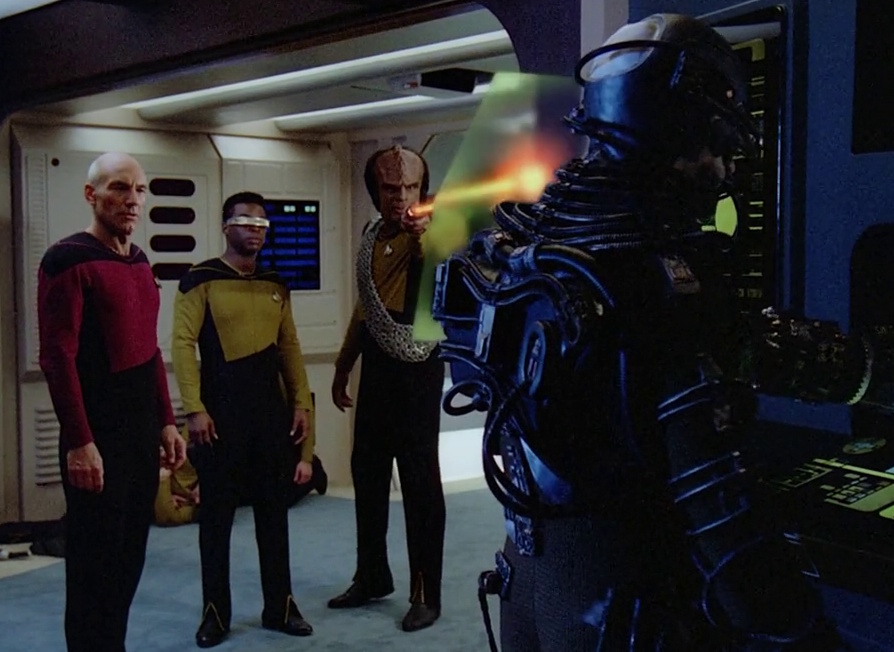
Still frame from Star Trek: The Next Generation showing a Borg drone being phasered.
Is it time to kill off the Borg?

This one… I’m torn, to be honest with you. Picard over-used the Borg, and that came after Voyager had already done a lot to lessen the Borg’s fear factor and imposing nature. There are also issues with the timeline thanks to Voyager and Enterprise, and I still think that the introduction of a Borg Queen in First Contact was a mistake! However, I still like the idea of a Star Trek series I’ve provisionally dubbed the “Borg Invasion” show, in which a war against the Borg is the main focus of the series.

This show would take on a much darker tone, with themes of horror and war being prevalent. If done well, with a clear three- or four-season plan from the get-go and a sufficiently high budget, I really believe it could work exceptionally well. However, I won’t deny that the Borg have been over-exposed, not only in modern Star Trek, but really going as far back as Voyager. And I wouldn’t blame any Trekkie who wants to give the faction a break, especially after Picard brought them back three seasons in a row.

My Verdict: Keep It!

Cliché #11:
Fun-With-DNA Episodes (i.e. Genesis, Threshold, etc)
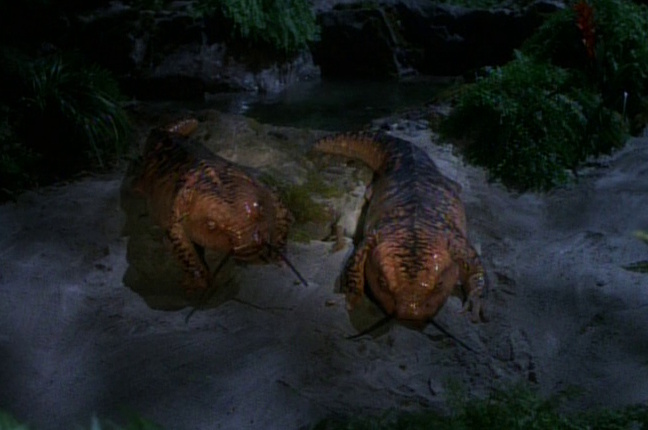
Still frame from Star Trek: Voyager showing hyper-evolved human salamanders.
Hmm…

As I’ve said several times now, this feels like quite a broad concept that could go in many different directions. As such, I don’t think I’d be willing to say there should “never” be another episode in which the DNA of some of our heroes gets muddled up! That being said, episodes like Threshold, Extinction, Favorite Son, Unnatural Selection, and Four-and-a-Half Vulcans aren’t necessarily shining examples of the best of Star Trek. So this one, I suppose, can feel a bit hit-and-miss.

I still think I come down on the side of saying “do more with this idea,” though. Shuttle to Kenfori, with its “zombies,” and Discovery’s Tyler-Voq storyline, both did interesting things with DNA, and I think there’s potential to take the basic idea in different directions. So while it’s true that not every “fun with DNA” idea has stuck the landing, I’m up for trying it again if the script is right!

My Verdict: Keep It!

So that’s all from the poll… but there’s more!
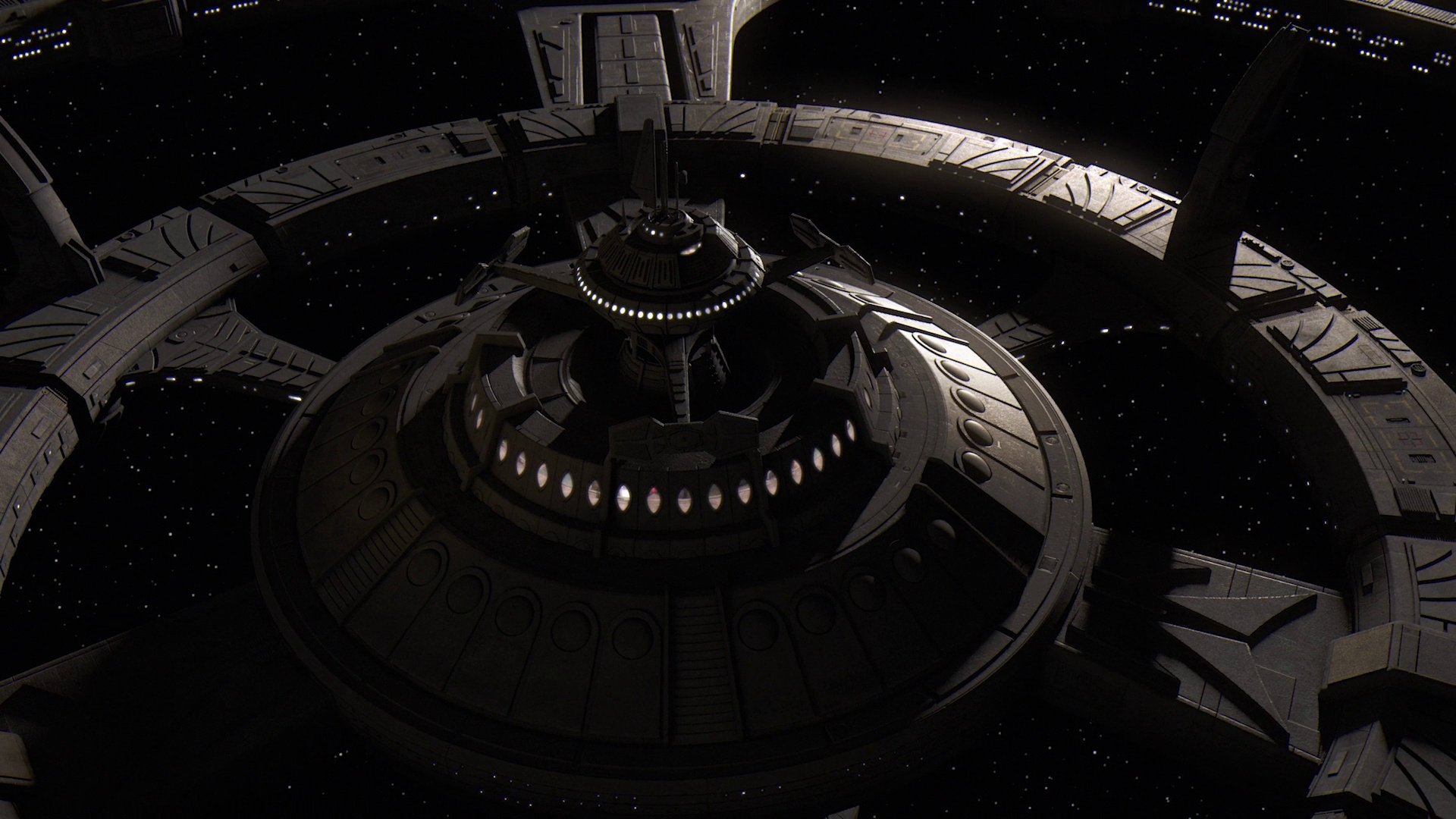
Still frame from Star Trek: Deep Space Nine showing the titular space station.
DS9.

The original poll also contained one final option: Something Else!

So… I thought we could go through a handful of my own “Star Trek clichés” and talk about them before we wrap this up.

Cliché #12:
Redshirts
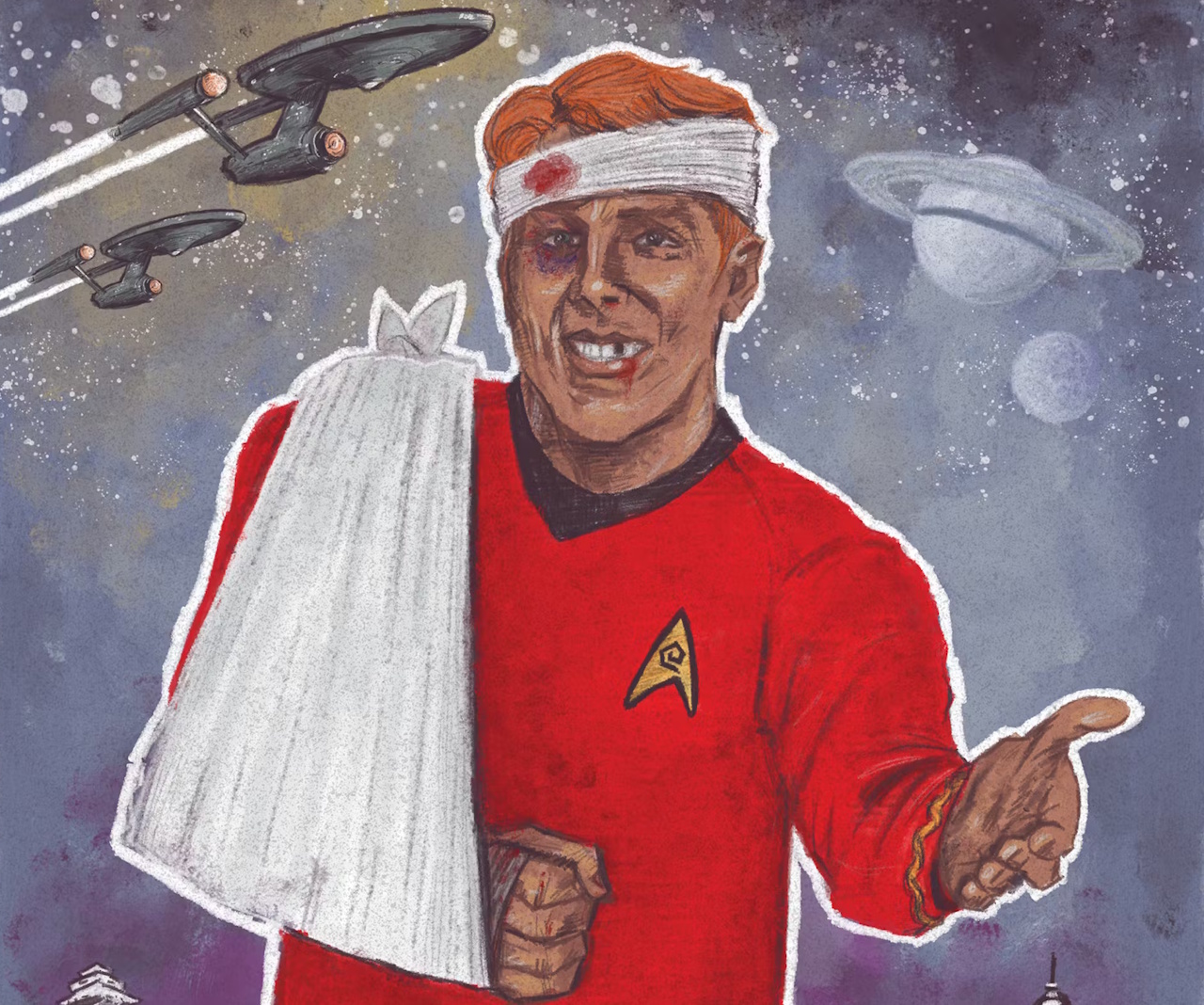
Cropped Star Trek: Redshirts comic book cover.
A redshirt!

I’m surprised the original poll didn’t include what is arguably one of Star Trek’s biggest clichés: the redshirt! These characters, named for the red uniform shirts they wore in The Original Series, were junior officers who usually made one appearance – only to be killed off pretty early in the story. After The Original Series, we saw fewer redshirts, but the trope has stuck around, even into Star Trek’s modern era.

Sometimes you need to kill off a character to communicate the dangers of a situation or the stakes to our heroes. Redshirts – these “disposable” one-off characters – arguably serve that purpose pretty well, and I wouldn’t want to see Star Trek limited by removing them. I also think that redshirts have become, in some ways, an inseparable part of Star Trek itself, and while we’ve seen fewer bona fide redshirts really since The Next Generation premiered, I wouldn’t want the franchise to lose them entirely.

My Verdict: Keep It!

Cliché #13:
The “Half-Arsed Mental Health Storyline”
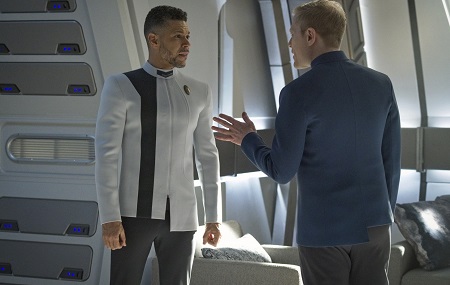
Still frame from Star Trek: Discovery showing Culber and Stamets.
Dr Culber and Stamets.

Discovery was, in my opinion, absolutely atrocious in most of its attempted mental health storylines, but this problem has also plagued other Star Trek productions – notably Picard. And in the bygone days of episodic TV, characters would suffer a traumatic event that would have a massive impact on them… for all of a single episode, before the show moved on to new adventures a week later. There are some absolutely fantastic explorations of mental health on television… but Star Trek, even in the modern era, has slipped up way too often.

I’ve said this before multiple times here on the website, especially when discussing Discovery, but here we go: if there isn’t time to do justice to a complex mental health storyline, skip it. Don’t half-arse it, don’t give ten minutes to a complicated topic that needs way longer, and just… pick something else. Literally *anything* else. Star Trek has been bold in approaching some of these topics, and that’s great, but the execution has left a lot to be desired in too many cases. If Star Trek’s writers want to keep returning to mental health as a topic for storylines, then we need to see significantly better results.

My Verdict: Vaporise It With A Disruptor!

Cliché #14:
Klingon Episodes
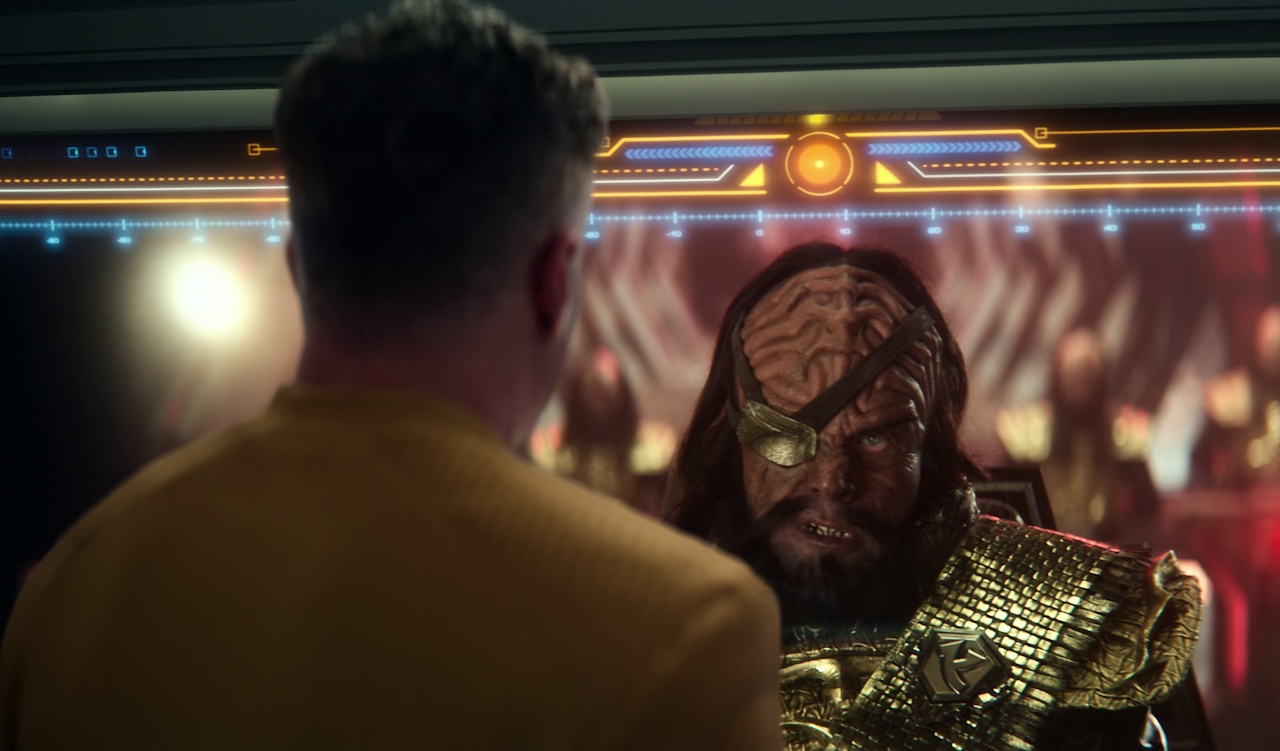
Still frame from Star Trek: Strange New Worlds showing Pike and a Klingon captain.
Pike with a Klingon in Strange New Worlds.

When discussing the Ferengi above, I said that there are surely ways to tell new stories featuring them, especially after such a long absence. That’s gotta be true of the Klingons, too… right? The more I think about it, the less sure I am, to be honest. Thanks to Worf and B’Elanna, and Discovery’s focus on the Klingons in Seasons 1 and 2 with the war and characters like Tyler and L’Rell, we’ve seen *a lot* of the Klingons over the years. And when many Klingon characters can feel a bit flat and lacking in depth, maybe it actually is time to give the faction a rest.

Klingons are inseparable from Star Trek, that’s true. But after almost six decades of exploring the Klingons, their Empire, and many individual Klingon characters… do we need more? Recent attempts to reimagine the Klingons – both in the Kelvin films and Discovery – proved controversial or just outright unpopular with Trekkies, and recent productions seem to have “reset” the Klingons to their TNG-era visual style, at least. Given that changes seem to be off the table, do we really need more of the same from the Klingons, after they’ve featured in a big way in literally hundreds of stories already?

My Verdict: Vaporise It With A Disruptor!

Cliché #15:
“Glorified Redshirts” (i.e. minor characters who get one or two scenes’ worth of “development” before being killed off)
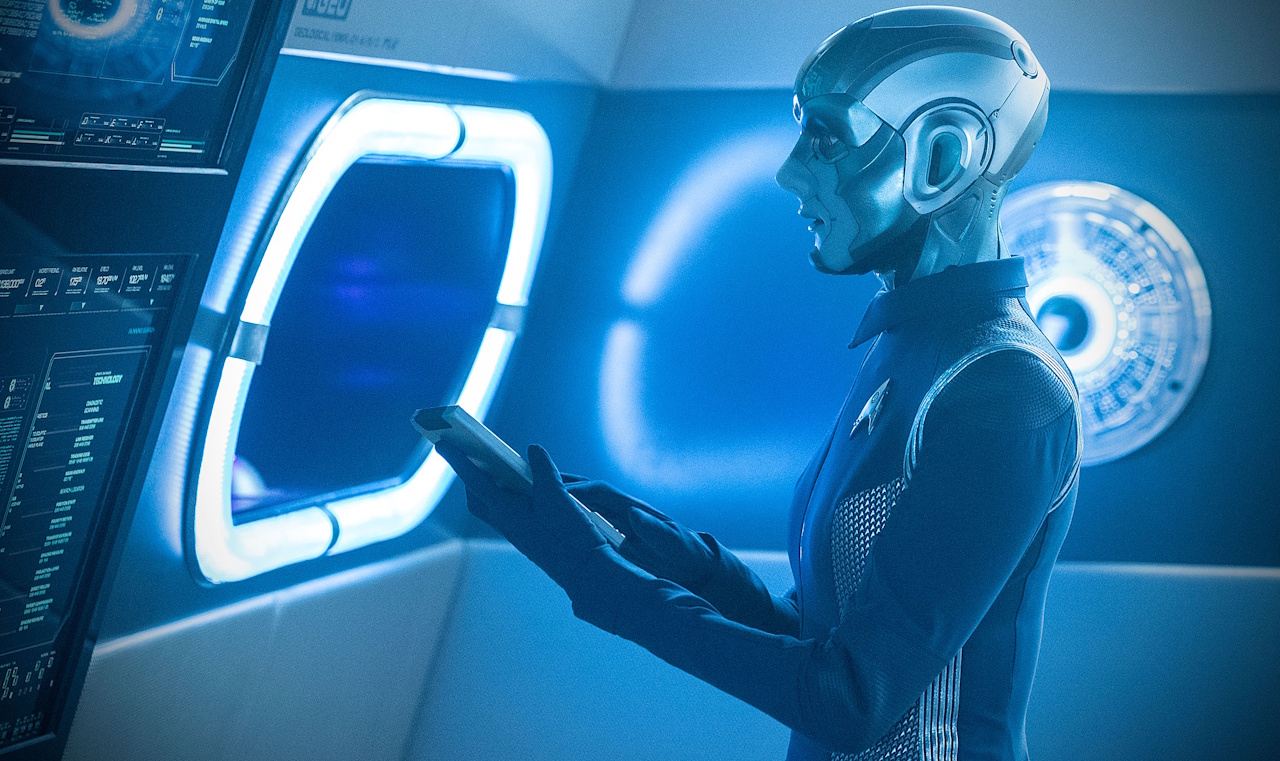
Promo photo for Star Trek: Discovery Season 2 showing Airiam holding a padd.
Airiam in Discovery’s second season.

In TOS, if Captain Kirk picked Spock, Scotty, and Ensign Timmy for an away mission, you’d know right away who wasn’t coming back! Recent Star Trek projects have tried, at least, to make some minor character deaths a bit more impactful… but the way this has been handled has, all too often, not worked. Giving a minor character a scene or two of attempted development, in order to foster more of an emotional connection with us as the audience, is not a bad idea in theory. But modern Star Trek writers haven’t been great at this, leaving these moments feeling as nakedly obvious as when the doomed Ensign Timmy stepped onto the transporter pad.

Airiam, in Discovery, and Gamble, in Strange New Worlds, stand out as examples of this trend. Gamble was handled at least somewhat better, but even so, as I noted in my review, his death seemed immediately obvious when he was given the “glorified redshirt” treatment shortly before being killed off on an away mission. Is this approach better than the original treatment of redshirts? You could make that argument. But I still think it needs to be handled more carefully – and in a show with shorter, better-planned seasons, why not sprinkle that development across multiple episodes instead of cramming it all in in a couple of sequences before the minor character is killed off? Same amount of screen time, but a significantly better result.

My Verdict: Vaporise It With A Disruptor!

Cliché #16:
Bringing Back Legacy Characters In Main Roles
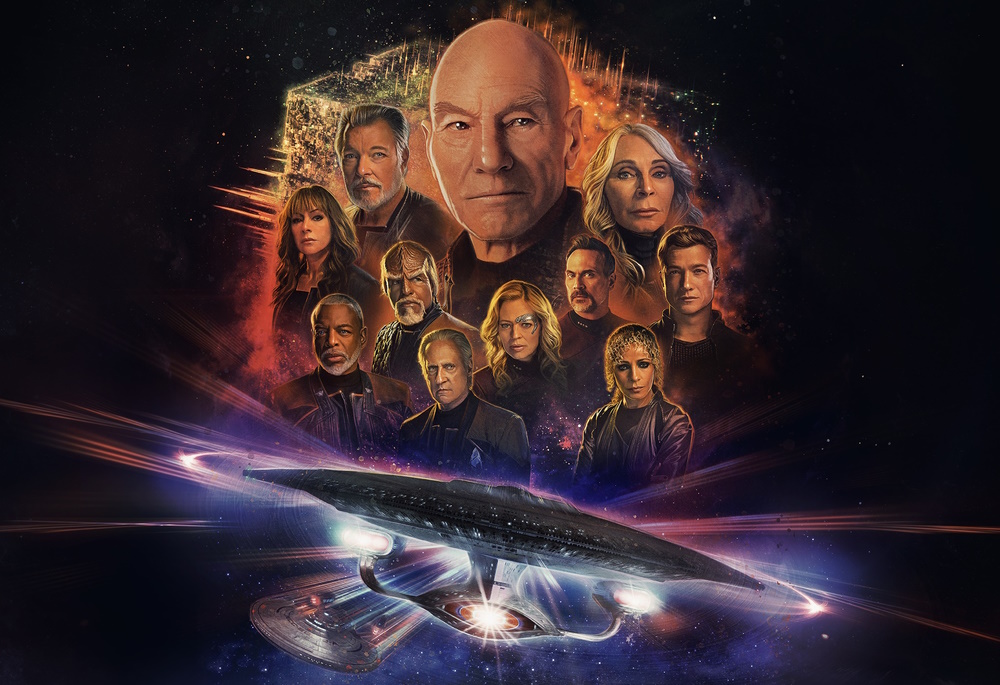
Promo poster for Star Trek: Picard Season 3 showing the main cast.
The main characters of Picard Season 3.

Spock in Discovery’s second season. Voyager’s Doctor in Starfleet Academy. Worf in Deep Space Nine. And Picard’s entire new cast – sans one character – being dumped to make way for the return of the whole TNG crew in Season 3. Does Star Trek need to do this so often? Or can we give new shows, new crews, and new characters the space to stand on their own two feet? Look at Star Wars, which has failed, for almost half a century, to break away from the same handful of original characters and one single story. Is that what fans want? Is that kind of approach the one Star Trek should take?

I get it: nostalgia is a big deal, fans want to see more from some of their favourite characters, and – at least in some cases – there are new stories to be told, or epilogues to add to existing stories. I’d be thrilled, for instance, to see a DS9 sequel involving Captain Sisko’s return from the realm of the Prophets. But to me, this over-emphasis on legacy characters makes Star Trek feel… small. And if Star Trek had behaved this way in the ’80s and ’90s, we’d never have gotten to meet wonderful new characters who carried the franchise forward. There’s room to balance things out more, with new *and* legacy characters sharing the limelight. But, as we’ve started to see in Strange New Worlds, and as we definitely saw in Picard’s third season, legacy characters can easily overwhelm a project as writers and fans want to see more from them and less from the newbies. That risks leaving Star Trek with nowhere to go creatively in the future.

My Verdict: Vaporise It With A Disruptor!

So that’s it!
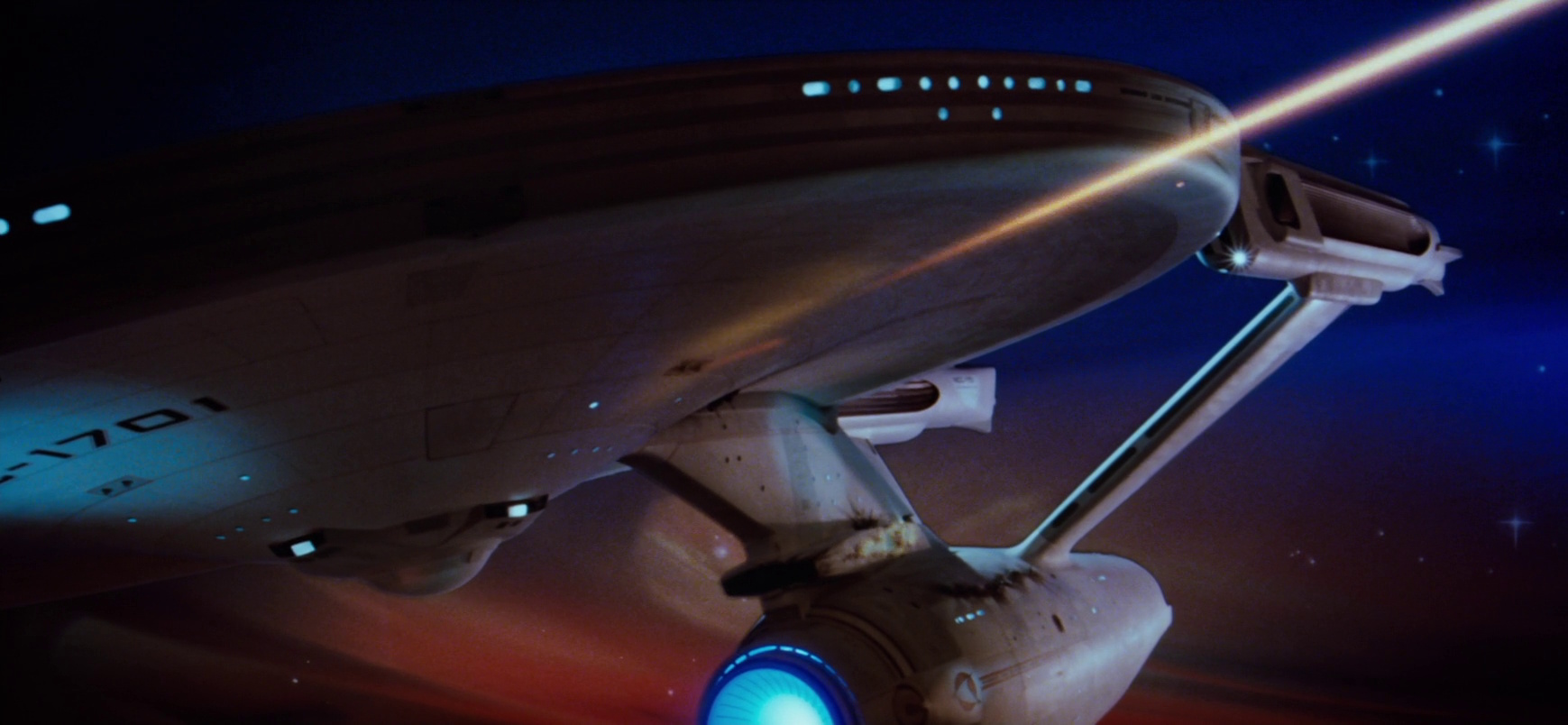
Still frame from Star Trek II: The Wrath of Khan showing the Enterprise firing phasers.
The Enterprise firing phasers.

This poll was really interesting to dissect, and not every point went the way I’d have necessarily expected if I’d just seen the poll, clicked on it, and moved on. Actually taking the time to think about these answers yielded some results that were – as Mr Spock might say – fascinating!

The results of the original poll make for interesting reading, too, after more than 2,000 people voted. The top clichés Trekkies want to get rid of are, in reverse order: the Mirror Universe with 8.2% of the vote, time travel (especially to modern-day Earth) with 11%, new Soong relatives at 22.2%, and finally, Section 31 with 24.7% – almost a quarter of those who responded to the poll.

I think I could’ve predicted some of those, but new Soong relatives being so thoroughly despised is one that caught me off-guard, I must admit!
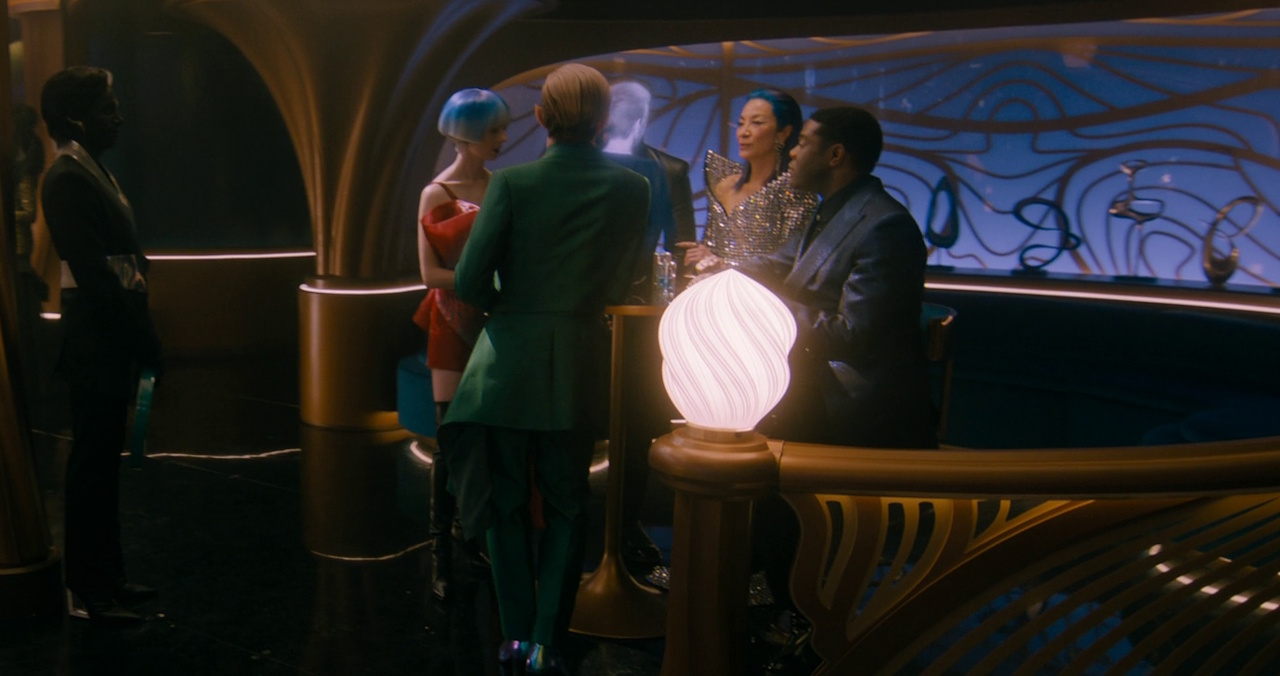
Still frame from Star Trek: Section 31 showing the final shot of the movie.
Apparently, Section 31 is the cliché most Trekkies would like to see removed.

I hope my own additions of some Star Trek “clichés” fit the tone of the poll, too. I spent a little while thinking about some of the tropes and arguably overdone story concepts that Star Trek could do with fewer of! Though truth be told, very few of these are really all that problematic for me, as I think Star Trek – even after recycling some of these ideas time and again – can still churn out some great storylines.

So I hope this has been a bit of fun, and an interesting way to dissect this poll. My thanks to Tumblr user “quasi-normalcy” for the original idea – and if you want to see the poll and its results, as well as their Tumblr page, you can find it by clicking or tapping here. And thanks to the Star Trek fan page on Facebook for bringing it into my feed!
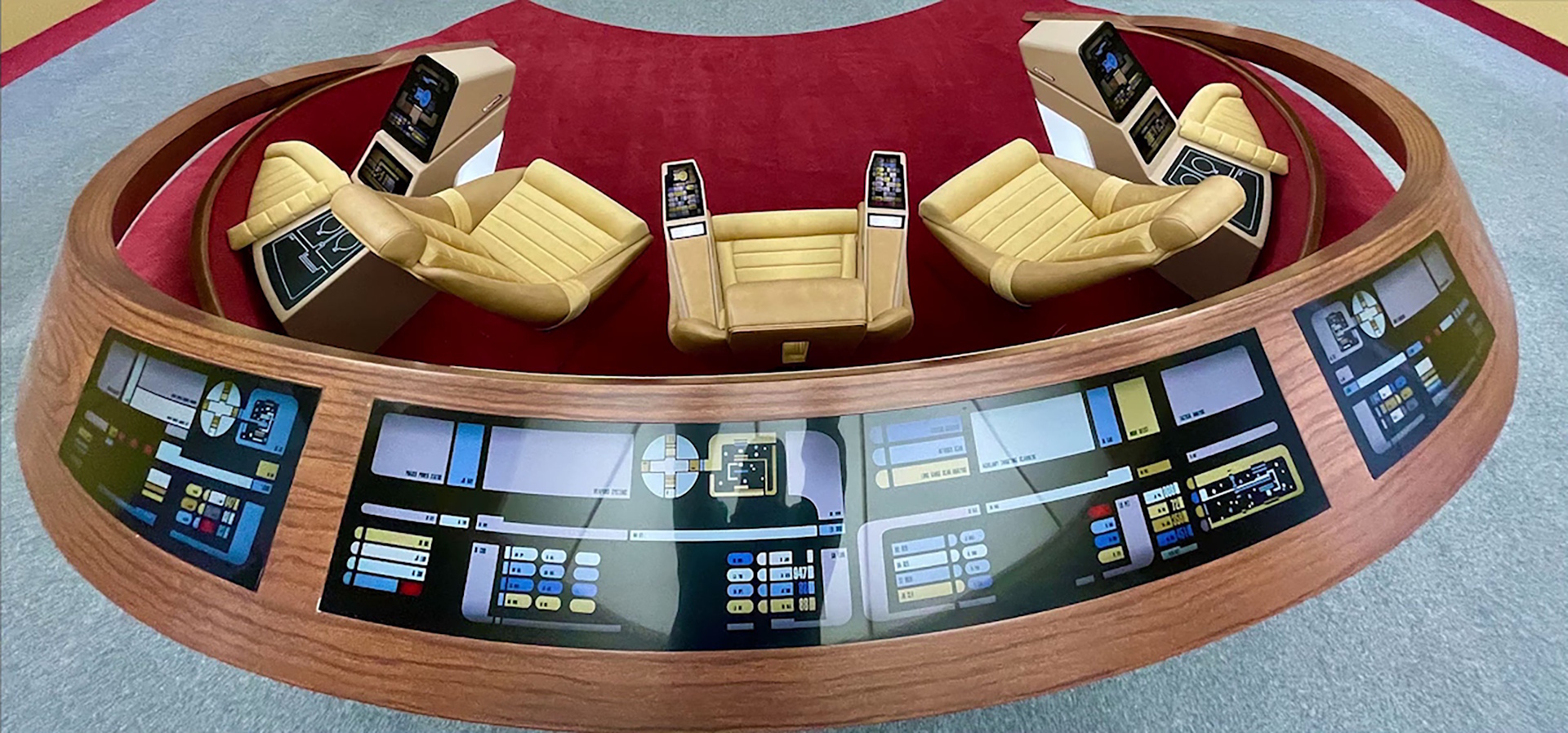
Behind-the-scenes photo from Star Trek: Picard S3 showing the centre console and tactical station of the Enterprise-D.
The view from Worf’s console.

Now that Halloween is out of the way (and I’m closer to getting back to normal at home), there’s more Star Trek content to come here on the website. I’d like to get caught up with the Khan audio drama before too long, there may be more previews for Starfleet Academy coming up now that we know the series will debut in January, and I still have a couple of episode re-watches that I want to write up involving actors I met at a recent Star Trek convention.

I hope you’ll join me in the days and weeks ahead for some of those pieces. Until then… Live Long and Prosper, friends!


Most of the Star Trek franchise – including films and television series discussed above – is available to stream on Paramount+ in countries and territories where the platform is available, and is also available on DVD and/or Blu-ray. The Star Trek franchise – including all properties discussed above – is the copyright of Skydance/Paramount. This article contains the thoughts and opinions of one person only and is not intended to cause any offence.
Star Trek Aliens That *Could* Have Been Terrifying…

A Star Trek spoiler warning.

Spoiler Warning: There are spoilers ahead for the following Star Trek productions: The Original Series Season 1, The Next Generation, Deep Space Nine, First Contact, Enterprise, Discovery Seasons 1-2, Picard, Strange New Worlds, and Section 31.

It’s Spooktober, the scariest month of the year! And what better way to celebrate than to talk about… Star Trek? That can’t be right!

Star Trek has dipped its toes in the horror genre on a few occasions – including in recent years. But that’s not really what I want to talk about today (though I suppose we’ll touch on some horror-tinged episodes as we progress). Instead, I want to take a look at a few of the franchise’s aliens that could have been terrifying… if their respective storylines had been written that way. In short, these are aliens that have horror potential, but because Star Trek is what it is… they never really managed to scare me!

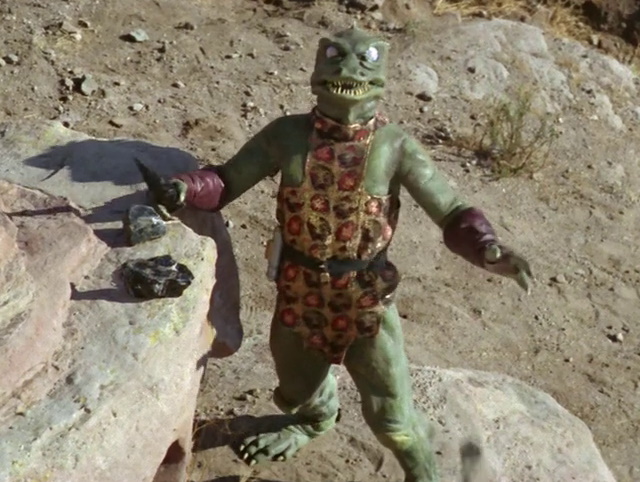
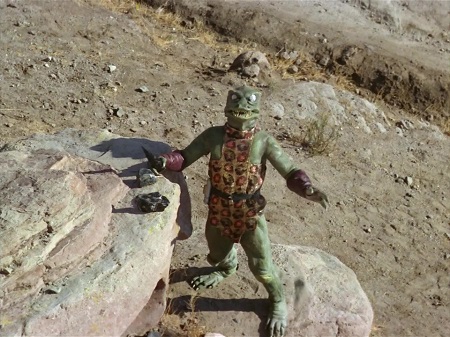
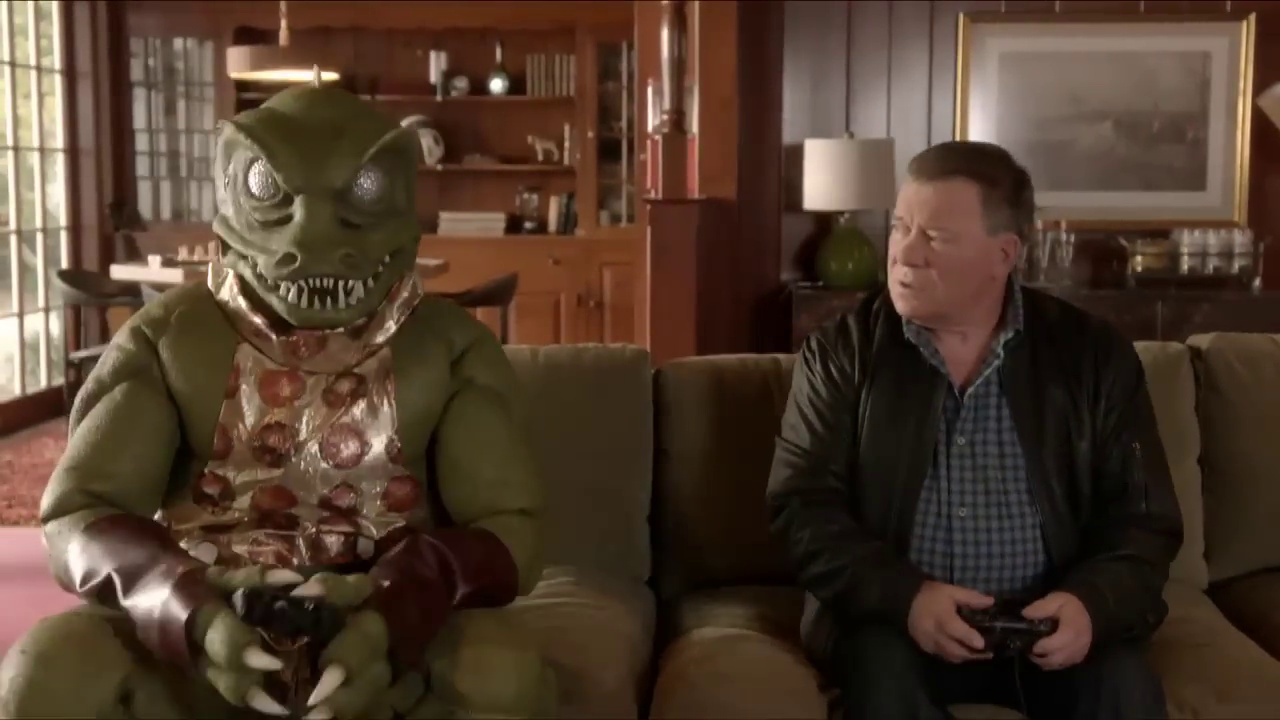
Captain Kirk and the Gorn captain in a 2013 TV commercial.
A horrifying monster.

As usual, I like to give a small caveat. Everything we’re going to talk about is the entirely subjective, not objective opinion of just one old Trekkie. If you hate all of my ideas, think I’ve totally misunderstood something, or I exclude a faction that seems blindingly obvious to you… that’s okay! There’s plenty of room in the Star Trek fan community for polite discussion and respectful differences of opinion, and I share this piece in that spirit.

Now, a bit more detail is necessary on this idea, methinks!

Star Trek can do horror – and it can do horror-themed stories exceptionally well. But Star Trek is not primarily a horror franchise, and we often explore aliens through the lenses of exploration, first contact, diplomacy, friendship, curiosity, or war. There are many stories involving contact with alien races – and alien “monsters,” to use some Halloween-adjacent lingo – but most of them treat aliens as potential new friends rather than terrifying, incomprehensible adversaries. And even in stories where an alien is villainous or powerful, Star Trek tends to go for either some kind of peaceful resolution or more of an action-heavy tone rather than all-out horror.

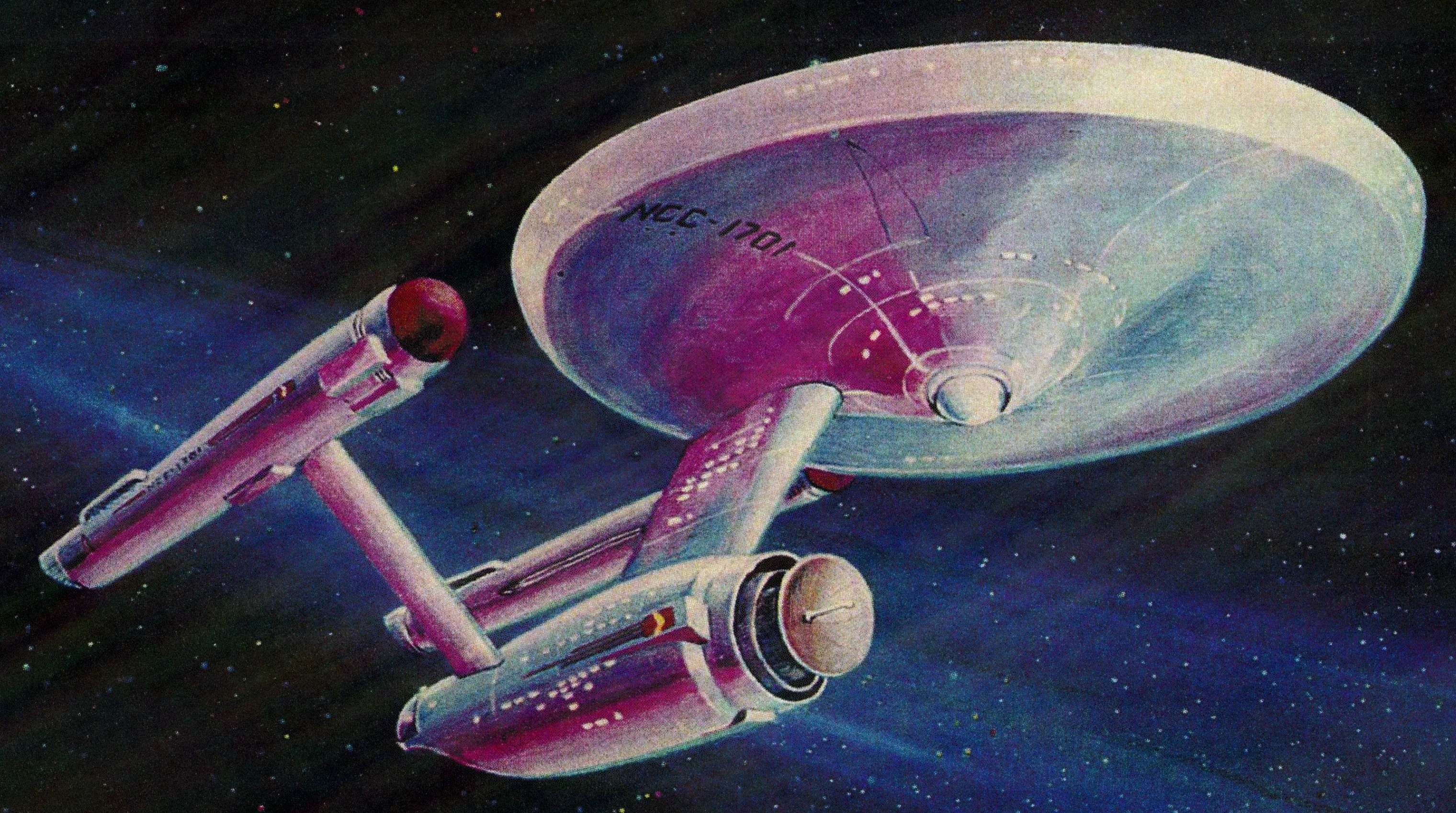
Cropped painting of the USS Enterprise.
The Enterprise.

But there are some aliens, introduced throughout the franchise’s fifty-nine-year existence, which could feel genuinely terrifying if they were dropped into a story that really went for a horror tone. A great example of this is the Gorn: The Original Series depicted the Gorn captain as an enemy for Kirk, sure, and Kirk even describes the Gorn as a “monster” in the episode. But Arena (the only episode prior to Enterprise where the Gorn appeared) was a piece about exploration and understanding – with a healthy dose of action thrown in, of course.

But Strange New Worlds took the Gorn in a whole new direction, ramping up their more monstrous qualities, and leaning into a style of storytelling not unlike that seen in the 1979 classic film Alien. This is the kind of thing I mean: if Strange New Worlds can do it for the Gorn… what other alien races could see their more horrifying qualities ramped up? And could some of these be interesting for a future episode or series?

With all of the preamble out of the way, let’s take a look at five alien races that I think could have been terrifying!

Alien #1:
The Klingons

Still frame from Star Trek: Strange New Worlds showing an aggressive Klingon.
A Klingon as seen in Strange New Worlds.

By the time Star Trek had updated the design of the Klingons and delved a bit deeper into their warrior culture, a decision had already been taken to make the Klingons friendly. But if you think about it… a race of incredibly strong, bloodthirsty warriors who are eager to die in battle could be genuinely terrifying with the right script.

However… when Discovery stepped back in time and set up its Klingon war arc in Season 1, we didn’t really get that. There were some tense moments and some neat action sequences, but part of me thinks that there have probably been too many storylines with Klingon heroes and protagonists for long-time Trekkies to take them seriously as a threat in the future.

Still frame from Star Trek: The Next Generation showing a Klingon with a bat'leth.
Wielding a bat’leth.

If The Next Generation hadn’t gone down that route, though… there’s a ton of potential here. Imagine an episode set on a derelict ship where a lone Klingon warrior is slowly hunting down a Starfleet away team. Or a story set aboard a station like DS9 where a handful of Starfleet personnel are desperately trying to protect civilians from an onslaught of warriors who aren’t afraid to die in battle. The Klingons’ single-minded dedication to war and combat makes them frightening, and their physical strength when compared to (most) humans makes them truly dangerous opponents.

Unlike some other aliens we’re going to talk about, I very strongly doubt we’d ever get a Klingon-themed horror episode! It would be difficult to pull off after seeing hundreds of episodes with the likes of Worf, B’Elanna, Martok, Gowron, and so on, and I suspect the fan community wouldn’t really be on board with the idea, either. But I stand by my pick: with the right script, filmed in the right way, this warrior race could be absolutely terrifying.

Alien #2:
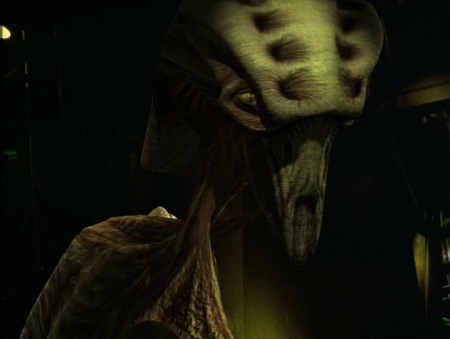
The Sheliak

Still frame from Star Trek: The Next Generation showing the viewscreen and a Sheliak.
A Sheliak on the Enterprise-D viewscreen.

Strange New Worlds took the Gorn – an alien race which had only appeared a couple of times in Star Trek – and turned them into a major antagonist. So… why not do something similar with the non-humanoid Sheliak? The Sheliak appeared in just one episode – and kind of similarly to the Gorn in Arena, they weren’t the only part of that story! In fact, only one individual was seen on screen, and even then, only for a few moments.

However, the Sheliak have a really interesting and unusual design, especially by Star Trek standards, and for a one-off alien race that hasn’t been so much as mentioned in more than thirty-five years… they’re pretty memorable. To me, anyway!

Still frame from Star Trek: The Next Generation showing Picard, Troi, and a Sheliak.
Picard and Troi aboard a Sheliak vessel.

The Sheliak’s inhuman nature and incomprehensible language already make for an intimidating starting point, but their approach to other races – including humans – could really jump-start the fear factor. Viewing other races as inferior, and having no qualms whatsoever about wiping out whole settlements is a frightening idea – and if the Sheliak can back that up with technology, weapons, or perhaps some kind of weird alien goo, I think the stage is set for a genuinely frightening adversary.

Being somewhat of a blank slate, there’s a ton of room to expand on our knowledge of the Sheliak. They’re sentient life-forms, not “monsters,” but there’s still a ton of frightening potential in any intelligent non-human alien.

Alien #3:
The Founders/Changelings

Still frame from Star Trek: Deep Space Nine showing the Female Changeling.
The Female Changeling from Deep Space Nine.

A shape-shifting enemy that can – and already has – infiltrated Starfleet and the Federation? That seems like something with a lot of horror potential! Look at the classic horror picture The Thing as a great example of how something like this could work. An impostor living amongst a Starfleet crew, slowly picking them off, and the survivors losing their minds not knowing who to trust. A story like that is textbook horror.

Picard’s third season had a chance to do this, but the story there leaned more on the mystery and action side of things, rather than horror. There were some shocking moments, and the idea that anyone could, in theory, be a changeling did set up some tension for a time. But then the story went in a different direction towards the end, so that terrifying potential didn’t really amount to much, at least not in terms of horror.

Still frame from Star Trek: Picard showing two changelings.
Changelings in Picard.

One thing we’ve never really seen in DS9 or Picard is a Founder shape-shifting into some kind of truly monstrous and powerful form. If they can take the shape of birds, humanoids, or even a cloud of gas, there’s nothing stopping them from turning into a three-metre-tall eldritch horror with tentacles and needle-sharp teeth! Again, these abilities have been teased sometimes, but never really taken advantage of in a horror sense.

There are timeline questions, of course. A story set after the Dominion War, in a largely peaceful era, would struggle to justify including the Founders as a major antagonist like this. But, as in Picard, there could be a renegade faction or even an individual. In any case, Star Trek has done some cool things with shape-shifters – but really hasn’t even scratched the surface in terms of their horrifying possibilities!

Alien #4:
The Borg

Still frame from Star Trek: Enterprise showing several Borg.
Borg drones i Enterprise.

The Borg are scary. They’re “space zombies,” as I wrote once, and part of what makes them so frightening is that every ally lost to assimilation becomes another enemy to fight. The Borg also embody the idea of a “fate worse than death;” losing one’s mind, being turned against one’s friends and allies, and continuing to exist in a kind of limbo state. But think about it… have any Borg episodes really fallen into the “horror” genre?

For years, I’ve wondered whether Star Trek should try a “Borg Invasion” television series – a show in which the Borg make a real push to assimilate the Federation and the Alpha Quadrant. Such a show, were it to ever exist, would undoubtedly benefit from leaning into a horror tone – at least some of the time. Ramping up the fear factor by showing that no main characters are safe, that the Borg are this unstoppable “force of nature,” only interested in assimilation… I think it could be exceptional if done well.

Still frame from Star Trek: The Next Generation showing a Borg drone.
The first Borg ever seen on screen.

There have been some scary Borg moments over the years, and the faction’s aesthetic really leans into horror tropes. But since the introduction of the Borg Queen in First Contact, I kind of feel like the Borg lost part of what made them so special in the first place. If it were up to me, I’d create a retconned version of the Borg akin to their original appearances in Q Who and The Best of Both Worlds – interested in assimilation and technology, and completely unable to be reasoned with, talked down, or negotiated with. That, in my opinion, is a huge part of what made the Borg unique – and scary!

But even with a Queen, there’s still a lot more Star Trek could do to give us a Borg horror story – even if it was just a one-off episode, not a whole show. An episode with a tone like All Those Who Wander or Shuttle to Kenfori would work exceptionally well with the Borg as antagonists.

Alien #5:
The Terrans

Still frame from Star Trek: Section 31 showing young San and Georgiou.
Mirror Georgiou and San.

If you know me, you’ll know that the Mirror Universe (and its Terran inhabitants) has never been my favourite part of Star Trek… and that’s putting it mildly! But I won’t deny the horror potential in the setting, which is all about murder, violence, and torture. Imagine an unsuspecting officer being transported there, totally unaware of what was happening, and being hunted down by an entire galaxy full of violent sociopaths!

In past Star Trek stories, the rare moments where a character has actually met their Mirror counterpart have been played humorously, but if you think about it, the idea of discovering that you essentially have an “evil twin” is another horror trope that the Mirror Universe could lean into. Being kidnapped by a Terran because your Terran counterpart is someone high up in the Imperial military would be absolutely terrifying.

Still frame from Star Trek: Discovery Season 3 showing Mirror Burnham.
Mirror Burnham.

Again, decades’ worth of pretty low-quality Mirror Universe stories – episodes which, intentionally or not, came across as being funny rather than thought-provoking or scary – definitely count against this idea! But a good enough script should be able to see the Terrans and their Mirror Universe as the terrifying antagonists that they could have been!

Plus, it would be nice to get a Mirror Universe story with genuine stakes and a fear factor, instead of hammy over-acting and one-dimensional characters. Maybe the Terrans wouldn’t be my first choice to write a horror story around, but I definitely think the setting could lend itself to something frightening.

So that’s it!

Still frame from Star Trek: Strange New Worlds Season 3 showing "zombies" breaking into a room.
Zombies!

We’ve talked about a handful of Star Trek aliens that aren’t usually all that scary… but *could* have been!

I hope this was a bit of fun, and a little bit of a thought experiment. Star Trek is, as I said earlier, not a franchise that usually delves deeply into horror. That’s not to say it never happens, because it does, and it can work really well! But it’s just not a genre that the franchise’s writers typically like to play around in. At most, we’ll get a one-off horror-tinged story. But a feature film or season-long arc still seems a long way away.

I have a couple of other horror/Halloween ideas that I hope to get around to before the 31st, but I’ve been exceptionally busy over the past couple of weeks, so I’m not sure if I’ll manage to do everything in my writing pile. Might have to save one or two of those ideas for Halloween 2026! Still, I hope you’ll check back, because I daresay I’ll have more to say about Star Trek, sci-fi, horror, and the wide world of geeky entertainment before too long! See you… out there.


The Star Trek franchise can be streamed on Paramount+ in countries and territories where the platform is available, and most shows and films are also available on various on-demand platforms, as well as DVD/Blu-ray. The Star Trek franchise – including all properties, shows, and films discussed above – is the copyright of Skydance/Paramount. This article contains the thoughts and opinions of one person only and is not intended to cause any offence.
Star Trek: The Borg Teasing Theory

Spoiler Warning: Beware of spoilers for the following Star Trek productions: The Next Generation Seasons 1-3, Voyager Seasons 4-7, First Contact, Enterprise Season 2, Prodigy Season 1, and Picard Seasons 1-3.

Let’s talk about everyone’s favourite Star Trek villain: the Borg Collective!

Okay, maybe that’s a tiny bit of an exaggeration! But the Borg are certainly up there as one of the Star Trek franchise’s most iconic and frightening villainous factions, and there’s no shortage of theories and speculation in the Star Trek fan community about how the Borg operate and what their methods and overall goals are. I thought we could touch on one aspect of that today.

I briefly outlined what I’m calling the “Borg Teasing Theory” in a post here on the website a couple of days ago. That piece was all about some of my personal head canon explanations of unseen, unexplained, contradictory, or vague things from across the Star Trek franchise – but I thought this particular theory warranted its own full article! Click or tap here to check out the rest of my head canon, if you’re interested in my take on the likes of warp factors and cloaking devices.

The Borg are coming!

So what’s the tl;dr of this theory? In brief: the two major Borg attacks on Earth during The Next Generation era – as depicted in The Best of Both Worlds and First Contact – weren’t 100% serious attempts to assimilate the entire planet or the Federation. They were, in a word, teases. The Borg Collective hoped to push Starfleet and humanity to develop new weapons, shields, scanners, and medical technology in the years after their incursions – which they would then be able to assimilate when they launched a full-scale invasion at some point in the future. In short: the attacks were not attempts at total conquest and were not intended to fully succeed at assimilating Earth.

We’ll get into detail in just a second, but before we go any further, I have a couple of important caveats. Firstly, all of this is the entirely subjective take of just one old Trekkie. If you hate this theory, think I’ve got it completely wrong, or feel I’ve misunderstood some key part of Star Trek that would invalidate it… that’s okay. None of this is canon or likely to ever be confirmed on screen anyway! Secondly, I’m not claiming to be the sole inventor of this theory. Other Trekkies may very well have come up with similar ideas independently, and I’m not taking credit for anyone else’s work or theories.

A Borg drone.

Finally, a word about fan theories. I like writing and I like Star Trek, so writing about Star Trek is a fun way for me to spend a little more time in this world. But no fan theory – not even one that seems totally plausible – is worth getting upset or worked up over. As I said a moment ago, none of this is canon and may very well be totally debunked in the future. Given the status of the Borg Collective after Picard Season 3 (and Paramount’s shaky finances), we may never get another Borg story anyway. But this is supposed to be a fun exploration of a theory I’ve had kicking around in my mind for decades, not something to take too seriously.

Phew, that was a lot! But with the caveats out of the way, it’s time to jump into the theory!

Let’s start by explaining what this “tease” is. As I outlined briefly above, I believe that the Borg were not fully serious or committed in their two attacks on Earth. My evidence for this is simple: on both occasions, the Borg sent only one single ship to Earth. A Borg cube can contain, depending on which episode we use as a source, up to 100,000 drones. Given the size of Starfleet, the number of ships at the Federation’s disposal, and even just the population of Earth itself (which could be somewhere in the region of 9-10 billion in the 24th Century) one ship and 100,000 drones doesn’t seem like a large enough invasion force.

A Borg cube hovering over Earth…

Assuming the Borg cube from either Wolf-359 or the Battle of Sector 001 managed to defeat Starfleet’s armada and Earth’s planetary defences, and was able to successfully transport down all of its drones, the logistics of assimilating such a large population don’t track. If Earth’s population is 10 billion and there are 100,000 Borg, that’s a ratio of 100,000-to-one – meaning each Borg drone would need to have a hand in the assimilation of 100,000 humans. With only a single ship, any ground invasion would be vulnerable to Starfleet regrouping and returning; the destruction of the cube would cut off Borg forces on the ground.

Despite jokes I’ve made before about Earth being undefended, it’s still the headquarters of the Federation, with Starfleet Academy and Starfleet HQ on the planet, too. There are going to be thousands of armed Starfleet security personnel, Federation HQ guards, Section 31 operatives, and others on the planet. Even if resistance was scattered at first, and the Borg were able to shut down Starfleet communications, resistance on Earth would be ferocious. To jump over to a different franchise for a point of comparison: look at the Reaper war in the Mass Effect series. The Reaper invasion of Earth was hampered at every turn by resistance fighters from all walks of life, led by the remnants of the Alliance military. There’s no reason to think a Borg attack on Earth wouldn’t lead to a similar resistance movement springing up, with armed civilians led by Starfleet personnel.

Even under extreme pressure, Starfleet tactical personnel would mount a significant resistance to any Borg invasion of Earth.

With the Borg preoccupied with a war of attrition on the ground, their sole vessel in space would be vulnerable. The cube might’ve been able to beat off Starfleet’s initial armada, but that was a hastily thrown together gaggle of whatever ships were on hand when the Federation realised what was coming. Ships were brought out of mothballs and unqualified officers were tapped to take command. With Starfleet being better-prepared and having time to regroup – while also calling on allies like the Klingons – round two against the cube would go a lot better!

So even if the initial attack was successful and the Borg managed to defeat a defence force and land drones on Earth, it would be a matter of time – days or perhaps a couple of weeks – before Starfleet would be back with a much larger fleet. The Borg cube may have beaten the Federation’s hastily-arranged defence ships, but the full might of Starfleet, combined with Klingons and other allies and backed up by tactical data gained from the earlier battle, would – in my opinion – have a strong chance of destroying the Borg’s only vessel in the system. After that, it’s just a case of landing as many troops with modulated phasers (and Klingon bat’leths) and mopping up the remaining drones.

Klingons wielding bat’leths could cut through a Borg army!

To me, this is the most likely outcome for both the Battle of Wolf-359 and the Battle of Sector 001. And the Borg, having studied humanity and the Alpha Quadrant, are undoubtedly aware of this. One ship, even maxed out with as many drones as possible, simply can’t assimilate Earth on its own – let alone expand the fight to the rest of the Federation and its allies.

But why do I think the Borg Collective has the resources to launch a bigger attack? Simple: take a look at the Collective in its Delta Quadrant home in Voyager. The Borg’s Unicomplex alone contained more than a trillion drones, with the entire Collective perhaps comprising quadrillions of Borg. There may be tens or hundreds of thousands of Borg cubes – not to mention other Borg outposts, space structures, and assimilated planets. The sheer scale of the Borg Collective is what makes it so powerful, so frightening, and such a dangerous opponent. So why would the Borg choose to attack Earth in such a small-scale way?

The destruction of the Borg cube in First Contact. Did the Borg plan for this outcome?

Given how powerful a single cube could be, a fleet of perhaps a dozen would make light work of anything Starfleet and its allies could muster. And with two million drones instead of just 100,000, the Borg’s ground offensive would be much quicker and would be more easily able to overcome any resistance. The assimilation of Earth could proceed much more smoothly – with only a minimal amount of extra investment from the Collective. For a faction with 10,000 ships, using twelve on this one task is barely a drop in the ocean. We’ve seen the Borg assimilate other Delta Quadrant races, like Arturis’ species from the episode Hope and Fear, using “overwhelming force.” One single cube is not, I would argue, the kind of overwhelming force needed to conquer Earth and the Federation.

So to be clear: this part of the theory states that the Borg have the means to easily overpower and outgun the Federation and its allies and achieve the task of assimilating Earth. They have no reason not to go all-in and fully commit to this invasion; they aren’t worried about loss of life, there’s no Borg economy to be damaged by building extra ships, and if their target is to fully conquer Earth and the Federation, they could do so with ease. But they don’t do that. Instead, on two separate occasions they’ve sent a single cube. Why?

The Enterprise-D battling a Borg vessel.

To answer that, we first have to consider what the Borg are and how they operate. The Borg are a hive mind, operating as one. They have assimilated – according to their own sources – at least 10,000 species across the thousands of centuries that they’ve existed. But because they’re one hive mind, they lack creativity. They lack inventiveness – and with that, we can infer that they don’t have the ability to create brand-new technologies any more.

The hive mind is adaptable, and having been introduced to something – say, a particular phaser modulation – the Borg can adapt. Adaptations are rolled out at transwarp speeds across the entire Collective, meaning that any Borg encountering that specific phaser modulation in future will be protected. But adapting to something isn’t the same as inventing – and this lack of creativity and inventiveness could be a problem for the Collective.

After being exposed to a new technology or weapon, the Borg can adapt.

So how does the Collective acquire new technology, then? If they don’t develop things themselves they must get them from somewhere, right? I mean, the Borg are more technologically advanced than the Federation and that didn’t happen by accident! The answer is simple: the Borg acquire everything from information to technology through assimilation.

This was their weakness when confronted with Species 8472. They couldn’t assimilate a single member of the species or one of their ships, so they were left blind and helpless. And this, I would posit, is the fundamental reason why they “tease” certain species – like humanity. We probably aren’t a unique case; I believe this is a tactic that the Borg will have deployed on countless other occasions against similarly creative and adaptable species. But it’s a tactic that the Collective knows can work to its advantage.

The Borg were unable to assimilate any member of Species 8472 or their technology – rendering them blind and ineffective against their attacks.

The objective is simple: by making a relatively small demonstration of their power, the Borg incite fear in their targets. This fear leads to huge investments in weapons, shields, starships, and the like… all of which the Borg want. On one hand, the Borg want to see if their target can find a weakness in the Collective and its technology so they can prevent anyone else from exploiting it in the future – basically rolling out a Collective-wide “patch” to fix any weaknesses or vulnerabilities that the target species may have identified. And on the other hand, the Borg want any species they target to have achieved their full potential – giving the Collective the best, newest technologies that the target could create. This is how the Borg – at least in my opinion – are able to acquire new technologies.

And this is what they’re doing to Earth, humanity, and the Federation at large. By launching these attacks, the Borg are pushing the Federation and Starfleet to develop new technologies, whether that’s weapons, ships, medical supplies, transporters, shields… the list goes on. Perhaps the second incursion was intended to see how far Starfleet’s new inventions had come, or maybe it was just a second “tease” to force Starfleet to keep working and keep inventing. Either way… it worked.

A Borg drone being killed by a phaser blast.

Why would the Borg target Earth, though? It’s not like they need Earth specifically for its location or resources, and Earth isn’t even close to the Borg’s native territory. The Borg are mostly in the far-off Delta Quadrant, though they may have colonies or outposts somewhat nearer to the Federation, such as on the El-Aurian homeworld. So the question remains: why Earth? When there are so many other planets and species in between the Borg’s home territory and the Federation, why jump halfway across the galaxy for an invasion?

We already know that the Borg don’t assimilate everyone they come across. In fact, the Borg can be downright picky – opting to ignore the Kazon, for instance, as they were deemed “unworthy” of being assimilated as they’d somehow detract from the Borg concept of perfection. It stands to reason that some species may be of more interest to the Borg – even those in a faraway part of the galaxy. I think the El-Aurians are a prime example: their homeworld, while nowhere near Earth, seems not to have been on the very borders of Borg space, either. Yet the El-Aurians were targeted – perhaps for their telepathic powers, or perhaps because the Borg considered them a threat. This is a species, lest we forget, that has tangled with the Q Continuum and forced them to the negotiating table. The same basic reasoning may apply to humanity.

The Borg deliberately targeted the El-Aurians (Guinan’s people), even though they may not have been anywhere near Borg space.

Humanity has to be one of the most resilient and creative species that the Borg have ever encountered. Humans were able to track a Borg vessel and develop technologies to keep themselves hidden from the Collective while studying them – this is what Seven of Nine’s parents, the Hansens, did in the 2340s. This may have been the Borg’s first encounter with a human… and their curiosity was piqued!

Then, not long after the assimilation of the Hansens, the Borg received a strange message. Originating two centuries ago in a far-flung part of the galaxy, it told the tale of a time-traveling sphere, a planet of spacefaring people, and a climactic battle. The Borg who survived the Battle of Sector 001 had crash-landed on Earth in the past, only to be awakened by humanity in the 22nd Century. Captain Archer and his crew were able to stop them – but not before they sent a message to the Collective in the Delta Quadrant. Between the message from the past and the assimilation of the Hansens, the Borg must’ve realised how significant Earth and humanity could be for the Collective.

A small group of Borg were able to signal the Collective in the 22nd Century.

After receiving this “blast from the past” transmission, assimilating the Hansens, or both, the Borg had humanity and Earth in their sights. But rather than launch a full-scale invasion in 2350 – years before the Enterprise-D’s encounter with a cube – the Borg took a more subtle approach. Firstly, they may not have been entirely certain of Earth’s location, instead sending ships to scout the Alpha and Beta Quadrants for signs of humanity and the Federation. Then, rather than attack straight away, the Collective bided its time, launching small-scale attacks on outlying colonies along the Neutral Zone to see what would happen.

By attacking both Federation and Romulan outposts (as seen in the Season 1 finale of The Next Generation), the Borg may have hoped to trigger a conflict between the two powers – before swooping in later to attack both of them. Or, perhaps more likely, this was the Borg’s first attempt to assimilate humans en masse to see if they were worth bothering with – and picking outlying colonies makes a lot more sense than rushing to Earth straight away. The Romulans may have been collateral damage, in that case.

The Borg destroyed multiple human colonies before attacking Earth.

In any case, the Borg determined that humanity was a worthwhile target – something that was only further confirmed by their encounter with the Enterprise-D a few months later. As an aside: Q may very well have saved humanity by his intervention in Q Who! I have a longer piece on this subject – which you can find by clicking or tapping here – but here’s the short version: the Borg knew about humanity and Earth years before Starfleet knew about them. By hurling the Enterprise-D into the path of a Borg vessel, Q gave Picard and the Federation valuable insight into the Collective, forewarning them of the attacks to come.

With the Borg determined to assimilate humanity, decisions had to be made about how to do so. The hive mind, operating as one, makes such decisions at light-speed, and after confirming humanity was a suitable target for assimilation, the Borg decided to “tease” the Federation, pushing them to design new weapons, shields, starships, medical devices, and so on… all so that the Collective could assimilate it later, adding to their perfection. This is how the Borg operate, and it’s why they chose to launch small-scale attacks against Earth instead of simply arriving en masse with overwhelming force.

Original concept art of the Borg.
Image Credit: Frogland Archive/Forgotten Trek

From the Borg’s perspective, this approach is a win-win. Either their attack succeeds in full, with humanity and Earth being assimilated over a period of weeks or months, giving the Borg control of the planet and a staging-post for a larger-scale invasion of the Federation. Or it “fails” to achieve that objective, but in doing so provides the Collective with incredibly valuable tactical data on Starfleet, Earth’s defences, and so on, while also pushing the Federation to develop new technologies. The Borg want these technologies – either to “patch” vulnerabilities and weaknesses they may not be aware of or to add to their perfection.

There are real-world parallels. The Second World War led to the creation of modern-day computer technology, rocketry, and atomic power. The First World War led to huge advancements in flight, artillery, and motor vehicles. These are just a couple of examples from our own history of how war and devastation can lead to technological change. The Borg, I would argue, seek to artificially inflate the pace of technological advancement by baring their teeth and showing their target a tiny fraction of their power. In desperation, Starfleet and the Federation began working at pace to develop everything from phasers to starships – all ripe for assimilation by the Collective.

The first Borg drone ever seen in Star Trek.

So that’s the theory.

The Borg were not fully invested in assimilating Earth either in 2367 or 2373 – their only two direct attacks on Earth. These incursions had a different goal: pushing humanity and the Federation to develop new technologies that the Borg could assimilate later, when the time was right. By revealing themselves and showing Starfleet a glimpse of their power, the Borg believed their new target would, in effect, work for them, designing and building new weapons, ships, and other devices that the Collective no longer had the creativity to invent for itself.

To me, this theory made sense even as far back as when I watched First Contact in the cinema in 1996! Developments in Voyager, Enterprise, and more recently in Picard, too, have only added to this theory, expanding it and deepening my belief that the Borg really weren’t serious about conquering Earth. To them, the attacks served a different purpose. It took almost everything Starfleet had to beat the Borg, but given the sheer size and scale of the Collective, we know they had the resources to commit more ships and more drones to an attempted invasion of Earth. There has to be some reason why they didn’t send two or three cubes instead of just one – and to me at least, this idea makes the most sense and squares that circle.

Romulans and Borg as seen in the Lower Decks opening titles.

I hope this has been interesting! I doubt that this theory will ever be confirmed – and it may even be actively debunked one day, if we ever get another Borg story. Some of you might think that the Borg’s time travel in First Contact (or some other plot point from a Borg episode) already negates or invalidates this theory… and that’s okay! As I said at the beginning, this is just a fan theory or head canon, and it’s all subjective at the end of the day. I share this theory with the Star Trek fan community in that spirit.

Speaking of Borg stories… will we see another one in Star Trek anytime soon? After Picard did three separate Borg or Borg-adjacent stories in its three seasons, and with the Collective having appeared in Prodigy and Lower Decks in recent years… I think it might be a while before the Collective makes another appearance. I certainly think it should be a while; I can’t be the only one who feels a little burned out on the faction, especially after their omnipresence in Picard. If and when the Borg return, I hope it’s in a big way. I’ve been kicking around the idea of a “Borg invasion” series for a while – and that could be a really interesting way for Star Trek to go one day in the future. If a fourth Kelvin timeline film ever gets off the ground, I don’t think it’s impossible to think we could see the Borg there, too.

But unless and until any of that happens… this is my theory! I hope you enjoyed this write-up and found it interesting.


The Star Trek franchise – including most episodes and films cited above – can be streamed now on Paramount+ in countries and territories where the service is available. The Star Trek franchise is the copyright of Paramount Global. Header font/text courtesy of textstudio.com. This article contains the thoughts and opinions of one person only and is not intended to cause any offence.
Star Trek’s Scariest Alien Monsters!

A spoiler warning graphic.

Spoiler Warning: There are spoilers ahead for the following Star Trek productions: The Original Series Season 1, The Voyage Home, The Next Generation Season 1, Deep Space Nine, Voyager, Picard Season 3, and Strange New Worlds Season 1.

It’s Spooktober – the spookiest month of the year! So I thought we could have a bit of fun and talk about some of the scariest aliens and villains that the Star Trek franchise has brought to screen.

Star Trek isn’t a franchise that’s well-known for being all that frightening. I don’t think that’s a controversial statement at all – in fact, I’d wager that most TV viewers would consider it pretty tame, especially when thinking about the horror genre and alien monsters! But that doesn’t mean Star Trek is never scary. There are some wonderfully atmospheric episodes and stories scattered throughout the franchise’s fifty-eight-year history that have some of those more frightening elements.

Still frame from Star Trek: Picard Season 3 (2023) showing a Borg cube.

Today, rather than talking about individual stories or episodes, what I’d like to do is pick out some of the franchise’s scariest aliens, monsters, and villains – and talk about why they work so well, why they’re so intimidating, and perhaps even just the potential they have to be frightening or scary in future stories.

My usual caveat applies: everything we’re going to talk about is the entirely subjective opinion of one person only. If I miss something you think is blindingly obvious or if I include a “scary” alien that you think isn’t frightening in the least… that’s okay! There’s plenty of room in the Star Trek fan community for disagreement and differences of opinion.

With that out of the way, let’s talk about some of Star Trek’s scariest aliens and villains!

Number 1:
Q and the Q Continuum

Still frame from Star Trek: Picard Season 2 (2022) showing Q.

The Q are on the list less for their out-and-out fear factor and more for their potential. I don’t think there have been many terrifying or bone-chilling Q appearances – though I will entertain the argument that Q’s penchant for randomness can have an unsettling or unnerving quality. Things like conjuring up aliens in Napoleonic uniforms or a post-atomic courtroom would be incredibly frightening in real life, even if they’re portrayed more as chaotic and wacky when we see them unfold on screen.

The Q Continuum’s real fear factor comes from their apparently unlimited power. No other alien race in Star Trek is as powerful as the Q, and they could quite literally wipe out humanity, the Federation, or even the entire galaxy with a wave of the hand. Although we always see Q as humanoid, their true form is a mystery, and their power seems to be without limit – and without a reliance on technology. No war against the Q seems possible, and if they ever chose to move against the Federation (which they could do for reasons beyond our comprehension, or to prevent some kind of conflict in the far future that we have no inkling of right now) they could be far more destructive than even the Borg.

Number 2:
The Gorn
(As they appear in Strange New Worlds)

Still frame from Star Trek: Strange New Worlds Season 1 (2022) showing a juvenile Gorn.

The Gorn are one of Star Trek’s oldest alien races, appearing in the first season of The Original Series. But after that initial appearance and a few scattered mentions through The Next Generation era, they didn’t show up on screen again until Enterprise. That depiction wasn’t great, in my view – it relied too heavily on CGI that didn’t look great at the time and hasn’t aged well. But the return of the Gorn in Strange New Worlds has been a triumph.

After several episodes built up the terror of Gorn raids on the Federation, it was the episode All Those Who Wander that really showed us what this new depiction of the Gorn can do. Strange New Worlds’ writers unleashed the Gorn in an episode that, more than any other in the franchise, leans into the horror genre. The Gorn are depicted almost like the Xenomorphs from the Alien film series, possessing strength and stealth abilities that left the away team cornered.

Number 3:
The Founders/Changelings

Still frame from Star Trek: Deep Space Nine showing a changeling in their gelatinous state.

Maybe this one is a little controversial, but after the way Changelings were depicted in Picard’s third season I think we have a pretty good case to include them as a frightening bunch! The idea that shape-shifters could infiltrate Starfleet and the Federation was addressed in a fantastic Deep Space Nine two-parter: Homefront and Paradise Lost. These episodes took more of a political thriller/drama approach to the topic, but the core idea is a deeply unsettling one.

With the Dominion playing a growing role in Deep Space Nine, the idea of Changeling infiltrators was scaled back and only used sparingly – probably because it’s not an easy story to write or pull off successfully. But Picard Season 3 brought the idea back in a creative way, showing how deadly Changelings could be and how a Changeling plot could be an existential threat to the Federation.

Number 4:
The M-113 Creature
(a.k.a. The Salt Vampire)

Still frame from Star Trek: The Original Series Season 1 (1966) showing the M-113 Creature.

The first ever alien to appear on The Original Series remains one of the franchise’s most frightening! The episode The Man Trap kick-started the Star Trek franchise back in 1966, and the Salt Vampire was the first alien that audiences saw Kirk and the crew wrangling with. As discussed above with the Changelings, the alien’s ability to change shape and blend in added to its fear factor – but moreover, its true appearance is pretty unsettling even today. There’s something to be said for those old rubber suits, eh?

The Salt Vampire is a sci-fi take on ancient legends and creatures from folklore, and that gives it a uniquely frightening feel. Preying on some of these old primordial fears lends the creature a genuinely intimidating vibe, and its grotesque appearance just adds to that. The Salt Vampire is, however, a tragic figure, as it appears to be the last of its kind; more akin to an animal acting out of instinct than a truly nefarious villain.

Number 5:
The Borg

Still frame from Star Trek: First Contact (1996) showing a Borg drone.

In my essay The Borg: Space Zombies, I go into a lot more detail on this topic, but the condensed version is this: the Borg fill a similar role to zombies in horror fiction, while also picking up on both Cold War-era fears of brainwashing and concerns about technology getting out of control. The idea of assimilation is incredibly clever, as it turns every ally the heroes lose into a new enemy to fight, making the Borg grow in strength at the exact same rate as Starfleet weakens.

The idea of being assimilated and losing one’s mind and identity is arguably a fate worse than death – and we’ve got several examples in Star Trek of ex-Borg wrangling with the consequences of what the Collective forced them to do. I would note that the Borg’s fear factor has declined over the years, particularly during the latter part of Voyager’s run. Seeing Starfleet triumph over the same adversary again and again – no matter how intimidating it may be on paper – does start to take the shine off things.

Number 6:
Armus

Still frame from Star Trek: The Next Generation Season 1 showing Armus.

Armus has the distinction of being the first alien monster to kill a main character on a Star Trek TV series. There were many ways The Next Generation’s writers could have written out Tasha Yar when Denise Crosby opted to quit the show, but killing her off was a bold move. And doing so in such a brutal way, with Armus not even batting an eye at her death… it was quite something to see.

If you have the DVD or Blu-ray of The Next Generation it’s worth watching the actors and producers talk about working on the episode Skin of Evil, because creating Armus and performing around the inky-black oil slick was incredibly difficult for everyone involved to say the least! Jonathan Frakes in particular had a very tough time with Riker’s scene when he was pulled under the surface. Armus is a scary-looking villain, and also one that had a profound, long-lasting impact on The Next Generation.

Number 7:
The “Whale Probe”

Still frame from Star Trek IV: The Voyage Home (1986) showing the Whale Probe.

Although the tone of The Voyage Home is pretty light-hearted and comedic, the so-called “whale probe” that kicks off the plot is an incredibly terrifying adversary, when you think about it. The probe disables Starfleet vessels with incredible ease, and is resistant to weapons and all attempts at communication. The people of Earth have no idea what it wants, what its purpose is, or how to reason with it.

This monolith simply arrives unannounced, doesn’t declare its intentions, and seems to wreak havoc on Earth and Starfleet. That’s a pretty scary concept, in my view, as it could’ve gone pretty badly for everyone involved if Kirk and the crew hadn’t intervened!

Number 8:
The Pah-Wraiths

Still frame from Star Trek: Deep Space Nine Season 6 showing Jake Sisko possessed by a Pah-Wraith.

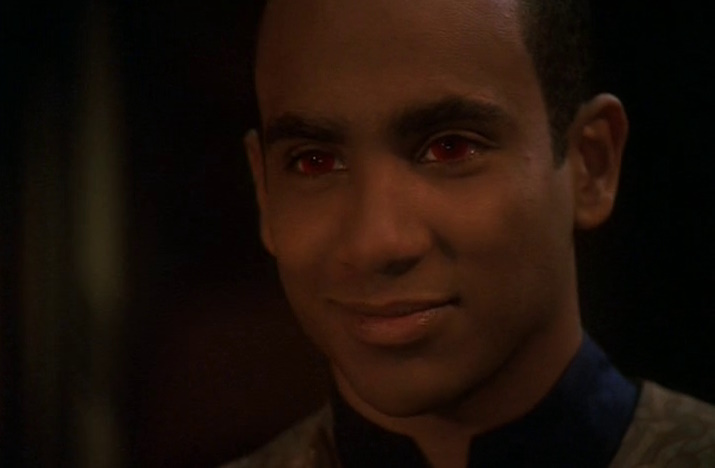
As with Armus, there’s something distinctly “evil” about the non-corporeal Pah-Wraiths. The way they’re presented in multiple Deep Space Nine episodes, where they’re deeply entwined with Bajoran religion, makes them out to be akin to demons or dark spirits – and we even see them “possess” several different characters. Their banishment to Bajor’s fire caves also ties into this demonic analogy.

In later seasons, Gul Dukat gets involved with the Pah-Wraiths, leading a cult on Empok Nor that’s genuinely unsettling in its depiction. The Pah-Wraiths have magical books, the power to turn people blind, and the desire to conquer the Prophets’ domain in the Wormhole; a truly frightening group!

Number 9:
The Conspiracy Parasite-Aliens

Still frame from Star Trek: The Next Generation Season 1 showing a parasite-alien.

The end of The Next Generation’s first season introduced a race of parasitic aliens that infiltrated Starfleet. Allegedly, the parasite-aliens were supposed to be connected to the Borg in some way, but this angle was later dropped. Still, they’re more than frightening enough on their own terms, and the idea that Picard and the crew wouldn’t be able to tell who was infected and who to trust made for an entertaining story.

Here in the UK, one scene toward the end of Conspiracy was cut from the original broadcast because of how gruesome it was! You know the one: where the “mother” parasite is killed and violently explodes. There’s something just unsettling about earwig-like alien parasites… just like the Ceti Alpha eel from The Wrath of Khan. Star Trek hasn’t revisited the parasite idea for a long time – maybe it could make for a fun and horrifying future episode?

Number 10:
The Krenim

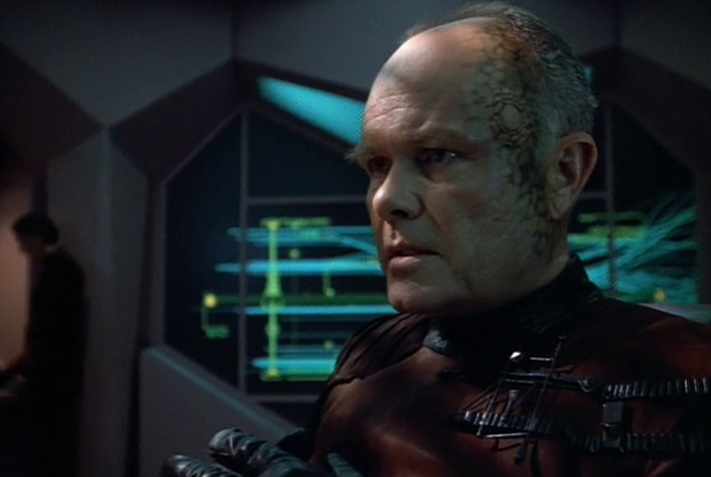
Still frame from Star Trek: Voyager Season 4 showing Annorax.

The Krenim appeared in the Voyager two-parter Year of Hell, using their time-manipulation technology as a weapon. Repeated Krenim attacks against the USS Voyager left the ship in ruins, running on fumes, and many members of the crew dead or maimed. The captain of the Krenim time-ship, Annorax, was Khan-like in his single-minded obsession with restoring the Krenim colony that housed his wife and family, making him a frightening adversary.

Year of Hell is a pretty shocking episode, particularly in its second half. Seeing Voyager badly damaged, with whole parts of the ship uninhabitable, really hammers home how dangerous the Krenim and Annorax are as villains, and for a time their technology really does seem to be more than a match for Janeway and the crew.

So that’s it!

Still frame from Star Trek: The Original Series (1966) showing a Gorn.

We’ve picked out what I consider to be a selection of Star Trek’s most frightening aliens, monsters, and villains to celebrate the spooky season.

There are plenty of others that we could’ve included – either for their fully-blown fear factor or for their potential to do serious harm to our Starfleet heroes. And there are quite a few Star Trek episodes – a surprising number, really – that either lean fully into the horror genre or that have jump-scares or other frightening or unsettling moments. Last year, I put together a list of a few of them, which you can check out by clicking or tapping here if you’re interested!

So I hope this has been a bit of fun! I hope you’re having a fun and spooky October – and stay tuned, because I have a couple of other Halloween-themed ideas that may (or may not, time depending) make their way onto the website before the 31st. Don’t have nightmares!


Most of the films and episodes discussed above are available to stream on Paramount+ in countries and territories where the platform is available. They’re also available for purchase on DVD, Blu-ray, and video-on-demand. The Star Trek franchise – including all films, episodes, and other properties discussed above – is the copyright of Paramount Global. This article contains the thoughts and opinions of one person only and is not intended to cause any offence.
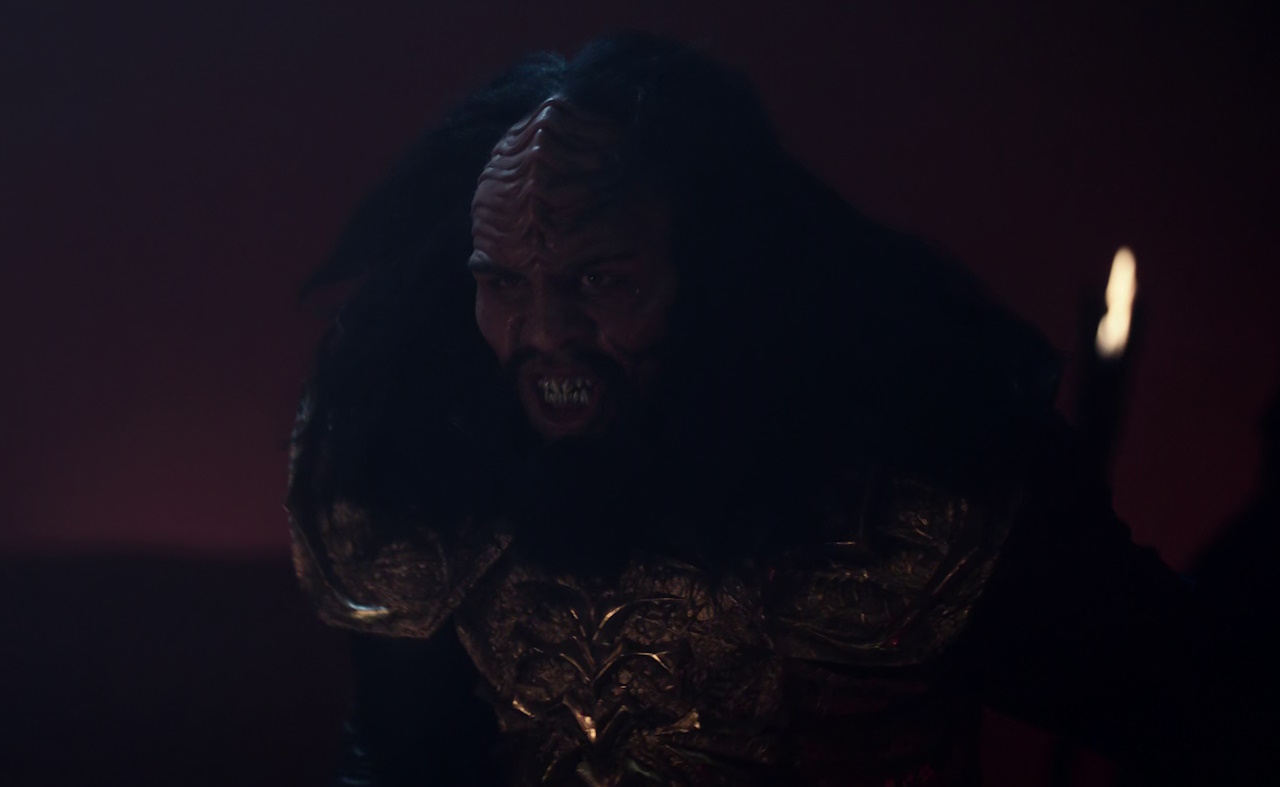
Star Trek: Picard Season 3 theory – who is Captain Vadic?

Spoiler Warning: There are spoilers ahead for Star Trek: Picard Seasons 1-2 as well as for announcements and trailers for Season 3. Spoilers are also present for the following Star Trek productions: The Next Generation, Voyager, First Contact, Insurrection, Nemesis and Discovery.

Today we’re going to talk about Captain Vadic, the villainous commander of the Shrike who appeared in the most recent trailer for Season 3. Based on the information that Paramount has released so far, Captain Vadic appears set to be the main adversary that Admiral Picard and the former crew of the Enterprise-D will face off against in the upcoming final season of the show, and I think we have enough evidence to put together a few theories about who she could potentially be.

One thing we can say for near-certain based on her appearance in the trailer is that Captain Vadic has become obsessed with Picard – and possibly with his former crewmates as well. Her desire to get revenge for some (real or perceived) wrong that was done to her seems to be her driving force, and as a result there are favourable comparisons to one of the Star Trek franchise’s most iconic villains – Khan. Vadic seems to channel much of the same energy as Khan did in The Wrath of Khan, with a passionate quest for vengeance that strays into near-madness.

Captain Vadic.

The question of why Vadic is so obsessed with getting revenge is inherently tied to who she is. Although past iterations of Star Trek didn’t ultimately connect to the big story arcs in Seasons 1 or 2 of Picard, it has to be at least possible that Captain Vadic has a connection to some character or event that we’ve seen unfold on screen before. She could even be a character that we’ve already met.

So that’s what we’re going to take a look at today! Who could Captain Vadic be? And tied to that question is the nature of her revenge plot – why is she seeking vengeance? What could Picard and the crew of the Enterprise-D have done to her in the past?

Theory #1:
An Ex-Borg

Ex-Borg in the Season 1 episode Nepenthe.

Captain Vadic appears to have scars on her face that superficially resemble those of the ex-Borg that we met in Season 1, so some kind of Borg origin feels like a possibility. We could learn that Vadic was among the survivors of the Artifact when it crash-landed on Coppelius at the end of Season 1, and that could be the beginning of her vendetta against Picard.

It’s possible that Vadic was assimilated by Locutus – Picard’s Borg designation when he was himself briefly part of the Borg Collective. If Vadic was assimilated at, for example, the Battle of Wolf-359, she may have spent years in the Collective before she was freed, and may hold Picard personally to blame for her traumatic experience.

Starfleet engages the Borg at the Battle of Wolf-359.

Seasons 1 and 2 both dealt with the Borg to an extent, albeit in different ways, so this could be somewhat of a continuation of that familiar theme. Although Picard and the crew of the Enterprise-D faced off against many enemies and opponents during their adventures, few are as ferocious or intimidating as the Borg, so there’d be something significant if the final foe they have to deal with has some kind of Borg connection.

If Captain Vadic is an ex-Borg, that could also explain her interest in both Picard’s crew and the Federation as a whole; she may blame the Enterprise-D and Starfleet more broadly for what happened to her.

Theory #2:
An augment.

A group of 22nd Century human augments.

We talked a moment ago about the superficial similarities between Captain Vadic and iconic Star Trek villain Khan… but what if there’s more to it than that? The end of Season 2 seemed to imply that Picard’s adversary Adam Soong would either begin or re-start research into Khan-inspired human augments, connecting his story to that of Dr Arik Soong in Enterprise. Could Captain Vadic be a descendant of one of Dr Soong’s augments – or perhaps even an augment who had been kept alive in stasis?

If so, her vendetta may be inspired by Dr Soong – she may blame Picard for changing the timeline and preventing Dr Soong from being celebrated in the Confederation timeline that we saw in Season 2. Successive generations of augments may have carried that grudge, or alternatively Captain Vadic may have been “programmed” to awaken in the early 25th Century by Dr Soong to get his revenge.

The “Project Khan” folder seen at the end of Season 2.

This would connect the story of Season 3 to what happened last time in a major way, and I think that would be to the show’s overall benefit. Season 2 could even look better in retrospect if it ends up being one piece of a larger connected story, so giving Captain Vadic a connection to what happened in Season 2 would be a net positive.

There’s also a possibility that Captain Vadic is an augment, but one who isn’t connected to Adam Soong or Khan. There are a couple of episodes of The Next Generation in which Picard and the crew tussled with genetic engineering and human augmentation: Season 2’s Unnatural Selection and The Masterpiece Society from Season 5. Perhaps Captain Vadic is one of the augments from the Darwin Genetic Research Station or one of the Moab IV colonists whose society was disrupted by the arrival of the Enterprise-D.

Theory #3:
A Romulan (or Romulan ally)

A Romulan commander in the 23rd Century.

I know, I know: Captain Vadic doesn’t have the right ears to be a Romulan! But as noted above, she does have significant facial scars – could those hint at some kind of cosmetic surgery to alter her appearance? The design of her warship, the Shrike, definitely feels Romulan to me. It evokes both Nero’s Narada (from the 2009 Star Trek reboot film) and the Scimitar, Shinzon’s flagship in Nemesis. Could that design hint at some kind of Romulan origin for Vadic… or at least for her ship?

Picard has dealt with the Romulans on multiple occasions, and thwarted major Romulan schemes to invade Vulcan, to end the alliance between the Federation and the Klingons, and to use a thalaron radiation weapon to attack Earth, just to name three examples. Then there’s Picard’s failure to aid in the Romulan evacuation in the aftermath of the attack on Mars – perhaps Captain Vadic blames Picard for the deaths of people she cared about. And finally there’s Sela: the daughter of Tasha Yar who was raised by Romulans and eventually held a senior role in the Romulan military. Picard outmanoeuvred and defeated her on two separate occasions.

Sela, a Romulan-human hybrid and enemy of Picard.

I don’t think we’ve seen all of the members of Captain Vadic’s “rogues’ gallery” of Star Trek villains just yet, so I wouldn’t be at all surprised to see Denise Crosby reprise her role as Sela in Season 3. So at this point I don’t think we can say “Vadic is Sela,” although that’s a possibility. But she may be an ally of Sela, perhaps a relative or another child of Tasha Yar.

The Romulans played a major role in Season 1 of Picard, and bringing them back in some form in Season 3 could tie things together nicely. We could learn more about the Zhat Vash and Tal Shiar, and particularly what happened to the Zhat Vash’s anti-synthetic crusade after it was exposed. Maybe Captain Vadic is a Zhat Vash zealot who is unwilling to accept her faction’s defeat at the hands of Picard and his crew.

Theory #4:
A descendant of Adam and/or Noonian Soong

Adam Soong in Season 2.

We touched on a potential connection to the Soong family above, but rather than being an augment or genetic creation, could it be possible that Captain Vadic is a relative or descendant of the Soongs? This could explain how she managed to recruit Lore for her revenge quest, or how she was able to reassemble and reactive him after the events of The Next Generation two-part story Descent.

Clearly the relationship between Picard and the Soong family is complicated. On the one hand, Picard’s strong friendship with Data should mean that he and the Soongs would get along, but on the other hand his actions in Season 2 prevented Adam Soong from becoming one of the most important humans in history, and from establishing a dynasty that was still important in the early 25th Century. Surely some members of the family would want revenge for that – if they knew about it.

Dr Noonian Soong – the creator of Data and Lore.

Picard also tussled with Altan Inigo Soong in Season 1, disrupting his research into synths and potentially denying him a synthetic body of his own. Although Altan would eventually team up with Picard’s crew to stop Sutra and Soji’s plan to contact the unnamed faction of super-synths, it isn’t clear what happened after that to the Coppelius synths.

If things went wrong, maybe a relative or colleague of Altan Inigo Soong would want revenge. Perhaps Altan sought out and reactivated Lore in order to continue his research; the loss of Data’s neurons may have brought his work to an abrupt halt. Again, this could explain how and why Lore is back!

Theory #5:
A Son’a

Ru’afo, a Son’a commander in the late 24th Century.

There are a couple of reasons why the Son’a spring to mind as a possible origin for Captain Vadic. Firstly there are the facial scars that we’ve already discussed; the Son’a had to use technology to keep their skin stretched and to get rid of toxins in their bodies after losing access to the metaphasic radiation of their home planet. Although the Ba’ku believed their physiology would be restored if they returned home, it’s possible that there would be lingering physical effects of being away for so long.

Secondly, the most recent trailer showed off Captain Vadic’s ship, the Shrike, engaging in a battle against the USS Titan in a nebula that looked awfully similar to the Briar Patch – the location of the Ba’ku/Son’a home planet. After Picard was instrumental in defeating the Son’a, could some members of the faction hold a grudge against him personally?

Does this battle take place in the Briar Patch?

The Son’a had planned their revenge on their Ba’ku cousins for a long time – they had been living in exile for almost a century at the time of the events of Insurrection. Although the Ba’ku welcomed them back, it stands to reason that not every Son’a would have wanted to return home under those circumstances.

Ru’afo, the Son’a leader, was killed, and it’s possible that Captain Vadic may have been his partner or close friend. Even if she wasn’t a true believer in the Son’a cause, she may be seeking revenge for the loss of someone she cared about.

Theory #6:
A member of Picard’s crew

Captain Picard on the bridge of the Enterprise-D.

Could it be possible that Captain Vadic once served under Picard’s command? She could be an officer or crewman who served on the Stargazer, the Enterprise-D, the Enterprise-E, or during the Romulan rescue and the attack on Mars. Although Picard never deliberately endangered members of his crew – and would go above and beyond to help them on multiple occasions – during his time in command we saw a number of casualties.

Perhaps Captain Vadic was badly wounded during Soran’s attack on the Enterprise-D, or was left behind on Bersallis III during the firestorm that nearly claimed the life of Nella Daren. She could be a victim of the first Borg encounter when a slice was carved out of the Enterprise-D’s saucer section in system J-25, or an officer who was assimilated when the Borg took over the lower decks of the Enterprise-E. She could even be a familiar character, such as Ensign Sito, who was sent on a dangerous mission into Cardassian space by Picard.

Ensign Sito Jaxa.

The reality is that Picard has no shortage of “victims” – people who were killed or maimed while serving under his command going all the way back to his time on the Stargazer. Any one of them – or their close friends or family – could hold Picard personally responsible, even if he did everything he reasonably could have to prevent what happened to them.

I think this is an interesting idea. Starfleet is far from perfect, and we haven’t often seen the organisation or its leaders having to confront those left behind or caught up in conflicts, battles, or dangerous situations. Whoever Captain Vadic is, she clearly has a personal grievance against Picard, and if she had once served under his command, that could explain why.

Theory #7:
An ally of DaiMon Bok

DaiMon Bok.

One of the first villains that we ever saw Picard deal with was DaiMon Bok, a Ferengi captain who blamed Picard for the death of his son. Bok is similar to what we know of Captain Vadic insofar as his vendetta against Picard was deeply personal. After being defeated in the episode The Battle, Bok would tangle with Picard one final time toward the end of The Next Generation’s run in the episode Bloodlines – and while he suffered a mutiny from his crew, he was still alive as of the end of the episode.

Most importantly for this theory, Bok’s quest for revenge was left incomplete, his personal vendetta unfulfilled. Bok would almost certainly have carried this grudge for his entire life – and while we don’t know for sure that he would still be alive thirty years after we last saw him, there’s no reason to think he wouldn’t be. Perhaps Captain Vadic is an ally of Bok’s, and her quest for vengeance is connected to his.

Could DaiMon Bok be a member of Vadic’s rogues’ gallery?

Even if DaiMon Bok’s revenge mission isn’t the main factor driving Captain Vadic, I would consider it at least a possibility that Bok could be another of the hidden members of her rogues’ gallery. Few characters in Star Trek have such a strongly-felt personal animosity toward Picard, so if someone asked him to join a mission of this type, Bok would surely have jumped at the chance!

So whether Bok proves to be a big part of the story or not, it’s definitely possible that we’ll see him or hear of him in Season 3!

Theory #8:
A devotee of the super-synths from Season 1

Sutra became obsessed with contacting the super-synths.

The super-synths from Season 1 claimed to be “an alliance of synthetic life,” and they left behind at least one beacon to instruct other synths on how to contact them. Whether their offer to help the Milky Way’s synthetics was genuine or part of an elaborate trap was never explained, and the super-synths themselves were only glimpsed on screen very briefly.

But one thing we know is that their beacon – known to the Zhat Vash as the “admonition” – could drive organic minds to madness, and that madness could be so powerful that it could even damage an entire Borg cube if a Zhat Vash initiate was assimilated. Sutra’s behaviour after being exposed to the beacon’s message could also be argued to show that synthetic minds were not entirely immune from this, especially in synths with human qualities.

The device on Coppelius that the synths built to open a portal for the super-synths.

In short, whether she’s organic or synthetic, it’s possible that Captain Vadic has been exposed to the beacon on Aia – either before or after the events of Season 1. But rather than taking the Zhat Vash approach of fearing the coming of the super synths, maybe she had a different reaction: she wanted them to arrive. If she’s a synth, that could be because she wants to team up and attack organic civilisations – and that may explain why she’s teamed up with Lore and Moriarty, who are both artificial constructs. If she’s an organic, she may have simply been driven mad by the beacon’s vision and somehow come to worship the super-synths.

It was the intervention of Admiral Picard at the end of Season 1 that prevented the arrival of the super-synths at Coppelius, and if Starfleet took further action against the Zhat Vash in the aftermath of Season 1, such as shutting down the beacon on Aia, it may not be possible to construct another portal. Either way, as the person most responsible for stopping the super-synths, a devotee of theirs would surely hate Picard as a result.

Theory #9:
Someone entirely new

The super-synths and Zhat Vash were brand-new to Star Trek in Season 1.

In Season 1, both the Zhat Vash and super-synths were brand-new to Star Trek. Likewise in Season 2, a new story was told that didn’t rely on events or characters from past iterations of the franchise. So it has to be considered plausible – perhaps even more likely than not – that Captain Vadic is a brand-new character, and that the event in her past that kicked off her revenge obsession will also be new to us as the audience.

Modern Star Trek has, I feel, rather teased longstanding fans with implied or hinted connections that have ultimately failed to materialise. Discovery’s second season seemed to be setting up a possible Borg origin story – before that was ripped away in the season finale. Storylines in Seasons 3 and 4 also could have connected to events in Star Trek’s past, but decisions were taken to go in new directions again, despite seemingly teasing those potential ties. And as mentioned, both seasons of Picard have likewise not made major connections in terms of their main storylines.

Season 2 introduced us to a piece of Picard’s personal history that was brand-new.

Depending on your point of view, this can be a positive or negative thing! I would suggest, though, that after Season 2 spent a long time on an element of Picard’s personal history that was entirely new to us as the audience, it wouldn’t be a bad thing if Captain Vadic was connected to an event that longstanding Star Trek fans would be familiar with.

The “mystery box” style of storytelling can work very well, but it can also feel rather hollow if the story doesn’t pull out an excellent ending, and when a connection to past iterations of Star Trek has been teased – as it arguably has been with Vadic’s quest for revenge – it could feel underwhelming if we’re once again confronted with some brand-new story that bears no relation to anything from The Next Generation or other aspects of Picard’s past that we already know. So there’s a potential stumbling block here, I fear.

So that’s it!

Captain Vadic on the Titan’s viewscreen.

We’ve considered a few possibilities for who Captain Vadic could be and what her beef might be with Admiral Picard and his crew. As much as I like the idea of Vadic having a major connection to an event in The Next Generation or one of the films, if you forced me to place a bet right now, in November 2022, I’d have to put my money on her being someone brand-new, with her quest for vengeance stemming from an event that will also be entirely new to us as the audience. Two seasons of Picard in which Star Trek’s past didn’t matter (as well as similar things going on in Discovery) may have left me feeling a little jaded in that respect!

But regardless, it was fun to speculate. All of the suggestions I’ve made feel plausible at this juncture… based on what little we’ve seen of Captain Vadic in her sole appearance in one teaser trailer! It would certainly be fun, in a season that will bring back the main cast members of The Next Generation, if the villain they had to defeat was also someone from the past.

The Shrike, Captain Vadic’s ship.

As mentioned, I don’t think we’ve yet seen all of Vadic’s friends and allies in what I’ve termed the “rogues’ gallery.” The most recent trailer showed us Professor Moriarty and Lore, but there seem to be at least four others with Captain Vadic on the bridge of her ship in one of the clips – and her ship will need more than just a handful of people on its crew! I think it’s possible that other villains from The Next Generation era, such as Sela or Bok, could make appearances in Season 3.

I’m looking forward to Season 3, even though I was generally unimpressed with much of Season 2. A return to space and a villain who feels rather Khan-esque promises to be a good combination, one that should lead to a fun and exciting story. When Season 3 premieres in February, I hope you’ll join me for episode reviews and perhaps some theory-crafting, and if we get any more trailers or significant announcements between now and then, I’ll take a look at those as well!

Star Trek: Picard Season 3 will stream on Paramount+ in the United States and on Amazon Prime Video around the world beginning on the 16th of February 2023. Seasons 1 and 2 are available to stream now and are also available on DVD and Blu-ray. The Star Trek franchise – including Picard and all other properties mentioned above – is the copyright of Paramount Global. This article contains the thoughts and opinions of one person only and is not intended to cause any offence.
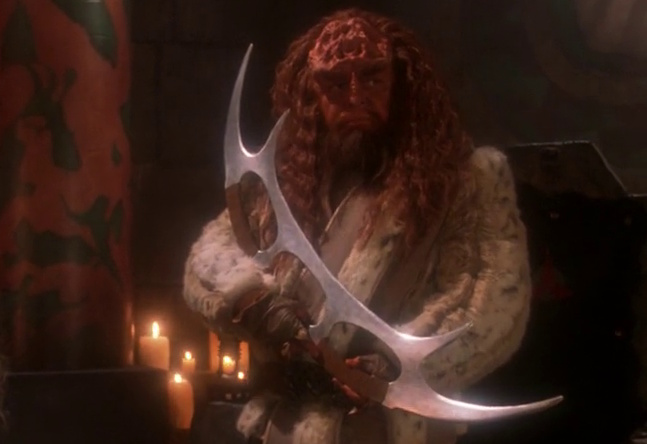
Star Trek: Picard review – Season 2, Episode 9: Hide and Seek

Spoiler Warning: There are spoilers ahead for Star Trek: Picard Seasons 1-2. Spoilers are also present for the following Star Trek productions: The Next GenerationFirst Contact, and Voyager.

This review deals with the sensitive topics of mental health and suicide and may be uncomfortable for some readers.

If I’ve done my counting right, then I believe Hide and Seek is Jean-Luc Picard’s 200th Star Trek appearance. It gets a little fuzzy when we look at two-part episodes that are occasionally considered as feature-length outings, but if we go in broadcast order then I’m pretty sure that the character of Jean-Luc Picard has now appeared in 200 Star Trek productions (including four films). So that’s pretty neat!

Hide and Seek was an exciting episode that focused on the Borg side of the story in a big way. But it was also an episode that fell into the trap of some pretty clichéd storytelling, something that definitely detracted from some of the impact that the story had. There were some emotional highlights – including some wonderful performances from Alison Pill, Michelle Hurd, and Jeri Ryan – but overall, I’m left feeling that the season has taken a slow and meandering route to reach this point, and that more time could’ve been spent on some of these interesting storylines and powerful moments had some of the extraneous fluff been cut out from earlier episodes.

It was a dark and stormy night…

For the first time this season, I wasn’t wild about some of the cinematography in Hide and Seek. Parts of the episode were coloured with a dark blue hue – something not uncommon on television to indicate darkness – but I found that it gave those sequences a washed-out look. Though we aren’t anywhere close to the failures of something like The Long Night in Game of Thrones’ eighth season, the colour palette did not flatter the scenes set at Château Picard, and the episode suffered for this creative choice.

Hide and Seek doubled-down on exploring the trauma that Picard faced in his youth, and it was revealed that the memory he’s been repressing was his mother’s suicide and discovering her body. As in Monsters a couple of weeks ago, though, I’m struggling to see how this story connects with what’s happening in the rest of the season, and why the series has decided that this hitherto unknown chapter of Picard’s life warranted so much time dedicated to it.

Hide and Seek delved once again into Picard’s youth.

In a general sense, I’m not averse to the idea of taking an established character and fleshing them out, giving more detail to their background and history. And as stated earlier in the season, I can’t recall anything from Picard’s past Star Trek appearances that would’ve explicitly ruled out something like this happening to him in his youth. However, when dealing with a character who’s made as many appearances as Picard, these kinds of stories have to serve some greater purpose – and right now, this story of Picard’s youth and his mother’s death doesn’t appear to do that.

As I asked in my review of Monsters: what aspect of Picard’s character, personality, temperament, or personal philosophy does this revelation explain? How do we as the audience feel that we understand Picard any better in light of this season spending a significant chunk of its runtime on this story? We know more about Picard’s past in a factual sense – but the facts that have been brought to light don’t inform his characterisation in any way, neither here in Picard nor in The Next Generation. There’s no “aha!” moment where the way Picard has behaved, or his stance on life, suddenly seems to click.

It doesn’t feel like this moment informs Picard’s character in any significant way.

If the story itself had been handled differently, perhaps in a season with fewer other things going on, I think I could forgive it. But during two out of the season’s ten episodes now, a significant amount of time has been taken away from other, more interesting and engaging stories to flesh out an aspect of Picard’s backstory that feels unnecessary.

A character like Picard, who has made so many Star Trek appearances, has unexplored moments in his past that a story like this could’ve told. We could’ve learned, for example, that a similar trauma stems from his time in command of the USS Stargazer – the death of Jack Crusher springs to mind as an unexplained event that would be both traumatic and ripe for a deep dive. But this story shone a light on a part of Picard’s past that none of us could’ve anticipated – and when there are events in his past that feel like they could’ve been more interesting, I guess I’m left wondering what might’ve been.

Other events in Picard’s past could’ve taken us on a similar journey.

Picard’s story also had a very “20th Century” feel to it, and as I’ve said on more than one occasion, that doesn’t feel very Star Trek-y. We know from The Next Generation that Picard had an upbringing on a vineyard and that his family weren’t in favour of him joining Starfleet, so in that sense none of it is contradictory. But from the point of view of someone sitting down to watch Star Trek and not some other contemporary drama series, it’s a tad disappointing when the series spends so much time either in the modern-day or in a setting that feels also very much like the modern-day.

And again we come to the mental health side of the story. I was deeply disappointed with what we saw in Monsters, and while nothing in Hide and Seek sank to that level, Yvette’s mental health condition was again underdeveloped and fell into the trap of stereotyping. Continuing our theme of feeling like a story from contemporary times, not three centuries in the future, we saw no attempt made to use the technology of the early 24th Century to help Yvette. Did her husband do anything to help her? Locking away someone with mental health issues “for their own safety” is the kind of thing that the Victorians did – and although Picard seemed to get to a place in Monsters where he could understand the burden his father carried and forgive him, the way Maurice treated Yvette raises some seriously disturbing questions.

Maurice Picard.

As someone who is disabled and who has diagnosed mental health conditions, one of the things that I’ve always found inspirational about Star Trek’s future is this idea that many of the ailments people today have to live with will one day be curable. Medical technology that’s akin to magic has been present in the Star Trek franchise since the beginning, and while mental health hasn’t often been depicted in a particularly sympathetic way (look at episodes like Whom Gods Destroy or Statistical Probabilities, for example) I’ve always liked the concept Star Trek proposes: that one day, cures for many health issues – including mental health conditions – will be discovered.

Hide and Seek chose to ignore that, and if it had done so for a better reason, I might be able to overlook it, or at least reduce my negative feelings toward it. But because the story of Yvette’s suicide and its impact on Picard feels so disconnected from everything else going on this season, it just hammers home for me that many of the narrative decisions on this side of the story were, at best, odd. At worst I’d call the whole thing pretty poor.

Yvette Picard’s suicide.

One final note on this aspect of Hide and Seek: for the first time, I felt Star Trek: Picard fall into a storytelling trap that has tripped up sister show Discovery on multiple occasions. Picard and Tallinn were on an incredibly dangerous, time-sensitive mission, with half-assimilated Borg shooting at them, yet Picard allowed himself to become distracted by this event in his past. Being thrown into the room where something bad once happened is, of course, a trigger for post-traumatic stress, and I get that. But even with that understanding and that caveat, I found myself wanting to shout at the episode in frustration that there isn’t time for this right now!

This is something that Discovery does far too often – characters bringing their own personal issues to the fore in a way that clearly interferes with the missions at hand. Picard had never had this issue – not even in Monsters when Picard’s trauma was one of the main storylines – but because of the circumstances of the Borg attack on La Sirena this time, it really did feel that Picard didn’t have the time for such indulgent reminiscing. It’s only through sheer luck that he and Tallinn survived.

Picard allowed himself to become distracted in the middle of a very dangerous situation.

Despite being a relatively long episode at almost fifty minutes, there were a few points, especially as Hide and Seek drew to a close, where I felt some important scenes may have been left on the cutting-room floor. For example, how did Rios know exactly where to transport to save Picard and Tallinn? And how did Picard know that Seven and Raffi had let La Sirena escape when he reunited with them? These questions could’ve been answered, and while they may not feel hugely substantial in terms of the way things turned out, the fact that we didn’t see everything as it unfolded left the final part of the episode feeling rather cut-down and perhaps a little contrived.

I’m glad that Dr Jurati was able to not only wrestle some control back from the Borg Queen, but also talk her down from the most extreme version of her plan. This was Hide and Seek’s emotional high point, and Alison Pill put in an outstanding performance. It was nice to welcome back Annie Wersching as the Borg Queen, too.

Dr Jurati and the Borg Queen.

However, I’m left feeling that this sequence was shorter than it could’ve been, and more importantly that key characters were missing. This is the emotional crux of Dr Jurati’s story this season, and the end of the 21st Century side of the Borg’s story, at least. In a series called Star Trek: Picard, shouldn’t Picard himself have been present? He only showed up after this had happened, seemingly already aware of what had transpired even though we never saw him find out on screen.

After what Picard went through with the Borg from The Next Generation through to First Contact and Season 1 of Picard, there was scope for his inclusion here to wrap up his inner conflict with the Borg; to take the argument he expressed in The Star Gazer about wanting to hear out what the Borg had to say and going one step further. Picard could, in this moment, have come to forgive the Borg Queen and arrive at a place where he’d be willing to give her the opportunity to chart a new path and do things differently.

This sequence was undeniably well done. But it feels like Picard should’ve been involved.

In order for that to have happened, though, this episode – and realistically, much of the season leading up to it – would have needed to be structured very differently. This could even have become the “lesson” that Q had been pushing Picard to learn; that forgiving one’s greatest adversaries and giving them a chance to change is worth doing. Is that something Q might want to teach Picard? I don’t know, but it could’ve worked.

Instead it fell to Raffi, Seven of Nine, and Dr Jurati to strike a deal with the Borg Queen – and while this sequence was emotional and well-constructed, as it ended and the deal was honoured, I felt that, if I were in their shoes, I wouldn’t be convinced that the Borg Queen would stick to her commitments. She basically promised, over the span of a few short minutes, that she’d entirely change her philosophy and worldview, and would build a Borg Collective based on an entirely different guiding principle. Because we’ve seen the Borg on a number of previous occasions, I think this moment needed more to be convincing.

Can we feel certain that the Borg Queen will stick to the agreement she made?

Think back to episodes in Voyager such as Scorpion and Dark Frontier. We saw the Borg’s duplicity and deceitfulness on full display in those stories, and we saw how Captain Janeway and others were absolutely correct not to trust the Borg to uphold their end of whatever deal had been struck. Although Dr Jurati felt that she had extracted a solid commitment from the Borg Queen, and I could quite see Raffi being willing to go along with it in exchange for saving Seven’s life, looking in from the outside I have a lot of reservations that Hide and Seek simply didn’t do enough to placate.

The Borg Queen got what she wanted – and everything we know about her from all of her past appearances tells us that she’s the kind of single-minded, domineering character who would say and do whatever was necessary to get the right outcome. Dr Jurati was standing in her way; appearing to concede to her proposal and saving the life of one single individual would be a negligible price to pay – from the Queen’s perspective – if it meant gaining control of La Sirena and the possibility of reuniting with the Borg Collective in the Delta Quadrant.

The Borg Queen ended up getting what she wanted – control of La Sirena.

In short, this concept was an interesting one. The idea of Dr Jurati and the Borg Queen “merging,” rather than Dr Jurati losing her entire personality, is a clever twist on the way the story could’ve gone, and one that had been set up well in Mercy last week. The broader idea of a Dr Jurati-Borg Queen hybrid potentially taking the Borg Collective in a different and perhaps less aggressive direction is likewise a fascinating concept. But neither of these ideas, great as they are, feel complete. It’s true that there’s one more episode of the season remaining – but as the Borg Queen has now warped away in what felt like a pretty conclusive departure, and with a lot of other storylines still in play, it doesn’t seem as though Picard will be able to revisit these ideas right now.

There was potential in the idea of Dr Jurati pacifying the Borg Queen and lending her unique perspective to the Collective. There was potential in the idea of the Borg Queen listening to such a proposal and giving it some degree of consideration. And there was potential in the idea of a negotiated peace (of a sort) at the end of an episode that had these moments of battling and violence. But I don’t feel that Hide and Seek – and Season 2 as a whole – left enough time to really do justice to any of them, at least not as things currently stand.

A powerful moment as Dr Jurati and the Borg Queen discussed the fate of the Borg Collective… but it needed more.

Negotiations with the Borg Queen could’ve been an entire episode in itself – and I’d certainly be up for a story with that kind of diplomatic focus. We’ve seen Star Trek – and Jean-Luc Picard himself – do those kinds of stories exceptionally well, and it could’ve been an interesting coda to the Borg story that has been running this season. Maybe the season finale will bring more of that, but taken on its own, Hide and Seek had some clever concepts and lofty ambitions – but ultimately failed to fully deliver on them.

That isn’t to detract from some wonderfully evocative performances, though. Alison Pill deserves so much credit for the way she inhabited two very different roles in Hide and Seek, and in particular the way she managed to capture the mannerisms, style, and essence of Annie Wersching’s Borg Queen. That kind of acting challenge – playing a different character in someone else’s body – is a Star Trek trope going all the way back to The Original Series, and some actors are better at it than others! Alison Pill really managed to be convincing as the partially-assimilated Borg Queen, and the moment where she donned the iconic outfit was a special effects home run to boot.

The new Borg Queen looks down at her old body.

As mentioned, the idea of a Borg Queen-Jurati hybrid (Borgati? Jurorg?) is an interesting one, and everyone involved did their best to sell it. To me, the fact that this “negotiation” sequence was too short doesn’t negate those wonderful performances. However, the scene immediately afterward, in which Seven of Nine and Raffi agree to honour their deal felt just a little odd. One of Star Trek’s biggest ever villains just kind of… stood around on the bridge of La Sirena, and the way the ship was then turned over to her felt not only rushed, but also rather anticlimactic.

Dr Soong, who had seemed so interesting when we first met him in Fly Me To The Moon, had already lost all pretence of nuance or complexity prior to the events of Hide and Seek. Although the suitably over-the-top performance from Brent Spiner was absolutely delicious to watch – as his villainous performances always have been – I don’t really understand Dr Soong’s inclusion on this side of the story.

Dr Adam Soong.

Q wanted to shut down the Europa Mission to create the Confederation timeline, but to the Borg Queen that outcome isn’t a good one – it’s what she allied herself with Picard and came to the 21st Century to prevent. Despite the fairly weak protestation that the Borg are now “aware” of the danger the Confederation may pose, I don’t buy that she’d remain allied to Dr Soong – especially not after gaining access to several dozen goons that she partially assimilated.

I guess in that sense the Borg Queen acted out-of-character, not by allying herself to Dr Soong but by maintaining her end of the deal even after he’d served his purpose. Perhaps we could argue that it ties in with the merging of Dr Jurati and the Borg Queen; that the Queen’s personality was already showing signs of being altered. But why should the Borg Queen care about Dr Soong? And if Dr Jurati’s influence is present to excuse that contrivance… shouldn’t she be even more inclined to break their deal and stop him?

Dr Soong ultimately escaped to fight another day.

Despite a performance from Brent Spiner that I will unashamedly admit to having thoroughly enjoyed, I don’t find Dr Soong a particularly interesting villain, and when the story has to contort itself into knots to pull out contrived ways to keep him relevant and engaged, it just falls flat for me. Dr Soong may have been an interesting ally for Q, but the way in which he was included this week, and the way in which the Borg Queen stuck to her agreement with him, stretches credulity to breaking-point for me.

Jeri Ryan had some wonderfully emotional and insightful moments as Seven of Nine this week. We got to learn more of Seven’s post-Voyager history, including that she attempted to join Starfleet, but had her application denied. Seven ascribes this to her Borg past, but it raises the interesting question of why Starfleet permitted Icheb to join (as we saw in Season 1), but not her.

We got some interesting information about Seven of Nine’s life during the years in between Voyager and Picard.

Seven’s story this season has now come full-circle, and she’s regained her Borg implants and appearance thanks to the deal Raffi and Dr Jurati struck with the Borg Queen. It’s sad for Seven, who had been enjoying her newfound appearance, to be forced back to the way she had previously been. However, after what she’s been through over the past few episodes, perhaps Seven has reached a place where she can accept herself, despite what she sees as imperfections. There’s a metaphor there, perhaps, albeit one that’s buried quite deeply in the story.

I felt that there was the potential for this new presentation of Seven of Nine to have carried forward, and although it’s perhaps early days to be thinking about spin-offs and future Star Trek projects, one centred around Raffi and Seven of Nine would certainly find supporters! But if Seven of Nine isn’t going to be a huge part of the series in future – and spoiler alert for Season 3 if you missed the announcement, but with the main cast of The Next Generation set to reprise their roles next time around, there may not be as much of a place for her – then her story this season has a cyclical feel to it; she returns to where she began, albeit having been changed somewhat by the experience.

Has Seven’s story come full-circle?

Raffi got two very powerful emotional moments this week, and Michelle Hurd gave her best performance of the season to bring them to screen wonderfully. Dealing with the fatally-wounded Seven of Nine was the latter of the two, and I really felt the pain that she went through in that moment. But the more powerful moment had come a few minutes earlier as Raffi came face-to-face with the “ghost” of Elnor.

It wasn’t exactly made clear how the holographic version of Elnor worked, nor how it came to have the memories of his last moments, and that was something that could’ve been technobabbled a bit better. Again, we’re feeling the constraints of an episode – and a season – that has to make cuts and creative choices in order to fit into a limited timeslot. However, setting that minor gripe aside, the conversation between the two of them was one of the episode’s emotional highlights.

Raffi was able to get closure for Elnor’s death.

Both Michelle Hurd and Evan Evagora excelled as holo-Elnor provided Raffi with the closure and forgiveness that she needed, and the moment was sad but beautiful. Elnor’s death has been one of the things driving Raffi this season, and it felt for a time as if it was something that could be reversed. Raffi now seems ready to accept Elnor’s passing, however, and I think that’s a signal to us as the audience that Elnor’s death is indeed going to be permanent.

On this point – if indeed it comes to pass – I’m not so sure that Picard got it right. Spoiler alert again for Season 3, but as a point of practicality given the return of the main characters from The Next Generation, I can understand why the show is doing everything it can to shuffle its current crop of main characters out of the way. But as I said when that decision was announced, that in itself is something I have mixed feelings about, and Elnor in particular is a character that I feel we never really got the chance to know very well. Aside from his spotlight episode in Season 1 – Absolute Candor – Elnor’s impact on the story of both seasons has been, at best, limited. The decision to enrol him in Starfleet Academy and to give him a new parental figure in Raffi worked well, especially in light of the beautiful scene where Raffi comforted him at the end of Season 1. But there’s so much potential in a young character like Elnor – the first Romulan in Starfleet. If the Star Trek franchise is to survive long-term, characters like him need to stick around.

Is this the end of the road for Elnor?

Despite my great dislike of Rios’ story this season, and the way in which he has regressed as a character from the season premiere, his role in Hide and Seek was largely inoffensive. For the first time I felt that Picard genuinely cared about Rios – he told Tallinn to turn off the transporter to prevent Rios from returning to the battle after he was injured. If I was being cruel I might say that moment felt unearned given the lack of interaction between Rios and Picard for practically the entire season, but we know Picard as a character well enough to know that he does truly care about those under his command.

The Rios-Teresa romance progressed, getting him to a place where he was one transporter beam (or transporter puff) away from saying “I love you” to her. I had wondered, prior to Hide and Seek, if Rios was being groomed for an heroic death. That still could happen in the season finale, but the developing romance with Teresa, combined with Seven’s return to her Borg status, now has me wondering if Rios will choose to stay in 2024 if and when the moment comes to go home. Teresa seemed to be pushing him in that direction this week.

Rios told Teresa he had to go and save the future.

Having talked about everyone present in Hide and Seek, we now turn to one significant absence: Q. Q has been the season’s driving force, seemingly setting up the Confederation timeline and thus also the trip to the 21st Century. But as the story reaches what should be its endgame, Q was once again absent. There’s now just one episode left not only to put a stop to the next phase of Q’s plan, but also to explain what drove him to do all of this in the first place.

As mentioned, it might’ve been possible for Q to be included here – to say that one of his plans or part of his plan was to see how Picard would react to the merging of the Borg Queen with one of his friends. Though a story about mercy, forgiveness, and a willingness to move beyond animosity wouldn’t be as grand in scale as something like learning to perceive time in a non-linear way – as happened in All Good Things at the end of The Next Generation – in another way it’s kind of in line with what Q tried to show Picard in the episode Tapestry. In that story, Q showed Picard an alternate life that he might’ve led, and guided Picard through events in his past that led him to become the person he is. In this story, Q might’ve been showing Picard, in a similar way, that he can grow and learn to let go of the anger, hate, and fear he has toward the Borg and the Borg Queen.

All of this might’ve been part of Q’s grand plan.

But that doesn’t seem to be what this story is trying to say. With Q entirely absent from Hide and Seek, there isn’t much time left to wrap up his story and provide a satisfactory explanation not only for Q’s behaviour, but in a broader sense for the entire story of the season. Why Q did whatever he did, and what his goals and objectives are, are still concealed by the plot – and if they aren’t given a proper moment in the spotlight next week the entire season could fall apart.

As much as I enjoyed a tense story about a battle against modern-day semi-Borg, and as great as those emotional moments were with Raffi, Elnor, Seven, and Dr Jurati, Hide and Seek feels like it has a gaping hole due to the absence of Q. With Q’s henchman Dr Soong still at large and also needing to be stopped, and the Europa Mission still to save, the season finale has been left with a lot of work to do and a lot of story to wrap up – and that’s before we even consider getting Picard, Seven, Rios, and Raffi back to the 25th Century.

The eerie green glow of Borg transporter beams.

Hide and Seek raises a lot of questions – not least of which has to be what will become of the Borg if the new Borg Queen-Dr Jurati hybrid makes good on her promise to effectively restructure the entire Collective and implement a wholly new guiding philosophy. If such a change to the Borg were to happen in the 21st or 22nd Centuries, that could be transformative for the entire prime timeline. Guinan’s people may never have been attacked, Picard may never have been assimilated, the events of The Best of Both Worlds and First Contact may be erased, Captain Janeway’s run-ins with the Borg may have been averted or turned out completely differently, Seven of Nine may never have been assimilated… heck, even Captain Sisko would be affected, with his wife never dying at the Battle of Wolf 359. If Picard and the crew set out to preserve the timeline, then changing more the three centuries’ worth of Borg history means that they very definitely failed!

Setting those implications to one side for now, I think we’ll have to return to Hide and Seek when the season is over and reassess how some of these story points are ultimately borne out. There’s potential for some of them to become better in light of a successful finale – and likewise there’s the potential for some of them to seem disappointing if the season doesn’t wrap up in a neat way.

La Sirena takes flight.

So that was Hide and Seek. A complicated episode, all things considered, with some significant weaknesses and flaws, but one that managed to be exciting and action-packed with a focus on the Borg that I did appreciate.

The Star Trek franchise continues to try some very different ideas, but not all of them stick the landing. The mental health side of storytelling, not just in Hide and Seek, nor even just in Picard Season 2, but in a much broader sense across the franchise, remains an area of concern and disappointment. Star Trek can do mental health stories well, but the producers have to allow enough time to really do justice to big and complex topics. For me at least, Hide and Seek didn’t succeed at that.

I’m anxiously awaiting the season finale. Having seemingly concluded one of its big storylines – at least the part set in the 21st Century – Picard has left itself with two villains to defeat, a mission to save, a cryptic message about “two Renées” to explain, a return to the 25th Century to facilitate, potentially two love stories to bring closure to, and finding a way to connect the events of the past eight episodes to what we saw in the season premiere. There’s a lot of work to do… and I really hope that the season finale will be up to the task.

Star Trek: Picard Season 2 is available to stream now on Paramount+ in the United States, Scandinavia, Latin America, and Australia, and on Amazon Prime Video in the United Kingdom and the rest of the world. The Star Trek franchise – including Picard and all other properties mentioned above – is the copyright of Paramount Global. This article contains the thoughts and opinions of one person only and is not intended to cause any offence.
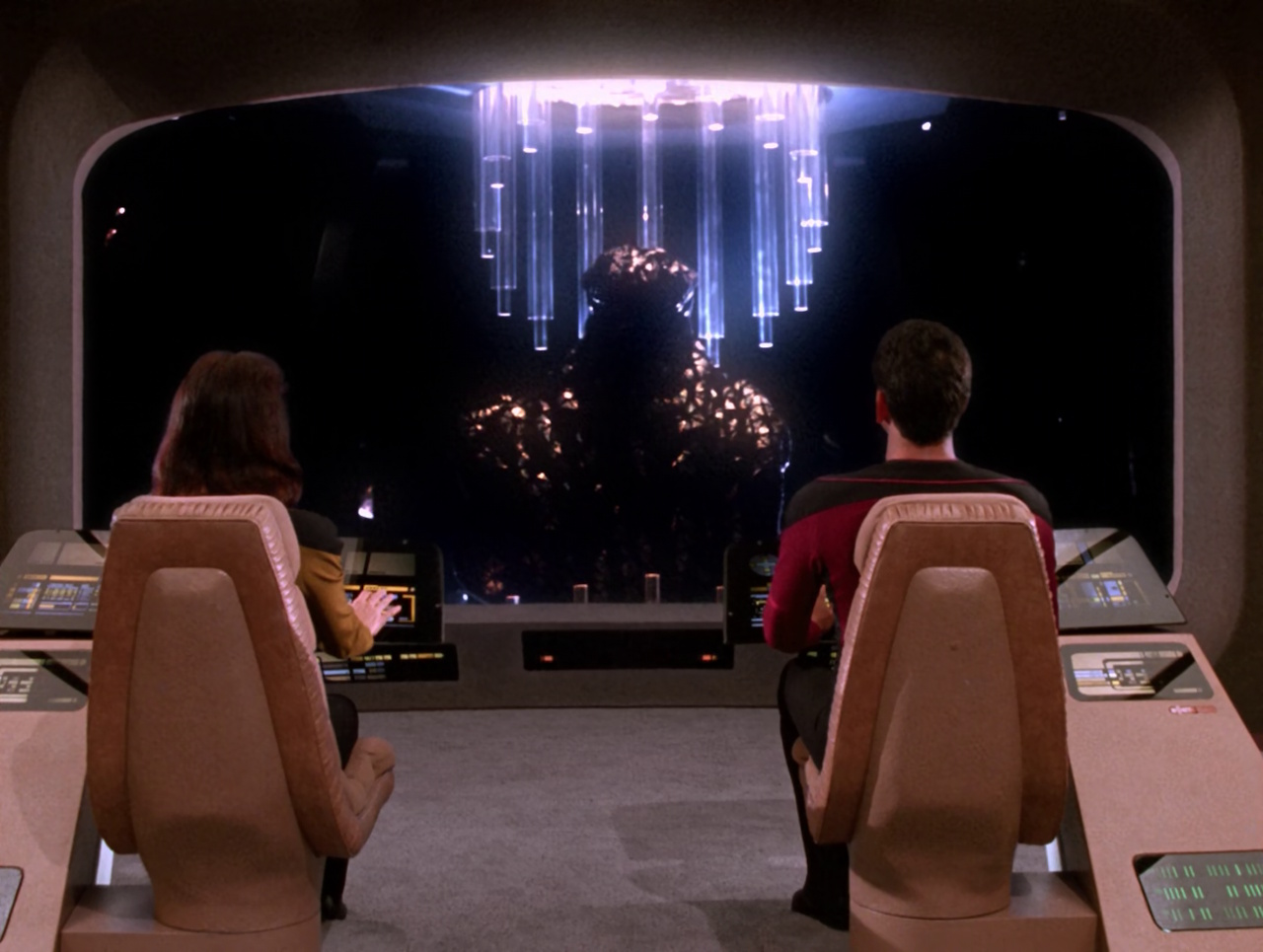
Twelve Star Trek episodes to watch before Picard Season 2 arrives!

Spoiler Warning: There are spoilers ahead for Star Trek: Picard Season 1 and the trailers and teasers for Season 2. Spoilers are also present for the following Star Trek productions: The Original Series Season 1, The Next Generation, Deep Space Nine Season 3, Voyager Seasons 2, 3, and 7, and First Contact.

It seems an age ago that we were eagerly anticipating Season 1 of Star Trek: Picard. In those sunlit, rosy days before the pandemic hit, this website was brand-new, and I spent a lot of time in December 2019 and January 2020 looking ahead and wondering what we’d see when the Star Trek franchise finally returned to the 24th Century – after an eighteen-year wait!

With Season 2 of Picard now only days away, I thought it could be fun to revisit a concept from the early days of the website: a list of episodes that I think could make for interesting background viewing, potentially informing story points and characterisations in the new season of Picard. In the run-up to Season 1 I focused on episodes of The Next Generation that strongly featured Captain Picard himself, as well as a few stories about the Romulans, and a few more stories which could’ve potentially led to big changes in the two decades following the events of Endgame and Nemesis.

We’ll soon be on another adventure with Jean-Luc Picard!

This time, we have a little bit more information to go on! Season 2 will tell a story that involves (to a greater or lesser degree) the following elements: the Borg Queen, Guinan, Q, time travel, and, of course, Admiral Picard himself. On this occasion, then, I thought it could be fun to pull out twelve stories from Star Trek’s past that might just be useful background viewing for Season 2 of Picard. It goes without saying that Season 1 is mandatory viewing, so I’m not putting any of those episodes on this list! You should really watch, or re-watch, all ten before the season kicks off!

My usual caveats apply, as they always do! Firstly, everything listed below is entirely subjective. If I miss out an episode that you think is incredibly important, or you hate all of my picks, that’s okay! We all have different opinions about Star Trek, and there’s no need to fight about it. Secondly, I don’t claim to have any “insider information.” I’m basing my theories and guesses about Season 2 on publicly released material, such as trailers and interviews. And finally, the episodes are not ranked; they’re merely listed below in the order in which they were originally broadcast.

With all of that out of the way, let’s jump into the list!

Number 1:
Tomorrow is Yesterday
The Original Series Season 1 (1967)

I’m pretty sure this violates the Temporal Prime Directive…

Though The City on the Edge of Forever is perhaps the best-known of The Original Series’ time travel stories, Tomorrow is Yesterday preceded it by several months. It was the first episode of the Star Trek franchise where time travel played a major role in the story, and it was also the first in which the crew paid a visit to the modern day. Tomorrow is Yesterday established what went on to become a mainstay in terms of the franchise’s time travel story tropes: being sent back in time by accident!

Aside from being a fun episode in its own right and well worth a watch, Tomorrow is Yesterday is also the episode which introduced the Star Trek franchise to something that appears to be making a return in Picard Season 2: the slingshot method of travelling through time, referred to in this episode as the “light-speed breakaway factor.”

The USS Enterprise using the “light-speed breakaway factor” to travel through time.

Almost every Star Trek series has included the occasional time travel story, and we can look to episodes like Tomorrow is Yesterday for creating that premise. Visiting the modern world would go on to be significant later in The Original Series, in Star Trek IV, and on several other significant occasions in the franchise. For me, some of these stories can feel rather dated, but I think Tomorrow is Yesterday largely avoids that trap!

As we get ready for Picard Season 2 and the franchise’s latest foray into time travel, stepping back to see where it all began during the first season of The Original Series is no bad thing. Tomorrow is Yesterday has a fairly straightforward premise that should be easy enough to follow even for fans who aren’t as familiar with The Original Series, and is well worth a watch on its own merits.

Number 2:
Encounter at Farpoint
The Next Generation Season 1 (1987)

Judge Q.

In the first teaser trailer for Picard Season 2, we heard Q’s voice proclaiming that “the trial never ends.” Encounter at Farpoint is the episode in which Captain Picard first encountered Q, and the episode in which the referenced “trial” began. Q accused humanity (and by extension, the Federation) of being a “dangerous, savage, child-race” who are unfit to travel the stars. Picard and his crew defended themselves against the accusation.

The task Q set for Picard was to unravel the mystery of Farpoint Station, which he and the crew of the Enterprise-D were en route to. However, figuring out the puzzle wasn’t the end of the trial, and even after bringing the Farpoint saga to a successful conclusion, Q departed in ambiguous fashion, hinting that he would return. He did, of course, on a number of occasions!

Worf, Picard, and La Forge on the bridge of the Enterprise-D.

Encounter at Farpoint was the premiere of The Next Generation and established the characters of Picard and Q (as well as many other familiar faces). As we approach Picard Season 2, it’s worth going back to see where it all began. This was the first big puzzle that Q tasked Picard with solving, and seeing how Q operates and what the point of it all is, from his perspective, is well worth taking into consideration.

This is also the beginning of “the trial.” We don’t know to what extent the idea of Picard – and humanity – being on trial will feature in Picard Season 2, but if Q has returned to set up a new mystery there could be a connection – and there could be consequences if Picard and the crew of La Sirena can’t figure it out. Q has toyed with Picard on a number of occasions; Encounter at Farpoint was the first.

Number 3:
Q Who
The Next Generation Season 2 (1989)

Q threw Picard and the Enterprise-D into danger.

Q Who is the episode that introduced us to the Borg – and it’s a pretty scary one by Star Trek’s standards! Captain Picard and the crew of the Enterprise-D have never faced a villain like this, and the Borg represent an existential threat. Q made good on his promise to show Picard that there are dangers in the galaxy that he couldn’t even imagine… and eighteen members of the Enterprise-D’s crew paid the ultimate price.

In a way, Q Who shows Q at his most aggressive, devious, and villainous. By throwing the Enterprise-D into the path of the Borg, he proved his point to Picard about the Federation’s unpreparedness in the most painful way possible. But I don’t believe that’s all there is to the story.

The first Borg seen in Star Trek.

I have a theory about Q Who that you can find by clicking or tapping here. To briefly summarise: Star Trek has made a mess of the history of Borg-Federation contact, and it seems likely that the Borg were already aware of humanity and Earth long before the events of this episode. They may have already been preparing for an attack or assimilation attempt, and Q hoped to prevent that by giving the Federation advance warning.

My theory goes into much more detail! But suffice to say the complicated history of contact between humanity and the Borg makes it seem plausible, at least to me, and shows off an aspect to Q’s character that I think could come into play in Picard Season 2. Q Who also establishes the existence of history between Q and Guinan – something that may come up in Picard Season 2 given that both characters are returning.

Number 4:
Yesterday’s Enterprise
The Next Generation Season 3 (1990)

The Enterprise-C.

Though it’s a fantastic episode in its own right, Yesterday’s Enterprise is on this list for one reason: Guinan. When a rift in the space-time continuum sends the Enterprise-C forward through time, decades’ worth of history are changed, leaving the Federation in a very bleak timeline in which it’s fighting a losing war against the Klingons.

Aboard the warship Enterprise-D, Captain Picard and the rest of the crew are completely oblivious to the change; this version of the characters have only ever known the war timeline. But Guinan alone realises that something has gone wrong, and argues with Captain Picard about how to set things right.

Guinan presents her case to Captain Picard.

Despite a recent controversy, Whoopi Goldberg will be reprising the role of Guinan in Picard Season 2, bringing the character back for the first time since Generations in 1994. Given that we know Season 2 also features a radically changed timeline, not dissimilar to the one seen in Yesterday’s Enterprise, perhaps Guinan will be aware of the change.

Guinan could be the one to talk to Picard about the possible point of divergence, as we know she’d visited Earth in the 19th Century. She may also be one of the only people other than the crew of La Sirena to be aware that something has changed. Guinan also has a history with Q, as we saw in the episode Q Who – so that could also come into play!

Number 5:
Time’s Arrow Parts I-II
The Next Generation Seasons 5-6 (1992)

R.I.P. Data…

Guinan also plays a key role in the two-part episode Time’s Arrow. Thanks to time travel, this is the episode where she and Captain Picard actually have their first meeting, and although the nature of their relationship is still shrouded in mystery, we get a little bit more information about how they came to meet in the first place.

Guinan’s fascination with Earth appears to date back to at least the 19th Century, as she visited undercover during that time period. We know from the most recent Picard Season 2 trailer that Guinan appears to be running a bar on Earth at the dawn of the 25th Century, giving her an association with Earth and humanity that stretches back over five hundred years.

Guinan and Picard in the 19th Century.

Time’s Arrow is an interesting story that mostly focuses on Data, who was of course a huge part of the story of Picard Season 1. It seems as though Brent Spiner will be playing a new role in Season 2 – perhaps another ancestor of the Soong family – so getting a bit of extra data on Data could be worthwhile, too!

One thing I’m personally curious about in Picard Season 2 is if we’ll get any further backstory on the Picard-Guinan relationship. Although Time’s Arrow depicts their first meeting from Guinan’s perspective, we’ve still never learned how they came to meet in the 24th Century from Picard’s point of view. All we know is that it likely happened prior to his assuming command of the Enterprise-D. I don’t know if Picard Season 2 will expand on that in any way… but it would be interesting!

Number 6:
Tapestry
The Next Generation Season 6 (1993)

Q and Picard.

Tapestry is a really interesting episode that deals with the dynamic between Q and Picard, and specifically looks at the nuances present in their relationship. Picard has always viewed Q as an adversary, but I’ve argued in the past that Q doesn’t see himself that way. He views Picard as a friend, and himself as a guide or even an ally – and the way Tapestry unfolds kind of shows why that is.

When Picard is injured on an away mission, he finds himself close to death. At that moment, he encounters Q – who claims he’s already dead. Q gives Picard a chance to avert his death by changing a key event in his past – getting stabbed shortly after graduating from Starfleet Academy – but doing so sets Picard’s life and career on a completely different path.

Lieutenant Picard in an alternate 24th Century.

The important thing here is how Q views the whole affair. We can entertain debates on whether or not Q actually sent Picard back in time or whether it was all an elaborate illusion, but that’s entirely beside the point. Q genuinely believed that he was helping – that by showing Picard an alternate life, he gave him an appreciation for the life he had actually led, even if that meant it was about to end.

I firmly believe that there’s more going on with Q in Season 2 than meets the eye. It’s possible that he didn’t change the timeline at all, and is merely responsible for shielding Picard and the crew of La Sirena from it. It’s also possible that he did change it as part of an elaborate puzzle, one which he hopes and expects that Picard will be able to solve. Speaking of which…

Number 7:
All Good Things…
The Next Generation Season 7 (1994)

Q and Picard in the distant past.

All Good Things is the best example of this aspect of the dynamic between Picard and Q, and could – in theory – be a template for the events of Picard Season 2. In All Good Things, the Q Continuum sets a puzzle for Picard – an eruption of “anti-time.” Thanks to the time-travelling interventions of Q, Picard is able to hop between three different periods of his own past to solve the mystery.

The solution to the anti-time eruption required Picard to challenge his own way of thinking, specifically his linear perception of cause-and-effect. Being able to recognise that events in the future had a causal link to events in the past greatly impressed Q, who seemed to suggest that it was the first step on a path that could one day see humanity evolve into beings comparable to the Q themselves.

Q in his judge’s robes.

All Good Things was also Picard’s last dalliance with Q prior to the events of Picard Season 2. As far as we know at this stage, Q hasn’t been to see Picard in the approximately twenty-five years since the events of All Good Things – but that could change as we get into the new season. It’s possible, at least in my opinion, that Q might’ve been interested to see Picard at his lowest ebb, possibly showing up to see if he could provoke him into action. But we’ll save a detailed explanation of that for my next theory post!

It’s possible that the trailers and teasers for Season 2 have already revealed the nature of Q’s involvement in the story: that he is directly responsible for changing the timeline, he did so on purpose, and he will be the main villain of the season. But I would argue that the “villain” monicker does not fit with Q’s past characterisation, and thus I suspect that there’s much more going on than meets the eye. All Good Things is both a piece of evidence in favour of that argument, as well as a potential blueprint for how a time travel puzzle set by Q could unfold.

Number 8:
Past Tense, Parts I-II
Deep Space Nine Season 3 (1995)

Dr Bashir and Commander Sisko.

We know, thanks to a voiceover in the most recent trailer, that at least some of the events of Picard Season 2 take place in the year 2024. But Picard Season 2 isn’t the first Star Trek production to visit that specific year! In Deep Space Nine’s third season, Commander Sisko and the crew of the USS Defiant found themselves accidentally sent back in time to the exact same year.

Past Tense is an interesting story, as it will mark the first time that any episode of Star Trek set in “the future” at the time it was broadcast will be reached, and I’m sure I won’t be alone in doing a full write-up of its story when we hit the end of August 2024! We could talk for hours about how its depressing presentation of the 2020s seemed a long way from reality once upon a time, but with the growth of homelessness and other economic issues, today’s society feels far too close for comfort to the world of the Bell Riots.

The USS Defiant in orbit over Earth.

I’m not sure how much of Deep Space Nine’s presentation of a fictionalised 2024 will make it into Picard Season 2. It’s possible that the new series will entirely ignore this two-part episode… but I think we should keep an eye open for references or callbacks to some of the characters, events, or even things like brands and products.

Regardless, this will be the first time that two very different Star Trek productions have travelled back in time to the same year, and it might be interesting and informative to take a look at Past Tense to see how Deep Space Nine told us that the year would unfold. It seems as though Picard Season 2 will be set, in part, in California – which is also where Past Tense was set, so that’s another point of connection. I’m not expecting a huge crossover with this one single Deep Space Nine story, but there could easily be references made to it.

Number 9:
Death Wish
Voyager Season 2 (1996)

Two Qs?!

Captain Picard wasn’t the only Starfleet officer to tangle with Q. After making a sole appearance in Deep Space Nine, Q hopped over to the Delta Quadrant, where he had several run-ins with Captain Janeway during Voyager’s journey home. Q presented a bit of a puzzle for Voyager; his abilities mean that he could have sent the ship and crew back to Earth with a snap of his fingers. But if we can look beyond that narrative hurdle, Q’s appearances in Voyager added a lot to his characterisation.

In Death Wish, we got our best look to date at the Q Continuum itself. Depicted in a manner that humans could comprehend, the Continuum resembled a rather dilapidated roadside house in the middle of the desert. For the first time, we got to see more members of the Q Continuum as well, and got a glimpse of how Q himself is a bit of a radical by the standards of his people.

Captain Janeway and Tuvok visit the Q Continuum.

The idea that the Q Continuum is not an entirely stable, homogeneous place is an interesting one, and was explored in more detail in the episode The Q and the Grey. But Death Wish also presented a very complex moral question – in the longstanding tradition of Star Trek! This episode can be a difficult watch for some folks because of its discussion of suicide, and it’s absolutely fine to skip it if that subject hits too close to home. If the debate around suicide and end-of-life care is something you’re interested in, though, this is a uniquely “Star Trek” attempt to tackle it.

Q emerges from this story as a reformer – or even a radical – by the standards of his people. We also know, thanks to a line in All Good Things, that he was responsible for assisting Picard when the Continuum set the anti-time puzzle. It’s stories like this that make me think that there’s a goodness in Q; that he isn’t just a trickster or a pure villain.

Number 10:
Future’s End, Parts I-II
Voyager Season 3 (1996)

Chakotay, Janeway, Tuvok, and Paris on Earth.

The two-part time travel story Future’s End sees Captain Janeway and the crew of the USS Voyager sent back in time to Earth, circa 1996. It’s another story set in the California area, and I think it’s an interesting episode – albeit one that I feel has become very dated by Star Trek standards!

If Picard Season 2 sticks with things like the Borg and the slingshot method, it seems that the kind of time travel depicted in Future’s End won’t be a factor. But there are still interesting points to consider, such as the Temporal Prime Directive and how Starfleet in the future would come to police the timeline, watching out for changes.

It’s Los Angeles – where Picard and the crew of La Sirena appear to be headed!

There aren’t a great many Star Trek episodes that visit the modern day, and as I’ve already explained I feel that a modern setting can make such stories feel very out-of-date very quickly. Future’s End definitely falls into this trap; its depiction of Southern California has a very ’90s flavour. But it’s a bit of fun, and dare I say almost a guilty pleasure!

I’m including Future’s End here for its modern day time travel story and its focus on California, both of which are elements that we know will be part of Picard Season 2. As with Past Tense, I don’t expect to see a huge tie-in between the new season and the events of this episode, but there may be smaller callbacks and references to some of the characters and events it depicted.

Number 11:
Star Trek: First Contact
Film (1996)

The Borg Queen.

First Contact introduced us to the Borg Queen for the first time, and went into a lot more detail about Picard’s assimilation experience. The Borg Queen was presented as the embodiment of the Borg rather than their leader, and she became a fearsome adversary for Picard and Data over the course of the story.

Season 1 of Picard saw the retired Admiral face his lingering Borg assimilation trauma when he beamed aboard the Artifact in the episode The Impossible Box, but Season 2 will see him come face to face with a Borg Queen for the first time in twenty-five years. For someone who’s clearly suffering from some form of post-traumatic stress, we don’t know what effect that could have.

Data and Picard lead the battle against the Borg.

Picard was violently anti-Borg in First Contact, and we saw hints of that in Picard Season 1 as well. His conversation with Dr Jurati and Elnor in The Impossible Box, as well as the way he responded to some of the xB’s in later episodes, was in line with his attitude to the Borg in First Contact – and I wonder how encountering a Borg Queen will make him feel!

Many Trekkies hold up First Contact as one of the absolute best Star Trek films, and it’s hard to disagree. As an action-packed work of sci-fi with some truly scary elements thanks to the way the Borg are depicted, it’s an exciting ride from start to finish. It also goes into a little more detail about World War III – an event in the history of the Star Trek timeline that could play a role in Picard Season 2. Check out my full World War III theory by clicking or tapping here!

Number 12:
Endgame
Voyager Season 7 (2001)

Some of Voyager’s crew in an alternate 25th Century future.

Almost five years after First Contact depicted the Borg’s biggest attack on Earth to date, Endgame brought back the Borg Queen in a significant way. The interventions of a time-travelling Admiral Janeway from the future saw the USS Voyager make it home to Earth, and in the process dealt a significant blow to the Borg Collective.

Even though it’s been more than twenty years since Endgame, we don’t actually know what became of the Borg in the aftermath of Admiral Janeway’s attack. I’ve always assumed that the Borg Collective was large enough, clever enough, and adaptable enough to survive the neurolytic pathogen that she introduced into the Borg Queen… but because the Star Trek franchise has yet to return to the Borg post-Endgame, we can’t be certain of that.

Admiral Janeway and the Borg Queen.

Even Season 1 of Picard, which depicted the disabled Borg Cube known as the Artifact, didn’t settle the issue. So it’s an open question at this juncture whether the Collective survived, whether it was significantly damaged by Admiral Janeway’s pathogen, or whether it was able to easily shake off the attack. It seems as though no major Borg activity occurred in Federation space in the twenty-plus years after Endgame, though.

Endgame makes this list because of the Borg Queen’s role in Picard Season 2, and I think it could be very useful background viewing, possibly even setting up a story about the Queen herself or the state of the Borg Collective at the dawn of the 25th Century. On a vaguely related note, I took a deeper look at Admiral Janway’s actions in Endgame, and you can find that article by clicking or tapping here.

So that’s it!

Admiral Picard is coming back in just a few days’ time!

Those are twelve episodes (alright, eleven episodes and a film) that I think might make for useful or interesting viewing prior to Picard Season 2! I think we’ve hit most of the key subjects – at least, those that we’re aware of at this early stage – and got a good mix of stories focusing on Captain Picard, Q, Guinan, time travel, and the Borg Queen.

At the end of the day, though, Star Trek’s past didn’t prove all that important to unravelling the events of Picard Season 1 – nor to recent storylines in Discovery, either. So it’s quite likely, in my view, that Picard Season 2 will bring plenty of brand-new characters and story elements into play. That doesn’t mean it isn’t worth going back to these stories and others, but my suspicion at this stage is that the new story won’t rely excessively on what came before.

When Picard Season 2 arrives at the end of next week, I hope you’ll stay tuned for individual episode reviews, theories, and more. Despite the somewhat underwhelming end to Season 1, Picard Season 2 has been one of my most-anticipated shows for almost two years, and I can’t wait to jump in and have another adventure with Jean-Luc Picard and the crew of La Sirena.

Star Trek: Picard Season 2 will premiere on Paramount+ in the United States on the 3rd of March 2022, and on Amazon Prime Video in the United Kingdom and elsewhere 24 hours later. The Star Trek franchise – including Picard and all other properties mentioned above – is the copyright of Paramount Global. This article contains the thoughts and opinions of one person only and is not intended to cause any offence.
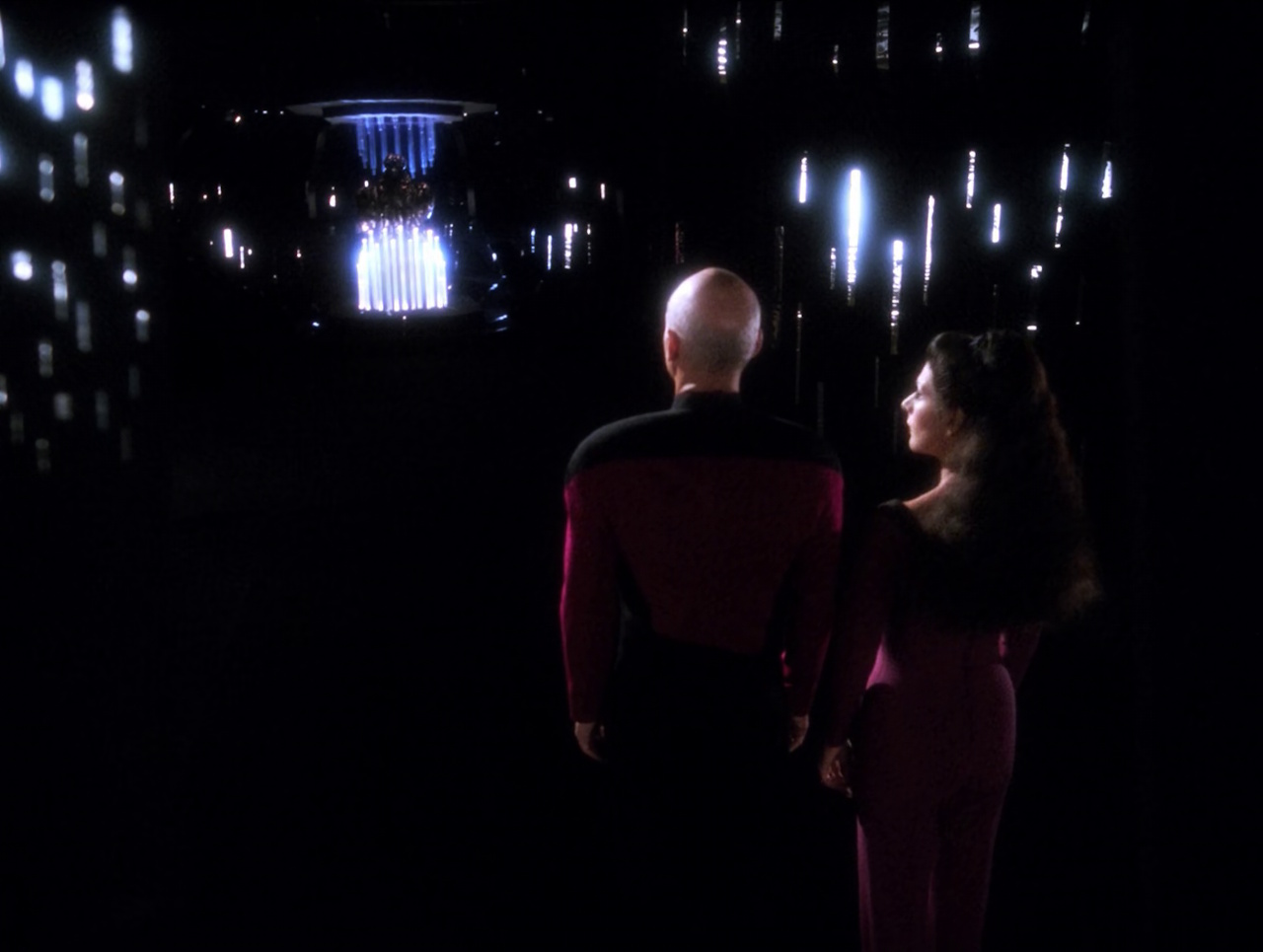
Star Trek: Discovery theories – week 8

Spoiler Warning: There are spoilers ahead for Star Trek: Discovery Seasons 1-4, Star Trek: Picard Season 1, and for other iterations of the Star Trek franchise.

After an unexpected sabbatical, Discovery Season 4 returned with the episode All In. If you read my review of the episode, you’ll know that I didn’t think it was the strongest one of the season so far, but it was interesting in some ways and certainly contained some excellent performances from all of its leading stars. Because All In was, in large part, a detour as Book, Burnham, Owosekun, and Tarka scrambled to get their paws on a magical macguffin molecule called isolynium, most of our big ongoing theories didn’t see significant movement this week. That said, there’s still a lot to talk about and a few updates to get through!

There are still some big open questions, and with five episodes left I’m expecting at least some of them to start moving in pretty big ways in the next week or two! For me, the biggest point of interest right now is whether the season’s big stories will connect in a major way with past iterations of Star Trek. There are a few different ways this could happen, but a big part of me suspects that, as with the Burn in Season 3, we’re going to get something altogether new.

This week we have one confirmed theory and one theory on the production side of things that I’m very pleased to see has been debunked! As always, we’ll start there before moving into the main theory list.

Confirmed theory:
The DMA isn’t a super-weapon.

Burnham, Stamets, and Rillak examine Unknown Species 10-C’s point of origin.

Although I felt that the sequence which contained this revelation was cut rather short, Captain Burnham, Stamets, Zora, and Saru managed to figure out between them what the DMA’s true purpose is. Rather than being a super-weapon, as had been originally assumed, the DMA is a glorified piece of mining equipment, or as Captain Burnham put it, a dredge.

Its purpose appears to be to scour the galaxy for the rare isotope boronite – something that was first mentioned in the Voyager Season 4 episode The Omega Directive. Boronite can be used to synthesise omega molecules – one of the most powerful substances in the known galaxy – but Unknown Species 10-C appear to be using it to power their hyperfield – a kind of forcefield or cloak which is concealing their base or star system.

The DMA’s purpose is to harvest boronite, a rare molecule first mentioned in the Voyager episode The Omega Directive.

I really like this angle. If the DMA isn’t a natural phenomenon, which it seemed to be at first, then having it be something other than a weapon adds a different dimension to the story, one which takes it away from being a fairly typical conflict into something more complex – and, I would argue, more “Star Trek.” We’ve talked about the “it was only trying to communicate!” trope in relation to the DMA before, and how misunderstandings have long been part of Star Trek’s storytelling tradition, highlighting the complexities of dealing with very different cultures and the dangers of making assumptions. This side of the story seems to be cut from the same cloth.

This also seems to rule out other theories about the DMA, such as it being an experiment gone wrong. There’s still room for further twists and turns in the DMA’s story, though, so let’s wait and see what happens, and just what purpose Unknown Species 10-C has in mind for all of this boronite!

Debunked theory:
Star Trek: Discovery isn’t going to be renewed for a fifth season.

Phew! I was getting genuinely worried when we passed the season’s halfway point with no indication of a Season 5 renewal. In past years, we’d always known either before the season kicked off or within a week or two of its premiere that the show had been renewed, so when we got further and further in with no official news – and no rumours of production starting quietly – I began to get worried for Discovery’s future.

But in January, while the show was on hiatus, ViacomCBS confirmed that Discovery will indeed get a fifth season – making it the first show since Voyager to make it that far! (Sorry, Enterprise) This is great news, because I’m not ready yet to say goodbye to Captain Burnham and the crew. There’s so much scope for more adventures in the 32nd Century, and I feel like Discovery could continue to expand and explore this setting, perhaps laying the groundwork for more 32nd Century shows.

So those theories were confirmed and debunked.

Now we can jump into the main theory list! As always, we’ll begin with those theories that are either new or that saw significant movement in All In, before rounding out the list by recapping the rest of them.

Theory #1:
Tarka will realise that there’s a tracker on the isolynium.

Captain Burnham placed a tracking device (highlighted) on the container of isolynium.

Tarka is sharp, and more than that he has access to – and the ability to build – clever pieces of tech. We saw this week that he was able to create a changeling-capturing machine out of a low-quality Devore scanner. It stands to reason he’d want to scan the isolynium that Book procured, and if he’s as thorough as we’ve seen him be so far, perhaps he’ll figure out that Captain Burnham placed a tracking device on it.

If so, the signal that Captain Burnham showed off at the end of All In may lead to a dead-end! I’m sure that the USS Discovery will catch up with Tarka and Book – if not, the story would be fairly short and boring, after all – but it may not be as simple as following the map to the cleverly-placed tracking device.

Theory #2:
Tarka’s weapon will be successful.

Isolynium – a key component of Tarka’s weapon.

President Rillak has tasked Admiral Vance and Captain Burnham with stopping Book and Tarka before they finish work on their weapon and use it against the DMA, fearing that destroying the DMA will lead to all-out war with Unknown Species 10-C. The obvious story route from here is that Captain Burnham and the crew will track them down and either talk them out of it or destroy the weapon before it can be used. But that may not be the direction that Discovery plans on taking us.

It could be more interesting in some ways if Tarka and Book succeed in their aim of launching and detonating the weapon, destroying the DMA and attracting the attention of Unknown Species 10-C. Such a highly advanced species – if they’re as advanced as everyone is assuming, anyway – would be a formidable opponent, but they could also be willing to listen to diplomatic overtures. Perhaps Tarka and Book would have to be sacrificed, imprisoned with Unknown Species 10-C as punishment for their crime.

Tarka and Book.

Speaking of diplomacy, in the mad rush to stop Book and Tarka, I certainly hope that President Rillak hasn’t forgotten about trying to contact Unknown Species 10-C. At the very least, now the Federation knows where they are they should send a message warning them of Book and Tarka’s intentions. It might have to be more of a rush job that the Federation would have preferred – but it would be better to at least make an attempt at first contact in case Captain Burnham can’t stop the weapon in time.

Discovery is definitely unpredictable right now, and I could easily see the series taking its main story to unexpected places. Book and Tarka successfully deploying their weapon would be just one example, and it could make the introduction of Unknown Species 10-C all the more intense, exciting, and edge-of-your-seat thrilling.

Theory #3:
Unknown Species 10-C is extinct.

R.I.P.

We’ll talk in a moment about what All In might mean for my Unknown Species 10-C suspects! But there’s one possibility that I hadn’t really given much thought to that suddenly came to the fore in light of the fact that Unknown Species 10-C is still a mystery and, more significantly, that Starfleet has no way of scanning their base/star system. What if Unknown Species 10-C has already gone extinct?

Perhaps they went extinct recently, or perhaps it was millennia ago. The DMA might be Discovery’s equivalent of the Planet Killer from The Doomsday Machine; an automated device left behind, a warning to the real world about the dangers of some of our long-lasting environmental and technological impacts.

Is the DMA going to turn out to be similar to the Planet Killer?

The DMA could even be Unknown Species 10-C’s last-ditch effort to prevent their own extinction. Having used up their entire power supply, they had to build such an imprecise, devastating machine to harvest all of the boronite they could possibly find just to keep the lights on and their machines powered. There could be an interesting analogy there, too.

Because Unknown Species 10-C remains hidden from us going into the next episode, all sorts of possibilities remain on the table. This could certainly be a different and unexpected way to take the story, and perhaps the culmination of the plot would be more of a technological puzzle than a conflict against an adversary, with Captain Burnham leading Starfleet’s efforts to figure out Unknown Species 10-C’s technology in order to deactivate the DMA.

Theory #4:
Nhan works for Section 31.

Nhan.

Spoiler warning for the next episode, Rubicon, but Nhan will be making a return to Discovery! I thought it was unfortunate that she was shuffled off the ship at such an early stage in Season 3; there was scope, I felt, for more Nhan stories. So it’ll be great to welcome her back to the show in just a few days’ time!

One thing struck me about Nhan based on a couple of photos that the official Star Trek social media channels released, and that’s her uniform. Nhan isn’t kitted out in the standard Season 4 Starfleet uniform that the rest of the crew wear. Hers appears to be a new variant, possibly in a similar style to Lieutenant Willa’s from Season 3. There are many possible explanations for Nhan’s uniform, including an assignment at Federation HQ or a continuation of her service aboard the USS Tikhov, but one interesting possibility comes from Nhan’s background as a security officer. Maybe she’s been recruited by the 32nd Century equivalent of Section 31.

Theory #5:
Tarka’s mysterious “friend” is someone we’re already acquainted with.

All In saw a brief conversation between Tarka and Owosekun in which the subject of his mysterious friend came up. There seems to be more going on with this character than meets the eye, though whether Tarka was being genuine in his emotional reaction isn’t 100% clear! It’s a distinct possibility that his friend is, in fact, a love interest or even a spouse, and that could certainly be an interesting development.

The fact that Discovery has gone out of its way to keep this character’s identity a mystery is interesting as well, and one reason for doing so could be that Tarka’s friend is someone who we as the audience have already met. If it wasn’t a big deal, why not just have Tarka say the individual’s name? The more appearances Tarka makes without revealing this character’s identity, the more strongly I feel that it will turn out to be someone we’ve already met.

I put together a short list of possible candidates for being Tarka’s mysterious friend, and you can find it by clicking or tapping here.

Theory #6:
Book and Burnham will get back together.

Burnham and Book in All In.

I have to be honest: I’m not interested in more Burnham Relationship Drama™. Discovery has already done this with Ash Tyler in Seasons 1-2, and it was okay then, but it’s overdone by now. I get where the central conflict with Book has come from, but I don’t feel that the show needs this additional injection of drama to make Season 4’s story work. If I were to cut one aspect of the Season 4 story that we’ve seen so far, it would be this.

So with that in mind, my hope is that the Book-Burnham feud will be brought to an end – and hopefully within the next couple of episodes. Ideally I’d like to see them get back together, although some of the things they said to each other in All In might make that more complicated. If Burnham manages to stop Book and Tarka, perhaps he’ll come around to her way of thinking. If they’re successful in using the weapon, the argument they had will become a moot point. So there are different ways this could go, but I’m hopeful that it will be resolved soon as it’s an aspect of the show that I’m really not wild about.

Theory #7:
The DMA is a life-form.

“It’s alive!”
Frankenstein (1932)

The revelation that the DMA is a mining tool or dredge would seem to make this theory a lot less likely – but I’m not yet willing to strike it from the list. There are several ways it could unfold, but one possibility is that the DMA is a self-aware piece of technology, comparable to Zora. Perhaps it’s carrying out its orders, unaware of the damage it’s doing, and will be able to be reasoned with even if Unknown Species 10-C won’t back down.

Or perhaps the DMA has gone rogue, operating without Unknown Species 10-C’s permission. That would also be an interesting angle, as it could mean that Captain Burnham and Starfleet will have to ally with Unknown Species 10-C to stop the DMA. Some aspects of this theory as I originally formulated it – such as coming to an understanding with the DMA in a story comparable to V’Ger’s in The Motion Picture – seem to be off the table entirely. But the DMA being a self-aware, conscious machine isn’t… at least, not yet!

Theory #8:
Unknown Species 10-C is a faction from a past iteration of Star Trek.

Could it be the Borg?

The revelation of the hyperfield at Unknown Species 10-C’s point of origin was an interesting one. A field that size could conceal a small star system, as Admiral Vance suggested. But it could also hide something like a huge fleet of starships – or giant mechanical aliens. In my view, there are only a few likely candidates remaining from the long list I put together before Christmas. The technology required to create the DMA and the hyperfield seem to rule out factions like the Klingons, the Gorn, and others.

But there are still some known Star Trek factions with the potential capability of building something like this. I would point to the Borg, the super-synths from Picard Season 1, Enterprise’s Sphere-Builders, the Kelvan Empire from The Original Series (who are also an extragalactic faction), and possibly others like Species 8472, V’Ger, the Q Continuum, or the Terran Empire.

How about Species 8472?

I confess that I feel a sense of déjà vu right now. In Season 3, I theorised and speculated about possible culprits behind the Burn, and a lot of the same names and factions were in the frame then, just as they are now. The Burn ultimately went in a very different and unpredictable direction, and I feel that Unknown Species 10-C could end up in a similar place as a brand-new faction altogether. Because of the mysterious nature of the story, and how long it’s been rumbling on, would that feel like an anticlimax? If Discovery encouraged fans to guess and speculate about who Unknown Species 10-C are, would it be disappointing if the answer was “someone new that you could never have guessed?” I can’t shake the feeling that it might be.

For a more detailed look at the suspects mentioned above, as well as a few less-likely contenders, check out my full list by clicking or tapping here.

Theory #9:
President Rillak knows what the DMA is and may be implicated in its creation.

President Rillak, leader of the United Federation of Planets.

I will admit that, as things stand at the end of All In, President Rillak is looking less and less likely to be involved directly with Unknown Species 10-C and the DMA. But there’s still time for a connection to be revealed!

In short, President Rillak’s single-minded goal of reuniting the Federation may be well-served by providing the disparate members with an enemy or a problem to unite against. The DMA has already accelerated Ni’Var’s membership, and President Rillak even got to speak with a representative from Earth – so if she is involved somehow, her scheme is already paying dividends. At the very least, I think it’s fair to say that this complex, somewhat Machiavellian character is not letting the crisis go to waste, and is politicking off the DMA’s trail of destruction.

President Rillak with Captain Burnham on Ni’Var.

In her dealings with Captain Burnham, I’d argue we’ve seen this Machiavellian edge to President Rillak. In the Ni’Var negotiations depicted in All Is Possible, and again for a second time in But To Connect, President Rillak used Captain Burnham to advocate positions that would’ve been politically or diplomatically difficult for her to do openly – effectively manipulating those events from behind the scenes.

In light of all of this, I would hope that Captain Burnham will tread carefully with President Rillak. She seems the type who would happily throw Burnham and the USS Discovery under the bus if it suited her political and/or diplomatic ends. If someone like that felt that unleashing the DMA, or failing to warn everyone that it was coming, would be to her advantage, I can absolutely see her seizing on that opportunity, too. There are myriad ways in which we could connect her to the DMA, even if she didn’t order its creation. She could be in cahoots with Unknown Species 10-C, she could have learned about the DMA and chosen to cover it up, or something else that she believed was in the Federation’s long-term interests.

Theory #10:
Michael Burnham won’t remain captain of the USS Discovery.

Captain Burnham.

One of the unique aspects of Discovery within Star Trek’s broader canon is that the ship has been commanded by four very different individuals across its four seasons. Captain Burnham is different from Saru, Saru was different from Pike, and Pike, in turn, was different from Lorca. It has to be considered at least a possibility – albeit a remote one, perhaps – that the series will continue this trend.

Now that we know that Season 5 is definitely happening, one possibility is that Captain Burnham will somehow leave the ship at or around the end of Season 4, making way for a brand-new commanding officer to take over. Because she’s been the show’s protagonist since Season 1, it seems unlikely, and the overall arc of Discovery between Season 1 and Season 3 can be read as Burnham’s redemption and ascent to the captaincy. But the show’s revolving door of captains may continue.

Burnham in The Examples.

I’m not really in favour of this, but it’s certainly interesting to consider. The episodes But To Connect and All In definitely showed us how conflicted Burnham feels with regards to Book; she’s torn between her duty and the person she loves. Maybe she will have the strength to do what she believes is right during the DMA crisis, but will resign afterwards, unable to contemplate doing the same thing again and wanting to return to her simpler life with Book. This wouldn’t be a bolt from the blue, as we saw her wrangling with these feelings in Season 3.

Alternatively, Burnham could be promoted, taking up a senior role within Starfleet either at Federation HQ or on a new flagship. We already know that she had been in the running for the captaincy of the USS Voyager-J, so maybe she’ll convince President Rillak, through her work on the DMA, to reconsider her for that role. In short, there are ways her departure could be handled in a way that would feel natural – just like Tilly’s departure did earlier in the season.

Theory #11:
The Guardian of Forever will be back.

The Guardian of Forever as it originally appeared.

I’m close to retiring this theory. In short, I had suggested that the reintroduction of the Guardian of Forever in Season 3 could mean that we’ll encounter the timeless entity again in Season 4. It would be nice to bring back Paul Guilfoyle, who played the Guardian’s humanoid avatar in the Season 3 two-parter Terra Firma.

However, it seems as though the DMA/Unknown Species 10-C story isn’t going in that direction. It would make sense, in a way, for Captain Burnham to seek out the Guardian to ask it about the DMA and Unknown Species 10-C – it may well know something about what’s going on that could be helpful. But the best time to have done that would have been earlier in the season. There are still ways in which the Guardian of Forever could be included, though, so although I’m close, I’m not dropping it just yet.

Theory #12:
Tarka will create his own DMA.

Tarka and Stamets with their DMA model.

In The Examples, Tarka – aided by Stamets – created a working replica of the DMA, albeit on a smaller scale. According to Reno, this recreation came very close to destroying the entire ship! Now that Tarka has isolynium, could it be possible that he will create the DMA – either intentionally or accidentally?

Because of the DMA’s wormhole technology, it doesn’t seem like too much of a stretch to think it could travel through time as well as space, meaning a possible time-loop story is on the cards. It’s got to be at least possible to think that throwing a massive bomb at the DMA could have unintended consequences – if, that is, Tarka actually intends to build a bomb! He might see the DMA’s technology and seek to replicate it, creating his own DMA as a means to break through into the parallel universe he’s aiming to reach.

Theory #13:
Tarka’s “friend” is directly involved with the DMA.

Stamets, Tarka, and Saru with the DMA model.

Though we didn’t learn a lot more about Tarka’s friend in All In, from what we do know about them – their scientific background and desire to travel to an alternate reality – they could be a candidate for building the DMA. Unknown Species 10-C could, perhaps, be a single person, or Tarka’s friend could have worked with them, trading their scientific knowledge for Unknown Species 10-C’s power-generating technology.

Like with President Rillak, there are different ways this involvement could work, and different degrees to which Tarka’s friend could be implicated. But one thing is clear: Tarka knows a lot about the DMA, probably more than he’s been willing to share. That knowledge has to have come from somewhere, right? Maybe his friend told him about this technology before they got separated.

Theory #14:
Book will find Kyheem and Leto on the other side of the DMA.

Book with Leto and Kyheem shortly before the destruction of Kwejian.

In Star Trek: Generations, Captain Picard encountered Captain Kirk inside the Nexus – despite Kirk being declared “dead” after the Enterprise-B encountered the energy ribbon almost eighty years earlier. Now that we know a little more about how the DMA operates, it seems at least faintly possible that, just like Captain Kirk, the inhabitants of Kwejian may not be as dead as they first appear.

This theory is, I freely admit, a bit of a long-shot. But the wormhole technology that we know the DMA uses seems to be capable of sending some of what it harvests or mines back to Unknown Species 10-C’s base of operations. Maybe that means that some of the people from Kwejian were transported there instead of being killed.

So those theories are new or saw movement this week.

Now we’ll recap all of the other theories currently in play! It helps to keep the list complete and in one place, so that we can update and cross off theories as we go!

Theory #15:
Tarka aims to travel to the Kelvin universe.

This scene in Terra Firma, Part 1 referenced the Kelvin universe.

There are many parallel universes, as Tarka reminded us in But To Connect. Though Star Trek has shown us a number of different parallel universes before, the biggest one that comes to mind (aside from the Mirror Universe) is the Kelvin timeline, in which the three reboot films were set.

A fourth Kelvin film may or may not be happening, but even if it does the setting remains ripe for further exploration. We don’t know how far the Kelvin timeline and the prime timeline will have diverged, and whether it operates like the Mirror Universe with every character getting their own alternate counterpart. If it does, perhaps Tarka met his own Kelvin timeline counterpart and that’s how he cooked up this scheme. If the Kelvin timeline diverged significantly from the prime timeline it stands to reason that the Burn never happened there. We also got an oblique Kelvin timeline reference in Season 3 – could that have been a hint?

Theory #16:
Some areas of the galaxy – such as the Delta Quadrant – avoided the worst effects of the Burn.

Adira and Stamets with a map of the Milky Way galaxy.

In But To Connect, President Rillak told us that the diplomatic summit she convened would bring together races from “all four” quadrants. Assuming she was referring to the familiar Alpha, Beta, Gamma, and Delta Quadrants that make up the Milky Way galaxy, this would count as our first mention of the Delta Quadrant in the 32nd Century. I didn’t spot any familiar Delta Quadrant races (or their emblems) amongst the assembled delegates, however!

I had previously speculated that the Burn may not have affected the entire galaxy equally, and that regions farthest away from the Verubin Nebula may have survived without much damage. I still think that this is a possibility – though whether Discovery will revisit the Burn in any depth, or visit the Delta Quadrant at all, remains unclear.

To see a full write-up of this theory, click or tap here.

Theory #17:
There will be a character crossover from a past iteration of Star Trek.

Star Trek has had some wonderful crossovers in the past.

Tarka’s friend could, as mentioned, be someone we’ve already met. But there are other ways to bring back a character from a past iteration of the franchise – and there would be many potential benefits to doing so! I had initially proposed a version of this theory in the run-up to Season 3 that centred on the Doctor from Voyager – but with some creative technobabble, practically anyone could be included, despite the leap forward in time.

Choose To Live showed us the Abronians in cryo-sleep, and Stormy Weather saw the crew of Discovery use the transporter buffer to survive – just like Scotty had done in The Next Generation Season 6 episode Relics. Could these be hints at something to come?

It would also be possible for Captain Burnham to discover the logs or a holographic recording of a long-dead character – and while this would be less of a “crossover,” it could still be a ton of fun and great fan-service!

Theory #18:
Season 4 will connect with the Short Treks episode Calypso.

Zora dancing with Craft in Calypso.

Zora’s status as a member of the crew was confirmed in But To Connect, and this followed her developing emotions and sentience earlier in the season. Zora is now much closer to her presentation in Calypso, potentially bringing the story of the Short Treks episode one step closer.

There are still significant hurdles to overcome if the story of Calypso is to be wrapped up in Season 4, though. Obviously we have the timeframe issue: will the USS Discovery be sent back in time, be abandoned, or is Calypso taking place centuries in the future? Then we have the USS Discovery itself – it’s been retrofitted since arriving in the 32nd Century, and now looks very different to how it did in Calypso. I’m not sure how Discovery will overcome these hurdles – but it’s possible. It feels like a proper link-up with Calypso is edging closer week by week.

Theory #19:
A major character will be killed off.

Spock’s funeral in The Wrath of Khan.

Lieutenant Tilly’s departure in All Is Possible definitely shook up the cast. And Gray’s departure in But To Connect may do so as well. However, I stand by what I said before the season aired: killing off a character can be a great way to demonstrate the dangerous nature of the circumstances that the crew have found themselves in. So far, despite tangling with the DMA on several occasions, only a couple of redshirts have lost their lives.

In Stormy Weather, Dr Pollard raced through the corridors of the USS Discovery to reach a hull breach. Shortly after she arrived, a redshirt was blown out into space – but Dr Pollard survived. Although moments like this can make it feel that Discovery is shielding its main and secondary characters with some pretty heavy plot armour, I still feel that there’s scope to see a major character death before the season ends.

If you want to check out my pre-season “death predictions,” in which I speculated about which characters may or may not be in danger, you can find that by clicking or tapping here.

Theory #20:
The crew will have to defend the Verubin Nebula.

The dilithium planet is vital to the Federation.

Despite having grown to sixty member worlds, the Federation is still in a weakened state and isn’t yet back to full strength. The Verubin Nebula is thus a very tempting target for anyone looking to gain an edge in a galaxy where dilithium is still in short supply. As the only known significant cache of the valuable fuel, whoever controls the Verubin Nebula will have a massive tactical advantage.

It would begin to stretch credulity to think that everyone in the known galaxy would see the Federation rebuilding and having access to dilithium and not want to find out for themselves what’s going on. Once the Verubin Nebula’s existence becomes known, even if the Federation promises to share its bounty with all comers, it seems very likely that someone would want to take control of the dilithium supply for themselves.

Theory #21:
The ban on time travel will be explained in more detail.

The USS Enterprise was able to travel through time using the “slingshot method.”

This one is as much a hope as a theory right now! In short, the ban on time travel was introduced early in Season 3 primarily as a way for the writers and producers to avoid questions about why the 32nd Century was so different from how the far future had been depicted in earlier Star Trek productions, as well as to explain things like how the Burn was able to catch the Federation off-guard and why Georgiou couldn’t simply be sent back in time when she needed to.

But the ban itself raises some issues – the biggest one being the lack of detail on how it works and how something like this could possibly be enforced. As I said several times last season, it isn’t possible to just un-invent a technology so useful and powerful as time travel. Even just a few lines of dialogue going into a little more detail on the mechanisms involved in the ban would be really useful.

Theory #22:
The Federation has flouted the ban on time travel.

President Rillak may have tried to circumvent the ban if she felt doing so would be in the Federation’s interests.

Sticking with the time travel ban, another theory I had last season was that the Federation – and Section 31 in particular – might have deliberately flouted the ban and failed to abide by the rules. Someone as straight-laced and committed to Starfleet ideals as Admiral Vance is highly unlikely to have sanctioned such a move, but there are other Federation leaders – such as President Rillak – who could be implicated.

I don’t think it’s possible any more that the DMA story will be connected to the time travel ban, as I had previously proposed. But that doesn’t mean that a closer look at the ban, and the potential for the Federation to have tried to work around it, isn’t going to happen.

Theory #23:
Saru will be given the captaincy of the USS Voyager-J.

Captain Saru in command of the USS Discovery in Season 3.

Saru’s future was briefly discussed before he offered to serve as Captain Burnham’s first officer in the episode Anomaly. He has already been offered a command of his own, so Starfleet clearly values his command abilities and experience. President Rillak was seen to be assessing Captain Burnham’s suitability for the captaincy of the USS Voyager-J in Kobayashi Maru… and she mentioned having a shortlist of candidates. Could Saru be on her list?

Several of the qualities that President Rillak said she was looking for in a potential captain seem to apply to Saru. He’s more level-headed, less likely to put himself in a dangerous situation, and more inclined to think of the big picture. He has a weakness when it comes to Kaminar, as we saw toward the end of Season 3, but generally speaking he isn’t someone who lets his emotions get the better of him. His wisdom and calm demeanour could be valuable in the captain’s chair of the Federation flagship. This could also set the stage for his departure from the show, or possibly even for a new show following his adventures aboard his new ship.

Theory #24:
The Red Angel suits from Season 2 are connected to the DMA.

Captain Burnham’s Red Angel suit at the end of Season 2.

Unknown Species 10-C seem to be responsible for building the DMA. But it isn’t the first wormhole-creating technology that Discovery has introduced us to! The Red Angel suits in Season 2 were also capable of creating powerful wormholes… so could it be possible that Unknown Species 10-C built their device around or based on the same technology?

This revelation would greatly affect Captain Burnham, as she’d feel a degree of responsibility even though she wasn’t directly involved. It would also be the second disaster in a row (following the Burn) in which the Federation was implicated – albeit in an oblique way. I’m not convinced that Discovery will go down this route… but the similarities in the wormhole-creating technology gives me pause, at least.

Theory #25:
We haven’t seen the last of the Abronians.

I currently have four ideas for different ways that the Abronians – the non-humanoid race that Captain Burnham, Tilly, and the Qowat Milat helped save from cryo-sleep in the episode Choose To Live – could play a further role in Season 4.

Theory #25 A:
The Abronians’ homeworld was destroyed by the DMA.

Captain Burnham believes this image depicts a “supernova.”

After arriving at the Abronians’ cryo-ship, Captain Burnham found a stone carving that seemed to depict the destruction of the Abronians’ homeworld. This carving was only shown on screen briefly, but it seemed to show the planet being damaged or destroyed in a large explosion. Burnham credited the planet’s destruction to a “supernova,” and the story then raced ahead.

Considering that the main thrust of the season so far has been about the DMA, perhaps Burnham was incorrect: the Abronian homeworld was destroyed by the anomaly, not a supernova.

Theory 25 B:
The Abronians’ homeworld was on the “other side” of the DMA.

Abronian stasis pods.

Now that we know a little more about how the DMA works, this theory seems a little more plausible. Its powerful wormhole technology seems capable of transporting matter over many light-years, meaning it doesn’t seem to be a complete stretch to think that the Abronians may have originated in the vicinity of Unknown Species 10-C. They could even be Unknown Species 10-C!

One thing struck me as odd about the Abronians: the Federation was entirely unaware of them, despite the Abronian cryo-ship being relatively close to Federation space – such that Captain Burnham could reach it using Book’s ship in a short span of time. It’s possible that the Abronians had been asleep for millennia, unnoticed by the Federation and the wider galaxy for all that time. But it’s also at least possible that their cryo-ship is a newcomer to the area. If so, perhaps it arrived here via the DMA.

Theory #25 C:
The Abronians will return to help the Federation later in the season.

A deceased Abronian.

One of the themes of Discovery since Season 3 has been connection, including building connections between the Federation and other races and organisations. The Abronians were awoken from cryo-sleep thanks to the interventions of Captain Burnham and Tilly – at least in part – and they may seek to repay the Federation, or Captain Burnham personally, for that help.

We saw this play out last season with Ni’Var; in the season finale Ni’Var ships raced to the Federation’s aid as the Emerald Chain attacked. Perhaps the Abronians will likewise step up to help when the Federation needs allies.

Theory #25 D:
The Abronians’ moon-ship may be useful in a later story.

“That’s no moon…”

The Abronians’ cryo-ship is huge, and at least superficially seems to have the mass of a moon or small planetoid. If Captain Burnham and the crew needed a starship that large, such as to aid in the evacuation of a planet threatened by the DMA, for example, perhaps they’ll return to the Abronians and ask to borrow it.

As we saw in Choose To Live, the moon-ship was in full working order. All it needed was some extra dilithium to power up and it was perfectly capable of moving under its own power, and its computer systems were still functional. The only system that seemed to have failed was the wake-up timer! Discovery has precedent when it comes to telling seemingly one-off stories that have a pay-off later on, so watch this space. If Captain Burnham and the crew need a huge starship urgently, we may not have seen the last of the moon-ship!

So that’s the main theory list.

There is still one production-side theory in play, so we’ll recap that now before we wrap up.

Production-side theory:
Tilly’s departure will be permanent.

Tilly’s departure feels permanent.

Mary Wiseman confirmed in an interview with Wil Wheaton on The Ready Room (Discovery’s social media aftershow) that Tilly will be seen again before the end of Season 4, and we glimpsed her in the trailer for the second half of the season as well. But that doesn’t mean she will return as a main character on the show going forward, and her departure in All Is Possible felt permanent. Despite that, I’ve seen quite a lot of folks online who don’t believe that Tilly is actually leaving the series – so I wanted to put it out there officially and say that, in my opinion anyway, she is.

Maybe those people know something that I don’t! As I always say, I don’t have any “insider information;” all of this is just speculation on my part. However, I feel that the manner of Tilly’s departure, the fact that she got that emotional sequence with Captain Burnham, a montage showing her leaving the ship, Adira seeming to take over several of her roles, and her departure feeling like the culmination of her arc going back to the latter part of Season 3 all come together to strongly indicate that she won’t be back as a major character. She may yet have a significant role to play in a future Season 4 episode, as has been suggested, but unless Discovery’s writers are really playing with our emotions I believe we’ve seen Tilly’s end as a main character on the show. She may come back in a future Starfleet Academy series, though… so watch this space!

So that’s it!

Owosekun in the combat arena in All In.

It’s all still to play for as we move into the final five episodes of the season. There are several key stories to find resolutions to: the DMA, Unknown Species 10-C, the Book-Burnham drama, and more. There’s also plenty of time, in five episodes, for Discovery to take off on a side-mission or two, as well as to introduce completely new and unexpected story elements. It’s even possible that Season 4 will end on a cliffhanger now that we know Season 5 is happening… so perhaps none of the big stories will be resolved until 2023. Say it ain’t so, Joe!

Before we go, one final point. I write up these theories because I like Star Trek and I like writing. But for some folks, fan theories can hamper their enjoyment of a film or television show. It’s worth keeping in mind that most of these theories probably won’t pan out, and we have to be prepared for the fact that even the most well-constructed fan theory, no matter how fun and plausible it seems, simply won’t turn out to be true. If you find that speculating and reading theories is beginning to detract from your enjoyment of Star Trek: Discovery – or any other television show or film – it might be a good idea to take a break for a while.

Star Trek: Discovery Season 4 is available to stream now on Paramount+ in the United States, Scandinavia, Latin America, and Australia. The show is on Pluto TV in the UK, France, Germany, Italy, and other parts of Western Europe at 9pm on Fridays and Saturdays. Individual episodes or the full season can be purchased on iTunes, Amazon Video, Google Play, and possibly other platforms in the UK, parts of Europe, and select other countries. The Star Trek franchise – including Discovery and all other properties mentioned above – is the copyright of ViacomCBS. This article contains the thoughts and opinions of one person only and is not intended to cause any offence.
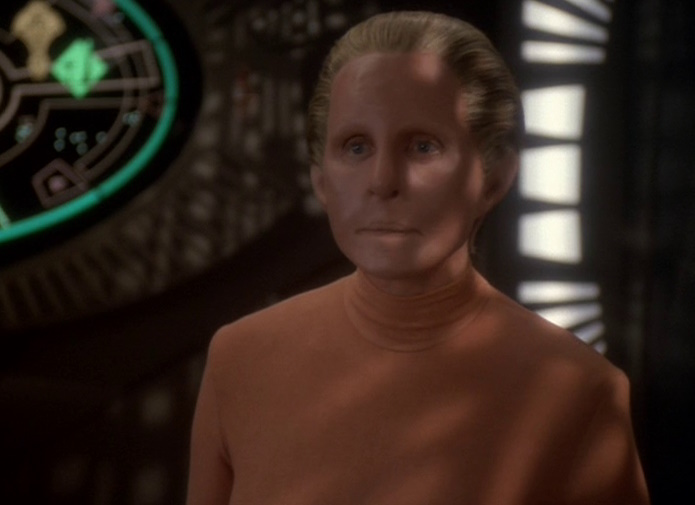
Star Trek: Discovery Season 4 – So who is Ruon Tarka’s “friend?”

Spoiler Warning: There are spoilers ahead for Star Trek: Discovery Seasons 1-4, Star Trek: Picard Season 1, and for other iterations of the Star Trek franchise.

With Discovery taking an unplanned six-week break, we’ve got a little time to settle in and collect our thoughts. The first half of Season 4 has seen some progress toward unravelling the mystery of the dark matter anomaly, but there are still plenty of questions! From this point, the story could go in many different directions, and could potentially make significant connections and crossovers with past iterations of Star Trek. Today, we’re going to consider one such possibility.

In the episode But To Connect, which served as the mid-season finale, Ruon Tarka returned. Tarka is a Risian scientist who had been working on the DMA and who had collaborated with the USS Discovery’s own Paul Stamets in the episode The Examples to build a working scale model of the anomaly. We learned more about him this time, including what he claims to be his motivation for wanting to destroy the DMA while preserving the machine at its centre: he wants to use it to travel to a parallel universe.

Tarka made his first appearance in The Examples.

During a conversation with Book, Tarka claimed that he had “a friend” while he was forced to work for the Emerald Chain. This friend wasn’t mentioned by name, but appears to have been a major motivating factor for Tarka to find a way to cross the divide between universes; to “punch through” as he put it.

This could all be obfuscation on Tarka’s part; a made-up story to help him sink his talons into Book and manipulate him into doing his bidding. Tarka’s plans relied on Book: he needed him to either convince the delegates to approve the use of his weapon, or to use the stolen spore drive to deliver the weapon without Federation help. So we have to acknowledge that possibility.

Stamets and Tarka built a scale model of the DMA.

But I was struck by the way this conversation deliberately kept Tarka’s “friend” hidden from us as the audience. Book asked who the friend was, but Tarka quickly waved away the question. That makes me wonder… who is this friend? And could it be someone we’ve met before – maybe in Discovery, but maybe in a past iteration of Star Trek?

So today we’re going to consider a few possible candidates for Tarka’s friend. Who could this person be, and if they survived their imprisonment with the Emerald Chain, might we be about to meet them?

Tarka and Book aboard Book’s ship.

I can’t decide right now whether Discovery is setting up Tarka to be the main villain for the rest of the season, or whether Captain Burnham and the crew will resolve this storyline within an episode or two before moving back to the DMA and Unknown Species 10-C. Either possibility feels just as likely, so we could perhaps see the Tarka storyline rumble on for much of the second half of the season.

But we’ll have to set that aside for now! I’ve put together a list of candidates for being Tarka’s friend and we’ll go through them one by one. Just remember one thing: I have no “insider information,” and I’m not trying to claim that any of this will actually be included in Star Trek: Discovery. This is speculation and theorising from a fan – and nothing more.

With that caveat out of the way, let’s jump into the list.

Friend #1:
Aurellio

Let’s see… Aurellio is a bona fide scientist. He worked for the Emerald Chain. He and Tarka know one another. And although Aurellio has been mentioned several times this season, we haven’t seen him. Could he be the mysterious friend?

I don’t think so, not unless Tarka is even more devious than we think! Although we haven’t seen Aurellio this season, we’ve heard multiple times that he’s working with Starfleet, and he even built the new spore drive that Book and Tarka used in But To Connect. So unless Tarka has somehow managed to fake Aurellio’s entire existence… I think we can rule him out.

But on the surface, Aurellio fits the bill in some respects! We don’t really know of any other ex-Emerald Chain scientists, so it’s an outside possibility that Aurellio is involved in all of this somehow.

Friend #2:
Altan Inigo Soong

Dr Soong is the son of Data’s creator, and was encountered by Admiral Picard on the planet Coppelius in Et in Arcadia Ego, Part 1 – the first part of the Picard Season 1 finale. As a human from the 24th Century, he shouldn’t still be alive almost eight centuries later, but Dr Soong had plans to transfer his consciousness into a synthetic body. This process was mentioned earlier in Discovery Season 4, as it was used to give Gray a physical body.

If Dr Soong was ultimately successful, it’s possible that his synthetic form survived to the 32nd Century, and he could therefore be Tarka’s friend. He was already a skilled scientist when Picard met him, and with centuries of time to develop his skills he could have proven invaluable to an organisation like the Emerald Chain.

Now we get into abject speculation, but if Unknown Species 10-C turns out to be connected to the super-synths from Picard Season 1, this could give Dr Soong an additional motive for wanting to escape to a parallel universe: he might be aware of the threat they pose to the galaxy and all organic races.

Friend #3:
The Doctor

Nothing that Tarka said about his friend implied that they’re organic – so the Doctor being a hologram shouldn’t count against him! I’ve speculated before that a backup copy of the Doctor could still be alive in the 32nd Century, as we saw in the Voyager Season 4 episode Living Witness. While the Doctor wasn’t a scientist per se, after decades living and working with the Kyrians in the Delta Quadrant he may have broadened his skills.

If the Doctor was re-activated to find a galaxy ravaged by the Burn and all of his friends long gone, he might well want to escape to an alternate reality – there’d be nothing left for him in the prime timeline.

Perhaps the Emerald Chain intercepted his ship while he was on his way from the Delta Quadrant, or perhaps this is a different copy or version of the Doctor altogether from the one we saw in Living Witness. Because of the Doctor’s nature as a hologram, he could have easily survived this long.

Friend #4:
Control

Captain Leland, who had been “assimilated” by the Control AI, was killed at the end of Season 2, and the existence of life in the 32nd Century seems to suggest that Control was permanently shut down shortly after the USS Discovery left. But what if that didn’t happen, or if the shutdown of Control was incomplete?

So far this season we’ve had more mentions of Control – and a greater discussion of the implications of its rise – than we got in the entirety of Season 3. Could that be setting up something big later in the season? Could Tarka’s friend actually be someone that the Control AI “assimilated?”

If so, perhaps Control plans to abandon this universe to find one more easily attacked and dominated – and Tarka may find that his friendship with whomever it is was little more than a ruse.

Friend #5:
Another Ruon Tarka

There are multiple parallel universes – perhaps an infinite number! At least some of those universes contain alternate versions of everyone we’re familiar with: the Mirror Universe and the alternate reality of the Kelvin films being just two examples. So what if Ruon Tarka’s “friend” is, in fact, a parallel universe version of himself?

Tarka was confident that the parallel universe he intends to reach is better than the post-Burn reality he currently inhabits. But how could he possibly know that unless he’d either seen it for himself or met someone from that reality? Though in theory anyone from that universe could be Tarka’s friend, I think someone with the self-assuredness and arrogance of Tarka would be more inclined to trust his own counterpart.

We know that Tarka isn’t bound for the Mirror Universe – at least based on what he told Book. But here’s a spoiler for my next theory post: what if he’s trying to reach the Kelvin timeline? His unnamed friend could be his Kelvin timeline counterpart.

Friend #6:
Michael Burnham

We’re sticking with the parallel universe theme here. If an alternate version of Captain Burnham had somehow crossed into our universe, perhaps she’d been captured by the Emerald Chain and forced to work with Tarka. She might have warmed up to him, telling him of her true origin in a different, better universe.

Burnham has a keen scientific mind, and had she ended up in Emerald Chain captivity they might well have tried to put her to work as a scientist. Discovery has also put Burnham at the centre of big storylines before, such as by making her the Red Angel in Season 2.

The counter-argument to this would be that everyone we met from the Emerald Chain, including Osyraa, Ryn, and Aurellio, didn’t recognise Burnham or claim to have seen her before. It’s possible that they never met her or that she was working in a different lab, but it could also be seen as a mark against this theory. Tarka also suggested that his friend was male, which could also rule out Burnham.

Friend #7:
Dax

Thanks to the inclusion of Gray and Adira, we’ve spent some time with the Trill over the past couple of seasons. Trill symbionts are particularly long-lived, and there’s evidence to suggest that Gray and Adira’s symbiont, Tal, may have been alive in the 24th or 25th Century. It isn’t impossible, then, for the Dax symbiont to have survived to the 32nd Century.

Dax was one character I felt could make a comeback in Season 3. Early trailers dropped hints about the Trill, and bringing back Dax could’ve been a great way for the show to give fans a nod and a wink – but without needing to bring back an actor from the past. The nature of Trill life means that Dax would be in a new host by now – and thus the character could be recast in an easy and inoffensive way.

In Deep Space Nine we saw Dax mostly as a scientist thanks to Jadzia, and while Dax had many different roles over the course of their lifetime, returning to a scientific field is a possibility – certainly if a millennium’s worth of knowledge could be put to use. Dax is also aware, thanks to their adventures with Sisko and others, of the likes of the Mirror Universe.

Friend #8:
Soji

Due to her synthetic nature, Soji is also someone who could potentially still be alive in the 32nd Century. With centuries’ worth of accumulated knowledge under her belt, and a desire to help her people, Soji may have continued the Soongs’ work on cybernetics at some point after her adventures with Admiral Picard.

We haven’t yet seen any Coppelius synths in Discovery’s 32nd Century, and I’d be curious to see what became of them. If they survived and were able to continue to build new synths, there could be a thriving population by now. Many of the synths looked alike, so it’s possible that Tarka’s friend may have a familiar face even if they aren’t a character we’ve met before.

It would be great to get a proper crossover between Discovery and Picard, and this could be one way of doing it. The only drawback is that, because of the difference in time periods, having a character like Soji appear in Discovery would potentially be a limitation on future Picard stories.

Friend #9:
A Borg (or ex-Borg)

Where is the Borg Collective? We haven’t heard so much as a whisper since Burnham and Discovery arrived in the 32nd Century. It’s possible that the Borg have been defeated somehow in the centuries since they last tried to conquer the Federation, but it’s also possible that they’re the mysterious Unknown Species 10-C!

Perhaps Tarka’s friend is a Borg, ex-Borg, or even the Borg Queen, and the Emerald Chain had somehow kept Borg in captivity. It could be that Tarka is the one being manipulated, and his efforts to stop the DMA will allow the Borg to gain control of the power source at its centre.

We saw in Picard Season 1 that Borg technology and components were deemed valuable, such that a black market had sprung up. The Emerald Chain is exactly the kind of immoral faction that might have dealt in harvested Borg implants, and that could explain why they kept Borg captives.

Friend #10:
Gabriel Lorca

Captain Lorca commanded the USS Discovery during the show’s first season – but this character was later revealed to be from the Mirror Universe. The prime timeline version of Captain Lorca has never been found, and despite Admiral Cornwell and others believing that he wouldn’t have survived for long in the Mirror Universe, it’s at least possible that he did.

Or perhaps we’re dealing with another alternate version of Captain Lorca, someone native to the parallel universe that Tarka is attempting to reach.

Regardless, it could be fun to see the crew’s reaction to encountering their old captain! And it would be neat to welcome back Jason Isaacs to Discovery – his performance was one of the highlights of an occasionally rocky first season.

Bonus Friend:
Literally anyone!

Thanks to technobabble, practically any major character from Star Trek’s past could have survived to the 32nd Century. Stasis fields, time-wormholes, transporter accidents, pocket universes, warp bubbles, and many, many different phenomena could be brought in to explain the reappearance of practically anyone.

We already saw an oblique reference to one such method in the episode Stormy Weather. The crew placed themselves in the ship’s transporter buffer in order to survive their dangerous escape from the void – a method employed by Montgomery Scott in The Next Generation Season 6 episode Relics. Could it be that this was more than just a callback to that classic episode, and was the setup for something that will come into play later?

With the exception of those few main characters who had been killed off outright – Captain Kirk, Tasha Yar, Jadzia Dax, and a couple of others – basically anyone could fill this role as Tarka’s friend and make a triumphant return to Star Trek!

So that’s it.

Tarka showed a hologram of the DMA to the assembled diplomats and delegates.

I could be completely over-reaching with this one, but I felt that there was something about the way Tarka refused to name his “friend” in But To Connect that could be significant. Why keep that individual hidden – unless there’s something that’s going to surprise us when they’re ultimately revealed?

We’ve seen the Abronians in cryo-sleep this season, and we’ve seen the crew of the USS Discovery put themselves in suspended animation in the transporter buffer. The DMA also contains a wormhole, a phenomenon that has been used to travel through time in past iterations of Star Trek. Gray used the “Soong method” to acquire a synthetic body. And there have been multiple mentions of parallel universes. Any of these could be hinting at the return of a major character, perhaps someone who used one of these methods to either survive to the 32nd Century or to cross over from their native universe.

So that’s my theory. Ruon Tarka’s “friend” is someone we’ve met before, perhaps someone from Star Trek’s past who we wouldn’t expect to see! Unfortunately we’ve got to wait at least six weeks to see if I’m right!

Star Trek: Discovery Season 4 is currently on hiatus and will return on the 10th of February. The first half of Season 4 is available to stream now on Paramount+ in the United States, Scandinavia, Latin America, and Australia. The show is on Pluto TV in the UK, France, Germany, Italy, and other parts of Western Europe at 9pm on Fridays and Saturdays. Individual episodes or the full season can be purchased on iTunes, Amazon Video, YouTube, and possibly other platforms in the UK, parts of Europe, and select other countries. The Star Trek franchise – including Discovery and all other properties mentioned above – is the copyright of ViacomCBS. This article contains the thoughts and opinions of one person only and is not intended to cause any offence.
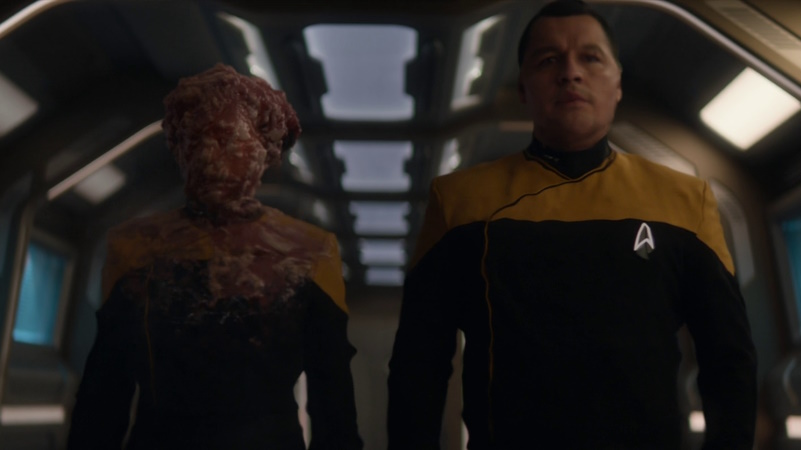
Star Trek: Discovery theories – week 5

Spoiler Warning: There are spoilers ahead for Star Trek: Discovery Seasons 1-4, Star Trek: Picard Season 1, Short Treks, and for other iterations of the Star Trek franchise.

After a couple of weeks where Discovery took character-focused detours, The Examples brought the story right back to the DMA – the dark matter anomaly that’s wreaking havoc across the galaxy. We learned something incredibly significant this week that will most likely have a huge impact on the season’s main storyline… but is everything as it seems?

The biggest question I have right now is about Unknown Species 10-C. Who could they be? And are they a faction we’ve encountered in a past iteration of Star Trek? My heart wants to say they’re someone familiar; that all of the callbacks and references we’ve had in Season 4 so far are building to some kind of big reveal. But my head says “no” – Unknown Species 10-C will turn out to be someone new and unpredictable.

But enough about that for now! We have several theories that were advanced by The Examples this week, as well as one that was debunked and one that was at least partially confirmed. So let’s take a look at those and then get into the main list!

Debunked theory:
Dr Culber will tell Stamets that he needs to slow down.

Stamets and Culber in The Examples.

This one surprised me by being a complete inversion of what I was expecting! After Stamets had seemingly gotten lost in his work, overworking himself desperately trying to figure out the DMA, I felt sure that Dr Culber would have something to say. In Choose To Live, Stamets missed out on Gray’s incorporation, and wasn’t there to support Adira. In All Is Possible, he missed out on talking with Tilly before she left the ship.

I felt that Stamets perhaps needed someone – particularly the man he loves – to intervene and warn him about the dangers of overworking and the family moments he’s been missing. Instead it was Stamets who helped Dr Culber: Discovery’s doctor has been throwing himself into his work, too, neglecting his own mental health for the sake of his patients. It was a neat reversal of a storyline I was expecting – and I think we’ll see more in this vein from Stamets and Culber before the end of the season.

Confirmed theory:
The DMA is a super-weapon.

The moment at which the DMA’s artificial nature was confirmed.

Though it was arguably a conclusion that was arrived at too quickly near the beginning of The Examples, Stamets and Captain Burnham confirmed – thanks to some help from Zora – that the DMA is not a natural phenomenon. Though a natural disaster would have been an interesting story in itself, this always felt like the direction of travel for Discovery, so I wasn’t exactly stunned to learn this!

At present, Captain Burnham and Starfleet are working on the assumption that the DMA is a super-weapon – something I’d been predicting ever since we first heard that some kind of anomaly was going to be a major part of Season 4. Right now, that seems like a logical assumption – and it may very well be true. But as we’ll discuss in a moment, even though the assumption right now is that the DMA is a super-weapon, that may not actually prove to be the case. I can think of several ways in which the DMA could be artificial yet not a weapon! But for now, since Captain Burnham, Admiral Vance, and everyone else on the show are content to assume it’s a super-weapon of some kind, I’m calling this theory confirmed!

So those theories were debunked and confirmed.

Now we’ll get into the main list, beginning with the theories that are either brand-new or which saw significant movement in The Examples.

Theory #1:
The story will connect with the Short Treks episode Calypso.

The USS Discovery in Calypso.

This week we got a few lines from Zora – the USS Discovery’s shipboard AI that we first met in Calypso. Zora was involved in confirming the DMA’s artificial nature, but later in the episode we got something far more significant thanks to a short conversation with Captain Burnham: Zora has begun to experience emotions.

In Calypso, Zora was definitely an emotional life-form, so this evolution in their (her?) personality is a significant step toward Calypso – and one that I hadn’t really considered until after it had happened. Until now, the Zora aboard the USS Discovery had been different from the Zora we’d met in Calypso, but after this week’s episode we’re a big step closer to reconciling the two presentations of the character.

There are still significant hurdles to overcome if the story of Calypso is to be wrapped up in Season 4, though. Obviously we have the timeframe issue: will the USS Discovery be sent back in time, be abandoned, or is Calypso taking place centuries in the future? Then we have the USS Discovery itself – it’s been retrofitted since arriving in the 32nd Century, and now looks very different to how it did in Calypso. Despite all that, however, a connection is one step closer today than it was last week.

Theory #2:
Zora will go rogue.

Zora.

Sticking with Zora, their newfound emotions are a very interesting – and somewhat alarming – addition to the season’s storyline. When Data first installed his emotion chip in Generations, he found the new emotions overwhelming and impossible to cope with at first – could something similar be about to happen to Zora? Will they fail the crew at a key moment? Even worse, might Zora go rogue and become a villain?

The dangerous nature of artificial intelligence has been a theme Star Trek has returned to time and again since The Original Series episode The Ultimate Computer all the way back in 1968. But recent iterations of Star Trek in particular have used narratives involving evil or out-of-control AIs and synthetic life several times: there were the rogue synths and the super-synths in Star Trek: Picard’s first season, and in Discovery’s second season we had the Control AI.

Zora told Captain Burnham of a “recent development” in The Examples.

Captain Burnham seemed concerned at Zora’s newfound emotions, but had other things on her mind so didn’t have time to deal with it then and there. What might be even more concerning, though, is the fact that Zora chose to conceal that fact for a time, choosing not to share their most recent evolution.

Perhaps a storyline like this would feel repetitive coming after Season 2 had to deal with Control. But I think it could be made to work, and it could even be made to fit in with Calypso with a bit of creative writing! Whether this theory comes to pass or not, though, I think we’re going to see something significant from Zora before the end of Season 4.

Theory #3:
The DMA isn’t a super-weapon.

The DMA as seen in Anomaly.

Okay, I know! I just said that the DMA is a super-weapon and patted myself on the back for successfully predicting that story beat months ago! But here’s the thing… the DMA being artificial in nature doesn’t mean that it’s a weapon, despite the assumptions made by Captain Burnham, Admiral Vance, and others.

The DMA could be an out-of-control experiment, perhaps something designed to allow faster-than-light travel without the need for dilithium. Stamets and Ruon Tarka suspect that it possesses the technology to create a synthetic wormhole, something that could be very useful for travelling in a dilithium-poor galaxy.

An accident or an experiment gone wrong would set up a very different kind of story to a super-weapon, one that would replace a villainous adversary with a puzzle of a scientific nature. That could be a fun and interesting way for the season to go – not to mention that it would be subversive and challenging to the audience’s expectations.

Theory #4:
The DMA is a life-form.

The USS Enterprise and V’Ger in The Motion Picture.

The DMA could also turn out to be a life-form in its own right, perhaps a synthetic one or something akin to The Motion Picture’s V’Ger. If that were the case it may not be attacking anyone, but simply exploring or trying to make contact. After all, “they were only trying to communicate” has become a Star Trek trope at this point!

Star Trek has shown us many different forms of synthetic life over the years, and while the DMA would certainly be one of the most unusual, it wouldn’t be entirely without precedent. Seeking out new life is at the very core of Starfleet’s mission, and finding a way to communicate with the DMA and figure out what it wants or needs could be a very interesting story – one about understanding and bridging the chasm between different cultures and societies that Star Trek has always done so well.

Theory #5:
Unknown Species 10-C is a faction from a past iteration of Star Trek.

Could the Borg have built the DMA?

Regardless of the intention behind the DMA, it does indeed appear to be an artificial construct. Whoever created it had a reason for doing so, even if that reason isn’t clear right now! But who could be responsible?

I recently put together a list of suspects, and I strongly encourage you to check out the full list by clicking or tapping here.

If you don’t have time for that, here’s the condensed version: the Borg, the Sphere-Builders from Enterprise, the super-synths from Picard Season 1, the Kelvan Empire, Section 31, and Species 8472 are just some of the possible culprits. For a more detailed version, check out the full list linked above.

Theory #6:
President Rillak knows what the DMA is and may be responsible for its creation.

President Rillak in Kobayashi Maru.

We didn’t see President Rillak this week, though she was briefly mentioned by Admiral Vance. But when I think about the possible suspects for creating the DMA, the Federation – and by extension, President Rillak – are unquestionably on that list.

President Rillak is a cunning, almost Machiavellian politician, willing to do anything to advance what she considers to be the best interests of the Federation. I believe Captain Burnham needs to be very careful with President Rillak. During the events of All Is Possible, working with Captain Burnham was advantageous to the Federation’s president – but I have no doubt that she’d throw Burnham and the USS Discovery under the bus without so much as blinking if she believed it would be to her advantage. Which brings us to the DMA.

President Rillak might know more about the DMA than she’s currently letting on. If the Federation had created a weapon like this, or if it was an experiment gone wrong, covering it up might be her objective even if she wasn’t necessarily the one who ordered the DMA’s creation. Also, with the goal of reuniting the Federation foremost in her mind, President Rillak may prove to be the sort of uncompromising politician who’d willingly unleash destruction upon the galaxy if she believed that doing so would serve a greater purpose.

Theory #7:
Dr Kovich is an agent (or the head) of Section 31.

Dr Kovich in The Examples.

I freely admit that this theory is barely clinging on right now, but I don’t believe it’s been completely disproven just yet! The questions of who Dr Kovich is and what exactly his role is within Starfleet and/or the Federation have no clear answer right now. He’s clearly someone with power and influence, as we’ve seen him working with Admiral Vance and seemingly being able to appoint anyone he chooses to be an instructor at Starfleet Academy. Yet he also seems to have some medical training, serving as a psychologist or counsellor – and it’s in this capacity that we saw him this week.

Because of the unclear nature of his role and the mysterious, stoic presentation from David Cronenberg, Dr Kovich is still an enigma. He’s also the kind of man who could potentially be an agent of Section 31. If it turns out that the Federation, President Rillak, and/or Section 31 are involved with the DMA, perhaps we’ll learn that Dr Kovich is as well. Or perhaps such a storyline will finally put this theory to bed once and for all!

Theory #8:
Captain Burnham and/or the Red Angel suits from Season 2 are connected to the DMA.

Captain Burnham in Anomaly.

Now that we know the DMA is artificial in nature, the question shifts to who built it and why. We’ve covered the idea of it being a weapon or an out-of-control experiment, as well as being a life-form in its own right. It could also be the responsibility of Section 31 or the Federation. But because this is Star Trek: Discovery, a show which likes to put Captain Burnham at the centre of its stories, perhaps there’s a connection to her that we’re missing.

The Red Angel time travel suits from Season 2 were phenomenally powerful machines, capable of generating time-wormholes large enough to transport an entire starship 930 years into the future. We already know that the DMA potentially contains a synthetic wormhole, so it wouldn’t be a huge leap to connect the two. We also don’t know for certain what became of Captain Burnham’s Red Angel suit after the Season 3 premiere. There’s also the faint possibility of a parallel universe Burnham or time travelling Burnham being responsible.

Theory #9:
Stamets and Ruon Tarka will create the DMA.

Stamets, Tarka, and Saru with the DMA model.

I included Stamets and Tarka on my list of suspects a couple of days ago, but they warrant a full entry on the theory list too! In short, we saw Stamets and Ruon Tarka creating a scale model of the DMA in The Examples, and according to Reno their experiment came very close to destroying the entire ship. They were able to perfectly recreate the device at the centre of the DMA, albeit on a smaller scale – so what’s to prevent them from building a full-scale replica?

This theory suggests that they will – somehow – and that doing so will set into motion a chain of events that leads to the creation of the DMA in a kind of time-loop storyline. The DMA’s wormhole-generating technology may give it the ability to travel backwards through time as well as across vast distances, so it seems technologically plausible at the very least.

Tarka and Stamets working on their model.

Ruon Tarka was shown as impatient in The Examples, and in his single-minded pursuit of the DMA he may be willing to take risks – perhaps risks which ultimately lead to the creation of the very anomaly he’s been investigating. How such a story would conclude is up in the air, but I don’t think we can rule it out as a possibility right now.

Personally, I find time-loop paradox storylines to be frustrating – and they can be very difficult to pull off successfully. There’s no beginning point to such a story: the DMA exists because the DMA was created because the DMA exists because the DMA was created… it’s an infinite loop. But we’ve seen Discovery tackle time travel stories like this before – and the pieces seem to be in play right now for this story.

So those theories are new or saw movement this week.

As always, I like to keep all of my theories in one place. So up next we’ll recap all of the other Season 4 theories that are currently in play. I find it helpful to keep the full list going like this – it makes it easier to keep track of all of the theories as they get confirmed or debunked.

Theory #10:
We haven’t seen the last of the Abronians.

I currently have four ideas for different ways that the Abronians – the non-humanoid race that Captain Burnham, Tilly, and the Qowat Milat helped save from cryo-sleep in the episode Choose To Live – could play a further role in Season 4.

Theory #10a:
The Abronians’ homeworld was destroyed by the DMA.

Captain Burnham believes this image depicts a “supernova.”

After arriving at the Abronians’ cryo-ship, Captain Burnham found a stone carving that seemed to depict the destruction of the Abronians’ homeworld. This carving was only shown on screen briefly, but it seemed to show the planet being damaged or destroyed in a large explosion. Burnham credited the planet’s destruction to a “supernova,” and the story then raced ahead.

Considering that the main thrust of the season so far has been about the DMA, perhaps Burnham was incorrect: the Abronian homeworld was destroyed by the anomaly, not a supernova.

Theory #10b:
The Abronians’ homeworld was on the “other side” of the DMA.

Abronian stasis pods.

One clip in the second Season 4 trailer appeared to show Captain Burnham leading the USS Discovery inside the DMA. We don’t yet know what that means, nor to what extent words like “inside” the anomaly or “the other side” of the anomaly are even coherent concepts. But many times in past iterations of Star Trek we’ve seen things like wormholes and gateways to parallel universes. Perhaps the anomaly is something similar – and passing through it leads to a different dimension, parallel reality, or just a faraway region of space.

One thing struck me as odd about the Abronians: the Federation was entirely unaware of them, despite the Abronian cryo-ship being relatively close to Federation space – such that Captain Burnham could reach it using Book’s ship in a short span of time. It’s possible that the Abronians had been asleep for millennia, unnoticed by the Federation and the wider galaxy for all that time. But it’s also at least possible that their cryo-ship is a newcomer to the area. If so, perhaps it arrived here via the DMA.

Theory #10c:
The Abronians will return to help the Federation later in the season.

A deceased Abronian.

One of the themes of Discovery since Season 3 has been connection, including building connections between the Federation and other races and organisations. The Abronians were awoken from cryo-sleep thanks to the interventions of Captain Burnham and Tilly – at least in part – and they may seek to repay the Federation, or Captain Burnham personally, for that help.

We saw this play out last season with Ni’Var; in the season finale Ni’Var ships raced to the Federation’s aid as the Emerald Chain attacked. Perhaps the Abronians will likewise step up to help when the Federation needs allies.

Theory #10d:
The Abronians’ moon-ship may be useful in a later story.

“That’s no moon…”

At this stage I can’t envision precisely what use Captain Burnham and the crew might have for a moon-sized starship… but that doesn’t mean such a need won’t arise! The Abronians’ cryo-ship is huge, and at least superficially seems to have the mass of a moon or small planetoid. If Captain Burnham and the crew needed something that large for some purpose, perhaps they’ll return and either take it or negotiate for it.

As we saw in Choose To Live, the moon-ship was in full working order. All it needed was some extra dilithium to power up and it was perfectly capable of moving under its own power, and its computer systems were still functional. The only system that seemed to have failed was the wake-up timer! So if – for reasons yet unknown – the crew need a huge starship, perhaps we won’t have seen the last of the moon-ship.

Theory #11:
Book will find Kyheem and Leto inside the DMA.

Book and Kyheem in Season 3.

In Star Trek: Generations, Captain Picard encountered Captain Kirk inside the Nexus – despite Kirk being declared “dead” after the Enterprise-B encountered the energy ribbon almost eighty years earlier. We don’t know what the DMA is yet; one of my very early pre-season theories involved the Nexus, but that seems to be debunked already! However, the anomaly’s mysterious nature raises the faint possibility that at least some of those it appears to have “killed” may not be as dead as they first appear.

This theory is, I freely admit, a bit of a long-shot. And it hinges on a fundamental question underlying the story of the season: is there more to the DMA than meets the eye? If the anomaly is just an extreme example of space weather, flitting through Federation space destroying anything unfortunate enough to be in its way, then probably everyone on Kwejian is dead. But if the anomaly harbours some kind of gateway, wormhole, portal, time vortex, or any of the other Star Trek-y technobabble phenomena that we’ve seen across the franchise’s history, then it’s possible that at least some of the folks on Kwejian found themselves transported to whatever realm lies inside of the anomaly.

Theory #12:
Saru will be given the captaincy of the USS Voyager-J.

The USS Voyager-J.

Saru’s future was briefly discussed before he offered to serve as Captain Burnham’s first officer in the episode Anomaly. He has already been offered a command of his own, so Starfleet clearly values his command abilities and experience. President Rillak was seen to be assessing Captain Burnham’s suitability for the captaincy of the USS Voyager-J in Kobayashi Maru… and she mentioned having a shortlist of candidates. Could Saru be on her list?

Several of the qualities that President Rillak said she was looking for in a potential captain seem to apply to Saru. He’s more level-headed, less likely to put himself in a dangerous situation, and more inclined to think of the big picture. He has a weakness when it comes to Kaminar, as we saw toward the end of Season 3, but generally speaking he isn’t someone who lets his emotions get the better of him. His wisdom and calm demeanour could be valuable in the captain’s chair of the Federation flagship. This could also set the stage for his departure from the show, or possibly even for a new show following his adventures aboard his new ship.

Theory #13:
A major character will be killed.

A Starfleet coffin seen in Deep Space Nine.

Season 3 saw a couple of major departures: Mirror Georgiou entered the Guardian of Forever’s portal, and Nhan remained behind aboard the USS Tikhov. Yet despite the dangers the crew faced as they navigated the 32nd Century, battled the Emerald Chain, and figured out the mysteries of the Burn and the Verubin Nebula, only one ally – Ryn – lost their life.

Killing off a character can be an excellent way to communicate the stakes involved if it happens at a relatively early stage. It can also be a storyline that brings a lot of emotion, as we have to say goodbye to a beloved member of the crew.

Spock’s funeral in The Wrath of Khan.

In short, I think there are plenty of reasons on the production side why killing off a major character could make sense in Season 4. Though we’ve already had one departure this season – that of Lieutenant Tilly – I still believe that Discovery could very easily go down this road, especially considering how dangerous the DMA currently is.

For a breakdown of which characters I thought might be in danger before the season premiered, check out my list of “death predictions” by clicking or tapping here.

Theory #14:
There will be a character crossover from a past iteration of Star Trek.

Soji could potentially still be alive in the 32nd Century.

This theory returns from Season 3, where I doggedly clung to it for the entire season!

Discovery’s 32nd Century setting has shot Captain Burnham and the crew far beyond anything in Star Trek’s established canon, and that should mean that practically everyone we remember from other Star Trek shows won’t be around any longer. But this is Star Trek – with some creatively-written technobabble, practically any major character could have survived all the way through to the 32nd Century!

There were several great crossovers during The Next Generation era.

It’s also possible for Captain Burnham to discover the logs of a long-dead officer; someone we as the audience would be familiar with. While this would be less of a “crossover” than if a character from the past could be physically present, it would still be a lot of fun to see!

There are a handful of characters who could have survived to the 32nd Century based on what we know about them from past iterations of the franchise. Included in this category would be people like Soji, Voyager’s Doctor, and a few others. But as we’ve seen in episodes like Relics and even the film Generations, all it would take to make a big crossover happen is some kind of temporal anomaly, stasis field, or other technobabble!

Theory #15:
Michael Burnham won’t remain captain of Discovery.

Burnham in the captain’s chair.

This is a controversial one, so let me just say up front that I’m neither in favour of this theory nor opposed to it – I just think it’s a possibility. As things stand, Discovery has had four different captains across its four seasons. One of the show’s unique points of interest within Star Trek’s broader canon are the very different ways in which these individual captains commanded the ship and crew.

It’s got to be considered at least a possibility, then, that the show will continue this trend. This doesn’t mean Captain Burnham will be killed off; I’d actually argue she’s pretty safe. But there are many different routes to her potentially leaving the ship, such as a desire for freedom that we saw in Season 3, or even perhaps taking up a new, more senior role within Starfleet.

Captain Burnham in The Examples.

If this theory were to come to pass, it would be something I’d expect to see at the very end of the season. Even if Burnham seems 100% committed to her new role as captain, I don’t think it’s a theory we can definitively rule out.

It’s worth mentioning that at time of writing Discovery hasn’t been officially renewed for a fifth season – so all this talk of who’ll be in the captain’s chair by then could be moot! And of course this theory has a very strong counter-argument: that Discovery’s main story arc across its first three seasons can be read as Burnham’s ascent to the captain’s chair.

Theory #16:
The ban on time travel will be explained in more detail.

HMS Bounty was able to travel back in time.

This one is a hope as much as a theory right now! In short, the ban on time travel was introduced early in Season 3 primarily as a way for the writers and producers to avoid questions about why the 32nd Century was so different from how the far future had been depicted in earlier Star Trek productions, as well as to explain things like how the Burn was able to catch the Federation off-guard and why Georgiou couldn’t simply be sent back in time when she needed to.

But the ban itself raises some issues – the biggest one being the lack of detail on how it works and how something like this could possibly be enforced. As I said several times last season, it isn’t possible to just un-invent a technology so useful and powerful as time travel. Even just a few lines of dialogue going into a little more detail on the mechanisms involved in the ban would be really useful.

Theory #17:
The Federation has flouted the ban on time travel.

President Rillak may have tried to circumvent the ban if she felt doing so would be in the Federation’s interest.

Sticking with the time travel ban, another theory I had last season was that the Federation – and Section 31 in particular – might have deliberately flouted the ban and failed to abide by the rules. Someone as straight-laced and committed to Starfleet ideals as Admiral Vance is highly unlikely to have sanctioned such a move, but someone like the shadowy Kovich might have. President Rillak could also be involved.

Obviously the bulk of the season’s story will deal with the DMA. But there’s scope to either talk about the time travel ban in a standalone episode or even tie the two stories together – perhaps the anomaly has been unleashed as a result of unsanctioned time travel.

Theory #18:
The crew will have to defend the Verubin Nebula.

The dilithium planet is vital to the Federation.

The Federation is still in a weakened state, nowhere near as powerful as it once was. The Verubin Nebula is thus a very tempting target for anyone looking to gain an edge in a galaxy where dilithium is still in short supply. As the only known significant dilithium supply, whoever controls the Verubin Nebula will have a massive tactical advantage.

We can compare the Verubin Nebula to Deep Space Nine’s Bajoran wormhole in that respect – it’s a resource of huge strategic importance. Season 3 didn’t show us much about the makeup of the galaxy’s factions outside of the rump Federation and the Emerald Chain, but it’s got to be possible that factions like the Dominion, Klingon Empire, or even the Borg still exist and would want to seize the Verubin Nebula for themselves.

Another view of the planet in the Verubin Nebula.

Season 4 has presented Captain Burnham and the crew with a scientific puzzle: the DMA. But that doesn’t mean there won’t be villains in play, and Discovery has introduced us to several compelling and interesting villains over its first three seasons.

To make a long theory short, it would begin to stretch credulity to think that everyone in the known galaxy would see the Federation rebuilding and having access to dilithium and not want to find out for themselves what’s going on. Once the Verubin Nebula’s existence becomes known, even if the Federation promises to share its bounty with all comers, it seems very likely that someone would want to take control of the dilithium supply for themselves.

Theory #19:
Captain Burnham and the crew will encounter the Klingons.

General Martok, a 24th Century Klingon leader.

By the late 24th Century the Federation and Klingons were firm friends, having been allied for a century and after fighting side-by-side against the Dominion. We don’t know if that alliance endured to the 32nd Century, but it’s certainly plausible to think that it did. The Klingons might even have joined the Federation at some point, and their violent warrior culture may have been significantly pacified.

One thing that could be very interesting to see is how the crew of the USS Discovery – almost all of whom are veterans of the Federation-Klingon war – would respond to that. They’ve worked alongside Klingons like L’Rell before, but many of them still see the Klingons as an old enemy. The story of overcoming that prejudice could mirror episodes like The Wounded from The Next Generation, and would be very interesting to see.

Theory #20:
Some areas of the galaxy – such as the Delta Quadrant – avoided the worst effects of the Burn.

Stamets with a holographic galaxy map in The Examples.

Season 4 touched briefly on the Burn with Su’Kal and Saru in Kobayashi Maru, and may now seek to put last season’s story to bed so it can wrangle with the DMA instead. But one thing I’d be curious to see is the true extent of the disaster – did it reach all four quadrants of the galaxy equally, or did its effects fade out after a certain point? Michael Burnham discovered that the Burn had a point of origin, and that it radiated out from that point like ripples on the surface of water. Ripples eventually diminish, fading away the further they travel, and perhaps that’s true of the Burn as well. There could be whole areas of the galaxy that didn’t even notice the Burn – and maybe the ship and crew will visit one such region.

If the Delta Quadrant was left largely unscathed, for example, what might that mean for the likes of the Borg? It’s possible they aren’t even still around in the 32nd Century, but it’s also possible that they’ve had more than a century to expand and build up their forces while the Federation suffered. To see a full write-up of this theory, click or tap here.

Theory #21:
The Guardian of Forever will be back.

The Guardian of Forever first appeared in The Original Series.

Having reintroduced the Guardian of Forever in Season 3, I wouldn’t be at all surprised to see Discovery return to the Guardian’s planet in Season 4. The DMA is something new and threatening, so it’s possible Captain Burnham might want to ask the Guardian for help or information.

The Guardian of Forever is also the only way we know of at present to travel through time – something that might be necessary if Season 4 makes an attempt to link up with Calypso in a big way. There are many reasons why Captain Burnham might want to revisit the Guardian, and it would be great to bring back actor Paul Guilfoyle, who played the Guardian’s humanoid avatar in Season 3.

So that’s the main theory list.

We also have two production-side theories in play, and I’ll recap those now.

Production-side theory #1:
Tilly’s departure will be permanent.

Tilly’s departure feels permanent.

Mary Wiseman confirmed in an interview with Wil Wheaton on The Ready Room (Discovery’s social media aftershow) that Tilly will be seen again before the end of Season 4. But that doesn’t mean she will be a main character on the show going forward, and her departure feels permanent. Despite that, I’ve seen quite a lot of folks online who don’t believe that Tilly is actually leaving the series – so I wanted to put it out there officially and say that, in my opinion anyway, she is.

Maybe those people know something that I don’t! As I always say, I don’t have any “insider information;” all of this is just speculation on my part. However, I feel that the manner of Tilly’s departure, the fact that she got that emotional sequence with Captain Burnham, a montage showing her leaving the ship, Adira seeming to take over several of her roles, and her departure feeling like the culmination of her arc going back to the latter part of Season 3 all come together to strongly indicate that she won’t be back as a major character. She may yet have a significant role to play in a future Season 4 episode, as has been suggested, but unless Discovery’s writers are really playing with our emotions I believe we’ve seen Tilly’s end as a main character on the show. She may come back in a future Starfleet Academy series, though… so watch this space!

Production-side theory #2:
Star Trek: Discovery isn’t going to be renewed for Season 5.

Is a fifth season going to happen?

Since Discovery debuted in 2017, we’ve known by this point in the season that the show has been renewed. This isn’t one of those “I hate new Star Trek” things that we’ve seen doing the rounds online for years; I adore Discovery and genuinely want to see it continue. But it’s profoundly odd to be nearing the halfway point of Season 4 and to still have had no announcement about Season 5. For comparison, Star Trek: Picard has been renewed for Season 3 even though Season 2 won’t air until next year!

I’m hopeful that this is just a blip; a temporary delay for reasons unknown, and that the show has been renewed for Season 5 already behind-the-scenes. However, when we look back at Star Trek productions in recent years, it was often apparent that production work was quietly ongoing even if there hadn’t been any official word from ViacomCBS. As far as we know at this stage, there’s been no pre-production work on Season 5, let alone any filming taking place in the Toronto area.

Once again this is a “watch this space” kind of theory. I hope I’m wrong… but the lack of any news or even any significant rumours about the show’s future is beginning to have me worried.

So that’s it.

What adventure awaits the crew later this week?

Those are all of the theories that are currently in play as we await Stormy Weather – the sixth episode of Season 4. We’re accumulating quite a few theories, some of which completely contradict one another! So far, Discovery’s fourth season has been an interesting journey. We’ve has some slower character moments, some semi-episodic stories (that may yet come back into play), and some interesting developments in regards to the DMA. As we near the halfway point of the season, there are still many different ways that the story could go.

Stormy Weather looks like it’ll bring back Grudge – I hope the cute little ball of fluff will be okay! A dark matter anomaly is no place for a puss!

Before we go, one final point. I write up these theories because I like Star Trek and I like writing. But for some folks, fan theories can hamper their enjoyment of a film or television show. It’s worth keeping in mind that most of these theories probably won’t pan out, and we have to be prepared for the fact that even the most well-constructed fan theory, no matter how fun and plausible it seems, simply won’t turn out to be true. If you find that speculating and reading theories is beginning to detract from your enjoyment of Star Trek: Discovery – or any other television show or film – it might be a good idea to take a break for a while.

Star Trek: Discovery Season 4 is available to stream now on Paramount+ in the United States, Scandinavia, Latin America, and Australia. The show is on Pluto TV in the UK, France, Germany, Italy, and other parts of Western Europe at 9pm on Fridays and Saturdays. Individual episodes or the full season can be purchased on iTunes, Amazon Video, and possibly other platforms in the UK, parts of Europe, and select other countries. The Star Trek franchise – including Discovery and all other properties mentioned above – is the copyright of ViacomCBS. This article contains the thoughts and opinions of one person only and is not intended to cause any offence.
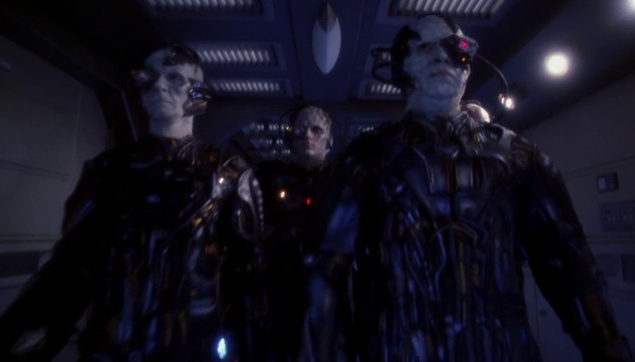
Star Trek theory: Q the saviour

Spoiler Warning: There are spoilers ahead for the trailers and teasers for Star Trek: Picard Season 2. Spoilers are also present for the following Star Trek productions: The Next Generation, First Contact, Voyager, and Enterprise.

Today we’re going to take a look at Q, the immortal trickster who has tangled with Captains Picard, Sisko, and Janeway – and who will soon be returning to the Star Trek franchise! Q is an unusual character in many ways. He seems to have practically unlimited knowledge of the galaxy, and may have been alive for billions of years. Yet he has an impish, almost childish sense of humour that sees him tease and mess with Starfleet – and many other people too.

I wouldn’t call Q a “villain” in any of his appearances to date. In fact, I would argue very strongly that Q sees himself as a friend, an ally, and a guide to Captains Picard and Janeway in particular, having offered his services more than once. He’s certainly selfish – forcing Starfleet officers to undergo tests and trials of his own devising – but there’s usually more to his games than meets the eye.

Q in his judge’s robe.

On several occasions – going all the way back to his first appearance – Q has presented Starfleet with puzzles to solve. These puzzles can be dangerous, and more than once Q has gotten people killed. But even so, I wouldn’t characterise him as a typical “villain” for Captain Picard or Captain Janeway to “defeat.”

The puzzles Q has presented – especially to Captain Picard – have actually proven to be deeply satisfying, and arguably helped Picard and Starfleet grow. Recognising that life can take very different forms – as Q helped Picard to see in Encounter at Farpoint – is one such puzzle he presented. He also taught Picard how to view time in a non-linear fashion – understanding that events in the future could have a causal link to events in the past in All Good Things.

All Good Things saw Q present Picard with another puzzle to solve.

Even the teasers and trailers for the upcoming second season of Star Trek: Picard may not be all they seem. Picard says he blames Q for disrupting or changing the timeline, but I think we’ll have to see that story play out before we can assign all the blame to Q. Even if Q is responsible, the question of motivation comes up. Is it really just a game; a trick to mess with Picard? Or is there something bigger going on?

That’s one of my big Picard Season 2 theories! But I’ll save the full write-up for another day. Today we’re not looking ahead to future Star Trek, we’re going to look back at past iterations of the franchise and try to answer a deceptively simple question: did Q save the Federation?

Q will soon be returning to Star Trek…

Star Trek has made a mess of the early history of Borg-Federation contact. The Raven, from Voyager’s fourth season, told us that the Borg assimilated humans and a Federation vessel in the 2350s. Regeneration, from Enterprise Season 2, showed the Borg battling against Captain Archer and his crew – and sending a message to the Delta Quadrant that would be received in the 24th Century. So the question of how the Borg first became aware of the Federation is an open one. Did they receive a message from across the galaxy? Did they first discover humanity when they assimilated Seven of Nine and her family?

Either of these explanations could account for the Borg’s interest in the Alpha and Beta Quadrants in the mid-late 24th Century. Season 1 of The Next Generation first teased the Borg’s appearance with the episode The Neutral Zone, in which both Federation and Romulan colonies had gone missing – “carried off” the surface of their planets, as Romulan commander Tebok put it. The Borg’s responsibility for these attacks would be confirmed in The Best Of Both Worlds – though the connection is easily missed, in my opinion, as it doesn’t take up much screen time.

The Borg were responsible for the destruction of several Federation colonies in the 2360s.

Regardless, one thing is certain: the Borg knew of the Federation’s existence well before the Federation knew of theirs. They had even begun to send scouting vessels relatively close to Federation space; system J-25, where the Enterprise-D first encountered a Borg Cube, was a mere two-and-a-half years away from Federation space at high warp, placing the Borg tens of thousands of light-years away from their Delta Quadrant home.

Were the Borg actively scouting for the Federation, or was it just a coincidence that one of their vessels was operating so far away from their own space? We may never know the answer to that, but someone almost certainly does: Q.

Q was responsible for this encounter.

In brief, here’s my theory: the Borg and the Federation were already on a collision course, but the Federation didn’t know it. Whether it was because of the First ContactRegeneration time travel loop, the assimilation of the USS Raven, the attacks along the Neutral Zone, or simply the Borg’s continued exploration of the Alpha and Beta Quadrants, they had humanity and the Federation firmly in their sights long before Starfleet was aware that there was a problem.

Recognising this, and seeing potential in humanity thanks to his earlier run-ins with Captain Picard and the crew of the Enterprise-D, Q chose to intervene. He knew that if the Federation became aware of the threat the Borg posed, their ingenuity would lead to better defences and they’d be able to protect themselves, so he chose to deliberately introduce them to the Borg for that reason.

A Borg Cube hovering ominously over Earth. The Borg came very close to assimilating humanity’s homeworld.

The events of The Next Generation Season 2 episode Q Who can be reinterpreted through this new lens. Rather than Q trying to frighten Picard for the sake of it or to prove his own superiority, he was – in his own twisted way – helping Picard and the Federation. The events of Q Who led the Federation to begin serious preparations for a Borg incursion, and without that tactical readiness it seems likely that the Borg would have been able to cruise to victory during the events of The Best of Both Worlds.

This fits with how Q operates. In stories like Encounter at Farpoint, Tapestry, and All Good Things, as well as Voyager’s The Q and the Grey, Q never explains everything he knows. Instead he obfuscates, talks around the issue, and forces Starfleet figure out what’s going on for themselves. Sometimes he pushes Picard or Janeway in a certain direction to get things moving, or even devises a puzzle or test of his own, like he did in Hide and Q. But what he never does is simply communicate – he doesn’t just sit down with Picard and tell him about Farpoint Station or the anti-time problem. He pushes Picard to figure those things out for himself.

Q appeared in Season 1 of Lower Decks.

And so it is with the Borg – according to this theory. Rather than contacting Picard and explaining what he knows about the Borg and their intention of targetting Earth, he sends the Enterprise-D to a location where he knows a Borg vessel will be and allows the crew to discover the threat for themselves. He does so knowing that the consequences will be Starfleet ramping up their defences in preparation of a Borg attack.

In All Good Things, Q told Picard that the Q Continuum saw potential in humanity – the potential to one day understand more about the universe than they ever thought possible. From Q’s point of view, perhaps he believed that seeing the Federation attacked and humanity assimilated would be a net loss to the galaxy because that potential would never be realised.

Q has his reasons for “testing” Picard and humanity – even if he chooses not to explain himself.

Q’s motivation for putting Picard and humanity “on trial” seems to be connected to this. In Encounter at Farpoint he accused humanity of being “a dangerous, savage, child race.” Yet even by the end of the episode, Q appeared to be impressed rather than disappointed that Picard and the crew could solve his puzzle. Rather than believing humanity to be dangerous and savage, as he asserted, Q almost certainly sees humanity as something more than that – and thus would feel humanity’s assimilation by the Borg would be a loss. His desire to avoid that fate could have motivated him in Q Who.

All of this could tie into Picard Season 2. Q may feel that Picard and the Federation are ungrateful for his “assistance” over the years, and he could cite the events of Q Who as one example of how his intervention saved the Federation from assimilation. While the latter part is up for debate, I definitely believe that Q feels underappreciated by Picard in particular, and sees his interactions with the former captain of the Enterprise-D as helpful rather than antagonistic.

Q looks annoyed with Picard in the trailer for Star Trek: Picard Season 2.

So let’s recap! The Borg became aware of the existence of the Federation by the mid-24th Century. The Federation had technology and resources that the Borg considered valuable, and they began targetting outlying Federation colonies, including those near to the Romulan Neutral Zone. All the while, the Federation remained ignorant of the Borg’s existence – considering them to be little more than rumour.

Foreseeing disaster and either the total assimilation of humanity or the devastation of the Federation such that humanity could not achieve its full potential, either the Q Continuum or Q independently decided to intervene. Instead of simply contacting the Federation to share his knowledge, Q transported the Enterprise-D to the star system J-25, where they encountered the Borg. This encounter led to the Federation developing anti-Borg strategies and defences that would ultimately save them from assimilation.

Unusually, Q has never taken credit for this. However, it’s at least possible that he considered Picard and the Federation as a whole to be ungrateful for his help, and this could tie in somehow to the events of Picard Season 2 where Q will be making a return to the Star Trek franchise.

Did Q save the Federation from assimilation?

What I like about this theory is that everything feels like it fits together. This theory connects the message sent in Regeneration and the early assimilation of Seven of Nine’s family to the events of The Neutral Zone, giving the Borg a reason to be operating so far outside of their territory. It also fits in perfectly with the way Q behaves – never sharing everything he knows and presenting dangerous and often deadly puzzles to Picard and Starfleet.

Whether it’s true or not is open to interpretation! I would say that Q Who wasn’t written with any of this in mind, and a straight watch of the episode strongly suggests that Q’s motivation is simply to frighten Picard and the crew of the Enterprise-D after his offer to join the crew was rejected. Q felt that Picard was arrogant in assuming that Starfleet could handle any threat the galaxy contained, and wanted to prove him wrong. While that explanation works in the context of the episode, it doesn’t preclude anything included in this theory from also being true; Q could still have been annoyed at Picard’s assertion that the Federation was prepared for anything while also intending to provide them with advance warning of the Borg.

So that’s it for this one! As with all fan theories, anything we see on screen in a future episode or film could render the whole thing invalid. But for now, I think it’s at least plausible that the events of Q Who represent Q trying – in his own unique and twisted way – to help Picard and the Federation. Q has always seen himself as a friend of Picard’s, and based on what we know of both Q and the history of Borg-Federation contact, it seems to me that everything arguably fits together!

The Star Trek franchise – including all episodes and other properties mentioned above – is the copyright of ViacomCBS. This article contains the thoughts and opinions of one person only and is not intended to cause any offence.
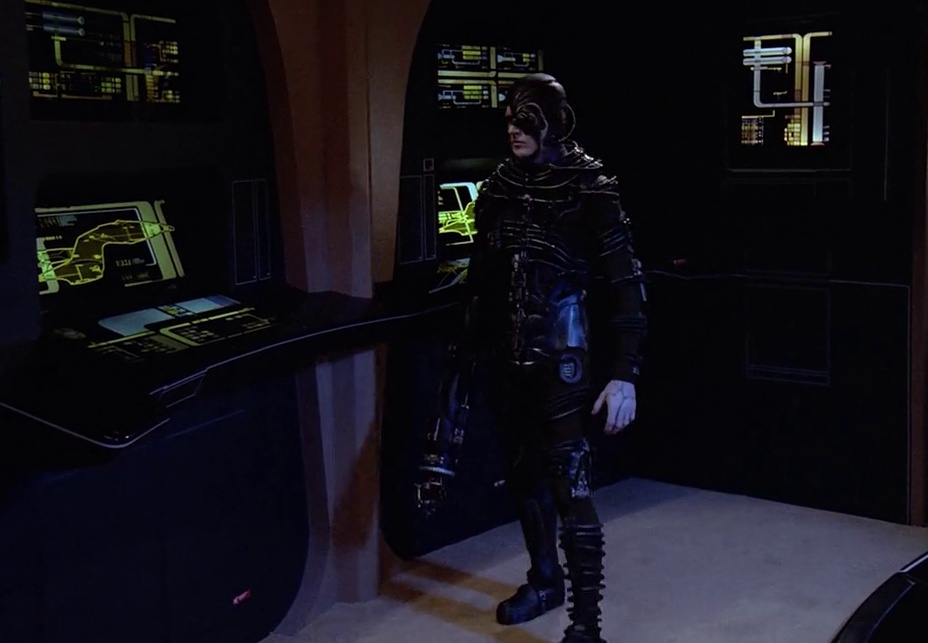
Star Trek: Discovery Season 2 theory: The abandoned Borg origin story

Spoiler Warning: There are spoilers ahead for Star Trek: Discovery Seasons 1-3. Spoilers are also present for the following Star Trek productions: Picard Season 1, Lower Decks Season 2, First Contact, and The Next Generation.

While Star Trek: Discovery’s second season was running I wasn’t writing about the show; it wasn’t until November 2019 that I founded this website. Because of that I have a number of theories and ideas kicking around from the first two seasons of Discovery that I haven’t found time to talk about yet! On this occasion we’re going to look into one idea I had during Season 2 that has both in-universe and production-side elements to it – the “Borg origin story.”

I know for a fact that I’m not alone in having speculated that Discovery Season 2 was setting up an origin story for the Borg. Shortly after the season ended a friend of mine from way back was in the area for a visit, and we got talking about precisely this subject – yes, we’re both huge geeks! I’m also well aware that other fans have posited some variant or other of this theory online both during and after the season’s run, so please don’t interpret this article as me claiming to have independently and uniquely come up with this idea!

We’re revisiting Season 2 on this occasion!

Here’s the theory in brief: the Control AI, which was the main adversary during the story of Season 2, was originally intended to be the progenitor of the Borg. Its use of nano-technology, its ability to “assimilate” organic beings, and its murderous quest for true sentience that, if left unchecked, would have wiped out all sentient life in the galaxy are all indicators of this. In addition, the inclusion of time travel and the Red Angel suits in the story could have teed up a situation where Control was able to travel backwards through time and far across the galaxy in order to become the originator of the Borg Collective.

Because of Control’s similarities to the Borg in terms of its use of nanites, its single-mindedness, and its lack of care for the survival of organic individuals, this felt like a very real prospect right up until the final moments of the season finale. I really do wonder whether a Borg origin story was included in the original draft of Season 2, perhaps being modified later on once production had already commenced. What we saw on screen would thus contain the residual elements of that story, but with a different ending written – one which sent Burnham and the USS Discovery into the far future.

Captain Leland being “assimilated” by Control.

It’s this decision which I believe would be responsible for changing the story – if indeed such a change were mandated. Discovery had received criticism in Season 1 for its real or perceived “violations” of Star Trek’s internal canon, and it’s this reaction which surely contributed to sending the ship and crew far into the future. It could be that Season 2 was hastily re-written to include the time travel ending, dropping the Borg origin story in the process.

As a narrative concept, the idea that it was the Federation, through out-of-control technological and AI research, who inadvertently created the biggest threat to themselves and to the wider galaxy would be an incredibly impactful one, and something ripe for exploration in detail. The cyclical nature of such a story, with the Federation creating the Borg, then the Borg one day coming for the Federation, could be absolutely phenomenal if done well, and would highlight the morally questionable actions of senior Federation leaders and Starfleet admirals.

Admiral Patar – one of the senior figures involved in the Control AI project.

It would also be profoundly ironic that the Borg – almost universally acknowledged as the Federation’s biggest adversary – were ultimately a Federation creation. This revelation would have a huge impact on the Federation as a whole – and on our crew of Starfleet heroes when they discovered it – and could form the basis for a new Borg story that would surpass even the likes of The Best of Both Worlds and First Contact in its scope.

Had Discovery gone down this road in Season 2, it may not have fallen to Michael Burnham and the crew to be the ones to learn of the consequences of their battle to defeat Control. Picard Season 1 could have picked up this storyline, with information stored aboard the Artifact (the abandoned Borg Cube) finally revealing the Borg’s origins to the Federation more than a century later. This would have tied the two shows together in a very real and significant way – something I’ve argued on a number of occasions that Star Trek needs to be more adept at doing.

The Artifact in Picard Season 1.

In canon, we don’t know much about the Borg’s early history. The Control AI could have been slotted into the bits and pieces that we do know in a way that didn’t overwrite anything we’ve seen or been told on screen, with every past Borg story being allowed to unfold exactly as we know they did.

In-universe, the Borg originated in the Delta Quadrant “thousands of centuries” before the 24th Century. There was an original Borg race – a race of purely organic beings – but they began using nanotechnology and augmenting themselves, and eventually hooked up every facet of themselves to the Hive Mind. As of the late 15th Century, the Borg had assimilated a number of neighbouring star systems, but weren’t anywhere near as large as they would come to be in the 24th Century. Nothing in the early history of the Borg precludes the involvement of an outside force – the Control AI. It could have been the Control AI’s arrival on the world populated by the Borg’s organic ancestors that led them down a path of assimilation and augmentation.

Borg assimilation in the 24th Century.

The Red Angel suits and time crystals present in Season 2 would have provided Control with a method of travelling backwards through time. And as Dr Gabrielle Burnham found to her cost, the Red Angel suits are imperfect and prone to malfunctioning. Based on these pieces of evidence, it would’ve been possible for Control to have seized a Red Angel suit with the intention of travelling either backwards or forwards in time to defeat Captain Pike and Discovery, only for something to go wrong – emerging on the far side of the galaxy millennia in the past.

We are now firmly in the realm of speculation! But had such a scenario come to pass, Control may have found itself alone in the vicinity of a planet populated by humanoids: the Borg’s organic ancestors. Control may have begun the process of assimilating them, injecting its nanotechnology into more and more individuals and bending them to its will.

Control used nanites to “assimilate” Captain Leland.

Control had a forceful personality, but we don’t know what effect mass assimilations of individuals would have had on it. Would it have retained its own personality in the face of potentially thousands or millions of new “drones” – or would its own personality have begun to change, impacted by the personalities and desires of those it assimilated? Perhaps this is where the Borg’s quest for perfection comes from.

This could also explain why the Borg seemed not to recognise humanity or the Federation upon re-encountering them millennia later: Control had simply forgotten its origins, or whatever remained of Control within the Borg Collective was so small and insignificant that the knowledge of its creators had been lost. As the Borg continued to evolve and assimilated more and more beings, perhaps Control’s personality didn’t survive intact.

Perhaps the Borg had forgotten their origins by the time they encountered the Enterprise-D.

Alternatively, we could have learned that the Borg did retain all of Control’s memories and knowledge – but simply chose not to make the Federation aware of the connection during their encounters. This could be the Borg’s equivalent of “forbidden knowledge,” something kept secret and known only to the Borg Queen – who may be an embodiment of the evolved Control AI.

It would make sense from the Borg’s point of view not to allow Starfleet to find out about the connection to Control – perhaps out of fear that the Federation could use that information to find a weakness in the Borg’s core synthetic programming. It would only be when Starfleet had access to a derelict but intact Borg vessel – like the Artifact from Picard Season 1 – that they’d be able to hack into the Borg’s systems deeply enough to learn the truth.

The Borg Queen could be a new avatar for the evolved Control AI.

So that’s the theory, along with a couple of different ways it could have panned out.

I wouldn’t say I was “100% convinced” that this was going to happen as Season 2 rolled on, but it certainly felt like a distinct possibility. When I later saw the Artifact featured in the trailers for Picard Season 1 I wondered if the reason this story didn’t come to pass was because Picard actually had a Borg origin story of its own in the works!

Had this theory made it to screen I think we could’ve seen one of the most interesting connections between Discovery and the wider Star Trek franchise. Borg stories could be seen through a wholly new lens, and the themes of rogue artificial intelligence that both Discovery and Picard examined in their respective storylines could have been elevated by this “creation wants to destroy its creator” angle. That isn’t something original in science fiction, but it would have been a uniquely “Star Trek” take on the concept.

Borg drones from First Contact.

Whether a Borg origin story was actually present in the original Season 2 pitch or not is something we may never know. However, the team behind Season 2 must have been aware of the similarities between the way Control operated and the way the Borg have always been depicted, and I can’t believe that it was a coincidence. Someone involved in the production of Season 2 must have at least raised the point that the story was going down a very Borg-esque road!

To me it feels like any attempt to tell a story of this nature was superseded by the decision to take Discovery out of the 23rd Century altogether. If there was only room for one time travel ending to the season, the one that was chosen was to send the ship and crew into the far future. Control was left behind in the 23rd Century and seemingly defeated by Captain Pike, so any chance of it having a role in the creation of the Borg now seems to be entirely off the table.

Perhaps all of this was simply misdirection; the writers and producers of the season putting out deliberate red herrings so that fans wouldn’t figure out the ultimate direction of the story! If that’s the case, they definitely got me! Even if that’s what happened, though, as a concept the idea that the Federation accidentally created the Borg is one that could have led to some absolutely fascinating stories. Perhaps we’ll see something like it one day!

Star Trek: Discovery Seasons 1-3 are available to stream now on Paramount+ in the United States and on Netflix in the United Kingdom and internationally. The Star Trek franchise – including Discovery and all other properties mentioned above – is the copyright of ViacomCBS. This article contains the thoughts and opinions of one person only and is not intended to cause any offence.
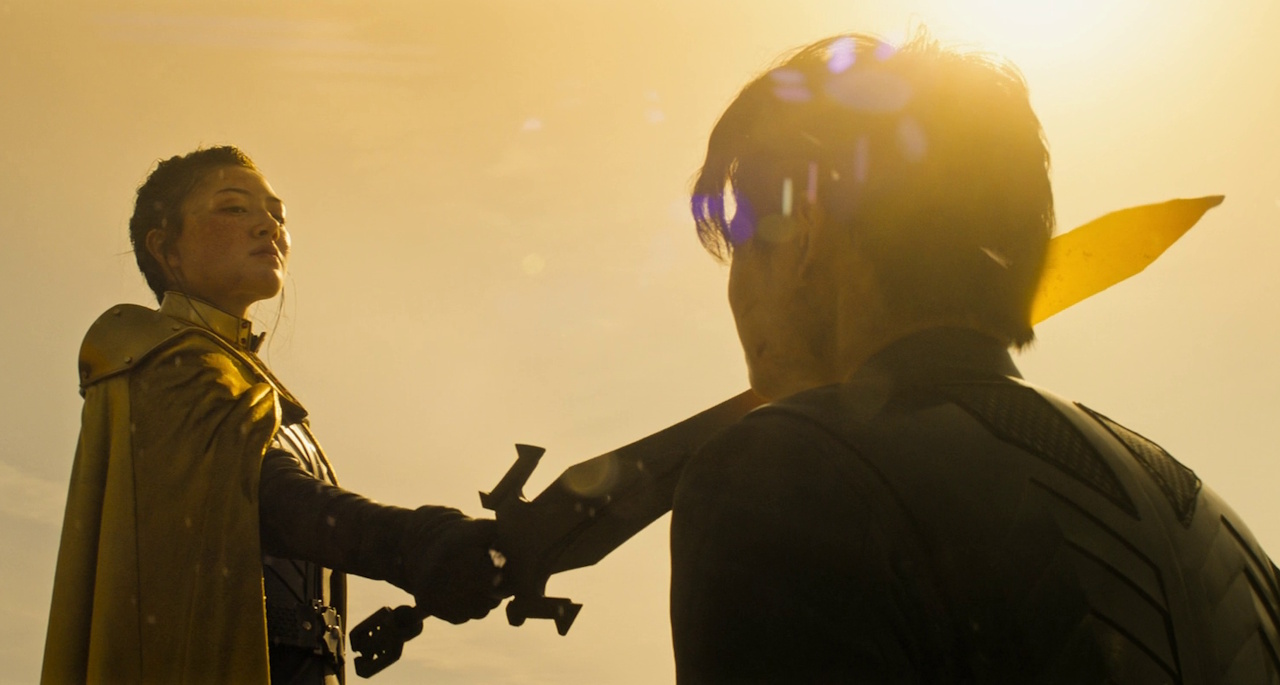
Ten great Star Trek starship designs

Spoiler Warning: There are spoilers ahead for Star Trek: Picard Season 1, Star Trek: Deep Space Nine, and for other iterations of the Star Trek franchise.

The Star Trek franchise has an aesthetic all its own, and a big part of that is the way starships are designed. Many Trekkies have said over the years that a ship is like an extra member of the cast; a vital part of any Star Trek series or film. While there have been some visual misses, of course, for the most part Star Trek’s ships have been fantastic to look at.

Aesthetics are always going to be a matter of personal taste, and there are many factors at play in considering what makes for a “good-looking” starship. Because the ships and most of their technologies are wholly fictional, designers and artists have a fair amount of leeway when it comes to designing a new starship. Technobabble can always be employed to explain away inconsistencies – like how the USS Defiant’s warp nacelles work, for example.

The USS Defiant.

Over more than half a century, Star Trek has featured many different designs of starship. Many of these, even the newest ones, take inspiration from the original USS Enterprise, which was designed by Matt Jeffries (with some input from others, including Gene Roddenberry) for The Cage in 1964. The basic saucer section, drive section, plus two nacelles on pylons style has been present in most Federation ships – and, in some form, all of the “hero” ships – ever since.

On this list I’m going to pull out ten of my favourite designs of both Federation and non-Federation starships. The list is by no means exhaustive, and it may be a topic I revisit in future as I can already think of several more I could have easily included! As indicated, this whole thing is entirely subjective. So without further ado, let’s jump into the list – which is in no particular order.

Number 1: The Klingon Bird-of-Prey

A Bird-of-Prey seen in Star Trek V: The Final Frontier.

The Bird-of-Prey is absolutely iconic as a Klingon vessel, at least on par with the D-7 battlecruiser from The Original Series. The vessel debuted in Star Trek III: The Search for Spock, before going on to appear in four more films, all of the 24th Century shows, and even recently in Lower Decks. Few non-Starfleet ships are as iconic or recognisable, and even many non-fans would easily identify the design.

In cinema, the Bird-of-Prey has had starring roles in five films, making it one of the most well-known enemy or villainous ships. Iconic adversaries like General Chang and Dr Soran used Klingon Birds-of-Prey in their nefarious schemes. But as Klingon-Federation relations improved in The Next Generation, we began to see the iconic vessel as an ally; a workhorse of the Klingon fleet. By the time of the Dominion War in Deep Space Nine we were rooting for the Klingon-Federation alliance, and some of the ships most often seen on the front lines were these wonderful Klingon ships.

Based loosely on the earlier Romulan Bird-of-Prey, the winged design captures the warrior philosophy of the Klingons perfectly. The small ship is incredibly powerful, armed to the teeth with disruptor cannons and photon torpedoes. The way the wings change position for combat or while at warp is clever, too, and the green colour scheme makes the craft stand out when compared to Federation ships.

Number 2: The Excelsior Class

The USS Enterprise-B.

Another starship that would be a workhorse for decades, the Excelsior is a really neat, futuristic design. It manages to look smarter and newer than the Constitution class that it would eventually replace, yet at the same time is clearly manufactured by the same organisation. It retains the saucer, drive section, and nacelles on pylons of older Federation ships, but switches up the design too. The ship is flatter, with a shorter “neck,” and has nacelle pylons that are shorter and have a ninety-degree bend instead of coming out of the drive section on a diagonal.

The Excelsior class also debuted in Star Trek III: The Search for Spock – the film succeeded at introducing us to two of the most iconic designs in the franchise! Though we’ve never seen a show or film set entirely aboard an Excelsior class starship, Excelsiors have been featured in five films and all three of the 24th Century shows.

By the 24th Century the Excelsior class was still in use, and while it had taken a back seat to the likes of the Galaxy class and other newer ships, many Excelsior class vessels were still in service in a variety of roles. Some would even see action in the Dominion War, meaning that the Excelsior class was still being deployed almost a century after its inception. That must be one solid ship!

Number 3: The Runabout

A Runabout seen in The Next Generation.

I adore the Runabouts that debuted in Deep Space Nine. They remind me of camper vans (or RVs) in terms of size and design, incorporating most of the mod-cons a 24th Century Starfleet officer might expect – just in a much more compact vessel. If I could pick any starship for myself (and the cats) to have for cruising around the galaxy, I’d definitely pick a Runabout.

When Deep Space Nine was being developed, there was a sense that setting a series on a static space station might be too far removed from Star Trek’s past, and thus there was a need to give Commander Sisko and the crew something to keep them mobile. From an in-universe perspective, too, the station needed to have some way for the crew to leave in an emergency – or just to make routine visits to nearby planets. Hence the Runabout was born – larger than a shuttlecraft but smaller than any starship we’d seen before.

These cute mini-starships each have their own name and registration, but from what’s shown on screen they seem to be assigned to bases and starships as auxiliary craft rather than being fully-independent vessels in their own right. Despite that, Runabouts are depicted as highly capable, versatile vessels. Early exploration missions into the Gamma Quadrant often utilised Runabouts based at DS9, and the ships were more than capable of surveying planets and charting star systems.

Number 4: The Constitution Class (original configuration)

The USS Enterprise from The Original Series.

The original Constitution class has to make any Trekkie’s list of great starship designs, right? Though it may feel dated in some respects, this is the source from which basically all of the other designs on this list were created. Federation starships are pretty much all designed with the Constitution in mind – the saucer, drive section, and nacelles design is emblematic of Starfleet, and thus of Star Trek. Even non-Federation ships are designed to stand in opposition to the Constitution (and the ships derived from it) so it’s undeniably the most significant and important starship design in the franchise.

The original design was simple, mid-60s futurism at its finest. The saucer is a design that had been synonymous with spaceships for decades thanks to myths of UFOs and flying saucers, so the decision to incorporate that kind of design was genius. The ship’s engines with their glowing tips became inseparable from warp speed and faster-than-light travel. And of course the deflector dish was reminiscent of satellite dishes – a new technology at the time.

Most importantly, this is where Star Trek began. The Constitution class USS Enterprise kicked off the franchise and became one of the most iconic sights in all of science fiction. Even today it’s instantly recognisable, even to folks who don’t watch Star Trek or know anything about the franchise.

Number 5: The Constitution Class (refit configuration)

An iconic moment in The Motion Picture.

As much as I love the original Constitution class, I think I like the refit even more. The refit Constitution class is the subject of one of my favourite sequences in all of Star Trek – where Admiral Kirk and Scotty approach the newly-refitted Enterprise when it’s still in drydock in The Motion Picture. That sequence is so beautiful (and with an amazing musical score to boot), showing off the starship in all its glory.

If the original configuration of the Constitution class had design features emblematic of its 1960s space race origins, the refit is much more “up-to-date,” replacing the satellite dish-style deflector with a glowing light, toning down the grey colour, and generally adding more lights and more features that make it an icon of the ’80s. In fact, I’d argue that many ’80s and ’80s-inspired sci-fi ships can trace some part of their design back to the refit Constitution class.

At the same time, though, the refit doesn’t completely abandon what made the original starship so iconic. The saucer section, drive section, nacelles, and pylons are all still present. The domed bridge is still there at the top of the ship, and even though a lot as been changed, it’s still clear that this is supposed to be an updated design, not a wholly new one.

Number 6: The Galor Class Warship

A Galor class ship under fire from a Maquis fighter in the premiere of Star Trek: Voyager.

The Cardassians – and their Galor class warships – debuted in The Wounded, a fourth-season episode of The Next Generation which, in many ways, began to lay the groundwork for Deep Space Nine. And it was in the latter show that the Galor class would be seen most often; a vehicle for the villainous Cardassians.

Its design is, in some respects, a blend of Starfleet and non-Federation ships. The semi-circular “mini saucer” that juts out at the front, as well as the deflector array it sits atop, kind of resemble Starfleet designs, but the wings and elongated “tail” – as well as the yellow colour scheme – make it clear that this is definitely not a Federation starship!

The Galor class would be seen as the mainstay of the Cardassian fleet, serving in combat roles before and during the Dominion War. Some engagements during the Dominion War would see dozens – perhaps hundreds – of Galor class vessels deployed alongside their Dominion and Breen allies, and they could look incredibly intimidating en masse. Seeing Galor class ships open fire on the Breen and Dominion indicated that the Cardassians had switched sides during the war’s closing hours, and that sequence is absolutely outstanding; one of the best space battles in the entire franchise.

Number 7: The USS Pasteur

The USS Pasteur.

Unlike the ships mentioned above, the USS Pasteur was only seen in one episode – All Good Things, the season finale of The Next Generation. Despite its limited screen time, however, I like the design. Its spherical “saucer” section is distinctive, and gives it a look all its own. The spherical design was based on an unused concept Matt Jeffries had for the original USS Enterprise during early development on The Original Series, which is a cool little fact!

As I’ve said before, I really like the concept of a hospital ship in Star Trek. I’d be quite happy to see a “Star Trek-meets-ER” series one day, and such a series would surely make use of a ship like the USS Pasteur. Modern navies have hospital ships, so it stands to reason that Starfleet would too, and the USS Pasteur was our first up-close look at such a support vessel.

A Pasteur-type ship was seen in Season 1 of Lower Decks (albeit in a flashback) so the design isn’t dead. Perhaps one day we’ll see more of these ships and get to know a little more about them. Regardless, I love the design.

Number 8: The Borg Cube

A Borg cube in orbit of Earth.

Few adversaries in Star Trek are as genuinely frightening as the Borg – for reasons that I discussed in my essay on the faction. An intimidating villain needs an intimidating starship, and the Borg cube delivers. There’s something frighteningly mechanical about a plain cube. There are no engines, no obvious bridge or command centre… everything about the vessel from all sides looks the same.

The Borg’s hive mind sees them operate as one entity, and their ships are part of that. The “philosophy” of the Borg – for want of a better term – is perfectly expressed in the design of their most commonly-seen starship. Every part of the ship is the same, just as every Borg drone is the same.

When we first see a Borg cube in Q Who, the sheer scale of the ship is impressive, too. The Borg vessel dwarfs the Enterprise-D, and then its powerful weapons and tractor beam overcome the Galaxy class ship’s defences with ease. Even though we’ve seen Borg cubes defeated in subsequent stories, remembering that a single vessel was able to destroy 39 Federation ships and almost succeed at assimilating Earth reminds us that these ships are incredibly powerful. Even by the time of First Contact, defeating a single Borg cube was a tall order for Starfleet.

Number 9: La Sirena

La Sirena in The Impossible Box.

Captained by Chris Rios and chartered by Admiral Picard, La Sirena made its debut in Star Trek: Picard Season 1. Everything I said about the Runabout feeling like a fun-sized ship could also apply to La Sirena, but the visual style makes it distinctive. La Sirena is basically a Runabout mixed with a hot rod!

The red and white colour scheme suits the ship perfectly, and there are even echoes of Star Wars’ Millennium Falcon in La Sirena’s design and concept. It’s the perfect vessel for Picard; small enough to be run by a skeleton crew (plus holograms!) but large enough not to feel cramped. It’s definitely not Starfleet, but there are Federation design elements present throughout.

Star Trek hasn’t really had many opportunities to showcase civilian starships, so La Sirena represents a look at a completely different side of the Star Trek galaxy, one we haven’t seen before. Though the franchise keeps these things deliberately vague, there must be a great deal of interstellar traffic, including transporting passengers and cargo. People like Captain Rios – and also others like Kassidy Yates – show us a glimpse of that world.

Number 10: The Sovereign Class

The first shot of the Enterprise-E in First Contact.

Perhaps it’s because Nemesis was the furthest forward the Star Trek timeline had got for almost twenty years, but to me the Soverign class has always seemed like one of Star Trek’s most modern and futuristic starships. The design represents a complete overhaul from the previous Galaxy class, flattening the “neck” of the ship again so the elongated saucer is almost contiguous with the drive section.

It’s a shame that the Sovereign class Enterprise-E only had the opportunity to make three appearances, as I would have dearly liked to see more of it in action. In some ways it has more of a militarised feel than the Galaxy, especially in terms of its interior, and perhaps we can say that’s a response to Starfleet taking on board threats from the Borg and Dominion during the design process.

The most iconic Sovereign class moment for me is the Enterprise-E’s arrival at the Battle of Sector 001. Swooping in to take on the Borg cube when the Starfleet armada was falling apart – accompanied by another beautiful piece of music – is one of the best moments in First Contact!

So that’s it! Ten great Star Trek starship designs.

Star Trek: Discovery’s new take on the Constitution class.

There were many other ships I could’ve picked for this list, so stay tuned for “part two” in future! The Star Trek franchise has some great starships, and by keeping a relatively consistent aesthetic – generally speaking – has carved out a niche within sci-fi. Star Trek’s starships are almost always distinctive, and seldom feel like they could easily be part of some other film or franchise.

Everybody has their own favourites, though! There are some starships that we see often, either because they’re a “hero” ship or because they’re a frequently-used secondary design, and some of these have become iconic and emblematic of the whole Star Trek franchise. Other ships only make a handful of appearances, yet still manage to leave a lasting impression.

The Star Trek franchise – including all properties mentioned above – is the copyright of Paramount Global. This article contains the thoughts and opinions of one person only and is not intended to cause any offence.
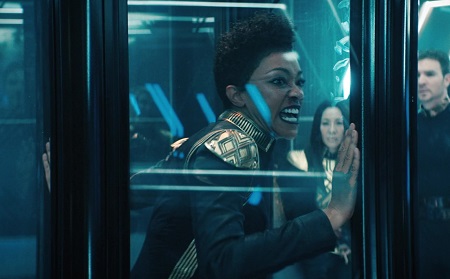
Star Trek: Discovery Season 4 – wacky ideas

Spoiler Warning: There are spoilers ahead for Star Trek: Discovery Seasons 1-3 and for other iterations of the franchise.

When we think about which Star Trek show is the best fit for some wacky, out-of-left-field storylines, Lower Decks almost certainly springs to mind! But rather than silly or outlandish stories, what I’m thinking of today are five storylines that could take us by surprise in Discovery’s fourth season, in large part due to the huge time jump.

Star Trek: Picard showed us a little of the state of the galaxy in the years after Nemesis and Voyager, but that’s really as far along as the timeline has gone, and even then there’s a lot we don’t know. The galaxy as we knew it could have changed massively in the 800 years since; just think about how completely different our own world is today compared to even just a century or two ago. Factions and races we might not expect to see working together could come together, and likewise the passage of time could have seen friends drift apart.

Ni’Var had left the Federation by the 32nd Century.

Discovery’s third season already showed us a very different galaxy in the aftermath of the Burn. The idea that Vulcan and even Earth would have quit the Federation seemed unfathomable, yet that was the galaxy that Burnham and the crew found themselves in. So perhaps the entries on this list aren’t quite so wacky after all! Will they come to pass, though? Only time will tell…

My usual caveat applies: I have no “insider information.” This list is just for fun, to speculate about some strange possible future scenarios that could, under some circumstances, possibly come to pass in the Star Trek galaxy. I’m not even trying to say that any of these would necessarily be good stories! I just think these concepts are interesting, and would – if nothing else – shake up the Star Trek galaxy and Discovery’s 32nd Century in completely different and unexpected ways. With all that out of the way, let’s jump into the list.

Number 1: The Dominion has joined the Federation.

Weyoun was one of the Dominion’s leaders during the Dominion War.

Discovery’s third season focused a lot on which planets and factions had left the Federation, but aside from the Barzan we didn’t really learn of any existing Star Trek factions that had joined the Federation in the centuries since Nemesis and Picard. Prior to the Burn, there were at least 350 Federation members, so that means an awful lot of planets and factions had joined. Could the Dominion, once the foremost power of the Gamma Quadrant, be among them?

I don’t mean a Federation-Dominion peace treaty or alliance. I mean the Dominion became a full-blown Federation member like any other. It’s possible that faster warp speeds cut travel time between the Alpha and Gamma Quadrants, making such a proposal feasible without relying wholly on the Bajoran wormhole. But would the Dominion ever want to make such a move?

Odo returns to the Founders.

In What You Leave Behind, the finale of Deep Space Nine, Odo travelled to the Founders’ homeworld. He did so not only to cure them of a disease that threatened their lives, but also to share his knowledge of life among “solids,” hoping to convince them to abandon their desire for conquest and subjugation. If Odo had succeeded in that objective, it’s possible to envision a future in which the Federation and Dominion opened a dialogue, one which eventually led to friendship, alliance, and the Dominion’s accession as a member.

With actor René Auberjonois having sadly passed away in 2019, I can hardly think of a more fitting legacy for the character of Odo than for Star Trek to say he successfully brought the Federation and Dominion together. There are a lot of questions that such a story would bring up, like whether only the Founders joined, whether the Vorta and Jem’Hadar did too, and what became of the planets and races the Dominion had conquered. But if the Dominion are to return in a future Star Trek production, this could be a really interesting twist on their expected status as adversaries, as well as Star Trek once again using its sci-fi setting to comment on real-world issues, in this case the prospect of peace even between bitter enemies.

Number 2: The Kelvan Empire is attacking the Milky Way galaxy.

Rojan, the leader of a Kelvan expedition to the Milky Way.

By Any Other Name, from the second season of The Original Series, introduced the Kelvan Empire. The Kelvans were native to the Andromeda galaxy, but feared that rising levels of radiation would wipe them out. They sent out generation ships to seek out other galaxies to conquer; Captain Kirk and the crew of the Enterprise encountered several members of their expedition to the Milky Way.

The Kelvans were initially set on conquering the Milky Way by force, but were eventually convinced by Captain Kirk to seek a peaceful solution to their problem, dispatching an unmanned starship back to Andromeda with a proposal from the Federation to help the Kelvans find a new homeworld in the Milky Way. The story ends shortly after, without a proper conclusion.

The Kelvan Empire is native to the Andromeda galaxy.
Picture Credit: NASA

Given that the Kelvans initially seemed to view humans and the Federation in the way we might view ants, and that Kirk was only able to change the Kelvan leader’s mind by essentially tempting him to remain in humanoid form and enjoy the new feelings and sensations that brought him, it’s at least possible that the Federation’s offer to the Kelvans in Andromeda would be dismissed out of hand. Even if the Kelvan Empire accepted, if they arrived at the Milky Way in the aftermath of the Burn, they may have seen an opportunity to conquer.

Perhaps the “gravitational anomaly” glimpsed in the Discovery Season 4 trailer is a Kelvan weapon! Their technology was very powerful, far outclassing the 23rd Century Federation’s, so it isn’t impossible to think they could have such a weapon. Discovery has looked at obscure parts of canon on several occasions in the past, including bringing back factions and races from The Original Series era. So perhaps this one isn’t quite as wacky as it may seem!

Number 3: The Federation and Klingons are at war again.

A Klingon commander seen in Lower Decks.

When Star Trek: The Next Generation featured a Klingon main character as a Starfleet officer it really was a big change in the way the two factions interacted. Over the course of the first few seasons of the show we’d learn more about how the Federation and Klingons were at peace, and finally in Star Trek VI: The Undiscovered Country we got to see how that peace was won. Considering that the Klingons had been the main adversary faced by Kirk and co. in The Original Series, this was a significant change for the Star Trek galaxy.

When discussing the Dominion, I noted that the passage of time can make friends out of longstanding enemies. But unfortunately the same is true in reverse; factions that had once been close allies can drift apart and even revert to being adversaries. It’s possible that this happened slowly over time, but there’s one event more than any other that could lead the Klingons – and many other factions, come to that – to hate the Federation: the Burn.

Discovery Season 1 featured a Federation-Klingon conflict.

Su’Kal, a Kelpien, caused the Burn, as we learned in Season 3 of Discovery. At that time, the Kelpiens were Federation members, and the ship Su’Kal was on when it crashed in the Verubin Nebula was undertaking a mission for the Federation. From the point of view of the Klingons, then, the Federation are responsible for the Burn, and presumably for thousands if not millions of Klingon deaths.

It’s hard to see how the Federation could keep the Burn’s origin a secret, and once it’s out there, it’s up to the denizens of the galaxy to apportion blame and decide how to respond. I hope that Season 4 doesn’t just ignore this aspect of the story, because I think there’s a lot of potential here to really shake things up. Whether the Klingons had ever been Federation members is kind of a moot point, because surely once the Burn’s true origin is known they would be out for revenge!

Number 4: A classic character is still alive… somehow!

The cast of The Next Generation Season 4.

This time I’m not talking about a backup copy of Voyager’s Doctor or any of the other few characters who could potentially have survived this long. Instead I’m thinking of a character who has absolutely no right to still be alive in the 32nd Century, yet somehow is! Whether it’s Will Riker, Kira Nerys, Harry Kim, or someone else doesn’t matter – I just like the idea that a random character has somehow been kept alive this long.

Discovery’s far future setting should mean that no one from the 23rd or 24th Centuries is still alive. But Star Trek has done funny things with stasis fields and sleeper ships in the past, even allowing Montgomery Scott to emerge from a transporter beam into the 24th Century and meet Captain Picard and the crew of the Enterprise-D.

Scotty aboard the Enterprise-D in Relics.

Technobabble basically means Star Trek can get away with bringing back practically any character, and as stasis, suspended animation, and other similar technologies are all known to exist, it would be quite achievable! In the past I did consider a handful of characters whose survival this long seemed more likely, but practically any character could come back via this method.

Dead characters could even return thanks to cloning, holographic technology, or even straight-up medical miracles that are tantamount to necromancy! So don’t count out any character from a past iteration of Star Trek, because who knows who we might encounter in the 32nd Century.

Number 5: The Borg have disappeared.

A battle between Borg and Romulans as seen in the Lower Decks title sequence.

In this storyline the Borg weren’t defeated militarily by the Federation. One day, they simply went silent – as if they had completely disappeared from existence. Perhaps the Federation sent probes or starships to visit what had once been Borg space, only to find no trace of the cybernetic beings who were once considered the galaxy’s biggest threat.

I like this kind of storyline for one simple reason: it’s incredibly unnerving. What could have caused the Borg to vanish? Did they do it themselves, or were they attacked? If they were attacked that raises perhaps an even bigger and more important question: who could possibly have the power to defeat the entire Borg Collective in one fell swoop?

A Borg Cube over Earth in The Best of Both Worlds.

It’s not unfair to say that a lot of Trekkies are sitting on our hands waiting to see how and when the Borg will return to Star Trek. This would be a complete twist on their expected return, triggering a mystery to solve in the process. One of the Star Trek shows I’d love to see most of all would be an all-out Borg war, but such a show could only have one possible ending: the Borg’s ultimate defeat. This storyline, in which the Borg have simply vanished, could be a lot more open-ended.

The danger in this kind of story is getting a suitably satisfying ending. The question of how and why the Borg disappeared would have to be paid off in a big way, somehow – and I’m not really sure how such a story could and should end. There are many different possibilities, but getting it to work and not feel unsatisfying or like a deus ex machina would be the key challenge.

So that’s it. Five wacky stories that Discovery Season 4 almost certainly won’t touch!

What kind of stories will Season 4 tell?

It’s been a lot of fun thinking up some very different Star Trek stories for the 32nd Century. I can see why the writers and producers wanted to take the ship and crew so far into the future – doing so has really opened up the kind of stories they’re able to tell within the Star Trek galaxy in a way that isn’t possible in other productions, even Picard.

Discovery’s fourth season is still on the schedule for 2021, and it’s possible we could see it as early as October – or as late as the end of December! Whenever it arrives, be sure to check back as I’ll be reviewing each episode as they’re broadcast as well as indulging in some theory-crafting. I hope these wacky ideas were a bit of fun!

Star Trek: Discovery Seasons 1-3 are available to stream now on Paramount+ in the United States and on Netflix internationally. The Star Trek franchise, including Discovery and all other properties mentioned above, is the copyright of ViacomCBS. This article contains the thoughts and opinions of one person only and is not intended to cause any offence.
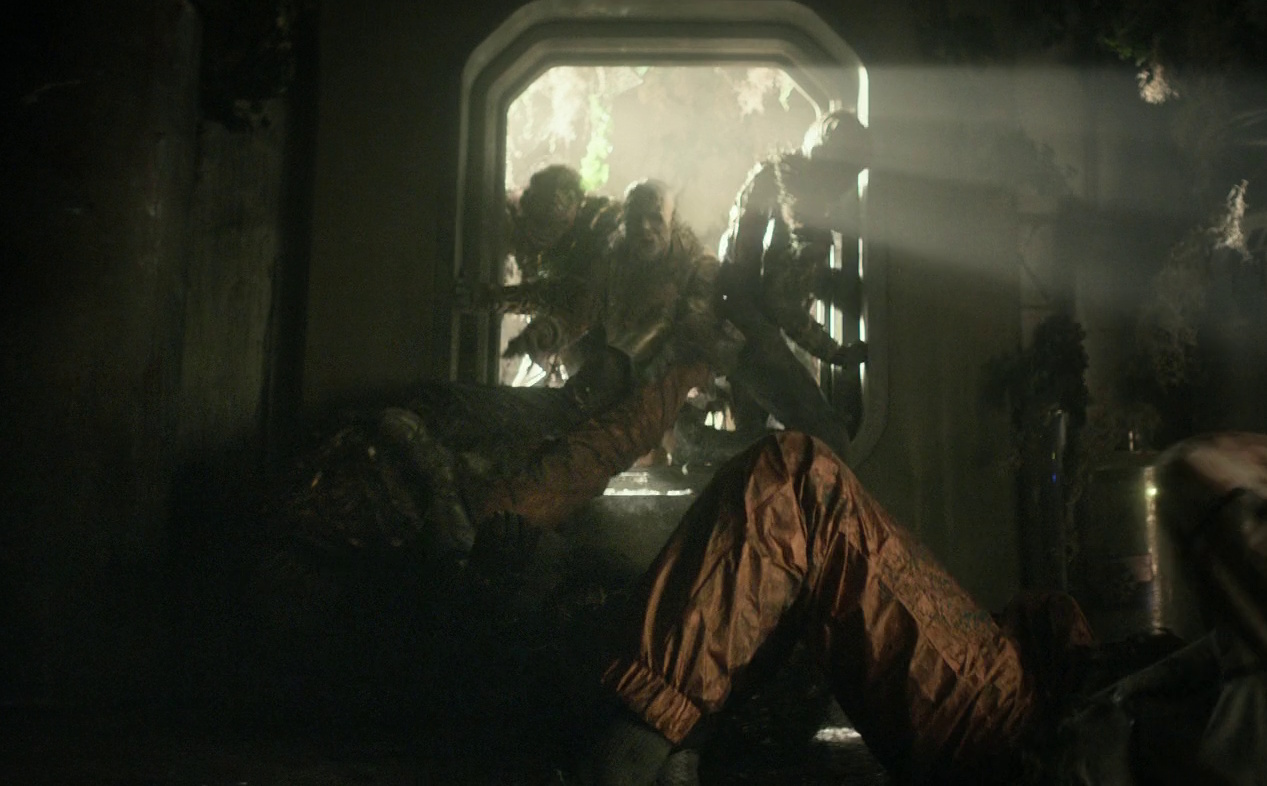
Factions of Star Trek: Strange New Worlds

Spoiler Warning: There are spoilers ahead for Star Trek: Discovery Seasons 1-3, Short Treks, Star Trek: Picard, Star Trek: Lower Decks, and for other iterations of the Star Trek franchise.

Though Strange New Worlds Season 1 is still probably a year or more away from being broadcast, it’s never too soon to start thinking about the next live-action Star Trek show! Each Star Trek project brings something new and different to the table, but Strange New Worlds’ purported return to a more exploration-focused, episodic kind of storytelling is something I’m incredibly interested in and excited for. When I think about upcoming television series that I’m most excited about, Strange New Worlds has to be very close to the top of the list!

In addition to the three cast members reprising their roles from Discovery, we learned earlier in the year that five other major roles have been cast – but we didn’t learn anything about the characters, nor about any recurring or returning characters either. Strange New Worlds is currently in production, but was entirely absent from Star Trek’s First Contact Day digital event in April. We haven’t really heard much solid news from the production for a while!

Strange New Worlds is in production, and looks set for a 2022 broadcast.

Despite that, I thought it could be fun to look ahead to Strange New Worlds’ premiere, and this time we’re going to consider some of the factions present in the Star Trek galaxy that Pike and his crew could encounter! This isn’t going to be a comprehensive list of every Star Trek race or species, just those that I personally consider plausible for the new show.

As always, please keep in mind that I don’t have any “insider information.” I’m not stating that any of these factions will definitely appear in Strange New Worlds, all we’re going to do today is look at some factions from past iterations of Star Trek and think about where they could be in the mid-2250s. That’s all!

With that out of the way, let’s jump into the list!

Number 1: The Andorians

Ryn, an Andorian seen in Discovery Season 3.

As a founding member of the Federation, the Andorians are a firm ally in this era. Despite that, however, episodes like Journey to Babel in The Original Series showed that there is still a degree of mistrust particularly between Andorians and Vulcans. Much of what we know about the Andorians actually comes from Enterprise, where they featured far more prominently than in any other Star Trek series to date. After appearing in The Original Series and in the background in a couple of films, the Andorians were absent for practically all of The Next Generation era.

It would be amazing if one of Strange New Worlds’ main or recurring characters were Andorian! Having an Andorian crew member would be a first for any Star Trek show, and that could be a lot of fun. It would also be possible for the series to delve into Federation politics in a similar way to Journey to Babel, looking at how Andorian relations with other Federation members have improved – or not – over the years. Though he would be well over 100 years old by this point, it’s not inconceivable that Shran, the Andorian commander who tangled with Captain Archer in Enterprise, could still be alive in this era, and perhaps he could make an appearance.

Number 2: Arcadians, Ariolos, Arkenites, and others!

One of the only Arcadians ever seen in Star Trek.

Star Trek IV: The Voyage Home – and several other films starring the cast of The Original Series – followed the Star Wars trend of designing cool-looking aliens and then leaving them in the background or in minor supporting roles. The higher budget afforded to the films allowed for more aliens and different-looking aliens, but subsequent Star Trek projects haven’t brought back races like the Arcadians, Ariolos, Arkenites, and more.

However, Discovery Season 3 briefly featured a Betelgeusian character – the Betelgeusians were another race seen in the background of a film before being ignored in subsequent Star Trek projects. So I think there’s the possibility that one or more races only ever seen in films like The Voyage Home could appear in Strange New Worlds. Perhaps Captain Pike and the crew make first contact with one of them!

Number 3: The Bajorans

Major Kira was a 24th Century Bajoran – and a major character in Deep Space Nine.

The Cardassian Empire would not occupy Bajor until the late 23rd or early 24th Century, meaning that in the 2250s Bajor and the Bajorans will be very different to the way we remember them from Deep Space Nine. Pre-occupation Bajor operated a strict caste-based hierarchy, with very little mixing between castes. Bajorans were known to be artistic, creative, and deeply spiritual, as well as pioneers of space exploration.

This is tied to a pet theory I have that Captain Pike will make first contact with a previously-established Star Trek faction! I feel that the Bajorans are absolutely one of the contenders for such a mission of first contact, and it could be absolutely fascinating to learn more about the Bajorans and how they were prior to the Cardassian occupation. The Bajorans have recently been referenced in Discovery Season 3, so the creative team behind Star Trek clearly haven’t forgotten all about them! Perhaps that could be a hint at a more significant role in an upcoming project?

Number 4: The Barzan

Nhan, a Barzan character in Star Trek: Discovery.

By the mid-23rd Century, at least one Barzan – Nhan – served in Starfleet. Nhan served under Pike’s command on the Enterprise, and though Pike and some other members of the crew know her true fate – that she left the 23rd Century behind to head into the far future with the crew of Discovery – officially she was killed in action during the battle against Control.

I wonder whether Pike might visit Barzan II to pay respects to Nhan, or to convey the news of her being lost to her family. That could be an interesting story, as well as a way for Strange New Worlds to keep a thread of continuity going with Discovery. Despite Nhan’s departure from Discovery midway through Season 3 I’m hopeful she could return. The Barzan were not a Federation member by the mid-23rd Century, so there’s the possibility that Nhan’s death could complicate Federation-Barzan relations.

Number 5: The Benzites

Mordock, a 24th Century Benzite.

The Benzites have only appeared on a few occasions, so I think there’s scope to explore more of their culture and perhaps even show how they came to make first contact with the Federation. The first Benzite we met in Star Trek was in The Next Generation Season 1 episode Coming of Age, where Mordock beat Wesley Crusher to a place at Starfleet Academy. A couple of other Benzites were seen later in The Next Generation and in the background in Voyager and Lower Decks.

All we know about the Benzites is that they were not members of the Federation, and that they had maintained relatively limited diplomatic contact prior to the 24th Century. They’re another possible candidate for a mission of first contact, in my opinion!

Number 6: The Betazoids

Deanna Troi – a half-Betazoid – recently returned in Star Trek: Picard Season 1.

Betazed – the Betazoid homeworld – appears to be relatively close to Earth and Vulcan, at least according to dialogue in Deep Space Nine. If that’s the case, it stands to reason that humans and Betazoids may have already been in contact with one another prior to Captain Pike’s mission of exploration. They were also known to be a Federation member by the mid-24th Century. Another possible candidate for a mission of first contact? Maybe!

Betazoids have telepathic and empathic abilities which have been shown to be very useful to Starfleet in other Star Trek shows, so perhaps a Betazoid main or recurring character could fill a Troi-like role aboard the Enterprise. I think this is less likely, but it’s a possibility!

Number 7: The Borg

A Borg drone seen in First Contact.

Star Trek has made a mess of Borg-Federation contact thanks to revelations in Generations, Voyager, and Enterprise that humanity had contact with (or knowledge of) the Collective prior to Captain Picard making “official” first contact with them. I think it would be very difficult for Strange New Worlds to successfully pull off a Borg story without treading on too many toes, but at the same time I think it could be amazing to see Captain Pike face off against the Borg!

Perhaps this would work best as a time travel or even parallel universe story; perhaps Pike and the Enterprise accidentally cross into an alternate reality where the Borg were successful in assimilating Earth in the 21st Century (as seen in First Contact). They would need to find a way to get home, and may not even be aware of the name of their adversary. A long-shot for Season 1, perhaps, but a possibility! In the 23rd Century in the prime timeline, the Borg should be confined to the Delta Quadrant. They may not have transwarp technology by this point, though their technology should still outpace the Federation considerably.

Number 8: The Bynars

A pair of Bynars seen in The Next Generation.

Interestingly, though the Bynars were only ever seen on screen in The Next Generation Season 1, they were mentioned by name in Enterprise. The Federation were thus at least aware of the Bynars’ existence by the mid-23rd Century, and it’s possible that they had attempted to make first contact with the semi-synthetic race.

Given that modern Star Trek has dedicated a fair amount of time to exploring the relationship between organic and synthetic life, and how the possibility exists for that relationship to turn into conflict, bringing back the Bynars – who are a race connected to a “master computer” on their homeworld – could make for an interesting continuation of that theme.

Number 9: The Caitians

Caitians served in Starfleet since at least the mid-23rd Century.

This feline-inspired species initially appeared in The Animated Series, and has recently been seen in Lower Decks, where Dr T’Ana is a Caitian. Their only live-action appearance to date has been in The Voyage Home, but with the Caitians returning to Star Trek in a big way thanks to Lower Decks, perhaps the time is right for them to make a major live-action appearance again.

The Caitians were presumably Federation members – or at least allies – by the time Kirk assumed command of the Enterprise, so it’s at least plausible to think that there could be other Caitian Starfleet officers during Pike’s tenure. It would be an interesting opportunity to learn more about a race that Star Trek has shown off on a few occasions but never really dug into.

Number 10: The Cardassians

A Cardassian seen in The Next Generation.

As with the Bajorans above, the Cardassians are a faction we know very well from their appearances in Deep Space Nine. What we haven’t seen, however, is first contact between the Federation and the Cardassians, which is something Captain Pike and the Enterprise could be responsible for! There was conflict between the Cardassians and Federation in the early or mid-24th Century, but aside from that – and their occupation of Bajor – much of early Cardassian history is unknown.

Cardassia Prime and Bajor are relatively close to one another, so it’s possible Captain Pike could encounter both if the Enterprise finds itself in that region of space. I really like the idea of Strange New Worlds showcasing first contact between the Federation and a race that we got to know in the 24th Century, so I think the Cardassians could be a great inclusion in the new series.

Number 11: Chameloids

A Chameloid taking humanoid form in the late 23rd Century.

Chameloids were shape-shifters, but were not affiliated with the Dominion. The only known Chameloid seen in Star Trek appeared on Rura Penthe in The Undiscovered Country. This individual played a role in Captain Kirk and Dr McCoy’s escape from the Klingon prison colony.

Shape-shifting aliens have been seen on a few different occasions in Star Trek (excluding Odo and the Founders, of course) and make for interesting adversaries. Perhaps Pike and his crew could encounter a Chameloid – they may even be responsible for “Martia” ending up on Rura Penthe!

Number 12: The Deltans

Ilia, a 23rd Century Deltan Starfleet officer.

We’ve only ever met one Deltan in Star Trek: Ilia, a Starfleet officer in The Motion Picture. The Deltans – and Ilia – were originally created for Phase II, the project which would eventually morph into The Motion Picture in the late 1970s. They were intended to be a somewhat ethereal race, older and wiser than humanity and offering a different perspective on the galaxy.

Deltans were also presented as very sensual, both in their sole appearance in The Motion Picture and when they were referenced in Enterprise’s fourth season. Considering that second mention in Enterprise, Deltans and humanity had encountered one another long before the events of Strange New Worlds. Perhaps Pike and the crew could lead a diplomatic delegation, or witness the Deltans joining the Federation?

Number 13: The Denobulans

Dr Phlox, a 22nd Century Denobulan.

The Denobulans are a race only ever seen in Enterprise, and perhaps Strange New Worlds could tell us why that is! Though I wouldn’t want to see any harm come to Dr Phlox’s people, it’s possible that some kind of disaster befell them in the years after Enterprise, accounting for their absence in the 23rd and 24th Centuries.

If that’s not the case, it would be great to learn what became of them! It seems likely that the Denobulan homeworld was relatively near to Earth and Vulcan, and given their friendly relations with Earth in Enterprise, perhaps the Denobulans became a Federation member relatively early on. A Denobulan could even join Pike’s crew as a main or recurring character!

Number 14: The Edosians

An Edosian seen in Lower Decks.

This three-legged, three-armed race were originally seen in The Animated Series, where Lieutenant Arex was an officer under Kirk’s command. Like many elements from that show, the Edosians seemingly vanished – until Lower Decks brought back an Edosian character last year! It was great fun to see another Edosian Starfleet officer then, and it may be the first of many Edosians that we’ll see going forward.

It was prohibitively expensive in the late 1970s and 1980s to bring an Edosian character to life in live-action, but times have changed and I’d argue that it’s more than achievable in 2021! It’s possible that Arex himself could make a return, serving under Pike’s command on the Enterprise, or perhaps Pike and the crew will encounter other Edosians out in space. Whether they’re Federation members or not is unknown, but maybe Strange New Worlds can clear that up!

Number 15: The El-Aurians

Dr Tolian Soran, an El-Aurian who lived in the 23rd/24th Centuries.

At least one El-Aurian – Guinan – visited Earth in the 19th Century, and based on the fact that the Federation came to the aid of El-Aurian refugees in Generations, they must’ve either been relatively near to Federation space or been able to travel there easily. The El-Aurians were assimilated by the Borg in the late 23rd Century, but Strange New Worlds potentially offers the opportunity to see the El-Aurians in their prime, before the Borg decimated their people.

Guinan is going to be making a return in Picard Season 2, so the El-Aurians are clearly still a factor in upcoming Star Trek projects! Having Pike and his crew encounter the El-Aurians could be a way for Strange New Worlds to tie itself to Picard and the 24th Century.

Number 16: The Kalar

A Kalar warrior in The Cage.

Captain Pike has already encountered the Kalar once! During the events of The Cage, Pike recalled an attack by Kalar warriors during a mission to Rigel VII, blaming himself for the deaths of three officers under his command. In Discovery we saw Pike revisit events with the Talosians and Vina, so perhaps it’s possible to bring back the Kalar too!

The Kalar were depicted as an un-advanced race incapable of spaceflight with technology that looked similar to the early medieval period or dark ages on Earth. It seems unlikely they’d have made any significant advancements since Pike’s earlier encounter with them, but it’s not impossible to devise a compelling reason to revisit Rigel VII.

Number 17: The Kelpiens and Ba’ul

Captain Saru was the first Kelpien to serve in Starfleet.

Captain Pike played a huge role in the development of the Kelpiens and Ba’ul in Discovery Season 2, arguably violating the Prime Directive to aid the Kelpiens by putting the entire species through vahar’ai – a biological evolution which transformed the meek, fearful Kelpiens into apex predators.

There will be massive consequences for what Pike did, and while Saru is arguably the best character for close examinations of the Kelpiens, Pike’s monumental role in shaping their future – and that of the Ba’ul, with whom the Kelpiens share a homeworld – could mean that a revisit to Kaminar is on the cards. The Ba’ul may blame Pike and the Federation for upsetting the delicate balance they had worked so hard to establish, seeking revenge. Or Kaminar may have descended into war, with the Kelpiens and Ba’ul at each others’ throats requiring Pike’s intervention.

Number 18: The Klingon Empire

Chancellor L’Rell was the Klingon leader in this era.

Even if it doesn’t happen in Season 1, I feel certain that Strange New Worlds will eventually feature some Klingon stories! Federation-Klingon relations are rocky after the end of the war seen in Discovery’s first season, and it would be interesting to see how Pike, L’Rell, and others try to maintain the peace in the years before Kirk’s five-year mission.

When considering Pike’s personal story, it was on the Klingon world of Boreth where he secured his fate – his impending disability – in exchange for a time crystal. Pike’s own views and relations with the Klingons are thus particularly complex, and as he comes to terms with what he saw in the vision the time crystal gave to him he may seek out advice from Klingons, or he may even try to revisit Boreth.

Number 19: The Lurians

Morn, a 24th Century Lurian.

The best-known Lurian in Star Trek is Deep Space Nine background character Morn. The first trailer for Discovery Season 3 in 2019 seemed to imply we’d see the Lurians return, as a Lurian guard was shown chasing after Booker and Burnham, but it turned out to be just a cameo! The Lurians were not Federation members as of the mid-24th Century, but appeared to maintain reasonably good relations.

Morn became a Star Trek icon during Deep Space Nine’s run, and I can’t decide if that means bringing the Lurians back in a major way would be a good thing or not! Perhaps it would be best to leave them be, a somewhat mysterious, enigmatic people, rather than bring them into the modern day and risk overexplaining them and losing the magic.

Number 20: The Malurians

A Malurian (wearing a disguise) in the 22nd Century.

The Malurians suffered a tragic fate in The Original Series, being wiped out by a self-aware probe. They also appeared in Season 1 of Enterprise, and seemingly conducted morally questionable actions! The Malurians were visited by the Federation shortly before they were rendered extinct, so it’s possible that the Federation in this era had some kind of relationship with them.

We don’t know very much about the Malurians, but their ultimate fate puts them in a rather unique position in this era. Perhaps we’ll learn that Pike and the crew helped the Malurians settle a small colony somewhere, paving the way for their survival!

Number 21: The Miradorn

A pair of Miradorn twins in the 24th Century.

The Miradorn made an appearance in Deep Space Nine, and were shown to be a race of twins – or at least where twins were commonplace. These sets of twins operated as two halves of a single person, with a very deep connection to one another. As of the mid-24th Century they appeared to be an independent power, maintaining relations with both the Federation and the Ferengi.

The Miradorn are another interesting race that I consider to have first contact potential. The twin aspect of their culture makes them different from many other Star Trek races, and they have a neat design that’s different without being excessively complicated.

Number 22: The Nausicaans

A Nausicaan was responsible for injuring a young Ensign Picard in the early 24th Century!

In the late 23rd and 24th Centuries, the Nausicaans were known as a violent people, often seen as pirates or criminals. They operated in an area of space relatively close to Earth and Vulcan, as they had been encountered by humanity in the 22nd Century. In addition to their criminal activities, Nausicaans in the 24th Century were occasionally seen as mercenaries and bodyguards.

The Nausicaans could appear in their typical pirate role in Strange New Worlds, becoming an adversary for Pike and the Enterprise to overcome. Or we could see them step out of that role for a change, with the show exploring more of Nausicaan culture.

Number 23: The Nibirians

A Nibirian in the alternate reality.

The Nibirians were seen in Star Trek Into Darkness – and thus their only appearance is in the alternate reality. However, given how similar the two realities are, it’s a safe bet that the Nibirians exist in the prime timeline. In Into Darkness they were shown to be a stone age people, very early in their development.

Given that the Nibirians were under threat from a volcano in Into Darkness, maybe Pike and the crew will have to come up with a creative way to save them, just as Kirk did in the alternate reality. If a return to the Kelvin timeline is on the agenda – which I doubt, but you never know – this could be a way to connect current Star Trek to the alternate reality.

Number 24: The Orions

In the 32nd Century, Osyraa had become the leader of the Emerald Chain – a major faction.

The Orions have recently featured in Season 3 of Discovery, and of course with Tendi in Lower Decks! In addition, Captain Pike has somewhat of a history with them, having encountered Orion slaves during the events of The Cage. For both of those reasons they seem like a contender to make an appearance in Strange New Worlds!

The Orions were an independent power in the 23rd Century, with at least some Orions involved in criminality, slavery, and the Orion Syndicate – a major organised crime outfit. They seem like they could be villains, then, but an interesting twist could be to make an Orion a crew member on the Enterprise, or an ally of Pike and the crew.

Number 25: The Pahvans

A noncorporeal Pahvan.

Captain Pike wasn’t involved in the USS Discovery’s mission to the planet Pahvo during the Federation-Klingon war, but I feel there’s scope to revisit these noncorporeal, pacifist aliens. Pahvo had a unique “transmitter” which allowed Discovery to detect cloaked Klingon ships, and thus the planet unintentionally played a role in the war.

It’s possible that Pahvo was attacked by the Klingons in retaliation, but the planet was marked on a star chart seen in Picard Season 1, which suggests the Federation may have maintained some kind of diplomatic relations with the Pahvans into the 24th Century. Regardless, there are perhaps leftover story threads from Discovery that Strange New Worlds could potentially pick up with the Pahvans.

Number 26: The Q Continuum

Q in his famous judge outfit.

It seems as though the Federation’s first encounter with the Q was when Picard and the Enterprise-D met Q during the events of Encounter At Farpoint, but we also know that members of the Q Continuum had visited Earth in the past, including during the American Civil War in the 19th Century. It’s thus possible that Pike and the crew could encounter a Q without realising who or what they’re dealing with!

With Q coming back in Picard Season 2, having the Continuum appear in some form in Strange New Worlds would be a way for the two shows to work together. This one is definitely more of a long-shot, but it’s not impossible!

Number 27: The Romulan Star Empire

Narek and Rizzo, two 24th Century Romulan operatives.

Any story involving the Romulans in Strange New Worlds would have to keep their true nature – as descendants of the Vulcans – a secret. Because no Romulan characters could appear on screen alongside Pike and the crew that naturally constrains the kinds of stories that can be told. However, in the episode Minefield, Enterprise managed to pull off an interesting Romulan story without going too far, so it can be done!

The Romulans were a belligerent power in this era, having already fought a major war with Earth less than a century earlier. Though there is peace between the Romulans and Federation, there are no formal diplomatic relations and there seems to be a lot of tension. The Romulans have recently been explored in a major way in Picard Season 1, and to a lesser extent in Discovery Season 3. They’re a major Star Trek faction, up there with the Klingons and Borg, so I can’t help but feel Strange New Worlds might try to find a way to include them – somehow!

Number 28: The Saurians

Linus, a Saurian Starfleet officer.

Linus, a secondary character in Discovery, is a Saurian – a race first seen in the background in The Motion Picture. The Saurians may well be Federation members by this time, and if they’re serving in Starfleet there could be other Saurian officers aboard the Enterprise. Despite Linus having made a number of appearances, we don’t know very much about his people.

The Saurians are a faction we could learn more about in Strange New Worlds. Pike and the crew could even visit the Saurian homeworld, perhaps to convey news about Linus being declared killed in action. It would be interesting to see more Saurians and learn more about their place in the Federation.

Number 29: The Selay

A group of Selay delegates in the transporter room of the Enterprise-D in the 24th Century.

We don’t know very much about the Selay. They appeared once in The Next Generation Season 1, and had a couple of blink-and-you’ll-miss-it background appearances in a couple of other episodes, but that’s it. Their appearance in Tapestry means that they had encountered the Federation by the early 24th Century, so perhaps they could appear in Strange New Worlds.

Modern Star Trek has taken several races that we don’t know much about and expanded on them. The design of the Selay – snake-like and very reptilian – is interesting, and the faction is ripe for an in-depth look!

Number 30: The Skagarans

Draysik, a 22nd Century Skagaran in the Delphic Expanse.

In Enterprise we learned that the Skagarans had visited Earth in the 19th Century, where they had abducted a group of humans to use as slave labour. There’s potential in that kind of storyline to either see Pike and the crew come up against an enemy who uses slaves, or to explore a post-slavery society and look at some of the long-lasting implications of keeping slaves in the past. This would allow Strange New Worlds to do something Star Trek has always done: use science fiction to examine real-world issues.

It would also be neat to bring back a faction from Enterprise in a major way, as this is something that hasn’t yet been done in modern Star Trek.

Number 31: The Suliban

Silik, a 22nd Century Suliban commander.

Speaking of factions from Enterprise that could return, how about the Suliban? Though initially antagonistic toward Earth, this was mostly driven by the interference of time-travellers from the future. Without that undue influence, perhaps Suliban-Federation relations have improved. I wrote once that it was possible that the Suliban had gone into some kind of isolation – which would account for their absence in the 23rd and 24th Centuries – so perhaps we could see that happen in Strange New Worlds.

I’d love to see an expanded role for the Suliban in Star Trek. Perhaps they could even be Federation members by this era, with Suliban officers serving aboard the Enterprise. It would be great to revisit a faction we only encountered in Enterprise, at any rate.

Number 32: The Talosians

Talosians seen in Discovery Season 2.

Discovery Season 2 brought back the Talosians in a big way, and Captain Pike played a major role in that storyline. Considering Pike’s feelings for Vina – a human inhabitant of Talos IV – it’s at least possible that he may keep in contact with the Talosians, even though he’d have to do so in secret for fear of breaching Starfleet regulations.

In this era, Talos IV was off limits to Starfleet due to the Talosians’ attempts to kidnap Pike and their powerful telepathic abilities. Revisiting the planet isn’t entirely impossible, though, as I reckon Pike would head there if the Talosians asked for his help.

Number 33: The Tellarites

Two Tellarite delegates aboard the Enterprise in the 23rd Century.

Along with the Vulcans, Andorians, and humans, the Tellarites were the fourth founding member of the Federation. Despite that, however, they had a complicated relationship with the other races, particularly the Vulcans.

The Tellarites are the one Federation founding member that we know the least about. They’ve only made a few appearances in Star Trek, often in minor or background roles, and aside from a few episodes in Enterprise and their first appearance in The Original Series, we haven’t seen much of them at all. I’m not sure how well a Tellarite main character would work simply because their deliberately unkind aesthetic doesn’t lend itself well to fitting with a character audiences want to root for – but in a way it would be interesting for Star Trek to try to overcome that hurdle!

Number 34: The Tholians

A 23rd Century Tholian captain.

The Short Treks episode Ask Not confirmed that the Tholians and Federation had been in conflict during this era. If Cadet Sidhu appears in Strange New Worlds as a significant character, including the Tholians could be an interesting story for her as she was the sole survivor of a Tholian attack.

The Tholians are one of the more “alien” races that we know of in Star Trek, being insectoid in appearance and coming from a high temperature environment that leaves them unable to tolerate standard environments. They could certainly appear in an adversarial role in Strange New Worlds.

Number 35: The Trill

Michael Burnham and Adira meeting a group of Trill in Discovery Season 3.

The Trill are a conjoined species – one part is humanoid, the other a symbiont. The symbionts are longer-lived than their hosts and can easily live for centuries. Discovery Season 3 recently revisited the Trill homeworld, and it would be neat to see the Trill return in Strange New Worlds as well.

It would even be possible for Dax to make an appearance. The Dax symbiont had a number of hosts before Jadzia and Ezri in Deep Space Nine, and it was certainly alive in the mid-23rd Century. Regardless of whether that happens, we know that the Trill were Federation members by the 24th Century, and Strange New Worlds could depict their early interactions with the Federation.

Number 36: The Vulcans

Spock!

Obviously we know that Spock is going to be a major character in Strange New Worlds! Over the course of Star Trek’s history we’ve already learned a great deal about the Vulcans, their history, and their culture. There’s still scope to expand that, though, and with Spock as a potential way into new Vulcan stories, I wonder if we’ll get to see more.

Spock’s relationship with Sarek could be explored, and it would be a way for James Frain to reprise his role from Discovery. We could also see more Vulcans joining Starfleet and serving in a wider variety of roles than just “science officer!”

Number 37: The Xindi

Degra, a 22nd Century Xindi.

As with the Suliban above, the Xindi have only appeared in Enterprise so far. We know a little more about their future, however, including that they eventually joined the Federation. Though their absence from Star Trek shows set in the 23rd and 24th Centuries suggests that may not have happened for a while, it’s possible that it happened earlier than we think!

Otherwise we could see the Xindi as another race that have isolated themselves and cut off diplomatic ties. Perhaps one of Pike’s missions will be to re-establish relations with the Xindi after decades without contact. The Xindi are five different races sharing a homeworld, and there’s potential to use that setting to explore the way different cultures interact and work together.

So that’s it! Some factions from Star Trek’s past that could appear in Strange New Worlds.

Hopefully it won’t be long before Captain Pike returns!

This has been a long one so I won’t drag things out much longer! Suffice to say that there are many different races, cultures, and factions from past iterations of Star Trek that could appear in some form in the new series. Obviously the show can’t fit all of those on the list above into its first season, but I hope there’ll be some attempts to revisit at least one or two factions we got to know in other Star Trek shows and films.

Hopefully it won’t be too long before we get to hear more news about Strange New Worlds – or even see a trailer! Whenever that happens make sure to check back as I daresay I’ll break things down here on the website. The show is definitely one I’m looking forward to!

Star Trek: Strange New Worlds will be broadcast on Paramount+ in the United States (and other regions where the platform is available) in 2022. Further international distribution has not yet been announced. The Star Trek franchise – including Strange New Worlds and all other properties mentioned above – is the copyright of ViacomCBS. This article contains the thoughts and opinions of one person only and is not intended to cause any offence.
Star Trek: Discovery Season 4: Factions of the far future

Spoiler Warning: There are spoilers ahead for Star Trek: Discovery Seasons 1-3 and the teaser for Season 4. There are further spoilers for the following: Star Trek: The Original Series, Star Trek: Deep Space Nine, Star Trek: Voyager, Star Trek: Enterprise, Star Trek: Lower Decks, and Star Trek: Picard.

Now that we’ve seen the first teaser for Star Trek: Discovery’s upcoming fourth season, and learned that a release later this year is on the cards, I thought it could be a bit of fun to consider some of the factions from past iterations of Star Trek that may – or may not – still be around in the 32nd Century! We know that at least part of the story of Season 4 will look at some kind of gravitational anomaly, and if you want to check out a few of my theories on that you can do so by clicking or tapping here. Even if the gravitational anomaly is the overarching season-long story, Discovery is likely to still find at least some opportunities to step away and spend a bit more time exploring the 32nd Century.

Season 3 was our first introduction to this time period in all of Star Trek, and as such we as the audience were learning about the state of the galaxy as Burnham, Saru, and the rest of the crew had their adventures. We met a couple of major factions outside of the rump Federation, but many familiar factions and races from past iterations of Star Trek were entirely absent – including some that might prove interesting from a story perspective. So in this article I’m going to take a look at a few of my favourites and speculate about where they might be in the 32nd Century.

The USS Discovery in the Season 4 teaser.

With Burnham and the crew having originated in the 23rd Century, they’ve missed most of what happened in past iterations of Star Trek! Major events like the V’Ger cloud’s arrival at Earth, two Borg incursions, and the Dominion War will all be unfamiliar to them, and there’s storytelling potential in re-introducing a faction from Star Trek’s past to a character or group of characters who are entirely unaware of their existence. Such a story could be interesting and fun, as well as providing new Trekkies – those who haven’t seen much of “classic” Trek – with an easy introduction to an older faction.

My usual caveat applies: I have no “insider information.” I’m not suggesting that any of these factions will definitely show up, or even be mentioned, in Discovery Season 4. This is simply a chance to have a bit of fun and speculate about the future of some of the factions we’re familiar with from past iterations of Star Trek by imagining where they could be by the 32nd Century.

With that out of the way, let’s jump into the list!

Number 1: The Bajorans

Kai Winn, the Bajoran spiritual leader in the 2370s.

We’re going in alphabetical order, so the Bajorans are up first! Even though they weren’t a Federation member, a number of Bajorans were known to have served in Starfleet in the mid-late 24th Century, including Ro Laren, Sito Jaxa, and Lieutenant Shaxs. The Bajorans were in the process of applying to join the Federation when the Dominion War broke out; it has long been assumed by many fans that they would ultimately be successful, perhaps even becoming a fully-fledged member by the time of Picard Season 1.

Bajorans were familiar to the Federation in the 31st Century at least, because Dr Issa programmed a Bajoran physical appearance into the holoprogramme she made for her son, Su’Kal, aboard their crashed ship in the Verubin Nebula. It seems very likely that the Bajorans were a Federation member in the years before the Burn – whether they remained in touch with the rump Federation afterwards is unknown, but if they did they may very well be welcomed back into the fold following the discovery of a huge dilithium cache.

It’s also worth pointing out that Bajor is at a very strategic location – the Bajoran wormhole connects the Alpha and Gamma Quadrants. Whether that will matter quite so much with the advent of new, faster methods of travel is unclear, but Bajor could very well still be an important location.

Number 2: The Borg Collective

A Borg Cube seen in The Best of Both Worlds.

Since their official first contact with the Federation – which came in either the 2350s or 2360s depending on how we consider such things – the Borg have attempted to invade Earth twice. Though a time-travelling Admiral Janeway did some damage to the Collective in the late 2370s, I never felt convinced that the events of Endgame would have led to the complete destruction of the Borg.

With the Federation – or at least humanity – firmly in their sights, would the Borg have simply given up? It stands to reason that they made subsequent attempts to attack the Federation, taking advantage of their superior technology and greater numbers. However, the existence of the Federation in the 32nd Century means that any such attempts were met with failure! Perhaps the Collective is no longer around, having been decisively defeated.

The Burn would have presented an ideal opportunity for a faction like the Borg to attack the shattered Federation – yet they don’t appear to have done so. Could that mean that they have already been defeated, or could they be waiting just beyond Federation sensor range for Burnham and Discovery? Maybe the Spore Drive is something they want to acquire – and they could even be responsible for the gravitational anomaly seen in the Season 4 teaser!

Number 3: The Breen

Thot Gor, a Breen commander.

The Breen were initially thought up as an unseen faction, able to be referenced without ever making an on-screen appearance. That changed toward the end of Deep Space Nine, when they joined the Cardassian-Dominion alliance and came close to turning the tide against the Federation in the Dominion War.

Following the war’s end, we know nothing of the Breen. The peace treaty that they signed after their final defeat over Cardassia may have seen a loss of territory for them, or it may simply have seen them retreat to their own borders. Regardless, the Breen were a major power in the Alpha Quadrant in the mid-late 24th Century, with technology capable of matching and even outpacing the Federation. Their defeat in the Dominion War was a setback, but with their homeworld untouched by the conflict it stands to reason they were able to recover quickly.

Would they have pursued peace with the Federation in the decades and centuries after? Would their technology have continued to keep up? Did the expanding Federation come into conflict with the Breen again? Any and all of these things are possible, but as we didn’t see or hear of the Breen in Season 3, perhaps we will never know.

Number 4: The Cardassian Union

Gul Evek and his aide – two of the first Cardassians ever seen in Star Trek.

Discovery’s first Season 3 trailer tricked us last year! By showing off a Cardassian among a group of what we now know to be Emerald Chain guards, a lot of Trekkies wondered what sort of role the Cardassians might play. The answer, of course, was “none at all!” However, there was a second Cardassian seen in Season 3 – a blink-and-you’ll-miss-it appearance in the episode Scavengers. This is arguably the most interesting post-Deep Space Nine Cardassian appearance to date, as the individual in question was a senior Starfleet officer, perhaps even a captain.

As noted above with the Bajorans, non-Federation members were eligible to join Starfleet under certain circumstances, and the post-Burn Federation was hardly in a position to turn away qualified candidates! But the existence of a Cardassian in what seems to be such a senior capacity suggests that they may have been a Federation member in the years before the Burn.

In a way, despite what happened during Dominion War, this makes a lot of sense. The Federation were in a position to offer help to the Cardassians as they rebuilt following the Dominion occupation of their world, and perhaps that help turned into an alliance over time, culminating in their joining the Federation.

Number 5: The Coppelius synths

A group of Coppelius synths seen in Star Trek: Picard Season 1.

The (relatively) short lifespan of humans and other organics means that, barring time travel shenanigans or being put in stasis, no one we met in the 23rd or 24th Centuries could reasonably have survived to the 32nd Century. However, synths don’t have such limitations, and as such it’s possible that some or all of the Coppelius synths from Picard Season 1 are still alive in this era.

What happened to them after the events of Picard Season 1 is not clear, and it may be something that Discovery’s sister show plans to revisit. If that’s the case we may not see anything of the synths in Season 4. However, if Picard Season 2 is going in a different direction – as its teaser indicated it might – there could be scope to pick up the synths’ story in Discovery.

The Coppelius synths were under Federation protection by the end of Picard Season 1. But with the Romulans hell-bent on exterminating them, they still appeared to be in danger. It would be very depressing to learn that a subsequent Romulan attack wiped them out, especially after Picard and Soji worked so hard to help them. So I hope that the synths are still around – even if they had to relocate to a new homeworld. They could have joined the Federation by this time, too.

Number 6: The Denobulans

Dr Phlox, a 22nd Century Denobulan.

The Denobulans have thus far only appeared in Star Trek: Enterprise, where main character Dr Phlox was a member of the species. Though friendly toward humanity by the mid-22nd Century, the Denobulans were not strictly “allies,” nor were they a founding member of the Federation – which consisted of Andorians, humans, Tellarites, and Vulcans in its original incarnation.

However, the Denobulan homeworld must have been in relatively close proximity to Earth and Vulcan, and with the Federation coalescing and growing it seems at least plausible that they joined up at some point, especially given their friendly history. If Federation HQ relocates back to Earth in Season 4, perhaps we’ll see more of the Denobulans, who might still be in the vicinity.

Number 7: The Dominion

A Jem’Hadar ship.

The Dominion were the dominant power in at least part of the Gamma Quadrant, and according to their own history, had been so for over two millennia as of the mid-24th Century. After a years-long cold war between the Dominion and Federation following first contact, armed conflict broke out in the 2370s. The Dominion War was arguably the most significant event of the latter part of the 24th Century from the Federation’s point of view, proving far more devastating than incursions by the Borg or earlier wars with the Klingons and Romulans.

Following their failed attempt to invade the Alpha Quadrant, the Dominion agreed to return to their own space beyond the Bajoran wormhole. Odo, a Founder who had lived among Bajorans and humans for decades, reunited with his people, hoping to communicate to them that the Federation would not try to wipe them out nor conquer them. If Odo was successful, this could have set the Dominion on the path to peace.

We simply don’t know what became of the Dominion. The Guardian of Forever was seen in Discovery Season 3, and had relocated to a planet near the Gamma Quadrant. Admiral Vance didn’t mention the Dominion when Burnham and Saru planned to travel there, so perhaps we can infer from that that the two powers are at peace. However, the Burn may have disrupted that peace, especially if it resulted in serious damage to the Dominion – might they hold the Federation responsible for that disaster?

Number 8: The Ferengi Alliance

Rom became Grand Nagus of the Ferengi Alliance in 2375.

The Ferengi initially appeared to be antagonistic toward the Federation following (official) first contact in the mid-24th Century, but they soon revealed their true nature: hardcore capitalists for whom war was simply not worth participating in as it was usually unprofitable. Ferengi society was strictly segregated, with men participating in business while women were expected to remain at home and raise their families.

There were seeds of change in the 2370s, with women’s rights issues coming to the fore in Ferengi society. There were also moves away from unregulated capitalism, with some Ferengi even forming unions and advocating for more rights and welfare. Though such changes surely led to pushback from conservative Ferengi, the appointment of Rom as Grand Nagus may have cemented at least some of these reforms.

Though hardly allies of the Federation, at least one Ferengi – Nog – would serve in Starfleet in this era, bringing a different perspective to the organisation and perhaps bringing the factions closer together. The existence of a USS Nog in the 32nd Century – while intended to be a tribute to actor Aron Eisenberg – could also be seen as an indication of continued warm relations in this time period.

Number 9: The Gorn

A 23rd Century Gorn captain.

The Gorn were neighbours of the Federation by the 23rd Century, and may have been involved in border disputes and skirmishes. There was no indication that they ever joined or even considered joining the Federation, and appeared to maintain a closed-border policy well into the 24th Century.

In the Lower Decks episode Veritas, Ensign Rutherford’s arrival at a Gorn wedding led to him coming under immediate attack by the Gorn who were present, and while this was (of course) part of an extended joke, it certainly suggests that the Gorn were not in any way friendly toward the Federation by the 2380s.

In That Hope Is You, the Discovery Season 3 premiere, Book told Michael Burnham that the Gorn had “destroyed subspace” somewhere in the vicinity of Hima. Perhaps that indicates that they were not allied to the Emerald Chain, nor the Federation – retaining their status as an independent power.

Number 10: Holograms

Index, a hologram seen in Star Trek: Picard.

We saw a number of holograms in Discovery’s third season, confirming that the technology is still in use in the 32nd Century. At least one of these holograms appeared to be intelligent, perhaps even sentient, but that was never confirmed.

In the late 24th Century, the Doctor – the USS Voyager’s Chief Medical Officer – was involved in a court case regarding his ownership over a work of fiction he had created. The court case was resolved in his favour in the episode Author, Author, and Captain Janeway suggested that he might have “struck the first blow for the rights of holograms.” There were other sentient holograms in the 24th Century as well, including a holographic version of Sherlock Holmes’ nemesis Professor Moriarty. What became of them is unclear!

As with the Coppelius synths, there’s no reason why holograms from the 24th Century couldn’t have survived this long, and one of my most popular theories here on the website has been that Voyager’s Doctor – or rather, a backup copy of him – will make an appearance in Discovery.

Number 11: The Iconians

An Iconian Gateway – one of the few surviving relics of their civilisation by the 24th Century.

Iconian civilisation flourished more than 200,000 years ago, and by the 24th Century they were believed to be extinct. However, their powerful technology utilised “gateways” to travel vast distances, and it was implied by the extent of the archaeological evidence that they maintained outposts or colonies on many other planets.

The destruction of their homeworld by an alliance of their enemies may have rendered the majority of Iconians extinct, but such a widespread civilisation could have avoided total annihilation, perhaps. The reason the Iconians are on this list is because of their popularity in non-canon works, particularly the video game Star Trek Online. Some elements from non-canon Star Trek publications have ended up crossing over to the main series, so perhaps the intervening centuries saw some kind of re-emergence of the Iconians.

Number 12: The various Kazon sects

Maje Culluh, a Kazon leader in the 2370s.

Discovery Season 3 didn’t establish whether the Federation were able to travel to the Delta Quadrant, nor if they had ever revisited the region since the USS Voyager’s transit in the late 24th Century. Given that warp drive was still the main way of travel, and that maximum warp speeds (as understood in a 24th Century context) meant that the Delta Quadrant would take decades to reach, perhaps they never did.

So we may not find out what became of the Kazon! Similar in some ways to a less technological, less organised Klingons, the Kazon were major antagonists across the first couple of seasons of Voyager. We know that the Borg considered them “unworthy” of assimilation – the only species we know of that the Borg couldn’t be bothered with!

It seems unlikely that the Kazon will have had much impact on the Federation given their distance. However, if they ever succeeded in unifying their disparate sects, perhaps they could have become a regional power in the Delta Quadrant. The USS Discovery’s Spore Drive could take the ship anywhere – even 70,000 light-years away. So maybe if they’re able to travel there, we’ll find out!

Number 13: The Kelvan Empire

Rojan, a 23rd Century Kelvan leader.

The Kelvans are an interesting – and potentially alarming – faction. Extragalactic aliens from the Andromeda galaxy, their technology was far superior to the 23rd Century Federation, and arguably to anything the Federation subsequently developed! They only appeared once, in The Original Series Season 2 episode By Any Other Name, but that shouldn’t stop them making a comeback.

The Kelvan Empire’s home galaxy was facing an extinction event due to rising radiation levels, and they sent out scouting parties to look for new homes. One of these parties encountered the USS Enterprise upon arriving in the Milky Way. Though initially interested in conquest, Kirk was able to convince the Kelvans to consider an alternative proposal, allowing the Federation to help them find new worlds to settle.

If the Federation’s proposal was accepted, perhaps there are millions of Kelvans living somewhere in the Milky Way in this era. Or if it was rejected… perhaps the Kelvan Empire is about to descend upon the Federation en masse!

Number 14: The Klingon Empire

Klingon Chancellor L’Rell.

The Klingons, despite having made so many appearances in Star Trek already, are perhaps the most interesting faction to see return in Discovery. Burnham and the crew are veterans of the Federation-Klingon war, and while I wouldn’t say any of them “hate” Klingons, they certainly would be distrustful of them. How would they react to learning that the Klingons had been allies with the Federation – or even Federation members – for centuries?

I think there’s a lot of potential for conflict, drama, and for Star Trek to do what it’s always done best: use its sci-fi setting to examine real-world issues, in this case, the way we can be guilty of judging groups of people. Characters like Culber, who was “murdered” by Voq, or Stamets, who had to deal with the fallout from that loss, could be front-and-centre in such a story, and it would be absolutely fascinating to see it unfold.

Rather than Discovery making the Klingons antagonists again, like in Season 1, it would be great to learn that the alliance of the 24th Century continued, and that if the Klingons remain an independent power – which they may well be – they’re at least on friendly terms with the Federation.

Number 15: The Maquis

Chakotay, a Maquis commander.

Although Maquis forces were said to have been almost entirely wiped out by the Cardassian-Dominion alliance during the early stages of the Dominion War, at least some Maquis were known to have survived the initial attack. In addition, the USS Voyager returned to the Alpha Quadrant with a contingent of 40-ish Maquis, including Chakotay and B’Elanna Torres.

It’s at least possible that the Maquis, who were breakaway colonists attempting to secede from the Federation, recreated their society in the aftermath of the Dominion War. While their soldiers may have been killed, we saw no confirmation of the fate of other Maquis colonists. If they survived the war, even in captivity, perhaps they attempted to continue their quest for independence afterwards.

If so, the Maquis colonies may have been independent of the Federation for centuries by the 32nd Century. What kind of society they might’ve developed in that time is not known.

Number 16: The Q Continuum

Q, a member of the Q Continuum.

The Q Continuum are returning in Season 2 of Picard – or at least, their most well-known member is. Perhaps that means we won’t see or hear anything about them in Discovery, nor learn what became of them in the far future. But it’s possible!

The Q are as close to immortal as any faction we’ve seen in Star Trek, so they should certainly still be in existence by this time. Their incredible powers are, as a famous quotation puts it, “indistinguishable from magic,” and Q suggested that the Continuum has existed for at least as long as the universe itself.

The Q seemed to view humanity and the Federation with curiosity rather than animosity, with Q even trying to help Captain Picard to solve puzzles that required different ways of thinking. If this kind of intervention continued, and humans continued to develop their reasoning skills, perhaps they might be on friendly terms with the Q by this time. However, if the Q are able to create matter, they would have been very useful friends to have as the Federation began to run out of dilithium! Perhaps the Q have instead stepped back from actively intervening in Federation affairs, content to watch from the outside.

Number 17: The Romulan Star Empire

Romulans, Vulcans, and Romulo-Vulcans in Season 3.

The existence of Romulans on Ni’Var – the planet formerly known as Vulcan – suggests that the Romulan Empire has disbanded following reunification. It was certainly implied heavily in the episode Unification III that reunification involved all Romulans and Vulcans. But it’s possible that a breakaway faction exists in some form; a “New Romulan Empire” claiming the mantle of the disbanded one.

We’ve already seen what was perhaps the biggest possible reveal for Burnham and the crew – learning that the Romulans are an offshoot of the Vulcans. However, with Ni’Var seemingly on the verge of rejoining the Federation, perhaps there is scope to see more from them. The Romulans remained a distinct group on Ni’Var, with full integration with the Vulcans having not occurred, and there are clearly internal tensions between the three main groups. This could be a story thread that Season 4 picks up.

Number 18: The super-synths

The super-synths almost arrived in the Milky Way… but their portal was closed at the last second.

We know practically nothing about this faction, despite them playing a major role in the conclusion to the story of Picard Season 1. They don’t even have a proper name! Claiming to be “an alliance of synthetic life” existing beyond the Milky Way, this faction offered to come to the aid of any synthetics who needed them. It was not clear if this offer was genuine or part of an elaborate trap.

I suggested in the run-up to Season 3 that the super-synths could have been involved with the Burn, but that turned out not to be the case. However, if they became aware of the Federation following the events of Picard Season 1, they could still be planning to travel to the Milky Way – perhaps with conquest on their minds.

The super-synths could thus be responsible for Season 4’s gravitational anomaly – perhaps it’s a weapon; an artillery barrage to soften up the Federation before the troops arrive! It would be fantastic for the creative team in charge of Star Trek to find a major way to tie Picard and Discovery together. Whether this is the right way to do it is certainly up for debate, but in principle I like it.

Number 19: The Talaxians

Neelix, a Talaxian chef.

Although the Talaxians are native to the Delta Quadrant, there was at least one Talaxian colony in or near the Beta Quadrant, significantly closer to Federation space. This seems to increase the likelihood that the Federation would have been able to remain in contact with them at least in the late 24th Century.

The Talaxian homeworld had been conquered sometime in the mid-24th Century by the Haakonian Order. Perhaps the Federation, if they remained on friendly terms with the Talaxians, would have wanted to aid them in liberating their homeworld. If the Federation developed the ability to travel to and from the Delta Quadrant at some point in the future, perhaps the Talaxians even joined the Federation!

Number 20: The Talosians

Talosians in Season 2 of Discovery.

The Talosians were a very dangerous people whose telepathic powers were able to trick humans, Vulcans, and other known races into seeing things that weren’t there. As a result of their attempt to kidnap Captain Pike and other Enterprise officers, Talos IV was declared off-limits to Starfleet personnel and the Federation.

The events of The Menagerie, in which the Talosians welcomed Captain Pike back to their world, as well as their general helpfulness toward Spock and Michael Burnham in Discovery Season 2, however, may suggest that General Order 7 – the section of Starfleet’s rules banning travel to Talos IV – may have been reassessed, although no in-universe evidence for that exists.

The surviving Talosians lived underground after their planet was devastated by war, and lost their ability to control their technology, focusing instead on refining their mental powers. In the 23rd Century, Talosian leaders believed their race was doomed to extinction – but maybe the Federation found a way to aid them? If not, perhaps Talos IV is uninhabited by this time period.

Number 21: The Tholians

A 23rd Century Tholian commander.

The Tholians have only made a couple of appearances in Star Trek – once in The Original Series and once in Enterprise. However, they’ve been mentioned on a number of occasions, and despite being antagonistic in the 23rd Century, some kind of diplomatic relations clearly existed a hundred years later.

As one of the few non-humanoid sentient species, it would be really interesting to see the Tholians make a return. An area of space that they claimed as their own seemed to have some kind of gateway to the Mirror Universe – if Discovery were to revisit that setting, perhaps the Tholians could be included.

As to where they might be or what they might be doing by the 32nd Century, that isn’t clear. In the aftermath of the Burn, they could have expanded to conquer border worlds, or they might’ve been a peaceful neighbour or even ally of the Federation in this era.

Number 22: The Vidiians

A trio of Vidiians form a boarding party in the 24th Century.

Another Delta Quadrant faction whose reappearance will depend on the Federation’s ability to travel, the Vidiians were an antagonist during the USS Voyager’s journey – but only because a disease known as the Phage was afflicting their society.

In the episode Think Tank, a group of “problem-solving” aliens claimed to have cured the Phage, and if this was true – that was left rather ambiguous due to the way the story progressed – perhaps the Vidiians would have been more peaceful and willing to establish a dialogue with the Federation, especially if they were visiting the Delta Quadrant regularly. Or, due to their relative proximity to the Borg, the Vidiians may have been assimilated!

That may seem like a harsh fate, but in the Picard Season 1 episode The Impossible Box the Borg were revealed to have assimilated at least some members of the Sikarian species, making use of their spatial trajector technology. The Sikarians were present in the same region of space as the Vidiians, so perhaps the expansion of the Borg in the late 24th Century was a problem for them.

Number 23: The Xindi

A Xindi-Aquatic in the 22nd Century.

I recently took a look at the possibility of the Xindi returning – along with fellow Enterprise antagonists the Suliban. Neither faction has been seen since Enterprise went off the air, and their absence suggests that, at least in the 23rd and 24th Centuries, they may have pursued a policy of isolationism.

The Xindi had joined the Federation, however, by the 26th Century, with at least one Xindi serving aboard the Enterprise-J. Whether they remained members in the years after the Burn is not known, and with 90% of Federation members either leaving or being out of contact it seems likely that they would have had to fend for themselves for a while.

So that’s it. A few factions from Star Trek’s past that may be around – in some form – in the 32nd Century!

Captain Burnham in the Season 4 teaser.

This was a long list, so credit to you for making it to the end. Truthfully I can think of at least half a dozen more factions that could have made it, but it was already getting far too long! We don’t know at this stage where Discovery Season 4 is going to go, and thus which factions may or may not be included.

What I would say, though, is that Season 3 had some pleasant surprises, bringing back elements from Star Trek’s past that I genuinely would not have expected. With that in mind, I think there’s potential for any of the factions above to play a role – minor or major – in the upcoming season.

If Discovery Season 4 remains on course, we’ll see it before the end of the year. With Lower Decks Season 2 scheduled to arrive in mid-August and run for ten weeks, we might even see Discovery before Halloween, just like we did in 2020. Time will tell, but I hope you’ll stay tuned for more Discovery news and, when the season is ready, reviews of every episode… and perhaps a bit of theory-crafting!

Star Trek: Discovery Season 4 is scheduled to premiere on Paramount+ in the United States (and other territories where the service is available) before the end of 2021. The series will arrive on Netflix in the United Kingdom and elsewhere. The Star Trek franchise – including Discovery and all other properties mentioned above – is the copyright of ViacomCBS. This article contains the thoughts and opinions of one person only and is not intended to cause any offence.
Star Trek: Discovery – eight “gravitational anomaly” theories

Spoiler Warning: There are spoilers ahead for Star Trek: Discovery Seasons 1-3 and the teaser trailer for Season 4. Further spoilers are present for the following: Star Trek: Picard Season 1, Star Trek: The Next Generation, Star Trek: Generations, Star Trek: Voyager, and Star Trek: Enterprise.

Star Trek’s First Contact Day virtual event has given us an awful lot to digest! We got teasers for Picard Season 2, Lower Decks Season 2, Discovery Season 4, and more details about Prodigy. If you missed the event, I wrote up my impressions of everything we saw, and you can find that article by clicking or tapping here.

This time, I want to look at the teaser for Discovery’s impending fourth season in more depth, and in particular start making some guesses about what may be going on! The teaser was barely ninety seconds long, and with the show at least six months away it may be futile to speculate about pretty much anything! But that hasn’t stopped me in the past, so let’s jump in!

Sonequa Martin-Green plays Captain Michael Burnham in Discovery, and introduced the Season 4 teaser during the First Contact Day event.

My usual disclaimer applies: I don’t have any “insider information.” I’m not offering up these suggestions saying any are unequivocally true. This is nothing more than speculation from a fan – and a chance to spend some more time talking about Star Trek, which I absolutely adore.

In the run-up to Season 3 last year, I spent a lot of time speculating about the event that ultimately turned out to be the Burn. When we first heard its name I put together a list theorising a number of possible connections to past iterations of Star Trek – but as you know by now, none came to pass!

Michael Burnham in Season 3, trying to figure out what caused the Burn.

Discovery has had an on-off relationship with Star Trek’s broader canon. Season 1 sidestepped a lot of things, redesigning the Klingons, visiting the Mirror Universe years before Kirk’s first crossing, and fighting a major war. Season 2 tied itself much closer to canon, bringing in Captain Pike, Spock, and revisiting Talos IV. Season 3 shot forward into the future, and told a story that touched on past iterations of the franchise at points, but had an overall narrative that stood on its own two feet.

In short, trying to guess whether Season 4’s main storyline will be related to something we’ve seen in the past or not is a crapshoot. Maybe it will be, maybe it won’t. Regardless, if it’s going to be something brand-new then naturally the details become impossible to predict! So in this list I’m going to look at eight possibilities from Star Trek’s past that could explain what we saw in the teaser.

A determined-looking (and armoured) Burnham in the Season 4 teaser.

First of all, let’s explain what exactly we saw! Stamets described a “gravitational anomaly” that’s at least five light-years in diameter. This anomaly appears to be incredibly destructive, and if Burnham is correct, it’s appearing and disappearing at random. As a result, it could potentially strike any Federation or non-Federation world or starship without warning.

Assuming that this anomaly is the main problem facing Captain Burnham and her crew in Season 4, I’ve got a few ideas for what it could be, or what it may be related to. I quite like the idea of Discovery sticking with the “natural disaster” concept from Season 3. It worked well last time, and presenting the crew with a puzzle, mystery, or challenge that’s more scientific in nature than military could be wonderful to see. As long as such a storyline manages to avoid feeling either repetitive or anticlimactic, I think it works in principle.

Stamets in the Season 4 teaser. He told us about the “gravitational anomaly.”

One final point of note is that, due to disruption caused by the pandemic, Discovery Season 4 began filming back in November, well before Season 3 had finished airing – and crucially, before the creative team had time to process any feedback they were getting about the season’s themes and storylines. As a result of that, it may be the case that Season 4 doesn’t make as many changes from Season 3 as some fans would have wanted to see. But once again, that’s speculation on my part!

So let’s consider this “gravitational anomaly,” then. What could it be? What have we seen in past iterations of Star Trek that could potentially be involved? Will there be any tie-ins to other ongoing series, such as Picard, or will the show set up something we’ll see return in a future project, such as Strange New Worlds? Let’s jump into the list and see if we can make some reasonable guesses!

Number 1: The Nexus

The Nexus approaching the planet Veridian III.

When I first saw the teaser, my mind immediately went to the Nexus, the energy ribbon seen in Star Trek: Generations. The Nexus was large, more than large enough to engulf an entire planet, and while it may not have been light-years in diameter when we saw it in that film, it’s possible it grew… somehow! The Nexus was incredibly destructive, causing the destruction of two transport ships and seriously damaging the Enterprise-B, not unlike some of the damage suffered by the USS Discovery in the teaser.

There are two crucial points which made me think of the Nexus, though. The first is that the energy ribbon was said to contain a “gravimetric field,” which sounds an awful lot like Stamets’ “gravitational anomaly.” Both seem to be connected to gravity, and as we saw in the teaser, the USS Discovery appears to lose its artificial gravity at one point.

The Enterprise-B trying to manoeuvre inside the Nexus.

The second point I consider key to the Nexus being a possibility is that we already know it’s something that recurs. The Nexus returns to the Milky Way galaxy every 39.1 years (according to Data in Generations) and unless something major happened in the intervening centuries, this force of nature should still be present, periodically crossing through the galaxy.

At a couple of points in the teaser we saw members of Discovery’s crew looking dazed and confused, not unlike how Soran and Guinan appeared after being transported out of the Nexus by the crew of the Enterprise-B. Perhaps we can infer from their demeanours that they’re not quite sure where they are or what just happened – maybe that means they’ve just spent time inside the Nexus’ paradise-like realm.

Though the stated size of the anomaly relative to what we saw in Generations may count against it, I like the idea of revisiting the Nexus. Would Discovery bring aboard a Soran-like villain, someone hell-bent on getting to “paradise?” Maybe!

Number 2: The super-synths from Picard Season 1

The super-synths in Picard Season 1.

It’s absolutely true that I also suggested the super-synths could’ve been the cause of last season’s disaster! But that doesn’t mean I’m done suggesting ways for this unnamed faction to reappear in Star Trek, especially considering that the teaser for Picard Season 2 suggested that series is moving away from them.

At the end of Picard Season 1, we learned that there is a race of super-synths that exist somewhere out in deep space – perhaps many thousands of light-years away from the Milky Way galaxy. They offered to come to the aid of any synths that ask for their help, though whether this offer was genuine or not was not clear – as indeed was very little about the faction!

Jean-Luc Picard managed to prevent the arrival of the super-synths, along with Soji.

Soji and Sutra, two of the synths from Coppelius, attempted to make contact with the super-synths, but despite opening a beacon and a portal to their base, Soji was ultimately convinced to shut it down and cut off her attempt to communicate. We thus learned precious little about who the super-synths are or what their objectives may be. They seemed menacing, and may harbour an anti-organic hatred that could make them diametrically opposed to the Federation.

We know that, in principle, this faction can open portals in space to allow for travel far faster than warp drive. Perhaps getting too close to one of their portals causes the kind of damage seen to the USS Discovery, and their portals may appear to be “gravitational anomalies” when detected on sensors. The super-synths clearly have a powerful understanding of gravity, such that they were literally able to move stars and create a stable eight-star octonary system. It’s thus at least possible that they use gravity or gravitational anomalies as some kind of weapon.

One thing that Picard Season 1 left unresolved was the fate of the super-synths. Having been contacted, were they now aware of the Milky Way and the Federation? Might they be hell-bent on attacking the Federation? If their offer of help wasn’t genuine, might they arrive to attack the synths who live in the Milky Way? There are a lot of unknowns, but it’s at least plausible that they could be involved. As I’ve said numerous times, finding a way for Picard and Discovery to work together, using similar themes, factions, or even characters would be fantastic and something truly worth doing. This may not be the way it happens… but it could be!

Number 3: A graviton ellipse

The USS Voyager once encountered a graviton ellipse.

The Voyager Season 6 episode One Small Step introduced the graviton ellipse, a fast-moving anomaly that can travel through subspace, normal space, and even other dimensions. The ellipse was drawn to electromagnetic energy – such as that emitted by spacecraft! One ellipse appeared in the Sol system in 2032, during an early manned mission to Mars, and “swallowed” the Ares IV ship. It later attempted to do the same to the USS Voyager.

The graviton ellipse was smaller than five light-years across, so again we have to contend with size. But there are points in its favour! Firstly, the ellipse was specifically drawn to spacecraft and other future technology. Though we didn’t see it attempt to “eat” anything on a planet’s surface, it stands to reason that similar technologies used in power generation may emit the same kind of electromagnetic radiation that an ellipse would be drawn to.

The Delta Flyer inside a graviton ellipse.

Secondly, the ellipse moved essentially at random, disappearing into subspace to reappear many thousands of light-years away. One single ellipse was known to have visited both the Alpha and Delta Quadrants. This seems to fit with what we know of Discovery’s “gravitational anomaly” – specifically the part Captain Burnham told us about its random, unpredictable appearances.

Finally, the graviton ellipse was known to cause damage to spacecraft, draining their power, as well as gravity-related disturbances in space. An encounter with an ellipse may not have destroyed Ares IV or the Delta Flyer, but they were known to be very difficult to escape from.

The drawbacks of this option are that graviton ellipses were relatively well-understood as early as the 24th Century, and with Discovery Season 4 set over 800 years later, it stands to reason that the Federation would be well-equipped to at least know what they’re up against if an ellipse seemed to be in the vicinity. Secondly, there was no indication that the ellipse would stay in one area, causing widespread damage in the way Discovery’s fourth season teaser suggested. Despite those negative points, however, I think it’s at least a possibility. Perhaps post-Burn technology has drawn an ellipse to Federation space, or it’s even possible that someone has found a way to weaponise one to attack the Federation.

Number 4: The Sphere-Builders from Enterprise

A Delphic Expanse sphere.

Discovery’s third season had a couple of interesting references to Enterprise, specifically the “Temporal Cold War” arc. One faction involved in the Temporal Cold War were the so-called Sphere-Builders: extradimensional beings who were attempting to convert part of the Milky Way galaxy to match their native realm so they could colonise it.

Though the time-travelling agent Daniels told Captain Archer that the Sphere-Builders were definitively defeated in the 26th Century, Daniels was from a time period before Discovery Season 4 is set, so he may not have been aware of any future involvement they had in galactic affairs!

Captain Archer looks at a projection of spheres in the Delphic Expanse.

The Sphere-Builders, as their name implies, built spheres. These moon-sized objects were spread throughout a region of space known as the Delphic Expanse, and emitted huge amounts of gravimetric energy, causing the entire region to become unstable and peppered with anomalies.

The spheres were also able to cloak, concealing them from 22nd Century human and Vulcan ships. The region of space a single sphere could affect was huge, and in the mid-22nd Century there was a large network of them, perhaps consisting of over 75 individual spheres. A hidden anomaly-generating piece of technology with a connection to the Temporal Wars? That sounds like something that could cause the problems afflicting Captain Burnham’s ship as seen in the teaser!

If a rogue sphere were on the loose, if the Sphere-Builders were returning, or if a single sphere had been left in the Milky Way, forgotten about since the 22nd or 26th Centuries, it stands to reason based on what we know of them that it could be the cause of the “gravitational anomaly.” This concept is potentially interesting; a leftover “doomsday weapon” unattended for centuries could make for a fun story. It would also be great to see a tie-in with Enterprise!

Number 5: Tyken’s Rift

Data explains how a Tyken’s Rift works to the crew of the Enterprise-D.

A Tyken’s Rift was mentioned in the Picard Season 1 episode Nepenthe, but before that one had been seen in more detail in The Next Generation fourth season episode Night Terrors. It was described as a rare spatial anomaly, one capable of encompassing entire star systems.

Unlike some of the other entries on this list, size isn’t a problem for a Tyken’s Rift! If a whole binary star system (i.e. a system with two stars) was able to fit inside, it’s more than possible such an anomaly could be five light-years in diameter!

A Tyken’s Rift was mentioned by Kestra Troi-Riker in Picard Season 1 last year.

The Enterprise-D wasn’t badly damaged by its encounter with the rift, but it was trapped inside and unable to escape. The Tyken’s Rift was also said to drain power, trapping ships inside. Perhaps the damage to the USS Discovery was not caused by the anomaly itself, but by pushing the ship past its limits trying to escape?

The drawback to a Tyken’s Rift being the cause of Discovery’s anomaly is twofold. Firstly, aside from a slow but steady power drain it didn’t seem to be harmful, and we saw nothing in Night Terrors to suggest this anomaly could or would cause catastrophic damage to a ship. And secondly, the Tyken’s Rift that the Enterprise-D encountered appeared to be stationary. It was even included on stellar maps, so it would be easily avoided.

I don’t think either of these points totally rule it out, and as one of the relatively few named anomalies in Star Trek that are massive enough, it seems fair to still include a Tyken’s Rift as a possibility.

Number 6: Species 8472 and Fluidic Space

A member of Species 8472.

One of Voyager’s most interesting adversaries was Species 8472, known only by their Borg designation! This powerful extradimensional faction were able to outwit even the Borg, fighting a very successful war against them for a time.

Species 8472 were native to a realm filled with an organic compound. Voyager’s crew named this region “fluidic space,” and it seemed as though Species 8472 based much of their technology on this organic material, including their spacecraft.

The USS Voyager being pulled toward a fluidic space portal.

The Borg became aware of fluidic space some time in the mid-late 24th Century, and attempted to travel there and assimilate it. But Species 8472 proved resistant to assimilation, and waged a war on the Borg, eventually travelling through to normal space to continue the fight. The intervention of the USS Voyager gave the Borg an advantage, but it seemed shortly thereafter as though the war ground to a stalemate.

Species 8472 made one further incursion, but after an agreement with the USS Voyager, agreed to return to their own dimension, content that the Federation proved no threat. However, that was 800 years ago! A lot can change, and perhaps Species 8472 have decided to make a return.

This would change the “natural disaster” concept, making it perhaps a precursor to invasion. Whether that would be good or not depends on how well it was executed – as well as your personal preferences for storylines! Given what we know of Species 8472 and their technology, I think it’s at least possible they could be the cause. Perhaps Stamets’ anomaly is some kind of gateway to fluidic space.

Number 7: The Borg

Borg drones seen in First Contact.

On the other side of the war with Species 8472 were the Borg! I also suggested Star Trek’s iconic cybernetic villains as a possible cause of the Burn last season, and despite seeing some ex-Borg in Picard Season 1, we haven’t really seen the faction proper in Star Trek since Enterprise Season 2 in 2003. Perhaps now is the right time?

Borg technology outpaced the Federation in the 24th Century by a considerable margin, and I’ve seen nothing to suggest that wouldn’t continue to be the case. The anomaly Stamets and Burnham discussed in the teaser may well be a natural phenomenon, but if it turns out to be a weapon, I can think of few other factions capable of creating and wielding one so massively powerful. Other Borg technology, such as their transwarp network, was known to have gravitational effects as well, so perhaps that’s another sliver of evidence.

The Borg were known to possess powerful technology.

This doesn’t really fit with the Borg’s usual modus operandi, and that is certainly a mark against it! But then again, the Borg are very adaptable, and travelling back in time several centuries is not exactly standard procedure for assimilating a planet either, yet that’s what they tried to do in First Contact! The gravitational anomaly could be the opening salvo of an attack; the artillery barrage to soften up the Federation before the Borg drones rush in to assimilate the survivors. The Borg certainly seem capable of doing something like this, and with the Federation having been on the back foot for more than a century as a result of the Burn, the Borg may have been using that time to build up and prepare for a large-scale invasion attempt.

We don’t know for sure if the Borg are still around in the 32nd Century, or if they still hope to one day conquer and assimilate the Federation. After more than 800 years, anything could have happened to them! However, it’s plausible that they still exist in similar form to how we last saw them.

The anomaly seemingly “attacking” both Federation and non-Federation targets could be indicative of an intelligence at work behind it. Space is huge after all, and the chances of it hitting a target as small as a starship, starbase, or planet regularly seems unlikely without some kind of explanation. Is it a force of nature drawn to energy, like the graviton ellipse mentioned above? Or is it a Borg weapon deliberately targeting Starfleet? The latter may seem unlikely, but it’s not impossible!

Number 8: The Burn

The Burn.

I certainly hope that Discovery Season 4 doesn’t just drop the Burn and proceed as though it never happened. After the cataclysm caused huge disruption to the Federation and the wider galaxy for over a century, I think we need to see a lot more of the consequences of that event before we even consider a “reset” of the Federation!

Perhaps what this anomaly will be is some kind of “mini-Burn,” affecting a smaller area. It could be a ripple effect of the original event, or otherwise connected to it in some way. Hopefully it won’t be caused by poor Su’Kal, who’s been through enough over the last 125 years! Though the Burn was presented as a unique event, perhaps it had lingering effects that are only just becoming known.

Su’Kal caused the Burn.

Season 4 needs to walk a line between acknowledging the events of Season 3 without dwelling on them the whole time. I understand that the writers and producers have other stories to tell in the 32nd Century beyond the Burn, but given how catastrophic it was I feel strongly that we need to see at least some of its lingering impact. Connecting the Burn to this new problem would create a degree of separation, allowing the season to go in new directions but without dropping the massive event entirely.

The Burn was a disaster which “caused dilithium to become inert,” and which caused active warp cores to explode. It wasn’t known to have gravitational effects, instead being some kind of shockwave that travelled through subspace. That could certainly count against it!

However, if this event were connected to the Burn in some other way, rather than being a direct result of Su’Kal’s outburst, perhaps it could be explained. I couldn’t even guess how such a connection could be made; it would be some kind of technobabble connecting the anomaly to dilithium and/or subspace. But it could be done, and it could be made to fit!

So that’s it. Eight very early theories about Discovery Season 4 and the mysterious “gravitational anomaly!”

Yes, Season 4 is scheduled to premiere this year!

As mentioned at the beginning, I quite like the idea of the series going down a “natural disaster” route, allowing the crew to solve a puzzle and unravel a mystery, rather than simply pitting them against a Federation-threatening adversary. Perhaps that will be what ultimately happens, but I think it’s at least possible we’re seeing some kind of attack or weapon as well. Time will tell!

The teaser was action-packed, and the new season looks to be in great shape. I think that there are possible downsides to another “huge galactic disaster” storyline so soon after resolving the Burn, in that it risks feeling tacked-on, derivative, or even anticlimactic if it’s an event smaller in scale. But despite that, if this anomaly is going to be one of the main storylines in Season 4, there’s a huge amount of potential.

Star Trek’s past didn’t provide the key to understanding the Burn last season. Will something we’ve seen before come into play in Season 4? Maybe!

Star Trek: Discovery Season 4 will debut on Paramount+ in the United States, and on Netflix in the United Kingdom and elsewhere, sometime later this year. Star Trek: Discovery Seasons 1-3 are available to stream now. The Star Trek franchise – including Discovery and all other properties mentioned above – is the copyright of ViacomCBS. This article contains the thoughts and opinions of one person only and is not intended to cause any offence.
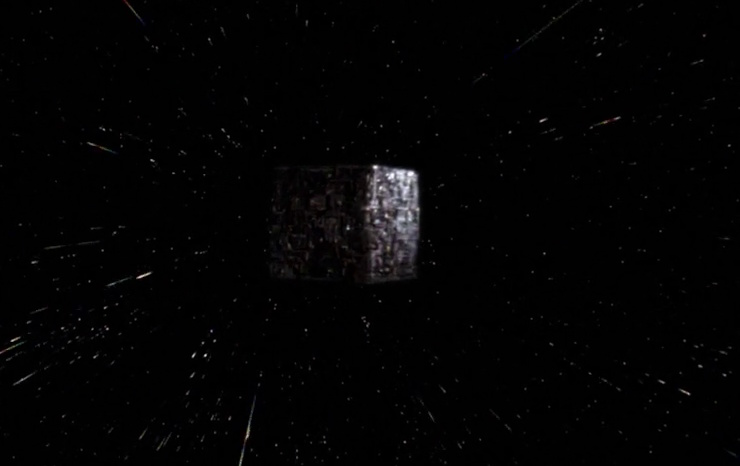
Star Trek: Discovery Season 3 – what is the Burn?

Spoiler Warning: There are spoilers ahead for Star Trek: Discovery, including the two Season 3 trailers and the ending of Season 2. There are also spoilers for Star Trek: Picard Season 1 and other iterations of the franchise.

The most recent trailer for Star Trek: Discovery’s imminent third season dropped a bombshell: the Federation has mostly collapsed! In my breakdown of the trailer I covered my thoughts on that story premise, so we won’t get into the ins and outs of it again today. Instead, we’re going to look at the event that triggered this collapse and postulate a few theories as to what it could be! As always with any fan theories (mine or someone else’s) please take all of this with a grain of salt. No fan theory is worth getting worked up over!

Discovery has a new trailer… and a new logo!

All we really know for certain is that the event in question is called “the Burn.” Booker, the new character who’s native to this time period, tells Michael Burnham that the event was when “the galaxy took a hard left.” And that’s all the explanation the trailer gave us. However, some images and scenes from the trailer add context to this, so we should run through some of them briefly.

Firstly, we had one very short scene of an explosion aboard a starship or space station that appeared to blow a number of people out into space. This could be a flashback to the Burn, but as I noted when I looked at the trailer, it could also be something happening after Discovery’s arrival in the future. Even if it is taking place during the Burn, however, all we can gleam from this scene is that it was a violent event – which may mean it took place over a relatively short span of time.

This violent event glimpsed in the trailer could be the Burn.

Next we have two glimmers of hope: a futuristic starship, space station, or facility which Saru and Burnham visit at some point, and a black-uniformed woman who I suspect may be a Starfleet officer.

Is this character a Starfleet officer?

The woman’s uniform was at least a little reminiscent of the uniforms used to depict 29th Century Starfleet seen in the Voyager fifth season episode Relativity. The texture and pattern used for the dark upper part of her uniform reminded me of that episode, and I’m sure that must have been intentional!

Captain Braxton wearing the 29th Century Starfleet uniform.

If this woman in Starfleet, it lends credence to the idea that the facility mentioned above could be a Federation vessel or even a Starbase. Add into the mix Booker’s line that the Federation “mostly” collapsed following the Burn, and I think we can make a solid case for Starfleet being around in some form; last time I called this remaining faction “rump Starfleet.”

The final thing to look at from the trailer are the scenes set in its aftermath. Away from the woman in uniform and the futuristic facility we see what could be a shanty town or post-apocalyptic markeplace as an Orion or other green-skinned alien guides Burnham. One possible implication from this scene is that we’re seeing how the majority of people in the collapsed Federation live. In the aftermath of the cataclysm, they may all be reduced to this kind of hand-to-mouth existence.

The possible shanty town.

On the flip side, we have seen settings like this in other iterations of Star Trek, even on human-populated worlds. One that springs to mind is Turkana IV, the birthplace of Tasha Yar in The Next Generation. Described as a “failed Earth colony”, the planet was in a state of disarray in the 24th Century. In short, the existence of a shanty town like the one depicted above may not mean that everyone in the 32nd Century lives that way.

The reason I brought up Turkana IV and the like is to demonstrate that the Federation, even in the eras we’re familiar with, wasn’t always perfect and wasn’t one homogeneous bloc. Just as there seems to be a great contrast between the sleek facility and the shanty town in the 32nd Century, so too is there a contrast between different locations in the 23rd and 24th Centuries. I wonder if Discovery plans to use this dichotomy to make a point about wealth inequality.

The facility visited by Burnham and Saru.

One final point of note is that, when discussing the Burn, Booker referred to it as when “the galaxy” took a hard left. Let’s be clear about that – the galaxy as a whole, not merely the Federation. That was a deliberate choice of words, and I think what we can infer is that the effects of the Burn extend far beyond the borders of the Federation.

It’s possible that the Burn didn’t affect literally the entire galaxy; some regions and worlds may have escaped. Booker may have used the word “galaxy” in this context to mean something that impacted more than just one region and that went beyond the Federation’s borders. Even if that’s the case, we’re still dealing with what is arguably the biggest disaster we’ve ever seen in Star Trek.

Booker is the one who told us about the Burn.

That’s all we know from the trailer. It’s unclear how many people survived the Burn. Some disasters destroy infrastructure and technology, but leave organic lives intact, whereas others cause massive loss of life. There are clearly some survivors of the Burn, but how many is simply unknown right now. It’s highly likely that in the aftermath of such a catastrophe, more lives would be lost due to things like disease and starvation – especially if the Burn triggered the kind of collapse we seem to be seeing. The scene in the shanty town or junkyard seemed to show people barely surviving, living a hand-to-mouth existence without much of the familiar technology we’re used to in Star Trek. Such a loss of technology could cause even more deaths in the months and years following the Burn than the event itself.

This character could be some kind of warlord or faction leader.

We’ve seen at least one anti-Starfleet faction, which in the first trailer appeared to comprise of Andorians, Lurians, Cardassians, and humans. We also met a character in the second trailer who could be the leader of a faction or perhaps a warlord. I think this shows how, in the aftermath of the Burn, the survivors banded together into smaller groups. As with the number of survivors, we don’t know how many of these groups exist or what their relationships are with one another.

This group appear to be antagonists; opposed to the Federation.

We also don’t know for sure whether faster-than-light travel, warp speed, and time travel are still possible in this era, or whether the Burn caused such a catastrophic collapse in the Federation – possibly combined with damage to the galaxy and spacetime and/or subspace in general – that such things are no longer possible. We saw in the second trailer the USS Discovery using its spore drive, so at least travel via the mycelial network remains viable. But everything else is unclear, and if it were to be the case that warp speed and faster-than-light travel are impossible, the fractured Federation will be very difficult to bring back together.

There’s also the question of timing. When did the Burn take place? We’ve already made one assumption – that it was a relatively fast event, perhaps taking place over less than a year – but when it happened relative to Burnham and the USS Discovery’s arrival in the year 3188 is not known. I wrote last time that the furthest forward in time Star Trek has previously gone in canon is the 31st Century. However, in both stories which took place in that era the dating was very vague, and we only have terms like “years” and “centuries” to go on rather than something more precise. As a result, Discovery’s third season could be anywhere from 90 years ahead of what we saw in Enterprise and Voyager all the way to 180 years ahead of those stories. Picking a halfway point, and saying that Discovery takes place 130-140 years further on from anything we’ve ever seen still gives a huge amount of time for the Burn to have taken place.

A backup copy of The Doctor was reactivated in the Delta Quadrant in the 31st Century.

Based on the warlord/faction leader seen above, and the scene set in the shanty town/junkyard, I’m assuming it wasn’t recent. It certainly didn’t look like something that had only just happened in those scenes; the faction leader in particular seems confident in his position. Booker also didn’t appear to be speaking about something very recent when discussing the Burn; he almost seemed to be recalling history. I also noted something from the Star Trek Day panel: showrunner Michelle Paradise stated that characters like Booker had been “born” into this new future. While she could have meant simply that Booker was born in the 32nd Century, in the context of a discussion about the new season’s setting it could also mean that the Burn took place decades previously; before Booker was even born.

Did Michelle Paradise drop a hint at the timing of the Burn?

So it’s clear that at this stage we’re missing a lot of information! We don’t know when the Burn happened. We don’t know what effect it had other than the near collapse of the Federation. We don’t know how many casualties were directly and indirectly caused, or how many survivors remain.

Perhaps most importantly, we don’t know what the Burn is or what caused it. Fixing a problem requires understanding what the problem is and why it happened, so it will be absolutely essential for Burnham and the crew to figure this out. Even though we have practically no evidence to go on, I do have a few ideas! Let’s look at them in turn.

Possible cause #1: The super-synths from Star Trek: Picard

I’ve already written up this theory in more detail, and you can find that article by clicking or tapping here. But now that we know a little more about the Burn thanks to the new trailer, I was pleased in a way that it hasn’t been debunked already! Star Trek: Picard introduced us to an unnamed race of super-synths that I nicknamed the “Mass Effect Reapers” due to their similarities to that video game faction.

The “Mass Effect Reapers” left behind a beacon on the planet of Aia, explaining that synthetic life is under threat from organic life, and promising to come to the aid of any synths who ask for their help. The Zhat Vash – a secretive Romulan faction – found the beacon and interpreted it as something apocalyptic; they believed that if synthetic life were ever created, the “Mass Effect Reapers” would exterminate all organic life in the galaxy.

The Reapers, from the Mass Effect video game trilogy, are similar in some respects to the faction of super-synths in Star Trek: Picard.

During the events of the season finale, Soji and Sutra constructed a beacon to contact the “Mass Effect Reapers”, and opened a portal to the location in deep space where they reside. After being convinced by Picard – and the timely arrival of a Starfleet armada led by Riker – Soji closed the portal and shut down the beacon. The “Mass Effect Reapers” never arrived – but they are now aware of a race of synths in the Milky Way galaxy, as well as being aware of the existence of the Romulans and the Federation.

From the point of view of this race of super-synths, here’s what they saw: a race of synths who found their beacon called on them for help, and when the portal was opened they saw a handful of synths on a planet with two massive fleets of starships populated by organics. Then, with no explanation, the portal was closed. If I were them, I would have major concerns!

Picard talked Soji into closing the portal – but the “Mass Effect Reapers” probably don’t know that.

We know hardly anything about the “Mass Effect Reapers” – which in itself makes them a good candidate for Discovery’s writers to play with – including how far away from the Federation they are. If they decided that they needed to intervene on behalf of the Coppelius synths, it could have taken them centuries to travel to the Milky Way from wherever they’re based.

When they finally did arrive, they would have likely found Coppelius abandoned, as I feel certain the safest thing to do for the synths who live there would be to relocate them to a new home where the Romulans can’t touch them. Again, from the “Mass Effect Reapers” perspective, the last thing they saw was two massive fleets in orbit of this planet that asked for their help, and when they arrived, the synths who asked for that help were gone. Put two and two together and it’s not hard to imagine they would assume the organics wiped out the synths. If they were minded toward revenge, they could go on the rampage, using their superior technology to destroy the Federation and Romulans in an event that would become known as the Burn.

These two fleets – one Romulan, one Federation – were the last thing the “Mass Effect Reapers” saw before the portal closed.

From the production side of things, this theory brings together the two live-action series currently in production, which is something that hasn’t happened yet. I’ve written many times that modern Star Trek shows being split up in this way isn’t a good idea, and finding ways to bring them together will be important to the franchise going forward. Having this faction from Picard also be important in Discovery – as well as the events of one series directly leading to events in the other – would bind the two shows together and strengthen the franchise.

Possible cause #2: Michael and/or Gabrielle Burnham

The Burnhams.

I can’t be the only one who noticed that the “Burn” happens to be three letters different from “Burnham”, can I? While it may seem absolutely preposterous to assume that Burnham or her mother somehow caused this galaxy-wide calamity, there are some points we could argue are in its favour.

Gabrielle Burnham, Michael’s mother, was the original Red Angel in Discovery Season 2. At several points in the story she intervened, including to save Burnham’s life and Spock’s life in their youth, as well as ensuring that the USS Discovery would be on hand to save the data from the “Sphere” – the planetoid-sized lifeform whose data was vital to the Control AI. Gabrielle Burnham was tied to a point in the future around the same time as Season 3 is set and returned there after her many visits to the 23rd Century. But in both of the trailers we’ve seen, she’s nowhere to be found. Why is she missing, and could her absence have something to do with the Burn?

Where is Dr Gabrielle Burnham?

Discovery has been a series that places Michael Burnham at the centre of its stories. Burnham was the Red Angel. Burnham was the one who led the ship and crew home from the Mirror Universe and ended the Klingon War. Every story so far has been a Burnham-centric one, so it wouldn’t surprise me at all to learn she has some involvement with the Burn – an event which shares part of her name.

How could this work? There are a few possibilities, but I would say that all of them have to do with the Red Angel suit and its time travel abilities. The suit was very powerful, capable of detonating powerful “red bursts” that Starfleet could detect from thousands of light-years away. It was also capable of moving the Sphere, so the idea that it could – intentionally or otherwise – be used as a weapon or cause a natural disaster is not beyond the realm of possibility.

Could Michael Burnham be guilty of causing the Burn?

When Burnham arrived in the future, she took off the suit. But in scenes that seem to be set around the same time, she doesn’t appear to bring it with her. It’s possible she abandoned the suit at her crash site, in which case anyone could stumble upon it. It’s also possible that the suit was stolen. And finally, it’s possible that some other faction who was aware of changes to the timeline could have been waiting for Burnham’s arrival and took that opportunity to take possession of the suit.

I don’t believe Burnham or her mother would voluntarily cause the Burn. In fact I’d argue that both would go out of their way to avoid it – even putting their lives on the line to prevent it ever happening. But it could have been accidental, such as a by-product of the suit’s time travel abilities. Or they could have done something while under duress – perhaps it was the least bad option if they were given a choice between the Burn and something far worse.

One thing is for sure, though. If it was Burnham’s fault, calling the event “the Burn” sounds way better than calling it “the Ham!”

Possible cause #3: The Borg

We haven’t had a Borg story in Star Trek since Enterprise’s second season way back in 2003. For a time it seemed as if Discovery’s second season was setting up a Borg origin story with the Control AI, but for whatever reason that didn’t pan out. We could still see the Borg in Discovery, though, if they turn out to be the nefarious villains who caused the Burn.

Booker said that the Burn affected the whole galaxy, and if that’s literally true perhaps it impacted the Borg as well. But it could be that the Borg either are the Burn or are the cause of it, striking out in all directions from their Delta Quadrant home and attacking multiple areas of the galaxy simultaneously.

A Borg drone seen in The Next Generation.

Though it was implied, perhaps, that the Burn was a relatively short event, it could be that it was a war. Even a year-long conflict against the Borg on all fronts could have seen the Federation on the verge of collapse, and we could be looking at the aftermath of a Pyrrhic victory, one in which the Federation and their allies were only able to defeat the Borg at a catastrophic cost to themselves.

How exactly this would work is unclear, but perhaps the Federation used a weapon of last resort that not only destroyed the Borg but also crippled themselves in the process. We’ve seen this kind of story in science fiction before, and the idea that the Federation’s collapse is in part the Federation’s fault is an interesting one. Alex Kurtzman said that the Federation’s collapse wasn’t due to infighting but was something external – and a Borg invasion is definitely an external threat.

Borg drones from First Contact.

When considering an event that has the potential to impact not only planets and star systems but Starbases and fleets of ships, a large-scale war is one of the few possibilities that I can think of. We’re talking about devastation across not only the whole Federation but far beyond its borders too, meaning the Burn has to be something immense in scope. A massive invasion could be such an event, and I can’t think of any known faction in Star Trek able to pull off something like that other than the Borg.

By their later appearances in Voyager, I think it’s not unfair to say that the Borg were becoming stale. Having seen our heroes prevail against them time and again, they definitely needed a rest. Enterprise, while it added an extra complication to the history of Borg-human contact, managed to tell an exciting and tense story, but I think it’s to the franchise’s overall benefit that the faction then took a break. However, seventeen years is a decent length of time for such a break, so could we be on the verge of seeing the Borg make a comeback?

Possible cause #4: Time travel and the Temporal Cold War

Oh no! Alien Nazis!

Star Trek stories that took place in the 29th Century and beyond depicted time travel as something the Federation routinely engages in, despite it seemingly being prohibited by the 24th Century. Preserving the timeline intact is something Starfleet of this era seems to have been concerned with, but there were other factions opposed to the Federation who made attempts to use time as a weapon.

In Enterprise we saw a Temporal Cold War play out, with several different factions all vying for control of the timeline. The mechanics of this were vague – deliberately – but by the 31st Century, which is the home era of temporal agent Daniels, the Temporal Cold War was a major issue.

Daniels was a temporal agent who made multiple appearances in Enterprise.

As I mentioned when I looked at the trailer, one issue I can see coming up if Discovery goes headfirst into another time travel story is the question of why the Federation didn’t see the Burn coming. If they explore the timeline in the same way that the 24th Century Starfleet explore space, surely they look at the future timeline too, not just the past. If they do, they should have foreseen the Burn, right?

The problem with that assumption is that time travel muddies the waters. Even in a perfect world where Star Trek had always been consistent in its depiction of the rules and laws governing time travel (which it hasn’t been at all), the concept itself still generates all manner of possibilities, loops, and paradoxes. Part of the Temporal Cold War story arc involved factions travelling to the past to attempt to undermine their adversaries before they could even develop time travel – knocking them out of the war entirely. If someone were able to travel to a point in the timeline that the Federation could not observe, or were able to operate outside of normal spacetime, the Burn could have been triggered before the Federation even knew it was coming.

The USS Relativity was a 29th Century Federation timeship.

I’d like to pick one more hole in a time travel story. If the cause of the Burn is related to time travel, it’s arguable from the perspective of Starfleet that the timeline in which it occurred is not the “real” timeline. Logically they’d want to work to undo it, and if successful it would remove this timeline – and thus Discovery Season 3 – from existence. We have seen stories in Star Trek that “never happened” for reasons of time travel, but they were single episodes, not entire seasons, and I would make the case that having an entire season’s story arc being effectively wiped out of existence wouldn’t be the best way to go.

Possible cause #5: Something related to coronal mass ejections and stars

One frame of the trailer showed Tilly, Stamets, and Reno with the woman shown above who may be a 32nd Century Starfleet officer. On the display at the console where Tilly and Stamets were standing, it was possible to make out the words “CME Detected” and “coronal mass ejection [something] magnitude.”

The frame from the trailer, cropped and mirrored for clarity.

A coronal mass ejection, or CME, is a real-world phenomenon. I’m not a scientist, but as I understand it, a CME is where a small portion of a star’s plasma is shot into space. The phenomenon is associated with sunspots and solar flares, and can cause damage to technology like phone and power lines.

There is no known way to trigger a CME or for them to occur naturally on a galaxy-wide scale. But as we leave the real world behind and head into the realm of science fiction, either of those possibilities could exist.

A real-life coronal mass ejection that occurred in 2012. The blacked-out circle in the centre is the sun.
Picture Credit: NASA via WikiMedia Commons

“The Burn” is a very evocative name, drawing on a primal fear of fire. But it could be more than just a moniker adopted by survivors of the event: it could describe the event itself, and when a star undergoes a CME it’s literally shooting burning plasma into space – space fire. The Burn could be the very literal burning of spacecraft, planets, and even whole solar systems by some kind of massive wave of coronal mass ejections.

The interesting prospect this raises is that the Burn wouldn’t require an evil villain; it could be an entirely natural occurrence. How and why millions of stars all suffered the same fate is unclear, but it would change the dynamic of the story from one that requires the crew to defeat an adversary to one which requires scientific investigation – something which is arguably at the heart of Starfleet.

The USS Discovery could engage in a scientific expedition to determine the cause of the Burn.

Equally, even if the Burn refers to a tsunami of CMEs, there could be a cause. It could even be one of the four we’ve already listed: the Borg, the Burnhams, a time travelling faction, or the super-synths from Picard. Any of these could have intentionally or accidentally triggered some event that led to millions of stars all undergoing CMEs.

The next part of this gets very deep into lore, so it’s perhaps less likely, but I like to include these things because c’mon… we’re Trekkies. It’s what we do!

Whether the Burn is natural or artificial in origin, if it’s something which causes stars to undergo massive CMEs it could also be something which triggers supernovae. And there has been one recent supernova that had a massive impact on the Star Trek galaxy: the Romulan supernova. First shown in 2009’s Star Trek, the supernova appeared to move faster-than-light and destroyed the Romulan homeworld. Spock was able to stop it by using Red Matter, but the supernova would have a lasting impact, part of which was seen earlier this year in Picard.

A supernova destroyed Romulus in 2009’s Star Trek.

Though it may seem a long-shot, tying the Burn to the Romulan supernova would bring together several different Star Trek stories in a very neat way, which is important for reasons I’ve already outlined. If the Burn is natural in origin, the Romulan supernova may have been a precursor to it. And if it’s artificial in origin, the Romulan supernova may have been a preliminary test of whatever weapon caused the Burn.

So that’s it. A look at what the Burn could be as well as some possible triggers and causes. Though the existence of the Burn poses a big challenge for Discovery – as it fundamentally changes the underlying premise of Star Trek’s optimistic future – I’m absolutely fascinated by it. What is it? What caused it? When did it happen? Why did no one intervene to stop it? There are so many questions rattling around in my head, and this article has barely scratched the surface!

I am at least a little concerned about Star Trek: Discovery choosing a post-apocalyptic setting. But at the same time the series has been great so far, especially in Season 2, and I would love to see it build on what was accomplished last year to tell a fascinating and engaging story. The Burn is going to be part of that. Figuring it out and perhaps even working to stop it could be important story elements, and I’m absolutely fascinated to learn whether any of these ideas even come close!

Figuring out what could have caused such devastation is genuinely interesting.

As I mentioned at the beginning, these are just fan theories and speculation. I don’t have any insider information – and if I did I wouldn’t share it! Several recent shows and films have suffered backlash from fans who got a little too attached to certain pet theories, and as fun as theory-crafting is, I don’t want that to be the case here. This is a bit of fun and a chance to spend more time thinking about Star Trek, and that’s all. I want to know what happens, and if it’s something I didn’t expect then that’s fantastic!

When Discovery Season 3 kicks off in mid-October, I hope you’ll join me for episode reviews and perhaps even more theory-crafting!

Star Trek: Discovery Season 3 premieres on the 15th of October on CBS All Access in the United States, and on the 16th of October on Netflix in the United Kingdom and elsewhere. The Star Trek franchise – including Discovery and all other titles mentioned above – is the copyright of ViacomCBS. This article contains the thoughts and opinions of one person only and is not intended to cause any offence.
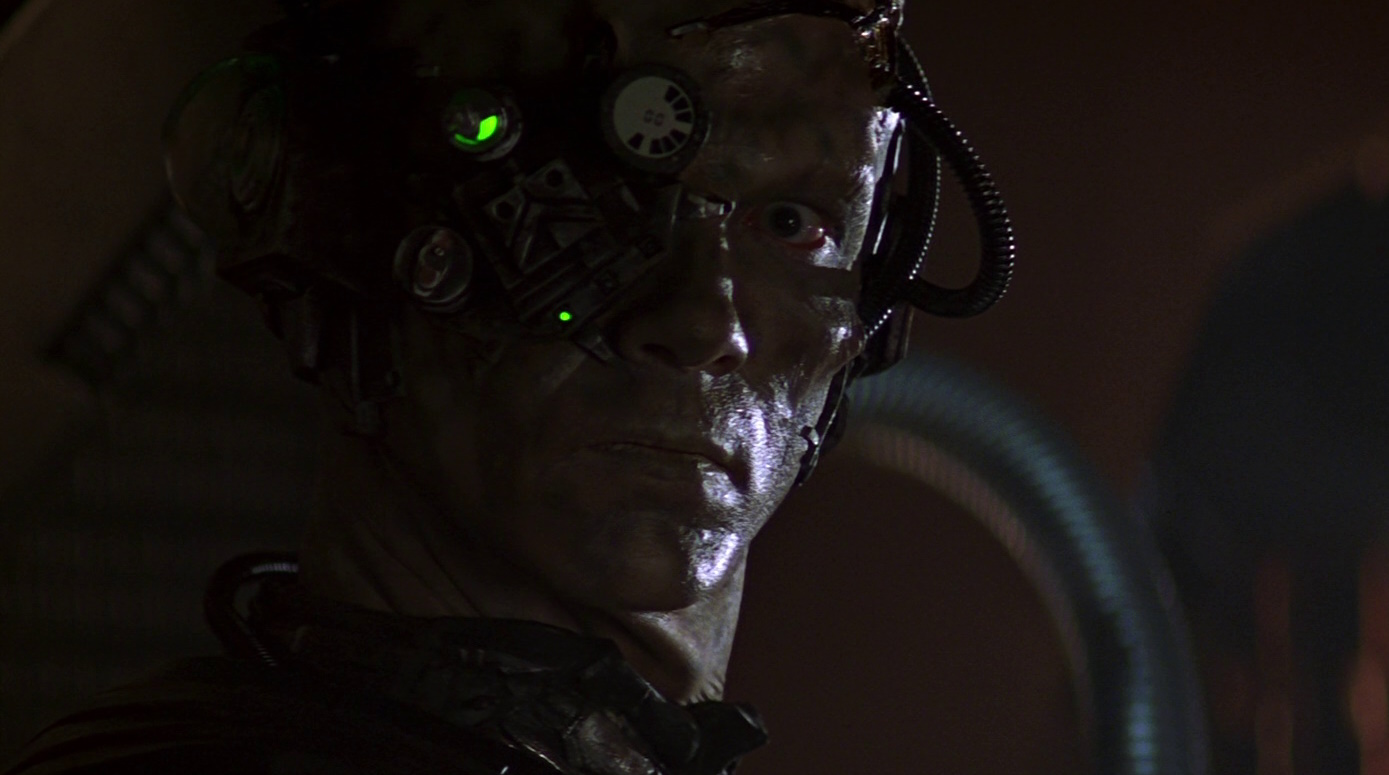
The Borg: Space Zombies

Spoiler Warning: There are spoilers ahead for the Star Trek franchise, including Star Trek: Discovery Season 2 and the first three episodes of Star Trek: Picard.

As part of a series of articles I wrote leading up to the release of Star Trek: Picard, I covered the Borg from an in-universe perspective, as well as looking at some possible options for their role in the new series. You can read that article by clicking or tapping here. While Star Trek: Picard remains a mysterious show even now that we’re three episodes in, the Borg’s role has been somewhat on the sidelines so far, as we’ve really only seen a few former Borg and the disabled Borg cube used as a setting.

For a while I’ve been wanting to look at the Borg from a storytelling perspective, because I think they’re one of Star Trek’s most interesting villains. Not only that, but they have an analogue outside of the franchise which we can compare them to – zombies. Both the Borg and zombies fill a similar role in the stories they appear in, and both can fall victim to the same storytelling pitfalls.

Let’s start with the most obvious comparison – and why both the Borg and zombies are a frightening adversary for any heroes to be pitted against. With the exception of the Borg’s first appearance in The Next Generation’s second season episode Q Who, the Borg’s sole purpose has been assimilation. By forcibly injecting their nano-technology into both machines and living organisms, practically anything they touch can become part of the Borg Collective in a matter of moments. Zombies are a low-tech, biological version – in almost every zombie story, the zombie infection spreads through biting. Thus both Borg and zombies don’t just kill, they turn everyone the heroes lose into another enemy to fight. And the infection or invasion can never be truly over until every last individual is defeated, because if even one Borg drone or one zombie remains, there’s the possibility for them to attack others and start all over again.

The Borg take on a similar role in some respects to zombies – such as those in The Walking Dead.

This one factor – that every friend lost doesn’t just reduce the numbers on the heroes’ side, but increases the number of enemies to fight – is huge. It means that a story featuring a Borg or zombie attack is completely different in tone and scope from any other war or invasion or battle that we might see in science fiction. And it’s a frightening prospect, seeing allies quite literally turned into enemies before the very eyes of the heroes. In fact, it’s arguable that the Borg’s appearances are as close as Star Trek as come to crossing over into the horror genre. The underlying premise, certainly, would be at home there. And if ViacomCBS ever chose to go down that route, it wouldn’t be hard to imagine a Borg-themed horror film or series.

One of the great things about entertainment and storytelling is that it’s subjective. The audience can interpret themes and points in a story in different ways, and anyone who’s ever taken a literature class can attest that! When I was in school and in the few literature classes I took at university, my teachers were always talking about analogies and themes and metaphors. And when it comes to the Borg, there are different interpretations as to a real-world analogue.

One of the most obvious is communism. Despite what’s often been said, Star Trek doesn’t really depict a “communist utopia”. The economy of the 23rd and 24th Centuries has always been deliberately ambiguous, and really I think it’s fairer to describe it as a post-scarcity economy, thanks in large part to technologies like food replicators and interstellar travel. Humans in Star Trek can still, for example, own and inherit property – like we see Joseph Sisko and the Picard family do – something which indicates that we’re not looking at communism. But that’s rather beside the point. The Borg, to get back on topic, with their lack of individuality and aggressively expansionist mindset, are arguably a metaphor for Western fears of communist states during the latter part of the Cold War. The history of Star Trek is littered with Cold War metaphors, and at the time the Borg were created and debuted on screen in 1989, the Berlin Wall hadn’t yet fallen and the Soviet Union was still the world’s “other” superpower.

Since the concept of the “walking dead” came to mainstream attention in the 1960s, critics have said the same thing about zombies, too – that they’re a metaphor for America’s communist adversaries. The comparison plays on a crude stereotype – that all people in a communist state are brainwashed and forced to do the state’s bidding. However, my intention isn’t to critique the concept, merely to acknowledge its existence. In a very real sense, part of what makes zombies and the Borg so frightening is the idea of losing oneself, and suffering “a fate worse than death”. For many in the Cold War era, ideas like communist infiltrators and brainwashed citizens returning from overseas – including former prisoners of war – were genuine concerns, if somewhat overstated and exaggerated.

Picard’s transformation into Locutus of Borg was shocking.

It’s those underlying real-world fears that give power to the Borg when they appear. They wouldn’t be so scary if it weren’t for a shared fear we have of losing our identity – stoked by fears from the Cold War era, perhaps, but just as relevant today in the age of radicalisation via social media. How many young men – and it is almost always young men – have been involved in mass shootings or terrorist attacks after being radicalised online? The concept of brainwashing – and our collective fear of it – is still very much alive in society today. The emphasis has shifted from the state to individuals, perhaps, but the basic fear remains the same. And it continues to make villains like the Borg intimidating.

When it comes to turning that into an exciting, heart-stopping story, though, it’s all too easy to fall flat. What we’ve seen in Star Trek, especially in Star Trek: Voyager, is the overuse of the Borg. The same thing has happened to the zombies in The Walking Dead, and can happen to other villains in other series too – the Daleks from Doctor Who come to mind as another example of overuse. The fundamental problem with having the heroes outsmart and defeat the same villain too many times is that they simply lose their fear factor – no matter how powerful it may once have been and what underlying social factors are propping it up.

Every victory over the same opponent adds to a feeling that victory for the heroes is inevitable. And in many cases, we know that. Even in a series like Game of Thrones, which could be utterly unpredictable, nobody was genuinely expecting that the Night King would be victorious – we all knew that somehow, some of the heroes would survive and find a way to win. That didn’t make the story any less exciting, and nor is Star Trek: First Contact any less exciting for first-time viewers who expect Picard and his crew to find a way to defeat the Borg. The tension and drama comes on a moment-to-moment basis, and also, as in many stories, part of the enjoyment comes from the journey even if the overall destination – victory, in this case – is known.

But when the same scenario plays out over and over again – a scrappy Starfleet crew faces off against impossible odds and beats the Borg, for example – it gets less and less tense and less and less dramatic with each new revision. When we see the Borg lose to Janeway for the fourth or fifth time having already seen them bested twice by Picard, they become stale, and the stories in which they appear become uninteresting.

The addition of the Borg Queen is symptomatic of this. After several prior Borg stories, and with their first big-screen appearance looming, there must have been some discussion about how to make the Borg intimidating again. It wasn’t enough to have this faceless mass any more, the Borg needed something new in order to fit the bill as big-screen villains. Part of that stems from the need to keep the story cinematic; to have those moments where Picard is traumatised by his memories of the Borg Queen, to have Data tempted and taunted by her in a way a nameless drone couldn’t, and to be able to have dialogue between heroes and villains which is often a tense yet satisfying part of storytelling in and of itself. But a significant part of the Borg Queen’s role in First Contact and subsequently has been to rejuvenate the Borg as a faction from a storytelling perspective.

The Borg Queen in First Contact.

Telling unique and different Borg stories has become as much of a problem for Star Trek as making the zombies scary again is for The Walking Dead. Unlike that series – which I’d absolutely argue had a natural lifespan (forgive the pun) of about four seasons and should have ended at that point – Star Trek has a much richer galaxy to explore and plenty of other villains to play with. The Borg are not essential to Star Trek in the way that zombies are to zombie stories – and that’s definitely been a saving grace.

With the exception of the Star Trek: Enterprise episode Regeneration in 2003, there hadn’t been any Borg stories in Star Trek since Voyager’s finale in 2001 – and none which were set further forward in the Star Trek timeline. After an absence of close to two decades, then, there’s an argument to be made that enough time has passed for a renewed look at the Borg. For new fans and younger fans who didn’t see every single appearance in order, and for more casual viewers who may not have seen any Star Trek episode or film since the turn of the millennium, that’s probably a fair point. But even then, because the Borg are essentially “space zombies”, in an era where zombie stories have become a television and cinematic genre in their own right with dozens of examples, perhaps we’re still burnt out.

Here’s where the Borg’s trump card comes into play – they aren’t just a metaphor for our fears of communism or brainwashing. Because of their technological nature, they can absolutely be an analogy for our overreliance on technology and for our fears of the evolution of technology in the future. This is what Star Trek: Discovery’s second season did, very successfully in my opinion, with the Control AI. Now I’m absolutely convinced that Control was meant to tie in somehow to the Borg and their origins when the story was originally written. Why that angle was scrapped (if indeed it has been wholly scrapped) is unclear, but it could be related to the Borg being an integral part of the story of Star Trek: Picard. That’s my current theory on that, at any rate.

The whole point of the Control storyline in Discovery was that artificial intelligence might not be a good thing to pursue. When an AI surpasses humanity in its abilities, it becomes inherently unpredictable. It can overwrite its own programming and could turn on us. This isn’t just a science fiction story trope – scientists like Stephen Hawking have expressed genuine concern that an AI could ultimately be harmful. Technological progress has advanced so rapidly from even when The Next Generation was first on the air and computers were basically glorified calculators and typewriters to the modern day where everyone has an internet-enabled super-smart camera-and-microphone connected-to-everything always-on computer-phone about their person 24/7. Those changes have, thus far at least, been a net positive for humanity. In Africa, for example, the rise of mobile phones has meant many of the world’s poorest citizens have access to the internet and information, as well as the ability to send and receive money securely without relying on banking. But with change comes fear, or at least a sense of uncertainty. Discovery played on those fears and concerns about the pace of technological change quite expertly.

The nanobots Control used to “assimilate” Capt. Leland are reminiscent of Borg technology, and play on the same fears of out-of-control AI.

The decision to have Control be an invention of Section 31 was another masterstroke. Since Edward Snowden and Julian Assange (and many others, of course) have demonstrated to the world that major governmental organisations run hidden technological surveillance on, well, everyone, mistrust of technology and technological communication has only grown. The idea that we’re all being watched all the time by “big brother” in the various three-letter agencies, and their international equivalents, has caused a lot of people to be incredibly uneasy about technology in general. Once again, Discovery tapped into this to great effect.

To get back to the Borg, regardless of whether or not Control was meant to be related to them in some way, the same principle is at work. The relentless march of technology could see us literally plugging ourselves into some giant network of machines, or augmenting our bodies with technological upgrades. In a sense, we already do. Our phones and computers are arguably an extension of ourselves, we’re almost constantly networked to billions of others via the internet, with all of their experiences and information only a few keystrokes away, and as medical science advances we’re able to replace defective body parts – like hips, for example – with synthetic replacements. The Borg are simply a few steps further along from we currently are in their embrace of technology.

For many people, the unstoppable march of technology is something they find intimidating. It means that the future is always changing – and people in general have an inbuilt mistrust or fear of change. Thus the Borg stand out in stories that feature them as a kind of nightmarish vision of a future gone wrong.

By playing on these two deep-rooted, almost instinctive fears, the Borg are truly a frightening opponent for the heroes in Star Trek stories to face.

Keeping that fear alive is a task for the new creators of Star Trek. In Discovery, Control hit the reset button by showing us at least a potential precursor to the Borg we’ve seen before. Enterprise threw 24th Century Borg against a 22nd Century crew – not that it was always apparent, but that was part of the goal of that episode. And finally, in Picard we have the Borg absent from their own setting – a derelict cube being slowly picked apart and studied. There’s an inherent creepiness to the aesthetic of the cube – a kind of cold, inhuman feel, amplified by the lack of windows and endless maze of identical rooms and corridors. If the showrunners wanted to play up that aspect they absolutely could, and it will be interesting to see where Picard takes this angle.

What has to be avoided, however, is the trap that ensnared Voyager’s Borg episodes. Repetition leads to a loss of that fear factor, and without it the Borg become stale and boring – it would be better to see the faction utterly defeated in a climactic battle than to have them crop up again and again in random episodes over several seasons. The serialised nature of current Star Trek storytelling, which has replaced the episodic, “monster-of-the-week” format, means that we’re less likely to see individual Borg-centric episodes any more. And that’s probably a good thing overall – despite my personal preference for episodic storytelling in Star Trek.

The episode Q Who introduced the Borg for the first time.

At the end of the day, the question for the Star Trek franchise and its new creative team is what to do with the Borg in future. We saw what I’m certain was an abortive attempt to show some kind of origin story in Discovery’s second season, and now in Picard we have the creepy abandoned cube as a setting, as well as the return of Seven of Nine and Hugh as liberated ex-Borg. Both of these approaches are different, and that’s good. As great as The Best of Both Worlds and First Contact were, those stories were lightning in a bottle – not something that can be recaptured or repeated, at least not to the same effect. And the way stories approach and treat the Borg will have to change if they’re to be as intimidating as we want them to be. That doesn’t mean the Borg have to change in their core outlook or philosophy; doing so would mean they’re no longer the villain we remember, after all. But it does mean they have to be written in a different way and that their inclusion in future Star Trek stories has to be very carefully considered.

In a sense, the Borg’s greatest and most frightening aspect – their relentlessness and faceless nature – is also part of their undoing when considering their inclusion from a storytelling point of view. Because of their philosophy and the way they approach their assimilation targets, the Borg are very much a one-trick pony. They show up, either en masse or on a single vessel, overwhelm their opponents, forcibly assimilate them, and move on. They have one unwavering goal, and essentially only one method of achieving it. There are no Borg spies, no Borg generals to be outwitted, no Borg personalities to provide personal drama and conflict in a story. With the exception of the Borg Queen – who isn’t even really an exception as she is simply the face of the Borg, not a leader – the Borg operate as one entity with one goal and one approach.

The Voyager two-part episode Scorpion, which introduced Seven of Nine, took one of the most interesting looks at how the Borg’s single-mindedness can be their undoing. By presenting them with an opponent in Species 8472 who could not be assimilated, the Borg were on the back foot as the only method they had of information-gathering and conquest – they use assimilation for both purposes – did not work. This was a unique take on the Borg in Star Trek, but it had the unintended consequence of making them less intimidating as a result. As previously mentioned, any time we see a supposedly imposing villain failing in their objective, beaten and in retreat, it lessens the fear factor. As the audience, we know that they can be beaten – changing how we perceive stories. It stops being a question of “will the heroes prevail?” and instead becomes “when and/or how will they prevail?”

We need only look to Doctor Who for a case in point. Since its 2005 reboot, Doctor Who has seen its main villains, the Daleks, so thoroughly overused that they long ago became completely dull and unexciting. And two other villains, the Cybermen and Weeping Angels, have suffered from overuse too. As a result, since the latter half of Matt Smith’s tenure as the Eleventh Doctor, the show has limped along feeling played out. New villains and storylines have fallen flat – a consequence of mediocre writing – and the show is absolutely ready to go back on hiatus as there are no good ideas. It’s a lesson for Star Trek to learn, especially as production ramps up and there are multiple shows (and at least one film) all in various stages of development. Sometimes less is more. And also, when a storyline has run its course, and when a villain has done all they can reasonably do, unless there’s a new way to approach that story it’s time to put an end to it and move on.

The Borg haven’t yet reached that point. There is still space in Star Trek for new and exciting Borg stories, but they will have to be properly planned, not simply thrown in at the last minute. Like Doctor Who’s Daleks, the Borg are an iconic villain, emblematic of the franchise that spawned them. But they aren’t an infallible storytelling device that guarantees a successful film, season, or episode. And mishandled or overused, all the threat, tension, and drama they can bring will melt away leaving a bland, uninspiring film or episode behind.

The Artifact represents a new direction for Borg-related stories in Star Trek.

Between the zombies in The Walking Dead and the Daleks in Doctor Who, we have two great examples of how to mishandle and overuse villains like the Borg. Star Trek is fortunate to have such a rich history of alien races to draw on, and can hopefully avoid those pitfalls as we move into what will hopefully be the franchise’s second “golden age”.

The Borg are a frightening and compelling faction in the Star Trek universe, and there is still scope to learn more about them and see them return – in both big and small ways – in future episodes and films. And I’m looking forward to that, as well as to seeing what Picard has in store for this absolutely iconic faction. As I’ve said many times already, it’s a fantastic time to be a Star Trek fan right now. There’s just so much going on, and so much more to come. Discovery has had hits and misses, but in my opinion at least, Picard has been outstanding so far, and I’m interested to see what will come next. Surely, after the success the franchise has experienced over the last few weeks, this won’t be our last look at the 24th and early 25th Centuries – and unless something major happens to the Borg by the end of Picard’s first season, I’m sure that sooner or later we can expect to see them back once again.


The Star Trek franchise, including all films, episodes, and series mentioned above, is the copyright of ViacomCBS and Paramount Pictures. This article contains the thoughts and opinions of one person only and is not intended to cause any offence.

Factions of Star Trek: Picard part two – Borg

Spoiler Warning: There will be spoilers ahead for Star Trek, including the most recent season of Star Trek: Discovery, as well as the trailers for Star Trek: Picard.

As Star Trek: Picard gets closer, I’m continuing the series I began last time, looking at some of the factions we seem certain to encounter in the new series. We’ve already looked at the Romulans, as Star Trek: Picard will feature the franchise’s first ever Romulan main character. And today, it’s the turn of the Borg to be under the microscope!

History

There’s still a part of me that wonders if the AI named Control, featured in Star Trek: Discovery’s second season, will ultimately turn out to be connected in some way to the origins of the Borg, which thus far are shrouded in mystery. It definitely seemed for a while that the story was going to go that way, but for now we’ll have to treat it as unconfirmed at best.

The nanobots used by Control against Captain Leland are certainly reminiscent of Borg technology…

The Borg originated in the Delta Quadrant – the area of the galaxy farthest from Federation space. Due to the distances involved, the Borg had relatively few encounters with the humanity and the Federation prior to the 24th Century.

The Borg Queen claimed that the collective was developed over “thousands of centuries”, and began as any other organic humanoid species. The addition of their cybernetics came later. By the 15th Century, the Borg were known to other Delta Quadrant races, but they had only a few systems under their control. It’s implied that their technology was also much more limited, comparable to other factions at the time, though they were capable of faster-than-light travel.

Captain Janeway with Gedrin. His people, the Vaadwaur, encountered the Borg in the 15th Century.

Here’s where it gets a little messy – thanks to time travel.

In the 24th Century, as part of a plan to conquer the Federation, the Borg travelled back in time and attempted to assimilate Earth in the past: specifically in the year 2063, the year humans made first contact with the Vulcans. Though this attack was able to be thwarted thanks to the efforts of Captain Picard and the crew of the Enterprise-E, several Borg drones, as well as wreckage from their vessel, crashed on Earth, north of the Arctic Circle.

Earth scientists uncover the remains of 24th Century Borg drones – in the 22nd Century!

These Borg were uncovered over ninety years later by scientists, who inadvertently awakened the drones – and were promptly assimilated. This marked the second “first contact” between the Borg Collective and humanity. Because the drones were few in number, and only had access to a sub-light shuttle, they were ultimately defeated by the crew of the NX-01 Enterprise: but not before they sent a message to the rest of the Collective. In this time period, the Collective was still in the Delta Quadrant, and the message would take over two centuries to reach them – coinciding with the Borg’s later appearances in the 24th Century. Whether this forms a kind of “time loop” paradox, or whether the Borg would always have been interested in the Alpha Quadrant by the 24th Century is unknown.

There was no contact between the Borg and humanity after this incident, and records of it seem to have been lost – or deliberately kept hidden – by the next time humans encountered the Borg in the 24th Century. However, sometime in the 23rd Century, the El-Aurians (Guinan’s species) were attacked by the Borg, and several hundred El-Aurian refugees came to Earth – bringing with them stories of what happened to their homeworld. It was at this time that Starfleet officially began researching the Borg – though no connection was made between the El-Aurian’s conquerors and the Arctic Circle incident.

Pictured on the viewscreen of the Enterprise-B, the ships SS Robert Fox and SS Lakul were transporting El-Aurian survivors of the Borg’s attack on their homeworld when they became trapped in the Nexus.

By the mid-24th Century, some in Starfleet considered the Borg to be a myth, but two exobiologists, a married couple named Magnus and Erin Hansen, took a small exploration vessel to try to track them down. Taking their young daughter, Annika, with them, they would eventually be successful in finding the Borg, and ultimately followed them all the way to the Delta Quadrant, collecting a huge amount of information. Unfortunately they were discovered and assimilated after approximately two years. Annika Hansen would later be better known as Seven of Nine after being liberated from the Collective by Captain Janeway and the crew of the USS Voyager.

Because of the distance between the Delta Quadrant and Federation space, the Hansens’ research and knowledge of the Borg was not communicated to Starfleet. Instead, the Federation’s first “official” encounter with the Borg came when Q used his powers to deliberately throw the Enterprise-D into the path of a Borg cube – some 7,000 light-years from Federation space in System J-25. Captain Picard and the crew of the Enterprise-D attempted to make contact, and soon found themselves horribly outmatched in a fight with the Borg vessel. Q, after being begged by Picard, saved the Enterprise-D by returning it to Federation space before the Borg could assimilate the ship, but this incident prompted Starfleet to finally take the Borg threat seriously, and a task force was formed to tackle a likely Borg attack.

Magnus and Erin Hansen were the first humans to extensively study the Borg, though their knowledge was lost before it could be sent to the Federation.

The incursion the Federation feared came within a year of the J-25 incident, leaving them little time to prepare. A single Borg vessel was dispatched by the Collective, and after assimilating Captain Picard, used his tactical knowledge against the Federation, destroying almost forty ships and assimilating or killing over 11,000 people – including civilians. With such a large part of Starfleet destroyed, Earth was effectively defenceless, but after the assimilated Picard – now called Locutus of Borg – was liberated by the crew of the Enterprise-D, Data was able to use his link to the Collective’s hive mind to force all the drones aboard the vessel to regenerate – or “sleep” – which ultimately led to the vessel’s destruction.

A year or so later, Third of Five was encountered by the Federation, the sole survivor of a Borg scouting mission near Federation space. Captain Picard wanted to use him as a weapon to send a virus back to the Collective, but as his individuality reasserted itself, the drone, now named Hugh, returned to the collective voluntarily. His newfound identity, however, proved difficult for the collective to handle and Hugh, along with several other rogue Borg, would leave the Collective soon after.

The Enterprise-D makes the Federation’s first “official” encounter with the Borg.

There was then a lull in the Borg-Federation conflict lasting several years, before the Collective again sent a single cube to attempt to assimilate Earth. This ship, commanded by the Borg Queen herself, was the one which travelled back in time to 2063, possibly setting in motion the chain of events which led humanity and the Borg to encounter one another in the first place as part of a “temporal loop” paradox.

A battle took place near to Earth before this cube deployed a smaller spherical ship to travel through time, and several ships, including the Enterprise-E and the USS Defiant – which would normally be stationed at Deep Space Nine – took part in the battle. This was the Borg’s most recent attempt to directly attack Earth.

The Enterprise-E engages the Borg during the Battle of Sector 001.

After the Battle of Sector 001, the only encounters between the Federation and the Borg took place in the Delta Quadrant, where the USS Voyager was making its way home. The Borg were engaged in a losing war with a race known only by their Borg designation – Species 8472. Under the command of Captain Janeway, Voyager and her crew came to the Borg’s aid, trading their tactical knowledge of Species 8472 for safe passage through Borg space. The Collective dispatched Seven of Nine to be their representative aboard Voyager, and the crew would liberate her from the Borg when they broke the alliance.

The Species 8472 war proved incredibly costly to the Borg, and arguably set back any plans they may have had for further expansion at that time. Their space was at least 9,000 light-years across, extending beyond the range of Voyager’s sensors, and even extended to near the Beta Quadrant.

Two Borg cubes under attack by Species 8472 during the conflict between the two factions.

On one occasion the Borg attempted to recapture Seven of Nine, hoping to use her new knowledge of humanity as part of a third invasion/assimilation attempt, but this was thwarted by Voyager, who managed to again liberate Seven from the Collective. Voyager was able to use part of the Borg’s extensive transwarp network to get significantly closer to home.

This feat would be overshadowed, however, thanks to the actions of a time-travelling Admiral Janeway. In her timeline, Voyager had managed to make it back to Earth, but it had taken a long time. By travelling back to a point around seven years into Voyager’s trip through the Delta Quadrant, future Janeway was able to simultaneously get Voyager home much sooner, as well as deal a significant blow to the Collective.

A time-travelling Admiral Janeway infected the Borg – and their Queen – with a potentially devastating virus.

By outfitting Voyager with technology from the early 25th Century, the ship was easily able to overpower a number of Borg vessels, and future Janeway allowed herself to be assimilated in order to infect the Borg – and the Borg Queen herself – with a devastating virus she hoped would spread throughout the Collective.

Voyager was able to use the transwarp network to return to Earth, around 25 years before the era of Star Trek: Picard. It’s unclear what happened to the Collective after this point.

Leadership

For a long time, the Borg were assumed to be leaderless. The nature of their “hive mind” – a mechanical-telepathic link that all Borg are connected to – implied that there was no one individual leader, and that the Borg made decisions as one Collective, operating with one mind.

A Borg Queen during the Collective’s second attempt to assimilate Earth.

While this is true in some respects, the Borg Queen acts as the Collective’s leader, and is the only individual Borg – outside of those liberated by Starfleet or otherwise disconnected from the Collective – who appears to have any semblance of individuality or personality. The Queen describes herself as simply “the Borg” – and the question of whether she is truly a leader in the sense that we would understand, or whether she is in fact a personification of the Collective, is up for debate.

At least two Borg Queens have died – and it is likely that when the physical form of a Borg Queen is destroyed, a new one is created. The loss of a single Queen does not seem to significantly hamper the Collective’s efforts – so it’s at least possible that there may be multiple Queens in existence at any one time.

Technology

The Borg have assimilated thousands of species in full or in part. Their attacks seem to begin with outer colonies – as happened to the Federation – before a significant effort is launched against the homeworld of that race. While Borg efforts to attack Earth have been limited to a single vessel each time – albeit a very large vessel with thousands of drones aboard – assimilation of other races, such as those on the periphery of Borg space in the Delta Quadrant, seem to proceed with multiple ships and millions of drones.
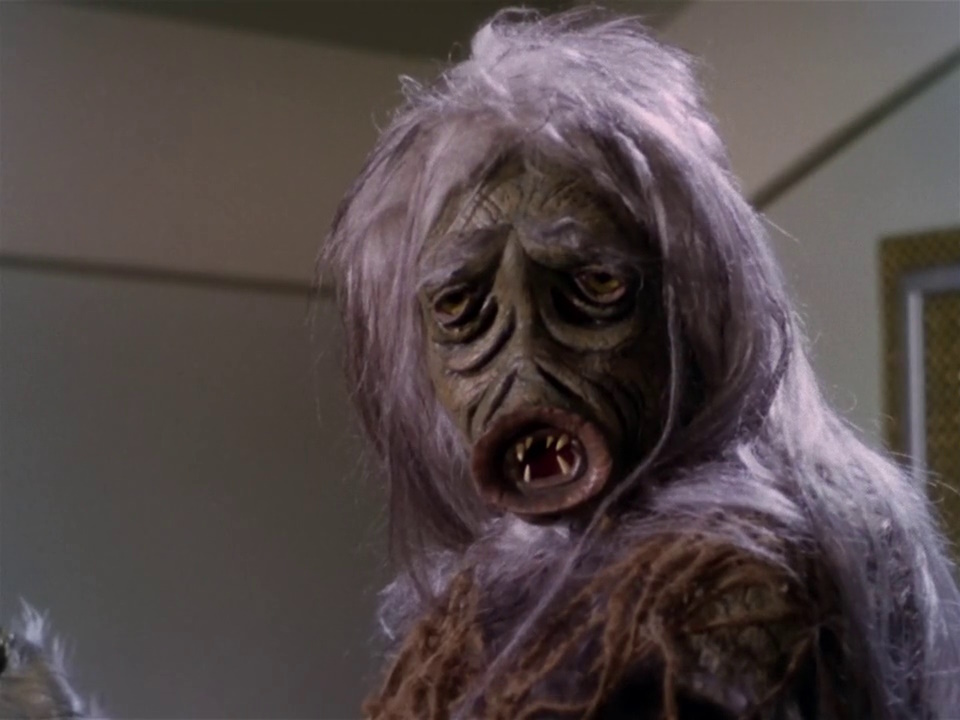
Hugh, a mid-24th Century Borg drone. Hugh was freed from the Collective – and is set to make a return in Star Trek: Picard.
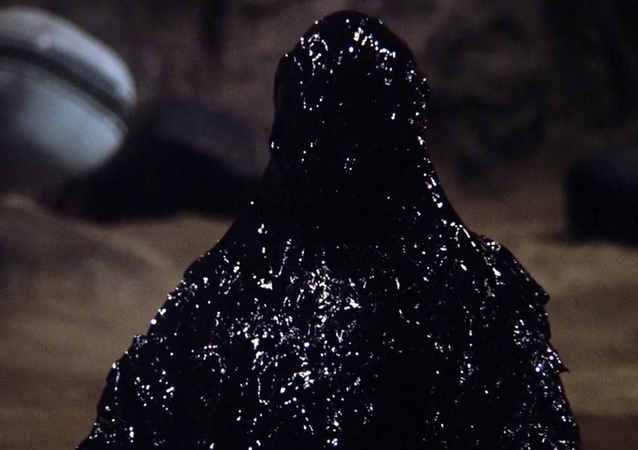
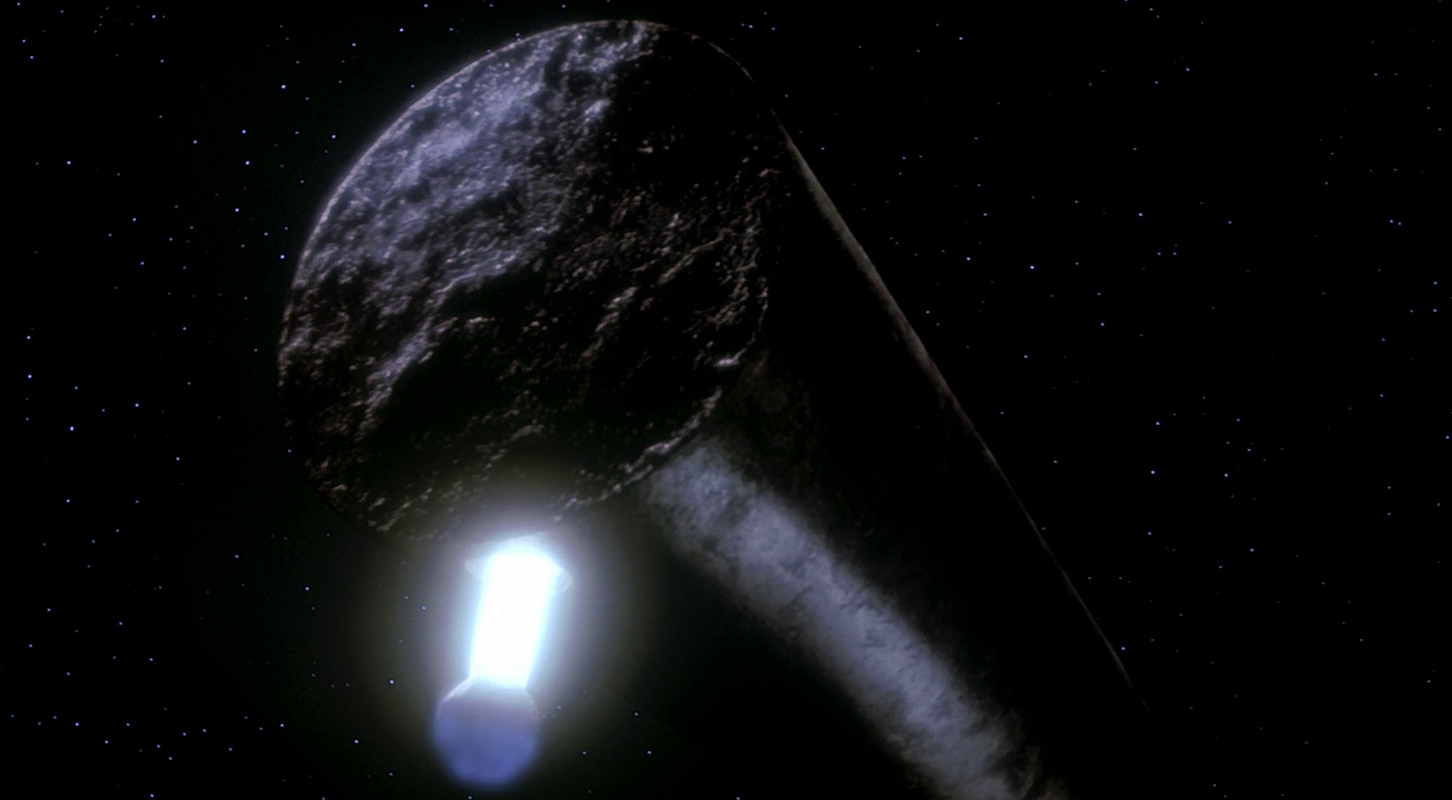
As a result of their conquests and assimilations, the Borg have gained knowledge and technological advancements which – as of the late 24th Century – outmatched and outgunned the Alpha Quadrant powers. Federation successes against the Borg came as a result of Captain Picard’s unique knowledge as someone who had spent time as part of the Collective. Voyager’s successes similarly came from Seven of Nine.

When the Borg assimilated an individual, the sum total of that person’s knowledge would be disseminated across the entire Collective. The same applied to the assimilation of starships – and presumably other technology as well. In practice this meant that if the Borg assimilated an individual with tactical knowledge – such as Picard prior to the Battle of Wolf 359 – they could use that knowledge to adapt.

One of the Borg’s distinctive cube-shaped vessels near the Paulson Nebula in the Alpha Quadrant.

Adaptations were quickly sent out to all Borg. Once they had encountered a weapon setting more than a couple of times, it would have to be altered to remain effective, and the same applied to deflectors and shields. Remodulating phasers and shields became a key tactic of the Federation during Borg engagements.

Borg communications were still limited by subspace technology, as it was noted by the crew of the NX-01 Enterprise that a message sent by Borg near Earth to their home in the Delta Quadrant would take two centuries to arrive – though this may have been related to their use of 22nd Century technology.

Society and Culture

The Borg operate as a single mind – with the aforementioned exception of the Borg Queen. As such, they don’t have what could really be termed a “culture”.

The basic tenet of Borg philosophy is that assimilation of other races brings both the Borg and the assimilated race closer to “perfection”. By merging biological and technological together, they hope to achieve their goal of “perfection”. This seems to be the basic driving force behind the Borg’s activities.

The interior of a Borg cube could hold thousands of drones – all connected to the Borg’s collective consciousness and working as one.

In a sense, an individual assimilated by the Borg can never die, as every memory and experience they had, both before and after assimilation, is stored permanently by the Collective. However, that individual loses all sense of individuality in the process, and exists only as part of the single “hive mind” of the Borg.

The Borg will assimilate anyone they perceive as useful and attack anyone they perceive as a threat. However, they will often ignore the presence of intruders if they are busy or if they don’t consider them a threat. They will assimilate children as well as adults, and the children will be placed in “maturation chambers” until they have grown enough to serve as useful drones. The Borg will also opt not to assimilate a species they perceive as useless or that they feel would detract from the “perfection” they are trying to create.

The interior of a Borg maturation chamber – with an assimilated child.

As of the mid-late 24th Century, the Borg occupied a vast expanse of the Delta Quadrant, and operated an extensive transwarp network which allowed their vessels to be present in at least the Alpha, Beta, and Delta Quadrants. No Borg activity was noted in the Gamma Quadrant, but explorations of that region of space were limited by the Dominion War. There may have been trillions or quadrillions of individual Borg drones at that time – perhaps even more than that.

Conclusion

Because of the events of the Star Trek: Voyager finale, Endgame, it’s hard to know what state the Collective is in. Admiral Janeway, travelling back in time, brought the crew of Voyager technological advantages which the Borg struggled to fight against, but more significantly she infected the Borg Queen with a virus. This virus was disseminated to other ships in the Collective. In addition, the Borg Queen’s entire complex, as well as a significant part of the Borg transwarp network and a number of Borg vessels, were destroyed by Voyager before they arrived back in the Alpha Quadrant.

As a result of these actions, as with the Romulans we simply don’t know how badly affected the Borg may have been, and how long it will have taken them to recover. Assuming they could recover from the virus, we’ve seen the Borg able to repair and rebuild their ships and technology incredibly rapidly, so in theory they could have rebuilt the entire complex and replaced the lost ships without too much hassle.

A damaged Borg cube – seemingly under Romulan control – was seen in the trailer for Star Trek: Picard.

I would assume that the Borg survived what future Janeway tried to do. Two reasons for this: in-universe, the Borg are so adaptable, numerous, and widespread that the losses Voyager inflicted should be survivable, and on the production side, I think that Star Trek needs the Borg to still be around and be a threat, even if their role in Star Trek: Picard Season 1 is limited.

We’ve seen a Borg cube seemingly under Romulan control in the trailers for Star Trek: Picard, and we know ex-Borg Seven of Nine and Hugh will have roles to play in the story. Hopefully the information above will you some background information on this faction, regardless of how significant their presence is on the story of the new series.

The Star Trek franchise – including Star Trek: Picard – is the copyright of ViacomCBS. This article contains the thoughts and opinions of one person only and is not intended to cause any offence.