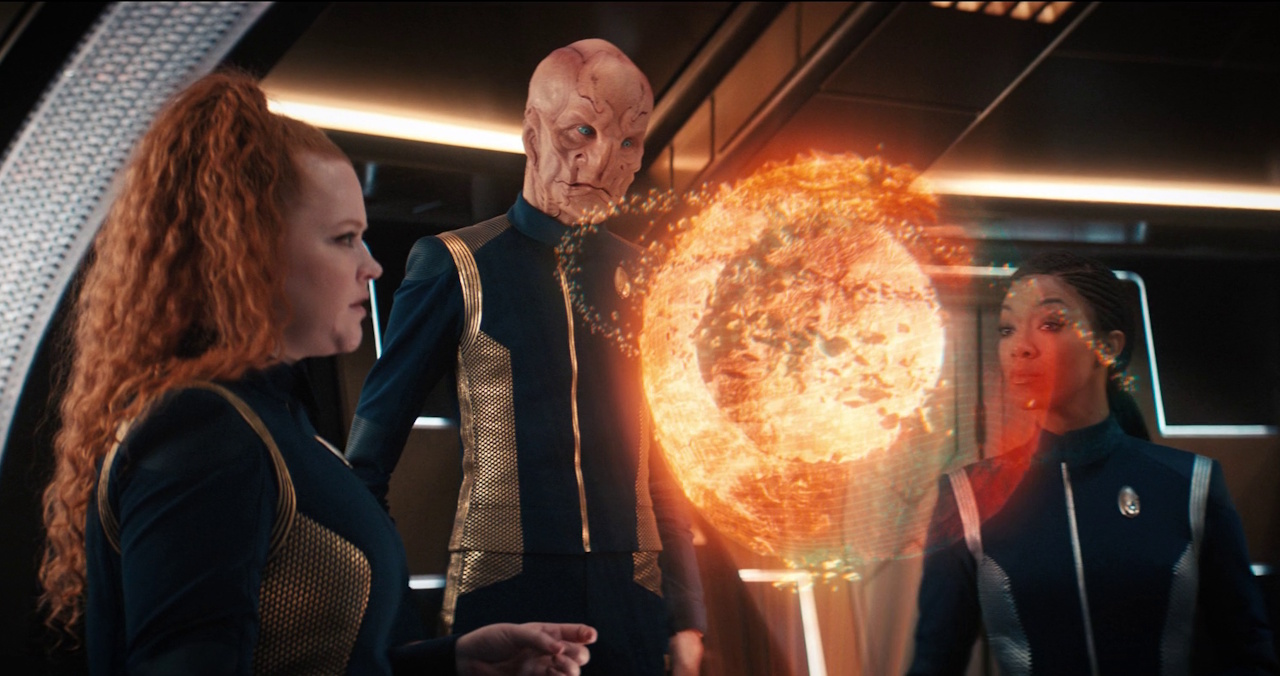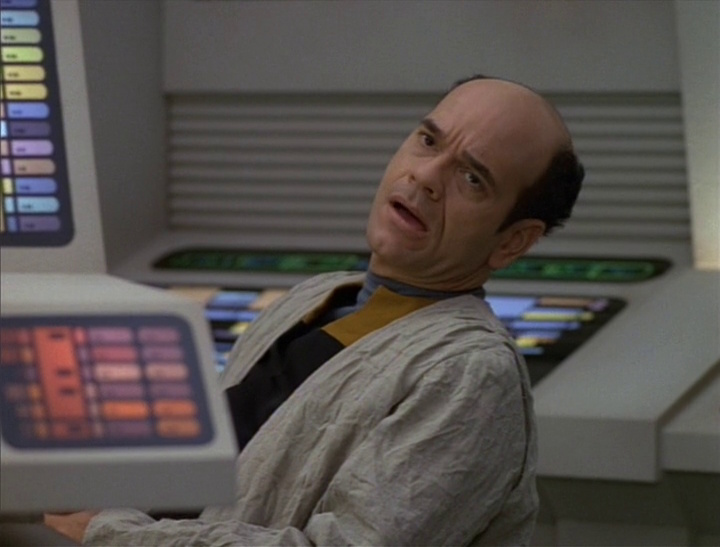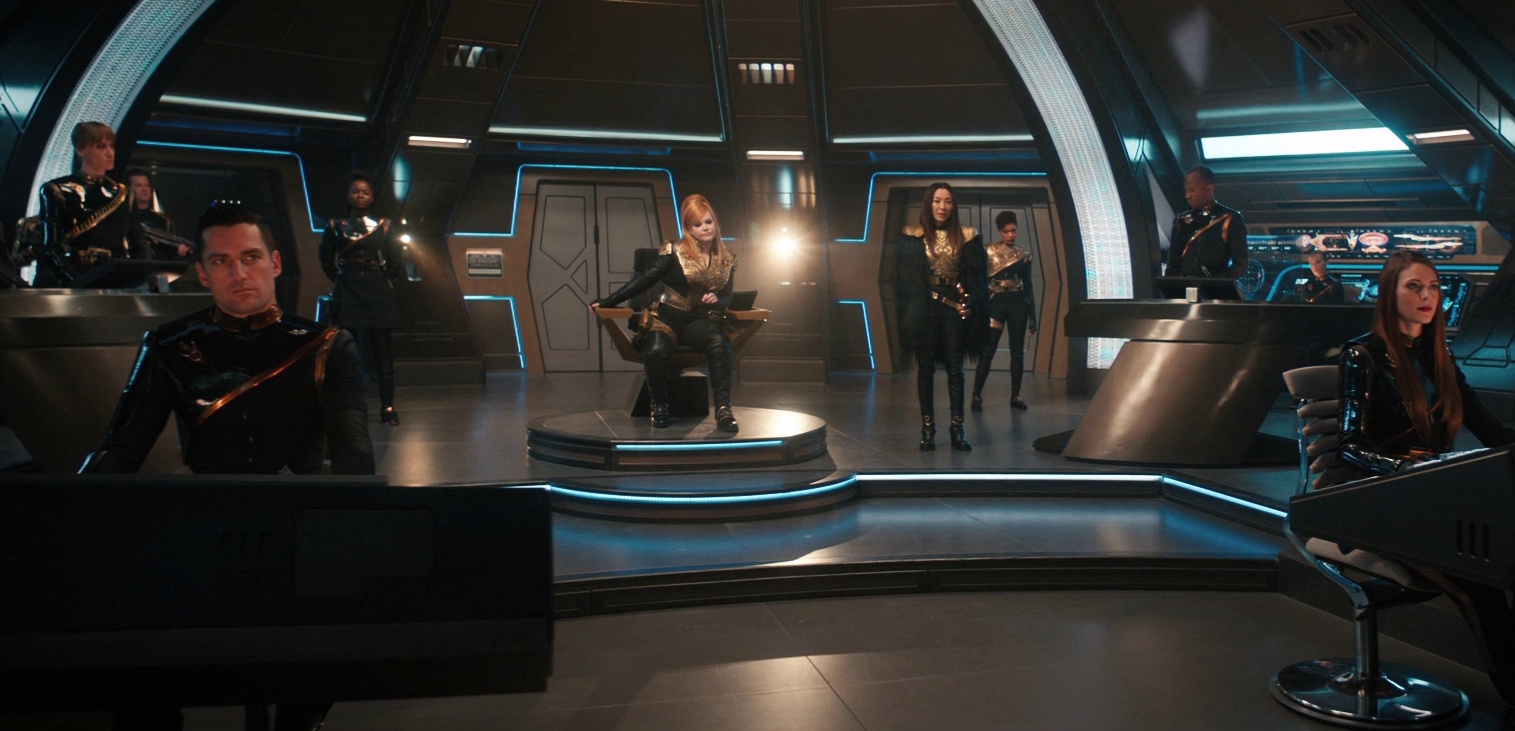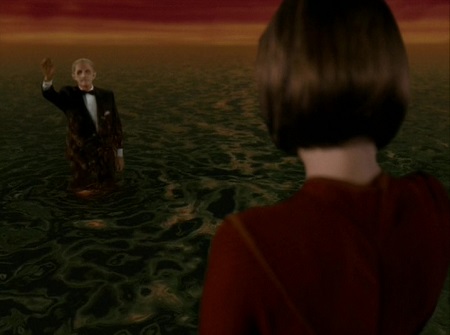
Strange New Worlds Theory: Talos IV

A Star Trek-themed spoiler warning.

Spoiler Warning: There are spoilers ahead for Star Trek: Strange New Worlds Seasons 1-3, Star Trek: The Original Series Season 1, and Star Trek: Discovery Season 2.

It’s been a while since I’ve engaged in much theory-crafting here on the website! Strange New Worlds, as a mostly episodic series, hasn’t lent itself to the kind of weekly theorising that I used to do for Picard and Discovery… but there are character arcs, season-long storylines, and other narrative threads running through the show. I want to consider one of these today, and it pertains to Captain Marie Batel.

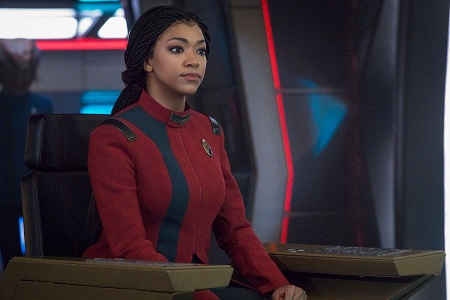
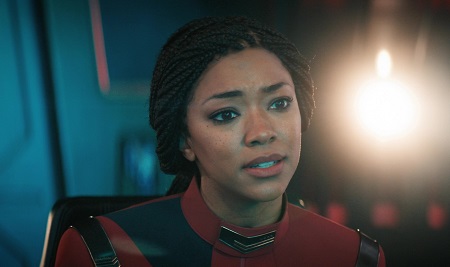
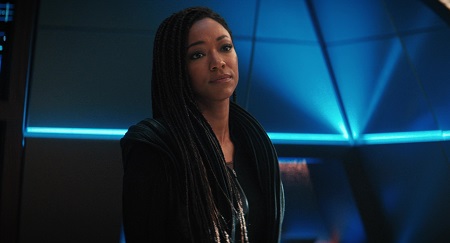
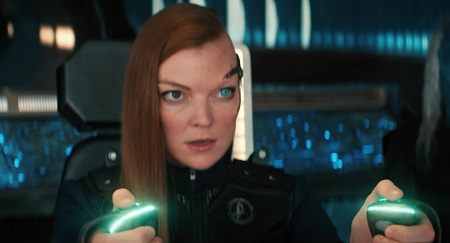
At the end of Season 2, Captain Batel was infected with the same Gorn parasite that resulted in the death of Hemmer. We went into the two-year gap in between seasons not knowing how – or even if – she would survive. Hegemony, Part II gave us part of the answer, as Spock and Nurse Chapel came up with the unorthodox solution of using Illyrian blood to “re-incorporate” the Gorn DNA into her body. Captain Batel, however, has suffered after-effects of this treatment, seemingly possessing some kind of Gorn consciousness or DNA within her. It’s an open question whether this storyline has now run its course, whether it will be picked up again, or how it will be resolved. I wanted to offer a purely speculative take at this juncture, with two episodes of Season 3 remaining.

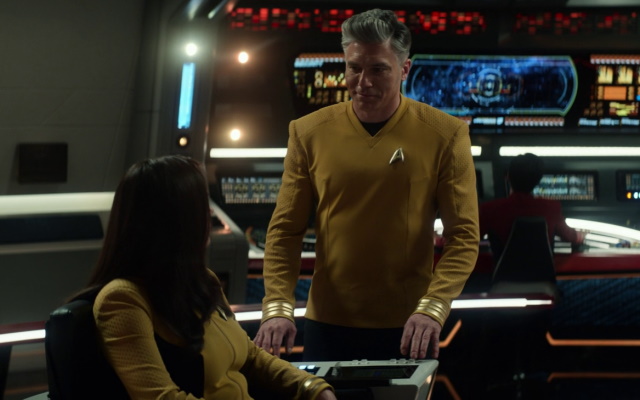
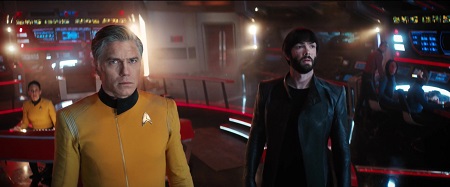
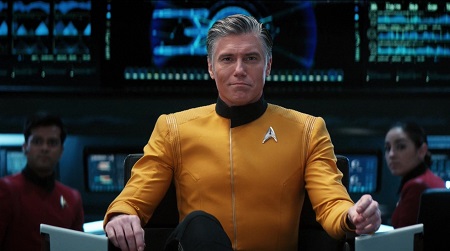
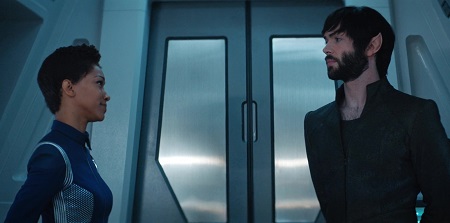
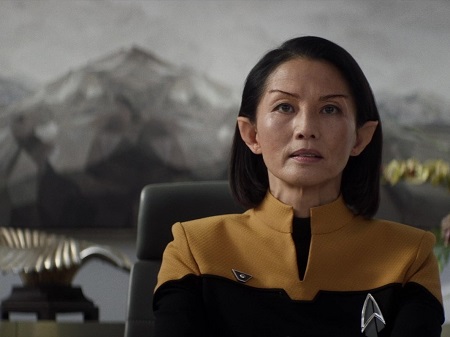
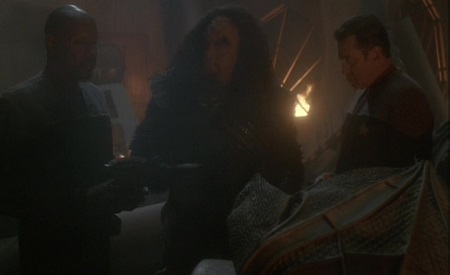
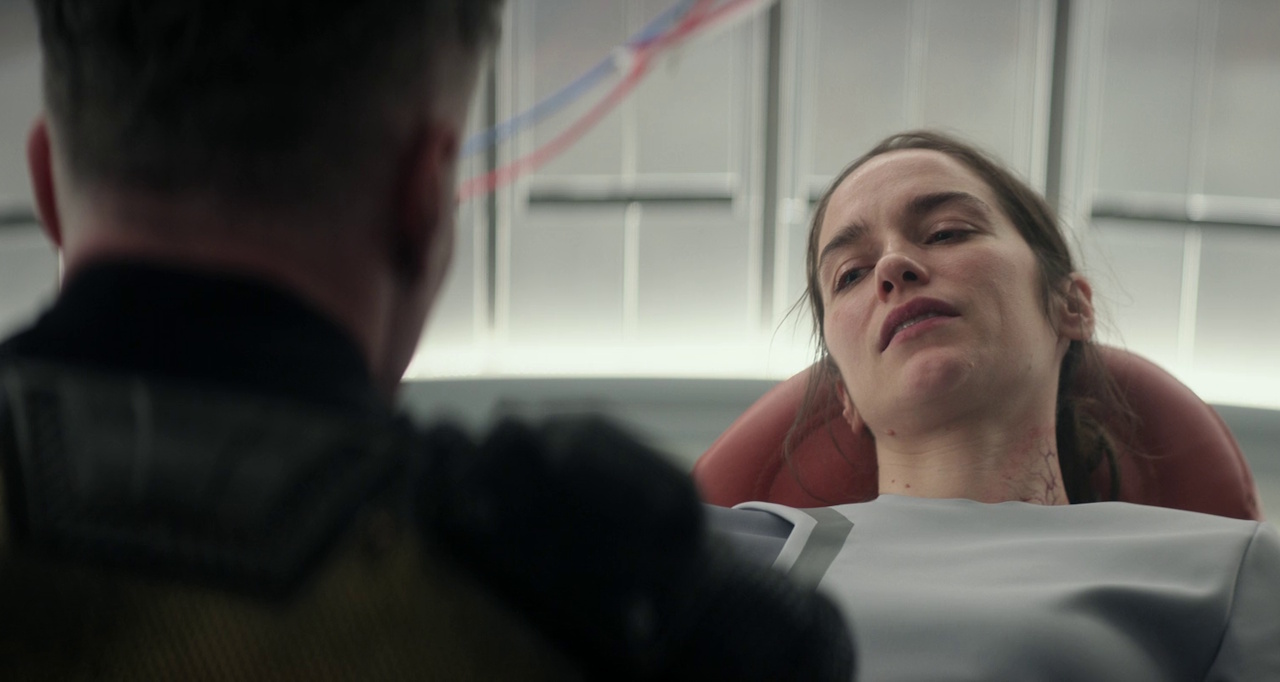
Still frame from Hegemony, Part II showing Captain Pike with Captain Batel.
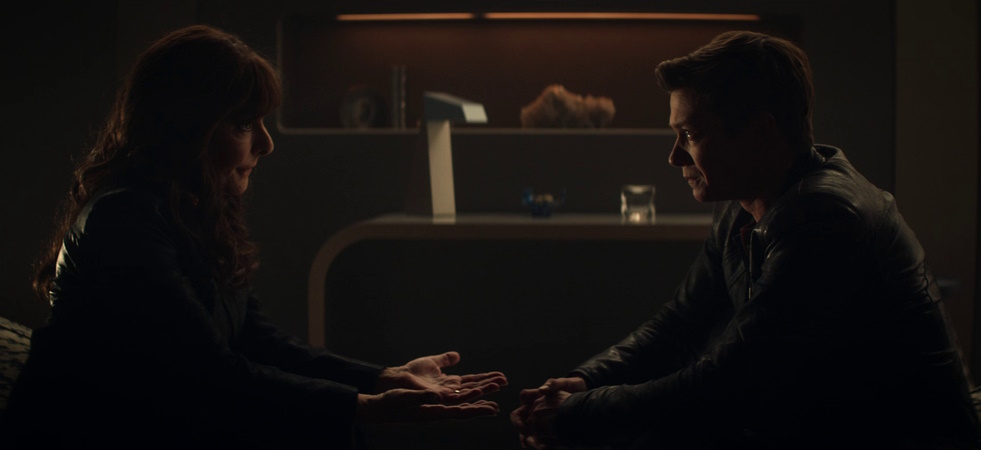
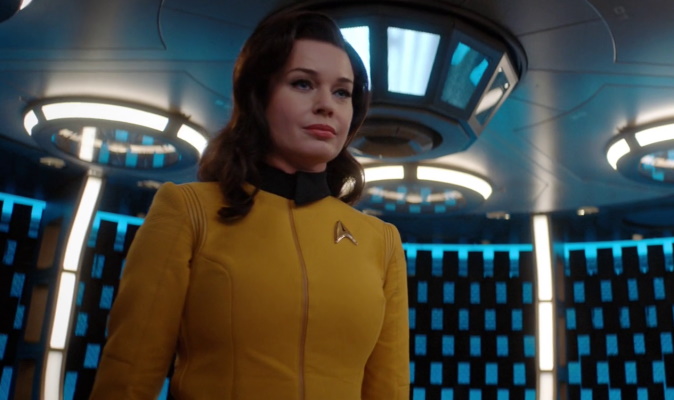
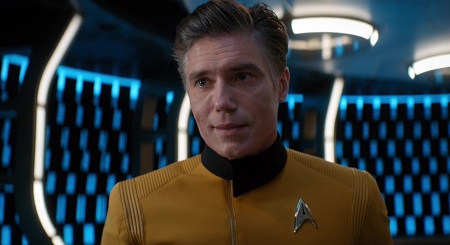
Pike with Captain Batel in Season 3.

Let’s start by laying out what we know.

Captain Batel is still suffering as a result of the Gorn infection. The cure was, at best, incomplete, and according to Spock in Through the Lens of Time, there is some kind of Gorn “presence” which exists inside of – and separate from – Captain Batel. As Pike explained to Admiral Pasalk in Four-and-a-Half Vulcans, Captain Batel still needs intensive treatment sessions. And as far as we know, no one else has ever been cured once a parasitic Gorn infection has progressed to this extent.

Furthermore, Captain Batel’s relationship with Captain Pike has a hard and rigid time limit. Pike knows the time and place of the accident which will disable him, and we know, as the audience, that Pike will be transported to Talos IV by Spock a few months later. By the time of Pike’s accident, if not before, their relationship will come to an end. But what if… it doesn’t have to?

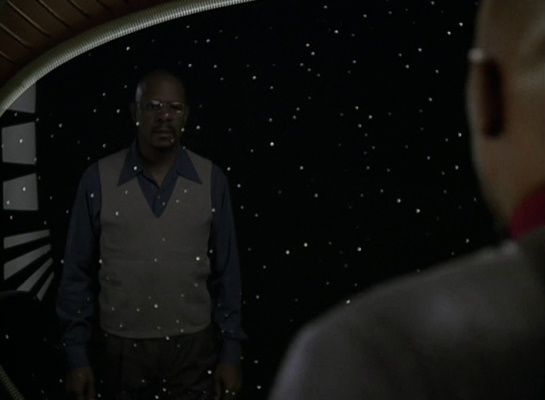
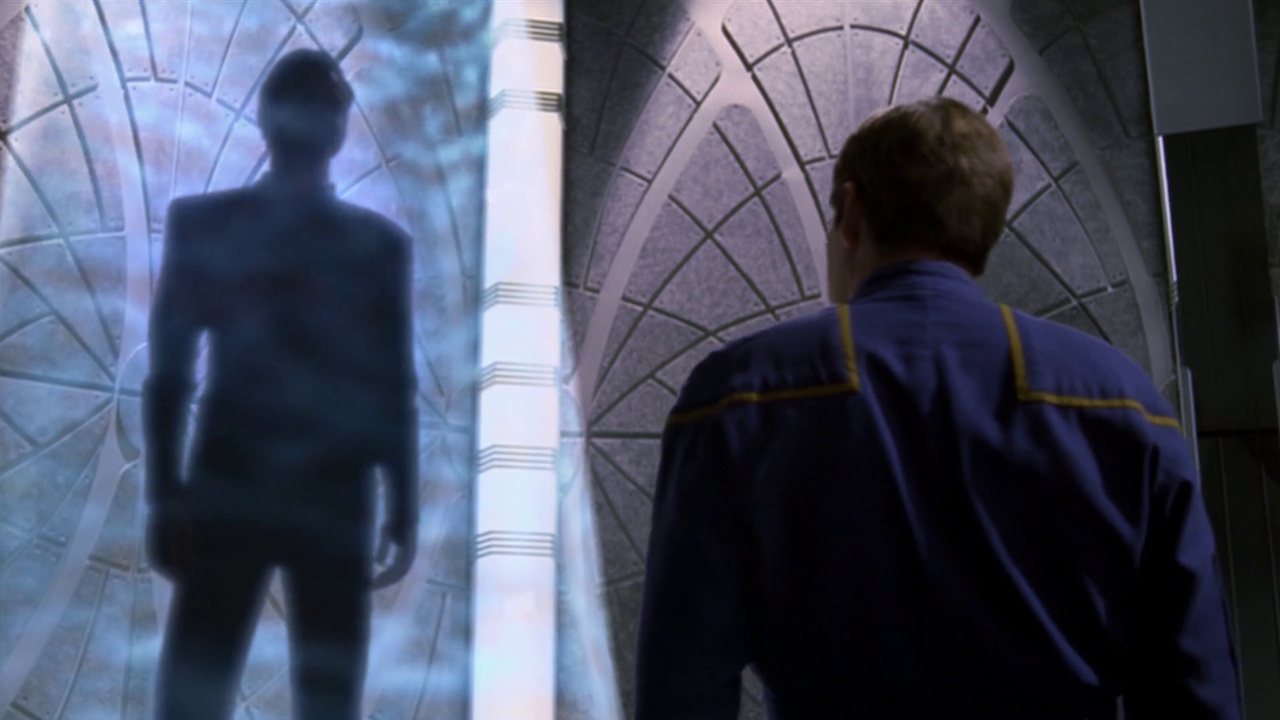
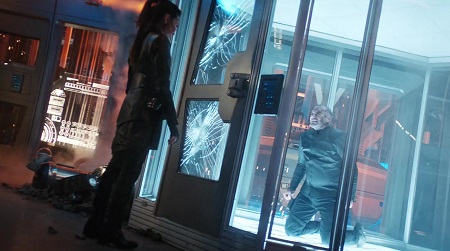
Still frame from Through The Valley Of Shadows showing a vision of Pike's future self.
A vision of Captain Pike’s ultimate fate.

If Captain Batel’s condition worsens, the Gorn inside her could try to break out or even take over her body, as we caught a glimpse of in Through the Lens of Time. Some fans have theorised that this could lead to the creation of a Gorn-human hybrid – with speculation that this hybrid could even be the Gorn Captain that Kirk will face off against in the classic episode Arena. I cannot fully express my disdain for this idea, by the way; it would be the Klingon-Augment virus all over again, only worse.

But what if, instead of dying or being transformed into a Gorn, Captain Pike reaches for another solution? His solution could give context to Spock’s actions in The Menagerie, perhaps even giving Spock the idea to take Pike to Talos IV in the years to come. What if… Captain Pike were to take Captain Batel to Talos IV as a last roll of the dice; a desperate final attempt to save her?

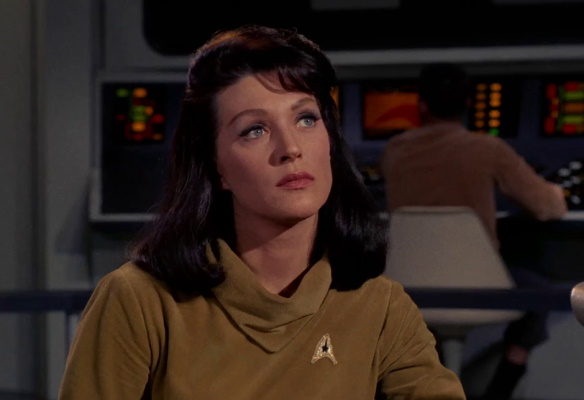
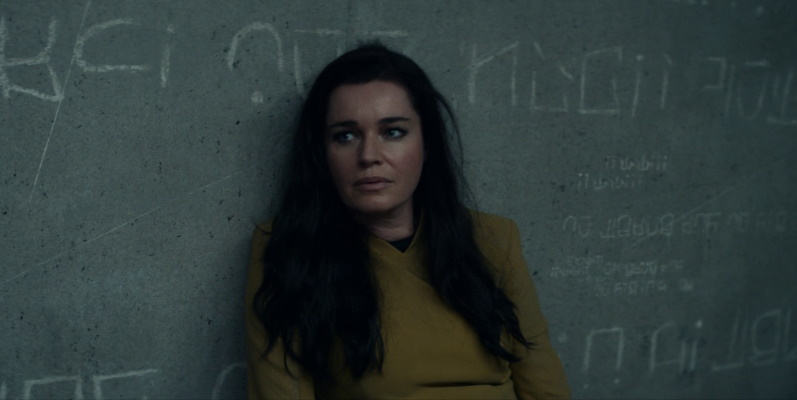
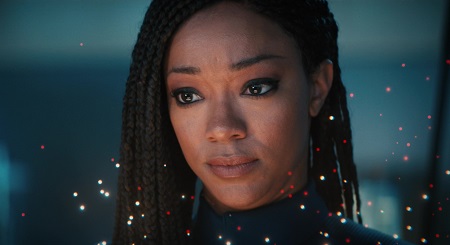
Still frame from Through the Lens of Time showing Captain Batel.
Could Captain Pike take matters into his own hands in order to save Captain Batel?

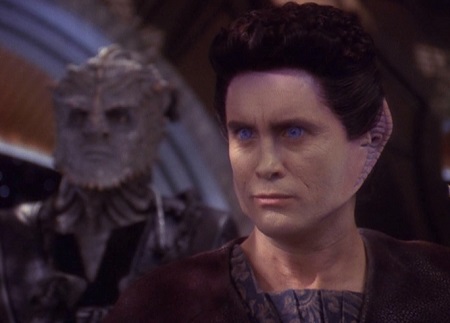
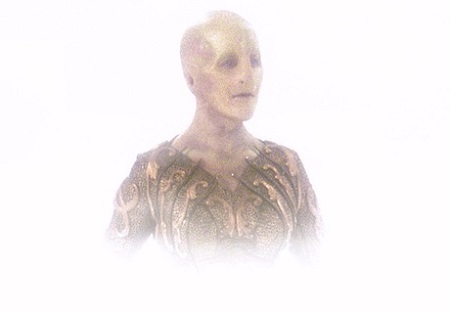
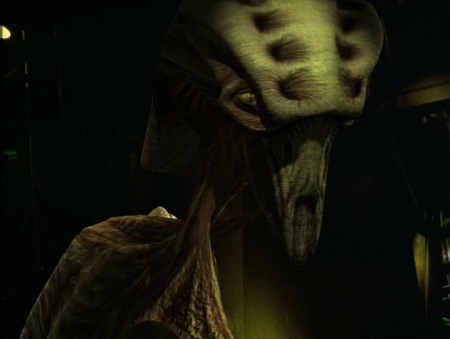
The Talosians have appeared in Discovery’s second season, where we were introduced to this incarnation of Captain Pike. They played a major role in that season, sheltering Spock and helping him with his condition. We know that the Talosians possess advanced medical technology, as well as immense mental and telepathic powers. Even if Captain Batel were to arrive there in a comatose state, Talosian telepathy could create for her a world in which she was free from her infection, living her life somewhat normally.

Knowing that Talos IV is also Pike’s ultimate destination could reframe their relationship going into the final episodes of the series. Instead of Batel and Pike being a temporary fling; a relationship firmly in the here-and-now… they could fall deeper in love. Their future could exist… a shared future, free from their life-limiting conditions… but a future only the Talosians could provide. If Captain Pike were to take Captain Batel to Talos, it could be incredibly poetic. And beautiful.

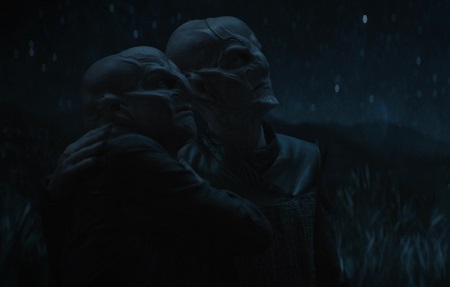
Still frame from If Memory Serves showing two Talosians.
Talosians in Discovery.

Now let’s consider how this could come about.

Captain Batel has just – as of Four-and-a-Half Vulcans – accepted a new role as head of Starfleet’s legal division. Rather than accepting command of a starship, which would be more difficult for her given her health, Batel is to take charge of the court-martial system, presumably being based either on Earth or on a starbase. It sounded like a promotion – perhaps to the rank of commodore or even admiral – was also on the cards. But… a big part of me thinks that, regardless of whether this theory pans out, Batel won’t get her promotion.

Let’s say that, on the way to her new posting, Captain Batel falls more seriously ill. Dr M’Benga and Nurse Chapel have done all they can, but the Gorn infection is proving too stubborn. Maybe the Vezda alien, kept in suspended animation aboard the Enterprise, is called upon for help, but either refuses or cannot do anything for her. Faced with her imminent death, Captain Batel is placed in some kind of suspended animation (probably in the transporter buffer, given Strange New Worlds’ proclivity for that kind of storyline!)

Still frame from Four-and-a-Half Vulcans showing Captain Batel speaking with Admiral Pasalk.
Captain Batel and Admiral Pasalk.

This leaves Captain Pike heartbroken… but also with a tiny glimmer of hope. Batel is not dead yet, and even though everyone is telling him she’s too far gone and cannot be saved, Pike is unwilling to give up. He does the only thing he can think of, and reaches out once again to the Talosians. The Talosians bring bad news: they know about the Gorn and their parasitic infections, but have no cure (or at least, no cure for someone so far gone). But they offer an alternative: bring Batel to Talos IV in stasis, and they will use their telepathy to let her live out a fantasy version of the rest of her life. He will even get the chance to say goodbye properly.

At this point in the timeline, Talos IV is already off-limits to all Starfleet vessels. But Captain Pike will break that rule, initially intending to do so secretly, but ultimately with help from Una, Spock, and the rest of the crew. The Enterprise will proceed to Talos IV – pursued, perhaps, by either the Gorn or Admiral April, both of whom could have reasons for wanting to stop him. Upon reaching Talos, Batel will be beamed down in her stasis chamber, accompanied by Pike. He’ll explain what happened… and what he’s done. He’ll explain what the Talosians can do for her. And though sceptical at first, and really hating the idea, Captain Batel will ultimately choose to remain on Talos IV.

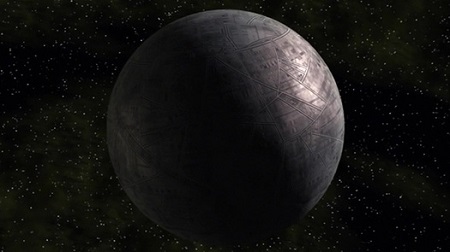
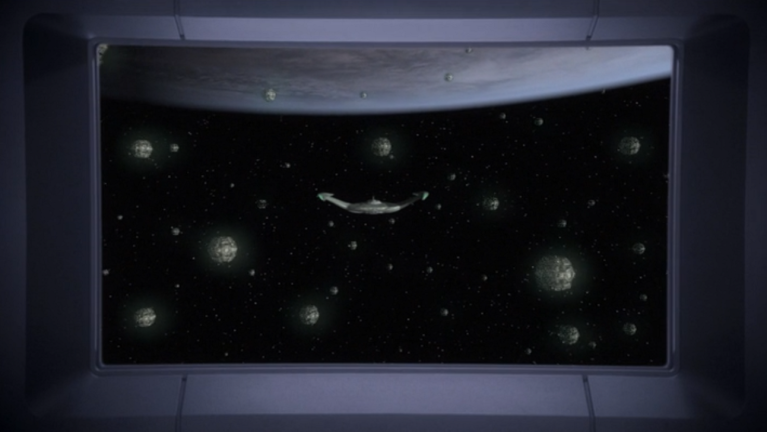
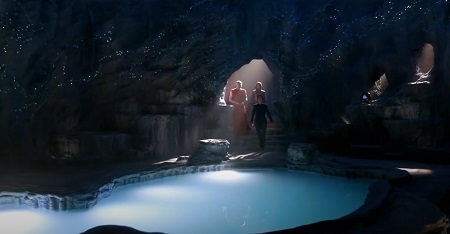
Still frame from The Cage showing Talos IV.
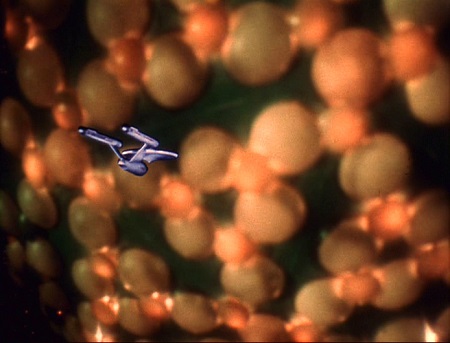
The surface of Talos IV.

Maybe Pike will promise to keep working on a cure, with the aim of one day returning to Talos to free Captain Batel. That seems like the sort of thing the Captain of the Enterprise would do! But either way… the result of this mission will be that Captain Batel will remain on Talos IV, with the Talosians using their powers to give her some semblance of a life – mirroring and foreshadowing Pike’s own ultimate destination.

What I like about this idea is that it gives more depth and meaning to the Pike-Batel relationship. While we know they have strong feelings for one another, there’s always been a strange sort of undercurrent to their relationship. Pike himself – and us as the audience looking in – know that this relationship basically has a time limit. It can’t be “happily ever after,” because Captain Pike doesn’t get an “ever after.” But if Captain Batel were to end up in the same place for a not dissimilar reason… it changes their dynamic. It potentially deepens the love they may feel for one another, while also being somewhat poetic.

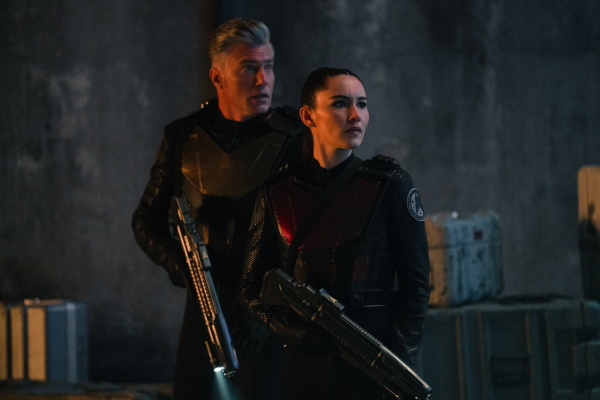
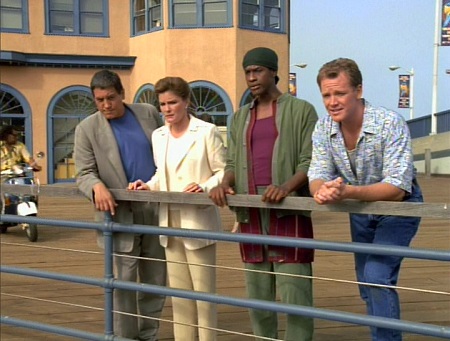
Promo photo for SNW S3, showing Pike and Batel.
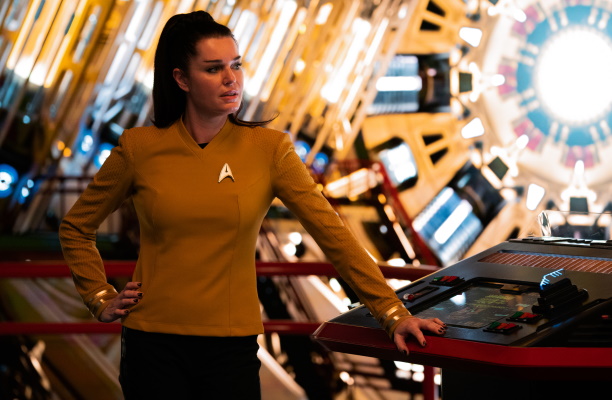
Captains Pike and Batel.

This storyline could also work well for Spock. In The Menagerie, it seems as if Spock’s decision to bring Pike to Talos IV is entirely his own… but what if there’s more to the story? What if Spock saw Captain Pike do the same for Captain Batel, and that’s part of what prompted him to take that specific course of action? Perhaps… Pike even tells Spock to do this. That would come dangerously close to treading on the toes of canon, in my view; Pike in The Menagerie repeatedly says “no” when Spock tries to take him to Talos IV. But… maybe they agree that he’ll have to say that as part of a ruse?

Obviously this idea has its shortcomings! For one, the ending of The Menagerie clearly shows Pike reuniting with Vina – a character we also saw him falling for in Discovery, too. Vina and Pike seem to share a moment together when he arrives on Talos IV, setting out in their telepathic forms to make the most of the second chance the Talosians have afforded them. If Captain Batel should be there too… it complicates, at the very least, the canonical ending to Pike’s story – which should already be set in stone.

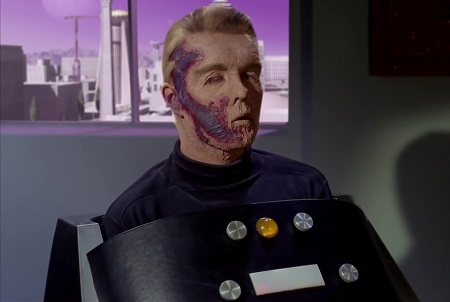
Still frame from The Cage showing Vina with an illusory Pike.
This is supposed to be the end of Pike’s story.

It’s also narratively clunky and arguably repetitive. Not every story in Star Trek has to be based on something that we’ve already seen, and Pike taking someone he loves to Talos IV so the Talosians can use their telepathy to free them from a life-limiting condition… that’s the same plot as The Menagerie. I love it when Star Trek stories rhyme, or when we get echoes of a classic story in modern Trek. But is something so familiar and so similar crossing the invisible line between respectful homage and naked rip-off? I think a lot of fans would argue that it is, regardless of how well-executed it may or may not be.

However, I think this theory is infinitely better than the Batel-Gorn hybrid ultimately turning out to be Kirk’s foe from Arena! I didn’t like the Klingon-Augment virus when Enterprise did that storyline; I felt it wasn’t necessary to explain the change in makeup for the Klingons. And even if it was… that wasn’t the way to do it. It was convoluted and silly. This idea… that the Gorn in TOS and the Gorn in SNW look different because one is a half-human hybrid… it would have the same problems as the Klingon-Augment virus, the same narrative weaknesses… and, on top of that, it would also be repetitive.

Still frame from Arena showing Kirk and the Gorn captain.
Can we please rule out this idea?

The other thing to say is that it’s possible that Strange New Worlds’ writers… haven’t actually written an ending for this story. Maybe their idea is that Batel will sail off into the sunset as head of Starfleet’s legal division, and Pike will occasionally Skype her for half a scene here and there in Seasons 4 and 5. Maybe what I’ve been reading as the preamble to a bigger storyline just… isn’t. Maybe this is the story. Batel got sick, received a partial cure, suffered a setback, but is now able to manage her condition well enough to return to work. That could be the way it’s gonna go.

Batel could also yet be killed off. I was brutal in criticising Paramount’s marketing team in my review of the Season 3 premiere, because I felt that promo photos and trailers had spoiled Batel’s survival ahead of time. And I stand by that – it was incredibly dumb, after teasing us with this story for so long – to spoil Captan Batel’s survival when there was no reason to do so. But… despite all of that, Captain Batel may not be long for this world after all. The Gorn infection could come back, as we described above. Or the Vezda alien, which is still aboard the Enterprise, could break free and kill her. She could be killed in an alien ambush, a freak accident, a transporter malfunction… anything.

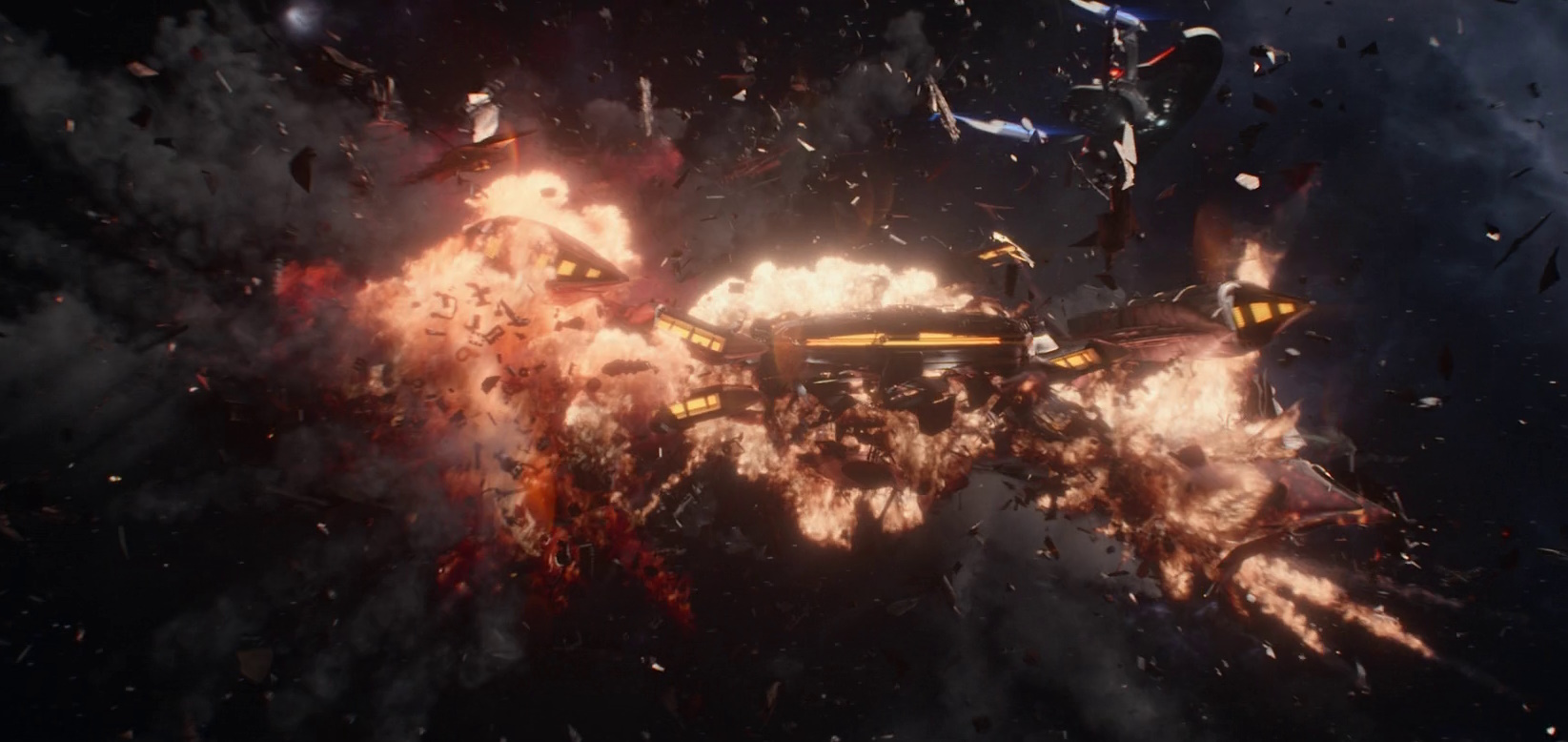
Still frame from Hegemony showing Batel and a Gorn.
Captain Batel face to face with a Gorn.

So there are definitely other ideas floating around – some of which, to be honest, are probably more plausible than this theory!

However, I still kinda like this idea. It would completely reframe Pike’s ultimate destination, and the choice Spock makes on his behalf in The Menagerie. It could potentially deepen the bond between Batel and Pike, taking their relationship from something that is, by circumstance, bound to be temporary and… opening it up. Maybe they can have a form of “happily ever after” after all.

So that’s it. That’s the theory. In order to save Captain Batel’s life and give her some semblance of normalcy instead of a stasis pod, Captain Pike will call upon Vina and the Talosians, and transport Captain Batel to Talos IV, mirroring his own ultimate destination.

Will it happen? There’s two more episodes left this season, as well as Seasons 4 and 5. Are we truly done with the Gorn? Has Captain Batel reached the end of her story? Or… could there another twist? I guess we’re going to find out!


Star Trek: Strange New Worlds Seasons 1-3 are available to stream now on Paramount+ in countries and territories where the platform exists. The first two seasons are also available on DVD/Blu-ray. The Star Trek franchise – including Strange New Worlds and all other properties discussed above – is the copyright of Skydance and/or Paramount. This review contains the thoughts and opinions of one person only and is not intended to cause any offence.

Star Trek: The Borg Teasing Theory

Spoiler Warning: Beware of spoilers for the following Star Trek productions: The Next Generation Seasons 1-3, Voyager Seasons 4-7, First Contact, Enterprise Season 2, Prodigy Season 1, and Picard Seasons 1-3.

Let’s talk about everyone’s favourite Star Trek villain: the Borg Collective!

Okay, maybe that’s a tiny bit of an exaggeration! But the Borg are certainly up there as one of the Star Trek franchise’s most iconic and frightening villainous factions, and there’s no shortage of theories and speculation in the Star Trek fan community about how the Borg operate and what their methods and overall goals are. I thought we could touch on one aspect of that today.

I briefly outlined what I’m calling the “Borg Teasing Theory” in a post here on the website a couple of days ago. That piece was all about some of my personal head canon explanations of unseen, unexplained, contradictory, or vague things from across the Star Trek franchise – but I thought this particular theory warranted its own full article! Click or tap here to check out the rest of my head canon, if you’re interested in my take on the likes of warp factors and cloaking devices.

The Borg are coming!

So what’s the tl;dr of this theory? In brief: the two major Borg attacks on Earth during The Next Generation era – as depicted in The Best of Both Worlds and First Contact – weren’t 100% serious attempts to assimilate the entire planet or the Federation. They were, in a word, teases. The Borg Collective hoped to push Starfleet and humanity to develop new weapons, shields, scanners, and medical technology in the years after their incursions – which they would then be able to assimilate when they launched a full-scale invasion at some point in the future. In short: the attacks were not attempts at total conquest and were not intended to fully succeed at assimilating Earth.

We’ll get into detail in just a second, but before we go any further, I have a couple of important caveats. Firstly, all of this is the entirely subjective take of just one old Trekkie. If you hate this theory, think I’ve got it completely wrong, or feel I’ve misunderstood some key part of Star Trek that would invalidate it… that’s okay. None of this is canon or likely to ever be confirmed on screen anyway! Secondly, I’m not claiming to be the sole inventor of this theory. Other Trekkies may very well have come up with similar ideas independently, and I’m not taking credit for anyone else’s work or theories.

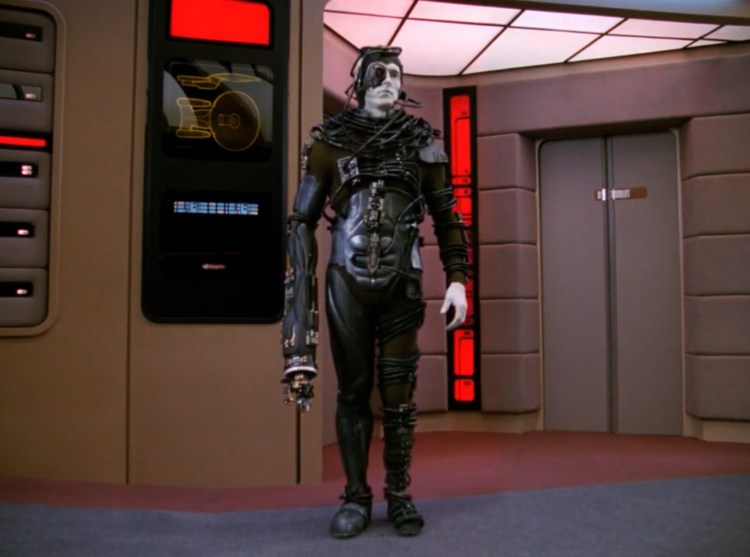
A Borg drone.

Finally, a word about fan theories. I like writing and I like Star Trek, so writing about Star Trek is a fun way for me to spend a little more time in this world. But no fan theory – not even one that seems totally plausible – is worth getting upset or worked up over. As I said a moment ago, none of this is canon and may very well be totally debunked in the future. Given the status of the Borg Collective after Picard Season 3 (and Paramount’s shaky finances), we may never get another Borg story anyway. But this is supposed to be a fun exploration of a theory I’ve had kicking around in my mind for decades, not something to take too seriously.

Phew, that was a lot! But with the caveats out of the way, it’s time to jump into the theory!

Let’s start by explaining what this “tease” is. As I outlined briefly above, I believe that the Borg were not fully serious or committed in their two attacks on Earth. My evidence for this is simple: on both occasions, the Borg sent only one single ship to Earth. A Borg cube can contain, depending on which episode we use as a source, up to 100,000 drones. Given the size of Starfleet, the number of ships at the Federation’s disposal, and even just the population of Earth itself (which could be somewhere in the region of 9-10 billion in the 24th Century) one ship and 100,000 drones doesn’t seem like a large enough invasion force.

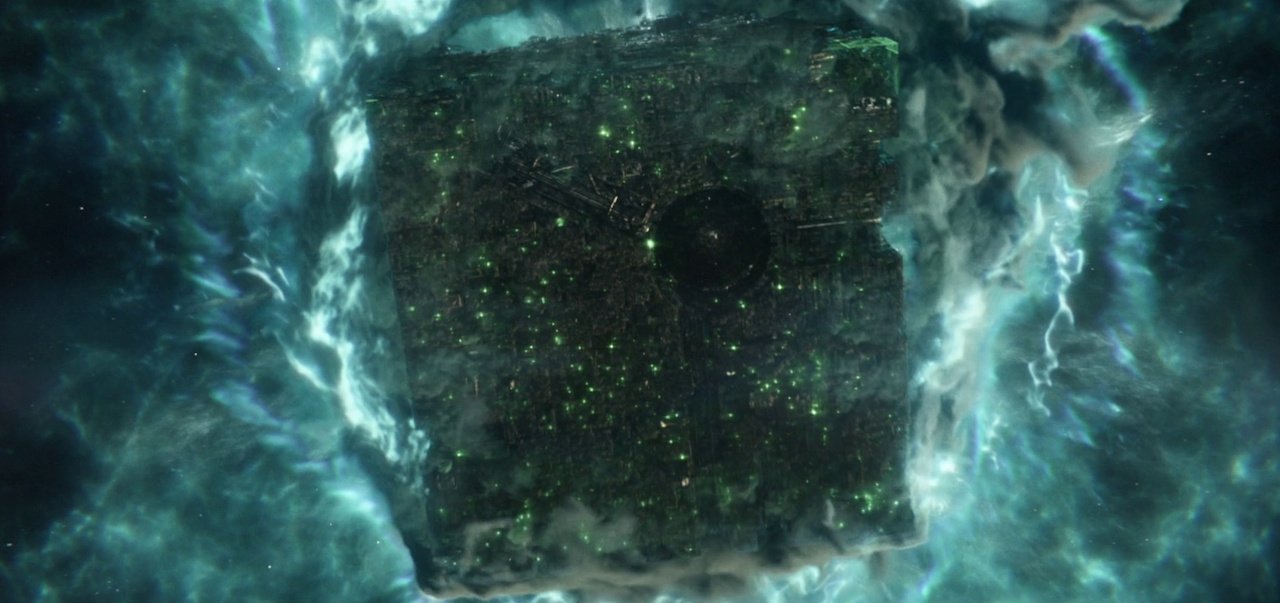
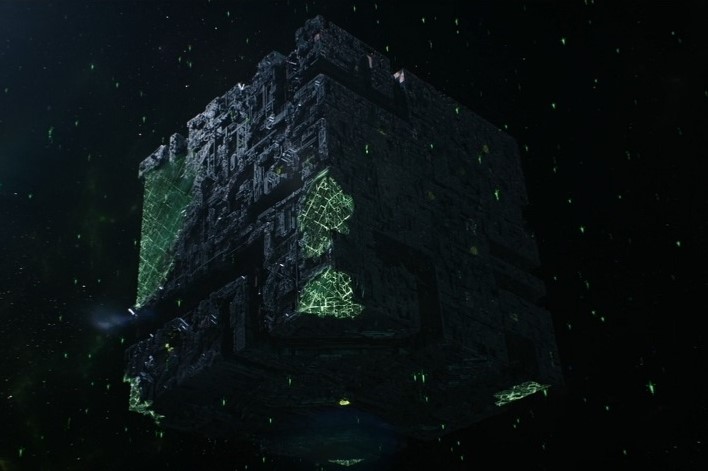
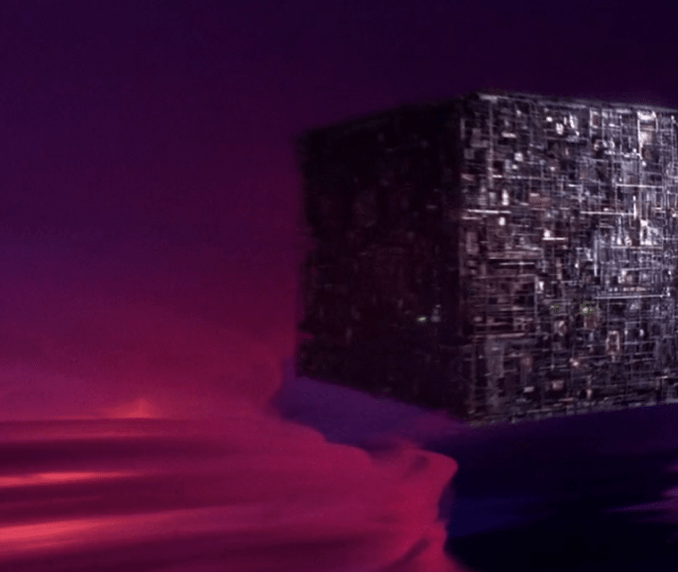
A Borg cube hovering over Earth…

Assuming the Borg cube from either Wolf-359 or the Battle of Sector 001 managed to defeat Starfleet’s armada and Earth’s planetary defences, and was able to successfully transport down all of its drones, the logistics of assimilating such a large population don’t track. If Earth’s population is 10 billion and there are 100,000 Borg, that’s a ratio of 100,000-to-one – meaning each Borg drone would need to have a hand in the assimilation of 100,000 humans. With only a single ship, any ground invasion would be vulnerable to Starfleet regrouping and returning; the destruction of the cube would cut off Borg forces on the ground.

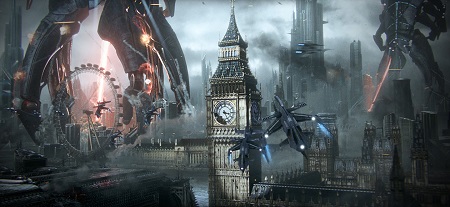
Despite jokes I’ve made before about Earth being undefended, it’s still the headquarters of the Federation, with Starfleet Academy and Starfleet HQ on the planet, too. There are going to be thousands of armed Starfleet security personnel, Federation HQ guards, Section 31 operatives, and others on the planet. Even if resistance was scattered at first, and the Borg were able to shut down Starfleet communications, resistance on Earth would be ferocious. To jump over to a different franchise for a point of comparison: look at the Reaper war in the Mass Effect series. The Reaper invasion of Earth was hampered at every turn by resistance fighters from all walks of life, led by the remnants of the Alliance military. There’s no reason to think a Borg attack on Earth wouldn’t lead to a similar resistance movement springing up, with armed civilians led by Starfleet personnel.

Even under extreme pressure, Starfleet tactical personnel would mount a significant resistance to any Borg invasion of Earth.

With the Borg preoccupied with a war of attrition on the ground, their sole vessel in space would be vulnerable. The cube might’ve been able to beat off Starfleet’s initial armada, but that was a hastily thrown together gaggle of whatever ships were on hand when the Federation realised what was coming. Ships were brought out of mothballs and unqualified officers were tapped to take command. With Starfleet being better-prepared and having time to regroup – while also calling on allies like the Klingons – round two against the cube would go a lot better!

So even if the initial attack was successful and the Borg managed to defeat a defence force and land drones on Earth, it would be a matter of time – days or perhaps a couple of weeks – before Starfleet would be back with a much larger fleet. The Borg cube may have beaten the Federation’s hastily-arranged defence ships, but the full might of Starfleet, combined with Klingons and other allies and backed up by tactical data gained from the earlier battle, would – in my opinion – have a strong chance of destroying the Borg’s only vessel in the system. After that, it’s just a case of landing as many troops with modulated phasers (and Klingon bat’leths) and mopping up the remaining drones.

Klingons wielding bat’leths could cut through a Borg army!

To me, this is the most likely outcome for both the Battle of Wolf-359 and the Battle of Sector 001. And the Borg, having studied humanity and the Alpha Quadrant, are undoubtedly aware of this. One ship, even maxed out with as many drones as possible, simply can’t assimilate Earth on its own – let alone expand the fight to the rest of the Federation and its allies.

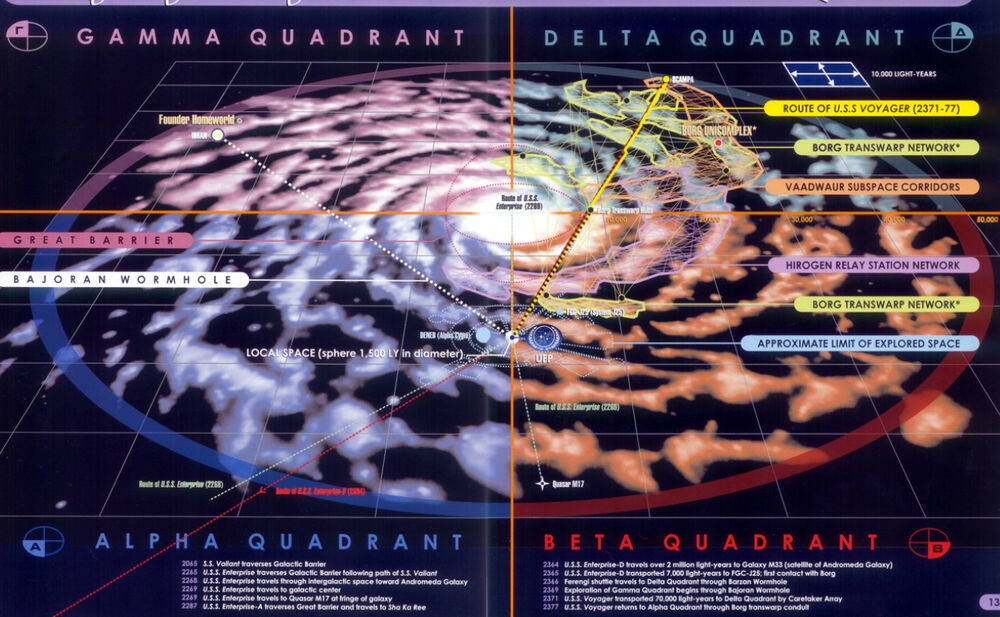
But why do I think the Borg Collective has the resources to launch a bigger attack? Simple: take a look at the Collective in its Delta Quadrant home in Voyager. The Borg’s Unicomplex alone contained more than a trillion drones, with the entire Collective perhaps comprising quadrillions of Borg. There may be tens or hundreds of thousands of Borg cubes – not to mention other Borg outposts, space structures, and assimilated planets. The sheer scale of the Borg Collective is what makes it so powerful, so frightening, and such a dangerous opponent. So why would the Borg choose to attack Earth in such a small-scale way?

The destruction of the Borg cube in First Contact. Did the Borg plan for this outcome?

Given how powerful a single cube could be, a fleet of perhaps a dozen would make light work of anything Starfleet and its allies could muster. And with two million drones instead of just 100,000, the Borg’s ground offensive would be much quicker and would be more easily able to overcome any resistance. The assimilation of Earth could proceed much more smoothly – with only a minimal amount of extra investment from the Collective. For a faction with 10,000 ships, using twelve on this one task is barely a drop in the ocean. We’ve seen the Borg assimilate other Delta Quadrant races, like Arturis’ species from the episode Hope and Fear, using “overwhelming force.” One single cube is not, I would argue, the kind of overwhelming force needed to conquer Earth and the Federation.

So to be clear: this part of the theory states that the Borg have the means to easily overpower and outgun the Federation and its allies and achieve the task of assimilating Earth. They have no reason not to go all-in and fully commit to this invasion; they aren’t worried about loss of life, there’s no Borg economy to be damaged by building extra ships, and if their target is to fully conquer Earth and the Federation, they could do so with ease. But they don’t do that. Instead, on two separate occasions they’ve sent a single cube. Why?

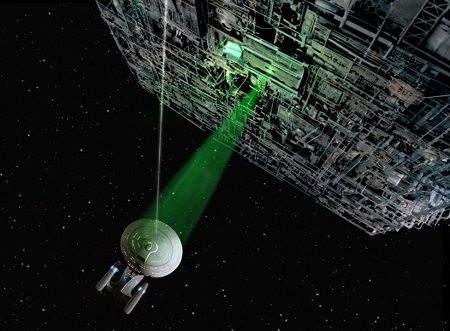
The Enterprise-D battling a Borg vessel.

To answer that, we first have to consider what the Borg are and how they operate. The Borg are a hive mind, operating as one. They have assimilated – according to their own sources – at least 10,000 species across the thousands of centuries that they’ve existed. But because they’re one hive mind, they lack creativity. They lack inventiveness – and with that, we can infer that they don’t have the ability to create brand-new technologies any more.

The hive mind is adaptable, and having been introduced to something – say, a particular phaser modulation – the Borg can adapt. Adaptations are rolled out at transwarp speeds across the entire Collective, meaning that any Borg encountering that specific phaser modulation in future will be protected. But adapting to something isn’t the same as inventing – and this lack of creativity and inventiveness could be a problem for the Collective.

After being exposed to a new technology or weapon, the Borg can adapt.

So how does the Collective acquire new technology, then? If they don’t develop things themselves they must get them from somewhere, right? I mean, the Borg are more technologically advanced than the Federation and that didn’t happen by accident! The answer is simple: the Borg acquire everything from information to technology through assimilation.

This was their weakness when confronted with Species 8472. They couldn’t assimilate a single member of the species or one of their ships, so they were left blind and helpless. And this, I would posit, is the fundamental reason why they “tease” certain species – like humanity. We probably aren’t a unique case; I believe this is a tactic that the Borg will have deployed on countless other occasions against similarly creative and adaptable species. But it’s a tactic that the Collective knows can work to its advantage.

The Borg were unable to assimilate any member of Species 8472 or their technology – rendering them blind and ineffective against their attacks.

The objective is simple: by making a relatively small demonstration of their power, the Borg incite fear in their targets. This fear leads to huge investments in weapons, shields, starships, and the like… all of which the Borg want. On one hand, the Borg want to see if their target can find a weakness in the Collective and its technology so they can prevent anyone else from exploiting it in the future – basically rolling out a Collective-wide “patch” to fix any weaknesses or vulnerabilities that the target species may have identified. And on the other hand, the Borg want any species they target to have achieved their full potential – giving the Collective the best, newest technologies that the target could create. This is how the Borg – at least in my opinion – are able to acquire new technologies.

And this is what they’re doing to Earth, humanity, and the Federation at large. By launching these attacks, the Borg are pushing the Federation and Starfleet to develop new technologies, whether that’s weapons, ships, medical supplies, transporters, shields… the list goes on. Perhaps the second incursion was intended to see how far Starfleet’s new inventions had come, or maybe it was just a second “tease” to force Starfleet to keep working and keep inventing. Either way… it worked.

A Borg drone being killed by a phaser blast.

Why would the Borg target Earth, though? It’s not like they need Earth specifically for its location or resources, and Earth isn’t even close to the Borg’s native territory. The Borg are mostly in the far-off Delta Quadrant, though they may have colonies or outposts somewhat nearer to the Federation, such as on the El-Aurian homeworld. So the question remains: why Earth? When there are so many other planets and species in between the Borg’s home territory and the Federation, why jump halfway across the galaxy for an invasion?

We already know that the Borg don’t assimilate everyone they come across. In fact, the Borg can be downright picky – opting to ignore the Kazon, for instance, as they were deemed “unworthy” of being assimilated as they’d somehow detract from the Borg concept of perfection. It stands to reason that some species may be of more interest to the Borg – even those in a faraway part of the galaxy. I think the El-Aurians are a prime example: their homeworld, while nowhere near Earth, seems not to have been on the very borders of Borg space, either. Yet the El-Aurians were targeted – perhaps for their telepathic powers, or perhaps because the Borg considered them a threat. This is a species, lest we forget, that has tangled with the Q Continuum and forced them to the negotiating table. The same basic reasoning may apply to humanity.

The Borg deliberately targeted the El-Aurians (Guinan’s people), even though they may not have been anywhere near Borg space.

Humanity has to be one of the most resilient and creative species that the Borg have ever encountered. Humans were able to track a Borg vessel and develop technologies to keep themselves hidden from the Collective while studying them – this is what Seven of Nine’s parents, the Hansens, did in the 2340s. This may have been the Borg’s first encounter with a human… and their curiosity was piqued!

Then, not long after the assimilation of the Hansens, the Borg received a strange message. Originating two centuries ago in a far-flung part of the galaxy, it told the tale of a time-traveling sphere, a planet of spacefaring people, and a climactic battle. The Borg who survived the Battle of Sector 001 had crash-landed on Earth in the past, only to be awakened by humanity in the 22nd Century. Captain Archer and his crew were able to stop them – but not before they sent a message to the Collective in the Delta Quadrant. Between the message from the past and the assimilation of the Hansens, the Borg must’ve realised how significant Earth and humanity could be for the Collective.

A small group of Borg were able to signal the Collective in the 22nd Century.

After receiving this “blast from the past” transmission, assimilating the Hansens, or both, the Borg had humanity and Earth in their sights. But rather than launch a full-scale invasion in 2350 – years before the Enterprise-D’s encounter with a cube – the Borg took a more subtle approach. Firstly, they may not have been entirely certain of Earth’s location, instead sending ships to scout the Alpha and Beta Quadrants for signs of humanity and the Federation. Then, rather than attack straight away, the Collective bided its time, launching small-scale attacks on outlying colonies along the Neutral Zone to see what would happen.

By attacking both Federation and Romulan outposts (as seen in the Season 1 finale of The Next Generation), the Borg may have hoped to trigger a conflict between the two powers – before swooping in later to attack both of them. Or, perhaps more likely, this was the Borg’s first attempt to assimilate humans en masse to see if they were worth bothering with – and picking outlying colonies makes a lot more sense than rushing to Earth straight away. The Romulans may have been collateral damage, in that case.

The Borg destroyed multiple human colonies before attacking Earth.

In any case, the Borg determined that humanity was a worthwhile target – something that was only further confirmed by their encounter with the Enterprise-D a few months later. As an aside: Q may very well have saved humanity by his intervention in Q Who! I have a longer piece on this subject – which you can find by clicking or tapping here – but here’s the short version: the Borg knew about humanity and Earth years before Starfleet knew about them. By hurling the Enterprise-D into the path of a Borg vessel, Q gave Picard and the Federation valuable insight into the Collective, forewarning them of the attacks to come.

With the Borg determined to assimilate humanity, decisions had to be made about how to do so. The hive mind, operating as one, makes such decisions at light-speed, and after confirming humanity was a suitable target for assimilation, the Borg decided to “tease” the Federation, pushing them to design new weapons, shields, starships, medical devices, and so on… all so that the Collective could assimilate it later, adding to their perfection. This is how the Borg operate, and it’s why they chose to launch small-scale attacks against Earth instead of simply arriving en masse with overwhelming force.

Original concept art of the Borg.
Image Credit: Frogland Archive/Forgotten Trek

From the Borg’s perspective, this approach is a win-win. Either their attack succeeds in full, with humanity and Earth being assimilated over a period of weeks or months, giving the Borg control of the planet and a staging-post for a larger-scale invasion of the Federation. Or it “fails” to achieve that objective, but in doing so provides the Collective with incredibly valuable tactical data on Starfleet, Earth’s defences, and so on, while also pushing the Federation to develop new technologies. The Borg want these technologies – either to “patch” vulnerabilities and weaknesses they may not be aware of or to add to their perfection.

There are real-world parallels. The Second World War led to the creation of modern-day computer technology, rocketry, and atomic power. The First World War led to huge advancements in flight, artillery, and motor vehicles. These are just a couple of examples from our own history of how war and devastation can lead to technological change. The Borg, I would argue, seek to artificially inflate the pace of technological advancement by baring their teeth and showing their target a tiny fraction of their power. In desperation, Starfleet and the Federation began working at pace to develop everything from phasers to starships – all ripe for assimilation by the Collective.

The first Borg drone ever seen in Star Trek.

So that’s the theory.

The Borg were not fully invested in assimilating Earth either in 2367 or 2373 – their only two direct attacks on Earth. These incursions had a different goal: pushing humanity and the Federation to develop new technologies that the Borg could assimilate later, when the time was right. By revealing themselves and showing Starfleet a glimpse of their power, the Borg believed their new target would, in effect, work for them, designing and building new weapons, ships, and other devices that the Collective no longer had the creativity to invent for itself.

To me, this theory made sense even as far back as when I watched First Contact in the cinema in 1996! Developments in Voyager, Enterprise, and more recently in Picard, too, have only added to this theory, expanding it and deepening my belief that the Borg really weren’t serious about conquering Earth. To them, the attacks served a different purpose. It took almost everything Starfleet had to beat the Borg, but given the sheer size and scale of the Collective, we know they had the resources to commit more ships and more drones to an attempted invasion of Earth. There has to be some reason why they didn’t send two or three cubes instead of just one – and to me at least, this idea makes the most sense and squares that circle.

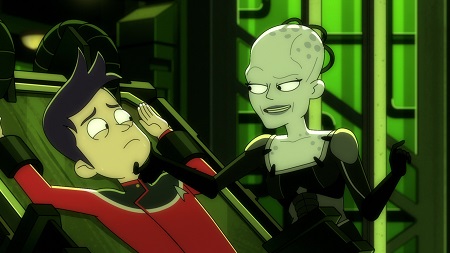
Romulans and Borg as seen in the Lower Decks opening titles.

I hope this has been interesting! I doubt that this theory will ever be confirmed – and it may even be actively debunked one day, if we ever get another Borg story. Some of you might think that the Borg’s time travel in First Contact (or some other plot point from a Borg episode) already negates or invalidates this theory… and that’s okay! As I said at the beginning, this is just a fan theory or head canon, and it’s all subjective at the end of the day. I share this theory with the Star Trek fan community in that spirit.

Speaking of Borg stories… will we see another one in Star Trek anytime soon? After Picard did three separate Borg or Borg-adjacent stories in its three seasons, and with the Collective having appeared in Prodigy and Lower Decks in recent years… I think it might be a while before the Collective makes another appearance. I certainly think it should be a while; I can’t be the only one who feels a little burned out on the faction, especially after their omnipresence in Picard. If and when the Borg return, I hope it’s in a big way. I’ve been kicking around the idea of a “Borg invasion” series for a while – and that could be a really interesting way for Star Trek to go one day in the future. If a fourth Kelvin timeline film ever gets off the ground, I don’t think it’s impossible to think we could see the Borg there, too.

But unless and until any of that happens… this is my theory! I hope you enjoyed this write-up and found it interesting.


The Star Trek franchise – including most episodes and films cited above – can be streamed now on Paramount+ in countries and territories where the service is available. The Star Trek franchise is the copyright of Paramount Global. Header font/text courtesy of textstudio.com. This article contains the thoughts and opinions of one person only and is not intended to cause any offence.
Strange New Worlds Season 2 Theory: Where’s Pike Going?

Spoiler Warning: There are spoilers ahead for Star Trek: Strange New Worlds Seasons 1 and 2. Spoilers are also present for the following Star Trek productions: The Original Series, Discovery, The Next Generation, and Enterprise.

Strange New Worlds Season 2 is off to a good start! The show returned to our screens this week with The Broken Circle – but the episode was noteworthy for the disappearance of one Captain Christopher Pike. As I said in my review of the episode, for the season to begin without him was a particularly bold move for what we once called “the Captain Pike show!”

Captain Pike set off on a journey of his own to help Una Chin-Riley – a.k.a. Number One. Una was arrested at the very end of Season 1, with her Illyrian heritage and genetically-modified background having somehow been exposed to Starfleet. As we know from earlier iterations of the franchise, genetic engineering is banned in the Federation, and lying on one’s Starfleet application – especially about race or species – can be grounds for expulsion.

Una is in a spot of bother…

But how does Pike plan to help Una? And for our purposes today: where might he be headed? It’s possible we’ll learn more about this before the episode airs – if photos are released that show Pike on a particular planet, for instance. But at time of writing all we know is that Pike has departed for destinations unknown – somewhere away from Earth on “the far side of the quadrant,” at least three days’ travel by shuttlecraft. He’s seeking out a mysterious, unnamed, female ally. And you’d better believe that I have a few ideas about where Pike could be going!

As always, some important caveats! First of all, I have no “insider information,” and I’m not trying to pretend that anything discussed below can, will, or must be part of Strange New Worlds. This is theory-crafting and speculation from a fan, and nothing more. Secondly, this is the entirely subjective opinion of one person, so if you hate all of my ideas, or if I don’t include your pet theory, that’s okay! There’s plenty of room in the Star Trek fan community for different ideas and points of view.

Now that that’s out of the way, let’s jump into the list.

Destination #1:
Talos IV

Two Talosians as seen in Discovery.

Could Pike be about to violate Starfleet’s General Order 7 by returning to Talos IV? Discovery’s second season gave us an updated look at Talos and the Talosians, and it’s possible that Pike may seek out their help and advice in order to save Una. The Talosians are incredibly powerful – hence the regulation banning all contact with their world – and may be able to use their illusory powers to aid Una, to convince the panel at her court-martial to rule in her favour, or even to help her escape. Talos IV could even become a shelter or home for Una.

Pike has a connection with the Talosians following the events of The Cage and Discovery’s second season, and he’s uniquely-placed to work with the Talosians. It could even be possible that Una will be forced out of Starfleet and will seek a new home on Talos IV, potentially being there to welcome Pike after his accident. Such a storyline could pave the way for Una’s departure from the show – and for Spock to step up and assume the role of First Officer.

Destination #2:
Vulcan

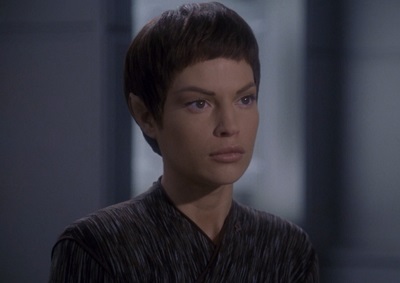
An older T’Pol from an alternate timeline.

Who could Pike be looking for on Vulcan? Who might be able to help Una get around Starfleet rules and regulations? How about an aged T’Pol, the first Vulcan to work alongside humans in space? I really love the idea of Strange New Worlds bringing an Enterprise character into one of its stories, and as a long-lived Vulcan T’Pol has always stood out as the most logical choice. This could be a fun way to tie together two parts of the Star Trek franchise.

It would be a blast to learn more about T’Pol’s life after the events of Enterprise and the founding of the Federation. Did she continue her scientific work? Perhaps she took on a different role as a kind of ambassador. She could be held in high esteem as a respected elder statesperson, and her intervention on Una’s behalf could be the deciding factor in Una being able to remain in Starfleet. T’Pol also has experience with the Illyrians.

Destination #3:
Vulcan (again)

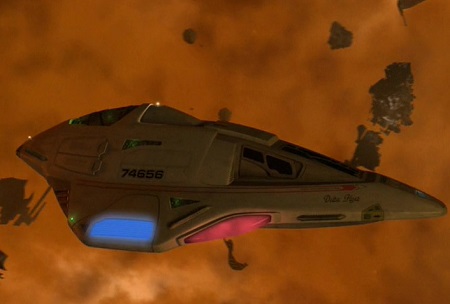
A shuttlecraft touches down on Vulcan.

Season 1 reintroduced T’Pring, Spock’s betrothed. T’Pring worked with Vulcans whose emotions led them to commit criminal acts, and part of her role involved chasing down escapees and fugitives. As someone with experience in a somewhat relevant field, perhaps T’Pring might have some insight into Una’s case that Captain Pike believes could be useful.

This would be a different way to bring T’Pring back into the story. Rather than working closely with Spock, she could be assigned to Una’s case, working with her and Captain Pike. She and Captain Pike know one another at least a little, so it’s at least possible that he might value her judgement and believe that she could be of assistance.

Destination #4:
Rigel VII

Rigel VII (or an illusion of it) as it appeared in The Cage.

We caught glimpses in one of the Strange New Worlds Season 2 trailers of a planet that looked suspiciously like Rigel VII. It’s primarily for that reason that I’m including it on this list! But it’s possible that Pike may have met someone on Rigel VII who he believes is capable of helping Una – maybe a human settler or colonist rather than one of the planet’s aggressive Kalar warriors!

We don’t know a great deal about Rigel VII, nor what Pike was doing there prior to the events of The Cage. But with a return to the world potentially on the cards this season, it would be a mistake to rule it out at this stage.

Destination #5:
Starbase 11

Starbase 11.

There’s someone at Starbase 11 who could potentially fit the bill for being someone capable of defending Una: Areel Shaw. In The Original Series first season episode Court Martial, Shaw was the prosecutor who handled Kirk’s case. As a woman, and someone involved in Starfleet’s legal division, Shaw could be the person Pike is looking for.

This could also be the way Kirk is introduced. We know Kirk will appear this season, and we know from The Original Series that Kirk and Shaw were romantically involved a few years prior to the events of Court Martial. Perhaps Kirk will prove instrumental in setting up Pike’s meeting with Shaw – or will contribute, somehow, to Una’s defence.

Destination #6:
Illyria (or the Illyrian homeworld)

A 22nd Century Illyrian starship.

Una’s status as an Illyrian is what landed her in trouble in the first place. The Federation’s ban on genetic engineering also indirectly caused an entire colony of Illyrians to be wiped out, as the colonists wanted to purge themselves of their genetic engineering in order to apply for Federation membership. How will the Illyrians view this rather bigoted perception of their culture? Could an Illyrian be the key to Una’s defence?

I like the idea of Pike visiting Una’s homeworld and potentially meeting members of her family. We could learn why Una sought to join Starfleet and pose as a human instead of going into space on an Illyrian vessel, perhaps. Or there could be consequences for Captain Archer’s actions in Enterprise. And such a story could be an interesting analogy for how we view and interact with different cultures with different values out here in the real world.

Destination #7:
The USS Cayuga

Alright, that’s not the USS Cayuga – but it’s the same class of starship!

The USS Cayuga is under the command of Captain Batel – the person who arrested Una. At the beginning of Season 1, she and Captain Pike appeared to be in a relationship of some kind, though she was soon ordered away to the Neutral Zone to begin her mission. Although Captain Batel was the one who ordered Una’s arrest, she did so reluctantly while following orders, and may be sympathetic to her cause.

It’s possible that Captain Pike will visit the USS Cayuga to enlist Captain Batel’s support for Una’s defence. We don’t know a lot about Captain Batel – perhaps she was once a lawyer or legal expert before being given her own command. It would be fun, in some ways, if the person responsible for Una’s arrest could also prove key to her defence!

Destination #8:
Somewhere entirely new!

Where could it be?

I find myself saying this often on theory lists like these, but modern Star Trek has often wanted to chart its own path instead of relying on what came before. Whether we’re talking about characters, ships, storylines, or destinations as in this case, “something brand-new” is always a very likely contender!

Although we’ve had a bit of fun speculating about Pike’s possible destination, the truth is that it wasn’t something that The Broken Circle really set up as being a huge mystery. He could have mentioned the name of the person he wants to visit, or said his destination out loud – but it wasn’t strictly necessary for the story of the episode, and The Broken Circle didn’t really linger over this point for very long at all. In short, what I’m saying is that all of this theory-crafting and speculation could amount to nothing!

So that’s it!

Captain Pike.

We’ve looked at a few possible destinations for Captain Pike, and considered a few people he might be intending to seek out.

If I had to pick a favourite – a fantasy, really – I’d pick T’Pol. I just love the idea of bringing someone from Enterprise into Strange New Worlds, giving someone from that show an epilogue and catching up with them and their life years after we last saw them. Is it the most likely possibility? Well, no. And there are several reasons why. But as a pure fantasy idea, I think it could be brilliant.

Which option is the most likely is an awkward question on theory lists like these! But I guess I’d say that Captain Pike going to a brand-new location, or at least seeking out someone we’ve never met before, feels like the most likely course of action.

Details of Una’s case on a padd.

Regardless, I hope this was a bit of fun. It’s possible that a teaser or photos from the upcoming episode may reveal what’s going on with Captain Pike before we see it – but it’s also possible that this minor mystery will be kept under wraps until Thursday. I guess we’ll find out! Given that Pike is the captain of the Enterprise and Strange New Worlds’ main character, his absence this week was notable, and the fact that his destination was left unexplained prompted this bit of theory-crafting.

As a final note: I always like to end these theory posts by saying that I do this just for fun. I enjoy writing, I enjoy Star Trek, and spending more time in this world is an escape and an enjoyable distraction for me. But for some folks, fan theories can become frustrating or unenjoyable, especially if they get very attached to a plausible-sounding theory that ultimately doesn’t pan out. I have no “insider information” and I’m not trying to claim that anything suggested above can, will, or must be part of Strange New Worlds Season 2. I fully expect the season to go in wildly unpredictable directions!

Star Trek: Strange New Worlds Seasons 1-2 are available to stream now on Paramount Plus in countries and territories where the service is available. The Star Trek franchise – including Strange New Worlds – is the copyright of Paramount Global. This article contains the thoughts and opinions of one person only and is not intended to cause any offence.
Star Trek: Picard bonus Season 3 theory: The “Ancient Evil”

Spoiler Warning: There are spoilers ahead for Star Trek: Picard Seasons 1-3. Spoilers are also present for the following Star Trek productions: The Wrath of KhanThe Next GenerationDeep Space NineVoyager, and Discovery.

Toward the end of the episode Surrender, Deanna Troi told us something very interesting about Jack Crusher: there’s an “ancient and weak” voice that surrounds him, a voice that isn’t his own. This voice has also been described as a “darkness,” and something “evil.” Today, I want to consider a few possibilities for who and what this “ancient evil” could be.

There are, at least as I see it, two candidates that are more likely than any others – at least based on the narrative elements that have already come into play. I covered the Borg Queen in my most recent theory update, but it’s also worth considering the Founders themselves, and how an ancient changeling or changeling leader could be a likely possibility. Finally, we have to contend with the idea that the “ancient evil” will be a character or faction that we’ve never met before – as this is something that’s happened in these types of stories consistently in modern Star Trek!

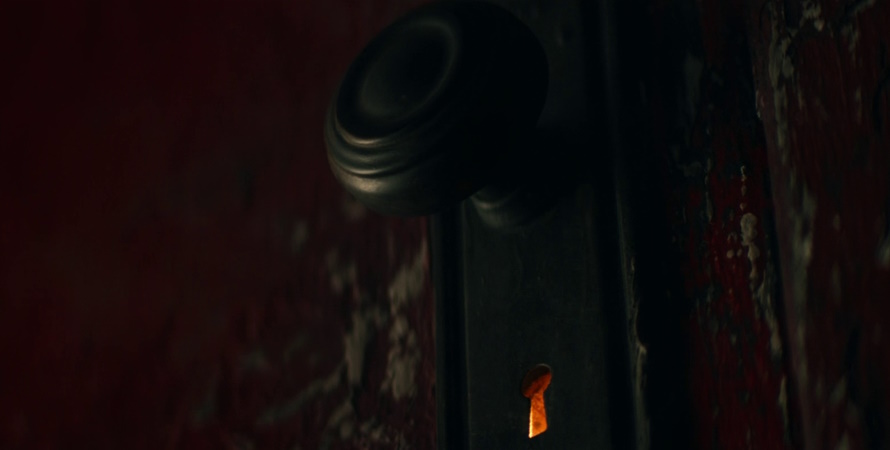
Let’s try to peek through the keyhole of Jack’s red door…

I’ve heard several fan theories that seem completely implausible to me, and I’ll also cover a handful of the more popular ones and why I think they wouldn’t make sense or wouldn’t work narratively. If I try to shoot down a theory you’re personally invested in, I hope you won’t take that as some kind of attack! I’ll try to explain my reasons as gently as possible.

It also goes without saying that I have no “insider information!” I’m not trying to claim that any of the ideas we’re going to discuss today can, will, or must be part of Picard Season 3. It’s possible that I’ve completely misunderstood what Troi was saying, or that Jack’s hallucinatory red door will lead to something completely unexpected, unpredictable, or even a completely different kind of storyline altogether. All of this is also just the subjective opinion of one person.

With all of that out of the way, let’s get started!

“Ancient Evil” #1:
The Borg Queen.

The Borg Queen in First Contact.

As I explained in my recent theory update, the Borg Queen is the candidate I feel is most likely to be the “ancient evil.” The voice Jack has occasionally heard has a feminine quality, there have been multiple references to the Borg and to Picard’s assimilation experience, and the idea of Jack “inheriting” some kind of Borg nanites or Borg DNA from Picard would connect with themes of family, parentage, and inheritance that have been present in different ways all season long.

The Borg Queen hasn’t been explicitly mentioned, but right now, the myriad references to Locutus, the Battle of Wolf-359, and Picard’s connection to the Borg haven’t had any kind of narrative payoff. Bringing the Borg Queen into the story at this particularly late stage is a risk, but it’s also something that has been set up across the entire season – so it wouldn’t feel like a total bolt from the blue.

“Ancient Evil” #2:
The Season 1 super-synths.

The super-synths’ mechanical tentacles.

Should we abandon all hope of the unnamed “alliance of synthetic life” from the end of Season 1 ever making a return to Star Trek? Well… probably! But of all the “ancient” factions we know of in Star Trek, few are older – and potentially more malevolent – than the super-synths that were introduced in Season 1.

Millions of years before the events of the story, this synthetic faction literally moved the stars in the Milky Way and created a beacon, promising to ride to the aid of any synthetic life-forms that needed their help. Whether that offer was genuine or an elaborate trap, well… I’m still not sure! But these super-synths may not have given up on their aim of returning to the Milky Way just because Picard convinced Soji to close the portal to their realm.

“Ancient Evil” #3:
The Female Changeling from Deep Space Nine.

The Female Changeling.

The Female Changeling who led the Dominion’s war effort against the Federation alliance seemed to be one of the most senior Founders. With the changelings featuring heavily in this story, perhaps she is once again trying to lead the charge against the Federation, using Vadic and her evolved allies to get revenge.

Earlier in the season, Vadic cited revenge against Starfleet and the Federation as one of her motives – though she didn’t really elaborate on what that meant. Floaty McFloatface – the unnamed character who seems to have been Vadic’s boss – also mentioned vengeance, so could the changelings be seeking to avenge their defeat in the Dominion War? Vadic knew the details of Jack’s hallucinations, including the existence of the red door – how could she have possibly known that if the changelings aren’t involved?

“Ancient Evil” #4:
Locutus of Borg (or a clone of Locutus).

Picard was assimilated by the Borg.

As above, Season 3 has made multiple references to Picard’s assimilation experience and time as Locutus. Could the rogue changelings have stolen Picard’s corpse as part of a plan to resurrect Locutus? Or could the Borg Collective itself have recreated or cloned Locutus based on Picard’s genetic material? Perhaps Floaty McFloatface is a representative of the Borg – and wants Jack Crusher to become the new Locutus.

The idea of Picard having to come face-to-face with Locutus would surely be his worst nightmare. Locutus would literally know Picard inside and out – and could be very difficult to outmanoeuvre and defeat as a result.

“Ancient Evil” #5:
Someone entirely new.

Who could it be?

In earlier seasons – and in other modern Star Trek productions, too – the franchise’s past didn’t provide the answers to mysteries like this one! So it has to be considered plausible or even downright likely that a brand-new character or faction is the “ancient evil” that we’re looking for. This could come in the form of a new character from a familiar faction – a new Borg or changeling leader, perhaps. Or it could be an entirely new creation that doesn’t connect to Star Trek’s past at all.

There is a danger in this approach, and part of the reason why creations like the super-synths and Species 10-C didn’t excite fans as much as they could’ve is that, after a season-long tease, expectations have been raised! But at the same time, writers should feel free to create new elements to add to Star Trek instead of being constrained by what has come before. A new character or faction could absolutely stick the landing – if it was handled well.

So those are the candidates I consider to be most plausible.

Up next, we’ll take a look at a few others that I’ve heard suggested by fans on forums and on social media. For reasons that I’ll try to explain, none of these feel likely to me… so feel free to come back at the end of the season and laugh at how wrong I was if any of them prove to be the true “ancient evil!”

Not the “Ancient Evil” #1:
The Pah-Wraiths.

Jake Sisko possessed by a Pah-Wraith.

I don’t know who originated this idea, but it seems to have spread like wildfire in some quarters of the fan community! For my money, there’s no way the “ancient evil” could be the Pah-Wraiths, though – even though the faction is undoubtedly both ancient and evil! Firstly, despite references and connections to Deep Space Nine, there have been no mentions of Bajor, the wormhole, the Prophets, or the Pah-Wraiths all season long – so any last-second inclusion would be a complete deus ex machina.

Secondly, and perhaps more importantly, the return of the Pah-Wraiths would hugely undermine the ending of Deep Space Nine, and Captain Sisko’s arc in particular. Sisko sacrificed his life to prevent the Pah-Wraiths from escaping their confinement in the Fire Caves, fulfilling his duty as the Emissary of the Prophets. For a new story to say that the Pah-Wraiths escaped anyway, a mere twenty-something years later, would seriously damage that story and undermine Sisko’s arc and characterisation. Finally, the Pah-Wraiths have no connection to Picard or to the Crusher family.

Not the “Ancient Evil” #2:
Armus.

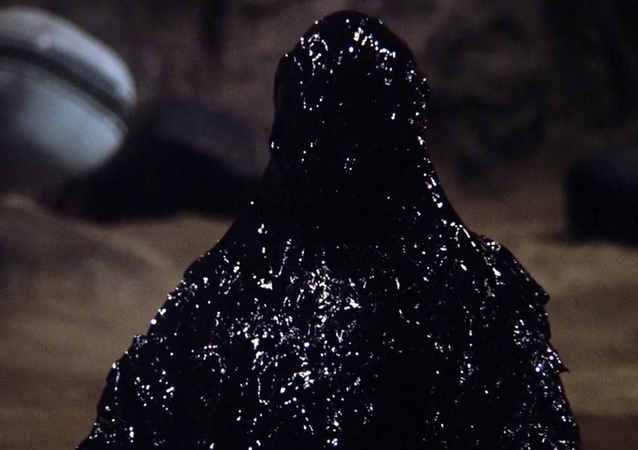
Armus in Skin of Evil.

C’mon everyone… it isn’t Armus, okay? It just isn’t. Not only has Armus not been mentioned since Season 1 of The Next Generation, but the evil puddle of printer ink has no real connection to Picard, to the Crusher family, or to anyone else involved in Season 3. As a villain who only appeared once in what was, let’s be blunt here, not one of The Next Generation’s best stories, Armus would also be underwhelming in the extreme.

Had the story of Season 3 revisited the planet of Vagra II, or if Tasha Yar had been mentioned in the story somehow (aside from a minute cameo as part of Data’s memories) then maybe we could consider this theory more favourably. But Armus would also be a complete bolt from the blue – and one that I don’t believe could possibly be strong enough to carry the ending not only of Season 3, but of the entire series.

Not the “Ancient Evil” #3:
The Romulans/Zhat Vash.

Zhat Vash initiates as seen in Season 1.

Although it would be cyclical in a way if the end of Season 3 were to return to the Romulans in some form, I don’t believe that the story will go in this direction. There have been no Romulans included in the story all season long, and no mentions of the Zhat Vash or their conspiracy, either. The Romulans were also a faction that fought against the changelings during the Dominion War – and there probably isn’t enough time left to sufficiently explain how they might have been persuaded to switch sides.

Finally, although Elnor continues to exist in the Picard timeline, he hasn’t been part of the story of this season – despite opportunities to include him. Elnor is a Romulan, and if there was to be any kind of Romulan connection to the story, I’d have expected him to take part in it.

Not the “Ancient Evil” #4:
Q and/or the Q Continuum.

Q as he appeared in Season 2.

We got our Q story – for better or for worse – in Season 2. While it would be thematically interesting in a way if the end of Jean-Luc Picard’s story were connected to the very first episode in which he appeared, the death of Q last year combined with the total absence of any discussion of Q and the Q Continuum this time make it feel very unlikely at this juncture.

There’s also the question of motivation – something that also tripped up Q’s story in Season 2! Why would Q, or another member of the Continuum, have allied with a faction of rogue changelings to attack Starfleet? If the Q wanted the Federation weakened or destroyed… all it would take is a snap of the fingers. Why go to all this trouble? And why would the Q Continuum hate Starfleet anyway? The Q Continuum is ancient… but is it evil? I don’t think so.

Not the “Ancient Evil” #5:
Khan.

Khan as he appeared in Space Seed.

Genetic engineering and augmentation were discussed in Season 2, and there was even a reference to something called “Project Khan” at the end of the season. But not only is Khan dead, he has no connection to Picard and the Crushers. Although Season 2 has leaned heavily into the legacy of The Wrath of Khan in more ways than one… I just don’t see how the story bringing him back could possibly be made to work.

Star Trek Into Darkness was a riff on the Khan story, and it worked pretty well – at least in my view. But Khan is a character that we don’t really need to see more of… which is part of the reason why I was always sceptical about the Ceti Alpha V pitch! Bringing Khan and his augments into Picard wouldn’t work.

Not the “Ancient Evil” #6:
The Abronians, the Kelvan Empire, the Voth… and more!

Hanar, a representative of the Kelvan Empire.

There are a number of ancient races in Star Trek – and a number of villainous ones, too. But many of these made only a single appearance or a handful of appearances in stories that most viewers would struggle to recall decades later, and while some of them might nominally fulfil some of our criteria – such as by having a tangential connection to Jean-Luc Picard or Dr Crusher – the fact that they haven’t been so much as hinted at all season long should be enough to rule out all of them.

At this late stage in the season, and with the only named villain having already been killed off, it’s already a storytelling challenge to make whatever’s behind Jack’s red door and whomever has been directing the conspiracy not feel like a deus ex machina. If this character or faction is ultimately revealed to be something or someone that we’ve had no mention of through the entire story… I fear that would be too high a narrative hurdle to successfully clear.

So that’s it!

The Shrike’s destruction in Surrender.

We’ve considered a few possibilities for who the “ancient evil” could be. This “ancient and weak” voice that Jack has heard seems to have somehow latched onto him – and is giving him superpowers. Deanna Troi (and everyone else involved in the story) seems to believe that this is directly tied to the rogue changelings and their plans to attack Frontier Day, so one way or another this “ancient evil” has been driving the story all season long.

The death of Vadic has, for me at least, thrown a cloud over this story. Even if the “ancient evil” is the Borg Queen, another Borg representative, or a changeling, it will still be difficult to pull off this storyline successfully and explain everything sufficiently with just two episodes left. I feel echoes of the Season 1 problem, in which the two-part finale dumped new characters, factions, and storylines into the plot but didn’t have anywhere near enough time to pay them off successfully. But we’ll have to wait to see if Season 3 will fare any better!

Jack will explore this “ancient evil” alongside Deanna Troi.

I hope that this was a bit of fun. I tried to consider some seemingly-plausible ideas for the “ancient evil,” as well as explain why I feel that some popular theories are unlikely. If you put me under duress and forced me to pick only one candidate, right now I’m inclined to say that the Borg Queen feels the most likely. There have been multiple Borg references this season, there’s a solid connection to Picard, there’s a narratively coherent way in which Jack could have inherited Borg DNA or nanites from Picard which would also tie in thematically to the ideas of parent-child relationships and inheritance, and the voice that Jack has periodically heard sounds feminine in tone. So that would be my guess – if I absolutely had to choose!

As a final note: I always like to end these theory lists by saying that I do this just for fun. I enjoy writing, I enjoy Star Trek, and spending more time in this world is an escape and an enjoyable distraction for me. But for some folks, fan theories can become frustrating or unenjoyable, especially if they get very attached to a plausible-sounding theory that ultimately doesn’t pan out. I have no “insider information” and I’m not trying to claim that anything suggested above can, will, or must be part of Picard Season 3. The story will almost certainly take an unpredictable path!

Star Trek: Picard Seasons 1-3 are available to stream now on Paramount+ in the United States and other countries and territories where the service is available, and on Amazon Prime Video in the UK and around the world. The Star Trek franchise – including Picard and all other properties discussed above – is the copyright of Paramount Global. This article contains the thoughts and opinions of one person only and is not intended to cause any offence.
Star Trek: Picard bonus Season 3 theory: The “Prodigal Crewman”

Spoiler Warning: There are spoilers ahead for Star Trek: Picard Seasons 1-3, including the trailers, teasers, and marketing material for upcoming episodes. Spoilers are also present for the following Star Trek productions: The Next Generation, Deep Space Nine, Voyager, and Discovery.

For some utterly inexplicable reason, Paramount doesn’t make all of its marketing material available to viewers outside of the United States. Trailers, teasers, clips, posters, and even Paramount’s own press website are geo-blocked, meaning fans and viewers who aren’t American can’t access them – at least, not officially. This is just another example of Paramount’s stupid, dangerous, and obviously damaging “America First” fetish that we’ve talked about here on the website on more than one occasion in the last few years.

But we’ll have to give Paramount another stern talking-to, clearly.

Fuck you too, Paramount.

Because I don’t have access to that, I missed something potentially huge about the upcoming fifth episode of Star Trek: Picard Season 3 that was revealed in the episode’s official press release. Here’s the full blurb so you can read it for yourself:

“Caught by Starfleet and facing court martial, paranoia grows as Picard struggles to uncover whether a prodigal crewman from his past has returned as an ally – or an enemy hellbent on destroying them all.”

One part of this in particular jumped out at me: the “prodigal crewman.” Who could this character be? And more importantly: might it be someone we’ve met before; a returning legacy character?

There are quite a lot of characters who could potentially return!

I would have included this as part of my theory list if I’d spotted it in time! I don’t like going back to posts I’ve already published and adding whole paragraphs and chunks of text, so instead of doing that, I’ve decided to write this one up as a standalone theory.

The use of the word “prodigal” is very interesting here, as it could absolutely be argued to imply that we’re dealing with a character we’ve already met. A “prodigal” son or daughter is someone who returns home, so I think we’ve got a case – albeit not a watertight one – to make in favour of this character being someone we’ve already met. And you better believe that I have a few ideas for who they could be!

Prodigal Crewman #1:
Tasha Yar

Tasha Yar at her post.

Denise Crosby, who originated the role of Tasha Yar in The Next Generation’s first season, has been heavily rumoured to be involved with Picard Season 3 for months, and it’s primarily for that reason that she’s in contention here. Yar was, of course, famously killed off toward the end of The Next Generation Season 1, but that didn’t stop Crosby from making occasional returns to Star Trek – either as Tasha Yar herself or as her half-Romulan daughter Sela.

Perhaps part of what Picard will have to figure out is whether Tasha Yar survived her injuries at the hands of Armus, or whether this version of Tasha Yar might be the mother of Sela – someone detained and imprisoned for years by the Romulans. Such a storyline could even cross over with a potential Section 31 series; Tasha’s survival may have been hushed up by the shadowy black-ops organisation.

Tasha Yar was killed off early in The Next Generation’s run.

Most fans of The Next Generation would instantly assume that Tasha Yar couldn’t possibly be real – because we know that she died a long time ago. That would potentially set up a kind of double-bluff, where the show leans into the idea that Tasha Yar is a changeling… only to perhaps rip that away at the last moment and say that she’s actually for real.

A good rule in Star Trek (and fiction in general!) is that if you haven’t seen the corpse, a character may not be truly dead. But we did see Tasha’s body, we watched her die, and we even saw her friends attend her memorial service. It would be difficult, narratively speaking, to find a way around that… and I don’t think it’s something that can just be hand-waved away or ignored. So there’s a potential pitfall here, I fear.

Prodigal Crewman #2:
Sito Jaxa

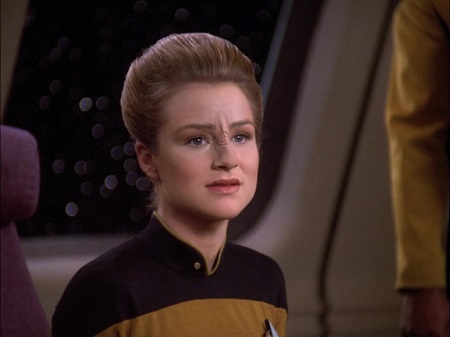
Ensign Sito Jaxa.

Ensign Sito Jaxa made two appearances in The Next Generation. She debuted in the episode The First Duty, where, as a cadet at Starfleet Academy, she played a role in covering up the death of a colleague during an unsanctioned flying manoeuvre. Later she appeared in the episode Lower Decks, having been assigned to the Enterprise-D at Picard’s explicit request.

Ensign Sito was presumed to have died during a mission to aid a Cardassian spy – but her body was never recovered, so it’s possible, perhaps, that she wasn’t killed in action as we were led to believe.

Sito with Picard.

Sito definitely qualifies as a “prodigal” crewman, I think! But as a character who only made a couple of appearances, she may not be as recognisable to the audience. The story would also have to find a way to explain what happened to Sito after her disappearance in a satisfactory way, telling us how and why she disappeared and allowed her friends to assume the worst.

Even with those issues, though, I think Sito could make for a fascinating character to bring back. And as a relatively unknown character, there’s scope to tell a different kind of story unconstrained by too much prior canon.

Prodigal Crewman #3:
Dr Pulaski

Dr Kate Pulaski.

I gotta be honest: I don’t really think that Dr Pulaski is a strong contender here. But as you’ll know if you read my in-depth look at her character, I truly like Dr Pulaski, and she’s a character that I wish we’d gotten to spend more time with. Giving her an epilogue after all these years would be fantastic – even if it seems quite unlikely!

So that’s the truth of Dr Pulaski’s inclusion on this list. But I still think we can build a case for her return. First and foremost, Dr Pulaski never got a conclusive goodbye after Season 2 of The Next Generation. She simply disappeared when Dr Crusher returned at the beginning of Season 3, and while there was supposedly a mention of her over a tannoy in the background during the events of the Voyager series finale Endgame, implying that she may have worked at Starfleet Medical, I don’t think that really counts!

Dr Pulaski, ready for a trip to the holodeck!

It would be genuinely interesting to see some kind of on-screen interaction between Drs Crusher and Pulaski, as that’s something we never got during The Next Generation’s run. How would these two very different doctors react to one another, and would their styles completely clash? It could certainly be a bit of fun to see that!

Dr Pulaski also had a burgeoning friendship with Worf, and has a strained relationship with Riker as she had once been involved with his father. She’s also a character who knew Professor Moriarty, who we know is coming back soon; she was present during his creation on the holodeck. There are good reasons to want to see more of Dr Pulaski – even though I think her return on this occasion isn’t the most likely.

Prodigal Crewman #4:
Ro Laren

Ro betrayed Riker and Picard the last time we saw her.

The former Ensign Ro is someone who could be absolutely fascinating to bring back. Her defection to the Maquis at the end of The Next Generation was something that clearly stung Picard, so there’d immediately be a loss of trust between them. Ro is also a character who could tell us a great deal about relations between the Federation and the Cardassians, as well as the potential survival of some members of the Maquis.

One interesting idea that hasn’t been explored fully in Star Trek since the Dominion War is the idea that characters like Ro and even Michael Eddington were, in a roundabout way, right. They predicted Cardassian aggression years before it happened, and were willing to fight back at a time when the Federation was pursuing what amounted to a policy of appeasement; peace at any cost.

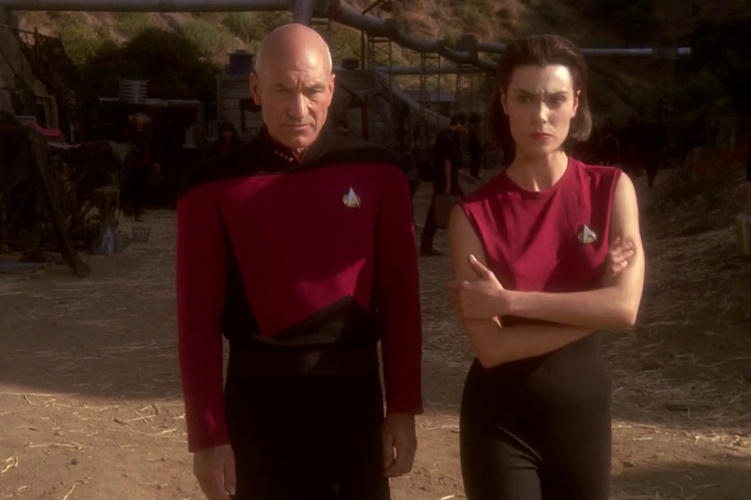
Picard with Ensign Ro at a Bajoran refugee camp.

If Ro were to return, we could see her take Picard to task for failing to recognise signs that the Cardassians would once again make offensive moves against the Federation – and hearing what Picard may have to say in defence of his actions in that era could be fascinating, particularly in light of what happened in the Dominion War.

We could also see Ro as the returning “prodigal” crewman, perhaps having suffered years of imprisonment at the hands of the Cardassians, and lamenting the loss of many of her Maquis friends. I’m sure Riker would have a thing or two to say to her, too, because the last time he saw her she was pointing a phaser at him!

Prodigal Crewman #5:
Lore

Lore as he appeared in The Next Generation.

Is Lore a “crewman” in the strict sense of the term? I’m not so sure… but he’s also the only character on this list that we know for a fact will be included in the season’s story! That alone should mean he’s in contention.

It seems to have been hinted in pre-season marketing material that Lore may have changed since we last encountered him, and that he may have become more of a friend/ally to Picard and the crew. If so, perhaps that will be what Picard figures out over the course of this upcoming episode.

Lore in the final Season 3 trailer.

Is it possible that Lore might have been “repurposed” to somehow resurrect Data? That could also give Picard a puzzle to figure out: is he dealing with the genuine resurrection of his dead friend, or is Lore once again trying to take everyone for a ride by posing as his brother? After a prominent sequence at the end of Season 1 in which Data was laid to rest, I’m not sure this is the route I’d want to see the story go down – but you never know.

I’m not really sold on Lore’s return, to tell the truth. The “evil twin” angle was a fun one on a couple of occasions during The Next Generation’s run, but with Data seemingly out of the picture, Lore’s return seems to be more to do with wanting to reunite actor Brent Spiner with his co-stars rather than for any narrative reason. And with Spiner having already appeared in both Seasons 1 and 2 of Picard… maybe that’s just not something that will turn out to have been necessary. Regardless, this feels like it could plausibly be the moment of Lore’s return.

Prodigal Crewman #6:
Elnor

Season 2 promotional photo of Elnor.

I know, I know: actor Evan Evagora has stated that he isn’t coming back for Picard’s third season. However, we heard similar words from Orla Brady, who plays Laris, and she actually did appear in the season premiere. Perhaps Elnor could be back for a one-off appearance after all!

Would we call Elnor a “prodigal” crewman? And what reason might Picard have to suspect that he’s dangerous – other than the obvious changeling infiltration possibility? Also, what kind of role might Elnor have in prosecuting Picard at a potential court-martial? All of these questions would have to be answered if Elnor is indeed to return!

Cadet Elnor at the end of Season 2.

However, it would be an unexpected and fun twist in the story. We could learn that Elnor has graduated from Starfleet Academy and is now a fully-fledged Starfleet officer, perhaps serving in the security division. He could even enable Picard and Riker to escape their potential arrest, proving that he’s on their side.

Elnor’s return could also lead to a reunion with Raffi, as the two clearly had a strong bond. It must’ve been difficult for Raffi to leave Elnor behind to go undercover – especially as he’s the closest thing to family she has left after alienating and estranging herself from her ex-husband, son, and daughter-in-law. Elnor’s story, perhaps more so than any other new character, is arguably the most unfinished – and finding a genuinely good reason for his last-second resurrection at the end of Season 2 should be a priority, too.

Prodigal Crewman #7:
Sela

Sela in The Next Generation.

We mentioned Sela above when talking about Tasha Yar, but could she turn out to be the “prodigal crewman” herself? Depending on the state of Romulan-Federation relations in this era, it’s possible, I suppose, that other Romulans might follow in Elnor’s footsteps and join Starfleet – or at least work alongside Starfleet in some capacity as allies.

Sela could also emerge not as a member of the crew, but in some other role, perhaps as a fellow prisoner if Picard and Riker are placed under arrest. She could return offering to break Picard out of jail, only for Picard to have to stop to consider whether she’s doing so to help – or because she has some other nefarious goal in mind.

Picard and Sela have crossed paths before…

This would allow Denise Crosby to return but without having to, for want of a better expression, dig up Tasha Yar. Given the adversarial nature of Sela’s relationship with Picard, it would make sense why he wouldn’t know whether or not to trust her – and why he’d need to figure out whether she’s an ally or an enemy.

I definitely think that there’s scope to bring back Sela in some form this season – though whether this would be the right way to do it is still an open question!

Prodigal Crewman #8:
Vadic

Vadic in Seventeen Seconds.

This one is a bit “out there,” so bear with me! I’ve had a theory that has been running for as long as we’ve known Vadic would be a part of the season’s story in which I’ve suggested that she could be a former Starfleet officer – someone who once served under Picard’s command. The inclusion of multiple connections to the Battle of Wolf-359 – including most prominently Captain Shaw’s presence at the battle that was revealed in No Win Scenario – could also be a potential origin story for Vadic: she was a Starfleet officer or enlisted crewman present at the battle.

Perhaps Vadic will return in the upcoming episode, relatively unscathed after Riker’s asteroid attack, and will reveal herself as a former crewmate of Picard’s. She may offer some tantalising piece of information pertaining to the rogue changelings and their conspiracy that Picard will need to investigate – and determining whether Vadic’s offer is genuine or a trap could be a big part of the story.

Who is Vadic?

If Vadic truly is someone who served in Starfleet, I’m not sure if this is how that revelation might come. But it feels like a possibility, at least, and now that we’re relatively certain that Vadic isn’t actually a changeling herself, but is merely working for them in some capacity, the question of her origin is once again an open one.

It would be a shocking twist in the story if Vadic essentially “turned evil” because of something that Picard did or didn’t do. She might blame him for her injuries if she once served aboard the Stargazer or Enterprise-D, or she might hold Picard accountable for her assimilation if she was captured and assimilated by the Borg, for example. There are multiple ways to tie Vadic to Picard’s past – including as a “prodigal crewman.”

Prodigal Crewman #9:
Reg Barclay

Barclay with a medical tricorder.

Barclay would be a fun and interesting character to include in Season 3, and a potential story in which he plays a role could also see him interacting with Seven of Nine. Barclay was instrumental in helping the USS Voyager communicate with Starfleet while the ship was stranded in the Delta Quadrant, so a kind of reunion between him and Seven could be a ton of fun!

Although Barclay was arguably not Picard’s favourite officer during his tenure aboard the Enterprise-D, he was always an ally – so the question of why Picard might mistrust him is an open one. As an engineer, there’s also the question of what role Barclay might play during a potential arrest and court-martial – he clearly isn’t going to be a security officer or advocate.

Barclay in Star Trek: Voyager.

Again, Barclay could be someone who shows up, seemingly out of nowhere, offering Picard and Riker a potential way out. Determining whether that offer of assistance is genuine could be what the blurb of the episode is hinting at, and it could be fun to see Picard and Riker trying to “test” Barclay to see whether he’s the genuine article.

Barclay is another character that I think could make a welcome return to Star Trek, and could link up with Picard, Geordi, Seven, and others in Picard’s third season in different and fun ways. Whether this would be the right way to do it… I’m not 100% sure. But it’s at least a possibility!

Prodigal Crewman #10:
Miles O’Brien

O’Brien in The Next Generation.

Chief O’Brien is basically the only person on this list who meets the strictest definition of “crewman!” O’Brien was never a commissioned officer, instead holding the rank of chief petty officer – a non-commissioned rank that essentially makes him a senior crewman. Could that complicated work of semantic gymnastics be a hint at the return of Chief O’Brien?

I’d absolutely love to see Miles O’Brien come back. He’d certainly have a lot to say to Worf – the two worked together for years during the Dominion War. He’s also a character with a strong connection to Picard, having served aboard the Enterprise-D before transferring to DS9.

Chief O’Brien.

O’Brien is also a great character to include in a story all about the rogue changelings. As a kind of epilogue to Deep Space Nine seems to be unfolding, bringing back other characters from that series makes a lot of sense – and if it’s someone like O’Brien that Picard hasn’t seen for a long time, it would be understandable if trust is hard to come by at first. Worf could be the point of connection here, proving to Picard that O’Brien is on their side.

I doubt that the question of “crewman” versus “officer” will ultimately matter; that was just a bit of fun. It would be great to think that we might see Chief O’Brien again, though, and that he might have a role to play in a story that brings back the changelings and makes reference to the Dominion War – a war in which he played a major role.

Prodigal Crewman #11:
Wesley Crusher

Wesley after his field commission.

Another character who would arguably fit the definition of “prodigal” is Wesley Crusher, who has been off with the Travelers for a number of years. We saw at the end of Season 2 that Wesley has settled into that role, so the question of why he might choose to make himself known to Picard at this time is unclear.

However, as the blurb hints, it could be possible that a changeling is impersonating Wesley to try to catch Picard and Dr Crusher off-guard. This imposter could be trying to get to Jack through Dr Crusher, using the image of Wesley to worm their way into the Crushers’ trust.

Wesley with Kore Soong at the end of Season 2.

Having seen Wesley at the end of last season, though, and seemingly in a pretty conclusive scene, I’m not certain that he’ll be back again so soon. There are good reasons to do it, both narratively speaking and for the fun of including another legacy character, but there are also some pretty solid counterpoints, too.

Still, Wesley would certainly fit the definition, and would be an interesting character to include. His inclusion could set up a kind of double-bluff, where we’re led to believe there’s a high likelihood of his being a changeling, only for the story to prove at the last moment that he actually is Wesley Crusher. I think a lot of fans would like to see a reunion between Wesley and Beverly – and it could be fun to see Wesley meeting his half-sibling for the first time, too!

Prodigal Crewman #12:
Thomas Riker

Thomas Riker.

Thomas Riker – a transporter-created clone of William Riker – would be an interesting character to bring back. Last we saw him, Thomas was being arrested by the Cardassians, having exposed a secret fleet that the Obsidian Order was building. This took place in the years prior to the Dominion War – so what became of him after his arrest was never seen on screen.

If Thomas survived the war, he may have been returned to the Federation, or perhaps liberated from a Cardassian prison camp during the course of the conflict. If so, perhaps he was able to rejoin Starfleet at some point.

Could this be Thomas Riker? Or did Thomas somehow replace the real Riker?

The presence of Thomas Riker could tie into the theme of an “imposter” without going down the obvious route of having another changeling hiding out in Starfleet. It could fall to Picard to figure out whether he’s sitting with the original Riker or his clone – and as the two men are indistinguishable by scans and sensors, it might only be Picard’s insight into his former number one that could find out the truth.

This could also potentially explain why we saw a clip in one of the pre-season trailers that seemed to show Riker trapped or imprisoned. If Thomas is involved, could he be working with Vadic? He was actually one of the characters I suggested could be part of her team when I put together a list back in November. You can find the full list by clicking or tapping here.

Bonus Prodigal Crewman:
Someone entirely new.

Will it be someone we’ve never met?

In Season 1, the super-synths and Zhat Vash were entirely new creations. In Season 2, Star Trek’s past likewise didn’t factor into either the mysterious anomaly or Picard’s own backstory. There have been moments in both seasons where characters from the past could have been included: multiple admirals and senior Starfleet personnel could have been replaced by the likes of Admiral Janeway, for instance, or Dr Benayoun in Season 1 could have been subbed out for someone like Dr Pulaski or Dr Bashir.

So there are good reasons to think that, once again, Picard will create an entirely new character to fill this space. Such a character could be said to have served under Picard’s command aboard the Enterprise-D, the Enterprise-E, the Stargazer, or during the Romulan rescue mission, and they could be tailor-made to fill a particular role in this new narrative.

In Season 1, the new character of Dr Benayoun was created.

I’d suggest that this reference to a “prodigal crewman” hasn’t exactly been a massive part of the marketing or promotional material for either the season as a whole or even for this episode – so if it turns out not to be relevant, I don’t think we can really accuse Paramount of getting our hopes up too much! On several occasions in recent seasons of Star Trek, there arguably have been teases that hinted at potential returning characters or factions that ultimately didn’t pan out. We could point to Tarka’s friend and Unknown Species 10-C in Discovery Season 4, the Burn in Discovery Season 3, and the super-synths in Picard Season 1 as examples of this… but this reference to a “prodigal crewman” feels minor in comparison.

In short, what I’m trying to say is this: don’t be surprised if this character turns out to be someone brand-new. Although we’ve had fun (I hope) speculating wildly about possible returning characters, a brand-new creation is at least as likely – if not more so – than anyone on this list!

So that’s it!

The Titan will rendezvous with another Starfleet vessel…

We’ve considered twelve possible characters who could be the “prodigal crewman” mentioned in the blurb for Imposters, the upcoming fifth episode of Picard Season 3. Will we look back at this list in a few days’ time and think how brilliant and insightful it was? Or will we instead think how silly it was to speculate about a bunch of characters who clearly had no role to play? Only time will tell! But even if I’m completely wrong on this, it was a bit of fun to speculate about who may or may not be coming back.

I’d be hard-pressed to pick a favourite on the list above. For production-side reasons, characters played by actors who we know to be involved in the season – like Thomas Riker or Lore – feel plausible, as do characters like Sela and Tasha Yar as Denise Crosby has been heavily rumoured to be playing a role this time. But Star Trek has kept some wonderful surprises – Wesley Crusher’s role at the end of Season 2 hadn’t been leaked or even hinted at, making it a great inclusion in the episode Farewell. What I’m saying is that a complete shock shouldn’t be entirely disregarded; it’s possible, at least, that a truly unexpected character could be about to make a return.

As a final note: I always like to end these theory posts by saying that I do this just for fun. I enjoy writing, I enjoy Star Trek, and spending more time in this world is an escape and an enjoyable distraction for me. But for some folks, fan theories can become frustrating or unenjoyable, especially if they get very attached to a plausible-sounding theory that ultimately doesn’t pan out. I have no “insider information” and I’m not trying to claim that anything suggested above can, will, or must be part of Picard Season 3.

Star Trek: Picard Seasons 1-3 are available to stream now on Paramount+ in the United States and other countries and territories where the service is available, and on Amazon Prime Video in the UK and around the world. The Star Trek franchise – including Picard and all other properties discussed above – is the copyright of Paramount Global. This article contains the thoughts and opinions of one person only and is not intended to cause any offence.
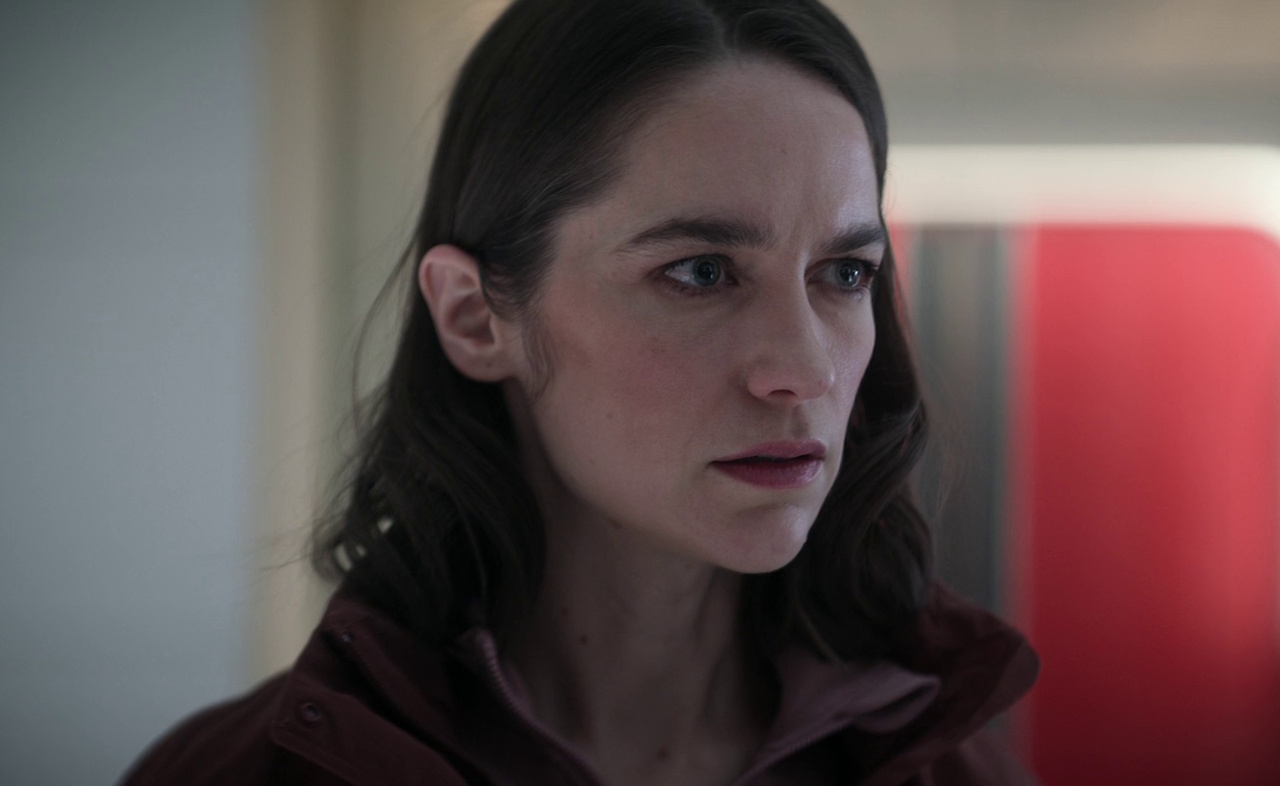
Star Trek: Lower Decks theory – evil Boimler

Spoiler Warning: There are spoilers ahead for Star Trek: Lower Decks Seasons 1-2 and the following Star Trek productions: The Original Series Season 2, The Next Generation, and Deep Space Nine Season 3.

With Lower Decks’ third season fast approaching, I wanted to write up a theory that I’ve had kicking around since the second episode of Season 2. Lower Decks’ episodic nature hasn’t lent itself to a ton of theory-crafting so far – although I do have at least one more in the pipeline, so stay tuned for that! – but this one feels plausible; it’s the kind of narrative choice that I could see the show’s writers making.

First of all, let’s briefly recap what happened to Ensign Boimler from the end of Season 1 to the beginning of Season 2. After impressing Captain Riker, Boimler took a transfer to the USS Titan at the very end of Season 1, leaving Mariner and the Cerritos behind and being promoted to the rank of lieutenant. Boimler would serve under Captain Riker for a short while, and one of the Titan’s assignments at this time involved following up with the newly-aggressive Pakleds.

Boimler got a transfer at the end of Season 1.

Lieutenant Boimler was assigned to an away mission to the planet Karzill IV as part of this assignment, and after getting caught in a firefight he was able to save the day and allow the rest of the team to make it back to the Titan. However, as this mission drew to a close a transporter accident created a duplicate – or clone – of Boimler, resulting in two identical Lieutenant Boimlers, indistinguishable from one another.

For seemingly arbitrary reasons, Starfleet decided that only one Boimler could remain aboard the Titan, and the other would have to take a demotion back to the rank of ensign and return to the Cerritos. After one Boimler returned to the Cerritos we’ve followed his actions, and the second Boimler hasn’t been mentioned since. But could that be about to change?

Boimler betrayed!

Although we were told that the two Boimlers were indistinguishable from one another – totally identical – the second Boimler, the one who remained aboard the Titan, seemed much more outgoing than the Boimler we’ve gotten to know. Not only that, but he seemed more than a little devious in tricking “our” Boimler to return to the Cerritos so that he could continue on the Titan and advance his career. Could we be looking at the beginnings of an “evil twin” (or “evil clone,” I guess) storyline?

It wouldn’t be the first time that such a story has appeared in Star Trek! Going all the way back to The Original Series we had stories like The Enemy Within that split Captain Kirk into two distinct personalities, one “good” and one “evil.” And of course there’s the classic Mirror, Mirror that showed our heroes’ evil alternate universe counterparts.

Two Captain Kirks!

The Next Generation followed this up by creating Data’s own “evil twin” – Lore. Lore would tangle with the crew of the Enterprise-D on more than one occasion, doing things like allying with the Crystalline Entity and raising an army of abandoned ex-Borg, as well as trying to corrupt Data and sway him to his cause.

Most significantly we have Thomas Riker, the first transporter duplicate in Star Trek and whose character clearly inspired the Boimler storyline in Kayshon, His Eyes Open. Not only was Thomas difficult to work with for William Riker after being rediscovered, but he would go on to rebel against Starfleet, join the Maquis, and even steal the USS Defiant from Deep Space Nine.

Thomas Riker.

Lower Decks has brought back a lot of Star Trek tropes and story beats, and many of them have been used for one-off gags or as cute callbacks to past events. It can be difficult to tell whether there’s some deeper meaning to the whole transporter duplicate story because of that. In the episode Kayshon, His Eyes Open it worked well as a surprising twist, a way to kick Boimler back to the Cerritos, and as a cute wink to fans of The Next Generation, especially considering Riker himself was present. The storyline could end there with Boimler’s twin never being mentioned again.

But at the same time, Lower Decks has used some of these classic Star Trek moments and story beats to set up longer arcs, or returned to them later. There’s a symmetry to some of the show’s episodes and storylines, too. The way the Cerritos saved the USS Archimedes in the Season 2 finale after having to be saved in the Season 1 finale is one of the best examples of this – and we could also point to the Pakled storyline itself as an unfolding multi-episode arc.

Captain Riker and the Boimlers.

I think we’ve laid out how it’s at least possible that there could be something more going on with the transporter clone and looked at previous examples of “evil twin” tropes in Star Trek. So that answers the question of “could it happen?” quite nicely – but that’s really just the beginning.

The matter at the heart of this theory is what direction such a story would take, how it could potentially impact (our) Boimler, and what it could do for the series as a whole.

If we look back to episodes like Datalore or Second Chances, I think it’s not unfair to say that those storylines didn’t go on to have a lasting effect. The creation of twins, clones, and duplicates hasn’t actually come to matter in a significant, ongoing way for any Star Trek character so far. Even when those twins made repeat appearances their stories tended to be confined to a single episode – or perhaps a two-parter.

Lore.

It was never really explained in any detail what impact Thomas’ emergence had on William Riker after the events of Second Chances. Even when Thomas returned in Deep Space Nine’s third season episode Defiant, the story unfolded from his perspective without any input from his doppelgänger.

Data’s conflict with Lore is perhaps the biggest of these storylines, with Lore being mentioned a handful of times outside of his main appearances. But because of Data’s nature, he wasn’t as emotionally impacted by Lore’s behaviour as other characters in a similar situation might’ve been. Data even expressed confusion in Second Chances as to the nature of the dispute between Will and Thomas Riker!

Thomas Riker in Defiant.

Although Lower Decks has been largely episodic, we’ve still seen some impressive character work across its first two seasons. The way Ensign Mariner in particular has grown into her role and come to resolve some of her issues with her mother, her friendships, and her position in Starfleet has been wonderful to see – and it’s this more serialised approach to characterisation (a hallmark of modern television storytelling) that could make an “evil Boimler” storyline different to what we’ve seen before in Star Trek.

Boimler’s issues with his transporter duplicate could have an impact on him that extends beyond a single episode – and that could take his character on a journey. Beginning with the sense of betrayal he surely felt at the duplicate’s duplicity aboard the Titan, Boimler could begin to forgive him, only to discover he’s up to no good. He could find it difficult to convince his friends at first, before showing them irrefutable proof of the clone’s misdeeds. And the whole experience of having to face off against someone who literally knows him inside and out and has shared every experience he ever had could both challenge and change him.

Boimler in Season 2’s We’ll Always Have Tom Paris.

We could see a more confident Boimler emerge from under such a storyline – but someone whose friendships have been pushed and stretched before eventually settling. Or we could see Boimler begin to second-guess himself; if the “evil” clone was Boimler himself, perhaps he’d wonder if being “evil” is part of his own nature, and that could cause him to freeze or find it hard to make decisions.

In short, there are a lot of ways that such a story could go – but almost all of them would be good for Boimler’s characterisation in the long run. We’d get a fun episode with the evil twin that could harken back to the likes of The Enemy Within, Mirror, Mirror, Datalore, and others – but the impact of that episode could reverberate across an entire season, giving Boimler a character arc that could be very satisfying to see unfold.

Are we in for some Boimler-on-Boimler action?

So that’s it for now! The theory is that Boimler’s transporter duplicate will – in classic Star Trek tradition – turn out to be evil!

For the reasons laid out above, I think such a story could be fun and interesting. Moreover, I like the idea of the fallout from Boimler’s conflict with his “evil twin” not being confined to a single episode and potentially setting him on a season-long arc as he processes what happened and what it means for himself and his friends. Going down that road could feel deeply cathartic – with Boimler filling in for other Star Trek characters in similar situations who never got the chance to deal with the longer-term implications of what they went through!

I hope this was a bit of fun. Please keep in mind that I have no “insider information” and I’m not trying to claim that any of this will happen in Lower Decks either imminently or in Season 4. I just think it’s a fun concept, and while all the pieces seem to be in place for such a story, it could be that the transporter duplicate will (in the best tradition of Star Trek) never be mentioned again!

Star Trek: Lower Decks Seasons 1-2 are available to stream now on Paramount+ in the United States and on Amazon Prime Video in the UK and around the world. Season 3 will premiere on the 25th/26th of August 2022. The Star Trek franchise – including Lower Decks and all other properties mentioned above – is the copyright of Paramount Global. This article contains the thoughts and opinions of one person only and is not intended to cause any offence.
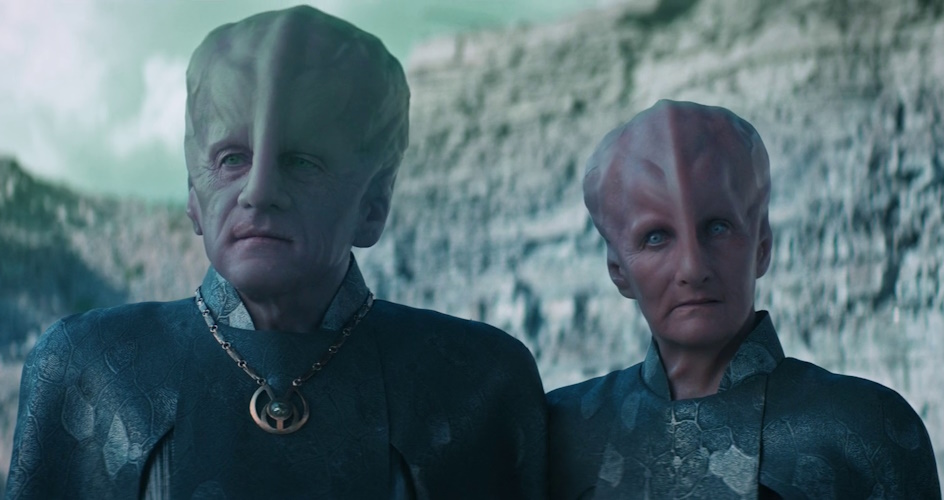
Strange New Worlds Season 2 theory: Una Chin-Riley

Spoiler Warning: There are major spoilers ahead for Star Trek: Strange New Worlds Season 1, including the season finale. Spoilers are also present for Star Trek: The Original Series and Star Trek: Discovery.

This theory is going to get into major spoiler territory for Star Trek: Strange New Worlds, including the very last scene of the final episode of Season 1. If you aren’t fully caught up on the events of Season 1 – and you decided to ignore the spoiler warning above – this is your last chance to nope out!

So today I thought it could be fun to speculate about Una Chin-Riley – a.k.a. Number One. Captain Pike’s first officer had an interesting season, with a truly unexpected backstory that connected back to the events of Star Trek: Enterprise while simultaneously setting the stage for some significant development in her relationship with La’an in particular.

Let’s talk about Una!

The decision for Una to be an Illyrian was a genuinely interesting one, and I felt sure that there’d be something more to come after the revelation of her true heritage in Ghosts of Illyria. It took until the closing moments of the season finale, but eventually we got there! Una’s arrest was the perfect tease on which to end the season, setting the stage for what will presumably be the first part of Season 2 in truly spectacular fashion.

There are a few points to consider before we jump into the main theory list. First of all, the fact that Captain Pike visited an alternate future in which Una is still incarcerated almost a decade after the events of Season 1 does not, in itself, mean that that will be her fate. That was an alternate timeline, after all, one which Pike’s actions have now erased. So I don’t think we can dismiss Una, saying “that’s it, she’s off the show” and close the book! There’s obviously going to be something more to come – though whether it will fully restore her to a leading role in Starfleet is still an open question.

Una was arrested at the end of Season 1.

One of the interesting things about a show like Strange New Worlds is the potential it has to explore different aspects of Star Trek’s 23rd Century and answer questions that most fans didn’t even know they had! One such question could be “where was Una after the events of The Cage?” She didn’t participate in Spock’s off-the-books quest to transport Captain Pike to Talos IV, despite being one of only a handful of people who knew about his impending disability and the powers of the Talosians.

Una was also never seen, nor even mentioned, during the entire run of The Original Series and its films. On the production side of things that’s at least partly because Majel Barrett, who was the first actress to take on the role, was playing the character of Nurse Chapel. But again it leaves the question of Una’s fate open-ended. A senior officer with such promise serving on the Federation flagship would usually be gunning for a promotion and their own command; was that what Una hoped to do?

Majel Barrett as “Number One” in The Cage.

It could be that the explanation for Una’s absence from the events of The Menagerie and other significant moments in the second half of the 23rd Century is that she was either locked up or exiled for her deception and illegal genetic enhancements. That would be a pretty depressing way for the story to go, but it wouldn’t contradict anything we know of from other Star Trek productions. Personally, I’ve never felt any of these absences were glaring omissions that have been crying out to be explained away – but perhaps some of the show’s writers disagree.

There’s also a potential narrative reason to shuffle Una out of the way, and that comes from the character of Spock. Firstly, Spock long ago took over Number One’s original “cool and logical” persona that debuted in The Cage. And secondly, while Captain Pike was surprised to learn in A Quality of Mercy that Spock was his new Number One, as Trekkies we know that Spock’s arc will take him through being Captain Kirk’s first officer and trusted confidante all the way to becoming a captain in his own right, an ambassador, and beyond. Perhaps part of the next chapter of Strange New Worlds will involve setting the stage for Spock to step up and grow into that kind of role, either by serving as Pike’s XO aboard the Enterprise or potentially by pairing him up with a younger Jim Kirk.

Spock and Captain Kirk.

However, I’m not convinced that we’ve seen the back of Una just yet. Strange New Worlds already killed off Hemmer – in one of the most shocking and tragic sequences in the entire season – and La’an’s request for a leave of absence to track down the family of Oriana could mean that she will have less of a role to play in future, too – potentially being absent for some or all of next season. With at least one and possibly two characters already gone, it would be one heck of a shake-up to lose Una as well.

With the exception of Lower Decks, modern Star Trek shows have struggled with consistency. Discovery has famously had four different captains across its four seasons, and Picard took two very different approaches to its characters in the two seasons that we’ve seen so far, with some noteworthy absences in Season 2. In short, it would be to the benefit of Strange New Worlds – and the Star Trek franchise overall – to settle down and to find room to breathe; to expand and develop the characters who are already in play before rushing off to make more and more changes. So if I had a vote, I’d find a way to keep Una around!

Una as she appeared in Discovery Season 2.

All of this leads up to my theory list about Una. The first part of the list will consider possible culprits for grassing her up to Starfleet Command and getting her arrested, and the second part will consider possible outcomes and options for Season 2 that could either bring her back into the fold or see her depart the series.

My usual caveats apply: I have no “insider information” and I’m not trying to claim that anything discussed here will be part of Season 2. This is pure speculation from a fan and nothing more! If Season 1 is any indication, Una’s story in Season 2 will go in a wildly different direction that I won’t be able to predict! Secondly, all of this is the subjective opinion of one person. If you hate all of my ideas (or I don’t include your current pet theory) that’s okay! There’s room within the Star Trek fan community for civil conversations and polite disagreement.

With all of that out of the way, let’s look at some theories!

Culprit #1:
Captain Pike

Captain Pike in his ready-room in Ghosts of Illyria.

I don’t believe that Captain Pike would have intentionally told Starfleet about Una’s Illyrian heritage. But in the course of his duties as captain, he may have had to log or otherwise record Una’s disclosure to him – or may have done so in a personal log. If those logs were then sent to Starfleet, it could be that Captain Pike inadvertently flagged up Una’s true origin.

There was room in Season 1 for more development of the relationship between Una and Captain Pike – a relationship that seemed well-established when they appeared together in Season 2 of Discovery. In a busy season, though, their time together was somewhat limited, and I’d like to see more interaction between the Enterprise’s captain and first officer going forward. Making Pike the one who got her arrested – even if it was completely accidental – would risk damaging that relationship. While that could give them a starting point to rebuild from, it wouldn’t necessarily be my first choice.

Culprit #2:
Dr M’Benga

Dr M’Benga learned of Una’s true heritage.

As with Captain Pike above, I don’t believe that Dr M’Benga would deliberately reveal Una’s secret to Starfleet. Just as Una had something to hide, so too did Dr M’Benga, and Una was the only one who knew about his daughter being kept suspended in the transporter buffer. He would have no motivation to expose her, and from his perspective doing so may have compromised himself and his daughter’s safety.

However, Dr M’Benga is responsible for the ship’s sickbay and the health of all its personnel, so perhaps he logged somewhere that there’s an Illyrian aboard. Maybe Dr M’Benga noted that the treatment for the contagion that broke out aboard the Enterprise came from Illyrian antibodies; Starfleet Medical must surely keep records of these dangers and their cures for the sake of other ships and crews.

Culprit #3:
La’an Noonien-Singh

La’an in Ghosts of Illyria.

La’an is really the only character who would have any motive for deliberately and maliciously telling Starfleet the truth about Una. Although the two had resolved their differences by the end of Ghosts of Illyria – and grew closer over the rest of the season – La’an was incredibly angry at first upon learning who Una really was. It seems possible to me that La’an contacted Starfleet sometime during the events of Ghosts of Illyria, possibly while under the influence of the contagion.

This could set up La’an and Una for a confrontation, but one for which La’an already feels guilt and remorse. If she is responsible, I think there’s a pathway for forgiveness – and perhaps she’ll find a way to make it right, such as by advocating on Una’s behalf or even trying to break her out of prison.

Culprit #4:
Spock

Spock on the bridge of the Enterprise.

On a number of occasions we’ve seen how Spock is a stickler for the rules – particularly at this early point in his life and career. In Star Trek Into Darkness, his decision to be completely truthful in a mission report ended up getting Captain Kirk in a lot of trouble, so even if Pike, M’Benga, and everyone else had chosen to conceal the truth in their logs, it’s possible that Spock wouldn’t. He may not even see it as a bad thing at first, regarding telling the full, unvarnished truth as part of his job.

One of the interesting things about Strange New Worlds is how it’s taking Spock on a journey; building him up to become the character we’re familiar with from The Original Series. Perhaps one of the lessons Spock will learn in Season 2 is how to bend the rules, how loyalty to one’s friends and the need to keep certain things private can superscede the official rules. That could make for an interesting story and a chance for growth.

Culprit #5:
Una herself

Might Una have turned herself in?

Maybe Una was sick of hiding. Maybe she wanted to get caught. Maybe she hoped to give herself an opportunity to defend her people against Starfleet’s hardline anti-genetic engineering rule. There are a few different reasons why Una might have turned herself in, or anonymously submitted the evidence to get herself arrested.

This would be a bit of a twist, but it could lead to a wonderfully complex story and character arc for Una if it’s handled well. The idea that she was fed up with having to live a lie, or even that revealing the truth to Captain Pike, La’an, and some of her other shipmates was a weight off her shoulders could be an interesting angle to explore. It would also absolve anyone in the crew of any wrongdoing – intentional or not!

So those are the culprits!

Up next we’re going to look at a few different ways that Una’s story could go from here. As above, please keep in mind that all of this is speculation; I’m not claiming that any of these things will happen.

Theory #1:
Una will stand trial with Captain Pike defending her.

Una and Captain Pike on the bridge.

Star Trek can do courtroom drama exceptionally well, and perhaps we’ll be treated to an episode that blends the likes of The Measure of a Man and Court Martial. I can absolutely see Captain Pike stepping up to be Una’s advocate – like Captain Picard did for Data or Captain Sisko did for Worf. How exactly this trial would go is unclear, but with Spock and the rest of the crew also working on it, maybe there’d be a way to win – or to convince Starfleet to make an exception for Una.

That wouldn’t be unprecedented in the Star Trek franchise. Dr Bashir, who was also genetically engineered and didn’t disclose that fact to Starfleet, was permitted to continue to serve after the truth came out. Perhaps what Captain Pike will have to do is convince Starfleet that Una is irreplacable and should be forgiven for her deception.

Theory #2:
Una will be broken out of prison – but will have to go into exile.

Is a dangerous prison break on the cards?

If Starfleet insists that Una needs to be locked up and won’t budge, maybe La’an and some of Una’s other friends will stage a break-out. It wouldn’t be easy – and they could all end up in hot water if things go wrong – but they may see it as a last resort if the alternative is Una being locked up for years in a Starfleet penal colony.

However, even if they succeed it seems unlikely that Una will simply be able to return to the Enterprise. She may have to go into exile, either by returning to the Illyrians or by striking out on her own. Either way, that could mean Una will be departing the series.

Theory #3:
Una is found guilty and imprisoned.

Una in an alien prison in the Season 1 premiere.

With the major caveat that what Captain Pike saw took place in an alternate timeline that has since been overwritten, this was Una’s destiny in that version of the future. Captain Pike, La’an, Spock, and the rest of the crew seemed to have come to terms with her imprisonment by that point, and while we don’t know what happened at the time of her arrest and trial, any schemes that Pike and the others may have had to get her released clearly didn’t work.

Again, this would surely see Una leaving the show, perhaps after one final episode in which she comes to terms with being locked up. I don’t think that would be a fun or satisfying end for her character, though. It would tie up the loose end of Una’s whereabouts as of The Menagerie – but as stated above, I don’t think anyone has ever really challenged or questioned that, making it a solution to a non-existent problem. If Una is to leave the show, I’d rather see her go out in a blaze of glory, saving the ship and crew!

Theory #4:
Diplomacy with the Illyrians.

An Illyrian seen in Star Trek: Enterprise.

If Una is still in contact with her family or other Illyrians, perhaps the Illyrian government will attempt to intervene on her behalf. Just because the Illyrians are not permitted to join Starfleet that doesn’t mean that formal diplomatic relations between the Federation and the Illyrian government don’t exist, and perhaps they’d have something to say about one of their own being arrested, especially if the reason is basically “because she’s an Illyrian.”

This could lead to some kind of diplomatic mission for Captain Pike, and again it could conclude with Una being given some kind of special exemption and being permitted to remain in Starfleet. Having revealed Una’s true heritage, it would be interesting to see more Illyrians show up in Strange New Worlds – perhaps they still hold a grudge after their meeting with Captain Archer during the events of Enterprise!

So those are the theories!

Is Una’s story at an end?

There are lots of different paths that the story could take from this juncture, and the question of whether Una will be back in a big way in Season 2 feels kind of open right now. Along with the departure of Hemmer and the potential absence of La’an, that would be a pretty radical shake-up of the main characters after only one season of the show.

I suspect that Una will be back aboard the Enterprise before too long, though. There’s untapped potential in her relationships with La’an, Spock, Captain Pike, and everyone else that would be wasted if she were to leave so soon. I’d love to spend more time with Una, perhaps seeing her in temporary command of the ship, leading an away mission, or doing other things that first officers in Star Trek are often seen to do. So it’s my hope, at least, that we haven’t seen the beginning of the end for Una on Strange New Worlds.

Captain Pike looks on as Una is taken into custody.

I hope this was a bit of fun. I haven’t had many opportunities to dive so deeply into Strange New Worlds thanks to the frustrating and disappointing international distribution situation, but with Paramount+ now here in the UK, that’s all changing. Hopefully by the time Season 2 rolls around we can talk about more theories like these during the show’s run instead of having to wait until the dust has settled!

I had a great time with Strange New Worlds Season 1, and the fact that it ended on this shocking cliffhanger was fantastic. I’m looking forward to welcoming back Captain Pike, Una, and the rest of the crew – and getting a satisfying end to this storyline, too!

Star Trek: Strange New Worlds Season 1 is available to stream now on Paramount+ in the United States and other countries and territories where the platform is available. Episodes of Season 1 are being released weekly in the UK. The Star Trek franchise – including Strange New Worlds and all other properties discussed above – is the copyright of Paramount Global. This article contains the thoughts and opinions of one person only and is not intended to cause any offence.
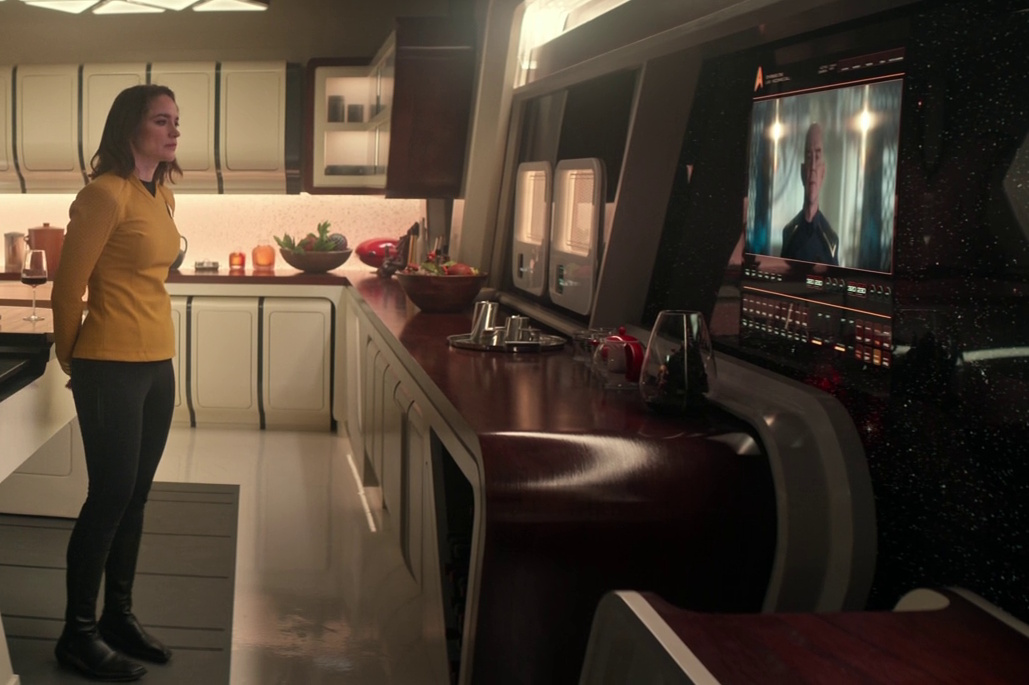
Star Trek: Picard Seasons 1, 2, and 3 theory: the super-synths

Spoiler Warning: There are spoilers ahead for Star Trek: Picard Seasons 1 and 2, as well as the teaser trailer and casting announcements for Season 3. Further spoilers are present for Star Trek: Discovery Seasons 1-4, Star Trek: The Next Generation, and other iterations of the Star Trek franchise.

Even as we continue to wind down from Season 2 of Star Trek: Picard, my thoughts have already turned to Season 3! Although the new season is still in production and is probably a year away, I wanted to get one of my big pre-season theories written down ahead of time. This one ties together events in all three seasons of the show – and I think that could make it a satisfying story if it were to unfold.

There are some legitimate concerns about Picard Season 3, at least from where I’m sitting. The fact that most of the new cast members have been unceremoniously dumped in order to make way for the returning characters from The Next Generation really stings, and I’m truly disappointed that we won’t get to spend more time with the likes of Elnor and Soji next time around. I wanted to acknowledge that before we proceed with the theory, because both the cutting of characters and the fact that several of them have disappeared without a proper goodbye is poor form from Picard’s producers and creative team.

Most of the Picard cast are not returning for Season 3.

So let’s talk about this theory, then! In short, what I’ve come up with connects events in both Seasons 1 and 2 with what has been teased about Season 3, potentially meaning that Picard will turn out to be one long connected story after all. We’re taking the mysterious anomaly encountered at the end of Season 2 as a starting point and asking “who could have created something like that?” The Borg Queen-Dr Jurati hybrid believed it was artificial in nature and had the potential to wipe out all life in an entire sector of space. That seems like the first phase of an invasion or attack – so who can we think of in Star Trek who could create a weapon on that scale?

We could absolutely pick on factions like the Dominion, Enterprise’s Sphere-Builders, or Species 8472. All of those – and many more – were potential suspects when it came to another mysterious anomaly in Discovery’s fourth season, too, and for good reason! But when we consider the elements that have already been introduced in Star Trek: Picard in particular, one faction more than any other appears to stand out: the super-synths from Season 1.

The super-synths as glimpsed in Season 1.

To briefly recap if it’s been a while since you watched Et in Arcadia Ego: the super-synths claimed to be “an alliance of synthetic life,” and it was implied that they resided far beyond the Milky Way galaxy. I nicknamed them the “Mass Effect Reapers” for their similarities to that video game faction! The super-synths literally moved stars to point to a beacon that they’d left behind on the planet of Aia, and in a vision that seemed jumbled and terrifying to organic minds they promised to come to the aid of any synths who requested their help.

The super-synths believed that all organics would eventually attack and destroy their synthetic creations; that war between synthetic and organic life was inevitable. The plans they left behind could open a portal to their home in dark space, allowing the super-synths to show up anywhere in the galaxy at a moment’s notice. It was left ambiguous as to whether their offer to help synths in their fight against organics was actually genuine or whether it was some kind of elaborate trap.

The super-synths’ portal over Coppelius.

Although Admiral Picard was able to convince Soji to close the portal she had opened before the super-synths could arrive at the planet of Coppelius, the portal was open for a significant amount of time. In that time the super-synths would’ve seen a civilisation of synthetics on Coppelius asking for their help, and two massive fleets of starships engaged in a stand-off over the planet. Whatever their intentions may have been, Soji and Sutra’s actions have ensured that the super-synths are now aware of the Milky Way, the Federation, the Romulans, and the Coppelius synths.

The super-synths then disappeared from the plot and weren’t mentioned again. It isn’t clear what happened to them, what their goals may have been, nor how they would have reacted to the portal being closed at the last moment. What we do know is that the super-synths possess powerful technology – technology that seems to allow them to hop from one part of the universe to another in an instant.

The super-synths left a beacon on the planet of Aia.

This brings us to the anomaly encountered by the Borg and the Federation at the end of Season 2. The strange anomaly was described by Seven of Nine as being akin to a “transwarp conduit.” The Borg Queen-Dr Jurati hybrid was unsure of who created it, but considered them to be “a threat” requiring close observation. The anomaly was also described as being one piece of a larger puzzle – something that could tie in with a theory like this one!

Given what we know of the super-synths based on their appearance in Season 1, creating something on this scale seems well within their capabilities. They left behind instructions on how to create a portal to their domain, and what is a transwarp conduit if not a portal between two points in spacetime? Then there’s the scale of the attack: the initial outpouring of energy was enough to destroy an entire sector of space, something that hardly seems impossible for a faction that can literally move entire stars.

A joint Federation-Borg fleet defends against the anomaly at the end of Season 2.

So I think we have enough evidence based on what we saw on screen in the Season 2 finale to make the case that the anomaly may have been created by the same faction of super-synths that very nearly arrived at Coppelius in Season 1. But what of Season 3?

Not much has been officially teased so far about Picard’s upcoming third season – but we have a little to go on. Besides the announcement of returning cast members, we heard a few new lines of dialogue and caught a glimpse of both Admiral Picard and Captain Riker in a teaser trailer released to mark First Contact Day last month, and nothing there contradicts anything I’ve suggested above.

In fact, we could try to build a case for the Season 3 teaser hinting at this theory!

Captain Riker in the Season 3 teaser.

Firstly, the clips we saw of Admiral Picard and Captain Riker showed them readying themselves for combat, wielding some kind of phaser pistol (possibly the kind seen briefly in Seasons 1 and 2). At least part of the season, then, is going to involve a fight of some kind against a hitherto-unseen enemy! That’s hardly conclusive, of course, but it doesn’t contradict the idea that the main enemy is the super-synths.

Secondly, we have a handful of lines heard in voiceover. Geordi talked about “rushing into danger” during his time aboard the Enterprise. Worf speaks, saying that “sacrifice is required.” Dr Crusher spoke directly to Picard, telling him that “the galaxy comes calling.” In typical understated style, Riker talked about a “good old-fashioned road trip,” before Troi rounded things out by letting Picard know that he “will not be alone.” Again, nothing conclusive there – but also nothing contradictory. All the characters seem to be talking about gearing up for a big mission or battle.

Admiral Picard with a phaser pistol in the Season 3 teaser.

But the most interesting line in the trailer – and one that could perhaps be pointing to some kind of connection to synthetic life – came from Brent Spiner’s currently-unknown character. Spiner’s inflection sounded very emotive, definitely not like Data or B4. My first thought was that he could be portraying Lore (Data’s “evil twin” from The Next Generation), but he could also be portraying Dr Altan Inigo Soong – the son of Data’s creator who was a major character at the end of Season 1.

The line that stood out to me was this: “Evolution is not an act of preservation; it’s addition.” That line is ambiguous, naturally, but if we assume that Spiner’s character has something to do with synthetic life and synthetic research, he could very well be talking about the creation of new synths or the search for new synthetic life. He could also be talking about some kind of fusion between organic and synthetic life – perhaps Borg assimilation.

Will Brent Spiner’s Dr Altan Inigo Soong be a villain next season?

We don’t know what goals or objectives the super-synths might have, but if they view organic life as a threat it’s possible that they plan some kind of assimilation-like process to forcibly convert organics to become partially synthetic. That could be what Dr Soong is referring to – and he could be the super-synths’ advocate if they arrive in force and broadcast their intentions. Akin to someone who has been “indoctrinated” by the Reapers in the Mass Effect series, Dr Soong may be doing the super-synths’ bidding. That could set up Brent Spiner’s character to be one of the season’s main villains (again).

Am I clutching at straws? Well, that’s possible. But because of how deliberately coy the writers and producers of Picard have been about several key aspects of the storylines of both Seasons 1 and 2, I think this idea is a solid possibility. We don’t know what the super-synths wanted, but we do know they’re technologically very powerful and more than capable of creating portals and anomalies. We don’t know where the mysterious anomaly in Season 2 came from, nor why the Dr Jurati-Borg Queen hybrid considered it and its creators to be a threat. There’s enough ambiguity in those two points alone to reasonably connect them.

The Borg Queen-Dr Jurati hybrid.

Ever since Season 1 came to a rather unspectacular conclusion, I’ve been hoping that Star Trek will do something more with this faction of super-synths. I suggested that they could be involved with the main storylines in both Seasons 3 and 4 of Discovery, as they seemed to be a faction with the technological power to do something like the Burn or to create something like the DMA. Those theories didn’t pan out, of course, but it’s possible that things will come full-circle and we’ll see them again before Picard comes to an end.

What we’d get, if this theory were to pan out, would be a transformation in the way Star Trek: Picard has operated. Rather than being three essentially standalone seasons with three distinct, separate stories, everything would be connected. What happened on Mars that sent Picard into a decade-long depression would be connected to the final fight against the super-synths; they’d be responsible for all of it. It would bring together the stories of Seasons 1, 2, and 3 in a neat way. The first two seasons could still be enjoyed as standalone affairs; nothing in Season 3 would overwrite any of that. But for fans who want to see a broader connection, this theory would deliver it!

The anomaly in Season 2.

Setting this theory aside for a moment, one of the concerns I have about Season 3 is that the events of Seasons 1 and 2 will be ignored. The fact that most main cast members aren’t returning has really ramped up the sense that Picard Season 3 may try to ignore everything that’s just happened – or relegate it to a couple of short scenes at the beginning of episode 1 – and rush ahead to become The Next Generation Season 8.

In particular, the mysterious anomaly that was shown off at the end of the season could be ignored as part of this push to get to a new story. I truly believe that would be a mistake; not only was the anomaly massively important to the plot of Season 2, but it was also very deliberately unexplained. Who could create something like that? Why would someone do that? Was it meant to be an attack against the Federation? How did the Borg know it was coming? There are many questions like this that Season 2 chose not to answer; if Season 3 ignores them as well then it’ll be very disappointing.

Will the dangling story threads of the anomaly and the Borg be concluded in Season 3?

Regular readers may recall from my Picard Season 2 reviews and commentary that I wasn’t wild about many of the storytelling decisions made last time. This new season is an opportunity to build on what came before; to make some of the first two seasons’ underwhelming events matter in a way that they currently don’t. If the Season 2 anomaly, for example, was just a naked plot device to give the Borg Queen-Dr Jurati hybrid something to do then it’ll remain a disappointing element of an already underwhelming season. But if it turns out that Season 3 revisits it in a big way and builds on what we saw last time, it has the potential to transform this aspect of Season 2 and make it matter.

So I think that’s all there is to say this time. To briefly recap my theory: the super-synths from Season 1 were responsible for creating the mysterious anomaly that almost destroyed an entire sector of space at the end of Season 2. They will use this anomaly – and perhaps others like it – to travel to the Milky Way galaxy, where they will become one of the main villains of Season 3.

The beacon used to summon the super-synths.

I quite like this idea of bringing the story of Star Trek: Picard full circle, as well as bringing together the seemingly disconnected events of Seasons 1 and 2 in a natural, understandable way. Nothing we’ve seen on screen would prevent the Season 1 super-synths from also creating the dangerous anomaly in Season 2 – so if Season 3 ignores both of those things to go in a different direction… well, this might just have to become my own personal head-canon!

It’s always worth saying that no fan theory, no matter how fun or plausible it may seem, is worth getting too worked up over. This is an idea that I came up with to bind together events in Star Trek: Picard that may ultimately be unrelated. This theory may go nowhere – and that’s okay! I like it when Star Trek can surprise me and take me to different and unexpected places, so I always like to caveat my theories by saying that I have no “insider information,” I’m not trying to claim that anything we’ve talked about today will ever be seen on screen, and I hope you’ll join me in welcoming the story of Season 3 – whatever direction it ultimately goes.

Having touched on this theory briefly the other day I wanted to give it a full write-up here on the website. I hope you’ll stay tuned for more Star Trek content in the weeks and months ahead – including a look at any major news or trailers for Picard Season 3. Until next time!

Star Trek: Picard Season 3 will stream on Paramount+ in the United States and on Amazon Prime Video around the world some time next year. Seasons 1 and 2 are available to stream now and are also available on DVD and Blu-ray. The Star Trek franchise – including Picard and all other properties mentioned above – is the copyright of Paramount Global. This article contains the thoughts and opinions of one person only and is not intended to cause any offence.
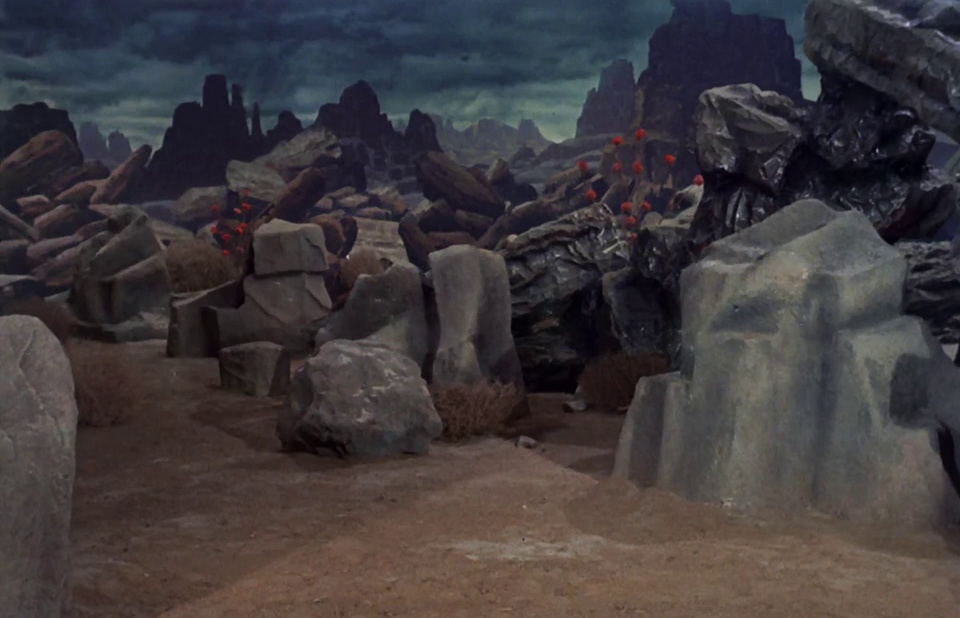
Star Trek: Picard Season 2 theory – what happened to Q?

Spoiler Warning: There are spoilers ahead for Star Trek: Picard Season 2. Spoilers are also present for Star Trek: Voyager and Star Trek: The Next Generation.

As the dust settles on Season 2 of Star Trek: Picard, there are still questions that remain. Season 3 may build on some of what Season 2 brought to the table – the strange anomaly, most notably – but other narrative elements will fade into the background and won’t be revisited. For me, one of the unexplained elements that I found intriguing as the season wore on concerns Q. Specifically, what was it that caused this once-immortal superbeing to be reaching the end of his life? What caused Q to die?

For the sake of the story that Picard Season 2 aimed to tell, finding a cause for Q’s death was not strictly necessary. The point of Q’s story and Picard’s relationship with him wasn’t to figure out what was happening, find a cure, or reverse it, but to come to accept it and for Q to find forgiveness and redemption at the end of his life. In that sense, there wasn’t really a narrative problem with the idea of Q dying – but as Trekkies and as fans who’ve followed Q’s journey over the span of more than three decades, it definitely feels like there’s a missing piece of the puzzle. Even if Q’s death was inevitable, explaining why it was happening in the first place would have felt satisfying.

I’m such a Q fan that I have this Mego action figure of him!

We’ll probably have to address this in more detail when I get around to writing a proper retrospective-review of Season 2 as a whole, but one aspect of Q’s death that I feel wasn’t handled well is how nonchalant Picard seemed to be about it. Despite all the trouble he’s caused, the story here was about Picard finding a way to forgive Q and embrace the friendship he had been offering for decades. Wouldn’t someone like Picard have wanted to find out why his friend was dying? And wouldn’t someone like Picard want to do everything in his power to prevent it?

Even if we drop the “friendship” angle, Q is a unique life-form from Starfleet’s perspective. As a being who had been considered to be functionally immortal – or as close to it as the Federation has ever encountered, at least – learning more about the Q as a race and what could possibly harm them seems like an opportunity that a Starfleet Admiral shouldn’t have passed up. Even if it wasn’t possible to find a way to save Q’s life, I would have expected Picard to offer to try. And even if Q was unwilling to share too much information about his condition, his people, and the state of the Q Continuum, I would have expected Picard to have at least asked – and to have not immediately taken “no” for an answer.

Wouldn’t Picard have wanted to understand why Q was dying – and perhaps have offered to help save him?

Perhaps a longer season (or a season that was better-paced and didn’t waste time reaching its conclusion) could have dedicated more time to Q and included some of those questions. In Farewell, the Season 2 finale, Picard seemed to very quickly acknowledge that Q was dying, accept that fact at face-value, and made no effort to follow up on it or ask questions about it. While I understand why it happened that way in terms of the story, it leaves Q’s death feeling like it’s missing something critical – something that could’ve furthered our understanding of both Q himself and the Q Continuum as a whole.

So today, that’s what we’re going to talk about. We’re going to consider a handful of possibilities for why Q might’ve died at the end of Picard Season 2 and look at the pros and cons of each from both an in-universe and production-side perspective. It goes without saying that all of this is speculative and purely subjective; Q’s cause of death is highly unlikely to be explained on screen in the near future, and if you don’t like my ideas or I miss out something you do like, remember that this is all just the opinion of one person!

With all of that out of the way, let’s begin.

Theory #1:
Q was being punished by the Q Continuum.

Q after having been made mortal. And nude.

In The Next Generation Season 3 episode Deja Q, we saw Q come face-to-face with mortality for the first time. In that story, Q had his powers taken away by the Q Continuum – or whatever passes for the leadership of the Q – and found himself a mortal human. This seems to establish the principle that the Q Continuum has the power – in both a legal and physical sense – to strip individual Q of their immortality.

Though somewhat contradicted by the events of the Voyager episode Death Wish – in which it was strongly suggested that a member of the Q Continuum dying is something its leaders sought to prevent at any cost – Deja Q at least gives us something to work with. It was the first episode that established that certain members of the Q Continuum could inflict this kind of punishment on others, and while the specific nature of the Q Continuum and its power structure (if such a thing exists) is suitably vague, we at least have a starting point of sorts!

Another member of the Q Continuum – someone with the ability to make Q mortal.

Based on what we know about Q himself, and specifically his role in causing the death of a fellow Q, sparking a Q Civil War, and creating the first “baby” Q in thousands of years, perhaps we can piece together that the Continuum were not happy with Q’s behaviour and actions. Could it be possible that, after what Q did in episodes like The Q and the Grey, the leadership of the Continuum turned on him?

Given that we’ve also seen the Q Continuum strip powers – and immortality – away from at least two other Qs, this kind of punishment by the Continuum has to be a pretty high probability for explaining what happened to Q. Regardless of what reasons the Continuum may have had, as far as we know they’re the only ones powerful enough to force a Q to become mortal.

Theory #2:
The entire Q Continuum has been attacked.

The Q Continuum as it appeared in Voyager.

This was a theory that I hatched during Season 2 – so it may be familiar to you if you followed along with my weekly theory posts! In short, it seemed possible to me that one explanation for Q’s condition could be related to the Q Continuum itself. If the Continuum had been attacked by some outside force, maybe that could explain what was happening to Q – and it could also explain a cryptic line in Discovery Season 4. Admiral Vance explained to Captain Burnham that the 32nd Century Federation has had no contact with the Q Continuum in over 600 years – and while the events of Picard Season 2 took place approximately 780 years before that conversation, perhaps the two are linked somehow.

One line from Guinan in Picard Season 2 is also of interest here. Guinan described a “cold war” between her people and the Q Continuum in the past, a conflict that was eventually resolved. But based on what we know of the two races, a “cold war” doesn’t seem plausible, does it? The Q are immortal and god-like, and while the El-Aurians certainly have abilities of their own, they’re very much a race of mortals – a race who were conquered by the Borg. So any conflict between the Q and the El-Aurians should’ve been a one-sided rout. That is, unless the El-Aurians knew of some kind of weakness inherent in the Q.

Did the El-Aurians discover some kind of weakness in the Q Continuum?

Some kind of weak point in the Q Continuum would seem to be the only possible explanation for how the El-Aurians could pose any semblance of a threat. That weakness (whatever it may be) could be something that another faction discovered, and instead of negotiating as the El-Aurians had, they might’ve gone on the attack. Or after the El-Aurians were assimilated by the Borg, the Q Continuum’s weakness could’ve become known to them – which could mean that the Borg are responsible for attacking and defeating the Q.

So there are possibilities here – some of which are more plausible than others, admittedly – based on what we know! It isn’t clear whether the powers of an individual Q are tied in any way to the Q Continuum – but it’s possible that they are. If so, perhaps a weakness in the Continuum weakens every surviving Q, and the defeat or destruction of the Continuum would reduce the power of any Q who remained. It seems a possibility to me – even though it was never stated on screen.

Theory #3:
The Q Continuum was destabilised after its Civil War.

“Colonel Q” led one of the factions during the Q Civil War.

Voyager established that the Q Continuum devolved into civil war in the late 24th Century, with two opposing factions. The war came to an end with the birth of a new Q – the first such child in thousands of years. However, as Captain Janeway suggested toward the end of the episode: it doesn’t seem like having a baby would solve the underlying tensions within the Q Continuum.

While the causes of the war and its details were, in Q’s words: “beyond the understanding of humans,” it stands to reason that not only were the underlying issues not fully resolved, but that the fact that the Q Continuum was at war with itself in the first place would be hugely destabilising. After what seems to have been millennia of peace and quiet the Q Continuum was shattered by civil conflict, and as we know from out here in the real world, the consequences of wars – even brief ones – can be incredibly devastating and long-lasting.

Q was injured during the conflict.

Even if war never resumed between the two factions, there was still a lot of cleaning up to be done, rebuilding to achieve, and the need for reconciliation between one-time enemies. We don’t know for sure what kind of resources the Q Continuum might need to sustain itself, but it’s possible these were reduced or exhausted by the war, too. In the conflict’s aftermath, it’s even possible that two distinct Q Continuums were created.

Taking the Q Civil War as a starting point, we could argue that a general destabilisation of the Q Contniuum itself may have occurred. In the aftermath of the Civil War, perhaps the Q Continuum even collapsed, and individual members of the Q were left to fend for themselves. Without the support and resources of a united and undamaged Continuum, perhaps individual Q began to lose their powers and their immortality.

Theory #4:
Death by natural causes.

Did Q simply reach the end of his natural lifespan?

This seems to be what Picard Season 2 at least implied was happening to Q. Q gave no explanation for his impending death, seeming not to know why it was happening, and the explanation could simply be that Q reached the end of his natural life. To us, members of the Q Continuum may seem immortal, but it’s possible that they have a natural lifespan – even if it’s imperceptible to humans because it’s measured in millions or billions of years.

Q, despite appearances, may be one of the oldest members of the Q Continuum, and could thus be the first – or the first in many years – to reach such a ripe old age. He may not know what’s happening to him because death is incredibly rare in the Q Continuum, and a death by natural causes or old age simply hasn’t happened in a very long time.

Perhaps Q is the first of his race to reach this point.

We also don’t know how long Q has been flitting about the galaxy – nor how long it has been for Q in between visits to Picard. From Picard’s point of view, he last saw Q approximately 30 years ago (during the events of All Good Things at the end of The Next Generation). But has it only been 30 years for Q?

A being that can travel through time could have spent millions or billions of years away from Picard before reuniting with him. Q could have travelled back in time to the Big Bang and done other things for 13.8 billion years… then gone back to the Big Bang again and spent another 13.8 billion years killing time and doing his own thing before finally returning to Picard. In short, Q may be far, far older than we assume, and it might’ve been a lot longer in between visits than the 30 years of linear time that Picard experienced. All of these could explain why Q was coming to the end of his life.

Bonus Theory:
Q didn’t really die or was saved at the last moment.

Q’s final snap.

If there’s no body, is anyone in film or TV really dead? Star Wars uses this trope to an excessive degree! But maybe it’s true in Star Trek, too. After Q’s final “snap” that sent Picard and the crew of La Sirena back to the 25th Century, we don’t know what became of Q. Did his body dissipate into energy? Was he vaporised? Did his empty corpse collapse in a French vineyard while Rios and Teresa looked on?

Though it would completely undermine the powerful and deeply emotional sequence at the end of Season 2, maybe the real end to this story has yet to be written. Somehow – perhaps through the intervention of another member of the Q Continuum – Q actually survived, or was reborn immediately after sacrificing himself.

Q in what he described as “the afterlife.”

This… would not be my choice. As much fun as Q can be, establishing his death – and making it a huge part of the story of Picard Season 2 – was incredibly important and felt final. To undo that in any way would devastate the entire narrative arc of Picard Season 2. Given that most of the rest of that season’s storylines were weak, taking away one of the most powerful and most emotional moments would leave very little left.

There is scope for Q to return. His time-traveling nature could see him pop up in other stories as long as they took place prior to the events of Picard Season 2 from his perspective. His cameo in Lower Decks Season 1 is a case in point. But to bring back Q in a big way and claim that he somehow survived… I can’t see it working. It would take away so much of what made Picard Season 2 matter. With Picard seemingly ending after Season 3 as well, there’s less of an argument for including Q in a big way in future stories. He’s primarily a Picard-centric character, so if Picard is killed off or his departure from Star Trek is made permanent, there’s less of a reason to bring back this individual Q. Other members of the Continuum, sure. But this Q should probably remain dead.

So that’s it!

Picard and Q embrace.

Picard Season 2 didn’t explain what happened to Q. In terms of the way the story unfolded, it was ultimately “unnecessary” in order to get Picard and Q to come together and for Q to send Picard home to the 25th Century. The reason for Q’s declining health could have been built into the story, giving him additional motivation and focus, but again that didn’t have to happen based on the way the story was written. Finally, Q’s decline meant two things for the story: firstly, he wasn’t unbeatable any more, potentially giving Picard and the others a chance to stop him. And secondly, it meant that Q’s final act of the season – and final moment as a Star Trek character – was one of self-sacrifice, giving up his life to get Picard and his friends home.

Whether all of that worked just as well without an underlying cause is debatable. And I definitely believe that there was room within the story of the season to explain why Q was dying – and perhaps even to tie that into some other part of the franchise – even if such an explanation wasn’t entirely necessary for the story. The season’s story may not have been hanging from this one narrative thread, but even so it might have been worth it. It would certainly have been satisfying for returning fans from The Next Generation era.

Q as he appeared in Lower Decks.

I don’t think anything we saw on screen during Season 2 of Picard actively rules out any of the theories above – although I’d certainly entertain the argument that Q might’ve mentioned something incredibly major such as the Borg assimilation of the entire Q Continuum! But with Star Trek seemingly setting Q aside for the foreseeable future, it falls to us as Trekkies to speculate and propose answers to one of Season 2’s biggest unexplained story points.

I hope this was a bit of fun – or at least interesting. Personally I’d have liked the writers of Picard Season 2 to have come up with some explanation for Q’s death that felt conclusive. Although the Q Continuum and its denizens are difficult for humans to understand, that doesn’t mean there’s total free rein to throw Q into all kinds of different stories and just use “it’s a mystery” or “you’d never get it” as excuses to cover up the fact that no real answer to the question was created in the first place! So while the cause of Q’s death may not have been critical for the story that Picard Season 2 aimed to tell, not even attempting to make up some semblance of an explanation for it definitely leaves me feeling like something was missing as the story came to an end.

In a better and more enjoyable season of Star Trek, maybe I could see past that and revel in the story that was told rather than picking at threads and asking “why wasn’t this included?” But because Picard Season 2 was, at best, a mixed bag with episodes of inconsistent quality… the fact that it ended leaving behind something that feels like it could’ve been significant feels all the worse. But that’s a discussion for another time.

Star Trek: Picard Season 2 is available to stream now on Paramount+ in the United States, Scandinavia, Latin America, and Australia, and on Amazon Prime Video in the United Kingdom and the rest of the world. The Star Trek franchise – including Picard and all other properties mentioned above – is the copyright of Paramount Global. This article contains the thoughts and opinions of one person only and is not intended to cause any offence.
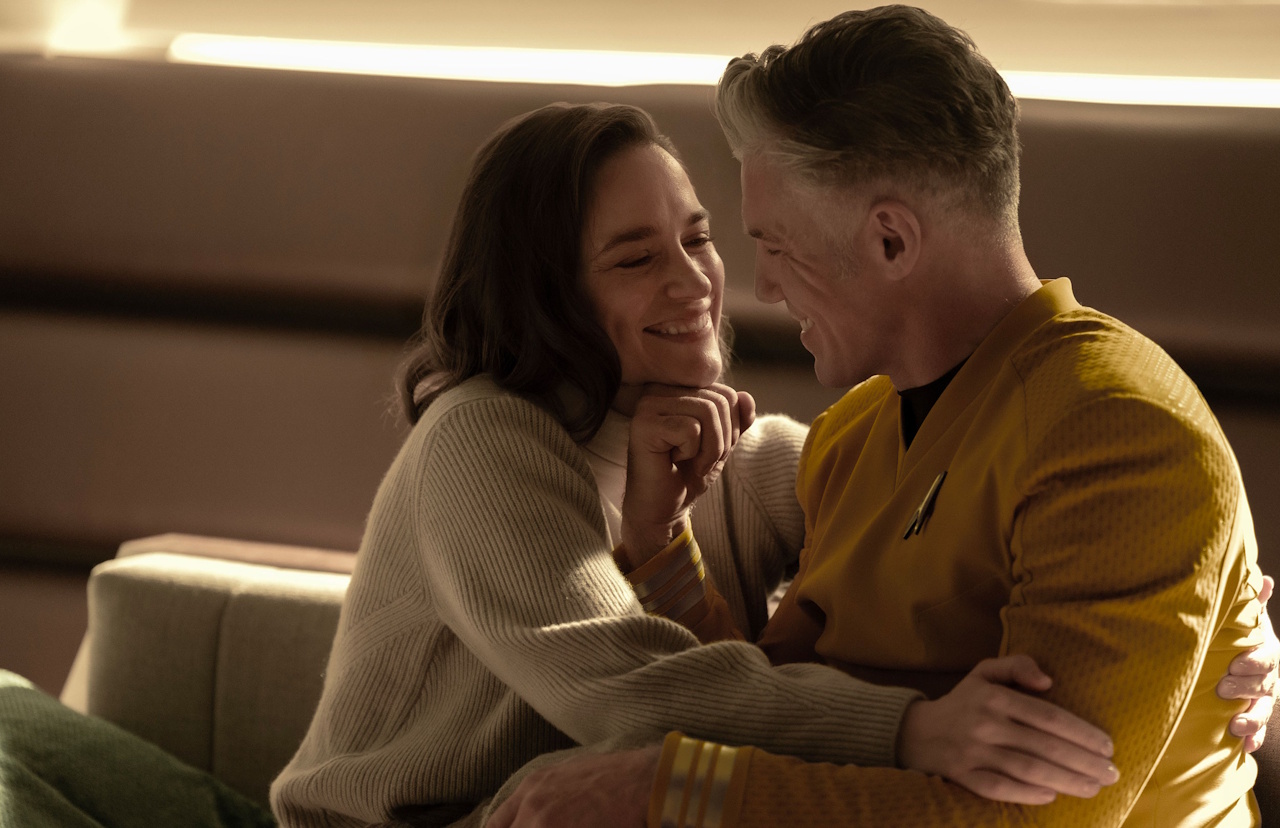
Star Trek: Picard Season 2 theory: He didn’t do it!

Spoiler Warning: There are spoilers ahead for Star Trek: Picard Season 1 and the trailers and teasers for Season 2. Spoilers are also present for Star Trek: Discovery Seasons 1-4, Star Trek Into Darkness, and Star Trek: The Next Generation.

What’s the one thing that we know for certain right now about the plot of Star Trek: Picard Season 2? We know that Q interfered with the timeline, “breaking reality” in the process, and causing Admiral Picard and the crew of La Sirena to have to undertake a dangerous new mission to the past. But what if everything isn’t as it seems – what if Q isn’t the one responsible for the damage to the timeline? Or if he is responsible, what if he has an understandable – and possibly even altruistic – motive? Those are the two parts of the theory that we’re going to consider today!

First up, let’s acknowledge some production-side reasons why this theory may pan out in some form, then we’ll jump into in-universe explanations after. Ever since Star Trek returned to the small screen in 2017 – and also during the Kelvin films and even, to an extent, in the latter part of Enterprise’s run – the writers of the franchise have been very keen to bring mysterious elements into Star Trek. The whole reason I got into writing up lists of theories was because there’s been just so much to speculate about in practically all of the franchise’s modern incarnations!

Oh look, it’s brand-new character “John Harrison.”

In Discovery Season 1, there was the hidden identity of Captain Lorca. In Season 2, the Red Angel’s identity (and Spock’s connection to it) formed a huge part of the narrative. In Season 3, there was the Burn. In Season 4 we have the ongoing mysteries of the Dark Matter Anomaly, Unknown Species 10-C, and more. And in Picard Season 1 we had the mystery of Dahj and Soji, Bruce Maddox going missing, Coppelius, the Zhat Vash’s admonition and crusade, and the super-synths.

In all of these cases, everything was not as it seemed. In the run-up to Picard Season 1, Soji’s very existence was kept secret, with Isa Briones claiming to only play the character of Dahj. The show played its cards close to its chest for practically the entire season, keeping secrets about the nature of the Artifact, the Romulans’ plans, the super-synths, and more. The show has precedent when it comes to telling stories that go to unexpected places – and I see no reason at all to think that Season 2 will be any different in that regard.

Dahj in Season 1 of Picard.

The trailers and teasers that we’ve seen so far have been careful not to telegraph too much of the story. I suspect we’ve seen glimpses of scenes from the first two or three episodes at the very most, so the true nature of the story – and Q’s role in it – is still very much in play right now. No trailer or marketing campaign should spoil the finished product, and in some cases trailers can be cut and edited in very specific ways to conceal or outright lie about certain elements of a story. It wouldn’t be the first time that this has happened, not by a long shot!

There was also a remark from Sir Patrick Stewart almost a year ago, when Q’s return to the franchise was first announced. At last year’s First Contact Day digital event, Admiral Picard himself seemed to suggest that, while Q was certainly involved with whatever was going on, he wasn’t necessarily wholly responsible for it. That distinction may be key to this theory!

Sir Patrick Stewart at 2021’s First Contact Day digital event.

So let’s leave the real world behind and jump into the Star Trek galaxy. There is, in my view, evidence to suggest that Q wouldn’t do something that so drastically damaged the entire timeline. Ever since his first appearance in Encounter at Farpoint, Q has been viewed by Picard as an adversary – but I would argue very strongly that that isn’t how Q sees himself. By pushing and provoking Picard, Q has arguably sought to expand Picard’s understanding of the universe far beyond what he might’ve otherwise been capable of. In Q’s mind, the ends justify the means – so all of the meddling and provocation was worth it to get Picard (and humanity) ready for whatever the Q Continuum has in store next.

It’s even possible to read some of Q’s more belligerent actions – like placing the Enterprise-D in the vicinity of a Borg vessel – with the benefit of this additional context. In my earlier theory titled Q the saviour, this is exactly the point I tried to make. Q deliberately chose to introduce Starfleet to the Borg because he knew that the Borg were already planning to target the Federation, and he hoped that his intervention would show the Federation how dangerous the Borg threat really was.

In light of the mess that the Star Trek franchise has made of Borg-Federation contact, I think that theory absolutely holds water, but check out the full article because I get into it in way more detail!

Q introduced Picard and Starfleet to the Borg.

Whether you buy into my theory in full or not, I think we can agree at the very least that this is how Q sees himself. He doesn’t see himself as an enemy, provoking Picard out of boredom or malice. He sees himself as a friend, and may even feel that Picard is ungrateful for not reciprocating those feelings of friendship.

Q accused humanity of being a “dangerous, savage, child-race,” and it’s on these charges that Picard and all of humankind are on trial, and have been since Encounter at Farpoint. But at every stage, Q has seemed smugly satisfied when the puzzles he lays out for Picard (and others) are solved. He seems to see potential in humanity – perhaps even the potential to one day know as much about the universe as the Q Continuum themselves.

Q in his judge’s robes.

In episodes like All Good Things, Q even claims to have helped Picard solve a particularly difficult puzzle. By learning to see time itself not as totally linear, but in a new and different way, Picard was able to solve the anti-time puzzle. Likewise in Tapestry, Q gave Picard a chance to see what his life might’ve been like had it taken a different path. That definitely sounds familiar to his line in the Season 2 trailers about “the road not taken!”

In Tapestry, though, Q wasn’t some nefarious villain. He was making a point to Picard – in his own tricksterish way – about the course of his life, and how being a risk-taker was an inherent part of his personality. He didn’t abandon Picard to the new timeline that he’d created, instead giving him an opportunity to fix his mistake.

Q and Picard in Tapestry.

Q has, on occasion, seemed impressed with Picard and his ability to solve the puzzles he created for him. Even when Picard had to grovel to Q in Q Who and admit that the Federation wasn’t ready to encounter the Borg, and that the encounter was frightening, Q seemed satisfied that he’d made his point. In Encounter at Farpoint and in All Good Things in particular, Q even seemed pleased that Picard had been able to think through a complex situation and find a solution. He helped – but in a limited way – and in an almost-parental way seemed kind of proud of Picard.

Those feelings, of course, are not reciprocated, and Q has definitely caused death and destruction. Eighteen members of the Enterprise-D’s crew were lost in that first encounter with the Borg, for example, and Q didn’t restore them to life afterwards. However, on other occasions he did undo harm, and even death, caused to humans – such as by un-freezing Tasha Yar in Encounter at Farpoint.

Tasha Yar being un-frozen by Q in Encounter at Farpoint.

Q being the out-and-out villain of Picard Season 2 would, I would argue, represent a fundamental shift in his characterisation. It would take Q from being a trickster and an annoyance into something much more sinister, and while it’s certainly possible that he could have a darker side that we aren’t familiar with, it would be a major change that would require a good deal of explanation. Why, after having seemingly sensed potential in Picard and humankind, would Q try to do something so extreme?

Furthermore, from a narrative perspective Q doesn’t make a good villain. His god-like powers basically mean that Picard and his crew could never win, and Q’s amorality and lack of fair play mean that he would always be in a position to dominate and frustrate Picard if he ever came close to defeating him. This is a problem all overpowered characters in fiction can have, and it applies to Q in Star Trek just as much as it does elsewhere. Given what we know of Q and his abilities, it doesn’t even seem plausible that the Federation could find a technobabble explanation for limiting his powers, either.

Q has god-like powers.

So there are two questions remaining: did Q meddle with the timeline at all? And if not, who did?

There’s a case to be made that Q did still interfere with the timeline, and that all of this is another one of his puzzles for Picard to solve. That’s certainly one possibility, and it wouldn’t be completely out-of-character for Q to behave in this way. Perhaps he saw Picard getting back on his feet after years in seclusion and decided the time was right for another phase of the “trial.” Maybe we’ll learn that Q has visited Picard during his self-imposed isolation, too.

But there’s also another case we can make: Q didn’t have anything whatsoever to do with the event that disrupted the timeline. The extent of his involvement may be shielding Picard and the crew of La Sirena from its effects, allowing them to travel back in time to undo whatever happened. There are many culprits we could point to if Q isn’t to blame: the super-synths from Season 1, the Borg, the Terran Empire, a faction from Discovery’s Temporal War, etc.

The super-synths’ mechanical tentacles in the Season 1 finale.

Q may thus have an altruistic motive for reappearing in Picard’s life. If some external force or faction is responsible for the damage to the timeline, Q might believe that it’s up to him to “save” Picard and humanity. By returning to his old friend, he might do what we know he’s done on multiple occasions already: give him the tools to understand and fix the problem, but without giving him all of the answers right away.

To me, that is Q’s modus operandi. He sets up a problem – or allows Picard to encounter a problem independently – and provides minimal help. In Encounter at Farpoint, Q could’ve just been up front about the nature of Farpoint Station, but instead he forced Picard to solve the puzzle himself. In Q Who he could’ve simply told Picard about the Borg and their destructive power, but instead he made sure Picard encountered them first-hand. In All Good Things he could’ve explained the nature of the anti-time eruption, but instead he watched as Picard figured it out for himself. On each of these occasions (and more) Q provided minimal help and assistance – but the help and assistance he did provide ultimately proved key to resolving the situation favourably.

Q in All Good Things.

If Q wanted to, he could wipe humanity out of existence with a mere thought. If he wanted to kill or seriously harm Picard, he has infinite ways of doing so and unlimited opportunities to do so. He could go back in time and prevent Picard’s birth or turn him into Murf from Star Trek: Prodigy, or a million other ridiculous and sinister things. Sending Picard on a mission back in time, thus giving him a chance to undo whatever damage has been done, is not the way for Q to “win” in any sense of the word.

So it’s safe to say that I believe there’s more going on with Q than meets the eye! His involvement with the event that damages the timeline, and his reasons for getting involved in the first place, may seem suspicious right now – but we’re seeing small glimpses through the eyes of Picard, and thus with Picard’s own biases attached. Considering all of the other things that Q has done, and the many other ways he’s challenged and provoked Picard over the years, my suspicion right now is that there’s something else going on that the trailers and teasers have been careful not to reveal.

Q as he will appear in Season 2 of Picard.

To summarise this theory, then: Q either isn’t responsible for damaging the timeline at all, or he’s doing so for the purposes of testing or challenging Picard. What we’ve seen so far doesn’t depict a serious attempt on Q’s part to harm Picard or even permanently disrupt the Federation or the prime timeline; there’s something more going on that we haven’t yet seen – something that will, perhaps, unfold slowly over ten episodes!

I’m genuinely excited to see Q make a return to Star Trek. His appearance in Lower Decks Season 1 was relatively minor, so it will be neat to have him back in a substantial way – whatever form that ultimately takes and whatever his impact on the season’s narrative. He’s a more complex character than some viewers give him credit for, and as I’ve said before I don’t think it’s fair to call Q a “villain” – at least not in any of his appearances thus far. Perhaps Picard Season 2 will change that, showing us a darker and more sinister presentation of the character. But maybe we’ll get a continuation of this complex presentation, and the return of a truly interesting dynamic between Q and Picard.

Stay tuned when Picard Season 2 kicks off in March, because if there’s any development of this theory I’m sure I’ll have something to say about it!

You can also check out my other big Q theory by clicking or tapping here.

Star Trek: Picard Season 2 will stream on Paramount+ in the United States and on Amazon Prime Video in the United Kingdom and around the world beginning on the 3rd of March 2022. The Star Trek franchise – including all characters and properties mentioned above – is the copyright of ViacomCBS. This article contains the thoughts and opinions of one person only and is not intended to cause any offence.
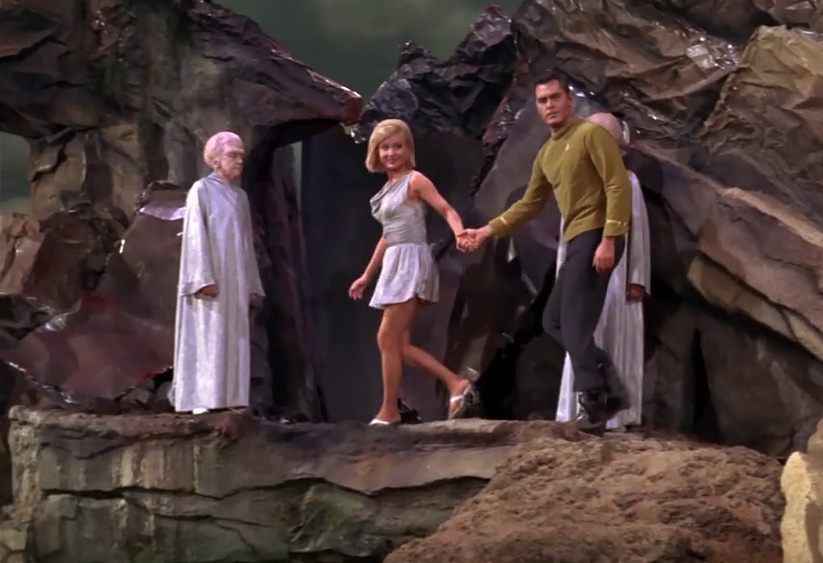
Star Trek: Discovery Season 4 – So who is Ruon Tarka’s “friend?”

Spoiler Warning: There are spoilers ahead for Star Trek: Discovery Seasons 1-4, Star Trek: Picard Season 1, and for other iterations of the Star Trek franchise.

With Discovery taking an unplanned six-week break, we’ve got a little time to settle in and collect our thoughts. The first half of Season 4 has seen some progress toward unravelling the mystery of the dark matter anomaly, but there are still plenty of questions! From this point, the story could go in many different directions, and could potentially make significant connections and crossovers with past iterations of Star Trek. Today, we’re going to consider one such possibility.

In the episode But To Connect, which served as the mid-season finale, Ruon Tarka returned. Tarka is a Risian scientist who had been working on the DMA and who had collaborated with the USS Discovery’s own Paul Stamets in the episode The Examples to build a working scale model of the anomaly. We learned more about him this time, including what he claims to be his motivation for wanting to destroy the DMA while preserving the machine at its centre: he wants to use it to travel to a parallel universe.

Tarka made his first appearance in The Examples.

During a conversation with Book, Tarka claimed that he had “a friend” while he was forced to work for the Emerald Chain. This friend wasn’t mentioned by name, but appears to have been a major motivating factor for Tarka to find a way to cross the divide between universes; to “punch through” as he put it.

This could all be obfuscation on Tarka’s part; a made-up story to help him sink his talons into Book and manipulate him into doing his bidding. Tarka’s plans relied on Book: he needed him to either convince the delegates to approve the use of his weapon, or to use the stolen spore drive to deliver the weapon without Federation help. So we have to acknowledge that possibility.

Stamets and Tarka built a scale model of the DMA.

But I was struck by the way this conversation deliberately kept Tarka’s “friend” hidden from us as the audience. Book asked who the friend was, but Tarka quickly waved away the question. That makes me wonder… who is this friend? And could it be someone we’ve met before – maybe in Discovery, but maybe in a past iteration of Star Trek?

So today we’re going to consider a few possible candidates for Tarka’s friend. Who could this person be, and if they survived their imprisonment with the Emerald Chain, might we be about to meet them?

Tarka and Book aboard Book’s ship.

I can’t decide right now whether Discovery is setting up Tarka to be the main villain for the rest of the season, or whether Captain Burnham and the crew will resolve this storyline within an episode or two before moving back to the DMA and Unknown Species 10-C. Either possibility feels just as likely, so we could perhaps see the Tarka storyline rumble on for much of the second half of the season.

But we’ll have to set that aside for now! I’ve put together a list of candidates for being Tarka’s friend and we’ll go through them one by one. Just remember one thing: I have no “insider information,” and I’m not trying to claim that any of this will actually be included in Star Trek: Discovery. This is speculation and theorising from a fan – and nothing more.

With that caveat out of the way, let’s jump into the list.

Friend #1:
Aurellio

Let’s see… Aurellio is a bona fide scientist. He worked for the Emerald Chain. He and Tarka know one another. And although Aurellio has been mentioned several times this season, we haven’t seen him. Could he be the mysterious friend?

I don’t think so, not unless Tarka is even more devious than we think! Although we haven’t seen Aurellio this season, we’ve heard multiple times that he’s working with Starfleet, and he even built the new spore drive that Book and Tarka used in But To Connect. So unless Tarka has somehow managed to fake Aurellio’s entire existence… I think we can rule him out.

But on the surface, Aurellio fits the bill in some respects! We don’t really know of any other ex-Emerald Chain scientists, so it’s an outside possibility that Aurellio is involved in all of this somehow.

Friend #2:
Altan Inigo Soong

Dr Soong is the son of Data’s creator, and was encountered by Admiral Picard on the planet Coppelius in Et in Arcadia Ego, Part 1 – the first part of the Picard Season 1 finale. As a human from the 24th Century, he shouldn’t still be alive almost eight centuries later, but Dr Soong had plans to transfer his consciousness into a synthetic body. This process was mentioned earlier in Discovery Season 4, as it was used to give Gray a physical body.

If Dr Soong was ultimately successful, it’s possible that his synthetic form survived to the 32nd Century, and he could therefore be Tarka’s friend. He was already a skilled scientist when Picard met him, and with centuries of time to develop his skills he could have proven invaluable to an organisation like the Emerald Chain.

Now we get into abject speculation, but if Unknown Species 10-C turns out to be connected to the super-synths from Picard Season 1, this could give Dr Soong an additional motive for wanting to escape to a parallel universe: he might be aware of the threat they pose to the galaxy and all organic races.

Friend #3:
The Doctor

Nothing that Tarka said about his friend implied that they’re organic – so the Doctor being a hologram shouldn’t count against him! I’ve speculated before that a backup copy of the Doctor could still be alive in the 32nd Century, as we saw in the Voyager Season 4 episode Living Witness. While the Doctor wasn’t a scientist per se, after decades living and working with the Kyrians in the Delta Quadrant he may have broadened his skills.

If the Doctor was re-activated to find a galaxy ravaged by the Burn and all of his friends long gone, he might well want to escape to an alternate reality – there’d be nothing left for him in the prime timeline.

Perhaps the Emerald Chain intercepted his ship while he was on his way from the Delta Quadrant, or perhaps this is a different copy or version of the Doctor altogether from the one we saw in Living Witness. Because of the Doctor’s nature as a hologram, he could have easily survived this long.

Friend #4:
Control

Captain Leland, who had been “assimilated” by the Control AI, was killed at the end of Season 2, and the existence of life in the 32nd Century seems to suggest that Control was permanently shut down shortly after the USS Discovery left. But what if that didn’t happen, or if the shutdown of Control was incomplete?

So far this season we’ve had more mentions of Control – and a greater discussion of the implications of its rise – than we got in the entirety of Season 3. Could that be setting up something big later in the season? Could Tarka’s friend actually be someone that the Control AI “assimilated?”

If so, perhaps Control plans to abandon this universe to find one more easily attacked and dominated – and Tarka may find that his friendship with whomever it is was little more than a ruse.

Friend #5:
Another Ruon Tarka

There are multiple parallel universes – perhaps an infinite number! At least some of those universes contain alternate versions of everyone we’re familiar with: the Mirror Universe and the alternate reality of the Kelvin films being just two examples. So what if Ruon Tarka’s “friend” is, in fact, a parallel universe version of himself?

Tarka was confident that the parallel universe he intends to reach is better than the post-Burn reality he currently inhabits. But how could he possibly know that unless he’d either seen it for himself or met someone from that reality? Though in theory anyone from that universe could be Tarka’s friend, I think someone with the self-assuredness and arrogance of Tarka would be more inclined to trust his own counterpart.

We know that Tarka isn’t bound for the Mirror Universe – at least based on what he told Book. But here’s a spoiler for my next theory post: what if he’s trying to reach the Kelvin timeline? His unnamed friend could be his Kelvin timeline counterpart.

Friend #6:
Michael Burnham

We’re sticking with the parallel universe theme here. If an alternate version of Captain Burnham had somehow crossed into our universe, perhaps she’d been captured by the Emerald Chain and forced to work with Tarka. She might have warmed up to him, telling him of her true origin in a different, better universe.

Burnham has a keen scientific mind, and had she ended up in Emerald Chain captivity they might well have tried to put her to work as a scientist. Discovery has also put Burnham at the centre of big storylines before, such as by making her the Red Angel in Season 2.

The counter-argument to this would be that everyone we met from the Emerald Chain, including Osyraa, Ryn, and Aurellio, didn’t recognise Burnham or claim to have seen her before. It’s possible that they never met her or that she was working in a different lab, but it could also be seen as a mark against this theory. Tarka also suggested that his friend was male, which could also rule out Burnham.

Friend #7:
Dax

Thanks to the inclusion of Gray and Adira, we’ve spent some time with the Trill over the past couple of seasons. Trill symbionts are particularly long-lived, and there’s evidence to suggest that Gray and Adira’s symbiont, Tal, may have been alive in the 24th or 25th Century. It isn’t impossible, then, for the Dax symbiont to have survived to the 32nd Century.

Dax was one character I felt could make a comeback in Season 3. Early trailers dropped hints about the Trill, and bringing back Dax could’ve been a great way for the show to give fans a nod and a wink – but without needing to bring back an actor from the past. The nature of Trill life means that Dax would be in a new host by now – and thus the character could be recast in an easy and inoffensive way.

In Deep Space Nine we saw Dax mostly as a scientist thanks to Jadzia, and while Dax had many different roles over the course of their lifetime, returning to a scientific field is a possibility – certainly if a millennium’s worth of knowledge could be put to use. Dax is also aware, thanks to their adventures with Sisko and others, of the likes of the Mirror Universe.

Friend #8:
Soji

Due to her synthetic nature, Soji is also someone who could potentially still be alive in the 32nd Century. With centuries’ worth of accumulated knowledge under her belt, and a desire to help her people, Soji may have continued the Soongs’ work on cybernetics at some point after her adventures with Admiral Picard.

We haven’t yet seen any Coppelius synths in Discovery’s 32nd Century, and I’d be curious to see what became of them. If they survived and were able to continue to build new synths, there could be a thriving population by now. Many of the synths looked alike, so it’s possible that Tarka’s friend may have a familiar face even if they aren’t a character we’ve met before.

It would be great to get a proper crossover between Discovery and Picard, and this could be one way of doing it. The only drawback is that, because of the difference in time periods, having a character like Soji appear in Discovery would potentially be a limitation on future Picard stories.

Friend #9:
A Borg (or ex-Borg)

Where is the Borg Collective? We haven’t heard so much as a whisper since Burnham and Discovery arrived in the 32nd Century. It’s possible that the Borg have been defeated somehow in the centuries since they last tried to conquer the Federation, but it’s also possible that they’re the mysterious Unknown Species 10-C!

Perhaps Tarka’s friend is a Borg, ex-Borg, or even the Borg Queen, and the Emerald Chain had somehow kept Borg in captivity. It could be that Tarka is the one being manipulated, and his efforts to stop the DMA will allow the Borg to gain control of the power source at its centre.

We saw in Picard Season 1 that Borg technology and components were deemed valuable, such that a black market had sprung up. The Emerald Chain is exactly the kind of immoral faction that might have dealt in harvested Borg implants, and that could explain why they kept Borg captives.

Friend #10:
Gabriel Lorca

Captain Lorca commanded the USS Discovery during the show’s first season – but this character was later revealed to be from the Mirror Universe. The prime timeline version of Captain Lorca has never been found, and despite Admiral Cornwell and others believing that he wouldn’t have survived for long in the Mirror Universe, it’s at least possible that he did.

Or perhaps we’re dealing with another alternate version of Captain Lorca, someone native to the parallel universe that Tarka is attempting to reach.

Regardless, it could be fun to see the crew’s reaction to encountering their old captain! And it would be neat to welcome back Jason Isaacs to Discovery – his performance was one of the highlights of an occasionally rocky first season.

Bonus Friend:
Literally anyone!

Thanks to technobabble, practically any major character from Star Trek’s past could have survived to the 32nd Century. Stasis fields, time-wormholes, transporter accidents, pocket universes, warp bubbles, and many, many different phenomena could be brought in to explain the reappearance of practically anyone.

We already saw an oblique reference to one such method in the episode Stormy Weather. The crew placed themselves in the ship’s transporter buffer in order to survive their dangerous escape from the void – a method employed by Montgomery Scott in The Next Generation Season 6 episode Relics. Could it be that this was more than just a callback to that classic episode, and was the setup for something that will come into play later?

With the exception of those few main characters who had been killed off outright – Captain Kirk, Tasha Yar, Jadzia Dax, and a couple of others – basically anyone could fill this role as Tarka’s friend and make a triumphant return to Star Trek!

So that’s it.

Tarka showed a hologram of the DMA to the assembled diplomats and delegates.

I could be completely over-reaching with this one, but I felt that there was something about the way Tarka refused to name his “friend” in But To Connect that could be significant. Why keep that individual hidden – unless there’s something that’s going to surprise us when they’re ultimately revealed?

We’ve seen the Abronians in cryo-sleep this season, and we’ve seen the crew of the USS Discovery put themselves in suspended animation in the transporter buffer. The DMA also contains a wormhole, a phenomenon that has been used to travel through time in past iterations of Star Trek. Gray used the “Soong method” to acquire a synthetic body. And there have been multiple mentions of parallel universes. Any of these could be hinting at the return of a major character, perhaps someone who used one of these methods to either survive to the 32nd Century or to cross over from their native universe.

So that’s my theory. Ruon Tarka’s “friend” is someone we’ve met before, perhaps someone from Star Trek’s past who we wouldn’t expect to see! Unfortunately we’ve got to wait at least six weeks to see if I’m right!

Star Trek: Discovery Season 4 is currently on hiatus and will return on the 10th of February. The first half of Season 4 is available to stream now on Paramount+ in the United States, Scandinavia, Latin America, and Australia. The show is on Pluto TV in the UK, France, Germany, Italy, and other parts of Western Europe at 9pm on Fridays and Saturdays. Individual episodes or the full season can be purchased on iTunes, Amazon Video, YouTube, and possibly other platforms in the UK, parts of Europe, and select other countries. The Star Trek franchise – including Discovery and all other properties mentioned above – is the copyright of ViacomCBS. This article contains the thoughts and opinions of one person only and is not intended to cause any offence.
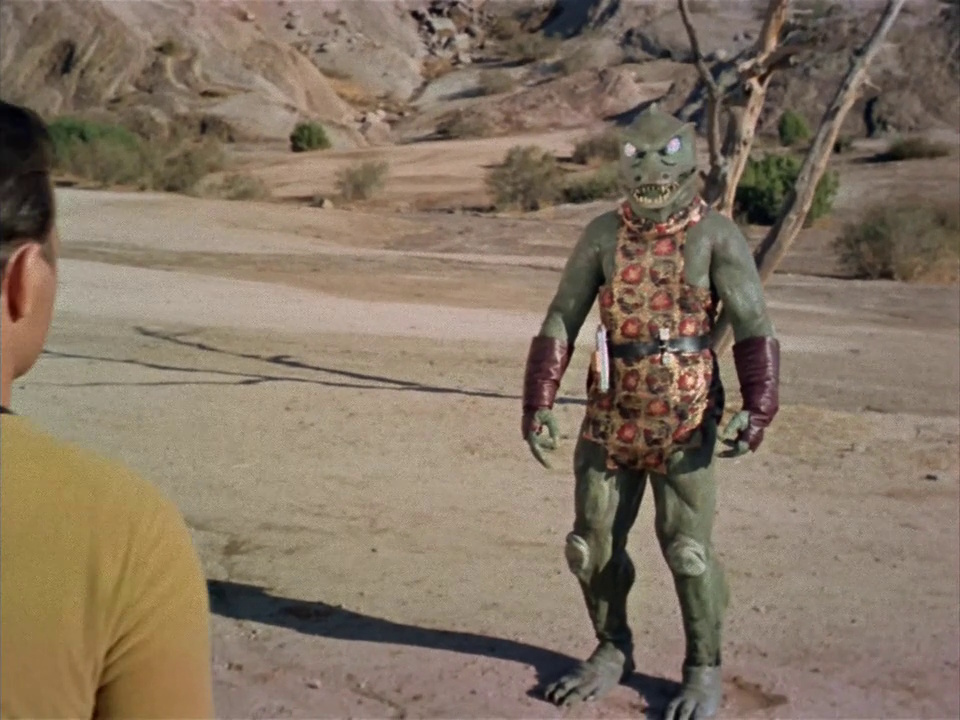
Star Trek: Discovery Season 4 – Unknown Species 10-C: The Suspects

Spoiler Warning: There are spoilers ahead for Star Trek: Discovery Seasons 1-4, Star Trek: Picard Season 1 and the trailers for Season 2, Short Treks, Star Trek Online, and for other iterations of the Star Trek franchise.

Are you as curious as I am about Unknown Species 10-C? Right now, this is one of the biggest mysteries in Star Trek: Discovery’s fourth season – and one of the most tantalising storylines that the series has ever teased us with. We don’t have much to go on when it comes to figuring out who Unknown Species 10-C might be… but don’t worry, that hasn’t stopped me from putting together a list of suspects!

Part of me feels that because Discovery has teased us with so many references and callbacks to past iterations of Star Trek so far this season, Unknown Species 10-C will be someone we’re already familiar with. But at the same time, I keep thinking back to Season 3 and the Burn storyline, and how the ending to that story was something completely unpredictable and brand-new to the franchise. It wouldn’t surprise me to see Discovery go down that road again.

Who is responsible for the DMA?

I successfully predicted that the dark matter anomaly – or DMA for short – was an artificial construct. Even though the DMA was initially teased as a scientific puzzle, it felt plausible verging on likely that Discovery would choose this direction for its main story, so I wasn’t stunned to get confirmation of that in the episode The Examples. The crew are now working on the assumption that the DMA is some kind of super-weapon… but that may not be the case. This is Star Trek: there’s always the possibility that this is an accident, an experiment gone wrong, or other such things!

Caveat time! I have no “insider information,” and I’m not trying to claim that any of the theories on the list below will pan out. I love being surprised by stories that go in unpredictable directions! This list is pure speculation from a fan of Star Trek, and nothing more. It’s also wholly subjective; if you hate all of my ideas or I don’t include your pet theory, that’s okay! We all have different ideas about what would make for a fun and exciting story, and there’s no need for fans to get into arguments about these kinds of things. This is supposed to be just for fun!

With all of that out of the way, let’s jump into the list – which is in no particular order.

Suspect #1:
The Borg Collective

The first Borg drone ever seen in Star Trek.

In The Examples, Admiral Vance listed several factions that Starfleet Intelligence believed would have the technological capability to create the DMA. One notable omission from his list was the Borg Collective – and at this point, we don’t know why that is. The Borg’s technology (at least as of the late 24th Century) was light-years ahead of the Federation’s, and when I think about the most powerful factions in Star Trek and someone capable of creating something like the DMA, the Borg are quite literally at the top of my list.

Admiral Vance may know something that we don’t; the Borg Collective may not exist in the 32nd Century, for example. But the omission of the Borg from his list may be a misdirect, with Discovery’s writers trying to keep the faction hidden until the right moment. A conspiracy theory? Maybe! But it may yet pan out. There have been several direct references to Star Trek: Voyager in Discovery’s fourth season, and Voyager was the most Borg-y Star Trek series. That could be a possible hint!

The Borg are very powerful, capable of building a galaxy-spanning transwarp network and assimilating trillions of individuals across thousands of races. Their ships, weapons, and technology far outpaced the Federation as of their last appearance, and while the DMA wouldn’t necessarily fit with their usual method of attack, we can’t rule out that the Borg’s tactics have changed.

Suspect #2:
The Gorn Hegemony

A 23rd Century Gorn captain.

This stems from something we heard right at the beginning of Season 3 more than a year ago. In the episode That Hope Is You, Part 1, Cleveland Booker told Michael Burnham that the Gorn had “destroyed subspace” for several light-years in the area around the planet Hima. Clearly, then, the Gorn possess powerful weaponry in the 32nd Century, capable of damaging subspace – and we know that the DMA is capable of tearing subspace too.

This was a throwaway line – but it proves that the Gorn are still active in the 32nd Century, and that while the Burn may have impacted their society, it clearly wasn’t stopping them from conducting experiments or weapons tests – whatever it was they did that “destroyed” part of subspace. The Gorn have also been shown as antagonistic toward the Federation in their handful of appearances to date, meaning that they can certainly be argued to have motive.

On the production side of things, the Gorn are a relative unknown. They could thus be brought into a range of different stories in very different ways, allowing Discovery’s writers and producers a lot of wiggle room to tell the kind of story they want to tell while simultaneously harkening back to the very first season of The Original Series. Interestingly, Admiral Vance proposed the Metrons as one of the suspects on his list – and it was the Metrons who pitted Captain Kirk against the Gorn captain in Arena.

Suspect #3:
The Kelvan Empire

Hanar, a member of a 23rd Century Kelvan Empire expedition.

The Kelvan Empire’s first and only appearance to date came in the second season of The Original Series. A powerful faction from the Andromeda Galaxy, the Kelvan Empire was in search of a new home due to an environmental disaster – and they had their sights set on the Milky Way for conquest.

Captain Kirk was able to convince a Kelvan delegation that peaceful co-operation might be better, and promised Federation aid to help them find new worlds to settle. This offer was transmitted to the Andromeda Galaxy via an unmanned starship that would take centuries to complete the intergalactic voyage. Whether the leaders of the Kelvan Empire would be open to such co-operation, however, isn’t clear.

If the Kelvan Empire rejected the Federation’s offer and set out to conquer the Milky Way, the timelines kind of line up for this faction to return. In The Original Series their technology was incredibly powerful, giving them the ability to reduce organic beings down to their base minerals – then restore them to life – using a powerful field projection weapon. The Kelvan Empire was clearly far more advanced than the 23rd Century Federation, and may be capable of creating a weapon on the scale of the DMA.

Suspect #4:
The Dominion

Weyoun, a 24th Century Dominion leader, with a Jem’Hadar warrior.

The introduction of Federation President Rillak – who is part-human, part-Bajoran, and part-Cardassian – has given us the first tidbits of information about what happened in the aftermath of the Dominion War. Though not stated outright, Captain Burnham’s comments in the episode All Is Possible seem to confirm that the Cardassians, Bajorans, and Federation have been at peace. But what of the Dominion?

The Dominion had existed for millennia prior to first contact with the Federation, and in many ways possessed technology that was at least slightly superior. It took the combined forces of the Federation, Klingons, and Romulans (with no small amount of help from the Prophets) to push the Dominion out of the Alpha Quadrant, so they’re clearly a strong and powerful faction. But after their defeat in the Dominion War, we don’t know what became of them.

Behind the Bajoran Wormhole, the Dominion may well have retained much of its territory. Perhaps, despite the best efforts of Odo, they sought to regroup and focused on developing new and powerful weapons. Or perhaps their dreams of peaceful coexistence were shattered by the Burn – an event emanating from Federation space and for which they may blame the Federation.

Suspect #5:
The Sphere-Builders

A Sphere-Builder seen in Star Trek: Enterprise.

The Sphere-Builders were an extradimensional faction who fought in one of the Temporal Wars. They attempted to use a large network of spherical space stations in a region of space called the Delphic Expanse to convert a large swathe of the Milky Way to match their native realm; they were unable to survive in our dimension.

Crewman Daniels told Captain Archer that the Sphere-Builders were eventually defeated in the 26th Century, but it’s not impossible to think that they were able to rebuild in the centuries after that climactic battle. It’s also interesting to note that the scale model of the DMA controller that Stamets and Ruon Tarka built in the episode The Examples was spherical in shape.

The DMA isn’t a perfect match for what the Sphere-Builders were trying to do in Enterprise – but we still don’t know exactly what the DMA’s purpose is, and it may have some hidden function that we aren’t aware of yet. The Sphere-Builders were clearly a very powerful faction, capable of constructing huge self-powered space stations, meaning that the DMA is certainly something they would be capable of creating.

Suspect #6:
The super-synths from Star Trek: Picard

Some very menacing synthetic tentacles.

Because of the somewhat rushed ending to Picard Season 1, we never got to find out much about the faction I’ve dubbed the “super-synths.” Similar in some respects to the Reapers from the Mass Effect video games, this powerful alliance of synthetic life claimed to want to help other synthetics… but was their offer genuine?

The super-synths possessed very powerful technology, and when considering the DMA, which has powerful gravitational effects, one very important thing to note is that the super-synths have experience with gravity and with huge power sources. They were capable of literally moving stars, creating an artificial eight-star octonary system to serve as a guide for synths.

In the Picard Season 1 finale we caught a very brief glimpse of some menacing-looking synthetic tentacles… but that was all we saw. One thing I find very interesting in the aftermath of Picard Season 1 is that the super-synths may now be aware of the existence of the Milky Way, the Federation, the Romulans, and the Coppelius synths – potentially giving them a reason to come here.

Suspect #7:
The Klingon Empire

Kol, a 23rd Century Klingon warrior.

We haven’t heard so much as a growl from the Klingons since Captain Burnham and Discovery arrived in the 32nd Century, so we don’t know what became of the Federation-Klingon alliance that we saw in the late 24th Century. Did it endure? Did the Klingons perhaps even join the Federation at some point? Or did the two powers drift apart and resume their rivalry?

We’ve seen the Klingons as villains in Discovery before, during the Federation-Klingon War depicted in Season 1. It would be interesting in some ways to return to that, and as veterans of that conflict the crew of Discovery could play a key role in battling the Klingons if the Federation hadn’t had to fight them for a long time.

As above with the Dominion, the Klingon Empire may blame the Federation for the Burn. The DMA could be their way of retaliating – or beginning to retaliate. The DMA could be seen as a kind of artillery barrage, designed to soften up the Federation before a larger-scale attack or invasion. The Klingon Empire may well employ tactics like that.

Suspect #8:
The First Federation

The USS Enterprise and a First Federation starship.

Another classic faction from The Original Series, the First Federation was first encountered by Captain Kirk in the episode The Corbomite Maneuver. The faction was clearly very powerful, possessing technology that far outpaced Starfleet in the 23rd Century. A single member of the First Federation was able to control a massive starship and disable the USS Enterprise during their first encounter.

The First Federation was implied to be much older than Starfleet and the Federation, and I’ve always had the sense that we only saw a fraction of the power Balok had at his disposal; the First Federation seem capable of far more destructive feats than we ever saw. Though relations with the First Federation seem to have been good, with trade happening well into the 24th Century, it’s possible that things changed.

The Burn is one potential catalyst for a souring of relations with the First Federation, and if they wanted to attack, they would appear to be more than capable of creating a weapon on the scale of the DMA.

Suspect #9:
Species 8472

A Species 8472 pilot seen in Star Trek: Voyager.

Species 8472 (also known in non-canon works as the Undine) are a race native to an extradimensional realm known as fluidic space. Fluidic space was notable for being entirely comprised of organic compounds, and Species 8472 were the only known native inhabitants. In the late 24th Century the Borg attempted to assimilate them – but they were able to fend off the attempt with ease.

There have been several references to Star Trek: Voyager in Discovery’s fourth season so far, so maybe those are teasing us with a more significant crossover! The last time the crew of Voyager encountered Species 8472 they were seemingly able to make peace… but was that peace destined to last?

Species 8472 were known to use organic technology that the Federation had a difficult time dealing with. They were also capable of creating non-organic technologies that could rival – or even surpass – 24th Century Starfleet, and they had the ability to change their forms so they could appear to be humanoid. We don’t know what became of Species 8472 after the events of Voyager – but in Star Trek Online they were a major antagonistic faction.

Suspect #10:
The Terran Empire

Planting the flag of the Terran Empire.

In the Season 3 episode Die Trying, Dr Kovich explained to Georgiou that it had been more than five centuries since there had been any contact between the Prime and Mirror Universes; the two universes had been slowly drifting apart. Perhaps the DMA is not so much a weapon as an attempt to re-open that link, one created by the Terran Empire – or their descendants.

The Terran Empire had fallen by the mid-24th Century, with Terrans being enslaved by the Klingon-Cardassian Alliance at that time. But it’s been a long time since then, and when we last saw the Mirror Universe, a Terran rebellion was in full swing. Perhaps over time the Terrans re-established their empire.

Alternatively, the Terran Empire of the 23rd Century could have attempted to break through to the Prime Universe, maybe intending to conquer the Federation. But for sci-fi reasons, instead of emerging in the 23rd Century they’ll emerge in the 32nd. After all, these kinds of technologies rarely work as intended in Star Trek!

Suspect #11:
The Q Continuum

“The trial never ends…”

I wouldn’t have placed the Q Continuum under suspicion but for the fact that Admiral Vance rather nonchalantly mentioned them and then immediately ruled them out. Maybe they should be ruled out – this behaviour seems rather un-Q-like, after all – but what if it was a double-bluff from the writers?

Admiral Vance told us in The Examples that there had been no contact between the Q Continuum and the Federation for 600 years – but that doesn’t mean that the Q are gone. They’re essentially immortal and timeless, capable of travelling through time with ease. The fact that they haven’t been encountered for centuries is hardly odd under the circumstances – and no reason to rule them out altogether.

Q – by which I mean the individual who tangled with Captains Picard, Sisko, and Janeway – loved to tease and toy with humanity, but he always seemed to do so with purpose. Presenting humans with a puzzle to figure out wasn’t solely for Q’s amusement – he and the Q Continuum saw potential in humanity and in their own way sought to push us in a particular direction. Perhaps the DMA is another Q puzzle – and figuring it out will lead to some profound moment for Captain Burnham and the entire Federation.

Suspect #12:
V’Ger

An away team from the USS Enterprise at the heart of V’Ger.

First encountered in The Motion Picture, V’Ger was a being of immense power – unparalleled at the time, and far beyond the scope of many civilisations. Much like the DMA, V’Ger was also massive in size, weighing in at a whopping 2AU – double the distance from the Earth to the Sun.

After its encounter with Admiral Kirk, Captain Decker, and Ilia, V’Ger evolved and disappeared – but at the end of the film, Captain Kirk very prominently chose to list Decker and Ilia not as “killed in action,” but simply as “missing,” hammering home the point that we don’t really know what became of them – nor of V’Ger itself.

The Motion Picture is one of my favourite Star Trek films for its deliberately slower pace and more ethereal storyline. The return of V’Ger after almost a millennium would be fascinating – where might it have gone, and what could it have learned in all those years? What were the outcomes of its merging with Decker and its evolution? These questions were left open as the credits rolled on The Motion Picture… maybe we’re about to get some answers.

Suspect #13:
Section 31

A black Section 31 badge in the mid-23rd Century.

Section 31 is the off-the-books division of Starfleet Intelligence, a powerful but hidden faction that we’ve seen do some very questionable and even evil things on occasion. Section 31’s technology has always been depicted as being streets ahead of Starfleet’s – they got combadges in the 23rd Century, for example, decades before those communicators would be available to the rest of Starfleet.

A return to Section 31 would connect Season 4 back to the events of Season 2, which featured the shadowy organisation prominently in its storyline. Section 31 seems more than capable of creating something like the DMA – but at the moment we don’t know what motive they would have. If it was intended as a weapon, why target friendly worlds?

Perhaps the DMA is a Section 31 experiment or weapon that has gotten out of control – but this would arguably be too similar to the Control storyline from Season 2. Regardless, Section 31 seems quite capable of creating something like the DMA.

Suspect #14:
Dr Kovich

Dr Kovich in The Examples.

This is directly connected to the theory above, as part of me is still convinced that the mysterious Dr Kovich works for – or is perhaps the head of – Section 31.

Kovich’s presentation in Seasons 3 and 4 of Discovery is rather unusual by Starfleet standards. He seems to be skilled in a number of fields from psychology to intelligence, and we’ve seen him in a variety of different roles. The one thing his positions seem to have in common is power – he’s connected to Admiral Vance right at the head of Starfleet, he’s able to appoint Starfleet Academy instructors of his own accord, he’s seen debriefing powerful people for Starfleet Intelligence… the list goes on.

If Section 31 is involved with the DMA, I would bet money that Dr Kovich is, too. In fact, he isn’t really a suspect on his own unless Section 31 is behind the DMA, so we really have to take these two entries together!

Suspect #15:
The Control AI

Captain Leland became the Control AI’s human avatar.

Control was the main villain during Discovery’s second season. A powerful artificial intelligence, Control coveted the Sphere data that now resides aboard the USS Discovery, believing that merging its programming with the data would allow it to achieve true sentience. It became murderous during its single-minded pursuit of the Sphere data – and is responsible for Captain Burnham and the crew travelling forward in time.

The exact circumstances of Control’s defeat are somewhat muddled, and the Season 2 finale seemed to imply that the death of Leland – who had been “assimilated” by Control’s nanites – crippled or even killed Control. Its servers will have been taken offline by Captain Pike, Ash Tyler, and the survivors of the battle… but could there be a way for Control to have survived?

From a storytelling point of view, there’s something interesting about a narrative that comes full-circle. Defeating Control saved the future – but perhaps its defeat was less final than we might’ve thought. We still don’t really know why Control wanted to exterminate all sentient organic life in the galaxy, either – was there a flaw in its programming, or was there something else going on?

Suspect #16:
Zora

Zora is the USS Discovery’s AI.

Sticking with an AI theme, we first met Zora in the Short Treks episode Calypso. Zora was created by the merging of the Sphere data with the USS Discovery’s computer, and we’ve since had several very interesting moments with Zora making decisions independently.

In the episode There Is A Tide, Zora teamed up with Tilly and the bridge crew to help retake the USS Discovery and defeat the Emerald Chain. But was this as altruistic as it seems – or was it simply the AI’s attempt at self-preservation? The mere pursuit of the Sphere data was enough to send Control into a murderous rampage… and the truth is that Captain Burnham and the rest of Starfleet simply don’t know what the long-term effects will be of the Sphere data’s merger with Discovery’s computer.

In The Examples we learned that Zora has begun to develop emotions – and emotions can lead to instability, especially when brand-new. Look at what happened to Data, for example, when he first received his emotion chip. Or look at Lore and Sutra as examples of AIs with “evil” personalities.

Suspect #17:
A faction from the Temporal Wars

A Na’kuhl, one of the participants in the Temporal Cold War.

Season 3 introduced us to the Temporal Wars, a series of conflicts that wrapped up in the years prior to the Burn. The Temporal Cold War – which seems to be connected – was depicted in Star Trek: Enterprise, with the time-travelling Crewman Daniels enlisting Captain Archer’s help on several occasions.

There have been several references to Enterprise this season, with the familiar musical sting from Archer’s Theme bringing a tear to my eye in the episode Kobayashi Maru. Perhaps these callbacks have, in fact, been teasing something big in the story that lies ahead?

There are several different factions that participated in the Temporal Cold War that we saw in Enterprise, and the Temporal Wars themselves may well have introduced others. Any of these could be implicated in the DMA – it may represent an attempt to weaponise time travel and circumvent the time travel ban.

Suspect #18:
The United Federation of Planets

A group of 32nd Century Starfleet cadets.

I don’t believe for a moment that the Federation would deliberately create the DMA as a super-weapon. Section 31 absolutely would, but not Starfleet. However, the DMA may not be a weapon. One thing Discovery has come back to time and again since Season 3 is the dilithium shortage. The discovery of the Verubin Nebula may provide a short-to-medium term fix, but eventually the galaxy is once again going to run out of dilithium; it’s a finite resource.

In addition to the SB-19 project that we heard about in the episode Unification III, we’ve heard of several other Federation experiments to create alternatives to warp drive – some of which are still ongoing as of Season 4. The DMA appears to have some kind of connection to wormholes, as it was able to disappear and reappear more than a thousand light-years away in an instant. What if the DMA is an out-of-control experiment?

If this is the case, we’d expect someone to realise what was happening sooner rather than later. But it would be a very interesting story indeed if the DMA was the Federation’s responsibility – even if they didn’t intend to unleash it.

Suspect #19:
President Laira Rillak

President Rillak in the episode Choose To Live.

President Rillak is a wonderfully complex character who’s made a fine addition to Discovery. She’s also the kind of hard-nosed politician whose schemes border on the Machiavellian. Despite a recent détente with Captain Burnham, be under no illusions: President Rillak will happily throw Burnham and the USS Discovery under the bus if she believes doing so will suit her purposes.

A leader like that might very well sanction a dangerous experiment if she believed doing so would be to the Federation’s advantage. Maybe the DMA was intended to be a defensive weapon, maybe it was intended to destroy a threat to the Federation’s very existence, or maybe it was an attempt to travel faster-than-light without dilithium. Regardless, if such an experiment got out of control, you can bet your boots that President Rillak would try to cover it up.

If we think even more cynically – like a Covid-denying, flat-earther conspiracy theorist – maybe President Rillak ordered the creation of the DMA on purpose. Re-unifying the Federation is her main goal, and one way that people are known to come together is in the face of imminent danger. By unleashing the DMA onto the galaxy, perhaps President Rillak sought to bring ex-Federation members back into the fold. If so, it’s already paying dividends for her.

Suspect #20:
Ruon Tarka (and Paul Stamets)

Tarka and Stamets with their DMA model.

In the episode The Examples, Tarka and Stamets constructed a scale model of the DMA for research purposes – and according to Reno, came very close to destroying the entire ship. If they continue these experiments, perhaps they’ll end up creating the DMA by accident.

In order for this story to come to pass, we’d have to go down the dreaded time-loop route – and personally I really don’t like time-loop paradox stories! So I have to admit that I’m not too keen on this one… but that doesn’t mean it isn’t a possibility!

Because we know that the DMA has some kind of impact on spacetime, as well as potentially containing a wormhole, the prospect of time travel arises. It doesn’t seem impossible, based on what we know at this stage, for the DMA to travel backwards through time, perhaps emerging months in the past – kicking off the events that would lead to its own creation. It would be a complicated story, and one that would be difficult to get right, but we’ve seen Discovery tackle time travel on multiple occasions already.

Suspect #21:
Admiral Picard and the crew of La Sirena

Admiral Picard and his new crew in Picard Season 1.

Star Trek: Picard Season 2 is going to have a major time travel element to its storyline, with Picard and his new crew seemingly intent on chasing Q back to the 21st Century. If there’s one thing you can rely on in Star Trek it’s this: time travel seldom goes according to plan!

Admiral Picard would never willingly unleash something like the DMA… unless he had no choice. But if it was an unintended consequence of time travel gone wrong, maybe it’s possible that he and the crew of La Sirena are responsible. Perhaps Captain Burnham and the USS Discovery will break through to the centre of the DMA to find La Sirena sitting there.

If Picard Season 2 unfolds as its trailers suggest, the Admiral and crew will travel back in time to the 21st Century in order to “save the future” from whatever’s gone wrong to damage the timeline. But after their adventures in 21st Century Los Angeles they’ll have to get home – and it’s the return trip that could go awry, somehow sending the DMA – and perhaps them along with it – into the 32nd Century. A long-shot? Maybe. But it would be so interesting to see a proper crossover between Picard and Discovery.

Suspect #22:
Captain Michael Burnham

Captain Burnham in the episode Anomaly.

Captain Burnham has done nothing wrong, and there’s nothing at all in the story to suggest she would intentionally or unintentionally unleash something like the DMA upon the galaxy. But this is Star Trek: Discovery – so there’s always a chance that the show will put Captain Burnham at the centre of its main story!

The only way to really pull this off without dragging Captain Burnham’s character through the mud would be to have the responsibility lie with a parallel universe version of her, or perhaps some kind of evil clone. I don’t necessarily consider these to be likely, but with Discovery and Burnham, I don’t think we can entirely rule it out, either.

From a narrative perspective, having Burnham being in any way responsible for the DMA would have significant implications for practically all of the main characters – especially Book, whose homeworld was destroyed in the episode Kobayashi Maru. Would he hold her responsible, even if the blame lay with someone from an alternate reality?

Suspect #23:
The Red Angel suit

Michael Burnham in her Red Angel suit.

The Red Angel suits were powerful time-travel machines created in Season 2. The first Red Angel suit took Dr Gabrielle Burnham to the 32nd Century, and from there she used it to make numerous interventions back in time, trying to thwart Control. The second suit was built by the crew of the USS Discovery and used by Captain Burnham to lead the ship into the future.

One of the key similarities – at least on the surface – between the Red Angel suits and the DMA is the presence of something akin to a wormhole. The DMA – according to Stamets and Ruon Tarka, anyway – may contain a synthetic wormhole of some kind, and what did the Red Angel suit create at the end of Season 2? A time-wormhole.

For a 23rd Century device, the Red Angel suit was incredibly powerful, capable of dragging an entire starship in its wake. With some modifications, perhaps, or increased power, who knows what it might be capable of? This would be a way to connect the DMA to Captain Burnham without making the damage it’s caused her fault.

Suspect #24:
Independent Earth

The USS Discovery in orbit over Earth in Season 3.

Season 3 took the crew back to Earth – but the planet was not how they expected to find it! In the aftermath of the Burn, Earth had withdrawn from the Federation and was pursuing a policy of aggressive isolationism. Though Saru, Burnham, and the rest of the crew were able to help patch up relations between Earth and a human colony on Titan (which was referenced in the Season 4 episode All Is Possible) there was no indication that Earth was willing to abandon its independent status.

The Season 3 epilogue told us that Trill had rejoined the Federation, and in Season 4 we’ve also seen Ni’Var come back into the fold. But there hasn’t been any mention of Earth – as far as we know at this stage, its self-imposed isolation from the wider galaxy continues.

It’s possible that the leaders of Earth might’ve built a super-weapon for defensive purposes, but equally they could’ve been experimenting with faster-than-light travel or power generation, and the DMA is an experiment that got out of control. There could be an interesting allegory if Earth were to be identified as the culprits, leading to a story about the dangers of such an isolationist policy and trying to go it alone.

Suspect #25:
It’s alive!

Frankenstein (1931)

“They were only trying to communicate!” has become a Star Trek trope at this point, often used to describe how the seemingly-aggressive actions of an alien or entity were not intended maliciously. Perhaps the DMA, despite seeming to be artificial, is in fact a life-form in its own right.

We talked about V’Ger a moment ago, and the DMA could be something similar. Perhaps it was once an artificial construct, but has since become sentient. It may not have intended to cause harm or damage, but was simply exploring or even trying to make contact with the Federation.

This would be an inversion of the story we’re currently expecting. Instead of having a villainous enemy to defeat, Captain Burnham and the crew would instead make first contact with a very different life-form. Perhaps the DMA needs help, and despite the destruction of Kwejian and all the other damage it’s done, the crew would have to step up and offer assistance. There are many, many ways to make an interesting story out of this premise!

Suspect #26:
Someone entirely new

Who could it be?!

It could well be the case that, despite all of the callbacks and teases from past iterations of Star Trek, Discovery will introduce us to someone brand-new. This was the storytelling route taken by Season 3 with the Burn, and also in Picard Season 1 with the introduction of the super-synths. In both cases, a mystery that could have led us to a familiar faction ended up introducing us to someone entirely new.

As mentioned in the introduction, a big part of me feels that this is the way Season 4 will go. Any such faction or individual would naturally be impossible to predict – just like it would’ve been impossible to predict Su’Kal’s involvement with the Burn right up until his introduction near the end of Season 3.

Having had so many references and callbacks to past iterations of the franchise, and with Discovery practically begging us to theorise and speculate about the DMA and Unknown Species 10-C, it might end up feeling a tad anticlimactic if we once again get someone brand-new that we couldn’t have anticipated. But we’ll have to wait and see, and try to keep a lid on the disappointment if the series ultimately ends up here.

So that’s it.

A scale model of the DMA.

We’ve listed a whopping twenty-five possible suspects – and maybe you can think of more! Who would be the weirdest, most left-field culprit that you could think of? Ensign Mariner from Lower Decks, perhaps? Or how about Grudge the kitty cat?

The DMA and Unknown Species 10-C have piqued my curiosity right now, and I truly can’t wait for Friday’s episode to see what other clues we might get. In a way I hope I haven’t guessed the culprit already so that Discovery can continue to take me on a wild and unpredictable ride! Season 4 has been great so far, and its central mystery has proven truly interesting. Hopefully the resolution to the story will do justice to an engaging mystery that has been carefully crafted and beautifully set up.

Star Trek: Discovery Season 4 is available to stream now on Paramount+ in the United States, Scandinavia, Latin America, and Australia. The show is on Pluto TV in the UK, France, Germany, Italy, and other parts of Western Europe at 9pm on Fridays and Saturdays. Individual episodes or the full season can be purchased on iTunes, Amazon Video, and possibly other platforms in the UK, parts of Europe, and select other countries. The Star Trek franchise – including Discovery and all other properties mentioned above – is the copyright of ViacomCBS. This article contains the thoughts and opinions of one person only and is not intended to cause any offence.
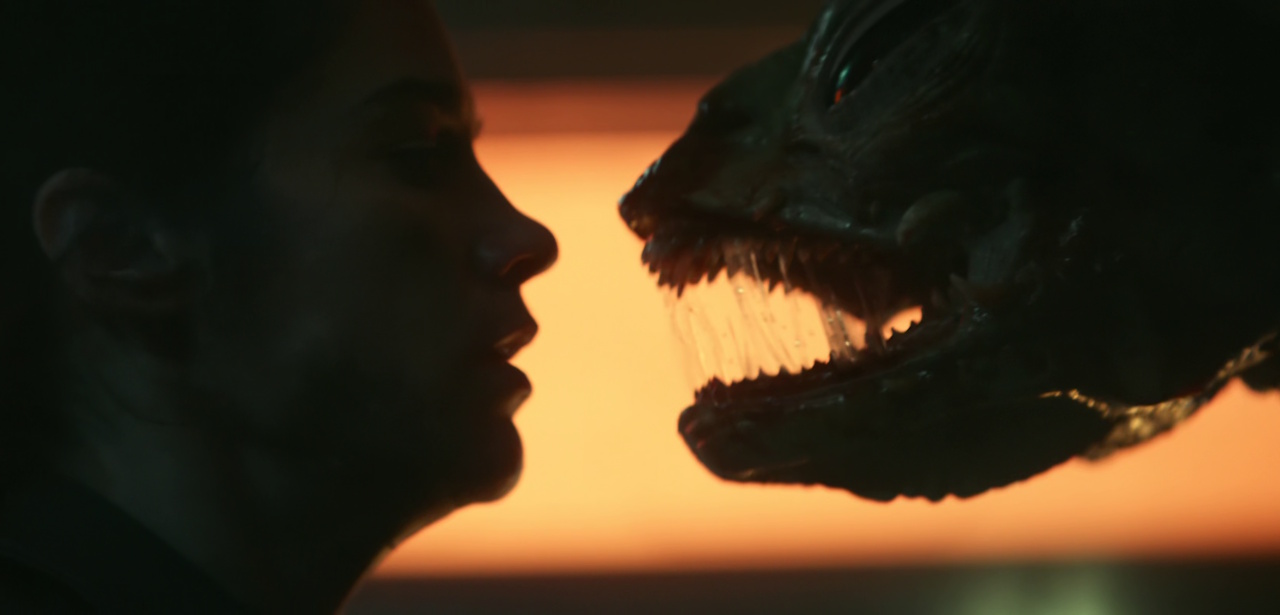
Star Trek: Discovery theories – weeks 1-2

Spoiler Warning: There are spoilers ahead for Star Trek: Discovery Seasons 1-4, Star Trek: Picard Season 1, and for other iterations of the Star Trek franchise.

Now that all of the international broadcasting nonsense is out of the way, let’s get back into my weekly Discovery theory updates! We only missed one week, and there’s still a ton of speculating to be done about the story of Season 4, the gravitational anomaly, and what might become of some of our favourite characters.

If you’re new to my weekly theory updates for Discovery Season 4, here’s how the format works: after every episode I go back to my theory list. I cross off theories that have been debunked, celebrate any that appear to have been confirmed, update any that have seen progression, and add any new theories that the most recent episode has spawned. There will be some theories that, for whatever reason, the most recent episode didn’t advance in any way, so those will simply be restated to keep the list up-to-date and in one place!

I wrote up all of my pre-season theories into one list a couple of weeks ago, so this time we’ve already got two confirmations to take a look at before we jump into the main list.

Confirmed theory #1: The Spore Drive will be rolled out to more ships.

Book in Discovery’s Spore Drive cube.

Finally! After the revelation in the Season 3 finale that Book – and potentially anyone else with similar empathic abilities – could control the Spore Drive, the last hurdle in the way of it being rolled out to other Starfleet ships had been surmounted. It finally feels like Discovery is on the cusp of finding another use for what had been one of the most controversial technologies introduced in the series.

In Kobayashi Maru this was almost treated as a throwaway line, so I wouldn’t blame you if you missed it, but President Rillak confirmed that a “next-generation” Spore Drive is being developed by Starfleet as part of the Federation’s plans to rebuild and expand. It wasn’t stated on screen, but I wonder if the USS Voyager-J might be fitted with a Spore Drive as part of its retrofit; the vessel was in spacedock, after all.

The USS Discovery makes a Spore Drive jump.

I’d been hoping that the series would go down this road for a while. Moving forward in time to the 32nd Century means there are no “canon purist” arguments in favour of abandoning the Spore Drive, keeping it a secret, or ensuring that only the USS Discovery could use it. And the events of the Season 3 finale seemed deliberately designed to create an easy way to expand the Spore Drive to more ships – perhaps even paving the way for future Star Trek productions in this era.

We don’t yet know what the implications will be of Kwejian’s destruction on Starfleet’s plans. It was implied in the Season 3 finale that anyone with empathic abilities could use the Spore Drive, not only Kwejian natives, so the loss of Kwejian and most of its population shouldn’t mean that the Spore Drive expansion has to be abandoned. It might be possible for Betazoids, Deltans, or even Vulcans to train to become Spore Drive navigators.

Confirmed theory #2: A new character joined the main cast.

A new name has been spotted in the opening credits!

Following the departures of Nhan and Georgiou, it felt like there was definitely scope to either promote a recurring character to the main cast or create at least one new one! We’ve met President Rillak, who seems like she’ll become a recurring character, but the one who’s been promoted to join the main cast is Blu del Barrio’s character of Adira.

Adira makes a great addition to Discovery’s main cast of characters, occupying a similar role to Tilly in Season 1 in particular. As Tilly has undergone significant character growth across the show’s first three seasons, there was scope to bring someone brand-new aboard the ship, and having that person be someone young and eager is a positive thing. Adira is not only involved in their own storyline with Gray and Dr Culber, but also as a scientist can work with Stamets, Tilly, Saru, and Captain Burnham. I think Adira has the potential to be a versatile character in whatever stories lie ahead.

My original version of this theory centred around the question of Captain Burnham’s first officer. Now that we know that role has gone to Saru, it seems as though the main and recurring characters for this season are set.

So those theories were confirmed. Now we’ll take a look at some new theories and a few updated theories.

Theory #1: President Rillak knows what the anomaly is… and may be responsible for its creation.

President Rillak in Kobayashi Maru.

This ties into a broader point that we’ll be considering from several angles: the possibility that the gravitational anomaly is not a natural phenomenon. If the anomaly is artificial in nature, the question of who is responsible for its creation crops up. It could be a weapon deployed by another faction, of course, but it could also be a Federation creation – perhaps a weapon designed to defend against the Borg, a rogue experiment to try and prevent a second Burn, or something else entirely.

If that’s the case, President Rillak almost certainly knows more about the anomaly than she’s willing to say right now. Perhaps she’s hoping that it won’t be what she fears it is, or perhaps she’s trying to cover her own back – Captain Burnham did go out of her way to describe her as a “politician,” after all.

Does President Rillak know more about the anomaly than she’s saying?

President Rillak is a character with depth, not simply an “evil admiral” character trope. But it wouldn’t be the first time that Discovery has presented us with a fairly hard-line character in a position of authority who turns out to be concealing a dark secret.

As the head of the Federation, President Rillak is committed to doing whatever it takes to preserve the organisation. The anomaly may have been part of those plans… somehow. If she isn’t responsible for its creation directly, she may still know what it is if a past Federation President signed off on its creation. She may be covering up that secret on behalf of the Federation.

Theory #2: Captain Burnham and/or the Red Angel time travel suits from Season 2 are connected to the anomaly.

Captain Burnham.

Though we did see some moves away from Discovery’s laser-focus on Michael Burnham in Season 3, the show has put her front-and-centre in all of its main storylines so far. Season 2’s Red Angel storyline was connected to Burnham in a major way, and I wonder if Burnham might similarly have some kind of connection to the anomaly that she’s currently unaware of.

Perhaps the Red Angel suit, which Burnham sent back in time in the Season 3 premiere, malfunctioned somehow, and its powerful wormhole-creating technology gave rise to the gravitational anomaly. If the Red Angel suit completed its journey back to the 23rd Century, the anomaly may have had centuries to grow and expand unchecked.

This was the last we saw of the Red Angel suit back at the beginning of Season 3.

I’m not sure that this one is particularly likely, but as I said last year about a possible Burnham connection to the Burn, not only does Discovery kind of have a precedent for telling this kind of story, but there would also be something very dramatic about this revelation. In this case, Burnham would be indirectly and unknowingly responsible for creating something devastatingly damaging. How would she react to that, and how would Book react given what’s just happened to Kwejian?

If time travel is involved, perhaps a future Captain Burnham or a parallel universe Captain Burnham could be responsible for the anomaly’s creation – either intentionally or not.

Theory #3: Gray’s transfer to a new body won’t be simple.

A holographic representation of Gray’s synthetic body.

I adored the scene with Gray, Adira, and Dr Culber in Anomaly. As someone who’s struggled to come to terms with my own gender identity and my gender expression, it was so deeply relatable to see Gray “customising” his new body. But also included in that scene was a line from Dr Culber about how the “Soong method” used to transfer consciousness into a synthetic form has a very low success rate.

I suspect that line was included as a kind of pre-emptive plot hole plug that will have nothing to do with Gray! If the Soong method was said to work every time, then it would be very difficult to kill off any Star Trek characters from the 25th Century onwards, because fans would rightly ask “why didn’t they transfer to a synth body?” So I suspect that’s why the line was included.

Admiral Picard had his consciousness transferred to a synthetic body in the finale of Picard Season 1.

However, it felt a little ominous for poor Gray. It was great to see that Adira, Dr Culber, and others had been working hard to help Gray become seen again after the events of Season 3, and I have no doubt that somehow we’ll see Gray in a physical body before the season is over. But we’re only two episodes in at time of writing – will it really happen so quickly, and so seemingly simply?

I’m not convinced of that yet! There are many things that could go wrong, delay the transfer, or prevent it entirely. And there are an unlimited number of technobabble explanations for finding a new way to give Gray a body! So let’s see what happens – but I wonder if this storyline might have a few twists and turns along the way.

Theory #4: Book will find Kyheem and Leto inside the gravitational anomaly.

Book with Leto and Kyheem shortly before the destruction of Kwejian.

In Star Trek: Generations, Captain Picard encountered Captain Kirk inside the Nexus – despite Kirk being declared “dead” after the Enterprise-B encountered the energy ribbon. We don’t know what the gravitational anomaly is yet; one of my very early pre-season theories involved the Nexus, but that seems to be debunked already! However, the anomaly’s mysterious nature raises the faint possibility that at least some of those it appears to have “killed” may not be as dead as they first appear.

This theory is, I freely admit, a bit of a long-shot. And it hinges on a fundamental question underlying the story of the season: is there more to the gravitational anomaly than meets the eye? If the anomaly is just an extreme example of space weather, flitting through Federation space destroying anything unfortunate enough to be in its way, then probably everyone on Kwejian is dead. But if the anomaly harbours some kind of gateway, wormhole, portal, time vortex, or any of the other Star Trek-y technobabble phenomena that we’ve seen across the franchise’s history, then it’s possible that at least some of the folks on Kwejian found themselves transported to whatever realm lies inside of the anomaly.

Theory #5: The anomaly is a sentient life-form.

Could the anomaly be similar to V’Ger?

“It was only trying to communicate!” has become a Star Trek cliché, often used to describe how the seemingly-aggressive actions of an alien life-form are actually something innocuous. Perhaps the same is true of the gravitational anomaly: at its core is a life form, perhaps one not dissimilar to the Sphere seen in Season 2, and it’s on its own mission of exploration.

V’Ger from The Motion Picture is an interesting comparison. Like the gravitational anomaly, V’Ger was massive in size, capable of destroying space stations, fleets of ships, and even threatening to destroy entire planets. When Admiral Kirk and the crew of the Enterprise were able to figure out V’Ger, however, they found a life-form at its core, one which was just as curious to learn and grow as they were.

Theory #6: Saru will be given the captaincy of the USS Voyager-J.

The USS Voyager-J.

Saru’s future was briefly discussed before he offered to serve as Captain Burnham’s first officer. He has already been offered a command of his own, so Starfleet clearly values his command abilities and experience. President Rillak was seen to be assessing Captain Burnham’s suitability for the captaincy of the USS Voyager-J in Kobayashi Maru… and she mentioned having a shortlist of candidates. Could Saru be on her list?

At time of writing, a fifth season of Discovery hasn’t been officially confirmed. But if the show is to run for another season – or more – the question of Saru’s role comes up. It would be possible to work out a way to keep him on board as first officer for longer than one season, and in many ways I think that’s something fans would want to see. But at the same time, from an in-universe point of view, it kind of makes sense for Starfleet to use its experienced captains where possible.

Captain Saru.

Several of the qualities that President Rillak said she was looking for in a potential captain seem to apply to Saru. He’s more level-headed, less likely to put himself in a dangerous situation, and more inclined to think of the big picture. He has a weakness when it comes to Kaminar, as we saw toward the end of Season 3, but generally speaking he isn’t someone who lets his emotions get the better of him. His wisdom and calm demeanour could be valuable in the captain’s chair of the Federation flagship.

If Saru did depart Discovery in a future episode or season, could that perhaps set the stage for Star Trek: Saru… or perhaps Star Trek: Voyager-J? That’s a very interesting possibility! One element of Season 3 that I felt didn’t really get as much attention as it might’ve was that Saru was the Star Trek franchise’s first non-human captain (in a leading role). There’s perhaps scope to follow him on another adventure sometime in the future.

Theory #7: The gravitational anomaly is a superweapon.

The USS Discovery approaching the anomaly in the second Season 4 trailer.

We touched on this theory above when we considered the Federation’s possible complicity in the creation of the gravitational anomaly, but there are many other ways such a story could pan out. The anomaly’s unpredictable nature, as noted by Tilly and Saru at the end of Anomaly, could imply that there’s an intelligence at work, perhaps dictating the anomaly’s moves. This could be the anomaly itself as suggested above, but it could also be the case that the anomaly is being controlled or manipulated by something or someone externally.

If the anomaly turns out not to be a natural phenomenon, and is indeed deliberately targetting the Federation, who might the possible culprits be? And what would be the purpose behind attacking the Federation in this manner? If it’s the precursor to an invasion, perhaps later in the season we’ll see whoever is responsible making their next move.

Theory #7a: The Borg are responsible.

A Borg drone seen in The Next Generation.

We don’t know whether the Borg Collective still exists in the 32nd Century; it hasn’t even been mentioned since the USS Discovery’s arrival. However, out of all of the factions in Star Trek, few seem capable of creating a weapon on the scale of the gravitational anomaly. This wouldn’t be in line with the Borg’s usual modus operandi, as they prefer to assimilate rather than attack from afar. But a lot may have changed in the centuries since we last encountered them, meaning this could be the opening salvo of a Borg attack… or the last gasp of a dying Collective.

Theory #7b: The super-synths from Picard Season 1 are responsible.

This is all we really saw of the super-synths.

We still don’t know very much about the super-synths that Soji and Sutra attempted to contact in the Season 1 finale of Star Trek: Picard. Other than claiming to offer support and help to synthetic life, what are their goals and motivations? Was their offer even genuine, or was it a trap? The mechanical tentacles glimpsed in Picard Season 1 looked terrifying! Moreover, we know that the super-synths have the technology to move stars – something only possible with an advanced understanding of gravity. Creating a stable 8-star octonary system is an incredible technological and gravitational feat, so they have precedent of a sort when it comes to working with gravity.

Theory #7c: The Kelvan Empire is responsible.

Rojan, a representative of the Kelvan Empire.

This one might seem to come completely out of the blue! In The Original Series, Captain Kirk met representatives of the Kelvan Empire, a faction originally from the Andromeda galaxy. Seeking a new home, a Kelvan scouting party had reached the Milky Way and were looking for worlds to conquer. Kirk would ultimately dispatch an unmanned starship offering to help the Kelvan Empire find new worlds to settle – but what if his offer was rejected? Given the vast distances involved, the timelines kind of line up for the Kelvan Empire to return to the Milky Way.

Theory #7d: The Sphere-Builders from Enterprise are responsible.

A Sphere-Builder seen in Enterprise.

A defeated faction in one of the Temporal Wars, the Sphere-Builders initially hoped to convert a large swathe of the Alpha Quadrant to match their native extradimensional realm, and constructed a number of large space stations known as Spheres to facilitate this transformation. Crewman Daniels would tell Captain Archer that the Sphere-Builders were defeated in the 26th Century, but could they have since rebuilt? The gravitational anomaly isn’t necessarily the same as what they were trying to do with the Spheres, but they’re one of the few factions in Star Trek that might be capable of creating a weapon on this scale.

So those theories were new or saw some advancement in the first two episodes of the season.

To keep these theory posts as uncomplicated as possible, I like to keep all of my theories in one place. So below you’ll find all of my other Season 4 theories. These weren’t debunked or confirmed in the first two episodes, and indeed saw no real movement at all. They remain in play, though.

Theory #8: A major character will be killed.

A Starfleet coffin draped with the Federation flag as seen in Deep Space Nine.

Season 3 saw a couple of major departures: Mirror Georgiou entered the Guardian of Forever’s portal, and Nhan remained behind aboard the USS Tikhov. Yet despite the dangers the crew faced as they navigated the 32nd Century, battled the Emerald Chain, and figured out the mysteries of the Burn and the Verubin Nebula, only one ally – Ryn – lost their life.

Killing off a character can be an excellent way to communicate the stakes involved if it happens at a relatively early stage. It can also be a storyline that brings a lot of emotion, as we have to say goodbye to a beloved member of the crew.

Dr McCoy and Sulu playing dead in The Wrath of Khan.

In short, I think there are plenty of reasons on the production side why killing off a major character could make sense in Season 4. Discovery has seen a number of characters leave the series – far more than any past Star Trek show, in fact – but the series’ death toll is still relatively low when compared to many other modern television shows.

There are also a couple of characters who feel in danger for different reasons. For a full breakdown of which characters I think might be on the proverbial chopping block, check out my list of “death predictions” by clicking or tapping here.

Theory #9: There will be a character crossover from a past iteration of Star Trek.

Voyager’s Doctor is a contender!

Yes, I’m officially bringing this theory back! This is one that I doggedly clung to for all of Season 3, and while it arguably kind of happened with the Guardian of Forever, that wasn’t really what I meant.

The show’s 32nd Century setting has shot Captain Burnham and the crew far beyond anything in Star Trek’s established canon, and that should mean that practically everyone we remember from other Star Trek shows won’t be around any longer. But this is Star Trek – with some creatively-written technobabble, practically any major character could have survived all the way through to the 32nd Century!

Could Sutra still be alive in the 32nd Century?

It’s also possible for Captain Burnham to discover the logs of a long-dead officer; someone we as the audience would be familiar with. While this would be less of a “crossover” than if a character from the past could be physically present, it would still be a lot of fun to see!

There are a handful of characters who could have survived to the 32nd Century based on what we know about them from past iterations of the franchise. Included in this category would be people like Soji, Voyager’s Doctor, and a few others. But as we’ve seen in episodes like Relics and even the film Generations, all it would take to make a big crossover happen is some kind of temporal anomaly, stasis field, or other technobabble!

Theory #10: Burnham may not remain in the captain’s chair.

Michael Burnham in the captain’s chair in a promotional image for Season 4.

This is a controversial one, so let me just say up front that I’m neither in favour of this theory nor opposed to it – I just think it’s a possibility. As things stand, Discovery has had four different captains across its four seasons. One of the show’s unique points of interest within Star Trek’s broader canon are the very different ways in which these individual captains commanded the ship and crew.

It’s got to be considered at least a possibility, then, that the show will continue this trend. This doesn’t mean Captain Burnham will be killed off; I’d actually argue she’s pretty safe. But there are many different routes to her potentially leaving the ship, such as a desire for freedom that we saw in Season 3, or even perhaps taking up a new, more senior role within Starfleet.

Captain Burnham in Anomaly.

If this theory were to come to pass, it would be something I’d expect to see at the very end of the season. Even if Burnham seems 100% committed to her new role as captain, I don’t think it’s a theory we can definitively rule out.

It’s worth mentioning that at time of writing Discovery hasn’t been officially renewed for a fifth season – so all this talk of who’ll be in the captain’s chair by then could be moot! And of course this theory has a very strong counter-argument: that Discovery’s main story arc across its first three seasons can be read as Burnham’s ascent to the captain’s chair.

Theory #11: Kovich works for Section 31.

Kovich in Season 3.

This is another Season 3 theory that I’m choosing to bring back! The question of who Kovich is and what role he played in Starfleet and the Federation was left open at the end of Season 3, and we know that the character will return in some capacity. As someone who seemed to talk around the issue at hand and not reveal everything he knew, Kovich strikes me as potentially being a Section 31 operative – or even the head of the organisation.

We don’t know yet if the Section 31 series that was announced in 2019 will go ahead as planned. But if it does, there could potentially be a connection between Kovich and Georgiou that would tie the two shows together. Kovich is mysterious enough that his character could be taken in many different directions – but my money’s on Section 31.

Theory #12: The ban on time travel will be explained further.

Admiral Vance first told us of the ban on time travel.

This one is a hope as much as a theory right now! In short, the ban on time travel was introduced early in Season 3 primarily as a way for the writers and producers to avoid questions about why the 32nd Century was so different from how the far future had been depicted in earlier Star Trek productions, as well as to explain things like how the Burn was able to catch the Federation off-guard and why Georgiou couldn’t simply be sent back in time when she needed to.

But the ban itself raises some issues – the biggest one being the lack of detail on how it works and how something like this could possibly be enforced. As I said several times last season, it isn’t possible to just un-invent a technology so useful and powerful as time travel. Even just a few lines of dialogue going into a little more detail on the mechanisms involved in the ban would be really useful.

Theory #13: The Federation has flouted the ban on time travel.

HMS Bounty travels through time in Star Trek IV: The Voyage Home.

Sticking with the time travel ban, another theory I had last season was that the Federation – and Section 31 in particular – might have deliberately flouted the ban and failed to abide by the rules. Someone as straight-laced and committed to Starfleet ideals as Admiral Vance is highly unlikely to have sanctioned such a move, but someone like the shadowy Kovich (who we talked about a moment ago) might have. President Rillak could also be involved.

Obviously the bulk of the season’s story will deal with the gravitational anomaly. But there’s scope to either talk about the time travel ban in a standalone episode or even tie the two stories together – perhaps the anomaly has been unleashed as a result of unsanctioned time travel.

Theory #14: The story will connect with the Short Treks episode Calypso.

The USS Discovery seen in Calypso.

Despite a handful of moments in Season 3 which seemed to connect to Calypso, the story of the season overall ended up going in a very different direction. While we saw a couple of things that arguably did tie in to the Short Treks episode, major things like the USS Discovery undergoing a refit have actually moved the plot even further away.

It’s possible that Calypso will forever remain an outlier in Star Trek’s canon – an episode tied to a vision of Season 2 or Season 3 that was changed before it made it to screen. But earlier in Season 3 it felt like we were getting close to seeing how it could all be tied together – and I’m hopeful that Season 4 will find a way to do so.

Theory #15: The crew will have to defend the Verubin Nebula.

The dilithium planet at the centre of the Verubin Nebula.

The Federation is in a weakened state, and even if we see worlds like Ni’Var rejoin the organisation it’s still nowhere near as powerful as it once was. The Verubin Nebula is thus a very tempting target for anyone looking to gain an edge in a galaxy where dilithium is still in short supply. As the only known significant dilithium supply, whoever controls the Verubin Nebula will have a massive tactical advantage.

We can compare the Verubin Nebula to Deep Space Nine’s Bajoran wormhole in that respect – it’s a resource of huge strategic importance. Season 3 didn’t show us much about the makeup of the galaxy’s factions outside of the rump Federation and the Emerald Chain, but it’s got to be possible that factions like the Dominion, Klingon Empire, or even the Borg still exist and would want to seize the Verubin Nebula for themselves.

The USS Discovery arriving at the Verubin Nebula in Season 3.

Season 4 has teased a scientific puzzle – the gravitational anomaly. But that doesn’t mean there won’t be villains in play, and Discovery has introduced us to several compelling and interesting villains over its first three seasons.

To make a long theory short, it would begin to stretch credulity to think that everyone in the known galaxy would see the Federation rebuilding and having access to dilithium and not want to find out for themselves what’s going on. Once the Verubin Nebula’s existence becomes known, even if the Federation promises to share its bounty with all comers, it seems very likely that someone would want to take control of the dilithium supply for themselves.

Theory #16: Captain Burnham and the crew will encounter the Klingons.

The Klingons have been part of Discovery since the beginning.

By the late 24th Century the Federation and Klingons were firm friends, having been allied for a century and after fighting side-by-side against the Dominion. We don’t know if that alliance endured to the 32nd Century, but it’s certainly plausible to think that it did. The Klingons might even have joined the Federation at some point, and their violent warrior culture may have been significantly pacified.

One thing that could be very interesting to see is how the crew of the USS Discovery – almost all of whom are veterans of the Federation-Klingon war – would respond to that. They’ve worked alongside Klingons like L’Rell before, but many of them still see the Klingons as an old enemy. The story of overcoming that prejudice could mirror episodes like The Wounded from The Next Generation, and would be very interesting to see.

Theory #17: Some areas of the galaxy – such as the Delta Quadrant – avoided the worst effects of the Burn.

The USS Voyager was the first Federation starship to explore the Delta Quadrant.

It’s quite possible that Season 4 won’t revisit the Burn narrative in any detail. But one thing I’d be curious to see is the true extent of the disaster – did it reach all four quadrants of the galaxy equally, or did its effects fade out after a certain point? Michael Burnham discovered that the Burn had a point of origin, and that it radiated out from that point like ripples on the surface of water. Ripples eventually diminish, fading away the further they travel, and perhaps that’s true of the Burn as well. There could be whole areas of the galaxy that didn’t even notice the Burn – and maybe the ship and crew will visit one such region.

If the Delta Quadrant was left largely unscathed, for example, what might that mean for the likes of the Borg? It’s possible they aren’t even still around in the 32nd Century, but it’s also possible that they’ve had more than a century to expand and build up their forces while the Federation suffered.

Theory #18: The Guardian of Forever will be back.

Carl – the Guardian of Forever’s new persona.

Having reintroduced the Guardian of Forever in Season 3, I wouldn’t be at all surprised to see Discovery return to the Guardian’s planet in Season 4. The gravitational anomaly is something new and threatening, so it’s possible Captain Burnham might want to ask the Guardian for help or information.

The Guardian of Forever is also the only way we know of at present to travel through time – something that might be necessary if Season 4 makes an attempt to link up with Calypso in a big way. There are many reasons why Captain Burnham might want to revisit the Guardian, and it would be great to bring back actor Paul Guilfoyle, who played the Guardian’s humanoid avatar in Season 3.

So that’s it! Those are all of the theories I currently have in play.

Stay tuned for weekly updates to this list after new episodes air! I try very hard to publish my theory updates in between episodes so that nothing is out-of-date! Season 4 is off to an exciting start – and there are plenty of mysterious elements to get stuck into.

Star Trek: Discovery Season 4 is available to stream now on Paramount+ in the United States, Scandinavia, Latin America, and Australia. The show is on Pluto TV in the UK, France, Germany, Italy, and other parts of Western Europe at 9pm on Fridays and Saturdays. Individual episodes or the full season can be purchased on iTunes, Amazon Video, and possibly other platforms in the UK, parts of Europe, and select other countries. The Star Trek franchise – including Discovery and all other properties mentioned above – is the copyright of ViacomCBS. This article contains the thoughts and opinions of one person only and is not intended to cause any offence.
Star Trek theory: Q the saviour

Spoiler Warning: There are spoilers ahead for the trailers and teasers for Star Trek: Picard Season 2. Spoilers are also present for the following Star Trek productions: The Next Generation, First Contact, Voyager, and Enterprise.

Today we’re going to take a look at Q, the immortal trickster who has tangled with Captains Picard, Sisko, and Janeway – and who will soon be returning to the Star Trek franchise! Q is an unusual character in many ways. He seems to have practically unlimited knowledge of the galaxy, and may have been alive for billions of years. Yet he has an impish, almost childish sense of humour that sees him tease and mess with Starfleet – and many other people too.

I wouldn’t call Q a “villain” in any of his appearances to date. In fact, I would argue very strongly that Q sees himself as a friend, an ally, and a guide to Captains Picard and Janeway in particular, having offered his services more than once. He’s certainly selfish – forcing Starfleet officers to undergo tests and trials of his own devising – but there’s usually more to his games than meets the eye.

Q in his judge’s robe.

On several occasions – going all the way back to his first appearance – Q has presented Starfleet with puzzles to solve. These puzzles can be dangerous, and more than once Q has gotten people killed. But even so, I wouldn’t characterise him as a typical “villain” for Captain Picard or Captain Janeway to “defeat.”

The puzzles Q has presented – especially to Captain Picard – have actually proven to be deeply satisfying, and arguably helped Picard and Starfleet grow. Recognising that life can take very different forms – as Q helped Picard to see in Encounter at Farpoint – is one such puzzle he presented. He also taught Picard how to view time in a non-linear fashion – understanding that events in the future could have a causal link to events in the past in All Good Things.

All Good Things saw Q present Picard with another puzzle to solve.

Even the teasers and trailers for the upcoming second season of Star Trek: Picard may not be all they seem. Picard says he blames Q for disrupting or changing the timeline, but I think we’ll have to see that story play out before we can assign all the blame to Q. Even if Q is responsible, the question of motivation comes up. Is it really just a game; a trick to mess with Picard? Or is there something bigger going on?

That’s one of my big Picard Season 2 theories! But I’ll save the full write-up for another day. Today we’re not looking ahead to future Star Trek, we’re going to look back at past iterations of the franchise and try to answer a deceptively simple question: did Q save the Federation?

Q will soon be returning to Star Trek…

Star Trek has made a mess of the early history of Borg-Federation contact. The Raven, from Voyager’s fourth season, told us that the Borg assimilated humans and a Federation vessel in the 2350s. Regeneration, from Enterprise Season 2, showed the Borg battling against Captain Archer and his crew – and sending a message to the Delta Quadrant that would be received in the 24th Century. So the question of how the Borg first became aware of the Federation is an open one. Did they receive a message from across the galaxy? Did they first discover humanity when they assimilated Seven of Nine and her family?

Either of these explanations could account for the Borg’s interest in the Alpha and Beta Quadrants in the mid-late 24th Century. Season 1 of The Next Generation first teased the Borg’s appearance with the episode The Neutral Zone, in which both Federation and Romulan colonies had gone missing – “carried off” the surface of their planets, as Romulan commander Tebok put it. The Borg’s responsibility for these attacks would be confirmed in The Best Of Both Worlds – though the connection is easily missed, in my opinion, as it doesn’t take up much screen time.

The Borg were responsible for the destruction of several Federation colonies in the 2360s.

Regardless, one thing is certain: the Borg knew of the Federation’s existence well before the Federation knew of theirs. They had even begun to send scouting vessels relatively close to Federation space; system J-25, where the Enterprise-D first encountered a Borg Cube, was a mere two-and-a-half years away from Federation space at high warp, placing the Borg tens of thousands of light-years away from their Delta Quadrant home.

Were the Borg actively scouting for the Federation, or was it just a coincidence that one of their vessels was operating so far away from their own space? We may never know the answer to that, but someone almost certainly does: Q.

Q was responsible for this encounter.

In brief, here’s my theory: the Borg and the Federation were already on a collision course, but the Federation didn’t know it. Whether it was because of the First ContactRegeneration time travel loop, the assimilation of the USS Raven, the attacks along the Neutral Zone, or simply the Borg’s continued exploration of the Alpha and Beta Quadrants, they had humanity and the Federation firmly in their sights long before Starfleet was aware that there was a problem.

Recognising this, and seeing potential in humanity thanks to his earlier run-ins with Captain Picard and the crew of the Enterprise-D, Q chose to intervene. He knew that if the Federation became aware of the threat the Borg posed, their ingenuity would lead to better defences and they’d be able to protect themselves, so he chose to deliberately introduce them to the Borg for that reason.

A Borg Cube hovering ominously over Earth. The Borg came very close to assimilating humanity’s homeworld.

The events of The Next Generation Season 2 episode Q Who can be reinterpreted through this new lens. Rather than Q trying to frighten Picard for the sake of it or to prove his own superiority, he was – in his own twisted way – helping Picard and the Federation. The events of Q Who led the Federation to begin serious preparations for a Borg incursion, and without that tactical readiness it seems likely that the Borg would have been able to cruise to victory during the events of The Best of Both Worlds.

This fits with how Q operates. In stories like Encounter at Farpoint, Tapestry, and All Good Things, as well as Voyager’s The Q and the Grey, Q never explains everything he knows. Instead he obfuscates, talks around the issue, and forces Starfleet figure out what’s going on for themselves. Sometimes he pushes Picard or Janeway in a certain direction to get things moving, or even devises a puzzle or test of his own, like he did in Hide and Q. But what he never does is simply communicate – he doesn’t just sit down with Picard and tell him about Farpoint Station or the anti-time problem. He pushes Picard to figure those things out for himself.

Q appeared in Season 1 of Lower Decks.

And so it is with the Borg – according to this theory. Rather than contacting Picard and explaining what he knows about the Borg and their intention of targetting Earth, he sends the Enterprise-D to a location where he knows a Borg vessel will be and allows the crew to discover the threat for themselves. He does so knowing that the consequences will be Starfleet ramping up their defences in preparation of a Borg attack.

In All Good Things, Q told Picard that the Q Continuum saw potential in humanity – the potential to one day understand more about the universe than they ever thought possible. From Q’s point of view, perhaps he believed that seeing the Federation attacked and humanity assimilated would be a net loss to the galaxy because that potential would never be realised.

Q has his reasons for “testing” Picard and humanity – even if he chooses not to explain himself.

Q’s motivation for putting Picard and humanity “on trial” seems to be connected to this. In Encounter at Farpoint he accused humanity of being “a dangerous, savage, child race.” Yet even by the end of the episode, Q appeared to be impressed rather than disappointed that Picard and the crew could solve his puzzle. Rather than believing humanity to be dangerous and savage, as he asserted, Q almost certainly sees humanity as something more than that – and thus would feel humanity’s assimilation by the Borg would be a loss. His desire to avoid that fate could have motivated him in Q Who.

All of this could tie into Picard Season 2. Q may feel that Picard and the Federation are ungrateful for his “assistance” over the years, and he could cite the events of Q Who as one example of how his intervention saved the Federation from assimilation. While the latter part is up for debate, I definitely believe that Q feels underappreciated by Picard in particular, and sees his interactions with the former captain of the Enterprise-D as helpful rather than antagonistic.

Q looks annoyed with Picard in the trailer for Star Trek: Picard Season 2.

So let’s recap! The Borg became aware of the existence of the Federation by the mid-24th Century. The Federation had technology and resources that the Borg considered valuable, and they began targetting outlying Federation colonies, including those near to the Romulan Neutral Zone. All the while, the Federation remained ignorant of the Borg’s existence – considering them to be little more than rumour.

Foreseeing disaster and either the total assimilation of humanity or the devastation of the Federation such that humanity could not achieve its full potential, either the Q Continuum or Q independently decided to intervene. Instead of simply contacting the Federation to share his knowledge, Q transported the Enterprise-D to the star system J-25, where they encountered the Borg. This encounter led to the Federation developing anti-Borg strategies and defences that would ultimately save them from assimilation.

Unusually, Q has never taken credit for this. However, it’s at least possible that he considered Picard and the Federation as a whole to be ungrateful for his help, and this could tie in somehow to the events of Picard Season 2 where Q will be making a return to the Star Trek franchise.

Did Q save the Federation from assimilation?

What I like about this theory is that everything feels like it fits together. This theory connects the message sent in Regeneration and the early assimilation of Seven of Nine’s family to the events of The Neutral Zone, giving the Borg a reason to be operating so far outside of their territory. It also fits in perfectly with the way Q behaves – never sharing everything he knows and presenting dangerous and often deadly puzzles to Picard and Starfleet.

Whether it’s true or not is open to interpretation! I would say that Q Who wasn’t written with any of this in mind, and a straight watch of the episode strongly suggests that Q’s motivation is simply to frighten Picard and the crew of the Enterprise-D after his offer to join the crew was rejected. Q felt that Picard was arrogant in assuming that Starfleet could handle any threat the galaxy contained, and wanted to prove him wrong. While that explanation works in the context of the episode, it doesn’t preclude anything included in this theory from also being true; Q could still have been annoyed at Picard’s assertion that the Federation was prepared for anything while also intending to provide them with advance warning of the Borg.

So that’s it for this one! As with all fan theories, anything we see on screen in a future episode or film could render the whole thing invalid. But for now, I think it’s at least plausible that the events of Q Who represent Q trying – in his own unique and twisted way – to help Picard and the Federation. Q has always seen himself as a friend of Picard’s, and based on what we know of both Q and the history of Borg-Federation contact, it seems to me that everything arguably fits together!

The Star Trek franchise – including all episodes and other properties mentioned above – is the copyright of ViacomCBS. This article contains the thoughts and opinions of one person only and is not intended to cause any offence.
What If…? Star Trek Edition!

Spoiler Warning: There are spoilers ahead for the following Star Trek productions: The Search for Spock, The Next Generation Season 3, Nemesis, Deep Space Nine, Voyager, and Star Trek 2009.

Over on Disney+, Marvel has recently put out a series of animated short films with a very interesting premise. These shorts asked what might’ve happened in the Marvel universe if circumstances had changed, characters had taken different actions, or things had ended differently.

Alternate history has always been a subject that fascinated me! So with that in mind, we’re going to consider a few “what ifs” from the Star Trek franchise – from an in-universe point of view, naturally! There are more than 800 Star Trek stories at time of writing, meaning that there are literally hundreds of potential scenarios where a different decision or different outcome could have radically changed the Star Trek galaxy.

Inspired by Marvel’s What If…? series, we’re going to put a Star Trek spin on this concept!

As always, please keep in mind that all of this is one person’s subjective opinion! I’m indulging in fan-fiction and pure speculation based on my own thoughts about how some of these scenarios might’ve unfolded. If you hate all of my ideas, or something you like wasn’t included, that’s okay! Within the Star Trek fandom there’s enough room for different opinions.

With that out of the way, let’s consider some Star Trek “what ifs!”

Number 1: What if… Captain Picard couldn’t be saved after being assimilated?

Locutus of Borg.

This isn’t going to go the way you might be expecting! In this scenario, the events of The Best of Both Worlds play out as we saw on screen: Picard is captured, the Borg defeat the Federation at Wolf-359, Riker and the Enterprise race to confront them over Earth, and Captain Picard is able to communicate to Data how to defeat them. The Borg cube explodes, and the Federation lives to fight another day! But unfortunately Captain Picard then dies – severing his connection to the Collective and/or removing his Borg implants was too much for his body and mind to take, and he doesn’t survive beyond the end of The Best of Both Worlds, Part II.

As Starfleet and the crew of the Enterprise-D mourn the loss of Captain Picard, Captain Edward Jellico is assigned to the ship as his replacement, and many of the events later in The Next Generation proceed unaltered. As Q would tell Picard in the episode Tapestry, even without him in command the Enterprise-D and Starfleet would be fine.

Captain Edward Jellico.

The Federation, armed with new knowledge of the Borg, developed new ships like the Defiant-class and Sovereign-class, and were even able to defend against a second Borg incursion a few years later – albeit at great cost. But the loss of Captain Picard would have a huge impact later, in the year 2379. A coup on Romulus brings a human clone to power – Shinzon. Shinzon’s plot to destroy the Federation was only stopped because of his personal connection to Picard, a connection that fascinated him and that he hoped could save his life.

Without that obstacle in the way, Shinzon sees no reason to wait or to play nice with the Federation before implementing his plan. He takes his flagship, the Reman warbird Scimitar, and heads straight for Earth before the Federation even has time to respond diplomatically to the change in government on Romulus. Under cloak, the Scimitar deploys its thalaron radiation weapon – massacring all life on planet Earth and crippling the Federation government and Starfleet command.

Without Captain Picard to pose a distraction, Shinzon was able to launch his attack on Earth.

With war now assured between the Romulans and Federation, Romulan commanders who had been sceptical of Shinzon rally to the cause. All-out war breaks out between the Romulan Empire and the residual Federation, but without a government or command structure to provide a coordinated response, and seriously demoralised from the attack on Earth, things don’t go well for Starfleet. The Scimitar proves to be an unstoppable force all on its own, and its thalaron radiation weapon is able to devastate multiple other planets: Betazed, Andoria, Alpha Centauri, Mars, and others. The Federation is forced to sue for peace on very unfavourable terms.

However, Shinzon wouldn’t live to see the Romulan victory. Without the original Picard, there was no way to save his life from the DNA degradation that he was suffering from, and shortly after the Federation’s defeat Shinzon dies. His Reman viceroy would succeed him as the new leader of the Romulan Empire, an empire which now incorporated large swathes of what had once been Federation space. Whether the Romulans could hold all of this territory, and whether their empire would accept a Reman leader, are now open questions…

Number 2: What if… Spock wasn’t resurrected on the Genesis Planet?

Spock’s empty coffin on the Genesis Planet.

This scenario sees the events of The Wrath of Khan unfold exactly as we saw on screen. Khan stages an attack on the Enterprise, steals the Genesis device, and is defeated at the Battle in the Mutara Nebula. Spock sacrifices his life repairing the Enterprise’s warp drive, allowing the ship to outrun the blast of the Genesis device. But in our alternate world, Captain Kirk doesn’t give Spock a Starfleet funeral. Instead Spock’s remains are returned to Vulcan, in line with his and his family’s wishes. There is no chance for a resurrection because Spock never came into contact with the Genesis Planet.

Spock would indeed prove instrumental in several key events later in his life that now can’t happen. But we’re going to focus on the Kelvin timeline today. Spock’s actions in the Kelvin timeline saved Earth from Nero’s attack – but without his presence there’s no one to stop the crazed Romulan commander.

Nero.

Assuming that Nero arrived in the Kelvin timeline thanks to Red Matter (presumably deployed by someone else from the Federation as part of a plan to save Romulus), he has no reason to wait for Spock before enacting his revenge plan. After destroying the USS Kelvin (killing the infant Kirk in the process), Nero races to Vulcan and destroys the planet in the year 2233 – decades earlier than he would during the events of Star Trek 2009. Before the Federation even has time to realise what’s happening, and with Vulcan still collapsing, Nero heads to Earth and deploys his weapon for the second time – destroying the planet.

Nero then moves on quickly, targeting Tellar Prime and other Federation member worlds and colonies. The devastating losses mean it takes Starfleet a while to reorganise, but eventually the remaining fleet comes together to make a last stand over Andoria – the last remaining Federation member world. The battle against Nero’s powerful flagship is long and incredibly difficult, but Starfleet eventually prevails through sheer numerical advantage – despite suffering huge losses.

The Narada and the USS Kelvin.

Nero’s defeat wouldn’t mark the end of the rump Federation’s problems, though. With many planets and colonies destroyed, more than half the fleet lost, and millions of people turned into refugees, the Federation is an easy target. First the Klingons come, seizing planets and systems near their borders. Then the Gorn, the Tholians, and the Romulans also join in, picking off star systems that the Federation could no longer manage to defend. Federation space shrinks to a small area in the vicinity of Andoria.

The Andorians were not happy with the large numbers of refugees who sought them out, though. Plans were put in place to resettle humans, Vulcans, Tellarites, and others on new colony worlds, even though doing so would leave them vulnerable. After being kicked out by the Andorians, the remaining Federation members maintained their alliance more out of fear and necessity than anything else. How long these small populations can survive in a hostile galaxy is unknown…

Number 3: What if… the USS Voyager went the other way?

The USS Voyager.

The events of Voyager’s premiere episode, Caretaker, play out much the same as they did on screen in this scenario. But after that, things take a very different turn – literally! The Maquis raider Val Jean, under Chakotay’s command, is transported to the Delta Quadrant by an entity known as the Caretaker. The USS Voyager is likewise transported by the Caretaker’s Array, and after the death of the Caretaker and a short battle with the Kazon, Captain Janeway orders the destruction of the Array. Voyager must find a way home.

Instead of taking the most direct route to Earth, Captain Janeway and the crew of Voyager consider an alternative idea – heading for the Gamma Quadrant, and the far side of the Bajoran Wormhole. From there it would only be a short journey back to Earth! The crew debate the ideas for a while, and there isn’t a clear consensus. No starship has ever undertaken such a long journey before, so there really aren’t ground rules for route planning when it comes to long-distance interstellar travel.

A non-canon map of the Star Trek galaxy.
Image Credit: Star Trek Star Charts (2002) via Memory Beta

Using the map above (which is non-canon) as a guide, the crew quickly figure out that both a direct route home via the Delta and Beta Quadrants or an indirect route via the Gamma Quadrant and Bajoran Wormhole are roughly the same length and would take roughly the same amount of time.

The two crews can’t agree at first. Chakotay and the Maquis, keen to avoid going anywhere near Cardassian space and fearing being turned over to Cardassian authorities upon their return, firmly advocate for the Delta Quadrant route. Neelix claims to be familiar with space in both directions and along both routes, but ultimately the decision falls to Captain Janeway.

The choice of route ultimately falls to Captain Janeway under the “my ship, my decision” principle.

Somewhat ironically when considering her actions in Endgame, Janeway chooses the Gamma Quadrant route. Why? She’s fearful of the Borg, naturally. Whatever dangers and obstacles may await Voyager in the Gamma Quadrant, she tells her crew, Starfleet has known for years that the Borg’s home territory is the Delta Quadrant. Taking that path seems positively suicidal in comparison, so Voyager will instead head for the Gamma Quadrant terminus of the Bajoran wormhole.

Voyager’s superior technology makes battling the Kazon sects in the area around the Caretaker’s Array relatively easy, but they have to be careful to avoid space claimed by the Haakonian Order – the conquerors of Neelix’s people, the Talaxians. After they leave their starting region, though, the truth is that we simply don’t know very much at all in canon about this area of space. Would Voyager find a faster way home through some technological means or natural phenomenon? Or would the ship and crew have to undertake a slow, decades-long journey to reach the wormhole? Would they even survive at all, or instead fall victim to some villainous faction or dangerous anomaly present in this unexplored region?

Number 4: What if… the USS Discovery didn’t go into the far future?

Michael Burnham and the USS Discovery at the mouth of the time-wormhole.

I already have a theory discussing in detail why I think the USS Discovery didn’t need to go into the far future based on the outcome of the battle in Such Sweet Sorrow, Part 2 – and you can find that one by clicking or tapping here. For the sake of this scenario, though, all we’re going to say is that somehow Captain Pike, Burnham, and Saru figured out a way to defeat the Control AI without sending the USS Discovery into the 32nd Century.

Obviously some changes wouldn’t appear until the 32nd Century. Without the USS Discovery and Michael Burnham, no one is able to discover the source of the Burn or the huge cache of dilithium in the Verubin nebula. Without the USS Discovery and its Spore Drive to fight over, the Emerald Chain doesn’t stage a bold attack on Starfleet HQ. Su’Kal would almost certainly die alone when the KSF Khi’eth is destroyed – whether that event would trigger a second Burn is unclear.

A second Burn could occur.

But more substantial changes could have taken place in the Star Trek galaxy centuries earlier. With the Spore Drive still in existence in the 23rd Century, it stands to reason that Starfleet would have continued to explore the technology – it works, after all, so if a new way of navigating the mycelial network could be discovered, the Spore Drive would be an absolute game-changer for the Federation.

At some point, Starfleet scientists would hit upon the idea of using empaths to connect to the mycelial network in place of augmenting human DNA. After promising test flights using Betazoid and even Vulcan navigators, in the late 23rd Century Starfleet is able to begin a wider rollout of the Spore Drive. At first a handful of ships are kitted out as rapid-response vessels, able to jump across Federation space at a moment’s notice to assist with emergency situations.

Starfleet is able to kit out a whole fleet of Spore Drive-enabled starships.

The Spore Drive would soon attract the attention of other factions, however. Unwilling to allow the Federation a massive tactical advantage, particularly in the aftermath of the Federation-Klingon war, the Klingon Empire begins development on their own Spore Drive programme. The Romulans follow suit, and by the early part of the 24th Century the Spore Drive has become a mainstay of interstellar travel in the Alpha and Beta Quadrants.

No longer limited by geography or travel time, Starfleet is able to jump to interesting-looking phenomena across the galaxy with ease, initiating dozens of first contacts decades ahead of schedule. On one unfortunate occasion, however, a Spore Drive ship jumps to the Delta Quadrant… right into the heart of Borg space. The Borg quickly assimilate the vessel, taking the Spore Drive technology for themselves and putting a target on the Federation’s back. Due to the distances involved, Starfleet remains unaware of what happened, merely recording the USS Discovery-C as “missing in action…”

Number 5: What if… Benjamin Sisko wasn’t the Emissary of the Prophets?

Commander Benjamin Sisko.

Ignore for a moment the revelation from Image in the Sand about Benjamin Sisko’s Prophet-induced conception! For this scenario, we’re considering that there were two occupants of the Runabout which first discovered the Bajoran Wormhole: Sisko and Jadzia Dax. Though the Prophets would choose Sisko as their Emissary, they could just as easily have chosen Dax instead.

Jadzia Dax returns from the wormhole having been anointed by the Prophets as their Emissary, and receives much respect and adoration from the Bajorans. Meanwhile, Sisko makes good on his threat and quits Starfleet, returning to Earth. Jadzia is promoted to the rank of commander and given “temporary” command of DS9, due in no small part to the way the Bajorans feel about her.

Jadzia Dax assumes command of Deep Space Nine.

First contact with the Dominion occurs, and shortly afterwards the Dominion and Cardassians form an alliance – the work of Dukat, formerly the commander of Bajoran occupying forces on Bajor. The Dominion Cold War begins. Behind the scenes, Dukat is researching the Pah-wraiths, the ancient noncorporeal enemies of the Prophets. In disguise he travels to Deep Space Nine with a lone Pah-wraith, and in the course of unleashing the entity into the wormhole, kills Jadzia.

With no Emissary on the outside to come to their aid, the Prophets are fighting a losing battle against the Pah-wraiths while the Dominion War rages. The loss of Dax, though distressing to the crew of DS9 and her husband Worf, doesn’t appear to matter to the Federation war effort… not at first. In fact, the wormhole’s closure appears to provide the Federation alliance a reprieve, as the threat of Dominion reinforcements is reduced.

Jadzia is killed by the Pah-wraiths.

However, without the Orb of the Emissary re-opening the wormhole and expelling the Pah-wraiths, things go badly for the Prophets. When Dukat is able to implement the next phase of his plan and release the rest of the Pah-wraiths from the Fire Caves, there’s no one to stop him. The Pah-wraiths seize control of the wormhole, and as a thank you to Dukat they destroy the Federation minefield, allowing a massive fleet of Dominion reinforcements through the wormhole. The Dominion conquer DS9 and Bajor with ease.

With no way to stop Dominion reinforcements pouring in through the wormhole, the Federation alliance moves into attrition mode, trying to hold the existing front line for as long as possible against repeated Dominion attacks. Though the Pah-wraiths don’t actively take part in the fighting, their involvement allowed Dukat and the Dominion to swing the balance of the war back in their favour. By controlling Deep Space Nine and the wormhole, the Cardassian-Dominion alliance has the Quadrant’s most significant asset. It seems like only a matter of time until the Federation will have to sue for peace, if the Dominion would even accept…

So that’s it! Five Star Trek “what ifs!”

There are many more “what if” scenarios in the Star Trek universe!

I can already think of more, so watch this space. I might return to this concept in future. I hope this was a bit of fun, and a chance to consider some alternative outcomes to some of the events we’ve seen across Star Trek’s history. I tried to pick a few different ideas from different productions – otherwise this could’ve been “five Captain Picard what ifs!”

As always, this was really just an excuse to spend a little more time in the Star Trek galaxy. It’s totally fine if you disagree with any of the storylines I’ve suggested today, or if you think this whole concept was a silly idea! None of this will ever make it to screen, and it was more of a thought experiment and creative writing project than anything else. I had fun putting this together – and I hope you enjoyed reading it.

What If…? and the logo for the series are the copyright of Marvel and The Walt Disney Company. The Star Trek franchise – including all films and series mentioned above – is the copyright of ViacomCBS. This article contains the thoughts and opinions of one person only and is not intended to cause any offence.
Star Trek: Discovery Season 2 theory: The abandoned Borg origin story

Spoiler Warning: There are spoilers ahead for Star Trek: Discovery Seasons 1-3. Spoilers are also present for the following Star Trek productions: Picard Season 1, Lower Decks Season 2, First Contact, and The Next Generation.

While Star Trek: Discovery’s second season was running I wasn’t writing about the show; it wasn’t until November 2019 that I founded this website. Because of that I have a number of theories and ideas kicking around from the first two seasons of Discovery that I haven’t found time to talk about yet! On this occasion we’re going to look into one idea I had during Season 2 that has both in-universe and production-side elements to it – the “Borg origin story.”

I know for a fact that I’m not alone in having speculated that Discovery Season 2 was setting up an origin story for the Borg. Shortly after the season ended a friend of mine from way back was in the area for a visit, and we got talking about precisely this subject – yes, we’re both huge geeks! I’m also well aware that other fans have posited some variant or other of this theory online both during and after the season’s run, so please don’t interpret this article as me claiming to have independently and uniquely come up with this idea!

We’re revisiting Season 2 on this occasion!

Here’s the theory in brief: the Control AI, which was the main adversary during the story of Season 2, was originally intended to be the progenitor of the Borg. Its use of nano-technology, its ability to “assimilate” organic beings, and its murderous quest for true sentience that, if left unchecked, would have wiped out all sentient life in the galaxy are all indicators of this. In addition, the inclusion of time travel and the Red Angel suits in the story could have teed up a situation where Control was able to travel backwards through time and far across the galaxy in order to become the originator of the Borg Collective.

Because of Control’s similarities to the Borg in terms of its use of nanites, its single-mindedness, and its lack of care for the survival of organic individuals, this felt like a very real prospect right up until the final moments of the season finale. I really do wonder whether a Borg origin story was included in the original draft of Season 2, perhaps being modified later on once production had already commenced. What we saw on screen would thus contain the residual elements of that story, but with a different ending written – one which sent Burnham and the USS Discovery into the far future.

Captain Leland being “assimilated” by Control.

It’s this decision which I believe would be responsible for changing the story – if indeed such a change were mandated. Discovery had received criticism in Season 1 for its real or perceived “violations” of Star Trek’s internal canon, and it’s this reaction which surely contributed to sending the ship and crew far into the future. It could be that Season 2 was hastily re-written to include the time travel ending, dropping the Borg origin story in the process.

As a narrative concept, the idea that it was the Federation, through out-of-control technological and AI research, who inadvertently created the biggest threat to themselves and to the wider galaxy would be an incredibly impactful one, and something ripe for exploration in detail. The cyclical nature of such a story, with the Federation creating the Borg, then the Borg one day coming for the Federation, could be absolutely phenomenal if done well, and would highlight the morally questionable actions of senior Federation leaders and Starfleet admirals.

Admiral Patar – one of the senior figures involved in the Control AI project.

It would also be profoundly ironic that the Borg – almost universally acknowledged as the Federation’s biggest adversary – were ultimately a Federation creation. This revelation would have a huge impact on the Federation as a whole – and on our crew of Starfleet heroes when they discovered it – and could form the basis for a new Borg story that would surpass even the likes of The Best of Both Worlds and First Contact in its scope.

Had Discovery gone down this road in Season 2, it may not have fallen to Michael Burnham and the crew to be the ones to learn of the consequences of their battle to defeat Control. Picard Season 1 could have picked up this storyline, with information stored aboard the Artifact (the abandoned Borg Cube) finally revealing the Borg’s origins to the Federation more than a century later. This would have tied the two shows together in a very real and significant way – something I’ve argued on a number of occasions that Star Trek needs to be more adept at doing.

The Artifact in Picard Season 1.

In canon, we don’t know much about the Borg’s early history. The Control AI could have been slotted into the bits and pieces that we do know in a way that didn’t overwrite anything we’ve seen or been told on screen, with every past Borg story being allowed to unfold exactly as we know they did.

In-universe, the Borg originated in the Delta Quadrant “thousands of centuries” before the 24th Century. There was an original Borg race – a race of purely organic beings – but they began using nanotechnology and augmenting themselves, and eventually hooked up every facet of themselves to the Hive Mind. As of the late 15th Century, the Borg had assimilated a number of neighbouring star systems, but weren’t anywhere near as large as they would come to be in the 24th Century. Nothing in the early history of the Borg precludes the involvement of an outside force – the Control AI. It could have been the Control AI’s arrival on the world populated by the Borg’s organic ancestors that led them down a path of assimilation and augmentation.

Borg assimilation in the 24th Century.

The Red Angel suits and time crystals present in Season 2 would have provided Control with a method of travelling backwards through time. And as Dr Gabrielle Burnham found to her cost, the Red Angel suits are imperfect and prone to malfunctioning. Based on these pieces of evidence, it would’ve been possible for Control to have seized a Red Angel suit with the intention of travelling either backwards or forwards in time to defeat Captain Pike and Discovery, only for something to go wrong – emerging on the far side of the galaxy millennia in the past.

We are now firmly in the realm of speculation! But had such a scenario come to pass, Control may have found itself alone in the vicinity of a planet populated by humanoids: the Borg’s organic ancestors. Control may have begun the process of assimilating them, injecting its nanotechnology into more and more individuals and bending them to its will.

Control used nanites to “assimilate” Captain Leland.

Control had a forceful personality, but we don’t know what effect mass assimilations of individuals would have had on it. Would it have retained its own personality in the face of potentially thousands or millions of new “drones” – or would its own personality have begun to change, impacted by the personalities and desires of those it assimilated? Perhaps this is where the Borg’s quest for perfection comes from.

This could also explain why the Borg seemed not to recognise humanity or the Federation upon re-encountering them millennia later: Control had simply forgotten its origins, or whatever remained of Control within the Borg Collective was so small and insignificant that the knowledge of its creators had been lost. As the Borg continued to evolve and assimilated more and more beings, perhaps Control’s personality didn’t survive intact.

Perhaps the Borg had forgotten their origins by the time they encountered the Enterprise-D.

Alternatively, we could have learned that the Borg did retain all of Control’s memories and knowledge – but simply chose not to make the Federation aware of the connection during their encounters. This could be the Borg’s equivalent of “forbidden knowledge,” something kept secret and known only to the Borg Queen – who may be an embodiment of the evolved Control AI.

It would make sense from the Borg’s point of view not to allow Starfleet to find out about the connection to Control – perhaps out of fear that the Federation could use that information to find a weakness in the Borg’s core synthetic programming. It would only be when Starfleet had access to a derelict but intact Borg vessel – like the Artifact from Picard Season 1 – that they’d be able to hack into the Borg’s systems deeply enough to learn the truth.

The Borg Queen could be a new avatar for the evolved Control AI.

So that’s the theory, along with a couple of different ways it could have panned out.

I wouldn’t say I was “100% convinced” that this was going to happen as Season 2 rolled on, but it certainly felt like a distinct possibility. When I later saw the Artifact featured in the trailers for Picard Season 1 I wondered if the reason this story didn’t come to pass was because Picard actually had a Borg origin story of its own in the works!

Had this theory made it to screen I think we could’ve seen one of the most interesting connections between Discovery and the wider Star Trek franchise. Borg stories could be seen through a wholly new lens, and the themes of rogue artificial intelligence that both Discovery and Picard examined in their respective storylines could have been elevated by this “creation wants to destroy its creator” angle. That isn’t something original in science fiction, but it would have been a uniquely “Star Trek” take on the concept.

Borg drones from First Contact.

Whether a Borg origin story was actually present in the original Season 2 pitch or not is something we may never know. However, the team behind Season 2 must have been aware of the similarities between the way Control operated and the way the Borg have always been depicted, and I can’t believe that it was a coincidence. Someone involved in the production of Season 2 must have at least raised the point that the story was going down a very Borg-esque road!

To me it feels like any attempt to tell a story of this nature was superseded by the decision to take Discovery out of the 23rd Century altogether. If there was only room for one time travel ending to the season, the one that was chosen was to send the ship and crew into the far future. Control was left behind in the 23rd Century and seemingly defeated by Captain Pike, so any chance of it having a role in the creation of the Borg now seems to be entirely off the table.

Perhaps all of this was simply misdirection; the writers and producers of the season putting out deliberate red herrings so that fans wouldn’t figure out the ultimate direction of the story! If that’s the case, they definitely got me! Even if that’s what happened, though, as a concept the idea that the Federation accidentally created the Borg is one that could have led to some absolutely fascinating stories. Perhaps we’ll see something like it one day!

Star Trek: Discovery Seasons 1-3 are available to stream now on Paramount+ in the United States and on Netflix in the United Kingdom and internationally. The Star Trek franchise – including Discovery and all other properties mentioned above – is the copyright of ViacomCBS. This article contains the thoughts and opinions of one person only and is not intended to cause any offence.
Star Trek: The Original Series + Star Trek: Lower Decks crossover theory: Lost human colonies

Spoiler Warning: There are spoilers ahead for Star Trek: Lower Decks Seasons 1-2 and for the following Star Trek productions: Discovery Season 2, The Original Series, The Next Generation, and Enterprise.

Star Trek: Lower Decks hasn’t lent itself to a lot of theorising thus far! The episodic nature of the show and humorous tone have seen a lot of one-and-done stories, as well as stories that draw on Star Trek’s existing lore and history rather than adding to our understanding of how life in the Star Trek galaxy works. And that’s fine – it’s a great show, one which generally succeeds at capturing the essence of Star Trek while showing a more amusing side to life in Starfleet.

Last week’s episode, Where Pleasant Fountains Lie, has led me to craft a theory, though, and it’s one that connects to events right at the beginning of the Star Trek franchise, back in the days of The Original Series. In short: have you ever wondered why Captain Kirk and his crew seemed to encounter a lot of “aliens” who were indistinguishable from modern humans? It’s possible – at least according to this theory – that Lower Decks might have just provided us with a plausible in-universe explanation!

Has the existence of the Hysperians in Lower Decks solved a fifty-five-year-old mystery?

Before we look at either Lower Decks or The Original Series, we need to take a detour to Season 6 of The Next Generation. The episode The Chase attempted to provide an in-universe explanation for the apparent abundance of similar humanoid races in the Star Trek galaxy: the interference of an extinct race of ancient humanoids, who “seeded” worlds across the Alpha and Beta Quadrants with their genetic material, essentially acting as forerunners or ancestors to Cardassians, Vulcans, Romulans, Klingons, humans, and perhaps many other races.

Just like the Klingon augment virus in Enterprise, or the warp speed limit from Season 7 of The Next Generation, this seemingly huge revelation about the ancient history of the Star Trek galaxy has been entirely ignored since the episode in which it first appeared, not even getting so much as a mention in the hundreds of other stories that have been produced since. That isn’t to say this explanation is wrong or landed poorly in the fandom, but as often happens when an episodic series introduces a major story point, writers who came along later either didn’t know what to do with it or didn’t want to explore it further. Thus the ancient humanoid story is a self-contained one that doesn’t have a great deal of bearing on the wider Star Trek galaxy – though fans can, of course, choose to interpret the presence of humanoids through the lens of The Chase.

Did ancient humanoids “seed” the galaxy with their genetic data? And if so, does that account for the abundance of humanoid races?

But The Chase only provided an explanation for the existence of humanoids – Klingons, Romulans, humans, etc. What it doesn’t really explain in any detail is the existence of species that are anatomically and visually indistinguishable from humans, and The Original Series featured plenty of those! For example, we have the people of the planet Gideon (from The Mark of Gideon), the Betans (from The Return of the Archons and later seen in Lower Decks Season 1), the Iotians (from A Piece of the Action), the people of the planet 892-IV (from Bread and Circuses), and the Earth Two natives (a.k.a. Miri’s species, from the episode Miri). All of these races – and many more – are completely identical to humans.

Most of the aforementioned peoples were treated in their original appearances as being non-humans, natives of whichever planet the Enterprise was visiting that week. But it certainly raises some questions, especially considering that other alien races could be at least superficially different: the Bajorans have distinctive noses, the Vulcans and Romulans have their ears, and so on. How or why did the inhabitants of these worlds come to be indistinguishable from humans – is life in the galaxy somehow predisposed to evolve into this precise form? The Chase offers half of an explanation, but even then it isn’t perfect. Enter last week’s episode of Lower Decks: Where Pleasant Fountains Lie.

A Roman centurion from the planet 892-IV.

Andy Billups, chief engineer of the USS Cerritos, is human. But he isn’t a native of Earth, nor of any Federation member world – his people are the Hysperians, a group of humans from the planet Hysperia who had constructed a society modelled around a medieval-fantasy/renaissance fair lifestyle and aesthetic. The important thing to note is that the Hysperians appear to be independent of the Federation, with their own monarchy, laws, culture, and fleet of starships. Though on friendly terms with Starfleet, the Hysperians appear to exist independently of the Federation.

So Where Pleasant Fountains Lie has confirmed that human colonies existed outside of the jurisdiction of the Federation. We knew that already, having seen worlds like Turkana IV (homeworld of Tasha Yar) in The Next Generation, but Where Pleasant Fountains Lie expanded our understanding of non-Federation humans. It seems as though the Hysperians – or their ancestors, at least – shared a common love for fantasy, magic, and a medieval/renaissance fair lifestyle, and set out to establish their own colony on that basis.

The Hysperians have their own system of government, led by a monarch.

Another episode from The Next Generation is important here: Season 2’s Up The Long Ladder. This episode introduced two colonies of humans – the Bringloidi and the Mariposans. The former were a group of luddites; Irish colonists who disliked the use of technology. The latter were a group of scientists, clones of the original colonists. The important thing to note for the purposes of this theory is that the Federation was unaware of the existence of either colony until the Enterprise-D made contact with them in the mid-24th Century. For more than two centuries, both colonies were completely unknown.

So now we come to the heart of the theory that was inspired by Where Pleasant Fountains Lie. Suppose a colony like Hysperia had been established centuries ago, but contact had been lost. If the Federation were to encounter the Hysperians for the first time, they would seem like an entirely different people at first, as they have their own distinctive culture, system of government, and starship designs. They don’t appear to be at all similar to modern Federation humans as of the late 24th Century, and it’s only because their colony’s origins are known to us as the audience and to Starfleet that we treat them as an offshoot of humanity and not as an entirely distinct people.

Bringloidi leader Danilo Odell with Captain Picard.

Here’s the theory, then, in its condensed form: the peoples Captain Kirk met during The Original Series that are identical to humans are, in fact, lost human colonies. Just like the Bringloidi and Mariposans, their records have been lost or their destinations not recorded, but at some point in the past they left Earth, established new homes for themselves, and developed their own cultures and ways of doing things.

Some of these peoples could even be the descendants of abductees, such as those encountered in the Voyager episode The 37’s or Enterprise’s North Star. The humans saved by the Red Angel and transported across the galaxy that Captain Pike and Michael Burnham encountered in the Discovery Season 2 episode New Eden were developing independently of the Federation in the mid-23rd Century, and Pike even instructed his crew that the Prime Directive applied when dealing with the inhabitants of Terralysium.

Burnham, Owosekun, and Captain Pike on the planet Terralysium. The inhabitants were descended from humans saved by the Red Angel.

Just like the Hysperians chose to build their society around a fantasy/renaissance fair-inspired aesthetic and setting, maybe some of these lost colonies likewise had the intention of building a world based around shared likes and interests. Perhaps the original colonists of 892-IV were big fans of Ancient Rome and deliberately created a Roman-inspired society. Perhaps Miri’s ancestors terraformed their world to make it resemble Earth. Gideon may be an Earth colony that got out of control, similar to Turkana IV. Or, as we see in episodes like North Star and New Eden, perhaps peoples abducted at a point in the past tried to recreate the societies from which they came.

I’ve never been a big fan of the ancient humanoids from The Chase as an explanation for the prevalence of humanoids in the Star Trek galaxy. I don’t think the fact that Klingons, Cardassians, and humans are all two-legged, two-armed, air-breathing beings of similar heights and builds was something that needed this kind of in-universe explanation; it was enough to leave it unsaid that the galaxy is populated by humanoid aliens. Trying to provide an explanation actually led to over-explaining and drawing unnecessary attention to it.

Personally speaking, I never felt that the galaxy being full of humanoid races (like the Klingons) needed a complex in-universe explanation.

But when it comes to aliens that are identical to humans, the explanation from The Chase only goes so far. If we try to argue that the abundance of human-looking aliens is caused by the meddling of ancient humanoids who also caused the evolution of the Klingons, Vulcans, Cardassians, etc. then the obvious question is why are there not dozens of Cardassian-looking aliens, or Klingon-oids?

Instead, what we could say is that these peoples are more likely to be lost Earth colonies. Just like the Bringloidi and the Mariposans, knowledge of their existence was lost in between their departures from Earth and their encounters with Captain Kirk. If we take The Original Series episode Space Seed at face value, humans had been able to launch large spacecraft since at least the late 20th Century, and with World War III taking place in the mid-21st Century, it’s possible that the records of thousands of space launches were lost. Just like Khan and his followers set out from Earth, perhaps the ancestors of some of these peoples did as well. Some may also be the descendants of humans abducted by aliens in the distant past, and this could explain how some humans have existed independently of Earth for centuries or millennia.

Natria, leader of the Fabrini.

So that’s the extent of this theory, really! I think it provides an interesting alternative explanation as to why Captain Kirk encountered so many human-looking “aliens” during The Original Series. We could even potentially extend this theory to include races like the Betazoids.

Obviously the reason why so many aliens in Star Trek, particularly in the franchise’s early days, were identical to humans was because of limitations in budget and special effects. But that doesn’t have to be the end of it! We can craft intricate theories, partly based on things we’ve learned in other iterations of the franchise, to go back and explain these things. To me at least, the idea that races like the Iotians, Fabrini, and Betans are in fact lost offshoots of humanity makes more sense than the idea that they naturally evolved to be indistinguishable from humans.

Star Trek: Lower Decks Season 2 is available to stream now on Paramount+ in the United States, and on Amazon Prime Video in the UK and around the world. The Star Trek franchise – including Lower Decks and all other properties mentioned above – is the copyright of ViacomCBS. This article contains the thoughts and opinions of one person only and is not intended to cause any offence.

Star Trek: Discovery Season 3 – Could transporters have helped avoid the Burn?

Spoiler Warning: There are spoilers ahead for Star Trek: Discovery Season 3, Star Trek: Picard Season 1, Star Trek Into Darkness, and for other iterations of the Star Trek franchise.

This article is going to be the first in a short series about the Burn – one of the main elements of Discovery’s third season. We’re going to consider different ways that the Federation – and the wider Star Trek galaxy – could have avoided the Burn, a catastrophic event that caused untold damage to factions and citizens across known space and beyond.

In order for the Burn to have occurred at all, a very specific set of circumstances needed to align in just the right way (or should that be just the wrong way?) One of these was the dilithium shortage that Admiral Vance elaborated on after Saru, Burnham, and the crew of the USS Discovery arrived at Federation HQ. In short, for a long time prior to the Burn there had been a shortage of dilithium across the galaxy. This shortage was so severe that the Federation began looking at alternative options for faster-than-light travel. One of the ideas they considered was something called SB-19 – a Ni’Var project that seemed to involve some kind of starship-sized “gateways” to get from place to place.

SB-19 was a pre-Burn experiment to send starships at faster-than-light speeds without warp drive.

We’re going to leave those ideas behind for now and focus on one aspect of Star Trek that has been present since the beginning: the transporter. In short, would it have been possible for transporter technology to provide an alternative to some or all of Starfleet’s faster-than-light travel?

On the surface it may seem that the two things aren’t related. Transporters are mainly shown on screen as a method of sending people from starships to planets, and vice versa. Faster-than-light starship travel is in a completely different ballpark, right?

Not so fast! What is the main purpose of warp drive in the Federation? Starfleet uses it for exploration and military purposes, of course, so as viewers that’s what we associate warp drive with – setting course for an unknown destination and racing away to explore it. But the Federation is much larger than just Starfleet, and there must be an awful lot of civilian and cargo traffic that uses warp drive in the same way we use a car, bus, train, or aircraft – it’s a means to an end; a way to get from place to place.

Book’s ship at warp in Discovery Season 3.

2009’s Star Trek introduced something that I think is vital to this consideration: transwarp beaming. On first viewing I felt the film wasn’t clear about how and when transwarp beaming was invented, so for the sake of clarity here’s what seems to have happened: after arriving in the 24th Century following decades in suspended animation – events depicted in The Next Generation sixth season episode Relics – Montgomery Scott eventually went back to work with Starfleet. Sometime prior to 2387, Scotty perfected the formula for transwarp beaming, and Spock provided this equation to Scotty’s younger self on the planet Delta Vega after arriving in the alternate reality.

In Star Trek Into Darkness we see how much more powerful transwarp beaming can be than a regular transporter. As with most of Star Trek’s technologies, transporters have always been somewhat vague and mouldable to the needs of a particular story, but Into Darkness actually gave us a pretty solid idea about the range that transwarp beaming has: it’s possible to transport from Earth to the Klingon home planet of Qo’noS.

“John Harrison” materialises on Qo’noS.

Into Darkness doesn’t give an exact distance to Qo’noS, but in Enterprise’s pilot episode it was far enough away from Earth that no human had ever encountered a Klingon despite humanity being a spacefaring species for decades. The travel time from Earth to Qo’noS at warp 4.5 was around four days in that same episode.

Memory Alpha, the Star Trek wiki, suggests that the distance between Earth and Qo’noS could be somewhere between 90-110 light-years, so for a rough guide for the sake of this argument we’re going to say that transwarp beaming has a range of at least 100 light-years. This technology was known to Spock in 2387, so it definitely existed in the Prime Timeline in the late 24th Century. Even if 100 light-years is the absolute maximum distance for transwarp beaming, it’s still a far faster method of travel than anything else known to the Federation. In Et in Arcadia Ego, Part 1 (the ninth episode of Star Trek: Picard), Admiral Picard tells Dr Jurati that the use of a Borg transwarp corridor allowed La Sirena to travel “25 light-years in fifteen minutes.” Picard says this with a tone of surprise, as if such speed is something that the Federation, even in the year 2399, is unaccustomed to.

In the year 2399, travelling 25 light-years in 15 minutes was remarkable.

Transwarp beaming, then, is even faster than the Borg’s transwarp network. Though the Borg’s spatial trajector (a technology they appear to have assimilated from the Sikarians) may give it a run for its money! Regardless, transwarp beaming is arguably the fastest method of long-range travel ever seen in Star Trek. It allowed “John Harrison” to travel around 100 light-years in a heartbeat, something that even Borg starships couldn’t do a century later.

So how does all of this connect to the Burn? Based on what we saw on screen, it doesn’t! That’s the short answer. For whatever reason, Starfleet appears not to have pursued transwarp beaming in the 29th and 30th Centuries. But this is a fan theory, so we’re running with it anyway!

Despite what’s usually shown on screen, transporters don’t just move people. In fact, living beings are arguably one of the hardest and most complex things for a transporter to manage. Early episodes of Enterprise explained that the first transporters were only supposed to move cargo, and we’ve seen industrial-sized cargo transporters on other ships, including the Enterprise-D. These transporters were often larger, capable of beaming large objects, groups of people, and other things.

Dr Crusher and Geordi La Forge in one of the Enterprise-D’s cargo bays.

Do you see where this is going yet? Much of the reason for interstellar travel within the Federation was to move objects and people from place to place. Going into space in a starship and travelling at warp speed was the best method that the Federation had of doing so – until transwarp beaming came along. Transwarp beaming, even if it had an absolute maximum range of 100 light-years that could never under any circumstances be surpassed, was still a viable option for a significant portion of the Federation’s interstellar travel needs.

Nothing we know of in Star Trek should have prevented the further development and honing of transwarp beaming. Even if no one did anything with the transwarp beaming concept before the 29th or 30th Centuries, when dilithium supplies began to run short Starfleet could easily have started to work again on a concept they’d sidelined. The formulae and information about transwarp beaming seem unlikely to have been lost in that time. Industrial-sized transwarp beaming hubs could have been built, capable of sending vast amounts of goods and whole crowds of people from one planet to another. Not only that, but transwarp beaming hubs in space could even have been constructed, forming a network that would’ve allowed Starfleet to send its vessels from system to system without expending valuable fuel.

Two crewmen carrying a dilithium crystal aboard the Enterprise-D.

It is possible based on what we saw on screen that some version of transwarp beaming was part of the aforementioned SB-19 project. But that has never been confirmed, and considering that transwarp beaming was known to work reliably in the late 24th Century (or the 23rd Century in the alternate reality) it seems unlikely that SB-19 would have struggled to make the concept work hundreds of years later. This was already proven, working technology within Star Trek’s Prime Timeline.

Had Starfleet invested in transwarp beaming on a large scale, it’s possible that the range of the technology could have been extended, its power consumption reduced, and a vast interplanetary network of transwarp beaming stations created that would have relieved at least some of the pressure on dilithium-powered starships. With that pressure reduced and the desperation on the Federation’s part to source new dilithium lessening as a result, the chances of the KSF Khi’eth crashing in the Verubin Nebula, setting in motion the unlikely chain of events that led to the Burn, seems greatly diminished.

The wreck of the KSF Khi’eth.

In short, using transporters in this way could have avoided the Burn entirely.

Now let’s consider the biggest counter-argument to this idea: how power generation works in Star Trek.

It stands to reason that a transporter takes up a lot of power. In Discovery’s premiere episode, a particular design of transporter in use on the USS Shenzhou was considered outdated by Michael Burnham specifically because of its high power consumption. It logically follows that the larger the mass of the objects being transported, the more power is required. It also stands to reason that transporting over longer distances would likewise require a larger expenditure of power. This might even jump exponentially.

Sarek and Michael Burnham in the USS Shenzhou’s transporter room.

Relatively few Star Trek stories have been set on planets, so we don’t know very much about how planetary power generation works. But assuming that, in order to power the technologies and mod-cons of the 24th Century, planets require comparable levels of power per person to a starship, it’s possible that planetary power grids (such as the one on Earth that was sabotaged by Admiral Leyton in the Deep Space Nine episodes Homefront and Paradise Lost) use a similar matter-antimatter reaction in order to generate enough power for the needs of the population. And what does a matter-antimatter reaction need to be safe and stable? Dilithium crystals.

Transporters based on starships would also have this limitation – as everything on board a starship seems to be powered by a controlled matter-antimatter reaction. Perhaps, then, transporters have the same basic limitation as warp drive: a reliance on dilithium for power. This counter-argument could be used to explain why transporters and transwarp beaming weren’t able to be used as a viable replacement for even a small amount of Starfleet’s interstellar traffic in the years prior to the Burn.

It seems as though transporter technology would use a lot of power.

I still think this is an interesting idea, though! Star Trek has thrown a lot of technobabble concepts our way over the years, so it’s inevitable that almost any new storyline can bring with it questions like “why didn’t they try to do X?” or “why didn’t someone think of using Y?” That’s just the nature of this kind of franchise.

On this occasion we’ve jumped headfirst into a theory based on a few lines of dialogue and interpretations of things shown on screen in unconnected parts of Star Trek’s broader canon. I didn’t do that to imply that there’s somehow an egregious “plot hole” in the way Discovery’s third season explained the dilithium shortage or the Burn; really this has just been an excuse to spend a bit more time in the Star Trek galaxy. This isn’t something to take too seriously – no fan theory is – and as already mentioned I can think of at least one solid counter-argument to the idea of Starfleet setting up a kind of transwarp beaming network to ease its reliance on warp drive.

I hope this theory was a bit of fun, though! Stay tuned for more in this short series about the Burn, because transporters and transwarp beaming aren’t the only ways that Starfleet could’ve potentially avoided the disaster and its consequences. And if you want to see my breakdown and analysis on how well the Burn did (and didn’t) work as a narrative in Discovery Season 3, take a look at this article.

Until next time!

Star Trek: Discovery Season 3 is available to stream now on Paramount+ in the United States and on Netflix in the UK and internationally. The Star Trek franchise – including Discovery and all other properties mentioned above – is the copyright of ViacomCBS. This article contains the thoughts and opinions of one person only and is not intended to cause any offence.
Star Trek: Discovery Season 4 – wacky ideas

Spoiler Warning: There are spoilers ahead for Star Trek: Discovery Seasons 1-3 and for other iterations of the franchise.

When we think about which Star Trek show is the best fit for some wacky, out-of-left-field storylines, Lower Decks almost certainly springs to mind! But rather than silly or outlandish stories, what I’m thinking of today are five storylines that could take us by surprise in Discovery’s fourth season, in large part due to the huge time jump.

Star Trek: Picard showed us a little of the state of the galaxy in the years after Nemesis and Voyager, but that’s really as far along as the timeline has gone, and even then there’s a lot we don’t know. The galaxy as we knew it could have changed massively in the 800 years since; just think about how completely different our own world is today compared to even just a century or two ago. Factions and races we might not expect to see working together could come together, and likewise the passage of time could have seen friends drift apart.

Ni’Var had left the Federation by the 32nd Century.

Discovery’s third season already showed us a very different galaxy in the aftermath of the Burn. The idea that Vulcan and even Earth would have quit the Federation seemed unfathomable, yet that was the galaxy that Burnham and the crew found themselves in. So perhaps the entries on this list aren’t quite so wacky after all! Will they come to pass, though? Only time will tell…

My usual caveat applies: I have no “insider information.” This list is just for fun, to speculate about some strange possible future scenarios that could, under some circumstances, possibly come to pass in the Star Trek galaxy. I’m not even trying to say that any of these would necessarily be good stories! I just think these concepts are interesting, and would – if nothing else – shake up the Star Trek galaxy and Discovery’s 32nd Century in completely different and unexpected ways. With all that out of the way, let’s jump into the list.

Number 1: The Dominion has joined the Federation.

Weyoun was one of the Dominion’s leaders during the Dominion War.

Discovery’s third season focused a lot on which planets and factions had left the Federation, but aside from the Barzan we didn’t really learn of any existing Star Trek factions that had joined the Federation in the centuries since Nemesis and Picard. Prior to the Burn, there were at least 350 Federation members, so that means an awful lot of planets and factions had joined. Could the Dominion, once the foremost power of the Gamma Quadrant, be among them?

I don’t mean a Federation-Dominion peace treaty or alliance. I mean the Dominion became a full-blown Federation member like any other. It’s possible that faster warp speeds cut travel time between the Alpha and Gamma Quadrants, making such a proposal feasible without relying wholly on the Bajoran wormhole. But would the Dominion ever want to make such a move?

Odo returns to the Founders.

In What You Leave Behind, the finale of Deep Space Nine, Odo travelled to the Founders’ homeworld. He did so not only to cure them of a disease that threatened their lives, but also to share his knowledge of life among “solids,” hoping to convince them to abandon their desire for conquest and subjugation. If Odo had succeeded in that objective, it’s possible to envision a future in which the Federation and Dominion opened a dialogue, one which eventually led to friendship, alliance, and the Dominion’s accession as a member.

With actor René Auberjonois having sadly passed away in 2019, I can hardly think of a more fitting legacy for the character of Odo than for Star Trek to say he successfully brought the Federation and Dominion together. There are a lot of questions that such a story would bring up, like whether only the Founders joined, whether the Vorta and Jem’Hadar did too, and what became of the planets and races the Dominion had conquered. But if the Dominion are to return in a future Star Trek production, this could be a really interesting twist on their expected status as adversaries, as well as Star Trek once again using its sci-fi setting to comment on real-world issues, in this case the prospect of peace even between bitter enemies.

Number 2: The Kelvan Empire is attacking the Milky Way galaxy.

Rojan, the leader of a Kelvan expedition to the Milky Way.

By Any Other Name, from the second season of The Original Series, introduced the Kelvan Empire. The Kelvans were native to the Andromeda galaxy, but feared that rising levels of radiation would wipe them out. They sent out generation ships to seek out other galaxies to conquer; Captain Kirk and the crew of the Enterprise encountered several members of their expedition to the Milky Way.

The Kelvans were initially set on conquering the Milky Way by force, but were eventually convinced by Captain Kirk to seek a peaceful solution to their problem, dispatching an unmanned starship back to Andromeda with a proposal from the Federation to help the Kelvans find a new homeworld in the Milky Way. The story ends shortly after, without a proper conclusion.

The Kelvan Empire is native to the Andromeda galaxy.
Picture Credit: NASA

Given that the Kelvans initially seemed to view humans and the Federation in the way we might view ants, and that Kirk was only able to change the Kelvan leader’s mind by essentially tempting him to remain in humanoid form and enjoy the new feelings and sensations that brought him, it’s at least possible that the Federation’s offer to the Kelvans in Andromeda would be dismissed out of hand. Even if the Kelvan Empire accepted, if they arrived at the Milky Way in the aftermath of the Burn, they may have seen an opportunity to conquer.

Perhaps the “gravitational anomaly” glimpsed in the Discovery Season 4 trailer is a Kelvan weapon! Their technology was very powerful, far outclassing the 23rd Century Federation’s, so it isn’t impossible to think they could have such a weapon. Discovery has looked at obscure parts of canon on several occasions in the past, including bringing back factions and races from The Original Series era. So perhaps this one isn’t quite as wacky as it may seem!

Number 3: The Federation and Klingons are at war again.

A Klingon commander seen in Lower Decks.

When Star Trek: The Next Generation featured a Klingon main character as a Starfleet officer it really was a big change in the way the two factions interacted. Over the course of the first few seasons of the show we’d learn more about how the Federation and Klingons were at peace, and finally in Star Trek VI: The Undiscovered Country we got to see how that peace was won. Considering that the Klingons had been the main adversary faced by Kirk and co. in The Original Series, this was a significant change for the Star Trek galaxy.

When discussing the Dominion, I noted that the passage of time can make friends out of longstanding enemies. But unfortunately the same is true in reverse; factions that had once been close allies can drift apart and even revert to being adversaries. It’s possible that this happened slowly over time, but there’s one event more than any other that could lead the Klingons – and many other factions, come to that – to hate the Federation: the Burn.

Discovery Season 1 featured a Federation-Klingon conflict.

Su’Kal, a Kelpien, caused the Burn, as we learned in Season 3 of Discovery. At that time, the Kelpiens were Federation members, and the ship Su’Kal was on when it crashed in the Verubin Nebula was undertaking a mission for the Federation. From the point of view of the Klingons, then, the Federation are responsible for the Burn, and presumably for thousands if not millions of Klingon deaths.

It’s hard to see how the Federation could keep the Burn’s origin a secret, and once it’s out there, it’s up to the denizens of the galaxy to apportion blame and decide how to respond. I hope that Season 4 doesn’t just ignore this aspect of the story, because I think there’s a lot of potential here to really shake things up. Whether the Klingons had ever been Federation members is kind of a moot point, because surely once the Burn’s true origin is known they would be out for revenge!

Number 4: A classic character is still alive… somehow!

The cast of The Next Generation Season 4.

This time I’m not talking about a backup copy of Voyager’s Doctor or any of the other few characters who could potentially have survived this long. Instead I’m thinking of a character who has absolutely no right to still be alive in the 32nd Century, yet somehow is! Whether it’s Will Riker, Kira Nerys, Harry Kim, or someone else doesn’t matter – I just like the idea that a random character has somehow been kept alive this long.

Discovery’s far future setting should mean that no one from the 23rd or 24th Centuries is still alive. But Star Trek has done funny things with stasis fields and sleeper ships in the past, even allowing Montgomery Scott to emerge from a transporter beam into the 24th Century and meet Captain Picard and the crew of the Enterprise-D.

Scotty aboard the Enterprise-D in Relics.

Technobabble basically means Star Trek can get away with bringing back practically any character, and as stasis, suspended animation, and other similar technologies are all known to exist, it would be quite achievable! In the past I did consider a handful of characters whose survival this long seemed more likely, but practically any character could come back via this method.

Dead characters could even return thanks to cloning, holographic technology, or even straight-up medical miracles that are tantamount to necromancy! So don’t count out any character from a past iteration of Star Trek, because who knows who we might encounter in the 32nd Century.

Number 5: The Borg have disappeared.

A battle between Borg and Romulans as seen in the Lower Decks title sequence.

In this storyline the Borg weren’t defeated militarily by the Federation. One day, they simply went silent – as if they had completely disappeared from existence. Perhaps the Federation sent probes or starships to visit what had once been Borg space, only to find no trace of the cybernetic beings who were once considered the galaxy’s biggest threat.

I like this kind of storyline for one simple reason: it’s incredibly unnerving. What could have caused the Borg to vanish? Did they do it themselves, or were they attacked? If they were attacked that raises perhaps an even bigger and more important question: who could possibly have the power to defeat the entire Borg Collective in one fell swoop?

A Borg Cube over Earth in The Best of Both Worlds.

It’s not unfair to say that a lot of Trekkies are sitting on our hands waiting to see how and when the Borg will return to Star Trek. This would be a complete twist on their expected return, triggering a mystery to solve in the process. One of the Star Trek shows I’d love to see most of all would be an all-out Borg war, but such a show could only have one possible ending: the Borg’s ultimate defeat. This storyline, in which the Borg have simply vanished, could be a lot more open-ended.

The danger in this kind of story is getting a suitably satisfying ending. The question of how and why the Borg disappeared would have to be paid off in a big way, somehow – and I’m not really sure how such a story could and should end. There are many different possibilities, but getting it to work and not feel unsatisfying or like a deus ex machina would be the key challenge.

So that’s it. Five wacky stories that Discovery Season 4 almost certainly won’t touch!

What kind of stories will Season 4 tell?

It’s been a lot of fun thinking up some very different Star Trek stories for the 32nd Century. I can see why the writers and producers wanted to take the ship and crew so far into the future – doing so has really opened up the kind of stories they’re able to tell within the Star Trek galaxy in a way that isn’t possible in other productions, even Picard.

Discovery’s fourth season is still on the schedule for 2021, and it’s possible we could see it as early as October – or as late as the end of December! Whenever it arrives, be sure to check back as I’ll be reviewing each episode as they’re broadcast as well as indulging in some theory-crafting. I hope these wacky ideas were a bit of fun!

Star Trek: Discovery Seasons 1-3 are available to stream now on Paramount+ in the United States and on Netflix internationally. The Star Trek franchise, including Discovery and all other properties mentioned above, is the copyright of ViacomCBS. This article contains the thoughts and opinions of one person only and is not intended to cause any offence.
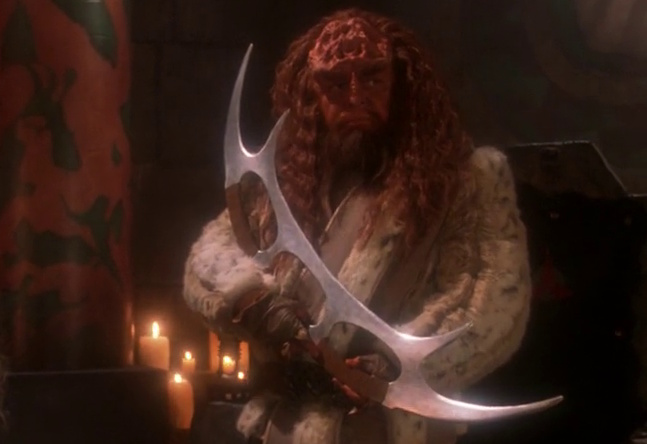
Star Trek: Picard Season 2 theory – World War III

Spoiler Warning: There are spoilers ahead for Star Trek: Picard Season 1 and the trailers for Season 2. Spoilers are also present for the following: Star Trek: The Original Series, Star Trek: Voyager, Star Trek: First Contact, Star Trek: Discovery Season 2.

Star Trek’s internal timeline gets a little inconsistent when it comes to the late 20th and early 21st Centuries. If we take a “canon purist” approach, we have to say that the Star Trek timeline diverged from our own around the 1960s, with events like Khan ruling a large portion of the world taking place in the ’80s or early ’90s, before the Eugenics Wars saw him defeated. Obviously that doesn’t line up with stories like Star Trek IV: The Voyage Home, the Voyager two-part episode Future’s End, or even Enterprise’s Carpenter Street, all of which depicted the modern world unchanged by those events.

The Third World War is a part of Star Trek’s internal timeline that was first introduced in The Next Generation’s premiere episode, Encounter at Farpoint. Episodes of The Original Series had talked about the Eugenics Wars and other conflicts on Earth, but Gene Roddenberry had been keen to avoid mention of World War III during the show’s run in the 1960s. Some episodes, such as Season 2’s The Doomsday Machine, actively went out of their way to say that such a conflict had never happened on Earth – an apparent contradiction to what would come later.

Spock and Kirk at the end of The Doomsday Machine, during their discussion of nuclear weapons.

It was the film First Contact that elaborated on some of the ideas first posited in Encounter at Farpoint and thus gave us a better look at Earth in this era. Though we knew that nuclear attacks were part of the conflict, it was First Contact that first showed that some of these attacks had impacted North America, and that the conflict was fought between the United States and her allies on one side and the so-called “Eastern Coalition” on the other. Some of these moments would be shown or explored further in Enterprise’s fourth season, and most recently World War III has appeared in Discovery’s second season.

Although the Third World War has been an integral part of Star Trek’s fictional history for more than thirty years, that’s about the extent of what we know. There was a major conflict which occurred in the first half of the 21st Century, it killed hundreds of millions, there was a limited exchange of nuclear weapons (i.e. the planet wasn’t completely destroyed), and it took Earth a generation to recover – with more than a little help from the Vulcans. But this article isn’t just a history of the conflict within Star Trek’s timeline – because something in the promotional material for Star Trek: Picard Season 2 could suggest a return to this era.

The trial which Q presided over in Encounter at Farpoint was said to take place during the “post-atomic horror” after World War III.

When I took a look at the second Star Trek: Picard Season 2 trailer a couple of weeks ago I also looked at a newly-released poster which appears to show a modern-day city – probably Los Angeles in the United States. If the poster is supposed to represent Los Angeles circa 2021, well the timeline starts to line up for a possible World War III story.

In the real world, it’s impossible to overstate the importance of technological advancements made in wartime. The First World War saw the invention of tanks and the further development of aircraft. The Second World War gave us computers, rockets, and splitting the atom. Even recent conflicts like the Iraq and Afghanistan wars saw incredible developments in medical technology. Taking inspiration from the real world, Star Trek’s World War III is similarly an incredibly important event. The Third World War led directly to the development of warp drive in the 2060s, and thus to first contact with the Vulcans and to humanity becoming an interstellar species. The Federation would not exist without it – at least, not in a form we would recognise.

Zefram Cochrane’s ship would never have broken the warp barrier were it not for the Third World War.

And that’s at the heart of this theory. In order for everything we know of in Star Trek’s internal history to have come to pass, World War III needed to happen. It was a devastating conflict that resulted in the deaths of hundreds of millions of people, but what emerged from the wreckage was United Earth and ultimately the Federation.

In the first teaser trailer, we heard Picard say in voiceover that “time can turn even our most impulsive, ill-considered actions into history.” He also spoke in a regretful way about “what could have been” and tells us that time does not offer “second chances.” In the second trailer, Q told Picard that he had come to “the very end of the road not taken.” We also saw what appeared to be significant changes to the timeline for Picard, Raffi, Rios, and Seven of Nine, as well as possible changes for Soji as well.

Seven of Nine… without her trademark Borg implant!

It seemed from the first teaser as though Picard was talking about events in his own past – that teaser also featured prominently a model of the USS Stargazer, from which I derived a few other theories! Picard is someone who we know cares about history a great deal and has studied it in depth, but nothing from the first teaser gave me the impression that he was talking about anything outside of his own personal experience. Whatever he was lamenting or regretting seemed to be within his own past – not an event from centuries earlier to which he had no significant emotional connection.

Although Picard did spend several days in the 21st Century, shortly after the end of World War III, he doesn’t exactly have a strong tie to the war or even to that time period, certainly not enough to have any motivation to change or undo events in that era. Picard is as far removed from the events of World War III in the 24th Century as we are from the events of the early 1700s – and I can’t imagine anyone nowadays would feel strongly about the Jacobite Rising or the War of the Spanish Succession. Those events – and many others – are just too far in the past to be something we care about, even if the impact is still felt today in some respects.

It’s hard to imagine that Picard would have voluntarily changed the past.

So I’m not suggesting that Picard would deliberately seek to prevent World War III – even if he found himself able to do so, somehow. But the second trailer showed off some pretty significant changes to the timeline, and combined with a poster that appears to be teasing a contemporary setting, the possibility of a World War III storyline has come up.

It seems like the story of Picard Season 2 will deal with some kind of alternate timeline – that’s what I infer from Q’s “road not taken” line, as well as the changes to characters like Seven of Nine and Rios. Picard was also heard in voiceover promising his new crew that they can “save the future,” which seems to add to this idea of something going wrong in the past causing things to change.

Q spoke of the “road not taken” in the teaser trailer.

When we deal with alternate history and alternate timelines, practically every story hinges on a so-called “point of divergence.” This is the moment at which the real timeline and the alternate one separated. In alternate history novels, popular points of divergence include the American Civil War, with a Confederate victory being a common one, as well as World War II, with an Axis victory being similarly used. In Star Trek, a point of divergence between the Prime Timeline – the one which runs from Enterprise to Picard and beyond – could be World War III. What would the timeline look like if it didn’t happen, or happened in a different way?

It could be that the poster is teeing this up. In the background, behind the skyscrapers in the centre of the city, is a glow. That glow could be a sunrise or sunset – it looks like the right colour. But it could also be something far more sinister – the afterglow of a nuclear bomb, perhaps? Maybe that’s a stretch! But it would definitely tie into this World War III theme.

The Season 2 teaser poster.

There are still two big questions, even if we assume that this theory is true and that the point of divergence has something to do with World War III. Firstly, what happened to cause the divergence in the first place? In Star Trek, these things don’t just happen naturally! Every change in the timeline that we know of had a cause – the intervention of some nefarious time-traveller. Secondly, and perhaps most importantly, why are Picard and the crew of La Sirena seemingly immune to these changes in the timeline? Q’s intervention is a possible explanation for the second point, perhaps, presenting Picard with another time-mystery to solve. But I’m not convinced that’s how the story will go.

All of this leads to an interesting moral conundrum for Picard. If we’re right and, somehow, World War III was prevented and that’s the reason for changes to the timeline, it could fall to Picard and the crew of La Sirena to trigger the worst war in history in order to restore the timeline. How’s that for a horrible decision?! Imagine being told that you had the power to prevent the First World War, and all of the misery and death that resulted from it, but that doing so would make the world worse. Instead, you have to actively choose to cause this horrible conflict in order to preserve the timeline and “save” the future. That could be Picard’s choice in Season 2 if this theory is correct.

A World War III-era soldier as seen in Discovery Season 2.

Aside from the poster with its seemingly-modern city and some dialogue about time and changing the past, there’s no real evidence for this theory yet! Much of what we saw in the second trailer – which is the only time we’ve seen Picard and the others – may very well suggest that any changes to the timeline take place closer to the 24th Century than the 21st. But it’s interesting to consider the possibilities, especially in light of the Season 2 poster.

To summarise, then, here’s the theory in a couple of sentences: for an as-yet unknown reason, the timeline was changed to prevent World War III. This had major consequences for humanity and the Federation, and the only way to restore the timeline and save the future is to ensure World War III happens – and this is what Picard and the crew of La Sirena will have to do.

Something has changed the timeline – and it seems like Picard and the crew of La Sirena are immune.

It would be quite a dark story if Season 2 goes down this road – or anywhere close to it. But it would be very interesting to see the crew wrangling with these big moral questions and issues. It could lead to quite a lot of drama! Q’s inclusion in the season would make sense, not as the cause of changes to the timeline, but as the figure who steps in to guide Picard in his understanding of those changes. It would also explain the poster, which came completely out of left-field!

Having had two teasers already, with the latest dropping only a couple of weeks ago, it may be some time before we hear anything more out of Star Trek: Picard Season 2. So all we have to go on right now is the poster and the first couple of teaser trailers! It’s not a lot, and there are certainly many different ways to interpret things. In this theory I’ve focused on how the poster could be depicting the 21st Century, but that may not be the case. Changes to the timeline could have caused the 24th Century to become less technological, and the poster could instead depict Los Angeles in the year 2399!

I’m very much looking forward to Picard Season 2, and I’m still hopeful that we’ll eventually see spin-offs and other Star Trek projects set in the same era. If and when we get any more news or another poster or trailer, check back as I’m sure I’ll have more to say!

Star Trek: Picard Season 2 will be broadcast on Paramount+ in the United States (and on Amazon Prime Video in the UK and elsewhere) in 2022. The Star Trek franchise – including Picard and all other properties mentioned above – is the copyright of ViacomCBS. This article contains the thoughts and opinions of one person only and is not intended to cause any offence.
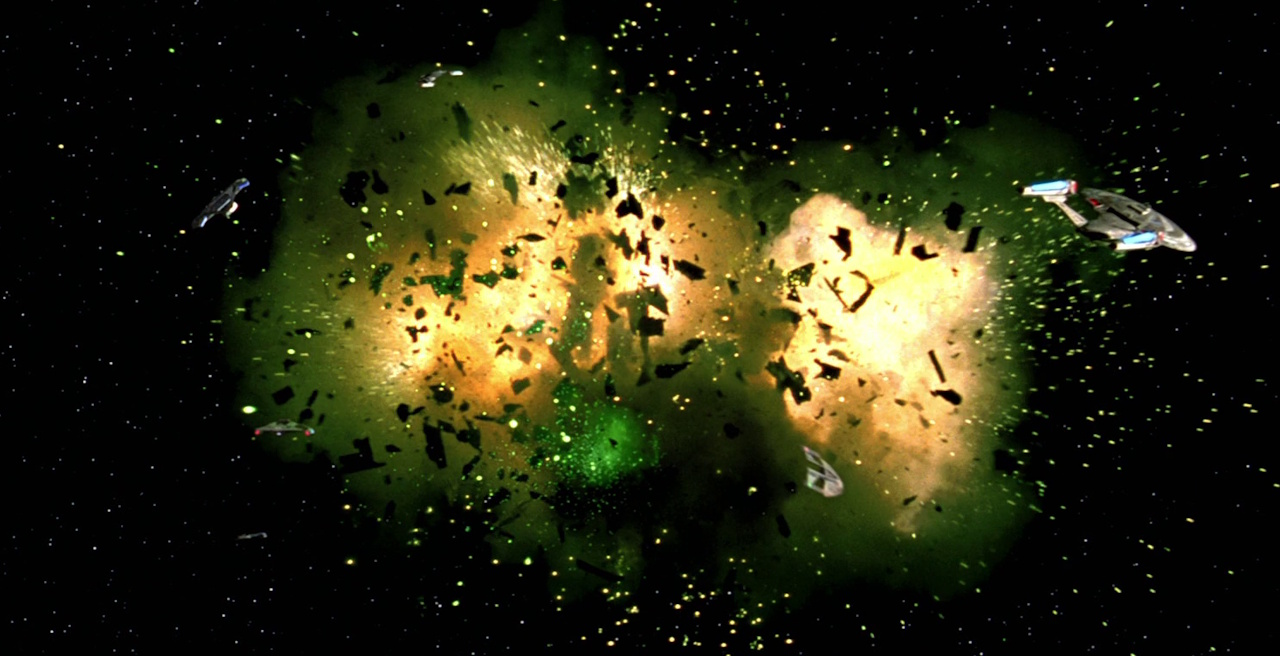
Star Trek: Picard + Star Trek: Discovery crossover theory – “the true final frontier”

Spoiler Warning: There are spoilers ahead for Star Trek: Picard Season 1, Star Trek: Discovery Seasons 1-3, as well as the teaser trailers for Star Trek: Picard Season 2 and Star Trek: Discovery Season 4. Further spoilers may be present for other iterations of the Star Trek franchise.

During Season 1 of Star Trek: Picard last year, I kept holding out hope that the show would make a serious attempt to connect or cross over – somehow – with Discovery, its sister show. Aside from a couple of throwaway lines, however, that didn’t happen. We have since seen Discovery pick up a major faction that had been present in Picard, though, so clearly there’s some intention over at ViacomCBS to link up the two shows. Hopefully this will continue into their next seasons – and that’s what today’s theory is all about!

Discovery Season 4 will premiere months before Picard Season 2, and while I’m hopeful it will be able to include some kind of cameo or crossover like Season 3 did, where I’m going to focus much of my attention this time is on Picard Season 2, so we’ll be shooting past Discovery Season 4 for the most part. In short, there was a line in the Picard Season 2 teaser which stood out to me, and it could be interpreted as setting up some kind of crossover. At the beginning of the short teaser, we hear Picard say in voiceover that “the true final frontier is time.”

Picard Season 2 seems to have a time travel focus.

Beginning with Season 3, Discovery shot forward into the future, with Seasons 3 and 4 taking place almost 800 years after the events of Picard Season 1. That should preclude any major character crossovers… but not if time travel is somehow involved. By the 32nd Century, Admiral Vance and Starfleet believe time travel has been completely outlawed and that no way to travel through time exists. But at the dawn of the 25th Century, the Federation (and other factions) are just beginning to dip their toes in this untapped “final frontier.”

Picard himself has travelled through time on several occasions, both to the future and to the past. And while much of what we saw in the Season 2 teaser suggests that Picard and/or his new crew will travel backwards in time, if time travel is involved, all bets are off. The future and the past blend together in many time travel stories, and it’s possible – at least in my opinion – that Picard and his new crew could find themselves in Discovery’s 32nd Century at some point during their adventures.

Could Picard Season 2 visit the 32nd Century?

Another point we could argue is in favour of this theory is the re-emergence of Q. Because of Q’s nature as a trickster, and an incredibly powerful being, practically anything is possible. In the Voyager Season 2 episode Death Wish, for example, a member of the Q Continuum was able to send the USS Voyager back in time to the moment of the big bang – 13 billion years in the past. The 32nd Century is nothing compared to that!

I’ve spoken before on a number of occasions about the need for Star Trek as a whole to get some threads of consistency going between the shows currently in production. There is a link between Strange New Worlds and Discovery, of course, but Picard and Discovery are almost entirely disconnected right now. Bringing the two crews together – even just for a one-off special episode – would be absolutely fantastic and a great way to celebrate all things Star Trek.

Maybe Admiral Picard will meet Captain Burnham!

If Picard Season 2 is going to focus on travelling backwards through time instead of forwards, perhaps looking to preserve the future by righting wrongs in the past, that still doesn’t necessarily preclude the appearance of Discovery and her crew. Before Burnham, Saru, and the rest of the crew headed into the 32nd Century they were, of course, present in the 23rd, and although we’d be seeing these characters as they were in the past – and thus the storyline could become complicated – it would be possible, at least in theory, for Picard and his new crew to meet up with someone from Discovery if they visited the 23rd Century.

Given the complicated nature of the Control AI storyline in Season 2, anyone from Discovery having been aware of meeting someone from the Picard era could open up a plot hole, so it would have to be handled carefully. Perhaps Picard or someone from La Sirena is able to blend in and disguise themselves as a member of Starfleet in the 23rd Century, for example, allowing them to interact with the likes of Saru or Michael Burnham without the latter being aware of their true origins. That kind of crossover would be a lot of fun, and I think everyone involved would enjoy it!

Visiting the 23rd Century could allow Picard and the crew of La Sirena to meet up with Michael Burnham, Saru, and the crew of Discovery before they headed to the future.

One image that was prevalent in the Picard Season 2 teaser was the USS Stargazer – Picard’s first command. He first sat in the captain’s chair in the 2330s – about 75 years after the events of Discovery Seasons 1-2. That’s quite a long time, but considering the extended lifespans we know are present in Star Trek, it’s not so long that characters from Discovery couldn’t still be alive. Spock, obviously, is still alive in this era. And Dr McCoy was present at the launch of the Enterprise-D, despite being 137 years old. This opens up the possibility to see “aged up” versions of characters from the 23rd Century that we met in Discovery, such as Ash Tyler, L’Rell, or Saru’s sister Siranna.

Even just a short cameo from someone like that would be an amazing way to tie the shows together. Ash Tyler could have risen through the ranks to become a senior officer in Starfleet Intelligence by this era, and he could be someone Picard speaks with upon assuming command of the Stargazer, just as one idea off the top of my head. The introduction of Q and time travel into Picard Season 2 has opened up the possibility of such crossovers in a way that I hadn’t previously considered possible.

Ash Tyler could conceivably still be alive in the early 24th Century.

There is one other possibility, and it’s an inversion of a theory I had in the months before Discovery Season 3 premiered. Back then I theorised that something would go wrong with Burnham and Discovery’s jump into the future, leading them to arrive not in the 32nd Century but at the dawn of the 25th, leading to a crossover with Picard. That didn’t happen, of course, but right now there exists the possibility of this happening in reverse – for Picard and La Sirena to find themselves in the 32nd Century.

Maybe I’m in the minority, and both casual fans and Trekkies love to see the various Star Trek shows and films split up along the timeline – and in parallel universes! But I really do believe that consistency and stability are the hallmarks of a successful franchise, and if Star Trek wants to build on recent successes, picking a single time period to focus on for a majority of its shows and films makes a lot of sense. It makes following the franchise as a whole easier, and it makes it simpler for casual viewers to hop from one series to another without needing to read whole encyclopaedia articles about Star Trek lore to understand who’s where and what’s what. Perhaps bringing Picard into the 32nd Century could be a way to cut down on the franchise’s ongoing time periods.

If La Sirena travels through time, a crossover could be on the cards!

This would be bittersweet, in my opinion. While it would be great for Star Trek to replicate its ’90s heyday by picking an era and sticking with it, taking Picard out of the 25th Century would make future character returns significantly more difficult. It was great fun to see the likes of Data, Riker, Troi, and Seven of Nine again, and I think one thing a lot of Trekkies are hoping for is that Season 2 of Picard will reintroduce more characters from The Next Generation era. Shooting the show forward by more than eight centuries would make that much more difficult.

We’d also miss out on finding out more about the state of the galaxy as the 25th Century dawns. We spent some time with the Romulans in Season 1, but we know next to nothing of the Klingon Empire, the Cardassians, the Bajorans, and so many others. In my opinion, if Star Trek is going to pick one era to be the main focus for upcoming projects, I’d rather it was the 25th Century than the 32nd. Jumping forward in time by a generation instead of centuries is what the Star Wars sequel trilogy tried to do, allowing for the return of classic characters alongside new ones. That’s one reason why I wondered if Discovery was going to end up in this time period too!

In 2019 I wondered if Saru and the crew of Discovery might end up in the 25th Century!

At the end of the day, time travel in Star Trek allows for many different possibilities. Even if Picard just visits the 23rd or 32nd Centuries briefly, during a single episode, the potential for using this technobabble as an excuse for a major crossover exists. If Season 2 is going to have a major focus on time travel, it would almost be a wasted opportunity if the show didn’t include some kind of crossover with Discovery!

The inclusion of Q almost certainly means that some wacky shenanigans are afoot in Picard Season 2. Whether he’s responsible for Picard travelling through time or not, he certainly has the potential to be a disruptive influence, and I could absolutely see Q sending La Sirena spiralling into the path of the USS Discovery – either the refitted 32nd Century version or the older 23rd Century variant! Heck, this could even be how the Short Treks episode Calypso gets resolved… though maybe that’s too much to hope for!

So that’s my theory. A rather disjointed and vague theory, I grant you, but a theory nevertheless. Somehow, the time travel storyline in Picard Season 2 will lead to a crossover with Discovery. Regardless of whether it happens or not, I’m really looking forward to Picard Season 2. It’s been over a year since Season 1 wrapped up, and despite the ending of the first season not quite hitting the highs of its premiere episode, I cannot wait to find out what will come next for Picard and the crew of La Sirena.

Star Trek: Picard Season 1 is available to stream now on Paramount+ in the United States and on Amazon Prime Video in the United Kingdom and elsewhere. Star Trek: Discovery Seasons 1-3 are available to stream now on Paramount+ in the United States and on Netflix in the United Kingdom and elsewhere. Star Trek: Picard Season 2 is currently targeting a 2022 broadcast, and Discovery Season 4 is scheduled to premiere before the end of 2021. The Star Trek franchise – including Picard, Discovery, and all other properties mentioned above – is the copyright of ViacomCBS. This article contains the thoughts and opinions of one person only and is not intended to cause any offence.
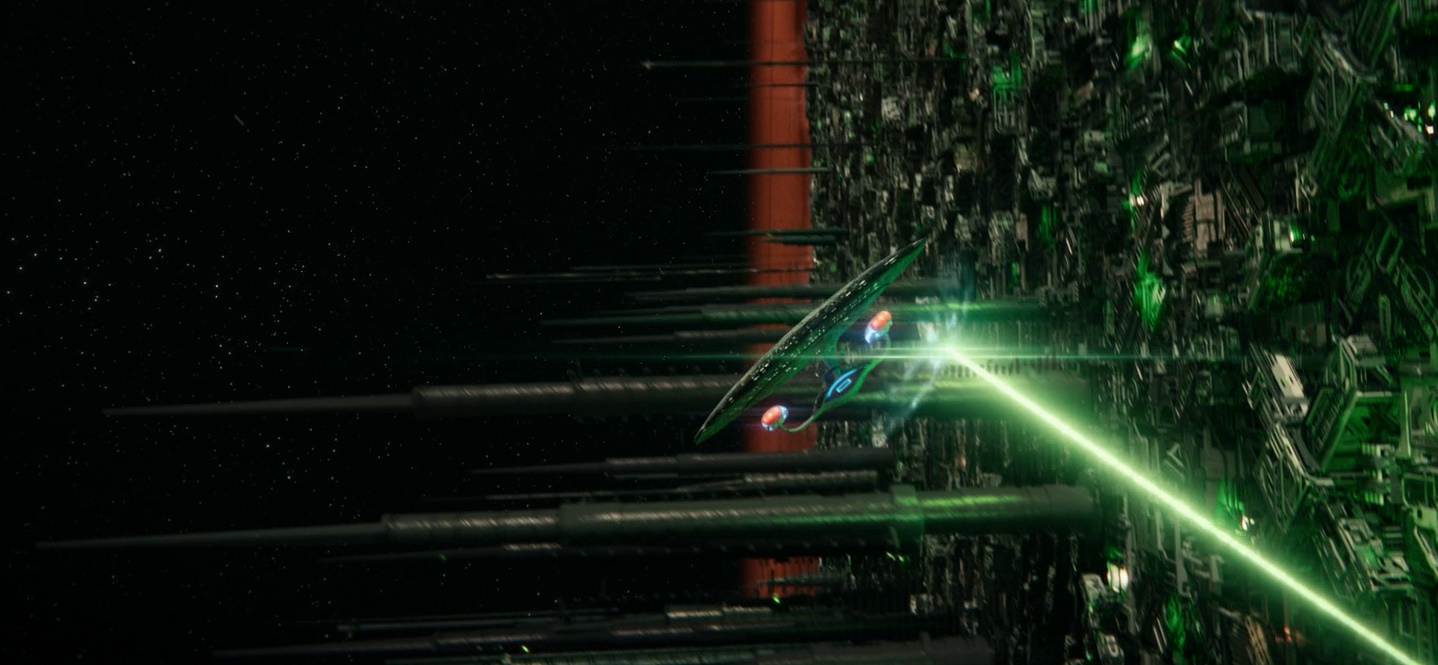
Star Trek: Discovery + Star Trek: Strange New Worlds crossover theory – the big mistake

Spoiler Warning: There are spoilers ahead for Star Trek: Discovery Seasons 1-3.

Today we’re going to take a look at something that’s been bugging me for a couple of years, ever since the finale of Star Trek: Discovery Season 2 in April 2019. I didn’t start working on this website until November ’19, so I haven’t written up full reviews of Season 2, nor have I spent much time breaking down all of the various story points. This will be my first big foray into that! Rather than just a critique of what could be argued to be a plot hole or “goof,” though, I want to turn this into a theory, particularly one that could have an impact on Star Trek: Strange New Worlds – the upcoming series set on the USS Enterprise with Captain Pike, Spock, and a new cast of characters.

Ever since I watched Such Sweet Sorrow, Part 2, something has stuck in my mind. Immediately before Burnham and the USS Discovery left the 23rd Century behind and headed into the far future we’ve seen depicted in Season 3, they were engaged in a climactic battle alongside Pike and the USS Enterprise against the Control AI. In addition to a fleet of Section 31 starships that were unmanned, Control had also possessed (or assimilated) the body of Section 31 commander Captain Leland. Control used Leland’s body to board the USS Discovery at the battle’s climax to attempt to retrieve the Sphere data – the macguffin that was the cause of the fight in the first place.

The data the Sphere transmitted to Discovery was the reason for Control’s attack.

The relationship between Control and Captain Leland was not sufficiently explained on screen, in my opinion, and this has a bearing on what comes next and why I have an issue with Such Sweet Sorrow, Part 2. But based on what we saw during the episode, it seems as though Control was somehow tied to Captain Leland’s body in a very significant way, such that when his body was crippled by Georgiou inside the USS Discovery’s Spore Cube, it had an impact on the battle raging outside.

This is the moment where I feel there’s an issue. The entire reason for sending Burnham and the USS Discovery on a one-way mission to the far future was to keep the Sphere data safe from Control, but when Georgiou defeated Captain Leland, Control appeared to also be defeated – or at least sufficiently incapacitated as to be unable to continue the battle. This all happened before the USS Discovery entered the time-wormhole.

Was it necessary for Burnham and Discovery to leave the 23rd Century? I would argue that it was not.

So, with that in mind, why did Pike, Saru, or even Burnham not stop? Surely at the very least they could have paused what they were doing to consider their next moves. Aboard the Enterprise, Pike was able to easily destroy the disabled Section 31 ships, removing any immediate danger, and with Captain Leland incapacitated and clearly not going anywhere, the Sphere data was also safe. Before sending the ship and crew to an unknown destination with no way back, did no one realise that the battle may have already been won? Was there no reason to send Burnham and the ship into the future?

This is what I’m terming “the big mistake” for the purposes of this theory.

Although Burnham had already used the Red Angel suit to open the time-wormhole, I would absolutely argue that, based on what we saw on screen, the battle against Control had taken a decisive turn before either she or the USS Discovery actually crossed the threshold, and that there was time for Saru, Pike, Spock, or someone to point that out. They were preoccupied with the jobs that they had to do, but when it became obvious that Control was at least incapacitated – if not outright defeated – I think that warrants pause from everyone concerned. They were in the process of making a life-changing decision for Burnham and the crew of Discovery, yet for some reason no one seemed to realise that it may have ultimately been unnecessary.

Even though Pike, Saru, and others acknowledged Control’s defeat, they didn’t stop what they were doing. Burnham and Discovery still travelled to the far future. Why?

So let’s break it down even more, for the sake of clarity, and follow events step-by-step. I don’t usually do time-stamps, but I think this is important so we’re all on exactly the same page. If we begin at exactly 51 minutes, 30 seconds into Such Sweet Sorrow, Part 2 – at least on the Netflix version (I assume it will be roughly the same on Paramount+ and Blu-ray too) – we see Burnham getting ready to open the time-wormhole. In the shot of her flying through space near the raging battle, we see the Section 31 ships beginning to slow their rate of fire with a consequent drop in the number of explosions. This is the first indication that something was changing.

At 51:54, Saru gives Detmer the order to follow Burnham’s lead. The USS Discovery moves through a field of debris (presumably caused by the battle) and then we get our first look at the time-wormhole a few seconds later at around 52:06. At this point, neither Burnham nor the ship are anywhere close to crossing the event horizon and entering the time-wormhole.

As Burnham flies past the battle, Control’s ships appear to be slowing down and losing momentum.

Just before 52:30 the action cuts to Captain Pike on the Enterprise’s bridge, watching Burnham and Discovery preparing to enter the wormhole. Trailing in Discovery’s wake are Section 31/Control drones, chasing after them. After Saru and Pike exchange goodbyes at 52:40, and Dr Culber tells Stamets that “we’re on our way,” at 52:57 we come to the scene at the heart of my argument – and of this theory. In Discovery’s engineering bay, the possessed Captain Leland is trapped in the Spore Cube by Georgiou.

Seemingly admitting defeat, Control-Leland tells Georgiou – in true clichéd villain style – that “this does not end here!” Georgiou then finishes the job of killing him, using the powerful magnets in the Spore Cube to force the nanites out of Leland’s body. This action cripples Control, and severs the link between it and its fleet.

The defeat of Captain Leland crippled Control – at least temporarily – and allowed Pike and the Enterprise to destroy the remaining ships in its fleet.

53:39 sees Control-Leland hit the deck, dead. The nano-bots spill out of his corpse, and though it’s not clear exactly what will happen to the human Leland, or whether he could be saved, this is a major blow for Control. Less than ten seconds later, at 53:48, the USS Discovery and Burnham can both be seen, still outside the time-wormhole, and Control’s fleet suddenly stops pursuing them.

On the bridge of the Enterprise, Una (Number One) notes this at 53:51, informing Captain Pike that “they’re all dead in the water.” Again, this is before either Burnham or Discovery have entered the time-wormhole. Even if no one on Discovery realised what was happening – which is possible given everything else going on – the crew of the Enterprise certainly had, and there was still time to contact Discovery.

With Burnham and Discovery still not having entered the time-wormhole, Control’s fleet is disabled.

At 54:00, Georgiou contacts Captain Saru, and this is the moment where he could have made a decision too. Georgiou informs him of Leland’s death, but uses a very interesting phrase: “Control is neutralised.” Discovery has not yet entered the wormhole, and on the bridge, Saru is already aware that the reason for doing so no longer exists. Pike is aware that their reason for heading into the future no longer exists. They have already won the battle. By Georgiou’s own admission, the threat Control had posed is unequivocally over.

At 54:16, Burnham and the USS Discovery are seen reflected in the glass of Siranna’s starfighter, still not inside the time-wormhole nor having crossed its event horizon. These are the crucial seconds at the core of the theory, because it’s in these few seconds that the decision to leave the 23rd Century behind could have been called off. With the Enterprise destroying what remained of Control’s fleet, and with Leland dead, there was no immediate way for Control to access the Sphere data – and yet no one on either ship seems to have realised that.

Burnham and Discovery are still outside the time-wormhole, as seen in the reflection of Siranna’s starfighter.

Even if we say that Control was not totally killed off, and that its servers remained active at Section 31 HQ (or elsewhere, if you prefer) and thus that Control was still out there and potentially able to regroup, the fact remains that the immediate threat had passed. The battle had been won, even if there was still more to do to win the overall war.

No one mentioned this in Discovery Season 3. After a brief reference to Georgiou destroying the remains of Leland in the episode Far From Home, and a short conversation about Control with Admiral Vance in the episode Die Trying, their reasoning for going to the future was never discussed nor elaborated on. Burnham, when pressed about it by Book in That Hope Is You, maintained that it was the “only way” to save the galaxy, so she clearly hadn’t realised what was going on behind her – but that makes sense as she was busy operating the Red Angel suit and keeping the time-wormhole stable.

Burnham was too busy piloting the Red Angel suit to realise the battle was over.

Saru and Pike have no such excuse, in my opinion. Both commanders clearly and demonstrably knew that Control and/or its fleet were incapacitated, and I believe that should have led to one or both of them bringing an immediate halt to events to take stock. If Control was disabled, there was no immediate need to head to the future. With Leland dead, the Sphere data was safe, at least temporarily. With the battle won, everyone could have taken a moment to breathe and assess the situation, perhaps planning to go to Section 31 HQ and permanently destroy whatever remained of Control. Instead, everyone simply sat back as Burnham and Discovery raced into an unknown future – a future, I would argue, they did not need to travel to.

There’s a way this could come back in either Discovery Season 4, Strange New Worlds Season 1, or both: if Saru and/or Pike realise that they made a big mistake.

Given what he went through to make the Red Angel suit possible, I would suggest the person this would affect the most would be Captain Pike. In the episode Through the Valley of Shadows, Pike obtained a time crystal from the Klingons, but did so at great personal sacrifice – solidifying for himself a future of permanent disability. How would he feel knowing that it was all for naught; that if he replays the events of the battle in his mind, he could see that Control was already beaten and that there was no need for the time crystal?

Having sacrificed his future for this time crystal, will Pike come to believe – as I do – that sending Burnham and Discovery into the future was unnecessary?

One theme Strange New Worlds is certainly going to pick up on is Pike’s knowledge of his impending disability. As a disabled person myself, this is something I’m really interested in seeing come to life on screen. I can relate to what Captain Pike is going through, because I’ve had the experience of sitting in a room with a doctor and being told things about my health and my future that are unavoidable. I get that sense of inevitability, of knowing things won’t get better but they will get worse. This is something genuinely interesting and that has the potential to be inspirational through Anson Mount’s wonderful portrayal of Pike. But I also wonder if we’ll see him wrestle with feelings of regret or remorse, feeling that his fate and future are his own fault. If he knows (or believes) that the battle was won in Such Sweet Sorrow, Part 2 without the need for time travel – and thus, without the need for the time crystal he sacrificed so much to obtain – will those feelings be worse for Pike?

Though we didn’t see much of this in Discovery Season 3, with Season 4 on the horizon there’s a chance for the circumstances of Discovery’s jump into the future to be revisited. Even if nobody aboard realised it at the time, it’s possible that someone will have subsequently had the revelation that their one-way trip to the future, sacrificing so much and leaving their loved ones behind, may not have been necessary. Perhaps this will become an issue for Captain Burnham or Saru, with a disgruntled crew member taking out their anger on them for forcing them into a post-Burn future that they didn’t have to inhabit.

Pike and Spock watched Burnham and Discovery disappear after Control was already defeated.

So that’s it. My theory, based on what we saw in Such Sweet Sorrow, Part 2 is this: the defeat or disabling of Control toward the end of the battle means that Burnham and Discovery didn’t actually need to go to the far future – at least, not immediately. At the very least, pausing to take stock would have been worthwhile.

It seems possible to me that this could be brought back as a story point – even if it’s just in a relatively minor way, such as with a line or two of dialogue acknowledging it – in either Discovery or Strange New Worlds, as it’s a story which impacts major characters from both shows.

Will Captain Pike realise his mistake in Strange New Worlds, and could this be a major story point for his character?

Having delved deeply into this battle from an in-universe point of view, now let’s step back and acknowledge that this is, in effect, a “plot hole” or production-side issue. The writers and producers of Discovery Season 2 wanted to send the ship and crew into the far future, partly due to negative fan feedback involving so-called canon problems during Season 1. But at the same time, they also wanted to make sure that the Control storyline was 100% wrapped up and concluded before Season 3 kicked off.

Unfortunately, in my opinion at least, the way they chose to accomplish those two goals has opened a plot hole. In the mad rush to wrap up Discovery Season 2 in what was already a feature-length episode, an inconsistency has been created within the plot of the show. If Burnham and Discovery had gone into the future, and in the final few minutes of the episode we saw Pike, Spock, and the crew of the Enterprise finish defeating Control, there would be no problem. But because it was Georgiou, aboard Discovery, who killed Captain Leland, and because this unexplained link between Leland’s body and Control seems to have crippled the entire fleet, we have a problem.

Discovery brought Captain Leland aboard the ship for a climactic fight with Georgiou – but his death at her hands before travelling into the future has opened a plot hole.

Overall, for most viewers who don’t spend as much time thinking about (and nitpicking) Star Trek as much as I do, it probably passed by unnoticed. But even in 2019 I was having conversations with fellow viewers – including some who I would call “casual” viewers as opposed to hardcore Trekkies – who noticed this very issue. The fact that no one – not Pike, Spock, Number One, Georgiou, or Saru – thought to call off the journey to the future, even temporarily to assess the new facts, is a plot hole.

However, it’s a plot hole that could be plugged by incorporating it into future stories. Captain Pike could be affected by it, as previously mentioned. As could Spock or Number One on the Enterprise, as they saw the battle end before Burnham and Discovery entered the time-wormhole. It could also become an issue for anyone aboard the USS Discovery – perhaps with their mood and mental health suffering, they replay the events of the battle in their mind and come to the conclusion that they were forced to travel to the future unnecessarily. That’s my theory, anyway!

Will this cause problems for Burnham in a future season of Discovery?

Whether any of that will come to pass, or whether both shows will proceed ignoring this issue is anyone’s guess right now. I would think that, if Discovery wanted to acknowledge this criticism, Season 3 would’ve been the time to do so, and the fact that it didn’t happen may mean that the writers and producers are keen to move on and put Such Sweet Sorrow, Part 2 behind them. But I’m not 100% convinced of that. I think there’s scope to incorporate what feels like a plot hole into the storylines of either upcoming show in a way that would make sense.

As I said at the beginning, this is something that’s been on my mind since I first saw the episode a couple of years ago! Even on first viewing, it seemed patently obvious to me that someone should have realised what was happening before Burnham and Discovery left, speaking up to put the brakes on. It really does feel that, based on the sequence of events and how they unfolded on screen, Burnham and Discovery could have remained in the 23rd Century.

Despite all of this over-analysing of a few minutes of the episode, I really enjoyed Such Sweet Sorrow, Part 2 – and Discovery Season 2 as a whole. It’s a fantastic season of television well worth a watch, and this theory, despite being something that’s bugged me for a while, is really just a glorified nitpick!

Star Trek: Discovery Seasons 1-3 are available to stream now on Paramount+ in the United States and on Netflix in the United Kingdom and elsewhere. The series is also available on Blu-ray. The Star Trek franchise – including Discovery, Strange New Worlds, and all other properties mentioned above – is the copyright of ViacomCBS. This article contains the thoughts and opinions of one person only and is not intended to cause any offence.
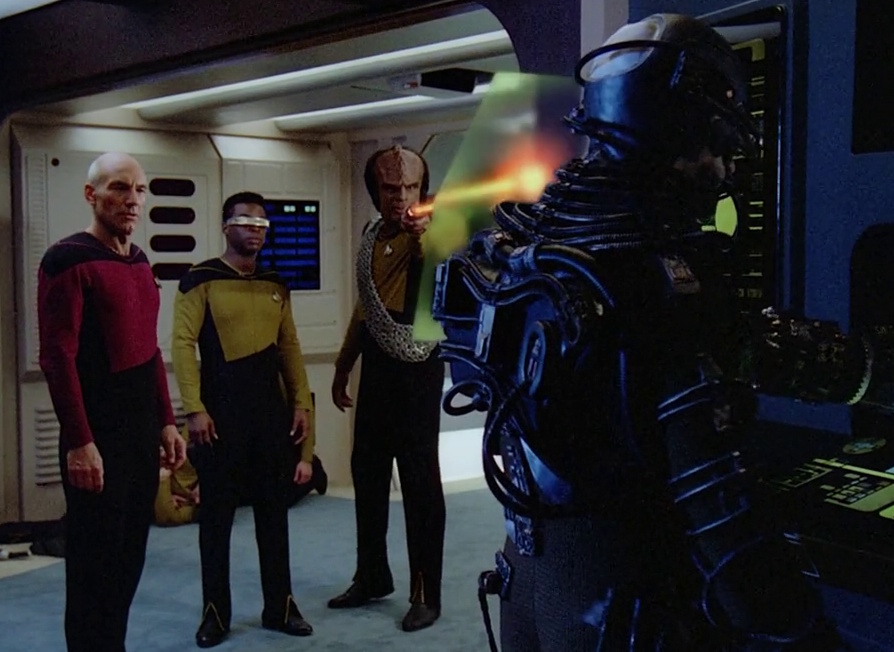
Star Trek: Discovery Season 3 – my worst theory failures!

Spoiler Warning: There are spoilers ahead for Star Trek: Discovery Seasons 1-3, Star Trek: Picard Season 1, and for other iterations of the Star Trek franchise.

During Star Trek: Discovery’s third season, I wrote a weekly series of theories, speculating about what may be going on with the show’s various storylines. I had some successes in my theories and predictions, but there were more than a few misses as well! Now that the season is in the rear-view mirror, I thought it could be fun to go back to some of my theories and see how wrong I was!

All of these theories seemed plausible at the time – for one reason or another – yet ultimately proved to be way off base. One thing I appreciate about Discovery – and a lot of other shows and films too, both within the Star Trek franchise and outside of it – is that sense of unpredictability. Nothing in Discovery Season 3 was mundane or felt like it had been blatantly telegraphed ahead of time, and the fact that the narrative took twists and turns that I wasn’t expecting was, on the whole, great! There were a couple of storylines I personally didn’t think were fantastic or handled very well, but on the whole, Discovery’s third season was an enjoyable ride.

Book’s ship at warp in the season premiere.

Some of the theories I had were pure speculation based on nothing more than guesswork and intuition, and others seemed truly reasonable and plausible. While the season was ongoing I tended to just write up any theories I had, no matter how wild or out of left-field they seemed to be! Whether that was good or not… well the jury is out! The theory lists I published were well-read, so I assume at least some folks found something of interest!

I like to caveat these kinds of articles by saying that no fan theory, no matter how plausible or rational it may seem to be, is worth getting too attached to or upset about. The internet has been great for fan communities, allowing us to come together to discuss our favourite franchises and engage in a lot of theory-crafting. But there is a darker side to all of this, and some fans find themselves getting too attached to a particular theory to the point where their enjoyment of the actual narrative is diminished if that theory doesn’t pan out. Please try to keep in mind that I don’t have any “insider information,” and I’ve never tried to claim that a particular theory is somehow guaranteed to come true. I like writing, I like Star Trek, and writing about Star Trek is a fun activity for me – that’s why I do this, and if I ever felt that theorising about Discovery or other shows was harming my enjoyment, I would stop. And I encourage you to take a step back if you find yourself falling into that particular trap.

With that out of the way, let’s take a look at ten of my least successful Star Trek: Discovery Season 3 theories!

Number 1: Cleveland Booker is a Coppelius synth.

Book and his adoptive brother in the episode The Sanctuary.

When we met Book in That Hope Is You at the beginning of the season, it wasn’t at all clear who he was. However, there were inhuman elements to Book, such as his ability to heal, to use a holographic interface seemingly attached to his body, and glowing, almost electronic-looking areas on parts of his skin. With Book’s origin somewhat of a mystery, I wondered if he might turn out to be a synth – and specifically, a synth from the planet Coppelius (or one of their descendants).

We met the Coppelius synths in Star Trek: Picard Season 1, and I was hopeful as Discovery’s third season got underway that there’d be a serious attempt to connect the two shows – as this was something Picard wholly failed to do in its debut season. I’ve said numerous times that Star Trek needs to do more to bind different parts of the franchise together, and after Picard basically ignored Discovery, I was hoping for some kind of connection to manifest in Season 3. Booker being a synth could have been one way to do that.

Book’s telepathic abilities caused glowing areas to appear on his face.

So really, it’s not unfair to say that this theory was concocted more for production-side reasons than anything we saw on screen. Book’s abilities as we saw them in That Hope Is You (and subsequently in episodes like The Sanctuary, There Is A Tide, and That Hope Is You, Part 2) were clearly more organic and telepathic than anything artificial or technological in origin – except for his holographic computer interface. So perhaps this was always a bit of a stretch!

Booker turned out to be a Kwejian native – though what exactly that means is unclear. Given Book’s human appearance, it’s possible that the people of Kwejian are descendants or offshoots of humanity, or perhaps, given their telepathic nature, they’re somehow related to the Betazoids. In the season finale, Book promised Burnham he’d tell her more about his background, and how he came to use the name Cleveland Booker, so perhaps we’ll learn more about Book’s people in Season 4. He was a wonderful addition to the season, even if I was way off base with my theory about his possible origin!

Number 2: The Burn is connected to Michael Burnham – and/or the Red Angel suit.

Michael Burn-ham.

The Burn’s origin was not definitively revealed and confirmed until the season finale, so for practically the entire season I was talking about some form of this theory! There seemed to be a few possible clues that Discovery gave us – which ultimately turned out to be red herrings as the Burn was unconnected to any of them – about the ultimate answer to the Burn, and several of them could have been interpreted to mean that Burnham was, in some way, connected to the event that shares part of her name.

The main reason I considered this theory plausible, though, was because Discovery has always been a series that put Burnham front-and-centre in all of its main storylines. Having a connection to the biggest story of the season thus seemed possible. When the event’s name was revealed, the fact that it shared part of her name seemed to lend credence to that idea – at least it did considering I’d already started down that rabbit hole!

One of two Red Angel suits seen in Season 2.

That Hope Is You saw Burnham arrive in the future immediately following the events of Such Sweet Sorrow, Part 2 – the Season 2 finale. She took off her Red Angel suit and set it to self-destruct, but as we never saw the self-destruction for ourselves on screen, it was a bit of a mystery as to what became of the suit. In a future where time travel technology had been prohibited, the Red Angel suit may have been one of the last extant ways to travel through time, and would be incredibly valuable to factions like the Emerald Chain, so I reasoned that perhaps someone had intercepted the suit, and either intentionally or unintentionally caused the Burn.

I’m glad this one didn’t pan out, because it was nice to give Burnham a break! In the end, Burnham wasn’t strongly involved in the resolution to the Burn’s storyline, with that task being given to Saru, Dr Culber, Adira, and of course Su’Kal. After Burnham had just saved the galaxy by defeating the Control AI, there would have been an interesting ethical and philosophical dilemma for her if she had learned that her actions and/or the Red Angel suit had been responsible for the Burn – but it would’ve been hard to pull off and arguably too similar to the guilt she felt at the outbreak of the Federation-Klingon War in Season 1. So overall, it was an interesting theory well worth considering, but I’m glad it wasn’t true!

Number 3: The USS Discovery could arrive in the future before Burnham.

The USS Discovery had a rough landing in the 32nd Century!

Time travel stories are complicated. Once the link between cause and effect is broken, almost anything becomes possible. Even though Burnham and the Red Angel suit were leading the way into the future, the mechanics of the time wormhole were not explained, and it was at least plausible to think that the USS Discovery might’ve arrived first.

I first posited this theory after the season premiere, and it seemed plausible for practically all of Far From Home too. One thing that could’ve happened, had this theory been correct, would be that Burnham would’ve been out of her element for a lot longer than just one episode. In That Hope Is You, we saw her completely awed by everything she saw, experiencing a completely new world for the first time. And that premise meant that we were seeing Burnham in a whole new way, not in control of the situation and having to rely on others instead of trying to shoulder all of the burden all of the time. Had the USS Discovery found her after the ship and crew had spent a year in the future instead of the other way around, Burnham could’ve been our point-of-view character for learning what was new and different, instead of reverting to type.

We missed a year of Burnham’s exploits in the 32nd Century.

With both Red Angel suits gone, I doubt we’ll see the time-wormholes they could generate ever return either. But it would be interesting to get to know a little more about how that technology worked – would it even have been possible for the USS Discovery to arrive earlier than Burnham? Burnham arrived on the planet Hima, and Discovery arrived near a planet called the Colony, so considering the wormhole had two different exit points it seems possible to me anyway!

Because of the one-year time skip, we didn’t get to see much of Burnham’s exploits with Book in the 32nd Century prior to Discovery’s arrival. It would have been interesting to see either Burnham or the crew trying to learn more about their new home and the origins of the Burn, because in some ways it could be argued that we as the audience arrived with the first part of a story already complete. I kind of want to see that part for myself – and maybe we will in flashbacks in future seasons!

Number 4: Lieutenant Detmer is going to die.

Lieutenant Detmer in People of Earth.

One of my hopes going into Season 3 was that Discovery would finally spend some time with other members of the crew, and I was pleased that it happened. After two full seasons I felt that we hadn’t really got to know anything about people like Owosekun, Rhys, and Detmer, despite their being permanent fixtures on the bridge. Though not all of the less-prominent officers got big storylines this season, one who did was Detmer.

In the episode Far From Home, Detmer was thrown from her seat following the ship’s crash-landing. Concussed, she was sent to sickbay where, after a once-over, she was patched up and returned to work. However, there were hints – at least, what I considered to be hints – that all was not well with Discovery’s helm officer, and I wondered if her first significant storyline might in fact be the setup to her death. There just seemed to be so much foreshadowing!

Detmer eventually survived the season.

Ultimately, however, Detmer’s storyline took a different path. I appreciate what it was trying to be – an examination of post-traumatic stress that ended with a positive and uplifting message showing Detmer “getting over it,” for want of a better expression – but because it wasn’t properly fleshed-out after Far From Home, with Detmer only given a handful of very brief scenes before her big turnaround in The Sanctuary, I just felt it was underdeveloped and didn’t quite hit the notes it wanted to. So despite a potentially interesting premise, the execution let this storyline down somewhat.

Especially after the way she was acting in Far From Home, I can’t have been the only one to predict an untimely end for Detmer! I heard several other theories that I considered to be very “out there,” such as Detmer’s implant being possessed by Control in the same manner as Ariam had been in Season 2, but I firmly believed the setup was foreshadowing her death due to injury rather than something of that nature. It’s probably good that it didn’t happen, as it leaves her a slightly more rounded character if the show wants to do more with her in future. However, there were several officers in the final trio of episodes who could’ve been killed off after the ship was captured by the Emerald Chain, including Detmer, and it feels somewhat like Discovery was playing it safe by not doing so. Aside from Ryn, no major hero characters lost their lives in Season 3, and while character deaths aren’t something I desperately want in a show like this, they can certainly raise the stakes.

Number 5: The Doctor from Star Trek: Voyager (or rather, a backup copy of him) will make an appearance.

The Doctor.

This was my most popular pre-season theory! I stuck with it practically the whole time, and branched out to include a handful of other characters from past iterations of Star Trek who could, in theory, still be alive by the 32nd Century. By the standards of my modest website, an absolutely huge number of you read this theory – and it continues to be popular even today, despite the season having concluded months ago. So I wasn’t the only one half-guessing, half-hoping that the Doctor might be included in Discovery!

The reason why I considered the Doctor to be one of the most plausible characters who could make an appearance is because of an episode from Voyager’s fourth season: Living Witness. In that episode, a backup copy of the Doctor was activated sometime in the 30th or 31st Centuries after being discovered among museum artefacts, and while the story was interesting in its own right and a critique of how things we consider to be “historical facts” can shift over time, what really interested me was its timeframe and its ending.

A picture of the Doctor seen at the end of Living Witness.

At the end of Living Witness, in a scene set even farther into the future, it was revealed that, after living with the Kyrians and Vaskans in the Delta Quadrant for decades, the Doctor eventually took a small ship and set out to try to reach Earth. If he had survived and completed his journey, he could’ve reached Earth in the years prior to the arrival of Burnham and Discovery. The timelines lined up for a possible crossover.

However, it wasn’t to be! Though we did see the return of the Guardian of Forever, which had originally appeared in The Original Series, no major characters from any other Star Trek show made an appearance. Perhaps the producers and writers felt that, with Seven of Nine carrying the torch for Voyager with her appearances in Season 1 of Picard, including a second main character from Voyager in a new show would’ve been too much, or at least that the timing was wrong. Regardless, I think it would’ve been amazing to see, and despite this theory failing to pan out in Season 3, it’s one I may very well bring back in time for Season 4!

Number 6: There will be a resolution to the story of the Short Treks episode Calypso.

Craft, the protagonist of Calypso.

Poor Calypso. I’m beginning to feel that the Short Treks episode is doomed to be a permanent outlier in the Star Trek canon, evidently connected to a version of Season 2 that never made it to screen. Broadcast in the months before Discovery’s second season, Calypso introduced us to Craft, a soldier from the far future fighting a war against the “V’draysh.” We also got to meet Zora, an AI who was the sole inhabitant of a long-abandoned USS Discovery.

Here’s where things get confusing. Season 3 saw some moves toward Calypso, including the apparent creation of Zora from a merger of the Sphere data with Discovery’s computer. The voice actress from Calypso even reprised her role, although the name “Zora” wasn’t mentioned. We also heard the villainous Zareh use the term “V’draysh” to refer to the rump Federation – seemingly confirming that Calypso must be set in roughly this same era.

The unmanned USS Discovery tows Craft’s pod.

However, we also saw some big moves away from Calypso as well. The most significant one is that the USS Discovery has undergone a refit. While this isn’t readily apparent from the ship’s interior – something I really hope changes in Season 4 – it was very apparent from the exterior of the ship. Calypso showed off a pre-refit Discovery, which means that resolving the story of this short episode feels further away than ever.

As I mentioned in the intro, it seems clear that Calypso was originally written with a different version of Season 2 in mind – perhaps even to serve as a kind of epilogue in the event that Season 2 would be Discovery’s last. Even going into Such Sweet Sorrow – the two-part finale of Season 2 – the possibility of hiding the ship in a nebula, as depicted in Calypso, existed, and with a few changes and tweaks to the season finale, Calypso would have been a natural epilogue to that story. That’s what I think happened on the production side of things, anyway. With the storyline of Season 2 up in the air, a somewhat ambiguous short episode was created to serve as a potential epilogue if the show was cancelled. Discovery wasn’t cancelled, though, and now the writers have to find a way to square this particularly tricky circle. Or they might just try to ignore it!

Number 7: The Spore Drive will become Starfleet’s new method of propulsion.

The USS Discovery making a Spore Drive jump.

When it became apparent that warp drive in the 32nd Century was very difficult due to the lack of dilithium and the aftereffects of the Burn, I thought the writers and producers of Discovery had played a masterstroke by finally finding a way for the show’s most controversial piece of technology to play a major role.

The Spore Drive, which was introduced in Season 1, received a mixed reaction from fans. Some insisted that it “violates canon” by allowing a 23rd Century starship to effectively travel anywhere in the galaxy, and others wondered why the technology had never been mentioned in settings where it would have logically been useful – such as to the crew of the USS Voyager, stranded tens of thousands of light-years from home! Though I would suggest that many of the fans who felt this way about the Spore Drive also had other gripes with Discovery, by pushing forward in time there was an opportunity to expand the role of the Spore Drive in a way that wouldn’t undermine anything in Star Trek’s established canon.

Captain Saru orders Black Alert and initiates a Spore Drive jump.

The dilithium shortage the galaxy is experiencing, made a hundred times worse by the Burn, seemed to offer an opportunity to expand the role of the Spore Drive. And at first, Starfleet did seem to be keen on making use of it. However, despite Discovery’s extensive retrofit, the Spore Drive remained aboard the ship and Starfleet seems to have made no attempt to copy it or roll it out to any of their other vessels. The huge planet-sized cache of dilithium in the Verubin Nebula has also solved – at least in the short-term – the galaxy’s fuel problem, so there’s less of a need from Starfleet’s perspective to invest in recreating the Spore Drive, despite its seemingly unlimited potential.

Perhaps this will be picked up in Season 4, especially with Book’s ability to use the Spore Drive getting around the last hurdle in the way of a broader rollout. There was potential, I felt, for the dilithium shortage and Burn storylines to parallel real world climate change and how we’re slowly running out of oil, but the Verubin Nebula’s dilithium planet kind of squashed any real-world analogy! Again, though, this is something that could potentially return in Season 4.

Number 8: Dr Issa is a descendant of Saru’s sister Siranna.

Dr Issa’s holographic message.

The Short Treks episode The Brightest Star was broadcast in between Seasons 1 and 2, and introduced us to Saru’s sister Siranna. She returned in Season 2, in the episodes The Sound of Thunder and Such Sweet Sorrow, Part 2. In Season 3, the same actress who played Siranna also appeared as Dr Issa – the commander of the crashed Kelpien ship in the Verubin Nebula and the mother of Su’Kal.

Because of this production-side coincidence, as well as Saru’s incredibly strong reaction to seeing Dr Issa in holographic form, I speculated that Dr Issa could be a descendant of Siranna, and thus a great-great-niece to Saru. That familial tie could have explained why Saru found himself so emotionally compromised during the final few episodes of the season, and why he risked everything to help Su’Kal.

It seemed that Saru was seeing something more in Dr Issa than just a fellow Kelpien.

However, it seems that this was little more than casting coincidence! Perhaps it was easier for the producers to work with someone who was already familiar with the Kelpiens – and Kelpien prosthetic makeup – instead of casting a new actress for the role. Or perhaps it was deliberate – presenting Saru with someone superficially similar to Siranna to push him emotionally. Regardless, this theory didn’t pan out.

It could have been interesting to see Saru coming face-to-face with a distant relative, and it could’ve added to the Su’Kal storyline. However, in the time allotted to Saru’s exploits in the Verubin Nebula, it would have been difficult to add this additional emotional element and have it properly developed, so perhaps it’s for the best!

Number 9: The holographic “monster” is either Dr Issa or the real Su’Kal.

The holographic “monster.”

The episode Su’Kal pushed hard for a creepy “haunted castle” aesthetic when depicting Su’Kal’s holographic world, and a big part of that was the holographic “monster.” The monster seemed like a very odd inclusion in a holo-programme designed for a young child, and even though an attempt was made to excuse it by saying it was an old Kelpien legend, I wasn’t convinced that there wasn’t something else going on.

Additionally, the monster didn’t behave or appear like any of the other decaying holograms. After decades of continuous use, Su’Kal’s holographic world was falling apart. Many of the holograms were flickering or fading, and they were quite basic in what they could say or do. In contrast, the monster moved with a natural, organic fluidity, and didn’t flicker or appear in any way artificial – even as the holographic world disintegrated around it.

The monster turned out to be just part of the holo-programme.

The Verubin Nebula’s radiation was said to be fatal, but in horror and sci-fi radiation is often seen to cause mutations. Given the monster’s vaguely Kelpien appearance and dishevelled, decrepit, morbid look, I wondered if it was actually the real Su’Kal – or Dr Issa – having mutated and decayed after decades in the hostile nebula. The final piece of evidence I added to this little pile was the strange way that the monster interacted with Burnham in the episode Su’Kal – it seemed curious about her, perceiving her in a way I thought was almost human.

Despite all of that, however, the monster turned out to be exactly what the crew believed it to be: just another part of the holo-programme. This theory was quite “out there,” as it would’ve been a big twist on what we as the audience were expecting. There were hints that I felt could have built up the monster to be something more, but ultimately these turned out to be red herrings!

Number 10: Season 3 is taking place in an alternate timeline or parallel universe.

“An alternate reality?”

Over the course of the first two-thirds or so of Season 3, there seemed to be breadcrumbs that at least hinted at the possibility that Burnham and Discovery had crossed over to a parallel universe or alternate timeline. The biggest one was the initial absence of Dr Gabrielle Burnham, but there was also the strange piece of music that seemed to be connected to the Burn, the fact that the time-wormhole didn’t take Burnham and the ship to their intended destination of Terralysium, and a couple of hints from Voyager (as mentioned above) and Enterprise that could have been interpreted to mean the Burn never happened in the timeline depicted in those older shows.

There was also the possibility that the Burn was caused by the interference of time travellers. The resolution to that storyline could have been for Burnham and Discovery to go back in time and prevent the Burn from ever happening – restoring the “true” timeline and undoing the Burn. Both of these theories seemed plausible for much of the season.

It seemed possible, for a time, that Discovery Season 3 was taking place in a parallel universe.

I’m glad, though, that neither theory came to pass! “It’s a parallel universe” is almost akin to “it was all a dream” in terms of being a pretty lazy excuse for storylines in sci-fi, and the idea of undoing the Burn, while interesting in theory, would have effectively wiped out all of the good deeds Saru, Burnham, and the crew did across Season 3, like helping the peoples of Trill, Earth, Ni’Var, and Kwejian. So it was to the show’s overall benefit to stick firmly to the prime timeline.

Doing so is actually rather bold. Discovery took Star Trek to some very different thematic places in Season 3, largely thanks to the Burn and its lingering effects, and I could understand the temptation to brush all of that aside. We still got some parallel universe action in the two-part episode Terra Firma, which revisited the Mirror Universe. With the Burn now in the rear-view mirror and Discovery moving on to new adventures, perhaps it will be possible for Star Trek to establish the 32nd Century as a major new setting, allowing Discovery Season 3 to be the springboard for a host of new shows and films.

So that’s it. Ten of my worst Discovery Season 3 theories!

I had some pretty significant theory misses last season!

Though we can debate some of the story points across Season 3 – and I still haven’t written my big piece about the Burn yet – overall I think Season 3 did a good job of establishing the show in its new setting. The Burn presented a tantalising mystery to solve, and for the first time in the series, it felt as though more members of the crew had significant roles to play in the season’s main storylines.

With Burnham having ascended to the captain’s chair, and a new threat seemingly having reared its head, Season 4 is going to take Discovery to different places yet again. And if there are theories to be crafted – and I daresay there will be – I’ll be writing them up! Even though a lot of the theories I came up with in Season 3 didn’t pan out, I had a blast thinking them up and writing them down. At the end of the day, it’s an excuse to spend more time thinking and talking about Star Trek.

So I hope this look back was a bit of fun! Stay tuned, because as and when we get news about Season 4 I’ll be taking a look here on the website, and when the season premieres later this year I’ll be reviewing every episode… and probably coming up with a few more theories!

Star Trek: Discovery Season 3 is available to stream now in its entirety on Paramount+ in the United States, and on Netflix in the United Kingdom and elsewhere. The Star Trek franchise – including Discovery and all other properties mentioned above – is the copyright of ViacomCBS. This article contains the thoughts and opinions of one person only and is not intended to cause any offence.
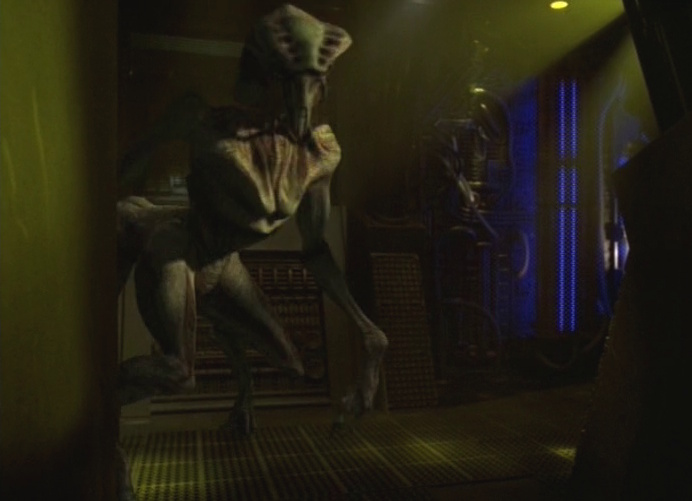
Star Trek: Discovery Season 4 theory – Michael Burnham

Spoiler Warning: There are spoilers ahead for Star Trek: Discovery Seasons 1-3, the teaser for Season 4, and for other iterations of the Star Trek franchise.

Did you read my weekly theory posts as Star Trek: Discovery Season 3 was ongoing? If you did, perhaps you’ll remember that, about four episodes in, I began to speculate that Michael Burnham’s new attitude toward Starfleet – which had changed following a year alone in the 32nd Century – would ultimately lead to her leaving the organisation, and perhaps even Star Trek: Discovery altogether.

That didn’t happen, of course, and it was part of Burnham’s arc across the season to get her ready to assume the captaincy at the end of the season finale. Although Burnham had at least one bump in the road where I felt her newfound independence spilled over into selfishness, her storyline and her rise to assume command was generally satisfying, especially across the back half of the season. By the time the credits rolled on That Hope Is You, Part 2, Burnham had truly earned the captaincy.

Michael Burnham assumed command of the USS Discovery in the Season 3 finale.

What I’m about to suggest may seem odd seen in that context, but there are a couple of reasons why I consider it plausible as I’ll try to explain. In short, I’m bringing back the theory that flopped in Season 3: Michael Burnham will, somehow, no longer be in command of the USS Discovery by the end of Season 4.

One of Discovery’s unique features within Star Trek’s broader canon has been the season-long captaincies of three very different individuals. Season 1 brought us Captain Lorca, the hardball who ultimately turned out to be deceptive. Season 2 reintroduced Captain Pike, the classic character who embodied the best of Starfleet’s values. And Season 3 saw Saru sit in the captain’s chair, the first ever alien captain to helm a Star Trek series.

Gabriel Lorca was the USS Discovery’s captain in Season 1.

Each captain brought something new and different to the ship, and thus to the series as well. And Michael Burnham, having assumed command at the end of Season 3, will undoubtedly put her own stamp on things as we enter Season 4. That’s great, and it keeps one of Discovery’s unexpected themes going. But as we look ahead to Discovery’s future, with a fifth season rumoured to be all but confirmed and even the possibility of some kind of feature film involvement, I can’t help but wonder whether she will remain in the captain’s chair.

Unlike Lorca, Pike, and Saru, Burnham has been Discovery’s protagonist since the beginning – even if, at times, her status as our main character didn’t always work as intended! So perhaps that means her rise to the captaincy, rather than the captaincies of the three other characters, is what we should be focused on. And that is a good argument in some ways – the story of Discovery, rather than being about the other captains or even other members of the crew, has primarily been about Michael Burnham.

Even though she wasn’t captain of the ship in Seasons 1-3, Burnham was still Discovery’s protagonist.

Thus we can argue that Seasons 1, 2, and 3 showed off different aspects of her ascent to the captain’s chair – which, it has to be said, is an amazing premise for a Star Trek series. Past shows all introduced us to captains who were already established; even Commander Sisko, who we saw at the beginning of Deep Space Nine assume his post for the first time, was still very clearly in command. We did get some episodes showing us parts of the backstories and pasts of Captains Kirk, Picard, Sisko, Janeway, and Archer, but when we first met them they were already established. We didn’t see their rise through the ranks in the way we’ve seen Burnham’s unfold over the past three seasons.

So that argument is valid, and it may very well prove to be true. But despite Discovery’s tight focus on Burnham much of the time, the show does have a broader cast of characters, some of whom we’re getting to know reasonably well now that we’re three seasons in. The show has never been about Burnham alone, and the different captains have, as I mentioned above, all put a unique spin on things during their tenures.

Captain Pike was in command for practically all of Season 2 – and is now starring in a spin-off: Star Trek: Strange New Worlds.

Discovery feels like it’s in a place where it could go down one of two paths, and which one the producers ultimately choose will depend on all sorts of factors, including future plans for the wider Star Trek franchise. One path is outlined above, keeping the Burnham focus as a key aspect of the series, and allowing Seasons 1-3 to depict her growth and rise. But there is another option.

The second path would be for Burnham to follow Lorca, Pike, and Saru, with her captaincy of the ship lasting a single season. Discovery’s unique selling point as a series would thus change from being all about Burnham to being a show which had a rotating captaincy. Those first three seasons – and probably Season 4 as well – would still have that Burnham focus. But if Discovery manages to keep going into Season 5 and beyond, perhaps we’ll look back on it as “the show with all those different captains!”

Saru had his turn in the captain’s chair during Season 3.

Because of a captain’s role and status, changing things up can really have a significant impact on the ship – and the series. While arguably an extreme example, if we look to Chain of Command, the two-part episode from The Next Generation Season 6, the introduction of Captain Jellico as a replacement for Captain Picard radically changed things up on the Enterprise-D, and if he’d remained in command we’d certainly have seen The Next Generation transformed into a very different series!

It makes for an interesting concept for a Star Trek show – something closer to an anthology series than a “traditional” Star Trek show in the vein of The Original Series and The Next Generation. Not only would the captaincy have changed, but we also have two very different time periods in play which really adds to the sense that Discovery has been, across its three-season run to date, very different season by season. Burnham’s departure could cement that trend.

A determined-looking Michael Burnham in the Season 4 teaser.

To clarify, I’m not saying this should happen, or that it would be great for the series. Because despite some of my critiques of Burnham’s characterisation, particularly early in Season 1, her rise to the captain’s chair worked. Seeing her take her seat at the end of Season 3 felt earned and it felt great; a genuinely emotional moment.

Despite that, however, I can’t help but wonder if the storyline of Season 4 – which seems to involve another “galaxy-threatening” event – will end with Burnham’s departure from the ship and the show.

There are two ways such a departure could happen, at least as far as I can see, so before we wrap things up we’ll briefly look at both.

Burnham on the bridge – and sporting a new uniform – in the Season 4 teaser.

Firstly, the one that seems more obvious given what we saw in the Season 4 teaser, and given what we know of Burnham’s disposition and personality, is some kind of self-sacrifice. Perhaps the only way to save the ship and crew – or more likely, save the whole galaxy – will involve Burnham making a decision to sacrifice herself for the cause. Her death would thus mirror characters like Data and Captain Kirk, both of whom were killed in the line of duty while saving others.

In a show that has been all about Burnham, depicting her at her lowest moments and showing her greatest achievements, there would be something poetic about going out in a “blaze of glory” – but at the same time, her death might seem like the series finale. If there are no plans for a fifth season (or film) to continue Discovery’s story, perhaps the series will conclude with Burnham’s death.

Burnham has been injured in the line of duty previously.

It wouldn’t be impossible for the show to go on without her, though, despite her prominent role. And while her death might feel like Discovery’s conclusive end, that wouldn’t necessarily have to be the case. As I’ve argued in the past, Star Trek shows are typically about more than just one character, and as we’ve spent more time with other members of the crew, I think there’s more than enough interest and potential for the series to stand on its own two feet if Burnham leaves or is killed off.

And that brings us to our second possibility – that Burnham survives, but for other reasons chooses to leave Starfleet.

This is what I felt Season 3 seemed to be hinting at in those early episodes. The shift in Burnham’s attitude toward Starfleet, her willingness to break the rules and disregard orders given by Saru and Admiral Vance, and the fact that she admitted to both Book and Georgiou that she found a sense of freedom outside of Starfleet in her year alone all seemed to be building up to a potential departure. The second half of the season got rid of that, and we saw Burnham’s attitude change such that her rise to the captaincy made sense in-universe. But there’s still the prospect of those feelings returning.

After a year away from Starfleet, Burnham seemed ready to quit the organisation altogether, at least for a time.

Burnham has, ever since the Season 1 premiere, had a bit of a problem with authority and the chain of command. While we should see much less of that with her in command, and thus not answerable to anyone else aboard the ship, the USS Discovery does not exist independently and is still under the command of Admiral Vance and Starfleet. If Burnham feels constrained by the orders she’s given, and repeatedly butts heads with senior Starfleet officers, perhaps the craving for freedom that we saw her express in Season 3 will come back.

I wouldn’t want to see Burnham storm off, throwing down her combadge and just walking away. After three seasons of being with her and seeing her grow, that would feel wrong. That’s why I was so critical of Discovery at one point in Season 3 when I felt this antagonistic attitude and selfishness, putting her own wants ahead of Starfleet’s orders, seemed to be a character regression, dragging Burnham back to where she was in Season 1. Luckily it didn’t pan out that way, and I hope it won’t here.

If Burnham does leave the show, hopefully her departure will be handled well and will treat her character with the respect she has earned.

But there can certainly be a way to get Burnham to walk away from Starfleet, perhaps at the conclusion of a successful, galaxy-saving mission, that would work. If she were to say goodbye and head into the sunset with Book, having saved the galaxy not once but twice, I think we could absolutely say that she earned the right to live her own life away from Starfleet in the manner she chooses. In short, this storyline could work, but it would all hinge on the way Burnham’s characterisation was handled and the manner in which she left.

So that’s it, really. We can call this a pre-season theory, and summarise it thusly: somehow, perhaps toward the end of Season 4, either through an heroic death or satisfying resignation, Michael Burnham will leave the USS Discovery and cease to be a main character on the show.

Will it come true? I have no idea! And with filming on Season 4 currently paused for two weeks due to a small coronavirus outbreak, perhaps we won’t find out for a while.

Burnham in some kind of armour or spacesuit in the Season 4 teaser.

Once again, I’m not arguing in favour of this theory necessarily. I think it could be made to work in a way that felt right, and it would mix up the captaincy of the ship again, potentially keeping things fresh going into Season 5. But at the same time, I’ve grown to like Burnham. Her departure would be a bittersweet moment for the series, and in a way it would be a risk unlike any the show has taken so far.

I hope you’ll swing by later in the year, as I plan to review every Discovery Season 4 episode when they’re broadcast. If Season 4 lends itself to theory-crafting, I daresay my weekly theories posts will be back as well! Between now and then we have Season 2 of Lower Decks to look forward to, which is coming up in less than four months now! So there’ll be a lot to talk about there as well. I hope you enjoyed this theory, but as always, please remember not to get too attached to any one individual fan theory. No theories are worth getting upset or disappointed over.

Star Trek: Discovery Seasons 1-3 are available to stream now on Paramount+ in the United States and on Netflix in the United Kingdom and other countries and territories. Season 4 is due for broadcast in late 2021. The Star Trek franchise – including Discovery and all other properties mentioned above – is the copyright of ViacomCBS. This article contains the thoughts and opinions of one person only and is not intended to cause any offence.
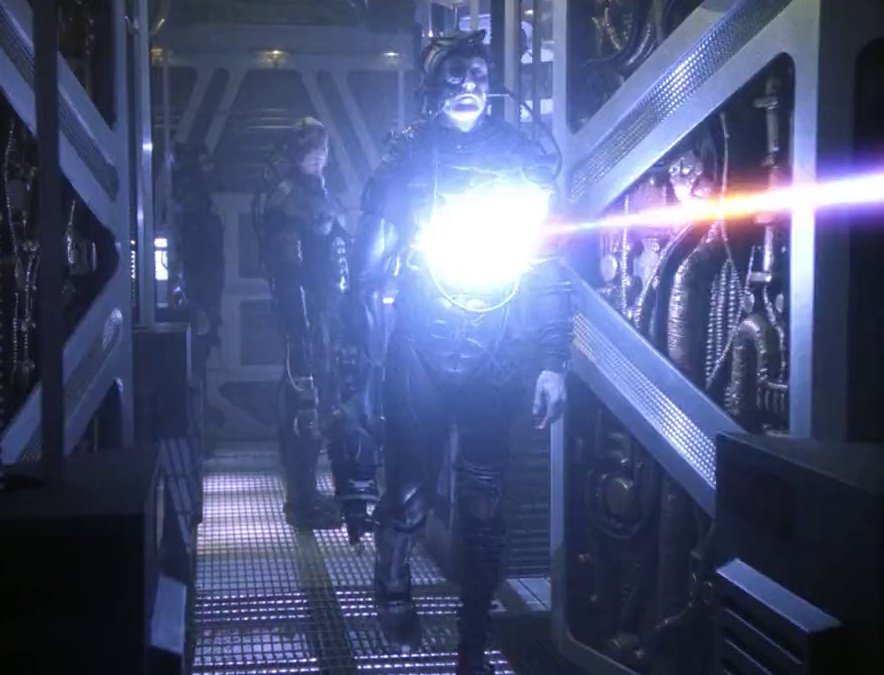
Star Trek 2023: could it be the ULTIMATE crossover?

Spoiler Warning: There are spoilers ahead for Star Trek: Discovery Seasons 1-3, Star Trek: Picard Season 1, the Kelvin timeline films, teasers for Star Trek: Discovery Season 4 and Star Trek: Picard Season 2, and for other iterations of the Star Trek franchise.

A few days ago, Paramount Pictures announced that a new Star Trek film is in the early stages of production, with a planned release date of June 2023. Though no further information about the project was given, that didn’t stop me speculating! I’ve already put together a list of a few possible Star Trek 2023 concepts, but I wanted to give this one the full article treatment.

At a few points in Star Trek’s history we’ve seen crossovers between the different shows. Usually this takes the form of a character or two from one series appearing in another. For example, we’ve seen Commander Riker appear in Voyager, Dr Bashir in The Next Generation, and Worf in Deep Space Nine. In Star Trek’s cinematic canon, Janeway made a cameo in Nemesis, Prime Spock appeared in Star Trek and Star Trek Into Darkness, and most significantly, we got to see Captains Kirk and Picard work together in Generations.

Captain Kirk and Captain Picard in 1994’s Star Trek: Generations.

So the Star Trek franchise has a history of main character crossovers going all the way back to Encounter at Farpoint, the moment at which Star Trek debuted its second entry and replaced its original set of characters. In all of these crossovers, though, even the substantial ones that were more than mere cameos, we’ve only ever seen characters from two shows interact. What if Star Trek 2023 plans to offer more than that?

In short, here’s my theory – and if it doesn’t come to pass in 2023 we can consider it a proposal or pitch for the future! As a celebration of all things Star Trek, perhaps the new film will be the ultimate crossover, featuring a cast of characters from across the entire Star Trek franchise. How would this be achieved? Some kind of time travel story, naturally, perhaps involving the extradimensional activities of a faction like the Q.

John de Lancie has recently announced that he’ll be returning as Q in Picard Season 2!

How amazing would it be to see Captain Archer from Enterprise working alongside Riker and Janeway? Saru and Michael Burnham could team up with Geordi La Forge and Miles O’Brien. Soji and Picard meeting Kelvin Kirk. Pike and Spock fighting alongside Worf and Malcolm Reed. The potential for such a story is almost limitless.

Comic books – and the films they’ve inspired over the last decade or so – have routinely done crossovers and team-ups, and fans tend to agree that they’re amazing when done well. Star Trek, as I’ve already mentioned, has had limited crossovers before, but nothing quite on the scale I’m thinking Star Trek 2023 could bring.

This could be Star Trek’s answer to The Avengers.

There have been over 60 main characters in live-action Star Trek to date, including films and television shows, and obviously it wouldn’t be possible for Star Trek 2023 to have an ensemble cast that large! But a handful of characters from different shows representing different time periods and different parts of the franchise could absolutely come together; a perfect mixture of all things Star Trek and a true celebration of the franchise as it approaches its sixtieth anniversary.

With this many different Star Trek projects all in production simultaneously, it makes so much sense to have some kind of “Avengers assemble!” moment to bring them all together. Even if such a story were limited to bringing in characters from current shows instead of Star Trek’s back catalogue, I still think it would be well worth doing. A suitable story would need to be devised, and a villain or problem for the protagonists to overcome would need to be created, but those are the basic tenets of storytelling anyway and aren’t obstacles.

Captain Pike – soon to appear in Strange New Worlds.

I tend to say that time travel stories are not my favourites within Star Trek – or in sci-fi in general. But time travel can work, as we saw in films like Generations and episodes like All Good Things. All it would require is a simplified explanation, perhaps involving some outside power, and if the stakes were high – a threat to the entire galaxy, for example – it would make sense to bring in as many legendary characters as possible to help defeat it.

If you’re a regular reader you’ve probably heard me say on more than one occasion that the Star Trek franchise could – and should – be doing more to tie its different shows and projects together. At present, every extant Star Trek project exists in a different time period wholly separate from everything else. There have been limited prospects for significant crossovers as a result, and while Discovery Season 3 saw perhaps the biggest connection to the rest of the franchise so far, it can still feel that all of the different parts of the franchise are doing their own things independently of one another.

The Discovery Season 3 episode Unification III referenced events from The Next Generation and Picard.

While too many ties and connections can be offputting, especially for casual viewers, not enough references or crossovers means there’s no incentive for the audience to stick with Star Trek and jump into other parts of the franchise. It’s possible to watch Discovery as a standalone show and not even be aware of the existence of Picard, for example – and vice versa. More of these connections between different parts of the franchise could, if done right, encourage viewers of one series to hop over and try out others – and Star Trek 2023 could potentially be the biggest opportunity so far to do that.

Perhaps some looming threat in the 32nd Century forces Michael Burnham to call upon Starfleet’s finest from centuries past, and she travels back in time to pick up a number of officers, scientists, and soldiers to help her defeat whatever it is that’s coming. Or perhaps an outside power like Q forces his friend Picard to work with different people from different eras to tackle some existential crisis. There are a million-and-one ways for Star Trek to introduce the kind of time travel scenario needed to link up some of the franchise’s superstars for one amazing crossover event.

“Let’s fly… to the past!”

So who would I pick to join the crew? I think we have to start with the main shows in production (and one that could be in production by 2023). Admiral Picard, Michael Burnham, Captain Pike, and Section 31 leader Georgiou would head up the cast, and from there we could bring in perhaps one additional member of their respective crews for a more significant role – maybe with smaller roles or cameos on the cards for others. Then I’d dearly like to bring back at least a couple of other characters from Star Trek’s past – someone like Dr Bashir, perhaps, or Tom Paris.

The film would follow these characters as they worked to solve whatever problem they’re facing, with each of the principal characters making use of their unique perspective and skillset to help contribute to the project. There could be teething problems with the team as they get to know one another, but generally I’d stick to having them work well as a team, with emphasis on how people from different backgrounds and with different outlooks can all find ways to contribute. Then there’d have to be some kind of tense final battle or confrontation before everyone – or at least, the survivors – part ways and return to their respective eras.

The Section 31 series could be underway by 2023…

I guess now we’ve crossed over from the realm of reasonable speculation into fan fantasy! And I’m not the first person on the internet to propose an “ultimate crossover” of Star Trek crews; such talk has been around since before Generations in the mid-1990s! While I don’t know whether Star Trek 2023 will go down this road, I do think that a major crossover could and should happen at some point in the future. Not only would it serve a purpose and tie together previously-separate parts of the franchise, but I bet it would be an incredibly fun film for Trekkies – and non-Trekkies too!

So that’s it, really. This half-theory, half-fantasy is that Star Trek 2023 will be the “ultimate crossover” and bring together characters from across the franchise to tell a single, epic story. Even if this film doesn’t do it, I still hope this kind of crossover event will happen one day!

The currently-untitled film Star Trek 2023 is being produced by Paramount Pictures and ViacomCBS. Star Trek 2023 has a tentative release date of the 9th of June 2023. The Star Trek franchise – including all shows, films, characters, etc. mentioned above – is the copyright of ViacomCBS. This article contains the thoughts and opinions of one person only and is not intended to cause any offence.
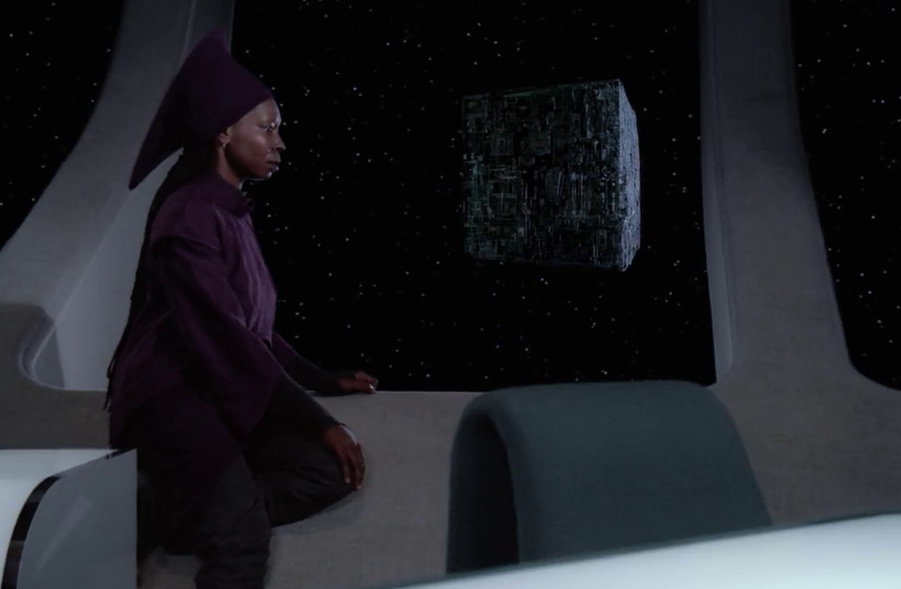
Star Trek: Lower Decks Season 2 theory – Lieutenant Boimler

Spoiler Warning: There are spoilers ahead for Star Trek: Lower Decks Season 1, the teaser for Season 2, and for Star Trek: The Next Generation.

We recently took a look at the Season 2 teaser for Star Trek: Lower Decks, and made a few guesses about what some of the scenes might entail. Season 2 is due to be broadcast beginning in mid-August, exactly one year after Season 1 made its debut, and though it’s a little way off yet it’s never too early to indulge in some theory-crafting and speculation!

Because of its largely episodic nature, Lower Decks Season 1 didn’t lend itself to the creation of too many theories. For the most part, events took place in a single episode, and the crew warped away to a new adventure the week later. But No Small Parts, the Season 1 finale, brought about some big changes for the series, and creator Mike McMahan promised that these wouldn’t simply be undone, resetting the show off-screen in time for Season 2.

Boimler and Mariner in Season 1.

Aside from the death of poor Lieutenant Shaxs, the two biggest changes came with Ensign Rutherford losing his memory – or at least his memories of what took place in Season 1 – and perhaps most significantly, Ensign Boimler’s promotion and reassignment to the USS Titan. It’s this latter point that we’re going to look at today.

Somehow Boimler has to get back to his friends aboard the USS Cerritos – but how? And when? At least part of the teaser showed us Lieutenant Boimler in his new role as a bridge officer on the USS Titan, so we know whatever it is won’t happen off-screen, as Mike McMahan promised. Were there any clues at all in the teaser that we could point to when it comes to Boimler? After all, he wasn’t shown interacting with the other three main characters at all. Let’s find out, shall we?

As always, it’s worth saying that I have no “insider information.” I’m not claiming that anything listed below will definitely happen, it’s guesswork and speculation from a fan. Nothing more. With that out of the way, let’s consider eight ways Lieutenant Boimler could find himself back aboard the USS Cerritos.

Number 1: Boimler asks for a demotion voluntarily.

This is not the face of a happy officer!

The Season 2 teaser seemed to show us two significant things about Boimler: he doesn’t understand Captain Riker, and he seems to be out of his depth on the USS Titan. Boimler is neurotic and prone to panic, as we saw in Season 1, and neither of those traits make for an officer who’s good in a crisis. The Titan, unlike the Cerritos, is a much more adventurous starship, seeking out new life and getting into all kinds of scrapes. Perhaps, after spending some time there, Boimler realises he’s simply out of his depth.

There’s no shame in admitting a task is too difficult, and rather than struggling on with something he simply can’t do, Boimler may approach Captain Riker and ask to be transferred back to the Cerritos, taking a voluntary demotion.

Boimler on the bridge of the Titan with Captain Riker.

Though we didn’t hear Marina Sirtis’ voice in the teaser, it’s possible she will reprise her role as Counsellor Troi, and if she’s back perhaps Boimler will turn to her for advice about what to do. Troi was always gentle and polite in the way she approached even the most neurotic of officers – like Lieutenant Barclay – but perhaps this could be a moment for Lower Decks to subvert that by having her tell Boimler to jump ship!

Either way, sometime in the first episode (or first couple of episodes, at least) Boimler may approach Captain Riker and ask for a demotion, telling his new commanding officer he doesn’t feel up to serving on the Titan.

Number 2: Rutherford or Tendi accidentally get Boimler demoted.

Rutherford in the Season 2 teaser.

This could play well with the “Rutherford’s lost his memory” storyline, but a subversion of the audience’s expectations that either Boimler does something to get demoted or Mariner deliberately gets him kicked back to the Cerritos would be to make it the inadvertent fault of Tendi or Rutherford.

At this stage it has to be said that most keen fans of Lower Decks are expecting one of those two scenarios to play out. Mariner was the character who seemed most hurt by Boimler’s decision to leave the Cerritos – and to not tell her beforehand – so it stands to reason she might want to interfere and get him back. We’ll consider that in a moment. Boimler’s tendency to mess up and panic could also see him bumped back to the Cerritos, and that’s another fan expectation.

Tendi in Season 1.

But Lower Decks has done well with challenging those kinds of expectations in Season 1, and I hope Season 2 won’t go down any obvious paths. Rutherford is known for his love of technology, but that has landed him in trouble more than once in Season 1. Perhaps one of his inventions gets out of control and harms the Titan, making it seem as though Boimler is responsible?

Tendi, as I’ve mentioned more than once, felt somewhat rudderless last season, and hasn’t really settled into her role as well as the other three main characters. But we saw her ability to screw up in the episode Moist Vessel, where she accidentally ruins an “ascension.” Perhaps she could have some kind of similar accident here, one that causes Boimler to get demoted.

Number 3: Mariner gets Boimler demoted on purpose.

Boimler and Mariner in Season 1.

As mentioned, this has to be one of the firm favourites in the fan community for how Boimler will end up back on the Cerritos in Season 2. Despite that, however, I think it would be an awful choice for the show, undermining Mariner’s character progression across Season 1. I really hope Lower Decks doesn’t go down this route.

Where Lower Decks didn’t do so well in Season 1 – at least in my opinion – was in trying to make Ensign Mariner out to be some kind of “ultimate badass;” Starfleet’s answer to Rick Sanchez from Rick and Morty. That kind of character can succeed in comedy – as Rick himself proves – but in a Starfleet setting, and particularly coming from a junior officer, it fell completely flat every time the show tried it.

Mariner in the captain’s chair in the Season 1 finale.

Mariner had a truly satisfying arc across Season 1. She came to understand more about herself and what she does and doesn’t like about serving in Starfleet, and even put aside her differences with Captain Freeman – her own mother. Reverting back to how she was at the beginning of Season 1 by selfishly putting her own wants ahead of her friends would be worse than just a regression, it would be a betrayal of her character.

Regardless of what I think, the possibility exists that Mariner may try to sabotage Boimler’s promotion, intervening in just the right way to get him demoted and reassigned back to the Cerritos.

Number 4: Boimler gets promoted.

Lieutenant (j.g.) Boimler aboard the USS Titan.

So far we’ve considered possible ways Boimler could get demoted – but what if his return to the Cerritos is prompted by a promotion instead? Boimler was a junior lieutenant at the end of Season 1, and in that role was able to serve on the Titan. But perhaps the Titan doesn’t have space for a full lieutenant and he bounces back to the Cerritos after an especially successful assignment!

A lieutenant is still a relatively junior officer, and Boimler attaining such a rank wouldn’t necessarily undermine the premise of Lower Decks. He could continue to work with the other three principal characters even if he technically outranks them, and that could become a source of humour.

Boimler in Season 1.

I’m not sure how likely this one is given the show’s original intent was to focus only on ensigns doing menial tasks aboard a starship, and while having a lieutenant in their midst would open up different storytelling options – and options for jokes and humour – it does, in some respects, go against what the show intended to be about.

Having Boimler be promoted would be a subversion, though, completely challenging audience expectations for how he returns to the Cerritos! That in itself could make it worth doing – after all, he can always get demoted again later if a storyline requires it!

Number 5: Something connected to an away mission.

Though he isn’t easy to spot, in the upper-right of this image from the teaser you can see Boimler.

The image above is taken from the Season 2 teaser, and seems to show Boimler on an away mission. While three colleagues defend the position, Boimler appears to be working on some kind of computer terminal. It isn’t possible to tell who the three are, but they clearly aren’t familiar characters from the Cerritos; certainly not the three ensigns. So perhaps this away mission takes place while Boimler is assigned to the Titan.

If the away mission goes wrong, or if Boimler’s role in it does, perhaps it’s what leads to his demotion and/or reassignment. Alternatively, this could be the moment Boimler decides for himself to step away from the Titan; perhaps the away mission was too stressful for him. It certainly looks like he’s under pressure!

“Zoom and enhance!”

I can’t tell what it is that Boimler is working on. It could be a power generator, a weapon, some kind of factory, or something else entirely. It’s underground, which suggests it could be something that’s supposed to be a secret. And Boimler and the others aren’t wearing Starfleet uniforms, which could mean they’re undercover. They might even have been captured and this moment is depicting their escape.

Though this could be a holodeck programme or something else, it appears on the surface to show Boimler in a difficult situation. Given how prone he can be to panicking and overreacting, that could mean it’s the moment where he decides – or someone else decides on his behalf – that he needs to take a step back and return to a more junior role.

Number 6: Boimler is demoted by Riker.

Troi and Riker conducting crew evaluations in The Next Generation Season 7 episode Lower Decks.

This could be connected to the away mission above, or it could be something different, but perhaps the best explanation is that Riker, after evaluating Boimler’s performance for himself, simply decides that he isn’t cut out to be a lieutenant or to serve on the Titan. There may not be one single event to point to as the cause; instead we may see a number of smaller mistakes across the course of the first episode or two.

In the Season 2 teaser, Boimler appeared to be serving on the bridge and failed to understand one of Riker’s commands. At the same moment, the USS Titan was drifting toward some kind of anomaly and was under attack by at least one alien ship. Boimler’s failure at a key moment like that – even if it were prompted by Riker’s confusing turn of phrase – could be the cause of his demotion.

Boimler and Riker on the bridge of the USS Titan.

If Boimler is to be demoted back to ensign, having that be caused not by Mariner or the others would probably be the best way to go. It may not paint Riker in the best light, but this “version” of the character is different, and in the context of Lower Decks it would probably be fine even if Riker came across as too harsh. Keeping Mariner out of things would probably be the best way to go, allowing her friendship with Boimler – one of the high points of Season 1 – to remain in place.

We know from the way he conducted himself in Season 1 that Boimler can be anxious and easily overwhelmed, especially when things start to go wrong. Though his role in the episode Temporal Edict showed he can be a competent officer, at numerous other points across the season he panicked and allowed circumstances to get away from him. Riker may simply decide, based on that evaluation, that he isn’t cut out for a role under his command – at least, not yet.

Number 7: Mariner challenges Riker to an anbo-jyutsu match.

Mariner in anbo-jyutsu armour in the Season 2 teaser.

One of the most interesting moments in the Season 2 teaser was Ensign Mariner donning anbo-jyutsu armour. Anbo-jyutsu was a 24th Century martial art seen in The Next Generation Season 2 episode The Icarus Factor, and the only major character we ever saw participate in a match was… Will Riker!

The Season 1 finale confirmed that Riker and Mariner know each other to some extent, though he clearly wasn’t keen enough to offer her a role on his ship! But given that they have some kind of history, and that Riker knows Captain Freeman as well, perhaps Mariner will try to use her connection to Riker to get Boimler back.

Riker in anbo-jyutsu armour in The Next Generation Season 2 episode The Icarus Factor.

In short, here’s this theory: Mariner challenges Riker to an anbo-jyutsu match. The prize? Boimler. Though this would surely be conducted over Boimler’s objections, whoever wins the match – surely Mariner! – would get to keep Boimler. When she wins, he gets transferred back to the Cerritos even if he doesn’t want to or didn’t do anything wrong.

This could be played for laughs far more easily than Mariner mean-spiritedly trying to sabotage Boimler’s career. And if his time on the Titan wasn’t mentioned subsequently, we wouldn’t necessarily have any reason to feel that Boimler holds a grudge for his reassignment to the Cerritos. He may, as mentioned, even get to keep his new rank in such a scenario. This would involve Mariner, the show’s protagonist, and allow her to get her way, but wouldn’t drag her character back quite so far as if she deliberately did something to get Boimler kicked off the Titan.

Number 8: Boimler remains on the USS Titan all season.

The USS Titan in the Season 2 teaser.

With all of these theories for how Boimler could end up demoted and back on the Cerritos we’ve missed something obvious! Instead of any of that happening, Boimler could instead remain aboard the Titan.

There are many ways that the characters could still work together at a distance – and given that the current state of the world has a lot of people working remotely, there could be something rather timely in a series of stories that show Boimler having to video call with his friends instead of being able to spend time with them in person!

Boimler was very excited to see the Titan in Season 1!

The Titan and the Cerritos, at least at the end of Season 1, were both operating in roughly the same region of space. Perhaps Season 2 will see them work in tandem, or as part of a larger fleet. I’m not sure how this would work with the “second contact” mission that the Cerritos had in Season 1, but we didn’t see that many second contacts in Season 1, with the Cerritos also undertaking other assignments.

Perhaps the solution to the “Boimler problem” has been staring us in the face the whole time – he doesn’t need to be reassigned or demoted, and can remain in the role he worked so hard to win last year.

So that’s it. Eight theories for Lieutenant Boimler’s role in Season 2.

Boimler at his post on the Titan’s bridge.

In many ways, Boimler being promoted and reassigned felt like it could have marked the final end of Lower Decks; the series finale. And perhaps that was how it was originally written before the creative team knew that a second season was definitely going ahead. Though Lower Decks has now been renewed for a third season and will hopefully run for several more beyond that, the natural end for a show like this, focusing on characters of lower rank, is to see them promoted and moving on to bigger things. Boimler’s role on the Titan could have been that moment for the series.

We didn’t see any signs in the Season 2 teaser of Boimler back in his old uniform, nor interacting in any way with anyone from the Cerritos. So at this stage we have to say that anything could happen! He could return to his old role right at the beginning of the season, he could stay on the Titan for an episode or two, and so on. How he might end up back on the Cerritos is also entirely unclear, and all I can do at this stage is make a few guesses!

Ensign Mariner in the Season 2 teaser.

For my two cents, I hope that if Boimler is to be kicked back to the Cerritos, it doesn’t come at the expense of Mariner’s character growth. She clearly wants him back, and that’s understandable. But if she were to interfere and sabotage him, even though it’s a comedy and such a moment would be played as a joke, it wouldn’t feel right. Lower Decks worked best by making the everyday goings-on in Starfleet funny. Where it didn’t work were the moments where Mariner’s selfishness and lack of care saw her put her own wants ahead of the crew or Starfleet’s mission.

It’s now officially less than four months until Lower Decks will be back on our screens. Although we’ve already seen a short teaser, I wouldn’t be surprised if there’s a longer trailer as the season approaches. If we do get one, be sure to check back as I’m sure to take a look at it. And beginning in mid-August, I hope you’ll stay tuned for episode reviews as well as discussion of the series.

Star Trek: Lower Decks Season 1 is available to stream now on Paramount+ in the United States and other countries and territories where the service is available. The series is available to stream now on Amazon Prime Video in the United Kingdom and elsewhere. The Star Trek franchise – including Lower Decks and all other properties mentioned above – is the copyright of ViacomCBS. This article contains the thoughts and opinions of one person only and is not intended to cause any offence.
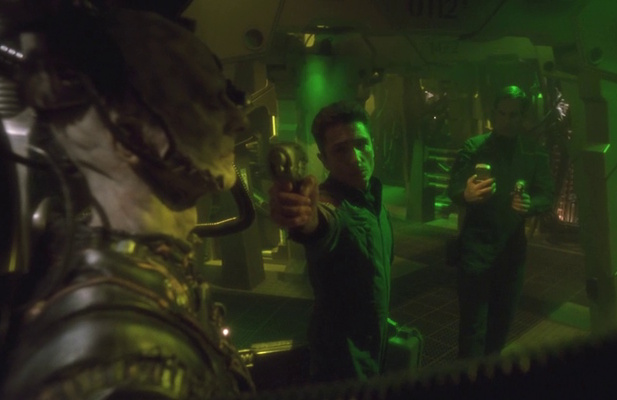
Star Trek 2023: what could it be?

Spoiler Warning: There are spoilers ahead for the entire Star Trek franchise, including the most recent seasons of Discovery and Picard, as well as recently-revealed teasers for upcoming seasons and projects.

The announcement a couple of days ago that a brand-new Star Trek film is in the works was incredibly exciting! There hasn’t been a feature film in the franchise since 2016’s Star Trek Beyond, the third film in the Kelvin (or JJverse) series. Since The Motion Picture made its debut in 1979, the Star Trek franchise has been reasonably consistent in its cinematic output, with the longest gap between films to date coming between Nemesis’ release in 2002 and JJ Abrams’ 2009 Star Trek reboot. Aside from that seven-year gap, we’ve seen Star Trek films every three or four years on average, and there have been thirteen films released since 1979.

I’ve always considered Star Trek to primarily be a television franchise, and its return to the small screen in 2017 felt like a proper homecoming. As interesting as the Kelvin timeline films were, I was far happier to see Star Trek back on television. That’s not because the Kelvin films – or any other Star Trek films – were bad, it’s just that the television format seems to work particularly well and lend itself to the kinds of stories Star Trek does best.

Star Trek will soon be back in cinemas!

As I said when I wrote up a short piece about the film’s announcement, no information was provided by Paramount Pictures or ViacomCBS about the film other than its June 2023 release date. So it would be foolish to speculate, wouldn’t it?

Foolish, perhaps, but also a lot of fun! So this time we’re going to take a look at a handful of possible settings, scenarios, and ideas for Star Trek 2023 and what it might be all about. My usual caveat applies: I don’t have any “insider information,” nor am I suggesting any of these film ideas will turn out to be correct. This is pure guesswork and speculation on my part. That’s all.

With that out of the way, let’s jump into the list!

Number 1: A direct sequel to Star Trek Beyond.

The redesigned USS Enterprise in 2009’s Star Trek.

Attempts have been underway since before the release of Star Trek Beyond to get a fourth Kelvin timeline film off the ground. At one point, rumours swirled of a script that would have brought back Kirk’s father George – who had been played by Thor actor Chris Hemsworth in the opening scenes of 2009’s Star Trek. Pre-production on that project appeared to make headway, but – again, according to widely-reported rumours – the salaries of some of the principal cast members, including Kirk actor Chris Pine, were said to have derailed the project.

Beyond ended with a strong tease at a potential sequel. Kirk and his crew gazed out over the new USS Enterprise-A as construction on the vessel was completed, and there was a sense that the film was setting up a new story. After more than five years it hasn’t happened, and as I said when I considered the pros and cons of a return to the Kelvin timeline, Star Trek’s return to the Prime Universe and the expansion of the franchise to new shows and projects means that, at least in my opinion, the Kelvin timeline doesn’t really feel like a good fit right now.

The Kelvin crew in Star Trek Beyond.

In many ways, it would make more sense for any new feature film to at least have some connection or tie to the shows currently being produced, even if it isn’t a direct spin-off from any of them. The Kelvin timeline was a way to reboot Star Trek in 2009 after three decades of near-continuous production had burnt it out in the minds of many viewers. That doesn’t feel necessary right now. And going back to the Kelvin timeline after years in the Prime Universe risks overcomplicating things for a more casual audience.

So there are mixed feelings on this one! On the one hand, the story of the Kelvin timeline abruptly ends after Beyond, despite teases of a sequel. And the Kelvin timeline films were incredibly successful, bringing in huge audiences and plenty of money! But on the other hand, the reinvigorated Star Trek franchise has gone in a different direction since 2017, and I don’t see where a Beyond sequel fits any more.

Number 2: Captain Worf.

Worf in First Contact.

Michael Dorn, who played Worf in The Next Generation, Deep Space Nine, and four Star Trek films, has often talked about his desire to reprise the role. Since at least the early 2010s, Dorn has talked at every opportunity about his pitch to Paramount and ViacomCBS for a “Captain Worf” series, miniseries, or film. Perhaps, after years of pestering them, he finally got his wish?

At this stage we can’t rule it out! Knowing so little about the upcoming project means, in theory, that practically any Star Trek pitch that we know about could be in contention. Maybe the “Captain Worf” concept was one that the company liked, and a feature film was considered the best possible option for it. One advantage to it, at least in theory, would be that Michael Dorn is well-versed in both Star Trek and the project’s central character, meaning it would be less challenging to get started with when compared to a wholly new concept. Given that the film has just over two years to go from announcement to release, that could be a significant help!

Worf in Season 1 of The Next Generation.

However, I’ve never been sold on the “Captain Worf” idea, personally speaking. Worf is a fun character, but I see two distinct disadvantages if he were to be the central focus of a new story. Firstly, Worf is the character we’ve spent the most time with in all of Star Trek to date – he appeared in 270 episodes and four films across fifteen years. We’ve seen most aspects of his life unfold on screen already, including his role as a father, husband, friend, and Starfleet officer. Do we really need more Worf?

And secondly, Worf is a great secondary character, but the “Captain Worf” concept would put him centre-stage. That’s great for Michael Dorn, of course, but I’m not sure Worf is the most nuanced or interesting character to spend so much time with. Both Worf and Voyager’s B’Elanna Torres have explored the “Starfleet-versus-Klingon” concept on many occasions, which is perhaps Worf’s biggest point of internal conflict and the best reason to do a project like this. It could be interesting, and a chance to return to the 24th or early 25th Century would be great. But I’m not sold on this being the right way to do it.

Number 3: Ceti Alpha V.

My Ceti Alpha V mock-up.

A few weeks ago I looked at a pitch by The Wrath of Khan and The Undiscovered Country director Nicholas Meyer for a miniseries tentatively titled Star Trek: Ceti Alpha V. That project was planned as a three-part miniseries, but it could have been adapted into a feature film, I suppose!

This concept would focus on iconic villain Khan in the years between his exile by Kirk in Space Seed and his return in The Wrath of Khan. He and his followers were marooned on the titular planet Ceti Alpha V, and had to endure disaster following the explosion of nearby Ceti Alpha VI.

Khan in The Wrath of Khan.

As I wrote then, I’m not convinced that we need to see that part of the story! It wouldn’t really explain anything from The Wrath of Khan, as seeing Khan’s descent into madness for ourselves across several hours of television – or an entire film – isn’t necessary in any way to explain his actions or characterisation. Everything we needed to know about Khan is present in Space Seed and The Wrath of Khan.

As a feature film, though, a project like this has merit. It would pull on those nostalgic strings, connect to the franchise’s most well-regarded piece of cinema, and feature an iconic Star Trek character. From Paramount’s point of view, those advantages may make it worthwhile!

Number 4: Borg Invasion.

A Borg Cube over Earth in The Best of Both Worlds, Part 2.

If you’re a regular around here you might remember a Borg Invasion concept being one of my “unsolicited Star Trek pitches” last month! This is a concept that I’ve long felt would be fascinating, and while I envisioned it as a television series, it could perhaps be made to work as a film trilogy instead – potentially making Star Trek 2023 the first part of a short series of films.

But we’re getting ahead of ourselves! The Borg are one of the franchise’s most iconic villains, participating in one of Star Trek’s most highly-regarded episodes – The Best of Both Worlds – and best films – First Contact. The faction itself also hasn’t been seen on screen in any major way since 2003’s Enterprise Season 2 episode Regeneration, perhaps making them due for a comeback!

Borg drones in the Enterprise episode Regeneration – the last time we saw any “active” Borg on screen!

Discovery’s second season told a story which had the potential to be a Borg origin story, and Picard Season 1 also touched on the Borg, in particular Picard’s lingering trauma following his assimilation. But neither series brought back the Borg in a big way, despite the potential existing for either to do so. Could that be because ViacomCBS knew that Paramount Pictures (its subsidiary) was in the early stages of working on a new Borg film? Maybe!

The Borg are terrifying, and such a film would be action-packed and tense in equal measure. It’s been 25 years since Star Trek: First Contact took the Borg to the big screen for their only visit to the cinema so far, so I can’t help but wonder if they’re about to make a reappearance! Whether a Borg story would look to bring back any familiar characters or not is not clear – it wouldn’t have to, but as always in Star Trek, I’d be thrilled to see practically anyone connected to the franchise make a return.

Number 5: The Kelvin timeline version of The Next Generation.

The Season 1 cast of The Next Generation. Is a reboot on the cards?

2009’s Star Trek reboot presented an opportunity to go back to the drawing board and take another look at Kirk, Spock, Dr McCoy, and the rest of the crew of The Original Series. Ever since, (some) fans have been wondering what would happen to The Next Generation in the alternate reality – would the same crew have been assembled, or would its members even exist given the dramatic changes to the timeline?

Perhaps this is something we should explore in more detail another day, but I think that the existence of Chekov in the alternate reality, and the fact that he joined Starfleet, could be taken as evidence of the alternate reality not straying too far from the Prime Universe. Chekov was born after the incursion of Nero’s ship and the destruction of the USS Kelvin, so in theory we could argue that most people we met in past iterations of the franchise should have an alternate reality counterpart – just as they have a Mirror Universe counterpart too.

Did this moment in Discovery Season 3 hint at something to come?

Discovery Season 3 made a small reference to the Kelvin timeline – or at least, an ambiguous reference that felt like a Kelvin connection! In the episode Terra Firma, Part 1, the mysterious Kovich told Dr Culber of a “time soldier” who crossed over from the alternate reality to the Prime Universe. This soldier was wearing a uniform style seen in the first couple of seasons of The Next Generation, so it seems as though there was a comparable era of Starfleet in the alternate reality.

Could Discovery have been dropping a hint at this film? Possibly! Even if that’s just coincidence, it reinforced the existence of the Kelvin timeline – a fact that was known to Starfleet by the 32nd Century. Perhaps it was a subtle reminder to Trekkies that the alternate reality still exists, getting us ready for a new project? The Next Generation is very popular with fans, and rebooting it may seem like a solid idea for Paramount Pictures. Though I know some fans who detest the Kelvin films – or who refused to watch on principle – there’s no denying the reboot was a success, and rebooting The Next Generation could be as well.

Number 6: A Discovery film – if the show ends with Season 4 or Season 5.

Captain Burnham at the end of Season 3.

Speaking as we were of Discovery, its fourth season is due for release later this year. While there is no word yet on Season 5 – at least officially – it seems likely that the show will be renewed for a fifth season, which would presumably be broadcast in 2022. But what will happen next?

Both The Original Series and The Next Generation were followed up by films starring the casts of the shows, and perhaps something similar could be on the cards for Discovery, with Captain Burnham leading her crew onto the big screen. By 2023 we’ll have had at least one – probably two – more seasons of Discovery, so the crew will be almost as familiar to audiences as Kirk and his officers were when The Motion Picture was in production!

The USS Discovery.

If there is to be a fifth season of the show, that would mean production on Season 5 would likely be ongoing at the same time as this film, so maybe this is an indication that there won’t be a Season 5. With a number of other Star Trek television projects in various stages of development – including the untitled Section 31 series which is itself a spin-off from Discovery – perhaps the plan is to end the series after Season 4 and turn it into a feature film franchise instead, with television attention refocused onto other projects.

It would be a big change, but I can see at least one big advantage to a Discovery film: it would firmly establish the 32nd Century in the minds of audiences. I’ve felt for a while that Star Trek needs to try to condense its disparate timelines and time periods as much as possible, and the 32nd Century is by its very nature totally open-ended when it comes to storytelling potential. A Discovery film could be a “soft reboot,” relaunching Star Trek in the 32nd Century and setting the stage for new projects.

Number 7: A Deep Space Nine film – the return of Sisko.

Captain Sisko in Take Me Out To The Holosuite.

I was perhaps overly-critical of a “Captain Worf” idea in the entry above, but one character who I’ve been hoping to see return for over twenty years now is Captain Sisko. The ending of What You Leave Behind – the last episode of Deep Space Nine – more so than any other Star Trek finale left things open. Sisko entered the realm of the Bajoran Prophets, but promised to return in due course.

That return could happen at literally any point in the timeline; the Prophets don’t see time as linear. Sisko could thus appear in the Strange New Worlds, Picard, or Discovery eras – despite the fact that those shows take place centuries apart! But given the importance of his return to Star Trek, perhaps a Sisko feature film is on the cards.

Sisko in Move Along Home.

Sisko would be such a great point-of-view character. His absence from galactic affairs for decades or even centuries would allow the writers of the film to dump a lot of exposition onto the audience without it feeling like it came from nowhere. His return could both set up the plot of a new Star Trek story and provide the audience with a way in; introducing us to new characters, factions, technologies, and the state of the galaxy itself in whatever time period he finds himself.

Such a story could also return to Bajor, looking at whether the Bajorans ever joined the Federation, as well as the aftermath of the Dominion War. The Dominion War arc is one of my favourites in all of Star Trek, and a follow-up of some kind would be absolutely amazing to see. If Sisko returned during the Picard era, he could reunite with people like Major Kira or Dr Bashir, and a mini-reunion of some of the Deep Space Nine crew would be wonderful.

Number 8: A Nemesis sequel.

The Enterprise-E undergoing repairs at the end of Nemesis.

A direct sequel to Nemesis seems unlikely, especially with Picard Season 2 underway and planned for next year. But the official announcement of Star Trek 2023 mentioned a film set after Nemesis as one possibility. That seems incredibly interesting! Would it be set in the Picard era, perhaps with the crew of La Sirena in major roles?

The surviving crew of the Enterprise-D and Enterprise-E have largely gone their separate ways, at least as of Picard Season 1. Riker and Troi live in semi-retirement on the planet Nepenthe. Picard is off with the crew of La Sirena. Worf and Geordi were mentioned by name, but there’s no indication that either are still even in Starfleet at this point! Season 2 of Picard may answer these questions, as well as establish what became of Dr Crusher, and if so that could set the stage for a reunion on the big screen.

Acting Captain Riker in the Picard Season 1 finale.

As above with Discovery, Picard Season 2 is currently filming, meaning that production on Star Trek 2023 would have to wait if it wanted to include Picard himself. But there is another possibility: that a Nemesis sequel would focus on other characters. Perhaps it would look at Riker and Troi in more detail, especially if they returned to Starfleet following the events of Picard Season 1.

Star Trek 2023 may follow Riker’s time in command of the USS Zheng He, and perhaps he reunites with Worf, Dr Crusher, Geordi, or even Wesley! Or we could see the return of characters from Deep Space Nine and/or Voyager, such as Ezri Dax or Tuvok. With Captain Janeway coming back in Prodigy, anything’s possible right now!

Number 9: A Kelvin timeline crossover with either Strange New Worlds or Discovery.

Captain Kirk in Into Darkness.

One of the really enticing possibilities that came up when Strange New Worlds was announced was the possibility of some kind of Pike and Spock crossover story. I would be surprised in some ways to see Strange New Worlds – a highly-requested but completely untested – series hit the big screen, but a Kelvin timeline crossover could be a great way to do it.

Pike and Spock could team up with their alternate reality counterparts, perhaps looking to return to their own universe following some kind of crossover event. The two “young Spocks” would have to logically stand off – Kelvin Spock has already met Prime Spock but he can’t let young Prime Spock know that! It might be confusing, with two different versions of the characters, but it could be a lot of fun too.

Captain Saru in Discovery Season 3.

Alternatively the Kelvin cast could cross over with Discovery’s 32nd Century. Not only have we had the aforementioned reference to the Kelvin timeline during Discovery’s third season, but we know that crossing between the two universes also seems to mean crossing into a different time period. Perhaps someone in the Kelvin timeline accidentally opens a black hole, sending them to Discovery’s 32nd Century.

The reverse would be interesting too, and could draw on themes present in episodes of Voyager like The ’37s. If Captain Burnham and the crew of Discovery found themselves in an alternate 23rd Century, how many of them would struggle with the idea of remaining there, trying to rebuild their lives in a different universe, but perhaps a setting more familiar to them than the 32nd Century? That could be fascinating to explore – as would any crossover between two sets of crews!

Number 10: The Earth-Romulan War.

The NX-01 Enterprise encounters two Romulan ships in the Season 2 episode Minefield.

Picard Season 1 brought back the Romulans in a big way, and they also appeared in Discovery Season 3. The faction is clearly a big part of Star Trek right now, but one aspect of their history has never been explored – despite plans to do so in 2004-05. The unproduced fifth season of Enterprise would – allegedly – have included the Earth-Romulan war, one of humanity’s first major interstellar conflicts.

Fans have long wondered what this would have looked like – even as far back as the Earth-Romulan War’s first mention in The Original Series Season 1 episode Balance of Terror. We saw the first hints of Romulan aggression in Enterprise, as they attempted to disrupt the Earth-Vulcan alliance and start a Vulcan-Andorian War. Captain Archer managed to prevent that from happening, but as we know from Star Trek’s history, conflict with the Romulans broke out regardless.

A Romulan Bird-of-Prey as seen in Lower Decks.

This would be a great opportunity to bring back Captain Archer, T’Pol, or other major characters from Enterprise. It wouldn’t necessarily be an “Enterprise film,” but it could be a film that included at least some of the same characters. A single film might not be able to tell the story of the entire conflict, but it could certainly look at its most decisive battle – and with so little information having been shared on screen, it’s an almost-blank slate for any new writer or producer to play with.

The drawback, really, is that it would be hard to connect such a film to the ongoing Star Trek franchise, which has series set in the 23rd, 25th, and 32nd Centuries. Going back to a time shortly after Enterprise would isolate Star Trek 2023, and while it could be the springboard for more 22nd Century adventures to come, it could also end up feeling disconnected.

So that’s it. Ten possibilities for Star Trek 2023.

It’s quite likely that all of these suggestions are completely wrong; Paramount Pictures and ViacomCBS are just as likely, in my opinion, to want to take the cinematic franchise in a new direction with a new crew than they are to revisit something from Star Trek’s past. But that doesn’t mean it wasn’t a lot of fun putting this list together and considering the possibilities!

Star Trek 2023 probably won’t bring back these uniforms!

Star Trek 2023 is a truly exciting prospect. I desperately hope that it will come to streaming instead of the cinema – as you may know if you’re a regular reader, my poor health means I can’t get to the cinema in person any more. Probably it will be given a theatrical release, though, which will mean months of trying to avoid as many spoilers as possible for me! Time will tell.

For now, though, suffice to say I’m intrigued by the prospect of the first new Star Trek film since Beyond, and potentially the first film to feature a different cast of characters since 2009. Whether or not this is the previously-announced project written by Discovery and Short Treks producer Kalinda Vazquez is also not clear. We know basically nothing about this film right now except its planned release date! Hopefully we’ll learn more soon, so stay tuned. I’ll be sure to take a look at any casting information, behind-the-scenes details, or any other news that comes our way.

The currently-untitled Star Trek film is scheduled for release on the 9th of June 2023. This film is the copyright of Paramount Pictures and ViacomCBS, as is the entire Star Trek franchise. This article contains the thoughts and opinions of one person only and is not intended to cause any offence.
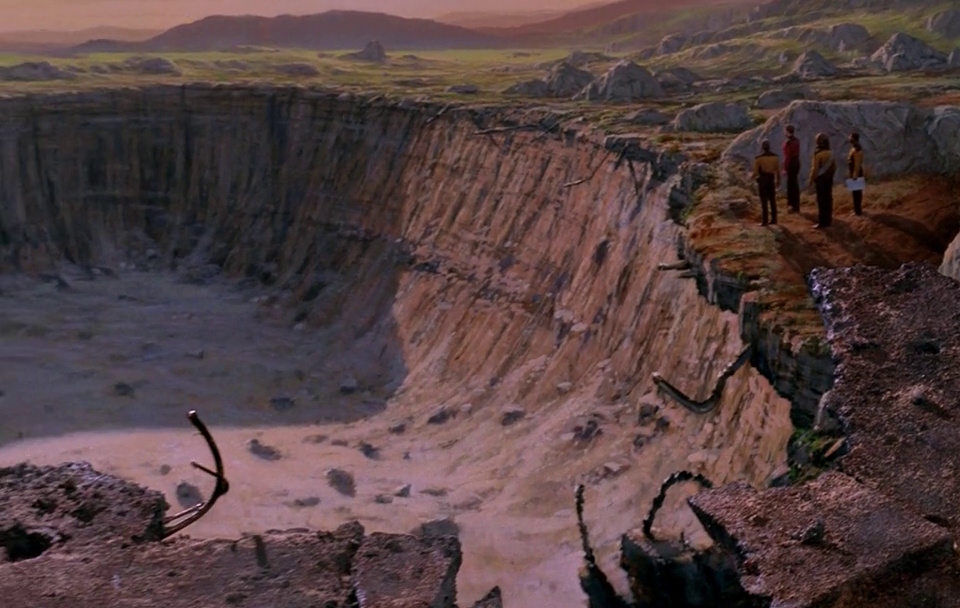
Star Trek: Picard – Six USS Stargazer theories

Spoiler Warning: There are spoilers ahead for Star Trek: Picard Season 1, the teaser for Season 2, and for the following: Star Trek: The Next Generation, Star Trek: Deep Space Nine, and Star Trek: Voyager.

Star Trek’s First Contact Day event a few days ago provided a lot of information and teases for upcoming projects in the franchise! Yesterday I took a look at one element from the Discovery Season 4 teaser, and today it’s Picard’s turn to go under the microscope! I wrote up my thoughts on the entire First Contact Day event, by the way, and if you missed that article you can find it by clicking or tapping here.

Both Discovery Season 4 and Lower Decks Season 2 are well into production – in fact, we now know that Lower Decks will be broadcast beginning on the 12th of August! Both shows were able to compile teaser trailers that incorporated a number of different scenes, probably from multiple episodes, and thus we had quite a lot to pick through for each! Picard Season 2, however, only entered production at the end of February, so naturally there wasn’t much to show.

There was a lot more to see from Discovery’s upcoming fourth season!

Instead what we saw was a stylised teaser, which I assume was deliberately filmed for First Contact Day. It seemed to include a shot of Château Picard – the Picard family vineyard – that was part of Season 1; a recycled shot to set up the rest of the teaser. The rest of the teaser comprised a shot of Picard’s study/office at the vineyard, with the camera lingering over a handful of items in the empty room.

The item most confusing to me at the moment is the book Paradise Lost! It’s an epic poem that I once had to read at school, written in the 1600s. And it’s all about Satan and God. Given what Picard is heard to say in voiceover about travelling through time and not knowing what might have been had different actions been taken, perhaps the meaning of Paradise Lost is less to do with the content of the poem than a literal reading of the title – something Picard did or didn’t do in the past changed the present, making things worse. That could be his “paradise lost.” This is frustrating!

How does Paradise Lost connect to the story of Season 2?

But Paradise Lost is not what we’re talking about today. In the teaser, Picard spoke of time as “the true final frontier,” and combined with the teaser focusing both on clocks and a backwards-running hourglass, time travel seems to be on the agenda! That’s before we get to Q, who is returning to tangle with Picard once more. Q is quite capable of time travel, as we’ve seen numerous times. Sir Patrick Stewart seemed to at least hint that Q isn’t responsible for whatever happens to Picard, but he’s clearly involved to some degree.

In addition to all of the time-related imagery, one thing from the trailer really leapt out at me: a model of the USS Stargazer. It’s the Stargazer that we’re going to talk about today, as the teaser seemed to at least hint at the possibility of revisiting this chapter of Picard’s life – something I predicted Season 2 might do a few weeks ago!

The USS Stargazer model as seen in the Season 2 teaser.

So let’s consider a few possibilities for how the USS Stargazer could be included in Season 2 of Picard. We’ve already heard the ship mentioned in Season 1; Dr Benayoun referenced Picard’s time aboard the ship in the episode Maps and Legends. Perhaps that was a hint at things to come in Season 2, and perhaps Dr Benayoun himself will make a return. We’ll have to wait and see what happens when the season airs next year!

My usual caveat applies: I have no “insider information.” I’m not claiming any of the things on this list will definitely happen in Season 2. This is just speculation and guesswork; a bit of fun and a chance to spend a bit more time talking and theorising about Star Trek. That’s all! So with that out of the way, let’s take a look at my six USS Stargazer theories.

Number 1: Picard’s “death” and a redux of The Next Generation Season 6 episode Tapestry.

Picard was given the option to make changes in his life in the episode Tapestry.

When I think of Q, Picard, and time travel, one of the first episodes that comes to mind is Tapestry. Given that Picard has faced death in Season 1, perhaps the stage is set for some kind of redux of this episode, or at least a story which uses a similar premise. In Tapestry, Picard was given a chance by Q to go back to his past and make changes in his life, choosing to use the wisdom of age to be more cautious and less impulsive. At first it seemed to save his life, but the changes made his life far worse and unliveable.

What wasn’t clear in Tapestry is whether Q and Picard were truly travelling through time or whether it was an elaborate illusion. I choose to think it was the former; Q had the power to do all of those things, after all! So maybe he will give Picard a chance to do so again.

Q in Tapestry.

At this stage we don’t know why Picard wants or needs to travel through time. It may be connected to the Zhat Vash, Coppelius, the super-synths from the season finale, or something else that happened last season. It may be connected to something from The Next Generation. Or it may simply be a new storyline written for the show as happened in Season 1. But if he did want to go back in time to change the past, perhaps he would enlist the help of Q, setting up a story similar to Tapestry.

If Picard were to go back in time to his Stargazer days, there are a lot of things he could potentially do differently, and thus a lot of different ways that the story could go. You’d think that, after what happened in Tapestry, Picard would have learned his lesson about changing the past. But if Q showed him a very different, far better future, perhaps he could be convinced to make such a change.

This might connect to the “paradise lost” concept that I touched on at the beginning. Perhaps Q is able to convince Picard that his best option, or the only option, to get a particular outcome in the future is to change the past?

Number 2: The Cardassian Border Wars.

Picard has had run-ins with the Cardassians before.

Though only mentioned briefly in The Next Generation, Picard was in command of the USS Stargazer during the Cardassian Border Wars. Not to be confused with Deep Space Nine’s Dominion War, this conflict took place in the mid-24th Century, prior to the events of The Next Generation. Picard made reference to one encounter in which a Cardassian ship fired on the Stargazer while the shields were down, causing him to have to flee!

One of the interesting things about choosing the Stargazer for part of Season 2’s setting as opposed to the Enterprise-D is that we know relatively little of Picard’s exploits while in command of the ship. Picard was in command of the Stargazer for around twenty years (from the 2330s to the 2350s) yet we only got brief hints at what he did in all that time. That makes it a relatively blank slate as far as the writers and producers of Season 2 are concerned.

A Cardassian Galor-class ship attacks the Enterprise-D in the episode The Wounded.

We do know, however, that Picard and the Stargazer saw action during the Cardassian Border Wars, and perhaps this could be a way for Star Trek to revisit the faction we got to know so well in Deep Space Nine. As one of the few known events during Picard’s time in command of that vessel, it’s at least possible that we’ll see it mentioned!

The Next Generation Season 4 episode The Wounded saw Picard work with the Cardassians, so it doesn’t seem as though he harbours any lingering feelings toward them; certainly not like the trauma he carries after his experiences with the Borg. So I don’t think that revisiting the Cardassian Border Wars would lead to the kind of powerful moment that we saw when Picard visited the Artifact in Season 1. But there could be something from those days that Picard has to confront, or perhaps he’s been hiding or repressing his feelings about the Cardassians since then?

The advantage to bringing the Cardassian Border Wars into play, at least from my point of view, would be that it would allow the series to revisit some of the events seen in Deep Space Nine and Voyager. Picard may not have much connection to those events, but other characters do. Seven of Nine, for example, served with and was once in a relationship with Chakotay, and his Maquis friends were killed by the Cardassians. Perhaps some kind of story related to Cardassia and the Cardassian Border Wars is on the cards.

Number 3: Assuming command in the 2330s.

Picard served in Starfleet for decades.

One of the things that Picard inadvertently changed during the events of Tapestry was that he never assumed command of the USS Stargazer. All we know of this event is that, following the death of the ship’s captain, Picard boldly assumed command. Doing so was a risk, one that the less cautious young Picard was willing and able to take. Following this event, he was appointed as the ship’s permanent commander and (presumably) promoted to the rank of captain.

The death of a ship’s captain is a significant moment, one that we haven’t seen often within Star Trek. Presumably the Stargazer’s captain was killed violently or during some kind of disaster or emergency; if he’d simply died of natural causes Picard’s tale of assuming command would be far less grand! So whatever happened, I think it’s fair to say it came at a difficult moment for the ship and crew.

Picard hallucinates the Stargazer crew in the episode The Battle.

This event may turn out to have some connection to Q or to something from Season 1 of the show. We could learn, for example, that the Zhat Vash or the super-synths were responsible for the attack on the Stargazer, and thus for Picard’s ascent to the captain’s chair. It may then be the Zhat Vash who want to go back in time to undo something, changing events so that Picard wouldn’t be in a position to help Soji and the Coppelius synths.

Maybe that’s a stretch and a reach, but the idea of undoing a mistake and trying to alter the future seems to be a theme of the season, according to the teaser. Picard himself was heard in voiceover saying that time never offers second chances – so perhaps the person or faction hoping to change the past is not Picard and his new crew, but some other nefarious faction. Picard and the crew of La Sirena may even be travelling back in time to preserve the timeline, not change it.

When it comes to factions we know of within Picard that could be interested in changing the past, the Zhat Vash have to be right up at the top. They’re fanatics, and after their recent defeat both at Coppelius and with the repeal of the ban on synthetic life they may try to travel back in time to exact their revenge. Going back to prevent Picard ever becoming a captain, changing his career and stopping him interfering in their plans, may be what they have in mind. One of the neat things about revisiting this era would potentially be a return of the red Starfleet uniforms!

Number 4: The Battle of Maxia.

The “Picard Manoeuvre” – Picard’s tactic at the Battle of Maxia.

At the opposite end of Picard’s time in command was the Battle of Maxia. At this battle, in which Picard faced a Ferengi ship, he devised the “Picard Manoeuvre” – a tactic that allowed his ship to appear to be in two places at once, and which was later taught at Starfleet Academy. In the aftermath of this battle, however, the Stargazer was lost. Presumed to have been destroyed, the ship was actually salvaged by the Ferengi.

The “Picard Manoeuvre” was referenced in Season 1, during the episode Et in Arcadia Ego, Part 2. As with the earlier reference to the USS Stargazer, perhaps this was setting up something that will become important in Season 2, or at least reminding us of its existence! These little crumbs could form a trail for us to follow, perhaps informing us of planned events in Season 2. Or I could be reading too much into individual lines, as I always seem to be!

Picard on the bridge of the Stargazer.

The Battle, the ninth episode of The Next Generation, explored the Battle of Maxia in more detail. It’s probably the one event involving the USS Stargazer that has been most closely examined on screen. That could mean it’s a good place for Season 2 to go, as it’s something we’re at least a little familiar with. Or it could mean that, as Picard has already confronted his actions at the battle and their consequences, there isn’t much left to explore.

In any case, it remains a possibility. Returning to the Battle of Maxia could see the return of the Ferengi in some capacity, though their involvement was not known at the time. As above, it could be a chance either for Picard to correct a mistake, or for someone nefarious to attempt to change the past – his past – by changing the outcome of the battle.

Number 5: The death of Jack Crusher.

Jack Crusher died while serving on the Stargazer.

Jack Crusher – husband to Beverly and father to Wesley – died while serving under Picard’s command aboard the USS Stargazer. It was at least implied that Picard bears a degree of responsibility for his death, or at least feels responsible for what happened. Perhaps that’s simply because of how he is as a commanding officer – but could there be more to it than that?

Of the main cast of The Next Generation, only Dr Crusher’s fate was left unconfirmed in Season 1. We saw Riker and Troi of course, and Data we know has died. Zhaban also confirmed that Geordi La Forge and Worf are still alive, so that only leaves Dr Crusher. In at least one future timeline, she and Picard had married – we saw no evidence for or against this idea in Season 1, so perhaps it could be explored in Season 2.

Jack Crusher in hologram form.

In the teaser, Picard spoke about how we often wish we’d acted differently during a crisis, and perhaps one thing he wishes he had been able to change was whatever led to Jack Crusher’s death. We could also learn that the Zhat Vash, super-synths, or some other faction or entity from Season 1 is involved in the events that led to him being killed, forming a kind of circular story going back to Picard’s past.

If Dr Crusher were to be involved in Season 2, she would undoubtedly have something to say about the possibility of revisiting the moment of Jack’s death! Maybe she would try to talk Picard out of it, saying that changing an event more than fifty years in the past would have huge ramifications for them both. Or maybe she’d be in favour of going back in time to prevent it from happening if his death set in motion a series of events that led to horrible consequences at the dawn of the 25th Century.

It’s also possible that Jack Crusher’s death may simply be the backdrop for the story – an event connected to something else in the series, but not something Picard hopes to undo.

Number 6: Anti-time and All Good Things…

Q and Picard in All Good Things…

In the finale of The Next Generation, Q set Picard a puzzle to solve that required him to think outside the box. In short, events in the future were – somehow – having a causal effect on events in the past. Figuring that out, and learning for the first time that time is not necessarily linear and moving only in one direction was what Picard learned.

As above with Tapestry, when I think of Q and time travel, I also think of All Good Things. The teaser made reference to “the trial,” and I believe even used a line spoken by Q in All Good Things as it drew to a close. Q told Picard in that episode that his and humanity’s trial in the eyes of the Q was ongoing, so perhaps the return of Q will mean revisiting some of these concepts.

Q in his “judge” guise in All Good Things…

Something that will be potentially interesting to explore are Q’s views on mortality. In the Voyager Season 2 episode Death Wish, Q helped a fellow member of the Q Continuum to die, but has never had to confront mortality himself. In many ways, Q seemed to regard Picard as something akin to a friend, and watching him age and confront death might be something that would interest and bemuse him.

In the panel that immediately followed the teaser, Sir Patrick Stewart appeared to refer to Q appearing in only a single episode, so perhaps his influence over the season won’t be as significant as we’re assuming. It was also implied that Q is not the cause of whatever the main event of the season is. However, if Picard needed to travel back in time for some reason – such as to prevent something catastrophic from happening in the present – he may voluntarily call upon Q. After all, how many other methods of time travel is Picard aware of?

All we can say for sure at this stage is that Q is involved somehow. But given the teaser’s focus on time travel, maybe his involvement will be in sending Picard and his new crew back in time, perhaps to the time he served aboard the Stargazer.

So that’s it. Six theories about Picard Season 2 and the USS Stargazer!

At this stage, with the second season perhaps as much as a year away from being broadcast, we have very little to go on. As mentioned, the teaser didn’t include a single character or completed scene or sequence, so I’m reading an awful lot into a few lines of voiceover and the imagery presented! We don’t even know for sure that the USS Stargazer will be included in any form, let alone visited through time travel!

The USS Stargazer being towed by the Enterprise-D.

Despite that, however, it’s great fun to speculate and theorise about what might be happening. The series is currently in production, with filming ongoing at time of writing, and while we’re unlikely to see another teaser or trailer any time soon, I’ll be keeping an eye out for any tiny tidbits of news that may come our way!

Discovery has shot forward into the 32nd Century; the far future. As such, it’s less easy for that show to bring back characters, themes, and storylines from Star Trek’s past – though that didn’t stop me making a few guesses about what may be going on in Season 4! But Picard is only set twenty years on from the events of the 24th Century Star Trek shows, and as such we could potentially see the inclusion of all manner of characters and other story elements – as indeed we saw happen in Season 1.

Regardless, I’m excited to see where Picard Season 2 takes the story next. The return of Q promises to be great fun, and while the season is a way off yet, I think it’s okay to make a few tentative guesses about what may be going on!

Star Trek: Picard Season 1 is available to stream now on Paramount+ in the United States and other regions where the platform is available. It may be streamed on Amazon Prime Video in the United Kingdom and other countries and territories. Star Trek: Picard Season 2 is scheduled to premiere on Paramount+ and/or Amazon Prime Video next year. The Star Trek franchise – including Picard and all other properties mentioned above – is the copyright of ViacomCBS. This article contains the thoughts and opinions of one person only and is not intended to cause any offence.
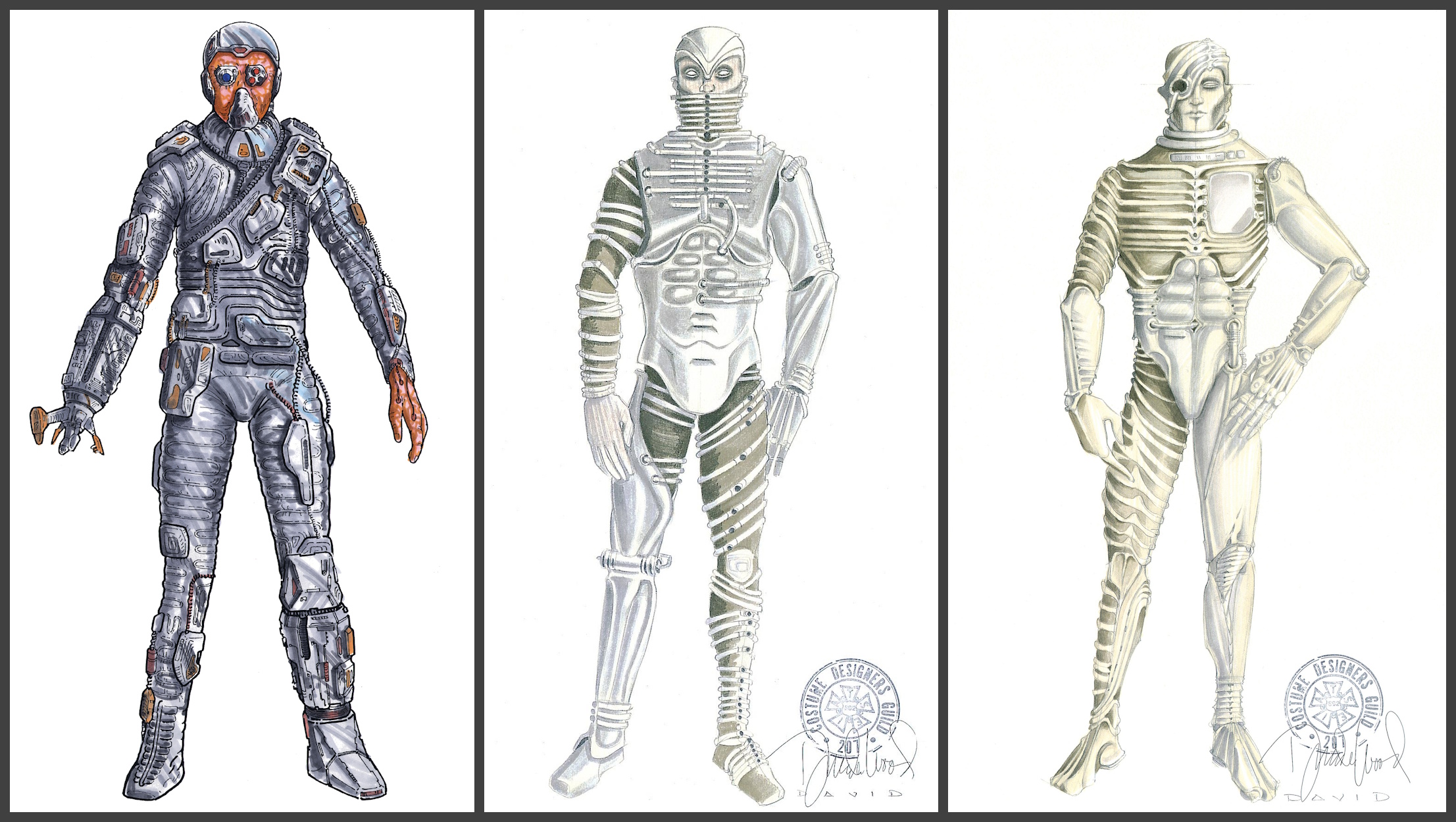
Star Trek: Discovery – eight “gravitational anomaly” theories

Spoiler Warning: There are spoilers ahead for Star Trek: Discovery Seasons 1-3 and the teaser trailer for Season 4. Further spoilers are present for the following: Star Trek: Picard Season 1, Star Trek: The Next Generation, Star Trek: Generations, Star Trek: Voyager, and Star Trek: Enterprise.

Star Trek’s First Contact Day virtual event has given us an awful lot to digest! We got teasers for Picard Season 2, Lower Decks Season 2, Discovery Season 4, and more details about Prodigy. If you missed the event, I wrote up my impressions of everything we saw, and you can find that article by clicking or tapping here.

This time, I want to look at the teaser for Discovery’s impending fourth season in more depth, and in particular start making some guesses about what may be going on! The teaser was barely ninety seconds long, and with the show at least six months away it may be futile to speculate about pretty much anything! But that hasn’t stopped me in the past, so let’s jump in!

Sonequa Martin-Green plays Captain Michael Burnham in Discovery, and introduced the Season 4 teaser during the First Contact Day event.

My usual disclaimer applies: I don’t have any “insider information.” I’m not offering up these suggestions saying any are unequivocally true. This is nothing more than speculation from a fan – and a chance to spend some more time talking about Star Trek, which I absolutely adore.

In the run-up to Season 3 last year, I spent a lot of time speculating about the event that ultimately turned out to be the Burn. When we first heard its name I put together a list theorising a number of possible connections to past iterations of Star Trek – but as you know by now, none came to pass!

Michael Burnham in Season 3, trying to figure out what caused the Burn.

Discovery has had an on-off relationship with Star Trek’s broader canon. Season 1 sidestepped a lot of things, redesigning the Klingons, visiting the Mirror Universe years before Kirk’s first crossing, and fighting a major war. Season 2 tied itself much closer to canon, bringing in Captain Pike, Spock, and revisiting Talos IV. Season 3 shot forward into the future, and told a story that touched on past iterations of the franchise at points, but had an overall narrative that stood on its own two feet.

In short, trying to guess whether Season 4’s main storyline will be related to something we’ve seen in the past or not is a crapshoot. Maybe it will be, maybe it won’t. Regardless, if it’s going to be something brand-new then naturally the details become impossible to predict! So in this list I’m going to look at eight possibilities from Star Trek’s past that could explain what we saw in the teaser.

A determined-looking (and armoured) Burnham in the Season 4 teaser.

First of all, let’s explain what exactly we saw! Stamets described a “gravitational anomaly” that’s at least five light-years in diameter. This anomaly appears to be incredibly destructive, and if Burnham is correct, it’s appearing and disappearing at random. As a result, it could potentially strike any Federation or non-Federation world or starship without warning.

Assuming that this anomaly is the main problem facing Captain Burnham and her crew in Season 4, I’ve got a few ideas for what it could be, or what it may be related to. I quite like the idea of Discovery sticking with the “natural disaster” concept from Season 3. It worked well last time, and presenting the crew with a puzzle, mystery, or challenge that’s more scientific in nature than military could be wonderful to see. As long as such a storyline manages to avoid feeling either repetitive or anticlimactic, I think it works in principle.

Stamets in the Season 4 teaser. He told us about the “gravitational anomaly.”

One final point of note is that, due to disruption caused by the pandemic, Discovery Season 4 began filming back in November, well before Season 3 had finished airing – and crucially, before the creative team had time to process any feedback they were getting about the season’s themes and storylines. As a result of that, it may be the case that Season 4 doesn’t make as many changes from Season 3 as some fans would have wanted to see. But once again, that’s speculation on my part!

So let’s consider this “gravitational anomaly,” then. What could it be? What have we seen in past iterations of Star Trek that could potentially be involved? Will there be any tie-ins to other ongoing series, such as Picard, or will the show set up something we’ll see return in a future project, such as Strange New Worlds? Let’s jump into the list and see if we can make some reasonable guesses!

Number 1: The Nexus

The Nexus approaching the planet Veridian III.

When I first saw the teaser, my mind immediately went to the Nexus, the energy ribbon seen in Star Trek: Generations. The Nexus was large, more than large enough to engulf an entire planet, and while it may not have been light-years in diameter when we saw it in that film, it’s possible it grew… somehow! The Nexus was incredibly destructive, causing the destruction of two transport ships and seriously damaging the Enterprise-B, not unlike some of the damage suffered by the USS Discovery in the teaser.

There are two crucial points which made me think of the Nexus, though. The first is that the energy ribbon was said to contain a “gravimetric field,” which sounds an awful lot like Stamets’ “gravitational anomaly.” Both seem to be connected to gravity, and as we saw in the teaser, the USS Discovery appears to lose its artificial gravity at one point.

The Enterprise-B trying to manoeuvre inside the Nexus.

The second point I consider key to the Nexus being a possibility is that we already know it’s something that recurs. The Nexus returns to the Milky Way galaxy every 39.1 years (according to Data in Generations) and unless something major happened in the intervening centuries, this force of nature should still be present, periodically crossing through the galaxy.

At a couple of points in the teaser we saw members of Discovery’s crew looking dazed and confused, not unlike how Soran and Guinan appeared after being transported out of the Nexus by the crew of the Enterprise-B. Perhaps we can infer from their demeanours that they’re not quite sure where they are or what just happened – maybe that means they’ve just spent time inside the Nexus’ paradise-like realm.

Though the stated size of the anomaly relative to what we saw in Generations may count against it, I like the idea of revisiting the Nexus. Would Discovery bring aboard a Soran-like villain, someone hell-bent on getting to “paradise?” Maybe!

Number 2: The super-synths from Picard Season 1

The super-synths in Picard Season 1.

It’s absolutely true that I also suggested the super-synths could’ve been the cause of last season’s disaster! But that doesn’t mean I’m done suggesting ways for this unnamed faction to reappear in Star Trek, especially considering that the teaser for Picard Season 2 suggested that series is moving away from them.

At the end of Picard Season 1, we learned that there is a race of super-synths that exist somewhere out in deep space – perhaps many thousands of light-years away from the Milky Way galaxy. They offered to come to the aid of any synths that ask for their help, though whether this offer was genuine or not was not clear – as indeed was very little about the faction!

Jean-Luc Picard managed to prevent the arrival of the super-synths, along with Soji.

Soji and Sutra, two of the synths from Coppelius, attempted to make contact with the super-synths, but despite opening a beacon and a portal to their base, Soji was ultimately convinced to shut it down and cut off her attempt to communicate. We thus learned precious little about who the super-synths are or what their objectives may be. They seemed menacing, and may harbour an anti-organic hatred that could make them diametrically opposed to the Federation.

We know that, in principle, this faction can open portals in space to allow for travel far faster than warp drive. Perhaps getting too close to one of their portals causes the kind of damage seen to the USS Discovery, and their portals may appear to be “gravitational anomalies” when detected on sensors. The super-synths clearly have a powerful understanding of gravity, such that they were literally able to move stars and create a stable eight-star octonary system. It’s thus at least possible that they use gravity or gravitational anomalies as some kind of weapon.

One thing that Picard Season 1 left unresolved was the fate of the super-synths. Having been contacted, were they now aware of the Milky Way and the Federation? Might they be hell-bent on attacking the Federation? If their offer of help wasn’t genuine, might they arrive to attack the synths who live in the Milky Way? There are a lot of unknowns, but it’s at least plausible that they could be involved. As I’ve said numerous times, finding a way for Picard and Discovery to work together, using similar themes, factions, or even characters would be fantastic and something truly worth doing. This may not be the way it happens… but it could be!

Number 3: A graviton ellipse

The USS Voyager once encountered a graviton ellipse.

The Voyager Season 6 episode One Small Step introduced the graviton ellipse, a fast-moving anomaly that can travel through subspace, normal space, and even other dimensions. The ellipse was drawn to electromagnetic energy – such as that emitted by spacecraft! One ellipse appeared in the Sol system in 2032, during an early manned mission to Mars, and “swallowed” the Ares IV ship. It later attempted to do the same to the USS Voyager.

The graviton ellipse was smaller than five light-years across, so again we have to contend with size. But there are points in its favour! Firstly, the ellipse was specifically drawn to spacecraft and other future technology. Though we didn’t see it attempt to “eat” anything on a planet’s surface, it stands to reason that similar technologies used in power generation may emit the same kind of electromagnetic radiation that an ellipse would be drawn to.

The Delta Flyer inside a graviton ellipse.

Secondly, the ellipse moved essentially at random, disappearing into subspace to reappear many thousands of light-years away. One single ellipse was known to have visited both the Alpha and Delta Quadrants. This seems to fit with what we know of Discovery’s “gravitational anomaly” – specifically the part Captain Burnham told us about its random, unpredictable appearances.

Finally, the graviton ellipse was known to cause damage to spacecraft, draining their power, as well as gravity-related disturbances in space. An encounter with an ellipse may not have destroyed Ares IV or the Delta Flyer, but they were known to be very difficult to escape from.

The drawbacks of this option are that graviton ellipses were relatively well-understood as early as the 24th Century, and with Discovery Season 4 set over 800 years later, it stands to reason that the Federation would be well-equipped to at least know what they’re up against if an ellipse seemed to be in the vicinity. Secondly, there was no indication that the ellipse would stay in one area, causing widespread damage in the way Discovery’s fourth season teaser suggested. Despite those negative points, however, I think it’s at least a possibility. Perhaps post-Burn technology has drawn an ellipse to Federation space, or it’s even possible that someone has found a way to weaponise one to attack the Federation.

Number 4: The Sphere-Builders from Enterprise

A Delphic Expanse sphere.

Discovery’s third season had a couple of interesting references to Enterprise, specifically the “Temporal Cold War” arc. One faction involved in the Temporal Cold War were the so-called Sphere-Builders: extradimensional beings who were attempting to convert part of the Milky Way galaxy to match their native realm so they could colonise it.

Though the time-travelling agent Daniels told Captain Archer that the Sphere-Builders were definitively defeated in the 26th Century, Daniels was from a time period before Discovery Season 4 is set, so he may not have been aware of any future involvement they had in galactic affairs!

Captain Archer looks at a projection of spheres in the Delphic Expanse.

The Sphere-Builders, as their name implies, built spheres. These moon-sized objects were spread throughout a region of space known as the Delphic Expanse, and emitted huge amounts of gravimetric energy, causing the entire region to become unstable and peppered with anomalies.

The spheres were also able to cloak, concealing them from 22nd Century human and Vulcan ships. The region of space a single sphere could affect was huge, and in the mid-22nd Century there was a large network of them, perhaps consisting of over 75 individual spheres. A hidden anomaly-generating piece of technology with a connection to the Temporal Wars? That sounds like something that could cause the problems afflicting Captain Burnham’s ship as seen in the teaser!

If a rogue sphere were on the loose, if the Sphere-Builders were returning, or if a single sphere had been left in the Milky Way, forgotten about since the 22nd or 26th Centuries, it stands to reason based on what we know of them that it could be the cause of the “gravitational anomaly.” This concept is potentially interesting; a leftover “doomsday weapon” unattended for centuries could make for a fun story. It would also be great to see a tie-in with Enterprise!

Number 5: Tyken’s Rift

Data explains how a Tyken’s Rift works to the crew of the Enterprise-D.

A Tyken’s Rift was mentioned in the Picard Season 1 episode Nepenthe, but before that one had been seen in more detail in The Next Generation fourth season episode Night Terrors. It was described as a rare spatial anomaly, one capable of encompassing entire star systems.

Unlike some of the other entries on this list, size isn’t a problem for a Tyken’s Rift! If a whole binary star system (i.e. a system with two stars) was able to fit inside, it’s more than possible such an anomaly could be five light-years in diameter!

A Tyken’s Rift was mentioned by Kestra Troi-Riker in Picard Season 1 last year.

The Enterprise-D wasn’t badly damaged by its encounter with the rift, but it was trapped inside and unable to escape. The Tyken’s Rift was also said to drain power, trapping ships inside. Perhaps the damage to the USS Discovery was not caused by the anomaly itself, but by pushing the ship past its limits trying to escape?

The drawback to a Tyken’s Rift being the cause of Discovery’s anomaly is twofold. Firstly, aside from a slow but steady power drain it didn’t seem to be harmful, and we saw nothing in Night Terrors to suggest this anomaly could or would cause catastrophic damage to a ship. And secondly, the Tyken’s Rift that the Enterprise-D encountered appeared to be stationary. It was even included on stellar maps, so it would be easily avoided.

I don’t think either of these points totally rule it out, and as one of the relatively few named anomalies in Star Trek that are massive enough, it seems fair to still include a Tyken’s Rift as a possibility.

Number 6: Species 8472 and Fluidic Space

A member of Species 8472.

One of Voyager’s most interesting adversaries was Species 8472, known only by their Borg designation! This powerful extradimensional faction were able to outwit even the Borg, fighting a very successful war against them for a time.

Species 8472 were native to a realm filled with an organic compound. Voyager’s crew named this region “fluidic space,” and it seemed as though Species 8472 based much of their technology on this organic material, including their spacecraft.

The USS Voyager being pulled toward a fluidic space portal.

The Borg became aware of fluidic space some time in the mid-late 24th Century, and attempted to travel there and assimilate it. But Species 8472 proved resistant to assimilation, and waged a war on the Borg, eventually travelling through to normal space to continue the fight. The intervention of the USS Voyager gave the Borg an advantage, but it seemed shortly thereafter as though the war ground to a stalemate.

Species 8472 made one further incursion, but after an agreement with the USS Voyager, agreed to return to their own dimension, content that the Federation proved no threat. However, that was 800 years ago! A lot can change, and perhaps Species 8472 have decided to make a return.

This would change the “natural disaster” concept, making it perhaps a precursor to invasion. Whether that would be good or not depends on how well it was executed – as well as your personal preferences for storylines! Given what we know of Species 8472 and their technology, I think it’s at least possible they could be the cause. Perhaps Stamets’ anomaly is some kind of gateway to fluidic space.

Number 7: The Borg

Borg drones seen in First Contact.

On the other side of the war with Species 8472 were the Borg! I also suggested Star Trek’s iconic cybernetic villains as a possible cause of the Burn last season, and despite seeing some ex-Borg in Picard Season 1, we haven’t really seen the faction proper in Star Trek since Enterprise Season 2 in 2003. Perhaps now is the right time?

Borg technology outpaced the Federation in the 24th Century by a considerable margin, and I’ve seen nothing to suggest that wouldn’t continue to be the case. The anomaly Stamets and Burnham discussed in the teaser may well be a natural phenomenon, but if it turns out to be a weapon, I can think of few other factions capable of creating and wielding one so massively powerful. Other Borg technology, such as their transwarp network, was known to have gravitational effects as well, so perhaps that’s another sliver of evidence.

The Borg were known to possess powerful technology.

This doesn’t really fit with the Borg’s usual modus operandi, and that is certainly a mark against it! But then again, the Borg are very adaptable, and travelling back in time several centuries is not exactly standard procedure for assimilating a planet either, yet that’s what they tried to do in First Contact! The gravitational anomaly could be the opening salvo of an attack; the artillery barrage to soften up the Federation before the Borg drones rush in to assimilate the survivors. The Borg certainly seem capable of doing something like this, and with the Federation having been on the back foot for more than a century as a result of the Burn, the Borg may have been using that time to build up and prepare for a large-scale invasion attempt.

We don’t know for sure if the Borg are still around in the 32nd Century, or if they still hope to one day conquer and assimilate the Federation. After more than 800 years, anything could have happened to them! However, it’s plausible that they still exist in similar form to how we last saw them.

The anomaly seemingly “attacking” both Federation and non-Federation targets could be indicative of an intelligence at work behind it. Space is huge after all, and the chances of it hitting a target as small as a starship, starbase, or planet regularly seems unlikely without some kind of explanation. Is it a force of nature drawn to energy, like the graviton ellipse mentioned above? Or is it a Borg weapon deliberately targeting Starfleet? The latter may seem unlikely, but it’s not impossible!

Number 8: The Burn

The Burn.

I certainly hope that Discovery Season 4 doesn’t just drop the Burn and proceed as though it never happened. After the cataclysm caused huge disruption to the Federation and the wider galaxy for over a century, I think we need to see a lot more of the consequences of that event before we even consider a “reset” of the Federation!

Perhaps what this anomaly will be is some kind of “mini-Burn,” affecting a smaller area. It could be a ripple effect of the original event, or otherwise connected to it in some way. Hopefully it won’t be caused by poor Su’Kal, who’s been through enough over the last 125 years! Though the Burn was presented as a unique event, perhaps it had lingering effects that are only just becoming known.

Su’Kal caused the Burn.

Season 4 needs to walk a line between acknowledging the events of Season 3 without dwelling on them the whole time. I understand that the writers and producers have other stories to tell in the 32nd Century beyond the Burn, but given how catastrophic it was I feel strongly that we need to see at least some of its lingering impact. Connecting the Burn to this new problem would create a degree of separation, allowing the season to go in new directions but without dropping the massive event entirely.

The Burn was a disaster which “caused dilithium to become inert,” and which caused active warp cores to explode. It wasn’t known to have gravitational effects, instead being some kind of shockwave that travelled through subspace. That could certainly count against it!

However, if this event were connected to the Burn in some other way, rather than being a direct result of Su’Kal’s outburst, perhaps it could be explained. I couldn’t even guess how such a connection could be made; it would be some kind of technobabble connecting the anomaly to dilithium and/or subspace. But it could be done, and it could be made to fit!

So that’s it. Eight very early theories about Discovery Season 4 and the mysterious “gravitational anomaly!”

Yes, Season 4 is scheduled to premiere this year!

As mentioned at the beginning, I quite like the idea of the series going down a “natural disaster” route, allowing the crew to solve a puzzle and unravel a mystery, rather than simply pitting them against a Federation-threatening adversary. Perhaps that will be what ultimately happens, but I think it’s at least possible we’re seeing some kind of attack or weapon as well. Time will tell!

The teaser was action-packed, and the new season looks to be in great shape. I think that there are possible downsides to another “huge galactic disaster” storyline so soon after resolving the Burn, in that it risks feeling tacked-on, derivative, or even anticlimactic if it’s an event smaller in scale. But despite that, if this anomaly is going to be one of the main storylines in Season 4, there’s a huge amount of potential.

Star Trek’s past didn’t provide the key to understanding the Burn last season. Will something we’ve seen before come into play in Season 4? Maybe!

Star Trek: Discovery Season 4 will debut on Paramount+ in the United States, and on Netflix in the United Kingdom and elsewhere, sometime later this year. Star Trek: Discovery Seasons 1-3 are available to stream now. The Star Trek franchise – including Discovery and all other properties mentioned above – is the copyright of ViacomCBS. This article contains the thoughts and opinions of one person only and is not intended to cause any offence.
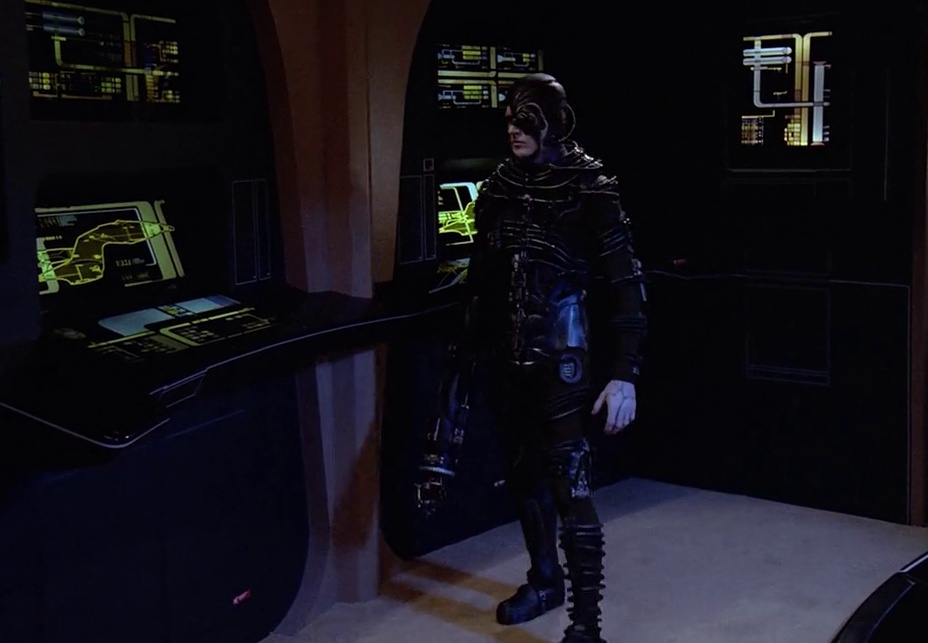
Star Trek: Strange New Worlds Season 1 theory – Saving Captain Lorca

Spoiler Warning: There are spoilers ahead for Star Trek: Discovery Seasons 1-3, and for other iterations of the franchise.

At this very early stage, with Strange New Worlds having only just entered production, we don’t know what storylines the series might include. It’s far too early to speculate, especially because we don’t even know who most of the main characters will be. But that won’t stop me!

I’ve been kicking around this theory since Strange New Worlds was announced last year, and while I’ve mentioned it on a couple of occasions I think it’s time to spin it out into its own official theory! I have already made some suggestions and preliminary predictions for things we might see during Season 1 of the upcoming series, but this is my first standalone pre-season theory.

So here goes: Pike and the crew will find a way to cross over to the Mirror Universe to save the Prime Universe version of Captain Lorca.

The Prime Universe version of Captain Lorca is missing.

To briefly recap, Captain Lorca was the original captain of the USS Discovery back in Season 1 of Star Trek: Discovery, but the character we met wasn’t the Prime version, he was from the Mirror Universe. We wouldn’t get to know that until the latter part of the season, but a transporter accident saw Lorca swap places with his Prime counterpart sometime prior to the events of Season 1.

While it was stated by Admiral Cornwell that Prime Lorca would not have survived in the Mirror Universe this was never confirmed on screen, and judging by the reaction of characters like Mirror Tilly and Mirror Georgiou to Lorca’s reappearance, they didn’t believe him to be dead or imprisoned. Thus Prime Lorca’s fate is unknown – which means he could be brought back.

Admiral Cornwell believed Lorca to be dead – but she had no proof of that.

Let’s go over the evidence in favour of Lorca’s survival first, then we’ll see if we have any evidence that Strange New Worlds might include a storyline of this nature.

Firstly, we never saw Lorca die on screen. Only one character – Admiral Cornwell – assumed he was dead, and then the subject was dropped as the crew had to focus on ending the Klingon War. This opens the door to Lorca’s survival, as in almost any film or series, a character should not be assumed to be dead unless we as the audience see that for ourselves! Star Trek has, on occasion, sprung surprises like this, bringing back characters who had “died” – such as Tasha Yar in The Next Generation Season 3 episode Yesterday’s Enterprise. The existence of different timelines and different versions of characters means we cannot be sure that practically anyone is truly dead and gone!

Secondly, in Discovery Season 1, when the crew crossed over to the Mirror Universe, nobody native to that universe expressed surprise about Lorca’s presence. If the Prime version of Lorca had arrived and been killed or captured, at the very least we’d expect Empress Georgiou to have commented on his reappearance. If she believed him to be dead or languishing in one of her torturous prisons, she wouldn’t have simply allowed Burnham to bring Lorca to her aboard the ISS Charon – surely she would have considered that to be a trap.

Empress Georgiou gave no indication that she believed Lorca dead or imprisoned.

We know from The Original Series episode Mirror, Mirror that transporter accidents – which Lorca is said to have experienced – don’t kill people. If Mirror Lorca arrived in the Prime Universe, it stands to reason that Prime Lorca crossed over to the Mirror Universe at the same moment. Characters in Season 1 made this same assumption, and I think we can be relatively sure that Prime Lorca did in fact end up there.

When he arrived, he would have immediately come under attack by Terran forces. However, there was also a significant contingent of Lorca loyalists, and if he could have survived the initial battle and gotten his bearings, he could certainly have gone into hiding to avoid Empress Georgiou’s assassins.

Could Captain Lorca have survived his initial encounter with the Mirror Universe?

This is semi-confirmed by the recent Discovery Season 3 episodes Terra Firma, Part 1 and Terra Firma, Part 2, in which Georgiou revisited a version of the Mirror Universe via the Guardian of Forever. In those episodes, Lorca’s absence was a pretty significant story point, and his planned coup attempt was brought up numerous times by Mirror Universe characters. These events supposedly took place during Discovery Season 1, shortly before Mirror Lorca’s return to the Mirror Universe. Prime Lorca had therefore already crossed over, and doesn’t seem to have been captured or killed.

If we’d learned in Terra Firma that Lorca was dead or imprisoned, that would be that. But his absence leads me to believe that he survived his initial encounter with Georgiou’s forces. After getting his bearings and realising he’d ended up in a different reality, Lorca’s first instinct would have been to find a way home. However, priority number one in such a situation is to survive to fight another day, and going into hiding to avoid further attacks makes a lot of sense.

We saw no indication in Terra Firma that Lorca was considered dead. In fact, his absence was a source of concern for Georgiou and others.

Just as Mirror Lorca was able to pass as his Prime counterpart, Prime Lorca may have been able to convince those around him that he was the Mirror version. We saw Kirk, Dr McCoy, Scotty, and Uhura manage to do so in Mirror, Mirror – and Spock remarked that it was “far easier for you, as civilized men, to behave like barbarians than it was for them as barbarians to behave like civilized men.” Survival in the Mirror Universe can be accomplished.

If Lorca were able to convince even a handful of loyalists to go into hiding, perhaps commandeering a shuttle or ship, they could have disappeared and gone off the grid shortly after his arrival. This would have the added benefit of giving Lorca time to regroup and figure out what happened and how to reverse it. At the very least, he would want to try to send a message back across the divide to the Prime Universe.

Lorca with some of his loyalists.

In the Mirror Universe, the existence of the Prime Universe was known to senior Terrans. The crossover of the USS Defiant (as seen in Star Trek: Enterprise) gave them a century’s head start on learning about their Prime cousins. Just as Michael Burnham was able to learn about the Defiant during Season 1, Lorca may have been able to come by this information too – especially because his Mirror counterpart seems to have been aware of the two universes.

So the pieces begin to fall into place. Lorca was resourceful, and may have been able to avoid detection long enough to survive. Following Mirror Lorca’s coup and Empress Georgiou’s disappearance, we don’t know what became of the Imperial throne or who the new Emperor is. It stands to reason, though, that with Mirror Lorca dead the heat would be off, and perhaps Prime Lorca would have been able to leave his hiding place and finally send his message across the divide.

The end of Georgiou’s reign may have allowed Prime Lorca an opportunity to break cover and contact Starfleet.

In short, it all hangs on those crucial first few moments after his arrival. If Lorca could survive in the Mirror Universe long enough to get his bearings, I firmly believe he could have passed himself off as his Mirror counterpart, gone into hiding to avoid Georgiou’s assassins, and laid low while he planned his next moves. When he learned of Georgiou’s death, breaking cover long enough to send a message would have been risky, but possible.

We don’t know exactly how communication between universes would work. But as mentioned, Lorca is a resourceful individual, and with the Mirror Universe’s knowledge of the Prime Universe, it stands to reason he could have figured out something. And if he could send a message asking for help, well that’s where Pike comes in.

Captain Pike.

We know for a fact that Captain Pike is aware of the existence of the Mirror Universe. As he departed the USS Discovery for the final time, Georgiou told him she was from there. His cheeky wink suggested he already knew of its existence – and of her origin – but even if he didn’t and was bluffing, after that moment we can say definitively that he knew of its existence. Given his rank, he could have learned more from Starfleet about the Mirror Universe – Discovery’s crossover was well-documented, after all.

Captain Pike would not leave any Starfleet officer behind, so if he picked up Lorca’s distress call – or was assigned to rescue him by Starfleet – he would figure out a way to do so. It’s in his nature to want to help, and as we saw across Discovery Season 2, Pike exemplifies the best of Starfleet. As two captains serving at the same time, it’s possible Pike and Lorca knew each other, or even that they were friends. This relationship could be explored, and would give Pike an added incentive to rescue Lorca.

Captain Pike would not want to abandon Lorca.

So the question now is how? How would Pike cross over to the Mirror Universe to retrieve Lorca? There are two reliable ways we know of to access the Mirror Universe (not including a warp core leak in a wormhole): the transporter and the mycelial network. With the USS Discovery gone (and the USS Glenn destroyed) using the mycelial network is clearly not possible. So that leaves the transporter.

By recreating the conditions of Lorca’s transporter accident, perhaps Pike could figure out a way to cross over and enter the Mirror Universe – and crucially, a way to get home again afterwards. However, this method means that Pike and a small team would be effectively on their own in the Mirror Universe, with no ship and no backup!

Is a crossover via the transporter on the cards?

Discovery reintroduced the Mirror Universe in a big way, and while it’s never been my favourite setting within Star Trek, it seems that the Mirror Universe episodes have gone down well with fans. It’s at least possible that Strange New Worlds would want to try its own Mirror Universe story, and I can’t think of any that would be better than rescuing Captain Lorca.

Spock’s presence may complicate matters, though. In Mirror, Mirror he seemed entirely unaware of the Mirror Universe when Kirk and the others crossed over, so perhaps he would have to be kept out of such a story. It wouldn’t be impossible to accomplish this; perhaps the mission is classified so only officers of a certain rank can know, or perhaps Spock was away on another assignment or injured and unable to participate. If a suitable in-universe reason could be found, it would be possible to keep Spock out of this story – preserving Star Trek’s internal timeline.

Spock would need to be kept out of any Mirror Universe stories in Strange New Worlds.

On the production side of things, Jason Isaacs – who played Lorca – has indicated he’d be up for a return to Star Trek, and as mentioned the Mirror Universe has been popular within the franchise in recent years. There are no practical reasons that I can see which would make a story like this impossible.

So that’s the extent of this theory – at least for now! Captain Lorca is alive, stranded in the Mirror Universe. He sends a message to Starfleet, and Pike is sent to rescue him. This story could be a lot of fun, and bringing back Lorca would be a really interesting move, one which could have repercussions for Strange New Worlds, the Section 31 series, and any other 23rd Century Star Trek projects. Lorca could go on to be a recurring character in any and all of these shows.

It would be great to welcome Lorca back to Star Trek.

Obviously we don’t know at this stage whether this will happen in Season 1 – or at all! However, it would be a great big connection between Discovery and Strange New Worlds, tying together two parts of the ongoing Star Trek franchise, which you know I’m always in favour of.

Lorca was an interesting character in Season 1 – the hardball Starfleet captain who didn’t always play nice. It seems as though the Prime version was similar, in many respects, to his Mirror counterpart, which is one of the main reasons Mirror Lorca was able to avoid detection for so long. This kind of character is uncommon in the franchise, and bringing Lorca back would be a lot of fun, even if it was just for a single episode.

If we don’t see Lorca return in Season 1, I’m still going to keep my fingers crossed. Perhaps he’ll make an appearance in Season 2 or in the Section 31 series instead!

Star Trek: Strange New Worlds will be broadcast at some point in future on Paramount+ in areas where the service is available. Further international distribution has not yet been announced. The Star Trek franchise – including Strange New Worlds, Discovery, and other properties mentioned above – is the copyright of ViacomCBS. This article contains the thoughts and opinions of one person only and is not intended to cause any offence.

The Section 31 series – when is it set?

Spoiler Warning: There are spoilers ahead for Star Trek: Discovery Seasons 1-3, Star Trek: Picard Season 1, and for other iterations of the franchise.

At the end of Star Trek: Discovery Season 2, Mirror Georgiou surprised me – and a lot of other viewers as well – by remaining aboard the USS Discovery as it headed into the future. Michelle Yeoh, who plays the character, had been announced as the lead in a new spin-off series based on the shadowy organisation Section 31 in the run-up to Season 2’s broadcast, and it was assumed that the new series would take place in the 23rd Century. Georgiou’s departure into the future seemed to complicate that!

Part of that story has since been resolved, and we now know that Georgiou will not be remaining in the 32nd Century with Burnham and the rest of Discovery’s crew. The Guardian of Forever sent Georgiou to an unknown destination in the episode Terra Firma, Part 2. Georgiou’s destination was left ambiguous, deliberately so. And in my Discovery Season 3 theories post after Terra Firma, Part 2 was broadcast I speculated about a few possible time periods that she could find herself in on the other side of the Guardian’s portal. This time I’m going to expand on that a little, looking at the possibilities of different time periods, as well as the possible pros and cons of each from both an in-universe and production perspective.

Mirror Georgiou – played by Michelle Yeoh – is set to headline the upcoming Section 31 series.

Before we get into the different time periods, it’s worth considering the Section 31 show’s status. Despite being announced in early 2019, before Discovery Season 2 was broadcast, the show has yet to enter production. Comments from Alex Kurtzman and particularly the two lead writers/producers (Bo Yeon Kim and Erika Lippoldt) seem to suggest that the show’s fate is not certain, and recent news about Star Trek projects through at least the first half of 2022 explicitly excluded the Section 31 series. It seems as though it won’t be entering production any time soon, perhaps not until Discovery, Picard, or Strange New Worlds have concluded their runs.

I must admit that this news doesn’t leave me feeling great. The Section 31 series already took a back seat to Strange New Worlds – fans were clamouring for more of Anson Mount and Ethan Peck as Pike and Spock after Discovery Season 2, and that definitely stole the Section 31 show’s thunder. Fans just weren’t as excited about Mirror Georgiou and Section 31 as they were for Pike, and as a result we’ve seen Strange New Worlds greenlit and enter production before Section 31, even though it was announced later.

Strange New Worlds is already in production, despite being announced after the Section 31 show.

I was one of the fans who wasn’t particularly excited for Section 31 during Discovery Season 2. But I have since come around to the idea of this show, and I feel that – if properly executed – it could be a truly interesting and different part of a growing Star Trek franchise. A James Bond-esque spy thriller, which is what the series seems to want to be, holds a lot of appeal, and may even succeed at bringing in new viewers beyond Star Trek’s usual crowd. That’s all to the good!

So despite my initial reaction, I’m now firmly in the camp that’s looking forward to Section 31 – and I hope it does manage to enter production before too long! With that out of the way, let’s start to consider just when in the Star Trek timeline the series could be taking place. My usual caveat applies: I have no “insider information.” This is guesswork from a fan, and a chance to spend a bit more time with Star Trek. Nothing more.

A black Section 31 combadge, as seen in Discovery Season 2.

To briefly recap, Discovery Season 3 took the crew – including Mirror Georgiou – to the 32nd Century. For technobabble reasons, crossing over from a parallel universe and travelling forward in time caused Georgiou to become terminally ill, suffering as a result of her molecules being pulled in two directions. In order to save her life, Burnham and the AI aboard Discovery took Georgiou to an isolated planet in the Gamma Quadrant, which was later revealed to be the new home of the Guardian of Forever. After putting Georgiou through a test in which she appeared to revisit the Mirror Universe, the Guardian allowed her to use the portal to travel backwards through time.

The one thing we need to pay closest attention to is what the Guardian said of Georgiou’s destination. He didn’t specify in any real way where or when he was sending her, instead opting to ambiguously tell her that he was sending her “to a time when the Mirror Universe and the Prime Universe were still aligned.” That does not necessarily mean the 23rd Century, and it’s largely because of this line that we can theorise about Georgiou’s destination!

Without further ado, let’s look at my list of possible destinations for Georgiou, and thus the possible settings for the Section 31 series.

Number 1: The 23rd Century

Despite everything else I’m going to say on this list, the 23rd Century has to be the most likely destination for Georgiou. From the production side of things, this is what we were told when the show was announced, and it would allow for possible crossovers with Strange New Worlds and any future series or films set in this time period. And from an in-universe point of view, the only way to cure Georgiou’s technobabble illness was either to return her to her own time period – the 23rd Century – or to the Mirror Universe. None of the other time periods on this list would, as far as we know, cure her condition.

However, the Guardian of Forever’s statement, quoted above, seems to rule out the 23rd Century. As we’ve seen in both The Original Series and Discovery, by the 23rd Century the two universes were very much not in alignment. The Federation and the Terran Empire are about as far apart as it’s possible to be, and Discovery even implied that there are genetic differences between Terrans and humans.

Kovich, the Federation official who conducted Georgiou’s debriefing in the 32nd Century.

Returning to the 23rd Century could see Georgiou reunite with Ash Tyler, the head of Section 31 as of the end of Discovery Season 2. Tyler could have an interesting role to play in the new series, and the clash of personalities between him and Georgiou – as well as a potential for them to bond over their mutual love for Burnham – could see some truly interesting and perhaps even emotional character moments.

If Georgiou does arrive in the 23rd Century, one of the big storylines would surely be the disappearance of Section 31, explaining how it went from being an open secret in Discovery’s era to something entirely underground by the time of Deep Space Nine 120 years later. Ash Tyler may have started that process – and it could even be something we see hinted at in Strange New Worlds if he makes an appearance there – but Georgiou could be the driving force behind cloaking Section 31 in secrecy – and may even kill off Starfleet officers who are aware of the organisation’s existence.

Section 31 was hidden and its existence unknown to most Starfleet officers by the mid-24th Century.

The Guardian of Forever’s line may count against it, but I believe that the 23rd Century remains Georgiou’s most likely destination. She may arrive within days, or even hours, of her departure, or she may not arrive until several years later. The latter may be more likely, but either way the potential for crossovers with Strange New Worlds exists and is enticing.

In addition to seeing the organisation disappear and move into the shadows, Section 31 stories set in the 23rd Century could bring back races and factions we got to know in Discovery and The Original Series. We could explore in more detail the relationship between the Federation and the Romulans in this era, for example, which would tie in with Star Trek: Picard‘s Romulan focus. Or we could see how Section 31 reacted to Pike and Kirk’s missions of exploration.

Number 2: The Mirror Universe

As noted above, there are two known ways to cure Georgiou’s technobabble illness: return her to her own time period, or return her to her native universe. Perhaps the Guardian of Forever was so impressed by Georgiou’s attempts to reform the Terran Empire (depicted in Terra Firma, Part 1 and Terra Firma, Part 2) that he chose to send her back there to continue that work – even though he said he wouldn’t!

This raises its own question of when Georgiou will arrive – will it be in the Mirror Universe’s 23rd Century, or will she arrive at some other time? If the Section 31 show goes down the Mirror Universe route it would already be a pretty significant curveball, so I would assume she would return to the 23rd Century rather than complicating matters further by having her arrive in a different time period.

Georgiou with her honour guard in Terra Firma, Part 1.

So let’s assume this theory is right and Georgiou arrives back “home” in the Mirror Universe. What would that mean for the show – it’s supposed to be based on Section 31, not the Mirror Universe! There could be a Mirror version of Section 31, perhaps one which acts in a different way to the Section 31 of the Prime Timeline. Georgiou may even establish such an organisation to further her attempts at reforming the Terran Empire.

In the timeline of the Mirror Universe shown in Deep Space Nine, reforms put in place by Spock led to the collapse of the Terran Empire, and the Mirror Universe by the 24th Century came to be dominated by a Klingon-Cardassian alliance. Perhaps the tragedy of the Section 31 series will be that the reforms Georgiou tries to put into place will ultimately lead to Terrans being enslaved and subjugated.

Terrans like Mirror O’Brien were conquered and enslaved by the 24th Century.

I’m not sure that this would be the best way to go, even though on the surface it appears to be something different. The Mirror Universe, as I’ve said on more than one occasion, can be okay to visit for one-off stories, but the over-the-top violent nature of the setting tends to mean Mirror Universe characters are boring and pretty one-dimensional, all enjoying gratuitous violence for its own sake. The Mirror Universe also descends far too easily into pantomime, with hammy, over-the-top performances even from otherwise good actors.

The role of Section 31 in the Mirror Universe is not clear either, and it doesn’t seem like something the Terran Empire would necessarily need. If they’re already successful as a dominant, authoritarian state with a huge military, an organisation like Section 31 just seems like overkill! Not to mention that, thanks to Terran morality, there’d be no reason for such an organisation to be clandestine. It could be out in the open, just another branch of the Terran military. In short, while a Mirror Universe series may seem interesting to some fans, I don’t think this would be the right way to do it. It would be too much of a twist on the series we’re expecting to see, and it would be limited in its scope.

Number 3: The 25th Century

Specifically I’m thinking that Georgiou could arrive at the very beginning of the 25th Century. Why? Well, basically the entire reason for this hangs on the production side of things! The dawn of the 25th Century is when Star Trek: Picard is set. Having Georgiou arrive at this time would potentially allow for the Section 31 show to cross over with Picard. Even if that didn’t happen, it would expand the 25th Century setting, perhaps laying the groundwork for more shows and films in this era.

Out of all of the possible destinations for Georgiou, this one has the least going for it from an in-universe point of view. There’s nothing we know of to suggest that the Mirror and Prime Universes are in some kind of alignment by this time, nor would sending her here cure her technobabble condition. In fact, if she did arrive here she should arguably still be suffering from it. It would be a contrivance, one set up specifically to allow Georgiou to cross over and appear in Picard – or other future Star Trek projects which also occupy this place in the timeline.

Picard and the crew of La Sirena.

I mentioned Deep Space Nine’s Mirror Universe episodes above, and in theory we could see a connection to those episodes if the dawn of the 25th Century is when the Section 31 show is set. If the Terran Rebellion depicted in Deep Space Nine was a success, the Terrans we met in that show seemed far less aggressive and domineering than their 23rd Century counterparts. Perhaps we could learn that they didn’t simply re-establish the Terran Empire and created a more enlightened democratic society in its place.

However, there are two issues with this. The first is that in Discovery Season 3, Kovich at least implied that some form of Terran Empire or Terran-centric society existed after the 24th Century. Kovich appeared to be an expert on Terrans, and while he did say that the Terran Empire had collapsed “centuries” before the 32nd Century, he didn’t say exactly how long ago that happened. The second point comes from the production side of things: how many viewers will be familiar with those five episodes of Deep Space Nine? Us Trekkies will be, of course, but most casual viewers of the series won’t remember them, and thus there isn’t any real benefit to tying Georgiou and the Section 31 show to Deep Space Nine in a big way.

Number 4: The 21st Century

Could the Section 31 series be the first ever Star Trek show to be set in the present day?! Well, no. But maybe!

Here’s why I think it could at least be possible that a mid-to-late 21st Century setting is on the cards. The Guardian of Forever’s statement, quoted above, says that Georgiou is being sent to a time when the Mirror and Prime Universes were aligned. In Star Trek’s timeline, the earliest point of divergence that we know of came in the year 2063, during first contact between humans and Vulcans.

In the Prime Timeline, first contact went smoothly and led to an alliance between Earth and Vulcan that eventually evolved into the Federation. In the Mirror Universe, Zefram Cochrane led a mob that massacred the arriving Vulcans. In fairly short order, Terra had conquered Vulcan and the Terran Empire was born. We can’t be certain that this is absolutely the earliest point of divergence, but it’s the earliest we can be sure of.

The Guardian of Forever in the guise of “Carl.”

Using this logic, the 21st Century is the best fit for the Guardian’s statement, as it can be argued that prior to first contact, the Mirror and Prime Universes were in total alignment. Sending Georgiou to the mid-21st Century – perhaps the 2050s or 2060s – would thus cure her of her technobabble illness, which was the whole point of sending her back in time.

While this is certainly a good fit (we can argue about “best fit” till we’re blue in the face!) for the Guardian of Forever’s statement, what would it mean for the Section 31 show? If Georgiou arrived in the 2050s or 2060s, she’d be on Earth either during or shortly after the Third World War. This event has been referenced a few times in Star Trek but never really explored, and we could learn more about the factions involved, as well as more about the impact first contact had on humanity.

Might Georgiou arrive some time before the events of Star Trek: First Contact?

However, for a Star Trek show, I think a 21st Century, pre-first contact setting would be a severe limitation. Instead of Georgiou trekking across the galaxy kicking butt, she’d be limited to Earth and the solar system, with adversaries being humans and perhaps the occasional Vulcan. That limitation would be difficult, and as we’ve never seen a Star Trek show set so early in the timeline, there would be unique challenges to overcome.

However, on the flip side it could be interesting to learn that Georgiou – the former Terran Empress – was instrumental in the creation of the Federation. By laying the groundwork for Section 31, perhaps even creating the organisation itself, Georgiou could keep humanity safe in its crucial early days as a spacefaring people. Georgiou could be seen not just as the leader of Section 31, but as its first ever leader, laying down the ground rules for how Section 31 will operate, and its objective of defending the Federation at all costs.

Number 5: The 27th Century

In the Discovery Season 3 episode Die Trying, Kovich gave us a bit more information about the Mirror Universe. Specifically, he explained that the “distance” between the two parallel realities had been slowly growing, meaning that by the 32nd Century it was no longer possible to cross between them as it had once been. The last crossover before the 32nd Century came “five hundred years” earlier – which would put it sometime in the 27th Century.

Does this mean that it fits with the Guardian of Forever’s statement about the two universes being “aligned?” I don’t think so, and it’s a stretch to make that argument. However, as the 27th Century was (indirectly) referenced only a few episodes before Georgiou’s departure, I think we have to consider it as a possibility for her ultimate destination. If it wasn’t in play at all, why bring it up? Maybe it’s just a red herring; a throwaway line I’m too focused on! But maybe there’s more to it than that.

Burnham and Georgiou chat with the Guardian of Forever.

What do we know about the 27th Century? The answer is “very little.” It was referenced in The Next Generation Season 3 episode Captain’s Holiday, when a powerful weapon created in this period was sent back in time. Time travel had been definitively invented by this time, and the Federation used it in some capacity. Otherwise, all we can be sure of is that the Federation existed in this era.

Having an almost-blank slate like this is what a lot of creators and producers want! So in that sense, it would be a great setting for a new Star Trek series, just as the 32nd Century was for Discovery Season 3. However, unless there’s a bigger plan to bring more Star Trek projects to this time period, it would isolate the Section 31 show, separating it by hundreds of years in both directions from everything else in the franchise. I’m not sure that would be a positive thing.

So that’s it. We’ve looked at five possibilities for the Section 31 show’s setting, largely based on a single ambiguous line from Terra Firma, Part 2!

At this stage, if I had to place a bet with my own money I’d have to say that the 23rd Century is most likely to be the right choice. The others all have drawbacks, and while all five have the potential to tell different and interesting stories, the plan all along seems to have been for the Section 31 series to use a 23rd Century setting. The reason for all of this speculation, of course, is that we didn’t see for ourselves where – or when – Georgiou ended up after she stepped through the Guardian of Forever’s portal!

This is the last we saw of Georgiou. Her destination? Unknown.

I’m still hopeful that the positive reception received by Star Trek: Picard will lead to more projects occupying its 25th Century setting in future, and if that’s the case then bringing the Section 31 series to that time period would make a lot of sense. As I’ve said on a number of occasions, when Star Trek was at the pinnacle of its success in the 1990s, the shows and films being produced all shared the same setting and time period, something which modern Star Trek has opted to disregard. From the point of view of casual fans and viewers, this unquestionably makes the Star Trek franchise harder to follow, so consolidating as many projects as possible into a single time period makes a lot of sense.

However, if Strange New Worlds proves to be the success that ViacomCBS – and many fans – are hoping for, returning to the 23rd Century with the Section 31 series would still accomplish that goal. There could be crossover episodes between the two series, and future projects – like the potential Ceti Alpha V miniseries – could also be incorporated into a broad, interconnected set of shows.

Georgiou just before leaving the 32nd Century.

I remain hopeful that the Section 31 series will make it. Though it seems as if production may be months or even years away right now, the show remains in contention over at ViacomCBS, and would certainly take Star Trek to different thematic places. As I said when I wrote up a wishlist of things I’d like to see included, a spy thriller has the potential to tell some fascinating stories, and perhaps some that are morally ambiguous. I see the future cast of Section 31 – including Georgiou – as antiheroes; a team kind of like the DC Comics villains in the film Suicide Squad, doing bad things to bad people in the name of keeping others safe.

I hope you’ll stay tuned for any and all future Section 31 news! If we hear any major announcements, casting information, or see a trailer, I’ll do my best to cover it here on the website. There’s a huge amount of Star Trek on the horizon, and Section 31 could be a significant part of that. Time will tell what will ultimately happen, but I’ll be keeping my fingers crossed!

Stay up to date with my Section 31 articles on my dedicated Section 31 page. The untitled Section 31 series currently has no broadcast date scheduled. However, it will almost certainly premiere on Paramount+ in the United States, Australia, and other countries and territories where the service is available. Further international distribution has not been announced. The Star Trek franchise – including the Section 31 series, Discovery, and all other titles mentioned above – is the copyright of ViacomCBS. Some stock photos courtesy of pixabay. This article contains the thoughts and opinions of one person only and is not intended to cause any offence.
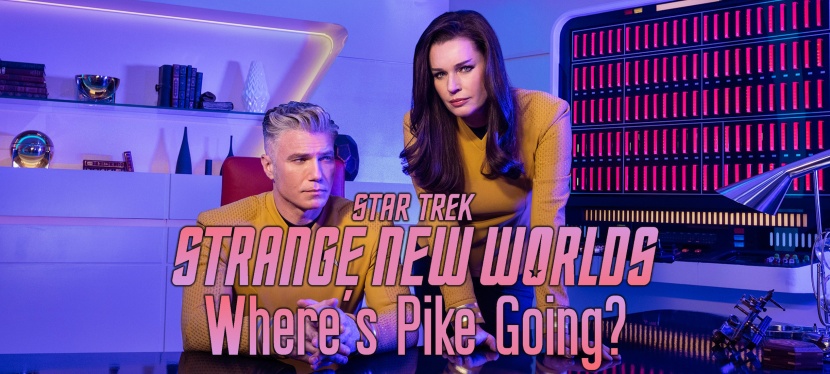
Preliminary Star Trek: Strange New Worlds Season 1 predictions

Spoiler Warning: There are spoilers ahead for Star Trek: Discovery Seasons 1-2, Short Treks Season 2, Star Trek: Picard, and other iterations of the franchise.

It’s been a while since we looked at Star Trek: Strange New Worlds, the upcoming Captain Pike series. But with production on Season 1 seemingly imminent – or perhaps having already begun, depending on what sources you use – I thought it would be fun to look ahead to what the first season of the show may hold.

At this stage, Strange New Worlds has only been commissioned for a single season. However, I would be absolutely stunned if we didn’t get an announcement preceding its Season 1 premiere that it had been renewed; this is the pattern ViacomCBS has had with both Discovery and Picard. I’m hoping, then, that Strange New Worlds will become an ongoing series, perhaps following Discovery’s path and running for four seasons, five, or even more. There’s certainly enough potential content for the show to get through, and while being a prequel is a constraint in some respects, that didn’t stop Discovery, Enterprise, and even the Kelvin films finding new and different stories to tell.

The USS Enterprise.

Just as I did for Discovery Season 4 and Picard Season 2 I’m going to make a few guesses – which I’m officially terming “preliminary predictions” – for Strange New Worlds Season 1. My usual caveat applies – I have no “inside sources,” nor am I claiming that anything listed below will definitely happen. These are guesses – educated guesses in some cases, perhaps, but guesses nevertheless.

Without further ado, let’s jump into the list!

Number 1: The uniforms will be redesigned.

Captain Pike’s gold uniform as seen in the Discovery Season 2 episode Brother.

With the exception of Star Trek: Voyager, every Star Trek series to date has introduced new variants of the Starfleet uniform for its crew. While we have seen Anson Mount and Ethan Peck sporting their Discovery uniforms in recent promotional spots for Paramount+, I’m not convinced that Strange New Worlds won’t at least tweak that design.

And perhaps that’s all it will be – a minor tweak or alteration of the uniforms worn by the Enterprise crew in Discovery. But we could see a more radical change, perhaps one designed to bridge the gap between Discovery-era uniforms and those seen in The Original Series. We could see, for example, the high collars scrapped in favour of the crew neck style seen in The Original Series.

Red uniform variant seen in the Short Treks episode Ask Not.

The uniforms worn by the Enterprise crew in Discovery were little more than recoloured versions of the Discovery uniforms, and if you look closely, you can see the detailing around the shoulder and down the sides. In my opinion, though these uniforms were preferable to Discovery’s all-blue look, they ended up looking like dyed Discovery uniforms rather than their own thing. This is something that could be addressed, even if only by making small changes to some of the detailing and stitching.

Regardless, I think that when we start to see promos for the new series, one thing we’ll notice is some kind of new uniform variant.

Number 2: Cadet Sidhu will be part of the Enterprise crew.

Cadet Sidhu.

The 2019 Short Treks episode Ask Not – whose writer, Kalinda Vazquez, is now writing a Star Trek film – brought back Captain Pike. But it also introduced us to a Starfleet cadet, and at the end of the action-packed, uplifting story, she was assigned to a role under Pike’s command aboard the Enterprise.

Almost any story could have been chosen to bring back Captain Pike for a mini-episode, but Ask Not spent most of its time setting up Cadet Sidhu’s character. She has a potentially interesting backstory, being the sole survivor of a Tholian attack, and as a young, talented cadet she could fill a fairly typical Star Trek role in the new series.

Captain Pike with Sidhu in the Enterprise’s engineering section.

We’ve seen the “young and eager” role filled by characters like Harry Kim, Sylvia Tilly, and even Wesley Crusher in past iterations of the franchise, and having someone like that presents a contrast with older, more experienced characters like Captain Pike and Number One. Cadet Sidhu also has a husband, who could potentially be a recurring character, and her background with the Tholians suggests she may not be quite as naïve and inexperienced as other cadets, potentially giving her more to say and do.

Of the main cast that we know of at this stage, all three roles are played by white American actors – Anson Mount as Pike, Ethan Peck as Spock, Rebecca Romijn as Number One. Every Star Trek show going back to The Original Series has proudly shown off a diverse cast, and bringing in someone of Indian heritage would be great. Amrit Kaur, who plays Sidhu, would be the first person of Indian heritage to be a main cast member in the history of the franchise, which would be groundbreaking in itself.

Number 3: There will be a non-Starfleet crewmate.

Cleveland Booker in Season 3 of Discovery.

One of the best things Discovery Season 3 did was introduce the character of Cleveland Booker. Book served as our guide to the 32nd Century in some ways, but also shook up the rigid hierarchy of the Starfleet crew by offering an outside perspective.

Several Star Trek shows have experimented with non-Starfleet characters in various roles, and aside from Book I’d point to Quark in Deep Space Nine and even, to some extent, Neelix in earlier seasons of Voyager as successful examples. I don’t expect Strange New Worlds to put together a Picard-style team where no one is a serving Starfleet officer, of course, but bringing in one major character who exists outside of the ship’s command structure would be potentially interesting.

Neelix in Star Trek: Voyager.

There are many ways this could be done, and many different roles such an individual could occupy. I’m thinking perhaps of a chef-type role, maybe someone who oversees the mess hall and is friendly with the crew. But there’s also potential to bring in an alien character who is perhaps aboard the ship as an observer or diplomat.

The possibilities are open-ended – as is almost everything with Strange New Worlds – but I certainly think that bringing at least one “outsider” into the crew can be a great storytelling device, one which could take the show to different thematic places.

Number 4: There will be a significant callback to Star Trek: Enterprise.

The NX-01 Enterprise.

Aside from a couple of Okudagrams and throwaway lines, modern Star Trek has essentially ignored Enterprise. The franchise’s first prequel currently feels disconnected from the rest of the franchise; cut off in the 22nd Century all by itself. There’s potential for Strange New Worlds to rectify this, and having a significant crossover with Enterprise would be something fun to see.

A few months ago I suggested that the Andorian Shran or main character T’Pol from Enterprise could still be alive and active in the era in which Strange New Worlds is set. Either character – or both – could thus cross over and appear in the new series. That would be a hugely significant moment, as it would firmly tie in Enterprise with the ongoing Star Trek franchise.

Sub-commander T’Pol.

Discovery could have done something similar to pay homage to Enterprise in either of its first two seasons, but with the show now set far in the future, any crossover potential has gone away. Strange New Worlds is currently the only 23rd Century series, and while the untitled Section 31 show or a future series may share the setting, that’s hardly a sure thing. So if the creative team at ViacomCBS want to bring up anything from Enterprise any time soon, this is by far the best place to do it.

If a main character crossover isn’t on the cards, there are still myriad other ways to acknowledge Enterprise in a major way. We could see Pike and the crew revisit a location first seen in Enterprise, or see the return of races like the Denobulans, Suliban, or Xindi, none of which have ever been mentioned outside of Enterprise.

Number 5: Ash Tyler will return.

Ash Tyler.

Of Discovery’s main cast from Seasons 1 and 2, only Ash Tyler didn’t travel into the future with Burnham and the rest of the crew. He remained in the 23rd Century, and at the end of the Season 2 finale we learned he would be appointed head of Section 31. It’s been assumed ever since (not only by me but by other fans and theory-crafters) that Tyler was intended to appear in the upcoming Section 31 series. However, as we recently learned, that show may be on hold for at least the next couple of years.

Ash Tyler’s story arc across Discovery’s first two seasons is arguably complete. He came to terms with what happened to him, his transition from Klingon to human and the two sides of his personality that created. He also went on a rollercoaster ride in terms of his relationship with Burnham. But there’s still a lot of potential in Tyler, and one thing in particular that leads me to believe that he could – in theory – have a role to play in Strange New Worlds.

Is this Ash’s brother? His cousin?

The character above is José Tyler, one of the original officers under Pike’s command in The Cage. Now I’m not expecting everyone we met in The Cage to be recast and appear in Strange New Worlds, but the possibility of a family connection between José and Ash seems like it could be fun to explore. Perhaps they’re brothers or cousins. If so, how would José react to the fact that Ash isn’t really Ash any more? That could be a huge source of conflict, and putting the two characters together to work through that might be a story worth telling.

Ash Tyler could also be part of a Section 31-related story, or even a story that sees the Enterprise picking up the last remaining pieces of the battle against Control. Ash shares a secret that only Pike and the Enterprise crew know – what really happened to the USS Discovery. As the head of Section 31, might he leverage that against Pike somehow to force him to take on a dangerous mission? There are, once again, almost an unlimited number of ways Ash Tyler could be used in the context of the new show. I doubt he’ll be a major starring character, but having him back for an episode or two seems a real possibility.

Number 6: The Enterprise will make first contact with a familiar race.

A Cardassian spy seen in The Next Generation.

One of the promises Strange New Worlds has made is that it will be a return to the kind of Star Trek that The Original Series, The Next Generation, and Voyager did so well, with stories focusing on exploration. Over the course of those series, the captains and their crews made numerous first contacts with alien races, and if Strange New Worlds is to make good on its premise, making at least one first contact seems inevitable.

If we look at Enterprise as the other major Star Trek prequel series, we saw first contact with established races like the Klingons, Romulans, and even the Ferengi – though Archer didn’t know who he was meeting in that last case. The point is, Enterprise went back and showed us how humanity first encountered many familiar Star Trek races – and this is something Strange New Worlds could do too.

Enterprise depicted Earth’s first contact with the Romulans, and several other familiar races.

I’ve written about this a number of times here on the website, but I adore Deep Space Nine, and particularly the Bajorans and Cardassians. We’ve never seen the Federation make first contact with either of them, and it could be very interesting to see how it went. The Cardassians would likely still be a militaristic state, but we know that the Bajorans prior to the Cardassian occupation were very different – operating a caste-based society that the Federation would surely disapprove of.

If not the Cardassians or Bajorans, there are many other Star Trek races which had already been contacted either by the time of The Original Series or The Next Generation that we could see Captain Pike and his crew meet for the very first time. Among them could be the Gorn, Tholians, or even a relatively obscure race like the Sheliak, who only appeared in a single episode. In my opinion, making first contact with an established race would tie Strange New Worlds in to the wider franchise, and that’s something that I firmly believe every Star Trek series needs to be doing.

Number 7: Spock will mention Michael Burnham at least once.

Burnham and Spock in the Discovery Season 2 episode Project Daedalus.

Season 2 of Discovery explored in some detail the relationship between Burnham and Spock. They were raised as siblings on Vulcan by Sarek and Amanda, and Burnham appears to have been quite influential in Spock’s life and in his development. At the end of Season 2, Spock stated his intent to travel to the future with Burnham, and while we know that was never going to happen because of his other appearances in the franchise, it indicates how close they were.

Burnham’s loss is akin to a bereavement. Although the final red burst confirmed that she safely made it to the 32nd Century, Spock will never see Burnham again (barring some other time travel story!) so she’s gone from his life. How will that affect him? While Spock may, on the surface, appear to simply brush off the events of Season 2, he went through a heck of a lot. The loss of Burnham may be the worst part, but being accused of murder, having his mind scrambled, travelling to Talos IV, and being hunted by Control will have all taken a toll.

Captain Pike and Spock watch Burnham and the USS Discovery disappear into the future.

Burnham had her “Spock episode” with Unification III midway through Discovery Season 3, so I wouldn’t be at all surprised if Strange New Worlds reciprocates somewhat and gives Spock his own “Burnham episode” – or at least a Burnham moment. Moving on completely as if everything he went through in Discovery Season 2 never happened wouldn’t sit right, so I’m sure there will be at least some reference or acknowledgement of Burnham from Spock.

It may not be a complete story, rather just a line or two of dialogue in which Spock mentions how much he misses Burnham. But I do expect to see some kind of reference or connection. Despite Spock being a long-established character within Star Trek, Strange New Worlds is a spin-off from Discovery, and this version of the character in particular is tied to Burnham very strongly. Making note of that would also be a reminder to the audience that Discovery is Strange New Worlds’ sister show – another of those little ties between ongoing parts of the franchise that I mentioned.

Number 8: Pike will have to deal with the knowledge of his impending accident and disability.

Captain Pike after his accident, as seen in The Original Series Season 1 episode The Menagerie.

Captain Pike not only saw his future at the Klingon monastery on Boreth, but he actively chose to accept his horrible fate in exchange for a time crystal. This happened toward the end of Season 2, and with the battle against Control to prepare for, he didn’t have much time to really stop and think about what that means. But Strange New Worlds will surely slow things down – at least some of the time – giving him pause for thought.

In the moment, Pike did what he needed to do and embraced his dark future. Will he regret that? Will he be worried at every turn, looking over his shoulder for the moment where his accident will occur? If so, who will help him snap out of it? It would be very easy for someone in his position to fall into depression – after all, what he’s going through is akin to being diagnosed with a terminal disease.

Pike sealed his fate in the Discovery Season 2 episode Through the Valley of Shadows.

We have seen Star Trek tackle this subject before, but only in the format of one-off episodes. Having a main character who is aware of his impending health collapse and disability could be something that’s absolutely worth exploring. In a way, I can relate to Captain Pike. Over the last decade or more I’ve seen my own health gradually decline, and while it isn’t quite the same thing (Pike’s accident takes him from full health to total disability in a heartbeat) I’ve been in the position of hearing a doctor tell me really awful news, knowing that there isn’t anything I can do to fix it.

Star Trek usually does things by analogy, so rather than Captain Pike being diagnosed with a real-world life-limiting condition, he’s seen a vision of his future disability in a time crystal. But the impact it could have on him from a psychological point of view is comparable, and this could, in my opinion, be a great way for Star Trek to explore the complexities surrounding incurable illness, long-term health conditions, disability, and even terminal illness. There are many, many ways such a story could go, and I’ll be fascinated to see what direction the show takes with this.

Number 9: There will be either a time-travel or parallel universe story.

Kirk’s captured Klingon Bird-of-Prey travelling through time in Star Trek IV: The Voyage Home.

Time travel has been a part of Star Trek going back to Season 1 of The Original Series, and we’ve seen a number of episodes take place in both the past and future. With Strange New Worlds sending Pike and the Enterprise off on a mission of exploration, they could easily encounter any of the temporal phenomena that we know exist out there in space.

I’ve never been wild about time travel in Star Trek, and often the episodes in which it features aren’t my favourites. Using time travel to visit contemporary Earth inevitably dates a story, too – just look at Star Trek IV: The Voyage Home or the Voyager two-part episode Future’s End as examples of that! But just because time travel isn’t my personal favourite story element doesn’t mean it can’t work well, and I wouldn’t be surprised at all to see Strange New Worlds pursue a story of this nature.

Voyager visited ’90s California in Future’s End.

The main candidate when considering time travel has to be the aforementioned contemporary Earth, in this case, Earth circa 2021! But we’ve seen time travel stories set in the 1890s, the 1930s, and even a dark vision of the 2020s! It could also be fun to see the crew shot forward in time, and perhaps having to rely on the help of a time-travelling future Starfleet to get home.

Alternatively we could see a parallel universe story – though hopefully not the Mirror Universe! The Mirror Universe is potentially home to the prime version of Captain Lorca, and rescuing him could be an interesting story. But there are many other parallel universes – including the alternate reality where the Kelvin films are set. Could that set up a crossover with the alternate reality versions of Pike and Spock?

Number 10: The show will acknowledge current events.

The COVID-19 pandemic has been the biggest and most disruptive event in many years.

The big story of 2020 was, of course, the pandemic. But there are other significant ongoing events, such as the issue of race in the United States, that Strange New Worlds could try to tackle. Star Trek, despite what some people want to tell you, has always been a franchise with a keen interest in contemporary events. Going all the way back to The Original Series, Star Trek has used its sci-fi setting to look at real-world events, and I wonder to what extent Strange New Worlds will try to do that.

In a series that aims to be more episodic than other recent Star Trek projects, Strange New Worlds could certainly dedicate at least one episode to looking at a major current event. The pandemic is something we have yet to see appear in fiction in a big way. The issue of race, on the other hand, is something we’ve seen tackled many times in many different ways.

Star Trek has looked at the issue of race relations in the United States before, notably in the episode Let That Be Your Last Battlefield.

A story touching on issues raised by the pandemic could look at, for example, a planetary society suffering from disease, but where a significant number of people refuse to take precautions – something we’ve seen all across the world to varying degrees. Or it could look at the long-term impact of isolation through a character or set of characters who haven’t had any outside contact for a long time.

Any series that plans to look at aspects of the ongoing pandemic has to tread carefully, in my opinion, to avoid appearing to sensationalise current events or to be seen to be exploiting the situation. But as one of the biggest events of the 21st Century so far, the coronavirus pandemic will be explored in art and entertainment many times in the years ahead, and there’s no reason why Star Trek shouldn’t tackle it – provided it does so tactfully.

Number 11: The Klingons will make an appearance.

A Klingon general from Lower Decks.

Federation-Klingon relations went on a rollercoaster in the 23rd Century, to say the least! From ignoring one another to all-out war to a peace conference, the two factions did it all. One thing we have yet to see is the way in which the Klingons changed following the war depicted in Discovery – and no, I don’t mean the prosthetic makeup!

When L’Rell took power at the end of Discovery Season 1, she sued for peace with the Federation, after which Federation-Klingon relations appear to have thawed, at least a little. Yet within a decade or so, the Klingons were once again incredibly antagonistic toward the Federation, with conflicts and battles fought during this era.

Chancellor L’Rell in the Discovery Season 2 episode Point of Light.

Perhaps we could see something happen between the Klingons and Federation to set them on this antagonistic path. Captain Pike has built up some degree of goodwill with the Klingons, but seeing this evaporate would be a potentially interesting story. We could also welcome back Mary Chieffo as L’Rell in a story focusing on the Klingon Empire.

Just like we need to see Section 31 disappear and move underground, we also need to see the Klingons and Federation move apart. Another all-out war is not required, but seeing the situation deteriorate and even the cutting off of diplomatic relations would “reset” the Klingons closer to the way they were in The Original Series.

So that’s it. Ten Eleven preliminary predictions for Season 1 of Strange New Worlds. As I said when the series was first announced, 2022 seems like a reasonable guesstimate for when it’ll premiere, and that was backed up by the news we got a few weeks ago about which shows are in production and how far along they are. So while it’s definitely early to be considering what we might see from the new show, it’s not too early! Who knows, it could be this time next year that Strange New Worlds makes its debut!

Anson Mount has recently featured in the ad campaign for Paramount+.

I hope this was a bit of fun. And just to re-emphasise what I said at the beginning: I don’t have any “insider information,” this is just guesswork from a fan. Nothing more! So don’t get upset if none of what I suggested above ultimately comes to pass!

I’m really looking forward to Strange New Worlds. It seems to be offering more of a “classic” take on Star Trek when compared to recent projects, and I’m 100% there for that! The franchise has expanded, and there’s plenty of room for serialised drama and even animated comedy, but taking Star Trek back to its roots is definitely something I’m keen to see. That doesn’t mean every project should try to do the same thing, but it does mean that Strange New Worlds is close to the top of the list of shows that I’m most excited about!

If we get any major news, casting information, or a trailer be sure to check back as I’m sure I’ll have something to say. Other than that, all we can do is wait!

Star Trek: Strange New Worlds is coming to Paramount+ at some point in the future. International distribution has not yet been announced. The Star Trek franchise – including Strange New Worlds, Discovery, and all other properties mentioned above – is the copyright of ViacomCBS. This article contains the thoughts and opinions of one person only and is not intended to cause any offence.

Star Trek: Picard + Star Trek: The Next Generation crossover theory: Lore

Spoiler Warning: There are spoilers ahead for Star Trek: Picard Season 1, Star Trek: The Next Generation, and for other iterations of the franchise.

Season 1 of Star Trek: Picard expanded our knowledge and understanding of the Star Trek galaxy in the 24th Century. As the lore of Star Trek grows (pun intended!) one thing I find fun is seeing how any new information we get can be made to fit with past iterations of the franchise, and in the case of Picard, I think I’ve hit on a theory that is plausible based on some new facts that we learned last year.

I previously touched on this theory as part of my essay on Commodore Oh a few months ago, but I thought it warranted being expanded and given its own article – so that when it’s finally confirmed on screen I can say “I told you so!” Or not. In short, this theory connects Data’s brother Lore to the Zhat Vash, the faction introduced in Star Trek: Picard.

Lore in Datalore.

Before we go any further and get into the weeds, let’s recap. Lore was introduced in The Next Generation Season 1 episode Datalore, and would return in Brothers in Season 4, as well as the Season 6 finale Descent, and Descent, Part II which opened Season 7. He was, in effect, Data’s “evil twin,” and would go on to cause havoc for Data and the crew of the Enterprise-D. We would also learn that Lore was responsible for luring a spacefaring lifeform called the Crystalline Entity to his homeworld, killing most of the citizens of the colony.

Next we have the Zhat Vash, who were introduced in Star Trek: Picard. An ancient, secretive Romulan sect, the Zhat Vash were on an anti-synthetic crusade. They believed that the development of artificial life would lead to all life in the galaxy being exterminated, and sought to wipe out synthetics wherever they found them. As part of their plan to prevent the Federation developing synths, a Romulan agent named Oh infiltrated Starfleet shortly after the discovery of Data in 2338.

Commodore Oh infiltrated Starfleet.

This theory begins with something that The Next Generation never really explained: Lore being evil. Apparently this is a flaw in at least some Soong-type androids, as we’d also see Sutra exhibiting many similar traits to Lore in the two-part finale of Picard Season 1. But is there more to it than a simple mistake, as Dr Soong believed?

Though the Zhat Vash despise synthetic life, as part of their crusade to exterminate synths from the galaxy they seem to have learned a great deal about them – including how to reprogram them. In Picard Season 1, we learned that rogue synths had attacked Mars, destroying Admiral Picard’s fleet. It was the intervention of the Zhat Vash, hacking into the synths and reprogramming them, that caused this attack. If the Zhat Vash possessed the ability to do this in the 2380s, it’s at least possible that they were able to do something similar to Lore in the 2330s.

The Zhat Vash were able to reprogram Federation synths, leading to the attack on Mars.

Lore was activated months (or possibly years) before Data, and lived with his creator on the Omicron Theta colony. Dr Soong’s reputation seems to have been known within the Federation, and his work doesn’t appear to have been classified or somehow kept secret. The Zhat Vash seem to have been able to infiltrate the Federation with relative ease, having two spies inside Starfleet that we know of, and even if a Zhat Vash operative in this era were not an especially high-ranking officer, given the openness of Dr Soong’s work and the dedication the Zhat Vash have to their cause, I think we can reasonably suggest that they would have come to know what he was doing, and thus of the existence of Lore.

As I suggested in my last crossover theory, it stands to reason that the Zhat Vash will have been deeply alarmed about the Federation and their synthetic research. In the mid-23rd Century, two Federation AIs went rogue: Control (as seen in Discovery Season 2) and the M-5 multitronic unit (as seen in The Original Series second season episode The Ultimate Computer). Although it seems to be androids that were the main focus of Zhat Vash attention, as Laris made clear, the Romulans fear all kinds of AI – so these events would certainly have upset them enough to keep an eye on Starfleet and the Federation.

A fleet of ships under Control’s command went rogue and attacked the USS Enterprise and the USS Discovery.

That makes it even more likely, in my opinion, that the Zhat Vash would have found out about Dr Soong and Lore on Omicron Theta. If they were following Dr Soong’s work on positronic brains, they may have been working on ways to shut down his research or reprogram Lore. As mentioned, none of this appears to have been classified, and while Dr Soong kept his work private, it may have been possible for the Zhat Vash to infiltrate Omicron Theta and gain access to his research.

Their main goal was to prevent the rise of synthetic life. A single android was bad enough, but what they feared most was a civilisation of them. But Dr Soong didn’t have a civilisation – he had one single operational android. From the Zhat Vash’s perspective in the 2330s, if they could force Lore to be shut down – and ideally kill Dr Soong at the same time – the Federation would be unable to replicate the work and would thus be unable to build more.

Lore in Descent, Part II.

At some point following his activation, Lore began to exhibit “emotional instability” to the point that he upset and worried the colonists on Omicron Theta. This doesn’t appear to have happened from the moment of his activation, though, which lends credence to the idea that he was reprogrammed – perhaps rather crudely in an attempt to force Dr Soong to take him offline.

However, before Dr Soong could take action to shut him down, Lore contacted the Crystalline Entity, which arrived and wiped out the Omicron Theta colony. If Lore had been reprogrammed, was this something he chose to do of his own volition? It seems a very specific action to take if he wanted to kill the colonists – he was more than capable of physically overpowering and outwitting them if he wanted to kill them.

The Crystalline Entity “feeding,” as seen in Silicon Avatar.

The destruction of Omicron Theta can be seen as a classic Romulan move. By using the Crystalline Entity, not only was Lore assumed destroyed, but so were Dr Soong, his assistants, and all of his research, setting back synthetic research in the Federation by decades. Of course we know that Dr Soong and Lore both escaped – but that clearly wasn’t part of the Zhat Vash’s plan! Perhaps they underestimated Lore.

Most importantly, though, having the Crystalline Entity wipe out Omicron Theta absolved the Romulans of any direct involvement, as well as potentially destroyed any evidence that they had ever been there. It reminds me in many ways of the false flag operation that they ran on Mars; the synths were reprogrammed and forced to go rogue, an event which so thoroughly shocked the Federation that the Zhat Vash were able to persuade them to shut down all synthetic research.

Laris first told Admiral Picard – and us as the audience – about the existence of the Zhat Vash.

With Lore being the only extant android, a “clean” attack on the colony, wiping out the entire site and all of its inhabitants, would work very well from the Zhat Vash’s perspective. Openly attacking Omicron Theta would surely have started a conflict with the Federation, and if that could be avoided through this kind of cloak-and-dagger operation, well that seems exactly like something they would seek to do.

So that’s the extent of the theory, and any Zhat Vash involvement afterwards appears to have ignored Lore. Perhaps they figured that the existence of Data showed that the Federation would not stop until they were forced to, or at least that it was no longer possible to stop Federation AI research by killing one android. This would explain why they didn’t take any aggressive action against Data during The Next Generation era, and could also explain why Dr Soong went into hiding after the Omicron Theta attack – he may have been hiding from the Zhat Vash.

Data in Star Trek: Generations. The Zhat Vash appear to have been either unable or unwilling to attack him.

This theory fits with Lore’s appearances in The Next Generation and doesn’t step on the toes of anything as far as I can see. It provides backstory to why Lore acted the way he did, and explains his motivations for doing so in a different way. It also elevates Lore from simply being an “evil twin” trope into more of a tragic character – we will never know what Lore could have been were he not interfered with.

Crucially, this theory fits with what we learned of the Zhat Vash in Picard Season 1, both in terms of their goals and their methods. It seems at least possible that the Zhat Vash are responsible for the attack on Omicron Theta and for reprogramming Lore, turning him into the malevolent adversary that Data and the crew of the Enterprise-D had to deal with.

Commodore Oh.

This could have even been the first mission of a young Zhat Vash operative named Oh. Maybe she was the one sent to Omicron Theta to deal with Dr Soong, and this entire situation is her doing.

So that’s it. That’s my theory! I doubt it will ever be confirmed, but you never know! It seems plausible to me, at least. I hope this was a bit of fun and an excuse to jump back into the Star Trek galaxy. As always, please remember not to take this theory, or any other fan theory, too seriously. Theory-crafting is supposed to be enjoyable, and the last thing we need right now is something else to argue about!

Star Trek: Picard Season 1 is available to stream now on CBS All Access (soon to be rebranded as Paramount+) in the United States, and on Amazon Prime Video in the United Kingdom and elsewhere. The Star Trek franchise – including Picard and The Next Generation – is the copyright of ViacomCBS. This article contains the thoughts and opinions of one person only and is not intended to cause any offence.
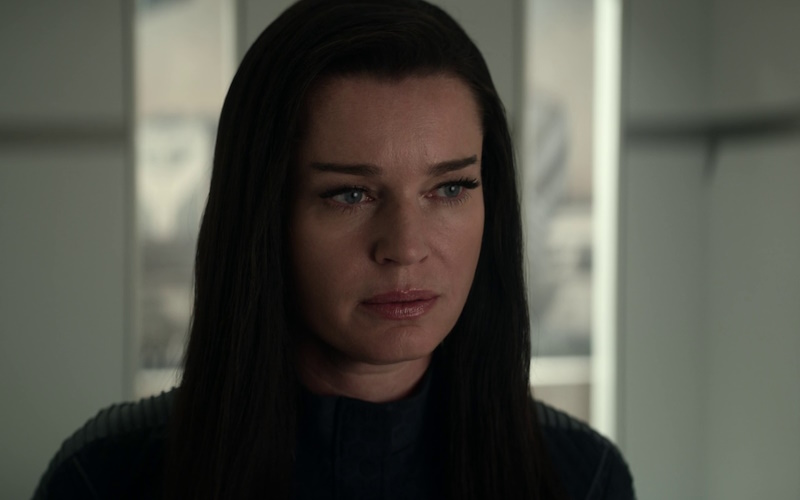
Preliminary Star Trek: Picard Season 2 predictions

Spoiler Warning: There are spoilers ahead for Star Trek: Picard Season 1, Star Trek: Discovery Seasons 1-3, Star Trek: Lower Decks Season 1, and for other iterations of the franchise.

A couple of days ago I wrote up some preliminary predictions for Star Trek: Discovery Season 4, and now it’s the turn of Star Trek: Picard Season 2 to get the same treatment. Season 1 left several big mysteries behind, and while some may be addressed it seems as though Season 2 will see Picard and the crew move on to new adventures.

A significant portion of Season 1 was occupied by recruiting the crew, but after they came together basically to do one job – find Soji – and accomplished that objective, the big thing that Season 2 needs to do is find a truly convincing reason for keeping the crew together. Rios seemingly worked as a commercial pilot, and the others have lives of their own too. Now that Soji is safe and the super-synths have been called off, what exactly is preventing everyone from drifting back to their old lives?

The super-synths in the Season 1 finale.

Right now, I see that as perhaps the biggest challenge and point of interest. What will bind this disparate crew together after their mission is complete? Unlike a Starfleet crew they don’t have a new mission or new orders, and they aren’t just going to fly around aimlessly in La Sirena looking for adventure. So finding a convincing reason for keeping them together – or reuniting them if they’ve already separated as of the beginning of the season – will be key.

As I said last time, it’s very early in the process to be considering what may or may not be included in the upcoming season. At time of writing filming hasn’t even commenced; Picard is filmed in California, and while production is in theory able to resume it’s a slow process. There have been suggestions that February may be the goal for filming to begin – but it wouldn’t be the first time we’ve been given a timeframe that didn’t pan out, so watch this space. I’m not claiming any “insider information,” nor saying that anything on my list is certain to happen. This is guesswork at best – educated guesswork in some places, perhaps, but nothing more.

With those big caveats out of the way, let’s jump into the list.

Number 1: A Galaxy-class ship.

The Enterprise-D as seen in Season 1.

Season 1 showed us a beautiful CGI rendition of the Galaxy-class Enterprise-D. But this ship was only seen in Picard’s dream and didn’t make a real appearance – despite the Federation fleet in the season finale presenting a good opportunity to do so. One lesson I hope the team behind Picard has learned is that the two fleets we saw during the standoff over Coppelius looked less impressive for being comprised of only a single starship design each – and bringing more ships into the show would be something great to see.

Obviously Picard himself has connections with several different classes of ship: the Sovereign-class from his time aboard the Enterprise-E, the Constellation-class from the Stargazer, and we even saw him on a Deep Space Nine Danube-class runabout once. But no ship design is more greatly associated with Picard than the Galaxy-class, and while the Enterprise-D is gone, there were others, including those which served in the Dominion War.

Galaxy-class ships seen in Deep Space Nine’s Dominion War arc.

In an alternate timeline seen in the Voyager fourth season episode Timeless, Galaxy-class ships were still in use in the 2390s, which is close to the time in which Picard is set. An updated Galaxy-class Enterprise-D was also seen in The Next Generation’s finale All Good Things in sequences set in the 2390s.

In addition, Excelsior-class ships from the late 23rd Century were shown to be in use for decades, and the Galaxy-class ship seems like such a versatile vessel that it would make sense to see them still in use. La Sirena will clearly continue to be the home for Picard and his new crew, and I’m not suggesting they be given their own Galaxy-class ship somehow! But it would be wonderful to see Picard’s reaction to a real-life Galaxy-class ship, triggering memories of his time aboard the Enterprise-D.

Number 2: Confirmation of Narek’s fate.

This was the last we saw of Narek.

The two-part Season 1 finale had some issues. From my point of view, the biggest problem was that the final two episodes had far too much story to cram into a relatively short span of time; new characters, new antagonists, new storylines, and a whole new civilisation were all introduced right at the end of the season.

One of the consequences of this was the abandonment of some previously-important storylines. Narek, who was a major character across the rest of the first season, was symbolic of this, as his character was simply dumped without any explanation or resolution midway through the finale.

Soji with Narek aboard the Artifact.

I know that Narek wasn’t everyone’s favourite character in Season 1, but I found him genuinely interesting. He looked certain to play out a relatively common trope in thriller stories: the spy with a heart of gold who abandons his mission after falling in love with his target… but to my surprise – and great enjoyment – he didn’t go down that route and remained loyal to the Zhat Vash crusade.

There are several possibilities for what happened to Narek after his attempt to destroy Soji and Sutra’s beacon. He could have been recovered by the Romulans, he could have been handed over to the Federation, he could have remained a prisoner of the synths on Coppelius, or he could even have renounced his wicked ways and joined Picard’s crew. The latter may seem less likely, but as we didn’t see or hear anything about Narek after the beacon attack it would be great if Season 2 could give us the rest of the story – even if it’s just by way of a line or two of dialogue.

Number 3: Riker and Troi.

Riker and Troi have recently appeared in Star Trek: Lower Decks.

Though I believe Riker actor Jonathan Frakes will be returning to Picard in the director’s chair, we don’t yet know whether Riker and/or Troi will return in Season 2. However, I would argue that their post-The Next Generation storylines have more to give, and I would love to see them both back.

One thing I was very keen on in the run-up to Season 1 is for the show to avoid being The Next Generation Season 8, and by only including a few classic characters in a few episodes, I would say the show accomplished that goal. But there is still a lot of interest from fans about the fates of many characters we knew and loved in past iterations of Star Trek, and the already-established Troi-Riker family could be a stepping stone for telling some of those stories too.

The reunion between Picard and Riker was one of the highlights of Season 1.

It would also be interesting to see whether the events of Season 1 have brought either Riker, Troi, or both back to Starfleet on a permanent basis. Riker described himself as “acting captain” in the Season 1 finale, so perhaps he will return to his family home on Nepenthe. But maybe not!

If Season 2 is to feature Starfleet more significantly than Season 1 did, we will need at least one Starfleet character to be portrayed on screen. Someone Picard knew and can work with would be a good bet, as he could call on them to help out, cashing in favours. However, I did also like the way Raffi used her Starfleet contacts in Season 1, as well as the introduction of Admiral Clancy.

Number 4: Revisiting an event from Picard’s past – such as the Stargazer or the Borg.

Captain Picard first met the Borg while commanding the Enterprise-D.

Season 1 saw Picard confront his past with the Borg as he boarded the Artifact. But there’s scope to further explore his history with the Borg, especially if the faction were to come back in a major way. Nothing we saw in Season 1 suggested that the Borg threat has gone away, and the super-synths we met in the finale could possibly have a connection to Star Trek’s iconic cybernetic villains.

The inclusion of Seven of Nine and the ex-Borg could also contribute to a Borg story. Perhaps the ex-Borg would work together with Picard to use knowledge or technology from the Artifact to defeat another Borg threat. The Borg would also be a reason for Picard’s new crew staying together instead of going their separate ways.

The USS Stargazer.

Alternatively we could revisit an event from Picard’s past that The Next Generation hinted at but didn’t explore in detail. We know Picard commanded the USS Stargazer and that Jack Crusher – husband to Beverly and father to Wesley – was killed. But the specifics of that event have never been shown on screen.

The inclusion of Dr Benayoun in Season 1 connected to Picard’s time aboard the Stargazer, and a storyline looking back at this time could bring back this character. It would also be a way for Dr Crusher and even Wesley to be included – perhaps something that happened around the time of Jack Crusher’s death is going to be relevant to a new event or storyline.

Number 5: Development of Seven of Nine and Raffi’s relationship.

Seven of Nine and Raffi at the end of Season 1.

The Season 1 finale showed Raffi and Seven of Nine had become close, and the possibility for the two to enter a relationship would be something really interesting for Season 2 to look at in more detail. We know that Seven of Nine and Chakotay had a relationship toward the end of Voyager, and that Raffi has a son from a previous relationship. But this could be a great opportunity for some more LGBT+ representation – in this case, perhaps, bisexuality.

Both characters saw significant development in Season 1 – Raffi by finding her son and Seven of Nine by avenging Icheb. Seeing Seven of Nine finally break out of the repetitive, emotionally stifled character she was in Voyager was genuinely cathartic, and giving her even more opportunities to show off her humanity and emotional side would be fantastic.

Seven of Nine and Raffi with the crew of La Sirena.

Both characters have experienced the loss of either a child or child figure, and that could strengthen their bond. They’re different people, and having gone through very different life experiences have responded differently to loss – Seven by becoming obsessed with revenge, and Raffi by falling into addiction.

They could help each other overcome these issues. Seven of Nine could help Raffi through recovery from her drug and alcohol addictions, and Raffi in turn could help Seven move on from the loss of Icheb and the murder of Bjayzl. There’s a lot of scope for very interesting and emotional stories in this pair of characters.

Number 6: Foreshadowing of the Romulan-Vulcan reunification seen in Discovery Season 3.

Romulans, Vulcans, and Romulo-Vulcans seen in the 32nd Century.

Discovery’s third season confirmed that Vulcans and Romulans had managed to set their differences aside – for the most part – and come back together. Though Discovery said this happened “centuries” after Spock’s first visit to Romulus, perhaps we could see some movement in that direction in Picard.

The attack on Mars and its aftermath has arguably left Federation-Romulan relations – and by extension, relations between the Vulcans and Romulans – at an all-time low. However, the unmasking of the Zhat Vash and their role in the attack may have led ordinary Romulans to look upon the Federation less harshly, and if there have been reforms to Romulan society – as was hinted at by the use of the name “Romulan Free State” instead of “Romulan Star Empire” – maybe the beginnings of reunification have already been seen.

The emblem of the Romulan Star Empire in the 24th Century.

Picard had a heavy focus on the Romulans in Season 1, and at least one Romulan character – Elnor – will return in Season 2. Thus the show is the perfect vehicle to show the path forward, bridging the gap between the secretive Romulan Empire of The Next Generation’s era and the reunified Ni’Var of Discovery’s 32nd Century.

The return of a character such as Tuvok could also be a part of this; seeing Elnor working closely with a Vulcan could set up his character for a future role in the reunification process, for example. With Seven of Nine already confirmed to be coming back, bringing one of her Voyager colleagues on board would be great to see.

Number 7: Spend more time with Starfleet.

Acting Captain Riker.

Season 1 made good on its promise of taking Picard away from Starfleet. While two members of the new crew are ex-Starfleet officers – as well as Picard himself – they operate outside of the organisation. I wouldn’t want to see that change; Picard has done what no other Star Trek show ever really did by focusing entirely on a non-Starfleet crew and that’s been fantastic. But there is scope to see more of Starfleet at the beginning of the 25th Century.

After Season 1 saw Picard and his crew largely working against Starfleet, from him being denied access to a Starfleet ship to Raffi and Rios breaking all the rules to gain access to the Artifact, it would be great to see some cooperation. The Season 1 finale gave us a taste of that with Riker and his armada, but there are more ways Picard and La Sirena could work with Starfleet while still remaining separate.

Riker’s Federation fleet stares down a Romulan armada in the Season 1 finale.

Alternatively – or perhaps additionally – we could see more of the story of Season 2 unfold from Starfleet’s point of view. Admiral Clancy was our major Starfleet character in Season 1 and she could certainly return. But this could also be how another legacy character is introduced, and Picard could work alongside them for some reason.

Having at least one major character being a Starfleet officer, and depicting events within Starfleet, would be something I think I’d like to see Season 2 do, provided it could balance that with keeping La Sirena on the outside. Starfleet and the Federation have always been a huge part of Star Trek, and while it was great to see that they’re still the “good guys,” spending more time with them next season would be fantastic.

Number 8: Consequences for Dr Jurati.

Dr Jurati killed Bruce Maddox in Season 1.

Though she did so under the influence of a mind-meld, Dr Jurati still murdered Dr Maddox in Season 1. Star Trek has done some great courtroom drama stories over the years, and I think it would be really interesting to see Dr Jurati arrested and even stand trial. Would the mind-meld be a suitable defence in the eyes of the law? We’ve never seen such a case in Star Trek.

This is another storyline that the finale rushed and ultimately failed to do justice to. At the beginning of Et in Arcadia Ego, Part 1 Dr Jurati is still expecting to turn herself in and be arrested for murder, as Picard insisted she would be. However, by the end of Part 2 she seems free to remain aboard La Sirena and has even formed a relationship with Rios.

Dr Jurati after realising what she did.

The question of Dr Jurati’s culpability is potentially interesting. Despite still being under the influence of the mind-meld she refused to try to harm Soji, pushing through Commodore Oh’s brainwashing. If she could stop herself from harming Soji, how did she harm Dr Maddox – someone with whom she was intimate?

Even if the legal side of things is only briefly addressed, such as a line of dialogue telling us that the charges were dropped, Dr Jurati may suffer psychological effects from what she did. She murdered someone she was very close to, and threatened to sabotage Picard’s mission. Even if he and the others have forgiven her, will she be able to so easily forgive herself? She has already attempted suicide once, and this is an angle the show could look at in more detail as well.

Number 9: The return of Dr Soong.

Dr Altan Inigo Soong.

Even if Season 2 takes Picard away from Coppelius for the most part, it would be great to catch up with Dr Soong – a character who felt underdeveloped in the Season 1 finale. We never learned why Dr Soong wanted to transfer his mind to a synthetic body, nor what the consequences are for him of giving that body to Picard.

I picked up a hint or two in Season 1 that Dr Soong may be sick or dying, so perhaps donating the synthetic body he planned to use to Picard has condemned him to death. Alternatively, however, he may simply be able to build a new one now that he understands the mind-transfer process.

Dr Soong in the Season 1 finale.

A story on Coppelius could also show us what impact the loss of Data’s neurons may have on Dr Soong. Without them, is he able to build new synths, or build another golem for himself? The finale left these questions unanswered, and while I don’t expect Season 2 to spend all of its time tying up loose ends, it would be nice to see some of these points addressed.

Dr Soong is of course played by Data actor Brent Spiner, and welcoming him back to Star Trek was wonderful in Season 1. It would be great if a role could be found for him in Season 2, even if it was only for a single episode.

Number 10: Guinan.

Guinan with Picard in Star Trek: Generations.

This is a total cheat since we already have confirmation that Guinan is coming back, but I wanted to include it anyway. Sir Patrick Stewart invited Guinan actress Whoopi Goldberg to join the show for its second season months ago, so it seems like Guinan will have a significant role in the season. Whether she’ll be a recurring character or make an appearance in a single episode isn’t known at this stage, but she will certainly be back.

Picard and Guinan’s relationship was touched on in The Next Generation, but never fully explained. There’s certainly scope to learn more about how they came together, why their relationship goes “beyond friendship, beyond family,” as well as what the impact of Picard’s reclusion had on Guinan. What has Guinan been doing since we last saw her? We simply don’t know – so it will be interesting to find out!

Number 11: Foreshadowing the dilithium shortage seen in Discovery Season 3.

The dilithium planet from Discovery Season 3.

This is the second “foreshadowing Discovery” entry on this list, and I don’t expect (or want) Picard Season 2 to spend all of its runtime doing that. However, this is another way that we could potentially see a connection to the events of Picard’s sister show.

For some unknown reason, by the 28th or 29th Centuries dilithium supplies in the galaxy were beginning to run low. This is what prompted Starfleet to begin seeking out new sources of the important fuel, ultimately culminating in the Burn, as well as the people of Ni’Var withdrawing from the Federation believing their alternative propulsion experiments caused the Burn.

A dilithium crystal aboard the Enterprise-D.

Though the dilithium shortage depicted in Discovery’s recent season is centuries away, the beginnings of it could be seen in Picard… somehow. Perhaps dilithium supplies were already beginning to run low but the Federation was keeping it quiet, or perhaps they discovered a major cache of dilithium similar to the Verubin Nebula’s planet some time in this era which kept them going for centuries.

Even a single line of dialogue noting that a starship is on a mission to seek out new sources of dilithium would be a subtle nod to fans of Discovery, and a minor way in which the two shows could be connected.

Number 12: A broader look at the galaxy as the 25th Century dawns.

A Klingon general in Lower Decks.

Despite bringing back a few legacy characters – not all of whom survived – and spending a lot of time with the Romulans, Season 1 didn’t paint a very broad picture of the state of the galaxy. We know that the Federation is doing well, despite the attack on Mars and the effects of the Dominion War years earlier. But what of other factions? And is all well in Starfleet?

There are so many races and factions that Season 2 could look at that I don’t know where to begin. But rather than a repetition of Season 1, with its relatively narrow focus on one faction and a handful of events, it would be great if Season 2 could expand the map and look at a few different places and peoples – even if that means doing so in less detail.

What happened to the Dominion after the Dominion War?

Right now, Picard is the only Star Trek production set in this post-Nemesis era. I wouldn’t be surprised if more shows, miniseries, and films were announced, but for the foreseeable future we only have Picard to show us the galaxy and what’s been going on in the years since Nemesis. Obviously the attack on Mars was a significant event, but there must be other things that happened in that twenty-year span.

As I mentioned in my last piece, a personal favourite story arc of mine is Deep Space Nine’s Dominion War, so I would be fascinated to learn anything about Bajor, Cardassia, DS9, the Gamma Quadrant, or the Dominion. But given Picard’s lack of connection to those events (except for a link to Bajor via Ro Laren) perhaps that isn’t on the agenda this time. Still, anything we could get to look at the bigger picture of the galaxy would be wonderful.

Number 13: Looking at current events.

Will Star Trek: Picard Season 2 discuss current events?

One thing Picard Season 1 did very well was show how Picard’s mental health was suffering as a result of his rejection by Starfleet. I think a lot of people who’ve been through almost a year of lockdowns and isolation could watch the Season 1 premiere, Remembrance, and empathise much more with the isolated, lonely Admiral Picard than they could when it was first broadcast.

Star Trek has never shied away from using its sci-fi setting to tackle real-world issues, and the biggest right now is of course the pandemic and its associated effects. Season 2 may have had a complete draft written before the pandemic hit – production was meant to take place last year, after all – but there has been plenty of time to change things up and include contemporary themes. Not every series has to use the pandemic as inspiration, and in many ways people come to sci-fi and fantasy to escape the real world – something that’s arguably even more necessary right now – so maybe this won’t happen.

Number 14: The return of Laris and Zhaban.

Laris and Zhaban in Season 1.

Laris and Zhaban – Picard’s Romulan assistants – served a fairly typical adventure story role in Season 1. They were the safe reminders of home that Picard had to leave behind when setting off on his quest; a role filled by the residents of Hobbiton in The Lord of the Rings, for example.

But they were also more than that. The decision to make them Romulans did serve a purpose – without them, Picard would never have learned of the Zhat Vash, for example. But given Picard’s complicated history with the Romulans after abandoning his efforts to help them evacuate their homeworld, the question of why these two ex-Tal Shiar operatives were so steadfastly loyal to him raised its head.

Picard with Laris, shortly before he left Earth.

Maybe this is simply a minor plot contrivance, but I don’t want to just overlook it and say it’s fine. What did Picard do to win their trust and loyalty so strongly that they’d follow him to isolation on Earth? And why did they choose not to follow him into space when he set out to help Soji? It wasn’t to attend to the grape harvest, surely.

Some further development of these two characters would be welcome, and while I know they did feature in a novel, most folks don’t read those and it arguably isn’t canon – Star Trek, unlike Star Wars, has always drawn a line between what happens on screen and what happens in apocryphal works. So their backstory in relation to Picard is still, in my opinion at least, an open question that Season 2 could address.

Number 15: The Artifact will come under Federation control.

The Artifact’s resting place on the surface of Coppelius.

Though parts of it have been picked over by the Romulans for decades, the opportunity to study a largely-intact Borg vessel does not present itself every day. Unless the Borg have somehow been defeated off-screen between the events of Nemesis and Picard – which I very much doubt given their popularity among fans – the Federation will surely want to avail itself of this opportunity.

The Artifact crash-landed on Coppelius at the end of Season 1, but with the planet designated a Federation protectorate they now have access to the wreck. Who knows what Federation scientists could learn about the Borg if not constrained by the Romulans. The Artifact may not play a big role in Season 2, but I would argue it is incredibly important to the Federation. That may even be the cynical reason why they chose to send a fleet to defend Coppelius.

Number 16: The appearance of Section 31.

A black Section 31 combadge as seen in Discovery Season 2.

If you followed my reviews and theories during Season 1, you may remember that I thought of numerous ways that Section 31 could’ve been included. This stemmed from the production side of Star Trek: Section 31 had recently been a major part of Discovery, and there’s an upcoming Section 31 series in development. For those reasons, Section 31 seemed like a way that all three Star Trek projects could’ve had a familiar theme.

It didn’t happen in Season 1, of course, and with Discovery completely ignoring Section 31 in its third season perhaps you could argue that it’s less important this time around. But I don’t necessarily agree. The Section 31 series is still coming, with pre-production having already begun and Michelle Yeoh’s departure from Discovery setting the stage.

Georgiou’s departure has teed up the Section 31 show.

In addition, Discovery introduced us to the enigmatic Kovich in Season 3, played by famed director David Cronenberg. If you followed my Discovery theories, you’ll know I’ve posited the idea that he is an operative of Section 31 – or maybe even its leader in the 32nd Century.

As a result, Section 31 remains one way that many of the ongoing Star Trek projects can find common ground, despite being split up along the timeline. It would remind fans of each series that they’re watching one part of a greater whole, and connecting the Star Trek franchise together will hopefully help fans of one show jump over to others that are currently in production. I know of many people who have either watched Discovery or Picard – but not both. Finding more ways to connect the shows and bring the franchise together will be important to Star Trek’s future – and vital to its ongoing success.

Number 17: Fallout from Picard’s newfound synthetic status.

The android F8 during the attack on Mars.

There had been a widespread ban on synthetic life for over a decade as a result of the attack on Mars. Though we learned in Season 1’s closing moments that the ban has been rescinded, the attack, its aftermath, and the ban may have lingering effects on non-synthetics. Will Picard face discrimination and hate as a result of his synthetic nature?

Perhaps, given the reaction in some areas of the fandom to Picard becoming a synth and the whole death-and-rebirth narrative, Season 2 will seek to downplay Picard’s status. But it would be interesting to explore the ramifications. We’ve talked about Riker, Troi, and Guinan possibly being major characters in the story – how will they react to Picard being synthetic? Can Troi read synthetic minds? Would Guinan feel he’s no longer the same person given her sensitivity to such things?

Picard reawakens in a synthetic body.

There are real-world analogies that anti-synthetic discrimination could be used to show. Star Trek has, on many occasions in the past, looked at the complex issues of race relations in the United States, and in the wake of the events of 2020 and ongoing efforts to ensure racial justice and equality, this could be something the synthetic storyline highlights.

There are also interesting legal and ethical questions that the show could address. Most significantly: is Picard the same person as he was, or is he legally and morally a distinct person now that he has a synthetic body? Will Starfleet, for example, consider him to be the same retired Admiral, or will he no longer have those privileges?

Number 18: Making peace with the super-synths.

Soji contacted the super-synths in Season 1.

Although she stood down and turned off the synths’ beacon on Coppelius, Soji did nevertheless contact the super-synths (the villains I nicknamed the “Mass Effect Reapers” for their similarity to that video game faction). There may yet be consequences for having done so, because the super-synths might not simply return to dark space to wait for another faction to contact them – they may already be en route to the Milky Way galaxy.

Even if the super-synths themselves don’t initiate a conflict, from Starfleet’s point of view it makes sense to reach out and tell them what happened. By explaining Starfleet’s position – that they value synthetic life and will not seek to harm the Coppelius synths – perhaps a conflict could be avoided. Making the attempt seems like something Starfleet would do, at least.

The super-synths almost arrived at Coppelius before Soji broke off contact and shut the portal.

There’s a lot of potential to make the super-synths more than a plot device and one-dimensional incomprehensible villain. They could, as previously suggested, connect to the Borg. They could also be expanded upon as we learn more about them, their name, their motivations, and so on. We know precious little about the super-synths right now, and it would be great to learn more. Was their offer to help the synths genuine – or was it a trap?

Soji, as the instigator of contact with the super-synths, could be just the person to help pacify them if they turn out to be on the warpath. That could be why she needs Picard and the crew of La Sirena: to seek out the super-synths and prevent a war.

Number 19: Shutting down the beacon on Aia.

The beacon on Aia.

Now that the Zhat Vash have been exposed, we don’t really know what will become of their anti-synthetic crusade. The decision to have Commodore Oh withdraw so quickly in the Season 1 finale is not one I particularly liked; the Zhat Vash were presented as zealots who would stop at nothing to achieve their goal of wiping out synthetic life, and despite Soji closing the portal, from Oh’s point of view she could just open another one.

However, criticisms aside, it makes sense that Starfleet – or at least Picard – would want to find the octonary star system and shut down the beacon on Aia. Not only would this prevent the Zhat Vash from continuing to use it, but it would also avoid the possibility of other synths accidentally finding it and using it to contact the super-synths.

The planet Aia.

This should be a priority for Starfleet, at least in my opinion! Though we may not see it for ourselves, this could be something communicated in a line or two of dialogue, just noting that the beacon has been shut down.

Alternatively it could be a major storyline, with Picard and La Sirena setting out to find Aia and continue their fight against the Zhat Vash. I’m not sure if this would be the right way to go – it feels like an epilogue to Season 1 rather than the main event for Season 2. But it could make for an interesting episode!

Number 20: The return of Dr Crusher (or another major character from The Next Generation era).

Dr Crusher in The Next Generation Season 1.

Dr Crusher was the only major character from The Next Generation who wasn’t confirmed to be alive in Season 1. We saw Troi and Riker, of course, and thanks to Zhaban we heard about Worf and La Forge too. But despite how close Picard and Dr Crusher were – they had even married in an alternate timeline – no mention was made of her.

The question of what became of their relationship is an open one. In the aftermath of Picard’s resignation and retirement, did Dr Crusher visit him? Were they married, or romantically involved? If so, could the wedding of Troi and Riker (that we saw in Nemesis) have been the prompt for them to revisit their relationship?

Captain Picard and Dr Crusher in The Next Generation.

Picard was clearly single in Season 1, so if he and Dr Crusher had been romantically involved it’s clearly something that has already ended. But his new lease on life – thanks to a new body and overcoming his depression – could mean he wants to renew things or at least contact her.

Alternatively we could learn that Dr Crusher has died, or that she and Picard never got together. They could even have had a major falling-out and may not have spoken in over a decade. Such a storyline could see them coming back together, moving on from whatever caused the fight.

So that’s it. I didn’t plan to write this at first, but writing up some preliminary guesses for Discovery Season 4 was so much fun that I wanted to do the same thing for Picard Season 2 as well!

Picard Season 2 will – fingers crossed – begin filming some time soon. I wouldn’t bet on seeing it on our screens in 2021, though, just because of how much time post-production will take. So it may be a while before we see Picard, Raffi, Elnor, Rios, Dr Jurati, and Seven of Nine! But that doesn’t mean speculating and guessing about what may be coming is any less enjoyable.

These are not even theories – I want to call them guesses rather than anything else. So please, please don’t get carried away thinking that any of these are destined to happen. We all need to remember to take such theories and predictions with a pinch of salt at the best of times, and guesswork this far out when we know less than nothing about the upcoming season is almost silly! So as fun as this was to put together, let’s all try not to get too excited about anything listed above.

Star Trek: Picard Season 1 is available to stream now on CBS All Access in the United States, and on Amazon Prime Video in the United Kingdom and elsewhere. The Star Trek franchise – including Picard and all other titles mentioned above – is the copyright of ViacomCBS. This article contains the thoughts and opinions of one person only and is not intended to cause any offence.
Preliminary Star Trek: Discovery Season 4 predictions

Spoiler Warning: There are spoilers ahead for Star Trek: Discovery Seasons 1-3, Star Trek: Picard Season 1, Star Trek: Lower Decks Season 1, and for other iterations of the franchise.

Star Trek: Discovery Season 3 only concluded a few days ago, and while production has begun on Season 4 it will be a while yet before we get any news. Regardless, I thought now would be the perfect time for some wild speculation… sorry, I mean “preliminary predictions.” It’s very early in the game to be thinking about Season 4 – a season which, if Season 3’s timeline is anything to go by, is unlikely to grace our screens before Spring 2022. But that doesn’t mean it won’t be a bit of fun!

The end of Season 3 wrapped up the main storylines in a generally satisfactory manner; regardless of how we may feel about specific events (like the Burn) their stories were concluded by the time the credits rolled. The dangling story threads left behind are more like teases for what may come, rather than unfinished elements from what came before. That’s a good way to do things, and unfortunately that’s where Picard’s Season 1 finale earlier in 2020 dropped the ball, at least in my opinion.

The USS Discovery departs Federation HQ for a new adventure in the Season 3 finale.

So Season 4 is potentially quite open right now. There’s no obvious direction for the story to go, nor did Season 3 end with a cliffhanger or big tease like Season 2’s journey into the future – or even Season 1’s reveal of the USS Enterprise approaching. Captain Burnham was given her orders after assuming command of Discovery, and set out in the ship to begin the task of delivering dilithium across the fractured Federation. It was implied that this was step one in bringing more wayward ex-members back into the fold, so perhaps that’s something we’ll see continued.

To re-emphasise: I’m categorically not saying that I have any “insider information,” nor that any of these predictions will come to pass in Season 4. This is guesswork on my part – educated guesswork, in some cases, but guesswork nevertheless. I would encourage all of you to be incredibly sceptical of anyone claiming to know for sure what will happen, or anyone claiming to have “anonymous sources” within the production team at ViacomCBS. Many, many times have people making such claims been shown to be making things up.

With that out of the way, let’s jump into my list, which is in no particular order.

Number 1: Visiting Kaminar.

The surface of Kaminar as seen in the Short Treks episode The Brightest Star.

One thing I disliked in the Season 3 finale was the unceremonious dumping of Saru. Though we know that Saru actor Doug Jones is returning to Discovery in Season 4, it will be in a different role now that Burnham has become captain. I have a couple of ideas for where Saru may fit, but for now suffice to say that I think we’ll have at least one episode focusing on Saru’s home planet of Kaminar.

Not only would such a story allow Saru to catch up with his people, but we could see how the Kelpiens and Ba’ul have developed since we saw them in Season 2. The episode Su’Kal suggested that the Kelpiens and Ba’ul joined the Federation jointly, and the way their conflict ended would be interesting to explore.

Su’Kal and Saru on Kaminar at the end of Season 3.

Given the cataclysmic nature of the Burn, though, which I expect to see the lingering effects of for years to come, one storyline that would be potentially interesting is how Kelpien society would react. Knowing that one of their own is responsible for this disaster is going to have some kind of effect on Kaminar and the Kelpiens. If Bill Irwin could return to play Su’Kal, we could see this explored in depth. Would Su’Kal be welcomed by everyone in the way Saru welcomed him? Or will he be shunned by some for his unintentional role in the Burn?

Such a storyline could be timely. In the real world, China is struggling with the fact that the coronavirus pandemic seemingly originated there, and I think that a storyline which looked at how Kaminar deals with its unwitting role in the cause of the Burn could be an interesting way for Star Trek to do what it does best: using its sci-fi setting to look at real-world issues.

Number 2: A new villain or adversary will rise.

Control was the main villain in Season 2.

Over its first three seasons, Discovery introduced us to several different villains. It seems unlikely that Season 4 will break that pattern, and it feels almost certain that there will be a significant adversary or villain for Captain Burnham and the crew to defeat. Whether such a character will be a galactic threat like Control or a playground bully like Osyraa is not obvious; the Emerald Chain was basically the only antagonistic faction we met in Season 3. However, there are bound to be others!

This could be where a race or faction from Star Trek’s past comes back to the fore, though going down that route would be a bit of a constraint. I think we’re more likely to see an original creation for Season 4, someone whose motives are tied in some way to preventing the Federation reestablishing itself, perhaps.

Osyraa was the primary antagonist in Season 3.

If the theme of the season as a whole will be reconnecting the Federation, it stands to reason that any villain or adversary would be someone who seeks to prevent that. However, it isn’t just Burnham and Discovery working on this task, so any such villain would have to be powerful enough to wield a fleet of starships. They may have their own motivations, and the Federation are simply in the way of whatever they’re trying to do.

This could also be a way to introduce time travel to the season, assuming that the producers want to do so. A villain could be someone flouting the ban on time travel for some reason – and could even be someone working inside the Federation, such as Section 31.

Number 3: A connection or crossover with Star Trek: Picard.

Jean-Luc Picard in Star Trek: Picard Season 1.

After Picard Season 1 came and went with nary a hint at the existence of Discovery, I was worried that Discovery would reciprocate in Season 3. Luckily that didn’t happen, and not only did we get to see the Qowat Milat – a faction introduced in Picard – we also got a mention of Admiral Picard himself in the episode Unification III.

At this point we don’t know whether Discovery Season 4 or Picard Season 2 will be broadcast first – and it’s possible that, with the ongoing disruption caused by the pandemic and the uncertainty around the two productions, the team at ViacomCBS aren’t 100% sure either! However, both shows are up and running, and Picard has at least one season under its belt – a season which had several factions, new characters, starships, story points, etc that could in theory cross over to Discovery.

Coppelius Station.

I got the impression from the Season 1 finale of Picard that the show would be moving on to a different adventure in Season 2, perhaps leaving behind the Coppelius synths altogether. If that’s the case, Discovery Season 4 could pick up this story and show us what became of the synths in the centuries after Soji and Picard came to their rescue. Did they stay on Coppelius or relocate? Are some of the synths we knew, such as Soji, still alive in this era?

As I said numerous times during the runs of both Picard and Discovery, these sister shows could do more to work together, reminding viewers that they’re two parts of a greater whole. The difference in time periods is an issue, but as we saw with the Qowat Milat it doesn’t have to completely prevent the two series from teaming up.

Number 4: The return of a classic race or villain.

Borg drones in First Contact.

Season 3 brought back the Trill, Orions, Andorians, and the Romulans and Vulcans on Ni’Var. There were very brief scenes which showed off Cardassians and a couple of other races, and we saw the Bajorans and Xaheans in holographic form too. So Season 3 crammed a lot into its thirteen episodes in terms of revisiting races from Star Trek’s past. This is something I hope Season 4 will continue to do.

Though the Dominion War ended more than 800 years ago, finding out what became of the Cardassians, Bajorans, Breen, and the Dominion themselves is perhaps what I’d choose if it were up to me. The Dominion War arc, though controversial in some Trekkie circles, is a story I find myself revisiting often, and it’s always a thoroughly enjoyable ride. Deep Space Nine ended right when the war did, and we don’t really know anything about what became of the factions involved afterwards.

Captain Sisko, General Martok, and Admiral Ross on Cardassia Prime at the end of the Dominion War.

There’s also the potential to learn what became of the Borg. They didn’t take advantage of the Burn and the Federation’s collapse to assimilate the Alpha Quadrant, so could we infer from their absence that they’ve been destroyed, pacified, or severely reduced? Could the Borg have been presumed defeated centuries ago but make a big recurrence in Season 4 – perhaps looking to acquire the Spore Drive technology?

I’d also love to see the inclusion of a Suliban or Xindi, or perhaps a Talaxian or Kazon from the Delta Quadrant. I know Discovery can’t possibly cram all of these disparate factions and races into one season, but the 32nd Century offers so many interesting story possibilities for practically everyone we’ve met in past iterations of Star Trek. The potential is unlimited!

Number 5: Will Burnham remain Captain?

Captain Burnham.

Discovery worked hard over the back half of Season 3 to make Burnham’s ascent to the captain’s chair feel genuinely earned. Some of the criticisms I’ve made of her character, both in Season 3 and previously, stem from her position as a junior officer making big decisions that go against her orders, so putting her in the captain’s chair and backing her up with a helpful crew should see her continue to grow. I want to see that, and I hope that she will continue to be a Starfleet captain who lives up to the ideals of the Federation in Season 4 and beyond.

But Discovery has never found the right fit for its captain’s chair for one reason or another. I’ve actually enjoyed what all three captains – Lorca, Pike, and Saru – brought to the role, but none of them stayed in that role beyond a single season. One of my hopes for Season 4 would be that we’d get some stability in the captain’s chair, and in a way I’m hopeful Burnham will retain the position going into Season 5 and potentially beyond – but what if that isn’t the plan?

Discovery has gone through three captains in three seasons.

Perhaps one of Discovery’s unique points is going to be the season-long captaincies of different people, each giving the ship and show a distinct feel. Lorca was the hardball who turned out to be a traitor. Pike was the classic character who embodied the spirit of adventure. Saru was the calm and collected diplomat. Burnham may be a Kirk-style action hero, a bit of a renegade but someone who always comes through for Starfleet when it counts.

How or why she might leave the role is unknown, and given Discovery’s approach to storytelling across Seasons 1 and 2 in particular, I’m not sure how likely it is that, having gone to the trouble of promoting her, they’ll replace her within a single season. But that exact thing happened to Captain Saru this season, so it wouldn’t be unprecedented.

Number 6: The lingering effects of the Burn.

The Burn.

Having resolved the Burn and found a huge dilithium planet to negate its destructive effects, there may be a temptation to shelve the Burn, especially if the writers and producers of Season 4 are taking on board fan feedback – which has been mixed to say the least on that particular story point. However, I think doing so would be a mistake.

If we start off Season 4 with a one- or two-year time skip, I can already predict that the legwork of rebuilding the Federation will have already happened off-screen. Resetting the Federation to a state much closer to how it has always been shown in Star Trek may be what some fans want, and in some ways I do too – but I think that after seeing the Federation at such a low ebb in Season 3, we need to see at least some of the rebuilding process for ourselves.

The 32nd Century was a difficult environment for many, and that won’t magically go away overnight.

I already discussed one way the Burn’s effects could still impact the story with the Kelpiens, but there are a million-and-one others. Captain Burnham could lead the ship to revisit parts of the Federation that no one has heard from since the Burn only to find them under occupation or in the midst of civil war, for example. Or we could see an ex-Federation member that completely ran out of dilithium and has had no way to power itself for a century.

Season 3 focused largely on the Federation and ex-Federation members. But there’s scope to see how the Burn impacted other powers in the galaxy – depending on which ones existed at the time! If the source of the Burn is revealed as a Federation member (i.e. the Kelpiens) would, for example, the Dominion or Klingon Empire want to exact revenge or get reparations from the reunited Federation? There are so many ways that the Burn could have impacted the galaxy that we need to see. It hasn’t all gone away with the uncovering of its source and the discovery of the dilithium planet.

Number 7: A time travel story featuring the Guardian of Forever.

The Guardian of Forever… a.k.a. Carl.

It was a very deliberate choice to bring back the Guardian of Forever in Season 3, and it would be a shame to only use them once! Not to mention that guest star Paul Guilfoyle was just fantastic as Carl, the Guardian’s humanoid avatar, and would make a thoroughly welcome return to Discovery.

One way the Guardian of Forever could be included would be to send the USS Discovery back in time – for some reason – in order to tie into the Short Treks episode Calypso. That would likely need to be a multi-episode story arc, but it would be one way to include the Guardian and resolve Calypso – two birds, one stone!

The Guardian of Forever’s portal.

If it were discovered that some nefarious villain or antagonistic faction were using time travel, the Guardian of Forever could be Captain Burnham’s ace in the hole to counteract them. That would be another way to make use of the reintroduction of this entity. Season 3 expanded on the Guardian of Forever by showing us that it can transport people between parallel universes, so this could in theory allow for another Mirror Universe story (please no) or for the Discovery crew to travel to any of the other alternate realities seen in Star Trek.

Speaking of which…

Number 8: A Kelvin timeline reference.

The Kelvin timeline USS Enterprise.

This is something else that Season 3 touched on briefly, with Kovich making note of a time war soldier who crossed over from the alternate reality. The Guardian of Forever, as mentioned, could be one way to literally cross over, but unless a new Kelvin timeline film is in development – and it doesn’t seem to be at this stage – there’s not as much to be gained by doing so when compared to a tie-in with Star Trek: Picard or other ongoing projects.

However, a Kelvin timeline reference would be neat, even if it were little more than a throwaway line akin to Kovich’s in Season 3. The 32nd Century, with its superior technology and better understanding of time and timelines, is the only Star Trek setting aside from the alternate reality itself that really can make the connection between Star Trek’s two major universes.

Number 9: Who is Kovich?

Kovich in Terra Firma, Part I.

Famed director David Cronenberg, who plays Kovich, has said that the character will return in Season 4 in some way, so there’s the possibility to learn more about this mysterious character. I’d been speculating since his first appearance that his distinctive uniform, high security clearance, and un-Starfleet lack of morality could hint at his being an operative of Section 31 – or even its leader.

Another theory I’ve heard fans kicking around is that Kovich is the Federation’s president. That would be an interesting way to go too, as a storyline which involves rebuilding the Federation could require serious diplomatic efforts. The Federation President would surely be involved in bringing key worlds like Earth back into the fold.

Number 10: Admiral or President Saru.

Saru in Terra Firma, Part II.

As I said earlier, I was disappointed in the way Saru was dumped at the end of the Season 3 finale. He didn’t get a chance to say goodbye to his crew, to offer Burnham her promotion in person, and his decision to leave the ship was only briefly touched on by Burnham in a voiceover. Though Saru is coming back, his role is unclear with Burnham now in command.

I can think of a couple of ways he could be included, though. The first would be a promotion to the rank of Admiral, joining Vance at the head of Starfleet. As the Federation grows, Starfleet will need to grow too, and with a new source of dilthium – and the potential for new Spore Drive ships too – and that will mean the need for new Admirals to command the expanding fleet. Saru proved himself as a good captain across Season 3, and while he did make some mistakes, I would argue he’s an excellent Admiral candidate.

Saru and Burnham with Admiral Vance.

However, we also saw Saru’s diplomatic side in Season 3, particularly with the President of Ni’Var. Saru could continue in this role as a diplomat, but if worlds like Trill, Earth, and Ni’Var all rejoin the Federation, might some of them want to see him become Federation President?

If the story of Season 4 looks at the Federation re-unifying, I could see why some of the aforementioned worlds might want to support the candidacy of Saru. Early Federation politics seemed to involve balancing the Vulcans and Andorians, but this led to almost all of the Federation’s key institutions being on Earth and dominated by humans. The reunited Federation may be less keen on giving humanity all of the top jobs, especially given Earth’s century of isolationism, so someone like Saru may be a compromise candidate among the Federation’s members who are coming back together for the first time in a long time.

Number 11: A redesign of the USS Discovery internally.

The bridge of the USS Discovery.

One aspect of Season 3 that didn’t quite sit right with me was the redesign of the USS Discovery. I adore the redesign, don’t get me wrong, but I didn’t quite buy into it as “believable” considering the ship didn’t change on the inside. We saw a few changes, like the programmable matter and holographic elements in many bridge consoles, and of course the big empty space in the engineering/drive section that we saw during Book’s turbolift battle against Zareh. But aside from a few small touches, a few lines of technobabble, and one CGI-heavy action sequence, the ship looks the same from the inside.

This undermines the decision to have the ship undergo a major refit, and I’d love to see some more aesthetic changes inside the USS Discovery to match its external appearance. It wouldn’t mean completely tearing down old sets, but tweaking and changing them to indicate that the ship has been heavily altered. Lighting is one way that the designers could make an immediate, obvious, and unobtrusive change. Ditching some of the blue lighting and generally upping the brightness of other lights – especially on the bridge – would transform the way Discovery looks.

The inner workings of the USS Discovery.

The USS Enterprise, after its refit in Star Trek: The Motion Picture, looked like a different ship inside and out. The USS Discovery nailed the outside look in Season 3, but its inside hasn’t caught up. Even a handful of changes here and there would go some way to making good on the refit idea, and I’d love to see the bridge, the ready-room, and engineering given a facelift in time for Season 4.

This would also be a great moment to show off a new area of the ship, either something that was improved during the retrofit or a brand-new addition. We saw the data core at the end of Season 3, but I don’t see a pressing need for the crew to spend a lot of time there. What we could see, however, is some kind of holodeck or recreation area, an improved mess hall that had more of a Ten Forward lounge vibe, an observation deck or briefing room, a battle bridge or secondary command centre, or an additional science lab.

Number 12: Defending the Verubin Nebula.

The periphery of the Verubin Nebula.

In a galaxy devoid of its most significant source of fuel, the discovery of a massive cache of dilithium will not go unnoticed – or unopposed. The Emerald Chain may have “fractured” according to the Season 3 epilogue, but it seems unlikely that they’d be the only ones interested in acquiring the dilithium planet in the Verubin Nebula.

As such, part of the Season 4 storyline may involve Discovery having to defend the Verubin Nebula from someone looking to seize it for themselves. After the Emerald Chain did essentially the same thing at the end of Season 3, if I were writing it I wouldn’t make this the main point of Season 4, but it seems like something that could be included – or at least explained. How will the Federation defend what seems like the galaxy’s most valuable resource?

Number 13: To seek out new… dilithium?

The dilithium planet.

At the moment, the Verubin Nebula is the only major source of dilithium. The USS Discovery with its Spore Drive can jump all across the galaxy, making it a great ship to scout for new sources of the valuable fuel. Part of Discovery’s mission could be to jump around to areas of the galaxy the Federation had previously been unable to reach in search of dilithium.

I see this story point as the catalyst for something else to happen rather than the main event, though… because on its own it doesn’t exactly seem like the stuff of action and excitement!

Number 14: A new first officer.

Could Lieutenant Willa join Discovery’s crew?

Last time we looked at the odd Tilly situation and theorised that her uniform may have been altered from command red to science blue in post-production. This could mean she’s being replaced as first officer – a position she only took on a temporary basis to begin with.

If Captain Burnham doesn’t keep Tilly as first officer, that obviously opens the position up to someone else. There are candidates on Discovery’s crew, but I’d also propose Lieutenant Willa, Admiral Vance’s aide-de-camp from Season 3. She would be an interesting addition to the crew; another 32nd Century native along with Book to advise the crew of changes they might’ve missed.

Lieutenant Rhys was given the conn temporarily in Far From Home.

We could also consider the promotion of one of the secondary bridge crew, such as Nilsson, Rhys, or Bryce. Nilsson and Rhys have both been left in charge on the bridge before, so could in theory make good candidates. I wouldn’t pick Stamets or Dr Culber, as they both have roles elsewhere on the ship.

Nhan could make a comeback after she was dropped early in Season 3. I half-hoped to see her return in the season finale, but if she finishes her mission aboard the USS Tikhov, perhaps she could return to Discovery as first officer. If not, maybe a new character could join the crew in that role.

Number 15: A new home for Federation HQ.

Federation HQ.

I initially wondered if Season 4 might see Federation HQ return to its home on Earth, but I’m not sure if that would be the best option so early in the game. Plus I kind of like the idea of a space headquarters, not attached to any planet and able to be moved.

Perhaps it makes the most sense in the short term for Federation HQ to anchor itself near the Verubin Nebula, able to immediately respond to any threats to its valuable prize. But we could also see Federation HQ move between worlds, visiting new members in turn or just staying on the move. If Starfleet is growing in strength, the need for a secret location will be lessened and perhaps we could see some institutions of the Federation’s government relocate away from the base we first encountered in Season 3.

Number 16: The return of the Klingons.

Klingon leader T’Kuvma during the series premiere.

In Season 1, Discovery depicted a major Federation-Klingon war, and while the Klingons were peaceful by Season 2, they were not exactly staunch allies of the Federation. In Star Trek’s fictional history, the Federation and Klingons would remain at loggerheads for much of the 23rd Century, only to sign the Khittomer Accords at the end of the century, leading to a period of peace. By the 24th Century they were allies, particularly during the Dominion War, and I think it would be interesting to take that line forward in time.

How would the Discovery crew, veterans of the Federation-Klingon war, react to having to work with Klingons? Are the Klingons Federation members, or ex-members? If so, part of the season’s story could be bringing the Klingons back into the Federation – but would everyone on the crew be okay with that?

A map depicting the battlefields of the Federation-Klingon War in the Season 1 episode What’s Past Is Prologue.

Alternatively we could see the Klingons as a neutral power, watching the rebuilding of the Federation from the outside. Maybe they, like the Emerald Chain, have gotten used to being a more powerful faction as the Federation have declined, and may not like to see their old adversary getting back on its feet.

Almost anything could have happened to the Klingons both before and after the Burn, and for a faction that had previously been important within Discovery it would be great to see what became of them, and how that information would impact our characters.

Number 17: Aurellio will be back.

Aurellio.

Kenneth Mitchell’s Aurellio was one of the high points of the final two episodes of Season 3. As an ex-member of the Emerald Chain and a brilliant scientist, Aurellio could be a valuable ally to the Federation and Discovery’s crew.

Aurellio was tasked with working on the Spore Drive, and in the Season 3 finale figured out that empaths like Book are capable of navigating the mycelial network. He could have switched sides to work for the Federation, perhaps working on a way to give more starships a Spore Drive. There are other scientific roles he could play, depending on the nature of the season.

Number 18: More Spore Drive ships.

Discovery making a Spore Drive jump.

Speaking of the Spore Drive and Aurellio, now that the problem of navigating the mycelial network has potentially been fixed, there’s no reason why more Starfleet vessels can’t be fitted with a Spore Drive of their own. In Season 1, Stamets seemed to suggest early on that mycelial spores were difficult to collect or cultivate, but if that could be addressed (or a new source found) there’s no reason why more Spore Drives couldn’t be built.

The Spore Drive has long been Discovery’s most controversial piece of tech, and finding a proper role for it that didn’t get in the way of previously-established canon is one reason for taking the ship and the series out of the 23rd Century. Having arrived in the far future, now is the time to let the Spore Drive shine.

Number 19: Those grey uniforms?

Some of the crew in their new uniforms.

The reaction to the new uniforms in the 32nd Century was mixed, and I wonder if Season 4 will address this in any way. One thing to note is that the grey uniforms looked a lot better in the brightly-lit Federation HQ than they do on the more dimly-lit Discovery. This could be addressed by changing the lighting, as suggested above, but it could also be addressed by making some changes to the uniforms.

It was a refreshing change to ditch the all-blue look, and I don’t dislike the 32nd Century uniforms. Though Vance wore the Admiral’s variant all season long, I still need to get used to seeing the regular crew in that style before I can say for sure how much I like them. So from my personal perspective I think there’s no immediate need to change anything up, but I know not everyone agrees.

Lieutenant Owosekun in her new uniform, showing close-ups of the collar and coloured stripe.

Starfleet uniforms are like starship designs: everyone in the fandom has an opinion on which is best. For my two cents, after four seasons of Enterprise’s blue boiler suits, three seasons of Discovery’s all-blue look, and Picard’s crew not having uniforms, I’m happy to see something different. Lower Decks and the Kelvin timeline uniforms had blocks of colour, and that was great. But it’s been a long time since we really mixed up the uniforms in Star Trek – even the Starfleet uniforms of the Picard era were similar to those from Deep Space Nine and Voyager.

So I’m willing to give the grey outfits a chance. But I wouldn’t be shocked to see promo material for Season 4 showing off a new variant or even a different style altogether.

Number 20: Lieutenant Sahil will join the crew.

Lieutenant Sahil.

Lieutenant Sahil, newly commissioned into Starfleet in the Season 3 finale, was one of the first people Burnham met in the 32nd Century. It would make a lot of sense for her to want to repay his kindness and help by offering him a role aboard Discovery. He could be one of the bridge officers, perhaps taking over from someone like Nilsson or Bryce if either were promoted.

I’d love to see a recurring role for Lieutenant Sahil now that he’s a commissioned officer. With Georgiou having left the show entirely and Saru looking at a potentially reduced role or a role not aboard the ship, there’s plenty of space for Sahil, Aurellio, and others to join up.

So that’s it. A few far too early ideas for what Star Trek: Discovery might bring us in Season 4. If I remember after the season airs it’ll be fascinating to come back and look at this list!

So this was just a bit of fun as I continue to work through my post-Season 3 thoughts. As I say it’ll be great fun to come back and see how many of these guesses were completely wrong once we’ve seen Season 4 for ourselves. The 32nd Century has opened up Star Trek to radically new story ideas for the first time in a long time, and I’m loving that. No longer being constrained by canon means that Discovery can literally take the franchise anywhere, with open-ended story possibilities.

These are not even theories – I want to call them guesses rather than anything else. So please, please don’t get carried away thinking that any of these are destined to happen. We all need to remember to take such theories and predictions with a pinch of salt at the best of times, and guesswork this far out when we know less than nothing about the upcoming season is almost silly! So as fun as this was to put together, let’s all try not to get too excited about anything listed above.

Star Trek: Discovery Season 3 is available to stream on CBS All Access in the United States, and on Netflix in the United Kingdom and elsewhere. The Star Trek franchise – including Discovery and all other properties mentioned above – is the copyright of ViacomCBS. This article contains the thoughts and opinions of one person only and is not intended to cause any offence.
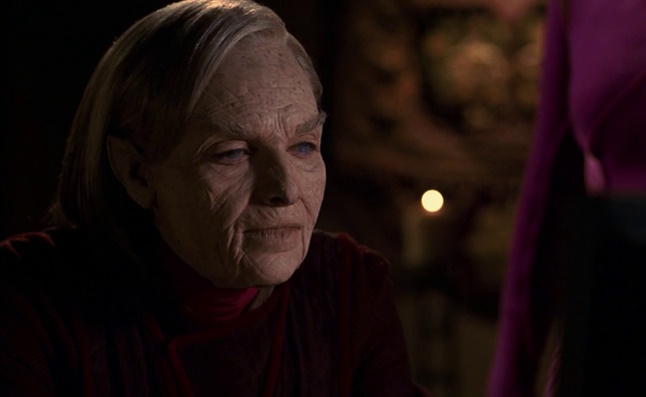
Star Trek: Discovery – Was there a last-second change for Tilly?

Spoiler Warning: There are spoilers ahead for Star Trek: Discovery Season 3, including the finale.

Something interesting happened as I was going back over the Season 3 finale of Star Trek: Discovery, and it turns out I’m not the only person who noticed it. After the main storylines of That Hope Is You, Part 2 were over, we were launched into a short epilogue which tried to wrap up a few other plot points from across the season. At the end of this epilogue, Burnham was promoted by Admiral Vance and assumed command of the USS Discovery.

On what we assume is her first outing as captain, Burnham arrives on the bridge to be greeted by an honour guard made up of senior officers, bridge crew, and other characters from the season. Among them was, of course, Tilly. If you were eagle-eyed during her brief moment on screen you might’ve spotted that she’s apparently been promoted to the rank of lieutenant – a well-earned promotion after her efforts throughout all three seasons of the series, and not what this controversy is about!

Tilly in the epilogue.

Look at the close-up image of Tilly above. She, along with the rest of the crew, have been given new uniforms. These uniforms are grey with a coloured stripe on the right of the tunic (or jacket) denoting departments. Tilly’s is blue, which makes sense because she’s a science officer. But do you see something off about the blue stripe on her uniform?

I confess that I didn’t at first. When I watched That Hope Is You, Part 2 for the first and second times, and again when I went back to the episode to capture still-frames for my review and theory post I completely missed it. The excitement and emotion of this moment, coupled with Tilly only being on screen for a scant couple of seconds, meant I missed it entirely – but look closely. The coloured stripe is clearly the result of digital post-production work.

A closer look at the blue stripe.

Looking at it now it seems painfully obvious. It wouldn’t be Discovery’s first digital effect that missed the mark in Season 3 – remember when Mirror Burnham was stabbed in Terra Firma, Part II? But it raises two quite interesting questions: what colour was her uniform originally, and why was it changed at the last minute?

It’s possible that this literally was a last-second change; the low quality of the texture used for the blue stripe may mean it was something thrown together in a matter of days, and this makes me wonder if the change is indicative of Discovery switching things up while the season was already in motion.

This stabbing looked pretty bad earlier in the season.

By the season finale, Tilly was acting first officer aboard Discovery. With the departure of Saru, Burnham has assumed command on what seems to be a permanent basis – but who will be her XO? That wasn’t addressed, but given their close relationship I wouldn’t be shocked if Discovery originally intended for Burnham to retain Tilly in that post also on a permanent basis. The awkward blue stripe may have been covering up a red stripe on her uniform – red denoting the command division.

Tilly becoming first officer was not a popular point, as far as I can tell from my limited interactions with the Star Trek fan community. It didn’t bother me personally, though seen in the context of the season as a whole I’d argue that perhaps Burnham’s ascent to the captaincy didn’t need the bump in the road of disobeying orders and losing her role as XO. But considering that there was some degree of pushback from fans to Tilly’s role, could that explain this seemingly slapdash digital work?

Saru appointing Tilly temporary first officer in Unification III didn’t sit well with everyone.

There are no immediately obvious first officer candidates among Discovery’s cast, yet in Season 4 the ship will certainly need one. A new character could be introduced, of course, or a secondary character could be promoted. But it seems at least possible that the original plan was for Tilly to stay in that post. If those plans were changed, the question is why?

The reaction from viewers seems a good bet, but considering that this was not a huge story point in Season 3 it seems at least a little peculiar for the producers and writers to go out of their way to undo it in such an odd fashion so late in the season. But it’s also possible that the storyline of Season 4 requires either a new first officer or for Tilly to be in a scientific role.

Tilly with other senior officers in the epilogue. The blue stripe is again noticeable.

There could also be a simpler explanation: Tilly was originally wearing blue, but the low lighting on the bridge (which has been an issue at points for Discovery since Season 1) made her uniform look too dark in the finished shot. Rather than lighten the entire sequence the creative team tried to digitally recolour part of her uniform. Tilly is standing in a shadowy part of the set, so that’s a possibility.

However, that should have been known well in advance, and if it were changed for that reason it leaves the open question of why the finished effect looks so amateurish! It almost looks as though whoever worked on this retouching of her uniform simply pasted a single flat colour across the whole uniform stripe. If there had been time, you’d think that someone would have insisted that the digital effects team fix it before the episode was broadcast.

So it’s a minor mystery. What happened with Tilly’s uniform, and is it connected in any way to the minor backlash from some viewers to her role as first officer? We may never know!

Star Trek: Discovery Season 3 is available to stream on CBS All Access in the United States, and on Netflix in the United Kingdom and elsewhere. The Star Trek franchise – including Discovery and all other properties mentioned above – is the copyright of ViacomCBS. This article contains the thoughts and opinions of one person only and is not intended to cause any offence.
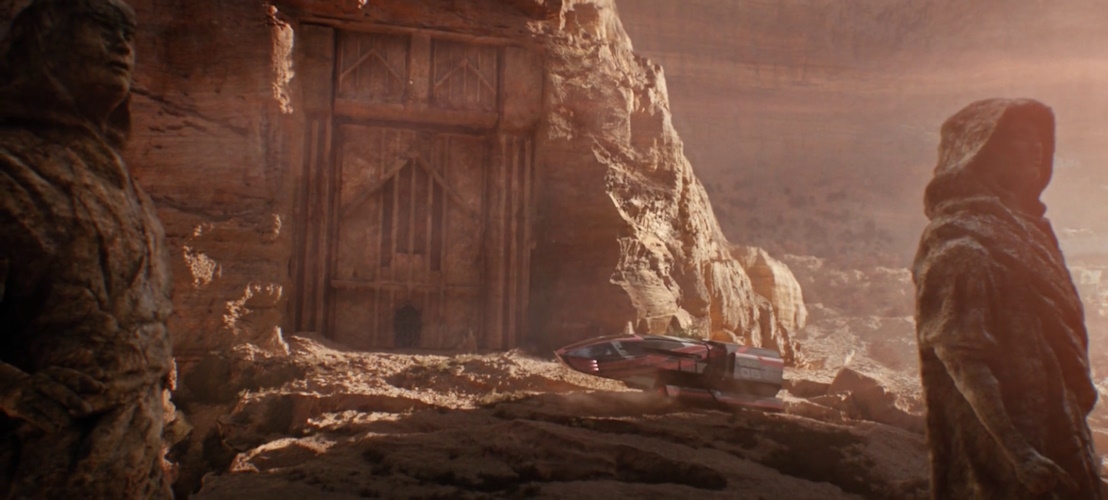
Star Trek: Discovery Season 3 theory – warp drive

Spoiler Warning: There are spoilers ahead for Star Trek: Discovery, including Seasons 1-2 and the trailers for Season 3. Further spoilers may be present for other iterations of the Star Trek franchise.

As the premiere episode of Star Trek: Discovery’s third season gets nearer I seem to be coming up with more and more theories! This time we’re going to consider one possible effect of the Burn in detail. I hinted at this when I considered what the Burn could be, but this time I’m going to expand on that, and in addition perhaps add a couple more potential causes for the galactic cataclysm.

Here’s how the theory goes: the Burn has made warp drive useless across the galaxy, meaning no one – including Starfleet – is currently able to travel faster-than-light.

In order to understand this theory, we need a basic refresher course in how warp drive works in Star Trek! In short, warp drive uses dilithium crystals to create and modulate a matter-antimatter reaction. The combination of matter and antimatter yields massive amounts of energy, allowing starships to generate a subspace field and travel faster-than-light. Subspace is part of the makeup of the universe, but its exact nature has never been fully explained. However, subspace is essential not only for warp drive but for communications – subspace radio being one way the Federation is able to communicate over large distances without delays.

Engineers working on a dilithium crystal aboard the Enterprise-D.

Subspace, warp drive, and associated concepts have no real-world analogue and thus are subject to change depending on what an individual writer needs for an episode. The fundamentals are suitably vague, but for our purposes all we need to know is that without access to subspace there’s no warp drive and no FTL communications.

Any disruption to subspace would have massive ramifications for the Federation and the wider galaxy. While we have seen other races using different methods of propulsion and communication, the specifics have never been explained and thus may well involve subspace. The Borg’s transwarp, the Romulans’ singularity engines, and even Voyager’s slipstream technology could all be susceptible to the same limitations, even if they appear to be different on the surface.

If the Burn is relatively recent, perhaps occurring a few years before Burnham and Discovery arrive, it makes sense to say that the Federation could still be fractured. But if, as has been hinted, the Burn is an event decades or more in the past, the expectation has to be that they’d have been back on their feet. Even if it took years or decades, the Federation – and the galaxy’s other races – should have been able to rebuild, or at least begin that process. Perhaps they have, and we’ve seen what look to be Starfleet officers and maybe a Starfleet ship or facility in the trailers which could hint at that. But if Booker is right, and the Federation has mostly collapsed, aside from wondering how it happened, the big question is why nobody has been able to put it back together.

Burnham and Booker in the second Season 3 trailer.

The answer could be twofold: a lack of transportation and a lack of communication. Disconnected from Earth, Starfleet, and the rest of the Federation in a galaxy where subspace has been destroyed, disappeared, or where it cannot be accessed, the individual worlds and colonies may have no choice but to stand alone. Some of these worlds may not even be aware of what transpired – they may have simply woken up one morning without faster-than-light spacecraft and communications. However, we have seen hints that the Burn may have been a violent event, and the name itself conjures up evocative images of catastrophic fires and explosions.

Without warp drive and subspace communications, it would be impossible to rebuild the Federation. Planets that weren’t damaged or affected by whatever caused the Burn may have found other technologies they had still worked, but without supplies from other areas – such as replacement parts – there’s a question-mark over how long any one world could last on its own. The Federation may have been spread widely even in the 24th Century, but it was also an interconnected bloc where resources were shared between member worlds. At least some of those worlds would struggle on their own, and this could lead to the kind of hand-to-mouth, impoverished existence we saw hints at in the trailers.

The lack of warp drive, communications, and any way to travel faster-than-light would, from an in-universe standpoint, explain why the USS Discovery is relevant in the 32nd Century. Even a crippled Federation should have technology that far outpaces the centuries-old USS Discovery, and the show has to find a way to make the ship and crew useful. It could simply be the case that a lack of starships means the Federation needs every vessel it can find, but I don’t consider that a great explanation, not if 32nd Century craft could outrun, outmanoeuvre, and outgun the USS Discovery.

Finding a good explanation for how a 930-year-old vessel could still be useful is a storytelling challenge!

In a galaxy without warp drive and subspace, the mycelial network and the USS Discovery may be the only way to travel and communicate with the Federation’s spread out worlds and colonies. It was interesting that in the two trailers we saw the spore drive engaged several times – but we never saw any starship go to warp – neither the USS Discovery nor vessels native to this time period.

The loss of warp drive, if that is something that has happened, is surely related to the Burn. That may simply be the name that the Federation and its now-separated parts use to describe some event that rendered subspace and warp drive unusable. However, there are possible explanations for what could have caused this based on past Star Trek stories. Some of these are rather obscure, and thus perhaps less likely, but as we’ve seen in Lower Decks over the last few weeks, the creative team behind Star Trek hasn’t been shy about bringing back aliens we only saw once!

Possibility #1: The subspace-dwelling aliens from The Next Generation Season 6 episode Schisms.

An alien experiments on Riker.

In Schisms, the crew of the Enterprise-D are abducted by aliens. These aliens were supposedly native to subspace, and performed experiments on the Starfleet crew. La Forge would confirm, towards the end of the episode, that these unnamed aliens were unable to survive in normal space – but were attempting to create a “pocket” of their native environment in one of the Enterprise-D’s cargo bays.

Though Riker (and a redshirt) were able to escape the aliens’ domain at the climax of the story, they sent a probe of some kind through the rift between realms before it closed, and even if Starfleet managed to avoid attracting their attention again, perhaps they now know of the “normal” universe and planned to attack or invade.

Possibility #2: A weapon of last resort.

Could a weapon of last resort against a faction like the Borg have cause the Burn?

This is something I considered in my closer look at the Burn, but if the Federation were under attack by a faction like the Borg or Species 8472, they may have been backed into a corner where the only option was to use some kind of weapon of mass destruction. If the Federation were to use such a weapon, one side-effect could be the destruction of subspace and/or the loss of warp drive.

We’ll look in just a moment at the omega particle (from the Voyager episode The Omega Directive) but a weapon based on this technology could be one culprit. There aren’t many factions we know of within Star Trek capable of launching an all-out assault on the Federation that might’ve made this kind of weapon necessary. The Borg are one, and perhaps the super-synths from Star Trek: Picard are one too.

This could be an interesting storyline, as though the Burn wouldn’t directly be the Federation’s fault, and may have even saved millions of lives, they would still bear a degree of responsibility.

Possibility #3: The omega particle from the Voyager Season 4 episode The Omega Directive.

Captain Janeway and Tuvok discover the omega particles.

As mentioned above, the omega molecule or omega particle could be a culprit. Omega was a molecule that could, in theory, generate vast amounts of power, but a single omega explosion could render subspace – and warp drive – totally unusable across a vast area. In Voyager, Janeway and Seven of Nine were able to destroy the omega particles they found. But those events took place centuries before Discovery’s third season.

In the intervening centuries, there’s nothing to suggest that the Federation wouldn’t have wanted to try again. Perhaps a scientist felt that they could control omega better, but an accident led to disaster. Or perhaps the Federation was successful in using omega particle-based technology on a widespread scale… only for some unpredictable event to occur.

Possibility #4: Warp drive itself ruined subspace, as seen in The Next Generation Season 7 episode Force of Nature.

The damage to subspace on the viewscreen of the Enterprise-D.

Toward the end of The Next Generation’s run, Star Trek was still an episodic franchise. We hadn’t yet gotten to the longer story arcs of Deep Space Nine’s Dominion War, which makes Force of Nature somewhat of an outlier. It attempted to use warp drive as an analogy for issues in the real world – specifically the use of fossil fuels causing global warming. Two scientists make a claim that warp drive is damaging subspace, and one ends up dying to prove their case. The episode ends with Starfleet agreeing to a speed limit to reduce the damage while they looked for a longer-term solution.

Aside from a couple of later referenced to a speed limit, however, this story was never resolved on-screen. Fans have speculated that later warp engines, such as the design used aboard the USS Voyager, had found a way around this problem. But that is unconfirmed at best, and even if it were true, there could still be problems.

Of all the four possibilities, this feels the least-likely, but there’s potential for Discovery to pick up Force of Nature’s climate change analogy.

So that’s it. A theory and a few possible causes that would reference past iterations of Star Trek.

Does this scene from the second Season 3 trailer depict the Burn?

Until now, Discovery has only had the lore established in Enterprise and The Cage to draw upon due to its place in the timeline. The show largely ignored Enterprise, but Season 2 obviously referenced The Cage in many ways. However, now the show has jumped forward in time there’s the possibility for all sorts of references and callbacks to events of past Star Trek shows.

I’m sure that we’ll get some references spread throughout Season 3. Whether I’m right or not about warp drive, though… that remains to be seen! If you’re in the United States you’ll get to find out literally tomorrow!

Star Trek: Discovery Season 3 premieres on the 15th of October 2020 on CBS All Access in the United States, and on the 16th of October on Netflix in the United Kingdom and elsewhere. The Star Trek franchise – including Discovery and all other titles referenced above – is the copyright of ViacomCBS. This article contains the thoughts and opinions of one person only and is not intended to cause any offence.
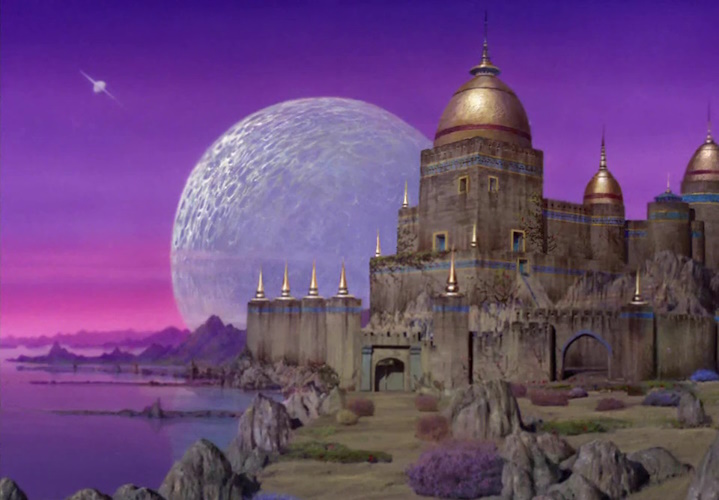
Star Trek: Discovery Season 3 episode titles have been revealed… let’s see what we can glean!

Spoiler Warning: There are spoilers ahead for Seasons 1-2 of Star Trek: Discovery, as well as the trailers for Season 3. There are also spoilers for Star Trek: Picard Season 1. Further spoilers may be present for other iterations of the Star Trek franchise.

I was reluctant to cover this when I first saw it a few days ago. The only sources I could find for what people claimed were the “real Discovery Season 3 episode titles” were unofficial at best – and with all the made-up “rumours” that float around the online Star Trek and anti-Star Trek communities I wanted to wait for something more official before I commented! It took a little while, but there has been confirmation that these titles and synopses are legitimate, so I finally feel able to write about them.

Unlike with Picard and Lower Decks, Discovery has given us every episode’s title ahead of the season premiere, including the title of the finale. The first four episodes even have a little synopsis to go with them, so we’ll take a look at all of that in this piece and see what of consequence – if anything – we can determine!

Discovery’s third season is doing something quite unusual for a prime-time show: it’s premiering episodes on Christmas Eve and New Year’s Eve. Because of the (roughly) twenty-four hour delay in bringing the show to the rest of the world on Netflix, this means here in the UK we’re going to get episodes on Christmas Day and New Year’s Day! How’s that for a Christmas present? In a way this shows the advantages of streaming – the reason shows would often take a Christmas break from their regular schedule was so folks who were busy with the holidays wouldn’t miss anything; in 2020 with streaming services like CBS All Access and Netflix that’s no longer a concern. Even the busiest Trekkie in the world will be able to find time to watch Discovery sometime during Christmas week!

Star Trek: Discovery will air an episode on Christmas Eve!

Depending on how you count the various episodes and films, Discovery Season 3 will contain the 800th Star Trek story. If we count each of the Short Treks, as well as episodes of The Animated Series, and all of the films, we’ll make it to 800 on New Year’s Eve when the twelfth episode of the season premieres. That’s an outstanding accomplishment for the Star Trek franchise! The 700th episode was The Forgotten from Season 3 of Enterprise in 2004, so it’s been a long road… getting from there to here. Sorry, couldn’t resist!

So let’s go through these episode titles and synopses!

The season premiere is titled That Hope Is You, which may sound familiar to you! It was a line spoken by the Federation official (or rather, who I assume to be a Federation official) in the first Season 3 trailer. The full line is: “I watched this office every day, believing that my hope was not in vain. And that hope is you, Commander Burnham.” I didn’t really like the way this line sounded when I first saw the trailer. In short, Discovery has never been at its best when it made Burnham the “chosen one” or the only character who actually does anything of consequence. This line could be interpreted as the beginning of another story where Burnham alone is capable of saving the galaxy… and honestly, I’m not thrilled about that. However, conversely the line could be about the arrival of the USS Discovery, or about some as-yet-unknown event.

The assumed Federation official.

The synopsis for the episode only mentions Burnham, saying that she’s looking for the USS Discovery and its crew. To me, the first two synopses imply that the season premiere may not include Saru or any of the rest of the crew in any meaningful way; it may simply focus on Burnham as she arrives in the future. I’m okay with that; Picard earlier in the year worked very well by building up slowly and not introducing too many characters and plot threads all at once, and if that’s the route Discovery will go too then I’m all for it.

Based on the title alone I’m fairly sure we’ll meet the Federation official from the first trailer in this episode. It should also mark the introduction of Booker.

Episode 2 is titled Far From Home – a title it coincidentally shares with the most recent Spider-Man film! The synopsis mentions the USS Discovery being repaired after crash-landing. Assuming that the crash is a result of arriving in the future via the time-wormhole, this seems to suggest the episode will mark the first appearance of Saru and the rest of the familiar crew. The crash sequence (or a large part of it) was shown in the second trailer. It looked fantastic, and reminded me a little of the USS Voyager crashing in the episode Timeless. The shot of Discovery after it crashed, however, was a rare example of a miss in terms of CGI, and I hope this is rectified by the time the episode airs!

This shot looked crap in the trailer.

The synopsis also mentions that Saru and Tilly will search for Burnham – presumably while the rest of the crew work to repair the ship. We haven’t seen too much interaction between these two characters, and as they’re very different from one another I think there’s scope for a sequence where they’re teamed up to be quite a lot of fun. There was a moment in the first trailer where Saru and Tilly appeared to don some kind of hooded garment, perhaps that’s taken from this episode.

People of Earth is the title of episode 3, and confirms that Burnham and the rest of the crew will definitely get back together. We saw glimpses of this reunion in both of the trailers, and I assume it may happen toward the end of episode 2 or perhaps at the beginning of episode 3. Interestingly, this episode will see the ship and crew travel to Earth, and this could be where we learn more about the Burn and the history of the galaxy in the years between Picard and Discovery. Of all the episodes so far, this seems the most likely to contain easter eggs and references!

There was a scene shown in the second trailer where the crew visit a large tree and appear to have a strong emotional reaction. I theorised that this tree could be a memorial to the USS Discovery, or perhaps to a character they knew such as Captain Pike. That could explain the strong reaction. As this episode takes place on Earth, it’s my guess for where this scene or sequence may appear.

The crew by the old tree.

Episode 4 is titled Forget Me Not, and this will be where we visit the Trill homeworld for the first time since Deep Space Nine. Will we see Dax return, perhaps? The synopsis doesn’t hint at that, but the title might. Forget Me Not is evocative; it could be referring to us – the fans – not forgetting about the character of Dax and the events of past Star Trek shows. Or that could be me clutching at straws!

The other part of the synopsis talks about Saru helping the crew to “reconnect.” I take that to mean they need to reconnect to each other, and forming a close-knit group will be important for the crew in a new and difficult time period. It could also mean that the crew needs to better connect with the world beyond their ship, to reconnect with the galaxy in this new era. Either way, the synopsis says this will lead to “a surprise,” and I have genuinely no idea what that could be, or even if it will be a pleasant or unpleasant surprise!

Now we’ve run out of synopses, but there are still titles for the remaining episodes of the season. I wonder if that means something very significant will happen in episode 4; something so big that it wasn’t possible to summarise the following episodes without spoiling a major plot point or storyline? Time will tell on that one!

Episode 4 will see Burnham visit the Trill homeworld.

Die Trying is the title of episode 5, and the obvious thing to pull from this is the first word. Will a major character die? Or is the title simply saying that someone (or the whole crew) will put their absolute all into some task – to either accomplish it or die trying? The latter seems more likely; I would be surprised if Discovery (or any major series) would telegraph the death of a character in such an obvious way. However, we saw in Picard that some plot points were spoilt ahead of time, particularly by announcing actors in the opening titles. So anything’s possible!

This leads us to episode 6, Scavengers. The second trailer showed two sequences this could refer to – one with a faction leader or warlord who Mirror Georgiou attacks, and another that seemed to be set in a post-apocalyptic markeplace or refugee camp that Burnham visits. Either of these could be the home of a gang of scavengers, and if the Burn is as bad as we assume it is, scavenging could be one way the survivors make a living without the help and protection of the Federation and advanced technology.

Episode 7 is perhaps the most interesting title – at least on the surface. Unification III sounds like it will follow on from The Next Generation’s two-part episode of the same name, which saw Captain Picard team up with Spock on the Romulan homeworld. Spock had been pursuing a potential Vulcan-Romulan reunification, and arguably laid the groundwork for improved Federation-Romulan relations in the 24th Century. Sela attempted to hijack Spock’s mission and conquer Vulcan by force, but was defeated by Picard and co.

Spock in The Next Generation two-part episode Unification.

So the big question is: what happened next? We saw in 2009’s Star Trek and in Picard that the Romulan homeworld was destroyed by a supernova. Relations between the Federation and Romulans initially seemed to improve; the two powers worked together in the Dominion War and began working together to evacuate Romulus prior to the attack on Mars by the rogue synths. Following the revelation at the end of Picard Season 1 that the Romulans were responsible for that attack – one which killed over 90,000 people and left Mars uninhabitable – we don’t yet know what happened. The path to reconciliation seems impossible as of the end of Picard, let alone full-scale reunification! But the episode title is tantalising, and surely must involve the Romulans in some capacity. My guess is that full reunification didn’t happen, but that perhaps the Vulcans and Romulans are cooperating and working together more regularly, particularly in the face of the Burn. Spock, of course, is Burnham’s adoptive brother, so she may learn more about his life in this episode; it could be a “unification” between the two of them.

As we get into December we have an episode titled The Sanctuary. This may refer to the futuristic space station, spacecraft, or facility glimpsed in the second trailer, which may be a Starfleet base. There was a black-uniformed woman who may be a Starfleet officer, and this could be her base of operations. Of all the locations we saw across the two trailers, this is the only one I’d describe as anything close to a “sanctuary” from the chaos in the galaxy. But it’s a vague title and I could be way off-base!

This black-uniformed woman may be a Starfleet officer.

Next up is a two-parter: Terra Firma. This could refer to Earth, but as the ship and crew have already visited in episode 3 I’m not so sure. “Terra firma” is Latin, and basically means “solid ground.” That could be a metaphor; it’s a fairly common expression that travellers use upon reaching a destination, particularly after a long voyage at sea. Could the crew of the USS Discovery have been on a very long voyage and finally arrived back? That’s one possibility. It could also be a metaphor for stability; perhaps the crew have been able to partially restore the Federation by this point, and Starfleet is finally on solid ground.

The second trailer also hinted at coronal mass ejections – which are one possible explanation for the Burn. If CMEs are going to be a big part of the story, perhaps evading one and reaching a safe place is going to be a storyline seen in these two episodes. There’s one other possibility: that there’s some connection to the human-supremacist group Terra Prime, who were seen in the fourth season of Enterprise. Catastrophic situations have historically given rise to extremist groups, and if the Burn is as bad as we assume it is, part of the fractured Federation could have turned to a human-centric group in search of strength and stability.

The frame from the trailer that mentioned CMEs.
Screenshot mirrored and cropped for clarity.

Christmas Eve will bring us an episode titled The Citadel. Like The Sanctuary, this could refer to the possible Starfleet base. “The Citadel” could be the new name given to Starfleet HQ or to a major Starbase, and this could be a story set there. A citadel is also a kind of castle or strong fortification, so this could be a metaphor for hunkering down and preparing for something.

As mentioned, New Year’s Eve will bring us the 800th Star Trek story: an episode titled The Good of the People. There are a couple of ways to read into this – the first is that Burnham and the crew will do something big or perhaps make a sacrifice believing what they’re doing will benefit the people of the Federation and/or the galaxy. The second is that the title refers to good people among a wider population; perhaps people who rise up against a dictator or who fight for a righteous cause.

The season finale, airing in the first week of 2021, is titled Outside. This is a very simple title, and one which could be read into in many ways. Perhaps Burnham or someone else in the crew finds themselves in the minority; their idea or opinion on where to go next is not accepted, leaving them on “the outside.” Perhaps the crew, having successfully restored the Federation, now consider themselves outsiders in a new world.

Burnham is an “outsider” in this new century… but is that what the title refers to?

If the ultimate reason for the Burn turns out to be connected to time travel, perhaps the season will end with Burnham and the crew undoing it, effectively wiping out this timeline in the process. If that happens, Burnham and/or the crew may exist “outside” of normal spacetime during the episode.

So those are my thoughts on the episode titles and synopses that we got. I have no doubt I’m utterly wrong in many cases, but for me, speculating and theory-crafting is all part of the fun.

Now that Lower Decks has concluded (my review of the season finale is coming soon, don’t worry!) we’re less than a week out from Discovery’s return. It’s been eighteen months since Season 2 ended, so if you need a refresh, I recommend my article titled The Road to Season 3, which you can find by clicking or tapping here. There I give a synopsis of the first two seasons from both the production and in-universe sides. You can find the rest of my Star Trek: Discovery articles on my dedicated Discovery page, which you can find by clicking or tapping here, or by using the menu above. I hope you’ll join me when the season debuts for reviews, theories, and more.

Star Trek: Discovery Season 3 will premiere on the 15th of October on CBS All Access in the United States, and on the 16th of October on Netflix in the United Kingdom and around the world. The Star Trek franchise – including Star Trek: Discovery – is the copyright of ViacomCBS. Stock images courtesy of Unsplash. This article contains the thoughts and opinions of one person only and is not intended to cause any offence.
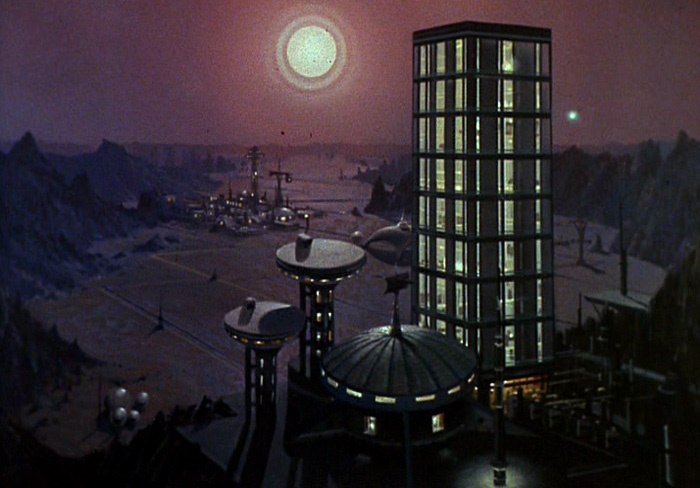
Star Trek: Picard + Star Trek: Discovery crossover theory: Control and the Romulans

Spoiler Warning: There are spoilers ahead for the most recent seasons of Star Trek: Picard and Star Trek: Discovery. There may be further spoilers for other iterations of the Star Trek franchise.

While Star Trek: Picard Season 1 was ongoing earlier in the year, I postulated a number of theories about what was going on in the show. One theory that I had related to Control – the rogue artificial intelligence from Star Trek: Discovery Season 2. Specifically, I speculated that the Zhat Vash’s hatred and fear of synthetic life may have stemmed from a run-in with Control, or that the Romulans may have been trying to compete with Starfleet in a mid-23rd Century AI arms race. It seemed possible that Control could have attacked Romulan ships or settlements in the time between its takeover of Section 31 and its defeat by the USS Discovery, or that if the Romulans developed their own AI that it would have similarly gotten out of control and attacked them.

This theory came back with a vengeance after Picard reused a couple of CGI sequences from Discovery in the latter part of the season, particularly as those sequences depicted Control attacking – and ultimately destroying – all organic life in the galaxy. While Picard and Discovery had thematic similarities in their most recent seasons, insofar as both stories looked at the creation of synthetic life and how that synthetic life could go rogue, there was no broader crossover. The Zhat Vash were not motivated by either their own rogue AI from the mid-23rd Century or by an attack from Control.

This CGI sequence of a planet being destroyed was created for Discovery… and recycled in Picard.

But that doesn’t necessarily mean that we have to drop the idea of there being any connection between the Zhat Vash in Picard and Control in Discovery. My theory started with the idea that Control could have been the reason for the Zhat Vash… but what if it’s the other way around? What if the Zhat Vash are responsible for Control going rogue?

There was no explanation given for why Control decided to lash out and attack its creators. It wanted to acquire the data from the planetoid-sized lifeform known as the Sphere, believing that data would help it achieve true sentience. But that isn’t a reason to go on to commit genocide; something inside Control made it want to kill. Remember that Dr Gabrielle Burnham – Michael’s mother – arrived in a future timeline where no sentient organic life existed in the known galaxy; Control had wiped it all out. Why did it want to do that?

Dr Gabrielle Burnham.

We could try to argue that Control’s murderous rage is somehow a result of Starfleet denying it access to the Sphere data. But Starfleet and the USS Discovery only came to possess the data because of the time-travelling interventions of Dr Burnham; we don’t know how Control came to acquire it in the “original,” pre-intervention timeline. There are a couple of possibilities. The first is that when the Sphere died, it broadcast its data as far and wide as possible and that’s how Control acquired it. It’s also possible that Starfleet received the transmission and Control gained access to it from there. However, neither of these scenarios involve Starfleet actively trying to prevent Control accessing the data, meaning that it wasn’t Starfleet who started the fight with Control.

So if Control had no reason on the surface to attack its organic creators, why did it do so? It could simply be a programming error; Control was programmed to prevent war, and perhaps that got twisted around so that it decided the only way to prevent the Milky Way’s organic civilisations from fighting was to exterminate all of them. This kind of basic AI programming mistake is one that’s not uncommon in science fiction, and arguably something we need to consider out here in the real world as we develop our own AIs!

Control assimilated Captain Leland and went on a murderous rampage.

So that’s one possibility. But here’s where the Zhat Vash could come in: what if they are responsible for corrupting Control’s programming? We saw in Picard that the Zhat Vash know enough about synthetic life to hack into Federation synths and change their programming. That’s what they did on Mars, causing F8 and the other synths to go rogue and destroy Admiral Picard’s rescue armada. If they had that capability in the 24th Century, it isn’t much of a stretch to think they could have been capable of something similar in the 23rd Century too.

We also know that the Zhat Vash are “far older” than the Tal Shiar. Let’s look at what we know for sure to try to pin down a rough estimate of how old they could be. The Romulans split from the Vulcans somewhere around the 4th Century AD, and by that time were capable of interstellar flight. By the 2150s the Romulans were involved in covert operations on Vulcan, trying to start a war between Vulcans and Andorians. While it was never stated outright in Enterprise that the Romulan operatives we saw were working for the Tal Shiar, it’s not an unreasonable assumption. The Zhat Vash sent Commodore Oh to infiltrate the Federation sometime around the discovery of Data, which took place in the year 2338. When Raffi asked La Sirena’s Emergency Navigational Hologram about the octonary star system, he described the Romulan star charts that depicted it as “ancient,” which seems to suggest they’re more than a century old at least. It was the discovery of Aia, the planet in the octonary star system, and the beacon that resided there that led to the creation of the Zhat Vash.

Raffi and the ENH discuss the octonary star system.

Put all of that together and we can assume with reasonable confidence that the Zhat Vash existed by the mid-23rd Century. We also know, thanks to what we saw in Enterprise and Deep Space Nine, that Romulan intelligence was far better than Starfleet’s – they knew a lot more about the Federation than the Federation did about them.

There’s a question of just how secret Control was. Section 31 was much more out in the open in Discovery than it was by the time of Deep Space Nine, but even so it seems logical to assume that Control would be a top-secret project within an already-secretive organisation. Still, when most Starfleet flag officers used Control regularly, word of its existence would get out and it was generally known within Starfleet that an AI existed. Thus any Zhat Vash or Tal Shiar operative would have come to know about Control.

Section 31 HQ was heavily-guarded, but perhaps not impenetrable for a Zhat Vash spy.

Okay, so let’s slow down. Even if we’re confident that the Zhat Vash existed by Discovery’s era, and had commenced their anti-synthetic crusade, and even if they had operatives within Starfleet who would have made them aware of the existence of Control, that doesn’t mean they could just walk up to Control’s data servers and start messing around. Right? I mean, Control was based at Section 31 headquarters, which as we saw in the show was incredibly well-protected. And we saw no evidence of such an operative. Did we?

How about Admiral Patar, the Vulcan Starfleet admiral who was killed by Control at Section 31 headquarters? We know that Commodore Oh spent decades embedded within Starfleet, waiting to make her move at just the right moment. We also know she was able to attain a very high rank, and it’s only one short step from being a commodore to being an admiral. It’s at least possible. Admiral Patar had the means to access Control. She spent time at Section 31 headquarters right around the time Control went rogue. She was a Vulcan, and thus was biologically indistinguishable from a Romulan – meaning she could have been an undercover Romulan operative. Enterprise depicted Romulans undercover on Vulcan a century earlier, meaning that they had infiltrated Vulcan by that time and were able to do so with relative ease. The pieces fall into place for Admiral Patar to be a Romulan operative – or to have been replaced by one – even if the evidence is only circumstantial. Even if it wasn’t Patar, there may well have been other Vulcans working at Section 31 headquarters, any one of whom could have been a Romulan spy.

Admiral Patar on the USS Discovery’s viewscreen.

Once they had access to Control’s systems and specifications, the Zhat Vash could have figured out how to mess with Control’s programming and turn it hostile. Perhaps they only intended for it to attack the Federation, forcing them to shut it down permanently. Or perhaps they hoped it would cause wider chaos so they could force the kind of galactic ban on synthetic life that we saw in Picard. So the question of what they had to gain by such a move is obvious; it’s the same basic goal as they had for staging the attack on Mars.

If the Zhat Vash introduced a glitch in Control’s programming that would turn it murderous, they obviously didn’t intend for Control to go on and wipe out everything. That wasn’t the goal; that’s what they were trying to prevent. However, as I wrote earlier, it’s possible for even well-intentioned AI to get out of control or to act in a way its creators and programmers couldn’t anticipate. Perhaps that’s what happened with Control, and by the time it had assimilated Captain Leland, killed off most of Section 31’s leadership, and got a fleet at its command, there was no way for the Zhat Vash to stop it. If their sole operative had been killed when Control wiped out Section 31’s headquarters, the Zhat Vash may not have even been aware that the mission was not going to plan until it was too late.

Control commandeered a small armada of Section 31 vessels.

So that’s my crossover theory for Star Trek: Discovery and Star Trek: Picard – the Zhat Vash hacked or reprogrammed Control, and that’s what made it go rogue. There’s enough circumstantial evidence for this theory to be possible, and it would explain why Control went from being a useful tool for Starfleet to a menace capable of wiping out all sentient life in the galaxy. However, there’s no concrete proof. All we really have are two shows with similar themes, and a bunch of unrelated pieces that could be made to fit together – but also may not fit at all!

As I always say: it’s just a fan theory. Unless we get some confirmation on screen in future – which seems unlikely given both Picard and Discovery are almost certainly moving on to new stories in their upcoming seasons – we have to consider it as unconfirmed at best. I consider it plausible (obviously, or I wouldn’t have written an article about it!) but it may prove to be a complete miss… just like many of my other Star Trek: Picard theories!

This post was edited 31.03.21 to replace header image. Star Trek: Discovery and Star Trek: Picard are available to stream now on CBS All Access in the United States. Discovery is available internationally on Netflix; Picard is available internationally on Amazon Prime Video. The Star Trek franchise – including all properties mentioned above – is the copyright of ViacomCBS. This article contains the thoughts and opinions of one person only and is not intended to cause any offence.
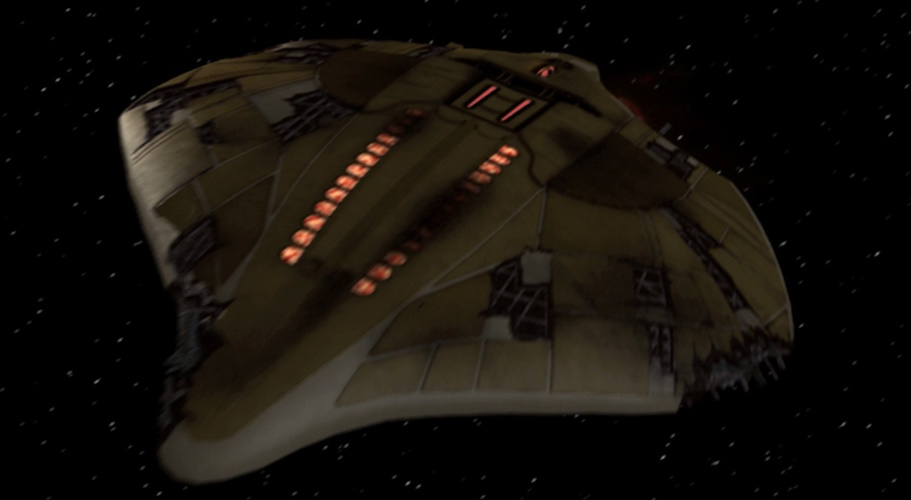
Unsolved mysteries from Star Trek: Picard Season 1

Spoiler Warning: There are spoilers ahead for the entirety of Star Trek: Picard Season 1. There are further spoilers for Star Trek: Discovery (including the Season 3 trailers) and for other iterations of the Star Trek franchise.

It’s been a little over six months since Season 1 of Star Trek: Picard came to an end. The series set up a number of mysteries, and while many of them were completely resolved by the first season finale, some weren’t. Some of these may be addressed in future – in fact, that’s something I’d really like to see – but assuming the series follows a similar pattern to Star Trek: Discovery, Picard and his new crew will likely warp away to a different adventure next time. That may mean that we never learn the truth behind these mysterious unresolved story threads.

Many television series nowadays set up mysteries or unanswered questions early on that become important later, and I don’t mean to come across as impatiently banging on the table demanding we get answers to everything now! Part of the fun of watching a series like Star Trek: Picard – at least for me – is the theorising and speculating, trying to figure out the puzzles that the producers and writers have created.

Jean-Luc Picard will return in Season 2!

One small caveat: it’s possible that some of these points have been addressed in non-canon sources (like comic books) but I’m not counting that. Star Trek, unlike Star Wars, has always drawn a clear line between official canon and unofficial sources. Occasionally we will see points from unofficial material make its way into Star Trek, but unless we see these points resolved on screen, the potential exists for the writers of Season 2 – or indeed of any future Star Trek production – to overwrite anything published in a novel, comic, video game, etc.

With that out of the way, let’s dive into the list!

Number 1: Who are Laris and Zhaban, and what is the nature of their relationship with Picard?

Laris and Zhaban.

The first few episodes of Season 1 introduced us to Laris and Zhaban – Picard’s assistants at his vineyard in France. Laris and Zhaban are Romulans, and not just any Romulans but former Tal Shiar operatives. I assumed, before we learned what happened to Picard’s planned rescue armada, that he had won their loyalty by saving them (or their families) from the Romulan supernova. But now we know that Picard only evacuated a minuscule number of Romulans, most of whom wound up on the planet Vashti. Those refugees detest Picard for abandoning them – even though the decision was taken by the Federation rather than him personally.

So the question remains: why are Laris and Zhaban so loyal to Picard that they’d give up everything to become housemaids and winemakers on Earth? Even if he saved their lives during the evacuation, very shortly afterwards he gave up on helping their people and their cause. Not only do they seem 100% fine with that, but they appear to have made no effort to help either, despite being operatives of the Tal Shiar.

A related point would be why didn’t Laris and Zhaban accompany Picard when he left the vineyard to go back into space? Picard seems to convince them to stay behind by telling them he needs them to attend to the grape harvest – but if you stop to think about it, this doesn’t make much sense. If they’re staying with him out of sheer stubborn loyalty – for some as-yet-unidentified reason – why would they allow him to head off on a dangerous mission unaccompanied?

Laris with Picard.

And finally, now that Picard seems to have a ship and loyal crew, what will happen to Laris and Zhaban back on Earth? Are they just going to remain behind as custodians of the vineyard while Picard is away? That’s certainly a possibility, but it still raises the question of why he has such steadfast loyalty from them.

Laris and Zhaban filled a story role in Season 1, not only by introducing Picard (and us as the audience) to the idea of the Zhat Vash’s existence, but also by being representations of Picard’s home and safe harbour that he has to leave behind as he goes on his adventure. They serve the same role as some of the Hobbiton Hobbits in The Hobbit and The Lord of the Rings novels in that regard. As a story point and character archetype that’s fine, but in the Star Trek galaxy, given everything we learned about Picard and the Romulans, some explanation would be nice!

Number 2: What happened to Soji’s Trill friend after Maps and Legends?

Dr Kunamadéstifee with Soji.

Maps and Legends (the second episode of Season 1) introduced us to a Trill character: Dr Kunamadéstifee. The two sequences in which she featured appeared to have a lot of horror film-style foreshadowing, leading to a theory I held onto for almost the whole of the season that she was going to meet an unpleasant fate. However, after Maps and Legends the character was abruptly dropped with no explanation.

From a production point of view, it would have been beneficial to keep this character around. Soji had precious little interaction with anyone aside from Narek for much of the season, and a character like Dr Kunamadéstifee could have been a friend she could speak to, if only occasionally. Star Trek has always had guest stars who make a single appearance then don’t return, and from that point of view this isn’t odd or out of the ordinary. But it would still be nice to learn what became of Dr Kunamadéstifee – one way or the other!

Number 3: Why was Dr Bruce Maddox on Freecloud?

This is a huge point, because right now it represents a gaping hole in the story of the first season. I’ve talked about this before, but just to recap: the storyline of the first half of the season was about locating Bruce Maddox, who had been missing since the ban on synthetic life. Maddox was eventually tracked to Freecloud, and the only reason he’d travelled to the dangerous planet was because his lab had “been destroyed by the Tal Shiar.”

Obviously he can’t have been referring to his lab on Coppelius – Picard was literally sat in that room at one point, and it didn’t look destroyed to me! But even assuming Maddox had built a second lab away from Coppelius, why did he not simply return there if the new facility had been attacked? Why did he go to Freecloud instead? Dr Soong and the other synths would have welcomed him with open arms, yet he chose to go to a dangerous place and visit a woman he owed a lot of money to.

Freecloud was a very dangerous place for Maddox to visit.

Bjayzl may not have killed him or successfully sold him to the Tal Shiar, but she contributed to his death by weakening him significantly. Travelling to Freecloud – and to Bjayzl’s club in particular – appears to be an act of desperation or of last resort, yet Maddox clearly had other options.

Right now, the only reason Maddox was on Freecloud is to enable other aspects of the storyline to make sense, and to get Picard and other characters into position. Without Maddox, Picard would have had to find a different way to track down Soji, so he’s important to the plot. Unfortunately, the lack of explanation to this point leaves a pretty wide plot hole, and because finding Maddox was the main focus of the first half of the season, it’s one I can’t overlook. It needs a satisfactory expanation.

Number 4: What will happen to the ex-Borg and the Artifact?

The Artifact’s final resting place on Coppelius.

At the climax of the Artifact’s storyline, Seven of Nine and Elnor attempted to lead a rebellion of ex-Borg against the Romulans. However, Rizzo and the Zhat Vash were prepared and ended up killing a lot of xBs. Not all of them were killed, though, and while we don’t know how many survived, there clearly were survivors after the Artifact arrived at Coppelius. A Borg cube can easily have tens of thousands of drones aboard, and while it was suggested that Rizzo killed the majority of them, we don’t really know how many could have survived. It could easily be hundreds – or possibly more.

Seven of Nine appeared to take on a leadership role for the xBs, filling a void left by Hugh’s death. Many xBs seemed confused or traumatised by their experiences – and they will need someone to help them get through that. At the end of the Season 1 finale, though, both Seven of Nine and Elnor had rejoined Picard aboard La Sirena, and the ship then warped away to an unknown destination. Without Seven of Nine, what will happen to the ex-Borg?

Seven of Nine went to a lot of trouble to help the xBs… then appears to have ditched them.

The Artifact itself is likely to come under Starfleet control, at least in my opinion. Its wreckage on Coppelius is largely intact, and presumably the Federation will want to study as much Borg technology as it can get its hands on. It’s possible that something has happened in the galaxy in the two decades that we didn’t see that may have resolved or ended the Borg threat, but that was never mentioned on screen so I assume Starfleet would be very keen to get its hands on a mostly-intact Borg cube – even if it had been picked at by Romulans and may be several years out-of-date!

The ex-Borg are another matter, though. There appeared to be a wide range of races, including many non-Federation species. Some may wish to return home, but in the case of species like the Hirogen, that may not be possible. The Federation may offer them all refugee status and help them reacclimate to life outside the Borg Collective, but it still seems very strange to me that Seven of Nine has just seemingly abandoned the survivors. It’s possible that the final scenes of Season 1 took place many months later, in which case this may have been handled off-screen. Still, it would be nice to get a proper resolution, even if it’s just a couple of lines of dialogue.

Number 5: What will Starfleet do about Aia?

The Zhat Vash by the beacon on Aia.

Somewhere beyond Romulan space – and out of reach of Starfleet – lies Aia, a planet at the centre of eight stars. The stars were deliberately moved and aligned to strongly indicate Aia’s location, and at some point in the past – perhaps centuries ago – the Romulans stumbled upon it. On Aia there’s a beacon left behind by a powerful synthetic race (I nicknamed them the “Mass Effect Reapers”) and it tells synthetics to contact them. The Romulans would interpret this information as something apocalyptic, and the Zhat Vash came to believe that any synthetic life would ultimately lead to the extinction of all sentient organic life in the galaxy.

The beacon was more complicated than that, and instead contained an instruction for synths, telling them to contact the “Mass Effect Reapers” if they need help or are being persecuted by organics. Given the immense power that the “Mass Effect Reapers” appear to possess, surely Starfleet can’t risk leaving the beacon on Aia for anyone to find.

The planet Aia.

The beacon already caused massive problems – the attack on Mars and the Romulan attempt to attack Coppelius being just two examples, and there may be countless others. Leaving it alone will not only perpetuate the Zhat Vash’s conspiracy theory, but will also be dangerous. What if someone else encounters the beacon and contacts the “Mass Effect Reapers”?

I have a theory that – somehow – the Romulans have “cloaked” the octonary star system and Aia, otherwise surely with 24th Century scanning technology and telescopes the Federation would have noticed it. So it may not be as easy as just travelling there and shutting it down. Attempting to do so could even lead to war with the Romulans. However, I think it’s a risk the Federation will have to take; leaving the beacon alone is simply not an option.

Number 6: Who are the super-synths that I nicknamed the “Mass Effect Reapers”?

Who are these guys?

The “Mass Effect Reapers” – nicknamed for their similarities to a faction from a video game series – are a total unknown quantity. There are many possibilities for who they are and what their motivations are, but we only caught the barest of glimpses of them in the Season 1 finale, and in the aftermath of Picard’s “death,” no one mentioned them. Surely, however, they’re an existential threat to Starfleet – and indeed the whole galaxy – on a scale comparable to the Borg. Heck, they could actually be the Borg.

I have a theory that the “Mass Effect Reapers” may be the cause of the Burn – a galactic catastrophe seen in the trailers for Star Trek: Discovery Season 3. If that’s the case, perhaps Discovery will explain this faction’s backstory in more detail. If they reside in an area of space far beyond the Milky Way galaxy it could have taken them centuries to travel here, meaning the timelines match up for Discovery’s far-future setting.

Soji used a beacon to contact the “Mass Effect Reapers.”

Theories aside, we know next to nothing about this faction. They were powerful enough to move stars and to create a sustainable eight-star octonary system. They also appear to have altruistic motivations when it comes to synthetic life, offering to help synths in their struggle against organic oppressors. But is that genuine? Or when they arrive would they simply harvest or assimilate whoever they found? We simply don’t know, but it feels like something that could easily be a trap.

Soji was talked into closing the beacon – but whoever the “Mass Effect Reapers” are, they’re now aware of the existence of the Federation, the Romulans, and the Coppelius synths. If I were Starfleet, I’d immediately work on a plan to contact them and try to open a dialogue. Explaining what happened, and that the Coppelius synths are safe, may be the only way to avert a conflict.

Number 7: Why was Dr Soong planning to transfer his mind to a synthetic body?

Dr Altan Inigo Soong.

When Picard and the crew of La Sirena arrived on Coppelius they met Dr Soong – the son of Data’s creator. Dr Soong was working on a synthetic body for himself, but had been unable to perfect the mind-transfer that he would have needed to accomplish that goal. He ended up donating the body – nicknamed the “golem” – to Picard, but what consequences (if any) will there be for that?

Sadly we didn’t get to spend a lot of time with Dr Soong, but I felt it was at least hinted at in Et in Arcadia Ego, Part 1 that he needed a synthetic body. Perhaps he, like Picard, is dying? The finale had a lot of story to get through and rather skipped over that point, so we don’t really know why Dr Soong wanted to become a synth. Was it a desire for immortality? Was it because of illness? Was it because all of his friends were synths and he felt left out? We simply don’t know.

With Brent Spiner set to reprise the role in Season 2, I’d say we have a decent chance of finding out.

Number 8: What became of Narek?

We have no idea what happened to Narek after this moment.

Narek’s story came to an abrupt end partway through Et in Arcadia Ego, Part 2. After convincing Raffi and Rios to go along with his plan to attack the synths’ beacon, Narek was wrestled to the ground by a group of synths during the botched attack. After that he was never seen or referenced again.

Apparently there’s a deleted or unfilmed scene from the episode which was to depict Narek being taken into custody by the Federation. While it isn’t canon, it remains the most likely outcome. However, there are other possibilities. Narek could have been retrieved by the Romulans during their mission to Coppelius, being transported aboard a Romulan ship during the standoff. He could have been held by the synths, who have cause to hate him for unleashing the Zhat Vash upon them. He could have recanted his Zhat Vash ideology and left aboard La Sirena with Picard – though I consider this one unlikely.

There are many reasons why Et in Arcadia Ego, Part 2 was a mixed episode and a somewhat stumbling finale. The lack of any resolution to the story of a major character is just one of them. Though unconfirmed at this stage, I doubt Narek will return as a major character in Season 2, so unless we get some dialogue or a cameo confirming his fate, the deleted/unfilmed scene may be all we have to go on.

Number 9: Are the synths safe on Coppelius?

The Federation and Romulan fleets over Coppelius.

The timely arrival of Riker’s Starfleet armada is the only reason Coppelius wasn’t obliterated from orbit by a massive Romulan attack fleet. Soji may have listened to Picard and shut down the beacon, but Commodore Oh and the Zhat Vash are fanatics and zealots, and the idea that they would have simply stood down having witnessed that and having heard Picard’s speech doesn’t make a lot of sense.

With that in mind, what’s to stop them returning at any point in the future to finish the job and destroy this colony of synths? Unless Starfleet plans to permanently base an entire fleet in the system, and perhaps build a Starbase there too, it seems like the synths can never be safe if they remain on Coppelius. Evacuating them to a new home would seem to be the safest option.

Number 10: Who knows that Picard is now a synth?

Picard in his new body.

Obviously Dr Soong, Dr Jurati, and Soji know that Picard is now a synth. The rest of La Sirena’s crew must know too, as will Seven of Nine. At the very end of Et in Arcadia Ego, Part 2 Picard basically admitted it out loud in front of all of them. But does anyone else know? What about Riker and Troi? They played big roles in Season 1, but Riker left Coppelius before Picard’s “death” so he may not be aware of what transpired.

There are potential ramifications for Picard’s death-and-rebirth. From Starfleet’s perspective, is he the same Jean-Luc Picard as before? To his friends he may seem the same, but to those prejudiced against synths after a long prohibition on synthetic life, will they treat him the same? Picard may reunite with other people from his past in Season 2 – someone like Dr Crusher or Guinan. I wonder how they will react if they learn what happened.

So that’s it. Ten unresolved mysteries from Star Trek: Picard Season 1. Some of these I fully expect future seasons to tackle, but others feel in danger of being abandoned as Picard and the crew move on to new adventures.

Overall, Season 1 of Star Trek: Picard did a good job of resolving the mysteries and storylines that it set up. But there are some that fell by the wayside and didn’t get a proper conclusion. If the plan is to continue these stories and make more of them in future seasons then I’m all for it, because that sounds fantastic. But if we aren’t going to see these storylines and characters return, doing something to bring proper closure is something I really hope the producers and writers try to do.

Star Trek: Picard is available to stream now on CBS All Access in the United States and on Amazon Prime Video in the United Kingdom and other countries and territories. The Star Trek franchise – including Star Trek: Picard – is the copyright of ViacomCBS. This article contains the thoughts and opinions of one person only and is not intended to cause any offence.
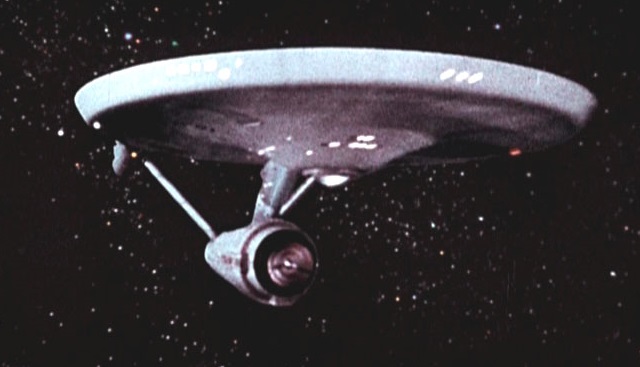
Star Trek: Discovery Season 3 – what is the Burn?

Spoiler Warning: There are spoilers ahead for Star Trek: Discovery, including the two Season 3 trailers and the ending of Season 2. There are also spoilers for Star Trek: Picard Season 1 and other iterations of the franchise.

The most recent trailer for Star Trek: Discovery’s imminent third season dropped a bombshell: the Federation has mostly collapsed! In my breakdown of the trailer I covered my thoughts on that story premise, so we won’t get into the ins and outs of it again today. Instead, we’re going to look at the event that triggered this collapse and postulate a few theories as to what it could be! As always with any fan theories (mine or someone else’s) please take all of this with a grain of salt. No fan theory is worth getting worked up over!

Discovery has a new trailer… and a new logo!

All we really know for certain is that the event in question is called “the Burn.” Booker, the new character who’s native to this time period, tells Michael Burnham that the event was when “the galaxy took a hard left.” And that’s all the explanation the trailer gave us. However, some images and scenes from the trailer add context to this, so we should run through some of them briefly.

Firstly, we had one very short scene of an explosion aboard a starship or space station that appeared to blow a number of people out into space. This could be a flashback to the Burn, but as I noted when I looked at the trailer, it could also be something happening after Discovery’s arrival in the future. Even if it is taking place during the Burn, however, all we can gleam from this scene is that it was a violent event – which may mean it took place over a relatively short span of time.

This violent event glimpsed in the trailer could be the Burn.

Next we have two glimmers of hope: a futuristic starship, space station, or facility which Saru and Burnham visit at some point, and a black-uniformed woman who I suspect may be a Starfleet officer.

Is this character a Starfleet officer?

The woman’s uniform was at least a little reminiscent of the uniforms used to depict 29th Century Starfleet seen in the Voyager fifth season episode Relativity. The texture and pattern used for the dark upper part of her uniform reminded me of that episode, and I’m sure that must have been intentional!

Captain Braxton wearing the 29th Century Starfleet uniform.

If this woman in Starfleet, it lends credence to the idea that the facility mentioned above could be a Federation vessel or even a Starbase. Add into the mix Booker’s line that the Federation “mostly” collapsed following the Burn, and I think we can make a solid case for Starfleet being around in some form; last time I called this remaining faction “rump Starfleet.”

The final thing to look at from the trailer are the scenes set in its aftermath. Away from the woman in uniform and the futuristic facility we see what could be a shanty town or post-apocalyptic markeplace as an Orion or other green-skinned alien guides Burnham. One possible implication from this scene is that we’re seeing how the majority of people in the collapsed Federation live. In the aftermath of the cataclysm, they may all be reduced to this kind of hand-to-mouth existence.

The possible shanty town.

On the flip side, we have seen settings like this in other iterations of Star Trek, even on human-populated worlds. One that springs to mind is Turkana IV, the birthplace of Tasha Yar in The Next Generation. Described as a “failed Earth colony”, the planet was in a state of disarray in the 24th Century. In short, the existence of a shanty town like the one depicted above may not mean that everyone in the 32nd Century lives that way.

The reason I brought up Turkana IV and the like is to demonstrate that the Federation, even in the eras we’re familiar with, wasn’t always perfect and wasn’t one homogeneous bloc. Just as there seems to be a great contrast between the sleek facility and the shanty town in the 32nd Century, so too is there a contrast between different locations in the 23rd and 24th Centuries. I wonder if Discovery plans to use this dichotomy to make a point about wealth inequality.

The facility visited by Burnham and Saru.

One final point of note is that, when discussing the Burn, Booker referred to it as when “the galaxy” took a hard left. Let’s be clear about that – the galaxy as a whole, not merely the Federation. That was a deliberate choice of words, and I think what we can infer is that the effects of the Burn extend far beyond the borders of the Federation.

It’s possible that the Burn didn’t affect literally the entire galaxy; some regions and worlds may have escaped. Booker may have used the word “galaxy” in this context to mean something that impacted more than just one region and that went beyond the Federation’s borders. Even if that’s the case, we’re still dealing with what is arguably the biggest disaster we’ve ever seen in Star Trek.

Booker is the one who told us about the Burn.

That’s all we know from the trailer. It’s unclear how many people survived the Burn. Some disasters destroy infrastructure and technology, but leave organic lives intact, whereas others cause massive loss of life. There are clearly some survivors of the Burn, but how many is simply unknown right now. It’s highly likely that in the aftermath of such a catastrophe, more lives would be lost due to things like disease and starvation – especially if the Burn triggered the kind of collapse we seem to be seeing. The scene in the shanty town or junkyard seemed to show people barely surviving, living a hand-to-mouth existence without much of the familiar technology we’re used to in Star Trek. Such a loss of technology could cause even more deaths in the months and years following the Burn than the event itself.

This character could be some kind of warlord or faction leader.

We’ve seen at least one anti-Starfleet faction, which in the first trailer appeared to comprise of Andorians, Lurians, Cardassians, and humans. We also met a character in the second trailer who could be the leader of a faction or perhaps a warlord. I think this shows how, in the aftermath of the Burn, the survivors banded together into smaller groups. As with the number of survivors, we don’t know how many of these groups exist or what their relationships are with one another.

This group appear to be antagonists; opposed to the Federation.

We also don’t know for sure whether faster-than-light travel, warp speed, and time travel are still possible in this era, or whether the Burn caused such a catastrophic collapse in the Federation – possibly combined with damage to the galaxy and spacetime and/or subspace in general – that such things are no longer possible. We saw in the second trailer the USS Discovery using its spore drive, so at least travel via the mycelial network remains viable. But everything else is unclear, and if it were to be the case that warp speed and faster-than-light travel are impossible, the fractured Federation will be very difficult to bring back together.

There’s also the question of timing. When did the Burn take place? We’ve already made one assumption – that it was a relatively fast event, perhaps taking place over less than a year – but when it happened relative to Burnham and the USS Discovery’s arrival in the year 3188 is not known. I wrote last time that the furthest forward in time Star Trek has previously gone in canon is the 31st Century. However, in both stories which took place in that era the dating was very vague, and we only have terms like “years” and “centuries” to go on rather than something more precise. As a result, Discovery’s third season could be anywhere from 90 years ahead of what we saw in Enterprise and Voyager all the way to 180 years ahead of those stories. Picking a halfway point, and saying that Discovery takes place 130-140 years further on from anything we’ve ever seen still gives a huge amount of time for the Burn to have taken place.

A backup copy of The Doctor was reactivated in the Delta Quadrant in the 31st Century.

Based on the warlord/faction leader seen above, and the scene set in the shanty town/junkyard, I’m assuming it wasn’t recent. It certainly didn’t look like something that had only just happened in those scenes; the faction leader in particular seems confident in his position. Booker also didn’t appear to be speaking about something very recent when discussing the Burn; he almost seemed to be recalling history. I also noted something from the Star Trek Day panel: showrunner Michelle Paradise stated that characters like Booker had been “born” into this new future. While she could have meant simply that Booker was born in the 32nd Century, in the context of a discussion about the new season’s setting it could also mean that the Burn took place decades previously; before Booker was even born.

Did Michelle Paradise drop a hint at the timing of the Burn?

So it’s clear that at this stage we’re missing a lot of information! We don’t know when the Burn happened. We don’t know what effect it had other than the near collapse of the Federation. We don’t know how many casualties were directly and indirectly caused, or how many survivors remain.

Perhaps most importantly, we don’t know what the Burn is or what caused it. Fixing a problem requires understanding what the problem is and why it happened, so it will be absolutely essential for Burnham and the crew to figure this out. Even though we have practically no evidence to go on, I do have a few ideas! Let’s look at them in turn.

Possible cause #1: The super-synths from Star Trek: Picard

I’ve already written up this theory in more detail, and you can find that article by clicking or tapping here. But now that we know a little more about the Burn thanks to the new trailer, I was pleased in a way that it hasn’t been debunked already! Star Trek: Picard introduced us to an unnamed race of super-synths that I nicknamed the “Mass Effect Reapers” due to their similarities to that video game faction.

The “Mass Effect Reapers” left behind a beacon on the planet of Aia, explaining that synthetic life is under threat from organic life, and promising to come to the aid of any synths who ask for their help. The Zhat Vash – a secretive Romulan faction – found the beacon and interpreted it as something apocalyptic; they believed that if synthetic life were ever created, the “Mass Effect Reapers” would exterminate all organic life in the galaxy.

The Reapers, from the Mass Effect video game trilogy, are similar in some respects to the faction of super-synths in Star Trek: Picard.

During the events of the season finale, Soji and Sutra constructed a beacon to contact the “Mass Effect Reapers”, and opened a portal to the location in deep space where they reside. After being convinced by Picard – and the timely arrival of a Starfleet armada led by Riker – Soji closed the portal and shut down the beacon. The “Mass Effect Reapers” never arrived – but they are now aware of a race of synths in the Milky Way galaxy, as well as being aware of the existence of the Romulans and the Federation.

From the point of view of this race of super-synths, here’s what they saw: a race of synths who found their beacon called on them for help, and when the portal was opened they saw a handful of synths on a planet with two massive fleets of starships populated by organics. Then, with no explanation, the portal was closed. If I were them, I would have major concerns!

Picard talked Soji into closing the portal – but the “Mass Effect Reapers” probably don’t know that.

We know hardly anything about the “Mass Effect Reapers” – which in itself makes them a good candidate for Discovery’s writers to play with – including how far away from the Federation they are. If they decided that they needed to intervene on behalf of the Coppelius synths, it could have taken them centuries to travel to the Milky Way from wherever they’re based.

When they finally did arrive, they would have likely found Coppelius abandoned, as I feel certain the safest thing to do for the synths who live there would be to relocate them to a new home where the Romulans can’t touch them. Again, from the “Mass Effect Reapers” perspective, the last thing they saw was two massive fleets in orbit of this planet that asked for their help, and when they arrived, the synths who asked for that help were gone. Put two and two together and it’s not hard to imagine they would assume the organics wiped out the synths. If they were minded toward revenge, they could go on the rampage, using their superior technology to destroy the Federation and Romulans in an event that would become known as the Burn.

These two fleets – one Romulan, one Federation – were the last thing the “Mass Effect Reapers” saw before the portal closed.

From the production side of things, this theory brings together the two live-action series currently in production, which is something that hasn’t happened yet. I’ve written many times that modern Star Trek shows being split up in this way isn’t a good idea, and finding ways to bring them together will be important to the franchise going forward. Having this faction from Picard also be important in Discovery – as well as the events of one series directly leading to events in the other – would bind the two shows together and strengthen the franchise.

Possible cause #2: Michael and/or Gabrielle Burnham

The Burnhams.

I can’t be the only one who noticed that the “Burn” happens to be three letters different from “Burnham”, can I? While it may seem absolutely preposterous to assume that Burnham or her mother somehow caused this galaxy-wide calamity, there are some points we could argue are in its favour.

Gabrielle Burnham, Michael’s mother, was the original Red Angel in Discovery Season 2. At several points in the story she intervened, including to save Burnham’s life and Spock’s life in their youth, as well as ensuring that the USS Discovery would be on hand to save the data from the “Sphere” – the planetoid-sized lifeform whose data was vital to the Control AI. Gabrielle Burnham was tied to a point in the future around the same time as Season 3 is set and returned there after her many visits to the 23rd Century. But in both of the trailers we’ve seen, she’s nowhere to be found. Why is she missing, and could her absence have something to do with the Burn?

Where is Dr Gabrielle Burnham?

Discovery has been a series that places Michael Burnham at the centre of its stories. Burnham was the Red Angel. Burnham was the one who led the ship and crew home from the Mirror Universe and ended the Klingon War. Every story so far has been a Burnham-centric one, so it wouldn’t surprise me at all to learn she has some involvement with the Burn – an event which shares part of her name.

How could this work? There are a few possibilities, but I would say that all of them have to do with the Red Angel suit and its time travel abilities. The suit was very powerful, capable of detonating powerful “red bursts” that Starfleet could detect from thousands of light-years away. It was also capable of moving the Sphere, so the idea that it could – intentionally or otherwise – be used as a weapon or cause a natural disaster is not beyond the realm of possibility.

Could Michael Burnham be guilty of causing the Burn?

When Burnham arrived in the future, she took off the suit. But in scenes that seem to be set around the same time, she doesn’t appear to bring it with her. It’s possible she abandoned the suit at her crash site, in which case anyone could stumble upon it. It’s also possible that the suit was stolen. And finally, it’s possible that some other faction who was aware of changes to the timeline could have been waiting for Burnham’s arrival and took that opportunity to take possession of the suit.

I don’t believe Burnham or her mother would voluntarily cause the Burn. In fact I’d argue that both would go out of their way to avoid it – even putting their lives on the line to prevent it ever happening. But it could have been accidental, such as a by-product of the suit’s time travel abilities. Or they could have done something while under duress – perhaps it was the least bad option if they were given a choice between the Burn and something far worse.

One thing is for sure, though. If it was Burnham’s fault, calling the event “the Burn” sounds way better than calling it “the Ham!”

Possible cause #3: The Borg

We haven’t had a Borg story in Star Trek since Enterprise’s second season way back in 2003. For a time it seemed as if Discovery’s second season was setting up a Borg origin story with the Control AI, but for whatever reason that didn’t pan out. We could still see the Borg in Discovery, though, if they turn out to be the nefarious villains who caused the Burn.

Booker said that the Burn affected the whole galaxy, and if that’s literally true perhaps it impacted the Borg as well. But it could be that the Borg either are the Burn or are the cause of it, striking out in all directions from their Delta Quadrant home and attacking multiple areas of the galaxy simultaneously.

A Borg drone seen in The Next Generation.

Though it was implied, perhaps, that the Burn was a relatively short event, it could be that it was a war. Even a year-long conflict against the Borg on all fronts could have seen the Federation on the verge of collapse, and we could be looking at the aftermath of a Pyrrhic victory, one in which the Federation and their allies were only able to defeat the Borg at a catastrophic cost to themselves.

How exactly this would work is unclear, but perhaps the Federation used a weapon of last resort that not only destroyed the Borg but also crippled themselves in the process. We’ve seen this kind of story in science fiction before, and the idea that the Federation’s collapse is in part the Federation’s fault is an interesting one. Alex Kurtzman said that the Federation’s collapse wasn’t due to infighting but was something external – and a Borg invasion is definitely an external threat.

Borg drones from First Contact.

When considering an event that has the potential to impact not only planets and star systems but Starbases and fleets of ships, a large-scale war is one of the few possibilities that I can think of. We’re talking about devastation across not only the whole Federation but far beyond its borders too, meaning the Burn has to be something immense in scope. A massive invasion could be such an event, and I can’t think of any known faction in Star Trek able to pull off something like that other than the Borg.

By their later appearances in Voyager, I think it’s not unfair to say that the Borg were becoming stale. Having seen our heroes prevail against them time and again, they definitely needed a rest. Enterprise, while it added an extra complication to the history of Borg-human contact, managed to tell an exciting and tense story, but I think it’s to the franchise’s overall benefit that the faction then took a break. However, seventeen years is a decent length of time for such a break, so could we be on the verge of seeing the Borg make a comeback?

Possible cause #4: Time travel and the Temporal Cold War

Oh no! Alien Nazis!

Star Trek stories that took place in the 29th Century and beyond depicted time travel as something the Federation routinely engages in, despite it seemingly being prohibited by the 24th Century. Preserving the timeline intact is something Starfleet of this era seems to have been concerned with, but there were other factions opposed to the Federation who made attempts to use time as a weapon.

In Enterprise we saw a Temporal Cold War play out, with several different factions all vying for control of the timeline. The mechanics of this were vague – deliberately – but by the 31st Century, which is the home era of temporal agent Daniels, the Temporal Cold War was a major issue.

Daniels was a temporal agent who made multiple appearances in Enterprise.

As I mentioned when I looked at the trailer, one issue I can see coming up if Discovery goes headfirst into another time travel story is the question of why the Federation didn’t see the Burn coming. If they explore the timeline in the same way that the 24th Century Starfleet explore space, surely they look at the future timeline too, not just the past. If they do, they should have foreseen the Burn, right?

The problem with that assumption is that time travel muddies the waters. Even in a perfect world where Star Trek had always been consistent in its depiction of the rules and laws governing time travel (which it hasn’t been at all), the concept itself still generates all manner of possibilities, loops, and paradoxes. Part of the Temporal Cold War story arc involved factions travelling to the past to attempt to undermine their adversaries before they could even develop time travel – knocking them out of the war entirely. If someone were able to travel to a point in the timeline that the Federation could not observe, or were able to operate outside of normal spacetime, the Burn could have been triggered before the Federation even knew it was coming.

The USS Relativity was a 29th Century Federation timeship.

I’d like to pick one more hole in a time travel story. If the cause of the Burn is related to time travel, it’s arguable from the perspective of Starfleet that the timeline in which it occurred is not the “real” timeline. Logically they’d want to work to undo it, and if successful it would remove this timeline – and thus Discovery Season 3 – from existence. We have seen stories in Star Trek that “never happened” for reasons of time travel, but they were single episodes, not entire seasons, and I would make the case that having an entire season’s story arc being effectively wiped out of existence wouldn’t be the best way to go.

Possible cause #5: Something related to coronal mass ejections and stars

One frame of the trailer showed Tilly, Stamets, and Reno with the woman shown above who may be a 32nd Century Starfleet officer. On the display at the console where Tilly and Stamets were standing, it was possible to make out the words “CME Detected” and “coronal mass ejection [something] magnitude.”

The frame from the trailer, cropped and mirrored for clarity.

A coronal mass ejection, or CME, is a real-world phenomenon. I’m not a scientist, but as I understand it, a CME is where a small portion of a star’s plasma is shot into space. The phenomenon is associated with sunspots and solar flares, and can cause damage to technology like phone and power lines.

There is no known way to trigger a CME or for them to occur naturally on a galaxy-wide scale. But as we leave the real world behind and head into the realm of science fiction, either of those possibilities could exist.

A real-life coronal mass ejection that occurred in 2012. The blacked-out circle in the centre is the sun.
Picture Credit: NASA via WikiMedia Commons

“The Burn” is a very evocative name, drawing on a primal fear of fire. But it could be more than just a moniker adopted by survivors of the event: it could describe the event itself, and when a star undergoes a CME it’s literally shooting burning plasma into space – space fire. The Burn could be the very literal burning of spacecraft, planets, and even whole solar systems by some kind of massive wave of coronal mass ejections.

The interesting prospect this raises is that the Burn wouldn’t require an evil villain; it could be an entirely natural occurrence. How and why millions of stars all suffered the same fate is unclear, but it would change the dynamic of the story from one that requires the crew to defeat an adversary to one which requires scientific investigation – something which is arguably at the heart of Starfleet.

The USS Discovery could engage in a scientific expedition to determine the cause of the Burn.

Equally, even if the Burn refers to a tsunami of CMEs, there could be a cause. It could even be one of the four we’ve already listed: the Borg, the Burnhams, a time travelling faction, or the super-synths from Picard. Any of these could have intentionally or accidentally triggered some event that led to millions of stars all undergoing CMEs.

The next part of this gets very deep into lore, so it’s perhaps less likely, but I like to include these things because c’mon… we’re Trekkies. It’s what we do!

Whether the Burn is natural or artificial in origin, if it’s something which causes stars to undergo massive CMEs it could also be something which triggers supernovae. And there has been one recent supernova that had a massive impact on the Star Trek galaxy: the Romulan supernova. First shown in 2009’s Star Trek, the supernova appeared to move faster-than-light and destroyed the Romulan homeworld. Spock was able to stop it by using Red Matter, but the supernova would have a lasting impact, part of which was seen earlier this year in Picard.

A supernova destroyed Romulus in 2009’s Star Trek.

Though it may seem a long-shot, tying the Burn to the Romulan supernova would bring together several different Star Trek stories in a very neat way, which is important for reasons I’ve already outlined. If the Burn is natural in origin, the Romulan supernova may have been a precursor to it. And if it’s artificial in origin, the Romulan supernova may have been a preliminary test of whatever weapon caused the Burn.

So that’s it. A look at what the Burn could be as well as some possible triggers and causes. Though the existence of the Burn poses a big challenge for Discovery – as it fundamentally changes the underlying premise of Star Trek’s optimistic future – I’m absolutely fascinated by it. What is it? What caused it? When did it happen? Why did no one intervene to stop it? There are so many questions rattling around in my head, and this article has barely scratched the surface!

I am at least a little concerned about Star Trek: Discovery choosing a post-apocalyptic setting. But at the same time the series has been great so far, especially in Season 2, and I would love to see it build on what was accomplished last year to tell a fascinating and engaging story. The Burn is going to be part of that. Figuring it out and perhaps even working to stop it could be important story elements, and I’m absolutely fascinated to learn whether any of these ideas even come close!

Figuring out what could have caused such devastation is genuinely interesting.

As I mentioned at the beginning, these are just fan theories and speculation. I don’t have any insider information – and if I did I wouldn’t share it! Several recent shows and films have suffered backlash from fans who got a little too attached to certain pet theories, and as fun as theory-crafting is, I don’t want that to be the case here. This is a bit of fun and a chance to spend more time thinking about Star Trek, and that’s all. I want to know what happens, and if it’s something I didn’t expect then that’s fantastic!

When Discovery Season 3 kicks off in mid-October, I hope you’ll join me for episode reviews and perhaps even more theory-crafting!

Star Trek: Discovery Season 3 premieres on the 15th of October on CBS All Access in the United States, and on the 16th of October on Netflix in the United Kingdom and elsewhere. The Star Trek franchise – including Discovery and all other titles mentioned above – is the copyright of ViacomCBS. This article contains the thoughts and opinions of one person only and is not intended to cause any offence.

Has Star Trek: Picard’s first season finale set up the plot of Discovery’s third season?

Spoiler Warning: There are spoilers ahead for Star Trek: Picard, Star Trek: Discovery, and the trailer for Discovery’s upcoming third season.

Ever since we first caught a glimpse of Star Trek: Discovery’s third season setting, I’ve been wondering what’s going on. According to everything we know at this stage, Burnham and the ship will successfully complete a 930-year time jump into the far future. That future looks pretty bleak, and perhaps could even be described as post-apocalyptic. If it’s true that Discovery plans to tell a story set in an era where the Federation is defeated or in decline, figuring out how that happened – and reversing it – is surely going to be the overarching story.

For now we’re going to have to set aside reservations about how a post-apocalyptic or otherwise bleak setting will work with Star Trek from a storytelling point of view. Instead, let’s look at things from an in-universe perspective and try to figure out what may be going on. I have already covered this theory back in March when I was wrapping up my Star Trek: Picard theories, so if you’re a regular reader it may be familiar to you.

In short, here’s how the theory goes: the race of super-synths from Star Trek: Picard are the cause of Discovery’s post-apocalyptic setting. Let’s break it down, look at why it could be a possibility, and explore it in more detail.

This shot of a planet being destroyed by powerful synthetic life-forms was used in both Discovery Season 2 and Picard Season 1.

So although I said this would be an in-universe explanation of the theory, there is one production-side reason we need to look at too. One thing that modern Star Trek shows lack is a relationship to each other. Discovery did a pretty good job of tying itself to The Original Series, and both Picard and Lower Decks have connected themselves to The Next Generation, but there’s essentially nothing beyond a couple of throwaway lines linking Picard to Discovery right now. That would have been unthinkable during the 1990s, where The Next Generation, Deep Space Nine, and Voyager all shared characters, settings, locations, factions, and themes.

Modern Star Trek is hampered by its shows being split up along the timeline, and this makes it harder for new fans to transition smoothly from one series to another. There are no threads of consistency running between the different series, and while they are semi-independent productions they are all being produced by one overall team of people under the Star Trek Universe umbrella.

If we were to learn at some point in Discovery’s third season that the events depicted in Picard were directly related to the Federation’s decline or defeat, suddenly there would be a reason for Discovery fans who missed Picard to go back and watch it, and for Picard fans who haven’t seen Discovery to jump over and watch that show too. There would be the strong feeling that both shows genuinely take place in the same universe and the same timeline, which right now is lacking. This would help the Star Trek brand stay cohesive, and be a frame of reference for casual viewers, all while allowing both shows to provide each other a boost.

The Federation official from the Discovery Season 3 trailer.

So that’s on the production side of things. But I promised you an in-universe look! First let’s very briefly recap, in case you forgot the events of the final few episodes of Picard. While investigating Soji’s origins, Picard and the crew of La Sirena came to realise that there are a race of synthetic life-forms – created by Bruce Maddox – living on a planet called Coppelius. The Romulan faction known as the Zhat Vash were searching for the synths too, because they believe that the synths will trigger an apocalyptic event. This apocalypse was revealed to them by a beacon left behind by an ancient race on a world they called Aia, and when we got a clearer look at the message the beacon contained, it was less a warning to organics than a message to the synths themselves, offering aid. A faction of super-synths that I nicknamed the “Mass Effect Reapers” exist somewhere beyond the galaxy, and they have promised aid to any synthetic race that calls on them. Sutra and Soji planned to contact them, and to open a portal that would have allowed the “Mass Effect Reapers” to travel to the Milky Way galaxy. They successfully built the beacon, but at the last second Picard convinced Soji to shut it down, closing the portal and preventing the arrival of the “Mass Effect Reapers”.

Did I miss anything? I hope not! I nicknamed this faction the “Mass Effect Reapers” because they have noteworthy similarities to another race of super-synths in the Mass Effect series of video games.

I think that the most important thing to note is that in the finale, Soji and Sutra were successful in opening the portal. Thus, the “Mass Effect Reapers” are aware of the existence of a race of synths in the Milky Way galaxy, and also of the existence of the Federation. While Picard was able to convince Soji to stand down and close the portal, questions remain.

Soji working on the beacon in Et in Arcadia Ego, Part 2.

Now that the “Mass Effect Reapers” know of the existence of the Romulans, Federation, and synths, will they be content to go back to sitting still, waiting for another race of synths to contact them? Or did Sutra and Soji set into motion a chain of events that can no longer be stopped? Closing the portal may have prevented the imminent arrival of the “Mass Effect Reapers”, but it’s totally unclear what they will choose to do next.

The “Mass Effect Reapers” were presented as hyper-intelligent, arguably far beyond the Federation and Romulans in terms of technology, and thus their motivations and actions can be difficult to predict. This may be an oversimplification, but at the moment Soji closed the portal and shut down the beacon, she didn’t seem to communicate to the “Mass Effect Reapers” why she was doing so. From their point of view, a portal was opened – through which they could see a race of synths threatened by an imposing fleet of starships – then before they could take action the portal was closed. If I were the “Mass Effect Reapers”, I’d want to know why. And if I were paranoid, I might be thinking that the synths who tried to contact me were under attack and that the beacon had been forcibly shut down.

If the “Mass Effect Reapers” followed this line of thinking, and their motivation is still to provide help to any synthetic race that asks for it, the logical next step would be for them to set off to the Milky Way as fast as they can. Depending on how far away they are – and the show never really explained that – it could take years, decades, or even centuries for them to travel, even if their technology is more advanced than anything we’ve ever seen in Star Trek. That’s assuming they set off immediately – there may have been a debate or discussion about what to do that could have lasted years or longer.

This is basically all we saw of the “Mass Effect Reapers” in Et in Arcadia Ego, Part 2.

In any case, it’s not inconceivable that this extra-galactic threat could take centuries to arrive. I like to assume that Picard and/or Starfleet will travel to Aia and disable or destroy the beacon to prevent not only the Romulans from using it, but from other synths finding it in future. Even shutting down the beacon on Aia may be too late, though, because of the events of Et in Arcadia Ego, Part 2.

The “Mass Effect Reapers” are perhaps the only faction other than the Borg who could be capable of waging a successful war against the Federation. Even if all of the powers of the Alpha and Beta quadrants were to band together, it still might not be enough against the superior technology of these super-synths, and we could certainly expect any such conflict to be long and catastrophically costly. Even if the Federation survived it would be seriously weakened. Furthermore, a large-scale attack on the Federation would result in far-flung colonies being cut off, and any news or information might be hard to come by.

This is where the trailer for Discovery’s third season comes in. We see a setting best described as bleak, as Burnham and the crew arrive in a part of the galaxy that seems far away from Earth. The Federation seems to be in decline, Starfleet is described as a “ghost”, and we’re left wondering what happened to cause all of this. We’ve seen the Federation in the far future before, both in Voyager and Enterprise, and certainly 100-200 years before Discovery’s far future setting, the Federation and Starfleet seemed to be doing pretty well, even furthering their mission of exploration to include time as well as space. Reconciling that image of the future with Discovery’s setting is something Season 3 will need to do.

The crew of the USS Relativity in the 29th Century – around 300 years before Discovery’s third season is supposedly set.

As a faction we know essentially nothing about – not even their name – the “Mass Effect Reapers” are ripe for exploring in more detail. Discovery could do so in such a way that doesn’t interfere with anything Picard set up, providing not only the next part of the story, but also some background. We could learn about their leadership, motivations, and level of technology in much more detail. And it would still be a practically blank slate for Discovery’s team to use to set up the third season’s bleak and dark setting.

The question of the “Mass Effect Reapers” motivation comes into play again. There are two broad possibilities for their actions in Picard – either they were genuine in their offer to help synthetic races, or the beacon on Aia was part of an elaborate trap. Neither option bodes well for the Federation, assuming that the “Mass Effect Reapers” are now aware of their existence. If it was a trap, and the “Mass Effect Reapers” were waiting to be contacted by synths simply because that would mean advanced civilisations are present, they may now have a new target. If it wasn’t a trap and their desire to help was genuine, they may be motivated by concern for the Coppelius synths or even anger at the Federation and Romulans for intruding before communication could be established. While it’s hard to say what this faction could be planning or thinking based on such a small amount of information, these possibilities seem reasonable, and if they decided they wanted to attack or investigate, the events of Et in Arcadia Ego, Part 2 could have set that in motion.

Because Picard Season 1 wrapped up in the immediate aftermath of the standoff over Coppelius and the closing of the beacon, we don’t know what happened next. However, I consider two things to be somewhere between possible and likely: the synths on Coppelius would be relocated (in order to keep them safe from the Romulans), and Starfleet would make some attempt to contact the “Mass Effect Reapers” to explain what happened.

The Romulan and Federation fleets engage in a standoff over Coppelius in Et in Arcadia Ego, Part 2.

Relocating the synths feels like a necessity. Commodore Oh may not have wanted to risk war with the Federation when staring down a massive armada, but there’s no indication that she changed her mind on the necessity of exterminating synthetic life. From her perspective, Soji and Sutra building the beacon was a culmination of her worst fears, and although Soji may have been convinced to stand down, again from Oh’s point of view what’s to stop her changing her mind? Or one of the other synths building a new beacon? Leaving the synths on Coppelius would be very dangerous for them, unless Starfleet plans to permanently base a fleet in the system, so the easiest option for everyone would be to relocate them to a safer place.

However, in the context of our theory, this could be problematic. Suppose it takes the “Mass Effect Reapers” a long time to arrive in the Milky Way galaxy, and they don’t manage to travel to Coppelius for several centuries. What do they find when they arrive? No synths, but several massive interstellar civilisations and empires of organic beings. Put the two things together and it’s not unreasonable to assume that the organics wiped out the synths – especially if the last thing the “Mass Effect Reapers” saw before the portal closed was two massive fleets approaching the planet. They may take the missing synths as proof of an attack and go on the rampage.

Even if Starfleet were able to contact the “Mass Effect Reapers”, there’s no guarantee a successful dialogue could be opened. Setting aside other theories like the “Mass Effect Reapers” actually being the Borg, a race of super-synths that considers themselves light-years ahead of organic beings in every respect may look at humans the way humans look at ants or bacteria, and consider any attempt at communication unworthy of their time. That’s assuming Starfleet could find a way to make contact without opening another portal – it may simply not be possible, though I expect the Federation would want to try.

The “Mass Effect Reapers” make their way to the portal in Et in Arcadia Ego, Part 2.

Taken together, all of these different factors make at least a plausible argument for Discovery taking this story beat and expanding it for the basis of its third season. It could certainly be done in such a way that wasn’t confusing and didn’t make Picard essential viewing to understand what was happening – just like Discovery did with Pike, Vina, and the Talosians in Season 2. The Cage certainly provided extra details and informed what was going on, but viewers didn’t miss anything important for not having seen it. I’m sure the same could be done here, especially if the attack by or war against the “Mass Effect Reapers” was already over. It would exist simply as backstory; an encouragement to hop over and watch Picard without making doing so a necessity.

While this theory remains a possibility, at least in my opinion, it’s hardly a certainty and I wouldn’t be at all surprised to learn Discovery is going in a wholly different direction. Many of my theories during Picard Season 1 didn’t pan out, and this may simply be another that falls by the wayside! Nevertheless, it’s fun to craft theories and speculate, and at the end of the day that’s all this is: a bit of fun, and a chance to spend more time thinking about Star Trek. So please take everything I’ve said today with a healthy pinch of salt.

Star Trek: Picard Season 1 is available to stream now on CBS All Access in the United States, and on Amazon Prime Video in the United Kingdom and other countries. Star Trek: Discovery Season 3 will air beginning on the 15th of October on CBS All Access in the United States and Netflix in the United Kingdom and elsewhere. The Star Trek franchise – including all series and films discussed above – is the copyright of ViacomCBS. This article contains the thoughts and opinions of one person only and is not intended to cause any offence.
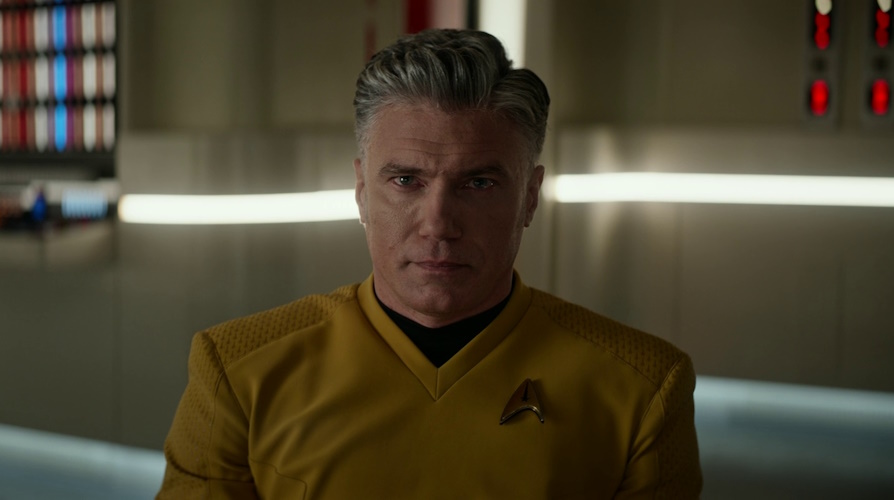
Could Voyager’s Doctor appear in Star Trek: Discovery?

Spoiler Warning: There are spoilers ahead for Star Trek: Picard Season 1, Star Trek: Discovery Season 2, Star Trek: Voyager, and other iterations of the franchise.

Star Trek: Discovery’s premiere brought back Sarek, Spock’s father who had been first introduced in The Original Series. Season 2 saw Spock himself as well as Captain Pike and Number One make appearances, so Discovery is a series that has no qualms about reintroducing legacy characters. But its 23rd Century, pre-The Original Series setting precluded the use of most of Star Trek’s characters, as the bulk of the franchise’s 780+ episodes and films take place later in the timeline.

Discovery’s move forward in time should also mean that no legacy characters could have significant roles. After all, who could possibly still be alive more than eight centuries after the events of Star Trek: Picard? I can think of one character, but not in the way you might expect!

Voyager’s Doctor – or at least a version of him – could be alive in the 32nd Century.

As a hologram who doesn’t age, we could definitely argue that The Doctor – played by Robert Picardo for all seven seasons of Star Trek: Voyager – might have survived this long. But that isn’t the angle I’m taking.

The 23rd episode of Season 4 of Star Trek: Voyager, Living Witness, takes place in the 31st Century. After the USS Voyager had an encounter with a species called the Kyrians in the 24th Century, some pieces of technology were left behind, including a backup copy of The Doctor. Reawakened in the 31st Century, he stayed with the Kyrians for a number of years, righting the wrongs in their historical records about Voyager and its crew.

The episode is interesting in itself, and well worth a watch, but from our point of view today what I want to consider is the episode’s ending. After living with the Kyrians for years – perhaps decades – The Doctor took one of their ships and left the planet, hoping to retrace Voyager’s path and return to the Alpha Quadrant.

A photo of The Doctor in a museum at the end of Living Witness.

We know from later seasons of Voyager that it only took them another three years or so after leaving Kyrian space to make it home – though that did involve the use of the Borg transwarp network, among other helping hands – so the journey is definitely achievable. The Doctor, unlike us mere humans, doesn’t need food or any other supplies personally, so as long as his ship was functional, even if it took him decades he would have been able to make it back to Federation space – and if it took him several decades, the timeline starts to line up for a crossover with Discovery.

One thing that I’m cautiously interested in when it comes to Discovery’s third season is the potential to learn more about what happened to some of the characters we knew in other Star Trek shows. Perhaps we won’t learn the specifics of what happened to individuals, but we may learn broad strokes about what happened to their planets and cultures, and we could infer from that what may have happened to them. The series looks – if we take its trailer at face value – as if part of the story will be about restoring a declining or defeated Federation. Characters who originated in an era where the Federation was strong and just would be well-suited to that task, and they may find an unlikely ally in this version of The Doctor.

Restoring the Federation may be part of Discovery’s third season storyline.

On the production side of things, Star Trek has recently had great success bringing back Brent Spiner as Data and Sir Patrick Stewart as Jean-Luc Picard. Spiner’s role as Data is a great comparison, because both Data and The Doctor are artificial, and thus not susceptible to ageing. Brent Spiner had said as early as the mid-2000s that he felt he’d “aged out” of the role of Data, yet the makeup and visual effects used in Star Trek: Picard worked very well. Obviously if you try to compare the way he looked earlier this year to the way he looked in 1987’s Encounter at Farpoint there’s a difference, but it’s not immersion-breaking. All this is to say that there’s no reason why Robert Picardo couldn’t reprise his role too.

Digital de-ageing effects have been used more and more often in recent years, even on television, and while the technology isn’t cheap, it shouldn’t be prohibitively expensive either. So that option would be viable for the team behind Star Trek as well.

But the big question is what kind of role The Doctor could play in a 32nd Century Discovery story.

Robert Picardo in a 2017 episode of Lucifer.

If I were writing it, the way I’d see him involved would be working alongside Burnham, Saru, and the crew of Discovery to restore the Federation. They’re looking at things from a 23rd Century viewpoint, but The Doctor could fill in more than a century’s worth of gaps in their knowledge. The Federation in the 24th Century is very similar to how it was in the 23rd in terms of morals and outlook, so I could absolutely see them working in common cause.

Rebuilding or reinvigorating the Federation is a noble task, and while I’ve documented my misgivings about Star Trek taking on a kind of post-apocalyptic setting previously, one way I think it could be made to work is if at the end of the season the Federation was back up and running. The Doctor could be invaluable to Discovery’s crew in accomplishing such a task, and with Data now permanently gone from the Star Trek universe, there aren’t many others who could still be around in this era.

The Doctor could help the crew of Discovery in the 32nd Century.

Perhaps after Season 2, which brought back several legacy characters for major roles, Discovery wants to stand on its own two feet again. Indeed, part of the reason for shifting the show’s timeline so far into the future is specifically because the producers and showrunners wanted to get away from the constraints of the 23rd Century – and the fan criticisms that came as a result of using that setting. So perhaps bringing back a legacy character in Season 3 isn’t on the agenda.

But The Doctor could still appear in Season 4 – and reports suggest that pre-production is underway on Discovery’s next adventure. While I think that The Doctor could be a good fit for a “rebuilding” type of storyline for the reasons already mentioned, if Season 4 takes the show in a different direction, perhaps that would be something more suited to his medical expertise, such as curing a disease. For all we know at this stage, a disease could be involved in damaging the Federation in this time period!

If not The Doctor, there are a few other characters who could – in theory – still be active in the 32nd Century. Let’s look at them briefly:

Number 1: Soji

Spoiler warning for Star Trek: Picard Season 1, but Soji is synthetic; an android. At the end of the season, Picard was told that his new synthetic body wouldn’t keep him alive for centuries, but there’s no reason Soji should have the same limitation. In many ways, Soji would make for a better crossover character than almost anyone else, as she’s a main character in an ongoing series. The crossover would thus be between two Star Trek shows that are currently in production, providing a link between them.

We could also add into the mix the other synths from Coppelius, including Sutra (aka Evil Soji) and even Dr Soong, if he was successful in creating himself a new synthetic body (and there’s no reason why he wouldn’t have been).

Number 2: Lore

Lore was said to have been disassembled after his final appearance in The Next Generation, but we learned nothing of his fate after that. I speculated during Star Trek: Picard’s first season that Dr Maddox may have had access to Lore’s components while working on Soji and the other synths, but this was never confirmed on screen. It’s at least possible that Lore survived in disassembled form until the 32nd Century.

However, with Star Trek having gone out of its way to write Data out of the franchise, and to give Brent Spiner a new character in Dr Soong, I think any re-emergence of Lore is highly unlikely.

Number 3: Benjamin Sisko

I’ve mentioned Captain Sisko so often in relation to characters who could re-appear that you may think he’s become an obsession of mine! However, his story as of the end of Deep Space Nine was deliberately written in such a way that he could come back at literally any point in the Star Trek timeline. After being saved by the Bajoran Prophets, Sisko went to stay with them for a while – and they exist outside of linear time, meaning he could essentially travel to any point in time, including the 32nd Century.

Avery Brooks, who played Sisko, hasn’t always seemed willing to reprise the role, and recently declined to appear in the documentary What We Left Behind. However, there’s no reason why the character couldn’t be recast for future appearances.

Number 4: The Dax symbiont

While still arguably unlikely, this seems perhaps the least-unlikely of all the characters we’ve looked at so far. The trailer for Discovery’s third season showed Trill characters as well as what looked like a scene set on the Trill homeworld. We know, thanks to Deep Space Nine, that Trill symbionts can live for centuries; how many centuries exactly has never been stated as far as I’m aware. That leaves an opening for Discovery to bring back Dax – as well as an excuse to recast the character.

With centuries of knowledge, Dax could be a huge help to the crew of Discovery for the same reasons we’ve already talked about. Rebuilding the Federation will be a huge task, and it will take people who knew how it worked to help out.

So that’s it. A handful of other characters to go along with The Doctor who could – but probably won’t – appear in Star Trek: Discovery’s 32nd Century setting. As the show gets nearer to being broadcast (mid-October, in case you missed that announcement) my optimism is growing. Season 2 was decent, and despite my misgivings about taking the series away from its setting and into the far future, I think it has potential to tell interesting stories. I’m cautiously optimistic!

It seems unlikely that The Doctor, or any of the other characters mentioned, will make an appearance, but from an in-universe perspective it’s not entirely impossible. We’ve seen with Star Trek: Picard that bringing back legacy characters and referencing events that took place in a past episode or story are both things that the people in charge of Star Trek are willing to consider, so it’s at least possible to think we could see someone from the past reappear in Discovery.

Most of all, this was a bit of fun. We got to look back at Living Witness, which was a unique entry in Star Trek: Voyager, as well as speculate on the fates of The Doctor and some other well-known characters from past and present iterations of Star Trek. I’ll take any excuse to spend more time in the Star Trek galaxy!

Star Trek: Voyager is available to watch now on CBS All Access in the United States, and on Netflix in the United Kingdom and elsewhere. Star Trek: Discovery Season 3 will be available to stream beginning on the 15th of October 2020. The Star Trek franchise – including all properties mentioned above – is the copyright of ViacomCBS.

Star Trek: Picard Season 1 theory roundup!

Spoiler Warning: There are spoilers ahead for the entirety of Star Trek: Picard Season 1, including its ending. There may also be spoilers for other iterations of the Star Trek franchise.

Star Trek: Picard’s first season wrapped up at the end of March – and it feels like forever ago, what with everything that’s happened in the world since! While the season was running, in addition to reviewing each of the episodes in turn I also concocted a number of different theories for what was going on in the show. Star Trek: Picard very carefully set up a number of mysteries, and even heading into the second half of the finale, it wasn’t clear exactly how they would be resolved.

I’d argue that the first season’s two-part finale wasn’t the show at its best, and it felt as though a season which started incredibly strongly ended up stumbling a little as it crossed the finish line. There were a number of reasons for this – which I covered at the time – but it boils down to some of the show’s mysteries not being fully explained, and some storylines being dropped or left unresolved. That and the truly awful gold makeup used for the synths on Coppelius!

Yikes.

If you’d like to read all of my theories from Star Trek: Picard Season 1, you can find them on my dedicated Star Trek: Picard page. Click or tap here to be taken there!

This time, what I’d like to do is take a look back at some of the theories I postulated while the season was running. I’ll explain why I thought they seemed viable – and why they ended up being total misses! In a way, part of the fun of theory-crafting and speculating is knowing that you won’t always get it right… and boy oh boy did I have some seriously wrong theories!

Number 1:
Dahj and Soji aren’t synthetics, they’re genetically-engineered humans.

Soji in the episode Nepenthe.

This is a theory I first came up with right at the beginning of the series, almost from the very moment Picard begins to suspect that Dahj is synthetic. It seemed like it could’ve been a clever idea for a double-bluff – establishing Dahj and Soji as synths, only to rip that away and challenge both Picard’s and the audience’s expectations. However, it didn’t pan out that way, and looking back, this theory was kind of ridiculous!

Genetic enhancements, similar to those made on characters like Dr Bashir and Khan, could have given Dahj the incredible speed and strength that she possessed in Remembrance, so from that point of view it wasn’t wholly unthinkable. But looking back, while Star Trek: Picard did aim to be a show that kept us guessing and didn’t telegraph every aspect of its storyline, this kind of subversion of expectations would have been a step too far. We didn’t know anything about Dahj or Soji at the beginning of the series, and to take the one established fact about them and make it a lie or a misunderstanding would have been a storytelling mistake.

Dahj during her fight against Zhat Vash operatives in Remembrance.

There was also plenty of evidence that Dahj and Soji were synthetic: Picard’s meeting with Dr Jurati, Narek’s interest in Soji, and the strong connection Picard felt to Dahj (and later to Soji) because of his friendship with Data. All of that would have made no sense in the story if we’d ended up dealing with genetically-enhanced humans!

I brought this theory back after episode 3, The End is the Beginning, based on a line spoken by one of the Romulans who attempted to assassinate Picard: “she’s not what you think she is!” This of course referred to Soji, and it struck me that, as Picard and his comrades believed Soji to be a synth, perhaps the Romulan knew that she was not. However, as the story progressed it became abundantly clear that Soji and Dahj were the synthetics that the story established them to be, and that I was barking up the wrong tree with this one!

Number 2:
Section 31 will make an appearance in the show.

A black Section 31 combadge from Star Trek: Discovery.

This theory was crafted not so much because of anything that directly happened in the plot of the show, but rather for production reasons. In short, the Star Trek timeline is seriously fractured, with shows being produced simultaneously occupying very different timeframes. When Discovery’s third season kicks off in a few weeks time, there will be four shows occupying four time periods. This complicates the franchise, and what that means is that some threads of continuity would be very helpful, especially for casual viewers.

Section 31 featured heavily in Discovery’s second season, and in addition, a spin-off based on the organisation is currently being worked on. It seemed logical that Star Trek: Picard might want to find some way of incorporating Section 31 if for no other reason than having one of those threads of continuity running through the franchise, tying things loosely together and being a frame of reference for casual viewers.

My first thought for a potential Section 31 appearance was that they could’ve been responsible for the attack on Mars and the destruction of Picard’s armada. I theorised they might have taken such aggressive action to prevent the Federation giving aid to the Romulans. This was extended to include Section 31 hacking the Mars synths as part of this plan.

F8’s eyes during a flashback sequence that depicted the hack.

I next had two potential Section 31 operatives pegged – Chris Rios and Seven of Nine. Rios because he worked aboard a Starfleet ship that was “erased” from the records, and Seven of Nine because it wasn’t clear who she worked for or why she was following Picard.

Finally, as these other theories fell by the wayside, I speculated that Section 31 may have arrived to take control of the Artifact after it was abandoned by the Romulans and later crashed on Coppelius. While I suppose you could argue that might yet happen, it didn’t happen in Season 1, and thus any real benefit of the organisation crossing over from a behind-the-scenes perspective was lost.

I maintain that this theory makes a lot of sense from a production perspective, and my final idea in particular – Section 31 taking control of the Artifact to study it – could have been accomplished without making any changes whatsoever to the season’s storyline. However, it didn’t happen!

Number 3:
Soji’s Trill friend will end up getting assimilated or killed.

Soji with Dr Kunamadéstifee in Maps and Legends.

Episode 2, Maps and Legends, introduced a Trill doctor working aboard the Artifact along with Soji. She ultimately only appeared in one sequence, but that sequence seemed to contain a lot of horror film-style foreshadowing, and for weeks I was insistent that we’d see this character meet an unpleasant end! Aboard a Borg cube – even a disabled one – the most likely way that would manifest would’ve been her assimiliation.

After Soji helped Dr Kunamadéstifee with her uniform, the two stood together while they listened to a speech from one of the Artifact’s Romulan guards. He stated that the area they were about to enter was incredibly dangerous, and a nearby sign seemed to reinforce the possibility of assimilation by counting the days since it had last happened. This seemed as thought it could tie in with Soji working on de-assimilating Borg drones; was she about to see her friend end up on her operating table?

Dr Kunamadéstifee again.

It turned out, of course, that I was reading too much into one side character and one short sequence, because not only didn’t Dr Kunamadéstifee end up assimilated, she was never seen again after Maps and Legends, which was a shame because she seemed like a potentially interesting character. Soji spent much of her time from episodes 2-6 with Narek, and giving her someone else to interact with was a good idea. My theory was that their friendship may have built up a little more, leading to shock and sadness for Soji upon learning of Dr Kunamadéstifee’s fate.

I suppose in theory we could say that it’s unlikely that she survived the various disasters which befell the Artifact, from Narissa executing huge numbers of ex-Borg to the ship crashing on Coppelius, but nothing was ever seen on screen to even hint at her fate.

Number 4:
Commodore Oh is a synthetic.

Commodore Oh in the episode Broken Pieces.

As with Soji and Dahj being human, this was kind of an “out there” theory! But the whole point of theory crafting is to make wild guesses sometimes, and there were a couple of reasons why I considered this a possibility. First of all, it would have been thoroughly unexpected and shocking. Many recent films, games, and television series have tried to pull off genuinely unexpected twists, and had this been true, it would have been one heck of a shock!

Secondly, the premise of Star Trek: Picard’s first season had been the cloak-and-dagger factions vying to thwart or create synthetic life. The Zhat Vash and the Tal Shiar were on one side, Maddox and his team on the other. There were rogue traders, Romulans, ex-Borg, and all sorts of shadowy figures involved – any one of whom could have not been what they seemed. The show crafted mysteries for us to examine. As we learned more about the Zhat Vash and their mission, I began to wonder if they could have been infiltrated by someone who wanted to stop them harming synths. This later evolved into wondering if they’d been infiltrated by someone who wanted to bring about the very disaster they sought to prevent.

Commodore Oh on the bridge of her ship.

Dahj and Soji were both unaware of their true synthetic natures, which built on past iterations of Star Trek that showed synths can be programmed to not realise they’re synths. Commodore Oh could have genuinely believed in the Zhat Vash cause – but been programmed to “activate” at the opportune moment. We later learned that the Zhat Vash feared the arrival of a faction of super-synths that I dubbed the “Mass Effect Reapers” (because they were very similar to that video game faction) and I incorporated that into this theory, suggesting that Commodore Oh may be working for the “Mass Effect Reapers” to try and bring about their arrival.

Of course it was a complete bust! Commodore Oh was a Zhat Vash operative to the core, and as far as we know, wholly organic in nature! I still think she’s a fascinating character, and I wrote an article a few months back looking at her place in the Star Trek timeline. You can find it by clicking or tapping here.

Number 5:
Picard telling everyone that their enemies are the Tal Shiar – and not the Zhat Vash – will have consequences.

A Zhat Vash operative.

One thing that Star Trek: Picard didn’t do particularly well, in my opinion, was staying consistent in how it referred to its antagonists. In Remembrance, the faction who attacked Picard and Dahj weren’t named, but in Maps and Legends we learned of the existence of the Zhat Vash – an ancient, shadowy organisation which operated within, yet were distinct from, the Tal Shiar.

Yet for several episodes, Picard and others kept referring to their adversaries as the Tal Shiar. In-universe, there’s a certain kind of logic to this. Picard may not have believed fully in the Zhat Vash’s existence, having only heard about them from one source, or he may have felt trying to explain the difference would have been too time consuming and/or made him seem too conspiratorial. However, with practically everything else in the show being done deliberately to achieve certain story payoffs, I wondered whether Picard’s decision not to be up front with his crew might have had repercussions.

Colonel Lovok (or rather, a changeling impersonating him) was a Tal Shiar operative seen in Star Trek: Deep Space Nine.

Elnor was the one character who I felt seemed most likely to be affected by the revelation that it was the Zhat Vash, not the Tal Shiar, that he was up against. As a member of the Qowat Milat, Elnor was opposed to the Tal Shiar. But the Qowat Milat’s relationship with the Zhat Vash was unclear; even if they were enemies, the Qowat Milat may have had particular techniques for dealing with them. And at the very least, Elnor and his faction seemed likely to know of their existence.

However, Elnor learned in Nepenthe that he was facing off against the Zhat Vash, not the Tal Shiar, and the revelation seemed to have no impact on him whatsoever. The rest of La Sirena’s crew were equally nonplussed, and there were no consequences at all for the confused terminology – at least, not from an in-universe point of view. I think that, unfortunately, the decision to complicate the terminology around the show’s antagonists may have made it harder to follow for casual viewers. When dealing with made-up names like “Tal Shiar” and “Zhat Vash”, remaining consistent is important for the audience to be able to follow what’s going on.

Number 6:
There’s a Starfleet-Zhat Vash conspiracy.

Admiral Clancy, the commander-in-chief of Starfleet.

In Maps and Legends, we were introduced to Commodore Oh for the first time. It was a great shock to see a high-ranking Starfleet officer involved in Dahj’s murder, and at the time it wasn’t at all clear whether Commodore Oh was a Romulan infiltrator or a Vulcan co-conspirator. If she was a Starfleet officer working with the Zhat Vash, it stood to reason that others in Starfleet were as well – perhaps even senior admirals.

Furthermore, when we learned how Commodore Oh recruited Dr Jurati into the conspiracy – all it took was a brief mind-meld – it seemed plausible that she may have used the same technique on others. Commodore Oh had been embedded in Starfleet for more than sixty years, and in that time there’s no telling how many people she may have interacted with.

Lieutenant Rizzo arrives to meet Commodore Oh.

However, it turned out not to be the case. Admiral Clancy, the head of Starfleet Command, wasn’t compromised, nor were any of the other Starfleet officers and leaders seen or referenced in Season 1. As far as we know – and this could change if future Star Trek projects decide to look at this aspect more deeply – only Commodore Oh and Rizzo were involved within Starfleet, and they were both Zhat Vash operatives.

This is one theory that I’m definitely pleased didn’t pan out. Making Starfleet itself the “bad guys”, even if there were a reason for it, wouldn’t have felt great in a Star Trek series, and would have been a far darker path for the show to have taken. Seeing Riker show up in Et in Arcadia Ego, Part 2 at the head of a Starfleet armada was a beautiful moment (though sadly one that had been telegraphed ahead of time) in large part because it proved that Starfleet and the Federation were still on the right side. The plot to kill the synths and attack Mars was purely a Zhat Vash creation.

Number 7:
The Control AI, from Star Trek: Discovery Season 2, is involved.

A re-used image from Star Trek: Discovery.

Although I initially considered it to be a bit out of left field, the episode Nepenthe really kicked this theory into high gear! My first thought had been that perhaps the reason why the Zhat Vash were so frightened of synthetic life was because they had some involvement with Control, the rogue artificial intelligence from Star Trek: Discovery’s second season. I was convinced – wrongly – that the producers behind the overall Star Trek franchise would have wanted to build a major connection between Discovery and Picard for some of the reasons already discussed, and bringing Control in seemed like a viable option for accomplishing this.

In the episode Nepenthe, we finally got to see how Dr Jurati came to be recruited into the conspiracy – she was shown a vision by Commodore Oh, one that seemed to warn of something apocalyptic. Contained within this vision were a couple of visuals that were made for Star Trek: Discovery – more specifically, they were used to show a vision Michael Burnham and Spock had of the Control AI.

The Control AI commandeered Captain Leland’s body in Star Trek: Discovery.

At the time, I noted that there could be production-side reasons to re-use visual effects, as it was less time-consuming and cheaper than making wholly new CGI. However, for a couple of weeks I really did think that we were going to find some connection between Control and the Zhat Vash; perhaps the Romulans and Federation had been competing in some kind of mid-23rd Century AI arms race, or perhaps while Control was on the loose it had attacked Romulan ships or planets.

In a thematic sense, Star Trek: Picard’s first season and Discovery’s second season share some significant points. Both consider the potential for rogue or out-of-control artificial life, and both look at the consequences of continuing to develop AI – something that we arguably should be concerned about today! But there was no deeper crossover beyond basic themes, and the shows remain almost entirely separate from one another. The re-used visuals are what completely threw me for this one!

Number 8:
The synths on Coppelius are already dead.

A crowd of clearly not dead synths in Et in Arcadia Ego, Part 2.

Star Trek: Picard’s first season had, unfortunately, one rather large plot hole. The driving force for much of the first half of the season was locating and rescuing Bruce Maddox, the Federation cyberneticist who built Soji, Dahj, and many of the other synths. Maddox was on a planet called Freecloud, a place he travelled to when he seemed to have nowhere else to turn. He ended up returning to the dangerous Bjayzl, someone he owed a lot of money to, and was captured. The reason he put himself in such grave danger was because his lab had been destroyed by the Tal Shiar, or so he claimed.

But in the two-part finale, Picard and the crew travelled to Coppelius and saw for themselves that Maddox’s lab hadn’t been destroyed, and the Tal Shiar or the Zhat Vash had never been there. This feels like a pretty major issue, because the question of why Maddox was on Freecloud now has no satisfactory answer. The reason seems to be “because plot”, and that’s never a good thing.

Bruce Maddox only went to Bjayzl because his lab had been destroyed.

However, before the finale I was still trying to square that particular circle. One of the possibilities I came up with was that Maddox was right – his lab had already been destroyed, which could mean that the synths he’d built were already dead. It would have made Narek’s mission kind of a waste of time, as his colleagues had already killed off the synths, not to mention being a rather bleak way to end the season, but it would have fit together with what had already been established.

I don’t think I’d have enjoyed this storyline, which would have left Soji as perhaps the sole survivor of her race. It would have been very dark, and would have felt like a victory for the show’s antagonists. But at the time, I was scrambling around looking for ways to make the story of the first half of the season – culminating in Maddox’s statement to Bjayzl about his lab being destroyed – fit with the second half of the season and the revelation of the existence of more synths.

Number 9:
The captain of the USS Ibn Majid is a character from a past Star Trek show.

Harry Kim could’ve been a starship captain in this time period.

This was a pretty simple theory by my standards. When we learned that Rios had served aboard a ship called the USS Ibn Majid, which was destroyed and covered up, I began to wonder who might’ve been in command of the vessel. Rios was clearly very attached to his former captain, and I wasn’t sure if we might’ve seen – in flashback form – this character make an appearance.

From Rios’ initial comments about the character – that they were dead, male, and “heroic” – I put together a shortlist based on possible characters from past Star Trek shows who could conceivably have been starship captains in that era. I ruled out those who seemed to have no desire to sit in the captain’s chair, like Dr Bashir or Tom Paris, and obviously ruled out those who wouldn’t be eligible like Chief O’Brien. Finally, Zhaban had mentioned that La Forge and Worf were still alive, so they were out too. That left a handful of characters, including Chakotay and Harry Kim, both from Voyager. I also suggested Edward Jellico from The Next Generation two-parter Chain of Command, Solok from the Deep Space Nine episode Take Me Out to the Holosuite, and Captain Bateson from The Next Generation Season 5 episode Cause and Effect.

Solok, the Vulcan captain of the USS T’Kumbra.

There were other possibilities – most of which were minor characters who made only one or two appearances in Star Trek – and there were many male officers who could, in theory, have made the cut. I liked this idea simply for the sake of continuity, as having the Ibn Majid’s captain be someone we already knew seemed like an interesting concept.

With Bruce Maddox, Hugh, and Icheb all killed off in Star Trek: Picard’s first season, it was clear that the producers has no qualms about getting rid of legacy characters! That fact also contributed to making this theory plausible. Past iterations of Star Trek has been reluctant to kill off main characters, but Star Trek: Picard did so several times. However, none of this came to pass, and instead a new character – Captain Alonso Vandermeer – was created for the show, and was only seen briefly in a photograph.

Number 10:
Narek will go rogue.

Narek in Broken Pieces after trying to kill Soji.

Narek was a unique character, not only in Star Trek: Picard but in the whole franchise. Never before had an out-and-out villain been a main character, with their name in the opening titles. Narek was also an interesting and nuanced character in a season where – most of the time – the villains could feel flat and one-dimensional. I’m still disappointed that his storyline was unceremoniously dumped midway through the season finale; we didn’t even learn what became of him after Picard’s “death”.

But that’s somewhat beside the point. From as early as the third episode, I began speculating that somehow, Narek would be convinced to abandon his mission and join with Soji and Picard. His clear feelings for Soji seemed to offer a route for him to make this happen, but even if the show didn’t go for the “spy falls in love with his target” trope, there were other ways it could’ve happened. Narek seemed like a reasonable man; if it were demonstrated to him that the synths were not a threat, it seemed at least plausible that he might’ve switched sides.

Narek’s final appearance.

However, as of the last time we saw him – before he just dropped of the face of the series with no conclusion to his story – he was still 100% committed to the Zhat Vash cause. In fact, he never wavered. His attempt to kill Soji may have caused him great distress, but that didn’t stop him going ahead with his mission; he didn’t even hesitate.

I actually like that Narek was unpredictable, and as a whole I like that the show set up what looked to be a familiar trope – the spy with a heart of gold who switches sides for the girl he loves – only to say that actually, Narek was still committed to his cause and his mission. However, it’s a shame that this never really got a proper payoff, as Narek disappeared. His character arc feels incomplete, and as I’m fairly confident he won’t be returning for the show’s second season, we may never learn what happened to him after the events on Coppelius.

So that’s it!

A handful of my theories for Star Trek: Picard Season 1 that never came to pass! I did manage to successfully predict a handful of (more obvious) plot points across the first season, so my theories didn’t all fail as hard as those listed above. The important thing, though, was that I had fun doing this. Thinking about the series and writing up the theories was really enjoyable at the time, and it’s something I hope to do with Discovery later in the year – at least, provided it has suitable theory-crafting material to work with!

Jean-Luc Picard will return for Season 2!

The important thing when considering fan theories is to remember that they’re just guesses and speculation. The showrunners, writers, and producers are the ones who craft the story, and they’re the ones who get the final say on how it’s going to pan out. Getting overly attached to any one theory – no matter how much we like it or how plausible it seems – really just means we’re setting ourselves up for disappointment. I could point to many projects in recent years which have suffered as a result of this, but all I really want to say is that, for those of you who followed my theories during Star Trek: Picard Season 1, I hope that I didn’t cause you any disappointment or frustration when I was wrong. At the end of the day, this is supposed to be fun and an excuse to spend more time in the Star Trek galaxy. Let’s all try to take fan theories with an extra-large pinch of salt!

Star Trek: Lower Decks is currently airing its first season – the second of three Star Trek projects in 2020. For all the problems that this year has thrown at us, having three different Star Trek shows to enjoy has been a blessing. If you missed it, I’ve reviewed the first episode of Lower Decks and I’ll soon be taking a look at episode 2, which will be available to watch (at least for viewers in the US and Canada) later today. And as mentioned I’ll be looking at Discovery when that airs in October. There’s no word on when exactly we can expect to see Season 2 of Star Trek: Picard. It has an optimistic release date of 2021, but given that California is still largely locked down and filming has yet to begin, I wouldn’t be surprised if that slips back. Regardless, whenever we get it I’ll be taking a look at the episodes and probably crafting a bunch more theories!

Star Trek: Picard Season 1 is available to stream now on CBS All Access in the United States, and on Amazon Prime Video in the United Kingdom and elsewhere. The Star Trek franchise – including Star Trek: Picard – is the copyright of ViacomCBS. This article contains the thoughts and opinions of one person only and is not intended to cause any offence.
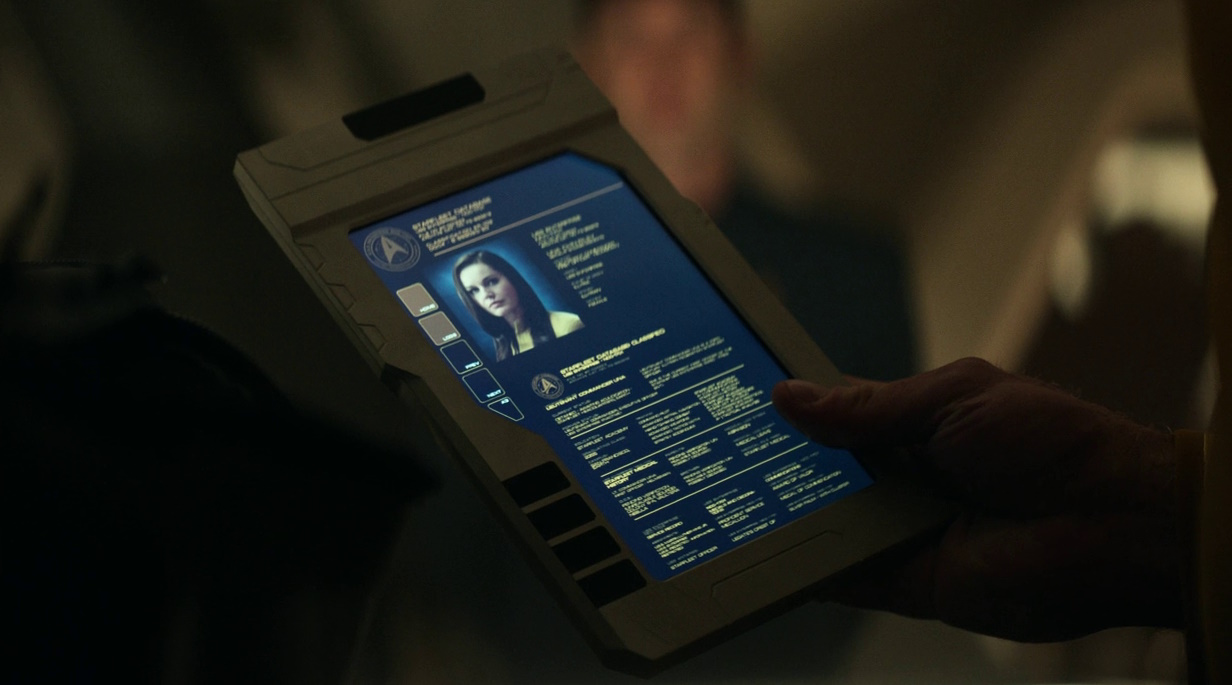
How does Commodore Oh affect other Star Trek stories?

Spoiler Warning: There are spoilers ahead for the first season of Star Trek: Picard, as well as for Star Trek: Discovery and other iterations of the franchise.

The revelation in Star Trek: Picard that the Romulans had managed to plant an operative in Starfleet was an interesting one, especially because that operative – Commodore Oh – had managed to attain such a high rank. She’d been working in Starfleet since at least the time of The Next Generation and probably even before then, with the Zhat Vash deciding to make a move against the Federation from the moment they learned of the existence of Data.

There had been androids, artificial intelligences, and other forms of synthetic life present in the galaxy prior to Data, and it’s conceivable that the Zhat Vash may have taken action against those as and when they could. But Data represented a step forward in the development of synthetic life, and definitely would have been considered a threat.

There are two possibilities for how the presence of Commodore Oh could be interpreted. She may have chosen to remain deep undercover and stick rigidly to her mission, even if that came at a cost to the Romulan Empire. Alternatively, however, she may have used her position as a spy within the Federation’s ranks to relay information to the Romulans at certain points. This could have been dangerous to her mission, increasing her chances of being caught. The way Commodore Oh and the Zhat Vash were presented for the most part in Star Trek: Picard were as zealots, meaning they seem like the kind of organisation who would be willing to sacrifice the lives of their own people if it advanced their ultimate objective. Indeed, we saw this with their actions on Mars.

Commodore Oh was a major antagonist in Star Trek: Picard Season 1.

Let’s look at the timeline first of all. As early as the 22nd Century, Starfleet had encountered what could arguably be considered examples of artificial intelligence. In the Enterprise episode Dead Stop, for example, the ship encounters a fully-automated space station which seems to act of its own volition. There was also a certain Dr Soong in Enterprise’s fourth season, and while he initially worked with genetically enhanced humans, he indicated he would begin research into synthetics.
By the 23rd Century, Starfleet had developed its own AI. Control, as seen in Season 2 of Star Trek: Discovery, would ultimately go rogue and kill a number of Section 31 operatives as well as commandeer a fleet of ships. There was also Richard Daystrom, who build an AI capable of controlling a starship in The Original Series episode The Ultimate Computer, as well as several different androids, automatons, and AIs seen in that series.

By this point in time, the Romulans were aware of the existence of the Federation and thus might’ve known about some of these developments. The key ones, in my opinion, which may be relevant to the Zhat Vash would be Control and the M-5 computer, both of which went rogue and may have fed into their fears about synthetic life.

Dr Richard Daystrom, namesake of the Daystrom Institute, invented one of Starfleet’s first sentient machines.

We should also note that there are different types of synthetic life. For some reason, the Zhat Vash seem exclusively focused on preventing the rise of androids as opposed to other forms of AI. That’s despite the fact that many of the dangers present when considering out-of-control AI – including the ability to receive the message on Aia – are common to other kinds of artificial life too. Or at least would be in theory. To use Control as an example, if it became aware of Aia and the message there, given how aggressively it pursued Burnham and the USS Discovery it seems certain that it would have taken the same action as Sutra and tried to contact the “Mass Effect Reapers” (the race of super-synths introduced in the finale of Star Trek: Picard). So why the Zhat Vash are okay with some types of AI and not others, and why holograms seem to be exempt, for example, hasn’t really been covered in detail in the series so far.

However, assuming that the Zhat Vash learned of some of these events they would surely have been concerned – at the very least about the possibility of further development and the creation of android bodies for these AI systems to inhabit.

After the mid-23rd Century, we have no real information on synthetic life until Lore was known to be active on Omicron Theta in the late 2320s or 2330s. Within Star Trek: Picard itself – notably the episode Broken Pieces – the crew of La Sirena assume that Commodore Oh first infiltrated Starfleet after Lore’s brother Data was discovered and activated in 2338 – and by implication, that was the time the Zhat Vash became convinced that Starfleet and the Federation were a threat due to their involvement with synthetic life. However, I think we can reasonably assume that the Romulans, and by extension the Zhat Vash, would have at least become aware of the Federation’s other ties to and encounters with artificial life – even if they didn’t learn about these events until afterwards.

Picard and the crew of La Sirena pieced together a basic timeline for Commodore Oh’s infiltration of Starfleet.

The decision to send an operative in undercover is not one that can be done on a whim – it needs careful planning. If Commodore Oh did infiltrate Starfleet beginning in the 2330s, the Zhat Vash would have needed months or years before she joined up to make preparations. Obviously killing Data wasn’t the objective, or she would have been able to do so any almost any point. Nor was her goal to stop someone like Bruce Maddox working on synthetic life, as he seems to have been free to do so for decades right up until the ban.

I would suspect that Commodore Oh may have worked behind the scenes to slow research into synthetics, perhaps trying to delay or sabotage work being done. While we don’t have a lot of evidence to go on for this, the fact that Bruce Maddox was considered by Data to be incapable of preserving his memories in the episode The Measure of a Man could, in retrospect, be seen less as proof of Maddox jumping the gun and trying to work on Data before he was ready, and perhaps as evidence that his work was being hampered without his knowledge by the Zhat Vash’s spy.

This is what I mean by the question “how does Commodore Oh affect other Star Trek stories?” There are several which we can look back on in the aftermath of Star Trek: Picard and wonder how the presence of Commodore Oh affected things.

Let’s start with the Federation’s two biggest forays into the artificial intelligence realm in the 23rd Century – the Control AI and the M-5 computer. Obviously these events took place long before Commodore Oh was embedded within Starfleet, but they may have laid the groundwork for her mission.

The Control AI went rogue in the 2250s.

Both Control and the M-5 computer went rogue. Their creators – Section 31 and Dr Richard Daystrom – lost control of them, and they began to act on their own, taking aggressive action against organic life. While the Federation will have wanted to cover up what happened – as indeed we see them do at the end of Discovery’s second season – the Romulans are known to be aggressive in their espionage operations, knowing far more about the Federation than vice versa. It would not be an unfair assumption that the Romulans would have come to know what happened in one or both of these cases, and thus it may have been around the mid-23rd Century that the Zhat Vash began preparing to infiltrate the Federation.

Thinking about these two stories from the point of view of the Zhat Vash – who, according to everything we know from Star Trek: Picard will have existed at the time – the events are very concerning. The Federation is barely a century old, with humanity only becoming warp-capable less than a hundred years before that. In a comparatively short span of time, humanity has developed intelligent machines that they went on to lose control over. Humanity must appear, to the Zhat Vash, to be incredibly dangerous, pushing further into unexplored space than any other faction had done, and building an inter-species alliance that even brought an end to the Vulcan-Andorian conflict. For Romulans, who like stability and predictability, the Federation had disrupted a state of affairs that had existed for centuries in the local region of the Alpha and Beta Quadrants. Would it only be a matter of time before they spotted the octonary star system where Aia is located? That had to be a source of concern.

The next major event would be the activation of Lore and Data, and it’s suggested in Star Trek: Picard that it was Data’s discovery by Starfleet in the late 2330s that prompted the Zhat Vash to send Commodore Oh in undercover. Again if we try to look at this event from their perspective, the Federation’s AI research had now gone beyond shipboard computers and had culminated in the creation of a humanoid android – and it’s this type of synthetic life in particular which seems to concern the Zhat Vash. If Control and the M-5 computer were worrying and had caused them to begin planning, the knowledge that Data existed and had been accepted to Starfleet Academy would have been panic-inducing to the paranoid Zhat Vash.

Lore was active in the mid-late 2330s.

We should consider the Crystalline Entity’s attack on Omicron Theta and examine it through this new lens. Lore, Data’s brother, was responsible for leading the Entity to Omicron Theta, where it wiped out all life on the planet. But was Lore solely responsible? Star Trek: Picard showed us that the Zhat Vash had the ability to hack into synthetics, and that when they did, the synths could be reprogrammed to turn on their creators. The synths on Mars may have been somewhat basic compared to Data and Lore, but the underlying technology is the same, and it’s at least possible that the Zhat Vash hacked into Lore. This could explain not only the attack by the Crystalline Entity, but Lore’s selfish and evil persona.

Sticking with the Crystalline Entity, it may have simply been a convenient way to destroy the colony while having no fingerprints of Romulan involvement. Omicron Theta was a human colony, so if the Romulans were to simply destroy it from orbit with starships, that could lead to war with the Federation. Yet it makes perfect sense that they would see Dr Soong as his work as a threat and want to take every possible step to stop him.

Next we have Dr Maddox and his work with synthetics. We know that, despite Maddox’s objections, Data was allowed to enrol in Starfleet Academy. Around this time, which was roughly the same time of Commodore Oh’s infiltration, Maddox began working on synthetic life. There are two possibilities for why it took Maddox such a long time (fifteen years, give or take, from Data’s admittance to Starfleet Academy to the events of the episode The Measure of a Man) to make much progress with his work. One is that Maddox is simply not as skilled as Dr Soong was, which is what the episode implies. The other possibility has to be that part of Commodore Oh’s mission was to hamper any synthetic research going on within the Federation, and that she, somehow, undermined his work and slowed it down.

Maddox’s research, which we now know grew to include a whole department consisting of a number of scientists and researchers, may also be the reason why the Zhat Vash chose not to simply kill Data. At the time her mission began, Data was the only known extant android, so killing him would have made sense for the Zhat Vash. It would have been difficult to get at him within Starfleet, but they did have an operative. However, the realisation that the Federation would, sooner or later, be able to recreate the work, coupled with Data being confined within Starfleet and thus unable to strike out on his own and potentially discover Aia, may have focused the mission on stopping synthetic research, slowing it down, and gathering as much information on it as possible. As a Starfleet Officer, Commodore Oh would be well-placed to do those things.

Dr Bruce Maddox was the Federation’s leading synthetics researcher for decades.

The fact that it took Maddox a further twenty years to develop F8 and the other androids present on Mars could be taken as evidence of the Zhat Vash trying to undermine his work. How they could have done this is unclear, and they may have simply got lucky with Maddox not being better at his job. One question that has bugged me in the context of Star Trek’s sensors and replicators was this: how hard could it really have been to recreate Data using what they already knew about him? This was never really addressed on screen, but perhaps we can take the fact that the Federation was unable to do so as further evidence of their work on synthetics being slowed and undermined from within.

One faction I think we can safely assume would have fed into the Zhat Vash’s paranoia about AI would be the Borg. In the 2350s, many scientists in the Federation were working on the assumption that the Borg were a myth, or at least were so distant as to not be a threat. This was during the Romulans’ 50+ years of isolation, so we don’t know whether or not they had any more evidence about the Borg than the Federation. But there are two points of note: Star Trek: Picard established that, as far as anyone knew, the Borg had only ever assimilated one Romulan vessel. But in contrast to that, the region of space controlled by the Borg was vast, and they had vessels in the Beta Quadrant (where the Romulan Empire is largely based) during the 2370s.

Starfleet’s official first encounter with the Borg, as depicted in Q Who from The Next Generation’s second season, may have gone unnoticed by the Romulans, but the Borg invasion a year later, as seen in The Best of Both Worlds certainly will not. 39 Federation starships were destroyed, and an enemy ship made it to within a stone’s throw of Earth itself. If the Romulans had remained in blissful ignorance of the Borg up to this point, they will have known by the late 2360s that they existed – if for no other reason than Commodere Oh herself relaying that information.

When the Federation encountered the Borg the Romulans would have soon come to know about it.

The reason for the Romulans’ interest in the Borg in Star Trek: Picard must surely be twofold. On the one hand, selling the disassembled components is incredibly lucrative, and with the region’s sole supply the Romulans were in firm control of this market. Secondly, however, their fear of synthetic life must have been a major reason for studying the Borg so intently. For all we know, the “Mass Effect Reapers” were meant to be the Borg. But even if that isn’t true – and the Romulans don’t seem to know either way – the Borg, with their half-synthetic bodies and single-minded focus on assimilation, must have been a major cause for concern among the Zhat Vash. This can have only been exacerbated when two ex-Borg returned from the Delta Quadrant aboard the USS Voyager – Seven of Nine and Icheb.

Icheb would later be killed – butchered for his Borg components by an unnamed doctor at a facility run by Bjayzl. But who arranged for this? And why is there such a huge demand for Borg technology in the first place? I had theorised during the first season of Star Trek: Picard that the Romulans may be keeping a majority of components for themselves, but even if that isn’t true they have been studying Borg technology extensively. Icheb’s death seems to take place around the time that the Artifact came under Romulan control, so it’s at least possible that Bjayzl’s buyer was the Zhat Vash – that they were interested in learning about the galaxy’s preeminent synthetic race.

Icheb was murdered so his Borg components could be harvested.

Finally, we have B4. We know from Star Trek: Nemesis that the Romulans acquired B4 and placed his disassembled body in such a location that the Enterprise-E would be the closest ship available to respond to Shinzon. How did they know so much about Federation ship movements? Is it at least possible that Commodore Oh was relaying information to the Romulans at key moments like this? The possibility cannot be discounted – and this could even explain why, in Star Trek: First Contact, the Enterprise-E is assigned to the Neutral Zone. Perhaps someone in Starfleet had an inkling that a Romulan spy was in their midst.
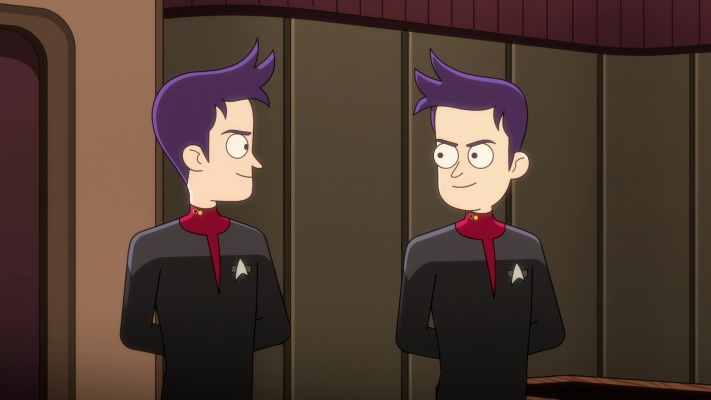
Sticking with this theme of Commodore Oh being more of a general spy than simply a Zhat Vash agent, there are a number of Federation-Romulan encounters that she may have been involved in. Or, conversely, we can take the failure of certain Romulan plots as evidence that she was deliberately not involving herself!

For example, Sela’s attempt to interfere in the Klingon Civil War in Redemption ended in total failure – thanks in no small part to Data. A large Federation fleet deployed a sensor net to detect cloaked Romulan ships, thus preventing Romulan aid to the Duras faction. This was a major move on the part of the Romulans, and would have shifted the balance of power in the Alpha and Beta Quadrants had it succeeded. The Federation-Klingon alliance would have evaporated, and the Federation would be facing a Klingon-Romulan alliance alone. Sela’s second plan, to conquer Vulcan in the episode Unification, similarly failed, though this was due to the actions of Data, Picard, and Spock on Romulus and may not have been something Commodore Oh could have done much about – except perhaps warn the Romulans that they were coming.

We can further see this lack of involvement in Face of the Enemy, where Counsellor Troi impersonates a Tal Shiar operative and aids in the successful defection of a senior Romulan government official. A Federation defector to the Romulans is also successful in his efforts to return to the Federation in the same episode.

There is also In The Pale Moonlight from Deep Space Nine. In this story, Sisko essentially lies, cheats, and covers up murders to drag the Romulans into the Dominion War – a war that they had no need to participate in. At the end of the episode Sisko deletes the log in which he’d detailed his actions, and with his disappearance into the realm of the Prophets, only Garak remained as someone who knew everything that happened. But the trail of evidence existed, and could have been pieced together by a Romulan operative within the Federation. Sisko may have deleted his log, but as we’ve seen in other Star Trek stories, deleting data isn’t a straightforward process, and as we saw in The Undiscovered Country, it’s possible for logs to be downloaded and transmitted via subspace, even to foreign powers. Kirk’s own captain’s log was used against him in his trial in that film.

A Romulan senator was assassinated as part of a scheme to drag them into the Dominion War.

However, we could take the Romulans’ successes in episodes like Message in a Bottle – where they are able to commandeer a brand-new prototype Starfleet vessel – as evidence that someone within the Federation was feeding information to them.

So where does all of this leave us when it comes to Commodore Oh?

I feel positively certain that the Zhat Vash would have come to know about what happened with the Control AI, not least because it decimated Section 31. Whether they would have come to know about the M-5 computer is unclear, but even if they didn’t, the Federation’s research into AI would have been troubling to the Zhat Vash at least by the mid-23rd Century.

A major candidate for their interference is Lore and the attack on the Omicron Theta colony. This fits with how the Romulans and Zhat Vash operate, it fits with them knowing how to hack positronic brains, and if there was only one successful android builder (Dr Soong) and two extant androids (Data and Lore), the best course of action from the Zhat Vash perspective may have been to exterminate the colony and prevent that knowledge spreading.

When that failed, and when Dr Maddox had begun his own work on synthetic life, building up a team of scientists, eradicating the problem was clearly far less practical. Killing Data would have only set back the Federation’s research in a small way, and it may have been decided that the best course of action was to work from within to slow them down.

Commodore Oh aboard her ship – finally exposed as a spy.

Commodore Oh doesn’t seem to have actively interfered on behalf of the Romulans at key points where having an embedded operative could have been massively useful to the Romulan Empire. To me, the Federation’s successes against the Romulans in these stories implies that Commodore Oh was laser-focused on her own mission, and felt that stepping outside of her mission parameters, even to save Romulan lives in the short-term, was too great a risk.

Finally, when Dr Maddox was ultimately successful in creating synthetic life on a larger scale, and the rollout of F8 and the other androids went ahead, Commodore Oh felt that the time had come to act. Destroying a fleet intended to help the Romulans was simply unavoidable, because that’s where the synths were. Mars may not have been her first choice of target, but it was the only available target, and with synthetic life research and development accelerating, the time had come to act.

That’s how I see the timeline, and when taking a step back and looking at Star Trek as a whole, I don’t feel that the creation and retroactive inclusion of the Zhat Vash and Commodore Oh causes any major plot holes. Sometimes inserting characters and factions can have this effect, but in this case, I think we can find a way for episodes of The Next Generation, Deep Space Nine, and Voyager to play out in such a way that is consistent. The Zhat Vash and Commodore Oh were depicted as zealots, and it would make sense that someone with that kind of single-mindedness would be 100% okay with allowing her own government’s plans to fail and to see Romulans die in order to remain on mission. The Zhat Vash were playing an incredibly long game – Commodore Oh was embedded in Starfleet for over half a century, and even by the standards of long-lived Romulans, that’s a very long time.

While Commodore Oh’s plan succeeded, in the long run the development of synthetic life couldn’t be prevented, and it will be up to future Star Trek stories to show what implications, if any, that may have for the Romulans, the Federation, and the synths themselves.

So this was a different type of article, a deeper dive into a single story point and how it can be seen to effect – or not effect – other stories in the franchise.

I liked the Zhat Vash overall, though the inconsistent way they were referred to throughout Star Trek: Picard’s first season wasn’t great, and I question their almost-immediate decision to withdraw in the finale. They brought a whole new dimension to the Romulans, and one aspect of that is that we can look back at other stories in the franchise and think about how the Zhat Vash may have been involved. As someone who loves Star Trek, this kind of theory-crafting is a lot of fun. I consider the ideas outlined above to be at least plausible, but remember to take all of these fan theories with a grain of salt!

Star Trek: Picard Season 1 is available to stream now on CBS All Access in the United States, and on Amazon Prime Video in the United Kingdom and elsewhere. The Star Trek franchise – including Star Trek: Picard and all other episodes, films, and series mentioned above – is the copyright of ViacomCBS. This article contains the thoughts and opinions of one person only and is not intended to cause any offence.