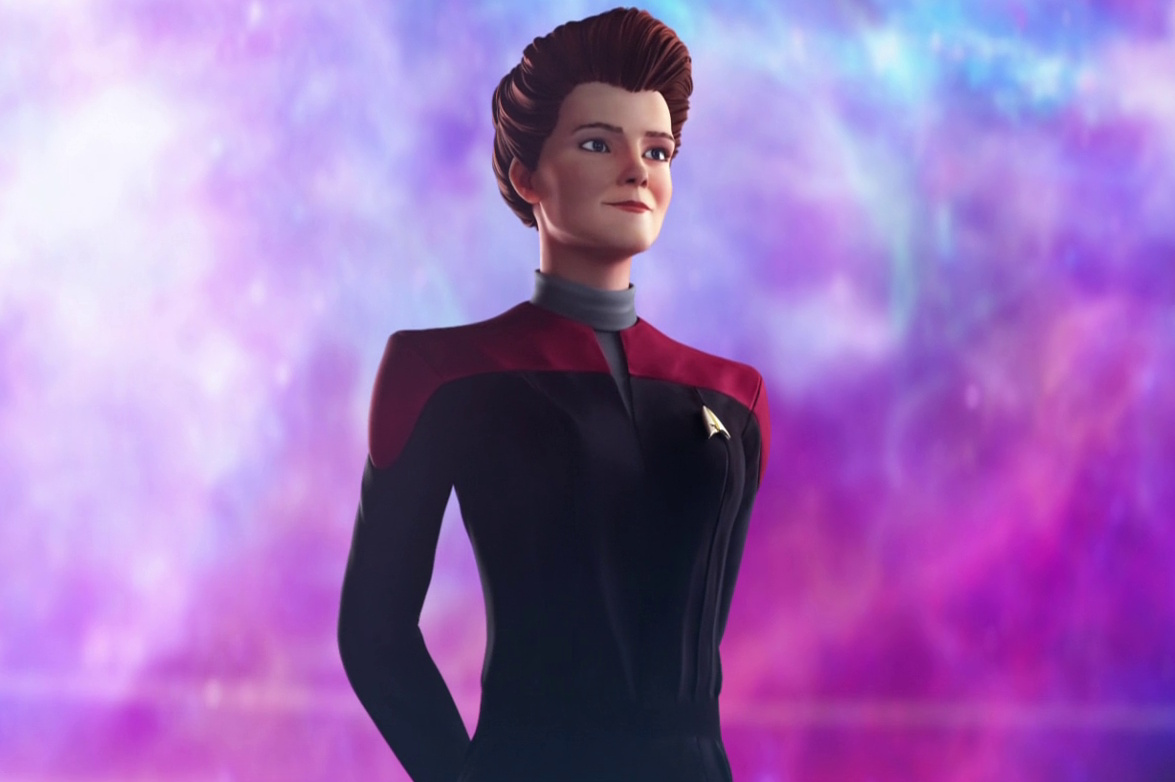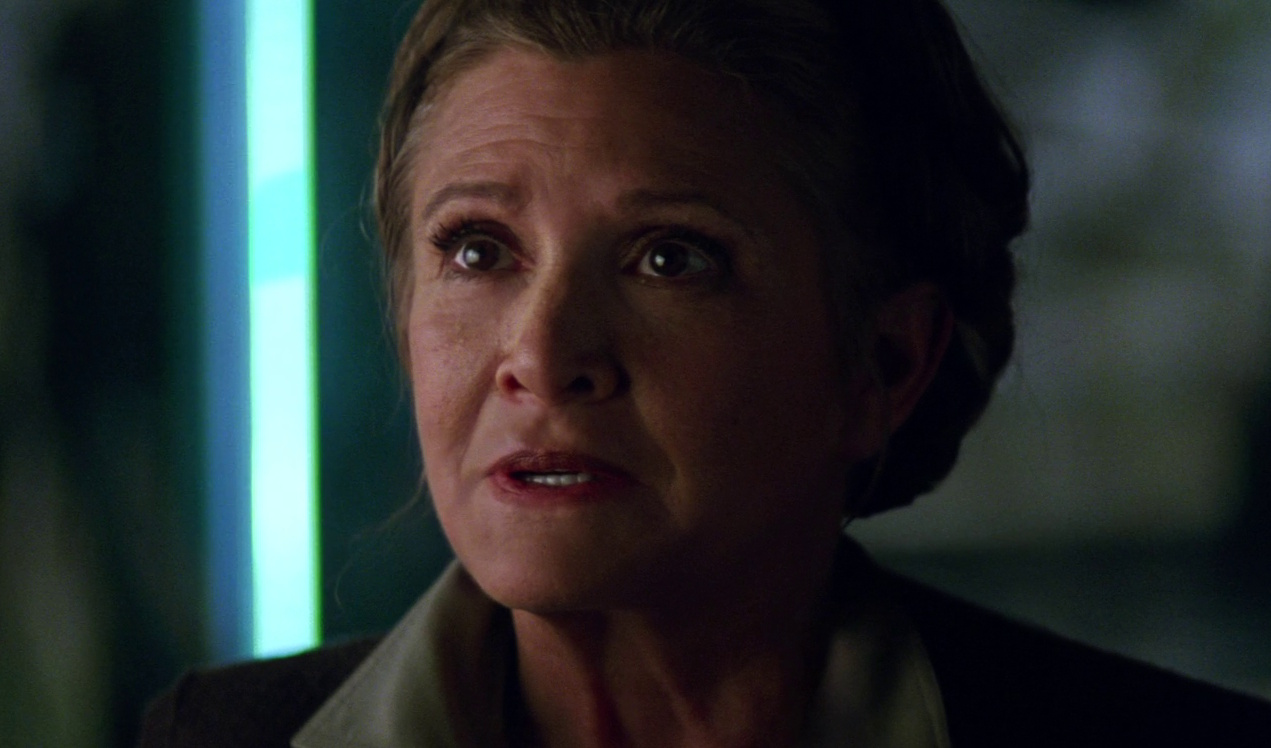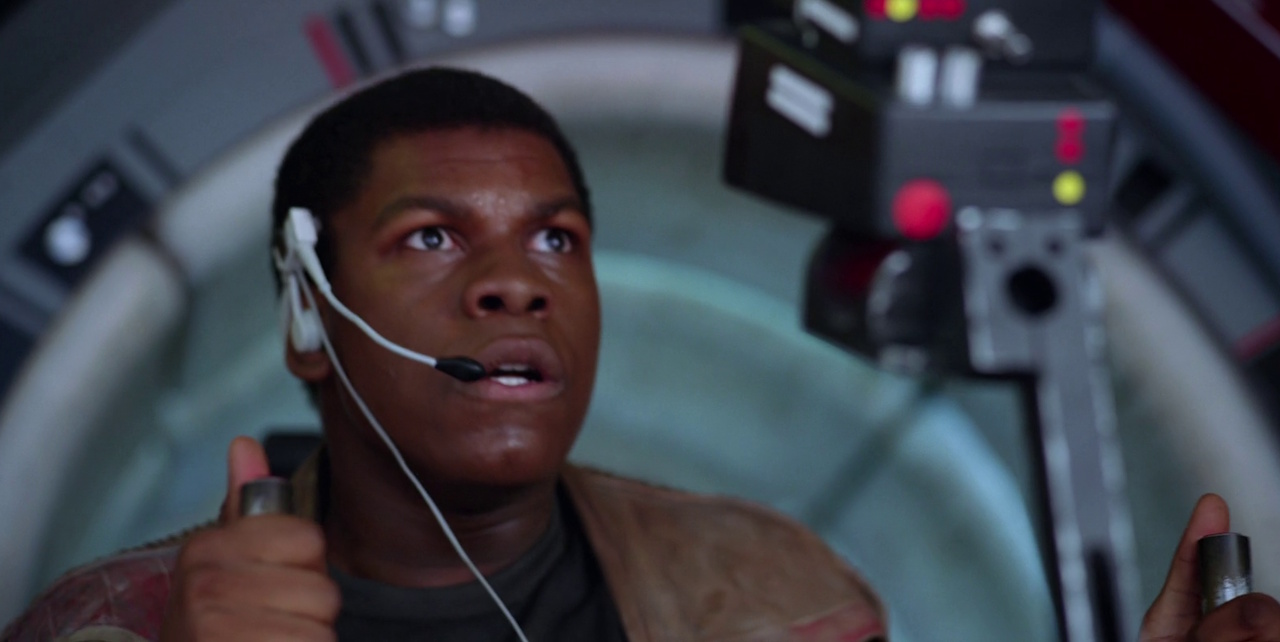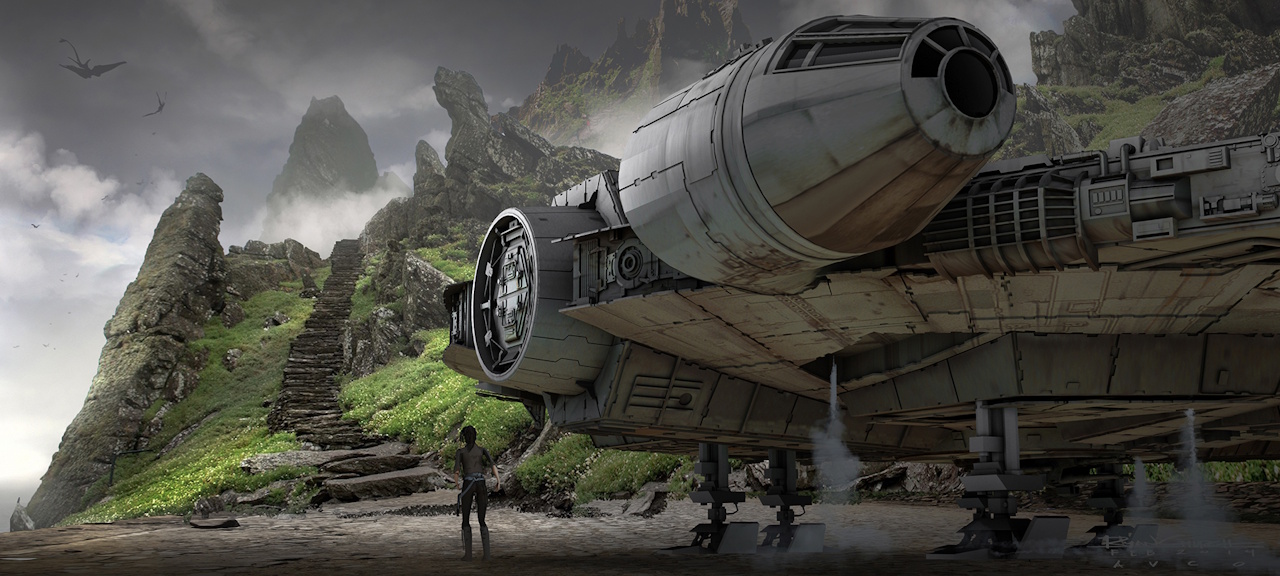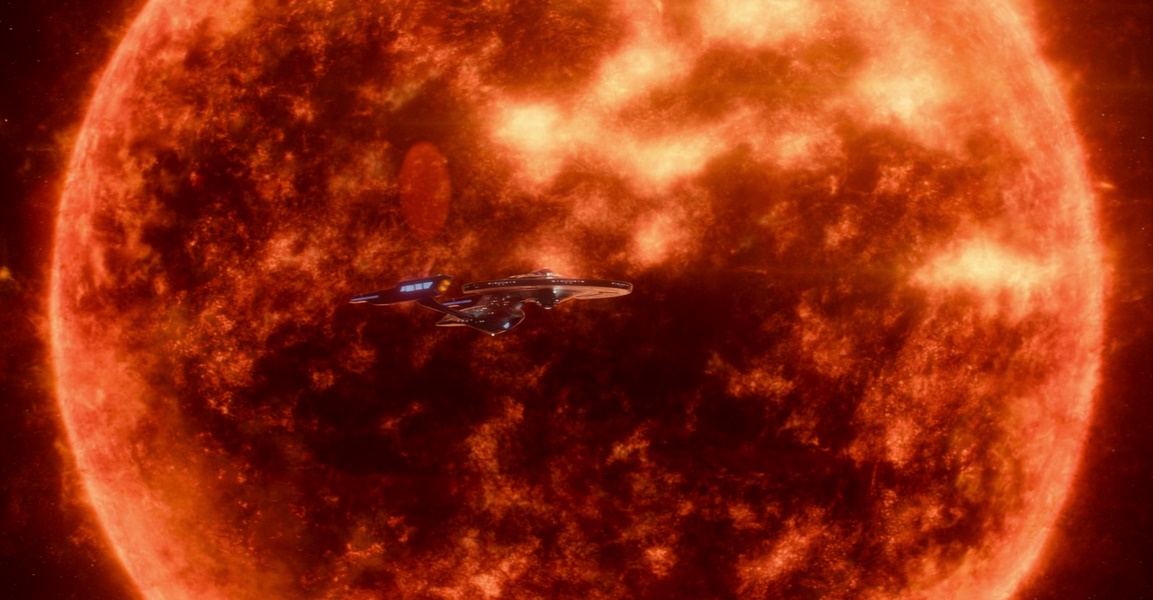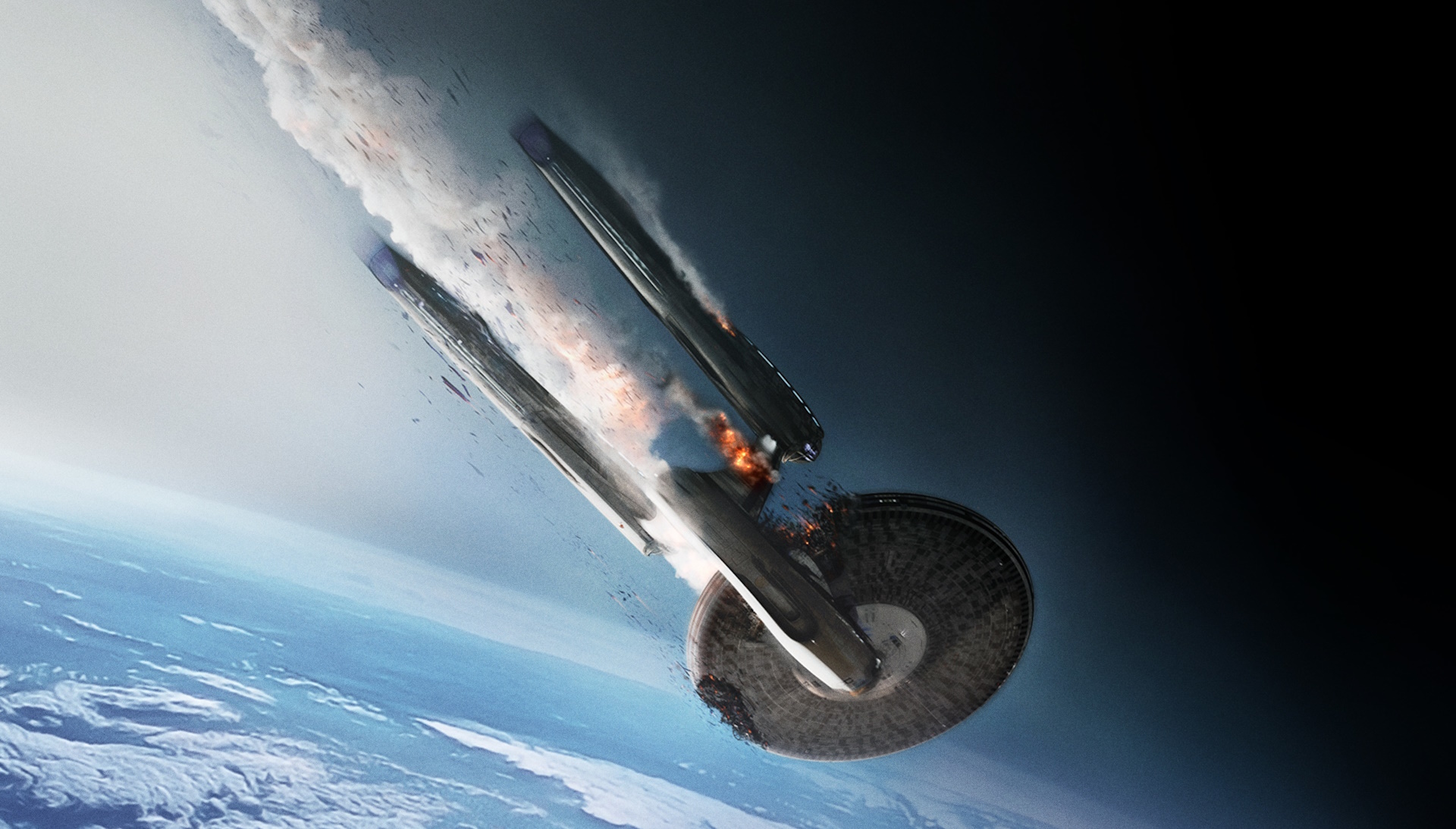
Will I Buy A Switch 2 In 2026?

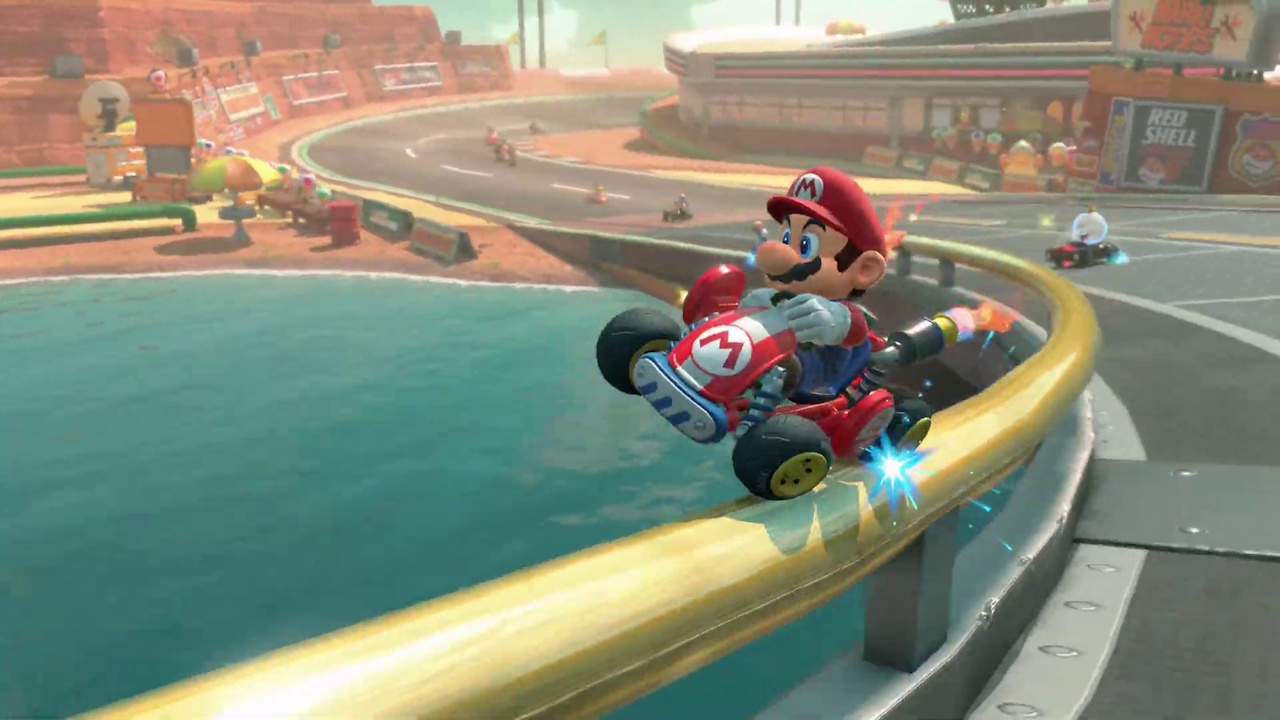
A friend of mine picked up a Nintendo Switch 2 console just before Christmas. We don’t live close enough for me to pop over and have a go on the machine, but so far, they seem happy with their purchase and pretty enamoured with Mario Kart World in particular. Despite the console’s high price point putting me off (and other folks, too, if sales figures for the final quarter of 2025 are to be believed), someone who *can* afford to blow that amount of money seems to be having a wonderful time with their purchase.

And that got me thinking!

My friend is the first person I know personally who’s bought a Switch 2 since the console launched last Spring. But I’m sure, over time, there will be others: my brother-in-law is a pretty big gamer, for example, and usually has money to spare, so I wouldn’t be stunned to learn he’s planning to pick one up, too. But… am I ever going to get a Nintendo Switch 2? And do I even want one anymore? That’s the subject we’re going to tackle today.

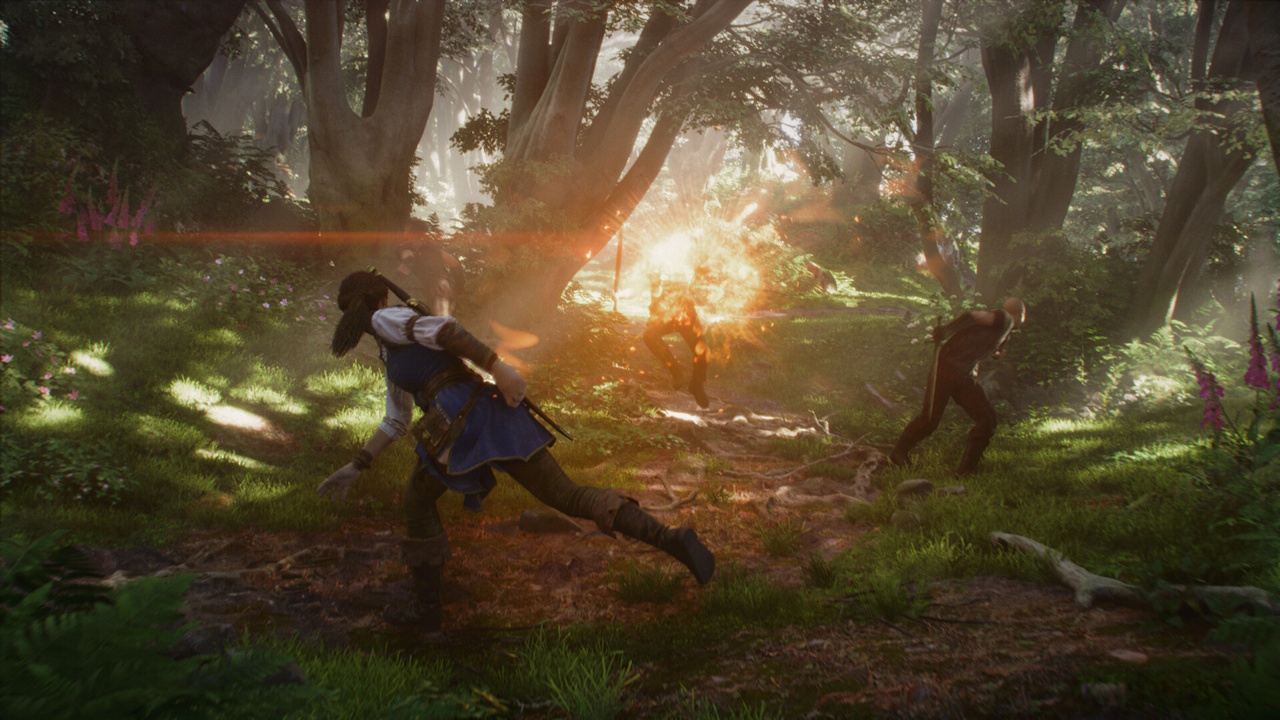
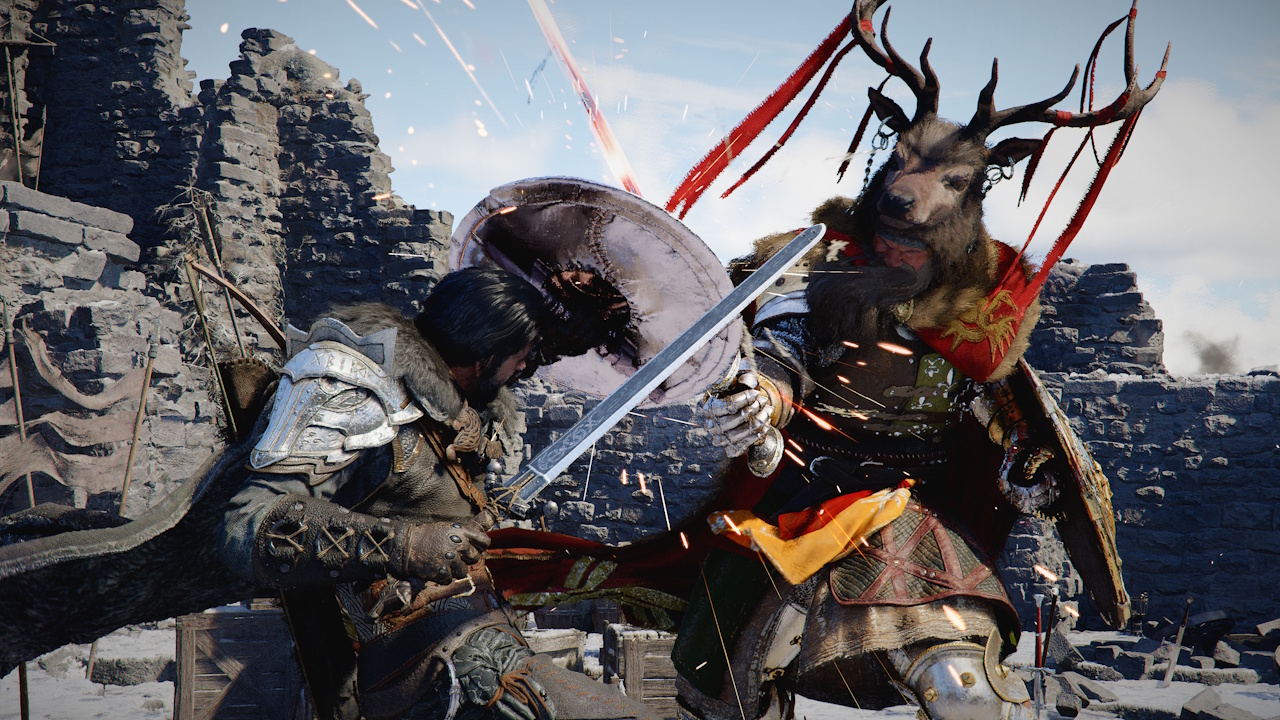
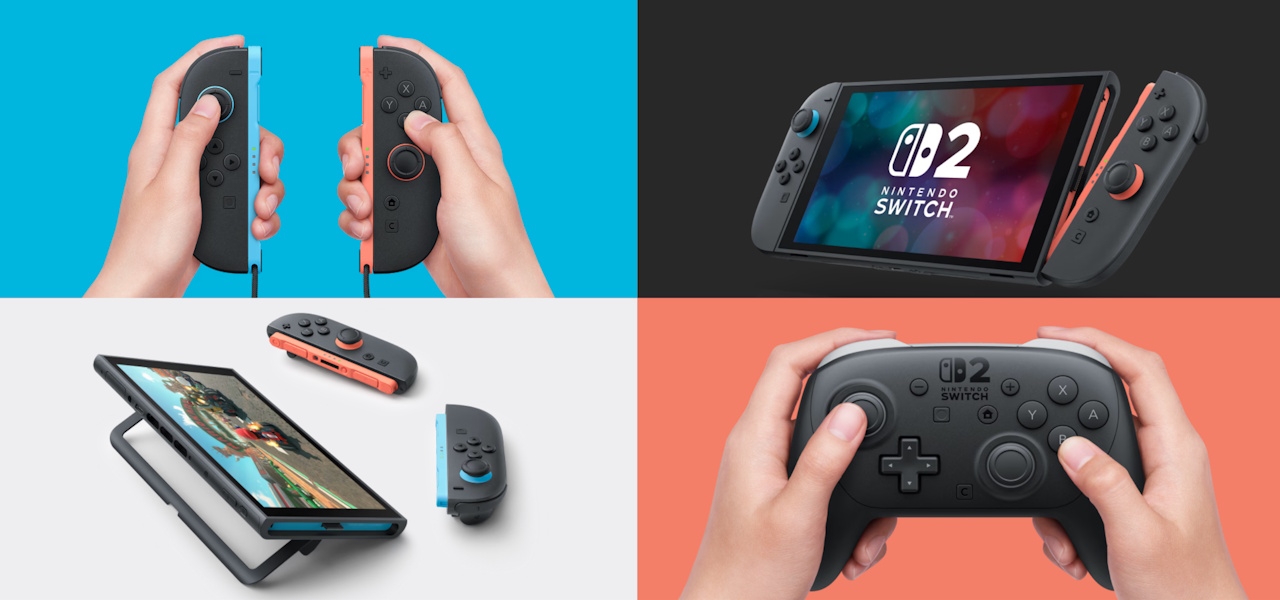
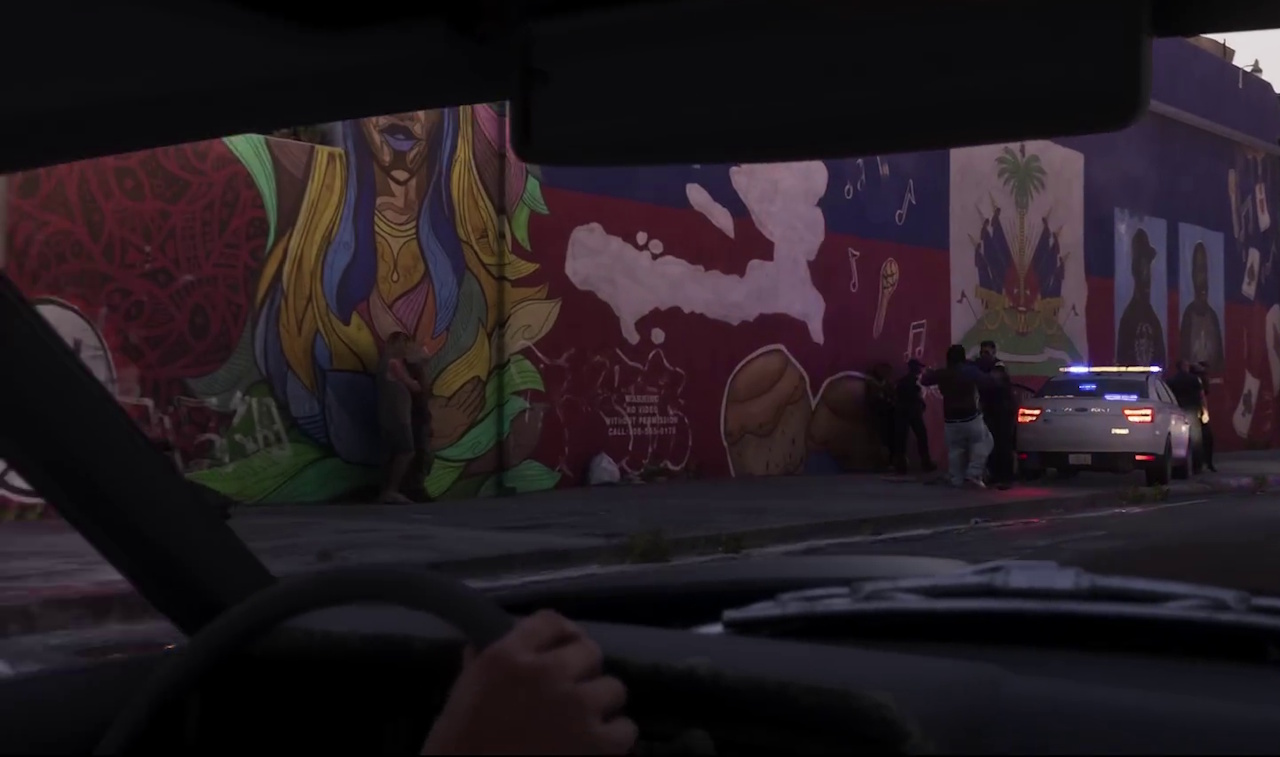
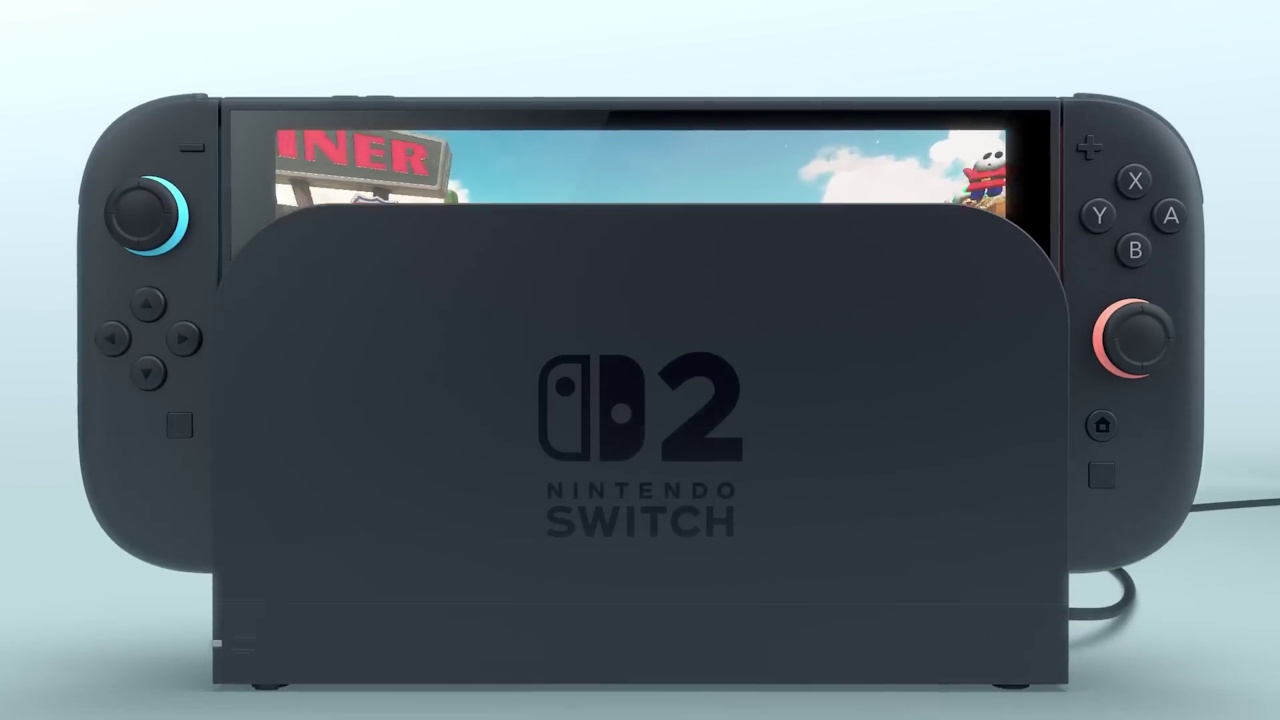
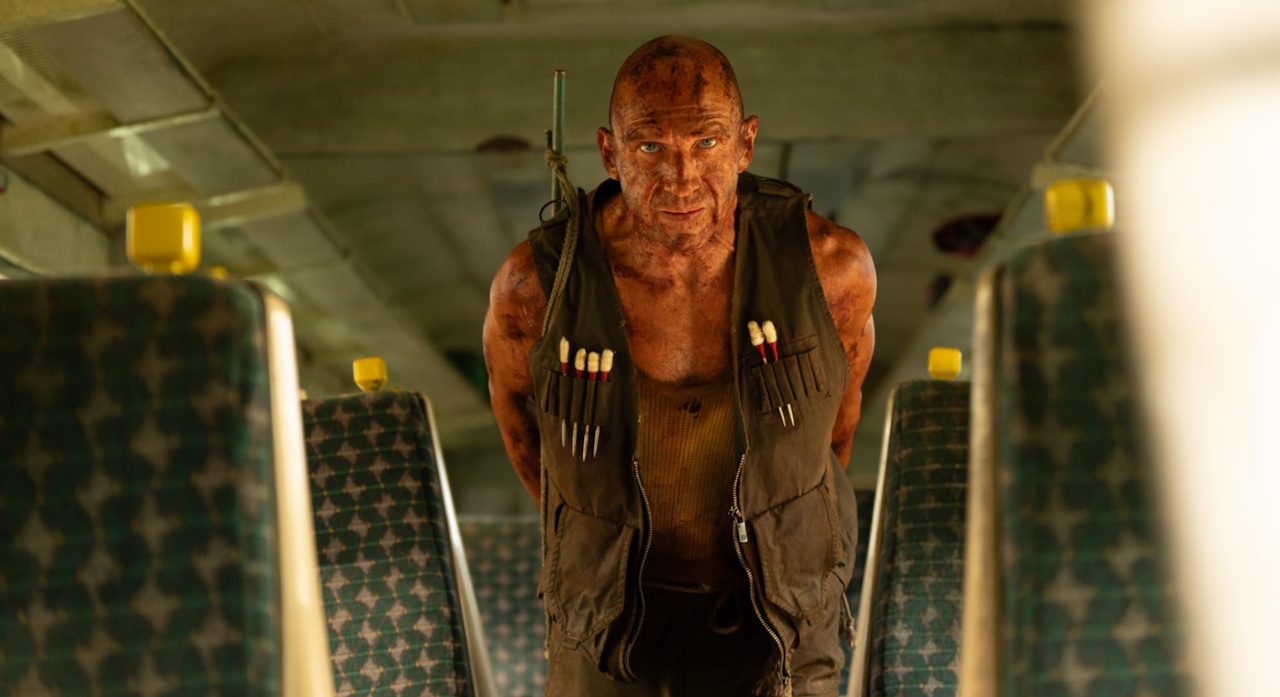
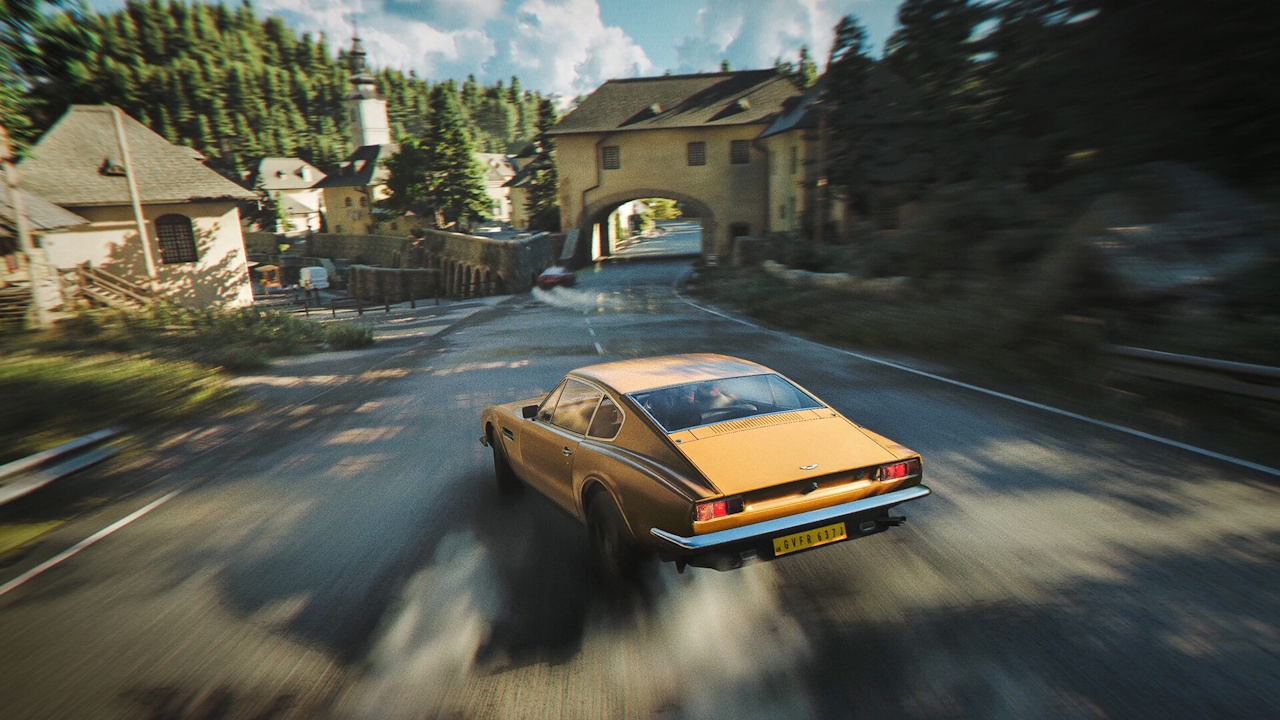
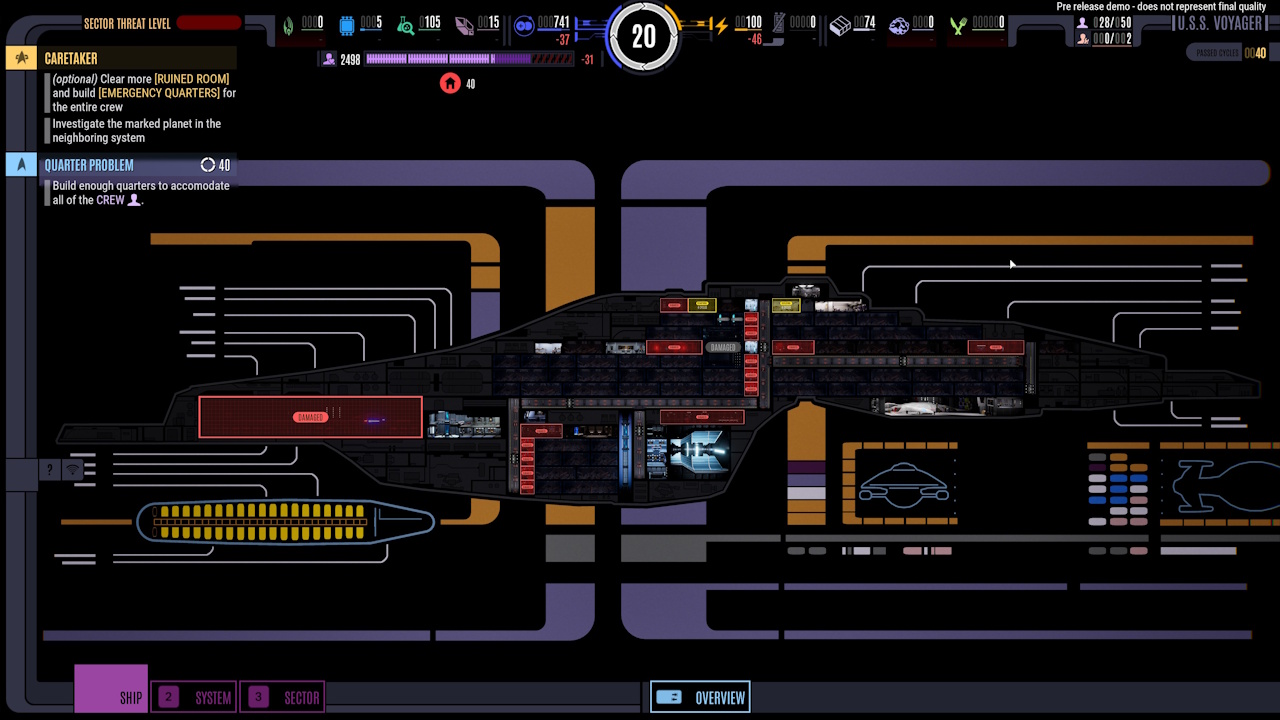
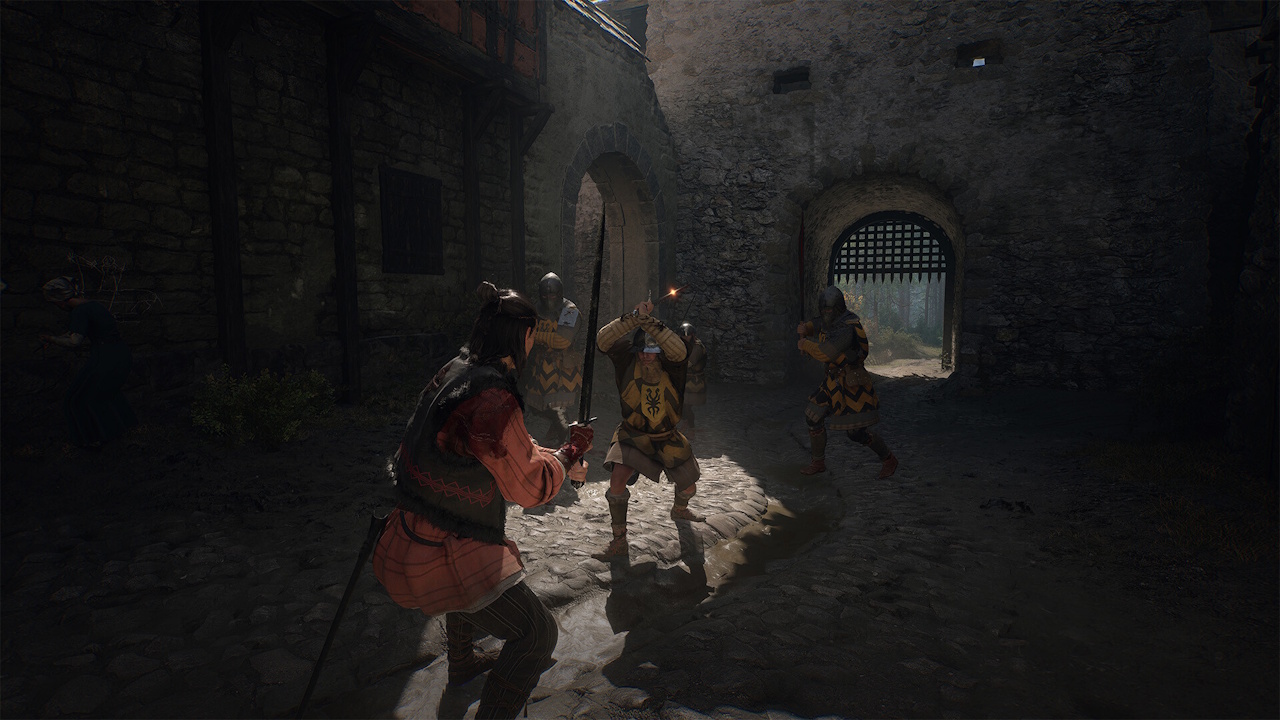
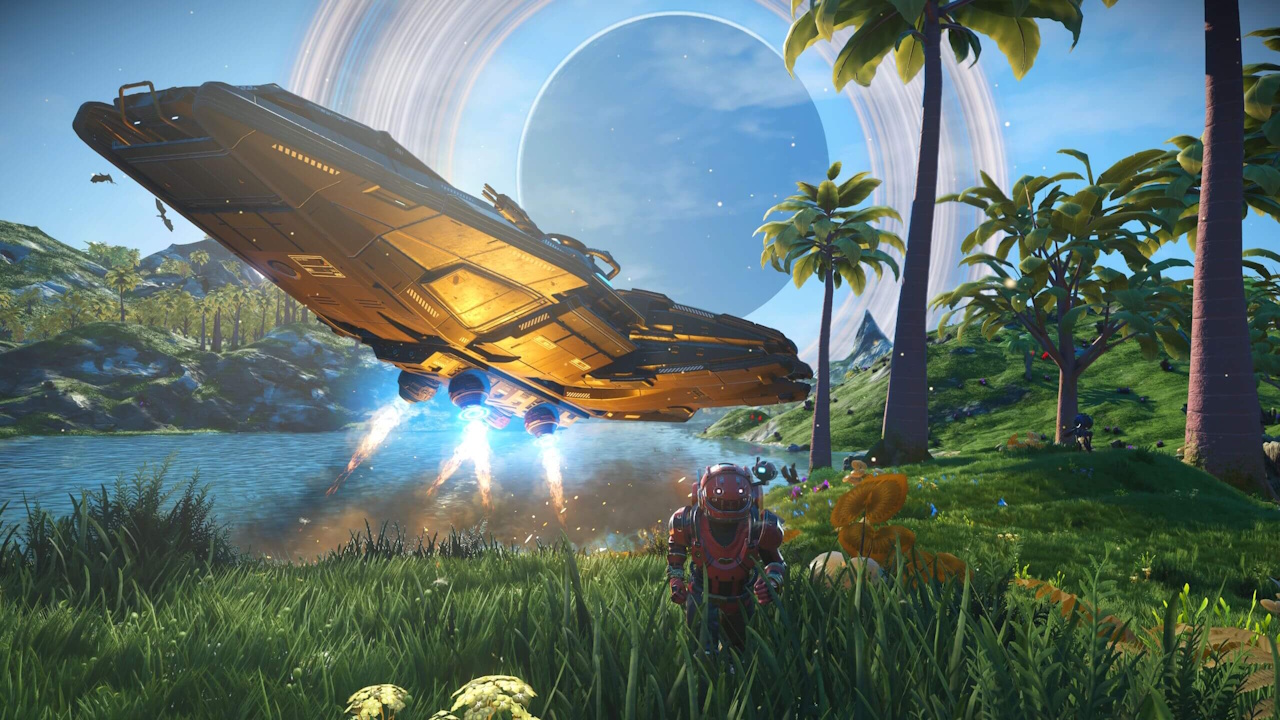
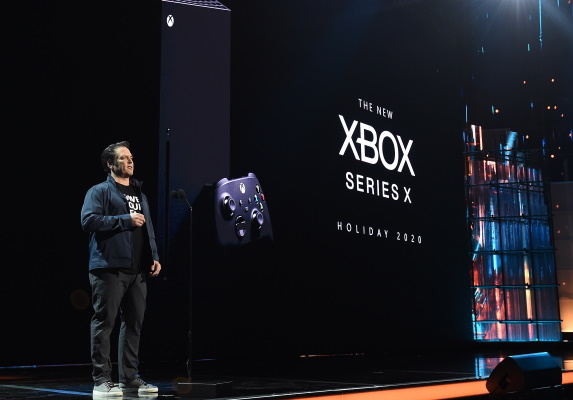
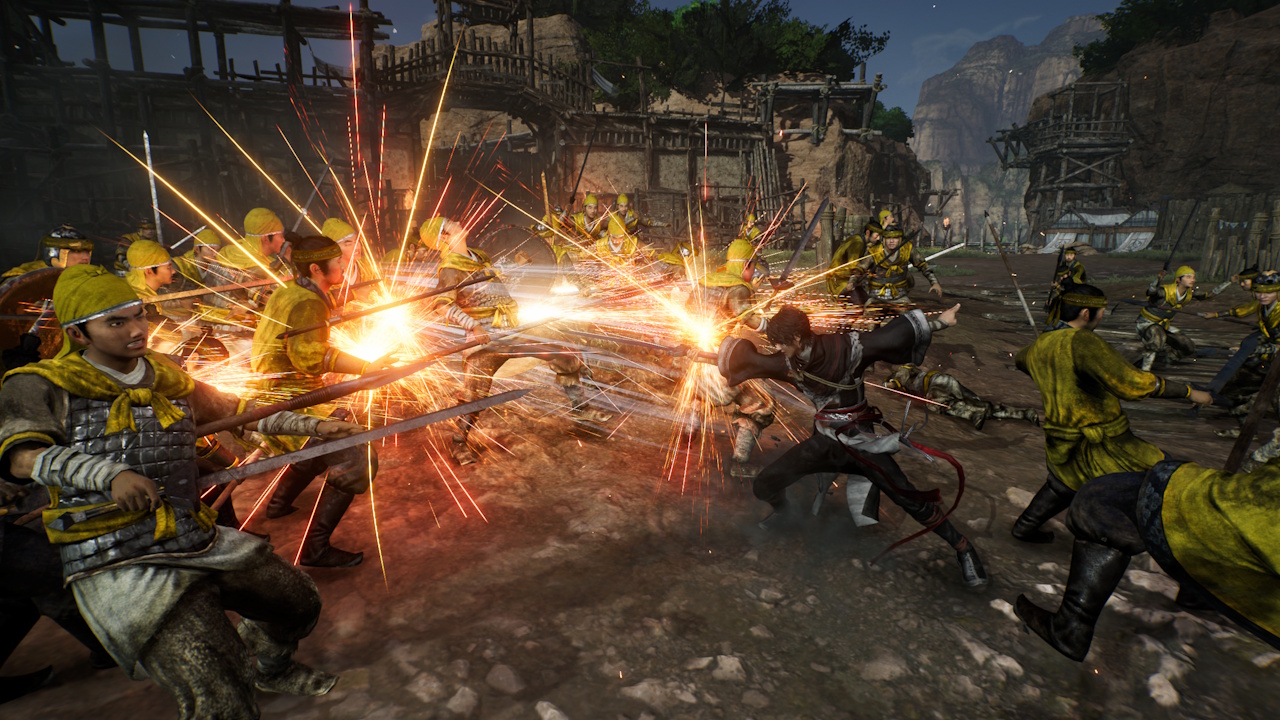
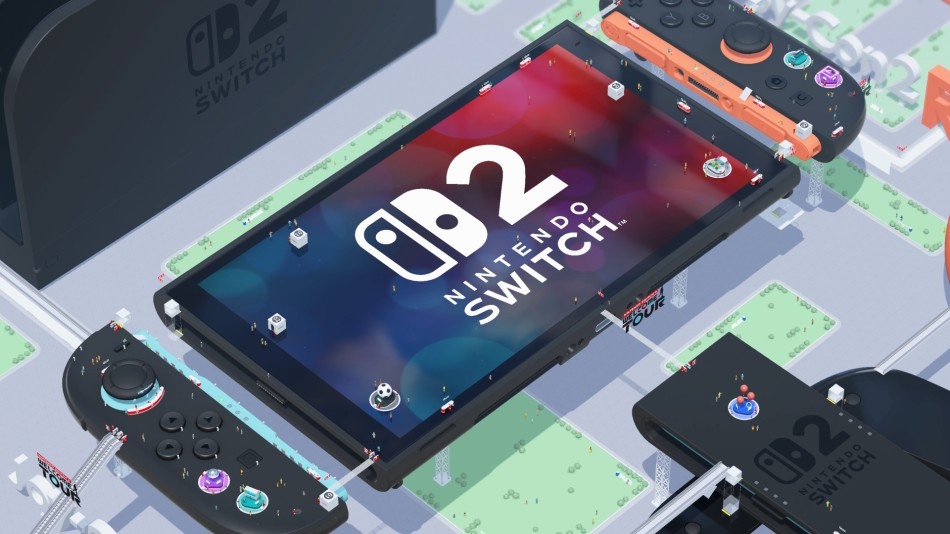
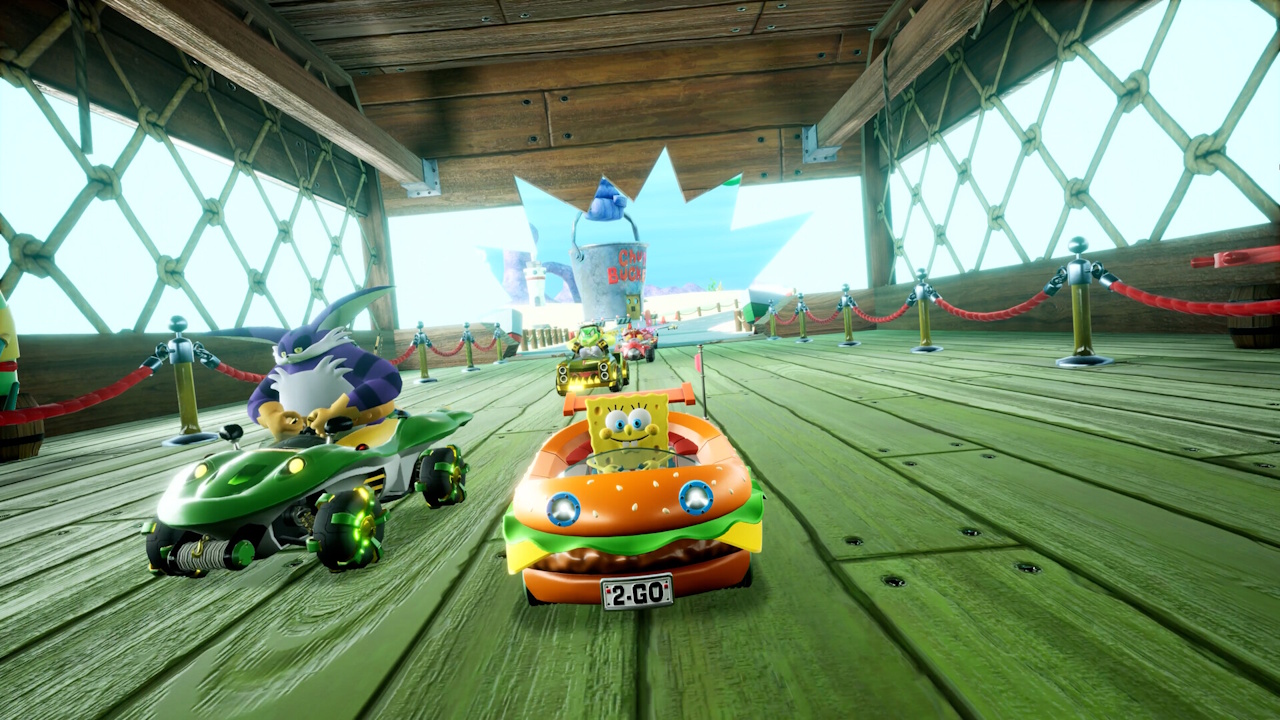
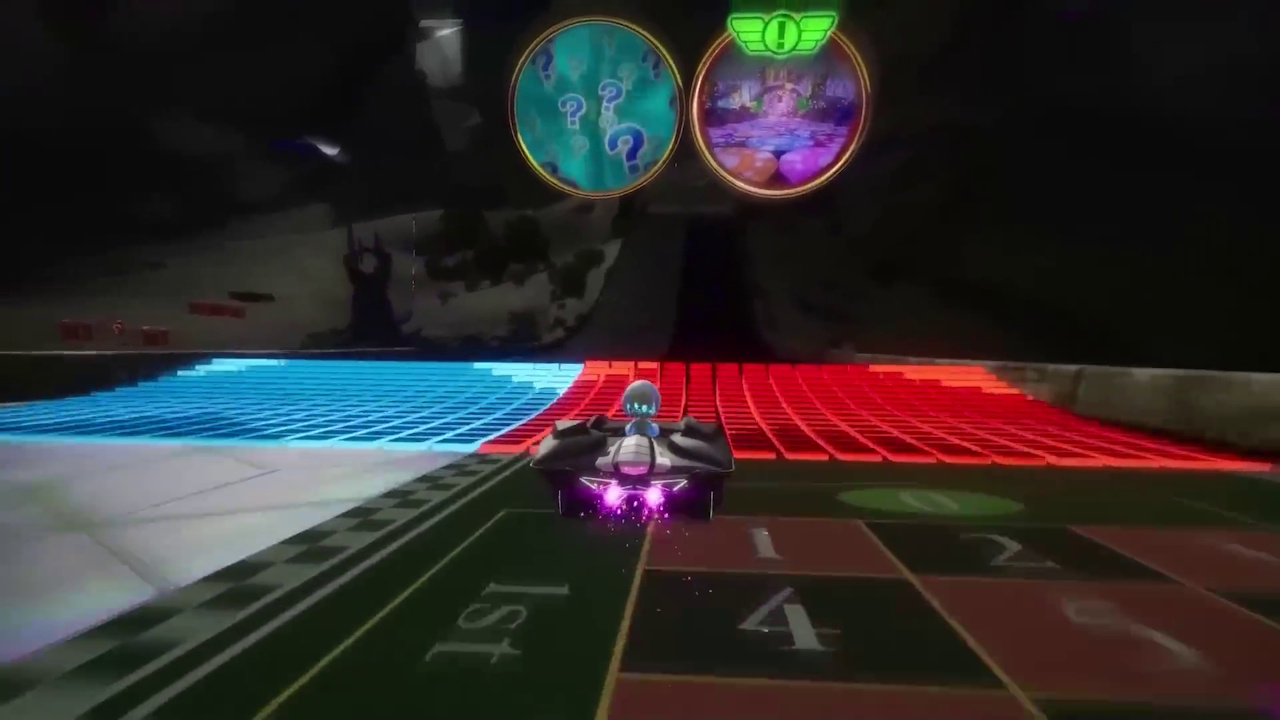
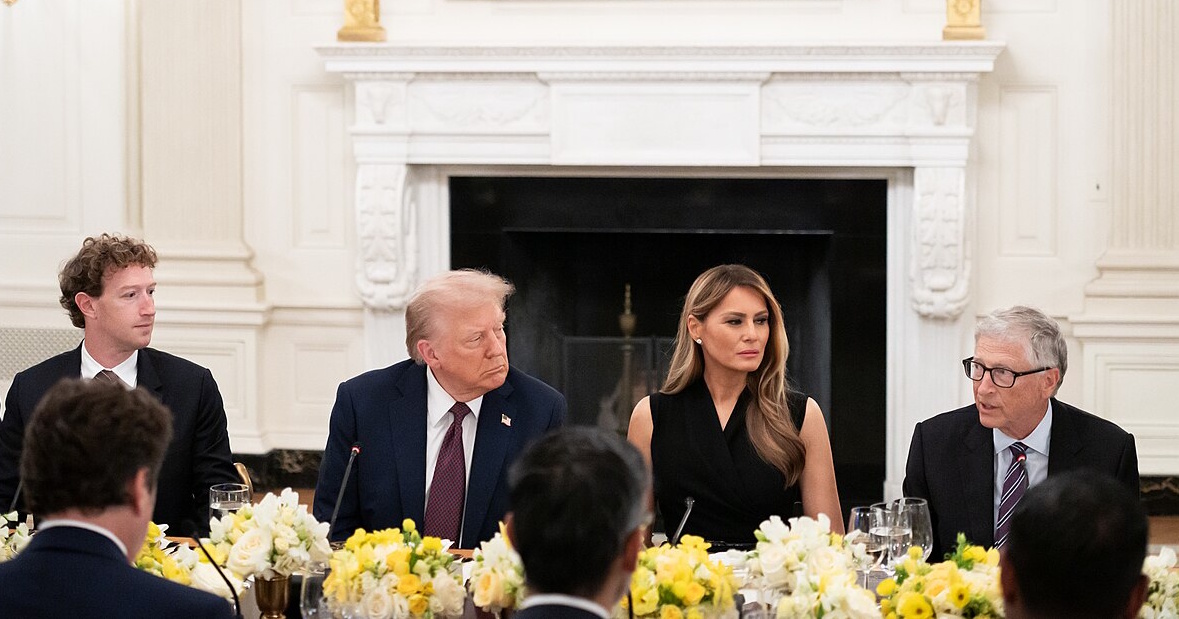
4 promo images for Nintendo's Switch 2 console.
Promo images for the Switch 2.

As always, my usual caveat applies: everything we’re discussing is *subjective, not objective*, so if I make a point about the Switch 2, its lineup of games, or Nintendo as a corporation that you disagree with… that’s okay. There ought to be enough room in the gaming and Nintendo communities for civil discussion and respectful disagreements that don’t descend into toxicity and name-calling. We can agree to disagree, and my thoughts on a corporation or games console aren’t a personal attack on fans or players.

I think I should start by laying out a very brief history of my personal relationship with Nintendo. I played a couple of games on a family member’s NES when I was very young. I think the one I remember most vividly from that era is Slalom, a funny little skiing game developed by Rare – who would go on to create Donkey Kong Country, and many other titles! I was already really interested in video games, even as a young kid, and after pestering my parents and saving up as much pocket money as I could, I finally got my hands on my very first home console in 1992: a Super Nintendo.

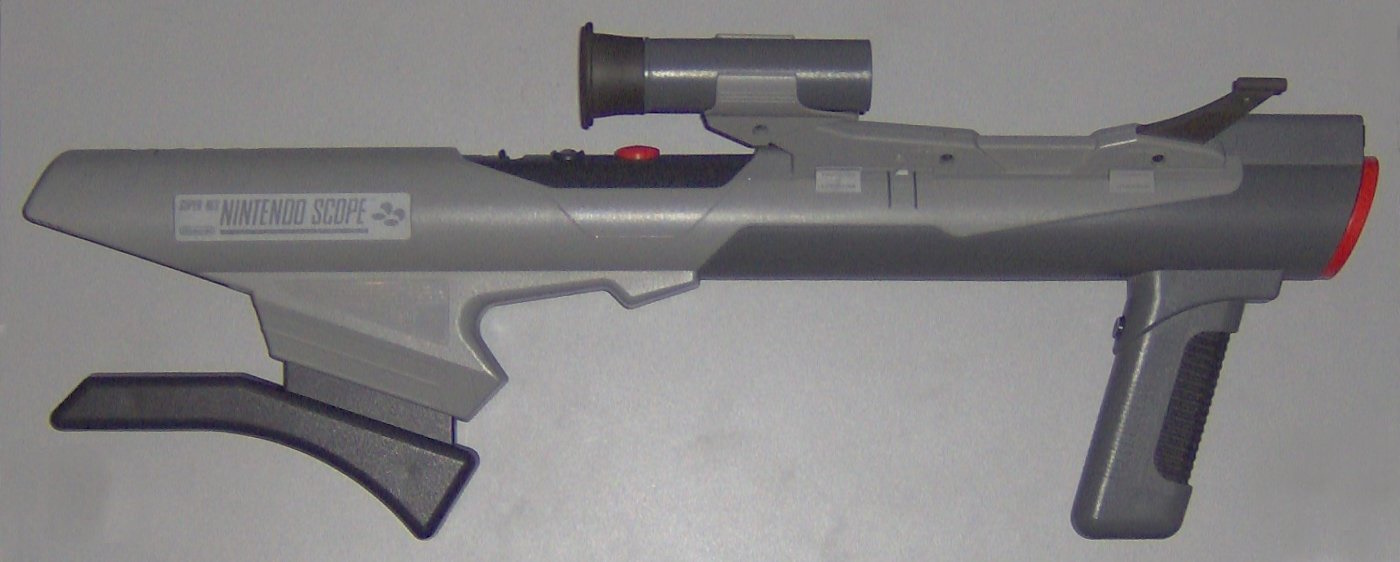
Photo of the Nintendo Super Scope.
Does anyone else remember playing with this epic light gun?

Since then, I’ve owned every home console that Nintendo has put out, with the exception of the GameCube. I’ve owned an N64, a Wii, a Wii U, a Switch, and I dabbled in handhelds with a Game Boy Advance, DS, and 3DS. Nintendo’s consoles have given me a lot of fun over the years, and while I don’t consider myself a super-fan, or anything like that, I’ve always felt that Nintendo’s big, generation-defining titles were well worth the price of admission.

But I looked back, recently, on my Switch play history, and I came to a bit of a surprising realisation: across the eight-plus years that I’ve owned the console, I’ve only really played seven games on it. Those titles are: Mario Kart 8 Deluxe (and the Booster Course Pass expansion), Animal Crossing: New Horizons, Luigi’s Mansion 3, Super Mario Odyssey, Super Mario 3D All-Stars, Super Mario 3D World + Bowser’s Fury, and SpongeBob SquarePants: Battle for Bikini Bottom Rehydrated. I tried out a couple of others that I didn’t get on with, like Mario Tennis Aces, but that’s really it.

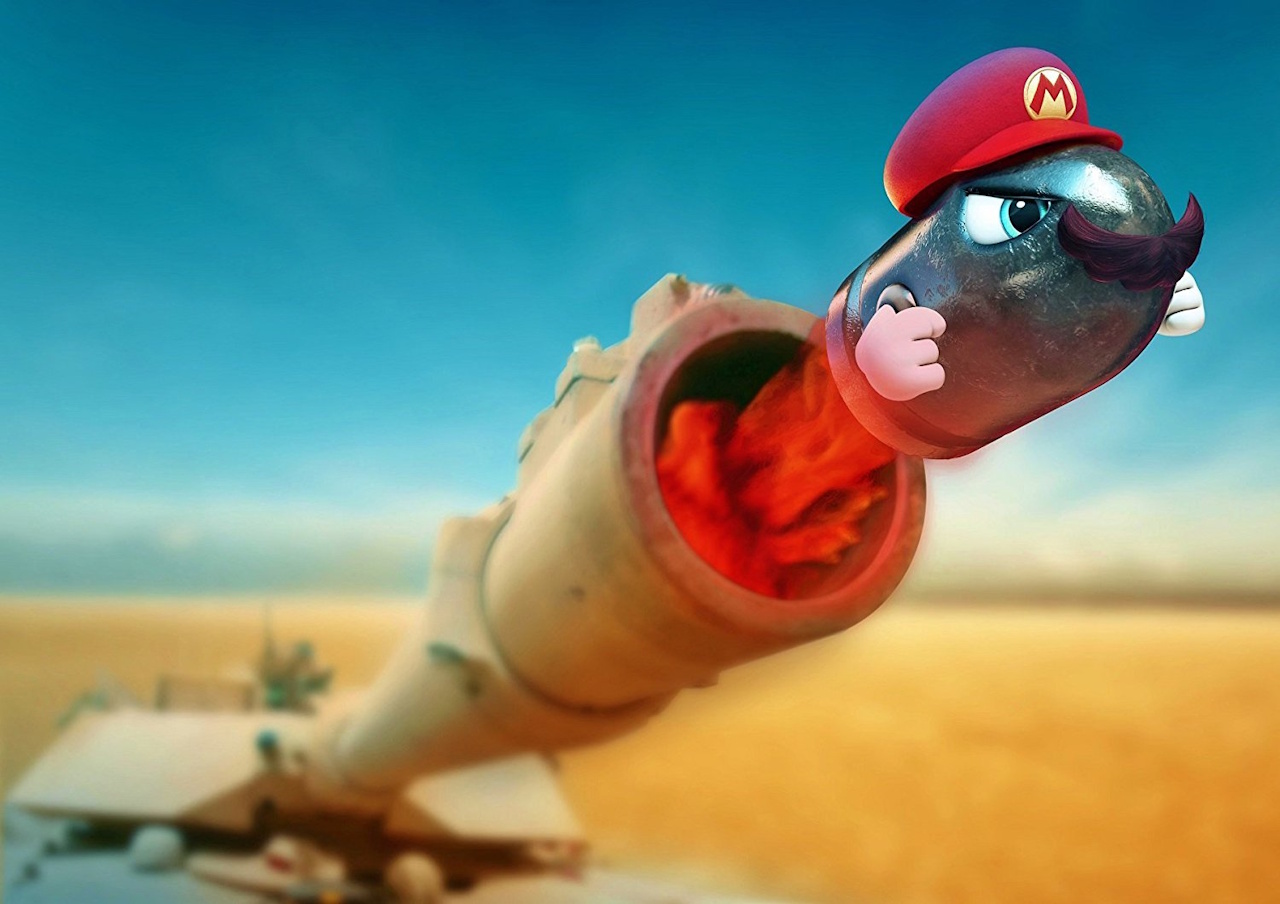
Promo image for Super Mario Odyssey showing Cappy, a Bullet Bill, and a tank.
I only played a handful of games on my Switch 1.

My primary gaming platform has been PC for about a decade now, and while I was more than content to pick up a Switch to play a handful of Nintendo exclusives, it was never going to be my *main* device for playing games. So in that sense, I shouldn’t be surprised at the relative lack of titles. As I’ve said before, both my ability to play games for long sessions due to my health, and my general interest in playing a large number of games, have waned over time. Plus, there are always financial constraints! So, again, not a huge surprise that I have so few Switch 1 games. But it does kind of put the Switch 2 into context for me.

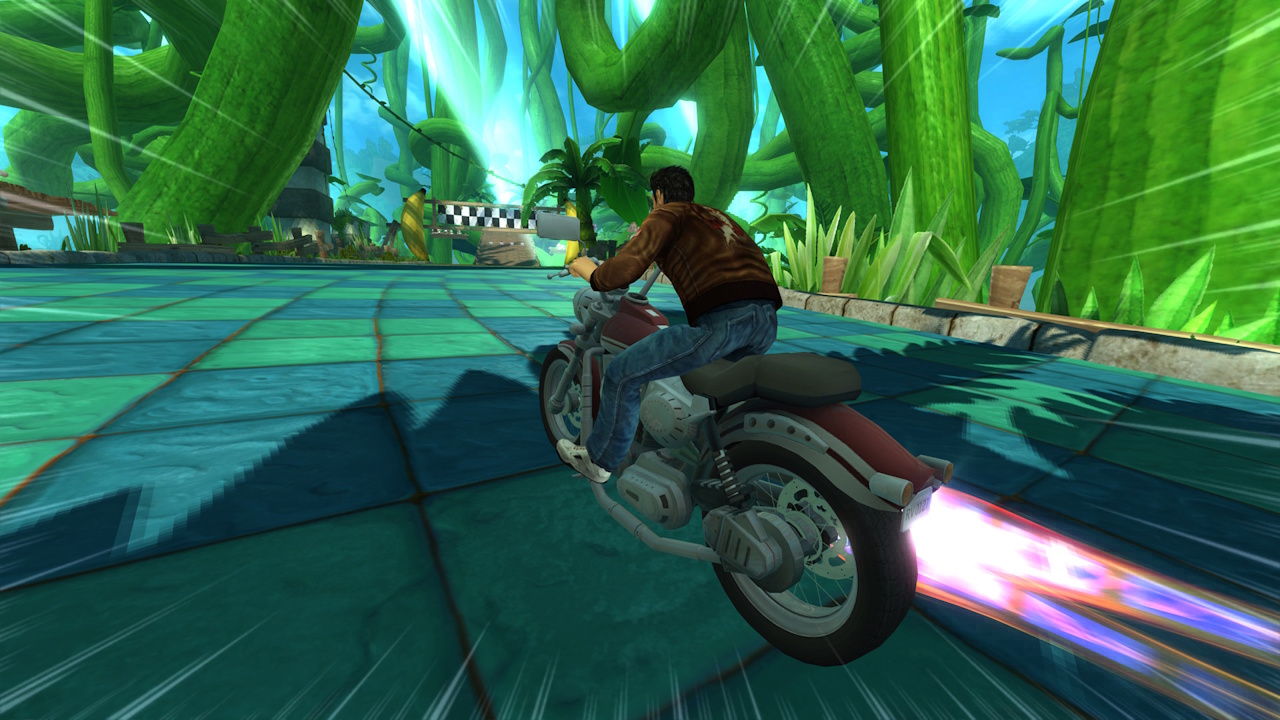
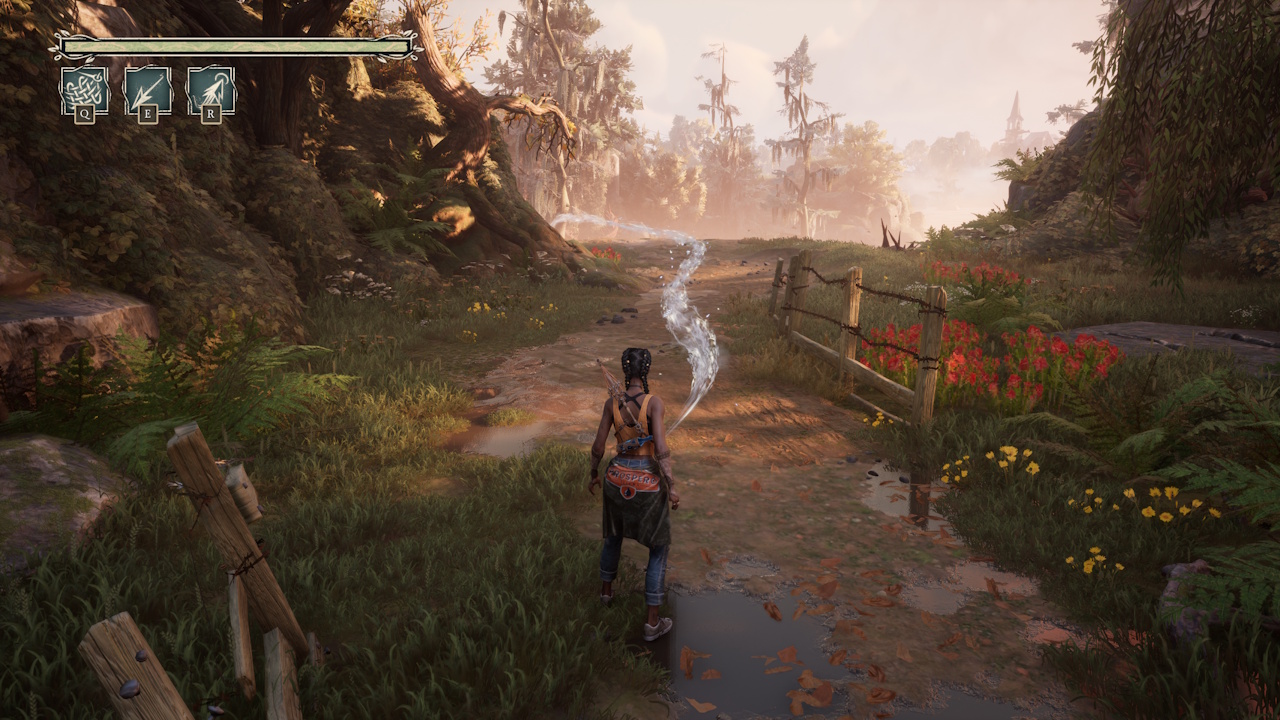
Despite my criticisms of the price point of the Switch 2 and its games, and Nintendo’s greedy and anti-consumer corporate attitude, I’ve been working under the assumption that I would, eventually, pick up the new console. Maybe Mario Kart World didn’t do enough to tempt me at launch, and despite being a big Donkey Kong 64 fan back in the day, Bananza didn’t really stand out to me, either. But surely a new Animal Crossing or 3D Mario adventure would. Right?

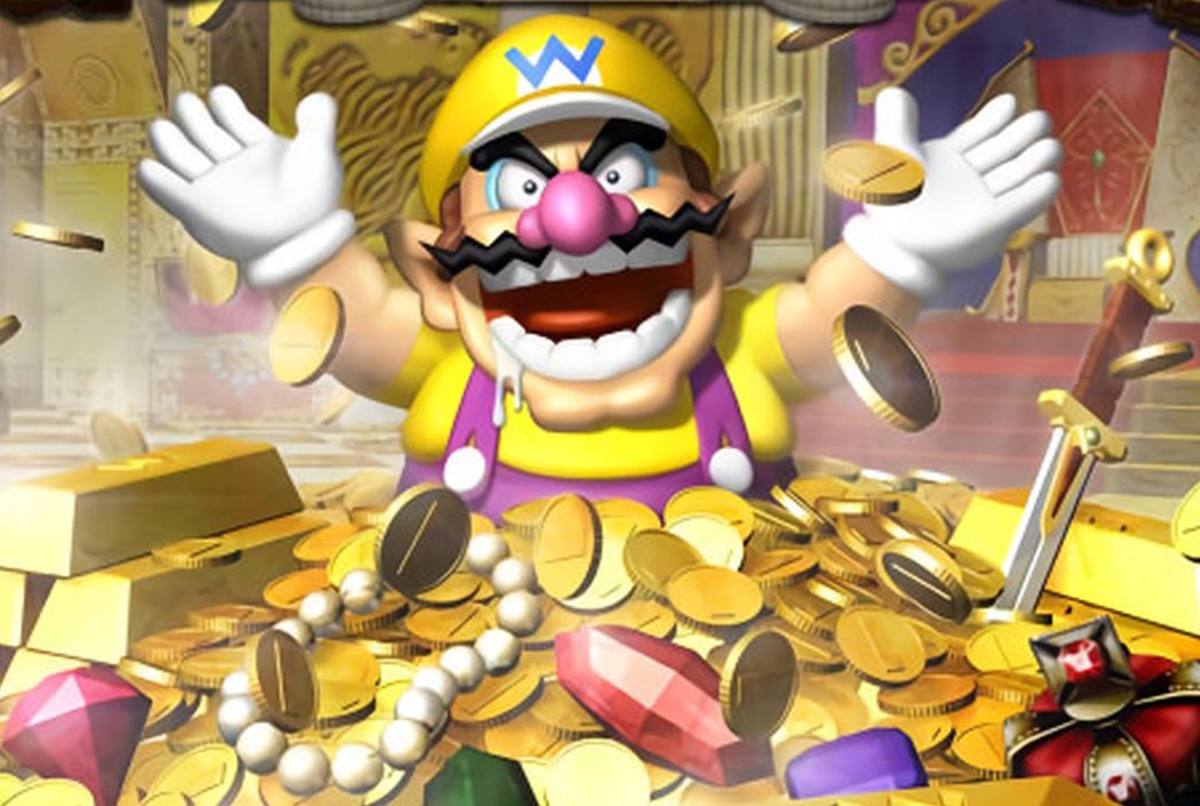
Promo/concept art of Wario for the Nintendo game Wario Ware.
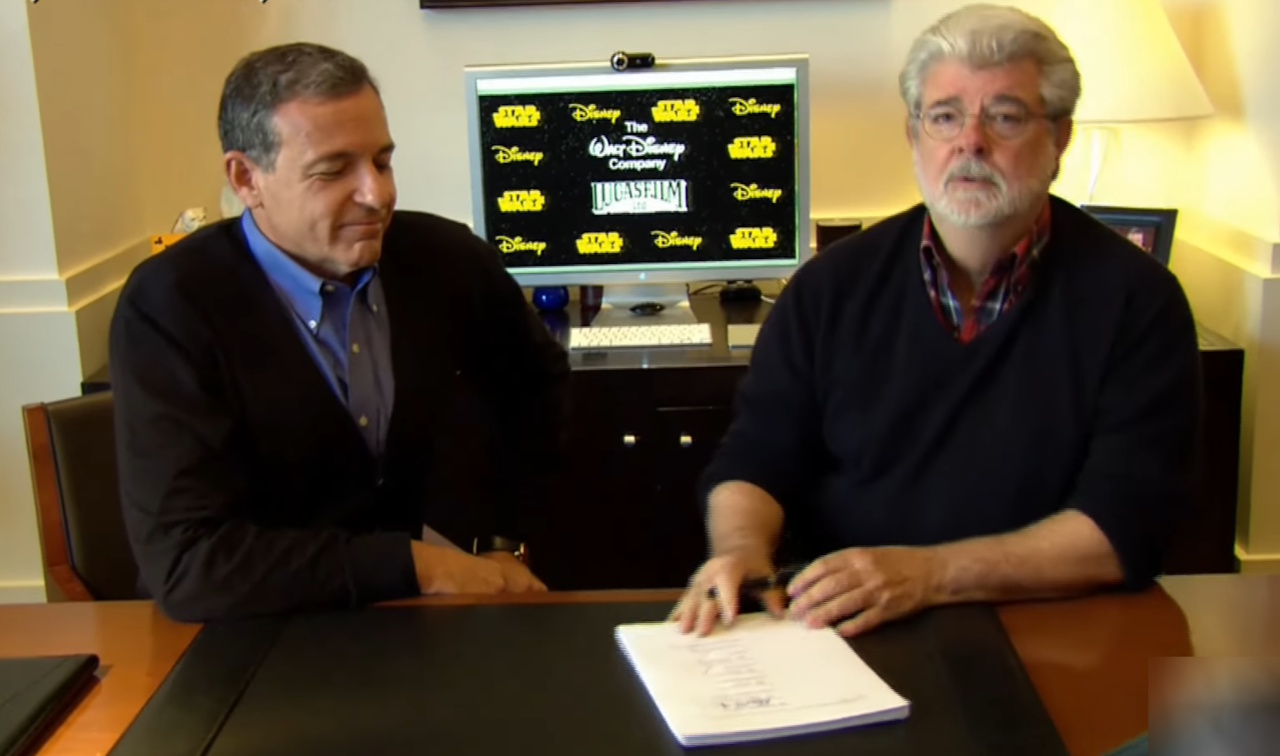
Actual photo from the Nintendo boardroom.

I think this comes back to the core problem that the Switch 2 has: its price point, and specifically, its price point in the current economic climate. In 2017, I was content to pay £300 for a Switch. Playing the likes of Mario Kart 8 Deluxe and New Horizons felt worthwhile at the time, and I wouldn’t have wanted to miss out on those experiences – even if there are flaws and drawbacks, both games gave me some enjoyable experiences. But thinking about it, playing seven games across eight years is less than one new title per year, and it kind of puts the cost of the system into context. I had fun with my Switch. But was it worth the money?

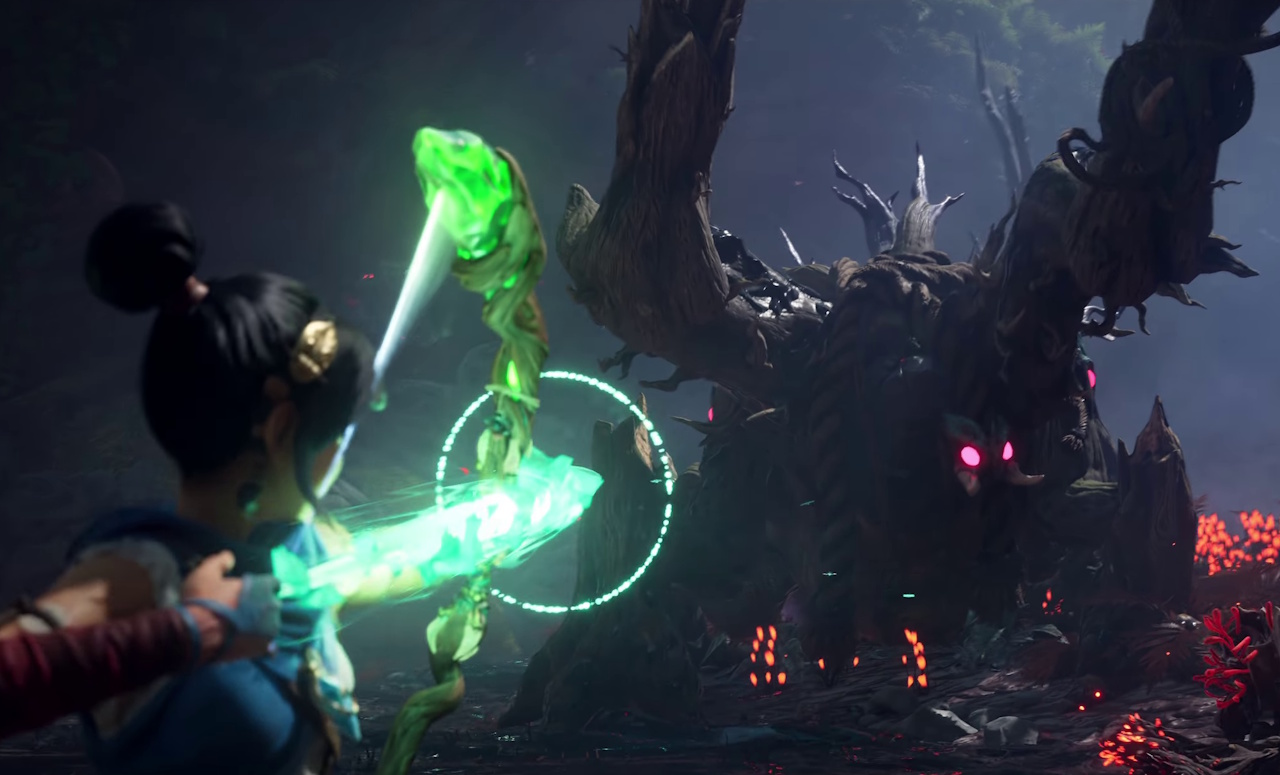
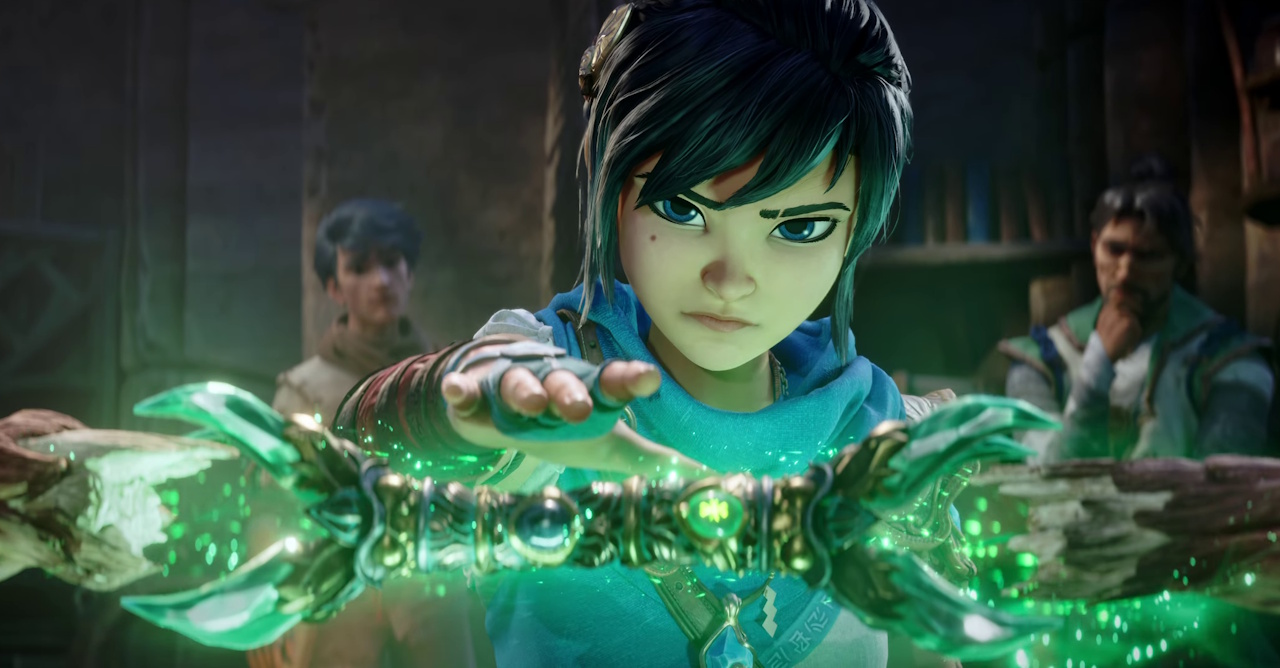
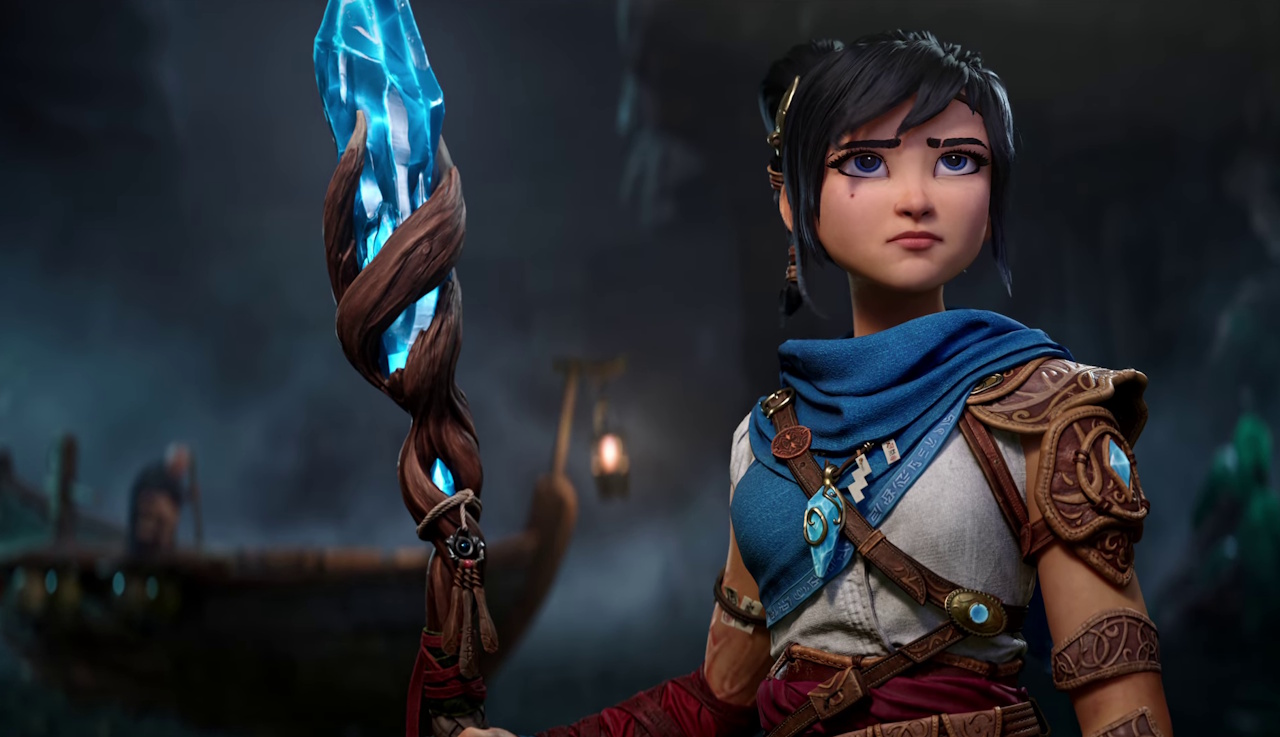
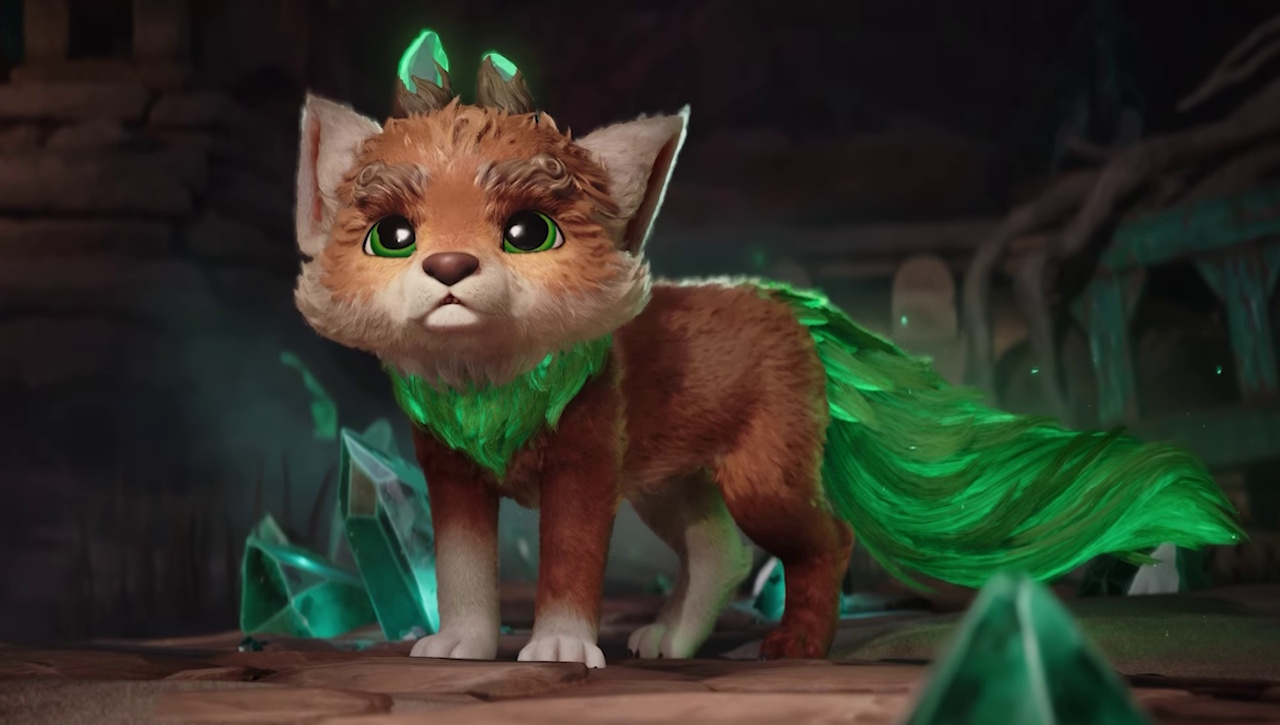
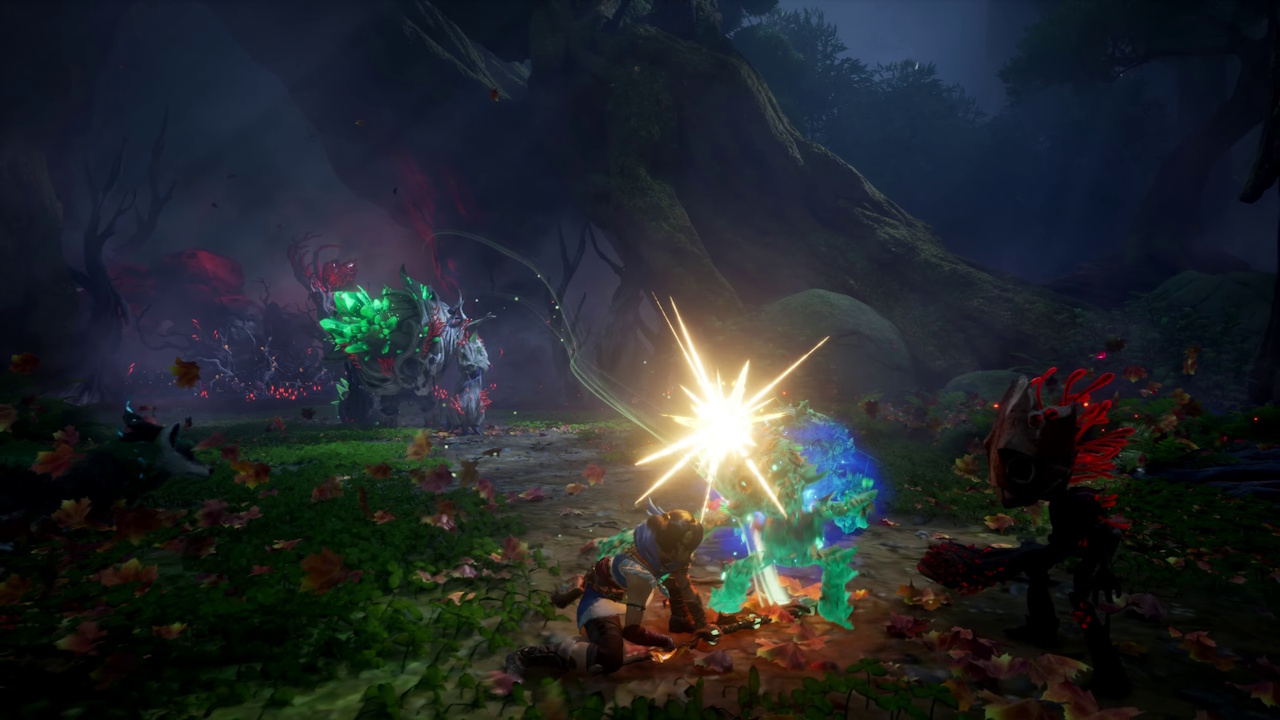
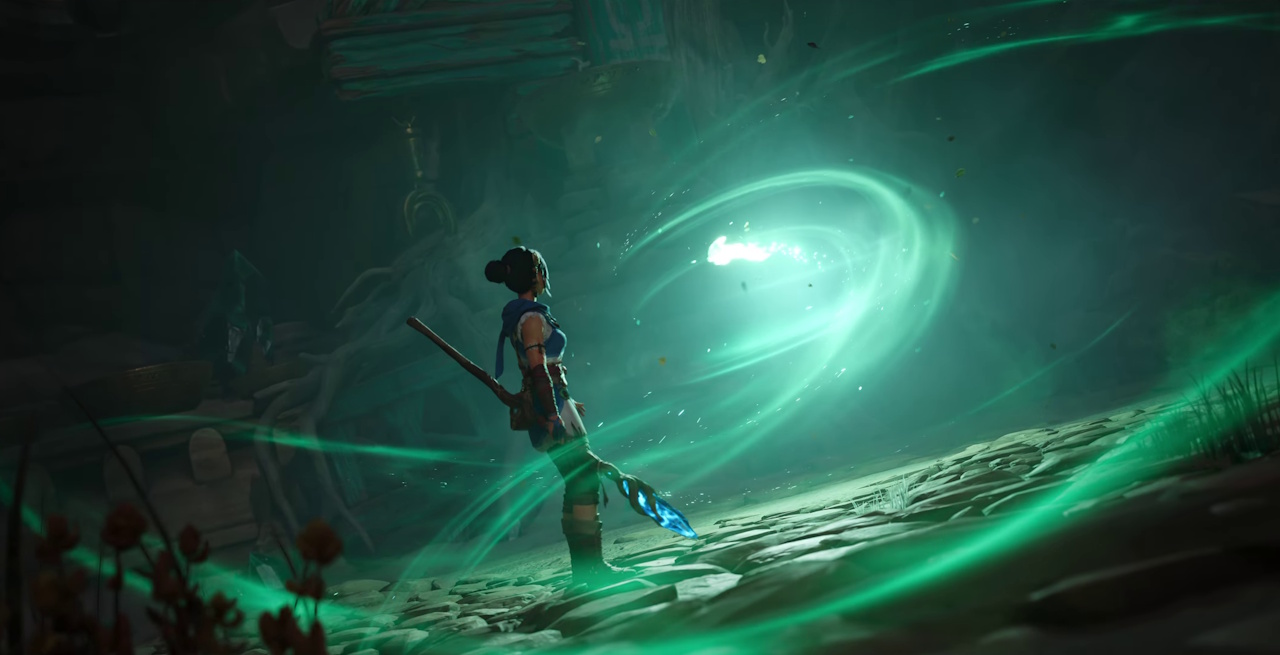
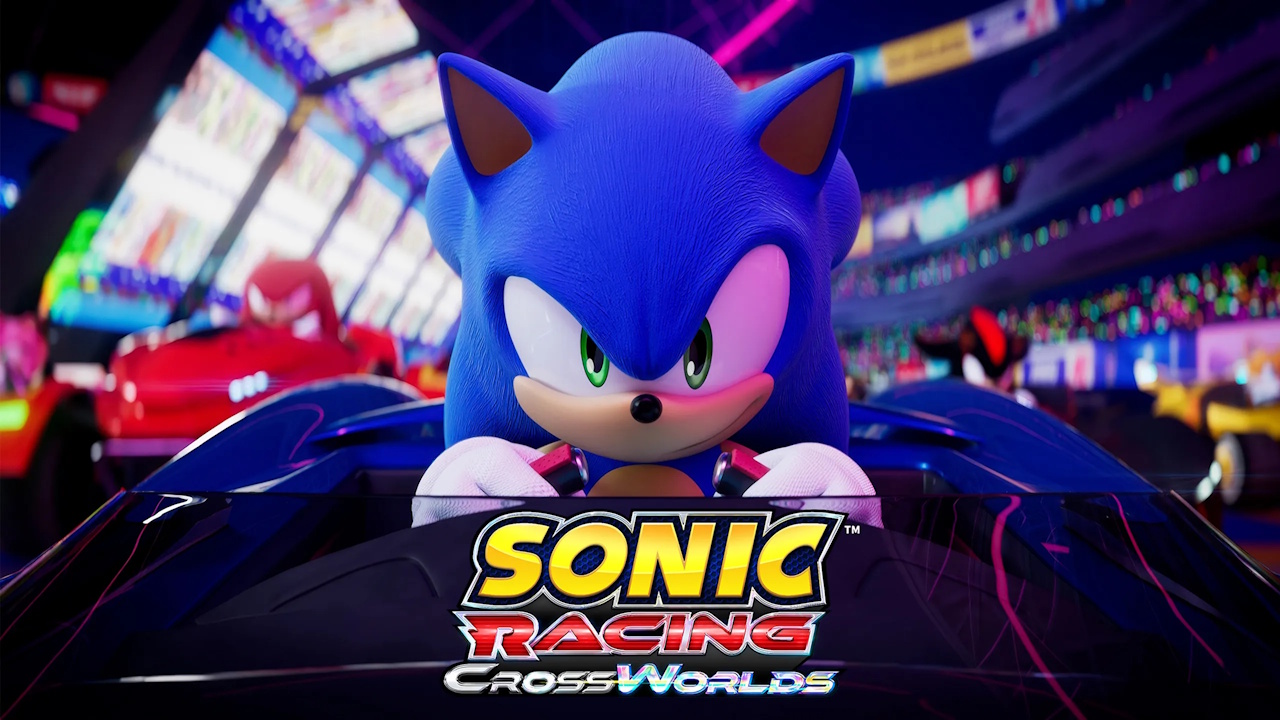
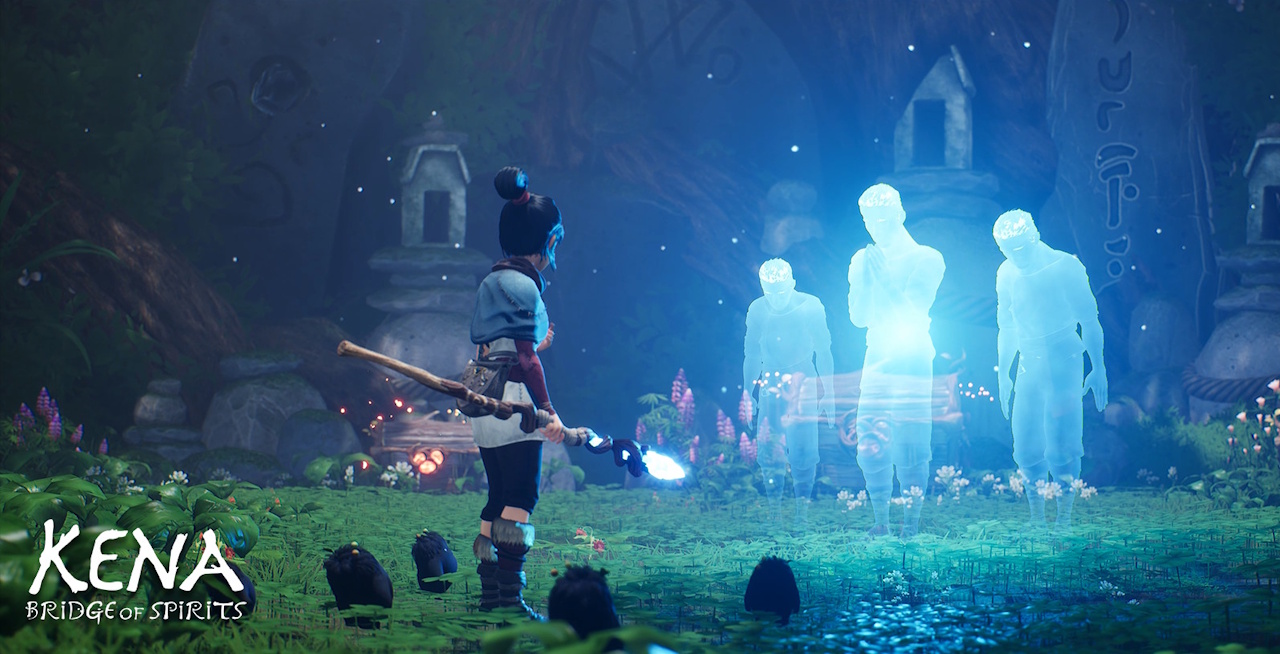
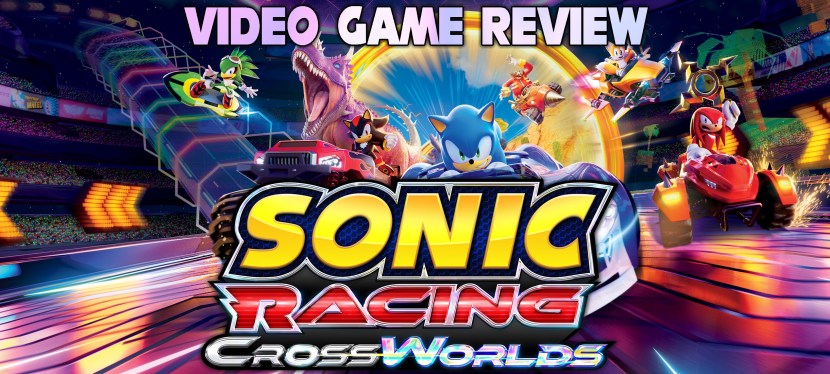
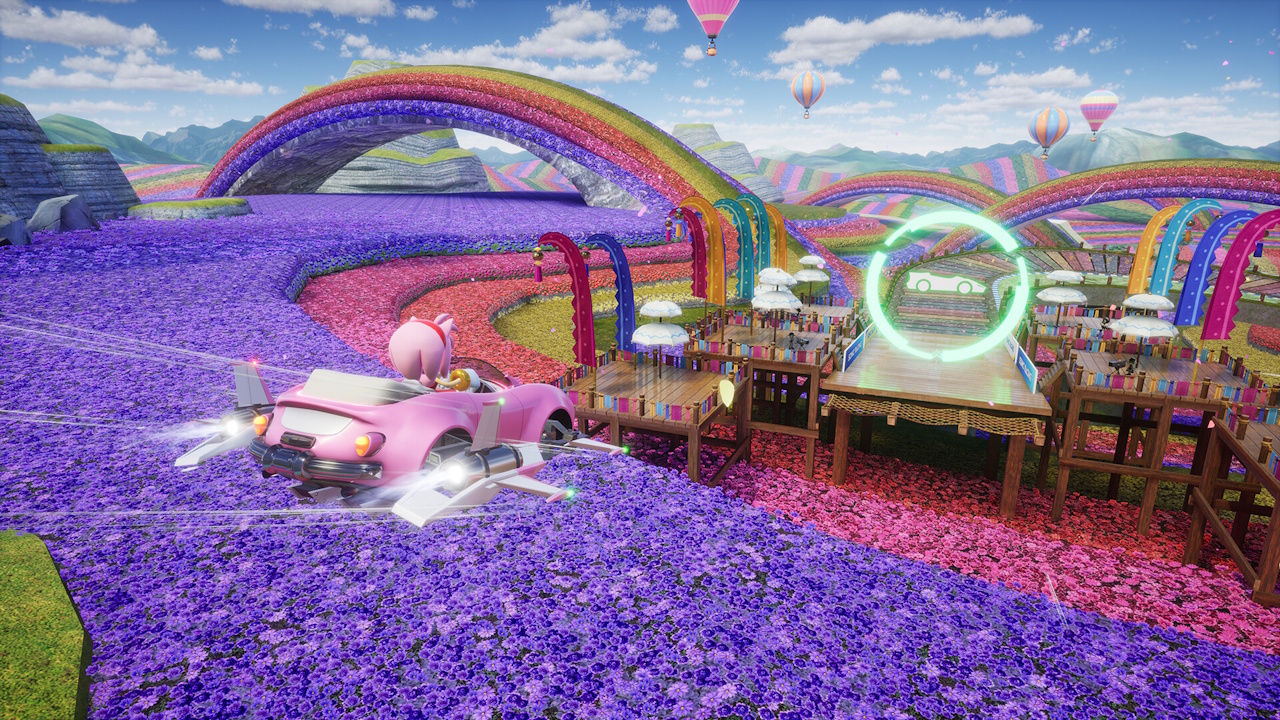
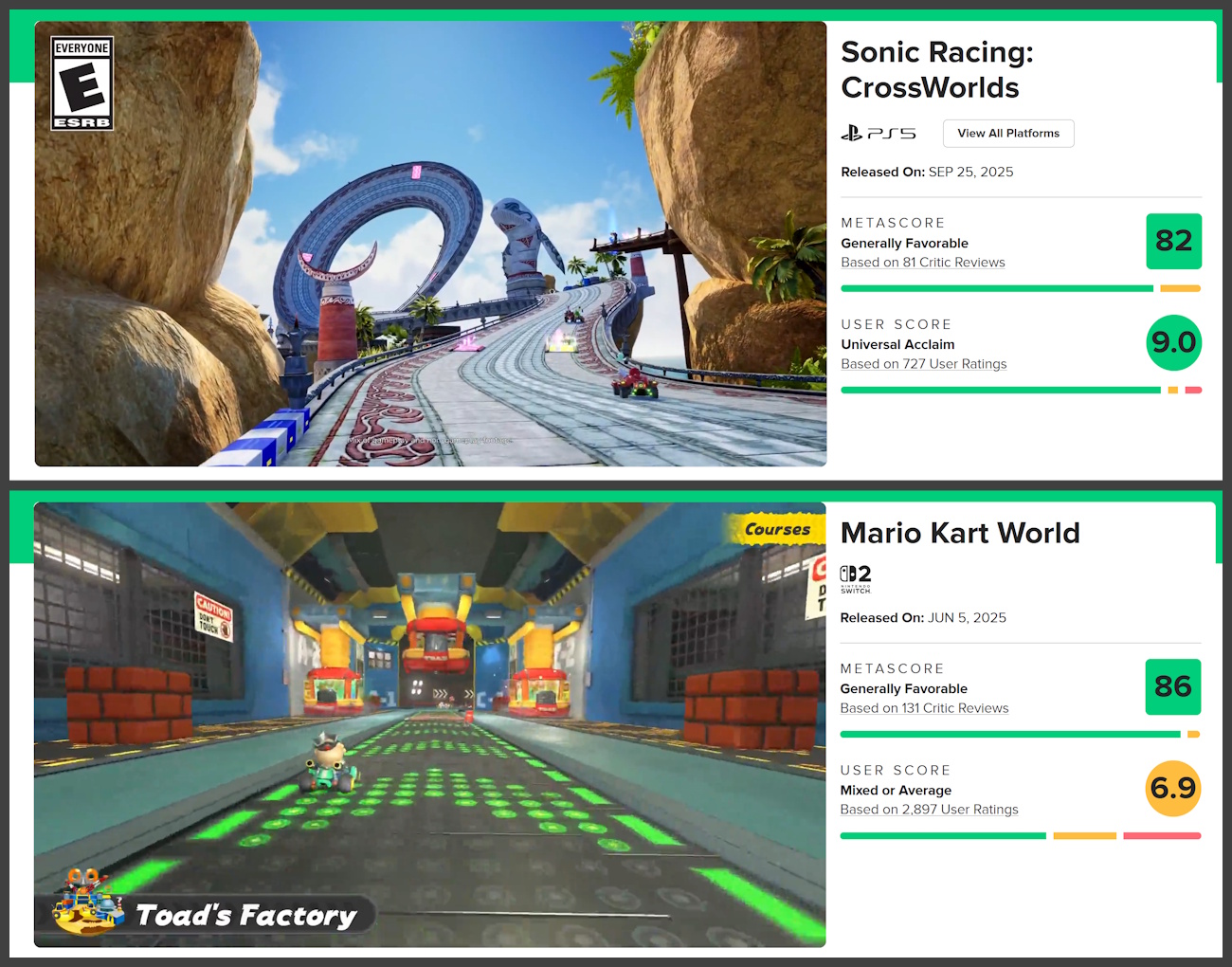
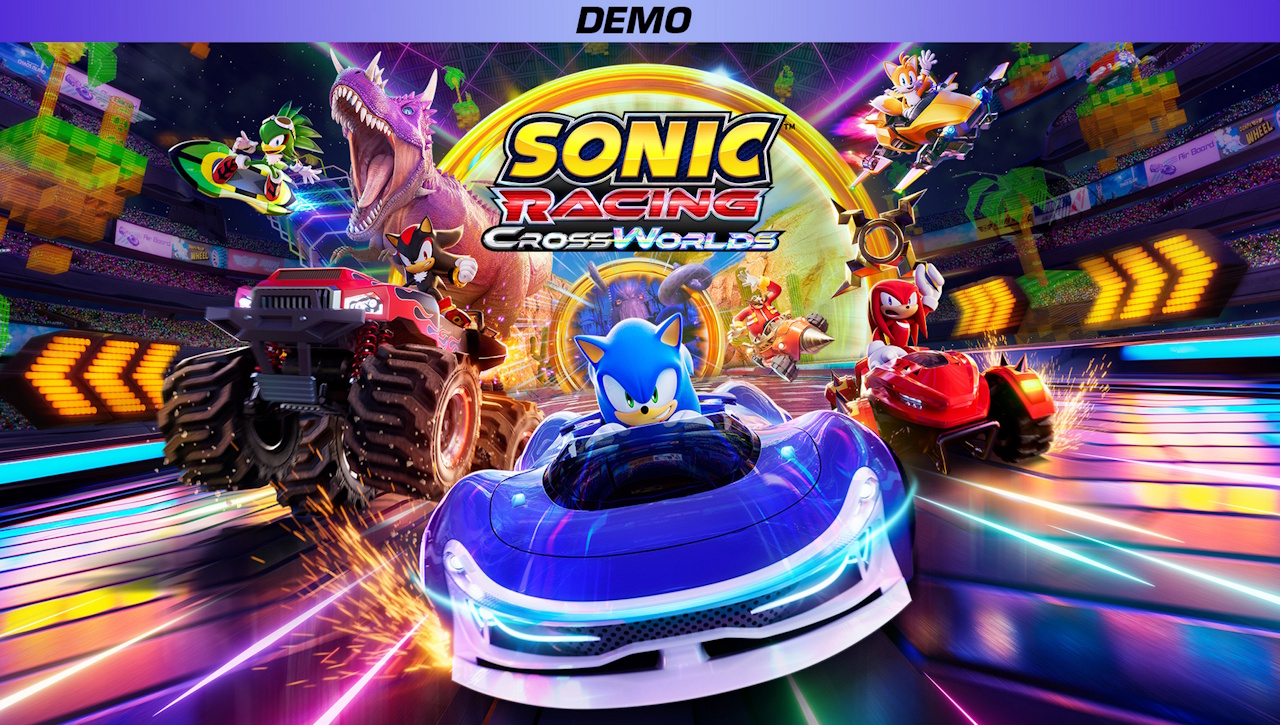
With the Switch 2 being £100 more just to get started, and with its exclusive games also having risen in price, I’m no longer so confident in my original plan to pick up the console. The simple truth is that the Switch 2 feels pretty derivative and similar to its predecessor, and of the biggest games to launch on the system since it debuted – Mario Kart World, Donkey Kong Bananza, and Metroid Prime 4 – all feel pretty samey, too. I can get the kart-racing experience I want from Sonic Racing: CrossWorlds. Adventure games and 3D platformers are ten a penny, with excellent releases in the past few years like Kena: Bridge of Spirits. And there are some fun upcoming single-player FPS titles on the horizon, too: Mouse, P.I. For Hire being just one example. And all of those games are playable on the PC I already have.

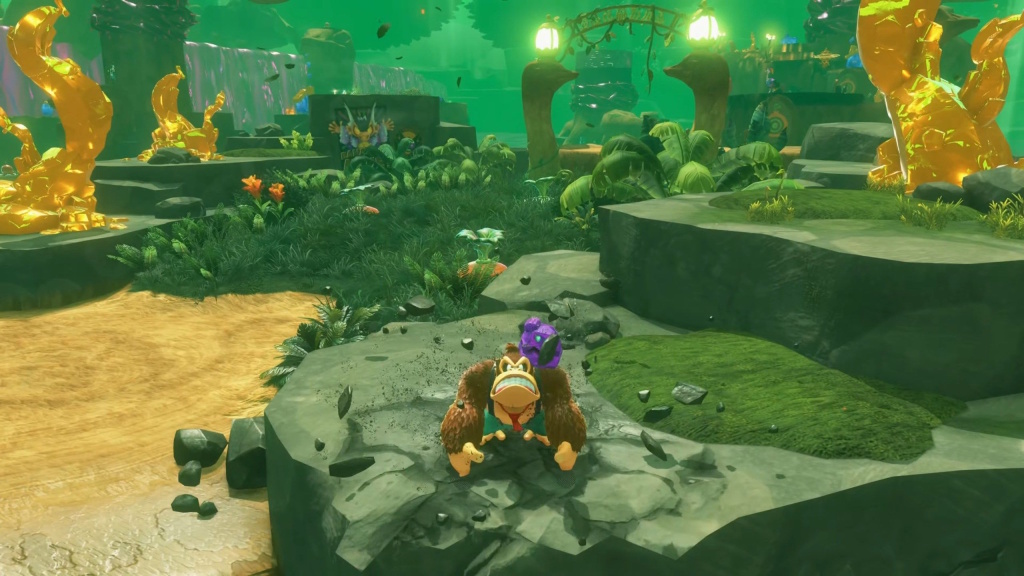
Promo screenshot of Donkey Kong Banaza.
With no new Nintendo games feeling special or innovative, I can find comparable experiences elsewhere.

When Nintendo stepped back from the “power and graphics” race to focus on innovative ways to play, it was a huge success. They reached out to a casual audience of non-gamers and brought them on board in droves. The Wii, with its motion controls, the DS and 3DS with titles like Brain Training, and the Switch as a hybrid console all achieved huge successes. But as I said last year, the Switch 2 feels like Nintendo’s least-innovative console in decades, doubling-down on what worked with the Switch at the expense of that innovation.

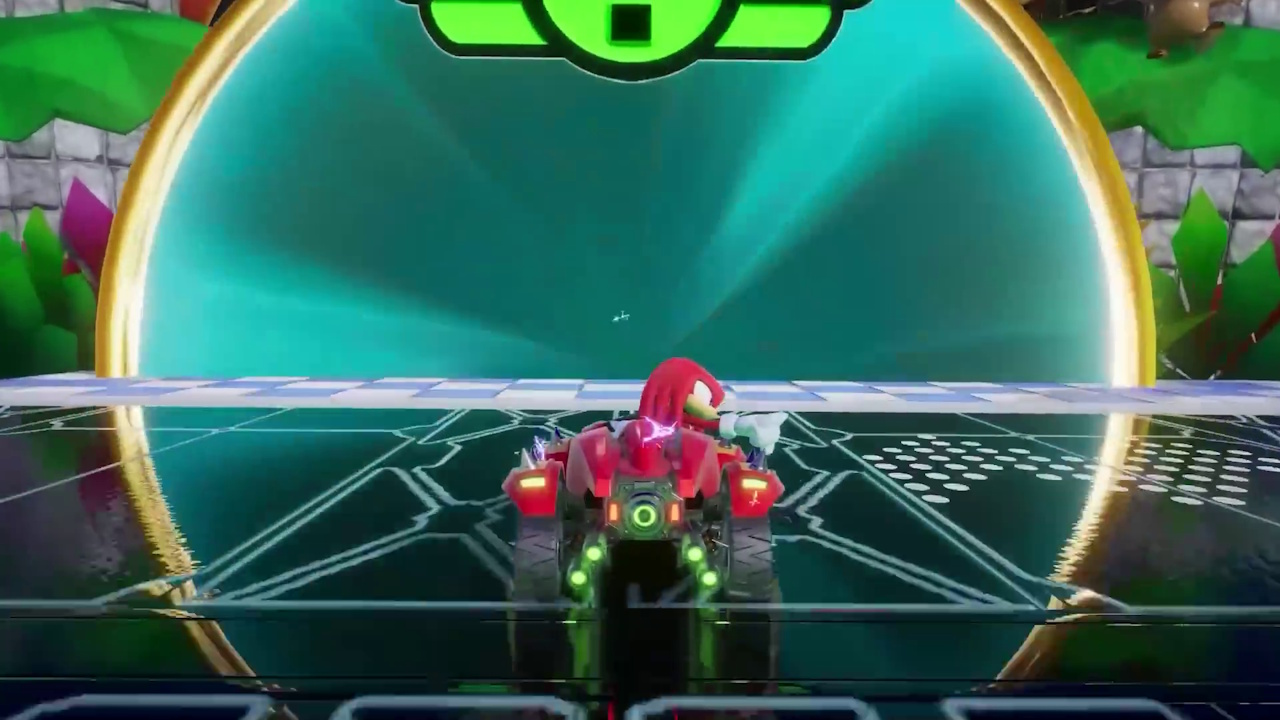
Without it, what does Nintendo have? A handful of franchises that players have history with, sure. But as the broader games industry moves on and continues to find new things to do with those genres, while also pushing the boat out graphically, where has that left Nintendo? Sonic Racing: CrossWorlds has tight, focused races across a variety of tracks, while its signature mechanic ensures each race feels different. Mario Kart World has an open world… which doesn’t seem to really suit the format. Slapping an open world onto a title for the sake of it isn’t innovative. CrossWorlds’ mid-race portals to a new racetrack? That does feel new and different.

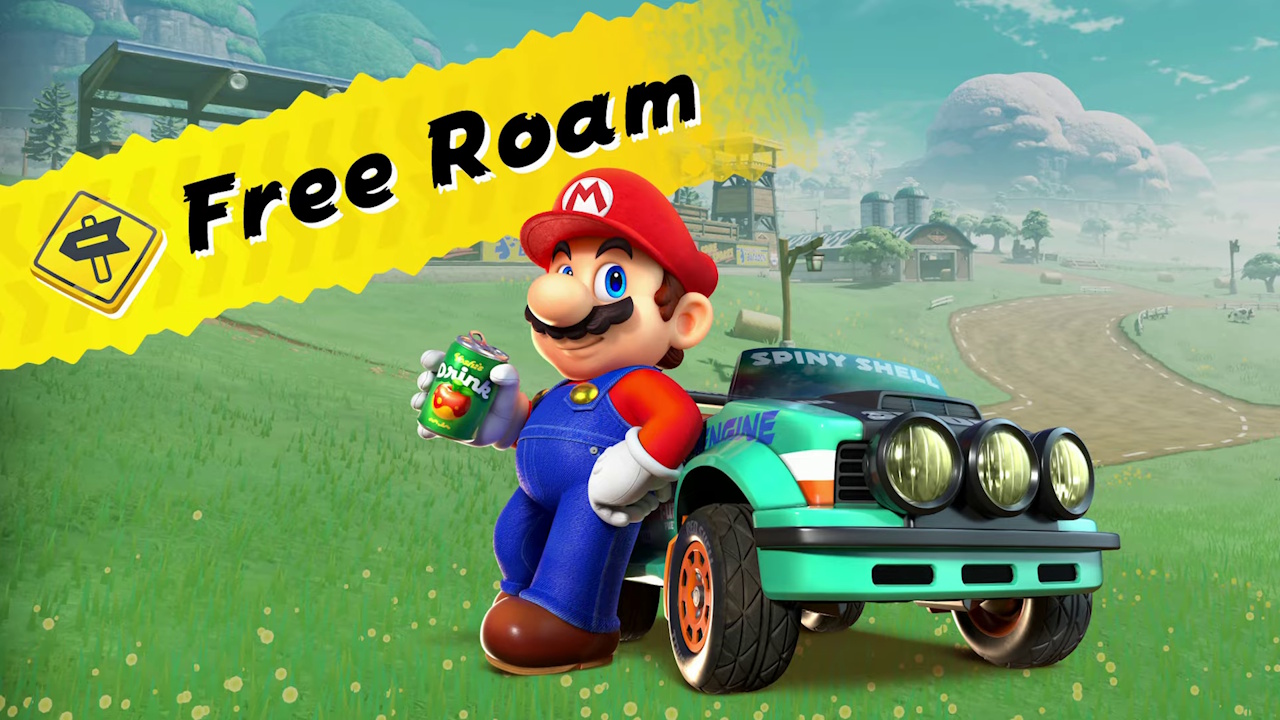
Promo image of Mario Kart World advertising the Free Roam mode.
Mario Kart World has an open world with a free roam mode.

If I want to play an adventure-platformer, I have so many options. And many of them are graphically superior to anything Nintendo has made. Look at the aforementioned Kena: Bridge of Spirits, which was my pick for “game of the year” back in 2021. Could Nintendo make a Switch 2 game look that good? Why do I need Donkey Kong Banaza when there are literal indie titles that look better and offer the same kind of gameplay experience? The only reason would be that I feel a connection to the character and the series.

And this isn’t to disparage Bananza or Mario Kart World. If I played them, I think they both look like titles I’d enjoy. But my point is… why do I *need* to play them, or buy an expensive console to play them on, when other games can do pretty much the same thing on hardware I already own? By sacrificing innovation with the Switch 2, Nintendo has given me a reason to leave it on the shelf. The reality is that other games can do pretty much everything that Nintendo’s titles can, and because the Switch 2 is still less-powerful than its competitors despite charging similar money, many of those alternatives can look a lot better while doing it, too.

Still frame from the Nintendo Switch 2 Direct broadcast showing three of Nintendo's executives.
The Switch 2 still feels pricey for what it offers.

We are less than one year into the Switch 2’s run, though, and it’s gotta be possible that new games will come along that genuinely recapture that sense of innovation, that idea that “there’s nothing else like this on the market,” and that will persuade me that I need to check out this console. I’m not writing off the Switch 2. And despite seeming to be struggling outside of Japan, Nintendo is still shifting Switch 2 units and games, so I’m not trying to claim that the console itself will be a flop. I think it’s already close to (or may have already eclipsed) the total lifetime sales of the Wii U, which would pretty much be the bar for that kind of discussion!

“Not every game is right for every player,” and I guess that’s true of consoles, too. It may simply be the case that this Nintendo generation is the first since the GameCube that I end up skipping, if none of the games really call out to me and make me feel like I’m seriously missing out. As someone who’s the wrong side of forty, I am admittedly not part of Nintendo’s true target audience! So perhaps it makes sense that this console with more family-friendly titles is something I’d walk away from. Heck, maybe I’m stepping back from Nintendo, like, twenty years too late!

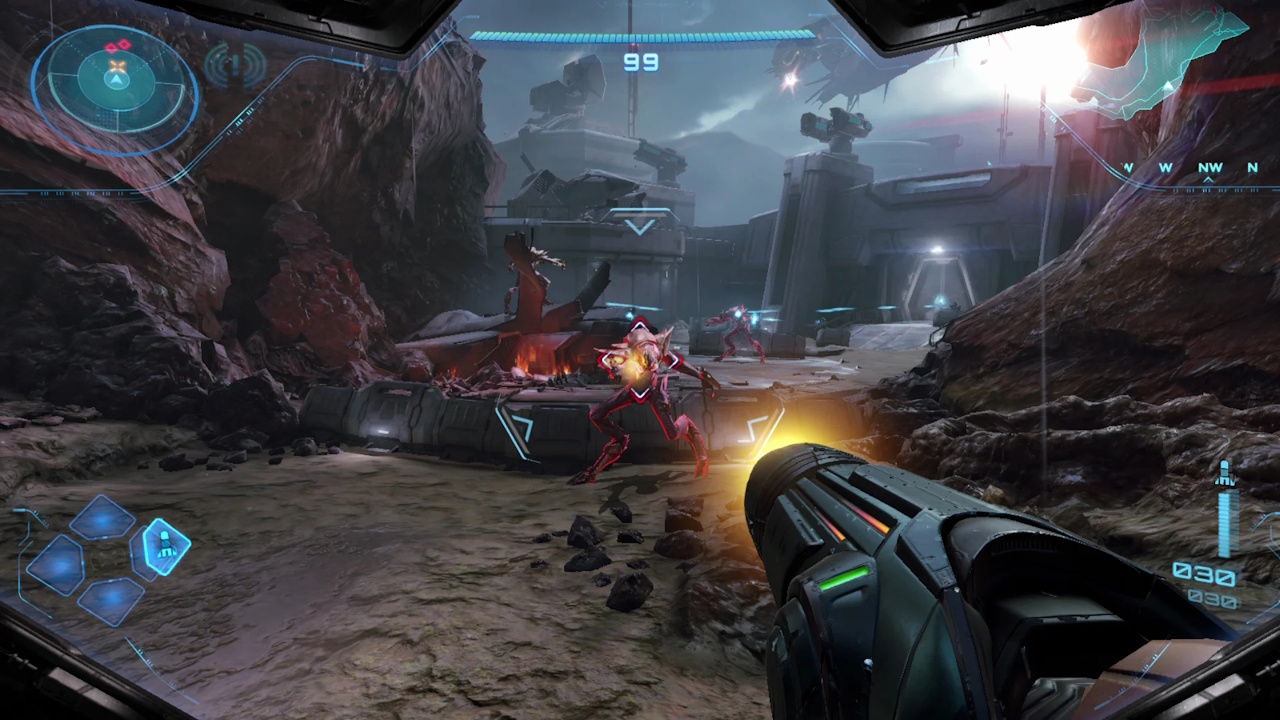
Promo screenshot for Metroid Prime 4.
Metroid Prime 4.

It is an admittedly rather odd feeling, though, to be looking in from the outside at a brand-new Nintendo console, a brand-new 3D Donkey Kong game, and a brand-new Mario Kart title and… not really feel like I’m missing out in a huge way. I remember being on a months-long waiting list when the Wii launched, and answering the phone at 8am, in my pants, when my local Game branch rang me to tell me they’d finally got one in stock for me. I practically *sprinted* to the bus stop to get there in time and promptly took two days off work while I got acquainted with my new baby! And I bought a Wii U, for heaven’s sake. *A Wii U.* But now, here I am, feeling really uninspired by and just plain uninterested in the Switch 2.

With Bananza being last year’s big 3D platformer, I don’t see a 3D Mario title being launched in 2026. With Pokémon Pokopia doing the “cozy life-sim” thing, and New Horizons getting a big update, it also seems pretty clear that a new Animal Crossing title isn’t on the cards this year, either. Those are the only two Nintendo exclusive titles that I could imagine piquing my interest and potentially convincing me that I need a Switch 2… so I doubt I’ll be buying one this year. I will keep my ear to the ground to see what else might be coming our way with the Switch 2, though.

This was a bit of a stream-of-consciousness waffle, so thanks for sticking with me to the end! I wanted to get my thoughts in order about the Switch 2, its games, and why I don’t really feel all that interested in it right now. Price is a big part of the equation, but it isn’t the only thing keeping Nintendo’s newest console out of my hands. If, however, that should change in the future, be sure to check back. And I daresay I’ll have more to say about Nintendo and the wide world of video games before too long.


The Nintendo Switch 2 is out now. All titles discussed above (Mario Kart World, Donkey Kong Banaza, Metroid Prime 4, et al) are the copyright of Nintendo. This article contains the thoughts and opinions of one person only and is not intended to cause any offence.

Grand Theft Auto VI: Three (Potential) Problems In Store

I wanted to expand a little on something I said yesterday, when I made some predictions for the year ahead. If you haven’t read it yet, don’t miss my predictions, by the way! I had a bit of fun talking about some likely (and some not-so-likely) things that we might see in 2026. You can find that piece by clicking or tapping here.

In the “not-so-likely” category, one of my predictions involved Grand Theft Auto VI, the upcoming open-world crime game from Take-Two and Rockstar. I said that there’s a possibility – however remote it may seem right now – that GTA 6 fails to meet its sales targets, which are surely pretty high given the amount of money that’s been dumped into its development, and will end the year being considered an expensive failure. I only dedicated a couple of paragraphs to the idea last time, but I thought it was interesting enough to warrant a longer article.

So let’s talk about that!

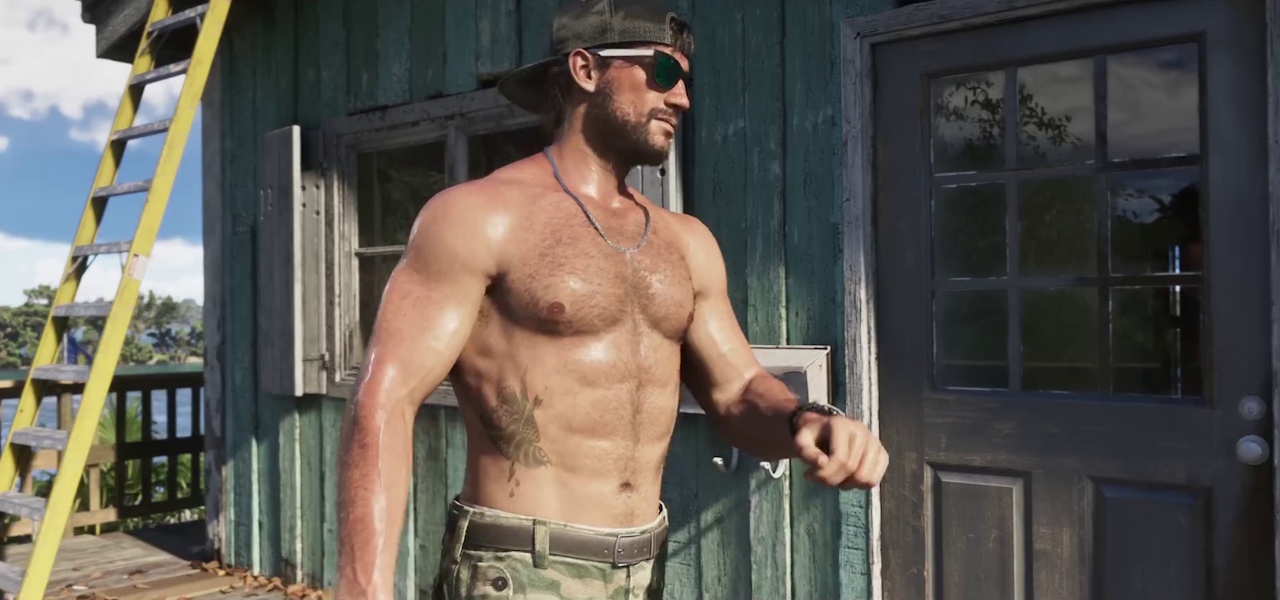
Still frame from the second GTA VI trailer showing Jason.
Is everything sunny for Grand Theft Auto VI?

To get the most obvious point out of the way, no video game – nor film, TV show, novel, etc. – is a *guaranteed* hit. It doesn’t matter if it’s a sequel to one of the best, most universally-praised titles of all-time. It doesn’t matter if it’s part of a decades-long franchise with a huge fanbase. It doesn’t matter if it’s the most-hyped, most-highly-anticipated title of the year, the decade, or the century! There are *no* sure things in the entertainment industry, and anyone who’s convinced that “it’ll be a success because it’s Grand Theft Auto VI” is working from a faulty assumption.

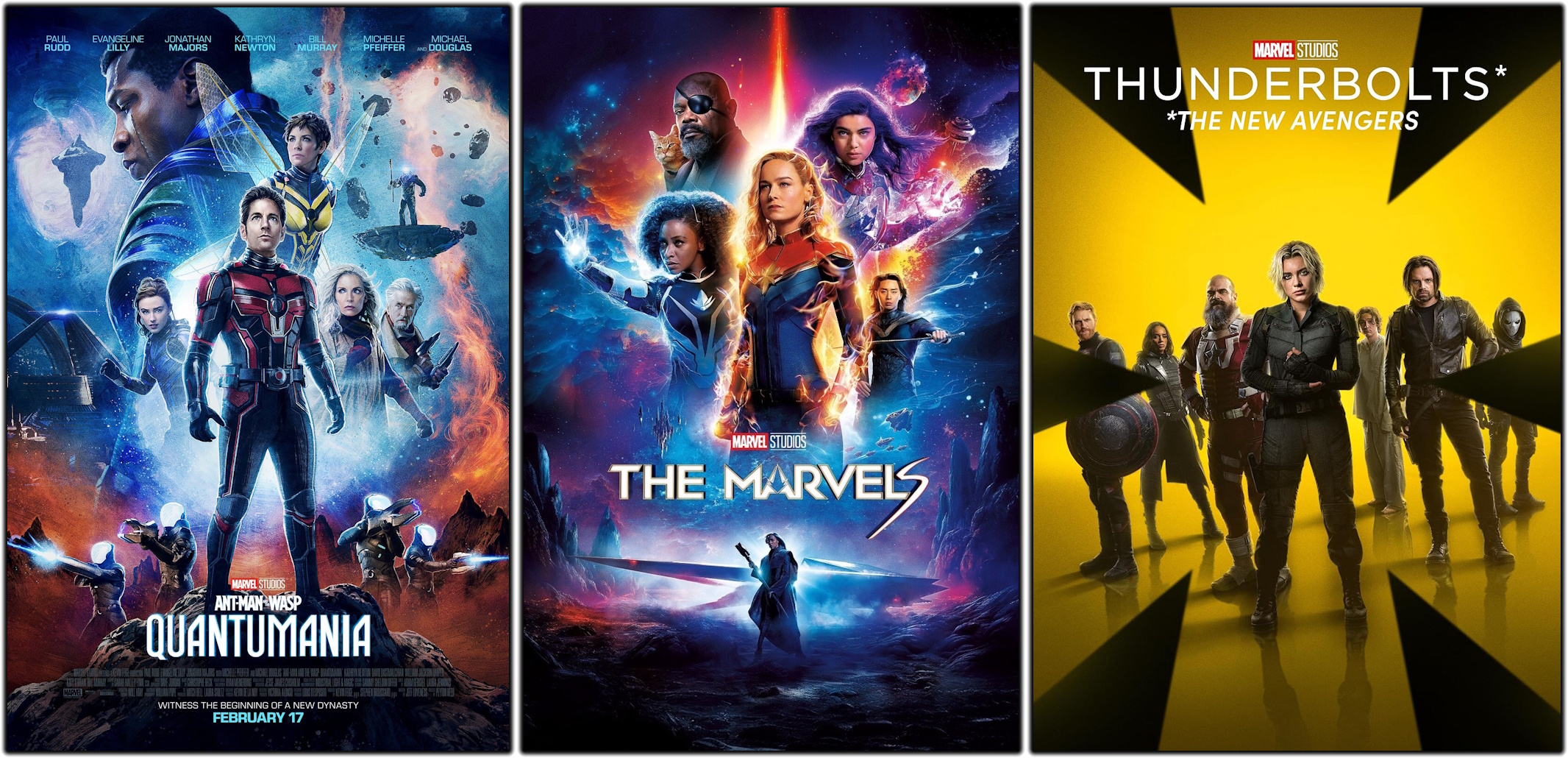
Want proof? Look at the Star Wars franchise, beginning really with The Last Jedi, and especially with Solo: A Star Wars Story. Look at how viewership for Star Wars has gradually fallen away on streaming. Or take a look at Marvel, and how audience numbers, critic scores, and box office receipts have shrunk since Avengers: Endgame. Neither of these massive franchises has been able to successfully reach the heights they once did. And because of the way the industry (and capitalism in general) operates, it’s not good enough to make “a profit.” You have to make a bigger profit more quickly every time.

Posters for Ant-Man and the Wasp: Quantumania, The Marvels, and Thunderbolts/The New Avengers.
Three recent Marvel films, which all underperformed.

In the games industry, too, there are countless examples. The long-running Halo series has been floundering since, to be realistic, Halo: Reach’s release fifteen years ago, back in the Xbox 360 era. Suicide Squad: Kill the Justice League was not only a superhero game set in the DC Comics universe, but it was also developed by the established Rocksteady Studios, tapped into the live-service trend, and had a ton of money poured into it by Warner Bros. Games. And it lost $200 million. Star Wars Outlaws failed to break even for Disney and Ubisoft. The once-lauded BioWare has endured a decade-plus of failure, with Mass Effect: Andromeda, Anthem, and Dragon Age: The Veilguard. And dare we mention Sony’s Concord?

Have I made my point?

It doesn’t matter that the series or franchise is beloved and has been a hit in the past. It doesn’t matter who the developers are, or if their earlier works have been popular and well-received. It doesn’t matter if you’re a literal games industry institution. Gaming shifts and changes over time, with players’ expectations evolving, too. Name recognition and hype can only take you so far, and *especially* for a title that makes most of its money from an online mode which relies on long-term play and recurring spending, they aren’t enough to get you over the line.

Shark Cards for sale in Grand Theft Auto V.

The video games industry is not a static, stagnant thing. It’s been almost *thirteen years* since the launch of Grand Theft Auto V, and the way the gaming landscape looks today is pretty different from how it was back then. There’s been a pandemic, which saw loads of people stuck at home with little to do, there’s been the massive growth of a handful of online live-service titles, and there have been some pretty serious price hikes, too. Gaming has grown, but it’s also become more expensive, struggled to retain some of its new audience since the end of lockdown, and many younger players today stick with a handful of games – or literally just *one* – for years at a time.

Grand Theft Auto V has been at the forefront of some of the biggest trends in the industry in recent years. But being an industry leader is not a guarantee of success. Just ask Atari, Sega, or any of the developers of the games I just mentioned. Rockstar and Take-Two have been riding high thanks to Grand Theft Auto V’s online mode. But in 2013, I don’t think it’s unfair to say that Grand Theft Auto V was a single-player title with an online mode tacked on. Because of the way the industry has shifted – and because of how successful that online mode became – Grand Theft Auto VI is a fundamentally different kind of title. It’s an online game first, with a single-player campaign being tacked on. A total 180° shift.

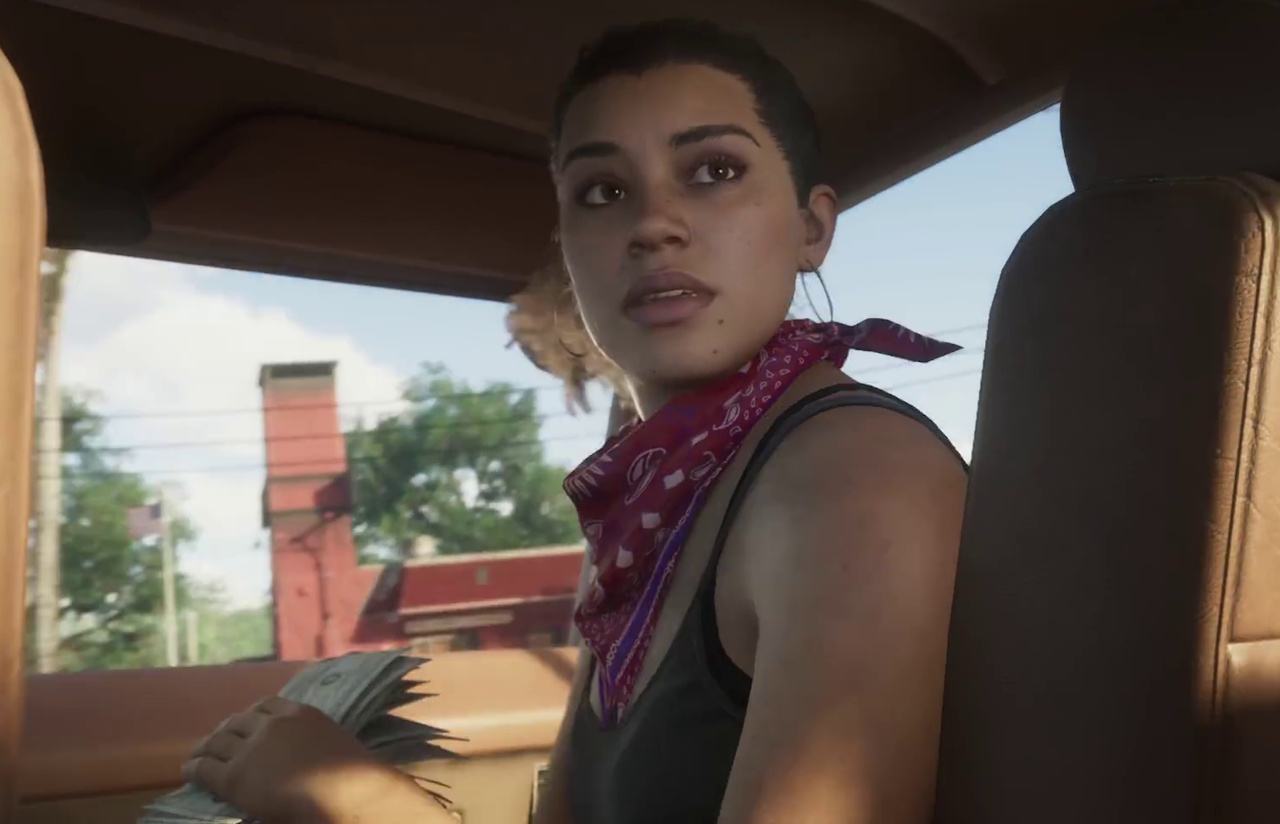
Still frame from the first GTA VI trailer showing Lucia holding some cash.
Rockstar and Take-Two are hoping to cash in on GTA VI’s online mode.

GTA 6 is, according to reliable reporting, going to be the most expensive video game… ever. With a budget, when accounting for its extensive marketing campaign, that could come close to, or even top, $2 billion… that’s a *lot* of Shark Cards that Rockstar will have to sell for the game to merely break even, let alone begin to turn a profit.

To be clear: that money has been invested with the expectation that there’ll be a huge profit to be made. But the higher the budget, and the longer the game takes to develop, the more sales and the more microtransactions are needed in order for the game to simply make its money back. This is a trap that has tripped up *many* titles over the years; plenty of games could have been profitable if they’d just… toned it down. Star Citizen – one of the few games to have burned through almost as much money as Grand Theft Auto VI – is a case in point: so much money has been spent on development that actually turning a profit when (or if) the game actually launches feels basically impossible at this point.

Headshots of the Take-Two Interactive board of directors circa Dec 2025/Jan 2026.
The Take-Two Interactive board of directors circa January 2026.

There are really three main problems that I can see which could potentially cause Grand Theft Auto VI to stumble, beyond what we’ve already discussed.

The first is that a game with a bigger budget needs to sell more units, and convince more players to pay for microtransactions. But… Grand Theft Auto VI already hits a problem here. There’s a smaller potential audience for the game than there is for its predecessor – or even than there was in 2013 when GTA 5 launched.

At time of writing, there are approximately 120 million PlayStation 5 and Xbox Series consoles out in the wild. Most of those are PS5s, but if you add the combined sales totals together, that’s what you get. That’s compared with close to 190 million PlayStation 4 and Xbox One consoles that have been sold. And on top of that, recent data from the second half of 2025 shows a serious slowdown in the home console market.

Stock/promo photo of a PlayStation 5 console and DualSense control pad.
There are fewer PS5s out there than PS4s.

In 2013, when Grand Theft Auto V launched for Xbox 360 and PlayStation 3, there were around 155-160 million of those consoles in homes. And across the lifetime of GTA 5, it’s had access to the 190 million last-gen systems, as well as at least tens of millions of PCs, too. And that massive audience, across three home console generations and PC, is what’s led to it becoming the second-best-selling game of all-time.

With a smaller potential audience at launch than GTA 5 had in 2013, by an order of some forty-ish million, and without the simultaneous PC release that Take-Two and Rockstar decided to cheap out on, will Grand Theft Auto VI have a comparable launch to its predecessor? GTA 5 earned a billion dollars in just three days… will GTA 6 do the same? Or will it take longer to reach that number? If it does take longer, will Take-Two and Rockstar *already* begin to panic?

Still frame from the second GTA VI trailer showing a character driving past the police.
Grand Theft Auto VI will have a smaller built-in audience at launch than its predecessor.

This leads into my next point: home consoles are expensive right now, and in a difficult economy in which ordinary people are struggling, that’s being reflected in a serious decline in sales. It now seems beyond unlikely that the PlayStation 5 will *ever* reach, let alone eclipse, the total lifetime sales of the PS4, and even the Nintendo Switch 2, which only launched a few months ago, has just endured a very rocky holiday season everywhere except for Japan. In October and November 2025, home console sales were the lowest they’d been for thirty years. *Thirty years.*

Not since the days of the Super Nintendo, Sega Saturn, and first PlayStation have home console sales been this low. Think of all the consoles to have been and gone since then: the N64, the Dreamcast, every single Xbox ever… that’s how rough things are in the home console market right now. Even the newly-launched Switch 2 hasn’t been able to drive sales to any great extent.

Front artwork on a Sega Saturn box.
Not since the days of the Sega Saturn have so few home consoles been sold.

There’s not even a question as to why, either. The tail end of the Xbox One/PS4 generation, as well as the middle of the Switch’s life, saw the Covid pandemic, lockdowns, and a lot of folks stuck at home with little to do… and furlough money or a stimulus cheque to spend. Console sales went up, naturally, as people needed to find ways to stay connected with friends, and things to do that didn’t require going outdoors!

But that’s not even the half of it. The real reason why consoles are struggling right now is simple: price hikes. Xbox consoles have gone up in price. PlayStation consoles have gone up in price. And the Switch 2 is significantly more expensive than its predecessor. Even if the economy was working properly for everyday folks, these price hikes would be hard to stomach. But when people are *already* struggling to make ends meet? Luxuries like home consoles, especially overpriced ones, are the first things to be cut from budgets and Christmas wishlists.

Stock image of a Nintendo Switch 2 console.
The Switch 2, in its launch year, hasn’t sold especially well outside of Japan.

This is directly connected to my next point.

I don’t know whether the reports are true, and whether Rockstar and Take-Two genuinely plan to launch Grand Theft Auto VI at a ridiculously inflated price. But $100 is out there, being widely discussed, and it’s not a hot take to say that that could be the target right now. But we’ve already seen the backlash to that kind of pricing.

Mario Kart World, the first game to launch for $80, would probably have been subject to less criticism were it not for the inflated price. And Xbox had to walk back plans to raise some of their prices to $80 after very low pre-order numbers and a massive wave of criticism. So GTA 6 retailing for $100 or even “just” $80 would unquestionably generate a similar backlash, in my view.

Combine an unprecedented and unpopular price for the game with the already sky-high price of home consoles – and the fact that a lot of folks would need to pick up a new machine if they want to play the game – and you’ve got the perfect storm. In this economy, can players really afford to pay $750 to pick up a new PlayStation 5 or Xbox Series X and Grand Theft Auto VI? And if they can… is it worth it for just one new title? How many players, who’ve already made it this far into the current generation without picking up a new console, are going to be convinced to shell out that much money to play one new game? Because that’s what Rockstar and Take-Two will be asking: it’s not just the price of the game, but also the inflated console prices that players have to take into account.

Finally, Grand Theft Auto VI will potentially run into the same problem that has knocked down many live-service titles: will players feel the need to switch?

Suppose I’m a big GTA fan, and I’ve been playing Grand Theft Auto V for years. I have a group of buddies that I play with regularly, I have my in-game money, a base I’ve spent ages perfecting, and a character I’ve levelled up. I know the map, I know the heists, I know the vehicles and the weapons. I’m settled and happy in my GTA 5 server with my friends and my way of playing the game. Why do I need a new game? Why do *I* need to spend potentially hundreds of dollars or pounds on new hardware and a new title when I’m perfectly content with what I already have?

Promo image for Grand Theft Auto V Online.
The way people play games is changing; sticking with one title for years at a time is now commonplace.

This is “the Concord problem.”

Why did no one buy Concord in 2024? It was a well-made hero shooter. Sure, it was a bit generic… but so are a lot of those games, let’s be honest! But what did Concord do to convince fans of Overwatch or Apex Legends that they needed to switch? Fans of those titles, and others, are already settled. And many players nowadays only play one game – they find an online experience they enjoy, be it Roblox, Fortnite, Helldivers II, or the venerable Grand Theft Auto V, and they stick with it.

Even sequels, like Overwatch 2, have struggled. And in the more competitive scene, some recent titles – like Call of Duty: Black Ops 7 – have struggled to convince fans of the series or last year’s entry that they need the upgrade. We’re in a new era of gaming, where players often feel a strong sense of loyalty to a single title, and stick with it. And games companies have recognised that, adding new maps, new challenges, new weapons, and new content to existing games instead of making new ones. Why has Grand Theft Auto VI taken thirteen-plus years to be ready for release? Because Rockstar and Take-Two did exactly that with GTA 5 and its online mode.

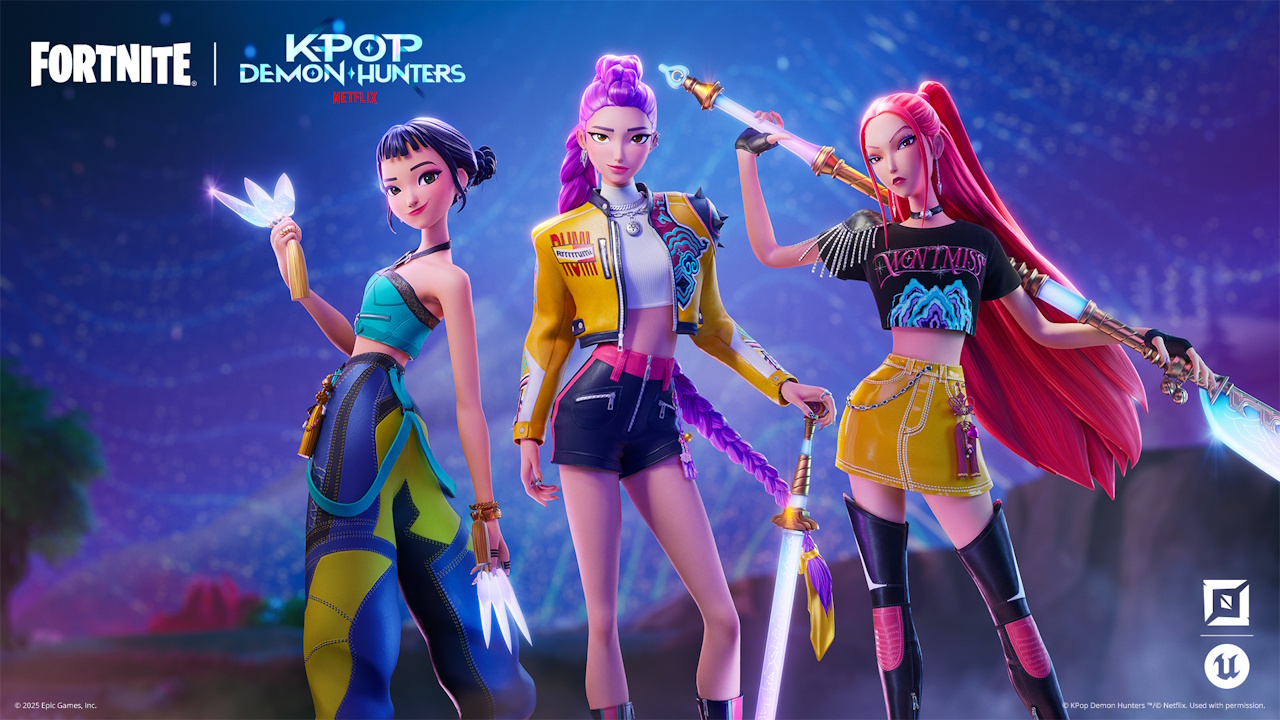
Promo image for the KPop Demon Hunters characters in Fortnite.
Many players of online games like Fortnite (and Grand Theft Auto V) only play that one game.

Will Grand Theft Auto V turn out to be VI’s biggest competitor? That’s one of my big unanswerable questions right now. Fans of GTA 5, many of whom have been playing for literally more than a decade, may not be as inclined to buy a new game as Rockstar and Take-Two are hoping. And unless Rockstar instantly drops support for Grand Theft Auto V the same day VI launches… there’ll still be a reason to stick with the game they know and love.

Suppose Epic Games announced “Fortnite II” tomorrow. Would Fortnite’s players all switch over to the new game? Would Roblox players migrate en masse to a sequel, if one were ever created? Grand Theft Auto V’s player base – especially in the online mode – behaves more like players of other massively-multiplayer live-service games. Folks like myself, who grew up on single-player titles, happily hop from one game to another. But that’s not the way the industry at large is trending in the 2020s. Many gamers stick with the same game for years, and convincing players of a beloved, well-known, and perfectly functional game that they need to buy a new, expensive title – and perhaps new hardware, too – is going to be more of a task than a lot of people appreciate.

Still frame from the first GTA VI trailer showing cars on a busy street.
However good the game ultimately is, will it be enough to convince players of GTA 5 that they need the upgrade?

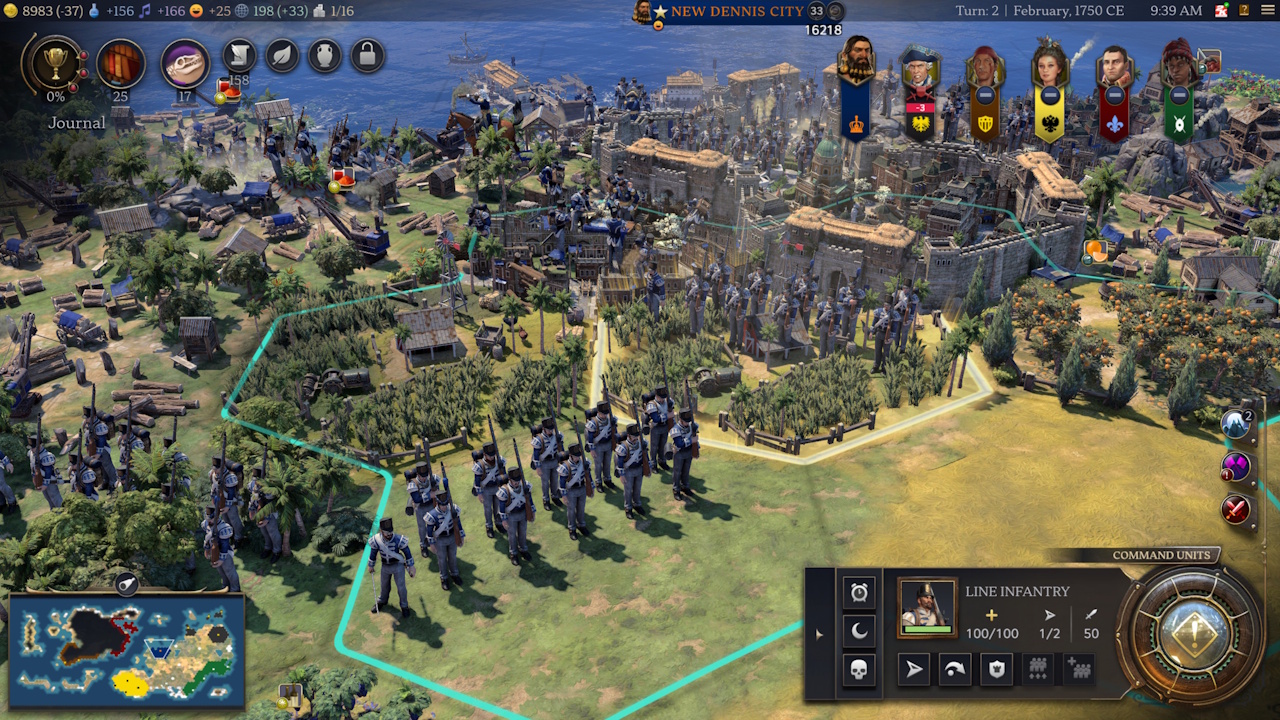
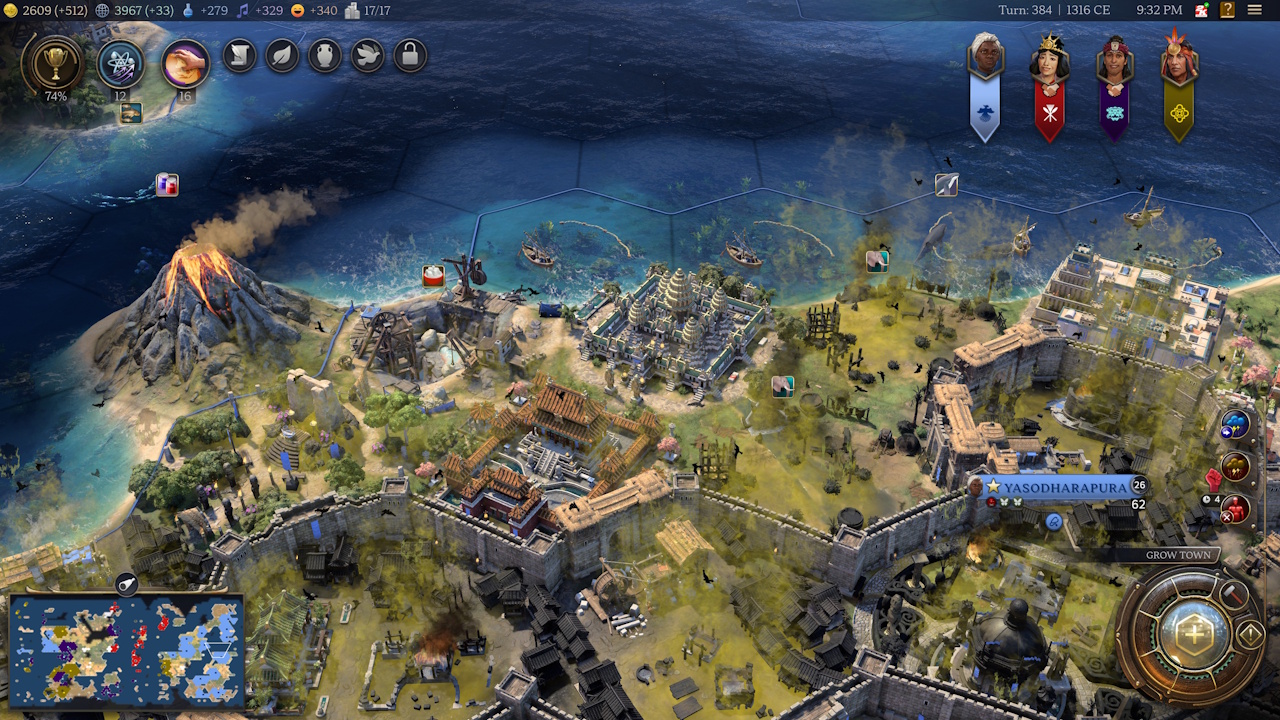
You see this phenomenon in basically every genre, and establishing a new title – even in a long-running series – is more difficult in 2026 than it’s ever been before. When Civilization VII launched last year, many players opted to stick with Civ VI instead of jump ship to the new game – and some of those who tried it out drifted back. This happens in strategy games, in shooters, in party and puzzle games… and a title like Grand Theft Auto V, which has been at the top of the charts for over a decade? It could happen here, too.

So those are, as I see it, GTA 6′s three biggest potential issues.

To recap, they are: the smaller install base of current-gen systems, with fewer consoles (and no PC release) meaning the potential audience for Grand Theft Auto VI is smaller even than GTA 5 had in 2013. Then there’s the price of the game itself, combined with the price of buying a brand-new console in 2026 after all of the price hikes, with the general state of the economy being reflected in declining home console sales. And finally, there’s the difficult launch many live-service titles have when the live-service market is already saturated. Convincing GTA 5 players that they need to invest hundreds of dollars in a new system and a new title, when the one they have is still perfectly fun… that’s not an easy task, and it’s one that has tripped up many comparable games in recent years.

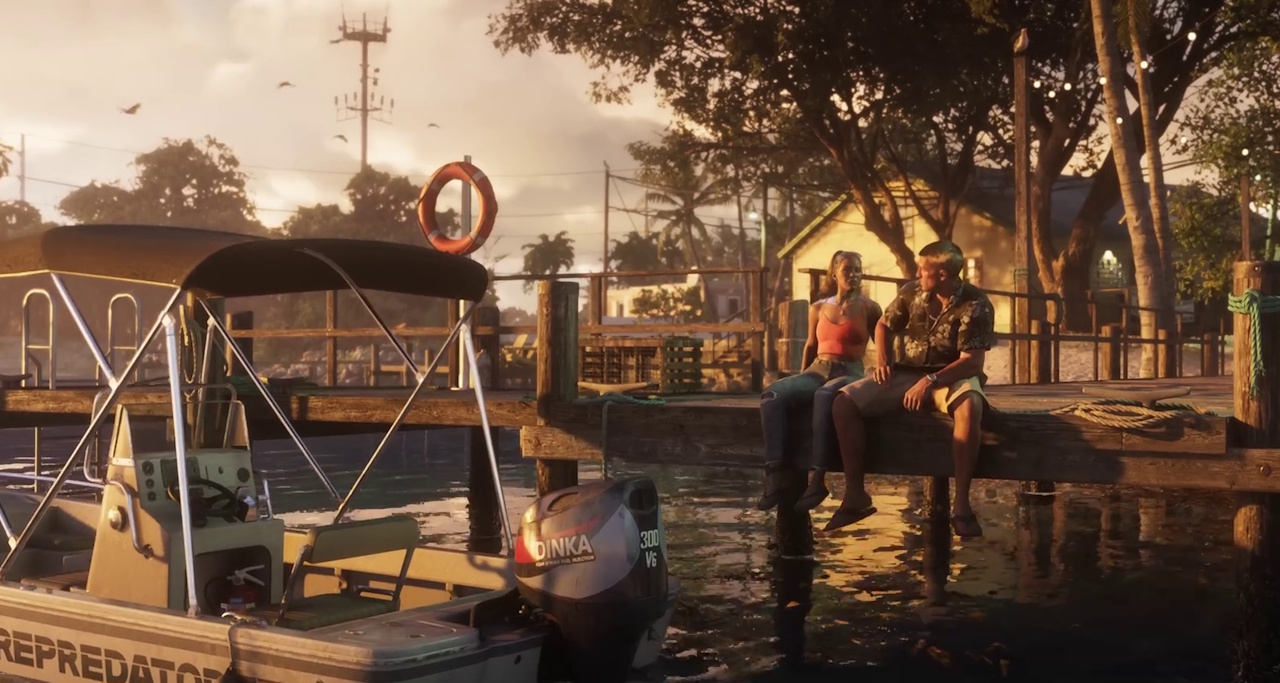
Still frame from the second Grand Theft Auto VI trailer showing the main characters sitting on a dock.
Problems may lie ahead for Grand Theft Auto VI

To be clear, I don’t necessarily believe that Grand Theft Auto VI will be “a flop.” I think there’s a lot of hype, a lot of excitement, and even just a lot of interest and curiosity surrounding the game. But there are valid questions about the game’s price in the current economy, and whether players who are convinced to check it out will stick with it if their friends remain on last-gen hardware playing GTA 5.

In 2019, Rockstar and Take-Two hoped that Red Dead Redemption II’s online mode would rival that of Grand Theft Auto V, and they poured a lot of money into it… at first. But when RDR2 didn’t take off in the same way as GTA 5, they pretty quickly abandoned it. Red Dead Redemption II is still playable online, but it hasn’t received major new updates or content since 2021. Could Grand Theft Auto VI end up in the same boat if players don’t jump into the online mode with the enthusiasm Rockstar and Take-Two are hoping for? Even if the game breaks even and begins to turn a profit… how long do the content updates and new missions keep coming for if most players are sticking with GTA 5?

Logo for Grand Theft Auto VI on a black background.
Grand Theft Auto VI will (supposedly) launch in November.

As we look ahead to 2026, which is supposedly the year Grand Theft Auto VI will launch, there may be causes for concern in the Take-Two boardroom. I don’t think it’s a five-alarm fire or anything, but there are a lot of eggs in this particular basket, and a lot of money has been invested in a title which, despite its name, hype, and status, cannot be seen as a sure thing. Though I still consider this an outside possibility, less “likely” than “plausible,” we shouldn’t write off the idea that Grand Theft Auto VI won’t meet its sales targets this year, and might even end up being considered a disappointment.

So I hope this has been interesting, at least! Grand Theft Auto VI was one of the first subjects I ever wrote about here on the website, all the way back in December 2019, and if you’d told me then that we’d be into 2026 with the game still not out… I don’t think I’d have believed it! But here we are, and at time of writing, a November 2026 launch is still on the cards for those of you lucky enough to have bought a PS5 or Xbox Series console before prices got silly. As for me… well, I play on PC. So if Rockstar and Take-Two can ever be bothered to release a port, that’s when I’d consider picking up Grand Theft Auto VI. But not for $100, though!

If and when we get more news on GTA 6, its price, a new trailer… or anything like that, I hope you’ll check in. I daresay I’ll have more to say on this game at some point soon.


Grand Theft Auto VI is scheduled to be released in November 2026 for Xbox Series S/X and PlayStation 5. A PC release has not been confirmed. The Grand Theft Auto series – including GTA 6 and other titles discussed above – is the copyright of Rockstar and Take-Two Interactive. This article contains the thoughts and opinions of one person only and is not intended to cause any offence.

2026 Predictions…

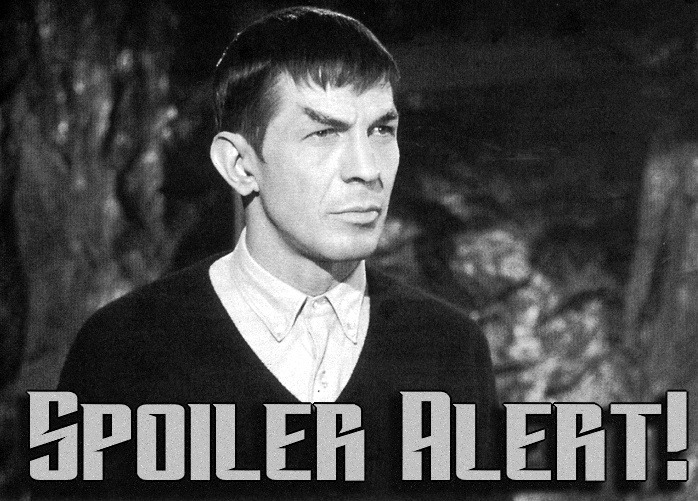
A Star Trek-themed spoiler warning

Spoiler Warning: Beware of minor spoilers for some of the franchises discussed below.

I thought it could be a bit of fun to mark the start of the year by making a few predictions! This isn’t something that I usually do here on the website, but if it proves to be enjoyable, maybe I’ll make it an annual thing… who knows? For now, though, I wanted to look ahead to 2026 and share some of my predictions for what may happen in the wide world of geeky entertainment.

I’ll give a couple of important caveats, and then I’ll explain the format I’m going to use.

Firstly, I have no “insider information,” and I’m not trying to claim that anything discussed below can, will, or must happen in 2026. These are my own predictions based on… I dunno. Vibes, I guess? And, as always, all of this is the *subjective, not objective* opinion of just one person. If I miss something that you think is obvious, or I predict something you think sounds utterly ridiculous… that’s okay! This is just for fun, and I share my predictions with you in that spirit.

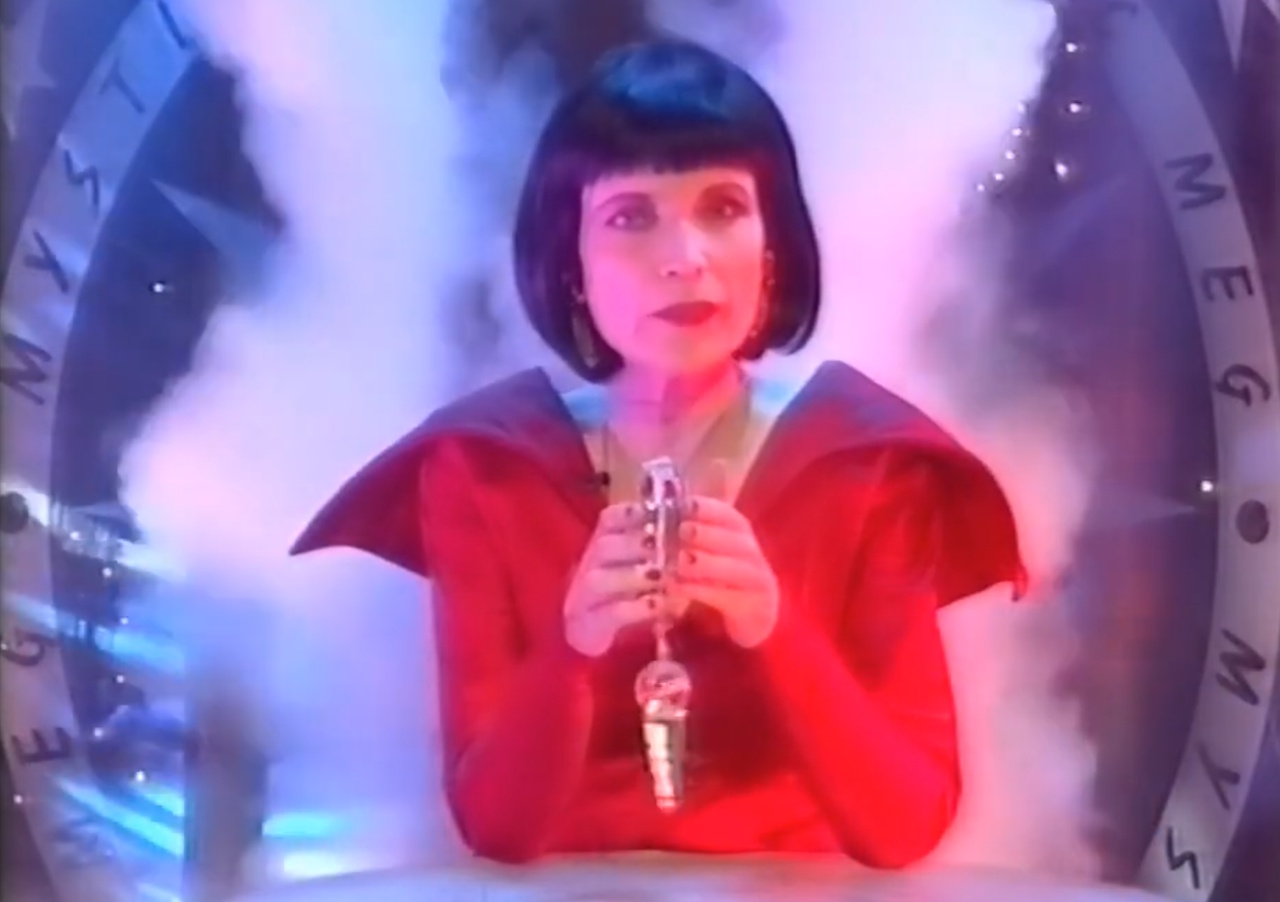
Still frame from a 1995 National Lottery broadcast showing Mystic Meg.
Do you remember Mystic Meg?

Okay, let’s talk format! I’ve got four categories into which my predictions will fall: Films, Games, Television, and the Star Trek Franchise. And within each category, I’m going to make three predictions using the 90/50/10 format: that’s one thing I’m 90% sure will happen, one that I’m 50/50 on, and an outlier that I think has a remote 10% chance of happening – but probably won’t!

So… have we got all that? Four categories, three predictions in each! I’ll briefly explain my prediction, discuss why I think it may or may not happen, and just generally share my thoughts on why I think it’s likely or plausible.

With all of that out of the way, let’s get started and try to predict what 2026 will look like!

Film – 90% Prediction:
A KPop Demon Hunters sequel will be announced.

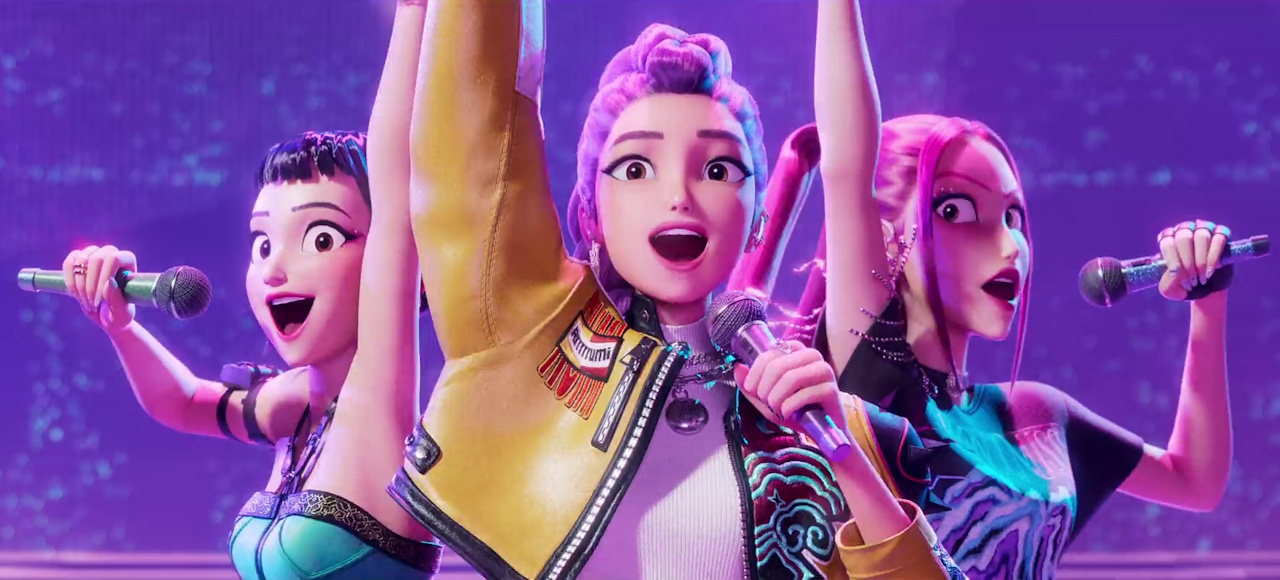
Still frame from KPop Demon Hunters showing Zoey, Rumi, and Mira at the climax of the film.
Huntr/x.

KPop Demon Hunters was one of the most successful films of 2025 – and I don’t just say that because it won the highly-coveted End-of-Year Award here at Trekking with Dennis! The film topped the charts for weeks on end, becoming Netflix’s most popular original animated film ever, earned itself a sell-out theatrical release, and even saw its soundtrack reach the top of the charts, dethroning the likes of Taylor Swift in the process.

So it’s a shoo-in, then, surely, that Netflix and Sony Pictures Animation will announce a sequel within the next twelve months.

I’m not someone who believes that every successful film should – or even *can* – be turned into an ongoing franchise, and I think there’s merit in the idea of one-off, complete stories that don’t need to be revisited. But I also recognise that, in the modern entertainment landscape, big corporations don’t behave like that! Any successful film is bound to see a sequel; to Netflix and Sony, it would be like leaving guaranteed money on the table. Rumours of a KPop Demon Hunters sequel are already beginning to swirl, and I’d expect the companies involved to want to get a formal announcement out while the film is still popular to capitalise on that momentum to the highest possible degree.

Film – 50% Prediction:
The Mandalorian and Grogu will be a box office bomb.

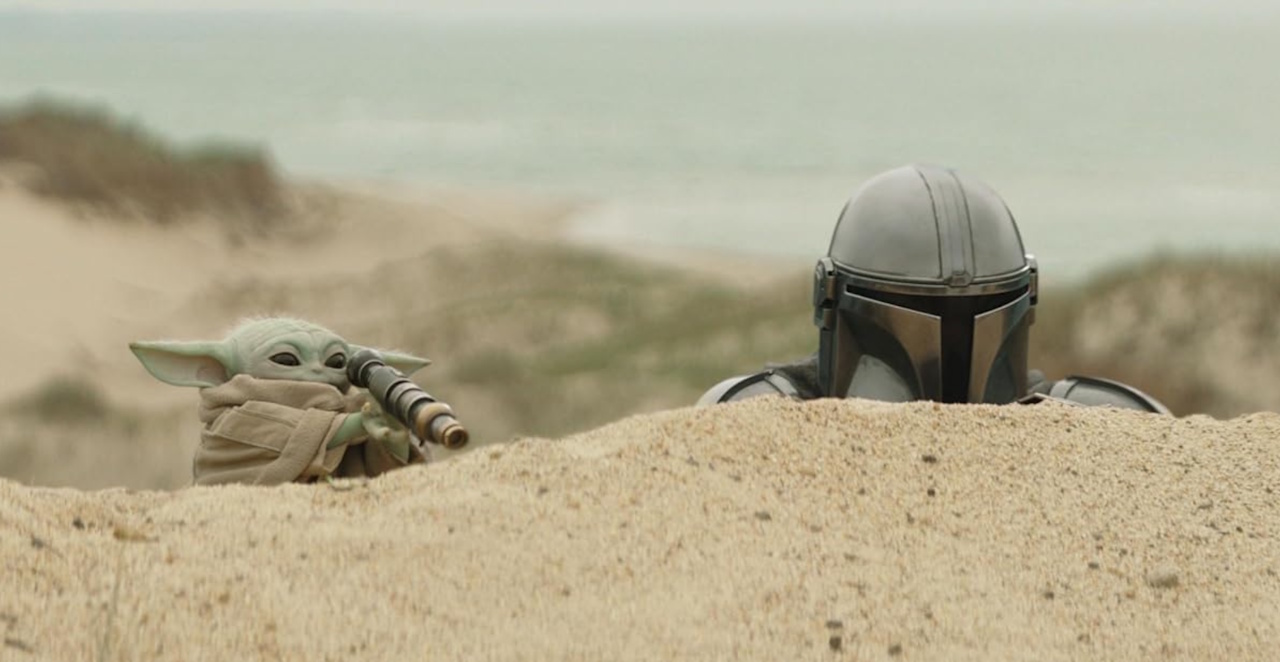
Promo image (cropped) for The Mandalorian and Grogu showing the title characters on a sand dune.
The title characters.

Star Wars is in a weird place right now. The brand is oversaturated, with Disney having produced so much content just since 2019 that it’s hard for even big fans of the franchise to keep up. The Mandalorian and Grogu is supposed to be the final chapter of the Disney+ series The Mandalorian, but the show’s third season received mixed reviews, as did The Book of Boba Fett spin-off. I’m not sure that the fanbase is there for The Mandalorian in 2026 in the way it was in 2019, and given how Star Wars as a whole has been mishandled, I could easily see this one flopping hard at the box office.

However, this is Star Wars’ first trip to the cinema since 2019, and it’s possible that a more casual audience – folks who haven’t been trying to keep up with everything Star Wars on Disney+ – will show up for that. I don’t think it’s a guaranteed failure, hence its position on this list. But if I were an executive at Disney, I’d be concerned.

Film – 10% Prediction:
The first film with a digitally-recreated dead actor in a leading role will be announced.

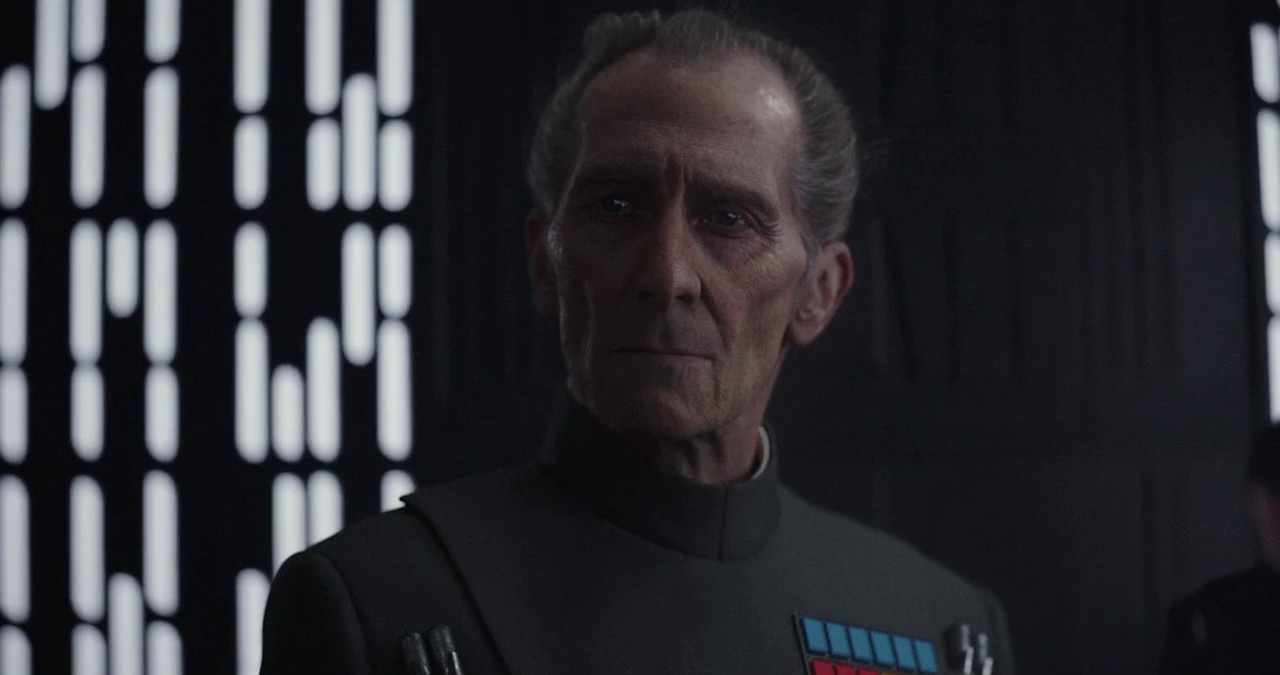
Still frame from Rogue One: A Star Wars Story showing Tarkin (a digital model based on actor Peter Cushing).
A digital recreation of Peter Cushing in Rogue One: A Star Wars Story.

I’ve believed for a long time now – even since before “generative A.I.” was a big deal – that we weren’t far off a snooty director deciding that the leading role in their magnum opus could *only* be played by someone like James Dean or Marilyn Monroe. And with today’s technology – motion capture, voice cloning, facial animations, etc. – it’s technologically feasible to bring back long-dead actors in films. As far back as 2016, we saw this, when the Star Wars franchise digitally recreated both Peter Cushing and a young Carrie Fisher in Rogue One. And the technology has only improved over the last decade.

What we still haven’t seen, though, is a film where the *lead* role is “played” by a long-dead performer. That’s different from using a lookalike or recreating an actor for just a couple of scenes, and I think it would be incredibly controversial. There’d be arguments over who owns the rights to the performer’s likeness and image… but that’s something a project could clear. Whether a film like this would be any good, and whether a digital performance (perhaps assisted by A.I.) would actually be worth watching… the jury’s out, I guess. But as I’ve said before: people care more about the finished product than the process that went into it, so if a film that was created using this method was good, and the result was basically indistinguishable… it could start a whole new trend!

Video Games – 90% Prediction:
Prices will rise even further.

Promo/concept art of Wario for the Nintendo game Wario Ware.
Gaming is already too expensive…

Sorry, everyone. I’m not happy about it, but after several years of price hikes across the games industry, I don’t see this unfortunate trend stopping. Grand Theft Auto VI could legitimately launch with a base price of $100, which would almost certainly see other publishers raise their prices to match. And with component shortages thanks to A.I. datacentres buying up large volumes of stock – as well as major manufacturers “pivoting” to an A.I.-first strategy – hardware prices may very well rise, too.

2025 saw the Switch 2 launch at an inflated price, as well as the first $80 game. It also saw price hikes from Sony and Microsoft, as well as a rise in the price of the Game Pass subscription service. Much of this isn’t actually a reaction to events – it’s plain and simple greed. These things are a cause of, not a consequence of, inflation. But, regrettably, I don’t see it stopping anytime soon, especially if sales remain weak. Games companies will try to wring more money out of existing players to compensate for a lack of new ones.

Video Games – 50% Prediction:
Microsoft and Xbox will announce a new Fallout game… which is not being developed by Bethesda.

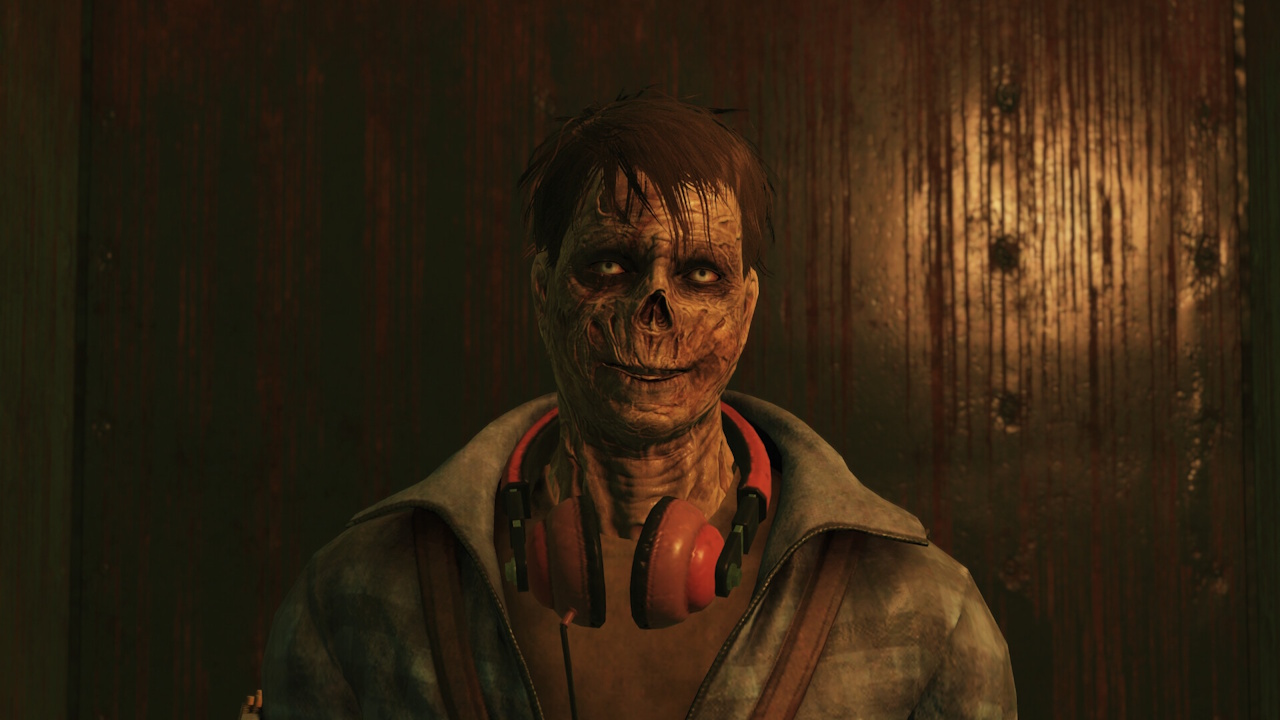
Promo screenshot for Fallout 76 featuring a playable ghoul character wearing headphones.
Is a new Fallout game close to being announced?

With The Elder Scrolls VI still years away, and the Fallout TV series riding high on Amazon Prime Video, it’s not exactly a secret that Microsoft and Xbox want a new Fallout game for fans to sink their teeth into. But because of Bethesda’s absolutely idiotic and outdated approach to making video games, their hypothetical version of Fallout 5 may not even *begin* development until 2029, and likely won’t see the light of day until, say, 2034 or beyond.

So could Microsoft hit the nuclear button (pun very much intended) and take Fallout away from Bethesda? If it were to happen, there’d surely be a ton of PR-speak about how this new game is a spin-off, the license is still Bethesda’s, Microsoft still has full confidence in Bethesda… blah, blah, blah. But it would also speak volumes about how far Bethesda has fallen since their 2000s heyday, and how their approach to creating games needs to change if they still want to tell stories in multiple franchises.

Video Games – 10% Prediction:
Grand Theft Auto VI fails to meet its sales targets and is considered an expensive failure.

Still frame from the second GTA 6 trailer showing the protagonists riding on a jet ski.
Protagonists Jason and Lucia on a jet ski.

No video game is a “guaranteed” hit. Not even the sequel to the most successful video game of all-time. So I consider it an outside possibility that, for any one of a number of reasons, Grand Theft Auto VI fails to convince fans of GTA 5 that they need to switch to the new game, with its online mode in particular struggling to gain traction. Players who do buy the game and try out the online mode could even drift back to GTA 5 if it isn’t what they’re hoping for. The result? GTA 6 could go down in history as one of the most expensive video game flops.

To be clear, while I can conceive of a world in which something like this happens, it feels very unlikely – hence its place on this list! But there are reasons to be concerned if you’re a Take-Two executive. Slow hardware sales for the PS5 and Xbox Series, combined with GTA 6 not getting a PC release, mean there’s a smaller potential audience for the game. Price rises for the game itself and the hardware it plays on in a difficult economy could price people out. And if GTA 5 is still fun and enjoyable for its online players, convincing them to switch to a new game – especially if it means an investment of £650-700 to buy the game and a new console to play it on – won’t be a walk in the park.

Television – 90% Prediction:
Either 3 Body Problem or Strange New Worlds will be my “TV Series of the Year” in December.

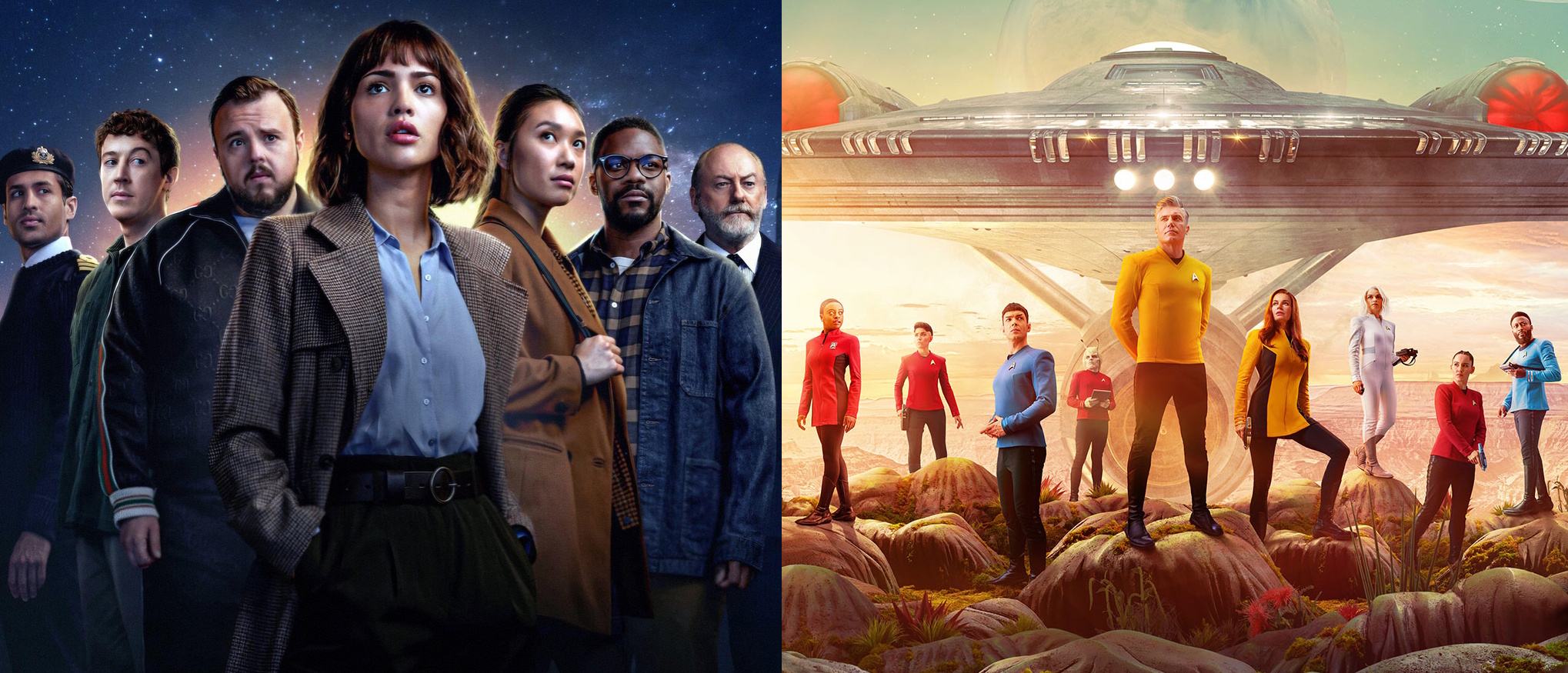
Cropped promo posters for 3 Body Problem S1 (left) and Star Trek: Strange New Worlds S1 (right).
3 Body Problem (left) and Strange New Worlds.

I dish out my annual “End-of-Year Awards” every December – in fact, I just did the awards for 2025 a couple of days ago; click or tap here to check them out! But when I look ahead to 2026, there are really only a couple of shows that I think (at this early stage) could be in contention for the top award. Those are 3 Body Problem and Star Trek: Strange New Worlds. I’d be very surprised if something else comes along this year and eclipses *both* of these productions; the only one I could see even possibly doing so would be Silo.

Strange New Worlds is far and away the best modern Star Trek series, and even one of the best parts of the franchise as a whole. I was very disappointed to learn it would be cancelled after a cut-down fifth season. And 3 Body Problem’s first season was one of the best, most grown-up sci-fi shows I’ve seen in a long time. I’m genuinely looking forward to both shows’ continuations – and unless, for some reason, neither debuts in 2026, I’m almost positive they’ll be competing for my “TV Series of the Year” award in eleven-and-a-bit months from now!

Television – 50% Prediction:
A big, long-running series will finally be cancelled.

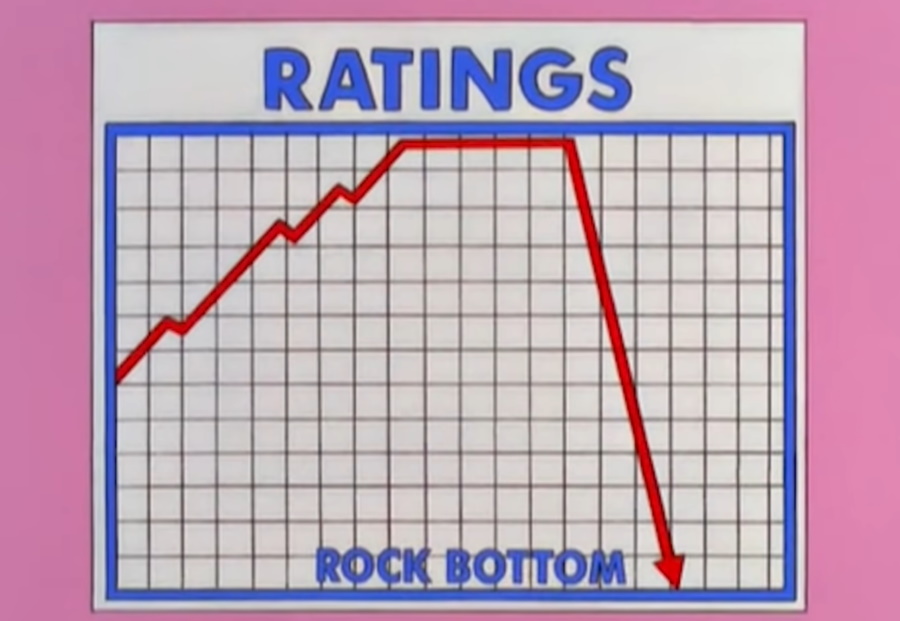
Still frame from The Simpsons depicting a "ratings graph" showing a steep decline.
It might be some kind of visual metaphor…

There are quite a few shows floating around that have been running for fifteen years or more. Grey’s Anatomy, Family Guy, Law and Order, Doctor Who, SpongeBob SquarePants, Criminal Minds, The Simpsons… the list goes on. But some of these shows are almost unrecognisable from their original incarnations, or worse, feel like they’re just going through the motions and coasting on past success. I tried for years to keep up with The Simpsons, for example, even though I could feel the quality declining. But I haven’t watched any new episodes for several seasons at this point, and it just feels like the show has well and truly run its course.

The Simpsons has been renewed for several more seasons and – inexplicably – another movie. But could we learn in 2026 that the show will eventually end? Or could another long-running programme, like Doctor Who’s revival, SpongeBob SquarePants, or Grey’s Anatomy, finally find themselves on the chopping block? I’d always rather a show end too soon, leaving me wanting more and lamenting that we didn’t get “just one more episode,” instead of running too long and becoming a joke. Maybe 2026 will finally be the year that one or more of these long-running television institutions kicks the bucket.

Television – 10% Prediction:
The Lord of the Rings: The Rings of Power will be cancelled after Season 3.

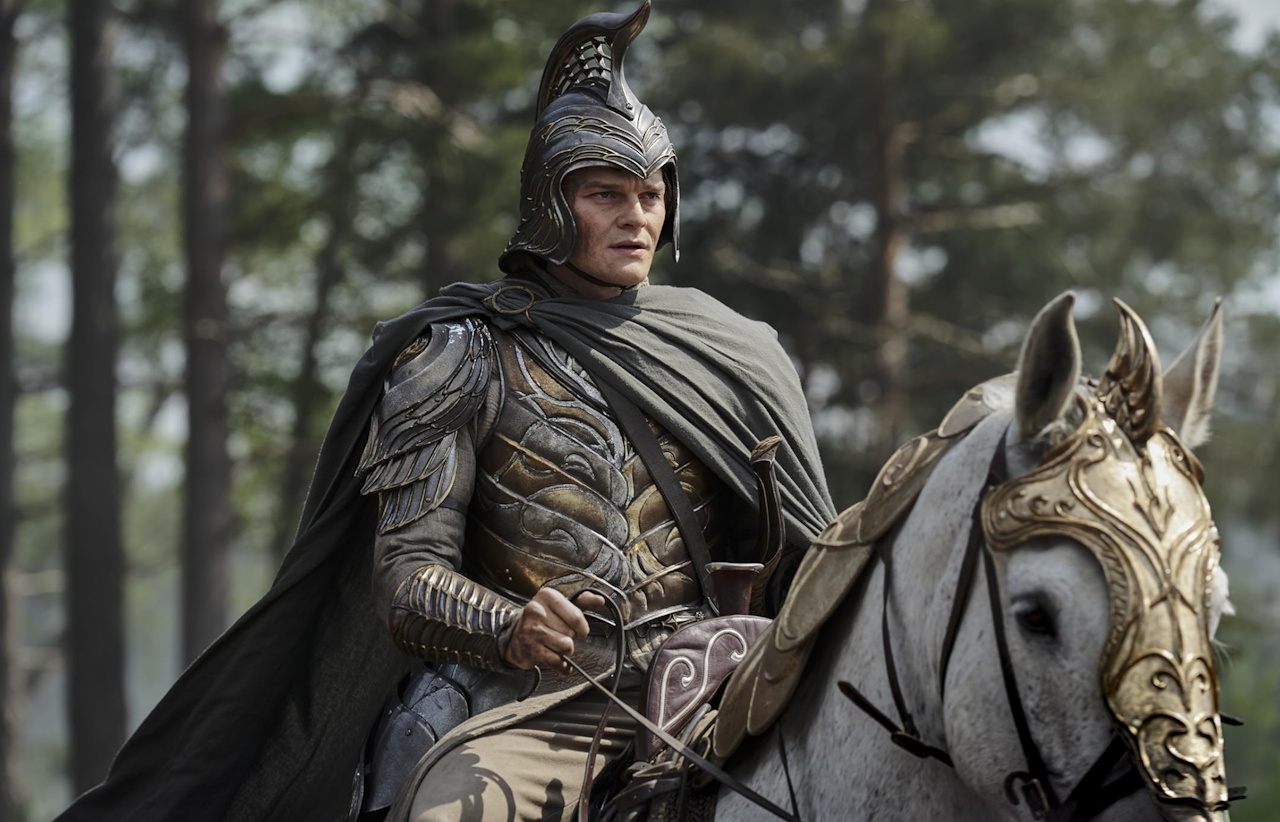
Promo still for The Lord of the Rings: The Rings of Power showing Elrond on horseback.
It’s Elrond!

The Rings of Power hasn’t been everyone’s favourite show, to put it mildly. And with long breaks in between seasons – Season 3 is not guaranteed to land in 2026, despite Season 2 wrapping up in the autumn of 2024 – even the folks who did tune in have begun to find other things to watch. Although Amazon and the Tolkien Estate had an agreement to make five seasons of The Rings of Power… are we sure the series will hit that mark?

According to some reports, The Rings of Power shed boatloads of viewers across its first season, with barely one-third of the people who watched the premiere making it to the finale. And Season 2 didn’t bring them back. No TV show is going to be worth making if no one’s turning up to watch it, let alone the most expensive TV series ever made. And with middling reviews from audiences, and a baked-in hate campaign from some folks online… The Rings of Power could, hypothetically, be more vulnerable than we thought. Amazon has done this before with another high fantasy show: The Wheel of Time was cancelled before its story could be wrapped up.

Star Trek – 90% Prediction:
Starfleet Academy will be confirmed to run for just two seasons.

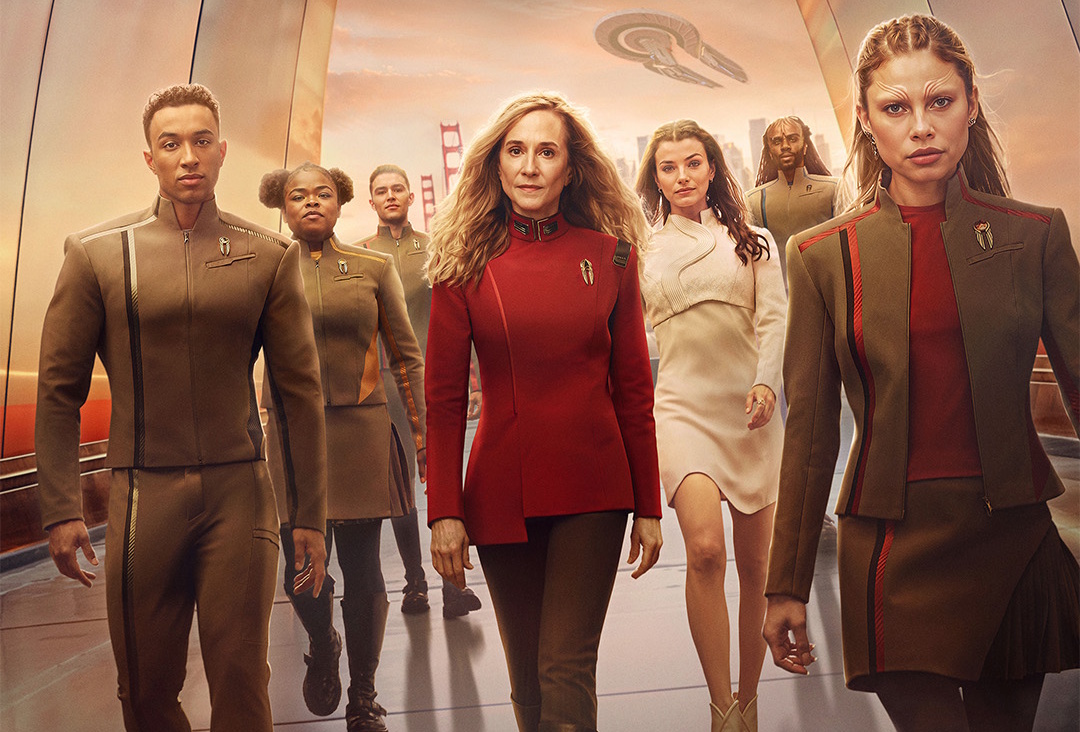
Cropped promo poster for Star Trek: Starfleet Academy showing the main characters.
Will there be more Starfleet Academy after Season 2?

Unless Starfleet Academy can do something extraordinary that no other Star Trek show of the current streaming era has done, I think we’ll learn that there won’t be a third season. The series would, in my view, need to go viral and become a phenomenon – particularly with its younger target audience. If Starfleet Academy can genuinely compete with the likes of Stranger Things and Wednesday in terms of review scores and audience numbers, and also drive a massive, unprecedented number of new subscribers to Paramount+, then – and only then – would Skydance consider renewing the show.

But… do we really think that’s gonna happen?

I’ve said a few times now that I’m not particularly hyped for Starfleet Academy. The show, with its serialised story and teen focus, just doesn’t seem like it’ll be my thing. But that’s not why it’s part of this discussion. I’d love nothing more than to see Starfleet Academy succeed at bringing in legions of new fans to the franchise. I just struggle to see how it’ll manage to do so. And given Skydance’s obvious preference for films over TV, and the cancellations of all other Star Trek shows, I just get the sense that the two seasons which have already entered production will be all the series will get.

Star Trek – 50% Prediction:
Paramount-Skydance will do very little to celebrate the franchise’s 60th anniversary.

The "Star Trek 60" logo on a Starfleet Academy set photo.
Star Trek turns 60 years old in 2026.

With the exception of soap operas, how many TV shows reach their 60th anniversary with new episodes still being created and aired? Star Trek is practically unique amongst big sci-fi properties – heck, amongst entertainment franchises in general. Yet I don’t think that this new incarnation of Paramount really intends to do anything major to acknowledge the milestone. We’ve heard talk of a float at some parade in the United States. And Star Trek’s god-awful online shop will probably release some crappy A.I.-generated merch, like tote bags and beanies, featuring the new “Star Trek 60” logo. But will there be a crossover episode? Some kind of unannounced project that really leans into what Star Trek means and goes all-in?

I would *love* to see Paramount/Skydance do something big. A live broadcast, maybe, reuiniting the stars of past shows to talk all things Trek. Or a documentary about the creation of those early episodes. I’d really love to see a crossover – like we got in 1996 for the 30th anniversary. Maybe we could see Starfleet Academy characters visiting Pike’s Enterprise, or even using the Strange New World sets and bringing back some of the performers to re-tell a classic TOS story. Because Star Trek had gone off the air, we couldn’t get anything like that for the 40th or the 50th. But there’s a window of opportunity right now, in 2026, that may not come again, to really celebrate Star Trek with some kind of big on-screen event. I really hope Skydance has already given it the green light.

Star Trek – 10% Prediction:
A brand-new series will be announced.

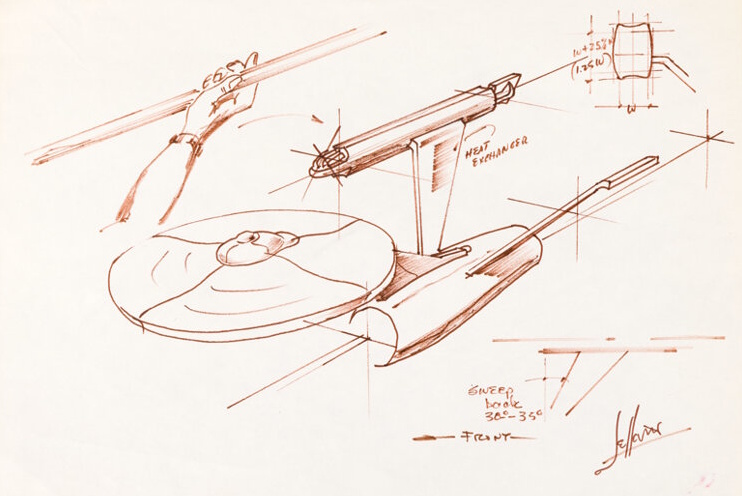
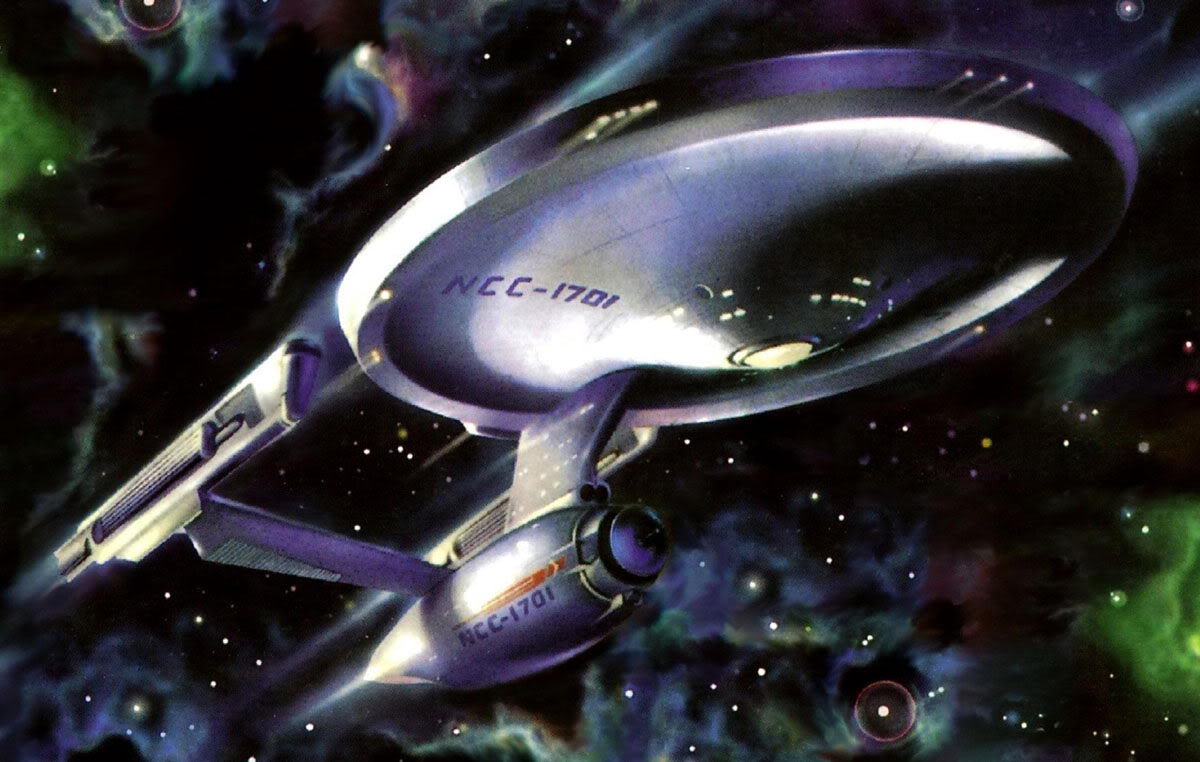
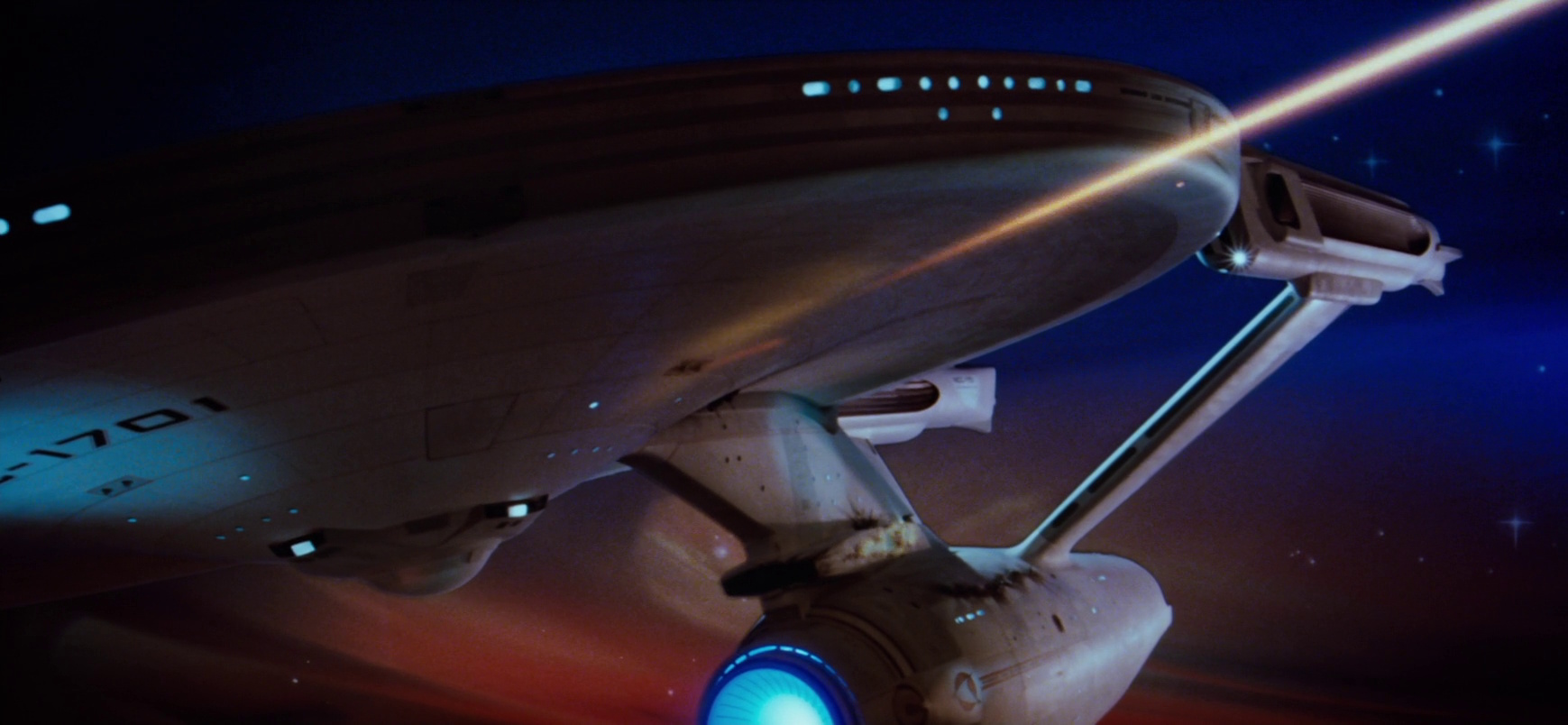
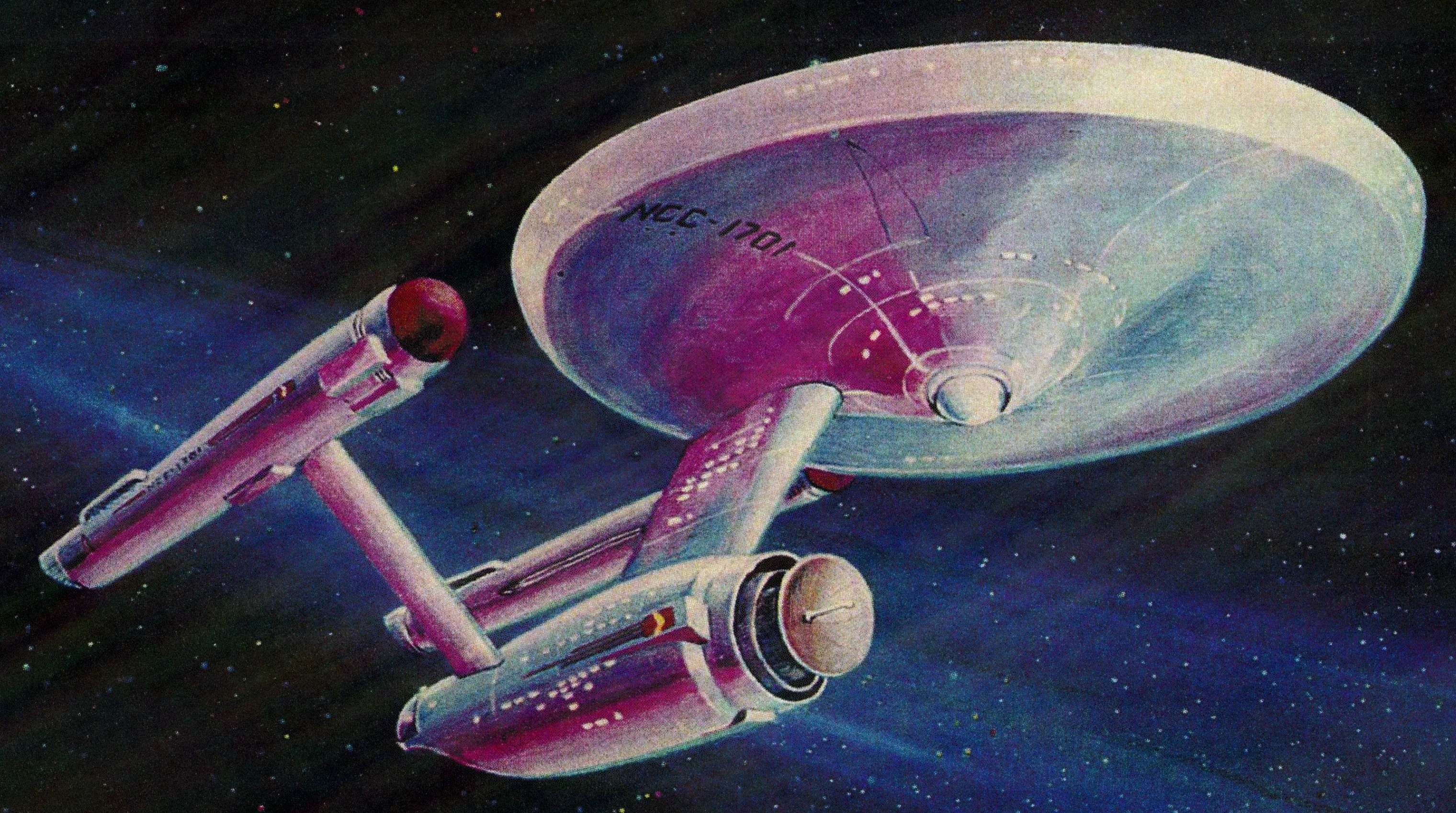
Concept art of the USS Enterprise created for Phase II/The Motion Picture.
Will there be more Star Trek to come?

This one… I mean, it’s not gonna happen, is it? Don’t get me wrong: I’d love nothing more than for Skydance to make the genuinely shocking announcement that they’re commissioning a brand-new, episodic, exploration-focused Star Trek series! But I think it’s a remote possibility right now, given the new corporation’s clear choice to prioritise the cinema over television and streaming. A new Star Trek film has been announced and is potentially targeting a 2028 release, so will we see a new show announced before then?

My view remains that Star Trek as a whole – save for the occasional film project – will be shutting down for the foreseeable future after 2027 or 2028, whenever the final episodes of Starfleet Academy and Strange New Worlds air. But there’s still so much potential in this franchise, and it’s downright depressing to go into the big sixtieth anniversary year predicting cancellation and failure. So I’m crossing my fingers that we’ll get just one new series being announced.

So that’s it.

A render of the number 2026 in green.
2026 is just beginning.

I’ve made a few predictions for 2026, so let’s revisit this piece together in late December to see how much I got wrong! This is my first year making predictions like these, but I really like the 90/50/10 format, so I might try to make it an annual thing… if I remember. And if, next year, I actually have more predictions to make!

In any case, I hope this has been interesting, or just a bit of fun. I’m hopeful for some enjoyable entertainment experiences this year, and I’ll be doing my best to keep up with some of the films, games, and TV shows that I’ve been looking forward to – so stay tuned for some reviews and commentary here on the website!


All titles discussed above are the copyright of their respective developer, publisher, broadcaster, studio, distributor, etc. This article contains the thoughts and opinions of one person only and is not intended to cause any offence.

Looking Ahead To 2026

A Simpsons-themed spoiler warning.

Spoiler Warning: Beware of minor spoilers for some of the productions below.

Happy New Year!

I hope you had a wonderful time celebrating the end of 2025 and the beginning of 2026. Although we might still be recovering from a night of partying, fireworks, and maybe a little too much champagne (alright, prosecco), I think the beginning of the year is a great moment to look ahead. There are bound to be some fun entertainment experiences lying in wait between now and Christmas, after all!

By the way, is that the first time you’ve heard someone mention Christmas 2026?

As I do every year at this time, I’m going to preview a few films, video games, and television programmes that I’m personally looking forward to over the next twelve months.

Hooray! It’s 2026!

My usual caveats apply! Everything we’re going to look at today is the subjective, not objective, opinion of just one person. If I highlight something you think sounds awful, or miss out one of your favourites… *that’s okay*! There’s plenty of room for polite discussion and differences of opinion, and I’m in no way trying to claim that these are somehow “the only” things to look forward to as the year gets underway.

Secondly, it’s possible that some or all of these will miss their intended release or broadcast dates, and they could even be cancelled entirely. Such things have been known to happen in the world of entertainment, unfortunately. But at time of writing, all of these are either on the schedule for 2026 or at least heavily rumoured to be out this year.

I’ve chosen eight films, eight television programmes, and eight video games that I’m looking forward to as this new year begins! So without any further ado… let’s take a look at my selections.

Film #1:
Coyote vs. Acme

Wile E. Coyote in court…

After years of using Acme Corporation’s products without much success, Wile E. Coyote sues them! That’s the premise of this “cartoon characters in the real world” film, and it’s giving me Who Framed Roger Rabbit vibes. I think the premise alone sounds like a ton of fun, and I’m genuinely excited to see what the finished product will be like.

There are reasons to be sceptical, though, unfortunately. Coyote vs. Acme was originally filmed all the way back in 2022, but Warner Bros. Discovery cancelled it in 2023, and it seemed for a time as if the completed film wouldn’t see a release. The likes of Netflix, Amazon, and Paramount+ all submitted bids, but none were willing to pay the reported $70 million that Warner Bros. Discovery was asking. That’s enough to give me pause, but a distributor was belatedly found and a release this summer is now on the cards. I’m crossing my fingers and hoping for some wacky, cartoony fun.

Film #2:
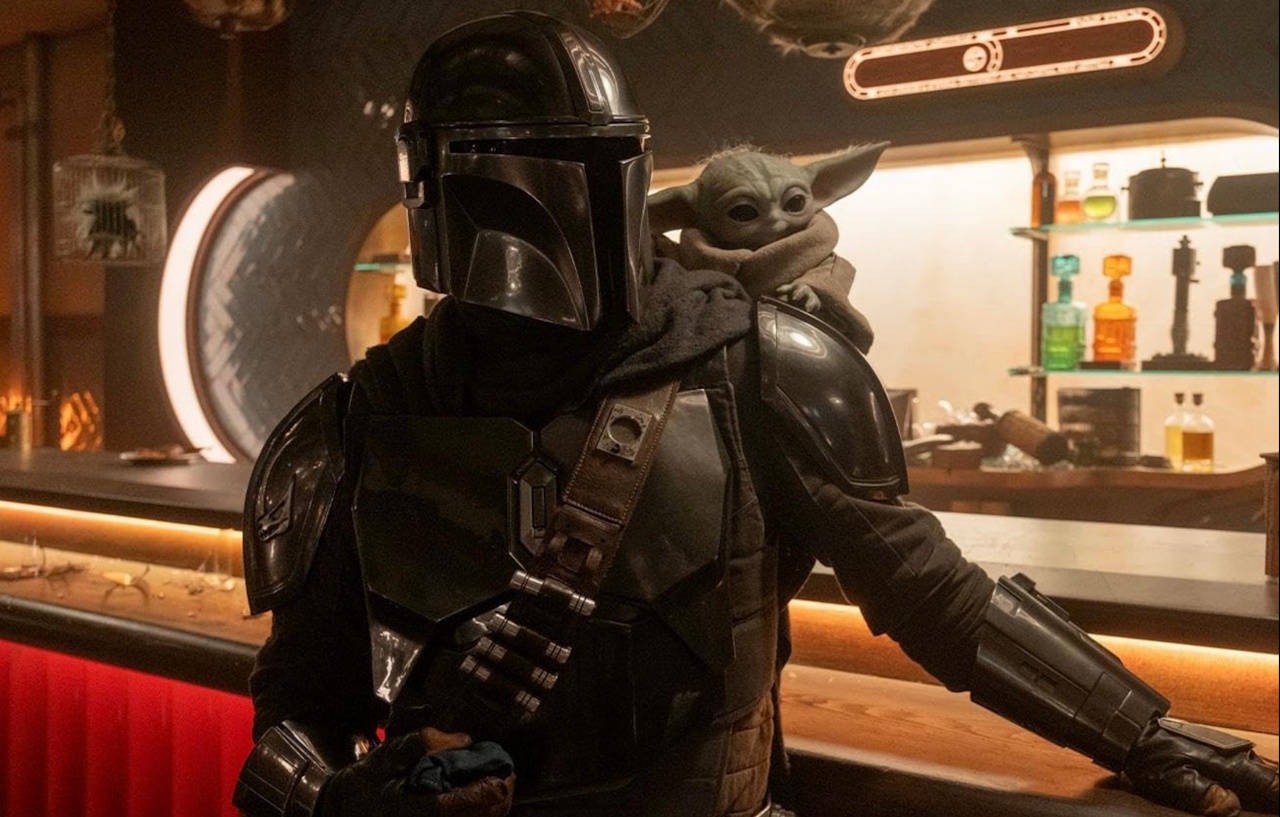
The Mandalorian and Grogu

The title characters.

I’m not the world’s biggest fan of The Mandalorian, to be honest with you. And if, as has been reported, this film represents a cut-down version of one of The Mandalorian’s already very short seasons… that doesn’t sound great. As someone who hasn’t seen all of the various Star Wars spin-off shows on Disney+, I’m also a bit concerned about this film being the culmination of multiple story arcs that I’m not caught up with or invested in.

However! With all that being said, a brand-new Star Wars film is always going to pique my curiosity, and although I wasn’t *wild* about The Mandalorian, the show has had its moments, and I’m at least interested in seeing where the characters will end up as their adventures apparently come to an end. Some Star Wars projects that I didn’t have high expectations for – The Last Jedi and The Book of Boba Fett, for example – ended up being surprisingly good fun, so there’s potential in The Mandalorian and Grogu. This is also Star Wars’ first trip to the cinema since 2019.

Check out my review of Season 2 of The Mandalorian by clicking or tapping here.

Film #3:
The Magic Faraway Tree

The film’s title card.

I was a huge Enid Blyton fan as a kid. Several of her books have been brought to the big and small screens over the years, and I’m especially interested to see what this adaptation of The Magic Faraway Tree will look like. The film boasts an all-star cast, featuring Andrew Garfield, Michael Palin, Rebecca Ferguson, Claire Foy, and Lenny Henry, and from what I glimpsed in the trailer, it looks like it’s captured the whimsy of the original book.

The Magic Faraway Tree is definitely a kids’ film, so set your expectations appropriately! And I can absolutely see this not being to everyone’s taste. But as someone who remembers the original books with great fondness, I shall be tuning in to see Dame Washalot, the Saucepan Man, Moonface, and the others when The Magic Faraway Tree premieres.

Film #4:
Disclosure Day

Promo still for Disclosure Day (2026)
Emily Blunt in a promo still for Disclosure Day.

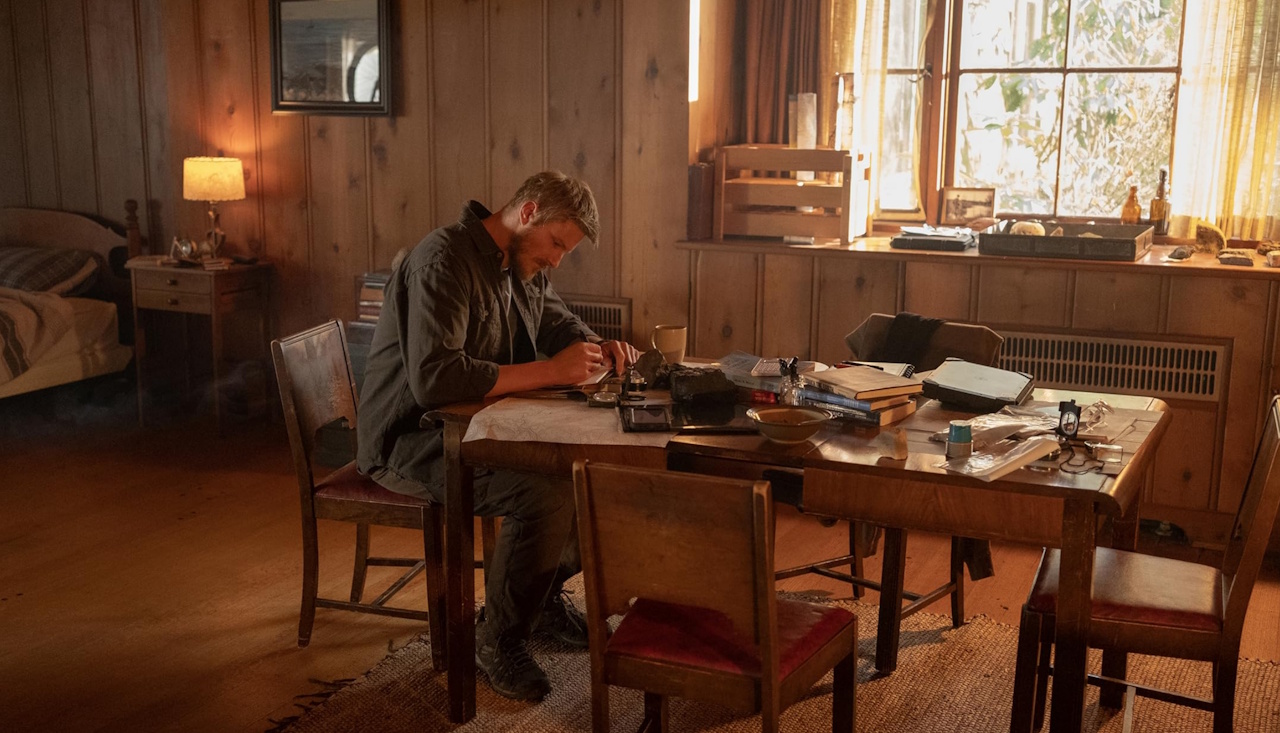
This is a last-minute addition to my list based on nothing but the “vibe” I got from the trailer! Disclosure Day’s plot is still under wraps, but it’s Steven Spielberg’s first film in four years, and his first sci-fi film since 2018’s Ready Player One. The picture will star Emily Blunt and Colin Firth, among others, and has something to do with a UFO conspiracy.

I’ve enjoyed a number of Spielberg’s films over the years – which shouldn’t be a surprise; he’s still one of the best filmmakers around. And Disclosure Day is reminding me more than a little of Spielberg’s own E.T., which is a film I fondly remember from my childhood. Disclosure Day might be taking a less whimsical and more, for want of a better term, “grown-up” approach to the genre, but that’s okay. The trailer was genuinely gripping, and Disclosure Day has definitely launched its way onto this list!

Film #5:
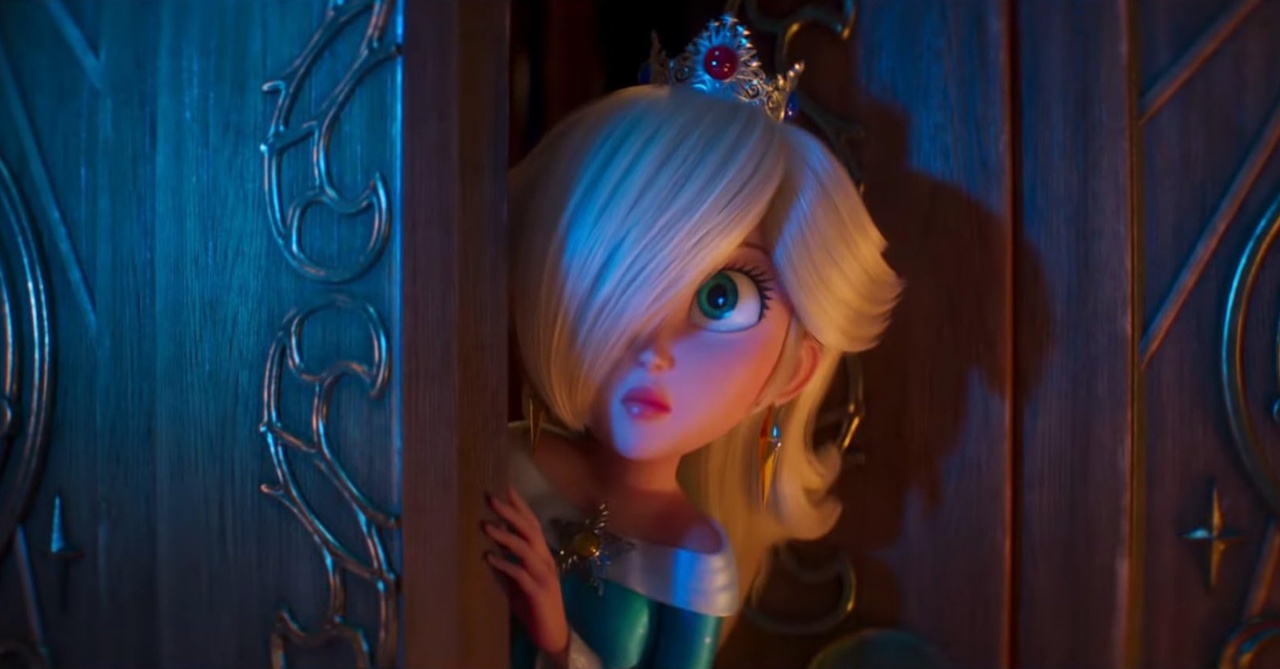
The Super Mario Galaxy Movie

It’s Princess Rosalina!

I’ll be honest: I barely played the first Super Mario Galaxy, and I couldn’t get on with its “spherical levels” idea, so when Nintendo announced that the follow-up to the absolutely excellent Super Mario Bros. Movie would be based on those games… I was underwhelmed. However, the first film was so darn good that I’m willing to push any scepticism aside and see what Nintendo and Illumination have been cooking! Who knows, it’s possible that the film format will suit the Mario Galaxy story better than either of the games did!

The trailer for the film looked great, and going on another adventure with Mario, Luigi, Peach, Toad, and Bowser just seems like it’s gonna be a lot of fun. So despite my ambivalence to its source material, I’m genuinely looking forward to this one.

Check out my review of The Super Mario Bros. Movie by clicking or tapping here.

Film #6:
Project Hail Mary

Ryan Gosling stars as Dr Grace in Project Hail Mary.

I like what I’ve seen of Project Hail Mary so far. I’m getting a bit of an Armageddon-meets-Interstellar-meets-2001: A Space Odyssey vibe. If that even makes sense! The film looks interesting and potentially quite funny, or at least with some moments of light-heartedness to balance out heavier themes of Earth and humanity being close to extinction. I’m curious to see where Project Hail Mary will go, and which side – comedy or serious messaging – the film will come down on.

I’m always going to be interested in new sci-fi properties, especially in an entertainment landscape drowning in sequels, spin-offs, and franchises. So I hope Project Hail Mary can be something a bit different, taking a familiar starting point but doing its own thing with it. Directors Phil Lord and Christopher Miller also directed 2014’s The Lego Movie, which I really enjoyed, so that’s another reason for optimism.

Film #7:
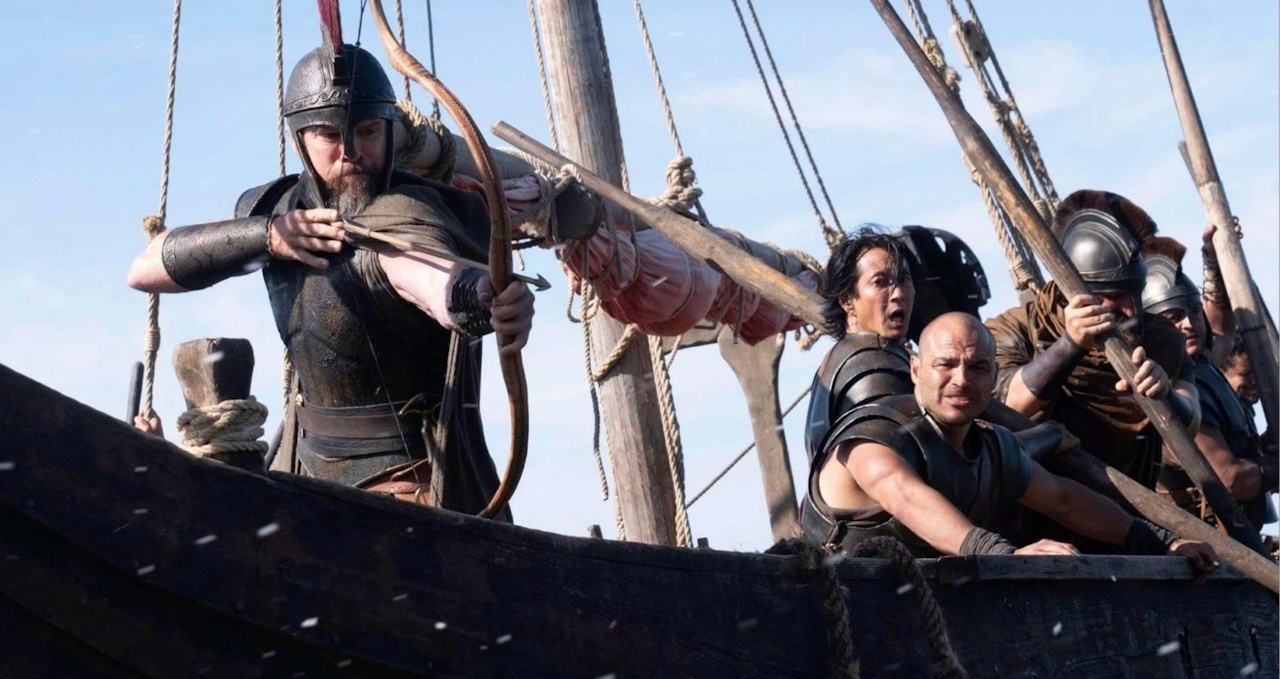
The Odyssey

A first glimpse at The Odyssey.

The Odyssey promises to be an epic retelling of the classic Ancient Greek tale, as Odysseus makes his way back home from the Trojan War. Christopher Nolan, the film’s director, has previously directed such hits as The Dark Knight, Dunkirk, and Oppenheimer, winning an Academy Award for the latter. This adaptation of The Odyssey features some big names in its cast, such as Eliot Page, Charlize Theron, Tom Holland, Lupita Nyong’o, and Matt Damon.

I suppose my only real concern with The Odyssey is that there’s quite a lot of story to cram into the runtime of a single film. I’ve been critical in the past of films being unnecessarily lengthened or split into multiple parts, but maybe The Odyssey is one story that could’ve benefitted from a longer runtime. We’ll have to wait and see!

Film #8:
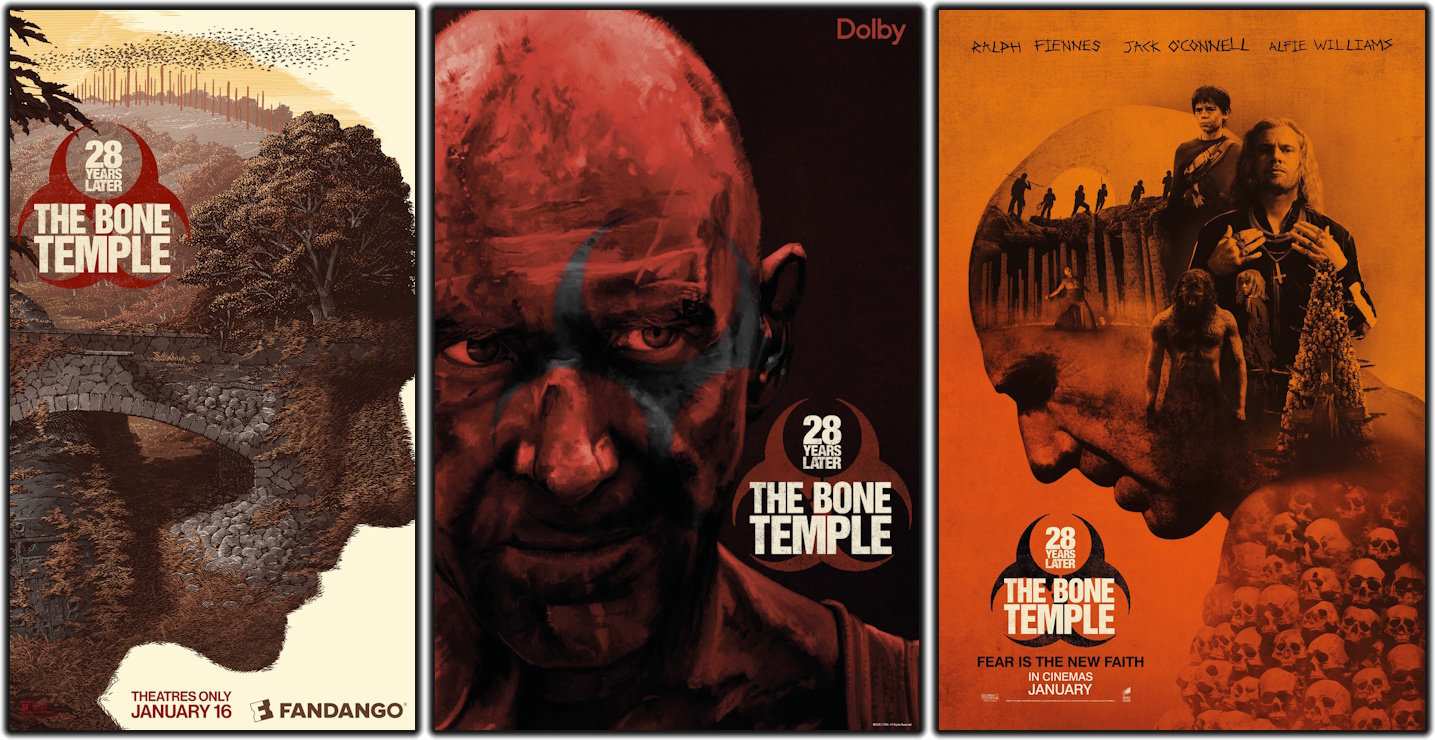
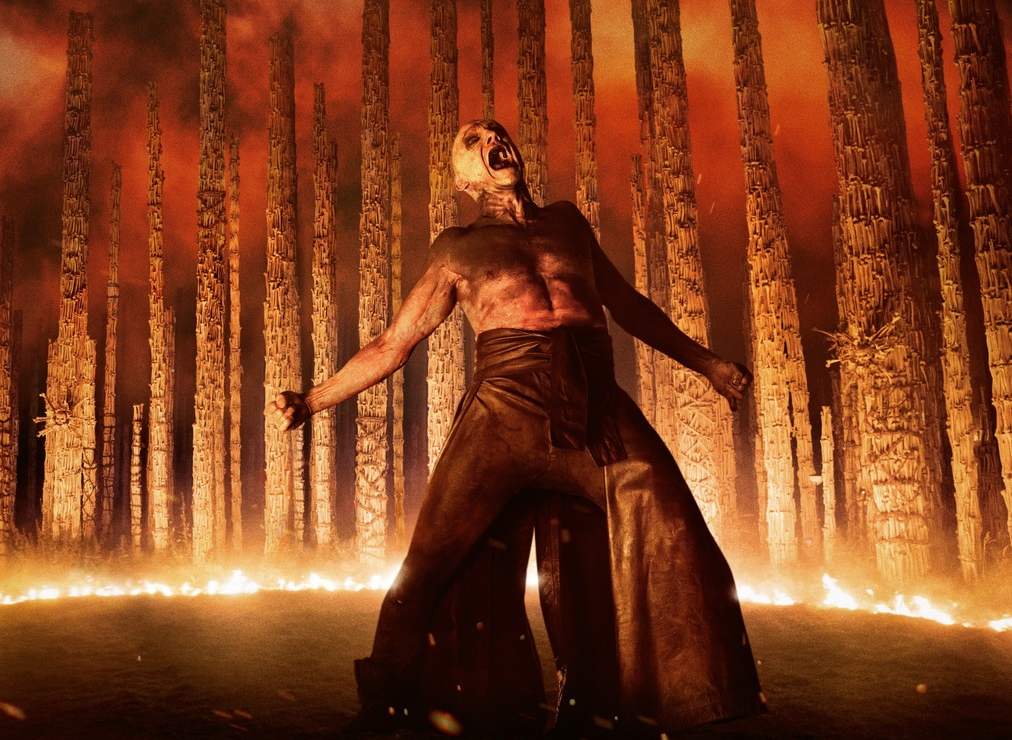
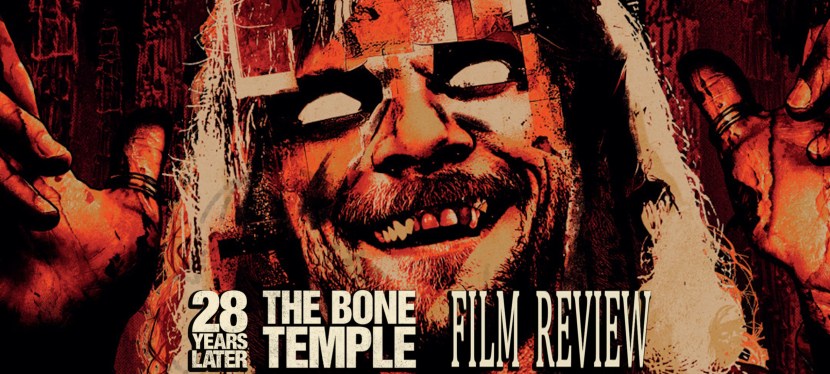
28 Years Later: The Bone Temple

Dr Kelson.

I thought that 28 Years Later was okay in 2025, but it wasn’t a patch on the sheer terror of the original film. Something about the “naked zombies” ended up being almost… comical, rather than threatening. But having seen the first half of this sequel, which ended on a bit of a cliffhanger, I don’t want to miss out on the conclusion.

The trailer seemed to tease a possible breakthrough in dealing with the rage virus, which could be really interesting if handled well. There’s definitely scope to take another look at this world and the decades-long aftermath of its apocalypse. I wouldn’t say I’m incredibly excited for The Bone Temple, but I’m… curious.

Check out my review of 28 Years Later by clicking or tapping here.

Video Game #1:
Squadron 42

Will we see Squadron 42 this year?

At time of writing, Squadron 42 is slated for a 2026 release. But, as with everything related to the mismanaged clusterfuck they call Star Citizen, I’ll believe it when I see it! Squadron 42 is the single-player campaign from the makers of Star Citizen, and I’m always going to be interested in a new sci-fi universe and a large-scale “space game.” Squadron 42 also features an all-star cast, with the likes of Mark Hamill, Gary Oldman, John Rhys-Davies, Gillian Anderson, and Andy Serkis all featuring in some capacity.

Star Citizen gets plenty of criticism for its bloated budget, ridiculous microtransactions, and the pathetically poor way the project has been managed. And I’m not disagreeing with any of that! But… at the end of the day, I want to play a good, enjoyable space game. If Squadron 42 lives up to the hype – assuming it *ever* makes it to release – I’m still gonna be interested in that. Will 2026 be the year? I guess we’ll have to wait and see.

Video Game #2:
Control: Resonant

Promo image of Control: Resonant.
Dylan in Control: Resonant.

A last-minute addition to this list, after Exodus missed out on a 2026 release, is the sequel to 2019’s Control. I absolutely adored my time with Control, and it’s one of the finest third-person action/adventure titles of the past decade. I was really curious to see what would come next after the story came to an end, and to be honest with you… I’m kind of disappointed to see protagonist Jessie being replaced with her brother Dylan for the sequel.

However! This is still the sequel to a fantastic game, and it would be silly to render judgment without even trying it. So I will do my best to go into Control: Resonant with an open mind. The game seems to be more focused on melee combat than the original, which could be interesting, and having a new character to control could mean we get to explore a different set of powers and upgrades. I just hope it won’t feel like a typical video game-y “reset” of the player character just to run through the whole process of gaining and evolving the exact same powers all over again.

Video Game #3:
007: First Light

A classic car…

A James Bond video game… made by the people who created the Hitman series? That sounds almost too good to be true, doesn’t it? Well, 007: First Light is happening, and from what I’ve seen, the game looks pretty darn good. It’s an original story following a young James Bond on one of his first big missions, and it looks like it has, well, everything you might want. Flash cars, gadgets, stealth, gunplay, and a compelling story.

I don’t want to get over-hyped, but I have pretty high hopes for this one. Story aside, the only thing that might spoil it would be a rushed, buggy, or just generally under-baked launch. I’m really keeping my fingers crossed, and while I won’t be pre-ordering, if First Light gets good reviews, I may very well be tempted to pick it up as soon as it’s out.

Video Game #4:
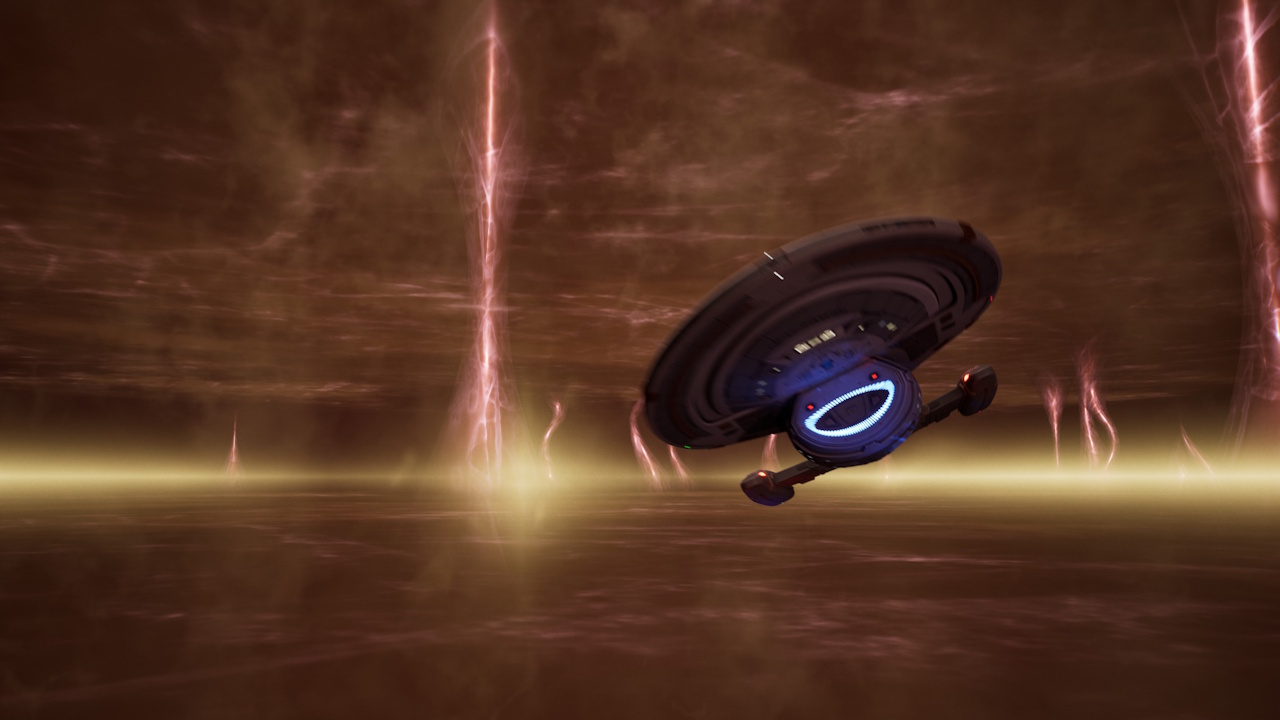
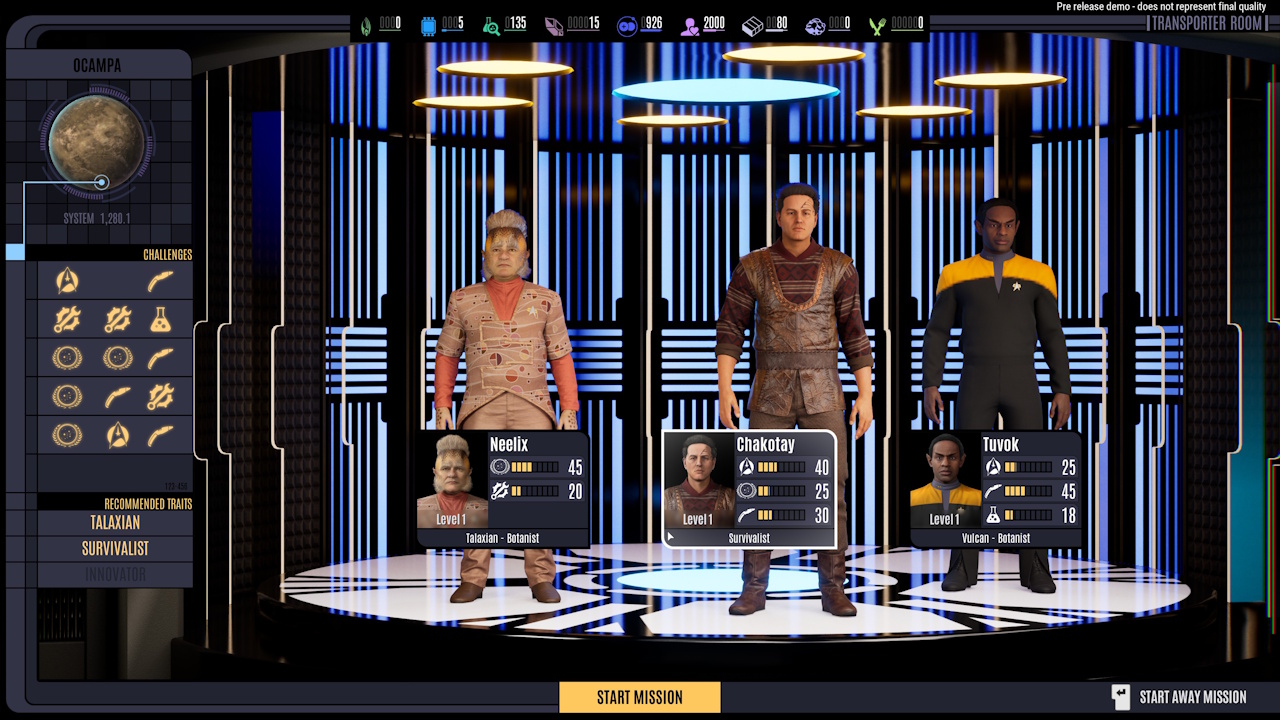
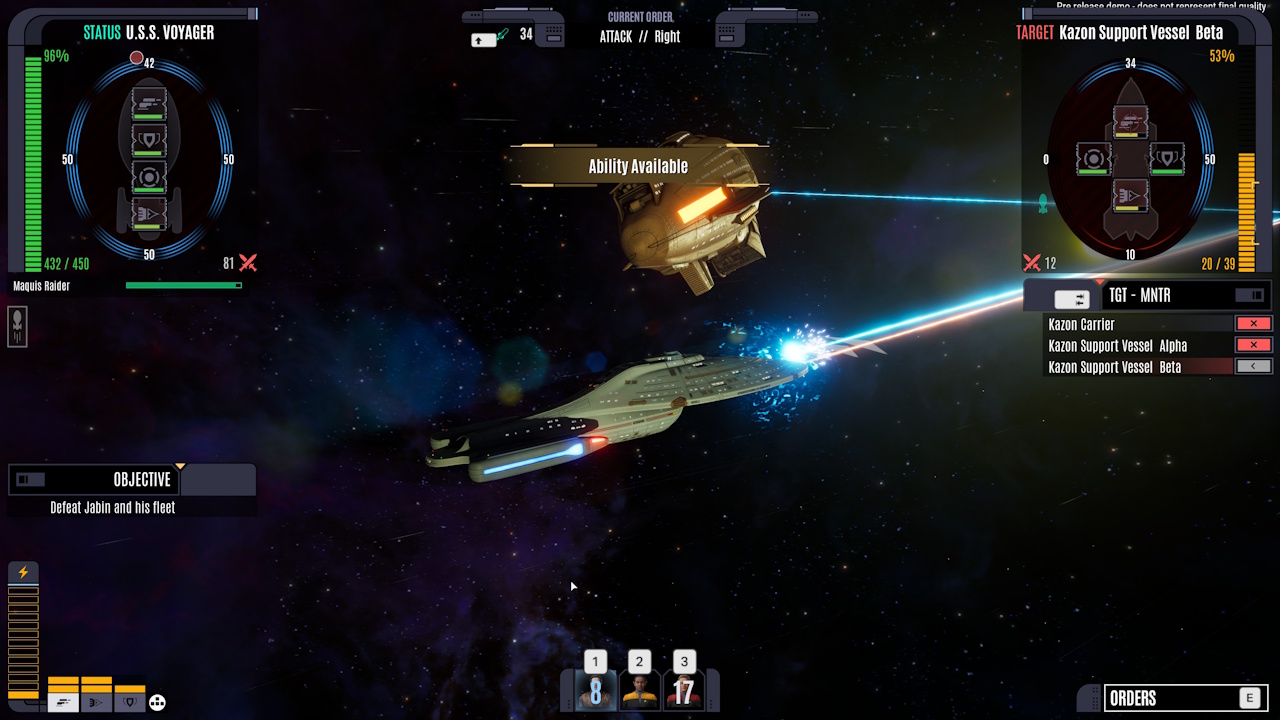
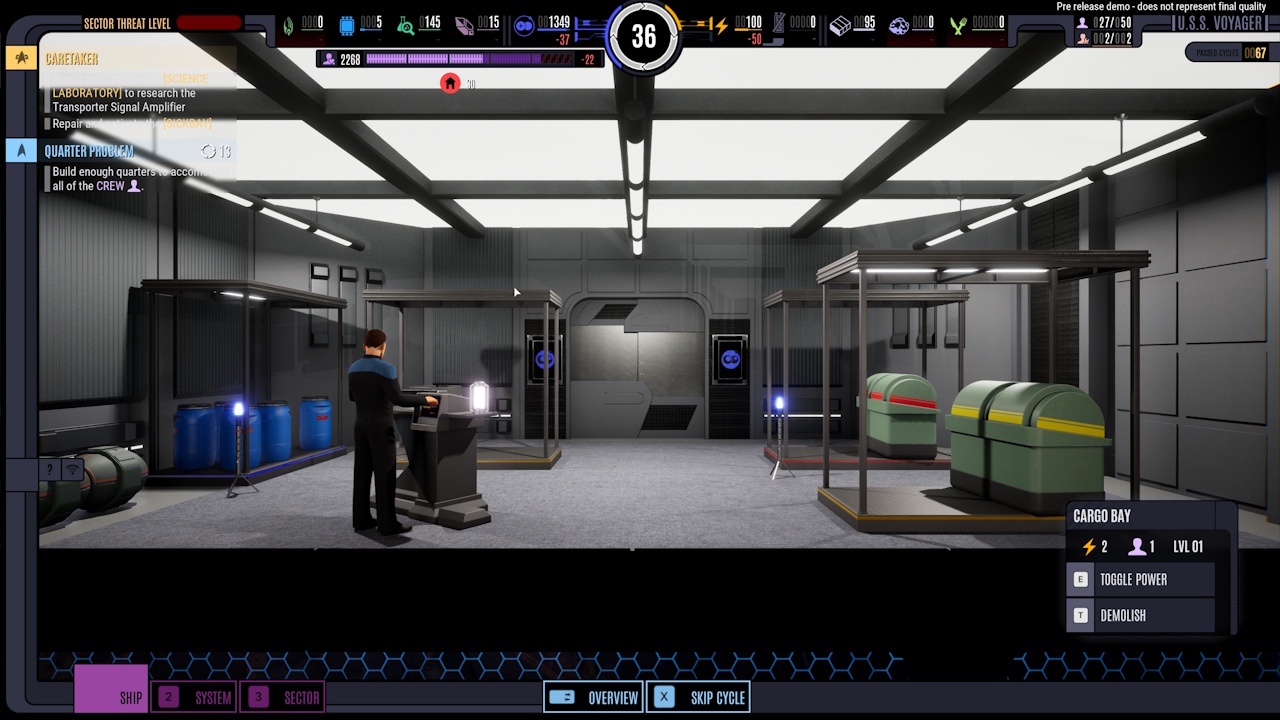
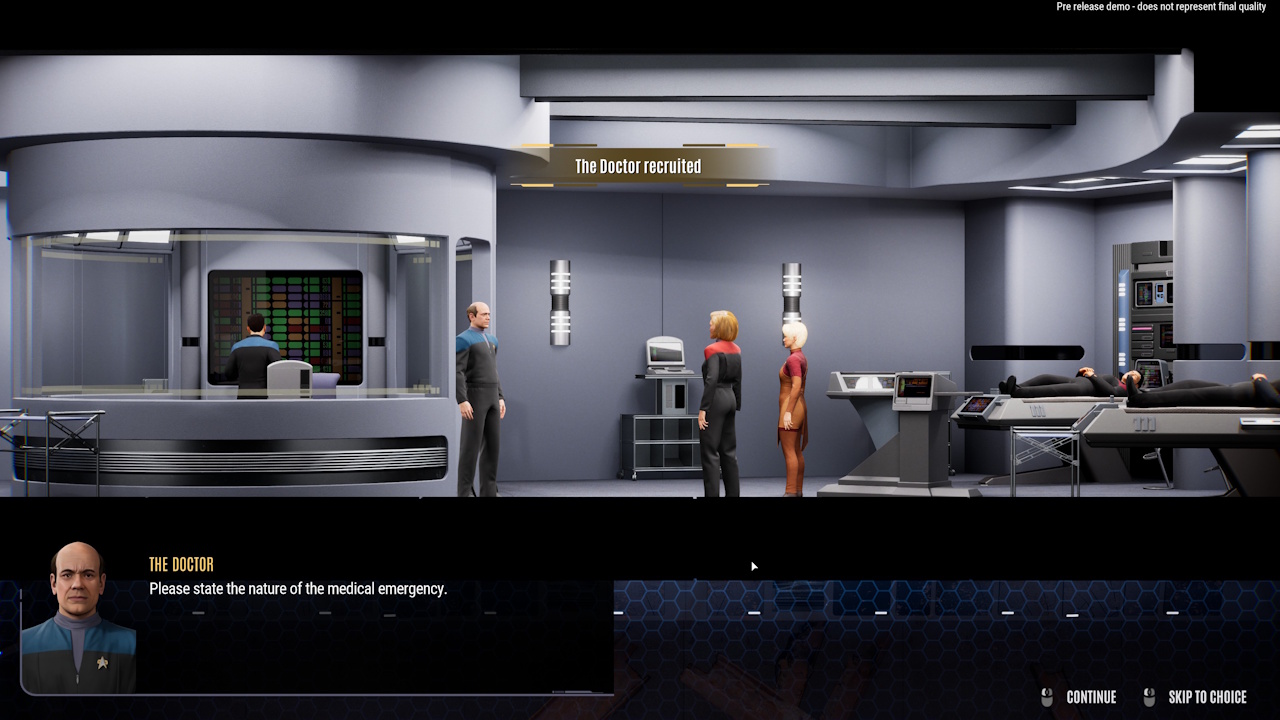
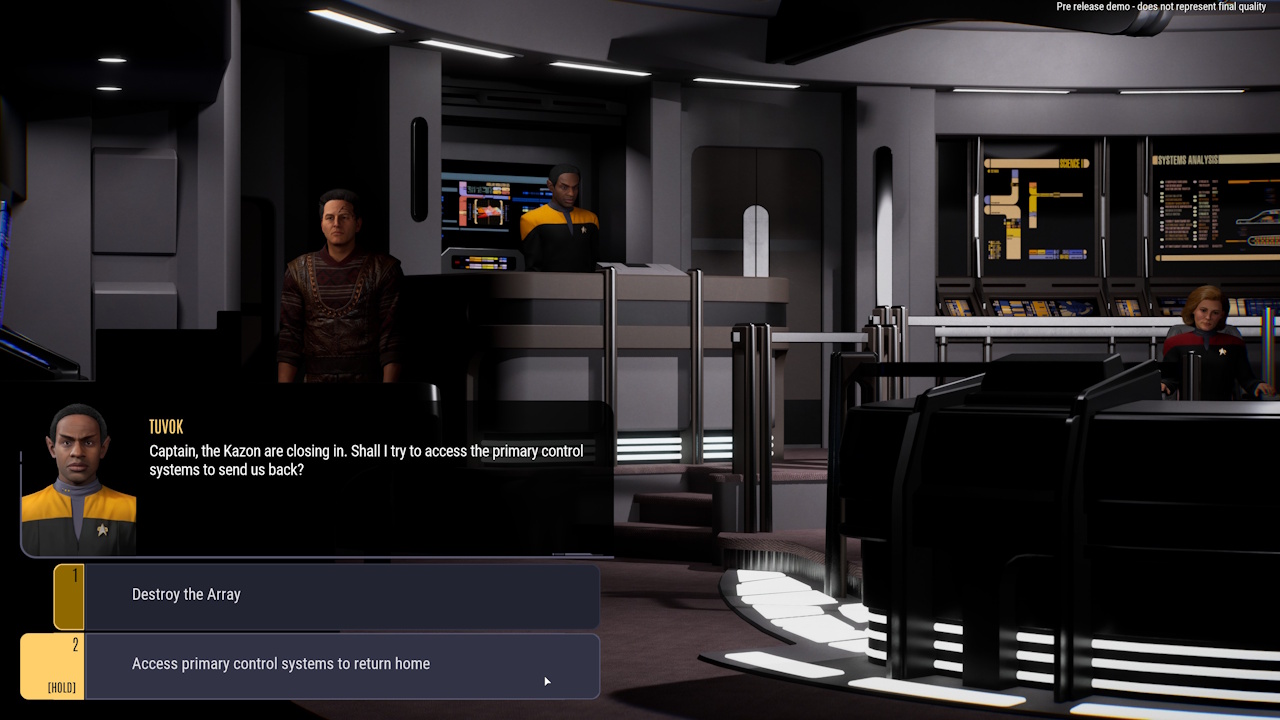
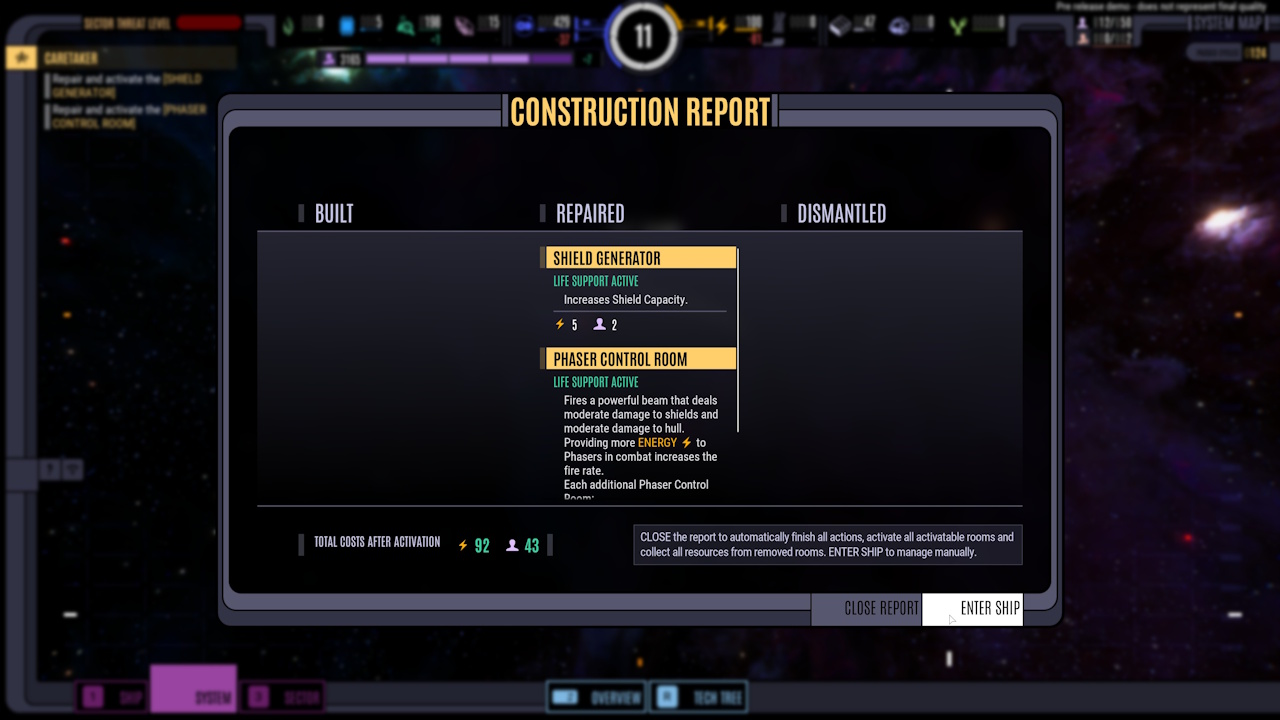
Star Trek: Voyager – Across The Unknown

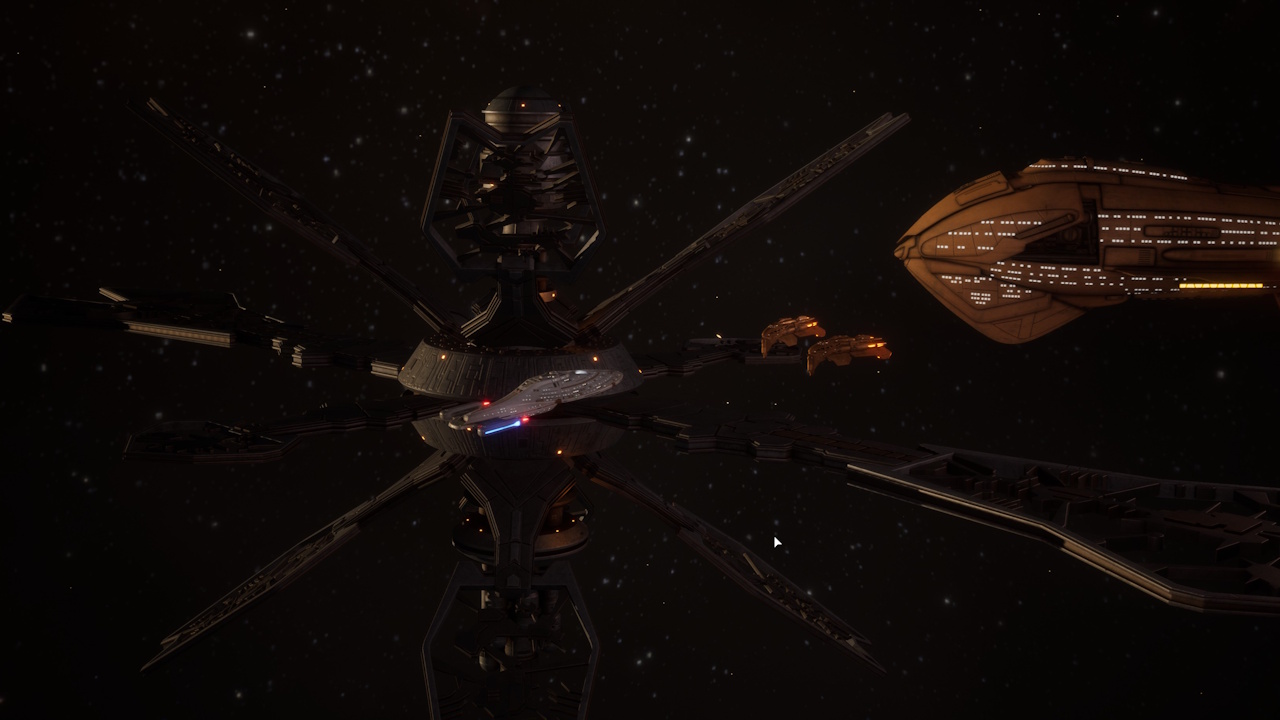
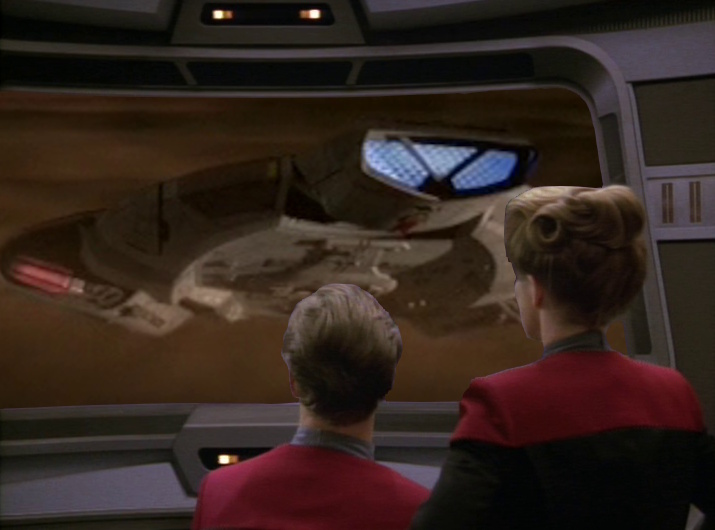
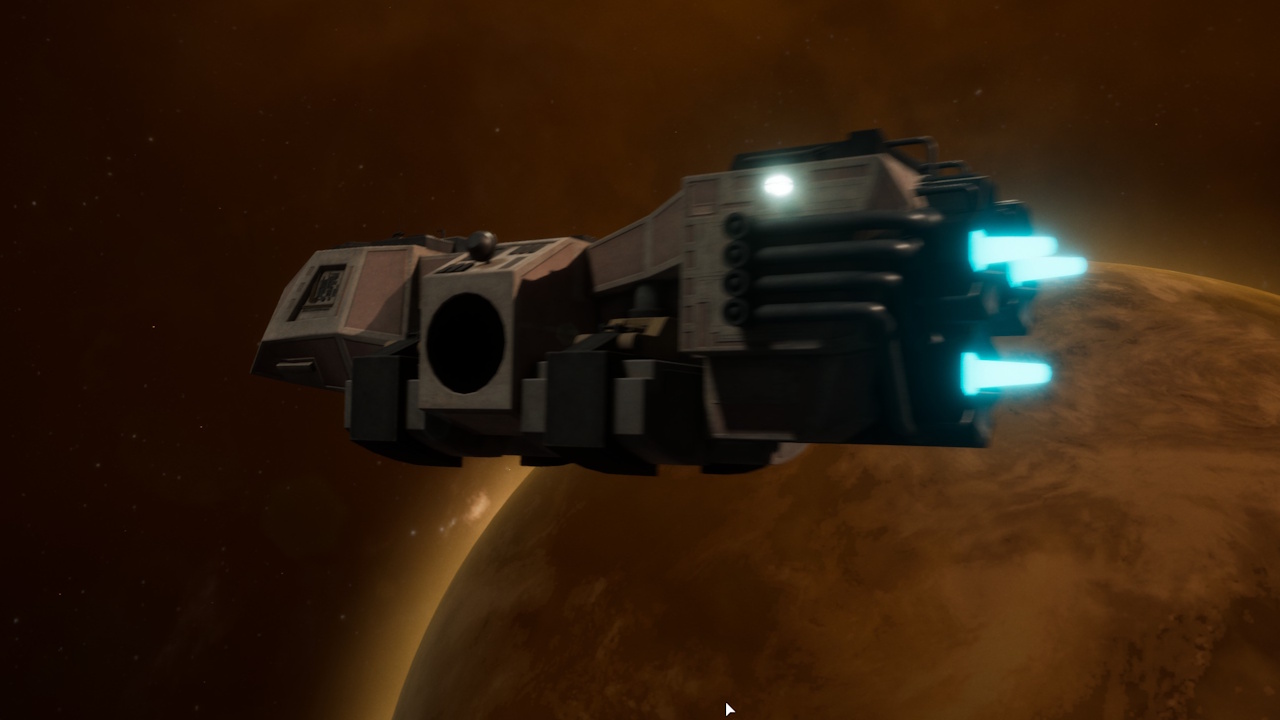
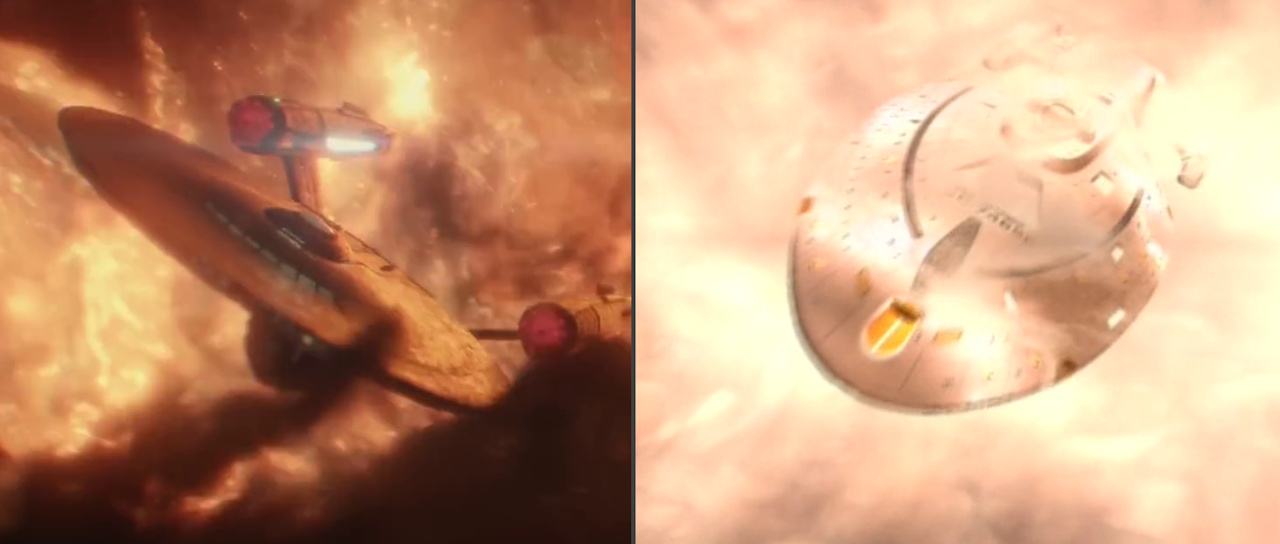
The USS Voyager!

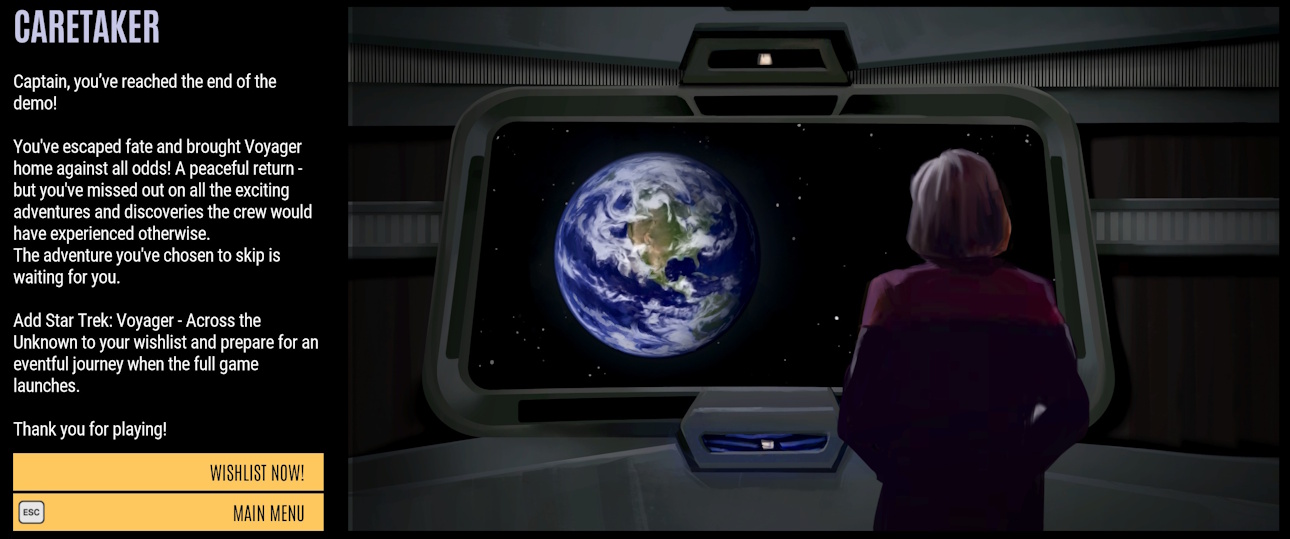
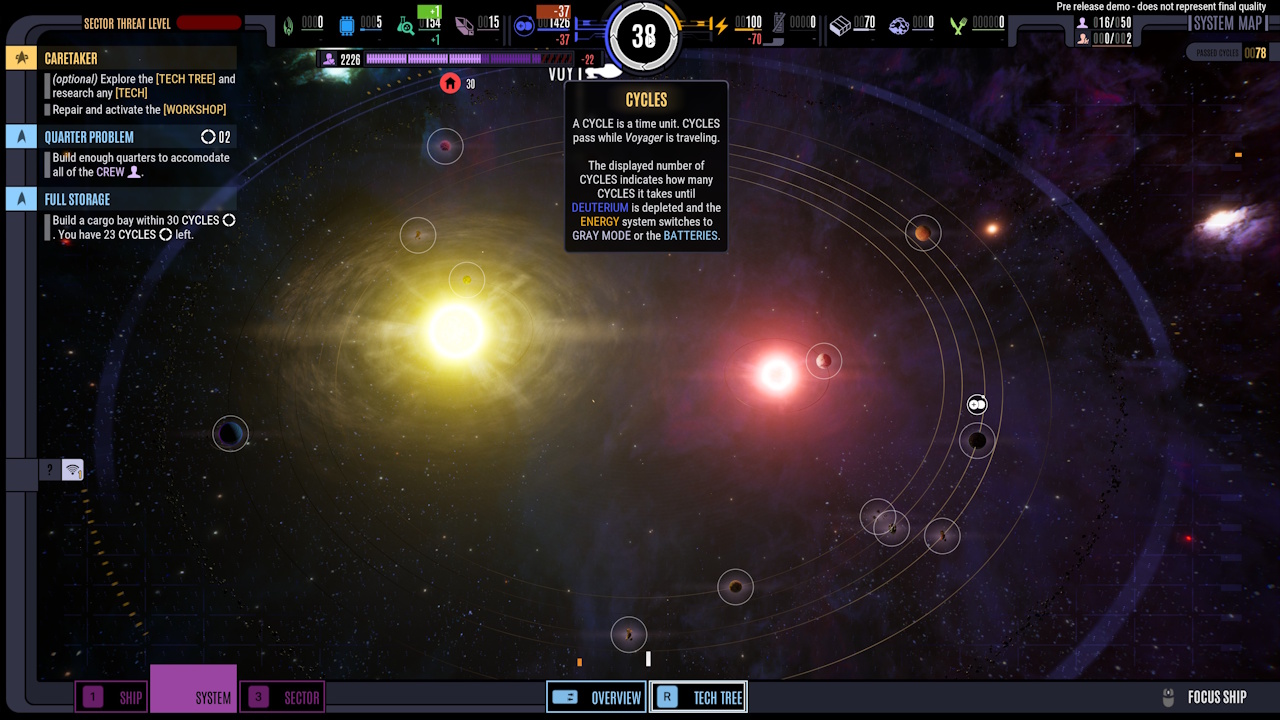
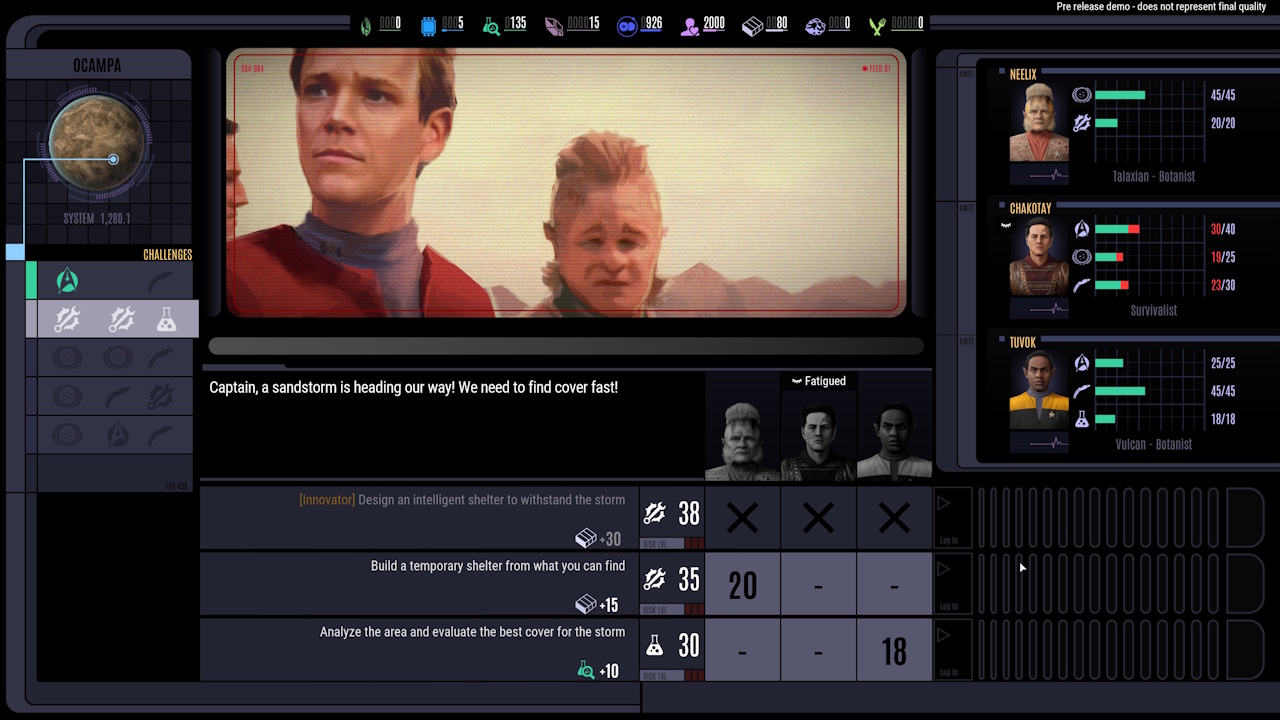
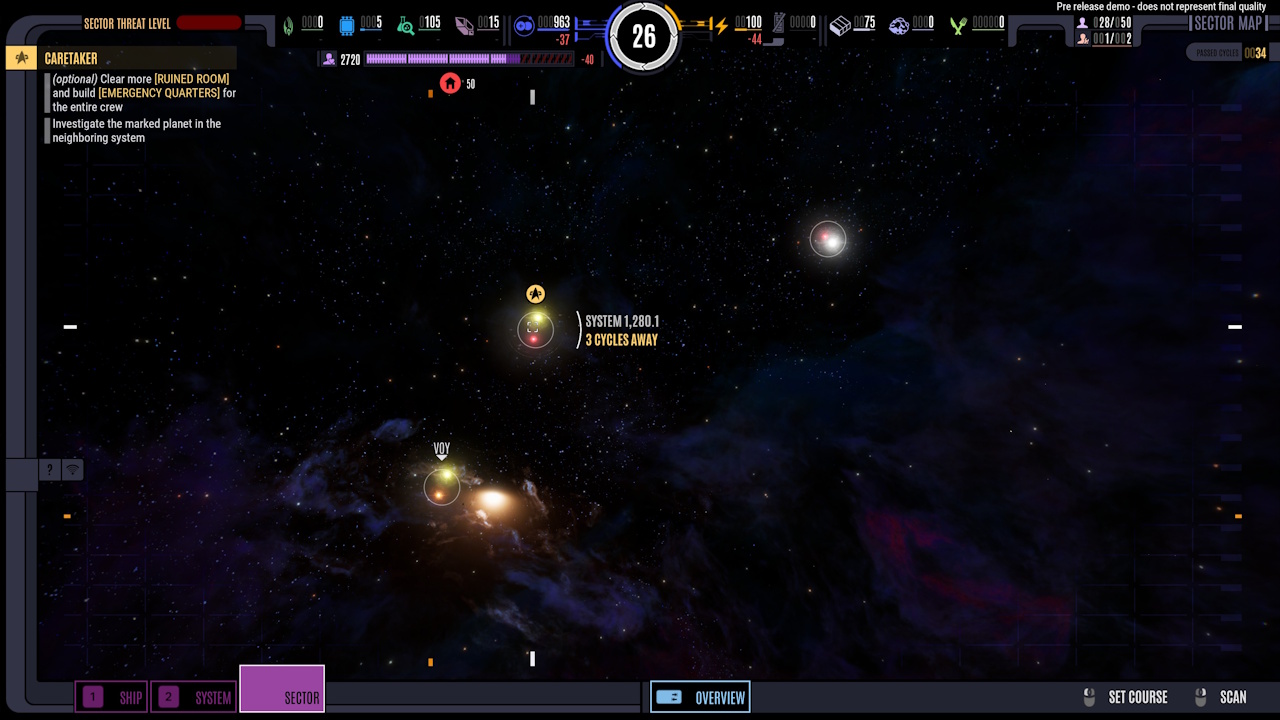
I’m a bit of a Star Trek fan, as you may know, and Voyager is one of my favourite parts of the franchise. I played the demo version of Across The Unknown back in 2025, and I think if you set the right expectations and don’t go into the game expecting a high-budget, “AAA” type of experience, there’s going to be a lot of fun to be had here. This game won’t appeal to non-Trekkies, really – not even to folks who like these kinds of management/base-building types of titles. But that’s okay. Not every game is gonna be right for everyone!

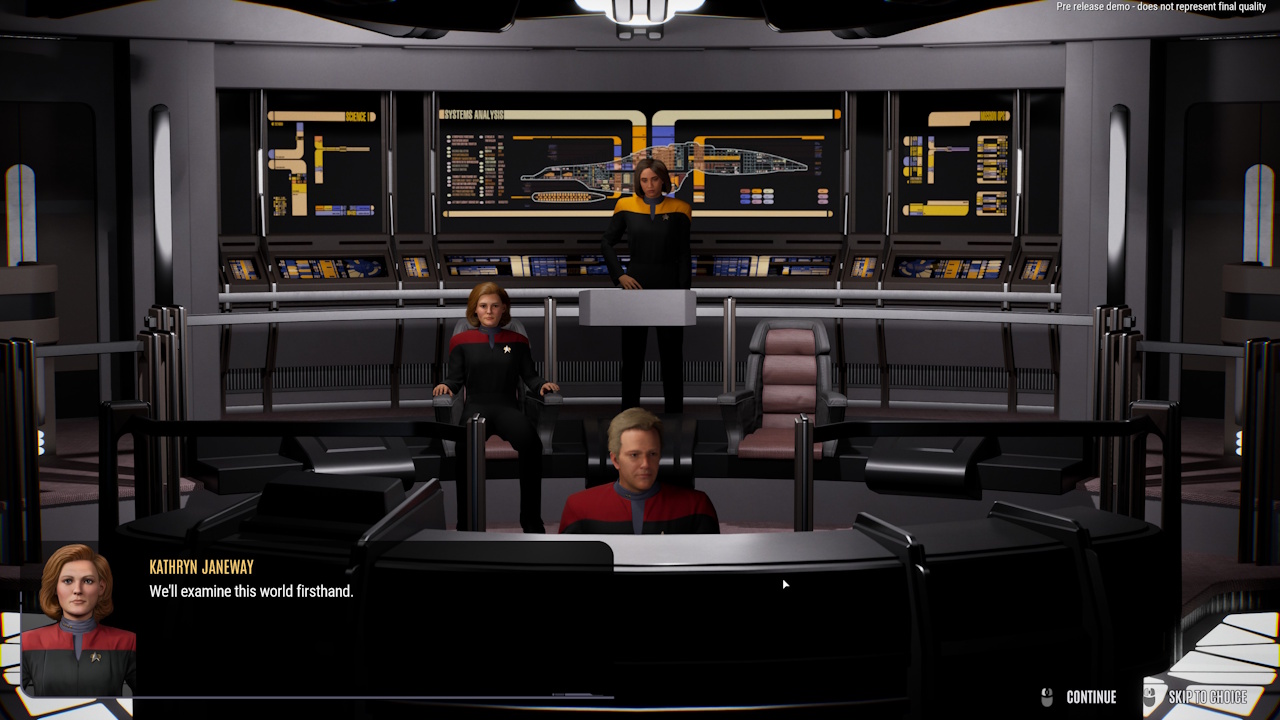
What I like most about Across The Unknown is how the game gives you the chance to potentially have a very different journey through the Delta Quadrant than the one we saw in the show. There are these inflection points, where decisions need to be taken, and it’s possible to make different choices to the ones made by Janeway and the crew. Depending on how well that’s handled, and how many of these decisions there are… that’s a really fun and interesting idea, and could give the game a ton of replayability.

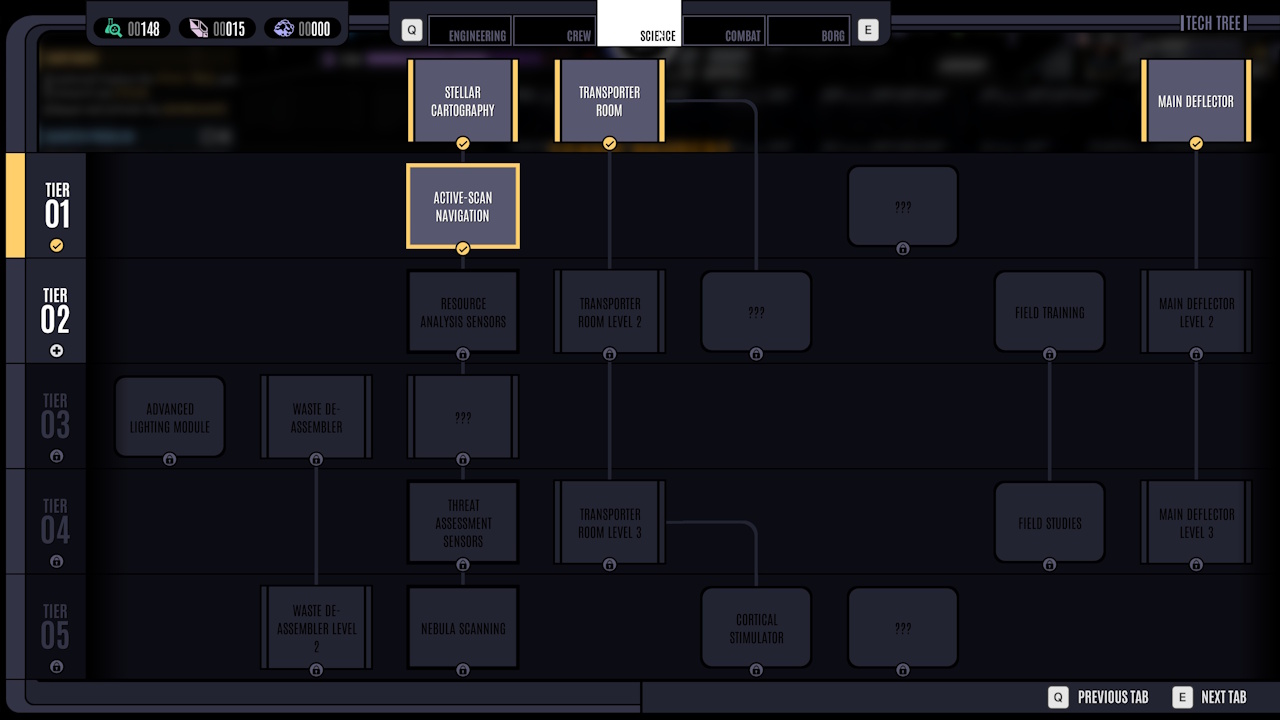
Check out my thoughts on the demo version by clicking or tapping here.

Video Game #5:
Forza Horizon 6

Promo image for Forza Horizon 6.
The game’s logo… and Mount Fuji.

Before I had to cancel my Game Pass subscription, Forza Horizon 4 and Forza Horizon 5 were both among my most-played games. So I’d be lying if I said I wasn’t looking forward to the next entry in the series. Add in a fun-looking Japanese setting, and I think you’ve got the recipe for another fantastic open-world arcade racing title. The Forza Horizon games have been great fun, and I love just how many different vehicles and race types there are, with practically the entire open world being part of at least a handful of different races.

The only downer on Forza Horizon 6, really, is that this is a game I’d have played on Game Pass, but now I’ll have to buy it outright. I’ll definitely be checking out the reviews first, to make sure it lives up to its predecessors – and maybe waiting for it to go on sale, too. I’m not exactly short of racing games at the moment, and I still haven’t played last year’s Tokyo Xtreme Racer, which is also set in Japan. So this one’s definitely on my wishlist, but it’s also in a strange “wait and see” zone!

Check out my review of Forza Horizon 5 by clicking or tapping here.

Video Game #6:
The Blood of Dawnwalker

The player character taking on some guards or soldiers.

An open-world fantasy game created by some of the folks who worked on The Witcher. That’s the one-line pitch, but there’s more! The Blood of Dawnwalker is set in medieval Europe, and sees the player character take on the role of a half-human, half-vampire, with a range of vampiric powers to take advantage of. The game’s main story seems to involve trying to save your family, but details are still under wraps.

I liked what I saw from The Blood of Dawnwalker’s trailer a few months ago, and I hope that new studio Rebel Wolves have taken their time to really get this game right. I’m always up for trying out a new fantasy world, especially with so many sequels and spin-offs out there. It’s rare for a new studio to put together an ambitious project like this… and I really hope that the finished game will be worth waiting for.

Video Game #7:
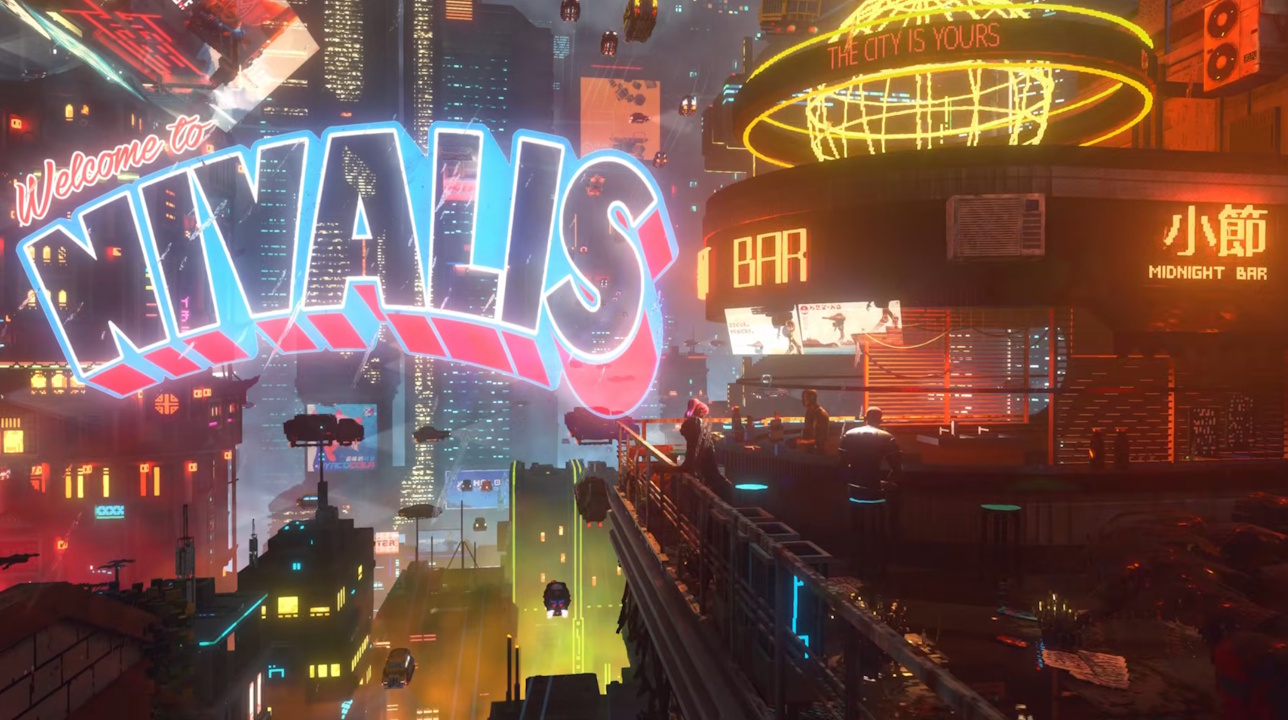
Nivalis

Still frame from the end of the Nivalis promo trailer.
Welcome to Nivalis!

Nivalis’ developers describe the game as a “slice-of-life” simulator set in a cyberpunk city. But… would it be unfair to suggest that this could be a “cozy game?” I’m definitely getting that impression from what I’ve seen of Nivalis so far. You can run a business, decorate your apartment, befriend NPCs… everything about that screams “cozy” to me! And I love stories and games set in a small island of calm or safety in a dangerous world. Nivalis could really scratch that itch for me.

So… Cyberpunk 2077 meets Animal Crossing, then? Maybe. The game’s visual style might take some getting used to for me; there’s a combination of blocky, voxel-style environments with characters who look a bit more realistic. But I like the idea of running a business, setting up a home, and just living a life in this kind of totally different world.

Video Game #8:
Cat Isle

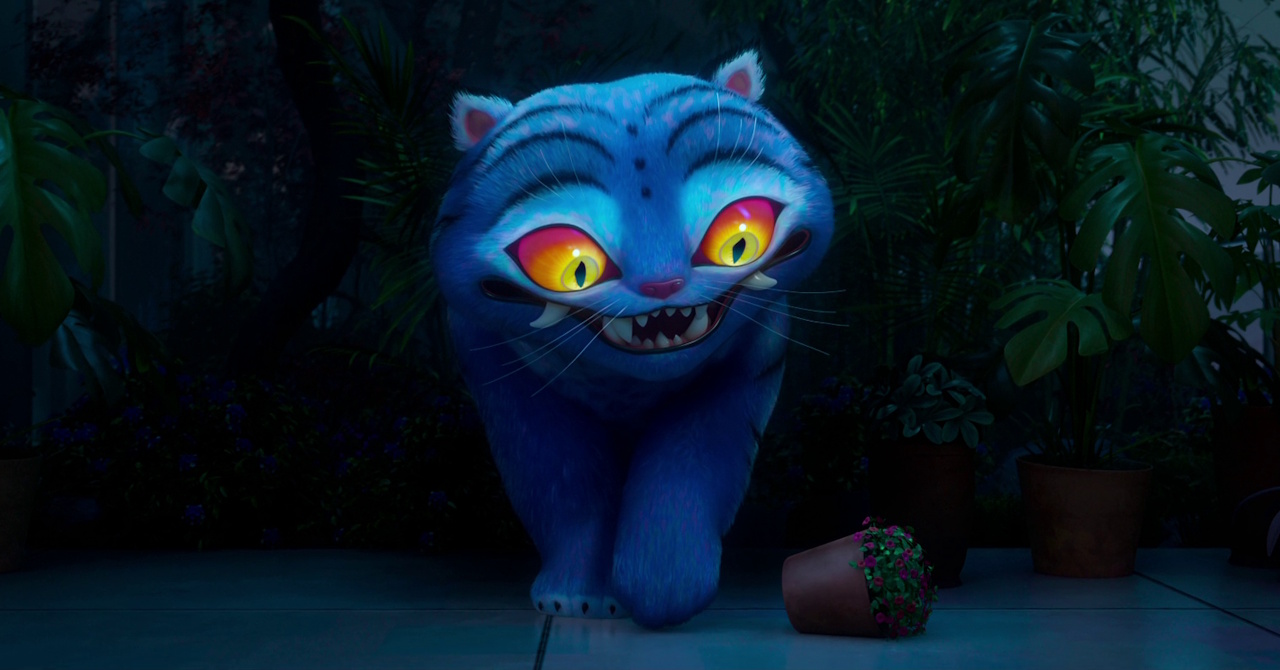
Cute cats!

A cute cozy game, with beautiful pixel art… and it’s all about cats? Where do I sign up?! Seriously, this just looks adorable; a cozy game with building and management elements where kitty cats are the stars. I love cats, I love games about cats, and I enjoy a good cozy game, too. So Cat Isle could be just what I’m looking for in 2026!

Domke Games is an indie developer, and I like to try to support indie games where I can. That doesn’t mean Cat Isle will get a free pass, and I’m sure this title won’t be right for everyone. But it looks like the kind of cute game I could see myself playing for a few minutes a day… or really losing myself in for ages, depending on how it shakes out.

Television Show #1:
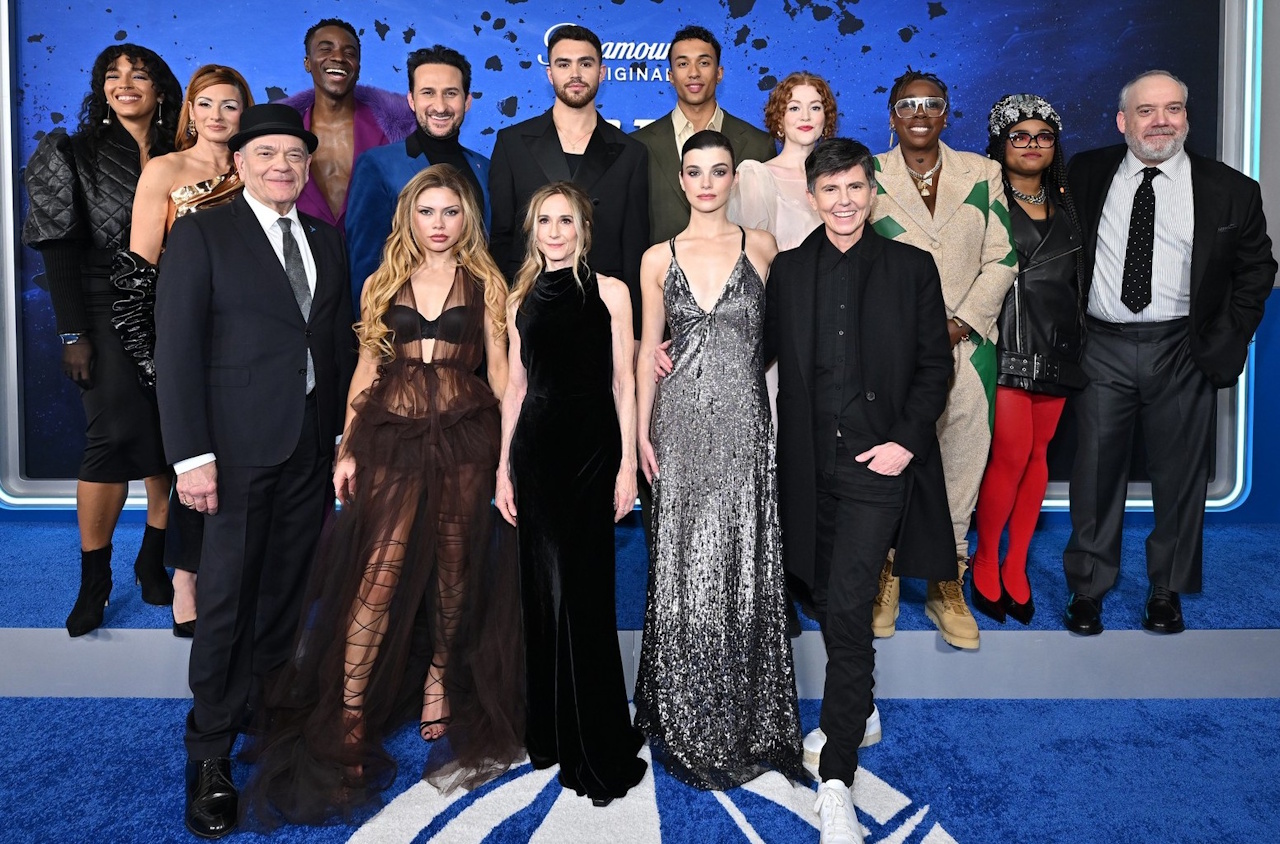
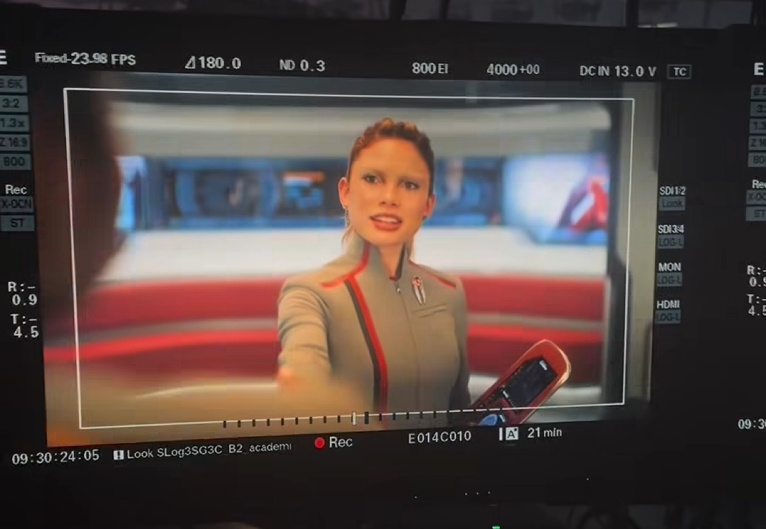
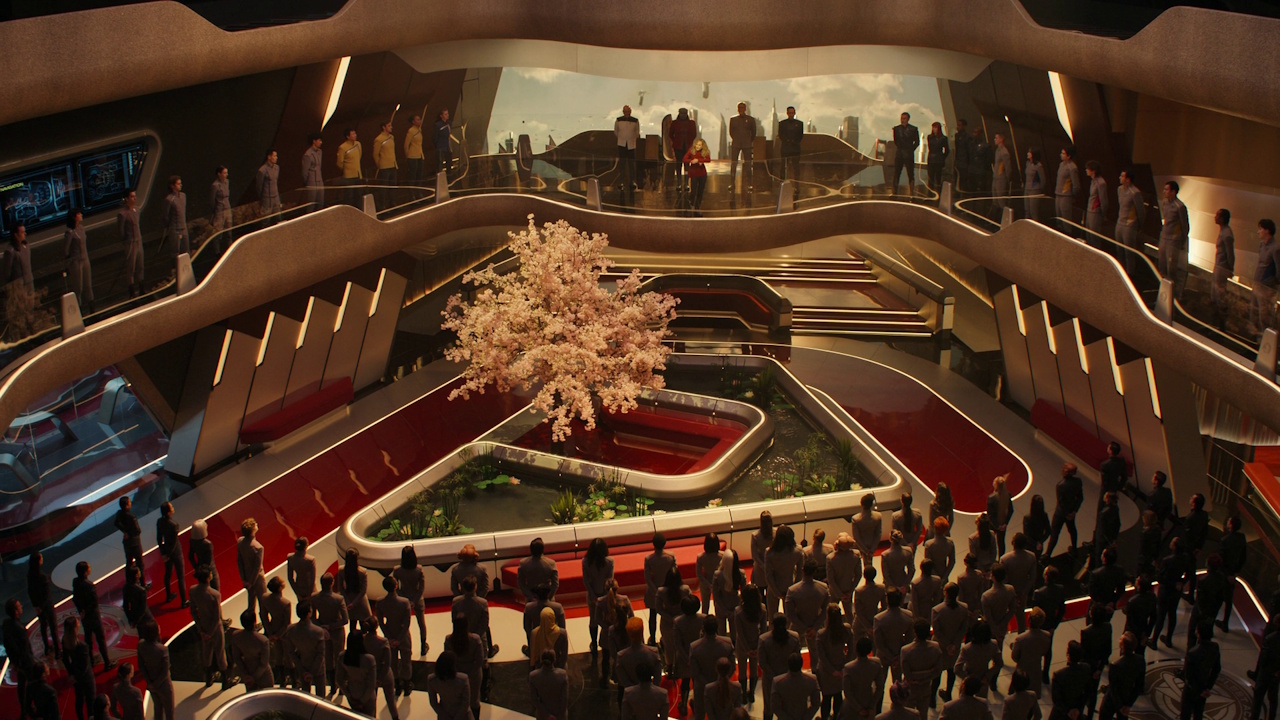
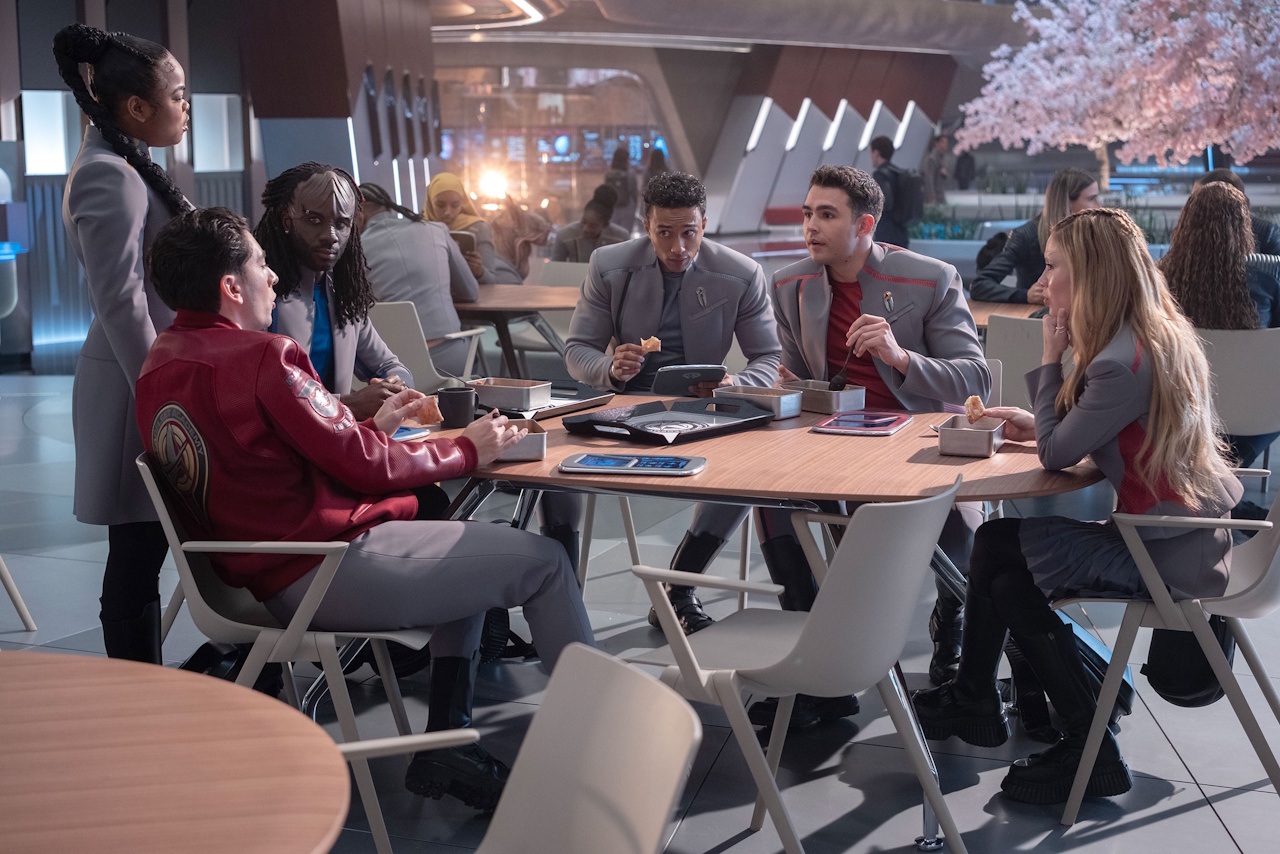
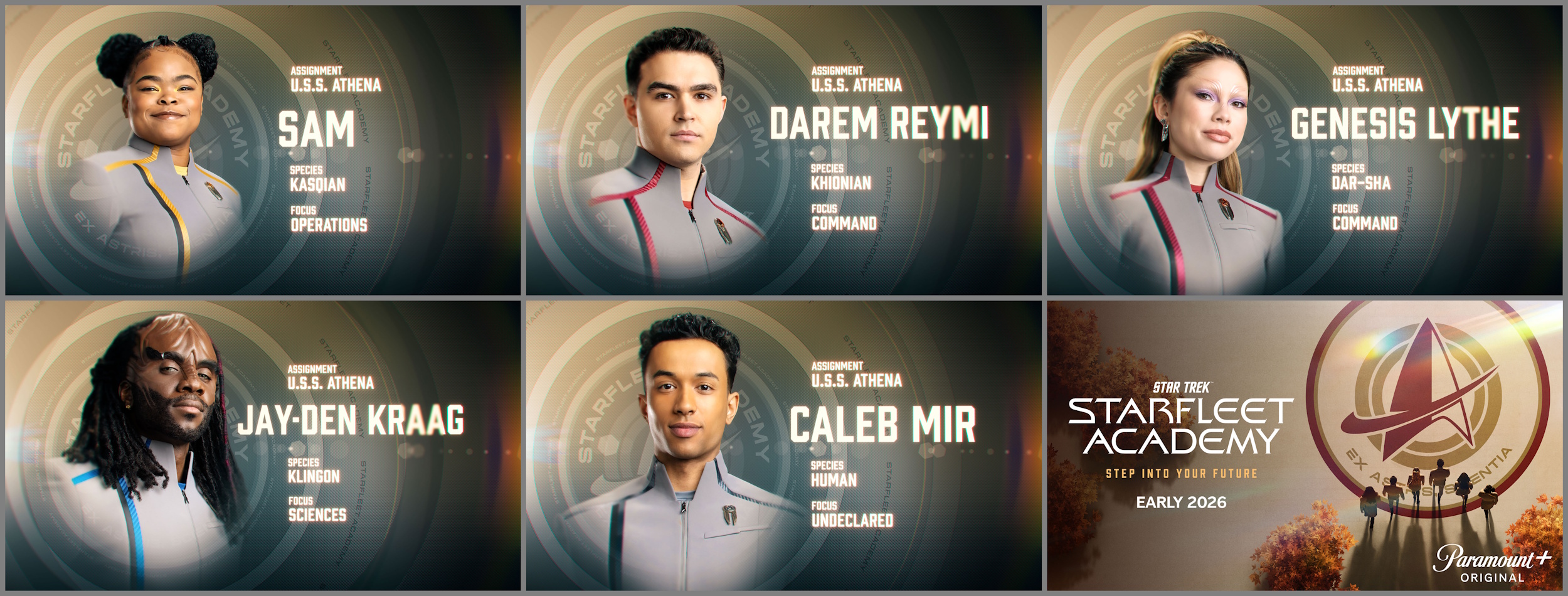
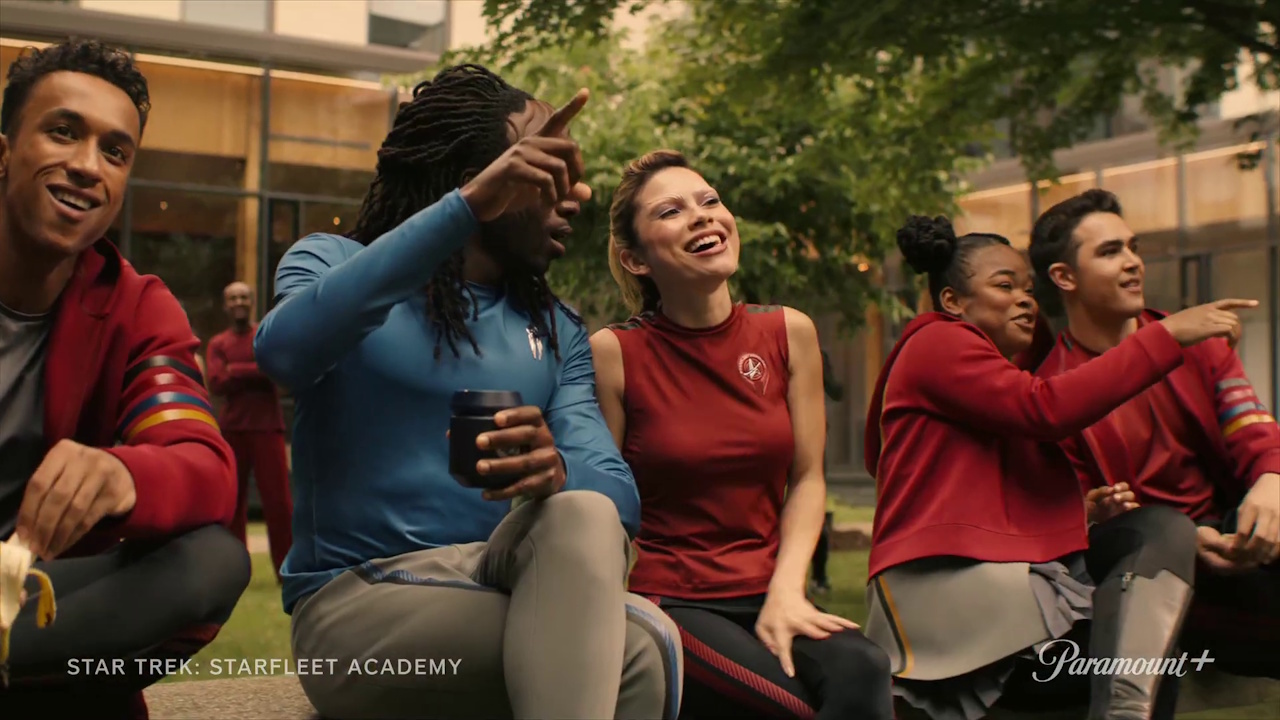
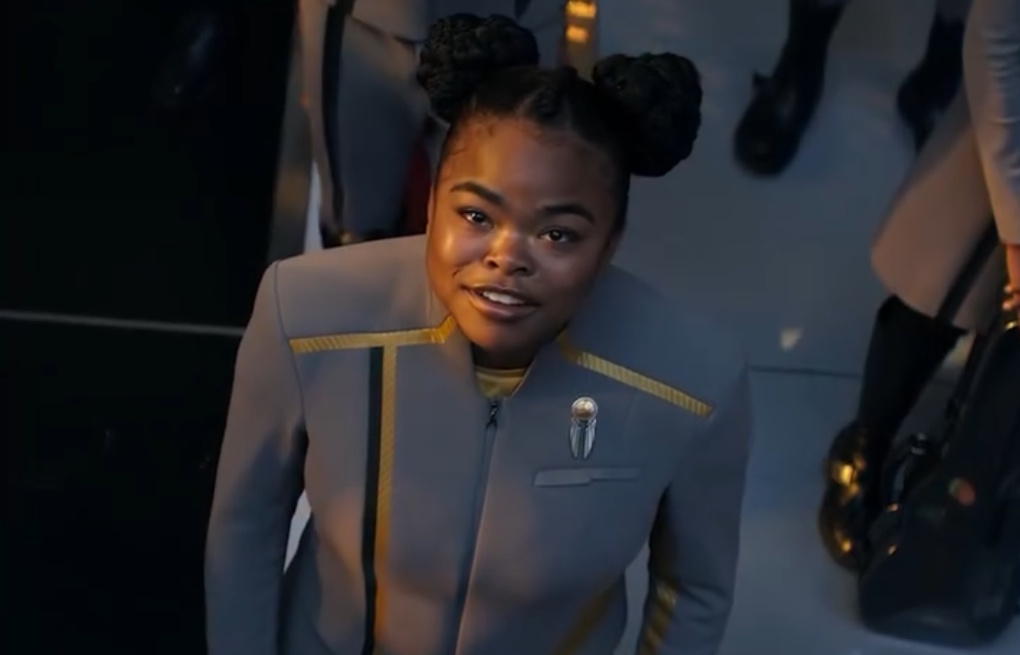
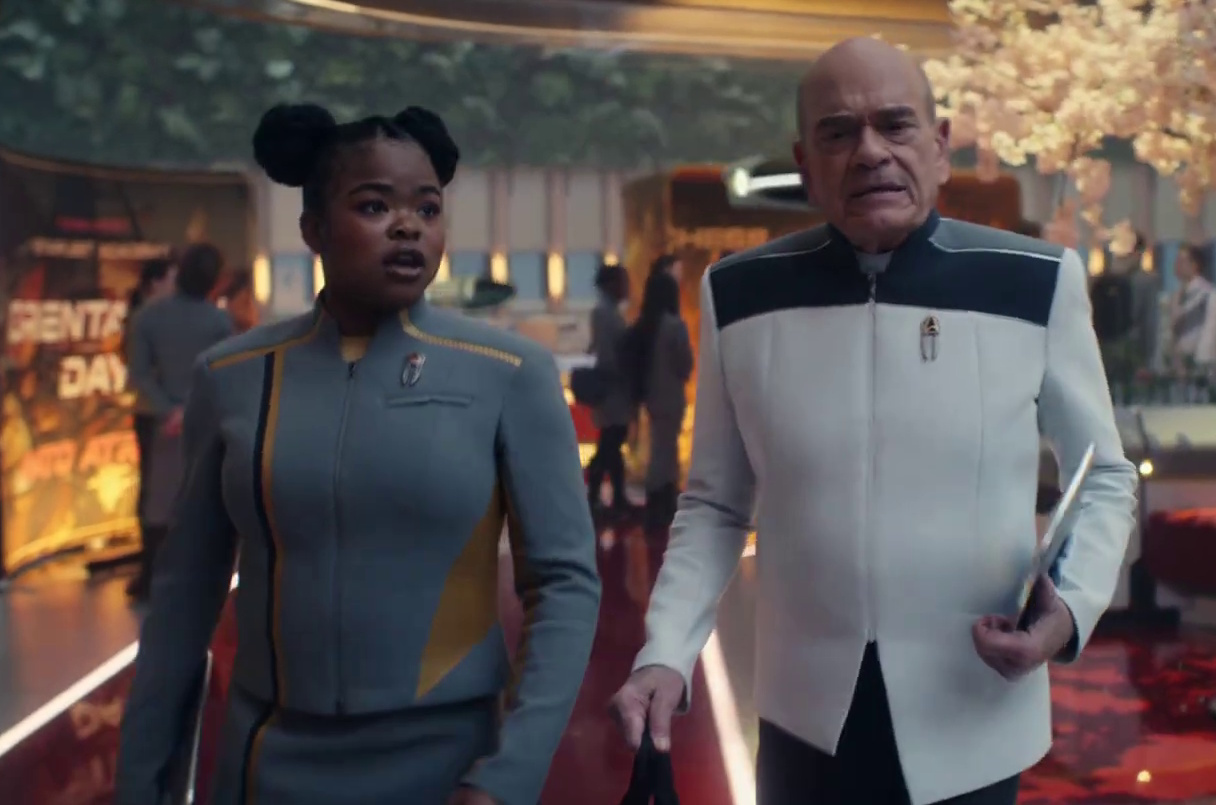
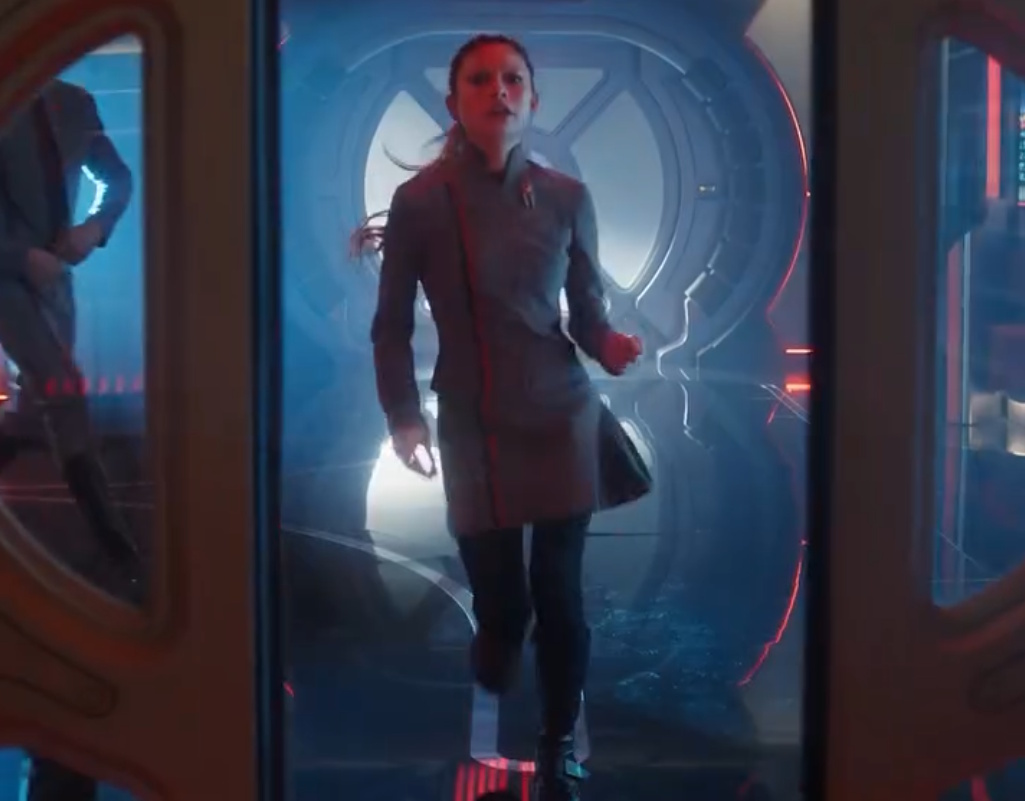
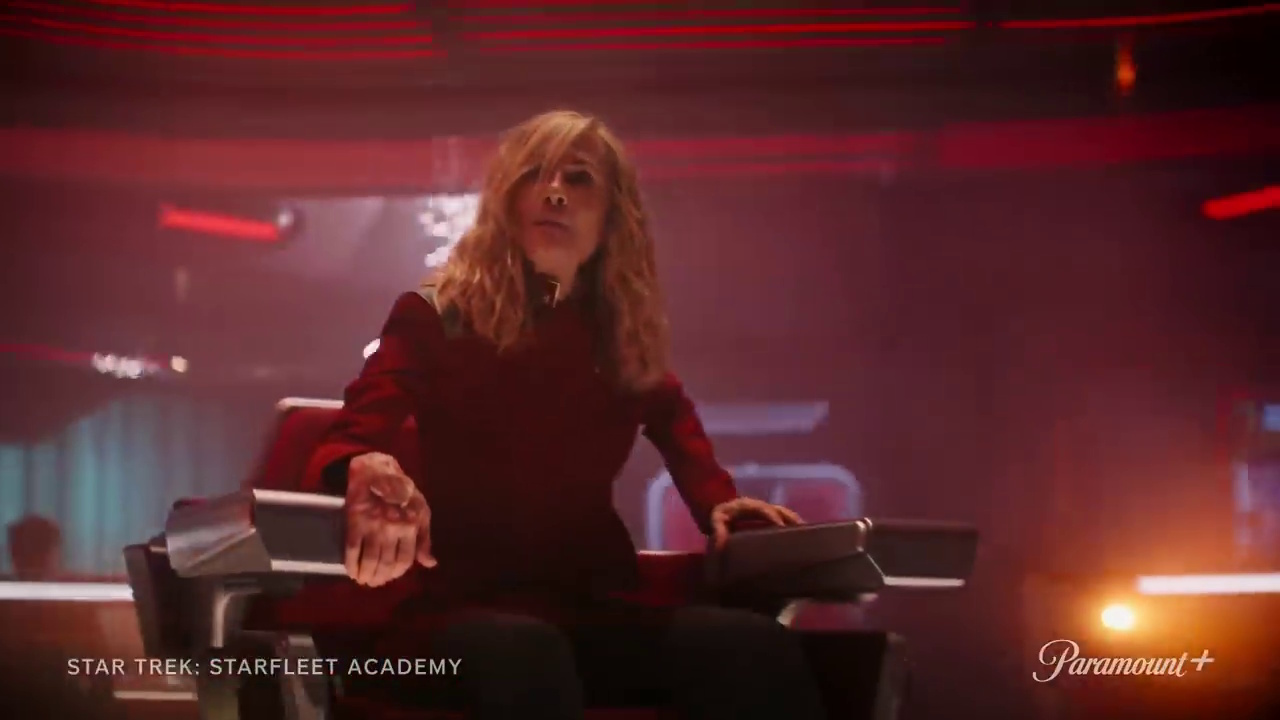
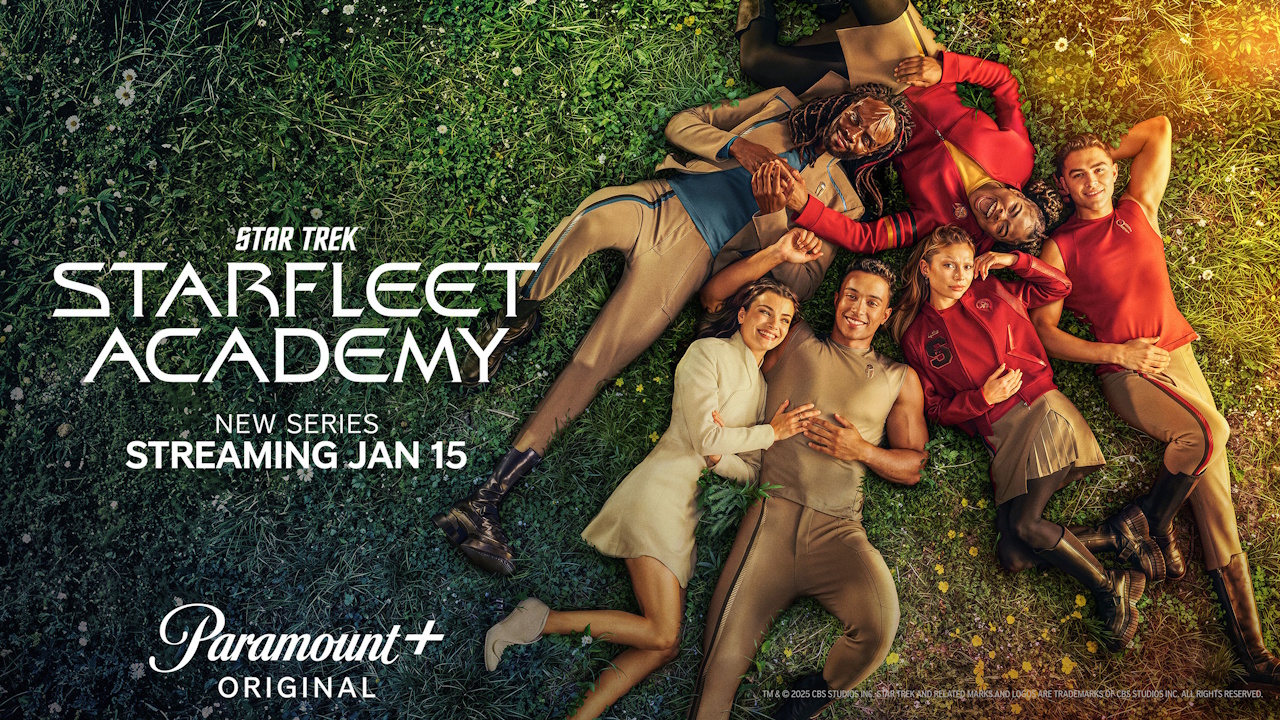
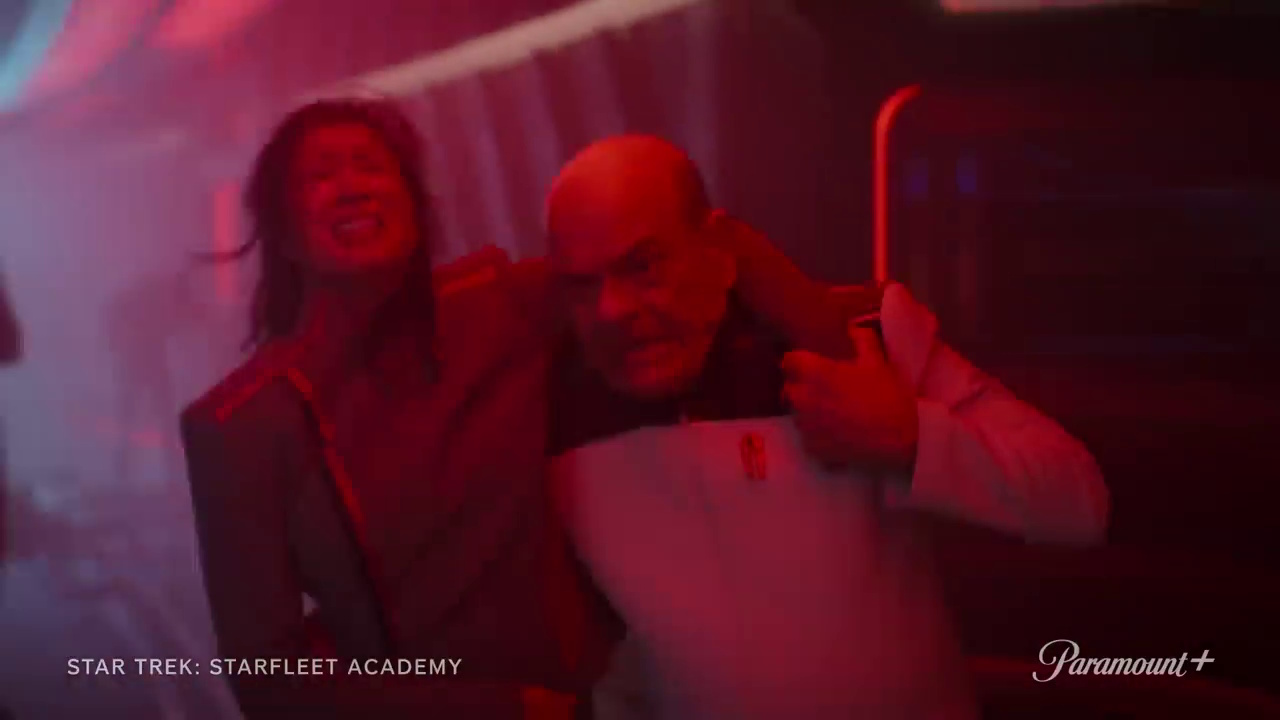
Star Trek: Starfleet Academy

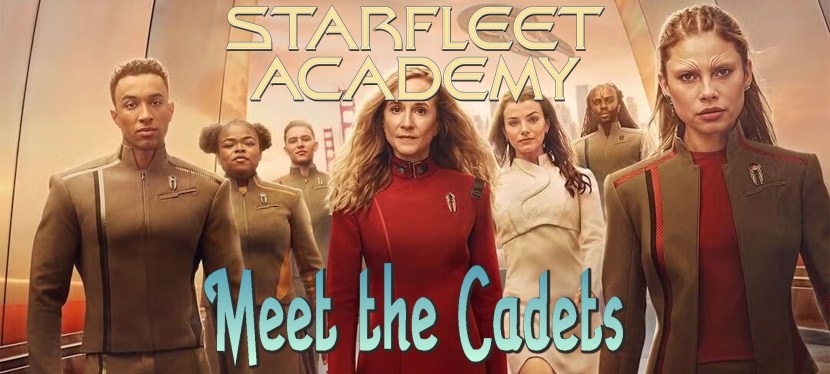
Promo photo for Star Trek: Starfleet Academy.
The cadets.

To be blunt, even as a big Trekkie, I’m not sure whether Starfleet Academy is gonna be “my thing.” The show seems to be going down a serialised route, with a “big galactic threat,” a villain with a mysterious connection to a main character, and all of the repetition and hammy performances that go with that kind of thing. Additionally, there seems to be quite a focus on what you might call “teen drama,” with that side of things taking precedence over the likes of exploration. Both of those things give me pause.

But… this is still a brand-new Star Trek series. It’s based on a concept that even Gene Roddenberry himself was kicking around back in the ’60s and ’70s. And… it could very well be the *last* new Star Trek series of this current streaming era, now that the Skydance takeover has been finalised. So I will do my best to support Starfleet Academy when it premieres later this month… and I’ll try not to judge it too harshly. Not every show – even Star Trek shows – are right for every viewer, and if Starfleet Academy succeeds at bringing new eyes to the franchise, that can only be a positive thing in my book.

You can see a more detailed look at the upcoming show by clicking or tapping here.

Television Show #2:
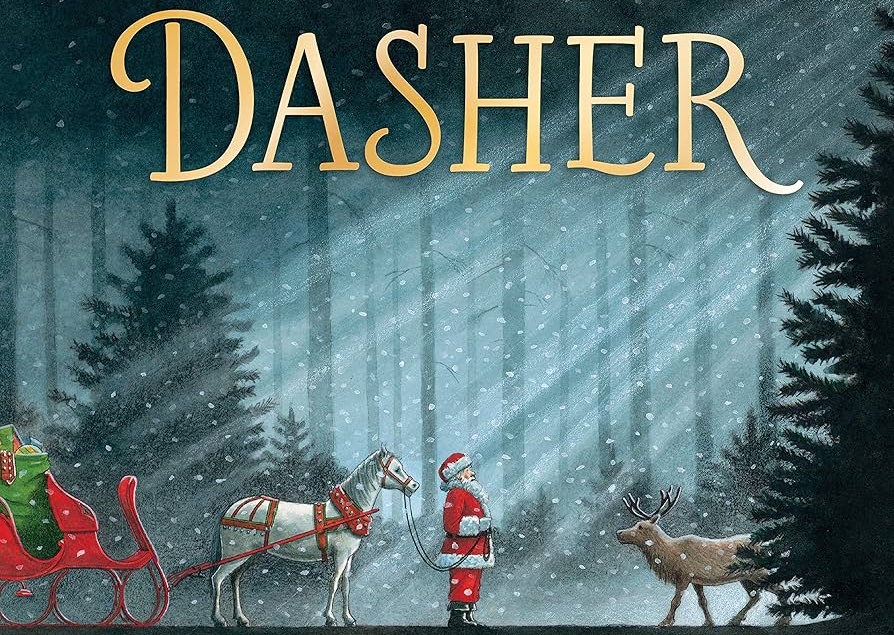
Dasher

Cover art for the book Dasher.
Santa meeting Dasher.

Is it too early to be thinking about Christmas? Jokes aside, I’m really interested to see this holiday special from Disney+ later in the year. It’s going to be a single animated production, probably shorter than a feature film would be, and… well, it’s all about Dasher, one of Santa Claus’ reindeer. Dasher is based on a children’s book, and it depicts the titular reindeer running away from a life at the circus and meeting the jolly man in the red suit for the first time.

The Polar Express is a great example of this kind of kids’ book being adapted into a wonderful animated picture, and if Dasher is even in the same ballpark, I’ll have a great time with it. I know it’s early, and Christmas is literally eleven months and twenty-four days away! But I wanted to put this one on my list so I don’t forget about it by the time the holidays roll around again. And you know me… I love Christmas!

Television Show #3:
3 Body Problem
Season 2

Still frame from 3 Body Problem Season 1 showing three suns in the sky.
The titular three bodies.

3 Body Problem was my pick for TV Show of the Year back in 2024, and I was concerned for a while that there wouldn’t be a continuation of this compelling and wonderful story. But thankfully there is – albeit a belated one. 3 Body Problem’s second season probably won’t land until later in the year, but I’m really hoping for great things as the San-Ti get closer and Earth’s defenders are forced to step up to the plate. The series ended with multiple storylines on cliffhangers… so there’s a lot to do to pick up those dangling narrative threads!

3 Body Problem really is the best kind of grown-up sci-fi, with philosophical themes, complex physics and mathematical problems, and a great cast of characters to boot. There was controversy when the show’s first season moved the main story out of China – where the original books were set – and gave it more of a multinational, multicultural flavour. And I get that. But what we got was genuinely fantastic TV that had me riveted and desperate for more. I can’t wait to pick up this story later in the year.

You can read my review of 3 Body Problem’s first season by clicking or tapping here.

Television Show #4:
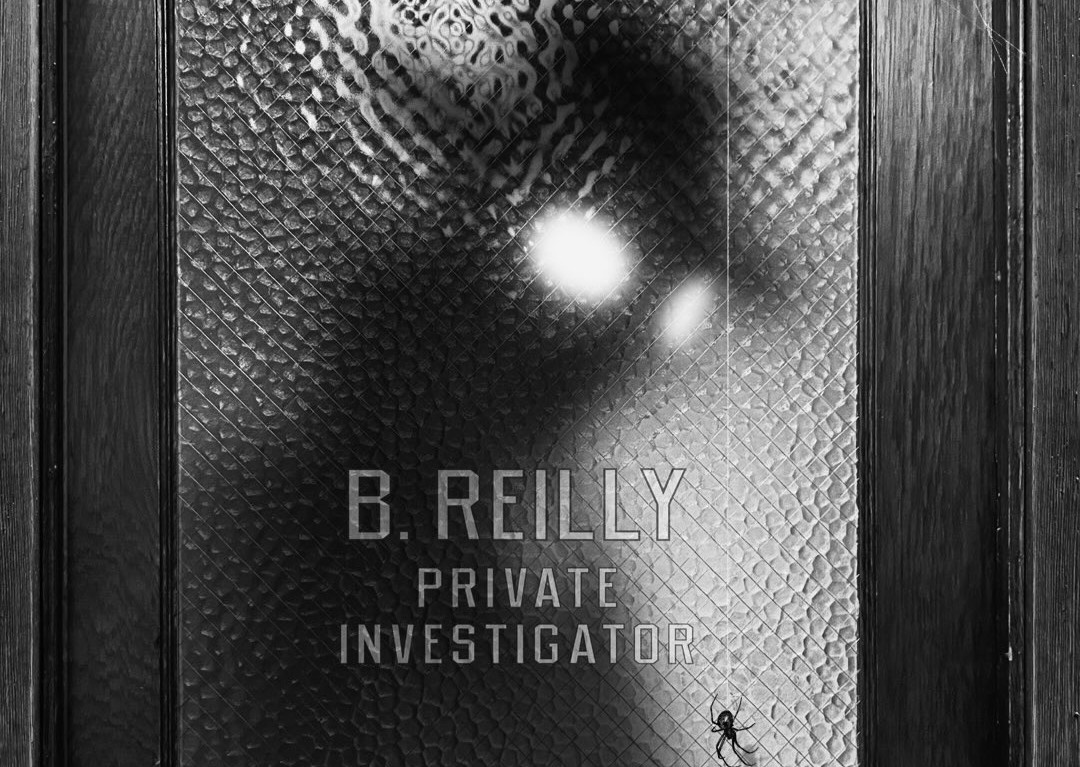
Spider-Noir

Cropped promo image for Spider-Noir.
Who’s this?

I mistakenly thought we’d see Spider-Noir in 2025, but the show is, instead, coming this year. Starring Nicolas Cage as an older Spider-Man from a different timeline, the show promises a “film noir” inspiration and visual style. There will even be a black-and-white version of Spider-Noir, if you want to go for that real ’30s hard-boiled feel.

To be honest, I just love the idea of Nicolas Cage as Spider-Man, and that this will be a completely different version of the superhero. Spider-Noir will be set in a world inspired by New York City in the ’20s and ’30s, with Spider-Man – or Ben Reilly, to use his real name – working as a private detective. I’m not the world’s biggest superhero or comic book person, as you may know… but in a genre drowning in sequels and sameyness, Spider-Noir looks like it could be something different.

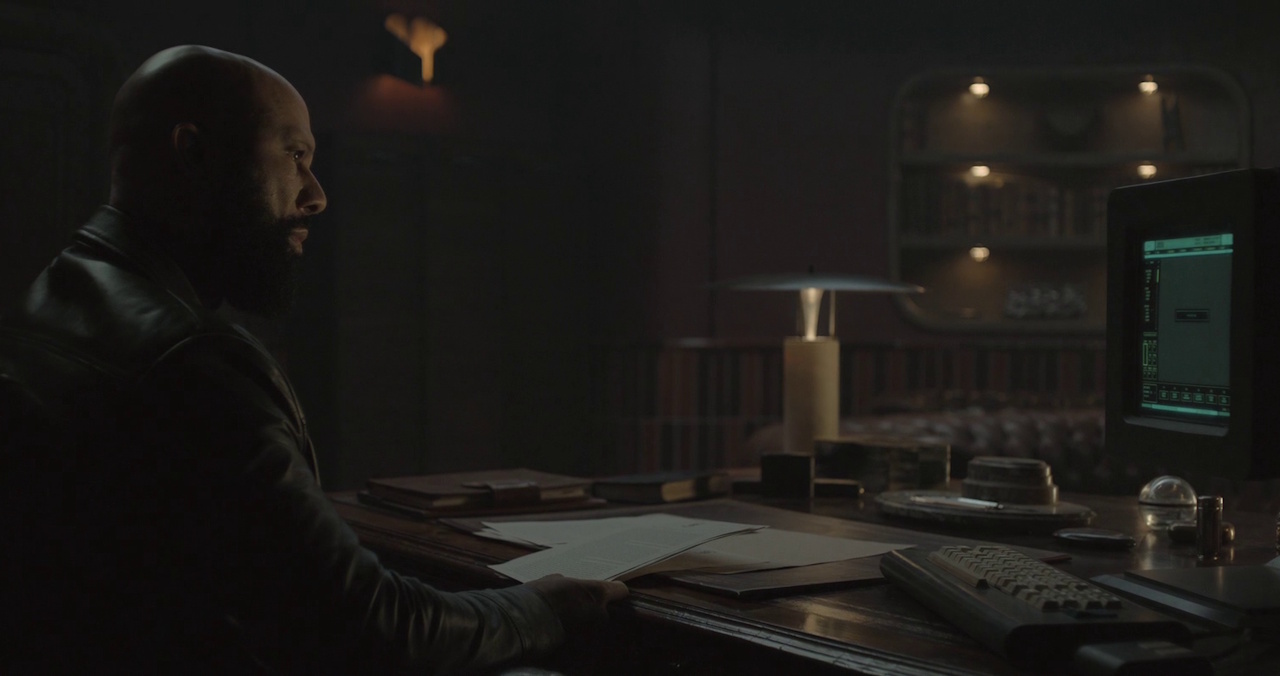
Television Show #5:
Silo
Season 3

Still frame from Silo S2 showing Sims.
Sims.

Silo – like 3 Body Problem above – has been one of the best sci-fi shows of the last few years. And talk about a cliffhanger! Season 2 ended in explosive fashion, and I cannot wait to see what will happen next for Juliette and her friends – in both of the titular silos. It felt like we were getting close to unravelling at least part of the mysteries: who created these silos, why, and why is the air outside deadly to breathe? Some of the characters have the answers already… but we don’t.

Filming for Seasons 3 and 4 of Silo have already wrapped, and I’m hopeful that there won’t be as long of a wait before Season 4 rolls around. In any case, I’m really looking forward to picking up this fun and engaging story again after a long break.

Check out my review of Silo Season 2 by clicking or tapping here.

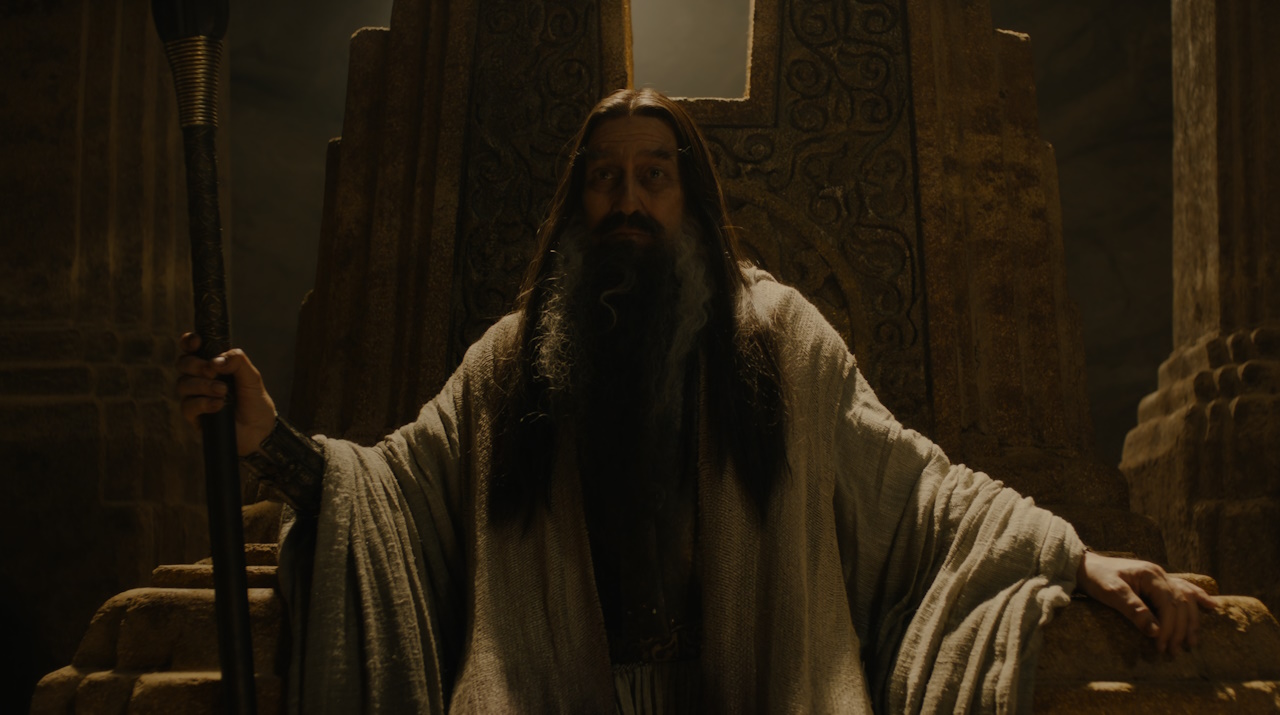
Television Show #6:
The Lord of the Rings: The Rings of Power
Season 3

Still frame from The Rings of Power S2 showing the Dark Wizard.
The mysterious “Dark Wizard.”

I know The Rings of Power hasn’t been to everyone’s taste, and there have been some issues with the series to say the least. But I haven’t hated what I’ve seen so far, even if some storylines are admittedly stronger than others, and I’m definitely curious to see where the action will go next. Season 2 moved key storylines along, and we’re uncovering mysteries, moving characters around, and clearly building up to something big.

I’m hopeful for more of the “bromance” between Elrond the Elf and Durin the Dwarf this time, as I felt that was something Season 2 didn’t give us enough of. And after one character’s identity felt a bit obvious and telegraphed last time, I hope we might get a few more twists and turns this season, or at least story points that don’t feel like they’re spinning their wheels. I first fell in love with Tolkien’s world as a geeky little kid, reading The Hobbit with my dad. Any adventure that takes me back to Middle-earth is one I’m interested in and hopeful for.

Click or tap here to read my review of the show’s second season.

Television Show #7:
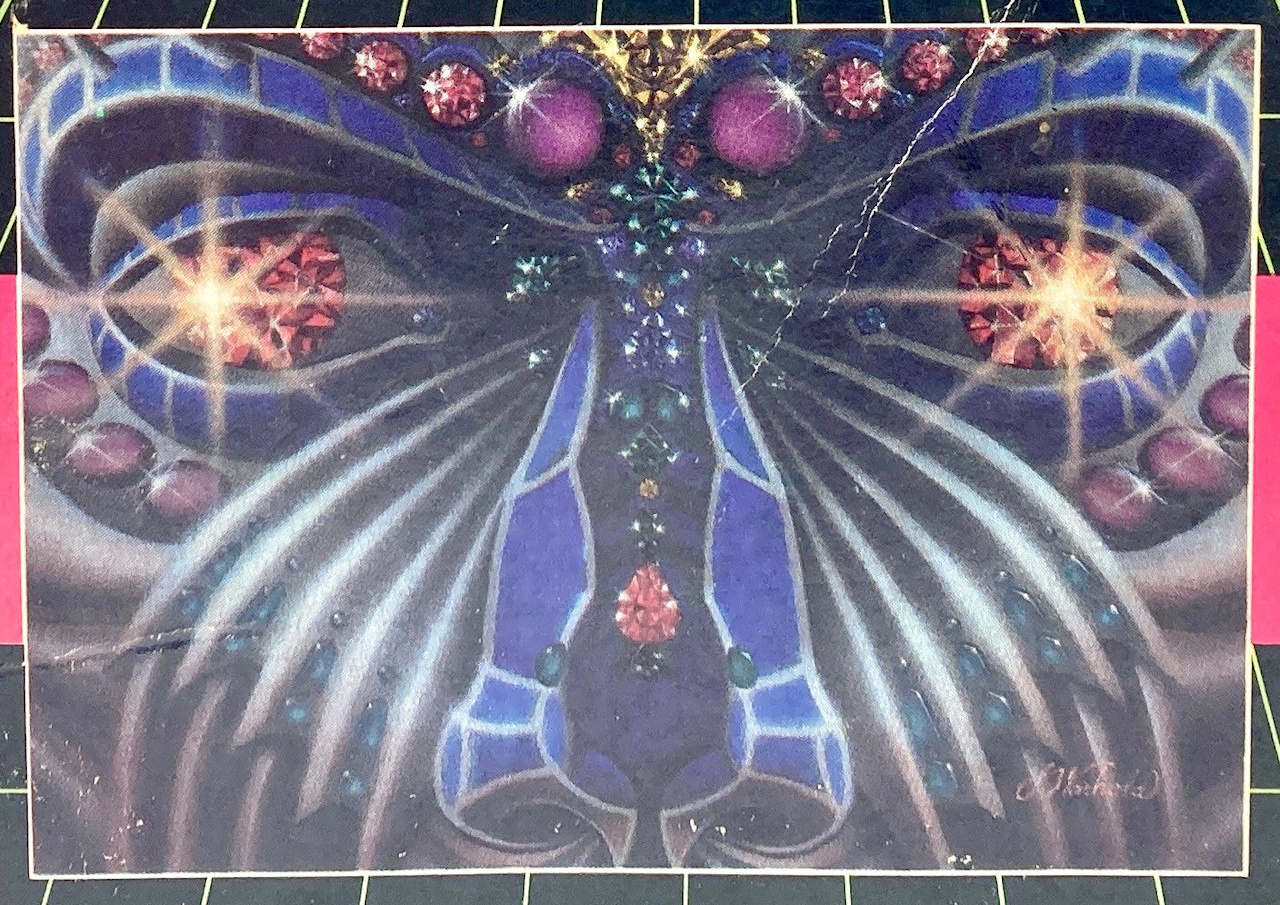
Neuromancer

Crop of the first edition cover of Neuromancer.
The original novel’s cover art.

The 1984 novel Neuromancer is, according to some folks, *the* seminal work of the cyberpunk genre. So this adaptation is a long time in the making, then! The original novel – which, admittedly, I have not read – is hailed as one of the early defining works of what we now call cyberpunk, and is also responsible for popularising the term “hacker.” I’m really curious to see what this adaptation will look like.

As I said above, there aren’t a lot of new sci-fi or fantasy properties to get excited about at the moment, so this adaptation of one of the most important works of its genre could be something fun and different in 2026. At least part of Neuromancer is set in Japan, and filming for the series took place in Tokyo. I’m not sure which streamer this will debut on, though; it was originally slated for Apple TV+, but it’s produced by Skydance Television, which now owns Paramount+. I guess we’ll have to see later in the year.

Television Show #8:
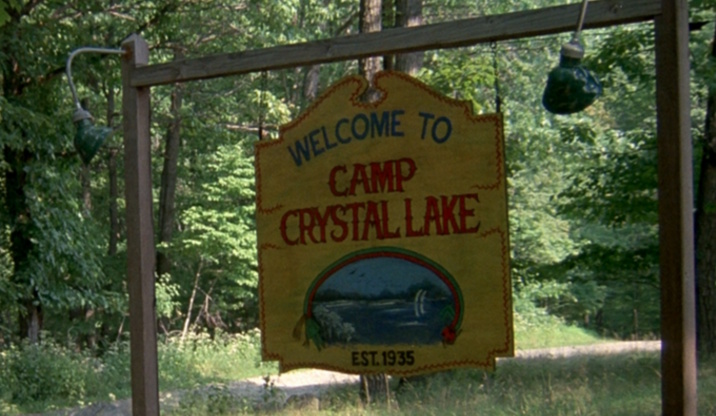
Crystal Lake

Still frame from Friday the 13th showing the Camp Crystal Lake sign.
The original Camp Crystal Lake sign from Friday the 13th.

Based on the film Friday the 13th (and its sequels and spin-offs) comes this prequel. I’m not the world’s biggest Friday the 13th fan, but I thought the first film, at least, was good for what it was. I like the inclusion of Linda Cardellini, formerly of Freaks and Geeks and ER, in a major role, as I’ve always thought she was an underrated performer. And stepping back to before the events of the first film in the series could turn Crystal Lake into an entertaining horror/slasher show.

There are plenty of great horror TV shows, but what we haven’t seen as many of are slasher TV shows; I think there’s an open question as to how well Friday the 13th’s format will work with a longer runtime. Still, I’ll be curious to check out Crystal Lake and see what the series has to offer.

So that’s it!

A render of the number 2026.
What else might lie in store this year?

We’ve talked about eight films, eight games, and eight TV programmes that I’m looking forward to in 2026.

2025 brought us some solid entertainment experiences, and you can click or tap here to check out my annual End-of-Year Awards for some of my personal favourites! I’m cautiously optimistic about 2026’s prospects; there seem to be some interesting new ideas on the horizon, as well as some continuations or expansions of existing franchises to look forward to.

Once again, let me wish you a very Happy New Year! Whatever you’ve got planned for this year, and whatever you might be looking forward to, entertainment-wise, I hope it all goes well for you and yours. Tomorrow, I’ll be making a few predictions for the year’s entertainment landscape, so be sure to join me for that! And later this month, I’ll be checking out the two-part premiere of Starfleet Academy, among other things. See you soon!


All titles discussed above are the copyrights of their respective studio, developer, broadcaster, distributor, publisher, etc. At time of writing, all titles discussed above were scheduled or heavily rumoured to have a 2026 broadcast/release date, but that may change. This article contains the thoughts and opinions of one person only and is not intended to cause any offence.

End-of-Year Awards 2025

A Lord of the Rings-themed spoiler warning.

Spoiler Warning: Beware minor spoilers for some of the productions discussed below.

You know what I find silly? When magazines, websites, and media outlets publish their “best of the year” articles and awards in early December or even November! I mean, at that stage there’s still a month or more of the year left! That’s why, here at Trekking with Dennis, I always publish my End-of-Year Awards at… the end of the year! What a novel concept, eh?

In 2025, I reviewed more films here on the website than in any prior year. But, to tell you the truth, I didn’t watch as many TV programmes or play as many games this year as I think I’ve done in years gone by. There are still more than enough to win some made-up trophies, don’t worry, but there are a few that I originally planned to get around to this year that I just… didn’t. Partly that’s because it’s been a pretty busy year for me, on the whole – you can see more on that by clicking or tapping here! And partly that’s just because I’ve been feeling pretty tired, sometimes, or I just haven’t felt up to starting a brand-new story.

Who will win the ultimate honour of a Trekking with Dennis End-of-Year Award?

As always, a few important caveats.

Firstly, and most importantly, all of this is *subjective, not objective.* If I give an award to a film, game, or TV show that you despise, or if I skip over one of your favourites that’s already won all of the other big awards… that’s okay. There will always be a broad spectrum of opinions on works of media and entertainment, and these are mine – and mine alone. We don’t need to get into a shouting match over a made-up statuette!

Secondly, there are a bunch of popular movies, games, and TV programmes that I didn’t get around to in 2025. For reasons that I hope are obvious, they won’t be entered into consideration for an award. Finally, I might include one or two titles from the tail end of 2024 as well, as I may have only got around to them in 2025.

Alright then! With all of that out of the way, let’s hand out some awards.

🥈 Runner-Up🥈 
Mugthief

Still frame and logo combo from Mugthief on YouTube.

I don’t watch a lot of “gaming content” online, but there are a few content creators I still regularly tune in for. One of those is Mugthief, a YouTube-based video game reviewer and video essayist. I occasionally disagree with his takes, but I like the way he presents his coverage, and he always comes across as fair, even-handed, and not like someone seeking out games to “hate on.” I also appreciate the distinct lack of clickbait in videos, titles, and thumbnails!

There isn’t always a lot to be positive about in gaming, and Mugthief isn’t shy about criticising games and gaming companies when they deserve it. But he can also be passionate and positive about titles he enjoys, which is always great to see. I’ve had fun and learned about a few titles from Mugthief in 2025, and I just wanted to celebrate his channel and his content as the year comes to an end.

🏆 Winner 🏆
Quiet Nerd

Still frame and logo combo from Quiet Nerd on YouTube.

I’m not someone who’s very good at engineering, electricals, or really doing anything hands-on! But I like to live vicariously through others, and YouTuber Quiet Nerd has taken me on some wild adventures with his self-made drivable camper, boat, and more. I’ve really come to enjoy videos about people building things like this – camper vans and caravans have always felt cute and cozy to me, and the idea of building one from scratch just seems like it must be a huge amount of fun. Quiet Nerd is one of the best in the business for that kind of content, in my opinion.

Some of the vehicles Quiet Nerd has built are incredible. Using electric batteries, tracks, steel beams, and a whole lot of knowledge that I do not possess, he’s constructed sturdy, drivable, livable camping vehicles that he then takes on adventures in the wilderness. It’s just a lot of fun. And as someone who doesn’t get out a lot due to my health – let alone go camping – it’s been hugely entertaining to be taken on those adventures with him.

🏆 Winner 🏆
Binging With Babish

Still frame and logo combo from Binging With Babish on YouTube.

I’d unsubscribed from Binging with Babish at least a year ago. The show seemed to have descended into – for want of a better term – slop, with videos like “I tried eating 100 different kinds of ramen!!” replacing the recipes that I’d originally tuned in for. By the end of my time as a subscriber, only Babish collaborator Alvin’s videos were of any interest to me at all, and they were so outnumbered by low-quality, low-effort nonsense that I felt sure I was done.

But in 2025, I was pleasantly surprised to see Binging With Babish make somewhat of a comeback. There’s still slop, but there are once again genuine recipes in the mould of Babish’s earlier content, and I’m glad to see the show’s pivot. Many creative folks get burned out doing the same thing over and over again, and I can empathise with the desire to branch out and try different things. But I’m very pleased to see what I consider to be a return to form from what had been a fairly unique and well-produced web series.

🏆 “Winner” 🏆
inZOI

Promo art for the video game inZOI.

After the disappointing cancellation of Life By You about a year ago, I was still hopeful that a genuine competitor or “spiritual successor” to The Sims series might be in the offing. The Sims 4 is catastrophically over-monetised, and Electronic Arts has shown no signs of developing a new entry in the series, either. And all of that was before the EA buyout situation that we discussed earlier in the year. So I had hopes that a game like inZOI might be the challenger that The Sims has needed for a long time – as well as a fantastic game in its own right.

But, as you may know by now, inZOI launched into early access far too early, in a near-unplayable state. Basic game features were missing, and I just got the impression that publisher Krafton was pushing the game’s developers too hard before inZOI was even close to being ready. Early access is hit-and-miss, and you have to understand that when you jump in. And I get that, believe me! But even for an early access title, inZOI felt horribly unready, and needed at least another year-plus of development time. I hope that the game’s difficult early access release hasn’t damaged its reputation too much ahead of its full launch.

🏆 “Winner” 🏆
The Oblivion Remaster’s “Deluxe Edition”

DLC "horse armour" for the deluxe edition of TES IV: Oblivion.

Remember Bethesda’s infamous “horse armour” debacle in 2006? Well, how would you like to pay extra money to Bethesda, again, for *more* horse armour in the remastered version of Oblivion? Because that’s what the shitty “Deluxe” version of the Oblivion remaster gets you. Paid horse armour. In Oblivion. In 2025. As I said back in June: piss off, Bethesda.

If this was meant to be a joke, I didn’t find it funny. If it was a freebie, a little nod-and-wink to longtime fans to say “hey, wasn’t this silly back in the day?” then sure. Add it in as a free DLC and we can all chuckle to ourselves about how Bethesda’s greed led directly to paid skins and other crappy DLC in single-player games. But as a *paid* feature in the Oblivion remaster? I was shocked at how brazenly Todd Howard and Bethesda were just taking the piss.

🏆 Winner 🏆
No Man’s Sky: Voyagers

Promo image for No Man's Sky: Voyagers DLC.

I didn’t play very much No Man’s Sky this year, but I loved what I saw of Voyagers. Hello Games has added almost a decade’s worth of content to No Man’s Sky completely for free – making a mockery of companies like Bethesda who want to charge for every weapon skin, outfit, and even individual quests in games like Starfield. And Voyagers is the biggest and most expansive No Man’s Sky DLC to date, introducing ship-building, among other features.

At this stage, No Man’s Sky is basically what I hoped Starfield could have been back in 2023. The seamless exploration, the ship- and base-building, and the sheer sense of *scale* that Starfield lacked are all present here. Maybe in 2026 I’ll jump back in and really get stuck into it! I know it’s a bit of a “hot take,” but I felt the launch version of No Man’s Sky was decent for what it was. But comparing that version to this one? It’s literally an entirely new game. If you missed it, or you wrote off No Man’s Sky after launch… fire it up again. I really don’t think you’ll regret it.

🏆 “Winner” 🏆
Microsoft and Xbox

Photo of Phil Spencer announcing the Xbox Series consoles.

In 2025, Microsoft and Xbox hiked the prices of their consoles. Twice. But even then, I’d still have said that an Xbox Series S and a Game Pass subscription were a good-value way to get started with current-gen gaming. And then what did Microsoft do? Hiked up the price of Game Pass by a massive amount. On PC, Game Pass went up by 70% in the span of thirteen months. And on console, the price of the top tier of Game Pass – which is now the only way to get same-day releases of big titles – has basically doubled in just over a year.

As I said at the time, the subscription model is *a perfect fit* for gaming. And Microsoft, until now, has had the best service in town. But no one should accept price hikes of 50%, 70%, or more – and that’s why so many people went to cancel their Game Pass subscriptions that the website crashed. I cancelled Game Pass this year, and I doubt I’ll pick it up again. At these prices, it ain’t worth it. And with Microsoft’s consoles failing… Game Pass was all they had.

🏆 “Winner” 🏆
Nintendo

Still frame from the Nintendo Switch 2 Direct broadcast showing three of Nintendo's executives.

For what it is, and considering which games are available for it, Nintendo’s Switch 2 console is overpriced. Nintendo Switch 2 games, at £75 or $80, are also overpriced – and worse, this threatens to normalise the second rise in the standard price of video games in less than five years, with other publishers now starting to follow suit. Nintendo is still embroiled in a frivolous lawsuit against Pokémon competitor Palworld and its developers. And, on top of all of that, Nintendo has tried to patent vaguely-defined in-game systems and mechanics, including the ability to have summonable allies fight alongside you in battles.

Nintendo’s well-trained legion of super-fans may not like to hear it, but Nintendo is an ugly, greedy, predatory corporation that behaves no differently from Ubisoft, Electronic Arts, Microsoft, and others in the industry. In fact, in some ways, Nintendo is *worse* than all of them, suing competitors when it feels a game is doing well, failing to innovate and move with the times, and just behaving in a horribly anti-consumer manner. I had hopes for both the Switch 2 and Mario Kart World… but Nintendo was just awful in 2025, and left me very disappointed.

🏆 Winner 🏆
Dynasty Warriors: Origins

Screenshot of Dynasty Warriors: Origins (photo mode) showing the protagonist fighting a horde of enemies.

I had a blast playing Dynasty Warriors 2 with a friend a long time ago, but that had been my only real exposure to this long-running series. Origins hadn’t been on my radar at the start of the year, but something in the game’s marketing material just… called out to me, I guess. And I felt I needed to give the game a shot. I’m so very glad I did, because I had a blast with this game and its fantastic soundtrack!

I’m someone who usually plays games for their stories, with gameplay being a secondary consideration much of the time. But Dynasty Warriors: Origins was just plain *fun* to get stuck into, with hordes of enemies to slice through and bosses to whittle down. The game’s incredible soundtrack also feels like a throwback, with up-tempo rock and electronic-inspired music that’s obviously totally anachronistic to its ancient China-inspired setting. But I adored it, and I just had a wonderful time playing this game.

🏆 Winner 🏆
Sonic Racing: CrossWorlds

Promo art for Sonic Racing CrossWorlds (inc. logo)

Sonic Racing: CrossWorlds is a fantastic kart-racer. It was ballsy of Sega to release it just a few weeks after Mario Kart World… but I think it’s fair to say that the risk paid off spectacularly, because this is genuinely one of the best arcade racing games I’ve played in the last few years. Its signature “CrossWorlds” mechanic guarantees that every race is going to be different – and gives you a reason to keep pushing to stay in the lead. Obviously I can’t compare it directly to a game I haven’t played, but I believe CrossWorlds would’ve given Mario Kart World a real run for its money if I’d picked up a Switch 2 this year.

There are some fun additions to CrossWorlds, bringing characters and settings from Minecraft and SpongeBob to the racetrack, and there’s more to come from the game in 2026, with new inclusions planned. The racing is fast-paced and fun, items add a lot of chaos to the game, and the CrossWorlds idea shakes up every single race and keeps things from feeling boring. All in all, a fantastic kart racer.

🏆 Winner 🏆
Civilization VII

Screenshot of Civilization VII (Civ 7) showing a Medjay unit near the Grand Canyon wonder.

This is somewhat of a reluctant award, to tell you the truth. Civilization VII is good, and it’s getting better now that we’re almost eleven months post-launch. But Civ VII is not as good as I wanted it to be or hoped it would be, and it takes this award basically by default. I want to see many more improvements to the game in 2026, and I hope I won’t come to regret giving the game this award by this time next year if they don’t come.

That being said, Civilization VII is my most-played game of 2025, and it would feel wrong not to at least acknowledge that achievement with an award. There are things that I enjoy about this game, and I don’t think it’s the total failure or dumpster fire that some reviewers have tried to claim. There are interesting ideas in the mix, some really fantastic graphics, and a good mix of new civilisations and leaders to play with. But the game is in need of a lot more work, and was arguably released too early. Perhaps in six or twelve months, it will truly live up to its potential.

🏆 “Winner” 🏆
Nintendo Switch 2: Welcome Tour

Promo graphic for Nintendo Switch 2: Welcome Tour.

Let’s get something straight: if Welcome Tour had been the *free* pack-in that it was clearly supposed to be, it wouldn’t be anywhere near this award. But by choosing to sell this non-game, this overblown manual, for $10/£8, Nintendo invited it to compete with actual, bona fide *games*. See, I don’t hate Welcome Tour for what it is. As a concept, a basic programme that explains some of the features of a brand-new console is not a bad idea. The Switch 2 – being so derivative and similar to the original Switch – arguably didn’t need this kind of software, but that’s somewhat beside the point. An interactive manual is a fun concept.

But something like that *needs* to be included with the console for free. Welcome Tour isn’t a game. It isn’t even a tech demo – it’s an interactive manual which goes over, in brief, what the console can do and how its controls operate. Nintendo used to be the company that gave away free copies of Tetris with the Game Boy, and that created Wii Sports as a free pack-in title to show off the Wii’s motion controls. And now? They’re the greedy, predatory company that tries to trick their own fans into buying a glorified manual. I don’t hate Welcome Tour – I hate what it stands for and what it says about how far Nintendo has fallen.

🏆 Winner 🏆
Indika

Screenshot of Indika showing the title character walking through a snowy village.

Indika was released in 2024, but I missed it when it was new. It can’t be entered into contention for “game of the year” because it didn’t come out this year, but I was gripped by Indika when I played it. The game has an intense story set in Tsarist Russia, following the story of a nun as she undertakes a harrowing journey. For an indie title made by a small team, the game was absolutely fantastic, and I went on an intense and emotional journey with Indika that really hit close to home.

Mechanically, Indika brought a lot to the table, too. In addition to being a “walking simulator,” there were quick-time events, and several beautiful pixel art sections, including a 2D platformer, a racing mini-game, and even a rhythm game of sorts (that I was terrible at!) Indika also had some beautiful and bleak landscapes that really captured the look and feel of the era and place in which it was set. Just a thoroughly fantastic indie game, well worth playing.

🥈 Runner-Up🥈 
Mafia: The Old Country

Promotional screenshot for Mafia: The Old Country.

Someone online said that Mafia: The Old Country “could’ve been a movie,” intending for that to be a criticism. I agree… only, I mean it in the best way possible! For decades, I’ve sought out games with fantastic stories, great world-building, and engaging characters, and that’s exactly what this prequel to the long-running Mafia series delivers. So yeah, it could have been a movie!

Mafia: The Old Country was recently given a free update which opens up its beautiful and detailed world quite a bit, making it feel less linear and closer to the open-world adventure that I think some folks were hoping for. Gameplay isn’t ground-breaking, but it’s fun, competent, and tightly-managed, keeping Enzo’s story on the rails. I had a good time with the game, and I thoroughly enjoyed stepping back in time to The Old Country’s neat recreation of Sicily.

🏆 Winner 🏆
South of Midnight

Screenshot from South of Midnight showing Hazel with a waypoint.

South of Midnight is a truly wonderful game. An adventure title with some difficult boss fights and fun platforming, South of Midnight also had a truly engaging story as protagonist Hazel sets off on a quest to find her missing mother. The world has a dark “Southern Gothic” style, and draws inspiration from the mythology of the Mississippi Delta region and African American folklore. The story was emotional, and Hazel made for a fun and relatable protagonist.

South of Midnight weaved its gameplay and story together with practised ease, ensuring that Hazel’s growing powers never felt out-of-place, and every level or fight was perfectly attuned to her new skills. Crouton, her sidekick, was adorable, and though the story was dark in places, I had a whale of a time with it. The game’s art style was beautiful, too, with its much-hyped stop-motion effect being especially notable in cut-scenes. A thoroughly fantastic adventure that I’m happy to crown my “game of the year.”

🏆 Winner 🏆
KPop Demon Hunters

Still frame from KPop Demon Hunters (2025) showing Huntr/x (Zoey, Rumi, and Mira) singing.

I cannot stop listening to Golden and This Is What It Sounds Like! Those two songs have been living rent-free in my head for *months,* and I’m not even mad about it. KPop Demon Hunters was a fantastic film, and its soundtrack was exceptional. I’ve never considered myself a fan of K-pop, nor had I listened to any Korean songs since Gangnam Style a few years ago… but these songs absolutely stunned me with how good they were. I’m admittedly not a music critic, but I know what I like when I hear it!

I bought the KPop Demon Hunters soundtrack, and I’m pretty sure I’m single-handedly responsible for Golden topping the charts here in the UK, as I was streaming the track so often! I know the film’s meant for kids, but come on! These songs are outstanding, and I really can’t find a bad one amongst them. The sooner we get a sequel to this fantastic film, the better!

🏆 Winner 🏆
KPop Demon Hunters

Still frame from KPop Demon Hunters (2025) showing Derpy the tiger and a plant pot.

A very rare two-for-two this year, as KPop Demon Hunters also nabs the award for best film! As I was saying, the film and its soundtrack are both absolutely fantastic, with Sony Pictures Animation and Netflix absolutely wiping the floor with Disney’s sequels and live-action adaptations. Who knew that making a good, original film with a fun cast of characters, a unique setting, and a great soundtrack would be… a really good idea? Not Disney, obviously.

KPop Demon Hunters had an easy-to-follow story that was surprisingly deep and emotional. Its central characters kept things grounded, even amidst a story about popstars saving the world from demons, which is no mean feat. I found myself getting thoroughly invested in the story and its great cast of characters, and KPop Demon Hunters is the first film in a long time that I’ve voluntarily watched more than once – and not just to take notes for my review! I returned to the film several times this autumn and winter, and I daresay I’ll watch it again in 2026, too.

🥈 ”Runner-Up”🥈 
Earth Abides

Promo image for Earth Abides showing the main character sitting at a table.

I saw some ads for Earth Abides on social media earlier in the year, and the post-apocalyptic miniseries seemed like it would be worth a look. But I bounced off it hard after about three episodes. Earth Abides just couldn’t decide what kind of show it wanted to be: a post-apocalyptic tale of survival and mystery, or a dense philosophical take on the structure of civilisation. It ended up being neither, overladen with tired tropes of the post-apocalypse, and just… boring.

The protagonist (whose name I’ve already forgotten) wakes up from a coma to find the world has collapsed. He runs to a supermarket – where the lights are still on and cars are still in the parking lot – to stock up on supplies. He goes to Vegas, where he meets a couple of other survivors who are debauching themselves before the last of the power runs out. And… I’ve seen this all before, done way better, in other shows. Earth Abides was based on a novel, and maybe the novel is better than the show turned out to be.

🏆 “Winner” 🏆
King and Conqueror

Still frame from King & Conqueror showing Edward and Lady Emma.

I don’t necessarily think that King & Conqueror was significantly worse than Earth Abides. I mean, I actually made it to the end of this one! But in terms of raw, unbridled disappointment… this is by far the worst I experienced in 2025. I had really high hopes for this big-budget retelling of a story all British kids learn about in school: the Norman Conquest of 1066. But what I got instead was a Game of Thrones-ified, over-dramatised, totally fictitious let-down.

If you don’t care about historical accuracy, maybe King & Conqueror works. But when you have such blatant silliness as William and Harold wrestling half-nude in the mud, and total transformations of major historical figures like Harold’s brother Tostig, Edward the Confessor, and Edward’s wife… I can’t forgive it. King & Conqueror should have kept closer to the real story, because there’s more than enough excitement and drama there. This fictional account may as well have been called something else, and dropped the pretence of “real history” entirely. What a disappointment.

🏆 Winner 🏆
Phineas and Ferb
Season 5

Still frame from the premiere of Phineas and Ferb Season 5 showing most of the main characters.

I was eagerly awaiting Phineas and Ferb’s revival this year, and in true summer vacation style, it arrived in June! I felt that the season – which isn’t totally complete, as there are still three or four episodes remaining – was pretty good, on the whole. Perhaps it was closer in quality, much of the time, to Season 4 of the original run than to Seasons 1-3, but there were a good mix of classic adventures and new stories.

A revival of any long-running show after a long break has to do more than just be “more of the same,” and Phineas and Ferb’s writers found some great justifications for bringing the series back. New character groupings and new storylines went a long way to keeping things feeling fresh, but there were also plenty of classic adventures, inventions, and evil schemes which harkened back to the show’s original run. All in all, a solid revival.

🏆 Winner 🏆
Zero Day

Still frame from Zero Day showing George on the phone.

Zero Day was good fun for what it was. I think it leaned a bit more on the political side of things than I’d been expecting at first, and there was a lot of “post-9/11” security stuff that, arguably, feels a bit outdated in 2025. But Robert De Niro put in a spectacular performance as the conflicted ex-President, and the series shone a light on the vulnerability of society in general to this kind of cyber attack. I think the show’s focus was a bit split, in places: it wanted to be a kind of “dark mirror,” warning America about the dangers of giving unchecked power to agencies and political figures. But parts of it, with a focus on a “good man doing bad things for virtuous reasons,” felt a bit… flag-wavey.

That being said, I binge-watched the show in a couple of days, and I had a good time with it. The main character was complex and believable, the threats it depicts seem totally plausible out here in the real world, and I’m always a sucker for a good political thriller.

🥈 Runner-Up🥈 
Alien: Earth

Still frame from Alien: Earth showing a Xenomorph.

Alien: Earth feels like a great foundation to build on. It took the Alien franchise in a bit of a different direction while remaining true to the original film’s themes of out-of-control corporate greed and the very alien nature of extraterrestrial life. The show’s best episode by far was In Space, No One… which managed to recapture much of the tension and fear factor of 1979’s Alien in a way that practically none of the sequels, with their more action-heavy tone, managed to.

Alien: Earth also did something that the Alien franchise has desperately needed to do for a long time: introduced new and different extraterrestrial creatures. The eyeball alien in particular could be a massive part of the series going forward, and with the Xenomorph kind of being a one-trick pony, there was a sense that Alien as a whole might be beginning to run out of steam before Alien: Earth came along. As I said in my review, I’d rank Alien: Earth only just behind the original film, and well ahead of any of the sequels and spin-offs.

🏆 Winner 🏆
Star Trek: Strange New Worlds
Season 3

Still frame from Star Trek: Strange New Worlds (3x10) showing Pike and the crew on the bridge.

Season 3 is arguably not Strange New Worlds’ best. But there are some fantastic episodes in the mix, some great standalone and semi-standalone stories, and some wonderful moments of characterisation, too. Strange New Worlds has been, for me, the absolute high-water mark of modern Star Trek, and I was so disappointed earlier in 2025 when we learned – prematurely – that the series will end after a truncated fifth season. There should still be so many stories to tell with Captain Pike and the crew… ending it so soon feels positively criminal!

But I had a fantastic time with the season as a whole. Not every episode was perfect, but the good ones outnumbered the bad, and even the “worst” of the season still had a lot to offer. Strange New Worlds remains a largely episodic project, with the Enterprise able to warp away to a new destination – and a new kind of adventure – every week. That format suits Star Trek so perfectly, and it feels like the very best kind of throwback to the franchise’s heyday.

🏆 Winner 🏆
Terrarium

Still frame from Star Trek SNW Terrarium (3x08) showing the control panel of a shuttlecraft.

Terrarium was the “Ortegas episode” that fans had been clamouring for for three seasons! And the Enterprise’s pilot got a genuinely fantastic and emotional outing that really made the wait more than worth it. After taking on a solo mission aboard a shuttlecraft, Ortegas finds herself crash-landing on a desolate world, and is forced to survive alongside someone she couldn’t communicate with – and might’ve considered an enemy. There were echoes of stories like The Enemy from The Next Generation, and the episode isn’t just one of Strange New Worlds’ best – it’s one of Star Trek’s best.

Terrarium also packs an emotional punch! There was a callback to The Original Series that, while potentially interesting, didn’t actually add a lot, and felt a little unnecessary. But all things considered, this was absolutely one of the best things I watched in all of 2025. It’s an episode that I’d show to even the most aggressive haters of “nu-Trek,” to prove the point that modern Star Trek can, and does, still get it right.

Photo from the 3rd Academy Awards (1930) showing presenter Jack Cunningham and Best Adapted Screenplay winner Frances Cunningham.
We’ve handed out some imaginary statuettes!

So there you have it! The End-of-Year Awards have been distributed for another year, and now there are just a few hours left to go until we’ll be ringing in 2026. Whatever you’re up to tonight, I hope you have a great time! And I hope my silly little awards show has been a bit of fun, too. It’s always nice, at this time of year, to take a step back and think about some of the highlights of the year as we prepare to turn over the calendar.

The website isn’t going anywhere in 2026. And in the next couple of days, I’ll be sharing some of my predictions for the new year, as well as looking ahead to some of the TV programmes, video games, and films that I’m most looking forward to. So please join me here on the website for some of that!

So all that’s left to say, really, is this: Happy New Year! Thanks for showing up this year, and I hope to see you again in 2026, where I’ll still be geeking out about gaming, Star Trek, and so much more!


All titles discussed above are the copyrights of their respective developers, studios, broadcasters, distributors, etc. This article contains the thoughts and opinions of one person only and is not intended to cause any offence.


You can find individual reviews, articles, and essays about some of these award-winning titles by following the links below:

Starfleet Academy: Meet the Cadets

A Star Trek-themed spoiler warning.

Spoiler Warning: There are spoilers ahead for Star Trek: Starfleet Academy Season 1. Spoilers are also present for the following Star Trek productions: The Next Generation, Discovery, and Section 31.

I promised you last time that I was sharing my “final” preview of Starfleet Academy ahead of its premiere, which is now just a couple of weeks away. But since then, we’ve learned a little more about some of the cadets thanks to Skydance/Paramount’s marketing campaign. I have to say that, on the whole, Starfleet Academy hasn’t gotten a particularly impressive marketing push so far, but there’s still a little time left for that to change. I certainly hope that, even if the show isn’t “my thing,” it’ll manage to reach its teen/young adult target audience in a big way. Star Trek definitely needs new viewers, and Starfleet Academy could be the last show of the current streaming era.

But that’s enough about that for now! I wanted to look at the main cadet characters in turn, and share my thoughts on how they seem and what could lie in store for them across the show’s first few episodes. I’m basing all of this on the trailers, interviews and comments from the actors and producers, and the show’s general marketing material. I do not have any “insider information,” and anything I say about these characters or where their storylines could go is speculation, and nothing more!

Promo images highlighting the main Star Trek: Starfleet Academy cadet characters; compilation.
Let’s take a look at the cadets.

It also goes without saying that all of this is *subjective, not objective,* so if you think I’ve missed the point, got it all wrong, or you just hate my take… that’s okay! There’s plenty of room in the Star Trek fan community for polite discussion and differences of opinion, and all I’m doing is offering my take on these characters at this very early stage. I could be wide of the mark or completely wrong, but I hope it’ll be interesting and perhaps a bit of fun to talk about Starfleet Academy once more before the series hits our screens.

I’ll be looking at the cadet characters only, not the senior officers, villains, or supporting cast. We know several of those already, and I don’t really have a lot to say about the likes of Captain Ake or Nus Braka that I haven’t already said across my other preview articles.

So with all of that out of the way, let’s get started!

Promo image of the Star Trek: Starfleet Academy bridge.
The bridge of the USS Athena.

First, a general point. This is something I hadn’t considered until I started writing this piece, but I can’t shake the feeling at this preliminary stage that one of these characters is destined to be killed off – perhaps as early as the first or second episode. We saw this in Section 31, where the Deltan character Melle was a big part of the film’s marketing campaign, but only lasted a couple of minutes and got a grand total of one or two lines before being vaporised.

It can be a good ploy for a series that plans to go all-in on action, mystery, and tension. By setting up a group of characters, only to kill off one of them at an early stage, it raises the stakes in a pretty big way. And with these characters all being brand-new, it leaves us as the audience with the impression that *no one* is safe; that Nus Braka and his band of pirates(?) could attack at any moment, and our favourite cadet could be next on the chopping-block.

Paul Giamatti as Nus Braka in a still from the second Star Trek: Starfleet Academy promo clip.
Nus Braka.

Another reason why I feel this could be possible is that there are a couple of cadets who feel kinda… samey. Genesis and Darem are both on the command track, both want to be captain, and both seem to come from a demanding family background. Then Darem and Caleb almost seem interchangeable to such an extent that I forgot who was who when watching the trailers and reading their bios. They are, obviously, distinct characters… but Darem in particular just doesn’t seem to have as much to say as some of the others.

So could an early death be on the agenda? And if so, will it succeed at raising the stakes? For what it’s worth, I think that basic idea wasn’t the worst part of Section 31, and there was shock value in seeing a hyped-up main character killed off within the first few minutes. Whether it would work as well in Starfleet Academy is unclear, and if I’m already potentially expecting something like that… maybe it won’t land as hard. But I’ll be curious, at least, to see if I’m even close to being right!

Still frame from the Star Trek: Starfleet Academy trailer showing the main cadets.
Will everyone survive the opening few episodes?

Caleb, to me, seems like he’s being set up as kind of a deuteragonist, along with Captain Ake. He certainly seems to be the most-developed of the cadets narratively, and the character who seems to have the biggest connection to the show’s overarching story – barring any surprises from the others, that is. Caleb seems to be being positioned as the “main” cadet, perhaps even taking on a role not dissimilar to Michael Burnham in Discovery. Burnham was that show’s principal character, and it was her development, relationships, and story that was in focus a lot of the time. Starfleet Academy could be doing something similar with Caleb.

Of all the cadets, Caleb seems like the one most impacted by the aftermath of the Burn, too, and that’s something I hope Starfleet Academy will be able to make more of than Discovery ever did. I wrote a while ago that Discovery’s “post-apocalyptic” setting didn’t really stick the landing for me, and a big part of why is because of how quickly the Burn, its impact, and its aftermath were ignored after Season 3. Most characters we met and most storylines we saw either made the barest of references to the Burn or sidelined it entirely, and that just wasn’t very satisfying.

Still frame from the Star trek: Starfleet Academy trailer showing Caleb being rescued.
How was Caleb’s life influenced by the Burn and its aftermath?

Caleb, coming from a difficult background outside of the rump Federation, seems to have experienced the worst of the post-Burn galaxy firsthand, presumably prior to the discovery of the dilithium nebula and the restoration of much of Starfleet. That backstory is genuinely interesting, and through Caleb’s eyes we might get to see a bit more of what the galaxy looked like before Burnham and the USS Discovery began to put things right.

This could also tie into Caleb’s “undeclared” speciality at the Academy. I picked up on this a while ago, when all of the other cadets had their specialities (or majors, if you prefer) mentioned when we were introduced to them. “Undeclared” doesn’t necessarily mean that Caleb hasn’t yet chosen a speciality – command, science, medical, engineering, and so on. It *could* mean that he knows what track he’s on, but for some reason he can’t make it public. That could indicate he’s on some kind of security or intelligence course, which could be interesting.

Still frame from a Star Trek: Starfleet Academy promo clip showing Caleb.
Caleb.

If so, would that connect to his backstory as an orphan with a difficult upbringing? Could Caleb have an agenda for enrolling at the Academy – perhaps hoping to use his new Starfleet security and military skills to help the people he left behind? That could be interesting – all of the other cadets are there by choice, but maybe Caleb, who seemed to have his arm twisted into enrolling by Captain Ake, has a hidden agenda. Given modern Star Trek’s love for Section 31, Caleb’s “undeclared” major could also connect with that.

Romantically, Caleb seems to be linked with Tarima, a character we know very little about and who may not be as big a part of the show. A romantic entanglement definitely fits the whole “teen drama” thing that Starfleet Academy is going for, and if anyone was going to get a (presumably) rocky or complex romantic relationship, it makes sense that it would be the main cadet! I expect we’ll see something comparable to Burnham’s relationship with Booker in Discovery, but with more of a young adult/teen flavour.

Still frame from the Star trek: Starfleet Academy trailer showing Tarima and Caleb holding hands.
A romantic entanglement…

Tarima, who isn’t included as one of the “main” cadets in most of the show’s pre-release marketing, is described as being a “daughter of the president of Betazed,” which opens up a few interesting possibilities. There’s a remote chance, perhaps, that we’ll get a link back to Lwaxana and Deanna Troi, or just a reference to those characters. We could learn more about the Betazoids – I never knew, until now, that Betazed was a republic. Lwaxana’s very regal-sounding titles (Daughter of the Fifth House, Holder of the Sacred Chalice of Rixx, Heir to the Holy Rings of Betazed) always felt like they implied, to me, some kind of aristocracy at the very least, if not a theocratic or monarchical system.

Having a Betazoid character also opens up telepathy and empathic storylines, with Tarima perhaps able to “read” people the way Deanna Troi did in The Next Generation. She might be able to sense Nus Braka’s approach, for instance, or help guide Caleb (and others) with their own fears and feelings. Tarima says at one point that she’s “not like other Betazoids,” which is interesting, and I also noted that she isn’t wearing a typical cadet’s uniform in any images or clips we’ve seen of her so far, so she may not be a full cadet. A Betazoid character is also a nice callback to The Next Generation era, and even if Tarima isn’t a major player in the series, her inclusion is one of those threads of continuity that helps keep Star Trek together.

Still frame from a Starfleet Academy promo clip showing Tarima.
Tarima says she’s “not like other Betazoids.”

Sam (or SAM, in all caps?) confuses me. Why go to all the trouble of creating a sentient hologram – an A.I. – only to make them… go to school? I hope we’ll learn what the point of that was; previous holograms, from the Doctor to Professor Moriarty, emerge fully-formed, or at least equipped with the knowledge and skills they need to perform the roles they’re assigned. The Doctor, in Voyager, wasn’t created as a kid and forced to go to medical school; the whole point of making an A.I. (in Star Trek as well as in the real world) is that they can perform tasks humans can’t or supplement human skills. So… why create a holographic teenager and send her to school?

Also from Sam’s backstory we learned something a bit… I dunno. Disappointing, I guess. Sam will be the first-ever hologram to attend Starfleet Academy. But this is coming more than eight centuries after the Doctor first began to establish the idea of holograms having rights, and after Picard and the crew of La Sirena overturned a ban on synthetic life-forms. For so much time to have passed with no holograms being admitted to the Academy feels like it’s something that requires an explanation.

Still frame from a Starfleet Academy promo clip showing Sam.
Sam… or SAM.

One thing that interests me about Sam – and this could also apply to the Doctor, too – is how there’s the possibility to look at the development of artificial intelligence through Star Trek’s sci-fi lens. As far back as The Original Series, with episodes like The Ultimate Computer, the Star Trek franchise tackled the growth of automation, of A.I. “misalignment,” and through characters like Data and the Doctor, the idea of synthetic life as being akin to organic life. Sam’s inclusion in the series could set up similar storylines.

With A.I. being such a big deal at the moment – generating a ton of money, a ton of interest, and a ton of backlash – you could have hardly picked a better time to tell a story about a young, “newborn” A.I. system coming online, and having to learn how to interact with humans and other organic beings. There’s the potential, at least, for some very interesting allegorical storytelling through this character. And, as I said before when we first learned that Sam is a hologram, her interactions with the Doctor will be of particular interest.

Still frame from the Starfleet Academy trailer showing SAM and the Doctor.
Sam with the Doctor.

Jay-Den is an interesting name for a Klingon, isn’t it? Is that meant to be a joke; a silly reference to the name of someone on the production team? Or could there be more to the idea of a Klingon having a human-inspired first name? As far as I know, Jay-Den is a full Klingon – not like Nus Braka or Lura Thok, who are partial Klingons with other ancestry. And he’s also attending Starfleet Academy – a traditionally human-centric school based on the human homeworld. Is his name a clue to some kind of human ancestry or human-supporting Klingon faction, perhaps?

One thing that disappointed me after Discovery shot forwards in time was the lack of attention paid to the state of the galaxy at large. There are several major factions that we met across Star Trek’s history who were never even mentioned, leaving it totally unclear whether they even still existed as independent powers. The Klingon Empire was first amongst them. It seems, thanks to Jay-Den’s role in Starfleet Academy, that there’s the potential to learn a lot more about the Klingons in this era, and that can only be a good thing. It’s also interesting to note, in a time period populated by a lot of hybrid characters who are half-one species, half-another, that Jay-Den appears to be a full Klingon.

Still frame from the Starfleet Academy trailer showing Jay-Den Kraag sitting in a window.
Jay-Den aboard the USS Athena.

My two biggest questions would be whether the Klingon Empire eventually joined or merged into the Federation, or whether it remained an independent power. And secondly, what happened to the Klingons – independent or Federation members – during and after the Burn? One storyline that could have been interesting in Discovery, that the show never even attempted to tackle, would have been the reaction of other interstellar powers to the Federation being the source – and arguably the *cause* – of the Burn. It was a Federation member’s ship, operating under Starfleet orders, that was the epicentre of the Burn, and a Federation citizen who (unknowingly) instigated it. How would the Klingon Empire react to that information?

And more broadly, what happened to the Klingons after the Burn? Given that we didn’t see a single Klingon in Discovery, we could assume that they weren’t full Federation members, right? But then… how is Jay-Den a Starfleet cadet? Would Starfleet really give priority to a non-Federation citizen right as the Academy re-opens, when surely there would be millions of Federation citizens who’d want to apply? Those are interesting ideas that this character could explore. At the very least, the status of the Klingons, their Empire, and their possible Federation membership will all be points that Jay-Den’s storylines could touch on.

Still from a behind-the-scenes promo clip for Star Trek: Starfleet Academy showing Karim Diané's uniform test.
Actor Karim Diané during a costume test.

Genesis is the cadet who left the least significant impression on me. The only thing I put in my notes about her is that she’s the daughter of a Starfleet admiral, and she’s on the command track, which seems to lead her to butt heads with Darem at one point. The only Starfleet admiral we’ve met and who we know has a role in the series is Vance – and we know, from Discovery, that he has a wife and daughter. Those characters looked human when we caught a glimpse of them, so unless there’s a retcon, I doubt Genesis is meant to be connected to Admiral Vance… but it’s not impossible, I guess.

Through Genesis, we could get a story about living in the shadow of an illustrious parent – something a *lot* of Hollywood writers, producers, and performers have experience with! We could get a story about overcoming those connections, perhaps with Genesis trying to make a name for herself on her own terms, or having to combat the idea that she is, for want of another term, a “nepo baby.” Maybe we’ll even learn that her admiral parent pulled some strings to get her into the Academy ahead of other candidates… that could be interesting. A kind of “Operation Varsity Blues,” Star Trek edition.

Still frame from a Starfleet Academy promo clip showing Genesis.
Genesis.

Honestly, though, I don’t really have a lot to add about Genesis. Her species, the Dar-Sha, appear to be new to the franchise, and despite some apparent visual similarities, don’t appear to be connected to the villainous Nus Braka, who’s described as part-Klingon, part-Tellarite. Maybe it’ll be interesting to learn about her people; if one of her parents is a Starfleet admiral, the Dar-Sha could be longstanding Federation members, perhaps.

Darem, as mentioned, seems to be a character who has some traits similar to Genesis and Caleb. He’s the second command track cadet, along with Genesis, and aside from potentially pitting them against each other, I’m not really sure what that will add to the series. If I had to pick one cadet for my “killed off early to raise the stakes” theory, I think it’s gotta be Darem.

Promo photo for Star Trek: Starfleet Academy showing cadets in the cafeteria.
Darem with the other cadets.

At one point, we seemed to hear other cadets chanting his name, which could mean he’s popular among his peers – another point in favour, perhaps, of my “kill him off” theory! And Darem, supposedly from a wealthy background, could have something to say, perhaps, about wealth inequality in the university admissions process. Darem isn’t human, he’s a Khionian, which seems to be another new species created for the show. Though there are two similarly-named species – one extinct and one made of pure energy – that we’ve seen in Star Trek before.

One question I’d have about Darem, or rather his family, is where their wealth comes from. If they’re Federation members, surely they conform to the “no money” idea that’s been present in Star Trek since the beginning. But in the post-Burn galaxy, it seems like the way to get rich probably isn’t by behaving ethically. So there’s that – and there’s the same kind of question I had with Genesis: did wealth have any bearing on the admissions process when Darem wanted to attend the Academy?

Still frame from a Starfleet Academy promo clip showing Darem.
Am I right about Darem?

So I think that’s all I have for today.

Starfleet Academy is only a couple of weeks away from its premiere, and I will certainly be reviewing the two-part start to the season. I still haven’t decided whether I’ll do individual episode reviews after that, or whether I’ll review the entire season in a single piece. I think it’ll depend on whether I feel there’s a lot to say, whether I have theories I want to write, and so on! But at the very least, you can expect a review of the premiere in a couple of weeks’ time, and a review of the season as a whole after it wraps.

I hope this has been interesting. After Skydance-Paramount produced those little vignettes about the cadets, and teased a little more information about them, I wanted to talk about what we learned, speculate, and preview where some of their character arcs might go. I could be totally wrong with all of it… but it’s still a bit of fun to spend a bit more time in the Star Trek galaxy! Be sure to join me for that review of the premiere, and until then… Live Long and Prosper, everyone!


Star Trek: Starfleet Academy will premiere on the 15th of January 2026 on Paramount+ in countries and territories where the service is available. The Star Trek franchise – including Starfleet Academy and all other properties discussed above – is the copyright of Skydance/Paramount. This article contains the thoughts and opinions of one person only and is not intended to cause any offence.

Holiday Sale Deals for PC Gamers

Spoiler Warning: Beware of minor spoilers for some of the titles below.

It’s that time of year again, everyone: the time of year that makes PC gaming earn its keep! Getting started with a gaming PC is expensive, especially in 2025, when prices for RAM and other components are rising without end. But if you can get a PC – or if, like me, you were lucky enough to build one a couple of years ago – then this is the moment to cash in and make some big savings!

Steam, Epic Games, GOG, and other PC platforms are currently running their big holiday sales, and there are some steep discounts to be had, even on some pretty new releases. Compared to buying games on console, where sales are less frequent and less generous, PC gaming can – if you play your cards right and wait for these big annual sales – work out more cost-effective in the long run. Or at least that’s what I try to convince myself of as I desperately attempt to justify the money I spent on building my PC!

Stock photo of RAM chips attached to a motherboard.
There’s a bit of a RAM shortage these days…

As always, a couple of important caveats. Firstly, all prices listed below were correct at time of publication, and are listed in GBP/pounds sterling. Discounts and prices may vary by currency and region. I’m not affiliated with Steam or any of the other shops; I’m just one person with a small website sharing a few games that I want to recommend while they’re on sale. And finally, if you hate all of my selections, or if I miss a title that you think should’ve been included, please just keep in mind that this entire piece is the *subjective, not objective* opinion of just one person.

This year, I’m mainly focusing on games from the last ten years or so. I’ll talk a little about each title, what I liked, what I didn’t, and why it might be of interest. For obvious reasons, I’m not going to be talking about any free-to-play titles!

I hope this article helps you find a game or two to pick up!

Discount #1:
Alien: Isolation
Epic Games: 75% off, £8.74

Promo screenshot of Alien: Isolation showing the player holding a scanner.

Earlier in the year, I started playing Alien: Isolation. And it’s no exaggeration to say that this is the scariest, most atmospheric game I’ve played in a *long* time! I’ve been taking my time with Alien: Isolation, not because I’m not enjoying myself… but because it’s so intense, I genuinely can’t play it for long sessions. This is a true first-person survival horror experience, with an unstoppable Xenomorph on the loose.

I love 1979’s Alien. And in my opinion, most of its sequels went in too much of an action-heavy direction, sacrificing some or all of the fear factor that Ridley Scott’s original created so masterfully. Alien: Isolation genuinely recaptures that sense of sheer terror – and puts you right in the middle of it. It’s intense, frightening, and well worth playing if you missed it when it was new. And with Alien: Earth gracing our TV screens in 2025, it could be a great next step for anyone who enjoyed that show.

Discount #2:
Clair Obscur: Expedition 33
Steam/Epic: 20% off, £33.59

Promo screenshot of Clair Obscur: Expedition 33 showing a combat encounter.

I had intended to try out Clair Obscur: Expedition 33 this year, but I didn’t get around to it. But maybe that’s a good thing, since now I can pick it up at a discount! For a game which has been winning multiple “game of the year” awards this month, it’s very generous of Sandfall Interactive and Kepler Interactive to put the game on sale *at all*, even more so considering that Clair Obscur is not a full-priced, £70 game to begin with.

I like the look of Clair Obscur, with its turn-based combat system. And from what I’ve heard of its setting and story – inspired by French history and developed by a French team – I’m intrigued. Obviously I can’t officially “recommend” a game I haven’t played… but this one’s been on my wishlist and I’m probably going to pick it up before the sale ends.

Discount #3:
Civilization VII
Steam: 35% off, £38.99

Screenshot of Civilization VII showing a Norman town with walls.

Civilization VII is my most-played game of 2025 (by quite a long way, actually). That probably says more about me and the relative lack of other games I’ve played this year, because compared to its predecessor… well, there’s work to do still to get Civ VII to where it ought to have been on day one! But, despite that, I see the potential in this game – and there’s still fun to be had. Firaxis has been adding new content since launch, and the most recent update added Blackbeard the pirate and a new playable civ, too.

If you liked previous Civilization titles, I think there’s a lot to appreciate in Civ VII – even if the game is still being held back by some of its maps and new mechanics. If Firaxis sticks with it, and implements promised changes and additions, in a year’s time you might be thrilled to have picked up the game at a discount! I recently went back to play a few more rounds, and I had a pretty good time. There’s still work to do, but there’s a good game hiding beneath the surface.

Discount #4:
South of Midnight
Steam: 25% off, £26.24

Screenshot of South of Midnight showing a combat encounter.

Spoiler alert for later in the month, but South of Midnight is a strong contender for my personal “game of the year” award. Check back to see if it wins! The game is fantastic; a beautiful blend of gameplay and narrative, with a dark “Southern Gothic” style. South of Midnight draws on legends of the Deep South and Mississippi Delta regions, as well as African American folklore, to tell a totally unique and compelling story of a young woman trying to reunite with her mother.

South of Midnight was a heck of a ride for me earlier in the year, and I was in love with its world-building, its creature design, its soundtrack, and its gameplay. Hazel made for a wonderfully relatable protagonist, and kept the story grounded – even amidst otherworldly chaos and giant monsters! The game’s stop-motion style was a big selling point, too, and was particularly noticeable in cut-scenes.

Discount #5:
Indika
Steam: 45% off, £11.54/Epic Games: 40% off, £12.59

Screenshot of Indika showing the title character outside the convent.

Indika was released last year, but I only got around to it in 2025. I had a wonderful time with the game, though, despite a relatively short four-hour runtime. Indika is an intense narrative experience – but there are so many different gameplay styles included, thanks to some incredibly creative pixel art sections. The game has a really complex story set in Tsarist Russia, and the titular protagonist is an incredibly well-written character.

If I’d played Indika last year, it would’ve certainly been a “game of the year” contender for me. Not every game has to be a massive, endless open world thing; there’s room for smaller, shorter experiences. And for me, Indika was perfectly-paced. This is an indie game, too, made by a Russian team.

Discount #6:
Shenmue I & II
Steam: 80% off, £4.99

Screenshot of Shenmue showing a QTE chase sequence.

Shenmue recently marked its landmark 25th anniversary – click or tap here for more on that! This legendary game also recently won the BAFTA for “most influential game of all time,” partly thanks to a fan community campaign. This bundle includes both the original Shenmue and its sequel, both of which were originally released on the Dreamcast. Shenmue was an early pioneer of what we’d come to call the open world genre, with a living, breathing world populated by people who all felt real. To this day, many games still can’t build a world as engaging or interactive as Shenmue.

Earlier this month, there was a bit of controversy in the Shenmue fandom, thanks to an ill-judged fan-made fake “trailer” for a fourth game. But that goes to show how passionate Shenmue fans can still be in 2025, I guess! If you missed these two fantastic titles when they were new, and want to see what all the fuss is about… pick up Shenmue I & II. It’s literally the price of a coffee for two incredible, in-depth narrative adventure/martial arts games.

Discount #7:
Sonic Racing: CrossWorlds
Steam: 30% off, £45.49

Screenshot of Sonic Racing: CrossWorlds showing a character approaching a portal.

Didn’t buy an overpriced Switch 2 but still on the hunt for a new “Mario Kart” game? Try Sonic Racing: CrossWorlds and I really don’t think you’ll be disappointed! This is the best kart racer – and racing game of any kind, come to that – that I played in 2025. It’s fast-paced, frantic, and just plain *fun*, with a new mechanic that mixes up every single race to keep things interesting.

I’ve been having a blast playing CrossWorlds – my first ever Sonic Racing title. And at first, I really was just checking it out because I was sulking about not being able to afford Mario Kart World! But writing off Sonic Racing: CrossWorlds as “we’ve got Mario Kart at home” would be totally unfair, and in many ways, I’d argue this game is more fun and certainly different from Mario Kart 8 Deluxe – a game I’ve played over and over again. Mario Kart World went in a new direction with an open world… and I think it’s not unfair to say that opinions vary on how it’s been implemented. Sonic Racing: CrossWorlds, in contrast, sticks to a more familiar game design with a focus on racetracks – but with the titular mechanic shaking things up.

Discount #8:
Kena: Bridge of Spirits
Steam: 70% off, £9.59

Promo screenshot for Kena: Bridge of Spirits showing Kena, the Rot, and three ghosts.

Kena: Bridge of Spirits was my pick for “game of the year” in 2021. It’s a game with a wonderfully old-school feel, harkening back to 3D platformers and adventure games of the late ’90s in a way that just… spoke to me. Kena’s environments are beyond beautiful, too. At one point, I quite literally stopped playing just to take in the incredible view that the game was showing me. Kena: Bridge of Spirits is one of those games that I’ll just never stop recommending to people!

I’m very curious to see what developer Ember Lab is up to. At time of writing, they haven’t posted anything on their website, blog, or social media pages in several years, since Kena was ported to Xbox. But I hope the developers are working on something quietly, because I’ll be there on day one for whatever their next title may be. Kena: Bridge of Spirits was just… *that good*.

Discount #9:
Dynasty Warriors: Origins
Steam: 25% off, £48.74

Screenshot of Dynasty Warriors: Origins showing the player character fighting the Yellow Turbans.

Earlier in 2025, Dynasty Warriors: Origins hadn’t been on my radar at all. In fact, I hadn’t played any game in this long-running series since Dynasty Warriors 2 almost a quarter of a century ago! But something about the game just… called out to me, I suppose, and I decided to give it a shot. And I’m so very glad I did, because this was precisely the kind of old-school hack-and-slash game that I didn’t even know I needed to play!

Dynasty Warriors: Origins has a great soundtrack, a story that’s basic but serviceable, a cast of characters who feel like throwbacks to the turn of the millennium (in the best way possible), and above all, some absolutely *epic* large-scale battles. There’s something about swinging a sword or spear, tearing through legions of enemies, and finally defeating a difficult boss that… well, it’s just a feeling I haven’t felt in any game for a long time. And I loved it.

Discount #10:
No Man’s Sky
Steam: 60% off, £19.99

Promo screenshot for one of the No Man's Sky updates.

It’s official: No Man’s Sky is now everything I wanted Starfield to be… and then some! This is definitely a “hot take,” but in 2016, when it launched, I felt that No Man’s Sky was decent for what it was, and I enjoyed my time with the game. But in the nine-plus years since then, Hello Games has added free update after free update to No Man’s Sky, utterly transforming it into one of the very best space games on the market.

Updates in 2025 added a brand-new ship-building mechanic that goes toe-to-toe with Starfield, as well as the ability to jump out of your ship in space and explore it from all angles – inside and out. There are new quests, new factions, new aliens, and so much more… and I really can’t wait to spend more time with No Man’s Sky next year. Hello Games has begun to pivot to Light No Fire, their upcoming fantasy title, and after almost a decade I can’t really blame them! No Man’s Sky may have been controversial once upon a time, but today? It’s one of the absolute exemplars of the space game genre.

Discount #11:
Star Trek: Voyager – Elite Force
GOG: 25% off, £7.49

Screenshot of Star Trek: Voyager - Elite Force showing a first-person viewpoint.

This year marks Star Trek: Voyager’s landmark thirtieth anniversary! And what better way to celebrate than by checking out Elite Force? It’s one of the very few Star Trek games to ever cross over to a more mainstream audience; Elite Force was pretty popular around the turn of the millennium, just as LAN parties and online matchmaking were becoming popular. But it also has a great single-player story, too.

I had fun playing Elite Force’s campaign back in the day, and I even dabbled in multiplayer, too. Voyager is a fun show, and Elite Force recaptured the look and feel pretty well. Most of the show’s main cast reprised their roles, and there’s a great recreation of the interior of the USS Voyager to play through, too.

Discount #12:
Tainted Grail: The Fall of Avalon
Steam: 30% off, £26.59

Promo screenshot for Tainted Grail: The Fall of Avalon showing a first-person combat encounter.

I bought Tainted Grail earlier this year, and I’ve started a playthrough that I haven’t finished yet. Tainted Grail is a game which has been, in my view, incorrectly compared to games like Bethesda’s Skyrim, and I worry that some players may have gone into it with the wrong expectations. Tainted Grail is fun, if a bit “edgy,” perhaps, with some aspects of its dark fantasy setting. Skulls and pools of blood are tropes of the genre, for sure!

I need to resume my playthrough soon, though! It was a game I planned to review, but I didn’t get around to finishing the game in 2025. That shouldn’t count against it; it says more about me than it does about Tainted Grail. And I genuinely enjoyed the game’s take on the legendary King Arthur – a story I’ve always had a soft spot for. A new update and DLC have recently been released for the game, too, so this could be a great moment to get started with it.

Discount #13:
Tchia
Steam: 75% off, £6.24/Epic: 67% off, £8.24

Promo screenshot for Tchia.

Tchia is an adorable indie title inspired by the island of New Caledonia, created by a New Caledonian team. I played it shortly after it launched, and I had a really fun time with its open world, playful interactivity, and world-building. You can interact with animals in the game’s environment and even play a ukulele! What more could you want?

Tchia’s world is genuinely beautiful, with palm trees, white sand beaches, and blue seas that really feel like a vision of paradise. When the sun sets, the world is lit up in stunning colours, too, and there’s just a lot of fun to be had running around, exploring the world, and seeing what’s out there.

Discount #14:
Ace Combat 7: Skies Unknown
Steam: 92% off, £3.99

Promo screenshot for Ace Combat 7.

Ace Combat 8 was recently announced, and when Ace Combat 7 is available at such a steep discount, it could be a great time to get started with this interesting combat flight game. This isn’t a “flight simulator;” it’s much more arcadey in the way its planes control. It feels more like an old-school video game than a modern flight sim, but I mean that in a good way! There’s a time and place for realistic controls and full-blown simulators, but there’s also room for games like Ace Combat 7 that take a less realistic approach.

The game is set in a fictional world, with different countries, and I’ve always felt it had kind of an “anime-style” presentation to at least some aspects of its story. Despite not being set in the real world, Ace Combat 7 features recreations of some real-world aircraft – though, as noted, it’s not a flight sim title. Still, there’s fun to be had here if you get into it, and there’s a sequel coming in the near future.

Discount #15:
Baldur’s Gate 3
Steam/GOG: 25% off, £37.49

Screenshot of Baldurs Gate 3 with the mod "Withers Big Naturals" showing Withers.

Another of my picks for “game of the year,” this time from 2023, Baldur’s Gate 3 is a masterpiece. It’s one of the best role-playing games that I’ve ever played, with a fantasy setting based on the world of Dungeons and Dragons. I went on a wild adventure with an incredible cast of characters, following a compelling story from a monstrous airship through a cursed, shadowy land to a big city – and beyond. And yes, I save-scummed all the way there and back!

It’s impossible to do Baldur’s Gate 3 justice in just a couple of paragraphs. But there are so many customisation options for your character – including new ones thanks to an active modding scene – and a storyline that feels like it genuinely reacts to your choices, and your mistakes. Developers Larian Studios thought of *everything*, and the game basically lets you do anything you can think of to defeat enemies and achieve your goals. Player choice and freedom is the name of the game – and I absolutely adored the end result.

So that’s it!

Stock photo of a retro Commodore computer.
Does your gaming PC look like this?

We’ve picked fifteen PC games that are worth considering while they’re on sale.

I hope I’ve given you a few ideas for where to look now that the annual holiday/winter sales are underway! As I like to say, if I’ve helped even one person find one new game to play, then I reckon I’ve done a reasonable job!

If you found this interesting or informative, I hope you’ll stick around here on the website, as I discuss gaming and the games industry quite a lot, as well as publish occasional game reviews depending on what titles take my fancy. At the end of the month, I’ll be handing out my annual End-of-Year Awards, including my pick for “game of the year,” so I hope you’ll join me for that. And until then… happy gaming!


All titles discussed above are the copyright of their respective developer and/or publisher. Deals and discounts discussed above were correct at time of publication in December 2025. This article contains the thoughts and opinions of one person only and is not intended to cause any offence.


Check out some of my reviews/retrospectives of the titles on this list:

The Force Awakened… A Decade Ago

A Star Wars-themed spoiler warning.

Spoiler Warning: There are spoilers ahead for the Star Wars sequel trilogy.

Today (the 17th of December 2025) marks the tenth anniversary of the release of Star Wars Episode VII: The Force Awakens here in the UK. With it came a brand-new era for the franchise. I thought the occasion would be a great opportunity to talk about the film, its legacy, what it got right… and where it went wrong. So that’s what we’re gonna do today!

Three years earlier, the Walt Disney Company had purchased Lucasfilm, and with it, the rights to the Star Wars franchise. Ever since that moment in 2012, fans had been wondering what might lie in store – and when it was confirmed that 1983’s Return of the Jedi would be getting a sequel… I think it’s fair to say that the fan community was *beyond* excited! As Star Wars prepared to turn the page on its controversial prequels, and with a new creative team in charge, there was plenty of room for positivity in the months leading up to the release of The Force Awakens.

Still frame of Disney's Bob Iger and Lucasfilm's George Lucas at the offical sale of Lucasfilm in 2012.
Bob Iger and George Lucas signing the documents to confirm the sale of Lucasfilm in 2012.

I think I’ll start by talking briefly about my personal history with the Star Wars franchise, and how I found my way to the fan community – or, at least, to its periphery! In the early ’90s, at the insistence of a schoolfriend, I watched the original trilogy on VHS. By this point, I was already a huge Trekkie, and I remember being a bit underwhelmed on that first viewing. Perhaps I was comparing Star Wars to “my” fandom, and getting a bit tribal with it… I dunno! But I soon came to appreciate the original trilogy and the story it told, and quickly branched out to play the Super Star Wars games on the SNES, TIE Fighter on PC, and later, games like Shadows of the Empire and Rogue Squadron on the N64.

The prequel trilogy was another story, however, and I was left decidedly underwhelmed by both The Phantom Menace and Attack of the Clones. In this era, it was really only Knights of the Old Republic that kept me engaged with my Star Wars fandom. Revenge of the Sith was better, in some ways, but the prequel trilogy as a whole was a disappointment. If you’d asked me about Star Wars in 2012, that’s what I’d have told you. I was sceptical of a new film at first, but I was also encouraged when George Lucas stepped away and passed the torch to a new generation of filmmakers. When Disney promised to expunge the old Expanded Universe – much of which, from what I’ve seen, reads like low-quality fan fiction – I felt that was the right call. Disney was setting up a totally fresh setting for their new trilogy that wasn’t going to be constrained by decades’ worth of other stories, nor by being a prequel that had to tie in with what’s already been established. That was a hugely positive thing for me.

Three promo posters for The Force Awakens (2015)
A trio of posters.

By the time details of the film were being announced, I was cautiously optimistic! I remember feeling a little conflicted about J.J. Abrams’ involvement; he’d done such a great job rebooting the Star Trek franchise at the cinema that seeing him “jump ship” to Star Wars felt like a bit of a blow. Remember, this was before CBS had announced that Star Trek would be returning to the small screen, and with the franchise’s fiftieth anniversary approaching… I wasn’t thrilled to lose a filmmaker of Abrams’ calibre. But Star Trek’s loss seemed to be Star Wars’ gain, with Abrams being able to take the same approach and “reboot,” for want of a better word, the franchise for a new generation.

Above all, I hoped that The Force Awakens could put the disappointment of the prequel trilogy behind us, and tell a more interesting and engaging story than those films ever had.

So… did it do those things?

Still frame from Star Wars VII: The Force Awakens (2015) showing Rey having a vision.
What’s the legacy of The Force Awakens ten years later?

The Force Awakens is a film that we absolutely cannot judge fairly without placing it in context. As a result of that context – i.e. the last ten years’ worth of Star Wars projects since it premiered – The Force Awakens is probably the only film I can think of where my opinion has shifted so dramatically since that first viewing in December 2015.

Because I’ll be honest: I walked out of the cinema ten years ago with a great big smile on my face! After the disappointment of the prequel trilogy, a film that re-played Star Wars’ “greatest hits” felt like just what the doctor ordered, and I remember feeling that, while the film obviously *was* derivative and harkened back to 1977’s Star Wars in a huge way… that didn’t seem like a terrible idea. Re-establishing the core of what Star Wars is, and showing that to a new audience as well as to returning fans, is what a reboot is supposed to do. And The Force Awakens felt like a solid foundation for Disney to build a new era of Star Wars on.

Still frame from Star Wars VII: The Force Awakens (2015) showing Kylo's helmet.
Kylo Ren’s helmet.

There were stormtroopers. There was an “evil empire” ruled by an enigmatic, scarred leader. There was a helmet-wearing Dark Side user who was the scion of a powerful family. The Jedi were nowhere to be found. There was an orphan from a desert planet who got swept up in a rebellion. There was a “trench run” against a planet-killing superweapon. Han Solo and Chewie were back in the Millennium Falcon. And Princess Leia was still leading the rebellion. Everything that Star Wars had been in its original form was here, reimagined and repainted, ready for that new generation of fans to fall in love with.

What’s more, The Force Awakens’ director and producers seemed to be going out of their way to recapture the way Star Wars looked prior to the prequels and George Lucas’ awful “special editions.” Gone was the janky, not-ready-for-prime-time early 2000s CGI. And to replace it, Disney had commissioned physical props, puppets, and even robots. BB-8, the cute little spherical droid, *actually works!* That’s an actual, physical droid, not a video-gamey CGI monstrosity. As a child of the ’80s, who grew up on films like The Neverending Story and Flight of the Navigator, which had excellent puppets, props, and prosthetics… I absolutely *adored* the way The Force Awakens looked, and I still have a huge respect for J.J. Abrams, Kathleen Kennedy, and the rest of the folks at Disney and Lucasfilm for leaning much more heavily on physical creations over CGI.

Still frame from Star Wars VII: The Force Awakens (2015) showing BB-8.
BB-8 was a physical prop.

If The Force Awakens had been a one-and-done film, that’s where this essay would end. The film recaptured the magic of Star Wars in a way that the prequels had failed to do, the new owners of Star Wars had successfully killed off the fan-fiction-y Expanded Universe, and put to bed the idea that *everything* with the Star Wars name attached should be considered canonical, and the original look and feel of the franchise, from its ’70s and ’80s heyday, had been successfully recreated. Add into the mix some fun new characters – a rebelling Stormtrooper, whose humanity wouldn’t let him take part in atrocities, a young, clearly powerful Force-wielder, a phenomenal pilot, and the son of Han Solo and Leia, now fallen to the Dark Side – and you had all of the pieces in place for an entertaining story.

Unfortunately for The Force Awakens and its legacy, though, this isn’t where things end.

J.J. Abrams, who penned and directed the film, is a big believer in the “mystery box” style of storytelling: set up an intriguing mystery, then let it unfold. But while Abrams is great at *starting* these kinds of stories… he doesn’t usually seem to have an ending in mind. And because of the way Disney and Lucasfilm set about making the Star Wars sequel trilogy, Abrams and his “mystery box” were simply the wrong choice for the first part of the story. And even as I stepped out of the cinema wearing that silly grin ten years ago, the cracks in the foundation of this story were already beginning to grow – cracks that would eventually lead to the complete and utter ruination of Disney’s sequel trilogy. The Force Awakens was a fundamentally flawed story – but the damage those flaws would do wouldn’t become obvious for a few more years.

Photograph of filmmaker JJ Abrams at the premiere of Star Wars VII: The Force Awakens (2015).
J.J. Abrams at the film’s premiere.

J.J. Abrams had written questions into his script that he did not have answers for. In fact, not only had he not written a solution to his “mystery box,” but there really wasn’t a way for this story to unfold – when the baton was inevitably passed to Rian Johnson and Colin Trevorrow – that even made sense. Abrams screwed over Johnson and Trevorrow (who would later leave the project that became The Rise of Skywalker) by writing the beginning of a story that had no plan, no middle, no ending, and that was, in a word, inept. It is the “original sin” of the sequel trilogy, and while fans may dislike The Last Jedi or The Rise of Skywalker far more than The Force Awakens, it was here, in 2015, that the sequels’ undoing had already been set in stone.

“Luke Skywalker is missing!” announced the film’s opening crawl. But without establishing *why* Luke had disappeared – nor even really explaining the extent of his legend and legacy in the galaxy at large – The Force Awakens set up a mystery that had no explanation. And by leaving the choice for why Luke had squirrelled himself away on a hidden planet to the next film and the next writer/director, Abrams abdicated the tremendous responsibility that Disney, Lucasfilm, and generations of Star Wars fans had placed on his shoulders.

Concept art for Star Wars VII: The Force Awakens (2015) showing the Millennium Falcon.
Concept art of the Millennium Falcon.

I wrote several years ago that it boggles my mind how an accomplished group of filmmakers – people who created and worked on titles like the Indiana Jones trilogy, Lost, Jurassic Park, E.T., and many more – could have made such a genuinely bone-headed, idiotic, stupid decision when approaching the sequel trilogy. The Force Awakens was never envisioned as a standalone film, it was always meant to be the first instalment of a trilogy. And a trilogy that plans to tell a single story *needs* someone in overall creative control. J.J. Abrams, with his penchant for starting stories he has no intention of finishing and doesn’t know how to finish, was the wrong choice for that role. But Kathleen Kennedy, president of Lucasfilm, and Disney CEO Bob Iger should have known better – and should have taken a more structured, planned approach.

The decision to split up the writing and directing of the three sequel films was taken before work got underway on The Force Awakens – and even at that early stage, the damage was done. Splitting up the trilogy in this way was *always* going to be the wrong decision, and the predictable result is a trio of films that jump around in terms of tone, story, and even characterisation, as each of the subsequent instalments tries to undo something from its predecessor. And I do not exempt The Force Awakens from that criticism – it is the foundation upon which the trilogy should have been built, but because it was so weak and derivative, and because the decision was taken to split up the filmmaking process, it would be firmly tarred with the same brush even if it had been a perfect standalone title.

Which it wasn’t.

Trio of promotional posters for Star Wars VII: The Force Awakens (2015)
Poe, Leia, and Kylo on promo posters for the film.

What I felt had been the film’s biggest strength on that first viewing a decade ago now, in retrospect, feels like one of its most egregious faults and its most significant weakness. By choosing to replay, almost beat-for-beat, 1977’s Star Wars, the film fails to do what any sequel can and should aim to do. Questions that fans had all the way back in 1983 about what the galaxy would look like after the Empire’s defeat not only didn’t get answered, they were totally ignored; sidelined, as Abrams and co. tried to re-tell the same story as before, just with a different coat of paint.

Think about where Return of the Jedi had ended: the Emperor and Vader were dead, theoretically ending the Sith once and for all. The Death Star had been destroyed, and the Rebellion had won the Battle of Endor… but the Empire still existed in much of the rest of the galaxy, and there was no guarantee that the Emperor’s death would mean there could be a return to democracy. And with the deaths of Obi-Wan and Yoda, only Luke could carry on the legacy of the Jedi Order.

Still frame from Star Wars VII: The Force Awakens (2015) showing Kylo with Snoke.
Kylo Ren with Snoke.

The Force Awakens basically ignored all of that. In the aftermath of the Emperor’s death, the remaining Imperial factions basically gave up, and the New Republic took control of much of the galaxy. But then, in secret, some Imperial survivors founded the First Order – ruled over by Snoke, a mysterious Dark Sider. Snoke’s apprentice was the helmet-wearing Kylo Ren, the grandson of Vader. And Luke’s Jedi were nowhere to be seen, with his first attempt to train students ending in disaster. This set up a remarkably familiar story about a Dark Side power on the march, a rag-tag group of rebels (sorry, “the resistance”) trying to stop them, a planet-killing superweapon, and a youngster from a desert planet who gets swept up in all of it thanks to a droid carrying an important document.

Is that all Star Wars is? And… is that all Star Wars ever can be? J.J. Abrams and Kathleen Kennedy seemed to think so a decade ago.

And their attitude remains in the franchise to this day. The Book of Boba Fett, Obi-Wan Kenobi, Ahsoka, Rogue One, Solo, Andor and The Bad Batch, all of which have been created since 2015, rely on increasingly minor characters and smaller and smaller pieces of the *only* real story that the Star Wars franchise has ever told: the so-called “Skywalker Saga,” which should really be called the “Palpatine Saga,” since he’s the only character who seems to have acted of his own volition and who had any control over events. That’s the legacy of The Force Awakens ten years later: a franchise that has doubled- and tripled-down so hard on nostalgia plays and copying what came before that it’s become narratively exhausted and just plain *boring*.

Concept art for Star Wars VII: The Force Awakens (2015) showing TIE Fighters and a castle with a lava moat.
TIE Fighters and a castle in concept art created for The Force Awakens.

Thanks to the decision to have Kylo kill Han Solo at the climax of the story – a genuinely shocking moment at the cinema – The Force Awakens robbed Star Wars fans of the opportunity to get *any* on-screen interaction between the three heroes of the original trilogy: Luke, Han, and Leia. Han and Leia got some scenes together, and Luke and Leia had a moment in The Last Jedi. But we never got to see Han and Luke together, nor the trio reunited. And that’s really quite sad, if you think about it.

Obviously no one could’ve known, when The Force Awakens entered production, that Carrie Fisher would pass away before the sequel trilogy was complete. But it seems to me that Abrams, Kennedy, and the rest… didn’t really think about how the new trilogy could or should use its legacy characters. There was no Lando Calrissian until The Rise of Skywalker, nor any acknowledgement of his existence. And while The Force Awakens made it clear that Leia and the Resistance believed Luke Skywalker needed to be brought back into the fold… we never really got a good explanation as to *why*.

Still frame from Star Wars VII: The Force Awakens (2015) showing Leia.
General Leia of the Resistance.

So as we mark the film’s tenth anniversary… I don’t think there’s all that much to celebrate, to be blunt about it.

The story that The Force Awakens began was supposed to expunge what Star Wars had got wrong, and lay the foundations for a better future. But if you look at the state of the fan community today, the sequel trilogy is disliked, on the whole, *at least* as much as the prequels had been a decade ago, if not more. By playing it too safe, copying too much of what had come before, and failing to really answer any of the questions that a sequel should have been able to, The Force Awakens ended up being a poor film, a weak start, and a major contributing factor to Star Wars’ undeniable decline in the 2010s and 2020s.

We’re at a point now where practically no new Star Wars projects elicit the kind of excitement as The Force Awakens had done a decade ago. Oversaturation is part of that, sure – I haven’t even watched all of the various Disney+ Star Wars shows, because there’s just too many of them at this point. But a big part of it is also that this franchise feels rudderless. By doubling- and tripling-down on repetition, The Force Awakens set the tone for Star Wars’ current direction, and after the controversy of projects like The Last Jedi and The Acolyte, the temptation must be for Disney and Lucasfilm to do more of the same – which feels wrong for a franchise with such a well-constructed and interesting setting.

Still frame from Star Wars VII: The Force Awakens (2015) showing Finn aboard the Millennium Falcon.
Finn.

“Fundamentally flawed.” That’s my two-word summary of The Force Awakens a decade later. It was, I do not deny, a well-intentioned film, and there was merit in the idea of “resetting” some of Star Wars after the prequel trilogy. But by playing things *so* safe, and by basically copying many of the plot points from the original trilogy and A New Hope in particular, Star Wars was left with nowhere to go.

Most stories… end. And they should be allowed to end. In-universe, obviously there was work to do for Luke, Han, Lando, and Leia after the Battle of Endor. But given everything we’ve seen since – both the fan-fiction mess of the Expanded Universe, depicting a flawless, all-conquering hero in Luke Skywalker, and now the sequel trilogy with its repetition of the original story – I’m increasingly of the opinion that there shouldn’t have been a Star Wars sequel. Return of the Jedi wasn’t a perfect film, but it killed off Palpatine and Vader, gave the Rebellion a huge win, and saw Luke embrace the legacy of the Jedi. That’s where the story needed to end.

Concept Art for Star Wars VII: The Force Awakens showing Rey's arrival at Ahch-To.
Concept art of Rey arriving at Ahch-To at the end of the film.

In the 21st Century, though, it seems as if no story is allowed to come to a dignified end. And that kind of explains why The Force Awakens came to be in the first place. Rather than create something new, Disney wanted to buy something successful – something that, they believed, would print them endless amounts of cash. It worked with Marvel, so why not Star Wars, too? We’re seeing the limitations of that approach now, and The Force Awakens is really just the first chapter in a sad decline – not only for Star Wars, but for Marvel, Disney’s animated films, and more. Disney’s attitude at the moment is one of franchises, sequels, and remakes. Originality has left the building. And that isn’t *all* the fault of The Force Awakens by any stretch. But the film is symbolic of a moment in time, a moment where things began to change – and not for the better.

So, yeah: ten years ago, I had a great time with this film. Rey, Finn, and Poe were all fun characters that I felt we were just beginning to get to know, and I was curious to see where this story would go and how the First Order would be defeated. But the flaws in that story were already on display, and now that we know how badly off the rails the sequels went, and how poorly-planned the entire project was… it adds a lot of context to The Force Awakens. And it makes it pretty hard to go back and watch the film at all, in all honesty.

I continue to hope for better things from the Star Wars franchise. And there have been some projects over the last decade that worked: Rogue One, for example. But as we mark the tenth anniversary of this landmark film… I can’t help but feel there are way more negatives than positives. Star Wars will continue, of course – there are new projects on the horizon in 2026 and beyond. But are you as excited about *any* of them as you were ten years ago for The Force Awakens? I’m not. And that’s part of this film’s legacy.


Star Wars: Episode VII – The Force Awakens is available to stream now on Disney+. The film is also available on DVD and Blu-ray. The Star Wars franchise – including The Force Awakens and all other properties discussed above – is the copyright of Lucasfilm and The Walt Disney Company. This article contains the thoughts and opinions of one person only and is not intended to cause any offence.

Christmas Food Tier List

Let’s have a bit of festive fun!

We all like food, right? Well… *I* certainly like food. And, if you’ve ever seen me and my jolly belly in person, you’ll know that for a fact! I have a soft spot for Christmas food in particular – Christmas has always seemed, to me, like a food-centric holiday. Even some of the presents and gifts that we give and receive can be food; hampers, selection boxes, chocolate… all of these, and more, are what we’re going to discuss.

And I thought it could be fun to “rank” all of these things in a nice, internet-friendly tier list!

A blank tier list.
Let’s fill out this tier list with some festive foodstuffs!

Before we set the table, I have a couple of my usual caveats. Firstly, this is just for fun! Please don’t take any of this *too* seriously; the objective here is just to get a bit festive and think about some yummy Christmas treats – not get into an argument. And secondly, everything we’re talking about today is just one person’s *subjective* opinion. We may not agree on what makes for a nice Christmas dinner or festive snack… and *that’s okay!* The food items discussed are mostly British and European, because that’s what I’m most familiar with, and they’re listed in no particular order. I’ll reveal the final tier list at the very end of the piece.

The format I’m using is the standard “tier list” that you may have seen on a couple of other occasions here on the website. You know the drill: S-tier is right at the top, then we go through A, B, C, and D, before hitting the bottom with F. They basically work like letter grades at school! Still haven’t found out why “S” is the top tier, though.

So… with all of that out of the way, let’s rank some festive foodstuffs and try not to totally ruin Christmas in the process!

Number One:
Roast Turkey

Stock photo of roast turkey in a pan.

Turkey is an easy A-tier for me. It’s the main event on the big day, and if you cook it right and follow all of the instructions, you should end up with some decent meat for your main course! Some people overcook turkey, especially if they aren’t familiar with it, leading to it getting a bit of an unfair reputation as dry and chalky – but when properly cooked, I maintain that roast turkey is very nice.

Here in the UK, where we don’t have Thanksgiving, Christmas Day is usually our big roast turkey dinner. And I can’t speak for everyone, but I know that for me, Christmas Day wouldn’t feel right without roast turkey. It’s just… tradition, I guess! And Christmas is a time for sticking to some traditions.

Tier: A

Number Two:
Mince Pies

Stock photo of a mince pie on a dark slate being dusted with icing sugar.

Mince pies are the perfect sweet treat for this time of year! They’re fruity, spicy, warming, and good served hot or cold. And they’re pretty easy to make at home if you’ve got a good shortcrust pastry recipe and a few dried fruits! I have fond memories of helping my grandmother and mother make mince pies at Christmas time, and of enjoying them at all kinds of festive events, from church services at school to community events and even at neighbours’ houses!

Mince pies have a strange history, really. They used to contain actual minced meat alongside the fruits and spices – that combination of sweet dried fruit with meat seems to have been common in centuries past. I’m kinda glad it isn’t any more, because to be honest… that doesn’t sound all that appetising! I prefer to keep sweet and savory foods separate for the most part. Mince pies are another British tradition, and one I look forward to indulging in every festive season. I usually keep a box of mince pies in the freezer after Christmas ends, too, so I can have them in the summer when the heatwaves strike and I long for the cooler temperatures of winter!

Tier: S

Number Three:
Non-traditional Mince Pies
(Mince Pies with “Unusual” Ingredients)

Stock photo of fruit on a wooden platter.

There’s been a bit of a trend in recent years for “re-inventing” the humble mince pie. And I guess I shouldn’t lump *all* of these experiments together, because some work better than others! But for me, as I said above, you can’t beat a good old-fashioned mince pie, and trying to “glam them up” with exotic fruits, expensive alcohol, different pastry, or other such things… it can be fine, and there can be good reasons for doing so. But other times, they just don’t feel quite right. At worst, some can be pretty unappealing or even seem pretentious!

When I was a kid, my mother used to bake special “dad’s pies” for my father, because he *hated* raisins and currants! So he’d get his own non-traditional mince pies. The recipe seems to have varied year to year, but I remember her making versions with bananas, dates, and other fruits that he would actually eat. And obviously there are folks with allergies, dietary restrictions, and so on, who couldn’t have regular mince pies. So there are great reasons for going non-traditional. It’s nice that everyone can feel included at this time of year and don’t have to miss out on this British tradition!

Tier: B

Number Four:
Brussel Sprouts

Stock photo of Brussels sprouts in a pan.

Ugh. Yuck. No! I haven’t eaten a Brussels sprout in about twenty-five years at this point… when I *forced* myself, as if under duress, to eat them when my then-girlfriend’s parents cooked them as part of a meal. There’s no easy way to say this, but Brussels sprouts taste… faecal. I know they’re a staple on many folks’ Christmas dinner plates, and that’s great! If you like them, or if you can force them down once a year, good for you! But for me… life’s too short to eat food I despise, and especially at Christmas, when there are so many other options, I’d rather just leave them out altogether!

Some people say that you can make sprouts taste better by roasting them in fat instead of boiling them, or even cooking them with something like bacon to give them a different flavour. That doesn’t actually make the Brussels sprouts any better – it just ruins some perfectly innocent bacon!

Tier: F

Number Five:
Panettone

Stock photo of panettone in front of a Christmas tree.

I adore panettone. I probably shouldn’t admit this online, but a couple of years ago, I munched my way through an *entire* panettone – which the box claimed could serve twelve people – while playing a round of Civilization VI. I even named one of my cities “Panettone” in that game after I realised what horrors I’d unleashed upon my intestines! Disgusting pigging out aside, though, this sweet Italian bread is made with an enriched dough, and usually dotted with raisins – or sometimes chocolate chips!

I remember one Christmas I bought my parents a chocolate pannettone from an Italian bakery, and they were over the moon with it. My dad didn’t eat raisins, and at that time, the only panettones they could usually find were the fruity ones. So being able to gift them a chocolate one was nice. That memory is a treasured one.

Tier: A

Number Six:
Mashed Potatoes

Stock photo of a bowl of mashed potatoes.

In the United States, a typical Thanksgiving turkey dinner will often be accompanied by mashed potatoes. And if you go out to a restaurant in the UK, mash is commonly offered as a Christmas dinner option. But… it’s not traditional! At least, not in my family. Roast potatoes are the way to go for a traditional British Christmas dinner, and there really isn’t room on the plate for mash as well.

I’ve seen some *fantastic* mashed potato recipes around Thanksgiving, particularly from American cooking channels like Food Wishes on YouTube. And I don’t deny that many of them look delicious; how could mashed potatoes not be, especially if the final product ends up being, like, 60% butter and 40% potato?! But for me, Christmas dinner should – usually – remain a traditional affair, so I’ll almost always opt for roasties ahead of mashed potatoes on the big day.

Tier: D

Number Seven:
Marinated/Spiced Turkey

Stock photo of a raw turkey being prepared for cooking.

A roast turkey stuffed with sage and onion stuffing and maybe roasted with some bacon on top? That’s what you need on Christmas Day! There are some absolutely phenomenal recipes for roast turkey that involve marinating the bird in some kind of exotic sauce, or making a spice rub to give it a Moroccan, Turkish, or Indian flavour. But, as you may have already guessed from my preference for the traditional… I don’t want any of that on Christmas Day!

I love a good turkey curry as much as the next Brit, but my Christmas turkey on Christmas Day should be relatively plain and not drowning in spices, rubs, sauces, and other flavourings. Meat cooked that way just… doesn’t feel like Christmas to me, not on the big day, anyway. 364 days of the year, I’d probably agree with you if you said that turkey tastes better with a marinade, a rub, or with different combinations of flavourings. But on Christmas Day? I know what I like… and that’s turkey with a bit of sage and onion stuffing.

Tier: D

Number Eight:
Chocolate Coins

Stock photo of a bag of no-brand chocolate coins.

When I was a kid, I used to get a few chocolate coins on Christmas morning. These small chocolates were wrapped in a piece of foil and stamped with a design that resembled a real-world coin – usually a 10 pence piece, if I’m remembering right! The ones my parents would get weren’t branded, they were just the supermarket version. But I remember being overjoyed to get something as delicious and rare as chocolate on Christmas morning. They’d usually be gone by Boxing Day.

I still see chocolate coins on supermarket shelves, but they aren’t something I usually get for myself. I still think they’re very cute and Christmassy, though, even if they are just plain chocolate in a slightly different shape!

Tier: B

Number Nine:
Bread Sauce

Product photo of Tesco's bread sauce on a grey background.

Bread sauce… well, it’s just delicious. I know it doesn’t sound like much, if you’ve never tried it, but trust me! This is one of my favourite parts of a Christmas dinner plate – the sauce just goes so well with roast turkey. And it’s very simple to make, needing only milk, an onion, some stale bread, and cloves. Maybe this is a uniquely British acquired taste… but if that’s the case, I’ve definitely acquired it!

I genuinely prefer bread sauce to gravy on Christmas Day, and it’s probably something I’d have more often if it didn’t feel like such an exclusively Christmassy thing. Having said that… I guess I’m starting to see why British cuisine has acquired a bit of a reputation. But really… if you’ve never had bread sauce, try it. I promise it’s better than it sounds!

Tier: S

Number Ten:
Hot Chocolate
(a.k.a. Hot Cocoa)

A stock photo of a glass mug of hot chocolate/hot cocoa with marshmallows and orange slices.

A hot chocolate hot take incoming: I don’t consider this to be a particularly Christmassy drink! As a kid, I remember having hot chocolate (the instant kind) pretty regularly. My parents didn’t usually let us have things like chocolate very often, but we usually had hot chocolate in the house, and it became something I’d drink maybe once or twice a week as a sweet treat. Made with just a couple of spoonfuls of powder and boiling water, I guess it wasn’t the *best* hot chocolate in the world! But as a kid who didn’t get a lot of sweet things a lot of the time? It was fantastic.

I don’t drink hot drinks very often, these days, and making a “proper” hot chocolate feels like a bit of a hassle! But I do love a good hot chocolate, when I can be bothered to go to the trouble, and it’s a very cozy thing to drink on a cold winter’s night. Some people like to add cinnamon, peppermint, gingerbread, or other festive flavourings, and that’s great, too!

Tier: A

Number Eleven:
Lebkuchen
(a.k.a. German Gingerbread)

Product photo of lebkuchen cookies.

I lived in Germany for a few years, back when I worked in the games industry. And it was when I was attending a Christmas market that I first discovered the wonderful lebkuchen! This soft, sweet, lightly-spiced cake is absolutely delicious, and I was so pleased to see it being made available in the UK a few years later. It’s become a staple of my Christmas treat cupboard!

This one is a bit unusual insofar as it’s not something I would’ve ever had as a kid, so in that sense it’s not something that has always been part of Christmas going way back. Obviously it would be in Germany, but not for me as someone who grew up in the UK! But we do have gingerbread in the UK – both the hard cookie variety and the soft, spongy cake variety, and I would’ve definitely had gingerbread in the run-up to Christmas. In fact, eating gingerbread on bonfire night is literally one of my earliest memories.

Tier: B

Number Twelve:
Roast/Glazed Ham

Stock photo of sliced ham.

I think ham as a Christmas dinner main course is fairly common in the US and Canada, where turkey is usually eaten at Thanksgiving. But, as you might be able to guess by now, it’s not traditional British fare on the big day! So while I enjoy a good roast ham, I’ll always opt for turkey on Christmas Day.

Even if the ham is prepared elaborately, with Christmas spices, lots of decoration, and so on… Christmas dinner just wouldn’t feel the same without turkey. And I’d apply this to other roast meats, too, from chicken and duck to beef and lamb – they’re all delicious, sure, but they just don’t feel right for Christmas dinner.

Tier: D

Number Thirteen:
Roast Goose

Stock photo of roast goose on a glass plate.

The only conceivable exception to what I was just saying about “non-traditional” Christmas dinner main courses could be goose! Except… I’ve literally never eaten it in my life. Goose is expensive, or just not readily available, and I’ve never felt the need to go out of my way to try it.

However! Goose *is* a traditional Christmas meat – arguably more traditional than turkey, at least in decades and centuries past. Goose is famously what Scrooge buys at the end of A Christmas Carol to celebrate the big day, and I think it was the default Christmas meat in Victorian times. Maybe one year I’ll finally get around to trying it for myself. Who knows… it could be a total game-changer!

Tier: C

Number Fourteen:
Pigs in Blankets

Product photo of M&S pigs in blankets.

Here’s a question that divides the UK and the USA: what are “pigs in blankets?” If you’re American, you might’ve answered that it’s a sausage wrapped in pastry and then baked. But you’d be *wrong*! Those are sausage rolls, and a true pig in blanket is a sausage wrapped not in pastry, but in delicious bacon! We only have them once a year as a side dish on Christmas Day.

Pigs in blankets are delicious. I mean, it’s a sausage… wrapped in bacon. How could you go wrong with that?! Unless you don’t do bacon for some reason, they’re often hailed as the single best thing on a Christmas dinner plate. I’m not sure I’d go quite that far… but they are an unbelievably special treat.

Tier: S

Number Fifteen:
Stollen

Stock photo of Stollen.

Stollen is… German panettone? Or panettone is Italian stollen! Either way, they’re both bread-like cakes with raisins and dried fruit, but stollen usually has marzipan running through the middle, too. I like it. It’s something we’ve had in the UK for a number of years now, and a well-made stollen is delicious and quite festive.

Nowadays, I tend to buy stollen slices or “bites” rather than an entire loaf; it just feels more efficient and less wasteful, even if it’s probably not as good value-wise. But these are little treats I’m happy to indulge in at this time of year. Cue the jokes about stealing stollen!

Tier: B

Number Sixteen:
Christmas Pudding

Stock photo of a (half-eaten) Christmas pudding.

Christmas pudding is a classic! My mother would always do the traditional thing of pouring brandy over it and setting it alight – a real show-stopper to end Christmas dinner. The only downside to Christmas pudding is how rich it is – and how it immediately follows a very large meal. That means – especially nowadays – I only want a small taste, not a big portion!

But Christmas pudding is great. Dried fruit, warming spices, a dash of brandy… all of those feel like festive flavours, and they come together beautifully. You can spend a lot of money on a “traditional” pudding made to be steamed, but I almost prefer the cheaper supermarket ones that you can just pop in the microwave.

Tier: A

Number Seventeen:
Yorkshire Puddings

Stock photo of two Yorkshire puddings.

From one pudding to another! But here’s a hot take: unless you’re having roast beef – which, as I said above, you *shouldn’t* on Christmas Day – then you don’t need a Yorkshire pudding on your plate. With roast potatoes, stuffing, bread sauce, and all the other trimmings of a typical Christmas dinner, there’s really no room for them, anyway!

I like Yorkshire puddings. And not just as part of a roast dinner – they’re good with sausages, stuffing, soup, all kinds of things. But I don’t associate them with Christmas, and I don’t think I’ve ever had them as part of my meal on the big day.

Tier: C

Number Eighteen:
Smoked Salmon and/or Prawn Cocktail

Stock photo of salmon flesh.

When I was growing up, we basically never had a starter or appetiser – except on Christmas Day. And either smoked salmon or a prawn cocktail are great starter options. Of the two, I’d say the salmon probably feels a bit more special or bougie, just because it’s not something I typically buy or have at any other time of year.

While both of these options are nice, and I would happily accept either on Christmas Day (especially if someone’s kind enough to make them for me!) there is *one* other starter that I might prefer…

Tier: B

Number Nineteen:
Pâté on Toast

Stock photo of a hand holding bread with pate.

How can you go wrong with crispy toast, a bit of butter, and a nice pâté? It’s not exactly exclusive to Christmas – this is something I’ll have at any time of year, and not just as a starter, but often as a whole meal in itself! But I adore pâté, and there are many different varieties to accommodate a range of tastes and dietary requirements.

At Christmas, there are often festive pâtés, too, either more indulgent than your typical pâté or using Christmassy ingredients and flavours. I don’t want a whole lot of pâté as a starter on Christmas Day, because it could easily overwhelm the meal, but a little taste before digging in? Perfect!

Tier: A

Number Twenty:
Roast Potatoes

Stock photo of roast potatoes on a plate.

Are roast potatoes the best thing on the plate at Christmas? Maybe, if you make them right! People swear by different methods – boiling first, then roasting, using different oils or fats, and so on – but for me, as long as you get them crispy on the outside and soft in the middle… I’ll be set. And I’ll stack a pile of these beauties on my plate to soak up all the bread sauce and gravy!

Again, roasties aren’t necessarily exclusive to the festive season. But they are beyond delicious on a Christmas dinner plate, and they just… make the meal. A roast dinner wouldn’t be complete without roast potatoes, and if I’m having turkey with “all the trimmings,” as we like to say, then one of those trimmings simply *must* be roast potatoes!

Tier: S

Number Twenty-One:
Mixed Veg

Stock photo of carrots and other veg.

Uh, sure. Carrots, parsnips, cabbage, peas, maybe some sweetcorn. They all have a place on a Christmas dinner plate. Not a *huge* place, but a place nonetheless. They aren’t what you get excited about as you can smell the meal cooking on Christmas Day, but if you just had meat, potatoes, and gravy… something wouldn’t be right. Perhaps you’d notice the absence more than the presence.

Vegetables are a year-round thing, of course, and I personally don’t do anything special with veg at Christmas. As above with sprouts, some people try to make vegetables either indulgent or just different – things like honey-glazed carrots or cabbage cooked in wine. But those things wouldn’t add a lot, at least for me, and I don’t remember my family doing any of that at this time of year.

Tier: C

Number Twenty-Two:
Gravy

Stock photo of a saucepan with brown soup/gravy inside.

Where would Christmas dinner be without gravy, eh? I know, I know: I’ve already said bread sauce is the superior condiment on Christmas Day – and I stand by those words! But gravy is delicious, too, and still has a place on my festive plate. It goes especially nicely with stuffing and roast potatoes.

If you’re cooking from scratch, making your own gravy with all of the leftovers and pan drippings feels like a heck of a task! So these days, I tend to just buy some gravy granules – maybe it’s not “perfect,” but it makes for a fine gravy that’s almost as good for, like, 5% of the effort.

Tier: A

Number Twenty-Three:
Salad

Stock photo of a large salad.

Okay, let’s think this through. If you’re living somewhere hot in the southern hemisphere, and Christmas falls in the middle of summer, maybe you don’t want to have roast potatoes and all of that – you want something cool and refreshing, not warm and comforting. And a salad is the perfect accompaniment to a plate of cold sliced meat, or even meat cooked on a barbecue.

But for me, here in the UK? Salad shouldn’t be part of a typical Christmas dinner! Sorry. When I lived in South Africa, I can remember having salad and cold meats on Christmas Day, and I thought it was quite the novelty! But it didn’t feel Christmassy to me, as someone who grew up in the northern hemisphere. Nor did going to the beach when it was thirty degrees out on Christmas Eve, come to that! But different parts of the world do things differently, so salad on Christmas Day could make sense to you and feel like a part of the celebrations.

Tier: D

Number Twenty-Four:
Yule Log

Stock photo of a festive yule log cake.

I have a fond memory of making this traditional Christmas treat in school, and having to carry it all the way home on the bus at the end of the day! It’s basically a chocolate Swiss roll – a rolled-up cake with a chocolate buttercream filling. But a yule log is then decorated to somewhat resemble a real wooden log – often with chocolate ganache.

This is quite an indulgent cake, and not one you’d have a lot of! But it’s delicious, and I like how the theme of the holiday carries through, thanks to the design. It can be a fun project for kids, too, as I found out all those years ago. Decorating the log just right was a lot of fun! And who can say no to chocolate cake, eh?

Tier: A

Number Twenty-Five:
Gingerbread Men/Gingerbread House

Stock photo of a gingerbread house at Christmas.

If you say “gingerbread” to me, my mind goes first to the spongy gingerbread cake that we often bake in the UK in the autumn and winter. The harder, cookie-like gingerbread? That’s more common in the United States, though it has made its way over here. I don’t have quite the same innate Christmassy association with either gingerbread men or making a gingerbread house as you might if you grew up in America… but I gotta admit, it’s a lot of fun!

I actually made a gingerbread house for the first time a couple of years ago, and I had a blast doing it. It’s a craft project, really – one that the little ones are bound to enjoy and have a ton of fun with. And that’s Christmas in a nutshell, really – fun for the kids. Maybe gingerbread men and gingerbread houses weren’t always a part of my holiday traditions, but they’re delicious, definitely festive, and I mean… how often do you get to play with your food?

Tier: B

So that’s it!

Let’s take a look at the final tier list, shall we?

A tier list of Christmassy foods.

Well… I hope this has been a bit of Christmassy fun! The big day is approaching, and I wanted to do something a bit silly to celebrate the festive season.

Are you ready for Christmas yet? I bought my final gifts today, and I’ll shortly be taking the train to my sister’s place to deliver presents for my niece. It’s her first Christmas! So I really want to make it special for the whole family this year. I’ve even got a silly Christmas jumper to wear for the day.

Wherever you are in the world, and however far along you may be with you Christmas plans, I hope you’re having a great Christmas time. If you missed it, check out my list of a few 21st Century Christmas films and TV specials to enjoy. You can find it by clicking or tapping here. And stay tuned, because there’s more to come here on the website before the big day! Later in the month, there’ll also be my annual End-of-Year Awards, where I’ll hand out some imaginary trophies to my favourite entertainment experiences of 2025. Don’t miss it! And Merry Christmas!


This article contains the thoughts and opinions of one person only and is not intended to cause any offence.

Fate of the Old Republic: Thoughts and Concerns

A Star Wars-themed spoiler warning graphic.

Spoiler Warning: Beware minor spoilers for Star Wars: Knights of the Old Republic and Knights of the Old Republic II.

The so-called Game “Awards” was pretty shit, wasn’t it? I didn’t watch the actual broadcast, because if the organisers don’t actually care about their made-up trophies at this glorified marketing event, why should I? But I did check out the announcements and a few of the trailers after the fact, as I usually do, and there was one that caught my eye. As you probably guessed, it was Star Wars: Fate of the Old Republic.

I was huge Knights of the Old Republic fan during the original Xbox era, and I still consider both that game and its sequel to be among the best RPGs I’ve ever played – as well as two of the best pieces of Star Wars media, too. KotOR II left things open-ended more than twenty years ago, but the story was never continued. More recently, a remake of the first KotOR had been announced, but that project seems to have suffered from a difficult and troubled development process, with a publisher withdrawing, a development studio being kicked off the project, and no official word on it for a long time.

So Fate of the Old Republic’s announcement should be a time of joy! Right?

Still frame from the Star Wars: Fate of the Old Republic teaser showing the pilot's seat.
Star Wars: Fate of the Old Republic has been teased.

Well, let’s talk about that.

Truthfully, I’m not exactly blown away by this announcement. We didn’t actually see Fate of the Old Republic with our own eyes at the Game “Awards.” We saw a CGI trailer that told us next to nothing. That’s not unexpected for a game which is clearly at a very early stage in its development, but after being burned once by a cinematic KotOR remake trailer that hasn’t actually gone anywhere… well, there’s less to get excited about the second time around.

But if Fate of the Old Republic is, as has been reported, five-plus years away from its potential release window… I can’t be alone in thinking that its announcement has come too early, can I? Star Wars has been guilty of this before, not just with the aforementioned KotOR remake, but also with Eclipse – another single-player title we haven’t so much as glimpsed in over four years at this point. So… why announce this now? It wasn’t like Fate of the Old Republic was being leaked, and teasing fans with a nothing-burger cinematic clip five years or more ahead of release feels almost mean. I might not still be here (or still able to play games if my arthritis gets worse) come 2030.

Fate of the Old Republic still seems a long way off.

So far, I haven’t been able to find out what Fate of the Old Republic’s existence may or may not mean for the status of the KotOR remake and – potentially – a KotOR II remake that I’d want to see follow it up. Is the KotOR remake still happening? Or does this announcement mean that Disney, Lucasfilm, and their development/publishing partners are now going in a totally different direction? I wouldn’t expect the developers of Fate of the Old Republic to discuss that – but hopefully soon, someone from Disney, Lucasfilm, or Saber Interactive can clear things up.

I want a new KotOR game, don’t get me wrong. But having been excited about the remake – and having deliberately not played KotOR or KotOR II since the remake was announced – I don’t like the idea of losing that game. In an ideal world, I’d like to see both titles release: the KotOR remake first, then hopefully KotOR II, and finally Fate of the Old Republic. But it would be nice to get some clarity from the people involved whether the remake is still happening… because it seems odd to me to announce this new game if the remake is also going ahead. The KotOR remake, with the best will in the world, isn’t launching in 2026. So if that game would be 2027 or later, then it starts to butt up against Fate of the Old Republic if it might make a 2030 release. The timings of all these things leaves me scratching my head.

Still frame from the KotOR Remake teaser showing Revan.
What does this mean for the KotOR remake?

Then there’s the typical Star Wars “oversaturation.” Will people pick up the KotOR remake knowing that Fate of the Old Republic might be just a couple of years away? And if the KotOR remake does well, will that risk overshadowing Fate of the Old Republic, given how strong the game’s story is and the incredibly powerful impact of its big twist? It just feels like a totally unnecessary risk.

The ideal way to do this would’ve been to launch the KotOR remake, then get straight into remaking KotOR II using the same team and the same process. Only then would work on a new entry commence. But my biggest concern at this stage, really, is whether the KotOR remake is still happening at all. If I had to choose between a remake and a new game, I’m always gonna pick a new game! But having been teased with the idea of replaying one (or perhaps two) of my favourite RPGs of all-time… I’ll be a little disappointed if the promised remake now isn’t happening.

Still frame from the Star Wars: Fate of the Old Republic teaser showing the protagonist's eyes.
A mysterious character.

Much has been made of KotOR director Casey Hudson’s involvement in this project – and I’m definitely pleased to see him back in the director’s chair. Hudson – who also directed the fantastic Jade Empire and all three games in the original Mass Effect trilogy – is fantastic, so any game he’s involved with, even if it wasn’t Star Wars, would have attracted my attention! But can the same be said for any of his colleagues at the brand-new Arcanaut Studios?

Fate of the Old Republic will be Arcanaut’s first-ever video game. And it isn’t easy to build up a brand-new studio from scratch in the modern games industry. Building a studio around a talismanic figure from the past doesn’t always work – just ask Build A Rocket Boy and their failed game MindsEye. Even in the Star Wars franchise, such things don’t always work out – Amy Hennig’s Star Wars game ended up being cancelled before it even launched, and that was coming from an established studio with a track record. So… there are causes for concern, unfortunately. One big name, no matter how influential they may once have been or what their track record may look like, is not a guarantee of success on its own, and a game like Fate of the Old Republic feels like a massive project for a brand-new studio to be tasked with.

Splash page from the website of Star Wars: Fate of the Old Republic developer Arcanaut showing their logo and a graphic.
This will be Arcanaut Studios’ first game.

Finally, there was one phrase in Fate of the Old Republic’s marketing material that I didn’t like to see. The game is being described as a “spiritual successor” to Knights of the Old Republic. But a “spiritual successor” is not a true sequel, is it? So will this game pick up the stories of Revan and the Jedi Exile? Or will it be a brand-new thing that doesn’t continue their storylines at all? The studio’s website promises “new characters for an all-new story,” which sounds to me like they’re not planning to even touch on what happened to Revan and the Jedi Exile. And I would add that nothing in the Fate of the Old Republic trailer looked familiar – the character, the starship, the planet… none of it.

And that leaves me baffled, to be honest.

Why make a big deal of Casey Hudson’s involvement, name-drop KotOR so often, and even use the “of the Old Republic” branding in the game’s name if it’s gonna be a different thing altogether? It almost feels like it could be a bait-and-switch; using the KotOR name to entice fans of those games to show up for a new, unrelated project.

Still frame from the Star Wars: Fate of the Old Republic teaser showing the character entering a door.
Is this game going to connect back to KotOR in a big way? Or… at all?

I’m still hopeful that Fate of the Old Republic will be a solid and enjoyable game in its own right… when it’s ready in 2030 or beyond. And if I’m still here and still capable of writing and gaming, I’ll do my best to play it and review it right here on the website! But, for all the reasons discussed above, I’m not exactly “hyped” for this new game at this too-early stage, and I’m more concerned, in some ways, for what this announcement could mean for the KotOR remake that I’d been looking forward to.

So I realise this was a dump of negativity, and I apologise for that. But KotOR and KotOR II are still games I’m passionate about, and I’ve longed for a continuation for literally decades at this point. I’m not sure, based on what I’ve seen and read, whether Fate of the Old Republic will be that game. It certainly won’t be KotOR III. However, it could be a fantastic standalone title, and maybe there will be more connections to Revan and the Jedi Exile, even if those characters and their friends don’t end up forming a core part of the new story. In any case, I will check out Fate of the Old Republic when it’s ready, assuming I’m able to.

Stay tuned here on the website, because I’m currently writing up my thoughts on The Force Awakens ahead of its tenth anniversary. And later in the month, I’ll be handing out some of my own made-up statuettes and trophies to some of my favourite entertainment experiences of 2025! I hope you’ll join me for that. Until then… may the Force be with you, friends!


Star Wars: Fate of the Old Republic is in early development and may not launch for several years. Star Wars: Fate of the Old Republic is the copyright of Arcanaut Studios, Lucasfilm Games, and The Walt Disney Company. Star Wars: Knights of the Old Republic is the copyright of BioWare, Electronic Arts, Lucasfilm Games, and The Walt Disney Company. This article contains the thoughts and opinions of one person only and is not intended to cause any offence.

Starfleet Academy: The Final Preview

A Star Trek-themed spoiler warning

Spoiler Warning: There are spoilers ahead for Star Trek: Starfleet Academy. Spoilers are also present for the following Star Trek productions: Discovery, Picard, and Prodigy.

At time of writing, we’re just over five weeks away from the premiere of Star Trek: Starfleet Academy! Paramount/Skydance has begun ramping up the show’s marketing, with interviews, a new poster, and most recently, a new clip from the show. I thought we could take a look at those today, as well as look back at earlier trailers and teasers, and just talk a little about my thoughts, fears, and hopes for the Star Trek franchise’s newest series.

First of all… I still feel, based on what we’ve seen and heard since the Skydance takeover, that Starfleet Academy will be the final Star Trek series, at least for the foreseeable future. And unless it were to truly explode in popularity, storming the streaming charts to genuinely compete with the likes of Wednesday, Squid Game, and Stranger Things, I also feel increasingly confident that the two already-announced seasons will be all the show will get. This is not one of Skydance’s pet projects, and I get the impression that – as with Strange New Worlds – Star Trek’s new corporate overlords will fulfil their contractual obligations, but won’t pursue any kind of continuation for the series beyond what had already been lined up. I could be wrong – and I hope Starfleet Academy will prove such an overwhelming hit that it prompts a rethink in the Paramount-Skydance boardroom! But that’s where I feel the show, and the wider franchise, are at right now.

Still frame from the Star Trek: Starfleet Academy promotional clip showing the USS Athena.
The USS Athena.

And from that negativity to… some more negativity. Sorry.

I… did not think very much of the new clip, to be blunt. Don’t get me wrong: there are some interesting things and some great acting performances, and it was wonderful to see the Doctor back in live-action for the first time. But there are also some pretty disappointing things to see, one of which ties into something I’ve been saying about Starfleet Academy since before the show was even officially announced: this didn’t need to be a serialised story with another galaxy-threatening, over-the-top villain.

Paul Giamatti is *fantastic.* I loved him in the miniseries John Adams a few years ago, and this is a man who’s won three Golden Globes, an Emmy, and been nominated for two Academy Awards. Giamatti was talking about Starfleet Academy at a recent promotional event, and he seems genuinely enthusiastic about Star Trek, recalling watching the show as a kid, and even talked positively about Deep Space Nine. Which makes it such a shame that, from everything I’ve seen of his performance in the previous trailer and now in the new clip, he seems flat, one-note, over-the-top to a totally unnecessary degree, and just… boring.

Still frame from the Star Trek: Starfleet Academy promotional clip showing Nus Braka laughing.
Do you see what I mean?

Star Trek *can* do great things with bad guys who get under your skin and really chew the scenery. Khan was like that, if you think about it, and yet fans adore both Space Seed and The Wrath of Khan to this day. But in this modern era, after we’ve had Discovery’s Klingons, the Control AI, the Zhat Vash, Osyraa and the Emerald Chain, various Borg Queens, the Diviner Vadic, Moll, and… whoever else I can’t call to mind right now, do we need *yet another* villain in that mould? After we’ve had so many “villain with a mysterious connection to a main character,” and “villain seeking revenge against Starfleet/a main character” storylines across the past decade… do we need to go down that road again?

To me, Starfleet Academy seemed like the perfect vehicle to do something different. The show would benefit, in my opinion, from following the Strange New Worlds style – leaning much more heavily on episodic storytelling, and leaving things like a main villain and galaxy-ending threats behind. Star Trek, in its prime, was the best kind of episodic television, and while there’s always been room for sequels, character growth, and ongoing story and character arcs… a show like Starfleet Academy, with its focus on a new generation of up-and-coming officers, just seems like it should be perfectly placed to bring back that style of storytelling.

Still frame from a Star Trek: Starfleet Academy promo video showing Paul Giamatti in the makeup chair.
Paul Giamatti in the makeup chair.

Maybe, if Nus Braka didn’t seem so cartoonishly over-the-top, I’d be a bit less critical. And despite what I’ve said, I really will try to give the character – and Starfleet Academy – a fair shake in January. I’m not going to turn up for the show wanting to have a bad time, just so I can say “I knew it” later on. But when one of the things that had excited me the most about Starfleet Academy, before we knew anything else about the show, had been the casting of Paul Giamatti… I’m decidedly unimpressed with what I’ve seen from him so far.

If there’s more subtlety and nuance to the character of Nus Braka in Starfleet Academy, I will happily take back everything I’ve had to say about the character and the performance. And I’ve been wrong before – going into projects with low or no expectations only to be left genuinely impressed. Heck, I was not on board with the idea of re-casting Pike, Spock, and Number One for Discovery’s second season… and look how that turned out! So if I’m wrong, I’ll gladly hold up my hands and admit it. But… if I *am* wrong, and this character isn’t the one-note, scenery-chewing villain stereotype that he seems to be, it’ll leave me wondering why the clips and trailers were cut in such a way as to leave me with that impression!

Promotional photo of Paul Giamatti as Nus Braka in Star Trek: Starfleet Academy.
Nus Braka.

The second performance from the recent clip that’s giving me pause is Gina Yashere’s. Yashere plays the role of Lura Throk – an interesting character on paper, as she’s half-Jem’Hadar, half-Klingon. But the way she delivered the couple of lines she had in the clip really just felt amateurish to me. I’m only familiar with Yashere’s work as a comedian; several of her stand-up specials were televised here in the UK, and she also appeared a few times on a comedy panel show called Mock the Week.

Lura Thok *looks* great – there’s some fantastic prosthetic makeup that’s really brought the character to life. And I’m genuinely intrigued at the possibility of learning more about the Jem’Hadar – and by extension the Dominion, perhaps – in this new 32nd Century era. But the way she delivered her lines left me incredibly wary and unconvinced; it felt like I was watching a fan film, when Lura Thok was in focus. Again, these are short moments, and the performance may come across way better in the finished product. But… this is Starfleet Academy’s big push, and the show should be putting its best foot forward to attract as wide of an audience as possible. Performances like that are not the way to do it.

Still frame from the Star Trek: Starfleet Academy promotional clip showing Lura Thok and Captain Ake.
Lura Thok with Captain Ake.

After criticising those two performances, I find myself wrangling with Starfleet Academy’s status and its place in the franchise. When I’ve spoken about two other Star Trek projects in the past – Prodigy a few years ago and Scouts earlier in 2025 – I went out of my way to note that they’re productions aimed at a younger audience. That, by definition, changes how we approach them and where we might choose to be critical. In short, Prodigy and especially Scouts aren’t really being made for the likes of you and I – adult fans who’ve been Trekkies for a long time. They’re aimed at children, with a view to expanding the Star Trek franchise beyond its usual niche.

Is Starfleet Academy in the same camp? Or, to put it another way, am I being too harsh on the show already under the mistaken impression that, because it’s in live-action not animation, it should be held to the same standards as the likes of Strange New Worlds?

Still frame from the Star Trek: Starfleet Academy promotional clip showing Captain Ake in the captain's chair.
Nahla Ake in the captain’s chair.

This gets to a deeper question, I guess. What’s the purpose of Starfleet Academy? Is it to give Trekkies and sometime fans of the Star Trek franchise another show to enjoy? Or is it aiming to attract a younger audience – tweens, teens, and young adults, the kinds of folks who’ve shown up in droves for the aforementioned Wednesday and Stranger Things? And if it’s the latter… should we be a bit more forgiving about some of the things we don’t like?

Some entertainment products which are supposedly made for kids or aimed at a younger audience end up going way beyond their target demographics. I have a neighbour who’s in his 80s, and in a random conversation with him he brought up that he’d watched and enjoyed Wednesday, having been a fan of The Addams Family decades earlier. And speaking for myself, I greatly enjoy some films and TV shows aimed at a younger audience: just this year I’ve watched and enjoyed Phineas and Ferb, for instance, and the film KPop Demon Hunters. So I don’t necessarily think that the argument “it’s for kids, dumbass” can or should be used to cover any and all flaws; there’s good and bad kids’ entertainment, just as there’s good and bad entertainment made for adults. But, at the same time, Starfleet Academy’s marketing material has shown me pretty clearly that, as someone in their 40s, I’m not really the target audience for a show about young adults at their equivalent of university. And I’m okay with that!

Still frame from Star Trek: Scouts showing the three main characters.
Star Trek: Scouts is a new web series aimed at a preschool audience.

I want to judge Starfleet Academy as fairly as possible, and meet it where it is, on its own terms. This is something I’ve said before on multiple occasions – earlier this year, for instance, I wrote that Star Trek: Section 31 felt, to me, like a perfectly adequate B-movie; not great, not terrible, the kind of mindless action flick that’s the television equivalent of “easy listening” and that doesn’t demand much thought or attention. When I realised that I was watching a B-movie, I kind of went with it. While I get that there was a lot of disappointment in the fan community around Section 31, on its own terms, it was okay. Not the best thing I’ve ever seen the franchise put out… but in context, it was fine.

So… shouldn’t I try to be consistent and hold Starfleet Academy to that same standard?

Rather than judging Starfleet Academy by the standards of Picard and Strange New Worlds, I think – based on what I’ve seen so far – we need to compare it to something like… Dawson’s Creek or The O.C. It’s clearly being pitched to younger folks as a “teen drama” set in the Star Trek universe, not a Star Trek show which just happens to have young adult characters. And maybe that means we’ll get storylines about first loves, skipping class, overly-strict teachers, and all of the tropes that come with that kind of television. That isn’t usually my cup of tea… but I will try to keep that in mind when I talk about Starfleet Academy and the stories it aims to tell.

Still frame from the Star Trek: Starfleet Academy trailer showing the cadets.
The main cadet characters, as seen in the first trailer.

The recently-released poster also leaves that impression. I’ve seen some Trekkies online complaining about or criticising the poster – which depicts the cadets in a casual pose, lying on the grass, presumably in between classes! It evokes a kind of carefree schooldays feel, as if the characters are taking a break from their lessons and whatever personal conflicts or drama may be brewing.

Again, trying to keep in mind who Paramount-Skydance is trying to appeal to… I think that’s probably a good way to go. If the objective is for Starfleet Academy to be a teen drama first and a Star Trek show second, this kind of promo is *exactly* what I’d have suggested. It doesn’t mean we’ll get to see the poster recreated in the show itself, but rather the sensation or feeling that the designers and marketers wanted to create is one of carefree youth. Hopefully it’ll reach the right eyes and convince some new folks to tune in.

Promo poster for Star Trek: Starfleet Academy (landscape version).
The new promotional poster.

To get back to the latest clip, I’m glad we got to see the Doctor in action. Robert Picardo seems to have slid effortlessly back into the role, and I’m really keen to see what this new take on the character will look like. We’re catching up with the Doctor centuries after we last saw him, though I got the impression from a recent interview that *maybe* the Doctor’s holo-programme hasn’t been running continuously for all of that time. Don’t quote me on that, it’s as much a guess as a “theory,” at this stage!

Although the Doctor will clearly have some kind of role as an educator, the clip showed him back in action, tending to and potentially treating wounded cadets and Starfleet personnel after the attack on the USS Athena. Even if that’s the only time the Doctor plays that kind of role… I’m still glad to see it! As an artificial life-form, the Doctor should retain all of his knowledge and skills, even after all this time. I hope the Doctor’s role won’t just be a succession of short cameos, though. There are only ten episodes in the new season, and we’ve got a whole new cast of characters to meet and new storylines to follow. But if Star Trek is gonna do this – bring back another legacy character – they have to be handled with care, and given enough time in the spotlight to feel like they’re there for a purpose. Otherwise… it’s just a nostalgia play to get grumpy old gits to tune in for this new kids’ show!

Still frame from the Star Trek: Starfleet Academy promotional clip showing the Doctor assisting an injured colleage.
The Doctor… and the patient.

We didn’t see very much of the cadets in the recent clip. A scene on the bridge with Captain Ake was interesting – and we’ve learned fairly recently that she’s a Lanthanite. The Lanthanites are a long-lived humanoid species, of which Pelia, from Strange New Worlds, is the only member we’ve met so far. I wonder if there’ll be a connection between them, or some kind of reference to Pelia in the new series.

Holly Hunter, the Academy Award-winner who plays Captain Ake, was far and away the standout performer in the recent clip. She seems to have perfectly brought to life this character who’s both a captain and a teacher, ancient and wise yet constantly surrounded by children. There wasn’t much of Pelia’s light-heartedness in Captain Ake’s characterisation, but that’s fine. I don’t think that, just because one member of a species acts a certain way, every subsequent character must do the same! I’m not sure how I feel about her choosing to wear glasses, though – but perhaps it’ll be explained that that’s a quirk she’s retained after centuries of life? I dunno.

Still frame from the Star Trek: Starfleet Academy promotional clip showing Nahla Ake.
Captain Nahla Ake.

I’m not *wild* about the design of the USS Athena. To be fair, I don’t think what I’ve seen of the exterior of the ship is atrocious, and it’s probably in line with other 32nd Century Starfleet designs that we saw in Discovery… but I wasn’t especially keen on those, either. Inside, the bridge still feels to me like a redress of the USS Discovery bridge set, rather than a totally original creation. Combined with an exterior that doesn’t feel all that special, the USS Athena just doesn’t strike me as being particularly memorable. When I think about some of the best starship designs, my mind goes to iconic vessels like the Excelsior-class, Galaxy-class, or Intrepid-class. All I can say is that I hope the Athena will grow on me over the course of the show.

One thing I did like, though, was the design of Braka’s ship. Three separate pieces seem able to break apart and come together. It reminded me of a cross between Booker’s ship, which we saw in Discovery, and the USS Prometheus from Voyager, which also had a three-part separation sequence. Perhaps there was also a dash of the Shrike – Vadic’s ship from Picard – thrown in there, too. Certainly a more memorable design than the Athena!

Still frame from the Star Trek: Starfleet Academy promotional clip showing a villain's spaceship.
Nus Braka’s three-part ship.

The callback to Discovery’s programmable matter was interesting – but I hope this will be developed a bit more in the new series. In Discovery, programmable matter was basically a glorified macguffin, used to fill holes in a few storylines but without ever really being explained. Star Trek’s technobabble has always been like that, but if programmable matter is as important to Starfleet in this era as it appeared in Discovery, and is going to be used by the villain of this story, I hope we get to look at it in a little more detail this time.

One thing I noted in the clip was that Caleb – the cadet we saw being rescued by Captain Ake, and who seems to have a mysterious connection to Nus Braka – didn’t know what this programmable matter attack was. Does that tell us something, perhaps, about his life prior to enlisting in Starfleet? I thought it was potentially interesting that, of all the cadets who could’ve filled that role, it was Caleb who was the one to get the “what is that?!” line. It could be nothing of consequence, though, if Starfleet Academy ends up following Caleb’s story more closely than those of the other cadets.

Still frame from the Star Trek: Starfleet Academy promotional clip showing Caleb and Kraag.
Does this moment mean… anything?

I think that’s everything I had in my notes for today.

This time last year, I said that I was sceptical about the Section 31 TV movie. I felt that it was targeting a younger audience, raised on action and superhero flicks, and that that kind of film might not be to my taste. But I tried to set appropriate expectations and gave the film as fair a shake as I could. I will endeavour to do the same for Starfleet Academy, which likewise feels like a project that may not be “my thing.”

I hope this has been interesting, and I hope I didn’t come across as too harsh, unfair, or overly negative. I really will try to be fair to Starfleet Academy when it premieres next month, and to go into the show with an open mind. Even if it is the kind of teen drama that I’m assuming, based on its marketing material, that doesn’t, by default, mean it will be unenjoyable! The clip may not have impressed me, and I do have some concerns about the show’s villain and a potential return to serialised storytelling. But I’m also crossing my fingers and hoping that – finally, belatedly – *this* will be the project to bring a new generation of fans to the Star Trek franchise.

Still frame from the Star Trek: Starfleet Academy promotional clip showing the programmable matter attack.
The programmable matter attack…

In January, I plan to review Starfleet Academy’s premiere, which I think I’m right in saying will be two episodes. After that, I will make a decision about whether or not to review individual episodes or the season as a whole – that’s not something I want to commit to until I’ve got more of a feel for the show. But regardless, I will review Starfleet Academy in some form in the new year, so I really hope you’ll join me again for that.

And until then, I’ve still got a couple of other reviews from 2025 that I’m working on, and later in the month there’ll be my annual End-of-Year Awards, in which I’ll hand out some imaginary trophies and made-up statuettes to some of my favourite entertainment experiences of the year. Hope to see you for some of those!

Live Long and Propser, friends!


Star Trek: Starfleet Academy will premiere on the 15th of January 2026 on Paramount+ in countries and territories where the platform is available. Star Trek: Starfleet Academy is the copyright of the Skydance-Paramount corporation. This preview contains the thoughts and opinions of one person only and is not intended to cause any offence.
Let’s Have A 21st Century Christmas!

A festive spoiler warning graphic.

Spoiler Warning: There are minor spoilers for several of the titles discussed below.

Have you ever noticed that *most* of the films and TV specials that we like to watch at this time of year are… kinda old? Even if you don’t go for a real old-school classic like It’s A Wonderful Life or Miracle on 34th Street, most of the festive entertainment that I see being talked about – at least among my peers and folks of a similar age to me – originated before the turn of the millennium.

Think about it: Die Hard came out in 1988. Home Alone is from 1990. A Christmas Story was 1983. The Santa Clause was released in 1994. The Nightmare Before Christmas? That was 1993. The Muppet Christmas Carol came out in 1992.

So where’s the 21st Century in our holiday traditions? That’s a wrong we’re going to right today!

Still frame from Miracle on 34th Street (1947) showing Santa Claus.
Many of our “Christmas classics” are from the 20th Century, like Miracle on 34th Street.

I have really fond memories of this time of year, including watching the likes of 1982’s The Snowman, Mickey’s Christmas Carol from 1983, and the 1996 so-bad-it’s-good classic Jingle All The Way! But there are some wonderful films and TV specials which premiered in the first quarter of the 21st Century that I think some of us can occasionally overlook. And look, I get it: some of these still feel brand-new, even if they’re approaching their 20th or even 25th anniversaries! But Christmas, while a time of tradition and returning to things we’ve enjoyed in the past, still has room for newer and more modern touches.

If you’re British (or if you remember an earlier edition of my annual festive playlist), you might associate the term “21st Century Christmas” with the song of the same name by Cliff Richard! That’s where I got the title of this piece from. And the song itself is well worth a listen, even if Cliff’s idea of “the 21st Century” seems dated already, with lyrics talking of DVDs and faxes! But I think we’ve drifted off-topic…

The cover of Cliff Richard's 2006 CD single "21st Century Christmas".
In the immortal words of Cliff Richard, let’s have a 21st Century Christmas!

What I’ve done today is put together a short list of five films and TV specials from the 21st Century that I think are well worth checking out at this time of year. If you missed them when they were new, or haven’t seen them since they premiered… maybe check them out in 2025. We’re almost a quarter of the way through the century, if you can believe that. And I’m still trying to adjust to writing dates where the year begins with a “2!”

My usual caveats apply: everything we’re going to talk about is the entirely subjective, not objective, opinion of one person only. If I highlight something you hate or miss out something you thought would be a shoo-in for a list like this… *that’s okay!* There are loads of fun Christmas specials and films, and I’ve only picked out a handful this time. They’re listed below in the order they were originally released, and I included any Christmassy or Christmas-adjacent film or TV special released after the 1st of January 2001 on my long list of titles under consideration!

With all of that out of the way… let’s have a 21st Century Christmas!

Number One:
The Polar Express
(2004)

Still frame from The Polar Express (2004) showing the titular train on an icy lake.
The titular Polar Express.

Can you believe that The Polar Express is more than 20 years old already? The film has – in my view – aged remarkably well, shaking off a somewhat controversial start to become a true festive classic. When The Polar Express was released, I can clearly remember a colleague of mine telling me that their young children were frightened of the film and its “creepy” CGI. But as we’ve gotten more used to computer animation in the two decades since, I think that particular criticism of The Polar Express has well and truly fallen away.

This is a fun twist on the classic “does Santa really exist” dilemma that many kids face. And it’s a bold choice for a Christmas film to tackle that question head-on, not simply hand-waving away the young boy’s doubts. Instead, The Polar Express leans into this idea of doubt to tell a really engaging and just plain *fun* narrative that I’m sure continues to resonate really strongly with kids today.

Still frame from The Polar Express (2004) showing the conductor, the kids, and a crowd of elves at the North Pole.
The conductor with some of the kids.

I love a good steam train, and The Polar Express brought a wonderful engine to life with its CGI. Trains are kind of related to Christmas – especially toy trains – so that’s on theme. And there’s a wonderful musical sequence as well as a great score. The theme from The Polar Express has become a classic Christmas track in its own right!

I wrote up a longer piece on The Polar Express last year to mark the film’s twentieth anniversary, and you can find it by clicking or tapping here. I’d be really curious to know what kids who’ve grown up since 2004 – and thus remember The Polar Express as just another old Christmas film – make of it nowadays!

Number Two:
Phineas and Ferb: Christmas Vacation
(2009)

Still frame from Phineas and Ferb: Christmas Vacation showing Phineas and Ferb aboard a Christmassy steam train.
The boys on a train.

I’m a big fan of Phineas and Ferb, so I was pleased to see the series resurrected this year for a fifth season! The show’s big Christmas special, from back in 2009, is one of the absolute best episodes for me, and it puts a distinctively “Phineas and Ferb” spin on a classic holiday premise. When Christmas is endangered (by the nefarious Dr Doofenshmirtz, naturally), someone has to step up and save the day – and that task falls to Phineas, Ferb, Candace, and their friends.

Christmas Vacation also has an incredible soundtrack. Phineas and Ferb is well-known for its songs and musical numbers, but Christmas Vacation packed several great festive tracks into its runtime. Big Bad Voodoo Daddy’s song Christmas is Starting Now, which plays at the climax of the story, might be the pick of the pops, but really, all of the songs are just fantastic. Several of them are on my festive playlist!

Still frame from Phineas and Ferb: Christmas Vacation showing Perry the Platypus and a magic, sentient snowman.
Perry and a magic snowman.

I’m an absolute sucker for the whole “Christmas is in danger, so someone has to fix it” story trope, and Phineas and Ferb executes it so well. We get some fantastic buildup, with the kids excitedly decorating the entire town as part of their “thank-you letter” to Santa Claus, Doofenshmirtz gets a cute conflicted backstory about his ambivalence towards the holidays, and it all culminates on Christmas Eve with the kids having to do what they do best… with a little help from the North Pole.

Phineas and Ferb: Christmas Vacation is the only Christmas special or movie that I watch, without fail, at least once every festive season. I have done since I first saw it, I think, and it’s become a tradition that I plan to continue for as many Christmases as I’ve got left! Last year, to mark the special’s fifteenth anniversary, I wrote a longer piece about it, which you can find by clicking or tapping here.

Number Three:
Family Guy: Road to the North Pole
(2010)

Still frame from Family Guy: Road to the North Pole showing the Griffin family and their house.
The song at the beginning of the special.

Family Guy had a good thing going for a few years with its “Road To…” special episodes, and the format was perfect for this Christmas special. Stewie and Brian take off on a wild adventure to find Santa after a run-in with a fake Santa at the local shopping mall. This kicks off a ridiculous quest that takes several dark turns… but one that has a surprisingly poignant message about consumerism and overconsumption.

Road to the North Pole kicks off with one of Family Guy’s best-ever songs, too: All I Really Want For Christmas, which sees most of the show’s main and secondary characters sharing their silly Christmas wants and wishes. The musical number is fantastic, well-animated, and pretty darn funny, too. I don’t think it’s a stretch to say that Family Guy – like The Simpsons before it – has declined in quality over the years, so maybe Road to the North Pole is one of the last truly good stories.

Still frame from Family Guy: Road to the North Pole showing Brian and Stewie piloting the sleigh.
Brian and Stewie on Santa’s sleigh.

Aside from the song – which is hilarious – I think what people remember the most about Road to the North Pole is its depiction of a weak Santa Claus, wasting away, beaten down by the incessant demands of consumerism. And that’s the core message of the special: that people are asking for (or demanding) too much at Christmas instead of being satisfied with smaller gifts, spending time with family, or just what they already have. Though presented in a weird, grotesque, and typically “Family Guy” way, that message is a good one – and a timeless one, too.

What I enjoy most, though, about Road to the North Pole is the road trip itself. Starting at their New England home, Brian and Stewie trek through the United States and Canada, under the Northern Lights, before making it to Santa’s workshop. Though not the biggest part of the special, there’s something about this kind of adventure that’s always captured my imagination.

Number Four:
Doctor Who: The Time of the Doctor
(2013)

Still frame from Doctor Who showing the planet Trenzalore.
The village of Christmas.


Speaking as we were of a show’s “last hurrah” before descending into mediocrity… here’s Doctor Who! Joking aside, The Time of the Doctor, which came along just after the show’s wonderful fiftieth anniversary special earlier in 2013, is probably the final genuinely good episode of the revival. As much as I adore Peter Capaldi and his take on the ancient time-traveller, his tenure in the Tardis marked a decline in quality from which the show has simply not recovered.

But that’s not what we’re here to talk about!

The Time of the Doctor sees Matt Smith’s Eleventh Doctor battling alone, for decades, against the Daleks and a variety of other enemies, all in defence of a town named Christmas. There’s some snow, some cute Christmas imagery, and a pretty fun and emotional story as this incarnation of the Doctor reaches the end of his life.

Still frame from Doctor Who showing the 11th Doctor in the snow.
Matt Smith as the Eleventh Doctor.

Doctor Who has done a number of Christmas specials since its revival – and not all of them feel as “Christmassy” as The Time of the Doctor. While it’s still very much the culmination of a multi-story arc, and some of that context *does* add a lot to the final act in particular, I still think it’s something that can be watched and enjoyed on its own merit. I haven’t seen Season 7 of the revived Doctor Who since it was on the air back in 2012/13, but The Time of the Doctor is still fun to return to.

I’ve always found stories about doomed last stands to be intense and emotional, and I think that’s a big part of what makes The Time of the Doctor work so well. It’s a tale of a man caught between two impossible extremes – and his only friend trying to reach him. The stakes are high… but also very personal. It’s a great special – and maybe, in hindsight, it should’ve brought the revived series to an end.

Number Five:
That Christmas
(2024)

Still frame from That Christmas showing the Beccles' house.
Waking up to a snowy Christmas.

Richard Curtis, who also penned the festive favourite Love Actually, wrote this charming and distinctly British animated Christmas flick for Netflix just last year. And you know what? It’s fantastic. There are definitely echoes of Love Actually, with the film’s cast of characters spread out into different groups, whose stories are all connected in some way. And there’s plenty of the awe and wonder that Christmas time inspires thanks to Santa Claus, a blizzard, and the magic of Christmas Eve.

When you’ve got so many characters, it can be difficult to find enough time to give all of them personalities and motivations, but That Christmas never feels like it has that issue. With the caveat that a few of the adults seem particularly incompetent, everyone involved feels well-rounded and real, and given that the film’s only got a nintey-minute runtime, that’s pretty special.

Still frame from That Christmas (2024) showing the lighthouse.
The town’s lighthouse on Christmas Eve.

The main song from That Christmas – Ed Sheeran’s Under The Tree – wasn’t my favourite at first, but the slow, almost haunting track has grown on me a lot since I first heard it, and it’s now a mainstay on my festive playlist. It’s the perfect melancholic track for one part of the film – but don’t worry, there’s bound to be a happy ending! After all, it’s Christmas.

That Christmas hadn’t been on my radar last year, but I’m really glad I checked it out. If you liked Love Actually, I think there’s a lot to love here, as the same kind of style is on show. Maybe it’s a bit early to hail That Christmas as a “classic,” but having seen it just last year, it’s already on my “watch again” list. If you missed it in 2024, definitely check it out. And if you want to read my full review, which I wrote last December, you can find it by clicking or tapping here.

So that’s it… for now!

A stock photo of a London street with Christmas lights, a Routemaster bus, and a black cab.
London’s Christmas lights.

I’ve already thought of *at least* five more 21st Century Christmas films and TV specials, so maybe this is an idea I’ll revisit next December. I don’t wanna play all of my cards at once, after all! But I hope this has been a bit of fun, and maybe I’ve highlighted a modern Christmas film or special that you missed or haven’t seen since it was new. If I’ve helped even one person find one thing to watch this festive season, I reckon I’ve done a good job!

A few days ago, I updated my annual festive playlist with twelve Christmassy songs – click or tap here to check that out, if you haven’t already! And between now and the big day, I have a few other pieces in my writing pile that I hope to get to. And coming up at the end of the month will be my End-of-Year Awards, so I hope you’ll join me as I hand out some imaginary trophies and statuettes to some of my favourite productions of 2025.

Until then… I hope you’re having a fantastic December!


All titles discussed above are the copyright of their respective studio, publisher, broadcaster, distributor, etc. This article contains the thoughts and opinions of one person only and is not intended to cause any offence.

Sonic Racing: CrossWorlds – Video Game Review

Although I played a good amount of Sonic the Hedgehog, Sonic 2, and Sonic 3 with a friend on their Mega Drive back in the 1990s, the only Sega console I ever owned was a Dreamcast. And I’m pretty sure the only Sonic game I owned at that time was Sonic Adventure. But I think it’s fair to say that Sega’s mascot – while not as ubiquitous as his one-time rival Super Mario – is a pop culture icon! With movies, new games, collaborations, and spin-offs under his belt, the speedy blue hedgehog is still keeping the flag flying for Sega almost a quarter of a century after the company got out of the video game hardware business.

In recent years, I’ve enjoyed Sonic’s trip to the cinema, as well as the delightfully old-school Sonic Mania – a 2D platformer which feels like it came right out of the Mega Drive era. But I haven’t really kept up with Sega’s racing game series. Though I do occasionally dabble in other kart-racing games – like Meow Motors, for example – the simple fact is that there’s really only one name in town for this sub-genre: Mario Kart. I’m a huge Mario Kart fan, having played every title except for Mario Kart World, and even the best kart racers feel like they’re overshadowed by Nintendo’s juggernaut.

Promo screenshot for Sonic Racing: CrossWorlds showing the racer Amy in flight.
Let’s dive into CrossWorlds!

Releasing Sonic Racing: CrossWorlds just a few months after the first Mario Kart game in over a decade wasn’t just a risk… it was a risk that took balls made of pure titanium. Comparisons would’ve been inevitable, I suspect, no matter when CrossWorlds launched, but releasing the game so close to Mario Kart World shows, in my view, just how much confidence Sega must’ve had in the game. And you know what? They were absolutely right to feel that way, because Sonic Racing: CrossWorlds is an absolute joy to play.

This is the “Mario Kart 9” I’ve wanted for years… and I didn’t even need to buy a Switch 2! That’s the headline, and it seems as if CrossWorlds is actually out-performing Mario Kart World, at least in terms of reviews. On Metacritic, at time of writing in December 2025, Mario Kart World is sitting at a 6.9/10 in terms of user reviews, whereas Sonic Racing: CrossWorlds is utterly dominating it with the “universal acclaim” of a 9.0. With Mario Kart World doing its own thing, focusing more on building up a large open world to drive around, Sonic Racing: CrossWorlds keeps its focus tighter, with well-designed racetracks. But each race brings with it a twist – the titular CrossWorlds mechanic – to keep things interesting and engaging.

Two Metacritic screenshots comparing Sonic Racing: CrossWorlds to Mario Kart World.
CrossWorld’s Metacritic score (top) compared to Mario Kart World’s (bottom).

How many games, these days, still offer free demo versions? Demos used to be everywhere in the late ’90s and into the new millennium, but despite the ease of digital distribution, they aren’t something you see a lot of any more. I think free demos are coming back, at least on PC, but it was great to be able to try Sonic Racing: CrossWorlds before buying. And if there’s *one* thing to take away from this review, it’s that you can try CrossWorlds completely for free on Steam thanks to the demo! I really think it’s worth testing out, at least, to see whether you might have half as much fun with the game as I have.

And the demo is pretty beefy. You get to choose from several of the main Sonic characters, choose and customise your vehicle (more on that in a moment), and even choose which racetracks and CrossWorlds to race through. There’s a lot of locked content, of course, but there’s also a surprising amount to experiment with for free. This isn’t just one of those “one racetrack and one racer for two minutes” type of things!

Promo art for Sonic Racing: CrossWorlds showing the demo version.
A demo version is available for free.

Some racing games – especially arcade racers – have vehicles that can feel weightless or “floaty,” but Sonic Racing: CrossWorlds has karts that feel substantial and weighty. I love how they transform from karts to boats or planes depending on the track and the terrain; I think I’m right in saying that’s something the Sonic Racing series has done before, but don’t quote me on that! Regardless, it’s a fun mechanic, and it’s implemented well in the game. Each of the three racing/vehicle types feel different, too; planes can move vertically as well as horizontally, and boats glide on the track in a way karts don’t.

Each kart is customisable, and there are stats to consider. Some vehicles are slower to accelerate but have a higher top speed, some handle better, and so on. None of that’s earth-shattering stuff for a kart racer; Mario Kart has been doing it for decades at this point. But for people who like to tinker, and players who like to work out “the meta” for each track and character, those things are present in CrossWorlds – but they aren’t so overwhelming that you’re going to feel compelled to *only* ever choose the same combination. The stats matter, but they don’t ruin the game or make most combinations non-viable, which I think is important in a title like this. Fun, not detailed stats, should be the name of the game!

Promo screenshot for Sonic Racing: CrossWorlds showing vehicle customisation.
Customising a kart.

I’m not wild about the whole “season pass” thing in a full-priced title, so I think it’s worth being aware of the DLC situation if you’re interested in Sonic Racing: CrossWorlds. There are two DLC packs, which can be purchased separately – each of which adds a few racers, karts, and racetracks – and a season pass. The price for the game’s “digital deluxe edition,” when not on sale, is £80/$80, which puts it alongside Mario Kart World in terms of how much you’re gonna pay. Given how Mario Kart World was roundly criticised earlier in the year for its price point, that’s something to keep in mind.

And I don’t think it’s unfair to say that fully-priced games shouldn’t be selling DLC, extra characters, skins, and so on *from day one*. When Mario Kart 8 Deluxe added its Booster Course Pass, not only did that double the amount of content in the game, it also came along years after the title’s original release. Sonic Racing: CrossWorlds starts out as an incomplete experience, but Sega is happy to sell you the rest of the game piece by piece. Even when a game is good, as Sonic Racing: CrossWorlds undeniably is for me, I still think this kind of over-monetisation should be called out, or at least flagged up in a review like this one.

Promo screenshot for Sonic Racing: CrossWorlds showing season pass characters.
Some of the characters from the season pass content.

And look, I’m not pretending that some of the additional content isn’t a ton of fun. You’ve got characters, vehicles, and tracks based on four massively popular entertainment properties: Mega-Man, Minecraft, Pac-Man, and SpongeBob SquarePants. Tearing up a Bikini Bottom-themed track in the Patty Wagon with SpongeBob is… well, it’s just good old-fashioned kart-racing *fun*. But… did it need to be a paid extra? Couldn’t this content have been included in this game – this *fully-priced game* – for no extra charge?

So your mileage may vary on the price front. What I will say, not exactly in defence of CrossWorlds, but rather as a potential mitigating factor, is that the game is – at time of writing – on sale on PC, and the digital deluxe version is 30% off. For a game that’s only been out for less than three months, that’s a pretty generous discount, in my opinion. Similar sales are also taking place on Nintendo Switch, PlayStation 5, and Xbox, so if you act fast, you might be able to pick it up at a discount. If not, stick it on your wishlist and wait for the next sale, as I’m sure this won’t be the last time CrossWorlds gets a discount like this.

Promo screenshot for Sonic Racing: CrossWorlds showing SpongeBob.
SpongeBob is a playable character… if you pay extra.

CrossWorlds has everything I’d expect from a kart-racing game. Racetracks are fun, well-designed, and full of bright, vibrant colours, karts and characters are cute, with enough differences between them to keep things interesting, and there are items galore which can give you a boost, knock back an opponent, or lay a trap in wait for anyone who’s fallen behind. But, thanks to the titular CrossWorlds idea, there’s a bit more replayability to the game than you might’ve thought.

The CrossWorlds mechanic works like this: the second lap of each racetrack sees everyone drive through a portal, and that middle lap then takes place on a totally different track. The player in first place gets to choose from either a set CrossWorld or a random one – and there must be dozens, if not hundreds, of possible variations as a result. This addition is way more transformative than I think I’m making it sound, because it means that every single race is different, and you can’t rely on pure muscle memory, even if you’ve memorised all of the track layouts. There’s also an additional incentive to push through the pack and nab that first-place spot by the end of lap one, because then you’re in control of the second lap.

Promo screenshot for Sonic Racing: CrossWorlds showing Knuckles approaching a portal.
Approaching a portal.

Comparisons with Mario Kart are inescapable, and for me, I think CrossWorlds does something that Nintendo have tried to do with Mario Kart World’s intermission tracks and open world: adding variety and replayability to the game. I haven’t played World yet, so I can’t comment on how well those intermissions and the open world feel to play. But in Sonic Racing: CrossWorlds? This variety is an additional factor in keeping races fun, interesting, and engaging. That’s not to say the game would be bad without it – most of the racetracks are great, and I’d be happy to play through all of them over and over again! But adding this additional element works so well.

I also think the CrossWorlds mechanic is a technical marvel. What Sonic Racing: CrossWorlds does, if you think about it, is seamlessly transition from one racetrack to another, then back again – and which racetrack it has to transition to can’t be known until, at most, a few seconds before the first player enters the portal. That’s quite impressive – there are no loading screens, and no disruption at all to what can be a very fast-paced and hectic race.

Promo screenshot for Sonic Racing: CrossWorlds showing a racer choosing between two portals.
A seamless transition between racetracks on the fly is creative and well-implemented.

Price issues aside, I’ve been having a whale of a time with Sonic Racing: CrossWorlds, as you can probably tell. I was in the mood for a fun, old-school kart racer, and with no Switch 2 or Mario Kart World to dive into… this has been a surprisingly fun purchase for me. CrossWorlds wasn’t on my list of games for 2025, and it was almost an impulse purchase when I saw it on sale around Black Friday, but I ended up having a great time. I mostly play in single-player mode, because that’s where I have the most fun, but there seems to be a thriving online scene if that kinda thing is more your speed. Who knows… maybe we’ll see each other out on the racetrack! I promise to wave as I overtake you.

Stay tuned, because I have at least one other game from 2025 in my review pile that I’d love to get through before the end of the year. And on or before New Year’s Eve, be sure to tune in for my annual End-of-Year Awards! Who knows, CrossWorlds might just make an appearance.

Until then… see you on the racetrack!


Sonic Racing: CrossWorlds is out now for Nintendo Switch 1 & 2, PC, PlayStation 4 & 5, Xbox One, and Xbox Series S/X. Sonic Racing: CrossWorlds is the copyright of Sonic Team and Sega. Some screenshots and promo art courtesy of Sega and/or IGDB. This review contains the thoughts and opinions of one person only and is not intended to cause any offence.
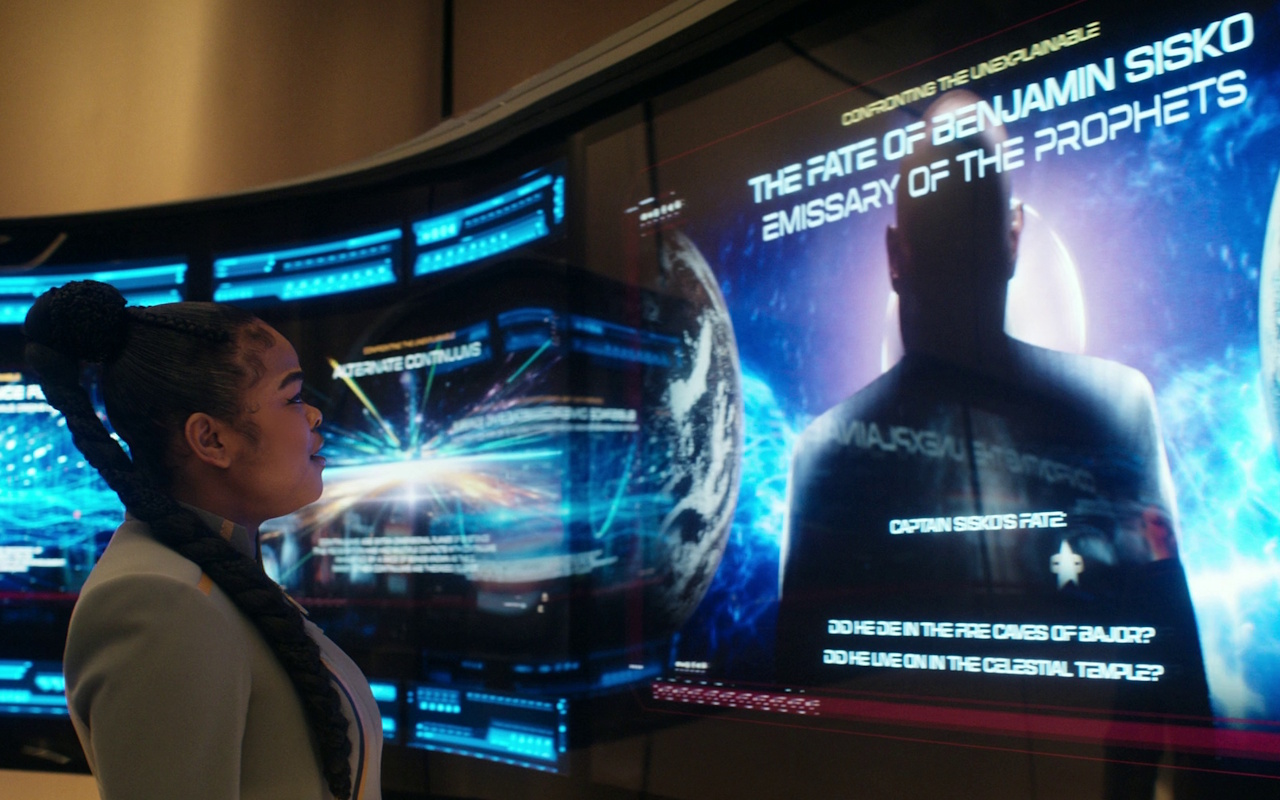
A Festive Playlist To Get You In The Holiday Spirit!

Welcome to the sixth edition of my festive playlist! This is an annual tradition here at Trekking with Dennis, as I love to jump-start the holiday season by sharing a few of my favourite Christmas tracks.

I’ve been a collector of Christmas music and albums for… well, too long, let’s just say! I started my collection with cassettes and CDs, I made my own mixtapes of my favourite festive songs, and in recent years I’ve gone digital with MP3s and FLAC! I love uncovering new Christmas albums, either by artists I’m familiar with or by people I’ve never even heard of. There are so many great Christmas songs out there, be they new takes on classic tracks or brand-new compositions. Every year, I go through the charts and lists of new releases, trying out new Christmas albums and songs… and adding to my ever-growing festive playlist!

Photo of a house adorned with many Christmas lights and ornaments.
There’s a house like this in every town, right?

As I’ve done for the past few years, I want to share a few of these tracks with you today. And if you missed them in years gone by, be sure to check out the earlier editions of my festive playlist. Pick your favourite songs, or just add them all together and you’ll be all set for your Christmas party! Here’s last year’s edition, click or tap here to listen to 2023’s edition, here comes the 2022 edition, and the 2021 edition, and finally, the first edition from 2020. Right! Let’s get the important bits out of the way then we can listen to some songs!

All of the songs below are embedded via YouTube. However, if one or more won’t play for you in your part of the world, check other streaming platforms, as I daresay *most* of these songs will be accessible somehow. And if you feel like I’ve missed one of the big festive hits, check out those earlier editions of this playlist, because I may have already covered them in the past. Finally, if you hate all of the songs I’ve chosen… *that’s okay!* There are plenty of wonderful Christmas songs in all kinds of genres to enjoy at this time of year, and we won’t always agree on which ones are the best. I share my selections with you in the spirit of the season.

Stock photo of a little girl lying down under a Christmas tree.
Have you put up your Christmas tree yet?

For the last five years, we’ve managed to dodge both Wham! and Mariah Carey. But… can we keep that up indefinitely? Or have the (jingle) bells finally begun to toll for us? Scroll down to find out!

Underneath each embedded video, I’ve written a couple of paragraphs about each song, sharing my thoughts, how I encountered them, their recording histories, and such like. I hope this playlist will be a bit of festive fun now that December has arrived.

Without any further ado, let’s fire up the gramophone and listen to some Christmas songs!

Track #1:
It’s the Most Wonderful Time of the Year – Andy Williams (1963)

Let’s start with a bona fide Christmas classic this year! Andy Williams was a hugely popular American entertainer, both as a singer and as the host of his self-titled TV show, and he recorded this track for his first Christmas album in 1963. It wasn’t released as a single back then, but The Andy Williams Christmas Album topped the charts that year (and for two years afterwards, too) and was certified gold in the United States in 1964.

It’s the Most Wonderful Time of the Year has, in recent years, been a mainstay on the singles chart thanks to digital downloads and streaming. A CD single was issued in the UK in 2007, after the song picked up traction, and it hasn’t dropped out of the charts at Christmas time since then. It’s a wonderful trad-pop song of the kind that Williams was known for, and I can see why it became an instant Christmas classic! It’s the Most Wonderful Time of the Year has also spawned many cover versions, including recordings by Amy Grant, Johnny Mathis, and even Kylie Minogue.

Track #2:
Wonderful Christmastime – Christina Perri (2023)

We covered Paul McCartney’s original festive hit Wonderful Christmastime on an earlier edition of this playlist, but pop/rock singer Christina Perri put a totally unique spin on the track. And I happen to really like it! Perri’s version is shorter, clocking in at just under two minutes as opposed to the original’s three-and-a-half, which is an interesting choice – but the song doesn’t feel like it’s missing anything. The slowed tempo and simple instrumentation also give the song a gentler, almost haunting feel, emphasising the beauty of the lyrics and composition.

Christina Perri’s album Songs for Christmas was released in 2023, and as far as I can tell it didn’t chart. So this cover version seems to have flown under the radar, because I don’t think it was released as a single. But if you missed this new take on Wonderful Christmastime… give it a try. I really think it’s something special.

Track #3:
Wonderful Dream (Holidays Are Coming) – Melanie Thornton (2001)

Chances are, you know this song already – or at least a version of it! Wonderful Dream (Holidays Are Coming) is the Coca-Cola Christmas advert song, though that version is shorter and has some altered lyrics. This version of the song is longer, and while it isn’t *explicitly* about Christmas, the association is there and I’ve had it on my festive playlist for years as a result! The longer version of the song doesn’t mention Coke, so this isn’t just an overblown jingle; it’s a beautiful song well worth listening to in its own right.

The story surrounding Wonderful Dream (Holidays Are Coming) is actually rather sad. Melanie Thornton passed away just days before the song’s release, having only recorded one solo album after leaving the group La Bouche a year or so earlier. The song proved to be a hit in Germany, Austria, and Switzerland, coming close to topping the charts in all three countries in 2001. It also regularly returns to the charts in those countries at this time of year, thanks to digital downloads and streaming – and was eventually certified platinum in Germany.

Track #4:
Rudolph the Red-Nosed Reindeer – John Denver (1975)

Honestly, we could make an entire John Denver Christmas playlist! The country-folk singer recorded plenty of Christmas songs during his career, but I’m choosing this version of Rudolph the Red-Nosed Reindeer this year. Don’t confuse the 1975 recording for his later 1990 recording of the same track, as they’re quite different! Both are good, but they’re quite different in tone and instrumentation.

Despite being released at what was arguably the pinnacle of his fame, John Denver’s first Christmas album – 1975’s Rocky Mountain Christmas – didn’t storm the charts. This version of Rudolph wasn’t released as a single, either. There was a TV special hosted by John Denver in 1975, also called Rocky Mountain Christmas, though, and from what I can tell it was well-received by viewers at the time. In any case, I enjoy this version of a festive classic!

Track #5:
Love This Christmas – Rick Astley (2020)

’80s pop star – and original internet meme – Rick Astley returned in 2020 with an unexpected Christmas song! And you know what? It was pretty darn good. The song has the feel of festive hits from years gone by, reminding me a little of songs like I Wish It Could Be Christmas Everyday. Backed up by a video that also leans into that style… I really enjoyed what Rick Astley created, and the song has been on my festive playlist for the last five Christmases already!

However, Love This Christmas didn’t make a splash on the charts, failing to graze even the lower reaches of the charts in the UK or anywhere else! A bit of a shame, but perhaps not totally unexpected for an artist who might not unfairly be called a “one-hit wonder” nowadays. Still, Love This Christmas is, in my humble opinion, a modern-day festive classic, and well worth listening to if you missed it back in 2020. And given everything that happened that year… I wouldn’t blame you if you were a bit busy!

Track #6:
My Favourite Time of Year – The Florin Street Band (2010)

I agree with The Florin Street Band: Christmas really *is* my favourite time of year! And this song really encapsulates that feeling; a gentle love letter to the festive season and all it brings. It’s got a British edge to it, too, with references to carol singing, and the video leans into a Victorian Christmastime aesthetic that reminds me of A Christmas Carol. It’s a beautiful song, but the video also adds a lot, making My Favourite Time of Year a real multi-sensory experience!

The Florin Street Band was put together to make My Favourite Time of Year, as the creator wanted to bring back some “Christmas magic” to the music scene. The song didn’t chart, but it has raised money for charity, been covered by school choirs and bands across the UK, and even headlined ITV’s “Text Santa” appeal a few years ago. The Florin Street Band is back, though, in 2025, with a new song and video scheduled to premiere later this month.

Track #7:
Merry & Happy – TWICE (2017)

2025 has been the year of K-pop for me! Well, not really – but I did enjoy the film KPop Demon Hunters, which features music by Korean girl group TWICE. That sent me down a rabbit hole of listening to some of their other music – including this Christmassy number from 2017! I can’t understand the lyrics, of course… but I like it. It’s a cute, upbeat Christmas song, with some jingling bells in the chorus… and that’s all I need, really!

I confess that I know very little about TWICE. But I can tell you that Merry & Happy was an addition to their first album when it was re-issued in 2017, and it charted in Korea, Japan, and on the Billboard World chart in the United States. I wouldn’t have come to listen to it but for KPop Demon Hunters, but I’m glad I did – and it will join my festive playlist from here on out!

Track #8:
So Near To Christmas – Alvin Stardust (1984)

I am unashamedly an Alvin Stardust fan! My Coo Ca Choo and Jealous Mind are just perfect ’70s glam rock songs, in my opinion. And yeah, hearing them on my dad’s old record player when I was a kid is probably the reason why I think so! In 1984, though, after the peak of his career, Alvin Stardust came back with this beautiful slow-paced Christmas track. It reminds me a little of Mud’s Lonely This Christmas, which we talked about on an earlier edition of the playlist.

So Near To Christmas peaked at number 29 on the UK charts in 1984, and did a bit better in Ireland, where it reached a creditable place at number 15. It would be Alvin Stardust’s last notable single, as subsequent releases didn’t chart. In the ’90s, Alvin Stardust had a recurring role on Hollyoaks, a British soap opera, and continued touring and performing on TV through the 2000s and into the 2010s.

Track #9:
The First Noel – Mark and Maggie O’Connor (2025)

Representing the country music genre, we have married couple Mark and Maggie O’Connor, with their version of the traditional carol The First Noel. Their album, A Christmas Duo, was released not long ago, and contained this really beautiful take on one of my favourite carols. Using only fiddle and guitar, and with Maggie O’Connor taking the lead vocal part, this new version has the feel of something much older… almost timeless.

Mark O’Connor has won three Grammys in a long career, and I think I’m right in saying that this isn’t his first Christmas album – though it is his first as a duet. A Christmas Duo hasn’t charted yet, but at least one track (The Holly and the Ivy) has been picking up some attention. Sometimes, what I need is a gentle, classic take on a traditional carol – and that’s exactly what this version of The First Noel delivers.

Track #10:
Another Bloomin’ Christmas – Mel Smith (1991)

A couple of years ago, I wrote about the animated Christmas special Father Christmas, which aired here in the UK in 1991. I can vividly remember watching it on Channel 4 that year, and it’s been a part of my personal festive celebrations ever since! Included in the special was this song, sung by comedian Mel Smith in his guise as this version of Father Christmas – a.k.a. Santa Claus! And it’s a lot of fun. I definitely encourage you to watch the special if you haven’t seen it already, as it adds a lot of context for the song, and you can read my full thoughts on Father Christmas by clicking or tapping here.

The song was released as a standalone single in 1991, with cassette, vinyl, and even CD versions being made available. Despite the popularity of the TV special, however, it only peaked at a lowly 59th position that year. Mel Smith’s other festive hit – a cover of Rockin’ Around the Christmas Tree, which was a collaboration with singer Kim Wilde – had landed at a much more respectable third place a few years earlier! For more on that track, see last year’s edition of the festive playlist.

Track #11:
Little Drummer Boy – The Baseballs (2012)

I had the incredibly good fortune to see The Baseballs play live once, and the German rock ‘n’ roll group is one of the few acts I’ve seen live who sound basically no different to their studio recordings. I think I included their cover of Rockin’ Around The Christmas Tree on an earlier edition of my festive playlist, but this year I’m choosing their upbeat, rock ‘n’ roll take on Little Drummer Boy – because it’s just great fun!

The Baseballs always struck me as a unique act, with their musical style and even their clothes harkening back to the dawn of rock ‘n’ roll in the 1950s. I’ve collected most of their albums at this stage, most of which contain cover versions of more modern tracks, reimagined in that old school rock ‘n’ roll style. This version of Little Drummer Boy wasn’t released as a single so didn’t chart independently, but the album it’s taken from – Good Ol’ Christmas – did reasonably well in Germany, Austria, and Scandinavia back in 2012.

Track #12:
I Love Christmastime – The Gleeman (2022)

I confess that I don’t know very much about The Gleeman, but his festive song I Love Christmastime is a beautiful celebration of this time of year. 2022 was The Gleeman’s debut, with his first album dropping earlier in the year before this festive release. It’s another track that feels timeless, like it could’ve been recorded years ago and been part of our celebrations for a long time. I like the composition, the choice of instruments, and the gentle, celebratory lyrics.

I Love Christmastime was reissued in 2023 as a charity single in support of War Child, and was tipped as a potential Christmas number one that year. I’m sure the song raised a lot of money for charity, and it seems to have been downloaded quite a few times on iTunes, but it didn’t make it to the official UK charts that year. Still, it’s a great festive track, and one I’ve really come to enjoy.

So that’s it… till Christmas 2026!

Vintage photo of a snowy, Christmassy scene in Norway.
A very Christmassy scene!

I hope this has been an enjoyable playlist. If I’ve helped even one person find one new Christmas song that they’ll enjoy at this time of year, I reckon I’ve done a good job! And in any case, it’s always a lot of fun to dig through my playlist and find more festive favourites to talk about. It’s a nice way to jump-start the festive season now that we’re into December.

And hey, would you look at that? We’ve managed to hide from both Mariah Carey and Wham! for the sixth year in a row. But surely, *surely*, we’re running out of holiday hits by now… right? You’ll have to join me next year to see if we can keep the streak going!

Stock photo of a model Christmas village.
Such a cute Christmas village!

I have a few more Christmassy ideas which may (or may not, time depending) make their way onto the website before the big day. And later in the month, I hope you’ll join me for my annual End-of-Year Awards, in which I’ll hand out some imaginary trophies and statuettes to some of my favourite entertainment experiences of 2025. But before all that, there’s still an entire month to get through!

Whatever you’ve got planned for December, and whether you’re celebrating with friends, family, or alone, I hope you have a very Merry Christmas. And please check back from time to time, as I’m always finding new things to talk about here on the website! Hopefully this playlist has given you one or two ideas for what to listen to as you hang up the lights and decorate the tree, or for your next Christmas party. Cheers, and happy holidays!


All songs on the playlist above are the copyright of their respective record company, studio, distributor, composer, etc. All videos courtesy of YouTube. Videos are merely embedded here, and are not hosted on Trekking with Dennis. For copyright or other legal purposes, please contact YouTube directly. This article contains the thoughts and opinions of one person only and is not intended to cause any offence.
A Year In Review

Spoiler Warning

Spoiler Warning: Beware spoilers for Star Trek: Discovery.

Six years ago, on the 30th of November 2019, this website went live for the first time with a short, simple test post. The anniversary has always seemed like a good moment to reflect and take stock – so if you’ll forgive me the indulgent waffling, that’s what we’re gonna do today. This isn’t my “end of the year” piece, looking at the entertainment highs and lows of 2025, and it annoys me to see publications putting those out before Christmas, or even in November! I’ll publish my annual End-of-Year Awards in late December, so be sure to check in to see which films, games, and TV shows will win an imaginary statuette!

Well… where to start?

It’s been an interesting year. In November last year, I learned that my sister was going to have a baby, and my niece was born in the spring. This prompted me to do something I haven’t felt able to do in a long time: undertake a significant journey. I’m disabled, as you may know, and for a long time – basically a decade now – I haven’t really felt up to leaving the house very often, let alone travelling. But I had to meet my niece! So I managed a difficult and painful journey and made it to the hospital a few hours after she was born. And I’ve been back to visit about half a dozen times since then. These trips are still uncomfortable for me, but I think – I *think* – I’m doing a little better each time… or just getting more used to it.

Stock photo of a train at a railway station.
I’ve been on several expeditions this year!

Last year, when I marked the website’s fifth anniversary, I talked about how I felt some sense of pride at having stuck with it for half a decade, and how I’d be happy to keep going to see if I could make it to the ten-year mark in 2029. Immediately after writing those words – literally within a few days – I had a major health scare. I’ll spare you the gory details, but suffice to say that one of my regular blood tests came back with some alarming news, leading to a series of scans, a biopsy, and some treatment. But because I’m me, and because my head always goes to the most catastrophic extremes when such things arise, I was definitely thinking about and planning for the worst as last Christmas and New Year were approaching!

My health is poor, and it’s been in what I’ve half-jokingly referred to as a “managed decline” for years at this point. I’ve known that things are going to get worse rather than better, but I admit that I’d been somewhat lulled into believing that I could continue coasting; that I was relatively settled. Last year’s bad news, because it wasn’t directly related to my ongoing health issues, felt like a lightning strike coming from nowhere, and it definitely unsettled me. Perhaps that’s why, after I got the all-clear on that front, I was so keen to do things like visit my niece earlier in the year; it felt like something had shifted and I had to try, for once, to get out of my safety zone. Or maybe I’m doing another thing I always do and I’m overanalysing it!

Stock photo of an MRI machine.
Being loaded into an MRI machine for a scan made me feel like a torpedo…

But those visits to my niece, sister, and brother-in-law – the first of which was the first time I’d visited them in their “new” home – gave me the confidence to do something else. You might remember this if you’re a regular reader, but in late August I made the journey to Blackpool to attend a Star Trek convention for the first time in almost fifteen years.

Although the journey was long (three trains and a tram), and it ended up being a ridiculously long day for me, I had a whale of a time. I met several actors from The Original Series, Deep Space Nine, Enterprise, and Strange New Worlds, shaking their hands and getting my picture taken. How often, these days, can one claim to have met an actor who appeared in *the first-ever* episode of Star Trek? That’s definitely something neat that I can add to my résumé as a Trekkie! And as I said in my piece, sitting down with Chase Masterson (Leeta from DS9) for a script-reading session was an absolutely wonderful experience. My thanks, once again, goes out to the folks who organise Destination for making the event accessible and for offering extra support to disabled folks like myself. I simply wouldn’t have been able to attend, or to have any of those experiences, without that additional support.

And yes… I’m still eyeing next year’s event and seriously considering attending!

Photograph of the Blackpool promenade with Blackpool Pier in the background.
I snapped this photo on the way to the convention.

On the home front, I got my hands dirty with some DIY for the first time in a long time. I’ve lived in this house for more than twelve years, but I’ve never redecorated the living room, if you can believe that! My cat tore a big hole in the wallpaper just after Christmas, and after living with it for a while I finally took the plunge and began working on redoing the walls. And, as with any job, it took longer, cost more, and was more complicated than I originally hoped!

There’s still some work to do, but I’m quite proud of the results. I managed to replace some broken drywall that had been hiding beneath the wallpaper, swapped out the old cream/beige colour in the room with something a bit brighter and more cheerful, and even put up some small hooks for hanging Christmas lights and other decorations. Next year, finances permitting, I’ll replace the old carpet, too, completing the refurbishment of the room where I spend most of my time!

Stock photo of a paint can and paintbrush.
I’ve been doing some redecorating!

Here on the website, there have been a few changes that you may have noticed. When I started writing lots of articles and reviews about modern Star Trek, I gave each of the new shows its own static webpage, just for ease of organisation if nothing else. But the older shows, pre-Discovery, were all lumped together on one “Classic Trek” page. As time wore on, though, the Classic Trek page had become massively long and unwieldy. It was overladen with so many articles and pieces about those older shows that it had become too difficult to navigate. So I deleted it and have replaced it with individual pages for every Star Trek show. As you can see in the menu above, they’re currently categorised as “Older Treks,” in contrast to the “Newer Treks” of the CBS All Access/Paramount+ era.

I think this change has been for the better, and it was a bit of fun to put the new static pages together, as it gave me another chance to talk about some of those shows. I still haven’t done individual episode re-watches for DS9 or Enterprise, but I did finally get around to The Original Series this year, when I wrote up my thoughts on the classic episode Arena. Stay tuned for more of those episode re-watches in the weeks and months ahead. If – as I’ve predicted – Star Trek might go off the air again before the end of the decade, re-watching older episodes will be all we’ve got!

Still frame from Star Trek TOS showing the Gorn captain.
I wrote up my thoughts on Arena earlier in the year.

While we’re talking of pages being changed, you might notice that my old Jedi: Fallen Order page and my newer Mass Effect page have been taken down. The reason for that is a bit complicated, and I lay out my thoughts in more detail in an article you can find by clicking or tapping here. But the long and short of it is that, now that Electronic Arts (the publisher of those games) is being taken over by the Saudi government’s investment fund, I no longer feel I can purchase or support their games. EA has been a shady and ugly company for a long time, but this change in ownership would mean I’d be putting money directly into the hands of people and organisations that I feel fundamentally conflict with my values. So that, rather unfortunately, means no Jedi: Survivor sequel and no Mass Effect 4 for me – unless something changes on that front.

It isn’t easy to be an “ethical consumer” in this late-stage capitalist marketplace, and some folks say it’s so far out of reach that there’s no point even trying. Again, I’ll direct you to my longer piece on the topic, linked above, but suffice to say that, when something is relatively clear-cut, I think it’s worth *trying*, at least, to refuse to purchase from a corporation or organisation that conflicts in such a fundamental way with our own personal beliefs and values. So if you hoped to hear more from me on Fallen Order and Mass Effect… sorry.

Screenshot of Jedi: Survivor showing a visual bug.
I won’t be picking up the sequel to Jedi: Survivor.

The final change to the static webpages saw me shift the old Starfield page to the more broadly-titled “Bethesda Games,” as I’ve been talking more about the likes of The Elder Scrolls and Fallout. I have no plans to return to Starfield, quite honestly – especially now that I no longer use PC Game Pass (more on that in a moment!) – so this change, again, seemed like the right move. It means that page can include my coverage of the Fallout TV show, the upcoming Elder Scrolls VI, and more.

That leaves the “Video Games” section of the website with just three pages: Bethesda, Mario Kart, and my sometime Video Game Spotlight series – which I really ought to do more with! Truthfully, I haven’t played as many games this year as I planned to, and some that I had been looking forward to and might’ve expected to sink a lot of time into (*cough* Civilization VII *cough*) turned out not to be as engaging or as time-sinky as I expected. Still, I played and reviewed Dynasty Warriors: Origins, Indika and South of Midnight this year, all of which were excellent and all of which I thoroughly recommend! With winter sales coming up in the next few weeks, it might be a good time to wishlist them.

Screenshot of South of Midnight showing the player character approaching a river.
South of Midnight.

But those webpages aren’t the only things to have changed around here! If you’re on a mobile device or tablet, you might not’ve noticed this, but the website’s background image changed in July. I used to have a fairly plain grey gradient as a background, but I changed it to be a black background with white stars. It reminds me a little of some of the Star Trek fanpages that I used to frequent in the ’90s, when I was first getting started with using the internet, and I think it’s on theme for the website! Is it super basic? Yes. Is it modern? Absolutely not! But I like it, so it’ll stay for now – at least until I change my mind again!

You can’t see it, because the current logo is my Christmassy one, but I also redesigned the website’s main banner and logo in July at the same time. That change wasn’t as extreme, basically just a change of font and a slight change in colour, but again, I liked the end result. I’d be absolutely awful if I had to run a major brand, because I’m *constantly* changing my mind when it comes to what I like and what I don’t, and how I want things to look! For a website of this size, though… let’s just say it doesn’t matter in the slightest!

Trekking With Dennis main website banner July 2025.
The redesigned banner/logo as of July.

I mentioned a moment ago that I’ve cancelled my PC Game Pass subscription. I’d been a subscriber to PC Game Pass (the PC version of Xbox Game Pass) since it was in beta, and I’d really enjoyed having access to the library of titles on the service. But earlier in the year, Microsoft hiked the price significantly – on top of a similar price rise just twelve months earlier. Taking the two together, I’d have been paying 70% more for my Game Pass subscription in November 2025 than I had been in the summer of 2024, and that kind of price hike is just unacceptable to me. As I wrote in my piece about Game Pass, a subscription model like this *should* be the “wave of the future” in gaming, as gaming moves ever closer to an all-digital model. But Microsoft’s greed messed it up, and I won’t be returning to Game Pass unless and until it feels like good value again.

Game Pass wasn’t the only subscription I cancelled in 2025. For years, I’ve only been picking up the likes of Netflix and Paramount+ for a month or two at a time, in order to watch specific shows and films. I’ll take advantage of my subscription at those times, binging some shows and catching up on some of what I might’ve missed! But for a while, I’ve retained Disney+ as an ongoing subscription. But I cancelled that this year, after realising I hadn’t been using it anywhere near as much as I thought. I’ll still pick up Disney+ sometimes, but I’ll do what I’ve been doing with Paramount+ and Netflix and use it for a month or two to watch a few things before pausing it again. That leaves Amazon Prime as my only subscription, and that’s not really because of Prime Video! It’s because I like the next-day delivery.

Promo graphic of Xbox Game Pass for PC.
I’ve cancelled Game Pass thanks to the 70% price hike.

Let’s talk traffic! Back in January, the website ticked past the 250,000-hit mark. That’s a quarter of a million visitors in just over five years. And later in 2025, it passed the 300,000-hit mark, too. At time of writing, we’re sitting at just below 330,000 hits, which is a pretty staggering number if you think about it! That’s *almost* a third of the way to one million since November 2019. And after 2024 had seen a bit of a dip in clicks as the year wore on, 2025 has seen a significant uptick. The website had eclipsed 2024’s total numbers by the summer, and has kept on growing since.

In terms of individual articles and posts, I got a ton of hits last December for my piece titled Uh, Guys? Star Trek: Discovery Is Still Canon, which I wrote in response to some awful clickbait that I’d seen doing the rounds. January was also a good month for traffic, as my piece about the unfinished novel The Winds of Winter picked up some attention. My coverage of the Section 31 TV movie also did pretty well, despite being interrupted by Storm Éowyn and a days-long power cut! My review of Futurama’s recent season in March got quite a bit of attention, and through the summer, my reviews of several Strange New Worlds episodes were racking up the clicks. More recently, the top-performing piece on the website since its publication has been my review of the popular Netflix film KPop Demon Hunters, which I wrote back in August.

Still frame from KPop Demon Hunters showing Rumi singing Golden.
And yes, I’m still listening to Golden.

I’ve added three pieces to my “Greatest Hits” collection over the past twelve months. First was my look back at the classic Dreamcast game Shenmue, which I wrote to celebrate the 25th anniversary of its launch back in December. Shenmue remains, to this day, one of my all-time favourite video games, even though its story remains tragically incomplete all these years later. Next, I finally wrote up my “Borg teasing theory,” which is something I’d been kicking around for a long time! And not long after that article went live, I wrote up my thoughts on Star Trek: Discovery’s “post-apocalyptic” setting, and why I felt it didn’t work as intended after Season 3.

2025 has also been a year in which artificial intelligence has been on my mind – as I’m sure it has for a lot of folks. I wrote two pieces about A.I. this year, the first of which considered one possible future for generative A.I. in the film and TV space, and the second of which was my response to a paper titled A.I. 2027, which was quite an alarmist take on a possible future “rogue A.I.” scenario. This technology seems to be moving quite quickly at the moment, so there may be more to say on the topic in the months ahead. Although technology is a little outside of my usual wheelhouse, I think it’s kind of on-brand for a website where Star Trek, sci-fi, and general geekiness are the order of the day!

Still frame from Star Trek: TOS showing the M5 computer.
The M-5 Multitronic Unit from Star Trek.

So that’s all for now. If you made it to the end of this waffling ramble (or rambling waffle), thank you! The past twelve months have been more hectic than I expected when I last sat down to write a piece like this, but we made it here in the end. I appreciate your support, your visits to the website, and you taking the time out of your day to share in some of these geeky topics with me. Writing about Star Trek, video games, and everything else continues to be a source of fun and enjoyment for me, and getting the chance to spend a bit more time thinking about some of these fictional universes is just fantastic.

As to the future… well, I’m still hoping to hit that ten-year milestone, which is now just four years away. If I made it this far, surely I can keep going till the end of the decade! And maybe, health and finances permitting, I’ll be heading back to Blackpool in August to celebrate Star Trek’s 60th anniversary with my fellow Trekkies. But until then, I’m going to kick back in my newly-redecorated living room… and maybe indulge in a mug or three of mulled wine, since it’s that time of year!

Thanks again for all of your support, and I hope you’ll join me through December and into 2026 as I continue to geek out about Star Trek, gaming… and so much more.

TWD Signature (Dennis)

-Dennis,
Sunday, 30th November 2025


All properties mentioned above are the copyright of their respective broadcaster, studio, developer, distributor, company, etc. Some stock images may be courtesy of Unsplash. This article contains the thoughts and opinions of one person only and is not intended to cause any offence.
Steam Machine: Where’s The Price?

I was surprised to see Valve – the owners and operators of Steam and makers of the popular Steam Deck handheld PC – recently announcing new hardware. I’ve actually put the new Steam controller on my wishlist; I’m in the market for a new controller, and Valve’s might be the way to go. As you may know if you’re a regular reader, I’m also a *big* supporter of innovation and change in the games industry, so a company of Valve’s standing launching a console-esque device, like the new Steam Machine purports to be, could be a big deal.

The games industry can feel pretty stagnant, sometimes. Since Sega’s unceremonious exit from the hardware market almost a quarter of a century ago, there have basically been three names in the console space if you’re looking for something to plug into your TV: Nintendo, Sony, and Microsoft. But it’s even narrower than that, because Nintendo, for the better part of two decades, has been off to one side, doing its own thing, prioritising different ways to play over graphical fidelity and performance. If you want a home console capable of playing the newest games with the best graphics, your choice has been an Xbox or a PlayStation.

Promo image of the Steam Machine on a desk next to a fishtank.
The new Steam Machine (with a goldfish bowl for scale).

When Google announced Stadia a few years ago, I was supportive of the idea. Not only was Stadia a new entrant into a stagnant marketplace, backed up by a massive corporation, but its game streaming idea left it well-positioned to be a cheap and potentially easier route into gaming for new players, younger players, and folks on a budget. Stadia didn’t stick the landing for all manner of reasons, so Google did what Google often does – and killed it. But the idea that someone – *anyone* – could step into this marketplace and shake things up was tantalising!

It’s through that lens that I view Valve’s new Steam Machine. The device is not a PC, but it’s fair to say that it isn’t *entirely* a console, either, existing in a kind of nebulous in-between space. That could mean it’s the best of both worlds… or that it’ll struggle to attract an audience. I know that I don’t personally have a place in my life for a Steam Machine (I play on PC these days, and I’m not in the market for a console or console-like device). But given the issues in the games industry, and the home console market in particular… I wish the Steam Machine well and will be following its progress when it launches next year.

Promo image of the Steam Machine focusing on the Valve logo.
The Valve logo on a Steam Machine.

But something is giving me pause.

Valve spent a lot of money on a flashy announcement, talking about the Steam Machine and its capabilities. But something pretty big was missing: the price. If the price was good and low… surely Valve would’ve announced it at the same time, no? The way this particular teaser was structured, drumming up hype and excitement for the device *without* revealing its price, leads me to believe that it’s not going to be anywhere near as inexpensive as people are hoping. It could even feel overpriced, coming in at a higher price point than even the PlayStation 5 Pro and Xbox Series X.

And if that happens… I think it’s going to go the way of the first Steam Machine from a few years ago.

Promo image of the original (2015) Steam Machine and Controller.
This was the original Steam Machine, back in 2015.

Among the biggest stories in gaming in 2025 have been the price of the Nintendo Switch 2, the $10 hike in the “basic” price of some video games from $70 to $80, the price hikes of both the Xbox Series and PlayStation 5 consoles, and the significant rise in the cost of Xbox Game Pass. There is clearly a limit to how far companies can push their prices, even for hyped and highly-anticipated hardware, and I’m just concerned that Valve might not have read the room on this one.

The Steam Machine isn’t an exceptionally powerful device, based on the specs Valve have released. It’s more powerful than an Xbox Series S, but it’s basically on a par with the PS5 and Series X – consoles which are almost five years old already. The PC I built three years ago will easily outperform the Steam Machine. So… it’s gotta be priced fairly.

Promo graphic of the Steam Machine and Steam Controller in a cartoon style.
A cartoon of the Steam Machine and Steam Controller. Cute.

Here in the UK, Nintendo’s Switch 2 retails for £400 – though you can pick it up for a slight discount at time of writing. Xbox Series X consoles, after Microsoft’s recent price hikes, retail for £500, which is within £20 of the PlayStation 5, which retails for £480. In the United States, the Switch 2 retails for $450, the Xbox Series X retails for $600, and the PS5 goes for $550. Those are the Steam Machine’s main competitors.

In my view, as someone who used to work in the games industry, if Valve tries to sell the Steam Machine for more than about $500 in the USA or £425 in the UK, it’ll turn people away. The not-quite-a-console already exists in a bit of a weird space, trying to appeal to existing Steam users who want to play some games on their TVs. A good price – even if that means selling the device at a small loss – could bring in huge sales numbers, because if it undercuts the competition *and* can play more games than any of them… well, that’s a pretty good deal no matter who you are! But if it’s priced too high, not only does it lose any potential new players, but it also becomes a tough sell for existing Steam players who use either a PC or a Steam Deck. If it’s going to retail for more than an Xbox Series X, PS5, or Switch 2… who’s it really for?

Promo image of the Steam Deck.
Valve’s Steam Deck is competitively-priced.

Valve has been here before. The original Steam Machines, a decade ago, didn’t make much of an impact in the gaming world, nor did the Steam Controller. Again, price was *part* of that. And that’s another concern I’d have if I were considering picking up a Steam Machine: how long can I expect this device to be supported and updated? Valve bailed on the original Steam Machines pretty quickly, so if these new ones are expensive, and therefore less likely to sell a lot of units in their first year or two… how long is Valve gonna stick with them?

I could be completely wrong, and Valve could have an ace in the hole, ready to announce a low price of $350 in the United States and £300 in the UK! But I suspect that, if they had anything even *close* to that, they’d have put it front-and-centre in their big announcement. Why wouldn’t they, if the price is going to be part of the selling-point? This, to me, feels like a company trying to drum up hype and excitement while keeping the price hidden, so that by the time they reveal it… players have already committed. They’re already going to *want* a Steam Machine, so they’ll be willing to pay.

Still frame/meme from Futurama showing Fry saying "shut up and take my money" with a fistful of dollar bills.
How much will the Steam Machine retail for?

I hope I’m wrong, because the games industry *needs* a shake-up on the hardware side, and a company like Valve is basically one of the only players who could even conceivably achieve something like that. A decent, fair price could see the Steam Machine outpace the beleaguered Xbox Series X, for example, positioning Valve as a real player in the home console market. But a high price, making it an enthusiast-only device, appealing only to players who already have gaming PCs and extensive Steam libraries? How many people like that, realistically, would even want a console-like device?

Between HDMI cables, casting, and streaming, it isn’t exactly rocket surgery to play your PC games on a television screen. I used to do it all the time simply by running a long HDMI cable from my PC to the TV in my living room. If the choice is a $800 “GabeCube” or a $15 HDMI cable… how can you compete with that? Valve long ago realised that the way to beat piracy is to offer players a better service at a reasonable price. That philosophy would serve the company well on this new endeavour, too.

So… watch this space, I guess. Valve will have to announce the price sooner or later. I’m crossing my fingers, but the announcement definitely left me more concerned than excited.


The Steam Machine, Steam Controller, and Steam Frame will be released in 2026. Prices TBC. Steam, the Steam Machine, and other properties discussed above are the trademarks/copyright of Valve. This article contains the thoughts and opinions of one person only and is not intended to cause any offence.
Phineas and Ferb: Season 5 Review (Part Two!)

A Phineas and Ferb-themed spoiler warning.

Spoiler Warning: There are spoilers ahead for Phineas and Ferb, including Season 5.

Back in the summer, I shared my thoughts on what I mistakenly assumed was the entirety of Phineas and Ferb’s fifth season – the show’s first new episodes in a decade. But it turns out that Disney, for some reason, dumped only *half* of the episodes onto Disney+ back then, and a few more episodes have premiered over the summer and into the autumn. So I thought I’d better update my Phineas and Ferb Season 5 review, as some of what I said back then may no longer be accurate!

It’s also worth noting, before we go any further, that there are still a few more Season 5 episodes to come – but those won’t be landing until January. So I hope you’ll swing back in the new year for Part Three of this review, and to get my final thoughts on Season 5 as a whole! I just wanted to be clear about that, since I got a bit muddled up last time.

Still frame from Phineas and Ferb Season 5 showing the Doofenshmirtz Evil Incorporated building.
Doofenshmirtz Evil Incorporated!

As always, I’ll give my usual caveat. Everything I’m going to say is the entirely subjective, not objective, opinion of one person only. If you hate my take on Phineas and Ferb, think I’ve gotten it horribly wrong, or we just have different ideas for what makes a fun or successful episode… *that’s okay!* There ought to be enough room in the fan community for differences of opinion and polite discussion, and I share my thoughts with you in that spirit.

What I’d like to do first is talk about the recent batch of episodes in general, then I’ll address a couple of criticisms I made of Season 5 earlier in the year, which I’d now like to change or recind. And finally, after all of that, I’ll go through the newer episodes one by one and share my thoughts on each of them. For the purposes of this review, I’m calling each individual story an “episode,” even though they usually come paired up on TV and streaming. Last time, I covered all of the episodes in Season 5 up to The Ballad of Bubba Doof, meaning this time I’m starting with Attack of the Candace Suit and covering all the episodes up to Dungeons and Dating, which is the most recent story to air at time of writing.

With all of that out of the way, let’s get started!

Still frame from Phineas and Ferb Season 5 showing Doof, Vanessa, and Norm.
Norm and Vanessa with Doof.

One thing I wanted to mention last time (it was in my notes, but somehow didn’t make it into the final review) has also cropped up in this second batch of episodes. Someone on the animation team *really* loves their new “low light” filter, don’t they? So many dark scenes now have a kind of “hazy” effect over characters and environments, which is something I don’t remember seeing in any of the first four seasons. It doesn’t look bad, exactly, but when it’s used so often in so many different episodes, it becomes noticeable… at least it did for me! And when there really aren’t a lot of other visual effects or filters being applied, the constant re-use of this one sticks out all the more.

I don’t hate the way this looks, just to be clear. It’s a bit of a change from what you might remember from earlier in the show’s run, but on its own, in one-off situations, I’d never say that it looks *bad*. But when there really aren’t any other comparable visual effects, changing the way the animation looks to represent, for instance, twilight, firelight, or other such things, this “low light” effect being recycled in multiple episodes became pretty noticeable for me.

Still frame from Phineas and Ferb Season 5 showing Vanessa in low light.
The “low-light” filter.

Speaking of new obsessions that the writers seem to have, several episodes this time haven’t *really* ended, with an apparent old-school cliffhanger seeming to tease story continuations that are almost certainly never coming. If it was a one-off gag, I’d be fine with it. In some cases, those kinds of things work well, either as a genuine tease or as a pastiche of the kinds of films and TV shows which do that kind of thing a lot.

But when it’s overdone, and when it’s obvious that these stories are well and truly over, one-and-done things… it gets repetitive. As above with the “low light” effect, it was just something that I started to notice as we got further into the season, and even though it was by no means happening in every episode, I definitely felt it begin to overstay its welcome.

Still frame from Phineas and Ferb Season 5 showing a zombie Ducky Momo.
An example from the end of The Nightmare-Inator.

Dr Doofenshmirtz has (arguably) been Phineas and Ferb’s breakout character. But even keeping that in mind, Doof was *all over* this batch of episodes, being featured prominently. Heck, *four* of these episodes have Doof’s name in them, which must be some kind of record! There is still room for other characters, of course, but I think at this point it’s safe to say that Phineas and Ferb’s writing team are acutely aware of Doofenshmirtz’s popularity, meme-ability, and just the general place he’s carved out in pop culture.

I’m not saying it’s a bad thing necessarily, and *most* episodes still manage to feel balanced. But there’s a sense, perhaps, that Doof’s near-omnipresence is beginning to tip the scales just a little, and while the show is still managing to throw him into new situations or give him new experiences, I worry that if this continues, we might actually start to burn out on the character prematurely. There are still, at time of writing, forty-four new stories being produced, and if Doof is front-and-centre in as many of them as he has been in this batch of episodes… it might start to get a bit too much. He’s always been a main character, of course, but I just felt the balance tip a little this time.

Still frame from Phineas and Ferb Season 5 showing Doof on his hands and knees.
Doof is all over Season 5.

Phineas and Ferb took a break in August and September, before coming back with new episodes in October. I was a little surprised, then, that we didn’t get any kind of Halloween special. Such things are not expected nor demanded, but the show’s previous special episodes have been some of the best, and getting another Halloween or Christmas episode was something I had on my wishlist! Given that we aren’t getting any new episodes now till January, I doubt we’ll see anything festive this year. But I’m still crossing my fingers for 2026 or 2027!

There also aren’t any double-length or two-part episodes in this batch, excluding the second part of the Candace Suit saga. Again, not necessarily a problem, but some of the special feature-length episodes have been among the show’s best. Perhaps we’ll get something like that for the season finale?

Still frame from Phineas and Ferb Season 5 showing Isabella, Phineas, Ferb, Baljeet, and Buford.
There was no Halloween or Christmas special this time.

On the whole, I think I’d say that this second batch of episodes wasn’t quite at the same level as some of the other episodes we’ve enjoyed in Season 5. There were some standout stories, plenty of callbacks to the show’s original run, and the return of some characters who I felt had gone missing in those first few episodes – all of which I enjoyed and appreciated. But there were also a few duds, a couple of storylines which don’t land as well in the revival as they did in the show’s original run, and the pay-off to a pretty weak joke (that had been running all season) which didn’t really live up to the hype.

So… a mixed bag, then!

In terms of quality, I stand by what I said last time: Season 5 is probably about on par with Season 4, which – prior to the revival – would’ve been what I’d have said was the weakest part of the show. Note that I didn’t say “bad,” because there are some solid and some excellent Season 4 stories – as indeed there are in Season 5, too. But there are perhaps fewer of them, and some of the stories in between are either not especially memorable… or just not as good.

Still frame from Phineas and Ferb Season 5 showing Candace on her bed.
Candace on the phone with Stacy.

Last time, I said that I was disappointed to see Irving, Norm, Roger, and Jeremy basically go missing – and I’m pleased that each of them got at least *something* to do in the recent batch of episodes. Irving, by the time we reached the end of Season 4, seemed to have climbed out of the secondary character milieu to become an adjacent member of the friend group, so his absence was particularly noteworthy. Though we got a couple of solid roles for Irving further into Season 5, he’s still not as prominent as I might’ve expected, and doesn’t seem to be as close with the core friendship group as he was when the show’s original run was coming to an end. Episodes like Dungeons and Dating could’ve provided a “nerdy” character like Irving with loads to say and do, but he was relegated to a non-speaking cameo.

I’m glad that we got to see a bit more from Norm and Roger. Though neither has been especially prominent in Doof’s stories, they add a lot to his world and to that side of the series, and Norm in particular was great comic relief in some of the recent episodes. I’m glad that both of them had a bit more to say and do this time around.

Still frame from Phineas and Ferb Season 5 showing Vanessa and Norm.
Vanessa and Norm.

Jeremy is a bit of an odd case. If you didn’t know (and I don’t think I mentioned it last time), Jeremy’s original voice actor didn’t return for Season 5, and I suspect that’s why his role has been reduced this time around. Personally, I think that’s a real shame – after Jeremy and Candace became an official couple, his moments with her really opened up new narrative avenues which the show had begun to take advantage of. Although I think I’m right in saying that we saw more of Jeremy in the second part of Season 5 than we had in the first, he still doesn’t seem to be a particularly major character – not for Candace, nor for the series.

Jeremy works well when his easy-going, laid-back attitude can provide a contrast to Candace’s energetic and chaotic side. Throwing Jeremy into some of the boys’ plans has also worked well in the past, giving Candace either a reason to join in or at least to keep her busting in check for a while. Even in some of Jeremy’s more prominent moments this time, we didn’t get a lot of that. And he still doesn’t seem especially important or prominent on this side of the story. In any individual episode, it’s not something you really notice. But upon reaching the end of this batch of episodes, it’s odd to think that Jeremy – once such a prominent secondary character – has only made seven appearances in thirty-five stories, some of which only gave him a few seconds of screen time and one or two lines.

Still frame from Phineas and Ferb Season 5 showing Jeremy.
Jeremy’s role feels smaller in Season 5.

Last time, I said it was weird to see Candace achieving one of her biggest accomplishments – getting her driver’s license – only for it to not be mentioned again. We did finally get to see her drive, though, so we can check that one off the list! I still think the driving thing could be brought up a bit more often, even if it’s not directly related to the plot… because otherwise what was the point of License To Bust? But I’m glad that we got something in that vein this time around.

We’ll get into this a bit more when we cover the episode Bread Bowl Hot Tub, but this non-sequitur, which ran for basically all of Season 5, didn’t really get a strong enough payoff for me. I like how random it was, and it was cute to see Buford getting so excited as his request was belatedly granted. But after so much buildup across practically every preceding episode, this was one story which *really* needed to stick the landing. Unfortunately, despite a great guest star in Diane Morgan, it kinda didn’t.

Still frame from Phineas and Ferb Season 5 showing Buford's bread bowl hot tub.
Buford in his bread bowl hot tub.

Phineas and Ferb continues to be pretty meta and self-referential in Season 5, stretching some one-off gags and jokes into full storylines… even when there isn’t really enough material, or a strong enough foundation, to support something like that. I noted it last time with Buford’s life-size moulds – something which, inexplicably in my view, came up again in this crop of stories – but we can also add things like Perry’s lair entrances and the boys’ plans for croquet into that same category.

I’m all for the show reliving some of its glory days and replaying its greatest hits! That’s why a revival like this exists, at the end of the day – to play on the nostalgia viewers have for its original run. But at the same time, there are ways to tell new stories using these characters and familiar narrative frameworks that don’t *only* rely on things that had been set up years earlier. A nod and a wink to returning viewers can be a ton of fun, and I’m on board with in-jokes and meta humour. But when those things are the sole foundation for a story, or when the writers take a one-off gag or throwaway line and try to build it out into a complete story of its own… I think we’re getting far more misses than hits with that approach. So, for clarity: meta humour and being self-referential works well for jokes and small story beats, but hasn’t worked very well when an entire episode has been constructed around it.

Still frame from Phineas and Ferb Season 5 showing Monogram, Carl, and Perry in Perry's lair.
All of the entrances to Perry’s secret lair.

Next, let’s look at each of the episodes in turn, and talk about some of the things I enjoyed, disliked, or just found noteworthy about each of them.

For the sake of clarity, I’ve only watched most of these episodes a couple of times, so I’m not going to be delving deeply and nitpicking every element of them! I’ll cover each episode in broadcast order, and I’m not going to be ranking them, nor rating them out of ten or anything like that. Although these episodes are paired up, I’ll be covering each story individually.

Attack of the Candace Suit:

Still frame from Phineas and Ferb Season 5 showing the titular Candace Suit.
The Candace Suit.

As I said last time, Buford’s “life-size moulds” was a funny one-off gag that worked well in Season 3. But it’s not the kind of thing to build an entire story around, let alone a two-parter. With that being said, I felt Attack of the Candace Suit was the stronger half of this weird little two-part story, being noticeably better and more enjoyable than The Candace Suit had been earlier in Season 5. The now-sentient suit elicited some genuine sympathy, in the same sort of way as Frankenstein’s monster might, as it came to terms with existing as a living creature in this world.

This was also a good episode for Candace and Jeremy – one of the only times in the season where they got to spend much time together. It was also fun to see Candace and the boys on the same team, something that’s not totally uncommon but is still nice to see. The episode also got a happy ending, with the sentient suit being paired up with Klimpaloon, who got a small cameo at the end. I hope this will be the final part of the Candace Suit saga, and that we aren’t gonna get some kind of third episode next time!

Book Flub:

Still frame from Phineas and Ferb Season 5 showing Candace playing with Addyson.
Candace and Addyson on a see-saw.

This one I genuinely liked. We got a Candace-Linda team-up story, with one of Linda’s problems being in focus for a change. It made for a really interesting change of pace, as Linda had to rely on Candace’s unusual skills to resolve her book club issue. The return of Irving, as noted above, was also incredibly welcome, and seeing Irving and Linda working together was odd but cool! It’s nice, after all this time, that Phineas and Ferb can still find new character groupings, and put different spins on its storylines. This kind of originality, quite honestly, is something I wish we’d gotten a bit more of in Season 5.

This is a bit of a rarity insofar as it’s a story without much input from either Perry and Doof or Phineas and Ferb, but I think staying laser-focused on Linda, Candace, and Irving was the right choice. Perry and Doofenshmirtz’s fight on a burrito-plane was fun, and they added a bit of levity to the story as things progressed. All in all, though, this was a great change of pace.

The Bad Old Days:

Still frame from Phineas and Ferb Season 5 showing Doof and Vanessa in the back of a car.
Doof and Vanessa in Drusselstein.

Any chance to visit Drusselstein with Doof is fun, but I especially liked this new take on the old country. Doofenshmirtz is left hurt and confused when he sees how his hometown has been completely redesigned and gentrified, and is no longer the primitive backwater of his tragic backstories! This side of the story also contained some rare moments with Doof and Vanessa, and his excitement at her potentially becoming a citizen showed off his best fatherly tendencies. I wish we got more with these two in Season 5.

The boys’ side of things felt a little… repetitive. The giant drill was similar to something we saw right at the beginning of Season 1, and searching for either a missing ring or one of their mom’s lost possessions was also kind of samey if you remember similar escapades in Seasons 3 and 4. Nothing about it was *bad*, though, and this was really the episode’s secondary story. A great episode for Doof and a fun visit to Drusselstein, even if goings-on back in Danville weren’t quite as strong.

Mantis Fact:

Still frame from Phineas and Ferb Season 5 showing Doof cowering from a giant praying mantis.
Jurassic Park vibes, anyone?

Mantis Fact felt like a classic Phineas and Ferb episode from the show’s original run. Candace wants to bust the boys for their over-the-top creation, while Perry has to investigate what’s going on with Doofenshmirtz’s latest inator. The twist was that Perry and Doof ended up having to work together to shut down his inator, which had created a group of giant, deadly praying mantises. I don’t think the core idea of constantly sharing “mantis facts” added much to the story, though, and the delivery felt a bit grating as the episode wore on.

The camouflaged bird sequence gave me a few good laughs near the end, and I felt Mantis Fact was a solid mid-season offering that harkened back to the show’s earlier seasons. I mean that as a compliment, and it’s an episode I’ll happily return to and re-watch in the future.

The Nightmare-Inator:

Still frame from Phineas and Ferb Season 5 showing Doof and Perry.
Doof and Perry do battle.

This episode felt like it was harkening back to Season 3 or 4, whichever one had that Halloween special! There were some fun sequences, as Doof’s inator seems to malfunction, causing nightmares to become real. Vanessa got a great up-tempo song in a sequence that drew on the likes of Evil Dead and other horror titles for inspiration. We also got a callback to the haunted/evil Ducky Momo, as well as Vanessa’s relationship with Candace’s favourite kids’ show.

This was another story with only one main storyline, and I think keeping Doof and Perry in focus worked pretty well. It allowed for a greater variety of dream and nightmare sequences, including some pretty random and surreal imagery, which is always fun. I like the running joke of Ferb’s mind being a total enigma, and Doof’s apparent phobia of a giant, out-of-control Perry. Not a totally unique idea, perhaps, but solidly executed overall, and with a great song.

Doof in Retrograde:

Still frame from Phineas and Ferb Season 5 showing Baljeet and Irving.
Baljeet and Irving: an unlikely duo!

I had to re-watch this one to remember what happened; nothing about the episode left much of an impression. The whole “solar system” thing felt way too samey after the boys made something comparable back in Season 4, and Doof’s motivation for wanting to be the centre of attention didn’t really ring true for me. There were a couple of fun moments, like Carl moving Perry’s chair when he tried to enter his lair, but a lacklustre song kind of capped off a really uninteresting Doof and Perry story for me.

On the flip side, it was fun to get some interaction between Baljeet and Irving, and I liked how this storyline gave Baljeet more of a main role. The two “nerdy” characters worked well together (surprise, surprise!), and it was just a fun change of pace for Baljeet. Irving got a chance to live out his “being like Phineas and Ferb” fantasy, and we got a pretty classic ending to the story with Doof’s inator destroying the kids’ inventions.

Bend It Like Doof:

Still frame from Phineas and Ferb Season 5 showing Doofenshmirtz and Perry playing football (soccer).
The match of the century?

Bend It Like Doof had a pretty weak setup, and at first I thought it was just going to be a vehicle for a couple of famous guest-stars. In the end, neither Megan Rapinoe nor Cristo Fernández really got all that many lines, so I’m just not sure what the intention was here! I like football (or soccer, if you prefer) as much as the next person, but Phineas and Ferb already did a pretty solid episode themed around that sport back in Season 3’s My Fair Goalie. This episode wasn’t *bad* per se, but it lacked originality, and the central Doof-Monogram conflict has been done better – and more believably – elsewhere.

It was nice to see most of the members of L.O.V.E.M.U.F.F.I.N again, albeit that most of them didn’t have major roles, and to spend a bit more time than usual with Major Monogram. It was also weird (and kind of funny) to get some continuity with the episode Tropey McTropeface, through the news reporter-turned-prison escapee Dink Winkerson. Not a great episode, but there are some highlights and funny moments.

Dooflicated:

Still frame from Phineas and Ferb Season 5 showing a giant Phineas robot.
A giant Phineas robot.

This was a fun idea, and even though it leans a bit too heavily on the “doesn’t Doofenshmirtz have weird mannerisms” trope, I think it was well-executed, too. Seeing the boys take their inventions in an overtly evil direction – albeit in the name of fun – was a blast, and Candace being the protagonist for once, having to stop them when they got out of control, felt like something fun and different.

Dooflicated also gave us one of the rare moments in Season 5 where Doof and Vanessa have a meaningful conversation. I liked Vanessa’s totally blasé attitude to name-dropping a famous relative on her college application; it seems in-keeping for her character while also being a subtle comment on nepotism in the United States. I still miss the idea of Vanessa working for the O.W.C.A. in some capacity, and I think it’s a shame how that idea wasn’t picked up more this time. But a nod to her college applications was a fun way to go, too.

Space Adventure:

I’m a big Star Trek fan (if you couldn’t tell already), so Space Adventure was almost tailor-made for me! The show-within-a-show doesn’t just parody Star Trek, of course, and there were references or hints at other sci-fi properties, too. Although it was undeniably silly, I really liked the end result, and it’s no exaggeration to say that I think I laughed the most at Space Adventure’s parody than I did at any other episode in the season!

Space Adventure was, unsurprisingly, also a solid episode for Buford and Baljeet. I felt it harkened back to stories like Bully Bromance Breakup, while also reminding me a little of Excali-Ferb – at least in terms of its core premise. It was bold to frame this story around *only* Buford and Baljeet, with Phineas, Ferb, Candace, Doof, and Perry all absent. It was arguably even bolder to then have the bulk of the story just be this Star Trek-themed show-within-a-show! But for me at least, Space Adventure is one of the highlights of the season.

Droogenfest:

Still frame from Phineas and Ferb Season 5 showing the titular Droogenfest.
The Fireside Girls at the festival.

I like some of the ideas present in Droogenfest, but the core drama of Danville somehow being *desperate* for a trade deal with the Drusselstein delegation didn’t really work, even in light of Gimmelstump’s new-look presentation from earlier in the season! Setting that overblown nitpick aside, though, Droogenfest comes across like another classic story. The kids are participating in a big local event, Doof’s attempt to ruin his brother’s reputation gets in the way, and they end up having to work together to put things right.

The callback to Candace Against The Universe – where Doofenshmirtz and Isabella last interacted with each other – was a fun addition, and a way to keep the film somewhat relevant. Little touches like that – when not overwhelming a story – help the world of Phineas and Ferb feel connected, so I appreciated that. And it was neat to get another little addition to Drusselstinian culture and history. All in all, a pretty solid offering.

Doofercise:

Still frame from Phineas and Ferb Season 5 showing Doof's gym advertisement.
Join the Doofnasium!

Doofenshmirtz gets the idea to turn exercise into power for his inators and opens a free gym. I actually weirdly kinda like this premise, and Doof and Norm make for really fun exercise gurus. The episode starts off slow, but quickly builds up to Doof’s gymnasium idea, with even Vanessa getting roped in when he makes one of those dodgy low-budget local TV commercials! That was a particularly fun sequence. Perry’s idea to overload the inator was a bit obvious, perhaps, but it worked well to bring this side of the story to a conclusion.

Candace and Jeremy’s date gets interrupted by the boys’ land-boat. The visual of the boat was pretty neat, and I liked the way it looked. As I said above, we didn’t get a ton of Jeremy and Candace together, so this date – before its interruption – was nice to see. The chase through the city was also pretty exciting. Another episode that could’ve been from an earlier season, really – which I mean as a compliment.

Croquet Y-8:

Still frame from Phineas and Ferb Season 5 showing Phineas explaining his new game.
Oh look, it’s that throwaway line from Season 4… as a full episode. Yay.

Remember in the New Year episode, when Baljeet asked why the boys were going straight from Football X-7 to Hockey Z-9? Yeah. This is another one-liner that, for some reason, has been stretched beyond breaking point to form the core of an entire story. And I’m sorry, but there was just no need. The “we’re saving that for croquet” comment in Season 4 was funny, but it was clearly nothing more than a joke – the humour coming from the fact that croquet is not the kind of sport you could really “soup up”, for want of a better term. The end result even borrowed from the boys’ bowling ball invention back in Season 1, and it just didn’t feel like a particularly strong premise *or* a good execution of the idea.

The dilemma Perry faced, though, added stakes to his and Candace’s side of the story, and it was cute to see Candace and Jeremy following the robotic Perry duplicate around, trying to make the documentary. I didn’t feel Doof’s sheep-related invention was one of his best or most interesting ideas, but the time limit Perry had kept that side of the story largely on the rails.

Dinner Reservations:

Still frame from Phineas and Ferb Season 5 showing Doof and Monogram at a restaurant.
Ah, the old sitcom cliché…

The boys’ drone light-show idea was fine, if a little underwhelming after their more impressive laser light-show in Season 4! But I liked the way it began, with Buford talking about how his family home was, apparently, just covered in Christmas lights. And the visuals at the end, with the drones making different images, worked pretty well.

However… the other side of the story was not my favourite. I can buy Monogram and Doof’s feud, though I think it fell into the fairly common kids’ show cliché of adults not knowing how to act like adults. But what I didn’t really think worked was Monty and Vanessa’s relationship. In Act Your Age, at the end of Season 4, we saw Ferb and Vanessa together as a couple in the future. And that’s a really great direction for both of them, paying off Ferb’s crush from earlier episodes while also giving Vanessa an unexpected new direction. But with that context, I just can’t get invested in Vanessa’s doomed relationship with Monty. It was great to see Monty again, and we got some pretty okay slapstick comedy out of the whole “enemies having dinner” premise. But… I think I’m over Vanessa and Monty now that the show has confirmed Vanessa’s future with Ferb. I don’t want to see her and Ferb together in the show’s present day… eww. But maybe Vanessa’s relationship with Monty should just quietly be sidelined?

Bread Bowl Hot Tub:

Still frame from Phineas and Ferb Season 5 showing Buford on a raft.
Rafting home.

As I said above, I didn’t feel this episode was good enough to be the payoff to a season-long gag. In fact, even if it hadn’t been running all season, I’d still say this was an especially weak story. I’d actually rather that Buford’s bread bowl hot tub had remained un-made; a non-sequitur type of joke that could be brought up sometimes… just another random idea of Buford’s that the kids are clearly never going to make. Because what we got was just… not very good.

Diane Morgan, who guest-starred as the voice of the titular hot tub, is great, and it’s such a shame she was wasted on such a weird and ultimately underwhelming story. There probably was a way to write a story like this, but maybe it needed to be a feature-length story or maybe it needed other characters involved? Something went wrong, anyway, and while it’s great to see Buford getting his wish, and to get a Buford spotlight episode which picked up on various aspects of his characterisation… this wasn’t the way to do it. And the end result was one of the worst episodes of the season for me.

Entrance Exam:

Still frame from Phineas and Ferb Season 5 showing Candace and Stacy trying to speak with the mysterious force.
Communing with the “mysterious force…”

I’m glad that, after Perry’s lair entrances gradually disappeared from Phineas and Ferb as the show’s original run wore on, Season 5 has brought them back. They’re a classic part of the show, and many of them – like couch gags in The Simpsons – have been a ton of fun. But sometimes, when you over-explain or dig too deeply into something like this, it loses much of what makes it fun or impactful. We get it: Perry has lots of ways to access his secret lair. Did we need an entire episode all about that, drawing attention to how much of the Flynn-Fletcher household is taken up by these access points?

Where I will give Entrance Exam its dues is in Candace’s story. Hearing Monogram’s voice from below, she mistakenly believes she’s speaking with the “mysterious force” responsible for making the boys’ inventions disappear – and that typical sitcom mistaken identity cliché actually made for some genuinely funny moments. Particularly when Stacy also got involved, this side of the story was a ton of fun.

Dungeons and Dating:

Still frame from Phineas and Ferb Season 5 showing Evan.
Evan.

The most recent episode at time of writing. Dungeons and Dating was all about live-action roleplaying, as the boys (and their friends) set out to tell their own version of the ending to their favourite franchise when it was prematurely cancelled. I like the premise, I like the references to D&D, and we got some neat backdrops for the kids as their adventure unfolded. I think this could’ve been a good story to include someone like Irving or Albert, but both were only present in the background, which was a bit of a shame. I liked the callback to Buford being a fan of fantasy, though, and the kids had a fun adventure on this side of the story.

Doof’s reality show dating thing was neat, too. It was clearly a reference to the likes of The Bachelor and Love Island, and the character called Evan, who could seemingly only say his own name, was a hilarious send-up of the kinds of pretty-but-empty-headed folks who all too often appear on programmes like that! Norm and Vanessa’s banter as they watched Doof on TV was also laugh-out-loud funny for me.

So those are all the episodes so far!

Still frame from Phineas and Ferb Season 5 showing the Flynn-Fletcher house.
The Flynn-Fletcher house.

Closer in quality to Seasons 4 than Seasons 1-3, and perhaps a bit of a dip compared to the first half of the season. But there are still some funny moments in practically every episode, and some novel and interesting story ideas which go a long way to justifying Phineas and Ferb’s resurrection after a decade-long break. I will gladly watch these episodes again (and again), and I’m sure I’ll enjoy them all the more when I’m not taking notes for my review or looking for things to pick on!

There are four episodes left in Season 5, and then we still have Season 6 to come. I’m hoping for some kind of special episode or feature-length outing in January to round out the season – but even if we don’t get that, I’m sure I’ll be satisfied with more adventures in Danville with Phineas, Ferb, Candace, Perry, Doof, and the rest of the gang.

I hope this has been interesting. Please remember that all of this is subjective! And be sure to join me in January or February when I’ll write up my thoughts on those final episodes, as well as perhaps talk a little bit more about the season as a whole. If you missed it earlier in the year, you can check out my review of the first part of Season 5 by clicking or tapping here. That’s all for now, so… Trekking with Dennis is out! Peace!


Phineas and Ferb Season 5 is currently airing on the Disney Channel, with some episodes also streaming on Disney+. Other episodes will join Disney+ in January 2026. Phineas and Ferb is the copyright of Disney Television Animation and The Walt Disney Company. This review contains the thoughts and opinions of one person only and is not intended to cause any offence.
The Elder Scrolls VI Is “Still A Long Way Off.” No Shit.

A spoiler warning graphic.

Spoiler Warning: Beware of minor spoilers for Morrowind, Skyrim, Fallout 4, and Starfield.

There seem to have been some pretty explosive outbursts from Bethesda fans online following a recent interview with studio head Todd Howard. Howard, who is also the director of the upcoming sequel to Skyrim, was quoted as saying that The Elder Scrolls VI is “still a long way off.” But we knew that already. Didn’t we?

I’m sorry, but if *anyone* genuinely believed that the next Elder Scrolls game was going to be launched next year… that’s on them. They set themselves up for disappointment by buying into a clearly and demonstrably false narrative about the game. This quote from Todd Howard shouldn’t come as a surprise, and to be honest, the only surprising thing about it for me is how genuinely hurt and upset some folks seem to be as a result. I guess that just proves that Todd Howard was right, for once, to try to tamp down some of the rumours and “cope” from die-hard fans about a release being imminent.

Still frame from the Starfield promo event showing Todd Howard.
Todd Howard, director of The Elder Scrolls VI.

Starfield, Bethesda’s most recent game, took five years to make, with development lasting from 2018 to 2023. It launched in September 2023, and, to be realistic, much of Bethesda’s team was still dedicated to patching, updating, and preparing DLC for Starfield for at least a few months afterwards. We also know that Bethesda only works on one game at a time. We’ll get into that in a moment (because it’s an idiotic mistake for a studio this size at this point in time), but it’s also a known fact that fans should have accounted for. Knowing those two things – Starfield’s long development and Bethesda’s commitment to only working on one game at a time – how could *anyone* believe that The Elder Scrolls VI would be ready in just a couple of years? It’s going to take at least as long as Starfield; there’s no chance it’ll be ready in half the time. And if someone convinced themselves it would be… this is a rare case where I’ll defend Bethesda, to an extent, and say that that disappointment is on them.

There are plenty of things to criticise Bethesda and Todd Howard for. Fallout 4 is broken, and its “Anniversary Edition” is really just an excuse to shove paid mods and microtransactions into a decade-old game. Starfield and Shattered Space just… weren’t very good, and are also riddled with microtransactions that Bethesda deliberately hid during the game’s first few weeks on sale. The studio has failed to modernise or keep up with the competition, relying on the creaking, zombified remains of a three-decade-old game engine that is no longer fit for purpose. And, of course, The Elder Scrolls VI was announced years too early, contributing to the disappointment fans feel today.

Promo art for the Fallout 4 Anniversary Edition.
Fallout 4′s “Anniversary Edition” has not been well-received.

I look at studios like Obsidian – once a Bethesda collaborator – as an example of how Bethesda could do so much better. Obsidian released not one but *two* massive role-playing games this year: Avowed and The Outer Worlds 2. How did they manage such a task? Well, isn’t it obvious? As they’ve gotten bigger and become more successful, they’ve been able to build up their studio a lot more, allowing them to have separate teams of developers for different projects. Bethesda could – and I would argue *should* – be looking to do the same thing.

Because it isn’t only Elder Scrolls fans who are upset. It’s now been a decade since the last single-player Fallout title, and at the current rate Bethesda is going, it’s gonna be close to *another* decade before we’ll see their version of Fallout 5. Fallout fans, already burned by the disappointments of 76 and now the “Anniversary Edition,” have every right to be upset about that – just as Elder Scrolls fans do about the long wait for their next game.

Promo screenshot for The Elder Scrolls V: Skyrim showing a dragon.
It’s been almost fifteen years since Skyrim

So while I stand by what I said a moment ago, that any disappointment Elder Scrolls fans may feel about learning the game won’t be coming out any time soon is on them… that’s not the whole story. Bethesda has spent close to fifteen years repeatedly porting, remastering, re-releasing, and adding microtransactions to Skyrim, and the games they’ve released since then, beginning really with Fallout 4, haven’t been as well-received as they were in the 2000s. Bethesda should, after the Microsoft acquisition, have created a second development wing, and given either Starfield or The Elder Scrolls VI to them, allowing them to have both games ready in a more reasonable time frame.

Skyrim launched in November 2011. And by the time The Elder Scrolls VI launches in 2028 or 2029 (or beyond, perhaps), it’ll be closer to Skyrim’s twentieth anniversary than its fifteenth. In the intervening years, fans of role-playing games have been treated to the likes of The Witcher 3, Baldur’s Gate 3, and Elden Ring, and open-world adventures like Grand Theft Auto V (and VI), Red Dead Redemption II, and Cyberpunk 2077. And yeah, you read that right – in spite of all the memes and jokes, there’ll have been *two* Grand Theft Auto games released in between Skyrim’s 2011 launch and the eventual release of The Elder Scrolls VI.

Still frame from the GTA VI trailer showing Lucia.
There’ll have been two GTA games – V and VI – since Skyrim launched…

Given what happened with Starfield, with its lacklustre world-building, characters, and stories, I can’t be the only one thinking that The Elder Scrolls VI is going to struggle… can I? Bethesda seems content to double-down on the same basic approach, employing the same writing team, and using the same game engine. But isn’t that going to lead to the same kind of outcome? After all this time, is The Elder Scrolls VI going to end up as little more than a microtransaction-riddled disappointment? I hope not, but I confess that I’m sceptical. As I wrote last year, The Elder Scrolls VI is no longer a “must-buy on day one” title for me, but rather a “wait six months and see” kinda game.

There is clearly still a Bethesda fanbase, and at least some of those folks won’t care if the game feels a generation or two out-of-date, or the writing and voice acting aren’t up to par, because that “jankiness” is just part of what makes the Bethesda experience. So I’m not arguing that there’ll be no audience for The Elder Scrolls VI, but I think it’s interesting to note that, even among hard-core Bethesda fans, there’s discontent and disappointment – albeit that some of that disappointment, when it comes to the game’s release window, is rather self-inflicted!

Promo screenshot for The Elder Scrolls III: Morrowind.
The Elder Scrolls III: Morrowind.

In 2002, I absolutely adored Morrowind, and it remains one of my favourite games to this day. But I’m struggling to get excited for another Bethesda game right now, even in a series I have a genuine fondness for, after a decade-plus of the studio focusing more on wringing money out of players than keeping up with the competition. Now that I no longer use PC Game Pass, I really don’t expect to pick up The Elder Scrolls VI until it’s been out for a while and I can assess to what extent it’s being monetised. If it looks anything like Starfield, which has a microtransaction marketplace that resembles something out of a free-to-play mobile game… I might not even pick it up at all.

So this has been an odd one. I will reluctantly defend Bethesda and Todd Howard on the timing of The Elder Scrolls VI, simply because anyone with a brain cell should have been able to understand that the game wasn’t going to be released in just a few months’ time. But at the same time, it’s still a problem of Bethesda’s own making: a massively premature announcement in 2018 led fans to believe that the game was being actively worked on, and the studio’s unwillingness to change and adapt the way it creates games means they’re *still* only working on one game at a time, despite having the resources to do more. After all, what else are they gonna spend all the money from Microsoft and those paid mods on?

In any case, The Elder Scrolls VI is – as I have repeatedly said here on the website, going back several years – a 2028 or 2029 game. It isn’t coming out any time soon. No shit.


All titles discussed above are the copyright of Bethesda Game Studios, Bethesda Softworks, Xbox Game Studios, and/or Microsoft. Some screenshots and promo art courtesy of Steam and IGDB. This article contains the thoughts and opinions of one person only and is not intended to cause any offence.
A New Star Trek Film Has Been Announced (Again!)

A Star Trek-themed spoiler warning.

Spoiler Warning: There are spoilers ahead for the following Star Trek productions: The Wrath of Khan, The Next Generation, First Contact, Into Darkness, Beyond, Discovery, Picard, Lower Decks, Prodigy, and Section 31.

Just the other day, we covered a rumour/leak from Skydance that the next Star Trek film would “move on” from the Kelvin timeline, and I shared my thoughts on that. Following on from that news is the announcement from Skydance/Paramount that the film they hinted at is officially going ahead. I thought we could get into the details today, as well as talk about what this announcement might mean for the Star Trek franchise overall.

If you want to check out my piece on the apparent end of the Kelvin timeline, you can find it by clicking or tapping here.

So first of all, this is not the first time in recent years that Star Trek’s corporate overlords have announced a new film. It’s not the first time that a writer/director has been attached to a new film, either. There was a film supposedly on the schedule for 2023 penned by Short Treks and Discovery writer Kalinda Vazquez. There was Noah Hawley’s film. There was an absolute mess surrounding the Beyond sequel, which had to be rapidly un-announced after it became clear that Paramount didn’t have everything in place. There was an “origin story” which may have been connected to the Kelvin timeline. There have been other rumours and pitches, too, including from famed director Quentin Tarantino. Sir Patrick Stewart even teased that a Picard movie could be in the offing after that show wrapped up.

Still frame from Star Trek: The Motion Picture showing Kirk addressing the crew of the Enterprise.
Look, it’s everyone who’s officially announced a Star Trek movie over the last few years.

I mention all of these for one simple reason: for almost a decade now, Viacom, Paramount, and the re-forged Paramount Global tried and *repeatedly* failed to get a new Star Trek film out of development hell for all manner of reasons. And just because new owners Skydance have announced this project and attached the filmmaking duo of Jonathan Goldstein and John Francis Daley to it… that doesn’t mean we’ll ever even hear about it again, let alone see the finished product in cinemas in the years ahead. Maybe you’ll say it’s unfair now that the Star Trek brand is under new management, but Skydance/Paramount have a lot to do to convince me that they have even the most basic filmmaking competence, at this point!

If you know me, you’ll know Marvel and comic book films aren’t really my thing, so I’m not familiar with Daley and Goldstein’s work on Spider-Man: Homecoming. I also haven’t seen their Dungeons and Dragons film, though I think it’s worth noting that both pictures got solid reviews, even if Honor Among Thieves was considered a bit of a disappointment in terms of the money it made at the box office. As far as I can tell, neither Daley nor Goldstein has worked with the Star Trek franchise before – which isn’t necessarily a bad thing, but it’s worth being aware of.

Posters for Spider-Man Homecoming (left) and Dungeons and Dragons: Honor Among Thieves (right).
Daley and Goldstein previously worked on Spider-Man: Homecoming and Dungeons and Dragons: Honor Among Thieves.

As we discussed when the Skydance merger had gone through, this announcement seems to embody Skydance CEO David Ellison’s preference for film over TV. With a swath of cancellation announcements for every Star Trek series save Starfleet Academy, and now this new film getting an official announcement, I think we’re catching the first glimpse at what a new era for Star Trek is going to look like. Star Trek is being reimagined as a cinematic franchise first, and while I haven’t given up on the prospect of Star Trek remaining on the small screen… that looks less likely in the medium term, once the current crop of shows come to the end of their runs.

And I have to be honest: I’m pretty disappointed about that.

Look, I’ll be the first to concede that not every modern Star Trek project has gone well. Picard’s awful second season, Discovery’s increasingly repetitive storytelling, Prodigy struggling to find an audience… there have been many mistakes made by the former Paramount corporation and the folks in charge of creating new Star Trek stories. But for me, Star Trek’s home is and always will be on television, not at the cinema. That’s where Star Trek has the freedom to dip its toes into different genres and storytelling ideas, and it’s really the only way it can “seek out new life and new civilisations.” Being constrained to the cinema in the years ahead restricts the kinds of stories Star Trek will be able to tell.

The new Skydance/Paramount logo (white on a navy blue background).
The new film will be the first original Star Trek project for the new Skydance/Paramount corporate entity.

Additionally, it means we’re going to be seeing a lot less Star Trek! Now, I’ve taken Paramount to task in recent years for oversaturating the brand and for allowing the dreaded franchise fatigue to set in. But there’s a balance somewhere between broadcasting more than fifty new episodes in a single calendar year and releasing one film every few years. Even if we just had one Star Trek series at a time, running for truncated ten-episode seasons, that would be preferable – in my opinion – to Star Trek doing what it did in the Kelvin timeline era.

It makes sense to me, as I wrote last time, for Star Trek to move on from the Kelvin timeline, though, and I think that’s a net positive as we look at this announcement. The Kelvin films were fun for what they were, and the 2009 reboot in particular was arguably just what the franchise needed at that moment to avoid slipping away altogether. But almost a decade on from Beyond, and with so much else having been on our screens in that time, I think a new approach is warranted – and I’m happy to see Skydance going in a different direction.

Still frame from the final moments of Star Trek: Beyond showing the new Enterprise-A.
The Enterprise-A at the end of Beyond.

It also makes a lot of sense from the new corporation’s perspective. Why go back to something that someone else made when you could tell your own story? The Star Trek universe is vast, and there are so many different time periods, alien factions, and planets to explore… being restricted to the same handful of re-cast characters over and over again begins to feel small and repetitive after a while. As we look ahead and try to be optimistic about Star Trek’s future prospects, building a new foundation instead of trying to revive one from almost twenty years ago is the smart move.

I just hope it pays off… because after what has been a clearly underwhelming performance (in financial terms) on streaming over the past few years, and with an ageing fan community that hasn’t significantly expanded in a long time, Star Trek doesn’t feel like it’s in a great place, to be honest with you. Not when considering the future, at any rate. If this film doesn’t impress Skydance’s leadership and investors… I could absolutely see Star Trek as a whole going on hiatus, if not being permanently brought to an end.

So no pressure, eh?

Behind-the-scenes photo from the set of Star Trek: The Motion Picture showing William Shatner (Kirk) and Leonary Nimoy (Spock) having a chat on set.
William Shatner and Leonard Nimoy during the production of The Motion Picture.

Next, I’d like to briefly talk about what I think this new film might look like… as well as what I’d *like* it to look like if I were in charge!

Firstly, if you’re hoping for some kind of in-depth TOS-style “morality play,” or something a bit more esoteric and weird, you’re going to be bang out of luck. We’re almost certainly going to get a picture which lands a lot closer to the “action” side of “action/sci-fi.” But that doesn’t have to be a bad thing. Ask most Trekkies – and a general audience – which Star Trek films are the best, and you’re almost certain to hear The Wrath of Khan and First Contact ahead of the likes of The Motion Picture or Insurrection. But just based on the writers/directors attached to the project, and their previous works, I’m almost certain this new Star Trek film will be going down that route.

Secondly, it sounds as if we’re going to get an all-new cast of characters this time, which could also mean we’re going to get a new setting and even a new time period. Unless the new film does something silly like trying to re-cast Picard and the TNG characters, it really sounds like it’ll be going in a totally new and fresh direction, which I think is a hugely positive thing. Think about it: basically everything we’ve gotten in this era of streaming Trek is either a direct prequel or sequel, and many characters have either been re-cast or simply brought back to the franchise. Getting something genuinely *new* is going to feel like a treat after so much recycling!

Still frame from Star Trek: The Next Generation Season 1 showing the Enterprise-D at warp.
The Enterprise-D.

Finally, I expect this project will be somewhat comparable in terms of tone and audience appeal to Star Trek ’09. After a decade on streaming, this is Skydance brushing all of that aside and saying: “here’s a reboot.” Perhaps it won’t be as blatant as Star Trek ’09’s “alternate reality,” but make no mistake about it: this is another attempt to streamline and simplify Star Trek, and to reach out to a much wider audience. As a Trekkie, that might feel somewhat alarming; after all, don’t we all want Star Trek to be “made for the fans?” But I’m kind of taking the same approach as I did in the late 2000s, seeing this film – and any potential sequels – as a stepping-stone to something bigger and better. As I said in the run-up to Section 31′s launch at the start of the year: it doesn’t matter if the film isn’t for me if it succeeds in its objectives of expanding the fan community and shoring up the brand.

To me, that’s what this new film should be attempting to do. It needs to reach out to folks who may have watched First Contact and Into Darkness, but who haven’t subscribed to Paramount+, don’t know who Captain Pike is, and prefer to watch things like Spider-Man. And it needs to convince them that this weird, convoluted, nerdy franchise is something worth getting invested in. Section 31 was meant to do that, too, by the way, but I think the verdict there is that it failed.

Promo image for Star Trek: Section 31 showing Empress Georgiou holding a sword.
This new film needs to succeed where Section 31 failed.

If I were in charge, I think I’d want a film set sometime after the Picard era – in a new, fresh, unexplored time period, but still within the prime timeline. There’d be scope, perhaps, for one familiar character to have a cameo, something akin to Leonard Nimoy’s role in Into Darkness, perhaps, just to tie things together but without overwhelming the story. And then? I’d set the new characters a challenge that might be connected to previous iterations of Star Trek, but which doesn’t depend on any pre-existing knowledge.

The Borg arguably fit the bill!

We want the new film to have a distinctly “Star Trek” identity, meaning it can be a gateway for new fans that isn’t totally disconnected from everything else that the franchise has done. But it mustn’t be *too* closely tied up with what came before, because that risks putting off the very casual audience that we’re trying to attract. It needs to be explosive and exciting while still being true to Star Trek. And I really can’t think of a better fit than the Borg, to be honest with you.

Still frame from Star Trek: First Contact showing a Borg drone in their alcove.
Should this new film feature the Borg as a major antagonist?

I know the Borg have been back a little too often in modern Star Trek, appearing in all three seasons of Picard as well as in Prodigy and Lower Decks. But the last time the Borg were seen *at the cinema* was in 1996 – and that came in what is still, to this day, one of the best-remembered and highest-rated Star Trek films. So… why not bring back the Borg for another round? Have a new cast of characters facing off against a familiar foe, but one that’s easy for non-fans to understand? You don’t need a lot of background about the Borg to realise they’re a horrible danger!

Furthermore, despite what I said about this new film not being a “morality play” type of story, we’re right in the middle of a potential A.I.-led transformation of at least some parts of society. What could be more timely than a film about the Borg: cybernetic beings, all hooked up to one hive mind? The Borg, since their inception, have been a warning of a reliance on technology gone awry, and I think there’s even more potential in that idea in 2025 than there was thirty-five years ago when the Borg debuted.

Promo photo for Star Trek: Deep Space Nine showing Sisko with Picard.
Picard and Sisko.

So that’s what I’d argue for if I were in the room!

But in any case, a new Star Trek film has been announced and seems to be going ahead. Skydance is now in full control, and it’s my hope that the new leadership team will be more competent than the previous crop of executive idiots who’ve mismanaged Star Trek over the past few years. Though I’m still disappointed to lose Strange New Worlds – and to see Star Trek potentially disappearing from the small screen in the years ahead – it does at least give me some room for optimism that Skydance has faith in the franchise. A new film wouldn’t have been my choice; I’d have commissioned a new TV show if I had the opportunity. But it’s better than nothing, and I will do my very best to support it as it develops.

If and when we get more news on this film, like story details, casting announcements, or a trailer, I hope you’ll join me as I daresay I’ll have plenty to add! And when it’s finally ready for release – perhaps in 2028, 2029, or 2030 – I’ll definitely check it out and write a review! Until then, though, there are still two more seasons of Strange New Worlds to come, as well as Starfleet Academy, and more. I’ll be talking about all of that in the weeks and months ahead, but until then… Live Long and Prosper!


The Star Trek franchise – including all films, TV programmes, and other properties discussed above – is the copyright of Skydance/Paramount. Most of the Star Trek franchise is available to stream now on Paramount+ in countries and territories where the platform is available, and is also available on DVD, Blu-ray, and video-on-demand platforms. This article contains the thoughts and opinions of one person only and is not intended to cause any offence.
The End of the Kelvin Timeline?

A Star Trek-themed spoiler warning.

Spoiler Warning: Beware of minor spoilers for the Kelvine timeline films and Strange New Worlds.

In a little over six months from now, it’ll be ten years – an entire decade – since Star Trek Beyond hit cinemas. Beyond is the most recent film in the Kelvin timeline – the Star Trek spin-off films set in an alternate reality. There have been multiple attempts in the nine-plus years since its release to get a sequel off the ground, including a couple of years ago when Paramount announced – and then had to rapidly un-announce – a film that wasn’t ready. That was a clusterfuck, eh?

Every so often, if you follow some of the big Star Trek fansites and social media pages, an interview will pop up with a member of the Kelvin cast, and they always make the right noises, sounding positive and hopeful about one day returning and making another film. But if recent reports are to be believed, the newly-merged Skydance/Paramount corporation is ready to “move on” from the Kelvin timeline. While a new Star Trek film is supposedly being planned, it won’t involve the Kelvin timeline or the cast of the rebooted series. I thought we could discuss that today.

Still frame from Star Trek 2009 showing the main viewscreen on the bridge.
The bridge in Star Trek ’09.

I know the Kelvin films weren’t every Trekkie’s favourite part of the franchise – to put it mildly! Heck, I *still* know people who refuse to even watch them because of how upset they were at both the recasting of classic characters and the more action-heavy storytelling. But we should all be able to acknowledge what the films – and the 2009 reboot in particular – did for Star Trek at a time when the franchise had been cancelled after more than fifteen years on the small screen.

We wouldn’t have seen Discovery, Picard, Lower Decks, Strange New Worlds or really any of the Star Trek productions we’ve enjoyed over the last decade were it not for the success of the Kelvin timeline films. Star Trek ’09 demonstrated to investors that, despite declining viewership on TV in the 2000s, there was still life in the Star Trek franchise, and still new stories to be told. These films carried the torch for Star Trek during what could’ve been its darkest hour, and they set the stage for the franchise’s revival.

Behind-the-scenes photo from the set of Star Trek Into Darkness showing director JJ Abrams.
Director J.J. Abrams on the set of Star Trek Into Darkness.

With all that being said, regular readers will undoubtedly remember me saying that I don’t believe there’s a place for a new Kelvin timeline film. I wrote about this in 2020 and 2021, and while my original reasons for saying that have now shifted in light of the spate of cancellations this year… I stand by the original point. I know Beyond seemed to tease a sequel in its closing moments, and there will always be a part of me that wants to see reboot Kirk’s adventures aboard the Enterprise-A. But given the changes not just to Star Trek over the past ten years, but the entertainment landscape as a whole… I’m not sure a 2009-style film is the right fit any more. After almost a decade, audiences have moved on and expectations have changed.

Then there’s Strange New Worlds. What was the original idea behind Star Trek ’09? It was to show “young Kirk” and “young Spock” at Starfleet Academy, then undertaking their first missions together. Well… we’ve seen that. And thanks to Strange New Worlds, we’ve also seen the prime timeline version of that, too. Strange New Worlds has introduced several other legacy characters, and thanks to being able to develop those characters a lot more because of the extended runtime a television show permits, I’d argue it’s done a lot more with some of those characters than the entire Kelvin trilogy did.

Two still frames from Star Trek 2009 stitched together, with Cadet Kirk on the left and Commander Spock on the right.
Kirk and Spock at the Academy in Star Trek ’09.

At this point, if we returned to the Kelvin timeline a decade after Beyond, we wouldn’t be seeing “young Kirk” and “young Spock” on one of their first missions. We’d be seeing Kirk and Spock on their five-year mission – or perhaps even *after* that, in the latter part of the 23rd Century. There are things that the Kelvin timeline could do with that idea, sure… but we’ve already seen plenty of Kirk and Spock at this point, haven’t we? Between TOS, the Kelvin films, Strange New Worlds, and the rest of Star Trek, we’ve spent a lot of time with these characters already. So… what could a new Kelvin film do that we haven’t already seen?

This leads me to my most fundamental point: Star Trek needs to move on. Not just from the Kelvin timeline, but from the 23rd and 24th Centuries in general. Since the turn of the millennium, we’ve had Enterprise, Discovery, Strange New Worlds, and the Kelvin timeline – all of which were prequels. Then we had Prodigy and Picard, which were direct sequels to Voyager and The Next Generation. The closest Star Trek came to originality was Lower Decks, ironically enough! And that show called back to The Next Generation era over and over again, and brought in numerous guest-stars.

Still frame from Star Trek: Picard Season 3 showing the Titan/Enterprise-G in orbit of a star.
What *new* adventures might lie ahead for the Star Trek franchise?

A new film at this point should have the freedom to go in a totally different direction, and shouldn’t be too tied up with what came before. That doesn’t mean it can go breaking all of the rules of canon, of course, but after so many sequels, prequels, and spin-offs, it’ll be nice to get something truly original for once. Won’t it?

If Star Trek continues to look backwards at its own history, and keeps trying to bring back characters from the past, that limits the franchise’s potential to grow and expand. I became a Trekkie in the early 1990s not because of Kirk, Spock, and Dr McCoy, but because of Picard, Riker, and Data. If Star Trek, in the ’80s, had doubled-down on The Original Series and those classic characters, we’d have missed out on so much – not only The Next Generation, but Deep Space Nine, Voyager, and more. After such a long time, and with so much having happened since Beyond was in cinemas… a new film taking a new approach just feels like the best option.

Behind-the-scenes photo from Star Trek Beyond showing Simon Pegg, Justin Lin, and others.
Simon Pegg (Scotty) and director Justin Lin on the set of Star Trek Beyond.

There are risks, of course. Into Darkness remains the cinematic Star Trek franchise’s high-water mark in terms of financial success, and all three of the Kelvin films turned a profit. Creating something brand-new, with a new director and a new cast of characters, might not achieve the same level of success as a Beyond sequel. Figuring out how to attract audiences who turned out for Into Darkness – but who may have skipped *everything* Star Trek has done since – will be the biggest challenge Skydance faces when it comes to pitching the new film.

And there’s kind of limited room for manoeuvre here. In 2009, a lot of people who hadn’t watched the likes of DS9 and Enterprise showed up specifically because Star Trek was billed as a reboot. The universe was going to be reset, you didn’t have to have followed any of the increasingly convoluted storylines from the previous fifteen-plus years… this film was its own thing. But can you re-reboot a franchise and achieve the same level of success a couple of decades later? Does the name “Star Trek” carry the same weight it did in 2009, after not really managing to reach out to a big new audience on streaming? I think those are valid questions as this new film may be getting underway.

Cropped promo image for Star Trek 2009 showing the USS Enterprise in sillhouette.
A silhouette of the Enterprise was one of the first teaser images released for Star Trek ’09.

I don’t lament the demise of the Kelvin timeline. It laid the groundwork for Star Trek’s return to its small screen home in 2017, which I truly appreciate, but then it kind of lost its place – at least for me as a Trekkie. By the time Pike and Spock joined Discovery a couple of years later, and we were getting news of new projects featuring Picard, Section 31, and a new animated series, it really seemed like Star Trek was back. Strange New Worlds, with its focus on many of the same characters as those in the Kelvin films, occupies a very similar space, and I’m just struggling to see what a new Kelvin film could really have to say after five seasons of Strange New Worlds and everything else Star Trek has done over the past nine-plus years.

At the same time, there’s a sense that Star Trek’s executives never took *full* advantage of the alternate reality that the Kelvin films presented. We could’ve seen, just as one example, Captain Kirk taking on the Borg – something that would be impossible to do in the prime timeline. Or we could’ve done more with the idea of a crossover from the prime timeline, bringing in William Shatner and George Takei alongside Leonard Nimoy. That can’t happen now.

Cropped promo poster for Star Trek Into Darkness showing the USS Enterprise crashing into the atmosphere of a planet.
The Enterprise.

But the Kelvin films – or perhaps we should start saying “the Kelvin trilogy” – have a place in the history of Star Trek. They carried a torch for the franchise at a time when total cancellation and annihilation seemed not only likely, but were actively happening, and they set the stage for several great streaming shows that expanded the franchise in new ways. That isn’t a bad legacy by any means.

And as we look to the future? Star Trek seems set to enter a fallow period as the 2020s come to a close. After Strange New Worlds finishes its run, all we know for sure is that Starfleet Academy is getting a second season – and then there’s this potential new film. Star Trek XV – or whatever we’re going to end up calling it – has a lot to live up to in some ways, as it may have to pick up the mantle from the Kelvin timeline and keep Star Trek alive at a time when there might not be anything else going on. But this new film, thanks to being its own thing, has almost limitless storytelling possibilities, and won’t be constrained by what came before. That worked well in 2009, and it set the stage for bigger and better things. I’m going to keep my fingers crossed that this new film, in whatever form it ultimately takes, will be much more like Star Trek ’09 and less like the unfortunate Section 31.

So I hope this has been interesting. Part of me wonders if, in another ten or fifteen years, we may yet get a belated Kelvin timeline revival. Who knows! But nostalgia can be a big deal in entertainment, and if there are enough Kelvin fans clamouring for it… never say never, right? I will keep my ear to the ground and if there’s any news about a new Star Trek film in the weeks and months ahead, I daresay I’ll have more to add, so be sure to check back from time to time. And if you want to see what else I’ve had to say about the Kelvin timeline over the years, you can check out my dedicated Kelvin timeline page by clicking or tapping here. Until next time, friends!


Star Trek ’09, Star Trek Into Darkness, and Star Trek Beyond are available to stream now on Paramount+ in countries and territories where the platform is available. All three films are also available on DVD and Blu-ray. The Star Trek franchise – including all films and other properties discussed above – is the copyright of Skydance/Paramount. This article contains the thoughts and opinions of one person only and is not intended to cause any offence.
More Star Trek Narrative Clichés: Which Ones Should Stick Around?

A Christmassy spoiler warning.

Spoiler Warning: Beware spoilers for the following Star Trek productions: The Original Series, The Next Generation, Deep Space Nine, Voyager, Enterprise, the Kelvin films, Discovery, Picard, and Strange New Worlds.

A few days ago, I wrote a piece about more than a dozen narrative clichés in the Star Trek franchise. That article was inspired by a post on Tumblr (which had been re-posted by a Star Trek fan page on Facebook, where I saw it) and it really got me thinking! Star Trek has its own tropes and little sub-genres; many episodes and storylines can be characterised as “another Borg episode,” “a holodeck story,” and so on. In addition to the eleven clichés presented by the original poll, I added a few of my own – but it turns out that I barely scratched the surface!

So, just like last time, we’re going to take a look at a few more potential “clichés,” and ask a simple question: is it time for them to be retired? Or, to put it another way, has Star Trek taken these story concepts as far as they can reasonably be stretched? Should any of these stick around if more Star Trek is produced in the years ahead?

Thanks to Tumblr user “quasi-normalcy” for coming up with the original poll (which I’ve linked to below). And thanks to the Star Trek fan page on Facebook for dropping it onto my timeline! This idea has been a lot of fun, and a great way to spend a bit more time thinking about the franchise.

Early concept art of the USS Discovery from Star Trek: Discovery.
Early concept art of the USS Discovery.

I always like to give the same caveat whenever we’re about to jump into some potentially controversial Star Trek opinions: everything we’re talking about here today is subjective, not objective! If you hate all of my ideas, think I’ve totally got the wrong end of the stick, or just vehemently disagree with me about what makes for a good or bad Star Trek cliché, that’s okay! The Star Trek franchise is massive, and fans can and will disagree about what the best and worst episodes are. That’s the way it should be – we can still enjoy Star Trek, and remain friends, even if we don’t always agree about everything. I share this piece with the fan community in that spirit.

I’ll go through each cliché (or potential cliché) one by one, then give my verdict on whether it should stick around as part of the Star Trek franchise.

If you want to see my first piece on this topic, which contains the original eleven clichés from the Tumblr poll (and a few of my own), you can find it by clicking or tapping here. And this is your final chance to nope out if you don’t wanna read some potentially controversial Star Trek opinions!

Cliché #1:
Vulcans (or Androids) Are Invulnerable to the Problem-of-the-Week

Still frame from Star Trek: The Next Generation showing Data on the bridge.
Data, alone on the bridge.

Everyone aboard the Enterprise catches a disease – except for Spock, whose Vulcan physiology makes him immune. The crew is being targeted by a salt-siphoning “vampire” – except for Spock, who, as a Vulcan, doesn’t have enough salt in his system for the creature to feed. Aboard the Enterprise-D, the crew’s DNA is changing – except for Data, who has no DNA. Everyone is rendered unconscious by aliens who want to remain hidden – except for Data, who, as an artificial life-form, can’t be knocked out by their technology. And on it goes!

Especially in The Original Series and The Next Generation, writers would find ways for Spock and Data to be invulnerable to whatever was going on. Additionally, they were depicted as being physically stronger, smarter, and with quicker reflexes than the rest of the crew – making them pretty overpowered from a storytelling point of view. This could work exceptionally well, but sometimes it could feel like the writers were pulling yet another technobabble excuse out of nowhere or lazily throwing together a deus ex machina ending to a story. When Spock or Data (and later Tuvok and T’Pol, too) would suddenly have a never-before-referenced magical ability that made them invulnerable to whatever was happening aboard the ship, it could start to feel stale. *Especially* if that trait or ability was never mentioned again.

My Verdict: Vaporise It With A Disruptor!

Cliché #2:
Vasquez Rocks (and the Toronto Quarry)

Still frame from Star Trek: The Original Series showing Kirk and the Gorn.
Vasquez Rocks was where Arena was filmed.

I think I’m right in saying that Vasquez Rocks – a national park in California, relatively close to Los Angeles – has appeared in five Star Trek TV shows and three films. Perhaps its most iconic appearance is still Arena, but it’s also stood in for the planet Vulcan, including in the Kelvin timeline, and as Raffi’s home in Picard’s first season. Since production moved to Canada when Discovery was commissioned, there’s a quarry somewhere in the Toronto area which has likewise appeared multiple times in that series and Strange New Worlds. And… after a while, it becomes kinda obvious, doesn’t it?

I said this a lot during Picard’s first season, but there’s nothing wrong at all with using a sound stage – or Paramount’s new AR wall – to create alien landscapes. Outdoor filming shoots can be great, and can convey a sense of scale that indoor sound stages lack. But if you go back to the same location over and over again, pretending it’s a different place or a different planet each time, viewers can and do pick up on that. Kirk’s fight against the Gorn captain is iconic – but the only time Star Trek should return there is if we’re getting another episode set on that same planet. The same applies to the Toronto quarry: decide what planet it represents and stick with that. Then, either use sound stages or different outdoor locations to depict other settings.

My Verdict: Vaporise It With A Disruptor!

Cliché #3:
The “Badmiral”

Still frame from Star Trek: Insurrection showing the admiral.
A “badmiral.”

The “badmiral” – a portmanteau of the words “bad” and “admiral” – has become a stock villain in the Star Trek franchise. The typical badmiral is a high-ranking Starfleet flag officer who has an ulterior motive, is selfish, or simply doesn’t reveal everything they know, coming across as a roadblock for our heroes. There are some more nuanced badmirals – look at Layton in DS9, for instance – but others can fall into the trap of being pretty flat and one-note.

At this point, you’d be forgiven for thinking that *every* Starfleet admiral has fallen to the dark side, since it seems to happen so often! In fact, “good” admirals – like DS9′s Ross or Discovery’s Vance – are less commonly seen in the franchise than the bad ones! Because badmirals (and bad captains and commodores) can effectively pull rank and force our heroes to comply, there’s something a bit different about them when contrasted with a non-Federation enemy like the Klingons. In a lot of stories, this works exceptionally well. While I wouldn’t want Star Trek to lose the “badmiral” stock character, with today’s shows running to four or five relatively short seasons at the most, I think this kind of character has to be handled carefully and not over-used.

My Verdict: Keep It!

Cliché #4:
“We’re the Only Ship in Range!”

Still frame from Star Trek: Generations showing the Enterprise-B.
The Enterprise-B encounters the Nexus.

How many times has some variant of this line been used? For a state as massive as the Federation… they sure don’t seem to have very many ships! Perhaps the most egregious example of this is Generations (depicted above), where the brand-new Enterprise-B – which doesn’t even have weapons systems or a tractor beam – is literally the *only* starship within several light-years of Earth. How does something like that even happen? Imagine if the only military unit within a hundred miles of Washington DC was a single tank without its gun barrel.

Again, I get it: this line can set up a tense and exciting story with heroism, desperate last stands, rescue missions, and so on. There are some really fun stories that being “the only ship in range” has set up over the years. But it’s also true that it’s become a trope of the franchise. As with any cliché, over-use is the problem, and reducing the number of times it gets used in the future wouldn’t be a bad thing. I don’t think it’s strictly necessary to say it should be outright banned from all future episodes, but I could stand to see less of it!

My Verdict: Keep It!

Cliché #5:
Sole Survivors

Still frame from Star Trek: The Original Series showing Kirk discovering Decker.
Commodore Decker.

A starship has been destroyed by a planet-killing superweapon. Another ship has been swarmed by the Gorn and crashed. An unknown assailant is destroying space stations one by one. A research vessel flies into a gravitational wave. What do all of these (and more) have in common? Afterwards, there was one single survivor to tell the story. This one leans on tropes way older than the Star Trek franchise – the marooned or shipwrecked sailor has been a part of fiction for centuries. But it is undeniably a cliché, and when you’re talking about starships, space stations, and entire planets, sometimes, having one sole survivor of a cataclysm can feel like it’s stretching my suspension of disbelief.

That being said, I can’t really pick out any examples where a “sole survivor” story has been out-and-out *bad* in the Star Trek franchise. Conversely, quite a lot of these are handled really well, with the survivor conveying what happened to our heroes in an interesting way. And who could forget the incredible Commodore Decker – one of The Original Series’ best one-off characters? He was a sole survivor, and yet I’d rank The Doomsday Machine as one of the best episodes of the entire show. So there’s room for sole survivors… sometimes.

My Verdict: Keep It!

Cliché #6:
Artificial Gravity Never Fails

Still frame from Star Trek: Strange New Worlds showing the badly-damaged USS Farragut.
The badly-damaged USS Farragut.

No matter how badly damaged a starship or space station gets, artificial gravity always seems to be the last system standing. Ships will lose life support – literally breathable air and a survivable temperature – before they lose artificial gravity! There are only two or three times I can call to mind where a damaged ship saw its artificial gravity fail, and pretty much the only time it was plot-relevant was in The Undiscovered Country. So… how come artificial gravity is the most robust system on a ship, surpassing even life support?

I know there’s a production-side reason for this one: it would be prohibitively expensive to wire up everyone on the cast and all of their props and have them floating around. Especially in The Original Series, when budgets were tight, that kind of thing was off the table. But it’s pretty silly, if you think about it, when you see ships take a real battering, losing key systems, with their hulls buckling and broken… but everyone can still walk and run around like nothing had happened. Given the advances in technology, and modern Trek’s higher budgets, maybe we could see a few more stories where a ship loses its gravity, and where that becomes a story point.

My Verdict: Vaporise It With A Disruptor!

Cliché #7:
God-like Aliens Who Become Obsessed with One Random Human

Still frame from Star Trek: The Next Generation showing Q.
Q.

Q has literally all of time and space to explore and play around in. Yet he becomes fixated on Jean-Luc Picard – a random 24th Century human. The Borg Queen has trillions of drones under her sway, controls thousands of star systems, and can assimilate whole populations at the drop of a hat. Yet she’s weirdly obsessed with Seven of Nine – another random human from the 24th Century – as well as Picard. When someone like Trelane came along, it was clear that Kirk and the crew were just his latest playthings. But Q, the Borg Queen, the Douwd known as “Kevin,” and others either fall in love with or become obsessed over one of our heroes. Which doesn’t really make a lot of sense, if you think about it.

Imagine having a favourite ant in your back garden. There are thousands of them living in an anthill, but you decide that *one* is special. That’s not a million miles away from what it’s like for the Borg Queen or Q when they decide to fangirl over their favourite humans. Star Trek can, from time to time, tell interesting stories this way, and the idea of Q in particular setting puzzles and “testing” Picard was used well most of the time. But it’s definitely become a cliché at this point, and I think it’s probably been taken as far as it can be.

My Verdict: Vaporise It With A Disruptor!

Cliché #8:
Everyone Breaks the Temporal Prime Directive

Still frame from Star Trek: Picard showing Picard and Agent Wells.
Picard breaking the Temporal Prime Directive.

In practically *every* story involving time travel, someone breaks the Temporal Prime Directive! The general order from Starfleet says that no one should interfere with any historical events, and must maintain the integrity of the timeline. But even those who claim to be dedicated to this cause – like Enterprise’s Crewman Daniels – routinely violate the Temporal Prime Directive, and often without good reason.

Time travel stories aren’t usually my favourites in Star Trek (especially if they involve visiting modern-day Earth), but even in the episodes I happen to really enjoy, there are countless violations of what is supposed to be one of the guiding principles of the Federation. Often, our heroes are on the side of preserving the timeline as much as possible – and that’s good. But even when that’s their stated aim, they don’t go about it in a stealthy way! How many times have characters befriended (or even fallen in love with) people from a different time period? And how often have they exposed themselves, telling people about the future? Giving characters an “unbreakable” rule, then forcing them to work around it, can make for a tense and engaging story. But when the same so-called rule is broken time and again (pun intended), it can lose some of its impact.

My Verdict: Keep It!

Cliché #9:
Conveniently-Situated M-class Planets

Still frame from Star Trek: Discovery showing a first-person view of Burnham crash-landing.
Impact imminent!

Michael Burnham arrives in the 32nd Century, but loses control of her suit and crash-lands. Where? Not on a barren rock, an asteroid, or into the corona of a star. But on one of Star Trek’s abundant conveniently-situated M-class planets! Almost any time a ship malfunctions, a shuttle crashes, or a transporter beam goes awry, our heroes find themselves on such a world. Just travelled through a wormhole to a mysterious location? Convenient M-class planet. Warp drive failing? Convenient M-class planet. Shuttle is spiralling out of control and about to crash? Convenient M-class planet!

Space is pretty big, actually. And if you think about it, most of the time our heroes spend on their ships won’t be in star systems – let alone in the habitable zone, where M-class planets can form. Most of the time they’ll be in deep space, and if they happen to be in a solar system, there are going to be way more uninhabitable rocks and gas giants than planets with breathable atmospheres and liquid water. I know M-class planets (and similar inhabitable words) are and always will be a core part of Star Trek. But once in a while it would be genuinely interesting to see a shuttle crash onto a lifeless moon, a ship caught in the gravity well of a gas giant, or something like that.

My Verdict: Keep It!

Cliché #10:
Caves and Caverns

Still frame from Star Trek: Voyager showing an away mission to a cave.
Oh look, they’re in a cavern.

During The Next Generation era, Paramount must’ve used and re-used the same “cavern” set dozens of times! So many different alien locales were depicted using this same set, from the Romulan homeworld to the nameless planetoid AR-558. In The Original Series, too, there were many different cave or cavern locations visited. Thankfully, since Enterprise, the cavern set has been retired, and modern Star Trek stories don’t visit caves anywhere near as often.

Perhaps it’s because modern Star Trek doesn’t spend much time in caverns, but this could be a rare cliché that I’d actually be happy to see *more* of going forwards! There’s something just a little nostalgic, perhaps, about an away mission set in a cave, bringing up fond memories of older Star Trek shows. Even with that caveat, though, I think they have to be used sparingly – and if we were only talking about Star Trek shows from before the turn of the millennium, I’d absolutely say that caves and caverns have to go!

My Verdict: Keep It!

Cliché #11:
“It Was Only Trying to Communicate!!1!”

Still frame from Star Trek: Voyager showing a spacial distortion.
Twisted from Voyager’s second season.

A strange life-form (or alien monster) attacks the ship, hurts or threatens our heroes, drains the power, and then… in a shocking turn of events, it’s revealed that they weren’t *really* being aggressive, nor are they actually dangerous! Say it with me, folks: “They were only trying to communicate!” Perhaps they wanted to warn Starfleet of some imminent threat, or maybe our heroes had accidentally encroached on their territory. In any case, once everyone understands what’s going on, the threat dissolves, and we can all go on our merry way. How many Star Trek episodes play out exactly like that?

One thing Star Trek has been justifiably criticised for is that too many alien races fall into the “nose or forehead brigade,” and the franchise isn’t always great at creating alien races that feel truly otherworldly. This cliché – and it *is* a cliché – often comes up in episodes where writers and designers have genuinely tried to create a totally different, non-humanoid type of alien. It can work well, though the “big reveal” that the supposed aggressor or monster just wanted to have a chat or share some useful information has been seen often enough as to be predictable. As with a few entries above, it’s something that future Star Trek projects don’t need to totally abandon, but should use sparingly from this point on.

My Verdict: Keep It!

Cliché #12:
Ancient Aliens Visiting Earth

Still frame from Star Trek: The Animated Series showing Kukulkan.
Kukulkan.

Chakotay’s “Sky Spirits.” Kukulkan from The Animated Series. Q. The Skagarans. The El-Aurians. The Borg. The whale probe. The Briori. The Vulcans (multiple times). The Devidians. The aliens who pretended to be the gods of Ancient Greece. What do all of these – and many more – have in common? They visited Earth in the past, prior to the establishment of the Federation. At this point, there’s hardly a single period in Earth’s history where aliens *weren’t* visiting us! Perhaps I should look out of the window… maybe there’ll be a Cardassian, or something.

I think the problem here is that Star Trek has been running for such a long time that this “ancient aliens” trope has kind of gone beyond what’s plausible. Each of the individual cases above made for an interesting one-off episode or story, but if we’re to take Star Trek as a coherent, lived-in world… it begins to stretch my suspension of disbelief when there are just *so many* of these extraterrestrial visitors in humanity’s past. As individual stories, these kinds of things can work well, and some have been genuinely interesting explorations of the line between religion or mythology and real history, for example, or showing how far humanity has come in Star Trek’s optimistic vision of the future. But I can’t help but feel this trope has been taken as far as it can go, and adding yet more ancient alien visitors would be too much.

My Verdict: Vaporise It With A Disruptor!

Cliché #13:
The Infalibility of the Universal Translator

Still frame from Star Trek: The Next Generation showing two bridge consoles and a Sheliak on the viewscreen.
Communicating with an alien.

Wherever Starfleet goes – the Alpha, Beta, Gamma, or Delta Quadrants, or even beyond the galaxy – everyone can understand each other. The universal translator is presented as basically akin to magic, able to instantly translate brand-new languages it’s never been exposed to before. And that’s great… if you don’t think about it too much! But the universal translator is almost too good to be believable, sometimes, and it could be fun if – just for once, or on rare occasions – it *didn’t* work. Perhaps the universal translator just straight-up can’t interpret an alien language, leaving the crew to try to translate it the old-fashioned way. Or, as a more interesting idea, perhaps the universal translator is damaged or stops working, leaving the crew to realise they all speak different native languages and have to find ways to communicate and work together. Either of those could make for wonderful stories.

The universal translator is one of those “don’t think about it too hard” pieces of magical tech that facilitates other Star Trek stories. It wouldn’t be very interesting, for instance, if every episode started with the crew having to piece together an alien language before the rest of the story could get going! But there were some genuinely interesting moments in Enterprise with Hoshi as the ship’s communications officer/linguist, and I think we could get occasional episodes or plot points where the universal translator doesn’t work as intended.

My Verdict: Keep It!

Cliché #14:
Breaking Out of the Brig

Still frame from Star Trek V showing Scotty breaking into the brig.
“Do you not know a jail break when you see one?!”

Whether it’s a main character wrongly imprisoned or a villainous rascal who’s been caught in the act, one thing is all but guaranteed: if they’re in a Starfleet brig, they’re gonna break out! In a recent Strange New Worlds episode, we saw Gamble/the Vezda escaping from the brig with ease. In The Final Frontier, Scotty famously helped Kirk, Spock, and Dr McCoy escape the Enterprise-A’s brig. Thanks to the Battle at the Binary Stars, Burnham was able to break out of the Shenzhou’s brig. And the list goes on!

A “prison break” story, or a story about hunting down an escaped villain, can be fun – and Star Trek has used this concept pretty well over the years. Because “escaping from the brig” can go in a lot of different directions depending on what kind of story we’re talking about, I don’t think I’d say it should *never* be re-used in Star Trek again. But it is undeniably a bit of a trope at this point, to such an extent that whenever a character is confined to the brig… you’re never sure if they’ll still be there a few minutes later!

My Verdict: Keep It!

Cliché #15:
Hitting the Self-Destruct Button

Still frame from Star Trek III showing Scotty, Chekov, and Kirk activating the self-destruct sequence.
Activating the Enterprise’s auto-destruct sequence.

Starfleet captains sure do order their ships to self-destruct a lot, huh? To be fair, *most* of the self-destructs that we see captains ordering in Star Trek don’t actually take place, and the order can sometimes be given as a feint or ruse to catch an enemy off-guard. But ever since it was first used in The Search for Spock, we’ve seen captains setting the auto-destruct sequence on quite a few occasions.

As a mechanism of last resort, automated self-destruction makes a lot of sense in-universe. Starfleet wouldn’t want their advanced vessels falling into enemy hands, and there are some instances where setting a ship to destroy itself can be used as a weapon or to make a last stand. These have usually happened at tense moments in dramatic stories – Kirk’s destruction of the Enterprise, for instance, or Picard ordering the Enterprise-E or Stargazer to self-destruct when faced with what seemed to be imminent assimilation by the Borg. All of these, in their individual stories, make sense and work well. As above, this is something Star Trek mustn’t over-use, though!

My Verdict: Keep It!

Cliché #16:
Aliens Being Indistinguishable from Humans

Still frame from Star Trek: Discovery showing Cleveland Booker.
Booker, a Kwejian.

Betazoids, El-Aurians, Kwejian, Betans, Iotians, Onlies, Kelvans, and many more. What do they all have in common? Despite supposedly being “aliens,” they’re physically indistinguishable from humans. Even the Klingons in The Original Series were like that, before they finally got prosthetic makeup beginning in The Motion Picture. As a limitation of 1960s budgets and prosthetics, it wasn’t really noticeable at first. But as time goes by, it becomes more and more obvious that the galaxy is populated with these identical species.

I have a pet theory which says that many of these supposed “aliens” – the Betans, Onlies, Iotians, and so on – are actually lost human colonies from the early days of pre-Federation human spaceflight. But that’s not how most of these planets and their inhabitants are presented on screen, and we’re meant to take at face value that they are, in fact, alien races. I don’t buy it! And frankly, given advances in technology, in terms of physical makeup, puppets, and now CGI, there’s no excuse for modern Star Trek creating a race like the Kwejian any more. We really ought to see more “alien-looking” aliens from this point on.

My Verdict: Vaporise It With A Disruptor!

Cliché #17:
Tiny Fleets

Still frame from Star Trek: Picard showing a fleet.
A Federation fleet in Picard Season 2.

I know I’m not the first person to point this out, but almost every time we see a fleet of ships in Star Trek… it’s too small. Think about it: there are around ten billion people just on Earth in Star Trek’s 24th Century, and the Federation spans hundreds of planets and colonies. Yet, when threatened by the Borg, the most Starfleet can muster is 40 starships, some of which were old and no longer in service. Even during the Dominion War, which saw some of the franchise’s best fleet battles, the scale of the Federation Alliance and Dominion/Cardassian fleets felt way too small compared to the interstellar empires they’re drawn from.

There are good explanations for this, of course. At first it was a budget thing – making physical models of hundreds of ships, then filming them in motion, was prohibitively expensive. And then there’s the complexity that massive fleets would add to a story for the audience; just keeping track of a spaceship battle involving thousands of vessels would be confusing. But I still feel that Star Trek could do more with larger fleets, and that some of the fleets we’ve seen on screen don’t line up with what we know of the Federation and other interstellar empires. To be blunt, they need more ships!

My Verdict: Vaporise It With A Disruptor!

Cliché #18:
Easily-Hacked Alien Computers/Tech

Still frame from Star Trek: Strange New Worlds showing La'an using a Gorn computer.
La’an hacking a Gorn computer.

I know that Starfleet officers are well-trained. But if you’ve never been aboard an alien vessel before, don’t know their language/writing system, and have limited or no experience using their computer interfaces… you shouldn’t be able to just tap a couple of buttons and seize control of their ship! Maybe someone like Data can get away with this, because of his inhuman abilities, but we often see human characters performing these seemingly miraculous feats. As I’ve said before, even if they just took an extra few seconds, sometimes, to acknowledge the difficulty of interfacing with a brand-new type of technology… that would at least be *something*.

Because deciphering an alien computer system isn’t usually the focus of the story, these moments tend to be raced through to allow other narrative beats to play out. And that can be okay… if you don’t stop to think about it for too long, I guess. Perhaps this is a bit of a nitpick, and you could certainly make the case that Starfleet trains its officers well, and that perhaps the basic way computers function is consistent across most alien races in the 23rd/24th Centuries. But even so… sometimes, I’d like to see someone struggling with this!

My Verdict: Vaporise It With A Disruptor!

Cliché #19:
Transported to the Other Side of the Universe (but Back Home in Time for Tea)

Still frame from Star Trek: The Next Generation showing the viewscreen and galaxies.
Flying past galaxies…

In many different stories, our heroes find themselves accelerated far beyond warp 10, teleported to a far-flung star system, or even in a whole different galaxy. But then, forty-five minutes later, they’re back home again! The only real exception to this is Voyager, which took this trope of the franchise and asked the obvious question: “what if there wasn’t a fast way home?” I really liked that idea!

Because some of these stories play out quite differently from each other (The Final Frontier is radically different from Where No One Has Gone Before, for example), I guess it doesn’t feel like a particularly egregious or overdone cliché in the way that some of the other entries above do. But it is still a bit of a trope of the Star Trek franchise to see our heroes transported to a faraway place… only to make it home before the credits roll.

My Verdict: Keep It!

Cliché #20:
The “Friendly” Visitor with a Dark Secret…

Still frame from Star Trek: DS9 showing Arissa.
Who could this be?

How many seemingly friendly characters show up, only for it to be revealed that they’re harbouring some kind of dark secret? I know that this one isn’t just a Star Trek thing; we see countless examples of this kind of stock character throughout all of fiction, really, and especially on episodic television. But just because it isn’t unique to Star Trek, that doesn’t make it any less of a cliché!

Because these kinds of stories can feel very different, depending on which show we’re talking about and even which individual characters are involved in the story, I’m inclined to give it a pass. There’s a big difference between, say, The Next Generation’s Man of the People and Voyager’s Ex Post Facto, which both feature apparently friendly characters who have some kind of secret. So there are ways to keep this kind of story feeling fresh and engaging, even while using the same basic character archetype.

My Verdict: Keep It!

So that’s it!

Still frame from Star Trek: The Next Generation showing the warp core.
The Enterprise-D’s warp core.

We’ve taken a look at some more of Star Trek’s narrative clichés, and decided whether or not they should be allowed to stick around in the future!

I hope this has been a bit of fun, or at least interesting. The original Tumblr poll (linked below) really hit me and gave me a ton of ideas. There may be more “clichés” to talk about in the future, too, but I think two long pieces on the topic is sufficient for now! But watch this space, because I might revisit this in the future, either with more potential clichés or to dive deeply into some of the ones we’ve already discussed. There are a few that could definitely be the subject of a longer article or essay one day!

Thanks for checking out my thoughts on all of these… and Live Long and Prosper!


You can find the original Tumblr poll (which has since closed) by clicking or tapping here, and my first piece on this subject by clicking or tapping here.

Most of the Star Trek franchise – including films and television series discussed above – is available to stream on Paramount+ in countries and territories where the platform is available, and is also available on DVD and/or Blu-ray. The Star Trek franchise – including all properties discussed above – is the copyright of Skydance/Paramount. This article contains the thoughts and opinions of one person only and is not intended to cause any offence.

Which Narrative Clichés Would I Remove From Star Trek?

A Star Trek-themed spoiler warning.

Spoiler Warning: Beware spoilers for the following Star Trek productions: The Wrath of Khan, The Next Generation, Deep Space Nine, Voyager, Into Darkness, Discovery, Picard, Prodigy, Strange New Worlds, and Section 31.

I hope you all had a lovely Halloween! October was a busy month for me, but I did manage to put out a few Halloween-y posts, so I hope you’ll scroll back and check out some of those; they were a lot of fun to write!

Onward to the subject of today’s piece, then.

I was scrolling Facebook when I noticed a Star Trek fan page had posted a screenshot of a Tumblr poll (because that’s all social media is these days: screenshots of the same handful of pages being endlessly recycled!) But the original post, first shared on Tumblr by user “quasi-normalcy,” was one that I thought could be very interesting to address. In short, it asked the question “which clichés do you most wish you could remove from Star Trek?” followed by eleven options that form the basis of a number of Star Trek episodes.

Screenshot of Tumblr showing a poll.
The original Tumblr poll upon which this piece is based…
Screenshot of Tumblr showing the results of a poll.
…and the eventual results.

The original Tumblr poll has now concluded, but I’ll drop a link to the post below in case you want to see it or check out the original poster’s page – this is not a unique idea and I am not claiming to have come up with it! But I am going to do something a little different than just clicking or tapping on a poll! I’m going to address all eleven of “quasi-normalcy’s” Star Trek narrative clichés, explain what I like or dislike about them, and perhaps add one or two of my own, too!

So thank you “quasi-normalcy” on Tumblr, and random Star Trek fan page on Facebook, for introducing me to this idea. I think it’ll be interesting to talk about some of the narrative frameworks that Star Trek has used, in some form, on multiple occasions – and maybe a little controversial, too! My usual caveat applies: everything we’re going to discuss is the subjective, not objective, opinion of just one Trekkie. If you hate everything I have to say about these episodes, think I’ve totally misunderstood something, or if we just disagree on what makes for a fun episode of Star Trek… that’s okay! Star Trek is a big tent, and there’s room for all kinds of opinions. I share mine with the Star Trek fan community in that spirit.

That being said, if you don’t want to read some potentially controversial Star Trek thoughts, this is your opportunity to beam out! I’ll address each potential cliché in the order they were listed in the original poll, then give my verdict on whether it should be “removed from Star Trek” going forward!

Cliché #1:
Transporter Malfunction Episodes

Still frame from Star Trek: Picard showing a transporter energising.
Transporting.

This feels like too broad of a category to want to see removed, in my opinion. A “transporter malfunction” can be handled in so many different ways, with so many different outcomes. We can bring Scotty forwards in time by eighty years in Relics, then cross over to a parallel universe in Mirror, Mirror – with completely different results. The transporter is a key part of Star Trek, and when it goes wrong, it can lead to all kinds of stories which vary in tone, structure, and genre. With that in mind, I really don’t see this one as a problem. It can feel like a cliché sometimes, sure… I will concede that point. But because transporter malfunctions vary so much in terms of outcome, I don’t see them as an issue and I’m happy to have more “the transporter done goofed” stories going forward.

That being said, there are some places where more common transporter problems could be shaken up – or the frequency of these instances lessened. For example, the way transporters work or don’t work floats around at the behest of the plot, and it’s a pretty common trope for the transporter to break or not be able to work just at the moment when it’s needed. Think about it: how many episodes would’ve been completely different if the transporter didn’t stop working just when a character needed to be rescued? Generally, these episodes work well enough. But I’m certainly open to the “broken transporter” or “the transporter won’t work because of technobabble” kinds of story beat being reduced in frequency.

My Verdict: Keep It!

Cliché #2:
Holodeck Episodes

Still frame from Star Trek: Strange New Worlds showing La'an, in costume, on the holodeck.
La’an on the holodeck.

As above, there are so many different ways to take holodeck stories, and the ones we’ve seen have varied so much, that I don’t really consider this to be a “cliché” as such – they’re just one more type of Star Trek episode. As with any sub-genre, there are some holodeck stories that I enjoy more than others, and some I’m happy not to see repeated. But as a concept? I think holodeck stories can open things up, give the cast a chance to step out of their usual roles, and it can be a lot of fun to see them interacting in more of a social setting.

That being said, *modern* Star Trek shows, which tend to have fewer seasons as well as fewer episodes per season, don’t need nearly as many opportunities to do something like this. I noted in one of my Strange New Worlds Season 3 episode reviews that, out of fewer than thirty episodes at that point in the show’s run, characters like Pike and Spock had appeared out-of-character on at least four or five occasions apiece. Not all of those were holodeck stories, but the basic point remains. However, I think there’s still a place for stories set on the holodeck on occasion, as they can be fun ways to explore new characters, new locales, and just different themes than would be possible in a more straightforward episode set aboard a starship or planet.

My Verdict: Keep It!

Cliché #3:
Time Travel (Especially to Present-Day Earth)

Still frame from Star Trek IV: The Voyage Home showing HMS Bounty approaching the sun.
Kirk and the crew prepare to travel back in time.

Can I break this one into two pieces?

Pretty please?!

Cliché #3-A:
General Time Travel

Still frame from Star Trek: Deep Space Nine showing Kirk and Sisko meeting.
Two Captains!

Okay, thank you for allowing me to split this one up! Time travel within Star Trek’s timeline – backwards and forwards – can be a blast. Viewers rank The City on the Edge of Forever as *the* best of The Original Series, and I adore episodes like Trials and Tribble-Ations, All Good Things, and Shattered. Time travel has been a key plot point in episodes like Time Squared, Twilight, Tapestry, Eye of the Needle, and many more. All of these are fantastic, and show what the franchise can do with time travel within the confines of its universe.

Discovery shooting forwards in time at the end of Season 2 arguably improved that series, with many interesting episodes coming after the leap to the 32nd Century. Strange New Worlds’ fantastic first-season finale leaned on time travel in a unique way, too. Face the Strange was especially creative, probably one of the highlights of Discovery’s fifth season. So modern Star Trek has utilised time travel phenomenally well. I wouldn’t want to see these kinds of stories erased from Star Trek.

My Verdict: Keep It!

Cliché #3-B:
Time Travel to Modern-Day Earth.

Still frame from Star Trek: Picard showing Los Angeles from above.
Contemporary Los Angeles in Picard.

This is why we had to split time travel into two separate pieces! Time travel within Star Trek’s fictional timeline can be a blast – even to Earth. But time travel to the modern day? Those stories tend to feel out-of-date pretty quickly. Look at The Voyage Home and Future’s End – not to mention Picard’s entire second season. Sometimes, stories like this work well, and use a modern-day setting in creative ways. But too often they lose too much of what makes Star Trek… feel like Star Trek.

Star Trek is about the future. And sometimes, figuring out how that future came to be can be interesting. But in a lot of cases, time travel episodes that visit contemporary Earth don’t have enough to say – or what they try to say is pedestrian and bland, like “climate change is bad.” Again, if we assume modern Star Trek shows will continue to have ten-episode seasons and four or five seasons max, I think the less time spent on modern-day Earth the better. As I said once: I can barely re-watch Picard’s second season – a full one-third of that show – because of how unenjoyable it is, a significant part of which is due to its modern Earth setting. So… yeah. Let’s give modern Earth a break, eh?

My Verdict: Vaporise It With A Disruptor!

Cliché #4:
Section 31

Promo photo for Star Trek: Section 31 showing Georgiou and two other operatives.
Three Section 31 operatives.

I believe the original Tumblr poll was written before this year’s Section 31 movie, so the author couldn’t have known what the reaction to that would be. Given the apparent disappointment of Section 31 to Paramount (and new owner Skydance), I have to assume that any more Michelle Yeoh-led Section 31 sequels or spin-offs won’t be going ahead. So in that sense, we already have part of an answer to this point!

Section 31 was incredibly controversial when Deep Space Nine introduced it. I remember furious debates on Star Trek message boards around the turn of the millennium about “Gene’s vision” and how Section 31 shouldn’t exist in the Star Trek universe. I gotta admit that I found the original idea and the original presentation of Section 31 to be interesting – and it seemed logical, to me, that an organisation as massive as the Federation would run this kind of off-the-books organisation. However, Section 31 as it was depicted in Discovery and the Section 31 film strayed a long way from that, and arguably trod all over the toes of canon by showing the organisation as being so out in the open more than a century before DS9. It would’ve been possible, perhaps, to show how Section 31 disappeared and went underground in the intervening years, but that idea was never picked up. I still think there’s potential in the idea of a “black ops” Federation organisation, but it has to be handled a lot better.

My Verdict: Keep It!

Cliché #5:
All References to the Kobayashi Maru, Khan, and The Wrath of Khan.

Still frame from Star Trek II: The Wrath of Khan showing Khan and his crew.
Khan and the augments on the Reliant’s bridge.

I think saying *all* references to The Wrath of Khan might be a bridge too far, but I get where this is coming from. I noted in one of my Strange New Worlds Season 3 episode reviews that making La’an a direct descendant of Khan has been a complete waste, and that basically nothing would’ve changed for her character if she’d been given a different last name. So in that sense, that kind of direct reference to Khan himself – particularly as SNW is a prequel – is something I’d happily live without. I’m not caught up on the Khan audio drama yet, but my initial reaction to a Khan-focused series wasn’t especially positive, either, as I felt we’ve already seen everything we need to see of Khan.

However, I think some things from The Wrath of Khan – like the Kobayashi Maru – can and have been used well elsewhere. Prodigy’s first season episode Kobayashi is a case in point: a great episode that built on those foundations. So while I think references to Khan himself can definitely be scaled back, if not dropped entirely for a while, this entry’s “all or nothing” attitude gives me pause. The Wrath of Khan is a great film, and some of the elements it introduced have gone on to be widely celebrated parts of Star Trek. There are new ways to approach things like the Kobayashi Maru scenario and human augments, and I wouldn’t want to rob future Star Trek writers of those.

My Verdict: Keep It!

Cliché #6:
The Mirror Universe

Still frame from Star Trek: The Original Series showing Spock from the Mirror Universe.
Mirror Spock.

If the Mirror Universe had been a one-off, I’d probably say it was worth re-visiting. But even as far back as Deep Space Nine, the Mirror Universe was played out. This is a setting where violence, murder, and torture are the norm, and it’s so boring and one-dimensional that it tricks even the best Star Trek actors into putting out hammy, over-the-top, ridiculous performances that are, in some cases, genuinely so bad that they’re unwatchable for me. The Mirror Universe *can* be interesting to visit for a single episode, on rare occasions, but where it’s failed has been repeat visits, recurring or main Terran characters, and just its general over-use.

Discovery did not benefit from any of its Mirror Universe storylines, and I don’t think Georgiou’s Terran Empire origin did wonders for Section 31, either. I don’t really understand why modern Star Trek writers have developed an obsession with the Mirror Universe (or Mirror Universe-inspired settings, like Picard’s Confederation of Earth), but I think we’ve seen more than enough of this parallel universe. The *only* Mirror Universe story I’d have even potentially been interested in was one involving the rescue of the Prime Timeline version of Captain Lorca – but I suspect that ship has sailed. The Mirror Universe can sail into the sunset with it!

My Verdict: Vaporise It With A Disruptor!

Cliché #7:
Godlike Aliens/Supercomputers

Still frame from Star Trek: The Original Series showing the M-5 computer.
The M-5 Multitronic Unit.

Not only does this one feel way too broad, but I think Star Trek has demonstrated that there’s huge value in exploring how we might interact with an alien or entity possessing “god-like” powers. There’s also the current trajectory of artificial intelligence here in the real world, and how some people feel we’re only a few years away from superintelligent A.I. systems. Star Trek has been an early pioneer of showing the dangers of A.I., as well as potential benefits.

I suppose, though, too many of these stories could feel samey. As with any sub-genre, it needs to be handled well, not over-exposed, and kept to a reasonable level. But I definitely think the positives outweigh the negatives, and in the near future, there could be a ton of value in exploring supercomputers and “god-like” A.I. systems in particular.

My Verdict: Keep It!

Cliché #8:
New Soong Relatives

Still frame from Star Trek: Picard showing Adam Soong wielding a pistol.
One of the Soongs.

Noonien Soong, Arik Soong, Altan Soong, Adam Soong, and a couple of illusory Noonien Soongs. Then we have Lore, B-4, and the new Data android. Not to mention Kore Soong, and other Soong-type androids. Yeah… I think this is getting pretty silly now! I really didn’t like what Picard did with Data in Season 3: resurrecting him after he’d been so beautifully and fittingly laid to rest in Season 1 just felt wrong. And the inclusion of *two* new Soongs in Picard was definitely a bit too much. Brent Spiner is great, don’t get me wrong, and he can play villains and devious characters exceptionally well. But I think we’ve taken the family of Data’s creator as far as it can reasonably stretch – too far already, some might say!

With Legacy seemingly not going ahead, I don’t know what the future holds for the renewed Data. But with Altan Soong dead, that could be the last descendant of the Soong family – at least as of the dawn of the 25th Century. I don’t think we need to go back in time to see Adam Soong’s work on the augments, nor revisit Noonien Soong’s creation of Lore and Data. Some storylines just have a natural end point. Adding more Brent Spiners to the Soong family wouldn’t really add anything new to Star Trek at this point, either.

My Verdict: Vaporise It With A Disruptor!

Cliché #9:
Ferengi Episodes

Still frame from Star Trek: Deep Space Nine showing a crew of Ferengi.
The Magnificent Ferengi!

Though we spent a lot of time with the Ferengi in Deep Space Nine, the faction hasn’t been seen very much this side of the millennium. With that in mind, I’m definitely down for more Ferengi stories! I’d love to see, for instance, how the Ferengi are coping in the 32nd Century. Did they ever join the Federation? Are they still obsessed with latinum and profit? And in the Picard era, too, were a new series ever to be commissioned, it would be lovely to catch up with Grand Nagus Rom in live-action.

In DS9, Ferengi episodes often took on a comedic tone, and I think I’d happily entertain less of that; a more straight-laced and serious Ferengi story could be an interesting change of pace. Though we know a lot about the Ferengi thanks to Quark, Rom, and Nog in particular, there’s still a lot that can be done with the Ferengi, and there are certainly more stories to tell where Ferengi characters are in focus.

My Verdict: Keep It!

Cliché #10:
Borg Episodes

Still frame from Star Trek: The Next Generation showing a Borg drone being phasered.
Is it time to kill off the Borg?

This one… I’m torn, to be honest with you. Picard over-used the Borg, and that came after Voyager had already done a lot to lessen the Borg’s fear factor and imposing nature. There are also issues with the timeline thanks to Voyager and Enterprise, and I still think that the introduction of a Borg Queen in First Contact was a mistake! However, I still like the idea of a Star Trek series I’ve provisionally dubbed the “Borg Invasion” show, in which a war against the Borg is the main focus of the series.

This show would take on a much darker tone, with themes of horror and war being prevalent. If done well, with a clear three- or four-season plan from the get-go and a sufficiently high budget, I really believe it could work exceptionally well. However, I won’t deny that the Borg have been over-exposed, not only in modern Star Trek, but really going as far back as Voyager. And I wouldn’t blame any Trekkie who wants to give the faction a break, especially after Picard brought them back three seasons in a row.

My Verdict: Keep It!

Cliché #11:
Fun-With-DNA Episodes (i.e. Genesis, Threshold, etc)

Still frame from Star Trek: Voyager showing hyper-evolved human salamanders.
Hmm…

As I’ve said several times now, this feels like quite a broad concept that could go in many different directions. As such, I don’t think I’d be willing to say there should “never” be another episode in which the DNA of some of our heroes gets muddled up! That being said, episodes like Threshold, Extinction, Favorite Son, Unnatural Selection, and Four-and-a-Half Vulcans aren’t necessarily shining examples of the best of Star Trek. So this one, I suppose, can feel a bit hit-and-miss.

I still think I come down on the side of saying “do more with this idea,” though. Shuttle to Kenfori, with its “zombies,” and Discovery’s Tyler-Voq storyline, both did interesting things with DNA, and I think there’s potential to take the basic idea in different directions. So while it’s true that not every “fun with DNA” idea has stuck the landing, I’m up for trying it again if the script is right!

My Verdict: Keep It!

So that’s all from the poll… but there’s more!

Still frame from Star Trek: Deep Space Nine showing the titular space station.
DS9.

The original poll also contained one final option: Something Else!

So… I thought we could go through a handful of my own “Star Trek clichés” and talk about them before we wrap this up.

Cliché #12:
Redshirts

Cropped Star Trek: Redshirts comic book cover.
A redshirt!

I’m surprised the original poll didn’t include what is arguably one of Star Trek’s biggest clichés: the redshirt! These characters, named for the red uniform shirts they wore in The Original Series, were junior officers who usually made one appearance – only to be killed off pretty early in the story. After The Original Series, we saw fewer redshirts, but the trope has stuck around, even into Star Trek’s modern era.

Sometimes you need to kill off a character to communicate the dangers of a situation or the stakes to our heroes. Redshirts – these “disposable” one-off characters – arguably serve that purpose pretty well, and I wouldn’t want to see Star Trek limited by removing them. I also think that redshirts have become, in some ways, an inseparable part of Star Trek itself, and while we’ve seen fewer bona fide redshirts really since The Next Generation premiered, I wouldn’t want the franchise to lose them entirely.

My Verdict: Keep It!

Cliché #13:
The “Half-Arsed Mental Health Storyline”

Still frame from Star Trek: Discovery showing Culber and Stamets.
Dr Culber and Stamets.

Discovery was, in my opinion, absolutely atrocious in most of its attempted mental health storylines, but this problem has also plagued other Star Trek productions – notably Picard. And in the bygone days of episodic TV, characters would suffer a traumatic event that would have a massive impact on them… for all of a single episode, before the show moved on to new adventures a week later. There are some absolutely fantastic explorations of mental health on television… but Star Trek, even in the modern era, has slipped up way too often.

I’ve said this before multiple times here on the website, especially when discussing Discovery, but here we go: if there isn’t time to do justice to a complex mental health storyline, skip it. Don’t half-arse it, don’t give ten minutes to a complicated topic that needs way longer, and just… pick something else. Literally *anything* else. Star Trek has been bold in approaching some of these topics, and that’s great, but the execution has left a lot to be desired in too many cases. If Star Trek’s writers want to keep returning to mental health as a topic for storylines, then we need to see significantly better results.

My Verdict: Vaporise It With A Disruptor!

Cliché #14:
Klingon Episodes

Still frame from Star Trek: Strange New Worlds showing Pike and a Klingon captain.
Pike with a Klingon in Strange New Worlds.

When discussing the Ferengi above, I said that there are surely ways to tell new stories featuring them, especially after such a long absence. That’s gotta be true of the Klingons, too… right? The more I think about it, the less sure I am, to be honest. Thanks to Worf and B’Elanna, and Discovery’s focus on the Klingons in Seasons 1 and 2 with the war and characters like Tyler and L’Rell, we’ve seen *a lot* of the Klingons over the years. And when many Klingon characters can feel a bit flat and lacking in depth, maybe it actually is time to give the faction a rest.

Klingons are inseparable from Star Trek, that’s true. But after almost six decades of exploring the Klingons, their Empire, and many individual Klingon characters… do we need more? Recent attempts to reimagine the Klingons – both in the Kelvin films and Discovery – proved controversial or just outright unpopular with Trekkies, and recent productions seem to have “reset” the Klingons to their TNG-era visual style, at least. Given that changes seem to be off the table, do we really need more of the same from the Klingons, after they’ve featured in a big way in literally hundreds of stories already?

My Verdict: Vaporise It With A Disruptor!

Cliché #15:
“Glorified Redshirts” (i.e. minor characters who get one or two scenes’ worth of “development” before being killed off)

Promo photo for Star Trek: Discovery Season 2 showing Airiam holding a padd.
Airiam in Discovery’s second season.

In TOS, if Captain Kirk picked Spock, Scotty, and Ensign Timmy for an away mission, you’d know right away who wasn’t coming back! Recent Star Trek projects have tried, at least, to make some minor character deaths a bit more impactful… but the way this has been handled has, all too often, not worked. Giving a minor character a scene or two of attempted development, in order to foster more of an emotional connection with us as the audience, is not a bad idea in theory. But modern Star Trek writers haven’t been great at this, leaving these moments feeling as nakedly obvious as when the doomed Ensign Timmy stepped onto the transporter pad.

Airiam, in Discovery, and Gamble, in Strange New Worlds, stand out as examples of this trend. Gamble was handled at least somewhat better, but even so, as I noted in my review, his death seemed immediately obvious when he was given the “glorified redshirt” treatment shortly before being killed off on an away mission. Is this approach better than the original treatment of redshirts? You could make that argument. But I still think it needs to be handled more carefully – and in a show with shorter, better-planned seasons, why not sprinkle that development across multiple episodes instead of cramming it all in in a couple of sequences before the minor character is killed off? Same amount of screen time, but a significantly better result.

My Verdict: Vaporise It With A Disruptor!

Cliché #16:
Bringing Back Legacy Characters In Main Roles

Promo poster for Star Trek: Picard Season 3 showing the main cast.
The main characters of Picard Season 3.

Spock in Discovery’s second season. Voyager’s Doctor in Starfleet Academy. Worf in Deep Space Nine. And Picard’s entire new cast – sans one character – being dumped to make way for the return of the whole TNG crew in Season 3. Does Star Trek need to do this so often? Or can we give new shows, new crews, and new characters the space to stand on their own two feet? Look at Star Wars, which has failed, for almost half a century, to break away from the same handful of original characters and one single story. Is that what fans want? Is that kind of approach the one Star Trek should take?

I get it: nostalgia is a big deal, fans want to see more from some of their favourite characters, and – at least in some cases – there are new stories to be told, or epilogues to add to existing stories. I’d be thrilled, for instance, to see a DS9 sequel involving Captain Sisko’s return from the realm of the Prophets. But to me, this over-emphasis on legacy characters makes Star Trek feel… small. And if Star Trek had behaved this way in the ’80s and ’90s, we’d never have gotten to meet wonderful new characters who carried the franchise forward. There’s room to balance things out more, with new *and* legacy characters sharing the limelight. But, as we’ve started to see in Strange New Worlds, and as we definitely saw in Picard’s third season, legacy characters can easily overwhelm a project as writers and fans want to see more from them and less from the newbies. That risks leaving Star Trek with nowhere to go creatively in the future.

My Verdict: Vaporise It With A Disruptor!

So that’s it!

Still frame from Star Trek II: The Wrath of Khan showing the Enterprise firing phasers.
The Enterprise firing phasers.

This poll was really interesting to dissect, and not every point went the way I’d have necessarily expected if I’d just seen the poll, clicked on it, and moved on. Actually taking the time to think about these answers yielded some results that were – as Mr Spock might say – fascinating!

The results of the original poll make for interesting reading, too, after more than 2,000 people voted. The top clichés Trekkies want to get rid of are, in reverse order: the Mirror Universe with 8.2% of the vote, time travel (especially to modern-day Earth) with 11%, new Soong relatives at 22.2%, and finally, Section 31 with 24.7% – almost a quarter of those who responded to the poll.

I think I could’ve predicted some of those, but new Soong relatives being so thoroughly despised is one that caught me off-guard, I must admit!

Still frame from Star Trek: Section 31 showing the final shot of the movie.
Apparently, Section 31 is the cliché most Trekkies would like to see removed.

I hope my own additions of some Star Trek “clichés” fit the tone of the poll, too. I spent a little while thinking about some of the tropes and arguably overdone story concepts that Star Trek could do with fewer of! Though truth be told, very few of these are really all that problematic for me, as I think Star Trek – even after recycling some of these ideas time and again – can still churn out some great storylines.

So I hope this has been a bit of fun, and an interesting way to dissect this poll. My thanks to Tumblr user “quasi-normalcy” for the original idea – and if you want to see the poll and its results, as well as their Tumblr page, you can find it by clicking or tapping here. And thanks to the Star Trek fan page on Facebook for bringing it into my feed!

Behind-the-scenes photo from Star Trek: Picard S3 showing the centre console and tactical station of the Enterprise-D.
The view from Worf’s console.

Now that Halloween is out of the way (and I’m closer to getting back to normal at home), there’s more Star Trek content to come here on the website. I’d like to get caught up with the Khan audio drama before too long, there may be more previews for Starfleet Academy coming up now that we know the series will debut in January, and I still have a couple of episode re-watches that I want to write up involving actors I met at a recent Star Trek convention.

I hope you’ll join me in the days and weeks ahead for some of those pieces. Until then… Live Long and Prosper, friends!


Most of the Star Trek franchise – including films and television series discussed above – is available to stream on Paramount+ in countries and territories where the platform is available, and is also available on DVD and/or Blu-ray. The Star Trek franchise – including all properties discussed above – is the copyright of Skydance/Paramount. This article contains the thoughts and opinions of one person only and is not intended to cause any offence.

Spooky “Mandela Effects”

Have you heard of the so-called “Mandela Effect?” It’s a strange trick of memory, where an event, image, or even a person is misremembered in a specific way. It’s named for Nelson Mandela, the anti-Apartheid campaigner and former president of South Africa, whose death in 2013 was met with confusion by some netizens – because they were *convinced* that he’d died years earlier!

This has led to a weird conspiracy theory of sorts. I’m not even sure if “conspiracy theory” is the right term – it’s basically complete nonsense! But some folks claim that the reason we experience these “Mandela Effects” is because of changes to the timeline. Somehow, parts of our souls, consciousnesses, or perhaps even our physical bodies have switched timelines – bringing with them memories of a world that never existed or is no longer accessible.

Cropped Star Trek: Discovery poster showing the Guardian of Forever.
A portal to another timeline?

To be clear: I do not buy into this “timeline-hopping” idea, not one bit! To me, the principle of Occam’s razor applies: the least-complicated explanation is more likely to be correct. In this case, we’re talking about issues with memory and suggestiveness, amplified by social media channels which have promoted “Mandela Effect” content. Think about it like this: based on everything we know about how the world works, which of these two explanations is most likely: 1) Our consciousness, soul, or body slipped into a parallel universe where 99.9% of things are the same except for a few celebrities and brand logos, or 2) Our memories are faulty, and those faults have been amplified by social media?

To me, the obvious answer has always been number two!

But it’s spooky season – so I thought we could talk about the “Mandela Effect,” and I’ll even share a few of my own misremembrances that, some might say, are evidence that I’ve switched timelines!

Stock photo of Robben Island prison in South Africa.
Robben Island, where Nelson Mandela was imprisoned.

Perhaps it’s because I visited South Africa while Mandela was president in 1997, and subsequently lived there for a short time, but the original “Mandela Effect” was never one that tripped me up. I never met Mandela, of course, but I visited Robben Island, where he was imprisoned, and I’ve always had an interest in South Africa and its difficult history. I even wrote about the country for one of my classes when at university. So I never had that “but isn’t he already dead?” moment that so many “Mandela Effect” believers did.

Nor do I have any experience with another commonly-noted “Mandela Effect:” the Fruit of the Loom logo. Some folks swear up and down that this brand – which makes clothes – had a different logo, one with a cornucopia. I’ve had a few Fruit of the Loom products over the years, but I either never paid attention to the logo or I’ve never noticed it change!

Two versions of the Fruit of the Loom logo, one being accurate, the other edited.
Which version of the iconic logo do you remember?

But there are a few places where I feel like something *is* different. As I said, this is undoubtedly due to faults in my memory – my brain has never been an especially well-run institution, and when we’re talking about memories from, in some cases, close to forty years ago… things are gonna get muddled up! But, in the spirit of the Halloween season, I share these spooky “Mandela Effects” with you today.

My usual caveat applies: please don’t take this too seriously! This is not a claim of a conspiracy theory, nor is it me trying to start drama. I’m 100% certain that these misremembrances are just that: tricks of the mind. I’m sharing them in the spirit of Halloween, and for entertainment only.

With all of that out of the way, let’s talk about a few spooky “Mandela Effects!”

“Mandela Effect” #1:
The song “Reflection” from Mulan.

Still frame from Mulan showing Mulan's reflection.
Mulan about to sing her iconic song…

I can distinctly remember being annoyed that I had to take my little sister (and one of her friends) to see Mulan at the cinema when I was a teenager. But what I absolutely *cannot* remember is the song Reflection. I like Mulan and I generally enjoy its other songs: Honor to us All sets up the story, I’ll Make a Man Out of You is stirring, and A Girl Worth Fighting For has a charm of its own, too. But I would swear up and down that those were the only songs featured in the movie.

I’d say it was maybe three or four years ago that I first heard Reflection. And I’ve watched Mulan more than once over the years: I had the film on VHS and DVD, and of course I’ve been able to watch it via Disney+ in more recent times. So… where’d Reflection come from, then? Did I fall asleep and miss it that day in the cinema in October or November 1998? And did I step out to use the bathroom every single time I watched the film on video? Was there a special home video version that, for some reason, cut out what’s generally considered to be one of the film’s best songs? Or… is this evidence of switching timelines?!

“Mandela Effect” #2:
Dates in sticky toffee pudding.

A stock photo of dates.
Yummy dates.

If you’re not British, bear with me, because this is probably quite specific! There’s a popular dessert here in the UK called sticky toffee pudding. It’s a dark sponge cake topped with a hot toffee sauce, often accompanied with ice cream or custard. But I would have sworn, in all of my memories of eating this dessert, that the sponge cake component was a plain dark sponge – not one made with dates.

I don’t dislike dates, though I don’t eat them regularly. But I must’ve had sticky toffee pudding dozens of times over the years, and I never once felt even the tiniest date flavour nor noticed pieces of dates. But recently, when I had sticky toffee pudding for the first time in years, I was surprised to detect the flavour and presence of dates. I wondered if I’d accidentally bought a new experimental variety, so I looked it up. But according to every source I can find – including in an old recipe book I inherited – dates have *always* been part of the recipe. How spooky is that?

“Mandela Effect” #3:
What do the Chuckle Brothers say?

Still frame from the intro to ChuckleVision.
The original ChuckleVision intro.

Every British person who grew up in the ’80s and ’90s can remember the Chuckle Brothers. ChuckleVision debuted in 1987, and it was a slapstick comedy show for kids in which the titular Chuckle Brothers got into all kinds of mishaps. The Chuckle Brothers – Paul and Barry – had a famous catchphrase, and I must’ve heard them say it a hundred times or more. You know what it is, right? “To you, to me.”

The catchphrase was a big part of the show, repeated by the Chuckle Brothers whenever they carried something, moved something around, or needed to pass things to each other. But… the internet says it was always “to me, to you,” whereas I remember it the other way around. Did the Chuckle Brothers do it backwards in one episode that somehow got etched into my mind? Did my friends on the playground think I was being a goof by saying it the wrong way around? Or… are the Chuckle Brothers bound up in this universe-hopping conspiracy?

“Mandela Effect” #4:
The slide in Tall Tall Mountain.

Screenshot of Super Mario 64 showing Mario approaching a wall.
The slide is right behind this false wall… apparently.

I adore Super Mario 64, and I’ve played the game more times than I can remember. In fact, I played it just the other day. It’s a comfort title for me, and stepping back into Peach’s castle feels like going home. I’ve played every stage, every level, beaten Bowser, and returned to the game many times over the years. But one thing I genuinely cannot remember is the slide in the level Tall Tall Mountain.

There are other memorable slides in Mario 64. Cool Cool Mountain gives you the race against the big penguin. And who could forget the doubly-secret star in the Princess’s Secret Slide, which you only get if you make it to the bottom in less than 21 seconds? But a slide in Tall Tall Mountain? I’ve never heard of such a thing! It was only when I was watching a YouTube video about Mario 64 that I saw it for the first time, and I swear I thought the person was playing a modded version of the game, or something! But no, it’s real. There’s a slide in Tall Tall Mountain… or at least there is in *this* timeline.

“Mandela Effect” #5:
The rings around Jupiter and Uranus.

Two photos of Jupiter and Uranus side by side.
Isn’t something missing?

Forget whether Pluto is technically “a planet” or not! When I was a kid, I can distinctly remember learning about the planets in school. Saturn was the one with the most elaborate rings, but Jupiter and Uranus also had their own ring systems which were smaller, but similar. Every illustration of Jupiter and Uranus that I can remember seeing from the ’80s and ’90s depicted these planets with rings.

While neither ring system has “disappeared,” it seems that the consensus nowadays is that the ring systems – which I remember being impressive, even if not quite as spectacular as Saturn’s – are little more than a bit of rock and dust, and they aren’t even visible on most photographs of either planet. Modern illustrations routinely show both planets as being ring-less, yet I remember their rings being much more prominent. Is this simply a case of newer facts coming to light and science moving on? Or is NASA trying to cover up a terrifying change in reality?

So that’s it!

Still frame from What We Left Behind showing a new render of the DS9 wormhole.
Have we all travelled through a wormhole?

Five spooky “Mandela Effects” to mark the Halloween season.

As I said in the beginning, I don’t actually believe in these ideas of parallel universes, moving consciousnesses, and changing timelines. If such a thing were to happen, I’m pretty sure there’d be more of a difference than a Disney song or a video game level! It’s odd, isn’t it, that no one claiming to have switched timelines actually comes from a radically different timeline – like one where the Industrial Revolution never happened, where Christianity didn’t take off in the Roman Empire, or where technology is 250 years ahead of what we have today. All they notice are minor differences in corporate logos and the occasional “oh, I thought he’d died already” moment when a famous person passes away.

These are nothing more than tricks of the mind. And look at my examples: the most “recent” one is from 1998, when I was in my teens. The rest are all from childhood – a time when brains are still forming and memory isn’t perfect. Memories can also fade over time, and mingle with other bits of information we pick up over the years. Social media amplifies this, so what we see as “Mandela Effects” are, in my humble opinion, evidence of nothing beyond the inherent weaknesses of the human mind!

And on that delightful note… Happy Halloween, folks!


All titles discussed above are the copyright of their respective developer, publisher, broadcaster, and/or distributor. Some stock photos courtesy of Unsplash. This article contains the thoughts and opinions of one person only and is not intended to cause any offence.
Horror Hypothetical: Where Would You Try To Survive?

A Star Trek-themed spoiler warning.

Spoiler Warning: Beware of spoilers for the films, games, and TV shows discussed below.

With Halloween rapidly approaching, I thought we could have a bit of fun by playing one of those “hypothetical question” games that you often see doing the rounds on social media. I’m going to choose one with a seasonally-appropriate horror theme, and try to go through a few possible answers, weighing up the pros and cons of each.

So what is this horror hypothetical, you rightly ask?

If you had to spend 72 hours (that’s three days) in one fictional universe from a horror property, which one would you choose? And, perhaps more pertinently: which horror franchise/universe presents the highest chance of survival?

Stock photo of two Jack-o-lanterns.
Happy Halloween!

Let’s lay down some ground rules – because rules are always fun, right?

In this scenario, I’ll have to spend 72 hours in one fictional universe of choice – and it has to come from a recognised horror film, TV series, or video game. Scary episodes or levels of non-horror properties don’t count – so there’s no trying to wriggle out of it by picking something like Star Trek: Deep Space Nine’s Empok Nor. We’re talking full-blown horror only!

Most stories take place in a larger fictional world – but it wouldn’t be *any* fun at all to pick, say, The Texas Chain Saw Massacre and say that I’d avoid it by catching the first bus out of town, or to say that I’d survive in the Alien universe by just never going into outer space. So we’re assuming, for the purposes of the hypothetical, that I’m dropped in the middle of the danger zone. Running away is possible – but only using the equipment and technology that we’ve seen depicted on screen, *and* that I’m reasonably confident I’d be able to use. So… no hijacking a nuclear bomb or anything like that!

Still frame from Star Trek: Strange New Worlds showing Hemmer as a zombie.
Argh!

I’m also going to assume that I’m in reasonably good health in these hypotheticals – which is categorically *not* the case in real life, unfortunately! But, again, it doesn’t seem like it’d be a lot of fun to have to take into account my limited mobility in every scenario. So, if you’ll indulge me, I’m going to assume I’m in better health than I actually am!

Finally, as I always like to say, everything we’re going to talk about is subjective, not objective. If you hate the horror franchises I’ve chosen, think I’ve totally messed up my survival, or just feel I’ve got the wrong end of the stick somehow… that’s okay! All of this is just a bit of Halloween-themed fun, at the end of the day. And since neither of us are ever going to be actually dropped into a horror franchise (well, fingers crossed), none of this really matters! It’s just for fun – and I share it with the interweb in that spirit.

I’ll talk a little bit about each scenario, then give it a survival chance at the end using a simple 1-10 scale, with one being the lowest chance of survival, and ten being the highest.

So with all of that out of the way, let’s get started.

Option #1:
28 Days Later

Still frame from 28 Weeks Later showing a zombie breaking in through a window.
A zombie.

28 Days Later redefined the zombie genre, and it was genuinely one of the most terrifying depictions of zombies I’d ever seen. Fast “sprinters,” able to infect people with a single drop of blood, and blinded by rage… this is gonna be a tough one!

For the purposes of our 72-hour survival challenge, the best thing to do would be to shelter in place, using whatever resources are available in the immediate surroundings. Venturing outside, especially in a large city the size of London, seems like it would be immediately fatal, so as long as I have some kind of shelter and hopefully some water or something else to drink, I’d try to hunker down, keep quiet, and stay away from any windows!

Still frame from 28 Days Later showing two zombies dying.
Dying zombies.

That being said, we’ve seen how aggressive 28 Days Later’s zombies can be, and how a small flicker of light or a seemingly innocuous sound can attract an entire horde. Assuming we’re in London or a similarly-sized urban area, and all we have for defence is the contents of the average house… I don’t think this is going to end well, to be blunt about it. One loud snore, one step too close to a window, or one candle at night would be all it’d take to send the zombies crashing through the windows and doors.

I deliberately chose 28 Days Later ahead of something like The Walking Dead because of how much more intense and powerful its zombies appear. But that could be what screws us over! If we get lucky and the hordes pass us by, I think sheltering in place for 72 hours is plausible. But if we run out of water and have to venture out, if our base is compromised, or if we make one small mistake… that’s all it’d take.

Survival Chance: 3/10

Option #2:
A Nightmare on Elm Street

Promo photo for A Nightmare On Elm Street showing Freddy Krueger.
Freddy Krueger.

Freddy Krueger has one major weakness: he can only hurt me in my dreams. If this was a “survive indefinitely” challenge, that would be a problem! But if I have to make it 72 hours… I reckon I could manage to stay awake. A combination of caffeine pills, energy drinks, and coffee should keep the spooky lil’ guy at bay!

But okay, that’s getting dangerously close to cheating territory, I suppose. There have been more Nightmare on Elm Street films and spin-offs than I thought, and it seems as if Krueger’s backstory and the source of his powers have changed since the original. But if we assume that Krueger is fuelled by his victims’ fear, as the first film depicted, then trying to stay calm will be the biggest obstacle. And all that caffeine we just chugged? That probably won’t help with keeping calm!

Still frame from A Nightmare On Elm Street 3 showing Freddy and Nancy.
Krueger and Nancy in one of the sequels.

I don’t think I’d be able to figure out all of the other stuff depicted in the sequels: things like purifying Freddy’s bones or staging a group hypnotherapy session in order to enter his world and take the fight to him! So my plan, to be honest, would really be to try to stay awake for as long as possible. 72 hours seems like a stretch – that’s three full days – but if the alternative is a violent and painful death… well, that’s a pretty good motivator.

If possible, I’d try to meet up with anyone else who might be one of Freddy’s targets. Perhaps by working together, we could develop a more solid strategy!

Survival Chance: 6/10

Option #3:
The Last Of Us
(Video game version)

Promo screenshot for The Last Of Us showing Joel fighting a clicker.
Fighting a clicker.

In this scenario, we survived the main event (or we were born after it) and we’re now a couple of decades into the post-apocalypse, as depicted in the main part of the story. For a 72-hour survival challenge, I’m torn between seeking out a safe zone, like Boston, where the first game starts, or simply finding an abandoned property and taking shelter.

In either case, I don’t want to spend much time on the road or travelling, as that seems like the time for the mushroom-zombies to strike! Finding a truly safe space outside of one of the established settlements or safe zones seems like it would be challenging, but trying to enter one of these places would also have its drawbacks. Some guards seem especially trigger-happy, so one wrong move (or sarcastic quip) could lead to a premature demise!

Promo screenshot for The Last Of Us showing a clicker on a red background.
We don’t want to run into any of these…

The video game version of The Last Of Us also showed how deadly fungal spores could be. Without proper protection, spores would quickly infect me and bring my run to an end – and I can’t rely on having access to a proper hazmat suit or gas mask! And knowing me, I’d struggle to get the damn things on in time even if I was lucky enough to have them. This side of things makes venturing anywhere pretty dangerous, not least derelict buildings which could hold clouds of cordyceps spores.

Perhaps the least-bad option would be to just… pitch a tent in a field somewhere and hope that you’re far enough away from the zombies to survive for three days? There are also scavengers and gangs to worry about, though. Being alone in this post-apocalyptic world wouldn’t be a lot of fun, that’s for sure.

Survival Chance: 4/10

Option #4:
The Thing

Still frame from The Thing showing a character holding a lit flare.
The Thing.

In The Thing, you’re trapped at an isolated outpost, unable to tell your friends from the creature, and… I think it’s gonna be a bad time! Unlike in other scenarios, going off alone and trying to hunker down won’t work; the Antarctic base is relatively small, and the creature seems to have a pretty good method of navigating it. Leaving the base, even if well-equipped, means facing Antarctica in the dark in the middle of winter… so I’m not making it 72 hours that way!

If possible, I’d try to organise the survivors into one group, occupying a “safe” room with resources, like the cafeteria. Taking shifts, so at least two or three people are awake at a time, I’d try to keep the creature at bay for as long as possible. But I have no doubt that the shape-shifting abilities would be a waking nightmare; not feeling 100% confident in trusting anyone would take a toll.

Still frame from The Thing showing a character using a flamethrower.
Kill it with fire!

With nowhere to run, the best way to survive 72 hours in this world would seem to be by befriending everyone at the facility and trying to stick together in one group. That means if there’s something to attend to outside of our safe room, the whole group goes. No one uses the bathroom alone, sleeps alone, or does anything alone. For someone who struggles with human interaction… that might not be the most fun I’ve ever had! But, as above, the fear of a violent death is a pretty good way to keep me motivated!

With all that being said, facing off against an intelligent and efficient predator like this, one with such a perfect ability to mimic animals and people… I don’t think the odds are especially high!

Survival Chance: 2/10

Option #5:
Alien

Still frame from Alien: Earth showing someone trying to hide from a Xenomorph.
Hiding from a Xenomorph.

In space, no one can hear you scream… so let’s *try* not to have to scream! I think our survival chances in the world of Alien improve significantly if we’re on the ground – a colony or settlement – rather than aboard a spaceship or space station. But either way, the Xenomorph is coming for us, driven by little more than a desire to feed and breed.

If we have enough room, I’d try to put as much distance between us and the infection site as possible. We could try to commandeer a vehicle – like one of the ground transports seen in Aliens. Or, if trapped aboard a ship, sneakily trying to use an escape pod might be a viable option. Remember, we just have to survive for 72 hours – so getting as far away from the Xenomorph as possible should be top priority!

Promo screenshot for Alien: Isolation showing the Xenomorph.
Alien: Isolation.

If escape isn’t an option, though, and we’re in a worst-case scenario aboard a cramped slow-moving spaceship, then I think – as the films and series have repeatedly shown – we’re pretty much screwed! If we catch the infection really early, and can kill the facehugger or infant Xenomorph, maybe things would look a lot brighter. But by the time we’ve passed the chest-burster stage and the little bugger has disappeared, our best bet is honestly to run to the escape pods.

I’ve recently been playing Alien: Isolation, and it’s genuinely one of the scariest games I’ve ever played – and perhaps second only to the original Alien film in terms of how terrifying the Xenomorph feels. Playing it was part of the inspiration behind this piece, as I honestly struggle to survive in the world of Alien – so it made me wonder which other horror properties might be equally as unforgiving!

Survival Chance: 2/10

Option #6:
Buffy the Vampire Slayer

Still frame from Buffy the Vampire Slayer showing two Season 1 vampires.
Vamps!

Gosh, where do we start with this one? There’s a lot more to Buffy than just vampires – so you can expect to be contending with werewolves, witches, ancient demons, and many other supernatural baddies! Honestly, just holding your own against vampires for 72 hours would be a stretch, but if other entities also join the hunt? This could be a very short challenge!

The flip side to all of that is, unlike in every other scenario we’ve examined so far, there’s a gang of people dedicated to hunting down and stopping the vampires and other creatures of the night. We wouldn’t even need to meet or befriend Buffy, Giles, Willow, or anyone else – if supernatural shenanigans are going down in Sunnydale, they’re probably already on the case. It might be too late for us if we’re the first victim of a new monster, but what are the odds of that happening in the first 72 hours?

Still frame from Buffy the Vampire Slayer showing the gang in the library.
The Scooby Gang.

Okay, you’re right – I guess seeking shelter at The Magic Box might not be a terrible idea! If we could make it there in the daylight, and explain we’re in danger… all we gotta do is hang out with the gang and wait! But if there’s no slayer, no Magic Box, and just a plethora of vampires and monsters terrorising Sunnydale… I think we’re in a lot of trouble. Stay inside, lock the door, and maybe try to get some kind of really strong UV lamp!

Because Buffy ran for seven seasons, the show sank its teeth into all kinds of monsters, vampires, and ghouls. Sunnydale is a very dangerous place, it would seem. If Buffy and the gang are there and willing to help, this could be a cakewalk. But if we’re unlucky and Buffy’s gone on vacation, we might’ve accidentally stepped into one of the most dangerous, monster-infested settings out there!

Survival Chance: 4/10
(8/10 with Buffy and co., 2/10 without)

So that’s it… for now!

Stock photo of Halloween-themed food.
Halloween snacks!

I hope this has been a bit of Halloween-y fun! I actually really like this “hypothetical question” idea, and it’s one I’d love to revisit in the future – both in horror and non-horror contexts. I’m already brainstorming more questions and scenarios to write about, so if you enjoyed this idea… watch this space!

But I suppose we should pick one of the six options, shouldn’t we, as the answer to the hypothetical posed at the beginning?

I think I’m still leaning towards A Nightmare on Elm Street. I’m confident that I could go 72 hours without sleep, even if it was 1984 and there were no energy drinks or caffeine pills, and all I had was coffee. I know it’s a bit of a sneaky answer, but the objective was to survive 72 hours in a horror setting – not defeat every demon and monster that inhabits it!

Still frame from A Nightmare on Elm Street showing Freddy and Nancy.
I’m choosing A Nightmare On Elm Street for this hypothetical!

So that’s gonna be my pick. Buffy the Vampire Slayer was tempting, but I think it’s only really survivable if you’re able to team up with the Scooby Gang as soon as you arrive. If you get to nightfall in Sunnydale without support – and without a place to hide – you’re toast. So A Nightmare on Elm Street it is.

As I think I said last time, this year, October has turned out to be a stupidly busy month, so I haven’t had time to write all of the horror and Halloween articles and columns that I’d originally planned. Such is life, I suppose! Some will undoubtedly have to go on the back burner until next Halloween. By the way, is that the first time you’ve heard someone talk about Halloween 2026?

Still frame from The Rise of Skywalker showing Rey and ghost Luke.
A spooky ghost!

As I said above, this piece was partly inspired by the video game Alien: Isolation, which I’ve been slowly working my way through. Trying to survive in that world is genuinely tense and terrifying, and it got me thinking about other horror settings and how long I might last! I think the basic ground rules made for a fun thought experiment, at any rate.

So if I don’t catch you again before the 31st, I hope you have a fun and appropriately spooky Halloween! If you missed it, I wrote up a list of five seasonally-appropriate TV shows that you might want to check out before Spooktober comes to an end – you can find that piece by clicking or tapping here. And if you want a more personal look back at some of my Halloween memories, I wrote about that a couple of years ago – you can find it by clicking or tapping here.

Happy Halloween, everyone!


All films, TV shows, and video games discussed above are the copyrights of their respective studio, broadcaster, distributor, developer, publisher, etc. This article contains the thoughts and opinions of one person only and is not intended to cause any offence.
Star Trek Aliens That *Could* Have Been Terrifying…

A Star Trek spoiler warning.

Spoiler Warning: There are spoilers ahead for the following Star Trek productions: The Original Series Season 1, The Next Generation, Deep Space Nine, First Contact, Enterprise, Discovery Seasons 1-2, Picard, Strange New Worlds, and Section 31.

It’s Spooktober, the scariest month of the year! And what better way to celebrate than to talk about… Star Trek? That can’t be right!

Star Trek has dipped its toes in the horror genre on a few occasions – including in recent years. But that’s not really what I want to talk about today (though I suppose we’ll touch on some horror-tinged episodes as we progress). Instead, I want to take a look at a few of the franchise’s aliens that could have been terrifying… if their respective storylines had been written that way. In short, these are aliens that have horror potential, but because Star Trek is what it is… they never really managed to scare me!

Captain Kirk and the Gorn captain in a 2013 TV commercial.
A horrifying monster.

As usual, I like to give a small caveat. Everything we’re going to talk about is the entirely subjective, not objective opinion of just one old Trekkie. If you hate all of my ideas, think I’ve totally misunderstood something, or I exclude a faction that seems blindingly obvious to you… that’s okay! There’s plenty of room in the Star Trek fan community for polite discussion and respectful differences of opinion, and I share this piece in that spirit.

Now, a bit more detail is necessary on this idea, methinks!

Star Trek can do horror – and it can do horror-themed stories exceptionally well. But Star Trek is not primarily a horror franchise, and we often explore aliens through the lenses of exploration, first contact, diplomacy, friendship, curiosity, or war. There are many stories involving contact with alien races – and alien “monsters,” to use some Halloween-adjacent lingo – but most of them treat aliens as potential new friends rather than terrifying, incomprehensible adversaries. And even in stories where an alien is villainous or powerful, Star Trek tends to go for either some kind of peaceful resolution or more of an action-heavy tone rather than all-out horror.

Cropped painting of the USS Enterprise.
The Enterprise.

But there are some aliens, introduced throughout the franchise’s fifty-nine-year existence, which could feel genuinely terrifying if they were dropped into a story that really went for a horror tone. A great example of this is the Gorn: The Original Series depicted the Gorn captain as an enemy for Kirk, sure, and Kirk even describes the Gorn as a “monster” in the episode. But Arena (the only episode prior to Enterprise where the Gorn appeared) was a piece about exploration and understanding – with a healthy dose of action thrown in, of course.

But Strange New Worlds took the Gorn in a whole new direction, ramping up their more monstrous qualities, and leaning into a style of storytelling not unlike that seen in the 1979 classic film Alien. This is the kind of thing I mean: if Strange New Worlds can do it for the Gorn… what other alien races could see their more horrifying qualities ramped up? And could some of these be interesting for a future episode or series?

With all of the preamble out of the way, let’s take a look at five alien races that I think could have been terrifying!

Alien #1:
The Klingons

Still frame from Star Trek: Strange New Worlds showing an aggressive Klingon.
A Klingon as seen in Strange New Worlds.

By the time Star Trek had updated the design of the Klingons and delved a bit deeper into their warrior culture, a decision had already been taken to make the Klingons friendly. But if you think about it… a race of incredibly strong, bloodthirsty warriors who are eager to die in battle could be genuinely terrifying with the right script.

However… when Discovery stepped back in time and set up its Klingon war arc in Season 1, we didn’t really get that. There were some tense moments and some neat action sequences, but part of me thinks that there have probably been too many storylines with Klingon heroes and protagonists for long-time Trekkies to take them seriously as a threat in the future.

Still frame from Star Trek: The Next Generation showing a Klingon with a bat'leth.
Wielding a bat’leth.

If The Next Generation hadn’t gone down that route, though… there’s a ton of potential here. Imagine an episode set on a derelict ship where a lone Klingon warrior is slowly hunting down a Starfleet away team. Or a story set aboard a station like DS9 where a handful of Starfleet personnel are desperately trying to protect civilians from an onslaught of warriors who aren’t afraid to die in battle. The Klingons’ single-minded dedication to war and combat makes them frightening, and their physical strength when compared to (most) humans makes them truly dangerous opponents.

Unlike some other aliens we’re going to talk about, I very strongly doubt we’d ever get a Klingon-themed horror episode! It would be difficult to pull off after seeing hundreds of episodes with the likes of Worf, B’Elanna, Martok, Gowron, and so on, and I suspect the fan community wouldn’t really be on board with the idea, either. But I stand by my pick: with the right script, filmed in the right way, this warrior race could be absolutely terrifying.

Alien #2:
The Sheliak

Still frame from Star Trek: The Next Generation showing the viewscreen and a Sheliak.
A Sheliak on the Enterprise-D viewscreen.

Strange New Worlds took the Gorn – an alien race which had only appeared a couple of times in Star Trek – and turned them into a major antagonist. So… why not do something similar with the non-humanoid Sheliak? The Sheliak appeared in just one episode – and kind of similarly to the Gorn in Arena, they weren’t the only part of that story! In fact, only one individual was seen on screen, and even then, only for a few moments.

However, the Sheliak have a really interesting and unusual design, especially by Star Trek standards, and for a one-off alien race that hasn’t been so much as mentioned in more than thirty-five years… they’re pretty memorable. To me, anyway!

Still frame from Star Trek: The Next Generation showing Picard, Troi, and a Sheliak.
Picard and Troi aboard a Sheliak vessel.

The Sheliak’s inhuman nature and incomprehensible language already make for an intimidating starting point, but their approach to other races – including humans – could really jump-start the fear factor. Viewing other races as inferior, and having no qualms whatsoever about wiping out whole settlements is a frightening idea – and if the Sheliak can back that up with technology, weapons, or perhaps some kind of weird alien goo, I think the stage is set for a genuinely frightening adversary.

Being somewhat of a blank slate, there’s a ton of room to expand on our knowledge of the Sheliak. They’re sentient life-forms, not “monsters,” but there’s still a ton of frightening potential in any intelligent non-human alien.

Alien #3:
The Founders/Changelings

Still frame from Star Trek: Deep Space Nine showing the Female Changeling.
The Female Changeling from Deep Space Nine.

A shape-shifting enemy that can – and already has – infiltrated Starfleet and the Federation? That seems like something with a lot of horror potential! Look at the classic horror picture The Thing as a great example of how something like this could work. An impostor living amongst a Starfleet crew, slowly picking them off, and the survivors losing their minds not knowing who to trust. A story like that is textbook horror.

Picard’s third season had a chance to do this, but the story there leaned more on the mystery and action side of things, rather than horror. There were some shocking moments, and the idea that anyone could, in theory, be a changeling did set up some tension for a time. But then the story went in a different direction towards the end, so that terrifying potential didn’t really amount to much, at least not in terms of horror.

Still frame from Star Trek: Picard showing two changelings.
Changelings in Picard.

One thing we’ve never really seen in DS9 or Picard is a Founder shape-shifting into some kind of truly monstrous and powerful form. If they can take the shape of birds, humanoids, or even a cloud of gas, there’s nothing stopping them from turning into a three-metre-tall eldritch horror with tentacles and needle-sharp teeth! Again, these abilities have been teased sometimes, but never really taken advantage of in a horror sense.

There are timeline questions, of course. A story set after the Dominion War, in a largely peaceful era, would struggle to justify including the Founders as a major antagonist like this. But, as in Picard, there could be a renegade faction or even an individual. In any case, Star Trek has done some cool things with shape-shifters – but really hasn’t even scratched the surface in terms of their horrifying possibilities!

Alien #4:
The Borg

Still frame from Star Trek: Enterprise showing several Borg.
Borg drones i Enterprise.

The Borg are scary. They’re “space zombies,” as I wrote once, and part of what makes them so frightening is that every ally lost to assimilation becomes another enemy to fight. The Borg also embody the idea of a “fate worse than death;” losing one’s mind, being turned against one’s friends and allies, and continuing to exist in a kind of limbo state. But think about it… have any Borg episodes really fallen into the “horror” genre?

For years, I’ve wondered whether Star Trek should try a “Borg Invasion” television series – a show in which the Borg make a real push to assimilate the Federation and the Alpha Quadrant. Such a show, were it to ever exist, would undoubtedly benefit from leaning into a horror tone – at least some of the time. Ramping up the fear factor by showing that no main characters are safe, that the Borg are this unstoppable “force of nature,” only interested in assimilation… I think it could be exceptional if done well.

Still frame from Star Trek: The Next Generation showing a Borg drone.
The first Borg ever seen on screen.

There have been some scary Borg moments over the years, and the faction’s aesthetic really leans into horror tropes. But since the introduction of the Borg Queen in First Contact, I kind of feel like the Borg lost part of what made them so special in the first place. If it were up to me, I’d create a retconned version of the Borg akin to their original appearances in Q Who and The Best of Both Worlds – interested in assimilation and technology, and completely unable to be reasoned with, talked down, or negotiated with. That, in my opinion, is a huge part of what made the Borg unique – and scary!

But even with a Queen, there’s still a lot more Star Trek could do to give us a Borg horror story – even if it was just a one-off episode, not a whole show. An episode with a tone like All Those Who Wander or Shuttle to Kenfori would work exceptionally well with the Borg as antagonists.

Alien #5:
The Terrans

Still frame from Star Trek: Section 31 showing young San and Georgiou.
Mirror Georgiou and San.

If you know me, you’ll know that the Mirror Universe (and its Terran inhabitants) has never been my favourite part of Star Trek… and that’s putting it mildly! But I won’t deny the horror potential in the setting, which is all about murder, violence, and torture. Imagine an unsuspecting officer being transported there, totally unaware of what was happening, and being hunted down by an entire galaxy full of violent sociopaths!

In past Star Trek stories, the rare moments where a character has actually met their Mirror counterpart have been played humorously, but if you think about it, the idea of discovering that you essentially have an “evil twin” is another horror trope that the Mirror Universe could lean into. Being kidnapped by a Terran because your Terran counterpart is someone high up in the Imperial military would be absolutely terrifying.

Still frame from Star Trek: Discovery Season 3 showing Mirror Burnham.
Mirror Burnham.

Again, decades’ worth of pretty low-quality Mirror Universe stories – episodes which, intentionally or not, came across as being funny rather than thought-provoking or scary – definitely count against this idea! But a good enough script should be able to see the Terrans and their Mirror Universe as the terrifying antagonists that they could have been!

Plus, it would be nice to get a Mirror Universe story with genuine stakes and a fear factor, instead of hammy over-acting and one-dimensional characters. Maybe the Terrans wouldn’t be my first choice to write a horror story around, but I definitely think the setting could lend itself to something frightening.

So that’s it!

Still frame from Star Trek: Strange New Worlds Season 3 showing "zombies" breaking into a room.
Zombies!

We’ve talked about a handful of Star Trek aliens that aren’t usually all that scary… but *could* have been!

I hope this was a bit of fun, and a little bit of a thought experiment. Star Trek is, as I said earlier, not a franchise that usually delves deeply into horror. That’s not to say it never happens, because it does, and it can work really well! But it’s just not a genre that the franchise’s writers typically like to play around in. At most, we’ll get a one-off horror-tinged story. But a feature film or season-long arc still seems a long way away.

I have a couple of other horror/Halloween ideas that I hope to get around to before the 31st, but I’ve been exceptionally busy over the past couple of weeks, so I’m not sure if I’ll manage to do everything in my writing pile. Might have to save one or two of those ideas for Halloween 2026! Still, I hope you’ll check back, because I daresay I’ll have more to say about Star Trek, sci-fi, horror, and the wide world of geeky entertainment before too long! See you… out there.


The Star Trek franchise can be streamed on Paramount+ in countries and territories where the platform is available, and most shows and films are also available on various on-demand platforms, as well as DVD/Blu-ray. The Star Trek franchise – including all properties, shows, and films discussed above – is the copyright of Skydance/Paramount. This article contains the thoughts and opinions of one person only and is not intended to cause any offence.
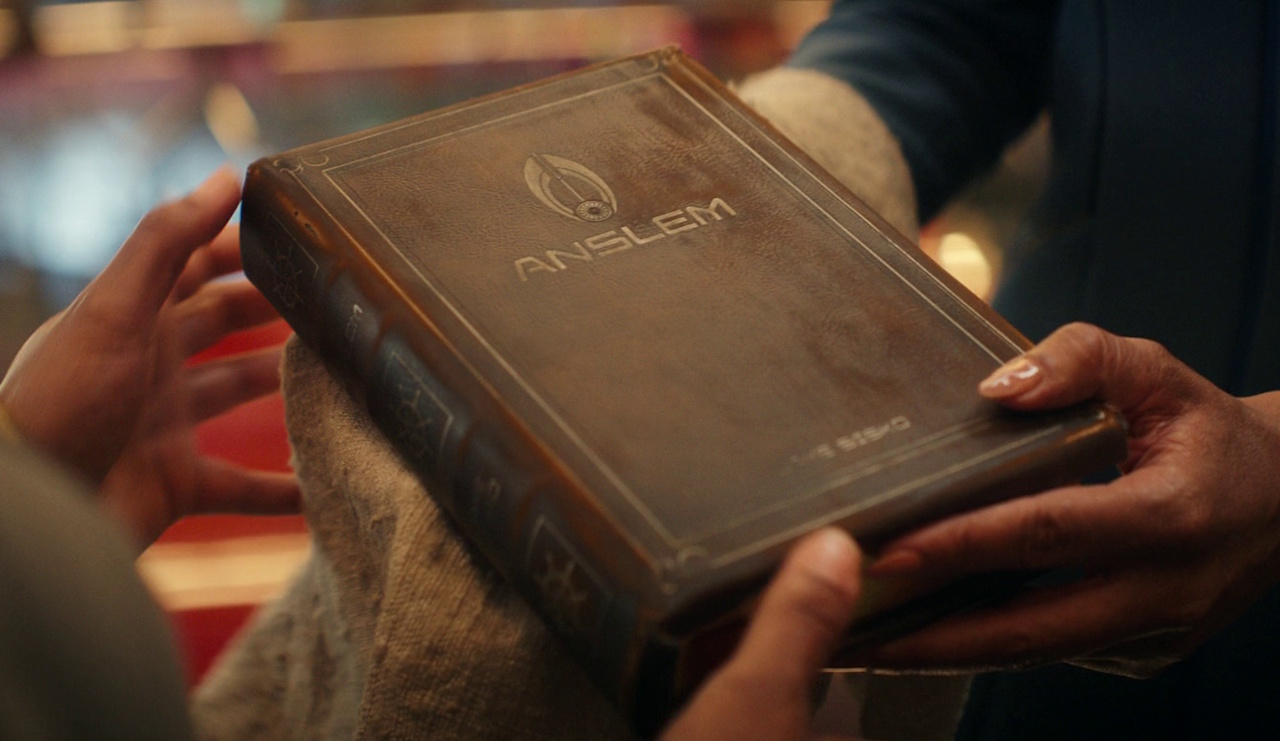
Star Trek: Voyager – Across The Unknown: My Thoughts on the Demo

A Star Trek-themed spoiler warning.

Spoiler Warning: Beware of spoilers for Star Trek: Voyager – Across The Unknown and Star Trek: Voyager.

A new video game based on Star Trek: Voyager, titled Across The Unknown, was announced only a few weeks ago. I didn’t think we’d see it until at least next year – but to my surprise, I received a notification that a demo version is available on Steam. I jumped into the game as soon as it had finished downloading, eager to try it out for myself, and I thought it could be fun to preview the upcoming title together.

I enjoyed the demo for the hour or so that it lasted, and playing through a modified version of Voyager’s premiere – Caretaker – was generally a fun experience. I think Across The Unknown still has work to do – there were a couple of issues that I picked up on in my brief playthrough – but by and large, the game seems poised to deliver more or less what I’d been expecting.

Screenshot of Star Trek: Voyager - Across The Unknown (demo version) showing the USS Voyager in the Badlands.
Voyager in the Badlands.

That idea of expectations, though, is going to be important to how you approach Across The Unknown. The tl;dr is this: this isn’t a big-budget, high production values, “triple-A” type of game. And if you go into it expecting ultra-sharp graphics, fully-voiced characters, detailed cut-scenes, and the like… you’re going to be disappointed, because this isn’t that type of game. What you get instead is a strategic starship management game, one with a tech tree to unlock upgrades, rooms to build, crew members to move around, and so on. There are no voiced characters; Across The Unknown is text-based. And while there are some starship cut-scenes and a pretty fun combat system, most of the time you’ll be treated to static images to convey key storylines.

I believe that if you set appropriate expectations, there’s going to be fun to be had here. The game’s core premise of “what if you were Captain Janeway and made different choices?” is a genuinely fun and appealing one, and Across The Unknown provided several points at which I could make what seemed to be defining choices for the ship and crew.

Screenshot of Star Trek: Voyager - Across The Unknown (demo version) showing Janeway ordering Stellar Cartography be repaired.
Captain Janeway issues an order.

An appropriate point of comparison is probably Fallout Shelter. The games use a similar point-of-view for managing your base/starship, and you get similar choices for where to construct different rooms, who to recruit, who to send on away missions, and so on. That’s a good starting point for understanding what Across The Unknown felt like to play.

Obviously, when you’re looking at a demo version, there are going to be limitations! So I don’t want to judge Across The Unknown too harshly based solely on the first hour-ish of gameplay. Just from looking at the tech tree and the amount of empty rooms aboard Voyager, there’s clearly a lot more to the game that I didn’t get to try out on this occasion. And I also suspect that, of all the missions/story arcs in the game, Caretaker is probably one of the most linear: certain events have to pan out in order for Chakotay, B’Elanna, Neelix, and Kes to join the crew – and that’s just for starters.

Screenshot of Star Trek: Voyager - Across The Unknown (demo version) showing the aftermath of Voyager's arrival in the Delta Quadrant.
The demo is based on the episode Caretaker.

There were, however, some diversions from the story of Caretaker that felt unnecessary to me. Some lines of dialogue – particularly between characters like Chakotay and Tuvok, and Harry and Tom – felt really “off;” I know what these characters sound like, how they talk, and what they said to each other in the beginning – and this ain’t that!

In fact, I’d go so far as to say that some (but by no means all) of Across The Unknown’s dialogue reads like it’s been written by an AI chat bot. I’m not saying that’s what happened – and there could be issues with translation, for example, as the game is being developed in Germany. But that’s how some of these lines felt to me. Subjectively speaking.

Screenshot of Star Trek: Voyager - Across The Unknown (demo version) showing four dialogue boxes.
A selection of the “awkward” dialogue lines.

The tutorial was solid, and I felt that Across The Unknown communicated some of its pretty in-depth systems in a concise and understandable way. I didn’t play the game perfectly on my first outing; I failed one optional assignment when I didn’t build enough crew quarters in time! But that failure helped me learn more about the optional assignments and how the “cycles” (Across The Unknown’s timekeeping) work, so it wasn’t a total loss. And considering that I did fail one of these optional tasks, Across The Unknown was forgiving enough that it wasn’t fatal to my playthrough – which I did appreciate on my first time out!

There are resource limitations, though. At one point, I was running dangerously low on deuterium – which is necessary to keep the ship running. I was only a couple of cycles away from completely running out, and having exhausted all of the planets and points of interest in the two available star systems, there was a bit of a time crunch to get back to the Caretaker’s Array! This is clearly part of the experience – Voyager’s journey home, especially in the early days, was one of scavenging resources where possible, and running close to the line on more than one occasion. It served as a great motivator, I found, to move the story along!

Screenshot of Star Trek: Voyager - Across The Unknown (demo version) showing the system view (and a tool-tip about cycles).
The system map (and a tool-tip showing details about cycles).

Away missions provide one of the ways to make a lot of different choices. Given that the demo is based on Caretaker, I was surprised that Captain Janeway wasn’t able to join any of the away missions to the Array or to Ocampa, and I wonder if that’s going to be a limitation throughout the game. I hope not, but I thought it was worth mentioning. I tried to use a selection of different characters when I could, just to get a different experience with the away missions that I had available.

Each away mission gives individual characters a chance to gain experience and level up – meaning they’ll be better the longer they stick around and the further into the game you get. The tutorial mentioned that some choices, if they go awry, can be fatal. That wasn’t something I experienced in the demo, but it’s interesting to know that even some named characters can, potentially, be killed off at a very early stage – or at any point throughout the run.

Screenshot of Star Trek: Voyager - Across The Unknown (demo version) showing an away team on the transporter pad.
Selecting crew members for an away mission.

I want to touch on one story point that I’ve seen Trekkies talking about since Across The Unknown was announced. This is spoiler-y, so skip past the next screenshot if you really don’t want to know anything ahead of trying the demo for yourself! When it comes to Voyager and crucial choices… Across The Unknown does give you the option to use the Caretaker’s Array to send Voyager and her crew home seven years early! Obviously, this will cut off the entire rest of the game, but I thought it was a ton of fun that the option to do this was included.

And I think that speaks volumes about the kind of big decisions that we’ll get to experience in the full game. The blurb promises twelve sectors to explore – each of which, apparently, can be comprised of at least three star systems, which is neat. I would imagine each sector will provide one of these key inflection points – perhaps more than one. Being able to send the ship and crew home, though, using the Array… I gotta admit, that was pretty cathartic after all these years!

Screenshot of Star Trek: Voyager - Across The Unknown (demo version) showing the end of the demo.
Home in time for tea!

There’s quite a lot of random chance (a.k.a. random number generation) in Across The Unknown, which isn’t atypical for this type of game. You can mitigate some of that by choosing characters and actions that have a higher chance of success, or when on away missions, by combining the efforts of more than one character to increase the odds. But it’s still possible that RNG will go against you at any point, and even an option that looks statistically solid could result in a negative outcome. Again, though: it’s that kind of game.

The ship-to-ship combat was interesting. Unlike exploration, which is measured in “cycles,” and away missions, which play out through a series of decision points, combat in space is close to real-time. Phasers fire automatically, but you get to choose when to fire torpedoes and when to issue other orders to members of the crew. There are a limited number of slots for characters to participate in ship-to-ship combat – which feels like a bit of a double-edged sword.

Screenshot of Star Trek: Voyager - Across The Unknown (demo version) showing a combat encounter.
Ship combat.

On the one hand, this adds another element of strategy: do you want to pick Paris for his evasive manoeuvres, or Tuvok for his finesse with the phasers? It also makes each combat encounter potentially different, as you can choose a different crop of people every time. However… part of the captain’s chair fantasy experience, surely, is being able to issue orders to the entire crew in situations like this. Being able to divert extra power to the phasers by calling up B’Elanna in engineering, or telling the Doctor to prepare sickbay for casualties… that’s all part of sitting (metaphorically) in the captain’s chair. By reducing the number of characters who can participate, part of the combat just felt a bit… small, I guess.

That’s not to say it was bad. I actually had fun taking on the Kazon in my combat encounter! And after spending most of my time looking at a master systems display or a zoomed-out solar system, seeing Voyager moving around in real-time, up close… that was something special.

Screenshot of Star Trek: Voyager - Across The Unknown (demo version) showing the USS Voyager, the Caretaker's Array, and Kazon ships.
Voyager and Kazon ships at the Caretaker’s Array.

Across The Unknown needs some more polish. There were a few places where I saw a typo or missing punctuation, and another where Neelix popped up to tell me something before I’d even met him or invited him aboard. My PC also seemed to struggle, with the graphics card working overtime and the game still occasionally lagging – despite the fact that, as mentioned, the graphics really aren’t anything special. Performance when zooming in and out of the MSD could really use some improvement. I wasn’t even running Across The Unknown at its maximum settings.

That being said, I came away from my hour with the demo more excited to play the finished game than I was before I started. Voyager is such a great series, and it feels perfectly-suited to this kind of strategic management title. Being able to make radically different choices to those that Captain Janeway made during the show is going to be a lot of fun, and if the rest of the game is as good as the demo in terms of narrative and gameplay, I can see myself sinking many hours into it when it’s ready.

Screenshot of Star Trek: Voyager - Across The Unknown (demo version) showing a cargo bay.
A cargo bay.

If you want to wait for the finished game, that’s a completely valid decision. I usually don’t play pre-release demos, and there are a few issues with Across The Unknown that I’d hope will be smoothed out before the full game releases. But it’s hard not to recommend a completely free demo of a game like this. It only took me an hour to play through the events of Caretaker and get a feel for what Across The Unknown is like, so if you’re like me and Across The Unknown is a guaranteed day-one purchase for you, I think trying out the demo is an easy recommendation.

I’ll end by saying that Across The Unknown is clearly a game made for fans. And that’s okay. Not every game is going to reach a broad audience; Across The Unknown knows what it is, knows who its target audience is, and seems to be leaning into that in a big way. It’s not going to blow up and win hundreds of awards, nor is it going to expand the Star Trek fan community in a meaningful way. But given that it’s Voyager’s thirtieth anniversary this year, I’m just pleased that a game like this was greenlit at all. Stepping back into that world – even with some last-gen graphics, odd facial expressions, and occasionally janky dialogue – was a lot of fun.

The demo is free on Steam at time of writing… so why not try it? All you have to lose is 6 and a bit gigabytes of disc space and an hour or so of your time!


Star Trek: Voyager – Across The Unknown will be released (in full) in the future. The demo version is available now on Steam. The Star Trek franchise – including Voyager and Across The Unknown – is the copyright of Skydance/Paramount. Star Trek: Voyager – Across The Unknown is developed by GameXcite and published by Daedalic Entertainment. This article contains the thoughts and opinions of one person only and is not intended to cause any offence.
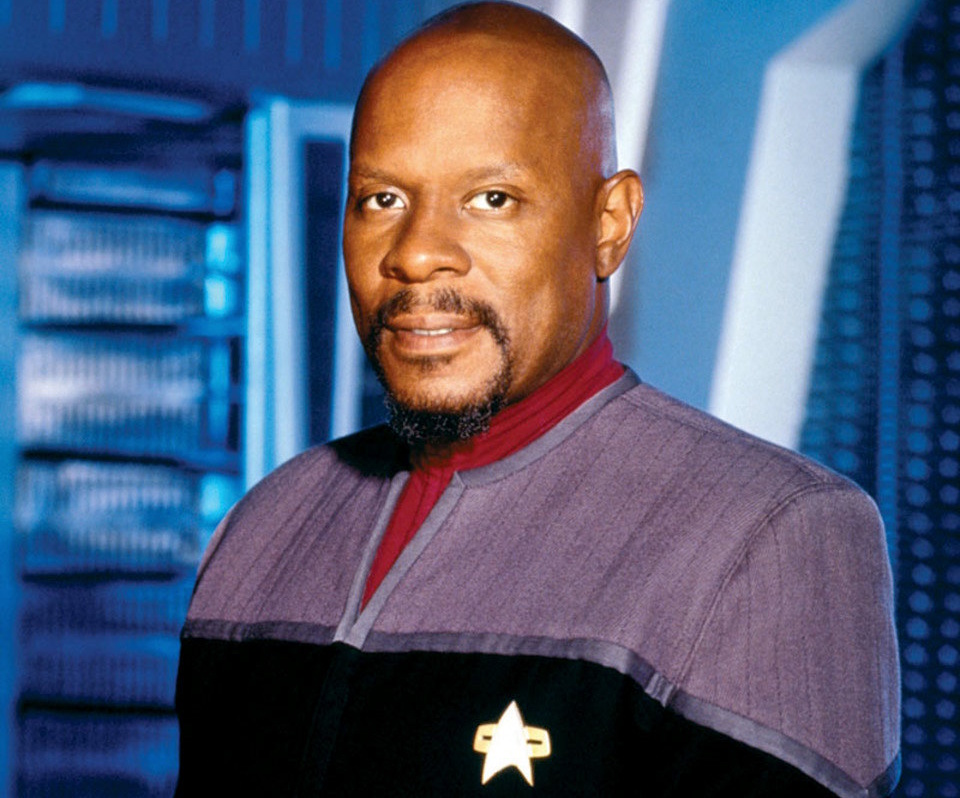

A selection of screenshots from my time with the Across The Unknown demo that didn’t fit in the article above:

Screenshot of Star Trek: Voyager - Across The Unknown (demo version) showing the main view of the ship.
The main MSD/ship display (zoomed out).
Screenshot of Star Trek: Voyager - Across The Unknown (demo version) showing an away mission.
An away mission.
Screenshot of Star Trek: Voyager - Across The Unknown (demo version) showing the tech tree.
Part of the tech tree.
Screenshot of Star Trek: Voyager - Across The Unknown (demo version) showing the aftermath of a broken promise.
Breaking a promise (a.k.a. failing an optional quest).
Screenshot of Star Trek: Voyager - Across The Unknown (demo version) showing the sector view.
A view of the sector, including three star systems.
Screenshot of Star Trek: Voyager - Across The Unknown (demo version) showing Neelix's ship.
Neelix’s ship arrives.
Screenshot of Star Trek: Voyager - Across The Unknown (demo version) showing the bridge.
The view from the bridge.
Screenshot of Star Trek: Voyager - Across The Unknown (demo version) showing sickbay.
The Doctor in sickbay.
Screenshot of Star Trek: Voyager - Across The Unknown (demo version) showing the choice at the end of the demo (destroy or use the Array).
The key choice!
Screenshot of Star Trek: Voyager - Across The Unknown (demo version) showing a construction report.
Completing construction/repairs.

Star Trek at Comic-Con: A Teaser and a Trailer

A Star Trek-themed spoiler warning.

Spoiler Warning: Beware of spoilers for upcoming seasons of Starfleet Academy and Strange New Worlds. Spoilers are also present for the following Star Trek productions: The Undiscovered Country, Voyager, Discovery, Prodigy, and Picard.

The Star Trek franchise popped up at New York’s Comic-Con event this week, building up the hype for Starfleet Academy and the next season of Strange New Worlds. I thought we could take a look at them together, as we begin to get excited for next year’s Star Trek projects.

First of all, it does seem, based on the release of the teaser clip and Starfleet Academy’s mid-January premiere, that Strange New Worlds Season 4 is on the schedule for 2026. That’s good news! After the two-year gap in between Seasons 2 and 3, and with Starfleet Academy still in post-production, I wasn’t sure if Strange New Worlds would manage a 2026 broadcast, but it’s good news in my book that we don’t have to wait too long for the next instalment in what is still my favourite modern Star Trek series.

Still frame from the second trailer for Star Trek: Starfleet Academy showing the premiere date.
Starfleet Academy will be on our screens in just over three months!

Since we’re talking Strange New Worlds, let’s take a look at the teaser clip first.

Firstly, I’m not 100% sure if this was one continuous sequence, or if there wasn’t at least one cut somewhere in the middle. It kind of feels, to me, like a scene or two might be missing… but that could also be where the title sequence will appear in the finished episode, I guess! In any case, the Strange New Worlds teaser was taken from a single episode, and it shows Pike and the crew getting into trouble with what looked somewhat like a plasma storm or ion storm.

How, exactly, a plasma storm might’ve thrown the Enterprise to a different point in space is… debatable! But we’ve seen similar things happen before; I actually got a “Caretaker” vibe from that part of the clip, as the ship got caught in an expanding space storm and ended up somewhere different. I’m not saying this will be the Delta Quadrant, of course! But as I’ve said before, sometimes Star Trek stories kind of rhyme, and this clip was definitely reminiscent of Voyager’s premiere for me.

Side-by-side comparison of Star Trek: Strange New Worlds Season 4 and Star Trek: Voyager Season 1, showing both starships caught in an orange-tinted region of space and being tossed around.
The USS Enterprise in the Season 4 teaser and the USS Voyager in Caretaker.

I’m glad that we got to see Ortegas back at the helm after her Gorn encounter. I think, having sat with it for a month or so, that Terrarium might be the best episode of Season 3, and I’m definitely excited to spend more time with Ortegas (and some of the show’s other original characters) before Strange New Worlds wraps up. Ortegas was also present on the shuttle mission at the end of the clip, and really seems to be back in her element in the pilot’s seat.

Another character I was pleased to see was Pelia! Pelia seemed to draw the short straw in Season 3, with Scotty taking over key engineering storylines in episodes like A Space Adventure Hour, but she’s at least going to be present in Season 4 and hasn’t just been unceremoniously shuffled off-stage. That makes me happy; Pelia is a great comic relief character and has had some of the best and funniest lines in Seasons 2 and 3. Getting the right balance between Pelia and Scotty – the chief engineer and the deputy – is something Strange New Worlds still needs to work on, but I think Pelia’s presence in the teaser clip is promising, at least.

Still frame from the Star Trek: Strange New Worlds Season 4 promo clip showing Pelia.
Pelia.

Spock and La’an were seen together in the clip – though not in a romantic setting! La’an did seem to be looking at Spock, though, and I suspect that their relationship will continue at least at the beginning of Season 4. As I said, though, when Season 3 was on the air: I kind of need a break from that. I don’t want more “Spock comedy,” or “Spock romance,” not with only a few episodes remaining before Strange New Worlds will be over. So I hope the writers aren’t going to push for more of those things in Season 4. Hard to tell from just this one clip, of course!

We also caught a glimpse of a new Vulcan character – a cadet, who seems to be shadowing Uhura on the bridge. Giving Uhura a mentorship role could be a fun way to extend her character arc, so I’m on board with that! Part of me wonders if this character is intended to be someone familiar: perhaps Tuvok’s wife, T’Pel, who we saw briefly in Voyager, or even someone like Saavik or Valeris. Given Valeris’ later role in The Undiscovered Country, that could be interesting.

Still frame from the Star Trek: Strange New Worlds Season 4 promo clip showing Uhura and a cadet.
Uhura with the Vulcan cadet.

Pike’s line to Una, asking her if she’d miss space exploration if she had to give it up, felt poignant – and could be related to Pike’s impending accident and disability. Perhaps his knowledge of the future is weighing on him during this mission, maybe he’s still mourning Captain Batel after losing her at the end of Season 3, or it could be connected to the fantasy life we saw in the Season 3 finale. In any case, the line stuck out to me, and clearly indicates that Pike has a lot on his mind beyond just the mission at hand.

This aspect of Pike’s characterisation – his knowledge of what lies in store for him – has made this iteration of the character incredibly impactful and relatable to me personally. I read his story through the lens of my own poor health; I’ve been Captain Pike, hearing bad news about my health and future prospects, knowing there isn’t anything I can do, and the way Anson Mount brings that to the screen has always been nothing short of fantastic. Given that it will probably be a big plot point in the cut-down fifth season, I’m not sure how important Pike’s imminent accident will be this time around, but this clip seems to hint at it being important for him in at least one episode.

Still frame from the Star Trek: Strange New Worlds Season 4 promo clip showing Pike and Una on the bridge.
Pike’s line to Una really stood out to me.

I don’t remember the element iridium being mentioned a lot in previous Star Trek stories, but I like this little expansion of the lore of Star Trek. According to Scotty, iridium is necessary to “ignite” the warp engines – presumably meaning it’s important to the antimatter reaction along with dilithium. In any case, missing iridium seems like a suitable driving force for a story that looks set to take Una, La’an, and Ortegas to – as Captain Pike put it in a kind of too on-the-nose line – a “strange new world.”

Not sure what else to say about the Strange New Worlds clip. I think the episode looks like it’ll get off to a solid start, it was nice to see most of the crew getting a line of dialogue or something to do, and there were enough little teases to get me excited. Pike’s story looks like it could be complex, a new Vulcan cadet could be a fun addition to the bridge, even if she’s only present for an episode or two, and I’m genuinely curious to learn more about this mysterious storm in space and where it might’ve taken Pike and the Enterprise. Could I be about to get my “Pike versus the Borg” story that I’ve been harping on about for years? Erm… no!

Still frame from the Star Trek: Strange New Worlds Season 4 promo clip showing Una, La'an, and Ortegas on a shuttlecraft.
Destination: unknown.

Next, let’s talk about Starfleet Academy.

In a frankly bizarre move, comedian and late-night talk show host Stephen Colbert was announced as having a voice-only role in the series. Apparently, Colbert is a bit of a Star Trek fan, and he’ll be providing the voice of the “Digital Dean of Students” at the Academy. Colbert treated us to what he said was one of the actual lines from the show – and it was… fine, I guess?

I’ll be honest: this feels like stunt casting; hiring a big-name star for no other reason than, well, they’re a big-name star. However… if it helps draw a few more eyes to Star Trek, that’s not necessarily a bad thing. I’m just not convinced it’ll be as big of a deal as Paramount/Skydance would’ve liked, and I’m not sure it was the best possible way to close out the Comic-Con revelations and news. Maybe this is because I’m from the UK, and perhaps to an American audience, someone like Stephen Colbert is much more of a draw. I just wasn’t blown away by it, and my feelings toward the announcement were more like “erm, okay?” rather than “woah, what a great idea!”

Still frame from New York Comic-Con 2025 showing Stephen Colbert.
Stephen Colbert is joining Starfleet Academy for a voice role.

I’ve said this before, but I don’t think a show like Starfleet Academy benefits from having a main villain. I had hoped that Starfleet Academy could’ve adopted the Strange New Worlds model and done something a lot more episodic – that kind of thing feels like it’s well-suited to a show about younger characters learning about serving in Starfleet. It’s still my hope that we’ll get some of that, but it’s seemed for a while like the series is going down a serialised route similar to Discovery.

In fact, I felt echoes of Discovery in the connection between the villain, Nus Braka, and the young cadet Caleb. Every season of Discovery seemed to follow a very familiar pattern: there’s a villain who’s threatening the Federation or the entire galaxy, and somehow, that villain has a connection to one of our heroes. We had it with Lorca, Voq, and Tyler in Season 1, the Red Angel in Season 2, the Emerald Chain and the Burn in Season 3, the DMA and Tarka in Season 4, and the Breen and Moll in Season 5. Picard even got in on the action with Q and the Borg Queen in Season 2, and Vadic and Jack in Season 3, and so did Prodigy with Gwyn and the Diviner.

And I’m just so thoroughly burned out on that repetitive story concept at this point.

Still frame from the second trailer for Star Trek: Starfleet Academy showing Nus Braka, the main villain.
Nus Braka: Starfleet Academy’s villain.

However! It wasn’t all doom and gloom in the Starfleet Academy trailer. We caught a glimpse of Mary Wiseman’s Tilly for the first time in any Starfleet Academy material, which is great news. Tilly was a fun character in Discovery, and it seemed – for a time, at least – as if Starfleet Academy might be being constructed around her as a central character. There was even that backdoor pilot in Season 4 – though none of the cadet characters seem to have shown up in the new series, for some reason.

But with Tilly having been absent from all of Starfleet Academy’s marketing so far, I can’t’ve been the only one who was beginning to wonder whether she’d show up at all! Rumours suggest that Tilly may only be a guest-star for a single episode in the show’s first season, but I’m sure she’ll still be a welcome addition to the cast. It was great to catch sight of her for the first time, in any case.

Still frame from the second trailer for Star Trek: Starfleet Academy showing Tilly.
It’s Tilly!

The rest of the Starfleet Academy trailer looked… well, it looked “teenager-y.” Which makes sense, of course, given the show’s younger characters and target audience! Plenty of shows and films aimed at a younger audience or featuring younger characters still have a lot to offer to the rest of us – look at the likes of Wednesday or Stranger Things (neither of which I’ve actually seen, but they’re good examples nevertheless!) Some of the clips in the trailer seemed to show characters at the Academy falling in love, going on dates, and talking in that kind of angsty way you sometimes get in teen dramas. I’m not sure whether all of that (or any of it) will be to my taste, but I’m content to give the show and these characters a chance to impress me.

One thing I hadn’t clocked until recently was that Sam – one of the new cadets – is a hologram. I think this is really interesting given that Voyager’s Doctor is also going to be present in the series, and I can already see the two of them developing a connection over a shared (or similar) heritage. That’s something that could be really interesting, and I wonder if we’ll get an exploration of how holographic rights developed in the years after Voyager.

Still frame from the second trailer for Star Trek: Starfleet Academy showing Sam and the Doctor.
Sam and the Doctor.

Nahla Ake, the captain and Chancellor of the Academy, is sure to be one of the series’ breakout characters. She’s brought to life by Academy Award-winner Holly Hunter, and the Star Trek franchise really lucked out to land a performer of such calibre. Though I’m not sure her personal connection with Caleb is the right move narratively, I’m really excited to see what this new character will be like, how her style of command will be, and how the rest of the cadets will respond to her. I think there’s a ton of potential there.

It was a deliberate choice to make Starfleet Academy a spin-off from Discovery, set in that same far-future time period. I’ll be curious to see how the show will lean into that, and whether the “post-apocalyptic” setting caused by the Burn and its lingering aftershocks will be a big part of the main storyline. In a way, I hope that Starfleet Academy will be able to do something more meaningful with that idea than Discovery managed… but I won’t lie: a big part of me regrets that this show couldn’t have been set in the Picard era instead.

Still frame from the second trailer for Star Trek: Starfleet Academy showing Caleb looking disheveled.
Caleb.

It seems like Starfleet Academy is setting up Caleb, Captain Ake, and Nus Braka to be the principal characters, all tied up together in a “mystery box” type of story surrounding Caleb’s missing mother. I’m still not convinced that this was the right approach, but maybe if it’s a solid enough story it will at least be worth following to its conclusion. Based on what we saw of him in the trailer, I wasn’t actually wowed by veteran actor Paul Giamatti’s performance – he felt too over-the-top for my liking. And that’s a shame; Giamatti is a fine actor, and someone I’ve been looking forward to seeing in Star Trek. Hopefully it’s just a consequence of the way the trailer was cut; in context, those moments might feel better and make a lot more sense.

I hope Starfleet Academy isn’t going to do the clichéd (and also played-out) trope of “everyone has a hidden secret backstory.” We seemed to get hints at at least two of the other cadets – Genesis and Darem – having some kind of issues with their families or in their past that are driving them to seek positions in Starfleet. I don’t think every character needs that kind of motivation – especially not young, school/university-aged characters. Isn’t it enough to say they’re looking to make something of themselves, or that Starfleet appealed to them because they wanted to be scientists or explorers? Complexity can make a character great in any work of fiction – but not every complex character needs to have some kind of mysterious or traumatising past to explain why they are the way they are. I’m just a little concerned that Starfleet Academy is leaning too much into that kind of storytelling.

Still frame from the second trailer for Star Trek: Starfleet Academy showing Genesis Lythe.
Why does Genesis say she “needs” to be a captain?

I hope this has been an interesting glimpse at both Starfleet Academy and Strange New Worlds. I still haven’t decided yet whether I’m going to review every Starfleet Academy episode or not – I think, at the very least, I’ll review the premiere, just to see how the series is starting off! But whether I do individual episode reviews or review the rest of the season in one hit, I hope you’ll join me for that in January. And I’m hopeful that Strange New Worlds Season 4 will debut later in 2026, too – and I will definitely write up individual episode reviews there, as I did for Season 3 earlier this year.

Obviously, Strange New Worlds remains the Star Trek project I’m most excited for; nothing in the Starfleet Academy trailer convinced me that I should change my mind about that! But, despite what I’d consider to be some narrative red flags, I’m still hopeful that Starfleet Academy will be fun. Even if it’s not “my thing,” perhaps it will finally be the series that reaches out to a new generation of viewers, turning them into Trekkies and kick-starting a renaissance for the franchise that the fan community arguably needs.

In any case… we don’t have much longer to wait!


Star Trek: Starfleet Academy will premiere on Paramount+ in January 2026. Star Trek: Strange New Worlds Seasons 1-3 are available to stream now on Paramount+ and Season 4 looks set to premiere later in 2026. The Star Trek franchise – including all shows and properties discussed above – is the copyright of Skydance/Paramount. This article contains the thoughts and opinions of one person only and is not intended to cause any offence.
Nintendo Is Just Awful

Despite trying hard to project a “family-friendly” image, Nintendo is no less of a greedy, aggressive, predatory, and money-grubbing corporation than the worst of the worst in the games industry. The company would, were it not for a legion of well-trained apologists, rightly be held up along with the likes of Electronic Arts, Tencent, Blizzard, and Ubisoft as a shining example of a gaming mega-corporation that is, for want of a better word… evil.

Nintendo, if you weren’t aware, has recently tried to patent in-game systems, which would prevent anyone else from using those mechanics in their games – or would mean those companies would have to pay a license or fee to Nintendo. This is tied to the Palworld situation that I talked about last year, as Nintendo is embroiled in a frivolous lawsuit against Palworld’s creators, Pocketpair. But I think it says a lot about how Nintendo behaves, how far the company has fallen, and why it’s past time for the current crop of increasingly elderly executives and game directors to be retired.

Promo art for Palworld showing a character holding a blue orb.
Palworld is causing a lot of bed-wetting among Nintendo executives…

Here’s the bottom line when it comes to patents: if other companies had treated Nintendo the way that Nintendo treats other companies, Nintendo would’ve gone bankrupt making playing cards in 1980. That’s not an exaggeration: literally none of the games Nintendo became known for would’ve been possible if other companies had taken out patents like the ones Nintendo is trying to use in the Palworld lawsuit. And where would Nintendo be today without video games? Just another failed Japanese toy company that didn’t make the cut.

If Universal and CBS, developers of the 1980 arcade game Space Panic, had patented the idea of the 2D platformer, Nintendo’s Donkey Kong wouldn’t have been able to exist. Nintendo would never have been able to develop Super Mario Kart – or any of its other racing games – if someone like Sega had gotten a patent for the concept of a racing video game after their successful Road Race arcade game in 1976. If Sony had patented the 3D platformer after 1995’s Jumping Flash, then Nintendo couldn’t have made Super Mario 64. Should I continue, or have I made my point?

Screenshot of Space Panic.
Doesn’t this look familiar…

The entire history of video games is one of piecemeal innovation. A new creation comes along, gains traction – or doesn’t in some cases, but the concept still seems appealing – and then other companies take the idea in new directions. Nintendo has never actually made anything original. What they’ve done for decades – very successfully, to their credit – is build on other people’s creativity and other people’s ideas, taking concepts that other games have tried and honing them, often to near-perfection. If other companies had locked their efforts away, as Nintendo is attempting to do to Palworld and others, not only would the entire games industry be smaller, less creative, and just worse overall, but Nintendo itself as we know it today could never have come to exist.

There are some massively-popular games which went on to quickly spawn entire genres. I’m old enough to remember when first-person shooters were literally called “Doom clones,” but id Software, in 1993, didn’t try to patent the concept. If they had, there’d never have been GoldenEye, Metroid Prime, or literally any other FPS title. Games companies don’t exactly like sharing their ideas, but it’s been accepted as part of the games industry for decades. You can’t claim ownership of a broad concept, idea, or genre.

Screenshot of GoldenEye showing the player character shooting an enemy.
GoldenEye wouldn’t have been made if id Software had gotten a patent for first-person shooter mechanics.

There are some things that can and should be trademarked, copyrighted, or patented. I’d never try to argue, for instance, that anyone other than Nintendo should be allowed to create a 2D platformer featuring a red-hatted, overall-wearing, turtle-stomping plumber named Mario. That concept is a specific one, and it uses original characters, designs, creations, and storylines. But the basic mechanics of how video games work should be – and historically, have always been – open to everyone. Trying to claim ownership over a sub-genre or in-game mechanic simply should not be allowed – and we need to clamp down on this kind of misbehaviour now, lest it get out of hand.

There are many other games companies who’d surely love nothing more than to get a patent for something broad and vague, stifling competition or forcing their competitors to pay them. Imagine if Bethesda managed to get a patent for something like mana points in a video game. Or if Ubisoft got a patent for concealing the player character in tall grass. What about if Atari patented flying in a spaceship? After all, they pioneered that idea in video game form with 1979’s Asteroids. Would the video games industry be better off if every company could patent everything it could claim to have invented? Or would video games as a whole be smaller, less interesting and less innovative? I think we all know the answer.

Nintendo's logo (white on a red background).
Nintendo is using the legal system to try to shut down competition.

Pokémon is, itself, a great example of the evolution of video games. It didn’t spring into existence overnight, fully-formed and utterly unique. It built on existing battle games, turn-based games, card games, and role-playing games, which had been developed through the 1980s and early 1990s, and also drew inspiration from films, manga, and even collectables like baseball cards and capsule toys. Many role-playing games – especially JRPGs – use very similar in-game mechanics for things like combat and overworld exploration, and plenty of titles outside of the monster-battling sub-genre also use things like summonable allies, temporary companions, and friendly monsters. Why should any of that be patentable? How does Nintendo have the sheer nerve to say they invented any of it?

Because that’s what Nintendo’s patent claims: that they own, invented, and have the exclusive rights to the in-game mechanic of summoning an object or ally to engage in battle.

To be clear: this patent should never have been granted in the first place. Anyone with a cursory knowledge of video games could have easily found the flaws in this patent and thrown it out. But Nintendo having the cheek, the sheer brass neck, to ask for this patent… it’s absolutely disgusting.

Still frame from the Nintendo Switch 2 Direct showing three executives/producers.
Three senior Nintendo executives/producers during a recent Nintendo Direct broadcast.

Nintendo’s leadership needs a good clear-out. The people who’ve been there since the ’80s and ’90s are growing old, and in lieu of actually innovating and inventing, they’re desperately trying to use lawfare to drive away the competition. Terrified of losing their position – and perhaps recognising that the overpriced Switch 2 isn’t going to sell as well as its predecessor – they’re trying to use illegitimate and, frankly, dishonourable means of shutting down competition. When you can no longer compete on merit… trying to use legal loopholes and dodgy rulings to shut out the competition must seem tempting.

That’s what Nintendo is doing, at the end of the day. They’ve realised that Palworld is the canary in the coal mine: a shining example of a new company coming in, creating something better and more appealing, and hoovering up eager customers who’ve burned out on the stale, repetitive, and boring Pokémon series. And because the elderly senior developers and executives don’t know how to make a game like Palworld, the only thing they can think to do is try to get it shut down.

And that’s pretty fucking shameful.

Still frame from the Mario Kart World trailer showing Mario grinding on a rail.
Mario Kart World.

Nintendo’s recent output, in my opinion, hammers home why the senior people at the corporation feel a need to do this. Even the top-selling Nintendo games of the last generation – Super Mario Odyssey, Animal Crossing: New Horizons, Tears of the Kingdom, Smash Bros. Ultimate, and Mario Kart 8 Deluxe – were sequels at best, derivative and repetitive at worst. The Switch 2, with its samey design, is the first Nintendo console in decades not to offer something new or innovative. And the company seems to be doubling-down on wringing as much money as possible out of its fans and players with increasingly unfriendly decisions around pricing. With limited room for growth, a lack of new ideas, and an elderly and outdated crop of senior developers and leaders, Nintendo is trying to shut down genuine competitors instead of learning, growing, and improving – the way video games companies have done for decades.

It’s embarrassing, quite frankly, that Nintendo felt the need to stoop so low, and that they have such a lack of confidence in their ability to compete fairly if the playing field were level.

But that’s Nintendo for you… and Nintendo is just awful.


All titles discussed above are the copyright of their respective developer, publisher, and/or studio. Some screenshots and promo art courtesy of IGDB. This article contains the thoughts and opinions of one person only and is not intended to cause any offence.
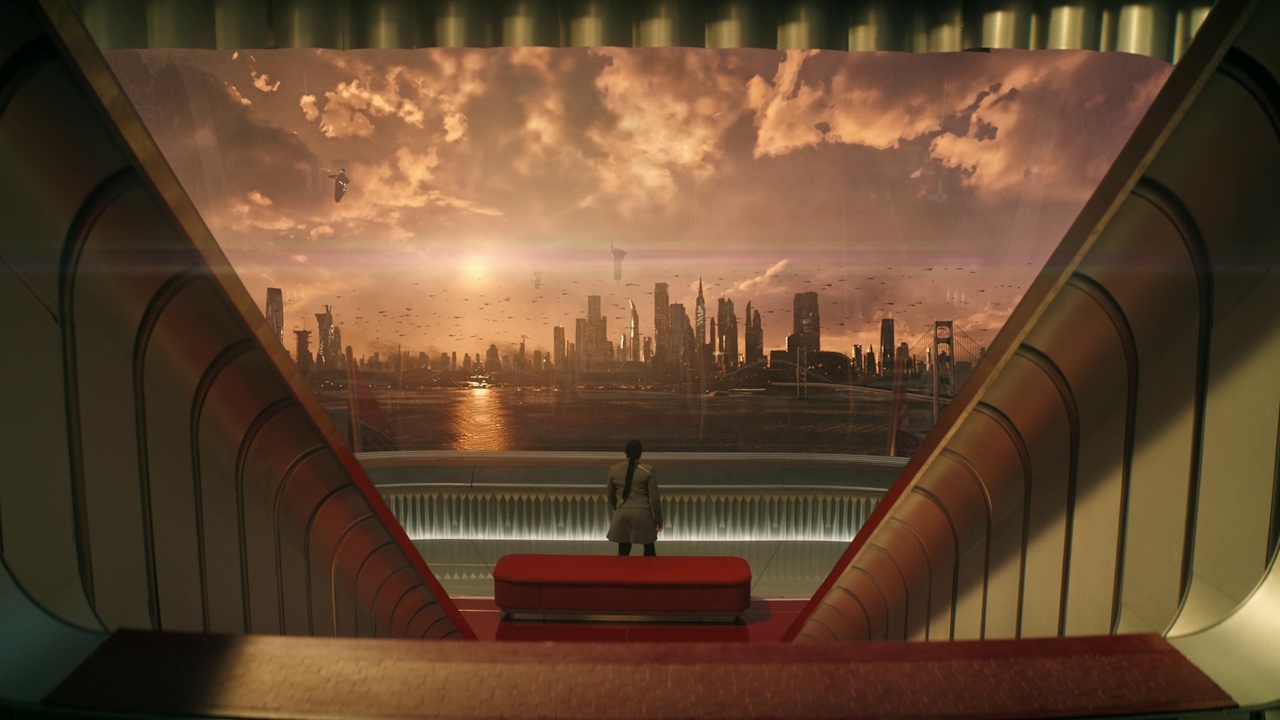
The Electronic Arts Buyout and Ethical Consumerism

One of the biggest news stories of the week (and one of the biggest gaming news stories of the last few years) is the sale of Electronic Arts to a private investment consortium. EA, which had previously been a publicly-traded company, is being taken into private ownership, and there’s a lot of debate about what that might mean for titles like The Sims 4, the very lucrative EA Sports franchise, and the likes of EA’s Star Wars games. We’ll touch on those subjects as we go along, but I have a big-picture question, given who’s about to own Electronic Arts: regardless of what happens to the games… is it possible to support this company, given its new owners? Or to put it another way: should we buy any EA games in the future?

Electronic Arts will soon be owned in full by Saudi Arabia’s Public Investment Fund, private investment firm Silver Lake, and Affinity Partners – a company co-owned by Donald Trump’s son-in-law, Jared Kushner, (and which also takes a lot of money from Saudi Arabia).

Logo of the PIF on a desert landscape.
Saudia Arabia’s Public Investment Fund will soon own Electronic Arts.

It is not easy, given our current economic model, to be an “ethical consumer,” and some folks argue that any form of ethical consumerism isn’t possible; there’s just too many bad actors, too much corporate cross-contamination, and it’s not always easy to tell, at a glance, who owns what and where your money goes when you make a purchase. Buying something as simple as a box of chocolates might contribute to modern-day slavery on a cocoa plantation, buying cheap clothes online almost certainly means they’re made in a sweatshop in the Far East, and even something like an electric car – great for the environment and to fight climate change – may not have sourced materials like cobalt and lithium ethically.

Then there are brands. I didn’t know, until talk of the EA buyout was happening, that Saudi Arabia’s PIF already owned 10% of the shares in Electronic Arts. And the same problem happens time and again. When you go to the supermarket and you choose, for example, a brand of cat food… would you know, off the top of your head, which mega-corporation owns which brand? Did you even know that there really are only a handful of these mega-corporations, and that in some cases, the “choice” between different brands is irrelevant because they’re all ultimately owned by the same people anyway?

Electronic Arts' logo c.1980s/90s.
EA’s original logo.

If you’re at the supermarket trying to decide between Felix, GoCat, Gourmet Perle, and Purina One… that’s not actually a choice, because they’re all owned by Nestlé. Trying to choose an ice cream? It doesn’t matter if you get a Cornetto, a Magnum, Carte d’Or, or even Ben & Jerrys: Unilever owns all of those brands.

The point is this: we don’t always know who owns the businesses we buy from. The consumer marketplace is complex and opaque – deliberately so. The illusion of choice means we feel in control, but all of our money flows into the pockets of a tiny number of people at the very top. That’s late-stage capitalism, I guess.

But in some cases, where something *is* relatively clear-cut, and where a corporation or investment firm clearly is not aligned with our values and beliefs… don’t we have an obligation not to buy from them?

Stock photo of a British supermarket aisle.
It isn’t always easy to tell which brand is owned by whom.

Here on the website, I’ve talked about a couple of things that I think are relevant. In 2022, I decided that – for the first time ever – I wasn’t going to watch any football matches at the World Cup. Why? Because the World Cup that year was hosted by Qatar, a country where being homosexual or transgender is illegal, and where hundreds of underpaid workers died building the stadia that Qatar wanted to use to sportswash its image.

And in 2023, I talked about why I couldn’t play or support Hogwarts Legacy and the Harry Potter franchise in general. The owner of that franchise, into whose pockets money flows from all purchases, is incredibly transphobic, and spends money on advocating for and elevating anti-trans causes and legislation in the UK. She’s also stated that any purchases of books or merchandise will be interpreted as support for her views and positions.

In both cases, I chose not to participate, not to purchase, not to watch, and not to support organisations and individuals whose views and behaviour I felt I could not condone.

Concept art for Hogwarts Legacy.
I chose not to play Hogwarts Legacy in 2023.

Saudia Arabia, as recently as 2019, executed people for being gay. At the very least, being gay can result in imprisonment and corporal punishment. Women in Saudi Arabia don’t have the same rights as men, and are effectively second-class citizens. The country has executed journalists critical of its regime, routinely executes, maims, and physically punishes people for relatively minor offences and non-crimes, and just has an appalling record on human rights overall.

In recent years, prompted by the world’s painfully slow move away from oil, Saudi Arabia has begun to make investments in other industries. They’ve spent heavily in football and sport, buying teams, promoting their domestic league, establishing a new golf tournament, and successfully bidding to host the 2034 World Cup. This move to purchase Electronic Arts – the biggest sports game publisher in the world – should be seen through that lens. There’s a degree of sportswashing here, of course, but the main objective is to make money and diversify the Saudi economy beyond oil.

Stock photo of a man holding a large amount of cash.
The PIF hopes to make a lot of money out of this transaction.

I’ve seen people worried about what this might mean for the future of some of their favourite Electronic Arts games. And that is a fair concern: an investment consortium like this is concerned exclusively with making money, so I think you can expect to see EA’s already heavily-monetised games getting even worse on that front. It’s also quite possible that the new corporate entity will be less likely to invest in new IP, seeing it as too much of a risk. Single-player games could also be on the chopping block.

I get that these are valid concerns. If you’re really looking forward to a game like the next Mass Effect, the sequel to Jedi: Survivor, or another EA single-player title, yeah… you should be worried, because the new owners may not have any interest in games that can’t be monetised long-term. If you’re a big Sims 4 or Madden NFL player, already disappointed in the state of those games with their microtransactions… at the very least, things aren’t gonna get better on that front. But my question is more fundamental: should we be buying these games at all, given who is about to take full ownership of EA?

Promo screenshot for one of The Sims 4's many expansion packs.
One of many expansion packs for The Sims 4.

I can’t speak for you, nor for anyone but myself. We all have the freedom to decide what’s important to us and what isn’t, where our ethical red lines are, and how and where to spend our money. We’re all free to prioritise and determine what matters most. So this piece isn’t supposed to come across like me “demanding” other people change their behavior or stop supporting a certain company. I’m trying to get my thoughts in order, lay out my own “red lines,” and explain why, going forward, I’m not going to buy any more games developed or published by Electronic Arts.

If I couldn’t support Hogwarts Legacy or the Qatar World Cup, how could I, in good conscience, buy from a company owned by Saudi Arabia? How could I give money to an organisation that supports an authoritarian dictatorship where basic human rights are regularly suppressed? And for what… a video game? Even if it was the best video game of all-time… the ethical and moral cost is now too high.

Still frame from the Mass Effect 4 teaser showing Liara's face.
I’m afraid this means no Mass Effect 4 for me, assuming it actually gets released…

And yes, I concede the point that it isn’t possible to be 100% ethical in a corporate-capitalist system. Saudi oil accounts for a significant portion of what we use here in the UK, British companies export to and work in Saudi Arabia, and the PIF has stakes in many companies and brands that trade here in the UK. It probably isn’t possible to entirely avoid Saudi Arabia and its PIF. But that doesn’t mean I shouldn’t try, if this is something I feel strongly about, and it doesn’t mean I should make it easy for them to grab money out of my wallet.

That means that some games I’ve honestly been looking forward to or just interested in… they’re now off the table. The third and final chapter in Respawn’s Fallen Order trilogy. The next Mass Effect game. Future sports titles in franchises like PGA Tour and EA FC. I’m going to leave them on the shelf and walk away… because it feels like the right thing to do.

Still frame from EA Sports PGA Tour showing a custom character on the golf course.
…and no more golfing.

What’s more, this buyout has opened my eyes to some of my personal blind spots when it comes to the games industry. I was totally unaware that 10% of EA was already owned by Saudi Arabia’s PIF, so… what else have I missed? I spent a bit of time looking into some of the other big investors in the games industry.

BlackRock, a large investment firm tied to things like weapons dealing, is a large investor in both Sony and Microsoft, for example. And much controversy already surrounds TenCent – a Chinese firm which has made major investments in western games companies, including Epic Games, Ubisoft, and Paradox Interactive. The Vanguard Group – a massive investment firm confirmed by the UN to be one of the largest arms suppliers to Israel during the ongoing war in Gaza, as well as purchasing Israeli government bonds – is also a big investor in video games companies, owning parts of Sega, Nvidia, Microsoft, and Meta, to name but a few.

Stock photo of a PlayStation 5 console and controller.
Do you know who all the major investors are in your favourite gaming companies? I don’t.

I think we’re all aware of how corporate capitalism works. But most of the time, we don’t think about it too much. Big companies get richer by the day, and billionaires make more money than they’ll ever be able to use in a thousand lifetimes… but if they make reasonably-priced, decent products… so what, right? We pick and choose what we want and get on with it. Given how completely integrated into the system these corporations are, and how diversified the biggest ones have become, pushing back against all of it seems impossible – because, frankly, it is.

But we can still draw our own red lines, and we can still say “I can’t support this” when a corporation goes too far. In the case of the EA buyout, because the new ownership is so clear-cut… I think it’s worth trying, at least, to take a stand and make my voice heard.

Stock photo of a hand holding an Xbox control pad (black and white).
I think it’s worth trying to be as ethical a consumer as possible.

As a final point: any attempt to be an ethical consumer only really matters if it means making a sacrifice. If I announce that I’m never going to play any Madden NFL games, or that I’m going to stage a one-person boycott of Harrods… that’s functionally irrelevant if I had no plans to buy those games or patronise that shop. Avoiding a brand or product that I was never going to be interested in isn’t the point. What makes this meaningful is that I did genuinely want to try the next Mass Effect game, I was interested in the next EA Sports golf game, and – until now, anyway – I’ve been looking forward to the sequel to Jedi: Survivor. Missing out on those experiences wouldn’t have been my first choice – but because of EA’s new ownership, I feel I have to take action.

And in this late-stage capitalist system, pretty much the only freedom we have, as consumers, is how we spend our money. I can’t guarantee that I’ll never fund Saudi Arabia’s PIF – they have so many investments in so many places, and as evidenced by my ignorance of their earlier investment in Electronic Arts, I’m not even aware of many of these. But when this is clear-cut and obvious, I can choose to draw my own line in the sand and say that I can’t support this company and its holding in the video game space.

Screenshot of Star Wars Jedi: Fallen Order showing Cal wearing a pink poncho and holding an orange double-ended lightsaber.
The third game in the Fallen Order series is another I won’t be buying in future.

I’m not saying I’m “boycotting” EA, nor am I encouraging you or anyone else to do the same. It won’t make a difference to Electronic Arts or the PIF at the end of the day anyway; I’m just one person, and the lost sales on a handful of games over the next few years won’t make a dent in the bottom line. But it isn’t about “ruining” EA and the PIF, or trying to cause the PIF’s big investment in Electronic Arts to lose value. This is for me: I’m making a determination about what I can and can’t support or endorse when it comes to spending my money. This is an attempt to be an ethical consumer; to ensure that I’m not openly and in full knowledge supporting a corporate entity that funds a government so diametrically opposed to my own personal values on important things like women’s rights, LGBT+ rights, and human rights in general.

So that’s all for today, I guess. If you were looking forward to my coverage of the next Mass Effect game… sorry, but I don’t think I can, in good conscience, support it any longer. Likewise for the Jedi: Survivor sequel. That’s a shame – but that’s the price of trying to be an ethical consumer. I won’t always get it right, I have a lot of blind spots that I need to work on, and frankly, none of us have time to meticulously research every company and all of its investors to make sure we aren’t giving money to those we wouldn’t want to support. But when a case is as clear-cut as this… I think it’s important to speak out, and to vote with my wallet.


All titles discussed above are the copyrights of their respective developer, studio, and/or publisher. The buyout of Electronic Arts is expected to conclude by early 2027. This article contains the thoughts and opinions of one person only and is not intended to cause any offence.
I’m Cancelling Game Pass…

I’ve been a pretty big supporter of Xbox Game Pass (and PC Game Pass) since the service launched a few years ago, and I’ve been a subscriber to the PC version from almost the first moment it became available. I love the idea: a huge library of games, all available for one monthly price. As someone on a low income (and as someone who remembers what it was like to be a kid with only a few pennies to spend on gaming), Game Pass has been genuinely great value; an easy route into current-gen gaming for players on a budget.

What’s more, I’ve discovered games that I’d never have thought to buy or try for myself, thanks entirely to Game Pass. Some of those games – like Little Kitty, Big City last year and South of Midnight just a couple of months ago – are genuinely among the best titles I’ve played in the 2020s, and it’s only because of Game Pass that I was able to try them and enjoy them.

But unless Microsoft changes course, it’s time to cancel Game Pass.

Promo image for Xbox Game Pass.
It’s time to cancel Game Pass, unfortunately.

I play on PC, not console. The PC version of Game Pass, just over a year ago, went up in price from £7.99 here in the UK to £9.99 – a hike of 25%. That already felt a bit steep, but since I don’t have many other subscriptions, I begrudgingly accepted it. £10 a month still felt like reasonably good value for what I was getting from Game Pass; play two full-priced games a year, or four £30, double-A games, and it’s paid for itself. Right?

If you weren’t already aware, Microsoft has come back, not twelve months after the last price hike, and they’re doing it again. The PC version of Game Pass is rising from £9.99 to £13.49: a 35% increase on top of last year’s 25% increase. And that isn’t even the worst or most egregious price rise: the “Ultimate” Game Pass plan is rising by more than 50%, from £14.99 to a whopping £22.99 a month. At these prices… Game Pass no longer feels like a good value offer, unfortunately.

Three Xbox Game Pass tiers and their new prices.
Game Pass prices are rising… by a lot.

And I really do say this with regret. Not only has Game Pass felt like a good value prospect until now, but it’s introduced me to some genuinely wonderful gaming experiences that I wouldn’t have had otherwise. Being able to log into the app, scroll through a huge list of titles, and see what leaps out at me has felt fantastic, and as I’ve said more than once: Game Pass has opened up a huge library of titles; more games than I’d ever be able to afford. When it was £7.99 – and even after last year’s significant rise to £9.99 – it felt like a good deal.

But I can’t accept the price of a single subscription rising by almost 70% in just thirteen months. And at £13.49 a month – or £162 a year – it’s become impossible to justify. There just aren’t that many games on the service that I’d want to play – and some, like RoadCraft, aren’t available on the PC version of Game Pass, for some reason. So… I think I’m done with Game Pass for now, unless Microsoft apologises and reverses this price hike.

Stock photo of a hand holding a stack of $100 bills.
How Microsoft imagines its customers…

I’ve believed for a long time that the subscription model would be the future of gaming. Just like Netflix did for films and TV programmes, and Spotify and others have done for music, something like Game Pass should be able to do for video games. Gaming is basically all-digital these days anyway, and the audience skews younger and more tech-savvy. A reasonably-priced subscription service – like Game Pass used to be – represents a genuinely good value proposition, an easy route into gaming, and should be the wave of the future. Compared to buying individual titles outright, either physically or digitally, a subscription which opens up a library of hundreds of titles should seem like good value.

But Microsoft is fucking it up.

Not only are the prices going up, but on the lower “tiers,” Microsoft is making Game Pass worse. No longer will all Xbox-published games join the service on day one. If you’re on an Xbox console, the only way you’ll get that particular perk is if you pay for Game Pass Ultimate, and if you’re on PC, the only way to get it is through the PC-only tier, for £13.49 a month. If you pay less, you don’t get those brand-new titles on day one, but “within a year.” That’s already a massive downgrade. Oh, and the venerable Call of Duty series? Those games aren’t included on day one any more.

Promo image for Call of Duty: Black Ops 7, with the text "*Excludes Call of Duty titles." taken from the Xbox app.
That little asterisk could be important if you’re a lover of first-person shooters…

So… the price is going up. Unless you pay for the top-tier plan, you won’t get new games on day one. And the most popular series that Microsoft currently owns may not be part of Game Pass on day one even if you do pay the premium price. So… what’s the point of Game Pass, then?

Microsoft, like all big corporations, has to disclose its financial records. And in the twelve months leading up to June 2025 (the most recent data at time of writing), Microsoft made US$193 billion in profit. That represented a 14% increase over the previous twelve months. Compared with quite a few other big companies in the gaming space, whose profits have been relatively static since the end of lockdown, Microsoft has been doing phenomenally well. And the Xbox brand is a big part of that.

Four slides from Microsoft's July 2025 earnings call.
Microsoft has literally never been more profitable.
Slides: Microsoft’s July 2025 Earnings Call.

Microsoft made more money last year than it has ever made before in its entire corporate existence. For the corporation to then turn around and announce price hikes of 50% – or, really, what is effectively 70% on PC – is just sickening. It’s beyond greedy, and even if a thousand new games were being added to the Game Pass library… it still wouldn’t be right. But Game Pass, as far as I can tell, is not actually getting a major expansion or much additional content that could even come close to justifying a price hike of this nature.

So… I’m gonna cancel. And I would encourage other folks in the same boat as me to do the same.

If Microsoft is willing to walk this back – and apologise – then maybe I’ll reconsider, because I have genuinely enjoyed having Game Pass over the last few years. But at this new price, it’s not worth it for me, and I could use my £162 a year in other ways – like buying games when they go on sale on Steam or Epic Games, for instance. I really did think that subscriptions are the direction of travel for gaming… but not like this.

Screenshot of the Xbox Game Pass "trending" page.
A selection of Game Pass titles.

This is a catastrophic own goal from Microsoft that the corporation simply did not need to make. Game Pass has been profitable for a while, and even as the Xbox brand has struggled over the last couple of console generations, the growth in PC gaming, coupled with Game Pass, has seen Microsoft’s gaming division land on its feet. But increasing the price of a subscription by 70% in thirteen months is not something any consumer can or should accept – not when the corporation behind the price hike is making hundreds of billions of dollars a year – and still laying off boatloads of workers and closing game studios.

Maybe Microsoft wants to get out of the gaming market, and these moves are designed to push people away. Or maybe they really think they can just get away with it and that folks will brush off these inexplicably large price hikes. Maybe some people will – but if it’s true, as has been reported, that so many people are rushing to cancel their subscriptions that the Game Pass website crashed… I suspect a re-think of this price structure may be in order.

In any case, I’m cancelling this month, and unless Microsoft apologises and changes course, I won’t be rejoining Game Pass any time soon. I’m genuinely disappointed about that, because the subscription has been great until now (even though the Xbox app on PC isn’t spectacular). But this price hike is too much, so I’m going to do the only thing I can do as a consumer in this marketplace: vote with my wallet.


The Game Pass subscription service is available now for players on PC and Xbox game consoles. All titles discussed above are the copyright of their respective developer, publisher, and/or studio. This article contains the thoughts and opinions of one person only and is not intended to cause any offence.

Five Spooky TV Shows For Spooktober

A horror-themed spoiler warning graphic.

Spoiler Warning: Beware of minor spoilers for some of the entries on this list.

Happy Spooktober, friends!

To celebrate the arrival of the spookiest, scariest, most horrifying month of the year, I thought we could take a look at five horror-themed television shows that could be fun to watch as Halloween gets closer.

If you know me, you’ll know I’m not exactly a horror aficionado! I’m a big softie and a total scaredy-cat, so horror isn’t usually my genre of choice, whether we’re talking about TV shows, films, or video games. But every now and then, a horror title comes along that feels like a must-watch, or where some element of the production appeals to me.

A stock photo of a man wearing a Star Trek costume at Halloween, surrounded by Jack-o-lanterns.
The kind of Halloween costume I can get behind!

Horror is enjoying its time in the spotlight right now. When I was a kid, horror was very much a niche genre at the cinema – and there really weren’t very many television offerings. The only horror or horror-adjacent shows I can really remember from the late ’80s and early ’90s are things like The Addams Family and the Ghostbusters cartoon. When I was a teenager, the nerdy friendship groups I moved in definitely saw horror as somewhat of a rite of passage, so being able to boast about having seen a particularly scary film was definitely enough to score you some bragging rights (even if I watched from behind a pillow half of the time!)

But these days, horror is much more mainstream – and there have been some great television programmes with a horror theme, too. The genre is no longer exclusive to the cinema!

A stock photo of a skull on a dark surface.
It’s about to get spooky…

As always, a couple of caveats. Firstly, it’s been a while since I watched some of these shows! I don’t regularly watch a ton of horror, and some of these programmes I’ve only seen once, during their original run. If that makes my take less valid to you… that’s fine. But I thought I should be up front about it. Secondly, everything we’re going to talk about is the entirely subjective, not objective, opinion of just one person. If you hate all of my picks, disagree with some of what I’ve got to say, or if I miss your favourite horror television show… that’s okay! There are plenty of horror TV shows out there, and a wide range of opinions on which ones are the best.

I’ve picked five horror or horror-adjacent television shows that I enjoyed and I’m happy to recommend. I’ve tried to avoid major narrative spoilers, but minor spoilers may still be present.

With all of that out of the way, let’s take a look at my selections!

TV Show #1:
The Strain (2014)

Stylised promotional poster for The Strain.
Promo poster for The Strain.

There have been a lot of shows and movies set during or after a zombie apocalypse, but The Strain is the first series I can remember in which vampires, not zombies, were the main threat. I especially enjoyed the first season of The Strain, which slowly built up to the arrival of an ancient vampire in the United States, and the actions of a team from the Centers for Disease Control (CDC) as they attempted to piece together what was happening – and fight back.

David Bradley (of Game of Thrones and Harry Potter fame) puts in an especially entertaining performance as an elderly vampire hunter, conveying his knowledge of the outbreak to the rest of the characters. And as the vampire disease propagates, there are some genuinely shocking jump-scares, as well as plenty of gut-wrenching moments.

Still frame from The Strain showing a vampire.
Yikes.

The Strain was based on a book by Guillermo del Toro and Chuck Hogan, who also are credited with creating this television adaptation. Del Toro is a master of the horror genre, and his take on vampires – partially inspired by ancient European legends and folklore – really succeeds at making the blood-sucking creatures scary. After the likes of Twilight had done a lot to run vampires’ reputations into the ground, that’s no mean feat!

There are some tense moments, some very claustrophobic scenes set in safehouses, skyscrapers, and the tunnels beneath New York City, and a surprisingly emotional storyline, too, as the vampires try to stake their claim to the new world. If you missed The Strain during its original run, or you’re just looking for a different kind of monster after burning out on the same old zombies, I definitely think it’s worth a watch.

TV Show #2:
Alien: Earth (2025)

Still frame from Alien: Earth showing a woman being stalked by a Xenomorph.
In space, no one can hear you scream…

Alien: Earth premiered just this summer, and I reviewed it here on the website not too long ago. I really enjoyed Alien: Earth, which I think does a fantastic job of expanding the world of Ridley Scott’s Alien beyond just the Xenomorphs. After repeated appearances in multiple films and games, I was beginning to worry that the Xenomorphs were running out of steam. Adding new alien creatures to this world has given it a much-needed boost.

I won’t say too much lest I spoil anything, but one episode of the season in particular stands out to me as recapturing the magic of the original Alien (from 1979) in a way that none of the sequel films or spin-offs ever did. It was a slow burn, building up the tension masterfully, before reaching an explosive conclusion. The rest of the season was solid (well, mostly), but that one episode in particular really excelled.

Still frame from Alien: Earth showing Boy Kavalier.
Alien: Earth expanded the lore and mythos of the franchise.

I’m surprised that, at time of writing, a second season still hasn’t been officially greenlit. It’s my hope, though, that Alien: Earth has been the expansion that the franchise has been needing for a long time, successfully re-establishing the Xenomorph as a terrifying and dangerous threat while also adding new, equally frightening creatures to the world.

Being set on Earth gave Alien: Earth a new frontier to explore. We got to learn a lot about the corporate dystopia that governs this vision of the future, as well as some rather timely commentary on artificial intelligence, too. Definitely not one to miss if you were a fan of the original Alien.

Don’t miss my review of Alien: Earth, which you can find by clicking or tapping here.

TV Show #3:
The Terror, Season 2 (2019)

Promo poster/banner for The Terror Season 2.
Promo banner for The Terror’s second season.

The first season of The Terror is fantastic – as I’ve noted more than once here on the website. But Season 2 tends to get overlooked, which I think is a bit of a shame. Season 2 goes for much more of a supernatural “ghost story” angle, and there are a few jump-scares that genuinely caught me off-guard and are still burned into my memory six years later! There’s still the same mystery tone as in the first season, but jumping across to a whole new cast of characters gives it a completely different setup.

Season 2 of The Terror takes place during the Second World War, and focuses mainly on Japanese-Americans in an internment camp. George Takei, of Star Trek fame, plays a supporting role – and he had actually been interned as a young man in the 1940s. The setting isn’t just a backdrop, though – it’s integral to a story which takes Japanese folklore as a starting point to tell a genuinely unsettling and frightening tale.

Still frame from The Terror Season 2 showing two characters in conversation.
George Takei in The Terror Season 2.

As the mystery at the heart of the story unravels, we get to learn more about the haunting and why it’s affecting the main characters. The war also comes into play in a big way, informing character decisions and motivations, as well as providing a setting that most of the cast are unable to escape from. Although the show’s first season was outstanding, and Season 2 arguably doesn’t quite reach that same high bar, I still found it entertaining and frightening.

A third season of The Terror has belatedly been greenlit. I expected to see it in 2025, but we’re already in October – prime spooky season – and there’s been no word on a release yet. Still, one to keep an eye on. Who knows, maybe it’ll be something to watch next Halloween!

TV Show #4:
The Fall of the House of Usher (2023)

Still frame from The Fall of the House of Usher (2023) showing Bruce Greenwood's character.
Bruce Greenwood in The Fall of the House of Usher.

This miniseries is a modern-day (and fairly loose) adaptation of the gothic horror stories of Edgar Allan Poe. I found it to be genuinely riveting stuff, and a creative way to weave together a selection of unconnected stories into a single, cohesive narrative. Creator Mike Flanagan did an excellent job of bringing together many of Poe’s best-known works, while giving them a modern twist.

There are a few jump-scares, but what shook me the most with The Fall of the House of Usher were some of the show’s more brutal moments. Some of these weren’t hidden from us as the audience; there was a slow build-up to an inevitably gory or gruesome death or maiming, and that tension was really well-conveyed by the show. There were also some spectacular performances from Bruce Greenwood, Carla Gugino, and an unexpectedly dark and villainous role for Mark Hamill, too.

Still frame from The Fall of the House of Usher (2023) showing a woman in a hospital bed, covered in bandages.
That’s gonna leave a mark…

In my review a couple of years ago, I described The Fall of the House of Usher as akin to “Succession meets Final Destination;” effectively a slasher film taking aim at the children of a wealthy and successful business mogul. Edgar Allan Poe was a master of building up tension, and if there’s one thing I can say about The Fall of the House of Usher, it would be that it really succeeds at translating that feeling to the small screen.

With Netflix’s money behind it, The Fall of the House of Usher looks fantastic. Its storyline bounces around, encompassing different moments in the main characters’ lives, with each episode building to a grisly conclusion – and another shocking revelation, too. It’s dark, gothic, and tense – perfect for this time of year!

Be sure to check out my review of The Fall of the House of Usher, which you can find by clicking or tapping here.

TV Show #5:
Fortitude (2015)

Promo photo for Fortitude.
A promotional still from Fortitude.

When I first sat down to watch Fortitude, I had absolutely no idea what I was getting into. I genuinely thought it was gonna be another crime/murder mystery type of show – but it goes in a completely different direction, despite having an opening act very similar to other crime dramas that were on TV in the mid-2010s. As the story unfolded, though, it went in much more of a thriller and then horror direction, with the end of the first season really leaning into body horror and creepiness in a big way.

Fortitude stands out for its Arctic setting, which is loosely based on the Norwegian island of Svalbard. Just a normal murder mystery in that setting would’ve been something different (and a ton of fun, probably), but Fortitude managed to have twists and turns in store to keep me on my toes throughout its run.

Still frame from Fortitude (2015) showing two female police officers walking across an icy landscape.
Two police officers.

It’s hard to say too much more about the story without giving away something important, so I’ll just say that Fortitude surprised me in the best way possible. I really didn’t expect the series to go the way it did – but that can be part of the fun, right? It’s not full of jump-scares, so if that’s what you’re on the lookout for, be aware that Fortitude is more mysterious and slow-going. As it builds up, though, it tells a genuinely fascinating – and occasionally gruesome – tale.

I liked the frozen setting, and there were some fantastic performances from big-name stars like Stanley Tucci, Michael Gambon, and Dennis Quaid. If you missed this one when it was new – which was, to my great shock, now a decade ago already – I really hope you’ll give it a try.

So that’s it!

Still frame from Star Trek: Strange New Worlds Season 3 showing a zombie.
Is that… a Klingon zombie?!

We’ve taken a look at five spooky television shows to kick off the spookiest, scariest month of the year! I hope this has been a bit of fun, and that maybe I’ve chosen one or two that you might’ve overlooked when they were new, or just hadn’t considered for your Halloween binge-watching!

Earlier in 2025, I reviewed the horror film 28 Years Laterclick or tap here to check out my thoughts on that. And between now and Halloween, I have a couple of other ideas for some seasonally-appropriate content. So please check back throughout Spooktober… I’m sure I’ll have plenty more to say!

Until then… don’t have nightmares!


All of the television shows discussed above are the copyright of their respective broadcasters, studios, etc. This article contains the thoughts and opinions of one person only and is not intended to cause any offence.
Star Trek “Bottom Fives” – Arguing with IMDB Again!

A Star Trek-themed spoiler warning.

Spoiler Warning: Spoilers are present for the following Star Trek productions: The Original Series, The Next Generation, Deep Space Nine, Voyager, and Enterprise.

A couple of months ago, I wrote a piece here on the website in which I looked at the “top five” episodes from each of the first five series… at least, according to the randos who rate episodes over on IMDB! There were some predictable picks… and a few surprises. Seriously, who would’ve expected that Blink of an Eye would be everyone’s favourite Voyager episode? Not me, that’s for sure!

So today, we’re going to do something similar… but with the lowest-rated episodes from those first five Star Trek shows. I think it could be a lot of fun to look at some of the stories that other fans and viewers don’t like, and consider some of the reasons why. I’m bracing myself for a few surprises here, too!

If you missed it, please check out my earlier piece for a look at the “top fives.” You can find it by clicking or tapping here.

The Enterprise-D.

My usual caveat applies: everything we’re going to talk about is subjective, not objective. If I dump all over one of your favourite episodes, or talk positively about a story you hate… that’s okay! There’s enough room, and enough maturity, in the Trekkie community for differences of opinion and respectful disagreements that don’t descend into toxicity and argument.

This post, like my earlier one, will cover the first five live-action Star Trek shows: The Original Series, The Next Generation, Deep Space Nine, Voyager, and Enterprise. No Animated Series or films are included. I’ll start with TOS and move forward chronologically; the episodes will be ranked according to their IMDB ratings, from highest to lowest – i.e. beginning with the fifth-worst and finishing on the worst-rated episode for each of the five shows. The IMDB ratings are taken as of September 2025 (and might change over time!)

I’ll discuss what I don’t like (or do like) about each episode, and then I’ll answer a simple question: does it deserve the hate? Or, to put it another way: would I personally rate the episode as being among the worst in the franchise?

Now that all of that’s out of the way, let’s jump into the episodes.

The Original Series Episode #5:
The Omega Glory, Season 2
IMDB Rating: 6.1/10

Gene Roddenberry intended to hold up a mirror to society, using Star Trek episodes as “morality plays” to comment on or critique things out here in the real world. Many of these episodes are wonderful. The Omega Glory is arguably too on-the-nose, though, with its very literal depiction of the aftermath of a Cold War turned hot. Roddenberry himself wrote The Omega Glory, so it’s a bit of a shame to see it rated so lowly by viewers and fans.

There’s a lot of competition in TOS’s second season, and compared to stronger offerings like The Doomsday Machine, Journey To Babel, The Trouble With Tribbles, and The Ultimate Computer, I can see why The Omega Glory struggles to keep up. There’s also, by modern standards, somewhat uncomfortable racial stereotyping – which Roddenberry intended to flip on its head with The Omega Glory’s big revelation – but I’m not sure it works as well as he’d hoped.

Does It Deserve The Hate?
​☑️​Yes.​☑️​

The Original Series Episode #4:
Spock’s Brain, Season 3
IMDB Rating: 5.7/10

No list of “the worst Star Trek episodes” would be complete without Spock’s Brain. And this is a trend we’re about to see a lot more of; Season 3 of The Original Series is generally considered to have a number of weaker offerings, in part due to the show’s reduced budget. But I’ll be honest: I’ve always found Spock’s Brain to be weirdly fun… in a “so bad it’s almost good” kinda way.

I also think the episode has become iconic, or at least symbolic of a particular moment in the history of Star Trek. This was the first episode of Season 3 – a season that wouldn’t have existed at all without a letter-writing campaign by fans. It’s also a story that showed how far Kirk (and Spock’s other friends) were willing to go to save him when he was in danger. Is it a ridiculously silly premise? Yes. Is it executed perfectly by all involved? No. But do I watch it anyway and smile? Yes!

Does It Deserve The Hate?
⛔No.⛔

The Original Series Episode #3:
The Alternative Factor, Season 1
IMDB Rating: 5.7/10

The Alternative Factor is the episode with Lazarus (and Anti-Lazarus, his counterpart from an alternate universe). To be honest, I’d pretty much forgotten about The Alternative Factor; nothing about it leaps out at me as being particularly memorable. “Forgettable” is not synonymous with “terrible,” but I think it’s at least noteworthy that The Alternative Factor just didn’t leave much of an impression on me. None of the special effects or locations stand out, Lazarus and Anti-Lazarus don’t have any unique makeup or prosthetics, and the whole look of the episode is just a bit bland.

In terms of story, The Alternative Factor is small and kind of silly – with Lazarus in particular being quite over-the top – while simultaneously trying to present its core conflict as a multiverse-ending threat. It’s worth noting that there were production issues with The Alternative Factor, including an extensive re-write to remove a romantic sub-plot and the original actor contracted to play Lazarus failing to show up for work when production had already commenced.

Does It Deserve The Hate?
​☑️​Yes.​☑️​

The Original Series Episode #2:
The Way To Eden, Season 3
IMDB Rating: 5.4/10

I don’t think The Way To Eden is all that bad, to be honest – especially not for a Season 3 episode which was produced with a lower budget. Maybe there are some issues with the way Chekov is written, but on the whole I really don’t dislike this episode at all. It’s very much a product of its time – the followers of Sevrin are clearly based on the American countercultural movement, which was reaching its peak in 1969 – but so are many Star Trek episodes, and I don’t think that alone should count against it.

It’s also not the only Star Trek story to involve a cult-like group who are seeking paradise (or some other prophecy fulfilment). I actually quite like some of the details in the script – one of the members of the group is the son of an ambassador whose people are negotiating with the Federation, which I feel adds a lot to the broader lore of the Star Trek galaxy. Is The Way To Eden the strongest TOS episode, or a great way to introduce new fans to the franchise? Probably not. But I don’t think it’s atrocious, either.

Does It Deserve The Hate?
⛔No.⛔

The Original Series Episode #1:
And The Children Shall Lead, Season 3
IMDB Rating: 5.2/10

As with The Alternative Factor above, this isn’t an especially memorable episode for me. The core premise of an alien entity manipulating a group of children isn’t necessarily bad, but the execution leaves a lot to be desired. The way the story was resolved, too, leaned on a pretty big cliché, and some less-than-spectacular acting performances.

There were interesting ideas in And The Children Shall Lead, like several members of the crew seeing visual manifestations of their fears. Gorgan’s powers, too, could have been tense and even frightening if handled better. There’s also something distinctly eerie about a child or group of children in this kind of story; that’s why films like The Exorcist work so well. But again, the execution rather than the premise is what lets the episode down.

Does It Deserve The Hate?
​☑️​Yes.​☑️​

The Next Generation Episode #5:
Angel One, Season 1
IMDB Rating: 5.7/10

Angel One wanted to be a Roddenberry-style “morality play,” using Star Trek’s sci-fi setting to consider the real-world issues of sexism and a patriarchal society. It did that by turning the tables and depicting a civilisation where women, not men, were the dominant ones. That aim may have been worthwhile or even admirable – but the execution was clumsy, at best. The B-plot, depicting a virus spreading on the Enterprise while the away team was on the planet, wasn’t particularly strong, either – though I enjoy the visual of Data, alone, on the bridge!

Angel One might be best-remembered among Trekkies for some of its costumes! The costumes worn by the male inhabitants of Angel I, as well as by Riker later during the away mission, were typical Season 1 silliness, reminiscent of some of the costumes created twenty years earlier for TOS. And that’s Angel One in a nutshell, really – it’s one of several Season 1 episodes that plays out like an Original Series story.

Does It Deserve The Hate?
⛔No.⛔

The Next Generation Episode #4:
Man of the People, Season 6
IMDB Rating: 5.7/10

I’ve always felt that Man of the People had an interesting premise. And Star Trek stories have often posed deep moral questions to the audience; in this case, we’re considering whether “the greater good” can be served by a man who harms people around him. There’s a metaphor there, buried in the story, about bad people doing good things, and the age-old question of whether the ends can justify the means when significant harm is being caused.

However… Man of the People doesn’t execute its ideas flawlessly, and the focus on Troi “acting out” earlier in the episode is a bit much for me. Apparently, there were issues on the production side – which led to the script being rushed and the story being bumped up the filming schedule. I daresay that’s noticeable in the finished product.

Does It Deserve The Hate?
​☑️​Yes.​☑️​

The Next Generation Episode #3:
Code of Honor, Season 1
IMDB Rating: 5.1/10

I might’ve ranked this one even lower! Code of Honor is a complete misfire; an episode featuring a civilisation of “African stereotypes in space” that’s so utterly awful it’s hard to know where to start. I’ve said before that the fact that this episode was produced for The Next Generation in the 1980s genuinely boggles my mind, and it’s an example of how, despite Star Trek’s lofty ambitions, the franchise hasn’t always gotten it right.

If I were to find any positive notes in this mess, it would be that Tasha Yar gets something to do, and that the episode is an early example of Captain Picard being willing to go out on a limb for a member of his crew. But those points, unfortunately, are completely lost in an episode swarming with awful production decisions. I can barely even re-watch Code of Honor as a result.

Does It Deserve The Hate?
​☑️​Yes.​☑️​

The Next Generation Episode #2:
Sub Rosa, Season 7
IMDB Rating: 4.8/10

I… I’m sorry, everyone. I’m almost ashamed to admit this… but I actually kinda like Sub Rosa. And, if I may defend its honour for a moment, I’d suggest that the memes that the episode spawned are at least partially to blame for its low rating. Yes, Sub Rosa’s “sex with a ghost” storyline is silly. Got it. Message received! But there’s more to the story than that, and the episode treats Ronin as an alien entity, not as a “spirit.” I also really like the sets used for the Caldos Colony – the place feels very different to almost anywhere else in Star Trek, at least up to this point in the franchise.

Star Trek hasn’t always been great at depicting aliens that feel, well… alien. And if there’s one thing to say about Ronin, it’s that the idea of a non-corporeal parasitic entity is, if nothing else, very alien. Caldos Colony is a fun setting, we got to learn more about Dr Crusher’s early life, and there was a bit of silliness in the story, too. Plus, Star Trek got some great memes out of this one! Honestly, what’s not to love?

Does It Deserve The Hate?
⛔No.⛔

The Next Generation Episode #1:
Shades of Gray, Season 2
IMDB Rating: 3.3/10

I’m astonished to see Shades of Gray receiving any support whatsoever; this is a rare 1/10 or even a 0/10 episode for me – and for most Trekkies I’ve spoken with, too. It absolutely deserves its place as the worst-rated TNG episode… and I suspect the production team knew that when they put it together. If you’ve been a Trekkie for as long as I have, you know the story by now: production on TNG Season 2 overran both its schedule and budget, and a compromise had to be made late into production. Shades of Gray – a clip show – was the result.

Because television production has changed over the years, I doubt we’ll ever get another episode like Shades of Gray in the Star Trek franchise – and that’s for the best. It’s an especially weak episode, and its only original element – the frame narrative depicting Riker’s injury and illness – does nothing to hold its random assortment of clips together. It was a poor way to say goodbye to Dr Pulaski, too, and a serious disappointment as the show’s otherwise fantastic second season came to an end.

Does It Deserve The Hate?
​☑️​Yes.​☑️​

Deep Space Nine Episode #5:
Profit and Lace, Season 6
IMDB Rating: 5.8/10

Profit and Lace is DS9′s “trans” episode… kind of. Star Trek has wrangled with questions of gender on many occasions, and even in the ’90s, when the topic of gender and being trans was usually treated just awfully on television, the franchise largely got it right. Quark’s temporary sex change, as it’s presented in this episode, though… I dunno. As an examination of attitudes toward gender, and how females are treated in a society which still sees them as second-class… there were interesting ideas. But the execution of all of it was just flawed.

There’s a tonal clash between the heavier themes, as interpreted by Alexander Siddig (who directed the episode), and the lighter way Profit and Lace was originally written. A different director might’ve taken the episode in much more of a comedic direction – which would’ve suited the way it was written, though it would’ve come at the expense of being just another late ’90s “trans comedy” story. I get what the episode was going for, and I think a more serious approach to the subject matter – both the gender division in Ferengi society and Quark’s “transition” – was the right call. But the script didn’t carry the themes, and what resulted was a bit of a mess.

Does It Deserve The Hate?
​☑️​Yes.​☑️​

Deep Space Nine Episode #4:
Resurrection, Season 6
IMDB Rating: 5.7/10

Oof, Season 6 is not doing well in these rankings so far! To be honest, though, I get it when it comes to Resurrection. If you know me, you’ll know I’m not really a fan of the Mirror Universe as a setting; it’s one-note, and has a tendency to trick even competent performers into putting out hammy, over-acted, one-dimensional performances – all of which are on display with Mirror Kira and Mirror Bariel, unfortunately. Prime Kira also seems to act out-of-character, falling so easily for Mirror Bariel so long after the original Bariel’s death.

DS9′s executive producer, Ira Steven Behr, has suggested that Resurrection’s place in the season – coming after the intense opening phase of the Dominion War, Starfleet’s recapturing of the station, and then Worf and Dax’s wedding – contributed to fan dissatisfaction, feeling that “nothing” the show had done immediately after those intense stories would’ve been satisfying. I’m not convinced on that, I’m afraid. Season 6 has some of my favourite DS9 episodes. The likes of Who Mourns for Morn, The Magnificent Ferengi, and One Little Ship are all standalone stories that, had they taken this broadcast slot, wouldn’t have been as poorly-received as this uninspired Mirror Universe story.

Does It Deserve The Hate?
​☑️​Yes.​☑️​

Deep Space Nine Episode #3:
The Muse, Season 4
IMDB Rating: 5.6/10

I feel a bit sorry for The Muse! Jake Sisko was too often overlooked in Deep Space Nine, so to rank one of the rare Jake-focused episodes so lowly wouldn’t have been my preference. However, if I may be so bold, it isn’t Jake that’s upset people (mostly). Rather, it’s The Muse’s Lwaxana Troi and Odo B-plot that, I would suggest, is the reason for such a low rating. Lwaxana wasn’t always well-received by Trekkies, despite her illustrious performer, and her relationship with Odo was, to the best of my recollection, never especially popular.

On Jake’s side of the story, I like the idea of a kind of parasitic entity latching onto his creativity. The Muse does a lot to establish Jake’s writing career, and it’s just an interesting idea to see Onaya taking advantage of his talent. There’s a great moment between Jake and Ben toward the end of the episode, something we’d see less and less of as DS9 continued its run. And while this side of the story was imperfect, it was at least a creative idea.

Does It Deserve The Hate?
⛔No.⛔

Deep Space Nine Episode #2:
Meridian, Season 3
IMDB Rating: 5.6/10

It sounds like Meridian – whose story concept was based on a novel set in Scotland – had a bit of a troubled production. An expensive location shoot for the planet Meridian seems to have led to some scenes being rewritten or cut altogether, which may have affected the finished product. The main gripe folks seem to have, though, is the behaviour of Jadzia Dax. As with Kira in Resurrection, which we discussed above, Dax falls head-over-heels for someone she’s just met – and that leads to her wanting to give up her life on DS9, leave her friends behind, and move to this random planet which can’t exist in normal space.

I would suggest that everyone involved – the entire cast, guest stars, and director Jonathan Frakes – did the best they could with that concept, but it was just a fatally flawed premise to begin with. Meridian has some neat ideas, like the disappearing planet, which feels “very Star Trekky;” i.e. something you wouldn’t see in any other sci-fi universe! But the way it handled Dax was poor, and a B-plot about Quark selling perverted holosuite programmes does nothing to help the episode, either.

Does It Deserve The Hate?
​☑️​Yes.​☑️​

Deep Space Nine Episode #1:
Let He Who Is Without Sin…, Season 5
IMDB Rating: 5.5/10

I gotta be honest: I’m surprised to see this as the “most-hated” DS9 episode. I knew Let He Who Is Without Sin wasn’t wildly popular, but I don’t think I expected it to be considered the absolute worst in the series! There are definitely some issues, though. I think it’s universally agreed nowadays that Leeta and Bashir didn’t work as a couple, so that’s part of it. But then there’s how the episode handles Worf – setting him up as the Star Trek equivalent of Mary Whitehouse, crusading against the supposed immorality of the Federation.

I think there was the kernel of an interesting idea here, if Let He Who Is Without Sin had taken it in a different direction. There are folks who live in tourist-focused places who feel the incursion of tourists is detrimental to their communities. And there was also a way to use the New Essentialists to comment on the growing Christian purity movement in the United States, for example. But for a variety of reasons, this isn’t Deep Space Nine’s strongest episode. I don’t think I’d personally say it was the very bottom of the barrel, but I get where much of the dissatisfaction is coming from.

Does It Deserve The Hate?
​☑️​Yes.​☑️​

Voyager Episode #5:
Favorite Son, Season 3
IMDB Rating: 6.0/10

I genuinely had a hard time remembering Favorite Son at first. But it’s the episode where Harry is transformed into a Taresian – a Delta Quadrant species dominated by murderous females. An episode about a female-dominated society ending up as one of the worst-rated in its series? Huh… I’m starting to see a pattern emerging!

I actually quite like both of the core concepts here. An alien race that reproduces by forcibly converting members of other species could make for a genuinely interesting antagonist, and a kind of “praying mantis” alien that murders its mate after intercourse could also be a dangerous threat. Maybe Favorite Son didn’t execute these ideas perfectly, but I’m not sure it warrants a place on this list for that reason alone.

Does It Deserve The Hate?
⛔No.⛔

Voyager Episode #4:
Sacred Ground, Season 3
IMDB Rating: 5.8/10

Sacred Ground does something Star Trek has always done – used a sci-fi lens to examine things out here in the real world. The topic in question this time is faith: can the scientifically-minded Captain Janeway be persuaded to take a “leap of faith” in order to save someone she cares about? I really like that idea, and I think Sacred Ground does interesting things with it. Where it was arguably let down was its focus on the Spirits themselves, perhaps, as well as some of Janeway’s tribulations not being visually spectacular.

However, I think the episode works well. It’s coherent, well-directed, and while we can argue whether or not it’s in character for Janeway or whether a Star Trek story should come down on one side or the other of the “science-versus-faith” question, I didn’t feel the way it was handled in the episode was in any way poor. It’s slow-paced, esoteric, and “weird,” for want of a better word – but so is a lot of Star Trek, and that’s why we like it!

Does It Deserve The Hate?
⛔No.⛔

Voyager Episode #3:
Elogium, Season 2
IMDB Rating: 5.8/10

Elogium is a Neelix-Kes relationship story about Kes going through Ocampan “puberty” and deciding whether or not to conceive a child with Neelix. Should I go on, or have I already explained enough about why it absolutely deserves to be ranked so low?! Joking aside, I think I’m not alone in saying that Neelix’s infatuation with Kes was one of the absolute worst elements of Voyager’s first couple of seasons, and if it had been in focus in the way it is in Elogium more often, it would genuinely have ruined his character.

Elogium takes that icky foundation and somehow manages to make it even worse, by suggesting that, prior to this story, Kes wasn’t even fully-developed as an adult! I really struggle to find any redeeming features in this episode – or the wider Neelix and Kes relationship.

Does It Deserve The Hate?
​☑️​Yes.​☑️​

Voyager Episode #2:
Threshold, Season 2
IMDB Rating: 5.3/10

Threshold has basically become a meme in the Star Trek fandom at this point, so I’m not surprised to see it on this list. It’s an undeniably silly idea, even within the confines of Star Trek’s universe – accelerating past Warp 10 causes Paris and Janeway to “hyper-evolve” into a kind of salamander-like lifeform. They then proceed to… mate.

What’s worse, though, and where I’d really take issue with Threshold, is that Chakotay, Tuvok, and the rest of the crew basically infested a random Delta Quadrant planetoid with Paris and Janeway’s mutant offspring. Rather than collecting the salamander babies, they just left them there, presumably contaminating that planet’s entire ecosystem! I don’t like the idea of Warp 10 as this kind of impenetrable barrier, either, and I think Star Trek works best when these things aren’t overexposed in the way warp drive was here.

Does It Deserve The Hate?
​☑️​Yes.​☑️​

Voyager Episode #1:
The Fight, Season 5
IMBD Rating: 5.0/10

Although I’d never try to argue that The Fight is a shining example of the best of Star Trek, I will defend it to a point. It’s weird, esoteric, and probably a little too confusing, feeling like a fever dream in places. But that’s kind of the point; it’s a story that wants to show a very different kind of alien species and their attempts to communicate. As a concept, these aliens – and their “chaotic space” realm – were not inherently bad, and Star Trek has never shied away from seeking out very different forms of life.

I liked Boothby’s return here, and his connection to Chakotay, which had been explored earlier in the season. I get why this episode feels confusing, and I gotta admit, I can feel that way too when watching it! But I’m not sure it deserves to be called Voyager’s worst, either. Not when the likes of Threshold and Elogium exist!

Does It Deserve The Hate?
⛔No.⛔

Enterprise Episode #5:
Fortunate Son, Season 1
IMDB Rating: 6.5/10

I think Fortunate Son introduced some genuinely interesting lore about pre-Starfleet human spaceflight, and I found that side of the episode to be fascinating. Travis Mayweather comes from a family of spacers – spacefaring humans who transport cargo to and from Earth and human colonies in this pre-Federation era – and getting to meet some of these spacers was a ton of fun. I liked the conflict that Ryan and Mayweather had; Mayweather’s decision to leave his ship and join Starfleet being a sore spot for the spacer.

The Nausicaans made for fun antagonists, too. As a relatively unexplored alien race, I think they were much better here than, say, the Klingons might’ve been. The episode presented a moral conundrum for both Archer and Mayweather, too, and ended on what I felt was the right note. It’s the kind of story that Star Trek productions in the 23rd or 24th Centuries would have struggled with – the ECS Fortunate is explicitly shown to be outside Archer and Enterprise’s jurisdiction.

Does It Deserve The Hate?
⛔No.⛔

Enterprise Episode #4:
Precious Cargo, Season 2
IMDB Rating: 6.4/10

I’ll be honest: I’d forgotten all about Precious Cargo! In theory, the idea of an episode with a strong connection to The Next Generation is not a bad idea, and that premise could have been made to work. However, I think it’s pretty well agreed that there were issues with the story, which probably weren’t helped by last-minute re-writes.

There are worse Star Trek episodes, and worse Enterprise episodes, at least in my opinion. But I will concede that Precious Cargo isn’t a particularly strong – or memorable – instalment, as indicated by the fact that I’d forgotten all about it. There are some things I like, like seeing Archer willing to help out a random ship in distress, but overall, I can see why it’s not held in higher regard.

Does It Deserve The Hate?
​☑️​Yes.​☑️​

Enterprise Episode #3:
Daedalus, Season 4
IMDB Rating: 6.2/10

I did not expect to see Daedalus anywhere near this list, to be blunt about it. I genuinely enjoy this episode in its entirety, and I’m honestly struggling to see what it is that folks don’t like. We get to meet the inventor of the transporter, which is one of the really cool things that only a prequel like Enterprise could’ve done, and we get a genuinely interesting character piece that looks at the “burden of genius,” and how an inventor struggled with the idea that he’d peaked too young.

You may have seen me refer to some Star Trek episodes as “the transporter done goofed,” which has become a stock narrative concept in the franchise. But Daedalus takes that idea and really runs with it, digging into the history of the transporter, how it works, how it was originally tested, and how badly wrong it went. The episode has great guest stars, an unnerving “entity” in the form of the corrupted transporter signal, and a fun story for Archer, too. I don’t really get why it’s so disliked.

Does It Deserve The Hate?
⛔No.⛔

Enterprise Episode #2:
Extinction, Season 3
IMDB Rating: 6.0/10

Extinction feels like a cross between TNG’s Genesis and Voyager’s Favorite Son – the latter of which is also on this list! I suspect its biggest problem is its place in the series – coming just three episodes into the season-long “stop the Xindi” storyline. It’s a bit of a diversion, stepping away from that story just as it had begun, really. In that sense, I can understand some of the disappointment fans might’ve had at the time.

Perhaps that sense of repetition from those other Star Trek stories doesn’t help, but I’d argue that Extinction doesn’t really do as well with the core idea as either of those other episodes. There are some creative designs and prosthetics in the story, and it’s fun to see Mayweather taking the captain’s chair. But all in all, it’s just not a very strong or engaging episode.

Does It Deserve The Hate?
​☑️​Yes.​☑️​

Enterprise Episode #1:
These Are The Voyages…, Season 4
IMDB Rating: 5.3/10

I doubt any of us are surprised to see that These Are The Voyages is considered Enterprise’s worst episode. Originally conceived as a “love letter” to Star Trek fans, the episode just doesn’t work as a series finale, unfortunately. Relegating the entire main cast to the status of holograms aboard the Enterprise-D was such a weak way for fans to part ways with these wonderful characters. Even though the intentions were good… the end result wasn’t.

This episode also caused a lot of controversy for killing off Trip Tucker. There were some interesting elements in the mix: seeing Archer at the founding ceremony of the Federation was creative, and not inherently a bad idea. I like crossovers, and I think a story like These Are The Voyages – putting Enterprise’s crew on the holodeck with this kind of frame narrative – could have worked. Just not as a way to end the entire show – and, for a time, the entire Star Trek franchise.

Does It Deserve The Hate?
​☑️​Yes.​☑️

So that’s it!

The Enterprise-D at Deep Space Nine.

We’ve looked at the top five lowest-rated episodes (or the bottom five, if you prefer) for the first five Star Trek shows. There were a few surprises along the way, but by and large, I think I expected to see most of these episodes rated quite lowly – even if I don’t necessarily agree with all of the criticisms Trekkies have of them!

This piece complements my earlier “top fives” piece, which you can find by clicking or tapping here. I hope you’ll take a look at that one if you missed it earlier in the year; it’s basically the same format, just with the five highest-rated episodes from the first five Star Trek shows.

A render of the NX-01 as seen in Strange New Worlds.

I don’t think any of the modern Star Trek shows have enough episodes to really justify doing the same thing, but in the months ahead I might do something like a top and bottom three episodes from some of the recent productions as a kind of follow-up to this. So if that’s the kind of thing you’re interested in… stay tuned, I guess!

I hope this has been a bit of fun, at any rate. I’d genuinely forgotten all about a couple of these episodes, so it was fun to step back into these shows and watch them for what must be the first time in years. And even when Star Trek’s at its worst… I think we can agree that there are still things to enjoy or view in a positive light. That’s my takeaway from this thought experiment, at any rate!

There’s more Star Trek content on the way here on the website, so I hope you’ll join me again sometime soon. Until then… Live Long and Prosper!


All five Star Trek series discussed above can be streamed on Paramount+ in countries and territories where the platform is available. The Star Trek shows are available to purchase on DVD; The Original Series, The Next Generation, and Enterprise are also on Blu-ray. The Star Trek franchise – including all shows, films, and other properties mentioned above – is the copyright of Paramount Global. Credit to IMDB for the episode ratings, which were accurate at time of publication in September 2025. This article contains the thoughts and opinions of one person only and is not intended to cause any offence.
Alien: Earth – Season 1 Review

An Alien-themed spoiler warning graphic.

Spoiler Warning: Beware spoilers for Alien: Earth and other films in the Alien series.

The original Alien film (the one from 1979) is one of my absolute favourite sci-fi/horror titles. The claustrophobic atmosphere, the masterful way director Ridley Scott built up the danger and tension, and of course, the titular alien itself, were all absolutely incredible. The film is a classic of cinema – but that’s kind of where my attachment to Alien as a franchise ended… until now.

I liked Aliens, but not as much as the first film. And subsequent entries in the franchise – in my subjective opinion, of course – got progressively less interesting. None of them were out-and-out bad – at least, none that I’ve seen – but I really started to get the sense that Alien should’ve been a one-off; the Xenomorph just felt like a one-trick pony. And I was content to leave Alien there, revisiting the first film for occasional viewings every once in a while, but without really broadening my exploration of this world. I haven’t seen Prometheus or Alien: Covenant, and while I’m pretty sure I watched Alien Versus Predator, I genuinely can’t remember a thing about it.

Promo photo for Alien: Earth (2025) showing Joe holding a torch.
Let’s examine Alien: Earth.

So why Alien: Earth, then? And is my take on a series in this franchise even valid? You’ll have to answer that – no hard feelings if a review from an occasional fan isn’t right for you! But I wanted to be up front about my feelings on the Alien franchise as a whole. Alien: Earth appealed to me, to be blunt about it, because it’s a big-budget sci-fi show in a franchise I’m at least partially familiar with. I’m always on the lookout for new and engaging sci-fi to enjoy, and I thought there was a chance, at least, that Alien: Earth might be worth a watch. Here in the UK it’s on Disney Plus, which is a subscription I dip in and out of, and during one of the months I was paying for it I thought I’d check out the series.

Here’s the headline: I thoroughly enjoyed Alien: Earth, and I’d rank it only slightly behind 1979’s Alien if I were to make a “tier list” of everything I’ve seen in the franchise to date. I binged the entire show over a couple of evenings, because I found once I got started I didn’t want to put it down. Alien: Earth managed to thread the needle: growing the world and lore of its franchise while staying true to the original themes and tone. And if I may be so bold… I think it’s set the stage for an expansion of the Alien franchise in a way no entry before it managed to do.

Behind-the-scenes photo from the set of Alien: Earth showing director Noah Hawley on the Maginot set.
Behind the scenes during production.

A couple of years ago, I took a look at the video game Aliens: Fireteam Elite here on the website. And I wrote then that there was “an odd duality” to the Alien franchise, with some films presenting a single Xenomorph as an unstoppable killing machine… while others depicted whole legions of them as being little more than cannon fodder. I wrote then that Alien really only had one alien… and diminishing it too much would risk making future projects feel less frightening and less intense.

Alien: Earth introduces several new alien species to the franchise – and they’re a genuine breath of fresh air. If there are to be more Alien films or TV shows, the franchise will need to expand beyond just the Xenomorphs and fill out its galaxy with more life-forms to terrorise (and occasionally bond with) our protagonists and antagonists. For me, Alien: Earth took a massive and incredibly important step in that direction, creating brand-new creatures – at least one of which was arguably more frightening than the original Xenomorph. If Alien remains in production, we may come to look back at Alien: Earth as a major turning-point, revitalising the franchise and keeping it fresh.

A trio of promotional posters for Alien: Earth.

Alien: Earth depicts a future ruled by corporations. This corporate dystopia has been a theme going all the way back to the original film; Weyland-Yutani’s single-minded desire to capture a Xenomorph was revealed to be the driving force behind that story. Given that Alien: Earth (and the rest of the franchise) is now owned by Disney, one of the biggest corporations on the planet… there’s an irony there which wasn’t lost on me. The anti-corporate tone, criticisms of oligarchy, and the general depictions of both Weyland-Yutani and Prodigy as being horribly corrupt… it doesn’t land quite as hard, perhaps, because of the real-world ownership and money behind it!

However, I found the messaging interesting – once I got past all of that. We spent a lot of time with Prodigy, and its founder, and we got to see more than I think we’ve ever seen before of this vision of humanity’s corporatist future. At one point, Joe explains to the kids how democracy “didn’t work,” so it was overthrown and replaced with the corporatocracy that the series depicts, and the whole thing really was fascinating. Sci-fi is usually as much a commentary on the world today as it is on the future, and there are parallels to the rise of real-world corporations and their power that were intentionally unsettling.

Still frame from Alien: Earth (2025) showing Boy Kavalier.
Boy Kavalier, the owner/founder of Prodigy.

In terms of individual episodes, the fifth episode of the season, In Space, No One… was by far my favourite – and a damn good reimagining of the original 1979 Alien, in my opinion. It was the only episode set entirely in space, aboard the doomed USCSS Maginot, and the story unfolded in such a tense and exciting way. I’m so glad that Alien: Earth introduced new alien life-forms, because along with the Xenomorph, these were all fascinating and frightening in their own ways – and I could see the eyeball alien in particular being an incredibly intense antagonist in a future story.

Everything about this episode just worked. The damage to the ship, the slow reveal of the saboteur, and the sense of impending doom as the crew came to realise they were on a collision course and running out of time. Then, the breaches in the containment labs, with facehuggers, blood-sucking parasites, and the octopus-eyeball… it was just a masterful buildup of horror and tension. As in the original Alien, gore wasn’t the primary focus, and the Xenomorph itself spent most of its time off-screen, leaving the situation and the tension to carry the story. For me, as a fan of the original film, In Space, No One… was far and away the best episode of the season – and a riveting watch in its own right.

Still frame from Alien: Earth (2025) showing Morrow and his assistant aboard the Maginot.
Just a fantastic episode.

I’ve recently been looking into the development of artificial intelligence, and I’ve talked about one A.I. research paper here on the website. Themes connected to the fast-moving world of A.I. were present in Alien: Earth, and I found the show’s approach to be genuinely interesting. Alien: Earth doesn’t launch headfirst into the A.I. apocalypse in the way something like Terminator or Battlestar Galactica have done, but the theme of A.I. outsmarting and outmanoeuvring humans was key to the story. And, as in the 1979 original, the idea of incredibly wealthy and powerful humans programming their A.I. systems to act not in the common good, but to sacrifice lives to achieve objectives… that was here, too.

We saw it in the synthetic characters. We saw it in “Mother,” the A.I. system installed aboard the Maginot. And we saw it with the hybrids, too, and how they changed and developed after they were installed into synthetic bodies. Kavalier, in his quest to develop and launch a revolutionary A.I. product, felt like a stand-in for any number of real-world A.I. evangelists and entrepreneurs, talking up the benefits of his new hybrid model… before getting distracted with the alien specimens he’d commandeered!

Still frame from Alien: Earth (2025) showing Wendy's creation.
Creating the first hybrid.

Because A.I. is such a big topic right now, I found this aspect of Alien: Earth to be genuinely interesting. The show takes a nuanced approach, depicting A.I. itself as kind of neutral – at least at first – with its “morality,” or lack thereof, contingent on the whims of its creators and owners. Some synths appear to be completely loyal to their masters, but others, like Kirsh, seem to have a lot more freedom to operate independently, even if that meant doing things like lying, concealing the truth, or even getting into dangerous situations.

At first, I thought Alien: Earth was going to come down on the side of the hybrids being fully human, but as the series progressed, it became clear that the hybrids – human “minds” transferred to synthetic bodies – were no longer fully human. We’re a long way away from “mind uploading” here in the real world (at least, I think we are!) but again, the question of where to draw the line between a machine and a person – and whether there even *is* a line, or if it’s more of a gradient – was absolutely riveting stuff.

Photo of the Alien: Earth cast at the show's premiere.
Most of the main cast at the Alien: Earth premiere.

Since we’re talking about the hybrids, I thought they were an interesting collection of characters. I’m not sure whether the original intention was for these roles to be taken by actual child actors, which could have been interesting (as well as leaned into the “creepy kids” horror trope), but I found the idea of children in adult bodies to be an interesting one. It was also another commentary on the whole A.I. concept that we were talking about a moment ago. The performances which brought the characters to life were, for me, a bit hit-and-miss – not so much because of the actors, but rather the way some characters were written. Marcy/Wendy, Jane/Curly, and Isaac/Tootles were much less child-like than their peers, at least most of the time, and while that could be okay, it kind of detracted from the idea of these being kids struggling to come to terms with their new minds, bodies, and abilities.

In contrast, Aarush/Slightly, Rose/Nibs, and Christopher/Smee were all very child-like in the way they came across almost all the time – and I think all three performers deserve a ton of credit for bringing that feeling to life. The way they’d stand and sit, swinging their arms, touching leaves or walls, the awkwardness with which they’d move or approach each other… basically the entire range of all three performances really nailed, for me, the feeling that these were still children at heart, even though they were in adult bodies. There was some great directing and acting (and probably some fantastic coaching, too) that brought this feeling to life.

Still frame from Alien: Earth (2025) showing the hybrid kids at the end of the series.
The hybrids.

The others, as mentioned, didn’t lean as much on the child-like side of things, though each of them got some moments of childishness scattered through the story. Jane/Curly had her quest to become Kavalier’s “favourite,” which felt very childish, as did her moment near the end of the season with Dame Sylvia. But then, in between, she’d be a dedicated scientist, as was Isaac/Tootles, and the contrast was kind of obvious. In their cases, the transition from child to adult felt more abrupt, I guess, rather than like a slow burn across the season. That’s not necessarily a criticism, just an observation of the way these characters differed from the other, more child-like hybrids.

As the main protagonist, Marcy/Wendy was in focus much of the time. I think maybe the choice to have her kill an adult Xenomorph came too early in the story; it was at the beginning of the third episode, and showing her raw power and capabilities so early was a risk. However, she was a truly interesting character to get to know, and we saw her coming to terms with her new status as a hybrid in different ways as the story progressed. Her fixation on her brother was observed by the Prodigy team, but they deliberately didn’t interfere, even granting her the wish to chase after him when he was in danger. As a way to communicate that she’d retained her memories and personality after the transfer, I think that worked incredibly well.

Still frame from Alien: Earth (2025) showing Joe and Marcy Hermit.
Joe and Marcy.

Alien: Earth made a concerted effort to lean into the aesthetic of the original film – a visual style that I’d call “very ’70s.” This is still a very late ’70s vision of the future, with plenty of brown and orange tones to the furniture and bold patterns and prints on some shirts and outfits. Whether you like this or not is very much a subjective thing! Where I was less keen was when it came to retro technology – I just have a hard time buying that this is supposed to be “the future” where A.I. exists and there are sentient robots if all computers look like the BBC Micro that I used in my first-ever I.T. lesson back in school!

CRT screens and monitors, black-and-white cameras, handheld camcorders, computer systems with text-only interfaces and green-on-black screens, cassette tapes… none of it feels like the future, and I think it’s indicative of a trend in some sci-fi franchises where the desire to perfectly recreate everything that came before overwhelms common sense.

Still frame from Alien: Earth (2025) showing the Mother A.I. interface.
A CRT monitor with an out-of-date interface.

Think about it: why did the original Alien depict computers with text interfaces, CRT monitors, and tapes? Because, in 1979, that was what the future of technology looked like. There are ways to modernise the way technology is represented in a franchise like Alien without sacrificing everything about it – updated screens, faster computers, graphical and visual interfaces can (and I would argue should) be able to exist in this world. It wouldn’t be immersion-breaking, and for me, I think it would be more interesting and a more realistic depiction of a far future setting where the kinds of fantastical technologies depicted in the series exist. You’re telling me the world of Alien invented artificial gravity for spaceships… but not flat-screen displays or a graphical interface?

There could’ve also been an opportunity to show the passage of time and the contrast between the world Morrow and his crew left behind and the one he returns to. Alien: Earth seems to depict a world where technology is stagnant – 65 years ago, when Morrow left, his ship was presumably on the cutting edge, yet by the time he returns, technology looks and feels basically the same. If the USCSS Maginot had had the old-school retro stuff, but the research facility and other Earth locales had had more modern technology, it could’ve done more to hammer home just how long Morrow had been away and how much had changed in that time.

Still frame from Alien: Earth (2025) showing Morrow.
Morrow on the phone.

Morrow was an interesting character, and not the pure antagonist that I expected based on his actions in the premiere. In fact, you could make that case for most of the characters, really – Alien: Earth gave pretty much everyone some moral complexity. For Morrow, the revelation about his daughter’s death was heart-wrenching, and learning about how he came to have his cybernetic arm – and that it basically constituted a “life-debt” to Weyland-Yutani – also did a lot to soften, or at least explain, his characterisation. I can’t be the only one who heard “paging Mr Morrow, Mr Tom Morrow” when I first heard his name, though… can I? (If you’re a Disney World fan, you’ll get the reference!)

That leads me into a point about some of the characters’ names. Mr Morrow is already a bit of a weird one, but then we have Boy Kavalier. Really? On the nose much? Dame Sylvia’s also a bit of an odd choice of name, if you think about it, as are Joe and Marcy Hermit. Maybe I’m misremembering… but weren’t most character names in Alien, Aliens, Alien 3, and so on a bit less… weirdly literal? I mean, you had names like Ripley, Burke, Clemens, Dillon, Dallas, Kane, and Brett. I’m not sure why these unusual names were chosen. For synthetic and hybrid characters, it made sense – and for the hybrids in particular, names were a big narrative point. But for someone to be named (or name themselves) Boy Kavalier… it just felt a bit odd, I guess.

Behind-the-scenes photo from the set of Alien: Earth showing the Xenomorph being adjusted/touched up.
A glimpse behind the scenes.

There were definitely echoes of Jurassic Park in Alien: Earth’s top-secret research facility on a jungle island! The main facility itself, with its lab full of glass and metal cages, reminded me a lot of the labs seen in the Jurassic Park/World franchise, too. Later in the season, when Joe, Marcy/Wendy, and Rose/Nibs were trying to escape, I really got hit with that Jurassic Park vibe. Being stalked through the vegetation, first by the Xenomorph and then by various factions of soldiers, really contributed to that feeling. It wasn’t intentional, I’m sure, just a coincidence! But having seen Jurassic Park back in the day, I was surprised to be reminded of it in a completely different franchise some thirty-plus years later.

If I were to make one criticism of the jungle scenes, though, it would be this: I don’t think Alien’s titular Xenomorph benefits from being shown off in bright sunlight. The creepy monster works best, for me, when it’s obscured in shadow, when it has places to hide, and while the vegetation definitely provided hiding places… seeing the creature so well-lit and from all angles was, in my opinion, somewhat diminishing. There was some creative cinematography here, and the incredibly fast motion of the Xenomorph still makes it feel threatening. But over-exposure can, in some cases, be detrimental to a villain or a monster, and I think that’s true here.

Still frame from Alien: Earth (2025) showing the Xenomorph outside the facility, surrounded by green vegetation.
The Xenomorph in the jungle.

I also worry, at least a little, about the effect of creating a “friendly” Xenomorph. It was never explained how or why Marcy/Wendy could communicate in the Xenomorphs’ language, which is something I’d have liked to get a bit more information about. We saw other characters talking about “learning” languages simply by having them uploaded to their new hybrid brains… but Wendy didn’t get that, did she? And as far as I know, no one in the Alien franchise has ever known the Xenomorphs’ language. In fact, until Alien: Earth, wouldn’t you have said the Xenomorphs are more akin to non-sentient animals than sentient life-forms capable of language? They’re apex predators, sure, but so are lions or sharks – and we can’t just download their “languages” and chat to them.

But to get back on topic, Marcy’s “pet” Xenomorph… how do we feel about that? I’m worried that, if the Alien franchise does this kind of thing, it’s going to diminish that all-important fear factor the next time a writer wants to make a story like In Space, No One… or 1979’s original film. As I said above with some of the video games turning the Xenomorphs into cannon-fodder, when there aren’t a lot of other antagonists or monsters, you have to treat the ones you have with care. And while I’m hopeful for a second season of Alien: Earth that will provide a narrative payoff to Marcy befriending the Xenomorph, I feel a little concerned that having a Xenomorph ally could detract from how frightening the monster should be.

Behind-the-scenes photo from the set of Alien: Earth showing Sydney and Alex posing with the Xenomorph.
Sydney Chandler (Wendy) and Alex Lawler (Joe) posing with the Xenomorph during filming.

Alien: Earth had some wonderful practical effects as well as some spectacular CGI. If you know me, you’ll know I adore physical props, costumes, and puppets in my sci-fi, and for my money, the show excelled in that department. Obviously we have the Xenomorph, recreated for Alien: Earth using a performer in costume, but there were so many other wonderful props that really brought the world of Alien to life. The obligatory chest-buster scene was less shocking, perhaps, because we knew what was coming, but I can’t deny that it looked fantastic. As did the gore used to depict dead (and half-dead) victims of the Xenomorph and other entities.

CGI was also incredible. Shots of the Maginot in space stand out to me as looking better than anything we’ve seen in modern Star Trek, for example, and I think you can really see Alien: Earth’s animation budget being put to good use. Several of the other alien creatures – the blood-suckers, tadpoles, and eyeball-octopus – were also CGI creations, and they also looked fantastic. Seeing the blood-suckers drain a person of life in moments was especially gruesome.

Still frame from Alien: Earth (2025) showing Zoya hiding from the Xenomorph.
Hiding from the Xenomorph…

The eyeball creature was, for me, the surprise standout monster in Alien: Earth. Its first appearance – in the eye of a poor kitty cat – was shocking and brutal, and the way it tried to attach itself to Nibs was genuinely frightening, really hammering home how dangerous it could be. But then, as the story progressed, we came to realise that this creature is surprisingly intelligent. As I said above, I could absolutely envision a future film or series in which the eyeball creature serves as a major antagonist.

Because Alien: Earth left things open at the end of the season, with the kids seemingly in control of the facility and the eyeball monster having escaped, possessing the corpse of poor Arthur… maybe that’s what’ll happen next time! I’d certainly be interested to learn more about this creature, its connection to the Xenomorphs, and what – if anything – its objectives or goals might be. The Alien franchise has needed a new creature like this for a long time.

Still frame from Alien: Earth (2025) showing the eyeball alien.
The eyeball creature.

So, after all of that, where do we stand with Alien: Earth?

I had a genuinely wonderful time with this series. It felt closer in tone, most of the time, to 1979’s classic Alien than to any of the lesser spin-offs or sequels that I can remember sitting through, most of the main characters felt complex and compelling, and there were new additions to the franchise which I think have a ton of potential to expand Alien beyond the Xenomorphs – which, for reasons discussed above, is going to be important! My favourite episode was In Space, No One… which was set aboard the claustrophobic USCSS Maginot, and really succeeded at recapturing the feel of Alien for me.

But the rest of the season was interesting and exciting, too. It was fun to get a look at Earth in this vision of the future, and while I’d argue some of the anti-corporate message is blunted when you know who funded production, Alien: Earth’s exploration of a future dominated by mega-corporations felt timely and engrossing.

A trio of promotional posters for Alien: Earth.
Three more promo posters.

I’ve recently started playing Alien: Isolation – the survival/horror game from a few years ago. I’m a big old scaredy-cat, though, so I’m not sure how far into the game I’m gonna get before I have to put it down for a while! So far, it’s been a fun way to continue my exploration of the world of Alien. Stay tuned, because a write-up of that game (or part of it, perhaps) is possible in the weeks ahead.

So that was Alien: Earth. A great show, a fun sci-fi adventure, and a much-needed expansion of the Alien franchise. There were genuinely interesting characters, complex themes touching on prescient real-world issues, and more than a few scares for the horror aficionados out there! I’m happy to recommend Alien: Earth to fans of the original film, sci-fi and horror fans, and really just anyone looking for an engaging and high-tempo adventure.


Alien: Earth is available to stream now on Hulu in the United States and on Disney+ around the world. Alien: Earth will also be released on DVD/Blu-ray in the future. The Alien franchise – including Alien: Earth – is the copyright of 20th Century Studios and the Walt Disney Company. Some promo photos courtesy of IMDB. This review contains the thoughts and opinions of one person only and is not intended to cause any offence.
Don’t Miss: JTVFX’s Wolf 359 Fan Film

A Star Trek-themed spoiler warning.

Spoiler Warning: There are spoilers ahead for The Next Generation Seasons 3-4, Deep Space Nine Season 1, and Picard Season 3.

I don’t cover fan films very often here on the website. Trekkies have created some great productions over the years, don’t get me wrong, but it’s just never been a priority for me – especially when there are still some recent official episodes I need to catch up on! But I wanted to take a moment to highlight one such fan-made production today, as it’s something I greatly enjoyed.

Over on YouTube, a channel called JTVFX has put together a four-part series all about the Battle of Wolf 359: the famous battle between Starfleet and the Borg that was depicted in The Best of Both Worlds. The creator took what we saw of the battle in The Next Generation and Deep Space Nine’s premiere and massively expanded upon it, crafting what is genuinely one of the best space battles set in the Star Trek universe that I’ve ever seen. In fact, I’d go so far as to say that this fan film easily eclipses many of the space battles seen in official Star Trek films and TV shows.

Still frame from JTVFX's Wolf 359 fan film showing two Starfleet vessels preparing to leave Earth.
Federation ships in orbit above Earth.

I wanted to highlight this because, at time of writing, The Massacre: Part II has just been published on YouTube – so it’s the perfect time to check it out if you haven’t already. The first part garnered a whopping 1.5 million views, and with Part II being bigger, longer, and even more intense, I think it’s something that no fan of The Next Generation era and The Best of Both Worlds should miss out on. I took time away from working on my review of Alien: Earth to step back into the Star Trek galaxy, and I’m so glad that I did!

We are gonna get into spoiler-y territory, so if you want to watch the whole fan film without any spoilers, this is your last chance to duck out. But I hope you’ll come back after you’ve seen all four parts!

What I really loved about this fan film was how it incorporated everything we know about the Battle of Wolf 359 from canon. We had Picard/Locutus aboard the Borg Cube, being influenced by the Borg Queen. Admiral Hanson leading the Federation fleet. Sisko aboard the doomed Saratoga. And even a young Liam Shaw – future captain of the Titan-A – was glimpsed as he escaped his ship. It felt like JTVFX had gone out of their way to tie together The Next Generation, Deep Space Nine, and Picard in a way that felt natural.

Still frame from JTVFX's Wolf 359 fan film showing a starship bridge on fire.
A burning starship bridge.

Then we come to the Klingons’ involvement. At this point in the 24th Century, the Klingons and the Federation are allies, so it makes sense that they’d be willing to come to Starfleet’s aid. While a request for help from the Klingons was mentioned in The Best of Both Worlds, we never saw any Klingon ships on screen in the episode. I really liked seeing the Klingons here; their fleet racing to join the battle at the last minute was reminiscent of the Enterprise-E’s arrival in First Contact, and hit all of the same emotional notes for me.

Obviously, this is, first and foremost, an animation and VFX project. And there were so many beautiful starship models on display. I’ve said this before in other contexts, but I love seeing a big, beautiful, and diverse fleet of starships. It’s so much more visually interesting to see different classes and styles of ships working together than just copies of the exact same ship, and when most of the designs were from The Next Generation era, that just made it even better!

Still frame from JTVFX's Wolf 359 fan film showing the Federation task force.
Part of the Federation fleet.

In The Best of Both Worlds, Admiral Hanson’s fleet always seemed to me like the kind of thing Starfleet had tried to throw together at the last moment. The Federation just doesn’t expect this kind of deep incursion into its territory, and with no major wars in this era, it makes sense that Starfleet wouldn’t just have a massive defence force armed and ready to go. I’ve always assumed that Starfleet was basically forcing ships out of mothballs, staffing them up with whoever was available, and throwing them into Hanson’s fleet – the time constraints surely meant that recalling ships from long-range exploration voyages was impossible.

And that feeling of a hastily thrown-together collection of random ships was absolutely present in JTVFX’s film. We got a collection of ships from the 23rd and mid-24th Centuries: Excelsior-class, Ambassador-class, Constellation-class, Miranda-class, Oberth-class, Nebula-class, Constitution-class refits, and a few others that I’m sure I’m forgetting. The Klingon fleet, too, contained D7-class ships, Birds-of-Prey, and just one more recent Vor’cha-class as its flagship. I just adored the way these fleets felt, especially the Federation ships. You could feel how Admiral Hanson had been scrounging around, trying to find any spaceworthy vessel to throw at the Borg. In that context… does it make the losses more understandable? I’d argue that maybe it does!

Still frame from JTVFX's Wolf 359 fan film showing a Constellation-class ship.
A Constellation-class ship.

One thing we never really got to see in canon was whether the fleet at Wolf 359 made much of a dent in the Borg Cube, and even though the outcome of the battle was known, the moments where the Federation and Klingon ships seemed to find an advantage or a weakness in the Borg’s defences still felt incredible. The whole battle was exceptionally tense, with some of the named characters genuinely feeling like real people. Given that the focus was on the starships, not their crews, that’s a hard thing to achieve.

So let’s talk about the animation work.

I’m not an expert in CGI or any of that, not at all. But as a Trekkie, I know what a good space battle looks and feels like when I see it! And for me, JTVFX absolutely nailed it. The Battle of Wolf 359 felt… well, like how I’ve always imagined the Battle of Wolf 359: a desperate last stand against an impossibly powerful adversary, with Starfleet throwing everything it had at the Borg Cube to absolutely no avail.

Still frame from JTVFX's Wolf 359 fan film showing the Borg Cube under attack.
The Borg Cube is hit with phaser fire.

The Borg Cube looked fantastic, its tractor beams, weapons, shields, and repairs all felt like updated versions of what we saw in The Next Generation, and I loved seeing Locutus aboard the ship, coordinating the battle. The Federation and Klingon ships all manoeuvred and flew through space exactly like they did in The Next Generation era, and many of the sweeping action shots reminded me of Deep Space Nine’s Dominion War battles, which I think JTVFX must’ve drawn inspiration from.

It’s one thing to make a CGI model of a starship – but it’s altogether more complicated to make that ship fly and move around in the way we, as Trekkies, are used to seeing. But whether it was the smallest shuttles and escape pods or the largest Klingon and Borg ships, all of the vessels on screen – and there could be many on screen at once – felt absolutely perfect… and like they’d flown out of a Star Trek production from that era. I loved it… if you couldn’t tell already!

Still frame from JTVFX's Wolf 359 fan film showing Locutus and the Klingon ships.
The Klingon fleet – as seen on the Borg viewscreen.

I also adored seeing the recreations of Next Gen-era LCARS displays and computer graphics. I think that added a lot, and seeing a few moments in the battle from behind a computer screen or a tactical display were really fun inclusions. It also adds to the feeling that the Battle of Wolf 359 was playing out exactly as it had in The Best of Both Worlds, complete with the limitations of computer graphics at the time the episode was made.

I’m not always a fan of this. Sometimes, it’s nice to see franchises modernise and move with the times, and trying to use deliberately anachronistic things like CRT monitors, cassette tapes, or ’80s graphics can rip me out of it if I’m watching a modern production. But here? It worked seamlessly, and the displays and monitors felt like they came right out of starships of the 24th Century! The Klingon displays and graphics looked great, too.

Still frames from JTVFX's Wolf 359 fan film showing a pair of tactical displays.
A pair of tactical displays.

This was an incredibly creative project, one that blended The Next Generation with other shows, films, novels, and even video games to create an intricate and detailed recreation of one of the Star Trek franchise’s most epic off-screen space battles! The only thing I wasn’t expecting, or didn’t imagine back in the day, was the arrival of the Klingons – but as I said, I think it worked exceptionally well, fits in with canon, and felt great in the moment as the Klingon fleet arrived. The rest of it, though, with the Starfleet vessels, the absolute shellacking they got, and the assimilation and deaths of many of their crews? It felt exactly the way I imagined this battle would when I first saw The Best of Both Worlds in 1992 – which is when it first aired here in the UK.

So if you’ve missed JTVFX’s channel or the earlier parts of this Wolf 359 adaptation… what are you waiting for?! Head over to YouTube and check it out!

Still frame from JTVFX's Wolf 359 fan film showing an escape pod being assimilated.
Spoiler alert: it doesn’t end well for Starfleet.

Given Paramount’s occasionally antagonistic stance toward fan films, I think the sooner you watch it, the better. These things can, sometimes, be subject to copyright claims and other issues, so there’s no guarantee it’ll be around and available to watch indefinitely. I hope the new Skydance/Paramount corporation will do better on that front… but you can never be sure, unfortunately.

I had a great time with JTVFX’s masterpiece, and this absolutely wonderful recreation of the Battle of Wolf 359. If you enjoyed The Best of Both Worlds and you’ve always wondered what the battle looked like… here’s your chance to see it for real! And if you just like epic space battles in Star Trek, I genuinely believe this is one of the absolute best – eclipsing even some recent big-budget official productions.

Don’t miss out… and as always, Live Long and Prosper, friends!


Wolf 359: The Prelude Parts I & II and Wolf 359: The Massacre Parts I & II are available to watch now on YouTube through JTVFX’s channel, which is linked below. Still frames above courtesy of JTVFX on YouTube. The Star Trek franchise – including The Best of Both Worlds and all other episodes, films, characters, and properties discussed above – is the copyright of Skydance/Paramount. This article contains the thoughts and opinions of one person only and is not intended to cause any offence.
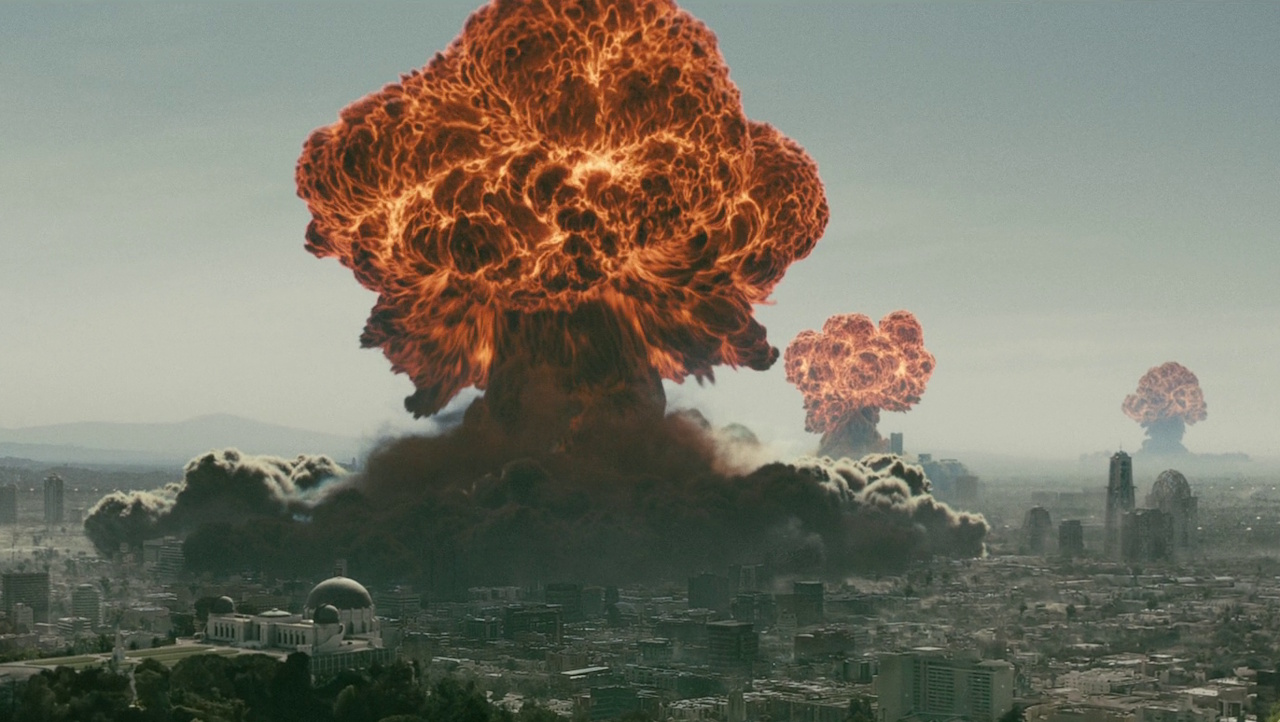

Click or tap here to go to JTVFX’s YouTube channel, where you can find the Wolf 359 fan film. (Warning: External Website)

Strange New Worlds: Taking Stock

A Strange New Worlds-themed spoiler warning.

Spoiler Warning: There are spoilers ahead for Star Trek: Strange New Worlds Seasons 1-3. Spoilers are also present for the following Star Trek productions: The Original Series, Deep Space Nine, Discovery, and Picard.

At time of writing, Season 3 of Strange New Worlds has just concluded. With Starfleet Academy on the schedule for the first half of next year, and with Season 4 having only finished filming a few weeks ago, there’s gonna be a wait of a year-plus before we’ll see it – late 2026 or early 2027 is my guess, barring any strikes or similar disruptions! So it’s a bit early to look ahead – but Strange New Worlds is on my mind right now.

What I want to do this time is try to take stock of how the series has performed so far, as well as look ahead to a few things that I’d like to see in Seasons 4 and/or 5. This isn’t going to be a review or a recap of Season 3, though obviously we’ll talk about Season 3 along the way, but rather a broader overview of how I see Strange New Worlds now that we’re three seasons in – and, regrettably, past the halfway point of what will be a forty-six-episode run.

Still frame from Star Trek: Strange New Worlds showing the Enterprise at warp.
The final shot of Season 3.

As always, a couple of caveats before we get much further. Firstly, I have no “insider information,” so anything I say about possible future episodes and stories should be viewed through that lens! And secondly, all of this is the subjective, not objective, opinion of one old Trekkie. If you disagree with me about Strange New Worlds, hate my take, or want to see the series go in a completely different direction… that’s okay! There’s enough room in the Star Trek fan community for differences of opinion and polite disagreement.

Alright, now that that’s out of the way… let’s talk Strange New Worlds!

Season 3 was, on the whole, pretty good. There were a couple of dud episodes, but even those had some redeeming qualities. It felt a bit more serialised this time, thanks to the ongoing Batel-Gorn storyline, but still episodic enough that we got a diverse mix of stories. If I had to highlight two episodes for special praise, I’d pick Through the Lens of Time and Terrarium. I think Through the Lens of Time is, with the benefit of hindsight, perhaps somewhat let down by a weaker conclusion in the season finale, but on its own it’s still a solid episode. And Terrarium is just fantastic across the board.

Still frame from Star Trek: Strange New Worlds showing Ortegas on an away mission.
Ortegas in Terrarium.

In terms of characters, I’d like to see Strange New Worlds do more with some of its original creations, rather than leaning so heavily on the younger versions of TOS characters. Scotty seems to have taken precedence over Pelia for a lot of engineering storylines, such as in A Space Adventure Hour, and because Pelia is just a ton of fun… that doesn’t sit right. She’s the chief engineer, and he’s… what? A glorified assistant at best. And although sometimes lacking in confidence, this version of Scotty is still working engineering miracles. We’ve seen that before, and while there’s definitely fun to be had in seeing Scotty’s growth and the development of some of his friendships with folks like Uhura and Kirk… I don’t want that to overwhelm an original character like Pelia.

I’ve said this before, but if Star Trek had relied so heavily on legacy characters when considering spin-offs in the 1980s and 1990s, the franchise would feel a lot smaller today. We might never have met the likes of Picard, Sisko, or Janeway if the folks in charge had insisted on retaining characters from past iterations of Star Trek – and I’m just a little concerned that the attention dedicated to legacy characters is beginning to overshadow the rest of the cast. Spock was almost omnipresent this season, and we got stories heavily focused on Kirk, Chapel, Scotty, and Uhura, too. I’m glad that we finally got an Ortegas episode – and that it was so darn good! But with only sixteen episodes remaining, I’d really like to see Strange New Worlds strike more of a balance between characters who’ll go on to play big roles in TOS and the rest of the cast.

Still frame from Star Trek: Strange New Worlds showing Kirk in the captain's chair of the Farragut.
Kirk in command.

I mentioned this in one of my Season 3 episode reviews, but La’an being related to iconic Star Trek villain Khan has been a complete nothing-burger so far, and unless something major changes on that front… I’m gonna reach the end of the series wishing she’d been given a different last name. If you know me, you know I’m not a stickler for the tiniest minutiae of “canon,” but given how important Khan is to Kirk, Spock, and really to Star Trek as a whole… making La’an a direct relative of Khan kind of treads on the toes of what was established in Space Seed. If there’d been a big narrative payoff for that, it could’ve easily been worth it. But so far? I’m afraid it hasn’t been.

Think about it like this: what would change about La’an if her last name had been… Shellac-Wombat instead of Noonien-Singh? She could still have been a descendant of augments. She could still have survived the Gorn as a kid. She could still have felt shame about her ancestry. She could still have developed a friendship with Una, fallen for Kirk, and gotten into bed with Spock. Her iconic ancestor doesn’t matter one iota – and because of how important Khan still is to the franchise, I don’t think that’s good enough. There’s just no reason to have made her a member of Khan’s family – and right now, the name feels like little more than cheap nostalgia bait.

Still frame from Star Trek: Strange New Worlds showing La'an peeking out from a hiding place.
La’an in Season 2.

What appealed to me the most about “the Captain Pike show” in the aftermath of Discovery’s second season was spending more time with Anson Mount’s take on the character. Season 1 gave us a decent mix of Pike and other characters, but the captain seems to have stepped out of the limelight a little in Seasons 2 and 3. There were whole episodes this season where Pike got remarkably little to do, and one of his bigger roles – in Four-and-a-Half Vulcans – was far from his best. Anson Mount did a great job, by the way, in that kind of comedic role… but I just wasn’t thrilled about the end product.

So in Seasons 4 and 5, I hope we get to see a bit more of Pike. That doesn’t mean every story needs to put the captain front-and-centre, but there have been moments in some episodes which could’ve been perfect for Pike to step up and play a role – but where writing decisions meant other characters came to the fore. Maybe you think this contradicts my earlier wish to see more of Strange New Worlds’ original creations – but I kind of include Pike, Una, and Dr M’Benga along with the brand-new characters, as their roles prior to this series were much smaller.

Still frame from Star Trek: Strange New Worlds showing Pike holding a wine glass.
It’s still “the Captain Pike show” to me!

There are plenty of great characters on the show, and with only sixteen episodes left – and presumably at least one or two new recurring or secondary characters to be added – there are clearly gonna be constraints on how often Pike can be centre-stage… and I get that. But this is, for me, still “the Captain Pike show,” so when Pike is absent, relegated to a background role, or even mischaracterised – as I’d argue he was, to an extent, in episodes like Under the Cloak of War and Four-and-a-Half Vulcans – then a big part of Strange New Worlds is missing.

This leads into one of the concerns I have going into the remainder of the series: filming for Season 4 has already concluded, and Season 5 is currently underway. There’s no time for Skydance/Paramount to address feedback from Season 3; it’s too late to make any changes to the stories that have already been created. And given that Season 3 did have a couple of misfires and, I would argue, an over-use of characters like Kirk and Spock at the expense of Pike and some of Strange New Worlds’ original characters… that could be a problem. Feedback is important, especially in the modern streaming television landscape, and unfortunately, Strange New Worlds went ahead with producing Season 4 and 5 before there was a chance for any significant responses to Season 3 to be known. Hopefully, because the show is still pretty good, that won’t be too much of a problem. But I worry that the creative team may have doubled-down on some of the things that fans and viewers have been less keen on this time around.

Still frame from Star Trek: Strange New Worlds showing the Enterprise bridge.
Pike and the crew on the bridge.

Returning to Pike, I don’t think we need to see his accident and disability again at the end of the show. That story has already been told in Discovery, in The Original Series, and in a couple of Strange New Worlds episodes, so ending the show that way would, I would argue, be repetitive. If Kirk hadn’t been such a big presence this season, I’d probably have said that the series finale should show Pike handing over the Enterprise to Kirk – and a big part of me still believes that will be the final shot of the series. But given Kirk’s expanded role… I think some of the impact of that will be lost, even if the moment itself is handled well.

Instead, I think Strange New Worlds needs its very own Undiscovered Country-type of story. Perhaps Pike and the crew get word that the Enterprise is to undergo a major refit, and that Pike himself is to be promoted. The crew have one final mission to undertake – perhaps against the Klingons, the Gorn, or another well-known antagonist. The mission could be intense, explosive, and action-packed, but rather than the final moments of the show depicting the handover to Kirk… I’d like to see Pike on the bridge, setting course for parts unknown one final time.

Cropped comic book cover from the Star Trek: Strange New Worlds spin off series.
Ortegas, Una, Chapel, and Spock from one of the Strange New Worlds comic books.

We’ve had it confirmed in a recent interview that the creative team weren’t sure a renewal was coming after Season 3, which I think explains a few major decisions this time around. It explains why there was such a rush to do the “backdoor pilot” for their Year One idea, with Kirk, Spock, Scotty, Chapel, and Uhura all working together. It explains why some characters – like Chapel and Uhura – now feel like they’re coming to the ends of their arcs on the show. And it explains that epilogue in the season finale, which I said in my review felt like it was intended to serve as the ultimate ending to the show if it hadn’t been picked up for more episodes.

Some of those decisions could, if the creative team are aware of them, open up different possibilities in Seasons 4 and 5. We’ve already had the “Kirk in command” Year One spin-off episode. So check that one off the list – no need to do that again. Chapel’s relationship with Dr Korby has emerged, gone through a couple of bumps in the road, and gotten to a point where he doesn’t need to regularly reappear. Uhura’s grown in confidence and ability, taking her from a raw cadet unsure of her place in Starfleet to a confident officer who was even willing to bend the rules. Spock has just been all over the place… but even if we never got another Spock episode, I think we can safely say we’ve spent more than enough time with him, too!

Still frame from Star Trek: Strange New Worlds showing Spock.
Spock.

So that should open up other opportunities. We haven’t had a major storyline for Una since the beginning of Season 2 (and no, getting horny for Patton Oswalt doesn’t count). We finally got our Ortegas episode, three seasons in, but there’s still scope to do more with her character. It would be nice to get a story for Dr M’Benga that doesn’t revolve around either his violent past or some other secret he’s keeping from his shipmates – perhaps one that could explain why, by the time of The Original Series, he’s no longer the chief medical officer.

Then there’s the secondary cast. Mitchell’s been a regular on the bridge – maybe the show could do something with her? Admiral April’s family was hinted at in the Season 3 finale, as was his friendship with Pike, so perhaps a story in which he’s in focus would be well-received. I’d also love to get one more story featuring Hemmer! Perhaps a time-travel story, of some kind, could see Hemmer getting some screen time with Scotty? That could be absolutely fantastic if handled well. And Sam Kirk has been rather overshadowed by Spock in the science department and his brother, but it would be lovely to get a story in which he’s in focus, for once.

Still frame from Star Trek: Strange New Worlds showing Sam Kirk holding a machine.
Sam Kirk in Season 2.

You’ll have heard me say this before (I often use it as a bit of a caveat when talking about episodes I didn’t like!) but I’m really glad to see Strange New Worlds remaining a mostly episodic show. Discovery and Picard both went for big, season-long serialised arcs… but for me, that’s not really what I’ve wanted from Star Trek. In past shows, where seasons were longer and there was more room for manoeuvre, arcs like the Dominion War worked pretty well. But in the modern television landscape, where there are fewer episodes and fewer seasons available, I think Star Trek really needs the diversity and options that only an episodic format can deliver.

So, as production gets underway on Season 5… please keep the episodic format! A two-part or even three-part finale could work, sure, but I hope that at least some of Season 5 can retain the episodic charm that has made Strange New Worlds feel like such a nostalgic throwback in the best possible way. It wasn’t until I started watching Strange New Worlds that I came to recognise how much I’ve missed episodic television – and how essential the format is to a franchise like Star Trek.

Still frame from Star Trek: Strange New Worlds showing zombies.
The zombies in Shuttle to Kenfori.

Star Trek shows need the freedom to explore strange new worlds… pretty much every week. The Enterprise needs to visit a planet, meet an alien, then warp away to a different destination next time. As Strange New Worlds has demonstrated, that doesn’t mean you have to lose character growth, personal relationships, and other modern television trappings. But it means that, for a franchise all about exploring the galaxy, spending too long in one place or having too narrow a focus isn’t what works best. And I’m not alone in feeling that way, I suspect.

I think there’s room for something like a two-part finale to wrap up the show, or even a two-part cliffhanger in between Seasons 4 and 5, as we got with Seasons 2 and 3. One or both of those ideas could be great. But what I don’t want to see, really, is for Seasons 4 and 5 to go down the Discovery/Picard route of being fully serialised, as I think that would take away so much of what has made Strange New Worlds work. In fact, I’d go so far as to say that the Strange New Worlds model – which I’d describe as episodic with character arcs – should be adopted by Starfleet Academy and by any other Star Trek project that might get greenlit in the years ahead. It’s absolutely the best choice for this franchise.

Still frame from Star Trek: Strange New Worlds showing La'an on the holodeck.
La’an on the holodeck.

At this stage, with Starfleet Academy on the schedule for early 2026, I’m not convinced that Strange New Worlds’ fourth season will be ready in time for the 60th anniversary, which is now less than a year away! But if I could be allowed one “wish,” it would be for Season 4 to contain some kind of celebratory episode, perhaps a story akin to my Cardassia Prime pitch, which would bring in characters and factions from elsewhere in the franchise.

The 60th anniversary is an opportunity to celebrate a milestone that few franchises ever reach. And let’s be honest: with all the cancellations and Paramount+ struggling, being able to do anything big for the 70th or 75th seems unlikely! And speaking for myself… I might not be here by then! So I’d dearly love to see at least one Season 4 episode written as a “love letter” to Star Trek and to the fans, really leaning into the 60th anniversary and celebrating all things Star Trek.

Still frame from Star Trek: Strange New Worlds showing an illusion of Hemmer.
A 60th anniversary episode could really celebrate the franchise.

Before we wrap things up, I have a couple of much siller, almost-certain-never-to-be-made ideas. The first is one I’ve talked about a few times here on the website: rescuing Captain Lorca! Lorca appeared in Discovery’s first season, and the prime timeline version of the character is assumed to have died in the Mirror Universe… but what if he didn’t? Captain Pike could lead a rescue effort, stepping through the looking-glass to save a friend. I think that could be a ton of fun as an episode.

And finally… I still kinda want to see a “Captain Pike versus the Borg” story! Yes, there are timeline problems. Yes, it would tread on the toes of canon. And yes, the Borg have been overused in Picard in recent years. But still… I think you could write a script which sees Pike’s Enterprise catapulted to an alternate universe where the Borg are dominant, with Spock saying “it’s unlikely a cybernetic race like this exists in our universe,” and where La’an, Dr M’Benga, and the rest of the crew have to battle drones and figure out a way home. I just think it would be a really fun idea.

Still frame from Star Trek: First Contact showing a borg drone.
I know, I know… it ain’t gonna happen!

So that’s all for today!

We’ve talked about Strange New Worlds, the show’s first three seasons, some of its characters, and a few things I’d like to see going forward. I’m still disappointed that the show has been prematurely cancelled – especially because it happened before Season 3 had aired a single episode. But we are where we are, and there are now just sixteen episodes left. I’m keeping my fingers crossed for some wonderful adventures before Captain Pike and co. have to hang up their uniforms for the final time.

I hope this has been interesting. I wanted to talk about the show more broadly now that Season 3 has ended. I still don’t think we’re gonna see Season 4 before next autumn at the earliest – and a 2027 release doesn’t seem impossible, either, given the lengthy post-production involved for modern shows. So… it could be a while before we rejoin Pike, Spock, Una, and the rest of the crew. Before then, I’d like to finally write up some Season 1 episodes, which I didn’t do at the time because Paramount cut off Strange New Worlds from an international audience! And if and when there’s a trailer, a teaser, or more information revealed about the upcoming season, I daresay I’ll take a look. Until then… Live Long and Prosper!


Star Trek: Strange New Worlds Seasons 1-3 are available to stream now on Paramount+ in countries and territories where the platform exists. The first two seasons are also available on DVD/Blu-ray. The Star Trek franchise – including Strange New Worlds and all other properties discussed above – is the copyright of Skydance and/or Paramount. This review contains the thoughts and opinions of one person only and is not intended to cause any offence.
King & Conqueror: Series Review

A spoiler warning graphic.

Spoiler Warning: Beware spoilers for King & Conqueror.

King & Conqueror was one of my most highly-anticipated TV shows of the year. I think every British schoolkid learns about 1066 and the Battle of Hastings in school; I certainly have vivid memories of sitting in a drafty history classroom, surrounded by bored kids passing notes, while a teacher tried to whip up some enthusiasm for the battle between William and Harold! And, as Brits, I think we have an appreciation for the losing side in (some) historical settings – Richard III, Bonnie Prince Charlie, and, of course, Harold Godwinson – whose defeat at the Battle of Hastings marked the end of Anglo-Saxon rule in England, and the beginning of the Norman period.

These events have never – to my knowledge, anyway – been dramatised like this. King & Conqueror was a joint production between the BBC here in the UK, CBS Studios from the United States, and Iceland’s RVK. I can’t find an exact per-episode figure floating around, but it’s by far the most money anyone has ever spent to dramatise the events leading to the Norman Conquest.

So it’s a shame, then, that I really didn’t like King & Conqueror.

Still frame from King & Conqueror (2025) showing the bishop at the coronation.
The Archbishop at Edward’s coronation.

Any time real history is adapted – be that as a novel, a film, or for television, as in this case – some liberties are taken. King & Conqueror is not a documentary; it’s a fictionalised account of events. And, to be fair to the production team, records from this era are not great, so there’s a lot of ambiguity and plenty of wiggle-room for getting creative. We don’t know how Godwin of Wessex spoke to Harold and his brothers, nor what Edward the Confessor may have thought about the succession to the throne in his final years of life. There’s plenty of room in those gaps to tell an engaging story.

King & Conqueror suffers, in my view, from two major issues. The first is that it changes established historical events without good reason, to the point where the story it ultimately tells is too far-removed from what we know actually happened. And the second is that it’s drawing too heavily from the likes of Game of Thrones for some of its dramatic storylines.

Still frame from King & Conqueror (2025) showing Edward after committing murder.
This sequence is a case in point.

It’s this “Game of Thrones-ification” that, for me, really ruined King & Conqueror. In order to ramp up the drama to levels akin to these kinds of big-budget shows, King & Conqueror’s writers had to completely invent scenes and storylines that have absolutely no basis in historical fact. In another series, maybe they’d have worked. But if you have to change the story you’re trying to tell so extensively that it no longer resembles the truth… why not do what George R R Martin did and make up something new? Because that’s what King & Conqueror is, at the end of the day: it’s not a “re-telling” of the events leading up to the Norman Conquest. It’s fiction wrapped up in a threadbare cloak of history.

It’s hard to pick the most egregiously wrong moment in King & Conqueror that would best embody this “Thrones-ification” of history. Several examples come to mind, and we’ll go through them in turn.

Firstly, Tostig – Harold’s younger brother – was not a weakling nor a child, but a capable military commander in his own right who’d won battles in wars against Wales. His wife didn’t die in childbirth; Judith of Flanders lived for almost thirty years after Tostig’s death in 1066, remarried the Duke of Bavaria, and left England. Tostig’s conflict with Harold didn’t come about from personal hatred surrounding his wife’s demise, but rather because Harold conceded to rebel demands after the Northumbrians rose up against his rule. Harold and King Edward exiled Tostig, who eventually formed an alliance with Harald Hardraada in Norway.

Still frame from King & Conqueror (2025) showing Tostig.
Tostig’s entire story was complete fiction.

Then there’s the whole presentation of Edward the Confessor. What’s the one thing every schoolkid knows about Edward? He had a long white beard! But more importantly, Edward was not a weak-willed “mummy’s boy,” dominated by his mother. And he certainly didn’t beat her to death with his crown. Edward’s contemporaries described him as dignified and pious, hence his moniker. Of all the characters in King & Conqueror, Edward felt the least like the historical figure I remember learning about.

Edward’s coronation wasn’t just wrong, it was the total opposite of what we know actually happened. Edward’s wife was, as King & Conqueror depicts, the daughter of Earl Godwin. But, in a move that was rare for the 11th Century, she was actually crowned as queen in her own right. Why King & Conqueror would try to make a plot point out of the polar opposite is beyond me. Not to mention that William and Harold weren’t present – and the Godwin family didn’t cause a scene.

Still frame from King & Conqueror (2025) showing Edward's coronation.
Edward’s coronation.

Most significantly, we have the relationship between William and Harold. Which, to the best of my knowledge, King & Conqueror completely invented. There’s no evidence William and Harold ever met before 1065 – a year before the Battle of Hastings. And William certainly wasn’t informed of his place in the line of succession by Harold, in a storyline so contrived and so artificial that it felt like it came from a cheap soap opera.

Harold never saved William’s life, they never wrestled half-naked in the mud, and while both of them were clearly scheming to get their hands on the crown of England… it didn’t remotely happen like King & Conqueror depicts. As I said above, there’s enough gaps in what we know about these events for some creative inventions. But for me, the series went too far into fictional territory, crossing a line that I didn’t even know I had when it comes to depictions of the past.

Still frame from King & Conqueror (2025) showing William and Harold wrestling in the mud.
Half-naked mud wrestling.

Sticking with Harold and William, while I respect and admire King & Conqueror’s attempt to present both sides of its story, the way it was handled made both of its central characters feel pretty samey. “A landowner who loves his wife, is concerned for the survival of his people, can be ruthless when necessary, and has a family connection to Edward the Confessor, is scheming to make himself king.” Who am I describing? Both men are, in the context of the series, functionally the same character archetype… and that’s just not very interesting. Not when there were so many different ways to depict them.

Let’s talk about a few things that I did like, because despite my overall feelings and sense of disappointment… it wasn’t all bad.

Juliet Stevenson was fantastic as Emma, the King’s mother. Even though I didn’t like the way Edward and Emma were written, you could hardly have got a better performance of the kind of scheming, manoeuvring, power-driven woman. When she was on screen, Stevenson put in an exceptional performance that transcended the sketchy writing and poor revisionism to really excel.

Still frame from King & Conqueror (2025) showing Edward with his mother, Emma.
Edward and Emma.

King & Conqueror, thanks to its high budget, had some great sets, props, and costumes. I’m not sure how accurate all of it was to the 11th Century, but the Godwin family’s great hall (or whatever it was called; the main building in Wessex) really felt like an Anglo-Saxon lord’s hall to me. Shields looked great, weapons looked fantastic, and I liked that there were spears and axes alongside the usual swords and bows. Axes in particular were used by Harold’s housecarls at the Battle of Hastings, and they were also used by the Vikings and their descendants, particularly in the north of England. A lot of historical stories romanticise knights with swords and shields, and while these were important, spears and axes in this era were probably used even more.

Costumes were likewise solid. Again, there might be some clothing historians who could nitpick, but for me, the costumes succeeded at capturing the feel of the 11th Century, and particularly of the upper classes in that time period. I would say it was a bit of a shame that William and Harold didn’t have more distinctive attire, particularly by the time of the battle; some way to tell their forces apart at a glance, perhaps. But overall, I’d say sets, props, costumes, and really all of the practical effects used to bring the world of the 11th Century to life were great.

Still frame from King & Conqueror (2025) showing a castle.
Sets, props, and special effects were great across the series.

Although I criticised the series for its “Game of Thrones-ification,” there were some parts of that which worked better than others. I particularly liked Count Baldwin, and how he seemed determined to play all sides of the conflict in an attempt to benefit himself and his family. The performance, by German actor Oliver Masucci, was masterful, too. Perhaps there’s something about the actor, but I was reminded of Mads Mikkelsen’s take on Dr Lecter in the series Hannibal in this “outwardly-friendly-but-watch-your-back” presentation of the Count of Flanders.

Both James Norton as Harold and Nikolaj Coster-Waldau as William did well, too, and while I didn’t like that Harold and William were becoming friends in the years before 1066, the performances both actors put in did get me invested in their “bromance.” This side of the series seemed to reach its climax quite quickly, with William and Harold going from their first meeting to friends to frenemies to rivals to fighting in a relatively short span of time. We’ll talk more about pacing in a moment, but suffice to say I have mixed feelings about this side of the story overall.

Still frame from King & Conqueror (2025) showing William in Normandy.
William.

Some parts of the Harold-William relationship are undeniably silly. I mean, wrestling in the mud? Really? I get what the storyline was going for, and I genuinely did feel the chemistry between Coster-Waldau and Norton; they played off each other exceptionally well. But because both characters felt samey, and because we know basically none of that actually happened… even the best moments of the bromance were knocked down a peg. And while I could’ve accepted, I think, seeing Harold and William fighting bandits together in Brittany or meeting in London when visiting the King, some of the more outlandish escapades – the mud-wrestling, saving each other’s lives, and so on – felt gratuitous and forced, even when it was being portrayed exceptionally well.

Harold seemed, from the outset, determined to make a name for himself. In that context, his desire to become king makes sense. He was ruthless in dealing with his brother, cutting deals left and right, and basically doing anything he could to advance his position – justified, to himself perhaps, in the name of family. William, however, seemed completely uninterested in the crown of England, and I wasn’t really sold on his desire to become king – it seemed to come from nowhere. William was concerned first and foremost with Normandy and with his wife and son, then later with the conflict against Henry of France (who the real William didn’t murder while out hunting, but who’s keeping score of these changes any more?)

Still frame from King & Conqueror (2025) showing Harold before the battle.
Harold’s quest for power and the crown felt more natural than William’s.

Harold’s transformation took him from being the overlooked second son to the Earl of Wessex, and then saw him craving the crown. It seemed to flow naturally and made sense for his character based on how King & Conqueror depicted him. William’s desire to make himself king, in contrast, didn’t have that same organic nature, and in that sense it felt more forced. Again, credit to Nikolaj Coster-Waldau for his performance, but the way William was written left his motivation kind of up in the air for me. I mean, on the one hand I get it: you’re offered this incredible gift of power… who wouldn’t want it? But on the other, based on the way William was written and what we knew about him from the show… it left me feeling like he changed his mind on the question of the throne basically out of nowhere.

This is all a consequence of the “Thrones-ification” of the 1066 story. In order for the writers and producers to get the kind of drama they wanted, they needed to set up Harold and William as friends first, then rivals, then enemies. And because the series also wanted to take a relatively neutral stance between the two sides, both men had to have similar claims to the throne, similar reasons for wanting it, and had to proceed in a similar way. It’s a kind of deliberate ambiguity, perhaps, on the part of the writers. But for me, again this just didn’t work very well. Partly I’m put out by the story making so many changes to established history, and partly it just feels a bit… weak. Two men who used to be friends, both competing for something important in a zero-sum game, sounds great on paper – but you have to nail the execution. For me, King & Conqueror didn’t.

Still frame from King & Conqueror (2025) showing William and Harold in combat.
William and Harold duel at Hastings.

I didn’t like the way King & Conqueror was paced. Each of the first four or five episodes seemed to start with a confusing time-jump, leaving me to think I’d missed something or even that I was somehow watching the series out of order. There was, confusingly, no effort made to de-age or age up actors to represent the passage of time, even though there were 24 years between Edward’s coronation and the Battle of Hastings. There weren’t even any costume changes or anything to signify the passage of time, and that could feel confusing. Even if we accept the show is playing fast and loose with its timeline, condensing the events of Edward’s reign, there still should’ve been more done to indicate how much time had passed.

Pacing also hurt some episodes and even individual scenes. One thing the early seasons of Game of Thrones did incredibly well was show how long it could take, using medieval technology, to travel from place to place. Harold and William, in contrast, seem to zip across the English Channel at will, as well as race from Wessex to Northumbria and back not at a reasonable pace, but to cater to the needs of the story. Even something as simple as showing Tostig leaving Wessex in the winter and arriving in Northumbria in spring would’ve communicated this a whole lot better.

Still frame from King & Conqueror (2025) showing the Norman invasion fleet.
William’s fleet.

The dangers of crossing the English Channel were also not acknowledged… until it became convenient for the story to do so. In the 11th Century, sea voyages of any kind were incredibly difficult and challenging, and while I didn’t expect to see a ton of that in King & Conqueror (despite William’s fleet being a massive undertaking) it seemed for most of the series as if characters could just nip across the Channel for an afternoon then be back home in time for supper. The pacing of this, combined with the lack of acknowledgement of how challenging it could be, came together to make for a pretty weak and muddled presentation. The English Channel was a huge barrier for anyone in those days to overcome, but it didn’t seem to matter most of the time.

So that’s it, really. I’d been very excited to see this re-telling of the 1066 story… and I came away pretty disappointed.

King & Conqueror would have been a reasonably entertaining story were it not supposed to be adapting real historical events. I still think some of its issues with pacing and characterisation would’ve been stumbling blocks, but if it had been a totally fictitious account of two characters trying to lay claim to a make-believe throne… I think I might’ve actually liked it more. For me, there were too many revisions to real history, some of which were utterly silly and done to lean into the Game of Thrones-style presentation that the producers were clearly aiming for. Maybe I’m being too much of a stickler… but is it wrong to say that a production which is based on a true story should try, at every turn, to remain true to that story? How you answer that question will, perhaps, dictate how much you enjoy King & Conqueror.

Still frame from King & Conqueror (2025) showing William with Harold's corpse.
The outcome.

I can’t help but feel let down, though. As a Brit, I always want to see big-budget productions from the UK succeed, and there really was a pathway for King & Conqueror to have been an excellent series. There were fantastic performances. Great sets, costumes, and props. A high budget. Some solid battle scenes. And above all, it’s based on a genuinely fascinating story – one of the inflection points on which the history of England turned. I just wish the series’ producers, writers, and creative team had leaned into the real story more, and resisted the urge to embellish and change so many things.

It should go without saying, but this review is the entirely subjective, not objective, opinion of just one critic. There are bound to be a range of views on King & Conqueror, so I encourage you to seek out other reviews – and, of course, to check out the series for yourself. I don’t think it’s worth spending a lot of money on, either as a subscription or when it becomes available on Blu-ray, but if you’re already signed up for Amazon, or if you can get it on iPlayer in the UK, you’ve got nothing to lose by checking out the first couple of episodes. Maybe you’ll have a better time with King & Conqueror than I did.


King & Conqueror is available to stream now on Amazon Prime Video in most of the world, and on iPlayer in the UK. King & Conqueror is the copyright of the BBC and/or CBS Television Studios. This review contains the thoughts and opinions of one person only and is not intended to cause any offence.
A.I. 2027: My Take

I recently read the very alarming A.I. 2027 report. I’ll leave a link to the full version at the end of this article, and I highly recommend checking it out if you’re interested in the future of A.I. But for now, I’ll briefly summarise the report. And yes, I know this is a little outside my wheelhouse here on the website, but I think this subject is worth discussing!

A.I. 2027′s core premise is not, as some alarmist headlines have tried to claim, that the end of the world is a mere two years away! But the report’s authors argue that, if artificial intelligence development continues on its current trajectory, late 2027 could be humanity’s final opportunity to remain in control of any A.I. system that emerges – and our last chance to ensure that its goals and priorities align with our own. They present this as an existential risk; that a sufficiently advanced A.I. sometime after 2027 could, if not properly restrained and aligned with human interests, literally exterminate the human race. That… that’s kind of disconcerting, right?

Still frame from Terminator 2 showing a person killed by nuclear weapons.
Is this our imminent fate?

I confess that I’m way behind the curve when it comes to A.I. Everyone talks about ChatGPT, A.I. art, and other such things… but my knowledge of the subject has been, until recently, surface-level at best. But given the potential A.I. has to be disruptive, perhaps on a scale we haven’t seen since the advent of the world wide web or even the Industrial Revolution… let’s just say I felt the need to catch up and get up to speed!

Artificial intelligence is already changing the way we live, work, and interact. What are “algorithms” if not a form of A.I.? If you’ve ever scrolled social media and felt that the website or app is almost too clever in recommending posts or adverts that appeal to you… you’ve already been caught in its web. And if you’ve noticed fewer job listings in fields like translation, copy-editing, or programming… you’ve seen what might just be the tip of the iceberg when it comes to A.I.-related job losses and workplace changes. I bring this up because I think something that gets lost in this conversation about the future of A.I. is that A.I. is already here, already changing things, and isn’t just some nebulous future idea about something we “might” invent one day. We’ve already invented it.

Still frame of the M-5 computer from Star Trek: The Original Series.
The M-5 Multitronic Unit from Star Trek.

Predicting the future is hard – nigh-on impossible, really. Step back to television programmes from the 1980s, 1990s, and even the 2000s that tried to look ahead to 2025 and see how wrong many of their predictions and ideas were. A famous example is flying cars – I still haven’t seen one of those, despite the promises made by sci-fi films in the ’80s! So I think it’s worth acknowledging that. Some predictions can be incredibly wide of the mark – especially those that promise either an imminent technological utopia or the end of the world. Both of those scenarios are present in A.I. 2027.

As a layman looking in from the outside, I’ve been dimly aware of talk around artificial intelligence, but it hasn’t been something I’ve felt any need to engage with. I don’t have a place in my life for an A.I. chat bot, I’ve never needed to generate A.I. art before (though I am using some A.I.-generated images in this piece), and I actually enjoy the process of writing… so I see no need to use something like ChatGPT to generate text, either. But there’s no denying that, as someone with a creative streak, I feel increasingly… obsolete. A.I. doesn’t just have the potential to revolutionise writing, web design, media criticism, and all the things I talk about here on the website. It’s literally already doing all of those things.

A.I.-generated image of a robot chatting to two humans on the computer.
It’s a chat bot.

I could fire up ChatGPT or a similar A.I. programme and, within a matter of moments, it could’ve scanned everything I’ve ever published here on the website, and all of my unpublished drafts, too. I could then ask it to write an article or essay on any subject imaginable, using my tone of voice and my writing style. Could you tell the difference? From my perspective, as someone who runs a small website as a hobby and who enjoys writing, there’s no point in using A.I. for that. But if I was working in an office job where lengthy reports were the order of the day… I can see A.I. being a very tempting shortcut. Heck, I’d have killed for an automated essay-writing programme when I was at school!

And that’s exactly what these systems are designed to do. They’re intended to cut costs for big businesses – and by far the largest cost that most companies and corporations have is the wage bill. Let’s rephrase that for the sake of clarity: the entire point of A.I. is to save corporations money by enabling them to lay off staff and automate more and more of their work.

Photo of an unemployment queue in the USA during the Great Depression.
Unemployed people queuing for financial relief during the Great Depression.

Unfortunately, there’s a bit of classism that seems to have crept into this conversation. I grew up in the north of England in the ’80s and ’90s, at a time when deindustrialisation had robbed the area of mines and factories. Automation played a big part in that – work that used to take a dozen people could be done with just one specialist, and then it became “too expensive” to continue to operate. There’s more to what happened in this part of the world, of course, but automation played a big part. Some of the people who used to tell factory workers and miners to “re-train” or “learn to code” are now themselves on the receiving end of automation-related job losses. And it’s pretty grating to see folks getting worked up about A.I. in the 2020s when they not only didn’t give a shit about the devastation automation brought to working class communities from the ’80s onwards, but actively supported it.

In that sense, I kind of view this consequence of A.I. development as a continuation of a process that’s been ongoing for decades, not something new. For decades, big companies have been looking for shortcuts; ways to cut jobs and pay fewer members of staff while achieving ever greater profit margins. A.I. is what they’re banking on in the 2020s in the same way as manufacturers invested in automated equipment in factories, or mining corporations exchanged pickaxes for machines. The difference? A.I. is coming for white collar, middle class jobs. Earlier automation mostly took jobs away from blue collar, working class folks.

Photo of an abandoned, derelict factory in the UK.
Sights like this were common when I was growing up.
Photo: David Wilkinson / Former Addspace furniture factory, Bolton upon Dearne

But that’s just one side to A.I. – the corporate, job-stealing side. The existential risk as posited by A.I. 2027 is much more complex… and I’d be lying if I said I wasn’t concerned. Unlike the 2012 phenomenon or the predictions of Nostradamus, the risk posed by artificial intelligence feels real. I’d say it feels somewhat comparable to the way the millennium bug felt in 1999; a technological danger that humanity has created for itself. In 1999, a lot of people were genuinely concerned that the millennium bug could cause all kinds of chaos, but thanks to some hard work, none of those predictions came to pass. It went largely unnoticed at the time, but it did take a lot of effort behind the scenes to ensure that the millennium bug didn’t have a major impact; it wasn’t, as some have tried to claim, a completely overblown threat.

So what’s the lesson there? If there are risks to A.I. development… shouldn’t we do everything we can to mitigate them? That seems like the rational course of action, but as the authors of A.I. 2027 explain, current artificial intelligence systems don’t exist in a vacuum. There’s a technological “arms race” between different countries, and slowing development to implement safety measures could mean that the current leader – the United States – would surrender its position on the cutting edge. The result of all this? Rapid, chaotic, unchecked development of A.I. systems in order to remain ahead of the curve.

Screenshot of a summary graph from the A.I. 2027 site.
A graph summarising A.I. 2027′s findings.

There are military applications for A.I. – and if one side in a potential conflict has A.I.-controlled drone weaponry and the other doesn’t… it’d be like trying to fight a modern army with medieval weaponry and tactics. Keeping up with A.I. developments must feel, to military planners and political leaders, like even more of an existential risk, because the consequences of failure could be catastrophic. We talked above about the world wide web and the industrial revolution; in military terms, A.I. could be at least as impactful as the development of nuclear weapons.

So I think we’ve covered why governments, militaries, and corporations want an A.I.-infused future. But two questions still remain: will they remain in control of it? And what will it mean for the rest of us?

Still frame from Terminator 3 showing Skynet coming online.
Skynet in Terminator 3.

I’ll tell you a story from my own life that I think might illustrate this next point. In the late 2000s, I was feeling pretty disillusioned with my job and career path. In those days, I was working in the video games industry, on the marketing side of things, but I went through a phase where I wasn’t satisfied, and I started contemplating other career options. For a time, I thought seriously about getting my HGV license – that’s heavy goods vehicle, a.k.a. a truck or lorry. But by that point, it seemed to a techie as if self-driving vehicles were only a few years away… and I genuinely thought that it would be a waste of time to spend a lot of money taking tests and getting a qualification that could become obsolete before I could make the most of it. To use an analogy from history: it felt like jobs based on driving any kind of vehicle from taxi cabs to trucks were about to disappear in much the same way as horses and stables did in the first decades of the 20th Century.

Why do I make this point? I was wrong, in the late 2000s, to be thinking like that. Self-driving technology may be “here” in a technical sense, but it isn’t road legal and it doesn’t seem to be making the kind of impact I would’ve predicted (or feared) in the late 2000s. The same is true of many other technologies that seemed to be “the wave of the future,” only to completely fizzle out. I owned a MiniDisc player in the early 2000s, expecting that technology would replace CDs! Google Glass, 3D televisions, the hovercraft, Concorde… the list of “revolutionary” technologies which never delivered their promised revolutions goes on.

A.I.-generated image of a yellow robot driving a lorry.
A self-driving lorry.

The point is this: there are many technologies that seemed, for a time, to be the “next big thing,” primed to revolutionise some aspect of our daily lives. And they didn’t accomplish that. When was the last time you even thought about MiniDiscs, hovercraft, or Google Glass? For a brief moment, all of those things seemed to be on the cutting edge of technological innovation, yet they fizzled out without having the impact some folks expected. Could A.I. be the same? And more importantly: are we perhaps reaching the limitations of A.I.’s current capabilities?

It seems to me that the more A.I.-generated content exists out in the wild, the harder it becomes to filter it out – including for A.I. programmers. We’ve all seen A.I.-generated images that aren’t quite right: hands with too many fingers, a cat with five legs, the New York skyline with buildings in the wrong place. As more of this content is artificially generated, at least some of it is going to be fed back into A.I. algorithms as they trawl the web, right? So… doesn’t that mean there’s going to be a point where A.I. either stagnates or even starts getting worse, rather than better?

Stock photo of Google Glass.
Remember when Google Glass was about to change everything?

Then there are jobs that A.I. would struggle to perform. I could absolutely envision a world where many office jobs are replaced by A.I. programmes – similar to how factories that used to be full of workers slowly got replaced by robots and machinery. But could you have an A.I. plumber? I had my bathroom redone a couple of years ago to fit an adapted shower as I’m disabled… and it took several skilled workers more than a week to measure things, reroute an errant pipe, and install all of the fixtures. Earlier today I had to cut down a rogue tree branch that was in danger of damaging my roof. Could A.I. do that? Autonomous robots have come a long way in the past decade or so, but even with full A.I. integration, tasks like those still seem a long way off – not to mention unaffordable, even here in the UK.

One part of A.I. 2027 seemed to offer a “technological utopia;” the kind of post-scarcity society that we’ve seen depicted in Star Trek. And don’t get me wrong… I would love to live in that kind of world. But is that realistic? Are we really only a few years away from fleets of automatons doing everything from diagnosing diseases to plumbing a sink? The rate of technological progress is impressive, for sure, but I don’t believe we’re closing in on that kind of future.

Cropped poster/banner of I, Robot showing a legion of humanoid robots.
Legions of robots from the film I, Robot.

Then there are political considerations that I would argue very strongly A.I. 2027′s authors have got wrong. The idea of a “universal basic income” has been talked about before, and was even trialled on a small scale in Finland and a couple of other places. But the politics surrounding this are incredibly difficult, even toxic, and I struggle to envision a near-future scenario where universal basic income is actually politically feasible. The current political climate in the United States, as well as here in the UK, seems to be completely opposed to that kind of scheme. I mean, do we really think Donald Trump and the Republican Party would ever go for a policy of universal basic income?

None of this means that A.I. 2027 is wrong in its big-picture assessment of the short-to-medium-term future of artificial intelligence. But given the authors’ political miscalculations in particular, I think there’s enough of a red flag to at least consider the possibility that they might’ve gotten other things wrong. The report’s premise is based on competing A.I. models from different countries eventually agreeing to merge – but isn’t it just as likely that two independent A.I. systems would develop different, even opposing goals? Human beings are tribal by nature, and it’s at least possible that any kind of sentient life we might create would retain that tribalism.

Photo of Mark Zuckerberg, Donald Trump, Melania Trump, and Bill Gates at the White House, 2025.
Are we suggesting that Donald Trump (pictured at a recent event with Mark Zuckerberg and Bill Gates) will seriously consider a policy of universal basic income?

I don’t mean to nitpick A.I. 2027 too much, because I think the report highlights some important issues and raises important considerations. But I think it’s worth acknowledging that it feels, in parts, like a doomsday scenario and an unrealistic utopia. These are both extreme… and perhaps that’s why neither feels especially likely.

A.I. is coming for a lot of jobs, and some folks who would’ve never expected to be losing their job to automation are going to be impacted. Artists, animators, writers, creative folks… A.I. is coming for us. Programmers, web designers, game developers… basically any office job you can think of, especially so-called “entry-level” positions. They’re all vulnerable to A.I. – and to big corporations seeking to remove employees in order to save money and make even greater profits. That side of A.I. feels real – because, as I noted earlier, it’s already happening. Layoffs in the video games industry are partially driven by A.I. replacing workers. Real-time translation apps mean there’s less of a need for translators. Data entry can be done quicker and faster with an A.I. model than with an entire team of people. And A.I. doesn’t take breaks, need maternity leave, or even go home at the end of the workday. None of this is imaginary or a subject of debate. It isn’t “coming soon.” It’s already here and it’s real.

Screenshot of Google Translate showing real-time text translation.
Free translation apps (Google Translate pictured) are getting better all the time, and real-time in-ear translation for spoken languages is also possible.

But the existential risk? A.I. super-intelligence? A machine with unfathomable, god-like knowledge and powers? A technological utopia where A.I does all the work and us humans can just kick back, claim our universal basic income, and chill out all day? I gotta admit that I’m sceptical.

I think back to my fears of self-driving vehicles poaching jobs from truck drivers. And I reflect on the technological promises (and concerns) about technologies like supersonic jets and Google Glass. Within just the past few years or decades, technologies have emerged that seemed to be ready to reshape the world… but they didn’t. A.I. can do certain things incredibly well, and it’s definitely impacting the world of white collar work. But the more fanciful claims in A.I. 2027 feel, to me, more like sci-fi than a credible threat.

Still frame from Terminator 2 showing a Terminator wielding weapons.
Both a post-labour utopia and killer robots going rogue still feel like sci-fi.

Maybe that’s my own bias showing through, though. I fully admit that, over the years, I’ve made plenty of mistakes when it comes to technology. I mean, I bought a Wii U, for goodness’ sake! And, in a broader sense, it can be difficult for any of us to imagine a world that’s radically different from the one we currently inhabit. My grandfather could vividly recall rushing outside to catch a rare glimpse of a motor car when he was a child, yet by the time he was in his fifties there’d been atomic weapons and humans landing on the moon. The pace of technological change in the first half of the twentieth century was unprecedented, and the lives of people were completely changed.

In my lifetime, too, I’ve seen the birth of the world wide web, the rise of portable electronic devices, and more. When I was a kid, my household had one television set, no video recorder, no computer, and a single landline telephone. By the time I moved out and got my first student flat, we had computers, games consoles, mobile phones, and dial-up internet. Then came broadband, MP3s, streaming, and smartphone apps. When I had my first weekend job I’d get paid in cash, and my first full-time job still paid me by cheque. I’d regularly have to go to the bank to pay those in – but I can’t remember the last time I set foot in a bank. I do all my banking these days on a smartphone app.

Stock photo of a CRT television set.
There have been huge technological changes within my own lifetime.

I guess this boils down to one massive question: are we anywhere near the limitations of modern A.I. systems? Or, to think about it another way, are today’s A.I. models, with all of their generative capabilities and human-mimicking interactions, genuinely capable of taking the next big leap?

A.I. models appear, to me, to be closer to parrots and mynah birds than actual sentient people. They’re quite capable of replicating “language,” on the very simple basis of “input X requires response Y,” but they don’t understand what they’re saying. That’s why A.I. systems make so many incredibly basic mistakes, and why some enquiries or conversation attempts go completely off the rails. A.I. models, in their current form, also seem to struggle with retaining information, even if all we’re talking about are a few lines of text.

Stock photo of a red parrot.
Are today’s LLMs closer, in terms of sentience, to you and me… or to this parrot?

Let me give you an example. While researching for this article, I “spoke” with several A.I. chat bots. And it was an interesting experience! A.I. can do some things incredibly well – it can write you functional computer code, answer questions about everything from history to mathematics, and even write an article or a story that flows naturally and is coherent. But A.I. struggles with some pretty basic things, too, like remembering what’s already been said. In just a short span of time, and without me deliberately trying to trick it, I found the A.I. that I was “speaking” with was giving totally contradictory responses to things it had said just a few minutes earlier. I could scroll up and see the older messages, but the A.I. seemed to not have that ability. It’s programmed to respond to immediate inputs – so if you ask it the same question twice, five minutes apart, you might very well get two different answers. Not differently worded answers – totally different, contradictory responses.

There’s a massive gulf between technology that’s “almost ready” and technology that actually works. Self-driving vehicles might work perfectly… 98% of the time. But that last 2%? That’s what’s stopping self-driving vehicles from going mainstream. The same with some of Elon Musk’s rockets – they’re 99% perfect… but that 1% error causes explosions on the launchpad. A.I. can do some things very well in a limited use case, and can appear to be very human with its mimicry of language. But is it really just a few years – or even a few months – away from the technological revolution predicted by A.I. 2027?

Still frame of a Nasa rocket exploding near the launchpad.
The small difference between “almost ready” and “actually works” is what leads to rockets exploding on the launchpad.

There’s not just a difference, but a massive, ocean-spanning gulf between a machine that can mimic human language and one that can operate independently. The first is like a parrot imitating its owner, incapable of genuinely understanding anything it says, and is still fundamentally operating on a “input X yields response Y” basis, with very limited ability to retain information within a single “conversation.” An A.I. system that can solve world hunger, operate entire governments, and threaten our extinction feels… well, it still seems like it’s the stuff of sci-fi. And yes, I accept that this was a very limited experiment using free A.I. bots, and that the cutting-edge stuff being worked on behind the scenes is going to be much more capable. But are its capabilities that much greater, and is this technology really the disruptive, revolutionary, and potentially world-ending threat that the authors of A.I. 2027 believe?

Generative A.I. is proving disruptive, and despite what some folks might want to think, the technology is clearly here to stay – at least in some form. On the business side of things, if an A.I. can do the work of an office full of people, well, that office is going to be closed and those folks will be laid off. I’ve also looked ahead to the future of A.I.-generated entertainment, making a bold prediction that A.I. might, one day soon, be able to generate tailor-made films and TV shows, potentially shutting down entire studios and laying off actors, writers, and everyone else.

Photo of the Warner Bros. studio in California.
Part of the Warner Bros. studio in California.

For a lot of white collar, middle-class, creative, and upper-income-bracket folks… they’ve long considered themselves safe from this kind of automation-driven unemployment. So the arrival of generative A.I. systems that are competent and genuinely compete for those roles? That’s been a massive shock, and I think that’s why we see so many people pushing back against A.I. today in a way that they didn’t push back against all kinds of other disruptive technologies. Because, at the end of the day, most technological changes prove to be disruptive to someone. It’s just this time it’s the turn of online content creators, wealthier folks, and people with a disproportionately large voice.

But when it comes to things like A.I. drones murdering people, A.I. systems going rogue, or A.I. super-pandemics… I’m not convinced it’s something we’re on the cusp of. Nor do I feel we’re just a few years away from a post-labour tech-driven utopia where no one has to work and we can all indulge in artistic or academic pursuits. These two scenarios feel far-fetched, to me, even as some A.I. systems expand their reach and their capabilities. I’m not convinced that we aren’t close to the ceiling of what current A.I. models are capable of, nor that the kinds of doomsday or utopian scenarios laid out in A.I. 2027 would require major advances in computing and other technologies that may not even be possible.

Stock photo of a server rack.
What kind of changes or advancements in computing might be necessary to fulfil some of A.I. 2027′s predictions?

The world is ever-changing, and technology in particular is not a static thing. My entire lifetime, really, has seen innovation upon innovation, taking me from an analogue childhood in the ’80s and early ’90s to the tech-focused life of today. I don’t doubt that there will be more changes to come, and that there will be inventions and innovations that, right now, I can’t even conceive of – assuming I live long enough to see them! So I’m not trying to dismiss out of hand the genuine concerns folks have about artificial intelligence. But at the same time, I can’t help but feel that current models could be more limited in their abilities than the A.I. evangelists want their investors to believe.

Right now, A.I. is driving an almost unprecedented level of investment, with a handful of companies making a ton of money. But is this just the beginning of an economic boom that will rival that of the post-war years or the Industrial Revolution? Or is it a speculative bubble about to burst, as we’ve seen repeatedly in recent decades? Whether we’re talking about the dot-com bubble, subprime mortgages, or cryptocurrency crashes, there are plenty of examples of speculative bubbles that got out of hand. Is A.I. just the next one? Are the promises made by A.I. creators genuine, or just an attempt to drum up further investment? Can A.I. really do what investors are being promised?

Stock photo of a briefcase containing stacks of United States dollars.
There’s a lot of money at stake in the A.I. industry.

We can’t escape the reality that all of this is tied to money. A.I. companies need documents like A.I. 2027, because this conversation feeds into the narrative their executives are weaving about the future capabilities of these systems. And the promise of an incredible return on investment is what’s keeping these – otherwise unprofitable – companies in business right now. I’m not accusing anyone of running a deliberate scam, but it’s a pretty well-established way of doing business in the tech space: over-promise, rake in the cash, and only then try to figure out how to make good on at least some of those ideas. That approach has worked for the likes of Apple. But it didn’t go quite so well for companies like Theranos.

The tl;dr is this: it benefits A.I. companies to allow this conversation about their products to do the rounds. It drums up interest and attracts investment – not because investors want to see humanity wiped out and the world end, but because they see the potential for short-term financial gains. A select few companies in the A.I. space have seen their share prices increase four-, five-, and six-fold in just a couple of years – and that’s largely due to the belief that A.I. is the wave of the future. Investors believe that whoever perfects the technology first will become the world’s first trillionaire – and they want in on that. We can’t avoid that side of the issue when discussing A.I. technologies as they exist today – and their future prospects.

Still frame from Star Trek TNG Season 2 showing Data.
Data from Star Trek: The Next Generation.

A.I. is already disrupting entire industries, and we’re all going to have to learn how to use these systems in the workplace in the years ahead. There could very well be fewer entry-level white-collar jobs, fewer graduate-level jobs, and fewer office jobs in general. And the potential uses for A.I. systems on the battlefield could result in a monumental change in how future conflicts unfold. But as I see it, today’s artificial intelligence systems don’t “think.” They regurgitate information when prompted, and they’re closer in actual “intelligence” to a parrot than to a person. Artificial intelligence can do some things very well – better, faster, or more reliably than any person ever could. And that’s going to be fantastic in some use cases: diagnosing diseases earlier, writing computer programmes, or creating individualised education plans for kids with special needs. But there’s a lot that A.I. can’t do – and some of it, with the limitations of computing power, may never be possible.

And it’s those things, in my view, which would be needed to turn the LLMs of today into the super-intelligence of A.I. 2027.

So that’s all for today. I hope this was interesting – though as a total non-expert, I could be completely and utterly wrong about everything! No change there, then. I’ve linked the original A.I. 2027 paper below, and if you haven’t read it, please check it out. There are also some great summaries on YouTube, too. I know this was a change from my usual content, but A.I. has been a big deal in sci-fi – and in the Star Trek franchise in particular – for decades, and it’s a big deal right now thanks to the success of the likes of ChatGPT.

If you missed it, I have another piece in which I talk about the possibility of generative A.I. being used to create tailor-made films and TV shows in the near future: you can find it by clicking or tapping here. Thanks for reading, and I hope you found my take to be interesting. Until next time!


You can find the original A.I. 2027 paper by clicking or tapping here. (Warning: leads to an external website.)


Some images generated with A.I. (yes, on purpose!) Some stock photos courtesy of Unsplash, Pixabay, and Wikimedia Commons. This article contains the thoughts and opinions of one person only and is not intended to cause any offence.
Star Trek: Strange New Worlds Episode Review – Season 3, Episode 10: New Life and New Civilizations

A Star Trek-themed spoiler warning.

Spoiler Warning: There are spoilers ahead for Star Trek: Strange New Worlds Seasons 1-3. Spoilers are also present for the following Star Trek series: The Original Series, The Next Generation, Deep Space Nine, Voyager, Enterprise, Discovery, and Picard.

So this is it, then! Strange New Worlds Season 3 draws to a close after nine weeks. Perhaps in the days ahead we’ll take stock of the season overall, because there have been some fantastic episodes… and a couple that I was a lot less keen on! Season 4 has already wrapped, with production now underway on what will be Strange New Worlds’ fifth and final season, so there’s more to come – even though we are now, sadly, past the halfway point of the show’s run.

But all of that is yet to come! Today, we’re talking about New Life and New Civilizations – the dramatic and emotional final episode of Season 3. I’ll give you the lowdown, but first comes my usual caveat. This review is the subjective, not objective opinion of one old Trekkie. If you enjoyed the episode more than I did, completely hated it, or just don’t like my take on things… that’s okay. There’s plenty of room in the Star Trek fan community for differences of opinion and polite disagreement, and I share this review with my fellow Trekkies in that spirit.

Still frame from Star Trek: Strange New Worlds 3x10 (New Life and New Civilizations) showing the USS Enterprise.
The Enterprise at the beginning of the episode.

Was New Life and New Civilizations a good episode? I would say yes. Was it a perfect episode? That’s a much higher bar to clear, and I’m afraid I have to say no. I think the episode got a lot of things right, building on story threads from across Season 3 in a way that made sense – while also having time for a genuinely unexpected twist. However, there were issues with the way large parts of the episode were paced, resulting in moments that were too short or where more debate and conversation were needed, as well as quite a bit of jumping around. I also felt that, of all the ways Kirk was brought into stories this season, the excuse here was the flimsiest – even though at least part of the result was positive.

While there were some imperfections, some of which admittedly straddle the line between legitimate criticism and nitpicks, New Life and New Civilizations had heart, and managed to successfully build to an emotional climax – particularly for Captain Pike. This was once known to fans as “the Captain Pike show,” and I’ve noted more than once in recent episodes that Pike himself seems to have taken a back seat. So it was good to get a story that brought him in in a big way, while connecting to the themes of destiny and inevitability which have arguably defined this incarnation of the character.

Still frame from Star Trek: Strange New Worlds 3x10 (New Life and New Civilizations) showing Captains Batel and Pike.
Captains Batel and Pike.

The first thing I wrote in my notes after the credits had rolled was that New Life and New Civilizations felt like a series finale. The final sequence on the bridge with Pike and the crew reminded me of Kirk at the end of The Undiscovered Country, Picard after All Good Things, and even Burnham in Discovery’s final episode. After the main story had wrapped up, and we’d been treated to one of the most emotional moments in the entire series so far with Pike and Una, that closing scene felt almost eerie. I wonder if, behind the scenes, there was no guarantee of a fourth season, so the decision was taken to wrap everything up and write an ending that could’ve – if necessary – served as a series finale. If that was the objective, I think it worked! Though I’m glad it doesn’t have to be the finale; I’m not ready to lose Strange New Worlds just yet!

Deep Space Nine and Voyager probably got the most comprehensive finales in the franchise, with DS9’s crew going their separate ways and the USS Voyager finally making it back to Earth. But the way this closing scene was scripted and shot was definitely giving me a “series finale” feel. Compared to last season’s cliffhanger, it’s a noticeable change of pace. It was neat, after almost every other Star Trek show of the last few years had told single-season stories, to get that kind of continuing story last time. I could certainly entertain the argument that a two-part version of New Life and New Civilizations might’ve had more room to breathe! But I think it’s noticeable, at least, that this episode seems to have been deliberately crafted in such a way that it could’ve wrapped up the entire show if it had been called upon to do so.

Still frame from Star Trek: Strange New Worlds 3x10 (New Life and New Civilizations) showing Pike and the crew on the bridge at the end of the episode.
This could’ve been the series finale.

In the run-up to this week’s episode, it felt pretty likely that the Vezda – who appeared in the thoroughly excellent Through the Lens of Time earlier this season – would be making a return, if for no other reason than to tie up that dangling narrative thread. And I saw some fans speculating online about the Vezda’s “true identity” – as I’ve done here on the website with other new additions to Star Trek, like Picard’s super-synths and Discovery’s Species 10-C. But you know what? I’m glad that the Vezda are new to Star Trek, and given the way the franchise has often tried to tie in new storylines to pre-existing alien races and factions – even when they don’t exactly fit the bill – I think it was the right call.

Imagine if, in The Next Generation, we never got to meet the Borg or the Cardassians, because the Romulans and Klingons kept coming back to fill those roles. And instead of meeting, say, the Sheliak or Ux-Mal, we’d gotten episodes with the Tholians or Metrons. Star Trek would feel… smaller. The franchise needs to introduce new alien races, sometimes, in order to grow, and while it can be fun to speculate and theorise about who or what a new faction might be connected to… in this case, I think making the Vezda a brand-new race was the right call.

Still frame from Star Trek: Strange New Worlds 3x10 (New Life and New Civilizations) showing the Vezda aliens.
The Vezda.

It was also a huge shock to see Chris Myers again – reprising his role as the Vezda-possessed Ensign Gamble. Or perhaps we should say the Vezda who assembled a Frankensteinian-transporter-clone of Gamble? I genuinely wasn’t expecting this, even though the Vezda being seen again seemed likely. It was properly hidden ahead of the episode’s premiere, and Myers did an exceptional job in the role – as he had in Through the Lens of Time.

And I think an episode like New Life and New Civilizations needed someone familiar in that villainous role. This is a story we’ve been building to, in different and not-so-obvious ways, perhaps, all season long. It didn’t have to be Gamble from a narrative point of view; the Vezda could’ve cloned someone else, or beamed itself off the Enterprise and possessed a random alien’s body. But having Gamble there, with that extra link to Dr M’Benga and the others – as well as being a familiar face for us as the audience – it added a lot and made this side of the story feel more complete.

Still frame from Star Trek: Strange New Worlds 3x10 (New Life and New Civilizations) showing Ensign Gamble possessed by the Vezda.
This reveal was fantastic.

Let’s talk about the main issue I have with New Life and New Civilizations – its pacing.

In short… this feels like a two-part episode that’s been torn and crumpled to fit into the runtime of a single story. And the result of that is that some scenes were too short, characters seem to jump to wild conclusions incredibly rapidly, Pike and Batel’s fantasy life was raced through, and perhaps most crucially, Batel’s climactic showdown with the Vezda was over far too quickly. We’ll address each of these points in turn, but suffice to say that I don’t think this episode needed another ten minutes – it really needed another forty-five to truly reach its potential.

Two points stand out where characters appeared to make completely wild and almost nonsensical leaps in logic without enough information or buildup. The first was when Dr M’Benga, having read one line above the doorway, decided that this pretty vague and ambiguous statement just had to be all about him and his life. (Even though it referenced an event we’d never heard about before, let alone seen on screen). The second was Captain Batel, when talking with Pike and the others in the science lab, immediately deciding that it was her destiny to defeat and imprison the Vezda for all eternity – while claiming she had all the knowledge she needed to do so.

Still frame from Star Trek: Strange New Worlds 3x10 (New Life and New Civilizations) showing Batel's end.
Did this have to be Captain Batel’s fate?

To be clear: I think both of these story ideas can be made to work. But the pacing is throwing me off. Captain Batel went from “I’m ready for a new assignment as head of Starfleet’s legal division,” to “well obviously I’m the guardian/prison warden who saves the universe from these monsters” in one short conversation, and there just wasn’t enough time dedicated to exploring this idea, what it really means for her, for her relationship with Pike, and the kind of sacrifice it entails. There also wasn’t nearly enough time to explain how or why she feels capable of doing this.

Batel declared, partway through the meeting in the science lab, that she possesses “all” of the knowledge of every species to ever fight the Vezda. But that’s bullshit. She possesses at best the genetic information of two-and-a-bit species – human, Gorn, and, at a stretch, Illyrian. But part of the conversation framed the Vezda as a kind of “ancient evil” that every race and culture in the galaxy had faced in the distant past. So how can having the knowledge of three of them mean she’s qualified to stand up to them? That wasn’t explored at all, and it seems to be at least a worthwhile counterpoint that a longer conversation here could’ve considered.

Still frame from Star Trek: Strange New Worlds 3x10 (New Life and New Civilizations) showing Captain Pike and Captain Batel.
Batel makes her case to Pike.

This whole preamble just seemed to race by. Scotty realised the transporter had been used to clone Gamble. That took all of about a minute. Then from Pike being summoned to sickbay through the entire science lab conversation? Five minutes. It’s just not enough time on a setup that effectively “kills off” a major recurring character and the love interest of the series’ protagonist. We needed these scenes to last longer, particularly the conversation in the science lab. Other possibilities needed to be considered, and a more solid foundation built for Captain Batel’s sacrifice.

I also feel that the old “show, don’t tell” adage is a bit of a problem on this side of the story. The Vezda, since showing up in Through the Lens of Time, have killed precisely one named character: Ensign Gamble. Pelia made an elaborate speech about how evil they are, and this week even the logical Spock leaned into this idea of the Vezda as an unstoppably powerful “prehistoric evil.” But, for all the talk, we didn’t really see the Vezda do a lot of damage – and thus we don’t fully grasp the stakes involved. Sure, if the Vezda break out of prison, it won’t be great for the pre-warp citizens of Skygowan. But… so what? What, precisely, are the Vezda going to do to them? And what are they going to do to Starfleet and our heroes?

Still frame from Star Trek: Strange New Worlds 3x10 (New Life and New Civilizations) showing Gamble possessed by the Vezda.
What were the Vezda planning… and why was I meant to care?

The Vezda are not akin to the Gorn – or to invading aliens from other iterations of Star Trek, like the Dominion or Borg. They don’t even possess spaceships, and if the ones we saw in the prison are all the Vezda that exist… I mean, one photon torpedo from orbit would be all it would take to end their entire civilisation. They’re talked up as being hugely powerful, unstoppable, and evil – but we don’t actually see a ton of that on screen. We’ve only met one Vezda – the one who possessed Gamble. And for all we know, he could be an outlier.

My point is this: this moment needed more time on screen. Captain Batel makes a life-changing decision based on the very un-Starfleet ideas of fate and destiny in way too short a span of time, without really listening to or considering alternatives. And the reason why she makes this decision – to stop the Vezda and keep them contained in a prison – is based on information which is incomplete at best. Surely Starfleet – an organisation dedicated to, y’know, seeking out “New Life and New Civilizations” – would want to study the Vezda, learn more about them, and then come to a conclusion about whether to pursue this kind of conflict. Instead, Batel and the others simply declare them to be “pure evil” based on one interaction with a single individual.

Still frame from Star Trek: Strange New Worlds 3x10 (New Life and New Civilizations) showing Gamble possessed by the Vezda.
“Ensign Gamble.”

Then, during the away mission, we have Dr M’Benga deciding that a random inscription – which was pretty vaguely-worded – can only be about himself. No time was taken to consider alternatives, or to come to this realisation at a more reasonable pace. This part of Dr M’Benga’s backstory was also, as far as I can recall, not even known to us as the audience ahead of time. Why not, for example, use Dr M’Benga’s murder of the Klingon defector from last season’s Under the Cloak of War to set up this story point? It would’ve at least been a callback to something we’ve seen for ourselves.

I liked the idea that Gamble needed Dr M’Benga to open the doorway; that there was a narrative reason for the inscription and for Gamble to have to wait. I just felt, as above with Captain Batel, that the pacing of the way M’Benga arrived at the realisation was simply too fast, and that it doesn’t make sense in-universe. If it had used his name, for example, or even if it was just worded less ambiguously, I think it could’ve been stronger. But several factors came together to make it feel rushed and less impactful than it should’ve been.

Still frame from Star Trek: Strange New Worlds 3x10 (New Life and New Civilizations) showing the portal.
The door to the prison.

“A young boy was not yet a man, but his time had come, to kill or be killed; a knife in his hands.” That’s the full line that Dr M’Benga read before deciding that this vaguely-worded and poetic line could only be referring to himself. And no one else stepped in to say “uh, hang on a minute there, Dr Self-Centred, it’s a pretty ambiguous statement, don’t ya think?” Taking just an extra couple of minutes on this sequence, with the other members of the away team considering possible interpretations before Dr M’Benga interjected with that fact about himself would’ve done a lot to sell me on it. And if we’d known already about Dr M’Benga’s childhood, or connected this line to something we’ve already seen on screen, such as his Klingon War service, that would’ve improved things a lot.

This is what I mean about pacing: we can use the same words and get to the same conclusion… but if the route is too quick, it undermines what the story wants to say. Dr M’Benga finding a statement carved in stone on an alien world that’s all about him is, in theory, an interesting idea that ties into the episode’s story about time and linearity, and contributes to the idea of the Vezda as being significantly more powerful than the Federation. But if you rush it, you botch it. When this fact about Dr M’Benga’s past was brand-new, and the wording that led him to that conclusion was so vague… we needed to spend more time here. Or the reference needed to be more overt: “The portal only opens for the one you call… M’Benga.” There. Fixed it.

Still frame from Star Trek: Strange New Worlds 3x10 (New Life and New Civilizations) showing Dr M'Benga on the away mission.
This moment was horribly rushed.

I have enjoyed Paul Wesley’s take on Kirk since he first appeared in the Season 1 finale. Most of Kirk’s appearances have made sense in context… but of all the excuses to bring Kirk into Strange New Worlds, the one this week felt the weakest. I’ll try to explain what I mean. Firstly, Captain Pike reached out to the Farragut… but didn’t speak directly with Captain Whatshername (the Vulcan). Instead, for some reason, he speaks with the first officer. That was already a bit… odd.

But then, later, Spock decides he needs to mind-meld with someone in order to coordinate this “two ships firing phasers at the same time” idea. But… why? The crew could reasonably infer Gamble’s intention: that he wanted to go to Vadia IX and free his fellow prisoners. And Pelia, in another disappointingly weak and underdeveloped scene, confirmed that one of the “interdimensional ley lines” from Skygowan led directly to Vadia IX. So… why did Pike and Batel need to open the portal when they could’ve just warped there in the Enterprise? It’s not like getting into the Vadia IX prison was complicated; all it needed was a pinprick, and Captain Batel is dead set on staying there anyway. So all of this mind-melding and phaser coordination just felt like a totally unnecessary narrative diversion. In a stronger, better-paced episode, perhaps it would’ve been less noticeable. But in an episode where the main story was desperate for more time on screen, it’s a particularly egregious waste of time.

Still frame from Star Trek: Strange New Worlds 3x10 (New Life and New Civilizations) showing Pelia, Spock, Scotty, and Sam Kirk in the lab.
The crew already knew the Vezda’s destination… so why not warp there?

In The Sehlat Who Ate Its Tail, I said that I really liked seeing Kirk and Spock’s burgeoning bromance. After Uhura had been the one to introduce them, their friendship seemed to be growing and developing really well. But… does New Life and New Civilizations at least imply that the reason they’d become such good friends is because they shared a mind-meld? If so… how do we feel about that? I said earlier in the season that Kirk serving under a Vulcan captain – especially when she’s such a nonentity that I’ve forgotten her name – comes a bit close to treading on the toes of his friendship with Spock, and how the two of them worked to overcome the cultural differences between humans and Vulcans in The Original Series. But now… is this episode not saying that at least part of why they’re such good friends by the time of TOS is connected to the mind-meld? If so, I’d argue very strongly that it detracts from their friendship and from one of Star Trek’s most important and iconic character duos.

Any prequel needs to tread carefully. And speaking for myself, I don’t really like the implication in New Life and New Civilizations that Kirk and Spock’s friendship was, at the very least, accelerated or enhanced by a mind-meld. To me, it seems to take something away from the organic and natural chemistry they’ve always had. As I’ve said more than once when discussing Star Trek’s various prequels: not everything demands an on-screen explanation down to the finest detail. Kirk and Spock are friends – perhaps more than friends. There doesn’t have to be a reason; people can just like each other and develop strong bonds.

Still frame from Star Trek: Strange New Worlds 3x10 (New Life and New Civilizations) showing Spock about to mind-meld with Kirk.
Spock and Kirk’s mind-meld.

Given that this setup felt pretty flimsy, and that I don’t like the implication of the mind-meld for Kirk and Spock’s friendship… I actually felt their scenes together were pretty great. Set aside whether the story actually needed them to fire phasers exactly in sync, and whether Pike should’ve talked to Kirk’s captain first. The Spock and Kirk scenes themselves were a lot of fun. I particularly liked Kirk calling their meeting a “date,” or at least implying that it could be – whether jokingly or not. I noted a few weeks ago that, with Strange New Worlds’ writers apparently set on making Spock sleep his way through all of the female members of the Enterprise’s crew, they seemed to be going out of their way to erase any possibility of “Spirk” in canon. (“Spirk” referring to the fan theory/fan-fic that Kirk and Spock were romantically involved). This “date” line definitely puts that back on the table for folks who want to see or believe in that – and I was pleased to see it.

It was also undeniably cool to see Spock and Kirk making those perfectly in sync movements. And the CGI on this side of the story – putting the Farragut and Enterprise together in a kind of “ballet in space,” was a really cool visual effect. It reminded me of both Picard’s linked-up fleet in the 25th Century and the Klingon ships during last season’s musical episode, which also seemed to be “dancing” with the Enterprise.

Still frame from Star Trek: Strange New Worlds 3x10 (New Life and New Civilizations) showing the Enterprise and the Farragut.
This was a really cool visual.

With Captain Pike and Captain Batel, the writers of New Life and New Civilizations clearly had a lot they wanted to do. Unfortunately, because this story really needed to be a two-parter, I don’t think either of the main ideas worked as well as they should’ve done.

Captain Batel’s climactic fight against the Vezda was over in… what? Less than two minutes. That’s all the time it took her, after the end of the fantasty-life/alternate timeline sequence, to use her magic Gorn-Illyrian powers to defeat and imprison them, then turn herself into a statue. It didn’t feel like the war of good versus evil that it was set up to be… because it was over in a flash. If you stepped away from the screen to grab a glass of water, you’d have missed the whole thing.

Then we have the fantasy sequence itself. Obviously something like this is going to be jumpy – you can’t condense a lifetime into a short runtime without skipping over years or decades. But really, if what the writing team wanted to go for was something comparable to The Inner Light from The Next Generation, this needed to be basically an entire episode all by itself. This is where I’d have made the biggest change to New Life and New Civilizations. Half of “Part One” would’ve been taken up reaching this point, then the second half and the entire first half of “Part Two” would’ve been just the fantasy sequence. It needed room to breathe and, because it had to be packed in with everything else in the story… it didn’t get it.

Still frame from Star Trek: Strange New Worlds 3x10 (New Life and New Civilizations) showing the Vezda prison.
The Vezda’s prison.

I’ve said before that I’m not a particularly big fan of The Inner Light. But compared with that story, this premise actually feels a lot stronger. We’re seeing Pike and Batel living their lives – a fantasy version, at least. A world in which Pike doesn’t get injured, in which he and Captain Batel get married, have a daughter, and grow old together. Compared with the disconnected story of The Inner Light, which took place centuries in the past and didn’t involve anyone from The Next Generation save for a version of Picard, that’s a really strong and incredibly emotional idea.

And to be clear: we got a lot of that emotion in New Life and New Civilizations. I just don’t think we got all that we could’ve. If we’d spent more time with these versions of the characters, perhaps seeing Pike’s relief at not becoming disabled, spending more time with the younger version of Juliet, watching her grow up… there were a lot of opportunities that were missed to really ramp up the emotional side of things because this entire sequence could only last ten minutes. Again, when you compare it with The Inner Light – or just consider what a forty-plus-minute cut could have looked like – it doesn’t have the same impact. It comes up short, which is a real shame, because the bare bones of the idea work so well and there’s so much potential here.

Still frame from Star Trek: Strange New Worlds 3x10 (New Life and New Civilizations) showing Batel and Pike on the couch in their fantasy life.
Batel and Pike in their fantasy life.

The point of the fantasy sequence was for Batel to show the sacrifice she was making, but also for Captain Pike to catch a glimpse of the life he could have led. Given Pike’s impending fate – which, again, is set in concrete and cannot be altered – that’s such a cruel tease. He got to see the daughter he’ll never have, marry the love of his life, go through the elation of avoiding a debilitating condition that he thought was guaranteed to happen… then it was all ripped away from him. As we saw with Picard after The Inner Light, I expect we’ll see at least some kind of follow-up to this story next season. But… that follow-up isn’t going to be as impactful as it might’ve been if this sequence had been longer and stronger.

Did Pike experience his entire fantasy life in real-time… or did he only see the moments that we as the audience also got to see? That was left totally up in the air by the time the credits rolled, and I think Strange New Worlds had an opportunity to take the basic concept behind not only The Inner Light but also stories like Deep Space Nine’s Hard Time and really expand upon it. The idea of someone living a full life in this kind of fantasy world, then being dragged back – unwillingly – to the real world and having to face the consequences of that… it’s an interesting story idea that past iterations of Star Trek, being wholly episodic, could only take so far. And I really do look forward to seeing how Pike handles this experience in Season 4, and to what extent it will have an impact on him. I just wish the sequence itself had been longer and more fleshed out in this week’s episode.

Still frame from Star Trek: Strange New Worlds 3x10 (New Life and New Civilizations) showing an older Pike in the fantasy life.
Did Captain Pike live an entire lifetime… or just experience parts of it?

There’s a lot to love in the fantasy-life sequence. And I think it achieved at least some of what it was supposed to in terms of ramping up the emotional nature of Batel’s sacrifice, and keeping the focus grounded on two characters and their lives, rather than straying too far into lofty ideas about “pure evil” and “saving the galaxy.” Given the weaknesses on that side of the story… New Life and New Civilizations benefited from this change in focus.

And for Captain Pike, whose future is still predetermined, it’s such a rug-pull that it feels cruel. Pike got to see what his life might’ve been like under different circumstances – having a wife, a daughter, and remaining in good health – and then it was taken away from him again. Depending on your outlook, having had a taste of something, only to lose it, can be worse than never having experienced it at all – and so it may be for Captain Pike. Obviously we aren’t going to spend Season 4 with Pike sulking in his quarters, and I think the end of New Life and New Civilizations at least tried to set up that Pike is back in the captain’s chair and ready to resume his mission. But… dealing with the lingering emotional consequences could be an engaging storyline next time, if handled well.

Still frame from Star Trek: Strange New Worlds 3x10 (New Life and New Civilizations) showing Pike after avoiding his accident in the fantasy life.
Captain Pike got to see what life could be like if he and Batel escaped their fates.

Taking all of the above into account, particularly the problems with pacing, the overstuffed story, and the need for this particular episode to have really been split into two parts… where do we stand?

In my opinion, New Life and New Civilizations has a lot going for it. It’s a lot better than, for example, Four-and-a-Half Vulcans or Subspace Rhapsody. But it’s also the weakest of the three season finales that we’ve seen so far – A Quality of Mercy and Hegemony are significantly better, more tightly-focused, and a lot more enjoyable.

But there are things to appreciate, and having talked about what I didn’t like, I think it’s only fair to move on to what worked well in New Life and New Civilizations.

Still frame from Star Trek: Strange New Worlds 3x10 (New Life and New Civilizations) showing the sickbay monitor and a scan of Captain Batel.
Scans of Captain Batel and the statue.

Although not as strong or as well-developed as I’d have liked, the fantasy-life sequence was genuinely interesting and emotional. It challenged our perceptions of Pike, and what kind of life he and Batel could have led if things were different, but both characters stayed true to themselves throughout. I’m not convinced that Pike, being aware of what lay in store for him, would have chosen to get married – let alone have a child – but having a rock-solid family life definitely upped the stakes and ramped up the emotional storytelling. I’m working with the head canon explanation that this fantasy-life was created entirely by Captain Batel based on her ideas of what an ideal life would’ve been like, and I think that’s more than enough to explain any apparent discrepancies. It’s also why I’m calling it a “fantasy” as opposed to something like an “alternate timeline.”

We don’t get to see Pike as a nurturing family man very often, and I really liked catching a glimpse of what that could look like. It was bittersweet in the best possible way (if that even makes sense), as we saw Pike living in a beautiful house, with Batel by his side, a daughter, and even a pet dog. If the worst thing I can say about that is “I wish we’d spent longer here and seen more of it,” well… that’s not exactly a damning criticism, is it?

Still frame from Star Trek: Strange New Worlds 3x10 (New Life and New Civilizations) showing Pike with his family in the fantasy life.
Pike with Batel and their daughter, Juliet.

I also liked the idea of Pike and his daughter, Juliet, having such a strong bond that he’d be the first to know about her engagement. I’m not sure making her fiancé Admiral April’s son was necessary, but we got a cute connection between Pike’s family and “Uncle Spock,” which was just really sweet. Pike having perhaps retired from Starfleet is an interesting direction for his character in this fantasy sequence; I like to think that he’d have been worried about making changes to the timeline after the events of A Quality of Mercy.

And for Captain Batel, who I guess knew all along that this was just a fantasy… again, that’s heartbreaking. It was performed incredibly well by Melanie Scrofano, who’s been a wonderful recurring star on Strange New Worlds. I said ages ago that her relationship with Captain Pike had a “time limit,” but for it to have ended this way – prematurely, even, from Pike’s point of view – is tragic. Her final act was one of sacrifice, and even though there were narrative weaknesses with the Vezda that I would argue kept us from fully understanding the nature and necessity of that sacrifice, as a grounded and emotional storyline, it worked incredibly well.

Still frame from Star Trek: Strange New Worlds 3x10 (New Life and New Civilizations) showing Captain Batel on her "deathbed" in her fantasy life.
Captain Batel and Captain Pike at the end of their fantasy life.

Toward the end of the episode, Pike and Una shared a moment together as he recovered from the loss of Captain Batel. Since Pike went out on a limb for Una back at the beginning of Season 2, we haven’t seen them spend that much time together, so this was a sweet moment. For Una to be the one he’d turn to when at such a low ebb said a lot about the nature of their friendship, I felt.

This closing montage also showed us Sam and Jim Kirk sitting down together, Pelia and Scotty working on something together in the science lab, Ortegas, Uhura, and Una sharing a drink, Spock and La’an meditating, and Dr M’Benga reuniting with Chapel in sickbay. These small clips were cute, and they added a lot to the ending of the story. Again, there’s that “series finale” vibe to this montage, but the individual clips – and the voiceover tying them together – were great.

Still frame from Star Trek: Strange New Worlds 3x10 (New Life and New Civilizations) showing Una and Pike drinking together.
Una and Pike sharing a drink.

At the beginning of the episode, we got another fun sequence with the crew in Pike’s quarters – and Scotty being the latest victim of the “showing up in your dress uniform” prank that Uhura also fell for back in Season 1. I liked Scotty’s flustered reaction, here, it was cute. And Martin Quinn (whom I met at a Star Trek convention here in the UK not long ago) showed off that side of the younger Scotty incredibly well. There was also a Doctor Who reference during this sequence – Pelia mentioned having once known a “time-travelling doctor.” Obviously this was just a little easter egg; a nod and wink to fans of sci-fi. But it was a fun inclusion, and I like to see Star Trek making little in-jokes like that from time to time.

Dr Korby, although his role was smaller this time, made a welcome return. His presence this season has been a thread of continuity, binding different episodes together, and I think his relationship with Chapel is played well by both Jess Bush and Cillian O’Sullivan. Dr Korby took what he’d learned on Vadia IX and continued to pursue it, again in the name of finding some pathway to eternal life. There’s a lot of deliberate foreshadowing here, setting up Korby’s role (and ultimate demise) in The Original Series.

Still frame from Star Trek: Strange New Worlds 3x10 (New Life and New Civilizations) showing Dr Korby and Nurse Chapel.
Korby and Chapel.

The first away mission to Skygowan (before the crew apparently gave up on the idea of going incognito and, y’know, following the Prime Directive) included some wonderful colourful costumes, and I really liked the way Una, Uhura, Chapel, La’an, and Dr M’Benga looked. Those costumes felt like they came straight out of The Original Series or The Next Generation, which I really do mean as a compliment. I also liked the way the aesthetic of Vadia IX’s prison from a few weeks ago was retained, but given a more lively feel. The use of the AR wall was pretty solid here, too.

Despite some narrative weaknesses on his side of the story, Anson Mount put in a spectacular performance. Particularly towards the end of the episode, I really felt Pike’s grief and the weight of what he’d lost – not only Captain Batel, but the fantasy life that he could have led. This was a challenging role, one which involved putting Pike in old age makeup as the fantasy timeline unfolded, showing him wrangling with the changes to the timeline, gaining and then losing a family, and really going through a range of emotions. Mount did an exceptional job.

Still frame from Star Trek: Strange New Worlds 3x10 (New Life and New Civilizations) showing Captain Pike in his away mission jacket.
Anson Mount did a fantastic job in this episode.

Before we wrap things up, I want to talk about one more topic.

Star Trek is science-fiction, and some of its storylines lean heavily on the “fiction” side of that little hyphen! But one area where I’ve felt Star Trek has been more detached and rational in its approach is when it comes to questions like “fate” and “destiny.” Even Captain Pike’s story – with its ending set in stone – isn’t treated as his “destiny,” but rather as the consequences of choices he made. As Pike said in Discovery: “I’m not going to abandon the things that make me who I am because of a future… that contains an ending I hadn’t foreseen for myself.” Whatever we think of “time crystals” and the Klingons on Boreth, the way the story was presented made it clear that it was still Pike’s choice. A Quality of Mercy, with its time-travelling future Pike, doubled-down on that, explaining that Pike does have the freedom to avoid his accident, but that it comes at a price.

This story, in contrast, really went out of its way to lean into the ideas of fate and destiny… and I gotta be honest: I don’t love that for Star Trek. Some stories in fantasy settings work really well with the idea of a character’s fate or the outcome of a battle being predetermined, but I don’t think it’s right for a sci-fi series like Strange New Worlds. I didn’t like it when Deep Space Nine messed about with Sisko’s birth, saying it was caused by the Prophets so he could be their Emissary, and I don’t like it here with Captain Batel, either. It feels, to me, too far removed from the more objective and scientific way that Starfleet officers handle things.

Still frame from Star Trek: Strange New Worlds 3x10 (New Life and New Civilizations) showing Captain Batel's sacrifice.
This was Captain Batel’s “destiny.”

There was a creditable attempt to explain this, with Spock talking about “effect coming before cause,” and time being non-linear. That throws a scientific bone in the direction of this story about fate. But at no point did it seem as if Captain Batel had a choice or could regain control of her life and her future. Once Chapel established that Batel was the Vadia IX statue, and she’d decided it was her destiny… that was it. Everyone just kind of went along with it. And this isn’t just a question of pacing, though a longer version of this story could have dedicated more time to this debate. But rather it’s a question of whether a story about predetermination and fate – presented in this manner – is right for Star Trek. I’d argue that it’s not. It wasn’t right with Sisko and the Prophets, and it isn’t right with Batel and the Vezda, either.

There are other Star Trek stories which have come close to this line. Daniels and Archer in Enterprise, Picard with Q in The Next Generation, and even The City on the Edge of Forever all looked at questions of destiny and unavoidable fates. But it’s about how these stories are presented, not so much their content, and for me at least, New Life and New Civilizations went too far with the idea of Captain Batel having a predetermined “destiny” in a way that felt closer to fantasy than sci-fi.

Still frame from Star Trek: Strange New Worlds 3x10 (New Life and New Civilizations) showing a close-up of Spock.
Spock talked about effect coming before cause and time being non-linear.

Here’s a question: with Captain Batel being written out of the series… does that mean there’s now an open slot for a new recurring character? If so, it’s bound to be someone else from The Original Series, right? Maybe in a future piece we’ll have to speculate about that! I’ll also go into this in more detail another time, but I generally liked what Strange New Worlds did with recurring characters this season. Kirk, Dr Korby, and Captain Batel all had roles to play in some episodes, but not all, and I felt they worked pretty well.

But after Kirk’s first appearance came in the Season 1 finale and Scotty showed up at the end of Season 2, I can’t have been alone in wondering if we might’ve gotten a new TOS character this time! I’m kind of glad we didn’t, though, and I could absolutely entertain the idea of Season 4 not introducing anyone new, but rather narrowing its focus on the characters already in play. Some folks, like Pelia, haven’t had a lot of time in the spotlight, so bringing in someone like Sulu, McCoy, or even a secondary character like Kor to fill the slot vacated by Batel isn’t strictly necessary.

Still frame from Star Trek: Strange New Worlds 3x10 (New Life and New Civilizations) showing Pike and Batel exchanging presents in their fantasy life.
Will Strange New Worlds replace Captain Batel with a TOS character?

So let’s bring this review to a conclusion.

“Good but not great.” That’s my four-word summary, I guess. In a season where some episodes have been truly fantastic, I don’t think New Life and New Civilizations reached the highest bar. But it wasn’t the season’s weakest offering by any stretch, and my complaints mostly focus on the fact that potentially interesting storylines were cut too short, paced poorly, and not given enough time to shine. I think, if I were in charge, I’d have cut an episode like Wedding Bell Blues or Four-and-a-Half Vulcans in favour of a two-part version of this story.

But that doesn’t mean I hated New Life and New Civilizations. The decision to keep the Vezda as a brand-new alien race was a good one. The sets and costumes were great, and there were some fantastic uses of the AR wall, as well as a beautiful starship “dance” in space. Though Kirk’s inclusion in the story felt particularly flimsy, I liked his scenes with Spock overall, and furthering their relationship was a good choice. Dr M’Benga got an emotional turn with Gamble, and Pike’s fantasy-life sequence could, potentially, set up something for him in Seasons 4 or 5.

Still frame from Star Trek: Strange New Worlds 3x10 (New Life and New Civilizations) showing the USS Enterprise at warp.
The Enterprise warps away to her next adventure.

So that’s a wrap on Season 3. It was a two-year wait after Season 2 ended, but that was partially due to strikes over in Hollywood. With Starfleet Academy on the schedule for the first half of 2026, and presumably taking up time and resources in post-production, I wouldn’t expect to see Season 4 of Strange New Worlds for at least a year – and 2027 isn’t off the table. So… watch this space, I guess! Having finally reviewed all ten Season 2 episodes – and gotten around to Season 3 in a much more timely manner – I’d like to go back and write up re-watches of Season 1 in the months ahead. I hope you’ll join me for some of those!

And there’s more Star Trek content to come here on the website. Later in the autumn, I’d like to do a review of the Khan audio drama, I’m planning a couple of episode re-watches involving actors that I met at a recent Star Trek convention, and there’s the upcoming Voyager video game that I’m looking forward to, too. And, of course, there’s my usual chatter, previews, and theory-crafting! So even though Strange New Worlds Season 3 is over… don’t be a stranger. Check back from time to time, because I’m sure I’ll have plenty more to say about Star Trek.

Live Long and Prosper, everyone!


Star Trek: Strange New Worlds Seasons 1-3 are available to stream now on Paramount+ in countries and territories where the platform exists. The first two seasons are also available on DVD/Blu-ray. The Star Trek franchise – including Strange New Worlds and all other properties discussed above – is the copyright of Skydance and/or Paramount. This review contains the thoughts and opinions of one person only and is not intended to cause any offence.
Star Trek: Scouts

It’s not every day that a brand-new Star Trek series premieres… let alone two! But to mark Star Trek Day yesterday (the 8th of September), Skydance/Paramount dropped the first episode of the Khan audio drama… and still had one more surprise in store.

Star Trek: Scouts is a series aimed at preschoolers. The first two episodes were released on YouTube yesterday, and I’m actually pleased to see Paramount doing something like this. As we’ll get into, I’m not sure the way Scouts has been launched is perfect, but as a concept, as a principle… this is the kind of move I think we need to see more of if Skydance and Paramount are serious about establishing Star Trek as a brand with longevity, and that can continue to exist well into the future.

Still frame from Star Trek: Scouts showing Roo, with Sprocket and JR in the background.
A Star Trek series for kids is a good idea.

This is categorically not a “review” of Star Trek: Scouts, by the way. I’m not in the two-to-five demographic (believe it or not), so my thoughts about the actual content of this kind of show really wouldn’t be worth much! That’s not to say I don’t find joy in some cartoons or films aimed at a younger audience… but there’s young and then there’s young, if you take my point. These sub-four-minute episodes, with very basic storylines, are cut from the same cloth as something like Cocomelon, and for their intended audience, I’m sure they’ll be perfectly enjoyable.

What I’m interested in, as a Star Trek fan, is the potential for the franchise to belatedly break out of its demographic prison cell and finally attract a new audience. The tl;dr is that Star Trek is ageing… and if that continues unchecked, the fan community will die out. Shows like Prodigy and films like Section 31 were supposed to change that, attracting a younger audience and an audience raised on Marvel movies, respectively. I don’t think either project really met the moment and achieved those objectives… but there’s a chance, at least, for Scouts to appeal to a very young crowd, some of whom will go on to explore the Star Trek universe in more depth as they grow up. That can only be a good thing.

Still frame from Star Trek: Scouts showing the main character trio.
The three main characters.

I am disappointed, though, that Scouts is currently hosted on the YouTube channel of a different Nickelodeon series. That confused branding and mixed messaging won’t help. And, as I said several years ago when discussing Prodigy: where are the toys and tie-in products? None have been created in time for the show’s launch… and that’s still not good enough from Paramount. Kids – especially younger kids in the age range Scouts is pitched at – engage with their favourite worlds through play. Toys, dolls, dress-up costumes… all of these things should have been ready for eager kids and parents to coincide with the launch. It’s pretty stupid that they weren’t – and it’s going to hold back Scouts’ potential unless and until these kinds of toys are ready to go.

Some cartoons only exist to serve as glorified toy commercials. But despite owning the Nickelodeon brand – and knowing what it takes to market to kids successfully – Paramount is, for the second time, refusing to make kid-friendly Star Trek merchandise for its kid-friendly Star Trek series. I can’t be the only one to think that’s a mistake, can I? Or that it’s undermining the very idea behind creating a series like this?

Still frame from Star Trek: Scouts showing Roo and a tricorder.
Roo using a tricorder.

It’s not my intention to be overly negative, and this criticism is intended to be constructive. I’d love to think a show like Star Trek: Scouts will succeed, and will bring in younger fans to the Star Trek community at just the right moment. Star Trek needs that. And with Prodigy and Starfleey Academy, too, there’ll be no shortage of shows for younger viewers to sink their teeth into when they graduate from this kind of preschool cartoon and want something a bit more grown-up. Those are all great things, and Star Trek could – with the right management and leadership – really synergise these younger-focused series to give kids, tweens, and teens a route into the Star Trek fandom.

But so far, I don’t see a lot of effort on that side. I didn’t see it from the old Paramount at all, and I don’t see it from the new Skydance-owned Paramount, either. The launch of Scouts – with no fanfare, no tie-in products, and on a YouTube channel branded after a different show (not even the main Nickelodeon channel) – just smacks of a lack of care, a lack of attention, and a lack of effort or interest. And if that’s the case… why bother? Why commit money to a project like this only to not follow through and give it the best chance of success? It’s just… wasteful.

Still frame from Star Trek: Scouts showing HQ.
The kids’ HQ… complete with giant phaser beam.

I’m also a little disappointed with some – thankfully a minority, as far as I can tell – of the reactions to Scouts online. Some folks are completely unable to grasp the idea that not every single media project or piece of content is made specifically for them, and I’ve seen people saying Scouts is “childish,” “basic,” and “a joke,” as if it was somehow meant to be something a grown adult would enjoy. So let’s say it loud and clear for the people getting upset about Scouts not being as deep and complex as episodes like The Drumhead:

It’s a show for two-year-olds.

We all get it now, yeah? It’s gonna have basic plots, child characters, and not a lot of world-building or complexity. That’s by design! Not every show – and not every Star Trek show – is made for everyone. Scouts, more so even than Prodigy before it, is targeting a very specific audience, and a very young audience. It’s not for me – but it’s not supposed to be. I’m glad that there’s some effort being made to make some of the basic trappings and aesthetic elements of Star Trek appeal to a new, younger audience – even though I wish some of the execution was being handled a bit more professionally.

Still frame from Star Trek: Scouts showing the three main characters jumping.
To boldly go…

This is probably gonna be the last time I touch base with Scouts… though with my niece being born earlier this year, maybe if it’s still around in a couple of years’ time, I’ll recommend it for her! I think the idea of creating a project like this – a potential easy way into Star Trek for even the youngest viewers – is no bad thing, and I will be rooting for its success, even though Skydance and Paramount don’t seem to be all that bothered one way or another.

So that’s all for today, I guess. Star Trek: Scouts exists. If you have young kids (or you’re a child at heart; no judgment), you can find the first two episodes on YouTube, with a promise of some eighteen more to come. I think there are plans to broadcast episodes on Nickelodeon or Nick Jr., too, in regions where those channels are available, so keep an eye out for that, too.

And if Scouts isn’t for you… that’s okay. There are almost 950 episodes and films in the Star Trek franchise that you might like instead.


Star Trek: Scouts is out now and can be streamed via the Blaze and the Monster Machines YouTube channel at time of writing. The Star Trek franchise – including Scouts – is the copyright of Skydance/Paramount and Nickelodeon. This article contains the thoughts and opinions of one person only and is not intended to cause any offence.
Happy Star Trek Day!

A Star Trek-themed spoiler warning.

Spoiler Warning: Beware of minor spoilers for Strange New Worlds Seasons 2-3.

Happy Star Trek Day, friends!

The 8th of September – i.e. today – was the date in 1966 when the very first episode of Star Trek premiered in the United States, and in recent years, it’s been celebrated within the fan community as “Star Trek Day.” Next year’s going to be the milestone 60th anniversary, but I thought we could take stock of where Star Trek finds itself, reflect on the importance of the franchise, and just geek out a little bit today, since it’s a special occasion.

Though it was the first episode to be broadcast, The Man Trap wasn’t the first episode to be produced. After The Cage didn’t make the cut, Gene Roddenberry and co. were given a rare second chance to make a pilot, and they settled on Where No Man Has Gone Before. However, although the network liked this episode more than The Cage, it wasn’t considered as straightforward a story when it came to deciding on the broadcast schedule. Basically, by process of elimination, The Man Trap won out against the few other completed episodes in September 1966. And just the other day, I got to meet Budd Albright – one of the actors who was in The Man Trap. Being able to say I’ve met one of the performers who was in the first ever Star Trek episode is, without a doubt, one of the coolest things I can add to my resume as a Trekkie!

Still frame from Star Trek: The Original Series S01, E01, "The Man Trap," showing Barnhart and the M-113 Creature.
Budd Albright (left) in The Man Trap, which aired 59 years ago today.

When you look back with 59 years of hindsight, having seen how Star Trek attracted a fandom and expanded into a massive franchise, it’s easy to fall into the trap of saying its success was always a sure thing. But if you read up on the early production history of Star Trek, what amazes me is how it could’ve either been completely different… or might never have made it off the ground at all. Even today, if a television pilot gets rejected, being offered a second chance by a broadcaster is something that very rarely happens. In the mid-1960s, with sci-fi still a relatively new and untested genre on television – and an expensive one, thanks to sets, costumes, props, prosthetics, and special effects – it’s genuinely stunning to think that the higher-ups at the network were willing to give Gene Roddenberry that all-important second chance.

There were several key decisions taken early in the production of The Original Series that I genuinely believe took a great concept and turned it into something that became a phenomenon. The first was the avoidance of product placement; Gene Roddenberry was keen to avoid Kirk and Spock turning to the camera, cigarette in hand, and plugging brands like Lucky Strike. The second, and probably most important, was that The Original Series was filmed and broadcast in colour, at a time when colour TV was only just getting started. Doctor Who, one of Star Trek’s contemporaries in the ’60s, didn’t broadcast in colour until 1970, and American shows around the same time – like The Addams Family, The Twilight Zone, and The Fugitive – were all still airing in black-and-white.

Kirk, Spock, and Dr McCoy from Star Trek on a promo poster for the series' Betamax release c. 1986 (cropped).
Kirk, Spock, and Dr McCoy.

Star Trek was cancelled in 1969 due to low ratings – but those ratings massively improved when the series was rebroadcast in the early 1970s – and I firmly believe that if it had been in black-and-white, not colour, it would’ve been more difficult for Star Trek to have garnered the level of support that led to the creation of The Animated Series and, eventually, The Motion Picture. I don’t know if colour was always the plan, and for a while, I remember reading that the only full cut of The Cage that existed was in black-and-white, though I’m not sure if that was just a pre-internet rumour! In any case, being filmed and broadcast in full colour definitely gave Star Trek a much-needed boost as colour TV was just about to take off.

At the core of Star Trek, though, were great characters and fun stories – often, but not always, with morals and messages that reflected the world in which they were written in different ways. I said a few years ago that The Man Trap is more than just an “alien monster” story; what makes the episode so poignant and powerful are the reflections Kirk, Spock, McCoy and others have when they consider the implications that the Salt Vampire may have been the last of its kind… and they killed it in self-defence. Star Trek has always trusted its audience to think, and encouraged viewers to consider the implications and possibilities of its stories. Star Trek episodes are designed to be dwelt upon after the credits have rolled – which, I think, explains why there’s such a vocal and passionate fan community!

Still frame from Star Trek: The Original Series S01, E01, "The Man Trap," showing the M-113 Creature/Salt Vampire.
The M-113 Creature.

After The Cage was rejected, Gene Roddenberry and the team re-worked most of its characters. “Number One” was originally intended to be the stoic and logical one, but that role was reassigned to the new incarnation of Spock. Captain Pike was out, replaced with Captain Kirk. Dr Boyce became Dr McCoy, but retained a similar role as an older confidant of the captain. Characters like Sulu and Uhura were created, and the stage was set for the show we’re all familiar with.

If you’d told the cast and crew then, in 1966, that new episodes featuring Spock, Scotty, Uhura, and Nurse Chapel would still be airing 59 years later… well, I doubt anyone would have believed you!

But I think it says a lot about those characters, and the way The Original Series was written, that Strange New Worlds came to exist at all – let alone that it’s the best thing Star Trek has done in a long time. Those characters, their personalities, and the way they’d conduct themselves in their roles… it’s a huge part of what made Star Trek into the franchise it would become. We’re still watching episodes starring these same characters, alebit in an updated format, all these years later.

Still frame from Star Trek: Strange New Worlds 3x06 showing Spock, Scotty, Chapel, and Uhura on the bridge of the USS Farragut.
Spock, Scotty, Chapel, and Uhura in a recent Strange New Worlds episode.

I didn’t come to Star Trek via The Original Series. It was The Next Generation that first made me a Trekkie in the early 1990s. I’ve said this before, but Season 2’s The Royale is the first episode I can remember watching all the way through (though I think I’d seen at least parts of episodes before that, as well as having seen some action figures and props that my uncle had at the time.) In any case, I date my entry into the Trekkie community to 1991, when The Royale aired for the first time here in the UK. I went back to watch The Original Series here and there, when it was on TV and when I could afford to rent video tapes!

But as I progressed my journey into the Trekkie community through the 1990s, including attending my first-ever fan meetup and going to visit the Star Trek Exhibition around the time of the 30th anniversary, I came to watch The Original Series episodes and films. I’m afraid I couldn’t tell you what the first TOS episode I watched was; that memory is lost in the recesses of an addled brain! But I soon fell in love with Kirk, Spock, Dr McCoy, and the rest of the crew – just as the first generation of Trekkies had done a quarter of a century earlier. I don’t think I knew that The Man Trap had been the first episode to air until I got online around the turn of the millennium and started talking to other Star Trek fans; there was a debate, for a time, about which episode “technically counts” as the first one – should we go in broadcast order or production order? Broadcast seems to have won that argument, by the way!

Behind-the-scenes photo/still frame from Star Trek: TOS showing the original USS Enterprise model against a blue screen.
The original USS Enterprise filming model.

Some people have gone so far as to suggest that, without Star Trek, there’d be no sci-fi on our screens today. I don’t agree with that assessment, I’m afraid. By 1966, when The Man Trap aired, Kuberick’s 2001: A Space Odyssey was in production. Other sci-fi and sci-fi-adjacent shows, like The Outer Limits, My Favorite Martian, and The Twilight Zone were already airing, and with the space race in full swing, there was a growing amount of attention on the genre. But without Star Trek, the sci-fi landscape would’ve been very different. Even back then, there was a lot of “doomerism” floating around. Star Trek is one of the very few entertainment properties – then or now – to present an optimistic vision of the future, where technology cures problems rather than causes them, where humanity has overcome its violent impulses rather than surrendered to them, and where the future is bright, not dark.

That’s what appealed to a lot of people about Star Trek: the core fundamentals of its setting. Technology could cure diseases. There was still an economy and private property, but humanity had moved to become a “post-scarcity society,” where an abundance of energy and resources meant we could dedicate our time to science, exploration, and other pursuits instead of being tied to a desk or working in a factory. Those elements of escapism appeal just as much today as they did 59 years ago – and they probably always will.

Still frame from Star Trek: The Original Series S01, E01, "The Man Trap," showing Dr McCoy holding his medical tricorder.
Dr McCoy with his medical tricorder in The Man Trap.

As someone who’s had health issues going back decades, I can say with certainty that one of the most appealing things about Star Trek’s vision of the future is the potential to cure diseases, and how it depicts an inclusive, friendly society that’s largely free from discrimination and hate. Technologies like the hypospray and medical tricorder are seen diagnosing and treating all manner of ailments and conditions. Some episodes suggested that limbs could be regenerated, scar tissue covered up, and even the ageing process itself could be reversed (in some stories, at least!) Dr McCoy (and later the likes of Dr Crusher, Dr Pulaski, and Dr Bashir) would be seen treating patients in state-of-the-art medical facilities, with bio-beds, computer monitoring, and research labs to develop brand-new cures.

Star Trek “predicted” technology that we take for granted today. What is the Enterprise’s viewscreen if not an early take on video-calling and FaceTime? Communicators seem an awful lot like mobile phones. Combadges? Bluetooth microphones and speakers. There are laser weapons in use by militaries around the world, and proposals for things like nuclear fusion reactors, ion thrusters, and even a “warp drive” concept of sorts – many of which are at least partly inspired by Star Trek. And there are countless individuals who have cited Star Trek as a reason for their interest in medical, scientific, or engineering fields.

Still frame from Star Trek: The Original Series S01, E01, "The Man Trap," showing the main viewscreen.
The planet M-113 (remastered version) on the Enterprise’s main viewscreen.

So if that’s Star Trek’s legacy and early history… what’s next? What may lie in store for Star Trek as we pass its 59th birthday?

This is where, I’m afraid, things start to look a little less rosy. In my view, Skydance – Star Trek’s new corporate overlords – are not as interested in making new television shows as the previous incarnations of Paramount and CBS had been. I don’t believe it’s a coincidence that Discovery, Lower Decks, Prodigy, and Strange New Worlds were all cancelled after Paramount took the decision to go ahead with the Skydance merger. David Ellison, the CEO of Skydance and, by extension, the man with the final say over new Star Trek productions, does seem interested in some kind of feature film adaptation – and as luck would have it, there are supposedly at least two such projects currently being worked on. But with Paramount+ struggling, and not every recent Star Trek project being particularly well-received… I will not be at all surprised if the final episodes of Strange New Worlds and Starfleet Academy will bring an end to this era of Star Trek on TV.

With that being said, as depressing as it may sound, it isn’t always a bad thing for a franchise to take a break, get shaken up, and come back after some time has passed! It worked for Doctor Who in the mid-2000s, it arguably worked for Star Trek after Enterprise’s cancellation, and it’s at least possible to think that future Star Trek productions may benefit from learning the lessons of this era of streaming TV… as well as from having a bit of a hiatus.

Concept art of the USS Enterprise produced for Phase II/The Motion Picture.

I don’t have any “insider information,” by the way. But based on what’s been said publicly about potentially merging Paramount+ with Peacock (or some other streaming platform), David Ellison’s apparent preference for films over streaming TV, and the cancellation announcement for Strange New Worlds coming before Season 3 had even aired… that’s my gut feeling. No new Star Trek has been greenlit for a while, and one of the shows that had been announced – Tawny Newsome’s “workplace comedy” series – now seems to not be going ahead. So I think we have to contend with the possibility, as we pass the 59th anniversary, that Star Trek may once again be heading for a fallow period.

But there will be time to talk about that in more detail on another occasion!

Today, I want to raise a glass and toast to Star Trek’s success. Not many other entertainment properties from the mid-1960s are still around, still being worked on, and still so beloved as Star Trek. Very few franchises get anywhere near the 1,000-story mark – yet Star Trek, at time of writing, is just about 40 episodes shy of that incredible milestone. If Strange New Worlds and Starfleet Academy proceed as planned, as well as the films which are supposedly being worked on… hitting that 1,000-story mark seems within reach in the next few years.

Still frame from Star Trek: Strange New Worlds 3x09 showing transporting.
Beaming down to a moon in the most recent Star Trek episode.

On a personal note, though I’ve dealt with burnout and felt the franchise had been over-saturated in the early 2020s, I’m still a huge Trekkie. I’ve been keeping up with Strange New Worlds this season, and I regularly go back to watch my favourites from The Next Generation era in particular. Being a Trekkie has been part of my identity, in a way, since I was a pre-teen, and now I’m in my forties! Nothing else in the entertainment world compares to Star Trek, for me, and even when I’m not actively watching the latest film or episode, Star Trek is still on my mind, its philosophy and vision of the future are still things I take into account, and my love for this franchise remains. The way I express that may fluctuate, sure, but I am still a Trekkie – and I daresay I always will be.

So happy Star Trek Day! Wherever you are in the world, whatever you’re doing, and regardless of whether you plan to watch The Man Trap (or any other episode) to mark the occasion, thank you for checking in, and I hope you have a wonderful Star Trek Day. This incredible franchise brought us together, today, 59 years on from that first episode – and I think that’s something pretty darn special.

Live Long and Prosper.


The Star Trek franchise – including all episodes and properties discussed above – is the copyright of Skydance/Paramount. Most Star Trek shows and films can be streamed on Paramount+ in countries and territories where the platform is available, or purchased on DVD and Blu-ray. This article contains the thoughts and opinions of one person only and is not intended to cause any offence.
Star Trek: Strange New Worlds Episode Review – Season 3, Episode 9: Terrarium

Star Trek-themed spoiler warning.

Spoiler Warning: There are spoilers ahead for Strange New Worlds Seasons 1-3. Spoilers are also present for the following Star Trek productions: The Original Series Season 1, The Search for Spock, The Next Generation Season 3, Discovery Season 2, and Picard.

Of all the main characters on Strange New Worlds, we’ve spent the least amount of time with Erica Ortegas. She’s been a presence on the show and has had some memorable scenes, but she hasn’t gotten a major storyline or a spotlight episode… until now. There are reasons for that, of course, and we don’t have to go over all of it again. But I know that a lot of Trekkies – myself included – have been waiting for an episode in which Ortegas would get her moment to shine.

And what an episode it was!

Terrarium was intense, dramatic, emotional, and just fantastic. It’s rare for me to sit down to write a review having taken no notes, but I was so absorbed in the story that I genuinely didn’t have a second’s pause to write anything. The only negatives I can find from Terrarium are total nitpicks; the kinds of silly things only the most detail-obsessed Trekkies might ever care about. The episode really was exceptional. One of the best from all three seasons of the show without a doubt.

Still frame from Star Trek: Strange New Worlds 3x09: Terrarium, showing the crash site and Ortegas.
Uh-oh, Ortegas is in a spot of bother…

Because Strange New Worlds is a prequel, and because we know that several of the characters it includes will go on to have careers in Starfleet during The Original Series era, it isn’t always easy for the show to create a genuine sense of danger. We know Pike’s fate, we know where Spock will end up, and we know Uhura, Scotty, Chapel, Dr M’Benga, and others all have futures beyond the series. In the modern entertainment landscape, that can change how we perceive stories which put these people in the firing line.

In the aftermath of shows like The Walking Dead and Game of Thrones – shows which use what I’ve termed the “disposable cast,” where any main character can be killed off at almost any moment – television storytelling has shifted. Being a main character is no longer a guarantee of safety. Star Trek has struggled to keep pace, with characters in Picard and Discovery almost all surviving even the most apocalyptic dangers (or being resurrected afterwards!) But Strange New Worlds has already been different – Season 1 saw the untimely demise of the brand-new character of Hemmer. Terrarium got me to feel like Ortegas was genuinely in danger of losing her life and being written out of the show in a way that stories like Shuttle to Kenfori simply couldn’t for Pike and M’Benga. And I think that shows the advantages, in this new media environment, of using brand-new characters as opposed to relying too heavily on legacy characters whose fates and futures are set in stone.

Still frame from Star Trek: Strange New Worlds 3x09: Terrarium, showing Ortegas right after the crash.
This genuinely felt like it could’ve been the end for Ortegas…

I said recently that I don’t like when Star Trek stories blatantly rip off what’s come before, but I appreciate it when they “rhyme.” And for me, Terrarium reminded me of The Next Generation Season 3 episode The Enemy, in which Geordi La Forge and Bochra, a Romulan, are similarly trapped together on the desolate planet of Galorndon Core. The barren, stormy world, the pairing up of a Federation officer with a member of an enemy faction… Terrarium uses these same elements in a similar way, but still feels like a totally distinct story. That isn’t easy to pull off, and the differences between the stories – the shuttle crash, the wormhole, the difficulty of communicating with the Gorn, and Ortegas’ hostility toward the Gorn as she still processes her trauma – are a big part of what makes Terrarium work.

If I might make one criticism that falls outside of nitpick territory, it would be the editing and pacing of a few of the scenes. In short, Ortgeas seemed desperate for food and water immediately after crash-landing, and the passage of time was not particularly well-communicated at first. Pike said, at one point, that they’d been searching for her for over two days, and by the time she was eventually rescued, even more time seemed to have passed. Ortegas might’ve spent a couple of days on the moon before encountering the Gorn. Or a week. Or a few hours. Or maybe she and the Gorn lived together for a couple of weeks before the rescue? Some of those scenes just felt a little… choppy, if that makes sense – particularly the sequence after Ortegas crash-landed, and the scenes in the run-up to her first meeting with the Gorn. I can’t help but feel adding a card or some text saying “48 hours later…” or something like that might’ve helped at a couple of points.

Still frame from Star Trek: Strange New Worlds 3x09: Terrarium, showing Ortegas on the shuttle, resting.
It wasn’t totally clear to me how much time passed in between some of these sequences.

Can I skip to the end and talk about that? Because the end of Terrarium was brutal. After working together, surviving together, and planning out an escape together… for Ortegas’ Gorn friend to just be gunned down by La’an and the redshirts was harrowing. Star Trek stories almost always present our heroes as being in the right – even if they do something bad or against the rules, it’s almost always for a noble reason. La’an and the security team just opened fire without warning against an unarmed opponent, killing her in cold blood. I was shocked – and I’m genuinely struggling to call to mind a similar moment anywhere in Star Trek, in which the death of a friendly character was handled with such ruthlessness by Starfleet personnel.

The writers took a narrative necessity – that the Federation couldn’t have a Gorn just hanging out aboard the flagship years before the events of Arena – and turned it into a truly shocking twist ending for this kind of “let’s all learn to live together in peace” storyline. Ortegas is probably the second character, after La’an, to have held such genuine fear and hatred for the Gorn, and it seemed as if Terrarium was trying to echo Arena and similar Star Trek “morality plays” with a story all about overcoming hatred, finding common ground, and learning to work together. All of that was ripped away with seconds to spare – after Ortegas and the Gorn had risked everything to achieve rescue. It was… well, it was brutal. There’s no other word for it.

Still frame from Star Trek: Strange New Worlds 3x09: Terrarium, showing the dead Gorn.
Shocking and brutal.

Ortegas still learned a lot, of course. She overcame her fear and hatred for the Gorn, and as the Metron told her at the end of the episode, that was real and she’ll be able to retain all of that knowledge and those feelings. She’ll also be able to convey to Starfleet that the Gorn can, under the right circumstances, be dealt with, reasoned with, and communicated with – which, hopefully, are things that could set the stage for dialogue in the future. So those “morality play” ideas are still present, they still matter, and they’re still a big part of the episode’s story. It feels very “Star Trek” in a way that not every modern episode has done!

But the ending is straight out of the modern entertainment playbook! Arena ended with Kirk injuring the Gorn, but refusing to kill him. The Enemy ended with La Forge and his Romulan counterpart being rescued. But Terrarium went for the twist ending, the shock of seeing Ortegas’ new friend gunned down right at the moment of victory. Betrayed by Starfleet – unintentionally, perhaps, and even arguably understandably – but that doesn’t make it feel better.

Still frame from Star Trek: Strange New Worlds 3x09: Terrarium, showing La'an firing her phaser rifle.
La’an firing her phaser rifle.
(Colour/brightness tweaked for clarity)

If anything, I’d say this kind of ending ramps up the “morality play” angle. Terrarium is different from the likes of Arena and The Enemy, which got happier, or at least more positive endings. But the final act of Terrarium hammers home its message about bridging cultural divides, working with someone from a different race, and finding comradeship with an enemy. Ripping that away so coldly, and for no good reason, shows us how far Starfleet and the Federation still have to go – and how the “good guys” can still make mistakes or be too quick to anger.

This is what Star Trek has always been about – just updated with a more modern style. What was the point of The Enemy, if not learning to see an enemy as an equal? Or Arena – that “the other” is not a monster, but a person? Kirk starts his battle with the Gorn by talking of the revulsion he feels for the reptilian monster, but stops short of killing him at the end. Terrarium builds from the same narrative foundation, but twists the knife right at the end. Ortegas may have learned to let go of her fear and her hate… but Starfleet is still too quick to reach for the phaser.

Still frame from Star Trek: Strange New Worlds 3x09: Terrarium, showing a close-up of the Gorn.
Ortegas came to see the Gorn as a friend.

Despite feeling like she was genuinely in danger the entire time, I’m glad Ortegas lives to fight another day. The opening act of Terrarium, which showed Ortegas with Spock and Uhura, felt comparable in tone to how Discovery set up Airiam’s death, or how, earlier this season, Ensign Gamble was sent on the away mission that claimed his life. That kind of setup, knowing what we know of modern Star Trek, has an almost eerie feel, so when Ortegas’ mission went wrong and she crash-landed, I really did feel like she was in danger.

Given that Strange New Worlds has been adding to its roster of legacy characters, fleshing them out, and even trying to set up a “Year One” spin-off focusing on the likes of Kirk, Spock, and Scotty… I wondered if Ortegas might be about to be brushed aside to bring someone like Sulu on board. But I’m very glad that didn’t happen (or at least, it hasn’t happened yet) because she’s someone we’re still getting to know – and she’s such a fun character. Ortegas is cut from the same cloth as Voyager’s Tom Paris insofar as she’s a genuinely passionate pilot, not just a helmsman. Having that kind of person in the pilot’s seat – both of the Enterprise and in shuttlecraft – is a ton of fun, and I can feel her passion for the role every time she takes the helm. Shuffling her out of the way to make way for Sulu (or another legacy character) wouldn’t sit right with me.

Still frame from Star Trek: Strange New Worlds 3x09: Terrarium, showing Ortegas piloting her shuttle.
Ortegas is at home in the pilot’s seat.

Speaking of piloting… what do we make of Captain Pike taking the helm? I absolutely loved it – and I think Terrarium is a great episode for Pike, despite him not being the centre of attention. I wrote last week that, across the three seasons of Strange New Worlds that we’ve had so far, several episodes saw Pike transformed into a different person, recreated as a hologram, or just… behaving out-of-character. It’s gotten to the point where I feel like it’s almost a refreshing change of pace to see Pike as the upstanding, decent, honourable Starfleet captain that we remember – the character who, as Trekkies, we were so desperate to see given his own show.

Pike taking the helm also reminded me of another Next Generation Season 3 episode: Booby Trap. That episode sees Picard – to the shock of everyone on the bridge – take the helm to guide the Enterprise-D out of a sticky situation, and Pike’s turn at the helm definitely brought up echoes of that story for me. I would’ve liked to see Pike take his seat, perhaps… but maybe that would’ve been too similar, I don’t know. Either way, it was a really great moment, and it drew on Pike’s history as a Starfleet test pilot, which Strange New Worlds has brought up on a few occasions. I like that this is an ongoing aspect of his character and wasn’t newly-invented for Terrarium; these consistent story threads make a series and a setting feel so much more real.

Still frame from Star Trek: Strange New Worlds 3x09: Terrarium, showing Spock in the captain's chair with Una and Pike at the helm/navigation console.
Captain Pike at the helm.

Pike’s side of the story also brought up the weight of command and the difficulties of making command decisions. This is something we know weighs on the captain – in The Cage (and The Menagerie) Pike spoke about how he felt the burden of command and how being responsible for the ship and crew was taking a toll on him. In Terrarium, Pike had to balance the needs of the many with the needs of the one (to quote a future Mr Spock), wanting to do everything in his power to search for and save the wayward Ortegas – but having a time limit to deliver vaccines to a colony world.

I loved Pike’s line to Uhura that he knew she “fudged the numbers,” and he would’ve undertaken the rescue mission regardless. I think that says a lot about the kind of captain he is, and the way he handles his ship and crew. Pike was confronted with a genuinely impossible situation, but he stayed calm, he did everything he could to buy his crew as much time as possible to look for Ortegas, and his role this week reminded me exactly why I was so keen on “the Captain Pike show” back in 2019!

Still frame from Star Trek: Strange New Worlds 3x09: Terrarium, showing Pike looking at Uhura.
This was a great episode for both Uhura and Pike.

Did you spot a reference to The Doomsday Machine? Decker – a commodore by the time of The Original Series – was in command of the USS Constellation, the ship Pike and the Enterprise were set to rendezvous with in Terrarium. I just thought that was a neat little reference. It doesn’t need to be expanded into something massive, with the Constellation and Commodore Decker being shown on screen next week, but it was a cute little nod and wink to Trekkies – and another reminder that all of these stories are taking place in a shared setting. It wasn’t a big thing, but it was neat that the writers went the extra mile, instead of saying that the vaccines were to be delivered to Captain Bob of the USS Whatsisname.

Terrarium was also a fantastic episode for Uhura. Her empathy and love were on full display as she supported Ortegas ahead of her first solo mission in months, then became the strongest advocate for searching for her, even when Spock seemed (perhaps a little too keen) to throw cold water on her plans. We’ve seen Uhura grow in confidence across Strange New Worlds so far, and as Pike remarked, bending the rules is a new frontier for her! But it came from an understandable place, and had been set up incredibly well earlier in the episode.

Still frame from Star Trek: Strange New Worlds 3x09: Terrarium, showing Uhura on the bridge, happy.
Uhura at the episode’s climax.

Uhura has had several “moments” across the first three seasons of Strange New Worlds in which she becomes more confident, solidifies her relationship with Starfleet, or just grows in some way. And Terrarium was another great example, building on storylines like visiting the comet, bonding with Hemmer, and inspiring the crew to sing their way out of trouble. The notion that Uhura would do anything to help a friend in need… that’s a core part of the character we remember, and seeing her bend the rules, thinking that was the only way to help Ortegas? It sets up Uhura joining Kirk’s mission to steal the Enterprise in Star Trek III, as well as countless other examples of her going out of her way to help her friends.

Spock was, perhaps, a little too quick to dismiss some of Uhura’s ideas – but this was never really presented as a conflict; more so a hurdle for Uhura to overcome. And Spock, despite his initial predictions of failure, didn’t come across as being a jerk for the sake of it. He even stayed with Uhura, continuing to help her work on her simulations, which I think also says a lot about how far he’s come across the show so far. After so many “Spock comedy” storylines – something I talked about at length last week – it’s nice to see Spock in a more familiar and straight-laced role. It’s also nice to see Spock contributing, but taking a back seat to other characters. This side of the story mostly looked at Uhura and, to a lesser extent, Pike. Spock played a role, but he doesn’t always have to be centre-stage.

Combo of two still frames from Star Trek: Strange New Worlds 3x09: Terrarium, showing Spock and Uhura in the science lab.
Uhura and Spock.

So let’s return to the main part of the story: Ortegas and the Gorn.

I really liked the moon that Ortegas crashed on. It made fantastic use of the AR wall, and just felt like such a barren and desolate place. Seeing the wind sweeping across the surface of the moon, with nothing but dust and rocks in sight, with occasional quakes and rumbles shaking the ground… it made for a very unnerving place to have crash-landed; very lonely, very bleak. The addition of the flaming blue gas giant in the sky obviously added a huge sense of impending danger, which was intimidating. The camera work on the surface of the moon, combined with the AR wall, actually led to a really great effect – something Paramount hasn’t always been competent at if you look back at some other recent Star Trek projects, like Discovery’s fifth season.

And this sense of being lost, alone, and trapped in a desolate, barren wasteland was really hammered home by the presence of the wormhole. I don’t think we ever learned exactly how far away the wormhole’s terminus was from where the Enterprise was situated – but, as Spock said, it could be basically anywhere in the universe. That added so much to the sense of isolation and abandonment compared to, say, an episode like The Enemy, in which the Enterprise-D was still in orbit, even if for technobabble reasons it wasn’t possible to beam out Geordi right away. Again, that sense of genuine danger – that we might be about to lose Ortegas from the series entirely – was ramped up by just how badly wrong this mission was going.

Still frame from Star Trek: Strange New Worlds 3x09: Terrarium, showing the USS Enterprise wedged in a wormhole.
The Enterprise in the wormhole.

A couple of weeks ago, I said that I was worried that Ortegas’ injury and trauma from the beginning of the season hadn’t been picked up in a big way, and that if it did come back, it would be harder to pull off effectively after having seen her “back to normal.” And I stand by that to an extent – I think if, instead of Terrarium, we’d gotten a Discovery-style “let’s all talk about our feelings” story, it would have been difficult to put Ortegas into that after several episodes had passed in between her injury, her insubordination, and her apparent recovery. But because of the way Terrarium approached it – putting her face-to-face with a Gorn for the first time since the end of Hegemony, Part II – it actually worked incredibly well.

Ortegas’ character arc built on her earlier encounter with the Gorn and the lingering trauma it caused her without feeling like we’d missed a step. By throwing her into this tense survival situation, we got to see her going from “just kill me already you alien monster,” to “okay, we can be friends.” And Terrarium built this up slowly and carefully, taking us from Ortegas’ shock at spotting the Gorn, trying to hide, fearing for her life, and eventually coming to terms with the fact that they’d have to work together to have any chance of escape. It was incredibly well written – and given that Melissa Navia was the only one to actually have any dialogue on this side of the story, incredibly well performed and emoted. Having to act out an incredibly intense and emotional storyline against a person in a Gorn suit can’t have been easy – but she made it look easy! This is why, for almost three full seasons, a lot of us have been champing at the bit for a proper Ortegas episode!

Still frame from Star Trek: Strange New Worlds 3x09: Terrarium, showing Ortegas inside the shield dome.
Melissa Navia absolutely excelled.

We got to see Ortegas run the gamut of emotions. The elation of her mission and the piloting challenge, the anxiety and loneliness after the crash-landing, the sheer terror of her first Gorn encounter, a slowly-developing friendship which culmintaed in board games, and the abject grief at her new friend’s utterly brutal execution. And Melissa Navia had to do all of that (well, almost all of it) on her own, with no other actor to bounce her lines off of. It’s an incredible solo acting performance, one which really encompasses a huge range of different emotional states across a dangerous and nearly fatal away mission.

After Strange New Worlds has reimagined the Gorn to be closer to Alien’s Xenomorphs or other horror movie monsters, it was incredibly refreshing to see a different and softer take this time. We got to see a Gorn – for the first time in the entire series, really – not as “the other,” or a monster, but as a person. This Gorn showed Ortegas – and by extension, us as the audience – that the Gorn are more than just mindless killing machines who see humans as food. They have a complex language, a culture, they enjoy playing games, they can get sick and injured… again, to tie into the theme of Star Trek stories as “morality plays,” we’re seeing the Gorn – through Ortegas’ eyes – as people… basically for the first time since they were re-worked for Strange New Worlds. This only makes the brutal killing of the Gorn at the end of the story hit so much harder and feel so much worse.

Still frame from Star Trek: Strange New Worlds 3x09: Terrarium, showing Ortegas on her knees.
Ortegas at the end of the story.

May I nitpick? If you know me… you know I must!

If you can transport down to a moon, it stands to reason that you can also transport up from a moon, right? So why did La’an have to beam down to search for Ortegas? And why did La’an beam down with a squad of redshirt tactical officers for a rescue mission, instead of – oh, I dunno – a doctor? The “we have to deliver these vaccines on time” added an extra source of tension to the episode, but it felt a bit exposition-y – mostly because of the timing of its introduction. If the episode had begun with Pike saying, “we’re en route to deliver these vaccines, but we stopped off briefly to study this unusual phenomenon,” I think it would’ve worked a lot better than Una springing it on us after Ortegas had already gone missing. The “scanning ability” percentage wasn’t really explained, and I could’ve entertained a brief line of technobabble discussing it, especially given its importance to Uhura and Pike’s storyline.

But, as I said, all of those are incredibly minor points, and none of them detracted from the finished product. I include them here because, well, I’m a Trekkie – and as Trekkies, we love nothing more than to pick at the tiniest little details in Star Trek, sometimes!

Still frame from Star Trek: Strange New Worlds 3x09: Terrarium, showing the away team beaming down.
The rescue team beams down.

Terrarium joins Shuttle to Kenfori and Through the Lens of Time as one of my favourites from Season 3. It was fantastic all around, with great moments for Pike and Uhura, as well as an incredibly intense story for Ortegas.

I loved this completely different way to include the Gorn. Don’t get me wrong – I’ve enjoyed Strange New Worlds’ reinterpretation of the Gorn, by and large. But I also think we were beginning to come up against the limits of the “alien monster” idea, so to show a softer, more personable side to the Gorn – and to put Ortegas, who had suffered so severely at their hands, right in the middle of it – was a fantastic storytelling decision, and one that was executed incredibly well. Melissa Navia got her first major spotlight episode – and rose to the occasion, overcoming a difficult acting challenge.

I really can’t heap enough praise on Terrarium, as you can probably tell! It truly is an outstanding episode, one that harkens back to the likes of Arena and The Enemy from those older shows, but puts a completely different spin on a familiar setup thanks to a brutal ending. I’m not sure I’d have chosen to include Arena’s Metrons; I’m just not convinced that brief scene at the end added an awful lot or that the story really needed it. But doing so helps to square a circle, perhaps, while hinting at a “different” take on the Gorn by the time of Kirk’s encounter in Arena.

Still frame from Star Trek: Strange New Worlds 3x09: Terrarium, showing Ortegas and the Gorn playing chess.
Playing chess with a Gorn.

So that was Terrarium. Absolutely fantastic. No notes – literally, in my case!

Season 3 has been pretty good, overall. Strong episodes like Terrarium are a nice balance after a weaker offering like Four-and-a-Half Vulcans last week, and I’m rooting for an excellent season finale to close things out with a bang! Can you believe Season 3 is almost over, already? I’m actually feeling pretty sad about that.

The final episode of the season will be titled New Life and New Civilizations. So far, there’s been nothing released – no promo photos, no blurb, no trailer. Something big could be hiding under the surface, then! Check out my latest theory about Captain Pike and Captain Batel, if you’re interested – you can find it by clicking or tapping here. And join me next week for the final episode review of the season. Oh, and if you missed it, I met Martin Quinn (Scotty) over the weekend at a Star Trek convention here in the UK. Click or tap here to check out my write-up of the events of the day. Live Long and Prosper, friends!


Star Trek: Strange New Worlds Seasons 1-3 are available to stream now on Paramount+ in countries and territories where the platform exists. The first two seasons are also available on DVD/Blu-ray. The Star Trek franchise – including Strange New Worlds and all other properties discussed above – is the copyright of Skydance and/or Paramount. This review contains the thoughts and opinions of one person only and is not intended to cause any offence.
Strange New Worlds Theory: Talos IV

A Star Trek-themed spoiler warning.

Spoiler Warning: There are spoilers ahead for Star Trek: Strange New Worlds Seasons 1-3, Star Trek: The Original Series Season 1, and Star Trek: Discovery Season 2.

It’s been a while since I’ve engaged in much theory-crafting here on the website! Strange New Worlds, as a mostly episodic series, hasn’t lent itself to the kind of weekly theorising that I used to do for Picard and Discovery… but there are character arcs, season-long storylines, and other narrative threads running through the show. I want to consider one of these today, and it pertains to Captain Marie Batel.

At the end of Season 2, Captain Batel was infected with the same Gorn parasite that resulted in the death of Hemmer. We went into the two-year gap in between seasons not knowing how – or even if – she would survive. Hegemony, Part II gave us part of the answer, as Spock and Nurse Chapel came up with the unorthodox solution of using Illyrian blood to “re-incorporate” the Gorn DNA into her body. Captain Batel, however, has suffered after-effects of this treatment, seemingly possessing some kind of Gorn consciousness or DNA within her. It’s an open question whether this storyline has now run its course, whether it will be picked up again, or how it will be resolved. I wanted to offer a purely speculative take at this juncture, with two episodes of Season 3 remaining.

Still frame from Hegemony, Part II showing Captain Pike with Captain Batel.
Pike with Captain Batel in Season 3.

Let’s start by laying out what we know.

Captain Batel is still suffering as a result of the Gorn infection. The cure was, at best, incomplete, and according to Spock in Through the Lens of Time, there is some kind of Gorn “presence” which exists inside of – and separate from – Captain Batel. As Pike explained to Admiral Pasalk in Four-and-a-Half Vulcans, Captain Batel still needs intensive treatment sessions. And as far as we know, no one else has ever been cured once a parasitic Gorn infection has progressed to this extent.

Furthermore, Captain Batel’s relationship with Captain Pike has a hard and rigid time limit. Pike knows the time and place of the accident which will disable him, and we know, as the audience, that Pike will be transported to Talos IV by Spock a few months later. By the time of Pike’s accident, if not before, their relationship will come to an end. But what if… it doesn’t have to?

Still frame from Through The Valley Of Shadows showing a vision of Pike's future self.
A vision of Captain Pike’s ultimate fate.

If Captain Batel’s condition worsens, the Gorn inside her could try to break out or even take over her body, as we caught a glimpse of in Through the Lens of Time. Some fans have theorised that this could lead to the creation of a Gorn-human hybrid – with speculation that this hybrid could even be the Gorn Captain that Kirk will face off against in the classic episode Arena. I cannot fully express my disdain for this idea, by the way; it would be the Klingon-Augment virus all over again, only worse.

But what if, instead of dying or being transformed into a Gorn, Captain Pike reaches for another solution? His solution could give context to Spock’s actions in The Menagerie, perhaps even giving Spock the idea to take Pike to Talos IV in the years to come. What if… Captain Pike were to take Captain Batel to Talos IV as a last roll of the dice; a desperate final attempt to save her?

Still frame from Through the Lens of Time showing Captain Batel.
Could Captain Pike take matters into his own hands in order to save Captain Batel?

The Talosians have appeared in Discovery’s second season, where we were introduced to this incarnation of Captain Pike. They played a major role in that season, sheltering Spock and helping him with his condition. We know that the Talosians possess advanced medical technology, as well as immense mental and telepathic powers. Even if Captain Batel were to arrive there in a comatose state, Talosian telepathy could create for her a world in which she was free from her infection, living her life somewhat normally.

Knowing that Talos IV is also Pike’s ultimate destination could reframe their relationship going into the final episodes of the series. Instead of Batel and Pike being a temporary fling; a relationship firmly in the here-and-now… they could fall deeper in love. Their future could exist… a shared future, free from their life-limiting conditions… but a future only the Talosians could provide. If Captain Pike were to take Captain Batel to Talos, it could be incredibly poetic. And beautiful.

Still frame from If Memory Serves showing two Talosians.
Talosians in Discovery.

Now let’s consider how this could come about.

Captain Batel has just – as of Four-and-a-Half Vulcans – accepted a new role as head of Starfleet’s legal division. Rather than accepting command of a starship, which would be more difficult for her given her health, Batel is to take charge of the court-martial system, presumably being based either on Earth or on a starbase. It sounded like a promotion – perhaps to the rank of commodore or even admiral – was also on the cards. But… a big part of me thinks that, regardless of whether this theory pans out, Batel won’t get her promotion.

Let’s say that, on the way to her new posting, Captain Batel falls more seriously ill. Dr M’Benga and Nurse Chapel have done all they can, but the Gorn infection is proving too stubborn. Maybe the Vezda alien, kept in suspended animation aboard the Enterprise, is called upon for help, but either refuses or cannot do anything for her. Faced with her imminent death, Captain Batel is placed in some kind of suspended animation (probably in the transporter buffer, given Strange New Worlds’ proclivity for that kind of storyline!)

Still frame from Four-and-a-Half Vulcans showing Captain Batel speaking with Admiral Pasalk.
Captain Batel and Admiral Pasalk.

This leaves Captain Pike heartbroken… but also with a tiny glimmer of hope. Batel is not dead yet, and even though everyone is telling him she’s too far gone and cannot be saved, Pike is unwilling to give up. He does the only thing he can think of, and reaches out once again to the Talosians. The Talosians bring bad news: they know about the Gorn and their parasitic infections, but have no cure (or at least, no cure for someone so far gone). But they offer an alternative: bring Batel to Talos IV in stasis, and they will use their telepathy to let her live out a fantasy version of the rest of her life. He will even get the chance to say goodbye properly.

At this point in the timeline, Talos IV is already off-limits to all Starfleet vessels. But Captain Pike will break that rule, initially intending to do so secretly, but ultimately with help from Una, Spock, and the rest of the crew. The Enterprise will proceed to Talos IV – pursued, perhaps, by either the Gorn or Admiral April, both of whom could have reasons for wanting to stop him. Upon reaching Talos, Batel will be beamed down in her stasis chamber, accompanied by Pike. He’ll explain what happened… and what he’s done. He’ll explain what the Talosians can do for her. And though sceptical at first, and really hating the idea, Captain Batel will ultimately choose to remain on Talos IV.

Still frame from The Cage showing Talos IV.
The surface of Talos IV.

Maybe Pike will promise to keep working on a cure, with the aim of one day returning to Talos to free Captain Batel. That seems like the sort of thing the Captain of the Enterprise would do! But either way… the result of this mission will be that Captain Batel will remain on Talos IV, with the Talosians using their powers to give her some semblance of a life – mirroring and foreshadowing Pike’s own ultimate destination.

What I like about this idea is that it gives more depth and meaning to the Pike-Batel relationship. While we know they have strong feelings for one another, there’s always been a strange sort of undercurrent to their relationship. Pike himself – and us as the audience looking in – know that this relationship basically has a time limit. It can’t be “happily ever after,” because Captain Pike doesn’t get an “ever after.” But if Captain Batel were to end up in the same place for a not dissimilar reason… it changes their dynamic. It potentially deepens the love they may feel for one another, while also being somewhat poetic.

Promo photo for SNW S3, showing Pike and Batel.
Captains Pike and Batel.

This storyline could also work well for Spock. In The Menagerie, it seems as if Spock’s decision to bring Pike to Talos IV is entirely his own… but what if there’s more to the story? What if Spock saw Captain Pike do the same for Captain Batel, and that’s part of what prompted him to take that specific course of action? Perhaps… Pike even tells Spock to do this. That would come dangerously close to treading on the toes of canon, in my view; Pike in The Menagerie repeatedly says “no” when Spock tries to take him to Talos IV. But… maybe they agree that he’ll have to say that as part of a ruse?

Obviously this idea has its shortcomings! For one, the ending of The Menagerie clearly shows Pike reuniting with Vina – a character we also saw him falling for in Discovery, too. Vina and Pike seem to share a moment together when he arrives on Talos IV, setting out in their telepathic forms to make the most of the second chance the Talosians have afforded them. If Captain Batel should be there too… it complicates, at the very least, the canonical ending to Pike’s story – which should already be set in stone.

Still frame from The Cage showing Vina with an illusory Pike.
This is supposed to be the end of Pike’s story.

It’s also narratively clunky and arguably repetitive. Not every story in Star Trek has to be based on something that we’ve already seen, and Pike taking someone he loves to Talos IV so the Talosians can use their telepathy to free them from a life-limiting condition… that’s the same plot as The Menagerie. I love it when Star Trek stories rhyme, or when we get echoes of a classic story in modern Trek. But is something so familiar and so similar crossing the invisible line between respectful homage and naked rip-off? I think a lot of fans would argue that it is, regardless of how well-executed it may or may not be.

However, I think this theory is infinitely better than the Batel-Gorn hybrid ultimately turning out to be Kirk’s foe from Arena! I didn’t like the Klingon-Augment virus when Enterprise did that storyline; I felt it wasn’t necessary to explain the change in makeup for the Klingons. And even if it was… that wasn’t the way to do it. It was convoluted and silly. This idea… that the Gorn in TOS and the Gorn in SNW look different because one is a half-human hybrid… it would have the same problems as the Klingon-Augment virus, the same narrative weaknesses… and, on top of that, it would also be repetitive.

Still frame from Arena showing Kirk and the Gorn captain.
Can we please rule out this idea?

The other thing to say is that it’s possible that Strange New Worlds’ writers… haven’t actually written an ending for this story. Maybe their idea is that Batel will sail off into the sunset as head of Starfleet’s legal division, and Pike will occasionally Skype her for half a scene here and there in Seasons 4 and 5. Maybe what I’ve been reading as the preamble to a bigger storyline just… isn’t. Maybe this is the story. Batel got sick, received a partial cure, suffered a setback, but is now able to manage her condition well enough to return to work. That could be the way it’s gonna go.

Batel could also yet be killed off. I was brutal in criticising Paramount’s marketing team in my review of the Season 3 premiere, because I felt that promo photos and trailers had spoiled Batel’s survival ahead of time. And I stand by that – it was incredibly dumb, after teasing us with this story for so long – to spoil Captan Batel’s survival when there was no reason to do so. But… despite all of that, Captain Batel may not be long for this world after all. The Gorn infection could come back, as we described above. Or the Vezda alien, which is still aboard the Enterprise, could break free and kill her. She could be killed in an alien ambush, a freak accident, a transporter malfunction… anything.

Still frame from Hegemony showing Batel and a Gorn.
Captain Batel face to face with a Gorn.

So there are definitely other ideas floating around – some of which, to be honest, are probably more plausible than this theory!

However, I still kinda like this idea. It would completely reframe Pike’s ultimate destination, and the choice Spock makes on his behalf in The Menagerie. It could potentially deepen the bond between Batel and Pike, taking their relationship from something that is, by circumstance, bound to be temporary and… opening it up. Maybe they can have a form of “happily ever after” after all.

So that’s it. That’s the theory. In order to save Captain Batel’s life and give her some semblance of normalcy instead of a stasis pod, Captain Pike will call upon Vina and the Talosians, and transport Captain Batel to Talos IV, mirroring his own ultimate destination.

Will it happen? There’s two more episodes left this season, as well as Seasons 4 and 5. Are we truly done with the Gorn? Has Captain Batel reached the end of her story? Or… could there another twist? I guess we’re going to find out!


Star Trek: Strange New Worlds Seasons 1-3 are available to stream now on Paramount+ in countries and territories where the platform exists. The first two seasons are also available on DVD/Blu-ray. The Star Trek franchise – including Strange New Worlds and all other properties discussed above – is the copyright of Skydance and/or Paramount. This review contains the thoughts and opinions of one person only and is not intended to cause any offence.
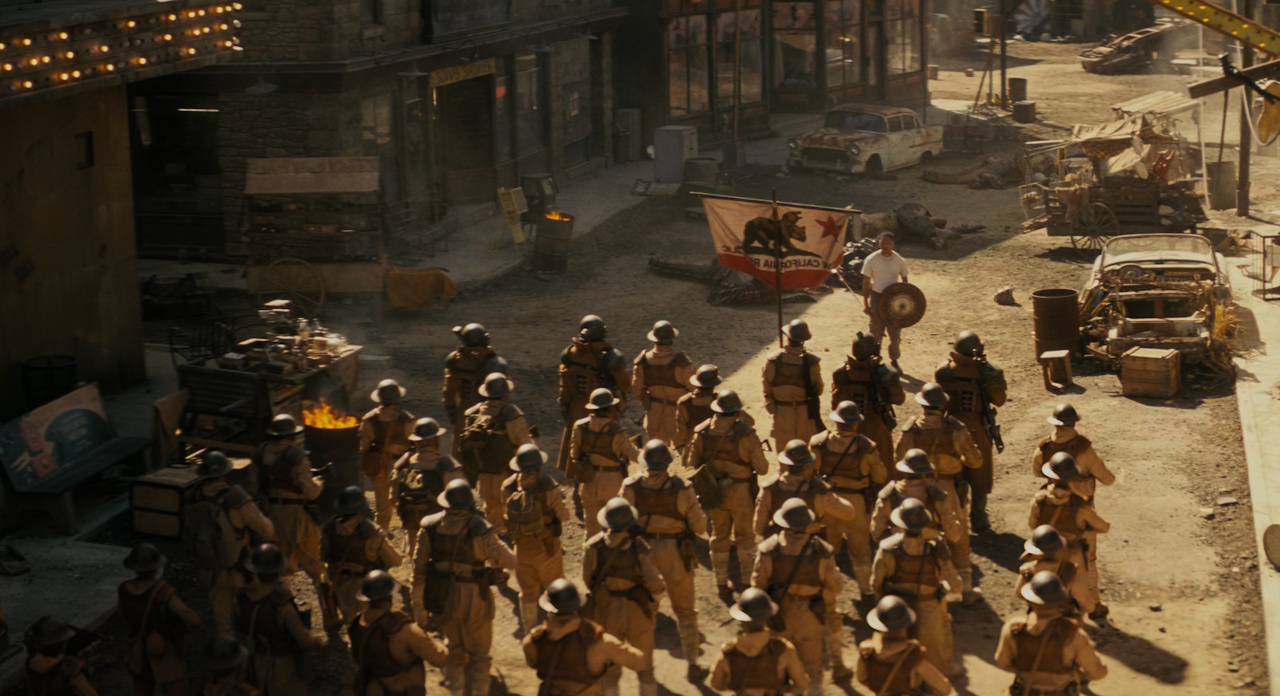
I Went To A Star Trek Convention…

It’s been a long road… gettin’ from there to here. By which I mean: it took me almost four hours on three separate trains and one tram to travel from my home to Destination Star Trek in Blackpool on Saturday. That’s right: Trekking with Dennis made it to a Star Trek convention – my first since 2011. This is, somewhat embarrassingly, a pretty big deal for me – my health has been poor for a long time, and I haven’t felt up to an outing like this in years. Aside from medical appointments and a couple of visits earlier this year to meet my newborn niece, this became my first excursion in over a decade.

I’d looked into last year’s Destination, but I didn’t feel well enough in 2024 so I opted not to go. But this year, bouyed a little by those visits to my sister, brother-in-law, and newborn niece, I was feeling a little stronger, and perhaps a little braver… so I bit the bullet and bought a one-day ticket for Saturday. It was a long day – hours of travel each way, leaving the house at 5:30am and not making it back until after 10pm. But despite being exhausted and in a lot more pain than usual by the time I got home… I had a good time.

Photograph from Destination Star Trek 2025 showing attendees on the convention floor with their faces censored.
The main convention floor around 10am.
(Faces in all photos have been censored for privacy.)

The Star Trek fan community is just… wonderful. There are so many kind people in the community; Trekkies are patient, respectful, encouraging, enthusiastic, and just a joy to be around. I might be sitting on a seat, catching my breath in between events, walking to the bathroom, or waiting in a queue, and someone would strike up a conversation about something they enjoyed about the event last year, share their experiences of having met the guest speaker, or just compliment me on my Star Trek t-shirt. The atmosphere was incredibly friendly and welcoming… I felt, for the first time in years, like I was among my people!

And I must give special thanks to the staff and organisers. Due to my poor health, I’d filled out a form on Destination’s website to request some extra help. I didn’t really know what this would include, I just hoped there might be somewhere to sit down in between events or while queuing. Upon arriving at the event, I spoke with one of the members of staff who issued me a wristband – and I got to join a special queue for several of the photographs (more on those in a moment) which meant less time spent standing. Members of staff helped me find a seat at several of the talks, and they were all very friendly, chatty, and passionate about Star Trek. I simply wouldn’t have been able to attend Destination without this extra support, and I am beyond grateful to the organisers, the staff, and everyone at the convention who accommodated me, in spite of my limitations.

Photograph from Destination Star Trek 2025 showing a selection of screen-worn uniforms.
A selection of uniforms used in various Star Trek productions which were on display.

Let’s talk about why I decided to go to Destination this year. Because… well, let’s just say it didn’t quite go the way I first intended!

I’d been keeping an eye on Destination 2025 for a few months, weighing up whether to buy a ticket or not. But it was only when Anson Mount – Captain Pike himself from Strange New Worlds – was confirmed as a guest that I decided it was something I had to do. As you might’ve heard, though, Mount unfortunately had to pull out of the event at the last minute after contracting covid. I wish him well as he recovers. Again, credit to the organisers and staff, here: refunds were issued automatically for the panel I’d paid for when Anson Mount had to pull out.

Such things are unavoidable. Anson Mount’s last-minute withdrawal from Destination led to a few changes to the schedule… which, in the end, ultimately worked out in my favour. Connor Trinneer – Trip Tucker from Enterprise – was taking part in a talk on Saturday afternoon, and when I was no longer scheduled to meet Anson Mount for a photograph, I that time was freed up to attend the talk. As we’ll discuss, Trinneer’s panel was a lot of fun, and I’m glad I didn’t miss out on it. Oh, and Anson Mount did ultimately call into Destination by video-link, though I didn’t attend that event.

Photograph from Destination Star Trek 2025 showing Anson Mount's video-call.
Anson Mount’s panel had to be done remotely.
Photo: Destination Fan Events via Facebook

I’ve mentioned photos a couple of times now, so let’s talk about that.

Some people love to collect autographs. My mother had Elvis Presley’s autograph, for instance, which was something she loved to tell people about! But I’ve never really been big on autographs, even personalised ones. If I have the opportunity to meet someone famous, or someone important to me… I’d rather take that time to shake their hand. That memory, that moment… it’s always seemed more worthwhile than an autograph, at least to me. No shade to the autograph collectors – this is purely a subjective thing.

So I booked several photographs with Destination’s attendees. I met two guest stars from the first and second seasons of The Original Series, including an actor who appeared in The Man Trap, which was the very first episode of Star Trek to be broadcast. I met Chase Masterson – Leeta from DS9. I met the aforementioned Connor Trinneer, and Martin Quinn – who has taken over the role of Scotty on Strange New Worlds. I made a bit of a tit of myself, blurting out “I love Strange New Worlds it’s great!” as I waddled over to him. Poor man must’ve been traumatised. But I shook their hands, smiled awkwardly for the camera, and I have those photographs as mementoes of the day.

Promo photo for Star Trek: Strange New Worlds showing Scotty.
Martin Quinn as Scotty in a promo image for Strange New Worlds Season 3.

It’s been a while since I went to Blackpool. The seaside resort is a peculiarly British place, though it’s definitely in need of some TLC these days. But I have fond memories of being taken there as a kid, going to the Pleasure Beach funfair, seeing the Illuminations, and eating chips on the pier. This time, I got to take one of Blackpool’s new, modern, ultra-sleek trams – and use an app to buy my ticket! I’m still adjusting to life in the smartphone age, but on the short walk from the railway station to the tram stop, I managed to download the app, buy my ticket, and activate it.

As soon as I disembarked, I started seeing signs of the convention! The tram stop is right outside the Norbreck Castle Hotel, and there were already dozens of people milling about in costume, in Star Trek tops and t-shirts, and wielding phasers and other props. I made it inside, freshened up, and I was on the convention floor in time for the first event I’d been planning to see: a talk all about artificial intelligence.

Photograph from Destination Star Trek 2025 showing the Blackpool seafront.
I snapped this photo while en route!

This presentation, by a member of the UK military and Space Command, was genuinely fascinating. I’m not a “doomer” when it comes to A.I., though I certainly believe its practical applications are more limited than some optimistic utopian predictions would suggest! But discourse surrounding A.I. online can often feel overly negative. While the speaker was clear that there can be drawbacks and disadvantages to A.I., and some areas where it may not be useful, he was broadly positive and passionate about its current and future applications.

It was also very interesting to catch the tiniest glimpse of military applications of A.I. from someone directly involved with that side of things. Again, there’s a lot of “doomerism” surrounding killer drones and A.I.-engineered bio-weapons… so to get some perspective and learn a tiny bit about how A.I. systems are currently being used by real-world militaries was absolutely fascinating. Obviously this wasn’t directly related to Star Trek, though the speaker was a Trekkie, but Star Trek has long been a pioneer in predicting A.I. – from The Ultimate Computer to Data, Voyager’s Doctor, Control, and beyond.

Photograph from Destination Star Trek 2025 showing the A.I. talk.
Major Sam McEvoy during the A.I. talk.

I was able to attend two talks (or panels, if you prefer), one in the morning and one later in the day. Chase Masterson’s talk was first, and she was a really engaging speaker. I enjoyed a story she told about being invited to rehearse with her DS9 co-stars at the home of Armin Shimerman (Quark), which sounded like it must’ve been a lot of fun. And she spoke a little about the late Aron Eisenberg, as well as working with Max Grodénchik (Nog and Rom respectively).

Masterson also spoke about some of her other roles, her charity work, and what the audition process was like as she made the move to Hollywood in the 1990s. It must’ve been a big deal for her as Leeta went from having a few lines in a single episode to slowly building up to become a recurring character with some big moments in the show’s later seasons. It also sounds like there was a complicated working environment for anyone not a series regular; Masterson explained how, on DS9, the recurring cast never had a contract, and could theoretically have been let go at any time.

Photograph from Destination Star Trek 2025 showing Chase Masterson and the host during her talk.
Chase Masterson during her panel.

Connor Trinneer also had some fun stories to share at his panel. He talked about the audition process, how he thought he’d completely blown his first audition for Enterprise, and how, after not being called back when he hoped he would be, he thought the role had gone to someone else. I also learned – and maybe you already knew this, but I certainly didn’t – that Trip Tucker almost got a different name. That’s right: he was originally to be called “Spike.” It was only because of Buffy the Vampire Slayer (which was on the air at the same time, and also had a character named Spike) that the name was changed – and that was after production had begun on the pilot.

Trinneer is another wonderfully engaging speaker, recounting his time on the show effortlessly. I think there’s still a twinge of sadness or regret that Enterprise was cancelled when it was; he mentioned the show’s premature ending several times, as well as talked about the possibility of exploring more of Trip and T’Pol’s relationship had a fifth season been greenlit. In a joking reply to a fan asking if he’d be willing to reprise his role, he said “he’s dead!” to much laughter. But he then elaborated: no one is ever really dead in sci-fi, and he’d be fascinated to learn how Trip might’ve survived the events of Enterprise’s finale.

Two really entertaining and interesting talks.

Photograph from Destination Star Trek 2025 showing Connor Trinneer with two convention hosts.
Connor Trinneer (left) at his talk.

Before we come to the photo sessions, I also got to take part in something really special. Chase Masterson did a script reading from the episode Bar Association – which is a huge episode for her character, Leeta. This was a separate event, in a smaller room away from the main stage. There were only about… I wanna say maybe ten of us, or so, as well as Masterson and a couple of the event’s organisers. It was small-scale, intimate, and just a ton of fun to have been present for. We all remember Bar Association, right – it’s the episode from Season 4 where Rom leads the staff at Quark’s to form a union.

This smaller script-reading session was so much fun, and definitely one of the highlights of the day for me. Chase Masterson is really funny, she hasn’t lost a step when it comes to embodying Leeta, and even though it’s been almost thirty years since Bar Association aired… I felt I was right back there, watching it all over again, just in a completely different way. These are the kinds of experiences you really can’t get anywhere else… and I’m so glad I chose to pay for a ticket to something like this instead of buying another action figure or model ship!

Photograph from Destination Star Trek 2025 showing Chase Masterson reading her script.
Chase Masterson at the Bar Association script reading.

The first photo I took – and therefore the first actor I got to meet – was with Martin Quinn. Quinn has taken over the role of Scotty in Strange New Worlds, showing us a younger and less-experienced take on the character that has just been really well-created and interesting. I noted in my recent reviews of The Sehlat Who Ate Its Tail and Four-and-a-Half Vulcans that Quinn has great on-screen chemistry with Paul Wesley (SNW’s Kirk), and it’s just been a lot of fun to see this younger version of the character and Quinn’s take on Scotty’s younger days. And yes, from now on, you can expect me to say “Martin Quinn (whom I have met)” in every future episode review where Scotty’s featured!

How often, nowadays, can one claim to have met a guest star from The Original Series? Garth Pillsbury appeared in the iconic episode Mirror, Mirror as Wilson – a crewman aboard the ISS Enterprise in the Mirror Universe. He reappeared in Season 3 as a prisoner in the episode The Cloud Minders. Budd Albright appeared in The Man Trap – the very first episode of TOS to be broadcast. His character (Barnhart) was killed by the M-113 Creature, making him one of the first “redshirts” to die in the show! He reappeared in What Are Little Girls Made Of as a different character, Rayburn, who met a similar fate!

Four still frames from Star Trek: The Original Series showing Budd Albright and Garth Pillsbury's characters.
Budd Albright (left) and Garth Pillsbury (right) in their TOS roles.

I then got to meet Chase Masterson (again, after the script-reading session) and pose for a photo with her. And I capped off my photo sessions later in the day with Connor Trinneer. There were pretty long lines for some of these, and I didn’t schedule photos with all of the guests who were there that day. But with the exception of Anson Mount, I got to meet everyone I set out to meet.

Meeting these folks, shaking their hands, and just… being with them for those few seconds… it’s an almost surreal feeling, in a way. Maybe if you’re a regular convention-goer this is all old hat to you, but for me, as someone who hasn’t done anything like it in so long… it was a wonderful experience. Being able to say I’ve met these folks, shaken their hands, told them (awkwardly) how much I enjoyed their shows and their characters… it’s just a really great feeling. It’s a connection between myself and the people who are actually *in* Star Trek that I didn’t have before.

And no, by the way, I’m not gonna publish those photos!

Photograph from Destination Star Trek 2025 showing a queue on the convention floor.
One of the autograph queues.

This might sound silly, but I was surprised to see so many people had gone all-out with their costumes. I felt underdressed in just a Star Trek-themed t-shirt, surrounded by people dressed up in full costumes from every series and every era of the show. It was great to see so many people wearing Picard, Discovery, Lower Decks, and Strange New Worlds uniforms, too – despite what some small groups of fans might want to think, the Trekkie community as a whole embraces, rather than rejects, those newer shows. There will always be some who complain, of course; I overheard one such conversation about “Alex Kurztman should be fired” at the convention. But it was great to see so many people who celebrated modern Star Trek just as much as the older shows.

The counterpoint to that is… well, a bit of an awkward one, to be honest. I’m no spring chicken – I’m in my forties – so this is not an attack on anyone, nor at attempt to be “ageist.” But… to be blunt, there’s not a lot of young blood in the Trekkie community at the moment. It’s rare for me to go somewhere and feel like one of the younger folks! But at Destination? I guess I’d say most people were in their mid-thirties or above. That gels, of course, with Star Trek’s 1990s heyday, and there are other factors such as younger people having less disposable income and perhaps more constraints on their time at this time of year. But it was noticeable, at least, that most of the folks there were in a similar age bracket to myself, despite Paramount’s attempts in recent years to broaden the Star Trek franchise’s appeal.

Photograph from Destination Star Trek 2025 showing a Lego Borg cube.
A Lego Borg Cube!

Destination was a lot of fun. It was a long, painful, and tiring day, but it was worth it in the end. The experiences I got to have – reading a script with Chase Masterson, meeting Budd Albright, who appeared in the very first Star Trek episode, and listening to Connor Trinneer talk about his time on Enterprise – just wouldn’t have been possible anywhere else, and I really value the time I spent and the memories I made far more than any of the merchandise I’ve bought over the years!

It also took a lot of effort, and I cannot stress enough how much I appreciate the assistance and help given to me by the folks at Destination. I paid for my tickets, so this is not some kind of sponsorship or ad, but the reality is that, given my health, I would not have been able to attend and do these wonderful things were it not for the extra help the staff and organisers were able to provide to folks with disabilities such as myself. I was exhausted after I got home – and yes, that’s why this week’s Strange New Worlds episode review was late – but I had a fantastic time.

Painting of the USS Enterprise produced while Star Trek: The Original Series was in early production.
2026 will mark Star Trek’s 6oth anniversary.

So… what’s next? I was talking to my sister (who, coincidentally, doesn’t live too far from Blackpool) about the event, and she said words to the effect of “now that you’ve done it, you wouldn’t do something like that again… would you?” And… I had to hesitate. Because yeah, it was a hard day. And yeah, next year’s event will probably be kinda samey, with talks, panels, merchandise booths, autographs, and photo-ops. There may well be some of the same actors and guest stars present.

I also don’t know, given my state of health, whether I’ll be able to do something like this again. It was a major undertaking for me, and it took a lot of planning, a lot of effort, and quite a few painkillers just to get through the day as well as I did! But I’m not going to lie to you: part of me is eyeing that weekend in August 2026, back at the Norbreck Castle Hotel, and thinking… “why not?”

So hey, if you’re going to Destination next year… who knows. Keep an eye out for a fat fella with a walking stick perched awkwardly on a chair or excitedly standing in line to shake the hand of… whoever they manage to book! In the 60th anniversary year, it could be a lot of fun.


Destination is an unofficial Star Trek fan convention held at the Norbreck Castle Hotel in Blackpool, UK. The Star Trek franchise – including all series, films, characters, and other properties discussed above – is the copyright of Skydance/Paramount. All photos taken by Trekking with Dennis unless otherwise stated. You may use them under the “share-alike” principle, providing you include a link back to this article. This article contains the thoughts and opinions of one person only and is not intended to cause any offence.
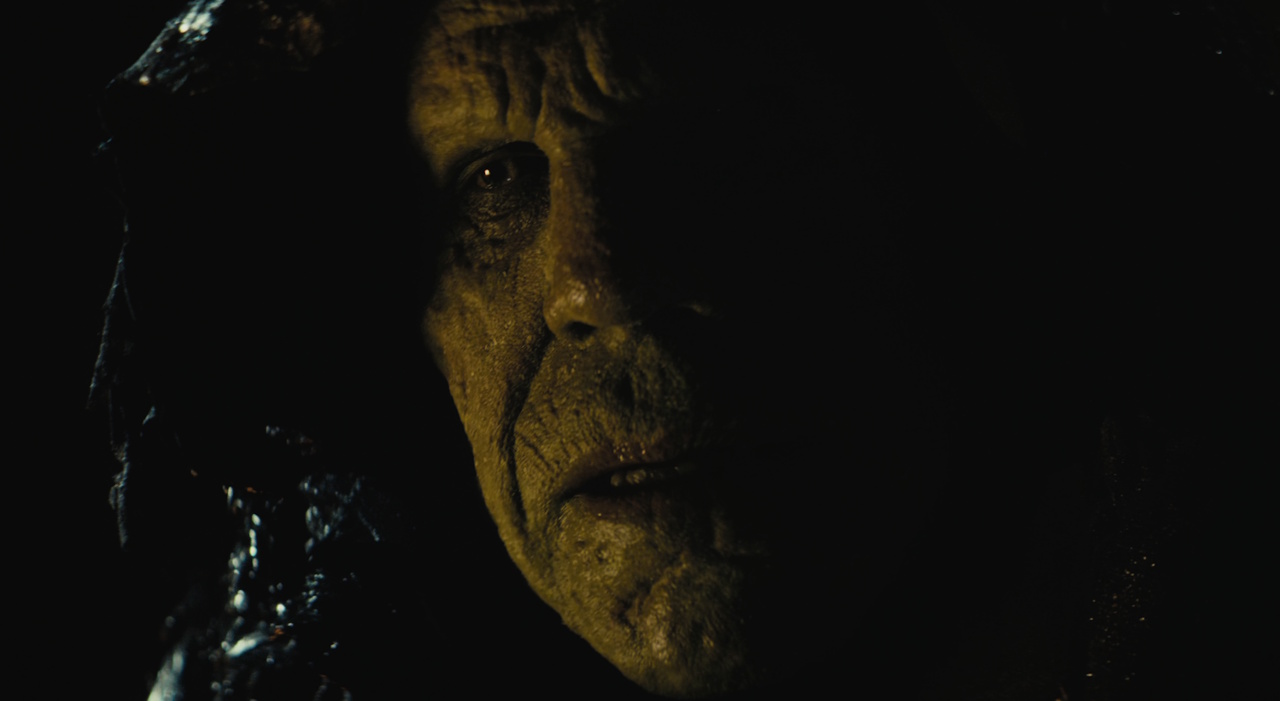
Star Trek: Strange New Worlds Episode Review – Season 3, Episode 8: Four-and-a-Half Vulcans

A Star Trek-themed spoiler warning.

Spoiler Warning: There are spoilers ahead for Star Trek: Strange New Worlds Seasons 1-3, and Discovery Season 3.

Last week, Strange New Worlds surprised me with an episode styled like a documentary. I approached Four-and-a-Half Vulcans much more keenly aware of the kind of story I was getting into… and I set my expectations accordingly. For the kind of light-hearted episode that it was, I think Four-and-a-Half Vulcans was, as Mr Spock might put it, adequate. There were actually some genuinely funny scenes and lines in the mix, and I laughed more than I expected. This was not the total cringe-fest I feared it would be.

However, it’s also an episode I’m in no hurry to revisit, and I’d probably rank it in the lower half of the Strange New Worlds episodes that have aired so far. Comedy has been a part of Star Trek since the beginning, and I’m not opposed to episodes and stories which firmly place themselves in that genre. However, a light-hearted tone and a comedic premise do not cover up any and all flaws; “it’s just a comedy episode” is not a good enough excuse for dodgy writing, weak characterisation, or hand-waving away one of the most significant elements of one of Star Trek’s most well-explored and understood races.

Still frame from Star Trek: Strange New Worlds, 3x08, Four-and-a-Half Vulcans showing Captains Batel and Pike.
Captains Batel and Pike.

I’m going to start with the positives this week.

Four-and-a-Half Vulcans genuinely made me laugh. Like… out loud. Multiple times. A lot of the comedy, even though some of it wouldn’t usually be “my thing,” stuck the landing thanks to a combination of clever writing and creative performances, backed up by some well-planned staging, solid camera work, and even editing. Spock and La’an’s battle-come-dance sequence at the end of the episode, in which they moved through different areas of the ship, was incredibly well-executed, and that’s just one example.

Though this was an undeniably silly premise for a story, the way everyone involved really threw themselves into it made Four-and-a-Half Vulcans feel earnest in a way that not every Strange New Worlds comedy episode has done. But that’s the double-edged sword, and, for me, part of why Four-and-a-Half Vulcans doesn’t feel so special: it’s repetitive. Strange New Worlds has used a very similar premise several times already. If this were the show’s first comedy episode – or even the first Vulcan comedy or Spock comedy episode – I think it would’ve felt stronger, or at least more original. When I saw the promo photos and the teaser clip, I was already rolling my eyes and getting ready to complain because of how overused this core idea has been in a series that still hasn’t reached the thirty-episode mark.

Still frame from Star Trek: Strange New Worlds, 3x08, Four-and-a-Half Vulcans showing four humans transformed into Vulcans.
Vulcan comedy… again.

And that side of Four-and-a-Half Vulcans was very much a let-down. Strange New Worlds’ writers seem utterly fascinated – borderline obsessed – with the idea that “Vulcans are stuck-up, rigid, and unemotional… isn’t that hilarious?” There hasn’t been a single straight-laced Vulcan story in the show so far. We now know that cancellation is coming, and Strange New Worlds has actually passed its halfway point. I really, sincerely hope that if the show revisits the Vulcans in Seasons 4 or 5… we’ll get a different kind of story.

Because for all of its genuinely funny and engaging moments, Four-and-a-Half Vulcans was weighed down by that sense of repetition. We’ve been here before – more than once, and in all three seasons. We’ve done the whole “what if Vulcans were hilarious,” “what if Spock had emotions,” and “aren’t these autistic-coded aliens just a hoot” things so many times… I’m beyond over it. That didn’t stop me laughing at some of the episode’s well-played jokes and genuinely fun moments. But it drags it down several notches. More than anything, I hope Four-and-a-Half Vulcans will be Strange New Worlds’ final attempt to go down this road. And hey, if the writers have zero other ideas for what to do with Spock and the Vulcans? Just don’t use them. That would honestly be better, at this point, than another attempt at “Spock comedy.”

Still frame from Star Trek: Strange New Worlds, 3x08, Four-and-a-Half Vulcans showing Spock.
Spock.

Sorry, this was meant to be the “positives,” wasn’t it?

Anson Mount is funny. He has good comic timing, and I enjoyed his weird and quirky take on a human-who’s-not-quite-Vulcan. A character like pseudo-Vulcan Pike would be absolutely awful to watch week in, week out… but as a one-off and a change of pace? I liked it. And Mount’s performance was a big part of that, I think. I can see just by watching the scenes he had in sickbay and in Pike’s quarters that it must’ve been a ton of fun to perform.

However… we’ve had Pike the cowardly courtier in The Elysian Kingdom. Pike without his memories in Among The Lotus Eaters. Pike the singer in Subspace Rhapsody. And earlier this season? Pike the holo-TV producer in A Space Adventure Hour. That’s four episodes in which Captain Pike isn’t Captain Pike… in what we used to call “the Captain Pike show,” back when Strange New Worlds was little more than the target of a fan campaign. As with “Spock comedy,” I’m kinda done with the whole “let’s turn all our characters into totally different people!” premise. Strange New Worlds isn’t the only Star Trek show to have done this. But it is the only Star Trek show to have done it so often in such a short span of time. These aren’t twenty-five episode seasons of a show that’s gonna run for seven years. Forty-six episodes of Strange New Worlds are all we’re getting. And in several of them, Captain Pike isn’t himself. Again… I’m kind of over that premise. Let Pike be Pike!

Still frame from Star Trek: Strange New Worlds, 3x08, Four-and-a-Half Vulcans showing Vulcan Pike.
How about a Captain Pike episode in the Captain Pike show where Captain Pike… gets to be Captain Pike?

Sorry, sorry. Positives.

I liked Kirk and Scotty’s burgeoning bromance. I was surprised to see Paul Wesley back as Kirk so soon after his big turn in the captain’s chair. But building on his new friendship with Scotty was a fun angle, and it was actually one of the few elements of Four-and-a-Half Vulcans that was played pretty straight. Yes, Kirk and Scotty found themselves in a weird situation with Vulcan/Romulan La’an… but their friendship continues to grow. Paul Wesley and Martin Quinn genuinely work well together. Kirk is beginning to come into his own as the captain we remember, but Scotty still has an edge of nervousness or a lack of confidence that comes from youthful inexperience. There’s a cute vibe to how they interacted, this week… and I really liked it.

Kirk and Scotty got what was one of Four-and-a-Half Vulcans’ most over-the-top storylines, with La’an plotting and scheming her way to a multi-front war. I think the boys’ side of things was the better one, and certainly the most grounded. Two stellar performances kept things focused mainly on the younger versions of these characters, despite the shenanigans happening around them.

Still frame from Star Trek: Strange New Worlds, 3x08, Four-and-a-Half Vulcans showing Scotty and Kirk clinking glasses.
Scotty and Kirk make a pretty good team.

Since I mentioned La’an, let’s talk about her next. I haven’t really had the chance to discuss this very much… but La’an’s connection to iconic Star Trek villain Khan has been, for me, almost a complete waste so far. Only a couple of episodes have so much as touched on La’an’s ancestry and the potential lingering effects of augmentation, and to be blunt, that’s not been good enough from Strange New Worlds. There are ways to use a character like La’an to talk about things like collective guilt, the dangers of eugenics and genetic engineering, or generational trauma. So far, we haven’t got much of that… making me feel, as time has gone by, that La’an should’ve probably been created as an original character without that connection to Khan.

However, this storyline did belatedly address some of that. It wasn’t a huge part of it, with La’an’s famous relative and augmented DNA only being referenced right at the end. But that explanation made sense to me and seemed to account for La’an’s changed persona when in Vulcan form. As an admittedly small and easily-overlooked nod to this under-utilised aspect of her character, I liked it.

Still frame from Star Trek: Strange New Worlds, 3x08, Four-and-a-Half Vulcans showing Scotty stopping La'an.
La’an being zapped.

The scene between Pike and La’an in their Vulcan/Romulan guises was pretty funny. And I liked that Strange New Worlds linked up these two characters – both of whom are, as far as we know, the only people in Starfleet at this point in time to be aware of the connection between Romulans and Vulcans. The fact that they both had to cover this up to comply with the Temporal Prime Directive was alluded to, and added a lot to the scene. Obviously Pike came to learn about the Romulans in the Season 1 finale, and La’an did last season in her team-up with an alternate timeline version of Kirk.

The implication of this is interesting, though, if we take a step back. La’an basically turned into a Romulan, not a Vulcan, and Spock seemed to suggest that her augmented ancestry played a role in that. Is that a clue about the split between Vulcans and Romulans? Enterprise showed us our most comprehensive look so far at Vulcan history – including the Time of Awakening, after which the proto-Romulans left Vulcan. But it’s interesting, at least, to get this hint at genetic manipulation possibly playing a role in either the early history of the Romulans, or even in their society in general.

Still frame from Star Trek: Strange New Worlds, 3x08, Four-and-a-Half Vulcans showing La'an and Pike.
La’an and Pike.

Or perhaps the story wanted to highlight how thin the dividing line is between Romulans and Vulcans. That’s also an interesting idea, especially in light of Discovery’s far-future Ni’Var storylines. At any rate, I liked the idea that there could be some kind of augmentation at some point in Romulan history – and I felt that idea expands our understanding of the Romulans without treading on the toes of previous storylines.

Given how other parts of Four-and-a-Half Vulcans really leaned into the idea of “logic,” La’an’s transformation was a refreshing change of pace. Christina Chong can take a villainous turn remarkably well, and her performance – while no less over-the-top than any of the others this week – was still a lot of fun to watch. Again, this seems like an episode that would’ve been a blast to work on.

Still frame from Star Trek: Strange New Worlds, 3x08, Four-and-a-Half Vulcans showing Kirk, La'an, and Scotty.
La’an becoming a Romulan, not a Vulcan, was a fun idea.

So let’s talk about the other Vulcans, then, and their transformations.

Though there was an attempt to address why Pike, Chapel, and Uhura were so emotionally repressed and logical, I felt it was a pretty flimsy way to hand-wave away an incredibly important part of Vulcan lore and history. Vulcans are not, by nature, stoic and logical. It takes a lot of effort and work on their part to box up their emotions the way they do, and just being physically Vulcan should not bring with it the decades of training that Spock went through to reach his more mature and logical state.

This was a narrative hurdle that I was really worried Four-and-a-Half Vulcans would trip over. And while we can say that the episode avoided the most flagrant violations of canon on a technicality… I’m still not sure that I like the result.

Still frame from Star Trek: Strange New Worlds, 3x08, Four-and-a-Half Vulcans showing three characters partway through their Vulcan transition.
The transformation process doesn’t look very pleasant…

Regular readers will have heard me talk about internal consistency before. I believe internal consistency is one of the absolutely foundational components of suspension of disbelief when engaging with any work of sci-fi or fantasy. Once it’s been established that magic, fictional technologies, or alien races behave a certain way, that’s gotta be something subsequent storylines stick with. If Star Trek was constantly changing how warp drive worked, for example, it would soon erode the core of one of the franchise’s key technologies. And when it’s been established that Vulcans are intensely emotional people who have to train for years to keep their emotions in check and present a logical face to the world… future stories have to stick with that.

However, by showing the flaws and weaknesses in each of the transformed characters’ applications of logic, Four-and-a-Half Vulcans actually does something genuinely interesting with this idea. It’s more than just cringe humour, and while I maintain that it feels like something that’s dangerously close to crossing the line into an outright violation of canon, there was at least somewhat of a point to it. And more nuance than I’d been expecting.

Still frame from Star Trek: Strange New Worlds, 3x08, Four-and-a-Half Vulcans showing Pike at his desk.
Captain Pike was… illogical.

Pike, La’an, Chapel, and Uhura were completely unprepared for what being a Vulcan would feel like. And they found it impossible to adhere to a genuinely logical pattern of behavior, with all of them crossing lines and behaving like, as Spock put it, jerks. In that sense, I think we did actually learn a little more about what it must be like to be a Vulcan, and how intense their training and education must be to keep a logical lid on some truly illogical impulses and desires.

This was more than just pure comedy, and breaking it down, we catch a small glimpse at what being a Vulcan might feel like – something that, if you think about it, we haven’t seen much of outside of Enterprise. Parts of Four-and-a-Half Vulcans seemed to build on T’Pol’s storylines from Enterprise in an interesting way. Whether that was the intention or not… that’s how I read it. And perhaps I’m reaching, trying to find positive glimmers amidst a storyline I generally didn’t like. But I think that interpretation is there, and stepping back to Enterprise gives context to some of these scenes.

Still frame from Star Trek: Strange New Worlds, 3x08, Four-and-a-Half Vulcans showing Spock and Chapel in sickbay.
The episode explored a bit more about Vulcans.

Pelia is legitimately one of my favourite characters on Strange New Worlds, and almost every scene she’s in is just… delicious. She’s so funny, she adds so much light-heartedness to the show, and even in an episode like this, where comedy was the focus, her scenes still stood out. It was also a change of pace to put Pelia with a different combination of characters. We saw her with Ortegas, Dr M’Benga, Spock, and Una, and I honestly can’t remember many (or any) times she’d really spent time with most of them. She’s the chief engineer, and though we do now have Scotty as a junior officer, the chief engineer role on a Star Trek series is still an important one.

What I got from Pelia’s scenes, more than just a good laugh, was how she is genuinely friends with the rest of the crew. They like her, and she likes them. Because of how little screen time Pelia tends to get, and how inconsistent her appearances are – with her disappearing for multiple stories in a row, sometimes – there’s been less of an opportunity to show that. This week, with everyone hanging out in her quarters, I felt like she was a fully-fledged member of the crew. And I liked it. Oh, and Pelia’s quarters being shielded from the ship’s sensors? Love it.

Still frame from Star Trek: Strange New Worlds, 3x08, Four-and-a-Half Vulcans showing Pelia in bed.
Pelia is so funny. I love her.

Though Chapel and Uhura got arguably the less-interesting Vulcan storylines, both had their moments. Uhura trying to solve problems with mind-melds and forcibly “brainwashing” Beto was… weird. But it was nice to welcome back Mynor Lüken on this side of the story. I still think Beto and Uhura have good chemistry, and giving the younger Uhura a romantic interest is – if done well and explored more in future – a solid idea I can get behind.

Chapel’s single-minded focus on work was also interesting, especially as she began severing relationships and friendships in the name of efficiency. I felt a little of Seven of Nine in this characterisation, as Chapel prioritised doing as much work as possible ahead of everything else. Bringing back Dr Korby in the closing moments of the episode rounded out this storyline quite well.

Still frame from Star Trek: Strange New Worlds, 3x08, Four-and-a-Half Vulcans showing Uhura meditating.
Uhura in her Vulcan form.

If I might nitpick… Dr M’Benga and Una both said that they couldn’t force Pike and the others to return to their human states. And Una was unwilling to remove Pike from command, despite his erratic behaviour. But surely on medical grounds… the affected officers could have been relieved of duty. When it became clear that Pike could no longer effectively command the ship, and was issuing nonsensical orders like 45-minute shift changes, or when La’an was rigging the ship’s weapons for all-out war… intervening at that stage was definitely an option. In fact, it should have been mandatory.

In previous iterations of Star Trek, we have seen officers relieved from duty for less! I can appreciate why, in the beginning, Una and Dr M’Benga might’ve taken a “wait and see” approach, rather than trying to force Pike and co. to return to their human states. But when it became clear that they were being adversely affected by their transformations, steps would surely have been taken by a competent commander and medical professional to, at the very least, take them off duty for a while.

Still frame from Star Trek: Strange New Worlds, 3x08, Four-and-a-Half Vulcans showing the crew chatting in Pelia's quarters.
These characters could (and arguably should) have intervened before things went too far.

Doug was an interesting character, but in a busy episode, I don’t think we got enough time with him to really explore who he is or what he was even doing. He and Una made a fun pair, but we never really understood why they have such an unstoppable effect on one another. “Pure lust” doesn’t seem like something Una would experience, to be blunt about it, and even if she did… even if Vulcans and Illyrians have some kind of effect on each other… surely two grown adults are capable of behaving themselves long enough to have a serious conversation. It was a silly aspect of an already silly story… and one that was too over-the-top for my taste in an episode which had no shortage of such moments.

I was also disappointed that, after all the buildup to Doug’s arrival, we didn’t actually see him do anything of consequence to the plot. The writers and producers chose to show Doug – played by wonderful guest star Patton Oswalt – flirting with Una, sharing an awkward drink with Spock, and then doing whatever Vulcan magic he did entirely off-screen, before reuniting for one final flirty scene with Una. “Show, don’t tell” is something they teach every budding writer in their first ever lesson… and with Doug’s Vulcan katra magic being the climax of the episode’s story… it felt wrong that it happened entirely off-screen. Was it really straightforward? Did Doug just… snap his fingers, putting everyone to rights? Or did it take him a week of intense study, meditation, and working in a lab? We don’t know because we saw zero seconds of any of it.

Still frame from Star Trek: Strange New Worlds, 3x08, Four-and-a-Half Vulcans showing Doug.
Doug.

Four-and-a-Half Vulcans was funnier than I expected, and a better episode all around than I feared it would be from the photos and promo clip. But it wasn’t fantastic, it still has some significant weaknesses and contrivances, and above all, it relies on a premise that Strange New Worlds has thoroughly burned out. Please… please… let this be the last “Vulcan comedy” episode we get in this show. I can handle more light-heartedness, and I’m fine with more episodes that use overtly comedic premises and styles. But not another one where the focus is Spock and the Vulcans. We get it: Vulcans can be funny. But that’s enough for now. Try something else with the Vulcans, perhaps. Or give Spock a storyline that isn’t either slapstick comedy or depicting him slowly sleeping his way through every female member of the Enterprise crew. If you can’t think of anything that fits the bill… sideline Spock for an episode or two and do something else. Because I am thoroughly, utterly, and completely done with these kinds of stories at this point.

So that’s all for now, I guess! I didn’t hate Four-and-a-Half Vulcans. I didn’t even dislike it as much as I half-expected, half-worried that I would. But I did find it repetitive, perhaps a little too silly or over-the-top in places, and its strengths – like a genuinely good storyline for Kirk and Scotty – couldn’t outweigh its weaknesses. The result is an episode I probably won’t watch very often in the future.

Next week, we have Terrarium, which I know absolutely nothing about at this stage. The name doesn’t give very much away, and there haven’t been any photos or clips released ahead of its premiere yet. Maybe that’s because there’s some big secret being kept? “Terra” could hint at the Mirror Universe, perhaps – though I hope that’s not the case, to be honest! Or a “terrarium” could refer to an enclosure, perhaps suggesting Pike and the crew will become trapped. Those are total guesses, though. I guess we’ll have to tune in to find out!


Star Trek: Strange New Worlds Seasons 1-3 are available to stream now on Paramount+ in countries and territories where the platform exists. The first two seasons are also available on DVD/Blu-ray. The Star Trek franchise – including Strange New Worlds and all other properties discussed above – is the copyright of Skydance and/or Paramount. This review contains the thoughts and opinions of one person only and is not intended to cause any offence.
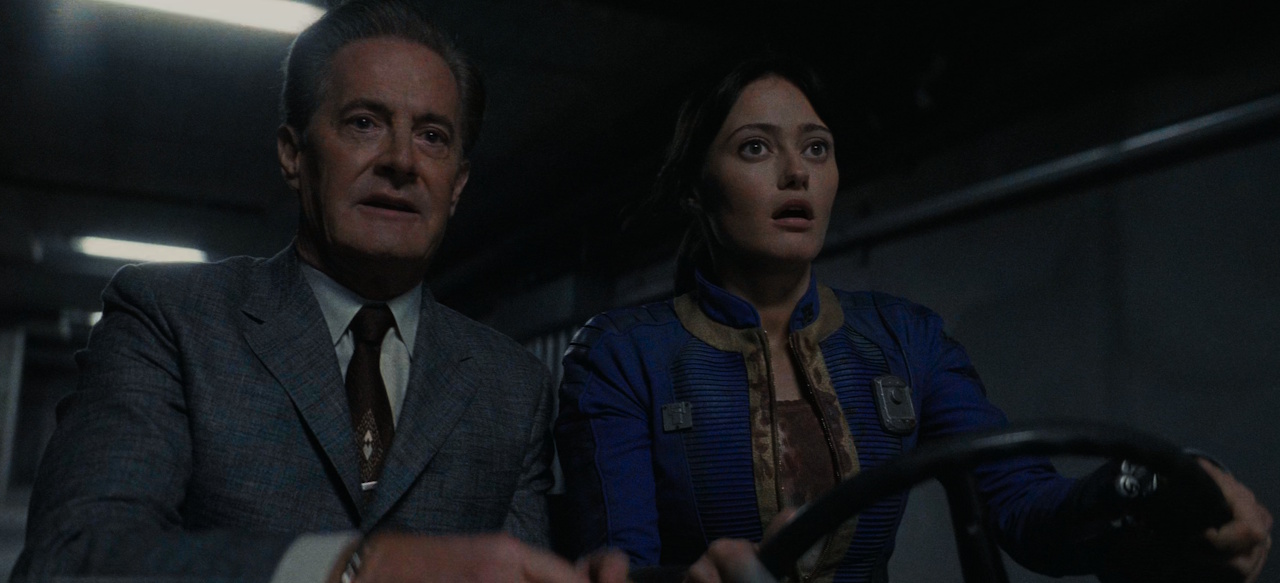
Ooh, A Star Trek: Voyager Game…

A Star Trek: Voyager-themed spoiler warning.

Spoiler Warning: There are minor spoilers ahead for Star Trek: Voyager, as well as details about the upcoming game Across the Unknown.

A few days ago, at the video games industry’s big Gamescom event in Germany, a brand-new Star Trek game was announced. I was very briefly excited… then disappointed when I learned it was going to be VR-only. Star Trek: Infection looked genuinely fun… but I can’t get on with VR, so I doubt I’ll be able to play it unless it gets ported to non-VR systems in the future. “That’s a shame,” I thought, decrying that the only new Star Trek video game of the past couple of years was gonna be exclusive to VR. But oh well. Life goes on.

I mean, there’s no way the Star Trek franchise is gonna announce two video games at the same event within days of each other. Not after being radio-silent on video games since Resurgence and that Prodigy tie-in game were released. Right?

Star Trek: Voyager – Across the Unknown has just been announced by GameXcite and Daedalic Entertainment. It’s billed as a “story-driven survival strategy game” in which you, as the player, get to take command of the legendary USS Voyager during its journey home.

Promotional screenshot for Star Trek Voyager: Across the Unknown.
Are you ready to take command of the USS Voyager?

Wow. That honestly sounds like a great premise!

The game sounds like a kind of Fallout Shelter or U-Boat, with some amount of starship management in addition to the narrative choices. And that kind of game – where you get to manage and maintain the systems aboard your ship – has been one I’ve wanted to see Star Trek try out for a long time.

Voyager is a great show to use as inspiration for that kind of game. Being lost and alone, far from Federation space, gave Captain Janeway and the crew a lot of leeway when it came to making changes aboard Voyager: things like the Mess Hall and the assimilated cargo bay come to mind! And the unique community that the crew built – that sense of camaraderie that came from being the only humans in this far-flung part of the galaxy – could give the game almost a “cozy” vibe, perhaps.

Promotional screenshot for Star Trek Voyager: Across the Unknown.
Different rooms and decks.

Voyager also led to one of the Star Trek franchise’s few games that genuinely broke out of the Trekkie community to go somewhat mainstream: Elite Force. That game was a darling of early 2000s LAN parties, acquiring a good reputation with a wider audience – something very few Star Trek games have ever done, if you think about it. I don’t want to just assume that Across the Unknown will come anywhere close… but there’s precedent, at least, for potentially expanding the Star Trek fan community a little.

With all that being said, there are some caveats. Star Trek games, both recent and not-so-recent, haven’t always been particularly good… and that’s putting it mildly. Star Trek’s corporate overlords have never really seen the potential in video games as an artistic medium, and practically no licensed Star Trek game has been afforded a sufficiently high budget. The result? Compared to other big sci-fi franchises, like Star Wars and even Alien, Star Trek hasn’t made much of an impact in the video game realm, and some titles have been genuinely quite low-quality.

Promotional screenshot for Star Trek Voyager: Across the Unknown.
This looks like an away mission.

And… to be blunt, I’m getting a bit of a “cheap knock-off” vibe from the trailer and some of the screenshots of Across the Unknown. The graphics look okay, don’t get me wrong. Maybe a bit last-gen, but for a game that won’t have been given a blockbuster budget, that’s okay. But a game like this lives or dies on the quality of its management and sim elements – that’s the appeal of assuming command of the USS Voyager in a game like this. And I’m just not blown away by what I’ve seen, to be honest.

Perhaps, though, that’ll turn out to be a good thing. If I go into a game hyped up to the moon and it doesn’t live up to it, I’ll be disappointed. But if I have low expectations… it’s easier for a game to exceed them! So maybe my Fallout Shelter comparison is apt; maybe that level of quality and interactivity is about right.

Promotional screenshot for Star Trek Voyager: Across the Unknown.
This looks like a map screen, perhaps showing the available planets/star systems that can be visited.

I still need to play Resurgence. It kind of released at an awkward time for me personally, when I was feeling a bit burned out on Star Trek as a whole. I bought it, but it’s sat un-played in my Steam library ever since. Hopefully, though, I can get around to Across the Unknown a bit more quickly when it’s ready! At this stage, there’s no release date – but it could be sometime next year, maybe, based on nothing but the timing of the announcement.

I’m not familiar with developer GameXcite. The company seems to be based in Germany, and so far has released two Asterix and Obelix mobile games and one console/PC game. Oh, and for some reason… development of all of their games (including Across the Unknown) is partially funded by the German government. Go figure. The PC version of Asterix and Obelix: Heroes has a “mostly positive” rating on Steam, and I can’t see any complaints about the game running poorly, crashing, or suffering from game-breaking bugs. Which already puts it light-years ahead of 2013’s Star Trek tie-in game!

Promotional screenshot for Star Trek Voyager: Across the Unknown.
A very pretty master systems display!

But you may have heard of Across the Unknown’s publisher: Daedalic Entertainment. If that name sounds familiar, well… it’s because Daedalic was responsible for 2023’s The Lord of the Rings: Gollum, which was a broken, unfinished mess, and quite literally one of the worst games to launch that year. There’s a difference, of course, between Daedalic’s now-closed development studio and the company’s publishing arm. And Daedalic has published some genuinely good titles: Partisans 1941, for example, and 2023’s Barotrauma, which is a comparable kind of management/narrative game set on a submarine.

I’m trying to keep my expectations in check for Across the Unknown. The game’s blurb mentioned that there are twelve “sectors” of the Delta Quadrant to explore, which could mean there are basically twelve stages/levels. That… doesn’t sound like a ton of content, though I suppose it depends how detailed these sectors are, whether there are multiple star systems to visit in each one, and how many narrative events there could be. The blurb mentioned familiar faces from the show, like the Caretaker and Borg, returning, too.

Promotional screenshot for Star Trek Voyager: Across the Unknown.
The USS Voyager approaching a star.

One of the most interesting ideas, though, are the so-called “rogue-lite elements” that Across the Unknown promises to incorporate. Narrative inflection points, where choices can lead to completely different outcomes, potentially including things very different from what we saw in the TV show, sound genuinely interesting. If handled well, there could be some replayability here, making each run through the game feel different – assuming you pick different options each time!

The danger here is that there will be one “optimal” run, where, if you do everything just so, you get the best outcome, or the outcome that closest resembles the TV show. Part of the fun of an idea like this – taking the Voyager story but allowing players to make different choices – is that some of these choices could actually lead to better or just radically different outcomes. In short… if every choice except the one Captain Janeway made leads to instant death or the ship being wrecked on an asteroid, that’s not gonna take full advantage of this style of gameplay! So I hope the developers are aware of that and are at least trying to make these choices feel different and meaningful.

Promotional screenshot for Star Trek Voyager: Across the Unknown.
Ooh, it’s Harry Kim.

So that’s all for now. I shall follow Across the Unknown’s progress with interest, and when it launches – which could be next year – I daresay I’ll pick up a copy and check it out. If possible, I’ll try to write a review here on the website… but my track record with such things isn’t great, so someone might have to remind me if I forget!

Now… with Voyager getting some love in its 30th anniversary year, how about that HD remaster? Hmm, Skydance? HD remaster? HD remaster of Voyager from Skydance? Skydance’s HD remaster of Voyager to stick on Paramount+? Come on… you know you want to!

This was good news, though, and as Voyager celebrates a milestone anniversary, it’s nice to see the series getting a bit of attention from Star Trek’s corporate overlords. I’m trying to keep my expectations at a reasonable level, but if this game manages to make good on its premise, it could be a lot of fun.


Star Trek: Voyager – Across the Unknown will launch for PC, PlayStation 5, and Xbox Series consoles at an unknown future time. Star Trek: Voyager – Across the Unknown is the copyright of GameXcite, Daedalic Entertainment, and Paramount/Skydance. The Star Trek franchise – including Voyager and all other shows discussed above – is the copyright of Paramount/Skydance. This article contains the thoughts and opinions of one person only and is not intended to cause any offence.
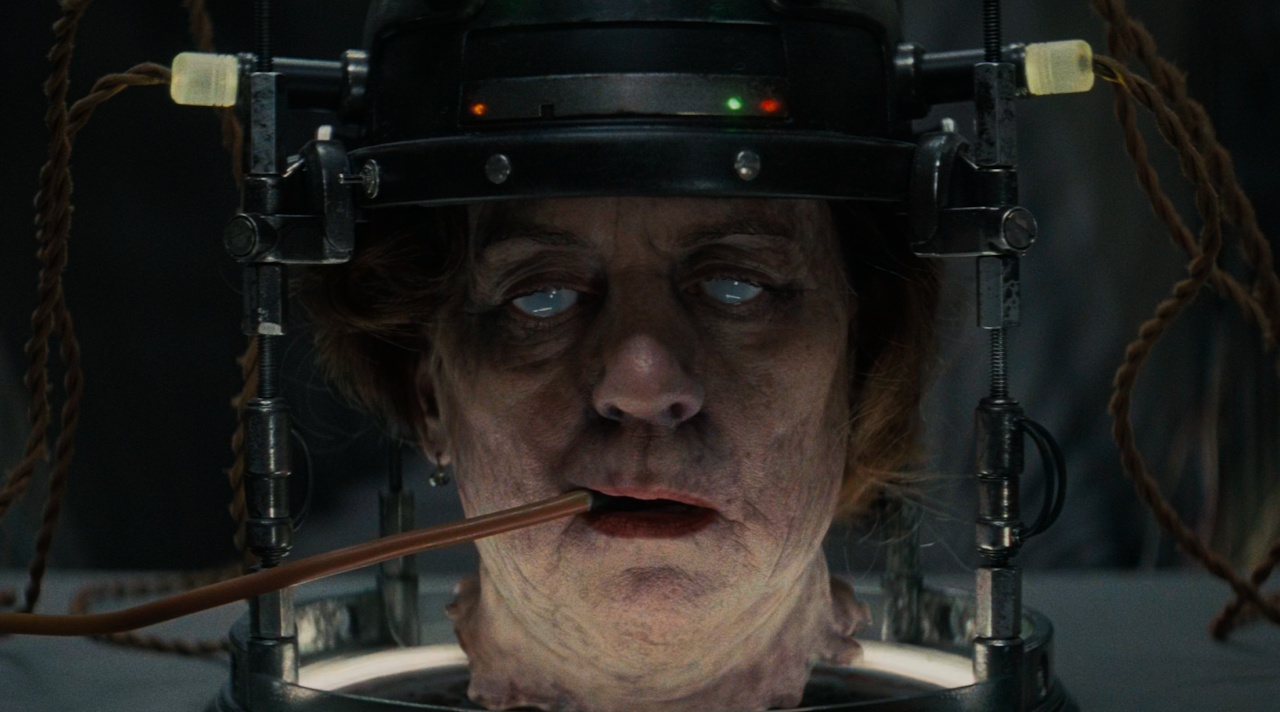
Star Trek: Strange New Worlds Episode Review – Season 3, Episode 7: What Is Starfleet?

A Star Trek-themed spoiler warning.

Spoiler Warning: There are spoilers ahead for Star Trek: Strange New Worlds Seasons 1-3. Minor spoilers are present for Picard Season 1, The Original Series, and Deep Space Nine.

Strange New Worlds remains a fun, episodic, and eclectic series. Just in Season 3 so far, we’ve had a zombie episode, a noir mystery on the holodeck, and a dimension-bending away mission. So when this week’s episode was presented in the style of a Panorama or PBS Frontline documentary… yeah. That tracks!

What Is Starfleet was incredibly creative and well put-together. It draws clear inspiration from modern documentary films and investigative journalism, splicing action with interviews, and the way it unfolded made it a genuinely interesting watch. It could also feel intrusive and more than a little frustrating, particularly as the action would cut away from what was unfolding to focus on another interview or clip that didn’t seem to move the main story along. The overall result? An episode I have mixed feelings about, I’m afraid.

Still frame from Star Trek: Strange New Worlds S03E07 "What Is Starfleet?" showing the documentary title card.
The documentary’s title card.

Beto is not a totally brand-new character, having been built up over several earlier episodes. That should be a saving grace for What Is Starfleet, because we’ve at least started to get to know Beto, and we’ve seen him interacting with and getting to know some of the characters on the show already. But… the way this documentary was presented felt intrusive to practically all of the other characters. And because they are our real protagonists and have been for two-and-a-half seasons already… we’re on their side more than on Beto’s, even when naked plot contrivances seemed to be painting Starfleet and Captain Pike in a less flattering light.

It was obvious that the only two characters who were even potentially interested in being interviewed were Uhura and Erica Ortegas – and both of those come with caveats. Captain Pike, Dr M’Benga, Spock, Una… none of them were okay with this. They were complying because they’d been ordered to, but they really weren’t game for having their personal and professional lives exposed and dissected on camera. And again, because they’re the people we care about more than Beto, a significant chunk of What Is Starfleet felt uncomfortable, like it was being presented from the wrong character’s point of view.

Still frame from Star Trek: Strange New Worlds S03E07 "What Is Starfleet?" showing Dr M'Benga.
Most characters – like Dr M’Benga – were unwilling participants in the documentary.

Maybe that’s supposed to be part of the point. Some films and TV programmes want you to feel uncomfortable, want to show off negative or less-positive traits from some of their characters, and this documentary format is particularly well-suited to doing that. But if that was how it was meant to come across, then I question both the intent and the execution. What would be the point, in a series like Strange New Worlds, of trying to light up in neon some of the main characters’ ambiguities and questionable backstories? What do we gain by that? Because it feels like something that was contrived for the sake of being an uncomfortable experience… not to lead to any kind of character growth or narrative payoff.

And we aren’t just considering this documentary within the confines of Strange New Worlds – but in the context of 950+ Star Trek stories over almost six decades. Impugning the character, values, and overall decency of Starfleet, as Beto seems to aspire to do in the beginning… it doesn’t sit right.

Still frame from Star Trek: Strange New Worlds S03E07 "What Is Starfleet?" showing Dr M'Benga's war record.
Dr M’Benga’s wartime record.

This side of the episode also horribly mixed its metaphors. Though I question whether it could be successfully pulled off, presenting the Federation and Starfleet as akin to an “empire,” ruthlessly expanding, using questionable weapons of mass destruction, threatening non-members… there could be real-world parallels there. It’s the distinction between how the United States likes to see itself – a paragon of virtue, extolling democracy and freedom – versus how the country can be seen by other countries around the world. Asking us as the audience to consider, even for a moment, whether non-Federation members and non-Starfleet personnel might see these organisations in that way has potential. It worked in Deep Space Nine with stories about Bajor and especially with the Maquis.

But the ending completely undermines all of that. Beto goes from making a hard-hitting investigative piece, complete with implicit accusations of war crimes and empire-building, to making a puff piece; basically pro-Starfleet propaganda. Though I don’t think this story, told in this format, had the kind of complex morality that would’ve lent itself to a discussion of Starfleet as a tool of imperialism… if that’s the angle you want to go for, you kind of have to commit to it. What Is Starfleet didn’t, resulting in an ending that felt abrupt and tonally wrong compared to everything that led up to it.

Still frame from Star Trek: Strange New Worlds S03E07 "What Is Starfleet?" showing Pike holding a wine glass.
The end of the episode came across like a puff piece – or a recruitment commercial.

In an episodic show, you get contrivances sometimes – it’s part of episodic storytelling. In order to get to the main event, sometimes you have to brush aside an important point or sideline a character. It’s never great, but it’s a compromise of the medium. Even with that context, though… Starfleet’s off-screen orders for the Enterprise to work with this alien race and deliver their biological weapon felt incredibly flimsy. It was clearly set up to be as dark and negative as possible, so that the episode (and Beto as the filmmaker) could imply as many bad things as possible.

And again, contrivances are a hazard of episodic TV. There are many instances in Star Trek where the Enterprise has been ordered somewhere “just because,” jump-starting the events of a more interesting storyline. But there really aren’t that many episodes I can think of where the reasoning behind Starfleet’s orders is so deliberately obtuse.

Still frame from Star Trek: Strange New Worlds S03E07 "What Is Starfleet?" showing Pike and Una conversing with Starfleet Command.
There was no reason for Starfleet to be so annoyingly secretive other than “because plot.”

There was scope for a potentially interesting conversation about the “Nuremberg defence.” If you’re unfamiliar with that term, it refers to the expression “I was only following orders,” something many of the defendants at the Nuremberg trials after World War II would go on to claim. In the context of this story, Starfleet basically ordered Pike and the crew to transport a pretty terrifying weapon – a weapon created by interfering with a sentient life-form. The secrecy and “need-to-know basis” for the information pertaining to the mission at least suggests or hints at Starfleet’s higher-ups being aware of what they were doing.

But What Is Starfleet doesn’t do that. It flips things around, showing how Starfleet is “just us, the good people who serve,” and that kind of ignores a massive in-universe point about the nature of orders, who’s giving them, and what outside agendas might be involved. We didn’t get a satisfactory explanation for why Starfleet was inserting itself into this war between two non-Federation worlds, nor whether they knew of the capabilities of this sentient, genetically-modified weapon of mass destuction. “I was only following orders” is not an acceptable defence today, in the modern world, for something like the trafficking of sentient beings, let alone transporting weapons of mass destruction to one side in a war your state is not a participant in. So why would that be okay in the 23rd Century?

Still frame from Star Trek: Strange New Worlds S03E07 "What Is Starfleet?" showing the Jikaru.
The episode sets up an interesting and morally complex idea – then dumps it right when it could’ve mattered.

What Is Starfleet could’ve posed those kinds of questions – but when it came to the crux, the episode’s writers and director baulked. They teed up these questions about Starfleet inserting itself into someone else’s war, not as a peacemaker but as a gun-running, human trafficking ally, and about how the chain of command operates. But then, after an admittedly emotional chat with Uhura about his personal agenda and ulterior motive, Beto does a complete 180 and turns his documentary’s final act into a celebration of all things Starfleet that’s so sickeningly upbeat that it comes across like propaganda or an enlistment ad.

And so… from both an in-universe perspective, and for us as the audience, Beto’s documentary feels fundamentally unsatisfying and tonally wrong. It’s as if you’d sat down to watch what you thought was a hard-hitting episode of PBS Frontline or Panorama about the war in Iraq, the lies that led to the war, and the criminal actions of the military… only for the film to end with a feel-good story about camaraderie and friendship, and an ad to join the army at your nearest recruitment station. Starfleet is – as the documentary points out – the Federation’s military, after all, so when the episode and the documentary end with this kind of puff piece… that’s how it comes across to me, at any rate.

Still frame from Star Trek: Strange New Worlds S03E07 "What Is Starfleet?" showing the dinner party.
This didn’t feel like the right ending.

A couple of weeks ago, Pelia was one of the most fun and engaging characters when dealing with Beto and his camera. She seemed to relish in hamming it up, almost hoping for her turn in the spotlight. That could’ve added a small amount of levity to what was a quite heavy story this time, and What Is Starfleet could’ve looked at the connection between Pelia and Beto, as well as, perhaps, how a filmmaker might deal with an overly enthusiastic participant. But, for no discernible reason, Pelia was entirely absent.

Given the Jikaru’s energy/electromagnetic abilities, and the damage sustained to the ship and shuttle, there was scope to bring in an engineering character, but neither Scotty nor Pelia appeared. If I had to choose just one of them, I’d have picked Pelia – I just think she brought something completely different to the table when dealing with Beto. It would’ve been fun for us to see him having to deal with her antics, but she could’ve also had a role in the story. Not only could we have seen her attending to the Enterprise’s shields, and perhaps Beto struggling to keep his composure during an interview, but Pelia could’ve also helped Pike deal with the intrusion of having a camera in his face. I’ve felt her absence in several stories this season – but none more so than this one.

Still frame from Star Trek: Strange New Worlds S03E07 "What Is Starfleet?" showing an engineer reparing damage to the Enterprise.
Where were Pelia and Scotty during all of this?

All of this must make it sound like I hated What Is Starfleet. I didn’t. I liked the creativity. I liked that, after 950+ episodes and films, Star Trek can still break new ground and try different things. I liked that, hidden underneath the documentary format, there was a classic Star Trek story which felt like it came straight out of The Original Series or Deep Space Nine. And I liked many of the character moments – particularly Pike’s conversations with Una, and Uhura’s with Beto. I just think that some of the episode’s goals weren’t clear, and that maybe there was a bit of story meddling which ultimately led to quite a jarring shift in tone.

This was a non-linear approach to storytelling – the narrative was broken up by interviews and vignettes, but underneath it there was a classic Star Trek episode. I’d still have the same complaint about Starfleet Command’s unnecessary secrecy and obtuse orders without the documentary format, but on that side of the story, that’s pretty much the only weak link. The tale of an alien race corrupting a life-form for its own selfish purposes, and Starfleet intervening, coming down firmly on the side of protecting sentient life? That’s a classic “morality play” right out of The Original Series. And the idea of Starfleet potentially investigating this kind of weapon, inserting itself in a foreign conflict? The same kind of morally challenging storytelling was on display in Deep Space Nine.

Still frame from Star Trek: Strange New Worlds S03E07 "What Is Starfleet?" showing the main viewscreen showing the Jikaru and the Lutani warship.
The Jikaru and the Lutani warship.

I think the core story at the heart of What Is Starfleet would’ve made for a perfectly entertaining episode in its own right. And maybe, without the documentary trappings, it might’ve even been a bit more fun! I like when Star Trek gets into these morally grey areas – why was the Enterprise ordered to help this non-Federation member with Klingon ties? Did Starfleet Command know that the Lutani were illegally enslaving a sentient species to serve as weapons of mass destruction? Seeing Pike and the crew coming to that realisation was great… but without the unique format, I can’t help but feel it might’ve worked even better.

Because the interviews didn’t really expand our knowledge or understanding of any of the featured characters, basically just re-telling things we already knew, like Uhura’s family, Ortegas’ injury, Spock’s half-human side, or Dr M’Benga’s war record, there’s a strong case to be made that they… got in the way. And that what could’ve filled that space had they not been present was a more in-depth look at the Lutani, their unethical experiments on the Jinkaru, and Captain Pike’s realisation that his orders were morally wrong. That version of the episode – one played straight, without the documentary fluff – would have been fun to see.

Still frame from Star Trek: Strange New Worlds S03E07 "What Is Starfleet?" showing Pike being interviewed.
Captain Pike.

There are a couple of other in-universe points I want to tackle re. the documentary, then I promise we’ll move on to discuss other parts of the episode!

Firstly, this documentary idea leaned on something modern Star Trek has done that I’ve never been particularly comfortable with. In short, the idea of making a documentary about the crew of the Federation flagship means that, to the ordinary Federation citizen, Captain Pike and at least some members of his crew are gonna be akin to celebrities. The implications are that either people knew who they are already, or that the documentary is going to raise their profiles and make them famous, for want of a better word.

I’ve never really liked that idea. In some Star Trek stories, it could work. When Enterprise did it in Season 4, turning members of its crew into heroes, there was a narrative purpose – but when we’ve seen similar attempts, such as in Picard’s premiere episode, or with Boimler in Lower Decks fangirling about certain Starfleet officers, it just felt weird and uncomfortable. I like to see the characters in Star Trek as everyday folks doing their jobs in this fun future setting. Some of them are exceptional, yes, but part of that is because they live in a post-scarcity future where “exceptional” is becoming the norm. They aren’t meant to be their world’s equivalent of celebrities, so this idea of a documentary all about them – making them famous people in the 23rd Century – just isn’t sitting right.

Still frame from Star Trek: Strange New Worlds S03E07 "What Is Starfleet?" showing Uhura and Spock on the bridge.
Uhura and Spock.

Then we have an interesting in-universe question: would a documentary like this actually make it to air? Would Starfleet be okay with a documentary implying one of its senior medical personnel is a war criminal? Or that showed a sensitive mission involving a non-Federation member, a weapon of mass destruction, and classified orders? If this was an independent production, maybe. But the whole idea behind Beto’s work is that he’s been commissioned by Starfleet to make this film – Pike and the crew are basically under orders to work with him and let him observe them, otherwise you can bet Pike wouldn’t have allowed him on the bridge. With that context, would Starfleet be okay with this film?

Starfleet Command would undoubtedly like the ending – how could they not? It’s basically pro-Starfleet propaganda and a recruitment ad rolled into one. But the rest of the film really does portray the organisation and several members of the crew in an extraordinarily negative light, so the idea that the people at Starfleet HQ who originally wanted this documentary to be made would give it the green light is ridiculous. And, also from an in-universe perspective, I’m not sure I buy the idea of Starfleet declassifying all of this footage of its operations, broadcasting it to all and sundry. Maybe that’ll become an issue in another episode – perhaps the Klingons watched Beto’s documentary, figured out some weakness in the Enterprise, and are planning an attack. I doubt it, but it could at least be a way to incorporate the documentary into a future episode.

Still frame from Star Trek: Strange New Worlds S03E07 "What Is Starfleet?" showing the bridge of the Enterprise.
Might the Klingons have watched Beto’s documentary?

Okay, that’s enough about the documentary for now.

So I guess Strange New Worlds isn’t going in the direction I thought it was with Ortegas and her hinted at PTSD-like condition. Her scenes in the documentary this week, in which she discussed her injury and recovery, seem for now to be the culmination of that storyline, and I don’t really see how, with three episodes remaining this season, this storyline can come back in a significant way. It was understated and not what I expected, but I can respect What Is Starfleet for the undramatic and mature way it approached this storyline.

I confess I’d been expecting more of an ending, though. I don’t think it feels unsatisfying, but Ortegas’ storyline had been set up right at the start of the season, then we got her big blow-up with Una in Shuttle to Kenfori, and I’d been sort of waiting ever since for this unnamed PTSD-adjacent mental health condition to return. With Ortegas never having gotten a major storyline of her own, this could’ve been her turn in the spotlight. I think there’s value in a storyline that basically says, “yeah, I was struggling, but with determination and time I’m doing better.” I wish we’d seen a bit more of it over the course of the season, though; Ortegas seemed to go from struggling badly to snapping out of it in between episodes, where recovery and coming to terms with trauma is a process, not an instantaneous thing.

Still frame from Star Trek: Strange New Worlds S03E07 "What Is Starfleet?" showing Erica Ortegas smiling.
I wish we’d gotten a bit more time with Ortegas this season to explore her mental health – but this ending was solid in an understated way.

Uhura was at the heart of What Is Starfleet, and her connection with Beto was interesting. However, there was a moment towards the end where Uhura seemed to go from “I can’t believe you’re recording this, leave me alone” to “I’m having an invasive medical procedure, bring your camera” in no time at all. Conflict between characters is great; it adds to the extension in a situation like this. And I get that Uhura was absolutely the right character to call out Beto on his agenda and potential conflict of interest. But I think we needed at least one scene in between their blow-up in the ready room and Uhura’s visit to sickbay to sell that they’re still on speaking terms.

That being said, Beto’s realisation that he was compromising his work and coming into it with an agenda was played incredibly well. I liked how the camera lingered on Beto – picking up on his line a couple of weeks ago about the camera being programmed to follow the strongest emotions in the room – as he sat with the idea that he was projecting onto Starfleet his anger and fears after what happened to his sister.

Still frame from Star Trek: Strange New Worlds S03E07 "What Is Starfleet?" showing a close-up of Beto, looking emotional.
Beto.

The scene was also incredibly well-written, and it built on Uhura and Beto’s established relationship particularly well. I think we were getting to a point where, in theory, anyone *could* have called out Beto for his anti-Starfleet agenda, but if it had been Pike or Dr M’Benga, for example, it wouldn’t have packed as much of a punch. It took Uhura to see through Beto – not only what he was doing, but why he was doing it and why he felt the way he did. It was a great way to build on a fun character dynamic from earlier in the season, taking the pair in a more serious and dramatic direction.

Has it killed any possibility of an Uhura-Beto romance, though? After she called him out like that, and after Beto had been pushing his agenda the whole time, I can see both of them not wanting to take things any further. Maybe that’s a reach – or maybe Beto will be gone after this episode, now his documentary is over – but I liked the idea of giving this younger version of Uhura some kind of romantic entanglement. Spock can’t be the only one who gets to have that kind of storyline, after all!

Still frame from Star Trek: Strange New Worlds S03E07 "What Is Starfleet?" showing Beto and Uhura.
Beto and Uhura made for a fun pair earlier in the season.

One thing I really liked about Beto, and I admire about the character on a personal level, is how he left all of that in the documentary. He could’ve said “cut!” and left out the part where Uhura basically calls him out on his own show for his bias and anti-Starfleet sentiments. But he didn’t. It added to the feeling that this was the kind of “warts and all” investigative piece that What Is Starfleet’s writers were drawing inspiration from. And I think it (belatedly, perhaps) paints Beto in a positive light. For all his flaws, he was dedicated to the truth more than to his own image.

I felt echoes of Jake Sisko in this side of Beto. In the DS9 fourth season episode Nor Battle To The Strong, we see Jake and Dr Bashir diverted to a warzone – where Jake fails to distinguish himself in combat. Jake writes up his experiences for the Federation News Network, including his cowardice, his abandoning of Bashir, and the sheer dumb luck for which he was hailed as a hero. Beto, in What Is Starfleet, does something similar by allowing his conversation with Uhura – and by extension, the agenda he had going into the documentary – to make it into the final cut. Both men exposed their own flaws and vulnerabilities. As I’ve said before… Star Trek doesn’t copy itself, but sometimes, story beats just rhyme.

Still frame from Star Trek: Strange New Worlds S03E07 "What Is Starfleet?" showing Beto lost in thought.
Like Jake Sisko in Nor Battle To The Strong, Beto kept his documentary open and honest, even about his own flaws.

I’m not sure that this was a particularly good episode for Captain Pike. I don’t mean that in terms of screen time, but characterisation. Pike went hard on the “need-to-know” aspect of his orders, which made sense in the context of the story, but didn’t do wonders for a man who’s supposedly on friendly terms with his crew. There was a bit of broken trust there, I felt, and it begs the question of how much Pike knew about the Jikaru and what the Lutani had been doing to them before the mission got underway.

It was nice to see how Pike – eventually – came around to the idea that the Jikaru was sentient, and that interfering with it was morally wrong, even if it was within the scope of his orders. But it took him a while to reach that conclusion, even after Uhura and Spock had pressured him about it. And it doesn’t account for what he may or may not have known about the mission and the circumstances surrounding the Lutani and their unethical experimentation on a sentient life-form. Sometimes less is more… but here, we needed to know from Captain Pike, firsthand, that he was as surprised as everyone else about what was going on.

Still frame from Star Trek: Strange New Worlds S03E07 "What Is Starfleet?" showing Pike, Una, Uhura, and M'Benga in the ready room.
Pike with Una, Uhura, and Dr M’Benga.

Though we didn’t spend much time with the Lutani, I enjoyed the two characters we got to see. The first scientist died in a pretty gruesome way, succumbing to her injuries in sickbay. The second Lutani, the commander of their warship, got a one-on-one with Captain Pike, and I liked this character. There was a desperate edge to him; pleading for this unethical super-weapon his people had developed as it was, in his view, a last line of defence.

The actor, Shaun Majumder, reminded me of DS9′s Armin Shimerman in terms of how he spoke, and that was kind of fun to listen to! The Lutani are probably going to be among Star Trek’s many one-time-use aliens; I don’t expect we’ll see them coming back in a big way. But they had a neat design – the silver-grey colour at least helps them stand out from other “nose and forehead” humanoid aliens. Nothing to write home about, perhaps, but a solid and pretty nuanced antagonist for the story they were a part of.

Still frame from Star Trek: Strange New Worlds S03E07 "What Is Starfleet?" showing the Lutani commander.
The Lutani commander.

Ever since Discovery debuted, live-action Star Trek has used a cinematic “letterbox” aspect ratio… and I hate it! Okay, “hate” might be too strong a word, but c’mon… what’s wrong with a standard widescreen ratio that actually fits properly on most people’s TV screens? It feels like every episode has content cut off; like I should be seeing more of the action. What Is Starfleet finally ditched that – and it was consistent in using a 16:9 aspect ratio for the entire episode, unlike A Space Adventure Hour, which only used it for its show-within-a-holdeck-programme-within-a-show segments.

I admire Strange New Worlds’ producers for going all-in with whatever ideas they have. We got the animated ending to Those Old Scientists in Season 2. We got the a cappella opening theme in the musical episode. We got a 16:9 aspect ratio this week, mimicking those TV documentaries and investigative news pieces that the episode drew inspiration from. Long may this experimentation continue!

Still frame from Star Trek: Strange New Worlds S03E07 "What Is Starfleet?" showing a hand reaching for a phaser.
A phaser pistol in the armoury.

It was a ton of fun to see the shuttle Galileo again. The Galileo was made famous in The Original Series episode The Galileo Seven, and a shuttle bearing the same name has been a mainstay in Strange New Worlds since Season 1. Maybe I’m misremembering, but I felt the design of the shuttle that we saw this week was much closer to that TOS presentation than to earlier Strange New Worlds episodes – it felt a lot more familiar to me, at any rate.

The sequence aboard the shuttle was one of the most tense in What Is Starfleet, with Spock attempting a long-range mind-meld with the Jikaru. I’m not sure how we went from “Spock’s the only one who can do this because of Vulcan telepathy” to “anyone can thanks to this gadget,” but I guess that’s a minor point. The danger of the shuttle mission was well-established, and as the camera lingered on Pike, you could see how worried he was for the safety of the away team.

Concept art created for Star Trek: The Original Series showing the interior of the shuttle Galileo.
The Original Series concept art showing the shuttlecraft interior.
Image Credit: Matt Jeffries via Forgotten Trek.

I’ll continue to compliment Strange New Worlds for taking a step back from Spock’s love life. When Chapel joined the away mission (why not Dr M’Benga?) I was a little worried that they’d drag that up again, but I was pleasantly surprised. There’s so much more Strange New Worlds can do with Spock than either comedy or romantic storylines, and I’m glad we got to see him in that kind of role this week. What Is Starfleet leaned into Spock’s role as the Enterprise’s science officer, but it also allowed him – in his own words and at his own pace – to touch on his half-human heritage.

This continues a trend from Enterprise (and really, as far back as The Original Series) of Vulcans being a pretty prejudiced lot. Despite their lofty claims of enlightenment and aloof nature, Vulcans are just as prejudiced as humans when it comes to race and racial purity. Enterprise took a deep dive into this side of the Vulcans, but it was always present. I remember Sarek’s line of Spock being “so human” in The Final Frontier, just as one example. Considering that next week’s episode is titled Four-and-a-Half Vulcans, calling attention to Spock’s heritage in What Is Starfleet might prove to be some clever foreshadowing. Or just a timely reminder.

Still frame from Star Trek: Strange New Worlds S03E07 "What Is Starfleet?" showing Spock's training.
Part of Spock’s training/meditation.

Alright, let’s start to wrap things up.

What Is Starfleet was a creative idea for an episode. Beto’s earlier appearances this season built up to it, meaning the idea of a full-blown documentary episode didn’t come from nowhere. The writers, producers, director, and editors clearly had a lot of fun researching documentary films and investigative news pieces, and the resulting episode emulates that style incredibly well. There were also great moments of characterisation for Beto and Uhura in particular, with Mynor Lüken and Celia Rose Gooding putting in incredible performances to bring their characters to life.

However, there are some flaws that keep What Is Starfleet from really soaring. I really felt the absence of Pelia, as her chaotic energy and previous run-in with Beto could’ve added a lot. I can’t help but feel that a more traditional episode, playing the story straight without the documentary style, might’ve been a better fit for this story of the Jikaru and Lutani, and would’ve allowed a bit more time for characters like Pike to shine. And, unfortunately, the documentary itself feels quite jarring, with a massive tonal jump from “investigative hit piece” to “recruitment ad” right at the end.

Still frame from Star Trek: Strange New Worlds S03E07 "What Is Starfleet?" showing Spock in away team armour.
Spock.

A bit of a mixed bag, then. Nothing was out-and-out bad, and I will happily watch What Is Starfleet again. It’s a self-contained episode, one that doesn’t require a lot of background information from earlier stories to shine. Ortegas’ storyline is probably the most reliant on what came before, but I think it’s explained well enough within the documentary itself – and particularly through Uhura’s conversation with Beto – that even that aspect can be understood without much prior knowledge. I’m a little underwhelmed by this apparent resolution to Ortegas’ story, but at the same time I can respect Strange New Worlds for going for a more realistic and less drama-laden ending to her struggles.

We caught a glimpse of Captain Batel in the dinner party sequence right at the end, but this is now the second week in a row where her deadly, near-fatal illness and unconventional treatment haven’t been mentioned. As above, I love episodic television, and I don’t want Strange New Worlds to turn into a serialised show like Picard or Discovery. But… sooner or later, we have to pick up this storyline, right?

Next week, we have Four-and-a-Half Vulcans. I’ll level with you: I’m not looking forward to another “Vulcans are so stuck up, let’s use that for laughs!” story outline. Strange New Worlds has scope to do so much more with Spock and the Vulcans, yet almost every time they’ve appeared it’s been in a comedy story with a flippant tone. I hope I’m misjudging Four-and-a-Half Vulcans, and I’ll do my best to go into it with an open mind! But I’m concerned at this early stage. I guess we’ll find out, though!


Star Trek: Strange New Worlds Seasons 1-3 are available to stream now on Paramount+ in countries and territories where the platform exists. The first two seasons are also available on DVD/Blu-ray. The Star Trek franchise – including Strange New Worlds and all other properties discussed above – is the copyright of Skydance and/or Paramount. This review contains the thoughts and opinions of one person only and is not intended to cause any offence.
Desert Island Games

A Star Trek-themed spoiler warning.

Spoiler Warning: Beware of minor narrative spoilers for some of the entries on this list.

Are you familiar with Desert Island Discs, the long-running radio programme here in the UK? Desert Island Discs brings famous people on as guests, and asks them to choose eight records (as well as one book and one “luxury” item) to take with them if they were a castaway on a desert island. It makes for a fun little thought experiment, so I thought I’d co-opt the idea and talk about some of the video games I might want to play if I were similarly shipwrecked!

Obviously this isn’t a unique idea; other people have made similar lists of “desert island games,” so please don’t think I’m stealing your idea if you got to it first! And since there are plenty of other people sharing their own lists, it could be a lot of fun to see what games other folks might’ve chosen, so be sure to take a look.

Stock photo of a typical desert island.
Ready for some desert island gaming?

Before we get into it, let’s explain the format and lay down some rules.

I’m going to use the Desert Island Discs format – but I’ll be replacing music records with video games. For the purposes of the hypothetical scenario, we’re going to assume that the desert island comes equipped with electricity, a screen, and the necessary hardware to play all of the games. I’m also going to keep the book and luxury item, because they could be fun to talk about, too!

The games can be from any console, any year, and will be listed in no particular order. Combo packs (where two or more games are sold in one box) can count as one entry, but multiple titles in the same series would have to be included separately if they were never sold together. As an example: Mass Effect: Legendary Edition would count as one entry, but if I also wanted to bring Mass Effect: Andromeda for some reason (spoiler alert: I don’t) then I’d have to include it as a separate entry, because it was never sold in a package with the original trilogy. I’m treating each game as the complete version – with all of its DLC and expansion packs included.

Promo art for Mass Effect: Andromeda.
The Mass Effect trilogy could count as one entry thanks to Legendary Edition, but Andromeda would have to be added separately.

As I’ll explain in a moment, I’m not considering this to be my “all-time favourite” list of games – though, naturally, they’re all games that I like. And, as always, please keep in mind that all of this is the subjective, not objective, opinion of just one person. If I highlight a game you despise or ignore a title that you think should be obvious… that’s okay! There’s enough room in the gaming community for differences of opinion.

Now that all of that’s out of the way, let’s talk for a moment about how I want to approach this! When I’ve seen people make similar “desert island” lists, whether we’re talking about films, games, TV shows, books, or whatever… I often see the same mistake. Well, maybe “mistake” is too strong a word, but I’ll try to explain what I mean. The purpose of this exercise is not to say “here are eight of my favourite games ever,” but rather to answer this more nuanced question: if you could only play eight games for the rest of your life, which games would you pick? That’s the question at the heart of this “desert island” idea – at least in my opinion.

Photo of a beach on Henderson Island.
Henderson Island – an uninhabited island in the Pacific Ocean.
Photo: Ron Van Oers, CC BY-SA 3.0 IGO https://creativecommons.org/licenses/by-sa/3.0/igo/deed.en, via Wikimedia Commons

There are plenty of games I’ve played and thoroughly enjoyed that I only need to play once, or that are particularly short. See, in this thought experiment, things like a game’s length and replayability are big considerations! So a title like Indika, which I played through recently, was interesting, emotional, and a wonderful experience – but it’s a linear game that doesn’t even crack the five-hour mark. There’s little room for replay value and longevity is an issue if I’m going to have a limited number of games to play on my desert island.

I also don’t want to only pick games within the same genre, series, or even from the same developer. Getting a decent amount of variety in the mix is also going to be key – I don’t want to be stuck with eight very similar-feeling games if those are the only ones I’m ever gonna play! I’m not setting limits for how many games from a specific developer or genre I’m going to allow myself to choose, but if I feel I’m picking too many of a certain type of title, I’ll definitely walk it back.

Four Bethesda role-playing games - box art.
I don’t want to only choose Bethesda games, for example.

So that’s my approach. I want to consider good games – games I enjoy. Then I want to whittle down that list to games with plenty of replay value, games in a variety of genres, and games I’d be happy to play over and over again.

Am I overthinking it? Maybe. But putting some ground rules in place, and making sure I have an idea of the kinds of games I want to choose, is all part of the fun. I’m never actually going to be stranded on a desert island – at least, I hope not – but I wanted to approach this thought experiment in this way. So if that sounds like fun to you… buckle up. We’re about to dive into the games!

Desert Island Game #1:
Civilization VI
PC, 2016

Screenshot of Civilization VI (2016) showing a cannon with a city in the background.
Civ VI.

I don’t have the stats for every single game I’ve played in my forty-some years on this planet, but Civilization VI has to be one of the titles I’ve spent the most time with. I’m currently sitting at over 1,500 hours – that’s more than 62 full 24-hour days! And I could easily spend another 1,500 hours (or more) playing one of my favourite strategy games ever. Civ VI has a ton of factions, leaders, and map types – making each game a unique experience. Years’ worth of DLC and expansions have added a lot more to the game, too, including new gameplay modes, mechanics, and features, as well as new leaders and other content.

When I first started thinking about “desert island” gaming from the point of view of replay value and longevity, Civ VI was quite literally the first title that came to mind. It’s the kind of game I can go back to over and over again, and the AI is good enough to still pose a challenge even after so many different matches.

Screenshot of Civilization VI (2016) showing a city in the late game.
A different city in the late game.

Often in games like this, I’ll have a favourite leader or faction that I like to play as. But Civ VI is different, and one of the fun things is choosing someone new each time. Each faction and leader has their own strengths and weaknesses, and different map types can be more challenging for some civs depending on these unique attributes. It makes even the process of setting up a game feel interesting – and, of course, there’s the option to completely randomise everything, too.

I love being able to customise and rename my cities! I was astonished earlier in the year when that incredibly basic mainstay of the series was absent from the launch version of Civilization VII! The game also includes unique scenarios if the main game ever starts to feel stale – and completing some of those challenges was a ton of fun, too. Civ VI has given me so much enjoyment over the past eight-plus years that I really couldn’t think of a better title to kick off this list.

Desert Island Game #2:
Shenmue I & II HD
PC/PlayStation 4, 2018

Screenshot of Shenmue (1999) showing Ryo at the harbour.
The harbour.

Shenmue I & II HD brings together two of the best games I’ve ever played. The Shenmue saga was criminally under-appreciated when it launched, and it felt light-years ahead of its time. You probably know the next part of the story, though: the games were massively expensive to create, and the hardware they were exclusive to – Sega’s Dreamcast console – failed hard. But when Shenmue III was in production, someone had the brilliant idea to re-release the first two games in one package – so I’m picking it for my list!

Shenmue is a narrative experience unlike any other I’d played in the year 2000, and it’s the game that kept me interested in the hobby at a time in my life when I might’ve begun to drift away. Ryo’s adventure was a masterclass in storytelling that would’ve felt at home on the big screen, and it’s no exaggeration to say that Shenmue showed me what video games in the new millennium could be. And for the purposes of our list… well, it doesn’t hurt that there are three full ’80s arcade games (Space Harrier, Hang-On, and Outrun) playable within it, too!

Screenshot of What Is Shenmue? showing Ryo and the Sega president in the arcade.
The arcade.

I’ve heard some folks say that Shenmue’s slower pace is “boring,” but I never really got that criticism, myself. Sure, these games aren’t non-stop action in the way a lot of titles are… but that’s the point. This is a narrative experience and a mystery as much as anything else; the fighting sections actually take up relatively little time compared to everything else. And there’s so much on offer. I mentioned the arcade games, but there are also QTEs, a darts minigame, a massive number of collectables, exploration, a fortune-teller, forklift driving, arm-wrestling, part-time jobs… there’s enough here to feel like you’re stepping into Ryo’s shoes and living his life.

Shenmue probably isn’t the kind of game I’d want to play every day – not all the way through, at any rate. But it absolutely could be a game to fire up any time I want to escape to a different place and time, to wander through some gorgeous environments, talk to NPCs, and play a few rounds of darts!

Desert Island Game #3:
Mario Kart 8 Deluxe + Booster Course Pass
Switch, 2017

Screenshot of Mario Kart 8 Deluxe showing Dry Bones on Tokyo Blur.
It’s Dry Bones!

I’d have loved to include Mario Kart 64 – my favourite entry in the series – but when I considered replayability for this thought experiment, Mario Kart 8 Deluxe was the hands-down winner. With 96 racetracks and a whopping 50 drivers, there’s so much fun to be had that it almost never gets boring! I’ve been playing Mario Kart 8 for more than a decade at this point – having first bought it when I was one of about seven people who owned a Wii U – and I still find myself going back to it time and again. It’s my most-played Switch game by quite a long way, eclipsing even Animal Crossing: New Horizons.

Mario Kart 8 Deluxe is the kind of game I can fire up for twenty minutes to play a few races – or lose half a day trying to beat records in time trial mode. Though I’m not really a battle mode kind of player, I daresay it’s something I could try to get into if I was stuck on a desert island! My point is that the game has a lot going on besides just grand prix races, and it’s pretty versatile with what’s on offer.

Screenshot of Mario Kart 8 Deluxe showing Dry Bones on Kalimari Desert.
Gliding across Kalimari Desert.

I usually play as Dry Bones – they’ve been my character of choice since Mario Kart Wii, and I’ll always pick Dry Bones in any Nintendo game where they’re an option! But because Mario Kart 8 Deluxe has so many other characters to choose from, if Dry Bones ever got boring… well, it’s nice to have options. Sure, there are some I’d never choose (lookin’ at you, Pink Gold Peach) but just knowing that variety is there is nice.

A couple of years ago, I put all 96 racetracks into a tier list. You can find part one by clicking or tapping here, and part two by clicking or tapping here, if you’re interested to see where I’d rank them! Considering this is probably going to be my only racing game… I think I’ve made a good choice. Sure, it’s not as realistic or immersive as something like a Project Gotham Racing or Forza Horizon 5, but Mario Kart 8 Deluxe knows what kind of game it wants to be and offers a ton of good, arcadey fun.

The Book:
The Great Siege: Malta 1565
Ernle Bradford
1961

A photo of Valetta, Malta.
Malta.

Desert Island Discs usually gives its castaways the Bible (or a religious text of their choice) and the complete works of Shakespeare – then asks them to choose just one other book. I’ll level with you: I read fewer books these days than I really should, especially for someone who loves writing as much as I do! For this list, I want to talk about what is probably my favourite book of all-time: Ernle Bradford’s The Great Siege: Malta 1565.

History is another of my passions – it was the subject I read at university. I’d studied the Ottoman period at school, but only in a pretty basic, surface-level way, so this book was a deep dive into a conflict I knew very little about. Bradford has a wonderful writing style that made the siege of Malta come alive – The Great Siege feels, in places, more like an adventure novel than a work of non-fiction. I was hooked in from almost the first moment, and I really came to appreciate this way of engaging with history.

Photo of author Ernle Bradford (left) and the cover of The Great Siege (right).
Ernle Bradford and the cover of a more modern printing of The Great Siege.

My copy of The Great Siege was gifted to me by a distant relative after a chance encounter. We got chatting after a family funeral and somehow the topic of history came up. He promised to send me a copy of the book, and after we parted ways I thought nothing of it. But low and behold, a few weeks later, The Great Siege arrived in the post! That’s always a fun little story to tell; something I’m reminded of every time I re-read The Great Siege. It’s also gotta be a fairly uncommon way of discovering one’s favourite book!

The Great Siege tells the story of the Ottoman siege of Malta in 1565 – arguably the Ottoman Empire’s first significant defeat. This period of Ottoman history – the final years of the reign of Suleiman the Magnificent – have come to be seen as the peak of the Empire’s expansionism and power. So it’s an interesting moment in history to revisit – and it’s told beautifully in this book. Track down a copy, if you can – it’s well worth a read.

Desert Island Game #4:
The Elder Scrolls III: Morrowind
PC/Xbox, 2002

Screenshot of The Elder Scrolls III: Morrowind showing the Census and Excise Office.
One of the first locations in the game.

Bethesda’s role-playing games offer a lot of replay value – but in my view, Morrowind is still the developer’s high-water mark. Because of the way Morrowind is structured, it’s impossible to join every faction and play every quest in a single playthrough; the game is practically begging to be replayed in a completely different way each time! There are Great Houses, guilds, vampire clans, and religious sects which are all mutually-exclusive, meaning every playthrough can feel unique.

In addition, Morrowind offers a huge amount of choice when it comes to classes and gameplay styles. There are weapons – like throwing knives and spears – that didn’t appear in Oblivion or Skyrim, and which offer completely different ways to play than the stereotypical “stealth archer” that so many Skyrim players love. And there’s a wide variety of magic, too, including spells like levitation which can be really useful for navigating the game world.

Screenshot of The Elder Scrolls III: Morrowind showing Ghostgate.
Ghostgate.

Morrowind packs a huge amount of content into its map, which is geographically diverse, too. There’s a frozen island to the north, volcanic wastes in the middle, swampy areas, grassland, cities that feel dense and lived-in, and so much more. It’s been more than two decades since I first booted up Morrowind, and there are still quests I haven’t completed and dungeons I haven’t fully explored – not because I didn’t want to, but because there’s just so much to do in this game.

When I think about fantasy role-playing games, Morrowind is still the title that leaps to mind first. I have so many fun memories of the game, from the time I became head of House Telvanni despite not knowing any magic spells to modding the PC version to give myself a cool sword and a house that could teleport me to every town on the map! Morrowind really is a fantastic game – and not one to sleep on if you missed it when it was new.

Desert Island Game #5:
Grand Theft Auto: The Trilogy
PC/PlayStation 2/ Xbox, 2005

Screenshot of Grand Theft Auto III showing the player character.
The player character firing a weapon in GTA III.

Not to be confused with the atrocious remaster from a couple of years ago, this box set includes Grand Theft Auto III, Vice City, and San Andreas – so that’s three games in one to bring to the desert island! Though they seem a bit janky compared to modern titles, the GTA III trilogy still gives you three of the best and most immersive open world games of their era. The Grand Theft Auto series’ switch from top-down to 3D was a masterstroke in 2001, and the game’s world felt incredible. Being able to go off the beaten path in between missions, causing chaos in the city, was a ton of fun.

Vice City’s setting – both in time and place – felt pitch-perfect; a true pastiche of the likes of Miami Vice and Scarface. Tommy Vercetti was a fun protagonist, and I had a whale of a time exploring Rockstar’s sun-drenched tropical paradise and building up my criminal empire! Vice City was a true ’80s crime fantasy come to life, and its city felt fantastic to navigate on foot or in a vehicle.

Screenshot of Grand Theft Auto: Vice City showing Tommy Vercetti.
Vice City.

Then we come to San Andreas – and what a leap forward that game was! Three cities instead of just one, and all of the countryside and small towns in between? It’s astounding how much Rockstar managed to cram onto a game of the Xbox/PS2 era, quite frankly. San Andreas also has a much more engaging and relatable story – at least in the beginning – with protagonist CJ heading home for the first time in years only to see how badly wrong things have gone for his family and friends.

I had so much fun with all three of these games on the Xbox. I have especially fun memories of using the Xbox’s music player to rip CDs and listen to them in-game. A friend of mine would often come over after work and we’d play Vice City while listening to some of our favourite ’80s hits, and nearer to Christmas we’d tear up San Andreas in two-player mode while blasting a festive playlist! It was a ton of fun. And for the purposes of our hypothetical desert island, there’s more than enough content here to keep me going for a good long while!

The Luxury Item:
My Star Trek Collection

Photo of three Star Trek TOS DVD box sets.
I still have my TOS DVD box set somewhere!

On Desert Island Discs, there have been some wild “luxuries” over the years – including the likes of a church window or an entire art museum. Then there are the folks who were more practical, opting for survival necessities like a bed or a fishing rod. But I’m choosing my Star Trek collection – I have every film and episode on a combination of VHS, DVD, and Blu-ray. Well, okay, I might be missing a couple of the most recent releases! But I’ve got most of Star Trek – including the older shows, which are the ones that still matter the most to me.

If you’re a regular reader (or you just read the name of my website), you’ll know I’m a bit of a Trekkie! If I was stuck on a desert island and I could only bring one thing to watch… it’s gonna be Star Trek. And with there being over 950 episodes and films at time of writing… I think that’s enough to keep me going for a while. I could go back to the start and watch The Cage, or leap forward to the most recent episodes of Discovery and Strange New Worlds. Or I could pick some of my favourites and watch them in a random order.

Promo photo for Strange New Worlds 3x07 What Is Starfleet? showing Capt. Pike.
Captain Pike.

Star Trek is a wonderfully diverse franchise, too. There’s comedy in shows like Lower Decks, war stories in Deep Space Nine and Enterprise, mysteries, exploration, noir, horror, drama, romance… the list could go on and on. I genuinely believe I could find at least one Star Trek story that would appeal regardless of what I might be in the mood for, because the franchise has pretty much done it all! Speaking as we were of the need to have variety in a situation like this, I think that’s a huge mark in Star Trek’s favour.

If we’re being strictly literal, and I can only bring the episodes and films that I already own on disc, then we’re going to be missing Section 31, Strange New Worlds’ third season, and Prodigy. But then again, if we’re being strictly literal, and I bring my “Star Trek collection,” could I also bring my Star Trek books and games, too? Maybe that’s a bridge too far – so let’s compromise and say I get to bring all of the Star Trek TV series and films!

Desert Island Game #6:
Disney Dreamlight Valley
PC/PS4/Xbox One/Switch, 2022

Promo screenshot of Disney Dreamlight Valley (2022) showing a selfie.
Taking a selfie with Merida and Flynn!

I haven’t been back to Dreamlight Valley in a while – but it was my pick for “game of the year” in 2022. I don’t like the way the game is currently being over-monetised, and that’s a black mark against it in my opinion. But despite that… it’s probably the best cozy life-sim that I’ve ever played. Though I don’t consider myself a “Disney adult,” I enjoy Disney’s animated films. And having this kind of game populated by a whole host of familiar characters adds a lot to the experience.

At least in part, I think I’m comparing Dreamlight Valley to Animal Crossing: New Horizons and appreciating the improvements it offers over Nintendo’s similarly-pitched title. There are so many quality-of-life things that Dreamlight Valley does better, like the simplicity of moving buildings around, the quests and activities villagers can offer, and the ease of crafting. The valley has a diverse array of biomes to explore, each with different plants and other features, and there’s plenty of crops to grow, recipes to create, and a main quest to boot.

Promo screenshot of Disney Dreamlight Valley (2022) showing furniture.
Furniture items in the game.

I’m dead certain that I’d want at least one cozy life-sim type game for my desert island, and honestly… I can’t think of a better one than Dreamlight Valley. I really don’t know at this stage if I’m ever going to pick it up again, or whether I’m gonna wait for the next Animal Crossing. But there’s a lot of relaxing fun to be had with a cozy game like this, and one populated by fun Disney characters just feels… right.

In 2022 and 2023, I sunk a lot of time into Dreamlight Valley. But it could be a lot of fun to start over, especially with new characters, quests, and other content having been added to the game since its launch. I could easily see Dreamlight Valley keeping me entertained for months or even years on end during my exile on a desert island – even if some days I just play for a few minutes to attend to some daily chores.

Desert Island Game #7:
Hoyle Puzzle & Board Games
(a.k.a. Encore Classic Puzzle & Board Games)
PC, 2008

Screenshot of Encore Classic Puzzle & Board Games showing a crossword.
1,000 games in one, you say?

Over 1,000 digital board games in one package? That seems like something to bring to our desert island, eh? I don’t know if this is *the* definitive largest collection of these kinds of games, but it has to be one of the biggest. There’s everything here from chess to mastermind, with word games, puzzles, and more. If we’re looking for a ton of content and plenty of variety, Puzzle & Board Games delivers on both counts!

I thought about puzzle games like Tetris and even Wordle – the kind of almost infinitely replayable titles that you might pick up and play for a few minutes or an hour at a time. I even considered things like Angry Birds and Words of Wonder, which are kind of in the same category. But then there are these big compilations, incorporating a ton of board games, tile games, word games, and so on – and the sheer amount of different games included made it seem like a worthwhile title to bring!

Screenshot of Encore Classic Puzzle & Board Games showing Chess.
Chess.

Some of the games included here – like chess – are basically infinitely replayable. And if you’re spending the rest of your life on a desert island, well… you’ve got time to learn to play! I haven’t actually played chess in years; I used to play with my grandfather when I was very young, and he always beat me! But these are the kinds of games that I think could fill a lot of downtime in this hypothetical situation, so bringing as many as possible in one package seems like a good idea to me.

Will I regret bringing a puzzle game compilation instead of a strategy game like Banished or a big-budget adventure like the Mass Effect trilogy? I mean, maybe. I guess it’s possible! But equally, if all I had to play were a selection of different third-person action/adventure games, I could see that getting boring, too. The point of bringing something like this is to get some variety – and with a whole bunch of different board games and puzzles to get stuck into, there’s plenty of that!

Desert Island Game #8:
American Truck Simulator
PC, 2016

Promo art for American Truck Simulator (2016).
Let’s go truckin’!

I’ve played a bit of American Truck Simulator, and its cousin, European Truck Simulator, but I never really got massively into either title. I adore the open road, though, and there are some absolutely stunning environments, particularly in American Truck Simulator’s recreations of the western United States. These kinds of simulator games can be a huge time-sink for a lot of people, and I’ve always wondered if I just need to spend a bit more time with a game like this and… well, see if I might be one of them!

American Truck Simulator also feels like a chill-out kind of game. Yes, you have to be aware of the road and pay attention, but just the act of driving from one place to another can be an incredibly enjoyable experience – that’s why, in days of yore when petrol didn’t cost its weight in gold, people would go cruising just for fun!

Promo still for American Truck Simulator (2016).
The game has some beautiful environments.

I also think our desert island scenario is perfect for an in-depth simulator like this. The game is basically open-ended and infinitely playable; you’re hauling all different kinds of cargo from one part of the country to another. There are tons of different trucks to drive, DLC has added a wide range of different cargoes, and over time, developer SCS Software has been adding more and more detail to the game’s map.

I spent a while trying to decide what I wanted for the final slot on this list! And as above, maybe this’ll end up being a regret; I can think of plenty of narrative adventure games that I’d probably enjoy more for the hours they’d last. But again, the point of the exercise isn’t to pick an all-time list of favourites, but rather games that I could see myself playing, or returning to, over the long term. American Truck Simulator fills several niches: it’s a potential time-sink if I was to really get invested in it, it’s got that relaxing chill-out vibe to parts of its driving, and it’s also the kind of thing I could pick up and play for an hour or so to decompress or unwind… after a long day of existing on my desert island!

Some Exclusions:

Promo art for Red Dead Redemption II showing a quote from Arthur Morgan.
I couldn’t pick every game…

Putting together this list was more time-consuming and thought-provoking than I originally intended or expected, to be honest with you! I ran through dozens of games, ruling out a ton of classic titles and personal favourites for a variety of reasons. I thought we could finish off the article by talking about eight of the titles I excluded – and why. These games could form their very own desert island list, or you could call this the “honourable mentions” section!

Cyberpunk 2077 (+ Phantom Liberty): After a very rocky launch, Cyberpunk eventually made it to a playable state. I wasn’t wild about the way some missions were designed, but the game’s open world is spectacular and incredibly immersive. Phantom Liberty adds a cool new questline, too. It was a toss-up in the end between Cyberpunk and the GTA III trilogy, and I came down on the side of the latter.

Screenshot of a modded Cyberpunk 2077 (2020) showing the interior of a megabuilding with a prominently displayed UK flag.
Cyberpunk 2077 is much better now.

Red Dead Redemption II: This is one of the best narrative experiences I’ve ever had in gaming, and it’s a title I point to whenever I want to make the point about gaming as an artistic medium comparable to film and television. But it’s also an intense and emotional experience. I will definitely play Red Dead Redemption II again… but I don’t think it’s the kind of game I’ll want to play very often. When I’m ready to get hurt again, sure! But if it’s one of only eight games I can play for the rest of my life… I just don’t see it getting dusted off all that often.

Super Mario 64: A 3D platformer would be great for a list like this, and Super Mario 64 is still one of the best of the bunch almost three decades later. It’s a blast, it’s easy to pick up and play for a few minutes at a time, and each of its fifteen stages feels unique. If I wanted a real challenge, I could try to finally get all 120 stars – something I never managed back in the N64 era! But I’ve already got a Mario game on the list, and I wasn’t willing to swap out Mario Kart 8 Deluxe.

Screenshot of Super Mario 64 (1996) showing Mario getting a power star in Dire Dire Docks.
It’s-a me, Mario!

Baldur’s Gate 3: This was my pick for “game of the year” back in 2023, and for good reason: it’s one of the best narrative adventures and role-playing games I’ve ever played. Being able to go back to the game and choose one of the pre-made heroes, or just making a new custom character from a different race and background adds to the replayability, too. I considered swapping Morrowind for Baldur’s Gate 3 as they’re both high fantasy RPGs – but for me, Morrowind edges it because of the game’s open-ended nature, optional faction quests, and more. Baldur’s Gate 3 has a focused main quest, and while it’s a blast, it’s not really something you get to deviate from. Morrowind lets you set up shop in its world and basically do whatever you want.

Animal Crossing: New Horizons: This was briefly my most-played Switch game in 2020 and into 2021, but I bounced off it more quickly than I expected. Repetitive villager dialogue and a lack of mini-games were the main culprits there. And with Disney Dreamlight Valley being a better game all-around, there was no way New Horizons was gonna make the cut. Plus, let’s be honest… playing a game about living on a deserted island while living on a deserted island is kinda on the nose!

Screenshot of Animal Crossing: New Horizons taken from the trailer.
New Horizons.

X4: Foundations: I don’t have a lot of experience with this game, but it feels like the kind of space-sim fantasy that I could really get stuck into. In the end, I opted for the more familiar American Truck Simulator, just because I’m not sure how I’d really feel about X4. If I ended up hating it, it would be a total waste of time! It’s definitely a game I wanna try out, though – it feels like it could scratch some of the itch that Starfield didn’t manage to.

Banished: I adore Banished. It’s one of the best town-builders around, and to think the entire thing was created by just one person is incredibly impressive. I’ve spend hundreds of hours in Banished and I’m sure I’m gonna pick it up again one of these days for dozens more. But Civ VI took the strategy game spot on this list, simply because it’s much bigger and more diverse. I can play dozens of Civ VI games and have a different experience every time – once I’ve got my Banished town started, I find things tend to slow down and become fairly similar.

Screenshot of Banished (2014) showing a town.
A town in Banished.

Mass Effect: Legendary Edition: Though I really didn’t appreciate the lack of polish and upgrades that Legendary Edition brought to the table, the Mass Effect games it contains are still three of the best sci-fi action/RPGs out there. The only drawback here, really, is that I’ve replayed the Mass Effect trilogy quite a few times at this point, and I’ve basically been every character class and seen all the games have to offer. Is it a fun narrative? You bet. Will I play it again? Yes – and probably soon! But having played it so many times already… did I want it as one of my eight? Apparently not.

So that’s it!

We’ve filled out our list with eight games to take to a desert island! As well as a book and a generous luxury item, too.

Stock photo of islands in the ocean from the air.
Ah, the perfect gaming location.

This has been a fun thought experiment, and I really tried to think hard about a list of games that would provide plenty of variety and different options. I’m not always in the mood for just one type of game – even if it’s a classic or a ten-out-of-ten masterpiece! My priorities were finding games in different genres and styles, games which were either open-ended or offered a lot of replayability, and I tried to be sneaky with multi-packs and games-within-games, too!

I hope this has been a bit of fun, at any rate. Since I have no plans to become the next Robinson Crusoe, it should all be a moot point, thankfully! But it was interesting to get stuck into this hypothetical question and wrangle with the idea of being stranded, and only having eight games to play for the rest of my life. At the very least, I tried to give myself options!

Stay tuned, because there’s more gaming content to come here on the website. In the last few weeks I’ve reviewed Indika and South of Midnight, both of which were fantastic. And hopefully I’ll get my hands on Mafia: The Old Country relatively soon. Until then, I guess I’ll see you on the nearest desert island.


All titles discussed above are the copyright of their respective developer, studio, and/or publisher. Some promo art and screenshots courtesy of IGDB. Some stock photos courtesy of Unsplash. This article contains the thoughts and opinions of one person only and is not intended to cause any offence.
Star Trek: Strange New Worlds Episode Review – Season 3, Episode 6: The Sehlat Who Ate Its Tail

A Star Trek-themed spoiler warning.

Spoiler Warning: There are spoilers ahead for Star Trek: Strange New Worlds Seasons 1-3. Minor spoilers are also present for Star Trek: The Original Series.

When Strange New Worlds was first announced over five years ago, I wrote that, were I in charge, I’d plan ahead for the series finale. The final episode I envisioned would’ve seen Captain Pike handing over the Enterprise to someone we’re all familiar with: Captain James T. Kirk. Kirk’s arrival on the Enterprise’s transporter pad would’ve been his first on-screen appearance… and the final shot of the series. But ever since the end of Season 1, where a younger version of Kirk appeared, it’s been clear that Strange New Worlds’ writers want to bring in the character in a much larger way. We got to see that this week, in what was in large part a Kirk episode.

The Sehlat Who Ate Its Tail was interesting and, for the most part, an enjoyable romp. We got to see the first mission Kirk undertook with several members of his iconic crew – Spock, Uhura, Scotty, and Chapel. And it was set against the backdrop of a massive villainous starship that was simultaneously terrifying and ridiculous in its appearance. Most of this side of the episode stuck the landing, but it was also a busy story with a lot going on. That meant the villains weren’t as well-developed as I’d have liked, and a couple of characters aboard the Enterprise drew the short straw in terms of screen time.

Still frame from Star Trek: Strange New Worlds 3x06: The Sehlat Who Ate Its Tail showing Ortegas and Mitchell on the bridge.
Ortegas and Mitchell.

I think I’ll start with the negative points and criticisms before moving into the positives. The design of the scavenger ship was just plain silly. Its “face” with a gaping, monstrous maw was supposed to be intimidating or frightening – but it absolutely failed, and the visual impact of this floating mouth made the whole thing look ridiculous. At the beginning of the episode, when the scavenger ship went unseen, the reactions from Kirk and others definitely sold the illusion that they were seeing something terrifying. But when we saw the ship for ourselves… it just looked really bad.

The best way I could describe the design of the scavenger ship would be to say it’s the kind of thing a seven-year-old might draw if you told them to make you a picture of a “space monster.” It was equal parts cliché, over-the-top, childish, and silly – leading to one of the absolute worst starship reveals that I can remember in any Star Trek story. The design of the scavenger ship ended up detracting from some genuinely great performances; I could scarcely believe that the likes of Kirk, Scotty, and Uhura would be frightened of this ship because of how amateurish and silly it looked.

Still frame from Star Trek: Strange New Worlds 3x06: The Sehlat Who Ate Its Tail showing the scavengers' ship.
I found the visual impact of the scavenger ship to be pretty weak and silly.

Star Trek stories often have a broader point they want to make, and aliens or villainous factions can be seen as metaphors for events, issues, and even people out here in the real world. For the most part, The Sehlat Who Ate Its Tail was a story about Kirk – about how he had to come to terms with firing the shot that killed thousands of people. And that part of it genuinely worked and stuck the landing; we’ll talk about it more in a moment. But I felt the episode’s writing was very muddled with the revelation that the scavengers were humans. What was the point the writers wanted to make – except that Kirk needed more of a reason to feel bad?

If we’re returning to the well of environmentalism, climate change, and the state of the world today… then I’m afraid this really didn’t work. The scavengers’ ancestors may have left Earth because the environment was suffering and they felt the need to lead humanity to the stars, but that doesn’t explain how, over the intervening centuries, they became twisted into genocidal murderers. Nothing in the story explained this transformation – and the episode didn’t really know what it wanted to say, either. Is the point that well-meaning people can end up doing awful things? Is it that we shouldn’t take the “Elon Musk” approach of fleeing Earth in a spaceship and instead try to fix the climate crisis? Is it that humans are, fundamentally, absolute trash without a strong government to guide us? I genuinely don’t get what – if anything – the scavengers are meant to represent, other than a reason for Kirk to sulk.

Still frame from Star Trek: Strange New Worlds 3x06: The Sehlat Who Ate Its Tail showing Kirk looking at the debris on the main viewscreen.
Who were the scavengers, and why are we supposed to care?

There are plenty of aliens or villains in Star Trek who only appear once, but still manage to feel believable, fleshed-out, and real within the confines of a single episode. Whether we’re talking about the First Federation, the Sheliak, or the Abronians, there are literally hundreds of one-off aliens or adversaries who still manage to feel real and well-rounded. Because The Sehlat Who Ate Its Tail didn’t have a lot of time to explore who the scavengers were or what their driving force might’ve been… the end result was that they feel pretty flat, one-dimensional, and just not very interesting.

I absolutely adore how Strange New Worlds has largely returned Star Trek to a more episodic format. But for me, these scavengers fall into a trap that can sometimes hamper episodic storytelling: we just don’t know enough about them to feel much of anything. The big reveal – that they were actually humans all along – didn’t land as hard as it should’ve because we just hadn’t spent enough time with them, heard any of them speak, or come to know them at all. They were your bog-standard aggressive monsters for basically the entire story, so the revelation at the end didn’t really feel as impactful as I think the writers wanted it to be.

Still frame from Star Trek: Strange New Worlds 3x06: The Sehlat Who Ate Its Tail showing the Farragut and the scavengers' ship.
The Farragut and the scavenger ship.

Episodic storytelling is by far my favourite, not just in the Star Trek franchise but on TV in general. But not every episode ends up feeling as strong or as well put-together, and for me, the scavengers in The Sehlat Who Ate Its Tail just don’t really stand up to even other one-off villains in past iterations of Star Trek. And it’s such a shame, because I can see most of the pieces to build such a faction hiding just beneath the surface – and a more focused episode could have done a lot more with the scavengers, making the ending hit harder.

Some of the dialogue dedicated to setting up the scavengers felt like naked exposition, with characters claiming they’d heard rumours of something deadly and dangerous in this part of space. This setup felt pretty weak. It isn’t easy to establish a villain, show how dangerous they are, and come up with a plan to take them down all inside of forty-five minutes – and I get that. But that kind of storyline has been done before, and done way better, in other Star Trek shows.

Still frame from Star Trek: Strange New Worlds 3x06: The Sehlat Who Ate Its Tail showing Pike, La'an, and Una on the bridge.
This scene felt quite heavy-handed with its exposition.

There is something uniquely frightening about an incomprehensible enemy. This is what made the Borg so scary in their initial appearances in The Next Generation – they weren’t someone you could reason with or dissuade; they saw the Federation as a resource to be acquired, and nothing more. The scavengers, with their single-minded desire to harvest resources, could have leaned into that. But it would have required a different ending to the episode, and almost certainly a less-silly starship design, too.

In short, by trying to explain that the scavengers were human – but not having enough time to properly dissect the implications of that, nor really consider why the scavengers were acting in that way – The Sehlat Who Ate Its Tail gets the worst of both worlds. It removes any ambiguity or mystique from the scavengers, but what replaces it isn’t strong enough in the way it was handled – and didn’t get enough screen time – to balance that out. The ending of the episode, while really well-played from a character standpoint, ends up feeling pretty muddled as a result. And for us as the audience, the revelation that these nameless scavengers – not one of whom did we actually meet, let alone get to know – are humans… it just didn’t have much of an impact.

Still frame from Star Trek: Strange New Worlds 3x06: The Sehlat Who Ate Its Tail showing a photo of the scavengers' ancestors.
The scavengers’ 21st Century ancestors.

Then there was Pike and La’an’s run-in with the scavenger boarding party. This part just felt under-developed, as Pike seemed to sense hesitation in the scavenger when he had the upper hand in their fight. So… why didn’t the scavenger fire? Is it because he recognised Pike as human? In a galaxy populated by humanoid aliens (some of whom, like Betazoids, are completely indistinguishable from humans) would they even make the connection? If this was supposed to set up the ending of the story, adding to Kirk’s feelings about what he did… then shouldn’t Kirk have found out about the scavenger’s hesitation to fire? Was that supposed to set up a storyline about a possible peaceful resolution?

A lot of Star Trek stories are about communication and connection – finding a non-violent solution, even when an enemy or alien seems to be impossibly aggressive. Perhaps The Sehlat Who Ate Its Tail wanted to make a comment on that – either that some enemies can’t be talked down or reasoned with… or that Kirk and Pike didn’t even try. But this idea wasn’t in focus for long enough to matter, and I can’t even tell what – if anything – the writers were going for here. The sequence at the end – where Kirk and Pike found out about the scavengers – was cleverly edited and put together, though, and I liked seeing them both come to the realisation at the exact same moment.

Still frame from Star Trek: Strange New Worlds 3x06: The Sehlat Who Ate Its Tail showing Pike reaching for the helmet of a dead scavenger.
Pike with the dead scavenger.

Earlier in the season, Strange New Worlds threatened to give Lieutenant Ortegas a significant storyline for the first time. After her injury in the season premiere, Ortegas seemed to be suffering from some kind of PTSD-like condition related to her Gorn captivity and near-death experience. That was a great setup, and I was keen to see it progress. But this is now Ortegas’ third appearance since being relieved of duty for misbehaving where none of that was even alluded to. It’s reaching a point where, if Ortegas’ mental health ever does come back into play, it’ll feel like a significantly weaker story.

Although we haven’t spent a ton of time with Ortegas in recent weeks, she’s been present – and most importantly, she seems to be doing okay. No one’s asked her how she is, the story hasn’t lingered on how she’s feeling or what she might be going through… she just gets on with the job. The danger here is that, if the writers remember their earlier setup in a future episode, it won’t land in the same way any more. There are definitely stories to tell about how people put on “the mask,” as I used to call it, and pretend to be okay while they’re suffering on the inside. But do we think that’s what Strange New Worlds’ writers are going for? Or is it just a case of Ortegas being put on the back burner so we can get stories featuring Kirk, Spock, and other TOS characters?

Still frame from Star Trek: Strange New Worlds 3x06: The Sehlat Who Ate Its Tail showing Ortegas on the telephone.
Season 3 is running out of time to pick up the dangling threads of Ortegas’ story.

This is, I admit, less to do with this week’s episode. And it’s absolutely possible that Ortegas’ mental health/PTSD story will come back and absolutely nail it. I’m rooting for that to happen! But it’s at least notable that Strange New Worlds set up this storyline for Ortegas but hasn’t returned to it for several episodes in a row. And her appearance here – taking her job seriously, working well under immense pressure, and basically saving the day with her piloting skills – risks detracting from that kind of story if what the writers want to do is show Ortegas struggling with her mental health.

The Farragut’s captain (whose name I had to look up because of how generic and forgettable she was) didn’t wow me in this week’s episode. There are plenty of ways to create memorable secondary or one-off characters, but this Captain V’Rel didn’t leave much of an impression. As a minor character I guess you can say that’s okay, but her command style was supposed to be something Kirk was butting heads with, and it just didn’t really seem to matter all that much. Also, given the unimportance of this character (at least so far), was there a lot of point in making her a Vulcan? Part of the fun of Kirk and Spock’s friendship was that it transcended that particular cultural divide; seeing Kirk paired up with another Vulcan a few years prior risks detracting from that, I fear.

Still frame from Star Trek: Strange New Worlds 3x06: The Sehlat Who Ate Its Tail showing Captain V'Rel.
Captain… Whatshername.

Although I felt the exposition was handled pretty poorly, the scavengers and their ship were supposed to be a kind of “boogeyman,” prowling this region of space and frightening everyone from the Gorn to the Klingons. So… does it make sense that their extremely powerful ship could be blown up so easily right at the end? The badly-damaged Farrgut – with no warp drive, a skeleton crew, and an array of damaged systems – fired three torpedoes, and that was it.

This ship was supposed to have been haunting this part of space for centuries, preying on even strong and powerful vessels like Klingon battle-cruisers – and had the capability to devastate entire planets. I know that Scotty and Kirk came up with a great plan to lure the scavengers in and disable their defences… but even so. Three torpedoes was all it took to take down this supposedly legendary ship.

Still frame from Star Trek: Strange New Worlds 3x06: The Sehlat Who Ate Its Tail showing the destruction of the scavengers' spaceship.
The scavengers meet their end…

Okay, I think that’s enough negativity.

When you boil it down, The Sehlat Who Ate Its Tail is an ensemble episode – which I love – and a character piece with a focus on Kirk. Both of those elements work well, and it was nice to see most of the main characters in action. At the climax we had three different storylines on the go at once: Pike and La’an on the Enterprise’s lower decks, Pelia and Ortegas coordinating the ship’s sensor-less escape, and Kirk and the away team attacking the scavenger ship. All three stories came together magnificently, and it took all three groups of characters to aid in the Enterprise’s escape and the scavengers’ ultimate defeat.

That isn’t an easy thing to pull off. The Sehlat Who Ate Its Tail was a busy episode, but its main story arcs all felt like they mattered. In order to escape, the Enterprise needed a distraction and damage to the scavengers’ ship, which the Farrgut and away team provided, it needed the fuel-siphoning pipe thing disabled, which La’an and Pike managed, it needed communication between the thruster control panels and the bridge, which Pelia set up with help from M’Bena and Una, and it needed someone on the bridge to fly out – which Pelia and Ortegas managed with help from Mitchell. Practically everyone got something significant to do at the episode’s climax, and it takes some skill to pull that off in a short runtime.

Still frame from Star Trek: Strange New Worlds 3x06: The Sehlat Who Ate Its Tail showing Dr M'Benga on the phone.
Dr M’Benga firing the thrusters.

Of these storylines, obviously we spent the longest with Kirk and the away team. Though this was clearly pitched as a Kirk-Spock story, I genuinely enjoyed the rapport Kirk built up with the others, too. This was his first canonical meeting with Scotty, and I liked how it wasn’t a smooth start for them. If Strange New Worlds plans to follow this up and develop Kirk more with the episodes remaining, there’s a foundation for the Kirk-Scotty relationship to build on.

They may not have gotten off to the best start, but Kirk genuinely tried to make up for it later on, and we got a storyline full of technobabble that felt like classic Star Trek in the best possible way! All that talk of anti-protons and making the Farragut a tempting target for the scavengers felt like something straight out of The Original Series, as did Scotty’s earlier line about pushing the wrecked ship too hard. These characters do genuinely feel like younger versions of the people we remember, and that’s not always an easy feeling to conjure up. I wouldn’t have suspected Kirk’s first mission with Scotty would’ve been so high-stakes – or would’ve gone so awry – but it was really fun to see them working together in this way. It expands our understanding of both men and the bond they had during the events of The Original Series.

Still frame from Star Trek: Strange New Worlds 3x06: The Sehlat Who Ate Its Tail showing Kirk speaking with Scotty, who is in an access hatch.
Kirk and Scotty didn’t exactly get the best start to their friendship.

Uhura also called back to the events of Lost in Translation, which saw her first encounter with Kirk. That was a good way to bring in Uhura’s empathy and sensitivity, setting the stage for Kirk’s rehabilitation after suffering a loss of confidence. The idea that his colleagues – who would later become his friends – were able to pull him out of that moment was impactful, and again, I think it sets the stage for how they relate to one another during The Original Series.

I’m glad that, on this side of the story, the writers chose to drop the whole “Spock love triangle” debacle. When La’an, Kirk, Spock, and Chapel were all together early in the story, I genuinely worried we were gonna get some kind of forced drama between them, like we’ve seen in prior entries this season. So I’m really glad that, for once, Strange New Worlds managed to step away from that and focus on something else. It was a blast to see this early mission of Kirk and some of the members of his crew; complicating it with that kind of romantic angle wouldn’t have added anything to what was already a busy episode.

Still frame from Star Trek: Strange New Worlds 3x06: The Sehlat Who Ate Its Tail showing Kirk, Spock, and La'an.
Kirk, Spock, and La’an.

Speaking of romance… are you familiar with the term “Spirk?” Also known as “Kirk/Spock,” this is the fan theory or head canon idea that Kirk and Spock were or are engaged in either a sexual or romantic relationship. Personally, I’ve never been interested in that idea. I felt TOS established quite early on that Kirk at least prefers heterosexual encounters, and Spock – aside from his pon farr – is basically asexual! But one of the nice things about Spirk as a theory was that it always seemed plausible for fans who wanted to believe it. Even if we never saw anything on screen… fans could, if they so chose, read between the lines.

With all of Spock’s romantic entanglements in Strange New Worlds, I can’t help but feel that the writers are almost deliberately trying to erase Spirk as a viable fan theory. They’re much more interested to give Spock female romantic or sexual partners, as if to say “no, you’re wrong, there’s nothing queer going on here!” And I just think that’s a bit sad. I’m not saying I wanted to see an 18+ sex scene with Kirk and Spock! And I really didn’t want or expect the series to lean into the romantic side of their relationship – if such a side even exists. But I think it’s a bit of a shame for fans who did like the Spirk theory that Strange New Worlds is so intent on taking steps away from it. I like a good bromance as much as anyone else, and for me, Kirk and Spock have always felt more like besties than lovers. But having that possibility there, existing just out of sight, for fans who wanted it has been a part of the Star Trek fan community since the ’60s, and I don’t think I’d have chosen to walk away from it like this if I’d been in the writers’ room.

Still frame from Star Trek: Strange New Worlds 3x06: The Sehlat Who Ate Its Tail showing Spock and Kirk (Spirk).
Spock and Kirk.

Am I right in saying that Strange New Worlds no longer has a main engineering set? I’ve wondered about its absence a few times this season, but The Sehlat Who Ate Its Tail had multiple stories that could’ve featured engineering – but didn’t. I felt this most with La’an; she was sent to retrieve some baryons from engineering, but did so entirely off-screen. Pelia seemed to very quickly wave away Pike’s efforts to reach engineering, with the room being flooded with dangerous gas. Combined, those two things felt like Strange New Worlds barricading main engineering and telling us to go away!

The science lab set, which was used in this episode and which we’ve seen a few times this season, seems to be replacing engineering. But with two engineers on the show, now – Scotty and Pelia – I can’t help but feel that might be an odd decision! How are we meant to see Scotty growing in his engineering prowess if we don’t have, y’know, main engineering? It doesn’t have to be the main setting for most episodes, but in some stories – like this one – a visit to engineering feels almost compulsory!

Still frame from Star Trek: Strange New Worlds 3x06: The Sehlat Who Ate Its Tail showing Scotty on the bridge.
It might’ve been nice to see Scotty in engineering.

I felt this week’s take on Spock was much closer to the man we remember from The Original Series. Spock was much more straightforward and logical – stoic, even. There’s still wiggle-room in Strange New Worlds’ take on the character, and ways for him to grow and change. And I think next week or in a couple of weeks’ time we’ve got a Vulcan episode where “Spock comedy” could be back on the agenda! But speaking for myself, this version of the character – who we might call “classic Spock,” for want of a better term – is far and away what I prefer to see.

It was fascinating to see Spock’s first one-on-one with Kirk. Spock was the one to give him a much-needed pep talk after the Farragut’s engines gave out, and that entire sequence could’ve been lifted almost word-for-word from The Original Series. It really was a powerful, well-written storyline, and both Paul Wesley and Ethan Peck excelled at bringing these younger versions of the characters to life in a way that felt real, believable, and in keeping with past iterations of Star Trek.

Still frame from Star Trek: Strange New Worlds 3x06: The Sehlat Who Ate Its Tail showing Spock approaching Kirk in the ready room.
Spock approaches Kirk in the ready room.

Kirk’s story of struggling under pressure was well-written. We saw glimpses of a classic Captain Kirk: bold, adventurous, and willing to break the rules because he can get away with it. But we also saw the vulnerability that comes with youth and inexperience; Kirk broke the rules, as he’s done before, but hit the wall when his rule-breaking didn’t pan out the way he’d hoped.

I liked Kirk’s log, too; it makes perfect sense how an officer like Kirk would be phenomenally bored if all he could do was conduct survey after survey of dull planets from orbit. Someone like that needs adventure – but, as in many classic novels and stories, the adventure-seeker got much more than he bargained for! Catching this glimpse of Kirk’s early career, though, without time-travel, alternate realities, or contrived ways to bring him aboard the Enterprise… it was pretty special. We got to see Kirk as the Farragut’s first officer, serving on a bog-standard survey mission aboard a less-important ship. There have always been these kinds of vessels in Starfleet; not everyone can serve aboard the flagship on a mission of exploration! But putting Kirk in that position – and showing how much it grated on him – was a genuine change of pace.

Still frame from Star Trek: Strange New Worlds 3x06: The Sehlat Who Ate Its Tail showing the USS Farragut.
It makes sense that someone like Kirk would be bored on a mission like this!

Despite my misgivings about the scavengers as an antagonist (and the design of their ship), the reveal at the end hit Kirk hard, and Paul Wesley did a great job conveying that. The scene between Pike and Kirk was touching, too, and it was a bit of fun to see Pike’s influence on the younger Kirk before he assumed command. I can see Kirk taking those words to heart, particularly about regretting a decision but making it anyway. Knowing what’s in store for Captain Pike, that line was pretty impactful – and carried extra weight.

This moment felt like it was consciously setting up Kirk for the captain’s chair. Though Kirk would famously claim that he doesn’t believe in no-win scenarios, there are going to be impossibly difficult decisions to make when in the captain’s chair, and this felt like a bit of a trial by fire for the future Enterprise captain. Coming to terms with what he did – and why he feels so bad about it – is an important stepping stone between the younger, less-experienced officer we’ve been spending time with and the character we’re familiar with from The Original Series.

Still frame from Star Trek: Strange New Worlds 3x06: The Sehlat Who Ate Its Tail showing Kirk in command.
Kirk in the captain’s chair.

This is the kind of story to tell if you’re gonna do a prequel featuring familiar characters. Spock, Uhura, and Chapel felt very similar to their TOS presentations in this story – but Kirk and Scotty didn’t. They butted heads over engineering issues, Kirk tried to push the ship too hard, and Scotty – the future miracle-worker – wasn’t able, in the end, to keep the ship flying. I think that shows how both men have room to grow – Kirk in terms of his leadership abilities, and Scotty with his engineering miracles!

A storyline like this makes way more sense to me than one showing Spock shacking up with different members of the Enterprise’s crew. What we got in The Sehlat Who Ate Its Tail was a genuinely interesting look at the younger days of some of our favourite characters. Most of the pieces are there – they’re a stone’s throw away from how they will be in The Original Series. But whether it’s youth, a lack of confidence, inexperience, or some combination thereof… they aren’t quite there yet. That’s genuinely fun and interesting to see, and it expands our understanding of these characters instead of just throwing them into random situations and hoping romance or drama will be enough.

Still frame from Star Trek: Strange New Worlds 3x06: The Sehlat Who Ate Its Tail showing several characters on the bridge of the USS Farragut.
Spock, Scotty, Chapel, and Uhura… with an empty captain’s chair.

I really do like Pelia. She’s such a fun presence on the show, and she can be a complete change of pace from other, more straight-laced and stoic Starfleet officers. I think we got to learn Pelia’s age here – she’s over 5,000 years old. Her quarters are just pure hoarder-y chaos, and I love that! And her collection proved invaluable to the crew as they were able to wire up a handful of old telephones around the Enterprise – Battlestar Galactica-style – to coordinate the emergency thrusters during the escape sequence. The whole thing was a ton of fun.

Pelia was also, I guess, the ranking bridge officer during the escape sequence. That was kind of interesting for her, and a bit of a change of pace from her usual secondary or advisory role. We didn’t see her giving a lot of orders or anything like that, but she was a fun presence on the bridge with Ortegas and Mitchell during the escape.

Still frame from Star Trek: Strange New Worlds 3x06: The Sehlat Who Ate Its Tail showing Pelia in her quarters.
Pelia in her quarters.

The Sehlat Who Ate Its Tail was a solidly entertaining Star Trek episode. It was held back from reaching the top tier by a pretty flat antagonist with a silly spaceship design, and that did ultimately impact how I viewed parts of the story – the ending in particular. But as a character piece about Kirk, seeing him growing in confidence as he’s on the path to become the captain we know and love, it was genuinely well-written. Kirk’s first outing with some of the members of his iconic crew was, by and large, a lot of fun.

I also appreciated that The Sehlat Who Ate Its Tail gave the rest of the characters things to do at the climax of the story. It took everyone working together to save the Enterprise – and the inhabited planet – and that’s not an easy thing to pull off within the runtime of a single episode. It did come at the expense of a couple of characters who felt less-developed or who got a bit less attention than they otherwise might’ve, but that’s okay.

Next week we have the curiously-titled What Is Starfleet? I’m really not sure what to make of that one – but I guess time will tell.


Star Trek: Strange New Worlds Seasons 1-3 are available to stream now on Paramount+ in countries and territories where the platform exists. The first two seasons are also available on DVD/Blu-ray. The Star Trek franchise – including Strange New Worlds and all other properties discussed above – is the copyright of Skydance and/or Paramount. This review contains the thoughts and opinions of one person only and is not intended to cause any offence.
So, About That Star Trek Comedy Series…

We’ve had Comic-Con, where Star Trek made a splash with news about Starfleet Academy, Khan, and a pitch for a Strange New Worlds successor series. And now it’s Star Trek Las Vegas – a huge Star Trek convention with many of the franchise’s biggest stars in attendance. In between, there was a tiny little tidbit of news you may have missed – Paramount Global and Skydance Media finally completed their expensive and much-delayed corporate merger.

Last year, Tawny Newsome, Alex Kurtzman, and Paramount surprised a lot of us by announcing a brand-new Star Trek series – a “workplace comedy” which Newsome and Justin Simien were working on together. I noted at the time that the announcement seemed pretty threadbare, as if it had been thrown together at the last minute, and we didn’t really get a lot of details about it beyond who was writing it and that it might be set outside of Starfleet.

Justin Simien (left) and Tawny Newsome were working on this series.

Star Trek and comedy go well together, and they have done since the franchise’s inception. I made this argument when Lower Decks was in the offing and some fans were upset about it, because comedy has always been a part of Star Trek and will always have a place in Star Trek. Given the other options for new Star Trek shows and films, I don’t think I’d have necessarily chosen Newsome’s comedy pitch myself, but that’s beside the point. I’d have happily tuned in and I’d have wanted the new series to do well.

Note the past tense.

In the aftermath of Paramount’s merger, Newsome appeared at a panel at Star Trek Las Vegas. And she said something telling about her comedy series: “we’re waiting to hear” – i.e. from Skydance and Star Trek’s new corporate leadership about the show’s future – which she followed up with: “not to sound bleak, but nothing’s guaranteed.”

Star Trek’s new corporate overlords.

So… the comedy series ain’t happening, then. I mean, it’s not happening, is it? I would be astonished at this stage if it goes ahead; of all the proposals on the table for expanding the Star Trek franchise, it’s gotta be way down the list for the new team coming in. And I don’t think this is a huge shock – obviously Skydance plans to continue with Strange New Worlds’ final two seasons, and the two seasons of Starfleet Academy, one of which is complete and the other of which is already in production. But beyond that, there’s no new Star Trek being commissioned, and Skydance doesn’t seem to be obliged to fulfil Paramount’s past announcements – including Newsome’s comedy series.

Skydance CEO David Ellison seems much more interested in films than television shows. If Star Trek has a future in this new era, I would suggest at this early stage that it’ll be in feature films rather than made-for-streaming TV, based on what we can see from Skydance and Ellison at this early stage.

Skydance CEO David Ellison.

I don’t think it’s a coincidence that Discovery, Lower Decks, and Strange New Worlds all had their cancellations announced after Skydance and Paramount began working on their merger, with Strange New Worlds’ cancellation being announced years ahead of time while the merger was still being completed. It seems to me that Skydance wanted to come in with a clean slate, not having commitments to make any new Star Trek series whatsoever. And the comedy series? It may have been announced already, and at least some work has taken place on writing scripts, creating characters, and so on… but it was too late to the party.

If the comedy series had already entered full production, it would be safe for at least a season. But it hasn’t – and now the new team is taking over, they evidently have no obligation to pick it up. As far as we know, no casting decisions were taken, no contracts were signed, no sets have been constructed… the only thing we can be sure of is that a pitch and some scripts exist. And it’s very easy to put those in the old circular filing cabinet.

The announcement from last year’s Comic-Con.

What we heard from Tawny Newsome in Las Vegas feels more like Michael Dorn’s “Captain Worf” idea from a few years ago, or when Robert Duncan McNeill pitched a “Captain Proton” series to ViacomCBS. These are ideas that some fans might’ve liked, others might not have been into… but they never got off the ground despite clearly having a lot of thought and work put into them. I don’t believe that Goldsman and Meyers will succeed with their “Year One” pitch, and based on what we’ve just heard, I doubt that Newsome and Simien’s comedy series will go ahead, either.

And that’s a shame. As a Star Trek fan, I’d rather see the franchise in production than not – even if the kinds of shows being made wouldn’t have been my first choice. Obviously I’d be really keen on an idea like Legacy, or any kind of Strange New Worlds-inspired episodic series set somewhere after Picard. But if that’s not an option, I’d happily accept Year One or the comedy series. There’s potential in both, and I’m sure Skydance would make money on them.

Whether it’s a Strange New Worlds sequel, a comedy series, or something else… I just want more Star Trek!

But the direction of travel has changed. We’ve seen that with the cancellations. This current era of streaming Star Trek is, in my view, coming to an end in the next few years – possibly as early as 2028 or 2029 when the final episodes of Strange New Worlds and Starfleet Academy will air. Skydance’s new team might be interested in commissioning a feature film – and as luck would have it, there are several scripts being worked on – but I don’t think they’re interested in taking Star Trek forward on streaming at the moment. That might change, depending on all kinds of factors, and the more noise we can make as fans, and the more attention we can draw to Star Trek the better the franchise’s prospects will be! But for Ellison and Skydance, I just don’t believe they see much value in the Star Trek brand right now.

And that’s probably what’s done it for the comedy series. It’s a shame, because even though this wouldn’t have been my first choice for a new Star Trek production, there was still potential. And anything set after the Picard era is going to be of interest, even if it wasn’t the kind of exploration-focused episodic series that I’d have preferred. Maybe Skydance can be convinced to make a show like that… but I’m not holding my breath.

Tawny Newsome (c) with Paul Tompkins (l) and Wil Wheaton in 2022.

As we talked about when Strange New Worlds was cancelled… the blunt fact of the matter is that I don’t expect to see much more Star Trek beyond about 2028. When the shows that are currently in production make it to air and then conclude their runs, I really get the sense that that’ll be it – at least on the small screen. A fourth Kelvin film, or possibly some other cinematic adaptation, could still be possible in the years ahead, but for me, Star Trek has always been better-suited to television than the cinema.

I think in the weeks or months ahead we’ll have to lay out what’s gone wrong for Star Trek in this era of streaming television – and how Paramount’s outgoing executives took what could’ve been a golden opportunity and ended up pissing all over it. Star Trek could have been well-positioned as a big-budget, flagship franchise – but so many things went wrong, from the rollout of Paramount+ to Paramount’s inability to bring younger fans on board in significant numbers. But that’ll have to be the subject of a longer piece.

So long, Paramount. We won’t miss you.

For now, it seems to me as if Newsome’s comedy show is dead – albeit unofficially at this stage. And while you may not be terribly disappointed about that on an individual level (as I’m not, to be honest with you), I think it says a lot about the Skydance merger and Star Trek’s future under this new corporation. And that does genuinely have me worried, because it feels like we’ve only just got Star Trek back after more than a decade in the wilderness. To think it could be shutting down again so soon – and with so much potential left behind – is a bitter pill to swallow.

But hey, maybe I’m wrong. Maybe Skydance will announce their commitment to this project – and to many more Star Trek shows, films, and video games! We can cross our fingers and hope, right?


The Star Trek franchise – including all films and series discussed above – is the copyright of the new Paramount-Skydance Corporation. Credit to TrekMovie.com for the initial reporting on Tawny Newsome’s comments. This article contains the thoughts and opinions of one person only and is not intended to cause any offence.
South of Midnight: Video Game Review

The first part of this review is free from major spoilers. The end of the spoiler-free section is clearly marked.

I’m late to the party with yet another review! South of Midnight was released back in April, but it somehow eluded me for a while. I noticed it on Game Pass – I’m a subscriber to the PC version – and I thought I’d give it a try based on little more than its art style. And you know what? I’m so glad I did!

South of Midnight is a great advertisement for Game Pass as a concept. This is a game I wouldn’t have bought for myself – and I might never have come to hear about – were it not included as part of the subscription. It’s entirely because of Game Pass that I’ve gotten to enjoy one of the best gaming experiences of 2025 so far; a genuine contender for my highly-coveted “game of the year” award. I continue to believe that Game Pass is a fantastic idea, especially for folks like myself on lower incomes where budgets are tight. And South of Midnight is the latest – and one of the best – examples of a game I discovered thanks to the platform that I wouldn’t have come across otherwise.

But enough about that – this isn’t meant to be a review of Game Pass.

Promotional screenshot for South of Midnight (2025) showing Hazel in a field of flowers.
I really enjoyed South of Midnight.

South of Midnight is an absolute delight. Its unique art style – which draws inspiration from cartoons of yesteryear and stop-motion films from the likes of Tim Burton – belies a dark Southern Gothic narrative, full of twists, complex characters, and nightmarish monsters. An engaging, relatable protagonist keeps the entire experience grounded, with a simple, understandable quest – even as things get progressively weirder! There are some incredible voice acting performances bringing a wonderfully diverse cast of characters to life, and a beautiful soundtrack that really leans into the music of the Southern United States and New Orleans in particular.

I found the game’s combat to be tough but fair – even though I had to turn down the difficulty at one point – and there’s enough enemy variety to keep things interesting. Boss battles are outstanding, too, with each boss having something unique to pose a new challenge. And the game rewarded exploring its beautiful and haunting levels with collectibles, points for levelling-up, and things to read which expanded the story and the lore. I had an incredibly fun time with South of Midnight, and it’s a game I’m happy to recommend to any fan of single-player adventure titles, narrative adventures, and really just gaming in general! If you have Game Pass already it’s an absolute no-brainer.

I think I’ve said all I can without touching on the story, so if you haven’t played South of Midnight yet, be aware that there will be some narrative spoilers from here on out.

Box/cover art for South of Midnight (2025)

A spoiler warning graphic.

This is the end of the spoiler-free section. Expect narrative spoilers for South of Midnight from this point.

In 2021, I named Kena: Bridge of Spirits my “game of the year.” And South of Midnight is giving me major Kena vibes in terms of how it plays, how its story is structured, and even the whole “healing the world” or “helping lost spirits” ideas that both games use. I absolutely mean that as a compliment; Kena: Bridge of Spirits is one of the best games of the last few years for me, so any title that can tap into that style or feel in any way reminiscent of it is doing a lot of things right!

3D platforming is something we don’t see enough of nowadays – and I really appreciated this aspect of South of Midnight. It’s a ton of fun to run, jump, climb, and swing through some truly beautiful levels, and there was a distinctively “old-school” feel to some of the game’s 3D platforming. At the same time, protagonist Hazel’s magical powers gave her a variety of ways to navigate these environments. Things like gliding, “rope” swinging, and double-jumping aren’t new by any means, but the way Hazel acquired these abilities felt unique and in keeping with the game’s story.

Screenshot from South of Midnight (2025) showing Hazel jumping on a platform.
Hazel jumping onto a temporary platform.

As I indicated above, combat was challenging enough that I had to turn down the difficulty from normal to easy – but I’m usually an easy mode player, so that wasn’t a huge surprise. I liked how South of Midnight keeps combat encounters and exploration separate; combat arenas are pretty clearly marked, so you can’t just stumble into combat totally unprepared. One thing I thought was a bit silly, though, is that health never regenerated out of combat – if you were injured (or you had to respawn, losing a chunk of health in the process) there aren’t any healing potions or items. That meant the only way to heal was to locate a healing coil – which are only found in combat arenas.

The haints – South of Midnight’s enemies – were pretty varied and fun in terms of how they behaved. You got your usual ranged enemy, a couple of different brute variants, a healer, and a couple of others. With combat being quite fast-paced, and every enemy being a similar colour, maybe a little more visual variety wouldn’t have gone amiss! But that’s my only real criticism of the enemies; I liked the way they played.

Screenshot from South of Midnight (2025) showing a combat encounter.
A combat encounter.

Boss battles were fun – though a couple of them felt just a tad repetitive. This wasn’t because one boss felt the same as another, but rather within a couple of the boss battles – Two-Toed Tom the alligator and Kooshma, the final boss – the boss’ pattern would repeat. You’d be knocked down, you’d have to chase them or return to the arena, then after beating the next part of their health meter, you’d have to do it all over again. It wasn’t annoying per se, but it was a little repetitive to the point where I felt a couple of those boss battles were just a little padded. Either some changes could’ve been made to the way the bosses behaved, or maybe they could’ve been cut down from three rounds to two!

Each boss was, though, completely distinctive both visually and in terms of their battle arena, which was great. And mechanically, there were different ways to fight different bosses – like throwing bottles at Molly, or ringing the bell for Two-Toed Tom – rather than just repeating the same hit-hit-dodge pattern that some action games can fall into.

Screenshot from South of Midnight (2025) showing the boss fight against Two-Toed Tom.
One of the boss battles.

I felt echoes of Hurricane Katrina in South of Midnight’s opening act. A hurricane coming in, sweeping away homes, floodwaters rising… I know there have been other hurricanes to hit the region both before and since Katrina, but the game’s story, with its Deep South setting, some jazz in the soundtrack, and references to New Orleans, definitely made me think of Katrina before any other hurricanes.

Many of the monsters and creatures in the game are inspired by real-world legends from the Mississippi Delta, Louisiana and the surrounding Southern region. The game weaved these into its narrative, building a world and lore based on the Southern United States – but with a dark twist. Often called “Southern Gothic,” this style of storytelling blends Gothic horror with Southern ideas, characters, and themes – and it’s been a popular subgenre for a while. South of Midnight is the first video game I’ve played to lean into the genre in such an overt and profound way, though.

Screenshot from South of Midnight (2025) showing Hazel in the nightmare realm.
Hazel in a New Orleans-inspired town near the end of the game.

Hazel made for a great protagonist. With so many hares and rabbits running around, though, I can’t be the only one who thought of Watership Down… can I? Gosh, that film is burned into my mind! To get back on topic, Hazel was a wonderfully relatable protagonist, and her core storyline of wanting to find her mother – her sole surviving parent – after the hurricane was intense and emotional. Hazel could occasionally chatter too much, with a handful of lines of dialogue feeling out of place or just weirdly-timed, but for the most part, I really enjoyed her story.

Hazel’s journey saw her grow in power – as her quest to find her mother was repeatedly derailed by her grandmother, various monsters, and deep dives into her family history and the history of the area around her hometown! The way Hazel unlocked her powers and equipment felt natural, and South of Midnight did a great job of building this up and pairing newfound powers with levels and enemies that allowed me as the player to go to town with them. The powers were well-integrated with gameplay, providing a narrative reason for everything from combat to wall-running… and when Hazel was temporarily stripped of most of her powers late in the game, I felt a profound sense of vulnerability after having gotten used to having them!

Concept art for South of Midnight (2025) showing multiple renderings of Hazel.
Concept art/renders of Hazel.
Image: Xbox/Compulsion Games

I thought one of the themes of the story was going to be grief: that Hazel was, ultimately, going to have to come to terms with the loss of both of her parents. Having been in that position myself, I was curious to see how that theme might play out across the story. However, I was pleasantly surprised by a happy ending – with Hazel’s journey to reunite with her mother ending on a positive note. A post-credits scene even implied at Lacey and Laurent had rekindled their relationship, which was doubly sweet.

The narrative leaned on the history of the American South in a big way. Although I’m not from the United States, the American Civil War and its associated issues are an interest of mine, having read history at university. Seeing these very personal tales of how slavery in the antebellum South impacted individual people was gritty, emotional, and incredibly impactful. Hazel, her mother, and many of the people she met on her adventure were African Americans, and the game didn’t try to shy away from the history of slavery or the legacy it still carries on the descendants of enslaved people. Some players might find that uncomfortable – but that’s the point.

Screenshot from South of Midnight (2025) showing Hazel on the slave-ship looking at some photographs.
The game wrangles with slavery and its lasting legacy.

There were a couple of points, though, where I felt the narrative wasn’t perfect. This is a story about trauma, right? More specifically, how trauma lingers if we bottle it up, and how that only makes it worse. Compulsion Games specifically describes South of Midnight as a game about healing. So why, then, do we barely see any of the aftermath of Hazel’s healing? I felt this most significantly at two points: after the battle against Huggin’ Molly, when a brief storybook line said that Itchy would care for the lost children, and right at the end when Bunny realised that Hazel had interfered and helped Cherie.

Both of these moments were the culmination of a lifetime for their respective characters, but Itchy and the children weren’t even shown on screen, and Bunny was mildly angry for a moment, then disappeared. We could also say the same about Rhubarb and Jolene – after going through hell to help unweave or unravel their traumatic past, we didn’t see the results of that for either of them. Rhubarb – who murdered his own brother – didn’t get closure, comeuppance, or… anything. Hazel and South of Midnight just left him behind.

Screenshot from South of Midnight (2025) showing Itchy.
Itchy’s story didn’t get a proper ending, I felt.

Often when I’m playing a narrative adventure, I want to move the story along and see what’s going to come next. But South of Midnight’s beautiful levels rewarded exploration – and they were tight enough that going off the beaten path didn’t feel like a time-sink or too much of a detour. There were good reasons to explore: both to pad out the story, the world, and the lore by learning more about the history of the region, the characters, and the events, and to upgrade Hazel’s health and skills. I don’t think I found every health upgrade, but I acquired more than enough upgrade points to max out Hazel’s skill tree and upgrade all of her powers.

The readables and other bits of lore-building were great, too, and Hazel always had something to say when discovering a new note or inscription. These little things added a lot to the story in all of the levels. There were heartbreaking messages from kids who’d gone hungry, appealing to a spider-demon for sweets and food. There were gut-wrenching messages about escaping slavery. And there were mementos from Hazel and Lacey’s life, too. All of them were interesting, well-written, and helped build up the narrative experience.

Screenshot from South of Midnight (2025) showing a collectible.
One of the readable messages.

I wanted to say more about South of Midnight’s soundtrack in the spoiler-free section, but most of the songs – which are all original compositions for the game – reference events and characters! The soundtrack is an eclectic mix from across the Deep South: there’s New Orleans jazz on tracks like Rougarou and Roux, Americana or folk on Two-Toed Tom and Benjy, blues for Shakin’ Bones, Life is a Fight to be Won is an acoustic ballad… and throughout the game there are pieces inspired by a variety of genres, as well as a capella music common to enslaved peoples. Some of the tracks are truly haunting, others are upbeat and fun – and they all fit the game just right.

My golden rule for any video game soundtrack is “do no wrong;” i.e. the music shouldn’t clash with or get in the way of the adventure. But it’s rare for me to find a soundtrack quite so emotional and enjoyable as South of Midnight. I’d be happy to add several of these tracks to my playlist to listen to again – which, again, is something very rare for me.

Screenshot from South of Midnight (2025) showing Hazel in the forest.
The game has a wonderful soundtrack.

I loved South of Midnight’s art style. But I gotta be honest about something, given its prominence in the game’s marketing material: I didn’t really feel a lot of the “stop-motion” effect. The visuals were clearly drawing on designs and aesthetics from stop-motion films – like those by Tim Burton, for instance – as well as other animated works. But in terms of the way South of Midnight actually looked during gameplay sequences, I didn’t get a ton of “stop-motion” most of the time. Cut-scenes were a different story, with all of them going much more on the stop-motion effects. And there were some moments in the game where I felt the stop-motion effect a bit more strongly; some of Hazel’s idle animations, some of the animals in the environment, and the spiky bramble plants, for instance.

Occasionally, the stop-motion animation could feel a little jittery or jumpy, as if some frames were missing during some sequences. Because it wasn’t a particularly strong visual effect throughout the game, I didn’t mind it. But given how South of Midnight was basically billed as “the stop-motion game,” I must confess that I expected that style to shine through a bit more strongly. Maybe if it had I’d have hated it – and it was a wise decision to include an option to turn it off! But it’s equally plausible that I’d have actually enjoyed seeing South of Midnight really lean into that kind of animation style, and I’m a tad disappointed that there wasn’t a slider or some other option to really dial it up.

Screenshot from South of Midnight (2025) showing Hazel speaking to Catfish in a cut-scene.
The stop-motion effect was most noticeable in cut-scenes.

Hazel’s cuddly companion – Crouton – made for a fun additional gameplay element. Being able to seize control of an enemy made battles feel a bit more fun and tactical; having to choose when to use that power (which has a slow recharge rate) added a bit of strategic thinking. And it’s always fun to have a companion who can fight by your side!

Crouton also dived into burrows, often finding cute animals going about their business. This is another legend: many cultures have tales of “borrowers” living in the walls or underground, taking unwanted things. The burrows were usually fun little places to visit, and reminded me of a bunch of cartoons and kids books – like the aforementioned Watership Down – that featured animals or saw characters visiting these kinds of places. Some of Crouton’s burrows could feel a bit too straightforward – with one clearly-marked route from end to end. That would be my only real criticism.

Screenshot from South of Midnight (2025) showing Crouton and a hare in a burrow.
Crouton.

I’m not usually a fan of waypoints or quest markers in games; I like to explore at my own pace, and a giant arrow telling me where to go can get annoying! But I like the way South of Midnight uses directional indicators – they’re temporary and optional, meaning if you never want to see them you never have to, but they’re there if you need to be pointed in the right direction. And narratively, the way this fit with the game’s Weave and Grand Tapestry ideas made a lot of sense.

Some games just give you a waypoint, a quest marker, and so on without explaining how or why you’ve got this magical ability to see exactly where you need to go! But in South of Midnight it blended in perfectly with Hazel’s other magical abilities, which is something I really appreciated.

Screenshot from South of Midnight (2025) showing Hazel using a waypoint.
I liked the way the game handled waypoints.

So I think that’s it.

If it wasn’t clear already, I adored South of Midnight. It’s one of the best games I’ve played so far this year, and it’s absolutely a contender for one of my end-of-year gaming awards – possibly even the “game of the year” title. But you’ll have to swing by in late December to see if it makes the cut; there are still a few months to go!

Sometimes when you put the control pad down after an intense or emotional game, you can feel a little hollow. South of Midnight was one of those games that I didn’t want to end… but at the same time I was keen to follow the story to its conclusion and see what was going to happen to Hazel and the rest of the characters. It was well-written, generally well-paced, beautifully designed, and just a fantastic all-around experience.

Screenshot from South of Midnight (2025) showing Hazel reuniting with Lacey in the nightmare town.
A happy ending.

If you liked Kena: Bridge of Spirits, or similar titles, I really think you’ll enjoy South of Midnight. And if you have Game Pass either on PC or Xbox, it’s almost a no-brainer to fire it up and at least give it a try. I really had a wonderful time going on this adventure with Hazel.

So what game might I try next? There are still a few interesting titles to come later this year – I’ve got my eye on Mafia: The Old Country and Terminator 2D: No Fate. And I should really try Indiana Jones and the Great Circle, which I’ve installed but haven’t started yet. And now that Firaxis has had a chance to patch and update Civilization VII, maybe I should jump back in and see what’s new! There’s a lot of gaming content still to come here on the website, though, so I hope you’ll stick around.


South of Midnight is out now for PC and Xbox Series S/X. The game is also available via Xbox Game Pass and PC Game Pass. South of Midnight is the copyright of Compulsion Games, Xbox Game Studios, and/or Microsoft. This review contains the thoughts and opinions of one person only and is not intended to cause any offence.
Star Trek: Strange New Worlds Episode Review – Season 3, Episode 5: Through the Lens of Time

A Star Trek-themed spoiler warning.

Spoiler Warning: There are spoilers ahead for Star Trek: Strange New Worlds Seasons 1-3. Spoilers are also present for the following Star Trek productions: The Original Series Season 1, The Next Generation Seasons 5 and 6, and Discovery.

When Star Trek uses an episode title like “Through the Lens of Time,” it certainly makes it sound like time travel is gonna be on the agenda! Since time travel stories are usually not my favourites in the franchise (or in sci-fi in general, really), I went into the episode with a little trepidation. But Through the Lens of Time was absolutely not what I was expecting – and I really do mean that in the best way possible.

There were some weaker parts of the story this week, sure. And we’ll get into them in a moment, don’t worry! But despite that, I honestly found Through the Lens of Time to be incredibly creative and just a ton of fun. In fact, I’d go so far as to say that it’s the highlight of Season 3 so far, eclipsing both the zombie episode a couple of weeks ago and the cliffhanger-resolving premiere. I was on the edge of my seat practically the entire time, and I genuinely did not know what was going to happen next every step of the way. After more than 950 Star Trek stories across almost six decades… the fact that the franchise can still feel fresh, creative, and new is nothing short of astonishing. Episodes like Through the Lens of Time are why I love modern Star Trek so much – and I’d challenge any “nu-Trek” avoider to give it a try.

Still frame from Star Trek: Strange New Worlds 3x05 "Through the Lens of Time" showing the away team outside the alien ruin.
The away team.

So with all of that said… where to begin?

I guess we’ll get the negative or less-positive points out of the way first, then we can spend the rest of the review gushing about just how awesome Through the Lens of Time was!

I’ve said this before in both my pre-season commentary and other episode reviews, but I’m not keen on the whole “Spock relationship drama” stuff. When it was just Spock and Chapel it was more tolerable, but this whole love triangle/love quadrangle that he’s tangled up in with Korby and La’an too… it’s too much. It’s too soap opera-y, too similar to what Discovery tried to do (with very limited success) and I’m just not into it at all.

Still frame from Star Trek: Strange New Worlds 3x05 "Through the Lens of Time" showing Nurse Chapel and Spock in the turbolift.
I’ve had enough of this.

Furthermore, I think this “Spock in love” idea has well and truly run its course. Between episodes involving T’Pring, Chapel, and now Korby and La’an, Strange New Worlds has dedicated a significant amount of its runtime across three seasons to Spock and his love life. It’s come to the end of the road as an interesting or funny story idea, and I really hope that the writers will drop it – soon.

Past iterations of Star Trek could be static in the way Vulcans were depicted, showing them as rigid, emotionless, and some might say stuck-up! But even with that underlying concept of the Vulcans, we got episodes like The Next Generation’s Sarek, or The Andorian Incident in Enterprise, showing off different sides of the Vulcans and how they could be more complex. In short: we don’t need episode upon episode showing Spock getting jealous, grumpy, or pissed off to understand that there’s more to Vulcans than just a lack of emotion. And for Spock’s own character journey – an arc which should be bringing him closer to his Original Series persona as the series has now passed the halfway point – what do we gain by a second “Spock love triangle” or “Spock’s jealous of Korby” storyline? At some point, enough is enough. Right?

Still frame from Star Trek: Strange New Worlds 3x05 "Through the Lens of Time" showing Spock and Dr Korby on the away mission.
We did a Spock-versus-Korby episode just a couple of weeks ago.

I don’t think any of this fundamentally damages Spock’s character or makes him harder to root for as a protagonist. But we’ve tried out these same story outlines too much at this point, and I’d like to see Strange New Worlds do something different with Spock now; something besides “Spock comedy” or “Spock in love.” And if the writers can’t think of a better use for Spock… give him a scientific puzzle. Or sideline him for an episode or two and let other characters share the spotlight. This isn’t the Spock show.

The sequences with Chapel speaking to La’an and later to Spock were just unnecessarily cringeworthy; the kind of thing we’d have expected to see in Discovery with Burnham. And unfortunately I don’t mean that as a compliment. There’s room in Star Trek for these kinds of storylines, don’t get me wrong – I don’t think Star Trek should be just action and science with no love or relationships. But when one character seems to get 90% of these kinds of storylines – especially when that character is not naturally well-suited to them – it starts to wear thin. And for me, storylines about Spock’s love life ran out of steam somewhere near the beginning of Season 2.

Still frame from Star Trek: Strange New Worlds 3x05 "Through the Lens of Time" showing La'an and Chapel talking.
La’an and Chapel chatted about Spock.

A couple of weeks ago, I said that I felt Ensign Gamble might not be long for this world – and that prediction was born out this time. This isn’t a criticism exactly, because I liked what earlier episodes did to build up Gamble to be more than just a typical Star Trek redshirt. But that being said, from the moment he was assigned to the away team… it seemed pretty obvious that his fate was sealed! Or at least it did to me. The manner of his death was still awfully shocking, though.

Despite making a reasonable guess at Gamble’s fate, I think Strange New Worlds did better with him than Discovery did with the likes of Airiam – or than Picard did with basically all of its non-legacy characters! We got to know just enough about Gamble over the span of several episodes that his death really did hit hard. Perhaps not quite as hard as it might’ve if he’d been part of the show for an entire season, or he’d gotten a few more scenes, but hard nevertheless. And even though I felt it was predictable from the moment he joined the away team… the manner of his death, and how gruesome it was by Star Trek standards, was still a genuine shock.

Still frame from Star Trek: Strange New Worlds 3x05 "Through the Lens of Time" showing Gamble holding a glowing orb.
First rule of away missions: don’t touch the glowing orbs.

One aspect of Through the Lens of Time reminded me of Power Play – a fifth-season episode of The Next Generation. That story also involved an alien prison where inmates were kept in non-corporeal form, and also saw some of them escape by taking over the bodies of some of our heroes. This wasn’t meant as a callback, obviously, but sometimes Star Trek episodes just… rhyme! There are huge differences in who the prisoners are, the kinds of powers they possess, how they were imprisoned, how many of them were able to escape, and so on. But there were echoes of that older story, and when I realised we were looking at a prison, that was the first comparison that sprang to mind!

At this stage, I can’t tell if the Vezda alien prisoners will be revisited. I have to assume that the captive aboard the Enterprise will be at some point – I mean, they have to be, surely. The flickering screen at the end of the episode, and the fact that we got no real closure on who they are or what they might want, definitely hang over the ending of Through the Lens of Time. But the rest of them? Unless Strange New Worlds plans to make these aliens some kind of ongoing antagonist, I think we probably won’t be back to this planet or the interdimensional prison.

Still frame from Star Trek: Strange New Worlds 3x05 "Through the Lens of Time" showing the alien text on the flickering screen.
Surely we haven’t seen the last of this alien visitor…

Speaking of the Vezda alien held captive aboard the Enterprise: modern Star Trek loves its transporter pattern buffers, doesn’t it? Discovery has used the pattern buffers to store people, Strange New Worlds did it with Dr M’Benga’s daughter – who was name-checked in this week’s episode – and then we saw Scotty do it with the malevolent alien right at the end. When this idea of using a transporter for storage was first broached – in Relics during the sixth season of The Next Generation – it was presented as a kind of janky, improvised solution when Scotty had run out of options. In Strange New Worlds, it basically seems like the transporter has a separate compartment just for storing all of the missing children and random aliens that the crew want to bring along for the ride!

Jokes aside, I don’t think this is some kind of henious “violation of canon,” or anything like that. And it was a somewhat creative way to trap this mysterious and powerful alien. One thing I think this moment missed, though, was showing the broken orb-like container before Scotty swooped in. When Gamble was injured, it looked like a glass container which had shattered. When Scotty grabbed it and trapped the Vezda alien, it looked like it had broken neatly into two pieces. If we could’ve gotten just one close-up shot of the broken container, this moment might’ve felt a tiny bit better. And yes, I know that’s a bit of a nitpick.

Still frame from Star Trek: Strange New Worlds 3x05 "Through the Lens of Time" showing the Vezda alien leaving Gamble's body.
The Vezda alien leaving Gamble’s body.

After being absent since the season premiere, it was lovely to welcome Pelia back to Strange New Worlds. Through the Lens of Time is a great example of how a story can use both Scotty and Pelia, even when engineering isn’t the main focus of the episode. There is room for both characters to coexist, and I hope we can spend more time with Pelia across the next few episodes. Scotty is great, don’t get me wrong, and Martin Quinn is doing a fantastic job bringing this younger version of the character to life. But Pelia is still the ship’s chief engineer – and what’s more, she’s a quirky and incredibly entertaining presence, as we saw in the briefing room this time. I said last week that her absence was noticeable, so I’m glad she’s back.

Pelia got some fun banter with Pike and Beto this time, particularly surrounding Beto’s camera and documentary work. I’m glad that Strange New Worlds brought back Ortegas’ brother for another outing – he has great chemistry with Uhura, and I think we saw this time that there’s potential as he mixes with other characters, too. I don’t know if he’s going to be a recurring character going forward… but why not? Pike seemed to suggest that Beto might be sticking around for more than just one mission, and if he does, I hope he gets another encounter with Pelia!

Still frame from Star Trek: Strange New Worlds 3x05 "Through the Lens of Time" showing Pelia in the briefing room.
Pelia.

Dr Korby’s second outing felt a lot stronger than his first. I liked that Through the Lens of Time really leaned into his work, showing how he operates just outside of the Starfleet chain of command. Because he was the co-lead on this away mission, and because this was his area of expertise, we got a much more rounded and interesting portrayal. I could see Strange New Worlds’ writers had watched and understood Korby’s Original Series appearance, and there seemed to be a conscious effort to lean into that, using the events of What Are Little Girls Made Of? to inform his research and his enthusiasm.

This was something I argued we didn’t get very much of in Wedding Bell Blues – and I’m glad to see we got more of it this week. Cillian O’Sullivan, who plays Korby, did a fantastic job presenting a multi-faceted character – someone driven and passionate about his work, but who also has time to build a genuine relationship. I would’ve preferred, perhaps, not to pair him up with Spock for such a long time, as I felt we got enough of that in Wedding Bell Blues, but Korby was a much more engaging and interesting character than he had been in that earlier episode.

Still frame from Star Trek: Strange New Worlds 3x05 "Through the Lens of Time" showing Dr Korby and Nurse Chapel.
Dr Korby looks back at the artefacts he had to leave behind.

Gamble’s injury was horrifying, and the prosthetic makeup used to bring it to life was very creative. It was a huge shock to see Gamble not instantly killed (in the style of past redshirts), but rather maimed in this way. It really was a stunning and quite horrifying visual effect, and the execution of this moment was pitch-perfect. As I said earlier, I felt Strange New Worlds had been rather “fattening up” Gamble for the slaughter earlier in the season, so I definitely viewed his assignment to the away team with that in mind! But even so, I wasn’t expecting something quite so horrific.

I wondered at first if Gamble’s blinding was going to lead to some kind of Geordi-like visor being created for him. That could’ve been a fun connection to The Next Generation era, even if it had only been mentioned instead of being depicted on screen. The device Dr M’Benga placed over his eyes didn’t really look like a visor, but it wasn’t a million miles away, either. Given that Gamble isn’t going to stick around, maybe it could’ve been a fun little easter egg if, instead of talking about re-growing bio-engineered eyes, Dr M’Benga had said something about a new wearable visor that could help him see. It would’ve been a tiny reference, sure, but a fun one.

Still frame from Star Trek: Strange New Worlds 3x05 "Through the Lens of Time" showing Gamble in sickbay with a visor.
Gamble with the eye-growing machine.

The episode seems to have implied that Gamble died instantly, and that the entity that took control of him was using his residual thoughts and memories to inhabit his body and pretend to be him. That’s how I interpreted Dr M’Benga’s comments on Gamble’s brain death, and Pelia saying that he “isn’t in there.” There’s obviously more going on here with the malevolent alien entities – but I don’t think they can be from a familiar Star Trek race.

The Vezda aliens obviously aren’t Gorn – otherwise Captain Batel’s Gorn DNA wouldn’t have kicked in in the way that it did. Yes, we seemed to see a Gorn-like figure when we saw Spock’s point-of-view, but I don’t think that explains it. Other noncorporeal aliens come to mind: the Prophets, the Organians, various nebula-dwelling life-forms, like those seen in Voyager, and even the Q… but I don’t think any are the right fit. So these are, in my view, gonna be a new species… unless they’re connected, somehow, to something like the Mirror Universe (yes, all that talk of other dimensions made me go there!)

Still frame from Star Trek: Strange New Worlds 3x05 "Through the Lens of Time" showing Spock's vision of the Vezda alien.
Who are these Vezda aliens?

Pelia described these as very ancient, and the Vezda alien possessing Gamble referred to Pelia – the oldest Enterprise crew member at several hundred years old – as a “child.” But these Vezda aliens clearly have some kind of connection to the Gorn, too, as we saw with Captain Batel. Maybe Pike will have to ask the Gorn for help! Who knows? But I like that we’ve got a genuinely engaging mystery out of this episode, and with the life-form stored aboard the Enterprise… I think we’re prepped to find out a bit more about who these Vezda aliens are.

Captain Batel’s arc moved along. I think all the talk of “re-absorbing” the Gorn DNA and “hybridising” it definitely left room for this kind of story, where the Gorn DNA could somehow take over. There wasn’t a ton of time dedicated to this idea here, but it’s obviously going to be picked up in the next episode (or later in the season), so we definitely haven’t seen the last of Batel’s Gorn woes.

Still frame from Star Trek: Strange New Worlds 3x05 "Through the Lens of Time" showing Captain Batel.
What do the Gorn know about the Vezda aliens?

As an aside: there’s a theory doing the rounds that Captain Batel’s infection is going to lead to her being transformed into a Gorn-human hybrid… a creature which will look and behave just like the Gorn in Arena. Some have even suggested that Batel could be the Gorn captain from Arena. I… I cannot express how profoundly I hate this idea. Strange New Worlds has reimagined or reinterpreted the Gorn. Great. That’s fine. Now have the balls to stick with it! We don’t need another “Klingon-augment virus” storyline to explain why the Strange New Worlds Gorn and the Arena Gorn look different. Maybe some fans feel that the differences demand an on-screen explanation, but I really don’t. I noted when I re-watched Arena that the building-blocks of Strange New Worlds’ Gorn are all present; the only real difference is that the Gorn captain in Arena spoke to Kirk.

When Enterprise introduced the Klingon-augment virus in its fourth season, I felt it was silly, convoluted, and unnecessary. And if this is the route Strange New Worlds intends to take, I’ll feel the same way. This just isn’t something that needs an on-screen explanation, and I’m quite happy to watch both versions of the Gorn in their respective stories. I love that fans speculate and theorise – and I’ve done more than my fair share of that over the past few years here on the website! But I really hope this is one theory which doesn’t pan out.

Still frame from Star Trek: The Original Series S1 "Arena" showing the Gorn captain.
This better not be Captain Batel…

To get back on topic: the alien prison was incredibly creative, and it showed off how much Star Trek can do with a fairly straightforward set – and the AR wall! It felt almost like a level from a video game in some respects; an ancient tomb with puzzles to solve just gives me like Tomb Raider or Uncharted vibes – though Jedi: Fallen Order might be a better point of comparison. Having to think in a totally non-linear way – because the same room existed in different states in different dimensions all at the same time – was exceptionally fun and different. Separating the characters (albeit in pairings I wouldn’t have chosen) also made for a very tense away mission.

I’m still struggling to wrap my mind around the whole “time can be non-linear” thing, and using a paradox as a way out when the story has been written into a corner is often something that irks me. But in this case, having to cross an apparently empty space to activate the bridge was played just right. Spock’s explanation about effect coming before cause was pure technobabble, and I could absolutely feel the emotions of Chapel, La’an, and Dr Korby as they prepared to take a leap of faith. It was a well-constructed moment, and the temporal paradox was actually the hook for some genuinely great and emotional storytelling.

Still frame from Star Trek: Strange New Worlds 3x05 "Through the Lens of Time" showing the away team preparing to escape.
The away team prepares to take a (scientific) leap of faith.

It was interesting to get a look at an away mission with diplomatic hurdles, and I felt it was set up quite well at the beginning of the story. Obviously this was done to explain why the away team couldn’t have been larger, and to manoeuvre characters into position! But because it was established at the beginning that Vadia IX and the M’Kroon were not Federation members, when that issue reoccurred later in the script, it made perfect sense. It was kind of neat to see Pike and the crew having to navigate that kind of issue when the stakes were so high.

This is the kind of thing I like to see in Star Trek. Moments like this flesh out the world and make it feel more lived-in and real. Having to deal with ambassadors and governments while trying to resolve a dangerous situation is a complication, but it’s an understandable one given the setting. It just helps the Star Trek galaxy feel like a real and complex place.

Still frame from Star Trek: Strange New Worlds 3x05 "Through the Lens of Time" showing a close-up of Pike.
Pike had to jump through diplomatic hoops.

Uhura and Beto continue to make a fun pair. Mynor Lüken and Celia Rose Gooding have great on-screen chemistry together, and giving Uhura this kind of cute “crush” works well for a younger version of the character. There’s absolutely room for this to grow in future episodes, and I hope we haven’t seen the last of Beto. But at the same time, I don’t think Strange New Worlds desperately needs to take this relationship a lot further. It can be fine as a cute “crush” and a bit of flirting. It was a bit of a shame that Erica Ortegas couldn’t be present anywhere on this side of the story, though, as her reaction to Uhura and Beto was part of what worked so well last time.

One thing that was great about Uhura’s storyline was it showed how much she’s grown. Uhura came aboard the Enterprise in Season 1 as a cadet, and it took her a little while to find her feet and grow in confidence. One of the highlights of Subspace Rhapsody last season was that story’s demonstration of how far Uhura has come – and Through the Lens of Time doubled-down on that with Uhura’s scenes with Beto. It fell to her, as the experienced Starfleet officer, to remain calm, offer comfort, and work to find a solution. Beto wasn’t a complete damsel in distress, but pairing him up with Uhura for this portion of the away mission was a great narrative choice.

Still frame from Star Trek: Strange New Worlds 3x05 "Through the Lens of Time" showing Beto and Uhura in the alien prison.
Uhura and Beto.

Captain Pike hasn’t been as present in Strange New Worlds really since the end of Season 1. There have been quite a few moments in a bunch of episodes where I felt this absence. While Pike wasn’t all over Through the Lens of Time by any means, I wanted to highlight a couple of appearances where he made a big difference. Obviously, we have his moments with Captain Batel. Batel does a lot to bring Pike down to earth and really humanise him, giving him an emotional anchor. Her condition is also a massive problem that Pike can’t just instantly solve, so seeing how he deals with that has been interesting.

Then we have Pike’s one-on-one with Dr M’Benga. I could’ve spent a bit longer on this chat, and seeing Pike do more to comfort Ensign Gamble, but I really liked seeing the moment he and Dr M’Benga shared while discussing Gamble’s condition. It’s a reminder that Pike has friends among the crew – not just underlings or coworkers. We got a lot more of that in Shuttle to Kenfori, but this week we definitely built up more of the M’Benga-Pike relationship, which was great to see.

Still frame from Star Trek: Strange New Worlds 3x05 "Through the Lens of Time" showing M'Benga and Pike in sickbay.
Dr M’Benga and Captain Pike.

Through the Lens of Time was fantastic. It’s the best episode of the season so far, and one of the highlights of the entire series. We got a very creative adventure in an ancient ruin, some advancement of Captain Batel’s mysterious condition, and plenty of fun moments with most of the main characters. Ensign Gamble’s demise – while arguably signalled ahead of time – was incredibly shocking thanks to its gruesome nature. And maybe we’ve picked up an interesting new alien faction to explore in the future. Set aside the “Spock love quadrangle” stuff, and there’s really not much to complain about!

So I had a great time with this week’s outing. What started as an interesting jaunt to an alien ruin quickly turned into something a lot darker, and arguably teed up Dr Korby’s Original Series role, too. There was some great set design and clever use of the AR wall, some shocking special effects, and even a couple of jump-scares and startling moments. Through the Lens of Time is definitely going to be seen as one of the highlights of the entire show, I have little doubt about that.

Next week, we’ll have The Sehlat Who Ate Its Tail. A Sehlat is a Vulcan animal, so could this be a Vulcan story? Or is the title referring to a fable or parable that will be referenced in a different kind of story? The latter is my guess – but you never know.


Star Trek: Strange New Worlds Seasons 1-3 are available to stream now on Paramount+ in countries and territories where the platform exists. The first two seasons are also available on DVD/Blu-ray. The Star Trek franchise – including Strange New Worlds and all other properties discussed above – is the copyright of Paramount Global. This review contains the thoughts and opinions of one person only and is not intended to cause any offence.
KPop Demon Hunters: Film Review

A spoiler warning graphic.

Spoiler Warning: There are spoilers ahead for KPop Demon Hunters.

I know absolutely nothing about K-pop. The last (and probably only) K-pop song I listened to was Psy’s Gangnam Style when that was all over the airwaves – which is more than a decade ago at this point! Gosh, I’m old. In fact, is Gangnam Style even K-pop? I think we’re off-topic already! The point is: I know nothing about this style of music, I don’t follow K-pop, I don’t listen to it, and while I’ve been dimly aware of Korean music’s popularity in the west… it’s just never been something I felt the need to look into.

So… why watch KPop Demon Hunters, then? It’s a film that uses the world of K-pop as its foundation, blending that in with Korean legends and some of the trappings of anime – another entertainment genre I have absolutely no experience with! It’s simple, really: I love a good animated film, and Netflix has been a fantastic destination for animation in recent years. KPop Demon Hunters has quickly acquired a great reputation, so I thought I’d give it a watch during one of the months where I’m paying for Netflix. And you know what? I had a whale of a time.

Concept art for KPop Demon Hunters; Huntr/x on the left, demons on the right.
Concept art of Huntr/x (left) and a selection of demons.

KPop Demon Hunters took what could’ve been a basic black-and-white, good-versus-evil story and shook it up, weaving a much more complex and nuanced tale than similar kids’ films. The unexpected connection between the main protagonist and the demon world, and the complex relationship she built with one of the primary antagonists, were a big part of what made the story work. There was genuine depth to these two characters, and that kept what could’ve otherwise been a silly and outlandish film feeling genuinely grounded. It wasn’t perfect, and there were some weaknesses with the way the other characters were set up, but when the film found its feet, it did a fantastic job getting me invested in its world.

The story was epic in scope, but also small and personal – and it’s the latter side that really made the film so enjoyable to watch. Anyone can write a story about the end of the world, but if there’s no one in that world to care about… it kind of doesn’t matter. KPop Demon Hunters gave me characters to feel for when they were in danger, when their secrets were about to be exposed, and that really elevated the film to be something a lot more special.

Still frame from KPop Demon Hunters (2025) showing Jinu and Rumi.
Jinu and Rumi.

The story also had important messages, at least some of which I hope will resonate with its younger intended audience. Not judging people because of where they come from, and not falling back on hatred, are timeless – but unfortunately also very timely – things that we all need to be reminded of, sometimes. It can be fun to go on the attack and to try to tear someone down, but at the same time, that isn’t always the right answer.

Then there’s the idea of shame and covering up some part of oneself. We got this through the visual effect of Rumi’s demonic skin patterns, which I think you can read as an analogy for scars, skin conditions, and so on, but also in a more metaphorical sense for the concept of shame in general. Shame leads people to make poor choices, lying to loved ones, and retreating inwards… those are just part of what the film wanted to say.

Still frame from KPop Demon Hunters (2025) showing Rumi with her demonic patterns.
Rumi with her patterns.

I felt KPop Demon Hunters had some wonderful animation and creative designs. The demons – which I assume are inspired by depictions of demonic entities in Korean culture – looked great; obviously otherworldly and spooky without being out-and-out frightening for the film’s younger viewers. And the designs of the characters in the two bands were great, too, drawing on both real-world K-pop bands and anime for inspiration. Some of the overly exaggerated anime-inspired facial expressions weren’t exactly “my thing,” but in the context of the film I think they worked well enough.

I loved the cute tiger and bird pair. Their designs were weird in one way, and certainly not of this world, but at the same time, I felt they were adorable! The multi-eyed bird with its cute little hat, and the chubby blue tiger just made for such a fun duo. The scene of Rumi riding the tiger was sweet, too. Again, I assume these entities are inspired by Korean folklore, and I think they were a lot of fun. If there’s not merchandise of both already, well… Netflix better get on top of that!

Still frame from KPop Demon Hunters (2025) showing Rumi riding on the tiger.
I need a tiger teddy!

I spent a little while looking into this, because I would’ve sworn that KPop Demon Hunters was deliberately using a “stop-motion” effect with its animation. But it seems as if that wasn’t a deliberate choice; rather the film is animated at a relatively slow 12 frames-per-second, resulting in what felt like a bit of a choppy effect – at least on my screen. I didn’t hate it; I actually quite like stop-motion films, and it gave KPop Demon Hunters its own kind of charm. But some of the ultra-fast dance and fight sequences definitely had that choppy look as a result. I’ve seen people online claim this was a “stylistic choice,” but there’s nothing official on that as far as I can tell. I haven’t seen Sony’s SpiderMan: Into The Spider-Verse, but apparently the same kind of visual style is on display in that film, too.

The film makes wonderful use of colour. Gold and blue were framed as the positive, earthly, or “good” colours, where pink – in various shades – seemed to be more connected with Gwi-Ma and the demons. The climax of the story showed many characters bathed in a deep pink glow, and it was genuinely unsettling. At various stages in KPop Demon Hunters, colours really popped, and the film has an overall bright and fun look.

Still frame from KPop Demon Hunters (2025) showing the demonic boyband.
The colour pink was used for the demonic entities.

If the central pair of Rumi and Jinu felt well-developed and real, some of the other main characters… didn’t quite reach the same level. Both Mira and Zoey got a few seconds’ of “backstory,” which was explained incredibly quickly by random characters right at the start of the film. At first I felt sure that this would be fine, but when their personal histories and issues actually mattered at the climax of the story… I felt we could’ve got a bit more than just a couple of hand-wavy lines of dialogue and half a line each in song form to explain who they were, why they might’ve felt they way they did, and where their exploitable vulnerabilities came from.

The same was true of the band’s leader, Celine – though we did get a bit more from her later on in the film. And the rest of the demons, aside from Jinu, didn’t really get much screen time. The demons’ king – Gwi-Ma – got plenty of time on screen, but his plan seemed to be “I’m evil and I want to eat everyone’s souls, mwahahaha,” without really much else going on. There’s absolutely a role in fiction for pure baddies, and Gwi-Ma made for a fine antagonist here. But I would’ve liked to have seen more from some of the other demons; was Jinu really the only one with a history?

Still frame from KPop Demon Hunters (2025) showing a crowd of demons in the underworld.
A gaggle of demons. Was Jinu really the only one who’d been manipulated?

Jinu’s story at least implies that some other demons in Gwi-Ma’s domain are similarly victims of exploitation, doesn’t it? Maybe his fellow demon boy-band popstars were 100% committed to the evil team… but were all of the other demons? Some of them, in their brief moments on screen in Gwi-Ma’s realm, felt almost human-like with their emotions and reactions to what was going on… and if there was some way to free them from their suffering instead of trapping them with it forever… well, wasn’t that part of what Rumi learned over the course of her interactions with Jinu?

I guess that raises implications for the film’s final act! If the story wanted to say something like “some of these demons are victims of Gwi-Ma’s manipulation, which you’ve just seen first-hand,” then is trapping all of them in the underworld the right thing to do? Jinu’s soul may have been saved by his interactions with Rumi, but what about the rest of them? I’m not trying to come across as “pro-demon” here, and I could be getting the wrong end of the stick. But it felt to me as if the film kind of tripped over the corner of its own story just a little.

Still frame from KPop Demon Hunters (2025) showing Huntr/x floating in the air.
Huntr/x at the climax of the film.

Let’s talk songs!

I really enjoyed Golden; that track has been playing on repeat since I watched KPop Demon Hunters. Soda Pop was a perfectly catchy pop song that worked really well given its prominent role in the story. Takedown came with an important message about judgement – but it’s also a badass song in its own right. How It’s Done was also a fantastically upbeat track. And I liked Your Idol, too. Does that mean I’m a K-pop fan now? Well… who can say! But I know that KPop Demon Hunters had a really fun, up-tempo, and enjoyable soundtrack, perfect for this kind of musical.

It was inevitable that a film about battling bands was gonna have some good songs, but I admit I was surprised at just how powerful and emotional tracks like Free and Golden actually were. There’s some great songwriting and composition on display here.

Still frame from KPop Demon Hunters (2025) showing Rumi singing.
I’ve been listening to Golden on repeat!

So I think that about wraps things up. KPop Demon Hunters hadn’t been on my radar at all, but it was a surprisingly fun film that will absolutely be in contention for my “animated film of the year” award come December! Netflix scooped the prize last year with Spellbound, so it’s definitely possible that KPop Demon Hunters can keep the streak going! Netflix is definitely becoming a go-to place for animated films like this, which is wonderful to see.

I thoroughly recommend KPop Demon Hunters. It was a fun introduction to the world of K-pop, a world I’m totally unfamiliar with. It had a strong story centred around two engaging characters, plenty of laugh-out-loud moments, and a fantastic soundtrack to boot. It’s also a bit of a change in tone from the last film I reviewed (28 Years Later)! There’s talk of a sequel, and while I wouldn’t necessarily say it’s a story that’s desperately asking for a follow-up, in 2025 almost every successful film ends up being spun off into a franchise, so I wouldn’t be surprised if there’s more to come from Zoey, Mira, and Rumi. Watch this space, I guess!


KPop Demon Hunters is available to stream now on Netflix. KPop Demon Hunters is the copyright of Netflix and/or Sony Pictures Animation. This review contains the thoughts and opinions of one person only and is not intended to cause any offence.
Star Trek: Khan – Thoughts on the Trailer

A Star Trek-themed spoiler warning.

Spoiler Warning: Beware potential spoilers for the upcoming Star Trek: Khan audio drama. Spoilers are also present for Space Seed, The Wrath of Khan, Into Darkness, Lower Decks, and Picard.

For a franchise which could be just a couple of years away from total cancellation, Star Trek had a lot to say at this year’s Comic-Con event! We’ve already covered the big Starfleet Academy news, which included a trailer and introductions to the main cast, as well as Year One – a pitch for a Strange New Worlds successor series. This time, we’re finally getting around to talking about Star Trek: Khan – an audio drama which will be released next month.

This is Star Trek’s first ever official audio drama – billed, for some reason, as a “scripted podcast.” I’m calling it an audio drama (because that’s what seems to be the best fit) but you might also consider it akin to a radio play or even an audiobook. In any case, it’s audio only – which is something new for Star Trek. Obviously there have been Star Trek audiobooks before, and there are fan-made audio dramas, too. But this is the first time Paramount has really pushed a brand-new Star Trek story in this format, and it’s an interesting choice.

Still frame from the Star Trek: Khan trailer showing the audio drama's title.
Khan is coming soon!

Obviously the main factor here is money. Nicholas Meyer – who originally pitched this idea a few years ago – envisioned it as a miniseries, which is also a format Star Trek doesn’t have much experience with. Even if you aren’t sold on Star Trek: Khan as a concept, I still think there’s merit in the miniseries approach, and I’d hope it’s something Skydance/Paramount might consider in the future if and when a suitable story comes along. If Khan is a success, perhaps more audio dramas will be in the offing, too.

It’s been a while since we talked about this project, so let me bring you up to speed. Khan is set on the planet Ceti Alpha V in between the events of Space Seed – in which Khan awoke in the 23rd Century after years in suspended animation – and The Wrath of Khan. When the project was still little more than a rumour, I discussed it here on the website. This was in early 2021, and I said then that I felt this project – which was going by the working title Ceti Alpha V – looked set to tell the least-interesting chapter of Khan’s life. What could we learn from this story that we didn’t already know or couldn’t reasonably infer from Space Seed, The Wrath of Khan, and even Khan’s appearance in Into Darkness?

Still frame from Star Trek II: The Wrath of Khan showing Khan and his crew on the bridge of the USS Reliant.
Khan with his crew in The Wrath of Khan.

When Khan switched from being a televised miniseries to an audio drama… I felt that was probably for the best. At Paramount’s “Star Trek Day” event in 2022, Nicholas Meyer took to the stage to announce that his project had been reworked into an audio drama. And I noted at the time that he didn’t exactly seem thrilled about that! Maybe I’m reading too much into this, but I noted in the Khan trailer that Meyer is no longer credited as one of the podcast’s writers, instead simply getting a “based on a story by” credit. Maybe Meyer was disappointed that his Ceti Alpha V idea didn’t proceed on television as he’d hoped. Or maybe changes were made to his original idea – which I doubt would’ve included Sulu and Tuvok!

In any case, Nicholas Meyer’s core idea is going ahead, but not in the format he intended and not with a script he penned. Personally, I think that’s worth being aware of; Meyer is a Star Trek legend. He wrote The Wrath of Khan, The Undiscovered Country, and also worked on The Voyage Home – three of the films fans rate most highly. It’s quite possible that, without Meyer’s work on The Wrath of Khan in particular, Star Trek would have struggled in the 1980s – and the franchise as we know it could very well not exist today. So to know that he had a script written, but his work has been changed substantially enough that he’s no longer credited as a writer… it gives me pause, at least.

Still frame from Paramount's Star Trek Day 2022 broadcast showing Nicholas Meyer announcing Star Trek: Khan.
Nicholas Meyer in 2022.

Let’s be positive, though, and talk about some of the things from the Khan trailer that I actually found interesting!

Firstly, the idea of a frame narrative is a fun one – and it’s also something that, because of the characters involved, could really only work in this audio format. Well alright, I guess it would’ve worked in animation, too! But bringing back George Takei to voice Sulu and Tim Russ to play Spock, with the frame narrative presumably set aboard the Excelsior… that’s a really fun idea. Both Takei and Russ have been back in modern Star Trek; Takei reprised his role of Sulu in Lower Decks, and Russ played a significant role in Season 3 of Picard.

I often see fans lamenting that we don’t know much about Star Trek’s “lost era;” i.e. the years in between The Undiscovered Country and The Next Generation. While probably right at the beginning of that time period, it seems as if Khan’s frame narrative will be set in the “lost era,” which is something kind of neat. I doubt we’ll get much of an exploration of the wider state of the galaxy! But it’s still nice to see a project being potentially set after The Undiscovered Country.

A graphic of the USS Excelsior's MSD.
Parts of Khan will be set aboard the Excelsior during Sulu’s time in the captain’s chair.

Tuvok’s inclusion is also a pretty deep cut to a single Star Trek episode! In 1996, Flashback was one of two stories created to celebrate Star Trek’s thirtieth anniversary. It delved into Tuvok’s backstory, depicting his time serving under Captain Sulu’s command aboard the USS Excelsior, and it was a pretty fun crossover. We got to see an expanded role for Janice Rand, picking up her story aboard the Excelsior, too, and another character from The Undiscovered Country – Dimitri Valtane. Though its “memory virus” storyline wasn’t the strongest, it’s still a fun episode, and we got to see some interaction between Tuvok and Sulu, as well as a brief moment with Janeway and Sulu, too.

It makes me feel so incredibly old to think that the 30th anniversary celebrations were almost 30 years ago! But I’m glad that Star Trek’s writers and creatives haven’t forgotten about Flashback; it’s a fun way to return to this era, an unexpected pair of legacy characters to include in a story like this one, and it might just give us a bit more information about Sulu’s time in the captain’s chair. I really like this part of Khan, even though it likely won’t be in focus all that much.

Promotional photo for Star Trek: Voyager Season 3, showing Rand, Sulu, Janeway, and Tuvok.
Promo photo released for Flashback in 1996.

Sulu was present, of course, during the events of Space Seed and The Wrath of Khan, which makes his inclusion here a neat little thread of continuity. Takei first played Sulu all the way back in 1966; to think he’s still involved with the character – and the Star Trek franchise – all these years later… it’s fun and also exceptionally sweet. Fans have been asking to see more of Captain Sulu for a long time; I remember on message boards and forums in the 1990s, a “Captain Sulu show” was often brought up as fans discussed fantasy Star Trek projects. Obviously Khan isn’t the same, but it’s not a million miles away, either, thanks to Takei’s involvement.

This is also potentially one of the last Star Trek projects to include a significant role for a performer from The Original Series, and I think we should acknowledge that. We’ve had Walter Koenig’s voice in Picard, archival recordings of a few characters in Short Treks and Prodigy, and Takei in Lower Decks as previously noted. But time moves ever onwards, and these opportunities are becoming scarce. Whether we ultimately like or dislike Khan, I think we can at least appreciate George Takei’s involvement and that we got one more adventure with Hikaru Sulu.

Still frame from the Star Trek: Khan trailer showing Sulu.
We’re getting one more adventure with Captain Sulu.

Naveen Andrews, best-known for his role on the TV series Lost, will take on the role of Khan. And this could be one of the best casting decisions in a long time! Andrews is a fantastic actor, and while we didn’t hear that much from him in the trailer, what little there was sounded fantastic. This feels like a truly inspired casting decision, and whatever the story may ultimately be, I’m certain that Naveen Andrews’ portrayal is going to be one of the highlights.

So there are positives as we look ahead to Khan’s release next month. Revisiting Sulu, entering the “lost era,” Tuvok’s return, and getting a new take on an iconic character by a fantastic actor… those are all points in the production’s favour. I also like the idea of Star Trek leaning into audio dramas and different kinds of projects as a way to potentially keep the franchise alive in the years ahead. If there isn’t the budget to commit to a full TV show or film, a radio play like this could be a great option to preserve Star Trek and ensure new stories are still able to be produced.

Still frame from the Star Trek: Khan trailer showing Khan holding a Ceti eel.
Khan with a Ceti Eel.

The main image shown off in the trailer – which looks like it could also be the “cover art” for the podcast – shows Khan holding a small vial. Inside that container is what looks like a small Ceti eel – the mind-controlling earwig-like creatures that Khan used on Chekov and Captain Terrell in The Wrath of Khan. The film made it clear that Khan already knew all about these creatures, so perhaps part of the audio drama will depict Khan and his crew studying them.

Not every alien in Star Trek requires a deep dive, and as with Khan himself, I think we know enough about the Ceti eels from the film to understand what they are, how they operate, and why Khan would be so fascinated by them! But I’m always up for an exploration of Star Trek’s alien life, and perhaps there could be a way to connect Khan’s time on Ceti Alpha V and/or the Ceti eels to other parts of Star Trek. Making those kinds of connections could be fun, and just exploring the anatomy of the Ceti eels could also be interesting if it’s handled well.

Still frame from Star Trek II: The Wrath of Khan showing a Ceti eel.
A Ceti eel as seen in The Wrath of Khan.

With all of that being said, nothing in the Khan trailer really convinced me that I was wrong in my earlier assessment: that this audio drama won’t be telling the least-interesting chapter of a story where we’ve already seen the beginning, the end, a prequel, a reimagining, and basically all of the good parts. There’s a real danger that what we’ll get will be akin to the Obi-Wan Kenobi miniseries over in the Star Wars franchise: the absolute worst kind of tacked-on story that feels like cheap fan-fiction. Khan could, perhaps, even prove harmful to Space Seed and The Wrath of Khan if – just as an example – we get some kind of storyline that sees Khan leave the planet, track down Kirk, and battle him in a one-on-one duel.

Furthermore, the trailer added another element which I hadn’t previously considered could be part of a Khan story, and it’s really making me concerned. In the trailer, the new character of Dr Lear says that “the logs I retrieved on Ceti Alpha V only confirm my belief that Khan was much more than a mad tyrant.” But… Khan *is* a mad tyrant; that’s who he is. He’s a narrative warning against eugenics and genetic engineering by showing how badly wrong it could go. And in 2025, when we’re seriously considering the possibilities of artificial intelligence and inventing a sentient life-form that could be intellectually superior to humanity… there’s a message in Khan’s story that’s still incredibly relevant.

Still frame from the Star Trek: Khan trailer showing a quote from Dr Lear.
This statement from Dr Lear has me concerned…

I’m worried that Khan will go out of its way to humanise this villainous character – and in doing so, rob him of what made him so powerful, so intimidating, and such a good character in the first place. We don’t need a story about how Khan was actually a misunderstood “nice guy” who just wanted what’s best for his friends. Maybe that’s how Khan saw himself, in part, but it isn’t how we as the audience need to see him. And we don’t need a story told partly from his perspective to understand who he is, how he thinks, or why he behaved the way he did. All of the necessary pieces to understand Khan were present in Space Seed and The Wrath of Khan, and were added to on somewhat in Into Darkness.

It can be fun, sometimes, to flip the script and look at things from the villain’s point-of-view. And some Star Trek stories are all about that – presenting the Federation as being in the wrong, showing why hostile aliens act the way they do, and so on. That’s been present going all the way back to The Original Series. But some villains are just villains – and trying to soften them, present their side of the story, or show them as being “in the right” ruins not only the character, but the story, too. And I am genuinely worried that this attempt to present Khan as a more complex, nuanced, and dare I suggest human individual won’t actually add much to Star Trek – and risks seriously undermining one of its best stories.

Still frame from Star Trek II: The Wrath of Khan showing the Enterprise during the battle in the nebula.
The Enterprise in The Wrath of Khan.

This was always going to be a potential pitfall – and it’s one of the reasons why I was never keen on the Khan idea when it was first pitched. But hearing this new character in the trailer talking about there being “more to the story,” and how Khan was “so much more” than what we’ve seen… it’s really making me nervous about the direction the audio drama is going to take. If Dr Lear ends up as a kind of villain – perhaps someone who’s fallen for Khan’s posthumous propaganda – then maybe we can look on this narrative thread more kindly. But if the story’s going to try to present Khan sympathetically, and Dr Lear as being right about him all along… where does that leave Tuvok and Sulu?

I doubt a lot of Trekkies would be thrilled if Sulu’s return is turned into some kind of story about how *he’s* the one in the wrong, how he and Tuvok unfairly judged Khan, and how Khan was really just a big misunderstood cuddle-buddy. That… that wouldn’t be great. And while I could be completely wrong, the tone of the trailer – and Dr Lear’s comments in particular – seem to be hinting at a story which could go in that kind of direction.

Still frame from the Star Trek: Khan trailer showing Dr Lear.
Dr Lear is a new character created for Khan.

What I will say on that side of things, though, is that Starfleet does bear some responsibility for what happened to Khan and the Botany Bay survivors. After marooning them on Ceti Alpha V, it seems as if Starfleet just abandoned them to their fate. Worse, Starfleet doesn’t even seem to have kept proper records of the Ceti Alpha system, despite the dangers Khan and his augments were known to pose. How else do we explain the crew of the USS Reliant being totally unaware of the Botany Bay until after beaming down to Ceti Alpha V? In the eighteen years Khan and his people were stranded, not one Starfleet vessel visited to check up on them.

If there’s any room for nuance in Khan’s story, it’s here. Starfleet was either incompetent or downright malicious in its treatment of Khan and his people, stranding them on a hostile planet – uninhabited by sentient life, yes, but with a complete ecological system of its own – and then abandoning them. No one cared enough to check in on them, even though surely the Ceti Alpha system was close enough to Federation space that something as major as the destruction of an entire planet would have been noticed.

(Speaking of which, why could no one aboard the USS Reliant count to six?)

Still frame from Star Trek II: The Wrath of Khan showing two Starfleet officers on the bridge of their ship.
Captain Terrell with the USS Reliant’s science officer.

Then there’s Kirk’s role. The trailer mentioned Kirk by name – though he better not actually appear in the production; god help us if he does – and I guess we’re going to see more of Khan’s revenge obsession in the years before The Wrath of Khan. If we take our criticism of Starfleet and pin it on one person, could this audio drama focus in on Kirk’s role? Maybe Kirk neglected to tell Starfleet about Khan and what happened during Space Seed. Maybe no one except for the Enterprise crew ever knew that the augments were marooned there. If that’s the case, maybe Khan’s desire for revenge takes on a slightly different feel. If Kirk had logged what happened correctly, maybe someone would have swung by the Ceti Alpha system to check on Khan.

That’s just a theory, though I think it shows how difficult it may prove to thread the needle on this kind of “mid-quel” story. Anything we learn about Khan, Kirk, or anyone else has to fit with Space Seed and The Wrath of Khan, and mustn’t tread on their toes. That’s not an easy thing to do… and there are examples from other franchises – and from within Star Trek – showing just how badly things can go wrong when attempting this kind of story.

Still frame from the Star Trek: Khan trailer showing a quote from Khan and a raised fist.
Khan wants revenge on Captain Kirk. Who would’ve guessed?

Returning to Dr Lear, her statement that “monsters are made, not born” is another line I’m concerned about. This ties into what we were talking about; how the story could be an attempt to show Khan’s perspective and how Starfleet and Kirk were the ones in the wrong. Obviously Khan believes that – we knew that during The Wrath of Khan. But do we actually need a full audio drama dedicated to explaining that idea in more detail? And can it be done without detracting from Khan’s characterisation in those earlier stories? I’m afraid I’m still not convinced.

So let’s wrap things up.

Star Trek: Khan will premiere on the 8th of September – Star Trek Day. It’ll run for nine episodes, with the finale airing in early November. I plan to tune in, even though I’m not really sold on the premise, nor on some of what we saw in the trailer. At this stage, I don’t intend to review individual episodes, but I’ll hopefully be able to write up a review of the full audio drama once it’s aired. Check back in November for that!

Still frame from Star Trek: TOS 1x22: Space Seed showing Khan in engineering.
Khan in Space Seed.

I wouldn’t have given the green light to this project, either in this audio form or as its original miniseries pitch. But I’m not writing it off just yet, and there are reasons to be hopeful… or at least a bit less pessimistic! I often say that “no one asked for this” is a terrible argument, and often the best productions are those that “no one” seemed to be interested in at first. It’s with that attitude that I plan to approach Star Trek: Khan, and I’ll do my best to give it a fair shake despite my misgivings.

I hope this has been interesting! I think we’ve finally covered all of the big Comic-Con news, now. If you haven’t checked in for a while, I’m back to writing weekly Strange New Worlds episode reviews – we’re almost halfway through Season 3 already, if you can believe that! And there’s more Star Trek content to come here on the website in the weeks ahead.

See you on Ceti Alpha V!


Star Trek: Khan will premiere as a scripted podcast/audio drama on multiple podcast platforms on the 8th of September 2025, with further episodes to follow weekly. Star Trek: Khan, and all other properties discussed above, are the copyright of CBS Studios, Paramount Global, and/or Skydance. This article contains the thoughts and opinions of one person only and is not intended to cause any offence.
Star Trek: Strange New Worlds Episode Review – Season 3, Episode 4: A Space Adventure Hour

Spoiler Warning: There are spoilers ahead for Star Trek: Strange New Worlds Seasons 1-3. Spoilers are also present for: The Original Series Season 1, The Next Generation Season 2, and The Undiscovered Country.

After last week’s horrifying zombie story, Strange New Worlds completely changed direction in A Space Adventure Hour. There were elements of comedy and drama, as well as a light-hearted pastiche of Star Trek: The Original Series which, I suspect, will have worked better for some fans than others. Star Trek legend Jonathan Frakes returned to the director’s chair for the first time this season, and while I wasn’t wild about the story at first… it grew on me over its runtime.

A Space Adventure Hour deliberately ignored almost all of the season’s ongoing storylines: Captain Batel and her illness weren’t mentioned, Ortegas was reinstated with a hand-wavy line of dialogue, and the story really zoomed in on two characters: Scotty and La’an. I generally enjoy Strange New Worlds’ episodic nature, so I don’t mind when an episode does something like that. But at the same time, I hope we’ll return to the aftermath of the Enterprise’s run-in with the Gorn before too long. Setting it aside was fine on this occasion, though.

Still frame from Star Trek: Strange New Worlds 3x04 "A Space Adventure Hour," showing one of the fictional aliens.
A horrifying monster from outer space!

Before we go any further, let’s just say this: I fucking loathe Paramount’s ridiculous “America First” attitude. It’s self-defeating and stupid. A Space Adventure Hour was made available for free on YouTube and Pluto TV – but only in the United States. We can debate whether this was the right episode to try to use to entice new viewers (I don’t think it was, by the way) but why – why?! – does Paramount insist on this pathetic “America First” fetish? It isn’t the 1960s any more – Star Trek, and really all of Paramount’s shows – have a worldwide audience. That’s why Paramount+ exists in other countries. Why offer something like this to a tiny fraction of that audience but nobody else?

We’ve seen this time and again with Paramount and the Star Trek franchise, and it’s got to stop. In this case it was a “freebie,” but it’s not just that – it’s marketing. Offering a free episode on YouTube is a marketing stunt to try to draw attention to Strange New Worlds and the broader franchise. But why only do that in the United States when the internet is one massive, global, interconnected space? Strange New Worlds is only available on Paramount+ in countries and regions where Paramount has actually bothered to launch the service, so there’s no argument about who has the rights to broadcast new episodes. It’s just so stupid to have these big marketing stunts only to ruin them by cutting off fans from the rest of the world. As it happens, it wouldn’t have made much difference to me as I have a Paramount+ subscription. But the whole point of doing something like this is to attract new eyes to the show. So why only offer that to folks in America when there’s an entire world watching and waiting? Star Trek might be owned by an American corporation, but the fanbase is global and the franchise’s name is known all over the world. A Space Adventure Hour streaming for free could’ve sold new Paramount+ subscriptions from Tierra del Fuego to New Delhi. If only Paramount’s executives weren’t “America First” morons.

Still frame from Star Trek: Strange New Worlds 3x04 "A Space Adventure Hour," showing a blooper from the credits sequence.
A “blooper.”

Alright, rant over.

A Space Adventure Hour looks like it would’ve been a ton of fun to work on for the cast and crew. Getting to step out of character and try something new is always going to be enjoyable for folks working on long-running productions. But at only twenty-four episodes in (i.e. the equivalent of one season of Star Trek a few years ago) I’m… I’m not quite sure that Strange New Worlds has earned an episode like this just yet. Especially when we consider episodes like The Elysian Kingdom already did something very similar in Season 1… to say nothing of last season’s Subspace Rhapsody. There’s absolutely room for episodes like A Space Adventure Hour… if we were talking about a series that was gonna run to 170+ episodes over seven seasons. But with the recent cancellation news, I’m acutely aware of Strange New Worlds having a time limit. While there absolutely were interesting ideas and elements in the mix here, I just don’t think this is the kind of story I’d have personally chosen to greenlight if I was in charge!

That being said, I didn’t have the almost visceral, bowel-churning hatred of this episode as I did for last season’s musical outing. There were fun elements in the narrative, and on the “real world” side of things – outside of the story taking place on the holodeck – we got some interesting tidbits of lore.

Still frame from Star Trek: Strange New Worlds 3x04 "A Space Adventure Hour," showing the main holo-characters.
The holograms in La’an’s murder mystery.

I’m a little disappointed that Strange New Worlds seems to be shoving Pelia aside in favour of Scotty. I feared this would happen when Scotty emerged at the end of Season 2, and while it’s interesting to catch a glimpse of Scotty’s younger days… I’m just concerned that it’s coming at the expense of first Hemmer, and now Pelia.

However! I’m glad that A Space Adventure Hour continued the theme of Scotty having room to grow. In this case, he wanted to solve everything completely by himself, to such an extent that he didn’t even tell the Enterprise’s senior staff about the problems he was having. We saw glimpses of the more familiar Scotty – the self-reliant, confident miracle-worker from The Original Series. But mixed in was an intensely vulnerable man, someone struggling with the loss of his previous ship. I don’t think his comments about the Stardiver somehow explain everything about Scotty, but it was interesting to learn a bit more about why he feels so hesitant to ask for help and why he tries to shoulder all of the burden himself.

Still frame from Star Trek: Strange New Worlds 3x04 "A Space Adventure Hour," showing Scotty at work.
Scotty working on the holodeck.

It was genuinely fun to see Scotty in the science lab, trying to desperately balance the needs of the holodeck with the rest of the ship. We got a real mix of both TOS Scotty – with his incredible engineering prowess – and a younger, less confident version of the character, who was clearly feeling overwhelmed. It made for an interesting presentation, and Martin Quinn managed to walk the line exceptionally well.

What we’re really seeing is how Scotty’s raw, unrefined talent is being honed. And that’s where I felt Pelia’s absence. Instead of saying “oh, she’s on shore leave,” why not have Pelia be the one to set up the holodeck, but then get called away for some other emergency, leaving Scotty to pick up the pieces? At the very least, Pelia could’ve come in at the end of the story to coach Scotty on what he did right and where he went wrong. Those roles ultimately fell to Una and Uhura, which was fine in theory – and getting some interaction between Scotty and Uhura was definitely fun to see. But if the idea behind bringing Scotty into Strange New Worlds is to show how he has room to grow, and how he can take his undeniable talent and hone it into something more practical… we need his mentor to be present for at least part of that.

Still frame from Star Trek: Strange New Worlds 3x04 "A Space Adventure Hour," showing Scotty with Una.
Scotty with Una – but where’s Pelia?

So… Spock’s just gonna romance his way through the Enterprise’s female crew members, I guess. First it was Chapel, now it’s La’an… who’s next? Una? Uhura? Pelia?

To me, it feels like Strange New Worlds’ writers have latched onto two story outlines with Spock, and don’t really know what else to do with him. We have the “Vulcans are stuck-up and rigid, so let’s use that for laughs” that we’ve seen in basically every Vulcan episode so far, and now we have the “Spock has no emotions, but what if he fell in love?” that we’ve seen with Chapel and now apparently with La’an too.

Spock can be a fun character, and putting him in situations that aren’t identical to what he went through in The Original Series is absolutely worthwhile. But… I can’t help but feel we’ve taken the “Spock in love” story outline as far as it can reasonably stretch. With T’Pring and Chapel, we’ve already explored this side of Spock. And with Strange New Worlds on the clock, if the aim is to bring Spock closer in line with his TOS version ahead of the show’s finale, we need to see more movement in that direction. A new relationship won’t help.

Still frame from Star Trek: Strange New Worlds 3x04 "A Space Adventure Hour," showing La'an and Spock kissing.
La’an and Spock.

Spock and Chapel’s relationship evolved kind of naturally from TOS foundations – particularly Chapel’s apparent “crush” on Spock. While I felt we caught a glimpse of… something, between La’an and Spock in Wedding Bell Blues, where they danced together, I’m just not sure that this is the right way to go for either of them. I guess you could frame it as a “rebound;” for La’an after getting her heart broken by Kirk, and for Spock after his relationship with Chapel fell apart. And there could be something to gain from a “Spock on the rebound” story, I guess. I just don’t think this has the legs to go much further, and I don’t think it’s a storyline I’d have chosen to include.

Maybe this is because I’m asexual, but I don’t really think a show like Strange New Worlds needs this kind of relationship drama to be entertaining or engaging. There have been relationships between characters in past iterations of Star Trek – Troi and Riker, Worf and Dax, Trip and T’Pol – but again, those shows were longer, and the relationship stuff took up comparatively less time. Of the twenty-four Strange New Worlds episodes so far, three have included T’Pring, and four have included Spock’s relationship with Chapel in some way. Now we have another episode – and presumably at least one or two more to come – that will feature Spock and La’an. It’s just kind of a lot, especially for a character who had previously been so famously unattached – aside from his brief Pon Farr infatuation!

Still frame from Star Trek: Strange New Worlds 3x04 "A Space Adventure Hour," showing La'an and Spock dancing.
How many romances is Spock gonna have?

Here’s a question: did you guess A Space Adventure Hour’s big twist? I half-guessed it! It seemed pretty clear to me that the “Spock” La’an was talking to on the holodeck was, in fact, a hologram – but I didn’t go quite so far as to pin him as the murderer. In that sense, I think this side of A Space Adventure Hour was pretty creative, and it used the holodeck exceptionally well. We’ve had plenty of “the holodeck done goofed” stories in Star Trek before, but none quite like A Space Adventure Hour in terms of its twist. The story took the same core premise as the one from Elementary, Dear Data – but did something quite different with it. It was creative, and a great way to include this staple Star Trek technology in a new and fun way.

Speaking of the holodeck, it was a lot of fun to see the technology’s origins. It’s a bit of a timeline stretch, perhaps, to say that the holodeck was developed in the 23rd Century but wasn’t widely used nor installed aboard starships for basically another 100 years, but it’s still really interesting to delve into the history of how holodecks developed. Seeing Scotty as one of the early holodeck pioneers is a fun little tidbit, too. I don’t think it really clashes with Relics, where Scotty encounters a 24th Century holodeck, either – though I can see that being a bone of contention for some Trekkies, I guess!

Still frame from Star Trek: Strange New Worlds 3x04 "A Space Adventure Hour," showing La'an entering the holodeck.
La’an on the holodeck.

I don’t know about you, but I really enjoy when Star Trek takes the time to explore its technologies in a bit more detail – and I think we got an interesting exploration of the holodeck here. Seeing how the holodeck was wired into the rest of the ship could explain how some stories in The Next Generation era unfolded, particularly ones where a malfunction occurred! After the holodeck debuted in The Next Generation, we just kind of accepted that it’s something starships have – even though it could go wrong, sometimes.

Seeing the early development of this technology was fun. But it also presented an opportunity for Strange New Worlds to talk a little about renegade computer programmes – something that’s definitely relevant in 2025 as artificial intelligence software and large language models continue to improve and grow. I don’t think the episode kept this side of things in focus for very long, but the idea of a computer programme being smarter than the people who think they’re in charge of it, and using its generative technology for the purposes of deception? Those are very real and very valid points to touch on!

Still frame from Star Trek: Strange New Worlds 3x04 "A Space Adventure Hour," showing La'an about to exit the holodeck, with holo-Spock disappearing.
La’an with holo-Spock.

Where do we draw the line between a funny, self-referential parody or pastiche and something mocking and mean-spirited? I don’t believe that the writers intended for their “Last Frontier” segments to come across as rude, offensive, or mocking The Original Series, William Shatner, or Star Trek fans… but I’m not gonna lie, part of me feels like that’s exactly how it landed. Paul Wesley channelled his inner Shatner to deliver a very on-the-nose impersonation, and other parts of those segments included exaggerated set design, cinematography, and even writing. It felt like something you’d get on a comedy sketch show. And… I don’t think that’s a compliment.

Self-parody is already a difficult thing to pull off. Make one wrong move and it comes across as either masturbatory self-congratulation or a very niche in-joke that only hard-core fans are likely to understand. Both of those problems are present in parts of A Space Adventure Hour, but also… some of those sequences didn’t feel respectful. The tone felt almost aggressive or mocking, as if the writers were saying “look at how silly your stupid little space show is,” and by extension, “you’re idiots for enjoying this crap.” It’s almost like Shatner’s infamous “get a life” skit back in the 1980s – but worse, somehow, because it’s so earnest.

Still frame from Star Trek: Strange New Worlds 3x04 "A Space Adventure Hour," showing the fictional USS Adventure.
The “USS Adventure.”

There is room in Star Trek for this kind of light-hearted take, and for episodes or storylines that call attention to some of the franchise’s weirder or less serious elements. That’s a big part of what Lower Decks did, if you think about it. But they have to be handled with at least some degree of sensitivity so they don’t come across as mean-spirited or looking down at Trekkies. For me, parts of A Space Adventure Hour strayed uncomfortably close to that line – and I already know some fellow Star Trek fans are gonna absolutely despise what this episode did with this parody.

As I said, I don’t think this was intentional. At least, I certainly hope it wasn’t! But it’s surprising to me that nobody involved in the production of the episode suggested… I dunno. Toning it down a notch or two? I can take a joke; I’m not some kind of stuck-up old fusspot who insists that “Star Trek should be 100% serious all the time!” Just look at my coverage of other episodes with comedic premises; I like comedy in Star Trek and there’s definitely a place for it. And I can see a version of A Space Adventure Hour where this kind of idea worked better. But the way it came across in the finished product… I think it was too much. It was too harsh, too aggressive, and where it could’ve been a funny little nod and wink to fans, it came across as laughing at us rather than laughing with us.

Still frame from Star Trek: Strange New Worlds 3x04 "A Space Adventure Hour," showing a blooper of Kirk breaking his chair.
What did you make of the parody?

There were things to appreciate with the “Last Frontier” parody, though. Parts of the sets felt silly and exaggerated – the levers on the bridge in particular. But in other ways the sets were reminiscent of that kind of mid-century sci-fi series; the coloured lights reminded me very much of The Original Series, as did Kirk’s chair and the other console to one side on the bridge.

Though I didn’t really like Paul Wesley’s Shatner impression, it took a lot of skill to pull it off, and I can respect that. The soft filter on the camera, the way lighting changed, and the use of dramatic close-up shots were also all drawn from The Original Series, and added something to this pastiche. Holo-Kirk’s comment about a “female first officer” harkened back to The Cage, “Number One” being a woman, and Pike’s comment about women on the bridge of his ship. Or at least, I felt that it did.

Still frame from Star Trek: Strange New Worlds 3x04 "A Space Adventure Hour," showing the Kirk/Shatner parody from the opening sequence.
There were some creative ideas here, but the tone let it down.

The rest of the holodeck adventure was a ton of fun. I think there were some pretty tropey over-acted performances from, well, pretty much all of the main cast as they took on these new roles, but that’s not necessarily a negative in this instance. It’s basically what the script called for – and these kinds of mid-century murder mystery stories (I’m loathe to call it “noir”) were populated by wildly exaggerated characters. For the kind of story A Space Adventure Hour wanted to be, the tone was pretty good.

It was also neat to see La’an in this kind of informal environment, as well as learning a bit more about her. La’an can be rigid and formal, though Kirk certainly helped break down her emotional walls! But until now, we hadn’t really gotten to know much about La’an as an individual, and some of the things she likes outside of her work in Starfleet. Season 3 already introduced us to dancing, which is apparently a hobby of hers, and now we’ve gotten to see these “Amelia Moon” detective stories. It was a nice inclusion, and a way to expand her character with something a bit less formal – and dare I say even a little childish – while still being in keeping with what we know about her role as a security officer.

Still frame from Star Trek: Strange New Worlds 3x04 "A Space Adventure Hour," showing La'an on the holodeck.
This was a good episode for La’an.

The conversation between La’an and holo-Uhura about fandom was also not lost on me. If the earlier “Last Frontier” parody had been a bit too much, this conversation did succeed at bringing things back, and I appreciated what the writers wanted to say about Star Trek inspiring generations of viewers. I know Star Trek has inspired me – and if you’re reading this, I assume you’re also a fan and that Star Trek means something to you, too. I’m glad that the writers didn’t just leave the parody to speak for itself, but also included this conversation about how this fictionalised version of The Original Series could inspire people in the future.

For La’an, this hit especially close to home because of her connection to the Amelia Moon stories. I interpreted that as kind of a Nancy Drew or Famous Five type of children’s book, not necessarily something as grown-up as Sherlock Holmes! Speak of Holmes, did you notice Spock’s claim to be a descendant of Arthur Conan Doyle? I think the writers thought they were resolving a decades-old “plot hole” with that one! If you don’t recall, in The Undiscovered Country, Spock quoted Holmes and referred to the character as “an ancestor of mine,” which led to discussions in the fan community about what he meant, whether Sherlock Holmes was a real person in this setting, and so on. Strange New Worlds seems to have clarified that Spock was referring to Conan Doyle – and perhaps claiming that he’s an ancestor of Spock’s mother, Amanda? I don’t think it’s the kind of thing which needed clarification, but it’s interesting to note that Spock’s Sherlock Holmes connection goes back a long way!

Still frame from Star Trek: Strange New Worlds 3x04 "A Space Adventure Hour," showing a close-up of La'an.
La’an on the holodeck.

After the opening parody sequence was over, and we settled into the story with La’an, holo-Spock, and Scotty, I felt things improved a lot. The murder mystery looked tropey and silly at first, but then it kind of clicked for me and I found myself getting more invested in it. And on Scotty’s side, while I missed Pelia and felt she could’ve added a lot, it was undeniably a lot of fun to see the origins of the holodeck. Scotty played a big role in the development of that technology, which is certainly interesting!

Strange New Worlds is an episodic show. It remains a lot of fun to shake things up, try new things, and really push the boat out, sometimes. For me, parts of A Space Adventure Hour stuck the landing and showed why episodic Star Trek is still the best kind of Star Trek! Others… didn’t land quite as well as I’d have hoped. Overall, the episode was a bit of a mixed bag, then, but because the least-enjoyable parts were mostly out of the way within the first few minutes, I’d say the episode picked up as it went on, and by the time it ended, I was feeling a lot happier.

Still frame from Star Trek: Strange New Worlds 3x04 "A Space Adventure Hour," showing Scotty having a conversation with Uhura.
Uhura and Scotty.

I would say, though, that this was a truly stupid choice of episode to offer for free if the goal was to bring in new viewers on YouTube and Pluto TV. It’s a very self-referential, navel-gazing, “meta” episode of Star Trek, and it wouldn’t make for a good first contact either for Trekkies who want to get started with Strange New Worlds or for a more casual viewer looking to try Star Trek for the first time. In that sense, I don’t understand why Paramount would choose this story – of all the Strange New Worlds episodes we’ve seen so far – for this kind of marketing stunt. But then again, I don’t understand why the morons in Paramount’s marketing department make basically any of the decisions they make. The sooner the Skydance team takes over, the better!

So that was A Space Adventure Hour. I didn’t hate it. Well… most of it. And there were some interesting ideas and character moments in the mix. I continue to appreciate that Strange New Worlds is an episodic project, even when some of the episodes veer into narrative or thematic territory that doesn’t do much for me personally!

Next week, we have Through the Lens of Time, which I hope is gonna be a ton of fun. Time travel stories (which I’m assuming this one will be) aren’t always my favourites in Star Trek, but I’m keeping my fingers crossed. Oh, and let’s hope Pelia can make a return to the show soon, too!


Star Trek: Strange New Worlds Seasons 1-3 are available to stream now on Paramount+ in countries and territories where the platform exists. The first two seasons are also available on DVD/Blu-ray. The Star Trek franchise – including Strange New Worlds and all other properties discussed above – is the copyright of Paramount Global. This review contains the thoughts and opinions of one person only and is not intended to cause any offence.
28 Years Later: Film Review

The first part of this review is free from major story spoilers. The end of the spoiler-free section is clearly marked.

I know what you’re thinking: Trekking with Dennis reviewing a horror film?! And it isn’t even October! What’s going on?

Well, I’ll let you in on a secret: 28 Days Later is one of my favourite horror films of all-time, and I enjoyed 28 Weeks Later, too. So when Danny Boyle announced there’d finally be a sequel to this genre-redefining zombie story a few years ago, I was immediately interested. Horror may not be my thing a lot of the time, but every now and then I don’t mind a good scare.

This is also my second zombie story in the span of a week! A few days ago, I watched Star Trek: Strange New Worlds’ zombie episode, so after this I think I’m gonna need a bit of a break from zombies for a while.

Three promo posters for 28 Years Later.
A trio of posters for the film.

28 Years Later was… interesting. But I’ll be honest: it wasn’t really what I expected. Less a horror film than a coming-of-age family drama with a zombie backdrop, 28 Years Later leaned on its post-apocalyptic setting to tell a story focused on a handful of characters. Spike, the main protagonist, got most of the film’s attention, and that was certainly an interesting – and potentially controversial – choice.

There was some fantastically creative cinematography in 28 Years Later. The film cut sequences from its post-apocalyptic present-day with imagery from war films and historical re-enactments, drawing parallels between those situations. The “Boots” refrain, heard in the trailer, surprised me by being an integral part of the film, not just a marketing stunt, and it was suitably haunting to hear that recitation atop imagery of zombies going feral. 28 Years Later was also creative with its use of colour; blood-red scenes were used for emphasis at key points in the story.

Still frame from 28 Years Later (2025) showing Spike.
An example of a blood-red sequence.
If you know me, you’ll know I’m a scaredy-cat. And 28 Days Later is up there as one of the most frightening films I’ve seen; its depiction of sprinting infected redefined what zombies could be and made them genuinely terrifying. For me, 28 Years Later just… wasn’t all that scary. It was gruesome when it wanted to be, sure; blood, guts, and other viscera are almost omnipresent in its world. But its jump-scares felt rather predictable – I could sense that something was coming, even when the film wasn’t trying to signal it. And while these sprinting zombies retain some of their fear factor, I suspect that two-plus decades of other horror films – many of which were inspired, directly or indirectly, by Danny Boyle’s work – have kind of… lessened that, a little.
I put off watching 28 Years Later until I felt I was in a good frame of mind for horror… but I really didn’t need to. There were tense moments, without a doubt. And the film is not bereft of new ideas; special categories of infected, who are bigger and stronger than your “standard” sprinting zombies added a new danger. But when I think back to that first viewing of 28 Days Later, and how I could scarcely bring myself to walk into the kitchen the next morning when it was still dark… nothing in this film really came close to recapturing that level of horror.
Behind-the-scenes photo from the set of 28 Years Later.
Director Danny Boyle (right) with Edvin Ryding and Alfie Williams on the set of 28 Years Later.
Photo Credit: IMDB

I don’t mind that, by the way. In fact, after the intervening years have not been too kind to my own mental health, I think I prefer a film like this! But I do think it’s worth noting that the belated follow-up to one of the most horrifying depictions of zombies ever brought to screen – and a film that had a massive impact on the zombie genre – wasn’t actually as scary as I expected. And if a big old scaredy-cat like me can make it all the way to the end without wetting their pants, then maybe some folks with a greater appetite for horror than I might even find 28 Years Later to be… tame.

All that being said, this is still a film I’d happily recommend. If you enjoyed 28 Days Later and want to know what happened next, or if you just enjoy a good zombie flick, there’s a lot to appreciate and enjoy. Some of it is a bit more artsy and a bit less gory than some of the more mindless films in the zombie genre, but whether that’s offputting or something to celebrate just boils down to personal taste! Speaking for myself, I think 28 Years Later was about right. It struck a good balance without leaning too much into gory horror, and even though some of its character moments could feel a bit clichéd, I still rooted for young Spike and wanted to see him succeed on his adventure.

Still frame from 28 Years Later (2025) showing the infected on a hill beside a tree.
The infected are coming!

It was also interesting to catch a glimpse of post-apocalyptic life many years into the rage virus outbreak. Seeing how new communities formed, how people have to find new roles, and how some people just… seem to lose themselves. That was all interesting stuff.

So even if 28 Years Later wasn’t the scare-fest I’d been expecting, I generally enjoyed it for what it was. Up next, we’ll get into the narrative in a bit more detail – so if you don’t want to see spoilers for the film’s plot, this is your opportunity to jump ship! But I hope you’ll come back after you’ve seen 28 Years Later to get my take on the film’s story.

A spoiler warning graphic (from SpongeBob)

This is the end of the spoiler-free section. There are story spoilers for 28 Years Later (as well as 28 Days Later and 28 Weeks Later) from here on out.

I really did not expect 28 Years Later to be a coming-of-age story mixed in with family drama. Spike’s quest to help his mother was relatable and sweet, and all credit to young Alfie Williams, who took on a challenging role and rose to the occasion.

What I’d say, though, is that there were some pretty big clichés on this side of the story. Spike catching his dad cheating on his mum, and their subsequent confrontation… it played out like something from a low-budget soap, not the highly-anticipated sequel to a film that redefined a genre. It wasn’t poor, but it wasn’t great… and I don’t even think it was wholly necessary to jump-start Spike’s quest. His mother’s illness, and the knowledge of a doctor on the mainland, was enough.

Still frame from 28 Years Later (2025) showing the confrontation between Spike and Jamie.
There was a fair amount of personal drama on this side of the story.

I also struggled to buy Spike’s rapid acceptance of his mother’s death. We got a bit of protest as Dr Kelson explained that her condition was terminal, but the film went pretty quickly from that moment to Kelson giving Isla her coup de grace, and Spike just kind of… went with it. Yes, he was drugged in the beginning, but after she died – at Dr Kelson’s hand – he didn’t really react. He placed her bleached skull atop the pile and that was that. On to the next quest – to bring the baby back to the village.

This had been Spike’s driving force for basically the entire film – his mum’s ill, he wants to help. He undertakes a very dangerous and deadly quest to help her, and when she can’t be helped he goes from grief and devastation to acceptance in basically an afternoon. Maybe you could read into that, something about the harsh realities of post-apocalyptic life making people more hardy… but it didn’t come across that way for me. It just felt either rushed or underdeveloped.

Still frame from 28 Years Later (2025) showing Spike and Isla with Dr Kelson.
Isla’s death was handled pretty quickly, especially for Spike.

Many great horror films use their supernatural settings to take their characters on this kind of journey of growth, and I don’t think 28 Years Later was wrong to want to tell that kind of story. The apocalypse – zombie-related or otherwise – can make a great backdrop for character arcs, personal conflicts, and drama of all kinds. Spike had an understandable motivation, and Dr Kelson also felt like a real person – someone who’s been living in this world, figuring out how to survive for such a long time that he seems “crazy” to outsiders.

But that’s where the real characterisation seemed to stop. Erik, Jamie, the other villagers, and even Isla all felt pretty flat; less fleshed-out people than archetypes or caricatures, serving a narrative function, yes, but often in a shallow or obvious way. If you know me, you’ll know I’m always an advocate for stories that delve into themes of mental health, and Isla’s story in 28 Years Later definitely touched on that. But how she presented during her “episodes” was pretty tropey, and the way she’d snap out of it when the story demanded it – showing lucidity at key moments to have conversations or advance storylines – was pretty basic.

Still frame from 28 Years Later (2025) showing Isla.
Isla.

Can we nitpick? I like to nitpick. How did Dr Kelson – some 28 years after the collapse of civilisation in the UK – manage to maintain a stockpile of medications like morphine and iodine? I mean, he was practically bathing in the stuff, and he’d need to re-apply his iodine defence any time he ventured beyond his skull island home, so… how much iodine must that be after almost thirty years? I think Kelson was probably the film’s second-most-interesting character after Spike… but as I say, I like to nitpick!

Those questions aside, I really liked 28 Years Later’s take on a post-apocalyptic world. The abandoned train was probably one of my favourite settings – not least because I’m a bit of a train fanatic! But catching glimpses of overgrown towns, the gas-filled petrol station, and decaying buildings and infrastructure was all interesting stuff. It really felt like a world that had been left to decay and collapse for 28 years.

Still frame from 28 Years Later (2025) showing the abandoned train.
The train.

28 Years Later raised several questions that I hope next year’s sequel, The Bone Temple, can answer. How are the infected – which the first two films depicted as dying off en masse after a month or so – still alive in such great numbers this long after the virus broke out? The first two films made it pretty clear that the infected didn’t eat and would just die out, but 28 Years Later establishes that tribes of infected roam around, feeding on wildlife, and apparently breeding with one another, too. It’s a big change from the depiction of the infected in those first films, and it warrants an explanation.

There were echoes of I Am Legend in this presentation of “alpha” infected. The idea that some infected could display greater intelligence, assuming some kind of leadership role in their group, reminded me of that film. It also reminded me of the Resident Evil video games, and how there could be “special” categories of zombies – usually serving as bosses! In that sense, I didn’t feel that the alpha was a particularly original creation, but still – it’s something that should be explained. Assuming, of course, that an explanation has been written.

Still frame from 28 Years Later (2025) showing "Samson," one of the alphas.
“Samson,” one of the alpha infected.

What do we make of the “Jimmy Savile” gang? I can’t help but feel that was done purely for shock value; Jimmy Savile being such a thoroughly vile person whose high-profile crimes shocked the entire country. In the film’s universe I guess it makes sense: Savile’s crimes weren’t uncovered until 2011, whereas in the universe of 28 Years Later, society collapsed in 2002. I remember watching Jim’ll Fix It as a kid in the ’80s, and the scale of what went on at the BBC with Savile is… even all these years later, words fail me.

But in the context of 28 Years Later, I hope – truly hope – that there’ll be more to this than just a cheap stunt to end this half of the story. Jimmy – the child from the beginning of the film – seems to have grown up to lead this gang of Savile impersonators… but why? Is it some attempt to cling to part of the world that they lost? Is it just a cult? Whatever it is, I hope there’s more to it than just an attempt to shock and offend, because otherwise it’s in pretty poor taste. I will reserve judgement, though, until I’ve seen The Bone Temple.

Still frame from 28 Years Later (2025) showing the character Jimmy.
Jimmy.

So I think I’m all zombie-ed out for a while!

I hope this has been interesting. I can’t shake the feeling that a film I’d waited more than twenty years to see wasn’t as impactful as I’d expected, even though it was solid and entertaining in its own way. But I don’t dislike 28 Years Later, and I’d certainly recommend it to fans of the original films, horror fans, and even to folks like myself who aren’t horror aficionados but just want to check out some of 2025’s big releases.

I will await The Bone Temple and the continuation of this story with some trepidation. A good ending could reframe parts of 28 Years Later, making them feel better in hindsight. But equally, a poor ending or a lack of a suitable explanation for some of the film’s narrative beats could make both pictures feel… underwhelming. I guess we’ll see next year.


28 Years Later is available to stream now on Amazon Prime Video, and will be released on DVD, Blu-Ray, and other streaming platforms in the months ahead. 28 Years Later is the copyright of Columbia Pictures and/or Sony Pictures. This review contains the thoughts and opinions of one person only and is not intended to cause any offence.