Raya and the Last Dragon – a review

The first part of this review contains no major spoilers for Raya and the Last Dragon. The second part does, however, and the end of the spoiler-free section is clearly marked.

Raya and the Last Dragon is an expensive film right now, available only via Disney’s “premiere access” feature on Disney+ for £20 in the UK or $30 in the United States. My review of the film has to be seen through that lens, because it’s not simply a title you can watch as part of your regular Disney+ subscription – though it will surely become available on Disney+ in the coming months. If Raya and the Last Dragon follows the same path as last year’s Mulan, it may be available to stream as part of Disney+ in the summer.

So the big question is this: can I recommend it for £20? Or is Raya and the Last Dragon a title that you’re better off waiting for?
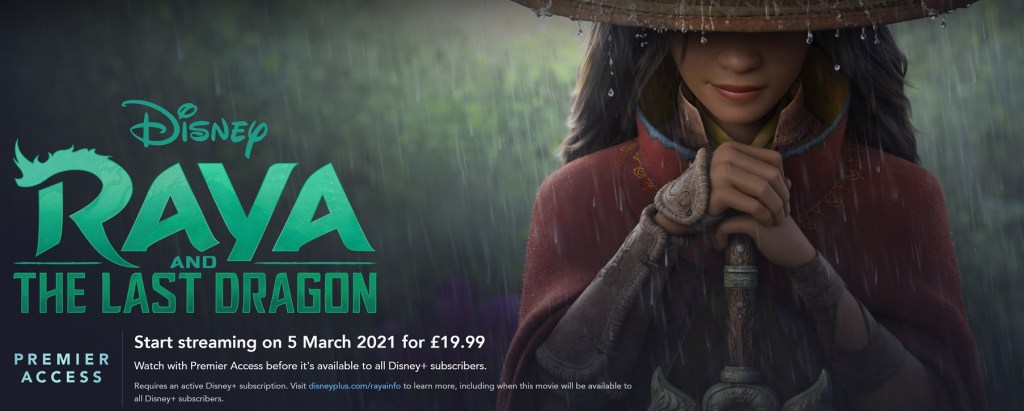
I’m kind of an impatient person! And because Raya and the Last Dragon was one of the titles I was most looking forward to this year, for me it was unquestionably worth it. Raya and the Last Dragon is a great animated film that easily hits the highs of other recent Disney projects. I don’t mind paying a little extra for that under the circumstances – it’s about the price of two or three cinema tickets, so if you consider it from that point of view, it doesn’t seem too bad.

But there’s no getting away from this price discussion, and I want to briefly add my two cents. On the one hand, it can seem unreasonable for Disney to insist on an additional £20 on top of the monthly fee for Disney+. If it were an either/or case it would perhaps sit better with folks, but being asked to either pay £20 on top of your £8 a month, or to have to sign up at £8 on top of the £20 to see Raya and the Last Dragon certainly feels anti-consumer, and I get why folks feel that way.

Raya and the Last Dragon was originally supposed to get a theatrical release.

I’m sick to the back teeth of companies using the pandemic as an excuse for everything, and there’s no denying that Disney could simply have waited and released Raya and the Last Dragon in cinemas either later this year or next year if needs be. That’s the approach taken by Eon and MGM for the upcoming James Bond film No Time To Die, which has been delayed for well over a year. However, despite all of that, I like this method of distribution, and I think we’re seeing the beginnings of a shift away from theatrical releases in favour of streaming.

My health and disability means that I can no longer go to the cinema, so from my selfish perspective I love the idea of bringing more titles straight to streaming platforms, and on an occasional basis for a big release that I’m very keen to see, paying a little extra to watch it is no big deal. As television screens get better (and bigger) the so-called “cinema experience” offers less and less value anyway, and being able to watch a film on one’s own schedule, with the ability to pause, rewind, take breaks, etc. is so much nicer than going to the cinema in many ways. So in my opinion, bringing Raya and the Last Dragon to Disney+ for a fee is acceptable. Would I have preferred it to be included in the price? Of course. But these projects are hugely expensive, and recouping some of that money is going to be necessary for Disney, so I understand why they’ve done it this way. It feels like a compromise – not one that everyone will love, but one I find acceptable.
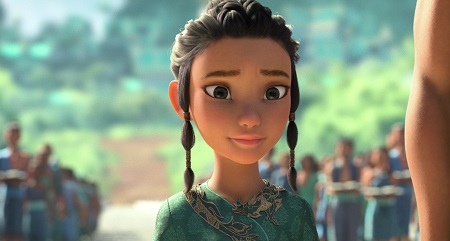
Young Raya during the film’s opening moments.

Before we get into the main section of the review, here are my spoiler-free thoughts.

I would describe the animation as competent. Nothing blew me away with how amazingly detailed it was – like the snow in Frozen or the oceans in Moana did – but there was nothing wrong with it and it was in line with other modern Disney films from the last decade or so. Considering a significant portion of the work on Raya and the Last Dragon was done remotely, that’s pretty good in my opinion.

The story was surprisingly heavy and emotional for a kids’ film, and it was thoroughly enjoyable. In the first few minutes it was perhaps a little fast-paced for my liking, dropping quite a few characters, locations, and themes all at once. But after that fast beginning it settled in, and followed Raya on her quest at a reasonable pace that wasn’t overwhelming. There were light-hearted and comedic moments, plenty of different environments for Raya and her friends to explore that were all based on different parts of southeast Asia, and the vocal performances were outstanding. Aside from the credits there weren’t any musical numbers, and that was something I wasn’t expecting. The score was great, and had an Asian-inspired theme to it, but after the likes of Moana and Frozen in recent years saw huge success with their songs, I was expecting at least a couple.

So that’s my non-spoiler summary.

This is the end of the spoiler-free section of the review. Expect spoilers from here on out!

Raya and the Last Dragon began with an immediate dump of exposition, explaining the backstory of the broken land of Kumandra – based loosely on southeast Asia. As indicated above, this opening section of the film was quite fast-paced, almost rushed, and introduced characters, themes, magic, locations, and backstory all at once. As I sat through those opening minutes I was hoping that the rest of the film would slow down, and luckily it did after a few minutes. That makes the opening, unfortunately, the weakest part of the film overall.

Raya and the Last Dragon follows the titular Raya as she seeks to save the fractured world of Kumandra, whose people have split up into five competing, squabbling, and warring lands in the aftermath of the disappearance of the dragons. But saving the world is just a side-quest for Raya, whose real objective for much of the film is to save her “ba” – her father, and the chief of her people. Yes, that makes Raya a Disney Princess!

Chief Benja, Raya’s father.

The story takes Raya to all five of the different lands, and each was based on a different area of southeast Asia. We spent just enough time in each land to take in the setting, but I think that taking a few minutes more to really get a feel for each – or perhaps the film including one fewer land – might’ve improved things. This is really the only point of criticism, because each of the lands was unique and richly detailed. At first I wasn’t sold on using English names for these places: Fang, Heart, Spine, Tail, and Talon. However, the metaphor made the ultimate payoff to the film’s story more easily understood, especially for younger viewers. The point of these names was to hammer home, at every opportunity, that the people of Kumandra were artificially divided; that the resolution to their problems would be in learning to trust one another and come together. Like the parts of an animal can’t function independently, neither can the peoples of Kumandra. Each land, represented by a piece of the dragon, brings something that the others lack, and working together is the only way.

This theme carried over into the film’s climactic final battle, as each of the friends Raya had made along the way – each from a different land – stood together and used the last of the dragon gem’s magic to help the people of Fang. This metaphor was certainly omnipresent, but didn’t feel laboured. The film knew, from the very beginning when Chief Benja introduced us to the idea of reunifying the fractured land, that this was the direction of the story. The names of the lands fed into that, as did the way Raya assembled her motley crew from different places.
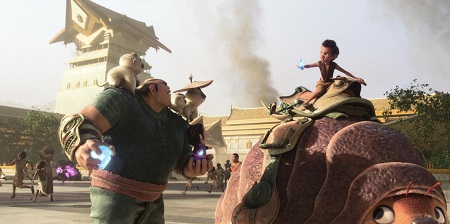
Raya’s friends work together to help the people of Fang.

At time of writing, there’s a renewed focus on anti-Asian hate and hate crimes in the United States. I’m not an American, but I’d like to offer my perspective on how a film like Raya and the Last Dragon fits at this moment. We often hear criticism of Disney for taking legends and stories and twisting them, “Disney-fying” them to sanitise them for a western audience. And you know what? Raya and the Last Dragon, just like other Disney films based on folklore and legend, is Disney-fied. But there’s incredible value in representation, even in this simplified style, and with Disney’s unique reach that extends across borders, cultures, and ages, Raya and the Last Dragon offers representation to an under-represented group of people in cinema, animation, and the cultural mainstream.

We could devote an entire essay to debunking the argument that “representation and diversity for their own sakes are negative things,” but in the context of this film, coming at this particular moment, let me just say that positive representation is important. It’s important that people of all backgrounds feel included, and being depicted positively in mainstream entertainment – particularly in something as significant as a Disney animated film – is an historic moment. Raya and the Last Dragon draws on the mythology and folklore of southeast Asia in the same way as Moana drew on Polynesian legend, and it’s a net positive for people of Asian heritage to see such representation.

Raya and the Last Dragon presents a positive depiction of Asia and Asian people at an important moment.

Kelly Marie Tran is also uniquely positioned at this moment. Tran suffered horrible racist and sexist abuse online in late 2017 through 2018, and I’m so pleased to see her back in such an inspiring role. Raya and the Last Dragon is a story about bringing people together, learning to trust and overcome hatred, and as someone who has, sadly, experienced hatred firsthand, there’s something even more powerful in knowing who it is bringing Raya to life through an outstanding voice performance.

I don’t like to get “political,” but the release of Raya and the Last Dragon happened to coincide with a significant moment for people of Asian heritage in the United States, and I felt it important to at least acknowledge that.

Kelly Marie Tran voices the character of Raya.
Picture Credit: Jimmy Kimmel Live via YouTube.

In the west, we usually associate dragons with fire. Fire-breathing dragons are both a part of European folklore and have gone on to become a trope in fantasy fiction, so it was very interesting – and more than a little unusual – to see a water dragon as the main focus in a dragon-themed film. This is, of course, a reflection of the film’s Asian-inspired story, as was the design of Sisu herself.

Continuing the theme of breaking with common western depictions of dragons, Sisu is presented in an Asian style – a long body, no wings, and covered in fur. Sisu’s design is a Disney take on that concept, blunting its sharp edges and making it child-friendly. And it worked. I daresay Sisu toys and teddies will become a major part of Disney’s merchandise this year and beyond!

Sisu had a great design, inspired by Asian folklore but with a Disney twist.

The other character with a cute design was Tuk Tuk, and right from the opening moments of the film it was clear he’d been designed to be the cute animal sidekick that so many Disney protagonists have. Tuk Tuk worked best in the film’s prologue, after which he’d grown large and basically served as a form of transportation for Raya and Sisu, though the design remained largely the same.

With Tuk Tuk I think we can point to one of the few examples of Raya and the Last Dragon stumbling, at least somewhat. Aside from having a cute (and merchandisable) design, Tuk Tuk was clearly set up for some light-heartedness; some comic relief. Yet the introduction of Noi (the baby) and her three monkeys largely switches the comic relief focus away from him. It’s not a case of “too many characters,” but rather that the film didn’t really know what to do with two sets of comic relief characters. There was less for Tuk Tuk to do as a result.
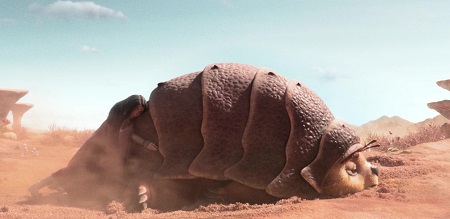
Raya and Tuk Tuk near the beginning of the film.

The only other point of criticism I have comes at one of the film’s climactic moments. Raya and her friend-turned-nemesis Namaari are involved in a standoff. Namaari planned to take Sisu and the dragon gem pieces back to Fang on her mother’s orders, and Raya drew her sword to stop her. As Namaari points her crossbow at Sisu, Sisu asks Raya to trust that she knows what she’s doing – but Raya doesn’t, and the result is that Namaari’s crossbow fires, killing Sisu.

This moment was meant to show that Raya is the one who bears most responsibility for Sisu’s death; that if she had trusted Sisu, as Sisu asked her to, Namaari was about to stand down. But it simply wasn’t clear that that was the case, and it would be easy for a casual viewer – or a child, and this is a children’s film, after all – to simply see this moment as Namaari shooting Sisu.
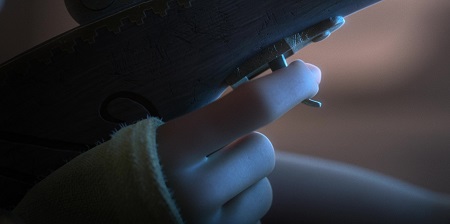
Who was really responsible for pulling the trigger?

For such an important moment, I think it needed to be clearer that Raya is the one to blame. This is her character arc across the film’s final act: learning to trust, and being willing to make the first step to establish trust. If we as the audience see this moment as the culmination of Raya’s failings – an unwillingness to trust either Sisu or Namaari – then the rest of her actions and her arc make sense. If we miss that crucial context and simply see this moment as Namaari the betrayer shooting Sisu, what Raya does later on – giving up her pieces of the dragon gem to signify her willingness to trust – doesn’t make as much sense in context.

Namaari’s words to Raya during their epic final fight also ring hollow when the film is seen in this way. Instead of a heartbroken Namaari laying a harsh truth on Raya, it could be interpreted as another attempt by a liar and trickster to get under Raya’s skin. The moment with the crossbow was set up perfectly, but it was too easy to miss that it was Raya, not Namaari, who was really to blame for what happened, and as the rest of the plot turned on this moment I think that should have been much clearer.
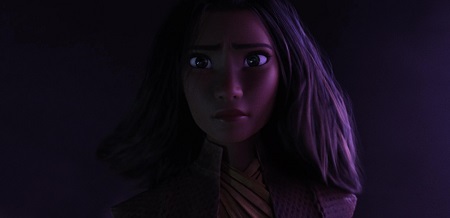
Raya chose to trust Namaari at the film’s climax.

We could also talk about how easy it seems to be to slay a dragon in this film’s lore! It seems like an unimportant point, and perhaps I’m the only one who cares or feels this way, but the way the film treated dragons across the first hour or more made it seem as though they’re magical, almost god-like creatures. The way the film’s human characters worship Sisu – and the other dragons – represents this well. Yet all it took to kill Sisu was a single crossbow shot, and I guess what I’m trying to say is that it doesn’t seem to gel. On the one hand we have the film establishing dragons as magical creatures that provided for humans, bringing water and literally giving life to the world, being worshipped and deified centuries after the last of them were wiped out. Yet on the other hand, they’re no different from any other animal and a single crossbow bolt can kill them.

Perhaps this is my western perspective, thinking about dragons not in the context of Asia but in the context of JRR Tolkien and other works of high fantasy. In western dragon lore going all the way back to the legends of Saint George and King Arthur, slaying a dragon is considered an incredibly difficult task worthy of song and celebration. In the world of Raya and the Last Dragon it seems to be something any competent soldier could do. Who knows, maybe that’s why the other dragons went extinct!

Namaari the dragon-slayer!

Raya and the Last Dragon features a cast whose major characters are all female, with male characters in secondary supporting roles. This is something new to Disney, as even past female-led films like Moana, Frozen, or Mulan have included major male characters. The creative choice to have both the main hero and villain both be female actually works really well, and Raya manages to have a closer relationship with Namaari as a result.

Namaari being a redeemable villain – and the film essentially having no overall “big bad” who has to be killed to be stopped – was also a great choice, one that fit perfectly with the theme of overcoming hate and coming together. The whole story of Raya and the Last Dragon was about learning to trust one another, setting aside differences in order to work together for the common good. This theme would have been completely undermined if the final act required Raya to kill Namaari or even her mother, so making both characters redeemable was essential to the story.
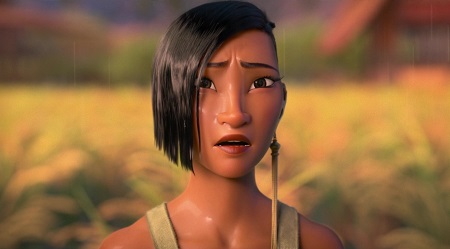
Namaari needed to be a redeemable villain for the story to work as intended.

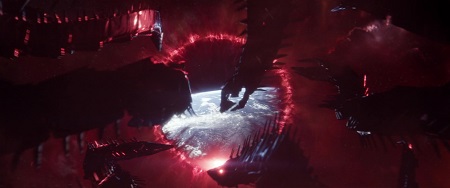
The real villains of the piece were the non-human Druun, depicted as a non-sentient force of nature rather than a character or faction. The design of the Druun managed to strike a balance between being intimidating but not scary and offputting for young children, and I would think that all but the most sensitive children would be able to watch Raya and the Last Dragon without feeling frightened by these crackling clouds of dark purple energy.

More could have been made of the Druun’s relationship with humans. At one point it was suggested by Sisu that the Druun are an embodiment of the arguments and lack of trust between humans, yet this wasn’t really developed further. It’s not clear whether humans directly caused the Druun to appear, whether they came from someplace else to feed on this mistrust and hatred, or what their precise origins are. If the world of 500+ years ago was populated by humans and dragons and was united, with no mistrust and no hatred, how the Druun even arrived in Kumandra is not clear. Perhaps that’s something a future title will explore in more detail, because I think it’s potentially interesting to say that humanity is responsible for giving strength to this powerful foe.
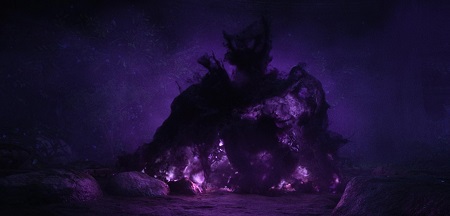
The Druun were the main adversary for Raya and her friends to overcome.

So I think that’s about all I have to say. Raya and the Last Dragon was a thoroughly enjoyable film and a worthy successor to the likes of Frozen and Moana. Disney has been on a roll for almost a decade now, since the release of Frozen in 2013, and the hits keep coming. In the very short term I doubt that Raya and the Last Dragon will catch fire in the way Frozen did, largely because of the cost of accessing it on Disney+ via the “premiere access” feature. However, once the film becomes generally available that should change. In a few months’ time, when it arrives for all Disney+ subscribers, it should see a significant boost.

Unlike Frozen and Moana, the choice not to include musical numbers means that there can’t be a breakout song. Let It Go and, to a lesser extent, You’re Welcome and Shiny went on to not only define the films in which they featured, but arguably bring in more viewers. By “going viral” in a sense, the songs drew more attention to their respective films, and this is something Raya and the Last Dragon won’t have.
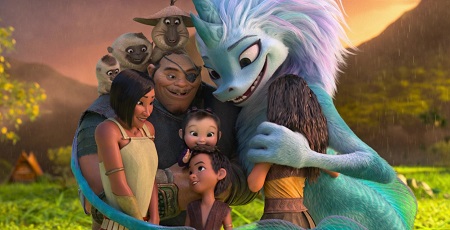
The main characters at the end of the film.

I had a great time with Raya and the Last Dragon. I can’t tell you whether you’ll get £20 or $30 worth of entertainment and enjoyment from the film, because such things depend on your budget and your perception of value. But this time, as a one-off and as something I won’t repeat for the rest of the year, I didn’t mind spending the extra money. I didn’t spend money on last year’s Mulan remake, and having seen the film subsequently I think that was the right call. But this time, for the latest Disney animated film, I think it was worth it. Raya and the Last Dragon was funny, emotional, and clever, and told a story about people coming together that is timeless. Its Asian roots shone through, and though some will surely argue that it was a dumbed-down version of Asian traditions, that’s Disney’s trademark style.

If you enjoyed previous Disney animated films, especially recent ones, I daresay you’ll have a good time with Raya and the Last Dragon.

Raya and the Last Dragon is available to stream now on Disney+ via the “premiere access” feature for an additional fee. Raya and the Last Dragon is the copyright of Disney Animation Studios and the Walt Disney Company. This article contains the thoughts and opinions of one person only and is not intended to cause any offence.

Five main characters from Star Trek’s past that I’d bring back

Spoiler Warning: There are spoilers ahead for Star Trek: Picard Season 1, Star Trek: Discovery Season 3, and for other iterations of the franchise.

This is going to be the first part of a short two-part series in which I look at a few significant characters from past iterations of Star Trek that I would love to see return. Rather than tying these characters to a specific series, film, or ongoing project, this list is more general. I’m not advocating, for example, for any of these characters to necessarily appear in Picard or Strange New Worlds, but rather to return to the franchise at some point, when a suitable story could be written.

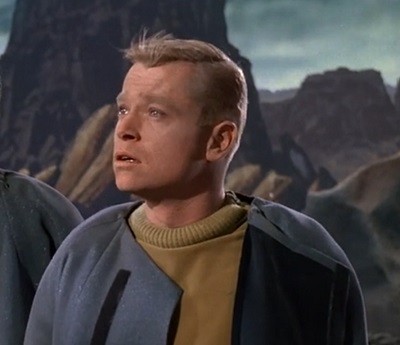
The Original Series Season 2 cast (without George Takei).

It goes without saying that practically every major character (at least those who weren’t killed off) could be brought back in some capacity, and with the franchise continuing to expand I think it’s increasingly likely that we’ll get some significant moments where characters reappear. For the sake of this list I’m not counting characters who are starring in shows that are currently in production, so I’ll be limited to characters from The Original Series, The Next Generation, Deep Space Nine, Voyager, Enterprise, and the films.

The Next Generation cast in Season 4 – plus Whoopi Goldberg as Guinan.

By my count there are 42 characters across those five series that we could call “major” – i.e. they regularly had their names listed in the main credits, and weren’t considered guest stars or just recurring secondary characters. This time I’m picking on just five, and my usual caveat applies: I don’t have any “insider information!” This is just a short list of characters that I think could be fun to bring back in some capacity, nothing more.

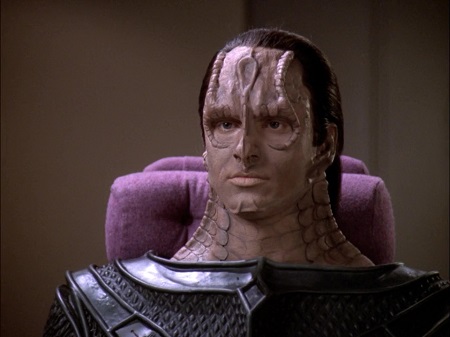
The Deep Space Nine cast in Season 4.

Of the 42 characters that occupied major starring roles in at least one season of the five aforementioned shows, I’m excluding five: James T Kirk from The Original Series, Data and Tasha Yar from The Next Generation, Jadzia Dax from Deep Space Nine, and Trip Tucker from Enterprise. All the exclusions are for the same reason: those characters have died in-universe. While there could be convoluted ways to bring back alternate versions (such as we saw with Sela, for instance) the original character can’t return after death.

The Season 2 cast of Voyager.

Though it may be controversial, I don’t believe that the death of an actor necessarily excludes a character from returning. The Kelvin films recast the entire main cast of The Original Series, and Star Trek: Picard recently recast a couple of legacy characters as well. So characters whose primary actors have passed away are still in contention.

Now that we’ve laid down the ground rules, let’s take a look at my choices.

Number 1: Chakotay

This one is inspired by the return of Seven of Nine in Season 1 of Picard. I’ve written about this before, but Seven’s return to Star Trek was cathartic for me, because the passage of time allowed her to be a very different, more emotional, and much more human character than she ever was in Voyager. Seven was sometimes annoying and difficult to root for, especially toward the end of Voyager’s run, and basically the reason was that she’d always seem to “reset” after learning what should have been a big and important lesson in how to be human. It made her character bland and repetitive. But we’re not here to talk about Seven of Nine!

Chakotay didn’t have a lot to do in Voyager, despite being the first officer. There were a handful of episodes in which he was given a storyline, but a lot of the time he was just a presence, someone there for other characters to bounce ideas off or to tell Captain Janeway he didn’t recommend she do something we all knew she’d end up doing anyway. In short, bringing back Chakotay is something I would see as a chance for his character to get a Seven of Nine-like “redemption,” with some genuine development and a significant storyline.

One thing Voyager touched on briefly but never really explored was the way Chakotay felt about the deaths of the Maquis. The episode Extreme Risk focused on B’Elanna as she struggled to come to terms with what happened to their former colleagues, but Chakotay never really got a similar moment. As part of a larger story looking at the aftermath of the Dominion War, learning what happened to the Maquis’ colonies in the aftermath of that conflict could include Chakotay, as one of those worlds was his home.

We could also learn that Chakotay was allowed to remain in Starfleet following Voyager’s return to the Alpha Quadrant, and may even have been given his own command. Given that Voyager quite quickly dropped the Maquis angle, I’m not sure this is the route I’d go down because it doesn’t seem like it offers a lot of development or growth potential for his character, but it’s a possibility.

The final few episodes of Voyager’s seventh season saw a burgeoning relationship building between Chakotay and Seven of Nine. With Seven now a recurring character in Picard, and with the possibility of her entering into a relationship with main character Raffi, we could potentially explore what happened between Seven and Chakotay. Voyager’s finale certainly suggested that he had strong feelings for her, even after her death in that timeline.

Unfortunately, for reasons that aren’t especially clear, the producers of Voyager lost interest in – or didn’t know what to do with – the “one ship, two crews” concept that had been part of the show’s inception. Chakotay and the rest of the Maquis were absorbed into the crew by midway through Season 1, and while lip service was paid to Chakotay’s Maquis past at numerous points, I think that’s one aspect of his background that would be ripe for exploration. In any 24th or early 25th Century story that looked at Bajor, Cardassia, and the aftermath of the Dominion War, I’d spend at least an episode or two considering the legacy of the Maquis, and Chakotay could play a major role in such a story.

Number 2: T’Pol

I’ve mentioned T’Pol before in relation to Strange New Worlds, and that series is certainly one where we could see her crop up. Because of Enterprise’s place in the timeline, unless Star Trek plans on returning to the 22nd Century for some other story, there aren’t many characters who could realistically still be active and able to play a major role. The 23rd and 24th Centuries (as well as Discovery’s 32nd Century) are where current Star Trek projects are focused – and I have to say I think that’s the right call. Enterprise was an interesting experiment, but I see no pressing need to return to the 22nd Century at this stage.

The story I’d include T’Pol in would go something like this: she’s a senior Federation ambassador by the mid-23rd Century, and accompanies Captain Pike on a diplomatic mission. The mission would make first contact with a race we met in The Next Generation era, such as the Cardassians. We’d thus tie together all three of Star Trek’s eras in one story! I think an episode like that would be incredibly rewarding for longstanding fans of the franchise; a “love letter” to the fans.

But there are many other roles T’Pol could occupy. Having spent so long with humans during those early days of humanity striking out into space, she could prove an invaluable guide or advisor to a young Spock. Whether Spock is “the first Vulcan in Starfleet” is a point of contention without an obvious answer, but even if he wasn’t it’s clear that the Vulcans continued to operate an independent fleet into the 23rd Century, and thus Vulcans serving in Starfleet seem to have been rare. T’Pol is well-placed to be a kind of mentor to Spock for this reason.

However, both of those story concepts take T’Pol out of her usual scientific role, and perhaps a story could be devised which would be better-suited to her career as a scientist. I’m still thinking of a 23rd Century story, but one which perhaps requires high-ranking Federation scientists to work on a mystery or puzzle.

Number 3: Dr Pulaski

I’ve never met a fan of The Next Generation who likes Dr Pulaski as much as I do. I understand why she wasn’t popular with fans, replacing Dr Crusher after one season and especially because of her early run-ins with Data that amounted to anti-android bigotry. But where Dr Crusher could be fairly bland, Dr Pulaski had a really strong personality that shone through.

On another occasion we’ll talk about Dr Pulaski and how her introduction in Season 2 of The Next Generation was an attempt to shake up the new series and bring in a Dr McCoy-type character. But for now I want to consider how she could return, and what sort of role she could have.

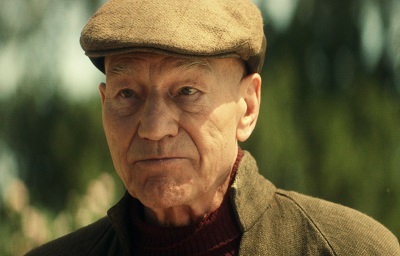
Picard Season 1 missed an opportunity to bring back Dr Pulaski – or another medical officer from The Next Generation like Alyssa Ogawa – in the second episode. Picard receives bad news from a doctor he knew while serving aboard the USS Stargazer, Dr Benayoun. This was a new character created for Picard, and if I’d been writing it I might have chosen to bring back Dr Pulaski at this moment instead. I don’t know if that was ever suggested, because it’s well-known that actress Diana Muldaur didn’t have a great time working on The Next Generation. But it would have been neat to see!

One series that has been doing great with references to less well-known parts of canon is Lower Decks, and perhaps that means Dr Pulaski would be a good fit to return there. I don’t know if Diana Muldaur is still working, nor whether she’d be well enough or willing to reprise the role. But it was at least a little sad that Dr Pulaski was dropped in The Next Generation Season 3 with no explanation. There’s scope, I feel, to learn what came next for her – even if the character has to be recast.

Almost any medical story or story involving characters from The Next Generation Season 2 could see Dr Pulaski return, and of course Star Trek: Picard has to be the prime candidate of the shows currently in production. She could, for example, be one of the chief medical officers assigned to help the surviving ex-Borg now that they’re (presumably) under Federation protection. Or how about this: in a storyline that clearly shows how much she’s changed her attitude to synthetic life, she could be the head of a Federation medical team sent to Coppelius to help the synths. This would cement her “redemption” from her earlier interactions with Data, and would perhaps provide a suitable epilogue to her role in The Next Generation Season 2.

Number 4: Benjamin Sisko

Captain Sisko is probably the character whose return I’ve touted the most! Because of the unique nature of his disappearance in the Deep Space Nine finale – vanishing into the realm of the Bajoran Prophets – he could return literally anywhere, in any time period. The Prophets don’t experience time in the same linear manner as humans, so they could send him to a point in his future, his past, or anywhere along the Star Trek timeline.

This is why I’ve proposed Sisko as a character who could appear in Picard, Strange New Worlds, and Discovery – because he could be sent back by the Prophets at any moment in time. I would argue he would have more to do in a story set in the late 24th or early 25th Centuries than he might in the 23rd or 32nd, but in any story that brought back Bajor, Sisko could play a major role.

He could also be part of a story looking at the aftermath of the Dominion War, at Cardassian relations with the Federation, and of course at Deep Space Nine itself. I think Sisko has the potential to be a useful character too. If he joined the story right at the moment of his return to normal spacetime, he could potentially be a point-of-view character, and an excuse for a film or episode to dump a lot of exposition that could otherwise feel clunky and out-of-place. This would be done under the guise of other characters bringing Sisko up to speed on what he’s missed – and we could catch up on galactic affairs right along with him!

Of all the characters on this list, Sisko is the one whose story feels the most unfinished. There was almost a cliffhanger ending to his role in Deep Space Nine, with a tease that one day he’ll be coming back. Whether we’ll ever see that on screen is another matter, of course, and Avery Brooks has seemed less willing to reprise the role than some other Star Trek actors. But you never know!

Number 5: Montgomery Scott

It would be relatively easy for Scotty to crop up in Strange New Worlds as a junior engineer – or in any other 23rd Century series, for that matter. But that’s not really what I’m proposing this time. That idea has merit, and I think I included Scotty in one of my character ideas lists for Strange New Worlds. However, this time what I’m suggesting is Scotty in the 24th Century.

Relics, the Season 6 episode of The Next Generation, established that Scotty had been kept alive in a form of transporter stasis of his own devising for over eighty years, finally rematerializing when the crew of the Enterprise-D encountered his crashed ship. After working briefly with Geordi La Forge, Captain Picard, and others, Scotty was given a shuttle and set out to explore the new century on his own. We would later learn in 2009’s Star Trek that Scotty had gone back to work, developing a method of “transwarp beaming” that became important to the plot of that film.

After that, however, what became of Scotty is a mystery. He had initially intended to retire, so did his stint with Starfleet continue? Or did he resume his planned retirement in the 24th Century, catching up on the eight decades of galactic history that he’d missed? He reunited with Spock, apparently, and it’s at least possible he would have been able to visit the elderly Dr McCoy as well.

Scotty offers a “coming out of retirement” story, perhaps prompted by some horrible event or disaster that requires an engineering solution. We could learn, for example, that he’d worked alongside Geordi La Forge in preparing the Romulan rescue fleet, or even that he was helping to rebuild the Mars shipyards after the attack by the Zhat Vash. Those are two ideas based on events from Picard Season 1, but of course there are many, many other ways Scotty could have contributed to Starfleet and the Federation in the late 24th Century.

So that’s it… at least for now. The second part of this short series will look at five secondary or recurring characters who I also think could be fun to bring back!

With so many ongoing and upcoming Star Trek projects occupying different places in the timeline, there really is scope to bring back almost any major character, and I hope the creative team don’t feel constrained! As a Trekkie I think I’d be happy with literally any of them making an appearance, though of course it would have to make sense in-universe as well as not be offputting for casual viewers.

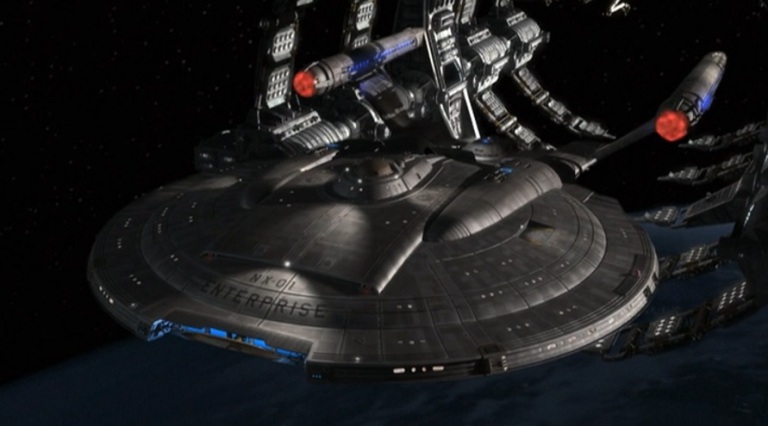
The cast of Enterprise during Season 1.

We mentioned the episode Relics, and I think that story manages to walk that line exceptionally well. For fans of The Original Series, Scotty’s return was an amazing treat. But for folks who weren’t familiar with the older series, his inclusion in the episode still managed to make sense. The story was well-written, and while knowing more about who Scotty was and where he’d come from certainly added to it for Trekkies, it didn’t put off casual viewers by demanding a lot of knowledge of Star Trek canon. That’s the kind of model any future episode, film, or story that brings back a character should try to emulate.

We can also point to If Memory Serves, from the second season of Discovery. That episode began with a short recap of the events of The Cage, establishing what happened to Captain Pike on Talos IV, who the Talosians were, who Vina was, and so on. By beginning an episode which features a returning character with a clip or compilation of their past Star Trek exploits, almost any character could be integrated into an ongoing production.

The Discovery Season 1 cast (without Wilson Cruz).

The Star Trek franchise has been running for over five decades, and has a huge roster of wonderful characters. The fact that there are too many to put on the list – or the fact that the list could literally include every single one – is testament to the quality of the franchise and the creative teams who’ve contributed to it over the years.

Stay tuned for the next part in this series, where I’ll look at five secondary or recurring characters who I’d also love to see come back!

The Star Trek franchise – including all series mentioned above – is available to stream now on Paramount+ in the United States and other territories where the service exists, and on Netflix in the United Kingdom and elsewhere. The Star Trek franchise – including all properties mentioned above – is the copyright of ViacomCBS. This article contains the thoughts and opinions of one person only and is not intended to cause any offence.

EA Play joins Game Pass

EA Play is bringing a huge library of new games to Microsoft’s Xbox Game Pass service! Because it’s been overshadowed by Microsoft’s recent acquisition of Bethesda, and the arrival of those games to Game Pass in recent weeks, this news seems to have flown under the radar. I almost missed this altogether, and it was only when I saw it on Twitter (of all places) that I realised what a monumental win this is for Microsoft, Game Pass, and quite frankly for subscribers as well.

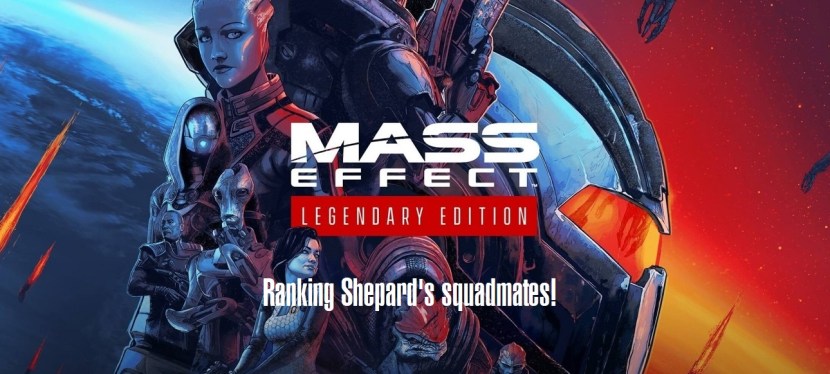
I initially signed up for Game Pass for PC last year in order to play Forza Horizon 4, and it was well worth it! I’ve since played a few other games on there, and it’s easily value for money at £7.99 ($9.99 in the US) per month, in my opinion. One thing is clear, though, and that’s the fact that Microsoft has continued to invest heavily in the service. The addition of Bethesda’s lineup of titles brought the likes of Fallout 4, Skyrim, and Doom Eternal to Game Pass. And now EA Play has brought games like FIFA 21, Titanfall 2, The Sims 4, Star Wars Jedi: Fallen Order, and many others to the service, too. It seems all but certain that the upcoming Mass Effect: Legendary Edition will be available there as well – so maybe I’ll play it after all!

EA Play and Game Pass have struck a deal.

Game Pass has expanded rapidly, and continues to go from strength to strength. Right now, there’s no question that it’s the best way to get into current-gen gaming, and picking up a preowned Xbox One or – when availability improves – an Xbox Series S will mean that a huge library of games is available to even players on a limited budget. For less than the price of a Netflix subscription there are more games than I could play in an entire year, including some absolutely fabulous ones!

The only pang of regret I feel is because I’d bought a few of these games over on Steam! Of course if you’re worried about permanence it’s better to buy than subscribe, because it’s possible that EA Play and/or any of its games will be removed from the service in future. But just like we’ve seen happen with television and films thanks to the rise of streaming, many people are quite okay with that concept. Sure, losing access to a title is disappointing, and when Netflix removes a big name there’s often a minor backlash. But people have generally come to accept the impermanence of films and television shows on streaming platforms – so I daresay that will happen with games as well.

A few of the titles now available.

In the worst case, if a game you adore is removed from Game Pass, you can always buy it elsewhere. It doesn’t have to be the huge drawback that some folks insist it is. We increasingly live in a society of renting: we rent our homes, vehicles, and sometimes even our furnishings. We rent our films, television shows, and music via services like Netflix, Disney+, Amazon Prime, and Spotify. And now, Microsoft is pushing hard to convince people to rent their game libraries too.

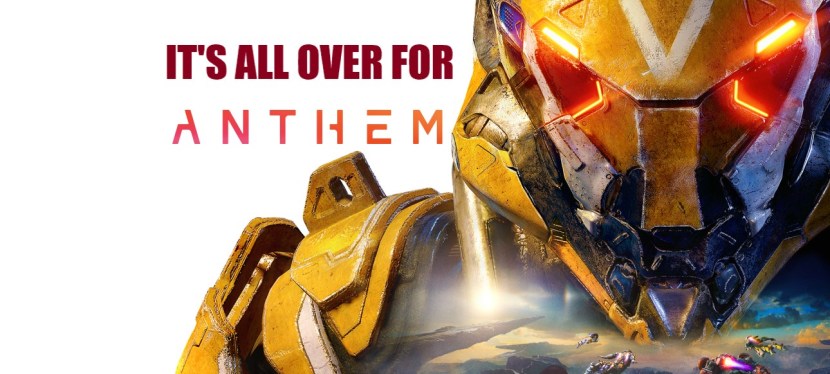
Having built up a Steam library over the better part of a decade I’m not willing to part with it, and I still don’t see Game Pass as a full-time substitute for buying games in a general sense. But you know what? I could be in the minority on that very soon. As mentioned, Game Pass now offers a colossal library of titles, and not only Xbox-exclusive games like Halo: The Master Chief Collection and Sea of Thieves. The FIFA series of football (soccer) games are literally the most popular titles around the world, and now the most recent entries are on Game Pass, with this year’s entry almost certain to follow. And huge multiplayer titles like Apex Legends are as well. Heck, you can even play Anthem… though goodness only knows why you’d want to.

Very specific there, EA.

For a player on a limited budget, Game Pass is now my number one recommendation. Whether it’s on PC or console, I honestly can’t recommend anything else. There’s simply no alternative that offers such a variety of major titles for the cost, and even speaking as someone who doesn’t use it as often as I could, it’s 100% worth it. This new addition of EA titles has taken what was already an enticing offer and made it even better.

There are still some issues with the Xbox app on Windows 10, and it doesn’t always work perfectly. But the games it launches do, and whether you’re interested in a strategy title like Age of Empires II: Definitive Edition or a racer like Forza Horizon 4, there are so many games now that it’s worth a try for almost anyone interested in gaming.

The Xbox Series S with a Game Pass subscription is the most affordable route into this generation – or at least it will be when availability improves!

Microsoft took a risk with Game Pass, banking on players turning away from the model of buying and owning individual titles to rent them via a Netflix-style subscription. As the service continues to grow and expand, both in terms of its library and its playerbase, I think it’s fair to say that the risk is paying off.

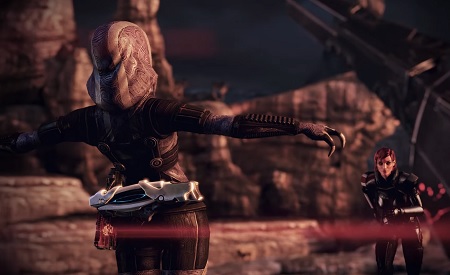
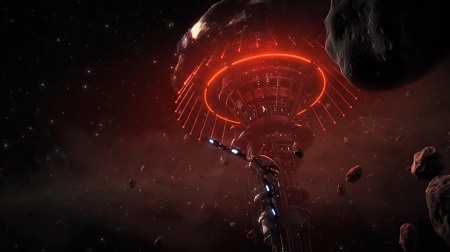
So what am I going to play first? That’s a good question! I was tempted by the Mass Effect trilogy, which I otherwise only own on Xbox 360. But with Legendary Edition coming soon I think I’ll wait to see if it comes to Game Pass, which hopefully it will. Titanfall 2 is calling out to me, and despite being a big fan of fantasy I’ve never played the Dragon Age games, so maybe I’ll finally give those a shot. Or maybe I’ll go back and replay Sim City 2000 – there’s nothing like a hit of nostalgia, after all. I feel spoilt for choice!

I might sit down to play some Titanfall 2.

This move makes a lot of sense for both companies. EA’s Origin platform and EA Play have both struggled to bring in huge numbers of players since they launched, and with EA diversifying and bringing many of its titles to Steam, joining in with Game Pass feels like a no-brainer. And from Microsoft’s point of view, anything they can do to increase the appeal of Game Pass shores up the service, and that can only have the effect of bringing in new subscribers as well as convincing existing ones to stick around.

When taken alongside the recent Bethesda acquisition and the launch of the weaker but cheaper Xbox Series S, I have to say that Microsoft is off to a very strong start in this new console generation – far better than I had expected even six months ago.

Xbox Game Pass is available now for PC, Xbox One, and Xbox Series S/X. Prices were correct at time of writing (March 2021). This article contains the thoughts and opinions of one person only and is not intended to cause any offence.

Could AI be the key to a Deep Space Nine and Voyager remaster?

The most popular article I’ve written here on the website is about Star Trek: Deep Space Nine and Star Trek: Voyager, and how neither series has been remastered. In the late 2000s and early 2010s, The Original Series and The Next Generation were given a complete overhaul and rebroadcast, then re-released on Blu-ray (and HD DVD, if anyone remembers that failed format!)

For a number of reasons, though, The Next Generation in particular didn’t see great sales numbers on Blu-ray. Because of the significant cost involved in upscaling and remastering it, and the lack of a significant return on that investment, ViacomCBS hasn’t been willing to spend money on Deep Space Nine or Voyager. As a result, both series remain in “standard definition,” a.k.a. DVD quality. On today’s ever-larger television screens, the difference between a remastered episode of The Next Generation and a non-remastered episode of Deep Space Nine is incredibly noticeable.

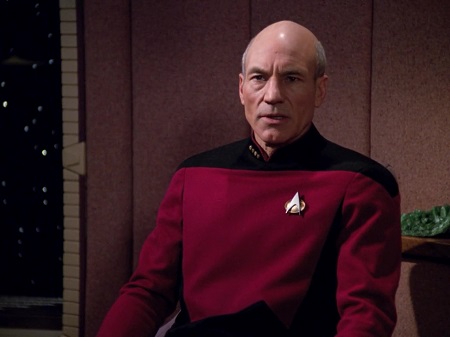
Captain Picard in The Next Generation remaster (left) and Deep Space Nine DVD quality (right). Even allowing for image compression, the difference in quality is easy to spot.

Star Trek has been one of the big franchises that ViacomCBS has used to push its rebranded Paramount+ streaming service. Paramount+ is now the digital home of all things Star Trek – yet two of its flagship series that many folks remember with fondness from the 1990s don’t look great. As I noted last time, that’s a problem. It makes Paramount+ look cheap, as though ViacomCBS simply can’t be bothered to put in the effort.

Netflix runs some shows in DVD quality, but by far the majority of its content is in high definition. As Paramount+ attempts to position itself as a competitor to Netflix, Disney+, and other platforms in a very crowded market, having two big flagship shows in low quality standard definition is not a good look, and it’s something that needs to be addressed.

But last time the company made a significant investment in remastering Star Trek it didn’t pay off, so how should they proceed?

The Next Generation did not sell particularly well on Blu-ray.

There are a few factors at play here. The first is that ViacomCBS (and its predecessor, CBS) measured the success of the remastered Star Trek series purely by Blu-ray sales. The problem with this approach is that, even by the early 2010s, optical media in general was in decline. Fewer people had made the switch to Blu-ray than DVD, and with the rise of on-demand streaming platforms it seemed only a matter of time before Star Trek would be available to watch. I owned a number of The Next Generation stories on VHS, I’d also bought the entire series on DVD, and in the early 2010s I just wasn’t prepared to spend that money all over again on the same show – especially when it seemed inevitable that eventually the series would be available online. I was right.

Physical media sales are a poor measure of success in the days of on-demand streaming, and the value in investing in any project – be it a remaster or the commissioning of a new series – is less about pure sales numbers and more about the number of subscribers it will drive to your streaming platform. ViacomCBS has invested in Paramount+, so why not go the extra mile and remaster these classic shows for the service too?

One of the commercials for Paramount+ focused on Star Trek.

That’s the first aspect of this issue – the business side and how to calculate a return on investment. Raw sales numbers are less and less valid as a metric of success in a world that’s moved on to streaming, so making that calculation isn’t easy. But I bet that remastering Deep Space Nine and Voyager would drive new subscribers to Paramount+, as well as convince wavering subscribers that it’s worth sticking around. Both of those things are what any streaming service needs to survive.

The second point to consider is that the cost of remastering any television series is dropping all the time. There is software that uses AI that can produce creditable results from DVD-quality sources, such as the existing versions of Deep Space Nine and Voyager. Consumer-grade versions of this software exist, and can be bought for less than $100. You can even find homemade upscaled clips of Deep Space Nine and Voyager on YouTube and elsewhere online – and they look pretty darn good.

There are many fan-made upscales of clips from Deep Space Nine and Voyager online.

As software continues to improve and come down in price, the cost of a project like this drops dramatically, and we may only be a few years away from fans being able to fully upscale their DVD collections at home. In some ways, we’re arguably there already. Rather than ViacomCBS having to spend huge sums of money recruiting new artists and animators to recreate whole sequences from scratch, it’s going to be possible to run entire episodes of the show through software and just have a small team of people make tweaks on the resultant upscaled version to knock it into shape. It’s far less of a project than it was ten years ago – so there are fewer and fewer reasons not to do it.

With ViacomCBS having the original tapes of these shows, it should be even easier to get a good result than it is for someone using the DVD version. I’m not saying it can all be done from home for a few dollars – the project will still cost money – but it’s a far less significant expense than it was last time the company chose to send Star Trek to the remastering suite, and waiting even just a couple of years could see those costs fall yet further.

Sisko and O’Brien in Emissary, the Deep Space Nine premiere.

I really hope that ViacomCBS will consider giving both shows a proper remaster at some point in the future. It’s something that would undoubtedly provide Paramount+ a boost, especially if the service were the only place to access the newly-upgraded shows. And it surely would be, because why bother with a Blu-ray release? Physical media continues its decline, with fewer people than ever upgrading to the latest 4K Blu-ray standard, so there’s almost no point. Remaster the shows, stick them on Paramount+, and enjoy a nice subscriber boost.

I truly believe AI and software offer a path to remastering these shows – and a lot of others, too. There are a few other series from the ’80s and ’90s that are yet to be properly remastered, and the same solution potentially exists for those as well. I’m not a tech expert, but I think the results speak for themselves. When I’ve seen upscaled clips online, created incredibly inexpensively by amateurs using commercially-available software, it really feels like ViacomCBS is missing a trick. Maybe upscaling the series this way wouldn’t be as good as spending huge amounts of money to do it from scratch, but it would be something – and the result would almost certainly be a better-looking show than the currently-available SD version.

Paramount+ would get a boost if both shows were remastered.

As I mentioned at the beginning, the most popular article I’ve written is about Deep Space Nine and Voyager needing a remaster – so there is clearly huge interest there from both Trekkies and casual fans. People who watched the shows years ago may want to rewatch them. New Star Trek fans who’ve joined the fandom since the release of the Kelvin films or Discovery may want to go back and watch older Star Trek shows. And of course us Trekkies would love nothing more than to see the two series get an overhaul. There’s a sizeable audience out here asking for a remaster, an upscaling, or whatever you want to call it. AI could be a good solution – saving money while giving fans what we’ve been asking for for years!

At the very least, I think it’s worth considering. And if ViacomCBS never does it… maybe someone else will. These pieces of software get better and cheaper all the time, and we could be in a position in a very short span of time where fan-made remasters of whole episodes, not just clips, will be widely available.

Deep Space Nine and Voyager were a big part of Star Trek’s most successful era to date, and a lot of casual viewers and Trekkies remember them with fondness. While there’s nothing wrong with the DVD versions, as screen technology improves and televisions get larger, what viewers expect from their programming has changed. For a lot of people in 2021, standard definition isn’t good enough – especially on a streaming service that costs $9.99 per month. If ViacomCBS is serious about continuing to invest in the Star Trek franchise, a portion of that investment needs to be directed backward, to remastering these two shows that have been sidelined. Part of the marketing for Paramount+ highlighted that it was the place to watch every episode of Star Trek – some fans will have been disappointed to learn that over 300 of those episodes don’t look great.

AI and software offer a solution to this problem, one ViacomCBS should take advantage of as soon as possible.

Star Trek: Deep Space Nine and Star Trek: Voyager are available to stream now (in SD quality only) on Paramount+ in the United States, and on Netflix in the UK and other countries and territories. Both series are also available on DVD. This article contains the thoughts and opinions of one person only and is not intended to cause any offence.

Unsolicited Star Trek pitches for shows that will never be made!

Spoiler Warning: There are minor spoilers ahead for Star Trek: Lower Decks Season 1, Star Trek: Discovery Season 3, and for other iterations of the Star Trek franchise.

In the early days of the website I put together a short list of ideas for future Star Trek projects. The list was, naturally, pure fantasy – I’m highly unlikely to ever be in the position of making a single episode of television, let alone working on Star Trek! But it was fun to write out some of these concepts and ideas that have been rolling around my head – in some cases for decades! So this time I’m going to update and expand upon that original list, and give you five of my Star Trek fantasies!

Wait, that sounds inappropriate.

There’s been a fair amount of talk over the last couple of years about potential Star Trek projects. Some have made it into production – like the “Captain Pike series,” a.k.a. Strange New Worlds! Others, like a sequel to Star Trek Beyond and a couple of other feature film projects appear to have been shelved. And some, like the Ceti Alpha V miniseries that I covered recently, are supposedly ready-to-go but languishing in development hell. This time it’s my turn to churn out some Star Trek ideas!

It’s my turn to put (metaphorical) pen to paper!

Though this is just a bit of fun – and a total fantasy, as there’s no way any of these projects will ever be made – I think there’s something valuable for any critic or commentator in thinking creatively. I spend a lot of time discussing Star Trek from the point of view of an independent critic, but many people have put in a ton of hard work to create the television shows, films, and games that I write about. Creative writing and criticism are very different tasks in many ways, and it’s no bad thing for a critic to try their hand, on occasion, at being creative.

Before we get started, two of my usual caveats apply. First, I have no “insider information.” I’m not claiming any of these projects are being secretly worked on over at ViacomCBS; this is pure fan-fiction. Second, these are projects that I feel would be fun in my subjective opinion. If you disagree and think they’d be awful, that’s fine. You’re entitled to your opinion!

With that out of the way, let’s get started!

Number 1: Colony World

The planet Terra Nova, as seen in Enterprise Season 1.

The original premise of Deep Space Nine was that it should be akin to a town in old Western stories – Commander Sisko as the “sheriff,” the Bajorans as “natives,” Quark’s Bar as the “saloon,” and so on. That concept can be seen at points early in the show’s run, but I’d argue that it had evaporated at least somewhat when the decision was made to make the Bajoran wormhole so important. The railroad came early to Star Trek’s frontier town!

Deep Space Nine largely moved away from being an isolated frontier station, and the huge amount of traffic that ran through the wormhole and the Bajoran system turned it into an important trading and diplomatic post. Thus we’ve never really seen what life is like out in the wilds, far away from the nearest Starbase. And that’s where my Colony World concept comes in.

Chief O’Brien greets Commander Sisko and Jake Sisko as they arrive on DS9 for the first time in Emissary.

This series wouldn’t be set on a starship or even a space station. It would be set on a remote colony, perhaps a brand-new one that’s just beginning to get established. There would be a small Starfleet outpost – perhaps a command officer and a couple of security personnel. The sheriff and his deputies, to use the analogy above! But the rest of the main cast would be Federation civilians, and there’d be scope in a series with a static setting to bring in a number of secondary recurring characters. Being set primarily in one location would potentially keep costs down, too, and without needing to spend a lot of money on expensive special effects the series might be inexpensive to make.

We could explore the motivations Federation citizens have to colonise the frontier. Why leave behind the paradise that is 24th Century Earth? Perhaps someone among the group has a past they’re looking to escape, and this could be a source of drama. And we could examine something Commander Sisko briefly confronted in the Deep Space Nine premiere – being assigned to an awful, unwanted posting. Because of the importance of DS9 and his role as the Emissary, Sisko only really had to deal with that for one episode, but we could see our Starfleet officers spending whole seasons coming to terms with being assigned to a post that they don’t want because of its remoteness.

A small Starfleet base seen in Insurrection.

Colony World presents an opportunity to look at the reasons for colonisation in a general sense. In the 21st Century, almost all of us live in established settlements; no one really goes anywhere new and just builds an entire town from scratch. So we could look at the environmental impact of doing so, both to be an historical parallel and to comment on future plans to colonise the moon and Mars. Taking an unspoilt wilderness and building on it, even with 24th Century technology, will contaminate the environment and change it; what does the Federation do to mitigate that?

Finally, the series could consider territorial disputes. Perhaps the planet targeted for colonisation is claimed by some other faction, or once had other occupants who left. There are so many contemporary parallels for land claims and arguments over territory that the series could touch on, and this could be a way for Star Trek to use its sci-fi lens to examine real-world issues.

Number 2: Borg Invasion

Multiple Borg Cubes seen in the Lower Decks title sequence.

On both occasions where the Borg attacked Earth they came in one single ship, and on both occasions they were defeated by Starfleet – albeit at great cost! But what would it be like if the Borg actually put real effort into assimilating the Federation? In The Next Generation Season 7 episode Parallels, we got a brief glimpse when a dimension-crossing Worf encounters a parallel universe Enterprise-D. The Federation put up a fight, but seem to have been overwhelmed.

The Borg have genuine horror series potential, and a Borg Invasion story could definitely cross over into the horror genre, playing on themes from zombie fiction like The Walking Dead. If you read my essay on the Borg a few months ago, you may remember that zombies are such a good analogy because in both cases, everyone the heroes lose can potentially be turned into another enemy to fight. That’s a terrifying concept, as is losing one’s sense of self-identity through assimilation; a fate worse than death.

Assimilation, as seen in the Voyager Season 5 episode Dark Frontier.

This wouldn’t make for a good film, it would really need to be a series. And not only that, but a limited series with a planned story from the beginning. If it were to run for, say, three seasons, Season 1 would start as normal with the Federation doing its thing, with a huge Borg attack in episodes 1-2. The remainder of Season 1 would see Federation losses mount, akin to Seasons 5-6 of Deep Space Nine when they had the Dominion War. Season 2 would look at attempts to recruit allies, perhaps restoring broken alliances with the Klingons or Romulans. Season 3 would see the development of some kind of Borg-killing weapon that would finally turn the tide, and the series finale would end in victory, driving the Borg from Earth.

The question of timeframe arises, especially with Discovery establishing the 32nd Century Federation and the Temporal War. Perhaps I’d put it in the 26th or 27th Centuries; far removed from established Star Trek in both directions.

The Enterprise-D in pursuit of a Borg Cube in The Best of Both Worlds.

Finally, and perhaps most controversially, this would be the Borg’s swansong; their final Star Trek appearance – at least for many, many years. A villain that is beaten too often becomes boring, and the Borg were certainly in danger of becoming stale toward the end of Voyager’s run. If the Star Trek franchise were to dedicate an entire series to the Borg Invasion, I would have it end with the Borg’s total and utter defeat, ending the faction permanently. It would be possible, of course, for future Star Trek projects to go back and do Borg-focused prequels, but for me this would be the end of the Borg – going out with a bang! Some factions, by their nature, are suited to one-off stories, and although the Borg are absolutely iconic within Star Trek, I don’t believe the franchise can keep doing Borg stories indefinitely. So this would be their end!

Aside from the obvious horror vibe, with elements from classic sci-fi horror films like Alien or The Terminator, there would be scope for such a series to tell dark and gritty war stories like we saw in episodes of Deep Space Nine such as The Siege of AR-558. Borg Invasion would be one of the darkest Star Trek shows ever put to screen. Whether that’s something you’re into will be a matter of personal taste, of course, but I think it could work exceptionally well.

Number 3: Hospital Ship

The medical ship USS Pasteur.

This is the concept that I’ve been kicking around for the longest time! I first started thinking about this idea in the mid-90s when The Next Generation and Deep Space Nine were still on the air. In short, this series would be “ER in space.” A hospital ship – something like the USS Pasteur from The Next Generation’s finale – would travel to places suffering from diseases and disasters to lend its expertise.

In my original (’90s) version of this idea, I thought it could be fun to bring back characters like Dr Pulaski and Dr Bashir; a crossover of some of my favourite medical officers from the 24th Century! That’s obviously not going to happen now, but the underlying concept remains valid. Not every episode would focus on some horrible plague or catastrophe, and there would be quieter stories in between to allow for character arcs and development.

My original version of this idea brought back Dr Pulaski.

Some of the ship’s activities would be routine, such as transporting medical equipment to a new colony, but other times they would be called upon to fight hard to cure a truly awful disease that had broken out on a starship or base, and seeing the medical crew race against time to save lives would be incredibly tense and dramatic – just like it is in other medical drama series.

The ship could also be sent to the aftermath of battles, triaging wounded officers and using its facilities to save as many lives as possible. If you can think of a concept done in a show like ER or even House, this series could put a sci-fi spin on it.

This series would be “ER in space.”

While most of the main cast would be medical staff – and I would probably put the chief medical officer as the main protagonist – there would also have to be other crewmen and officers on board; a captain, bridge crew, engineers, and so on, and some of these could be side characters or recurring characters. Perhaps in a true disaster situation some of them would be tasked with helping out in the hospital!

I loved ER when it was running in the ’90s and 2000s, and there are a number of other fun medical shows too. Star Trek could do justice to this concept, and without being constrained by real-world diseases and conditions that affect humans, there’s almost unlimited scope for creativity in the health issues suffered by both human and alien patients. As the world of entertainment begins to wrangle with the coronavirus pandemic, this series could be a way for Star Trek to use its sci-fi setting to take a look at one of the biggest events of recent years.

Number 4: The Federation Government

Jaresh-Inyo, Federation President in the mid-24th Century.

If the series above is “ER in space,” then this concept is akin to “The West Wing in space!” Except it’s not in space. It would be in Paris, or perhaps at some other location where the Federation Council is situated. Aside from the Deep Space Nine two-part story Homefront and Paradise Lost, we’ve never really spent any time with the leaders of the Federation. It’s implied that there’s a USA-like power structure, with a President as the executive branch, the Federation Council as some kind of deliberative or legislative body, and a federalist structure with semi-independent worlds under the Federation umbrella. But the specifics of how any of it works has been kept vague for all of Star Trek’s history.

This series would change that, and would explore how the Federation is governed. Exploration appears to be a priority for the Federation, at least in the 23rd and 24th Centuries, but beyond that we don’t know what objectives the Federation government may have. The Federation is usually presented as a post-scarcity society, one in which everyone’s survival needs are met and in which accumulation of wealth and possessions is not a concern. But someone still has to be in charge, ensuring that every Federation member world and every citizen can access things like replicators.

The Federation President in the late 23rd Century.

The Federation President is an elected role, and it’s assumed that members of its legislative body would be elected as well, but whether there are political parties, factions, etc. is not known, and the series could explore that. There are surely lots of people who would have the ambition of becoming President, and many more who would seek to use the position to change the Federation in some way.

Shows like The West Wing and even comedies like Yes, Minister looked not only at the politicians, but also at the civil servants who managed day-to-day government operations, and this series would look at those people as well. Who really holds power inside the Federation government, and are they all as altruistic as they seem?

This series would be Star Trek’s answer to shows like The West Wing.

In addition, we could look at diplomats and thus the Federation’s relationships with other factions. Deep Space Nine saw the building of relations with the Klingons, Romulans, and others, and if the series were set after the Dominion War it would also be interesting to see how relations progressed with both the Cardassians and the Dominion. The admission of a new Federation member – such as Bajor – could be a major storyline in the show as the characters make the necessary preparations.

Finally, the series might look at the relationship between Starfleet and the Federation government. We tend to see the command structure within Starfleet as absolute, because from the point of view of most Star Trek characters, the head of Starfleet has the final say! But in any democratic society, the military – which Starfleet partly is, at least – should not have total leeway to do whatever it chooses. The head of Starfleet must surely take their orders from the Federation government, and setting policies which impact Starfleet could be an ongoing theme in the show.

Number 5: Galactic Wildlife

Book and a trance worm in Star Trek: Discovery Season 3.

Styled as a pseudo-documentary, this series would hop from planet to planet looking at some of the wild animals that live in the Milky Way. Just like real documentaries that follow the lives of animals, we’d spend time following the lives and routines of some of the terrestrial, marine, and even spacefaring creatures that have been shown in Star Trek.

Every Star Trek series to date has looked at animals and non-sentient critters at some point, but rarely has an episode done so in any real depth. Thus, many of Star Trek’s animals are open to a closer look, and there’s plenty of room for creativity even within the confines of previously-established species.

Captain Kirk with tribbles. This must be one of the most iconic images in all of Star Trek!

While I’d want to keep the focus of this series on the animals themselves, there’s the potential to expand it a little, to spend some time with the narrator or even the science team who are following the animals. Again, though, I’d want to keep the documentary-style format going, so perhaps this would be done in the form of recorded logs.

Special effects and CGI continue to improve, so gone are the days when an “alien animal” would be a dog with a horn tied to its head! But the focus on the animals would mean the series would need a pretty high CGI budget, as it would need to look as convincing as possible. The 2019 remake of The Lion King pulled off photorealistic animation, though, so in theory I think it could be made to work – especially as technology continues to improve.

A very convincing alien, seen in The Original Series Season 1 episode The Enemy Within.

Among the creatures we could spend time with are famous ones like the tribbles or the Ceti Alpha V eel, as well as new creatures from recent shows like the gormagander (a.k.a. the “space whale”) or Book’s trance worms. Then there are critters like the Klingon targ, the Vulcan sehlat, the Cardassian vole, or even the gagh worms that Klingons eat.

Star Trek has shown or referenced a huge number of animals over the course of its 800+ stories, and it could be great fun to dive back into the franchise’s history, pull out a lesser-known species like the Regalian fleaspider, and take an in-depth look at the fictional critter. Maybe this, out of all the show ideas I’ve pitched today, is the most nerdy, niche concept of them all! But people like animal documentaries, and a series like this, which looks entirely at fictional creatures, has never been attempted as far as I’m aware. It would be wholly unique, not only within Star Trek but in the entire entertainment realm!

So that’s it. Five pitches for Star Trek shows… that will never be made!

This was a lot of fun to put together, and I have other Star Trek ideas that I’ve been kicking around that I might talk about on a future occasion. As I said at the beginning, this is pure fan-fantasy, and none of these projects will ever be produced – despite the fact that I think they’d be neat. There are many interesting ideas that fans have come up with over the years, some of which ultimately take the form of fan-fiction or even fan-made films. Trekkies are an incredibly creative bunch!

I hope you enjoyed this look at a few of my Star Trek ideas. Perhaps you like some of them as much as I do… or perhaps this list will exist as a reminder of why Alex Kurtzman, not Trekking with Dennis, is in charge of the franchise over at ViacomCBS!

The Star Trek franchise, including all series and films mentioned above, is the copyright of ViacomCBS. This article contains the thoughts and opinions of one person only and is not intended to cause any offence.

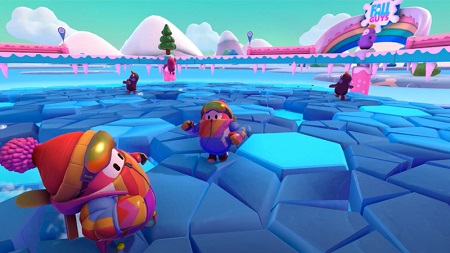
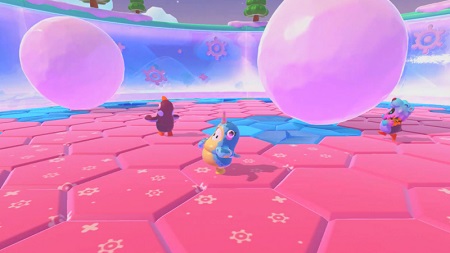
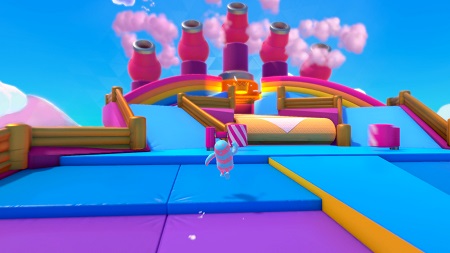
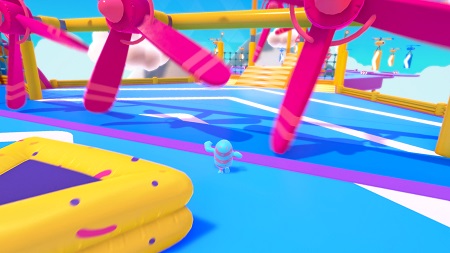
All Fall Guys rounds re-ranked!

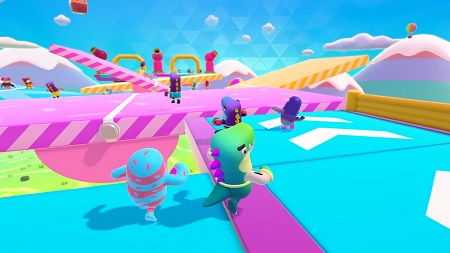
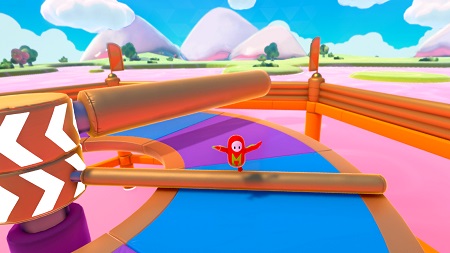
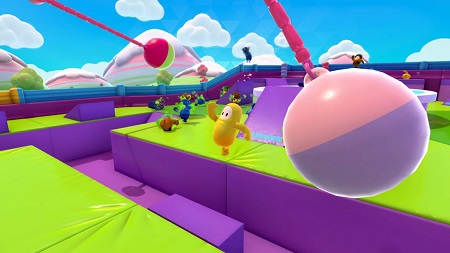
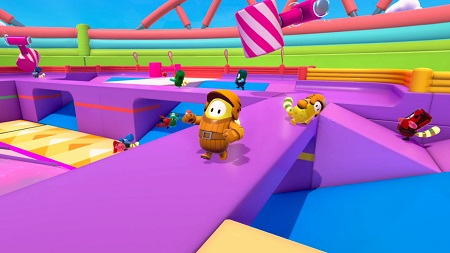
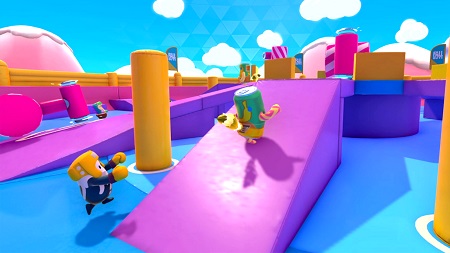
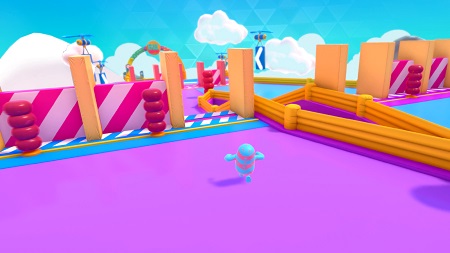
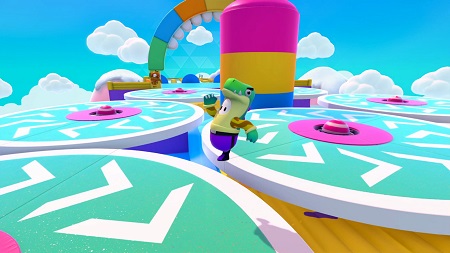
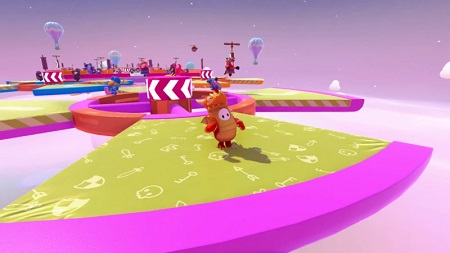
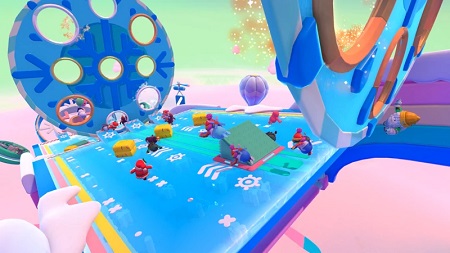
Back in August, when Fall Guys was the party hit of the summer, I put all of the rounds (i.e. levels) into a ranked list. Since then, a number of new rounds have been added to the game as part of the Season 2 and Season 3 updates. In addition, most rounds now have at least one variant, with alterations to obstacles to keep players on their toes.

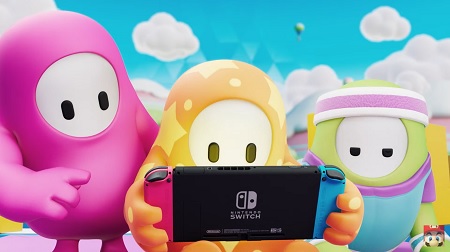
I’m hopeful that Fall Guys will have a strong future. With releases planned for Xbox and Switch this summer, and a fourth season coming between now and then, developers Mediatonic are still working hard. But as we noted last time, player numbers have dropped significantly – by as much as 95% on PC – in a little over half a year, so new owners Epic Games have their work cut out to revitalise Fall Guys in 2021.

Fall Guys is coming to Nintendo Switch this summer.

There are presently 38 rounds in the game, and we’ll look at each of them in turn from worst to best. Some rounds have been greatly improved since I last ranked them, whereas others are now overshadowed by newer rounds that are better! So there will certainly be some changes when compared to my previous list.

Before we go any further, a note about team rounds. In order to avoid being too repetitive, let’s get this out of the way first: success or failure in team rounds is inherently dependent on who you’re teamed up with. Lopsided or unbalanced teams (i.e. 5 against 7) have largely been eliminated from the game via updates – which is great news – but if you’re teamed up with people who aren’t great at the round, who aren’t paying attention, who drop out, etc. it’s going to be much harder to qualify. That’s just the nature of team rounds in a game like Fall Guys, and while it can be incredibly frustrating, it’s also something that can’t be avoided. The reverse can also be true – you can play atrociously only to end up qualifying thanks to being on a strong team. So rather than repeat myself with every single team round, I thought I’d just make this clear at the beginning!

Without any further caveats, let’s jump and dive headfirst into the list.

Number 38: Snowy Scrap (Team)

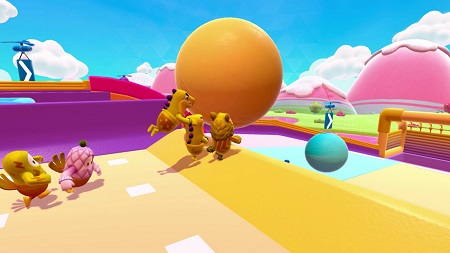
I appreciate what Snowy Scrap was trying to do, and how the developers clearly hoped to create a round that bypassed some of the issues with Rock N Roll – another round which tasks teams of players to push a large ball. The problem with Snowy Scrap is that the physics engine in use in Fall Guys, as well as the deliberately clumsy characters, are not well-suited to a game which requires precision. In Rock N Roll, the large goal at the end doesn’t require this, but in Snowy Scrap the snowballs need to be aimed at small patches of snow on the ground. The clunky balls are difficult to control so delicately, and it’s just a very difficult round as a result.

Number 37: Door Dash (Race)

Last time I ranked Door Dash as the worst round in the game… and nothing has been done to address any of its issues in the patches and updates since. Its combination of being fast-paced yet random means that a single unavoidable mistake – because which doors are real and which are fake is completely random and unknowable – can often mean failure to qualify. It’s a round where, if luck is on your side, you’ll breeze through. If not, however, you’re in trouble. A lot of the rounds in Fall Guys require at least a modicum of skill; Door Dash doesn’t. If you can run and jump, you can play this round just as well as the best players in the world.

Number 36: Fruit Chute (Race)

There’s nothing wrong with the premise of Fruit Chute, which sees players run on a treadmill while obstacles are being fired at them. But it’s an incredibly unforgiving round, and in most cases a single collision can be enough to knock you right out of contention. It’s also a round where not much has been changed, and the variant which added mallets (to sling players forward up the track) doesn’t really seem to help, as landing awkwardly can still mean qualification is out of reach. A fun round, for sure, but horribly unforgiving.

Number 35: Royal Fumble (Finale)

Royal Fumble has slipped way down my list compared to last time for one simple reason: it hardly ever shows up any more. It’s hard to say anything about a round that seems to have dropped off the face of the earth, and I almost took it entirely out of contention. The premise is fine – whoever is in possession of the one single tail when the timer runs out wins the crown – but if, for whatever reason, it’s no longer being used very often, then it can’t be ranked any higher on the list.

Number 34: Tip Toe (Race)

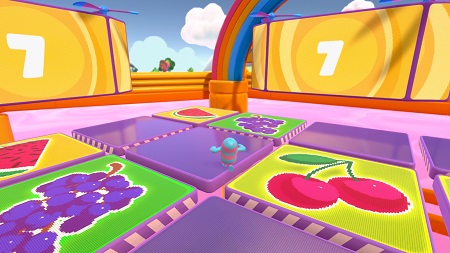
Another round that hasn’t seen any improvement since last time, Tip Toe is another that can be very unforgiving and random. It’s impossible to tell which tiles are fake and which are real without jumping on them, and if you’re unlucky enough to fall near the end, by the time you’ve respawned the round can be over. Because Tip Toe shows up later (usually it’s at least the third round) players are cautious, wanting to qualify for the finale, so it can drag out if no one is willing to try stepping on the next tile. The addition of a mallet in one variant does basically nothing, because even if you jumped perfectly and got hit by it, chances are you’d still land on a tile that will fall away.

Number 33: See Saw (Race)

See Saw sees perhaps the biggest fall from grace since I wrote my first list. Back then I said that it was “a ton of fun, and deceptively tricky.” And that’s true – See Saw can be fun, but one thing I’ve come to realise is just how unfair it is. Players who spawn in at the front of the pack have a far bigger advantage than I realised, and it’s often the case in See Saw that two or three players manage to qualify way before everyone else simply because they had a straight shot to the finish line. However, See Saw is usually a forgiving round, meaning a fall or two doesn’t usually knock you right out of contention. I still like it and have fun with it, but the unfairness is definitely noteworthy!

Number 32: Jump Showdown (Finale)

Jump Showdown is – I think – the finale where I’ve won the most crowns! But it’s quite random when compared to all of the other finales, and it’s possible to lose simply because of where you spawned in at the beginning. When a couple of platforms have fallen away, you can end up in the wrong place simply by chance, and thus I stand by what I said last time: that’s poor for a finale.

Number 31: Rock N Roll (Team)

Rock N Roll usually sees all three teams make identical progress pushing their giant ball through a short obstacle course, and that’s the part of the round that could really use some attention and improvement. Once the balls drop it’s a short run to the goal at the bottom, and this round invariably descends into which team can hold up the others better. I also feel that there’s a disadvantage to being in the middle lane, simply because you have players from both sides who could jump in the way and hold you up. It’s preferable to Snowy Scrap, though!

Number 30: Jinxed (Team)

I hadn’t played many rounds of Jinxed when I ranked it last time, but it seems to come up more often now. It’s okay, and the level is well-designed. It’s a very fast-paced round, better suited to larger teams, but because of the way it starts – with one “jinxed” player per team – it can get lopsided fast if one of the jinxed players isn’t paying attention (or just isn’t very good!) It’s okay, though, and we’re getting into the part of the list where none of the rounds are all that bad, just overshadowed by some that are better!

Number 29: Perfect Match (Logic)

I ranked Perfect Match much higher up the list last time. I enjoy it a lot, and in a game that can be very hectic it’s a refreshingly different offering. However, it’s also a round that invariably ends up eliminating practically nobody. I don’t want to attach the label “too easy,” but it’s hard to know what else to say about a round where 30 out of 31 players qualify. A variant has been added that randomly shoots obstacles at the course, and that helps a little, but right now Perfect Match is an outlier. If it remains the case that it doesn’t eliminate many players, including it is going to end up feeling like a waste of time when it appears. That’s a shame, because in theory I like Perfect Match – it just doesn’t work so well at the moment.

Number 28:Pegwin Pursuit (Team)

The robo-penguins that you have to catch in this game are cute, and the concept is fun. You’ve probably figured out by now that I’m not wild about a lot of the team rounds, and in a way I’d like to see a solo variant of this round as I think that could be fun. If there were, for example, five fewer penguins than players (10 penguins in a 15-player round, and so on) maybe that would work. It’s fine, though, and worked well during the winter-themed Season 3.

Number 27: Team Tail Tag (Team)

Team Tail Tag has one of the best-designed levels, and it’s one that could work well for a whole range of different games. It has ramps, conveyors, slippery slime ramps, mallets… lots of different “terrains” and obstacles. It’s also the only round where I’ve seen four teams instead of two or three! The tail tag concept is fun, and pretty easy to get to grips with. A fun middle-of-the-road round that I don’t really have anything else to say about.

Number 26: Tail Tag (Hunt)

As I said in my previous list, the non-team version of Tail Tag works ever-so-slightly better, in my opinion, because victory or defeat is in your own hands. The map is perhaps slightly less fun, though it has spawned at least one variant with large fans that does mix things up a little. Tail Tag is the one round where what you do at the beginning does not matter in the slightest; it’s won or lost in the last few seconds. That keeps it exciting all the way along, and I appreciate that about it. It’s also on a fixed timer so there’s no waiting around!

Number 25: Hex-A-Gone (Finale)

Hex-A-Gone is fine. It’s a solid finale that does what it says it’s going to do! I’ve seen some players who seem to have very elaborate Hex-A-Gone tactics, including dropping way down to the final layer to make holes in the hopes that other players will fall straight through! I like that it’s a round that inspires some degree of tactical thinking; you can’t just run around and hope for the best.

Number 24: Fall Ball (Team)

I mentioned above that the physics of Fall Guys makes controlling large balls difficult, and while that was frustrating in Snowy Scrap it’s a big part of the fun of Fall Ball. Even after playing many times, I’m still crap at it. But it’s fun, and it’s a change of pace when compared to a lot of the other team rounds. It actually requires a degree of teamwork to qualify – just running around only considering yourself can leave your goal exposed or leave teammates without support, so it’s another round that can be played tactically.

Number 23: Hoarders (Team)

Hoarders is a pretty hectic round, and another that requires players to control large balls. Luckily in this case the objective is just to keep as many as possible in an entire third of the map, which is much easier than scoring a goal or rolling in a specific area! As with Tail Tag, who’s winning at the start doesn’t matter; there are only a few balls so it’s possible to pull off a recovery even at the last second. In that sense it’s a round that never lets up.

Number 21 (tie): Egg Scramble & Egg Siege (Team)

I’m putting these two together because for all intents and purposes they’re the same round. The level design is slightly different – with Egg Siege adding a medieval theme and drawbridges, as well as deeper “nests,” but the changes aren’t substantial enough to make the rounds play any differently from one another. I like both, and the addition of golden eggs alongside regular eggs adds an extra dimension to the rounds. They’re fun and often fast-paced – the only time either are less fun would be when there are only a few players per team. One round I played only had four players on each team, and I think that’s too few!

Number 20: Hoopsie Daisy (Team)

I think we’ve come to my favourite team round! I just love the jumping and diving, and the hoops are just large enough to make a good target without being too big or making it too easy. The addition of golden hoops, and mixing up some of the obstacles on the map, gives Hoopsie Daisy an additional dimension, and I always smile when it crops up. Unless your team falls way behind and stays there, it’s usually competitive right up to the last second, too.

Number 19: Jump Club (Survival)

I prefer Jump Club to its finale cousin for the simple reason that it’s less random. It’s still possible to screw up and fail to qualify, but usually that’s because of a self-inflicted mistake, and not because of the way the round was designed. Otherwise it’s a pretty simple concept – jump over the spinning beam without getting caught by the larger one above it. Hang on long enough while other players get knocked into the slime and you qualify! It’s a round that usually doesn’t drag on too long, either because a lot of players get caught out, or because the beams speed up!

Number 18: Roll Out (Survival)

If there were only the original version of Roll Out it would surely rank lower down the list. That’s because, as I noted last time, that version of Roll Out can take a long time to play out because most people have got the hang of it! But there are two new variants that completely mix it up. In one, two of the five rotating cylinders are gone, meaning there are more players packed into a smaller space. In the other, fruit obstacles are fired at random, knocking players down. These new variants massively improve the round.

Number 17: Wall Guys (Race)

Among the racing rounds, there really isn’t anything quite like Wall Guys. In a way it’s partly a game of logic, trying to piece together the best route across the platforms to scale the walls. But it’s also a round that requires good jumping, diving, and aiming reflexes. A second variant adds in giant fans, which certainly mixes things up. It’s not an easy round by any means, and sometimes positioning a platform in just the right place can mean someone else jumps on it first – but that’s part of the game!

Number 16: Freezy Peak (Race)

Freezy Peak is a fun obstacle course with several sections offering a variety of challenges. The hardest part (at least for me) is getting the timing right to jump across the fans, using the updraft to cross a gap. It’s not easy, but it’s a cleverly-designed round and I appreciate that it offers a lot of variety. It could easily be repurposed to become a finale, with the first person reaching the summit winning a crown!

Number 15: Hoopsie Legends (Hunt)

Hoopsie Legends is the solo variant of Hoopsie Daisy, and it’s great fun. The challenge doesn’t only lie in jumping through the hoops, but also in getting to them ahead of other players, and in moving platforms to just the right place. The map itself is perhaps a little bland, with only the central drawbridge area offering any variety. My only real point of criticism, though, is that in a round where the objective is to score six points, having a few golden hoops that are worth five points each can make it quick and easy for some players to reach the target. It might be better if these were only worth two points.

Number 14: Thin Ice (Finale)

Thin Ice is a slightly better variant of Hex-A-Gone, and that’s really all there is to say. After standing on the hexagon-shaped ice tiles for a couple of seconds, they crack and disappear, dropping players down to the next layer of ice. It’s possible to do well at Thin Ice by taking it slow and focusing on one section of the level. When it gets down to the final layer and a lot of holes, well that’s when it gets hectic! It’s also the finale where I’ve seen the most players – 18 on one occasion, and 15-16 several times.

Number 13: Snowball Survival (Survival)

This is a fun round, and a well-designed level. Two giant snowballs roll across the bowl-shaped map at random, sometimes bouncing off one another. There are patches of ice that crack and fall away, and patches of solid ground. Getting hit by a snowball sends players flying in all directions, and the challenge is in jumping out of the way in time! It’s also a round that can, on occasion, eliminate a large number of players.

Number 12: Fall Mountain (Finale)

Fall Mountain makes for a great finale because it’s fast-paced. It’s a race to the top – while giant balls are being shot down the mountain at you – and whoever makes it and grabs the crown wins. Victory or defeat is entirely in your own hands – quick reflexes are needed to avoid the balls and swinging mallets, and to jump at the right moment to grab the crown. Though it’s kind of basic as far as obstacle courses go, it’s great fun.

Number 11: Slime Climb (Race)

I’m still awful at Slime Climb! More often than not I wind up eliminated through a mistimed jump or by getting knocked over by one of the many different types of obstacle! But as a pure obstacle course it has everything: rolling balls, swinging mallets, slippery slopes, pushing platforms… the lot. And a few different variants have been added, changing up some of the obstacles to keep players on their toes. In terms of the way the level is designed it has to be one of the best in the game – even though I absolutely suck at it.

Number 10: The Whirlygig (Race)

I like what The Whirlygig has to offer, and the fact that a couple of different variants have sprung up keeps it fresh and interesting. I’ve pretty much nailed my tactics for this round, and even on my worst days I can still expect to make it to the finish line! The rotating fans offer a different kind of obstacle, and getting the timing right to avoid getting hit is the key.

Number 9: Gate Crash (Race)

I’m not doing individual awards, but if I were, Gate Crash would win “most improved!” Last time I said that it was too unforgiving, but maybe I’ve just got better at it since then. Regardless, the addition of moving obstacles seems to have helped, and Gate Crash has one of the best final stretches of any round – with a slippery slope leading to a jump. Getting that right requires a bit of skill and the right timing, something that can be tricky!

Number 8: Dizzy Heights

Dizzy Heights now has several different variants to spice things up, including one where its signature spinning platforms have been removed in the middle section! These variants keep it fresh and interesting, as you’re never sure which version will be selected. It’s a fun round, and one which can be difficult, especially toward the end. Those three rotating discs spinning in opposite directions – with balls being shot at you – are difficult to navigate!

Number 7: Big Fans (Race)

I utterly detested Big Fans the first few times I played it! That was because I couldn’t get the timing right to successfully jump between the spinning platforms! But the more I’ve continued to play it I’ve come to appreciate what it has to offer, and while there really isn’t much variety – except on the variant that introduces spinning beams – it’s nevertheless a fantastic, cleverly-designed round that’s incredibly tricky to get to grips with.

Number 6: Roll Off (Finale)

Roll Off is what Roll Out should have been! Where the original version of Roll Out can take a long time to eliminate players, Roll Off speeds up, and the rising slime leaves less and less solid ground available. It’s a truly fun take on Roll Out, massively improving on that round’s gameplay. I just wish, in a way, that it wasn’t a finale so that it would crop up more often!

Number 5: Ski Fall (Race)

The concept of Ski Fall is just fantastic. Jumping and diving through small target rings while slipping down an icy slope makes for a deceptively challenging round, and it’s easy to mistime a jump or bounce off an obstacle and completely mess up! However, it’s also forgiving enough that a mistake or two won’t knock you out of contention altogether most of the time, which is great. Tricky but great fun is how I’d describe Ski Fall.

Number 4: Hit Parade (Race)

Last time, Hit Parade was my winner. It’s slipped down a few places this time, and if I’m being really honest the reason why is that I’ve played it so many times. There are some great variations that have been introduced that have kept Hit Parade fresh, and I still feel that, when considering pure obstacle courses, it beats out many other rounds – especially those which only consist of one type of obstacle! And it’s still great fun, don’t get me wrong… but a couple of newcomers have arrived to topple its crown.

Number 3: Block Party (Survival)

I still absolutely adore Block Party. This timed round sees players standing on a short platform having to run out of the way of walls that come racing toward them. There are some beams to jump over, too. It’s a tricky round that keeps you engaged until the very last second, and it gets progressively difficult as the timer ticks toward zero. My only criticism would be to say that, of all the rounds in the game, Block Party is perhaps the easiest in theory to mix up with new variants, as changing which beams and blocks come and at what time shouldn’t be too difficult. Yet there aren’t many variants that I’ve seen – perhaps two or three.

Number 2: Knight Fever (Race)

So now we come to the top two, and just missing out on the top spot is Knight Fever. This amazing obstacle course has so much going on that I hardly know where to start. There are platforms with holes in, cylindrical platforms with fast-moving spikes that knock you off, crushing cylinders and blocks, and drawbridges. There are several variants, too, which introduce see-saws, fans, and change the timings of the drawbridges. There’s just so much going on that Knight Fever is a wild ride from start to finish, and always keeps me on my toes!

Number 1: Tundra Run (Race)

My number one pick this time is Tundra Run. It was a close call between this and Knight Fever, because both are excellent, varied obstacle courses. But as I thought about it some more, Tundra Run has to take the top spot. As above, it offers a range of different obstacles and terrains, with the icy sections being slippery and difficult to navigate. But it’s so much fun, and incredibly hectic. There’s so much variety that each section feels almost like a new level, and it’s not easy to make it to the finish line!

So that’s it! We’ve put all of the rounds into a list again… one that will be out-of-date as soon as Season 4 rolls around!

I took a break from Fall Guys over the holidays, but after picking it up again last month I’ve been having a whale of a time. I often say that, when it comes to video games, I prefer something with a good story that I can play alone. Fall Guys has reminded me that enjoyable gameplay matters too, and that there’s still value in something unique, silly, and fun. There aren’t that many games like Fall Guys where I sit down to play simply for the enjoyment of playing – not because I’m chasing achievements or following a story.

I’m keeping my fingers crossed for Season 4 being fun with its futuristic theme, as well as for successful launches on Xbox and in particular on the Switch later in the year. Fall Guys deserves to have a great future with many more updates and more content to come – and I’m still hopeful that it can, despite the significant drop in player numbers since launch.

If you haven’t tried Fall Guys yet… well I guess this list won’t have made a lot of sense! But the game is available on Steam and on PlayStation 4, and as mentioned, Xbox and Switch releases are coming. It was suggested – or at least hinted at – that it may go free-to-play in future, so watch this space. But if you ask me, it’s a steal at £15.

I won’t immediately re-rank the rounds when Season 4 arrives, but stay tuned for more Fall Guys-related articles and posts, especially if we get any significant news regarding the game’s future. Perhaps I’ll see you out there, pushing you out of the way to grab a crown!

Fall Guys is out now on PC and PlayStation 4. Fall Guys is the copyright of Mediatonic, Devolver Digital, and Epic Games. This list contains the thoughts and opinions of one person only and is not intended to cause any offence.

Star Trek: Strange New Worlds – Five new cast members join the series!

Spoiler Warning: There are spoilers ahead for Star Trek: Strange New Worlds. The video referenced in this article can be found below.

No sooner had I published my article making a few preliminary predictions (alright, guesses) for Strange New Worlds – my first piece on the upcoming series since July last year – than ViacomCBS dropped the biggest news so far about the latest Star Trek show! What an odd coincidence, eh?

The short video confirmed the rumour that the series has officially started production in Toronto, which is fantastic news. There had been speculation that filming had started, but there were also competing rumours that production hadn’t yet begun, so getting confirmation on that is great. It also firmly debunks the lie spread through some anti-Star Trek groups that the series (and other upcoming Star Trek productions) were cancelled or not going ahead!

In addition to the news that the series was officially in production, we also got to meet five new members of the Strange New Worlds cast. We’ll very briefly look at each in a moment, but first let’s assess the group as a whole.

Firstly, those of you who are good at maths will have worked out that the addition of five new cast members brings the total for Strange New Worlds’ main cast to eight. Discovery had seven during Season 3, and Picard also had seven during its first season, so eight characters is not completely out of the ballpark for a modern Star Trek production! In a series that will almost certainly run somewhere from 10-15 episodes, eight major characters is probably about the maximum number that Strange New Worlds could get away with, though.

Picard Season 1 dedicated several of its episodes and large portions of its runtime to its new characters, and while that was great and generally done very well, it meant that when we got to the season finale and rushed through a huge amount of story (leaving a number of things unresolved) some of that felt wasted. In short, what I’m trying to say is that today’s Star Trek shows have fewer episodes per season than they used to in decades past, and a shorter runtime naturally means you can fit in fewer stories – and arguably fewer major characters. Eight feels like a comfortable fit – but I would be wary of trying to cram in too many more!

Notable by her absence was Amrit Kaur, who played Cadet Sidhu in the 2019 Short Treks episode Ask Not. At the end of that short story, Cadet Sidhu was assigned to a role in engineering aboard the Enterprise, and while it was presented as a standalone story, by introducing a character in that manner, with Strange New Worlds clearly in mind at the time the episode was made, it felt like a deliberate move. Ever since the series was announced last year I felt relatively certain that Sidhu would be back, and while it’s possible she will be included in a future announcement, or reappear as a guest star, I admit I was a little surprised not to see her included here.

The cast members who we briefly met continue Star Trek’s longstanding tradition of diversity in its main characters. Babs Olusanmokun was born in Nigeria. Christina Chong is of mixed Chinese-English ancestry. Celia Rose Gooding is African-American. Melissa Navia is Colombian-American. And Jess Bush is Australian. Quite the mix!

The cast will have more women than men for the first time in the franchise’s history, which is certainly very interesting. On-screen representation continues to improve, and Star Trek has had a long and proud tradition of these big, diverse casts. Strange New Worlds continues that tradition, and the cast looks to be shaping up very well.

I’m afraid that I’m completely unfamiliar with all five of the new faces, though several of them have had roles in films and shows that I’ve heard of or seen parts of, so that’s good. The new cast members will have the opportunity to grow into their roles without bringing too much baggage with them, which is one benefit to bringing on board new faces.

We don’t yet know what roles any of the five will play. Surely we can expect to find at least one non-human in there, but which of them will take on that role and in what capacity is something we still don’t know. Every Star Trek series to date has introduced us to new alien races, as well as brought at least one new alien race into its main cast, and I see no reason why Strange New Worlds won’t do the same.

The final point of note is that, of the characters from The Cage, who were officers aboard the Enterprise under Pike’s command, none of them seem to fit with the new cast. Perhaps Yeoman Colt could be the character one of the new female leads is taking over, but none of the new cast fit with characters like José Tyler, Dr Boyce, or other officers present in that episode. I’ve said several times that I was sure Strange New Worlds was not simply going to recast everyone present in The Cage, and that the creative team would surely want to add in their own new characters, but it’s still worth noting that it doesn’t seem at this stage that any of those original characters are returning in a major way.

So that’s about all I have to say, really. By sheer coincidence this announcement came a few hours after I published my preliminary Season 1 predictions, which is kind of amusing! Hopefully we’ll learn soon what roles these folks are going to play. It looks like a fun group, and unless there’s some shocking announcement to come – like a returning cast member from a previous Star Trek series, or the inclusion of a Hollywood superstar – it feels like this announcement has rounded out the main cast. Eight major characters is more than enough for a series like this, though hopefully we’ll see a few secondary characters given screen time and development as well.

Strange New Worlds is off to a decent start, and I’m looking forward to the moment when I’ll be able to sit down and watch it! Stay tuned, because if we get any more information about the show, the characters, or anything else of note, I’ll be sure to take a look.

Hit it!

Star Trek: Strange New Worlds will be broadcast on Paramount+ in areas where the service is available. Further international distribution has not yet been announced. The Star Trek franchise – including Strange New Worlds – is the copyright of ViacomCBS. This article contains the thoughts and opinions of one person only and is not intended to cause any offence.


Here’s the full video:

Why is everybody so surprised that future Bethesda titles will be Xbox/PC exclusive?

A few months ago I briefly touched on the Microsoft buyout of ZeniMax – parent company to Skyrim developer Bethesda. The deal, which was announced back in September last year, has finally gone through after months of behind-the-scenes legal wrangling, meaning that Microsoft now officially owns Bethesda Softworks, its subsidiaries, and all of the games they’ve developed and produced. This is a significant acquisition for Microsoft, and looks sure to shake up the games market – at least the single-player games market! It will also certainly provide a big boost for Xbox Game Pass, which has already been touting the arrival of Bethesda’s back catalogue to the service.

Almost all Bethesda titles for at least a decade have been multiplatform, with releases on Sony’s PlayStation consoles and some select releases on Nintendo hardware too, and those games aren’t going to be taken away. Microsoft has also pledged to honour existing contracts for upcoming titles, meaning that both Deathloop and Ghostwire: Tokyo will still have timed exclusivity on PlayStation 5. After that, however, we can expect to see future titles arrive exclusively on Xbox Series S/X and PC.

Ghostwire: Tokyo will still be a timed PlayStation 5 exclusive.

Some games industry commentators seem taken aback at this notion, asking with mouths agape if Microsoft will seriously make upcoming Bethesda projects like Starfield and The Elder Scrolls VI Xbox/PC exclusive. To those folks I ask a simple question: really? This seems like a surprise to you?

Microsoft paid $7.5 billion for Bethesda, and for that huge investment they’re going to want a lot more than a few new titles in the Game Pass library. Exclusive games sell systems, and in 2021 exclusive games drive subscriptions too. Microsoft fell way behind in the last generation as the Xbox One was massively outsold by the PlayStation 4, and a lack of decent exclusive games was a huge factor in explaining why that was the case. Microsoft has tried to rectify the situation by acquiring Obsidian Entertainment, Compulsion Games, Playground Games, Ninja Theory, and other studios, and guess what? Those studios now make games for PC and Xbox only. Some of these investments will take time to pay off, but as the new console generation rolls into its second and third years, I think we’ll see a big push from Microsoft with some of these new exclusive games.

Expect to see future Bethesda titles be Xbox/PC exclusive.

Titles from Microsoft-owned franchises like Halo, Gears of War, State of Decay, and standalone games like Sea of Thieves aren’t going to be released on PlayStation (or Nintendo) so I’m afraid that people are getting their hopes up if they expect to see future Bethesda titles on any other platform. Microsoft wouldn’t have spent such a huge sum of money not to capitalise on their acquisition, and while in the immediate term nothing is going to change, give it a couple of years when Starfield is ready, The Elder Scrolls VI is preparing for launch, and Bethesda are working on new entries in the Fallout or Doom series and you can guarantee they will be Xbox/PC exclusive.

Sometimes I sit down to read through opinion and commentary by other games industry writers – including some pretty big names – and I’m surprised how they can get it so wrong. It seems naïve in the extreme to be banking on any future Bethesda title – including huge ones like The Elder Scrolls VI and a potential future Fallout title – to be anything other than exclusive to Microsoft’s platforms. That’s how these things work, and it’s why Microsoft was willing to get out their wallet in the first place.

I wouldn’t bet on being able to play Starfield on your PlayStation 5.

Though it may seem “unfair” to lock games to a single platform (or pair of platforms, in this case) it’s how the industry has operated since day one. Nobody got upset about Marvel’s Spider-Man being a PlayStation 4 exclusive, even though that game wasn’t made by Sony, but rather one of their subsidiaries. It was just expected – Insomniac Games make PlayStation titles, just like 343 Industries make Xbox titles. Bethesda’s acquisition means they join Team Xbox. It may not be great fun for PlayStation gamers who had been looking forward to a future Bethesda title, but that’s the reality of the industry.

Be very careful if you hear an analyst or commentator saying that they believe Bethesda titles will still come to PlayStation. Rather than getting your hopes up or setting up false expectations, it may be better to plan ahead. If Starfield or The Elder Scrolls VI are games you’re dead set on playing, consider investing in Xbox. The Xbox Series S is a relatively affordable machine at £249/$299, and if you only need it for a couple of exclusives that you can’t get elsewhere it could be a solid investment – certainly a lot cheaper than a gaming PC.

The Xbox Series S might be worth picking up.

Despite all of this, I still feel Sony has the upper hand in the exclusives department, at least for now. It will be a couple of years or more before Microsoft can fully take advantage of their new acquisition, and other titles from developers like Obsidian – who are working on a game that looks superficially similar to The Elder Scrolls series – are also several years away. Sony, on the other hand, has games out now like Spider-Man: Miles Morales and the Demon’s Souls remake, as well as upcoming titles like God of War: Ragnarok and Returnal to draw players in. Microsoft is still pursuing a frankly bizarre policy of making all Xbox Series S/X games available on Xbox One for the next year or so, so for exclusive next-gen gaming in the short term, Sony is still the way to go.

I remember when Microsoft entered the home console market for the first time in 2001. A lot of commentators at the time were suggesting that Microsoft were buying their way in, that they would throw their wallet around and other companies would find it hard to compete. It never really happened, though, at least not to the extent some folks feared. The acquisition of Bethesda is a big deal, but Bethesda and all its subsidiaries have published only around 20 games in the whole of the last decade, so in terms of the wider gaming market, and considering how many games there will be on PC, Xbox Series S/X, and PlayStation 5 in the next few years, it’s a drop in the ocean.

That doesn’t mean it won’t sting for PlayStation fans who want to play Starfield or The Elder Scrolls VI, though. Better start saving up for an Xbox!

All titles listed above are the copyright of their respective studio, developer, and/or publisher. This article contains the thoughts and opinions of one person only and is not intended to cause any offence.
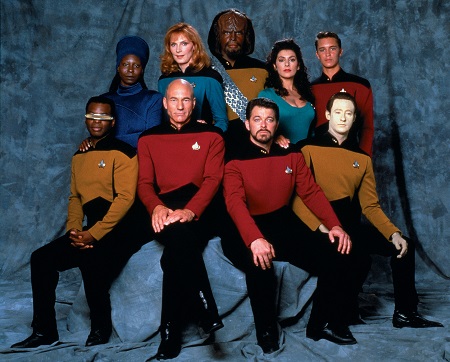
Preliminary Star Trek: Strange New Worlds Season 1 predictions

Spoiler Warning: There are spoilers ahead for Star Trek: Discovery Seasons 1-2, Short Treks Season 2, Star Trek: Picard, and other iterations of the franchise.

It’s been a while since we looked at Star Trek: Strange New Worlds, the upcoming Captain Pike series. But with production on Season 1 seemingly imminent – or perhaps having already begun, depending on what sources you use – I thought it would be fun to look ahead to what the first season of the show may hold.

At this stage, Strange New Worlds has only been commissioned for a single season. However, I would be absolutely stunned if we didn’t get an announcement preceding its Season 1 premiere that it had been renewed; this is the pattern ViacomCBS has had with both Discovery and Picard. I’m hoping, then, that Strange New Worlds will become an ongoing series, perhaps following Discovery’s path and running for four seasons, five, or even more. There’s certainly enough potential content for the show to get through, and while being a prequel is a constraint in some respects, that didn’t stop Discovery, Enterprise, and even the Kelvin films finding new and different stories to tell.

The USS Enterprise.

Just as I did for Discovery Season 4 and Picard Season 2 I’m going to make a few guesses – which I’m officially terming “preliminary predictions” – for Strange New Worlds Season 1. My usual caveat applies – I have no “inside sources,” nor am I claiming that anything listed below will definitely happen. These are guesses – educated guesses in some cases, perhaps, but guesses nevertheless.

Without further ado, let’s jump into the list!

Number 1: The uniforms will be redesigned.

Captain Pike’s gold uniform as seen in the Discovery Season 2 episode Brother.

With the exception of Star Trek: Voyager, every Star Trek series to date has introduced new variants of the Starfleet uniform for its crew. While we have seen Anson Mount and Ethan Peck sporting their Discovery uniforms in recent promotional spots for Paramount+, I’m not convinced that Strange New Worlds won’t at least tweak that design.

And perhaps that’s all it will be – a minor tweak or alteration of the uniforms worn by the Enterprise crew in Discovery. But we could see a more radical change, perhaps one designed to bridge the gap between Discovery-era uniforms and those seen in The Original Series. We could see, for example, the high collars scrapped in favour of the crew neck style seen in The Original Series.

Red uniform variant seen in the Short Treks episode Ask Not.

The uniforms worn by the Enterprise crew in Discovery were little more than recoloured versions of the Discovery uniforms, and if you look closely, you can see the detailing around the shoulder and down the sides. In my opinion, though these uniforms were preferable to Discovery’s all-blue look, they ended up looking like dyed Discovery uniforms rather than their own thing. This is something that could be addressed, even if only by making small changes to some of the detailing and stitching.

Regardless, I think that when we start to see promos for the new series, one thing we’ll notice is some kind of new uniform variant.

Number 2: Cadet Sidhu will be part of the Enterprise crew.

Cadet Sidhu.

The 2019 Short Treks episode Ask Not – whose writer, Kalinda Vazquez, is now writing a Star Trek film – brought back Captain Pike. But it also introduced us to a Starfleet cadet, and at the end of the action-packed, uplifting story, she was assigned to a role under Pike’s command aboard the Enterprise.

Almost any story could have been chosen to bring back Captain Pike for a mini-episode, but Ask Not spent most of its time setting up Cadet Sidhu’s character. She has a potentially interesting backstory, being the sole survivor of a Tholian attack, and as a young, talented cadet she could fill a fairly typical Star Trek role in the new series.

Captain Pike with Sidhu in the Enterprise’s engineering section.

We’ve seen the “young and eager” role filled by characters like Harry Kim, Sylvia Tilly, and even Wesley Crusher in past iterations of the franchise, and having someone like that presents a contrast with older, more experienced characters like Captain Pike and Number One. Cadet Sidhu also has a husband, who could potentially be a recurring character, and her background with the Tholians suggests she may not be quite as naïve and inexperienced as other cadets, potentially giving her more to say and do.

Of the main cast that we know of at this stage, all three roles are played by white American actors – Anson Mount as Pike, Ethan Peck as Spock, Rebecca Romijn as Number One. Every Star Trek show going back to The Original Series has proudly shown off a diverse cast, and bringing in someone of Indian heritage would be great. Amrit Kaur, who plays Sidhu, would be the first person of Indian heritage to be a main cast member in the history of the franchise, which would be groundbreaking in itself.

Number 3: There will be a non-Starfleet crewmate.

Cleveland Booker in Season 3 of Discovery.

One of the best things Discovery Season 3 did was introduce the character of Cleveland Booker. Book served as our guide to the 32nd Century in some ways, but also shook up the rigid hierarchy of the Starfleet crew by offering an outside perspective.

Several Star Trek shows have experimented with non-Starfleet characters in various roles, and aside from Book I’d point to Quark in Deep Space Nine and even, to some extent, Neelix in earlier seasons of Voyager as successful examples. I don’t expect Strange New Worlds to put together a Picard-style team where no one is a serving Starfleet officer, of course, but bringing in one major character who exists outside of the ship’s command structure would be potentially interesting.

Neelix in Star Trek: Voyager.

There are many ways this could be done, and many different roles such an individual could occupy. I’m thinking perhaps of a chef-type role, maybe someone who oversees the mess hall and is friendly with the crew. But there’s also potential to bring in an alien character who is perhaps aboard the ship as an observer or diplomat.

The possibilities are open-ended – as is almost everything with Strange New Worlds – but I certainly think that bringing at least one “outsider” into the crew can be a great storytelling device, one which could take the show to different thematic places.

Number 4: There will be a significant callback to Star Trek: Enterprise.

The NX-01 Enterprise.

Aside from a couple of Okudagrams and throwaway lines, modern Star Trek has essentially ignored Enterprise. The franchise’s first prequel currently feels disconnected from the rest of the franchise; cut off in the 22nd Century all by itself. There’s potential for Strange New Worlds to rectify this, and having a significant crossover with Enterprise would be something fun to see.

A few months ago I suggested that the Andorian Shran or main character T’Pol from Enterprise could still be alive and active in the era in which Strange New Worlds is set. Either character – or both – could thus cross over and appear in the new series. That would be a hugely significant moment, as it would firmly tie in Enterprise with the ongoing Star Trek franchise.

Sub-commander T’Pol.

Discovery could have done something similar to pay homage to Enterprise in either of its first two seasons, but with the show now set far in the future, any crossover potential has gone away. Strange New Worlds is currently the only 23rd Century series, and while the untitled Section 31 show or a future series may share the setting, that’s hardly a sure thing. So if the creative team at ViacomCBS want to bring up anything from Enterprise any time soon, this is by far the best place to do it.

If a main character crossover isn’t on the cards, there are still myriad other ways to acknowledge Enterprise in a major way. We could see Pike and the crew revisit a location first seen in Enterprise, or see the return of races like the Denobulans, Suliban, or Xindi, none of which have ever been mentioned outside of Enterprise.

Number 5: Ash Tyler will return.

Ash Tyler.

Of Discovery’s main cast from Seasons 1 and 2, only Ash Tyler didn’t travel into the future with Burnham and the rest of the crew. He remained in the 23rd Century, and at the end of the Season 2 finale we learned he would be appointed head of Section 31. It’s been assumed ever since (not only by me but by other fans and theory-crafters) that Tyler was intended to appear in the upcoming Section 31 series. However, as we recently learned, that show may be on hold for at least the next couple of years.

Ash Tyler’s story arc across Discovery’s first two seasons is arguably complete. He came to terms with what happened to him, his transition from Klingon to human and the two sides of his personality that created. He also went on a rollercoaster ride in terms of his relationship with Burnham. But there’s still a lot of potential in Tyler, and one thing in particular that leads me to believe that he could – in theory – have a role to play in Strange New Worlds.

Is this Ash’s brother? His cousin?

The character above is José Tyler, one of the original officers under Pike’s command in The Cage. Now I’m not expecting everyone we met in The Cage to be recast and appear in Strange New Worlds, but the possibility of a family connection between José and Ash seems like it could be fun to explore. Perhaps they’re brothers or cousins. If so, how would José react to the fact that Ash isn’t really Ash any more? That could be a huge source of conflict, and putting the two characters together to work through that might be a story worth telling.

Ash Tyler could also be part of a Section 31-related story, or even a story that sees the Enterprise picking up the last remaining pieces of the battle against Control. Ash shares a secret that only Pike and the Enterprise crew know – what really happened to the USS Discovery. As the head of Section 31, might he leverage that against Pike somehow to force him to take on a dangerous mission? There are, once again, almost an unlimited number of ways Ash Tyler could be used in the context of the new show. I doubt he’ll be a major starring character, but having him back for an episode or two seems a real possibility.

Number 6: The Enterprise will make first contact with a familiar race.

A Cardassian spy seen in The Next Generation.

One of the promises Strange New Worlds has made is that it will be a return to the kind of Star Trek that The Original Series, The Next Generation, and Voyager did so well, with stories focusing on exploration. Over the course of those series, the captains and their crews made numerous first contacts with alien races, and if Strange New Worlds is to make good on its premise, making at least one first contact seems inevitable.

If we look at Enterprise as the other major Star Trek prequel series, we saw first contact with established races like the Klingons, Romulans, and even the Ferengi – though Archer didn’t know who he was meeting in that last case. The point is, Enterprise went back and showed us how humanity first encountered many familiar Star Trek races – and this is something Strange New Worlds could do too.

Enterprise depicted Earth’s first contact with the Romulans, and several other familiar races.

I’ve written about this a number of times here on the website, but I adore Deep Space Nine, and particularly the Bajorans and Cardassians. We’ve never seen the Federation make first contact with either of them, and it could be very interesting to see how it went. The Cardassians would likely still be a militaristic state, but we know that the Bajorans prior to the Cardassian occupation were very different – operating a caste-based society that the Federation would surely disapprove of.

If not the Cardassians or Bajorans, there are many other Star Trek races which had already been contacted either by the time of The Original Series or The Next Generation that we could see Captain Pike and his crew meet for the very first time. Among them could be the Gorn, Tholians, or even a relatively obscure race like the Sheliak, who only appeared in a single episode. In my opinion, making first contact with an established race would tie Strange New Worlds in to the wider franchise, and that’s something that I firmly believe every Star Trek series needs to be doing.

Number 7: Spock will mention Michael Burnham at least once.

Burnham and Spock in the Discovery Season 2 episode Project Daedalus.

Season 2 of Discovery explored in some detail the relationship between Burnham and Spock. They were raised as siblings on Vulcan by Sarek and Amanda, and Burnham appears to have been quite influential in Spock’s life and in his development. At the end of Season 2, Spock stated his intent to travel to the future with Burnham, and while we know that was never going to happen because of his other appearances in the franchise, it indicates how close they were.

Burnham’s loss is akin to a bereavement. Although the final red burst confirmed that she safely made it to the 32nd Century, Spock will never see Burnham again (barring some other time travel story!) so she’s gone from his life. How will that affect him? While Spock may, on the surface, appear to simply brush off the events of Season 2, he went through a heck of a lot. The loss of Burnham may be the worst part, but being accused of murder, having his mind scrambled, travelling to Talos IV, and being hunted by Control will have all taken a toll.

Captain Pike and Spock watch Burnham and the USS Discovery disappear into the future.

Burnham had her “Spock episode” with Unification III midway through Discovery Season 3, so I wouldn’t be at all surprised if Strange New Worlds reciprocates somewhat and gives Spock his own “Burnham episode” – or at least a Burnham moment. Moving on completely as if everything he went through in Discovery Season 2 never happened wouldn’t sit right, so I’m sure there will be at least some reference or acknowledgement of Burnham from Spock.

It may not be a complete story, rather just a line or two of dialogue in which Spock mentions how much he misses Burnham. But I do expect to see some kind of reference or connection. Despite Spock being a long-established character within Star Trek, Strange New Worlds is a spin-off from Discovery, and this version of the character in particular is tied to Burnham very strongly. Making note of that would also be a reminder to the audience that Discovery is Strange New Worlds’ sister show – another of those little ties between ongoing parts of the franchise that I mentioned.

Number 8: Pike will have to deal with the knowledge of his impending accident and disability.

Captain Pike after his accident, as seen in The Original Series Season 1 episode The Menagerie.

Captain Pike not only saw his future at the Klingon monastery on Boreth, but he actively chose to accept his horrible fate in exchange for a time crystal. This happened toward the end of Season 2, and with the battle against Control to prepare for, he didn’t have much time to really stop and think about what that means. But Strange New Worlds will surely slow things down – at least some of the time – giving him pause for thought.

In the moment, Pike did what he needed to do and embraced his dark future. Will he regret that? Will he be worried at every turn, looking over his shoulder for the moment where his accident will occur? If so, who will help him snap out of it? It would be very easy for someone in his position to fall into depression – after all, what he’s going through is akin to being diagnosed with a terminal disease.

Pike sealed his fate in the Discovery Season 2 episode Through the Valley of Shadows.

We have seen Star Trek tackle this subject before, but only in the format of one-off episodes. Having a main character who is aware of his impending health collapse and disability could be something that’s absolutely worth exploring. In a way, I can relate to Captain Pike. Over the last decade or more I’ve seen my own health gradually decline, and while it isn’t quite the same thing (Pike’s accident takes him from full health to total disability in a heartbeat) I’ve been in the position of hearing a doctor tell me really awful news, knowing that there isn’t anything I can do to fix it.

Star Trek usually does things by analogy, so rather than Captain Pike being diagnosed with a real-world life-limiting condition, he’s seen a vision of his future disability in a time crystal. But the impact it could have on him from a psychological point of view is comparable, and this could, in my opinion, be a great way for Star Trek to explore the complexities surrounding incurable illness, long-term health conditions, disability, and even terminal illness. There are many, many ways such a story could go, and I’ll be fascinated to see what direction the show takes with this.

Number 9: There will be either a time-travel or parallel universe story.

Kirk’s captured Klingon Bird-of-Prey travelling through time in Star Trek IV: The Voyage Home.

Time travel has been a part of Star Trek going back to Season 1 of The Original Series, and we’ve seen a number of episodes take place in both the past and future. With Strange New Worlds sending Pike and the Enterprise off on a mission of exploration, they could easily encounter any of the temporal phenomena that we know exist out there in space.

I’ve never been wild about time travel in Star Trek, and often the episodes in which it features aren’t my favourites. Using time travel to visit contemporary Earth inevitably dates a story, too – just look at Star Trek IV: The Voyage Home or the Voyager two-part episode Future’s End as examples of that! But just because time travel isn’t my personal favourite story element doesn’t mean it can’t work well, and I wouldn’t be surprised at all to see Strange New Worlds pursue a story of this nature.

Voyager visited ’90s California in Future’s End.

The main candidate when considering time travel has to be the aforementioned contemporary Earth, in this case, Earth circa 2021! But we’ve seen time travel stories set in the 1890s, the 1930s, and even a dark vision of the 2020s! It could also be fun to see the crew shot forward in time, and perhaps having to rely on the help of a time-travelling future Starfleet to get home.

Alternatively we could see a parallel universe story – though hopefully not the Mirror Universe! The Mirror Universe is potentially home to the prime version of Captain Lorca, and rescuing him could be an interesting story. But there are many other parallel universes – including the alternate reality where the Kelvin films are set. Could that set up a crossover with the alternate reality versions of Pike and Spock?

Number 10: The show will acknowledge current events.

The COVID-19 pandemic has been the biggest and most disruptive event in many years.

The big story of 2020 was, of course, the pandemic. But there are other significant ongoing events, such as the issue of race in the United States, that Strange New Worlds could try to tackle. Star Trek, despite what some people want to tell you, has always been a franchise with a keen interest in contemporary events. Going all the way back to The Original Series, Star Trek has used its sci-fi setting to look at real-world events, and I wonder to what extent Strange New Worlds will try to do that.

In a series that aims to be more episodic than other recent Star Trek projects, Strange New Worlds could certainly dedicate at least one episode to looking at a major current event. The pandemic is something we have yet to see appear in fiction in a big way. The issue of race, on the other hand, is something we’ve seen tackled many times in many different ways.

Star Trek has looked at the issue of race relations in the United States before, notably in the episode Let That Be Your Last Battlefield.

A story touching on issues raised by the pandemic could look at, for example, a planetary society suffering from disease, but where a significant number of people refuse to take precautions – something we’ve seen all across the world to varying degrees. Or it could look at the long-term impact of isolation through a character or set of characters who haven’t had any outside contact for a long time.

Any series that plans to look at aspects of the ongoing pandemic has to tread carefully, in my opinion, to avoid appearing to sensationalise current events or to be seen to be exploiting the situation. But as one of the biggest events of the 21st Century so far, the coronavirus pandemic will be explored in art and entertainment many times in the years ahead, and there’s no reason why Star Trek shouldn’t tackle it – provided it does so tactfully.

Number 11: The Klingons will make an appearance.

A Klingon general from Lower Decks.

Federation-Klingon relations went on a rollercoaster in the 23rd Century, to say the least! From ignoring one another to all-out war to a peace conference, the two factions did it all. One thing we have yet to see is the way in which the Klingons changed following the war depicted in Discovery – and no, I don’t mean the prosthetic makeup!

When L’Rell took power at the end of Discovery Season 1, she sued for peace with the Federation, after which Federation-Klingon relations appear to have thawed, at least a little. Yet within a decade or so, the Klingons were once again incredibly antagonistic toward the Federation, with conflicts and battles fought during this era.

Chancellor L’Rell in the Discovery Season 2 episode Point of Light.

Perhaps we could see something happen between the Klingons and Federation to set them on this antagonistic path. Captain Pike has built up some degree of goodwill with the Klingons, but seeing this evaporate would be a potentially interesting story. We could also welcome back Mary Chieffo as L’Rell in a story focusing on the Klingon Empire.

Just like we need to see Section 31 disappear and move underground, we also need to see the Klingons and Federation move apart. Another all-out war is not required, but seeing the situation deteriorate and even the cutting off of diplomatic relations would “reset” the Klingons closer to the way they were in The Original Series.

So that’s it. Ten Eleven preliminary predictions for Season 1 of Strange New Worlds. As I said when the series was first announced, 2022 seems like a reasonable guesstimate for when it’ll premiere, and that was backed up by the news we got a few weeks ago about which shows are in production and how far along they are. So while it’s definitely early to be considering what we might see from the new show, it’s not too early! Who knows, it could be this time next year that Strange New Worlds makes its debut!

Anson Mount has recently featured in the ad campaign for Paramount+.

I hope this was a bit of fun. And just to re-emphasise what I said at the beginning: I don’t have any “insider information,” this is just guesswork from a fan. Nothing more! So don’t get upset if none of what I suggested above ultimately comes to pass!

I’m really looking forward to Strange New Worlds. It seems to be offering more of a “classic” take on Star Trek when compared to recent projects, and I’m 100% there for that! The franchise has expanded, and there’s plenty of room for serialised drama and even animated comedy, but taking Star Trek back to its roots is definitely something I’m keen to see. That doesn’t mean every project should try to do the same thing, but it does mean that Strange New Worlds is close to the top of the list of shows that I’m most excited about!

If we get any major news, casting information, or a trailer be sure to check back as I’m sure I’ll have something to say. Other than that, all we can do is wait!

Star Trek: Strange New Worlds is coming to Paramount+ at some point in the future. International distribution has not yet been announced. The Star Trek franchise – including Strange New Worlds, Discovery, and all other properties mentioned above – is the copyright of ViacomCBS. This article contains the thoughts and opinions of one person only and is not intended to cause any offence.

Twelve great episodes of The Simpsons

Spoiler Warning: There are spoilers ahead for the episodes on this list.

At time of writing, the 700th episode of The Simpsons is imminent. Aside from soap operas, which are usually broadcast daily, very few shows come close to reaching that mark. The Simpsons is the longest-running scripted television series in US history, having made its debut in 1989 – 32 years ago! So there must be at least twelve decent episodes, right?

I first encountered The Simpsons in the mid-1990s. The first episodes to be broadcast on terrestrial television here in the UK were in 1996 or 1997, and I recall that it used to occupy the 6pm slot on the BBC. In the late 1990s this would mean it was on right before Star Trek: Deep Space Nine and Star Trek: Voyager, providing a nice little extra as I sat down to my favourite shows!

The Simpsons in its heyday was funny, clever, and a satirical take on the idealistic sitcom families of the 1970s and 1980s. It took television tropes of that era and turned them on its head. It showed a “darker” side of American family life than other shows of its era, with a dysfunctional family at the centre. That edginess held a particular appeal, as did The Simpsons’ style of humour. Some of its nuance and specific America-centric jokes went way over my head in my youth, but I came to enjoy what the fun cartoon had to offer. The fact that The Simpsons was detested by my parents and others of their generation was another great point in its favour! In that sense, perhaps I associate earlier seasons of The Simpsons – which we got in the UK several years after their US premiere – with my burgeoning adolescence. The show came along when I was at that age – having outgrown kids’ cartoons and looking for something edgier and more serious.

It will come as no surprise, then, that the earlier seasons of The Simpsons hold most of my favourite episodes. Despite that, I have watched every season of the show at least once, and while I agree with the general consensus that the quality declined somewhere after Season 9 or 10, most seasons have had decent episodes, and most episodes manage to win a chuckle for the odd good joke, even if the premise or story itself is less fun overall.

Looking at a series that has endured for more than 30 years offers some unique challenges. Is it fair to assess The Simpsons’ overall output; all 700 episodes? If so, the show is undoubtedly mediocre, with far more sub-par episodes than good ones. But if we break The Simpsons down into two distinct eras – its ’90s heyday and then the more recent seasons – we can perhaps be fairer in our assessment. Think of it as comparable to assessing the musical legacy of artists like Bob Dylan or The Rolling Stones. In their heydays, both put out incredible, genre-defining work. But as they kept going and going and going some more, the music they were making became stagnant and its quality dropped. Can we call the careers of either artist mediocre because of a back catalogue overflowing with uninspired work that doesn’t live up to their early successes? I would argue no, both Bob Dylan and The Rolling Stones should be considered musical greats – that their early work defines them, not their mediocre decades. The same should be true of The Simpsons when we come to write its eulogy. It was a great show once. It isn’t any more, but it was once – and it was such a great show that it redefined American humour for an entire generation and spawned a whole genre: adult animation. Without The Simpsons we wouldn’t have Family Guy, South Park, Rick and Morty, or even Star Trek: Lower Decks. It’s an influential series; a landmark in both the history of television and ’90s popular culture.

So without any further ado, let’s take a look at my twelve episodes. For the record, because I know people like to throw tantrums and get upset: I’m not saying that these episodes are objectively the best, nor that they represent the absolute pinnacle of The Simpsons. These are simply twelve episodes from the show that I consider to be great and well worth a watch – especially if you’re looking for something to watch on Disney+!

Number 1: Simpsons Roasting on an Open Fire (Season 1, 1989)

Where better to start than at the beginning? Airing just before Christmas 1989, Simpsons Roasting on an Open Fire launched the series. The characters were not new – they had been part of The Tracey Ullman Show going back to 1987 – but this Christmas episode marked their solo debut. As I wrote the last time I looked at this episode on one of my Christmas lists, it represents a series finding its feet. Not all of the characters or other elements of the show that we would come to know are present yet, but the feel of The Simpsons was firmly established.

Even as Homer spirals downward, it’s impossible not to sympathise with him. The down-on-his luck dad genuinely trying to save his family’s Christmas is an oddly timeless story, one that works just as well in 2021 as it did in 1989. In my opinion, any fan of The Simpsons needs to watch this episode – if for no other reason than to see where it all began!

Number 2: Krusty Gets Busted (Season 1, 1990)

Kelsey Grammar became the first household name to guest-star in an episode of The Simpsons in this episode. He plays the role of Sideshow Bob – a character who recurs occasionally to this day! Bob attempts to frame Springfield legend – and Bart’s hero – Krusty the Clown for armed robbery, and what transpires is an astonishingly good piece of television that incorporates elements of action, mystery, and courtroom drama.

The Simpsons had already proved across its first season that it was more than just dumb jokes and simple comedy, but for me, no other Season 1 episode epitomises this better than Krusty Gets Busted. It managed to be witty and clever, taking the audience on a wild ride as Bart and Lisa attempt to prove Krusty’s innocence in spite of seemingly overwhelming evidence.

Number 3: One Fish, Two Fish, Blowfish, Blue Fish (Season 2, 1991)

Guest-starring Star Trek’s George Takei, this episode was surprisingly sombre for an animated comedy. After Lisa prompts the Simpson family to try sushi, Homer accidentally consumes the poisonous fish fugu, and is given 24 hours to live. He begins to prepare for death, and though the episode contains a number of jokes and gags, it really showed that both the series and Homer himself can be serious.

Homer makes a bucket list of things he wants and needs to do, the most touching of which were making amends with Grandpa and recording a video for Maggie. More recent episodes focusing on Homer have either shown him to be rude and selfish or a complete clown, so this goes down as a story that shows how Homer used to be – a regular guy trying his best. He has heart in this story, and his impending death doesn’t just mean he wants to do things for himself, but rather for others – for his father, his daughter, and his friends.

Number 4: Flaming Moe’s (Season 3, 1991)

There are a few episodes of The Simpsons that are absolutely iconic, and Flaming Moe’s has to be one of them. Focusing on the relationships between Homer and Moe and Homer and Bart, it’s a surprisingly dramatic story with a truly silly premise! That concept is something that the show did especially well in its early years. Homer accidentally invents an amazing drink – the “Flaming Homer” – but Moe steals his recipe and uses it to drive business to his bar.

Moe is a strangely relatable character, at least for me. He does a lot of bad things across the show’s run, and is by no means sympathetic, but he’s driven by depression and loneliness. While that doesn’t excuse his actions in Flaming Moe’s, the desire to be successful and lauded, especially for someone who feels so low much of the time, is at least understandable, and the episode manages to be more than the sum of its parts because of the nuance in both Moe and Homer’s characters.

Number 5: Homer at the Bat (Season 3, 1992)

We don’t have baseball or softball in the UK, so some of the gags in Homer at the Bat went over my head on first viewing! But it’s a truly funny story, as Mr Burns tries to cheat at softball by hiring professional players to work at his power plant – a commentary both on the way some countries run their Olympic teams and on the concept of college sports.

In true ’90s sports movie style, Homer ends up winning the important game by accident! It’s a fun romp, one which shows Mr Burns at both his most devious and eccentric, as well as looking at the sport of baseball in some detail.

Number 6: Mr. Plow (Season 4, 1992)

Another of The Simpsons’ most iconic episodes, Mr. Plow shows Homer stepping away from his usual job at the nuclear plant to start his own snowplow business. I like winter time and winter-themed episodes, so this premise was a lot of fun. But in true Simpsons style, things don’t go to plan for Homer. After initially becoming successful as the town’s snowplow of choice, Homer loses it all when Barney (of all people) jumps into the business as his competitor.

The “Mr. Plow jingle” became an early meme, and it’s a great example of the show’s early humour and depictions of Homer. By creating the silly five-second jingle, Homer imitates other commercials of the era in his own way. The whole Mr. Plow commercial perfectly captures low-quality local television commercials of the 1990s and was absolutely hilarious.

Number 7: Homer’s Barbershop Quartet (Season 5, 1993)

There have been some great flashback episodes across the show’s run, providing elaborate backstories to many of the characters. In Homer’s Barbershop Quartet, we learn that Homer – along with Apu, Barney, and Principal Skinner – used to be famous. The plot parodies the rise and fall of The Beatles, from the band getting together, having a string of hits, and subsequently falling apart, but like many earlier episodes, it manages to be gentle in its treatment of the subject it tackles – it’s a send-up of The Beatles without being mean-spirited.

The reunion concert which closes the episode is of course a reference to The Beatles’ famous rooftop concert in 1969, and was a truly touching moment for the episode to end on. This is another episode that manages to have plenty of jokes, but still tells a story with emotion and heart. There are some great songs, too!

Number 8: Itchy & Scratchy Land (Season 6, 1994)

I’ve written before about how I greatly enjoy Disney World and other Disney theme parks, and Itchy & Scratchy Land is a perfect parody of them! Homer and Marge take the kids on holiday to the titular theme park, but things go wrong almost from the first moment they arrive. Seeing Bart and Lisa begging for the vacation was cute and funny, and Homer buying “Itchy & Scratchy money” only to find it isn’t accepted at any of the shops in the park was a hilarious gag.

The episode later turns into a send-up of Jurassic Park when the theme park’s animatronics come to life and begin attacking the family. Of course they manage to survive and escape, but it’s a surprisingly tense and action-filled second half to an episode that started out as a gentle family holiday parody.

Number 9: Lisa the Vegetarian (Season 7, 1995)

A show like The Simpsons typically “resets” after each story, with any growth or change the characters experience being largely ignored in subsequent adventures. A rare exception to this came in Lisa the Vegetarian, which added a new dimension to the character of Lisa. Lisa’s vegetarianism has gone on to be a defining feature of her character, a major part of making her the show’s liberal, left-leaning voice.

Paul and Linda McCartney, who guest-star, were already committed vegetarians by this point, and making Lisa a vegetarian was done in their honour. Linda McCartney sadly passed away less than three years after the episode was broadcast. A true gem that often flies under the radar when fans put together “best of” lists, Lisa the Vegetarian tackles some deep issues in The Simpsons’ typically fun way and deserves more recognition.

Number 10: The City of New York vs. Homer Simpson (Season 9, 1997)

New York City in the 1990s was experiencing somewhat of a renaissance, and this episode shows why. Homer had a bad experience in the crime-riddled city years previously and refuses to go back, but when Barney leaves his car parked at the World Trade Center, Homer and the family must go there to retrieve it.

I’ve only been to New York a couple of times, but the city is absolutely iconic. This episode does a fantastic job of capturing the look and feel of New York, and as we see part of it through Homer’s eyes, it isn’t quite the paradise it wants to be! The city can be confusing and difficult for tourists and newcomers, and The Simpsons’ gentle prodding shows why. We really see two sides of New York in the episode – Homer’s dark vision of the city and the rest of the family’s vision of a fun place to visit.

Number 11: Treehouse of Horror X (Season 11, 1999)

I wanted to put at least one Treehouse of Horror episode on the list, because The Simpsons Halloween specials have always been fun. It’s unusual for any series to regularly roll out “non-canon” episodes, but the annual Halloween specials are a perfect example of how The Simpsons doesn’t take itself too seriously.

In the tenth outing (the Treehouse of Horror specials first appeared in Season 2) the three mini-stories focus on the family running over Ned Flanders in a parody of the 1997 horror film I Know What You Did Last Summer, then Bart and Lisa gain superpowers in a gentle send-up of nerd culture and collecting, and finally Homer accidentally brings about the end of the world – courtesy of the millennium bug! Do you remember “Y2K” and how a lot of folks were in a panic about that? It was a big deal in 1999, and was the perfect way for that year’s Halloween special to end.

Number 12: Mypods and Boomsticks (Season 20, 2008)

I wanted to choose at least one recent episode for this list – though I suppose 2008 is stretching that definition a little – to prove that The Simpsons does still, at least on occasion, get it right. Mypods and Boomsticks partly focuses on Lisa as she overspends on music for her new MyPod – a not-so-subtle iPod parody. But the main reason it succeeds is in its depiction of Homer and his interactions with a new Muslim family.

The Simpsons in its early years tried to be a dark mirror of American society, showcasing and parodying the darker side of everyday American life. After the 9/11 attacks, anti-Muslim prejudice rose significantly in the United States, and Mypods and Boomsticks is the show’s attempt to look at the issue. Homer initially suspects his new neighbours are plotting a terrorist attack, but it’s later shown that he’s completely mistaken. The episode was praised by many Muslim groups in the United States for breaking down stereotypes and presenting a positive depiction of American Muslims.

So that’s it. Twelve great episodes of The Simpsons.

There are far, far more great episodes that I didn’t put on this list – so maybe this can be a topic to revisit one day! The Simpsons, especially in its early years, was a fantastic and very witty series, so there are dozens of truly outstanding episodes to choose from. It’s certainly true that recent years have seen a drop in quality, but perhaps that’s as much to do with the way entertainment and humour have moved on than it is to do with the series itself.

The Simpsons pioneered a new style of comedy and brought animation to the world of adult entertainment for the first time. A whole host of shows that are going strong today owe it their existence, and it will always have a place in the history of television. If you have Disney+ you have access to the show’s entire back catalogue, and while I’ve recommended twelve episodes here, there are so many more that are worth your time as well.

As a comedy series I first encountered in adolescence, The Simpsons holds a special place for me as a piece of my youth. In its heyday it was a slice of American counter-culture that definitely upset the crusty old grown-ups, and I wasn’t alone in appreciating that side of the show’s darker, edgier humour.

That’s about all I have to say. The Simpsons was a fantastic series, and I had fun choosing a small number of great episodes from its almost 700-strong back catalogue. I hope this was a bit of fun for you too!

The Simpsons is available to stream now on Disney+ and is also available on DVD. The Simpsons, and all episodes listed above, are the copyright of the Walt Disney Company. This article contains the thoughts and opinions of one person only and is not intended to cause any offence.

What’s the right ratio of advert to video on YouTube?

I watch at least one video on YouTube practically every day, and there are a few channels that I regularly stay up-to-date with. There are some great, well-produced videos, mini-documentaries, and short films on almost any topic you can think of – including a growing number of Star Trek channels, which is great to see! But we’re off-topic already. YouTube itself runs adverts on most channels and many of the videos on its platform, and that’s one aspect of the question I’m going to ask today. But there’s another, and it’s one that primarily affects channels when they reach a certain size: paid sponsorships.

I’ve talked before about paid reviews on YouTube, which is a slimy practice that needs to be abolished. But this article isn’t about what specifically is being advertised or even the way in which YouTube channels handle what products and services they choose to associate with. Rather it’s a simple question: what is the right ratio of advert to video? Or to put it another way: how much of the runtime of a video can and should comprise sponsorships and other advertising?

Getting the balance right between advertising and content is difficult for some YouTube channels.

This question was prompted by a video I watched recently – and no, I’m not telling you which one as that would be unfair. This article is not intended to single out any one individual YouTube channel for criticism; it’s a common enough problem across the platform. The video I watched clocked in at just over seven minutes long, which is about average for the channel in question, and because I’m a huge nerd as you well know, it was about trains.

The channel in question runs ads, and as such I was forced to sit through a pre-roll advert before the video played. Luckily this only lasted a few seconds, and while it is somewhat outside the channel’s control, the fact that YouTube shows ads is another layer in answering my question as we’ll see in a moment. After the pre-roll ad, the video began. But of the seven-minute video, the first minute-and-a-half was entirely dedicated to the aforementioned paid sponsorship – this time for a VPN service. 90 seconds may not seem awfully long, and in the grand scheme of things it isn’t – but in a video this short, 90 seconds is already more than 20% of the total runtime.

And that wasn’t all. After the main portion of the video had concluded, I was surprised to see the timer was sitting only at the 6:15 mark. The remaining 45 seconds of the video were dedicated to the YouTuber plugging their Patreon account (where fans can pay monthly to support the channel) as well as another reminder to sign up for the crummy VPN service that was sponsoring the video. That means that, of the seven minutes of total video time, two-and-a-quarter minutes were taken up with advertising. That’s practically one-third of the total runtime of the video, without even accounting for the pre-roll ad. To me that’s just too much.

Everyone is trying to make money – understandably so.

In a way we’re spoilt by the internet offering so much ad-free content. Netflix, Paramount+, Amazon Prime Video, and other streaming services generally don’t run any ads at all, and compared to broadcast television, which takes frequent and long ad breaks, online content is pretty consumer-friendly. But that doesn’t mean we should give content creators a free pass or let things slide when they go too far.

Even in the United States, where the rules around advertising on television are lax compared to the UK, no television channel is dedicating one-third of its time to ad breaks. When I lived in the United States in the mid-2000s, prime time television shows would show around 15 minutes of ads per hour – which is, if you’re quick with the maths, one-quarter of their time.

Older, more established YouTube channels tend to have a better handle on this problem, having worked out the right balance between making money and what their audience is willing to put up with. Thus it tends to be newer YouTubers, or channels which have only recently become popular, that fall prey to excessive advertising and overly-long sponsorship slots, at least in my limited experience with the platform.

This issue seems to affect newer YouTube channels more.

I don’t want to begrudge anyone making money, especially in the current economic climate. But there are good and bad ways to go about doing so, and there are good and bad ways to handle advertising and sponsorships. I don’t think I’d be alone in saying that a video which is one-third advert is too much, and this can become costly for YouTubers. They can lose subscribers, receive dislikes, receive negative comments and feedback, etc. It’s not uncommon to see comments calling out a YouTube video for dedicating too much time to advertising, and negative comments can be hurtful and even offputting.

Some videos can make the actual topic feel secondary, as if the video and indeed the whole channel only exist for the purpose of advertising. The content underneath the ads is what viewers come to YouTube for, and when that feels unbalanced it becomes very offputting. Whatever trust may exist between a YouTube channel and its audience becomes strained. This isn’t just the case when a YouTube channel is advertising a product or service close to the subject of the video, either.

Striking the right balance and getting the right advert-to-video ratio is important for any amateur on YouTube who hopes to make money on the platform. It’s worth any aspiring YouTuber taking a look at established channels to see how they handle things rather than launching headfirst into a sponsorship agreement without thinking it through. In the case we looked at, the two-and-a-quarter minutes of advertising would have felt far less egregious on a video that was twenty minutes long, so as I alluded to it’s not the raw length of time spent on advertising that’s the issue. Instead it’s making sure to get the right balance between time spent on advertising and time spent on the actual video. How much time in seconds or minutes to spend on advertising will depend on the channel and the length of video that the YouTuber intends to produce.

Being offered a large sum of money by advertisers can be very tempting to aspiring YouTubers.

As a good rule of thumb, I would suggest no YouTube video should try to pack more than 10% of its total runtime with advertising, and I would include in that plugging Patreon, PayPal donations, YouTube channel memberships, and the like. YouTube has recently become more aggressive with its own advertising, and it’s not uncommon to see two pre-roll ads now, as well as ads that run in the middle of a video, so YouTubers should try to take that into account when adding in their own ads.

It’s not always easy to make money on YouTube, and I’m sure that sponsorships are a very tempting prospect for an up-and-coming channel. But YouTubers in that position need to be very careful that they aren’t putting off their audience and potentially seeing those subscriber numbers and total watch hours drop as a result of being too aggressive. Usually this problem corrects itself; if a YouTube channel goes too hard and too fast on the paid sponsorships, they wise up either because they lose viewers or because of the backlash it generates. But it’s something to be aware of for anyone starting a YouTube channel and intending to pursue it as a money-making endeavour.

So what’s the tl;dr? In my opinion it’s about 10% or less. 90% or more of proper video content, 10% or less of adverts and self-promotion. Shorter videos in particular need to be careful with this, as it’s on shorter videos where I’ve found that the balance has not been correctly struck more often than not.

Sorry for the rant, but this is something that was really bugging me today for some reason!

Some stock photos used here are courtesy of Pixabay and Unsplash. This article contains the thoughts and opinions of one person only and is not intended to cause any offence.

A new Star Trek film is in the works

I’m a bit late to the party on this one, so you’ve probably already heard the news that a new Star Trek film is being worked on over at ViacomCBS/Paramount Pictures. It’s still interesting, though, so let’s take a moment to consider what it could be and what its inception may mean for the rest of the franchise.

Firstly, it now seems certain that the other Star Trek film projects that had been announced or discussed publicly are not happening. We should never say “never,” of course, and it’s not impossible that they may be revived in future, but for now it seems that the unified Star Trek team (working together since the 2019 merger that created ViacomCBS and reunited Star Trek’s film and television licenses) has decided to drop those projects and go in a different direction.

The new film is being created under the supervision of ViacomCBS.

The three films we knew about were: a fourth Kelvin-timeline film, a project that had been pitched by Quentin Tarantino, and a project by Fargo television series co-creator Noah Hawley that was supposedly ready-to-go. From what I can tell at this stage, none of these are happening now. To me, the continuation of the Kelvin timeline was perhaps the lesser of the three, but I was certainly interested to see what renowned director Quentin Tarantino would have brought to Star Trek, so the cancellation or shelving of his project is a little disappointing. Having been rejected once, I doubt Tarantino would be tempted to come back, especially if he’s moved on to other projects, and that’s a shame. Though we don’t have any confirmed details of his script or what the story would have entailed, I wonder if, as time goes by and we learn more about that project, it will come to be seen as a missed opportunity.

But enough about the Star Trek films we aren’t going to see! What about this new one?

All we know at this stage is that it’s being penned by Star Trek: Discovery writer Kalinda Vazquez. Vazquez wrote the Short Treks episode Ask Not, which brought back Anson Mount as Captain Pike, as well as introduced Cadet Sidhu – a character who may end up appearing in the upcoming series Strange New Worlds. She also wrote Terra Firma, Part II from Discovery’s third season, and served as a producer during that season as well.

Cadet Sidhu in Ask Not.

All in all, I think that’s a pretty good track record! Terra Firma as a whole was one of Star Trek’s best Mirror Universe stories – and that’s saying a lot, because the Mirror Universe is a setting I don’t generally enjoy. Ask Not was good fun too; a tense and dramatic short story that ended in a very uplifting way. Just based on those two stories – the sum total of Vazquez’s Star Trek output – the project would seem to be in good hands. Add into the mix that she’s worked on Fear the Walking Dead and it seems like the team over at ViacomCBS have made a solid pick. I’m already excited about the proposed film!

But not too excited yet. This is the fourth Star Trek film that has been publicly discussed in recent years, and as mentioned above, none of the other three were greenlit or entered production. So as interesting as this sounds, I think it’s best to try to keep the hype to a minimum and not get over-excited – at least not until filming has definitely begun.

Quentin Tarantino couldn’t get his Star Trek project off the ground. Will this new film succeed where his didn’t?
Photo Credit: Georges Biard, CC BY-SA 3.0 https://creativecommons.org/licenses/by-sa/3.0, via Wikimedia Commons

The film is said to be a new take on Star Trek, and I infer from that that we won’t be following an established crew. Despite Vazquez’s earlier work, this isn’t Star Trek: Discovery – The Movie! This concept – to bring in an entirely new crew for a feature film – is actually new to Star Trek. While the Kelvin films brought in a new cast that hadn’t previously been part of any Star Trek production, the characters they played were based on those from The Original Series. The other Star Trek feature films starred the casts of The Original Series and The Next Generation respectively, so starting entirely from scratch is a new model for a Star Trek film. It means attention must be paid to establishing who the characters are early in the story, as well as setting up where and when the action is taking place. It perhaps limits the main cast to a smaller number – three or four principal characters instead of a larger bridge crew – simply to allow us as the audience to get to know them better and follow their stories.

Starting afresh opens up the film to take almost any era, setting, and narrative that the creative team chooses. The Star Trek galaxy has at least 1,000 years of history to explore now that Discovery has firmly established itself in the 32nd Century, and there are whole areas of the galaxy that are unexplored. This means that there’s great potential for the new film to take a half-step away from familiar alien races and look at something new. That’s exciting, and I’m left at this stage with a sense that the project is very open in terms of what kind of story it could tell.

The galaxy is a big place!

It’s been suggested by some commentators that ViacomCBS would like to see a full theatrical release for this new film, but I couldn’t confirm that anywhere online; it seems to be opinion interjected by commentators. So I’d like to suggest for the record that this film could just as easily go straight to Paramount+. With ViacomCBS investing heavily in their new streaming service, as well as being keen to emphasise that it will be the new home for Star Trek going forward, it would make sense to bring new projects directly to their streaming service.

Disney+ has trialled the “premiere access” approach – asking subscribers to pay an additional fee to watch Mulan late last year and Raya and the Last Dragon this month. Time will tell how successful such an approach has been for Disney, but it’s something that Paramount+ could consider as well in lieu of a full release in cinemas. Obviously I have a bit of an agenda in this case – as you may recall if you’re a regular reader, my health makes it impossible for me to go to the cinema these days. But even though I’m biased, I still think we could see this project come to Paramount+ as an exclusive title!

So that’s really about all I have to say. The new film has potential, and I shall watch its progress with cautious interest. For me, while Star Trek has primarily been a television franchise, I’ve greatly enjoyed its feature films as well, so there’s definitely reason to be intrigued by the open-ended possibilities of a new project of this nature. Good luck to Kalinda Vazquez and the rest of the creative team!

The Star Trek franchise – including all projects mentioned above – is the copyright of ViacomCBS. This article contains the thoughts and opinions of one person only and is not intended to cause any offence.
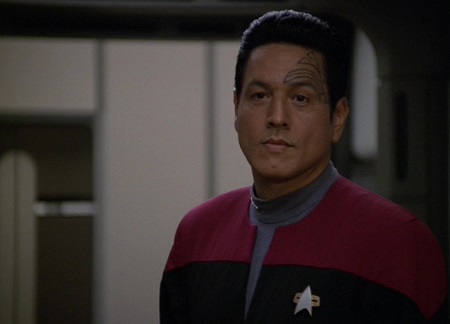
I’ve had my first dose of the COVID-19 vaccine!

It’s been almost a full year since the coronavirus pandemic hit the UK in a major way. In late March last year I was advised by the National Health Service that I’m classified as “clinically extremely vulnerable” to COVID-19, and more likely to suffer serious complications from this nasty illness. That didn’t come as a surprise to me – and if you’ve been a regular reader here on the website you’ll know I’m in generally poor health. Because of my pre-existing health conditions I was put into one of the NHS’ priority groups to receive the coronavirus vaccine.

At the end of February I was given my vaccine appointment, and I promptly attended it. The UK’s vaccine rollout has been one of the best in the world, and the NHS deserves a huge amount of credit for the way they’ve handled things. Though there can be reasons to criticise the bureaucracy at the NHS sometimes, there can be no denying that, in this case, having a centralised system has helped immensely. Once the NHS got the ball rolling on vaccinating folks late last year, it became an unstoppable juggernaut, and the UK looks to be on course to have vaccinated everyone who could be vulnerable to coronavirus in short order, with the remainder of the population also vaccinated in time for summer.

I’ve had my first dose of the vaccine!

My vaccination appointment went incredibly smoothly. I arrived on time, and was guided to the right entrance to the health centre by one of a number of volunteers. Once inside I gave my name and date of birth, and was handed a card which noted the batch number of the vaccine. From there I waited in the queue for less than five minutes, at which point I was ushered into a room, answered a couple of questions, and within literally 30 seconds of sitting down the needle was in my arm. And that was that. A very efficient process indeed!

Nobody likes getting an injection, and I will admit that my arm was a little sore in the hours after my appointment. But feeling the needle go into my arm was actually an incredible moment. After a year of shielding myself at home, not interacting with friends or family except online, and not being able to go anywhere or do anything, it was cathartic. It felt like the first step toward a return to normal life, and after the year we’ve all had, I’m more than ready for that!

I wasn’t sure whether or not to share my vaccine experience. This website is really a forum for me to discuss entertainment topics, so it isn’t really a good fit, nor is it something I would usually talk about. But unfortunately the coronavirus pandemic has seen a number of conspiracy theories propagated, including an expansion of anti-vaccine conspiracy theories. In whatever small way I can, I wanted to lend my voice and share my experience to re-emphasise that this vaccine is safe and to push back against anti-vaccine narratives.

In some communities, the reappearance of previously-eradicated diseases like measles, rubella, and even polio is directly and unquestionably attributable to anti-vaccine conspiracy theories, and many of these same conspiracy theory proponents have begun arguing against the COVID-19 vaccine. This is incredibly dangerous.

Protesters in the UK during the pandemic.

Vaccines don’t just work on an individual basis, they work en masse. The more people who get vaccinated, the less chance a disease can break out because human-to-human transmission becomes impossible. Vaccines are not 100% effective on a personal level; they don’t provide everyone with protection due to various factors. It’s therefore up to all of us to protect one another. Receiving the vaccine is about so much more than just protecting yourself – it’s a civic responsibility to protect everyone in society, including those with serious illnesses or compromised immune systems who cannot receive the vaccine for themselves.

This is what many anti-vaccine folks seem to miss – and indeed what many anti-mask or anti-lockdown folks have missed throughout the pandemic. So let’s be very clear: it isn’t just about you. The actions that we take at a moment like this have the potential to affect everyone in society, and the effectiveness of any vaccination programme relies on as many people as possible receiving their dose when it’s their turn.

The sooner we’re all vaccinated, the sooner life can return to normal.

I’m not the only one to have been vaccinated. My elderly parents both received their first doses a few weeks ago, and a number of other friends and relatives have had theirs too. Nobody I’m aware of suffered any ill effects, and I can say with confidence that the vaccine is safe. I know there’s a lack of trust in our governments, leaders, politicians, and even scientists, and part of the reason why conspiracy theories in a general sense have become accepted by some folks is because of that mistrust. I don’t know how to counter that in the long run, nor what the consequences may be.

All I can say today is that I went to my appointment. I took the jab. I got vaccinated. There were no ill effects, no complications. The vaccine is safe, and I’m not saying that because of the result of a scientific study or because a politician said so. That’s my own lived experience. I truly hope that when it’s your turn, you’ll get vaccinated too. Then we can put all of this nonsense behind us and get back to living our lives.

There are several different COVID-19 vaccines available, with more on the way. When you can expect to receive your dose will depend on where you live, how old you are, your general state of health, and other factors. This article contains the thoughts and opinions of one person only and is not intended to cause any offence.
Can Epic Games reinvigorate Fall Guys?

This article was originally going to be titled “Can Season 4 reinvigorate Fall Guys” – but that was before the announcement that Epic Games had bought developer Mediatonic! However, many of the points I planned to make still apply in some form, and in addition we have the buyout and its associated effects to consider. So settle in as we talk about the hit party game of the summer – last summer, that is – Fall Guys: Ultimate Knockout!

A few days ago I put Fall Guys on my list of games that deserve a second look in Spring 2021, and despite some of the criticisms I have of the game, I stand by that. Fall Guys is plenty of fun, and the addition of new rounds and changes to existing rounds has extended the game’s longevity. I recently got back into playing after taking a break over the holidays, and I’ve been having fun with it all over again. There is a lot to love about Fall Guys, but there’s also no denying that right now, the game’s survival hangs in the balance.

Is Fall Guys going to survive, or did Epic Games waste their money?

This is nothing to do with the Epic Games acquisition. Fall Guys was struggling long before that was announced, and my original plan for writing this article was to look at the possibility of Season 4 bringing players back. That’s something Fall Guys needs to address urgently. They have a good social media team, being active on Twitter and elsewhere every day, churning out memes and one-liners of the sort that a modern social media manager for an online game should. But it doesn’t seem to be having much effect.

Fall Guys blew up when it was launched last August, but almost as quickly as it arrived on the gaming scene, most of its players abandoned it. On Steam, Fall Guys peaked at around 125,000 concurrent players in August last year, and sold over 2,000,000 copies within a few weeks of launch. But as of yesterday, when I checked its progress on Steam, it had fallen to fewer than 6,000 concurrent players, with a maximum for the day of fewer than 10,000, and was barely clinging on to the top 100 most-played games on the platform, occupying the 100th slot.

Fall Guys was the 100th-most played game on Steam at time of writing.

To put that into context, Fall Guys had fewer players than titles like Civilization V, The Sims 4, Skyrim, Star Wars: The Old Republic, and even a title I’d never heard of called Geometry Dash, which is a port of a mobile game that originally launched in 2013. Ouch.

As a player, this has become noticeable. Though most games I play are usually fully-populated (with 55-60 out of a maximum of 60 players) it can take several minutes of waiting just to begin a game, with long loading times in the queue as the game struggles to assemble enough players. With no cross-platform play between PC and PlayStation, this is obviously beginning to become an issue. One of the highlights of Fall Guys – something I praised it for back in August – is that because rounds are so short, losing or failing to qualify doesn’t feel so bad. All you had to do was jump immediately into the next one! But if you have to wait several minutes at a time to even just begin a game, one of the absolutely vital components of Fall Guys is lost, making it significantly less enjoyable. Not only are the waits themselves frustrating, but losing at a round risks becoming frustrating too – because you know if you don’t qualify it’ll take a while to start a new game.

So what caused Fall Guys to lose much of its playerbase? That’s the key point, because addressing it – if indeed that’s even possible – is the key challenge facing Mediatonic and Epic Games.

Jump Club, one of the better rounds.

As much as I hate to say this about a game I’ve come to greatly enjoy, the fundamental problem is that Fall Guys was a “release now, fix later” title. I’ve talked at length here on the website about the live service business model, and how the ubiquity of internet connections has led developers and publishers to push out games that weren’t quite ready with a view to improving them later. It almost never works, and Fall Guys, as much as I love the cute little title, is an example of that phenomenon too.

Firstly, Fall Guys launched with no anti-cheat software. I know that it’s scummy and pretty disgusting for a basement-dwelling low-life to cheat at a fun little game like this, but realistically, developers Mediatonic and original publisher Devolver Digital should have anticipated it. Cheating happens in any online game, and if you give players even the tiniest opportunity, some will cheat. Playing Fall Guys before the addition of anti-cheat was not fun, because what was the point in progressing through the rounds only to lose in the finale to an invincible cheater or a cheater who can simply fly above the course?

Cheating was a problem in Fall Guys on PC for a while.

The cheating problem pushed players away, just as I said it would when I discussed Fall Guys’ impending Season 2 update back in September. When I’ve spoken to people about the game or seen comments on social media, aside from the “dead game” memes the one thing that seems to come up most often is that people remember how Fall Guys had a cheating problem. Folks don’t know that’s been solved because most didn’t stick around, preferring to move on to games that weren’t plagued by cheating. The game should never have been released without anti-cheat software, and that’s perhaps its biggest mistake.

The rise of Among Us stole Fall Guys’ thunder in some ways, even though the two titles aren’t really comparable from a gameplay perspective. But there is a vague aesthetic similarity between the crewmates in Among Us and the jelly beans in Fall Guys, so it’s worth considering why Among Us is doing so well while Fall Guys appears to be in decline.

Among Us is one quarter the price of Fall Guys, at least on PC. On mobile or tablet, the game is free. Among Us is available everywhere, compared to Fall Guys which is currently only on PlayStation 4/5 and PC. Among Us has never had a cheating problem.

Among Us came from nowhere to overtake Fall Guys.

Both games had the potential to break into the mainstream and become ongoing successes, but only Among Us really has. The biggest factor in its favour is its ubiquity, particularly its availability on mobile devices and tablets, which are the platform of choice for many younger players. This enabled the game – which was originally released in 2018 – to become so popular. The fact that it’s free-to-play helps immensely too; younger gamers in particular are always on the lookout for free titles, which goes a long way to explaining the success of Epic Games’ mainstay: Fortnite.

When considering Fall Guys’ release, one huge factor preventing it growing was the natural ceiling on its playerbase caused by not being available on every platform. There was no Xbox or Switch release, and while those platforms are now scheduled for this summer, that’s a year too late. Without knowing more about the technical side of the game I can’t say for sure whether it would be possible to port it to mobile devices, but if that were possible then obviously that would open up the game still further.

Fall Guys is finally coming to Switch – but not till the summer.

Nintendo Switch is the platform I would have chosen to prioritise if I were in charge of Fall Guys’ development and release. PlayStation 4 has a larger install base, but Switch players are, I would suggest, more interested in this kind of fun pick-up-and-play party game on the whole. With over 60 million Nintendo Switch consoles having been sold, that’s a massive potential playerbase that Fall Guys missed at launch – and will continue to miss until this summer. By then it could be too late.

An online game that barely breaks 10,000 concurrent players is not doing well, and while that doesn’t account for PlayStation 4 players, it’s hard to imagine the game is doing significantly better on its only other platform. There are still people interested in Fall Guys, and there are still new players jumping on board, but the big challenge facing Epic Games and Mediatonic as they begin their partnership is shoring up the playerbase and bringing in as many new players as possible. Fall Guys was a hit last summer. Whether it can be a hit again is up to its new owners.

Season 4 is coming soon, promising new rounds and new cosmetics with a futuristic theme.

So what needs to happen to bring players back? The launch of Season 4, with new cosmetics and new rounds will be a good start. But there needs to be more of that, with the game basically being continuously updated. New rounds and new round variants are good, but there could also be timed events, such as the recent double-kudos offer, competitions focusing on one aspect of the game (like a fixed set of rounds, for example) and other such things that will incentivise players to keep coming back.

Animal Crossing: New Horizons is the polar opposite of Fall Guys in so many ways, but one thing New Horizons gets absolutely spot-on is the incentives it offers players to log in at least once per day. Fall Guys needs to find some kind of hook, some way to keep its players checking in often. Once they’ve sorted that – which is no small task – bringing in new players is priority #2.

Ski Fall, another of the rounds in the game.

Releasing the game on Switch and Xbox is a good start, but I’d love to see mobile devices too if at all possible. Then there absolutely needs to be cross-platform play. If Sony remains intransigent about this – as they often are – then cross-play could be between Xbox, Switch, and PC only. But it has to be in there somehow, because splitting up the already small playerbase into walled gardens by platform makes those wait times mentioned above more noticeable. If PC players could join PlayStation 4 players right now, today, I bet those wait times would be cut at least in half. And that in itself would make the experience more enjoyable, keeping existing players around for longer.

One thing that Mediatonic teased in their announcement of their deal with Epic Games was a possible free-to-play model. To me, this is a double-edged sword for a game like Fall Guys. While it would undoubtedly bring in more players, it would mean the game would have to find an alternative way of making money, and in the games industry that only means one thing: microtransactions.

Fortnite is a free-to-play game that makes all its money via microtransactions.

Fall Guys has always offered the ability to buy in-game currency, yet it’s never felt intrusive or obligatory. The game is very generous with in-game rewards and items earned through basic gameplay, and I would hate to see that disappear or for cosmetics to be locked behind a paywall in future. Part of the fun of Fall Guys has been earning cosmetic items through gameplay, or earning in-game currency through gameplay and trading that for cool items in the in-game store. Going free-to-play would mean all of that would change, and while it would unquestionably attract more players, I’m not sure the change would be a good one.

With all of the controversy that lootboxes and randomised rewards generate these days, I would hope that even Epic Games wouldn’t try to force them into Fall Guys, but that remains a risk. From a PC player’s perspective, I’m also concerned that Fall Guys may eventually be withdrawn from Steam – Epic Games has its own store and PC client, after all, so why would they leave Fall Guys on their competitor’s platform? This may seem extreme, but it’s exactly what happened to Rocket League. That game used to be available on Steam, but following an acquisition by Epic Games it was withdrawn. The game technically still exists on Steam for players who already owned it prior to its withdrawal, but an Epic Games account is required to play, and new players can’t add it to their Steam libraries. While Mediatonic promised in their statement that this isn’t part of the plan for Fall Guys, it’s hard to see that being sustainable if the game survives into the longer term. Sooner or later, Epic Games is going to want to monopolise its purchase, just as they do with other games that they own.

Time will tell if this was a good idea for Epic, Fall Guys, and the players.

Removing Fall Guys from Steam would run counter to everything we’ve discussed about trying to retain players and expand the playerbase, so the game may be safe in the short term. But watch this space, because it feels inevitable that Fall Guys’ presence on Steam is doomed!

So to answer my original question: can Epic Games reinvigorate Fall Guys? The short answer is “maybe.” The game is a huge amount of fun, and bringing it to the Switch in particular feels like a natural fit, one which should bring in new players who are well-suited to enjoy this kind of cute, fun little title. But the game’s longer-term prospects are murky at best, and I’m surprised that a company like Epic Games would take a risk on a game which appears to be in a serious decline. Hopefully their involvement can stop the rot and turn things around. Fall Guys is such a fun game that it deserves to last longer than a few measly months.

Fall Guys is available now on PC and PlayStation 4/5, with launches on Xbox and Nintendo Switch planned for this summer. Fall Guys is the copyright of Mediatonic, Devolver Digital, and Epic Games. This article contains the thoughts and opinions of one person only and is not intended to cause any offence.

The odd criticism of Six Days In Fallujah

This article discusses the Iraq War and the Second Battle of Fallujah and may be uncomfortable for some readers.

One of the bloodiest and most controversial battles of the Iraq War was the Second Battle of Fallujah, which took place in November 2004. The battle saw coalition forces – most of whom were American, but there were a number of Iraqi and British troops who took part as well – capture the city from al-Qaeda and other insurgent forces. The Iraq War is controversial and its history complicated, and I’m simplifying the events of the battle and the war to avoid making this article about a video game too long. Suffice to say that even now, eighteen years since the United States led a coalition to defeat Saddam Hussein, and more than sixteen years since the Battle of Fallujah, the events are controversial, disputed, and the consequences of military action are still being felt in Iraq, the wider Middle East, and indeed the whole world.

Six Days In Fallujah is a video game depicting the battle from the American side, and when it was initially in development in the late 2000s it became incredibly controversial in the United States, with politicians and Iraq War veterans’ groups expressing opposition and disgust. The idea of recreating for fun any aspect of one of the most divisive conflicts of the last few decades was considered obscene, and the idea of encouraging gamers to play through a battle that took place, at that time, a mere five years earlier was too much for many people to countenance.

After the controversy boiled over and saw media personalities and politicians get involved in 2009, Six Days In Fallujah disappeared, and by 2010 or 2011 the project was effectively shelved. The critics moved on, the developers moved on, and that appeared to be the end of the matter.

Last month, however, there came the announcement from a studio called Highwire Games – which is said to consist of developers who worked on games in the Halo and Destiny franchises at Bungie – that Six Days In Fallujah was back. The game is now scheduled for a late 2021 release date, and plans to retain the original focus that was the cause of such controversy a decade ago. Cue outrage from the expected sources.

What took me by surprise was not the strength of feeling expressed by some veterans of the battle, nor the criticism by largely self-serving politicians. That was to be expected, and the announcement of Six Days In Fallujah went out of its way to highlight how Highwire Games has worked with veterans in particular – clearly anticipating this kind of reaction and trying to pre-empt some of the criticism. Instead what genuinely surprised me was the reaction from some games industry insiders and commentators, who appear to be taking an equally aggressive stance in opposition to Six Days In Fallujah.

Politicians, particularly those to the right-of-centre, have long campaigned against video gaming as a hobby. Initially games were derided as being wastes of time or childish, but some time in the 1990s the tactic switched to accusing games of inspiring or encouraging violence; equating in-game actions with real-world events. Numerous studies have looked into this issue, by the way, and found it to be without merit. But we’re off-topic.

Advocates of video gaming as a hobby – in which category I must include myself, both as someone who used to work in the industry and as an independent media critic who frequently discusses gaming – have long tried to push back against this narrative and these attacks. “Video games can be art” is a frequently heard refrain from those of us who support the idea of interactive media having merit that extends beyond simple entertainment, and there are many games to which I would direct an opponent to see for themselves that games can be just as valid as works of cinema and literature.

To see folks I would consider allies in the fight for gaming in general to be taken more seriously calling out Six Days In Fallujah because of its controversial subject matter was disappointing. Art, particularly art that deals with controversial current and historical events, can be difficult and challenging for its audience – and it’s meant to be. A painting, photograph, novel, or film depicting something like war is sometimes going to challenge our preconceptions and ask us to consider different points of view. That’s what makes art of this kind worthwhile. It’s what makes everything from war photography to protest songs to the entire genre of war in cinema incredibly important.

Documentaries and news reports only cover events in one way. The way we as a society come to understand events is partly factual but also is, in part, informed by the art those events inspire. The First World War is covered very well in history textbooks and newsreels produced at the time, but another side of the conflict – a more intimate, personal side – is seen in the poetry of people like Siegfried Sassoon and Wilfred Owen. The poems that they wrote about their wartime experiences were not pure depictions of fact, they were written to both inform and entertain – and perhaps to inform through entertainment.

If we relegate the Iraq War to contemporary news broadcasts and documentaries by the likes of Michael Moore we will miss something important, and so will future generations who want to look back and understand what happened. There are many works of fiction and non-fiction which attempt to show the big picture of what happened in Iraq, from the lies about “weapons of mass destruction” through to the use of banned weapons. Those works absolutely need to exist. But in a way, so does Six Days In Fallujah. It aims to depict, in as realistic a manner as game engines in 2021 will allow, one of America’s most controversial battles of recent decades – an event which will be seen in future, perhaps, as one of the American military’s darkest hours of the entire 21st Century due to their alleged use of illegal white phosphorus.

Getting as many perspectives as possible across as broad an array of media as possible about such an important event seems worthwhile, at least to me. Six Days In Fallujah may ultimately turn out to depict the event poorly, or be a game plagued by technical issues. It might be flat-out crap. But it really does surprise me to hear serious commentators and critics suggest that it shouldn’t be made at all, perhaps because of their own biases and preconceptions about the war and the game’s possible depiction of it.

There is value in art, and if video games are to ever be taken seriously as artistic expression, we need to make sure we allow difficult and challenging works of art to exist in the medium. That doesn’t mean we support them or the messages they want to convey, but rather that we should wait and judge them on merit when they’ve been made. As I said, Six Days In Fallujah may be a dud; an easily-forgotten piece of fluff not worth the energy of all this controversy. But maybe it will be a significant work that aids our understanding of the history of this battle, and the entire Iraq War.

It feels odd, as someone who lived through the Iraq War and all its controversy, to be considering it as an historical event, especially considering its continued relevance. I actually attended a huge anti-war march in London that took place a few weeks before British forces joined the US-led coalition and attacked Iraq. But the beginning of the Iraq War is now almost two decades in the past, and even as the world struggles with the aftermath of those events, we need to create works like Six Days In Fallujah if we’re ever to come to terms with what happened and begin to understand it. We also need to consider future generations – are we leaving them enough information and enough art to understand the mistakes our leaders made in 2003? If we don’t leave that legacy, we risk a future George W. Bush or Tony Blair making the same kind of mistake. I don’t know if Six Days In Fallujah will even be relevant to the conversation, but it’s incredibly important that we find out.

Six Days In Fallujah is the copyright of Highwire Games and Victura. This article contains the thoughts and opinions of one person only and is not intended to cause any offence.
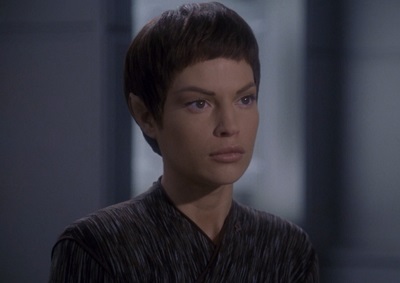
Fifteen games worthy of a second look in Spring 2021

Spoiler Warning: Though there are no major spoilers, minor spoilers may still be present for a few of the titles on this list.

Anthem is gone, Cyberpunk 2077 is still a stinking mess, and there are delays aplenty across the games industry as the pandemic rolls on. What’s a gamer to do? Well, I might have the answer for you! Tomorrow will be the first day of March, and to me March has always meant the beginning of Spring. There are small snowdrops beginning to bloom in my garden, and the nights are getting shorter. A few times this past week I’ve even managed without the heating on in my house – much to the dismay of the cats!

There are still plenty of great games that – all being well – will be released this year. If you missed it, I put together a list just after New Year of ten of the most interesting titles! But considering the delays and that this time of year is typically fairly quiet in terms of releases, I thought it would be a great moment to consider a few games that deserve a second look. I’ve limited the list to titles that are readily available to buy on current-gen platforms and PC, so no out-of-print games this time.

Without any further ado, let’s jump into the list, which is in no particular order.

Number 1: Mario Kart 8 Deluxe (Nintendo Switch, 2017)

Nintendo’s most recent karting game is a ton of fun. It’s the kind of arcade racer that has a very low bar for entry – anyone can pick up and play this fun title. But mastering Mario Kart 8 – especially if you choose to head online – is no small task, and there’s a surprising amount of skill involved to be truly competitive with the best players! I’ve adored the Mario Kart series since its inception on the SNES, and this version is the definitive Mario Kart experience… at least until they make Mario Kart 9!

Number 2: Fall Guys (PC and PlayStation 4, 2020, coming to Xbox and Nintendo Switch this summer)

Among Us gained a lot of attention not long after Fall Guys was released last summer and stole at least some of the cute game’s attention! The fact that Fall Guys isn’t on mobile probably counts against it as far as finding a broader audience goes, but despite what some have claimed, the game is by no means dead. Season 4 – which promises to bring a new set of futuristic rounds – is being released soon, and for less than £15 (at least on PC) I honestly can’t fault Fall Guys. It’s an adorable, wholly unique experience in which your cute little jelly bean character runs a series of obstacle courses in a video game homage to the likes of Total Wipeout. Each round lasts only a couple of minutes, and it really is way more fun than words can do justice to! I’ve recently got back into playing after taking a break, and there’s plenty of fun still to be had.

Number 3: The Elder Scrolls III: Morrowind (PC and Xbox, 2002)

You can find Morrowind on PC, and despite being an older title it’s compatible with Windows 10. There has been an active modding scene for almost twenty years at this point, so even if you’ve already played the base game it may still be worth going back for more. In my subjective opinion, Morrowind is the high-water mark of the Elder Scrolls series. It certainly offers players more to do than its predecessors or sequels – more NPCs to interact with, more factions to join, more types of weapons to wield and spells to cast, and so on. Especially if you hit Morrowind with some of the visual/graphics mods that are available, it can feel almost like a new game!

Number 4: Grand Theft Auto: Vice City (PC, PlayStation 2, and Xbox, 2002)

Another older title that you can find on PC, as well as on iOS and Android, Vice City was one of three Grand Theft Auto titles released between 2001 and 2005. Remember when Rockstar was able to put out more than one game per decade?! If you’ve had your fill of Grand Theft Auto V by now – and it’s been out for eight years, so I wouldn’t blame you if you were ready to play something else – maybe going back to one of the older games will be a nostalgic blast. Many fans of the series consider Vice City to be the best entry, and while I don’t think I’d go quite that far, I had a ton of fun with it back on the original Xbox.

Number 5: Banished (PC, 2014)

There are some great city-builders out there, but one of my favourites from the last few years is Banished. The game was built entirely by one person, which never fails to amaze me! It would still be a fantastic title if it had been made by a full studio, but the fact that the game and all its complex systems were programmed by a single developer is an astonishing achievement. Banished isn’t easy, even on lower difficulty settings, and it will take a little time to get into the swing of how to plan your town and manage your resources. But if you’re up for a challenge it’s a wonderful way to lose track of time!

Number 6: Skully (PC, PlayStation 4, Switch, and Xbox One, 2020)

Skully is a game that I’ve been meaning to write a proper review of since I picked it up last year, but it keeps slipping down my writing pile. From the moment I saw the trailer and heard the game’s premise – a 3D platformer in which you play as a disembodied skull – I was in love, and the game did not disappoint! The environments are beautiful and the game is plenty of fun. It manages to feel at points like an old-school 3D platformer of the Nintendo 64 era, and at others like a wholly modern experience. It’s also an indie title, and it’s great to be able to support indie developers wherever we can!

Number 7: Jade Empire (PC and Xbox, 2005)

If the demise of Anthem has got you missing the “golden age” of BioWare’s role-playing games, make sure you didn’t skip Jade Empire. The Xbox exclusive was overlooked by players in the mid-2000s, and while other BioWare games from that decade, like Knights of the Old Republic, Mass Effect, and Dragon Age Origins are all held in high esteem, the Chinese-inspired Jade Empire is all but forgotten. When Steam has it on sale you can pick up Jade Empire for less than the price of a coffee, and for that you’ll get what is honestly one of the best and most interesting role-playing games of all time.

Number 8: Star Trek: Starfleet Academy (PC, 1997)

Starfleet Academy is unique among Star Trek games because it features the cast of The Original Series in video clips recorded especially for the game. These aren’t scenes from films or episodes of the show; you literally will not see them anywhere else. Starfleet Academy is a starship simulator, and while its visuals obviously don’t look as good in 2021 when compared to other titles, the overall experience is fantastic. You won’t find another game quite like it – especially because ViacomCBS has all but given up on making Star Trek games since the release of Star Trek Online!

Number 9: Forza Horizon 4 (PC and Xbox One, 2018)

I signed up for Game Pass in order to be able to play racing game Forza Horizon 4 – and it was totally worth it! The Forza Horizon series attempts to find a middle ground between true racing sims and arcade-style titles, and generally manages to do so quite well. Forza Horizon 4 has a map which represents parts of Great Britain, and that’s something unusual! I didn’t see my house, but it’s always nice when a game uses a familiar setting. There are plenty of fun cars to race in, and different kinds of races too, including going off-road.

Number 10: Assassin’s Creed IV: Black Flag (Multiplatform, 2013)

Is it just me, or has every subsequent game in the Assassin’s Creed series struggled to hit the highs of Black Flag? Origins and Odyssey were decent, but even in 2021, I think that Black Flag is the definitive title in the franchise! There’s something about its pirate setting and the wonderful crop of NPCs that make Black Flag a truly enjoyable experience from start to finish. For a game that’s approaching its eighth birthday it still looks fantastic, too!

Number 11: The Last Of Us (PlayStation 3, 2013)

Despite its severely disappointing sequel, The Last Of Us is fantastic. If you’re looking for a game with amazing characters and a deep, engaging story, it simply can’t be bettered. I put The Last Of Us on my list of games of the decade as the 2010s drew to a close, and for good reason. Joel and Ellie’s trek across a hauntingly beautiful post-apocalyptic United States was absolutely one of the gaming highlights of the last few years. The characters are so well-crafted that they feel real, and every twist and turn in the intense storyline carries emotional weight. The game is being adapted for television, and I’m interested – cautiously so in the wake of The Last Of Us Part II – to see what will happen when it makes the leap to the small screen.

Number 12: Age of Empires: Definitive Edition (PC, 2018)

Though I know Age of Empires II is the title most folks prefer, I’ve always appreciated what the original Age of Empires did for the real-time strategy genre. If you’ve been enjoying the recent remake of the second game, it could be a great time to give the original a try as well. Age of Empires didn’t invent real-time strategy, but it was one of the first such titles I played after its 1998 release – and I sunk hours and hours into it in the late ’90s! There’s something about building up an army of Bronze Age warriors to smash an opponent’s town that’s just… satisfying!

Number 13: Star Wars Jedi: Fallen Order (PC, PlayStation 4, and Xbox One, 2019)

I played through Jedi: Fallen Order last summer and documented my time with the game here on the website. Suffice to say I had a blast; the linear, story-focused title is exactly what the Star Wars franchise needed after the Battlefront II debacle! Having just seen the dire Rise of Skywalker I was also longing for a Star Wars story that I could actually enjoy for a change, and Jedi: Fallen Order did not let me down! I had a great time swinging my lightsaber across a galaxy far, far away… and I think you will too.

Number 14: No Man’s Sky (PC, PlayStation 4, and Xbox One, 2016)

No Man’s Sky was incredibly controversial at launch. The pre-release hype bubble got wildly out of control, egged on by a marketing push that oversold the game. Remind you of any recent titles? But despite the backlash in 2016, Hello Games has since put in a lot of hard graft, and five years on No Man’s Sky genuinely lives up to its potential. Had it been released in this state I think it would have been hailed as one of the best games of the decade – if not of all time. I understand not wanting to reward a game that was dishonestly sold, and that the “release now, fix later” business model is not one we should support. But there’s no denying that No Man’s Sky is a great game in 2021, and if you haven’t picked it up since its 2016 launch, it could be worth a second look.

Number 15: Tony Hawk’s Pro Skater 1 + 2 (PC, PlayStation 4, and Xbox One, 2020)

A full remake of the definitive skateboarding game is hard to pass up! In the Dreamcast era, Tony Hawk’s Pro Skater launched an entire genre of skating games, and its amazing soundtrack is a nostalgic hit of late ’90s/early ’00s punk rock. The remade version, which you can pick up on Switch and the two new consoles later this year, is great fun, and has managed to do something rare for a remake: genuinely recapture the look and feel of the original title. Obviously the visuals are brought up-to-date, but the feel of the game and the way tricks are performed are fantastic. I was able to slip right back into playing as if I’d never put the Dreamcast controller down!

So that’s it. Fifteen games that I think are worth your time this Spring.

There are plenty of fun titles on the horizon, but some of the ones I was most looking forward to – like Kena: Bridge of Spirits – have recently been delayed, prompting me to look at my library and put together this list.

I hope this has inspired you to find something to play over the next few weeks! If not, stay tuned because there will be plenty more gaming-related articles here on the website. Happy gaming!

All titles listed above are the copyright of their respective studio, developer, and/or publisher. Some screenshots and promo artwork courtesy of IGDB. This article contains the thoughts and opinions of one person only and is not intended to cause any offence.

Some Star Trek updates for 2021-22

Spoiler Warning: There are minor spoilers ahead for Star Trek: Discovery Season 3.

In addition to the first teaser image for Star Trek: Prodigy, a recent update from ViacomCBS (that was primarily directed at their investors) has given us a couple of interesting bits of news regarding both current and future Star Trek projects. Today I thought it would be worthwhile to take a look at what was said and try to figure out what may or may not be coming our way in 2021 and the first half of 2022.

The most significant piece of news was that ViacomCBS plans to have something from the Star Trek franchise on Paramount+ every quarter. Since it’s already almost March I think we can rule out anything in Q1 this year! But that still potentially leaves us with three Star Trek projects before the end of 2021.

The teaser image for Prodigy, in case you missed it!

I said just after New Year that I believed we’d see both Prodigy Season 1 and Lower Decks Season 2 this year, and those will almost certainly be two of the three. With Discovery Season 4 having been in production since November, I have to assume that will be the third series planned for this year – perhaps targeting a Q4 broadcast like Season 3 received in 2020. That’s ambitious in my opinion – post-production work on Discovery Season 3 took over nine months to complete – but if ViacomCBS and Paramount+ can manage it, it will be a fantastic achievement! And it will mean one extra Star Trek show in 2021 that I wasn’t expecting!

If that’s the plan, that would then open up Q1 and Q2 of 2022, and it seems certain that we’d get Picard Season 2 (which has just started filming) and Strange New Worlds Season 1 in the first half of next year – probably in that order. So this current quarter could be the longest we’ll have to go without any new Star Trek for quite some time!

Picard and his new crew are coming back soon.

What will happen after that is in question, and this is where the other interesting bit of news comes in: ViacomCBS has no plans to produce any other Star Trek shows until those currently in production have concluded.

This seems to mean that the Section 31 series, which originally had a premiere date suggested for this year, is going to be delayed yet further, and I interpret comments by some of its writers and producers to mean that the series going ahead at all is less certain now than ever. Strange New Worlds completely stole the Section 31 show’s thunder, both before and after it was announced, and as I said a while ago, I never really got the impression that there was much excitement for Section 31. Many Discovery fans were clamouring for a Pike series almost from the first episode of the show’s second season, but Georgiou and Section 31, while not badly received, were very much the lesser part of that story overall.

Anson Mount recently cropped up in his Starfleet uniform in the ad campaign for Paramount+.

Georgiou’s recent departure from Discovery has set the stage for Section 31 – but it also left things very open as to where (and when) she will end up. Perhaps behind the scenes what’s going on is some major retooling of the Section 31 show’s premise; it had been suggested by Alex Kurtzman and others fairly recently that the scripts were still being worked on, and this feels like another indication of changes to the upcoming series.

So this unfortunately raises the question of the Section 31 show’s ultimate fate. Is this the first step to it being cancelled… or “un-announced?” It feels like it could be, sadly. Despite not being as interested in Section 31 when it was announced, I’ve recently come around to the idea of this kind of spy thriller. If done well I think it could be something really fun and different within Star Trek, and with it having been announced I kind of want to see it come into being. Even if it only runs for a single season, or gets cut down to a miniseries or television movie I still think it could be worthwhile.

Michelle Yeoh is set to return as Mirror Georgiou in the Section 31 series some time soon.

The longer-term futures of other Star Trek projects are less clear. No future seasons of any in-production shows were announced – though it seems likely, according to the rumour mill, that we’ll see Discovery Season 5, and Picard Season 3 was said to be there for the taking if Sir Patrick Stewart wanted it. Beyond the halfway point of 2022, though, Star Trek’s future gets a little harder to predict. We could see Lower Decks Season 3, Prodigy Season 2, or perhaps a new set of Short Treks mini-episodes.

What is clear, though, is that Section 31, the potential Ceti Alpha V miniseries that I covered a few weeks ago, and the still-unannounced live-action series that is in pre-production won’t be coming imminently.

ViacomCBS has “plans” for expanding Star Trek beyond the projects that we know about, though, and there was talk of ideas and concepts being worked on behind the scenes. Paramount+ is being established with a view to a widespread international rollout, which will begin next month with the USA, Canada, and Australia, before heading to Scandinavia and Latin America later in the year. Hopefully it’ll come to the UK soon!

Paramount+ launches next week.

Other recently-announced projects for Paramount+ include a Halo television series, a prequel to Western drama Yellowstone, a reboot of Nickelodeon cartoon Rugrats, and more. CBS All Access has grown its subscriber base since it was launched, passing the 8 million mark last year. The relaunch of the service as Paramount+, with its promised live sport and varied mix of films and television shows will surely bring in a lot of viewers – keeping Star Trek on the air for a long time to come.

These announcements were interesting, and I feel reasonably confident now that we’ll see three Star Trek shows this year instead of the two I had been expecting, so that’s fantastic! And I cannot wait for both Season 2 of Picard and the debut of Strange New Worlds next year. It’s a wonderful time to be a Star Trek fan right now – we have literally never had so many different projects all on the go at once. Someone pinch me… I must be dreaming!

The Star Trek franchise – including all properties mentioned above – is the copyright of ViacomCBS. This article contains the thoughts and opinions of one person only and is not intended to cause any offence.

Star Trek: Prodigy – First Look!

Yesterday ViacomCBS showed off the first piece of promotional artwork for the upcoming child-friendly series Star Trek: Prodigy. And it looks good… or at least, I think it does. I’m not completely sure!

Let’s take a closer look at the teaser image and try to break it down:

The first and most obvious thing to me is that none of the characters look like anything we’ve seen before in Star Trek. My first thought was that it looked rather Disney-esque due to the art style, so that was a positive. But then the more I looked at it I couldn’t get away from one word in particular: “generic.”

These characters don’t exhibit any Star Trek visual traits, and thus they feel like they could be part of any sci-fi universe. You could tell me these are characters from a Star Wars show, a show set in the world of Mass Effect, Avatar, Marvel or DC Comics… you get the picture. Nothing about it screams “Star Trek” to me, and as a result the characters feel very generic; fun and well-designed sci-fi characters for sure, and with a cute art style, but not necessarily from Star Trek. The only character who could possibly be from an established Star Trek race is the tall figure in the middle (third from the left). They could be from the same race as Jaylah – the character from Star Trek Beyond.

This character is giving me Jaylah vibes.

I suppose it’s possible that the large scaly or mineral-encrusted alien on the right is supposed to be something like a Horta (from The Original Series Season 1 episode Devil in the Dark). That feels like a stretch, though, as it would be a significant departure from the only previous depiction of a Horta.

We also have three other aliens of unknown races, including one second-right who appears to be comprised of some kind of liquid or gel. This blue alien is perhaps my favourite design, and one of the great things about animation is that it allows for more “alien-looking” aliens than live-action. That’s something we saw in Lower Decks as well. This character is cute, and perhaps because of the colour scheme I’m getting kind of a Moana vibe.

My favourite!

The far left seems to show a sentient robot, and this is the character who feels most like they’ve been imported from Star Wars! I’m also curious what kind of character a synth or robot could be in a show that’s supposedly primarily about kids – we’ve never really seen a child robot before. They look friendly, though, so that’s a plus!

Notable by her absence is Captain Janeway – the only named character we know of in Prodigy at this stage. I was surprised not to see her depicted in this first piece of promotional artwork given the big announcement made a few months ago that she was joining the series. Janeway is potentially one of Prodigy’s biggest draws – especially for long-time Trekkies – so giving her some kind of role in pre-release marketing would make a lot of sense.

Captain Janeway wasn’t part of this teaser image.

We didn’t get any character names to go with this image, so we don’t know who’s who or what roles they might end up playing on the series. I would guess that the tall figure in the centre is the leader of this gang of kids, and the apparel of the figure second-left suggests he could be an engineer of some kind. Those are just guesses, though, and I have no idea about the others!

What the release of this little teaser may mean is that Prodigy is well underway. The image was revealed at a promotional event for investors in the run-up to the launch of Paramount+ next week, and while it doesn’t seem like Prodigy will arrive on the day the service officially launches, all being well we’ll see it later this year.

Star Trek: Prodigy is coming to Paramount+.

I like the art style chosen for this project. 3D computer animation can look great, and these characters have a style that’s in line with other modern projects aimed at kids. Perhaps we can say it isn’t unique – as mentioned I think it feels rather generic for a Star Trek production – but there’s plenty of positives to take away from the visual style. I’ve already picked a favourite character – the blue liquid one! I’m a little disappointed that there wasn’t an obvious Star Trek race included, nor any other significant Star Trek elements in the image. There are no combadges, for example, nor phasers, tricorders, etc. So while the characters look great and the art style is cute and fun… I’m left feeling that something important is missing.

I know it’s a show for kids, but the best kids shows have something to offer adults too, and this is something ViacomCBS has been promising since this project was announced. I’m sure as we get to see more of these characters, learn who they are, and see the ship that they’re going to “commandeer” for their adventures that the elusive sense of “Star Trek-ness” will come into focus. Maybe it was too much to ask from a single teaser image!

A robot and an alien.

So this was an interesting first look – a glimpse, really – at Prodigy. The art style looks to be cute and fun, and while I wasn’t hit with a strong sense that the characters are part of the Star Trek franchise, and I’m curious as to why Janeway was left out, it was certainly interesting to see. From the point of view of producing a show for kids, I think there’s a lot for kids to get excited about with these characters. Though not necessarily “Star Trek,” the characters are visually interesting and would convert well to toys, dolls, and playsets. The diversity present in these designs should help each character establish a personality and on-screen presence, and that’s a positive thing.

Hopefully we’ll get to know more about these folks soon!

Star Trek: Prodigy is currently in production and will debut on Paramount+ in the United States and other territories where the service is available. Further international distribution has not yet been announced. Star Trek: Prodigy is the copyright of ViacomCBS and Nickelodeon. This article contains the thoughts and opinions of one person only and is not intended to cause any offence.

So long, Anthem…

After months of speculation, Electronic Arts and BioWare finally confirmed what every gamer and games industry watcher has known for ages: Anthem is dead. Rather than spend even more money on this failure, EA have opted to cancel any remaining plans that they had in the pipeline in order to focus on other projects. And while it may be disappointing to Anthem’s five or six remaining loyal players, it’s unquestionably the right decision.

What was clearly the wrong decision, though, was releasing this mediocre title in the first place. And stepping back even further than Anthem’s troubled 2019 launch, we can argue that it was the wrong decision to push a studio like BioWare – renowned for their single-player role-playing games – to create a “live service” multiplayer action-shooter in the first place.

Anthem was developed by Canadian EA subsidiary BioWare.

Game developers and studios have to be allowed to innovate; without trying new things there would never be any progress in video game development, and that wouldn’t be a good thing. But when a studio has a proven track record at making a certain style of game, their publisher or the company who owns that studio pushing them to do something entirely outside that wheelhouse can lead to difficulties and problems.

The developers at BioWare simply did not have the multiplayer experience, the action-shooter experience, or the necessary knowledge of EA’s Frostbite game engine to put together an ambitious title like Anthem. And while senior BioWare managers may have felt, in 2012 when Anthem was first conceived, that they had a new and unique idea, the “live service” concept had been done and done again by the time the game finally stumbled out the door.

Anthem promo art.

Anthem was boring. It was an uninspired shooter whose every in-game system and mechanic had been done before by someone else – and done better. BioWare’s final saving grace when dealing with lacklustre gameplay was the studio’s ability to craft great stories and bring wonderful characters to life – but they failed at that too, and Anthem ended up offering little more than a decently pretty environment. That just isn’t good enough, and players quickly put down this disappointing experience, never to pick it up again.

When Anthem’s “roadmap” of additional content was scrapped in late 2019, that was it. No one who follows the games industry was seriously expecting EA and BioWare to successfully revive the game – and if anyone did, I’ve got a bridge to sell them! All this talk of “Anthem Next” was a cynical attempt by these companies to convince the few remaining Anthem players to stick around and keep spending money in the game with promises of more features and updates. I seriously doubt that EA ever intended to make good on the promise of an overhaul and update of the game; that was nothing more than meaningless empty words designed to exploit those few remaining fans.

A javelin seen in promo artwork.

After more than a year of living through the coronavirus pandemic I am sick to the back teeth of companies using it as an excuse for whatever the problem of the day is. In their curt blog post announcing the end of Anthem, BioWare attempted to shift the blame onto the pandemic, suggesting that it played a role in this decision. I call bullshit on that. This was a business decision, plain and simple, and it was one that was almost certainly taken a very long time ago.

The reality is that Anthem, like Mass Effect: Andromeda before it, was dead on arrival. The game has been kept on life support for two years, with players fed a steady diet of lies and promises that EA and BioWare had no plans to make good on. Such is the reality of a “release now, fix later” game. So much for being the “Bob Dylan of video games” – a statement so stupid, by the way, that I can scarcely believe anyone at BioWare actually said it.

Anthem was supposed to be the video game equivalent of Bob Dylan.
Photo Credit: The White House from Washington, DC, Public domain, via Wikimedia Commons

Anthem needs to be a lesson, not just for BioWare and Electronic Arts but for the games industry in general. You can’t release a mediocre game and convince people to stick around in case it gets good later. “Release now, fix later” categorically does not work. The legacy of Anthem needs to be that better games are released in the wake of its failure.

If a game is not in a good enough state, it should be delayed and not forced into a release window to meet some arbitrary deadline. Big companies like Electronic Arts can absorb the costs of prolonging development if it means that the game will eventually launch to critical acclaim and commercial success. By forcing Anthem to be released when it was simply not ready, Electronic Arts snatched defeat from the jaws of victory and pissed away a huge amount of money.

Another piece of promotional artwork.

Anthem was never financially viable. No multiplayer game that loses 90% of its playerbase in a matter of weeks can possibly be sustainable, which is another reason why I’m convinced that all this talk of a “renewal” or update to Anthem was never serious on the part of EA and BioWare. The sad thing is that there was potential in Anthem. Had it been a project that was handled differently its flying “Iron Man” suits and brand-new sci-fi world could have gone on to be held up alongside franchises like Mass Effect or Halo. But a series of poor decisions across its development meant that wasn’t possible, and it seems unlikely at this stage that Anthem’s world will ever be revisited.

What this means for Anthem’s remaining players is that it’s over. It’s time to jump ship and not spend another penny on any in-game microtransactions. While BioWare have promised to keep the servers running for now, in reality it’s only a matter of time before they’re shut down and the game is gone forever. There are other, better games out there to play, so if you’re one of those few remaining players, have a look for something else to play instead.

A javelin underwater.

For BioWare this is a double-edged sword. On the one hand it potentially frees up a handful of developers to work on the next Dragon Age game, Mass Effect 4, and whatever else may be in the pipeline. On the other hand it confirms what we’ve all known for a while – the studio has released two failures in a row. Electronic Arts, rather like Google, has a reputation for shutting down unsuccessful studios and killing projects that aren’t bringing in enough money. There was already a lot of pressure on BioWare to get their next project right – and that pressure has just increased.

I don’t think we should celebrate the demise of Anthem – but I don’t lament it either. The game was a waste of potential, it damaged the reputation of a studio previously held in high esteem, and serves as yet another example of why this “release now, fix later” trend is such a mistake. Hopefully the lessons of Anthem will be learned so that better games will be made in future. That’s its only shot at a legacy.

Anthem is the copyright of Electronic Arts and BioWare. This article contains the thoughts and opinions of one person only and is not intended to cause any offence.

The Mass Effect trilogy – ranking Shepard’s squadmates

Spoiler Warning: There are spoilers ahead for the Mass Effect trilogy.

With Mass Effect: Legendary Edition on the horizon I thought it could be fun to go back to the Mass Effect trilogy and look at Commander Shepard’s comrades. Though I have no immediate plans to buy Legendary Edition – it looks like a pretty unimpressive upgrade, in my opinion – its existence has nevertheless prompted me to look back at its three constituent games. There were some absolutely wonderful characters who were well-written in all three parts of the Mass Effect trilogy. Without these characters to interact with, the world of Mass Effect would feel smaller and far less immersive.

However, there were also a handful of major characters who were less interesting, bland, useless in combat, or who got too little screen time for us to really get to know them. So there’s plenty of ammunition to put them into an internet-friendly numbered list! I’m excluding the squadmates from Andromeda, because that game was less fun across the board, and I’m also excluding the two characters who were only playable for a short time during the Omega DLC for Mass Effect 3. Otherwise all characters from the first three games are here – including those who were only available as DLC when the games were new. Legendary Edition will have all of them, so I’m happy to feature them all here.

Legendary Edition is coming soon.

As I always say, these things are subjective. If you don’t agree with how I regard a certain character, that’s okay! One of the great things about games like the Mass Effect trilogy is that they allow for player choice and different ways to play. We don’t need to fight or argue over which character is best!

With that out of the way, let’s jump into the list!

Number 19: Zaeed Massani

Somebody has to be in last place, and unfortunately for me it’s Zaeed. There are a couple of reasons why that’s the case, but it boils down to him feeling like an afterthought for most of Mass Effect 2. He doesn’t have any especially interesting dialogue or banter, either with Shepard or with anyone else on the team. When you approach him in the cargo hold of the Normandy (where he spends his down time) the “conversations” you can trigger with him aren’t even full cut-scenes, they’re just lines of dialogue heard over the top of gameplay.

Zaeed’s loyalty mission was okay, but it almost always required players to take the renegade path in order to be sure of winning his loyalty. There is a possible way to get through it with a 100% paragon outcome, but the required conversation check is so high that I’ve never been able to manage it. This cuts into the short mission’s replay value and leaves it feeling pretty bland. Like everything else involving Zaeed, the loyalty mission feels like it was thrown together as an afterthought.

For a DLC character, Zaeed is not well-integrated into the main game. Other DLC characters and missions flow naturally into the games they’re part of, but Zaeed and his loyalty mission feel tacked-on. He had the potential to be a fun character; a gruff mercenary veteran who’s seen it all. But that potential feels rather wasted.

Number 18: Liara T’Soni

Sacrilegious though it may be to some Liara superfans, I’ve never really liked the Mass Effect trilogy’s main asari character. In Mass Effect 1 she was perhaps at her best, but even then managed to feel less interesting and less relevant to the mission at hand than other squadmates. But her strange turnaround in Mass Effect 2 from mild-mannered student of history to hard-nosed information dealer just felt out of place. And as much as I enjoyed the Lair of the Shadow Broker DLC from a gameplay perspective, making Liara the new Shadow Broker is something which again felt wrong for her character.

There’s such a disconnect between the Liara we get to know and the shady world of information broking that she inhabits beginning in Mass Effect 2, and while I admire the creative decision to try to do something consequential with a character who otherwise felt like unnecessary fluff, for me it didn’t work and actually made matters worse.

As a biotic squadmate, Liara was most useful in Mass Effect 1, where only Kaidan was also able to use some biotic powers. By the second two games, though, her biotics felt less impressive – especially having seen what Jack and Samara can do! I don’t hate Liara, but a combination of some odd character decisions and the existence of other, more interesting squadmates means she ranks pretty low down on my list.

Number 17: Grunt

If we’re talking about Grunt’s overall story, perhaps I could rank him higher on the list. His role in Mass Effect 3 was certainly more interesting, as he led a team of krogan warriors to hunt for the rachni. But looking at him purely as a squadmate in Mass Effect 2, which is his only appearance in that capacity, he’s just not the most interesting character.

His backstory is certainly different, and perhaps was a way for the writers to try to differentiate him from Wrex. But there’s no getting around the fact that, for me at least, Grunt never manages to step out of that shadow; he always feels like a generic stand-in for Wrex. That said, I enjoyed Grunt’s loyalty mission in Mass Effect 2, as battling against a giant worm-monster was a ton of fun!

Number 16: James Vega

I feel a little bad for James Vega, who was voiced by established actor Freddie Prinze Jr. Vega came late to the party, and I think part of the reason for the negative reaction some fans had to him in Mass Effect 3 is that they were hoping for the return of more characters from Mass Effect 2 instead of someone new.

Despite that, however, James Vega was okay. For new players picking up the series for the first time, his newness may have helped them find their footing in an established, ongoing story, and characters playing that kind of role do serve a purpose. The Citadel DLC fleshed James out more and gave him a bit more to do than the base game, which was certainly to his overall benefit, but despite that he still isn’t an especially memorable character.

Most other characters in the trilogy elicit some kind of reaction from me, even though it’s been probably five years or so since I last played the games. But James Vega really doesn’t. He’s just… there. A background character. And there’s nothing wrong with him at all, unlike those lower down this list he isn’t bad. He’s just… forgettable.

Number 15: Ashley Williams

I don’t particularly dislike Ashley – though I would usually choose Kaidan at that moment in Mass Effect 1 – and on my first playthrough as male Shepard I think I chose her for Shepard’s romance option. She’s fine as a character, but is a bit limited as a squadmate because she can’t really do much beyond shoot.

Most squadmates have some kind of truly useful ability beyond their weapons that can make a difference in combat. Late in Mass Effect 1 Ashley can unlock “First Aid,” which, as you might expect, allows her to heal Shepard. But this uses medi-gel, which is a consumable item that isn’t unlimited in supply, rendering a potentially-interesting ability far less useful. This skill is also gone if Ashley survives to Mass Effect 3, where she can just shoot and throw grenades. If you’re going up against a heavily-armoured boss she can be useful – but most of the time I’m looking for a squad with a broader range of talents.

That’s more to do with the way I play the games than a criticism of Ashley herself, I suppose!

Number 14: Miranda Lawson

Though I have nothing against Miranda, it really isn’t until Mass Effect 3 where her story truly pays off – and by then she’s no longer a squadmate. She fills an interesting story role in Mass Effect 2, overseeing Shepard’s mission on behalf of the Illusive Man and Cerberus, but because of both her station on the Normandy and her natural disposition, she and Shepard tend to keep one another at arm’s length – even after her loyalty mission to save her sister.

The loyalty mission is one of the better ones, I think, and Miranda is a multitalented squadmate, capable of using both tech and biotic powers. During the Suicide Mission, Miranda is one of the possible candidates to lead the second squad at the beginning of the assault on the Collector base (assuming she remains loyal) and thus she’s a versatile all-rounder as a squadmate.

Miranda is at her best in Mass Effect 3, though, and that game goes a long way to paying off her character arc – both with her family and with Shepard.

Number 13: Samara

I love Samara’s “Reave” ability, which can be unlocked after securing her loyalty. It’s one of the most powerful biotic powers in the entire game, and can be incredibly useful when on the back foot. Samara also has one of the more interesting loyalty missions in Mass Effect 2, one which is largely nonviolent. In an action-RPG that may seem odd, but these quieter, story-driven moments make the Mass Effect series what it is, at least in my opinion.

Samara also proves invaluable during the Suicide Mission, as one of only two biotics (the other being a fully-upgraded Jack) capable of safely escorting Shepard’s squad through a dangerous part of the base. The only reason I wouldn’t put her higher up the list is because she’s a character recruited well into the second half of Mass Effect 2, and thus has fewer options to join Shepard on missions.

Her story of chasing down her rebellious daughter, and then trying desperately to save her other daughters during the Reaper war, is one of the trilogy’s most interesting – and tragic.

Number 12: EDI

The Normandy’s AI is able to acquire a body and thus becomes a potential squadmate early into Mass Effect 3. EDI was already fun thanks to her dynamic with Joker, the Normandy’s pilot, but being able to take her on missions added an extra dimension to her – as did her dialogue during downtime on the Citadel.

As with Samara’s “Reave,” EDI’s “Defense Matrix” ability can be a lifesaver when the chips are down and you’re facing a difficult battle! The “best” possible ending to Mass Effect 3 sees the destruction of the Reapers – but along with them all other forms of artificial life. EDI almost certainly doesn’t survive in such a scenario, and that adds an extra level of complexity to the endgame given that players have spent two full games with her by that point.

Number 11: Jacob Taylor

Jacob is all business during his time on the Normandy, and I think some fans were put off by that in Mass Effect 2. Unlike other main squadmates, large parts of Jacob’s backstory are told not in the main trilogy but in Mass Effect Galaxy (a mobile game released in between the first and second titles) as well as in comic books. Perhaps that’s part of why he can feel a little barebones in the main game.

However, Jacob provides Mass Effect 2 with one of the best loyalty missions, tracking his father’s crashed starship to a remote planet. Not only is the setting beautiful and the wreck of the ship fun to explore, but the story of a man who kept the safe food for himself while allowing others to suffer is shocking. The Mass Effect series doesn’t shy away from grotesque characters like Jacob’s dad, and these kinds of characters give the story a dose of realism.

Jacob is also a proficient squadmate in his own right, and the “Incendiary Ammo” ability that he brings can be very useful in combat.

Number 10: Jack

We’re into the top ten now, and up first is Jack. The “psychotic biotic” has a truly satisfying character arc across Mass Effect 2 and Mass Effect 3, genuinely growing and taking on responsibilities after being a violent loner when Shepard first encounters her.

Jack’s backstory is one of the most tragic in the series, as she was experimented upon mercilessly for her powerful biotic abilities by Cerberus. She’s also headstrong and one of the few characters who doesn’t worship the ground Shepard walks on – slapping them and telling them they were an idiot for trusting Cerberus in Mass Effect 3.

During the Suicide Mission, Jack is the only other character besides Samara capable of putting up a powerful enough biotic barrier to safely escort Shepard and his team through a dangerous part of the base.

Number 9: Kasumi Goto

When it came to Zaeed, I mentioned that he felt entirely tacked-on and separate from the other characters in Mass Effect 2. Kasumi, despite being another DLC character, doesn’t feel that way at all – perhaps because her entire persona is constructed around being someone who works in the shadows.

Her loyalty mission is one which requires a fair amount of nonviolent stealth, and putting Shepard in a fancy suit at a high society party was fun to see! In combat she is one of the weaker squadmates – but her “Shadow Strike” ability, when fully upgraded, is unstoppable and incredibly powerful. Her appearance in Mass Effect 3 also potentially saves the hanar from a Reaper attack – and the hanar are one of my favourite Mass Effect races!

Number 8: Urdnot Wrex

Wrex is the first krogan squadmate Shepard can recruit, and after being playable for Mass Effect 1 also rejoins Shepard during the Citadel DLC. I adore Wrex – he’s plenty of fun and great in a fight. Wrex has so much more personality than Grunt, which makes sense as he’s much older. But that personality makes him a more complex and enjoyable character, and someone who can usually be relied upon for some fun banter with both Shepard and other members of the team.

Wrex’s big moment came during the mission to Virmire, where Shepard intended to destroy a cure for the genophage – a disease which sterilised most krogan. Despite being a rough-and-ready mercenary, Wrex genuinely cares about his tribe and his race, something which comes through in Mass Effect 2 and 3. The krogan are, in some ways, comparable to the Klingons, and there’s room in every sci-fi series for that kind of violent warrior race!

Number 7: Thane Krios

Despite being an assassin for hire, Thane is remarkably sweet. As he comes to the end of his life he’s clearly spent a lot of time thinking about some of the things he did wrong, and at the top of his list is patching up his relationship with his son – which ultimately becomes the focus of his loyalty mission in Mass Effect 2.

The loyalty mission is another one that involves a fair amount of sneaking around, and trying to successfully trail a target atop the Citadel’s catwalks can be confusing – and a tad frustrating at points. But it’s a unique experience in the game! As a sniper, Thane can be useful in combat, though his abilities are fairly run-of-the-mill and don’t help him stand out. His sacrifice in Mass Effect 3 packs a real emotional punch, and is one of the few major character deaths in the entire trilogy that can’t be avoided.

Number 6: Tali’Zorah

Tali is very cute. The first time I played through Mass Effect 2 as male Shepard she was my romance option of choice! She’s a competent fighter, and when she first joins the mission that may come as a bit of a surprise. The quarian storyline is one of the series’ most interesting, and as the main quarian character we get to know, Tali is front-and-centre in helping us understand their plight.

The quarians created a race of AI – the geth – to serve as their servants. But when the geth became fully sentient the quarians attempted to shut them down, resulting in the loss of their homeworld. Ever since, quarians like Tali have been looked down on and mistreated – an analogy for many different minority groups in modern times.

Tali is a squadmate in all three games, and her combat drone – an ability she gains beginning with Mass Effect 2 – is one of the most useful powers any squadmate can have, as it provides an extra target for enemies to shoot at as well as an additional semi-squadmate, able to perform limited attacks of its own for a short period.

Number 5: Kaidan Alenko

When it comes to Kaidan, comparisons with Ashley are inescapable! As mentioned above, she’s okay. A by-the-book soldier who’s good at shooting but not much else. Kaidan, in comparison, oozes personality, and the experiences he has with Shepard take an emotional toll on him. If allowed to survive across the trilogy, Kaidan’s character arc is one of my favourites to see play out.

Raphael Sbarge, who voices the character, had previously voiced Carth Onasi in an earlier BioWare game – Star Wars: Knights of the Old Republic. As I’d played that game at least four or five times before Mass Effect 1 that was odd for me at first, but Sbarge brings a raw emotional tone to the character of Kaidan that I quickly came to love.

In Mass Effect 3 Kaidan can be a romance option for male Shepard – one of only two same-sex romance options for male Shepard in the entire trilogy (both in Mass Effect 3, by the way). Kaidan’s vulnerability and the emotional portrayal won me over, but as a squadmate he’s a perfectly capable biotic with the usual biotic abilities.

Number 4: Mordin Solus

Mordin singing Gilbert and Sullivan – twice – has to be one of the most random things in the entire series! He’s a fun character, in some respects a somewhat stereotypical “mad scientist,” but as he proves on many occasions, he has heart. The complexity in his story comes from regretting his actions on repairing the genophage – the disease which prevents most krogan from having children.

Though he remains proud of his work from a technical point of view, he comes to see what he did as morally wrong, and would ultimately die putting it right – a death which can only be avoided under very specific (and rare) circumstances, meaning it’s an inevitability in most playthroughs. His death hits hard in Mass Effect 3, but he did what he believed to be right.

As a squadmate he’s surprisingly strong and good with a gun, which characters like this typically aren’t! He also has plenty of fun dialogue throughout Mass Effect 2, both with Shepard and others, and is another great character with real personality.

Number 3: Javik

It was an absolute crime to make Javik only accessible via paid DLC. The series’ first and only prothean character had a huge impact on Mass Effect 3, and it was patently obvious that the game and story were built with his presence in mind. He’s seamlessly integrated into the plot – which, coupled with the fact that he was launch-day DLC, seems to confirm that he was cut from the main game to be sold for more money.

Scummy business practices aside, Javik is awesome. He brings a totally different perspective to the Reaper war, and his very existence is proof that there are ways to defeat and outmanoeuvre what seems to be an unstoppable foe – something Shepard points out to him in a very moving moment on the Citadel.

Javik is a strong, decent fighter, and while his “Dark Channel” ability wasn’t unique (Shepard could also use it) it was very useful in a fight.

Number 2: Legion

I adore Legion. Having spent much of Mass Effect 1 and parts of Mass Effect 2 fighting the geth, Legion wanting to form an alliance could have felt like too much of a stretch – but the way it was written, and the performance by voice actor DC Douglas that brought Legion to life, were fantastic. Legion’s story of an internal geth conflict elevated the synthetic race from one-dimensional bad guys to something more complex, a theme that carried over to Mass Effect 3 where we’d learn more about their origin and goals.

Resolving the quarian-geth conflict is one of my absolute favourite moments in the entire series, and Legion plays a key role in it. Their death is the only other inevitable squadmate death in the series (along with Thane’s) and as such packs a serious emotional punch. Though we don’t usually get to spend as much time with Legion as I’d want (due to when they’re able to join the squad) he made an immediate and lasting impact on the story.

Legion is also a solid fighter, useful during the Suicide Mission, and both their shield and “AI Hacking” abilities can be incredibly useful.

Number 1: Garrus Vakarian

How could it possibly be anyone else at the top of this list?! Garrus is Commander Shepard’s BFF whether they’re male or female, and that relationship is one of the core storylines across the entire trilogy. Seeing Garrus and Shepard’s friendship play out across the games is what makes them worth playing, and even if all of the other squadmates and characters were boring one-dimensional cardboard cut-outs, Garrus alone would save the Mass Effect trilogy!

He has plenty of fun banter with both Shepard and everyone else on the various teams that come together across the three titles, and his storyline takes him from frustrated cop to anti-mercenary vigilante – learning from Shepard that sometimes you have to go around the rules! Almost every playthrough I would end up picking Garrus for the majority of missions, because he’s just such great fun.

It helps, of course, that Garrus is a competent fighter, able to use powerful weapons and with different ammo at his disposal. If you’re heading into a heavy firefight or about to stare down an imposing boss, Garrus should be at the top of the list for squadmates to join you.

So that’s it! We’ve put all of Commander Shepard’s squadmates in ranked order.

One good thing about the upcoming Legendary Edition is that all three games, plus all of their DLC, will be available in one place. I don’t think that alone justifies the price – especially if you own the games and DLC already – but having everything in one package is good, and means that there will be none of the nonsense of DLC-only characters and missions any more. I was lucky at the time the Mass Effect trilogy was out to be able to afford to pick up the DLC, but I know of people who missed out on some of these characters and missions because they only had the base game, and that’s awfully sad. I hope this practice of cutting content to sell later – or even on day one – goes away soon.

A scene from the Legendary Edition trailer.

Even the characters that I ranked at the lower end of this list have their moments and were generally well-written. There are very few characters across the Mass Effect trilogy that I felt were actually written badly or served no real purpose, even when considering NPCs who aren’t able to join the squad. Some are perhaps rather barebones, but all serve a purpose in the story and pad out the world of Mass Effect – making it feel real and immersive. In fact I’d say that Mass Effect is one of the best and most interesting sci-fi settings that I’ve had the opportunity to get to know, and while some aspects of it are certainly unoriginal it’s a well-constructed world populated with a diverse, fun set of characters.

I hope this was a bit of fun, and for me it was a chance to jump back into Mass Effect for the first time in a while. Though I’ve written on a couple of occasions about the impending Legendary Edition it’s been several years since I last played through the trilogy. Perhaps I’ll have to dust off my Xbox 360 and go around again.

Mass Effect: Legendary Edition will be released in May 2021 for Xbox One, PlayStation 4, and PC. The Mass Effect series – including all titles and characters listed above – is the copyright of Electronic Arts and BioWare. This article contains the thoughts and opinions of one person only and is not intended to cause any offence.

Star Trek: Picard Season 2 finally enters production!

Spoiler Warning: There are spoilers ahead for Star Trek: Picard Season 1 and Star Trek: Discovery Season 3.

Just a short one today. It seems as though the long-delayed second season of Star Trek: Picard has officially entered production, with filming commencing in California. Raffi actress Michelle Hurd posted on social media that she was “back to work.”

Details of the season are otherwise hard to come by; ViacomCBS is keeping a tight lid on production. Partly that will be due to coronavirus-related concerns, but also to avoid leaks or spoilers. Sir Patrick Stewart has been back in California for a while, and from what he’s said has been raring to go! Stewart recently appeared during the ad campaign for Paramount+ – the new name for the rebranded CBS All Access, and the future home of Star Trek: Picard.

Aside from Stewart and Hurd, the Season 2 cast will comprise Isa Briones as Dahj, Santiago Cabrera as Chris Rios, Evan Evagora as Elnor, Alison Pill as Dr Jurati, and Jeri Ryan as Seven of Nine in a “special guest star” capacity. The only main character from Season 1 who isn’t returning (as far as we know, anyway) is Harry Treadaway’s Narek. I’m still hopeful, however, that Season 2 will somehow make note of Narek’s fate, as the Season 1 finale left things unclear.

Will we at least learn what happened to Narek?

The timeframe for Season 2’s production and release is still up in the air. If we use Season 1 as a baseline for comparison, we can expect filming to last approximately four months (Season 1 filmed from late April to the end of August 2019). However, it goes without saying that coronavirus-related safety protocols could delay things. Four months of filming would put the end of production somewhere in late June or early July, and again if we use Season 1 as a baseline, where post-production work took approximately four-and-a-half months, we could potentially see Season 2 being wrapped up and ready to go before Christmas.

However, Discovery’s third season took closer to nine months in post-production due to coronavirus and the teams all having to work from home, so I’d be surprised to see Picard Season 2 before next year. There’s also Discovery Season 4 to consider – it began filming back in November, so will likely conclude first. I’m not sure how much crossover there is of post-production staff between the two shows, but it stands to reason that if work on Discovery Season 4 is already underway, Picard Season 2 may have to wait longer.

Production on Discovery Season 4 has been underway for weeks.

So let’s assume, for now, that sometime in the first half of 2022 seems like a reasonable guesstimate for when we could see the season air! If we get any significant news regarding character crossovers, plot details, or a trailer, be sure to check back as I’ll almost certainly have something to say.

Speaking of character crossovers, have you heard the news that Thadiun Okona (from The Next Generation Season 2 episode The Outrageous Okona) may be appearing in Star Trek: Prodigy?! What an odd choice. But actor William O. Campbell confirmed on a recent podcast that he’s already been in the recording studio, so I guess we’ll see what he brings to the series when it arrives later this year! I had suggested Okona as a possible character for Picard Season 2 months ago, but I would never have guessed he’d crop up in Prodigy!

So that’s all I have to say, really. Picard Season 2 felt in danger for a while there, so I’m very glad indeed to hear that filming is underway. A few weeks ago I wrote up some preliminary predictions for what Season 2 may contain, so be sure not to miss that article if you’re interested in my pre-season musings!

Star Trek: Picard Season 1 is available to stream now on CBS All Access (soon to be rebranded as Paramount+) in the United States, and on Amazon Prime Video in the United Kingdom and elsewhere. The Star Trek franchise – including Picard and all other properties mentioned above – remains the copyright of ViacomCBS. This article contains the thoughts and opinions of one person only and is not intended to cause any offence.

Star Trek: Voyager – The torpedo and shuttle “problem”

Spoiler Warning: There are spoilers ahead for Star Trek: Voyager and Star Trek: Discovery.

If you’ve been around the Star Trek fan community for a while, you might’ve heard some fans complaining about the “problem” of the USS Voyager’s use of shuttlecraft and torpedoes in Star Trek: Voyager. Perhaps this particular point of criticism was more biting in the late 1990s when Voyager was still on the air, but in some corners of the community it’s still talked about.

In short, fans have argued that, because Voyager was trapped in the Delta Quadrant and thus unable to be resupplied by Starfleet, they should have run out of torpedoes and shuttles. The number of shuttlecraft and torpedoes depicted in the series fluctuates, and some episodes focus on the need to conserve or seek out supplies, while in others, Captain Janeway and the crew seem to use these limited resources with abandon. Some fans have tried to calculate how many torpedoes and shuttles were used across all seven seasons of Voyager’s run – presenting it as a “gotcha” moment when those numbers seem larger than they should be.

Did Voyager fire too many torpedoes?

There are two ways to approach this, in my opinion. The first is to use an argument that I generally dislike: “it’s just a story.” I’ve written about this before, but one of the most important things when creating an ongoing story – especially one that has to fit into an existing franchise – is internal consistency. If it was established that the USS Voyager has, for example, four shuttles, and then a future episode arbitrarily changes that, then the show is not being internally consistent – i.e. consistent with itself. That, to me, has the potential to be immersion-breaking.

In some cases, “it’s just a story” is a perfectly valid excuse. In comedies like The Simpsons, for example, pretty basic things like which character’s bedroom is behind which door can change depending on which episode you’re watching – and on what the writers need it to be for the sake of a punchline or story. And in shows which have a floating timeline and are inherently un-serious, that isn’t really an issue. But other stories – those that want to be taken more seriously – do have to hold themselves to a higher standard, and thus the “it’s just a story” excuse generally doesn’t work in Star Trek to excuse inconsistencies and mistakes – at least in my opinion.

One of the torpedo tubes of the USS Enterprise-A in Star Trek VI: The Undiscovered Country.

On a basic level it is of course true that many inconsistencies and “goofs” within Star Trek are there because the writers either deliberately chose to go in a specific direction or to ignore a previously-established fact in order to make a particular storyline work. That can be said to be an explanation for what happened – but not an excuse!

The second way to approach the issue of shuttles and torpedoes in Voyager is to use the franchise’s own internal canon, and particularly established facts from within Voyager itself. A simple count of the number of torpedoes shown on screen or the number of shuttlecraft mentioned early in the show’s run is only one part of a bigger picture, and there are ways that we can interpret other canonical events within the series or within Star Trek as a whole to explain what appear, on the surface, to be inconsistencies.

One of Voyager’s torpedoes was beamed aboard a Borg vessel in the episode Dark Frontier.

There are two big points to consider when discussing Voyager’s shuttlecraft and torpedo complements, and how they could be replenished from an in-universe point of view. The first is trading and harvesting. On a number of occasions, Voyager depicted the crew visiting planets and moons to gather resources – everything from food to metals. And on a number of other occasions, the crew were able to make trades with Delta Quadrant factions in order to acquire resources that they were short of.

Weapons were only ever mentioned in the context of trading when Captain Janeway refused to sell Voyager’s weaponry to other races, but just because we didn’t see on screen the crew of Voyager bartering for someone else’s weapons – or more likely, weapon components and materials – doesn’t mean that it didn’t happen. Trading to acquire weapons or components wouldn’t contradict Janeway’s orders and adherence to Federation values. If the crew were able to get the basic parts needed to make more torpedoes, then there’s no reason why those parts couldn’t be used. Nothing I know of within Star Trek suggests that torpedoes can only be manufactured at specific facilities, or that they’re even especially difficult to build or modify.

Captain Janeway and her crew traded with many different cultures and factions during Voyager’s seven years in the Delta Quadrant.

What is a torpedo made of? We’ve actually seen torpedoes up close on a few occasions within Star Trek, and we have a reasonably good idea as to how they work. A torpedo uses antimatter as its main explosive element, creating a matter-antimatter explosion when detonated. There are also references to plasma and ion radiation, and in addition the torpedo casing and other internal components are made from metal – perhaps the same kind of tritanium as used in the construction of starship hulls.

The main component that the crew of Voyager would need to get, as far as I can see, is the right kind of antimatter to be used in the warhead. Every other aspect of the torpedo should be fairly easy to come by – or to manufacture, which we’ll look at in a moment. Antimatter is not naturally occurring, so the crew would probably need to trade for it, unless it could be scavenged from wrecked or abandoned ships.

Spock and Dr McCoy perform “surgery” on a torpedo in Star Trek VI: The Undiscovered Country.

Shuttles are obviously less easy to trade for, but in the episode Alice we see this exact thing happen. Paris falls in love with a shuttlecraft he sees at a junkyard and convinces Chakotay to trade for it, acquiring a new shuttle for Voyager. In that episode it would backfire, of course, but the principle remains!

As above, it would be possible to trade for and harvest components and materials necessary to repair or build shuttles. The basic metals needed for the hull would be perhaps the most important, as well as components necessary for systems like warp drive, but I can see no reason why it should be impossible for the crew to get enough components and material together to replace a lost or damaged shuttlecraft.

Neelix, Kim, and Chakotay on an away mission to collect resources.

So now we come to the second major way that the Voyager crew could resupply themselves: replicating and/or manufacturing their own torpedoes and shuttles. To me, the single biggest piece of evidence in favour of this argument is the creation of not one but two Delta Flyers. The ship had the capability to replicate large components and the crew had the necessary engineering expertise to build a spaceworthy craft from scratch. It stands to reason that, contained within Voyager’s databanks, are the designs and schematics for both torpedoes and shuttles.

Voyager was designed for long-range tactical and exploration missions, meaning that the possibility of the ship operating outside of Federation space and far from the nearest Starbase had to be taken into consideration when it was built. Logically that would include the ability to be self-sufficient for long periods of time, being able to repair and build components on the fly. It doesn’t mean Voyager’s resources are unlimited – but it does mean that the ship clearly has the ability to build new components and presumably a stockpile of raw materials for doing so.

The Delta Flyer under construction. This alone proves that Voyager and the crew had the capability to manufacture and/or replicate practically anything.

Augmenting that supply is something we see the crew engage in numerous times, chasing down sources of energy, antimatter, food, metal, and so on. While food and power are arguably the most urgent and immediate concerns, ensuring that they have enough components and raw materials to repair the ship, build replacement parts, etc. are all important too. How many times did we see Voyager undergo repairs or suffer damage that wasn’t present in the next episode? The ship clearly has the capability to build replacement parts – and there’s no reason why that can’t apply to torpedoes and shuttles too.

Something we learned in Star Trek: Discovery could be relevant here too, and while it’s certainly up for debate I think it’s worth mentioning as part of this conversation. In the third season episode There Is A Tide, Admiral Vance – the head of Starfleet – told us a little more about the way replicators work. The replicators at Federation HQ in the 32nd Century used a base of matter that was repurposed into new configurations. In the case of Federation HQ, bodily waste was repurposed into food – presumably with other matter thrown in there too! But the principle that you could feed any old matter into a replicator and use the technology to repurpose it seems to be how replicators (and earlier synthesisers) work in Star Trek.

Admiral Vance eating a replicated apple in There Is A Tide. This episode gave us a little tidbit of information about replicators and how they work.

This is also, at a very basic level, how warp nacelles work. The Bussard collectors on the front of a starship’s warp nacelles collect particles of hydrogen and deuterium while the ship is in flight, using the collected molecules as a way to augment the ship’s fuel supply. Insert one kind of matter, transform it into fuel, and use that fuel to fly.

The specifics of exactly how these technologies work is deliberately kept somewhat vague, but replication and collecting resources seem to me to offer an in-universe explanation as to how the crew of Voyager could replenish their supplies of expendable items like torpedoes, as well as replace destroyed shuttlecraft and even make complete repairs to the ship.

One of Voyager’s shuttlecraft.

When you combine what we see on screen just within Voyager itself – the many times the crew are scavenging and harvesting resources from planets and nebulae, all the times they traded with Delta Quadrant factions, the ship’s replicators, the ability to build the Delta Flyer twice – I think we can reasonably say that it adds up. Voyager had the ability to produce new torpedoes, repair damage to its hull and systems, and even build new shuttlecraft. There is no plot hole!

I understand why some fans feel that this is a problem. Some episodes do seem to contradict some of what I’ve said, and especially in the early part of the show’s run, the supply of torpedoes in particular was mentioned more than once. Captain Janeway did once say that there was “no way” to replace the ship’s 40-odd torpedoes – but given everything we know about replicators and the crew’s ingenuity, perhaps that was either a misunderstanding on her part or something that the crew were able to overcome at a later time.

Voyager firing tricobalt devices at the Caretaker’s Array in Caretaker.

The ship started out with 40 torpedoes (and a few tricobalt explosive devices). But by the end of the series almost 150 torpedoes had been fired – at least, according to the sources I can find online! There were also at least eight shuttlecraft used on the show across its seven-year run. The only way to make this internally consistent is using some combination of trading, harvesting resources, and building/replicating replacement parts. Given that we see Voyager is capable of this when building the Delta Flyer, I don’t see it as a plot hole.

So that’s my solution to this longstanding “problem.” The crew were very resourceful, willing and able to make trades with different factions, to think outside the box when it came to how best to use what they had to make it home. The ship itself is powerful, designed for long missions, and kitted out for exactly these kinds of issues. Though it may not have been shown on screen outright, it seems like the best fit based on everything we know is simply that the crew figured out a way to build more torpedoes, shuttles, and repair kits at some point relatively early into their journey home.

Problem solved. Right?

Star Trek: Voyager ran from 1995-2001 and is available to stream in its entirety on CBS All Access (soon to be rebranded as Paramount+) in the United States, and on Netflix and/or Amazon Prime Video in the UK and elsewhere. The series is also available on DVD. The Star Trek franchise – including Star Trek: Voyager and all other properties mentioned above – is the copyright of ViacomCBS. This article contains the thoughts and opinions of one person only and is not intended to cause any offence.

If Star Trek had behaved like Star Wars…

Spoiler Warning: There are spoilers ahead for the Star Wars franchise – including recent projects such as The Rise of Skywalker and The Mandalorian. There are also minor spoilers for the Star Trek franchise too.

Let’s step through the looking-glass, across the divide between universes, into a strange new world. This world is very much like our own, but with one major difference: Star Trek behaved like Star Wars. The Original Series ran from 1966 to 1969, just as it did in our reality, but then… things started to change.

Join me on a weird and wonderful journey through what Star Trek might have been… if it had acted like Star Wars. Don’t worry, I promise we’ll make it home safe and sound.

Are you ready to go through the looking-glass?

We begin our journey in the 1970s. Star Trek is being rebroadcast in syndication, and its fanbase is growing. Some of these fans begin to organise and ask for more Star Trek on their screens, and the company that owns Star Trek in this alternate reality – let’s call them CiacomVBS – thinks long and hard about what to do. They have a popular series on their hands… what should they do with it?

Eventually the people in charge of Star Trek hit upon a brilliant idea: a Star Trek prequel, looking at Kirk, Spock, McCoy, and other familiar characters in their Starfleet Academy days and before their five-year mission. The main roles were re-cast, and the first new Star Trek project in almost twenty years was finally greenlit in 1988. Called the “Kelvin films” for the involvement of a starship called the USS Kelvin, this prequel trilogy was popular with some Trekkies, but wildly disliked by others. When the third film finished its theatrical run, CiacomVBS decided to shelve Star Trek and proclaimed that the franchise was complete.

Fans were split on Star Trek by this point. Some proclaimed that The Original Series was the only good part, whereas other (primarily younger) fans were thrilled with the Kelvin films. As time passed, Star Trek appeared to be complete. Its stars moved on to other projects, or faded into obscurity. But the fanbase remained, and with the passage of time those younger fans grew up, leading to a minor resurgence in the popularity of the Kelvin films.

In the 1990s, a massive media empire called the Dalt Wisney Company approached CiacomVBS about a buyout. When the multi-billion dollar deal went through, Wisney announced a plan to bring Star Trek back – this time for a sequel. Star Trek: The Next Generation premiered a few years later, and starred a younger cast of characters – alongside the return of The Original Series’ crew. Their first adventure was to find Captain Kirk, who had gone missing.

Kirk eventually agreed to train the new crew of Starfleet officers, along with help from Spock, Dr McCoy, Scotty, Uhura, Chekov, and Sulu. The returning characters took up a lot of the new show’s screen time, leaving many Trekkies to say that the new crew were undeveloped and underused. To make matters worse, a lack of overall direction by the Dalt Wisney Company meant that each of the three seasons of The Next Generation was helmed by a totally different team of writers. The consequence of this was a jarring change in tone between each of the three seasons.

The Next Generation’s third and final season was its worst by far, with a confused mess of a story that seemed to be trying to overwrite much of what happened in Season 2 – including the backstory of Captain Picard, the major character introduced in Season 1. By far its most egregious fault, though, was bringing back Khan as a villain – Khan had been killed off decades earlier, and his return was called “the worst kind of deus ex machina” by critics.

There were also two “standalone” projects produced during this time. The first saw a team of renegade Starfleet officers go on a secret mission to steal the plans to the Klingon D7 battle cruiser, and ended with them transmitting the plans to Kirk aboard the Enterprise. The second was titled Chekov: A Star Trek Story, and it told the tale of the young Pavel Chekov before he joined Starfleet.

Despite the lacklustre response to The Next Generation and Chekov, Wisney had invested a lot of money into Star Trek, and putting their expensive acquisition on hiatus was not possible. They announced another spin-off: Deep Space Nine. This promised to finally take a look at the Star Trek galaxy away from Captain Kirk and Starfleet for the first time, being set on a space station in a new region that had never been seen before.

Fans seemed to respond well to Deep Space Nine at first, but its short runtime, bland main character, and overreliance on the aesthetic of The Original Series were all points of criticism of the show. By Season 2 it seemed to be doing better and was beginning to stand on its own two feet – but for some inexplicable reason Season 2 of Deep Space Nine brought back the character of Sulu – who had been killed off in The Next Generation. Fans were confused as to how he had survived being eaten by an alien monster, but this was never addressed.

The Season 2 finale was perhaps the most egregious example of Wisney forcing fan-service into Deep Space Nine, though. As Sisko and his crew were cornered, staring down a seemingly-unstoppable villain, the shuttlecraft Galileo was spotted approaching DS9. The shuttle door opened, and there, in all his glory, stood Captain Kirk. Kirk dispatched the villain’s henchmen with ease, and gave Sisko – and the show’s stunned audience – a nod and a wink.

In the aftermath of Deep Space Nine Season 2, the Dalt Wisney Company put together a presentation where they announced what’s coming next for Star Trek – and to no one’s surprise, it was more of the same. Nostalgia, throwbacks, and not much else.

The actor who played Scotty in the Kelvin series was given his own spin-off. Next was Star Trek: Nurse Chapel, which promised a look at the franchise’s second-most famous medical officer. Then there was The Harry Mudd Show, looking at lovable rogue Harry Mudd, and Star Trek: Balok, which promised a deep dive into the backstory of the character fans first met in The Corbomite Maneuver. There was a miniseries looking at Kor, the Klingon captain, and finally there was Star Trek: That Guy Who Flew The Shuttle In That One Episode – which was immediately given a three-season order. Some fans were thrilled with these offerings… but a lone voice spoke out.

On a website called Dennising with Trek, an independent critic wrote that it was time for Star Trek to move on. The Original Series had become a weight around the neck of the franchise, holding it back and stopping it from properly moving on to new adventures. The Star Trek galaxy offered such an interesting and exciting setting, they wrote, that it was positively criminal to only look at such a tiny sliver of it over and over and over again. Star Trek can be better than this.

Apparently this website is incredibly popular in the alternate reality.

So that, my friends, is where we end our journey through this strange mirror universe. We step back across the divide, and find ourselves firmly back in our own reality. I promised I’d get you home safe and sound!

What was the point of our little interdimensional sojurn? As I’ve said many times already, Star Wars is stuck. It has never been able to move beyond its original trilogy, and it’s gotten to a point where those films are now holding it back from making any meaningful progress.

You might look at some of the Star Trek projects that exist in the alternate reality we visited and say that they sound like fun – but they represent an incredibly narrow vision of what Star Trek could be. If Star Trek had behaved like Star Wars, with a total and unshakable reliance on The Original Series and its characters, we’d never have got to see some absolutely incredible characters and stories. We’d have missed out on Picard’s transformation into Locutus of Borg in The Best of Both Worlds, or on Sisko’s painful decision in In The Pale Moonlight. We’d never have met Captain Janeway and her crew at all, nor Captain Archer and his.

Avery Brooks put in one of his best performances as Sisko in the Season 6 episode In The Pale Moonlight.

There is a place for prequels, for looking back, and for nostalgia. The very reason franchises like Star Trek and Star Wars were revived is because the companies behind them see nostalgia as a way to attract audiences. But in my opinion – my subjective opinion – Star Wars goes too far and overplays the nostalgia card. The Star Wars galaxy is a sandbox of almost infinite proportions, with not only trillions of inhabitants, countless alien races, and millions of planets to explore, but also tens of thousands of years of history. We could look at events and characters that are entirely disconnected from Luke, Han, and Leia – but Star Wars has never even tried to do that.

The Mandalorian brought back Boba Fett and Luke Skywalker in what was pure fan-service. Fans lapped it up, and I’m happy for the people who enjoyed the way that story went. But for my money I think Star Wars can do better. I think it can be broader and deeper, and can step away from relying on those old characters. Star Wars is a fantastic franchise, and its setting is so vast and interesting that it doesn’t need the crutch of those old characters… but for some reason Disney can’t see it.

Luke Skywalker returned in The Mandalorian.

Star Trek moved away from its original incarnation decades ago, and in the years since we’ve had a heck of a lot of exciting, memorable shows and films that have become iconic parts of the franchise in their own right. And that innovation and willingness to try new things continues today, with Star Trek recently branching out into animated comedy and with a kids’ show on the horizon. Star Wars could do that too.

Star Trek realised a long time ago that the galaxy Gene Roddenberry and others had created was crying out to be explored. New characters and new ships came along and have had some incredible adventures. Star Wars hasn’t been brave enough to try anything genuinely different yet. I hope one day that will change.

Some names, titles, and properties above have been used in a satirical manner for the sake of parody and criticism. The Star Wars franchise and all related properties are the copyright of the Walt Disney Company and LucasFilm. The Star Trek franchise and all related properties are the copyright of ViacomCBS. Stock photos courtesy of Unsplash. This article contains the thoughts and opinions of one person only and is not intended to cause any offence.

Yesterday’s Nintendo Direct – reaction

Nintendo struck gold with their Nintendo Direct broadcasts a few years ago, advertising their upcoming games straight to their biggest fans. Nintendo Direct broadcasts have become one of the premiere events in games marketing, and the format has been emulated by a number of other companies – especially with the pandemic forcing the cancellation of big events like E3.

Yesterday’s Nintendo Direct was the first major broadcast that the company has done in some time, though. Over the last year or so, Nintendo Directs have focused either on third-party titles being ported to the Switch or on single games like Super Smash Bros. Ultimate or Animal Crossing: New Horizons. This one promised to be different, showing off Nintendo’s plans for the first half of 2021.

The pre-Direct spiel sounded interesting.

2021 is an interesting year for Nintendo. The company has often used the anniversaries of major releases as the springboard for themed events, and this year marks a number of such anniversaries. The Legend of Zelda was released in 1986, making this year the series’ 35th anniversary. Additionally, it marks the 25th anniversary of the launch of the Nintendo 64 – along with the 25th anniversaries of such classics as Super Mario 64, Mario Kart 64, Wave Race 64, and even Star Wars: Shadows of the Empire. As you may recall, I’ve never been all that interested in the Zelda series, but I was very curious to see if there would be any mention of the Nintendo 64’s anniversary.

2021 is also the 20th anniversary of the launch of the GameCube – and with it such titles as Luigi’s Mansion and Super Smash Bros. Melee. The Wii launched in 2006, making this year the console’s 15th anniversary… so you get the picture. There are potentially a lot of anniversary-themed events coming from Nintendo!

It’s Mario Kart 64′s 25th anniversary later this year.

My most recent experience with a Nintendo game was underwhelming. Super Mario 3D All-Stars was fine… but not great. Nintendo’s approach to only release the game for a limited time meant that I rushed to pre-order it, but on reflection I wish I hadn’t. The version of Super Mario 64 contained in that package is actually worse in some ways than either the original or emulated versions – it has a weird aspect ratio meaning that, whether you play in handheld mode or docked, you’re stuck with thick black bars on all four sides of the screen. It’s really offputting.

But we’ve drifted off-topic! I went into yesterday’s Nintendo Direct with cautious interest but no plans to rush into a purchase or pre-order. However, with Nintendo’s predilection for anniversaries and the rumours of news about Mario and/or Zelda, plus the fifty-minute advertised runtime, I was expecting at least something of note.

Senior Nintendo manager Shinya Takahashi presented yesterday’s Nintendo Direct.

There were a few points of interest, but nothing that blew me away. This kind of “event” broadcast can be a double-edged sword for Nintendo, because on the one hand there was a lot of hype and interest over the last couple of days – but that hype can come crashing down if expectations are not met. And while I would say that, from my point of view, what was shown off was perfectly fine, there was nothing spectacular or that felt like an immediate must-buy. Fans expecting to hear about Breath of the Wild 2 or a big Zelda or Mario event will have certainly come away disappointed.

So let’s get into the announcements that were of interest to me. First, Fall Guys is finally making its way to the Switch! I suggested way back in August when I first played the game that it would be an absolutely perfect fit for the Switch, and I’m so glad to see developers Mediatonic agreed. The Switch has an install base of some 60+ million players, many of whom are interested in this kind of fun, pick-up-and-play title. I’ve recently got back into playing Fall Guys just in the last couple of weeks, and I’m seriously considering getting the Switch version too. The only downside is that Fall Guys will require Nintendo’s paid Switch Online service.

Fall Guys is coming to the Switch.

Animal Crossing: New Horizons is getting a number of Super Mario-themed items. This is something that fans of the game had been expecting; a Mario crossover had been teased as early as last year. But from what we saw in the broadcast the items look like fun, and they’re all very much on theme! Earlier Animal Crossing titles had Nintendo- and Mario-themed items included, so this is one more missing feature that has been re-added rather than something altogether new – but that’s been a pattern with New Horizons since it was launched. My first impression was that the items look very similar to those in Super Mario 3D World – the remaster of which has just been released for Switch. Perhaps that is not a coincidence!

I’ve never tried the Splatoon games, though they’ve always looked like fun. Nintendo opted to use Splatoon 3 as the broadcast’s big finale – I’m not sure how well that worked given that the game isn’t coming until 2022, and that it’s very much a second-tier series in the Nintendo library. But it looks like more of the same – another fun game in what is held up as a fun series.

Splatoon 3 was announced… but it isn’t going to be released for a while yet.

Speaking of 2022, there were several titles discussed or shown off that were coming either much later this year or not till next year. Ordinarily I wouldn’t remark on something like that, but the pre-broadcast statement (which you can see above) said explicitly that what would be shown off were games coming in “the first half of 2021.” Why set that expectation only to break it? If they had said “coming soon,” or something like that, there’d be no reason to comment. It just struck me as a little odd.

A notable port was that of battle royale first-person shooter Apex Legends. I’m not convinced Apex Legends will find a huge Switch audience, but if it allows players to sign in using their existing account then perhaps being able to play on the go will prove popular – as it has with other titles already. Hades, one of the best indie titles of last year, was already available digitally on the Switch but is now getting a physical release too. Hades was already a great fit for the Switch, and Nintendo’s console with its cartridge system is the one remaining place in gaming where physical copies of games are still widely popular!

Indie game Hades is getting a physical release.

Mario Golf: Super Rush is the latest in a long line of Mario sports titles, and looks like fun. Its Wii-like motion controls (using the Joy-con controllers) will surely win it some praise, and these arcade-style sports games are usually well-received, especially on Nintendo hardware. That was the only new Mario title announced. As for the Zelda series, after the director sought to reassure fans that Breath of the Wild 2 is coming along nicely, the Zelda series was treated to a remaster of Skyward Sword – which originally released in 2011. Not sure how well its mapping of the Wii’s motion controls to the Switch’s thumbsticks will work – but the option to retain the motion controls using the Joy-con controllers will still be present.

There was a strange re-release announced of 2005 Xbox/PlayStation 2 game Stubbs the Zombie in Rebel Without a Pulse. I vaguely remember that game from the Xbox era – it has a fun premise but, if I recall correctly, was little more than average. So I was surprised to learn it’s being re-released not only for the Switch but also for PlayStation 4 and Xbox One!

The Legend of Zelda: Skyward Sword can be played using motion controls.

And that’s it really. There were some updates and new characters for Super Smash Bros. Ultimate and Hyrule Warriors, as well as updates announced for a couple of other titles. Nothing in yesterday’s Nintendo Direct was bad, but nothing really leapt out at me as being fantastic or a wonderful surprise. It was just… okay.

Therein lies the danger with hyping up an event like this. Nintendo hadn’t done a proper Direct broadcast in a while, so expectations were high for what may be announced. The pandemic has certainly slowed work in Japan – just as it has everywhere else – so it’s no criticism that they haven’t got more to say. That’s something I feel most people will understand. But given that there really wasn’t that much to say – and that some of what was shown off isn’t coming any time soon – perhaps there was a better way to do it than by hyping up a big broadcast like this one. I have no doubt that some Nintendo fans – especially those invested in Zelda and expecting something big – came away at least a little disappointed.

All titles mentioned above are the copyright of their respective developer, publisher, and/or studio. This article contains the thoughts and opinions of one person only and is not intended to cause any offence.

You can watch the full Nintendo Direct broadcast below:

Thoughts on the potential Ceti Alpha V/Khan miniseries

Spoiler Warning: There are spoilers ahead for Star Trek II: The Wrath of Khan, Star Trek Into Darkness, Star Trek: Discovery, and for other iterations of the franchise.

If you don’t follow the ins and outs of the Star Trek rumour mill, maybe you missed talk of a potential Khan-focused project. I know I had until relatively recently! But apparently the proposed miniseries – codenamed Star Trek: Ceti Alpha V – has been written, and is floating somewhere in that nebulous “maybe” zone – better known as “development hell.”

This story, penned by The Wrath of Khan and The Undiscovered Country director Nicholas Meyer, would fill in a gap in the story of iconic villain Khan, focusing on his life in between his exile by Kirk in Space Seed and his re-discovery by the crew of the Reliant in The Wrath of Khan. Along with being the director of both of those films, which are generally considered among the best of cinematic Star Trek, Meyer also co-wrote their stories, so I don’t want to dismiss out of hand his work or ideas on this project.

That said… I’m not entirely sure this is something worth doing.

Khaaaaaan!

The fact that Ceti Alpha V is said to be a miniseries, perhaps consisting of a mere three episodes, would condense its story and avoid dragging it out too much – and that’s certainly a good thing. However, the reason why that might be necessary and the one saving grace this project has is because Ceti Alpha V would be looking at what is arguably the least-interesting part of Khan’s life and story.

Space Seed saw Khan awaken in a new century, still feeling superior to unaltered humans and intent on recapturing his long-lost empire. The Wrath of Khan saw him seek revenge on Kirk, the man who he feels wronged him by marooning him and his crew on the doomed world. Aside from the destruction of Ceti Alpha VI, which could be an interesting thing to see, I suppose, seeing Khan’s descent into madness and a revenge obsession just doesn’t feel necessary or interesting.

Khan in command of the USS Reliant in The Wrath of Khan.

The concept reminds me in some ways of the Star Wars prequels. Though that trilogy of films was beset by all kinds of issues, the fundamental problem was that it was telling the less-interesting part of an already-complete story – and that’s the trap Ceti Alpha V feels like it’s on the precipice of falling into. We didn’t need a three-film saga showing the awkward childhood and the rise and fall of Anakin Skywalker to understand that he was an evil villain who could be redeemed by the residual love he had for his son. All the elements of Darth Vader’s redemption story were already present in the first three Star Wars films, and the prequels ended up not just being unnecessary fluff, but they actively detracted from Vader as an imposing, intimidating villain.

What would Khan do in a potential Ceti Alpha V miniseries that we don’t already understand from both Space Seed and The Wrath of Khan? At best what we’ll see is a padded out version of what we already know happened: the explosion of Ceti Alpha VI, the ecological ruin of Ceti Alpha V, the deaths of his wife and members of his crew. And at worst we’ll see Khan engage in some awfully tacked-on story akin to the worst parts of the Star Wars Clone Wars cartoon.

Khan in Space Seed.

Sorry to keep hitting you with Star Wars comparisons, but the way I feel about this Ceti Alpha V project is similar in many ways to how I feel about the upcoming show Star Wars: Obi-Wan Kenobi. That series will follow Kenobi in between the prequels and the first Star Wars film… but the problem is that we already know what he did in those years: sat in exile in his desert hut.

Ceti Alpha V would also almost certainly recast the character of Khan for what will be the second time. Benedict Cumberbatch did a decent job in Star Trek Into Darkness a few years ago, but I seriously doubt he’d reprise the role here. While Star Trek has seen success with the recasting of classic characters – Captain Pike and Spock, most notably – doing so again here would just seem to add a further complication to the franchise.

Benedict Cumberbatch took over the role of Khan for Star Trek Into Darkness.

Unlike Star Wars, Star Trek has managed to successfully move beyond its original incarnation. The Original Series remains an important part of the franchise and its legacy, but as we look ahead to the 2020s – and hopefully beyond – we see projects like Prodigy, Lower Decks, the Section 31 series, and shows set in both the 25th Century with Picard and the 32nd Century with Discovery. I’m not sure that we need to revisit Khan right now – he’s a character whose story is arguably complete, and Star Trek as a whole is not in a place where this kind of backwards look is needed to bring in audiences.

As a Trekkie I would of course be interested to see a Khan miniseries. And also I’d be very interested to see any project with strong involvement from Nicholas Meyer. I just don’t see it being a necessary addition to the franchise based on where we are right now, and that’s before we get into the fact that, as mentioned, this would seem to be offering to tell the least-interesting part of a story that has already concluded.

The script for this project was written by Nicholas Meyer.
Photo Credit: Mike Muegel, CC BY 2.0 https://creativecommons.org/licenses/by/2.0, via Wikimedia Commons

There is plenty of scope for Star Trek to see the return of classic characters from The Original Series era – and we have seen a number of such characters in Discovery already. With Picard Season 2 in the offing and the return of Captain Janeway in Prodigy, we’re also welcoming back some characters from the 24th Century too. Maybe we just don’t need Khan right now?

Despite my feelings overall, I don’t think we should entirely dismiss the idea of Ceti Alpha V. I truly dislike the expression “nobody asked for this,” and I would point to Enterprise as a series that I likewise felt would have little to offer that ended up being a great Star Trek show that really embodied the spirit of exploration. So I don’t want to just say that Ceti Alpha V wouldn’t have merit; it may even succeed at bringing in fans of The Wrath of Khan – which is arguably the biggest point in its favour.

We already know how Khan’s story ends.

Will it get made? I don’t know. Meyer has suggested that the script itself is either almost complete or fully ready, so perhaps it’s only one step away from being greenlit. If I were in charge I think I’d look at other projects first before deciding whether or not to go ahead with something like this, though.

That’s just my opinion – and as I always say, the Star Trek franchise is a big tent, able to welcome all kinds of different stories. Just because this wouldn’t be top of my list doesn’t mean it lacks merit or would be unenjoyable – and I daresay if it does enter production I will tune in! One thing I definitely like the sound of are short-format stories like made-for-streaming films or miniseries. Just like Short Treks, miniseries like this proposal could be used to tell all kinds of stories in the Star Trek galaxy – and more Star Trek on our screens is always a good thing.

Star Trek II: The Wrath of Khan and all other Star Trek titles mentioned above are the copyright of ViacomCBS. This article contains the thoughts and opinions of one person only and is not intended to cause any offence.

I pre-ordered Starlink

February was a month where I was hoping to save some money, putting a little aside for some overdue computer upgrades. But I was pleasantly surprised to hear that pre-orders for Starlink – the satellite internet company owned by Tesla founder and Mars enthusiast Elon Musk – were available here in the UK. I promptly paid my deposit and have signed up for Starlink, which is scheduled to become available in “mid-to-late 2021.”

Usually I encourage people to avoid pre-orders, as they can lead to disappointment. But I’ve been in dire need of upgrading my internet connection for a long time, and with neither fibre broadband nor 5G seemingly on the cards any time soon, Starlink is the best option for me. I live in a rural part of the UK, and while some nearby settlements have been connected to fibre broadband and are enjoying download speeds around 50-60 Mbps and upload speeds of at least 10 Mbps, I’m stuck with copper telephone lines.

A SpaceX rocket launches, taking Starlink satellites into orbit.
Photo Credit: U.S. Air Force/Airman 1st Class Zoe Thacker via WikiMedia Commons

It’s amazing to me in a way just how much data these old-fashioned copper telephone wires can actually transmit. Considering the technology is well over a century old, and that this village had its telephone lines installed sometime in the 1950s or 1960s (yes, rural England was late to the party!) it’s a shock that any internet connection is possible, quite frankly! I remember my father telling me about his childhood in London, when his family was the only one on their street to have a telephone. People would queue up at their front door sometimes to borrow their phone! How times change.

In 2021, the kind of speeds that copper phone lines can deliver are just not acceptable, even using broadband. On a good day I can expect around 7-8 Mbps down and barely 1 Mbps up, which means I can download almost one megabyte of data per second. That’s adequate for streaming, even in high definition, but it means downloading large files is interminably slow! When it comes to video games, which I predominantly buy digitally on platforms like Steam, this can mean waiting literally an entire day – or even longer – just to download the installation files for some of today’s modern titles.

My download speed could be worse… but it could be a heck of a lot better too!

That’s not to mention the unreliability of the service I get from BT – a.k.a. British Telecom. A few years ago, a fault of some kind at BT knocked me offline for over six weeks, and the “best case scenario” download and upload speeds I mentioned often fluctuate and dip below that; some days I can find I have barely 1 Mbps of download speed, meaning doing anything online besides reading text is impossibly slow. As a disabled person who spends a lot of time indoors, I find myself increasingly reliant on the internet for everything from communication to everyday necessities. I do my banking and sort out my bills online. In these pandemic times I use video chat to keep in touch with friends and family. I even order my groceries online! And of course, the online sphere is where I get much of my entertainment, whether that’s in the form of films, television, or video games.

As I said when I criticised the television license, I don’t watch broadcast TV any more, so the internet has become my primary way of accessing entertainment, news, and really everything else. It’s become a necessity in a way I would never have predicted in the 1990s or even the 2000s – and not just for me, but for almost everybody. So I’ve been in need of an upgrade for a while!

I’ve got a new toy to play with coming soon!

I looked into getting a 4G modem and router, but as it happens the 4G availability in my area wouldn’t improve the situation much. It was also much more expensive – almost double the price I currently pay. And as mentioned, neither fibre nor 5G seem to be coming here any time soon. I could move house of course, but I’m settled here and moving into a town simply for the sake of faster internet is not something I’d realistically want to do.

Then along came Starlink! I’d signed up to be notified about the service over a year ago, excited at the prospect of faster internet via satellite. And now I’ve officially pre-ordered it! Hopefully the company will stay on course for their mid-to-late 2021 launch, and all being well I’ll get connected in late summer or the autumn. Be sure to check back because I’ll let you know all about the experience when I finally get connected.

So that’s it. There isn’t much else to say at this stage, really. I’m very excited about this new, fancy-sounding piece of technology, and I don’t mind paying a little extra if my internet experience will be vastly improved. The pre-order process was simple, and I can’t fault it from that point of view. I’m looking forward to faster internet speeds some time soon!

Starlink is available to pre-order now in the United Kingdom and some other locations in Europe and North America. Availability varies by location but over time the company plans a worldwide rollout of the service. This article contains the thoughts and opinions of one person only and is not intended to cause any offence.
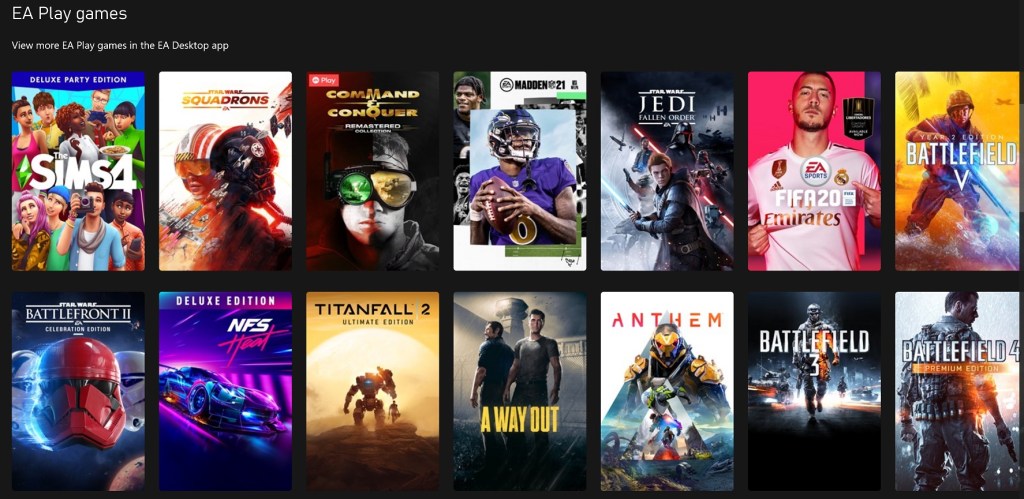
Five Star Trek episodes for Valentine’s Day!

Spoiler Warning: There are minor spoilers ahead for the episodes on this list.

Love is in the air! Happy Valentine’s Day – even though 2021 promises to be the strangest in a long time. If you have a special someone to spend today with, I bet you’re wondering what to watch to put you both in the mood. And if you don’t… perhaps you’re just wondering what to watch. So without further ado, here are a few Star Trek episodes worth watching on the most lovey-dovey day of the year – or at least tangentially related to it! As always, the list is in no particular order.

Number 1:
The Dauphin (Star Trek: The Next Generation)

Wesley’s first love is the story of The Dauphin.

It’s been a while since we talked about The Next Generation’s most controversial major character: Wesley Crusher! He’s the main focus of this episode, falling in love with the ruler of a war-torn planet. In a classic case of “bad timing,” Salia and Wesley’s relationship wasn’t to be. He learned a valuable lesson about love along the way, though, and while the episode has some cute moments and some awkward ones, it manages to be distinctly “Star Trek” all the while.

Number 2:
Choose Your Pain (Star Trek: Discovery)

Dr Culber and Stamets in Choose Your Pain.

I often call the relationship between Stamets and Dr Culber the “emotional core” of Discovery, yet looking back on the show’s 42 episodes, there are relatively few in which they are the main focus. Choose Your Pain has a lot going on, but one of the most significant points is how Hugh and Paul clash over the tardigrade – the space-dwelling lifeform that appears to be the key to making the Spore Drive work as intended. They’re able to resolve things, of course, but only when Stamets does something life-changing to himself in order to save the tardigrade’s life.

Number 3:
Threshold (Star Trek: Voyager)

Ah, Threshold.

When we think about Tom Paris, who’s his romantic partner? B’Elanna Torres, of course. But in Threshold – widely regarded as one of Voyager’s worst episodes – Paris and Janeway get together and even have kids! Had you forgotten about that? After passing the Warp 10 barrier and experiencing “hyper-evolution,” Paris kidnaps Janeway and flees to an uninhabited planet. The two hyper-evolve into lizards and apparently “do the nasty,” resulting in at least three offspring. The crew of Voyager opted to leave the hyper-evolved children behind when they rescued Paris and Janeway, though, and for some reason the events of Threshold were never mentioned again. I wonder why?

Number 4:
Amok Time (Star Trek: The Original Series)

One of the most memorable fights in all of Star Trek.

Amok Time is certainly one of the most iconic Star Trek episodes, having been imitated and parodied many times. It focuses on Spock and introduces us to the concept of pon farr – the Vulcan biological mating need. The Vulcans evidently practice arranged marriage, and when Spock’s betrothed chooses another man, Kirk and Spock must engage in a ritual fight to the “death.” As one of the first episodes to explore the Vulcans in depth, as well as our first visit to the planet Vulcan, Amok Time is incredibly important within the history of Star Trek. And as a love story, well there’s something kind of romantic about T’Pring choosing to escape her arranged marriage to be with someone she cares about… right?

Number 5:
Change of Heart (Star Trek: Deep Space Nine)

Jadzia and Worf in Change of Heart.

Workplace romances are bound to cause problems! After Worf arrived on the station at the beginning of Deep Space Nine’s fourth season, he and Jadzia Dax struck up a relationship. They eventually got married in the episode You Are Cordially Invited, and continued to work closely together. In Change of Heart they’re assigned a dangerous mission to evacuate a Federation spy at the height of the Dominion War. But when Jadzia is injured, Worf is forced to choose whether to save her life or complete the mission.

So that’s it. Five somewhat Valentine’s Day-related Star Trek episodes! Try not to take it too seriously; this was just a bit of fun to mark the occasion!

On a more serious note, Valentine’s Day can be difficult. It can be a day that brings home feelings of loneliness, that we aren’t loved or even that we’re unworthy or undeserving of finding someone special. If you feel that way, listen to me: it’s bullshit. You’re a King, a Queen, or non-binary Royalty and you are amazing. If you haven’t found somebody yet, that’s okay. There’s no pressure or time limit. I know people who found love well into their seventies and eighties, and a few years ago attended the wedding of a neighbour of mine who finally was able to marry his boyfriend – at the age of 85! Just because some people manage to find their special somebody early in life doesn’t mean you have to conform to that too. One thing I wish I’d learned a lot sooner is that it’s better to be single than to be in a bad relationship! So please try not to worry or let Valentine’s Day become an excuse to feel rotten. Your time will come. Until then, I wish you a very happy Valentine’s Day – platonically, of course!

The Star Trek franchise is available to stream now on CBS All Access (soon to be rebranded as Paramount+) in the United States, and on Netflix and/or Amazon Prime Video in the United Kingdom and elsewhere. Star Trek and all episodes and series listed above are the copyright of ViacomCBS. This article contains the thoughts and opinions of one person only and is not intended to cause any offence.

Star Trek: Picard + Star Trek: The Next Generation crossover theory: Lore

Spoiler Warning: There are spoilers ahead for Star Trek: Picard Season 1, Star Trek: The Next Generation, and for other iterations of the franchise.

Season 1 of Star Trek: Picard expanded our knowledge and understanding of the Star Trek galaxy in the 24th Century. As the lore of Star Trek grows (pun intended!) one thing I find fun is seeing how any new information we get can be made to fit with past iterations of the franchise, and in the case of Picard, I think I’ve hit on a theory that is plausible based on some new facts that we learned last year.

I previously touched on this theory as part of my essay on Commodore Oh a few months ago, but I thought it warranted being expanded and given its own article – so that when it’s finally confirmed on screen I can say “I told you so!” Or not. In short, this theory connects Data’s brother Lore to the Zhat Vash, the faction introduced in Star Trek: Picard.

Lore in Datalore.

Before we go any further and get into the weeds, let’s recap. Lore was introduced in The Next Generation Season 1 episode Datalore, and would return in Brothers in Season 4, as well as the Season 6 finale Descent, and Descent, Part II which opened Season 7. He was, in effect, Data’s “evil twin,” and would go on to cause havoc for Data and the crew of the Enterprise-D. We would also learn that Lore was responsible for luring a spacefaring lifeform called the Crystalline Entity to his homeworld, killing most of the citizens of the colony.

Next we have the Zhat Vash, who were introduced in Star Trek: Picard. An ancient, secretive Romulan sect, the Zhat Vash were on an anti-synthetic crusade. They believed that the development of artificial life would lead to all life in the galaxy being exterminated, and sought to wipe out synthetics wherever they found them. As part of their plan to prevent the Federation developing synths, a Romulan agent named Oh infiltrated Starfleet shortly after the discovery of Data in 2338.

Commodore Oh infiltrated Starfleet.

This theory begins with something that The Next Generation never really explained: Lore being evil. Apparently this is a flaw in at least some Soong-type androids, as we’d also see Sutra exhibiting many similar traits to Lore in the two-part finale of Picard Season 1. But is there more to it than a simple mistake, as Dr Soong believed?

Though the Zhat Vash despise synthetic life, as part of their crusade to exterminate synths from the galaxy they seem to have learned a great deal about them – including how to reprogram them. In Picard Season 1, we learned that rogue synths had attacked Mars, destroying Admiral Picard’s fleet. It was the intervention of the Zhat Vash, hacking into the synths and reprogramming them, that caused this attack. If the Zhat Vash possessed the ability to do this in the 2380s, it’s at least possible that they were able to do something similar to Lore in the 2330s.

The Zhat Vash were able to reprogram Federation synths, leading to the attack on Mars.

Lore was activated months (or possibly years) before Data, and lived with his creator on the Omicron Theta colony. Dr Soong’s reputation seems to have been known within the Federation, and his work doesn’t appear to have been classified or somehow kept secret. The Zhat Vash seem to have been able to infiltrate the Federation with relative ease, having two spies inside Starfleet that we know of, and even if a Zhat Vash operative in this era were not an especially high-ranking officer, given the openness of Dr Soong’s work and the dedication the Zhat Vash have to their cause, I think we can reasonably suggest that they would have come to know what he was doing, and thus of the existence of Lore.

As I suggested in my last crossover theory, it stands to reason that the Zhat Vash will have been deeply alarmed about the Federation and their synthetic research. In the mid-23rd Century, two Federation AIs went rogue: Control (as seen in Discovery Season 2) and the M-5 multitronic unit (as seen in The Original Series second season episode The Ultimate Computer). Although it seems to be androids that were the main focus of Zhat Vash attention, as Laris made clear, the Romulans fear all kinds of AI – so these events would certainly have upset them enough to keep an eye on Starfleet and the Federation.

A fleet of ships under Control’s command went rogue and attacked the USS Enterprise and the USS Discovery.

That makes it even more likely, in my opinion, that the Zhat Vash would have found out about Dr Soong and Lore on Omicron Theta. If they were following Dr Soong’s work on positronic brains, they may have been working on ways to shut down his research or reprogram Lore. As mentioned, none of this appears to have been classified, and while Dr Soong kept his work private, it may have been possible for the Zhat Vash to infiltrate Omicron Theta and gain access to his research.

Their main goal was to prevent the rise of synthetic life. A single android was bad enough, but what they feared most was a civilisation of them. But Dr Soong didn’t have a civilisation – he had one single operational android. From the Zhat Vash’s perspective in the 2330s, if they could force Lore to be shut down – and ideally kill Dr Soong at the same time – the Federation would be unable to replicate the work and would thus be unable to build more.

Lore in Descent, Part II.

At some point following his activation, Lore began to exhibit “emotional instability” to the point that he upset and worried the colonists on Omicron Theta. This doesn’t appear to have happened from the moment of his activation, though, which lends credence to the idea that he was reprogrammed – perhaps rather crudely in an attempt to force Dr Soong to take him offline.

However, before Dr Soong could take action to shut him down, Lore contacted the Crystalline Entity, which arrived and wiped out the Omicron Theta colony. If Lore had been reprogrammed, was this something he chose to do of his own volition? It seems a very specific action to take if he wanted to kill the colonists – he was more than capable of physically overpowering and outwitting them if he wanted to kill them.

The Crystalline Entity “feeding,” as seen in Silicon Avatar.

The destruction of Omicron Theta can be seen as a classic Romulan move. By using the Crystalline Entity, not only was Lore assumed destroyed, but so were Dr Soong, his assistants, and all of his research, setting back synthetic research in the Federation by decades. Of course we know that Dr Soong and Lore both escaped – but that clearly wasn’t part of the Zhat Vash’s plan! Perhaps they underestimated Lore.

Most importantly, though, having the Crystalline Entity wipe out Omicron Theta absolved the Romulans of any direct involvement, as well as potentially destroyed any evidence that they had ever been there. It reminds me in many ways of the false flag operation that they ran on Mars; the synths were reprogrammed and forced to go rogue, an event which so thoroughly shocked the Federation that the Zhat Vash were able to persuade them to shut down all synthetic research.

Laris first told Admiral Picard – and us as the audience – about the existence of the Zhat Vash.

With Lore being the only extant android, a “clean” attack on the colony, wiping out the entire site and all of its inhabitants, would work very well from the Zhat Vash’s perspective. Openly attacking Omicron Theta would surely have started a conflict with the Federation, and if that could be avoided through this kind of cloak-and-dagger operation, well that seems exactly like something they would seek to do.

So that’s the extent of the theory, and any Zhat Vash involvement afterwards appears to have ignored Lore. Perhaps they figured that the existence of Data showed that the Federation would not stop until they were forced to, or at least that it was no longer possible to stop Federation AI research by killing one android. This would explain why they didn’t take any aggressive action against Data during The Next Generation era, and could also explain why Dr Soong went into hiding after the Omicron Theta attack – he may have been hiding from the Zhat Vash.

Data in Star Trek: Generations. The Zhat Vash appear to have been either unable or unwilling to attack him.

This theory fits with Lore’s appearances in The Next Generation and doesn’t step on the toes of anything as far as I can see. It provides backstory to why Lore acted the way he did, and explains his motivations for doing so in a different way. It also elevates Lore from simply being an “evil twin” trope into more of a tragic character – we will never know what Lore could have been were he not interfered with.

Crucially, this theory fits with what we learned of the Zhat Vash in Picard Season 1, both in terms of their goals and their methods. It seems at least possible that the Zhat Vash are responsible for the attack on Omicron Theta and for reprogramming Lore, turning him into the malevolent adversary that Data and the crew of the Enterprise-D had to deal with.

Commodore Oh.

This could have even been the first mission of a young Zhat Vash operative named Oh. Maybe she was the one sent to Omicron Theta to deal with Dr Soong, and this entire situation is her doing.

So that’s it. That’s my theory! I doubt it will ever be confirmed, but you never know! It seems plausible to me, at least. I hope this was a bit of fun and an excuse to jump back into the Star Trek galaxy. As always, please remember not to take this theory, or any other fan theory, too seriously. Theory-crafting is supposed to be enjoyable, and the last thing we need right now is something else to argue about!

Star Trek: Picard Season 1 is available to stream now on CBS All Access (soon to be rebranded as Paramount+) in the United States, and on Amazon Prime Video in the United Kingdom and elsewhere. The Star Trek franchise – including Picard and The Next Generation – is the copyright of ViacomCBS. This article contains the thoughts and opinions of one person only and is not intended to cause any offence.
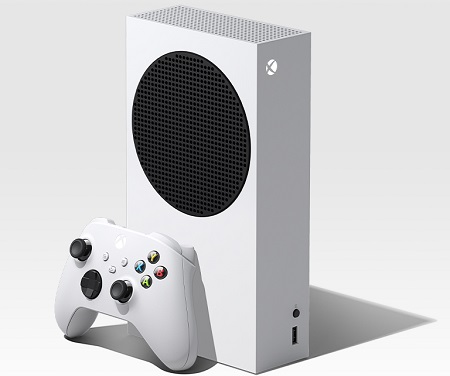
The CD Projekt Red hack is nothing to celebrate

Despite the slow pace of updates meaning that Cyberpunk 2077 is still a hot mess more than two months on from its release, I had hoped that the controversy was dying down, giving the game and its developer, CD Projekt Red, time to fix things. We’ve recently discussed why the “release now, fix later” approach is a bad idea, and Cyberpunk 2077 is a case in point. But there’s a line between criticising a company for its bad, anti-consumer decisions and breaking the law to attack them and their employees. CD Projekt Red has recently fallen victim to what they’re calling a “targeted cyber attack,” one which has not only compromised their recent game, but has also supposedly granted the hackers access to private employee data.

This is not something to cheer, no matter how disappointed one may be in the Cyberpunk 2077 fiasco. CD Projekt Red made many mistakes and acted in an unfair, aggressively anti-consumer manner. But the company and its employees do not deserve to have their work – and especially not their personal data – stolen for ransom.

A hacker has attacked Cyberpunk 2077 developer CD Projekt Red.

There are many cases of hackers doing good things, attacking truly evil entities and bringing to light incredibly important information. It’s thanks to hacking that we know, for example, the extent of cyber surveillance by governments. Hackers routinely take on dictatorships, corrupt governments and organisations, and have even helped bring to justice sexual predators and abusers. But unlike in any of these cases, video games are not a matter of life or death. No one has been helped by this situation, and it may very well make things worse.

Some industry watchers and analysts are saying we need to brace for “shocking” revelations which may come from the stolen data. While no one is yet saying precisely what the hackers may have unearthed, it’s not hyperbolic to say that cyber attacks of this nature have literally shut down companies in some cases. If there’s something big hiding in the CD Projekt Red data, it could spell disaster for the company.

We don’t yet know what – if anything – is hiding in the stolen data.

Nobody wants that. Most folks I’ve spoken to who were disappointed in CD Projekt Red and Cyberpunk 2077 want the company to keep working on the game, fix the issues, and apologise for the misleading way they handled the marketing and launch. Nobody serious is advocating for the company to suffer or be closed down; that would be counterproductive to what all of us want: for Cyberpunk 2077 to get to a decent, playable state.

Of course it’s most likely that nothing in this hack will lead to CD Projekt Red being shut down. But the mess that results from this kind of event will harm morale within the company – especially among ordinary employees who are now finding out that their personal data has been stolen. It will slow progress on fixing the game, and despite what we might say about how it should have never been released in this state, that’s already happened and won’t be undone by a hack like this. The game needs to be fixed as soon as possible, and this will slow down that work.

Cyberpunk 2077 is a broken bug-riddled mess that needs to be fixed.

I’m not someone who goes to shill for corporations, nor someone who would ordinarily stand up for a wealthy company – especially one that has behaved in such a scummy way. But this hack helps nobody, harms the company right at the moment when it needs to be focusing on fixing the game, and only benefits cyber criminals – criminals who probably don’t even care about Cyberpunk 2077. This may simply be a convenient excuse to attack a company and demand money.

Speaking of demanding money, if this were simply an irate gamer trying to “get back” at CD Projekt Red, why threaten the company and ask for a “ransom?” There’s nothing altruistic about this; it isn’t even like the recent “Reddit vs. Wall Street” battle over GameStop shares. This is cyber crime, plain and simple, and I find it very disheartening to see how many people are actively supporting it and cheering for it.

Cyberpunk 2077 launched to well-deserved bad reviews in December.

It’s funny, in a way, and I get that we all like to make jokes and memes about these situations. I saw someone making the joke that hacking into CD Projekt Red was comparable to a hacking minigame in Cyberpunk 2077 – and I admit that one made me chuckle! There can be no denying that the company massively screwed up the launch of its latest game, and they have seen their share price take a hit, their reputation and goodwill utterly collapse, and they’re undoubtedly losing money as a result. Cyberpunk 2077 has been pulled from the PlayStation Store, seen huge numbers of refunds issued, and the mess will take a long time for CD Projekt Red to clean up.

All of that is good. And I support companies like Sony taking legitimate action to hold CD Projekt Red accountable. That absolutely needs to happen. And it has happened already – by lawful means. The game’s review scores have been mediocre, with many players giving the game 0/10 for its bugs and glitches. And all of the aforementioned criticism has eroded the reputation of CD Projekt Red. But this hack is a step too far and cannot be condoned. Criticise CD Projekt Red. I know I have. Call them out for their lies and their nonsense. Don’t buy the game or insist on a refund. Support companies like Sony in pulling the game from sale. But breaking the law and attacking the company helps no one, and is ultimately going to make the wait for the game to be fixed even longer.

Cyberpunk 2077 is the copyright of CD Projekt Red. Some stock photos courtesy of Unsplash. This article contains the thoughts and opinions of one person only and is not intended to cause any offence.
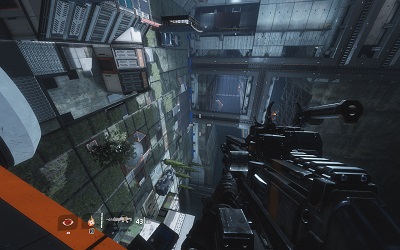

CD Projekt’s full statement on the hack can be found below:

The ad campaign for Paramount+ has been surprisingly strong

In early March, CBS All Access is being relaunched under the new name Paramount+. As a Trekkie, I’m invested in the future of Star Trek, and it’s my hope that Paramount+ will be a successful, stable home for the franchise in the 2020s and beyond. The rebranding of CBS All Access is in many ways a positive thing, especially as ViacomCBS will be taking Paramount+ international, beginning with launches in Australia and the Scandinavian countries.

At the same time, though, I can’t help but feel that, if CBS All Access had proved to be the runaway success ViacomCBS was hoping for, the rebranding would be unnecessary. ViacomCBS has never been totally up-front about subscriber numbers, viewership, or revenue, so it’s hard to tell how big of a success CBS All Access has really been. But we’re drifting off-topic.

The rebranding has led to an ad campaign in the run-up to next month’s launch of Paramount+, and I have to admit that I’m surprised at how fun the commercials have been.

Anson Mount during the Super Bowl ad.

As someone who doesn’t watch broadcast television any more, I don’t actually see a lot of ads. But because I follow Star Trek and Paramount+ on social media I’ve seen most of the adverts made for the new service, including one which was broadcast during the Super Bowl – the single biggest and most valuable day of the year in terms of television advertising in the United States. The fact that ViacomCBS paid millions of dollars for a Super Bowl commercial shows how seriously they’re taking the launch of Paramount+.

Star Trek has been front and centre of this ad campaign, with the stars of Discovery, Picard, and the upcoming Strange New Worlds all being featured prominently. There was also a separate Star Trek Universe ad that showed off the franchise. These ads have been clever and funny, and above all they’re memorable. After being shown prominently during the Super Bowl, and being discussed online, I don’t think there can be many folks in the United States who are unaware of the impending arrival of Paramount+ – and hopefully that has already begun to translate into pre-orders and subscribers to the service.

Sir Patrick Stewart during the Super Bowl ad.

Sonequa Martin-Green reprised her role as Michael Burnham – albeit in the “old” Discovery uniform – for the ads, and Anson Mount returned as Captain Pike too. We also saw Ethan Peck’s Spock, and of course Sir Patrick Stewart was heavily featured and narrated the commercials. The message was clear: Star Trek is back, and the best place to see it is on Paramount+.

A couple of years ago Stephen Hillenburg, the creator of SpongeBob SquarePants, passed away. There was a campaign online to have the song Sweet Victory from the cartoon incorporated into the Super Bowl halftime show, but fans were left disappointed when it was only given the barest of mentions. The Paramount+ Super Bowl ad featured the song – as SpongeBob SquarePants is a Nickelodeon show, and Nickelodeon is a ViacomCBS company. This alone has brought a huge amount of online attention to Paramount+ from fans who felt the 2019 Super Bowl didn’t go far enough, and whoever it was in ViacomCBS’ marketing department that came up with the idea deserves a raise!

Hopefully it will be a “sweet victory” for Paramount+!

There are still arguably too many streaming platforms, especially in the United States. And over the next few years we’ll see which survive and which end up either closing down or amalgamating in order to remain competitive. Paramount+ is not quite at the same level as Netflix or Disney+ – but ViacomCBS have a huge advantage over the likes of Apple TV+ in the sense that they can draw on a huge library of content that they already have. They’re not starting from scratch with original content nor having to pay expensive licensing rights to other people’s films and shows. In my opinion (as someone watching from the outside) that does give the service a boost.

As SpongeBob SquarePants showed during the Super Bowl, building up goodwill and using nostalgia to hook in fans – especially younger ones – is a step in the right direction as Paramount+ gets ready for its debut. I never used CBS All Access as someone who doesn’t live in the United States, but one of the criticisms levelled against it was that it didn’t have a lot going on. Besides Star Trek – which was the flagship franchise, especially when it launched – a lot of folks felt that CBS All Access was rather barebones, and I know of a lot of people who would subscribe during the run of a show they wanted to see – like Star Trek: Discovery – and promptly unsubscribe when the season was over. Hopefully Paramount+ will have enough new and legacy content to prevent that from happening.

Anson Mount, Stephen Colbert, and Sir Patrick Stewart dancing to Sweet Victory. Not sure who the animated guy is… maybe someone from Archer?

Paramount+ is also promising live sport – something relatively uncommon in the streaming world. Here in the UK, Amazon Prime Video have paid for the rights to some Premier League football (soccer) matches, but as far as I’m aware there aren’t many other platforms that do so regularly. If sport becomes a big part of Paramount+, that will certainly be another way to attract subscribers.

So the ad campaign has been fun, and it was especially cool to see Star Trek at the Super Bowl! I doubt that’s happened before! I’m rooting for the success of Paramount+, and I hope it will be a successful home for Star Trek – and its promised “mountain” of other content – going forward. Please bring it to the UK soon – I know of at least one person who’ll subscribe!

Paramount+ will launch in the United States on the 4th of March 2021. Launches in other countries and territories are already planned for early- and mid-2021. The service will be the new digital home of Star Trek. Paramount+, the Paramount logo, and all titles mentioned above are the copyright of ViacomCBS. This article contains the thoughts and opinions of one person only and is not intended to cause any offence.

YouTube channel spotlight: Cruising the Cut

It was only a few years ago that I rarely used YouTube. I’d occasionally check out a film trailer or listen to a song I couldn’t find anywhere else, but I largely bypassed its user-generated content, figuring that the website was largely filled up with amateurish comedy, cat videos, and cringeworthy children making videos they’re bound to look back on in shame a few years down the line! But as the web has grown to become an ever-larger part of all of our lives, I’ve found myself spending more and more time on YouTube to the point where I’m pretty sure I watch at least one video on the platform every day.

There are some great channels on YouTube, and you can find different ones dealing with every topic under the sun, but this time I’d like to shine a spotlight on one which became a favourite a couple of years ago: Cruising the Cut. When I first subscribed, the channel was hovering somewhere around the 25,000-subscriber mark. That’s good, but by no means YouTube royalty! In the last couple of years, however, Cruising the Cut has grown to well over 100,000 subscribers, and hitting that mark was thoroughly deserved.

So what is Cruising the Cut? It’s primarily about travelling on England’s canal network, and the life of a “liveaboard” – i.e. someone whose permanent home is his narrowboat. The gentleman in question is named David, and the first couple of videos on Cruising the Cut explain how he decided to sell up and move aboard a canal boat permanently. David was a television journalist before starting his YouTube channel, and his background, both in terms of knowing how to use the camera and set up beautiful shots, as well as how to be interesting and informative in his presentation, shines through.

David runs the channel and produces and narrates every video.

2021 seems like a great time to get caught up with Cruising the Cut if a travelogue around England sounds like your cup of tea, because the pandemic has, unfortunately, brought a halt to David’s planned travels. The result of this has been fewer videos, and a recent announcement that there may not be much travelling being put to film at least for the next few months. So now could be a good time to binge-watch David’s travels so far!

I’ve always had an interest in canals, and their history is really fascinating. The second half of the 1700s was the heyday of canal construction in England, and a network of artificial waterways was built that spans much of the central part of the country. They were initially constructed as profitable transportation routes, often for moving natural resources like coal or iron to budding industrial centres. By the mid-20th Century, however, many canals had fallen into disrepair, and it took a lot of hard work to restore the network to its current condition – work which is still ongoing.

The invention of the railway and steam locomotives brought canal construction to a premature halt in the 19th Century, though many of the engineering and mechanical techniques pioneered during their construction did not go to waste and was used by early railway builders. It’s primarily for this reason, though, that the canal network is not larger!

A map showing the extent of the canal network in England and Wales.
Picture Credit: The Canal & River Trust

Since starting his channel in 2015, David has filmed his travels across a significant portion of the canal network, but hasn’t yet been everywhere or stopped at every point of interest! So hopefully, once the pandemic clears, there will be more to come. He manages to be informative and entertaining in equal measure in every video, and I find myself learning something new about the canals, their history, or the part of the country he’s visiting almost every time.

Gongoozling – the name for canal boat-watching – is, by its nature, a slow affair. This isn’t something fast-paced or action-packed, so set your expectations accordingly! Canal narrowboats only have a maximum cruising speed of around four miles-per-hour, so don’t expect Cruising the Cut to be zipping all across the country in each video. This is, as David says, “slow TV.”

There’s nothing wrong with that, though, and stepping out of our sometimes-hectic lives to slow down and set our watches to “canal time” is no bad thing. Sometimes we choose entertainment for its value as escapism, and perhaps that’s what you’ll find with Cruising the Cut. Life on the canals certainly seems to be at a different pace – it can feel, sometimes, like another world, one caught in a moment somewhere in England’s past.

The intro to episode 159.

When I first encountered Cruising the Cut there were a couple of other canal-related YouTube channels, but that number has grown over the last few years and there must be at least a dozen by now. It’s a niche, certainly, but apparently a growing one! I wouldn’t have expected that necessarily, but despite the fairly obscure subject matter, it just goes to show that anything can be interesting and entertaining if well-presented.

That could be the motto of many YouTube shows, actually! I’m often surprised at how channels with a fairly narrow or unusual focus can draw large audiences, but when the presenter is enjoyable to watch, the subject matter itself can almost be anything. In the case of Cruising the Cut, following David’s travels around the canal network is one half of the appeal; the second is the way in which it’s presented.

The episodes in which he travels are usually filmed from two angles – one at the front of the boat, and one at the back, where David can speak directly to the camera from the boat’s stern deck. Cruising the Cut does sometimes make use of drone shots as well, and these can be absolutely stunning! There are some beautiful vistas along the canal network, and David’s camera work is great at capturing them.

The view from the Pontcysyllte aqueduct in Wales.

So that’s about all I have to say, really. Cruising the Cut is gentle entertainment for when you need a break, as well as an interesting and informative travelogue, one that is perhaps not quite on the beaten track! You may have seen England in travel documentaries before – you might even live here – but I’d be willing to bet that most folks haven’t seen this side of the country. There are big cities, smaller towns, and rural areas all served by this canal network, and it really is a world unto itself – a world of slow-moving pleasure boats, holidaymakers, marinas, chandleries, and even the occasional floating business that has survived into the modern era.

I know this isn’t the usual kind of geekdom that I write about – and it seems a country mile away from sci-fi – but if you’re interested either in a fun travelogue or in learning more about the canals, which are a fascinating part of English history, maybe you’ll find Cruising the Cut as much fun as I do.

Cruising the Cut, and all videos posted to the channel, are the copyright of the channel owner. YouTube and associated trademarks are the copyright of Google and Alphabet. This article contains the thoughts and opinions of one person only and is not intended to cause any offence.

Great Star Trek villains: General Chang

Spoiler Warning: There are spoilers ahead for Star Trek VI: The Undiscovered Country.

The Star Trek franchise sometimes lucks out on getting a wonderful guest star to jump aboard. Some of these guest stars are relative unknowns; actors and actresses who aren’t household names, but nevertheless gave wonderful, memorable performances. On the other hand, there are a handful of actors and actresses who join Star Trek when they’re already very well-known, either because they’re longstanding fans or because they were offered a once-in-a-lifetime role.

Christopher Plummer, who played General Chang in Star Trek VI: The Undiscovered Country, was firmly in the second category; an established, renowned star. Plummer sadly passed away yesterday at the age of 91, and I thought it would be nice to take a look at his single Star Trek role, as well as pay tribute to this legend of stage and screen.

Christopher Plummer (1929-2021)
Picture Credit: 20th Century Fox, Public domain, via Wikimedia Commons

Christopher Plummer had a long career, first appearing on television in his native Canada in 1953. He continued to act well into his 80s, and among his final roles were the 2019 film Knives Out and a Canadian television show called Departure which was broadcast that same year. To Star Trek fans, Plummer is iconic for his role as the eyepatch-wearing Klingon General Chang in 1991’s The Undiscovered Country, where he faced off against fellow Canadian William Shatner’s Captain Kirk.

Plummer’s love of Shakespeare was incorporated into the story of The Undiscovered Country – the title of which is itself a quotation from the Great Bard. Chang would go on to quote Shakespeare numerous times throughout the film, appearing all the more villainous for it! There’s something about Shakespearean language that makes for a menacing antagonist.

General Chang and Captain Kirk share a glass of Romulan Ale aboard the Enterprise-A.

General Chang was one part of a broader conspiracy to prevent the Klingons and Federation achieving peace – a metaphor, in 1991, for the end of the Cold War. The Klingons had been conceived during The Original Series as the “Russians” to the Federation’s “Americans,” so it was certainly fitting to bring them into a storyline like this.

To continue the analogy, Chang represents the hard-liners – Soviet military leaders who could not conceive of the end of their dominance and place in the world. A few months before The Undiscovered Country would hit cinemas, a number of such men attempted a coup in the Soviet Union. This was the final roll of the dice from the old guard to preserve Soviet communism and wrench control away from the reformer Gorbachev; the Soviet Union would be formally dissolved in December of that year.

Chang appears on the Enterprise-A’s main viewscreen shortly after the assassination.

Perhaps it’s because of how timely the story was that General Chang made such an impact on Star Trek. The franchise has often looked at the real world through its sci-fi lens, but few stories managed to be as relevant or as timely as The Undiscovered Country was in 1991. The end of the conflict between the Klingons and the Federation represented the end of the Cold War, the explosion of Praxis and its fallout can be seen as an analogy for the Chernobyl nuclear disaster, and General Chang and Captain Kirk are the respective “old soldiers” from either side who must overcome the way they feel.

Kirk succeeded where Chang could not in that regard, and The Undiscovered Country gave him a meaningful character arc in a way few prior stories had. But Chang’s role is just as interesting, as he represents the many people on both sides of the conflict who were unable to find a way to live in peace. He was a foil for Kirk; a dark reflection of where Kirk’s own biases and mistrust could have led. Chang’s philosophy was that it was better to die in battle than live peacefully with one’s enemies – and he got his comeuppance for it.

Chang during Kirk’s trial on Qo’noS.

But having an interesting real-world message isn’t the only thing that makes Chang’s story so much fun. As I’ve said before, pushing too hard on that front can sometimes lead to a story or character being less entertaining! Instead, Chang was a truly interesting villain for the Star Trek franchise; a Klingon whose motivations were steeped in the concept of honour that his warrior people hold so dear.

Chang’s Klingon Bird-of-Prey could fire its weapons while cloaked, making it a uniquely challenging vessel for Kirk’s Enterprise-A and Sulu’s Excelsior during the climactic final confrontation. This battle, along with the Battle of the Mutara Nebula in The Wrath of Khan, draws on inspiration from war films set aboard submarines, with Kirk and Sulu trying to outmanoeuvre and outthink their unseen opponent.

General Chang’s Bird-of-Prey could fire while cloaked.

During Kirk and McCoy’s trial on Qo’noS, Chang was a powerful advocate for the prosecution, insisting they be convicted for the assassination of Klingon Chancellor Gorkon – an act for which he and his co-conspirators were, in fact, responsible. Star Trek has shown numerous times that it’s a franchise capable of some great moments of courtroom drama, and this was absolutely one of them! Chang shouting at Kirk that he shouldn’t wait for the universal translator was pitch-perfect acting.

A complex villain, whose motives were to continue a conflict that he could simply see no way of bringing to a peaceful end, General Chang is absolutely one of the most interesting and entertaining antagonists in all of Star Trek, and is up there with Khan as one of the best ever faced by Kirk and The Original Series’ crew.

Christopher Plummer had a long and varied career, one which touched many different genres and styles of acting, and endeared him to generations of audiences. His one moment in Star Trek was not his defining role – and is not the headline in most of his obituaries in mainstream news outlets today – but I firmly believe it showed what he was capable of at his best: a classic Shakespearean actor capable of transitioning to a wholly new genre. He will be missed.

Star Trek VI: The Undiscovered Country is available to stream now on CBS All Access (soon to be rebranded as Paramount+) in the United States, and on Netflix in the United Kingdom and elsewhere. The Star Trek franchise – including Star Trek VI: The Undiscovered Country – is the copyright of ViacomCBS. This article contains the thoughts and opinions of one person only and is not intended to cause any offence.

Five games that prove “release now, fix later” doesn’t work

Spoiler Warning: There are minor spoilers ahead for the titles on this list.

One of the most annoying trends in the games industry over the last few years has been the “release now, fix later” approach taken by companies. I’ve looked at this problem before, but suffice to say that the internet and digital distribution have led publishers and studios to release their games in an unfinished state, with a plan to roll out patches and fixes after release.

A few years ago – even as recently as the Xbox 360/PlayStation 3 generation – this wouldn’t have worked. But with so many people buying games digitally nowadays, companies seem to think that they can get away with it. However, there are many examples over the last few years of games that failed to live up to their potential – or failed entirely – because of this attitude.

Yes, we’re going to talk about Cyberpunk 2077 again…

The few days either side of a game’s release are incredibly important. Reviewers get their hands on a copy and play through the game, getting their reviews ready in time for launch. Then players who pre-ordered and those who got the game on day one get to play the game for themselves, and within hours of release a game’s reputation is pretty much set. It takes a lot of hard work to change anyone’s first impression – so if the game was in a bad, unfinished state, that will be the headline. And once that becomes the prevailing opinion, it’s very difficult to change minds and convince people to give it a second look.

As a result, releasing a game too early can kill it – even if subsequent patches and hotfixes bring it up to code.

Let’s look at five games that fell victim to this “release now, fix later” phenomenon.

Number 1:
Destiny (2014)

One of the first big games to suffer because of this was Bungie’s Destiny. After departing the Halo series following 2010’s Halo: Reach, Bungie struck out on their own to make what they promised would be a “ten-year experience” called Destiny. Less than three years after Destiny’s 2014 release, though, Destiny 2 would launch.

There was a lot of interest in Bungie on the back of the success of the Halo series. Halo: Reach had been hailed as the best entry so far, and there was nothing to suggest that Destiny would be anything other than fantastic. In a way we can call this a case of overhyping, but Bungie actually did a reasonable job of setting appropriate expectations for what Destiny would be. The finished game was just not very interesting to many players, and after beating the main campaign, most didn’t stick around.

If Destiny had been released in a complete state instead of promising updates and expansions, perhaps more players would have stuck with it. But this is precisely the problem with games that go down this route – an underwhelming experience puts players off. Why would they bother coming back to Destiny to see the latest update(s) when the game was only okay the first time around? Games need to be good when they release – not average with the promise of becoming good later, and that, in a nutshell, was Destiny’s problem.

Number 2:
No Man’s Sky (2016)

No game is more synonymous with “release now, fix later” than 2016’s No Man’s Sky. I actually felt that, for what it was, the game was decent even at launch, but I hadn’t bought into the hype and went into the game with moderate expectations! There’s no denying that No Man’s Sky was missing many promised features at launch, and while it wasn’t plagued by bugs or glitches in the way some games on this list were, it felt threadbare to many players.

No Man’s Sky is a classic example of overhyping. Studio Hello Games and its head Sean Murray seemed incapable of saying “no,” promising players that No Man’s Sky would be an infinitely pleasurable sandbox in which they could do just about anything they wanted. A key part of marketing in the games industry is reining in hype and knowing when and how to set accurate expectations – something that Hello Games completely messed up.

Hello Games put in a lot of hard work to bring promised features to No Man’s Sky in the years after its release, and in 2021 the game actually does meet many of those lofty expectations. But even so, many players who were burned in 2016 have not returned, and the game’s reputation is still in the gutter in many people’s minds. There’s even a sense that Hello Games should not be “rewarded” for fixing the game after its release, and I know folks who refuse to buy it on principle.

Number 3:
Fallout 76 (2018)

Fallout 76 may be the worst game on this list. It was certainly the most disappointing to me personally. Not only did it launch in a crappy, broken state riddled with bugs, but it was also threadbare. A double-whammy, if you will.

The heart of any role-playing game comes from great, memorable characters. And the Fallout series has always provided plenty of interesting people to engage with, triggering quests and storylines that are easy to get invested in. Fallout 76 had precisely zero non-player characters at launch, making its world feel empty and its quests uninspired and meaningless. Aside from wandering around, looking at the pretty (if decidedly last-gen) environment and battling a few buggy monsters, there was literally nothing to do in the game.

There were other problems which don’t stem from the game being forced out the door too soon, such as Bethesda’s reliance on a massively out-of-date game engine and a crappy shooting mechanic that single-player Fallout games had managed to cover up with the VATs system. But the core of Fallout 76′s problems came from being released in an unfinished state. The game’s reputation tanked and has not recovered, and Bethesda, which had already been on a downward trajectory, is now held in especially low regard.

Number 4:
Anthem (2019)

BioWare released two games in a row in the mid/late 2010s which both suffered this exact issue. After Mass Effect: Andromeda was ridiculed on release for being a buggy mess, Anthem likewise had issues at launch. Though there were fewer bugs than in Andromeda – or at least, fewer egregious ones – Anthem was nevertheless unfinished.

For a live service title, Anthem was missing a lot. There were few customisation options, not enough interesting loot, and the final act of the game, which is the most important part as it’s where players will spend most of their time, was described as being just plain boring. In addition, the enemies were repetitive, the story – something BioWare is usually good at – was lacklustre and uninspired, and the game was just mediocre.

Mediocrity is not good enough when there are so many other competing titles to play, and Anthem soon lost the small number of players it initially picked up, dropping more than 90% of its playerbase within a few weeks of launch. What happened next is typical of underperforming live services: its “roadmap” of planned updates was cancelled. Though Anthem technically limps on and its servers are still active, in reality everyone knows it’s dead.

Number 5:
Cyberpunk 2077 (2020)

Cyberpunk 2077 is unusual in the sense that, unlike the other entries on this list, it’s a single-player game. It isn’t the only single-player game to ever release too soon, but it’s certainly the most significant one in recent years. CD Projket Red appear to have been desperate to release the game before the end of 2020, and whatever the reason for that may be, the end result was a game so riddled with bugs and glitches that many described it as “unplayable.”

Sony took the unprecedented step of withdrawing Cyberpunk 2077 from sale on the PlayStation Store – a move which has not yet been undone. CD Projekt Red, which had been one of the most popular games companies in the view of the general public, saw its reputation collapse – and its share price took a nosedive too.

Even now, almost three months on from release, Cyberpunk 2077 is still in a bad state, especially on PlayStation 4 and Xbox One. The game is simply not optimised to run well on those consoles, and it will take many more months of work to get it anywhere close to playable. However, in some ways the bugs and glitches have covered up what may come to be seen as Cyberpunk 2077′s worst failing: the game underneath the bugs certainly does not live up to the pre-release hype. Far from being a genre-busting once-in-a-lifetime experience, what players who stuck with the game through its issues have found is an okay first-person-shooter/role-playing game, and little else.

So that’s it. Five games which prove unequivocally that the “release now, fix later” concept simply does not work. The sooner games companies come to realise that a delay is better than a bad launch the better. There is a much-overused quotation from Nintendo legend and Super Mario creator Shigeru Miyamoto: “a delayed game is eventually good, a bad game is bad forever.” Despite all of the games above promising fixes, they remain, in the eyes of most gamers, bad.

Nintendo’s Shigeru Miyamoto has a thing or two to say about this!
Picture Credit: Vincent Diamante from Los Angeles, CA, USA, CC BY-SA 2.0 https://creativecommons.org/licenses/by-sa/2.0, via Wikimedia Commons

That’s the fundamental problem with this approach. It’s very difficult to overcome first impressions, and if a game launches to mediocre reviews and online criticism, that will be the only thing most people remember. No Man’s Sky has worked incredibly hard to overcome its launch issues, and the game is in a state today that genuinely lives up to the expectations players had and the pre-release hype. Yet the game will always come with an asterisk, and when people remember No Man’s Sky in ten or twenty years’ time, the fact that it was a colossal disappointment will be first and foremost in people’s minds.

As more and more games release in an unfinished state and go on to underperform – if not fail hard – I hope that games companies and publishers will come to see the folly in this approach. Maybe the 2020s will see more delays and better games as a result. We can only hope, right?

All titles listed above are the copyright of their respective studio, developer, and/or publisher. Some screenshots and promotional artwork courtesy of IGDB. This article contains the thoughts and opinions of one person only and is not intended to cause any offence.
Mass Effect: Legendary Edition details announced

Spoiler Warning: There are spoilers ahead for the Mass Effect series.

Rumours swirled for much of 2020 that the Mass Effect trilogy was to be remastered. The project was confirmed a couple of months ago – Mass Effect: Legendary Edition will be coming to PC, Xbox, and PlayStation in May. I didn’t cover the initial announcement, though, because there really wasn’t much to say. Electronic Arts and BioWare saw fit to publish only a brief teaser, and from that there was very little to gleam.

After a couple of months of waiting, however, we now finally have some details about Mass Effect: Legendary Edition, so I wanted to take a look at some of them and give my thoughts. Some games journalists were invited to a digital event for Mass Effect: Legendary Edition in which they were able to speak with developers and managers at BioWare, so in addition to the official trailer and announcement we also have some more details to look at. My invitation to that event must’ve got lost in the post!

The logo for Legendary Edition.

Prior to the official announcement of Mass Effect: Legendary Edition, I wrote up a wishlist of things I’d like a remaster of the trilogy to include. Obviously not everything I hoped to see has been included, but some key things will be. I would reiterate a point I made in that article, though: it’s only been a few years since the trilogy wrapped up. The Mass Effect trilogy was released during the Xbox 360/PlayStation 3 era, and, like many games from that generation, they still look pretty good today. I questioned the need for a remaster so soon, given that there hasn’t been that much of an increase in computing power and graphics technology in the intervening nine years.

And on that point, which is arguably the single biggest reason to remaster any game, I have to say that I’m not especially impressed with what I’ve seen of Mass Effect: Legendary Edition so far. There are some improvements, of course, and it can be hard to properly convey the scale of the changes made when dealing with compressed digital video on platforms like YouTube. But I have a decent 4K monitor, and when I looked at a number of scenes from the official trailer as well as high-resolution screenshots provided by BioWare, it was hard to see a significant improvement, especially when looking at scenes from Mass Effect 2 and Mass Effect 3.

When Capcom remastered Resident Evil 2 and Resident Evil 3 over the last couple of years, both games saw a colossal improvement from a visual standpoint. In fact I think it’s arguable that the remade versions of those games told their stories in a much better and more immersive way – except, of course, for the cut content from Resident Evil 3. Both titles were beloved by gamers of a certain age, but bringing them up-to-date allowed a whole new generation of players to experience the horror and excitement of Raccoon City. That won’t be the case with Mass Effect: Legendary Edition. Aside from the fact that the games have all been available on Xbox One, PlayStation 4, and even the Wii U, there just isn’t such a noticeable change in the way the games look, and while there have been tweaks and adjustments to gameplay, none of the games have seen a huge overhaul in the way the Resident Evil titles did.

Resident Evil 2 was in need of an update. The Mass Effect series? Not so much.

So I come back to my original question from my first piece on the subject: is now the right time to remaster the Mass Effect trilogy? Although it seems mad to think ahead to the PlayStation 6 when we’ve literally just had the PlayStation 5’s launch, I would argue that waiting another five to ten years and another console generation would have allowed the Mass Effect trilogy to see much more of an improvement. The original games are good enough – especially the second and third titles – to stand on their own two feet. A re-release or a repackaging of all three titles would have been sufficient, and I don’t really see a significant advantage to what EA and BioWare are billing as a “remaster.”

This is not, by the way, a problem unique to the Mass Effect series. Call of Duty 4: Modern Warfare was remastered in 2016, less than a decade after its release, and was similarly underwhelming. Partly this is psychological – we have a tendency to remember games looking better than they actually did. But in the case of many modern titles it’s also due to the fact that visuals and graphics have not improved in a huge way over the last decade when compared to earlier decades. So while Mass Effect: Legendary Edition looks decent, it’s not always easy to see – at least from the footage shown so far – that it’s substantially better than the original versions of its three constituent games.

Debatable.

The second point of criticism I have is that no action has been taken to change the story. As I wrote last time, I didn’t expect the ending of Mass Effect 3 to fundamentally change. That would require far too much effort for a project of this nature. The “pick-a-colour” ending of Mass Effect 3 is arguably the weakest part of the entire trilogy, and while it would be great to have seen that changed I knew it wouldn’t happen. So that isn’t what’s disappointing!

What is disappointing, though, is that the final third of Mass Effect 3 appears to be left unchanged. For me, the “pick-a-colour” ending was only one part of what let the game down; countless smaller decisions taken across the whole trilogy that should have mattered were either entirely ignored or only given the barest lip service in the story’s climactic final act. The most egregious example is that of the Quarians and Geth. To make a long story short, if players follow a specific path across all three games, it’s possible to save both the Geth and Quarians at a decisive moment where it looks as though it should only be possible to save one. This choice should matter; having both powerful fleets on side should be hugely impactful in the final battle against the Reapers. Yet it isn’t. Aside from a couple of seconds of cut-scene where both fleets warp in, and one line of dialogue, this massive choice fails to make any impact.

That may be the worst example; it’s certainly the one which stuck with me. But there are dozens of others, and the final third or so of Mass Effect 3 was undeniably rushed. Revisiting the project should have been an opportunity to right some of these wrongs, and to at the very least make a conscious effort to pay off, in a meaningful way, more of the player’s choices and efforts as the story reaches its conclusion.

The Quarian-Geth conflict can be peacefully resolved… but that never really felt like it mattered as the game entered its final act.

The lack of payoff to some of these choices will be even more noticeable in Mass Effect: Legendary Edition than it was when we played Mass Effect 3 back in 2012. This is for the simple reason that Legendary Edition is actively inviting players to play all three titles back-to-back as one continuous story – a story whose lacklustre ending and underwhelming acknowledgement of significant moments will be all the more recognisable for it.

I do understand the argument that there wasn’t enough material left on the cutting room floor to reincorporate into the game. But unlike in cinema, video games use voice acting and with practically all of the principal voice actors from across the trilogy still alive, there’s no reason I can see why bringing some of them back into the studio to record new dialogue should have been impossible. The final act of Mass Effect 3 would be massively improved by as little as fifteen minutes’ worth of extra dialogue and cut-scenes, and while the Extended Edition DLC will be included in Legendary Edition, even that could stand to be improved.

Omega as seen in the trailer.

So I think that covers my main criticisms of the project based on what I’ve seen and read. Now let’s get into the good points!

We’ll look at specific overhauls and changes in a moment, but first I wanted to acknowledge that, despite their reputation as a money-grubbing company, Electronic Arts is releasing Mass Effect: Legendary Edition as a single package. All three games, plus all of their DLC, are included. It doesn’t look like there are any pre-order exclusives, special editions, or anything of the sort, and while some critics will say that such behaviour should be the bare minimum, the reality is in this industry that it isn’t – so it is worthy of praise when companies do behave themselves! EA could have easily tried to split the project up and sell different parts of it, so the fact that the entire trilogy and all its DLC are part of one package for one price is great. I would argue that perhaps full price (£55 here in the UK, at least on PC) is a bit steep for games from 2007, 2010, and 2012, but I guess for the remastered version of all three I can’t really complain about that too much.

If you recall, Mass Effect 2 and Mass Effect 3 were early pioneers of cut-content DLC. Mass Effect 2 had a couple of its characters peeled off to be sold separately, and Mass Effect 3 had Javik, the series’ only Prothean character, sold as day-one DLC. So the series is no stranger to courting controversy with the way its games are sold, which is another reason to heap praise upon the decision not to do so with this version!

Javik was originally only available to players who paid extra.

Now into some specifics. The character creator has been overhauled, and while we don’t know exactly what’s changed, BioWare have promised new hairstyles, faces, and customisation options for Commander Shepard. Even by Mass Effect 2, the limitations of the original character creator were becoming apparent, so this is one area that needed work. I’m glad to hear that changes have been made in this area, as a role-playing game needs a decent amount of customisation. Making Commander Shepard feel like a unique and personal character is part of the appeal of games like the Mass Effect series.

Mass Effect 1 is seeing a number of gameplay changes and tweaks in order to bring the experience more in line with the second and third entries. Of the three games, Mass Effect 1 is the only one which felt even close to being “outdated” in 2021, and considering the substantial gameplay improvements which debuted in Mass Effect 2, I’m glad to see EA and BioWare updating it.

The Normandy approaches the Citadel.

Specifically BioWare mentioned changes to the heads-up display, the way the Mako vehicle handled, the hacking/slicing mini-games, the removal of class-based weapon loadouts (i.e. players will be allowed to use any of the game’s guns regardless of their character’s stats), changes to aiming to make lock-on better, the ability to skip the lift (elevator) scenes, as these were only in the game to begin with to hide loading times when transitioning between areas, and a higher level cap.

All of these sound good, and will update Mass Effect 1. However, BioWare has not mentioned weapon overheating, which was a difficult mechanic to get the hang of in the first game. Overheating was dropped in Mass Effect 2 in favour of “thermal clips,” which was just technobabble for ammo, and I’m surprised in a way that ammo isn’t coming to Mass Effect 1. Also unchanged is the game’s inventory system, which could be complicated and would quickly fill up with dozens of different tiers and categories of weapon upgrades and ammo options.

There will be other tweaks and rebalances across the three games, including to enemy and boss AI. The games will all run in 4K at 60fps, which is really the bare minimum that we should have expected from any AAA remaster in 2021! Finally, there are some PC-specific changes, including keyboard and mouse options and support for ultrawide monitors.

The Reapers are coming!

So that’s it. Mass Effect: Legendary Edition will bring some aesthetic changes to the table and some gameplay tweaks that will hopefully make the experience smoother and more enjoyable… but I’m still left with a sense best summed up thus: “what’s the point?” The second and third games are perfectly playable in their current form without being upgraded, and the offered upgrades seem minor, even from a visual standpoint.

Packaging all three titles together, along with their DLC, is admirable, but it would have been just as easy to re-release the trilogy with its DLC and spare the effort of “remastering” some of these already-decent looking scenes. It isn’t like any of the three Mass Effect games looked bad by today’s standards, and I can think of a lot of recent games that have been less impressive.

There was an opportunity to expand Mass Effect: Legendary Edition. By bringing back some of the original voice actors and adding a few extra scenes, particularly toward the end of Mass Effect 3, the remaster could have taken the story to new heights and genuinely improved the worst part of all three games. Even without a major rewrite of the ending, by adding more context and better paying off more choices and combinations of choices, Legendary Edition would have at least felt worthwhile. At the moment, it kind of doesn’t.

This fire effect from the remaster doesn’t look like it’s been improved much.

Bringing games from 2007-12 “up to date” is unnecessary. Maybe in another ten years we could argue that enough time had passed and enough technological improvements had been made that the games would feel new again, but everything I saw in the trailers has left me with the belief that they won’t feel new. A shiny coat of paint and throwing the entire story together in one package is really all you’ll get.

If you’ve never played the Mass Effect trilogy, go for it. Wait for Legendary Edition, which is due out in three months or so, and give it a try. The games are great, and while the ending is a bit of a let-down, if you go into the games with your expectations set you will at least know what you’re letting yourself in for. But if you’ve already played all three games, I feel like this is a hard sell. I was genuinely interested in Legendary Edition when it was announced, but having heard what’s included and seen the minor changes for myself, I’m probably going to give it a pass, especially for £55. Maybe if it goes on sale in a couple of years I’ll pick it up then.

Mass Effect: Legendary Edition will be released in May for PC, Xbox One, Xbox Series S/X, PlayStation 4, and PlayStation 5. The Mass Effect series is the copyright of Electronic Arts and BioWare. This article contains the thoughts and opinions of one person only and is not intended to cause any offence.

The beginning of the end for Google Stadia

Do you remember Google Stadia? It’s the video game streaming platform that internet powerhouse Google launched in late 2019. I hope you didn’t spend too much money on buying any of the dozen or so games that got ported over, though, because it seems as though Google is throwing in the towel.

While the Stadia service itself isn’t going anywhere, Google announced today that they will be ending all internal game development and closing their Stadia-only game studios. We don’t know exactly how many titles were being worked on for the service, but there were several in development that haven’t yet been released – and it seems as though all titles scheduled to release in 2022 or later are now cancelled. A handful of titles planned for this year may still be released.

In typical corporate style, Google is trying to spin this as an “evolution” of the service; opening up Stadia to third-party developers. But… which third-party developers would those be, exactly? Make no mistake: this is the beginning of the end for Stadia.

The Google Stadia controller.

Google Stadia was not an inherently bad idea. By streaming games instead of running them on a console, phone, or PC, Stadia allowed anyone with a decent internet connection to play games regardless of whether they owned an up-to-date console or powerful PC. But the service never really took off following a seriously underwhelming launch. In late 2019, Stadia was criticised for feeling like it was in its alpha version. Basic features were missing, and the service had less than twenty games. Though the Stadia team did put in some hard work to improve things, it never really got much attention from the gaming community or the public at large.

Within really just a few weeks of the service being launched, most of the attention from players and observers was on the Xbox Series X and PlayStation 5. Despite having some advantages in theory – like a lower up-front cost and being readily available – no one really considered Stadia as a serious competitor to Microsoft and Sony.

And Google isn’t the only massive company in the tech space to suffer an ignominious defeat in its first foray into the gaming realm. A few weeks ago, Amazon announced that it was shutting down its first internally-developed multiplayer game, citing a lack of players. I couldn’t even remember the name of Crucible, such was the lack of attention and interest the project garnered!

Stadia was Google’s first project in the gaming sphere.

Both Google and Amazon seem to have expected to “break in” to the games industry in a similar manner to Microsoft’s 2001 launch of the original Xbox, yet neither company has managed to stick the landing. That’s despite gaming having grown massively in the intervening two decades, and despite, as mentioned, Google Stadia offering several potential advantages.

A relatively low cost of entry was Stadia’s big selling point in many ways, and as Xbox and PlayStation both continue to struggle with hardware availability – something which looks set to continue through at least the first half of this year – there was an opportunity for Stadia to have another throw of the dice and push hard. But Google appears to have lost interest in Stadia almost from the moment of its troubled launch, and today’s news has felt like an inevitability for some time.

The Stadia service, while interesting on paper, had two major drawbacks: it still required players to buy games individually, and it relied on faster-than-average internet connection speeds to work properly. There were also issues of lag, both from the service itself and its controller, and in any kind of competitive game, even a millisecond of lag is unacceptable.

ChromeCast – one way to use Stadia.

Microsoft’s big selling point right now is Xbox Game Pass – a subscription service where a single monthly fee grants players access to a massive library of titles. Because Stadia is already a streaming platform – games run on Google’s hardware and stream via the internet to a player’s machine – there was an expectation that a subscription service would at least be an option, but it wasn’t at launch. The subsequent announcement of Stadia Pro was basically ignored, and doesn’t seem to have hooked in many subscribers. When you’re unable to download the games you buy, Google Stadia felt to many players like a risky option – how can you “own” something if you can’t even get a digital copy? Players who made that argument in 2019 may be feeling rather smug today, as Google is one step away from proving them right.

The internet connection speed was also an issue. In some countries with superfast internet it wouldn’t be an issue, but where I live in the UK, Stadia would have struggled. I’ve heard anecdotally from friends and others who bought into the service that even when they had what they thought was an acceptable connection speed, Stadia still underperformed.

There was a healthy scepticism regarding Stadia when it was launched, and the rough time the service endured in those crucial first few weeks was very offputting even to those who might’ve been interested. Streaming as a concept can work – and in the future don’t be surprised to see a Stadia-like offering from the likes of Steam, Epic Games, or even Nintendo. But for too many people, the infrastructure doesn’t exist right now to make streaming games a viable business proposition – or a risk consumers are willing to take.

The green variant of Google Stadia’s controller.

Finally, Stadia lacked any exclusive games. Alright, it had two: 2019’s Gylt, and Outcasters, which was released in December. Those are the only two Stadia-exclusive games as far as I can tell, and as I’ve said before: exclusive games sell systems. Without any – or with a couple of underwhelming titles that nobody notices – it’s very difficult to convince anyone to pick up a new system, even one which is relatively inexpensive.

Google is notorious for shutting down big projects, which was another reason folks were cautious about getting on board with Stadia. According to the website Killed By Google, the tech giant has shut down over 200 companies and projects, including some pretty well-known ones like Google Glass and Hangouts. The company has a tendency to cut and run when a project doesn’t meet expectations – and given Stadia has barely been more than a blip on the gaming radar, perhaps that’s to be expected.

So we don’t know at this stage how long Stadia itself will still be around. It’s possible that, despite the shutdown of internal game development, the servers will remain online for years to come, and if that’s the case maybe one day Stadia will see a revival. I wouldn’t bet on it right now, but you never know. Google’s corporate-speak of “focusing on improving technology” and “building business partnerships” sounds like a load of waffle to me, though, and I’m not sure which business partners they think are going to swoop in and save the ailing Stadia.

The Google Stadia logo.

Stadia, like some of Google’s other abandoned projects, was an experiment. It was an attempt to make streaming the “next big thing” in gaming, and if it had worked we might be talking about the death of traditional home consoles in favour of cheaper streaming kits. But the reality is that the experiment didn’t work. Early adopters and tech enthusiasts were simply not interested, put off by a weak launch, lack of games, lack of the necessary infrastructure, the concept of buying games that they couldn’t be sure they’d be able to keep, and most importantly Google’s reputation. As a result, Stadia never hit the mainstream. Most consumers never even came to know it existed, and this news likely won’t even reach mainstream outlets.

In general I’m supportive of more competition in the gaming realm. Google, as a massive company with a huge budget, was uniquely placed to be disruptive, but for all the reasons above they couldn’t convince more than a handful of players to give Stadia a shot. This news is disappointing for the 150 or so developers who will lose their jobs, but it was not unexpected.

Stadia is owned by Google. All titles listed above are the copyright of their respective owners, studios, publishers, developers, etc. This article contains the thoughts and opinions of one person only and is not intended to cause any offence.

A willingness to change is the key difference between Star Trek and Star Wars in 2021

Spoiler Warning: There are spoilers ahead for the following: The Mandalorian Seasons 1-2, The Rise of Skywalker, Star Trek: Discovery Seasons 1-3, Star Trek: Picard. Minor spoilers may be present for other iterations of both the Star Wars and Star Trek franchises.

I’ve been working on my review of Season 2 of The Mandalorian, which was shown on Disney+ at the end of last year, and I found myself saying the same thing several times. I will (eventually) finish that review, but for now I wanted to take a step back and look at two of the biggest sci-fi/space fantasy franchises, and one crucial difference between them.

Whether it’s the prequel trilogy, sequel trilogy, spin-offs, or even the recently announced slate of upcoming projects, Star Wars is intent on sticking close to its roots. I’ve made this point before, but Star Wars as a whole has only ever told one real story – that of Palpatine, Anakin, Luke, and Rey. Every film and television series in Star Wars’ main canon either directly tells part of that story or is inextricably tied to it. The inclusion of Luke Skywalker and other legacy characters in The Mandalorian doubles down on this.

Luke Skywalker recently appeared in The Mandalorian.

In contrast, Star Trek has continually tried new and different things. The Next Generation took its timeline 80+ years into the future and left much of the franchise’s first incarnation behind. Deep Space Nine took the action away from starships to a space station. Enterprise was a prequel, but not one which told the early lives of any classic characters. The Kelvin films attempted to reboot Star Trek as a big screen popcorn blockbuster. Discovery took a serialised approach to its storytelling, and Picard picked up that format but used it to tell a very different type of story. Lower Decks is perhaps the biggest departure to date, branching out beyond sci-fi into the realm of animated comedy. Though there are common threads binding the franchise together, each project is one piece of a much larger whole, and the Star Trek galaxy feels – to me, at least – much more vast as a result.

Where Star Wars has told one overarching story, Star Trek has told hundreds, many of which are totally separate and distinct from one another. And that concept shows no sign of slowing down. Indeed, both franchises are doubling down on what they do best: Star Wars is focusing on classic characters and looking inwards, Star Trek is expanding and trying new things.

Captain Burnham will take Star Trek: Discovery to new places.

That willingness to change, to explore totally different and unrelated aspects of its setting, is what sets Star Trek apart from Star Wars right now – and arguably is one of the big points of divergence going all the way back to the mid-1980s. It may also explain why so many fans are excited about The Mandalorian and even the dire Rise of Skywalker, while some Star Trek fans have never been interested in Discovery, Picard, and Lower Decks.

Nostalgia is a big deal in entertainment, and while I would argue Star Wars has overplayed that particular card far too often, there’s no denying it has seen success with that formula. That’s why we’re seeing the Obi-Wan Kenobi series, the Ahsoka series, the Lando series, and even the Cassian Andor series all getting ready to debut on Disney+ in the next few years.

Star Wars continues to bring back characters, themes, and designs from its past.

Someone far cleverer than I am said something a while ago that really got me thinking. If a franchise – like Star Wars, in this case – relies so heavily on nostalgia to the point of never trying anything new, it won’t survive beyond its current generation of fans. Because bringing in new fans – the lifeblood of any franchise – is increasingly difficult when every project is designed exclusively with existing fans in mind. How can Star Wars survive when its current fanbase moves on if everything it does is fan service? What kind of appeal does the Obi-Wan Kenobi show have to someone new to Star Wars? Basically none.

With the exception of Star Trek: Picard, which did rely on the strength of its returning character, I think any Star Trek project has the potential to bring in new fans. Some shows and films are definitely enhanced by knowing more about Star Trek and its setting, but even in Discovery, where main character Michael Burnham is related to classic character Spock, there really wasn’t anything that required a lot of background knowledge.

Spock in Star Trek: Discovery.

Star Trek is not only trying new things, but the people in charge are conscious to allow each project to stand on its own two feet. They are parts of a greater whole – and while I have argued many times here on the website that Star Trek could do more to bind its ongoing series together, it’s still possible to watch one show and not the others without feeling like you’ve missed something important.

What we see are two very different approaches to storytelling. Both Star Trek and Star Wars were reborn in the mid-2010s out of a desire on the part of their parent companies to use nostalgia as a hook to bring in audiences. That should not be in dispute, and I don’t want to say that Star Trek somehow avoids the nostalgia trap. But where Star Wars really only has nostalgia going for it, Star Trek continues to branch out, using nostalgia as a base but not allowing it to overwhelm any project.

“Baby Yoda” is symbolic of Star Wars’ reliance on nostalgia in many ways.

Neither approach is “right” or “wrong;” such things are subjective. I don’t want to sound overly critical of Star Wars either, because despite my personal feelings, there’s no denying many of the creative decisions made are popular – even The Rise of Skywalker, which was eviscerated by critics, was well-received in some areas of the fandom. It just strikes me as interesting and noteworthy that these two major franchises are taking very different approaches to the way they construct their narratives.

Whether it’s the inclusion of Luke Skywalker himself, the aesthetic of practically everything in the show, or a storyline which returns the franchise to the Jedi and the Force, The Mandalorian oozes nostalgia from every orifice – and if that’s what fans want and will lap up, then that’s okay. It was too much for me, and I stand by what I said last year during the show’s first season: I was expecting to see “the adventures of a gunslinger far from the reaches of the New Republic;” a show which would take Star Wars away from some of those themes to new places. That was my preference – a personal preference, to be sure, and judging by the positive reaction not only to The Mandalorian but to spin-off announcements like the Obi-Wan Kenobi series (and the return of Darth Vader to that series) I’m in the minority.

Mandalorian armour (i.e. Boba Fett’s armour) seen in The Mandalorian.

Star Trek takes a different approach. Both Picard and Discovery in their most recent seasons moved the timeline forward, brought in new characters, and dealt with contemporary themes. There were touches of classic Star Trek in both shows, including in aesthetic elements like set design and costuming, but in both cases the franchise feels like it’s moving forward.

Costuming is an interesting point to consider, as it’s representative of where both franchises find themselves. As early as 2015’s The Force Awakens, Star Wars was stepping back, relying on Stormtrooper armour, First Order uniforms, and especially the costumes worn by Rey that were practically identical to those seen in the original films. This was continued in The Mandalorian, not only with the main character’s Boba Fett armour, but with the use of Original Trilogy Stormtrooper armour and costumes for many villains. In contrast, Star Trek took its main characters out of uniform entirely in Picard, and Discovery has introduced a whole new set of uniforms and a new combadge for the 32nd Century. Where Star Wars looks back to its heyday, Star Trek looks forward, incorporating some of its classic designs into wholly new variants.

Discovery’s new combadges (as seen in the opening titles).

What we see in these costuming choices is a reflection of where both franchises are narratively. Star Wars continues to look back at the only truly successful films the franchise has ever made: the Original Trilogy. Frightened of trying anything truly new and unwilling to leave that comfortable ground, it’s stuck. As I wrote once, the Original Trilogy has become a weight around the neck of modern Star Wars, as projects not only become constrained by those films, but continue to fail to live up to them.

Star Trek looks forward, tries new things, and embraces change. Not every new project will win huge support and be successful, but some will, and every project has the possibility to be a launchpad for others, taking the evolving franchise to completely different places.

The Original Trilogy is – in my opinion at least – holding Star Wars back.

It’s clear which approach I prefer, and that I’d like to see more innovation and change from Star Wars. Though I was certainly underwhelmed by some of the recent announcements made by Disney and LucasFilm, I’m hopeful that, despite being held back in many ways by an overreliance on nostalgia, some decent films and series may stumble out the door.

Each franchise could learn something from the other, though. Star Trek’s projects are split up, and while Discovery’s third season made an admirable effort to connect to Picard, that was not reciprocated. Lower Decks had many callbacks and references to ’90s Star Trek, but otherwise stands alone. The franchise could work harder to bind its different projects together, reminding audiences that they’re watching one piece of a greater whole.

The Qowat Milat, who debuted in Picard, later appeared in Discovery. But the franchise could do more to bring its projects together.

Star Wars could see how a successful sci-fi franchise doesn’t need to be constrained by its original incarnation, and that shaking things up can work. The Mandalorian felt to me as though it was retreating to Star Wars’ comfort zone, and while that move may be popular right now with the fandom, it doesn’t really provide a solid foundation for expansion in the way Star Trek’s shows and films have done.

At the end of the day, both franchises are testament to the power of nostalgia to bring fans back. But they undeniably take very different approaches to that. Star Wars is conscious to try to make everything feel like its first couple of films – to the point that it can be overwhelming. Star Trek certainly doesn’t overwhelm anyone with nostalgia – to the point that some recent projects have been criticised for feeling like they aren’t part of the franchise at all.

Whichever approach you ultimately feel works best, one thing is clear: neither franchise is disappearing any time soon! The first half of the 2020s -and hopefully beyond – will see several different projects from both Star Trek and Star Wars, and as a fan of both and of sci-fi and fantasy in general, that’s great news. Long may it continue!

The Star Trek franchise – including all properties mentioned above – is the copyright of ViacomCBS. The Star Wars franchise – including all properties mentioned above – is the copyright of LucasFilm and Disney. This article contains the thoughts and opinions of one person only and is not intended to cause any offence.

For the love of God, don’t call it the “Switch Pro”

What is it with major games companies giving their flagship home consoles awful names? The name of the Xbox Series X was so confusing that on the day the console became available to pre-order, sales of the previous generation model Xbox One X skyrocketed. Many consumers will have been surprised when they ended up with the wrong machine!

Nintendo is no stranger to awful names. After the success of the Wii in the late 2000s, Nintendo wanted to keep the brand name going and launched the Wii U. But due to a combination of poor marketing and the confusing name, many consumers didn’t even realise that the Wii U was a new console, instead assuming that its tablet-controller was some kind of overpriced accessory for the original Wii.

Having been in this position once before, and having seen the reaction to Microsoft’s awful naming schemes, you’d think Nintendo would know better than to release a new console called the “Switch Pro.” But if rumours are to be believed, that is exactly what they plan to do.

Has Nintendo learned nothing from the Wii U?

Here’s the fundamental flaw in that approach: it’s the Wii U problem all over again. What is a Switch Pro? Is it like a PlayStation 4 Pro or iPhone 12 Pro – the same basic machine, running the same software and games, but with a bit of extra power to make those games look better? Or is it a whole new system which will run its own exclusive software that won’t work on the original Switch? Can you figure it out? Because I can’t.

I used to work in the video games industry. I spent several years with a large games company and I’ve done freelance work for a few others. If I, as a former industry insider and someone who knows a fair amount about gaming, can’t tell what a Switch Pro is supposed to be, what hope does the average consumer have?

Not only are Nintendo potentially risking a repeat of the Wii U fiasco, with the console failing to sell due to its confusing name, but they also risk upsetting existing Switch owners if there are going to be Switch Pro-exclusive titles. Imagine the disappointment of buying a game you believe will work on your Switch only to find the console you paid £200-300 for won’t run the game. Cue angry letters from members of the public, parents, and irate gamers.

The Nintendo Switch was released in 2017.

The name “Switch” is no more of a brand than “Wii” was in 2012. What people look for are the big names: Xbox, PlayStation, and of course Nintendo. The Nintendo Switch is its own thing, and Nintendo’s next console will need a new name to give itself a new identity – it can’t recycle the “Switch” branding because that’s inextricably tied to the current console and lineup of games. When there has already been the handheld-only Switch Lite, there will be an expectation from the public that a “Switch Pro” will simply be another variant – not a wholly new console.

That’s before we even get into the frankly rather troubling idea of Nintendo talking about launching a new console while the current machine is less than four years old. The past couple of console generations have been twice as long, and there’s a reasonable expectation when buying a new console that it will have a decent lifespan. Especially in the current climate, with all kinds of uncertainty hanging over people’s jobs and economic futures, it isn’t a great time to launch a new console.

Nintendo screwed up with the Wii U in 2012, and the release of the Switch less than five years later was a response to that colossal mistake. But with the Switch doing phenomenally well and with plenty of games either already out or coming up in the next few months, there’s no need for another machine at this stage. Some newer titles that are popular on other platforms – like Cyberpunk 2077, for example – won’t be able to be ported to the Switch because it’s a less-powerful device. But that didn’t stop people continuing to enjoy the Wii, and even when the Switch launched it wasn’t going toe-to-toe with the Xbox One or PlayStation 4, yet it outsold the Xbox One in less than four years and is on course to catch up to the PlayStation 4.

There are still some great games to come for the Switch.

There’s a lot to be said for being patient and reaping the rewards of the incredibly-successful Switch. Players of all ages and skill levels have responded very positively to this hybrid machine, and while any company in the games industry needs to have an eye on the future, I’d argue that now is not the time. Even Xbox and PlayStation could’ve squeezed another year or two out of their last-gen machines instead of rushing ahead with the Xbox Series X and PlayStation 5 launches a couple of months ago.

But we’ve drifted off-topic. The “Switch Pro” is a terrible name for a new console, one which will confuse a lot of parents and players, and end up upsetting people when they don’t get what they expected. If the Switch is coming to the end of its life – which it shouldn’t be, but we all know that Nintendo loves to artificially mess with these things – then a new console needs a new name.

Let’s not repeat the mistakes made by the Wii U and Xbox Series X!

Switch, Wii, Wii U, and other properties mentioned above are the copyright of Nintendo. This article contains the thoughts and opinions of one person only and is not intended to cause any offence.

Star Trek: The Next Generation re-watch – Season 4, Episode 12: The Wounded

Spoiler Warning: There are spoilers ahead for Star Trek: The Next Generation, as well as for other iterations of the franchise.

Thirty years ago this very day, Star Trek: The Next Generation broadcast the twelfth episode of its fourth season: The Wounded. This would be a highly significant episode for the franchise going forward, and in many ways began to set the stage for the upcoming spin-off Deep Space Nine. At this stage work on pre-production of Deep Space Nine had already kicked off, and while The Wounded is by no means a backdoor pilot, there was a conscious effort on the part of Rick Berman – who was in charge of Star Trek at the time – to begin to put the pieces together for the new series.

The Wounded is the first episode to give future Deep Space Nine regular Miles O’Brien a significant role. Though present since Encounter at Farpoint at the beginning of Season 1, O’Brien had been a background character with little to do until this point. The episode also marked the debut of the Cardassians, with future Gul Dukat actor Marc Alaimo featuring as a different Cardassian – Gul Macet.

Gul Macet – the first Cardassian ever seen in Star Trek.

For both of those reasons, The Wounded is incredibly important within the history of Star Trek. The foundations of Deep Space Nine were laid here, and it was around this time, under Rick Berman’s direction, that Star Trek truly cemented its evolution from purely episodic storytelling to an interconnected franchise. Deep Space Nine would share The Next Generation’s time period and be broadcast while its sister show was still on the air. This was a marked change from the way The Next Generation was spun off from The Original Series, and one which allowed the different parts of the franchise to connect in ways that were unprecedented at the time.

After more than a decade of the Marvel Cinematic Universe and other such franchises, we almost take for granted this concept of big, interconnected fictional universes. But episodes like The Wounded are a big part of building that sense of connectedness within Star Trek, and in the early ’90s that was something entirely new. The difference between a good film or television show and one that can become one part of a greater franchise is that sense of interconnectivity, and it’s impossible to understate the importance of episodes like The Wounded on building up Star Trek as that kind of franchise.

The Wounded was instrumental in laying the groundwork for Deep Space Nine.

In that sense, it isn’t only Deep Space Nine which owes so much to The Wounded – and other similar episodes around this time in The Next Generation’s run – but also Voyager, and by extension Enterprise, the Kelvin films, Discovery, and the fact that Star Trek is still going strong thirty years later. It’s one of those incredibly significant moments in the history of the franchise – one of the moments at which Star Trek became an expanded franchise.

More than that, The Wounded is an especially good episode. As Star Trek has always done, it deals with real-world themes through its sci-fi lens, looking at war, post-traumatic stress, how feelings of hate can linger long after the event, and so on. It was also a rarity at this point in Star Trek to see Starfleet officers as anything other than exemplars of virtue, or the Federation as anything less than a utopia. Captain Maxwell is not a villain per se, but the actions he takes in The Wounded endanger the peace – a hard-won peace with the Cardassians. In that sense, the episode looks at the idea of how war can and should be justified, and whether it’s acceptable to sacrifice the truth to preserve the peace.

The episode’s title card.

Coming toward the end of the 1990-91 Gulf War, that makes The Wounded a very timely piece of television. Unlike the later Iraq War of 2003, the Gulf War was generally popular at the time, but even so there was a sense that there wasn’t a real plan for what to do after the initial military objectives had been achieved. Should the US and allies push on into Iraq and remove the Iraqi government? Or should they make peace even if doing so meant leaving a dictator in place? The Wounded doesn’t tackle all of these issues head-on, but the general theme of making peace with an enemy, the value of peace itself, and on a personal level, the toll war can take on those who serve, were all present in the narrative.

Finally, The Wounded draws on inspiration from the film Apocalypse Now, itself influenced by the novel Heart of Darkness, and in the vein of those classics features a story about a war hero going “mad.” Plot points like Captain Maxwell’s mental state and his foray into enemy territory are comparable to storylines in those classic works of literature and cinema. There’s a reason why audiences respond to such powerful themes and storylines, and The Wounded does an admirable job of translating them to Star Trek’s science fiction setting, doing so in a way that retains the original message, ensuring it isn’t buried too deeply in talk of aliens and spacecraft.

The Wounded follows a similar narrative to classic war film Apocalypse Now.

Because of the way The Next Generation was broadcast at the time, I can’t claim that this is the thirtieth anniversary of when I saw The Wounded! That would’ve been a couple of years later, as here in the UK that was the kind of delay we were looking at between an episode’s US premiere and when it would be broadcast here. Regardless, let’s take a look at The Wounded together.

The episode begins with a couple of sequences that set up the main storylines. Both via his captain’s log and on the bridge, Picard gives us a lot of information about the Cardassians – who were, as noted, new to Star Trek in this episode. The bridge crew briefly discuss the situation, and it emerges that Picard had been part of the conflict and negotiations to resolve it while in command of the Stargazer. The exact nature of Cardassian-Federation relations is a little confused; Picard says a “peace treaty” is in effect whereas Troi describes the Cardassians as “allies.”

Up next we get a sequence with Chief O’Brien and Keiko – whose wedding had been part of the previous episode, Data’s Day. In their quarters, O’Brien seems unimpressed with Keiko’s vegetarian cuisine. O’Brien got a fun line when looking at the kelp-based meal: “Sweetheart… I’m not a fish.” That line still wins a chuckle decades later! As O’Brien promises to prepare Keiko a meal of his childhood Irish classics, the ship comes under attack.

The attack on the Enterprise comes during Miles and Keiko’s breakfast.

On the bridge, the crew briefly discuss the minor damage to the ship. The Cardassians apparently fired without responding to hails. This sequence marked the first appearance of the Cardassian Galor-class warship, initially described here as a “scout ship.” Despite firing on the Enterprise-D while its shields were down, there is no major damage nor any casualties. A few phaser shots from the Enterprise-D causes damage to the Cardassian ship and forces its captain – Gul Macet – to hail. The Galor-class would go on to be one of the Cardassian mainstays during the Dominion War – where it was much more effective! Perhaps it got an upgrade. Macet alleges that a Federation ship attacked the Cardassians in violation of their peace treaty; he gives Picard one hour to find out what’s happened.

Star Trek: Picard and Star Trek: Discovery both have pretty understated theme music. They aren’t bad, but they’re closer to the themes from Deep Space Nine and Voyager in that they’re slower, quieter pieces of music. The Next Generation’s theme is in contrast to those! Taken from Star Trek: The Motion Picture, the up-tempo theme really conveys a sense of adventure in a way the others really don’t. Star Trek: Lower Decks, and to a degree the main theme from 2009’s Star Trek reboot film, both do this too, and both of those pieces of music are likewise up-tempo and adventurous. It’s only when coming back to The Next Generation after watching a full season of Discovery that I can really appreciate this difference in musical tone!

The Enterprise-D attacked by the Trager, the first Cardassian Galor-class ship seen in Star Trek.

After the opening titles Captain Picard receives a briefing from a Starfleet Admiral. He informs Picard that the USS Phoenix, under the command of Captain Maxwell, was responsible for destroying a Cardassian station – though they are unable to find out why as Captain Maxwell is not responding. The Enterprise-D – along with a small group of Cardassian “observers” – has been granted permission to enter Cardassian space and catch Maxwell.

The Admiral is very concerned with preserving a hard-won peace treaty, and makes it clear that he believes that the Federation is not prepared for another war with Cardassia – prescient, one might say, in light of how badly the Federation handled much of the Dominion War! Though the Dominion War arc hadn’t even been conceived at this stage, when looking back at The Wounded now that we know what happened, it’s possible to see how the Dominion War story built on what had previously been established in many ways. These smaller moments add up to a much greater whole, and are part of what makes for a believable narrative.

Admiral Haden speaks to Captain Picard.

Though Captain Picard is initially insistent that the three Cardassian observers be made welcome and not made to feel like “prisoners,” he acquiesces to Worf and Riker’s request that their access to the ship be limited. Worf intends to post guards at what he considers to be sensitive areas of the Enterprise-D for the duration of the Cardassians’ stay. Data establishes that O’Brien once served with Captain Maxwell aboard a ship called the Rutledge, and Picard tasks Counsellor Troi with looking after the crew, as he feels some officers may be uncomfortable with the Cardassians on board – foreshadowing what’s to come.

The Cardassians beam aboard and Riker and Troi are there to greet them, along with Chief O’Brien. The Wounded is the only episode of Star Trek to show off a different style of Cardassian uniform. Unlike the silver-grey mail-like armour that they would wear in the Deep Space Nine era, here the Cardassians wear a plain brown leather-like armour over some kind of undershirt. Most notably, this is the only episode which shows off Cardassian headgear – a kind of helmet that covers the back of the head with three bars connecting at the front. Though the outfit isn’t bad per se, I think it’s easy to see why it was changed later. Not only does the headgear look a little silly, it also covers up key aspects of the Cardassians’ facial features and makes them less distinguishable from one another. Gul Macet sports facial hair, too, and The Wounded would be the only time we would see that on a Cardassian character.

Gul Macet and his aide beam aboard.

It’s interesting that Marc Alaimo was the first Cardassian seen in Star Trek, and in another role would also go on to be the most significant Cardassian. In that sense he’s similar to Deep Space Nine co-star Armin Shimmerman, who was one of the first Ferengi seen in Season 1 of The Next Generation and also played Quark, the most famous Ferengi in Deep Space Nine. We don’t spend enough time with Gul Macet to really show off how different he is from Alaimo’s more well-known character of Gul Dukat, and in many ways the performance he puts in here is similar. Perhaps Macet and Dukat are related?

Counsellor Troi seems to pick up on O’Brien’s discomfort with the Cardassians as she and Riker escort them from the transporter room. In the briefing room, Geordi and Riker explain the basics of scanning for the Phoenix, and that they’re able to scan one sector per day. It’s worth pointing out that how big a “sector” is in Star Trek has never been consistently explained on screen! The Cardassians are sceptical – understandably so – but Picard is able to calm the tensions.

The briefing room scene.

Also present at the briefing room table is O’Brien, and Picard turns to him to ask him a little about Captain Maxwell, with whom he previously served. O’Brien explains that Maxwell’s family were killed during a Cardassian attack on the Setlik III outpost – and if Setlik III sounds familiar to you, it’s a name associated with O’Brien’s military service that would be brought up numerous times in Deep Space Nine, most significantly, perhaps, in the episode Empok Nor.

O’Brien responds aggressively when it’s suggested to him that Captain Maxwell is taking revenge for what happened to him, and it’s clear that he feels a strong sense of loyalty to his former commander. Gul Macet attempts to press the point when Picard intervenes, but before the discussion can continue the briefing is interrupted by Worf, who has located the Phoenix on long-range sensors.

O’Brien in the briefing room.

The briefing breaks up, and Captain Picard invites Gul Macet to the bridge with the senior officers. O’Brien and the two junior Cardassians leave together and end up sharing a turbolift. Here’s where we get one of the episode’s most interesting scenes. The Cardassians – who are, after all, just doing their jobs – attempt small-talk with O’Brien, but he isn’t having any of it.

After an invitation to join the Cardassians in Ten-Forward, O’Brien snaps. He tells them abruptly that he will cooperate with them when it comes to discussing technology or the search for Captain Maxwell if ordered to do so, but will not spend his free time with them. He then barges past them out of the turbolift.

O’Brien and the Cardassians in the turbolift.

It was around this time that we began to see cracks in the utopian/perfect veneer of Starfleet and humanity in Star Trek, proving that they haven’t entirely risen above the pettiness and conflicts we have in contemporary times. Gene Roddenberry was strongly opposed to the idea of Starfleet as a military outfit, and famously tried to have Star Trek VI: The Undiscovered Country re-written to cut out what he saw as anti-Klingon racism from Kirk. He felt such attitudes were beneath humanity in his vision of the future. I can only imagine he felt the same way about O’Brien in The Wounded. As an aside, The Undiscovered Country will also celebrate its 30th anniversary this year.

On the bridge, Picard orders the Enterprise-D to intercept the Phoenix, with Gul Macet watching over his shoulder. Macet wants the ship’s precise location so that he can have Cardassian vessels arrive first. He also asks for the ship’s transponder frequency – a neat callback to Star Trek II: The Wrath of Khan. Worf looks angry at this suggestion, which Captain Picard refuses – diplomatically, of course.

Picard and Gul Macet on the bridge.

O’Brien serves Keiko the promised meal in their quarters, though she seems unimpressed with his replicated potato casserole (which looks more like potato salad!) He sings an old song from his days on the Rutledge, and it seemed for a moment as though the unpleasantness with the Cardassians was forgotten. But it turns out the song – which Colm Meaney does his best to sing – was a favourite of Captain Maxwell’s. He pushes Keiko to comment on why someone – speaking abstractly – might not be comfortable with Cardassians, but appears in denial about his own feelings toward them.

This scene and the previous one really humanise O’Brien. What he’s feeling is, as Keiko explains, quite natural. Yet at the same time he’s not comfortable sharing with her exactly what it is that’s wrong. He brushes off his battle experiences calling them “skirmishes,” and refuses to accept or even recognise that he’s holding on to a degree of resentment.

O’Brien in his quarters.

On the bridge, the crew has detected that the Phoenix is in pursuit of a Cardassian vessel – a supply ship. Gul Macet is incredulous that Data can read Cardassian transponder codes and tell what kind of vessel it is at such range, but they have a more immediate problem. Maxwell is not responding to hails, and goes on to attack the ship while the Enterprise-D can only watch.

I do like the 2D graphics used to represent the positions of the Phoenix and the Cardassian ship on the main viewscreen. Though arguably not very “high tech,” it’s cleverly done and easy to understand for us as the audience. The remastered Blu-Ray version didn’t change this, but did upscale and improve it. Though in many ways Discovery and Picard have changed up the aesthetic of Star Trek for modern times, we have seen these flat, 2D maps in those series as well.

Watching the attack unfold.

Gul Macet again insists on being given the transponder frequency (or prefix code) for the Phoenix, and when Maxwell does not respond Picard orders Worf to send the code to the Cardassians. Worf loudly protests, but does carry out his orders. Despite sending the codes, however, the Phoenix is able to continue its attack and destroys both the Cardassian warship – to Gul Macet’s shock – and the supply ship it was initially targeting.

Following the battle – if it can be called that – Picard orders the Enterprise to increase speed to warp 9 to catch up. Given the urgency, I do wonder why the ship was only at warp 6 initially. Gul Macet leaves the bridge wordlessly.

The Phoenix destroys a Cardassian warship.

Picard goes to visit O’Brien in his transporter room. O’Brien again states how greatly he respects Captain Maxwell, saying he served with “the two finest captains in Starfleet,” putting Maxwell on par with Picard himself. He also says that he believes Captain Maxwell must have a reason for the actions he’s taken, reiterating that this isn’t some quest for revenge.

Captain Maxwell, according to O’Brien, took the loss of his family as well as one could, and continued to perform his duties despite the tragedy. Even hearing that Captain Maxwell has just killed 600 Cardassians does not shake O’Brien’s opinion, as he tells Picard that he “knows” them and that one must be careful around Cardassians, a race he clearly holds in low regard. What Picard says next about holding on to one’s anger clearly has an effect on O’Brien, and causes him to consider not only what Captain Maxwell is doing, but his own attitude to the Cardassians. It’s one of the most powerful moments in the episode – yet lasts mere seconds.

Captain Picard arrives in the transporter room.

Picard, in this statement, encapsulates the theme of the episode: that holding on to anger is never a good thing. Captain Maxwell may have pretended to be fine – as O’Brien was moments earlier with Keiko – but neither man ever got over their wartime experiences. It’s something that applies in the real world, too. At the time, the Gulf War was raging, but the peace treaty storyline reminds me more of the Vietnam War, and how Americans in this era might view their one-time enemies. It could even apply to the Second World War, and even today there are lingering feelings from that conflict in some areas.

In Ten-Forward, O’Brien joins one of the Cardassians for a drink. He initially offers an apology for his earlier actions, spurred no doubt by Captain Picard’s words. But as he talks to the Cardassian officer he spills more of his history with them – he was present on Setlik III after Captain Maxwell’s family was killed, and it was the first moment he ever killed someone. O’Brien’s words are very powerful: he doesn’t hate the Cardassians, he hates himself, and blames them for making him into a soldier and a killer.

O’Brien and the Cardassian officer in Ten-Forward.

On the bridge, Worf claims to have caught the other junior Cardassian accessing a computer on deck 35. Gul Macet reprimands him and confines him to quarters. The Cardassian officer’s staredown of Gul Macet seems to imply that he was carrying out his orders, but that point was not expanded upon further.

Gul Macet and Captain Picard speak in the ready-room. Macet says he will further discipline the man, Picard says it doesn’t matter, and that in order to have peace, no one individual must be allowed to disrupt it – a very self-serving statement under the circumstances, one might say! Macet sees Picard as a kindred spirit – both men desire peace above all else. Perhaps that comes as a surprise to both of them. Though it is hard to detach Marc Alaimo’s performance as Macet from his later role as Dukat, he is believable in this moment.

Gul Macet in Picard’s ready-room.

Data interrupts the conversation to tell Picard that they’re twenty minutes away from intercepting the USS Phoenix, and the very next scene shows the two ships together. Captain Maxwell beams aboard to discuss the situation with Captain Picard, and is greeted by O’Brien and Riker in the transporter room.

Far from being adversarial, Captain Maxwell is disarmingly pleasant, greeting Riker warmly and being pleased to see O’Brien after such a long time. Were it not for the previous twenty minutes we’d be forgiven for thinking this was any “normal” interaction between Starfleet officers! In that sense though, seeing this scene in context, there’s something very unsettling about it. Knowing that Captain Maxwell has gone rogue, knowing how many people he’s just murdered, and then seeing him as a jovial man in a Starfleet uniform offering friendly handshakes leaves a bad taste – intentionally so.

Captain Maxwell and O’Brien reunite in the transporter room.

O’Brien looks disturbed as Riker and Maxwell depart, the latter arriving in Picard’s ready-room for a showdown. Again, though, pleasantries were observed, and Maxwell initially retains his disarming persona. Soon, however, Maxwell appears to go off the rails. He insists that the Cardassians are re-arming, and that the science station he attacked was actually a military outpost.

When pushed by Picard for evidence, he offers nothing concrete, instead talking in vague terms about there being no need for a scientific station in the area and its strategic value from a military perspective. He didn’t contact Starfleet because he didn’t want to wait, believing that Federation bureaucracy would be too slow to recognise the threat.

Captain Maxwell in Picard’s ready-room.

Captain Maxwell genuinely expects to find a kindred spirit in Picard, a fellow veteran of the Cardassian border wars. Not only does he expect Picard to harbour the same anti-Cardassian sentiments he clearly holds, he seems to expect his so-called “evidence” – which is little more than guesswork – will be adequate to excuse his actions in Picard’s eyes.

When this doesn’t materialise, Maxwell begins to sound even more disconnected, talking in big but ultimately vague terms about the need to save lives. He argues that he’s trying to prevent a war by stopping what he sees as Cardassian aggression, and accuses Picard of losing his edge. He believes that the peace treaty was a ruse, and that he was doing necessary work by ignoring it.

Captain Picard responds to Maxwell.

Picard replies by giving his assessment of the situation. He suggests that Maxwell is not doing any of this for the good of the Federation, but simply for the sake of revenge. When Maxwell says that history will consider Picard a fool, Picard says he will accept that, but insists Maxwell stand down now and return to Federation space. Maxwell asks him to join him and scan one of the Cardassian supply ships together, but Picard refuses.

Can we argue, in light of what came next, that Maxwell was right? Not only in the sense of what the Cardassians were doing in The Wounded, but seen in hindsight after the Dominion War? The Cardassians were re-arming, and within five years of the events depicted in this episode, the Dominion War would break out. Captain Maxwell’s methods may have been wrong, but his basic point stands: the Cardassians did use the peace treaty to rebuild and re-arm. They were preparing for another conflict. In that sense, we can look at the Cardassians as one might look at Germany in the mid-1930s. Picard was arguing that peace was the most important goal, something worth making sacrifices for. Those same arguments were made by many in Britian, France, and elsewhere in the years preceding the Second World War. We might even call it appeasement.

Maxwell realises he’s misjudged Picard.

Maxwell initially agrees to Picard’s plan, agreeing to return to the Phoenix and accompany the Enterprise-D to a nearby Starbase. Picard was very strong and unwavering during the conversation, telling Captain Maxwell that he will “allow [him] the dignity” of returning to his own ship rather than putting him in the brig, then turning away to face the window after ordering Maxwell escorted out.

Predictably, though, Captain Maxwell does not stick to his side of the agreement. While en route to the Starbase, the Phoenix changes course, hunting down a Cardassian starship a light-year away. Picard orders the Enterprise-D to pursue, rapidly increasing speed. However, Data explains that the Phoenix is also accelerating and they won’t catch up in time.

The USS Phoenix changes course.

As an aside, I like the design of the Nebula-class ships. They debuted in The Best of Both Worlds, though this was the first time the ship design was named on-screen. The intention with the Nebula-class was to create a vessel comparable to the Galaxy-class but smaller, clearly giving the Enterprise-D an advantage. In that sense it’s an updated Miranda-class from Star Trek II: The Wrath of Khan, and in fact its saucer-plus-nacelles design is superficially similar. It’s a neat-looking starship, and though such things are 100% subjective I’ve always thought the Nebula-class was a fun design.

As Picard gives the order to ready the phasers, Riker informs him that O’Brien used to be Maxwell’s tactical officer, and he’s summoned to the bridge. The Enterprise-D catches up with the Phoenix just as it intercepts the Cardassian supply ship, and O’Brien arrives on the bridge to help out.

O’Brien and Data on the bridge.

The Phoenix has not powered up its weapons, and Data informs the bridge that they’re unable to scan the Cardassian ship. That does raise eyebrows – literally – but Picard first talks with O’Brien about Captain Maxwell, still hoping to avoid a Starfleet-on-Starfleet battle. Captain Maxwell hails the Enterprise and pleads with Picard to board the Cardassian ship, saying it will prove him right.

Picard, of course, is having none of it. With Maxwell no longer trustworthy he insists he beam aboard the Enterprise. Maxwell is looking increasingly desperate, threatening to destroy the Cardassian ship if Picard won’t board it. He ends the conversation when Picard doesn’t back down.

Captain Maxwell on the Enterprise-D’s viewscreen.

Captain Maxwell will strike if his back is against the wall, so says O’Brien. And mere seconds later the Phoenix is seen to power up its shields and weapons, reading an attack on the Cardassian vessel. Picard orders red alert, and prepares to take the extraordinary action of firing on another Starfleet vessel to defend a Cardassian ship.

O’Brien offers to beam aboard the Phoenix to talk Captain Maxwell down, and comes up with a technobabble plan to beam through the cycling shields of the Nebula-class vessel. With few other options, Picard authorises the mission. It would’ve been neat to see O’Brien in the transporter room pulling off this seemingly dangerous, complicated bit of transporter work! But instead the very next scene in in Captain Maxwell’s ready-room, with O’Brien having already beamed aboard.

Captain Maxwell looks out at the Enterprise-D.

Maxwell is shocked to see O’Brien, and pulls out a phaser. He refuses to believe Picard will attack his ship to protect “the enemy,” but when O’Brien insists that he will he becomes dejected. He asks O’Brien what happened in “this war,” but O’Brien retorts that there is no war any more, that the war is over and they have peace.

As they talk, it becomes clear to O’Brien – and to us as the audience – that Picard and Gul Macet were right: for Captain Maxwell this is all about what happened to his family on Setlik III. He says that the war is not over, that the Cardassians are butchers who “live to make war,” and O’Brien comes to realise that he was never able to let go of what happened.

Captain Maxwell points a phaser at O’Brien.

As O’Brien listens, Maxwell’s voice breaks. His children never had the chance to grow up, he lost his family, and he has been unable to let go of that anger toward the Cardassians. It has clouded his judgement. The two men talk and reminisce about their time on the Rutledge, and other officers they served with, including a man who died at Setlik III. O’Brien sings the song again, and Captain Maxwell joins in. It turns out the song was one sung by the man who was killed by the Cardassians.

As the song comes to an end, Captain Maxwell realises that it’s over. Whatever he was trying to do, whatever reasons he had, however he’d convinced himself and his crew that it was right, he couldn’t defeat the Enterprise and he couldn’t negotiate with Picard. As he says to O’Brien, he isn’t “going to win this one.”

Maxwell and O’Brien share a moment.

Picard confirms in a voiceover log that Captain Maxwell has been detained, and that the Phoenix has rejoined the Enterprise. In the briefing room, Picard thanks O’Brien for resolving what could’ve been a far worse situation. O’Brien expresses his pride at having served with Captain Maxwell, someone he still considers a “good man,” in spite of what he did. Picard dismisses him, and Gul Macet says he admires O’Brien’s loyalty, “even if it is misplaced.”

The Wounded has one final twist, though, as Picard explains to Gul Macet. After saying that Maxwell, who was a decorated war hero, simply could not find a role for himself when peace broke out, Picard drops the bombshell that Maxwell was right. The Cardassian ships were not carrying science equipment – they were, as Maxwell said, preparing for war.

Captain Picard talks to Gul Macet in the briefing room.

Gul Macet asks the obvious question: if Picard knew, why not board the ship? Picard responds that he was there to protect the peace; that was his only objective. He placed preserving the peace ahead of everything else, even when he knew that Maxwell was right and that the Cardassians were using the so-called science outpost for military purposes. As we discussed above, he chose to put peace ahead of all other considerations.

Picard tells Gul Macet to take a message back to the Cardassian Central Command: the Federation and Starfleet will be watching. They know what the Cardassians were trying to do, and though they did not take aggressive action this time, the option remains on the table. Any chance of a surprise attack is gone, the Cardassian objective has failed. Picard spins his chair around, signalling the end of the conversation – and the episode.

Gul Macet.

So that was The Wounded. It was fun to look back on this episode on its thirtieth anniversary – something which makes me feel very old indeed! The episode was a heavy one, with incredibly deep and meaningful themes that touched on issues which are still as relevant in 2021 as they were in 1991. It’s also an important piece of Star Trek history, introducing the Cardassians, giving O’Brien his first real storyline, and bringing Marc Alaimo into the franchise.

Though the Cardassians’ uniforms would be redesigned, their overall look, as well as the appearance of their Galor-class ships, would remain in use until the end of Deep Space Nine. We have briefly seen a Cardassian in the recent third season of Discovery, too, a design which is largely unchanged from that which debuted here. The Cardassians would go on to join the Klingons as one of the most-explored Star Trek factions thanks to their significant role in Deep Space Nine.

The Phoenix and the Enterprise-D.

As Gene Roddenberry stepped back from day-to-day work on Star Trek: The Next Generation, things began to change. Where the first season largely followed the formula Roddenberry used in The Original Series, by the end of Season 2 and certainly by the time The Wounded premiered, the series had taken a different path. In addition to the darker themes which looked at humans holding prejudiced views and even committing war crimes, Rick Berman and others were working hard to establish Star Trek as a growing, connected franchise with themes, characters, factions, and storylines that would all cross over.

Plans for Deep Space Nine were underway, and within two years that show would premiere with the episode Emissary. The Star Trek franchise we know today wasn’t created by The Wounded, but the episode plays an important role in taking Star Trek to new places, not only thematically but also in terms of expanding the roster of characters. O’Brien had his first major storyline here, and the success of his role in The Wounded established him as a major player in Star Trek, getting him ready for the move to Deep Space Nine.

I had fun re-watching this episode of The Next Generation. I have written up two other re-watches from the show, and you can find them here: Season 2’s The Measure of a Man and Season 7’s Lower Decks. This is something I do from time to time, and with no new Star Trek on the schedule at the moment, check back as I’m sure I’ll be writing up more episode re-watches this year!

Star Trek: The Next Generation is available to stream now on CBS All Access (soon to be Paramount+) in the United States, and on Netflix in the United Kingdom and elsewhere. The Star Trek franchise – including The Next Generation and all other properties mentioned above – is the copyright of ViacomCBS. This article contains the thoughts and opinions of one person only and is not intended to cause any offence.

A new Star Wars: Knights of the Old Republic game rumoured to be in development

Spoiler Warning: There are spoilers ahead for Star Wars: Knights of the Old Republic and Star Wars: Knights of the Old Republic II.

I don’t usually cover rumours here on the website. There are always unsubstantiated rumours flying around every corner of the entertainment industry, and many are either completely wrong or entirely made-up. Sometimes covering a rumour and getting all worked up about it can make you look rather foolish! But the rumour of a new Star Wars: Knights of the Old Republic game feels like it has some weight to it, with multiple news outlets all picking it up.

I adored Knights of the Old Republic and its sequel. The two games were released in 2003 and 2004 for PC and Xbox, and if you’re unfamiliar with them they’re single-player role-playing games. At a time when the Star Wars franchise had released two pretty crap films, Knights of the Old Republic did a lot for rehabilitating the franchise’s reputation in my mind.

The two games told connected but separate stories focusing on two Jedi Knights – Revan and the Exile. They were set millennia before the main Star Wars films, and while they did borrow some aesthetic elements and themes from the films, they stood alone and apart from Star Wars’ cinematic output. At the time, with Star Wars being dragged through the mud by The Phantom Menace and Attack of the Clones, that was precisely what I needed!

A screenshot from Knights of the Old Republic.

Bioware developed the first Knights of the Old Republic, and in many ways you can see the legacy of that game in their subsequent Mass Effect trilogy. In fact, the first time I sat down to play Mass Effect I considered it to be little more than a generic Star Wars knock-off! The sequel was developed by Obsidian Entertainment, and though it didn’t sell quite as well, and had some issues due to being rushed, it was still a fantastic title.

Both games told genuinely engaging stories with fleshed-out characters who felt real. They allowed a great degree of player choice – which at the time was still a novelty – and in addition to expanding the Star Wars map, visited just enough familiar locations and themes as to clearly be part of the franchise. If someone asked me to describe the “perfect Star Wars game,” it would be one of these two titles. The story, the freedom of choice, the excellent characters… they’re absolutely outstanding.

Other Star Wars games had previously allowed players to fight for the Empire or wield Sith weapons, so being a bad guy was nothing new. But Knights of the Old Republic and its sequel had a Light Side-Dark Side system which allowed players not only to choose which path to follow, but sometimes forced difficult decisions. Sometimes you’d encounter a puzzle or situation where the preferred option would result in pushing your character toward the Dark Side – and if you wanted to do a 100% Light Side playthrough that was difficult! Many smaller moments like this across both games made each playthrough unique.

A screenshot from Knights of the Old Republic II.

In the second game, the characters you would recruit for your party would differ not only by your Light or Dark inclination but also by gender. Male characters recruited one ally, females another. And the characters would have a big impact on your playthrough, with whole side-missions and cut-scenes featuring them. I must’ve played both games half a dozen times by now, even revisiting them as recently as 2017 when I bought them on Steam. Speaking of which: you can pick up both games for less than £15, and they’re usually discounted at sale time. Well worth a buy!

But we’re not here to advertise the first two games! Let’s consider what a third entry in the series could be.

There has already been a sequel of sorts: Star Wars: The Old Republic, a massively-multiplayer online game which is still running almost a decade after its initial release. I only played it for a short while – I don’t enjoy MMO titles as you may recall if you’re a regular around here – so I’m not 100% up to speed on everything that came out of The Old Republic. However, I do remember that it was set a few hundred years later, but managed to bring back some locations, themes, and story points from the original two titles.

Promo art for Knights of the Old Republic II.

A new entry in the series must surely be a single-player title. Though this is unconfirmed right now (as with everything else to do with this game) reusing the Knights of the Old Republic name for a multiplayer title or “live service” would not endear whichever company is developing it to Star Wars fans! And that’s another good point: no developer or publisher has been confirmed for this title yet.

Knights of the Old Republic II ended with some unanswered questions. Where had Revan gone? What would he find beyond the Galactic Rim? Would the Jedi Exile (i.e. the second game’s protagonist) be able to find him? These questions were never addressed, though they may have been touched on in The Old Republic, and thus could be answered by a new title.

One thing we’ve been assured of by this rumour is that the new Knights of the Old Republic will not be a remake or reimagining of either of the first games. That strongly suggests we’re looking at a sequel or prequel, and raises the prospect of bringing back some of the original characters. There could be copyright and/or licensing issues there, as studios have changed hands since the original games were made. But it seems at least possible that we could see the return of characters like Carth, Bastilla, and HK-47.

HK-47 in Knights of the Old Republic.

A direct sequel would certainly be popular with fans of the first two games. I’d be truly happy with that, and being able to pick up where the second game ended and carry on the story would be something absolutely wonderful. But would that have widespread appeal? How many gamers and Star Wars fans have played Knights of the Old Republic? PC or Xbox gamers in the early 2000s had access to these titles, and they were subsequently re-released on Steam and even iOS/Android. But there are undoubtedly a lot of gamers and fans who have never touched either title. The games are both approaching their 20th anniversaries, after all.

In that sense, perhaps a direct sequel is less likely, and what will follow will be a new game with new characters occupying a similar position in the galaxy and timeline. There may be references and even a degree of overlap, but not a straight continuation of Revan and the Exile’s stories. While that may disappoint some hardcore fans, it would arguably offer the broadest possible appeal.

It’s possible that this new game could connect in some way to the ongoing High Republic setting that Star Wars has been pushing recently. The High Republic era is set around 300 years before the main films, during the Republic but millennia after Knights of the Old Republic. Though cinematic Star Wars and Disney+ shows seem focused on prequels and spin-offs at the moment, the High Republic era is the setting for a number of apocryphal works like novels – and perhaps games. So while we’re calling this game Knights of the Old Republic, perhaps what it’ll actually be is Knights of the High Republic!

The High Republic is currently a focus for non-filmed Star Wars stories.

We’ll have to wait and see what a new Knights of the Old Republic will bring. It certainly seems as though the game is a long way off; with no official announcement to go on it could be a long while before we see any gameplay or even a trailer. However, the reinvigorated LucasFilm Games has certainly got off to a flying start in 2021. First came the announcement of an Indiana Jones game, then the new Ubisoft-published Star Wars game, and now this Knights of the Old Republic rumour. It seems that there will be plenty of new games on the horizon to get stuck into in the years ahead – and that’s wonderful.

The opportunity to revisit Knights of the Old Republic would be fantastic, and one of the things I enjoyed about Jedi: Fallen Order when I played it last year was that the game took me back to the planet of Kashyyyk – the homeworld of the Wookies that I first explored in Knights of the Old Republic. Whether it ultimately ends up being a true sequel or just a related story, I think there’s a lot of potential to have a truly amazing time back in the Star Wars galaxy.

Star Wars: Knights of the Old Republic was released in 2003 by Bioware and Electronic Arts. Knights of the Old Republic II was released in 2004 by Obsidian Entertainment – now owned by Microsoft. The Star Wars franchise – including all titles mentioned above – is the copyright of Disney and LucasFilm. Some screenshots and/or promo artwork courtesy of IGDB. This article contains the thoughts and opinions of one person only and is not intended to cause any offence.

The Section 31 series – a wishlist

Spoiler Warning: There are spoilers ahead for Star Trek: Discovery Season 3, Star Trek: Picard Season 1, Star Trek: Lower Decks Season 1, and for other iterations of the franchise.

Two years on from its announcement, we don’t know very much about the upcoming Section 31 series. It doesn’t even have an official title – we all assume it will be some variant of Star Trek: Section 31, but even that much has never been confirmed. Both Strange New Worlds and Prodigy were announced after the Section 31 series but have been given titles and have even seen major announcements.

Perhaps the lack of news is caused, in part, by main character Philippa Georgiou (the Mirror Universe version) being part of Star Trek: Discovery’s third season. There may have been a desire to avoid spoiling her storyline and ultimate fate, which is commendable – if true! However, there have also been rumours – which we must look at with a healthy dose of scepticism – that seem to suggest the scripts have undergone re-writes which may have contributed to the delay.

Georgiou recently departed the 32nd Century.

It’s been a while since I looked at the Section 31 series in any depth – though I have touched on it on a number of occasions in relation to Discovery – and despite the lack of anything concrete, now seems as good a time as any, so what I thought I’d do is put together a nice internet-friendly list and go over a few options for the series and what it could include.

Number 1: Some James Bond-style action.

Roger Moore as James Bond in 1981’s For Your Eyes Only.

You don’t make a series based around Starfleet’s answer to MI6 and not use it to tell some great action stories… do you? Spies work in the shadows, but no one wants to see Georgiou and her new crew sat behind desks listening in on subspace messages like a futuristic NSA. We want to see them out in the field, on dangerous black-ops assignments, making full use of their licenses to kill.

Section 31 is supposed to be the no-holds-barred last line of defence for the Federation, so action should be on the agenda. We could see them sabotaging spaceships, assassinating rogue planetary leaders, and chasing supervillains halfway across the universe. It should be sufficiently over-the-top, too, or we’ll be left wondering why Starfleet security couldn’t handle things!

Number 2: Enter the Picard time period.

The crew of La Sirena in Picard Season 1.

When Georgiou stepped into the Guardian of Forever’s portal in the Discovery third season episode Terra Firma, Part II, her destination was not clear. The Guardian merely said that he was sending her to a time period where the Mirror and Prime universes were closely aligned. Many have assumed that her destination is the 23rd Century – and everything we’ve heard so far suggests the series takes place then. But what if that isn’t the plan?

When I wrote up a shortlist of possible time periods during Discovery’s third season I suggested that, rather than the 23rd Century as predicted, Georgiou may instead arrive at the beginning of the 25th, the era in which Picard is set. This would connect all three eras that Star Trek currently has on the go (at least in live-action). Georgiou would be the one character who has spent time with Pike – soon to be of Strange New Worlds – as well as Burnham in the 32nd Century and potentially Picard – or someone else we met in that series.

Finding some way to tie the disparate parts of Star Trek together is a challenge facing the current creative team. At the moment, every ongoing Star Trek project occupies a different place in the timeline, with precious little binding them together beyond a brand name and some general themes. It’s not that I’m concerned about this as a creative decision – as a Trekkie I quite like seeing different eras and settings. But from the point of view of Star Trek’s general audience this starts to look convoluted to the point of being offputting. The franchise needs those casual viewers in order to remain profitable and successful, so simplifying the timeline would be one of my top priorities.

At the very least, I would hope that the Section 31 series doesn’t end up in a distinct time period of its own!

Number 3: A great supporting cast.

Maybe not quite that many…

Michelle Yeoh is a fine actress, but she can’t carry the series all by herself. Georgiou will need people around her, especially if she finds herself once again caught in a new time period.

These characters can’t all be morally ambiguous, butt-kicking super-spies either. Georgiou already fills that kind of role, so we’ll need to see some diversity in the personalities she works with. Each will also need a distinct role in the organisation – and here we leave the basic Star Trek formula behind. Even if the series is set aboard a single ship, the usual crew roster of a captain, doctor, scientist, and engineer won’t really fit with the kind of stories the Section 31 show could and should be telling.

Instead we’ll need to see roles closer to those in a series like Agents of SHIELD or the aforementioned Bond films – mission specialists, weapon and gadget experts, hackers/technology experts, as well as scientists, spies, and a commander to tie the team together. Georgiou may be the commander – but she could still have a superior to answer to; the overall head of Section 31.

There could be roles of that nature for half a dozen characters or more, and like Picard did, the show could expand beyond Starfleet to pick up a wide array of unique and interesting people.

Number 4: Moral ambiguity.

What should you do?

You’ve heard of the internet’s favourite philosophical question: the “trolley problem.” Would you be willing to actively kill one person to save the lives of several? Do the needs of the many outweigh the needs of the few – even if that means murdering the few? These are the kinds of questions Section 31 has the answer to – and it’s a solid “yes.”

In Deep Space Nine, Section 31 poisoned the Founders of the Dominion with a virus that they were unable to cure, potentially committing genocide against the changelings in pursuit of ending the destructive Dominion War. Whether it’s a season-long story arc or a single episode, I want to come away from the Section 31 show at least once wondering if the ends justified the means.

These people are not Starfleet – and they cannot let such things as Federation morality, the laws of war, or anything else get in the way of their objectives.

Number 5: A mix of standalone stories with a season-long arc.

Discovery Season 3 had both ongoing storylines and single-episode plots.

One thing that Discovery really managed to do well in Season 3 was blending standalone stories with its season-long plotlines. Strange New Worlds has promised something similar, and it would be great if the Section 31 show was likewise a mix. Picard showed that telling a single story across one season can be a lot of fun… but it also showed how that story has to really stick the landing to avoid feeling disappointing. A blend of episodic and serialised storytelling seems to be the direction of travel for Star Trek at the moment, and that’s probably for the best.

For example, we could see season-long character arcs which develop Georgiou and some of her fellow Section 31 operatives, while telling a handful of smaller one- or two-episode stories depicting some of their missions. There could be ongoing stories – like Discovery’s Burn or the search for the Federation – but allowing each episode (or at least some episodes) to stand on their own.

Number 6: A fun new starship design.

“It’s the Titan!”

Lower Decks gave us the California-class USS Cerritos. Picard gave us La Sirena. Discovery gave us the Crossfield-class USS Discovery. Along the way we’ve seen a few other neat starship designs, and in many ways the ship itself is a major part of any Star Trek show. Thus whatever ship the Section 31 folks use will need to look awesome.

The design used for the Section 31 ship in Discovery Season 2 may come back – I did note in Season 2 that a whole set had been built for that ship’s multi-level operations centre, so perhaps we can infer from that that we’ll see Georgiou on a similar vessel. There’s scope to redesign the craft, however, especially if the Section 31 series doesn’t return to the 23rd Century.

Though Star Trek has done one series set aboard a space station, the nature of Section 31 suggests the possibility of black ops missions all across the galaxy – and for that they’ll need a ship. Modern Star Trek has done well with ship designs, in my opinion, and I’m hopeful for another great one this time around.

Number 7: Why did Georgiou not warn Section 31 about the Burn?

The Burn happened in the 31st Century and devastated the Federation.

If Section 31 don’t care about the Prime Directive, surely they don’t care about its temporal equivalent either. It’s obvious that Georgiou won’t and can’t warn Section 31 about the impending Burn – but I think seeing her wrangle with that decision would be interesting.

Georgiou has a unique relationship with Michael Burnham, and her reasoning for never mentioning the Burn to anyone in this pre-Burn era may be simple: to avoid contaminating or changing the timeline Michael is currently living in. Doing so could have serious repercussions, and perhaps we’ll see her learn about that and come to the conclusion that she doesn’t want to put Michael in danger.

Or it could simply be that Georgiou does not care about the impending future devastation of the Federation!

Number 8: If returning to the 23rd Century, reunite with Captain Pike.

Pike, Number One, and Spock on the bridge of the Enterprise.

As mentioned above, the time period in which the Section 31 series will be set has not yet been confirmed. In some ways, the 23rd Century does not fit the Guardian of Forever’s statement that he was sending Georgiou to a time when the Mirror and Prime universes were in alignment – we know from what we’ve seen of the Mirror Universe in this era that it is very different! However, returning her to the 23rd Century would cure the fatal technobabble illness she was suffering from in Discovery, so it remains a likely option.

If she returns, I’d love to see her surprise Captain Pike. As far as Pike knows, she has forever left the 23rd Century, so it would be a shock to see her return! She could convey a message from Saru and Burnham to him, if she felt like it, but she could also be on a secret Section 31 mission where she needs the help of Pike, Spock, and the Enterprise – connecting the Section 31 show to Strange New Worlds.

Number 9: A time-loop storyline involving Kovich.

Kovich oversaw Georgiou’s debriefing in Discovery Season 3.

Why did Kovich – the ambiguous character played by David Cronenberg in Discovery’s third season – not warn Georgiou about the ailment she was about to experience? Why did he take a personal interest in debriefing her? Whether Kovich is a Section 31 operative or not, he’s clearly a high-ranking Federation official with a high security clearance. Georgiou may have been able to send a message to him by preserving it in Section 31.

This would explain some of Kovich’s actions in Discovery – such as why he didn’t tell Georgiou her health was about to suffer. He may have received the message from her at just the right moment, explaining exactly what he needed to do to ensure she would be sent back in time by the Guardian of Forever. If he’s working for Section 31 himself this would make more sense, but even if not it would be an interesting time-loop story.

Number 10: Bridge the gap between Discovery and Deep Space Nine.

Sloan, a Section 31 operative seen in Deep Space Nine.

Section 31 in Deep Space Nine was so deep underground that even Starfleet captains like Benjamin Sisko were not aware of its existence. All records of the organisation – which was relatively out in the open in the Discovery era – seem to have been purged, and memory of the organisation forgotten even by Starfleet. How did this happen? And why? That’s something the Section 31 series could explain.

I don’t think we need to go all-out on this one story point. It would be enough to show the organisation disappearing and heading underground, perhaps forcing senior Starfleet admirals to make its existence classified. We don’t need a repeat of Enterprise’s Klingon augment virus, perhaps showing Section 31 using Men In Black-style memory erasers on everyone who ever encountered them! Assuming the Section 31 series is set in this time period, at least paying lip service to the fact that the organisation has been depicted very differently in the past would be sufficient.

So that’s it. A short wishlist, or collection of ideas that the untitled Section 31 series could adopt.

It may be a while before we see Georgiou and the Section 31 show. Discovery Season 4 is currently filming, with Picard and Strange New Worlds both set to start filming sometime soon too. While there’s nothing to stop multiple shows being produced simultaneously, with the pandemic proving disruptive and with the two animated shows also being worked on, Section 31 may simply be at the back of the queue. I doubt we’ll see it premiere this year – but who knows, I’ve been wrong about such things before!

Georgiou steps into the Guardian of Forever’s portal… and into the new Section 31 show.

Speaking of being wrong – this entire list may be. I don’t claim to have any “insider information,” and as we’re so far away from seeing anything at all from the Section 31 show it may be futile to wish and speculate about what may be included. As always, I encourage you to be sceptical of anyone making such a claim, and also to keep in mind that no fan theory or wish is worth getting upset or worked up over.

With Georgiou having departed Discovery, the stage is set for the Section 31 series. Despite not being particularly excited about it at first, I think there’s potential here to tell some interesting – and perhaps quite different – stories set in the Star Trek universe. I’m interested to see what the franchise can do with a Bond-esque spy thriller.

The untitled Section 31 series currently has no broadcast date scheduled. However, it will almost certainly premiere on Paramount+ in the United States, Australia, and other countries and territories where the service is available. Further international distribution has not been announced. The Star Trek franchise – including the Section 31 series, Discovery, and all other titles mentioned above – is the copyright of ViacomCBS. This article contains the thoughts and opinions of one person only and is not intended to cause any offence.

Star Trek: Picard Season 1 – one year later

Spoiler Warning: There are spoilers ahead for Star Trek: Picard Season 1. There are also minor spoilers for Star Trek: Lower Decks and Star Trek: Discovery.

Time certainly flies, doesn’t it? It was one year ago today that Star Trek: Picard Season 1 debuted in the United States (and a day later in the rest of the world). It’s not unfair to say that I was incredibly excited about this series, which would take the Star Trek timeline forward in a significant way for the first time in eighteen years. Though I tried hard to keep my hype and expectations in check, there was no getting around how much I was looking forward to Star Trek: Picard.

As we hit the first anniversary, I thought it could be a good moment to look back on my remembrances (ha! get it?) of the show as well as what the first season achieved, what it did well, and where it came up short.

The opening title card.

If you were a regular reader a year ago, you’ll recall from my reviews that the season started very strongly. In fact, I named Remembrance (the season premiere) the best Star Trek episode of 2020 – a year which, for all its problems, saw 33 episodes across three shows. I rank Remembrance very highly among modern Star Trek episodes, and I’d even compare it favourably to Deep Space Nine’s Emissary, perhaps placing them joint-first as the best Star Trek premieres.

The finale, on the other hand, let the season down somewhat. Carefully-established mysteries that the show had slowly build up over the preceding eight episodes felt rushed through in a two-part conclusion that dumped new characters, a new location, a new faction, and whole new storylines into play right at the very end. The season also ended with a plot hole unexplained – why Dr Maddox travelled to Freecloud – and the disappearance of main character Narek, whose storyline was dropped halfway through the second part of the finale.

So despite enjoying Picard overall, as I look back a year later at Season 1, I’m afraid I have to say that it was a mixed bag.

Jean-Luc Picard.

From the moment Star Trek: Picard was announced it shot to the top of my list of shows I was excited for. I may have talked about this in the run-up to the season, but I remember feeling distinctly underwhelmed when Enterprise was announced in 1999. I wasn’t particularly interested in a Star Trek prequel, and while the show had heart and told some exciting stories, there was a sense really since Voyager ended and Nemesis had been in cinemas that Star Trek wasn’t moving forward.

Enterprise, the Kelvin reboot films, Discovery, and even Short Treks all told stories in the 22nd or 23rd Centuries, and though those stories were enjoyable and fun, there was a lot left behind in the 24th Century that was never explored. What would become of the characters we knew, of the Federation, of Starfleet, and all the other factions, races, and planets? The 24th Century had been Star Trek’s biggest era – with 517 episodes of television and four films starring three crews and a huge supporting cast of secondary and recurring characters.

Moving the timeline forward beyond Nemesis was something I really wanted to see from Star Trek.

The 24th Century was also “my” Star Trek era. The Next Generation was the first Star Trek series I watched, and it was literally my way into being a Trekkie. I have a great fondness for the shows of that era, and I consider it to be not only the time when Star Trek was at its most successful in terms of viewership (and finances) but also the closest the franchise has to a “Golden Age.” So to see that era abandoned for prequels and mid-quels wasn’t exactly disappointing, but it wasn’t something I was wild about.

So for eighteen years (Nemesis was released in 2002) Star Trek hadn’t moved forward in terms of the timeline. And even when Discovery launched and established itself with Short Treks and a spin-off, there was still no plan to revisit the 24th Century. Picard came along like a breath of fresh air, and I was incredibly excited, hyped up, and interested in what the series would bring. That was my mindset going into the premiere and each of the subsequent nine episodes.

The opening shot of the season.

Picard was not Season 8 of The Next Generation – and I didn’t want it to be. I was very keen that the new cast be given an opportunity to establish themselves within the franchise and become fan favourites for a new generation of Trekkies. What I hoped for was that, in thirty years’ time, people would be clamouring for a Dr Jurati series or Star Trek: Elnor with the same vigour I have for Picard. And I think, in that sense, we’ve begun to see at least the beginnings of that.

A lot of television shows don’t really settle in until Season 2, which is where the overused term “growing the beard” comes from. I’ve used that expression myself a few times, but in the aftermath of Discovery’s recent outing it seems to be the only phrase that critics are using to describe the show and it’s honestly put me off! But we’re off topic. There was perhaps a degree of leniency on my part going into Season 1 of Picard; a willingness to let some minor issues slide in order to see the show continue to build and grow. And as underwhelming as the Season 1 finale was, I’m hopeful that Season 2 can build on the foundation that has been laid.

The crew of La Sirena at the end of Season 1.

Though there was the mystery of Dr Maddox’s location, the Romulans’ scheme, and later the beacon to contact the super-synths, what Season 1 really was, when you boil it down, was a team-up story. Picard, over the course of ten episodes, put together a new crew and gave them a reason to work together. Establishing each member of the crew, giving them a side-quest of their own, and binding them together to follow Picard was the primary accomplishment of the season.

I’ve used the analogy of the Mass Effect video game series once in relation to Star Trek: Picard already – when it comes to the basic existence of the super-synths and their beacon. But there is a second point of comparison that is interesting to me, and may be to you if you’ve played those games. In Mass Effect 2, much of the game is comprised of Commander Shepard recruiting a crew. Each member of the crew needs to be brought on board, then later a side-mission is given in which players can earn their loyalty. Picard Season 1 played out similarly.

Elnor in Season 1. Recruiting him for the mission took up one episode.

Raffi wanted to go to Freecloud to reunite with her son. Dr Jurati had a secret plot to kill Dr Maddox. Elnor had to resolve his lingering emotional issues with Picard. Rios had to put together the pieces of what happened aboard the USS Ibn Majid. Seven of Nine wanted revenge for Icheb. Each of the main characters – at least those on the mission to save Soji – had to be recruited and then have their side-quest resolved before the story could reach its conclusion. This isn’t just a story from Mass Effect 2, it’s something many team-up stories do.

As I mentioned when considering some preliminary ideas for Season 2, finding a way to keep this crew together will be something that the next chapter of this story needs to address. Because they came together to do a single task – rescue Soji – and then continued to help the synths on Coppelius and prevent the arrival of the super-synths, they’re done. Their mission is complete, and Season 2 will have to find a believable reason for keeping them together. But that is a challenge for next time!

The super-synths were called off at the last moment.

Each character we met was interesting, and none felt unoriginal or bland in the way some secondary characters can in a story which primarily focuses on one person. We’ll deal with Picard himself in a moment, but for now: Elnor was a lonely member of an all-female sect, and also had abandonment issues after Picard’s disappearance. Rios pretended to be the roguish “Han Solo” type, but had serious post-traumatic stress following his former captain’s murder-suicide while aboard the USS Ibn Majid. Raffi was a flawed genius whose drug problem had dominated her life and cost her her most important relationships. Dr Jurati had been brainwashed into murdering someone she loved. Narek was the spy with a heart of gold – but instead of being a cliché he turned that trope on its head by sticking to his mission to the end. Dahj and Soji were different from one another – androids unaware of their synthetic nature. One was drawn to Picard, the other deeply suspicious of him.

Then we had the reintroduction of several legacy characters. Dr Maddox, who we met in The Next Generation, had continued his research after his meeting with Data, and eventually was able to develop his own line of androids. Seven of Nine had helped Icheb become a Starfleet officer, but lost him when she was betrayed by Bjayzl. Riker and Troi, who had married in Nemesis, had a family – but their son had died. Hugh was perhaps the most successful of all the legacy characters, the ex-Borg who had taken full advantage of his own liberation to assist hundreds or possibly thousands of other ex-Borg on the Artifact.

Hugh the Borg returned.

There was tragedy and drama aplenty in each of the characters we met, but none of it felt forced or contrived in the way some drama shows can. This wasn’t a soap opera, it was hard-hitting. Picard Season 1 may not have followed the traditional episodic Star Trek formula, but it had a distinctly Star Trek tone – it used its sci-fi setting to examine real world issues. It did so in a tense, dramatic, and exciting way, and expanded on themes from The Next Generation and elsewhere in the franchise, looking at basic rights such as the right to life.

The attack on Mars can be analogous to many different recent and historical events, but the reaction to it is certainly reminiscent of the western world’s post-9/11 outlook. The aftermath of a tragedy allowed a nefarious faction to push through a prohibition on certain groups of people. Islam was not “banned” after 9/11, but as recently as 2016 Donald Trump talked of a “ban on people from Muslim countries” – these restrictions were in place for much of his term as President.

The attack on Mars was a significant event in the years before Season 1 of Picard is set.

The theme of the season was in realising that we mustn’t judge whole groups of people by the actions of a few. This could apply just as much to the supporters and voters of Donald Trump in 2021 as it did to Muslims and others. The fanatics who attacked the United States Capitol a couple of weeks ago are no more representative of the 70+ million Trump voters as ISIS or al-Qaeda are of Islam. That is the message of this synthetic ban storyline: not to be so quick to judgement, and not to allow those with a pre-existing agenda to force the issue.

The Zhat Vash quietly infiltrated Starfleet, and slowly began poisoning the minds of Starfleet officers and Federation civilians. We have the literal expression of this metaphor via the mind-meld – this represents how those with an agenda are using propaganda and “fake news” to unduly influence the discourse. These themes are buried in the narrative, but they are there – and open to interpretation. This is how I see some of these storylines having real-world comparisons, but it may not be how you or someone else sees it. Fiction is always subjective, and that’s okay. If you disagree, that’s great!

Commodore Oh.

As I’ve said before, a story doesn’t just have merit because it can be seen through a real-world lens. In some cases, pushing too far in that direction can lead to a narrative being less enjoyable. So Picard balanced out some of these contemporary metaphors with a truly engaging and mysterious Star Trek story.

We saw these events from Picard’s point of view, and he’s such a great character for telling this story because he didn’t know exactly what happened and why, just as much as we as the audience didn’t know. So when the synths attacked Mars, his life, his career, and his whole world fell apart. We meet him at the beginning of the season premiere as someone who’s fallen into a major depression. Dahj would be the catalyst for bringing him out of that – but it wasn’t until the mysteries and conspiracies had been unravelled and brought to light that he could truly move on.

Picard in the Season 1 premiere.

We went on that journey with Picard. We began together, not knowing what had happened on Mars, not understanding why, and then along comes Dahj. She was equally mysterious: who was she, why was she seeking out Picard, who were the assassins that were trying to hurt her? And as we learned more about both of these elements of the story, this chapter of Picard’s life – and the lives of those around him – came into focus.

My criticisms of the season finale generally don’t stem from the fact that any of the narrative decisions were bad, but rather that I wanted to see more. We rushed through Sutra’s story, Dr Soong’s story, and the end of Narek’s story. We don’t know anything about the super-synths, and precious little about the civilisation on Coppelius. There was scope to know more if the season had been structured differently and perhaps extended by an episode or two, and that’s really where I felt things came unstuck.

Coppelius Station was the setting for the two-part finale.

From an aesthetic point of view, Picard blended The Next Generation-era elements with a style firmly centred in modern-day sci-fi. The design of La Sirena reflects this – it was clearly not a Starfleet ship. Inside and out, La Sirena has touches of Star Trek, but stands apart and very much does its own thing. Beginning with the redesign of the USS Enterprise in Star Trek: The Motion Picture and carrying all the way through to Discovery, we’ve seen starship interiors with certain visual elements – angled corridors and hallways, grey or blue pastel carpeting, panels with distinctive lines, the warp core as a glowing column, and so forth. La Sirena has some hints at some of these, but is much closer to ships seen in The Expanse, for example, and other modern sci-fi properties in other ways.

Within the Star Trek fandom, starship designs and uniforms are both subjective things with a range of opinions on which are best. And before anyone rushes to judgement to say La Sirena looks bad or they dislike the mermaid-combadges, I’d say that we need to give the show time for its aesthetic to grow on us. There have only been ten episodes of Picard compared with 176 of The Next Generation, and those episodes are only a year old. Obviously nothing in Picard will feel as “iconic” yet – but as time goes by and we spend more time in this era that may happen.

La Sirena.

I adored the design of La Sirena. It felt like a runabout mixed with a hot-rod, and I think that shows to some extent the personality of Captain Rios. This is his ship, and he’s put his personal stamp on it – as we saw in a very funny (and incredibly well-acted and well-filmed) sequence with five different Rios-holograms. After the blue boiler suits of Enterprise were followed up with another all-blue look in Discovery I was also glad to see more colour back in the two new Starfleet uniform designs which debuted in Picard. The one in the “current” time (that we saw people like Riker and Commodore Oh wearing) was my favourite of the two when compared to the design seen in flashbacks, but both were neat.

The only aesthetic problem I felt Season 1 had was its outdoor filming locations and their lack of variety. We visited locations on Earth which were supposedly in France, Japan, and North America, as well as half a dozen planets, and each looked exactly like southern California. Because Picard had ten episodes and almost all of them had some outdoor filming this was amplified far more than it had been in the likes of The Next Generation, which would see fewer outdoor shoots with more episodes in between them. But as the season progressed, the fact that each planet Picard visited was a barely-disguised location within a few miles of Los Angeles detracted from the look.

The surface of California… I mean Aia.

Some locations, like the planet of Aia, were beautifully created in CGI, but then ruined when scenes on the surface not only didn’t match the CGI creation of the planet (the colour and tone are way different). What made no sense to me about the Aia scenes in particular is with so little time spent there, why not use a sound stage? Rig up a planet that looks genuinely different instead of using an outdoor filming location. We only saw two or three scenes set on Aia, all around the beacon, and I honestly just thought it was a wasted opportunity. Vashti, Nepenthe, and Coppelius all felt very samey because of the decision to shoot outdoors in the same area, and that’s just a shame to me. I would love to see some more variety in Season 2 – either by travelling to shoot on location further afield, or by using indoor sound stages that can be made to look different each time.

So we come to the man himself: Jean-Luc Picard. I mentioned earlier that he was depressed, and the way this part of his story was conveyed was heartbreaking and wonderful. I recently wrote an article looking at the characterisation of Luke Skywalker in the 2017 film The Last Jedi, because he was also depressed in that story. It was one that some Star Wars fans hated, but it resonated with me. Picard’s story in Season 1 resonated with me too, for many of the same or similar reasons as I explained in that essay.

Jean-Luc Picard.

Depression and mental health are not easy subjects to convey in fiction, and Picard itself had a scene in the episode The End Is The Beginning which unfortunately painted a pretty stereotypical picture of mental health. But Picard’s story was much better, and very well done overall. It showed that anyone – no matter how heroic they have been in the past – can fall victim to depression. Picard lost his fleet, he lost his role in Starfleet, and instead of saying “no, the right thing to do is to help so I’m going to fight on,” he collapsed. He hit a problem that he couldn’t solve, suffered a humiliating defeat, and gave up. He spent years in quiet retirement – which was more like a self-imposed exile – because of how he felt.

That is powerful in itself, as it shows how anyone – even heroes that we want to put on a pedestal – can fall victim to depression. The same was true of Luke Skywalker. But what came next is equally important – Dahj gave Picard a reason to believe in something again. Not only was there a mystery to figure out, which can be tantalising in itself, but Picard was the only one capable and willing to help Soji – so he stepped up. Where he had fallen into the lowest point of his life, he found a reason to believe and that set him on the path to recovery. I find that a powerful and inspiring story.

Dahj inspired Picard and gave him a cause to believe in.

There were two cathartic moments for me in Season 1 that I didn’t know I needed to see. The first was with Seven of Nine. During the latter part of Voyager’s run, Seven was my least-favourite character. She was annoying, arrogant, and worst of all, after learning some “lesson in how to be human” from Captain Janeway or the Doctor, she’d seemingly reset and forget it ever happened by the next episode, requiring her to “learn” the same lesson in being human many times over. She was repetitive and boring. But in Picard she had finally moved past her Borg years and embraced her humanity and emotions – even though she lost Icheb, seeing her get so genuinely angry and react in such a human way was something wonderful to see – and was performed beautifully by Jeri Ryan.

The second cathartic moment came from Data. His death in Nemesis wasn’t something I was happy about, but within the story of that film I remember feeling at the time that it worked. However, looking back I can see how, for example, seeing Picard and the rest of the crew laughing and moving on at the end of the film was perhaps not the right way to end the story. Data didn’t get to say goodbye to anyone – his sacrifice happened in a brief moment, and after saving Picard he was just gone.

Data’s consciousness remained in the digital afterlife until Picard shut it down.

Picard carried that regret with him in a far more significant way than the closing moments of Nemesis hinted at. Riker and Troi did too, and we got to see both of them express that. Picard poured his heart out to Data when he was in the digital afterlife, and the scene between the two of them was something incredible. It was something I as a fan needed to see, to put Data to rest properly after all these years.

In a sense, Picard and Data’s story is an inversion of the story Kirk and Spock went through in The Search For Spock and The Voyage Home. After Spock’s death, Kirk would stop at nothing to find a way to bring his friend back to life – even stealing the Enterprise. While Picard set out on his journey to save Data’s “daughter” from harm, what he ended up doing was bringing a final end to Data’s life. There was no way to save Data, nor to transfer whatever remained of him into a new body. The only thing Picard could to for his friend was finally allow him his mortality, and permit him to die. As Kirk might’ve said, that sounds like a “no-win scenario.” But as Kirk never really had to learn – at least until the moment of his own death – those scenarios exist every day. It might sound cool to say “I don’t believe in no-win scenarios” and push to save everyone all the time, but that isn’t possible. It’s a fantasy – and Picard confronted the genuine reality of death in a way Kirk never had to.

Picard shut down the remaining part of Data permanently.

Data had desperately yearned to be more human. From his first appearance in Encounter at Farpoint when he struggled with whistling through to the introduction of his emotion chip in Generations and beyond, all Data wanted was to feel less like an android and more like a human. Mortality is one of humanity’s defining characteristics – especially when compared to machines and synthetic life. By shutting down Data’s remaining neurons and consciousness, Picard gave him perhaps the greatest gift he could give – and Data achieved his goal of getting as close to humanity as possible.

As I look back on Season 1 of Picard, I can see that it had some flaws and some issues. But none of them were catastrophic, and even though there was one episode that I described at the time as a “misfire and a dud,” the season as a whole was great. It started off with what is perhaps the best premiere of any Star Trek series, and though the ending was imperfect we got some amazing story-driven dramatic Star Trek.

Dr Jurati beams the crew of La Sirena aboard.

Perhaps Season 1’s legacy will be defined by what comes next. Not only by future seasons of Picard, but by other shows and films set in or around this time period, expanding the Star Trek franchise and pushing it to new places. The Next Generation served as a launchpad for two other series and four films, and perhaps Picard has similarly laid a foundation upon which more Star Trek will be built. That’s my hope, at any rate.

Even if that doesn’t happen, though, Season 1 was an entertaining ride – with a few bumps in the road as mentioned. We got to learn a lot more about some of Star Trek’s factions – the Romulans in particular, but also the Borg – and meet some genuinely interesting new characters. Despite some leftover story threads from Season 1, Season 2 is potentially wide open to tell some new and interesting stories when it’s finally ready to be broadcast. I can’t wait for that!

Star Trek: Picard Season 1 is available to stream now on CBS All Access in the United States, and on Amazon Prime Video in the United Kingdom and elsewhere. The Star Trek franchise – including Picard and all other properties mentioned above – is the copyright of ViacomCBS. This article contains the thoughts and opinions of one person only and is not intended to cause any offence.

Star Trek: Lower Decks makes its international debut… finally!

Don’t worry, there won’t be any major spoilers here if you haven’t seen Lower Decks. If you’re a Trekkie and you managed to resist the temptation to watch Lower Decks by “unconventional means” then I commend you. After five long months, Lower Decks is finally available to an international audience via Amazon Prime Video – sharing the platform with Star Trek: Picard.

If you haven’t yet seen Star Trek’s second animated series, I really think you’re in for a treat! It’s funny and clever, and while there were some teething problems, especially in the first couple of episodes, I had a great time with the show overall. As an out-and-out comedy it’s certainly different from Star Trek’s past offerings, but if you believe that the franchise has never had a sense of humour then I think you’ve missed something significant!

Ensigns Boimler and Mariner.

The Original Series derived a lot of humour from the interactions between Dr McCoy and Spock in particular, and the franchise’s sci-fi setting has led to some weird and very funny moments. I think I’ve laughed out loud watching every Star Trek series to date. Lower Decks turns that up to eleven, and that may not be to everyone’s taste. If you don’t like animated comedy shows like Rick and Morty then perhaps the style of humour will be less enjoyable.

But even if you aren’t laughing out loud at every wacky situation that the ensigns find themselves subjected to, underneath the comedy is still a Star Trek show, and one that has heart. I would encourage fans who didn’t like Discovery or Picard to give Lower Decks a shot, because in many ways its closer to 1990s Star Trek than either of its two live-action cousins.

Ensigns Tendi and Rutherford.

Lower Decks is largely episodic, it brings back the classic design of Star Trek ships from that era as well as bringing back classic designs of aliens like the Klingons – the Klingon redesign was a point of contention when Discovery premiered. So from the point of view of someone who loved Star Trek in the 1990s, Lower Decks goes out of its way to use that aesthetic and style.

Despite the focus on the four ensigns, the bridge crew and senior staff of the USS Cerritos get screen time and development as well, and while not every episode will feel like classic Star Trek, some genuinely do.

When I watched the first season, I said several times that it’s important to have the right expectation when sitting down to Lower Decks. It’s an animated comedy first, and a Star Trek show second. If you go into it expecting The Next Generation with a few extra jokes you will be disappointed; Lower Decks puts its humour front-and-centre.

Commander Ransom and Captain Freeman.

A sense of humour is a very personal thing, and jokes are subject to individual taste. If the likes of Rick and Morty, Disenchanted, and even Family Guy are shows you like, I daresay the style of comedy in Lower Decks will be perfect for you. If you find those shows insufferable, however, it may be a more difficult watch – at least at some points.

Though not every joke landed, and some were actually dire, in my opinion the humour was more hit than miss, and there were some truly hilarious moments where I had to rewind the episode because I was laughing so hard. The humour generally doesn’t feel random; Lower Decks draws on the history, legacy, and mythos of Star Trek for many of its gags, which was wonderful.

Dr T’Ana.

Discovery was often criticised early in its run for feeling as though it was made by people who were not Trekkies. I don’t necessarily agree with that assessment, and I think it stems from the fact that the producers and writers were taking the franchise to new places. But regardless, that accusation simply cannot be levelled at Lower Decks. Almost every second of the season oozes Star Trek, and the characters, settings, storylines, and comedy are all drawn directly from the Star Trek shows of the 1990s.

There are also some genuinely inspiring and emotional moments in Lower Decks, with great scenes and characters inspired by past iterations of the franchise. In some ways, Lower Decks satirises or parodies Star Trek, but it always does so in a loving way. None of the jokes in Lower Decks felt like they were laughing at Star Trek – they were using the franchise as inspiration and making the goings-on in Starfleet fun, but never attacking the franchise nor being mean-spirited about it.

The USS Cerritos.

One thing I’m still hopeful for with Lower Decks is the expansion of the fanbase. An animated comedy in the vein of Rick and Morty has the potential to appeal to viewers who would not ordinarily seek out Star Trek, and while the splitting up of the broadcast did kill a significant amount of hype for the series, there is still the possibility to bring in new fans. Some of those people who are about to sit down to their first ever Star Trek show will go on to watch Discovery and Picard, as well as The Next Generation and The Original Series, and will become Trekkies. Lower Decks will, for some folks, be their first contact with the franchise, and I think that’s wonderful.

It took Rick and Morty three seasons to really go mainstream, so even though Lower Decks didn’t exactly catch fire during Season 1, with a second season already in production, and now having found an international home, I believe the show is in a good place, well-suited to expand beyond Star Trek’s typical sci-fi niche and bring in new fans.

Season 1 was a fun ride, and I’m already eagerly awaiting Season 2. I will certainly give it a re-watch on Amazon Prime Video now that it’s available – and I daresay I’ll have a great time all over again!

On my dedicated Star Trek: Lower Decks page you can find individual episode reviews for all ten of Season 1’s episodes. All ten episodes are available now on Amazon Prime Video, having followed Netflix’s lead and dumped them all at once! So if you haven’t seen Lower Decks yet, give it a shot. Maybe it won’t be your cup of tea – but maybe it will.

Star Trek: Lower Decks Season 1 is available now on Amazon Prime Video around the world, and on CBS All Access in the United States. The Star Trek franchise – including Lower Decks – is the copyright of ViacomCBS. This article contains the thoughts and opinions of one person only and is not intended to cause any offence.

What difference will Paramount+ make to Star Trek?

We’ve known for a few months that CBS All Access is planning a major rebranding as Paramount+ this year, and more details have just emerged. The new service will launch – or should that be re-launch – in March, and will be the new digital home of Star Trek in the United States. Paramount+ is also going international, with launches planned for Latin America, Canada, Australia, and Scandinavian countries all before the summer of 2021.

Paramount+ was made possible by the coming together of the two halves of ViacomCBS in 2019, and in addition to content from American network CBS, the streaming platform will offer shows and films from Nickelodeon (where Star Trek: Prodigy will make its debut soon), MTV, Comedy Central, Paramount Network, and most significantly, films released under the Paramount Pictures brand.

Films from Paramount will be a big part of the new service.

Licensing rights are complicated, though, and with many shows and films contracted to Netflix, Amazon Prime Video, etc. it seems likely that Paramount+ won’t have everything in its library immediately available in every country and territory. Star Trek: Discovery, for example, looks set to remain on Netflix outside of the United States – even in countries where Paramount+ will operate – at least in the short-to-medium term.

There was no mention of a UK launch for this new service, which from a personal point of view is a bit of a double-edged sword! On the one hand I’m disappointed that we aren’t being prioritised by ViacomCBS for this new service, but on the other hand I’m already subscribed to Netflix and Amazon Prime Video for my Star Trek shows (as well as Disney+) and I don’t exactly relish adding a new streaming platform to my monthly bills!

Hopefully a UK launch isn’t too far away.

And that encapsulates the challenge facing Paramount+. Since CBS All Access launched in the United States in 2017, most people I’ve spoken to or heard from either aren’t subscribed at all or only subscribe for a few weeks to see whichever show they’re interested in, then cancel their subscription when the season ends. Netflix offers a huge library of content such that many people are content to have a year-round subscription – will that be true of Paramount+?

The name Paramount carries a certain gravitas, far more so internationally than CBS, which as an American network is not particularly well-known overseas. The addition of shows from the likes of Nickelodeon, Comedy Central, MTV, etc. as well as Paramount’s extensive back catalogue of films does make it seem like an appealing package – but is that good enough?

One of the promises made by Paramount+.

There are a lot of streaming platforms competing for attention in the current market, so much so that we’re in an era dubbed the “streaming wars.” People who cut the cord and stopped paying for cable or satellite television did so to save money first and foremost, as well as to watch what they wanted on their own schedule. Expecting viewers to pick up half a dozen or more subscriptions pushes them back into cable television-scale costs, and for many it just won’t be worth it to pick up a second-tier service like Paramount+, especially if they already have Netflix or one of the bigger services.

However, ViacomCBS is clearly going all-in with Paramount+, and a wider international rollout looks likely, as well as taking back shows and films that are currently available elsewhere. As Paramount+ grows its library of content, both with new shows and films and by returning its older content to the platform when contracts and licenses lapse, it has the potential to be a pretty big and interesting service – certainly bigger than the likes of Apple TV+, which has to rely entirely on brand-new programming due to having no back catalogue.

SpongeBob SquarePants is one of the famous series that is coming to Paramount+.

Decades worth of films and television shows broadcast across multiple channels could be Paramount+’s ace in the hole. There’s a trend for nostalgia and returning to classics of the past – which is a big part of why Star Trek is back in the 2020s – so with that in mind, many people will be at least a little interested to see what else Paramount+ has to offer.

Paramount+ will need a well-designed user interface and a decent marketing push, but I feel the name, branding, and greater library of content are all appealing and will bring in an audience. It can take time for a streaming service to both establish itself and become profitable, so as long as ViacomCBS is willing to make the investment and give it time to pay off, hopefully the platform will at the very least become stable as time goes by.

The Paramount+ logo. Better get used to seeing it!

The rebranding is a risk in a way, and its international rollout may mean in the longer term that some Trekkies who had access to Star Trek elsewhere may lose that access as rights and licenses change. But anyone who wants to watch the various upcoming Star Trek productions will know that Paramount+ is the place to do so, and I guess that’s a good thing.

If Paramount+ were coming to the UK I would sign up, and although it will be an expense it’s one I’m happy to absorb if it means more Star Trek! The business people who own and operate the Star Trek brand decided years ago that pushing their own streaming service was the way to go, and while we can debate the merits of that versus the option of just producing shows and selling them to the likes of Netflix, it has resulted in the broadest and most varied lineup of Star Trek productions ever – something I do appreciate.

So I wish Paramount+ well. Hopefully it will be the home to Star Trek productions new and old for a long time to come, and the catalyst for continuing to expand the final frontier into new live-action shows, animated series, miniseries, and feature films. Please bring Paramount+ to the UK soon… and while you’re at it, this is a great excuse to finally remaster Deep Space Nine and Voyager – doing so would surely bring in viewers who loved those shows during their original runs.

Paramount+ will launch in the United States on the 4th of March 2021. Launches in other countries and territories are already planned for early- and mid-2021. The service will be the new digital home of Star Trek. Paramount+, the Paramount logo, and all titles mentioned above are the copyright of ViacomCBS. This article contains the thoughts and opinions of one person only and is not intended to cause any offence.
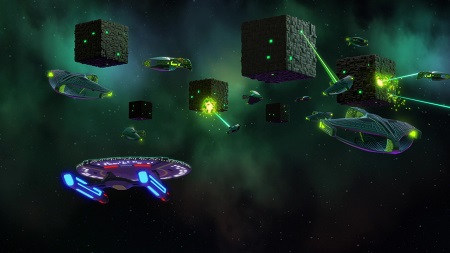
Preliminary Star Trek: Picard Season 2 predictions

Spoiler Warning: There are spoilers ahead for Star Trek: Picard Season 1, Star Trek: Discovery Seasons 1-3, Star Trek: Lower Decks Season 1, and for other iterations of the franchise.

A couple of days ago I wrote up some preliminary predictions for Star Trek: Discovery Season 4, and now it’s the turn of Star Trek: Picard Season 2 to get the same treatment. Season 1 left several big mysteries behind, and while some may be addressed it seems as though Season 2 will see Picard and the crew move on to new adventures.

A significant portion of Season 1 was occupied by recruiting the crew, but after they came together basically to do one job – find Soji – and accomplished that objective, the big thing that Season 2 needs to do is find a truly convincing reason for keeping the crew together. Rios seemingly worked as a commercial pilot, and the others have lives of their own too. Now that Soji is safe and the super-synths have been called off, what exactly is preventing everyone from drifting back to their old lives?

The super-synths in the Season 1 finale.

Right now, I see that as perhaps the biggest challenge and point of interest. What will bind this disparate crew together after their mission is complete? Unlike a Starfleet crew they don’t have a new mission or new orders, and they aren’t just going to fly around aimlessly in La Sirena looking for adventure. So finding a convincing reason for keeping them together – or reuniting them if they’ve already separated as of the beginning of the season – will be key.

As I said last time, it’s very early in the process to be considering what may or may not be included in the upcoming season. At time of writing filming hasn’t even commenced; Picard is filmed in California, and while production is in theory able to resume it’s a slow process. There have been suggestions that February may be the goal for filming to begin – but it wouldn’t be the first time we’ve been given a timeframe that didn’t pan out, so watch this space. I’m not claiming any “insider information,” nor saying that anything on my list is certain to happen. This is guesswork at best – educated guesswork in some places, perhaps, but nothing more.

With those big caveats out of the way, let’s jump into the list.

Number 1: A Galaxy-class ship.

The Enterprise-D as seen in Season 1.

Season 1 showed us a beautiful CGI rendition of the Galaxy-class Enterprise-D. But this ship was only seen in Picard’s dream and didn’t make a real appearance – despite the Federation fleet in the season finale presenting a good opportunity to do so. One lesson I hope the team behind Picard has learned is that the two fleets we saw during the standoff over Coppelius looked less impressive for being comprised of only a single starship design each – and bringing more ships into the show would be something great to see.

Obviously Picard himself has connections with several different classes of ship: the Sovereign-class from his time aboard the Enterprise-E, the Constellation-class from the Stargazer, and we even saw him on a Deep Space Nine Danube-class runabout once. But no ship design is more greatly associated with Picard than the Galaxy-class, and while the Enterprise-D is gone, there were others, including those which served in the Dominion War.

Galaxy-class ships seen in Deep Space Nine’s Dominion War arc.

In an alternate timeline seen in the Voyager fourth season episode Timeless, Galaxy-class ships were still in use in the 2390s, which is close to the time in which Picard is set. An updated Galaxy-class Enterprise-D was also seen in The Next Generation’s finale All Good Things in sequences set in the 2390s.

In addition, Excelsior-class ships from the late 23rd Century were shown to be in use for decades, and the Galaxy-class ship seems like such a versatile vessel that it would make sense to see them still in use. La Sirena will clearly continue to be the home for Picard and his new crew, and I’m not suggesting they be given their own Galaxy-class ship somehow! But it would be wonderful to see Picard’s reaction to a real-life Galaxy-class ship, triggering memories of his time aboard the Enterprise-D.

Number 2: Confirmation of Narek’s fate.

This was the last we saw of Narek.

The two-part Season 1 finale had some issues. From my point of view, the biggest problem was that the final two episodes had far too much story to cram into a relatively short span of time; new characters, new antagonists, new storylines, and a whole new civilisation were all introduced right at the end of the season.

One of the consequences of this was the abandonment of some previously-important storylines. Narek, who was a major character across the rest of the first season, was symbolic of this, as his character was simply dumped without any explanation or resolution midway through the finale.

Soji with Narek aboard the Artifact.

I know that Narek wasn’t everyone’s favourite character in Season 1, but I found him genuinely interesting. He looked certain to play out a relatively common trope in thriller stories: the spy with a heart of gold who abandons his mission after falling in love with his target… but to my surprise – and great enjoyment – he didn’t go down that route and remained loyal to the Zhat Vash crusade.

There are several possibilities for what happened to Narek after his attempt to destroy Soji and Sutra’s beacon. He could have been recovered by the Romulans, he could have been handed over to the Federation, he could have remained a prisoner of the synths on Coppelius, or he could even have renounced his wicked ways and joined Picard’s crew. The latter may seem less likely, but as we didn’t see or hear anything about Narek after the beacon attack it would be great if Season 2 could give us the rest of the story – even if it’s just by way of a line or two of dialogue.

Number 3: Riker and Troi.

Riker and Troi have recently appeared in Star Trek: Lower Decks.

Though I believe Riker actor Jonathan Frakes will be returning to Picard in the director’s chair, we don’t yet know whether Riker and/or Troi will return in Season 2. However, I would argue that their post-The Next Generation storylines have more to give, and I would love to see them both back.

One thing I was very keen on in the run-up to Season 1 is for the show to avoid being The Next Generation Season 8, and by only including a few classic characters in a few episodes, I would say the show accomplished that goal. But there is still a lot of interest from fans about the fates of many characters we knew and loved in past iterations of Star Trek, and the already-established Troi-Riker family could be a stepping stone for telling some of those stories too.

The reunion between Picard and Riker was one of the highlights of Season 1.

It would also be interesting to see whether the events of Season 1 have brought either Riker, Troi, or both back to Starfleet on a permanent basis. Riker described himself as “acting captain” in the Season 1 finale, so perhaps he will return to his family home on Nepenthe. But maybe not!

If Season 2 is to feature Starfleet more significantly than Season 1 did, we will need at least one Starfleet character to be portrayed on screen. Someone Picard knew and can work with would be a good bet, as he could call on them to help out, cashing in favours. However, I did also like the way Raffi used her Starfleet contacts in Season 1, as well as the introduction of Admiral Clancy.

Number 4: Revisiting an event from Picard’s past – such as the Stargazer or the Borg.

Captain Picard first met the Borg while commanding the Enterprise-D.

Season 1 saw Picard confront his past with the Borg as he boarded the Artifact. But there’s scope to further explore his history with the Borg, especially if the faction were to come back in a major way. Nothing we saw in Season 1 suggested that the Borg threat has gone away, and the super-synths we met in the finale could possibly have a connection to Star Trek’s iconic cybernetic villains.

The inclusion of Seven of Nine and the ex-Borg could also contribute to a Borg story. Perhaps the ex-Borg would work together with Picard to use knowledge or technology from the Artifact to defeat another Borg threat. The Borg would also be a reason for Picard’s new crew staying together instead of going their separate ways.

The USS Stargazer.

Alternatively we could revisit an event from Picard’s past that The Next Generation hinted at but didn’t explore in detail. We know Picard commanded the USS Stargazer and that Jack Crusher – husband to Beverly and father to Wesley – was killed. But the specifics of that event have never been shown on screen.

The inclusion of Dr Benayoun in Season 1 connected to Picard’s time aboard the Stargazer, and a storyline looking back at this time could bring back this character. It would also be a way for Dr Crusher and even Wesley to be included – perhaps something that happened around the time of Jack Crusher’s death is going to be relevant to a new event or storyline.

Number 5: Development of Seven of Nine and Raffi’s relationship.

Seven of Nine and Raffi at the end of Season 1.

The Season 1 finale showed Raffi and Seven of Nine had become close, and the possibility for the two to enter a relationship would be something really interesting for Season 2 to look at in more detail. We know that Seven of Nine and Chakotay had a relationship toward the end of Voyager, and that Raffi has a son from a previous relationship. But this could be a great opportunity for some more LGBT+ representation – in this case, perhaps, bisexuality.

Both characters saw significant development in Season 1 – Raffi by finding her son and Seven of Nine by avenging Icheb. Seeing Seven of Nine finally break out of the repetitive, emotionally stifled character she was in Voyager was genuinely cathartic, and giving her even more opportunities to show off her humanity and emotional side would be fantastic.

Seven of Nine and Raffi with the crew of La Sirena.

Both characters have experienced the loss of either a child or child figure, and that could strengthen their bond. They’re different people, and having gone through very different life experiences have responded differently to loss – Seven by becoming obsessed with revenge, and Raffi by falling into addiction.

They could help each other overcome these issues. Seven of Nine could help Raffi through recovery from her drug and alcohol addictions, and Raffi in turn could help Seven move on from the loss of Icheb and the murder of Bjayzl. There’s a lot of scope for very interesting and emotional stories in this pair of characters.

Number 6: Foreshadowing of the Romulan-Vulcan reunification seen in Discovery Season 3.

Romulans, Vulcans, and Romulo-Vulcans seen in the 32nd Century.

Discovery’s third season confirmed that Vulcans and Romulans had managed to set their differences aside – for the most part – and come back together. Though Discovery said this happened “centuries” after Spock’s first visit to Romulus, perhaps we could see some movement in that direction in Picard.

The attack on Mars and its aftermath has arguably left Federation-Romulan relations – and by extension, relations between the Vulcans and Romulans – at an all-time low. However, the unmasking of the Zhat Vash and their role in the attack may have led ordinary Romulans to look upon the Federation less harshly, and if there have been reforms to Romulan society – as was hinted at by the use of the name “Romulan Free State” instead of “Romulan Star Empire” – maybe the beginnings of reunification have already been seen.

The emblem of the Romulan Star Empire in the 24th Century.

Picard had a heavy focus on the Romulans in Season 1, and at least one Romulan character – Elnor – will return in Season 2. Thus the show is the perfect vehicle to show the path forward, bridging the gap between the secretive Romulan Empire of The Next Generation’s era and the reunified Ni’Var of Discovery’s 32nd Century.

The return of a character such as Tuvok could also be a part of this; seeing Elnor working closely with a Vulcan could set up his character for a future role in the reunification process, for example. With Seven of Nine already confirmed to be coming back, bringing one of her Voyager colleagues on board would be great to see.

Number 7: Spend more time with Starfleet.

Acting Captain Riker.

Season 1 made good on its promise of taking Picard away from Starfleet. While two members of the new crew are ex-Starfleet officers – as well as Picard himself – they operate outside of the organisation. I wouldn’t want to see that change; Picard has done what no other Star Trek show ever really did by focusing entirely on a non-Starfleet crew and that’s been fantastic. But there is scope to see more of Starfleet at the beginning of the 25th Century.

After Season 1 saw Picard and his crew largely working against Starfleet, from him being denied access to a Starfleet ship to Raffi and Rios breaking all the rules to gain access to the Artifact, it would be great to see some cooperation. The Season 1 finale gave us a taste of that with Riker and his armada, but there are more ways Picard and La Sirena could work with Starfleet while still remaining separate.

Riker’s Federation fleet stares down a Romulan armada in the Season 1 finale.

Alternatively – or perhaps additionally – we could see more of the story of Season 2 unfold from Starfleet’s point of view. Admiral Clancy was our major Starfleet character in Season 1 and she could certainly return. But this could also be how another legacy character is introduced, and Picard could work alongside them for some reason.

Having at least one major character being a Starfleet officer, and depicting events within Starfleet, would be something I think I’d like to see Season 2 do, provided it could balance that with keeping La Sirena on the outside. Starfleet and the Federation have always been a huge part of Star Trek, and while it was great to see that they’re still the “good guys,” spending more time with them next season would be fantastic.

Number 8: Consequences for Dr Jurati.

Dr Jurati killed Bruce Maddox in Season 1.

Though she did so under the influence of a mind-meld, Dr Jurati still murdered Dr Maddox in Season 1. Star Trek has done some great courtroom drama stories over the years, and I think it would be really interesting to see Dr Jurati arrested and even stand trial. Would the mind-meld be a suitable defence in the eyes of the law? We’ve never seen such a case in Star Trek.

This is another storyline that the finale rushed and ultimately failed to do justice to. At the beginning of Et in Arcadia Ego, Part 1 Dr Jurati is still expecting to turn herself in and be arrested for murder, as Picard insisted she would be. However, by the end of Part 2 she seems free to remain aboard La Sirena and has even formed a relationship with Rios.

Dr Jurati after realising what she did.

The question of Dr Jurati’s culpability is potentially interesting. Despite still being under the influence of the mind-meld she refused to try to harm Soji, pushing through Commodore Oh’s brainwashing. If she could stop herself from harming Soji, how did she harm Dr Maddox – someone with whom she was intimate?

Even if the legal side of things is only briefly addressed, such as a line of dialogue telling us that the charges were dropped, Dr Jurati may suffer psychological effects from what she did. She murdered someone she was very close to, and threatened to sabotage Picard’s mission. Even if he and the others have forgiven her, will she be able to so easily forgive herself? She has already attempted suicide once, and this is an angle the show could look at in more detail as well.

Number 9: The return of Dr Soong.

Dr Altan Inigo Soong.

Even if Season 2 takes Picard away from Coppelius for the most part, it would be great to catch up with Dr Soong – a character who felt underdeveloped in the Season 1 finale. We never learned why Dr Soong wanted to transfer his mind to a synthetic body, nor what the consequences are for him of giving that body to Picard.

I picked up a hint or two in Season 1 that Dr Soong may be sick or dying, so perhaps donating the synthetic body he planned to use to Picard has condemned him to death. Alternatively, however, he may simply be able to build a new one now that he understands the mind-transfer process.

Dr Soong in the Season 1 finale.

A story on Coppelius could also show us what impact the loss of Data’s neurons may have on Dr Soong. Without them, is he able to build new synths, or build another golem for himself? The finale left these questions unanswered, and while I don’t expect Season 2 to spend all of its time tying up loose ends, it would be nice to see some of these points addressed.

Dr Soong is of course played by Data actor Brent Spiner, and welcoming him back to Star Trek was wonderful in Season 1. It would be great if a role could be found for him in Season 2, even if it was only for a single episode.

Number 10: Guinan.

Guinan with Picard in Star Trek: Generations.

This is a total cheat since we already have confirmation that Guinan is coming back, but I wanted to include it anyway. Sir Patrick Stewart invited Guinan actress Whoopi Goldberg to join the show for its second season months ago, so it seems like Guinan will have a significant role in the season. Whether she’ll be a recurring character or make an appearance in a single episode isn’t known at this stage, but she will certainly be back.

Picard and Guinan’s relationship was touched on in The Next Generation, but never fully explained. There’s certainly scope to learn more about how they came together, why their relationship goes “beyond friendship, beyond family,” as well as what the impact of Picard’s reclusion had on Guinan. What has Guinan been doing since we last saw her? We simply don’t know – so it will be interesting to find out!

Number 11: Foreshadowing the dilithium shortage seen in Discovery Season 3.

The dilithium planet from Discovery Season 3.

This is the second “foreshadowing Discovery” entry on this list, and I don’t expect (or want) Picard Season 2 to spend all of its runtime doing that. However, this is another way that we could potentially see a connection to the events of Picard’s sister show.

For some unknown reason, by the 28th or 29th Centuries dilithium supplies in the galaxy were beginning to run low. This is what prompted Starfleet to begin seeking out new sources of the important fuel, ultimately culminating in the Burn, as well as the people of Ni’Var withdrawing from the Federation believing their alternative propulsion experiments caused the Burn.

A dilithium crystal aboard the Enterprise-D.

Though the dilithium shortage depicted in Discovery’s recent season is centuries away, the beginnings of it could be seen in Picard… somehow. Perhaps dilithium supplies were already beginning to run low but the Federation was keeping it quiet, or perhaps they discovered a major cache of dilithium similar to the Verubin Nebula’s planet some time in this era which kept them going for centuries.

Even a single line of dialogue noting that a starship is on a mission to seek out new sources of dilithium would be a subtle nod to fans of Discovery, and a minor way in which the two shows could be connected.

Number 12: A broader look at the galaxy as the 25th Century dawns.

A Klingon general in Lower Decks.

Despite bringing back a few legacy characters – not all of whom survived – and spending a lot of time with the Romulans, Season 1 didn’t paint a very broad picture of the state of the galaxy. We know that the Federation is doing well, despite the attack on Mars and the effects of the Dominion War years earlier. But what of other factions? And is all well in Starfleet?

There are so many races and factions that Season 2 could look at that I don’t know where to begin. But rather than a repetition of Season 1, with its relatively narrow focus on one faction and a handful of events, it would be great if Season 2 could expand the map and look at a few different places and peoples – even if that means doing so in less detail.

What happened to the Dominion after the Dominion War?

Right now, Picard is the only Star Trek production set in this post-Nemesis era. I wouldn’t be surprised if more shows, miniseries, and films were announced, but for the foreseeable future we only have Picard to show us the galaxy and what’s been going on in the years since Nemesis. Obviously the attack on Mars was a significant event, but there must be other things that happened in that twenty-year span.

As I mentioned in my last piece, a personal favourite story arc of mine is Deep Space Nine’s Dominion War, so I would be fascinated to learn anything about Bajor, Cardassia, DS9, the Gamma Quadrant, or the Dominion. But given Picard’s lack of connection to those events (except for a link to Bajor via Ro Laren) perhaps that isn’t on the agenda this time. Still, anything we could get to look at the bigger picture of the galaxy would be wonderful.

Number 13: Looking at current events.

Will Star Trek: Picard Season 2 discuss current events?

One thing Picard Season 1 did very well was show how Picard’s mental health was suffering as a result of his rejection by Starfleet. I think a lot of people who’ve been through almost a year of lockdowns and isolation could watch the Season 1 premiere, Remembrance, and empathise much more with the isolated, lonely Admiral Picard than they could when it was first broadcast.

Star Trek has never shied away from using its sci-fi setting to tackle real-world issues, and the biggest right now is of course the pandemic and its associated effects. Season 2 may have had a complete draft written before the pandemic hit – production was meant to take place last year, after all – but there has been plenty of time to change things up and include contemporary themes. Not every series has to use the pandemic as inspiration, and in many ways people come to sci-fi and fantasy to escape the real world – something that’s arguably even more necessary right now – so maybe this won’t happen.

Number 14: The return of Laris and Zhaban.

Laris and Zhaban in Season 1.

Laris and Zhaban – Picard’s Romulan assistants – served a fairly typical adventure story role in Season 1. They were the safe reminders of home that Picard had to leave behind when setting off on his quest; a role filled by the residents of Hobbiton in The Lord of the Rings, for example.

But they were also more than that. The decision to make them Romulans did serve a purpose – without them, Picard would never have learned of the Zhat Vash, for example. But given Picard’s complicated history with the Romulans after abandoning his efforts to help them evacuate their homeworld, the question of why these two ex-Tal Shiar operatives were so steadfastly loyal to him raised its head.

Picard with Laris, shortly before he left Earth.

Maybe this is simply a minor plot contrivance, but I don’t want to just overlook it and say it’s fine. What did Picard do to win their trust and loyalty so strongly that they’d follow him to isolation on Earth? And why did they choose not to follow him into space when he set out to help Soji? It wasn’t to attend to the grape harvest, surely.

Some further development of these two characters would be welcome, and while I know they did feature in a novel, most folks don’t read those and it arguably isn’t canon – Star Trek, unlike Star Wars, has always drawn a line between what happens on screen and what happens in apocryphal works. So their backstory in relation to Picard is still, in my opinion at least, an open question that Season 2 could address.

Number 15: The Artifact will come under Federation control.

The Artifact’s resting place on the surface of Coppelius.

Though parts of it have been picked over by the Romulans for decades, the opportunity to study a largely-intact Borg vessel does not present itself every day. Unless the Borg have somehow been defeated off-screen between the events of Nemesis and Picard – which I very much doubt given their popularity among fans – the Federation will surely want to avail itself of this opportunity.

The Artifact crash-landed on Coppelius at the end of Season 1, but with the planet designated a Federation protectorate they now have access to the wreck. Who knows what Federation scientists could learn about the Borg if not constrained by the Romulans. The Artifact may not play a big role in Season 2, but I would argue it is incredibly important to the Federation. That may even be the cynical reason why they chose to send a fleet to defend Coppelius.

Number 16: The appearance of Section 31.

A black Section 31 combadge as seen in Discovery Season 2.

If you followed my reviews and theories during Season 1, you may remember that I thought of numerous ways that Section 31 could’ve been included. This stemmed from the production side of Star Trek: Section 31 had recently been a major part of Discovery, and there’s an upcoming Section 31 series in development. For those reasons, Section 31 seemed like a way that all three Star Trek projects could’ve had a familiar theme.

It didn’t happen in Season 1, of course, and with Discovery completely ignoring Section 31 in its third season perhaps you could argue that it’s less important this time around. But I don’t necessarily agree. The Section 31 series is still coming, with pre-production having already begun and Michelle Yeoh’s departure from Discovery setting the stage.

Georgiou’s departure has teed up the Section 31 show.

In addition, Discovery introduced us to the enigmatic Kovich in Season 3, played by famed director David Cronenberg. If you followed my Discovery theories, you’ll know I’ve posited the idea that he is an operative of Section 31 – or maybe even its leader in the 32nd Century.

As a result, Section 31 remains one way that many of the ongoing Star Trek projects can find common ground, despite being split up along the timeline. It would remind fans of each series that they’re watching one part of a greater whole, and connecting the Star Trek franchise together will hopefully help fans of one show jump over to others that are currently in production. I know of many people who have either watched Discovery or Picard – but not both. Finding more ways to connect the shows and bring the franchise together will be important to Star Trek’s future – and vital to its ongoing success.

Number 17: Fallout from Picard’s newfound synthetic status.

The android F8 during the attack on Mars.

There had been a widespread ban on synthetic life for over a decade as a result of the attack on Mars. Though we learned in Season 1’s closing moments that the ban has been rescinded, the attack, its aftermath, and the ban may have lingering effects on non-synthetics. Will Picard face discrimination and hate as a result of his synthetic nature?

Perhaps, given the reaction in some areas of the fandom to Picard becoming a synth and the whole death-and-rebirth narrative, Season 2 will seek to downplay Picard’s status. But it would be interesting to explore the ramifications. We’ve talked about Riker, Troi, and Guinan possibly being major characters in the story – how will they react to Picard being synthetic? Can Troi read synthetic minds? Would Guinan feel he’s no longer the same person given her sensitivity to such things?

Picard reawakens in a synthetic body.

There are real-world analogies that anti-synthetic discrimination could be used to show. Star Trek has, on many occasions in the past, looked at the complex issues of race relations in the United States, and in the wake of the events of 2020 and ongoing efforts to ensure racial justice and equality, this could be something the synthetic storyline highlights.

There are also interesting legal and ethical questions that the show could address. Most significantly: is Picard the same person as he was, or is he legally and morally a distinct person now that he has a synthetic body? Will Starfleet, for example, consider him to be the same retired Admiral, or will he no longer have those privileges?

Number 18: Making peace with the super-synths.

Soji contacted the super-synths in Season 1.

Although she stood down and turned off the synths’ beacon on Coppelius, Soji did nevertheless contact the super-synths (the villains I nicknamed the “Mass Effect Reapers” for their similarity to that video game faction). There may yet be consequences for having done so, because the super-synths might not simply return to dark space to wait for another faction to contact them – they may already be en route to the Milky Way galaxy.

Even if the super-synths themselves don’t initiate a conflict, from Starfleet’s point of view it makes sense to reach out and tell them what happened. By explaining Starfleet’s position – that they value synthetic life and will not seek to harm the Coppelius synths – perhaps a conflict could be avoided. Making the attempt seems like something Starfleet would do, at least.

The super-synths almost arrived at Coppelius before Soji broke off contact and shut the portal.

There’s a lot of potential to make the super-synths more than a plot device and one-dimensional incomprehensible villain. They could, as previously suggested, connect to the Borg. They could also be expanded upon as we learn more about them, their name, their motivations, and so on. We know precious little about the super-synths right now, and it would be great to learn more. Was their offer to help the synths genuine – or was it a trap?

Soji, as the instigator of contact with the super-synths, could be just the person to help pacify them if they turn out to be on the warpath. That could be why she needs Picard and the crew of La Sirena: to seek out the super-synths and prevent a war.

Number 19: Shutting down the beacon on Aia.

The beacon on Aia.

Now that the Zhat Vash have been exposed, we don’t really know what will become of their anti-synthetic crusade. The decision to have Commodore Oh withdraw so quickly in the Season 1 finale is not one I particularly liked; the Zhat Vash were presented as zealots who would stop at nothing to achieve their goal of wiping out synthetic life, and despite Soji closing the portal, from Oh’s point of view she could just open another one.

However, criticisms aside, it makes sense that Starfleet – or at least Picard – would want to find the octonary star system and shut down the beacon on Aia. Not only would this prevent the Zhat Vash from continuing to use it, but it would also avoid the possibility of other synths accidentally finding it and using it to contact the super-synths.

The planet Aia.

This should be a priority for Starfleet, at least in my opinion! Though we may not see it for ourselves, this could be something communicated in a line or two of dialogue, just noting that the beacon has been shut down.

Alternatively it could be a major storyline, with Picard and La Sirena setting out to find Aia and continue their fight against the Zhat Vash. I’m not sure if this would be the right way to go – it feels like an epilogue to Season 1 rather than the main event for Season 2. But it could make for an interesting episode!

Number 20: The return of Dr Crusher (or another major character from The Next Generation era).

Dr Crusher in The Next Generation Season 1.

Dr Crusher was the only major character from The Next Generation who wasn’t confirmed to be alive in Season 1. We saw Troi and Riker, of course, and thanks to Zhaban we heard about Worf and La Forge too. But despite how close Picard and Dr Crusher were – they had even married in an alternate timeline – no mention was made of her.

The question of what became of their relationship is an open one. In the aftermath of Picard’s resignation and retirement, did Dr Crusher visit him? Were they married, or romantically involved? If so, could the wedding of Troi and Riker (that we saw in Nemesis) have been the prompt for them to revisit their relationship?

Captain Picard and Dr Crusher in The Next Generation.

Picard was clearly single in Season 1, so if he and Dr Crusher had been romantically involved it’s clearly something that has already ended. But his new lease on life – thanks to a new body and overcoming his depression – could mean he wants to renew things or at least contact her.

Alternatively we could learn that Dr Crusher has died, or that she and Picard never got together. They could even have had a major falling-out and may not have spoken in over a decade. Such a storyline could see them coming back together, moving on from whatever caused the fight.

So that’s it. I didn’t plan to write this at first, but writing up some preliminary guesses for Discovery Season 4 was so much fun that I wanted to do the same thing for Picard Season 2 as well!

Picard Season 2 will – fingers crossed – begin filming some time soon. I wouldn’t bet on seeing it on our screens in 2021, though, just because of how much time post-production will take. So it may be a while before we see Picard, Raffi, Elnor, Rios, Dr Jurati, and Seven of Nine! But that doesn’t mean speculating and guessing about what may be coming is any less enjoyable.

These are not even theories – I want to call them guesses rather than anything else. So please, please don’t get carried away thinking that any of these are destined to happen. We all need to remember to take such theories and predictions with a pinch of salt at the best of times, and guesswork this far out when we know less than nothing about the upcoming season is almost silly! So as fun as this was to put together, let’s all try not to get too excited about anything listed above.

Star Trek: Picard Season 1 is available to stream now on CBS All Access in the United States, and on Amazon Prime Video in the United Kingdom and elsewhere. The Star Trek franchise – including Picard and all other titles mentioned above – is the copyright of ViacomCBS. This article contains the thoughts and opinions of one person only and is not intended to cause any offence.

Preliminary Star Trek: Discovery Season 4 predictions

Spoiler Warning: There are spoilers ahead for Star Trek: Discovery Seasons 1-3, Star Trek: Picard Season 1, Star Trek: Lower Decks Season 1, and for other iterations of the franchise.

Star Trek: Discovery Season 3 only concluded a few days ago, and while production has begun on Season 4 it will be a while yet before we get any news. Regardless, I thought now would be the perfect time for some wild speculation… sorry, I mean “preliminary predictions.” It’s very early in the game to be thinking about Season 4 – a season which, if Season 3’s timeline is anything to go by, is unlikely to grace our screens before Spring 2022. But that doesn’t mean it won’t be a bit of fun!

The end of Season 3 wrapped up the main storylines in a generally satisfactory manner; regardless of how we may feel about specific events (like the Burn) their stories were concluded by the time the credits rolled. The dangling story threads left behind are more like teases for what may come, rather than unfinished elements from what came before. That’s a good way to do things, and unfortunately that’s where Picard’s Season 1 finale earlier in 2020 dropped the ball, at least in my opinion.

The USS Discovery departs Federation HQ for a new adventure in the Season 3 finale.

So Season 4 is potentially quite open right now. There’s no obvious direction for the story to go, nor did Season 3 end with a cliffhanger or big tease like Season 2’s journey into the future – or even Season 1’s reveal of the USS Enterprise approaching. Captain Burnham was given her orders after assuming command of Discovery, and set out in the ship to begin the task of delivering dilithium across the fractured Federation. It was implied that this was step one in bringing more wayward ex-members back into the fold, so perhaps that’s something we’ll see continued.

To re-emphasise: I’m categorically not saying that I have any “insider information,” nor that any of these predictions will come to pass in Season 4. This is guesswork on my part – educated guesswork, in some cases, but guesswork nevertheless. I would encourage all of you to be incredibly sceptical of anyone claiming to know for sure what will happen, or anyone claiming to have “anonymous sources” within the production team at ViacomCBS. Many, many times have people making such claims been shown to be making things up.

With that out of the way, let’s jump into my list, which is in no particular order.

Number 1: Visiting Kaminar.

The surface of Kaminar as seen in the Short Treks episode The Brightest Star.

One thing I disliked in the Season 3 finale was the unceremonious dumping of Saru. Though we know that Saru actor Doug Jones is returning to Discovery in Season 4, it will be in a different role now that Burnham has become captain. I have a couple of ideas for where Saru may fit, but for now suffice to say that I think we’ll have at least one episode focusing on Saru’s home planet of Kaminar.

Not only would such a story allow Saru to catch up with his people, but we could see how the Kelpiens and Ba’ul have developed since we saw them in Season 2. The episode Su’Kal suggested that the Kelpiens and Ba’ul joined the Federation jointly, and the way their conflict ended would be interesting to explore.

Su’Kal and Saru on Kaminar at the end of Season 3.

Given the cataclysmic nature of the Burn, though, which I expect to see the lingering effects of for years to come, one storyline that would be potentially interesting is how Kelpien society would react. Knowing that one of their own is responsible for this disaster is going to have some kind of effect on Kaminar and the Kelpiens. If Bill Irwin could return to play Su’Kal, we could see this explored in depth. Would Su’Kal be welcomed by everyone in the way Saru welcomed him? Or will he be shunned by some for his unintentional role in the Burn?

Such a storyline could be timely. In the real world, China is struggling with the fact that the coronavirus pandemic seemingly originated there, and I think that a storyline which looked at how Kaminar deals with its unwitting role in the cause of the Burn could be an interesting way for Star Trek to do what it does best: using its sci-fi setting to look at real-world issues.

Number 2: A new villain or adversary will rise.

Control was the main villain in Season 2.

Over its first three seasons, Discovery introduced us to several different villains. It seems unlikely that Season 4 will break that pattern, and it feels almost certain that there will be a significant adversary or villain for Captain Burnham and the crew to defeat. Whether such a character will be a galactic threat like Control or a playground bully like Osyraa is not obvious; the Emerald Chain was basically the only antagonistic faction we met in Season 3. However, there are bound to be others!

This could be where a race or faction from Star Trek’s past comes back to the fore, though going down that route would be a bit of a constraint. I think we’re more likely to see an original creation for Season 4, someone whose motives are tied in some way to preventing the Federation reestablishing itself, perhaps.

Osyraa was the primary antagonist in Season 3.

If the theme of the season as a whole will be reconnecting the Federation, it stands to reason that any villain or adversary would be someone who seeks to prevent that. However, it isn’t just Burnham and Discovery working on this task, so any such villain would have to be powerful enough to wield a fleet of starships. They may have their own motivations, and the Federation are simply in the way of whatever they’re trying to do.

This could also be a way to introduce time travel to the season, assuming that the producers want to do so. A villain could be someone flouting the ban on time travel for some reason – and could even be someone working inside the Federation, such as Section 31.

Number 3: A connection or crossover with Star Trek: Picard.

Jean-Luc Picard in Star Trek: Picard Season 1.

After Picard Season 1 came and went with nary a hint at the existence of Discovery, I was worried that Discovery would reciprocate in Season 3. Luckily that didn’t happen, and not only did we get to see the Qowat Milat – a faction introduced in Picard – we also got a mention of Admiral Picard himself in the episode Unification III.

At this point we don’t know whether Discovery Season 4 or Picard Season 2 will be broadcast first – and it’s possible that, with the ongoing disruption caused by the pandemic and the uncertainty around the two productions, the team at ViacomCBS aren’t 100% sure either! However, both shows are up and running, and Picard has at least one season under its belt – a season which had several factions, new characters, starships, story points, etc that could in theory cross over to Discovery.

Coppelius Station.

I got the impression from the Season 1 finale of Picard that the show would be moving on to a different adventure in Season 2, perhaps leaving behind the Coppelius synths altogether. If that’s the case, Discovery Season 4 could pick up this story and show us what became of the synths in the centuries after Soji and Picard came to their rescue. Did they stay on Coppelius or relocate? Are some of the synths we knew, such as Soji, still alive in this era?

As I said numerous times during the runs of both Picard and Discovery, these sister shows could do more to work together, reminding viewers that they’re two parts of a greater whole. The difference in time periods is an issue, but as we saw with the Qowat Milat it doesn’t have to completely prevent the two series from teaming up.

Number 4: The return of a classic race or villain.

Borg drones in First Contact.

Season 3 brought back the Trill, Orions, Andorians, and the Romulans and Vulcans on Ni’Var. There were very brief scenes which showed off Cardassians and a couple of other races, and we saw the Bajorans and Xaheans in holographic form too. So Season 3 crammed a lot into its thirteen episodes in terms of revisiting races from Star Trek’s past. This is something I hope Season 4 will continue to do.

Though the Dominion War ended more than 800 years ago, finding out what became of the Cardassians, Bajorans, Breen, and the Dominion themselves is perhaps what I’d choose if it were up to me. The Dominion War arc, though controversial in some Trekkie circles, is a story I find myself revisiting often, and it’s always a thoroughly enjoyable ride. Deep Space Nine ended right when the war did, and we don’t really know anything about what became of the factions involved afterwards.

Captain Sisko, General Martok, and Admiral Ross on Cardassia Prime at the end of the Dominion War.

There’s also the potential to learn what became of the Borg. They didn’t take advantage of the Burn and the Federation’s collapse to assimilate the Alpha Quadrant, so could we infer from their absence that they’ve been destroyed, pacified, or severely reduced? Could the Borg have been presumed defeated centuries ago but make a big recurrence in Season 4 – perhaps looking to acquire the Spore Drive technology?

I’d also love to see the inclusion of a Suliban or Xindi, or perhaps a Talaxian or Kazon from the Delta Quadrant. I know Discovery can’t possibly cram all of these disparate factions and races into one season, but the 32nd Century offers so many interesting story possibilities for practically everyone we’ve met in past iterations of Star Trek. The potential is unlimited!

Number 5: Will Burnham remain Captain?

Captain Burnham.

Discovery worked hard over the back half of Season 3 to make Burnham’s ascent to the captain’s chair feel genuinely earned. Some of the criticisms I’ve made of her character, both in Season 3 and previously, stem from her position as a junior officer making big decisions that go against her orders, so putting her in the captain’s chair and backing her up with a helpful crew should see her continue to grow. I want to see that, and I hope that she will continue to be a Starfleet captain who lives up to the ideals of the Federation in Season 4 and beyond.

But Discovery has never found the right fit for its captain’s chair for one reason or another. I’ve actually enjoyed what all three captains – Lorca, Pike, and Saru – brought to the role, but none of them stayed in that role beyond a single season. One of my hopes for Season 4 would be that we’d get some stability in the captain’s chair, and in a way I’m hopeful Burnham will retain the position going into Season 5 and potentially beyond – but what if that isn’t the plan?

Discovery has gone through three captains in three seasons.

Perhaps one of Discovery’s unique points is going to be the season-long captaincies of different people, each giving the ship and show a distinct feel. Lorca was the hardball who turned out to be a traitor. Pike was the classic character who embodied the spirit of adventure. Saru was the calm and collected diplomat. Burnham may be a Kirk-style action hero, a bit of a renegade but someone who always comes through for Starfleet when it counts.

How or why she might leave the role is unknown, and given Discovery’s approach to storytelling across Seasons 1 and 2 in particular, I’m not sure how likely it is that, having gone to the trouble of promoting her, they’ll replace her within a single season. But that exact thing happened to Captain Saru this season, so it wouldn’t be unprecedented.

Number 6: The lingering effects of the Burn.

The Burn.

Having resolved the Burn and found a huge dilithium planet to negate its destructive effects, there may be a temptation to shelve the Burn, especially if the writers and producers of Season 4 are taking on board fan feedback – which has been mixed to say the least on that particular story point. However, I think doing so would be a mistake.

If we start off Season 4 with a one- or two-year time skip, I can already predict that the legwork of rebuilding the Federation will have already happened off-screen. Resetting the Federation to a state much closer to how it has always been shown in Star Trek may be what some fans want, and in some ways I do too – but I think that after seeing the Federation at such a low ebb in Season 3, we need to see at least some of the rebuilding process for ourselves.

The 32nd Century was a difficult environment for many, and that won’t magically go away overnight.

I already discussed one way the Burn’s effects could still impact the story with the Kelpiens, but there are a million-and-one others. Captain Burnham could lead the ship to revisit parts of the Federation that no one has heard from since the Burn only to find them under occupation or in the midst of civil war, for example. Or we could see an ex-Federation member that completely ran out of dilithium and has had no way to power itself for a century.

Season 3 focused largely on the Federation and ex-Federation members. But there’s scope to see how the Burn impacted other powers in the galaxy – depending on which ones existed at the time! If the source of the Burn is revealed as a Federation member (i.e. the Kelpiens) would, for example, the Dominion or Klingon Empire want to exact revenge or get reparations from the reunited Federation? There are so many ways that the Burn could have impacted the galaxy that we need to see. It hasn’t all gone away with the uncovering of its source and the discovery of the dilithium planet.

Number 7: A time travel story featuring the Guardian of Forever.

The Guardian of Forever… a.k.a. Carl.

It was a very deliberate choice to bring back the Guardian of Forever in Season 3, and it would be a shame to only use them once! Not to mention that guest star Paul Guilfoyle was just fantastic as Carl, the Guardian’s humanoid avatar, and would make a thoroughly welcome return to Discovery.

One way the Guardian of Forever could be included would be to send the USS Discovery back in time – for some reason – in order to tie into the Short Treks episode Calypso. That would likely need to be a multi-episode story arc, but it would be one way to include the Guardian and resolve Calypso – two birds, one stone!

The Guardian of Forever’s portal.

If it were discovered that some nefarious villain or antagonistic faction were using time travel, the Guardian of Forever could be Captain Burnham’s ace in the hole to counteract them. That would be another way to make use of the reintroduction of this entity. Season 3 expanded on the Guardian of Forever by showing us that it can transport people between parallel universes, so this could in theory allow for another Mirror Universe story (please no) or for the Discovery crew to travel to any of the other alternate realities seen in Star Trek.

Speaking of which…

Number 8: A Kelvin timeline reference.

The Kelvin timeline USS Enterprise.

This is something else that Season 3 touched on briefly, with Kovich making note of a time war soldier who crossed over from the alternate reality. The Guardian of Forever, as mentioned, could be one way to literally cross over, but unless a new Kelvin timeline film is in development – and it doesn’t seem to be at this stage – there’s not as much to be gained by doing so when compared to a tie-in with Star Trek: Picard or other ongoing projects.

However, a Kelvin timeline reference would be neat, even if it were little more than a throwaway line akin to Kovich’s in Season 3. The 32nd Century, with its superior technology and better understanding of time and timelines, is the only Star Trek setting aside from the alternate reality itself that really can make the connection between Star Trek’s two major universes.

Number 9: Who is Kovich?

Kovich in Terra Firma, Part I.

Famed director David Cronenberg, who plays Kovich, has said that the character will return in Season 4 in some way, so there’s the possibility to learn more about this mysterious character. I’d been speculating since his first appearance that his distinctive uniform, high security clearance, and un-Starfleet lack of morality could hint at his being an operative of Section 31 – or even its leader.

Another theory I’ve heard fans kicking around is that Kovich is the Federation’s president. That would be an interesting way to go too, as a storyline which involves rebuilding the Federation could require serious diplomatic efforts. The Federation President would surely be involved in bringing key worlds like Earth back into the fold.

Number 10: Admiral or President Saru.

Saru in Terra Firma, Part II.

As I said earlier, I was disappointed in the way Saru was dumped at the end of the Season 3 finale. He didn’t get a chance to say goodbye to his crew, to offer Burnham her promotion in person, and his decision to leave the ship was only briefly touched on by Burnham in a voiceover. Though Saru is coming back, his role is unclear with Burnham now in command.

I can think of a couple of ways he could be included, though. The first would be a promotion to the rank of Admiral, joining Vance at the head of Starfleet. As the Federation grows, Starfleet will need to grow too, and with a new source of dilthium – and the potential for new Spore Drive ships too – and that will mean the need for new Admirals to command the expanding fleet. Saru proved himself as a good captain across Season 3, and while he did make some mistakes, I would argue he’s an excellent Admiral candidate.

Saru and Burnham with Admiral Vance.

However, we also saw Saru’s diplomatic side in Season 3, particularly with the President of Ni’Var. Saru could continue in this role as a diplomat, but if worlds like Trill, Earth, and Ni’Var all rejoin the Federation, might some of them want to see him become Federation President?

If the story of Season 4 looks at the Federation re-unifying, I could see why some of the aforementioned worlds might want to support the candidacy of Saru. Early Federation politics seemed to involve balancing the Vulcans and Andorians, but this led to almost all of the Federation’s key institutions being on Earth and dominated by humans. The reunited Federation may be less keen on giving humanity all of the top jobs, especially given Earth’s century of isolationism, so someone like Saru may be a compromise candidate among the Federation’s members who are coming back together for the first time in a long time.

Number 11: A redesign of the USS Discovery internally.

The bridge of the USS Discovery.

One aspect of Season 3 that didn’t quite sit right with me was the redesign of the USS Discovery. I adore the redesign, don’t get me wrong, but I didn’t quite buy into it as “believable” considering the ship didn’t change on the inside. We saw a few changes, like the programmable matter and holographic elements in many bridge consoles, and of course the big empty space in the engineering/drive section that we saw during Book’s turbolift battle against Zareh. But aside from a few small touches, a few lines of technobabble, and one CGI-heavy action sequence, the ship looks the same from the inside.

This undermines the decision to have the ship undergo a major refit, and I’d love to see some more aesthetic changes inside the USS Discovery to match its external appearance. It wouldn’t mean completely tearing down old sets, but tweaking and changing them to indicate that the ship has been heavily altered. Lighting is one way that the designers could make an immediate, obvious, and unobtrusive change. Ditching some of the blue lighting and generally upping the brightness of other lights – especially on the bridge – would transform the way Discovery looks.

The inner workings of the USS Discovery.

The USS Enterprise, after its refit in Star Trek: The Motion Picture, looked like a different ship inside and out. The USS Discovery nailed the outside look in Season 3, but its inside hasn’t caught up. Even a handful of changes here and there would go some way to making good on the refit idea, and I’d love to see the bridge, the ready-room, and engineering given a facelift in time for Season 4.

This would also be a great moment to show off a new area of the ship, either something that was improved during the retrofit or a brand-new addition. We saw the data core at the end of Season 3, but I don’t see a pressing need for the crew to spend a lot of time there. What we could see, however, is some kind of holodeck or recreation area, an improved mess hall that had more of a Ten Forward lounge vibe, an observation deck or briefing room, a battle bridge or secondary command centre, or an additional science lab.

Number 12: Defending the Verubin Nebula.

The periphery of the Verubin Nebula.

In a galaxy devoid of its most significant source of fuel, the discovery of a massive cache of dilithium will not go unnoticed – or unopposed. The Emerald Chain may have “fractured” according to the Season 3 epilogue, but it seems unlikely that they’d be the only ones interested in acquiring the dilithium planet in the Verubin Nebula.

As such, part of the Season 4 storyline may involve Discovery having to defend the Verubin Nebula from someone looking to seize it for themselves. After the Emerald Chain did essentially the same thing at the end of Season 3, if I were writing it I wouldn’t make this the main point of Season 4, but it seems like something that could be included – or at least explained. How will the Federation defend what seems like the galaxy’s most valuable resource?

Number 13: To seek out new… dilithium?

The dilithium planet.

At the moment, the Verubin Nebula is the only major source of dilithium. The USS Discovery with its Spore Drive can jump all across the galaxy, making it a great ship to scout for new sources of the valuable fuel. Part of Discovery’s mission could be to jump around to areas of the galaxy the Federation had previously been unable to reach in search of dilithium.

I see this story point as the catalyst for something else to happen rather than the main event, though… because on its own it doesn’t exactly seem like the stuff of action and excitement!

Number 14: A new first officer.

Could Lieutenant Willa join Discovery’s crew?

Last time we looked at the odd Tilly situation and theorised that her uniform may have been altered from command red to science blue in post-production. This could mean she’s being replaced as first officer – a position she only took on a temporary basis to begin with.

If Captain Burnham doesn’t keep Tilly as first officer, that obviously opens the position up to someone else. There are candidates on Discovery’s crew, but I’d also propose Lieutenant Willa, Admiral Vance’s aide-de-camp from Season 3. She would be an interesting addition to the crew; another 32nd Century native along with Book to advise the crew of changes they might’ve missed.

Lieutenant Rhys was given the conn temporarily in Far From Home.

We could also consider the promotion of one of the secondary bridge crew, such as Nilsson, Rhys, or Bryce. Nilsson and Rhys have both been left in charge on the bridge before, so could in theory make good candidates. I wouldn’t pick Stamets or Dr Culber, as they both have roles elsewhere on the ship.

Nhan could make a comeback after she was dropped early in Season 3. I half-hoped to see her return in the season finale, but if she finishes her mission aboard the USS Tikhov, perhaps she could return to Discovery as first officer. If not, maybe a new character could join the crew in that role.

Number 15: A new home for Federation HQ.

Federation HQ.

I initially wondered if Season 4 might see Federation HQ return to its home on Earth, but I’m not sure if that would be the best option so early in the game. Plus I kind of like the idea of a space headquarters, not attached to any planet and able to be moved.

Perhaps it makes the most sense in the short term for Federation HQ to anchor itself near the Verubin Nebula, able to immediately respond to any threats to its valuable prize. But we could also see Federation HQ move between worlds, visiting new members in turn or just staying on the move. If Starfleet is growing in strength, the need for a secret location will be lessened and perhaps we could see some institutions of the Federation’s government relocate away from the base we first encountered in Season 3.

Number 16: The return of the Klingons.

Klingon leader T’Kuvma during the series premiere.

In Season 1, Discovery depicted a major Federation-Klingon war, and while the Klingons were peaceful by Season 2, they were not exactly staunch allies of the Federation. In Star Trek’s fictional history, the Federation and Klingons would remain at loggerheads for much of the 23rd Century, only to sign the Khittomer Accords at the end of the century, leading to a period of peace. By the 24th Century they were allies, particularly during the Dominion War, and I think it would be interesting to take that line forward in time.

How would the Discovery crew, veterans of the Federation-Klingon war, react to having to work with Klingons? Are the Klingons Federation members, or ex-members? If so, part of the season’s story could be bringing the Klingons back into the Federation – but would everyone on the crew be okay with that?

A map depicting the battlefields of the Federation-Klingon War in the Season 1 episode What’s Past Is Prologue.

Alternatively we could see the Klingons as a neutral power, watching the rebuilding of the Federation from the outside. Maybe they, like the Emerald Chain, have gotten used to being a more powerful faction as the Federation have declined, and may not like to see their old adversary getting back on its feet.

Almost anything could have happened to the Klingons both before and after the Burn, and for a faction that had previously been important within Discovery it would be great to see what became of them, and how that information would impact our characters.

Number 17: Aurellio will be back.

Aurellio.

Kenneth Mitchell’s Aurellio was one of the high points of the final two episodes of Season 3. As an ex-member of the Emerald Chain and a brilliant scientist, Aurellio could be a valuable ally to the Federation and Discovery’s crew.

Aurellio was tasked with working on the Spore Drive, and in the Season 3 finale figured out that empaths like Book are capable of navigating the mycelial network. He could have switched sides to work for the Federation, perhaps working on a way to give more starships a Spore Drive. There are other scientific roles he could play, depending on the nature of the season.

Number 18: More Spore Drive ships.

Discovery making a Spore Drive jump.

Speaking of the Spore Drive and Aurellio, now that the problem of navigating the mycelial network has potentially been fixed, there’s no reason why more Starfleet vessels can’t be fitted with a Spore Drive of their own. In Season 1, Stamets seemed to suggest early on that mycelial spores were difficult to collect or cultivate, but if that could be addressed (or a new source found) there’s no reason why more Spore Drives couldn’t be built.

The Spore Drive has long been Discovery’s most controversial piece of tech, and finding a proper role for it that didn’t get in the way of previously-established canon is one reason for taking the ship and the series out of the 23rd Century. Having arrived in the far future, now is the time to let the Spore Drive shine.

Number 19: Those grey uniforms?

Some of the crew in their new uniforms.

The reaction to the new uniforms in the 32nd Century was mixed, and I wonder if Season 4 will address this in any way. One thing to note is that the grey uniforms looked a lot better in the brightly-lit Federation HQ than they do on the more dimly-lit Discovery. This could be addressed by changing the lighting, as suggested above, but it could also be addressed by making some changes to the uniforms.

It was a refreshing change to ditch the all-blue look, and I don’t dislike the 32nd Century uniforms. Though Vance wore the Admiral’s variant all season long, I still need to get used to seeing the regular crew in that style before I can say for sure how much I like them. So from my personal perspective I think there’s no immediate need to change anything up, but I know not everyone agrees.

Lieutenant Owosekun in her new uniform, showing close-ups of the collar and coloured stripe.

Starfleet uniforms are like starship designs: everyone in the fandom has an opinion on which is best. For my two cents, after four seasons of Enterprise’s blue boiler suits, three seasons of Discovery’s all-blue look, and Picard’s crew not having uniforms, I’m happy to see something different. Lower Decks and the Kelvin timeline uniforms had blocks of colour, and that was great. But it’s been a long time since we really mixed up the uniforms in Star Trek – even the Starfleet uniforms of the Picard era were similar to those from Deep Space Nine and Voyager.

So I’m willing to give the grey outfits a chance. But I wouldn’t be shocked to see promo material for Season 4 showing off a new variant or even a different style altogether.

Number 20: Lieutenant Sahil will join the crew.

Lieutenant Sahil.

Lieutenant Sahil, newly commissioned into Starfleet in the Season 3 finale, was one of the first people Burnham met in the 32nd Century. It would make a lot of sense for her to want to repay his kindness and help by offering him a role aboard Discovery. He could be one of the bridge officers, perhaps taking over from someone like Nilsson or Bryce if either were promoted.

I’d love to see a recurring role for Lieutenant Sahil now that he’s a commissioned officer. With Georgiou having left the show entirely and Saru looking at a potentially reduced role or a role not aboard the ship, there’s plenty of space for Sahil, Aurellio, and others to join up.

So that’s it. A few far too early ideas for what Star Trek: Discovery might bring us in Season 4. If I remember after the season airs it’ll be fascinating to come back and look at this list!

So this was just a bit of fun as I continue to work through my post-Season 3 thoughts. As I say it’ll be great fun to come back and see how many of these guesses were completely wrong once we’ve seen Season 4 for ourselves. The 32nd Century has opened up Star Trek to radically new story ideas for the first time in a long time, and I’m loving that. No longer being constrained by canon means that Discovery can literally take the franchise anywhere, with open-ended story possibilities.

These are not even theories – I want to call them guesses rather than anything else. So please, please don’t get carried away thinking that any of these are destined to happen. We all need to remember to take such theories and predictions with a pinch of salt at the best of times, and guesswork this far out when we know less than nothing about the upcoming season is almost silly! So as fun as this was to put together, let’s all try not to get too excited about anything listed above.

Star Trek: Discovery Season 3 is available to stream on CBS All Access in the United States, and on Netflix in the United Kingdom and elsewhere. The Star Trek franchise – including Discovery and all other properties mentioned above – is the copyright of ViacomCBS. This article contains the thoughts and opinions of one person only and is not intended to cause any offence.

Star Trek: Discovery – Was there a last-second change for Tilly?

Spoiler Warning: There are spoilers ahead for Star Trek: Discovery Season 3, including the finale.

Something interesting happened as I was going back over the Season 3 finale of Star Trek: Discovery, and it turns out I’m not the only person who noticed it. After the main storylines of That Hope Is You, Part 2 were over, we were launched into a short epilogue which tried to wrap up a few other plot points from across the season. At the end of this epilogue, Burnham was promoted by Admiral Vance and assumed command of the USS Discovery.

On what we assume is her first outing as captain, Burnham arrives on the bridge to be greeted by an honour guard made up of senior officers, bridge crew, and other characters from the season. Among them was, of course, Tilly. If you were eagle-eyed during her brief moment on screen you might’ve spotted that she’s apparently been promoted to the rank of lieutenant – a well-earned promotion after her efforts throughout all three seasons of the series, and not what this controversy is about!

Tilly in the epilogue.

Look at the close-up image of Tilly above. She, along with the rest of the crew, have been given new uniforms. These uniforms are grey with a coloured stripe on the right of the tunic (or jacket) denoting departments. Tilly’s is blue, which makes sense because she’s a science officer. But do you see something off about the blue stripe on her uniform?

I confess that I didn’t at first. When I watched That Hope Is You, Part 2 for the first and second times, and again when I went back to the episode to capture still-frames for my review and theory post I completely missed it. The excitement and emotion of this moment, coupled with Tilly only being on screen for a scant couple of seconds, meant I missed it entirely – but look closely. The coloured stripe is clearly the result of digital post-production work.

A closer look at the blue stripe.

Looking at it now it seems painfully obvious. It wouldn’t be Discovery’s first digital effect that missed the mark in Season 3 – remember when Mirror Burnham was stabbed in Terra Firma, Part II? But it raises two quite interesting questions: what colour was her uniform originally, and why was it changed at the last minute?

It’s possible that this literally was a last-second change; the low quality of the texture used for the blue stripe may mean it was something thrown together in a matter of days, and this makes me wonder if the change is indicative of Discovery switching things up while the season was already in motion.

This stabbing looked pretty bad earlier in the season.

By the season finale, Tilly was acting first officer aboard Discovery. With the departure of Saru, Burnham has assumed command on what seems to be a permanent basis – but who will be her XO? That wasn’t addressed, but given their close relationship I wouldn’t be shocked if Discovery originally intended for Burnham to retain Tilly in that post also on a permanent basis. The awkward blue stripe may have been covering up a red stripe on her uniform – red denoting the command division.

Tilly becoming first officer was not a popular point, as far as I can tell from my limited interactions with the Star Trek fan community. It didn’t bother me personally, though seen in the context of the season as a whole I’d argue that perhaps Burnham’s ascent to the captaincy didn’t need the bump in the road of disobeying orders and losing her role as XO. But considering that there was some degree of pushback from fans to Tilly’s role, could that explain this seemingly slapdash digital work?

Saru appointing Tilly temporary first officer in Unification III didn’t sit well with everyone.

There are no immediately obvious first officer candidates among Discovery’s cast, yet in Season 4 the ship will certainly need one. A new character could be introduced, of course, or a secondary character could be promoted. But it seems at least possible that the original plan was for Tilly to stay in that post. If those plans were changed, the question is why?

The reaction from viewers seems a good bet, but considering that this was not a huge story point in Season 3 it seems at least a little peculiar for the producers and writers to go out of their way to undo it in such an odd fashion so late in the season. But it’s also possible that the storyline of Season 4 requires either a new first officer or for Tilly to be in a scientific role.

Tilly with other senior officers in the epilogue. The blue stripe is again noticeable.

There could also be a simpler explanation: Tilly was originally wearing blue, but the low lighting on the bridge (which has been an issue at points for Discovery since Season 1) made her uniform look too dark in the finished shot. Rather than lighten the entire sequence the creative team tried to digitally recolour part of her uniform. Tilly is standing in a shadowy part of the set, so that’s a possibility.

However, that should have been known well in advance, and if it were changed for that reason it leaves the open question of why the finished effect looks so amateurish! It almost looks as though whoever worked on this retouching of her uniform simply pasted a single flat colour across the whole uniform stripe. If there had been time, you’d think that someone would have insisted that the digital effects team fix it before the episode was broadcast.

So it’s a minor mystery. What happened with Tilly’s uniform, and is it connected in any way to the minor backlash from some viewers to her role as first officer? We may never know!

Star Trek: Discovery Season 3 is available to stream on CBS All Access in the United States, and on Netflix in the United Kingdom and elsewhere. The Star Trek franchise – including Discovery and all other properties mentioned above – is the copyright of ViacomCBS. This article contains the thoughts and opinions of one person only and is not intended to cause any offence.

Electronic Arts seemingly loses its exclusive rights to Star Wars

For almost a decade following Disney’s acquisition of LucasFilm, only one company has been able to make Star Wars video games: Electronic Arts. A deal between Disney and EA gave them exclusive rights to the Star Wars license, and in the years since there have been four mainline Star Wars games, one Lego tie-in, one VR game, and a handful of mobile titles.

Both 2015’s Battlefront and of course 2017’s Battlefront II proved controversial and divisive; the former being disappointingly threadbare and the latter for its aggressive in-game monetisation. 2019 saw Jedi: Fallen Order, which I played through last year and was a fun title, and finally 2020 saw Star Wars: Squadrons, which I’ve also been enjoying. However, four games in nine years is perhaps less than many fans were expecting, especially with two of them having serious issues.

2015’s Battlefront was disappointing to many fans.

Calls for Electronic Arts to be “stripped” of the Star Wars license began after Battlefront’s release in 2015, but reached fever pitch in the weeks after Battlefront II’s launch. There was even a petition that hundreds of thousands of folks signed to ask Disney to revoke EA’s exclusive arrangement. That went nowhere, of course – fan petitions never achieve anything – but is indicative of the strong feelings over EA holding the rights.

The well-received Jedi: Fallen Order and Squadrons, combined with updates and patches which greatly improved Battlefront II, led to a cooling-off period, and as of early 2021 cries for the Disney-EA deal to be somehow undone had largely abated. It was a surprise, then, when LucasFilm announced a new Star Wars game… published not by EA but by Ubisoft!

“A surprise, to be sure, but a welcome one.”

Ubisoft has been honing its style of open-world games for years, with franchises like Assassin’s Creed, Far Cry, and Watch Dogs. It seems, from the teaser announcement made yesterday, that the new title will be an open-world game in a similar style, though no mention has yet been made whether it will be a single-player title like those in Ubisoft’s other open-world series, or a multiplayer “live service.” From my point of view I’m hoping for the former!

The game itself may be several years away, though Star Wars does have a recent track record of announcing games closer to release – that’s what happened with Squadrons last year, for example. No release window has been suggested as yet, and in fact we know precious little about the game itself beyond the publisher responsible.

Star Wars: Squadrons.

The upcoming game is just one part of this story, though. Most industry watchers agreed that Electronic Arts had a couple of years remaining on their deal with Disney, which raises the question of how and why this Ubisoft game has been able to enter development. It’s possible that the original contract was incorrectly reported, in which case it may simply have run its course. Or there may have been clauses regarding a number of titles, profit made, etc. that Electronic Arts didn’t live up to, allowing Disney to open up Star Wars to other companies. We don’t know the details – and unless someone senior breaks ranks to tell us, we likely never will!

Exclusivity arrangements can be difficult, and the Disney-EA deal over Star Wars is pretty much a textbook example of why. An exclusive contract like the one Disney offered EA effectively gives that company a monopoly over the license, and anyone who knows anything about basic economics can tell you why monopolies are a bad idea in practically every industry.

No, not that kind of Star Wars monopoly…

Having a monopoly meant there was no threat of competition, and this allowed EA to sit on the Star Wars license, cancelling titles that senior executives didn’t think would bring in “recurring user spending” and not feeling under any real pressure to develop or release anything. They could afford to be complacent because no one else was contractually allowed to even pitch a concept for a Star Wars title.

This attitude was changed when Electronic Arts saw the scale of the backlash to Battlefront II. The effects of that debacle are still being felt, and the game opened the eyes of parents, journalists, and even politicians to the shady practice of in-game gambling. But we’re off-topic. Too late, EA shifted focus away from cash-grabs, putting out the single-player Jedi: Fallen Order and following up with the space-sim Squadrons.

2017’s Battlefront II controversy may have triggered a change in thinking at EA – and at Disney.

Fans had been clamouring for a single-player story-driven Star Wars game for years, and while Battlefront II had a creditable single-player campaign, it wasn’t until Jedi: Fallen Order’s release in November 2019 that the single-player itch was truly scratched for most fans. By then the damage had been done for Electronic Arts, though, and their earlier complacency and attempts to swindle players with truly awful monetisation came back to bite them.

Though Electronic Arts will continue to work on Star Wars titles – most significantly the upcoming sequel to Jedi: Fallen Order – they will no longer be the only company Disney trusts with their incredibly expensive, incredibly lucrative license. The Ubisoft game may be the first of several upcoming Star Wars projects to be taken on by other companies, and hopefully what results will be a broader range of genres and styles of game.

Protagonist Cal Kestis in Jedi: Fallen Order.

In December 2020, LucasFilm announced half a dozen or so upcoming Star Wars films and television shows. There will be a lot of Star Wars content to come over the next few years at least, and while not all of the shows and films will be suitable for a video game adaptation, some may be. Disney and LucasFilm need to ensure they have access to the broadest possible range of talents in the video game industry if they hope to make the most of Star Wars.

I wasn’t especially excited by the film and television announcements made last month, to put it politely. Too many of them seem to be spin-offs, prequels, and deep dives into uninteresting side-characters rather than expanding Star Wars beyond its original incarnation. But even so, several of these projects seem ripe for video game tie-ins, and the end of the Skywalker Saga of films coupled with this expansion into new films and television projects may have been a contributing factor to Disney ending or not renewing its exclusive arrangement with EA.

Could a game based on the upcoming series Rangers of the New Republic be in the works?

For my two cents, I see the ending of this kind of exclusivity deal as a good thing. Monopolies are problematic for consumers for precisely the reasons the Disney-EA arrangement shows, and in future it could even be used as a case study for why these kinds of deals are a bad idea. Opening up Star Wars games to other companies allows for different points of view, competition, and hopefully what will result at the end of the day will be better games. Not necessarily more games. But better ones.

It is worth noting that Ubisoft is a company that hasn’t exactly escaped controversy recently. There have been serious problems within the company, including sexual harassment accusations against senior executives, and the accusation that the company itself tried to cover this up and cover for abusers. Company culture and institutional problems count against Ubisoft, and while Star Wars fans are rightly excited to learn that the franchise will be moving away from the EA exclusivity deal, it’s worth noting that Ubisoft has issues – and Disney should also be aware of this. The last thing the Star Wars brand needs right now is further controversy, yet a team-up with Ubisoft risks precisely that.

So that’s it. The end to Electronic Arts’ monopoly over the Star Wars license. Now if only someone would make a Star Trek video game…

The Star Wars franchise – including all titles mentioned above – is the copyright of Disney and LucasFilm. Star Wars: Battlefront, Star Wars: Battlefront II, Star Wars Jedi: Fallen Order, and Star Wars: Squadrons were published by Electronic Arts. Some screenshots and promo art courtesy of IGDB. This article contains the thoughts and opinions of one person only and is not intended to cause any offence.

The first big video game announcement of the year is… Indiana Jones?

Early January isn’t usually a good time for big announcements as folks are still getting back to work and school after Christmas and New Year. But 2021 is different with lockdowns and such, so perhaps it shouldn’t be a surprise to see a new video game announcement!

Bethesda Softworks – the company behind The Elder Scrolls series which was recently acquired by Microsoft – has announced their latest project: a new Indiana Jones game. In addition to Bethesda and legendary producer Todd Howard on the publishing side, the game will be developed by MachineGames, the studio responsible for the recent Wolfenstein titles. Obviously there’s a lot that we don’t know at this stage about the project, which was announced with a cinematic teaser and little else, but any title featuring Indiana Jones has the potential to be fantastic.

Doesn’t it?

Despite being a successful film series (alright, three successful films and one crap one) Indiana Jones hasn’t been anywhere near as successful in the interactive medium. Indiana Jones’ Greatest Adventures back in the SNES days was the last time any game featuring the scrappy archaeologist could be considered a hit. There have been a couple of Lego games and a couple of original stories during the 1990s and 2000s, but although Indiana Jones has inspired some fantastic games and game franchises, it never really took off as a game series of its own.

Indiana Jones’ Greatest Adventures on the SNES.

The likes of Tomb Raider and Uncharted owe a lot to Indiana Jones, but those series have gone on to far outperform and eclipse their inspiration, at least in the gaming realm. Since the mid-1990s no Indiana Jones game has felt like anything other than an afterthought; a second-tier game picked up by some fans but soon afterwards found in bargain bins. What can Bethesda and MachineGames do to stand out and make sure their new project doesn’t suffer that ignominious fate?

Because it’s been a while since there was an Indiana Jones game, and with the films’ standing remaining high, there will be a lot of interest in this game whenever it’s ultimately released. In fact the reputation of the Indiana Jones films has only grown, such that some people even consider Kingdom of the Crystal Skull “watchable!” With a new film in the works too, it would be great to see the series end on a high note.

Kingdom of the Crystal Skull was… interesting.

The new film may have been the catalyst for this game’s creation, but there’s no indication at this stage that it will be a direct adaptation. As I’ve said before, the days of the film tie-in seem to be long gone, and in some respects making this new game a tie-in would arguably reduce interest in it, such is the low regard for film adaptations in a general sense.

So what can we expect from this game? At this stage, very little is known. MachineGames’ previous titles have all been first-person shooters, so perhaps a first-person perspective could be on the agenda. But Indiana Jones films have always been more about adventure than guns-blazing action, so I wouldn’t expect a game using this setting to simply be a shooter.

If I had to guess, I think what I’d say is that the new game will draw inspiration from those very games that Indiana Jones inspired years ago: Tomb Raider, Uncharted, and the like. We’ll get a third-person action-adventure game with puzzles, mystery, and plenty of villains to outmanoeuvre and defeat. But I could be completely wrong on that – it could be a multiplayer-only kart racer for all we know at this stage!

Indiana Jones inspired the Uncharted series of video games.

Right now, the hype around this project is almost entirely built on name recognition. Both the Indiana Jones brand and the studio and publisher behind this title have reputations that are generally respected – although it’s not unfair to say that Bethesda has been through the mud recently, especially with Fallout 76. Nostalgia for the Indiana Jones films will certainly help drive sales, but as we’ve seen from some recent projects – including one that was also part of a franchise created by George Lucas – nostalgia alone isn’t good enough. Sometimes too much nostalgia can even do harm, taking away a potentially-interesting story’s own merit.

So Bethesda and MachineGames will need to tread carefully. Indiana Jones has never really proven itself a colossal money-making success in the video game realm, and while the generally good reputation of (three of) the films and the nostalgia many folks have for them will bring a degree of interest, the game will have to offer more than that. It will have to be… a good game.

Shock horror! A game will have to be good in order to sell? I’m afraid so. In fact, “good” won’t be good enough. Any game using nostalgia as a hook will have to go above and beyond in order to make good on players’ and fans’ lofty expectations. A redux of Uncharted but set in the ’30s with Harrison Ford replacing Nolan North will not cut it. We’re in a new generation now, and what this game needs is something different and next-gen to really push the boundaries of action-adventure titles, setting a new precedent for future titles to look to.

A glimpse of Indiana Jones’ hat, whip, and other accessories as seen in the new game’s teaser.

That seems like a high bar. But no one forced Bethesda and MachineGames to pick up the Indiana Jones license. If they wanted to create their own unique adventure game, perhaps an Uncharted knock-off would be seen as good enough. But there’s power in brands and names, and while Indiana Jones has arguably never been a franchise that truly made it to the pinnacle of cinema or geekdom in the way Star Wars did, for example, it still has a cadre of fans who won’t settle for anything less than a unique and exciting experience. There’s a lot to be excited about from this game – and a lot that could potentially go wrong or be disappointing.

There’s no information currently on when this as-yet-untitled Indiana Jones game may be released. I’d be surprised if it were this year; Bethesda has previously announced games years ahead of time, and the cinematic teaser we got didn’t show off anything close to gameplay, which is usually an indication that a game is early in its development. Perhaps 2022 or 2023 might be when we’ll see it.

I’m interested to learn more, and if this game seems like my cup of tea (i.e. not a massively-multiplayer thing) I daresay I’ll check it out when it’s available. If we get any significant news between now and then I may cover it, so be sure to check back from time to time.

Indiana Jones is the copyright of Disney and LucasFilm. MachineGames and Bethesda are owned by ZeniMax Media, which is in turn owned by Microsoft. Some screenshots above courtesy of IGDB. This article contains the thoughts and opinions of one person only and is not intended to cause any offence.

Star Trek: Discovery Season 3 wishlist: a follow-up

Spoiler Warning: There are spoilers ahead for Star Trek: Discovery Seasons 1-3, Star Trek: Lower Decks, Star Trek: Picard, and for other iterations of the franchise.

At the end of September, with Season 3 of Star Trek: Discovery looming on the horizon, I published my “wishlist” of things I hoped to see in the upcoming season. Now that we’ve seen the entirety of Season 3 I thought it would be fun to go back to that wishlist and see whether my wishes came true – and, on reflection, whether I was being reasonable!

I had eight items on my original wishlist, but I’m also going to talk about a couple of other points that came up either before or during the season that I didn’t include.

Michael Burnham on the USS Discovery’s viewscreen.

Though not everything I hoped to see came to pass in Season 3, I had a good time with it overall. Whether we’re discussing Star Trek or any other fictional franchise, success is not always about meeting specific expectations or confirming fan theories, and the writers and producers need to have the freedom to tell the stories that they want to tell. Star Trek has gone in directions I wouldn’t necessarily have chosen, but that’s true of every iteration from The Original Series to Picard, and it doesn’t mean that what made it to screen was bad. Like a lot of viewers, I like to be surprised – even if I spend a lot of time talking about theories!

All of this is to say that Discovery Season 3 met my expectations in some ways, challenged those expectations in others, and told some different but enjoyable stories. Though I enjoyed some points more than others, taken as a whole the season was solid, and a worthy successor to Season 2, which had been my favourite. Taking the show – and the franchise – forward in time was always going to be a challenge, but Discovery rose to meet it.

Let’s jump into my pre-season wishlist and see what became of it.

Number 1: Some kind of tie-in with Star Trek: Picard.
Wish: Granted

Soji and Picard in the episode The Impossible Box.

This was perhaps the point I was most curious about. Because of its place in the Star Trek timeline, Discovery in its first two seasons had been unable to include significant references to anything other than Enterprise and The Original Series. We saw precious little from Enterprise, but from the first episode we had some major crossovers from The Original Series by way of Sarek, and later Spock and Pike.

But The Original Series, despite its importance within Star Trek, ended decades ago. While it was possible to recast classic characters, there wasn’t as much to be gained by doing so – and it proved divisive within some areas of the fandom. Picard, by contrast, is in production at the same time as Discovery, and Season 3’s leap forward in time allowed it to connect to its sister show in ways that no Star Trek production has been able to do for a long time.

The super-synths.

I had two very early theories for how this could have worked. The first, which had been debunked even before it was written, was that Discovery would – thanks to time travel shenanigans – end up in the same era as Picard; the ship and crew being unable to complete their 930-year time jump. The second would have been for the super-synths from the Picard Season 1 finale to have been involved with the Burn.

Neither of those ideas came to pass, and I’m not disappointed – though I do maintain that the USS Discovery arriving in the Picard era would have been a fun way to go! Instead what we saw was a direct reference to Admiral Picard’s archive – which we saw in the Picard Season 1 premiere – and the return of the Qowat Milat. I didn’t expect the Qowat Milat to be the way the shows would connect, but it worked very well. It managed to be unobtrusive – nothing in Unification III made Picard Season 1 mandatory viewing – yet at the same time there was a very definite nod by Discovery to its sister show.

Dr Gabrielle Burnham joined the Qowat Milat.

The only downside was that the Picard crossover was limited really to a single episode. There wasn’t room within the Ni’Var storyline for anything further, and while the united Romulans and Vulcans were seen briefly in the season finale, we didn’t see the return of the Qowat Milat or Dr Burnham. However, her presence within that convent means we could potentially see her in Season 4, and if there is some significant advancement of the Qowat Milat storyline in Picard Season 2 that could be referenced then – or vice versa.

Placing Dr Burnham in the Qowat Milat was a very random choice in many ways, and while it succeeded from a shock value point of view perhaps we could argue that it’s not a very logical outcome for her character. But I wished for a tie-in with Star Trek: Picard, and there’s no denying that Discovery delivered!

Number 2: A reference, callback, or hint to something from Star Trek: Lower Decks.
Wish: Denied 🚫

Ensigns Tendi and Rutherford from Lower Decks.

The original plan for 2020 – before the pandemic disrupted things – was for Discovery Season 3 to be released before Lower Decks, so perhaps with that in mind it makes sense that there wasn’t so much as a reference to the animated show. However, as I said above, finding ways to tie together the Star Trek projects which are currently in production is to the benefit of the franchise overall – even if the projects are as radically different as Lower Decks and Discovery.

There was the potential for something as small as the name of a planet or faction to crop up in both shows; what would have seemed like a throwaway line of dialogue could have actually been a subtle nod to the existence of Lower Decks within Discovery, even if a more significant crossover was never on the table. Perhaps this is something that could happen in Season 4, though, so I’ll keep my fingers crossed!

Number 3: A storyline that doesn’t make Michael Burnham the “chosen one.”
Wish: Granted

Captain Burnham.

Seasons 1 and 2 of Discovery put Burnham front-and-centre, making her the focal point of their main storylines. In both cases, Burnham alone was responsible for driving the plot forward, and it could often feel as though other characters weren’t permitted to do anything significant. Season 3 came close to falling into that same trap, especially early on, but by the final part of the season had stepped back. Other characters, including Tilly and Saru, were given significant roles to play, and the show was much better for it.

Burnham wasn’t even really involved with the season’s main storyline after the halfway point. Though she was instrumental in getting background information regarding the Burn, after Unification III it was Tilly, Stamets, Adira, Saru, and Dr Culber who took the lead on that side of the story. The final pair of episodes, in which Su’Kal was saved and a reoccurrence of the Burn prevented, had Burnham involved in a completely different storyline.

Burnham was part of the season finale, but not in a way connected to the Burn.

There were all sorts of ways that Discovery’s writers and producers could have tried to push Burnham once again as the “chosen one,” not least by having her involved with the Burn in some way. Until the final few episodes this seemed to be a possibility, and I’m so glad that it didn’t happen. The revelation that Burnham and her mother were two different Red Angels was not really the best part of Season 2, and I was concerned that Discovery might try to pull off something similar with the Burn.

Though Burnham had some issues this season – notably in the episode Scavengers – which amplified some of her least-attractive character traits, the second half of the season worked very hard to get her to a point where her ascent to the captaincy of Discovery felt earned and genuinely great. By putting her in a series of stories that didn’t put her at the centre of the universe, and by allowing other characters to have agency over those stories as well, Discovery broke away from its Burnham obsession just enough to finally allow the character to shine.

Number 4: A proper explanation for “the Burn.”
Wish: Granted

A holo-recording of the moment Su’Kal caused the Burn.

At some point in the future we’ll take a look at the Burn, debating the implications and how well the storyline worked. For now, suffice to say that I was concerned that Discovery might try to get away with never revealing the Burn’s origins. Sometimes this is the way stories unfold when an apocalyptic event or disaster takes place decades before the main storyline. However, as I wrote in my original wishlist:

“There’s a curiosity at the core of Star Trek. Seeking out strange, new worlds has been the franchise’s heart since The Original Series, and that spirit of exploration and thirst for knowledge extends to fans as well. We want to know what’s going on in the galaxy, and it wouldn’t be good enough to say ‘well something bad happened, but don’t worry about what it was or what caused it.’ In some stories, an unknown, mysterious event could work. But not here.”

The Burn.

It took a long time to figure out the Burn, and along the way Burnham and the crew had different adventures that either advanced that narrative in a minimal way or didn’t advance it at all. Again, this is something we can debate – given the Burn’s ultimate reveal it’s certainly arguable that dragging it out for the whole season wasn’t the best idea.

But at the end of the day, whether you liked the reveal of the Burn’s origin or not, its origin was revealed. And it wasn’t something obvious, nor some sci-fi trope that could’ve been part of any other franchise. There’s a weirdness to the Burn’s telepathic origin that could really only be part of Star Trek, and despite my criticisms of the storyline overall, I like that. The fact that it wasn’t predictable was fun, and for such an important event it needed an explanation. I’m glad it got one – even if it wasn’t one I’d necessarily have chosen.

Number 5: No main villain.
Wish: Denied 🚫

The villainous Osyraa.

Though Osyraa and the Emerald Chain were not connected to the Burn, she acted as the main villain in the latter part of the season. After Control had been such a big presence in Season 2, I felt that breaking away from having one main villain in favour of scientific mysteries and perhaps a couple of single-episode antagonists would have been preferable.

Though Osyraa did see some interesting development in There Is A Tide, that development was never really expanded upon. The revelation in the season’s epilogue that the Emerald Chain had “fractured” without her strong leadership makes all of that meaningless anyway; Osyraa ended up being nothing more than a forgettable adversary who was a significant hurdle for a couple of episodes, but little more.

Osyraa in command of Discovery.

The most significant storyline she was part of also happens to be one of my least-favourite action tropes. When Osyraa and the Emerald Chain captured the USS Discovery at the end of Su’Kal, it was obviously only a matter of time until the ship was retaken, and so it proved. Burnham and Osyraa got a climactic hero-versus-villain fight in the season finale, and it was decently exciting from that point of view, but there was nothing particularly new or inventive about Osyraa herself.

In light of the Emerald Chain seemingly disbanding, any ongoing impact Osyraa could’ve had on the show is nullified, and perhaps that’s for the best. I stand by what I said before the season premiered: some stories don’t need a “big bad” in order to work well. The Burn was a scientific mystery to unravel, and rebuilding the Federation was something to be accomplished diplomatically. Osyraa and the Emerald Chain were, at best, a minor hurdle to achieving those goals, but nothing more. That said, the action scenes in the final two episodes were very exciting, and I’m glad we got to see that side of Discovery this season – something that couldn’t have happened without Osyraa.

Number 6: Proper development of some secondary characters.
Wish: Granted

Lieutenant Detmer got her own mini-story this season.

After two full seasons, there were still a lot of secondary characters on Discovery’s crew that we barely knew. Though Season 3 didn’t have time to focus on everyone – and I wouldn’t have expected it to – we did finally get to spend more time with some of these officers. In addition we got the new character of Adira and their phantom partner Gray to further pad out the cast. And who could forget Grudge, the adorable fluffball kitty of Book’s?

In Season 2, Ariam got one episode of character development before being unceremoniously killed off, and I was a little concerned that Season 3 might take the same approach – turning some of the secondary characters into glorified redshirts. When helm officer Detmer was the focus of part of the episode Far From Home I felt sure she was next on the chopping block – but it didn’t happen!

Several secondary characters – plus Tilly – played an important role in the season finale.

Detmer and Owosekun saw some decent development this season, and we spent a little time with Rhys, Bryce, and Nilsson as well. And of course we got the aforementioned Gray and Adira. Nhan actress Rachael Ancheril was promoted to the regular cast, but seemingly left the series in Die Trying shortly thereafter. There was a lot of potential in her character, which could have seen future episodes looking at the Barzans, for example. I’m hopeful Nhan can return – even if it doesn’t look like it right now.

Among the regular cast, almost everyone had a significant arc or a lot of screen time this season. Only Stamets felt under-used, as major roles were given to Saru, Tilly, Dr Culber, and Georgiou at various points. Most characters now have a solid base or framework to build upon in future seasons and stories, and I hope that Discovery will continue to work with a broader cast going forward.

Number 7: Fix the Stamets-Culber relationship.
Wish: Granted

Culber and Stamets with Adira.

Discovery’s emotional core is provided by Dr Culber and Stamets. Where Burnham’s romantic life has been a rollercoaster ride, Stamets and Culber offered stability. Anthony Rapp and Wilson Cruz have wonderful on-screen chemistry which makes their characters such a cute couple, and it was sad to see them having troubles after Culber’s stint lost in the mycelial network.

I was hopeful that Season 3 would bring them back together in a big way, and it happened within minutes of their arrival in the future. Dr Culber helped Stamets in sickbay after the latter had been injured, and the “relationship on the rocks” storyline was dropped. Discovery never looked back after that, and while abandoned storylines can be an issue, this one never really worked so I’m happy to see the back of it.

Stamets and Culber in Far From Home.

As a show with plenty of drama and tension, Discovery didn’t really need to throw its only solid couple into difficulties as an additional source of drama. There was just no need for it, and doing so risked taking away something incredibly significant in the process. LGBT+ representation has come a long way, so keeping Star Trek’s first gay couple together is also something I’m happy to see. Discovery has never gone out of its way to use LGBT+ themes; Stamets and Culber’s relationship isn’t treated as anything different or special because of their genders, and I love that. The future should be a place where all couples can be accepted without so much as a second thought.

The addition of Adira was an unexpected joy. We knew Adira was coming in the months leading up to the season’s premiere, but I wasn’t necessarily expecting that they would become so close to Stamets in particular. The paternal relationship he developed toward Adira was so sweet, and when Stamets made the point to them that he and Culber came together as a “package deal” that was just pitch-perfect.

Number 8: A satisfying explanation for how the Burn surprised Starfleet.
Wish: Denied 🚫

Captain Braxton of the time-ship Relativity.

In the run-up to the season, one of the burning questions that I had was this: if time travel existed in the centuries before the Burn happened, how could it possibly have surprised Starfleet?

Star Trek has never been consistent in its depiction of time travel, and that’s at least in part because time travel stories can get convoluted and messy. They’ve never been my favourite – either inside or outside of the franchise – but having firmly established that the Federation by at least the 28th or 29th Centuries through to the 31st used time travel routinely, we needed more of an explanation for how the Burn could have taken them by surprise.

Nothing in any time travel story I’m aware of says that time travel into the future is any more difficult that travelling to the past, and in both Voyager and Enterprise Starfleet was depicted as an organisation dedicated to maintaining the “correct” timeline. To make a long complaint short: even if time travel was not being actively used by natives of the 32nd Century, it seems improbable at best that Starfleet would have been unaware of the impending Burn if they had access to time travel technology for centuries before the event occurred.

The Enterprise-E travelled back in time in First Contact.

The idea of a ban on time travel is potentially interesting – and could, in theory, offer a way out of this issue. But it wasn’t explained in any detail, and I think in order to be plausible we need to know how the ban works, how it’s being enforced, and if it’s possible to travel through time as depicted in The Original Series and Star Trek IV: The Voyage Home for example, how is it possible to prevent anyone from doing that?

Part of this stems from the aforementioned inconsistency; time travel post-The Next Generation seems to have been more difficult, requiring the use of specialist technology, whereas in The Original Series and The Voyage Home it was possible just by travelling at high speed and slingshotting around a star. However, even if we disregard that method of time travel, we still need an explanation for how the technology was destroyed, what’s preventing anyone from recreating it, and so on.

HMS Bounty travelled through time in The Voyage Home.

As I wrote in my theories during the season: it isn’t possible to un-invent an incredibly powerful technology that can be used as a weapon. Even if the idealistic Federation is content to abide by the ban, despite its own collapse and how crappy the post-Burn 32nd Century is, how are we meant to believe that everyone else is? Just from what we saw on screen, are we meant to buy into the Emerald Chain not being interested in pursuing time travel?

Then there are other factions from past iterations of Star Trek: the Borg, the Dominion, Section 31, and others. Any one of those factions could be tempted by time travel, and would surely not be willing to abide by any ban. So how is it enforced? How does it work? Even a few technobabble lines would’ve been enough for me… but we didn’t get any real explanation.

Number 9: A character crossover from a past iteration of Star Trek.
Wish: Denied 🚫

The Doctor from Star Trek: Voyager did not appear.

Okay, so technically we got to see the Guardian of Forever as well as archive footage of Leonard Nimoy’s Spock. But I wouldn’t consider either to be a significant character crossover, and while the Guardian of Forever had an impact on one of the season’s side-missions it didn’t effect the main story.

I speculated about a few characters who could still theoretically be alive in the 32nd Century, including: a backup copy of Voyager’s Doctor as seen in the Season 4 episode Living Witness, Crewman Daniels from Enterprise, Soji from Picard, the Dax symbiont, and even Deep Space Nine’s Captain Sisko. Some of those may be less likely than others, but I was at least a little hopeful that the leap forward in time could have led to a major character’s inclusion.

Captain Sisko.

Seeing the Guardian of Forever was neat, and I don’t want to detract from that. But the Guardian was from The Original Series – and with Discovery finally able to move beyond the confines of the 23rd Century there was scope to link back to The Next Generation’s era. Unification III did so, and so did the inclusion of the Trill. But no characters crossed over, despite the potential existing for something to happen.

It wouldn’t be particularly difficult for practically any character from a past Star Trek show to crop up. Scotty appeared in Relics in The Next Generation’s sixth season, and if a similar technobabble explanation could be found for how a character was in stasis or travelled through time, almost anyone could be included. Since that didn’t happen this time… maybe we could get a major character in Season 4?

Number 10: A resolution to the story of the Short Treks episode Calypso.
Wish: Denied 🚫

The USS Discovery in Calypso.

Ah, Calypso. Is the short episode destined to remain an outlier in the Star Trek canon forever, seemingly tied to a vision of Season 2 or 3 that never made it to screen? Or dare we hope that the writers and producers actually have a plan for how the loose ends from this Short Treks episode will be tied up?

We seemed to see movement toward this goal in Season 3 – though not named, the Zora AI was clearly created (the same voice actress from Calypso even reprised her role) and the use of the word “V’draysh” to refer to the Federation was heard a couple of times. But there was also some noteworthy movement away from Calypso too. The USS Discovery’s refit means that the ship is no longer in the same configuration it was in during the Short Treks story.

The refitted USS Discovery no longer matches the ship seen in Calypso.

At this stage, it feels as though resolving Calypso would require a story built for that purpose. The refit of the ship would need to be undone. A reason would need to be concocted why the ship needed to be abandoned. If the ship was to be sent back in time, a reason would be needed for why that was necessary too. And so on.

Perhaps the ultimate resolution to Calypso will simply be to say that the episode took place in an alternate timeline, one in which the Discovery crew hid the ship in a nebula to keep it safe from Control.

So that’s it. Those were my big pre-season wishes, and while not all of them were granted by Season 3, some were.

I had a great time with Discovery’s third season, and while there are some nitpicks and gripes it was a generally fun ride. It feels as though the Star Trek franchise now has a solid foundation if the decision should be made to create more shows set in or around the 32nd Century, and that’s a big compliment! As much as I enjoyed Picard bringing us back to the 24th Century last year, I’m just as interested to see what else the 32nd Century may hold, and hopefully Discovery won’t be the last Star Trek project to explore that setting.

Some of my pre-season wishes may have been a little optimistic, or even just unrealistic! But I had fun thinking about what Discovery could look like, and perhaps this is something I’ll indulge in again in the run-up to Season 4!

Star Trek: Discovery Seasons 1-3 are available to stream now on CBS All Access in the United States and on Netflix in the rest of the world. The Star Trek franchise – including Lower DecksDiscovery, and all other properties mentioned above – is the copyright of ViacomCBS. This article contains the thoughts and opinions of one person only and is not intended to cause any offence.
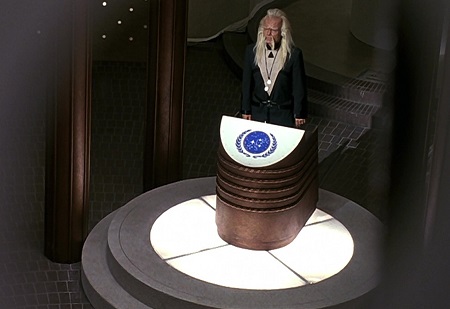
23 weeks of Star Trek comes to an end…

Spoiler Warning: There are spoilers ahead for Star Trek: Discovery Seasons 1-3, Star Trek: Lower Decks Season 1, Star Trek: Picard Season 1, and other iterations of the franchise.

Almost half a year ago (26 weeks would be a half-year) we sat down to watch Second Contact, the premiere episode of Star Trek: Lower Decks. This episode kicked off something ViacomCBS billed as “23 weeks of Star Trek” – ten weeks of Lower Decks followed immediately by thirteen weeks of Discovery. Now that we’ve had Discovery’s season finale, I thought it would be fun to look back on the past five-ish months and see how it went.

2020 was the first year since 2004 that saw more than twenty Star Trek episodes premiere, and with three different productions on the go for the first time since the 1990s it’s really beginning to feel that Star Trek is back! Assuming all of the currently-announced series and projects make it to screen, we’ll be seeing the franchise continue through at least the first half of the 2020s, hopefully even until the 60th anniversary in 2026. There have been bumps in the road – and more seem likely – but overall the franchise seems to be in a good place as these 23 weeks come to an end.

Burnham and Book in the third season premiere of Discovery.

Lower Decks did suffer because of the stupid decision to broadcast it in the United States months ahead of anywhere else. Of all the Star Trek projects we’ve seen announced in recent years, Lower Decks had the greatest potential to expand the fanbase. The entire purpose behind creating a show of this kind is to take Star Trek to new audiences, and that required a unified broadcast so fans everywhere could enjoy it and get hyped for it.

The sad consequence of Lower Decks being split up and shown to some fans but not others is that the buzz around the show died down in the weeks leading up to its broadcast. Many potential viewers tuned out or never even became aware of its existence, and we’ll simply never know how big it could’ve become were it not for that godawful decision. Could we be talking about Lower Decks hitting the mainstream like Rick and Morty? It’s good enough on its own merit, but we’ll never know now.

Ensign Mariner from Lower Decks.

When it was decided to press ahead with this 23 weeks of Star Trek, the team at ViacomCBS clearly knew that the pandemic had massively set back other projects in the franchise. Whereas we might’ve hoped to see Picard Season 2, Lower Decks Season 2, Prodigy Season 1, and maybe the Section 31 show or even Strange New Worlds in 2021, as things sit right now, no announcements have been made regarding any releases this year. Understandably so, of course, but to me it just compounds the stupidness of the Lower Decks decision.

Since we now know that Lower Decks will be broadcast internationally later this month, I’m left wondering why it was pushed out in North America first. We could have all enjoyed it together, and it would have filled a hole in the schedule in the first part of 2021. But that’s not the way it happened, and re-litigating the issue over and over accomplishes nothing! Instead, let’s look at some of the high points from these past 23 weeks. There have been quite a lot!

The USS Discovery crash-lands in Far From Home.

First up, Lower Decks itself. Despite a rocky start, by midway through the second episode the series was beginning to find its feet, and as the season went on it became a thoroughly enjoyable watch with plenty of laugh-out-loud moments. There were a ton of references and callbacks to past iterations of Star Trek, including The Next Generation era. Until Picard premiered earlier in 2020 the franchise had been looking backwards at reboots and prequels for almost twenty years, leaving little room to even name-drop something from The Next Generation onwards.

Discovery included fewer elements from The Next Generation’s era than I’d have liked to see. Partly that’s a consequence of shooting forward in time centuries beyond that time period, and partly it’s a creative choice. There were a couple of references though, like bringing back the Trill and introducing a new USS Voyager. I was especially pleased that the Qowat Milat – a Romulan faction introduced in Star Trek: Picard – also cropped up in Discovery.

Dr Gabrielle Burnham was a member of the Qowat Milat.

Bringing together the shows currently in production is something I hope to see more of going forward! I had theorised before we knew too much about Discovery’s third season that – due to time travel shenanigans – it could have been set at the dawn of the 25th Century along with Picard, but ultimately that didn’t happen. It would’ve been cool, though!

Lower Decks and Discovery didn’t really connect in any significant way during these 23 weeks. The most significant thing I noticed which came close to tying the two series together was that in both of their season premieres, a main character gets chewed on by an alien monster! In Second Contact it happened to Ensign Boimler, and in That Hope Is You, Part 1 it happened to Burnham. Maybe that was a conscious choice – but I suspect it may be little more than coincidence.

Boimler got chewed on by a monster…
…and so did Michael Burnham.

Both Star Trek: Lower Decks and Star Trek: Discovery represent a franchise stepping out of its comfort zone and trying to do something different. In Lower Decks’ case we see Star Trek trying a different genre – comedy. The particular style of comedy chosen may not be to everyone’s taste, but I would argue that fans of shows like Rick and Morty or The Orville would have found something to enjoy. Discovery took Star Trek away from the familiar ground of the 23rd and 24th Centuries in a major way for really the first time. We’d seen individual episodes or parts of episodes set in the far future before, but never a whole season.

Both shows felt like they were made with Star Trek fans firmly in mind. That may seem obvious, but we have to remember that hardcore fans are a small percentage of any franchise’s audience. Lower Decks in particular was a series that was largely episodic and that relied at key moments on references to somewhat obscure events in Star Trek’s wider canon, both for its comedy and for narrative beats. That was a bold move, and one which could have backfired.

The arrival of the USS Titan.

Discovery didn’t take an episodic approach, but there are more episodes in its third season which act as standalone stories than there were in Seasons 1 and 2 combined. The writers and producers have clearly tried to blend season-long storylines with shorter episodic stories, and while we can debate which episodes were the best and the worst, taken as a whole the season was definitely better for the inclusion of some of these smaller stories.

Though we won’t know for sure until the new show hits our screens, Star Trek: Strange New Worlds is supposedly going to take a similar approach: keeping the season-long arcs while at the same time flying the ship and crew to different adventures every week. Discovery Season 3 provides a good foundation to build on in that regard – provided the writers and producers pay attention to what worked and what didn’t!

Saru in command of the USS Discovery.

Though I plan to do a proper look back at both Season 1 of Lower Decks and Season 3 of Discovery in the weeks ahead, looking back at this 23 weeks of Star Trek I can already say that I had a great time. There were some stumbles and some storylines and episodes that didn’t work for a few different reasons, but the quality of both shows was generally high. I can’t fault the visual effects, the acting, the direction, the editing, the post-production work, or anything behind-the-scenes when considering the bigger picture. Narrative will always be something subjective, but I would encourage anyone to give both shows a try and to stick with them beyond the first couple of episodes.

The only thing I’d say is that, having set up this promotion between the two shows, it’s a little odd that there were essentially no references or crossovers between them. Because of the decision to send Discovery into the future, there was the possibility for Lower Decks to reference something from Discovery’s first two seasons, and for Discovery to reference something from Lower Decks’ first season. Maybe that’s something that can happen at some point in the future.

There will be more Lower Decks to come!

Though we don’t have access to viewing figures – something which, unfortunately, leads to a lot of speculation and misinformation floating around online – I hope that both shows did well. On merit I’d happily recommend both to any Star Trek fan, and to any fan of either animated comedies or action-sci fi. The upcoming rebranding of CBS All Access as Paramount+ may bring in more new viewers to both shows, and Lower Decks’ international broadcast later this month will hopefully attract some attention too.

As I said at the beginning, Star Trek feels like it’s in a good place. There are projects in the pipeline that should see the franchise grow and build on what both Discovery and Lower Decks have done over the last 23 weeks, and it’s my hope that it will remain viable and stay on our screens for many years to come. I have the same sort of feeling that I had in the mid-1990s when Deep Space Nine and Voyager had picked up the baton from The Next Generation; there’s a lot going on, and all of it is different or at least not afraid to try new things.

I will miss my Friday appointment with Discovery now that the third season has concluded. However, as I look ahead to the rest of 2021, I’m hopeful that we may see Prodigy and Lower Decks Season 2 even if we have to wait until 2022 for more live-action Star Trek! I hope you’ll stay tuned here on the website, as I’ll break down any news that comes our way regarding upcoming Star Trek projects as well as look back at some of the stories and themes that we saw over these 23 weeks. It really is a great time to be a Star Trek fan right now – or a fan of sci-fi and fantasy in general. I truly hope that you enjoyed the last 23 weeks as much as I did.

Star Trek: Lower Decks Season 1 is available to stream now on CBS All Access in the United States and will be available to stream on Amazon Prime Video on the 22nd of January in the rest of the world. Star Trek: Discovery Seasons 1-3 are available to stream now on CBS All Access in the United States and on Netflix in the rest of the world. The Star Trek franchise – including Lower Decks, Discovery, and all other properties mentioned above – is the copyright of ViacomCBS. This article contains the thoughts and opinions of one person only and is not intended to cause any offence.

Star Trek: Discovery theories – week 13

Spoiler Warning: There are spoilers ahead for Star Trek: Discovery Seasons 1-3, Star Trek: Picard, and other iterations of the franchise.

Star Trek: Discovery Season 3 came to an end this week. That Hope Is You, Part 2 was a solid episode with plenty of action, and despite the underwhelming nature of one of its plotlines, I think it did a good job wrapping things up.

Speaking of wrapping things up, that’s what we’re going to do today! We had twenty-two theories going into the finale, and while a handful live on and may return in Season 4 depending on the way things go, most were either outright debunked or the story went in such a direction as to leave them looking very unlikely. We did, however, get three confirmations (or at least partial confirmations) so we’ll look at those first!

Confirmed theory: Aurellio stood up to Osyraa.

Aurellio and Osyraa.

Although Aurellio didn’t get as much screen time as I’d have liked to see, he did break away from Osyraa and the Emerald Chain. Aurellio had a mini character arc that ran over the final two episodes of the season in which his eyes were opened to Osyraa’s villainous nature, and allowed him his moment of opposition to her when he refused to allow his technology to be used to torture Book.

I stand by my previous comparison in which I said that Aurellio fills a role claimed by the likes of Albert Speer and others who worked for the Nazis during the 1930s and 1940s. Aurellio seems to have spent a lot of time focusing on his work in his lab, reaping the rewards of helping the Emerald Chain but without really allowing himself to see what the organisation and its leader were doing. His conversation with Stamets opened his eyes to this, and we saw that theme come to a head in the scene in sickbay.

Though Aurellio did briefly help out later on, giving Book the idea that he could use his empathic abilities to use the Spore Drive, Aurellio feels like an underused character, and I hope to see him return in Season 4. He could have joined up with the Federation, or even serve aboard Discovery.

Part-confirmed theory #1: Burnham became captain.

I successfully predicted that Burnham would become captain… but not how it would happen! So I’m calling this one part-confirmed instead of fully confirmed!

I had speculated that Burnham could assume the captaincy either because Saru would be killed, or because Saru would be promoted and become an Admiral if Admiral Vance were killed. Neither of these scenarios came to pass, and Saru was rather unceremoniously shuffled off the ship during the epilogue without getting so much as an opportunity to say goodbye to the crew. That was poor, and Saru deserved to be treated with more respect.

However, it allowed Burnham to get her promotion, something that Star Trek: Discovery has been aiming for since Season 1. Some of the issues with Burnham, both this season and in the past, stem from her insubordination. Now that she’s in command, that should no longer be anywhere near as big an issue, and as captain she should have a lot more freedom to approach problems and adventures her way – within the spirit of the rules, if not following them to the exact letter!

Part-confirmed theory#2: The Federation’s allies arrived to help fight the Emerald Chain.

The arrival of Ni’Var’s fleet.

I’m calling this one part-confirmed because only Ni’Var arrived to help the Federation when the Emerald Chain attacked. I had half-expected a bigger fleet, perhaps comprised of the Earth Defence Force, the raiders from Titan, the Trill, people from the Colony, people from Kwejian, and Nhan aboard the USS Tikhov. However, only Ni’Var made it to the party!

We don’t know what became of most of the others; Trill rejoined the Federation, but the rest weren’t even mentioned in the finale. The arrival of the Ni’Var fleet felt great – up there with other big last-minute arrivals in other battles in the franchise for sure. But by the end of the episode I did feel that the absence of some of the other friends and allies that Burnham and the crew had made was noticeable… and perhaps even a little sad.

So those theories were confirmed or partially-confirmed. Up next we have a handful of theories whose status was left unclear as of the end of That Hope Is You, Part 2. It’s possible some of these will return in Season 4, but it depends how the story of that season shapes up. If Season 4 goes in a completely different direction, perhaps some or all of these theories will simply fall by the wayside. We most likely won’t know for a while!

Status: Unknown #1: The Spore Drive will become Starfleet’s new method of faster-than-light propulsion.

Discovery makes a Spore Drive jump.

The revelation that Book could use his empathic abilities to use the Spore Drive has, in theory, opened up the technology to being deployed across other Starfleet vessels. Early in Season 1 Stamets seemed to suggest that mycelial spores were not easy to acquire, so that may yet prove to be a limiting factor, but if that could be overcome there’s no real reason why the Spore Drive couldn’t be rolled out.

If empathic species like the natives of Kwejian can use the Spore Drive, it opens up even more possibilities. Betazoids spring to mind as an empathic species; perhaps they could become navigators too.

As this moment came in the final act of the season finale it didn’t get a chance to be paid off, so we won’t know the status of the Spore Drive until next season at the earliest. When Burnham was in command of the ship right at the end of the episode, her orders were to deliver dilithium to other planets, so perhaps we can infer from that that not every vessel will have its own Spore Drive. Regardless, the expansion of this technology would not only allow Discovery to have new and different adventures, but would also make it so other Star Trek series set in or after this time period could do so too.

Status: Unknown #2: The Dax symbiont is still alive.

Jadzia Dax.

On reflection, this theory should have been put on hiatus as soon as Discovery departed the Trill homeworld in Forget Me Not. But I stand by the reasoning behind it – Trill symbionts can be very long-lived, and we got at least a hint at Tal having been alive in the 25th Century via the appearance of a Picard-era uniform. Though Dax had already had several hosts by the time of Deep Space Nine, nothing in-universe would prevent their reappearance.

However, with the Trill having rejoined the Federation, perhaps there will be an opportunity to see or hear about Dax in Season 4.

Status: Unknown #3: Kovich is an agent of Section 31.

Who is Kovich?

Kovich made only a very brief appearance in That Hope Is You, Part 2, so we didn’t get an opportunity to learn anything more about him. It was implied that he has a role in Starfleet security and/or intelligence based on his debrief of Georgiou and ability to access classified files. Combined with his morally ambiguous personality – which we see on full display when he doesn’t tell anyone about Georgiou’s impending health emergency – it doesn’t seem unreasonable to assume he could be an agent of Section 31… or even its leader.

Given Georgiou’s connection to the upcoming Section 31 series, and the time travel plot to get her there, perhaps the reason Kovich didn’t say anything is because he knew exactly what role he needed to play. Georgiou, as a leader in Section 31 centuries earlier, may have sent him a message through the organisation, telling him exactly what to do when she arrived. That would be a time-loop story that we could see in Season 4!

We know Kovich will be back, so perhaps we’ll learn more about him when he returns. I’ve heard other Trekkies speculating that he could be the Federation President – that would be an interesting revelation too.

Status: Unknown #4: The ban on time travel is being flouted – possibly by secretive elements within the Federation.

The USS Enterprise travelled through time in Assignment: Earth.

It was stated multiple times in Season 3 that there is a galaxy-wide ban on time travel, a ban which was brought in in the aftermath of the Temporal Wars. However, this never sat right with me for one simple reason. As I’ve said several times over the last few weeks: it’s not possible to un-invent an incredibly powerful, weaponisable technology.

Even if the ban on time travel had been adhered to prior to the Burn, it seems completely implausible that absolutely nobody would seek to revive time travel technology in the century that followed. The Emerald Chain are the main villainous faction we met in Season 3, and Osyraa seems like she would have put people like Aurellio to work on re-inventing the necessary technology. But even if the Emerald Chain were unable to use time travel, what about other factions like the Borg or the Dominion? And what about Starfleet itself, and Section 31?

Finally, assuming all of the factions mentioned have agreed to adhere to the ban, who’s enforcing it to make sure they all stick to their commitments? Communication across the galaxy is incredibly difficult, so how can any of the main factions be sure that their adversaries – or even rogue elements from within – aren’t trying to use time travel?

I find the whole idea of the ban impractical unless it can be properly explained how time travel was banned and how the ban is enforced. So I maintain that, despite what we saw all season long, there may be elements within the Federation working on covert time travel projects.

Status: Unknown #5: The ships at Federation HQ represent the majority of Starfleet’s remaining vessels. And they’re all 120+ years old.

Federation and Ni’Var ships at warp.

When Discovery first arrived at Federation HQ in Die Trying, I theorised that the ships we saw might be all that remain of the once-mighty Starfleet. In addition, the devastating nature of the Burn may well have meant that building new ships would be difficult – and with very little dilithium to power them anyway, Starfleet may be forced to rely on a fleet of ageing vessels.

We saw no confirmation of this – and to Discovery’s crew, all the ships look futuristic and new! But we saw nothing to debunk it either, and while I don’t think we’ll see this point explicitly addressed any time soon, we may learn in Season 4 that the fleet is being rebuilt and expanded.

Status: Unknown #6: Tilly’s role as first officer.

Tilly eyes the captain’s chair.

I had theorised that Tilly would resign as first officer in the aftermath of the ship being captured. However, as of the end of the season it was left ambiguous as to what happened. Did Captain Burnham keep her on, or will she choose a new XO?

Tilly becoming first officer was a contentious point for some fans, and while I do understand why, I wasn’t upset by it personally. I’d be happy to see her remain in her post if that’s what the writers and producers have in mind, but equally I’d be happy to see a different character take on the role. Perhaps someone like Bryce, Rhys, or Nilsson could be promoted – and join the regular cast?

So those theories’ fates remain unknown. Will they be confirmed or debunked next season, or in some other future Star Trek story? It’s possible, but it’s equally possible that some of them will simply be ignored and their status never addressed.

Next we’ll look at a couple of theories which, while not explicitly debunked, are now certainly dead as the storylines they were part of have concluded.

Dead theory #1: Dr Issa is a descendant of Saru’s sister Siranna.

Just like this theory, Dr Issa is dead.

Dr Issa’s potential family connection to Saru was not addressed, and I think it’s highly unlikely it will be mentioned in Season 4. The reason for this theory was primarily production side, as the same actress (Hannah Spear) played the role of both Siranna in Season 2 and Dr Issa in Season 3. As interesting as it would have been for there to be a deeper connection between Saru, Dr Issa, and Su’Kal, the explanation for this may also be on the production side of things – it may have been easier to bring back an actress who was already fitted for the complicated Kelpien prosthetic makeup rather than casting someone wholly new.

Dead theory #2: Aurellio is married to Osyraa.

Was Aurellio meant to be married to Osyraa?

There seemed to be a hint that Aurellio was married to or in a relationship with Osyraa. Stamets noted that his partner, with whom he is said to have children, is Orion – and Osyraa seems to be Orion too. They also had a familiarity that seemed to go beyond employer and employee, as well as a history that Aurellio hinted at in his conversation with Stamets.

Osyraa attacked him in That Hope Is You, Part 2, but despite threatening to kill him, took no further aggressive action. However, now that she’s dead and the Emerald Chain has “fractured,” I doubt we’ll hear much at all about Osyraa in Season 4 even if Aurellio does return (as I hope he will).

So those two theories seem certain to be dead and not coming back, even though they were not out-and-out debunked.

Finally we come to the debunkings!

Debunked theory #1: One of the officers with Tilly will be killed.

Things looked grim for a moment, but everyone ultimately survived.

At the end of There Is A Tide, Tilly gave the ominous order to her team that if anyone should be killed, the rest would keep going until they reached the bridge. Then in That Hope Is You, Part 2, the whole group were suffering from oxygen depletion as Osyraa tried to slowly suffocate them.

Owosekun was perhaps in greatest danger as she took their makeshift bomb to the nacelle, but she was saved at the last minute by a DOT 23 – who was in turn saved by Owosekun and Reno in the epilogue.

Ryn was the only major character on the heroes’ side who died across the whole season, and we can argue whether or not that’s a good thing at a later date. But in the context of this theory, everyone survived so the theory is debunked!

Debunked theory #2: The Burn will receive a different explanation.

The moment the Burn occurred was captured in this holo-recording.

At some point in the next few weeks or months I will take an in-depth look at the Burn – Season 3’s most controversial storyline. For now, however, suffice to say that this point was more a last-ditch hope than a theory, as I felt certain that if the Burn remained solely the fault of Su’Kal it would be underwhelming.

That explanation, which was first communicated in Su’Kal a couple of weeks ago, ended up being accurate. There was no deus ex machina in the season finale to re-explain what the Burn was and how it happened – and that’s probably a good thing overall. Though the Burn was – in my subjective opinion – a narrative that didn’t come to a satisfactory end, and one that has issues, a last-second deus ex machina would have been even worse!

Debunked theory #3: The Burn was the result of a superweapon.

The Burn.

After the rest of my pre-season theories about the Burn fell by the wayside, this was the final one that I considered to be even slightly possible. Going into the finale, the way it could’ve worked would either be that the Kih’eth (Su’Kal’s ship) was carrying a superweapon, or that Su’Kal himself had been modified somehow to become a superweapon. How or why this would’ve happened is not even relevant; it was just a way to explain the Burn beyond Su’Kal.

As mentioned above, though, the Burn turned out to be caused by Su’Kal and his connection to dilithium. In the context of the last few episodes this was a good thing, as a last-second turnaround would have been very difficult to pull off.

Debunked theory #4: There will be a resolution to the story of Calypso (the Short Treks episode).

The USS Discovery as seen in Calypso.

Season 3 spent some of its runtime firmly establishing that the Short Treks episode Calypso hasn’t been forgotten and remains very much in play in the overall storyline of Discovery. However, despite several teases and moments that seemed to inch us closer to resolving the mysterious outlying episode, there was no resolution.

We have seen the creation of Zora – a merger of the Sphere data with Discovery’s own computer. We heard that some denizens of the galaxy call the Federation the “V’draysh,” which was the name Craft used in Calypso. The main unresolved point is how the USS Discovery came to be abandoned, and why, if it was abandoned, it was reset to its pre-refit configuration beforehand.

With Zora being intact thanks to Reno and Owosekun, we have all of the threads present in Calypso – but I can’t see how they’ll tie together just yet. Maybe Calypso is set in the far future – the 42nd Century not the 32nd. Maybe Discovery will travel back in time in Season 4 or Season 5 for some reason. Maybe Calypso will never be fully explained and will remain an outlier in the Star Trek canon; an episode connected to a storyline for Season 2 or Season 3 that simply never came to pass.

Debunked theory #5: A character from a past iteration of Star Trek – such as the Doctor from Star Trek: Voyager – will make an appearance.

The Doctor didn’t make an appearance.

This was my other big pre-season theory that remained in place for the duration. Though it did come true somewhat thanks to the return of the Guardian of Forever, we didn’t see any of the characters I theorised about – including Voyager’s Doctor – make a return.

However, although it was debunked in Season 3, this one will almost certainly be back for Season 4! When Star Trek: Picard brought back legacy characters, we knew in advance which main actors would be returning, and their presence became a big part of that show’s marketing push. Other legacy characters were recast and their presence was kept more of a secret. In short, what I’m saying is that if we are to see the return of the Doctor or some other past Star Trek character, perhaps their return will be signalled ahead of time in Season 4’s pre-release marketing. We’ll have to wait and see!

Debunked theory #6: Discovery Season 3 is taking place in an alternate timeline or parallel universe.

The USS Voyager in Year of Hell.

The Guardian of Forever confirmed back in Terra Firma, Part II that Burnham and the crew were in the Prime timeline – i.e. the main Star Trek timeline which runs from Enterprise to Picard. However, this theory also proposed that the season may be taking place in a timeline that was manipulated by time travel; that the Burn was not “meant” to happen.

Had time travel been involved, the resolution to the Burn and the season’s story may have been to go back in time – perhaps even using the Guardian of Forever – and stop Su’Kal from ever entering the Verubin Nebula, thus preventing the Burn entirely.

I don’t think this would have been a good storyline, as it would have essentially wiped out everything that happened in the season. A one-off episode like Yesterday’s Enterprise from The Next Generation or Voyager’s Year of Hell can get away with doing something like this, but a whole season being erased due to time travel would have felt hollow – even if Discovery’s crew remembered what happened.

Debunked theory #7: Saru is going to die.

Saru survived the season.

Despite being in danger for much of the episode, Saru survived… only to be unceremoniously dumped in voiceover during the epilogue. It has been confirmed that Saru will be back for Season 4; what role he will play, and whether he will even be a major character are unknown.

Saru is a very interesting character. He was, for a time, Star Trek’s first alien captain, and I wish we’d seen more of what that meant. Saru is similar to Picard in many ways – he’s diplomatic, calm, and generally not one to break the rules and rush into a situation guns blazing. Burnham, in contrast, is much closer to Kirk or Janeway – more emotional, impulsive, and quicker to bend the rules.

Both types of captain can work very well, so that isn’t a criticism! If I had one wish from the season finale, it would have been to see Saru receive a proper goodbye from his shipmates.

Debunked theory #8: Admiral Vance is going to die.

Admiral Vance lives to lead Starfleet in Season 4.

When considering characters who could’ve been killed off, aside from the main crew of Discovery few deaths would have been as impactful as Vance’s. I didn’t want to see him killed, of course, because he’s been one of Star Trek’s most interesting flag officers. The role of Admiral has often been used within the franchise to set up an antagonist for our hero captains to rebel against. Vance is one of the good ones, and I’m glad he survived.

Hopefully he will continue in this role in Season 4, because there’s a lot of potential for some fun character moments.

Debunked theory #9: Saru, Burnham, or somebody else will use the Guardian of Forever to send the USS Discovery back in time.

The Guardian of Forever.

This was primarily connected to my theory about a resolution to Calypso – which seems to require the USS Discovery being sent back in time. If the ban on time travel discussed above is truly in effect, the Guardian of Forever is the only way we know of to travel back in time, and having gone to the trouble of bringing the Guardian back, I wondered if it might serve more of a purpose than just sending Georgiou back in time.

It turned out that this was not the case, though I hope the Guardian of Forever will be visited again in some future episode or story.

Debunked theory #10: The dilithium planet will be destroyed.

The dilithium planet.

This theory came about as a way that the “formulaic” end to the story could be subverted. Rather than the dilithium planet being a resource for the Federation to use to re-establish itself, its destruction would mean that the Burn’s impact would continue to be felt, and that the task of coming back together would be more difficult.

It would have also connected to my theory that the Spore Drive would be rolled out to more starships, becoming Starfleet’s new method of propulsion. The lack of dilithium would make that almost a necessity! I theorised that Su’Kal might’ve destroyed the dilithium planet via his telepathic abilities, but it could also have been destroyed by Osyraa or even by the Federation to prevent Osyraa from using it.

None of that came to pass, however, and the dilithium on the planet is being mined by the Federation and distributed to their worlds, colonies, and allies across the galaxy – a task that Burnham and the ship are assigned to in the final moments of That Hope Is You, Part 2.

Debunked theory #11: The “monster” is the real Su’kal.

Su’Kal and Saru confront the “monster.”

The “monster’s” presence within Su’Kal’s holo-programme was not really given an explanation beyond it being part of an old Kelpien legend. Why his mother would have chosen to include a lifelike recreation of the “monster” within the programme is anyone’s guess!

I theorised that the character we met may not have been the real Su’Kal, and that the “monster” may have instead been Su’Kal, who had been badly mutated and burned by radiation. When Burnham briefly interacted with it, the “monster” seemed to behave in an almost-human way, and that was another reason I considered this a possibility.

Debunked theory #12: The “monster” is Dr Issa.

The “monster” was not Dr Issa.

As above, I speculated that the “monster” may in fact be a real person – this time Su’Kal’s mother, Dr Issa.

In the end, it seems that the “monster” was simply a part of the programme. It provided a great reason within the story for Su’Kal and Saru to bond, as well as a way to give Su’Kal an arc of his own, overcoming his fears – represented by the “monster” – to break free of the programme. I’m not sure how much sense it makes for the “monster” to have been programmed when considering it from an in-universe point of view… but that’s more of a nitpick than anything.

So that’s it. A few theories remain unanswered, and may roll over to Season 4 – but it depends on what route the next season’s story will take. We won’t have any indication of that until we see a trailer or receive a significant announcement, but I’ll be keeping my ear to the ground to see what happens over the coming weeks and months.

When might we see Season 4? That’s perhaps the biggest question on the minds of Trekkies and Discovery fans! We know that pre-production began weeks ago, and that filming of some scenes has already commenced in Canada. Because the pandemic remains a significant disruptive force, it’s possible that filming will proceed at a slower pace than usual. June 2021 seems to be the target date for filming to finish, and if that happens then post-production work will begin in earnest this summer. Based on how long post-production took for Season 3, it seems incredibly unlikely that we’ll see the show before next year, and I would say that spring 2022 seems a reasonable guesstimate at this juncture.

Whenever Season 4 arrives, Zareh won’t be coming back.

With other live-action Star Trek projects similarly impacted, it doesn’t seem likely that we’ll see Picard, Strange New Worlds, or the Section 31 series this year either – but there’s hope for Lower Decks Season 2 and Prodigy to be broadcast before Christmas; both of those animated shows are already in production.

Stay tuned, because if and when we hear news of Season 4 or get a trailer I’ll be sure to break it down and perhaps see if any theories can be conjured up! I’ll also be doing a look back at some of my hits and misses from a theory point of view later this year, and a retrospective of the season overall sometime soon too. There will be plenty more Star Trek content to come on the website this year, so I hope you’ll come back to see some of that. Finally, I hope that you enjoyed following my theories and predictions this season. I had a lot of fun spending time in the Star Trek universe, diving deeply into some weird and wonderful ideas!

As I always say, these are just theories. I don’t have any “insider information” and I don’t pretend that any theory I postulate is going to come true. For me this has just been a bit of fun; a chance to take a deeper dive into some elements of Discovery and the Star Trek universe. I hope you haven’t taken any of my theories across Season 3 too seriously – no fan theory, no matter how plausible it seems, is worth getting upset, angry, or disappointed over. If we could all remember to take theories with a pinch of salt, perhaps there’d be a little less toxicity within certain fan communities.

Star Trek: Discovery is available to stream on CBS All Access in the United States, and on Netflix in the United Kingdom and elsewhere. The Star Trek franchise – including Discovery and all other properties mentioned above – is the copyright of ViacomCBS. This article contains the thoughts and opinions of one person only and is not intended to cause any offence.
Star Trek: Discovery review – Season 3, Episode 13: That Hope Is You, Part 2

Spoiler Warning: There are spoilers ahead for Star Trek: Discovery Seasons 1-3, Star Trek: Picard, and other iterations of the franchise.

Thirteen weeks have just flown by, haven’t they? Star Trek: Discovery Season 3 premiered in the middle of October – right after Season 1 of Star Trek: Lower Decks came to an end – and now, just after New Year, it’s over. I have to say that I miss the twenty-plus episode seasons we used to get! But that’s just one way that television shows have changed since the 1990s, I suppose.

For the third week in a row, the title of the episode was changed from what had been previously announced. That Hope Is You, Part 2 was previously known as Outside, but immediately after There Is A Tide aired last week, the title was changed. That Hope Is You, Part 1 was the title of the season premiere, and while it seems odd on the surface to call the season finale the second part – especially considering the entire season has been one continuous story – it works well and bookends the season. As an interesting aside, we saw two different numbering styles used for the multi-part episodes this season. Terra Firma and Unification III both used Roman numerals to denote their parts, whereas That Hope Is You uses Arabic numerals. I wonder why that is?

Burnham in That Hope Is You, Part 2.

There Is A Tide was phenomenal last week, and I was hoping for more of the same from That Hope Is You, Part 2. My only real criticism last time was that there seemed to be an awful lot of story left for the finale to get through, and I speculated then that the season may end on a cliffhanger – but that wasn’t the case. The episode was the longest of the season by far, clocking in at almost an hour, and while I would say one of its two storylines probably could’ve used more screen time, That Hope Is You, Part 2 did a reasonably good job at wrapping everything up. It certainly exceeded Star Trek: Picard’s finale in that regard!

I had a great time with That Hope Is You, Part 2… well, for about three-quarters of it. The sequences aboard Discovery that focused on Book, Burnham, Tilly, and other crew members were action-packed and exciting, equalling the heights Discovery reached last week. But the sequences with Saru, Adira, Culber, and Su’Kal didn’t reach that level. This storyline was not my favourite part of either the episode or the season.

Culber, Su’Kal, Saru, and Adira aboard the Kelpien ship Khi’eth.

And we do have to consider the role That Hope Is You, Part 2 has as the season finale. As mentioned, my theory that the season may end on a cliffhanger did not come to pass, so every story thread we saw across the season that hadn’t already been completely tied up was supposed to find a resolution here. The Emerald Chain storyline, which had been teased as early as the premiere and more firmly established by the halfway point of the season, certainly was concluded. And though perhaps it needed more screen time, or needed its sequences spread out over three or four episodes instead of two, Su’Kal’s story was concluded too.

In both of these, though, as well as in the very short, almost blink-and-you’ll-miss-it scenes showing Ni’Var and Trill, we come to what is perhaps the episode’s big weakness. After the main stories – both of them – were more-or-less over, we got an epilogue of sorts that was about six minutes long. This epilogue told us about some incredibly important events, and as you may have heard me say before, it needed to show not tell. In a rapidly edited sequence, part of which was narrated by Burnham in voiceover, we saw or heard that: Trill had rejoined the Federation, Ni’Var was on the brink of doing so, the Emerald Chain has “fractured,” Saru is taking a sabbatical – if he hasn’t outright left Starfleet, Mr Sahil has become a Starfleet officer, Aurellio has maybe joined up with the Federation – but maybe not, Stamets was reunited with Adira and Culber, the Sphere data is safe, and finally, Burnham was promoted and has become Discovery’s new captain.

Burnham was promoted at the end of the episode.

None of these points are problematic at all – in fact, I adore all of them, and the sequence itself had me feeling genuinely emotional. But there was a lot of important story crammed into those final minutes, some of which I really wish had been expanded upon and given their own moment in the spotlight instead of just being briefly mentioned in this epilogue.

Also, this epilogue was the moment where other characters and stories from earlier in the season should have been included, surely? What about the denizens of the Colony from Far From Home, the humans in the Sol system from People of Earth, Nhan, who had been left alone aboard the USS Tikhov in Die Trying, or the people of Kwejian from The Sanctuary? I’m not saying the sequence needed more jammed into its six minutes, but it feels like this was the moment to at least acknowledge the stories that happened across the rest of the season considering That Hope Is You, Part 2 had already tipped its hat to the others mentioned above.

Nhan was absent from the episode and its epilogue – as were several other characters and factions from earlier in the season.

So we seem to have started at the end, which is a little strange! But never mind. Let’s look next at Su’Kal and the Burn. Discovery Season 3 did a lot of things right, and my initial concerns about a “post-apocalyptic” Star Trek series turned out to be largely unfounded. The sense of optimism and hope that are – in my opinion – fundamental parts of the franchise were missing from the bleak, post-Burn 32nd Century – but they were present in Burnham, Saru, the crew of Discovery, Admiral Vance, Booker, Sahil, and many other characters across the season. In that sense the story of the Burn was a success.

The event itself, however, and the resolution to it that we saw in Su’Kal and That Hope Is You, Part 2 just doesn’t sit right.

We’ll come to narrative in a moment, because my primary concern right now is the Burn’s real-world messaging. We have Su’Kal, a man with mental health problems and/or a learning disability, as the unintentional cause of the Burn. There is a sizeable stigma around mental health and learning disabilities here in the real world, and I just feel that Su’Kal being presented as the man who accidentally ruined much of the galaxy plays into some harmful stereotyping. Su’Kal comes across similar to Lenny, the rabbit-loving man from John Steinbeck’s novel Of Mice And Men. It’s implied that Su’Kal is the way he is because of the environment he’s spent his life in, but even so, there’s an obvious literary parallel. Lenny ends up accidentally killing someone in that novel, because he doesn’t know his own strength and he doesn’t realise what he’s doing. Su’Kal has done the same basic thing, only on a much bigger scale.

Su’Kal causing the Burn is not devoid of real-world meaning.

The message this seems to send is what I find at least a little upsetting in 2021. Though Su’Kal is portrayed sympathetically – and I would credit Bill Irwin with a wonderful performance – the sympathy he elicits is more like pity. We look down at Su’Kal as a pitiable idiot, someone too dumb to know what power he had and what it could do. We look at him like we look at Lenny.

People with mental health conditions – a category into which I fall – don’t want pity, nor do people with learning disabilities. Yet Discovery is playing into century-old stereotyping that we really should be trying to move beyond. This season has seen some wonderful storylines that deal with complex issues, but its two attempts to depict mental health – with Su’Kal and Lieutenant Detmer in earlier episodes – just didn’t work. Detmer’s story got so little time that it was basically meaningless, despite being well-intentioned, and Su’Kal’s story just rubs me the wrong way. I feel that the decision to make the Burn the fault of someone in his position was the wrong one, and the message it sends is one I’m not comfortable with.

Su’Kal with Saru.

Su’Kal himself is one aspect of the Burn that I feel didn’t come across well, and I hope my explanation and reasoning make sense to you. But narratively too, the resolution to the Burn feels anticlimactic. There’s a disparity between the epic nature and scale of the Burn and the man who we now know is the cause of it. It feels like a non sequitur; that the Burn cannot logically follow from Su’Kal getting upset – or screaming, as Culber and Adira would explain.

As I said in my review of Su’Kal a couple of weeks ago, there is something uniquely “Star Trek” about this resolution to the Burn’s story. And from that point of view, as a storyline which is perhaps closer to fantasy than sci-fi, it doesn’t feel out of place in this fictional universe, not when you stand it up alongside the storylines of episodes from past iterations of Star Trek such as A Piece of the Action, Masks, Facets, or The Gift. There’s a weirdness to the Burn being a telepathic child’s scream that is, in a peculiar way, something you wouldn’t see outside of Star Trek. I count myself among many Trekkies for whom this weirdness is precisely what was appealing about Star Trek when I first saw it.

Su’Kal’s home for many years – the Kih’eth.

So in a sense, the story of these final few episodes as far as the Burn is concerned fits right in within a franchise that can give us the episodes mentioned above. The Gift, from Voyager’s fourth season, is actually a pretty good frame of reference, as it’s a story which shows Kes’ mental abilities. She’s able to propel a starship thousands of light-years with the power of her mind, and that’s not a million miles away from Su’Kal’s connection to dilithium.

But the Burn was not a single-episode story, nor the kind of one-off story fit for episodic television. Not only did it impact the entire season, but it will continue to have ramifications for Discovery’s fourth season, and for any future Star Trek series or films set in or around this time period. Furthermore, it was a mystery that had been teased for over a year, since the first trailer for Season 3 was shown in late 2019. Expectations had been built up over thirteen episodes, and arguably for more than a year before the season premiered. As much as I can respect the Burn and Su’Kal and their place in the greater Star Trek canon, unfortunately those expectations were not met – at least not for me.

The Burn was set up as a huge and apocalyptic mystery.

The disconnect between the devastating Burn and the small Su’Kal is just too big a gap to bridge at the end of a season that has been so dominated by this one event. It makes sense, and I get it – it’s not that the Burn’s explanation is somehow incomprehensible – and I’m incredibly pleased that the writers chose to make sure the Burn did receive an explanation instead of trying to brush it aside and say it doesn’t matter. But the explanation that we got is one that I feel was weak.

The story of Su’Kal being trapped alone in a disintegrating holo-world, and Saru coming to his rescue is one that could have worked as another of Season 3’s semi-standalone stories, like Georgiou’s illness and trip to the Mirror Universe. It didn’t need to be connected in any way to the Burn in order to be emotional and significant; it was a good story all on its own. By tying it to the Burn and by saying that this is the cause of the Star Trek galaxy’s biggest and worst catastrophe, the overarching story of the season has unfortunately come to an underwhelming end.

The holo-world with its monstrous inhabitant was a very “Star Trek” story in many ways.

It almost feels like the writers and producers came up with the effects of the Burn and how the galaxy would look in its aftermath, and only then tried to come up with a cause. In the best post-apocalyptic stories and the best mystery stories aren’t written that way; Agatha Christie didn’t start by writing the murder and decide on a murderer later, and the Burn should have worked the same way. I’m not saying I know for a fact that they did it this way, but it certainly has that feel. The sheer randomness of the Burn may have been intended to be a shock or a surprise, and the disconnect between the scale of the event and the single individual who caused it may likewise be intentional – but it wasn’t successful.

Because the Burn is really quite unlike any other storyline in Star Trek, it arguably needed a better and more substantial payoff. I’m not saying that it needed to have one of the causes that I speculated about before the season began, nor am I saying that my disappointment and sense of being underwhelmed comes from a fan theory not being met. Instead what I’m saying is that the ultimate explanation needed to be something more than the scream of an upset child.

A recording of the moment the Burn occurred.

Finally on the Burn, its cause was only really explained in a handful of technobabble-heavy lines of dialogue. In Su’Kal, Burnham and Dr Culber had a couple of lines each, and this week Culber and Adira likewise had a scant handful of lines in which they tried to explain what happened. None of these lines of dialogue were bad – though a couple were perhaps heavy on exposition – but combined with the already-underwhelming narrative, the fact that the season’s biggest mystery was resolved with such little discussion again makes it feel as if it were an afterthought instead of the most significant storyline we’ve been watching.

There were some things to like, though. Guest star Bill Irwin put in a wonderfully complex performance as Su’Kal, showing a range of emotions as he wrangled with the idea that his entire life was changing. Despite my criticisms of the mental health aspects of Su’Kal’s story, one thing the writers managed to convey very well was the sense of isolation and loneliness that many people with mental health issues feel. I’ve been in Su’Kal’s shoes, feeling trapped and fearful, and from that point of view the depiction was something understandable and that did a good job conveying its message. Though the current state of the world wasn’t known at the time Season 3 was being written and filmed, there’s also a strong metaphor in someone who feels trapped, isolated, and disconnected, stuck in an artificial world. Many people watching in 2021 can sympathise with Su’Kal far more than they would’ve been able to a year ago.

Many people in 2021 feel trapped and isolated, making this a timely metaphor.

Saru and Dr Culber were both highlights of this storyline too. Both got the chance to show off their sympathetic sides, and while Saru was the focus, as he was someone who had more of a connection to Su’Kal, Dr Culber contributed too. Su’Kal’s ability at the end of the story to push through his fears and to understand what had happened was a result of both of their efforts. Adira didn’t interact much with Su’Kal himself, but it was an inspired choice to put them in this side of the story. I feared that Adira may have been shuffled away to the dilithium planet simply to give Stamets more of an intense emotional reaction, but they contributed to the story both by bringing the lifesaving medication and by helping the others work through some of the puzzles.

Gray becoming corporeal for the first time was also a fun part of the story on the dilithium planet. Having been a phantom presence all season, it was great to see Gray finally able to interact not only with the “real world” but also with other characters. Gray’s presence has yet to be explained – and it was left completely unclear as of the end of the episode whether Gray has been given a new holo-body or if he has returned to being someone only Adira can see. But Gray, despite really only participating in one sequence, did well in That Hope Is You, Part 2, and I hope his status is clarified so he can have a role in Season 4.

Gray and Adira.

So the Burn and the action on the dilithium planet was the side of That Hope Is You, Part 2 that I felt was weakest. Now we come to the bulk of the episode, and I’m happy to say that I had a whale of a time with Burnham, Book, Tilly, Admiral Vance, and everyone else.

Scenes aboard Discovery played out like an action film for the second week in a row. There were some clichés, a couple of confusing moments, and one rather awkward line, but even so it was action-packed fun. Star Trek can do action very well, and it surprises me in some ways to see Trekkies criticising Discovery or the Kelvin timeline films for being “brainless action,” then turning around to heap praise on The Wrath of Khan or First Contact. That Hope Is You, Part 2 was up there with those films and other action-heavy stories in the franchise, and it’s one of the better examples of how Star Trek can be an action-sci fi franchise when it chooses to be.

What was great about this part of the episode’s story, considering how much of a Burnham-cenrtic show Discovery can be, is that other characters got to take turns being the action hero. We certainly got to see Burnham in that role, and perhaps if she’d been alone it would’ve continued the trend of making her, and her alone, the show’s focus. But Tilly and Book in particular got big moments that not only put them at the centre of the action, but gave them genuine agency over the story, driving it forward. Burnham played one role in a larger story as the crew struggled to regain control of the ship – and that’s something the show needs to do more of!

Tilly in command of the bridge crew.

Burnham’s mission to the data core would have been useless had Tilly and the bridge officers not been able to force the ship out of warp, and if Book hadn’t been able to defeat Zareh she would have had a much harder time. So both of them got significant roles to play – even if we could argue that, narratively speaking, it would have been nice to see Tilly be the one to kill Zareh.

I just can’t bring myself to criticise Zareh’s death, though! Book has a loving attachment to Grudge, the beautiful cat who we’ve seen as a constant presence aboard his ship this season. And when Zareh threatened Grudge I got genuinely angry with him, so to see Book use that moment to regain his strength and send Zareh falling to his doom was incredibly satisfying and more than a little emotional. I have several cats, and they’re incredibly sweet animals. No one should threaten a kitty, so Zareh got exactly what was coming to him. And Book’s action hero quip as Zareh fell from the turbolift capped the sequence off perfectly. I honestly can’t fault it. Book got his heroic moment, the creepy, evil Zareh got a fitting end, and Grudge is safe! What more could you want?

“She’s a queen!”

The second action hero quip was Burnham’s, and it just didn’t quite stick the landing in the same way! As Osyraa pushed Burnham into a wall of programmable matter in the data core, she said that she “already tried that [negotiating] with Vance. I won’t make that mistake again!” and then, moments later when Burnham shot and killed her, she responded by saying “Yeah, well… unlike you… I never quit.” And I honestly burst out laughing, because the response to Osyraa was just so unrelated to what she’d said a moment earlier. It feels like it was written in response to a totally different line, and it doesn’t seem to make sense in context of what Osyraa said. Osyraa never mentioned quitting, she never said that Burnham should quit, or that she had quit doing something… so it just doesn’t follow. It’s a non sequitur. The writers wanted to give Burnham an action hero line, but unlike Book’s, which is almost his catchphrase any time someone talks about Grudge, Burnham’s just didn’t make sense.

In fact it reminded me of that moment in Family Guy where they make a big joke about action movie lines. Peter Griffin uses the famous line from Lethal Weapon 2: “it’s just been revoked,” but does so in completely the wrong context. And that’s kind of how Burnham’s line felt here. That might be due to script rewrites and revisions but even so, more attention should have been paid to this line. If we’re comparing That Hope Is You, Part 2 to an action film, this was the climax of the hero-versus-villain story, and if they wanted to give Burnham a hero quip to round it off… it needed to at least make sense in context. And I know that picking on one line is a minor thing. Compared to how well the storyline as a whole worked it’s incidental, but I wanted to highlight it as it made me laugh in the moment.

“It’s just been revoked!”

There are a couple of points from this side of the story that I feel may be prone to criticism, and I want to look at each in turn. First is the sequence in the turboshafts – or rather, in the large empty space beyond the corridors on some of Discovery’s decks. This is new to Star Trek, and while there are spacious areas inside some starships that we’ve seen – particularly in engineering sections – I can foresee that some fans may feel that this huge area isn’t what they expected the inside of the ship to look like. While I don’t personally have an issue with it, and I would suggest it may be connected to engineering, the Spore Drive, or programmable matter as explanations for the large spacious area, I didn’t want to ignore this point, as it does represent a change to how starships in general – and the USS Discovery in particular – have usually been shown.

The second point is Book’s ability to fly the ship. I would argue that Aurellio, Tilly, and Stamets have all set up this moment at points throughout the season, hinting at ways to expand the Spore Drive beyond Stamets, so I don’t think it came from nowhere. I do think, however, that we could have seen a little more of Aurellio talking about or even just mentioning the possibility for empaths to connect to the mycelial network. There was an opportunity for him to have done so last week when he and Stamets talked for some time about Spore Drive options – this would certainly have better set up what was to come. As a story point, though, I don’t dislike it, and perhaps a second Spore Drive can be created for another Starfleet vessel as a result. Other members of Book’s tribe or race may even be able to join up with Starfleet to serve as Spore Drive operators, and even if only Book and Stamets can use it, well at least Discovery now has a backup!

The interior of the USS Discovery.

Osyraa fell into the Bond villain trap of leaving the crew to be killed slowly and then rushing off to do something else. While Tilly, Owosekun, Detmer, Bryce, Rhys, and random dark-haired bridge officer (what happened to Nilsson?) were slowly suffocating, they managed to come up with a plan to regain control of the ship. Burnham gave Tilly an instruction via the intercom and Tilly rallied the crew to set off a bomb in one of the nacelles – knocking Discovery out of warp.

I’ll forgive the minor contrivance of Osyraa leaving them to suffocate. It’s the kind of thing I could imagine her doing, and again if we’re using the action film analogy, it’s something we see often enough. Tilly remained in control of her officers, and handled herself well in what were undeniably difficult circumstances. Her line to them that they didn’t need to join her on what looked to be a suicide mission was very much something we could imagine other Star Trek captains saying – and indeed we have seen other captains in the past telling their senior officers that a mission is voluntary. Despite losing the ship to Osyraa, Tilly stepped up and was a big factor in being able to regain control of it.

Osyraa in command of Discovery.

My only criticism of this side of the story is that the stakes were lowered significantly when no one was killed. Even when it seemed as if Owosekun wouldn’t survive the explosion, a last-second intervention by the Sphere data in one of the remaining DOT 23 robots saved her life. Since returning to the small screen in 2017, Star Trek has not been shy to follow the trail blazed by some other big television projects – like The Walking Dead or Game of Thrones – and kill of major and secondary characters. Star Trek: Picard Season 1 had a pretty big death toll of both new and legacy characters – yet no one at all died in this storyline, despite the superficial dangers posed to the crew. In fact, Ryn was the only casualty on the heroes’ side all season.

Killing a character for shock value or just for the sake of it is not what I’m advocating. But over the last decade or so, the well-executed death of a major or secondary character can add to the stakes of a storyline, making it clear that there is significant danger and emphasising to the audience that quite literally anything could happen. In Star Trek: Discovery, being a major character seems to provide a degree of plot armour, and that risks dropping the tension at some of these key moments.

It seemed for a moment as if Owosekun wouldn’t survive, but she did. And so did every other hero character.

I was pleased to see that Aurellio – the scientist working for Osyraa – wasn’t on board with her methods. But this was one point where perhaps an extra minute or two was needed to show him firmly break away from her and the Emerald Chain and join up with Burnham and the crew. After making his protest and being rendered unconscious, Aurellio didn’t really have much of an opportunity to do or say anything else. We saw him briefly on the bridge later on, but that was it. This character had been set up so well last week that his significantly reduced role this time was just a little disappointing. Hopefully we can see more of Aurellio in Season 4 and beyond.

That Hope Is You, Part 2 went out of its way to show Osyraa at her worst, in order to make her irredeemable and justify Burnham killing her later on. Torturing Book was a big part of that, and the sequence in which she and Zareh used the mind control device first introduced a couple of weeks ago as an implement of torture was truly gruelling to watch – in the best possible way! Both David Ajala and Sonequa Martin-Green put in outstanding performances, and I wanted to highlight how well they played their roles. It’s easy to either under- or over-sell such an extreme moment – both in terms of the pain experienced by the victim and the emotional turmoil their partner is going through when forced to watch – but both actors hit the sweet spot and were pitch-perfect.

Book was tortured in That Hope Is You, Part 2.

Admiral Vance, Lieutenant Willa, and Kovich had some short but interesting moments at Federation HQ as they organised the defence of their base against the Emerald Chain. I was concerned for Vance in particular – if no one aboard Discovery were to be killed, I thought he was probably the writers’ main target! There was organised chaos at Federation HQ as Discovery, under Osyraa’s command, ran amok inside. It was really neat to see the ships battling within this confined space at the beginning of the episode, as well as seeing Osyraa know just where to hit the base to take down its shield wall.

The arrival of the fleet from Ni’Var was one of those stirring emotional moments up there with the arrival of the Kelpiens and Klingons in the Season 2 finale, Riker showing up in the Picard Season 1 finale, or the Enterprise-E sweeping in to battle the Borg in First Contact. I adored this moment, and it felt like the beginning of the Federation coming back together – a payoff to Burnham and Saru’s diplomatic efforts throughout thr season. It was a little early in the story, perhaps, but there’s no taking away from the fantastic way it felt when the fleet arrived.

Admiral Vance watches as the N’Var fleet arrives.

A couple of weeks ago, I said that the end of the season seemed formulaic and obvious – save or neutralise Su’Kal to prevent a second Burn, retake Discovery from Osyraa, and use the dilithium in the Verubin Nebula to power and reunite the Federation. And although I didn’t predict how exciting and action-packed that storyline would be, I was right. The end of the season was mapped out in Su’Kal, and Discovery stuck to the path. Not every show has to have twists and turns and shockingly unexpected moments, but I was still hopeful, even as That Hope Is You, Part 2 entered its final moments, that something different may have come along to shake things up.

For all the reasons given above, the Burn is the least interesting and most underwhelming part of both the season and its finale. However, despite that, I had a truly great time with That Hope Is You, Part 2. It’s true that the story unfolded exactly how I would have expected it to for the last two weeks, and it’s also the case that there were some tropes and clichés along the way. But there’s a reason why these action-oriented stories work, and That Hope Is You, Part 2 hit all the right notes in that regard. It was a solid, incredibly fun, action-packed episode of Star Trek.

Burnham assuming command of Discovery has been a goal that the series has been trying to reach since Season 1. Shuffling Saru off to Kaminar with only a brief explanation would not have been my first choice for getting there, because I feel his character deserved more respect than that. But that’s where we are – Captain Burnham. Her stupid disobeying of orders in the episode Scavengers and her struggle to come to terms with that in Unification III do undeniably undermine her ascent to the captaincy. And perhaps we need to step back when the dust settles and look at Burnham across all three seasons to see whether she really meets the criteria. Right now though, as of the time I’m writing this, her becoming captain not only works well, but it feels great too.

Starfleet has always been willing to bend the rules to accommodate talent; it’s a meritocratic organisation. Admiral Vance made his reasoning plain: Burnham may not always follow the exact letter of the rules, but she follows their spirit. She’s willing to make changes and sacrifices to adapt to the moment she’s in, and those are certainly strong qualifications for becoming a captain. Captains Kirk and Janeway in particular bent or broke the rules numerous times, and Picard, Archer, and Sisko were not immune to that either. Knowing how and when to work around the rules is part of what has always made for a great Starfleet captain. Burnham has that ability – and we’ve seen across all three seasons that she’s a natural leader, too.

“Let’s fly!”

The crew want to follow Burnham. They respected Saru, of course, but they love Burnham and they’re willing to follow her literally anywhere – or to any time. There are lingering issues which I hope will be picked up in Season 4 – notably with Stamets, who still seems unhappy with Burnham after she kicked him off the ship last week. But everyone else is fully on board with Captain Burnham, ready for her to lead them on to new adventures.

Where I criticised her earlier in the season for her lack of commitment to Starfleet, that has been resolved too. She felt that she might no longer fit in within the rigid confines of a Starfleet rulebook and uniform, but it turns out that she has at least some freedom to bend those rules to achieve important goals. And that does not come from nowhere. She earned that right across all three seasons of the show. She can be selfish, and she can be overly emotional, and as we saw in the Season 1 premiere she can be a complete idiot. But with a crew around her to support and advise her, with Book by her side as an emotional foundation, and having settled into her position in Starfleet, I can’t fault Admiral Vance – or Star Trek: Discovery – for putting her in the captain’s chair.

Burnham takes her seat in the captain’s chair for the first time.

If you’d told me three or four weeks ago that I was going to say that, I would never have believed it! But that is the strength of the second half of the season. Beginning really with The Sanctuary and running through to the season finale this week, Burnham has grown in leaps and bounds and the series has put in the work to make it feel that she earned her promotion. Where I called her arrogant and selfish I can now see a character with strength and commitment, and that’s not only because she has seen this character development, it’s also because Discovery took at least some of the focus away from her and allowed other characters to shine.

Discovery isn’t an ensemble show, but giving some significant plot threads to characters other than Burnham and spending time with them instead of largely with her has contributed to getting her to where she is at the end of the season finale. There was a sense in some earlier episodes that no other character would be allowed to do anything other than ride on Burnham’s coattails, and I was pleading with the series to allow someone else to do something of consequence… and then it happened. And not only was the show itself better for it, but so was Burnham. Freed from being the “chosen one” who was somehow destined to play the only significant role, her victories truly feel like her own. She accomplished a lot, not just this week but across the latter part of the season, and the work put into developing her character, stabilising her, and getting her ready for a leadership role ultimately paid off.

Burnham and the crew are ready for their next adventure.

There are, as noted, open questions at the end of That Hope Is You, Part 2. Saru’s status is perhaps the biggest, but I’d also like to know what became of Nhan and whether Earth has been in touch with the Federation. But those questions will have to be left for Season 4 to answer – whenever that may come.

So that was That Hope Is You, Part 2. And that was Star Trek: Discovery Season 3. For the first time in almost six months, there’s no new Star Trek to talk about! But don’t despair, because I still have to bring my Season 3 theories to a close. In addition, over the next few weeks I’ll take a look at the season as a whole, the Burn, Burnham herself, and other things we learned over the last few weeks.

There is more Star Trek just over the horizon – Lower Decks Season 2 may be coming out this year, and will finally get its international broadcast in just a couple of weeks’ time. We also have Prodigy to look forward to this year all being well. And you can bet that there’ll be news about Picard, the Section 31 series, Strange New Worlds, and other Star Trek projects coming before too long. It’s a wonderful time to be a Star Trek fan! Despite some gripes with part of its story, That Hope Is You, Part 2 was a great way to bring to an end this season and to the 23 weeks of Star Trek we’ve been lucky to enjoy.

Star Trek: Discovery is available to stream on CBS All Access in the United States, and on Netflix in the United Kingdom and elsewhere. The Star Trek franchise – including Discovery and all other properties mentioned above – is the copyright of ViacomCBS. This article contains the thoughts and opinions of one person only and is not intended to cause any offence.

Some stats and numbers for 2020!

As we look forward to some of the entertainment highlights of 2021, I wanted to take a moment to look back and reflect on how the website did over the last year. 2020 was my first full year of running the website, and thanks to both my platform and Google analytics I have a lot of data about the site and how it’s been performing.

First, I thought it could be fun to run down my top five most-read articles of 2020. Obviously I’m excluding the home page and any other non-post pages. Let’s start the countdown!

Number 5:
Cyberpunk 2077 and the dangers of hype

At time of publication this article did alright, but wasn’t exactly lighting up the board. As the release of Cyberpunk 2077 edged closer, however, I began to see an uptick in views. In the article I argued that, while Cyberpunk 2077 may ultimately be a good game, the ridiculously inflated hype bubble was likely to leave at least some players underwhelmed. Because this was published before the game’s release, the controversy the game ultimately generated was not yet known. Despite that, however, I’ve been around the games industry long enough to know an over-hyped title when I see one!

Standout line: “There will be things players can’t do, limits to customisation, and perhaps even the odd bug or glitch that snuck through testing or couldn’t be patched before launch.”

Number 4:
In defence of Luke Skywalker

I was pleasantly surprised to see such a big response to my essay about Luke Skywalker. I didn’t expect to see it in the top five most-read posts considering it was only published at the beginning of December, but I guess that says a lot about how folks responded to it. When I first began working on the website, this was one of the pieces I had in mind. I made several attempts to begin writing it earlier in the year, but I couldn’t get the words out the way I wanted and it ended up being re-written several times before I was happy with it. I know that The Last Jedi remains controversial, but I hope this essay at the very least presents a different side of the argument.

Standout line: “I absolutely see Luke’s characterisation as a mental health story, and not only that, but one of the better cinematic attempts to depict mental health in recent years.”

Number 3:
Could Voyager’s Doctor appear in Star Trek: Discovery?

You guys loved this idea, apparently! With one episode left (at time of publication) it’s still technically possible – and would be an interesting way for the season to end! I had speculated that the Doctor from Star Trek: Voyager – or rather, a backup copy of him from the fourth season episode Living Witness – could still be active in the 32nd Century. Bringing Robert Picardo back would have been fun, and would have tied Discovery to the 24th Century Star Trek shows. We did see some connections this season, but there aren’t many characters who could easily cross over. I didn’t necessarily expect this to happen, but there’s no denying it would’ve been cool!

Standout line: “If I were writing it, the way I’d see him involved would be working alongside Burnham, Saru, and the crew of Discovery to restore the Federation.”

Number 2:
Star Trek: Discovery Season 3 theory – warp drive

This is the second of two of my standalone Discovery theories that apparently people responded to! The odd thing about this one, though, is how many folks were reading it weeks after the season premiered. We knew as early as the first episode that this theory – in which I postulated that warp drive may not work at all – was not true. Yet this piece continues to get clicks, perhaps from folks who haven’t begun watching the season.

Standout line: “In order to understand this theory, we need a basic refresher course in how warp drive works in Star Trek!”

Number 1:
It’s time for Deep Space Nine and Voyager to get the HD treatment

Out of everything I wrote in 2020, this article was the runaway winner in terms of readership – more than three times as many people read this as read any other piece on the website. In this article, which was published back in March, I argued that Star Trek having a new home on CBS All Access (soon to be rebranded as Paramount Plus) should be the catalyst for Deep Space Nine and Voyager being remastered in HD. And the fact that so many of you have been reading and clicking on this post seems to validate that! I plan to follow this up and discuss options for upscaling or remastering older Star Trek episodes at some point this year, so stay tuned for that.

Standout line: “From a branding point of view, it isn’t a great look for CBS All Access to be offering some of its content for its flagship franchise in DVD quality. Netflix doesn’t do that, Amazon Prime Video doesn’t do that, and Disney+ certainly doesn’t do that.”

So those were the top five most-read articles and columns – out of a total of 226. When I started the website I had a few ideas for articles that I wanted to write – some of which have still not been published – but I had no idea I’d end up writing so many pieces on a range of subjects over the course of a year.

Not all of them performed as well as those above, though, so now let’s count down the five least-read posts!

Number 5:
VE Day – marking the 75th anniversary with documentaries

I love a good documentary, and in this relatively short piece to mark the 75th anniversary of VE Day (the end of World War II in Europe) I highlighted a couple. On the day it was published it did okay, but only picked up a handful of views. Looking back, if I were writing it now I’d make sure to give it a better header image which might’ve inspired a few more clicks; as it is now it doesn’t look very professional! But even in May I was still getting to grips with the site and how images worked. I will continue to highlight documentaries that I like – and I note that my piece on the Netflix documentary series Pandemic: How To Prevent An Outbreak did much better.

Standout line: “I’m going to look at two documentaries in this article, one British and one American. They both look at the same conflict from the same side, but with very different perspectives.”

Number 4:
An amazing tech demo

This piece looked at an Unreal Engine tech demo, one which I felt was as close to photorealism as I’d ever seen in a “game.” Even on my PC, which is several years old and is by no means a powerful gaming rig, Mýrdalssandur, Iceland looks outstanding, and it’s not always possible to tell you’re playing a game, such is the level of detail. I thought it was a great preview of how games could look in the years ahead. But I’m a geekdom and gaming writer, not a tech writer, and perhaps this piece just didn’t find favour with this website’s audience – even though I maintain its subject matter is interesting!

Standout line: “The imagery would fit right in with CGI created for the big screen – and looks a heck of a lot better than many of the CGI environments present in films from just a few years ago.”

Number 3:
Children of Mars – a review

At the time I felt that my review of Children of Mars did okay, and it did – by the standards of how many hits the website was getting then. For a short while it was even the most-read piece on the whole site! But this was January 2020, and the number of hits I was getting at that time is much smaller than I’m lucky enough to see a year later. So it’s not a big surprise to see it as one of the least-read pieces. I didn’t like Children of Mars on the whole, its overly-artistic, music-heavy style just wasn’t my thing.

Standout line: “The sequence where Mars comes under attack is worth watching for anyone intent on tuning in for Star Trek: Picard, but as I said it’s barely a minute long, and the rest of the episode, while interesting in concept, ends up being little more than fluff.”

Number 2:
Star Trek: Picard has red carpet premieres

Picture credit: StarTrek.com

As above, this was an article I wrote back in early January 2020 which likewise did okay by the standards of the website at the time, but has been eclipsed by other pieces written since. It’s also very topical, even more so than episode reviews, as it took a look at the premiere of Star Trek: Picard. This article was also a short one, which may be another reason why it was quickly forgotten.

Standout line: “When I’ve said in the past that it’s an absolutely amazing time to be a Star Trek fan, some people will have shrugged. But with such a huge amount of content coming, there really should be something for everyone…”

Number 1:
How football is handling the pandemic

So we come to the least-read article of 2020. And it’s one in which I stepped away from the usual output of the website – entertainment and geekdom – and turned to the world of professional sport. It was also a piece that was topical, dealing with the coronavirus pandemic, and for both of those reasons perhaps I shouldn’t be surprised that hardly anyone read it! Despite that, I don’t feel that the website needs to be confined to a single topic or series of topics. There’s room for me to talk about other things – and as I’ve said before, I don’t do this for clicks, I do it because I enjoy it. So while this piece about football was the worst-performing of the year, it may yet be a topic I revisit in future… if I have something to say!

Standout line: “But this situation is not only unprecedented, it’s one which the Premier League and the Football Association seem to have had no contingency plans for.”

So those were the top five least-read articles. Or the bottom five, if you prefer to think about it that way!

Let’s talk numbers. In 2020, over 14,000 of you visited the website. That’s an absolutely insane number of people! When I started writing I had no idea that my articles and columns would be read literally all over the world, but I’ve had readers from every continent except Antarctica! I’ve also seen the website’s readership grow month by month, such that December was the most successful month of the year in terms of hits.

In the first couple of hours on the 1st of January 2021, I’d surpassed the total number of clicks for all of January 2020, and by midday all the views for January and February. When I first started putting together the bare bones of this article I was planning to tell you that the best day for the website was back in October; I saw a big spike in views around the time Star Trek: Discovery Season 3 premiered, with folks checking in with a couple of my big pre-season theories. But to my surprise, December 31st blitzed right past that and became the site’s best day of the year – and best day ever. That was caused by a lot of people reading my article on what to watch at New Year, but that piece was a couple of weeks old so I was surprised to see it take off!

This piece about New Year did very well in the final hours of 2020.

Just going purely by categories, gaming is the most-discussed subject on the website. But adding up all of the various Star Trek categories, the Star Trek franchise beats gaming handily! I added eighteen posts to my “greatest hits” page in 2020 – a couple of which may not stay there forever! But those are the pieces I’m most proud of, and I’d encourage you to take a look at some of those articles and essays if you have time.

Across the 226 articles from 2020, I wrote a staggering 718,796 words.

To put that into context, I wrote more words on this website in 2020 than: Tolstoy’s War and Peace, Atlas Shrugged, Gone With The Wind, East of Eden, The Lord of the Rings and The Hobbit combined, or Moby-Dick.

Now I’m not saying that what I’ve written is objectively better than all of those famous works of literature. But… if someone wanted to read the most words possible, and didn’t care what those words were about, my website offers more to read than any of them. Just sayin’!

So that was a self-congratulatory look back at last year. I’m astonished at the positive response to my website and the pieces I’ve written here, and all I can really say is thank you. I’ll keep working on the site moving forward, discussing the topics I’m interested in, remaining positive wherever possible but also criticising where I feel it’s deserved, and hopefully continuing to have fun along the way!

Thank you for your support in 2020, and I hope you’ll check back regularly across 2021 and beyond.

– Dennis
Thursday, 7th January 2021

All properties mentioned above are the copyright of their respective studio, developer, distributor, company, etc. Some stock images courtesy of Unsplash. This article contains the thoughts and opinions of one person only and is not intended to cause any offence.

Another New Doctor Won’t Fix Doctor Who…

It seems increasingly likely that Jodie Whittaker is in her final season as the titular Doctor in the BBC sci-fi series Doctor Who. The upcoming season will be the show’s thirteenth since it was recreated in 2005. The first few years of the show’s return were great – Christopher Eccleston, David Tennant, and even Matt Smith did very well in the role, but even by the end of Smith’s tenure the show’s decline had set in. Peter Capaldi, who took over the role after the 2013 Christmas special, endured a torrid time as the Doctor, with three seasons of stories that varied from underwhelming to just plain crap.

Jodie Whittaker, as the first woman to take over the role, came into the series at a time when it appeared to be in terminal decline. And although her arrival coincided with Doctor Who trying to put itself through a soft reboot, the decline continued. After thirteen seasons and more than fifteen years, the revived series has simply run its course. Practically every show has a natural lifespan, and though how long a series can run and remain exciting will vary, it seems clear that Doctor Who is long past that point.

Jodie Whittaker as the Thirteenth Doctor. She may be leaving the show imminently.

There were issues regarding Whittaker’s arrival in the role, not least the so-called “gender bending” of what has always been a male character, and some have argued that it may be a factor in why her tenure as the Doctor hasn’t been so well-received. But I would argue that, despite the strong feelings on both sides of that argument, it’s almost incidental. The way the character is written and the lack of good ideas for new and interesting stories has been much more of a hindrance to Doctor Who than its main character’s gender.

As an aside, I don’t buy the argument that fans somehow “don’t want women characters.” Look at the response to characters like Captain Janeway in Star Trek or Ahsoka in Star Wars – fans respond incredibly positively to strong women in sci-fi – but they have to be well-written characters first and foremost. If they aren’t, or if there are other issues with the stories they’re part of, fans won’t be interested – just as they aren’t interested in boring male characters or male characters involved in crap stories.

Star Trek’s Captain Janeway debunks the argument that sci-fi fans don’t want to see strong women.

Peter Capaldi is exactly how I would picture the Doctor if someone described the character to me. Compared to his two predecessors, David Tennant and Matt Smith, Capaldi had the gravitas required to truly embody the ancient time-travelling alien. But the storylines he got during his tenure were, as mentioned, uninteresting at best. As a result, viewership dropped, interest dropped, and while some fans may have been somewhat interested in what was billed as a second revival of the series when Jodie Whittaker took over, that interest soon dropped away when the underlying issues with Doctor Who were seen to remain.

Modern Doctor Who has suffered from an overuse of three key villains: the Weeping Angels, the Cybermen, and the Daleks. All three were fantastic in their initial appearances from 2005-2010, but by the turn of the last decade there was a sense that they were played out. Having seen the Doctor outsmart and defeat the Daleks in particular at least once a season for twelve seasons, they need a break.

The Daleks have to be one of the most overused villains in all of science fiction.

But the sad thing is that, when the writers in recent seasons have tried to step away from familiar adversaries, the new creations made for the series have just felt incredibly bland. Generic opponents invented for the Doctor and his or her companions have been so completely boring that I honestly couldn’t tell you the names or attributes of any off the top of my head. I’d have to go away and look up who the Doctor and co. have taken on in recent seasons, such is the boring, generic, bland nature of the factions and races created for this once-great sci-fi series.

When Doctor Who was revived in 2005, it was brought back by a team of people who had loved the original show and wanted to see it succeed again. I don’t want to question the dedication and commitment of the writers and producers behind recent seasons, but it doesn’t feel that they’re as interested in Doctor Who as Russell T Davies, Mark Gatiss, and even Steven Moffat had been in the first years after the show returned.

Another overused adversary: the Cybermen.

If making a big change to the Doctor when Whittaker was introduced didn’t reinvigorate the series, replacing her in the title role won’t help. Doctor Who needs a root-and-branch overhaul, but even then it’s hard to see where to take the series. Its iconic villains have become boring, cardboard cut-out opposition, and since the introduction of the Weeping Angels all the way back in 2007, no new villain has been anything other than a bland, generic sci-fi alien.

Realistically what Doctor Who needs is for the main series to go back on hiatus. The world-building in Doctor Who – at least in earlier seasons – was fantastic, and offers the opportunity to branch out into spin-offs that perhaps could look at the Time War or other key events in the series’ canon. But the main show needs a break. Maybe in another fifteen or twenty years, when another new team of writers have some genuinely good ideas, it can come back. But simply recasting the Doctor yet again won’t cut it.

Doctor Who Season 13 is due out later this year on the BBC. Doctor Who is the copyright of BBC Studios. This article contains the thoughts and opinions of one person only and is not intended to cause any offence.

Will the Avatar sequels improve the franchise’s standing?

Spoiler Warning: There are spoilers ahead for Avatar.

James Cameron’s 2009 sci-fi film Avatar never really managed to break into pop culture in quite the way he hoped. It was a huge financial success – in part because folks were curious to see what this new project was all about – but it never really became a top-tier entertainment brand in the way Star Wars or Harry Potter did. In 1977, Star Wars became a phenomenon, and in the years afterwards the film was constantly on fans’ minds. The Empire Strikes Back cemented its place at the pinnacle of the sci-fi genre… even if Return of the Jedi perhaps tarnished its halo a little!

Avatar just isn’t on that level. There was a lot of hype leading up to its release, with a decent (if rather boastful) marketing campaign spearheading 20th Century Fox’s efforts to push Avatar as the “next big thing.” But for a lot of moviegoers, the film was just okay. It wasn’t bad; it was a solid, enjoyable summer blockbuster that went toe-to-toe with the best pictures of 2009 – including the rebooted Star Trek! But after leaving the cinema, I never really got the sense that fans were clamouring for more in the way Trekkies, Potter-heads, and Star Wars fans are for their respective franchises.

Avatar was a successful film – but can it become a successful franchise?

The creation of Pandora – The World of Avatar at Walt Disney World in Florida is a great demonstration of this. The new land attracted attention when it was built, and for months after it opened its rides were queuing out the door! But that happens for almost any new Disney attraction, and when compared to the opening of Star Wars: Galaxy’s Edge in 2019, it pales in comparison. There was huge excitement to be transported to a galaxy far, far away. There was curious interest in Pandora… but that was all.

None of this is to say Avatar was bad. It wasn’t at all, and I thoroughly enjoyed it when I first saw it. But I was never desperate to re-watch it, and my latest revisit to the 2009 film – which may be the third or fourth time I’ve seen it – was prompted by nothing more than boredom. But it also led to this article, so at least I got something out of it!

Pandora – The World of Avatar at Walt Disney World.

This is a much broader point that ties into another piece I’ve been writing, but the difference between a good one-off story and a good story that becomes a larger franchise is world-building. Any film, television show, book, or even video game that hopes to be “the next Star Wars” needs to put time and effort into creating a world that fans want to explore. Star Wars and Star Trek did so, and they did so by showing fans a relatively small piece of what felt like a huge picture. The galaxies depicted in Star Wars and Star Trek are so much bigger than the few characters we met in their original incarnations; it feels like there’s much more to see beyond what was depicted on screen.

Avatar – and a lot of other wannabe-franchises too – doesn’t have that, at least not yet. Partly that’s because the film doesn’t hint at anything more than what we see – Earth, Pandora… and that’s it. And on Pandora there’s one major human outpost. There are starships flying back and forth, and the glimpses we got of Earth had a futuristic vibe, but the world Avatar created doesn’t feel as though it extends beyond the places we see. There’s no other planets that we could imagine humans or Na’vi colonising one day. There’s no fleets of starships on missions of exploration or fighting battles; the few ships we see just fly between Earth and Pandora.

A starship seen in Avatar.

Pandora itself is absolutely beautiful; a location painstakingly created. And the Na’vi are more than just a simple analogue for Native Americans or other indigenous peoples; Cameron and his team went to great lengths to craft Na’vi culture, even going so far as to write a fully-formed Na’vi language. Those efforts may yet pay off, but they don’t seem to have thus far. Because as interesting as the Na’vi are – and they are undeniably interesting – they’re all there is. One tribe of Na’vi and one human settlement on Pandora, and… what? Nothing else, as far as the film showed us.

There’s a sense of scale missing from Avatar, and its world-building, while wonderfully done, is small. There’s nothing wrong with focusing on one aspect of a story and a few characters – in the first film in a series that kind of needs to happen! But if the aim is to create a series with franchise potential, something to hook fans in and get our imaginations running, that sense of scale and the idea of a greater world beyond what we see on screen is essential. It’s the single most important element in building a larger story – and Avatar didn’t get it right.

So on to the question I posed at in the title of this article: can the planned sequels – of which there are four – improve the franchise’s standing? Can they spin out what was a decent one-off sci-fi blockbuster into something more? Can Avatar make the jump and become “the next Star Wars?”

Two Na’vi seen in concept art for the Avatar sequel series.

The length of time between Avatar and its sequels may be an issue. By the time Avatar 2 hits cinemas in December 2022 – assuming it meets its planned release date – thirteen years will have passed since the first title. Given the general apathy and lack of interest in Avatar this long after its premiere, the first part of this sequel series will have to spend at least some of its runtime refreshing audiences on what happened in the first film and what the setting is. When I sat down to re-watch Avatar earlier, I had only a vague recollection of the film, and I daresay a lot of folks will be in the same position.

When The Empire Strikes Back came out, it had been only three years since Star Wars had been in cinemas. And while Star Trek: The Motion Picture was released a decade after The Original Series ended, the only reason the film was made was because there was a growing fanbase who had watched the show when it was rebroadcast and those fans were clamouring for more. Is anyone clamouring for Avatar 2?

A scene on Pandora from concept art.

Avatar was a welcome addition to the sci-fi genre. Especially as the last decade has been dominated by reboots, adaptations, remakes, and sequels, it was a welcome breath of fresh air, and despite what I’ve said about its world feeling small, there is potential for it to be expanded upon. To say that the Avatar series can never be more than it already is would be ridiculous – there’s only been one film so far, and it was decent. It didn’t blow up the genre or redefine what a film could be in the way its pre-release marketing seemed to suggest, but it was good. I don’t dislike Avatar.

The sequels do have a pretty big job to do, though. The storyline of Avatar was exciting, but it was hardly original. Comparisons have been made to Dances with Wolves and even Disney’s Pocahontas, and while I don’t think it’s fair to call it derivative, it wasn’t a unique narrative by any means. That point of criticism will have to be addressed, and the sequels will have to try harder to be different from a story perspective if they’re to achieve the heights the films are aiming for.

Na’vi fly atop their banshees in more concept art.

The beautiful world-building that worked so well for Pandora and the Na’vi needs to be expanded upon. Perhaps we could see different Na’vi tribes and civilisations on Pandora, or better yet, expand the scope of the setting out into space. Are there other moons or planets in the Pandora system, perhaps? Or is there another human settlement on some nearby world? These are just a couple of ideas for how the Avatar series can build on the successes of the first film to be bigger – to achieve that sense of scale which the best and most successful franchises have.
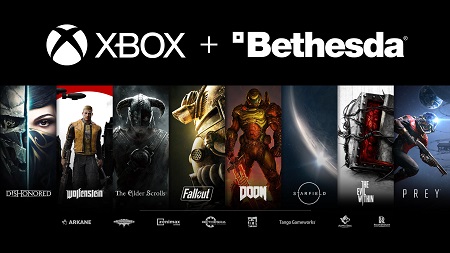
Avatar was also a film which had contemporary real-world analogies. I noted influences of at least two of America’s recent wars in the depiction of the Marines, scientists, and Na’vi – Vietnam and Iraq. The dense rainforests of Pandora, and the way Jake and others had trouble navigating them, were the film’s answer to the jungles of Vietnam. And references to winning “the hearts and minds” of the locals was a phrase we heard often in relation to the Iraq war during the 2000s – which is when Avatar was in development. The latter of those themes is arguably less relevant in 2021 than it was in 2009, and Avatar 2 will need to adapt to changing times.
Night time on Pandora in this final piece of concept art.

One improvement we’re sure to see is in CGI and digital animation. Avatar was released at a time when CGI was improving – and was far better than it had been even five or ten years earlier – but there are still some aspects of its visual style that haven’t aged especially well. Some textures have that “too shiny” look that plagued cinematic CGI in the 2000s, and while viewing the film on a cinema or IMAX projector screen dulled the impact of some of that, on a television set in 2021 it’s something you notice. I wouldn’t say Avatar looks dated – but it’s right on the cusp. A film that relies so heavily on computer animation – many of Avatar’s sequences are basically fully-animated – is always going to run that risk, and while it has aged more gracefully than, for example, the Star Wars prequel trilogy, there are still noticeable places where the animation isn’t up to code.

There have been improvements in computer animation since 2009, which should mean Avatar 2 and the rest of the sequel series will be far more visually interesting. Pandora was already beautiful, but if that beauty could be expanded upon I think the sequels could really be something special. Some fans tend to turn up their noses at visuals, but if you think about it, a distinct visual style is another absolutely crucial element to a franchise. Star Trek has combadges, ships with saucer sections, Klingons, and the transporter. Star Wars has white-armoured Stormtroopers, lightsabers, Jabba the Hutt, and X-wings. Avatar introduced us to the blue-skinned Na’vi, but none of its technology, characters, costumes, or locations have become iconic in the same way as the other franchises we’ve mentioned. Part of that is down to the quality of the CGI, but partly it’s the film’s own art style. Avatar 2 could introduce a new design for a starship, character, or even just a costume that will go on to be emblematic of the series – in the way that Boba Fett became a symbol of Star Wars after his debut in The Empire Strikes Back, for example.

So yes, there’s work to do to expand on Pandora and the world Avatar created in 2009. But I’m really interested to see where Avatar 2 will take the story after the conclusion of the first film, and what the other films in the planned sequel series have in store. James Cameron is an amazing director, and having put so much work and effort into the Avatar series, I really hope it will see the kind of success he’s looking for. There’s always room for more sci-fi franchises!

Avatar is out now on Blu-ray and DVD, and may be streamed on Disney+ in the United States, United Kingdom, and other countries and territories. Avatar is the copyright of 20th Century Fox and the Walt Disney Company. Avatar 2 is due for release in December 2022. Logo and official promotional artwork courtesy of avatar.com. Stock photos courtesy of Unsplash. This article contains the thoughts and opinions of one person only and is not intended to cause any offence.