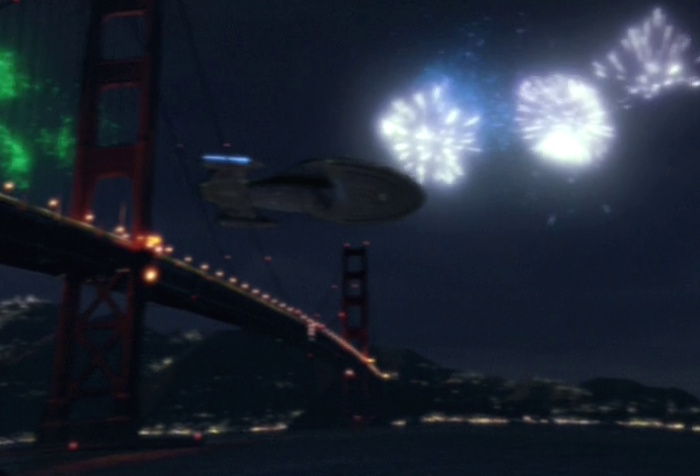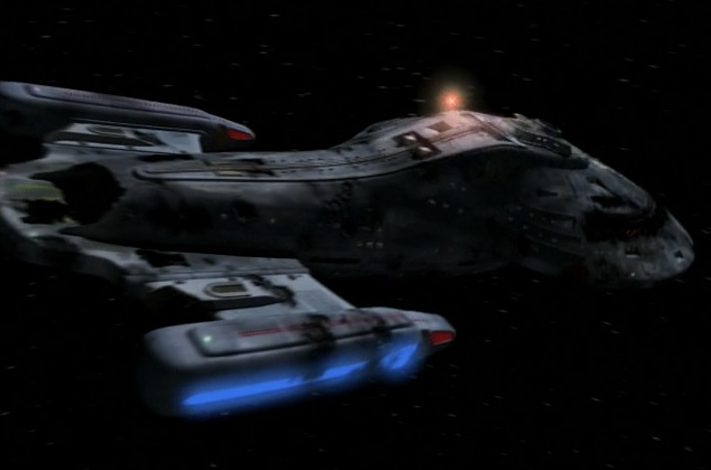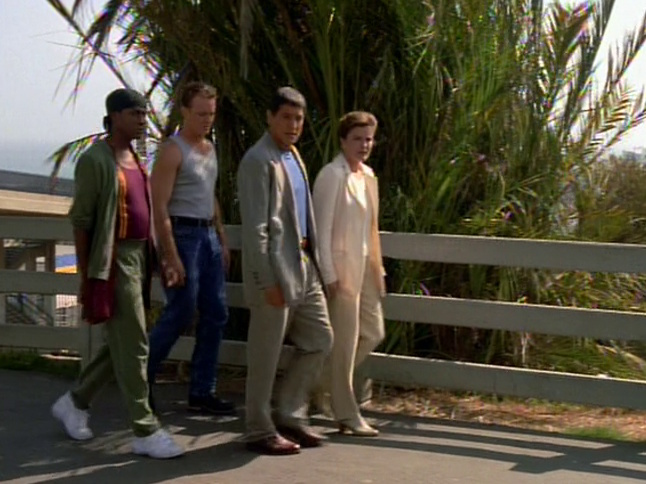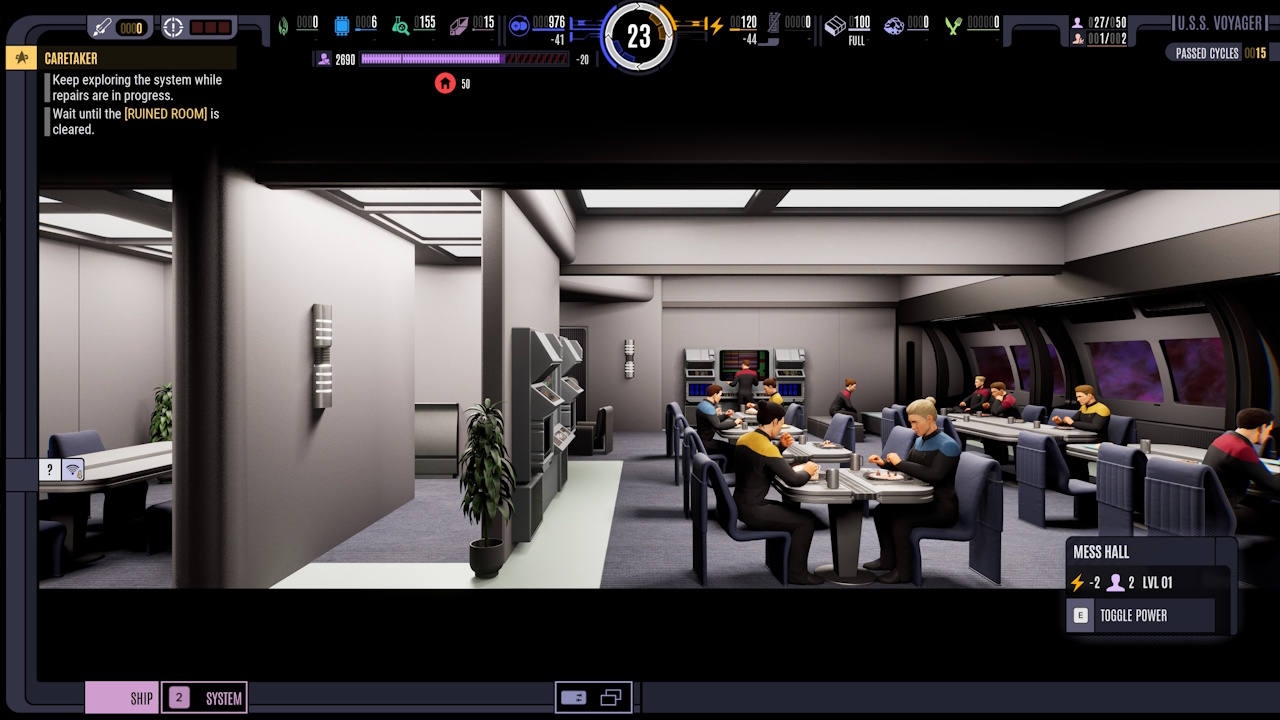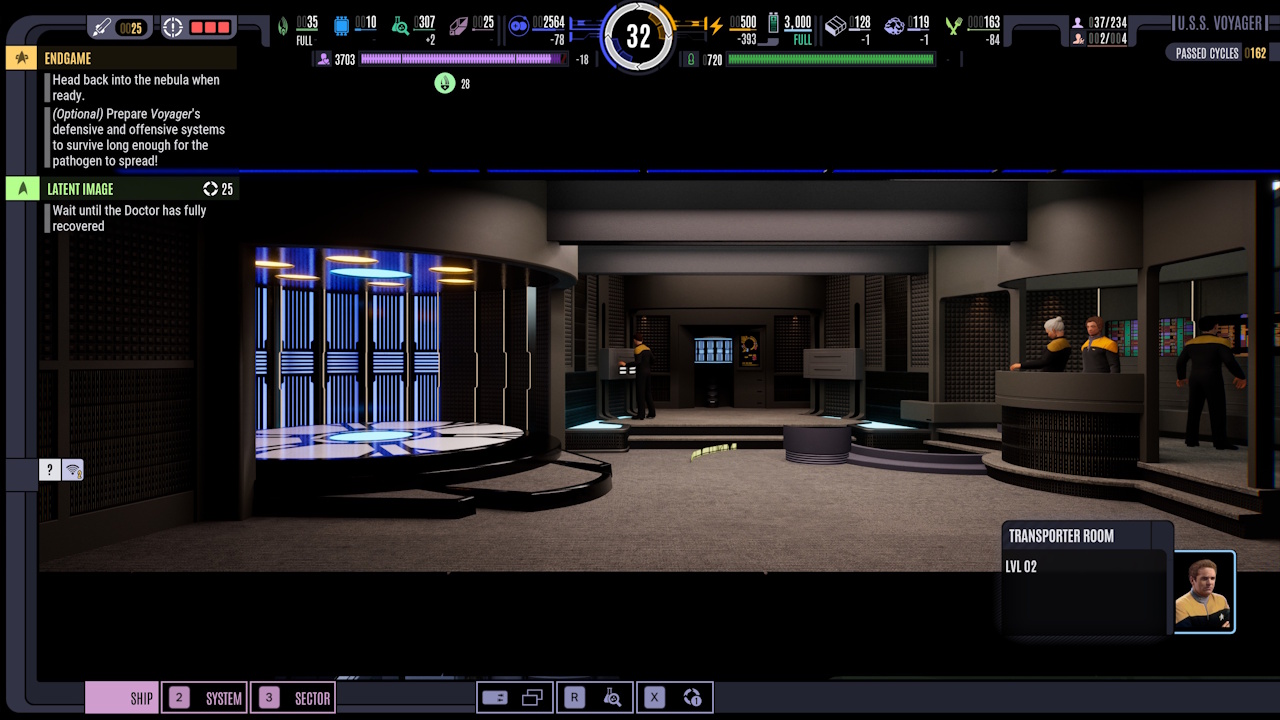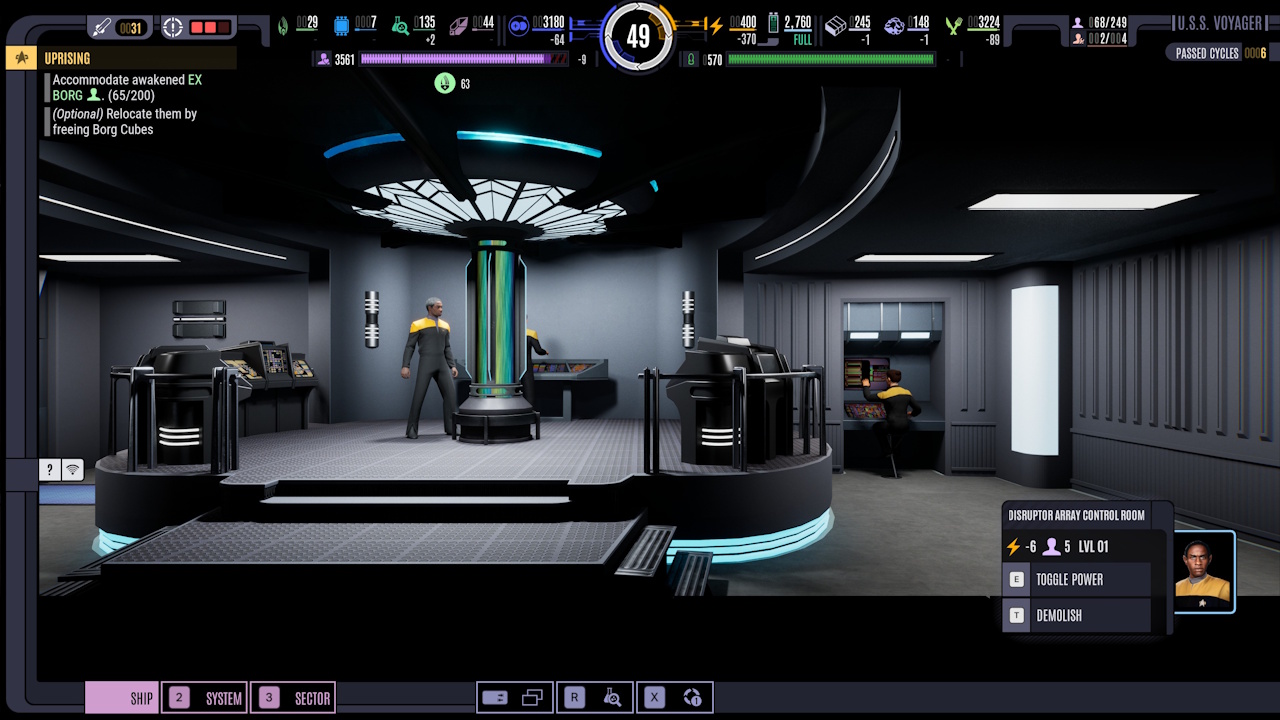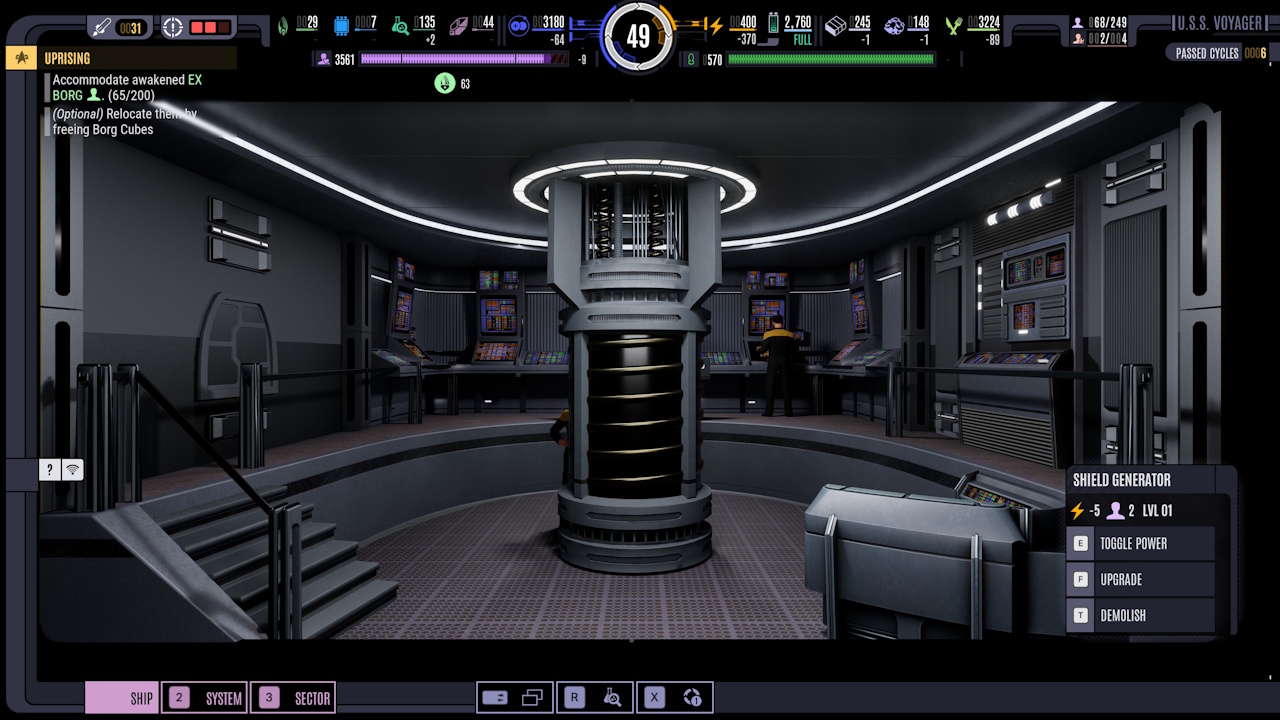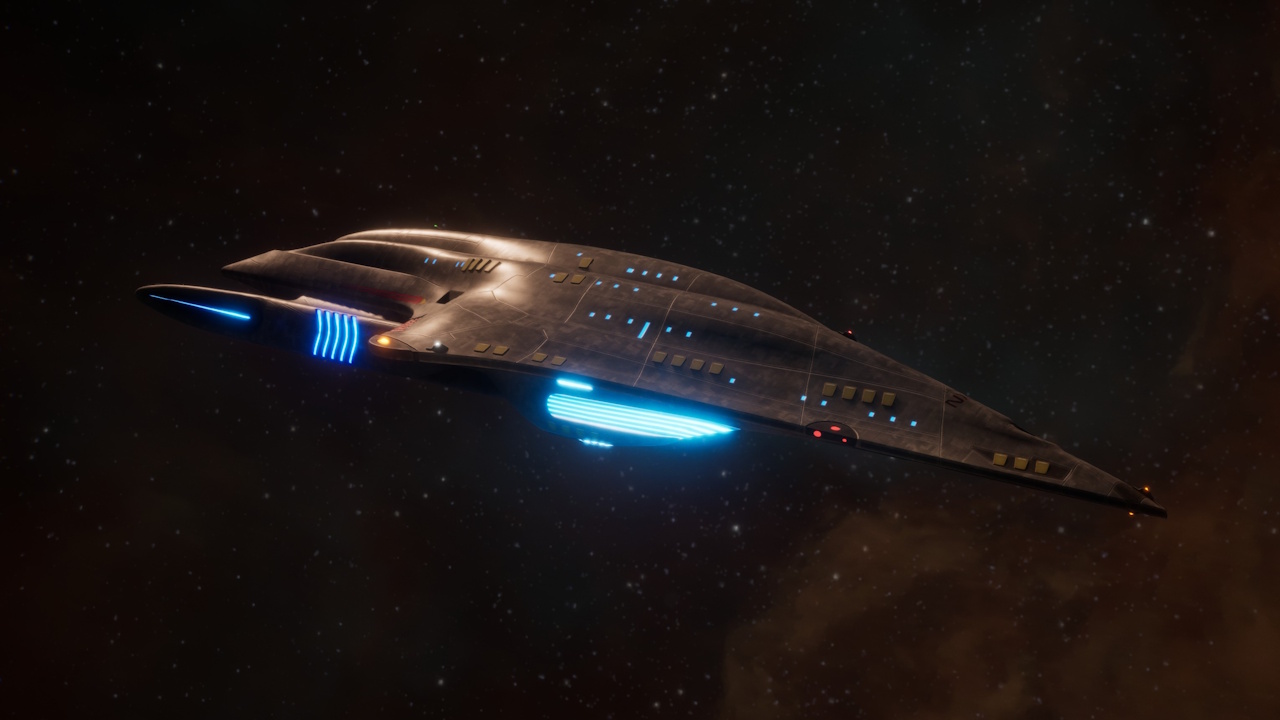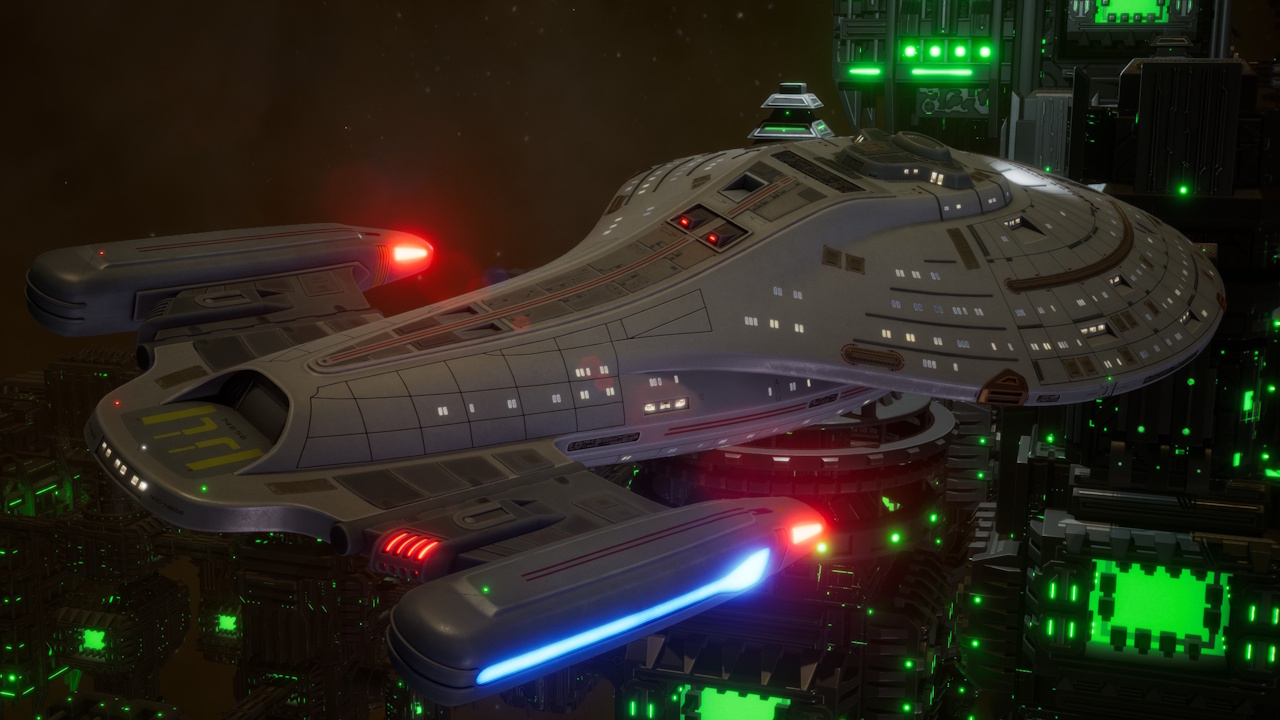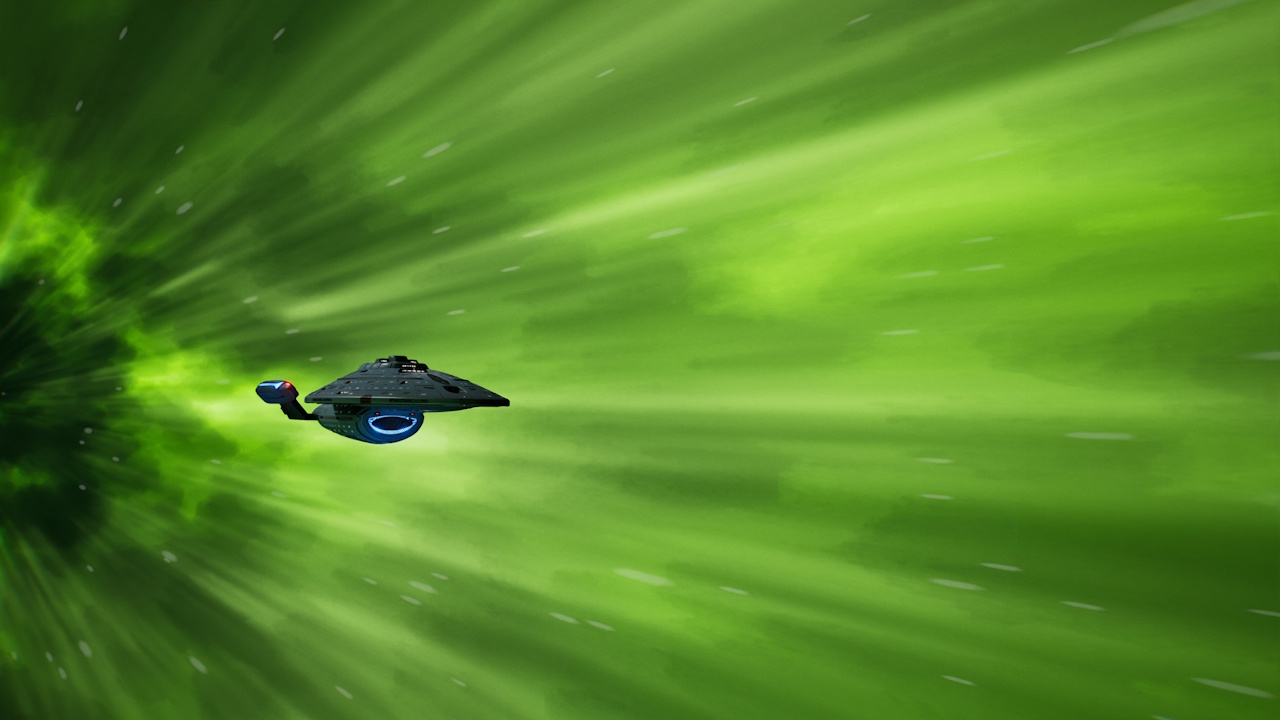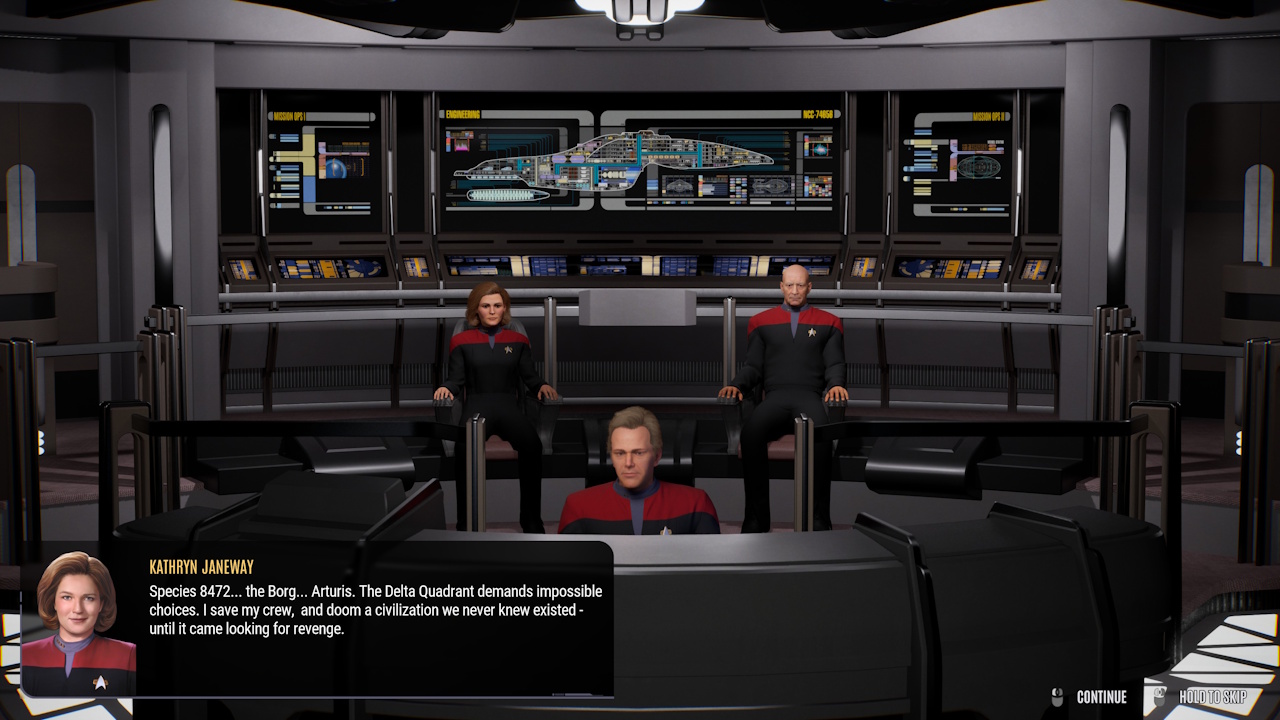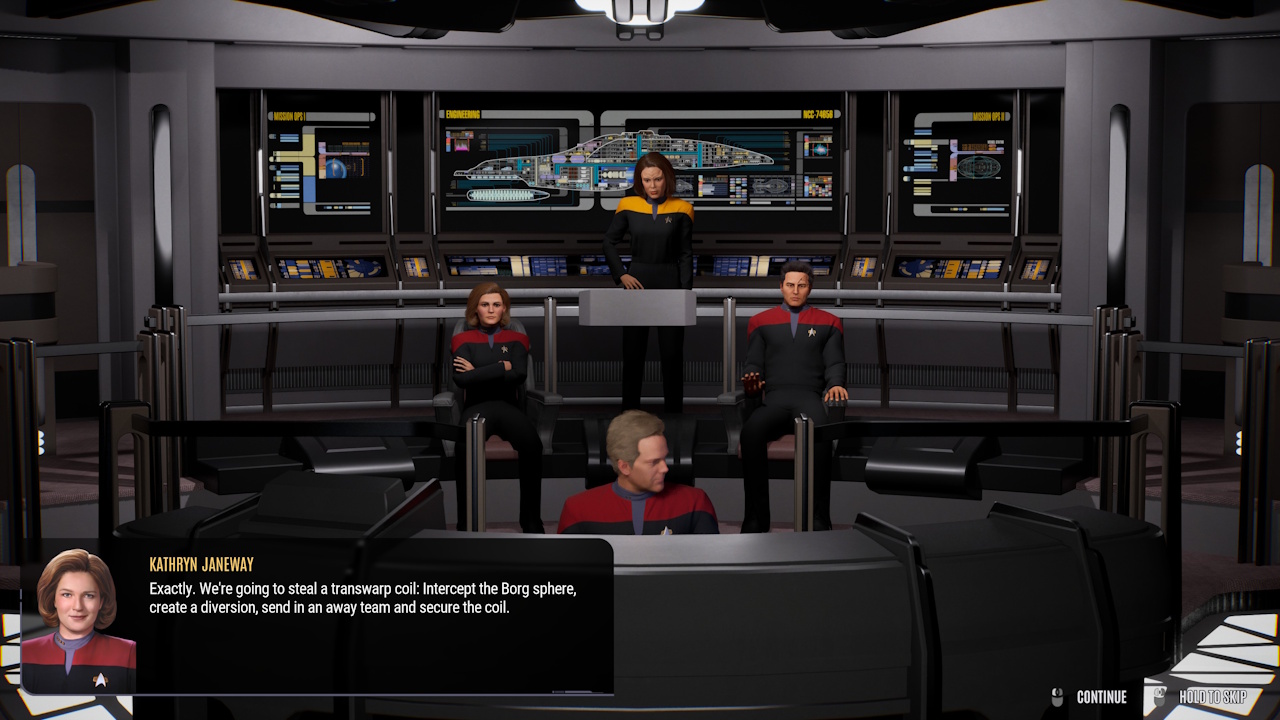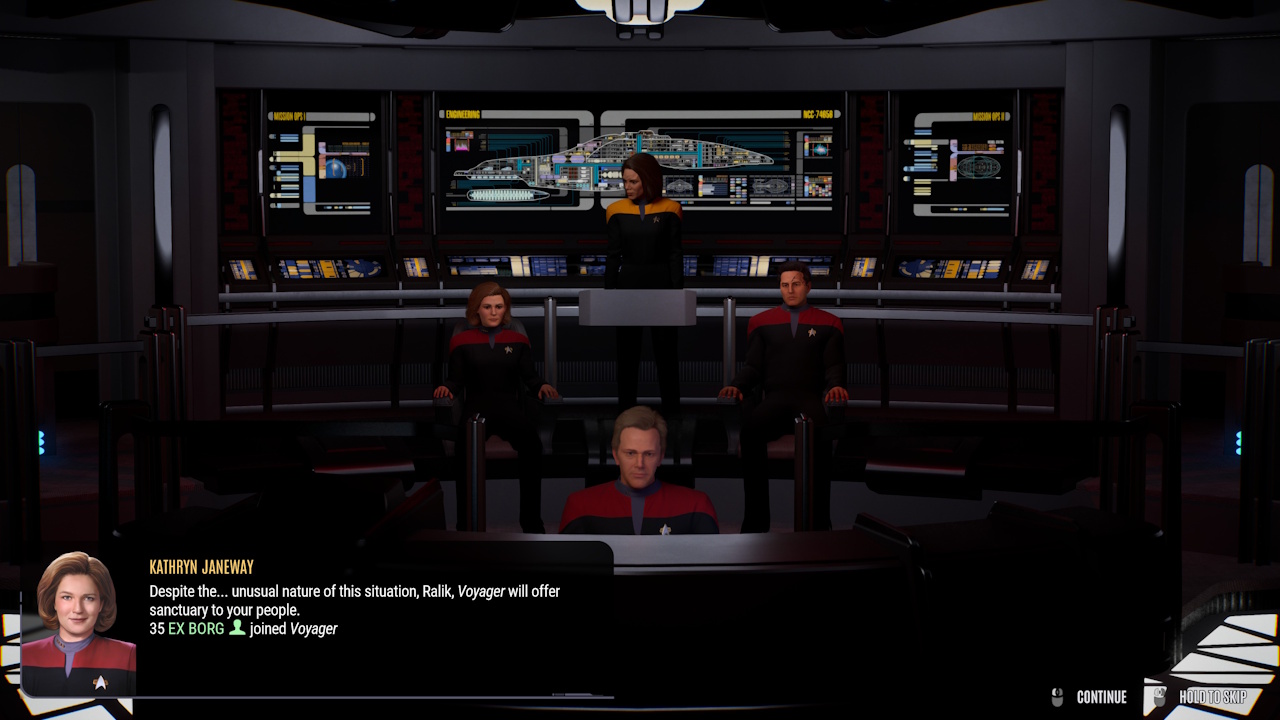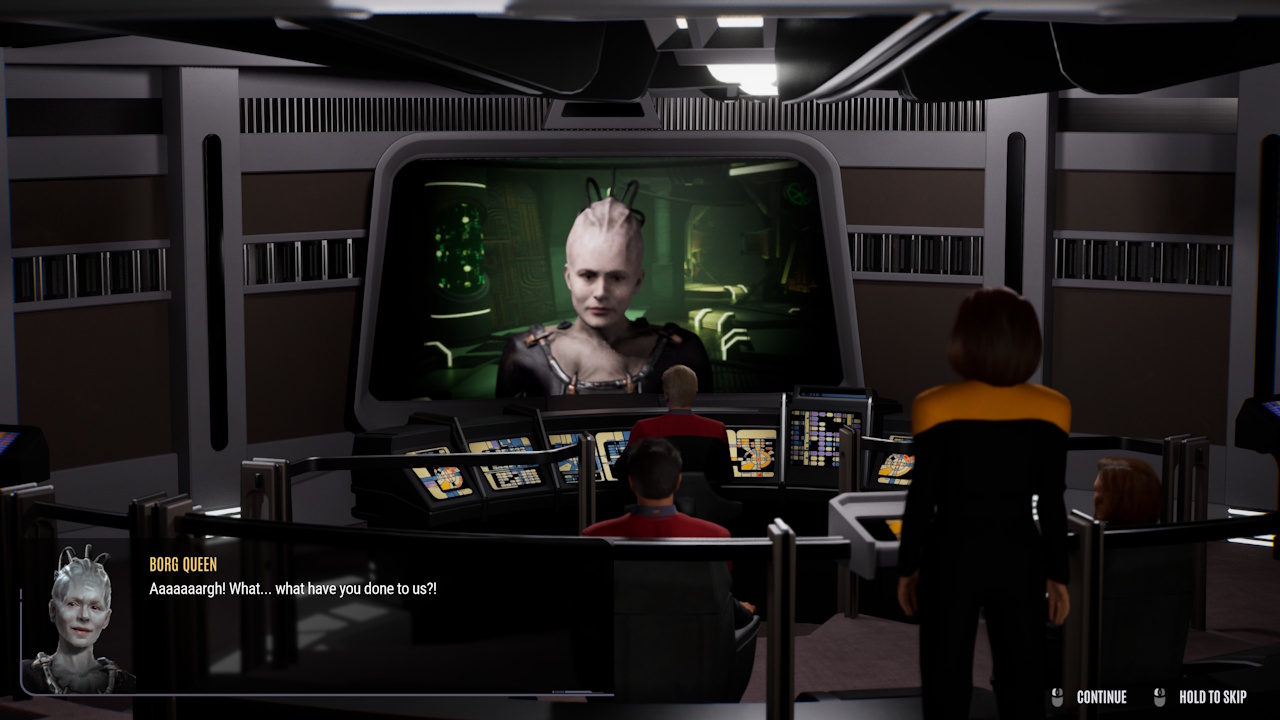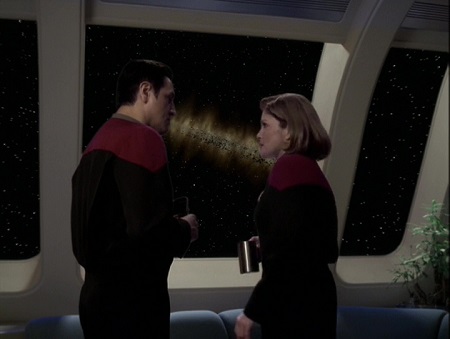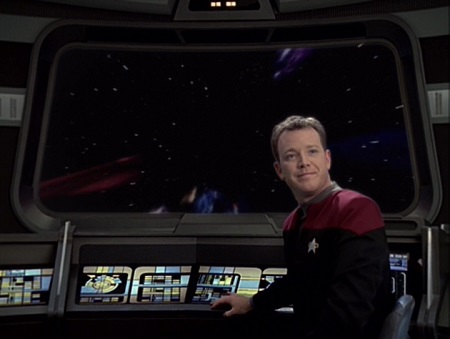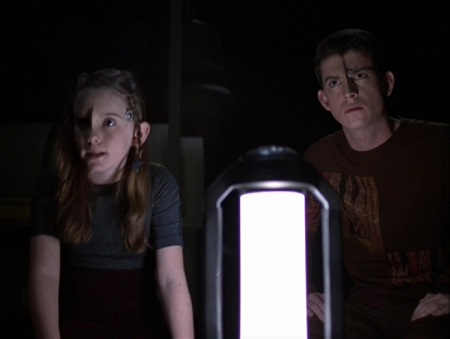
Star Trek: Voyager – Across The Unknown: My Thoughts on the Demo

A Star Trek-themed spoiler warning.

Spoiler Warning: Beware of spoilers for Star Trek: Voyager – Across The Unknown and Star Trek: Voyager.

A new video game based on Star Trek: Voyager, titled Across The Unknown, was announced only a few weeks ago. I didn’t think we’d see it until at least next year – but to my surprise, I received a notification that a demo version is available on Steam. I jumped into the game as soon as it had finished downloading, eager to try it out for myself, and I thought it could be fun to preview the upcoming title together.

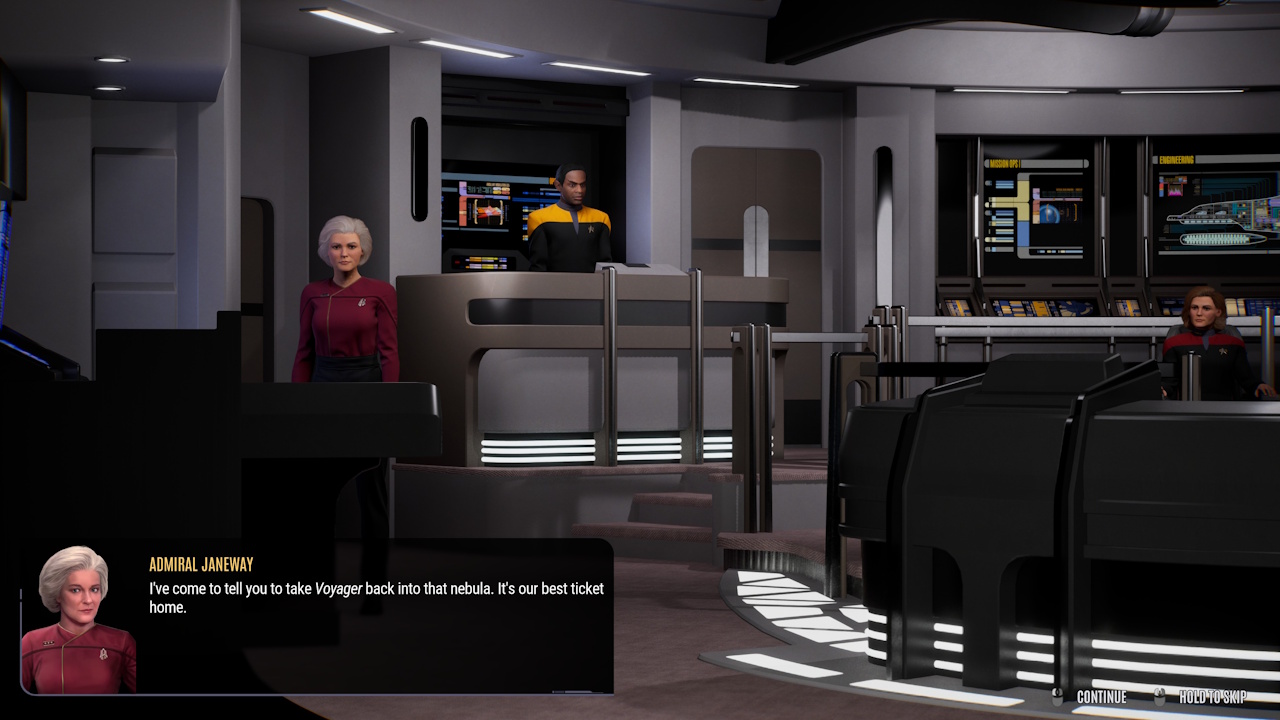
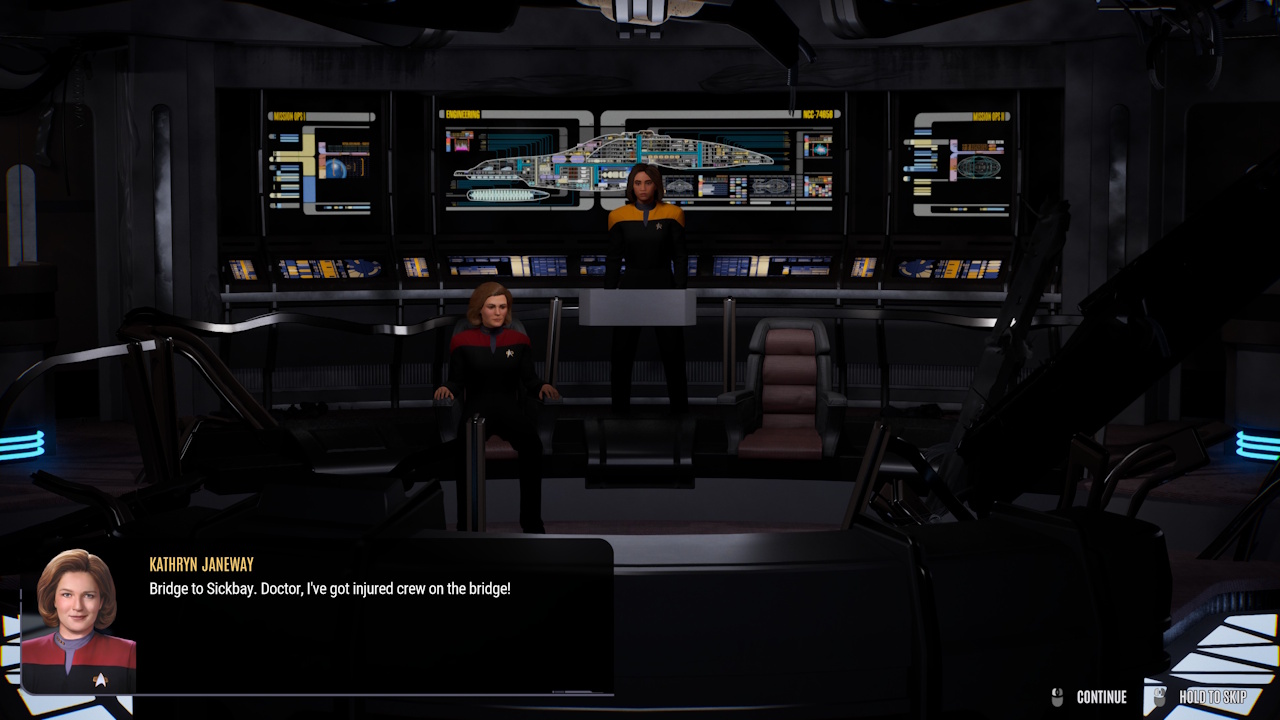
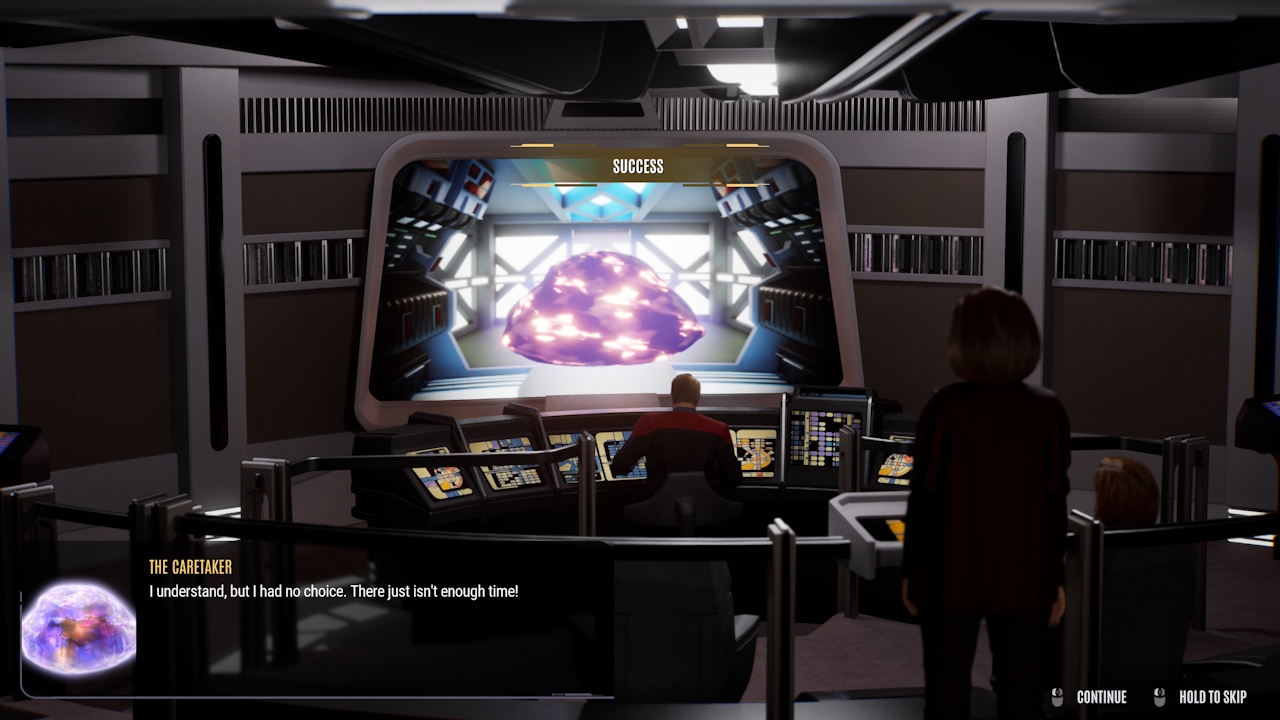
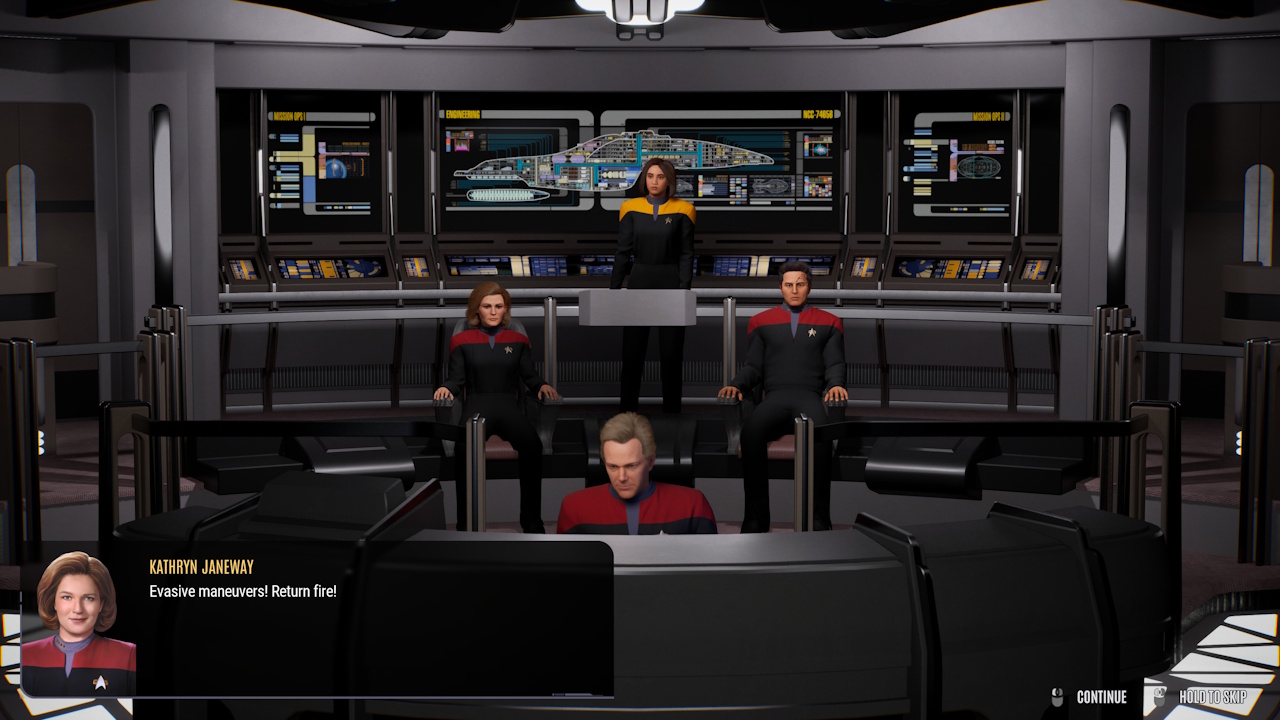
I enjoyed the demo for the hour or so that it lasted, and playing through a modified version of Voyager’s premiere – Caretaker – was generally a fun experience. I think Across The Unknown still has work to do – there were a couple of issues that I picked up on in my brief playthrough – but by and large, the game seems poised to deliver more or less what I’d been expecting.

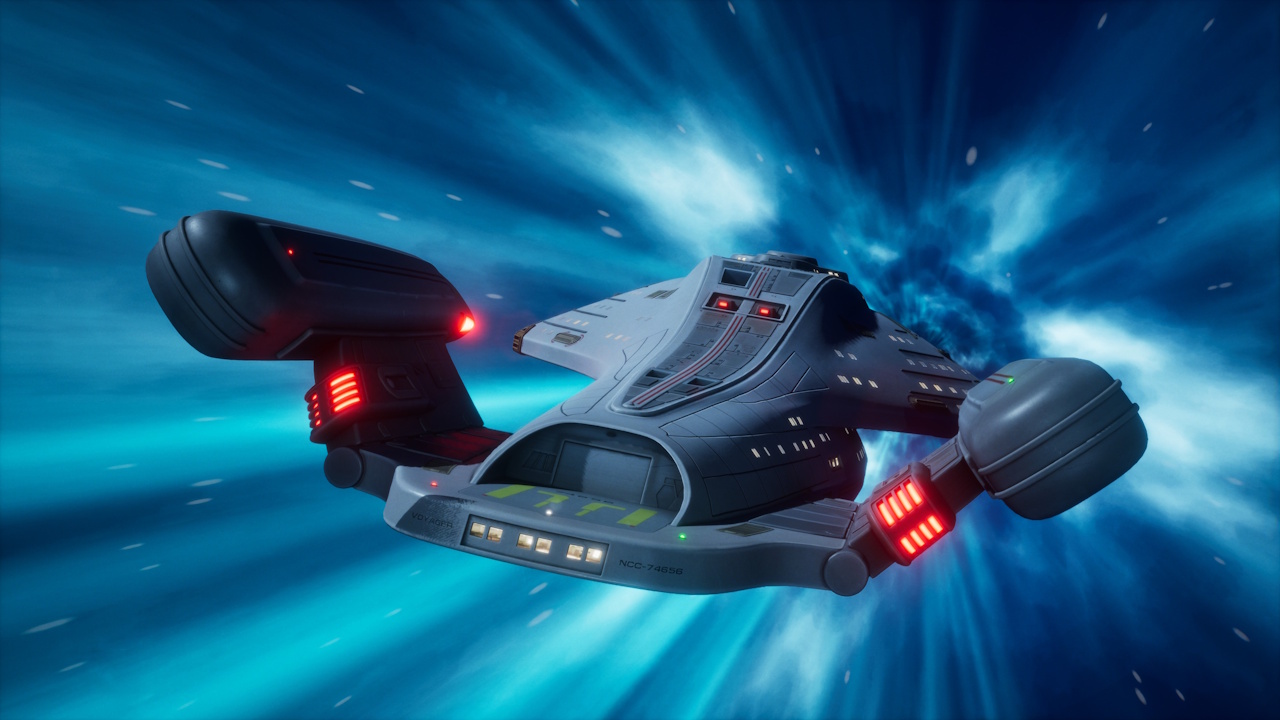
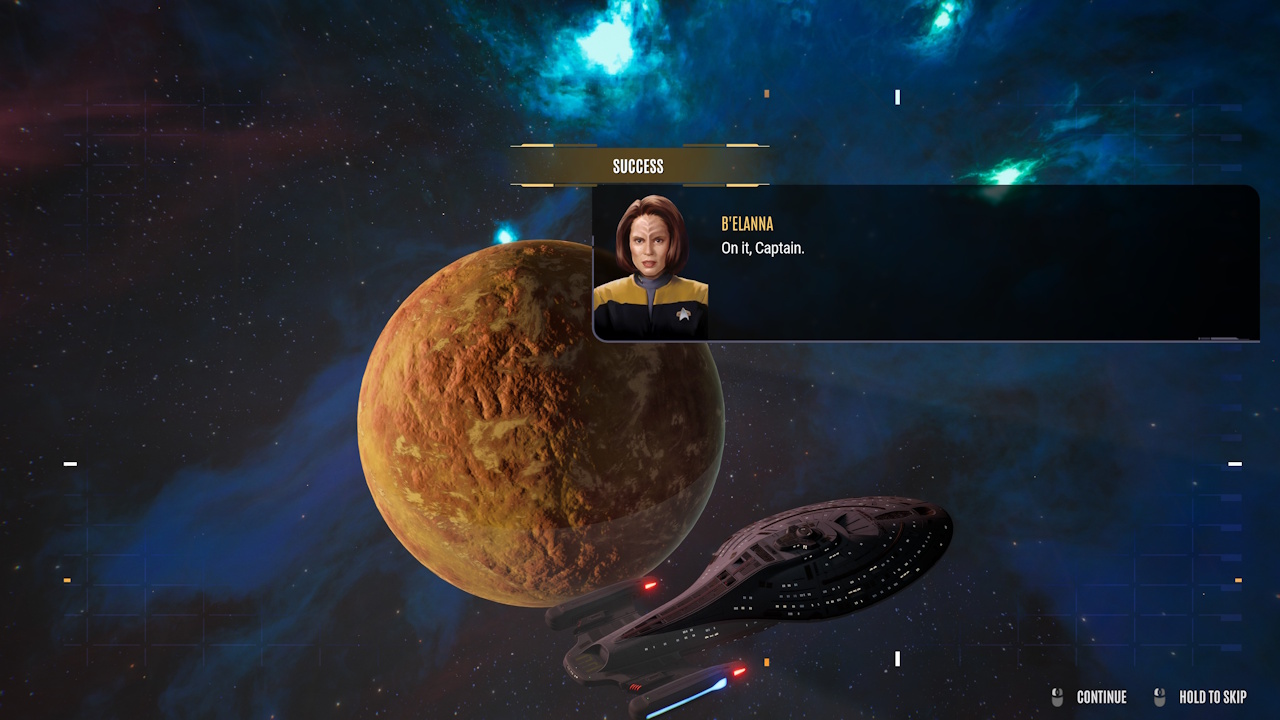
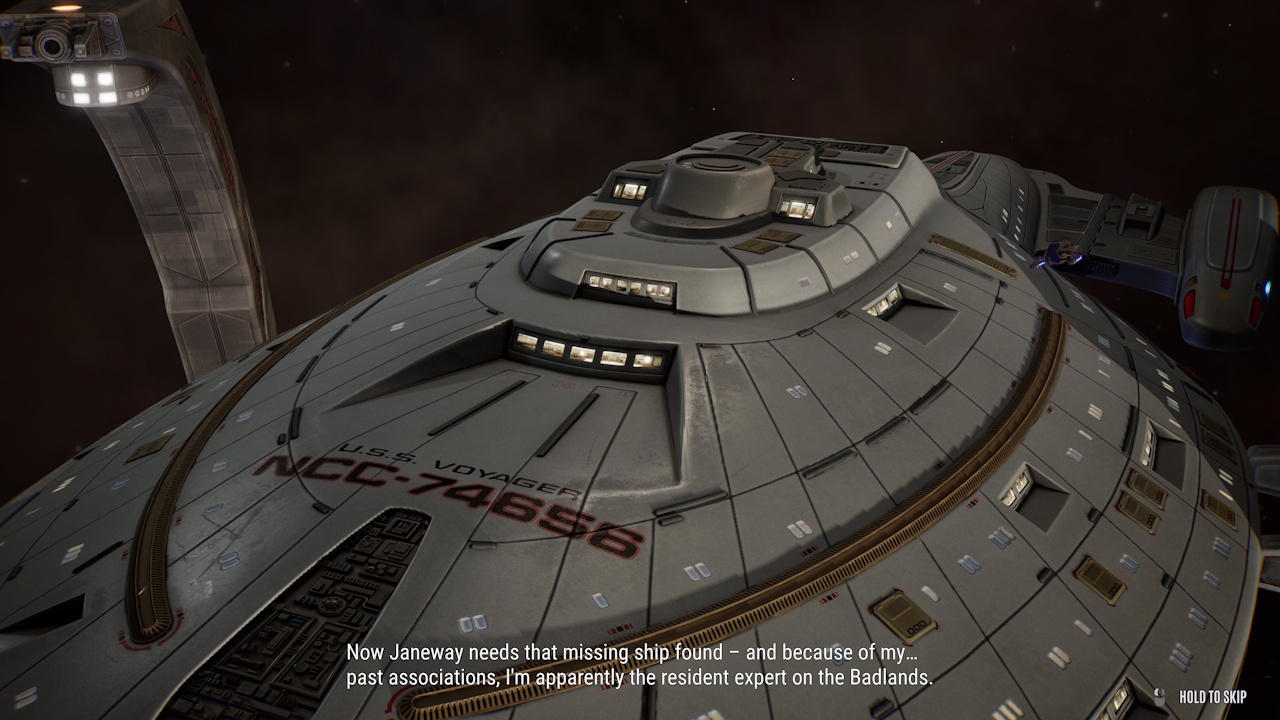
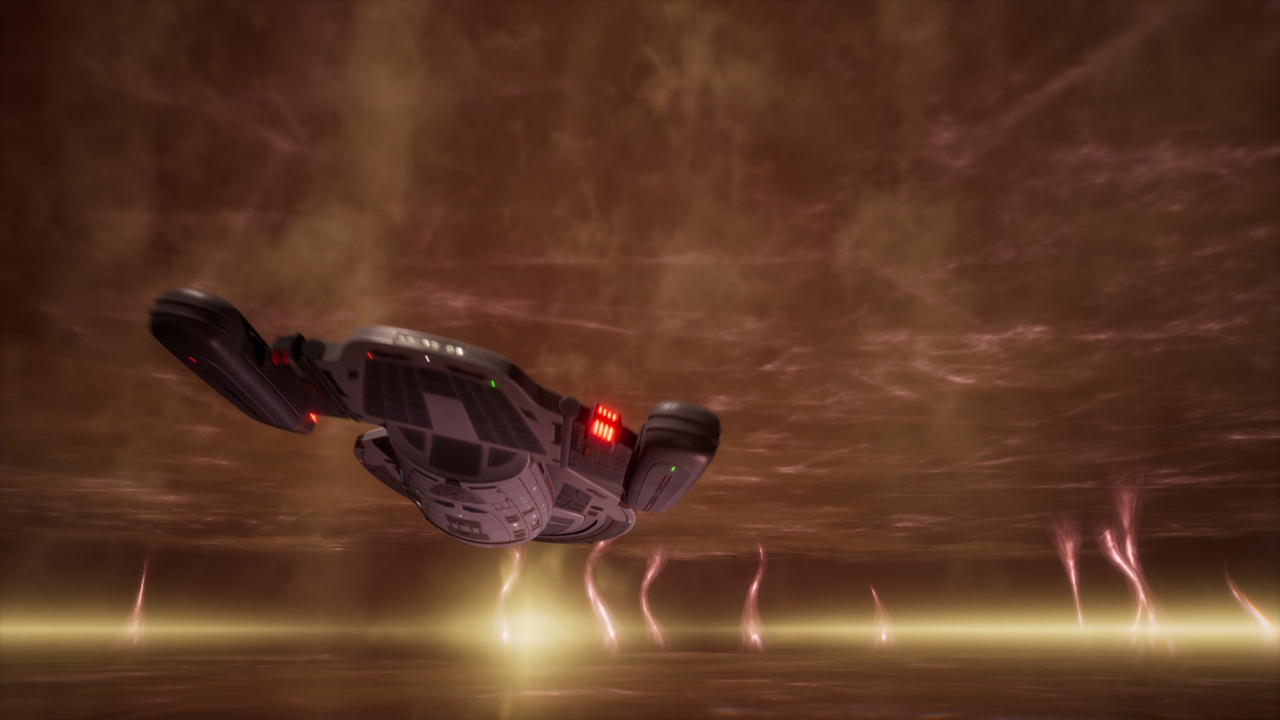
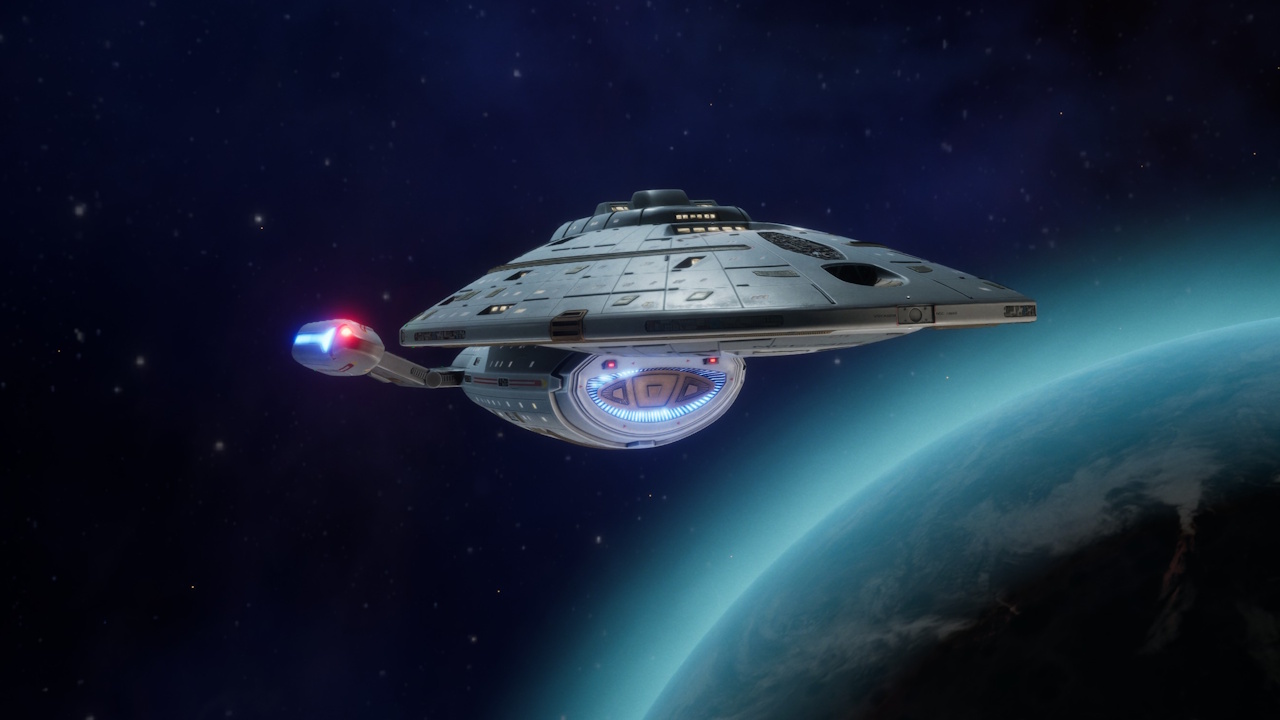
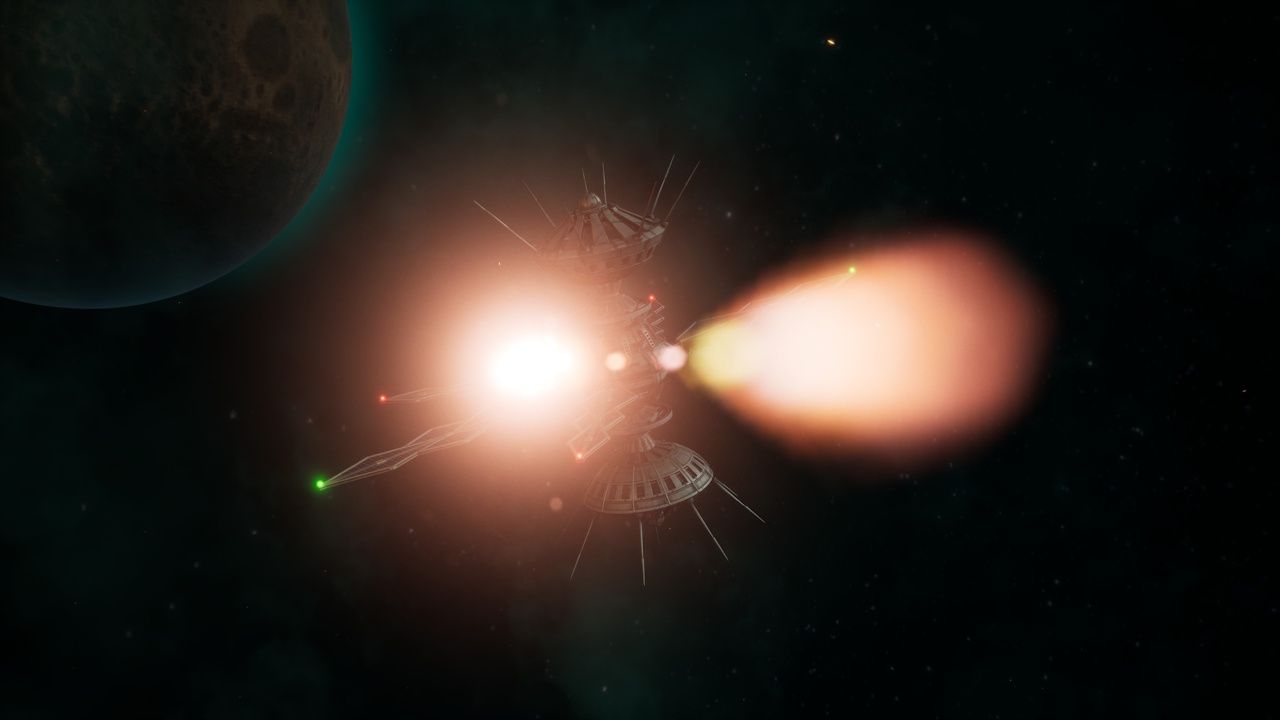
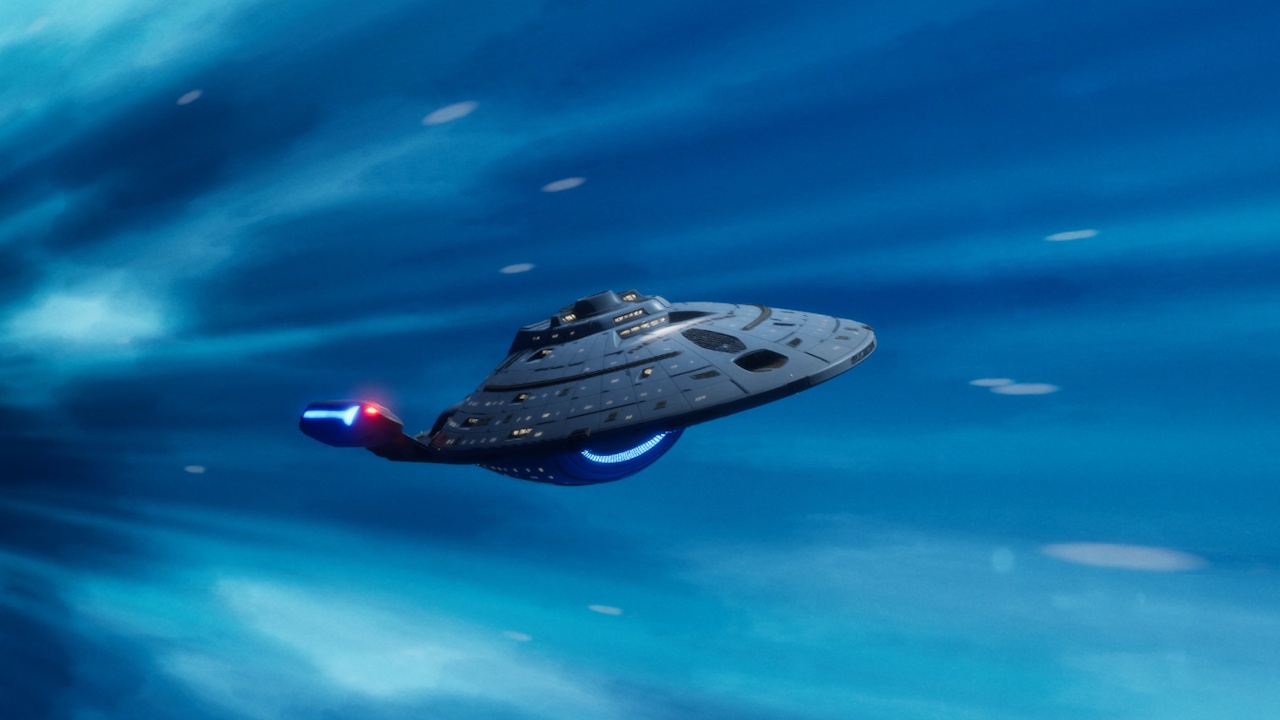
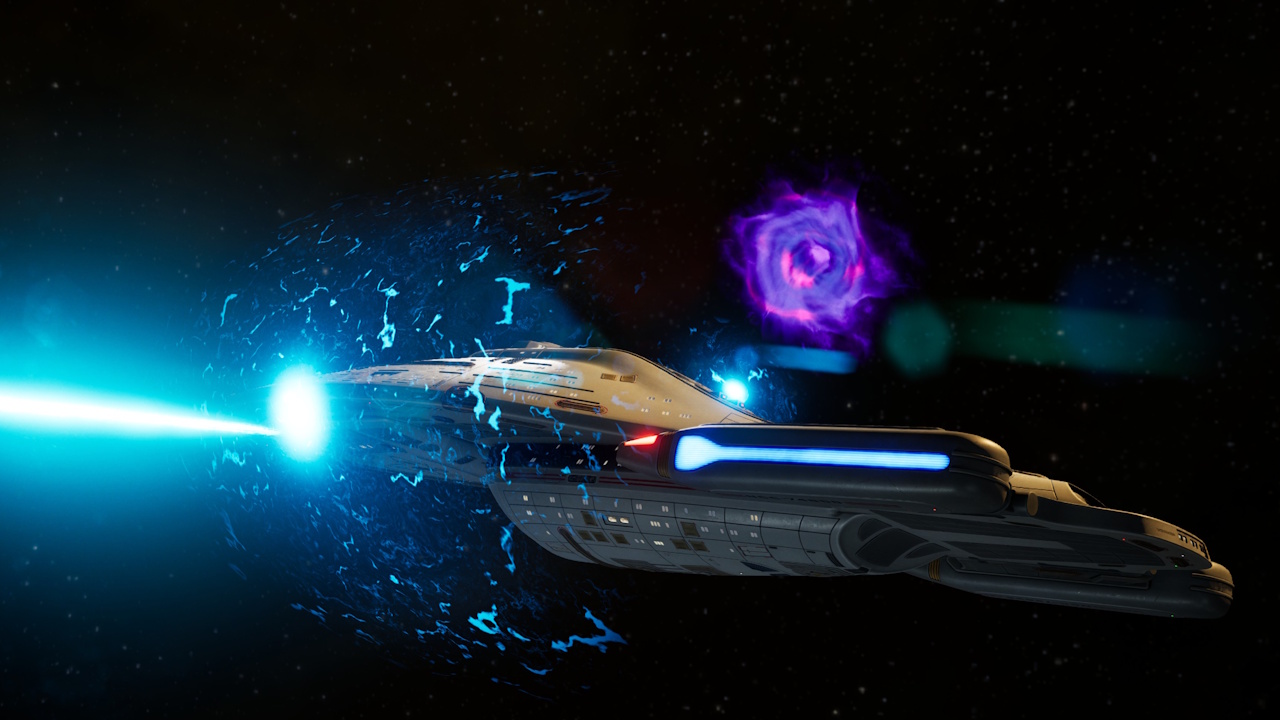
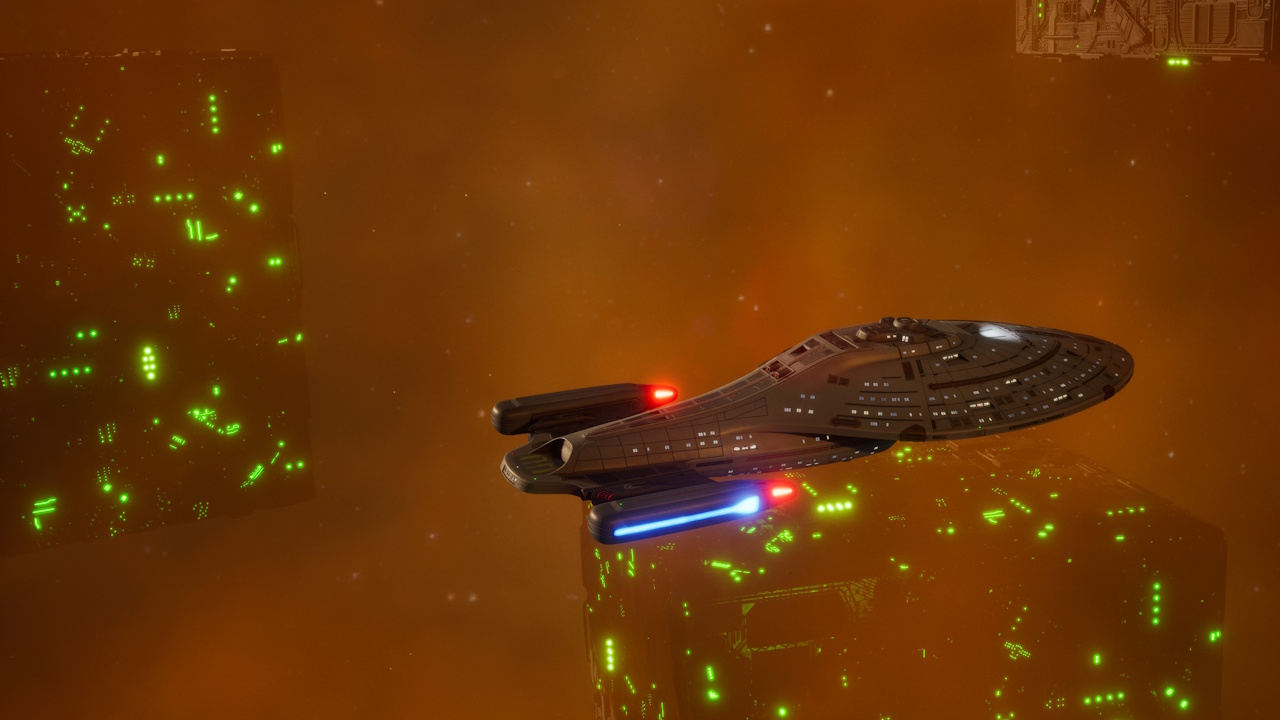
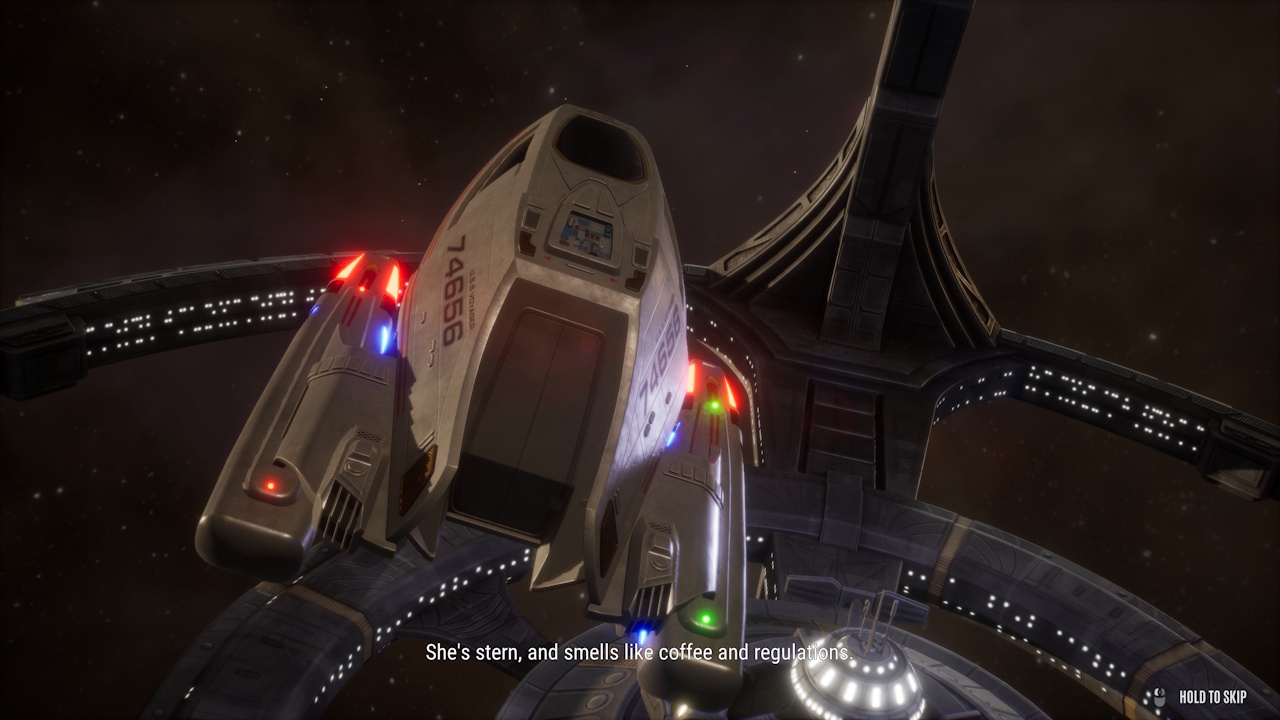
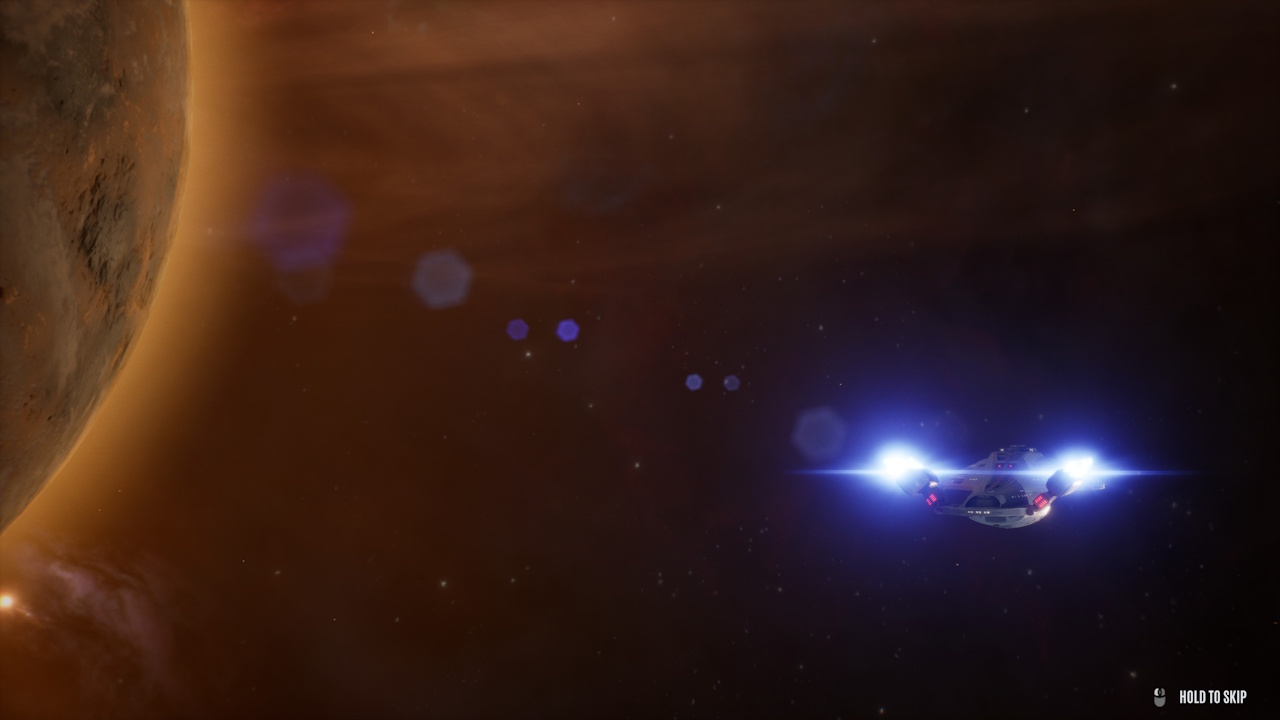
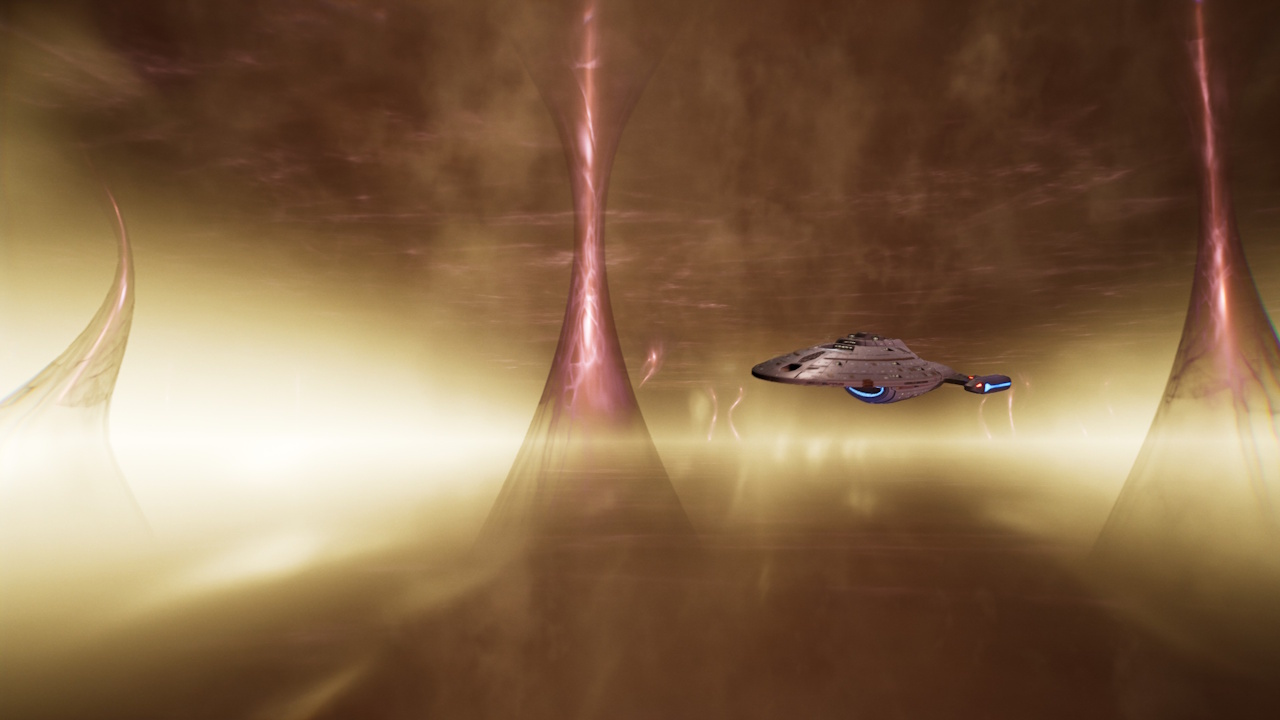
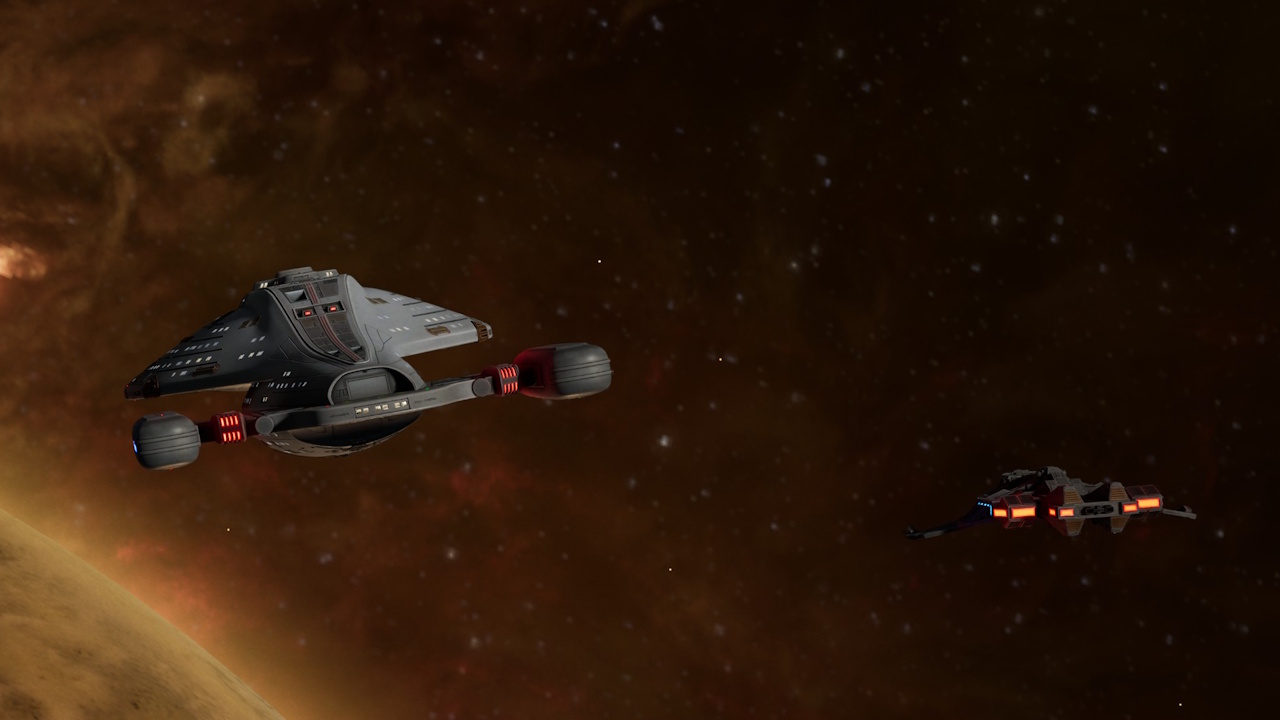
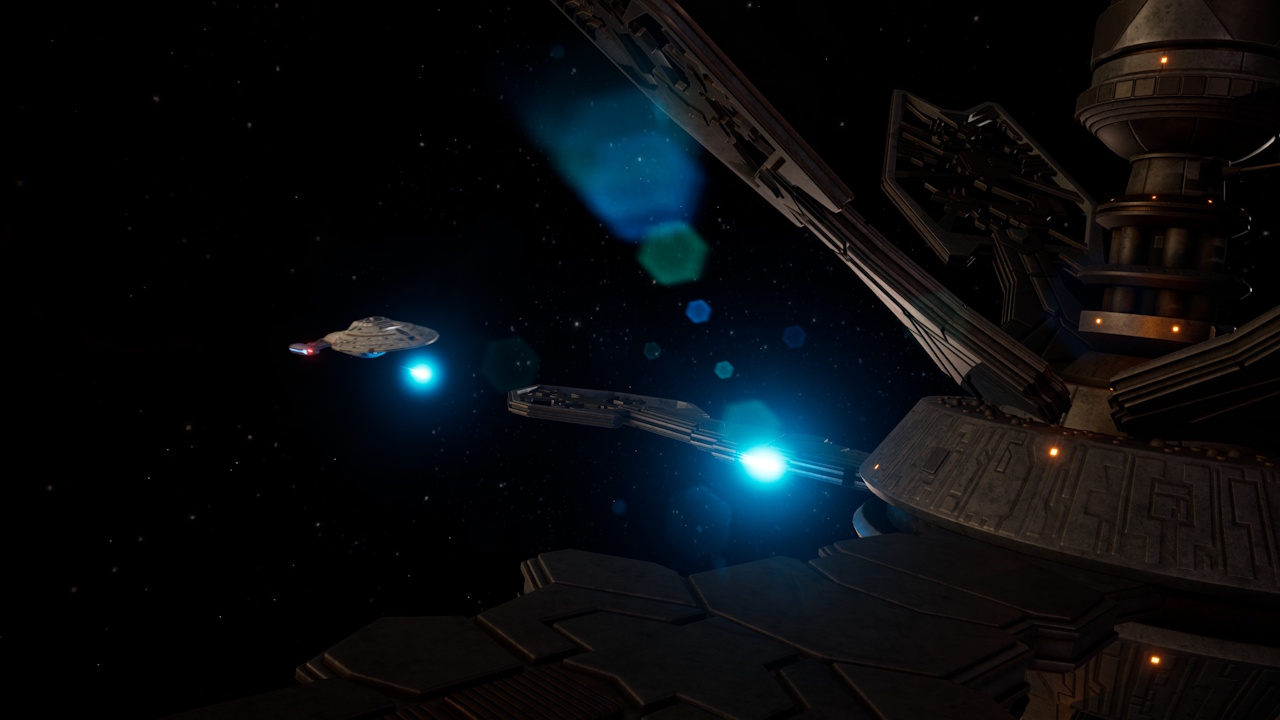
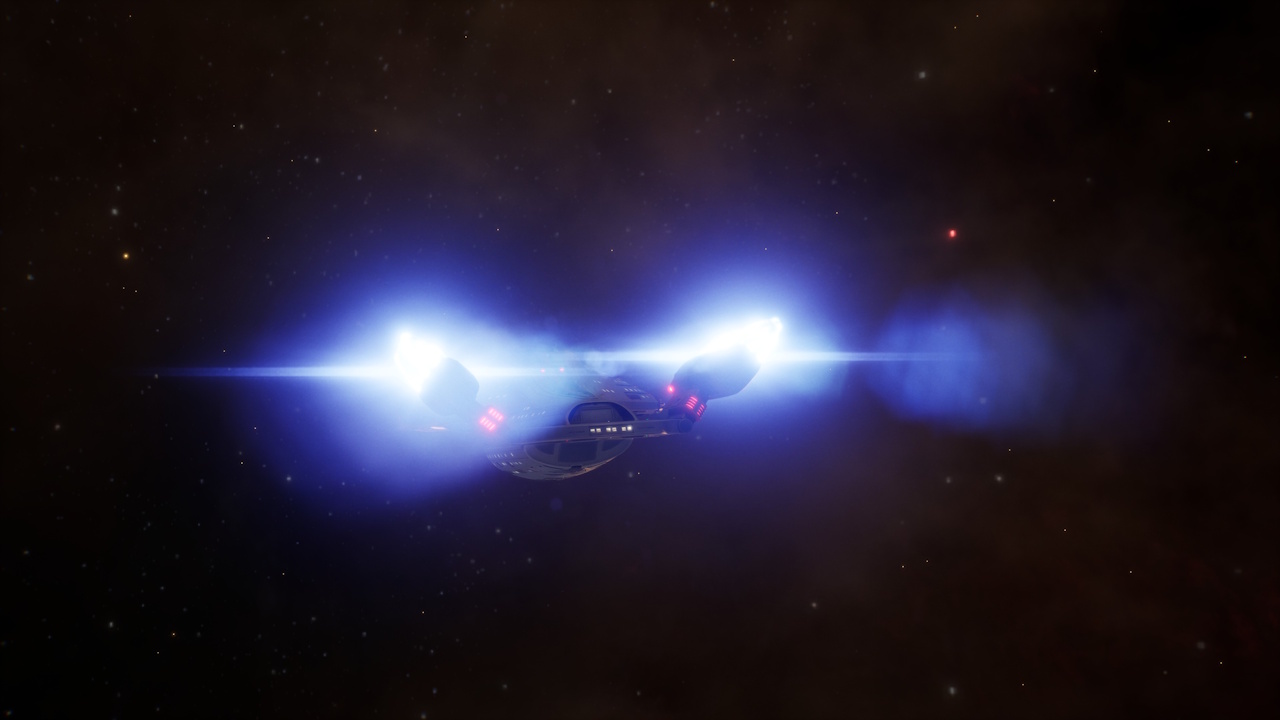
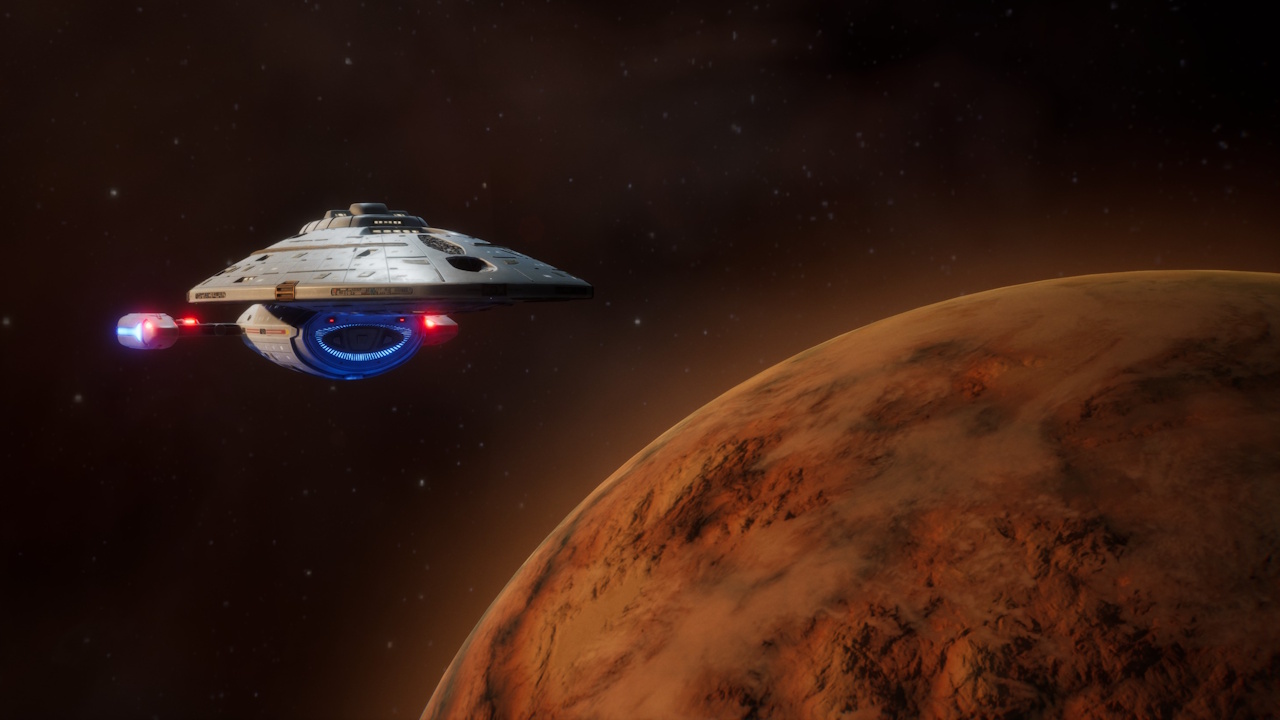
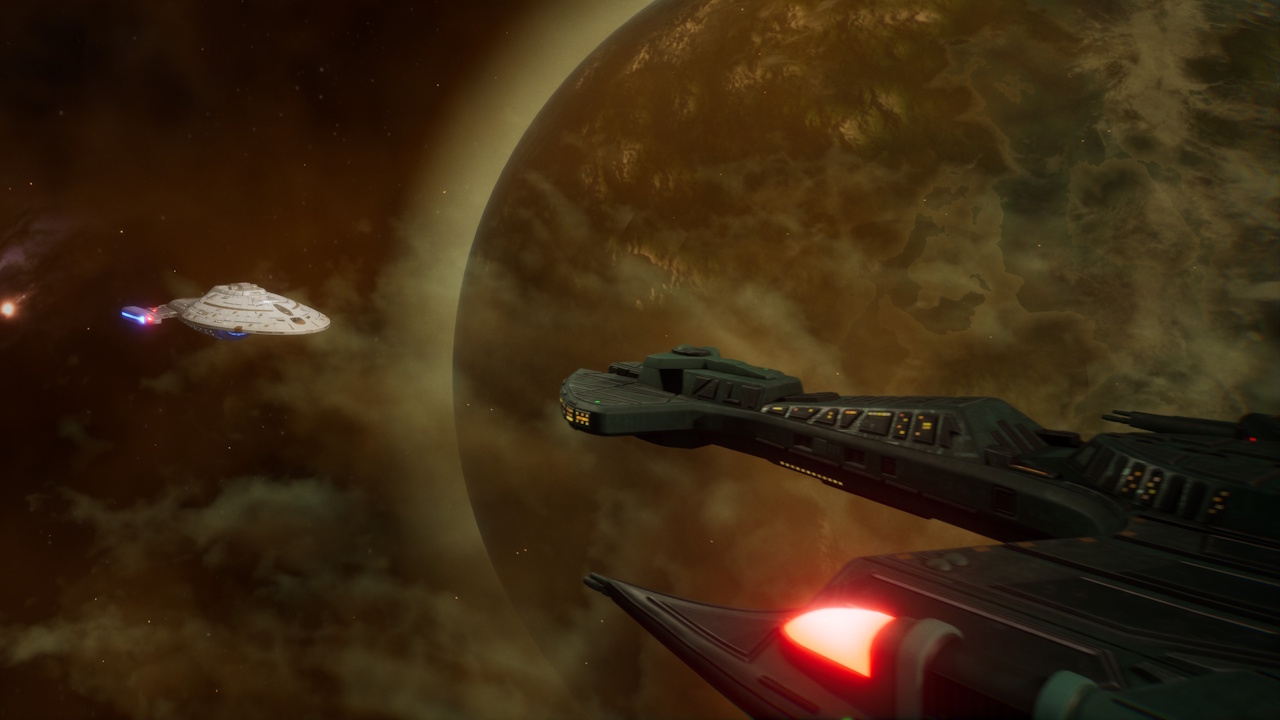
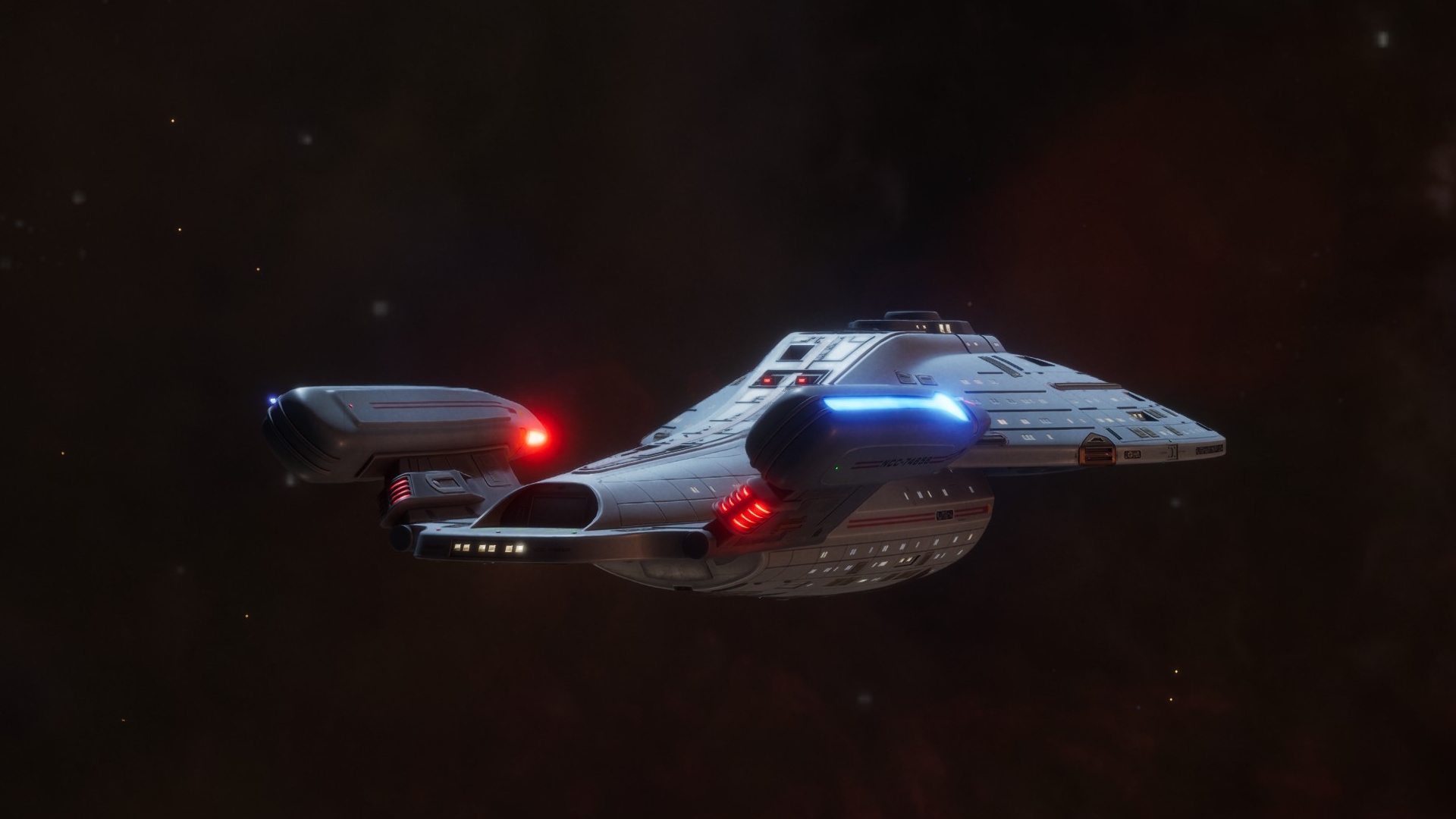
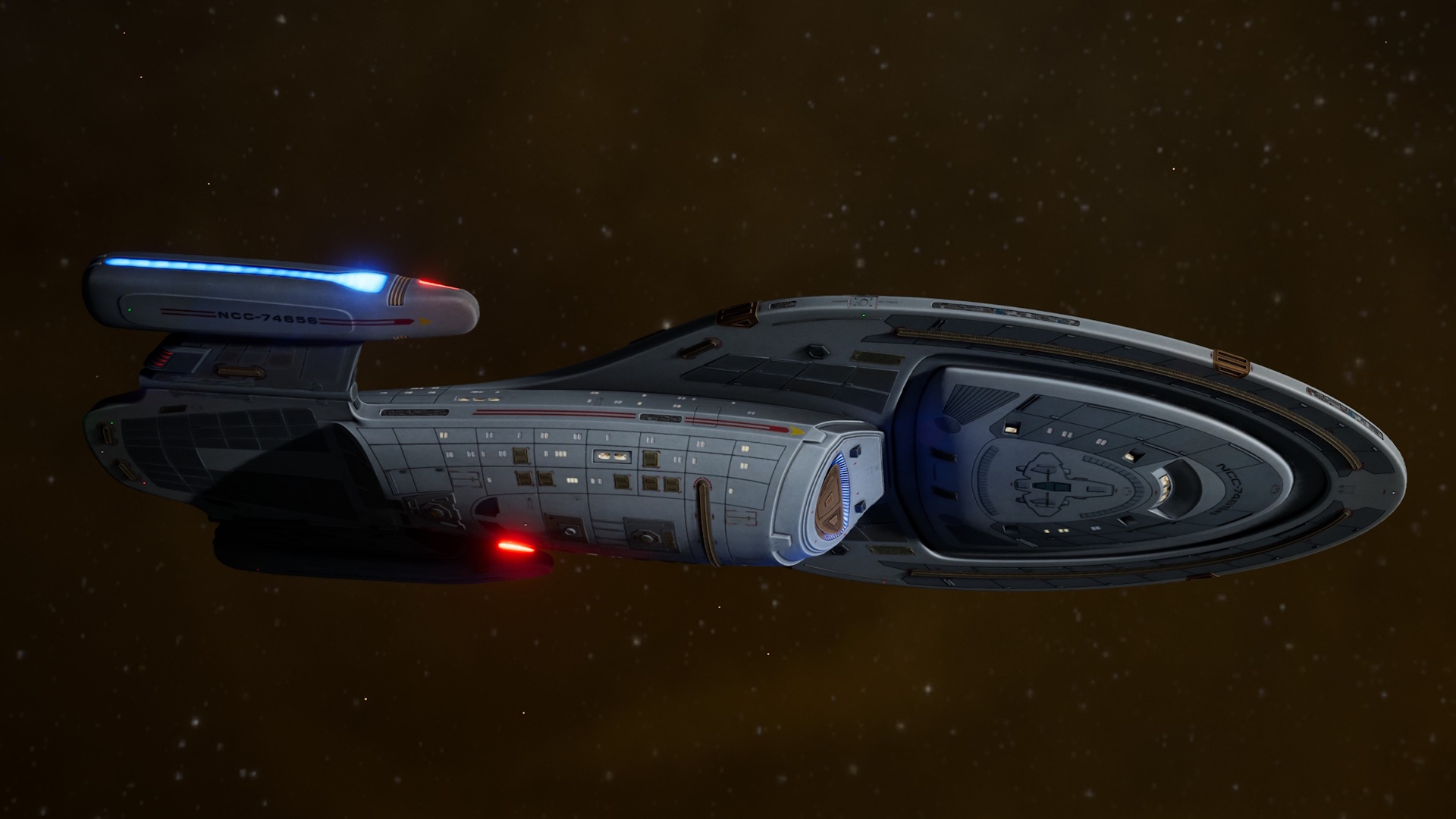
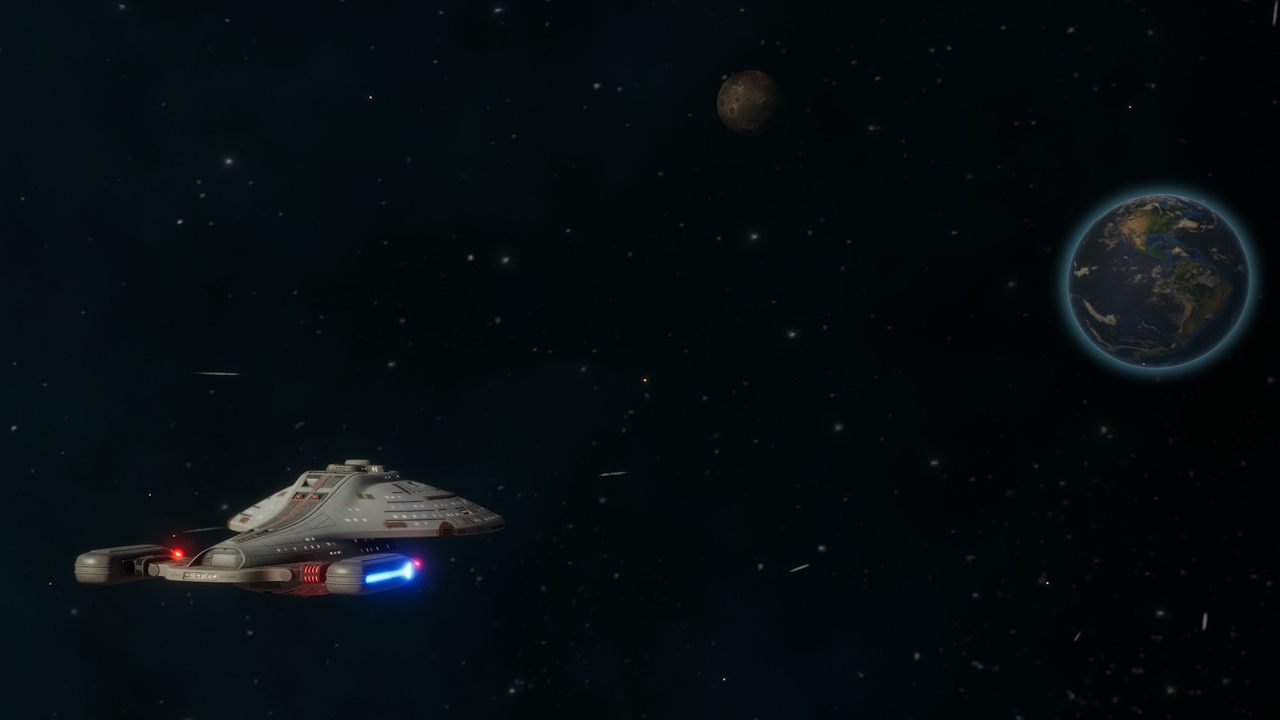
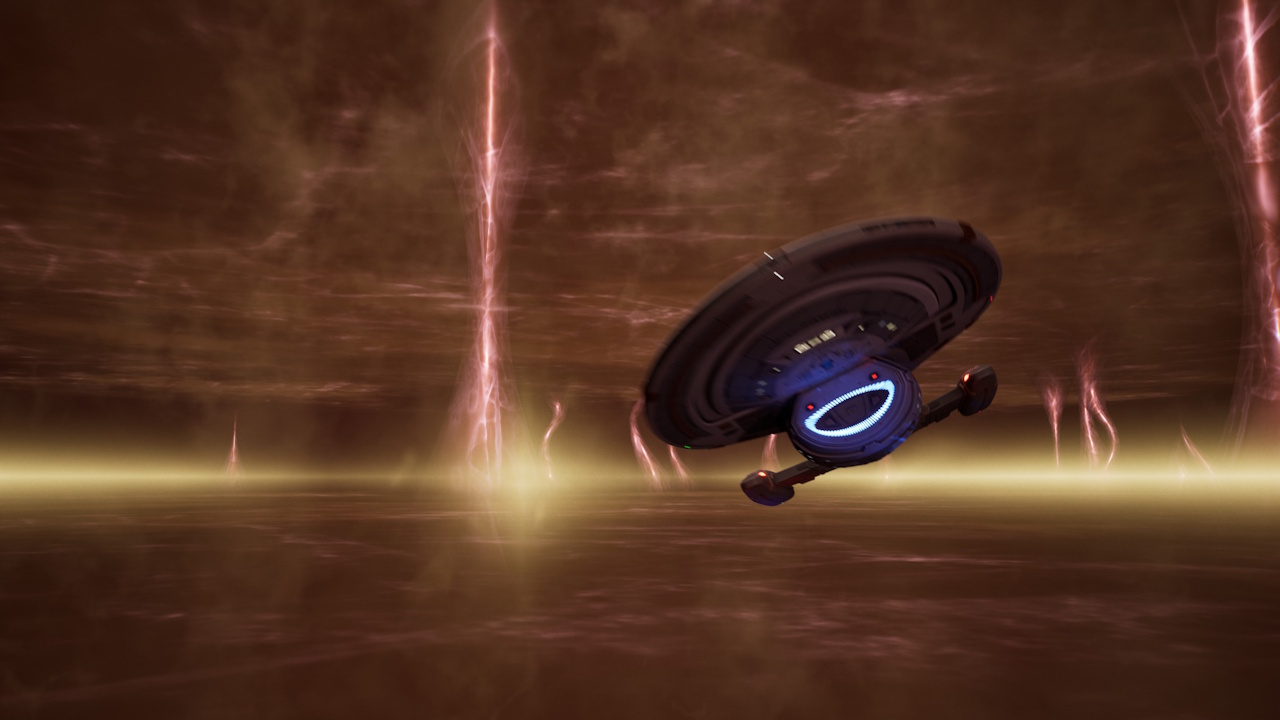
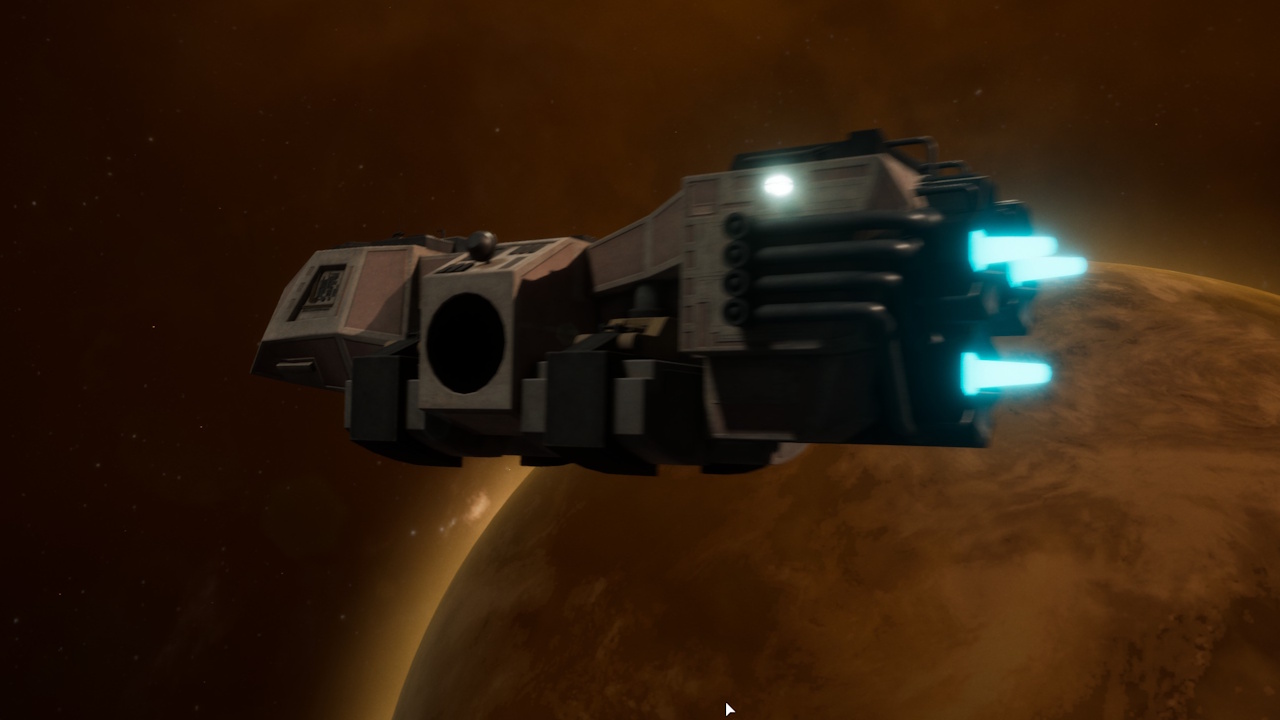
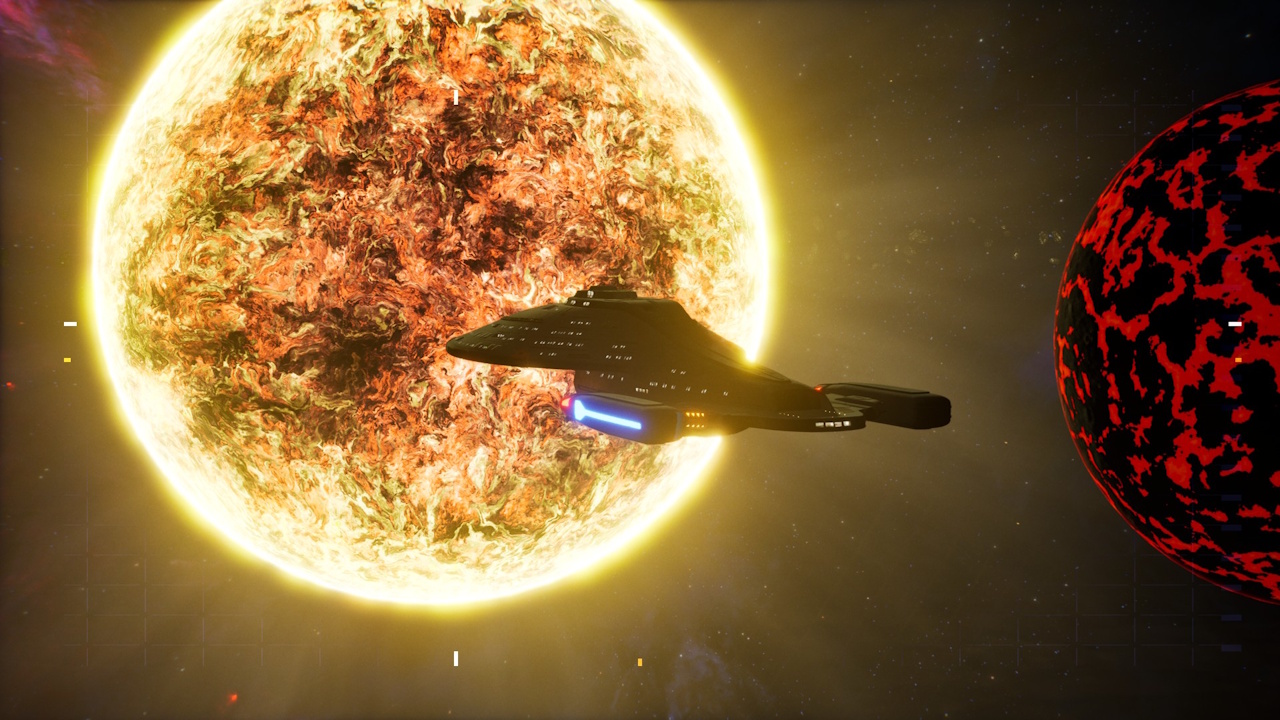
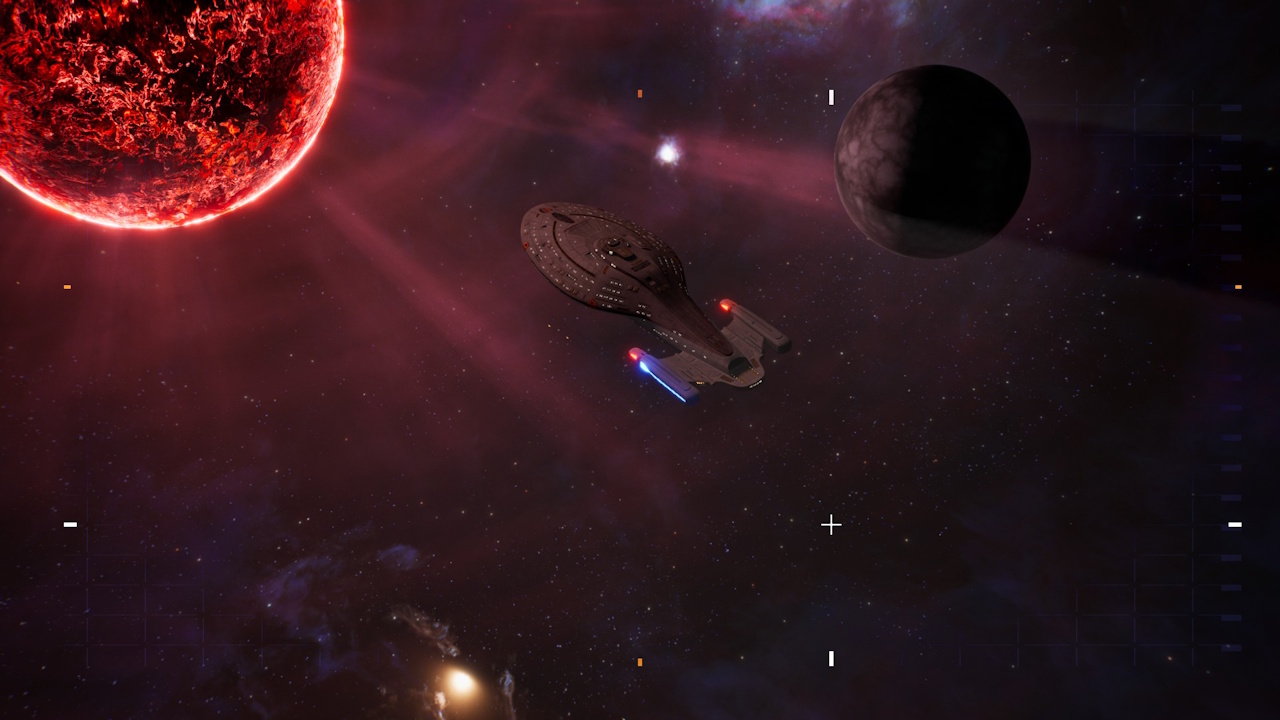
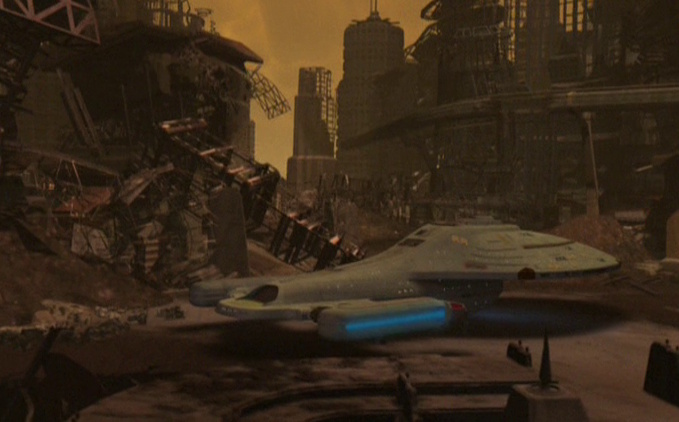
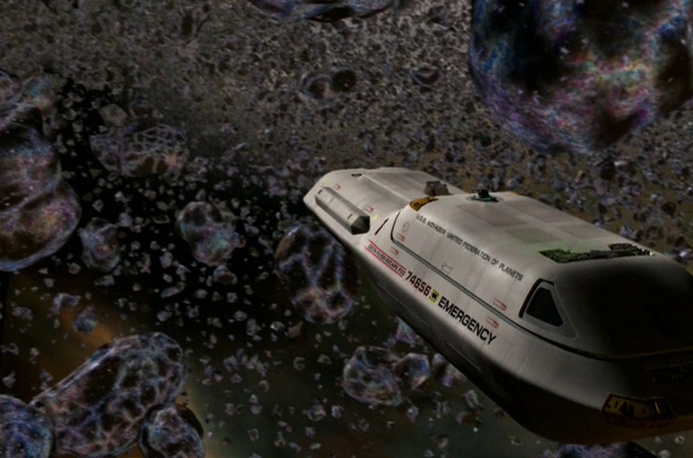
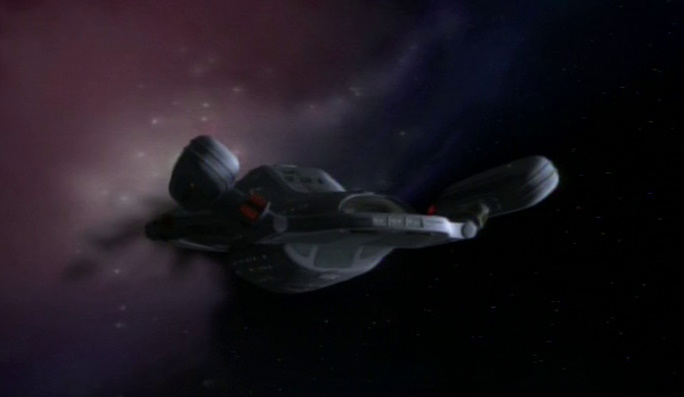
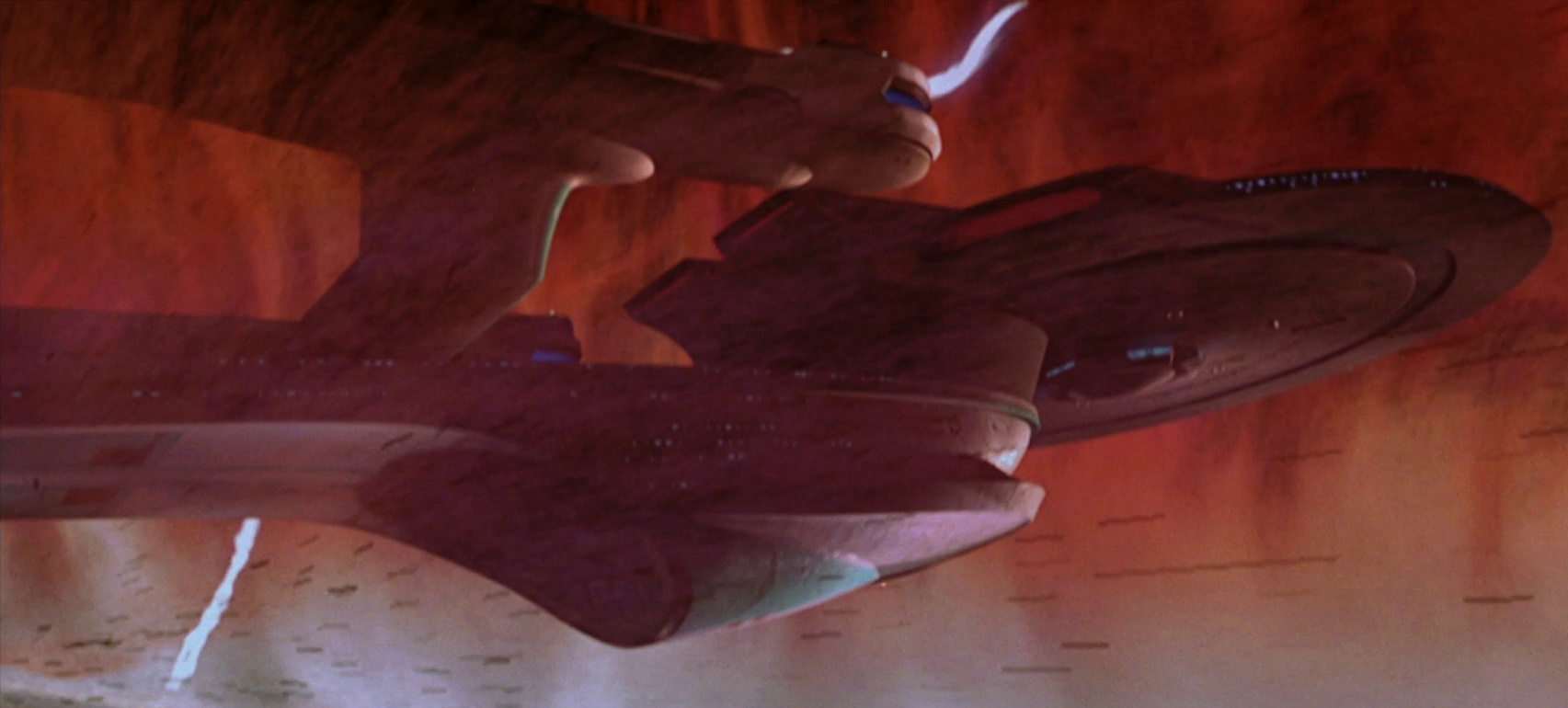
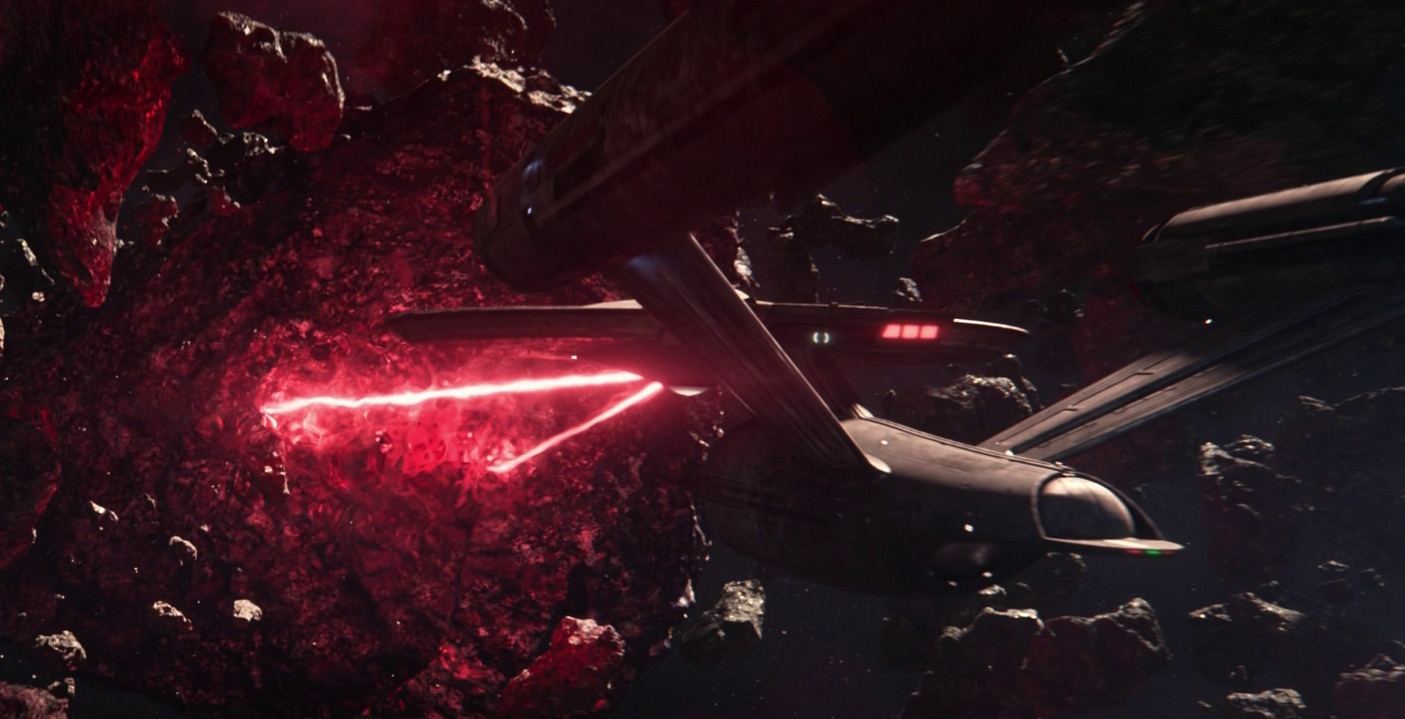
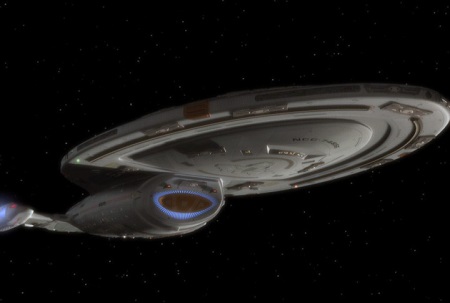
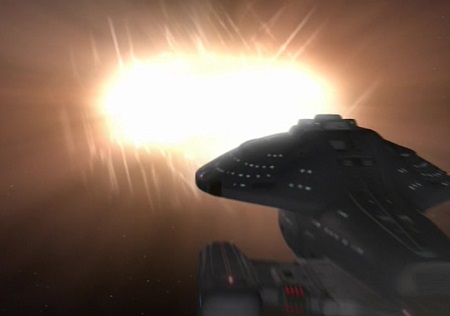
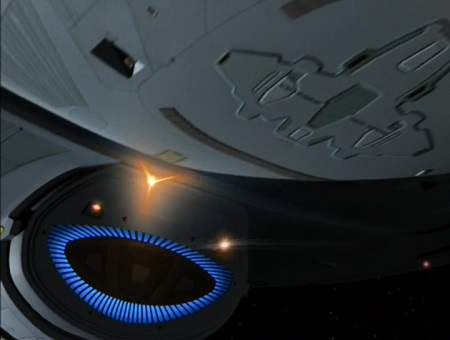
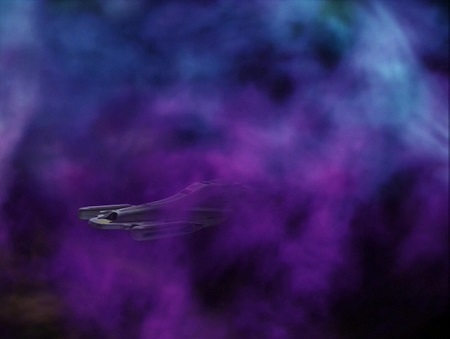
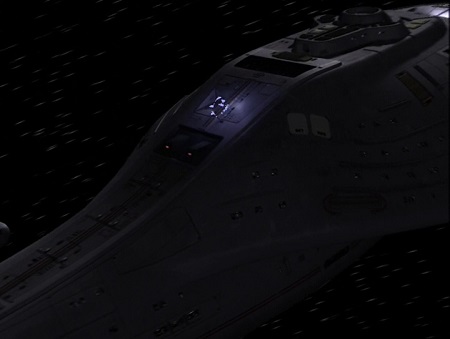
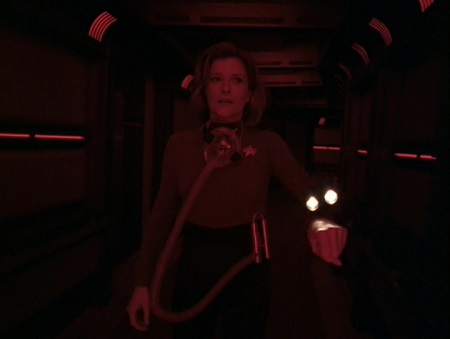
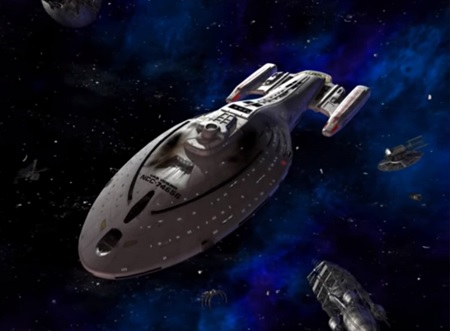
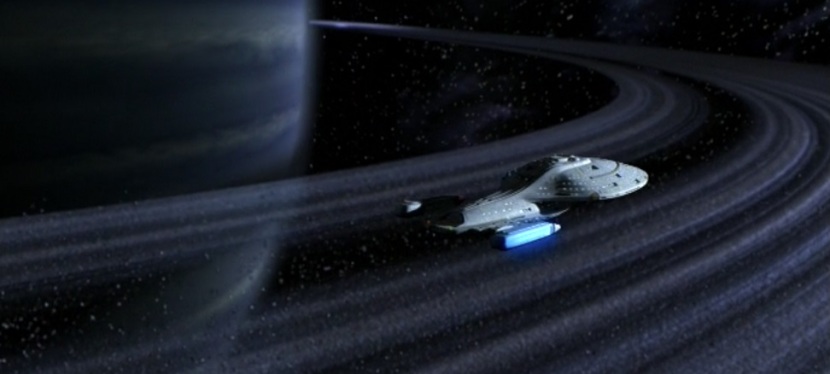
Screenshot of Star Trek: Voyager - Across The Unknown (demo version) showing the USS Voyager in the Badlands.
Voyager in the Badlands.

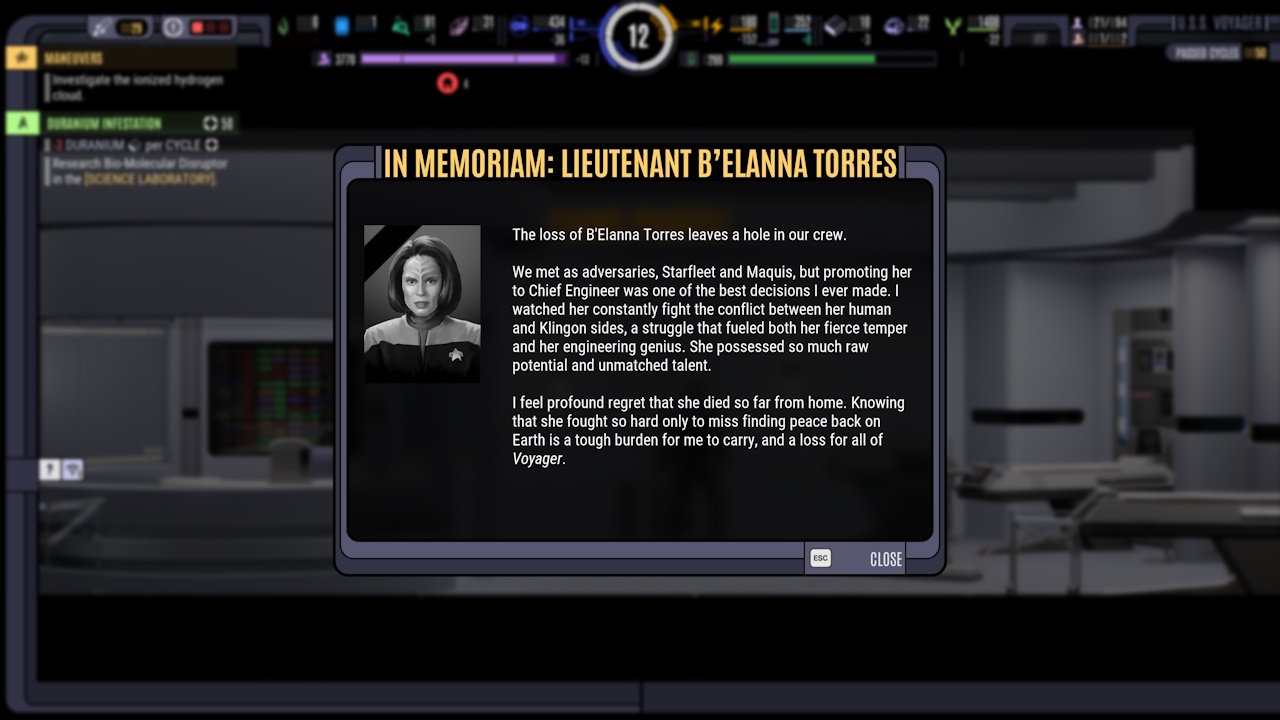
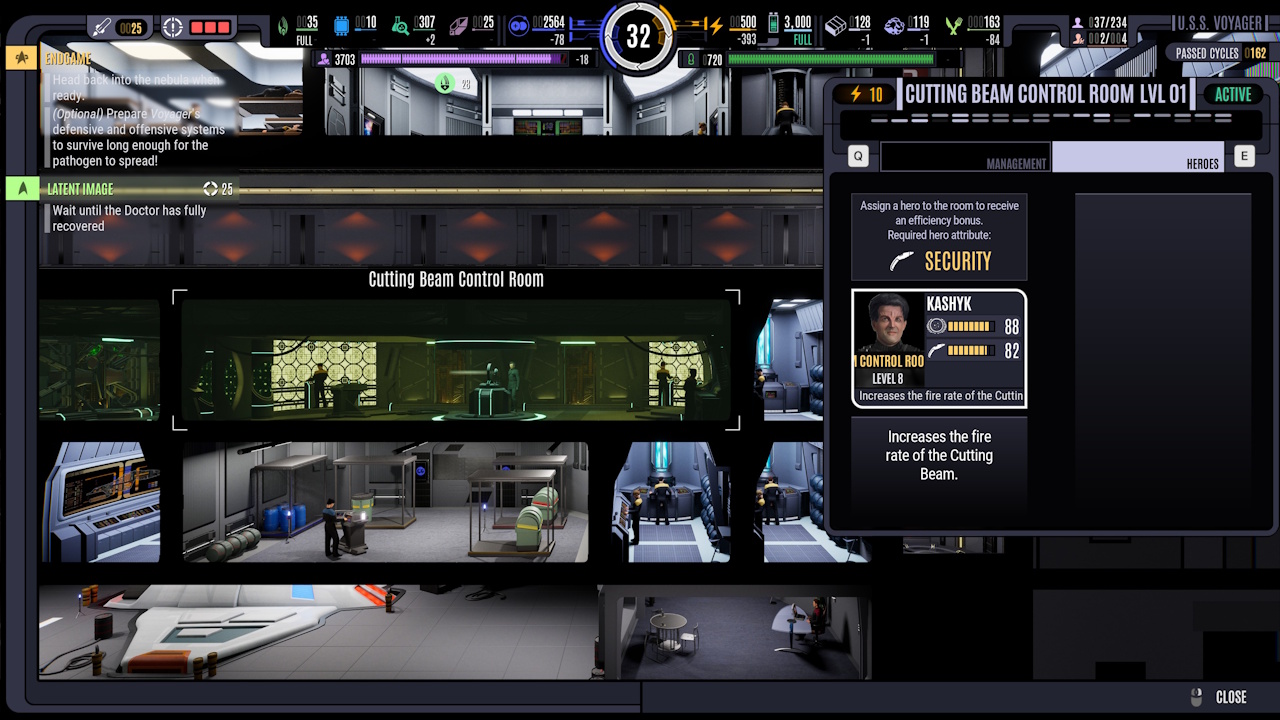
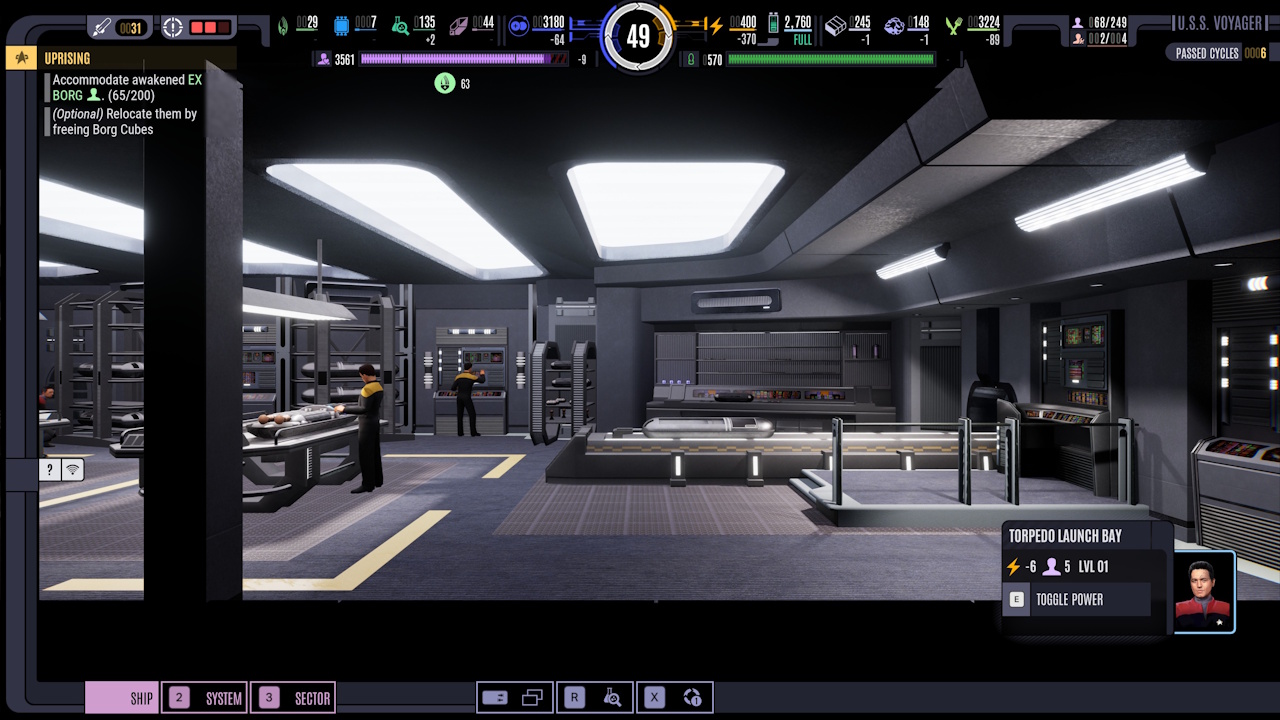
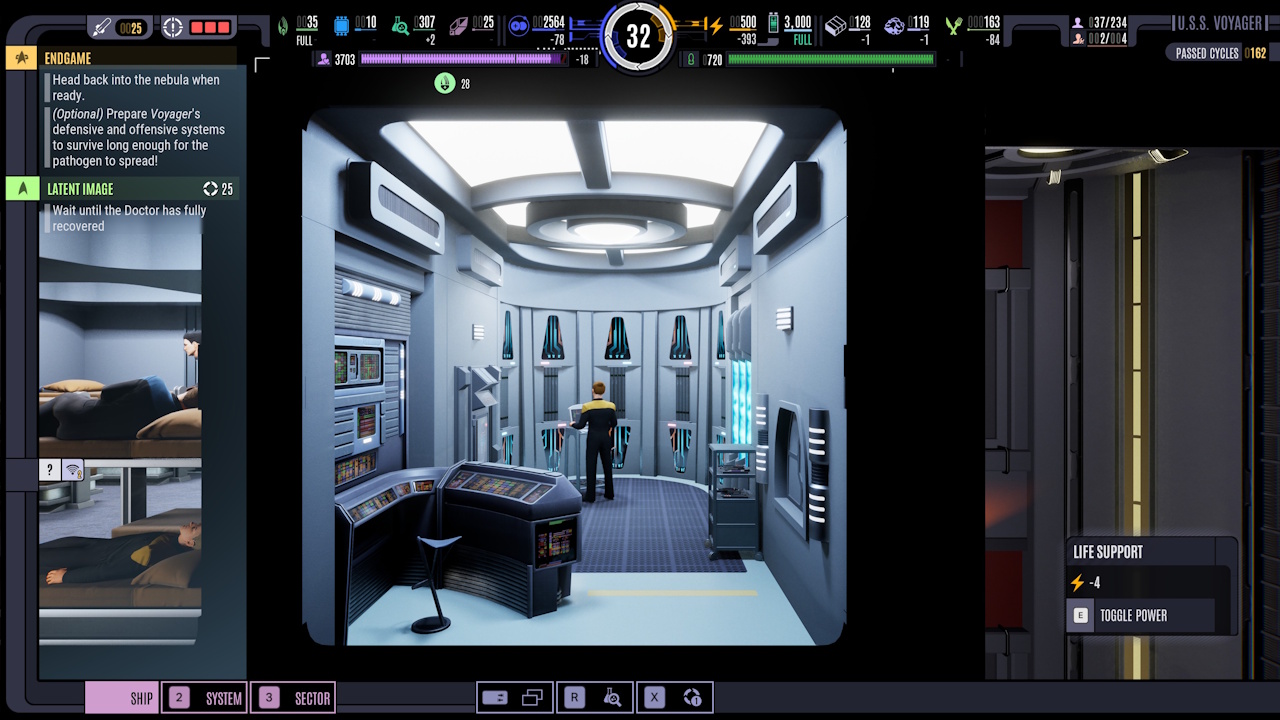
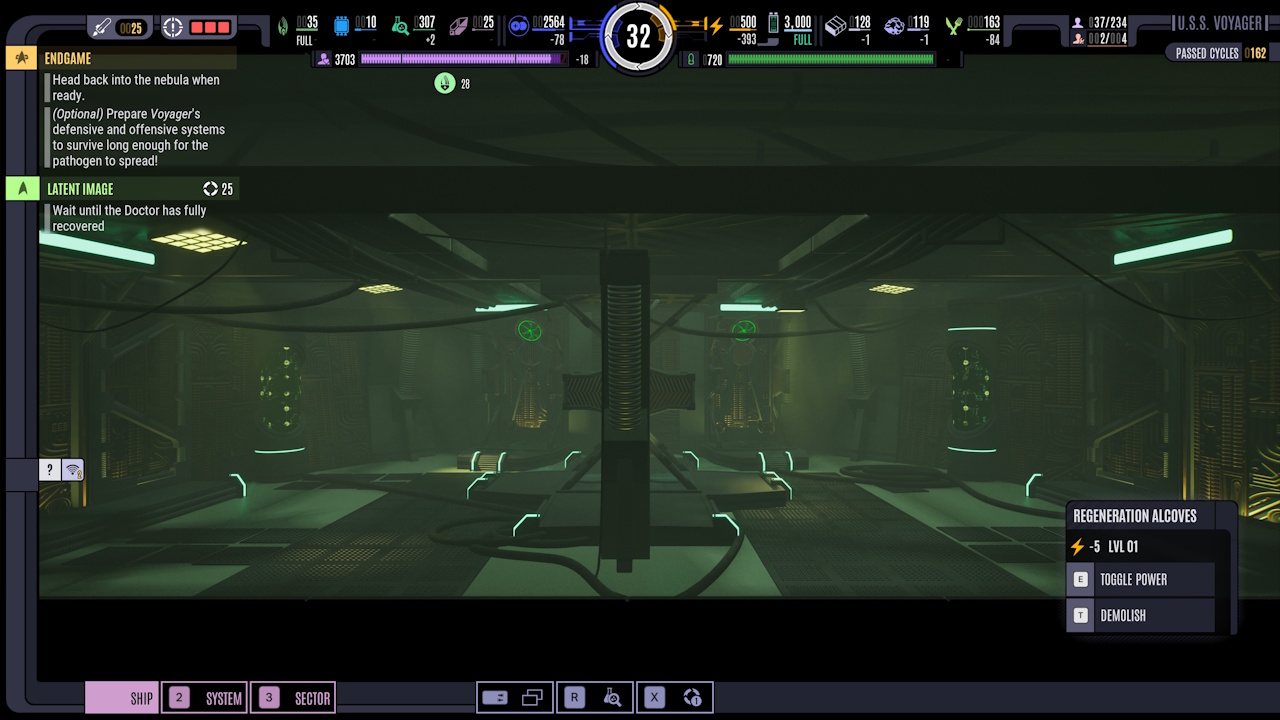
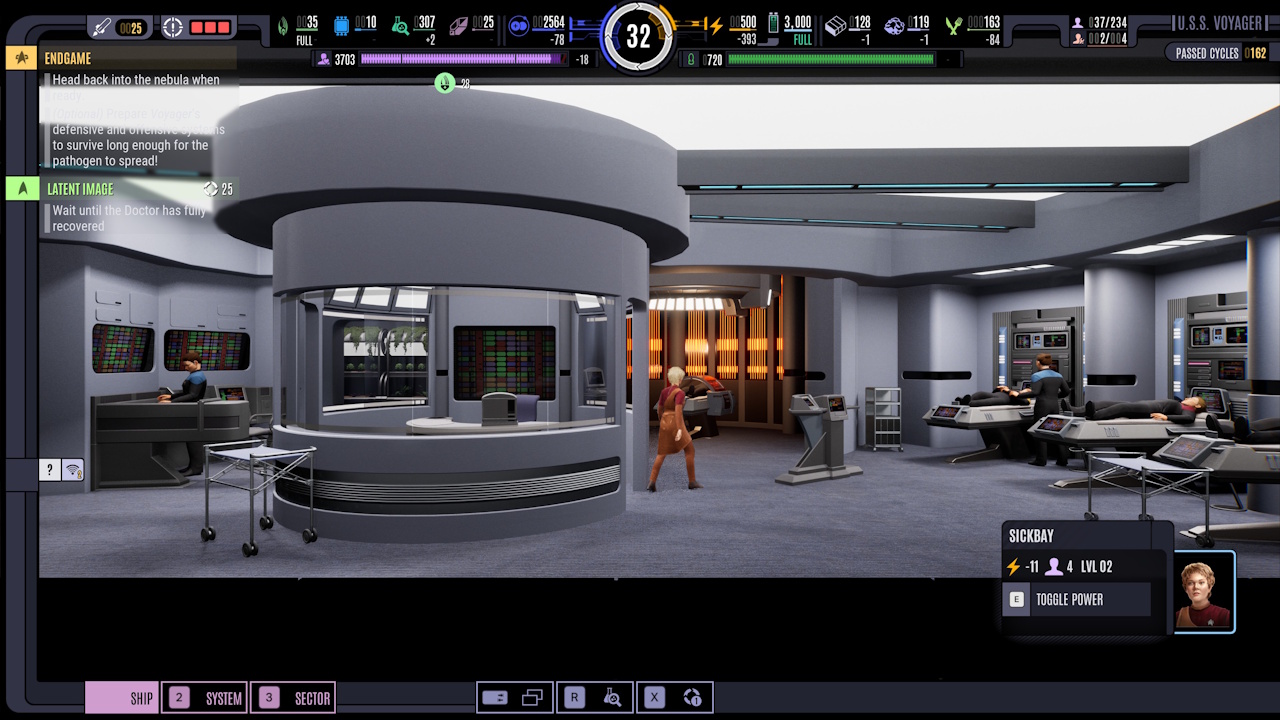
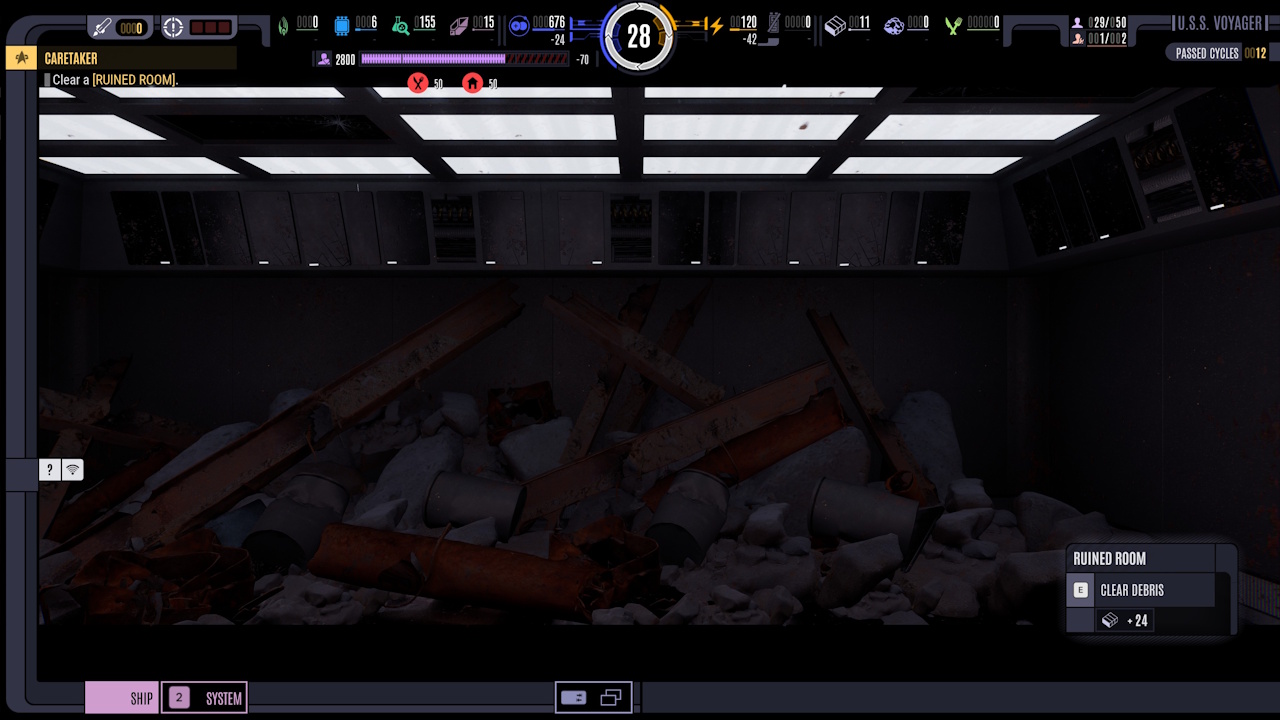
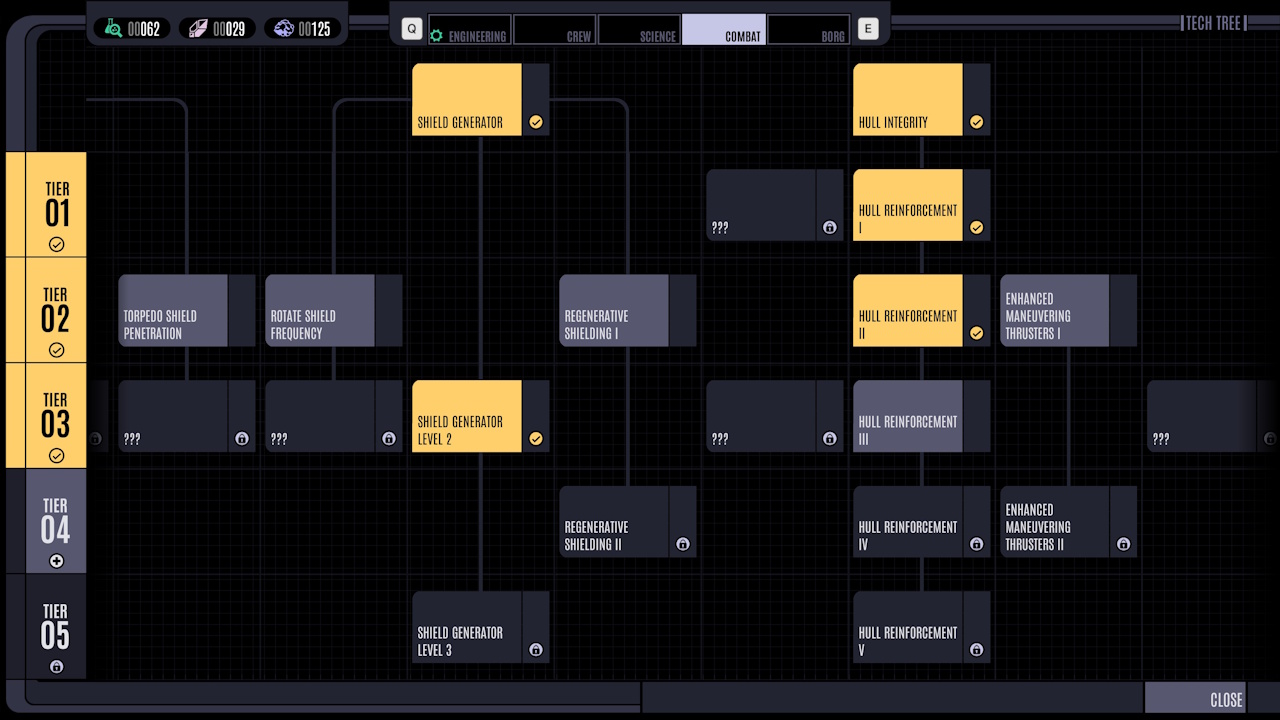
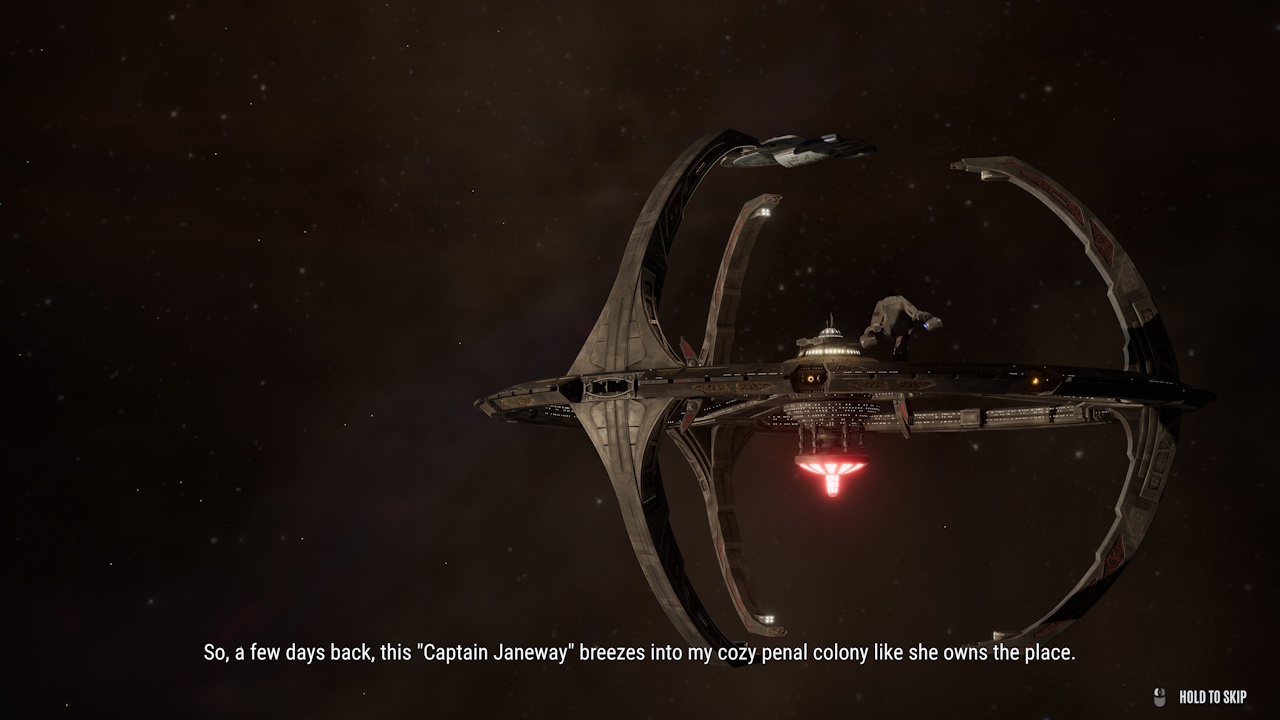
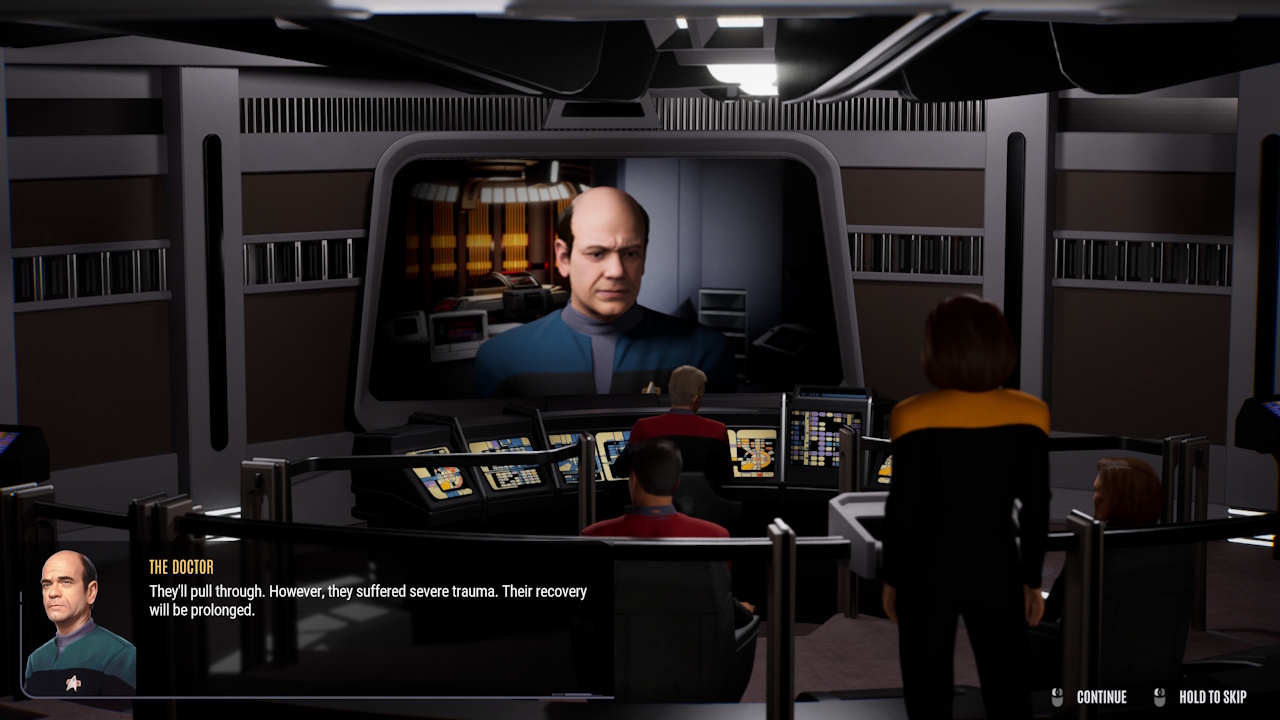
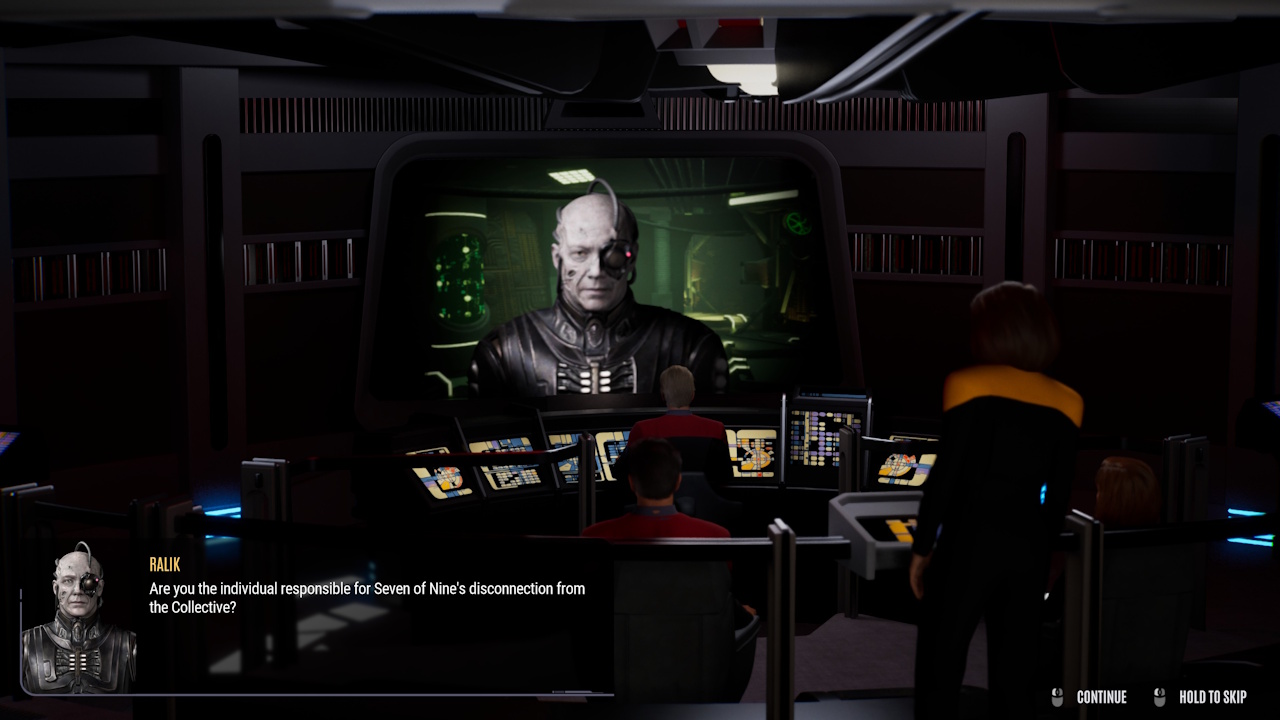
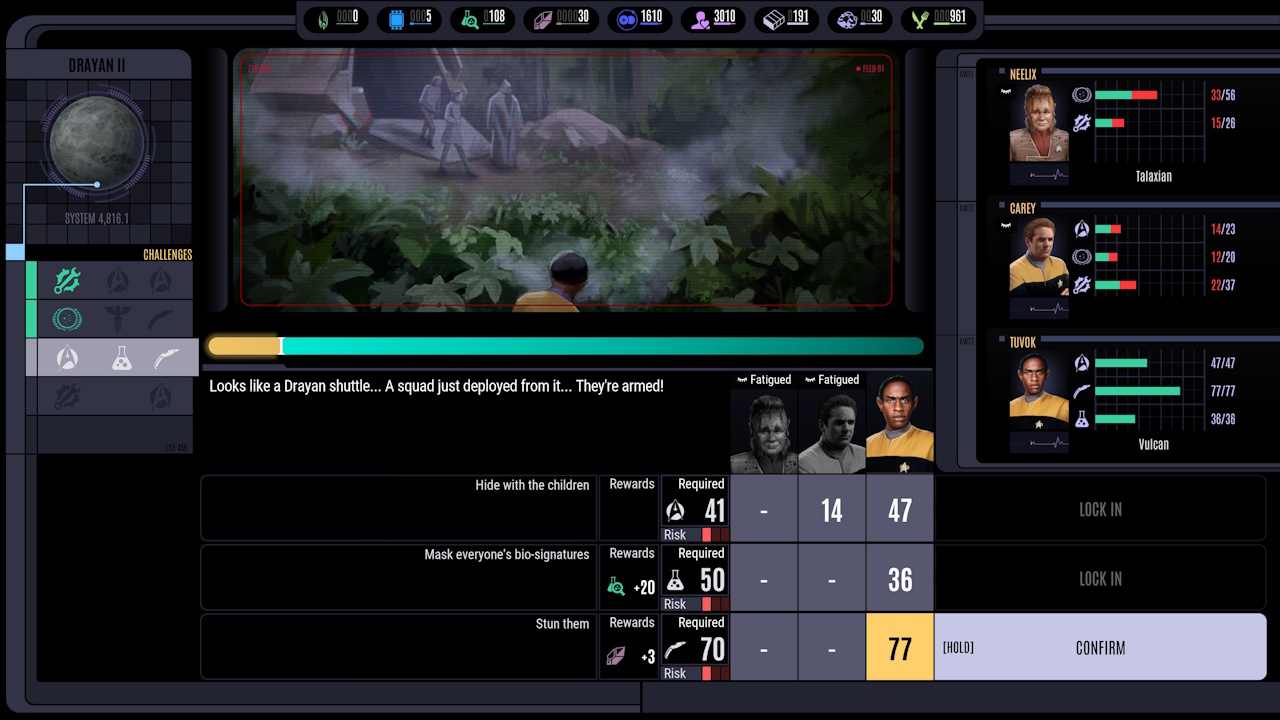
That idea of expectations, though, is going to be important to how you approach Across The Unknown. The tl;dr is this: this isn’t a big-budget, high production values, “triple-A” type of game. And if you go into it expecting ultra-sharp graphics, fully-voiced characters, detailed cut-scenes, and the like… you’re going to be disappointed, because this isn’t that type of game. What you get instead is a strategic starship management game, one with a tech tree to unlock upgrades, rooms to build, crew members to move around, and so on. There are no voiced characters; Across The Unknown is text-based. And while there are some starship cut-scenes and a pretty fun combat system, most of the time you’ll be treated to static images to convey key storylines.

I believe that if you set appropriate expectations, there’s going to be fun to be had here. The game’s core premise of “what if you were Captain Janeway and made different choices?” is a genuinely fun and appealing one, and Across The Unknown provided several points at which I could make what seemed to be defining choices for the ship and crew.

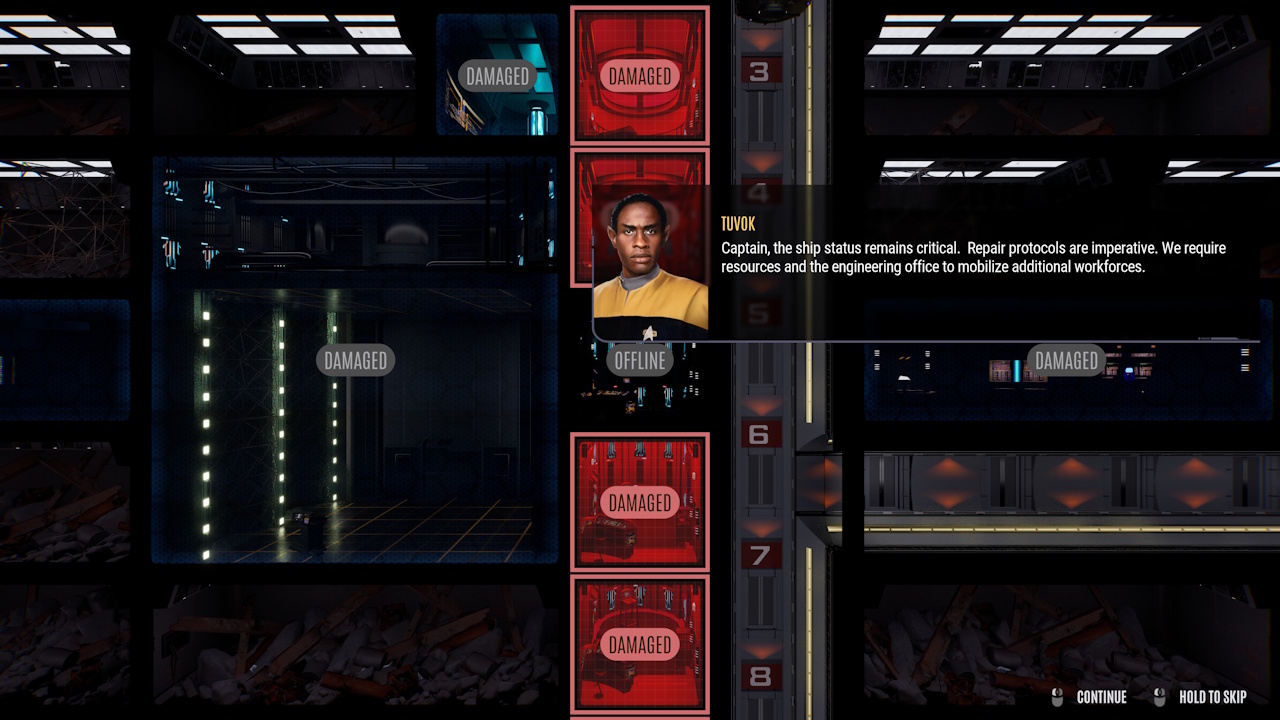
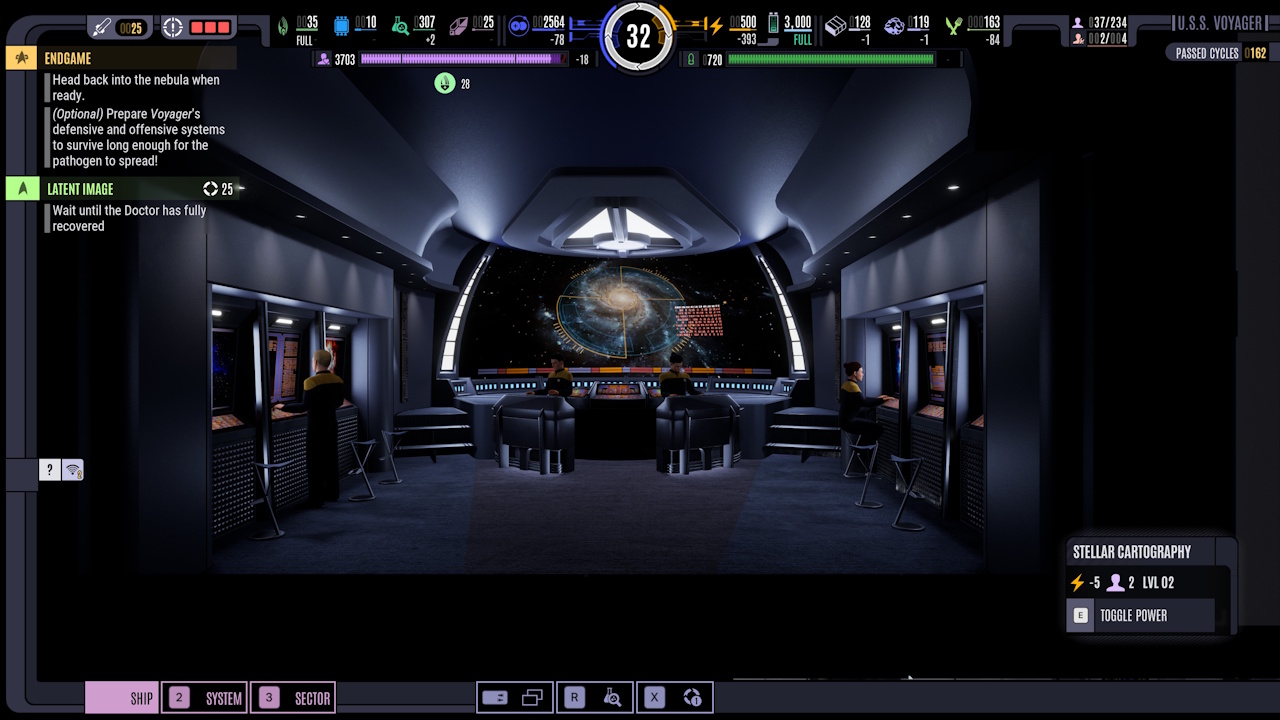
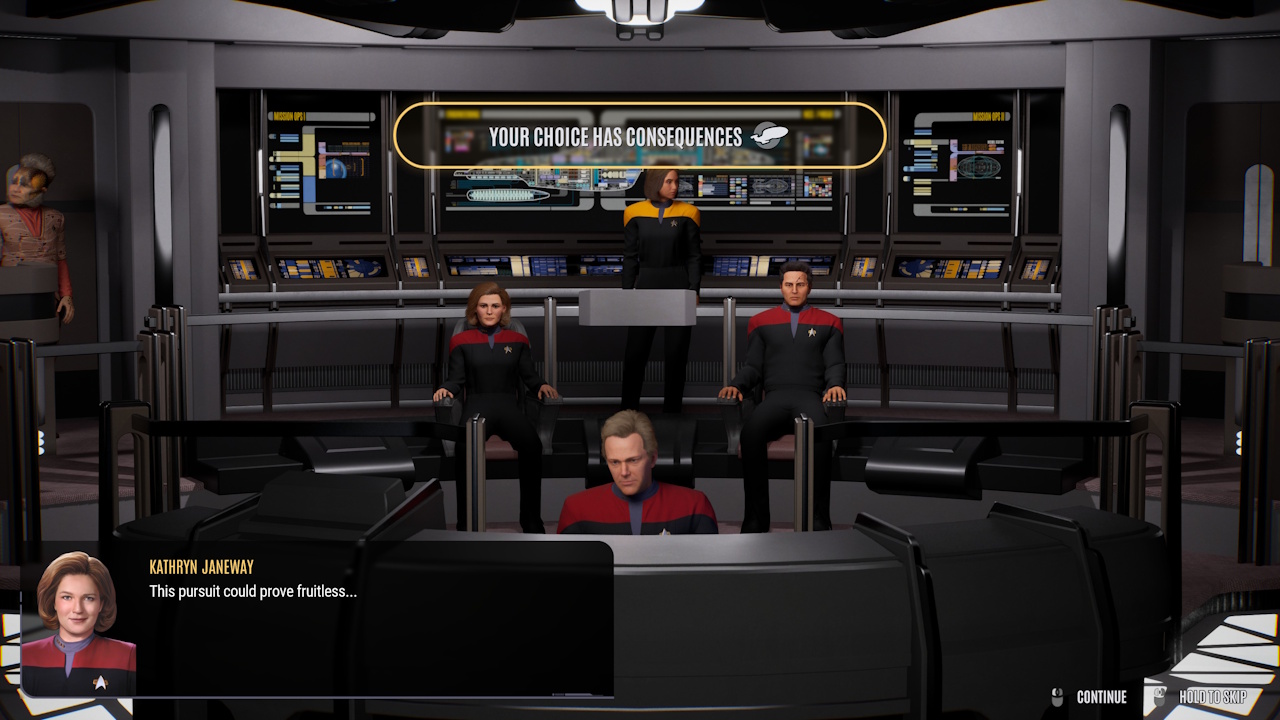
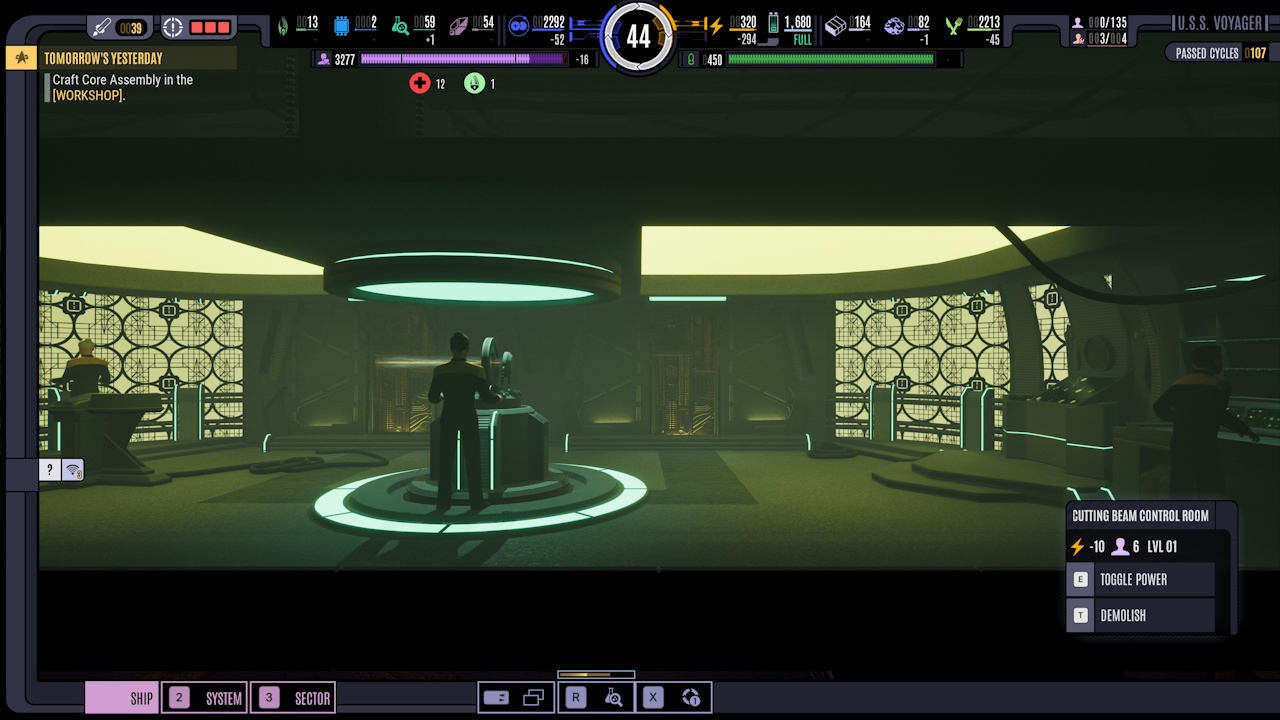
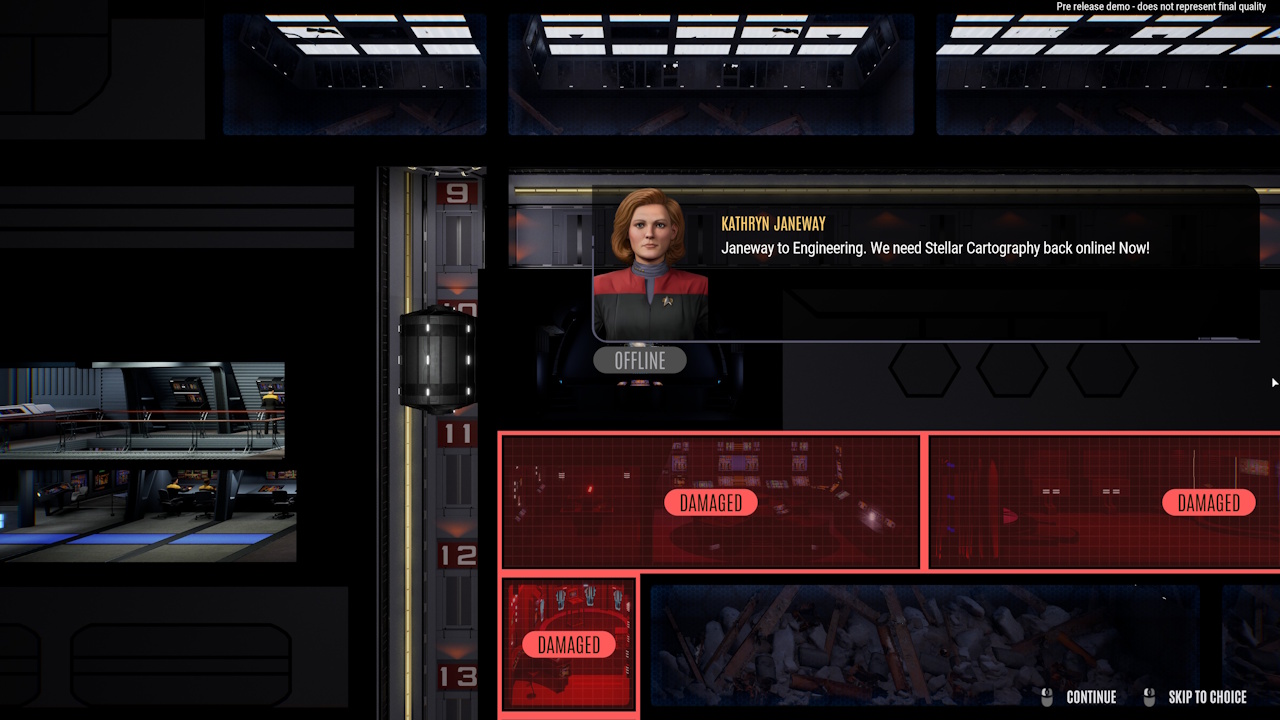
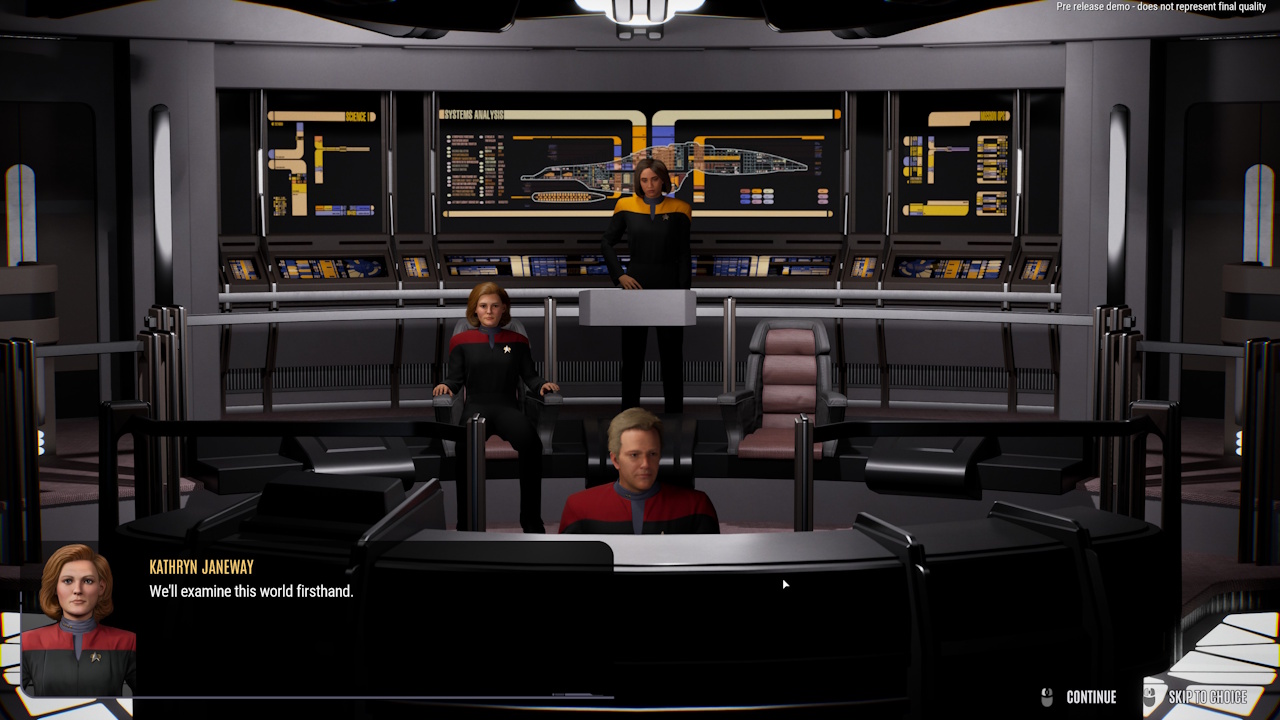
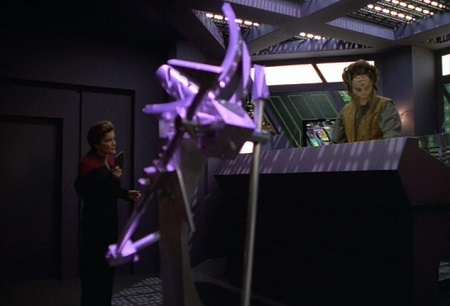
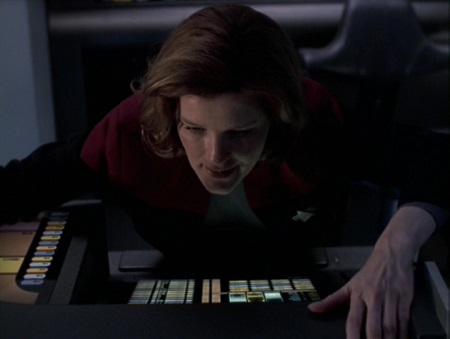
Screenshot of Star Trek: Voyager - Across The Unknown (demo version) showing Janeway ordering Stellar Cartography be repaired.
Captain Janeway issues an order.

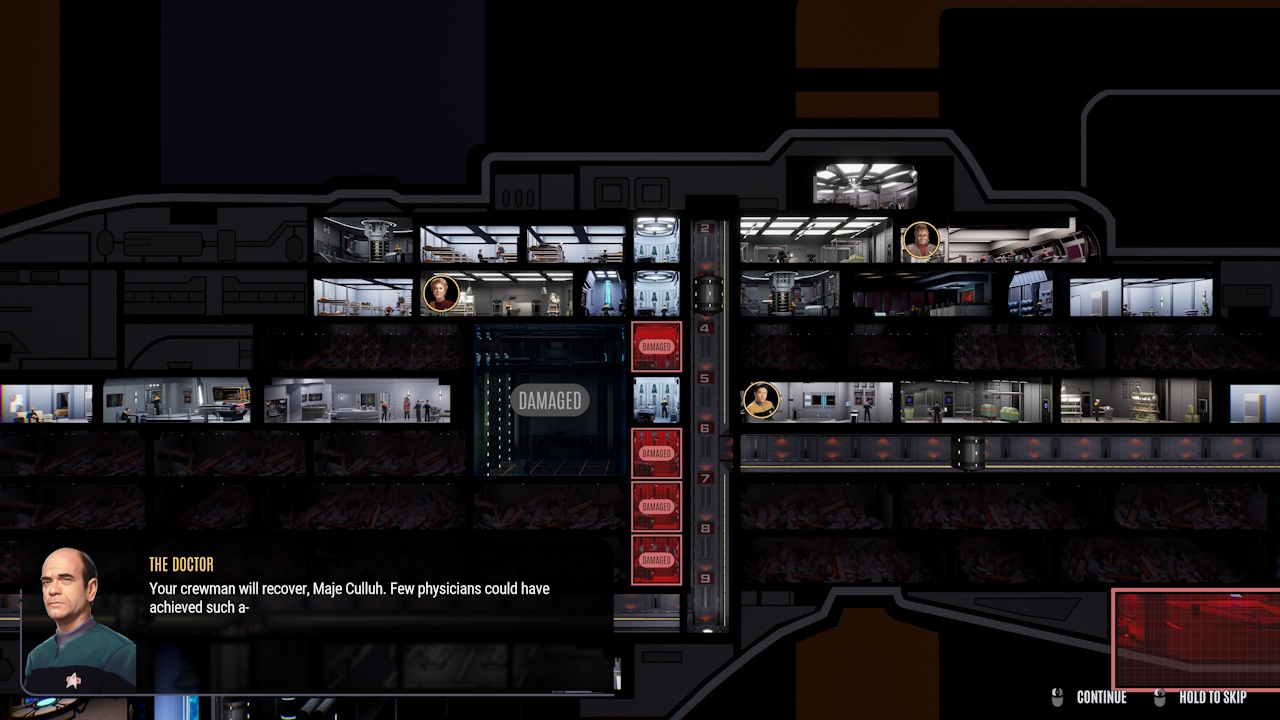
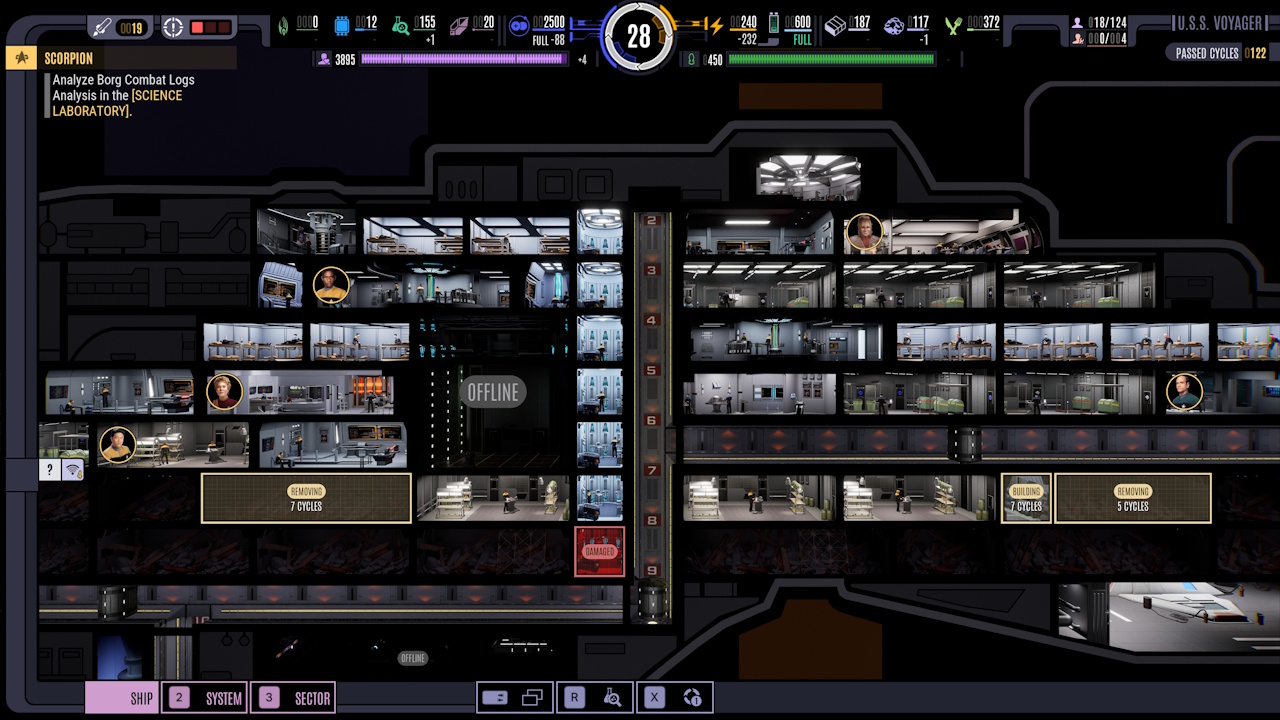
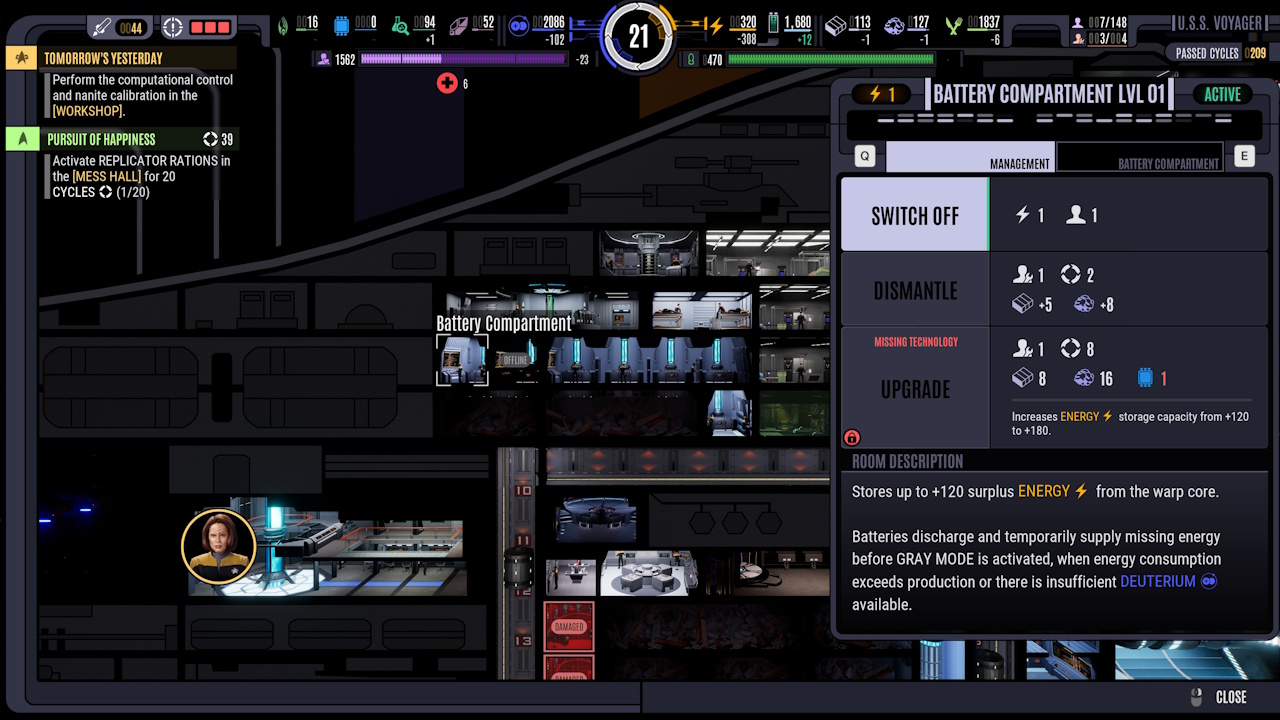
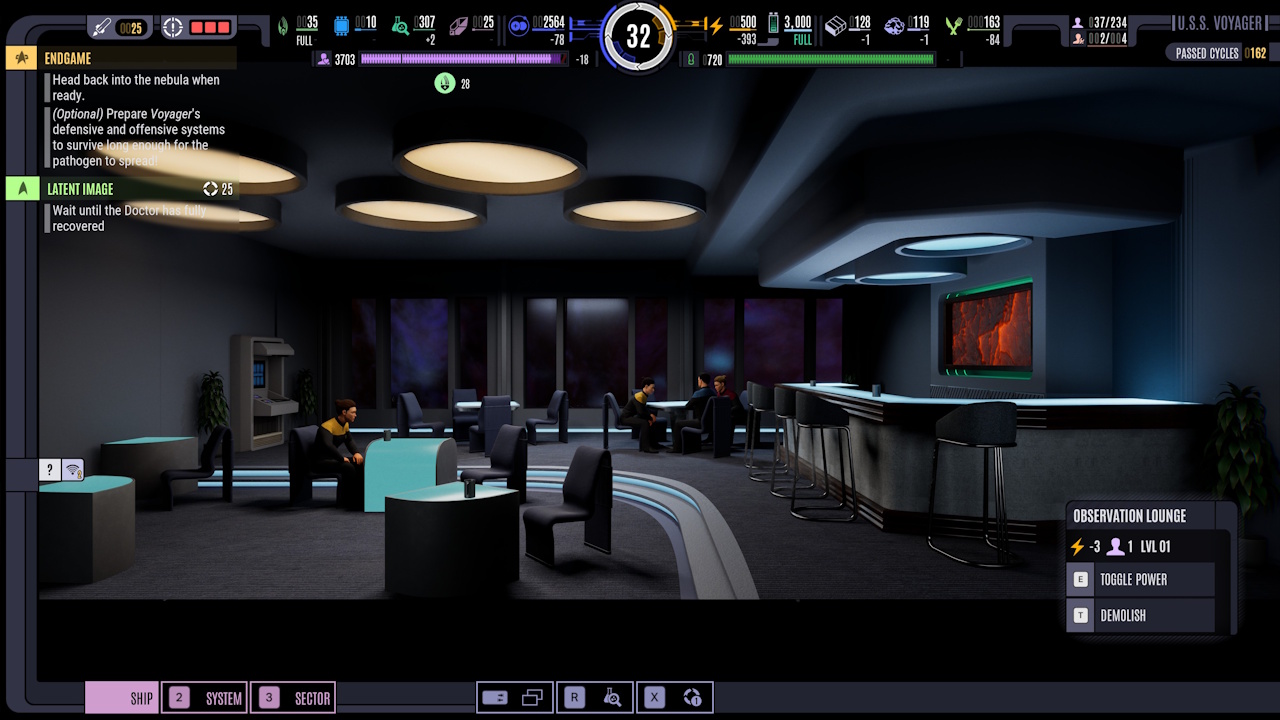
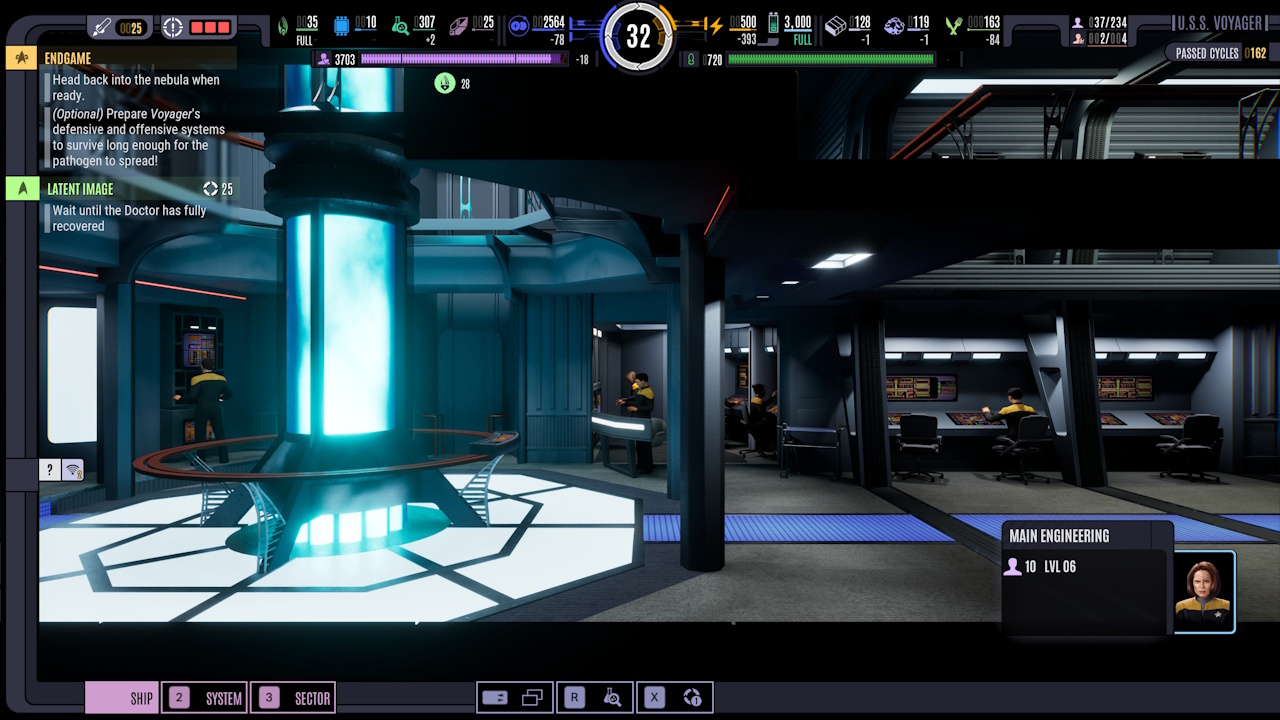
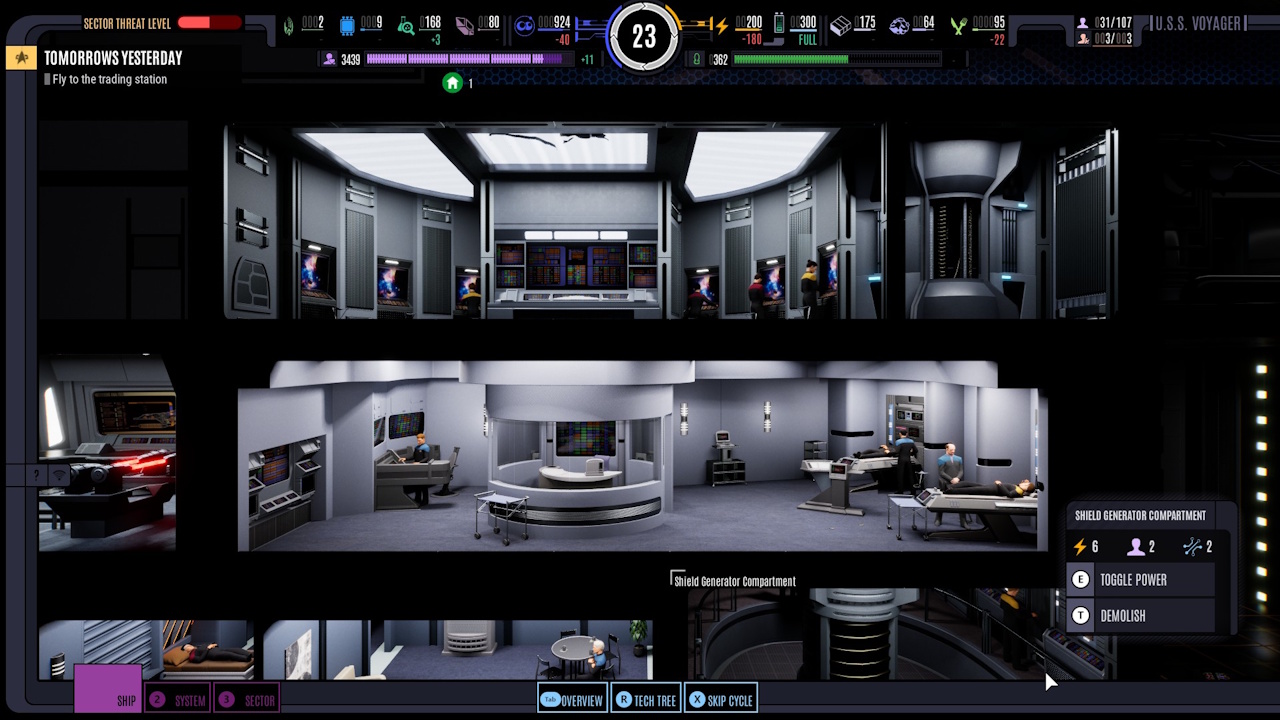
An appropriate point of comparison is probably Fallout Shelter. The games use a similar point-of-view for managing your base/starship, and you get similar choices for where to construct different rooms, who to recruit, who to send on away missions, and so on. That’s a good starting point for understanding what Across The Unknown felt like to play.

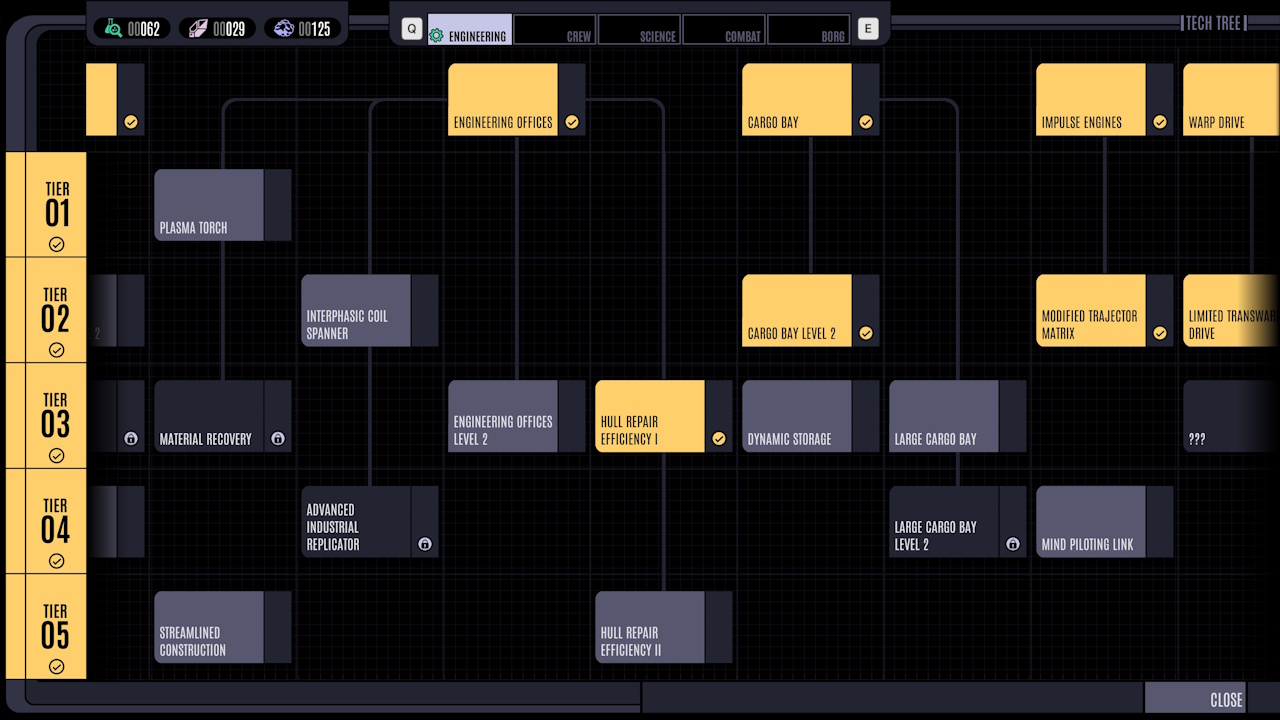
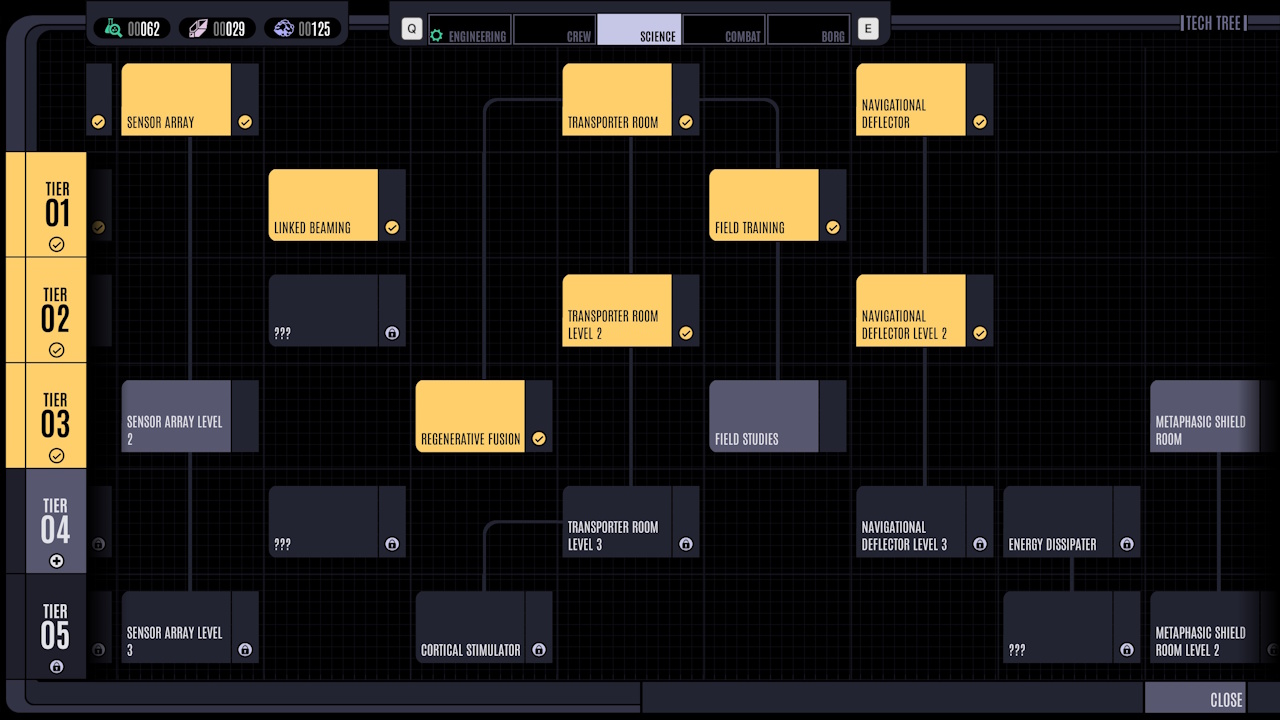
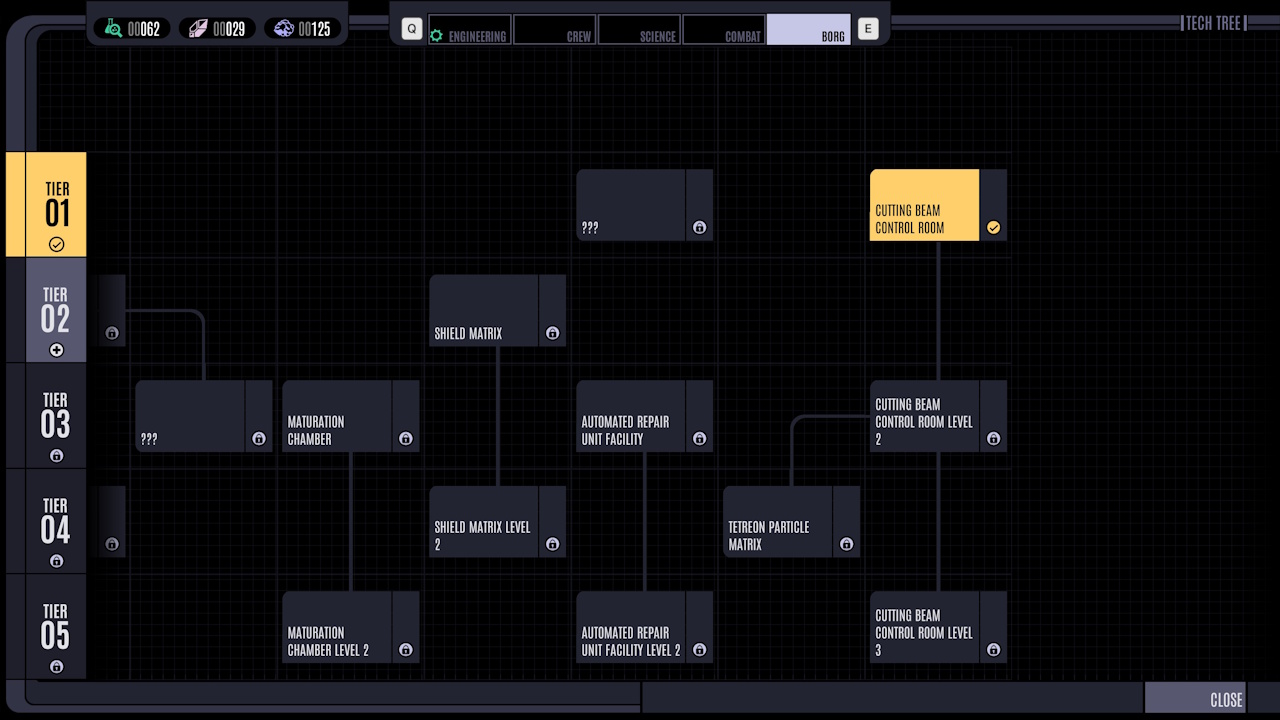
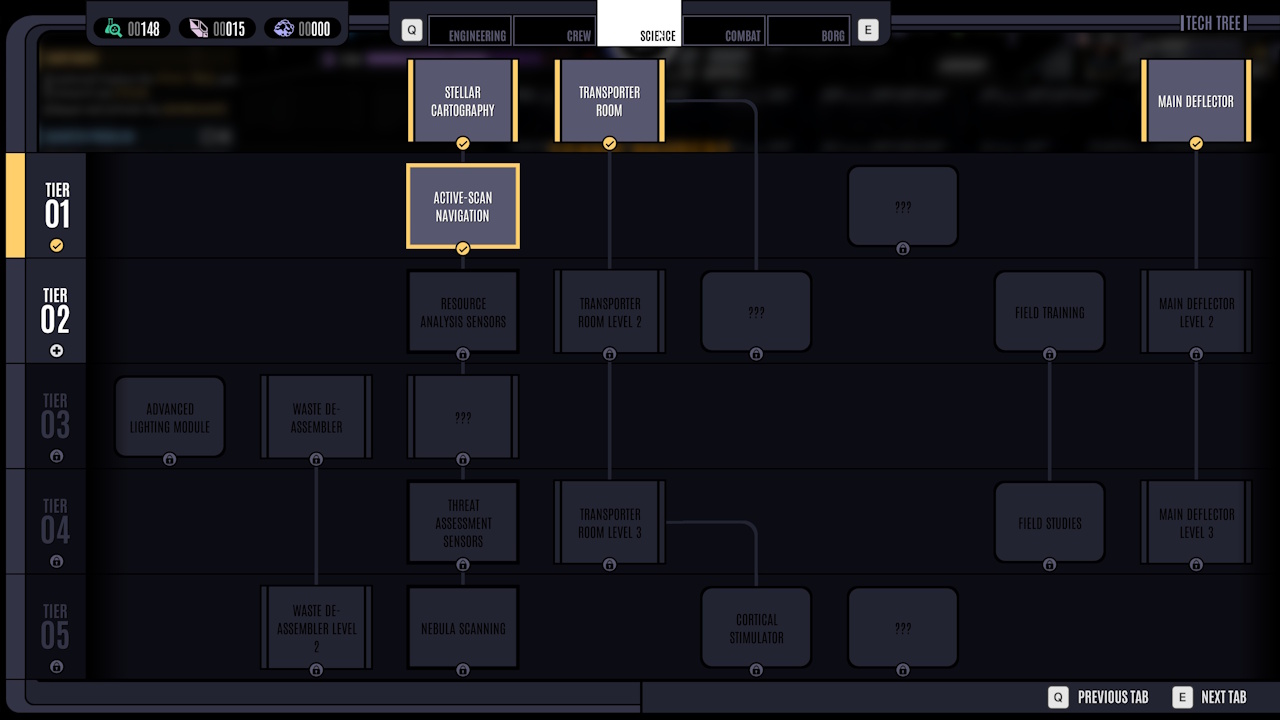
Obviously, when you’re looking at a demo version, there are going to be limitations! So I don’t want to judge Across The Unknown too harshly based solely on the first hour-ish of gameplay. Just from looking at the tech tree and the amount of empty rooms aboard Voyager, there’s clearly a lot more to the game that I didn’t get to try out on this occasion. And I also suspect that, of all the missions/story arcs in the game, Caretaker is probably one of the most linear: certain events have to pan out in order for Chakotay, B’Elanna, Neelix, and Kes to join the crew – and that’s just for starters.

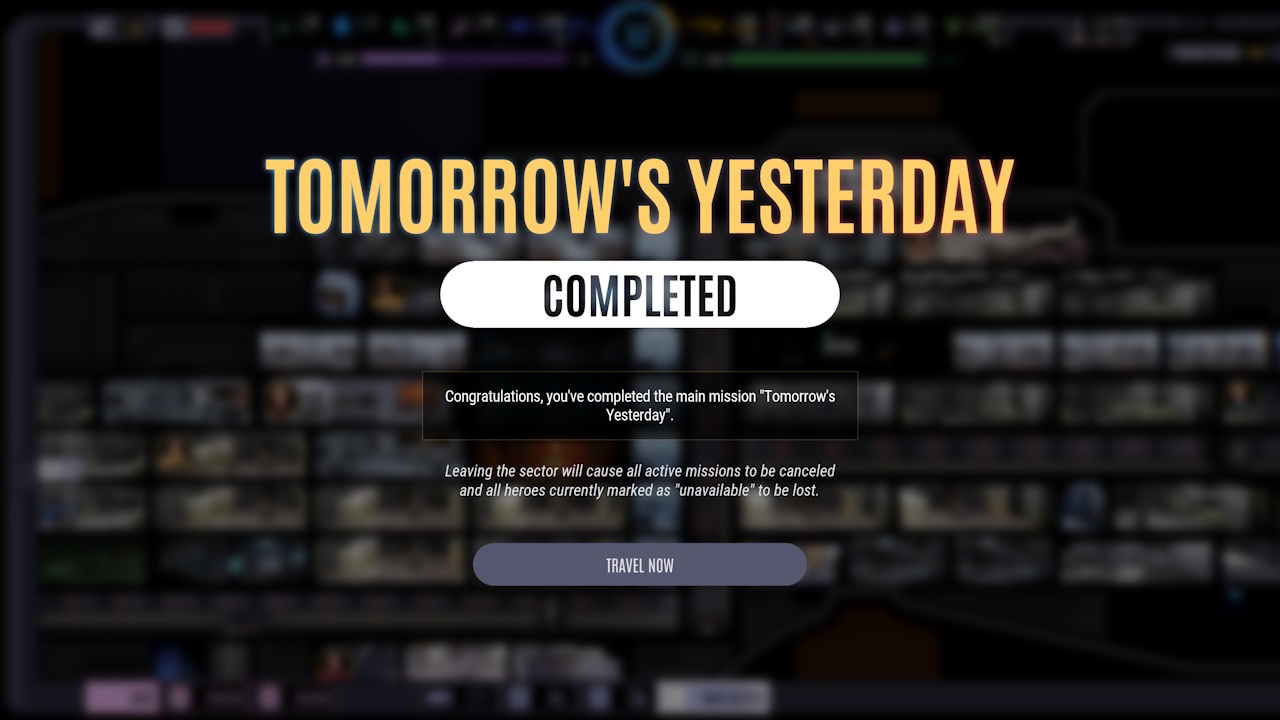
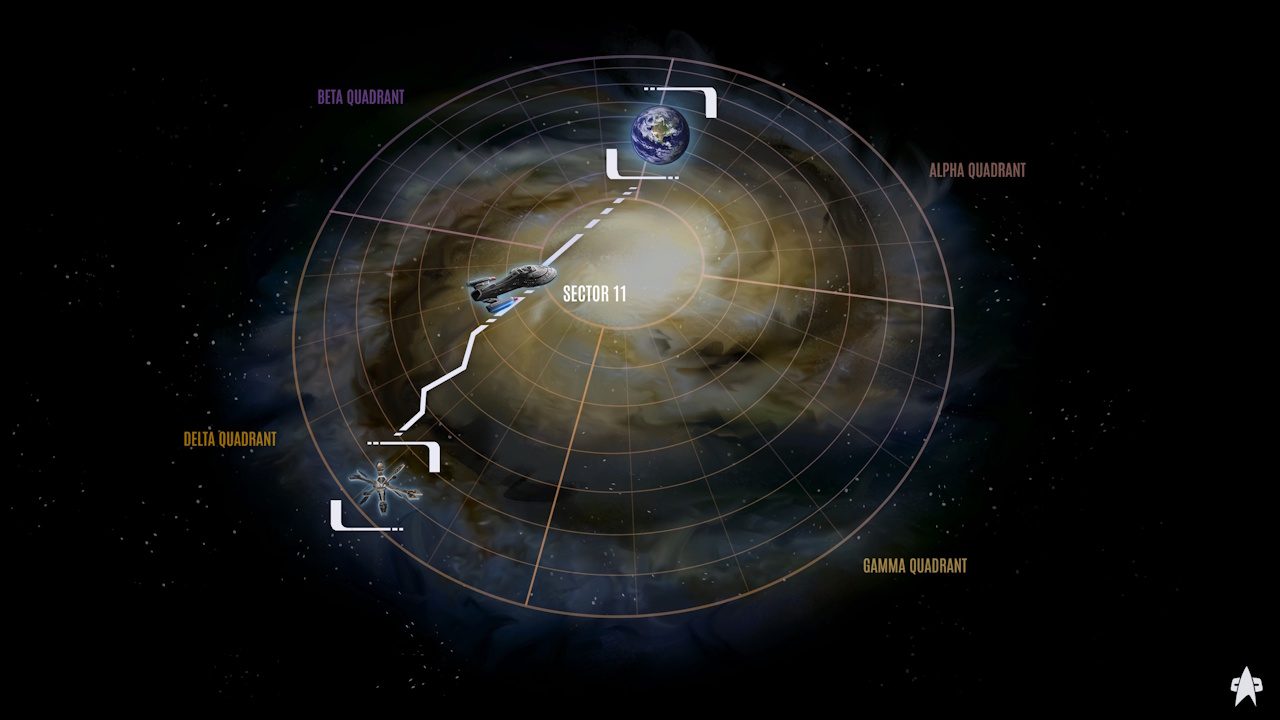
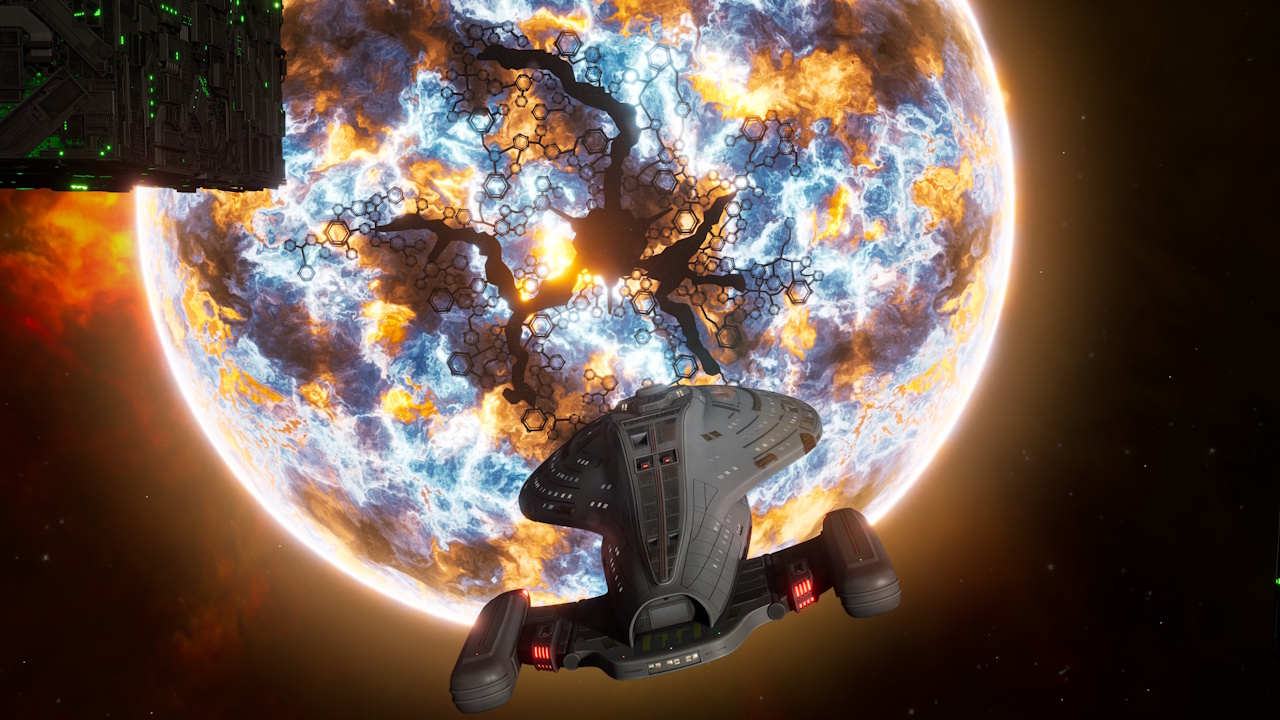
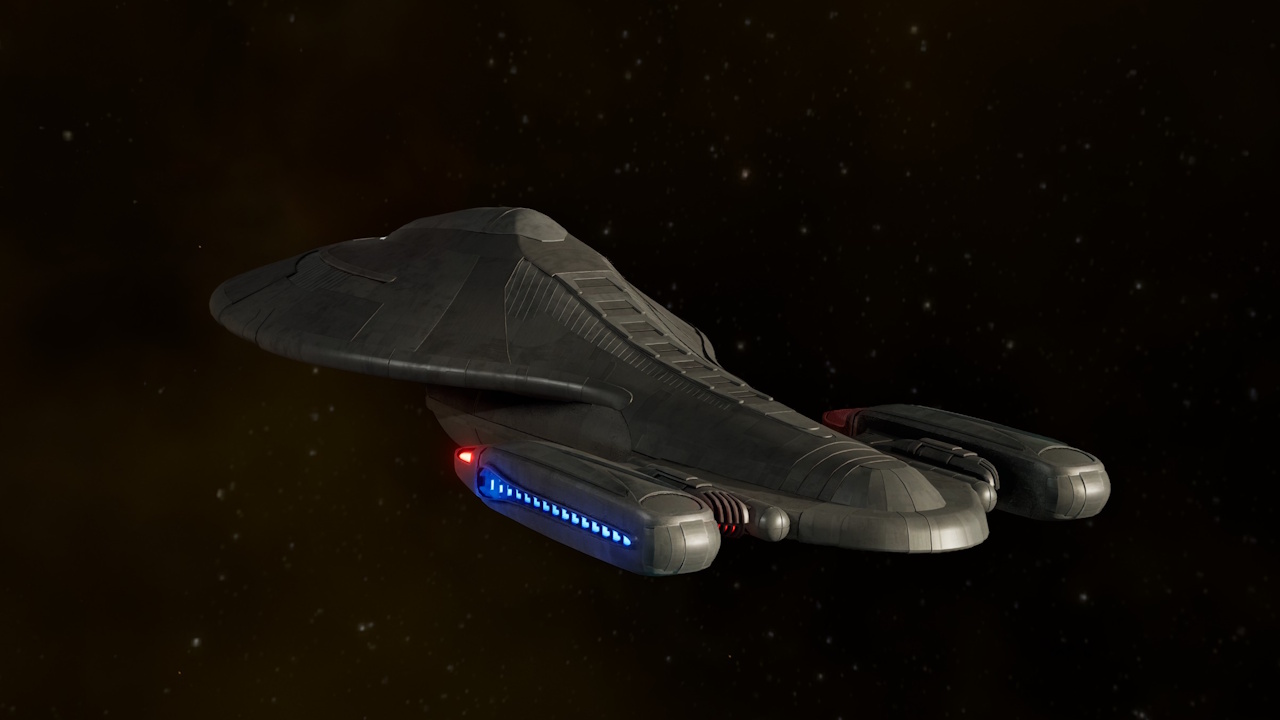
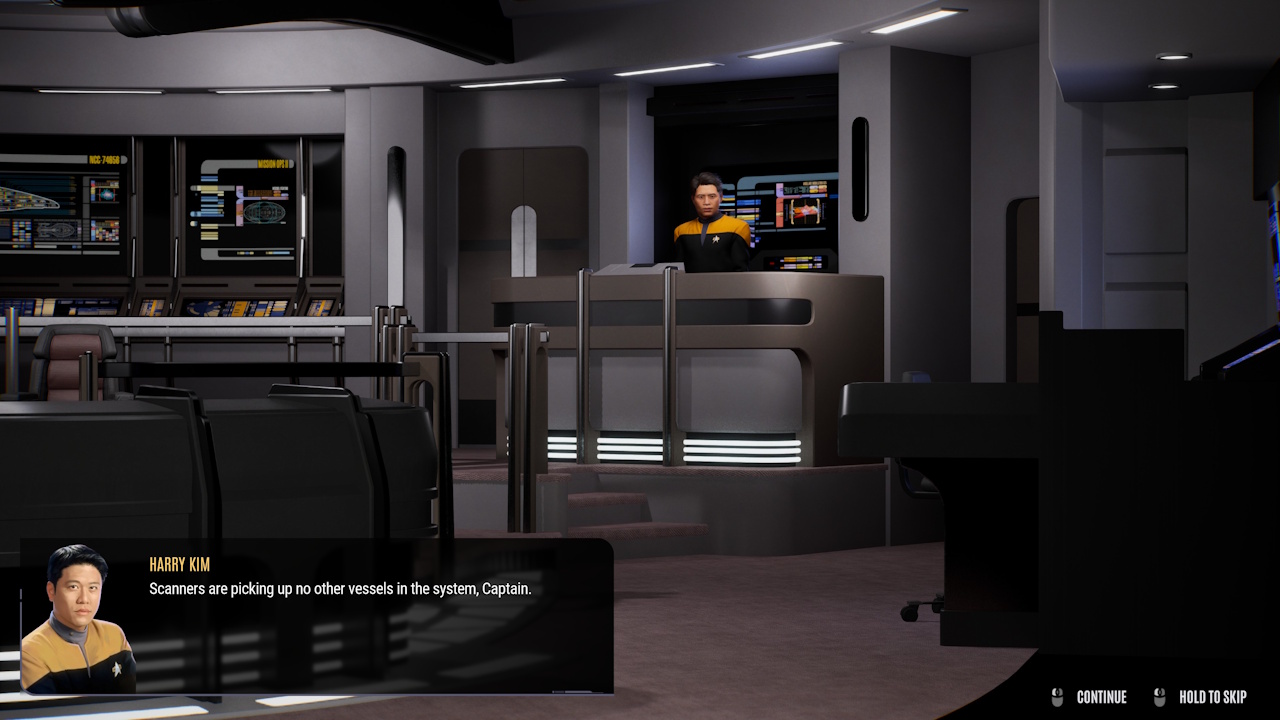
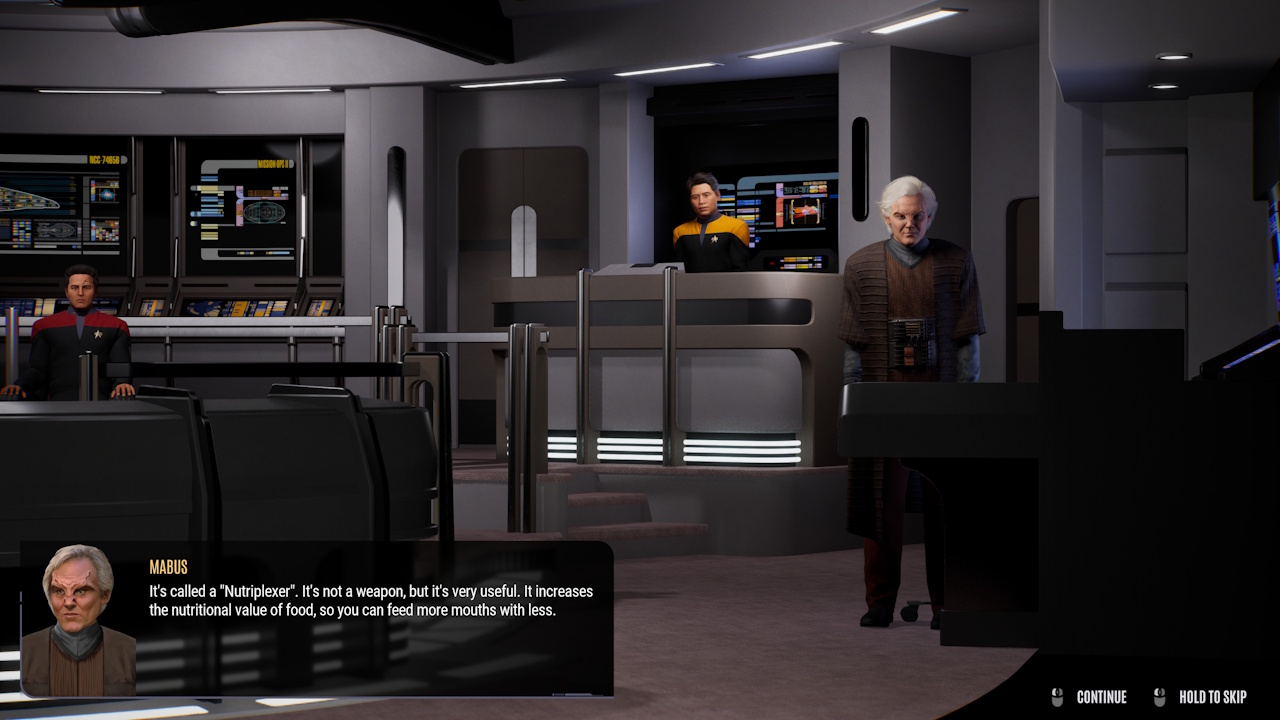
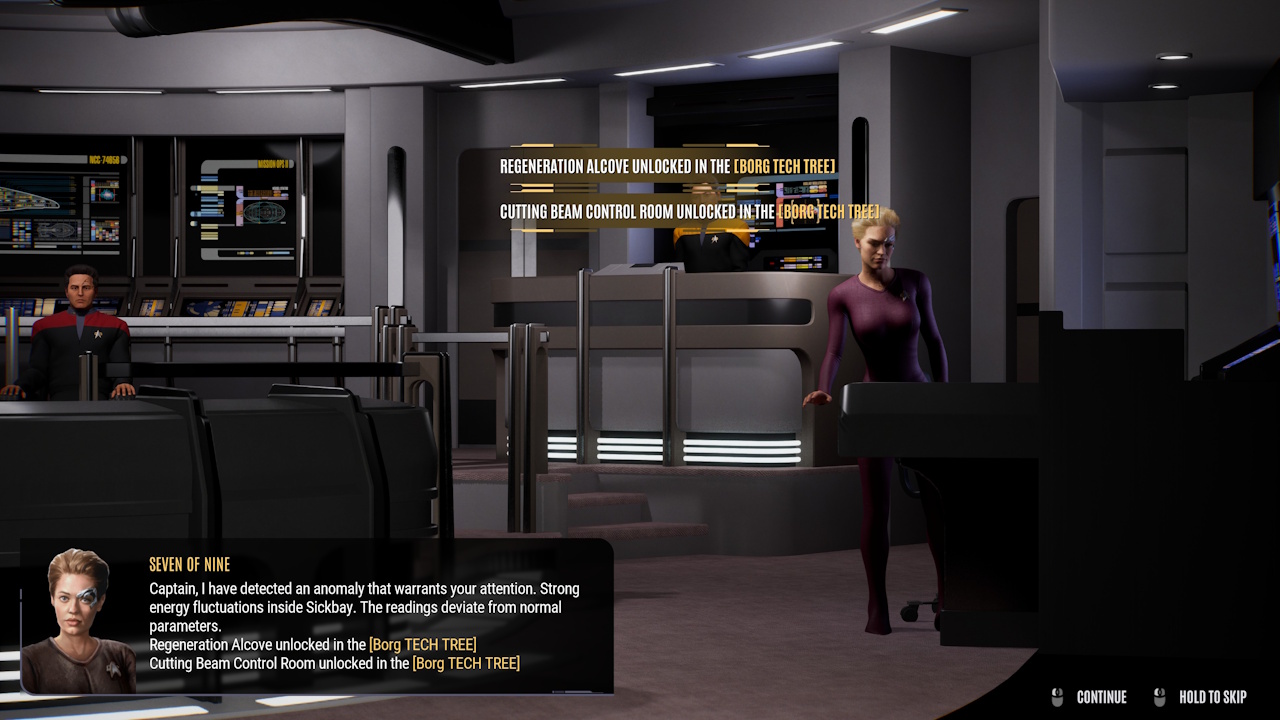
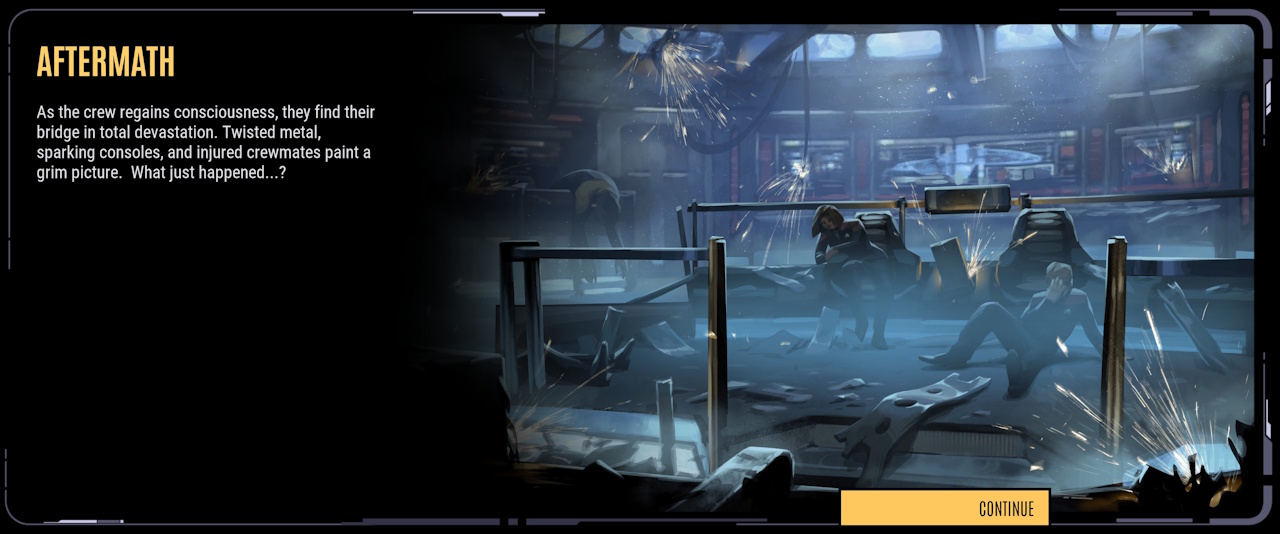
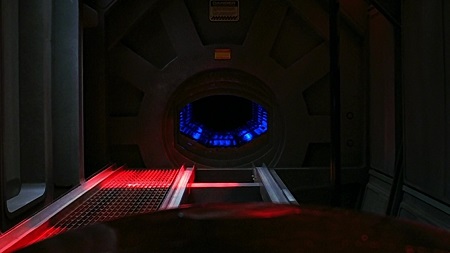
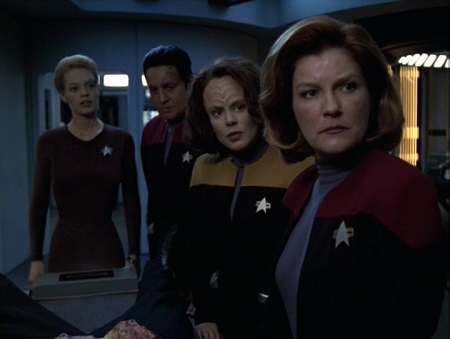
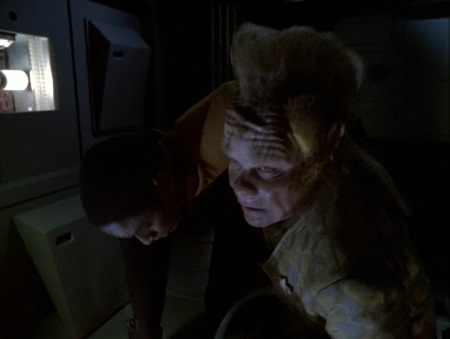
Screenshot of Star Trek: Voyager - Across The Unknown (demo version) showing the aftermath of Voyager's arrival in the Delta Quadrant.
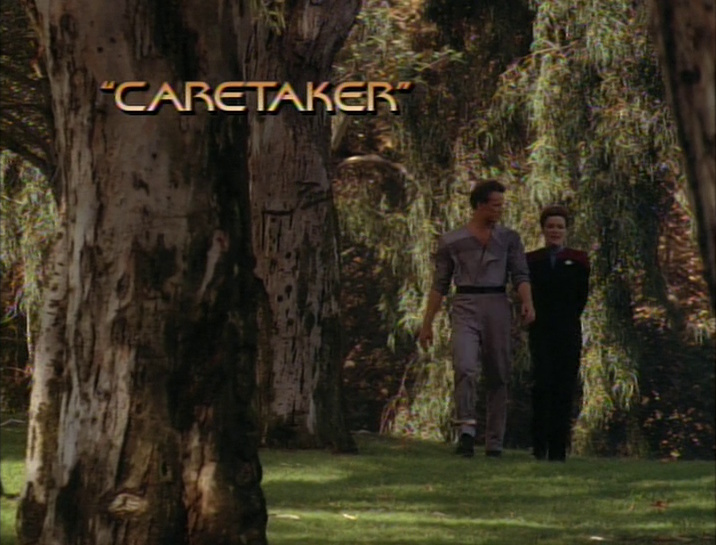
The demo is based on the episode Caretaker.

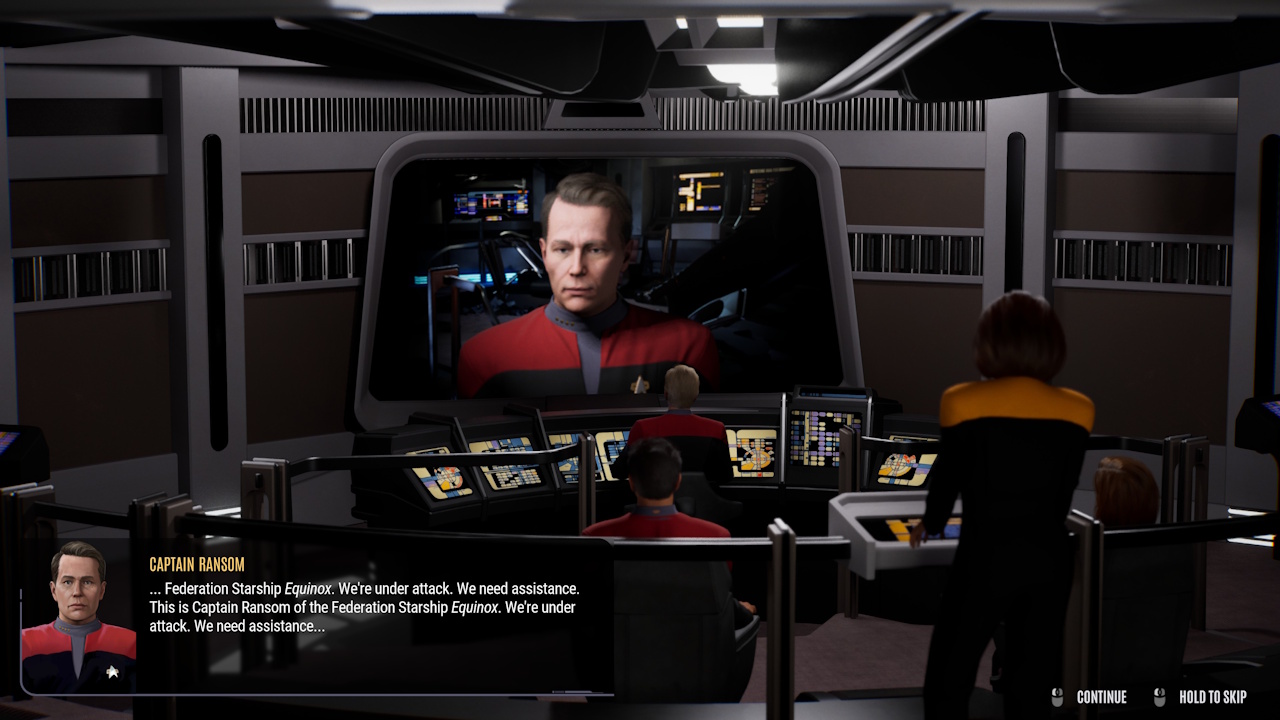
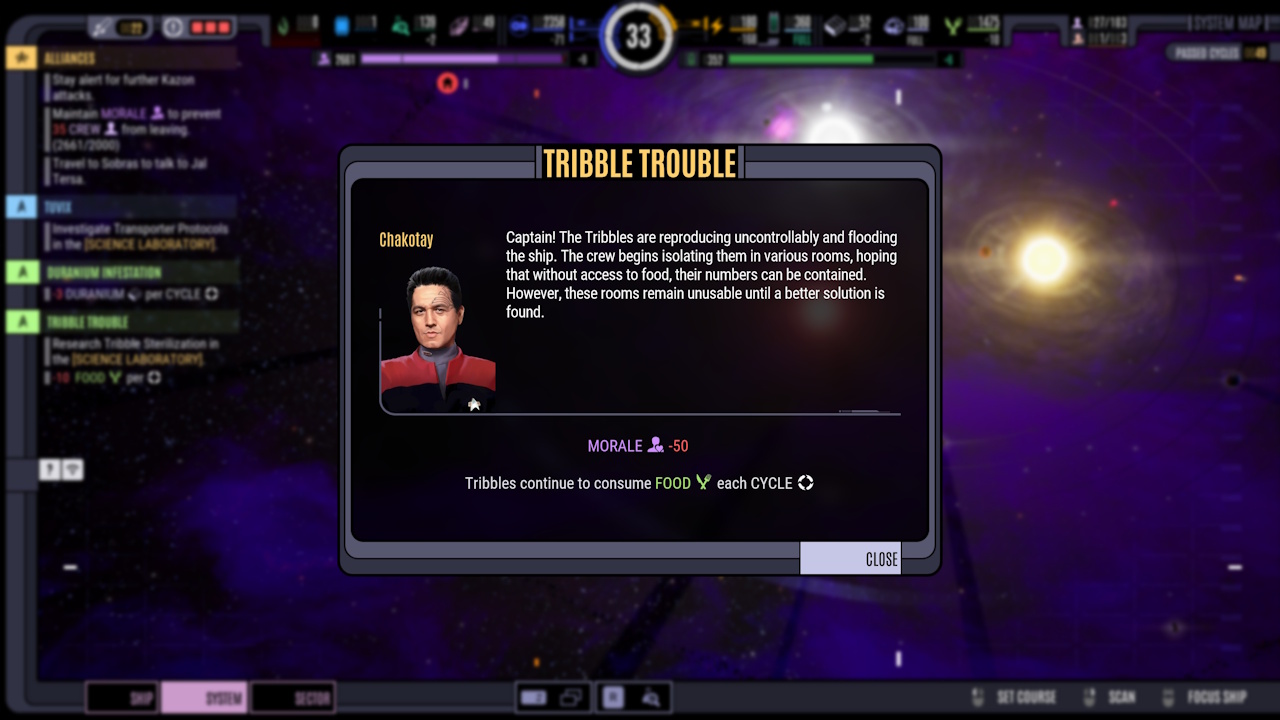
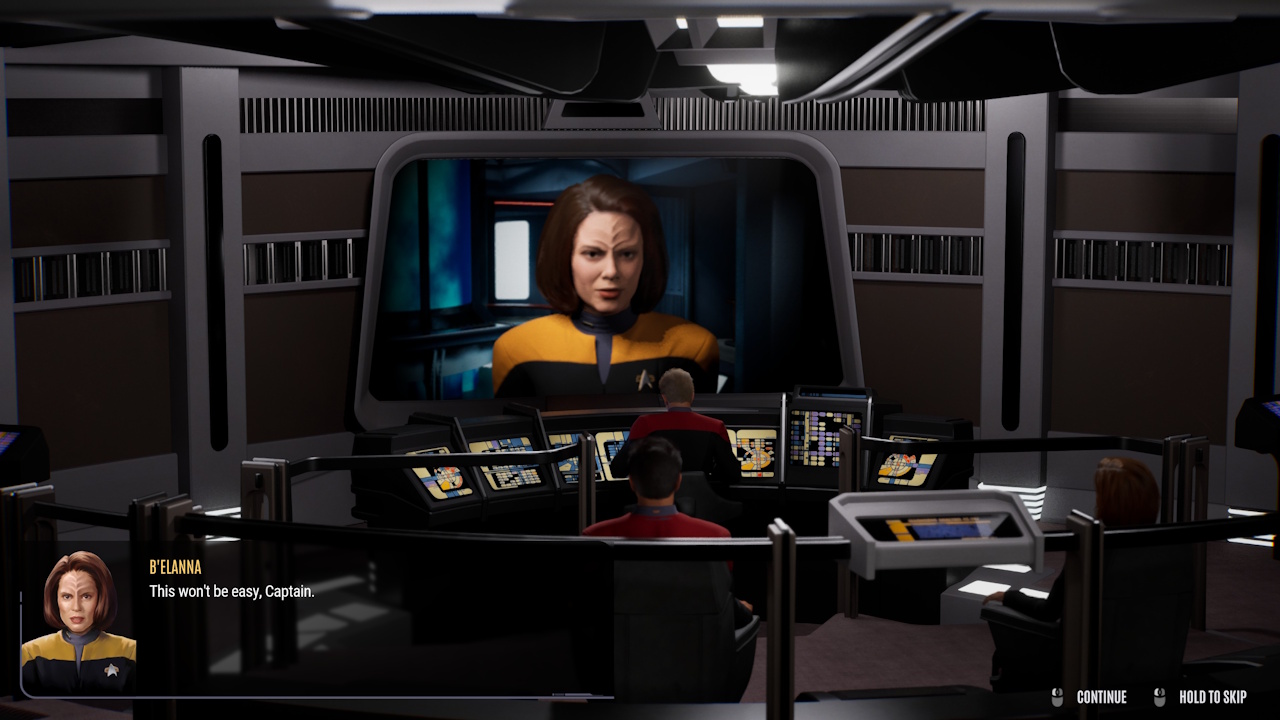
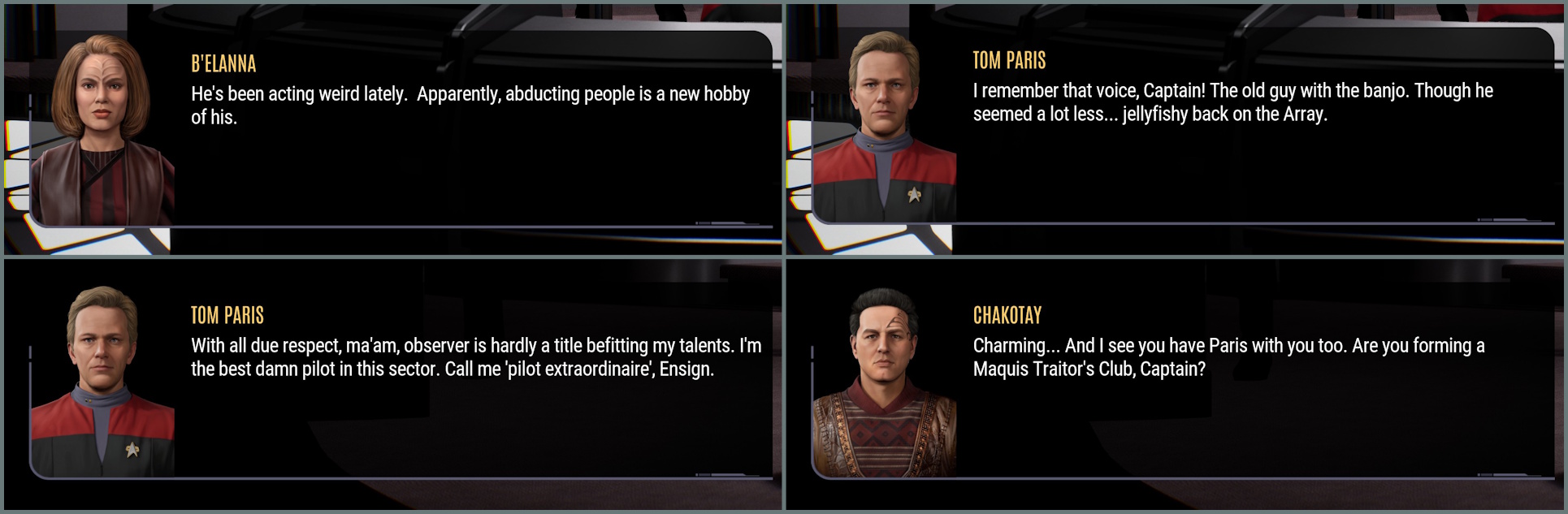
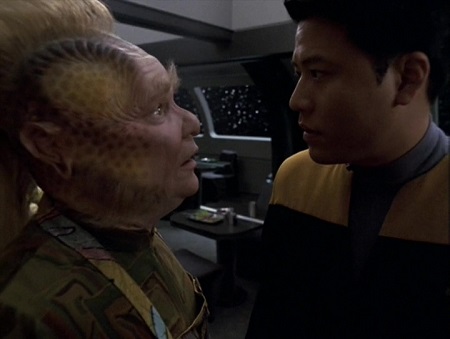
There were, however, some diversions from the story of Caretaker that felt unnecessary to me. Some lines of dialogue – particularly between characters like Chakotay and Tuvok, and Harry and Tom – felt really “off;” I know what these characters sound like, how they talk, and what they said to each other in the beginning – and this ain’t that!

In fact, I’d go so far as to say that some (but by no means all) of Across The Unknown’s dialogue reads like it’s been written by an AI chat bot. I’m not saying that’s what happened – and there could be issues with translation, for example, as the game is being developed in Germany. But that’s how some of these lines felt to me. Subjectively speaking.

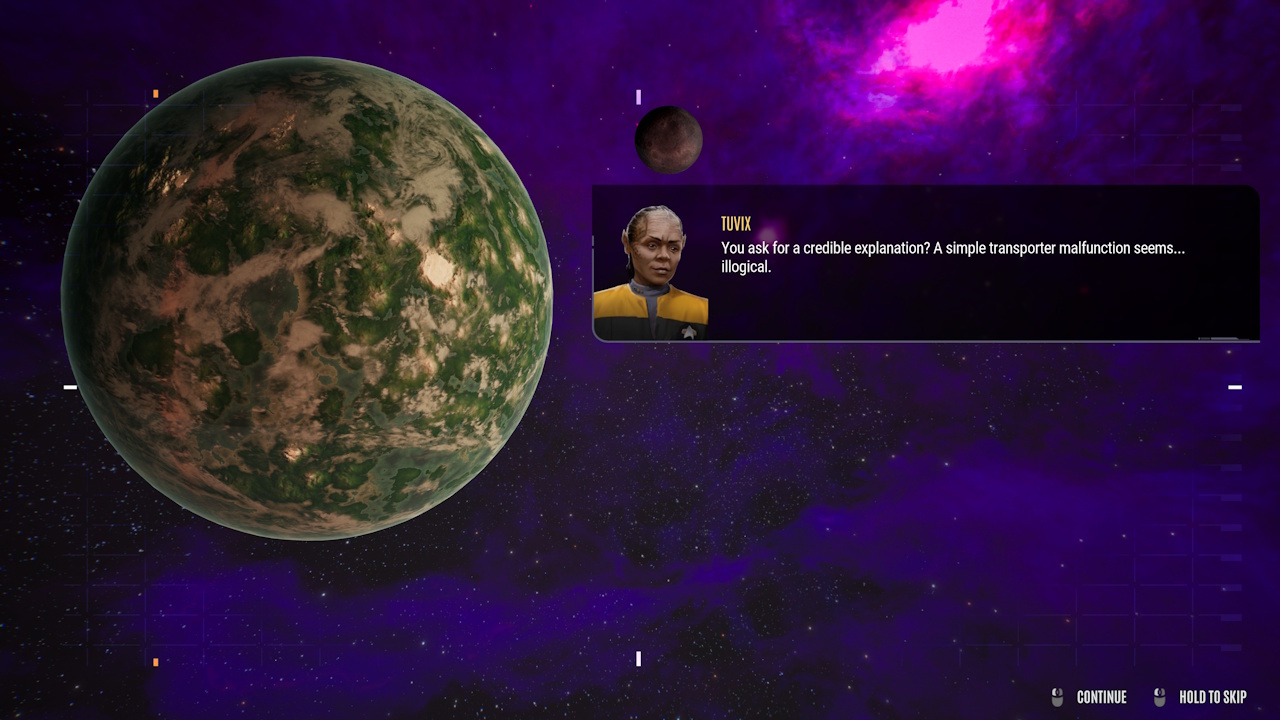
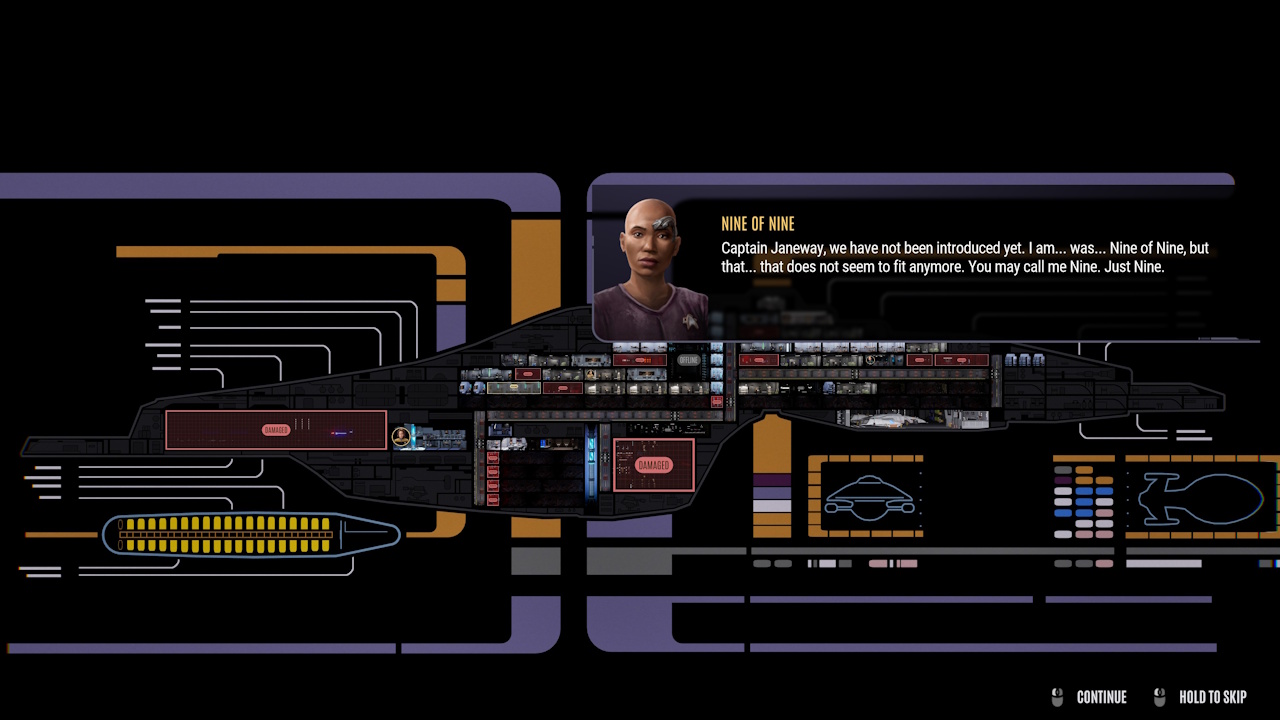
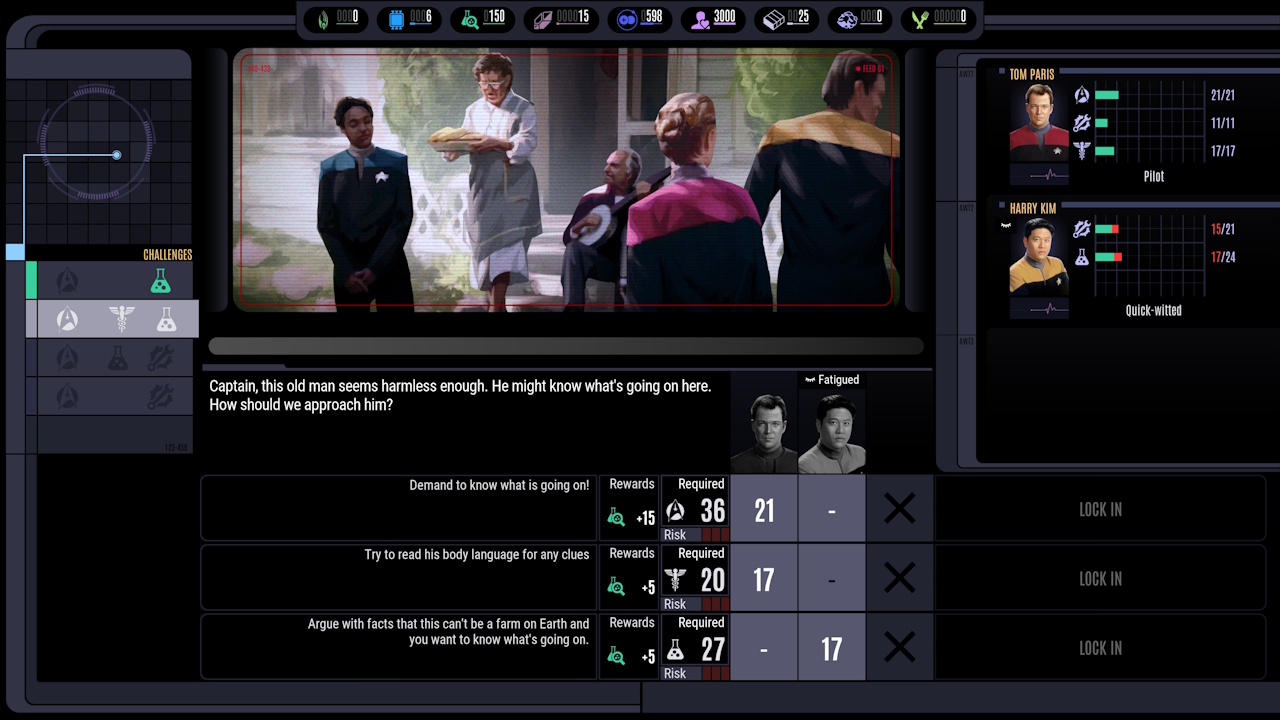
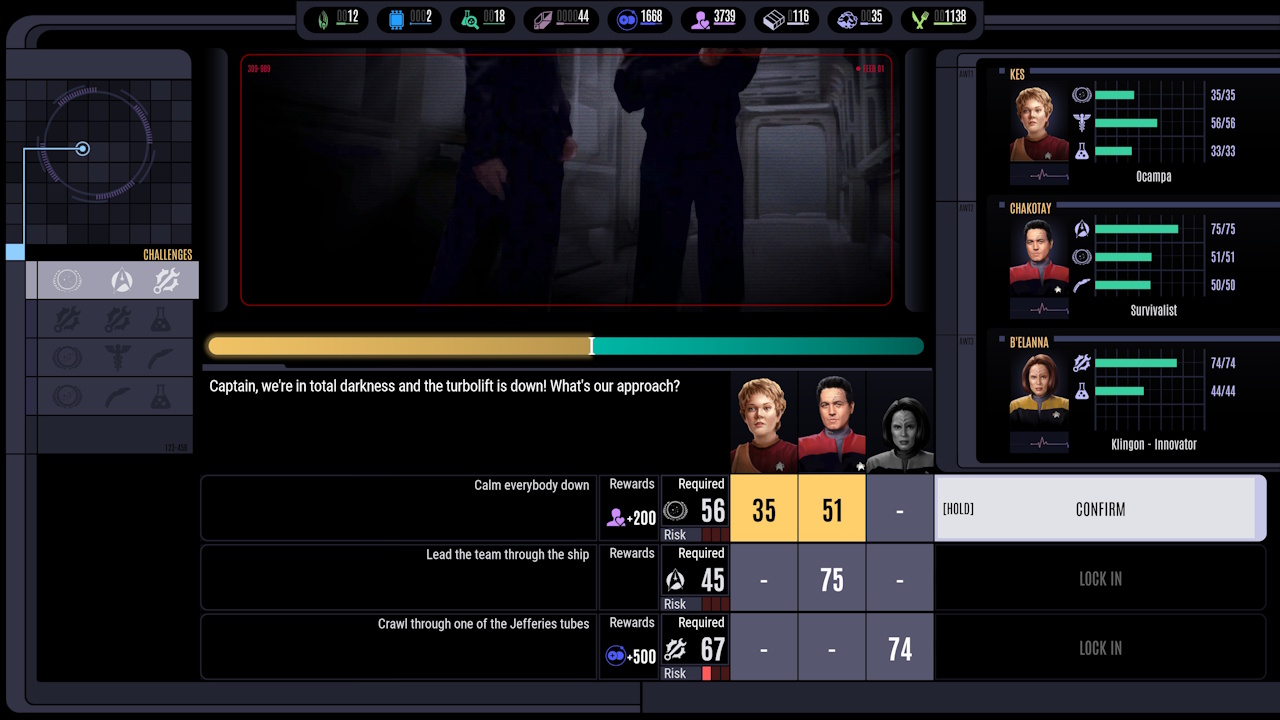
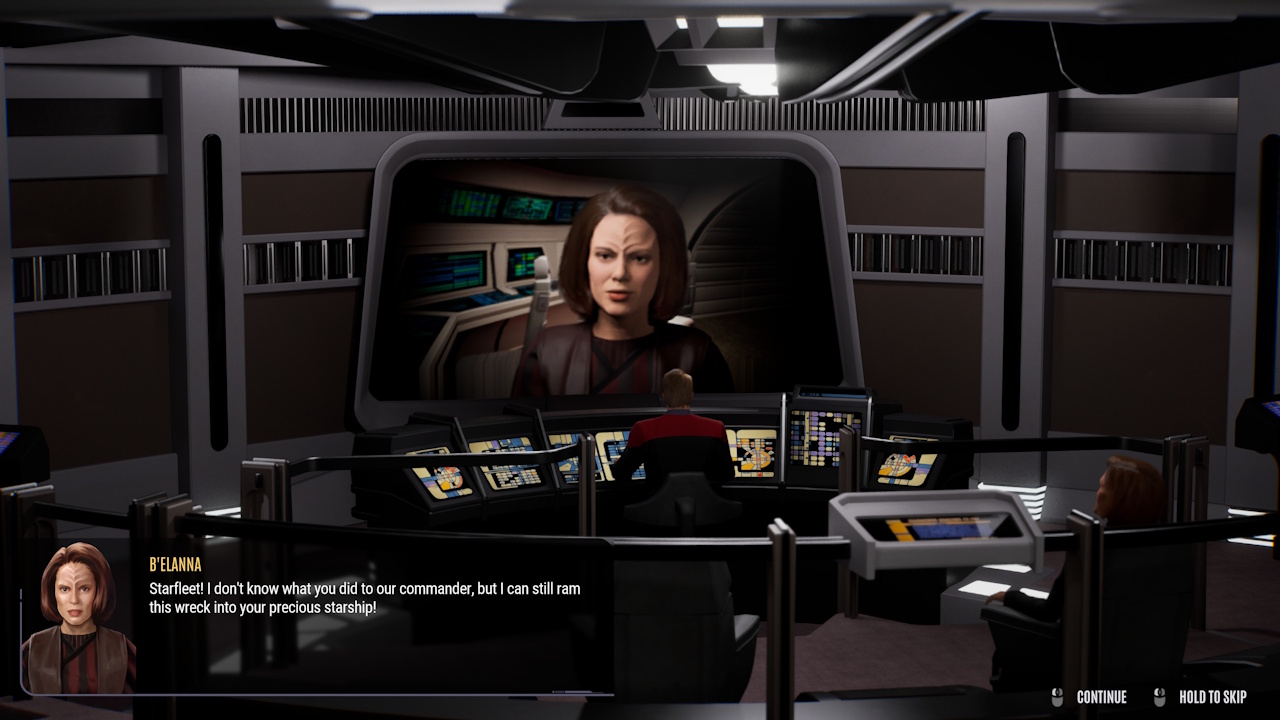
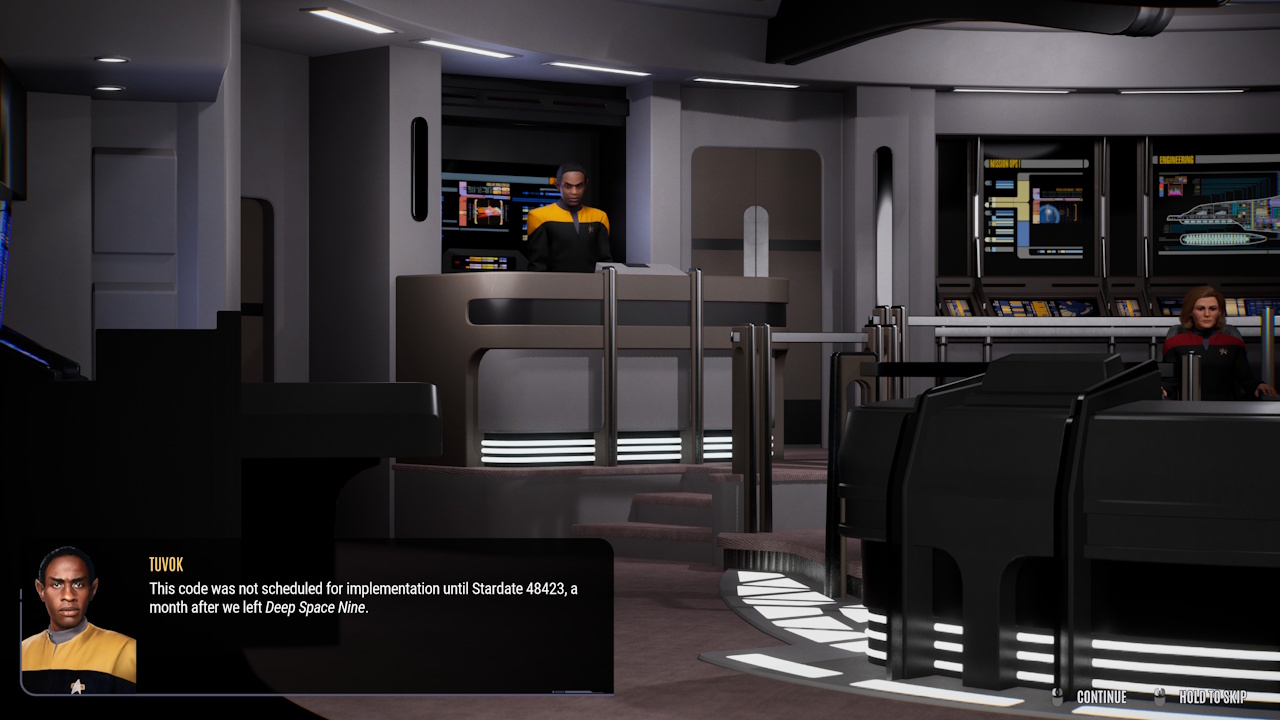
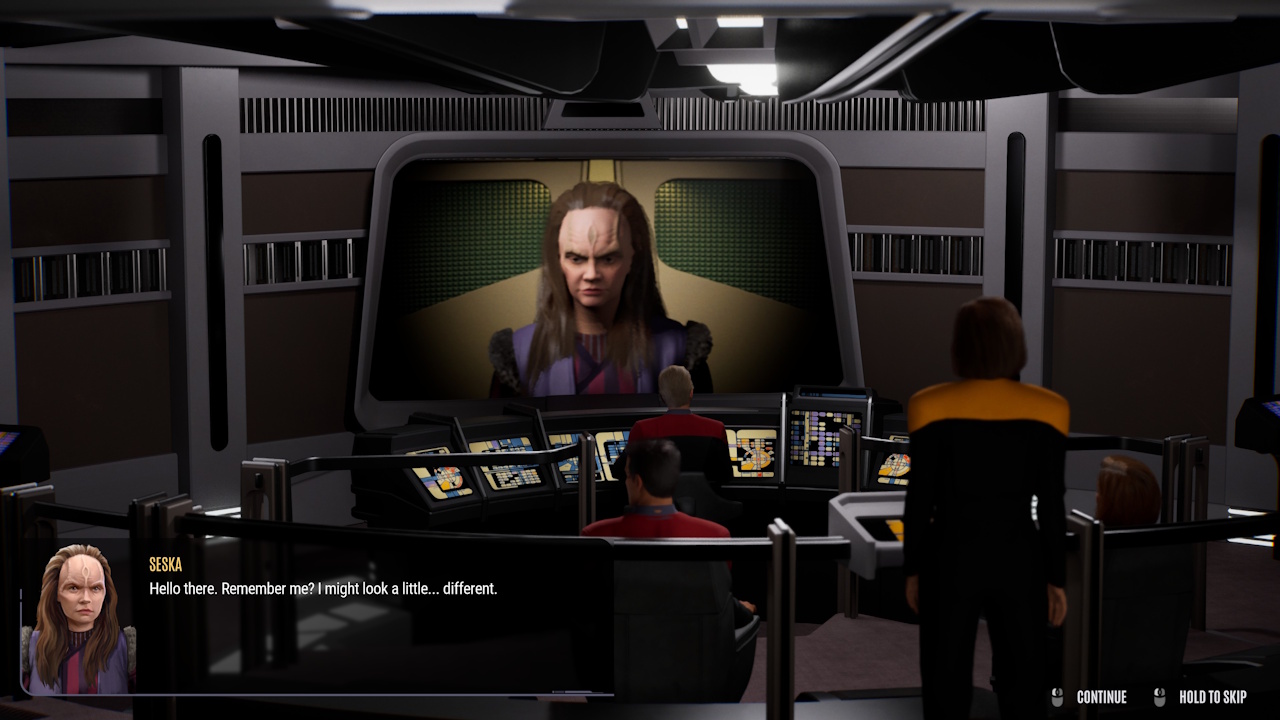
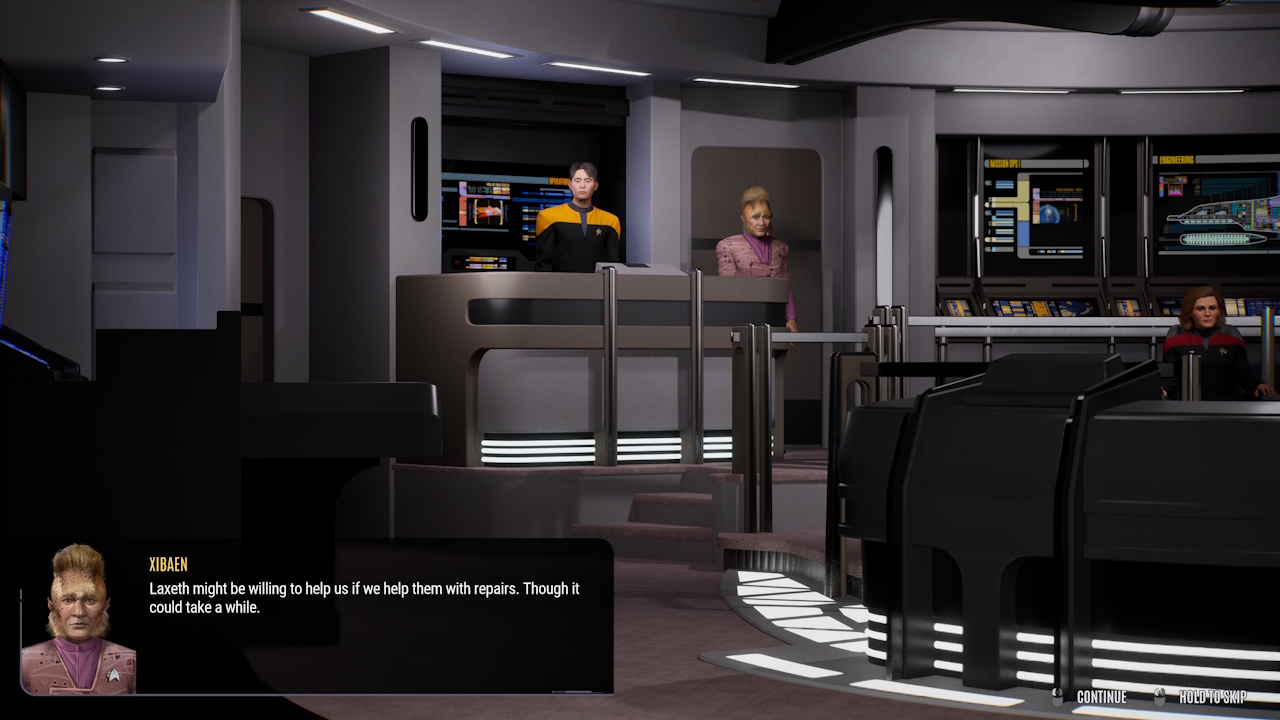
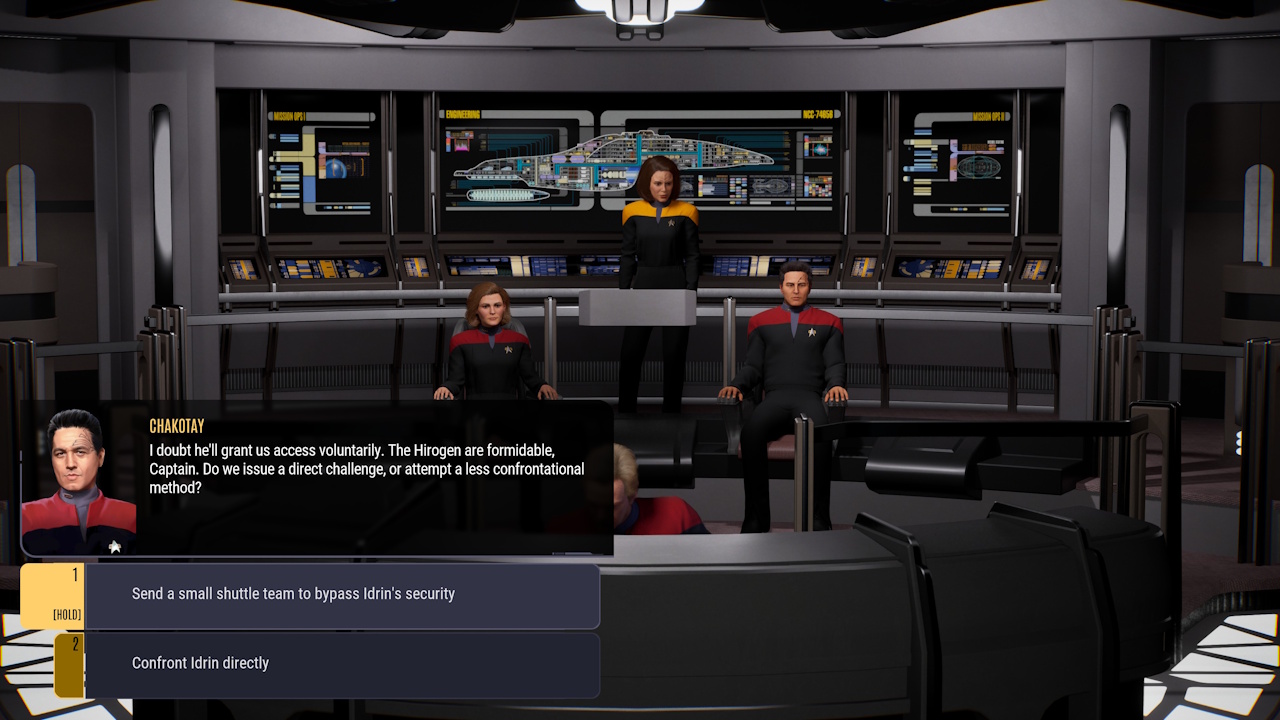
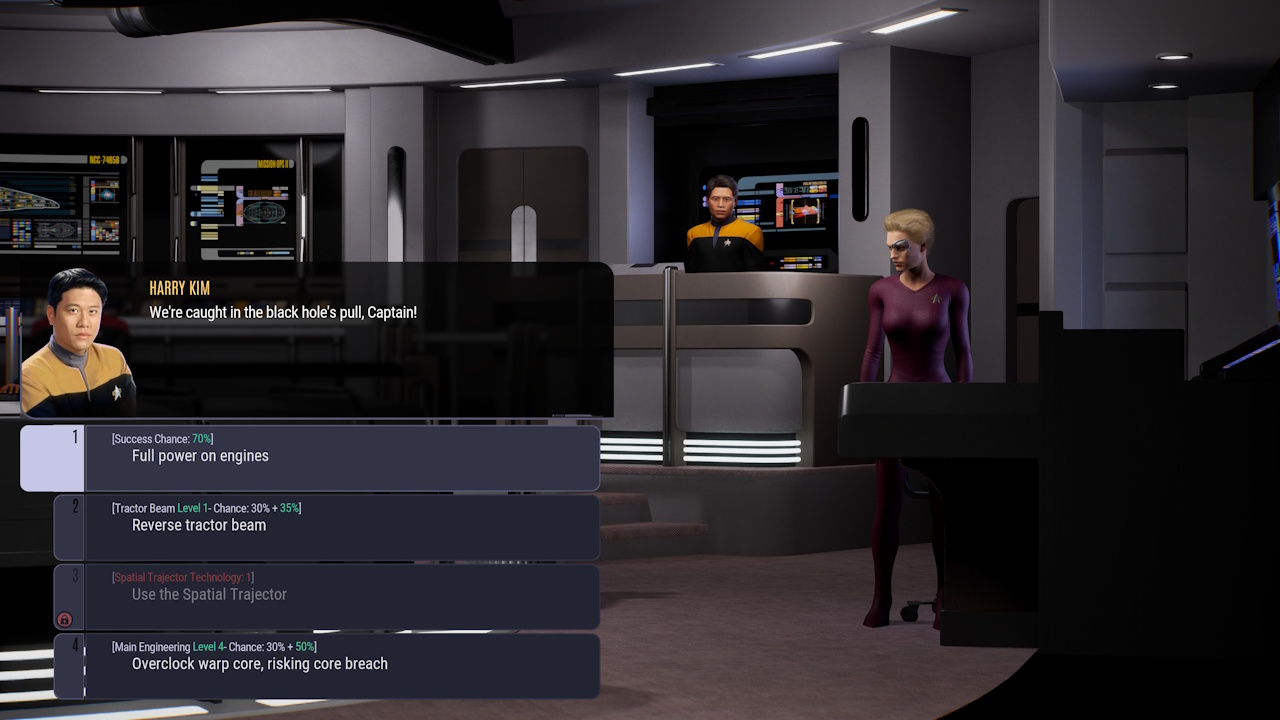
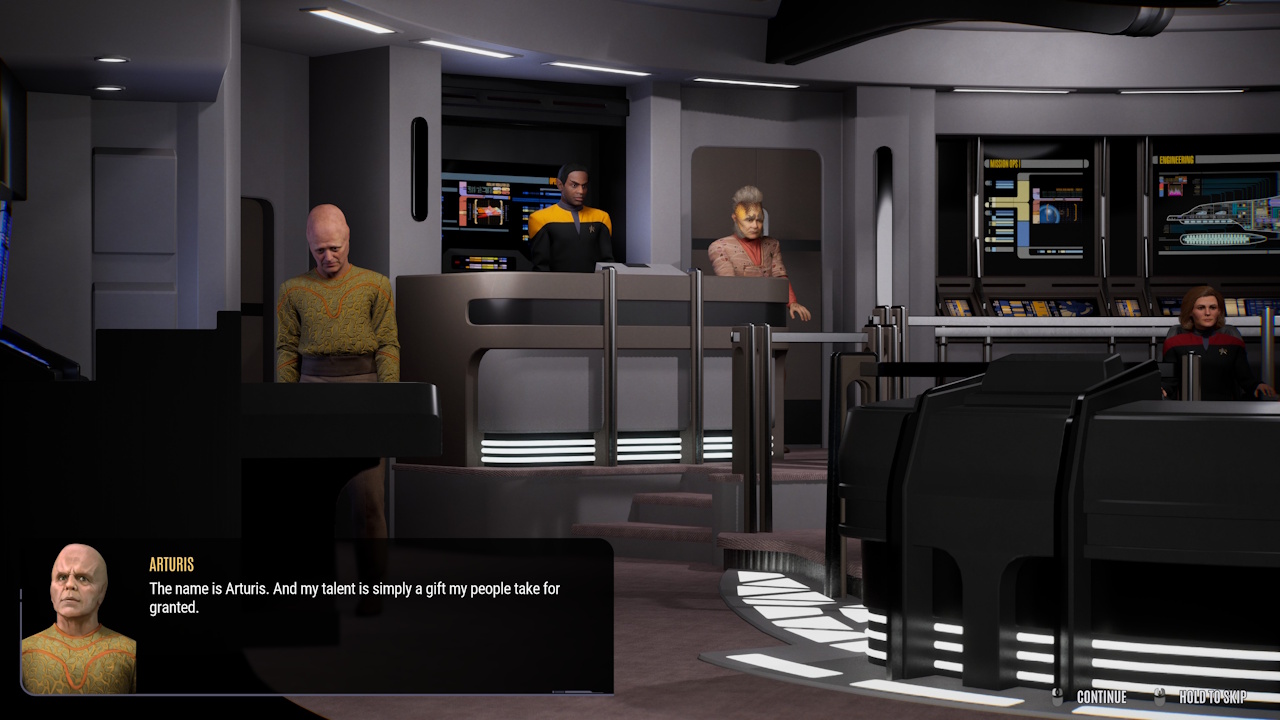
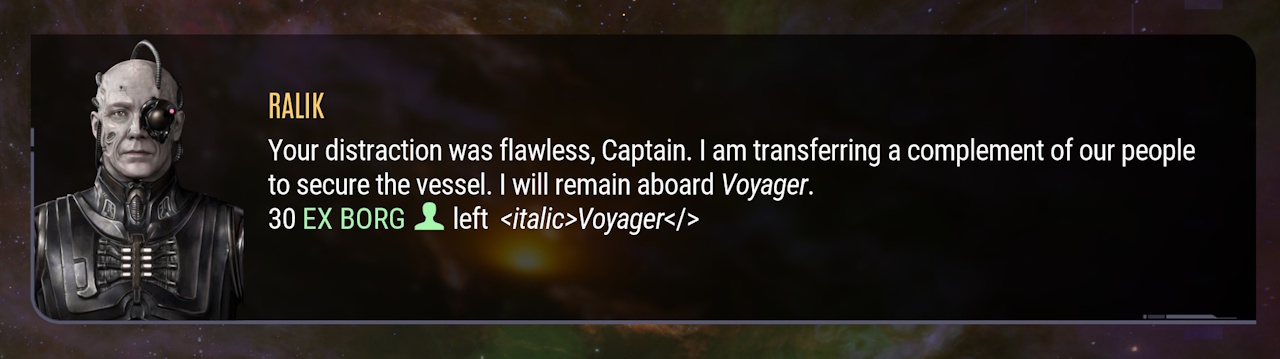
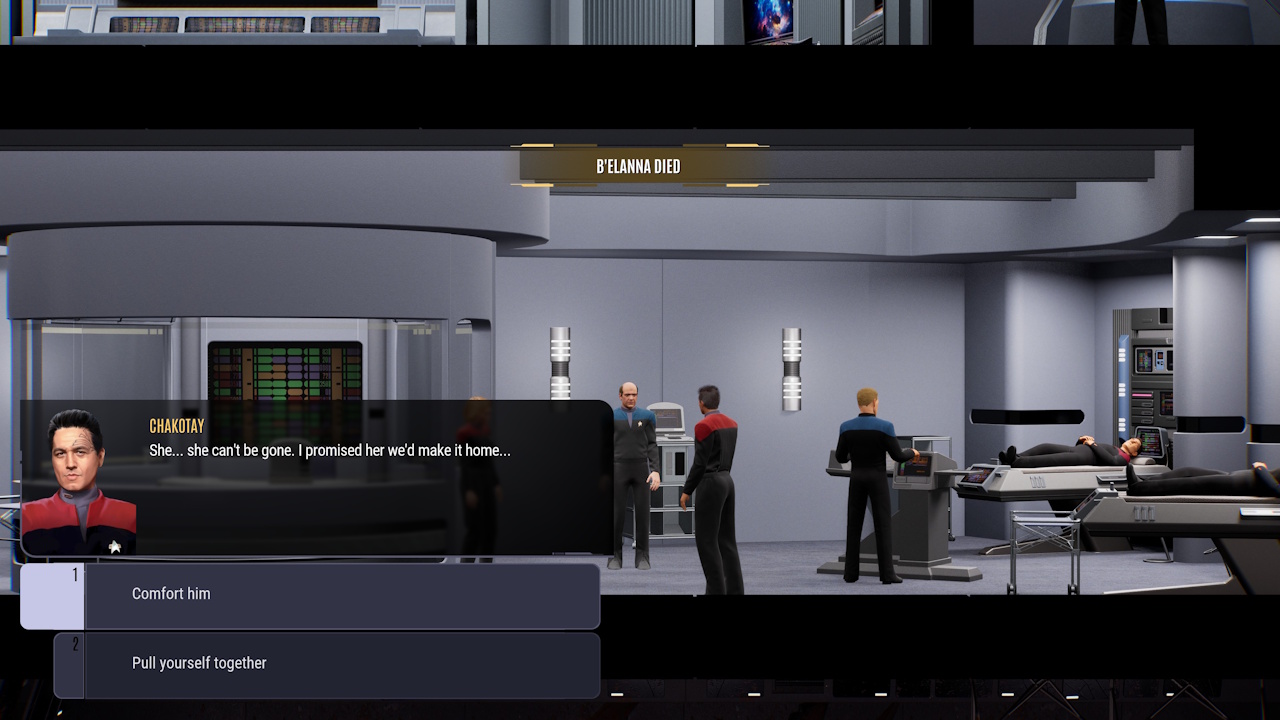
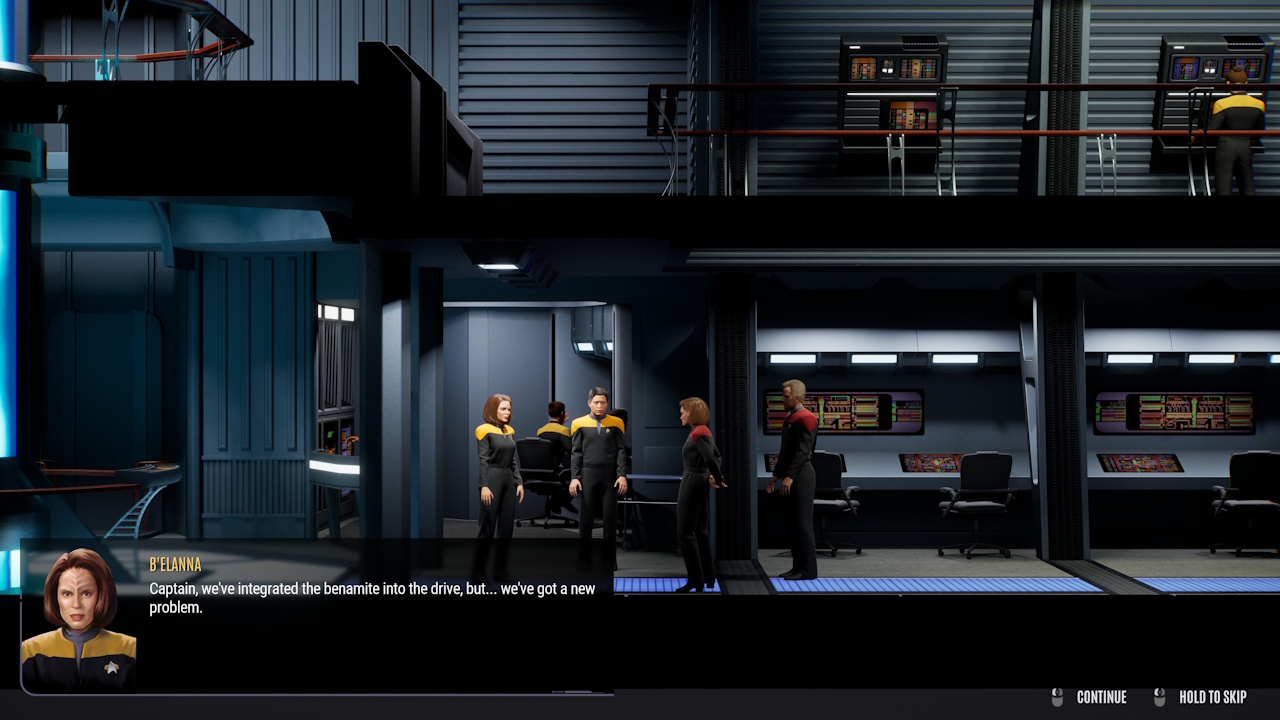
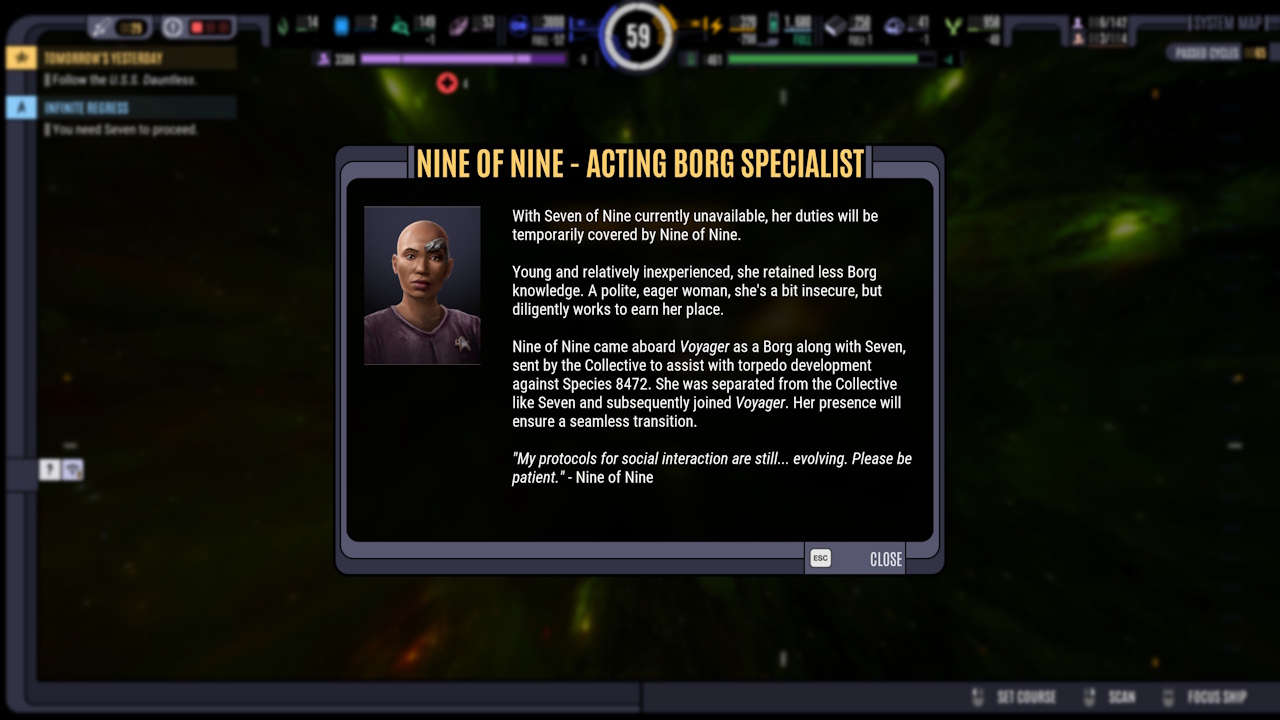
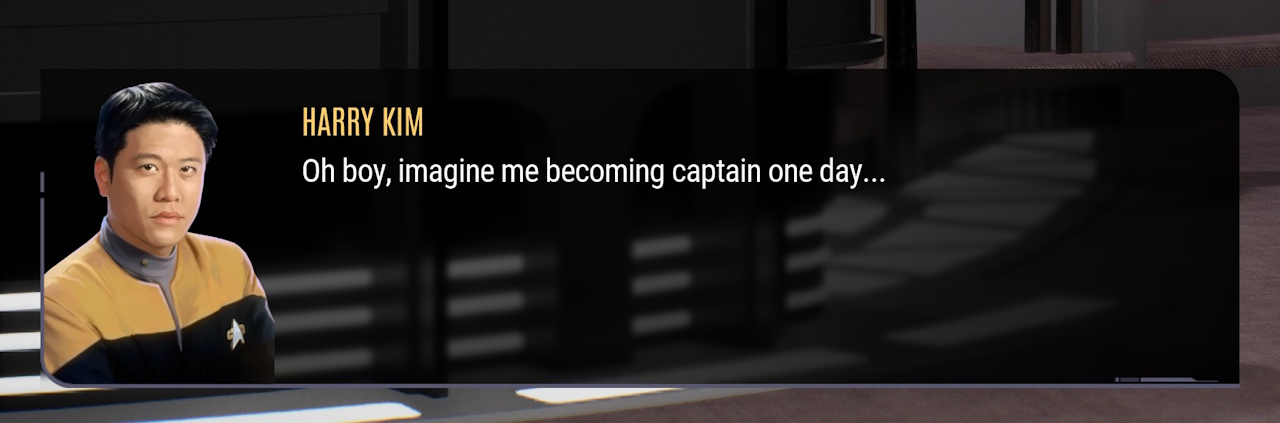
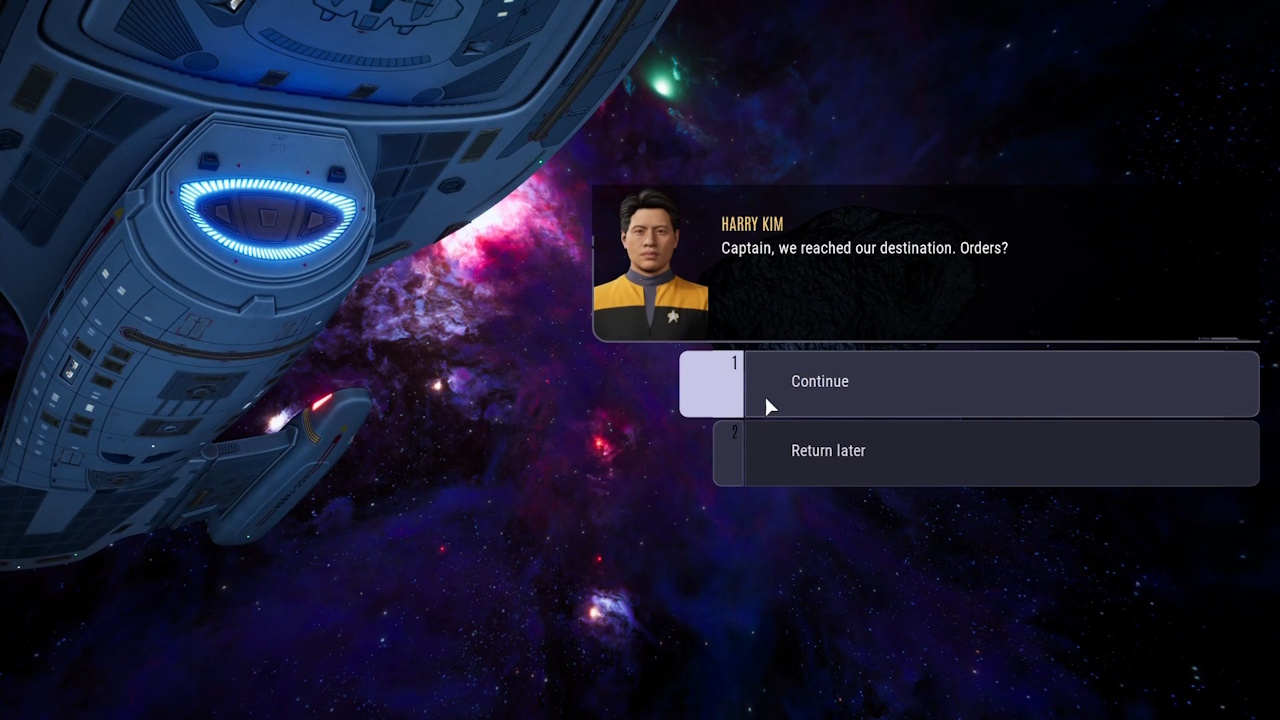
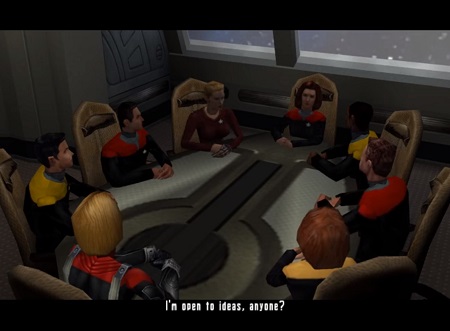
Screenshot of Star Trek: Voyager - Across The Unknown (demo version) showing four dialogue boxes.
A selection of the “awkward” dialogue lines.

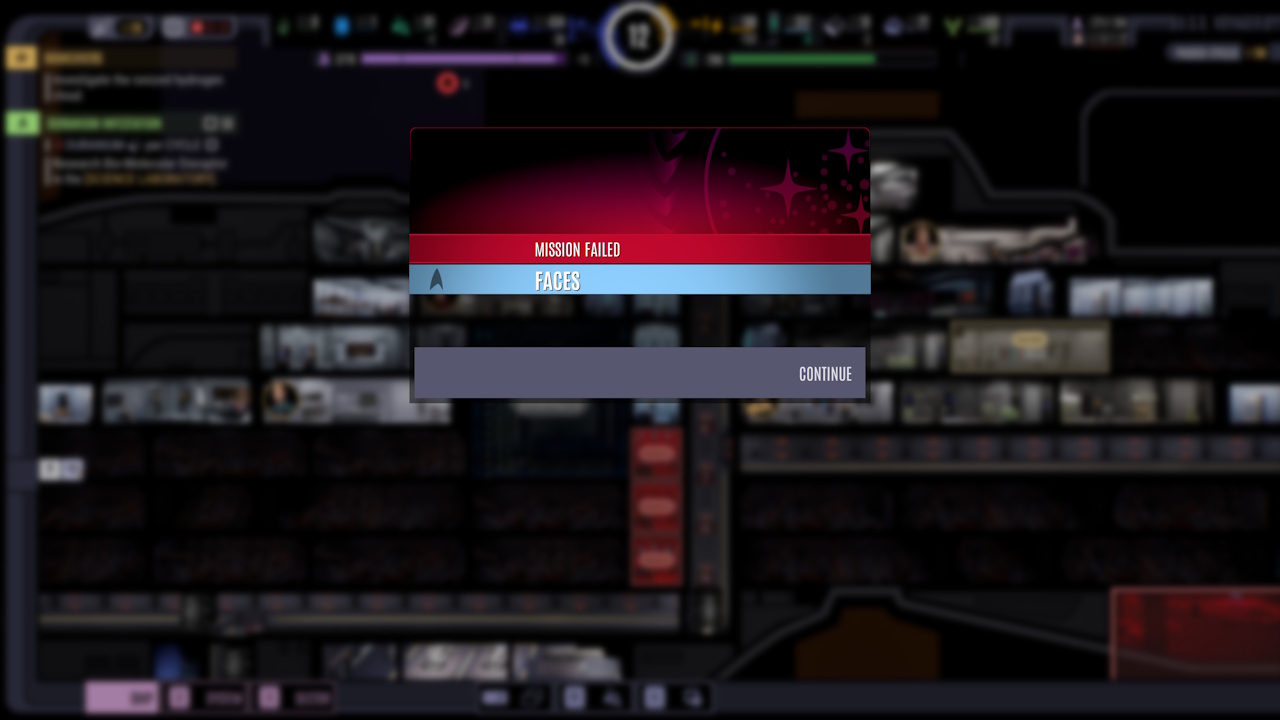
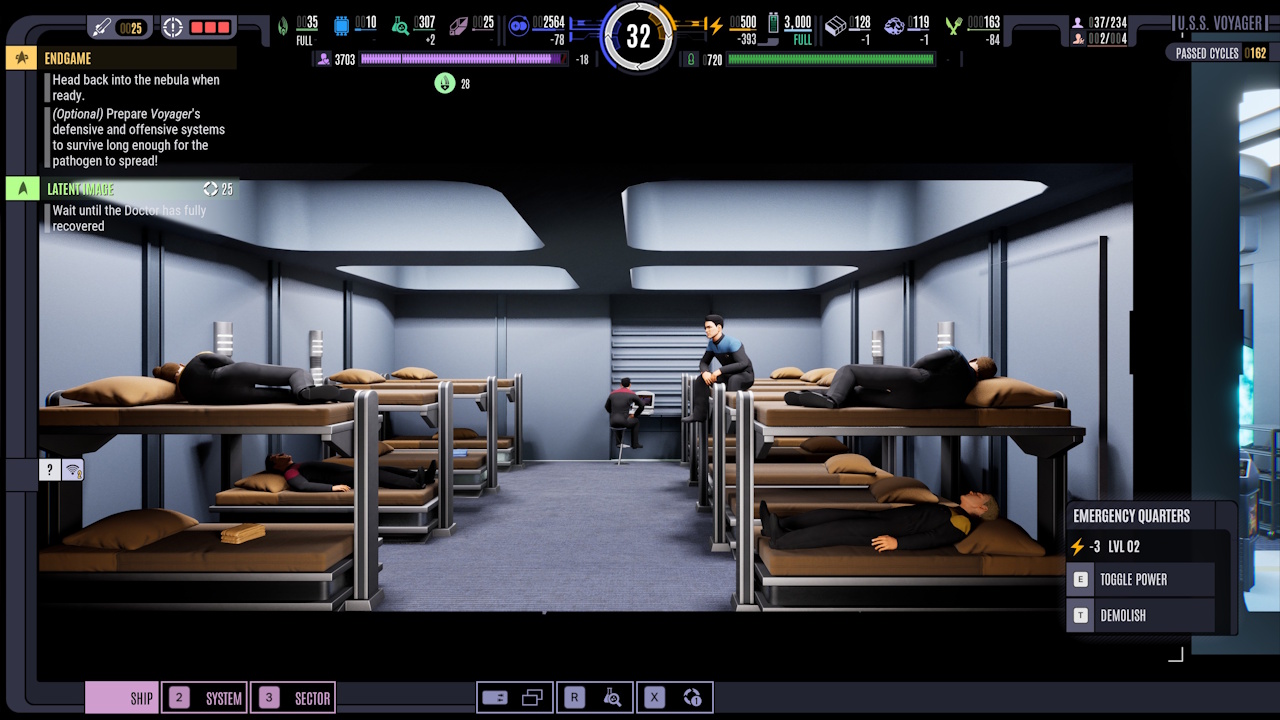
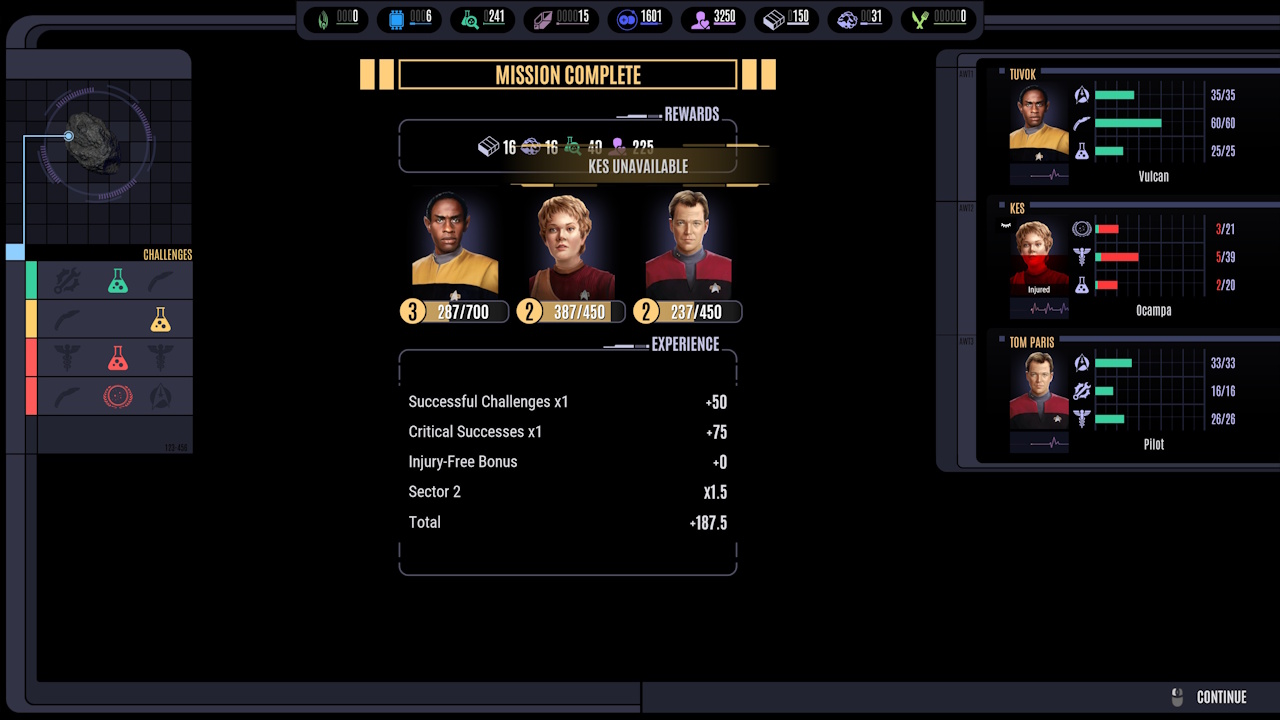
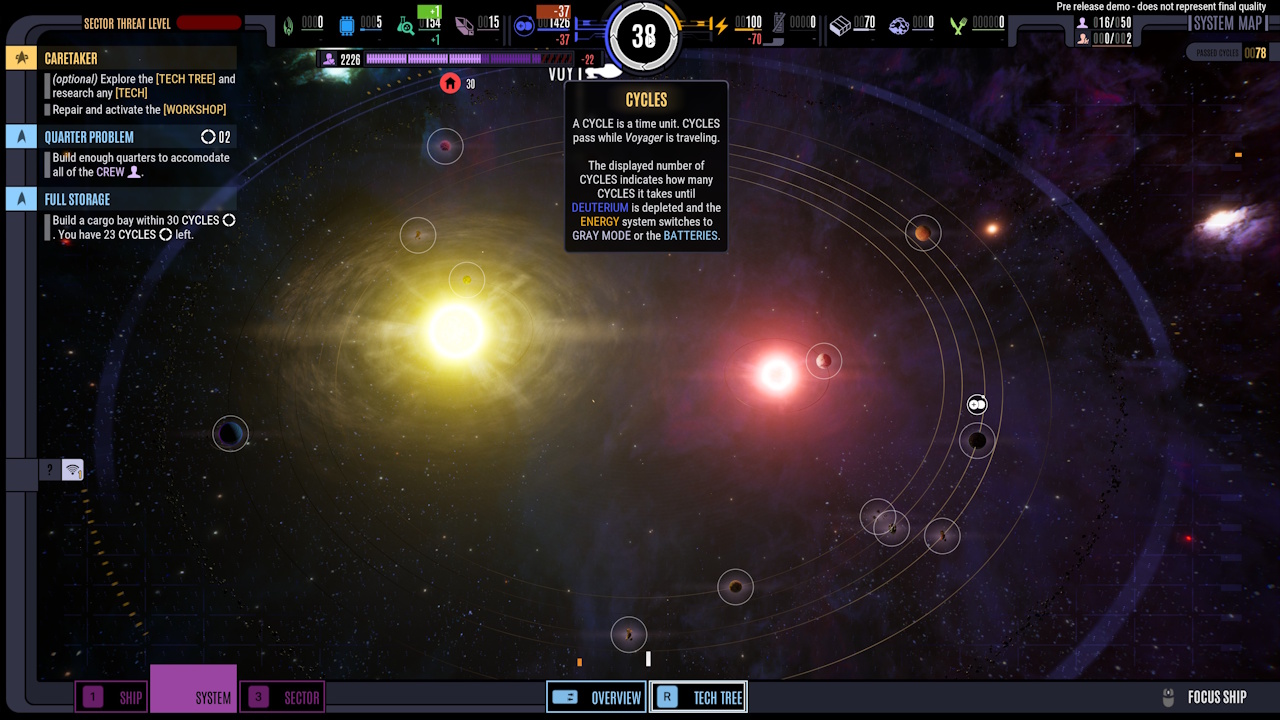
The tutorial was solid, and I felt that Across The Unknown communicated some of its pretty in-depth systems in a concise and understandable way. I didn’t play the game perfectly on my first outing; I failed one optional assignment when I didn’t build enough crew quarters in time! But that failure helped me learn more about the optional assignments and how the “cycles” (Across The Unknown’s timekeeping) work, so it wasn’t a total loss. And considering that I did fail one of these optional tasks, Across The Unknown was forgiving enough that it wasn’t fatal to my playthrough – which I did appreciate on my first time out!

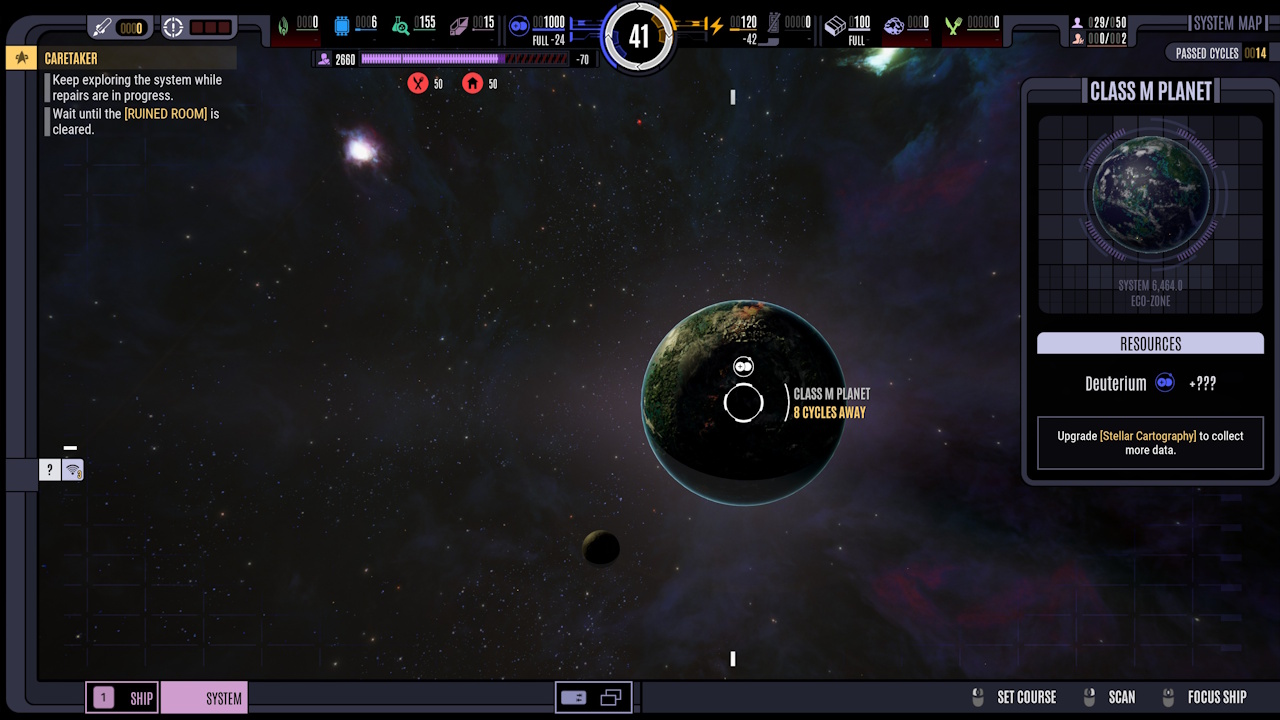
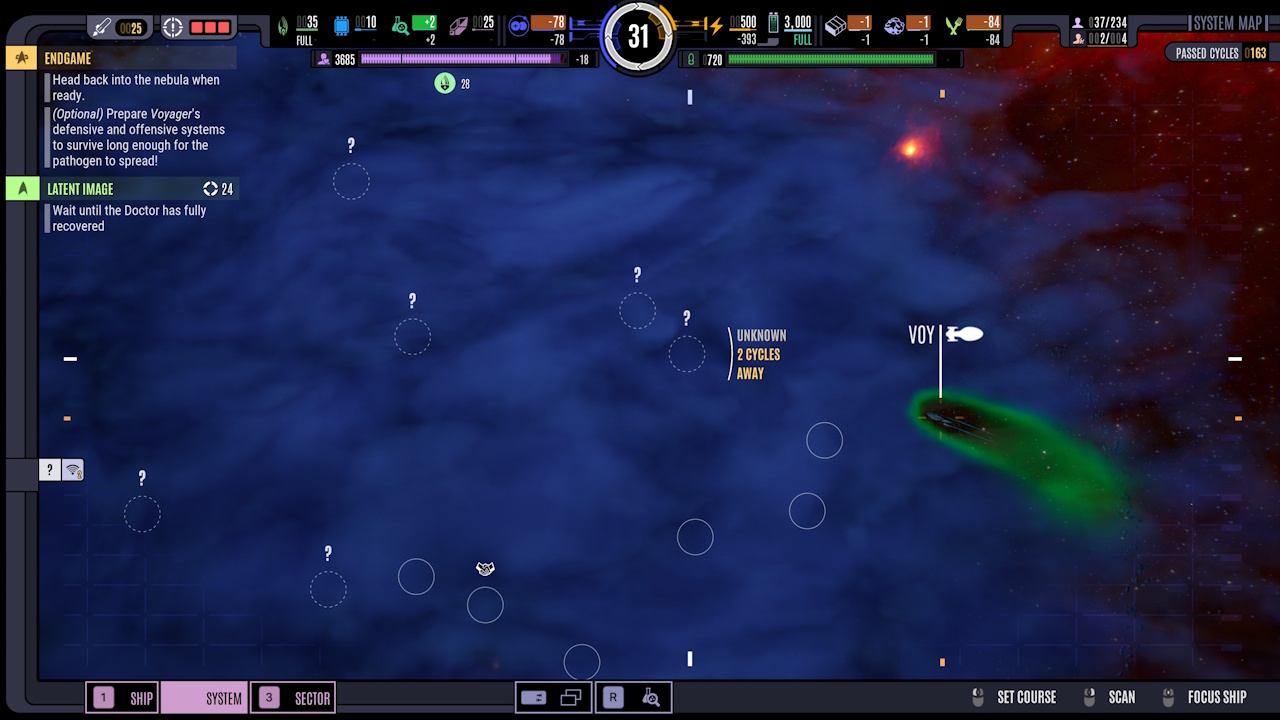
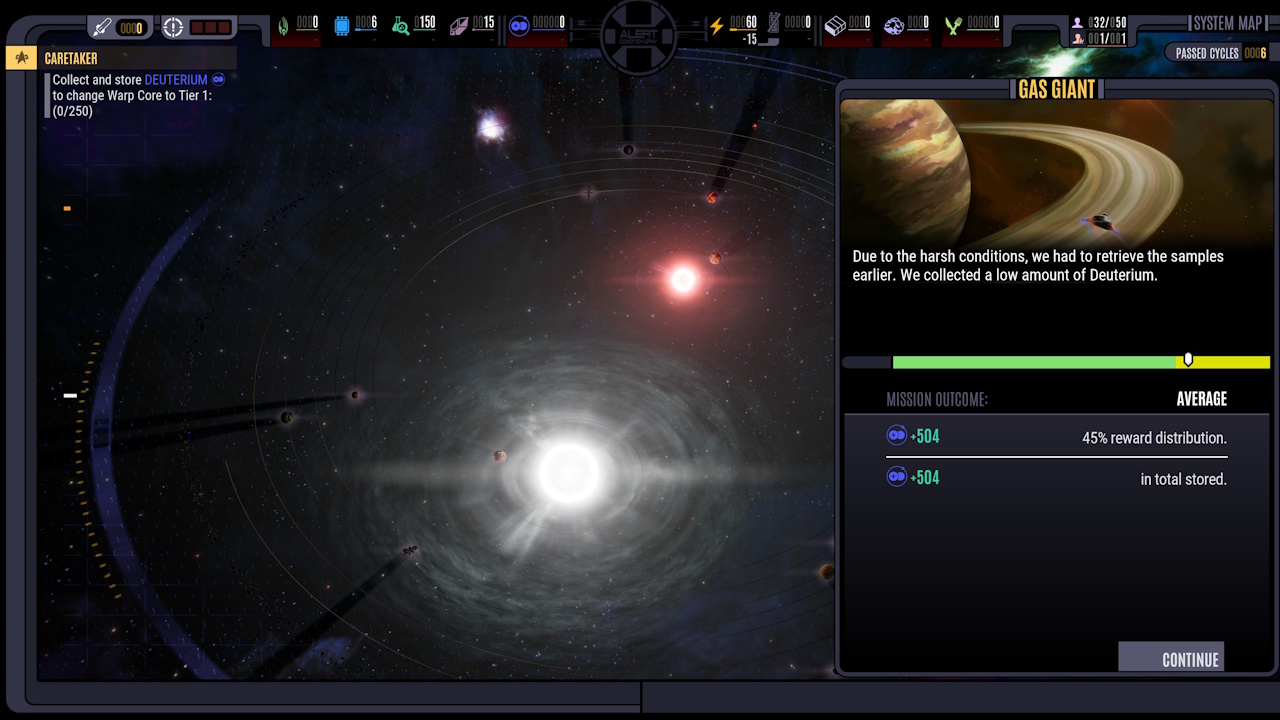
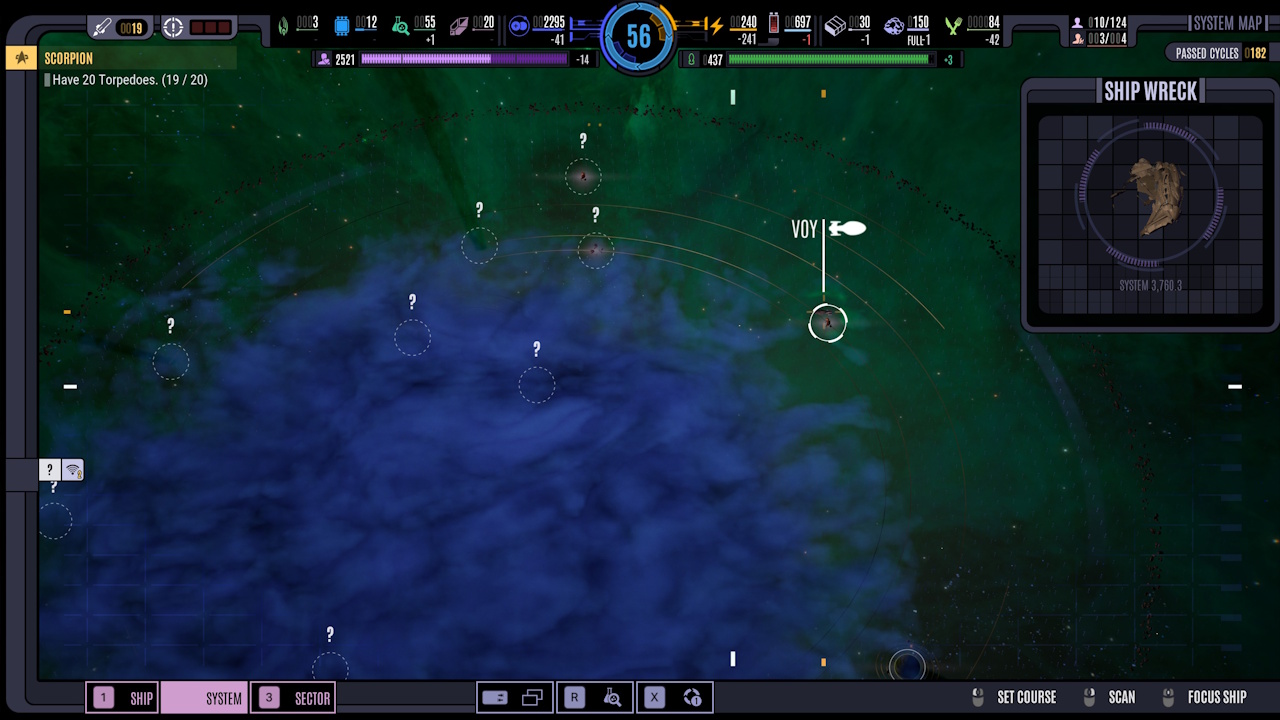
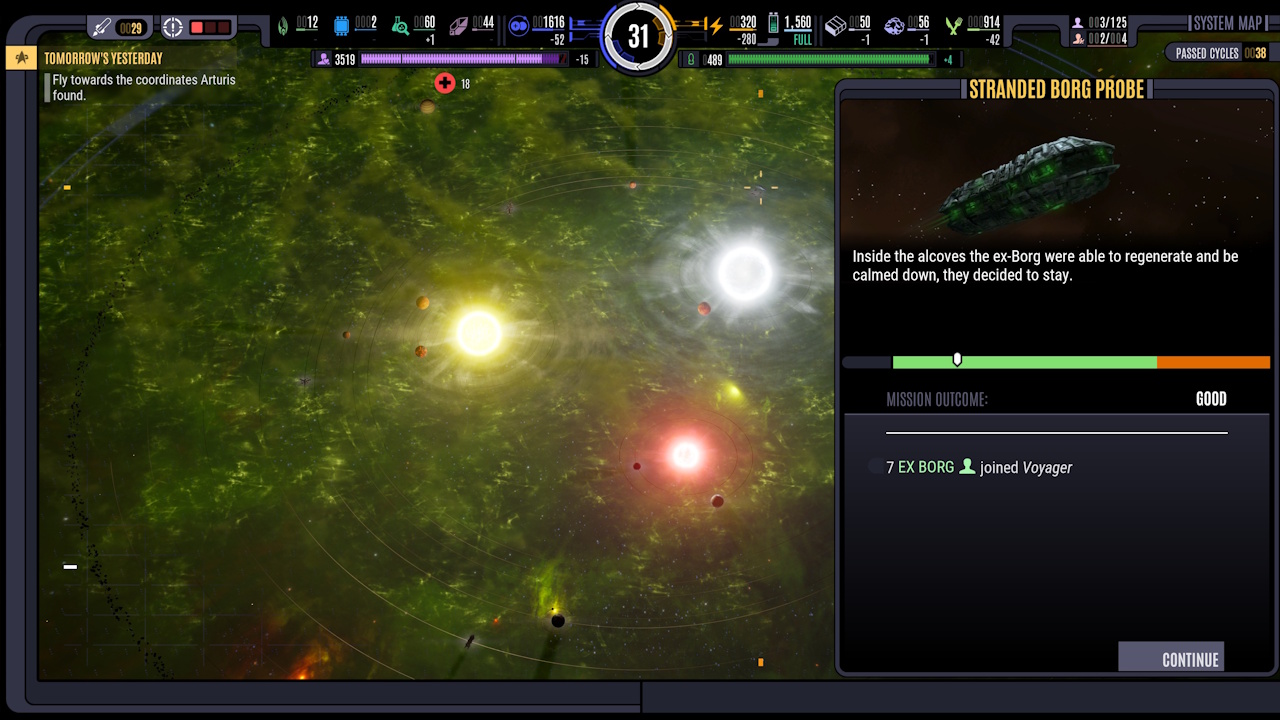
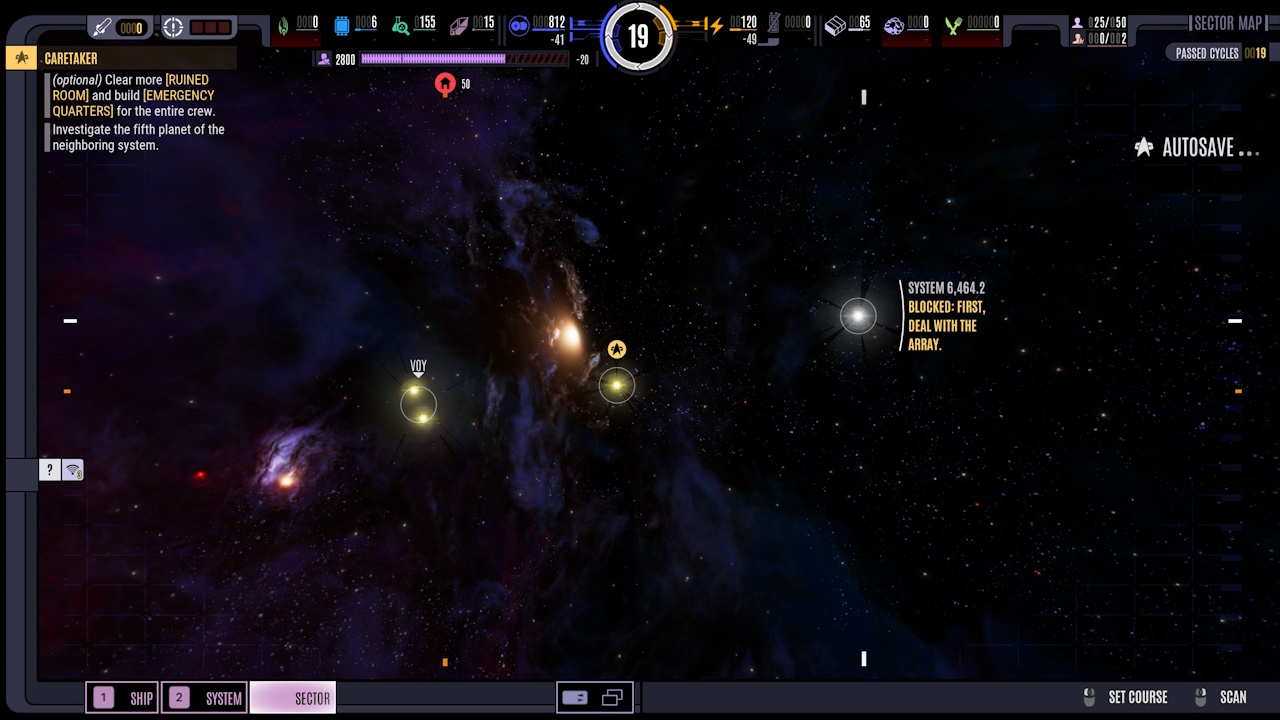
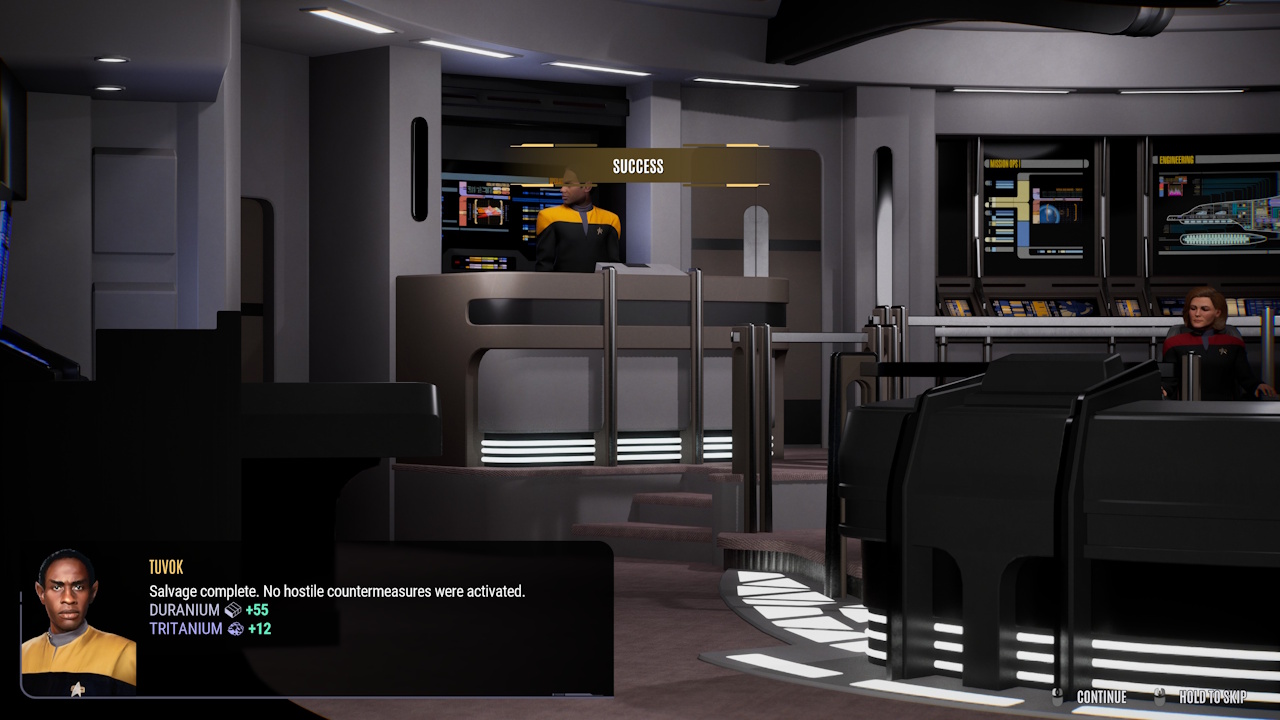
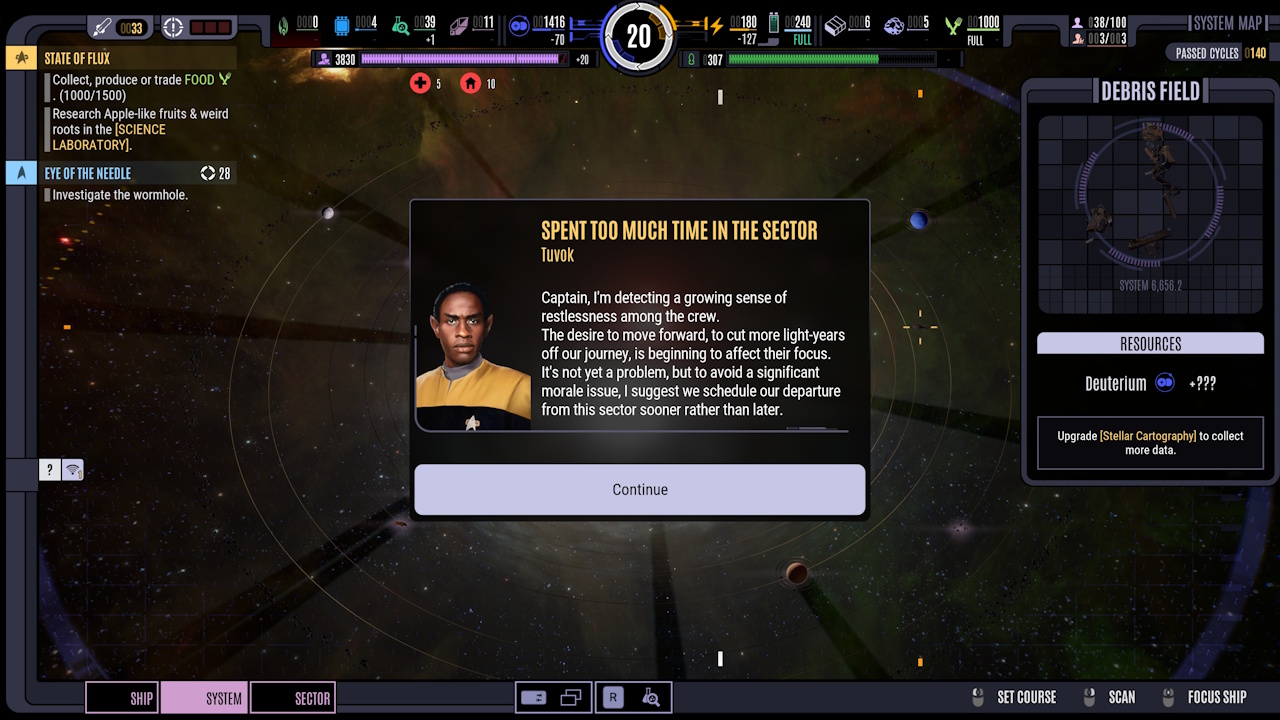
There are resource limitations, though. At one point, I was running dangerously low on deuterium – which is necessary to keep the ship running. I was only a couple of cycles away from completely running out, and having exhausted all of the planets and points of interest in the two available star systems, there was a bit of a time crunch to get back to the Caretaker’s Array! This is clearly part of the experience – Voyager’s journey home, especially in the early days, was one of scavenging resources where possible, and running close to the line on more than one occasion. It served as a great motivator, I found, to move the story along!

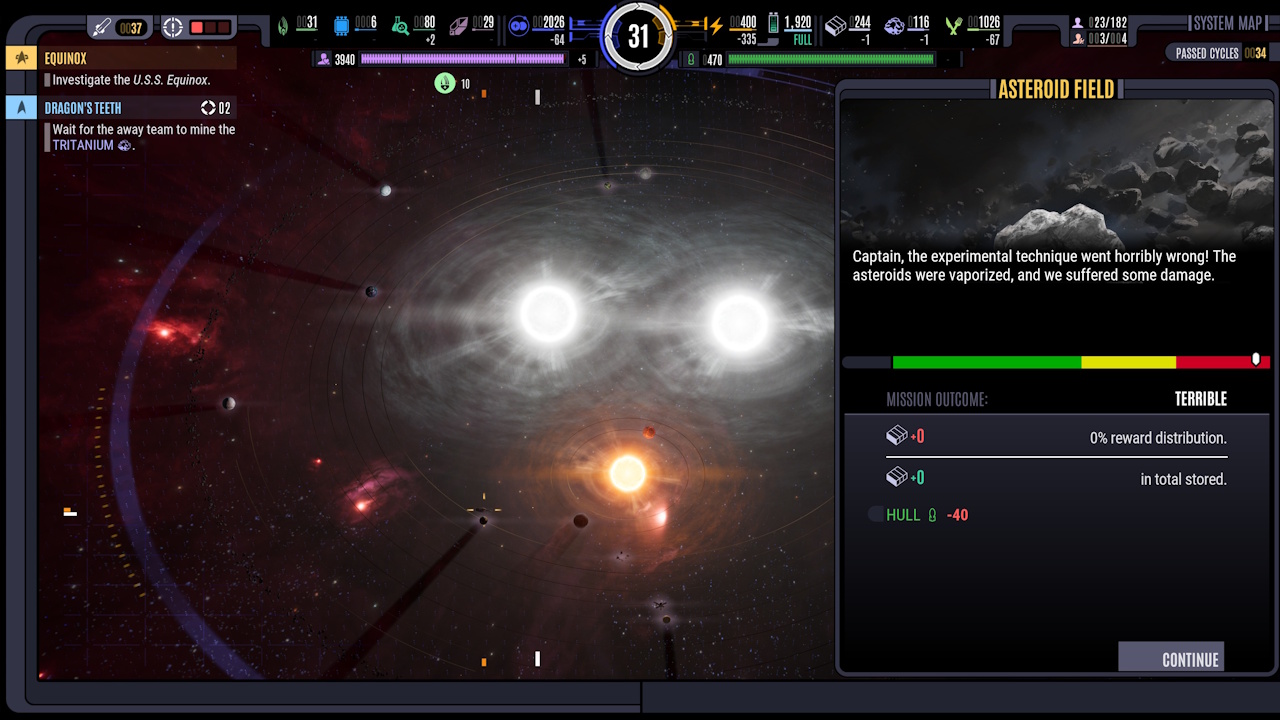
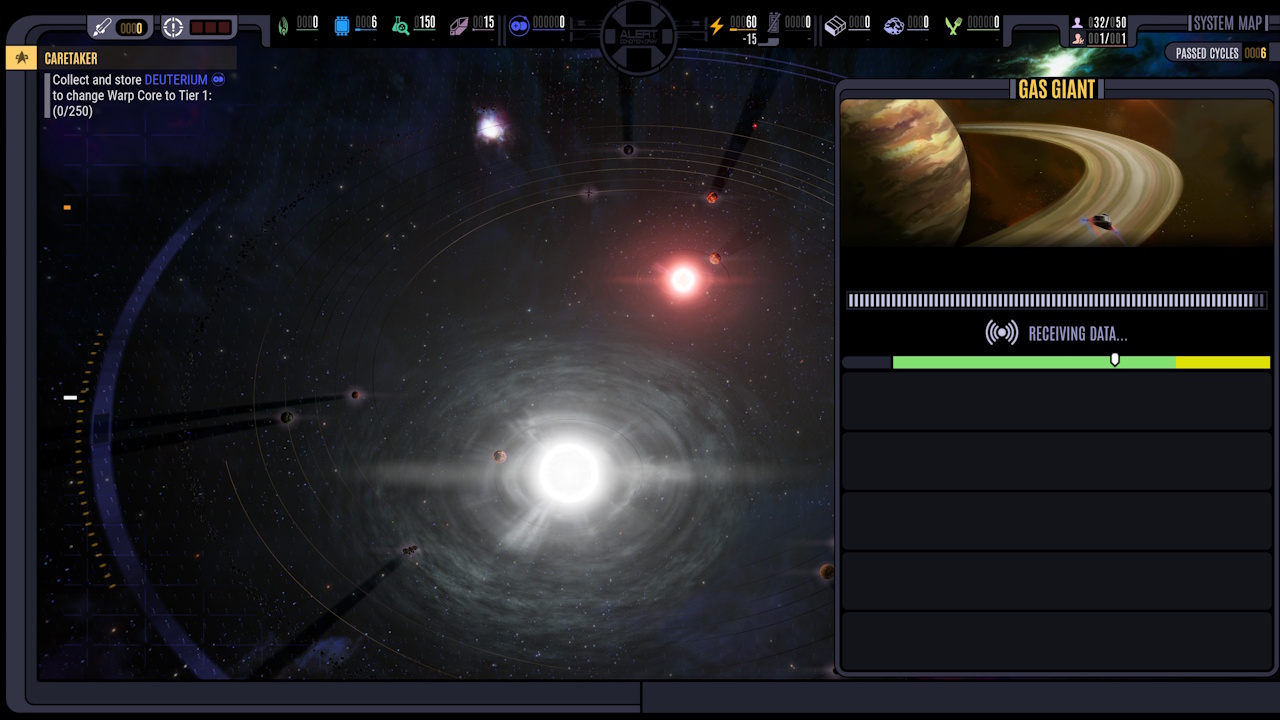
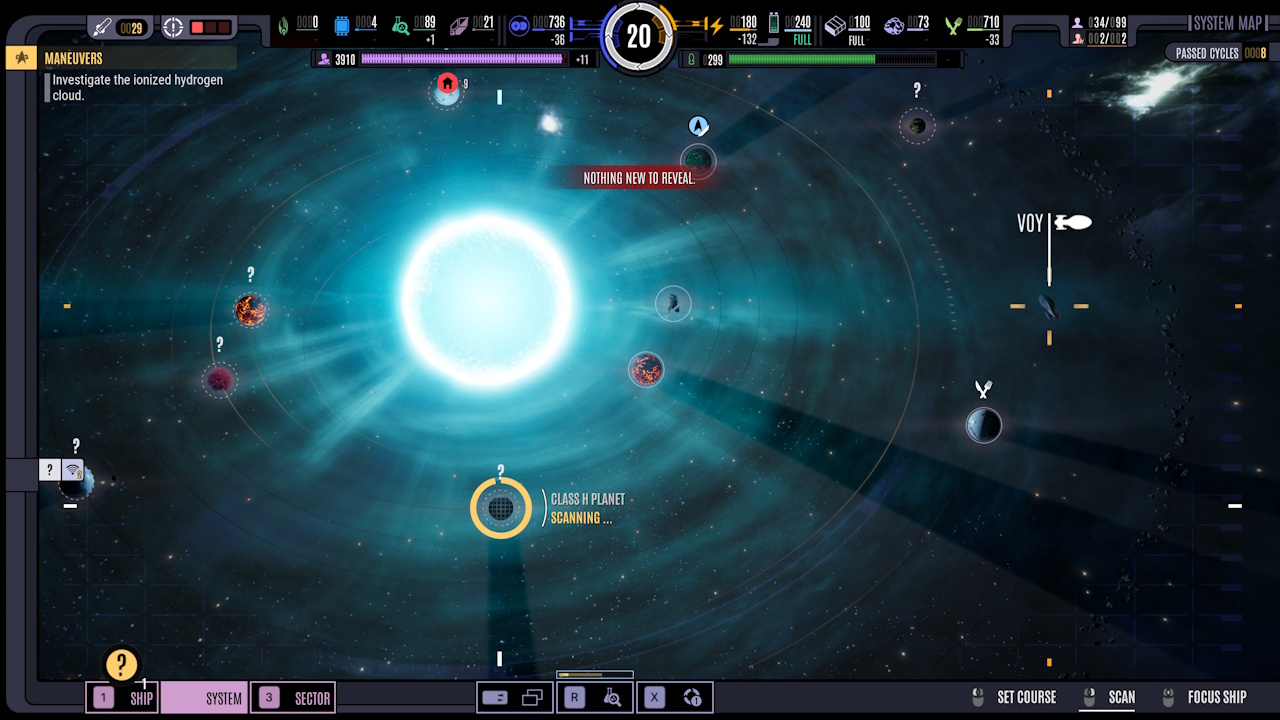
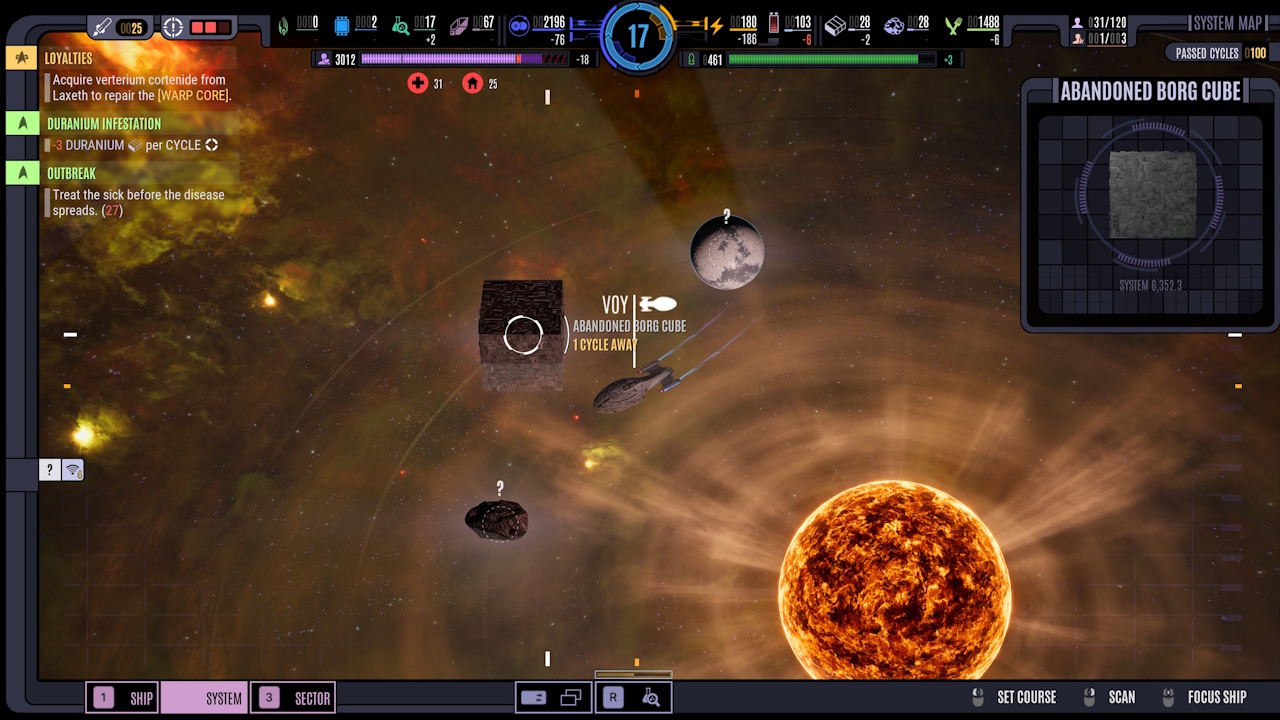
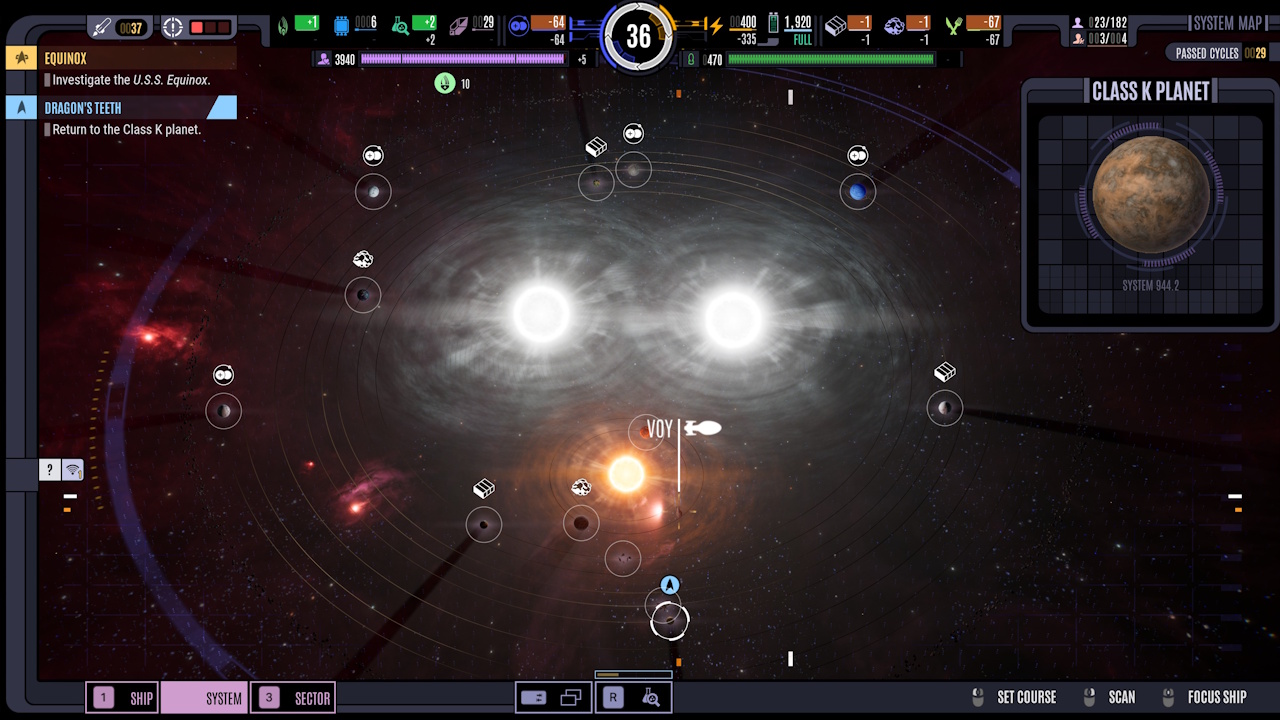
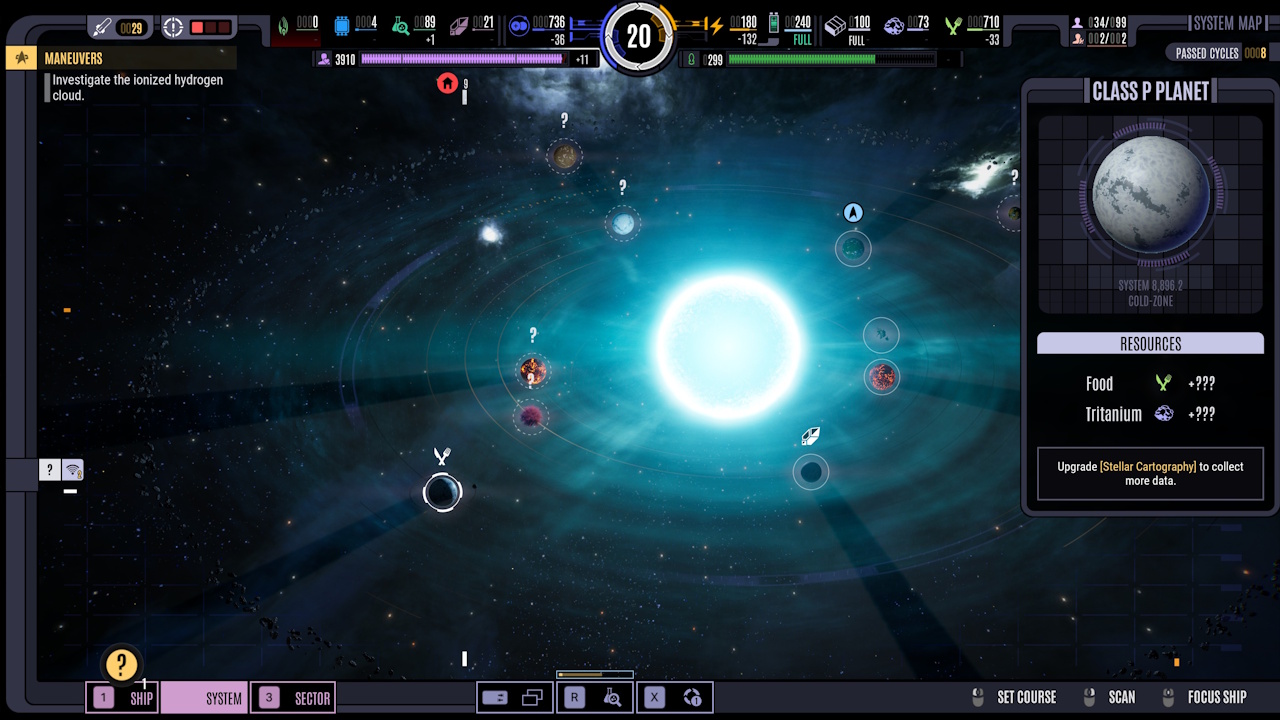
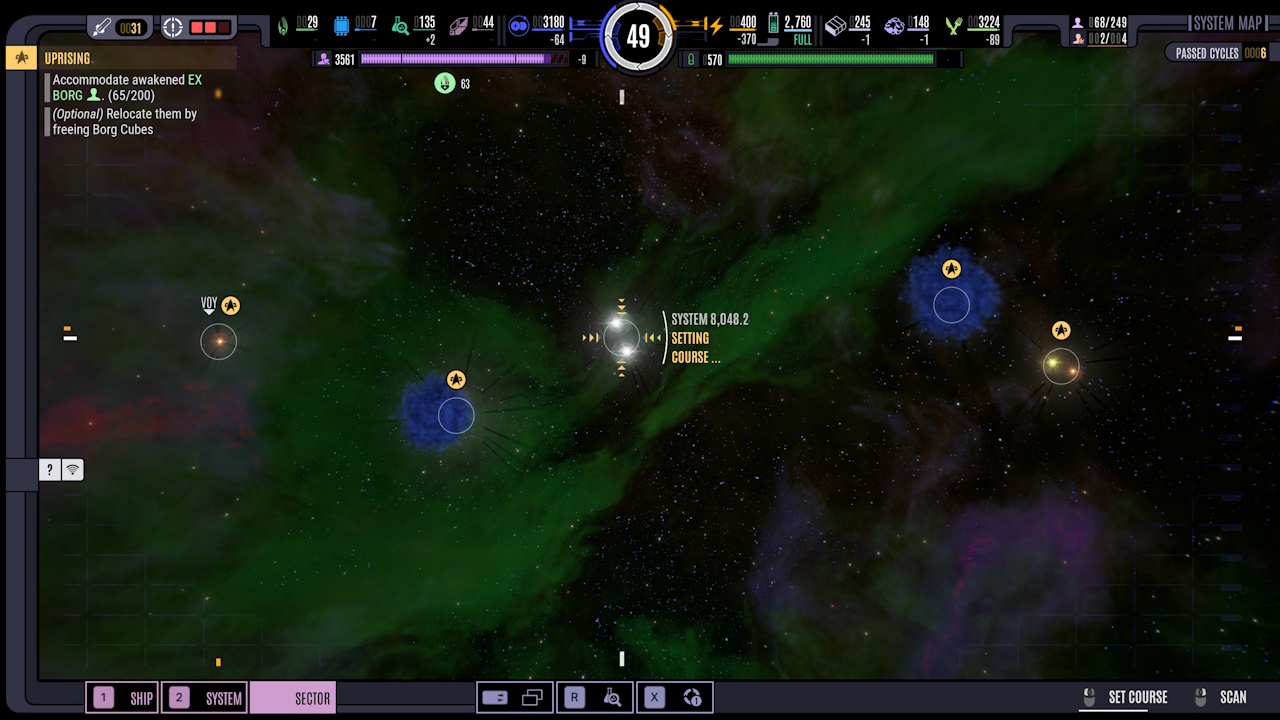
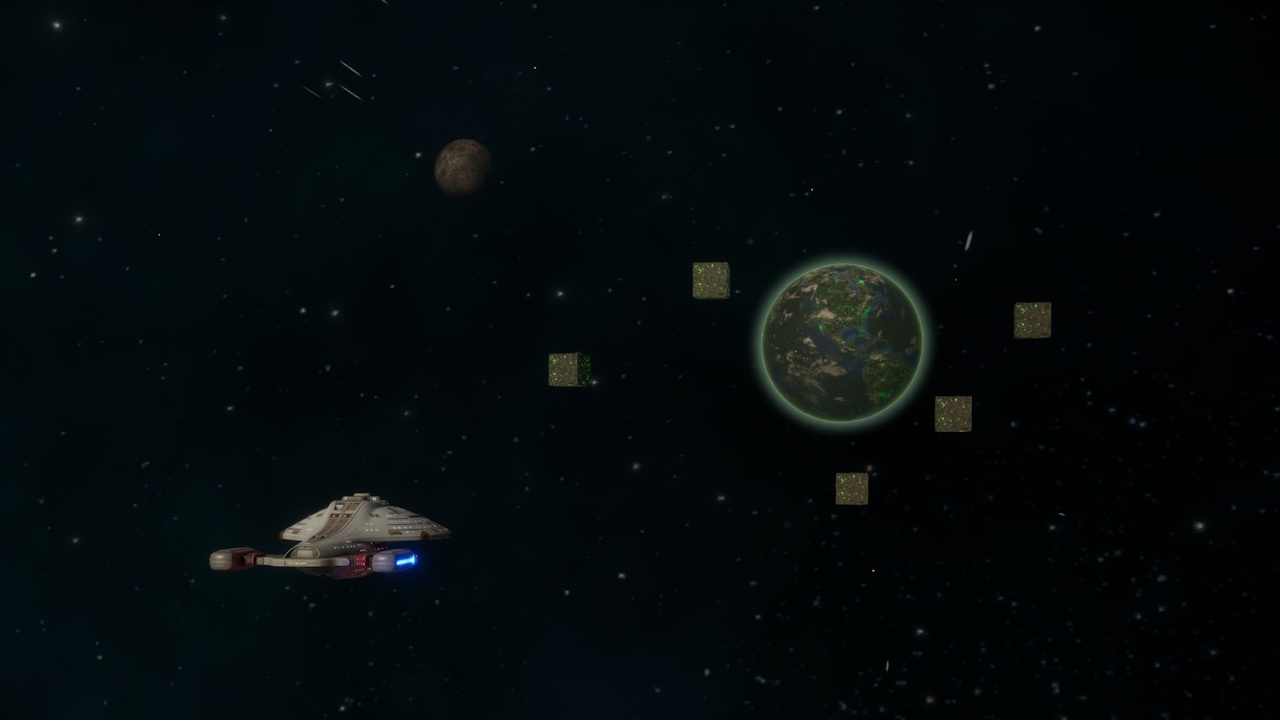
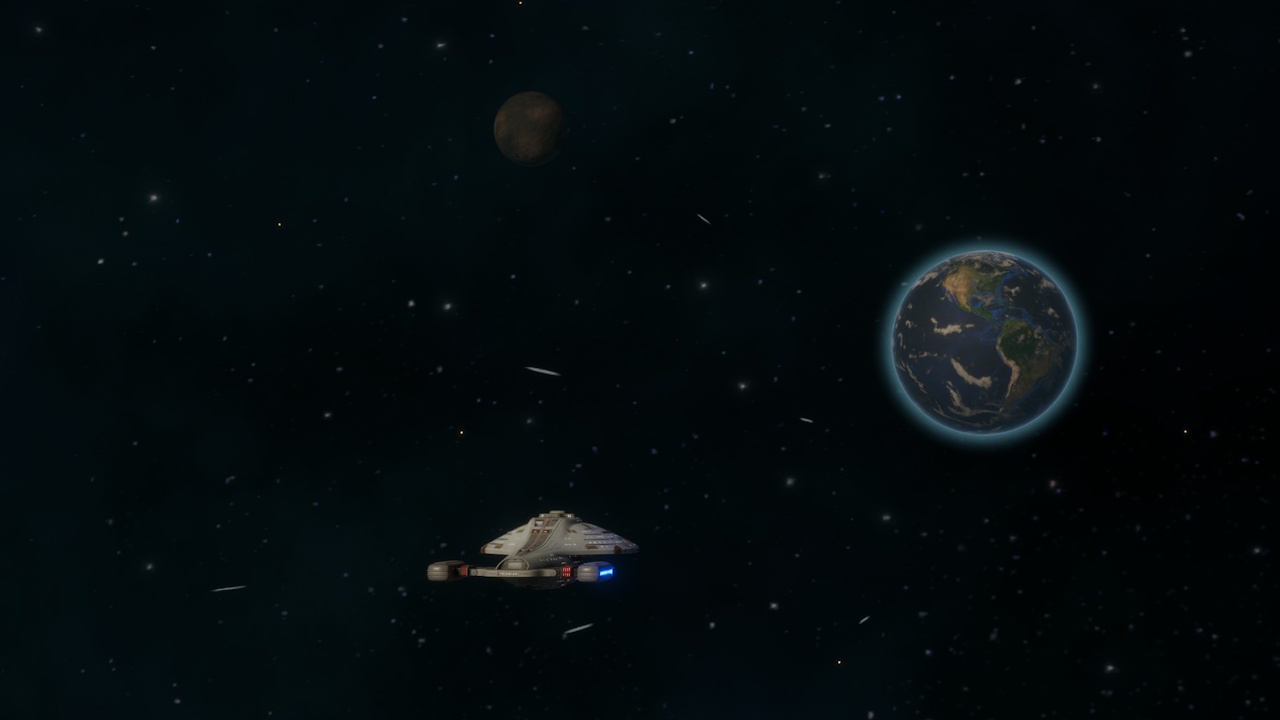
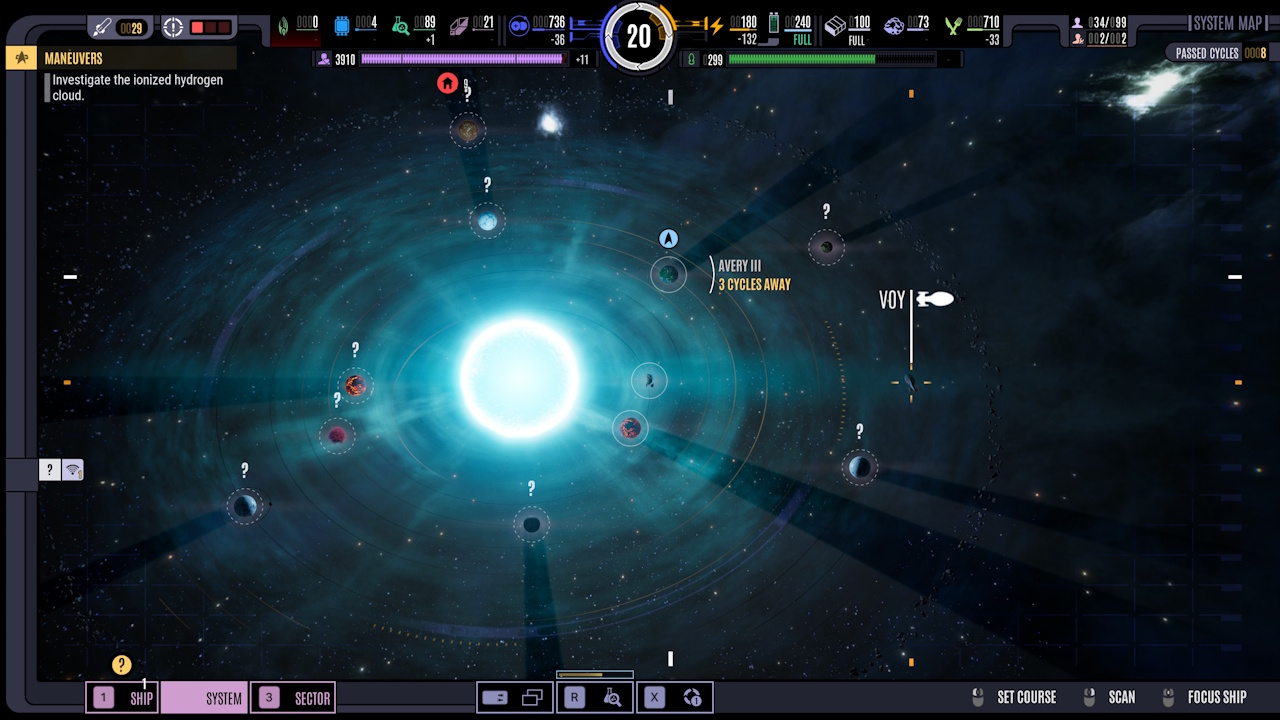
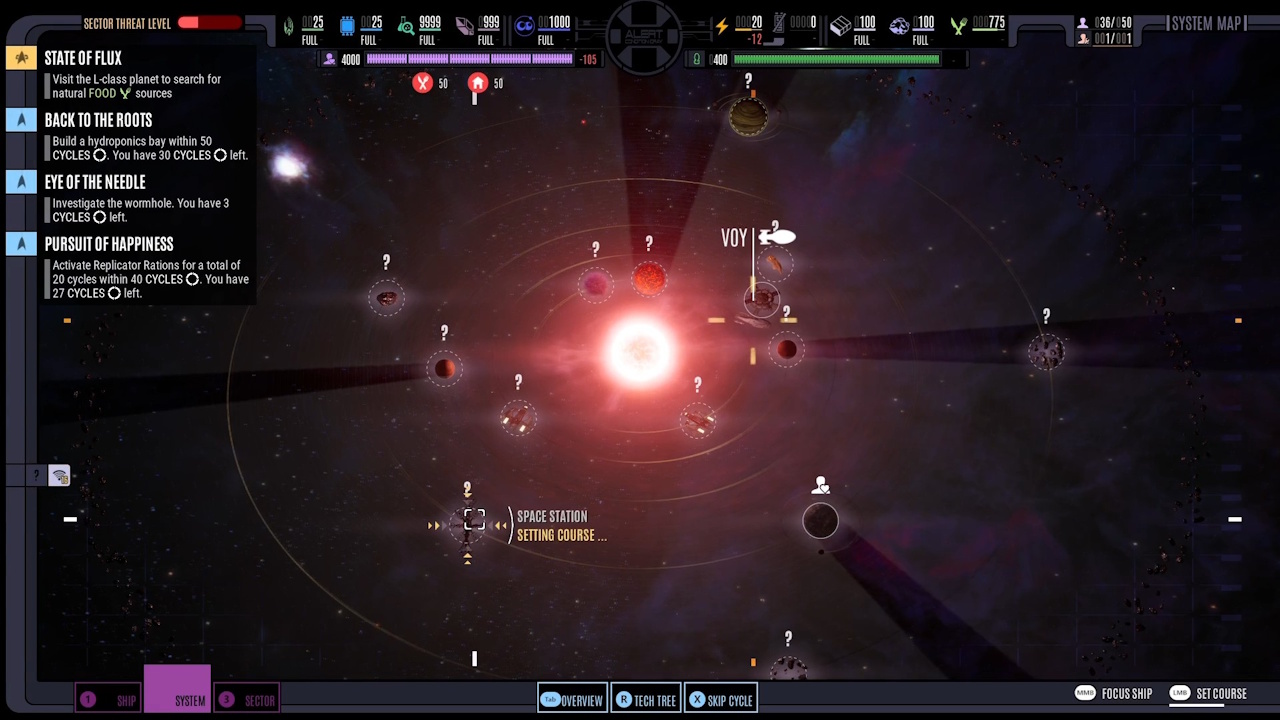
Screenshot of Star Trek: Voyager - Across The Unknown (demo version) showing the system view (and a tool-tip about cycles).
The system map (and a tool-tip showing details about cycles).

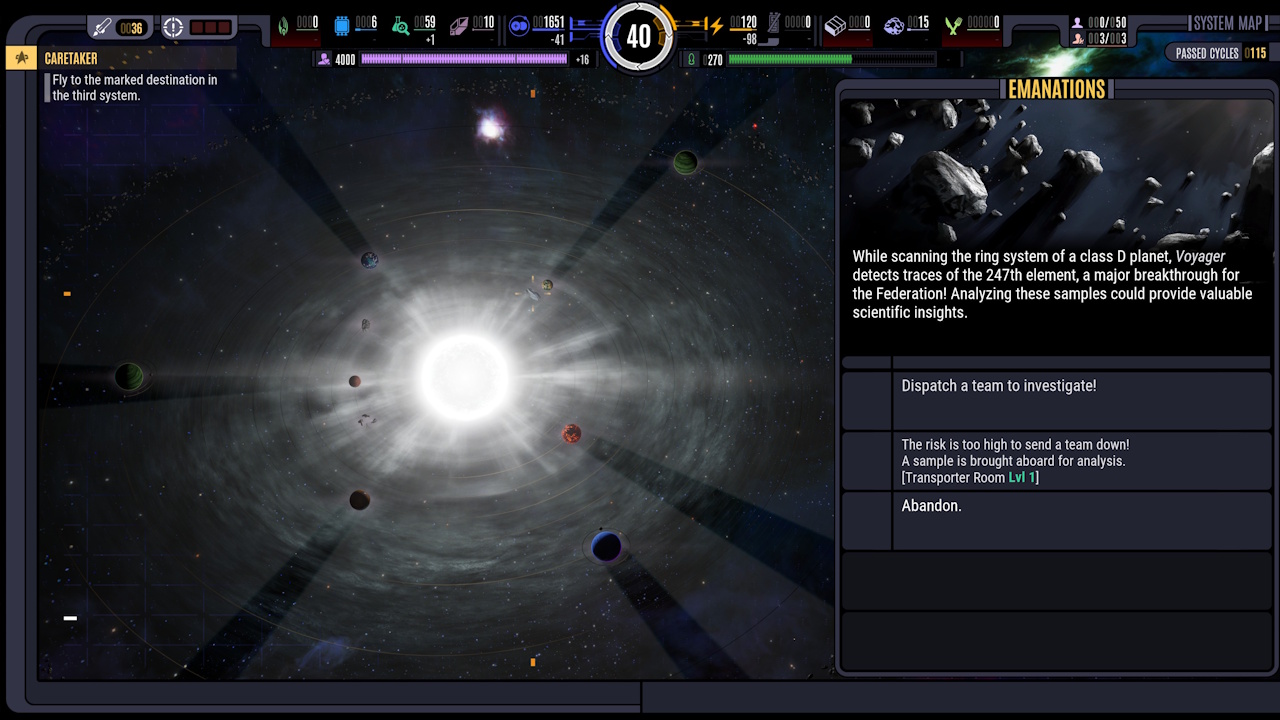
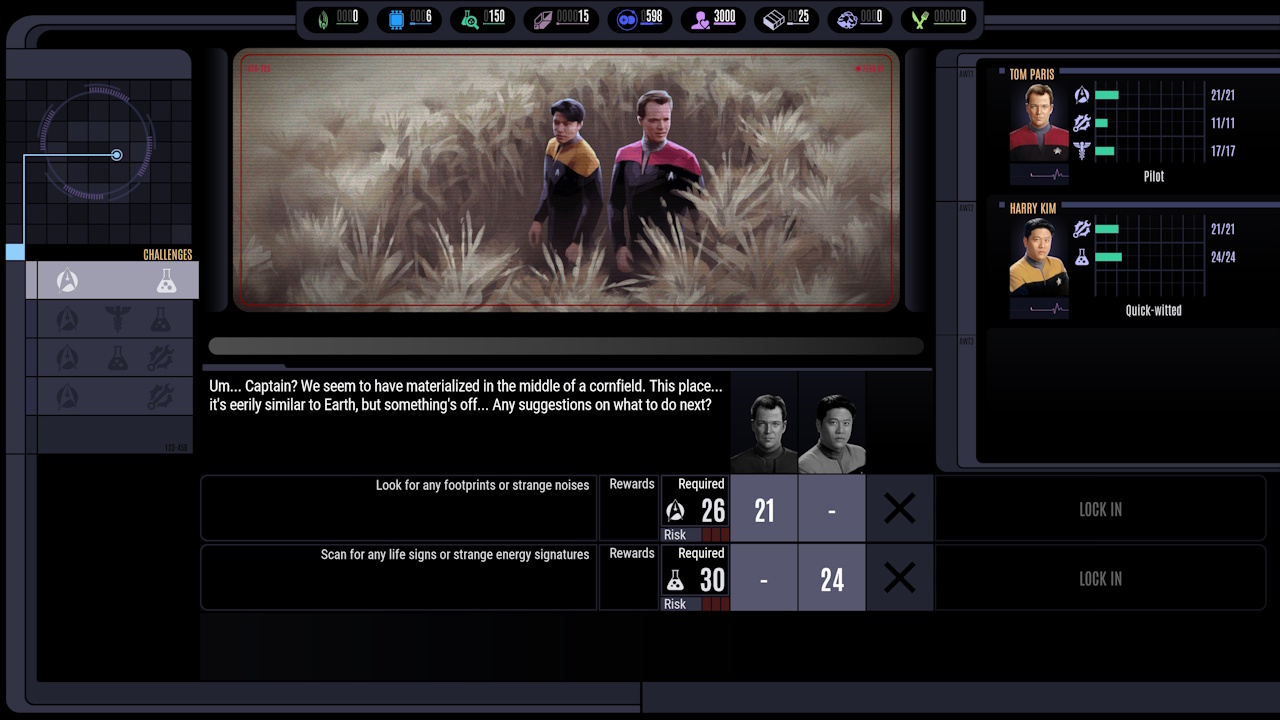
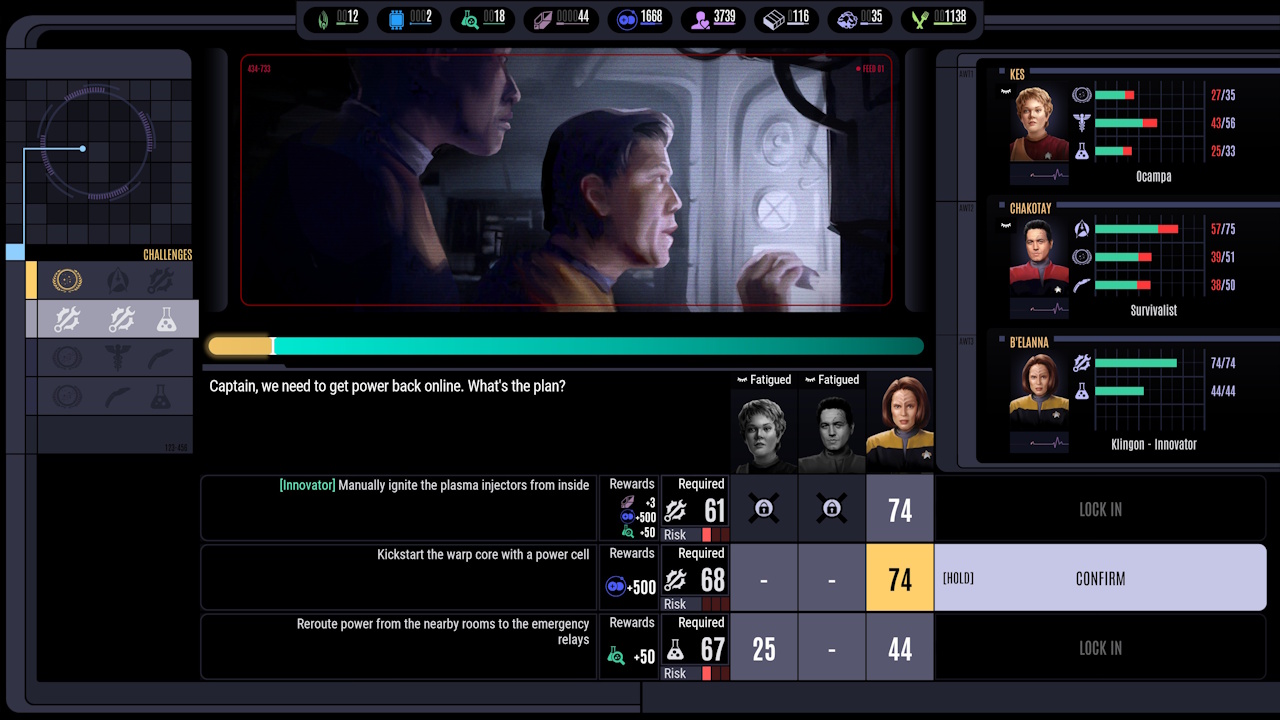
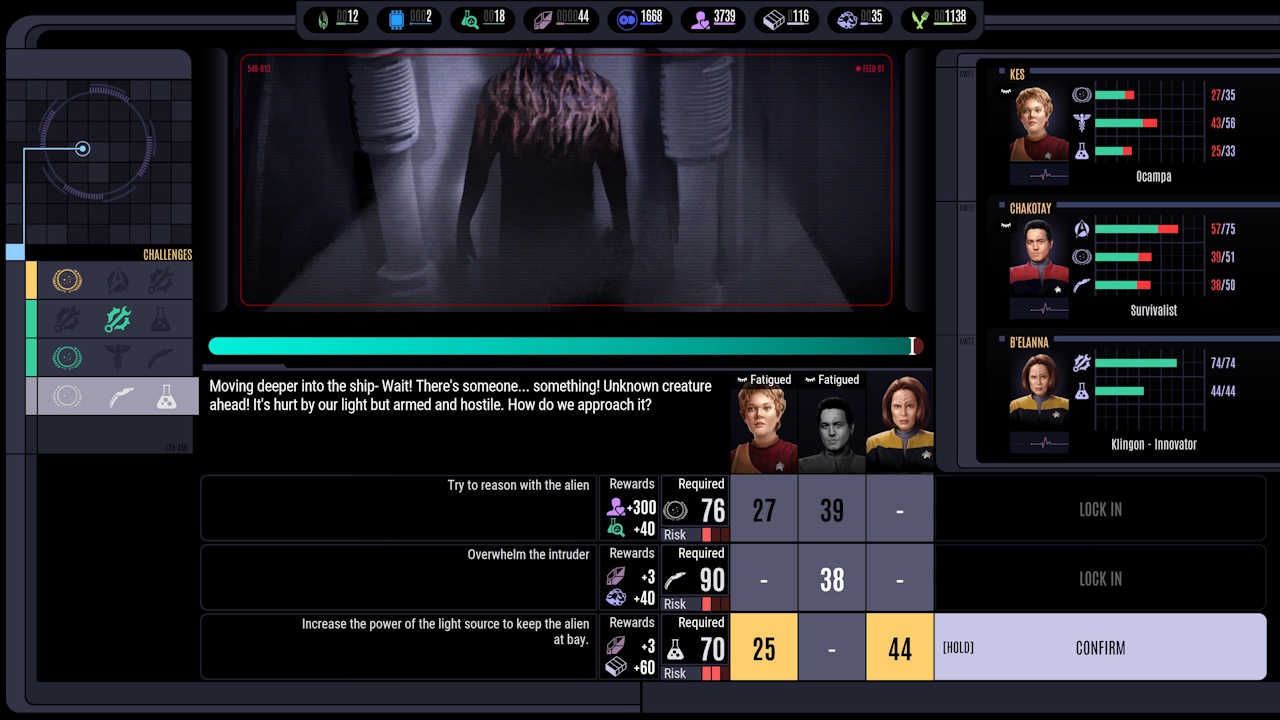
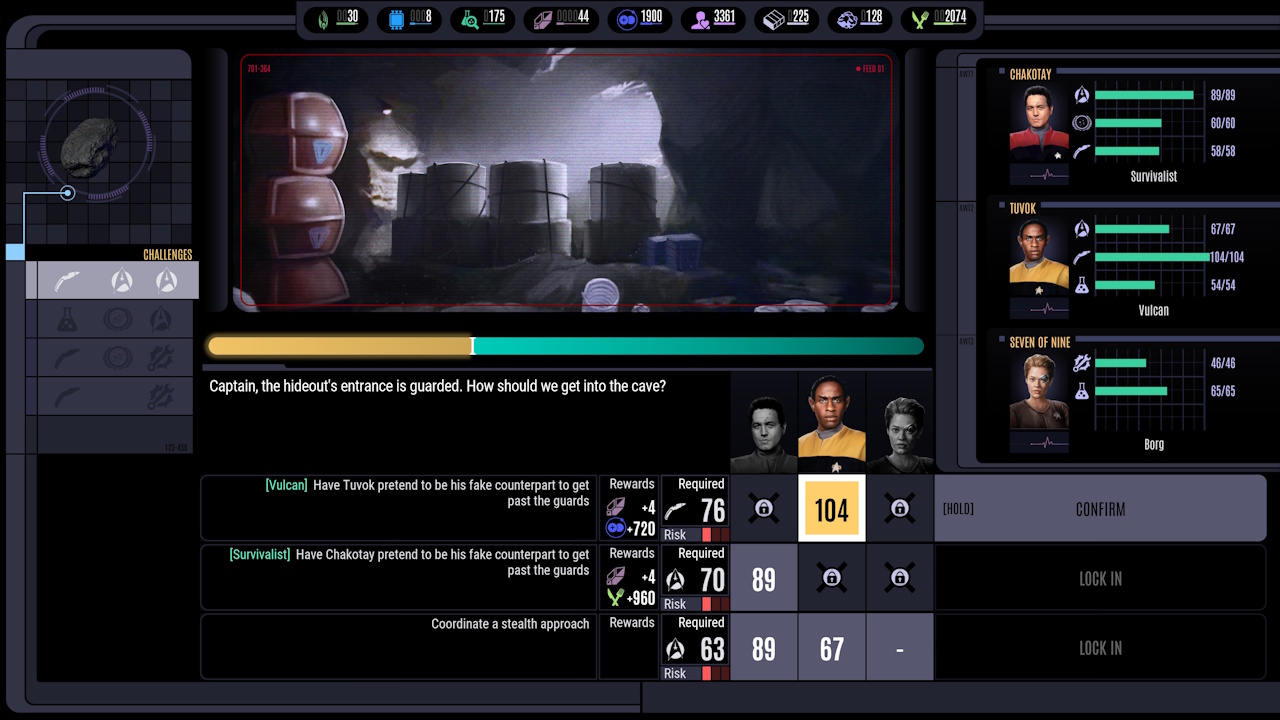
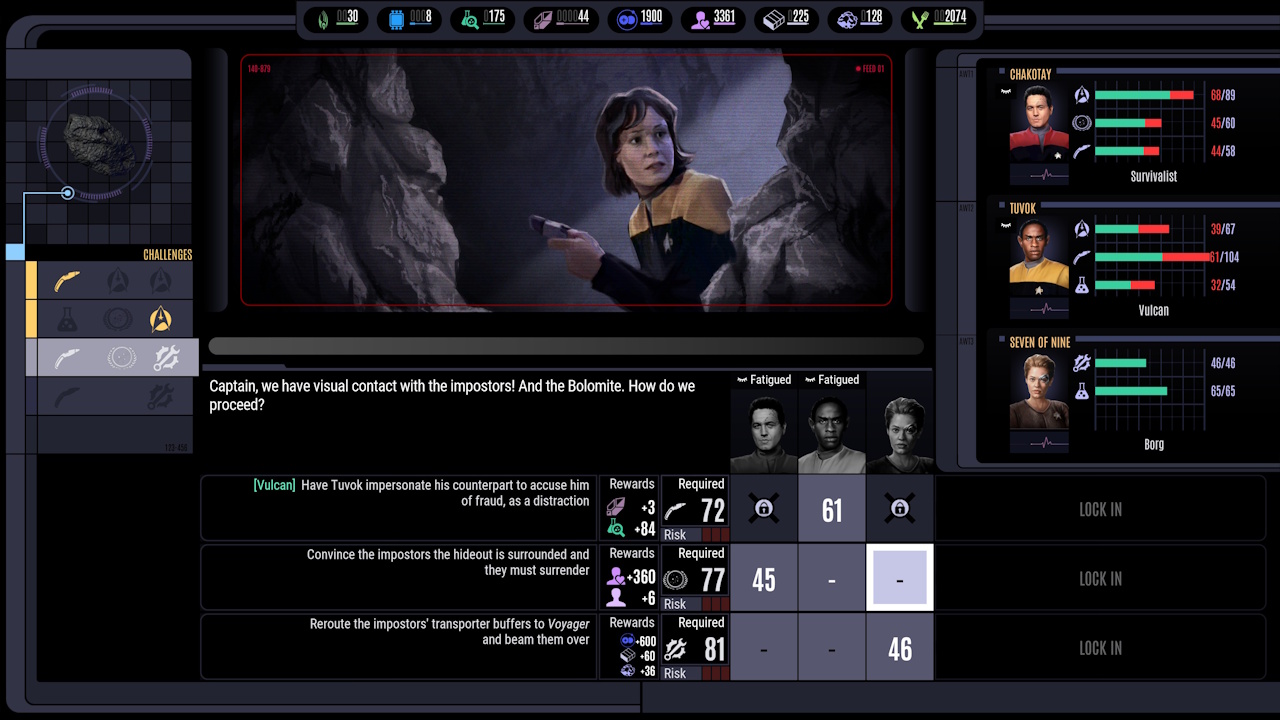
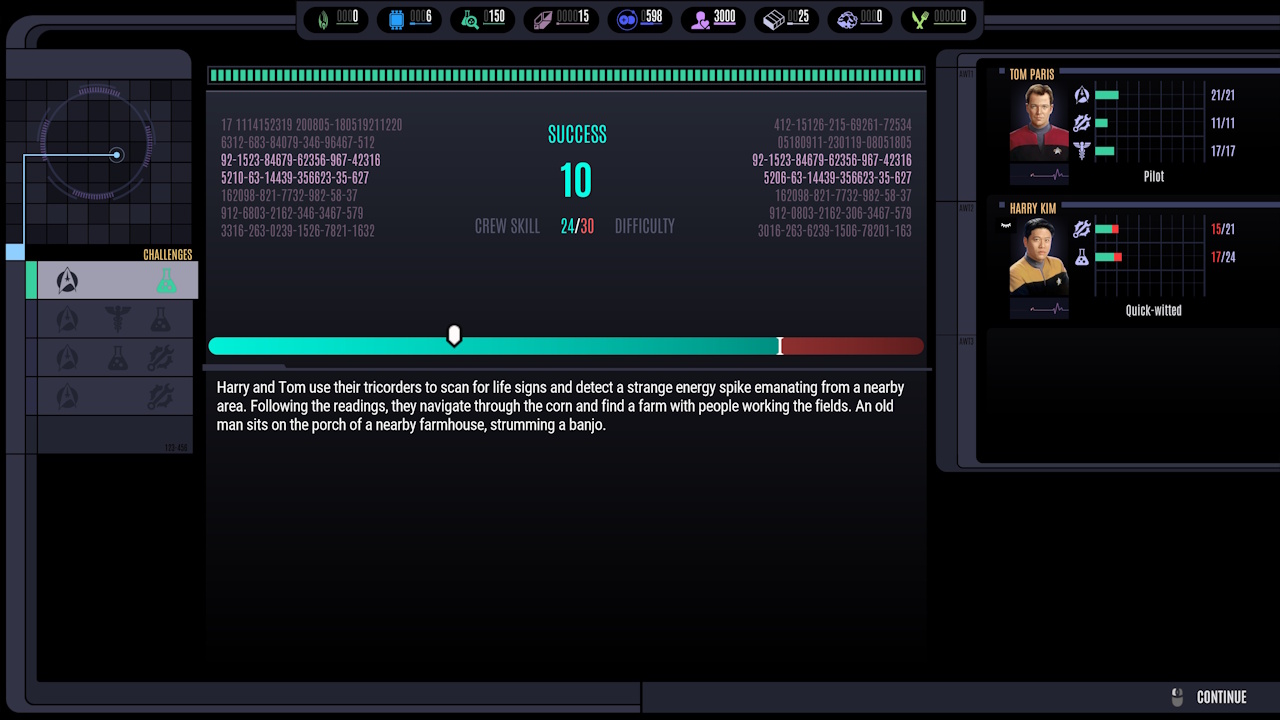
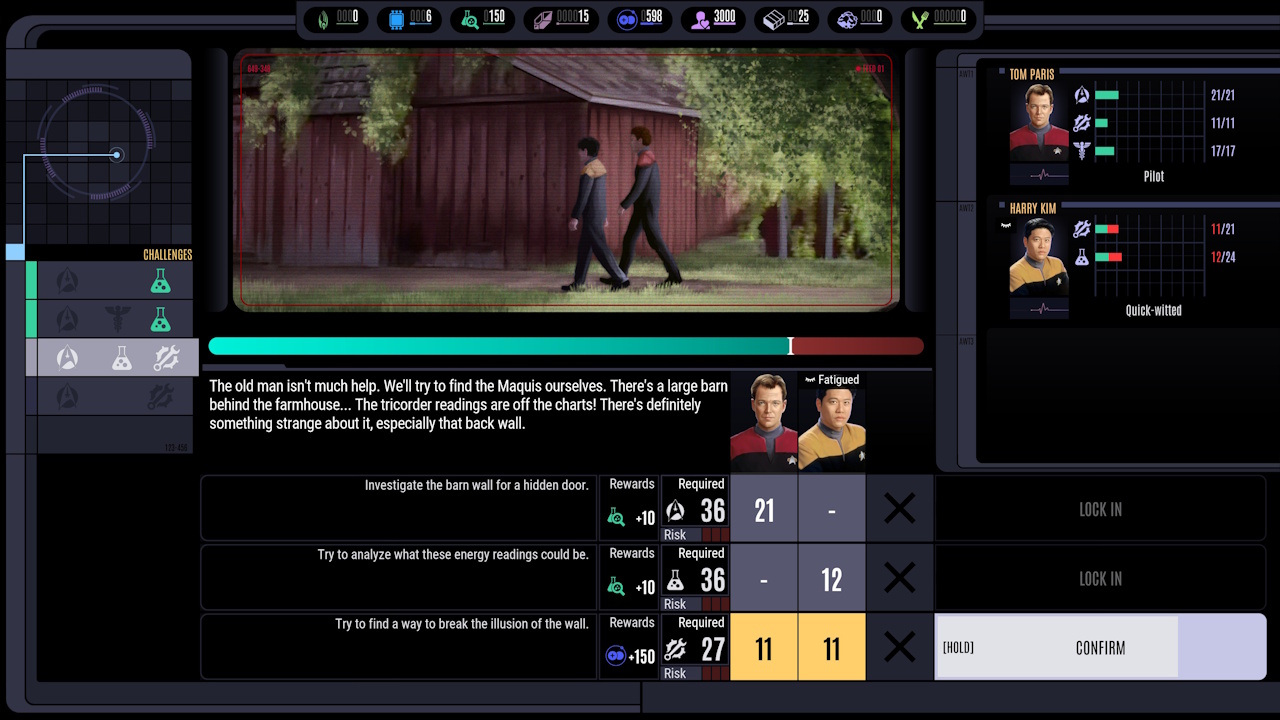
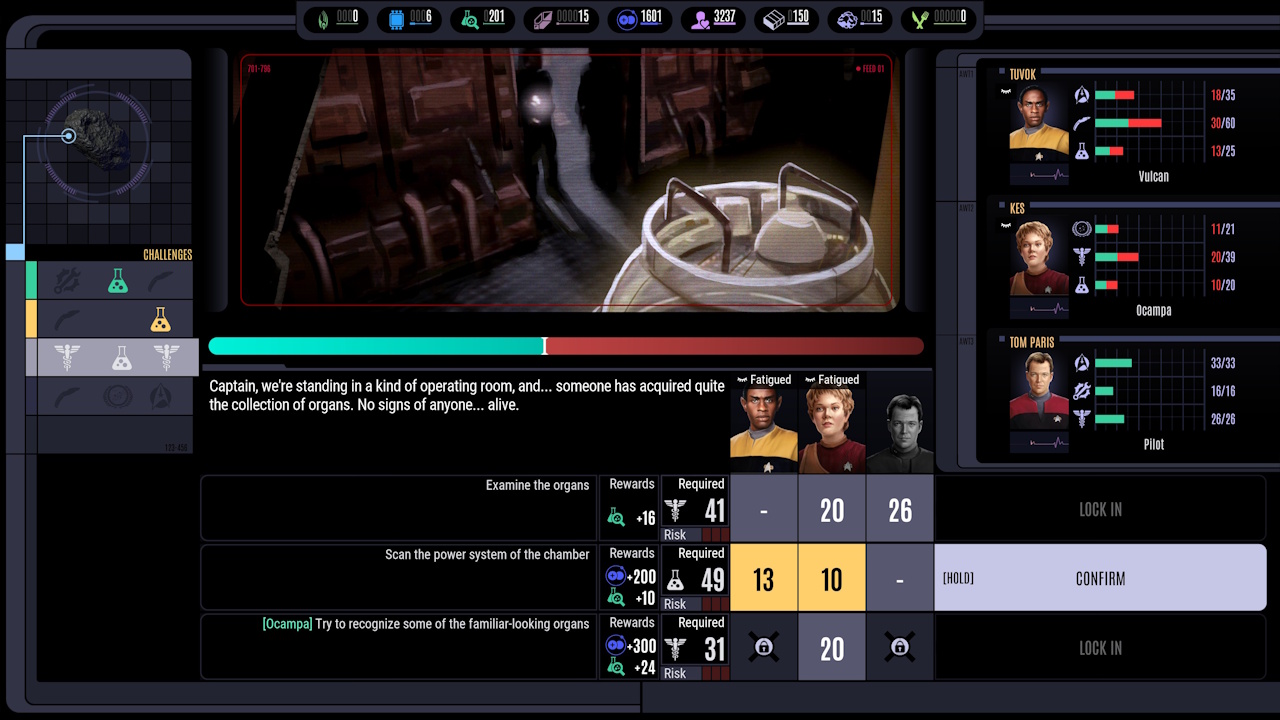
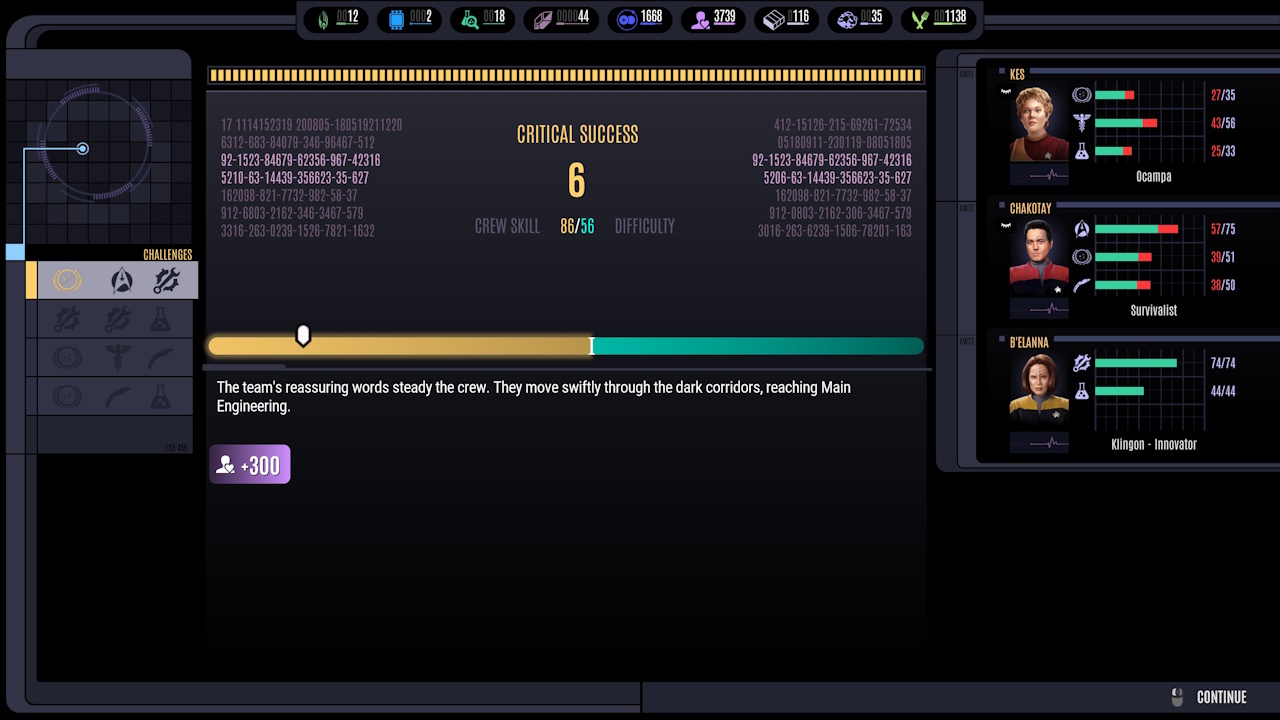
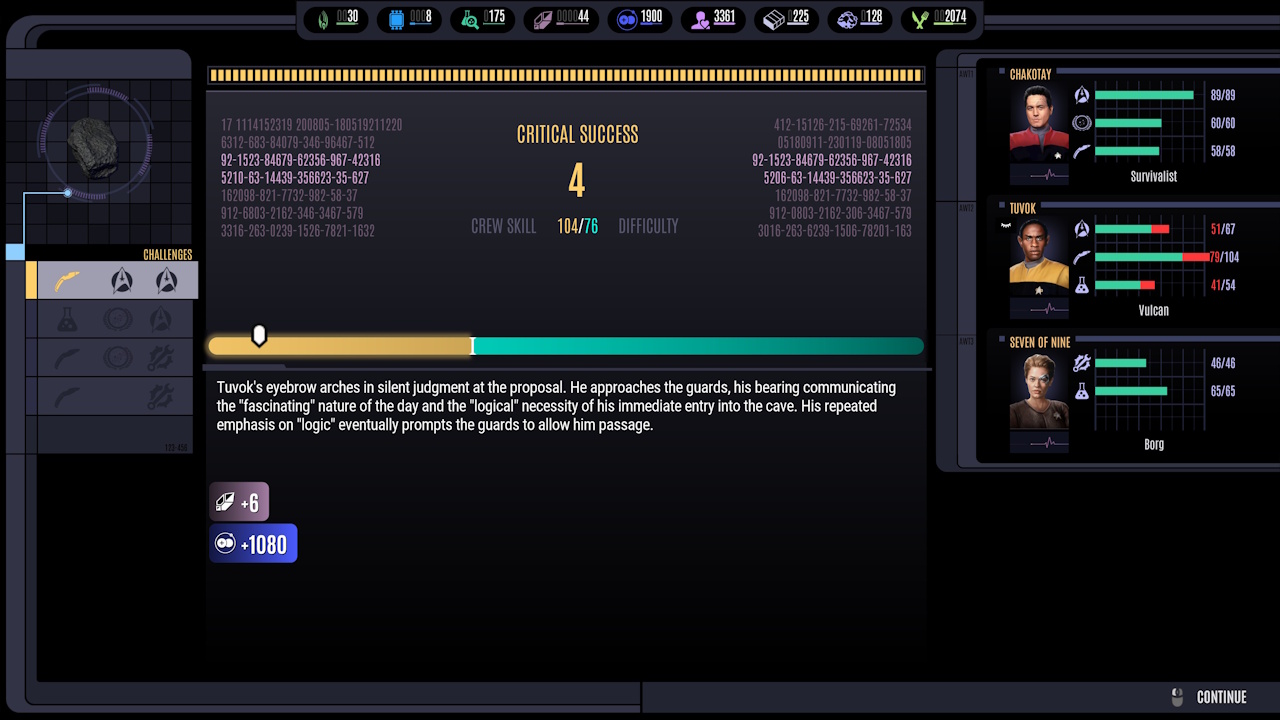
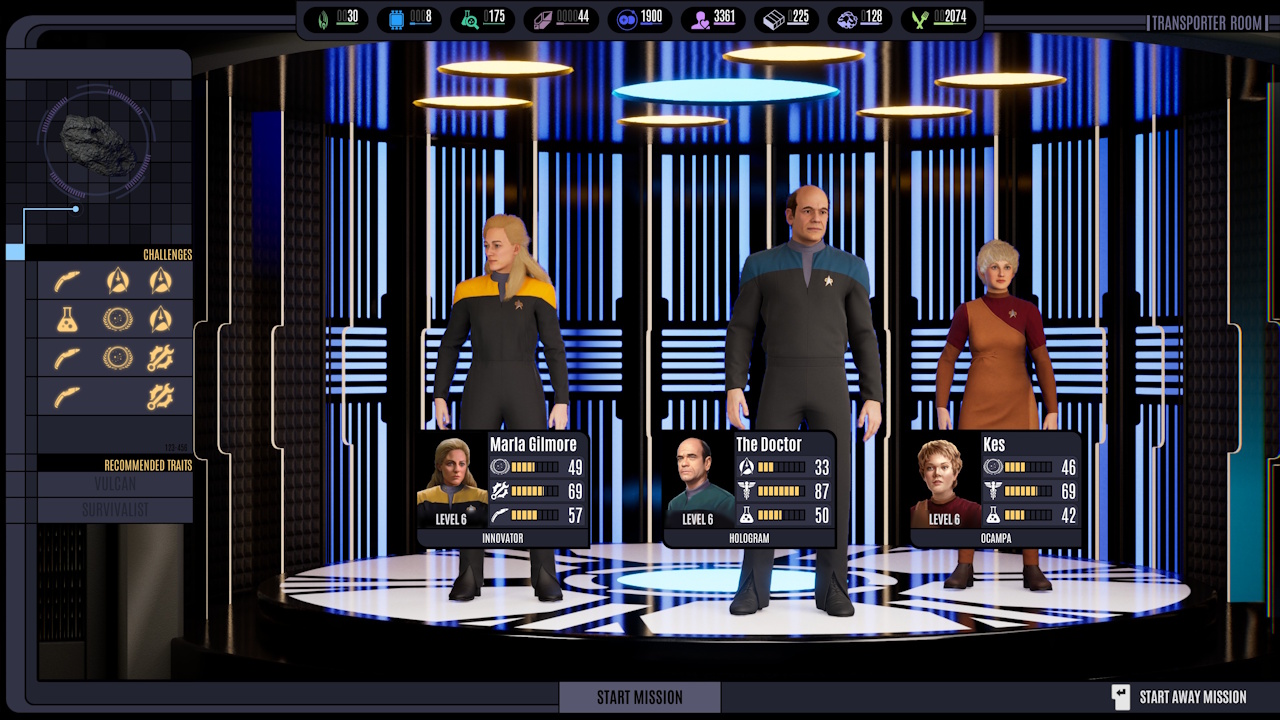
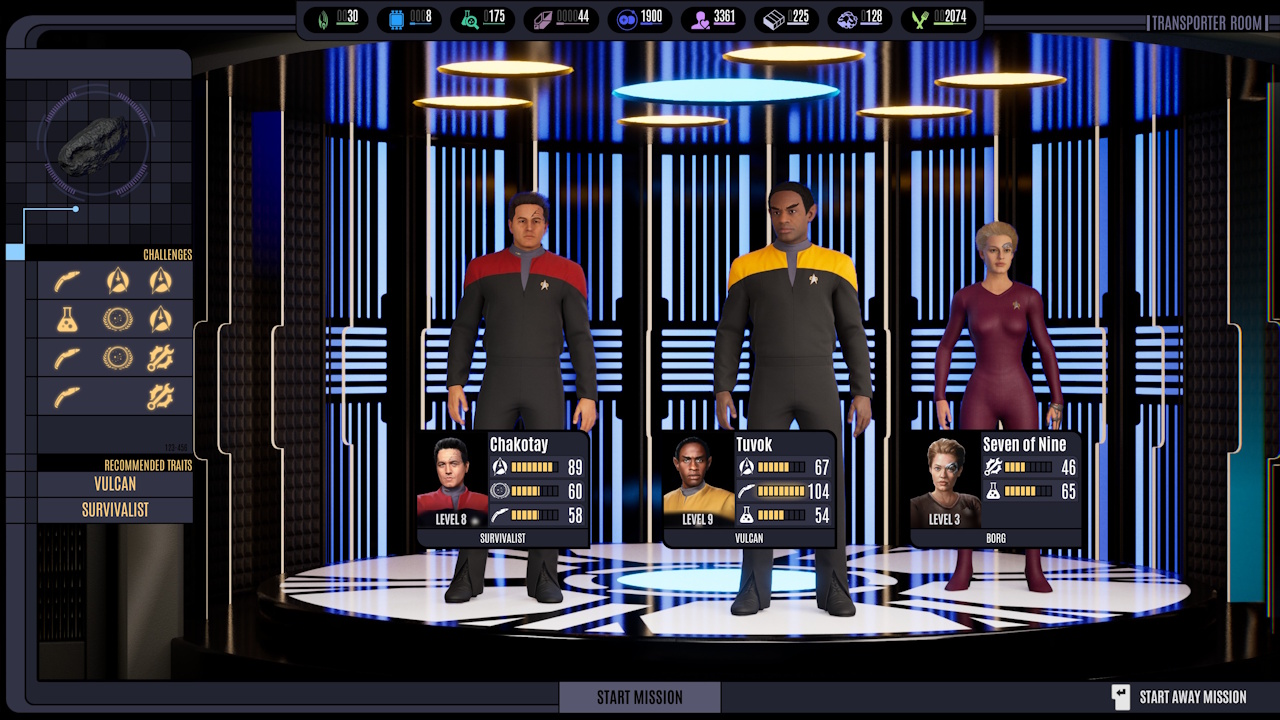
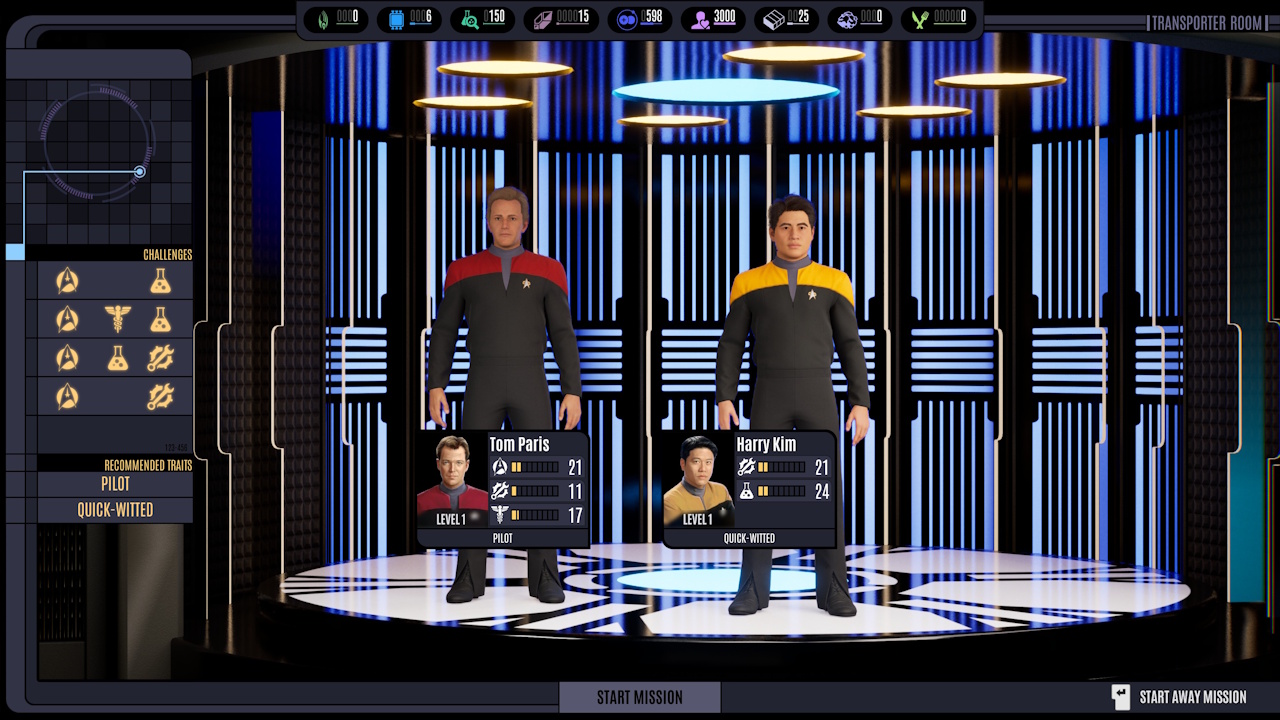
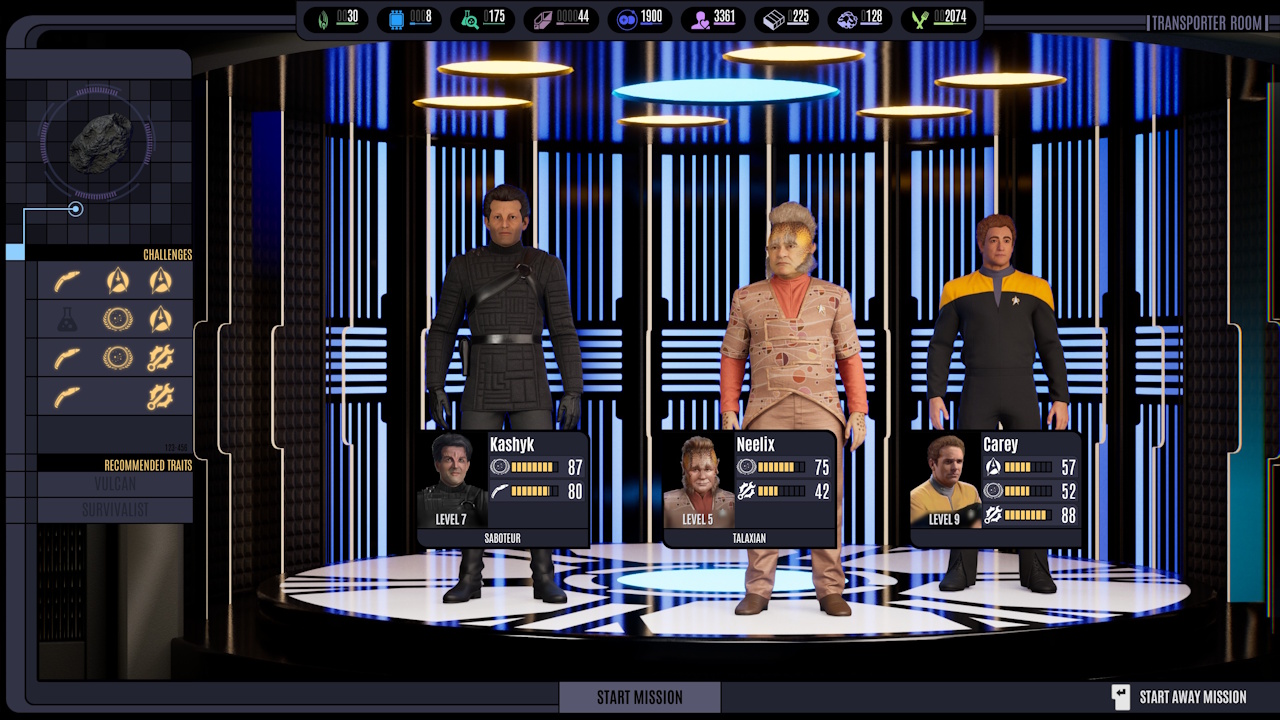
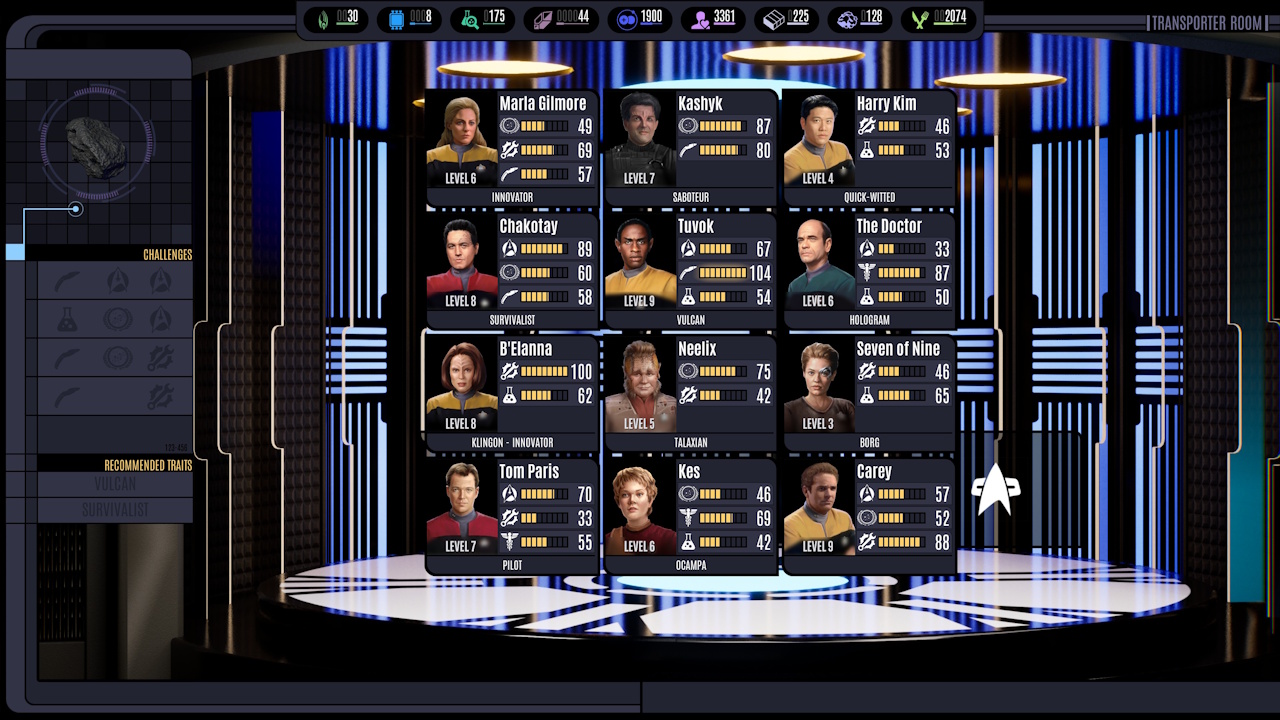
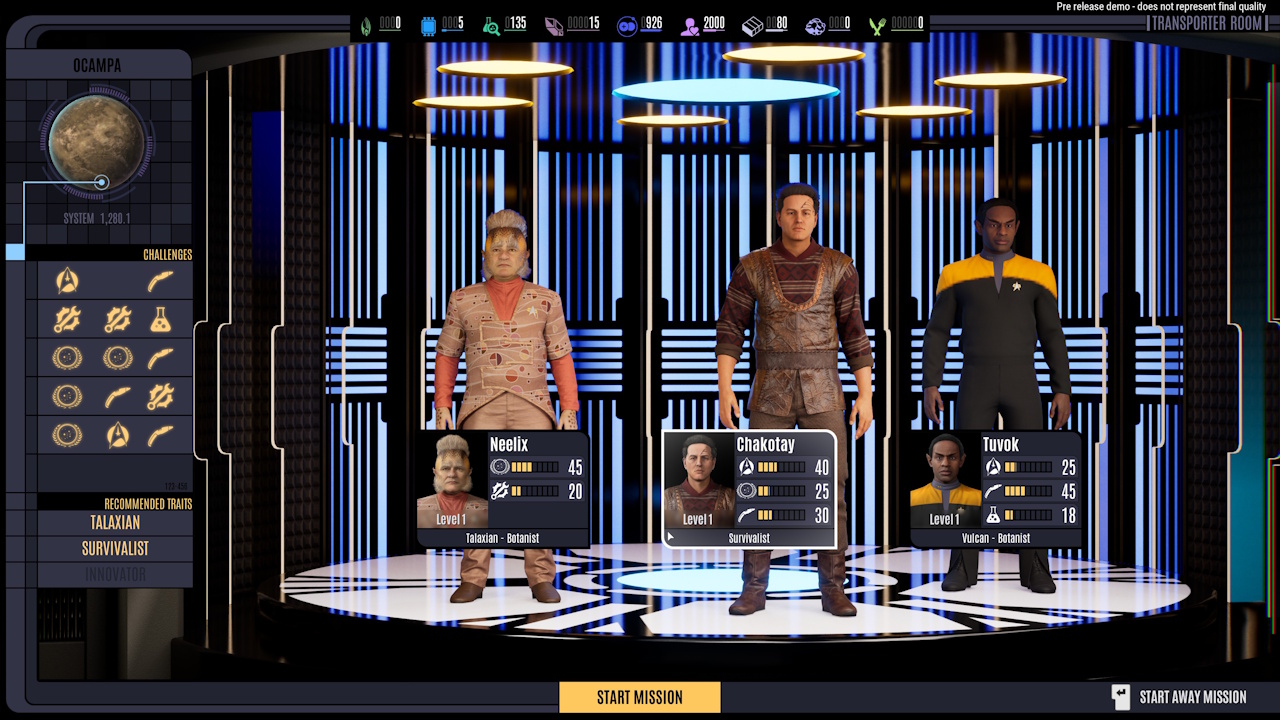
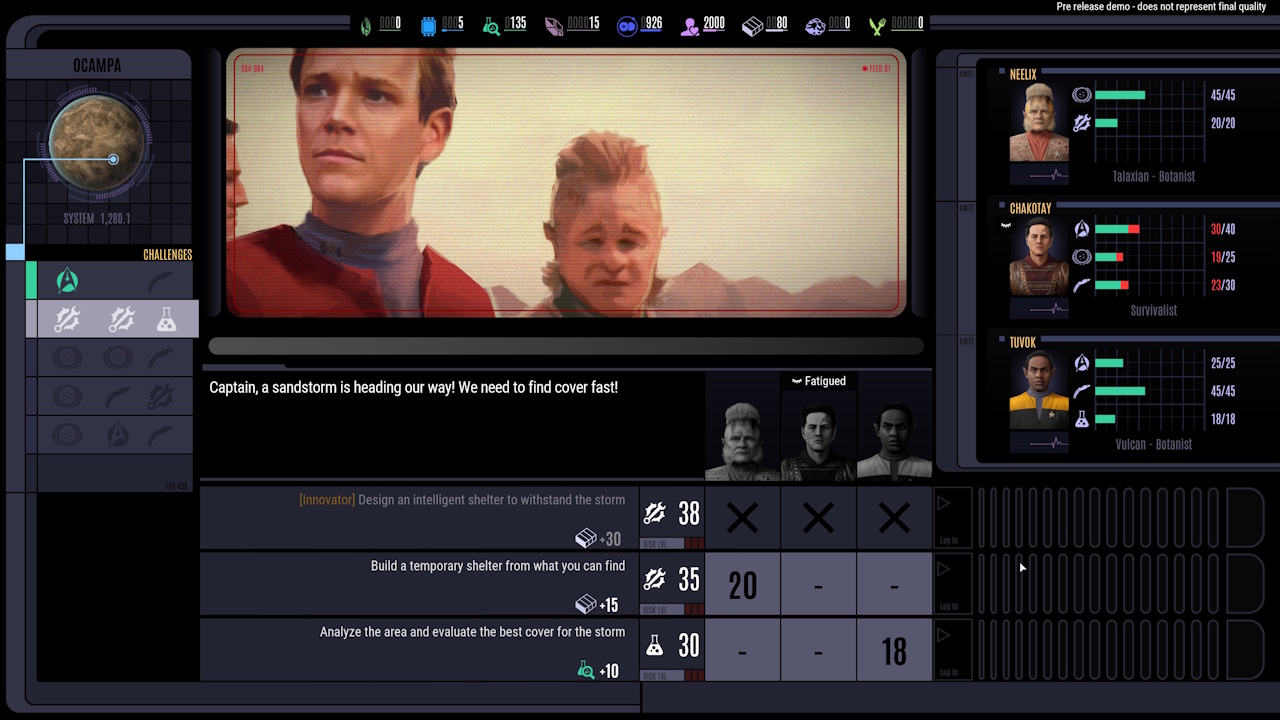
Away missions provide one of the ways to make a lot of different choices. Given that the demo is based on Caretaker, I was surprised that Captain Janeway wasn’t able to join any of the away missions to the Array or to Ocampa, and I wonder if that’s going to be a limitation throughout the game. I hope not, but I thought it was worth mentioning. I tried to use a selection of different characters when I could, just to get a different experience with the away missions that I had available.

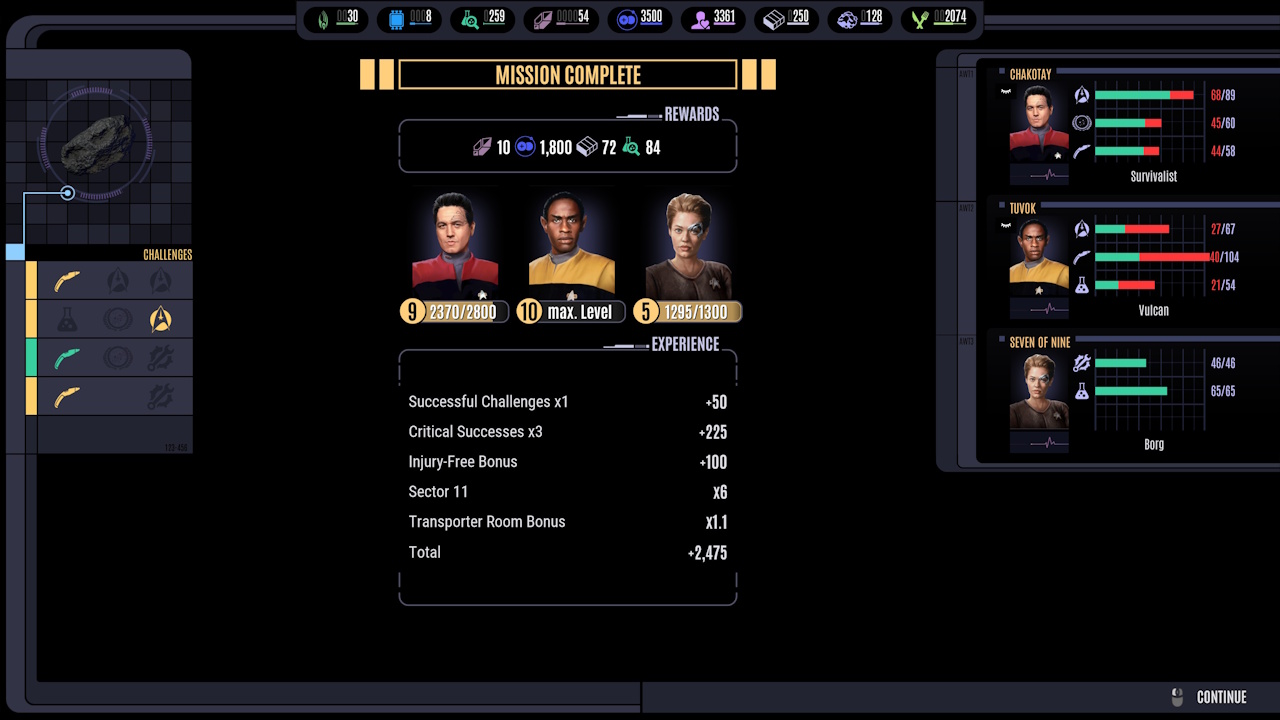
Each away mission gives individual characters a chance to gain experience and level up – meaning they’ll be better the longer they stick around and the further into the game you get. The tutorial mentioned that some choices, if they go awry, can be fatal. That wasn’t something I experienced in the demo, but it’s interesting to know that even some named characters can, potentially, be killed off at a very early stage – or at any point throughout the run.

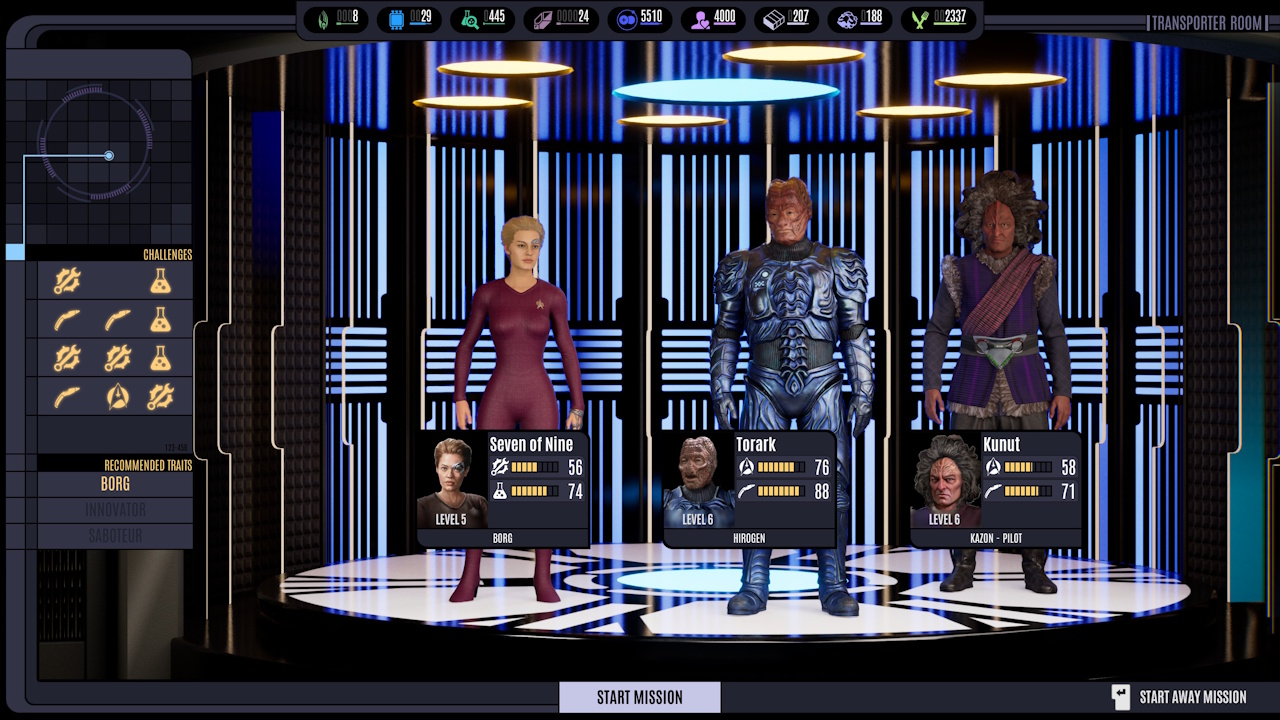
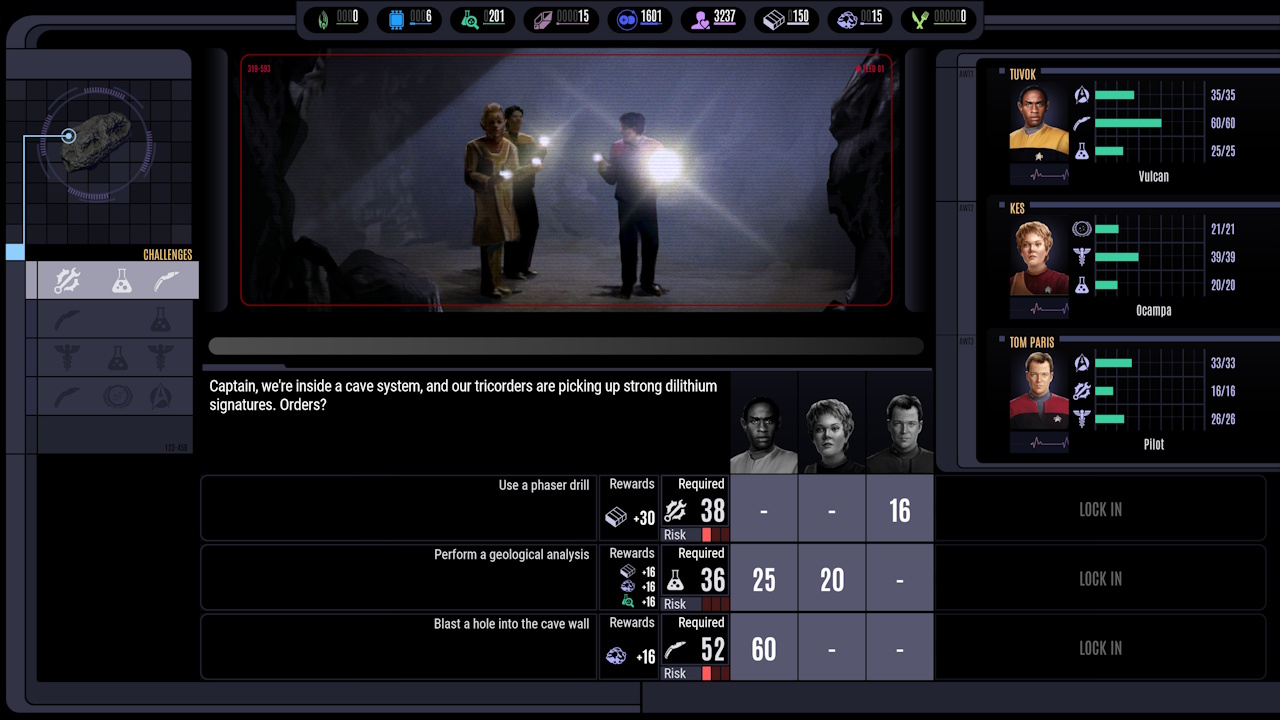
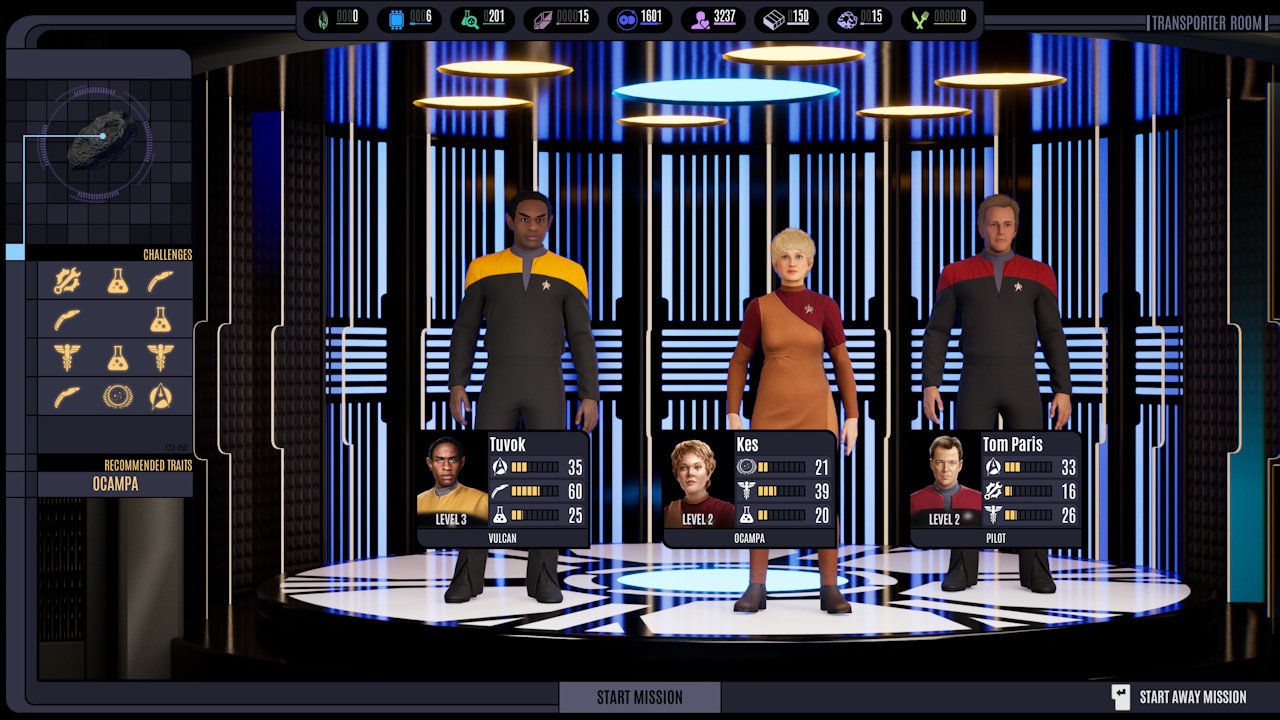
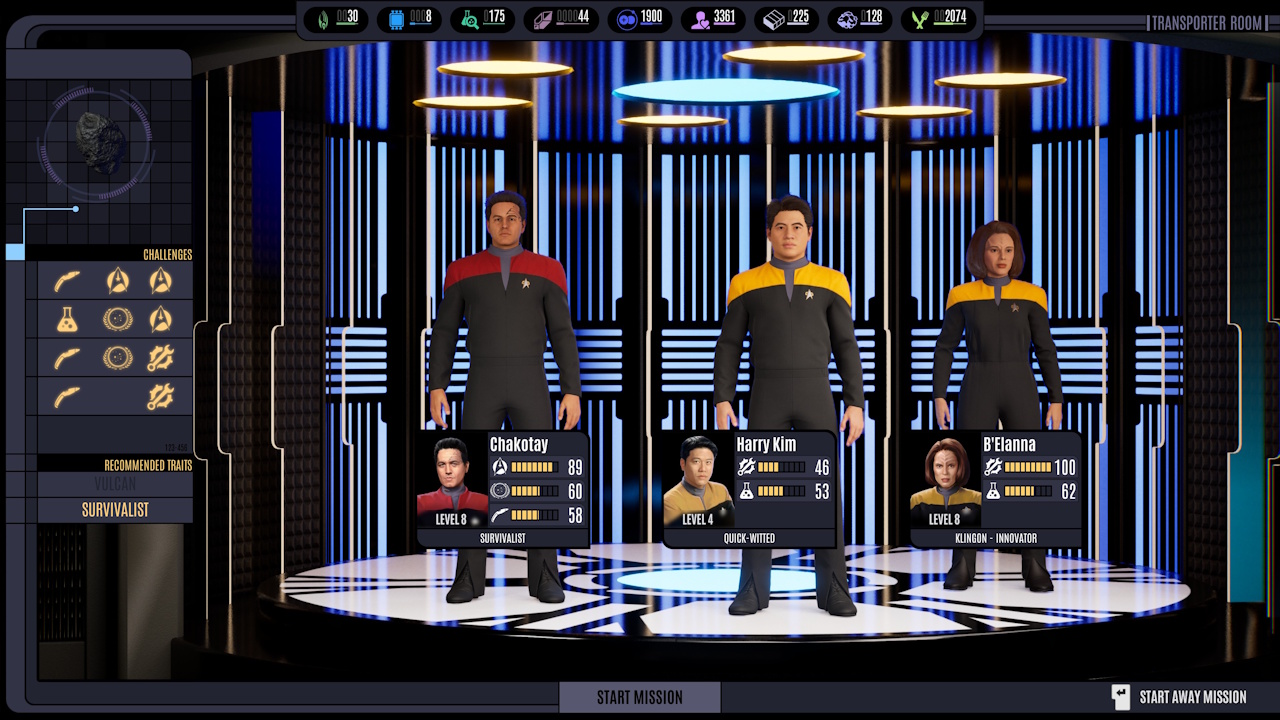
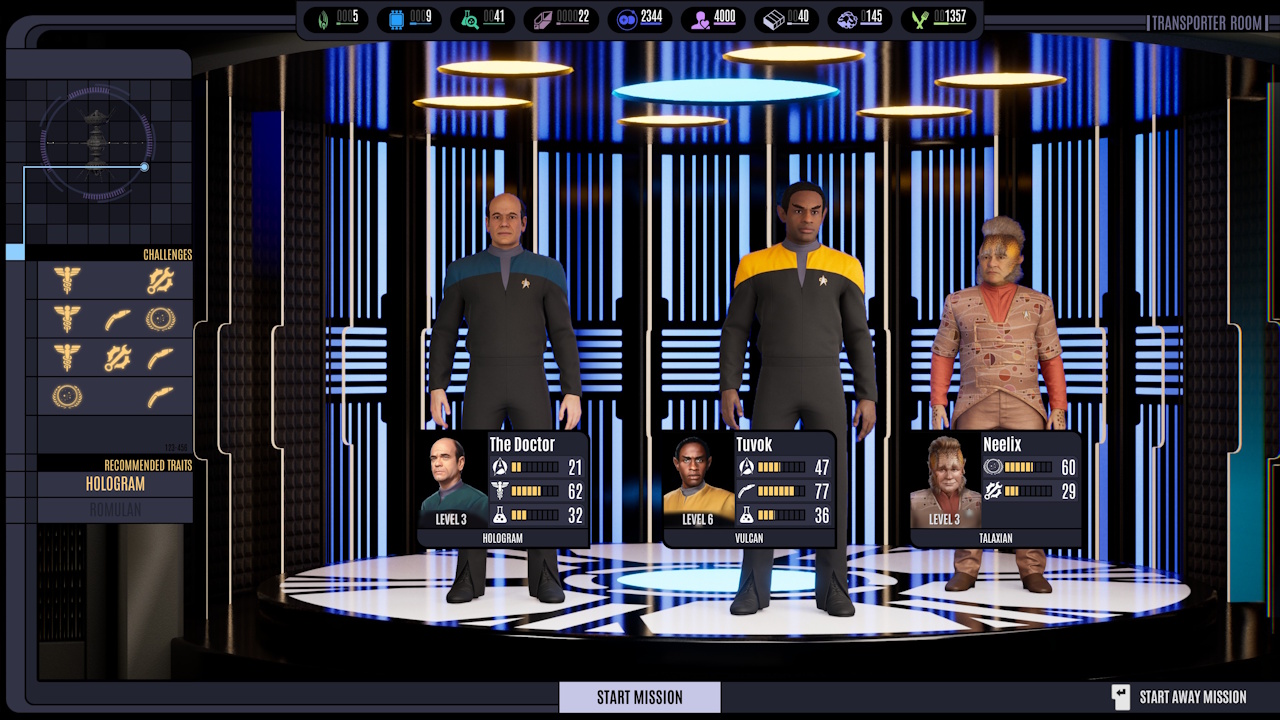
Screenshot of Star Trek: Voyager - Across The Unknown (demo version) showing an away team on the transporter pad.
Selecting crew members for an away mission.

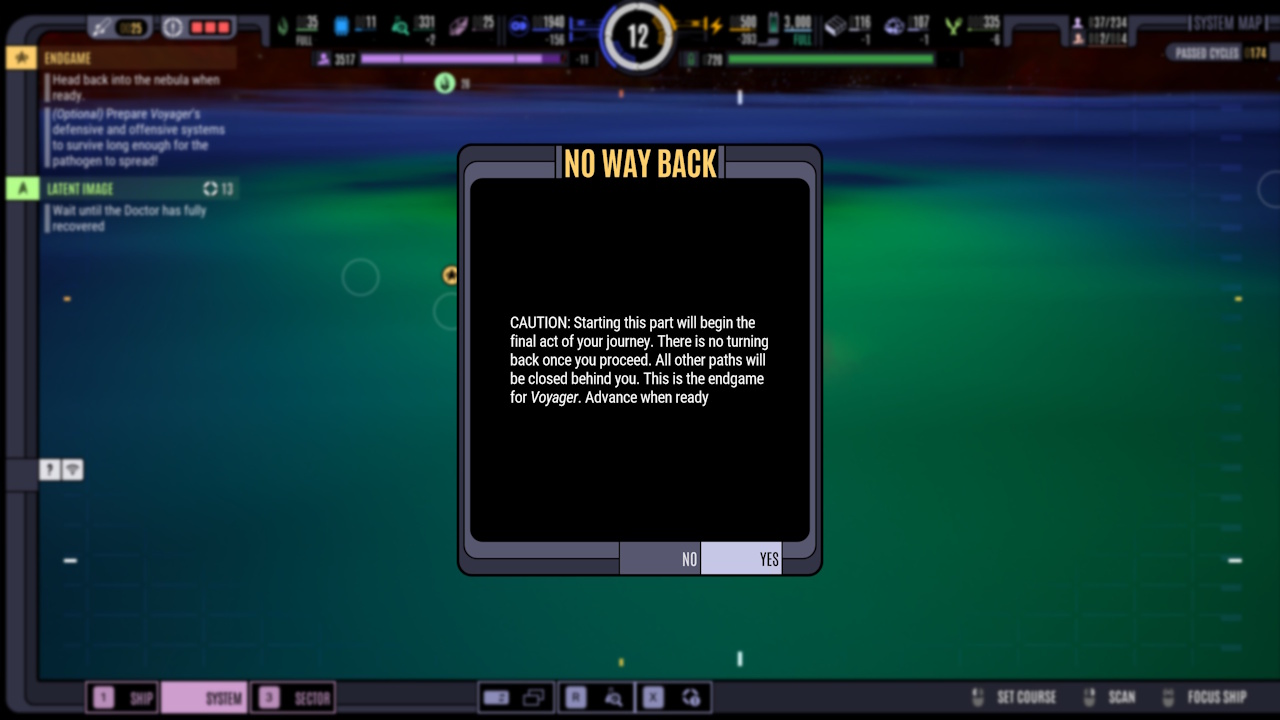
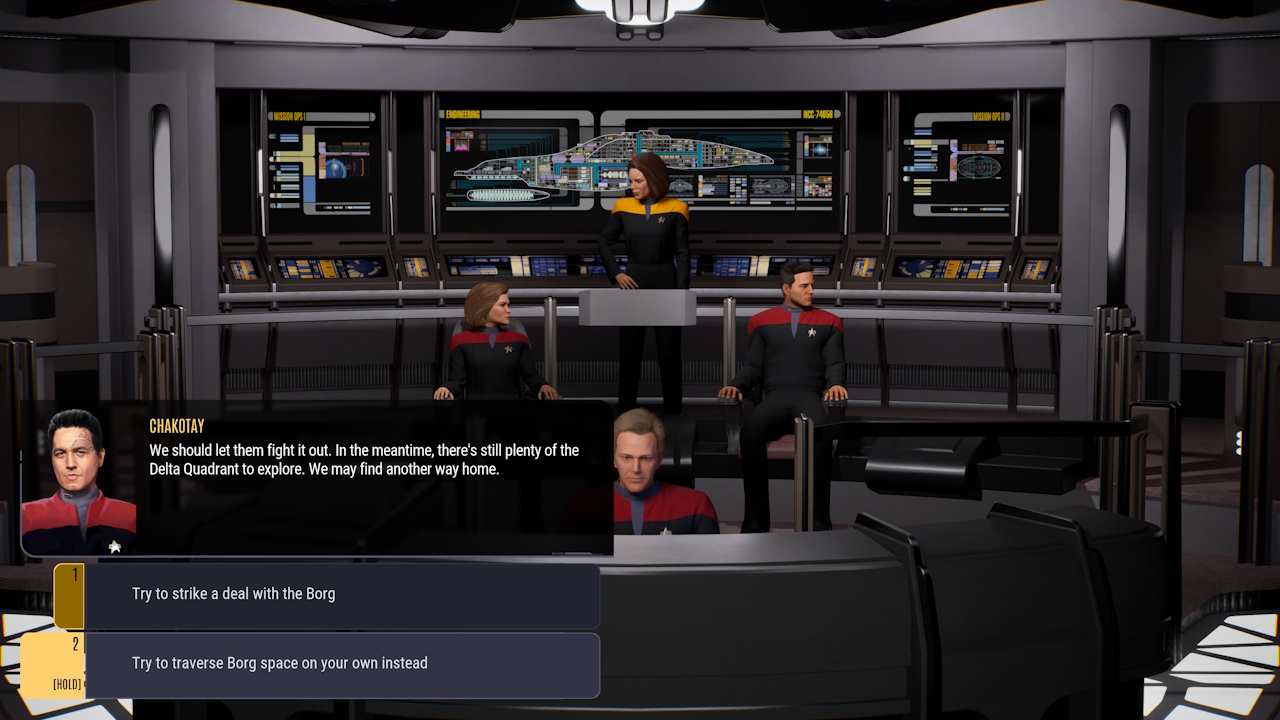
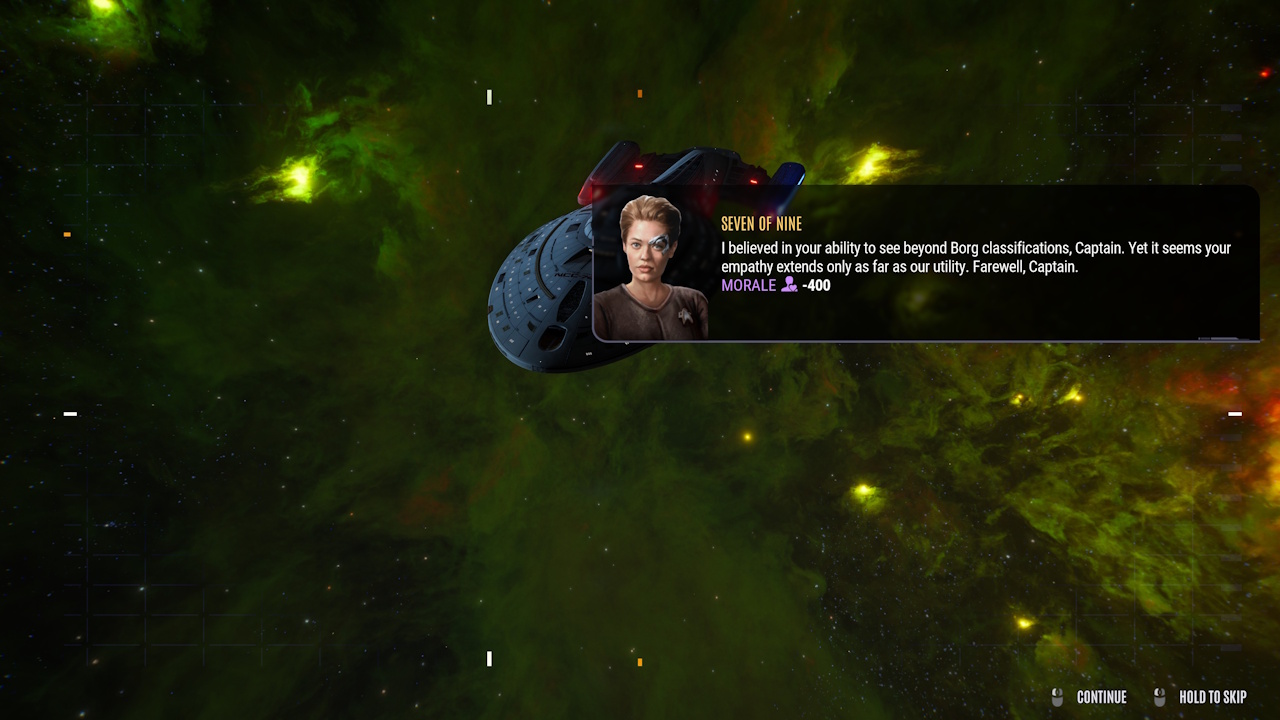
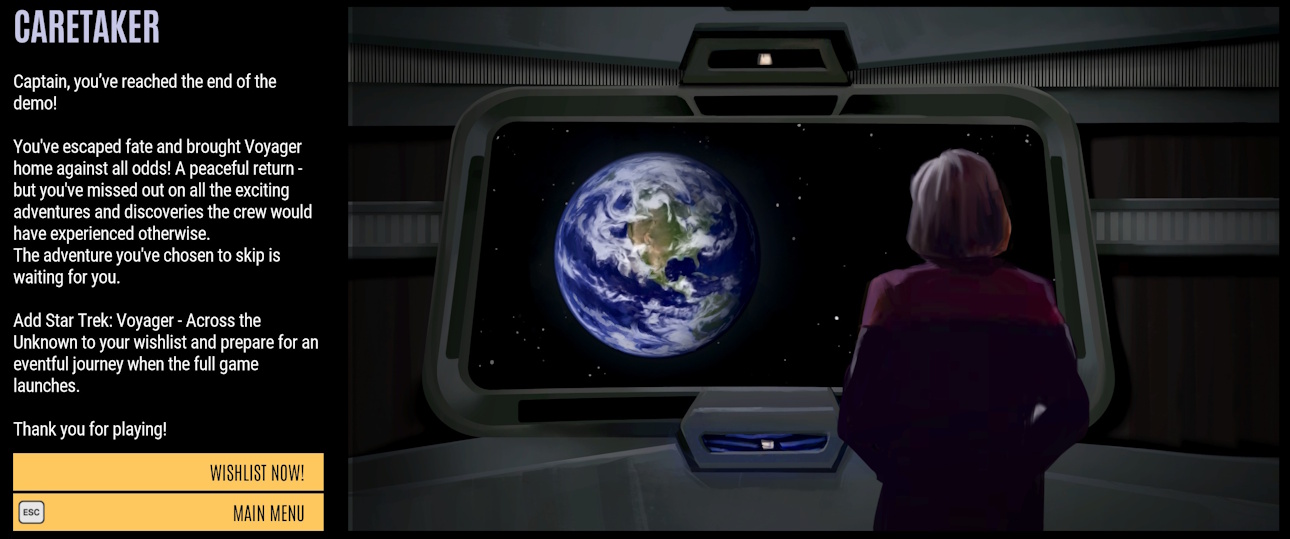
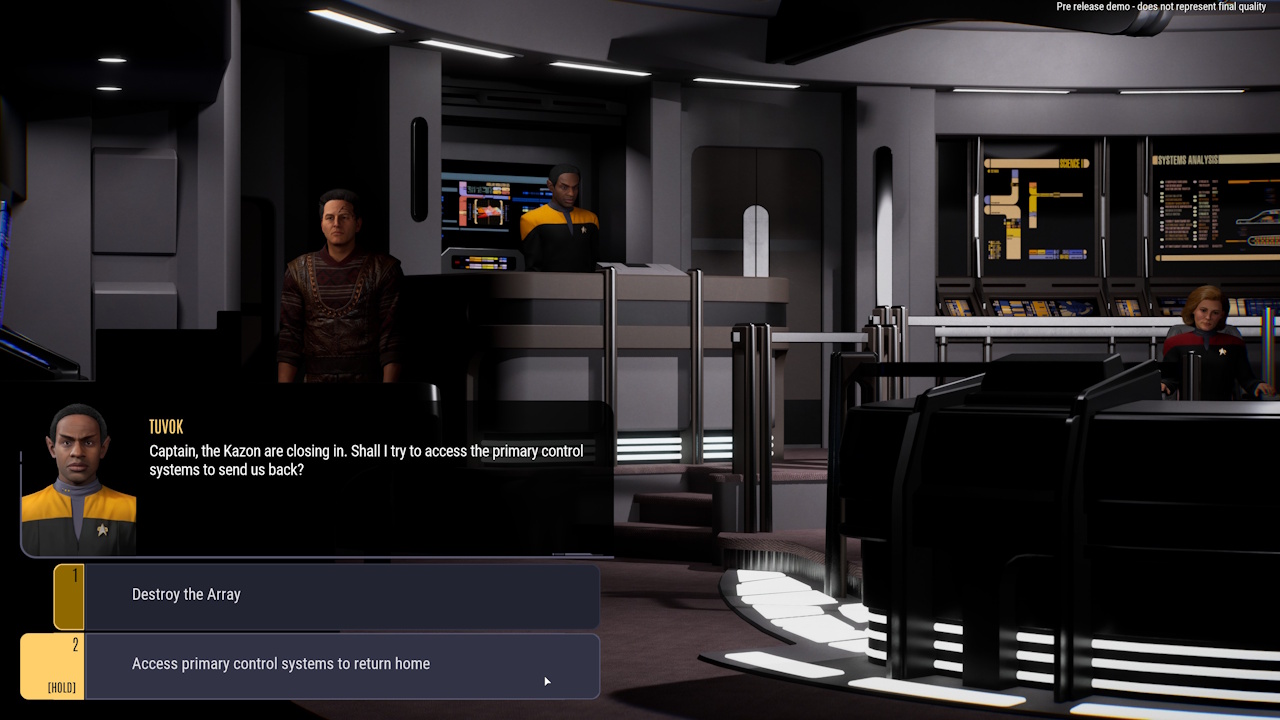
I want to touch on one story point that I’ve seen Trekkies talking about since Across The Unknown was announced. This is spoiler-y, so skip past the next screenshot if you really don’t want to know anything ahead of trying the demo for yourself! When it comes to Voyager and crucial choices… Across The Unknown does give you the option to use the Caretaker’s Array to send Voyager and her crew home seven years early! Obviously, this will cut off the entire rest of the game, but I thought it was a ton of fun that the option to do this was included.

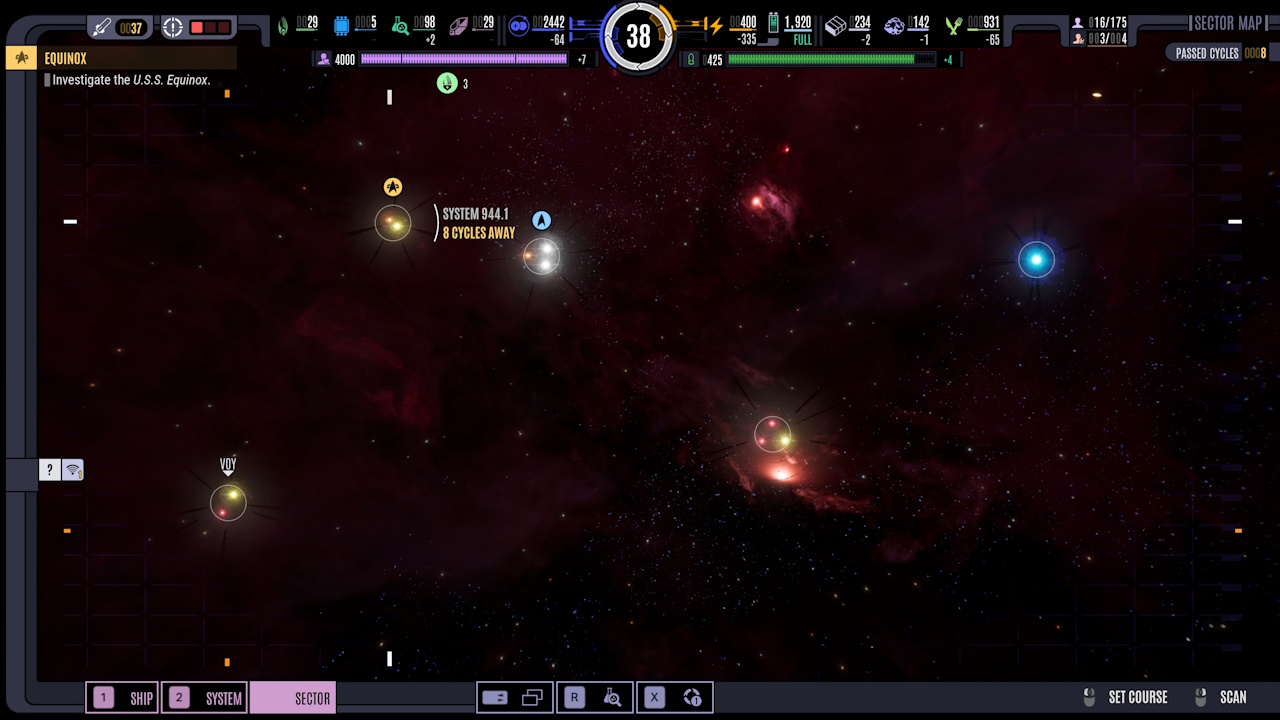
And I think that speaks volumes about the kind of big decisions that we’ll get to experience in the full game. The blurb promises twelve sectors to explore – each of which, apparently, can be comprised of at least three star systems, which is neat. I would imagine each sector will provide one of these key inflection points – perhaps more than one. Being able to send the ship and crew home, though, using the Array… I gotta admit, that was pretty cathartic after all these years!

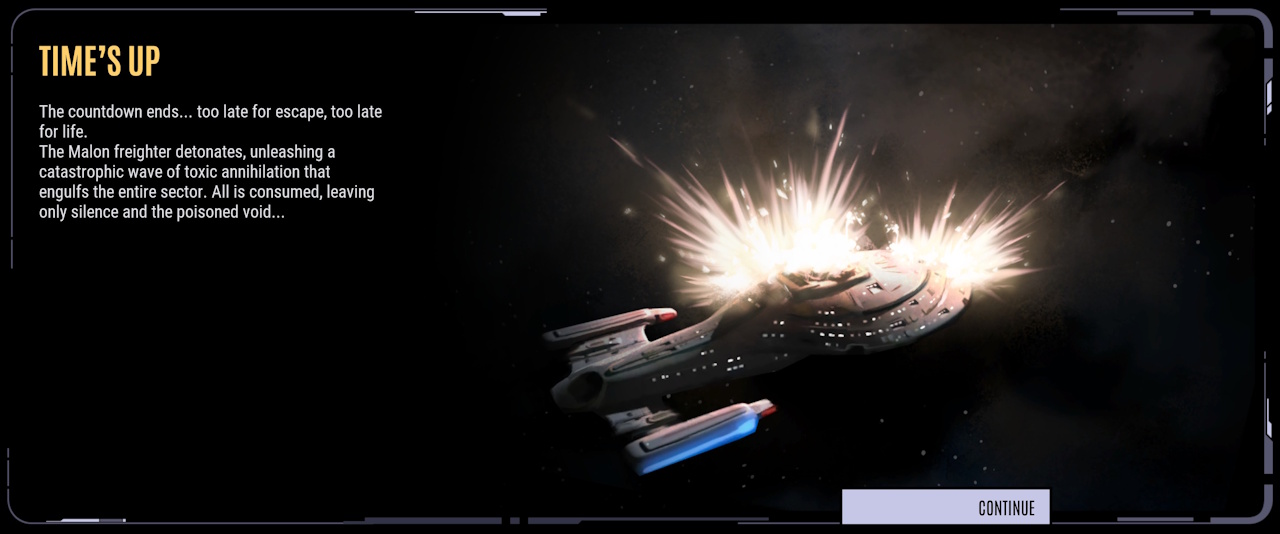
Screenshot of Star Trek: Voyager - Across The Unknown (demo version) showing the end of the demo.
Home in time for tea!

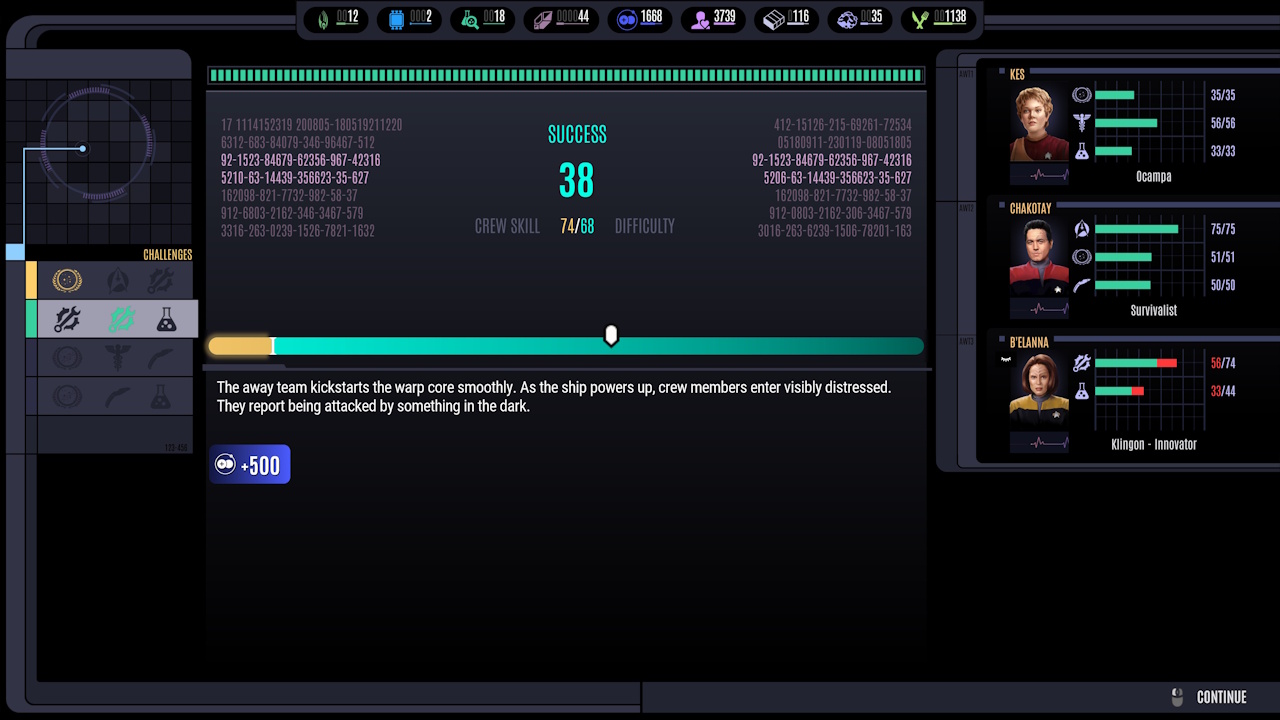
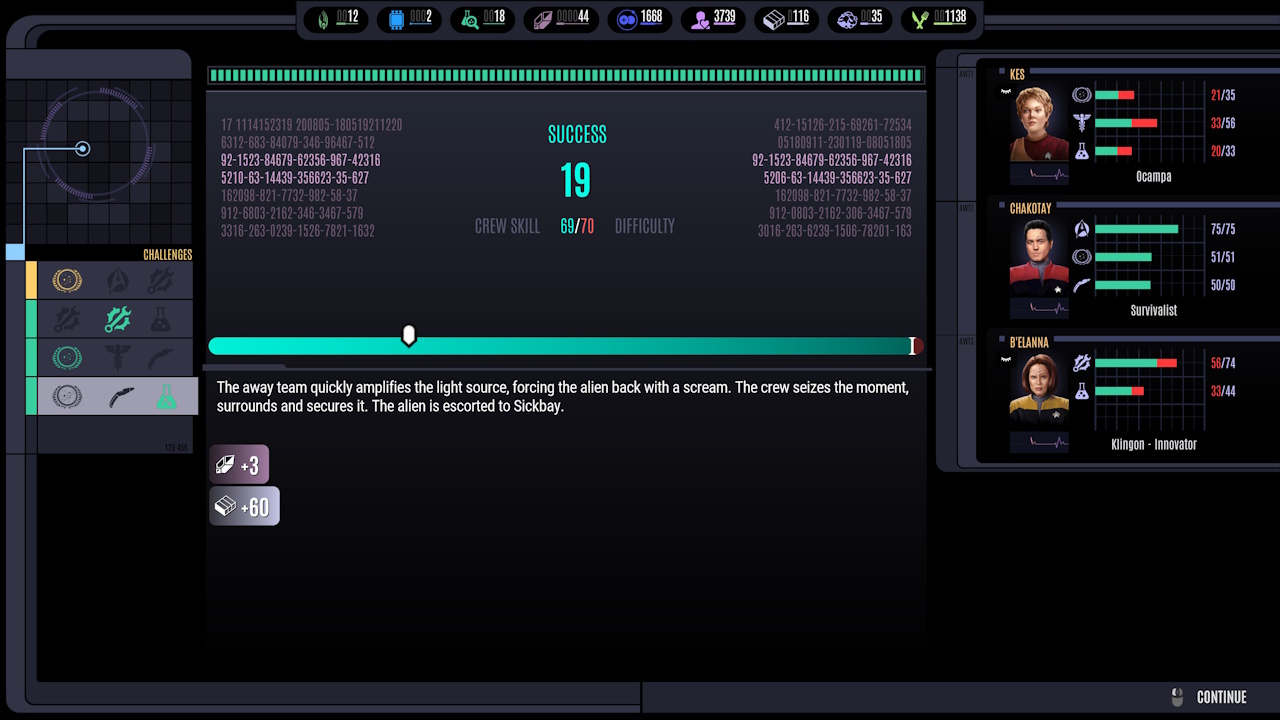
There’s quite a lot of random chance (a.k.a. random number generation) in Across The Unknown, which isn’t atypical for this type of game. You can mitigate some of that by choosing characters and actions that have a higher chance of success, or when on away missions, by combining the efforts of more than one character to increase the odds. But it’s still possible that RNG will go against you at any point, and even an option that looks statistically solid could result in a negative outcome. Again, though: it’s that kind of game.

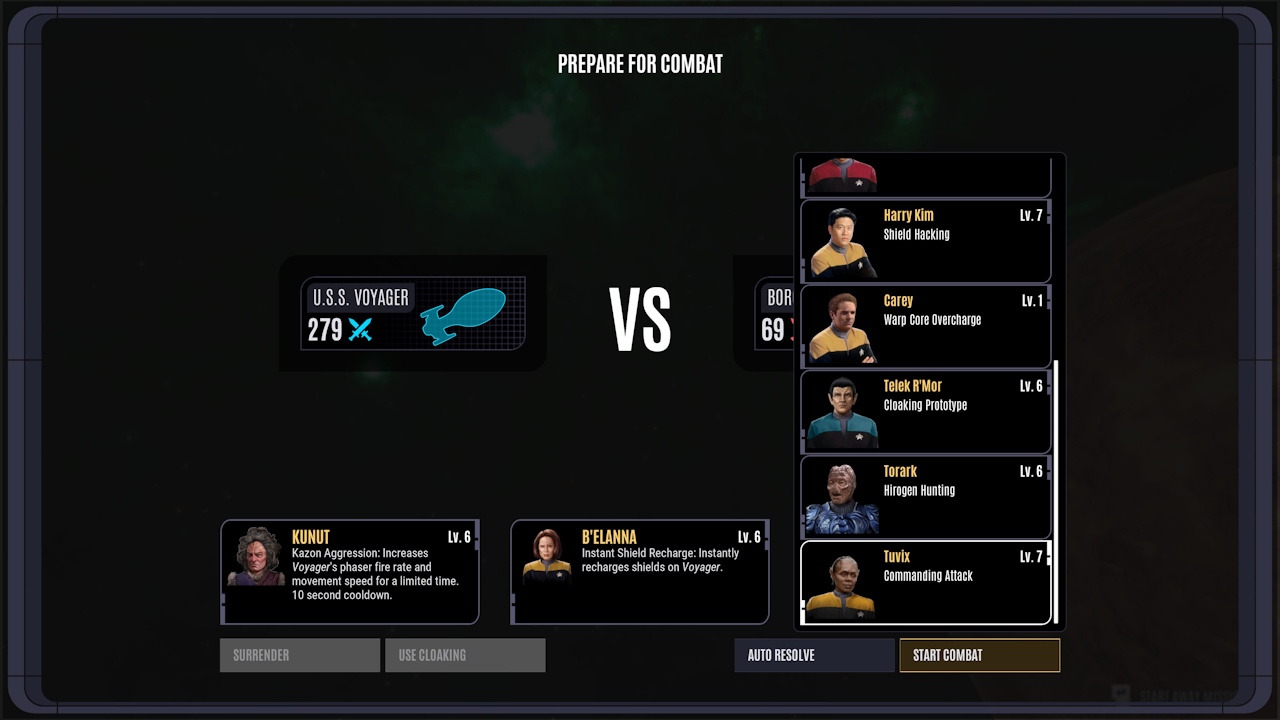
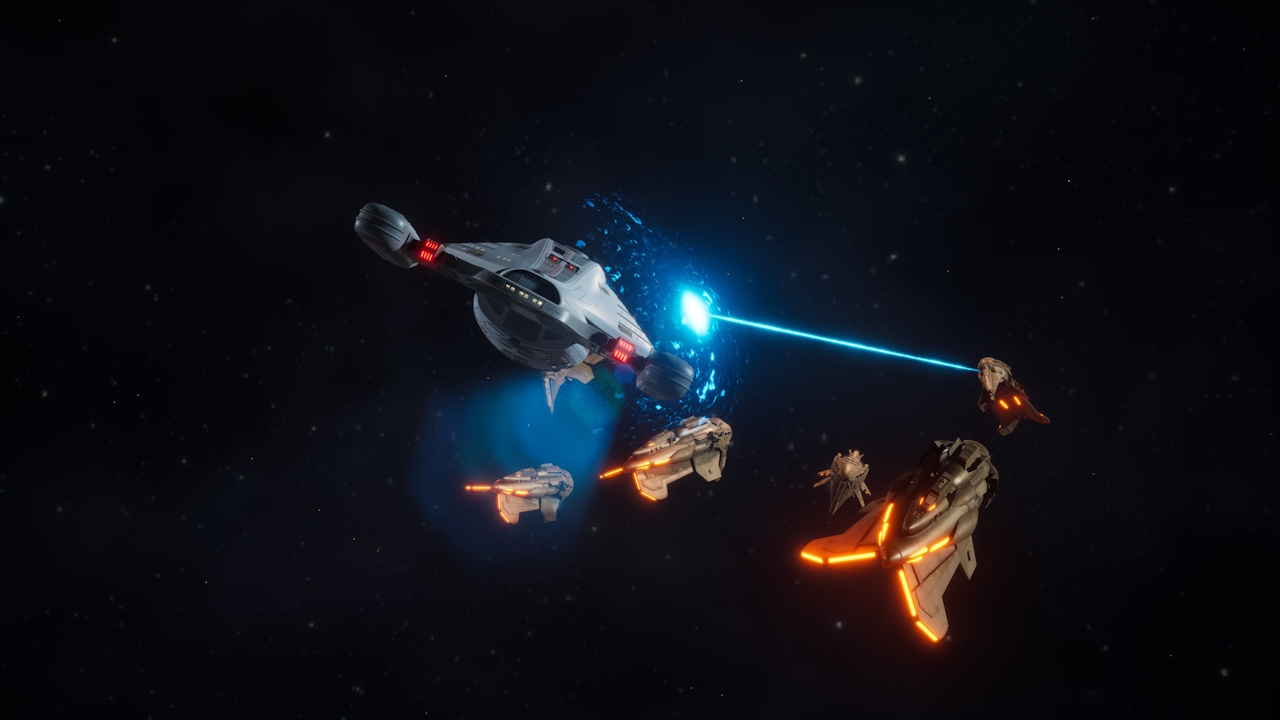
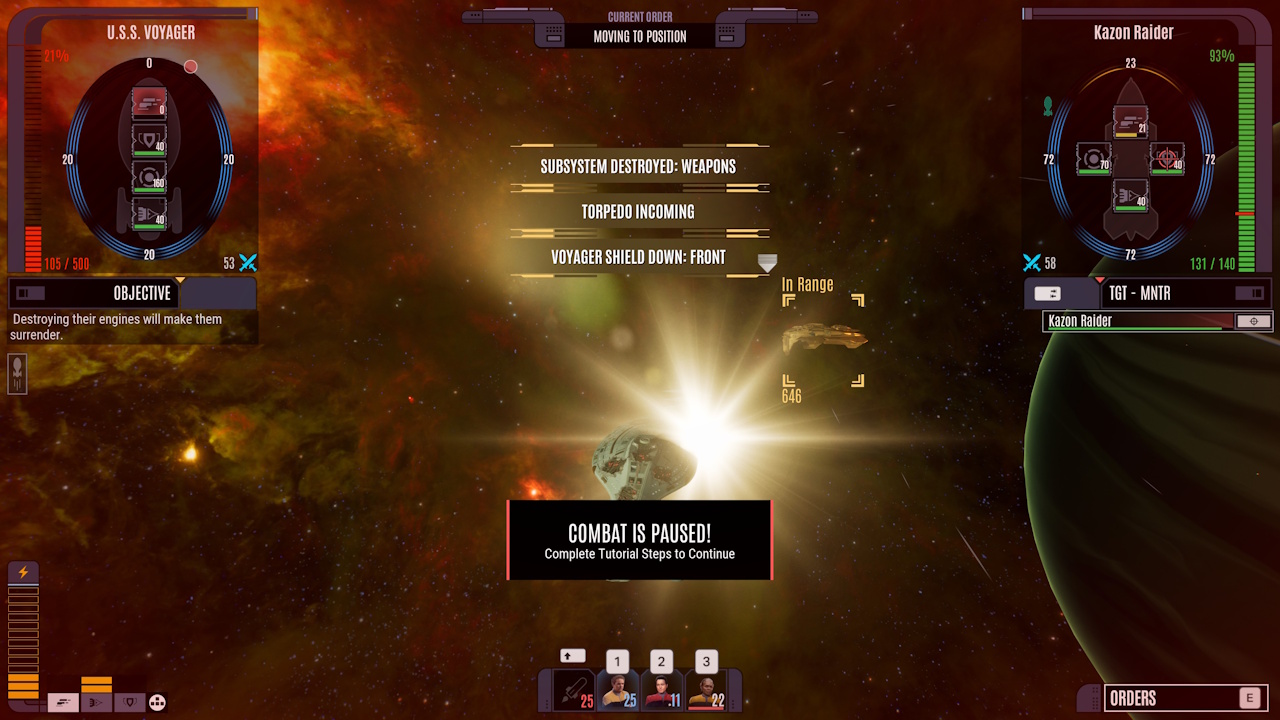
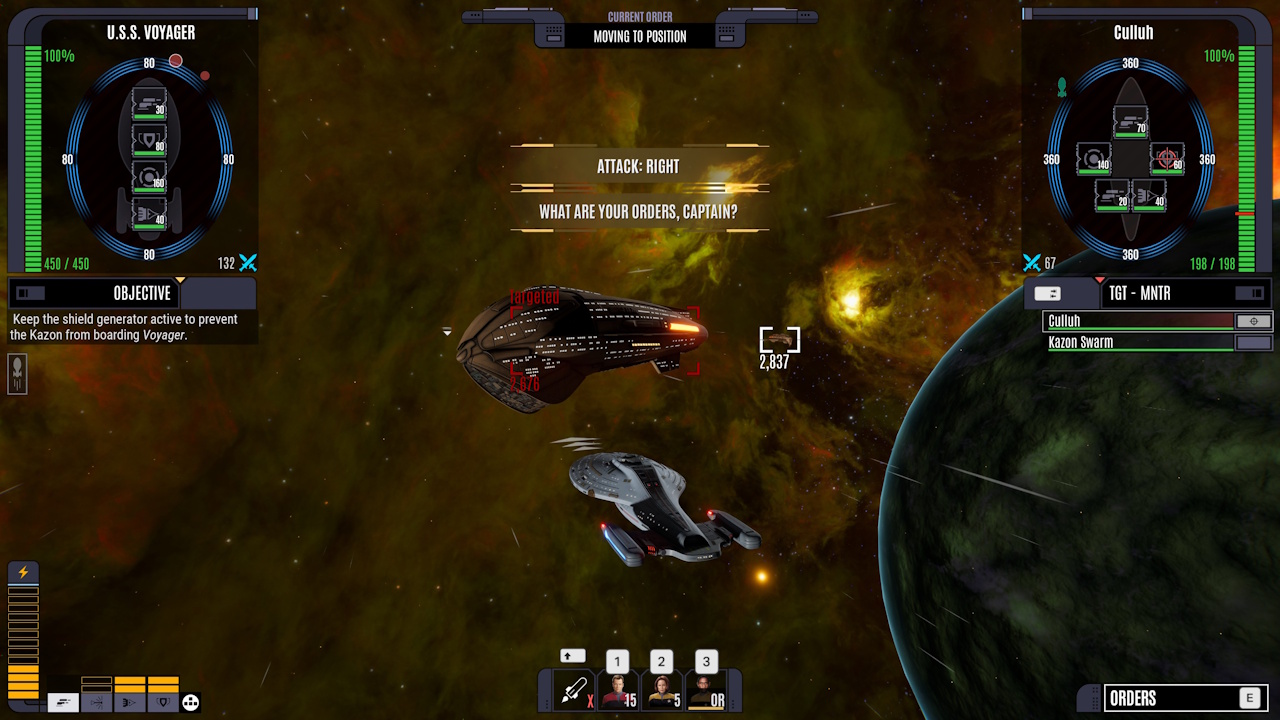
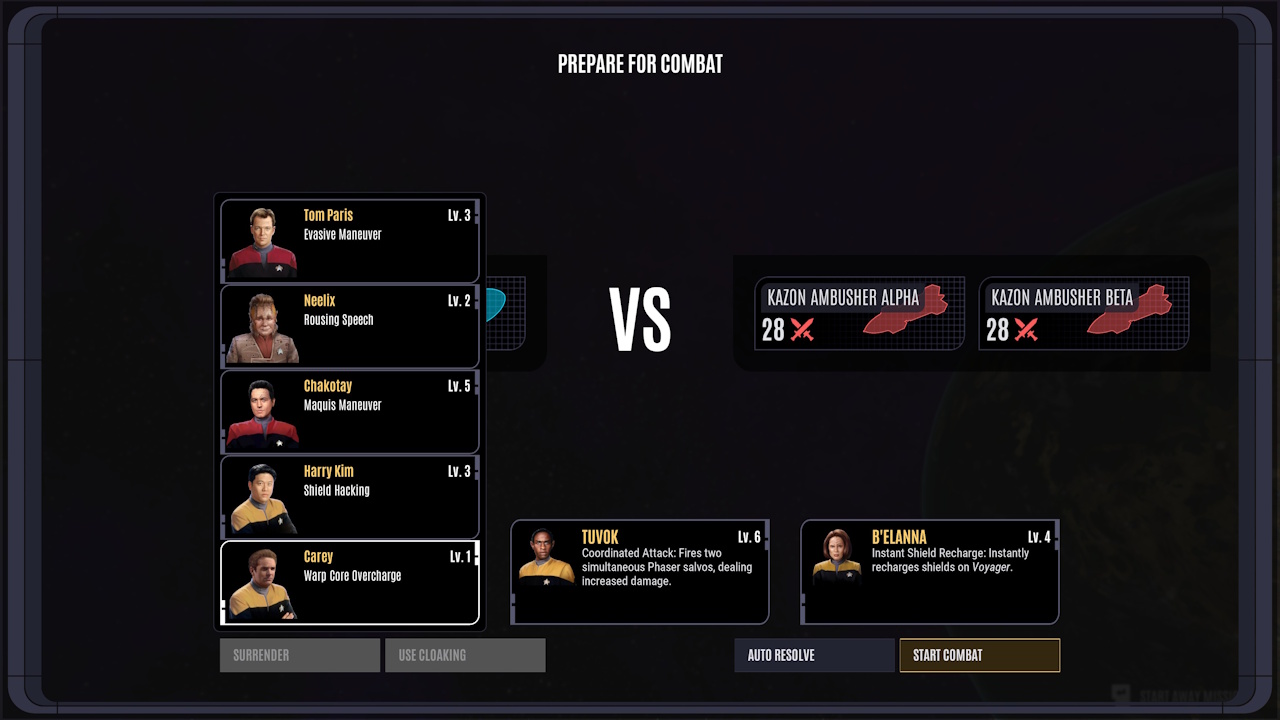
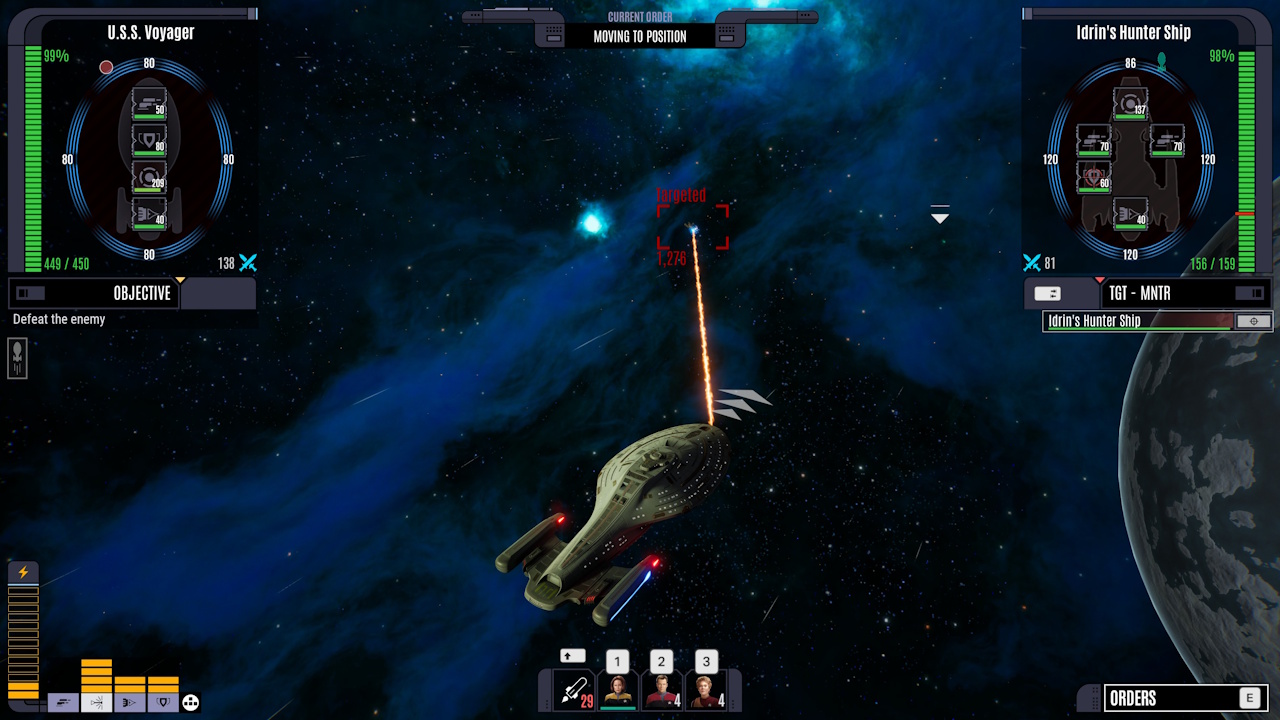
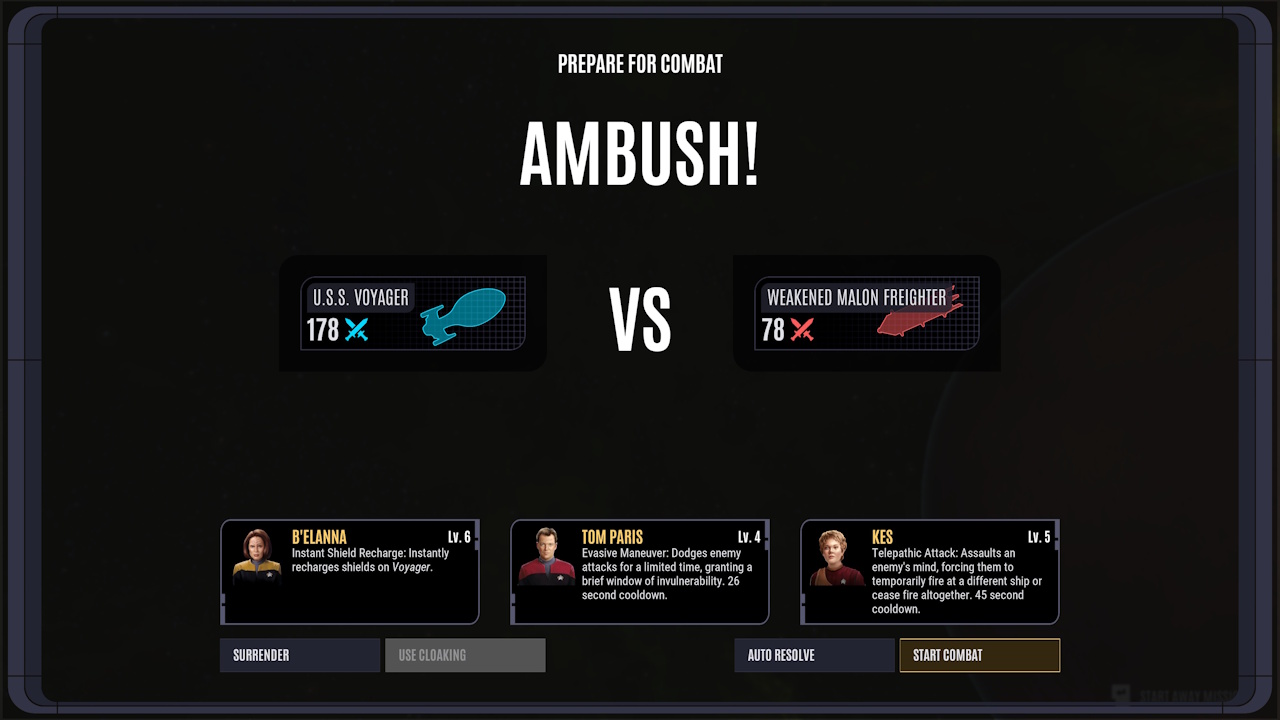
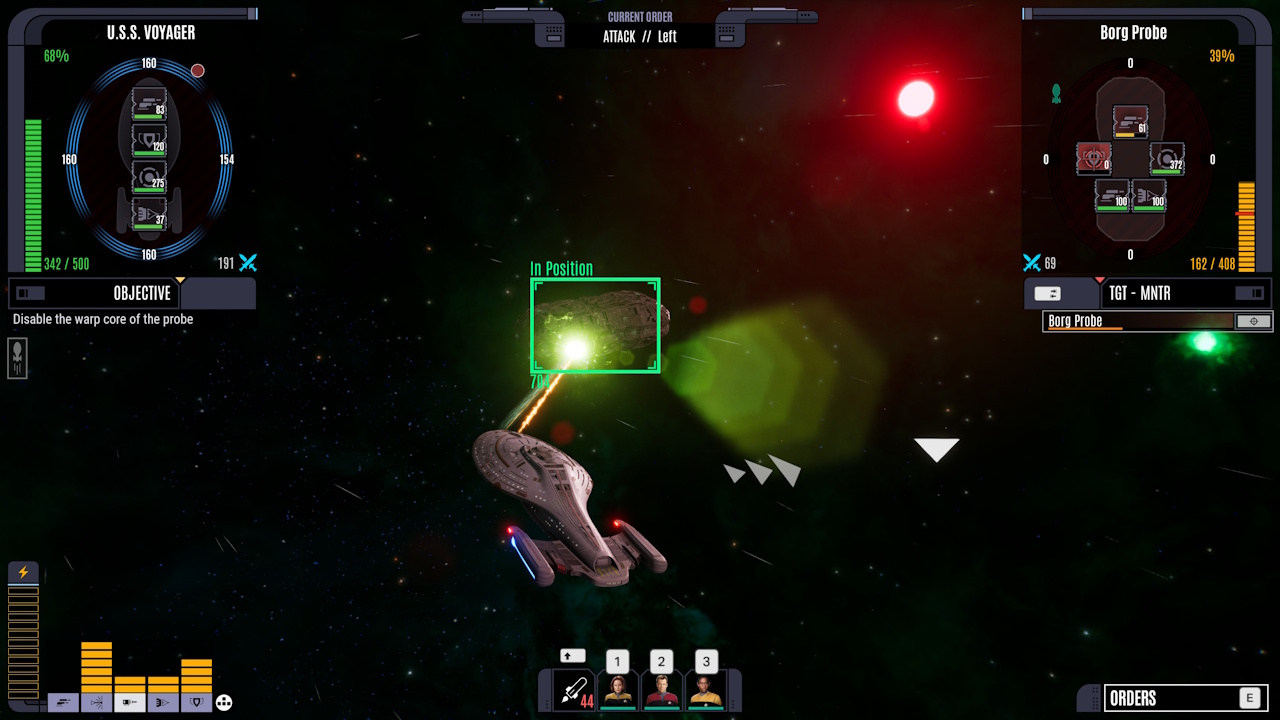
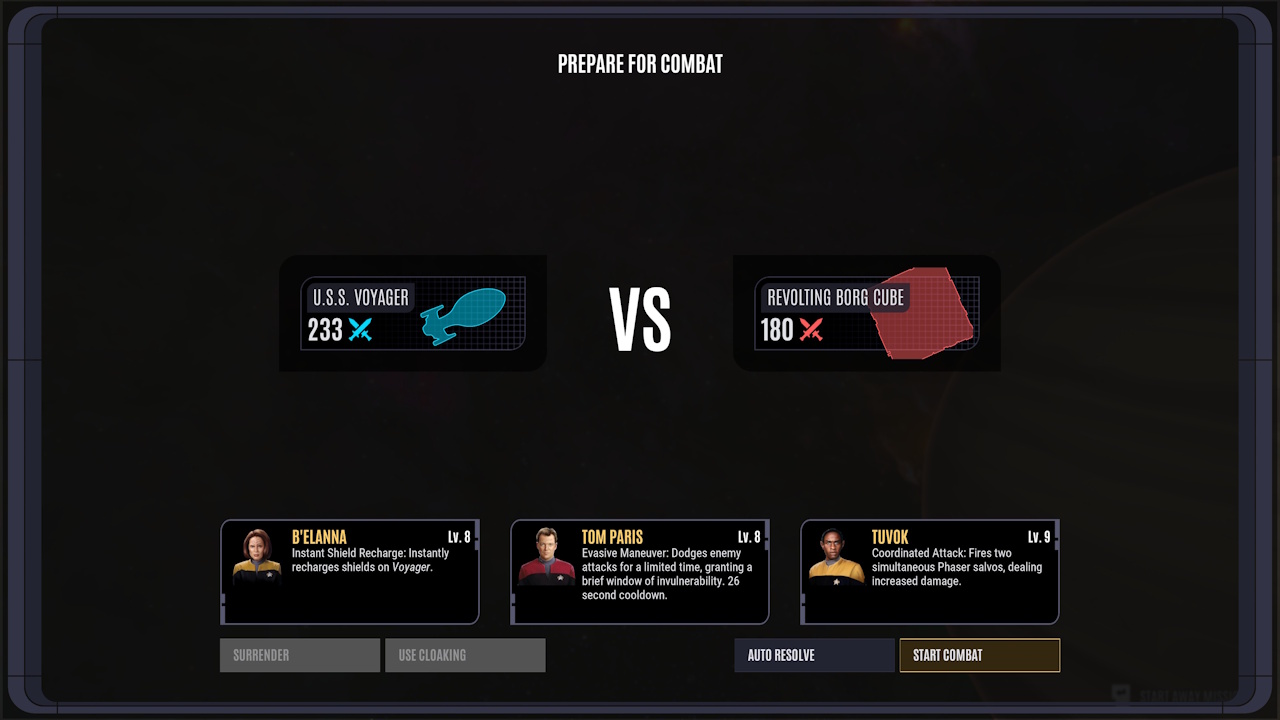
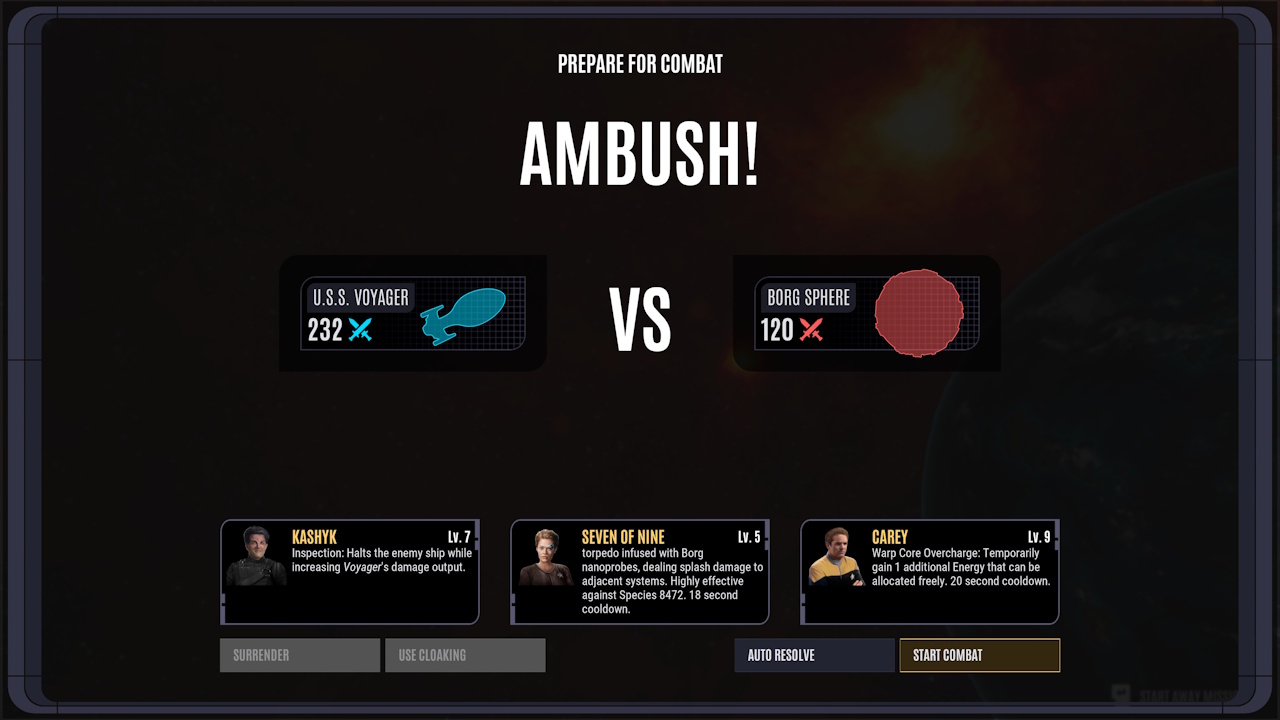
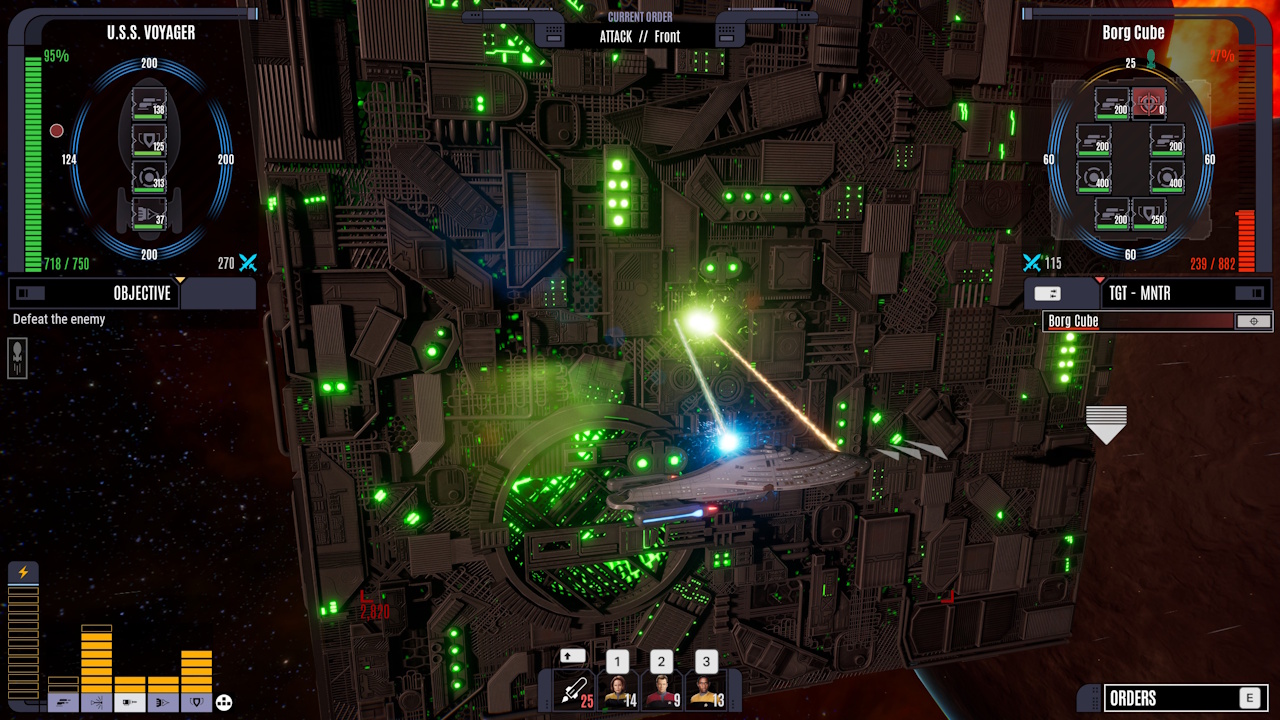
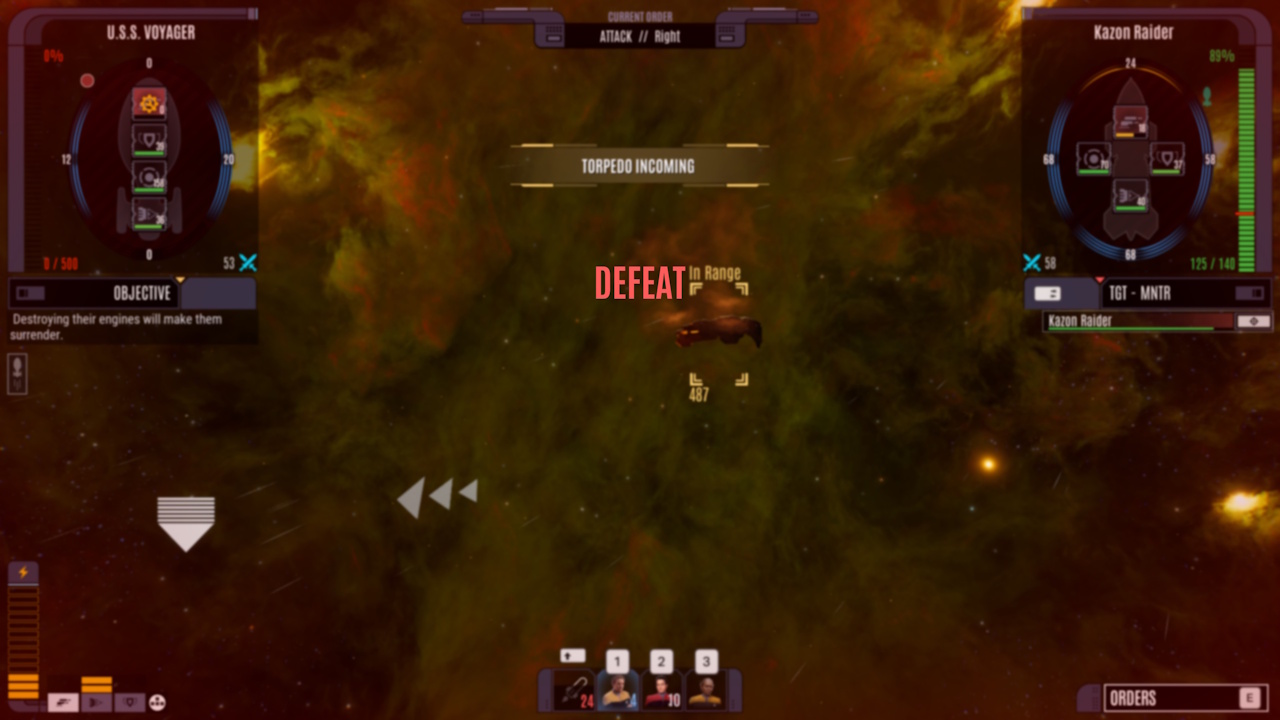
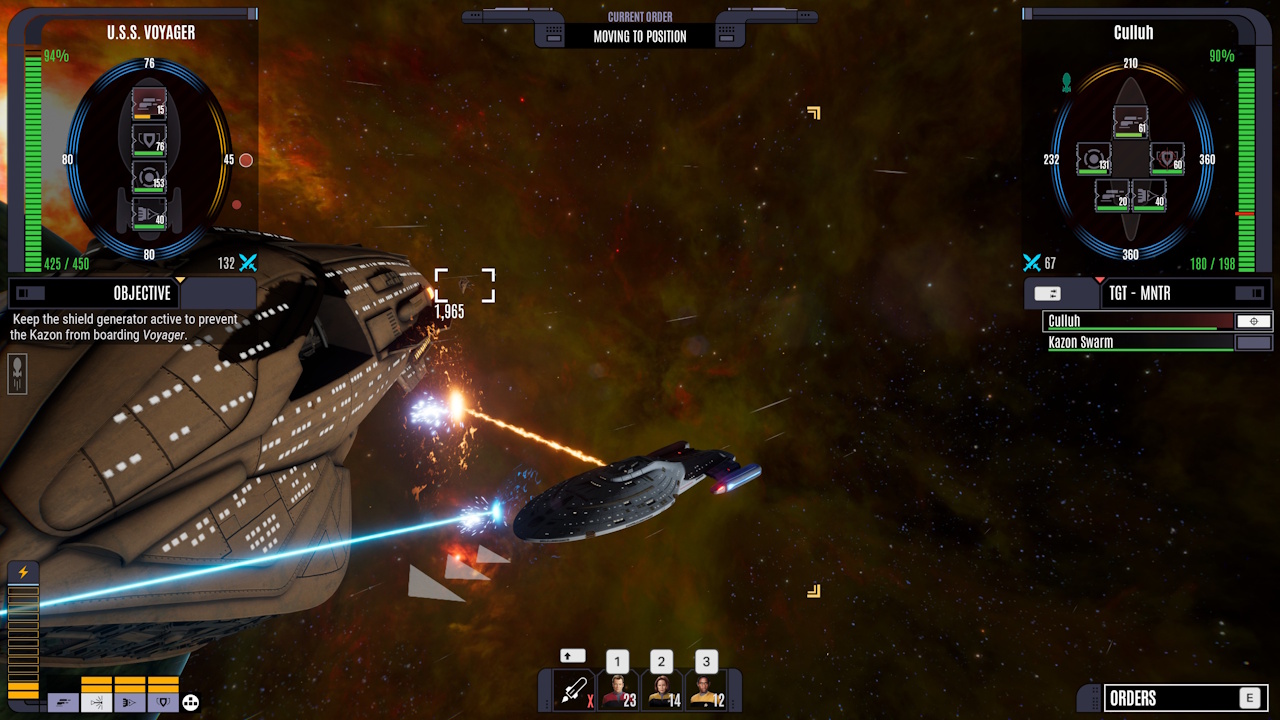
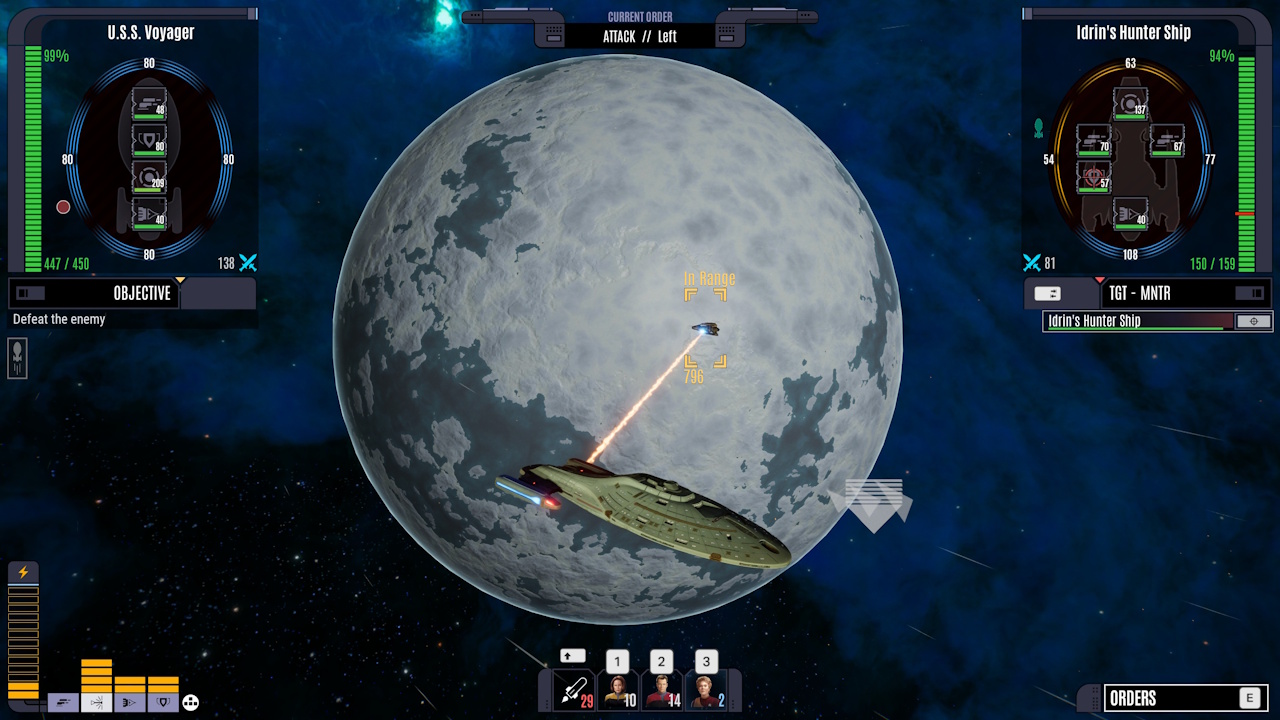
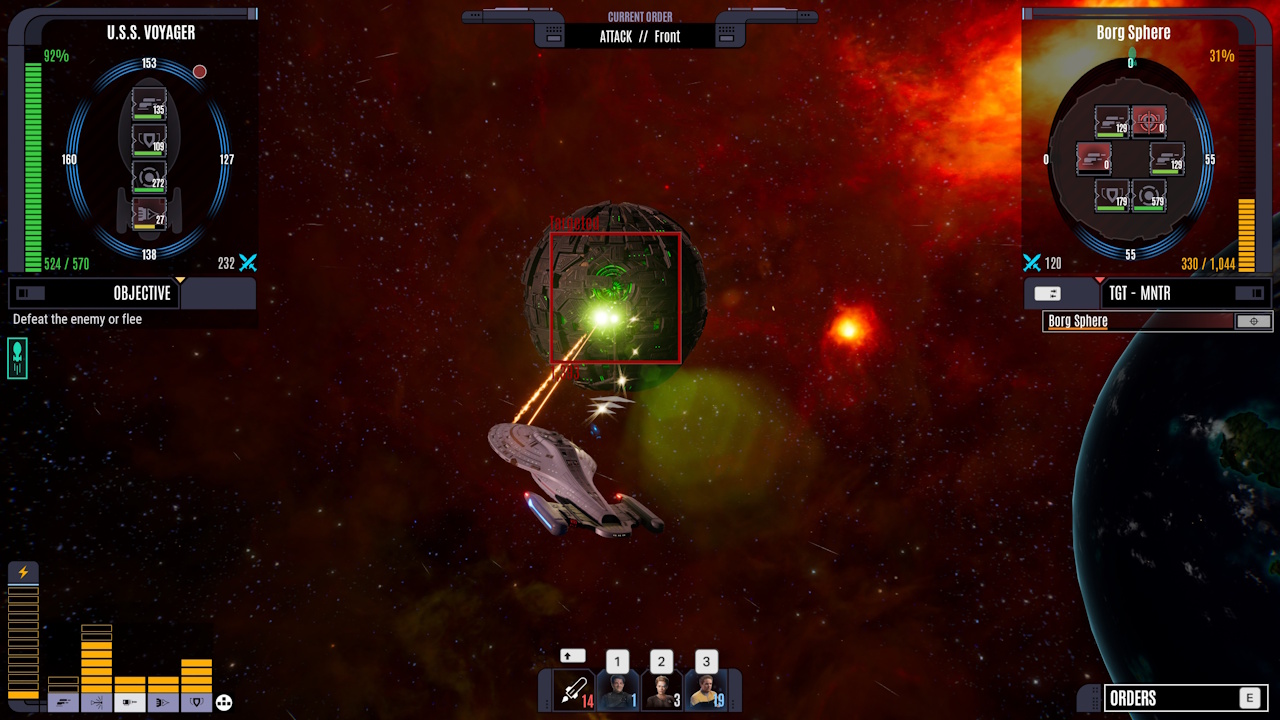
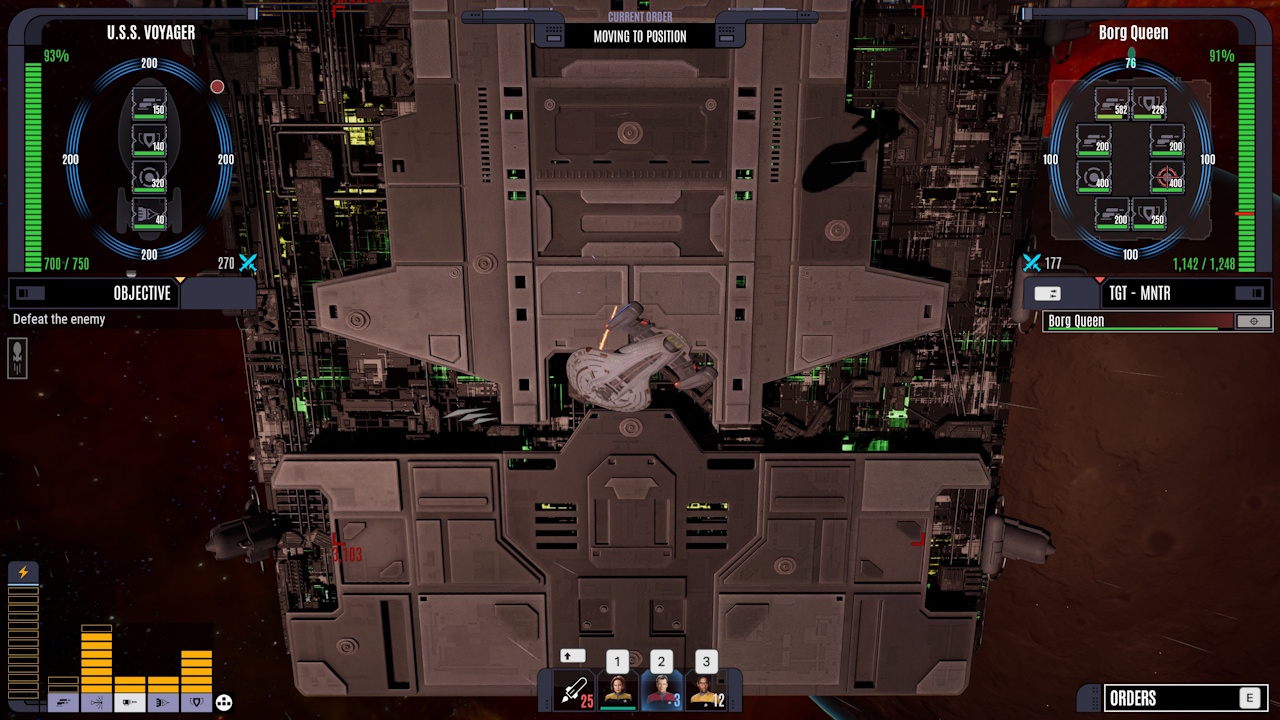
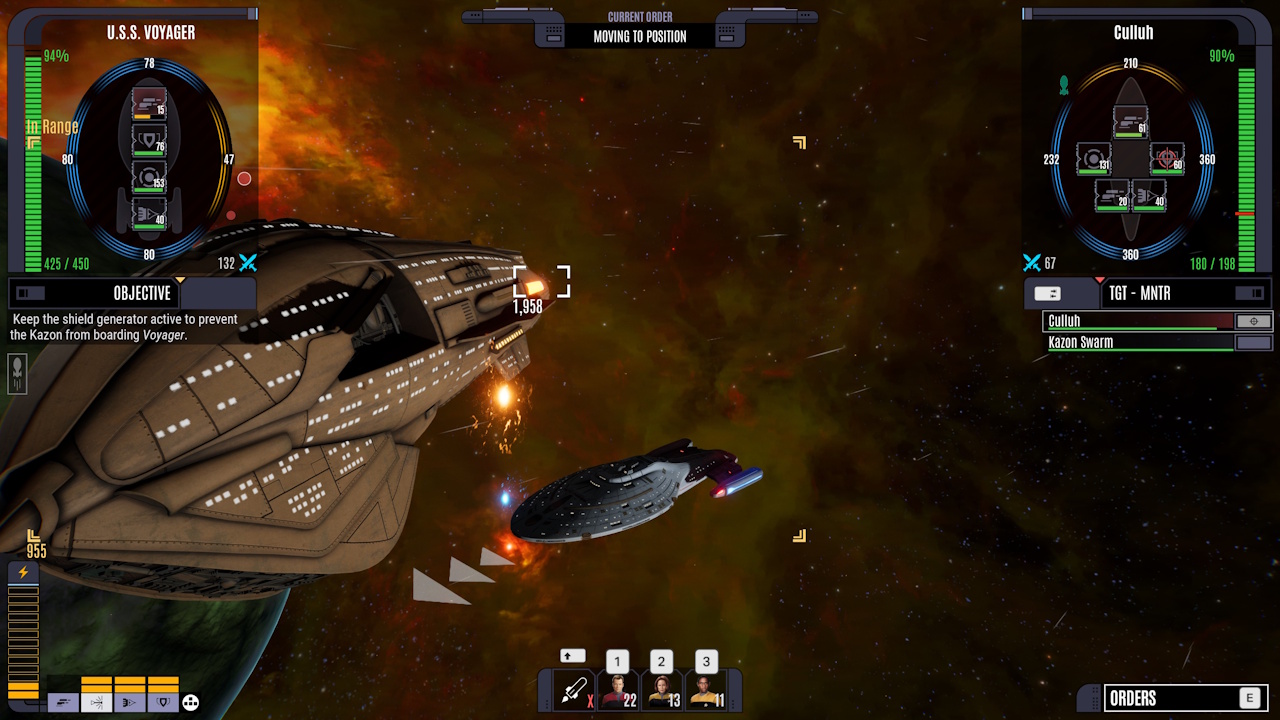
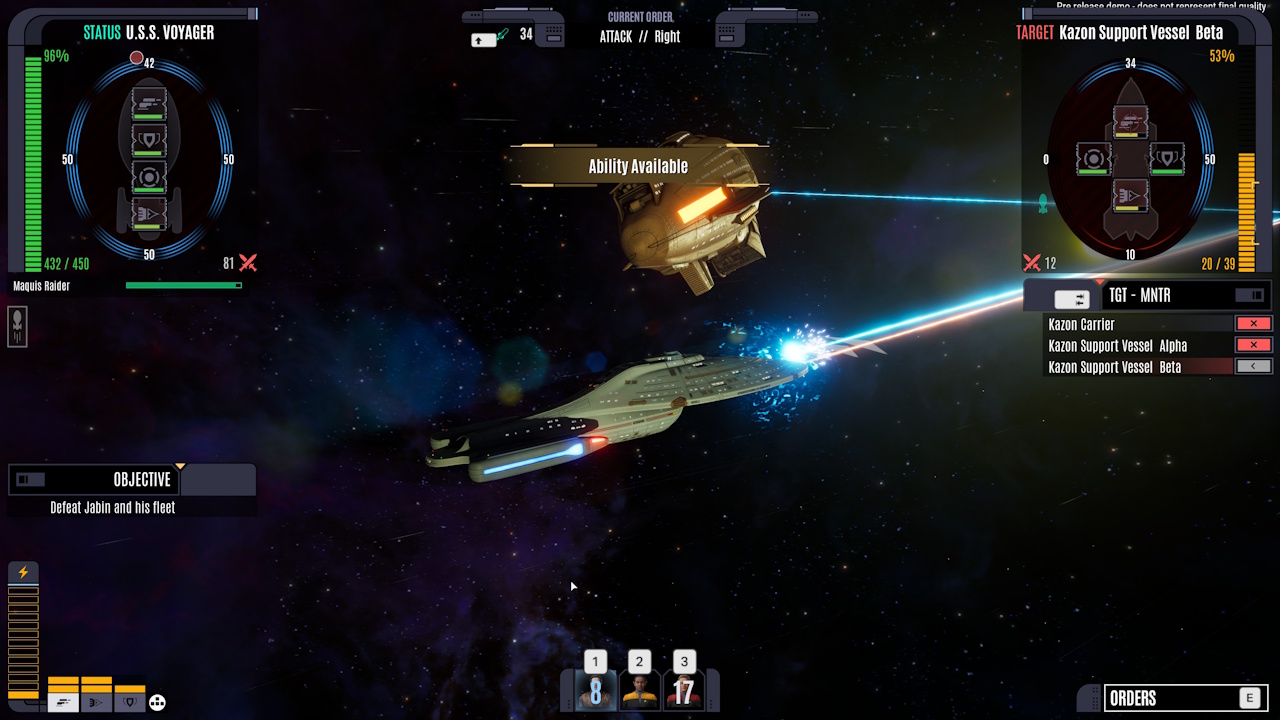
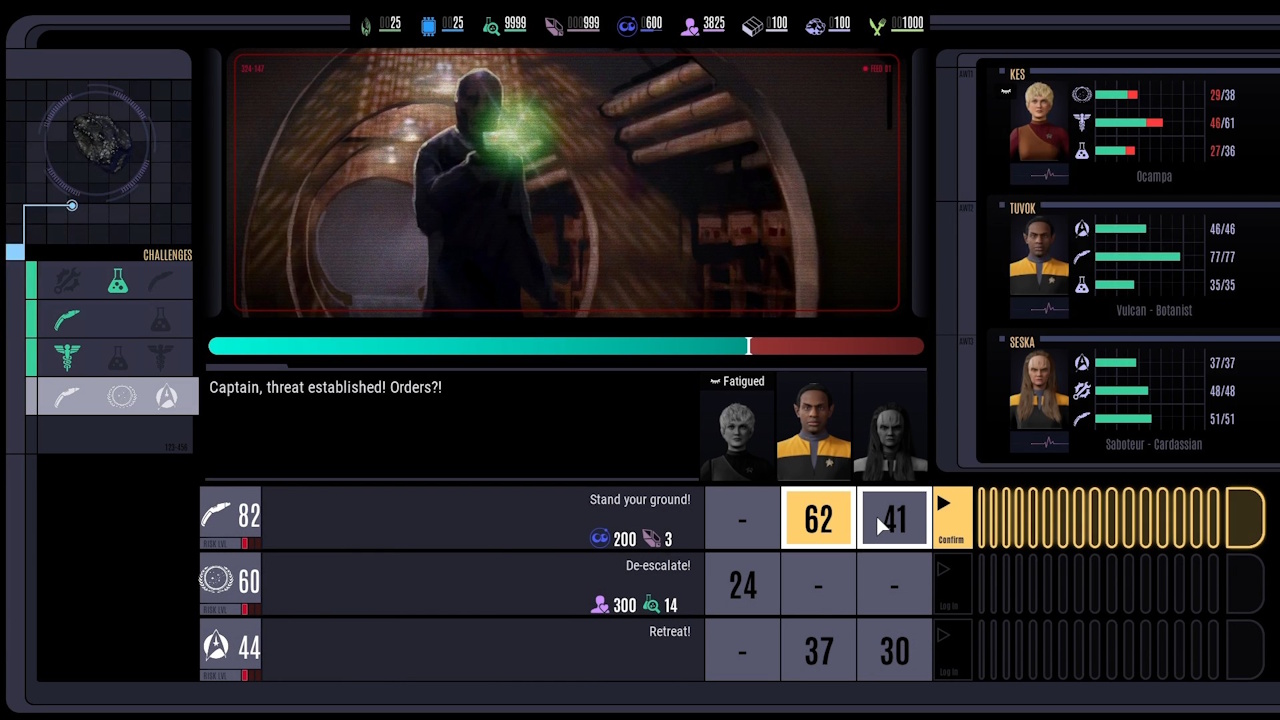
The ship-to-ship combat was interesting. Unlike exploration, which is measured in “cycles,” and away missions, which play out through a series of decision points, combat in space is close to real-time. Phasers fire automatically, but you get to choose when to fire torpedoes and when to issue other orders to members of the crew. There are a limited number of slots for characters to participate in ship-to-ship combat – which feels like a bit of a double-edged sword.

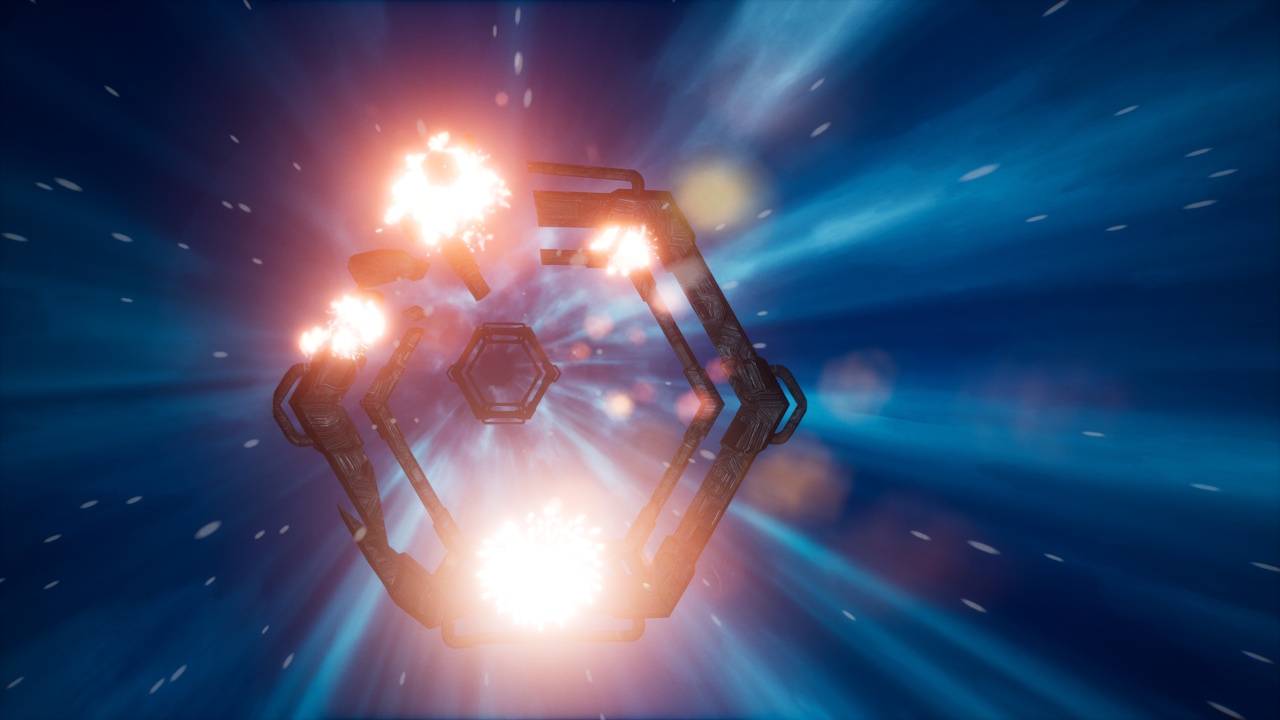
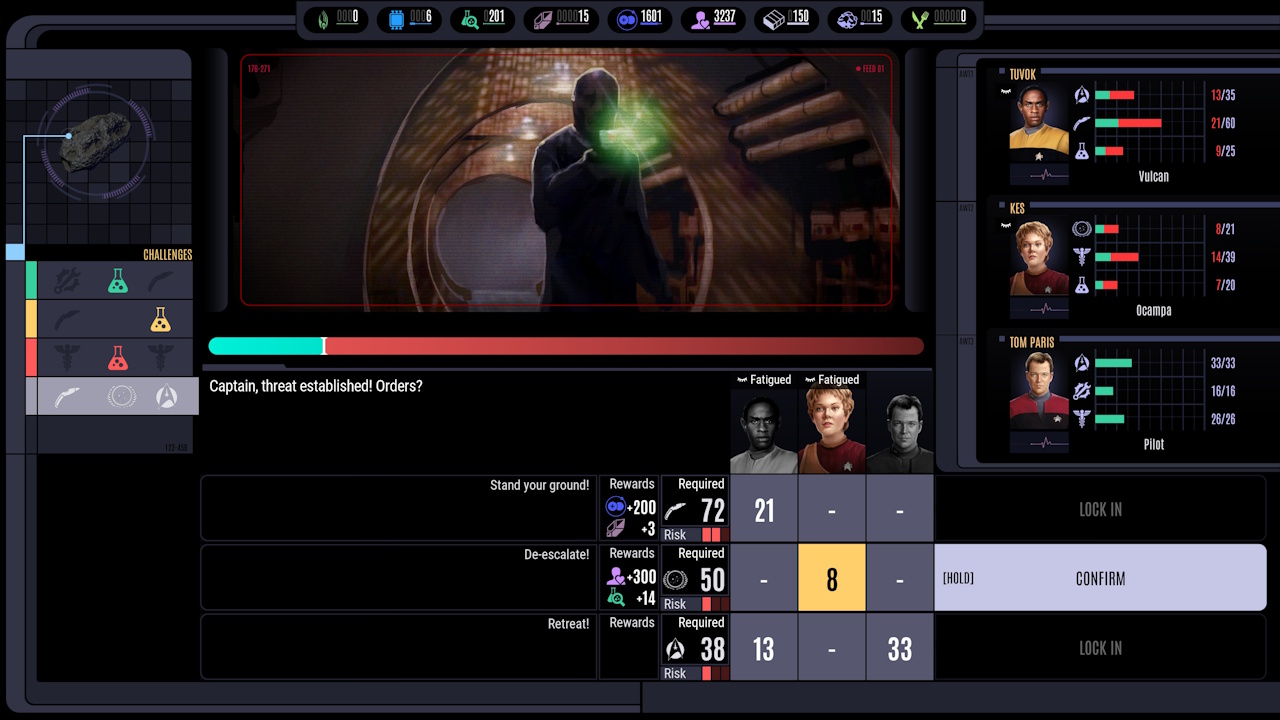
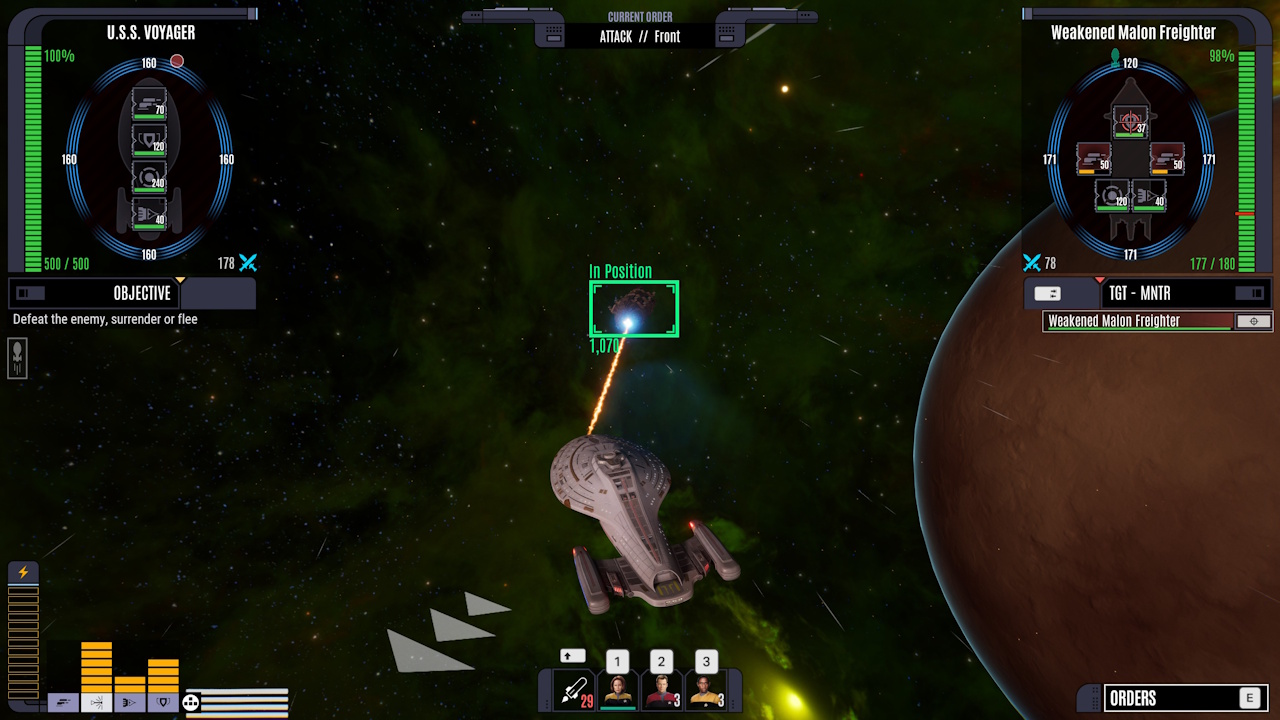
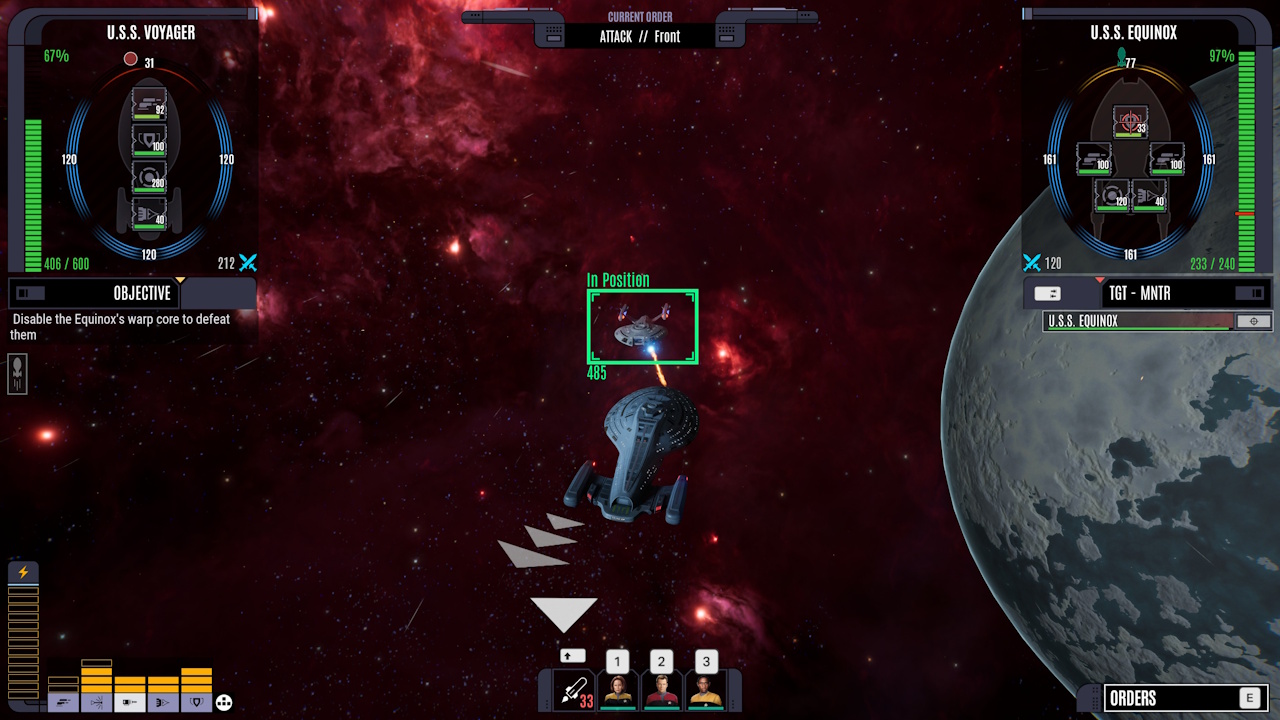
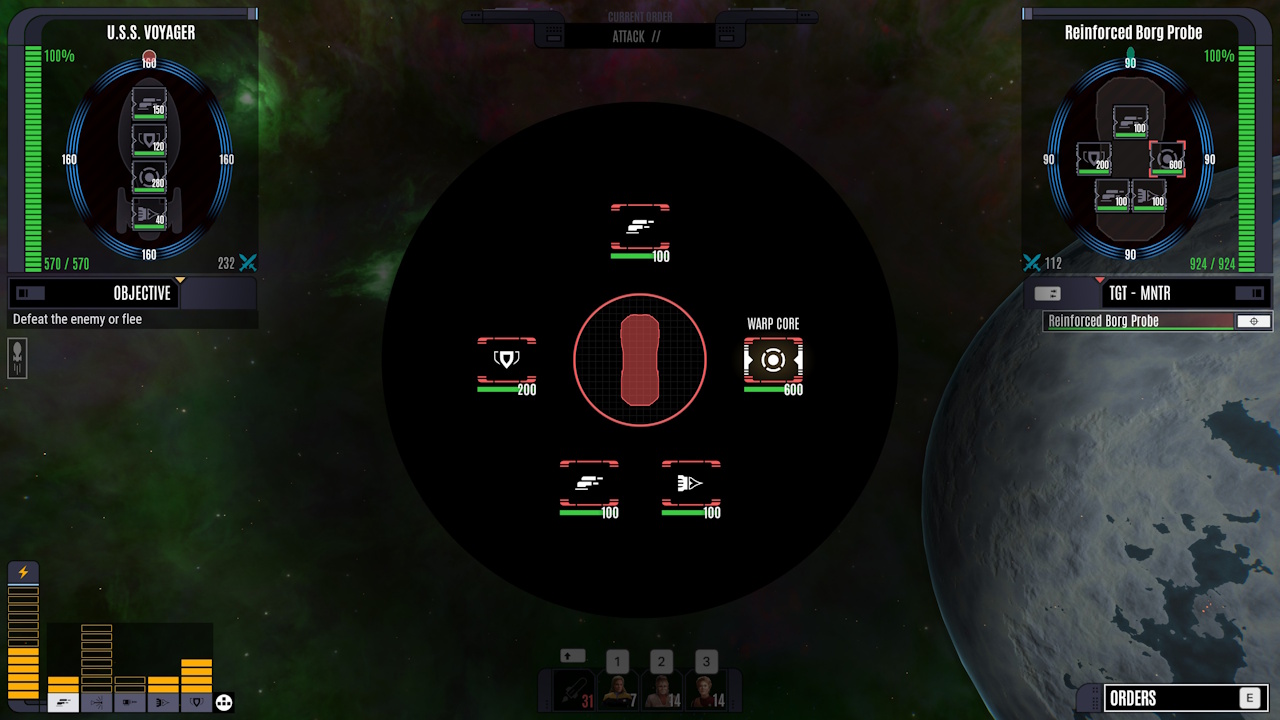
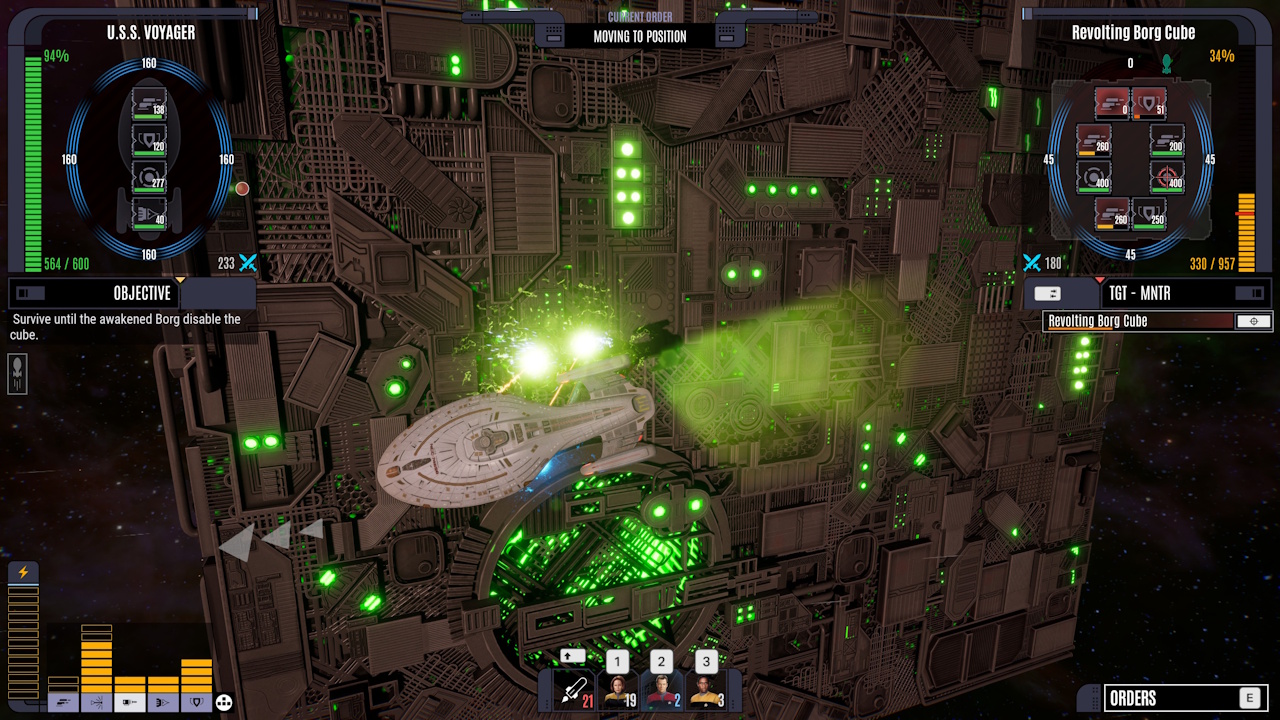
Screenshot of Star Trek: Voyager - Across The Unknown (demo version) showing a combat encounter.
Ship combat.

On the one hand, this adds another element of strategy: do you want to pick Paris for his evasive manoeuvres, or Tuvok for his finesse with the phasers? It also makes each combat encounter potentially different, as you can choose a different crop of people every time. However… part of the captain’s chair fantasy experience, surely, is being able to issue orders to the entire crew in situations like this. Being able to divert extra power to the phasers by calling up B’Elanna in engineering, or telling the Doctor to prepare sickbay for casualties… that’s all part of sitting (metaphorically) in the captain’s chair. By reducing the number of characters who can participate, part of the combat just felt a bit… small, I guess.

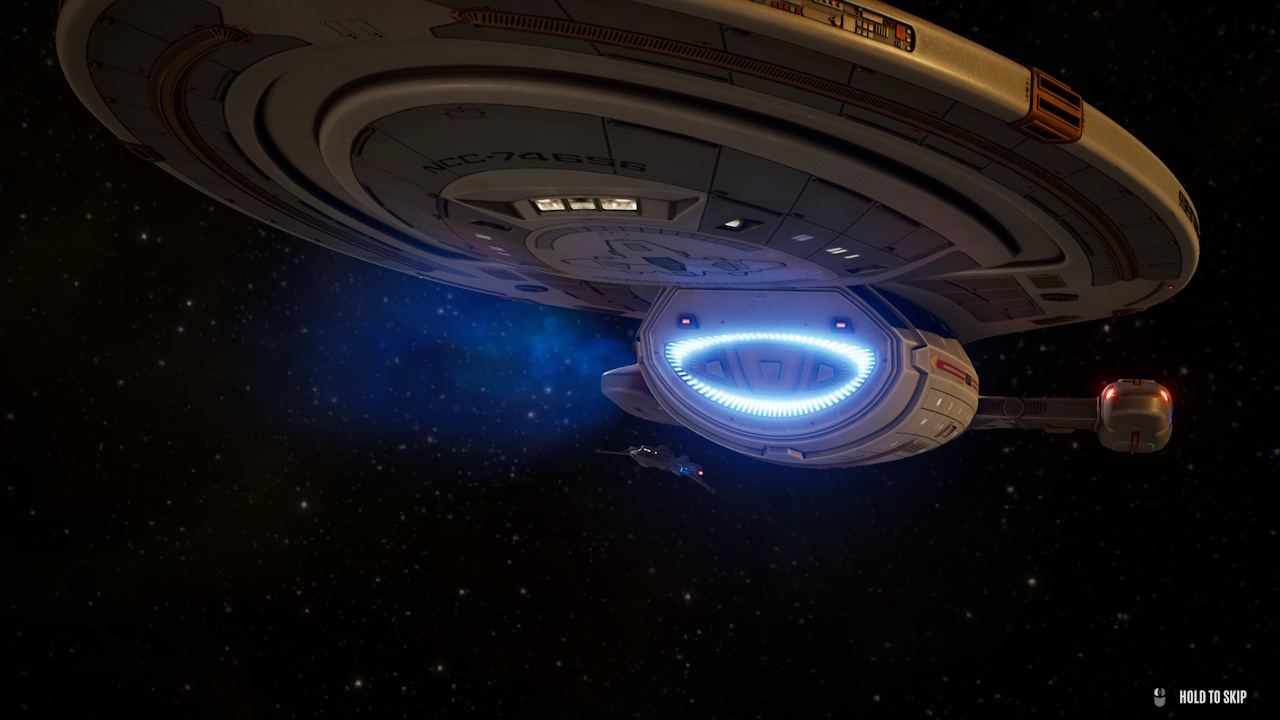
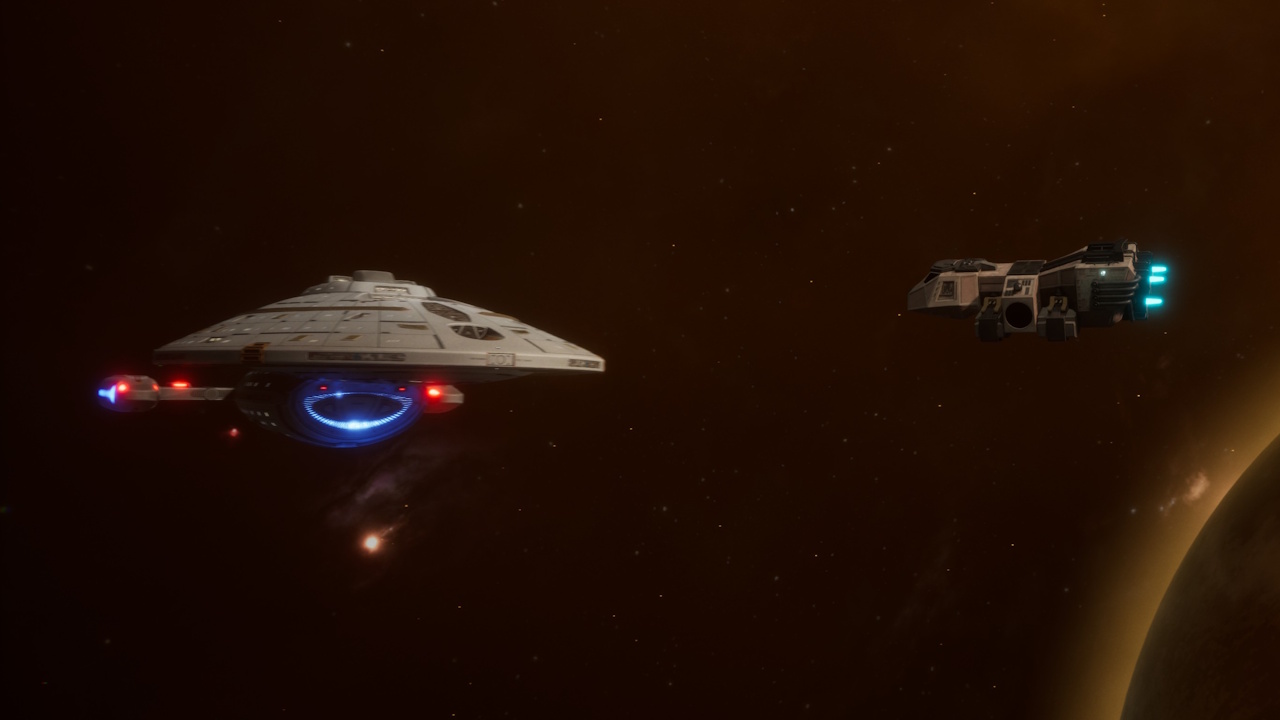
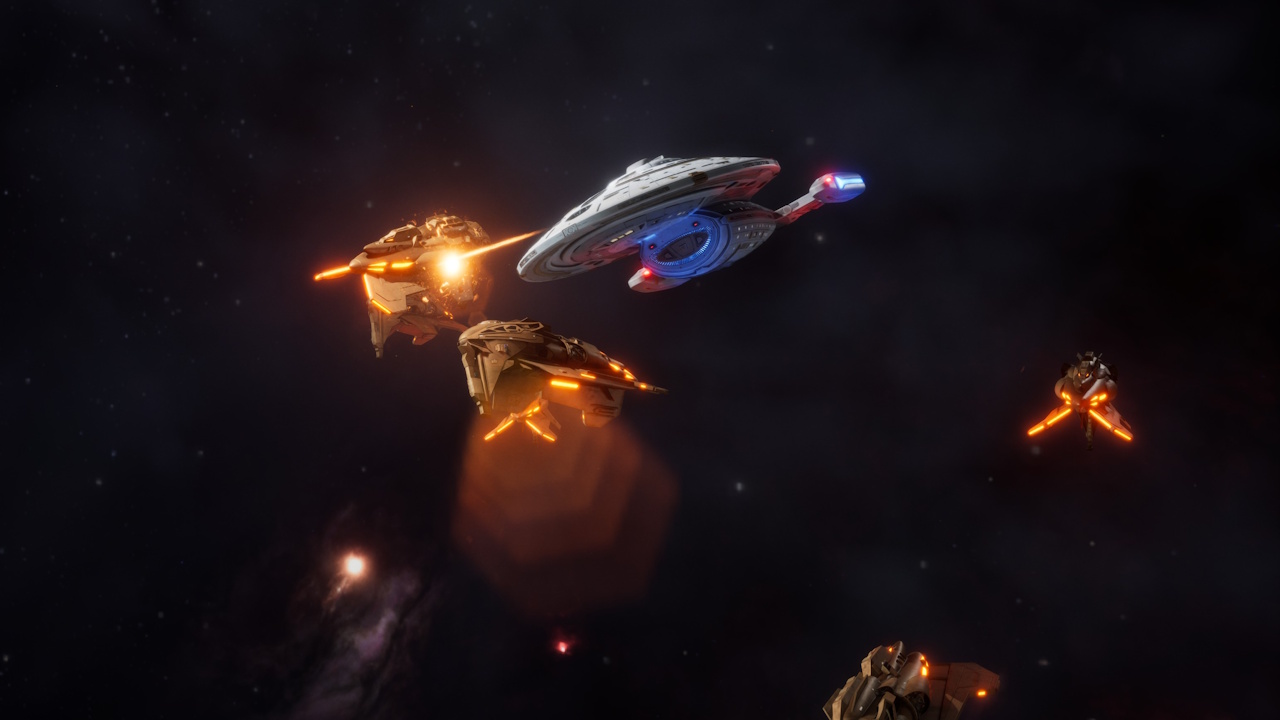
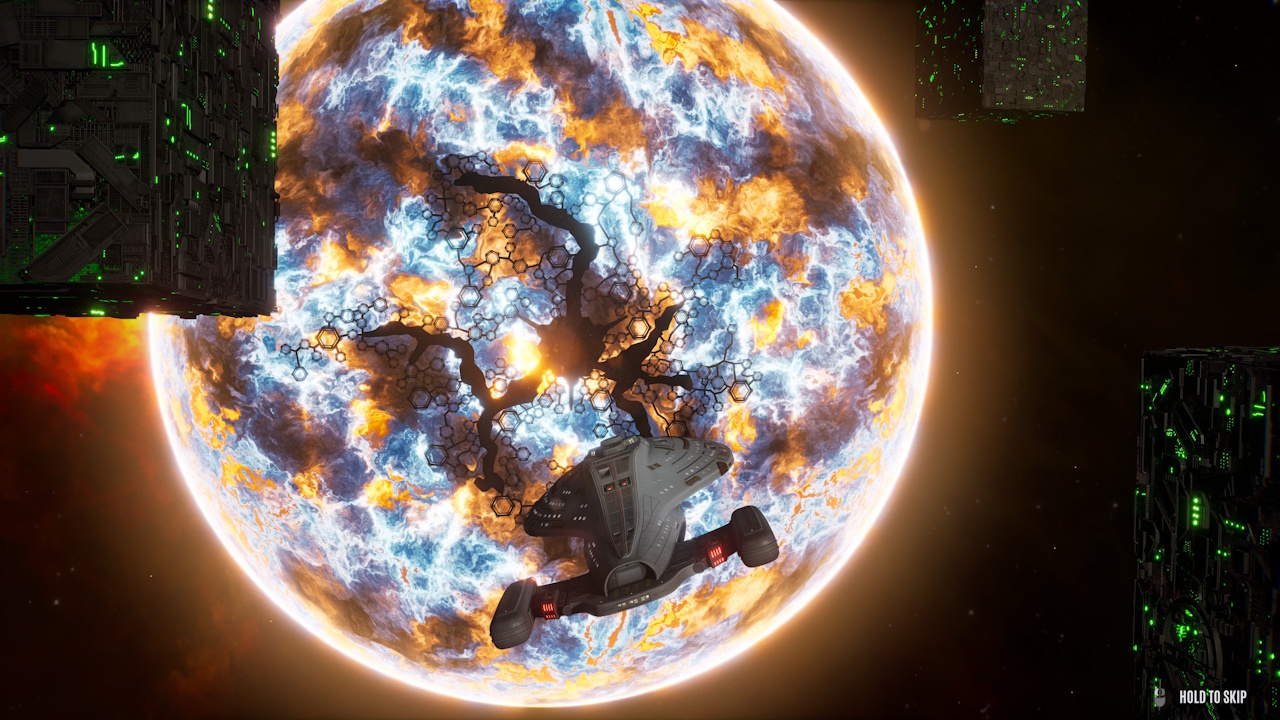
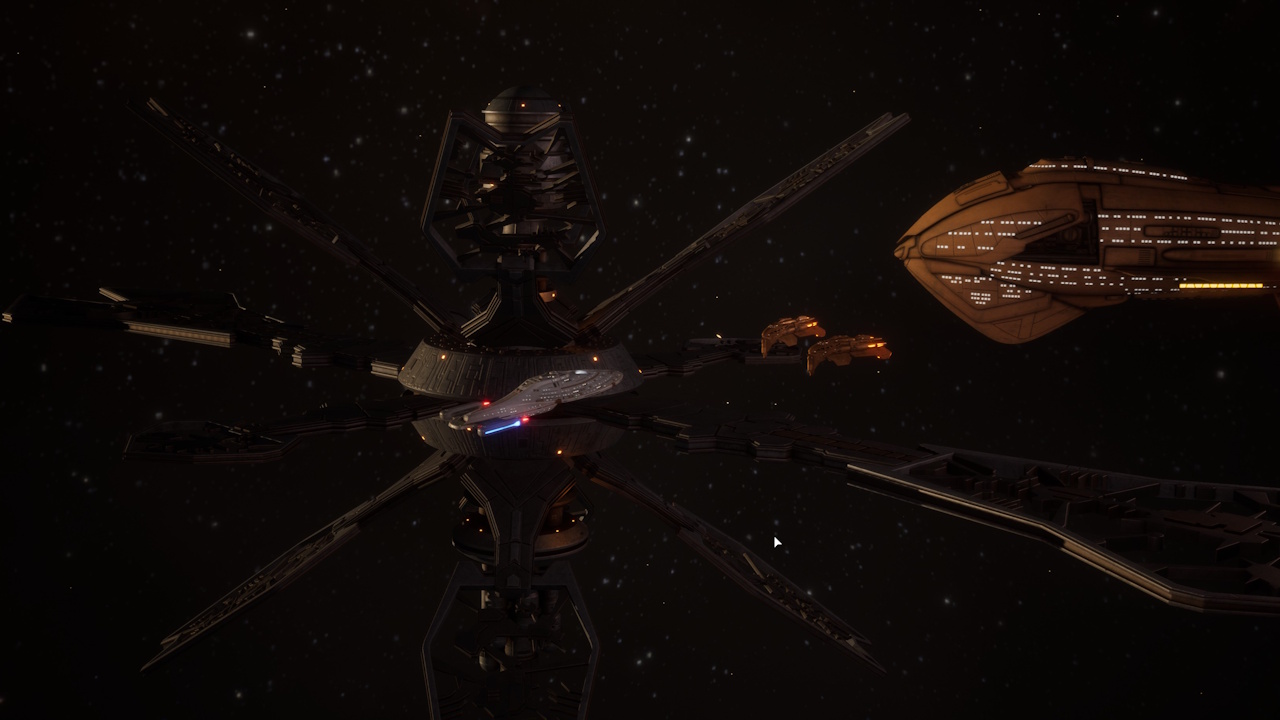
That’s not to say it was bad. I actually had fun taking on the Kazon in my combat encounter! And after spending most of my time looking at a master systems display or a zoomed-out solar system, seeing Voyager moving around in real-time, up close… that was something special.

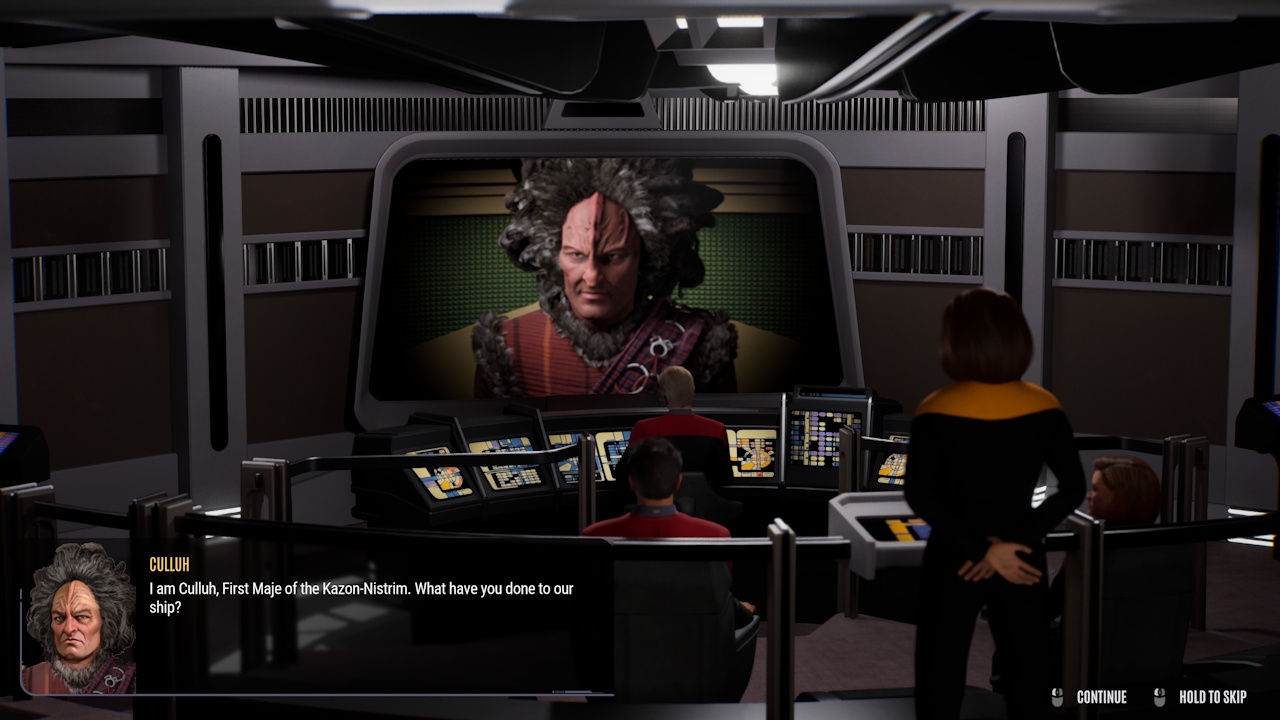
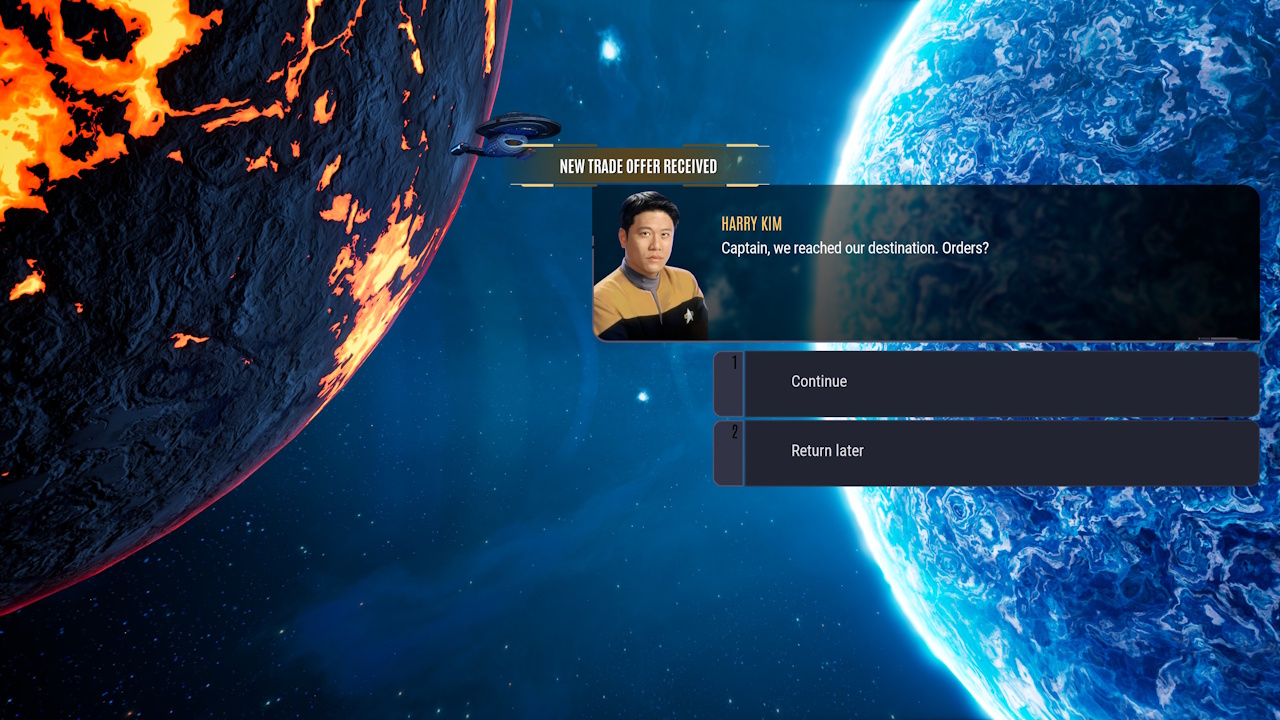
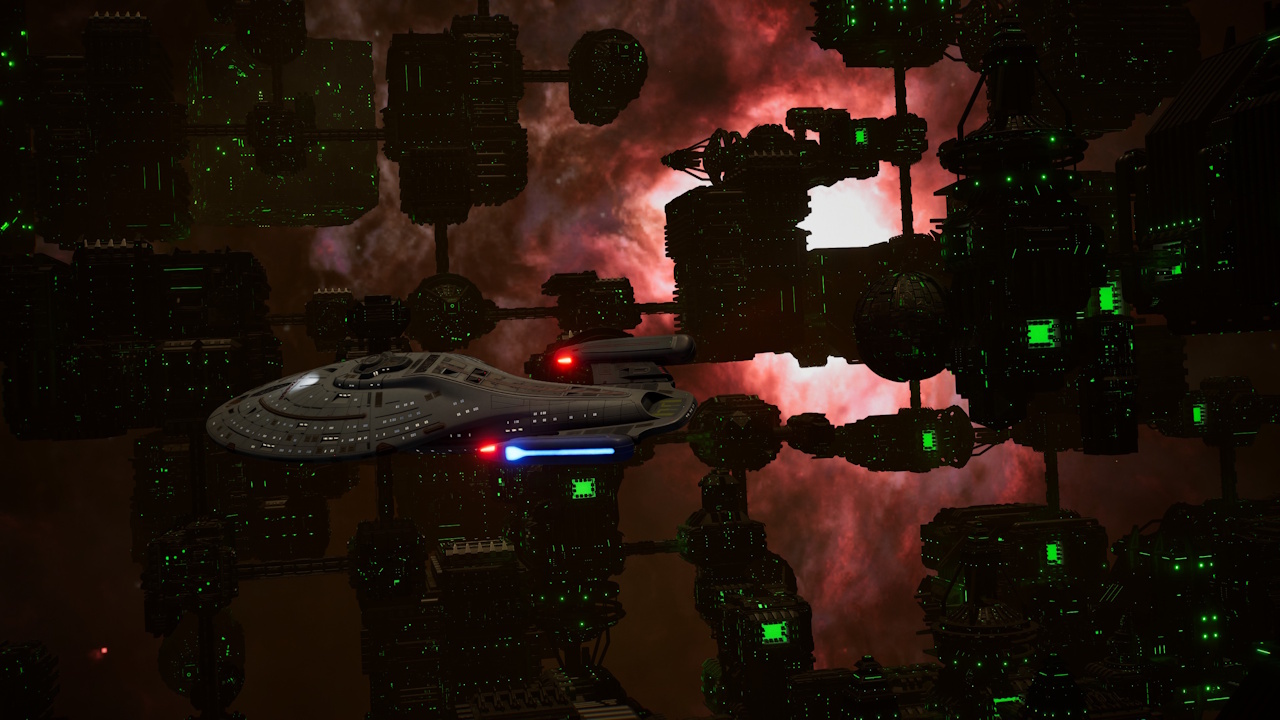
Screenshot of Star Trek: Voyager - Across The Unknown (demo version) showing the USS Voyager, the Caretaker's Array, and Kazon ships.
Voyager and Kazon ships at the Caretaker’s Array.

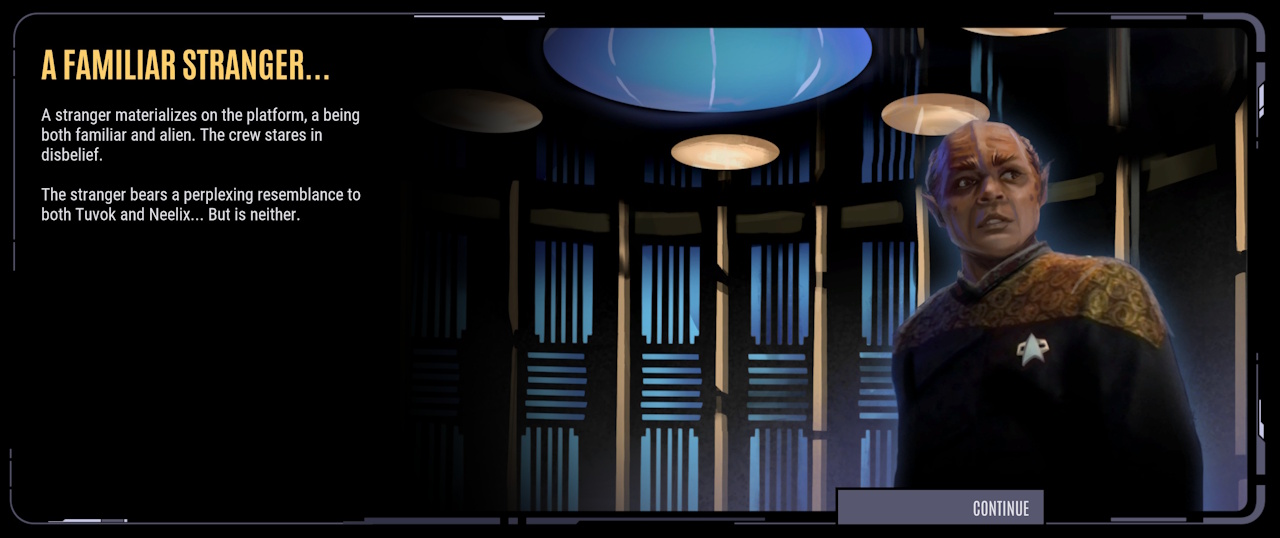
Across The Unknown needs some more polish. There were a few places where I saw a typo or missing punctuation, and another where Neelix popped up to tell me something before I’d even met him or invited him aboard. My PC also seemed to struggle, with the graphics card working overtime and the game still occasionally lagging – despite the fact that, as mentioned, the graphics really aren’t anything special. Performance when zooming in and out of the MSD could really use some improvement. I wasn’t even running Across The Unknown at its maximum settings.

That being said, I came away from my hour with the demo more excited to play the finished game than I was before I started. Voyager is such a great series, and it feels perfectly-suited to this kind of strategic management title. Being able to make radically different choices to those that Captain Janeway made during the show is going to be a lot of fun, and if the rest of the game is as good as the demo in terms of narrative and gameplay, I can see myself sinking many hours into it when it’s ready.

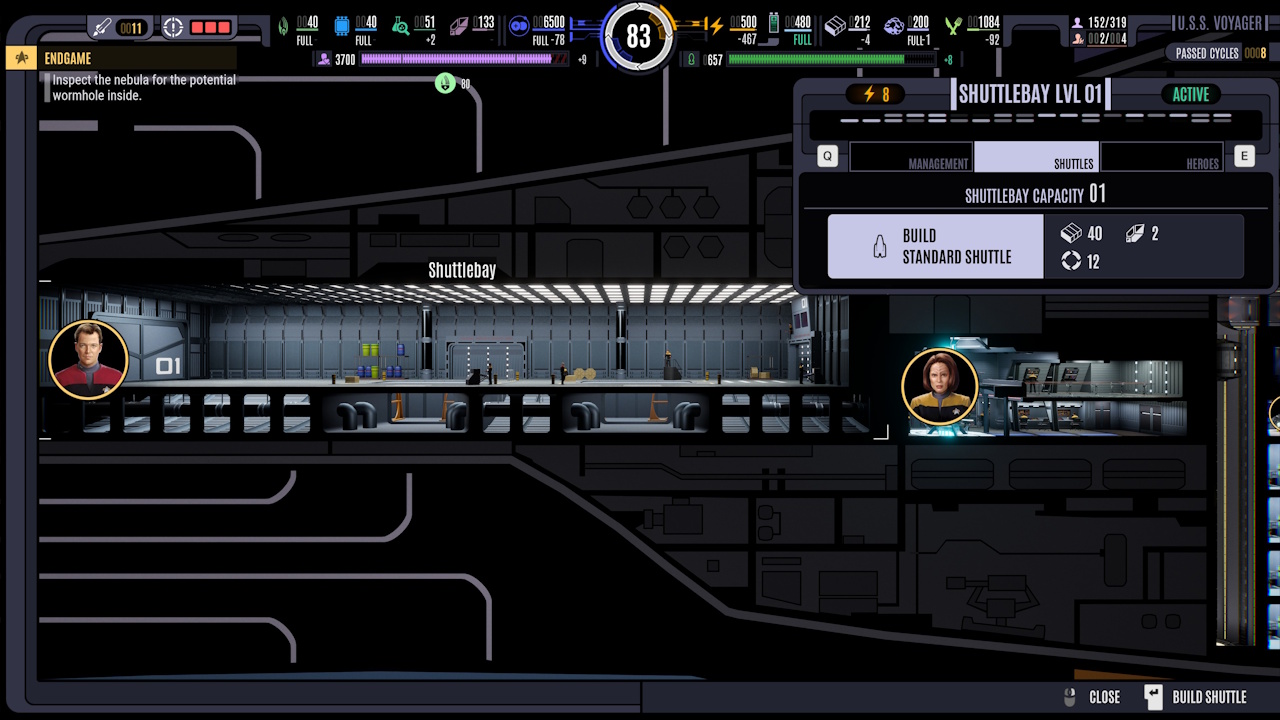
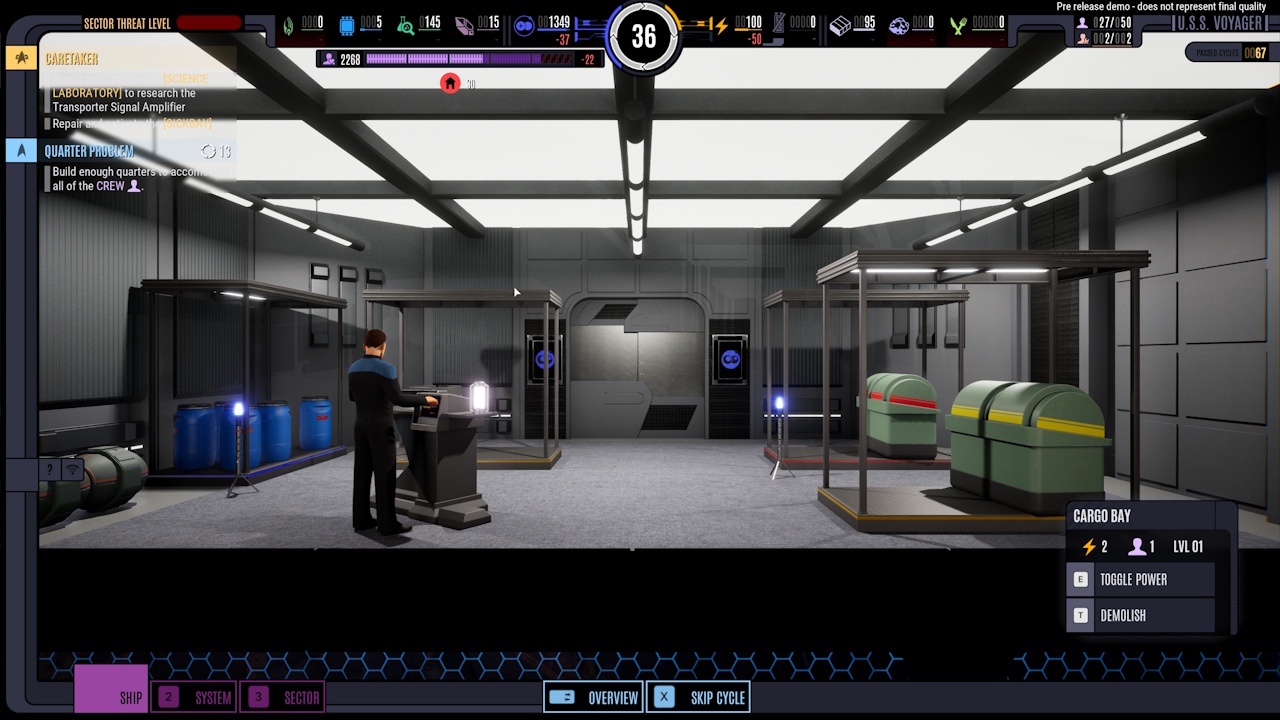
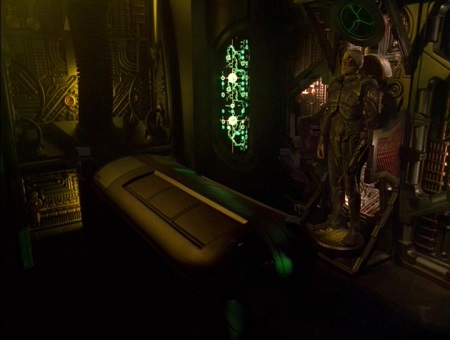
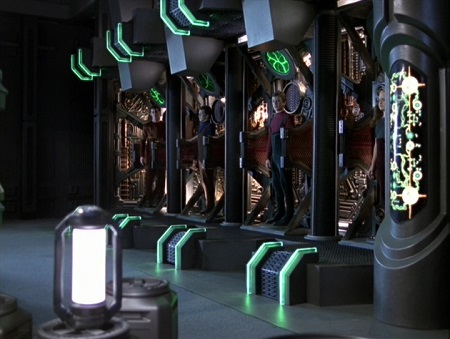
Screenshot of Star Trek: Voyager - Across The Unknown (demo version) showing a cargo bay.
A cargo bay.

If you want to wait for the finished game, that’s a completely valid decision. I usually don’t play pre-release demos, and there are a few issues with Across The Unknown that I’d hope will be smoothed out before the full game releases. But it’s hard not to recommend a completely free demo of a game like this. It only took me an hour to play through the events of Caretaker and get a feel for what Across The Unknown is like, so if you’re like me and Across The Unknown is a guaranteed day-one purchase for you, I think trying out the demo is an easy recommendation.

I’ll end by saying that Across The Unknown is clearly a game made for fans. And that’s okay. Not every game is going to reach a broad audience; Across The Unknown knows what it is, knows who its target audience is, and seems to be leaning into that in a big way. It’s not going to blow up and win hundreds of awards, nor is it going to expand the Star Trek fan community in a meaningful way. But given that it’s Voyager’s thirtieth anniversary this year, I’m just pleased that a game like this was greenlit at all. Stepping back into that world – even with some last-gen graphics, odd facial expressions, and occasionally janky dialogue – was a lot of fun.

The demo is free on Steam at time of writing… so why not try it? All you have to lose is 6 and a bit gigabytes of disc space and an hour or so of your time!


Star Trek: Voyager – Across The Unknown will be released (in full) in the future. The demo version is available now on Steam. The Star Trek franchise – including Voyager and Across The Unknown – is the copyright of Skydance/Paramount. Star Trek: Voyager – Across The Unknown is developed by GameXcite and published by Daedalic Entertainment. This article contains the thoughts and opinions of one person only and is not intended to cause any offence.


A selection of screenshots from my time with the Across The Unknown demo that didn’t fit in the article above:

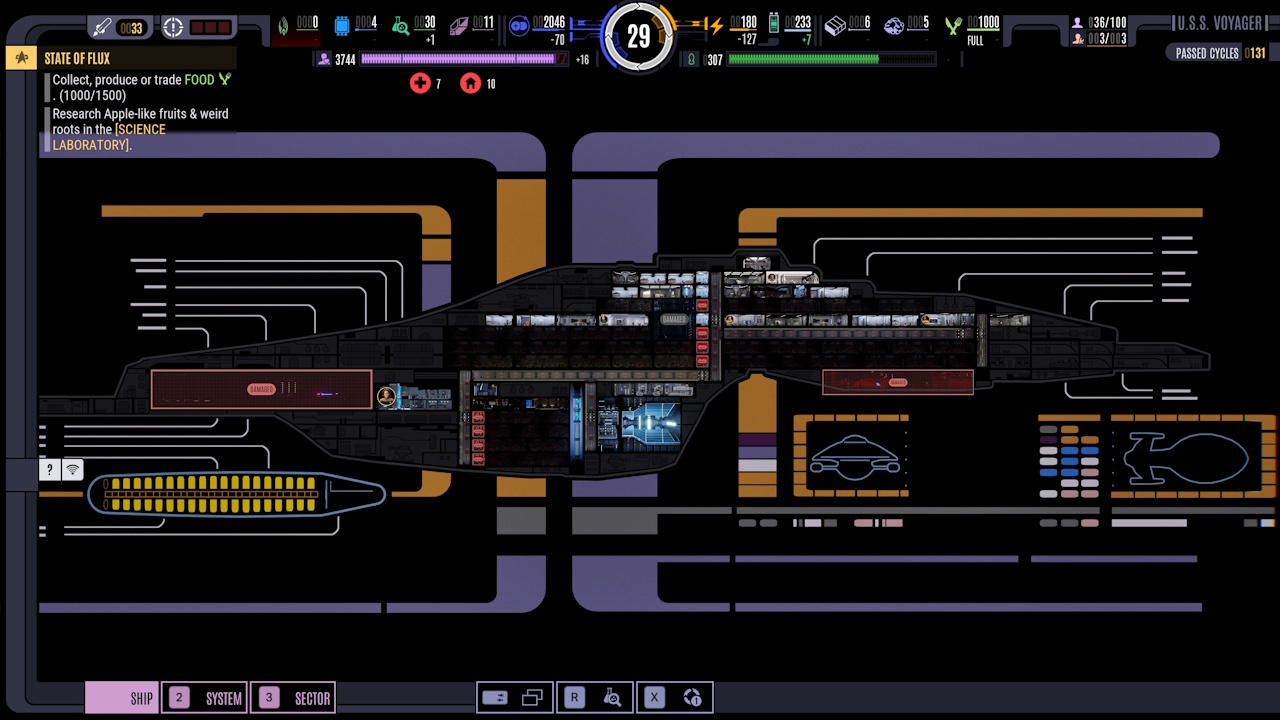
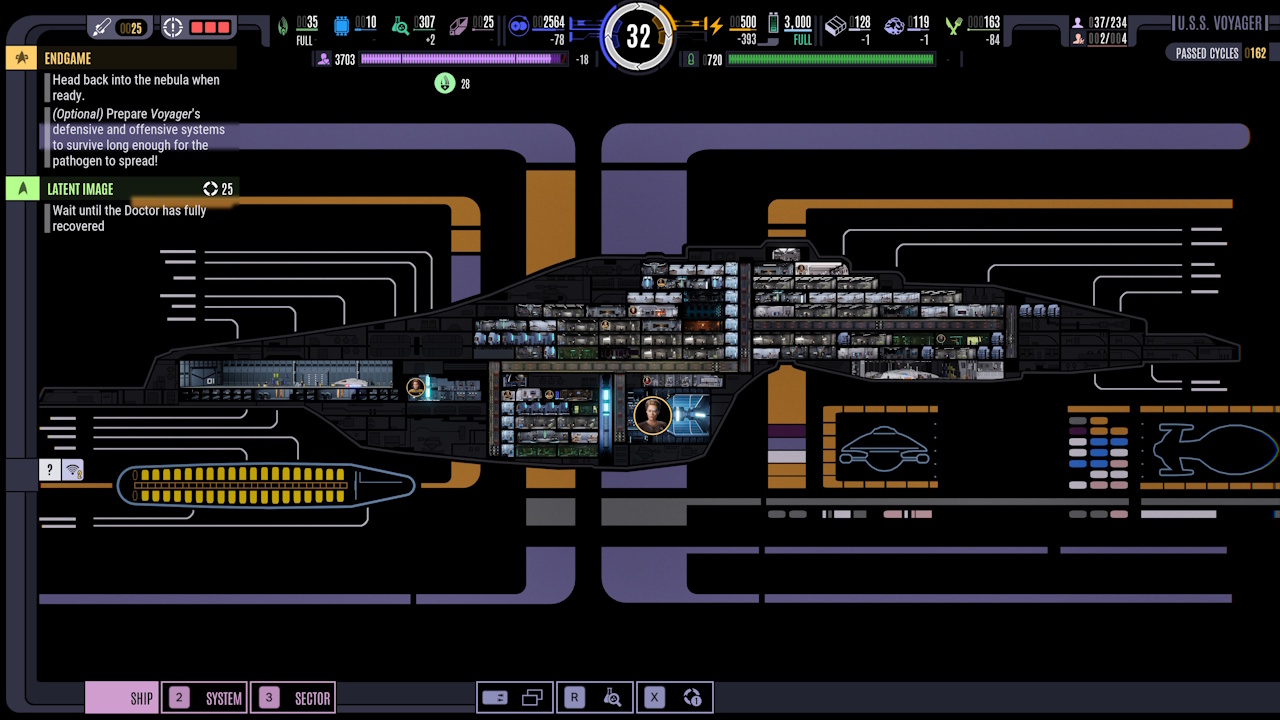
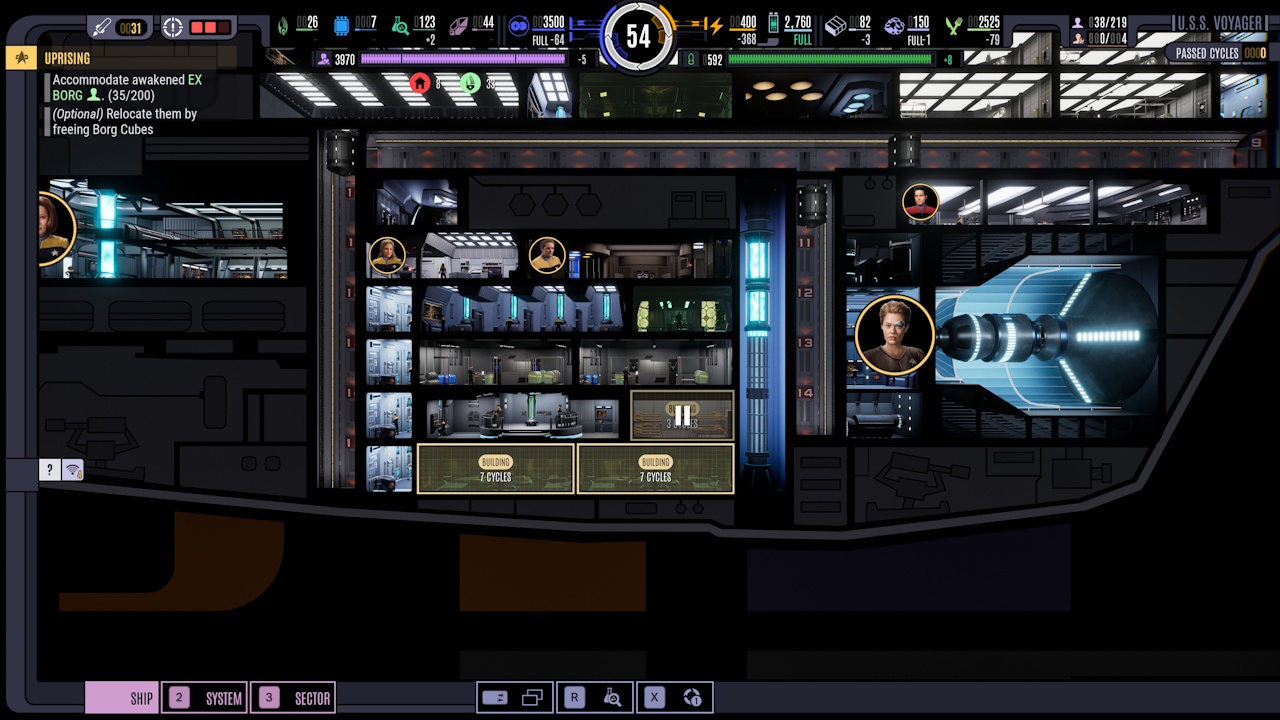
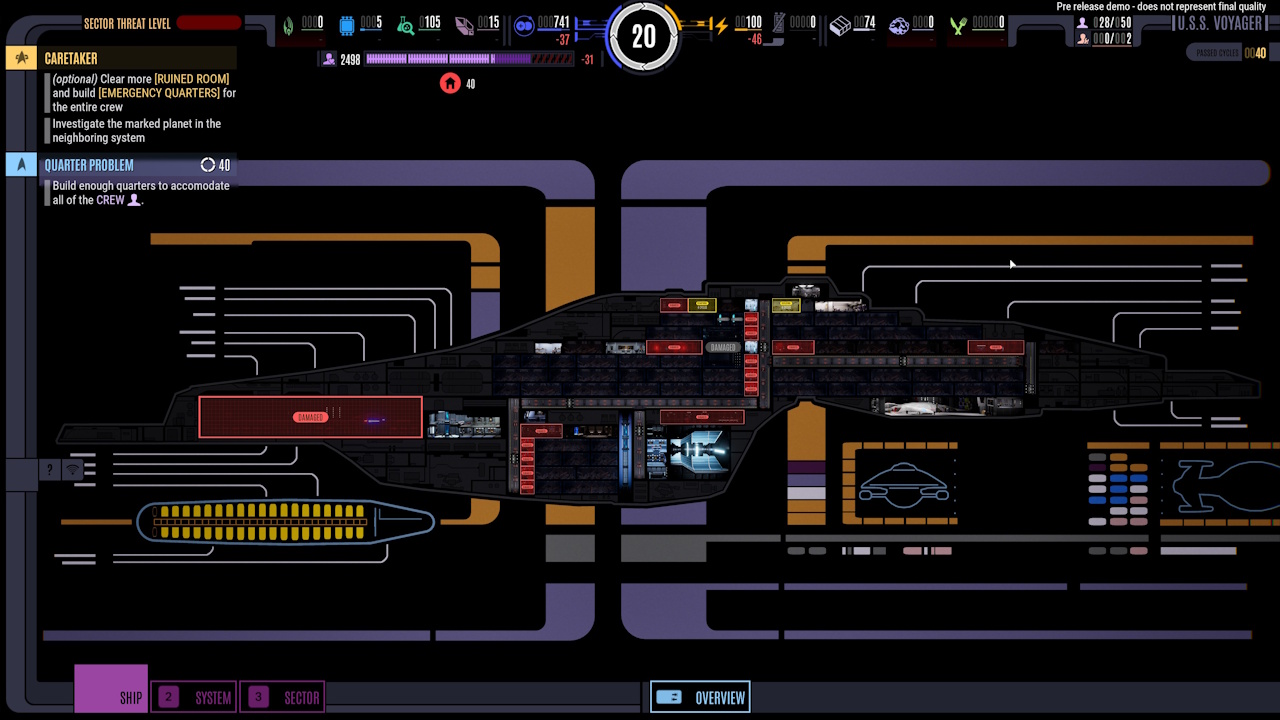
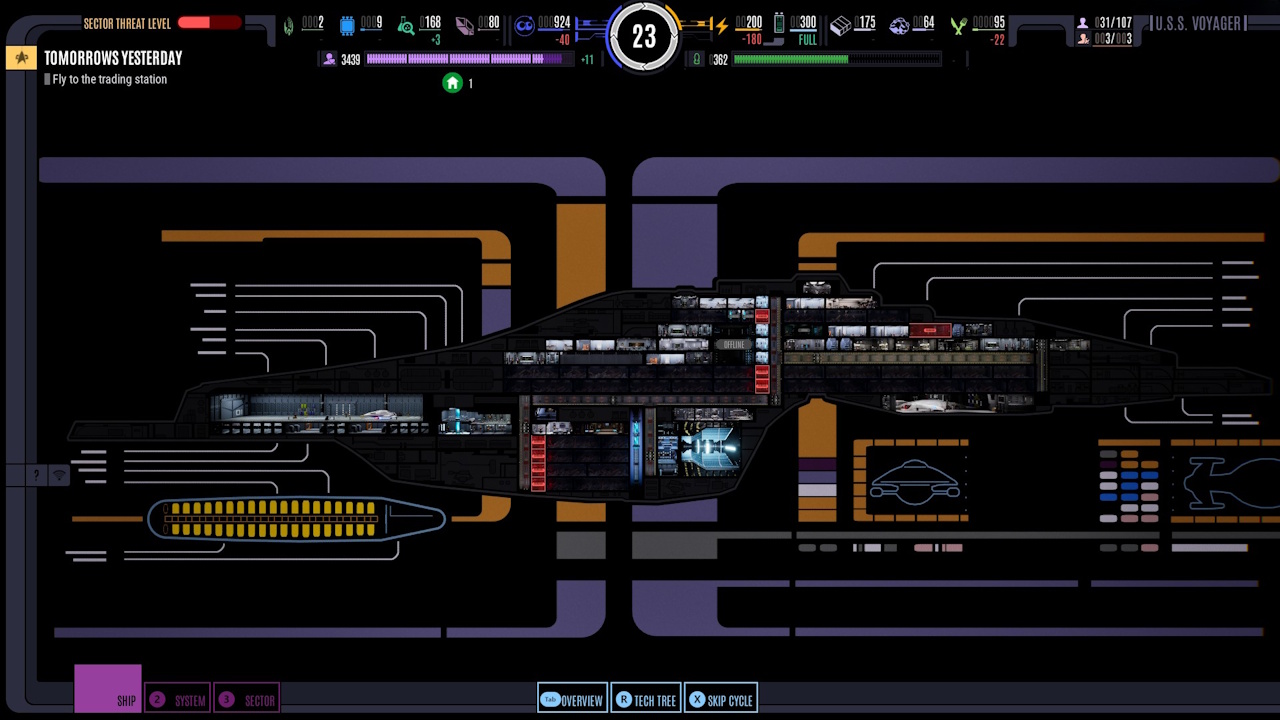
Screenshot of Star Trek: Voyager - Across The Unknown (demo version) showing the main view of the ship.
The main MSD/ship display (zoomed out).
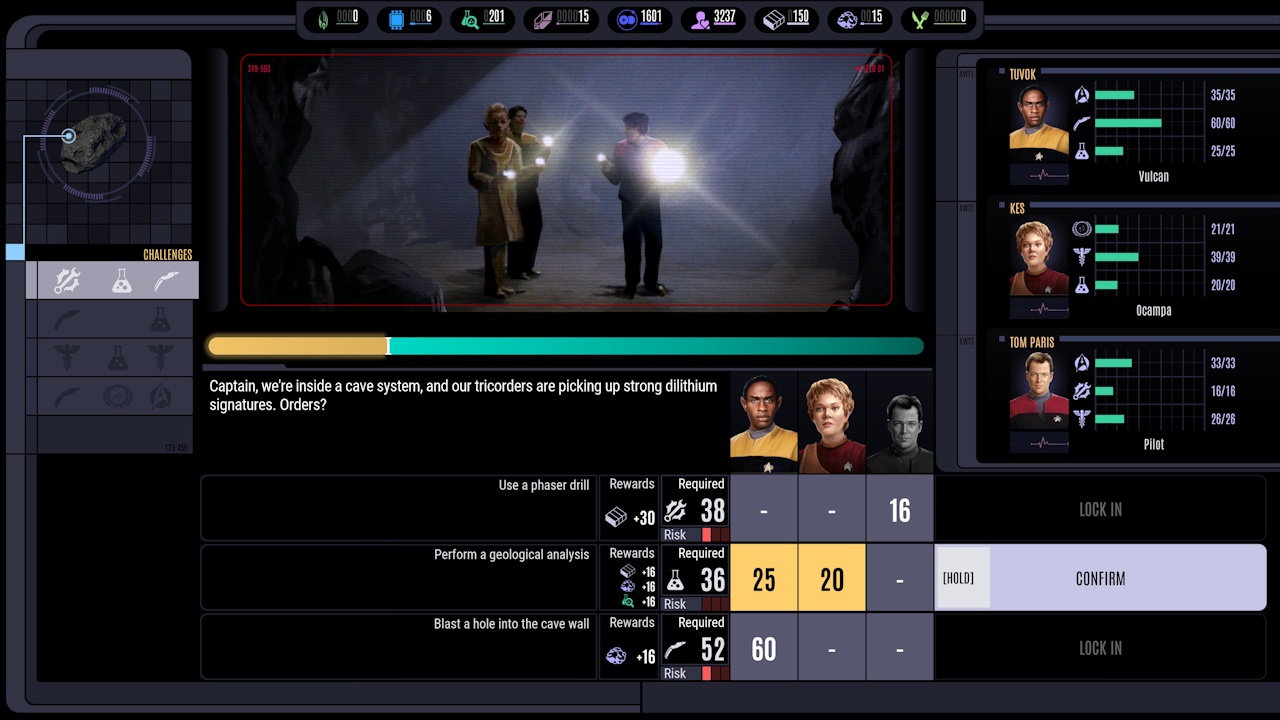
Screenshot of Star Trek: Voyager - Across The Unknown (demo version) showing an away mission.
An away mission.
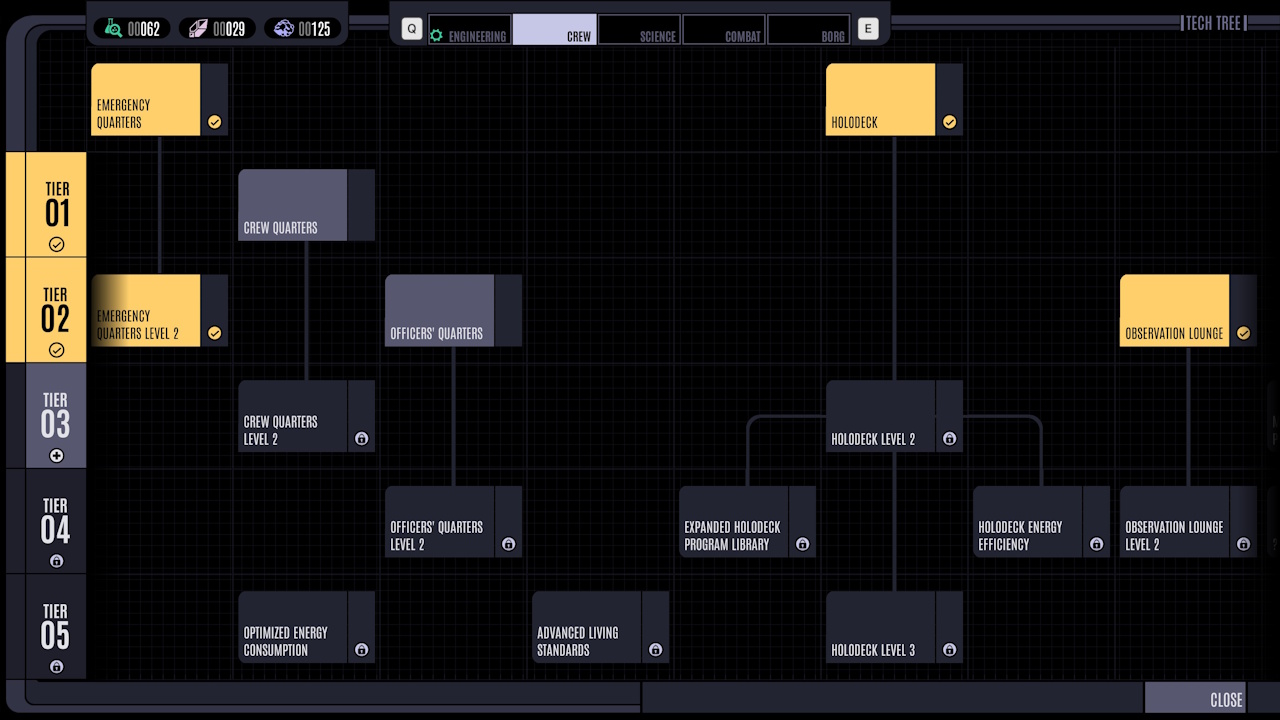
Screenshot of Star Trek: Voyager - Across The Unknown (demo version) showing the tech tree.
Part of the tech tree.
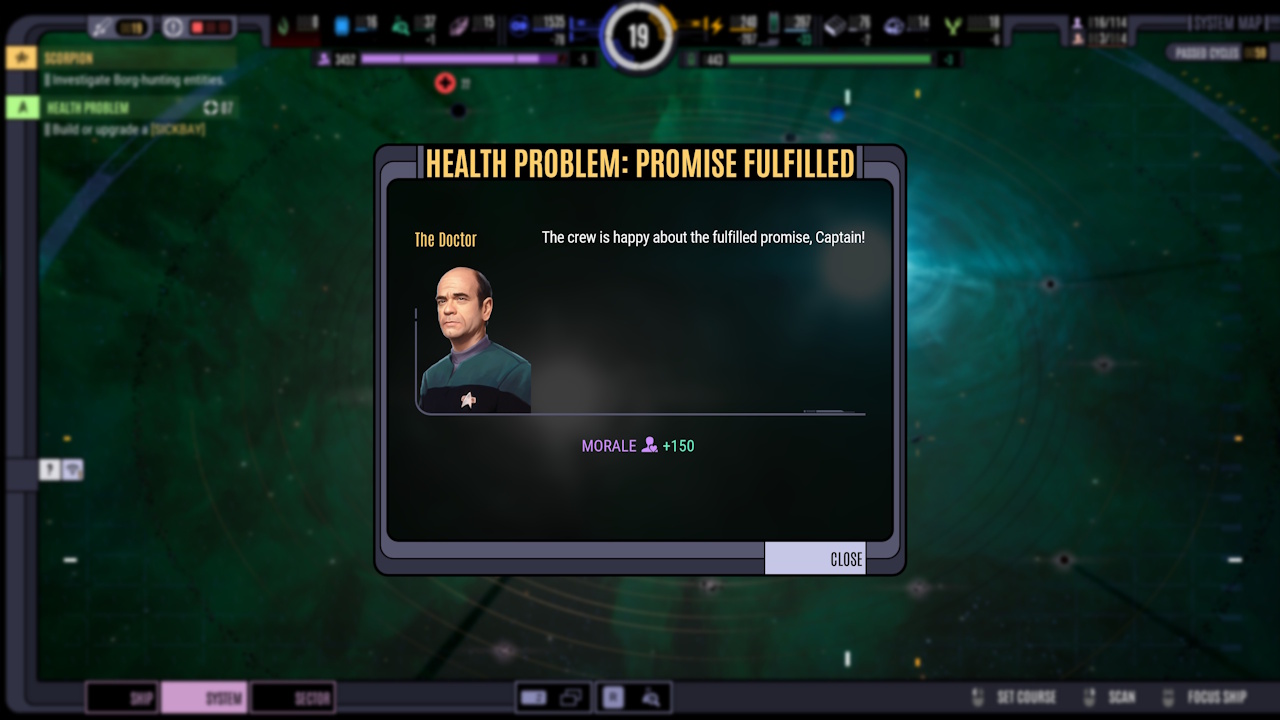
Screenshot of Star Trek: Voyager - Across The Unknown (demo version) showing the aftermath of a broken promise.
Breaking a promise (a.k.a. failing an optional quest).
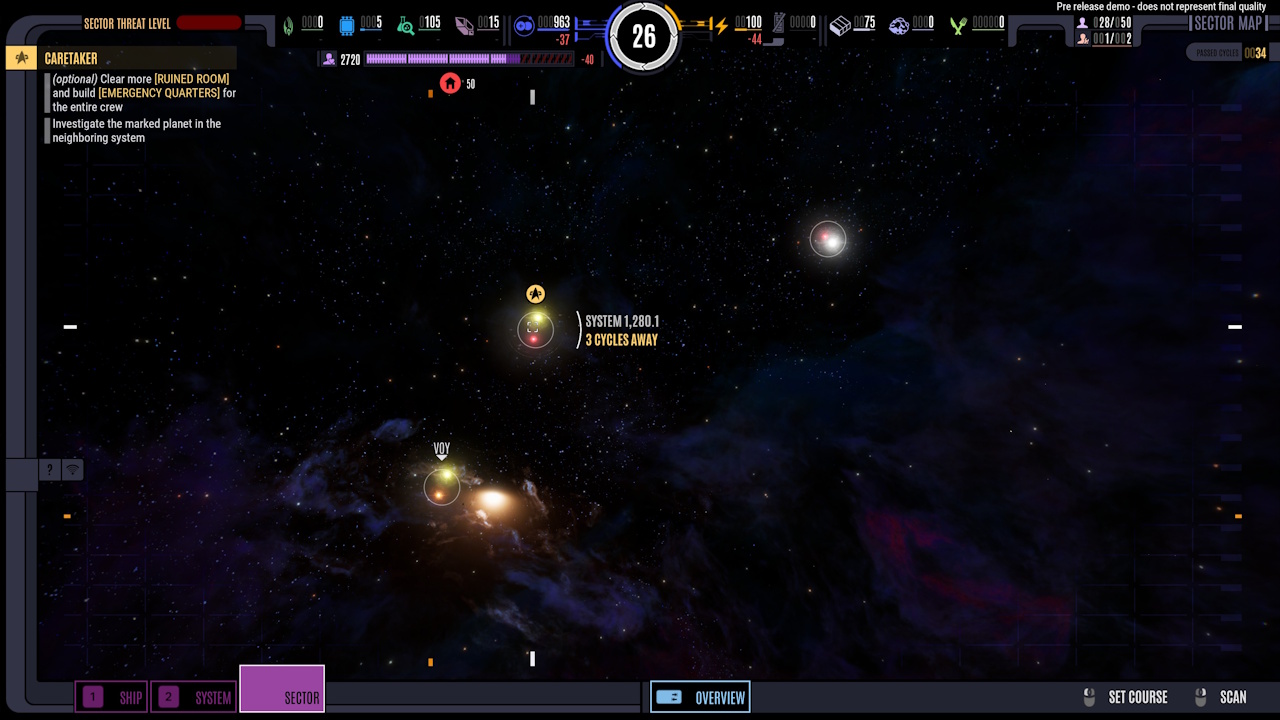
Screenshot of Star Trek: Voyager - Across The Unknown (demo version) showing the sector view.
A view of the sector, including three star systems.
Screenshot of Star Trek: Voyager - Across The Unknown (demo version) showing Neelix's ship.
Neelix’s ship arrives.
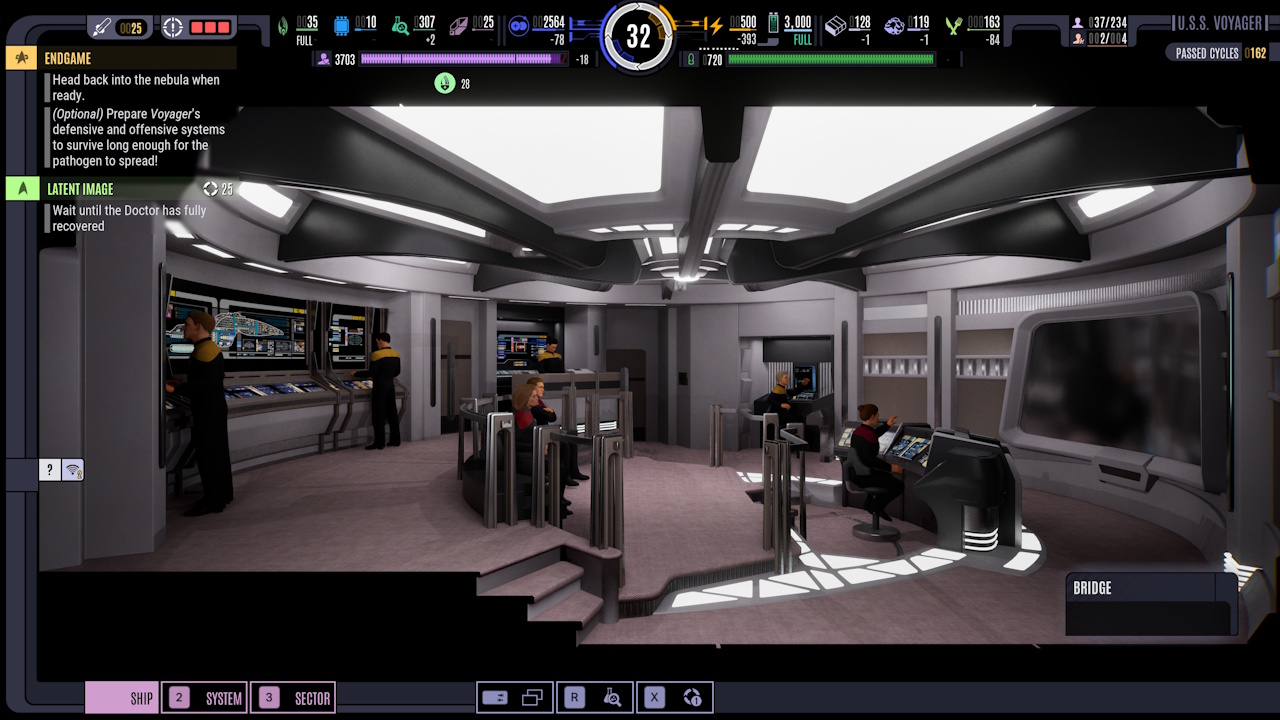
Screenshot of Star Trek: Voyager - Across The Unknown (demo version) showing the bridge.
The view from the bridge.
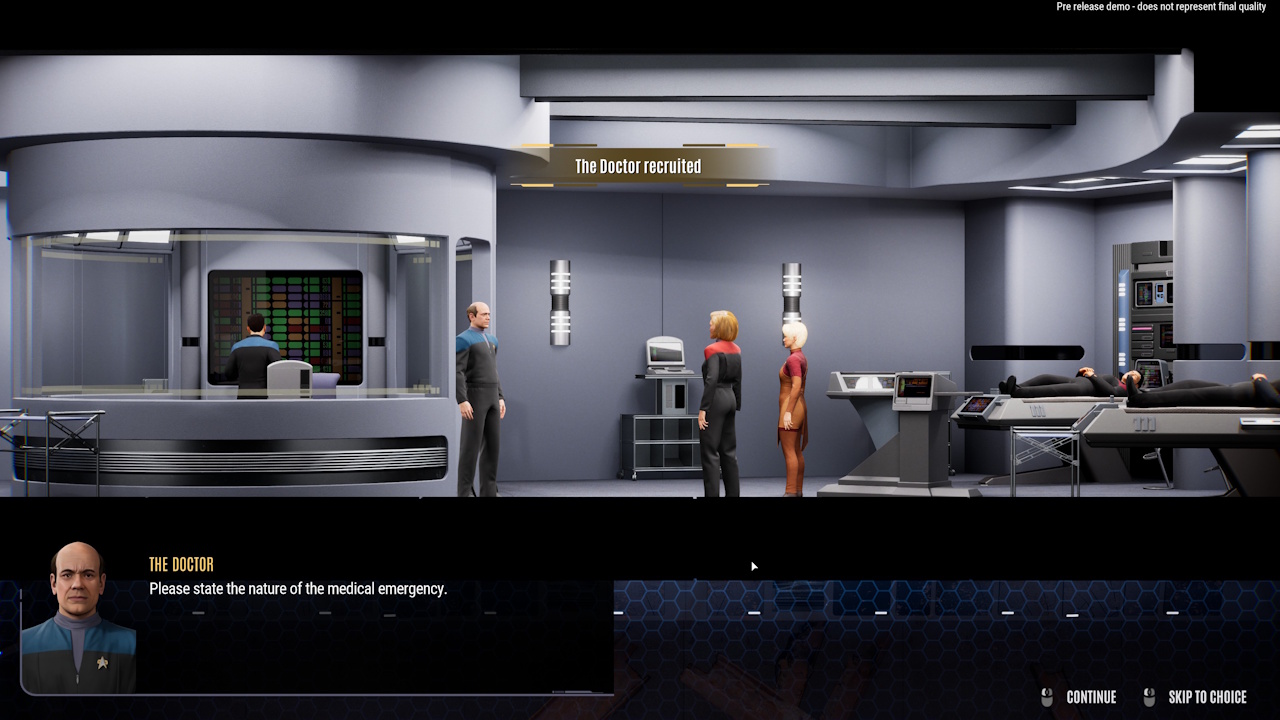
Screenshot of Star Trek: Voyager - Across The Unknown (demo version) showing sickbay.
The Doctor in sickbay.
Screenshot of Star Trek: Voyager - Across The Unknown (demo version) showing the choice at the end of the demo (destroy or use the Array).
The key choice!
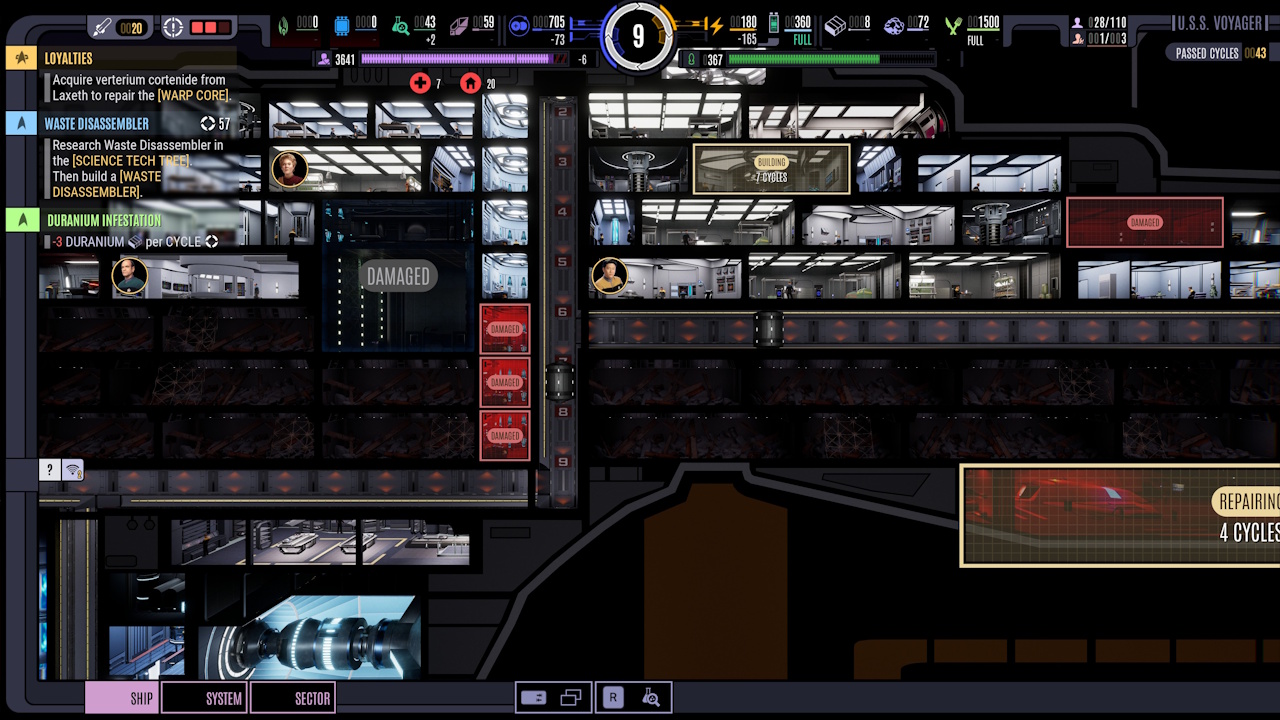
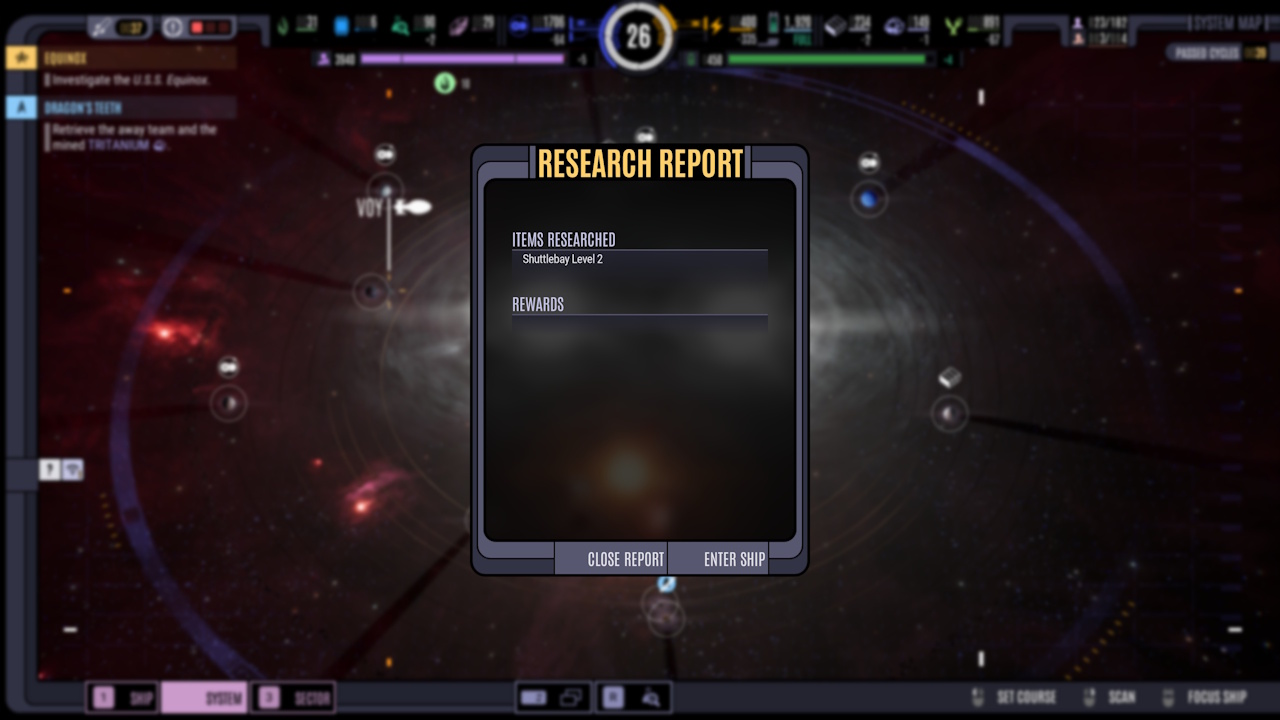
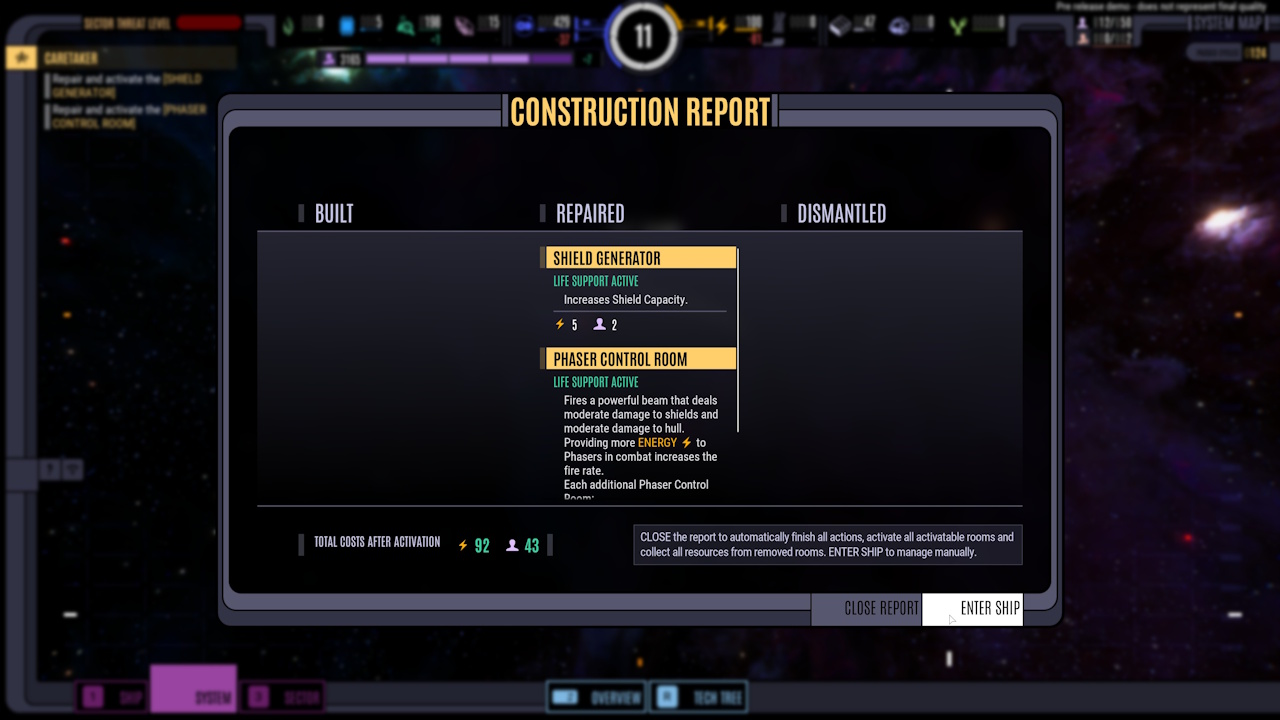
Screenshot of Star Trek: Voyager - Across The Unknown (demo version) showing a construction report.
Completing construction/repairs.

Star Trek “Bottom Fives” – Arguing with IMDB Again!

A Star Trek-themed spoiler warning.

Spoiler Warning: Spoilers are present for the following Star Trek productions: The Original Series, The Next Generation, Deep Space Nine, Voyager, and Enterprise.

A couple of months ago, I wrote a piece here on the website in which I looked at the “top five” episodes from each of the first five series… at least, according to the randos who rate episodes over on IMDB! There were some predictable picks… and a few surprises. Seriously, who would’ve expected that Blink of an Eye would be everyone’s favourite Voyager episode? Not me, that’s for sure!

So today, we’re going to do something similar… but with the lowest-rated episodes from those first five Star Trek shows. I think it could be a lot of fun to look at some of the stories that other fans and viewers don’t like, and consider some of the reasons why. I’m bracing myself for a few surprises here, too!

If you missed it, please check out my earlier piece for a look at the “top fives.” You can find it by clicking or tapping here.

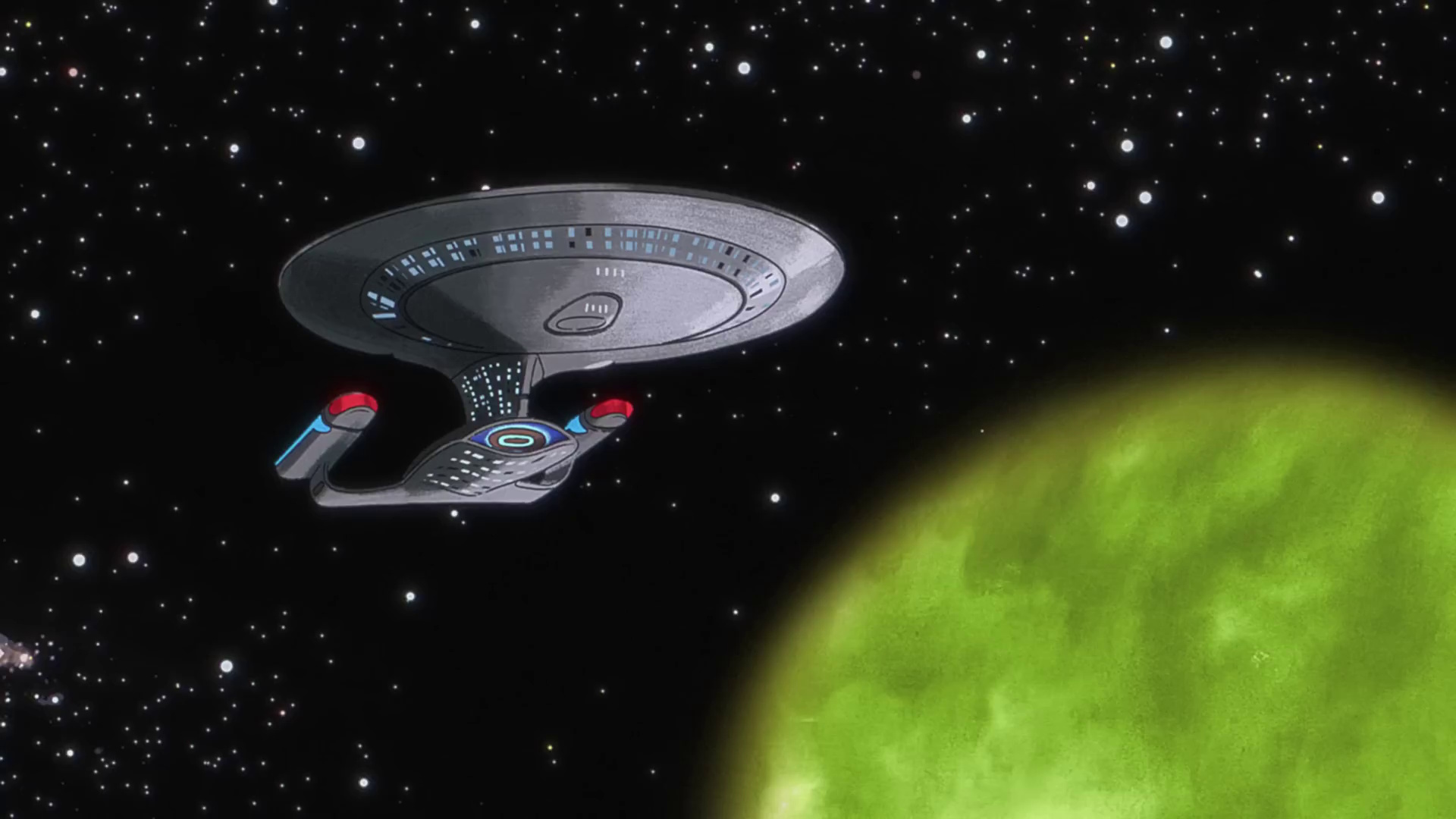
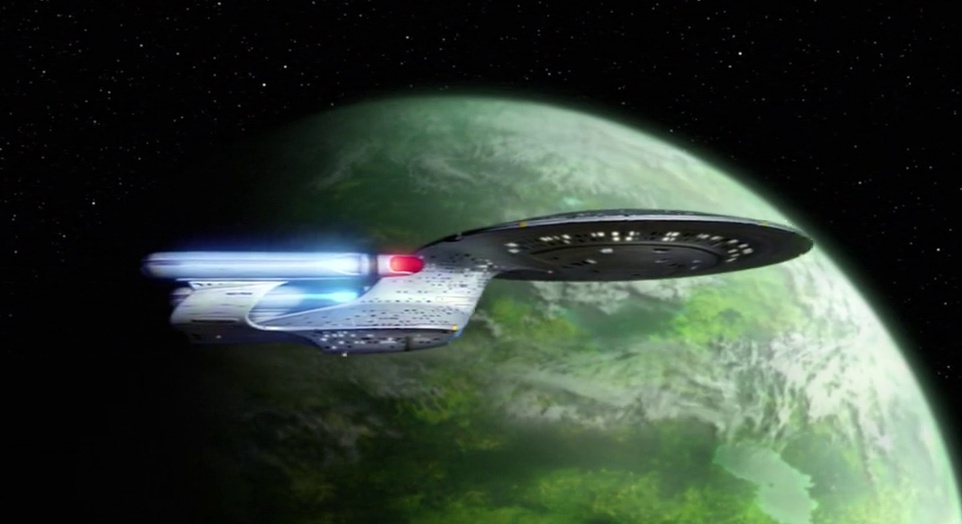
The Enterprise-D.

My usual caveat applies: everything we’re going to talk about is subjective, not objective. If I dump all over one of your favourite episodes, or talk positively about a story you hate… that’s okay! There’s enough room, and enough maturity, in the Trekkie community for differences of opinion and respectful disagreements that don’t descend into toxicity and argument.

This post, like my earlier one, will cover the first five live-action Star Trek shows: The Original Series, The Next Generation, Deep Space Nine, Voyager, and Enterprise. No Animated Series or films are included. I’ll start with TOS and move forward chronologically; the episodes will be ranked according to their IMDB ratings, from highest to lowest – i.e. beginning with the fifth-worst and finishing on the worst-rated episode for each of the five shows. The IMDB ratings are taken as of September 2025 (and might change over time!)

I’ll discuss what I don’t like (or do like) about each episode, and then I’ll answer a simple question: does it deserve the hate? Or, to put it another way: would I personally rate the episode as being among the worst in the franchise?

Now that all of that’s out of the way, let’s jump into the episodes.

The Original Series Episode #5:
The Omega Glory, Season 2
IMDB Rating: 6.1/10

Gene Roddenberry intended to hold up a mirror to society, using Star Trek episodes as “morality plays” to comment on or critique things out here in the real world. Many of these episodes are wonderful. The Omega Glory is arguably too on-the-nose, though, with its very literal depiction of the aftermath of a Cold War turned hot. Roddenberry himself wrote The Omega Glory, so it’s a bit of a shame to see it rated so lowly by viewers and fans.

There’s a lot of competition in TOS’s second season, and compared to stronger offerings like The Doomsday Machine, Journey To Babel, The Trouble With Tribbles, and The Ultimate Computer, I can see why The Omega Glory struggles to keep up. There’s also, by modern standards, somewhat uncomfortable racial stereotyping – which Roddenberry intended to flip on its head with The Omega Glory’s big revelation – but I’m not sure it works as well as he’d hoped.

Does It Deserve The Hate?
​☑️​Yes.​☑️​

The Original Series Episode #4:
Spock’s Brain, Season 3
IMDB Rating: 5.7/10

No list of “the worst Star Trek episodes” would be complete without Spock’s Brain. And this is a trend we’re about to see a lot more of; Season 3 of The Original Series is generally considered to have a number of weaker offerings, in part due to the show’s reduced budget. But I’ll be honest: I’ve always found Spock’s Brain to be weirdly fun… in a “so bad it’s almost good” kinda way.

I also think the episode has become iconic, or at least symbolic of a particular moment in the history of Star Trek. This was the first episode of Season 3 – a season that wouldn’t have existed at all without a letter-writing campaign by fans. It’s also a story that showed how far Kirk (and Spock’s other friends) were willing to go to save him when he was in danger. Is it a ridiculously silly premise? Yes. Is it executed perfectly by all involved? No. But do I watch it anyway and smile? Yes!

Does It Deserve The Hate?
⛔No.⛔

The Original Series Episode #3:
The Alternative Factor, Season 1
IMDB Rating: 5.7/10

The Alternative Factor is the episode with Lazarus (and Anti-Lazarus, his counterpart from an alternate universe). To be honest, I’d pretty much forgotten about The Alternative Factor; nothing about it leaps out at me as being particularly memorable. “Forgettable” is not synonymous with “terrible,” but I think it’s at least noteworthy that The Alternative Factor just didn’t leave much of an impression on me. None of the special effects or locations stand out, Lazarus and Anti-Lazarus don’t have any unique makeup or prosthetics, and the whole look of the episode is just a bit bland.

In terms of story, The Alternative Factor is small and kind of silly – with Lazarus in particular being quite over-the top – while simultaneously trying to present its core conflict as a multiverse-ending threat. It’s worth noting that there were production issues with The Alternative Factor, including an extensive re-write to remove a romantic sub-plot and the original actor contracted to play Lazarus failing to show up for work when production had already commenced.

Does It Deserve The Hate?
​☑️​Yes.​☑️​

The Original Series Episode #2:
The Way To Eden, Season 3
IMDB Rating: 5.4/10

I don’t think The Way To Eden is all that bad, to be honest – especially not for a Season 3 episode which was produced with a lower budget. Maybe there are some issues with the way Chekov is written, but on the whole I really don’t dislike this episode at all. It’s very much a product of its time – the followers of Sevrin are clearly based on the American countercultural movement, which was reaching its peak in 1969 – but so are many Star Trek episodes, and I don’t think that alone should count against it.

It’s also not the only Star Trek story to involve a cult-like group who are seeking paradise (or some other prophecy fulfilment). I actually quite like some of the details in the script – one of the members of the group is the son of an ambassador whose people are negotiating with the Federation, which I feel adds a lot to the broader lore of the Star Trek galaxy. Is The Way To Eden the strongest TOS episode, or a great way to introduce new fans to the franchise? Probably not. But I don’t think it’s atrocious, either.

Does It Deserve The Hate?
⛔No.⛔

The Original Series Episode #1:
And The Children Shall Lead, Season 3
IMDB Rating: 5.2/10

As with The Alternative Factor above, this isn’t an especially memorable episode for me. The core premise of an alien entity manipulating a group of children isn’t necessarily bad, but the execution leaves a lot to be desired. The way the story was resolved, too, leaned on a pretty big cliché, and some less-than-spectacular acting performances.

There were interesting ideas in And The Children Shall Lead, like several members of the crew seeing visual manifestations of their fears. Gorgan’s powers, too, could have been tense and even frightening if handled better. There’s also something distinctly eerie about a child or group of children in this kind of story; that’s why films like The Exorcist work so well. But again, the execution rather than the premise is what lets the episode down.

Does It Deserve The Hate?
​☑️​Yes.​☑️​

The Next Generation Episode #5:
Angel One, Season 1
IMDB Rating: 5.7/10

Angel One wanted to be a Roddenberry-style “morality play,” using Star Trek’s sci-fi setting to consider the real-world issues of sexism and a patriarchal society. It did that by turning the tables and depicting a civilisation where women, not men, were the dominant ones. That aim may have been worthwhile or even admirable – but the execution was clumsy, at best. The B-plot, depicting a virus spreading on the Enterprise while the away team was on the planet, wasn’t particularly strong, either – though I enjoy the visual of Data, alone, on the bridge!

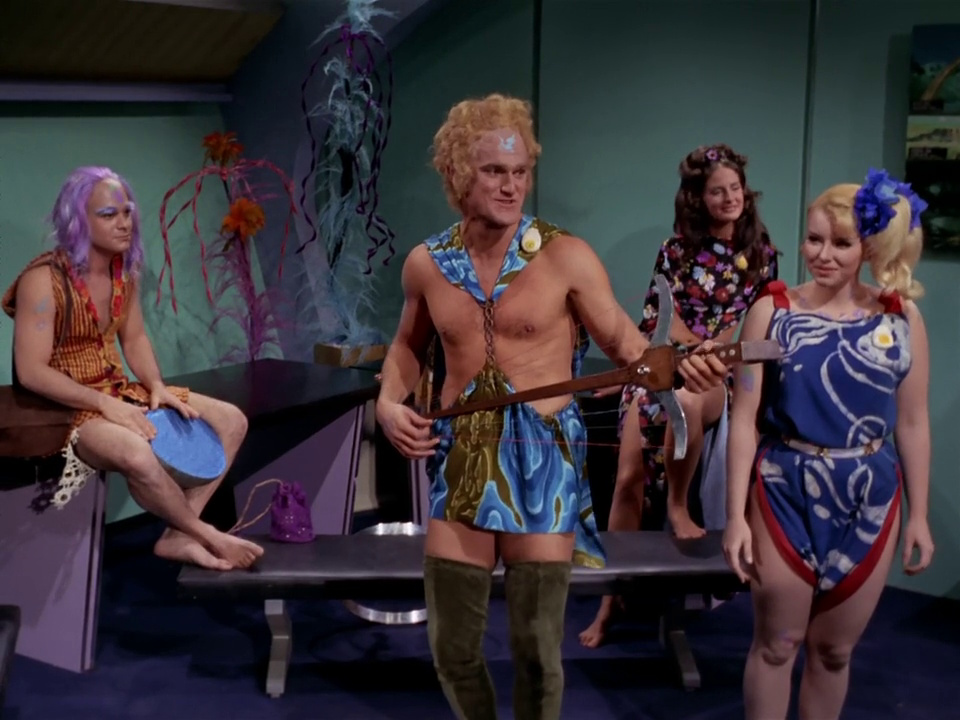
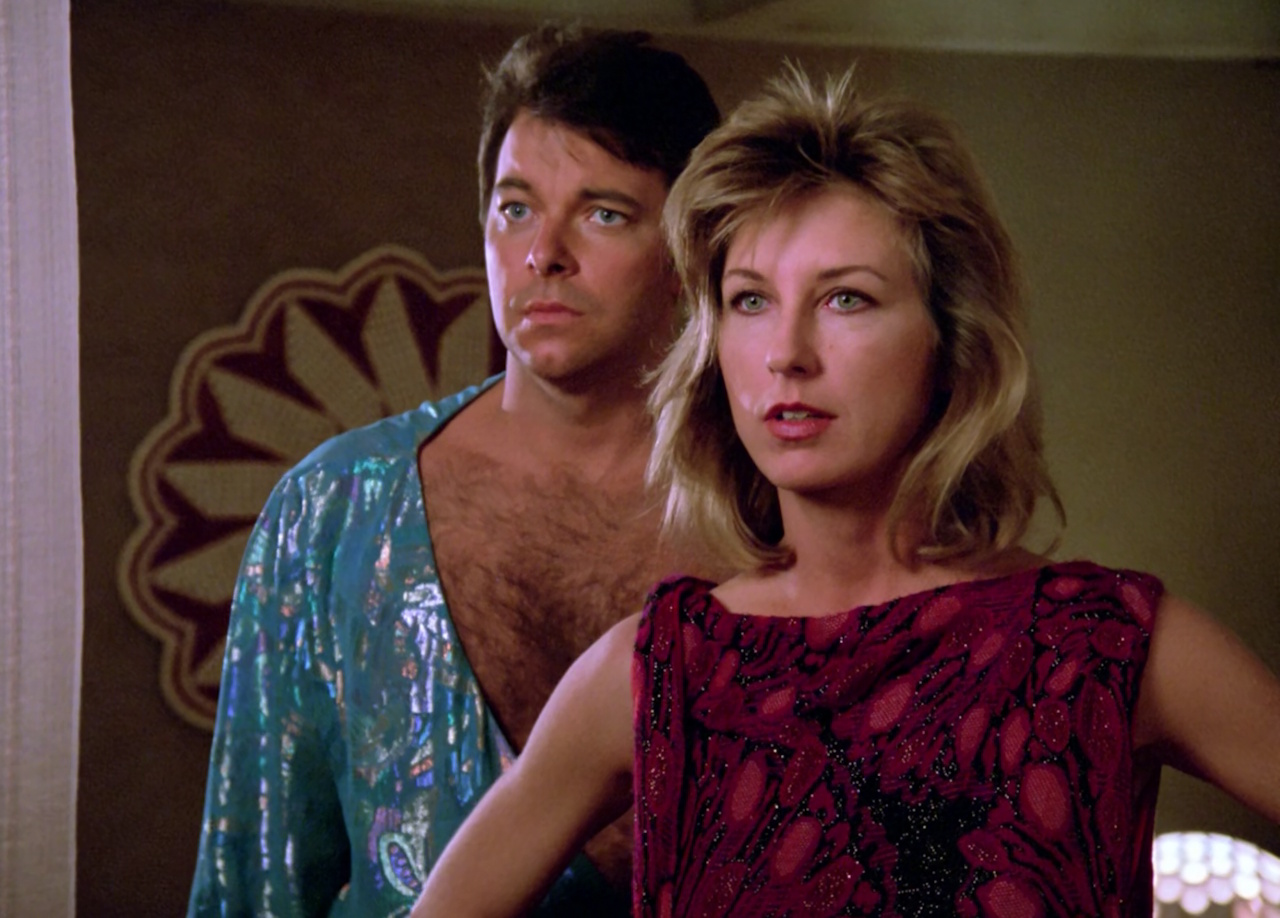
Angel One might be best-remembered among Trekkies for some of its costumes! The costumes worn by the male inhabitants of Angel I, as well as by Riker later during the away mission, were typical Season 1 silliness, reminiscent of some of the costumes created twenty years earlier for TOS. And that’s Angel One in a nutshell, really – it’s one of several Season 1 episodes that plays out like an Original Series story.

Does It Deserve The Hate?
⛔No.⛔

The Next Generation Episode #4:
Man of the People, Season 6
IMDB Rating: 5.7/10

I’ve always felt that Man of the People had an interesting premise. And Star Trek stories have often posed deep moral questions to the audience; in this case, we’re considering whether “the greater good” can be served by a man who harms people around him. There’s a metaphor there, buried in the story, about bad people doing good things, and the age-old question of whether the ends can justify the means when significant harm is being caused.

However… Man of the People doesn’t execute its ideas flawlessly, and the focus on Troi “acting out” earlier in the episode is a bit much for me. Apparently, there were issues on the production side – which led to the script being rushed and the story being bumped up the filming schedule. I daresay that’s noticeable in the finished product.

Does It Deserve The Hate?
​☑️​Yes.​☑️​

The Next Generation Episode #3:
Code of Honor, Season 1
IMDB Rating: 5.1/10

I might’ve ranked this one even lower! Code of Honor is a complete misfire; an episode featuring a civilisation of “African stereotypes in space” that’s so utterly awful it’s hard to know where to start. I’ve said before that the fact that this episode was produced for The Next Generation in the 1980s genuinely boggles my mind, and it’s an example of how, despite Star Trek’s lofty ambitions, the franchise hasn’t always gotten it right.

If I were to find any positive notes in this mess, it would be that Tasha Yar gets something to do, and that the episode is an early example of Captain Picard being willing to go out on a limb for a member of his crew. But those points, unfortunately, are completely lost in an episode swarming with awful production decisions. I can barely even re-watch Code of Honor as a result.

Does It Deserve The Hate?
​☑️​Yes.​☑️​

The Next Generation Episode #2:
Sub Rosa, Season 7
IMDB Rating: 4.8/10

I… I’m sorry, everyone. I’m almost ashamed to admit this… but I actually kinda like Sub Rosa. And, if I may defend its honour for a moment, I’d suggest that the memes that the episode spawned are at least partially to blame for its low rating. Yes, Sub Rosa’s “sex with a ghost” storyline is silly. Got it. Message received! But there’s more to the story than that, and the episode treats Ronin as an alien entity, not as a “spirit.” I also really like the sets used for the Caldos Colony – the place feels very different to almost anywhere else in Star Trek, at least up to this point in the franchise.

Star Trek hasn’t always been great at depicting aliens that feel, well… alien. And if there’s one thing to say about Ronin, it’s that the idea of a non-corporeal parasitic entity is, if nothing else, very alien. Caldos Colony is a fun setting, we got to learn more about Dr Crusher’s early life, and there was a bit of silliness in the story, too. Plus, Star Trek got some great memes out of this one! Honestly, what’s not to love?

Does It Deserve The Hate?
⛔No.⛔

The Next Generation Episode #1:
Shades of Gray, Season 2
IMDB Rating: 3.3/10

I’m astonished to see Shades of Gray receiving any support whatsoever; this is a rare 1/10 or even a 0/10 episode for me – and for most Trekkies I’ve spoken with, too. It absolutely deserves its place as the worst-rated TNG episode… and I suspect the production team knew that when they put it together. If you’ve been a Trekkie for as long as I have, you know the story by now: production on TNG Season 2 overran both its schedule and budget, and a compromise had to be made late into production. Shades of Gray – a clip show – was the result.

Because television production has changed over the years, I doubt we’ll ever get another episode like Shades of Gray in the Star Trek franchise – and that’s for the best. It’s an especially weak episode, and its only original element – the frame narrative depicting Riker’s injury and illness – does nothing to hold its random assortment of clips together. It was a poor way to say goodbye to Dr Pulaski, too, and a serious disappointment as the show’s otherwise fantastic second season came to an end.

Does It Deserve The Hate?
​☑️​Yes.​☑️​

Deep Space Nine Episode #5:
Profit and Lace, Season 6
IMDB Rating: 5.8/10

Profit and Lace is DS9′s “trans” episode… kind of. Star Trek has wrangled with questions of gender on many occasions, and even in the ’90s, when the topic of gender and being trans was usually treated just awfully on television, the franchise largely got it right. Quark’s temporary sex change, as it’s presented in this episode, though… I dunno. As an examination of attitudes toward gender, and how females are treated in a society which still sees them as second-class… there were interesting ideas. But the execution of all of it was just flawed.

There’s a tonal clash between the heavier themes, as interpreted by Alexander Siddig (who directed the episode), and the lighter way Profit and Lace was originally written. A different director might’ve taken the episode in much more of a comedic direction – which would’ve suited the way it was written, though it would’ve come at the expense of being just another late ’90s “trans comedy” story. I get what the episode was going for, and I think a more serious approach to the subject matter – both the gender division in Ferengi society and Quark’s “transition” – was the right call. But the script didn’t carry the themes, and what resulted was a bit of a mess.

Does It Deserve The Hate?
​☑️​Yes.​☑️​

Deep Space Nine Episode #4:
Resurrection, Season 6
IMDB Rating: 5.7/10

Oof, Season 6 is not doing well in these rankings so far! To be honest, though, I get it when it comes to Resurrection. If you know me, you’ll know I’m not really a fan of the Mirror Universe as a setting; it’s one-note, and has a tendency to trick even competent performers into putting out hammy, over-acted, one-dimensional performances – all of which are on display with Mirror Kira and Mirror Bariel, unfortunately. Prime Kira also seems to act out-of-character, falling so easily for Mirror Bariel so long after the original Bariel’s death.

DS9′s executive producer, Ira Steven Behr, has suggested that Resurrection’s place in the season – coming after the intense opening phase of the Dominion War, Starfleet’s recapturing of the station, and then Worf and Dax’s wedding – contributed to fan dissatisfaction, feeling that “nothing” the show had done immediately after those intense stories would’ve been satisfying. I’m not convinced on that, I’m afraid. Season 6 has some of my favourite DS9 episodes. The likes of Who Mourns for Morn, The Magnificent Ferengi, and One Little Ship are all standalone stories that, had they taken this broadcast slot, wouldn’t have been as poorly-received as this uninspired Mirror Universe story.

Does It Deserve The Hate?
​☑️​Yes.​☑️​

Deep Space Nine Episode #3:
The Muse, Season 4
IMDB Rating: 5.6/10

I feel a bit sorry for The Muse! Jake Sisko was too often overlooked in Deep Space Nine, so to rank one of the rare Jake-focused episodes so lowly wouldn’t have been my preference. However, if I may be so bold, it isn’t Jake that’s upset people (mostly). Rather, it’s The Muse’s Lwaxana Troi and Odo B-plot that, I would suggest, is the reason for such a low rating. Lwaxana wasn’t always well-received by Trekkies, despite her illustrious performer, and her relationship with Odo was, to the best of my recollection, never especially popular.

On Jake’s side of the story, I like the idea of a kind of parasitic entity latching onto his creativity. The Muse does a lot to establish Jake’s writing career, and it’s just an interesting idea to see Onaya taking advantage of his talent. There’s a great moment between Jake and Ben toward the end of the episode, something we’d see less and less of as DS9 continued its run. And while this side of the story was imperfect, it was at least a creative idea.

Does It Deserve The Hate?
⛔No.⛔

Deep Space Nine Episode #2:
Meridian, Season 3
IMDB Rating: 5.6/10

It sounds like Meridian – whose story concept was based on a novel set in Scotland – had a bit of a troubled production. An expensive location shoot for the planet Meridian seems to have led to some scenes being rewritten or cut altogether, which may have affected the finished product. The main gripe folks seem to have, though, is the behaviour of Jadzia Dax. As with Kira in Resurrection, which we discussed above, Dax falls head-over-heels for someone she’s just met – and that leads to her wanting to give up her life on DS9, leave her friends behind, and move to this random planet which can’t exist in normal space.

I would suggest that everyone involved – the entire cast, guest stars, and director Jonathan Frakes – did the best they could with that concept, but it was just a fatally flawed premise to begin with. Meridian has some neat ideas, like the disappearing planet, which feels “very Star Trekky;” i.e. something you wouldn’t see in any other sci-fi universe! But the way it handled Dax was poor, and a B-plot about Quark selling perverted holosuite programmes does nothing to help the episode, either.

Does It Deserve The Hate?
​☑️​Yes.​☑️​

Deep Space Nine Episode #1:
Let He Who Is Without Sin…, Season 5
IMDB Rating: 5.5/10

I gotta be honest: I’m surprised to see this as the “most-hated” DS9 episode. I knew Let He Who Is Without Sin wasn’t wildly popular, but I don’t think I expected it to be considered the absolute worst in the series! There are definitely some issues, though. I think it’s universally agreed nowadays that Leeta and Bashir didn’t work as a couple, so that’s part of it. But then there’s how the episode handles Worf – setting him up as the Star Trek equivalent of Mary Whitehouse, crusading against the supposed immorality of the Federation.

I think there was the kernel of an interesting idea here, if Let He Who Is Without Sin had taken it in a different direction. There are folks who live in tourist-focused places who feel the incursion of tourists is detrimental to their communities. And there was also a way to use the New Essentialists to comment on the growing Christian purity movement in the United States, for example. But for a variety of reasons, this isn’t Deep Space Nine’s strongest episode. I don’t think I’d personally say it was the very bottom of the barrel, but I get where much of the dissatisfaction is coming from.

Does It Deserve The Hate?
​☑️​Yes.​☑️​

Voyager Episode #5:
Favorite Son, Season 3
IMDB Rating: 6.0/10

I genuinely had a hard time remembering Favorite Son at first. But it’s the episode where Harry is transformed into a Taresian – a Delta Quadrant species dominated by murderous females. An episode about a female-dominated society ending up as one of the worst-rated in its series? Huh… I’m starting to see a pattern emerging!

I actually quite like both of the core concepts here. An alien race that reproduces by forcibly converting members of other species could make for a genuinely interesting antagonist, and a kind of “praying mantis” alien that murders its mate after intercourse could also be a dangerous threat. Maybe Favorite Son didn’t execute these ideas perfectly, but I’m not sure it warrants a place on this list for that reason alone.

Does It Deserve The Hate?
⛔No.⛔

Voyager Episode #4:
Sacred Ground, Season 3
IMDB Rating: 5.8/10

Sacred Ground does something Star Trek has always done – used a sci-fi lens to examine things out here in the real world. The topic in question this time is faith: can the scientifically-minded Captain Janeway be persuaded to take a “leap of faith” in order to save someone she cares about? I really like that idea, and I think Sacred Ground does interesting things with it. Where it was arguably let down was its focus on the Spirits themselves, perhaps, as well as some of Janeway’s tribulations not being visually spectacular.

However, I think the episode works well. It’s coherent, well-directed, and while we can argue whether or not it’s in character for Janeway or whether a Star Trek story should come down on one side or the other of the “science-versus-faith” question, I didn’t feel the way it was handled in the episode was in any way poor. It’s slow-paced, esoteric, and “weird,” for want of a better word – but so is a lot of Star Trek, and that’s why we like it!

Does It Deserve The Hate?
⛔No.⛔

Voyager Episode #3:
Elogium, Season 2
IMDB Rating: 5.8/10

Elogium is a Neelix-Kes relationship story about Kes going through Ocampan “puberty” and deciding whether or not to conceive a child with Neelix. Should I go on, or have I already explained enough about why it absolutely deserves to be ranked so low?! Joking aside, I think I’m not alone in saying that Neelix’s infatuation with Kes was one of the absolute worst elements of Voyager’s first couple of seasons, and if it had been in focus in the way it is in Elogium more often, it would genuinely have ruined his character.

Elogium takes that icky foundation and somehow manages to make it even worse, by suggesting that, prior to this story, Kes wasn’t even fully-developed as an adult! I really struggle to find any redeeming features in this episode – or the wider Neelix and Kes relationship.

Does It Deserve The Hate?
​☑️​Yes.​☑️​

Voyager Episode #2:
Threshold, Season 2
IMDB Rating: 5.3/10

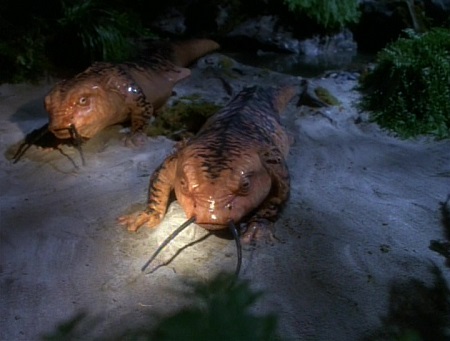
Threshold has basically become a meme in the Star Trek fandom at this point, so I’m not surprised to see it on this list. It’s an undeniably silly idea, even within the confines of Star Trek’s universe – accelerating past Warp 10 causes Paris and Janeway to “hyper-evolve” into a kind of salamander-like lifeform. They then proceed to… mate.

What’s worse, though, and where I’d really take issue with Threshold, is that Chakotay, Tuvok, and the rest of the crew basically infested a random Delta Quadrant planetoid with Paris and Janeway’s mutant offspring. Rather than collecting the salamander babies, they just left them there, presumably contaminating that planet’s entire ecosystem! I don’t like the idea of Warp 10 as this kind of impenetrable barrier, either, and I think Star Trek works best when these things aren’t overexposed in the way warp drive was here.

Does It Deserve The Hate?
​☑️​Yes.​☑️​

Voyager Episode #1:
The Fight, Season 5
IMBD Rating: 5.0/10

Although I’d never try to argue that The Fight is a shining example of the best of Star Trek, I will defend it to a point. It’s weird, esoteric, and probably a little too confusing, feeling like a fever dream in places. But that’s kind of the point; it’s a story that wants to show a very different kind of alien species and their attempts to communicate. As a concept, these aliens – and their “chaotic space” realm – were not inherently bad, and Star Trek has never shied away from seeking out very different forms of life.

I liked Boothby’s return here, and his connection to Chakotay, which had been explored earlier in the season. I get why this episode feels confusing, and I gotta admit, I can feel that way too when watching it! But I’m not sure it deserves to be called Voyager’s worst, either. Not when the likes of Threshold and Elogium exist!

Does It Deserve The Hate?
⛔No.⛔

Enterprise Episode #5:
Fortunate Son, Season 1
IMDB Rating: 6.5/10

I think Fortunate Son introduced some genuinely interesting lore about pre-Starfleet human spaceflight, and I found that side of the episode to be fascinating. Travis Mayweather comes from a family of spacers – spacefaring humans who transport cargo to and from Earth and human colonies in this pre-Federation era – and getting to meet some of these spacers was a ton of fun. I liked the conflict that Ryan and Mayweather had; Mayweather’s decision to leave his ship and join Starfleet being a sore spot for the spacer.

The Nausicaans made for fun antagonists, too. As a relatively unexplored alien race, I think they were much better here than, say, the Klingons might’ve been. The episode presented a moral conundrum for both Archer and Mayweather, too, and ended on what I felt was the right note. It’s the kind of story that Star Trek productions in the 23rd or 24th Centuries would have struggled with – the ECS Fortunate is explicitly shown to be outside Archer and Enterprise’s jurisdiction.

Does It Deserve The Hate?
⛔No.⛔

Enterprise Episode #4:
Precious Cargo, Season 2
IMDB Rating: 6.4/10

I’ll be honest: I’d forgotten all about Precious Cargo! In theory, the idea of an episode with a strong connection to The Next Generation is not a bad idea, and that premise could have been made to work. However, I think it’s pretty well agreed that there were issues with the story, which probably weren’t helped by last-minute re-writes.

There are worse Star Trek episodes, and worse Enterprise episodes, at least in my opinion. But I will concede that Precious Cargo isn’t a particularly strong – or memorable – instalment, as indicated by the fact that I’d forgotten all about it. There are some things I like, like seeing Archer willing to help out a random ship in distress, but overall, I can see why it’s not held in higher regard.

Does It Deserve The Hate?
​☑️​Yes.​☑️​

Enterprise Episode #3:
Daedalus, Season 4
IMDB Rating: 6.2/10

I did not expect to see Daedalus anywhere near this list, to be blunt about it. I genuinely enjoy this episode in its entirety, and I’m honestly struggling to see what it is that folks don’t like. We get to meet the inventor of the transporter, which is one of the really cool things that only a prequel like Enterprise could’ve done, and we get a genuinely interesting character piece that looks at the “burden of genius,” and how an inventor struggled with the idea that he’d peaked too young.

You may have seen me refer to some Star Trek episodes as “the transporter done goofed,” which has become a stock narrative concept in the franchise. But Daedalus takes that idea and really runs with it, digging into the history of the transporter, how it works, how it was originally tested, and how badly wrong it went. The episode has great guest stars, an unnerving “entity” in the form of the corrupted transporter signal, and a fun story for Archer, too. I don’t really get why it’s so disliked.

Does It Deserve The Hate?
⛔No.⛔

Enterprise Episode #2:
Extinction, Season 3
IMDB Rating: 6.0/10

Extinction feels like a cross between TNG’s Genesis and Voyager’s Favorite Son – the latter of which is also on this list! I suspect its biggest problem is its place in the series – coming just three episodes into the season-long “stop the Xindi” storyline. It’s a bit of a diversion, stepping away from that story just as it had begun, really. In that sense, I can understand some of the disappointment fans might’ve had at the time.

Perhaps that sense of repetition from those other Star Trek stories doesn’t help, but I’d argue that Extinction doesn’t really do as well with the core idea as either of those other episodes. There are some creative designs and prosthetics in the story, and it’s fun to see Mayweather taking the captain’s chair. But all in all, it’s just not a very strong or engaging episode.

Does It Deserve The Hate?
​☑️​Yes.​☑️​

Enterprise Episode #1:
These Are The Voyages…, Season 4
IMDB Rating: 5.3/10

I doubt any of us are surprised to see that These Are The Voyages is considered Enterprise’s worst episode. Originally conceived as a “love letter” to Star Trek fans, the episode just doesn’t work as a series finale, unfortunately. Relegating the entire main cast to the status of holograms aboard the Enterprise-D was such a weak way for fans to part ways with these wonderful characters. Even though the intentions were good… the end result wasn’t.

This episode also caused a lot of controversy for killing off Trip Tucker. There were some interesting elements in the mix: seeing Archer at the founding ceremony of the Federation was creative, and not inherently a bad idea. I like crossovers, and I think a story like These Are The Voyages – putting Enterprise’s crew on the holodeck with this kind of frame narrative – could have worked. Just not as a way to end the entire show – and, for a time, the entire Star Trek franchise.

Does It Deserve The Hate?
​☑️​Yes.​☑️

So that’s it!

The Enterprise-D at Deep Space Nine.

We’ve looked at the top five lowest-rated episodes (or the bottom five, if you prefer) for the first five Star Trek shows. There were a few surprises along the way, but by and large, I think I expected to see most of these episodes rated quite lowly – even if I don’t necessarily agree with all of the criticisms Trekkies have of them!

This piece complements my earlier “top fives” piece, which you can find by clicking or tapping here. I hope you’ll take a look at that one if you missed it earlier in the year; it’s basically the same format, just with the five highest-rated episodes from the first five Star Trek shows.

A render of the NX-01 as seen in Strange New Worlds.

I don’t think any of the modern Star Trek shows have enough episodes to really justify doing the same thing, but in the months ahead I might do something like a top and bottom three episodes from some of the recent productions as a kind of follow-up to this. So if that’s the kind of thing you’re interested in… stay tuned, I guess!

I hope this has been a bit of fun, at any rate. I’d genuinely forgotten all about a couple of these episodes, so it was fun to step back into these shows and watch them for what must be the first time in years. And even when Star Trek’s at its worst… I think we can agree that there are still things to enjoy or view in a positive light. That’s my takeaway from this thought experiment, at any rate!

There’s more Star Trek content on the way here on the website, so I hope you’ll join me again sometime soon. Until then… Live Long and Prosper!


All five Star Trek series discussed above can be streamed on Paramount+ in countries and territories where the platform is available. The Star Trek shows are available to purchase on DVD; The Original Series, The Next Generation, and Enterprise are also on Blu-ray. The Star Trek franchise – including all shows, films, and other properties mentioned above – is the copyright of Paramount Global. Credit to IMDB for the episode ratings, which were accurate at time of publication in September 2025. This article contains the thoughts and opinions of one person only and is not intended to cause any offence.

Ooh, A Star Trek: Voyager Game…

A Star Trek: Voyager-themed spoiler warning.

Spoiler Warning: There are minor spoilers ahead for Star Trek: Voyager, as well as details about the upcoming game Across the Unknown.

A few days ago, at the video games industry’s big Gamescom event in Germany, a brand-new Star Trek game was announced. I was very briefly excited… then disappointed when I learned it was going to be VR-only. Star Trek: Infection looked genuinely fun… but I can’t get on with VR, so I doubt I’ll be able to play it unless it gets ported to non-VR systems in the future. “That’s a shame,” I thought, decrying that the only new Star Trek video game of the past couple of years was gonna be exclusive to VR. But oh well. Life goes on.

I mean, there’s no way the Star Trek franchise is gonna announce two video games at the same event within days of each other. Not after being radio-silent on video games since Resurgence and that Prodigy tie-in game were released. Right?

Star Trek: Voyager – Across the Unknown has just been announced by GameXcite and Daedalic Entertainment. It’s billed as a “story-driven survival strategy game” in which you, as the player, get to take command of the legendary USS Voyager during its journey home.

Promotional screenshot for Star Trek Voyager: Across the Unknown.
Are you ready to take command of the USS Voyager?

Wow. That honestly sounds like a great premise!

The game sounds like a kind of Fallout Shelter or U-Boat, with some amount of starship management in addition to the narrative choices. And that kind of game – where you get to manage and maintain the systems aboard your ship – has been one I’ve wanted to see Star Trek try out for a long time.

Voyager is a great show to use as inspiration for that kind of game. Being lost and alone, far from Federation space, gave Captain Janeway and the crew a lot of leeway when it came to making changes aboard Voyager: things like the Mess Hall and the assimilated cargo bay come to mind! And the unique community that the crew built – that sense of camaraderie that came from being the only humans in this far-flung part of the galaxy – could give the game almost a “cozy” vibe, perhaps.

Promotional screenshot for Star Trek Voyager: Across the Unknown.
Different rooms and decks.

Voyager also led to one of the Star Trek franchise’s few games that genuinely broke out of the Trekkie community to go somewhat mainstream: Elite Force. That game was a darling of early 2000s LAN parties, acquiring a good reputation with a wider audience – something very few Star Trek games have ever done, if you think about it. I don’t want to just assume that Across the Unknown will come anywhere close… but there’s precedent, at least, for potentially expanding the Star Trek fan community a little.

With all that being said, there are some caveats. Star Trek games, both recent and not-so-recent, haven’t always been particularly good… and that’s putting it mildly. Star Trek’s corporate overlords have never really seen the potential in video games as an artistic medium, and practically no licensed Star Trek game has been afforded a sufficiently high budget. The result? Compared to other big sci-fi franchises, like Star Wars and even Alien, Star Trek hasn’t made much of an impact in the video game realm, and some titles have been genuinely quite low-quality.

Promotional screenshot for Star Trek Voyager: Across the Unknown.
This looks like an away mission.

And… to be blunt, I’m getting a bit of a “cheap knock-off” vibe from the trailer and some of the screenshots of Across the Unknown. The graphics look okay, don’t get me wrong. Maybe a bit last-gen, but for a game that won’t have been given a blockbuster budget, that’s okay. But a game like this lives or dies on the quality of its management and sim elements – that’s the appeal of assuming command of the USS Voyager in a game like this. And I’m just not blown away by what I’ve seen, to be honest.

Perhaps, though, that’ll turn out to be a good thing. If I go into a game hyped up to the moon and it doesn’t live up to it, I’ll be disappointed. But if I have low expectations… it’s easier for a game to exceed them! So maybe my Fallout Shelter comparison is apt; maybe that level of quality and interactivity is about right.

Promotional screenshot for Star Trek Voyager: Across the Unknown.
This looks like a map screen, perhaps showing the available planets/star systems that can be visited.

I still need to play Resurgence. It kind of released at an awkward time for me personally, when I was feeling a bit burned out on Star Trek as a whole. I bought it, but it’s sat un-played in my Steam library ever since. Hopefully, though, I can get around to Across the Unknown a bit more quickly when it’s ready! At this stage, there’s no release date – but it could be sometime next year, maybe, based on nothing but the timing of the announcement.

I’m not familiar with developer GameXcite. The company seems to be based in Germany, and so far has released two Asterix and Obelix mobile games and one console/PC game. Oh, and for some reason… development of all of their games (including Across the Unknown) is partially funded by the German government. Go figure. The PC version of Asterix and Obelix: Heroes has a “mostly positive” rating on Steam, and I can’t see any complaints about the game running poorly, crashing, or suffering from game-breaking bugs. Which already puts it light-years ahead of 2013’s Star Trek tie-in game!

Promotional screenshot for Star Trek Voyager: Across the Unknown.
A very pretty master systems display!

But you may have heard of Across the Unknown’s publisher: Daedalic Entertainment. If that name sounds familiar, well… it’s because Daedalic was responsible for 2023’s The Lord of the Rings: Gollum, which was a broken, unfinished mess, and quite literally one of the worst games to launch that year. There’s a difference, of course, between Daedalic’s now-closed development studio and the company’s publishing arm. And Daedalic has published some genuinely good titles: Partisans 1941, for example, and 2023’s Barotrauma, which is a comparable kind of management/narrative game set on a submarine.

I’m trying to keep my expectations in check for Across the Unknown. The game’s blurb mentioned that there are twelve “sectors” of the Delta Quadrant to explore, which could mean there are basically twelve stages/levels. That… doesn’t sound like a ton of content, though I suppose it depends how detailed these sectors are, whether there are multiple star systems to visit in each one, and how many narrative events there could be. The blurb mentioned familiar faces from the show, like the Caretaker and Borg, returning, too.

Promotional screenshot for Star Trek Voyager: Across the Unknown.
The USS Voyager approaching a star.

One of the most interesting ideas, though, are the so-called “rogue-lite elements” that Across the Unknown promises to incorporate. Narrative inflection points, where choices can lead to completely different outcomes, potentially including things very different from what we saw in the TV show, sound genuinely interesting. If handled well, there could be some replayability here, making each run through the game feel different – assuming you pick different options each time!

The danger here is that there will be one “optimal” run, where, if you do everything just so, you get the best outcome, or the outcome that closest resembles the TV show. Part of the fun of an idea like this – taking the Voyager story but allowing players to make different choices – is that some of these choices could actually lead to better or just radically different outcomes. In short… if every choice except the one Captain Janeway made leads to instant death or the ship being wrecked on an asteroid, that’s not gonna take full advantage of this style of gameplay! So I hope the developers are aware of that and are at least trying to make these choices feel different and meaningful.

Promotional screenshot for Star Trek Voyager: Across the Unknown.
Ooh, it’s Harry Kim.

So that’s all for now. I shall follow Across the Unknown’s progress with interest, and when it launches – which could be next year – I daresay I’ll pick up a copy and check it out. If possible, I’ll try to write a review here on the website… but my track record with such things isn’t great, so someone might have to remind me if I forget!

Now… with Voyager getting some love in its 30th anniversary year, how about that HD remaster? Hmm, Skydance? HD remaster? HD remaster of Voyager from Skydance? Skydance’s HD remaster of Voyager to stick on Paramount+? Come on… you know you want to!

This was good news, though, and as Voyager celebrates a milestone anniversary, it’s nice to see the series getting a bit of attention from Star Trek’s corporate overlords. I’m trying to keep my expectations at a reasonable level, but if this game manages to make good on its premise, it could be a lot of fun.


Star Trek: Voyager – Across the Unknown will launch for PC, PlayStation 5, and Xbox Series consoles at an unknown future time. Star Trek: Voyager – Across the Unknown is the copyright of GameXcite, Daedalic Entertainment, and Paramount/Skydance. The Star Trek franchise – including Voyager and all other shows discussed above – is the copyright of Paramount/Skydance. This article contains the thoughts and opinions of one person only and is not intended to cause any offence.

Star Trek “Top Fives” – Arguing With IMDB!

A Star Trek-themed spoiler warning.

Spoiler Warning: There are spoilers ahead for the following Star Trek shows: The Original Series, The Next Generation, Deep Space Nine, Voyager, and Enterprise. Minor spoilers are also present for Discovery, Picard, Section 31, and Starfleet Academy.

Today I thought we could have a bit of fun with the Star Trek franchise! If you didn’t know, IMDB – that’s the Internet Movie Database; a website all about films and TV shows – allows its users to rate episodes on a scale from one to ten. The site then brings all of these ratings together, allowing you to view a ranked list of the most-popular episodes in a television series. This time, I’m gonna pick the top five highest-rated episodes for the first five Star Trek series and talk a little about them. I’ll discuss what I liked – or disliked – about each episode, and then I’ll answer a simple question: would I include this episode among my personal favourites? Would it make the cut?

If that sounds like fun, then buckle up! Some of these are going to be controversial, that’s for sure.

Before we get into the list, I have a few caveats and points of note.

Promo photo for Star Trek: The Original Series showing the main cast circa Seasons 2-3.
Star Trek’s first crew.

Firstly, all of this is subjective, not objective! If I heap praise on a story you despise or criticise one of your favourites… that’s okay. There ought to be enough room – and enough maturity – in the Trekkie community for civil conversations and polite disagreement. This is all just one person’s opinion, at the end of the day. Secondly, I’m a huge Star Trek fan, and I have been since the early ’90s. I don’t adore every single episode, but I still consider myself a Trekkie and a supporter of the franchise, so nothing said below should be taken as “hate.”

Finally, I’m covering the first five Star Trek series – from The Original Series to Enterprise – in this piece, and I’m not counting The Animated Series nor am I including the cinematic franchise. Perhaps a future article can look at the newer Star Trek shows, though they have fewer episodes each and thus picking a top five might be a bit less interesting. For now, though, I’m sticking with the first five shows – so don’t expect any Picard or Lower Decks here. I’ll start with The Original Series and move forward through the shows in chronological order, finishing with Enterprise. Episode rankings are taken from IMDB as of mid-June 2025, and are listed in reverse order – starting with the fifth-highest and finishing with the highest-rated.

Phew! With all the details out of the way, let’s get started.

The Original Series Episode #5:
The Trouble With Tribbles, Season 2
IMDB Rating: 8.7/10

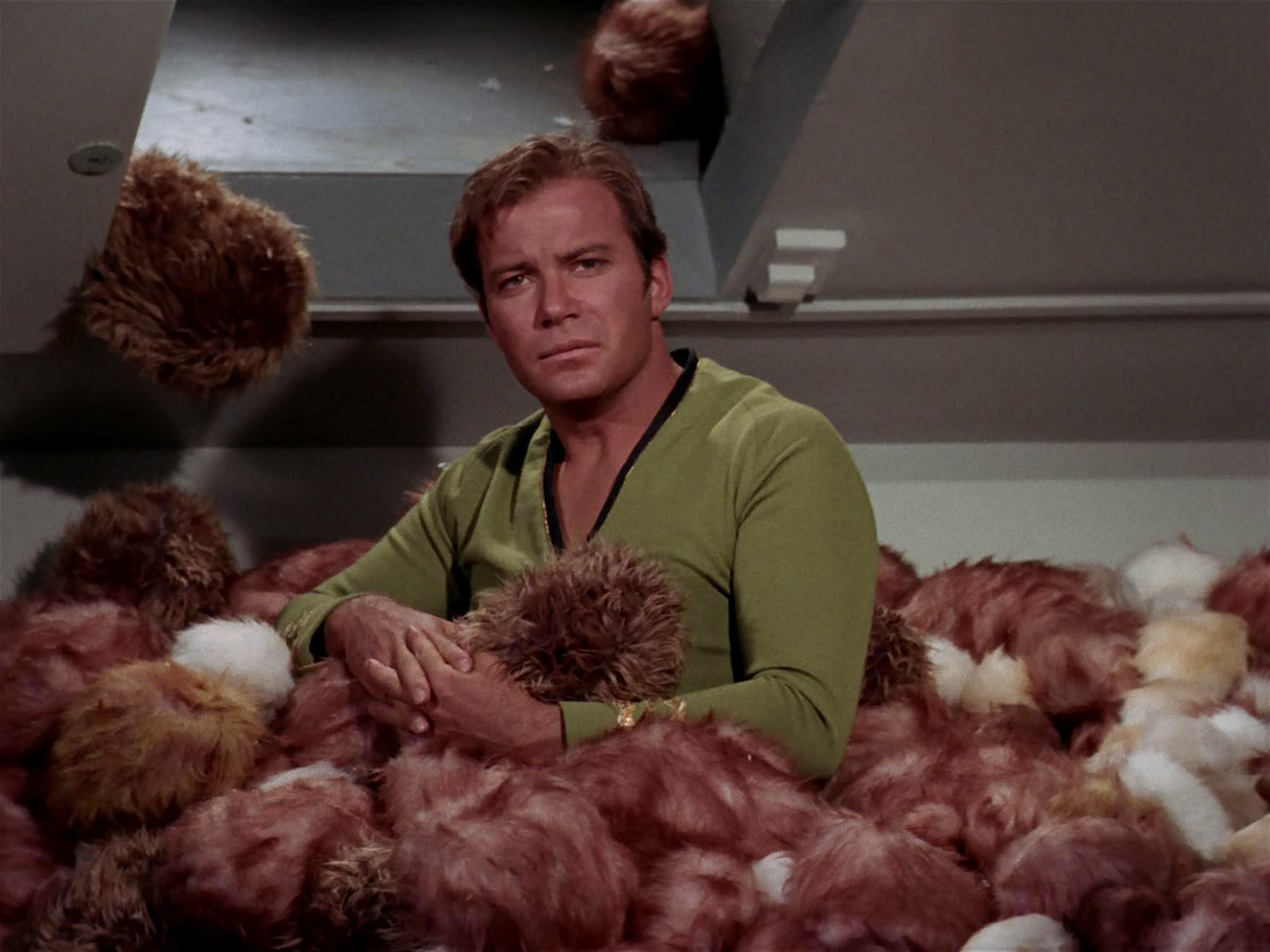
Still frame from Star Trek: The Original Series showing Kirk surrounded by tribbles.

The Trouble With Tribbles is absolutely iconic, and it’s one of the few episodes from The Original Series to have genuinely cut through to the mainstream in a big way. If you asked random non-Trekkies about not only The Original Series, but the Star Trek franchise as a whole, it wouldn’t be long before someone mentioned this episode, the tribbles themselves, or the iconic Kirk meme that was born here.

The Original Series could be funny, and The Trouble With Tribbles uses humour to great effect. The character of Cyrano Jones is a ton of fun, and while the conflict with the Klingons and the infestation of tribbles can be tense at points, the episode is best-remembered for its sense of humour. Kirk dressing-down the officers involved in the fight is also an iconic scene – though one that takes a completely different tone. This episode also spawned Trials and Tribble-Ations… which I suspect we’ll discuss in more detail in a moment.

Would It Make The Cut?
✅ Yes. ✅

The Original Series Episode #4:
Space Seed, Season 1
IMDB Rating: 8.7/10

Still frame from Star Trek: The Original Series showing Kirk and the crew discovering Khan in stasis.

Here’s a “hot take:” I think Space Seed’s status is overinflated because of The Wrath of Khan and how popular that film became. Don’t get me wrong, it’s still a good episode – but because its story is basically the prelude to such an important film for the Star Trek franchise, I think some folks might be over-appreciating it just a little. There are some great moments between Khan and Kirk, including an epic fight sequence, and we get to see Khan’s “superior intellect” firsthand for the first time.

Space Seed deals with genetic engineering, looking at how wrong that could go, while also using it as a critique of racism and the idea of a “master race.” It was also one of the first Star Trek episodes to delve into the history of the future; its vision of mid-1990s Earth and the Eugenics Wars have become integral parts of Star Trek’s canon. It’s an interesting episode in its own right, and not just because it set up The Wrath of Khan. However… there are stronger episodes from the first season of The Original Series, and while Space Seed is good, there are other episodes that I prefer.

Would It Make The Cut?
⛔ No. ⛔

The Original Series Episode #3:
Balance of Terror, Season 1
IMDB Rating: 8.8/10

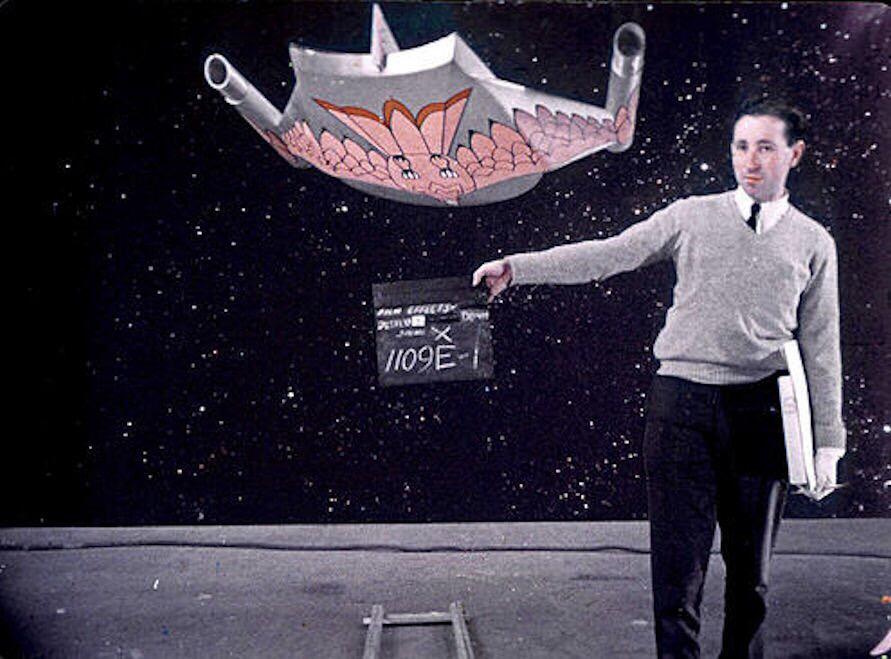
Behind-the-scenes photo from the set of Star Trek: The Original Series showing a crew member with a clapper board and the Romulan Bird-of-Prey filming model.

Balance of Terror is another absolutely iconic episode. It introduced the Romulans, explored their historical conflict with Earth, and their surprising connection to Spock and the Vulcans. It introduced cloaking technology, the neutral zone, and the Romulan Bird-of-Prey, all of which have become integral parts of the Star Trek franchise, even appearing in recent seasons on Paramount+. This was also Mark Lenard’s first Star Trek role, playing the unnamed Romulan commander. Lenard would go on to play Spock’s father, Sarek.

The episode draws on World War II films – particularly submarine films where tense ship-to-ship combat took place without the enemy being in sight. It was one of the Star Trek franchise’s first battle or war stories, laying the groundwork for future space battles. The interplay between Kirk and the Romulan commander – recognising one another as kindred spirits – was incredibly poignant, and the xenophobic character of Lieutenant Stiles grounded the story and gave it another real-world parallel. Stiles was one of the first human Star Trek characters to express such feelings of hatred. Balance of Terror is, in a word, fantastic.

Would It Make The Cut?
✅ Yes. ✅

The Original Series Episode #2:
Mirror, Mirror, Season 2
IMDB Rating: 9.0/10

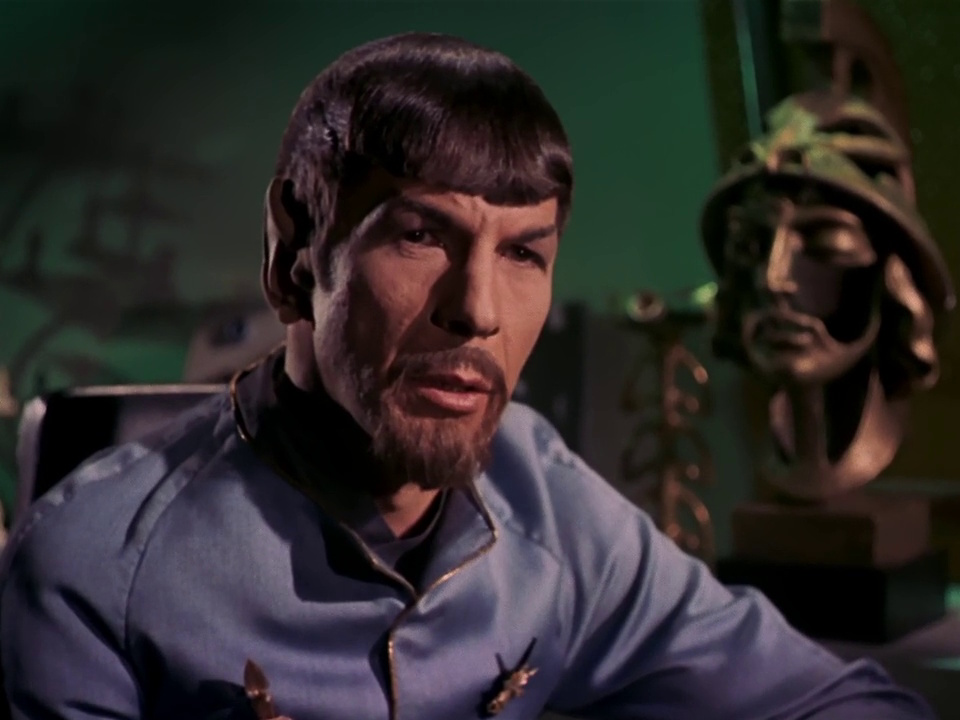
Still frame from Star Trek: The Original Series showing Mirror Spock.

If you’re a regular reader, you may have heard me say this before, but here goes: I really don’t like the Mirror Universe. It lends itself to pantomime-style, hammy, over-acted performances, practically no Mirror characters have any nuance, as they seem to care about nothing beyond murder, torture, and torturous murder, and the whole setting just feels incredibly flat, boring, and one-dimensional. Mirror, Mirror, as the first episode to explore this setting, was interesting at first, and I’m happy to cut it a bit of slack as the progenitor of this idea, though.

Furthermore, Mirror Spock might be one of the best Mirror Universe characters, as he’s shown to be willing to listen to our universe’s version of Kirk. Compared to some of the other caricatures we meet in the episode, Mirror Spock is definitely the most interesting and complex. I suspect that, were it not for the Mirror Universe’s over-use in modern Star Trek, or if Mirror, Mirror had been a one-off, I might rate it a bit more highly. I still think its an interesting episode, and certainly one of the better Mirror Universe stories even all these years later, but it’s also not one of my favourites… and I guess it’s kind of tainted by association with some other, far less-enjoyable visits through the looking-glass.

Would It Make The Cut?
⛔ No. ⛔

The Original Series Episode #1:
The City on the Edge of Forever, Season 1
IMDB Rating: 9.2/10

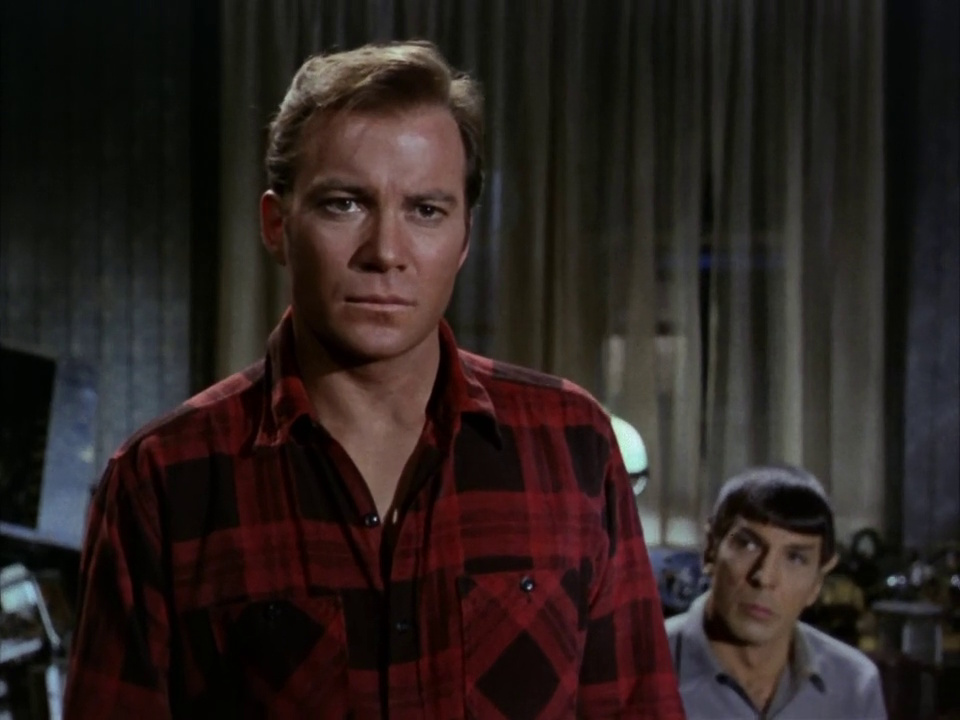
Still frame from Star Trek: The Original Series showing Kirk and Spock in the 20th Century.


I knew The City on the Edge of Forever was a popular episode, but I’ll be honest: I didn’t expect to see it at the top of the list, way ahead of the competition! This is a great story, though, one which really leans into the idea Gene Roddenberry had of making Star Trek episodes akin to fables, with complex themes of morality seen through a futuristic, sci-fi lens. The choice Kirk has to make in The City on the Edge of Forever is truly heartbreaking, and the buildup to it is played exceptionally well.

The first season of The Original Series was basically flying blind, seeing what worked. And clearly, time-travel to Earth in the recent past was something that resonated with audiences in a big way. For me personally, time-travel to 20th (or 21st) Century Earth has never been my favourite story concept in Star Trek, as what interests me the most is the franchise’s look at the future. And I would humbly suggest that the existence of the Guardian of Forever could challenge and completely change Starfleet’s mission of exploration – yet the Guardian was only revisited once, in The Animated Series, before disappearing for nigh-on fifty years! Given its popularity, though, and its apparent cut-through to a wider audience, perhaps The City on the Edge of Forever could be a great starting point for new fans?

Would It Make The Cut?
⛔ No. ⛔

The Next Generation Episode #5:
The Measure of a Man, Season 2
IMDB Rating: 9.1/10

Still frame from Star Trek: The Next Generation showing Picard and Dr Maddox.

Star Trek can do courtroom drama exceptionally well, and The Measure of a Man is a fantastic example of this kind of storytelling. It’s also an episode with a complex message about the nature of life and sentience – ideas which are arguably more important today, thirty-five years later, than they were at the time of its production. Because we’re attached to Data as a character after spending two seasons with him, and we’ve come to see him as a member of the crew, Bruce Maddox comes across as a real antagonist – someone who’s trying to use his position and a legal loophole to, in effect, “kill” Data.

The episode presents a challenge for both Picard and Riker, too. Riker arguably gets the tougher brief, having to argue against his friend’s right to exist and his sentience. But, as Data would tell him at the end of the story, he did what he had to do and played his part; refusal would’ve led to Data being turned over to Dr Maddox. Picard’s speech about the nature of life, and Starfleet’s mission to seek out new forms of life, is incredibly powerful, too. But… is The Measure of a Man one of the absolute best of the bunch from The Next Generation, when there are so many other outstanding episodes and stories? I’m not even sure it’s the show’s best courtroom episode, with The Drumhead being a genuine rival for that title!

Would It Make The Cut?
⛔ No. ⛔

The Next Generation Episode #4:
All Good Things…, Season 7
IMDB Rating: 9.1/10

Still frame from Star Trek: The Next Generation showing Beverly Picard in an alternate future timeline.

I’m pleasantly surprised to see the series finale here. All Good Things is a fantastic episode, and a great way to bring The Next Generation full-circle. Q makes a return, setting one of his best and most complex puzzles yet, challenging Picard to think about time itself in a non-linear way. Having three distinct time periods on the go in a single story was challenging, but it was so creative and clever how Picard instantly moved between them. There was some fantastic cinematography on this side of the story, too, with close-up shots lingering on Picard as he slid between the three different eras.

It was great to welcome back Denise Crosby as Tasha Yar, and to catch a glimpse of our characters’ lives in the future, too. Some of the ideas originally presented here would later become plot points in Star Trek: Picard more than twenty-five years later, keeping a thread of consistency across different iterations of the franchise. All Good Things was a spectacular finale, one that brought together the entire crew in different and creative ways, and its anti-time eruption was a genuine challenge and puzzle for Picard.

Would It Make The Cut?
✅ Yes. ✅

The Next Generation Episode #3:
The Best of Both Worlds, Seasons 3-4
IMDB Rating, Part I: 9.3/10
IMDB Rating, Part II: 9.2/10

Still frame from Star Trek: The Next Generation showing the Borg cube on the Enterprise's viewscreen.

For some bizarre reason, IMDB ranks the two halves of The Best of Both Worlds separately, but I’m amalgamating them for my list. This story brought back the Borg for their first major clash with Starfleet – and what a clash it was! The Battle of Wolf-359, Borg assimilation, Picard’s transformation into Locutus, Riker’s challenging relationship with Commander Shelby, and the Borg’s first major attempt to attack Earth. The tension builds slowly across the first part, culminating in Picard’s abduction and assimilation – a cliffhanger to end Season 3 in just the most shocking and incredible way!

Part II picks up the action, and sets a huge challenge for Riker – and the entire Federation. The crew of the Enterprise-D want to rescue Picard and undo the damage done to him by the Borg, but they’re also Earth’s last line of defence after the Borg Cube made light work of the assembled Federation ships at Wolf-359. The plan to kidnap Locutus, then Picard managing to break through his Borg assimilation just enough to strike the crushing blow… it was all pitch-perfect, fantastic, outstanding television. There’s a reason why The Best of Both Worlds is held in such high esteem.

Would It Make The Cut?
✅ Yes. ✅

The Next Generation Episode #2:
Yesterday’s Enterprise, Season 3
IMDB Rating: 9.2/10

Still frame from Star Trek: The Next Generation showing Picard, Riker, and Yar in an alternate timeline.

Now that I see how highly-ranked Yesterday’s Enterprise is, suddenly the decision to bring back the character of Rachel Garrett in the recent Section 31 movie makes a lot more sense! Joking aside, this really is a fun episode. One question I remember having, as a Trekkie in the early 1990s, was this: what happened to the Enterprise-B and Enterprise-C? Yesterday’s Enterprise introduces the Ambassador-class Enterprise-C and explains its pivotal role in history, maintaining the alliance with the Klingons and preventing a catastrophic war that threatened to wipe out the Federation.

We get an examination of a disturbing alternate reality, one in which the Federation and Klingons have been at war for years. Guinan plays a hugely important role, too, being the only character aware of how different the timeline could be. Tasha Yar makes a return, and this episode also tees up Sela as a future villain. Yesterday’s Enterprise also presents an impossibly tough decision for Picard, Garrett, Yar, and Lieutenant Castillio – returning the Enterprise-C to its own time means certain death for all on board, but staying in this war-ravaged future would likely mean the demise of the entire Federation.

Would It Make The Cut?
✅ Yes. ✅

The Next Generation Episode #1:
The Inner Light, Season 5
IMDB Rating: 9.4/10

Still frame from Star Trek: The Next Generation showing the Ressikan flute.

This wasn’t a huge surprise. The Inner Light is widely praised by fans of The Next Generation as one of the show’s best episodes. But I’ll level with you: I’m just not into it. There’s some emotional storytelling, sure, and the impact of these events would have repercussions for Picard. But I struggled to really connect with most of the long-dead people of Kataan, and this episode’s deliberately slow pace and departure from the Enterprise-D and most of our familiar characters just… well, to be blunt, I find it pretty boring.

I don’t hate The Inner Light, but it’s actually been a while since I even watched it; I tend to skip over it when re-watching The Next Generation as it just doesn’t do much for me. There are some positives, and I appreciate that this episode’s events were referenced more than once going forward; the impact it had on Picard’s character was significant. It also spawned one of the Star Trek franchise’s best and most-recognisable melodies: the Ressikan flute theme. However… it’s not among my favourite episodes, not from The Next Generation as a whole nor even from Season 5, which I generally consider to be the show’s strongest individual season.

Would It Make The Cut?
⛔ No. ⛔

Deep Space Nine Episode #5:
The Way of the Warrior, Season 4
IMDB Rating: 9.0/10

Still frame from Star Trek: Deep Space Nine showing Sisko firing a phaser.

The Way of the Warrior brought the character of Worf to DS9, establishing him as a regular for the second half of the show’s run. At first, I gotta admit that it felt a little odd to see Worf interacting with Sisko, Dax, and the others… but it didn’t take long for him to settle into his new role! The Way of the Warrior also re-established the Klingons as antagonists – at least for the remainder of the season. After the transformation in Federation-Klingon relations that we saw in The Next Generation, this was a change of pace, and it set up several fun episodes across the season.

Gowron and Martok were fun additions to the story, which also progressed the changeling infiltration storyline that was a precursor to the Dominion War. Worf’s inner conflict between his Klingon heritage, his friendship with Gowron, and his ties to Starfleet was on full display, and the way he had to navigate that difficult environment was riveting stuff. Michael Dorn put in one of his best and most complex performances as Worf, and Sisko got a bit of an arc that harkened back to his own considerations about his future in Starfleet from the beginning of Season 1. All in all, a fun, action-packed episode.

Would It Make The Cut?
✅ Yes. ✅

Deep Space Nine Episode #4:
Duet, Season 1
IMDB Rating: 9.0/10

Still frame from Star Trek: Deep Space Nine showing Darheel/Marritza's arrest.

Duet is an episode of twists and turns, double-bluffs and triple-bluffs – and it presents a fascinating story of a man trying to atone for the crimes of his government. Through the character of Marritza, Duet also examines the idea of the complicity of low-ranking personnel in heinous crimes, something we deal with all too often in the real world. Marritza forced Kira – and us as the audience – to see the Cardassians as more than just faceless thugs and murderers, exploring the complex nature of Cardassian morality and using that sci-fi lens to examine real-world conflicts.

Duet is a powerful story for Kira, and Nana Visitor puts in one of her best performances. It’s also a good story for Odo, as we see his steadfast dedication to finding out the truth – no matter what others might’ve wanted to believe or think. Duet builds its twists and turns masterfully, eventually leading to a genuinely heartbreaking conclusion. It’s a powerful episode, one that showed the benefits of Deep Space Nine’s slower pace and focus on a single setting.

Would It Make The Cut?
✅ Yes. ✅

Deep Space Nine Episode #3:
The Visitor, Season 4
IMDB Rating: 9.1/10

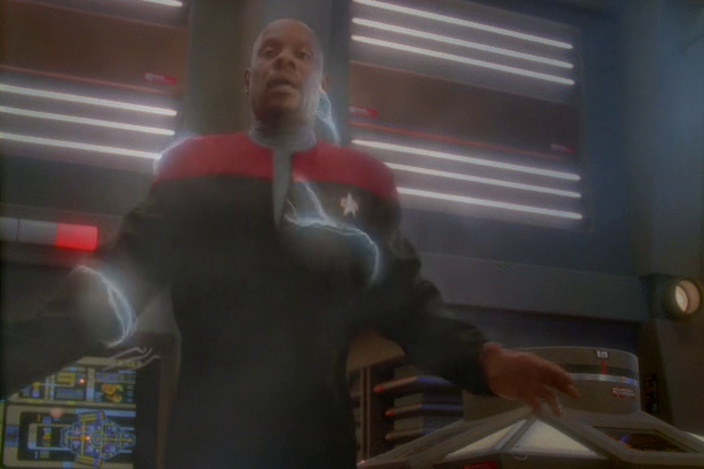
Still frame from Star Trek: Deep Space Nine showing Sisko zapped by some kind of electrical energy.

The Visitor has some interesting elements. It’s always fun for me, as a Trekkie, to catch a glimpse of a possible future for some of our beloved characters, and The Visitor shows us that. It’s also a relative rarity insofar as it’s a Jake Sisko episode – Jake only appeared in 71 episodes across Deep Space Nine’s run. Tony Todd, playing the older version of Jake, gives a genuinely emotional performance, which has to be one of the best individual performances by a guest star pretty much anywhere in Star Trek.

So I appreciate what The Visitor does. Its story highlights the importance of Benjamin Sisko and his role in the history of the Federation, it’s a great Jake-Ben story, focusing on their relationship, and its glimpses of the future were fun. However… it’s not one of my absolute favourites in Deep Space Nine, despite all of the positives. There are simply other episodes that I find to be more enjoyable, powerful, emotional, or entertaining, and while I’m not surprised to see The Visitor at or near the top of other fans’ lists… it wouldn’t be there on my own list. There isn’t one overwhelming “issue” or “problem” I can point to, which I guess is a tad frustrating. It’s simply that I could think of at least a dozen episodes I’d rank higher.

Would It Make The Cut?
⛔ No. ⛔

Deep Space Nine Episode #2:
Trials and Tribble-Ations, Season 5
IMDB Rating: 9.3/10

Still frame from Star Trek: Deep Space Nine showing O'Brien and Bashir with Kirk's crew.

Made to celebrate Star Trek’s thirtieth anniversary, Trials and Tribble-Ations was an incredibly creative episode. The filmmaking technology required to blend new actors in with old footage was still relatively new, having been pioneered by the film Forrest Gump, and I’m fairly sure I’m right in saying that this episode was the first time it was used for television. As a celebration of the Star Trek franchise, you could hardly think of anything better than a story connecting the old with the new – in this case, having Sisko and his crew travelling through time, meeting Captain Kirk and visiting the original USS Enterprise.

Such a premise could’ve felt gimmicky and fan-servicey. Worse, it could’ve been poorly-written! But Trials and Tribble-Ations was fantastic, and I can vividly remember watching it when it premiered, absolutely stunned at seeing the DS9 crew in TOS uniforms – and Captains Sisko and Kirk meeting face-to-face. The frame narrative involving the Department of Temporal Investigations was fun, too, and kept the story grounded in the 24th Century. The premise was exceptionally fun, the technology worked perfectly, and the end result was exactly what the writers and producers intended: a genuine “love letter” to Star Trek and the Trekkie community.

Would It Make The Cut?
✅ Yes. ✅

Deep Space Nine Episode #1:
In The Pale Moonlight, Season 6
IMDB Rating: 9.4/10

Still frame from Star Trek: Deep Space Nine showing the iconic "it's a fake" scene with Senator Vreenak.

Yes, yes, yes! In The Pale Moonlight is an absolutely outstanding episode, full of moral grey areas, sneaky schemes, and one of Star Trek’s most recognisable memes to boot! There was a time, shortly after its broadcast, when In The Pale Moonlight seemed incredibly controversial in the Star Trek fan community; I vividly remember conversations online about “betraying Gene’s vision of an enlightened future” and Sisko’s actions being so far beyond the pale that they’re indefensible! I’m both astonished and thrilled to see that the passage of time has been kinder, and that fans now appreciate just how brilliant this episode is.

Sisko and Garak made for a wonderful pair in this episode, scheming together to drag the Romulans into the Dominion War under false pretences. What holds the episode together, though, is the absolutely incredible log entry that Captain Sisko records. This is one of Avery Brooks’ best performances in the entire series, showing off his wonderful range as Sisko runs the gamut of emotions, re-telling the story of how he lied, broke various laws, and was complicit in the murder of a Romulan senator. An absolutely riveting, must-watch episode for any Trekkie.

Would It Make The Cut?
✅ Yes. ✅

Voyager Episode #5:
Message in a Bottle, Season 4
IMDB Rating: 8.7/10

Still frame from Star Trek: Voyager showing three Romulans on the bridge of the Prometheus.

I adore Message in a Bottle. The episode marks the halfway point of Voyager’s run, making it the perfect moment to establish a tentative link between the stranded ship and the Federation back in the Alpha Quadrant. It was also a ton of fun to get a story where the Romulans are the antagonists! Guest star Andy Dick made a perfect foil for Robert Picardo’s Doctor as a newer version of the Emergency Medical Hologram, and the two performers had great on-screen chemistry, leading to some absolutely hilarious interactions.

The USS Prometheus was an incredibly fun concept, too, and we got a really detailed look at the ship both inside and out, which was great. It was such a clever idea to send the Doctor’s programme to the Alpha Quadrant, and what resulted is not only one of Voyager’s funniest episodes, but one that packs a powerful emotional punch right at the end. After more than four years alone, Captain Janeway and the crew finally have one small link to Starfleet, and Starfleet promises to work on ways to get them home.

Would It Make The Cut?
✅ Yes. ✅

Voyager Episode #4:
Living Witness, Season 4
IMDB Rating: 8.7/10

Still frame from Star Trek: Voyager showing the Voyager simulation.

Living Witness has been a topic of discussion for a while here on the website thanks to Discovery’s far future setting! It was an interesting idea for an episode, one that took on the complex idea of the unreliability of history and memory, initially painting the crew of the USS Voyager as villains centuries after the ship passed by a planet. It’s definitely a story with a message, one that’s in keeping with Star Trek’s established formula of looking at real-world issues through a sci-fi lens.

Parts of Living Witness can feel challenging and even uncomfortable, as we’re forced to watch some very inaccurate depictions of the crew of Voyager. The Doctor has a hard time convincing people of his version of events, too, which adds another layer to this. But that’s part of the point and message of the story! All that being said, I think there are better Voyager episodes. Living Witness is creative and clever, and really, nothing about it is bad per se. I can just think of other episodes that I’d rank more highly.

Would It Make The Cut?
⛔ No. ⛔

Voyager Episode #3:
Timeless, Season 5
IMDB Rating: 8.7/10

Still frame from Star Trek: Voyager showing Chakotay, Kim, and the icy wreck of the USS Voyager.

Timeless shows us just how badly wrong Voyager’s journey could’ve ended up! Trying a new method of propulsion to reach the Alpha Quadrant, the ship ends up crash-landing, killing everyone apart from Chakotay and Harry Kim. The older versions of these characters – who’ve had years to sit with the consequences of what happened – travel to the wreck site to right that wrong. The crash sequence and the visual of the wrecked Voyager beneath the ice are both absolutely stunning and incredibly impactful.

I’m not usually wild about episodes where the magical, perfect Seven of Nine is the only one who can save the day! But in Timeless, her involvement works really well, and scenes with the Doctor and the older Chakotay and Kim are intense and emotional, too. It was also great fun to see Geordi La Forge in an episode of Voyager! A very creative premise and great execution.

Would It Make The Cut?
✅ Yes. ✅

Voyager Episode #2:
Scorpion, Seasons 3-4
IMDB Rating, Part I: 8.9/10
IMDB Rating, Part II: 8.8/10

Still frame from Star Trek: Voyager showing three Borg cubes and a large explosion.

IMDB counts the two halves of Scorpion separately, but I’m combining them. To be honest, Scorpion is a story I have mixed feelings about. Voyager over-used both the Borg and Seven of Nine in the second half of its run, and both of those issues kind of began here. On its own merit, Scorpion is great. The Borg and Species 8472 are both powerful and dangerous enemies, and the idea of Janeway teaming up with the Borg when there were no other options was a great twist on the anticipated Borg conflict. Seven of Nine, despite my later feelings about the character, also gets a great introduction.

And I guess the point of this exercise is to try to judge these episodes on their own. Scorpion may have led to too many Borg and Seven stories later on, but it should get a pass as the first of them – and arguably the best, too. It was definitely an explosive cliffhanger to end the show’s third season, and I like how truly different and “alien” Species 8472 feel compared to a lot of other Star Trek races we’ve seen. It’s also an important episode for Voyager, introducing Seven of Nine and setting the stage for Kes’ departure.

Would It Make The Cut?
✅ Yes. ✅

Voyager Episode #1:
Blink of an Eye, Season 6
IMDB Rating: 9.0/10

Still frame from Star Trek: Voyager showing the USS Voyager in orbit.

I’ll level with you: I did not see this coming! The only Voyager episode rated 9/10 by IMDB’s users is… Blink of an Eye? Really? I guess I’m more out-of-touch with the Trekkie community than I thought! Don’t misunderstand me: I don’t particularly dislike this episode. It’s an interesting premise and a fun look at a very “alien” kind of world. But as the best episode in Voyager’s entire run? Did the writer or director start a campaign to get people to upvote it, or something? I just… I genuinely would not have expected to see Blink of an Eye hailed as everyone’s favourite.

There was something in Blink of an Eye that I felt didn’t work particularly well. The Doctor supposedly spent years alone on the planet after a transporter glitch, but after a couple of lines of dialogue the profound impact that had wasn’t really explored or acknowledged. With that exception, though, I think Blink of an Eye makes good on a quite creative core idea. I certainly enjoy the episode and what it has to offer. But as the absolute best of Voyager? I’m afraid I’m still not convinced.

Would It Make The Cut?
⛔ No. ⛔

Enterprise Episode #5:
Zero Hour, Season 3
IMDB Rating: 8.5/10

Still frame from Star Trek: Enterprise showing three Xindi characters.

As the culmination of a season-long arc to stop the Xindi and their super-weapon, Zero Hour is intense. Hoshi is traumatised, Archer seems to make the ultimate sacrifice, and T’Pol commands Enterprise on a mission to destroy the Sphere-Builders’ base. There’s a lot going on, but it builds to an explosive finale… with just enough left at the very end for one final twist, a twist which sets up the beginning of Season 4 and the end of Enterprise’s Temporal Cold War storyline.

I found the conflict with the Xindi to be interesting overall, but there’s no denying that the season dragged its feet reaching this point. The time travel stuff was never my favourite part of Enterprise, so in that sense I’m glad to see Zero Hour as the beginning of the end of that particular ongoing storyline. Where this episode succeeds is with its core characters. Two pairings/interactions stand out: T’Pol with Trip and Archer with Hoshi. However, the story finds time to give everyone a moment in the spotlight, and its bittersweet moment as Archer is apparently killed while succeeding in his mission was, on first viewing, at least, genuinely impactful.

Would It Make The Cut?
⛔ No. ⛔

Enterprise Episode #4:
Azati Prime, Season 3
IMDB Rating: 8.5/10

Still frame from Star Trek: Enterprise showing Archer piloting a submarine.

Another episode from near the end of Season 3’s ongoing conflict with the Xindi and Sphere-Builders, Azati Prime sees Archer and the crew getting closer to their objective. We get to see Archer confront the creator of the Xindi weapon, Degra, and a bit more of an exploration of who the Xindi are and how the Sphere-Builders have been able to manipulate them. Archer’s “suicide mission” attack plan always felt a bit over-the-top, but in the context of the story it works well enough.

This is also the episode where we see the Enterprise-J – a future version of the famous starship. I enjoy the Enterprise-J sequence; I just wish the episode’s budget had allowed us to spend a bit more time in this setting! Though the Temporal Cold War was never my favourite part of the show, this moment with Daniels and Archer was surprisingly fun. As an episode taking place partway through a season-long story arc, it can be hard to know where to place Azati Prime, but I think it does its thing well enough.

Would It Make The Cut?
⛔ No. ⛔

Enterprise Episode #3:
Carbon Creek, Season 2
IMDB Rating: 8.5/10

Still frame from Star Trek: Enterprise showing the Vulcan Mestral.

I usually don’t enjoy Star Trek stories, in any series, which involve time travel to 20th or 21st Century Earth. So Carbon Creek, which is primarily a flashback, not even featuring most of the regular cast, taking place in the 1950s… it shouldn’t be an episode I care for very much. But you know what? It’s a surprising amount of fun, and watching a crew of pre-First Contact Vulcans struggling to exist in human society made for some funny and even emotional moments.

I’m glad there aren’t too many Carbon Creeks in the Star Trek franchise. Any franchise which overcomplicates its own fictional history risks turning viewers away or making future stories less impactful. But as a genuine one-off episode, this ’50s setting, dripping with cute Americana, really does work. The Vulcan characters are all distinct and engaging, T’Pol’s frame narrative as she recounts the tale to Archer and Tucker is fun, too, and yeah. Just an all-around enjoyable affair, and a bit of a change of pace.

Would It Make The Cut?
✅ Yes. ✅

Enterprise Episode #2:
Regeneration, Season 2
IMDB Rating: 8.5/10

Still frame from Star Trek: Enterprise showing Borg drones.

If you read my provocatively-titled piece Ten Star Trek Storylines That Should Be Non-Canon a few weeks ago… you might think you know where I stand on this one! Long story short, the history of Borg-Federation contact is already stupidly overcomplicated thanks to Voyager and First Contact. Throwing in this episode with Archer coming face-to-face with 24th Century Borg drones, and ending with them transmitting a message to the Delta Quadrant? I mean… it’s just another narrative hurdle, in a sense.

However! Regeneration is a ton of fun if you take it on its own merits. No one expected Captain Archer and his 22nd Century crew to encounter the Borg, and given that these Borg are from the future to boot? It made the Collective feel genuinely frightening and dangerous again, something I’ve argued that Voyager had begun to lose toward the end of its run. So yes, this episode complicates things for Star Trek as a whole, and it kind of makes Starfleet look incompetent! But… I really like it. And I’m pleased to see the controversy that swirled around the episode at the time of its broadcast has died down.

Would It Make The Cut?
✅ Yes. ✅

Enterprise Episode #1:
Twilight, Season 3
IMDB Rating: 8.6/10

Still frame from Star Trek: Enterprise showing Captain Archer laying in a medical machine.

I knew Enterprise fans thought quite highly of Twilight, but I don’t think I expected to see it top the list! This episode takes place in an alternate timeline, one in which the Xindi weapon was successful. I liked the subtle callback to The Wrath of Khan’s Ceti Alpha V, and the implication that, even if humanity had been able to remain hidden, another disaster was only a century away. That just added to the tragedy of the situation.

Where Twilight excels, though, is in its character relationships. This version of T’Pol, having lived with Archer for years as his caretaker, is much softer and completely different, and the relationship between them has clearly evolved. Jolene Blalock plays this incredibly well, so it’s no wonder, really, than this episode is held in such high esteem. Phlox, Tucker, and others also get moments in the spotlight as the Xindi finally track down humanity’s last outpost, and while the episode’s conclusion has always felt a little rushed to me, I think overall it’s a pretty solid story. After Season 3’s serialised arcs, this alternate timeline made for a fun change of pace.

Would It Make The Cut?
✅ Yes. ✅

So that’s it.

Photo taken during construction of the USS Enterprise set, circa 1977-78, during production on Star Trek: Phase II/The Motion Picture.
The USS Enterprise engineering set (later used for The Motion Picture and The Next Generation) under construction.
Photo Credit: Forgotten Trek

We’ve looked at the top five highest-rated Star Trek episodes for the first five shows… according to the randos over at IMDB, anyway! There were a few surprises in the mix – both in terms of inclusions and exclusions. Looking down the full episode ranking lists, I was genuinely shocked to see some of my favourites languishing in the lower reaches, and some episodes I generally don’t care for soaring high! But I hope this has been a bit of fun, at any rate.

I’m already formulating another idea – maybe taking a look at a few of the lowest-rated Star Trek episodes and sharing my thoughts on those, or doing the same thing again with the modern shows. If I’m gonna do that, though, I’ll actually have to finish watching Lower Decks and Prodigy! Those are still on my to-do list.

Thanks for joining me this time. And thanks to IMDB for publishing these ratings and lists. It was a lot of fun to revisit these episodes and spend a little more time in the Star Trek galaxy.


All five Star Trek series discussed above can be streamed on Paramount+ in countries and territories where the platform is available. The Star Trek shows are available to purchase on DVD; The Original Series, The Next Generation, and Enterprise are also on Blu-ray. The Star Trek franchise – including all shows, films, and other properties mentioned above – is the copyright of Paramount Global. Credit to IMDB for the episode ratings, which were accurate at time of publication in June 2025. This article contains the thoughts and opinions of one person only and is not intended to cause any offence.

What If…? Star Trek Edition!

A Star Trek-themed spoiler warning graphic.

Spoiler Warning: Beware of spoilers for the following Star Trek productions: The Next Generation Season 1, Deep Space Nine Season 6, Voyager Season 1, Generations, Star Trek ’09, Discovery Season 2, and Picard Season 2.

Almost four years ago I had a lot of fun writing a piece here on the website called “What If…? Star Trek Edition!” I took the basic concept behind the then-new Marvel miniseries What If…? and applied it to several storylines from the Star Trek franchise that I found interesting. Speculating and getting creative was a blast, so… let’s do it again!

If you missed the miniseries (or my earlier post), I’ll briefly explain how this works! We’re going to look at five stories from across the Star Trek franchise and ask a simple question: what if things went differently? What would the consequences be for Starfleet, the Federation, and some of the characters we’ve come to know and love if, for example, Spock wasn’t resurrected on the Genesis Planet or Captain Janeway and the USS Voyager tried to reach the Gamma Quadrant terminus of the Bajoran wormhole? I covered both of those topics in my post from 2021, by the way, so be sure to check it out – you can find it by clicking or tapping here.

Still frame from Star Trek: Voyager showing Kim and Quark.
Harry Kim and Quark.

Alternate history has been an interest of mine for a long time – so we can consider this an “alternate history of the future,” if you like! With the Star Trek franchise slowly but surely heading toward the 1,000-story mark, there are a lot of places where narratives could branch, and where the Star Trek galaxy could end up in very different situations! As a Trekkie, and as someone who likes to spend time in this setting, it’s a ton of fun to come up with these ideas and consider how they might play out.

As always, a couple of important caveats! All of this is the entirely subjective take of one old Trekkie. If you hate all of my ideas, think I’ve got the wrong end of the stick, or if I miss something that seems totally obvious to you… that’s okay! There ought to be enough room in the Star Trek fan community for differences of opinion. None of this is close to being “canon,” anyway, so there’s even less of a reason to get upset about completely made-up Star Trek stories that will never be seen on screen!

Alright, let’s jump into the “what if” scenarios!

What If…? #1:
What if… Captain Picard and Q never met?
The Next Generation, Picard Season 2

Still frame from Star Trek: The Next Generation Season 1 showing Picard meeting Q for the first time.
Picard’s first encounter with Q.

This is a really interesting one – and it might not go the way you think! Looking back over Picard’s run-ins with Q during The Next Generation, there really aren’t many places where we could say that their interactions had wide-ranging consequences. I have my pet theory that Q deliberately saved Picard and the Federation by making them aware of the Borg threat (click or tap here for that one, it’s one of my favourite Star Trek theories!) but that’s not the angle I’m gonna take today. In this case, we’re going to say that – for whatever reason – Picard and Q never met, never developed their complex relationship, and Q never set any puzzles for Picard to solve. In fact, Q stayed away from humanity and Starfleet altogether in this alternate timeline.

As noted, Q’s interactions with Picard and the crew of the Enterprise-D almost always involved problems or scenarios of his own devising. So without Q on the scene, the Enterprise-D’s mission actually proceeds slightly more smoothly than it did in the series; the absence of Q doesn’t matter in a big way to the seven-year cruise. Every other episode and story plays out more or less the same, from the mystery at Farpoint Station to the ship’s destruction over Veridian III. Picard assumes command of the Enterprise-E, then the Romulan rescue armada, before retiring from Starfleet.

Still frame from Star Trek: The Next Generation showing the Enterprise-D in orbit of a green planet.
The voyages of the starship Enterprise would proceed in exactly the same way… just without Q’s occasional shenanigans!

But here’s where things change. After the mission to rescue Soji and being named Chancellor of Starfleet Academy, Admiral Picard is aboard the USS Stargazer when a mysterious anomaly is detected. The Stargazer, the Excelsior, and a handful of other ships race to the scene, where they’re confronted by a massive subspace anomaly that Seven of Nine thinks could be a huge transwarp conduit. Attempts at communication fail, and with only a handful of Starfleet ships on the scene, there’s no way to prevent the conduit from unleashing its triquantum waves.

Aboard the Stargazer, Picard and the crew look desperately for solutions – but there are none. Without the Borg, their vessel, and their knowledge of the situation, there’s no way to stop the transwarp conduit from doing what it was designed to do: launching a massive attack on the Federation. Its triquantum waves blast across several sectors of space, destroying the Starfleet ships as they attempt to escape, as well as several starbases and Federation colonies. Having expended its initial wave of energy, the conduit then falls eerily silent, as if waiting for instructions… or for its operators to emerge.

Still frame from Star Trek: Picard showing the mysterious transwarp anomaly.
This time, there’s no one to stop the transwarp anomaly…

Because Star Trek: Picard was a jumbled mess of a show, we don’t know who made the transwarp anomaly. My pet theory is that it’s something to do with Season 1’s super-synths, but it could also be the Borg, the Dominion, or any one of a number of Star Trek baddies! In this timeline, though, the anomaly’s initial attack would be successful – because there’d be no Q to throw Picard and his friends into the alternate reality that eventually led to Dr Jurati’s assimilation and the creation of a Borg splinter group. Without the Jurati-Borg’s presence at the site of the transwarp anomaly, there was no way to stop its energy from being unleashed.

What would happen next? I’d imagine that whoever made the anomaly would be pleased with its success, and if it was a transwarp conduit – as Seven theorised – then it could serve as a gateway for any ships that the attacker had. With a devastated sector and no intact ships remaining in the area, any invader would quickly be able to establish a massive bridgehead right in the heart of Federation territory, and if they have more transwarp conduit weapons… who knows? The next target could be Earth.

What If…? #2:
What if… Section 31 and the Federation accidentally created the Borg?
Deep Space Nine, First Contact, Discovery Season 2

Concept art for Star Trek: The Next Generation showing three Borg designs.
Early concept art of the Borg.

If you’re a regular reader, you might remember my theory that Discovery’s second season – which featured a time-travelling spacesuit and an AI that could “assimilate” humans using nano-bots – was originally pitched as a “Borg origin story.” So what if that’s actually what happened? In this timeline, Section 31 and the Control AI are going to be uncovered as the true progenitors of the Borg!

Here’s how it went down: after chasing Captain Pike and the USS Discovery all over the quadrant, Control and its fleet of automated drone-ships finally have them cornered. Using the assimilated body of Captain Leland, Control boards Discovery and attempts to seize the all-important Sphere Data that it needs – but the battle in space is going poorly, and Control seems to be on the verge of defeat. Not wanting to give up, Control switches tactics. Instead of the Sphere Data, Control races to the science lab and steals the Red Angel suit that Burnham and the crew have finished working on.

Still frame from Star Trek: Discovery Season 2 showing Captain Leland holding a phaser.
The “assimilated” Captain Leland.

Staring down an armada of allied ships in space and Discovery’s security team just outside the doors, Control is trapped. With no other options, Control uses the Red Angel suit to escape – but because the suit is malfunctioning, Control ends up in the distant past. Trapped on a planet in the far-flung Delta Quadrant, anchored in time the same way Gabrielle Burnham was, Control surveys its surroundings. The planet is primitive, populated by humanoids in an early stage of development – with no spacefaring technology. Control has some nano-bots remaining, and the Red Angel suit… but that’s it. It decides that the best course of action is to assimilate some of the local humanoids and work on producing more technology – hoping to one day return to Federation space and finish what it started.

For me, the biggest question is this: does the Borg Collective still know all of this as of the late 24th Century? Or has the passage of time and countless assimilations over the millennia led to this information being forgotten, buried somewhere in the depths of the Collective’s knowledge? My personal take is that this is something the Borg Queen would know – but in the Collective’s run-ins with Starfleet, it’s gone out of its way to avoid revealing this truth.

Still frame from Star Trek: Discovery Season 2 showing the Red Angel suit opening a portal.
The Red Angel suit can be used to travel through time.

But the Borg Queen is clearly not the same as Control – so what happened there? Perhaps the Queen regards Control as her “ancestor,” in a sense, or maybe Control merged with a particularly strong personality that it assimilated early on. Dr Jurati, in Picard’s second season, merged with the Borg Queen rather than simply becoming a Borg drone, so the same principle could apply here. It does beg the question, though, as to why the Borg Collective didn’t set its sights on Earth and humanity decades earlier if Control’s desire for revenge is hard-coded into the Collective’s DNA!

More interestingly, I wonder what Starfleet would make of this revelation. Let’s say that, after the Battle of Sector 001, Starfleet was able to analyse the remains of the Borg Cube and found remnants of 23rd Century Federation programming in the Borg’s systems. Further analysis eventually led to one inescapable conclusion: the Control AI is the basis for the Borg, making the biggest threat to the galaxy an accidental Federation creation. Perhaps that knowledge could be used by Starfleet’s Borg experts to find a weakness or a way to communicate… but it would also be a serious blow to morale.

What If…? #3:
What if… the USS Voyager was destroyed over Ocampa?
Voyager Season 1

Still frame from Star Trek: Voyager showing the USS Voyager exploding.
The destruction of the USS Voyager!

In this alternate timeline, we’re going to say that the USS Voyager and the Val Jean – Chakotay’s ship – were both transported to the Delta Quadrant as we saw in Caretaker. But during the battle for the Caretaker’s Array, it’s Voyager, not the Val Jean, that ended up being destroyed by the Kazon. Some survivors made it to the escape pods and were taken aboard by the Maquis, with Chakotay ordering B’Elanna to fire up the engines and get the ship out of range of the Kazon as quickly as possible!

The first character we’d miss would be the Doctor – and with no surviving medical staff (and apparently no medically-trained Maquis, either) that would quickly become a problem for the crew of the Val Jean. I’m also going to suggest that Neelix and Kes wouldn’t be a part of this crew – or if they were involved, they’d remain aboard Neelix’s ship rather than try to cram aboard the already-overcrowded and cramped Maquis raider. As to what else would be different… well, it depends on who survived the destruction of Voyager.

Photograph of the original Maquis Raider model from Star Trek: Deep Space Nine and Star Trek: Voyager.
Chakotay’s Maquis raider – the Val Jean.

I’m going to assume that Captain Janeway went down with the ship – as she once told Naomi Wildman that it’s part of a captain’s duty. That was half-joking, perhaps, but I can’t see Janeway abandoning the ship while any members of the crew were still aboard, so I’m gonna say she was lost with Voyager. Among the survivors, though, would be Tuvok, Harry Kim, Tom Paris, and B’Elanna Torres, as well as Seska, Ensign Wildman, and engineer Carey. There’d likely be a clash between Tuvok and Chakotay over command decisions, but Chakotay would pull rank – figuratively speaking – and remind the Starfleet survivors that they’re aboard his ship, so he’s in charge. However, as a concession given the difficult situation, he’d offer senior roles to Tuvok and Carey, and Kim would take up a role on the bridge.

Living conditions would be difficult, though. Voyager was kind of inconsistent with this, but we got hints in several episodes that there might’ve been about twenty-five or so Maquis aboard Voyager. If we assume that there’d be at least forty survivors from Voyager’s original complement of 150, the Starfleet personnel would outnumber the Maquis – which could lead to a lot more tensions aboard a Maquis ship than it did aboard Voyager. The small raider – which probably wasn’t equipped for a long voyage – would struggle to accommodate so many people, and with fewer replicators (if they even worked at all) the ship would have to make many more stops to forage and hunt for food and supplies.

Still frame from Star Trek: Voyager showing a close-up of Chakotay in the series premiere.
Chakotay would remain in command of his Maquis vessel.

Equinox offers an excellent look at how a ship less well-equipped than Voyager might’ve handled being stranded in the Delta Quadrant. Despite the Val Jean’s personnel being arguably better prepared to survive than Captain Ransom’s crew, the limitations of the ship, the difficult living conditions, and the constant danger would all take a toll on the survivors. Morale would be low among the Starfleet personnel after Janeway’s death, and the reality of the situation would sink in for them over the first few days as they struggled to adapt. Having to share bunk beds and malfunctioning replicators would lower morale even further.

Chakotay would do his best to avoid the Kazon, and without the technologically-advanced Voyager to pursue, I daresay they’d be less interested in chasing the Val Jean, so the ship would make slow but steady progress toward the Alpha Quadrant. After several months (or perhaps a year) of planet-hopping, the Val Jean would encounter something strange: an old Earth automobile floating in space. This would lead them to a planet with a human settlement; the descendants of abductees from Earth. Most of the Starfleet personnel would disembark here, choosing to stay on the planet rather than remain aboard Chakotay’s ship. Chakotay and the Maquis would stay for a while, too, enjoying the friendly atmosphere and making repairs to their ship. After an extended stay, though, would anyone want to re-join the mission back to the Alpha Quadrant on a ship dangerously unsuited for such a voyage?

What If… #4:
What if… the Romulans figured out what Sisko and Garak did?
Deep Space Nine Season 6

Still frame from What We Left Behind: Looking Back At Deep Space Nine showing a sketch of Garak.
Garak.

Perhaps this one won’t always be a “what if!” One of my fantasy Star Trek episodes is a follow-up to the outstanding Deep Space Nine episode In The Pale Moonlight, and I’d really love to see a sequel of sorts one day. But for now we’re going to make up our own version – and connect it to other parts of Star Trek, too!

There are two time slots for this, and both are interesting – so this is kind of two “what ifs” in one!

Firstly, we have the obvious question: what if the Romulans figured out what happened before the end of the Dominion War?

Still frame from Star Trek: Deep Space Nine showing Senator Vreenak.
The Romulans have figured out that “it’s a faaaaaake!”

Shortly after the Breen joined the Cardassians and the Dominion, the Tal Shiar uncovers the truth behind the assassination of Senator Vreenak. How they figured it out doesn’t matter; all we need to know is that the proof is irrefutable. As a result, the Romulans terminate their alliance with the Federation and Klingons at the worst possible moment – just as Breen weapons are proving to be a tactical and technological hurdle for the allies to overcome. Worse, a few days later the Romulans announce a non-aggression pact with the Dominion, shortly followed up by an official alliance. In short, the Romulans have switched sides.

It’s no secret that the Romulans have long coveted Federation systems, and promises from the Dominion about ownership of Vulcan combined with a need for revenge swayed the Romulan senate. They began collaborating openly with the Dominion, sharing technology like cloaking devices with their new allies. The Cardassian rebellion led by Damar would be quickly crushed by the combined might of the Dominion, Breen, Romulans, and Cardassian collaborators, and would be far less effective and far-reaching. With the axis shored up and bolstered by Romulan troops and Romulan intelligence, they’d be back on the front foot ready to press home their advantage. The obvious first targets are Bajor and DS9; control of the wormhole would be vital. From there, it could be a very short war indeed…

Still frame from Star Trek: Deep Space Nine showing Garak and Sisko.
Garak and Captain Sisko.

The second scenario is the one I still hope to see on screen one day. In this timeline, the Romulans discover what happened – but only years after the war is over. The destruction of their homeworld took a toll, and the Romulan Empire is in a difficult position. Romulan leaders demand the extradition of those responsible, but with Sisko “missing in action” and apparently residing with the Prophets, there’s really no one to prosecute. Garak’s involvement remains unknown, and he wouldn’t stick his head above the parapet!

But the Romulans would make a fuss, doing whatever they could to make life difficult for Starfleet. One action the Romulan government takes is cutting off Federation researchers from a derelict Borg vessel that they control, and ordering all Romulans to leave Federation space. The result? Soji doesn’t head to the Artifact, Laris and Zhaban leave Earth, and the synths at Coppelius Station remain hidden from Starfleet. But not necessarily hidden from everyone

What If…? #5:
What if… Captain Kirk didn’t die on Veridian III?
Generations

Still frame from Star Trek: Generations showing Picard at Kirk's grave.
Picard stands over Kirk’s grave.

This is one of the biggest “what-ifs” in Star Trek – at least for fans of a certain age! Kirk’s death in Generations was controversial, though I’d argue it was at least fitting for his character that he gave his life in an act of sacrifice, saving the crew of the Enterprise-D and the population of Veridian III from the Nexus. But in this alternate timeline, Kirk and Picard are able to stop Soran without Kirk losing his life.

Kirk would reunite with Picard and then meet up with the crew of the crashed Enterprise-D, before boarding a rescue ship bound for Federation space. Upon reaching a starbase, Kirk would be absolutely stunned to disembark only to be greeted by Spock and Montogomery Scott! Scotty had survived to the 24th Century in a transporter buffer (as seen in the episode Relics) and of course, Vulcans live longer lives than humans so we know that Spock is also still alive. This reunion would be incredibly touching, and Kirk would spend time with his old friends, catching up on almost eighty years of Spock’s life and also learning of Scotty’s 24th Century adventures.

Still frame from Star Trek: Generations showing three starships departing Veridian III.
Kirk would board a rescue ship and return to Earth.

Kirk would be debriefed by Starfleet Command about his time in the Nexus and would also seek out other members of his crew. Dr McCoy would have passed away, but at least one other member of the Enterprise’s bridge crew – someone like Uhura or Chekov – could still be alive in this time period, though they’d be very old! Kirk would visit them at their home, catching up on the events of their lives after he’d last seen them. Having decided to retire from Starfleet around the time the Enterprise-B was commissioned, Kirk would consider returning to his home – which has been preserved as a museum by Starfleet for the last eighty years – but I’m not so sure that that’s what he’d do.

We know that, in between the events of Relics and Star Trek ’09, Scotty was still working in some capacity – it’s in this era that “transwarp beaming” is invented. I’m going to say that, for the purposes of this alternate timeline, Kirk would return to Starfleet. In an unofficial capacity at first, he’d work with Scotty and Spock, and might also be visited by an old rival: the Klingon Captain Kor, now a Dahar master. Kor would invite Kirk to Qo’noS, where he’d see the results of his work to bring about peace between the Federation and the Klingon Empire.

Still frame from Star Trek III: The Search for Spock showing Kirk out of uniform at his home.
Kirk could still have some adventures and new experiences in the 24th Century.

Kirk would also be present at the launch of the Enterprise-E, reuniting with Picard as the ship undertook her first cruise. Scotty would also be present, having opted to join his former captain at the launch of the latest ship to bear the name Enterprise. Kirk and Scotty would have departed the ship shortly before the Battle of Sector 001, though. Kirk would be offered a promotion back to the rank of Admiral, and he’d join Starfleet Command in an advisory role; many senior Starfleet officers and admirals would call upon the famed officer for advice.

Where I think Kirk could be most influential, though, is in the aftermath of the synths’ attack on Mars. In the prime timeline, Picard was unable to convince Starfleet to proceed with their plan to help the Romulans, but I think Kirk would be on Picard’s side here. As a living legend and someone of such high standing in Starfleet Command, Kirk’s word would carry a lot of weight. As a result, Picard’s rescue armada would be rebuilt, and many more Romulan lives could be saved before the Hobus supernova. Among the evacuees would be Nero’s family – meaning Nero never attacks Spock’s ship, the two are never pulled into a black hole, and the alternate reality seen in Star Trek ’09 would never begin.

So that’s it!

Concept art for Star Trek: The Motion Picture showing the USS Enterprise in drydock.
Concept sketch of the USS Enterprise in drydock from The Motion Picture.

We’ve taken a look at five “what if” scenarios set in the Star Trek universe. I hope this has been interesting – and perhaps a bit of fun, too!

There are a lot of places in Star Trek where things could’ve gone very differently, and something as small as the absence (or presence) of a single individual has literally changed the course of history for the Federation and the entire galaxy. I can already think of plenty of other “what ifs,” so stay tuned! I’d love to revisit this idea again one day.

There’s plenty more Star Trek content coming up here on the website. So far in 2025 we’ve talked about some of my head canon, as well as some Star Trek stories that I wish weren’t canon at all! I’ve also reviewed the Section 31 film and finally caught up with Season 2 of Strange New Worlds. Season 3 will premiere later this year and I’ll definitely have something to say about it when it’s here! Until then, see you… out there.


Most Star Trek series and films discussed above are available to stream now on Paramount+ in countries and territories where the service is available. The Star Trek franchise is also available on DVD and Blu-ray. The Star Trek franchise – including all films, shows, and properties discussed above – is the copyright of Paramount Global. This article contains the thoughts and opinions of one person only and is not intended to cause any offence.

Thirty Episodes to Celebrate Thirty Years of Star Trek: Voyager

A spoiler warning graphic featuring Janeway.

Spoiler Warning: There are spoilers ahead for the Star Trek: Voyager episodes on this list.

The celebration of Star Trek: Voyager’s thirtieth anniversary continues! Today, I’m marking the occasion by picking out a whopping thirty of my favourite Voyager episodes to mark thirty years since the series premiered in the United States. This is gonna be a long one, so you might wanna grab a drink and a snack before we jump in!

Voyager premiered on the 16th of January 1995, meaning it’s been a full thirty years since the series officially joined the Star Trek franchise. I wrote a longer piece detailing my thoughts and memories on Voyager as a whole, so if you missed that you can find it by clicking or tapping here.

Behind-the-scenes photo showing Michael Okuda working on a model of the USS Voyager.
Mike Okuda working on the USS Voyager filming model.
Photo Credit: Forgotten Treks/TrekDocs

Before we get into the list, a couple of caveats. There’s no right or wrong answer to the question “what’s the best Voyager episode,” so please keep in mind that all of this is subjective, not objective. If I pick out episodes you hate, or exclude something you think should’ve been on the list… that’s okay! We all have different opinions about the Star Trek franchise, and there’s enough room in the fan community for polite discussion and differences of opinion.

I’m listing the episodes in broadcast order – so these aren’t being ranked! There are a few two-part episodes that I’m counting as just one entry on the list. I’ll try to explain what I enjoyed, found amusing, or just what I thought about each episode as we go along.

With all of that out of the way, let’s talk about some of my favourite Voyager episodes!

Season 1, Episodes 1-2:
Caretaker

Still frame from Star Trek: Voyager showing a Cardassian ship firing on a much smaller Maquis vessel.

Where else to start but at the beginning? Caretaker set the stage for Voyager, kick-starting the voyage home that would run for all seven seasons. It’s a great episode, introducing us to Chakotay and his Maquis band, as well as to Captain Janeway and the crew of the USS Voyager. The sequence where Tom Paris is brought aboard Voyager by shuttlecraft was also a wonderful introduction to the starship.

Janeway has to confront a big ethical question in Caretaker, and ultimately makes the sacrifice of stranding her ship and crew on the far side of the galaxy. By destroying the Caretaker’s array, Janeway saved the Ocampans – at least in the short-term – but paid a heavy price. It’s a fascinating twist on a premise we’d seen before, taking the idea at the core of episodes like Where No One Has Gone Before and running with it.

Season 1, Episode 3:
Parallax

Still frame from Star Trek: Voyager showing Janeway and Torres on a shuttlecraft.

Parallax is one of a handful of Season 1 episodes to lean into the idea of a split between the Maquis and Starfleet members of Voyager’s crew – and that’s really why I’m placing it on the list. Its main “quantum singularity” plot is interesting, too, but it’s nothing we haven’t seen before in Star Trek. Where Parallax really shines is in those character moments – particularly as the two crews begin the process of coming together.

This episode also establishes B’Elanna as Voyager’s chief engineer, as well as Kes’ hydroponics bay and Neelix’s role as the ship’s cook. All of these would be important in future stories. Parallax is a great episode for Torres in particular, setting her up in engineering and developing her relationships with both Chakotay and Captain Janeway.

Season 1, Episode 7:
Eye of the Needle

Still frame from Star Trek: Voyager showing a Romulan officer on Voyager's viewscreen.

Eye of the Needle was one of the first episodes to tease Voyager’s crew – and Ensign Kim in particular – with finding a shortcut back to the Alpha Quadrant. Kim’s enthusiasm for the wormhole is cute, and just makes the disappointment later so much more heartbreaking. Garrett Wang puts in one of the best performances of the first season in those moments, taking Kim from elation to dejection.

The idea of bringing in the notoriously difficult Romulans as the faction Voyager is able to reach was a masterstroke, and Telek R’Mor was an engaging character, too. Guest star Vaughn Armstrong, who played R’Mor, had also played a Klingon in The Next Generation, a Cardassian in Deep Space Nine, and would go on to have a recurring role as Admiral Forrest in Enterprise. The final twist in Eye of the Needle felt particularly cruel for our heroes… but it wouldn’t be the last chance they’d get to communicate with someone back in the Alpha Quadrant!

Season 1, Episode 10:
Prime Factors

Still frame from Star Trek: Voyager showing Harry Kim and an alien in the episode Prime Factors.

On several occasions, Star Trek stories have shown the Federation being unwilling to intervene or to share certain technologies, citing the Prime Directive as the reason why. Janeway herself invoked the Prime Directive when choosing not to trade replicators and weapons with the Kazon, and when destroying the Caretaker’s array. But Prime Factors did something different – it put Janeway and the crew on the other side, on the receiving end of that kind of intransigent attitude.

Prime Factors gave us another example of Harry Kim’s eager excitement at discovering a potential shortcut, but also did a lot for the relationship between Tuvok and Janeway – Tuvok’s breach of trust, while well-intentioned, hurt her. Seska’s involvement in the story was interesting, too, and set the stage for her future villainous arc.

Season 1, Episode 15:
Jetrel

Still frame from Star Trek: Voyager showing a close-up of Neelix.

Jetrel is an intense and emotional Neelix episode… which is a weird statement when you consider Neelix’s usual role on Voyager! Neelix, however, had a tragic past, and we got to learn more about where he came from and what became of his people – the Talaxians. The metreon cascade, an obvious analogy for chemical and nuclear weapons, was presented as a real and very deadly weapon, and Dr Jetrel’s attempt at undoing some of the damage he’d caused made for an interesting character.

There’s one quite shocking jump-scare in Jetrel, which is still a rarity for the Star Trek franchise. You’ll know the one I mean if you remember the episode; if you don’t… well, consider this a warning! As an episode that got into the horrors of war and the dangers of weapons of mass destruction, Jetrel did what Star Trek has always done: used its sci-fi setting to examine real-world issues. For my money, it does so exceptionally well.

Season 2, Episode 3:
Projections

Still frame from Star Trek: Voyager showing the EMH and Barclay.

Projections was Reg Barclay’s Voyager debut – though after this episode it would be four years before he returned to the show! It was also a fun story with a deadly serious edge – as the Doctor awakened on an apparently abandoned Voyager. Seeing the Doctor able to leave the confines of sickbay was also a bit of a novelty; I think this was the first time he got to visit the bridge or engineering, coming years before he acquired his mobile emitter.

Barclay made for a pleasant surprise in Projections; I wouldn’t have expected to see him aboard Voyager, but his interactions with the Doctor were good fun. Dwight Schultz brought the same chaotic energy to the role as he had in The Next Generation, and he and Robert Picardo worked well together. This was a great episode for Voyager’s EMH, as we got to see him stepping outside of his comfort zone – literally and figuratively.

Season 2, Episode 5:
Non Sequitur

Still frame from Star Trek: Voyager showing Tom Paris and Harry Kim in a Starfleet runabout.

Harry Kim finally gets what he’s wanted all along: to be back home on Earth. But after realising that “something’s wrong with the timeline,” Kim has to spend the entire episode trying to get back to Voyager and the Delta Quadrant! This inversion of Kim’s goal made for an interesting episode, and I’ve always enjoyed Star Trek stories that showed us glimpses of civilian life back on Earth.

Non Sequitur also made for a great “bromance” story for Paris and Kim, showing off their friendship and putting them in a completely different situation. Friendship is about trust, and Kim turned to the only person he felt he could trust to get him back to Voyager and restore the timeline. Kim and Paris would remain firm friends across the show, but Non Sequitur was a great example of the depth of that relationship and the bond of trust they shared.

Season 2, Episode 6:
Twisted

Still frame from Star Trek: Voyager showing a distorted Jeffries tube and hand.

Apparently, Twisted has a bad reputation – not only among fans and viewers, but with the cast themselves. A holdover from Season 1, there was a rumour that Twisted was “so bad” that UPN (Voyager’s original broadcaster) didn’t want to air it… but the episode was eventually included as part of Season 2. For my money, Twisted isn’t anywhere near as bad as its reputation suggests!

However, Twisted makes the cut on this list for one primary reason: the sequence near the end where most of the main characters are sitting in Sandrine’s, expecting to die. This is an intense moment, and several of the characters clear the air, while others pray or try to find comfort. Was it rendered a little anticlimactic by both a pretty poor visual effect and the revelation that no-one was ever in danger? Maybe. Was the whole “it was only trying to communicate” cliché a bit of a silly twist right at the end? Probably. But there are some great character moments in Twisted, so don’t let its reputation put you off.

Season 2, Episode 24:
Tuvix

Still frame from Star Trek: Voyager showing Tuvix on the transporter pad.

Ah, Tuvix: the meme episode. Seriously, what is up with Trekkies citing Tuvix all the time these days? I get that poor old Tuvix was hard done by at the end, but I admit that I’m surprised to see this episode constantly referenced and called back to! Memes aside, though, this “the transporter done goofed” story was actually a genuinely interesting one – for Janeway as well as Neelix and Tuvok.

If you were going to blend two characters together, you couldn’t pick two who were more different than Tuvok and Neelix. Neelix’s one-sided friendship with Tuvok was a fun element of Voyager, and Tuvix only added to that, in my opinion – giving both men a renewed appreciation for one another. Janeway’s final choice – and the Doctor’s refusal to carry it out – was heartbreaking, and I get why it’s still a hotly-debated topic all these years later. That just speaks to the quality of the episode, the writing, and the moral conundrum that Janeway had to confront.

Season 3, Episode 2:
Flashback

Promotional photo for the Star Trek: Voyager episode Flashback, showing Rand, Sulu, Janeway, and Tuvok in uniform.

Flashback was one of two episodes made to celebrate the Star Trek franchise’s 30th anniversary; the other was Deep Space Nine’s Trials and Tribble-ations. I can’t believe we’re now celebrating Voyager’s own 30th anniversary – but time really does fly, I guess! Flashback saw Tuvok and Janeway take a visit to the USS Excelsior, and is set during the events of The Undiscovered Country. It was a fun way to include Captain Sulu and Janice Rand; the episode has become one of many threads of continuity that tie Star Trek together.

I would posit that Flashback’s core premise – a “memory virus” that Tuvok was infected by – wasn’t especially strong, but that’s almost incidental. Digging into Tuvok’s past was fun, and I’ll never tire of seeing Sulu in command of the Excelsior. Getting some interactions between Janeway and Sulu was fantastic to see, too. Perhaps Flashback is overshadowed by Trials and Tribble-ations, but it’s an excellent episode in its own right.

Season 3, Episodes 8-9:
Future’s End, Parts I & II

Still frame from Star Trek: Voyager showing Tuvok and Paris in the '90s using a mobile phone.

Let’s be honest: Future’s End is horribly dated – it might be one of the most dated Star Trek episodes. Everything about it screams “nineties,” but that’s just fine by me! At the time, Future’s End seemed like just another fun Voyager story – just with a time travel twist. But now, almost thirty years after its premiere, it feels like a little slice of history; Voyager captured perfectly this moment in time. And yes, I know that’s my nostalgia talking… but this is my list, so get over it!

Future’s End teased Janeway and the crew with a return to Earth… but unfortunately it was in the wrong time period! It was neat to see them visiting a sun-drenched California, though, and comedian Sarah Silverman made for an unexpectedly sweet guest star. Time travel episodes aren’t usually my favourites, but Future’s End bucks the trend.

Season 3, Episode 12:
Macrocosm

Still frame from Star Trek: Voyager showing Janeway wielding a phaser rifle.

Macrocosm was a great episode for Janeway, showing off her action-heroine side! If you read my earlier piece marking Voyager’s thirtieth anniversary, you might remember I talked briefly about the first actress cast for the role of Janway, before it passed to Kate Mulgrew. Episodes like Macrocosm would’ve been borderline impossible if Voyager’s producers had stuck with a different interpretation of the character – and in my view, the series would be worse for it.

This was a story that did something Star Trek hasn’t always been good at: showing off a truly alien-feeling alien life-form. In this case, Janeway and the Doctor were forced to confront human-sized viruses, and it turned out to be a fight to the death! An action-packed episode, for sure.

Season 3, Episode 26/Season 4, Episode 1:
Scorpion, Parts I & II

Still frame from Star Trek: Voyager showing Seven of Nine while she was still a Borg drone.

Alright, I suppose we’d better talk about Scorpion. The two-parter that introduced Seven of Nine also went a long way to damaging the Borg Collective as a villain. It wasn’t the only story to do so across the back half of Voyager’s run, but seeing the Borg so easily-defeated and inept… it took something away from them. Sure, it set up Species 8472 as a frightening adversary, but Voyager never really did much with them after this, so it all just feels a bit… wet.

Still, I recognise Scorpion’s importance to Voyager, shaking up the cast and setting the stage for more confrontations with the Borg – who would sporadically show up from here on out. Despite my later feelings about the character, Seven of Nine got one of the best introductions in Star Trek history, and seeing her reaction to being cut off from the Collective was especially interesting.

Season 4, Episode 6:
The Raven

Still frame from Star Trek: Voyager showing Seven of Nine and Tuvok surveying a crashed starship.

Across Voyager’s later seasons, I burned out on Seven of Nine going through one repetitive story after another. As one of the first to give her a starring role and explore her backstory, though, I give The Raven a bit of a pass. Finding out what became of Annika Hansen, and how she came to be assimilated, was genuinely interesting – even if it came as part of a story that muddled the history of the Borg’s contact with humanity and the Federation.

The wreck of the USS Raven was also an interesting setting. This was one of the first episodes to start the process of humanising Seven of Nine, breaking her away from her Borg indoctrination and establishing relationships with other members of the crew. The scene where she sits in the mess hall with Neelix was particularly cute.

Season 4, Episode 14:
Message in a Bottle

Still frame from Star Trek: Voyager showing the USS Prometheus at warp.

Coming at basically the halfway point of Voyager’s run, Message in a Bottle established contact between the stranded vessel and Starfleet Command for the first time. It’s also absolutely hilarious thanks to a wacky guest star, a prototype starship that can break into three parts, and a surprise attack by the Romulans!

There are some excellent comedic moments in Message in a Bottle, with comedian Andy Dick playing a new, updated version of the EMH. He and Robert Picardo both have great timing and played well off of one another, leading to some laugh-out-loud scenes. It’s also an important episode for establishing the first point of contact between Voyager in the Delta Quadrant and Starfleet back at home.

Season 4, Episode 21:
The Omega Directive

Still frame from Star Trek: Voyager showing the Omega mission symbol on an LCARS monitor.

Are you interested in the philosophy of the Borg Collective? Or do you want to see one of Starfleet’s most top-secret, classified missions? Then The Omega Directive has you covered! This episode was a genuinely interesting look at the technology and science of Star Trek’s galaxy – from two very different and diametrically opposed angles.

Seeing Voyager ground to a halt by the titular Omega directive showed us how seriously Starfleet takes this issue, and it also became a challenge for Janeway – having to deal with Omega while being thousands of light-years from home with no backup. Her reluctance to open up to the crew and over-reliance on Seven of Nine weren’t great for her character, in my opinion, but that just shows the difficult situation she found herself in. The Omega Directive also expanded upon the idea of the Borg Collective seeking “perfection,” which was interesting.

Season 5, Episode 1:
Night

Still frame from Star Trek: Voyager showing an alien lying in sickbay.

Night introduces us to the Malon – a villainous faction who showed up a few times in Season 5. There’s an interesting environmentalist message here, one that seems all the more important a quarter of a century later. Janeway and the crew also had to confront something that we’d never seen before: a species refusing the Federation’s help and superior technology for economic reasons. Again, something that’s still highly relevant today!

But Night isn’t really here for that reason. It shows us an empty region of space, which is something a bit different, and we get to see how the crew spend their time when there isn’t a mission of exploration to embark upon or a villain to be defeated. That’s something no Star Trek series had really done before; examining the “down time” in between missions while at warp was interesting, even if it only took up a small portion of the episode. Moreover, this is an important episode for Janeway – without something going on to distract her, she becomes depressed, re-playing the decision that stranded Voyager in the Delta Quadrant over and over again in her head.

Season 5, Episode 6:
Timeless

Still frame from Star Trek: Voyager showing Tessa and an older Chakotay aboard the frozen, derelict Voyager.

I don’t like time-loop/time-paradox storylines, and I don’t like stories in which the magical, magnificent Seven of Nine is the only one who’s able to save the day. So Timeless really shouldn’t have much to offer for me! But you know what? It’s a surprisingly entertaining affair, one that looks at how badly wrong Voyager’s journey home could’ve gone. Harry Kim and Chakotay are the stars; the former torturing himself over the mistakes and miscalculations that led to Voyager’s crash.

The sequence in which the ship crash-lands is brutal, and seeing most of our heroes meet an untimely end was genuinely shocking the first time I saw it. Timeless also brought back The Next Generation’s Geordi La Forge, which was neat to see, and we also caught a glimpse of the future of Starfleet in this era. There was an emotional character story at the core of Timeless, and plenty of other interesting elements, too.

Season 5, Episode 18:
Course: Oblivion

Still frame from Star Trek: Voyager showing a melting and distorted corridor.

Course: Oblivion is a heart-wrenching episode – one that sees its entire cast of characters dead by the time the credits roll. Taking the Silver Blood aliens from the Season 4 episode Demon as a starting point, it sees the crew of an alternate Voyager discovering the truth about their identities, before slowly succumbing to the ravages of space, radiation, and warp engines over the course of an agonising forty-five minutes.

There’s a case to be made that Course: Oblivion is Voyager’s most depressing individual episode, even more so than the likes of Year of Hell. Because the Silver Blood characters took on the familiar identities of our heroes, there’s an automatic attachment to all of them when they’re in danger – and the episode delivers gut-punch after gut-punch as they slowly suffer the worst fate imaginable.

Season 5, Episode 23:
11:59

Still frame from Star Trek: Voyager showing a newspaper article about Mr Janeway's bookshop.

I don’t typically care for stories that leave Star Trek’s spaceships and future behind. The likes of Far Beyond the Stars, The Inner Light, and so on just aren’t my favourites, and I usually skip over them when re-watching The Next Generation and Deep Space Nine. But 11:59 – despite having a similar premise – has a unique charm, perhaps because of its close association with the millennium.

In the UK, 11:59 was broadcast in September 2000, mere weeks before it was set. I greatly enjoyed the episode and its focus on Janeway’s ancestors at the turn of the millennium. There was an interesting story about how “progress” can come at the expense of everyday people – and how history, even personal history, can be subject to interpretation. As an episode filmed before the millennium, it was also quite prescient in its observations of things like the millennium bug!

Season 5, Episode 26/Season 6, Episode 1:
Equinox, Parts I & II

Still frame from Star Trek: Voyager showing Captain Janeway confronting Captain Ransom in the briefing room.

I’m glad that Voyager’s writers didn’t try to tell a story like Equinox too early – I think a run-in with Starfleet like this needed to come this far into the show. It’s a powerful story, one that doesn’t treat Captain Ransom as and out-and-out villain, but rather challenges viewers. Equinox asks: “what would you have done in his place?” and I think that’s a really interesting way to watch it.

Sure, there are moments of pure villainy. Equinox’s EMH is a deliciously immoral baddie, as is Lieutenant Burke. And the story of what the Equinox’s crew did to the sentient nucleogenic life-forms is horrible and tragic. But there’s an amount of moral ambiguity to Captain Ransom and at least some of his crew, making Equinox a tale of desperation and survival at any cost rather than a purely black-and-white morality play.

Season 6, Episode 7:
Dragon’s Teeth

Still frame from Star Trek: Voyager showing the USS Voyager on the surface of a planet, surrounded by ruins.

I love the idea of Dragon’s Teeth: an ancient alien race goes into cryo-sleep, only to be awakened centuries later. Voyager puts a fun spin on this story premise, too, by making the Vaadwuar into an evil all-conquering empire, adding to the moral complexity of the situation. Because they’d been in stasis for centuries, the surviving Vaadwaur also told us quite a bit about the Delta Quadrant as it was almost a millennium ago. Most interestingly, the Borg Collective was positively tiny, only occupying a handful of star systems. Little tidbits of information like that about the Star Trek galaxy are incredibly interesting to me!

Dragon’s Teeth also told an interesting story about the Vaadwaur and their enemies, with Voyager accidentally caught in the middle of the conflict. The Vaadwaur were an interesting race, and I’d love to see Star Trek revisit them one day. It would be fun to find out if the re-awakened Vaadwaur were able to re-establish their civilisation… or their empire.

Season 6, Episode 10:
Pathfinder

Still frame from Star Trek: Voyager showing Admiral Paris and Commander Harkins.

Pathfinder builds on Barclay’s appearance in Projections and the Doctor’s visit to the Alpha Quadrant in Message in a Bottle – see both of those episodes above for more! In short, the story focuses on Barclay and the Pathfinder Project at Starfleet, as the Federation attempts to find a way to establish contact with the USS Voyager, despite the vast distances involved.

Barclay is a fun character, and throwing him into a technological challenge like this was a bit of a change of pace. Bringing Deanna Troi into the episode, too, was a neat inclusion, and another of those threads of continuity that I talked about earlier. Barclay’s obsession with Voyager could feel uncomfortable, in places – but deliberately so, and it seemed in keeping with what we learned about him in The Next Generation. As the episode to establish the first proper communication between Voyager and Starfleet HQ, Pathfinder is an important one going into the show’s final couple of seasons.

Season 6, Episodes 11 & 17:
Fair Haven and Spirit Folk

Still frame from Star Trek: Voyager showing a holographic Irishman.

I’m putting these two episodes together because they form two parts of a single story. After Tom Paris created a holo-programme set in an Irish village, Spirit Folk expanded upon that idea, and let us see the impact the crew were having on the holographic world through the eyes of the villagers. Sentient holograms have been part of Star Trek since The Next Generation introduced us to Professor Moriarty, but this was a completely different take on the idea.

There are plenty of laugh-out-loud moments in both episodes, but also serious themes, too. It was nice to see the crew – including Captain Janeway – letting their hair down a bit and just having fun in a different setting. I definitely prefer Fair Haven’s holodeck stories to anything involving Captain Proton!

Season 6, Episode 20:
Good Shepherd

Still frame from Star Trek: Voyager showing an escape pod floating in a nebula.

Good Shepherd sees Janeway go on an away mission with three under-performing crew members, trying to boost their confidence. I like the premise, and it was fun getting to meet other members of the crew that we don’t usually get to spend much time with. My only criticism of Good Shepherd, really, is that none of the three guest stars became recurring characters going into Season 7. There was definitely room for some of them to pop up in future episodes.

Disappointment aside, though, there was a neat story at the core of Good Shepherd, and it put Captain Janeway’s leadership skills to the test! I find the character of Harren to be especially relatable; I think I’d also want to squirrel myself away below decks and not interact with people if I were trapped on a starship!

Season 7, Episode 11:
Shattered

Still frame from Star Trek: Voyager showing Chakotay and Janeway in the assimilated cargo bay.

Shattered was a fun way to celebrate Voyager as the show entered its final season. The premise saw the ship caught in a temporal anomaly, with only Chakotay able to move between different parts of the ship. He’s able to turn to Janeway for help – but coming from different time periods, she struggles to trust him at first. It’s a creative take on Star Trek’s “temporal anomaly” idea, and one that Discovery would draw inspiration from for its fifth season episode Face the Strange.

I’m glad that Shattered was given to Chakotay, and not Janeway or Seven of Nine. He made for a fun point-of-view character as the madness unfolded, and stepping back in time to see different villains and different problems that befell Voyager earlier in the journey was a lot of fun. In many ways, Shattered feels like a love letter to Voyager.

Season 7, Episode 14:
Prophecy

Still frame from Star Trek: Voyager showing the USS Voyager and a Klingon battle cruiser side by side.

Because Voyager was in the Delta Quadrant, far away from Klingon space, there weren’t a lot of Klingon characters to meet. Prophecy changed all of that, and introduced us to a Klingon generation ship that had travelled across the galaxy for religious reasons. It was really fun to see a D7 battle cruiser in Voyager, and this episode was also an interesting one for B’Elanna Torres.

We’d seen B’Elanna confront her Klingon heritage before, in episodes like Barge of the Dead and Faces, but this time the Klingons were 100% real – and they were interested in her unborn child. Tom Paris got a turn wielding a bat’leth, which was fun to see, and the episode looked at the themes of religion and peace between old enemies; the Kligons not being aware of the Khitomer Accords was particularly interesting.

Season 7, Episode 20:
Author, Author

Still frame from Star Trek: Voyager showing a holographic Tom Paris and the Doctor.

Author, Author focuses on the Doctor – and whether he, as a sentient hologram, has the same rights as the rest of the crew. It could’ve ended up as little more than a re-do of The Next Generation episode The Measure of a Man, where Data’s rights were also up for debate. However, it’s to the writers’ credit that Author, Author doesn’t feel repetitive at all. The Doctor’s holo-programme was also a lot of fun – and raised questions about discrimination, matters of perspective, and how conspicuous and out-of-place one can feel.

Tom Paris intervened with a hilarious re-working of the Doctor’s original holo-programme, giving him a taste of his own medicine. That was a fun sequence, and this was a great episode for the Doctor’s growth as an independent being and as a creator.

Season 7, Episode 23:
Homestead

Still frame from Star Trek: Voyager showing Neelix preparing to disembark.

As Season 7 wound down, it seemed clear that Voyager and her crew were going to make it home. But Homestead really came out of left-field, seeing Neelix depart the ship – and the show – before making it back to the Alpha Quadrant. It always seemed a tad silly and unrealistic to me that a colony of Talaxians could be so many thousands of light-years away from home… but if you set that aside, what you get in Homestead is a touching story of a man finding his family.

Neelix’s departure is heart-wrenching, and Ethan Phillips puts in an outstanding performance. Neelix saying goodbye to Naomi is one of the most emotional moments, but seeing the entire crew lining up to say goodbye gets the tears flowing every single time.

Season 7, Episodes 25-26:
Endgame

Still frame from Star Trek: Voyager showing an older Admiral Janeway with a younger Captain Janeway.

Endgame is a complicated episode – but there’s no way to finish a re-watch of Voyager without it! A time-travelling Admiral Janeway basically breaks every rule in the book for the sole purpose of saving Seven of Nine… and in doing so appears to have destroyed the entire Borg Collective. Scenes set in the future timeline are interesting, and I wish we could’ve explored more of this time period before hopping back to the 24th Century.

After seven seasons, it was great to see Voyager and her crew make it back home. I’ve heard some Trekkies say that the final scene of Endgame feels abrupt, but I never interpreted it that way. It was the end of the story – the goal Janeway and the crew had been striving for. Voyager made it home, back to Earth. What else were people expecting to see other than the ship being escorted back home by Starfleet? I don’t think Endgame as a whole is the perfect episode, but those closing scenes were great – at least in my opinion.

Bonus Video Game:
Star Trek: Voyager – Elite Force

Screenshot of Star Trek: Voyager - Elite Force showing a first person viewpoint, a tricorder, and one of the hallways aboard the USS Voyager.

We’ve done thirty episodes, but I couldn’t let the occasion pass by without talking briefly about Elite Force. This game, which was released just after the turn of the millennium, was absolutely fantastic, and features a detailed (for the time) recreation of parts of the USS Voyager that can be walked through and explored. There’s a strong single-player story, too, with the USS Voyager pulled into a “void” in space.

Elite Force is a rare Star Trek game insofar as it broke through to a wider audience. In the early days of LAN parties and online matchmaking, Elite Force, powered by its Quake III engine, was pretty popular. Personally, I was always more interested in the single-player campaign, though! Copies are still available for PC and PlayStation 2, and I believe the game is also available digitally via the GOG platform.

So that’s it!

Behind-the-scenes photo from Star Trek: Voyager's 100th episode celebration. A large cake is present along with the cast and crew.
Voyager’s 100th episode party, featuring the cast and crew.

I’ve picked out a whopping thirty episodes (plus one bonus video game) to celebrate Voyager’s landmark anniversary.

I hope this has been an interesting look back at Voyager – and my personal memories of the show. I greatly enjoyed Voyager during its original run, and I don’t think I missed more than one or two episodes while the show was airing. I later went back and bought the entire series on DVD when it was released that way.

I keep holding out hope for a Voyager remaster – I think that would be a fantastic addition to Paramount+. Fingers crossed we’ll get to see the show in 4K one of these days, eh?

A high-definition digital render of the USS Voyager from TrekCore.
A high-definition digital render of the USS Voyager.
Image Credit: Robert Bonchune/TrekCore

So Star Trek: Voyager is officially thirty years old. Does that make you feel ancient? It makes me feel ancient. I enjoyed re-visiting the series to pick out this selection of episodes, and there were at least thirty others that I wanted to include! I tried to get a good mix of stories featuring different characters and with different themes, rather than being too repetitive or with a singular focus.

Thanks for joining me as we celebrate Voyager’s anniversary. I’m not sure what’s on the agenda next… perhaps a longer write-up of one or two of these episodes? Or another look at Elite Force? Truth be told I haven’t got a plan, but it would be nice to do something else in the next few days or weeks to continue the anniversary celebrations!

Until then… Live Long and Propser! And happy anniversary, Voyager!


Star Trek: Voyager is available to stream now on Paramount+ in countries and territories where the platform is available. The series is also available on DVD. The Star Trek franchise – including Voyager and all other properties discussed above – is the copyright of Paramount Global. Some images courtesy of TrekCore and Paramount. This article contains the thoughts and opinions of one person only and is not intended to cause any offence.

Star Trek: Voyager – Thirty Years Later

A spoiler warning graphic - featuring Neelix.

Spoiler Warning: There are spoilers ahead for Star Trek: Voyager and Star Trek: Prodigy.

In 1996, the Star Trek: Voyager episode Flashback was broadcast as part of the Star Trek franchise’s thirtieth anniversary celebrations. Today – and I can scarcely believe I’m writing these words – we’re marking Voyager’s own thirtieth anniversary!

That’s right: it was on the 16th of January 1995 that Caretaker, the premiere episode of Star Trek: Voyager, debuted in the United States. I thought it could be worth taking a few minutes to look back at not only the premiere, but Voyager as a whole – and try to assess its legacy and its place in the history of Star Trek. That’s what we’re going to talk about today, so I hope you’ll join me on a rose-tinted look back at Star Trek’s fourth live-action series!

Still frame from Star Trek: Voyager showing the title "Caretaker" with Captain Janeway and Tom Paris.
Caretaker premiered on this day in 1995.

When Voyager premiered in 1995, the Star Trek franchise was arguably at the absolute peak of its “golden age.” The Next Generation cast had started making feature films, Deep Space Nine was well into its third season, and it felt like Star Trek had well and truly made it; a franchise that was dominating the sci-fi world. I remember at the time hearing some criticism of launching another series, but with The Next Generation having explored strange new worlds in the Alpha and Beta Quadrants, and Deep Space Nine tackling the Gamma Quadrant… I gotta admit that I was excited to see Voyager head to the unexplored and mysterious Delta Quadrant!

Having read a preview of the series (I think in the Radio Times; a UK TV magazine) I was also intrigued by this “one ship, two crews” idea that Voyager seemed to be promoting. Seeing Starfleet officers having to work hand-in-hand with the Maquis seemed like a really interesting concept, and one that could’ve given Voyager a unique selling point and a way to stand out from the pack as Star Trek continued its growth and expansion. I don’t think Voyager’s writers ever really made good on that promise – but more on that in a moment!

An early mock-up of the Star Trek: Voyager logo before the show premiered.
An early placeholder logo for the show circa 1994.

Stories about long journeys, people from different backgrounds having to work together in common cause, and having a small “island of safety” in a dangerous and unexplored environment are all things I absolutely adore in fiction – so Voyager seemed to be bringing together a bundle of elements that might as well have been tailor-made for me! And across its seven-season run, all of those things came to the fore in different ways. Voyager was a fun series.

Of course, one of the most-discussed things leading up to Voyager’s premiere was the show’s new captain: Kathryn Janeway, played by Kate Mulgrew, became Star Trek’s first woman captain. I remember this news being received positively at the time, at least in the Star Trek fan groups I was aware of. No one in 1995 knew what the word “woke” would come to mean, so Janeway’s announcement didn’t get the same kind of negative reaction and whining as we might expect in 2025! That’s not to say there wasn’t some degree of pushback, of course. There have always been toxic individuals within the fan community.

Promotional photo of Kate Mulgrew as Captain Janeway.
Captain Kathryn Janeway.

I remember the days leading up to Voyager’s premiere being ones of positivity and anticipation. I was absolutely thrilled at the prospect of Star Trek’s expansion, at getting a new exploration-focused series after The Next Generation’s finale, and at meeting a whole new crew and cast of characters. There was a lot to be excited about as Voyager’s premiere got closer!

Star Trek: Voyager was almost a very different show, though, and I think it’s worth taking a diversion to acknowledge that. As work began on the series, the question of who should sit in the captain’s chair was perhaps the biggest individual casting decision that befell casting directors Nan Dutton and Kathryn Eisenstein… and they fucked it up. Kate Mulgrew was considered for the role of Janeway, along with several others, but the role was given to Oscar-nominated actress Geneviève Bujold instead.

Still frame from the Star Trek: Voyager DVD special features showing Geneviève Bujold as Nicole Janeway.
What might’ve been…

Bujold was a terrible fit for the role of Janeway – as evidenced by the scenes she shot for Caretaker, which were included as a bonus in Voyager’s DVD box set – and seriously struggled with working on the show. Thankfully, Winrich Kolbe – who directed Caretaker – and executive producer Rick Berman recognised this before it was too late, and Bujold was replaced with Kate Mulgrew after only a couple of days. Still, this near-miss could’ve derailed Voyager before the show had a chance to get started.

As an aside, I don’t think Geneviève Bujold is in any way a bad actress or performer. But the idea to cast a character closer in style and tone to Jean-Luc Picard would’ve been wrong for Voyager, and that’s how I interpret her performance in those few scenes that have been revealed. Voyager needed a dynamic, energetic captain – someone who could make incredibly tough decisions under pressure while retaining the support of her crew. I didn’t see any of that in Bujold’s performance, so replacing her was unquestionably the right call.

Promo photo showing the main cast of Star Trek: Voyager Season 1.
The main cast in Season 1.

Having to re-cast your lead role after filming has already started isn’t a great look for any television series, but Voyager was able to recover. Caretaker kicked off the show in style – and put a very interesting twist on a story premise that we’ve seen before in other episodes of Star Trek.

Several times in The Original Series, The Next Generation, and Deep Space Nine, our crews found themselves apparently stranded – perhaps on an alien planet, or else far away from Federation space. But in all of these, they found their way home again by the time the credits rolled. To me, Voyager always felt like it was taking one of those episodes and asking the obvious question: what if there wasn’t an instant way home? I really loved that idea, even in 1995 it felt subversive and creative; a unique and different take on a Star Trek story concept that we’d seen before.

Still frame from Star Trek: Voyager showing the USS Voyager and the Maquis raider Val Jean in orbit of a planet.
The USS Voyager (and Chakotay’s ship) in orbit of the Ocampa homeworld.

Caretaker was also a fantastic crossover episode, bringing in characters and locations from Deep Space Nine. A couple of years earlier, the two-part episode Birthright had brought The Next Generation to DS9, too – so launching the show in this way felt like a real thread of continuity between all three extant Star Trek projects. Star Trek was doing the whole “shared universe” thing decades before the likes of Marvel!

Quark, Morn, and Gul Evek returned from past iterations of Star Trek, further tying Voyager into the franchise before striking out on its own. These three characters – along with Q – are the only ones to have appeared in all three of The Next Generation-era Star Trek shows, which is a fun little bit of trivia for your next Star Trek quiz night! Having that connection to the rest of the franchise was important, though, and it continued the trend of characters from Star Trek’s past appearing in the premiere of a new series.

Still frame from Star Trek: Voyager showing Morn at Quark's bar.
Morn in Caretaker.

Caretaker gave Captain Janeway a moral dilemma, one that tied into the idea of the Prime Directive and Starfleet’s core mission of peaceful exploration. Janeway ultimately decided to intervene, destroying the Caretaker’s array to prevent it from falling into the hands of the aggressive Kazon – but stranding her ship and crew in the Delta Quadrant in the process. This kicked off a story that would run for seven seasons, blending Star Trek’s normal episodic format with an underlying quest: Voyager’s journey home.

Harry Kim made a fine addition to the crew, and also filled an important role for Voyager in a narrative sense. Kim was always the first character to jump on the idea of finding a shortcut home, and the most eager (of the main characters, at least) to make it back to the Alpha Quadrant. I wouldn’t say it was his sole defining character trait, but it was an important one. Voyager needed at least one character like this to keep the voyage home at the top of the agenda.

Promotional photo of Garrett Wang as Ensign Harry Kim.
Garrett Wang portrayed Harry Kim in all seven seasons.

More recently, Kim has become best-remembered in the fan community for never receiving a promotion! And I can kind of understand that; particularly as the show wore on and Kim gained more experience, it began to stretch belief to think that he’d remain a mere ensign. Again, though, Voyager was a semi-episodic show, and a show that needed at least one “young and eager” junior officer to fulfil that narrative role and occupy that space.

I was a big fan of Kes in Voyager’s early days; her gentle bedside manner and strong sense of empathy stood in contrast to the brash and often impolite Doctor in scenes set in sickbay. The idea of a short-lived species (Ocampa typically had a lifespan of around nine years) was also a unique one at this point in Star Trek’s history. Kes had close relationships with Neelix, Tom Paris, and of course the Doctor, too, all of which gave her plenty to do.

Promotional photo of Jennifier Lien as Kes.
A promotional photo of Kes.

I was disappointed when I learned that Kes was going to be dropped from Voyager heading into the show’s fourth season, particularly as she’d just begun developing her telepathic powers under the tutelage of Tuvok. I felt there was still more to explore with her character, and it was a shame that she was booted off the show before this potential could really be reached… especially because of who replaced her.

I know I’m in the minority here… but during the back half of Voyager’s run, I came to really dislike Seven of Nine. This character felt so boring and repetitive, but due to her popularity with at least a portion of the show’s audience she was prominently featured in many different episodes from Season 4 onwards. Seven always seemed to learn some lesson in “how to be human” in an episode… only to forget it all a week later and have to re-learn the same stuff over and over again. I really burned out on her character pretty quickly.

Still frame from Star Trek: Voyager showing Seven of Nine (looking surprised).
Seven of Nine wasn’t my favourite character.

But there’s no denying that Star Trek’s first ex-Borg main character (not counting Picard, of course) shook up Voyager and added something new to the show. Seven’s introduction also kicked off a succession of Borg-centric episodes… which, I’m afraid, were more miss than hit in my opinion, and went a long way to damaging the fear factor that a villain like the Borg needs to have. However, recent Seven of Nine appearances in Star Trek: Picard rehabilitated the character for me, resolved many of the issues I had with her, and generally left me with a much more positive view of Seven as a whole. Here’s hoping she might return one day!

I’ve said this before, but Tom Paris was the Star Trek franchise’s first proper pilot – the first helmsman to really seem like he loved being in the chair. Paris was a fun character – an ex-Maquis and ex-Starfleet officer who seemed to attract the ire of both halves of the combined crew, but came to be seen as a dependable fixture on Voyager’s bridge. Paris’ arc took him from a failure and a criminal to a rehabilitated Starfleet officer and family man, and it was great to see it play out.

Promotional Photo of Robert Duncan McNeill as Tom Paris.
Tom Paris had a great character arc across Voyager’s run.

Paris’ love for the holodeck also led to some fun diversions across Voyager’s run. I was less enthusiastic about the likes of Captain Proton – though it could be fun for an episode or two – but his creations of Sandrine’s bar, the town of Fair Haven, and the Maquis insurrection holo-programmes all led to fun and exciting stories.

How can we talk about Tom Paris without mentioning B’Elanna Torres? Torres became – at Chakotay’s insistence – Voyager’s chief engineer, and had the challenge of standing out as both the second Maquis main character and (after Worf in The Next Generation) the second character with Klingon heritage. Voyager didn’t always know how to define and handle Torres, with some early episodes presenting her as angry and belligerent… but she soon settled into the role of chief engineer.

Behind-the-scenes photo from Star Trek: Voyager showing Roxann Dawson having her prosthetic makeup applied.
Roxann Dawson in the makeup chair.

B’Elanna, for me, is defined by two key relationships that would develop later in Voyager’s run: her antagonistic stance against Seven of Nine and her relationship and later marriage to Tom Paris. B’Elanna often stood as the voice of reason against Seven’s “Borg-ification” of parts of the ship, but her relationship with Tom went a long way to settling both characters down and giving them purpose. We’d also see several episodes featuring B’Elanna’s Klingon side – and these could be fun changes of direction for a show set thousands of light-years away from Klingon space.

Chakotay feels like the embodiment of Voyager’s missed opportunities. Voyager’s writers never made good on the “one ship, two crews” idea, meaning Chakotay basically became a Starfleet officer and Janeway’s confidante within a couple of episodes, robbing him of more than one potential character arc. His relationships with most of the crew besides Janeway and B’Elanna were never really explored in much depth, and he just feels like… a presence. Chakotay was on the bridge the whole time, but can you think of many episodes where he drove the plot or was otherwise in focus? Because I can’t!

Still frame from Star Trek: Voyager showing Chakotay - the first shot of the series.
Chakotay was the first character we saw at the very beginning of Star Trek: Voyager.

I must get caught up with Prodigy, because Chakotay may get the kind of cathartic redemption arc that we were discussing with Seven of Nine, and that’s something I need to see! And across the show’s seven years, Chakotay did get a few spotlight episodes and storylines – notably exploring his Native American heritage and his relationship with Seska. I just feel there was more that Voyager could have done with this character – he was the first officer, after all, and it would be weird if the likes of Spock, Riker, or Major Kira had been similarly sidelined in their respective shows.

I remember feeling confused on learning that Voyager’s doctor was going to be a hologram! “How could that work?” I remember thinking to myself. “Exceptionally well” seems to be the answer, because Voyager’s Doctor was an incredibly fun character – and one who experienced growth over the course of the series. Starting out as a holo-programme with relatively little personality and no interests, the Doctor changed and evolved over the course of the show, taking on new challenges and new interests, and that was a really fun thing to see play out.

Still frame from Star Trek: Voyager showing the Doctor in sickbay.
The Doctor – the first holographic main character in Star Trek.

When the Doctor got his mobile emitter – a piece of 29th Century technology – in the third season, I was sceptical. But allowing him to leave the confines of sickbay and the holodeck turned out to be a great decision, leading to more involvement from this fun and enjoyable character across the second half of the show’s run. The Doctor could be great comic relief, and actor Robert Picardo has excellent comedic timing, but there’s much more to the character than that. We got some great emotional moments with him, too, such as losing his holographic family or sitting in court arguing for his rights as a sentient life-form.

Speaking of comic relief, we have Neelix! Star Trek shows had had barkeeps before – Guinan in The Next Generation and Quark in Deep Space Nine – but never a cook. Neelix took broad liberties with that role, serving first as a guide to the area around Ocampa, then as a “morale officer” for the ship – while cooking up a selection of interesting dishes to feed a hungry crew! I bought a copy of Ethan Phillips’ Star Trek Cookbook and even tried a few of them for myself… with terrestrial ingredients, of course.

Promotional photo of Ethan Phillips as Neelix (in a Starfleet uniform for some reason).
A promo photo of Neelix… in a Starfleet uniform.

Neelix’s relationship with Kes could feel a little uncomfortable, but fortunately it wasn’t in focus all that much outside of a few early episodes. As Neelix settled in aboard the ship, he became an important character – and would often serve as a bridge between characters who didn’t always get much interaction. His largely one-sided friendship with Tuvok – though often played for laughs – was great to see, too, and showed Neelix’s way of accepting people different from him.

And speaking of Tuvok, Star Trek’s second Vulcan main character made quite an impact! Spock was always going to be a hard act to follow, but taking the calm and logical Tuvok as far away from science and exploration as possible was undeniably the right call. A Vulcan security and tactical officer makes a lot of sense when you stop to think about it – and Tuvok demonstrates exactly why. Calm and stoic under pressure is just what that job requires!

Promotional photo of Tim Russ as Tuvok.
Tuvok.

Tuvok also served as Janeway’s friend and confidante – arguably treading on the toes of the traditional first officer role, in that sense. I wish we’d gotten more of an examination of his relationship with Chakotay, though that’s more from Chakotay’s side, as mentioned above. Tuvok also bridged the gap between The Original Series era and Voyager in the most unexpected of ways – check out the episode Flashback, that I mentioned at the beginning, for more on that!

So that leaves us with Captain Janeway. Janeway was the captain that Voyager needed on a quest like this, and she had the strength to guide her crew home. She also had some fun character quirks, like her love of coffee, that kept her feeling grounded and real. The first woman to sit in the captain’s chair for a Star Trek series embodied elements of all three of her predecessors: Kirk’s toughness, Picard’s diplomacy and tact, and Sisko’s dedication to doing the right thing. But she was always her own woman, never feeling overshadowed by any of the captains that had come before.

Still frame from Star Trek: Voyager showing Captain Janeway at the penal colony in the premiere.
Captain Janeway in Caretaker.

As mentioned above, Kate Mulgrew was the perfect choice for this role, and she delivered a masterful performance across all seven seasons of the show. Voyager’s journey home wouldn’t have been the same without her, in fact, and across the show’s run we got several great episodes that shone a spotlight on the captain. Stories pitted her against villains like the Krenim and the Borg Queen, and Janeway always found a way to come out on top!

The USS Voyager still feels like a futuristic design to me even thirty years on from its debut! Something about the more angled saucer section makes it feel more modern than the circular hull of Kirk’s Enterprise and the Enterprise-D, and the sleeker lines also scream “speed!” Voyager was a long-range tactical ship made for exploration and combat, and the ship’s design philosophy reflects that. I will never tire of the sequence in Caretaker of Paris being flown in by shuttlecraft, seeing Voyager for the first time.

Still frame from Star Trek: Voyager showing a shuttlecraft flying over Voyager's saucer section.
Our first introduction to this wonderful starship.

On the inside, we got a continuation of the Starfleet aesthetic that debuted in The Motion Picture and has been a mainstay in the franchise since. Voyager’s bridge is larger and wider, though – or at least it feels larger and wider – than anything we’d seen before. This expansive space was the perfect stage for interactions between all of our favourite crew members! Again, the bridge felt more modern than that of the Enterprise-D, while at the same time continuing the design trends that we saw in The Next Generation.

Janeway’s ready-room was an interesting area, giving her a large desk but also a couch that could act as a social space. Engineering had a really neat effect for its warp core, and the expansive entryway was often where intense conversations played out. The Doctor had sickbay as his domain, but he also got an office and a small lab off to one side that were fun inclusions. Voyager also had a shuttlebay, holodecks, crew quarters, corridors, and the mess hall – all of which would get moments where they were in focus!

Behind-the-scenes photo from Star Trek: Voyager showing the bridge set under construction.
Voyager’s bridge set under construction circa 1994.
Image Credit: Forgotten Treks/TrekDocs

As an aside, being able to virtually explore Voyager in the game Elite Force was one of my absolute favourite things about that game! In 2000, being able to wander through the bridge, sickbay, and some of the ship’s corridors felt absolutely magical as a Star Trek fan, and while Elite Force wasn’t the only game to offer that experience (the adaptation of Generations had a mission set on the Enterprise-D, and there were probably others around the same time), it was certainly one of the most memorable for me personally.

One thing Voyager didn’t really have was an expansive secondary cast. Deep Space Nine gradually gave more time and attention to characters like Rom and Martok, but Voyager, by and large, kept its focus on its main cast of characters. The Borg children – and Icheb in particular – were really the only ones to break through in more than a handful of episodes, though some, like Seska and The Next Generation’s Reg Barclay, would go on to make multiple appearances. Deep Space Nine showed what Star Trek could do with a wider and more expansive cast… and it’s something the franchise has yet to return to. Voyager had the opportunity to build out some of its secondary characters, but never really went there. I think that’s a bit of a shame – but it is what it is!

Behind-the-scenes photo from Star Trek: Voyager showing Jennifer Lien reading her script while sat on the floor.
Jennifer Lien (Kes) reading her script on the set of Caretaker.

For a variety of reasons, Voyager never really made good on its “one ship, two crews” idea, and by about halfway through Season 1, the main Maquis characters were basically entirely integrated with the Starfleet crew. With the exception of plot-relevant moments, such as stories involving Seska, the fact that almost one-third of Voyager’s complement were Maquis never really came to the fore in a big way, and I think that’s a bit of a missed opportunity.

Don’t get me wrong, a story about people from different backgrounds finding a way to work together for the common good is something I absolutely adore, and there were times where Voyager absolutely nailed that feeling. I guess I’ve just always felt that I would’ve liked to see more tension, scepticism, and disagreement as the two crews began the process of integrating. I never really felt as much of that as I would’ve liked – and that’s perhaps Voyager’s biggest sore spot for me, thirty years on.

Still frame from Star Trek: Voyager showing a Maquis rebellion (on the holodeck!)
Voyager struggled to make good on its “one ship, two crews” premise.

That being said, Voyager was a great show all around, and a welcome addition to Star Trek. With The Next Generation’s crew off making feature films and Deep Space Nine occupying a space station, there was plenty of room for a new series set aboard a starship. Voyager embodied Star Trek’s ethos of peaceful exploration… but set that exploration against a new backdrop of trying, against the odds, to make it home. It was both familiar and different at the same time; a really interesting blend of storytelling styles.

Voyager was also a much more episodic series than Deep Space Nine – despite its voyage home story being omnipresent and frequently referred to. There were plenty of one-off stories featuring a wide range of alien races, factions, and wacky premises. It was a Star Trek series through and through, one that brought a fantastic cast of characters to the table and threw them into plenty of fun, exciting, and occasionally emotional situations.

Promotional image of the Star Trek: Voyager cast.
The cast on a promotional poster.

The excitement I felt thirty years ago was more than rewarded! Voyager was an outstanding show, and I got thoroughly invested in the crew and their quest to return to the Alpha Quadrant. There were some episodes that were wide of the mark – as there are bound to be in any show that runs to 168 episodes across seven seasons! But even at its worst, there were things to enjoy, fun lines of dialogue, entertaining character moments, or creative decisions that made Voyager well worth watching for any Trekkie or fan of sci-fi in general.

As the final show of what I consider to be Star Trek’s “golden age,” I’ve long had a soft spot for Voyager. Of course I watched every single episode during the show’s run – I would tune in when they made their debut on terrestrial TV here in the UK, and I very rarely missed a week. I later bought all seven seasons when they were released on DVD and enjoyed the series all over again.

Still frame from Star Trek: Voyager showing the USS Voyager preparing to jump to warp.
The USS Voyager set course for the Alpha Quadrant thirty years ago today.

So I hope this has been an interesting look back! I wanted to do something to acknowledge Voyager’s milestone anniversary, but it’s hard to summarise my thoughts on 168 episodes and seven years’ worth of television in a single article! Stay tuned, though, because I’ll be writing up my thoughts on some of my favourite episodes in the days ahead as we continue to celebrate Voyager’s thirtieth anniversary.

I hope that Paramount and the folks in charge of Star Trek plan to do something to mark this momentous occasion, so I’ll definitely be checking out the official Star Trek website and social media pages over the next couple of days. With Seven of Nine, Janeway, Chakotay, and others all having returned to the Star Trek franchise in the last few years, Voyager’s legacy is very much alive. The documentary To The Journey: Looking Back at Star Trek: Voyager has had its official premieres, too, though I don’t think it’s available to stream just yet. Still, another thing to keep an eye on.

All that remains to say is this: happy thirtieth anniversary, Star Trek: Voyager! Thanks for all the memories.


Star Trek: Voyager is available to stream now on Paramount+ in countries and territories where the platform is available. The series is also available on DVD. The Star Trek franchise – including Voyager and all other properties discussed above – is the copyright of Paramount Global. Some images courtesy of TrekCore and Paramount. This article contains the thoughts and opinions of one person only and is not intended to cause any offence.

Ten Things That Have Always Bugged Me In Star Trek

A spoiler warning graphic.

Spoiler Warning: Beware spoilers for the following Star Trek productions: The Original Series, The Next Generation, Deep Space Nine, Voyager, Enterprise, Discovery, Picard, Generations, and First Contact.

Let’s have a little bit of fun today at the expense of the Star Trek franchise! I’ve been a Trekkie for almost thirty-five years at this point, and I’ve seen a lot of Star Trek in that time! For a franchise that now runs to over 900 individual episodes of television, Star Trek’s internal consistency and the attention to detail shown by the writers and creative teams are generally incredibly good, and there aren’t many true inconsistencies or things to get worked up about. But that doesn’t mean there are zero!

If you’re a regular reader, you might’ve seen me use the expression “glorified nitpick” in some of my Star Trek episode reviews. Sometimes I’ll point out something that I felt didn’t work very well or that seemed to run counter to what we already knew about a situation or character. Well… most of what we’re going to talk about today doesn’t even rise to that level! These aren’t things that I’m cross about or that “ruined” an episode or story for me. They’re just, as the title says, little things that bug me!

Publicity photo for Star Trek: Picard showing the rebuilt Enterprise-D bridge.
The bridge of the Enterprise-D.

Before we go any further, here are my usual caveats! Firstly, all of this is my entirely subjective opinion. If you disagree with any or all of the points below, think I’m “overreacting,” or feel that I’ve totally got the wrong end of the stick… that’s okay! These are just a few stray thoughts that I have about Star Trek, and most of them are so minor that they’re not gonna be worth getting into an argument about! Secondly, this is intended as light-hearted, tongue-in-cheek fun – so I encourage you not to take me too seriously and to engage with this article in that spirit!

Finally, I’m not counting the old excuses of “it’s just a story” or “because the writers thought it worked better that way” as explanations! Sure, everything in Star Trek is “just a story,” and if the writers needed to move characters into place or kick off certain storylines in a way that opens up a minor inconsistency, that’s just the way it goes sometimes. But as a fan, and as someone engaged with this fictional setting, that excuse doesn’t really work for me – and it never has. So it’s true that “none of this is real,” but that doesn’t change anything for me!

With all of that out of the way, let’s get started!

Number 1:
Why was the unfinished Enterprise-B the only ship within several light-years of Earth?
Star Trek: Generations

Still frame from Star Trek: Generations showing the launch of the Enterprise-B.
The Enterprise-B embarks upon her ill-fated maiden voyage.

Kicking off the plot of Generations is the maiden voyage of the Enterprise-B under the command of Captain John Harriman. Joining him for the voyage are Captain Kirk, Montgomery Scott, and Pavel Chekov, but during what was supposed to be a short shakedown cruise entirely within the Sol system, a distress call was received that took the Enterprise-B right into the path of a dangerous energy ribbon called the Nexus.

But here’s my question: why did Starfleet have no other ships anywhere close to the SS Robert Fox and SS Lakul? This is Sol – the home system of the Federation and Starfleet, where Starfleet Headquarters, the Federation government, and Spacedock are all located. With the Enterprise-B on a glorified joy-ride to show her off to a gaggle of journalists, and with weapons and other essential systems still not installed… why would she be the only ship in the area?

Still frame from Star Trek: Generations showing the Enterprise-B in the Nexus.
The Enterprise-B encounters the Nexus.

Think about it: this would be like the only military unit within a hundred miles of Washington DC being a single brand-new tank without its gun barrel. If the Enterprise-B’s shakedown cruise had taken her beyond Sol, then things might feel a little better. But having no other starships anywhere close to the stricken refugee vessels always struck me as bizarre!

If Starfleet leaves its home system and institutions of government so sparsely defended, it’s a miracle that the Klingons, Romulans, or Borg haven’t been able to warp into the system and conquer Earth! Jokes aside, I think the opening of Generations is pretty great – and the film in general is one of my personal favourites. But that doesn’t mean I can just overlook what appears to be Starfleet’s atrocious planning and non-existent defences!

Number 2:
What’s the United Earth Space Probe Agency?
Star Trek: The Original Series

Still frame from Star Trek: Voyager showing the probe Friendship One.
Friendship One, a probe launched by the UESPA.

Prior to settling on more familiar terms like the United Federation of Planets and Starfleet, the United Earth Space Probe Agency (or UESPA) was an organisation that was mentioned in a couple of early Star Trek stories. But what the organisation is and what its relationship is with Starfleet and the Federation was never elaborated upon, and plot points in Enterprise have further muddied the waters.

The out-of-universe explanation for this one is simple enough: as Star Trek was being created and those early episodes were being written, some titles and names were still being decided upon. It wasn’t even settled until well into production on The Original Series’ first season that the show was set in the 23rd Century – the original pitch for the series didn’t specify an exact time period, and the 27th Century was also suggested as a possibility.

But as I said at the beginning, out-of-universe explanations don’t count!

Still frame from Star Trek: The Original Series showing Kirk and Spock.
The UESPA was mentioned a handful of times in the first season of The Original Series.

Enterprise could have put this to rest, but instead the series – quite understandably – wanted to use familiar names like Starfleet, so the UESPA wasn’t included in a big way. Occasional references to it have popped up, including in Voyager where the UESPA had sent out at least one unmanned probe, but nothing to definitively explain what it was and whether it was independent of Starfleet.

To me, the “United Earth” part of the name seems to suggest that it’s a human-only organisation, but with humanity’s ships all seemingly flying under the Federation flag, what role there could be for a United Earth fleet – and where any of its ships or probes actually are – remains unknown.

Number 3:
Why was Starfleet unable to detect the octonary star system?
Star Trek: Picard

Still frame from Star Trek: Picard showing eight stars in formation.
Eight stars in perfect gravitational harmony.

In Season 1 of Picard, the ancient super-synths that I nicknamed the “Mass Effect Reapers” literally moved eight stars to form a stable octonary star system. They did so to make their presence known, and on the planet in that system they left their beacon behind. But… how did Starfleet – with all of its sensors, missions of exploration, advanced telescopes, and stellar cartography departments – fail to notice such an apparently obvious and incredibly interesting stellar phenomenon?

Using technology that we have right now – today, in the early 21st Century – we can look not only at stars, but detect the planets orbiting them, view distant galaxies, and even find black holes. I find it impossible to believe that Starfleet hasn’t at least scanned the entire Milky Way, detecting every star and star system – so how did they miss something so obviously artificial in nature?

Still frame from Star Trek: Picard showing Raffi and the ENH.
The symbol representing the octonary star system.

If Picard had explained that, for instance, the Romulans deployed a cloaking device to shield the octonary system, or that Starfleet did know about the system but couldn’t explore it because of its location behind the Neutral Zone, then I’d have nothing to complain about. But a fairly sizable plot point in one episode involved the crew of La Sirena finding out that this star system had been deliberately hidden from Romulan star charts… when surely the Federation, who aren’t that far away from it in the same region of the galaxy, would have been able to see it through their telescopes! Again, if this system was in a far-flung part of the Gamma or Delta Quadrants, I’d still argue that Starfleet should’ve detected it, but its distance could be its saving grace. However, the octonary star system was supposedly in or near Romulan space – meaning it’s a mere stone’s throw away from the Federation.

In The Next Generation, the Enterprise-D is transported by Q to a system that would’ve taken them years to reach at top speed. But Starfleet already had a designation for this system: J-25. To me, that implies that the Federation has already categorised at least the Alpha and Beta Quadrants, even if ships haven’t been able to explore all of these systems yet. So once again… how did Starfleet miss an entire eight-star solar system?

Number 4:
How did the Enterprise-E reach Earth so quickly from its position near the Neutral Zone?
Star Trek: First Contact

Still frame from Star Trek: The Original Series showing a map on the main viewscreen.
A map of part of the Neutral Zone.

Star Trek’s geography has always been kept vague, and I think that’s been to the franchise’s overall benefit! But there are a few places where the distance between planets and systems seems to be inconsistent. At the beginning of First Contact, for example, we have the Enterprise-E sent away from the main fleet to patrol the Neutral Zone – despite an imminent Borg incursion. But when the battle turns against the Federation fleet, Picard is able to get the Enterprise back to Sector 001 in what seems to be a matter of hours, if not minutes.

Prior Star Trek stories, including in The Original Series and The Next Generation, had seemed to depict the Romulan Empire as being on the Federation’s far border, with outlying colonies disappearing in The Neutral Zone and “Earth Outposts” in Balance of Terror all being depicted as far-flung places. Even if we assume that Romulus is relatively close to Earth, and that the Enterprise-E was very conveniently positioned at the near end of the Neutral Zone, getting back to Earth while the battle was still raging still feels like a tall order.

Still frame from Star Trek: First Contact showing the Enterprise-E firing phasers.
The Enterprise-E at the Battle of Sector 001.

Warp factors in Star Trek are kept pretty vague – so that could account for some of this apparent discrepancy, I suppose. If the Enterprise-E could travel significantly faster than the Enterprise-D, the travel time from the Neutral Zone could be reduced. Again, it still seems to rely on the ship being fortunate with its positioning, but maybe that’s something that could be accounted for by Captain Picard preparing for this eventuality!

Still, it’s always struck me as more than a little odd that the Enterprise-E was able to reach Earth in time. Not only was Picard able to follow the Borg Sphere through the portal it created, but there was even time to save the USS Defiant and Worf before destroying the main Borg Cube. A very quick turnaround indeed!

Number 5:
Why wasn’t there a debate about which route to take?
Star Trek: Voyager

Still frame from Star Trek: Voyager showing Captain Janeway.
Captain Janeway ordered her crew to take the most direct route back to Earth.

After the crew of the USS Voyager found themselves stranded on the far side of the galaxy, Captain Janeway very quickly ordered her crew to set a course for Earth. But the most direct route to Earth, through the Delta Quadrant and later the Beta Quadrant, took the ship right into the heart of Borg territory. Janeway knew this – Starfleet had at least some idea of where the Borg’s territory was located. Even if the Delta Quadrant offered the quickest way home, I’m surprised that nobody objected or tried to propose an alternative – especially when there was a good one.

Before getting transported to the Delta Quadrant, the USS Voyager made a stop at Deep Space Nine. And what’s located right next to the station? The Bajoran Wormhole! The wormhole offers a shortcut to the far side of the Gamma Quadrant – and heading in the direction of the wormhole rather than directly for Earth is something that Janeway and the crew could have considered.

Still frame from Star Trek: Voyager showing the rear of the USS Voyager.
The USS Voyager prepares to begin its long journey.

At this point in the timeline, the Dominion War hasn’t started – so that can’t be used as a justification for not heading that way. And while all we have to go on are non-canon sources, there’s at least some tentative evidence that the wormhole’s terminus is located roughly the same distance from the Ocampa homeworld as Earth. If that’s the case, it would be no slower to head that way. Based on the Borg threat alone, I would have argued that heading for the wormhole is actually the smarter play.

Obviously Voyager was pitched as “the Delta Quadrant show,” and we got some fantastic stories out of that premise. But given the way that Voyager’s writers handled the Borg when that time came… maybe there’s an out-of-universe argument to be made here, too! In any case, even if Janeway had ultimately made the decision to head back to Earth via the most direct route, some discussion or debate would have been an interesting inclusion as the series got going. It could’ve been a way to draw some dividing lines between Starfleet and Maquis characters – making more of the “one ship, two crews” idea that Voyager never really explored in much depth.

Number 6:
Why did Michael Burnham and the USS Discovery head into the far future?
Star Trek: Discovery

Still frame from Star Trek: Discovery showing the Red Angel opening a time-wormhole.
The USS Discovery approaches the time-wormhole.

Wait, stop! I know what you’re thinking: “this is the entire plot of Season 2 and was well-explained! They had to leave the 23rd Century to stop Control from wiping out all life in the galaxy!” And you’re correct, of course – but I’m not looking at the season as a whole or the entire plan. I’m focusing in on the final moments before Burnham opened the time-wormhole and the ship disappeared.

During the climactic battle against Control, the “assimilated” Captain Leland boarded the USS Discovery to attempt to seize control of the ship and its invaluable Sphere data. But after being cornered by Georgiou, Leland – Control’s human avatar – was defeated and killed. At that moment, the entire battle seemed to stop, and as Pike and his crew noted aboard the Enterprise, Control’s entire fleet of drone ships were simply hanging there, apparently dead or deactivated.

Still frame from Star Trek: Discovery showing Control's fleet.
Control’s fleet of drone-ships.

At this moment – before Burnham had entered the time-wormhole and before Saru, aboard Discovery, had followed her – there should have been a moment’s pause. Maybe Burnham herself couldn’t see what was going on, but Saru and Pike could, and even communicated with one another confirming the death of Captain Leland. There was still time for the time-wormhole to be closed, for Discovery and Enterprise to regroup, and potentially for Discovery to remain in the 23rd Century.

Even if Pike and Saru had decided that the risk of Control re-establishing itself was too great, it’s bizarre to me that neither of them even considered the possibility for a moment. With their enemy apparently vanquished – at least temporarily – and with Discovery’s spore drive meaning the ship could’ve evaded Control by jumping to a different part of the galaxy, there was time to regroup and come up with a plan that didn’t involve stranding everyone in a totally different century.

Number 7:
How could Starfleet possibly prioritise anything other than hanging onto Bajor and the wormhole?
Star Trek: Deep Space Nine

Still frame from What We Left Behind showing Deep Space Nine.
Deep Space Nine remastered, from the documentary What We Left Behind.

I adore Deep Space Nine’s Dominion War arc – it’s one of the best (and most under-appreciated) in the franchise, in my opinion. But as the war got started, Starfleet made what appears to be a catastrophic strategic blunder. In the episode Call to Arms, which ended the show’s spectacular fifth season, Sisko informs his crew that Starfleet won’t be sending any reinforcements to hold DS9 – their priorities lie elsewhere.

We later learn that Starfleet used the diversion of the attack on DS9 to destroy a Dominion-Cardassian shipyard… but given the strategic importance of the wormhole, and the fact that the Dominion is more than capable of producing vast quantities of ships and Jem’Hadar troops in the Gamma Quadrant, it never made sense to me that Starfleet wouldn’t have thrown every available resource at the galaxy’s most strategically vital location.

Still frame from Star Trek: Deep Space Nine showing a battle in space.
DS9 could only hold off the Dominion-Cardassian attack for a short time.

The minefield that the crew of DS9 erected bought the Federation some time (as did the subsequent intervention by the Prophets), but Starfleet must’ve known that, even with the best will in the world, the minefield wouldn’t last forever. With the Dominion in control of Bajor and DS9, they could work on shutting it down without interference. The successful attack on the Toros III shipyard may have been little more than a morale-boosting pyrrhic victory.

In war, you’d almost always rather be defending a position than having to attack – and it would have been far easier to try to hold onto DS9 while the station was still under Federation control than to try to re-capture it later after the Dominion had been given a chance to entrench. For a number of reasons, the decision to essentially abandon the station is questionable at best! If part of the story had been to show Starfleet’s admiralty as out-of-touch or incompetent, that might’ve worked. But that didn’t happen, either, so I’m just left wondering what went wrong at Starfleet Command! Still, at least we got some spectacular episodes out of this storyline.

Number 8:
What happened to Dr Pulaski?
Star Trek: The Next Generation

Still frame from Star Trek: The Next Generation showing Diana Muldaur as Dr Katherine Pulaski.
Dr Pulaski in the episode Time Squared.

Although I really liked the character of Dr Pulaski in Season 2 – you can find a longer piece about her here, if you’re interested – I think it’s fair to say that she didn’t really knock it out of the park! A letter-writing campaign from viewers and an intervention by Patrick Stewart contributed to Gates McFadden being re-hired in time for Season 3… and then Dr Pulaski was just never mentioned again.

The nature of her departure always struck me as odd, and it feels more than a little disrespectful to both an actor and a character who, for better or worse, had been a part of the series for an entire season. When Dr Crusher disappeared at the beginning of Season 2, there was at least some effort to pay lip service to her absence – it was explained that she was on another assignment at Starfleet Medical on Earth. Dr Pulaski didn’t even get that, and to the best of my knowledge has never been so much as mentioned since.

Still frame from Star Trek: The Next Generation showing several characters on the bridge.
Dr Pulaski with Riker, Worf, and Troi on the bridge.

We can argue the toss about the benefits or drawbacks of keeping her around – and I go over that in a bit more detail in my character study which I’ve linked above, if you want to see my thoughts on that. But whether you think she was a fun addition to the crew, an annoyance, or whether you just liked Dr Crusher better… you gotta admit that it’s odd that she didn’t get so much as a log entry from Captain Picard to acknowledge her departure.

The second season of The Next Generation was my “first contact” with the Star Trek franchise. The first episode I can solidly remember watching is The Royale – which Dr Pulaski is barely in! But maybe that’s why I’ve always had an appreciation for her character. I like the dynamic that she brought to the crew as someone a bit older, a bit less personable, and who had history with some characters and seemed to be developing new relationships with others. There have been opportunities in recent years for Dr Pulaski to have returned – or at least to have been mentioned. But I doubt that will happen now!

Number 9:
Who invented the cloaking device and when did Starfleet first encounter it?
Star Trek: Enterprise

Still frame from Star Trek: Enterprise showing Enterprise and two Romulan ships.
Two 22nd Century Romulan vessels de-cloaking.

This is a point that I have a personal “head canon” explanation for that I’d love to elaborate on in a full article one day! I’ll get into that in a moment, but for now, suffice to say that this is a classic example of a “prequel problem.” In short, The Original Series first season episode Balance of Terror clearly established that the Federation had never encountered a ship that could cloak, but Enterprise and Discovery – both set prior to The Original Series but produced decades later – show Romulan and Klingon ships operating under cloak and Starfleet being fully aware of this.

This raises several questions! What are cloaking devices, how do they work, and why would Starfleet not share the details of their existence with its captains, at the very least? Kirk and his crew seemed shocked that the Romulan vessel could cloak – but the Romulans had been seen cloaking and de-cloaking more than a century earlier, as had other races like the Suliban. We can debate whether the words “cloak” or “cloaking device” were spoken in those episodes – but the technology appears to be functionally the same, so semantics won’t cut it here!

Still frame from Star Trek: Strange New Worlds showing a Romulan vessel cloaking.
A Romulan ship engaging its cloaking device in the 23rd Century.

When Enterprise was on the air I wasn’t a regular viewer, but I remember that I did catch the episode Minefield – in which a Romulan vessel is seen de-cloaking – and that led to me creating my own “head canon” explanation for this problem. I remember seeing debates on Star Trek message boards in the early 2000s about this topic, and I felt that all the producers would need to do would be to explain, somehow, that there are different types of cloaking devices. Perhaps Starfleet felt that they’d cracked the code, but the Romulans then invented a newer and better cloak. Perhaps there was even a cloaking and un-cloaking arms race between the factions.

In short, I think Star Trek can just about get away with this one by explaining that, when Starfleet figured out how to penetrate one style or type of cloaking technology, the Romulans or Klingons would refine it, re-modulate it, or invent something new. It’s not a perfect explanation, but it plugs most of the hole that Enterprise and Discovery have dug. I still think it would be nice to see something like this made official, in-universe – and let’s be honest: it would be better if these prequel-created plot holes didn’t exist in the first place!

Number 10:
What’s up with the inconsistent uniform changes?

Still frame from Star Trek: The Next Generation showing Captain Rachel Garrett.
Captain Rachel Garrett of the Enterprise-C.

The series premiere of The Next Generation established that the Enterprise-D’s voyages took place almost 75 years after Kirk’s tenure in the captain’s chair, but the “monster maroon” uniforms from The Original Series films would often make appearances in flashbacks or episodes set in the past. Starfleet appeared to have stuck with that design for decades, albeit with a few minor tweaks. Using those uniforms for such a long time already felt odd, but then things started to take a turn!

The Next Generation switched uniforms at the beginning of Season 3 for its main characters, but the Season 1-2 uniform variant was still showing up on secondary characters and background characters well into Season 4. There was also a total mess in Generations, which seemed to depict a moment of transition from one uniform style to another – although Deep Space Nine seemed to have established that space stations might use different uniforms from starships? I’m still not sure about that!

Still frame from Star Trek: Lower Decks showing the four main characters.
Two different uniform styles seen in Lower Decks.

Deep Space Nine made an abrupt switch to the gray-shouldered uniforms midway through its run (to coincide with First Contact’s premiere), and that was okay, I guess. Far more of an instant transition than we’d seen in Generations or The Next Generation, but not necessarily a problem. But then the alternate reality films and post-2017 TV shows have really shaken things up! I’ve said before that I don’t like to get hung up on minor things like aesthetic choices, and I was generally accepting of Discovery’s all-blue look, even if it was supposedly set in between The Cage and The Original Series whose uniforms are well-known. But Lower Decks definitely complicated things by seeming to suggest that different “tiers” of starship would get different uniforms… for some reason.

In short, Star Trek hasn’t always been consistent or clear with the way Starfleet uniforms are used, how long they’re in use for, or which types of officer/crewman should wear what type of uniform. When watching an individual episode – or even a whole season of TV – this doesn’t really seem all that noticeable. But when you pick out different stories or take a big-picture look… these inconsistencies stick out.

So that’s it!

Still frame from Star Trek: Strange New Worlds showing the USS Enterprise.
The USS Enterprise in Strange New Worlds.

We’ve nitpicked the Star Trek franchise and pulled out ten little things that have always bugged me! As I said at the beginning, none of these really spoil Star Trek for me, and I’m more than willing to overlook minor inconsistencies or small plot holes – especially in strong, otherwise entertaining stories. But when you step back and take a look at Star Trek – or any fictional world, come to that – there are always gonna be things that don’t quite make sense or that don’t seem to fit with the rest of the setting.

All of this was just for fun, and I hope it was an interesting look at a handful of minor issues that have emerged over the years. When a franchise has been running on and off for close to sixty years, that kind of thing is inevitable! Although I’ve been feeling a bit burned out on Star Trek of late, it was still enjoyable to jump back into some of these stories – several of which I hadn’t seen for years – to put together this list.

Until next time – and Live Long and Prosper!


The Star Trek franchise – including all films and series discussed above – is the copyright of Paramount Global. Most Star Trek films and episodes are available to stream on Paramount+ in countries and territories where the service is available. This article contains the thoughts and opinions of one person only and is not intended to cause any offence.

Dear Paramount: If You Won’t Remaster DS9 & Voyager, Fans Will (And You Won’t Make Any Money)

A Spoiler Warning.

Spoiler Warning: Beware of minor spoilers for the following Star Trek productions: Deep Space Nine, Voyager, Picard, and Prodigy.

For years, I’ve been publicly calling on Paramount Global to finally remaster Star Trek: Deep Space Nine and Star Trek: Voyager. Two of the franchise’s best-loved shows are languishing in DVD quality even on Paramount Plus, turning away a potential audience and making it harder for Star Trek to convert sometime viewers into fully-fledged Trekkies. With massive story connections in Prodigy and Picard in particular, you’d have thought that remastering these shows would’ve been a great idea… but alas.

It often feels like Paramount Global is being run by morons; short-sighted corporate idiots who said “make me my own Netflix” without any idea about streaming, the internet, or the technology required to make something like that happen. It’s nothing short of a miracle, perhaps, that Paramount Plus works as well as it does! But even as Paramount Plus has continued its painfully slow international rollout and brought in new subscribers, executives seem content to overlook one of the biggest requests from Star Trek fans… even if it would be easier and cheaper than ever before and would surely bring in new subscribers and make money.

Tom Ryan, CEO of streaming at Paramount.

We could talk all day about how Paramount executives have misunderstood Star Trek and the kinds of shows Trekkies wanted to see – and perhaps one day soon we’ll have to do that (again!) But for now, suffice to say that a remaster of Deep Space Nine and Voyager is something that fans have been calling for for well over a decade – but those calls have continually fallen on deaf ears. It’s high time to change that!

Technology gets better and better all the time – including in video production, special effects, and upscaling. With readily available AI tools – pieces of software that already exist today – it’s possible to upscale old television programmes from DVD quality all the way up to full HD, 4K, and beyond… and churn out creditable results. Two full years ago I made the case for Paramount taking advantage of this technology to massively reduce the costs involved in remastering Deep Space Nine and Voyager, and the case for doing so grows stronger by the day.

Programmes like Topaz Video AI 4 are already on the market.
Image Credit: Topaz Labs

Unlike when The Original Series and The Next Generation went through the process in the late 2000s and early 2010s, selling Blu-ray discs is no longer the objective. The Next Generation only “underperformed” on Blu-ray anyway because the move away from optical discs in favour of streaming was already happening when it was released. Remastering Deep Space Nine and Voyager today wouldn’t have to come with the same cost – and the same sales target – as those other shows. Instead, it could be all about giving Paramount Plus a (desperately needed) boost.

And unlike when whole sequences from The Original Series and The Next Generation had to be remade and reimagined from the ground up, artificial intelligence can fill in a lot of the gaps. I don’t want to do people out of work, nor encourage greedy corporations to utilise and rely on AI any more than they are already… but if cost is a concern, there’s no denying that remastering can be done a heck of a lot cheaper in 2024 than it could’ve been a decade or fifteen years ago. Taking advantage of these technological advancements just makes sense.

The Next Generation has already been remastered.

At present, fans only have access to Deep Space Nine and Voyager on DVD or VHS. But even with those limitations, it’s incredible to see what some tech-savvy Trekkies have already been able to create. Remastered and upscaled scenes are available to watch right now, with fans having put in a lot of hard work on their own, for free, to bring these shows into the 21st Century. And that work will undoubtedly continue.

The entirety of Deep Space Nine – all seven seasons – are already available in 720p thanks to AI, and the show can be… shall we say “acquired” through certain unofficial channels by anyone who knows their way around a computer. While arguably imperfect, this is still one of the best ways to watch the series – and Paramount isn’t making a single penny from it. If Paramount would commit to doing this work, it could be a nice little earner, driving new subscribers to Paramount Plus and giving existing subscribers a reason to stick around.

Screenshot of a website offering a torrent of Star Trek: Deep Space Nine.
AI-upscaled versions of Deep Space Nine are already available to fans who know where to look.

Here on the website, we’ve argued back and forth about piracy before. Here’s my take: if a film or series is available to rent or purchase, I’m firmly in the camp that says “pay for it.” But if Paramount won’t remaster these fantastic shows and make them available… I don’t see anything wrong with fans doing it ourselves and sharing it within the community. Paramount is the only loser in that situation, and the corporation has inflicted that loss upon itself!

An interesting example of a fan-made project like this comes from the Star Wars franchise. I’ve talked before about Project 4K77, and how a dedicated group of Star Wars fans were able to get hold of a high-quality copy of the original, unmolested Star Wars from 1977, and how they were then able to digitise it, preserving it for future generations. That project was incredibly successful; a testament to the hard work and determination of Star Wars fans. And it has quite literally saved and resurrected the original version of the film that spawned the long-running franchise – a version of the film that George Lucas and the Walt Disney Company wanted to throw in the dustbin.

Still frame from Star Wars (1977) showing the Millennium Falcon in the Death Star's hangar bay.
Project 4K77 preserved the original version of Star Wars.

Now, it’s true that Deep Space Nine and Voyager haven’t been abandoned in the same way as the original version of Star Wars was. And I agree that DVDs are still perfectly watchable – especially on smaller displays and screens. But I also think it would be a terrible shame to leave Deep Space Nine and Voyager behind as Star Trek – and the media landscape in general – moves on. The simple fact is that returning to DVD-quality video after enjoying full HD and 4K feels like a significant downgrade, and the fact that those shows only exist in that way is going to be offputting to old fans and potential new fans alike.

Think of the younger audience that Paramount tried to appeal to with Star Trek: Prodigy. Prodigy leaned heavily on the legacy of Voyager, bringing in a holographic version of Captain Janeway and telling a story that was, in many ways, a sequel to the events of that series. But any of those younger viewers who wanted to see Voyager for themselves would’ve found a decidedly sub-par product either on DVD or Paramount Plus… and that may well have put them off. Had Voyager been remastered and ready to go in full HD, a better connection with Prodigy could’ve been possible.

Prodigy reintroduced characters from Voyager.

Even now that Prodigy has been cancelled, though, remastering Voyager and Deep Space Nine is still worth doing. The fact that fans are already doing it, using only DVDs and consumer-level software, should show Paramount that there’s not only the technological ability to do this, but an audience that wants it, too. Trekkies want to be able to watch our favourite series and episodes in the best quality available, and right now, Paramount isn’t offering that. The corporation could offer it – and many folks would jump at the chance to re-watch Deep Space Nine and Voyager that way. But if not… we’re going to continue to see fans using better and better programmes and AI to make their own versions.

There’s a quotation about new technologies that I think about a lot whenever AI is being discussed: “this is the worst it will ever be.” What that means is that technology improves all the time, and next year or in five years’ time, some of the issues will have been worked out and AI’s capabilities will only have grown. If fans are able to achieve such great results already… who’s to say what will be possible a few years down the line?

Screenshot of YouTube showing an AI-upscaled clip from Star Trek: Deep Space Nine.
Fans are already making – and sharing – AI-upscaled and remastered scenes and clips.

What that means, in my opinion, is that Paramount has a pretty limited window of opportunity. If Deep Space Nine and Voyager are ever to be remastered, now is the time to do so… because at the rate AI is growing and improving, in five years from now any Trekkie who wants to could well be in a position to use AI to watch those shows in 4K or 8K from their old DVDs or even VHS tapes – without needing to sign up for Paramount Plus. Paramount won’t make a penny in that situation.

So the time is now, Paramount! Act fast, and finally give these shows the official remaster that we all know they deserve. With no need to print huge numbers of Blu-ray discs, and with the benefit of new technologies, remastering Deep Space Nine and Voyager won’t be anywhere near as costly as remastering The Original Series and The Next Generation was. Adding those shows, in all their 4K glory, to Paramount Plus will be a significant boost to the platform, and I have no doubt that people would sign up just to watch them – or stay signed up for longer. Remastering will be an expense, sure… but it’s an affordable one, and one that will pay off.

But if you won’t do it… don’t expect fans to wait around. The technology to make it happen is already here, already accessible, and already being used by Trekkies to make our own versions of these great shows. Continuing to ignore this request is going to prove costly in the long run, because if a fan-made version is available in better quality than anything on Paramount Plus… why would anyone sign up for Paramount Plus? Pushing your biggest fans toward piracy isn’t a great business model!

In most jurisdictions around the world, piracy – defined above as the sharing of copyrighted material over the internet – is not legal. Trekking with Dennis does not endorse, condone, or encourage the sharing of copyrighted material. The Star Trek franchise – including Deep Space Nine, Voyager, and all other properties discussed above – remains the copyright of Paramount Global. This article contains the thoughts and opinions of one person only and is not intended to cause any offence.

Building the “ultimate” Star Trek crew!

Spoiler Warning: There are spoilers ahead for the entire Star Trek franchise, including the most recent seasons of Discovery, Picard, Lower Decks, Prodigy, and Strange New Worlds.

I’ve seen a lot of posts on social media where fans try to construct their “ultimate” Star Trek crews with characters from across the franchise, including one that popped up a few weeks ago. For whatever reason, this latest one – which was put out by the official Star Trek Twitter account – captured my imagination. So today I thought it could be fun to show off the characters that I’d pick to be in my “ultimate” Star Trek crew!

Let’s start by laying down some ground rules…

The social media post which inspired this article.
  • First of all, I don’t want to pick more than a couple of characters from a single series. If you’re just going to pick the entire crew of the Enterprise-D, what’s the point? We might as well just go and watch The Next Generation!
  • Secondly, the fact that characters come from different eras or timelines is entirely irrelevant. This is pure fantasy – though who knows, maybe one day Star Trek will do some kind of massive crossover event featuring characters from all over the place!
  • Third, characters have to occupy a role that we saw them fill on screen; i.e. Captain Picard can’t be a tactical officer, nor could Michael Burnham be assigned as the ship’s Chief Medical Officer!
  • Fourth, I want to include all of the major roles that we’ve seen main characters occupy on Star Trek – something that the Twitter post that inspired this piece didn’t do!
  • Finally (and most importantly), I want this to be taken light-heartedly and in the spirit of fun!

So let’s get started building the USS Trekking with Dennis!

Starship Class:
Excelsior

The USS Excelsior in The Search for Spock.

One thing that a lot of these lists miss is the ship that the crew will be serving aboard. As many Trekkies have pointed out over the years, a starship is akin to a member of the crew; not merely a setting but a living, breathing entity in its own right. Many starship designs have become iconic parts not just of the Star Trek franchise, but of sci-fi and popular culture in general, and many Star Trek starships are instantly recognisable even to folks who aren’t fans.

The Excelsior-class has been one of my favourites ever since I first saw it. It’s a beautiful design that took the classic look of the Constitution-class and updated it, becoming an iconic piece of ’80s sci-fi in the process. It’s clearly a Starfleet ship – the design retains the saucer, neck, body, and nacelles on pylons that continue to define Federation starships, but it mixed things up for a new era. Excelsior-class ships became workhorses for Starfleet, remaining in use for decades. Picard Season 2 recently debuted an updated design, showing that the ships were still being used at the dawn of the 25th Century!

Admiral/Mission Commander:
Jean-Luc Picard

Admiral Picard.

In overall control of our mission at Starfleet Command is Admiral Picard! He’s level-headed, diplomatic, and willing to try to negotiate even with the fiercest adversaries. He’s also a skilled tactician in his own right, and someone who I’d trust to plan operations that involve entire fleets of starships.

Admiral Picard was initially chosen by Starfleet to spearhead the Federation’s efforts to evacuate the Romulan homeworld. While that plan ultimately fell apart due to events beyond his control, the fact that he was the right man to take charge of such a massive assignment shouldn’t be in dispute. Admiral Picard – with support from his team – will be co-ordinating our mission back at headquarters!

Captain:
Benjamin Sisko

Sisko in Deep Space Nine Season 7.

Although the question of “absolute favourite captain” is an incredibly difficult one, if I were placed under duress Benjamin Sisko is probably the individual I’d name! A battle-hardened commander who transformed a minor, obscure posting into one of the most significant strategic locations in the entire Alpha Quadrant, Captain Sisko led the charge against the Dominion during one of the Federation’s darkest hours.

As a commanding officer, Sisko inspired his crew to follow him, but he was also well-versed in dealing with alien cultures and could be both a diplomat and a deal-maker. I also feel that Captain Sisko would work well with Admiral Picard; he would command the ship while Picard was in control of the overall mission, but could also offer advice and input as we saw him do for Admiral Ross during the Dominion War.

First Officer:
Jack Ransom

Commander Jack Ransom.

At the top we have two very serious people – so we need someone like Commander Ransom to balance things out! Although he can be laid-back and make jokes, when the chips are down we’ve seen Commander Ransom absolutely excel, putting the needs of his shipmates first and stepping up to tackle whatever the cosmos throws at him.

The role of a first officer in Star Trek has varied from show to show, with some taking on more away missions and others serving as advisors and confidantes. The best first officers are a mix of both, and Jack Ransom seems like someone his commanding officer can rely on to give honest, sound advice – and then lead a dangerous mission independently.

Helm:
Tom Paris

Promo photo of Tom Paris.

The role of helm officer has been part of Star Trek since The Original Series. But it wasn’t until Tom Paris took over at the helm of the USS Voyager that I felt there was someone in the driving seat who was a bona fide pilot. Paris truly loves piloting Voyager – and any other ship or shuttle that he can get his hands on, too. That’s an impression that I never really got from Sulu, Wesley Crusher, or really anyone else who had sat in the chair before him; they seemed to see the role as a job or duty, where Paris revels in his work.

Not only does Tom Paris enjoy what he does, but he guided the USS Voyager safely home across an impossible distance. Whether it was wormholes, slipstream drives, spatial catapults, the Borg transwarp network, or a warp 10 shuttle that accidentally mutated him into a salamander, Paris navigated them all – and found redemption for his past misdeeds in the process.

Chief Engineer:
Hemmer

It’s Hemmer Time!

As the first Aenar to be a major character, Hemmer had a lot of potential. The no-nonsense attitude he had stands in stark contrast to some other engineers we could think of, but when he was off-duty he was personable and friendly with his shipmates – and a guiding light to young cadets who found themselves under his wing. Hemmer’s love of science was cute, too, and he was able to take in his stride all kinds of different events that befell the USS Enterprise.

As Hemmer once told Uhura, he believed that his purpose was to fix what is broken – and he did that in more ways than one while serving as the Enterprise’s chief engineer. Hemmer helped the Enterprise survive major damage during battles against dangerous enemies, and he’s the person I’d want to rely on to keep my starship flying!

Chief Medical Officer:
Dr T’Ana

Dr T’Ana.

Dr T’Ana is unapologetically my favourite Lower Decks character. Her gruff and grumpy bedside manner conceals genuine medical skill, and we’ve seen her treat patients with all kinds of horrible sci-fi ailments without so much as batting an eyelid. Despite her acerbic attitude, though, Dr T’Ana manages to strike up friendships with her shipmates – and has proven herself to be someone they can rely on.

We’ve also seen how Dr T’Ana is unflappable and doesn’t crack when put under pressure – something that could be important depending on how badly our mission goes! She may not be the politest doctor in the fleet, but no matter what was wrong – disease, injury, or random sci-fi shenanigans – I’d trust Dr T’Ana to patch me up. Plus she’s a Caitian, something that I appreciate as a cat-fanatic!

Nurse/Sickbay Assistant:
Kes

Promo photo of Kes.

While Dr T’Ana can be grumpy and even abrasive, Kes has a wonderful bedside manner that has a way of putting patients at ease. Although she didn’t have much by way of formal medical training when she joined the crew of the USS Voyager, she soon grew into her role as the Doctor’s assistant in sickbay. I still think it’s a shame that Kes had to leave Voyager after the show’s third season, just as she was hitting her stride and learning more about her telepathic abilities.

Kes provides a sharp contrast to Dr T’Ana, and for that reason I think the dynamic in sickbay would be a lot of fun. But Kes has also demonstrated a willingness to learn and a keen medical intuition of her own, so if Dr T’Ana (and the rest of the medical staff) were busy or indisposed, Kes is more than capable of treating patients on her own.

Counsellor:
Dr Hugh Culber

Dr Culber in Discovery Season 4.

Although Dr Culber is the USS Discovery’s chief medical officer, in recent seasons we’ve also seen him take on the role of ship’s counsellor to a greater degree. Not all doctors would make for good counsellors, but Dr Culber has grown into the role, taking on the extra burden of caring for his shipmates’ mental health in addition to his duties in sickbay.

In The Next Generation, Counsellor Troi had a pretty big advantage when it came to reading her patients and understanding them! Dr Culber doesn’t have that same empathic ability, meaning he has to do things the old-fashioned way! But his advice has proven invaluable to Captain Burnham, Saru, and even Book. Dr Culber throws himself into his work, prioritising his patients ahead of himself on occasion.

Tactical:
Tuvok

Tuvok in Voyager’s first season.

Tactical has often overlapped with security on Star Trek, but if you think about it, they’re really two distinct roles that require different approaches. As fun as it might be to see Worf getting angry as the Enterprise races into battle, if my back’s against the wall and I’m facing defeat, I want the cool-headed, logical Tuvok aiming the phasers and firing the photon torpedoes.

Tuvok’s temperament makes him incredibly well-suited to a position at tactical – and not only in the heat of battle, either. As a strategist who has mastered the difficult Vulcan game of kal-toh – a strategy game he’s been playing for well over a century – Tuvok is also someone I’d trust to draw up plans for everything from small away missions to large battles.

Security Chief:
Odo

Constable Odo.

As above, we’re separating the roles of tactical officer and security chief. For the latter, there’s no one I can think of who’s better-suited to the role than Odo! Odo is Star Trek’s first real “policeman;” a dedicated officer of the law who was trusted by the Cardassians, Bajorans, and the Federation to be impartial when it comes to justice.

That impartiality – ensuring that no one is above the law – is exactly what our crew needs. Odo will maintain order, but he’ll do so fairly. He’ll also be able to strike up friendships with the crew while retaining that impartiality. Everyone aboard our ship – Starfleet, non-Starfleet, guests, diplomats, or anyone else we meet along the way – will know that Odo will treat them fairly. And I gotta be honest about this last point: having a changeling on the crew could come in handy in a lot of situations!

Communications:
Hoshi Sato

Ensign Hoshi Sato.

Hoshi Sato had not only mastered forty languages – including some very alien ones – in the days before universal translators existed, but she contributed in a major way to making the universal translator itself work in the way we’ve come to expect in Star Trek. Real-time, instant translation of previously-unheard alien languages wouldn’t have been possible without Hoshi’s work.

Hoshi Sato also showed an incredible aptitude for picking up languages very quickly – notably translating languages like Romulan and both Xindi-Insectoid and Xindi-Aquatic. If there was ever a problem with the universal translator – or our mission encountered an alien race whose language and form of communication was difficult to understand – Hoshi Sato is the linguist I’d want on our crew to handle things!

Science Officer:
Spock

Spock at his post in The Original Series Season 1.

Could it really be anyone else in this role? Although Spock would go on to be a captain, an ambassador, and a diplomat, it’s his role as the Enterprise’s science officer where he’s best-remembered and most iconic. Spock has a genuine interest in uncovering the secrets of space and the universe, and his raised eyebrow and proclamation that something is “fascinating” have become legendary parts of the Star Trek franchise!

Spock’s logical analysis of sensor readings helped out – and saved – the Enterprise on multiple occasions. Taking his time to analyse unknown phenomena, Spock would present his findings based on the available evidence, and was instrumental in missions as diverse as discovering new forms of life and shutting down ancient super-weapons. On a mission of exploration – or any mission that needs good, solid scanning and sensor work, I want Spock manning that post!

Operations:
Data

Data in Tin Man.

Although the role of operations or ops officer isn’t always well-defined in Star Trek, the role can involve things like power management, sensor control, deflector control, and oversight of the internal workings of the ship. We’ve seen senior officers like Data and junior officers like Harry Kim and Nog assigned to operations roles, and I’m choosing to bring Data along on this mission.

Data is an android, and he has super-human abilities and reflexes as a result. When it comes to things like systems maintenance and keeping the ship in good working order, someone like Data is ideally-suited to the role, and he’s also proven himself to be more than capable of overseeing departments and even entire crews. Data can also provide valuable insight into unfolding situations almost entirely free from bias, making him incredibly useful to have on the bridge as an advisor.

Transporter Chief:
Montgomery Scott

Scotty shortly before his first retirement.

Although Scotty is best-remembered as the Enterprise’s chief engineer, I’m assigning him the role of transporter chief this time. One of the most iconic (and misquoted) lines from The Original Series is “beam me up, Scotty,” so I think we’re on safe ground here! Scotty is nothing short of an engineering genius, and when things go wrong – as they often do with Starfleet transporters – he’s the man I’d want to fix things and keep them running smoothly.

Transporter chief is a role that can be overlooked, especially considering that transporting is a fairly quick process when everything runs smoothly. But everything doesn’t always run smoothly, and the right transporter chief with the right technical know-how can mean the difference between beaming up and having your molecules scattered across half a sector of space. Or worse!

Cadet:
Rok-Tahk

Rok-Tahk.

It’s not unusual for a starship to have several cadets assigned as they complete their courses at Starfleet Academy, so I’m picking Prodigy’s Rok-Tahk for that role (even though she isn’t formally a Starfleet cadet!) Across the first ten episodes of Prodigy, I felt we got to see some genuine character growth from Rok-Tahk that I hadn’t really expected, and I think she’ll continue to develop into a truly excellent Starfleet officer one day.

We’ve seen cadets like Uhura in Strange New Worlds and Tilly in Discovery moving between departments to try their hand at basically everything aboard a starship. Perhaps Rok-Tahk will do something similar during the course of our mission, giving her a range of new experiences, and potentially bringing a different point of view to all of the departments aboard our ship.

Bartender:
Guinan

Guinan in Picard Season 2.

Although Quark is a worthy contender to bring along, I think it’s not unfair to say he’s a bit of a troublemaker! Guinan can be relied upon to create a welcoming environment in her bar for when our crew need some time to relax, but she’s also far less likely to cause problems during our mission!

Guinan can draw upon the experiences of her centuries-long life to offer advice and support to all members of the crew, and we’ve seen moments where her words to Captain Picard ended up completely transforming the outcome of a story. As someone who not only tends the bar but also listens and occasionally has something of value to add, Guinan is the perfect complement to any Starfleet crew.

Non-Starfleet Crewmate:
Garak

In The Pale Moonlight was one of Garak’s best episodes.

Since The Next Generation premiered, most Star Trek crews have included at least one non-Starfleet or non-Federation crewmate. When I think back over these characters, few stand out more than Deep Space Nine’s Garak. Garak also brings a lot to the table for our crew! His previous life as a spy saw him develop a completely unique set of skills ranging from technical to combat and beyond – and in a pinch, he could be very useful.

However, Garak will need to be carefully monitored during our mission, as he can be rather slippery and self-serving. Although his service toward the end of the Dominion War saw him firmly allied with the crew of DS9 and the Federation, Garak has gone off-script on a number of occasions. He doesn’t always willingly share everything that he knows, so having someone else on board who knows how to handle him and how to get the best out of him could be important! But when a crisis looms, I think Garak can be counted on to find unconventional – and often un-Starfleet – ways to solve problems.

Villain:
The Borg

The first Borg drone seen in Star Trek.

There have been some wonderfully iconic villains in Star Trek, like Khan or Gul Dukat, and it can be hard to pick an absolute favourite. Purely in terms of the scale of the threat they pose, though, few Star Trek adversaries can compare to the Borg Collective. A vast army of billions or perhaps trillions of assimilated drones, a fleet of thousands of identical cube-shaped ships… the Borg are a faction that could wipe out the Federation in a matter of days without seriously overtaxing themselves.

We’ve seen Starfleet ingenuity and individuality overcome the Borg on a handful of occasions, but I’ve always wondered what it would look like if the Borg ever tried to invade en masse. Would a one-sided rout be inevitable… or will our cobbled-together crew find a way to save the day?

So that’s it!

Star Trek’s first crew.

Those are the characters that I’m choosing for my “ultimate” Star Trek crew.

There are no right answers to the question of which characters make for the “best” crew, and in addition to individual characteristics it’s worth considering how different characters would interact with one another and how well they’d work together. For my two cents, practically every Star Trek show has managed to get a good balance of characters and deployed them successfully. There are a handful of characters who didn’t really get enough time in the spotlight to truly shine, but even so, the franchise as a whole has done a fantastic job – and there are plenty of wonderful characters to choose from when making a list like this one!

I hope this was a bit of fun – and not something to take too seriously or get upset over! I was inspired a few weeks ago by that post from the official Star Trek social media team, and this is my (lengthy) response. It took a while to put this list together and really think about which characters I’d want to include – and which I’d have to exclude. For practically every position on the list above, there was at least one and often two other characters that I strongly considered including. I hope that the final list feels balanced between different shows and different eras, and was, if nothing else, a bit of fun to read!

Until next time!

The Star Trek franchise – including all characters, television series, and films mentioned above – is the copyright of Paramount Global. This article contains the thoughts and opinions of one person only and is not intended to cause any offence.

Ten 25th Century Star Trek concepts

Spoiler Warning: There are spoilers ahead for the entire Star Trek franchise, including Picard Season 2, Discovery Season 4, Prodigy Season 1, Strange New Worlds Season 1, and more.

With Season 3 of Star Trek: Picard purportedly being the series’ last, I’m not ready to give up the 25th Century! Ever since Nemesis in 2002, I’d been desperately keen to see Star Trek show us what happened next; to move its timeline along. After the briefest of glimpses in 2009’s Star Trek, it was Picard that finally scratched that itch! Although Discovery is still in production with a fifth season being worked on, that show’s 32nd Century is far removed from the characters, factions, and themes of The Next Generation era. That’s why today I wanted to consider ten possibilities or concepts for shows that could pick up the baton from Picard.

For me, The Next Generation era – i.e. the late 24th Century setting that also includes Deep Space Nine and Voyager – is the franchise’s “golden age.” These shows – and the four films made during that time, too – represent the bulk of Star Trek’s 800+ episodes, and while there are definitely points of interest in the 22nd Century and 23rd Century that the franchise could revisit, for me it’s this time period that I’d like to see picked up for more adventures.

Captain Picard.

With Star Trek: Picard having established the dawn of the 25th Century as its setting, I really do feel that there’s scope to build on what’s been created so far. Season 3 may spend more time with Starfleet, but as of the end of Season 2 at least, there’s a lot we haven’t seen of this era. Picking up some of the characters, factions, storylines, and themes from past iterations of Star Trek is a big part of why spending more time in this era is worthwhile, but that doesn’t mean that every potential 25th Century project has to be a straight-up sequel to something that’s come before. I’d be thrilled to see a Strange New Worlds-style semi-episodic exploration-focused series with a brand-new cast, for example, set in this time period.

Although Picard Season 3 is still being worked on and likely won’t hit our screens until next year, I sincerely hope that the creative teams over at Paramount have already considered their next move. Alex Kurtzman (who is in charge of the Star Trek franchise for Paramount) has stated that there are other concepts in early development, and that as the current shows come to the end of their runs, these new shows would begin to be worked on. Whether any of the series concepts that he was referring to are going to be set in the 25th Century is unknown – but there are significant advantages to doing so.

Alex Kurtzman was interviewed by Wil Wheaton for Star Trek Day back in September and commented on the potential Starfleet Academy series.

I would wager that a significant portion of the Star Trek fan community would rank at least one of The Next Generation, Deep Space Nine, or Voyager in their top two favourite shows. And fans under the age of forty literally won’t be able to remember a time before The Next Generation! Most fans of my age will have either come to Star Trek during The Next Generation era or will have encountered it soon after becoming a fan; The Next Generation era was dominant from 1987 to 2002.

Fans who were invested in storylines like the Dominion War, the Maquis, Voyager’s journey home, and many, many more are interested to know what came next for their favourite characters. Picard has shown us a little of this – with a focus on Admiral Picard himself, naturally – and there have also been teases and glimpses in Lower Decks, Prodigy, and potentially in Discovery’s 32nd Century, too. But there’s a heck of a lot of room to do more.

The new USS Stargazer.

With Strange New Worlds flying the flag for the 23rd Century, and Discovery off doing its own thing in the far future, there’s a gap in live-action Star Trek that at least one 25th Century project needs to fill. Having established a few interesting details about what we must now call the Picard era, it would be positively criminal for Paramount to just abandon it. There are so many characters who we could catch up with, so many incomplete storylines to resume, and so many codas and epilogues still to be written.

Time is marching on, too – a sad reality for all of us. It won’t always be possible to bring back original actors and the characters that they portrayed, so it’s really a case of “if not now, when?” Wait too long to greenlight projects set in this time period and it may be too late to bring back certain characters.

So with all of that in mind I’ve put together a list of a few Star Trek projects that I personally think could be interesting and could pick up the baton from Picard. Although I feel confident that conversations are happening about future projects set in this era behind closed doors, my usual caveat applies: I have no “insider information.” I’m not trying to claim that any of these ideas will be picked up and make it to screen. This is a wishlist from a fan, and nothing more! It’s also entirely subjective, so if you hate all of my ideas or I don’t include something that you think should obviously be included, then that’s okay! There’s plenty of room within the Star Trek fan community for respectful disagreement and civil conversations!

Concept #1:
Starfleet Academy

The emblem of Starfleet Academy.

When Lieutenant Tilly departed the USS Discovery early in Season 4, she became an instructor at Starfleet Academy in the 32nd Century. With her departure episode feeling like somewhat of a backdoor pilot thanks to introducing us to a handful of cadets, I’m sure I’m not alone in assuming that the heavily rumoured Starfleet Academy series will be set in the 32nd Century with Tilly as a major character. So that’s a big caveat to this potential project!

But a 25th Century Starfleet Academy series has a lot of potential, too. As a direct spin-off from Picard it could bring back characters like Raffi and Elnor, the latter of whom has already been established as a Starfleet cadet. That could even give meaning to Elnor’s unexpected survival at the end of Season 2.

Cadet Elnor in Picard Season 2.

A 25th Century Starfleet Academy series would be perfect for bringing back all sorts of characters from Star Trek’s past. We could learn, for instance, that Miles O’Brien is still at the Academy teaching engineering – as was established at the end of Deep Space Nine. Even if Chief O’Brien wasn’t a major character he could still make occasional appearances in that role.

One of the big advantages to a Starfleet Academy series right now is how it could serve as a kind of soft landing for new, younger fans who’ve been enjoying Prodigy. A series starring young adult cadets (or featuring cadets in major roles even if they aren’t the exclusive focus) would be a natural next step in so many ways, and could be a gateway into the Star Trek fandom for legions of newcomers. Just as holo-Janeway has been a guide in Prodigy, a returning character could fill a similar role here.

Concept #2:
The Seven and Raffi show

Seven of Nine and Raffi in the Picard Season 2 finale.

When Season 2 of Picard premiered, I really thought that a USS Stargazer spin-off with Captain Rios in command would be a fantastic new series. That can’t happen now (and after Rios’ disappointing regression in Season 2, I don’t think I’d want it anymore anyway), but there is still the possibility to see a direct spin-off. This version would feature Seven of Nine and Raffi.

Although Seven of Nine’s captaincy of the USS Stargazer in Farewell felt very much like a brevet or a temporary thing, I feel there’s potential to see her given a commission in Starfleet. Raffi certainly felt that she would make an excellent captain! So maybe the next Star Trek series could be Star Trek: Stargazer with Captain Seven and XO Raffi taking the USS Stargazer on all kinds of adventures.

Captain Seven.

Seven of Nine is particularly well-suited to feature in stories that focus on the Borg, but there’s more to her character than that. I’m not sure whether a traditional exploration-focused series would be the best fit; maybe Seven and Raffi’s ship would be a rapid-response vessel designed for combat and tactical missions. An overtly action-oriented series would be new to Star Trek, so this could be a fun experiment to see how well it could work.

I’ve thoroughly enjoyed Seven of Nine’s arc across the first two seasons of Picard. It’s been cathartic to see a character I once disliked for her dull and repetitive storylines undergo genuine and lasting growth, and we might just be reaching a point where Seven of Nine is a strong enough character to take on the challenge of headlining a brand-new series of her own… supported by Raffi, of course!

Concept #3:
Captain Sisko’s return

Captain Sisko.

Perhaps better-suited to being a miniseries or limited series, I really love the idea of Captain Sisko finally returning to the galaxy after spending time with the Prophets. At the end of Deep Space Nine, Sisko promised us that he wasn’t really gone and that he would return “one day.” After more than twenty years, could “one day” finally be just around the corner?

It’s worth acknowledging that Avery Brooks has seemed less willing than some other former Star Trek actors to reprise his role, and although there has been speculation as to why that may be, there’s never been any definitive statement from the man himself. I wouldn’t want to see Sisko recast at this moment in time (nor recreated through some kind of CGI process), so if Avery Brooks isn’t interested, the project won’t get off the ground.

In The Pale Moonlight is one of my all-time favourite Star Trek episodes.

One massive advantage to bringing back Captain Sisko is that he’d make a wonderful point-of-view character for us as the audience. As someone who’s spent decades away from the galaxy, Sisko would be just as interested as we are to learn what happened to his friends, to Deep Space Nine, to the Cardassians and Dominion, and so on. A Sisko-focused series could get away with dropping a lot of exposition in a way that feels natural, bringing us up to speed on the events of the past couple of decades without it feeling out-of-place.

More than that, though, I want to spend more time with Captain Sisko. Although picking favourites is hard, Sisko has always been one of the best and most interesting characters of The Next Generation era, and one of the best captains in the Star Trek franchise. Bringing him back would be just as impactful as bringing back Picard has been, and providing an epilogue and closure to Sisko’s story would be absolutely worth doing.

Concept #4:
Section 31

A black Section 31 combadge in the mid-23rd Century.

The untitled Section 31 series was announced in 2019, shortly before Season 2 of Discovery aired. But since then, the supposedly ready-to-go project has been sidelined. Lack of interest from fans was part of the equation, perhaps, but Strange New Worlds certainly stole its thunder too!

The proposed series was to follow ex-Terran Empress Georgiou as she worked with the shadowy organisation that was first introduced in Deep Space Nine, and after Georgiou went through some significant character growth in Discovery’s third season, she finally seemed to get to a place where she could potentially take on the role of a morally ambiguous Section 31 leader without feeling like someone who resorts to violence and literal genocide at the drop of a hat.

Empress Georgiou’s departure.

To briefly recap, Georgiou had to leave the 32nd Century due to suffering from a technobabble illness that appeared to be fatal, and she was permitted to do so by the Guardian of Forever. If a suitable explanation could be found, Georgiou could potentially emerge in the 25th Century, setting the stage for her to play a role in Section 31 in this time period.

Alternatively, a Section 31 show set in this era could drop Georgiou altogether and focus on new characters instead. With Borg, Romulans, super-synths, strange anomalies, and other potential threats to the Federation that we’ve glimpsed in Picard, Section 31 could have a lot of work to do in this era!

Concept #5:
A new exploration-focused series

The original USS Enterprise.

Strange New Worlds is currently flying the flag for semi-episodic “old school Star Trek” with a big focus on exploration. But this is the foundation of Star Trek; the franchise’s roots. Returning to this format in the 25th Century could be absolutely fantastic – and it could be a fun way to include a mix of new and legacy characters.

One of the limitations faced by Strange New Worlds is that it’s set a decade before The Original Series. There’s still a lot of wiggle room in that time period, and we could see Captain Pike make first contact with new and familiar alien races alike. But there are still constraints on which alien races can be included and how, and what stories Captain Pike and the crew could reasonably take part in.

Captain Pike.

In contrast, a new exploration series set in the 25th Century would basically have free rein to hop all across the galaxy, meet brand-new aliens, and bring back classic factions without treading on anyone’s toes. As long as such a series avoided Unknown Species 10-C (basically the only major new faction introduced in Discovery’s far future that Captain Burnham made first contact with), a show like this one could do what The Original Series, The Next Generation, and to an extent Voyager all did: set out on a mission of exploration with a blank canvas.

Seeking out strange, new worlds is where Star Trek began; it’s the core mission of Starfleet and the main goal of the Federation. Strange New Worlds is already proving that fans enjoy a series with that kind of focus, so picking up that concept and reworking it to be set in the Picard era absolutely could work.

Concept #6:
Hospital ship

The USS Pasteur – a Federation medical ship.

In the ’90s, when I was watching and enjoying the shows of The Next Generation era, this was a concept that I thought could be a ton of fun! I imagined “ER in space,” with a hospital ship like the USS Pasteur being the show’s main setting and a chief medical officer as the main protagonist. My original version of this concept would’ve seen characters like Dr Pulaski and Dr Bashir return; a team-up of some of my favourite medical characters from other Star Trek shows.

Although Dr Pulaski is unlikely to be part of such a series now, there’s definitely scope to bring back the likes of Dr Bashir or Voyager’s EMH, as well as secondary medical staff like Nurse Ogawa, as part of a series that also introduces new characters.

Nurse Alyssa Ogawa.

The hospital ship would travel around the Federation and beyond, lending its services to planets, bases, and starships in need. There’d be illnesses and diseases to cure, natural disasters to bring aid to, and the ship could even be part of major military engagements and battles, tending to wounded soldiers and crewmen. Star Trek has shown us all of these basic concepts before, but this time they’d have an overtly medical focus.

There’s a huge audience for shows like House, ER, and Grey’s Anatomy, and a medical Star Trek series could have an appeal that extends far beyond the franchise’s typical sci-fi niche. Without the constraints of the real world, and with numerous aliens as both staff and patients, there’s almost unlimited potential in terms of creativity as well. We could see new deadly diseases created that could be timely reflections of our pandemic-afflicted world, and we could even take a deeper dive into diseases and medical conditions that have been referenced in past iterations of Star Trek.

Concept #7:
Captain Kim

Ensign Harry Kim.

It’s become a bit of a joke in the Star Trek fan community: Harry Kim spent seven years as an ensign without being promoted. Perhaps he could finally get the command he’s always wanted and headline a new Star Trek show in the process!

Harry Kim would be the second major character from Voyager to play a role in this era of Star Trek, and that could lead to crossovers. It could be a lot of fun to see an older and more mature Harry Kim reunite with Seven of Nine – perhaps for the first time in many years. The series could even feature a Voyager reunion of the kind seen in Endgame. And of course, any time we’re talking about Voyager these days there’s the potential to tie in with themes and ideas present in Prodigy.

An older Harry Kim (from an alternate future) in the episode Timeless.

Captain Kim could show us a different side of Starfleet. Perhaps he’s in command of a hospital ship as we were discussing above, or perhaps his vessel is much more scientific in its mission; charting anomalies and stellar phenomena rather than making lots of first contact missions. A series like that would be more personality-driven and serialised rather than episodic with a “monster-of-the-week” to engage with, and I think someone like Harry Kim would excel in that kind of role.

Out of everyone on Voyager, I’d suggest that Harry Kim has perhaps the most potential for growth if he were to return. Considering that we met him on his first mission after graduating – and that he stuck with that “young and eager” characterisation for a long time during Voyager’s run – there’d be something rather cathartic about being reintroduced to an older, more mature Captain Kim.

Concept #8:
A Klingon series

General Martok, a 24th Century Klingon leader.

This one would be quite a radical departure from anything that Star Trek has tried before. Leaving the Federation and Starfleet behind, this show would be set aboard a Klingon vessel. A Starfleet officer could be present as a point-of-view character and a way to help us as the audience find both a way in and a frame of reference, but the rest of the characters would be Klingons.

With Worf returning for Picard Season 3, he could become a recurring character on a Klingon-focused series. A character like Worf bridges the gap between the Klingon Empire and Starfleet, and along with a Starfleet officer aboard the ship he could also help ground the series.

Kol, a 23rd Century Klingon who recently appeared in Discovery.

What I like about this idea is that it would be something genuinely bold and different. We’ve spent a lot of time with the Klingons across various iterations of Star Trek – they’re probably the faction we know the most about after the Federation itself. But there’s still plenty of room to expand our understanding of the Klingons, and to show us the next chapter for their Empire in the aftermath of the Dominion War and their alliance with the Federation.

What kind of mission would a Klingon vessel have? If it’s exploration, how different would their approach be to what we’d expect from Starfleet? A Klingon series could also show off different roles for Klingons beyond that of “warrior.” How does a Klingon crew treat its engineers, scientists, and medical personnel, for example? Far from being one-dimensional “baddies,” there’s plenty of room for nuance and to show us a different side to the Klingons, and different Klingon personalities.

Concept #9:
Captain Worf

Could Michael Dorn finally get his Captain Worf series?

Sticking with the Klingons, Michael Dorn has been talking about his pitch for a Captain Worf series for the better part of a decade at this point! Although I confess that I remain sceptical of the proposal for a number of reasons, with Worf’s imminent return in Picard Season 3, it has to be considered at least a possibility that there’ll be some kind of backdoor pilot or an attempt to test the waters to see if a Captain Worf series could be viable.

As the character who’s made the most Star Trek appearances (280+, not counting upcoming appearances in Picard Season 3), I feel that we’ve seen more than enough of Worf! We’ve seen his inner conflict between his Klingon and Starfleet identities, his struggles with fatherhood, his marriage and the grief he felt at losing Jadzia… and I’m just not sure where else there is to go.

Worf as he appeared in Season 1 of The Next Generation.

But despite my personal reservations, a Captain Worf series could prove me wrong and be the right move for Star Trek once Picard ends. Like Picard itself, a Captain Worf series would be anchored by its familiar face but perhaps rounded out with a fun group of new characters. There would be potential, perhaps, depending on how things go in Season 3, to bring in someone like Raffi as Worf’s first officer, tying the show to Picard in an even greater way.

As with Seven of Nine and Raffi above, a Captain Worf series could go all-in on action, with Worf commanding a tactical vessel and rushing into dangerous situations and combat missions. Or, in an attempt to put a completely different spin on the character, maybe Captain Worf would be in command of a lightly-armed science vessel on a mission of exploration! That could be a fun way to go and a twist on the expected premise of the series.

Concept #10:
Super-synth invasion

The mechanical noodles of the super-synths.

Spoiler alert for a future theory article, but one of my guesses about Picard Season 3 is that the Admiral and his friends will have to face off against the super-synths from Season 1 – and that they’re responsible for the anomaly in Season 2. That would be a neat way to tie all three seasons of the show together!

But assuming that doesn’t happen, I’d love to revisit the super-synths that we only caught a glimpse of in the Season 1 finale. Assuming that their intentions were hostile, and that they planned to attack organic life in the Alpha Quadrant, could a new spin-off revisit that concept and perhaps show the super-synths making their invasion attempt?

Did Soji paint a target on the Alpha Quadrant thanks to her beacon?

This is a reworking of another concept that I’ve had kicking around for some time: a Borg invasion series. But with the Borg having already played a big role in Season 2, perhaps the super-synths could be subbed in to become the antagonists of a series (or miniseries) that sees the Federation involved in a war for its very survival.

This kind of existential threat has been used and re-used in Discovery, and I could understand if some fans wouldn’t want to see it brought back so soon! As I’ve said recently, it’s my hope that Discovery will try something different in Season 5! But it would be fun to bring back the super-synths and to revisit the Federation at war for the first time since Enterprise’s conflict with the Xindi – and it could be a great way to bring in a mix of new and legacy characters.

So that’s it!

Admiral Picard.

Those are ten concepts for Star Trek shows that I think could pick up the baton from Star Trek: Picard in the years ahead, sticking with the early 25th Century and potentially expanding on what Picard has already done.

My “first contact” with Star Trek back in the early 1990s was The Next Generation, and I was a big fan of Deep Space Nine and Voyager during their original broadcast runs as well. With live-action Star Trek series set in the 23rd and 32nd Centuries, it seems to me that Picard’s eventual finale is going to leave a pretty significant hole in the franchise. Even if every major character from The Next Generation returns and gets an amazing goodbye, there are still characters, themes, storylines, and more from Deep Space Nine and Voyager that I’ve been longing to see picked up for more than two decades!

Deep Space Nine.

If it were up to me, the early 25th Century would probably be the main setting that I’d want to use for the majority of new Star Trek projects. There was even scope a couple of years ago to bring Captain Burnham and Discovery into this time period, and I think that could’ve worked exceptionally well too. I don’t think that Picard necessarily needs a direct spin-off, bringing back main characters in a huge way, but I’d dearly love to see the setting and time period re-used in future.

I’m hopeful that Season 3 will be a fun adventure with the crew of The Next Generation, and that it can serve as a launchpad for one or more new Star Trek projects set in this era. Whether any of my own ideas will make it… well, I doubt it. But who knows! More than ever it feels like Paramount is listening to Star Trek fans; without a massive fan campaign we would never have seen Strange New Worlds. So there’s a possibility, perhaps, if Picard Season 3 is well-received that a spin-off or follow-up could indeed make it. Time will tell!

Star Trek: Picard Season 3 will be broadcast on Paramount+ in the United States and on Amazon Prime Video around the world sometime in the next year or so. The Star Trek franchise – including Picard and all other properties discussed above – is the copyright of Paramount Global. This article contains the thoughts and opinions of one person only and is not intended to cause any offence.

Six Star Trek “hot takes”

Spoiler Warning: There are spoilers ahead for the following Star Trek productions: Picard Seasons 1-2, Discovery Season 3, Strange New Worlds, the Kelvin timeline films, Deep Space Nine, and The Next Generation.

Today I thought we could have a bit of fun! There are many so-called “hot takes” about the Star Trek franchise flitting about online, and I thought it could be a change of pace to share a few of my own. These are – based on my limited engagement with the wider Star Trek fan community, at least – opinions that aren’t widely held or especially popular. I’ll do my best to explain why I feel the way I do about each of the six subjects we’re going to consider below.

More than ever, I ask you to keep in mind that all of this is subjective, not objective! I’m not saying that these opinions are factual and unquestionable; this is just my singular perspective on a handful of very complex topics. As with everything in media, there are going to be a range of views, and while I’ll try to justify my opinions below, I know that a lot of people can and do disagree. And that’s okay! There’s room in the Star Trek fan community for respectful disagreement about all manner of things.

With all of that out of the way, this is your last chance to jump ship if you aren’t interested in some potentially controversial Star Trek opinions!

“Hot Take” #1:
Star Trek: Picard transformed Seven of Nine into an enjoyable character for the first time.

Seven of Nine in Picard Season 2.

Star Trek: Picard hasn’t been perfect across its first two seasons, but one thing that it absolutely got right is Seven of Nine’s characterisation. Seven was an unexpected character for the series to introduce – she’d never interacted with Jean-Luc Picard on screen before, and the pair hadn’t even the barest bones of a relationship to build on. In that sense, I was surprised (and maybe a little concerned) when it was made clear that she’d be featured in a big way in the first season.

Perhaps I should explain myself before we go any further. Seven of Nine was introduced midway through Voyager’s run in the two-part episode Scorpion. At first she seemed to be a character with a lot of potential, and I enjoyed what she brought to the table in early Season 4 episodes such as Scientific Method and The Raven. But Seven very quickly became repetitive. Week after week she’d learn some lesson in “how to be more human” from the Doctor or Captain Janeway, but she’d seem to forget all about it and revert to her semi-Borg self by the next episode. This was exacerbated by the fact that Voyager’s latter seasons seemed to include a lot of Seven-heavy episodes and stories, making her a prominent character.

Publicity photo of Seven of Nine during Voyager’s run.

That’s how episodic television works, and I get that. Most other Star Trek characters up to that point in the franchise’s history also “reset” in between episodes, and we could talk at length about how characters like Miles O’Brien could go through some horrible trauma one week only to be happily playing darts at Quark’s a few days later as if it never happened. But with Seven of Nine, a combination of her prominence and storylines that often revolved around learning and taking to heart some aspect of what it means to be human and exist outside of the Borg Collective meant that her week-to-week resets and lack of significant growth really began to grate. Toward the end of Season 7, Seven was given an arc of sorts that threw her into a relationship with Chakotay – but I’m hardly the only person who feels that didn’t work particularly well!

So by the time Voyager ended, I was burnt out on Seven of Nine. Out of all the main characters from Voyager, she was perhaps the one I was least interested to see picked up for a second bite of the cherry – but I was wrong about that. Where Seven had been static and repetitive in Voyager, Picard gave her that development I’d been longing to see, and it was incredibly cathartic! Even though Seven’s post-Voyager life hadn’t been smooth, it had been human, and seeing her experience genuine emotions like anger, betrayal, and later through her relationship with Raffi, love, was something I didn’t know I wanted. Having seen it now, though, there’s no way I’d want to lose this element of Picard.

Seven with Admiral Picard.

The death of Icheb, which was shown in one of Picard Season 1’s most gory sequences, became a key part of Seven’s character arc. His loss devastated her – and the idea that Seven of Nine could be devastated was already a colossal leap for her character. That it spurred her on to one of the most human of desires – revenge – is even more significant for her. And this growth continued across the rest of Season 1, with Seven coming face-to-face with the Borg and even becoming a leader (of sorts) for the liberated ex-Borg on the Artifact.

Even though Season 2 was a mixed bag (at best) with some lacklustre storylines, Seven of Nine shone once again. Her relationship with Raffi added a whole new dimension to her character, and after seeing her experiencing anger and negative emotions in Season 1, Season 2 gave her a chance at love. Season 2 also saw Seven revelling in a new experience, having hopped across to a new timeline and found herself in a body that had never been assimilated. That set her on an arc to accepting herself for who she is – including her Borg past.

Seven without her trademark Borg implants.

Seven’s journey has been beautiful to see, but also cathartic. To me, her journey in Picard feels like it’s righted a twenty-year wrong, finally giving Seven of Nine genuine development and an arc that stuck. While I’m sure fans can and will debate individual plot points (like Icheb’s death or Seven’s off-screen involvement with the Fenris Rangers), taken as a whole I’ve really enjoyed what Picard did with what had been one of my least-favourite characters of The Next Generation era.

I’m keeping my fingers crossed for more from Seven of Nine – and if you’d told me in 2000-2001 that I’d write those words I wouldn’t have believed you!

“Hot Take” #2:
I don’t like The Inner Light.

Picard/Kamin in The Inner Light.

Often held up as an example of The Next Generation at its best, I’ve never enjoyed The Inner Light. It’s an episode I usually skip over without a second thought when re-watching The Next Generation, but I put myself through the chore of viewing it recently; it’s part of what inspired me to put together this list!

The Inner Light steps away from the exciting adventures of the Enterprise-D to show us a pre-warp civilisation living on a random alien backwater planet, and while exploring strange new worlds is part of the gig, the way this episode in particular does that is just not interesting or enjoyable in the slightest. It’s certainly “different” – and I will concede that point. Star Trek has never been shy about experimenting, after all! But this particular experiment didn’t work, which is probably why we haven’t really seen another episode quite like it.

Picard with the Kataan probe.

I don’t like to say that something “doesn’t feel like Star Trek,” not least because that vague and unhelpful phrase has become associated with a subgroup of so-called fans who use it to attack everything the franchise has done since 2009. But to me, The Inner Light feels about as far away from what I want and hope to see from an episode of Star Trek as it’s possible to get.

By spending practically its entire runtime in the past, with Picard taking on the role of an alien blacksmith in a pre-warp society, The Inner Light abandons not only the entire crew of the Enterprise-D, but also many of the fundamental adventurous elements that are what makes Star Trek, well… feel like Star Trek. Its deliberately slow pace doubles-down on this sensation, and The Inner Light seems to drag as a result, coming across as boring.

Picard/Kamin playing the flute.

I’m not particularly bothered by the way the Kataan probe operates – that seems technobabbley enough to get a pass. But after Picard has been hit by the probe and the majority of the episode is then spent on Kataan with Kamin and his family… I’m just not interested. Sir Patrick Stewart is a great actor, and what happened to the Kataan people is both tragic and a timely reminder of our own burgeoning environmental catastrophe (something that we haven’t even tried to fix more than a quarter of a century later). But despite all of the elements being in place, the story just doesn’t grab me like I feel it should. At the end of the day, I can’t find a way to give a shit about Kataan, nor about Kamin or anyone else.

There are many episodes of Star Trek with races and characters who only appear once, and yet very few of them manage to evoke that same “I just don’t care” reaction. Just within Season 5 of The Next Generation we have characters like Hugh the Borg and Nicholas Locarno, or aliens like the Children of Tama and the Ux-Mal, all of which manage to hook me in and get me invested in their storylines. I’d generally consider The Next Generation’s fifth season to be one of its best, with many of my favourite episodes. But The Inner Light isn’t one of them.

Picard/Kamin overlooking the village of Ressik.

There are points to The Inner Light that did work. The Ressikan flute theme, for example, is a beautiful piece of music, and Picard’s flute-playing ability (which he learned during the events of The Inner Light) would become a minor recurring element for his character going forward, notably appearing in episodes like Lessons. And the underlying premise of a probe that transmits a message in this way could have worked; it feels quite Star Trek-y in and of itself.

But for me, The Inner Light just isn’t fun to watch. It’s boring, uninspiring, and I can’t find a way to get invested in the story of Kataan and its people – despite good performances from Sir Patrick Stewart and the other actors present.

“Hot Take” #3:
Modern Trek needs to pick a single era (and timeline) and stick to it.

Admiral Vance and Captain Burnham in the 32nd Century.

Star Trek, perhaps more so than any other major entertainment franchise, is convoluted. As Trekkies, we love that! The fact that modern Star Trek can explore different timelines, different eras, and broadcast different shows that are entirely separate from one another makes for a diverse and interesting presentation. It also means that we can simultaneously step back in time to before Captain Kirk’s five-year mission while also seeing what came next for Captain Picard twenty-five years after the events of Nemesis.

But try to look at Star Trek from the point of view of a newcomer. Every single one of the five shows currently in production is set in a different time period and location, and just figuring out where to start with Star Trek – or where to go next for someone who’s enjoyed watching one of the new shows – is the subject of essays, articles, and lists. It’s beginning to remind me of Star Wars’ old Expanded Universe – a combination of games, books, comics, and so on that had become so convoluted and dense after decades in production that it felt offputting.

Cadet Elnor in the 25th Century.

In order for Star Trek to successfully convert viewers of one of its new iterations into fans of the franchise, it needs to simplify its current output. A fan of Strange New Worlds might think that their next port of call should be Picard or Lower Decks – but they’d be completely lost because those shows are set more than a century later.

The lack of a single, unified setting also prevents crossover stories – and these aren’t just fun fan-service for Trekkies like us! Crossovers link up separate Star Trek outings, bringing fans of one show into close contact with another. Just as The Next Generation did with Deep Space Nine (and DS9 did with Voyager), modern Star Trek should make the effort to link up its current shows. There are links between Discovery and Strange New Worlds – but any crossover potential has evaporated due to Discovery shooting forward into the far future.

Beckett Mariner and Jennifer the Andorian in the late 24th Century.

This also applies to alternate realities, most significantly the Kelvin timeline which is supposedly being brought back for a fourth film. The Kelvin films served a purpose in the late 2000s and early 2010s, but as I’ve argued in the past, is it really a good idea to bring back that setting – as well as its presentation of characters who have recently been recast for Strange New Worlds – with everything else that Star Trek has going on?

In 2009, it was possible for new fans to jump from the Kelvin films to other iterations of Star Trek and keep up with what’s going on. But we’ve had more than 100 new episodes of Star Trek since then across several different eras, some including recast versions of characters who appeared in the Kelvin timeline films. I’m not so sure that a new Kelvin timeline film serves its intended purpose any more.

Captain Pike in the 23rd Century.

I wouldn’t want to see any of the shows currently in production shut down before their time. We’ve only just got started with Strange New Worlds, for instance, and I’m hopeful that that series will run for at least five seasons (to complete Captain Pike’s five-year mission!) But as the current crop of shows wind down, the producers at Paramount need to consider their next moves very carefully. Where should Star Trek go from here, and where should its focus be?

Discovery’s 32nd Century is certainly a contender, and setting the stage for new adventures years after the stories we know provides a soft reboot for the franchise while also opening up new storytelling possibilities. But it would also be great to see Star Trek return to the late 24th or early 25th Centuries of the Picard era, picking up story threads from The Next Generation era – Star Trek’s real “golden age” in the 1990s. Setting all (or almost all) of its films, shows, miniseries, and one-shot stories in a single, unified timeline has many advantages, and would be to the franchise’s overall benefit.

Stay tuned, because I have a longer article about this in the pipeline!

“Hot Take” #4:
Far Beyond The Stars is an unenjoyable episode, albeit one with a very important message.

Benny Russell in Far Beyond The Stars.

This is my way of saying that “I don’t like Far Beyond The Stars” while still giving credit to the moral story at its core. Star Trek has always been a franchise that’s brought moral fables to screen, and Far Beyond The Stars does this in a very intense – and almost brutal – way, shining a light on America’s racist past and present.

But as I’ve already discussed with The Inner Light above, the way in which this story is presented doesn’t really work for me. I find Benny Russell’s story sympathetic… but because what’s happening is so far removed from the events of Deep Space Nine, it’s difficult to turn that investment over the course of a single episode into anything substantial. The “it was all a dream or a vision” explanation also hammers this home; whatever was happening to Captain Sisko was taking place outside of the real world – perhaps inside his head, perhaps as a vision from the Prophets – and thus it doesn’t feel like it matters – in the context of the show – in the same way as other, similar stories.

Julius and Benny.

Far Beyond The Stars is comparable to The Inner Light insofar as it steps out of the Star Trek franchise’s fictional future. In this case, the story returns to our real world a few short years in the past. While there are occasional flashes of Star Trek’s signature optimism, the darker tone of the story combines with its real-world setting to feel different; separate from not only the events of Star Trek, but its entire universe.

“But that’s the whole point!” fans of Far Beyond The Stars are itching to tell me. And I agree! Far Beyond The Stars knows what it’s trying to be and knows the kind of story it wants to tell and goes for it, 100%. I’d even say that it achieves what it set out to. But that doesn’t make it a fun watch, an entertaining story, or an episode I’m keen to revisit. As with The Inner Light, I almost always skip over Far Beyond The Stars when I’m watching Deep Space Nine.

The unnamed preacher.

Perhaps if I were an American, more of Far Beyond The Stars’ real-world elements would hit closer to home. But when I first saw the episode in the late ’90s here in the UK, I confess that at least parts of it went way over my head. That’s perhaps my own bias showing – but the whole point of this exercise is to discuss parts of the Star Trek franchise beginning with my own biases and opinions!

Having re-watched Far Beyond The Stars after spending time living in both the United States and South Africa – two societies which continue to wrangle with legacies of structural and systemic racial discrimination – I definitely felt its hard-hitting message a lot more. In fact, Far Beyond The Stars could be a great episode to use as a starting point for a broader conversation about race and structural racism. But having a moral message – especially a very on-the-nose one – doesn’t always make for the most interesting or enjoyable story.

Sisko sees himself reflected as Benny Russell at the end of the episode.

I don’t find Far Beyond The Stars to be “uncomfortable” to watch. The racial aspects of its story have purpose, and even with the progress that America has made since the turn of the millennium, many of the racial issues that Far Beyond The Stars highlights are just as relevant today as they were twenty-five years ago. But I guess what I’d say about the episode is that it doesn’t deliver what I personally find interesting and enjoyable about an episode of Star Trek.

Taken as a one-off, I can put up with Far Beyond The Stars. It didn’t become a major recurring thing in Deep Space Nine, and while Captain Sisko would recall the events on more than one occasion, it didn’t come to dominate the latter part of Deep Space Nine’s run in any way. So in that sense, I’m content to set Far Beyond The Stars to one side, acknowledging what it brought to the table in terms of allegory and morality while being content to rewatch it infrequently.

“Hot Take” #5:
Canon matters – up to a point.

The original USS Enterprise.

There seems to be a black-and-white, either/or debate in the Star Trek fan community when it comes to the franchise’s internal canon. Some folks are adamant that the tiniest minutia of canon must be “respected” at all costs, criticising things like the redesign of uniforms or even the recasting of characters because it doesn’t fit precisely with what came before. Then there are others who say that “it’s all just a story,” and that canon can be entirely ignored if a new writer has an idea for a story. I don’t fall into either camp!

Canon matters because internal consistency matters. Internal consistency is – for me, at least – an absolutely essential part of the pathway to suspension of disbelief. If I’m to believe that transporters and warp cores exist, the way they work and the way they’re presented on screen has to be basically consistent from one Star Trek story to the next.

The USS Discovery at warp.

The same applies to characters. If a character has a background as an assassin and that’s a central part of their characterisation in one story, the next episode can’t arbitrarily change that and make them into a marine biologist because the plot demands it. Characters need to feel like real people, and the world they inhabit needs to operate by its established rules.

Luckily for Star Trek’s writers, there is a lot of flexibility in those rules! Most of the specifics of how individual pieces of technology work have never been delved into in any detail, and there’s a lot we don’t know about even the most basic of things within the Star Trek universe. So new writers find themselves with considerable leeway if they want to make a change or do something differently for the sake of a story.

A combadge from an alternate timeline.

But there is a limit to that – or at least there ought to be. And the Star Trek franchise has tripped up by introducing new elements that seem to tread on the toes of what has already been established, even if they don’t technically overwrite anything. Spock’s family is a case in point. The Final Frontier gave Spock a half-brother who had never been mentioned, and then Discovery came along and gave him an adopted sister as well. Neither of these additions overwrote what we know of Spock’s family history… but they definitely came close.

On the other side of things, I’m quite okay with Star Trek making changes and updates to its visual style. The redesign of the USS Enterprise that debuted in Discovery and has been expanded upon for Strange New Worlds is a great example of one way that the franchise has modernised its look without really “damaging” established canon. All that’s required to get around the apparent visual changes – for anyone who feels it’s necessary – is to say that the Enterprise must’ve undergone some kind of retrofit in between Pike’s command and Kirk’s.

Sarek and Michael Burnham in Discovery’s premiere.

Where canon matters to me is in terms of characterisation and story. If we’ve established, for example, that the Vulcans and Romulans are related to one another, then future stories must remain consistent with that; there can be no “Romulan origin story” that tries to say that they evolved separately, for example. Likewise for characters. We all love a good character arc – but if a character’s personality and background are established, changing those fundamentals in an arbitrary manner should be off the table.

So to the canon purists, my message is going to be “loosen up a little!” And to the canon ignorers, what I’d say is “internal consistency matters.”

“Hot Take” #6:
The Kelvin films got a lot right – and could be textbook examples of how to reboot a franchise.

Spock, Kirk, and Dr McCoy in Star Trek Beyond.

Even today, more than a decade after 2009’s Star Trek kicked off the Kelvin timeline, I still have Trekkie friends who have refused to watch them. Other fans who showed up at the cinema were unimpressed with what they saw, and the Kelvin films can feel like a controversial part of the Star Trek franchise sometimes. For my two cents, though, although the Kelvin films were imperfect and certainly different to what had come before, they managed to get a lot of things right. I’d even say that Star Trek and Star Trek Into Darkness could be used as textbook case studies in how to reboot a franchise successfully!

Modern Star Trek – from Discovery to Picard and beyond – would simply not exist without the Kelvin films. When Enterprise was cancelled in 2005, it really did feel as though the Star Trek franchise itself had died and wouldn’t be returning. Even as someone who hadn’t been a regular viewer of Enterprise, that still stung! But if there had been doubts over the Star Trek brand and its ability to reach out to new audiences and bring in huge numbers of viewers, 2009’s Star Trek shattered them.

Transwarp beaming.

Into Darkness eclipsed even the massively high numbers of its predecessor and remains the cinematic franchise’s high-water mark in terms of audience figures and profitability, so it’s not exactly shocking to learn that Paramount hopes to return to the Kelvin cast for a fourth outing next year! These films took what had been a complicated franchise with a reputation for being geeky and nerdy and skimmed off a lot of the fluff. What resulted was a trio of decent sci-fi action films that may just have saved the franchise’s reputation.

The Kelvin films also gave Star Trek a visual overhaul, modernising the franchise’s aesthetic and visual style while still retaining all of the core elements that longstanding fans expected. Transporters were still there – but they looked sleeker and prettier. Warp drive was still present – but a new visual effect was created. Many of these aesthetic elements have remained part of the franchise ever since, appearing in the various productions that we’ve seen since Star Trek returned to the small screen in 2017.

The USS Enterprise.

By establishing an alternate reality, the Kelvin films found scope to take familiar characters to very different places. We got to see how Kirk and Spock met for the first time at Starfleet Academy – a premise that Gene Roddenberry had considered all the way back during The Original Series’ run – but with a twist. Star Trek reintroduced us to classic characters, but put its own spin on them, providing a satisfactory in-universe explanation for why so many things were different.

But at the same time, the inclusion of Leonard Nimoy’s Spock from the prime timeline anchored the Kelvin films, providing a link to what had come before. This reboot wasn’t about erasing anything; it was an expansion of Star Trek into a new timeline, one that had basically unlimited potential to tell some very different stories. The trio of films took advantage of that, and while I would argue that there’s no pressing need to revisit the Kelvin timeline right now, I absolutely do appreciate what they did for Star Trek.

Two Spocks.

As a reboot, the Kelvin films succeeded in their ambition. They reinvented Star Trek just enough for mainstream audiences to discover the franchise – many for the first time. Some of those folks stuck around and have become big Trekkies all off the back of what the Kelvin films did. They updated Star Trek without overwriting anything, and they set the stage for further expansion and growth. By every measure, the Kelvin films were successful.

That isn’t to say they’re my favourite part of the franchise! But as a fan who wants Star Trek to stick around and continue to be successful, projects like the Kelvin films are essential.

So that’s it!

Were those takes as hot as a supernova?

I hope that this was a bit of fun rather than anything to get too seriously upset about. Everyone is entitled to their own opinions about the episodes, films, characters, and storylines that Star Trek creates, and whether I’m thrilled about something, hated it, or have mixed feelings, I will always try to explain myself and provide reasons for why I feel the way that I do. But at the end of the day, all of this is just the subjective opinion of one person!

We’re very lucky to have so much Star Trek content coming our way in the next few years. It seems like the franchise will make it to its sixtieth anniversary in 2026 with new films and episodes still being produced, and there can’t be many entertainment franchises that could make such a claim to longevity!

There are definitely points on the list above that I could expand upon, and I’m sure I could think of a few more “hot takes” if I tried! So stay tuned for more Star Trek content to come here on the website as we move into the summer season.

The Star Trek franchise – including all properties mentioned above – is the copyright of Paramount Global. This article contains the thoughts and opinions of one person only and is not intended to cause any offence.

Ten “comfort episodes” of Star Trek for difficult days

Spoiler Warning: There are spoilers ahead for the following Star Trek productions: The Original Series Season 2, The Voyage Home, The Next Generation Season 6, Deep Space Nine Season 6, Voyager Season 4, Enterprise Season 2, Short Treks, Picard Season 1, Lower Decks Season 2, and Prodigy Season 1.
Phew. That was a lot!

The world can be a crappy place, and not just because of wars and pandemics. Sometimes we all need to switch off from current events and seek out some escapism. For me, films and TV shows with very heavy themes, lots of violence, or dark narratives don’t always provide the best escape, and on days when my mental health suffers I find myself reaching for something lighter and comforting. On this occasion, I thought we could pick out a few Star Trek stories that I believe fit that description.

The Star Trek franchise has long been an escape from reality for me. In both its older and modern incarnations, I find that jumping head-first into a future that looks safer and better than anything we could imagine today feels pretty great! Star Trek has always had an underlying setting that feels optimistic and hopeful for a better tomorrow – and that’s something we all need to hear sometimes.

So with that in mind, let’s consider a few Star Trek stories that I believe make for lighter, comforting viewing. As always, this isn’t a ranked list; the episodes are listed below in the order they were first broadcast.

Number 1:
A Piece of the Action
The Original Series Season 2

Captain Kirk as you may not have seen him before!

The Original Series made very creative use of some of the limitations of its time! It wasn’t always possible to visit a brand-new planet every week that looked and felt very “alien,” so The Original Series used sets intended for other films and TV shows in different – and occasionally silly – ways. A Piece of the Action sees Captain Kirk and the crew encounter a planet whose entire population have based their society around the Chicago mob!

When A Piece of the Action was written, the 1920s were only forty years in the past – the equivalent today of the eighties! So perhaps to viewers at the time it was more relevant and less… camp. But I’ve always found A Piece of the Action to have a light, almost comedic flair simply because of its setting; the ’20s-inspired dialogue, the old fashioned suits, and the general tone of a “Golden Age of Hollywood” gangster flick all contribute to that.

Spock and Dr McCoy with Tommy guns.

The notion of going to a faraway planet in space and finding a society based on the Chicago mob is silly, but A Piece of the Action sells it in the best way it can, making the very odd juxtaposition of scenes aboard the Enterprise and scenes on Sigma Iotia II flow surprisingly well. But above all, it’s a fun story that imitates, in a very Star Trek way, classic mobster films from a generation earlier.

Apparently A Piece of the Action was going to be the basis for a Quentin Tarantino-directed Star Trek film that ultimately didn’t enter production. It seems as though I’m in a minority, based on the reactions to this news from Trekkies I’ve spoken with, but I’d have been interested to see what a director as undeniably talented as Tarantino would’ve brought to Star Trek. A new film from such a big name would surely have been a box office draw, at the very least! But maybe that should be the topic of a longer article sometime.

Number 2:
Star Trek IV: The Voyage Home

Dr McCoy and Scotty in 1986.

Also known as “the one with the whales,” The Voyage Home is arguably the most lighthearted and fun of all the Star Trek films to date! After the very heavy stories of loss and death in The Wrath of Khan and The Search for Spock, the third and final act of this trilogy came along like a breath of fresh air. I feel that The Voyage Home is the most dated of the Star Trek films thanks to being set in what was, at the time, the modern day. But that doesn’t detract from it; the kitschy eighties flavour is all part of the appeal!

There are some fantastic moments of pure comedy in The Voyage Home. I won’t spoil them if it’s been a while since you’ve seen it, but suffice to say that bringing a 23rd Century crew to the modern day and forcing them to interact with basic things like cash and computers led to some absolutely hilarious, iconic moments.

HMS Bounty makes it home.

There’s an ecological message at the heart of The Voyage Home, and the threat posed by the alien “whale probe” is definitely serious. But that theme doesn’t present as excessively weighty, and by the time Kirk and the gang are running around San Fransisco in 1986, the focus is more on the fun side of that premise.

With Star Trek: Picard Season 2 fast approaching, it could be fun to go back to The Voyage Home to see the most recent use of the “slingshot method” of travelling through time – something that may be making a return to Star Trek very soon!

Number 3:
Relics
The Next Generation Season 6

Cheers!

I wanted to put at least one crossover episode on this list, and this time it’s Relics that makes the cut! Bringing Scotty into The Next Generation was a lot of fun, and having him overcome his “fish out of water” status to eventually work alongside Geordi La Forge was absolutely fantastic, and made for a wonderful, heartwarming story.

With no evil villain to defeat nor a war to fight, Relics posed a scientific puzzle for Star Trek’s first two engineers to overcome – and in the process they were able to save the Enterprise-D from being trapped inside of a Dyson Sphere! There’s definitely a message in Relics: that older people have a lot to contribute if younger people are willing to take the time to listen.

Star Trek’s first two engineers teamed up for this adventure.

When I first saw Relics back in the ’90s, I wasn’t prepared for Scotty’s arrival. This was before the days of spoilers on social media, so I went into the episode completely unaware of what I was about to see. When Scotty materialised on the transporter pad for the first time I was absolutely blown away! The Next Generation had been my first port of call in the early ’90s, but by the time Relics came around I’d seen all of The Original Series films and quite a few episodes, so I was really excited when it turned out to be a crossover episode.

Relics is, in a lot of ways, a very fan-servicey episode. But it’s also a comforting one, and more than that it feels almost like a slice of pure Star Trek. There’s a scientific mystery that’s both interesting and exciting, there are some wonderful character moments between Scotty and Picard and Scotty and La Forge in particular, there’s more than a dash of humour, and there’s an underlying message that may just strike a chord with some folks in the real world. It’s an all-around Star Trek episode!

Number 4:
The Magnificent Ferengi
Deep Space Nine Season 6

Aren’t they magnificent?

The Magnificent Ferengi takes what should be a dark and upsetting premise but manages to put a lighthearted, comedic spin on it thanks to the inclusion of the titular Ferengi. After a less than spectacular introduction in the first season of The Next Generation, in which they were originally supposed to replace the newly-pacified Klingons and become a major antagonist, the Ferengi carved themselves a new niche in Deep Space Nine thanks in no small part to a wonderful performance by Armin Shimerman as Quark.

We came to see the Ferengi as comic relief on a number of occasions, as in The Magnificent Ferengi, but they were also a people with depth. Issues within Ferengi society surrounding the pursuit of wealth at all costs, the second-class status of women, and so on were topics that Deep Space Nine tackled, and the fact that the Ferengi can be funny didn’t detract from those attempts to use them to examine some more serious subjects. But that’s not why we’re here today!

Quark and Keevan.

At the height of the Dominion War, Quark and Rom’s mother is captured by the Dominion, and Quark leads an all-Ferengi rescue operation. With the exception of Grand Nagus Zek, this episode brings together practically every Deep Space Nine Ferengi character, and musician Iggy Pop has a guest-starring role.

The plot descends into a comedic farce – naturally, given Quark’s leadership – and if you’ve ever seen Weekend at Bernie’s… well, you know what to expect! The Magnificent Ferengi is a ton of fun, and a great episode for showcasing some of Deep Space Nine’s recurring characters.

Number 5:
Message in a Bottle
Voyager Season 4

Two Emergency Medical Holograms!

Once again we have an episode with a potentially dark premise that goes in a very different and fun direction! The Doctor is the star here, as he’s sent to the Alpha Quadrant to attempt to make contact with Starfleet for the first time since Captain Janeway and the crew became stranded 75,000 light-years from home… but he finds himself aboard a ship that has been captured by the Romulans!

Comedian Andy Dick guest-stars as a newer version of the Emergency Medical Hologram, and forms an astonishingly funny pair with the Doctor, who was often used for moments of comic relief during Voyager’s run. Seeing the two holograms working together to outsmart the Romulans in a comic story that could verge into slapstick is absolutely hilarious, and there are some real laugh-out-loud moments.

The Doctor and his fellow EMH.

I also find Message in a Bottle to be a very uplifting episode. It marks the halfway point of Voyager’s seven-season run, and the first moment that the crew are able to contact the Federation. After four years of being alone, the crew finally get to inform Starfleet that they’re okay and working their way home, and there’s something incredible about the episode’s closing moments as a result.

The Prometheus-class ship is a pretty cool inclusion, too – a brand-new class of ship which has features that even the USS Voyager or Enterprise-E couldn’t match. I always wanted to see more from this ship, but aside from a couple of background appearances, we haven’t yet!

Number 6:
Carbon Creek
Enterprise Season 2

Vulcans… in the fifties!

Carbon Creek uses a frame narrative to tell the story of the first time Vulcans came to Earth… and it wasn’t in the mid-21st Century, as Captain Archer (and us as the audience) had been led to believe! Instead, T’Pol tells the tale of her great-grandmother, and how she and a small crew came to be stranded on Earth in the 1950s during a survey mission.

Carbon Creek is fun for its fifties atmosphere, and Enterprise really manages to nail that feel through some wonderful sets, costumes, and dialogue. It’s also an episode that shows off how Vulcans can be unintentionally funny in Star Trek, particularly when confronted with different or unusual situations. In this case, T’Mir and her crew have to blend in with a town of very emotional humans.

Cheers!

There are definitely some lighthearted moments scattered through the entire episode, and the frame of T’Pol recounting the story to a stunned Archer and Tucker adds to that as well. It’s also a great example of how a prequel story doesn’t have to tread on the toes of anything established previously; nothing in Carbon Creek fundamentally changes what we already know about first contact between humans and Vulcans. In many ways it expands it – knowing that Vulcan had humanity under observation decades ahead of official first contact gives them a reason to be surveying the area during the events of First Contact!

All in all, a fun episode that steps away from many of Star Trek’s familiar elements like starships to tell a story with some interesting characters in a fun setting.

Number 7:
Ephraim and DOT
Short Treks Season 2

Ephraim and DOT.

It’s a shame that we haven’t seen more Short Treks lately; the most recent batch of episodes ended with Children of Mars shortly before Picard Season 1 kicked off in early 2020. The idea of telling one-shot short stories in the Star Trek galaxy may have been a fairly blunt and obvious way for CBS All Access (since rebranded as Paramount+) to convince Trekkies to remain subscribed in between seasons of the main Star Trek shows, but several episodes ended up being fantastic in their own right.

Ephraim and DOT was one of two animated Short Treks episodes that were broadcast in December 2019, and it’s something that we hadn’t really seen the Star Trek franchise do before. Thirty-five years after The Animated Series went off the air, this was Star Trek’s first return to animation, and where The Girl Who Made The Stars was more of a conventional story, Ephraim and DOT was framed very differently!

A well-earned hug.

Telling the story of a tardigrade named Ephraim and a DOT-type robot aboard the USS Enterprise, this Disney-inspired tale sees the unlikely duo team up to save Ephraim’s eggs. With an enthusiastic narrator who sounds like they’ve come from a National Geographic documentary, the short story is a lot of fun – and packs a surprisingly emotional punch at its climax!

Ephraim and DOT also shows off a handful of fun clips from The Original Series that have been reimagined for animation, and this “greatest hits” montage was absolutely fantastic; a blast from the past that elevated the episode.

Number 8:
Nepenthe
Picard Season 1

Picard and Riker embrace.

If you don’t have the same connection to the characters from The Next Generation that I do, maybe Nepenthe won’t be one of your “comfort episodes.” But for me, seeing Picard reunited with Riker and Troi was one of the highlights of Picard Season 1 – and Nepenthe is one of the best Star Trek episodes that I’ve seen in a long time!

After several tense and dramatic episodes in which Picard and the crew of La Sirena had to unpick the mystery of Bruce Maddox, the synths, the Zhat Vash plot, and so on, Picard was able to rescue Soji and use a spatial trajector to escape to the planet of Nepenthe – home to Riker, Troi, and their daughter Kestra.

Kestra and Soji.

There are some very sweet moments between Soji and Kestra as they bond, and while the story has some very bittersweet moments as we learn that Riker and Troi’s elder child had passed away, there are some absolutely incredible and heartwarming character moments as well. After more than eighteen years away from the 24th Century, Nepenthe felt like the homecoming I had been waiting for.

Seeing Riker and Troi enjoying a peaceful life away from Starfleet was something that I needed to see, even if I didn’t realise it beforehand! Although there were issues with the Picard Season 1 finale that meant that, realistically, taking an entire episode away from the main plot to slow down and hang out with Picard, Riker, Troi, and Soji was arguably a mistake, I just can’t find it in my heart to fault Nepenthe for the way it comes across on screen. It’s a beautiful, emotional episode, and sitting down to eat pizza with the characters after everything they’ve been through just feels right.

Number 9:
First First Contact
Lower Decks Season 2

Tendi and Dr T’Ana.

First First Contact might be my favourite episode of Lower Decks so far. It isn’t as hilarious as some of the show’s other offerings, but as an uplifting story with a real “Star Trek” feel, I don’t think it can be bettered! The episode sees the crew of the Cerritos teamed up with the fancier and more powerful USS Archimedes – under the command of one Captain Sonya Gomez, no less – to undertake their first ever mission of first contact!

But naturally, things don’t go to plan. The Cerritos is called into action to save the stricken Archimedes, and the entire crew pulls together to perform the very difficult and dangerous task of literally stripping off the ship’s outer hull! Lower Decks ditched its usual two (or three) storylines format here, and put all four ensigns and all of the ship’s senior staff in the same story – and the result was absolutely fantastic.

The USS Cerritos and the USS Archimedes.

Lower Decks goes out of its way to recreate the look of The Next Generation era, and I’ve always appreciated that. But it doesn’t hesitate to bring new things to the table, and we get our first look at Cetacean Ops in this episode – an aquatic department that had been mentioned in background dialogue in The Next Generation but never seen on screen.

All four ensigns have roles to play in the story, and after the Cerritos had to be saved at the climax of the Season 1 finale, the poetic symmetry of being the one to save a disabled Starfleet ship was absolutely beautiful, and a great way to bring the show’s successful second season to a close.

Number 10:
Kobayashi
Prodigy Season 1

Dal and Jankom Pog with a holographic Dr Crusher.

The Kobayashi Maru test seems like an odd choice for a “comfort” pick, doesn’t it? But the way Prodigy pulls it off feels like a love letter to Star Trek, bringing in classic characters from The Original Series, The Next Generation, and Deep Space Nine in holographic form.

There’s more going on in the episode than just the Kobayashi Maru test on the holodeck, and Prodigy’s ongoing story arcs come into play in a big way throughout. But for me, the moments on the holodeck with Dal and the holographic versions of some wonderful characters from Star Trek’s past are what elevates Kobayashi and what makes it so enjoyable.

Uhura!

It’s such a shame that Prodigy remains (officially) unavailable in most of the world, because it’s been one of the most surprisingly fun Star Trek projects, and despite its kid-friendly atmosphere and intended audience, there’s so much to love for Trekkies. I hope that the rollout of Paramount+ internationally will see Prodigy grow in popularity and bring in hordes of new fans – and with episodes as strong as Kobayashi to ease them into the world of Star Trek, there’s a good chance that’ll happen!

The character choices may seem like an odd mix at first – and seeing Odo on the bridge of a Galaxy-class ship definitely felt strange! But each of them is given a moment to showcase their strengths, and what they brought to Star Trek in their original appearances. It makes the entire holodeck sequence feel so very special – and with such an eclectic mix of characters, there really isn’t anything quite like it in Star Trek’s entire official canon!

So that’s it!

The original USS Enterprise.

Those are my picks for ten “comfort episodes” – or rather, nine comfort episodes and a comfort film – from the Star Trek franchise. We don’t need to repeat why the world feels so messed up right now, because we can all see what’s going on. Certain news stories have become omnipresent, completely taking over social media and other apps. If you find yourself doomscrolling, take a break. Do anything other than wallow in the mess of the real world.

The Star Trek franchise has been my comfort place for decades, and I find myself drawn to it when the world feels too much or when my mental health suffers. A future where humanity has succeeded at conquering not only the problems of today but also many of the baser, more primitive aspects of our own nature holds an appeal that can be difficult to put into words, and I find that practically every Star Trek story – even those darker in tone – have a lot to offer.

So I hope this was a bit of fun and maybe gave you some viewing inspiration! I had a great time going back to these episodes to put this list together, and with everything going on in the world I thought it could be a good time to share something like this.

The Star Trek franchise – including all episodes and films discussed above – is the copyright of Paramount Global. This article contains the thoughts and opinions of one person only and is not intended to cause any offence.

Twelve Star Trek episodes to watch before Picard Season 2 arrives!

Spoiler Warning: There are spoilers ahead for Star Trek: Picard Season 1 and the trailers and teasers for Season 2. Spoilers are also present for the following Star Trek productions: The Original Series Season 1, The Next Generation, Deep Space Nine Season 3, Voyager Seasons 2, 3, and 7, and First Contact.

It seems an age ago that we were eagerly anticipating Season 1 of Star Trek: Picard. In those sunlit, rosy days before the pandemic hit, this website was brand-new, and I spent a lot of time in December 2019 and January 2020 looking ahead and wondering what we’d see when the Star Trek franchise finally returned to the 24th Century – after an eighteen-year wait!

With Season 2 of Picard now only days away, I thought it could be fun to revisit a concept from the early days of the website: a list of episodes that I think could make for interesting background viewing, potentially informing story points and characterisations in the new season of Picard. In the run-up to Season 1 I focused on episodes of The Next Generation that strongly featured Captain Picard himself, as well as a few stories about the Romulans, and a few more stories which could’ve potentially led to big changes in the two decades following the events of Endgame and Nemesis.

We’ll soon be on another adventure with Jean-Luc Picard!

This time, we have a little bit more information to go on! Season 2 will tell a story that involves (to a greater or lesser degree) the following elements: the Borg Queen, Guinan, Q, time travel, and, of course, Admiral Picard himself. On this occasion, then, I thought it could be fun to pull out twelve stories from Star Trek’s past that might just be useful background viewing for Season 2 of Picard. It goes without saying that Season 1 is mandatory viewing, so I’m not putting any of those episodes on this list! You should really watch, or re-watch, all ten before the season kicks off!

My usual caveats apply, as they always do! Firstly, everything listed below is entirely subjective. If I miss out an episode that you think is incredibly important, or you hate all of my picks, that’s okay! We all have different opinions about Star Trek, and there’s no need to fight about it. Secondly, I don’t claim to have any “insider information.” I’m basing my theories and guesses about Season 2 on publicly released material, such as trailers and interviews. And finally, the episodes are not ranked; they’re merely listed below in the order in which they were originally broadcast.

With all of that out of the way, let’s jump into the list!

Number 1:
Tomorrow is Yesterday
The Original Series Season 1 (1967)

I’m pretty sure this violates the Temporal Prime Directive…

Though The City on the Edge of Forever is perhaps the best-known of The Original Series’ time travel stories, Tomorrow is Yesterday preceded it by several months. It was the first episode of the Star Trek franchise where time travel played a major role in the story, and it was also the first in which the crew paid a visit to the modern day. Tomorrow is Yesterday established what went on to become a mainstay in terms of the franchise’s time travel story tropes: being sent back in time by accident!

Aside from being a fun episode in its own right and well worth a watch, Tomorrow is Yesterday is also the episode which introduced the Star Trek franchise to something that appears to be making a return in Picard Season 2: the slingshot method of travelling through time, referred to in this episode as the “light-speed breakaway factor.”

The USS Enterprise using the “light-speed breakaway factor” to travel through time.

Almost every Star Trek series has included the occasional time travel story, and we can look to episodes like Tomorrow is Yesterday for creating that premise. Visiting the modern world would go on to be significant later in The Original Series, in Star Trek IV, and on several other significant occasions in the franchise. For me, some of these stories can feel rather dated, but I think Tomorrow is Yesterday largely avoids that trap!

As we get ready for Picard Season 2 and the franchise’s latest foray into time travel, stepping back to see where it all began during the first season of The Original Series is no bad thing. Tomorrow is Yesterday has a fairly straightforward premise that should be easy enough to follow even for fans who aren’t as familiar with The Original Series, and is well worth a watch on its own merits.

Number 2:
Encounter at Farpoint
The Next Generation Season 1 (1987)

Judge Q.

In the first teaser trailer for Picard Season 2, we heard Q’s voice proclaiming that “the trial never ends.” Encounter at Farpoint is the episode in which Captain Picard first encountered Q, and the episode in which the referenced “trial” began. Q accused humanity (and by extension, the Federation) of being a “dangerous, savage, child-race” who are unfit to travel the stars. Picard and his crew defended themselves against the accusation.

The task Q set for Picard was to unravel the mystery of Farpoint Station, which he and the crew of the Enterprise-D were en route to. However, figuring out the puzzle wasn’t the end of the trial, and even after bringing the Farpoint saga to a successful conclusion, Q departed in ambiguous fashion, hinting that he would return. He did, of course, on a number of occasions!

Worf, Picard, and La Forge on the bridge of the Enterprise-D.

Encounter at Farpoint was the premiere of The Next Generation and established the characters of Picard and Q (as well as many other familiar faces). As we approach Picard Season 2, it’s worth going back to see where it all began. This was the first big puzzle that Q tasked Picard with solving, and seeing how Q operates and what the point of it all is, from his perspective, is well worth taking into consideration.

This is also the beginning of “the trial.” We don’t know to what extent the idea of Picard – and humanity – being on trial will feature in Picard Season 2, but if Q has returned to set up a new mystery there could be a connection – and there could be consequences if Picard and the crew of La Sirena can’t figure it out. Q has toyed with Picard on a number of occasions; Encounter at Farpoint was the first.

Number 3:
Q Who
The Next Generation Season 2 (1989)

Q threw Picard and the Enterprise-D into danger.

Q Who is the episode that introduced us to the Borg – and it’s a pretty scary one by Star Trek’s standards! Captain Picard and the crew of the Enterprise-D have never faced a villain like this, and the Borg represent an existential threat. Q made good on his promise to show Picard that there are dangers in the galaxy that he couldn’t even imagine… and eighteen members of the Enterprise-D’s crew paid the ultimate price.

In a way, Q Who shows Q at his most aggressive, devious, and villainous. By throwing the Enterprise-D into the path of the Borg, he proved his point to Picard about the Federation’s unpreparedness in the most painful way possible. But I don’t believe that’s all there is to the story.

The first Borg seen in Star Trek.

I have a theory about Q Who that you can find by clicking or tapping here. To briefly summarise: Star Trek has made a mess of the history of Borg-Federation contact, and it seems likely that the Borg were already aware of humanity and Earth long before the events of this episode. They may have already been preparing for an attack or assimilation attempt, and Q hoped to prevent that by giving the Federation advance warning.

My theory goes into much more detail! But suffice to say the complicated history of contact between humanity and the Borg makes it seem plausible, at least to me, and shows off an aspect to Q’s character that I think could come into play in Picard Season 2. Q Who also establishes the existence of history between Q and Guinan – something that may come up in Picard Season 2 given that both characters are returning.

Number 4:
Yesterday’s Enterprise
The Next Generation Season 3 (1990)

The Enterprise-C.

Though it’s a fantastic episode in its own right, Yesterday’s Enterprise is on this list for one reason: Guinan. When a rift in the space-time continuum sends the Enterprise-C forward through time, decades’ worth of history are changed, leaving the Federation in a very bleak timeline in which it’s fighting a losing war against the Klingons.

Aboard the warship Enterprise-D, Captain Picard and the rest of the crew are completely oblivious to the change; this version of the characters have only ever known the war timeline. But Guinan alone realises that something has gone wrong, and argues with Captain Picard about how to set things right.

Guinan presents her case to Captain Picard.

Despite a recent controversy, Whoopi Goldberg will be reprising the role of Guinan in Picard Season 2, bringing the character back for the first time since Generations in 1994. Given that we know Season 2 also features a radically changed timeline, not dissimilar to the one seen in Yesterday’s Enterprise, perhaps Guinan will be aware of the change.

Guinan could be the one to talk to Picard about the possible point of divergence, as we know she’d visited Earth in the 19th Century. She may also be one of the only people other than the crew of La Sirena to be aware that something has changed. Guinan also has a history with Q, as we saw in the episode Q Who – so that could also come into play!

Number 5:
Time’s Arrow Parts I-II
The Next Generation Seasons 5-6 (1992)

R.I.P. Data…

Guinan also plays a key role in the two-part episode Time’s Arrow. Thanks to time travel, this is the episode where she and Captain Picard actually have their first meeting, and although the nature of their relationship is still shrouded in mystery, we get a little bit more information about how they came to meet in the first place.

Guinan’s fascination with Earth appears to date back to at least the 19th Century, as she visited undercover during that time period. We know from the most recent Picard Season 2 trailer that Guinan appears to be running a bar on Earth at the dawn of the 25th Century, giving her an association with Earth and humanity that stretches back over five hundred years.

Guinan and Picard in the 19th Century.

Time’s Arrow is an interesting story that mostly focuses on Data, who was of course a huge part of the story of Picard Season 1. It seems as though Brent Spiner will be playing a new role in Season 2 – perhaps another ancestor of the Soong family – so getting a bit of extra data on Data could be worthwhile, too!

One thing I’m personally curious about in Picard Season 2 is if we’ll get any further backstory on the Picard-Guinan relationship. Although Time’s Arrow depicts their first meeting from Guinan’s perspective, we’ve still never learned how they came to meet in the 24th Century from Picard’s point of view. All we know is that it likely happened prior to his assuming command of the Enterprise-D. I don’t know if Picard Season 2 will expand on that in any way… but it would be interesting!

Number 6:
Tapestry
The Next Generation Season 6 (1993)

Q and Picard.

Tapestry is a really interesting episode that deals with the dynamic between Q and Picard, and specifically looks at the nuances present in their relationship. Picard has always viewed Q as an adversary, but I’ve argued in the past that Q doesn’t see himself that way. He views Picard as a friend, and himself as a guide or even an ally – and the way Tapestry unfolds kind of shows why that is.

When Picard is injured on an away mission, he finds himself close to death. At that moment, he encounters Q – who claims he’s already dead. Q gives Picard a chance to avert his death by changing a key event in his past – getting stabbed shortly after graduating from Starfleet Academy – but doing so sets Picard’s life and career on a completely different path.

Lieutenant Picard in an alternate 24th Century.

The important thing here is how Q views the whole affair. We can entertain debates on whether or not Q actually sent Picard back in time or whether it was all an elaborate illusion, but that’s entirely beside the point. Q genuinely believed that he was helping – that by showing Picard an alternate life, he gave him an appreciation for the life he had actually led, even if that meant it was about to end.

I firmly believe that there’s more going on with Q in Season 2 than meets the eye. It’s possible that he didn’t change the timeline at all, and is merely responsible for shielding Picard and the crew of La Sirena from it. It’s also possible that he did change it as part of an elaborate puzzle, one which he hopes and expects that Picard will be able to solve. Speaking of which…

Number 7:
All Good Things…
The Next Generation Season 7 (1994)

Q and Picard in the distant past.

All Good Things is the best example of this aspect of the dynamic between Picard and Q, and could – in theory – be a template for the events of Picard Season 2. In All Good Things, the Q Continuum sets a puzzle for Picard – an eruption of “anti-time.” Thanks to the time-travelling interventions of Q, Picard is able to hop between three different periods of his own past to solve the mystery.

The solution to the anti-time eruption required Picard to challenge his own way of thinking, specifically his linear perception of cause-and-effect. Being able to recognise that events in the future had a causal link to events in the past greatly impressed Q, who seemed to suggest that it was the first step on a path that could one day see humanity evolve into beings comparable to the Q themselves.

Q in his judge’s robes.

All Good Things was also Picard’s last dalliance with Q prior to the events of Picard Season 2. As far as we know at this stage, Q hasn’t been to see Picard in the approximately twenty-five years since the events of All Good Things – but that could change as we get into the new season. It’s possible, at least in my opinion, that Q might’ve been interested to see Picard at his lowest ebb, possibly showing up to see if he could provoke him into action. But we’ll save a detailed explanation of that for my next theory post!

It’s possible that the trailers and teasers for Season 2 have already revealed the nature of Q’s involvement in the story: that he is directly responsible for changing the timeline, he did so on purpose, and he will be the main villain of the season. But I would argue that the “villain” monicker does not fit with Q’s past characterisation, and thus I suspect that there’s much more going on than meets the eye. All Good Things is both a piece of evidence in favour of that argument, as well as a potential blueprint for how a time travel puzzle set by Q could unfold.

Number 8:
Past Tense, Parts I-II
Deep Space Nine Season 3 (1995)

Dr Bashir and Commander Sisko.

We know, thanks to a voiceover in the most recent trailer, that at least some of the events of Picard Season 2 take place in the year 2024. But Picard Season 2 isn’t the first Star Trek production to visit that specific year! In Deep Space Nine’s third season, Commander Sisko and the crew of the USS Defiant found themselves accidentally sent back in time to the exact same year.

Past Tense is an interesting story, as it will mark the first time that any episode of Star Trek set in “the future” at the time it was broadcast will be reached, and I’m sure I won’t be alone in doing a full write-up of its story when we hit the end of August 2024! We could talk for hours about how its depressing presentation of the 2020s seemed a long way from reality once upon a time, but with the growth of homelessness and other economic issues, today’s society feels far too close for comfort to the world of the Bell Riots.

The USS Defiant in orbit over Earth.

I’m not sure how much of Deep Space Nine’s presentation of a fictionalised 2024 will make it into Picard Season 2. It’s possible that the new series will entirely ignore this two-part episode… but I think we should keep an eye open for references or callbacks to some of the characters, events, or even things like brands and products.

Regardless, this will be the first time that two very different Star Trek productions have travelled back in time to the same year, and it might be interesting and informative to take a look at Past Tense to see how Deep Space Nine told us that the year would unfold. It seems as though Picard Season 2 will be set, in part, in California – which is also where Past Tense was set, so that’s another point of connection. I’m not expecting a huge crossover with this one single Deep Space Nine story, but there could easily be references made to it.

Number 9:
Death Wish
Voyager Season 2 (1996)

Two Qs?!

Captain Picard wasn’t the only Starfleet officer to tangle with Q. After making a sole appearance in Deep Space Nine, Q hopped over to the Delta Quadrant, where he had several run-ins with Captain Janeway during Voyager’s journey home. Q presented a bit of a puzzle for Voyager; his abilities mean that he could have sent the ship and crew back to Earth with a snap of his fingers. But if we can look beyond that narrative hurdle, Q’s appearances in Voyager added a lot to his characterisation.

In Death Wish, we got our best look to date at the Q Continuum itself. Depicted in a manner that humans could comprehend, the Continuum resembled a rather dilapidated roadside house in the middle of the desert. For the first time, we got to see more members of the Q Continuum as well, and got a glimpse of how Q himself is a bit of a radical by the standards of his people.

Captain Janeway and Tuvok visit the Q Continuum.

The idea that the Q Continuum is not an entirely stable, homogeneous place is an interesting one, and was explored in more detail in the episode The Q and the Grey. But Death Wish also presented a very complex moral question – in the longstanding tradition of Star Trek! This episode can be a difficult watch for some folks because of its discussion of suicide, and it’s absolutely fine to skip it if that subject hits too close to home. If the debate around suicide and end-of-life care is something you’re interested in, though, this is a uniquely “Star Trek” attempt to tackle it.

Q emerges from this story as a reformer – or even a radical – by the standards of his people. We also know, thanks to a line in All Good Things, that he was responsible for assisting Picard when the Continuum set the anti-time puzzle. It’s stories like this that make me think that there’s a goodness in Q; that he isn’t just a trickster or a pure villain.

Number 10:
Future’s End, Parts I-II
Voyager Season 3 (1996)

Chakotay, Janeway, Tuvok, and Paris on Earth.

The two-part time travel story Future’s End sees Captain Janeway and the crew of the USS Voyager sent back in time to Earth, circa 1996. It’s another story set in the California area, and I think it’s an interesting episode – albeit one that I feel has become very dated by Star Trek standards!

If Picard Season 2 sticks with things like the Borg and the slingshot method, it seems that the kind of time travel depicted in Future’s End won’t be a factor. But there are still interesting points to consider, such as the Temporal Prime Directive and how Starfleet in the future would come to police the timeline, watching out for changes.

It’s Los Angeles – where Picard and the crew of La Sirena appear to be headed!

There aren’t a great many Star Trek episodes that visit the modern day, and as I’ve already explained I feel that a modern setting can make such stories feel very out-of-date very quickly. Future’s End definitely falls into this trap; its depiction of Southern California has a very ’90s flavour. But it’s a bit of fun, and dare I say almost a guilty pleasure!

I’m including Future’s End here for its modern day time travel story and its focus on California, both of which are elements that we know will be part of Picard Season 2. As with Past Tense, I don’t expect to see a huge tie-in between the new season and the events of this episode, but there may be smaller callbacks and references to some of the characters and events it depicted.

Number 11:
Star Trek: First Contact
Film (1996)

The Borg Queen.

First Contact introduced us to the Borg Queen for the first time, and went into a lot more detail about Picard’s assimilation experience. The Borg Queen was presented as the embodiment of the Borg rather than their leader, and she became a fearsome adversary for Picard and Data over the course of the story.

Season 1 of Picard saw the retired Admiral face his lingering Borg assimilation trauma when he beamed aboard the Artifact in the episode The Impossible Box, but Season 2 will see him come face to face with a Borg Queen for the first time in twenty-five years. For someone who’s clearly suffering from some form of post-traumatic stress, we don’t know what effect that could have.

Data and Picard lead the battle against the Borg.

Picard was violently anti-Borg in First Contact, and we saw hints of that in Picard Season 1 as well. His conversation with Dr Jurati and Elnor in The Impossible Box, as well as the way he responded to some of the xB’s in later episodes, was in line with his attitude to the Borg in First Contact – and I wonder how encountering a Borg Queen will make him feel!

Many Trekkies hold up First Contact as one of the absolute best Star Trek films, and it’s hard to disagree. As an action-packed work of sci-fi with some truly scary elements thanks to the way the Borg are depicted, it’s an exciting ride from start to finish. It also goes into a little more detail about World War III – an event in the history of the Star Trek timeline that could play a role in Picard Season 2. Check out my full World War III theory by clicking or tapping here!

Number 12:
Endgame
Voyager Season 7 (2001)

Some of Voyager’s crew in an alternate 25th Century future.

Almost five years after First Contact depicted the Borg’s biggest attack on Earth to date, Endgame brought back the Borg Queen in a significant way. The interventions of a time-travelling Admiral Janeway from the future saw the USS Voyager make it home to Earth, and in the process dealt a significant blow to the Borg Collective.

Even though it’s been more than twenty years since Endgame, we don’t actually know what became of the Borg in the aftermath of Admiral Janeway’s attack. I’ve always assumed that the Borg Collective was large enough, clever enough, and adaptable enough to survive the neurolytic pathogen that she introduced into the Borg Queen… but because the Star Trek franchise has yet to return to the Borg post-Endgame, we can’t be certain of that.

Admiral Janeway and the Borg Queen.

Even Season 1 of Picard, which depicted the disabled Borg Cube known as the Artifact, didn’t settle the issue. So it’s an open question at this juncture whether the Collective survived, whether it was significantly damaged by Admiral Janeway’s pathogen, or whether it was able to easily shake off the attack. It seems as though no major Borg activity occurred in Federation space in the twenty-plus years after Endgame, though.

Endgame makes this list because of the Borg Queen’s role in Picard Season 2, and I think it could be very useful background viewing, possibly even setting up a story about the Queen herself or the state of the Borg Collective at the dawn of the 25th Century. On a vaguely related note, I took a deeper look at Admiral Janway’s actions in Endgame, and you can find that article by clicking or tapping here.
So that’s it!

Admiral Picard is coming back in just a few days’ time!

Those are twelve episodes (alright, eleven episodes and a film) that I think might make for useful or interesting viewing prior to Picard Season 2! I think we’ve hit most of the key subjects – at least, those that we’re aware of at this early stage – and got a good mix of stories focusing on Captain Picard, Q, Guinan, time travel, and the Borg Queen.

At the end of the day, though, Star Trek’s past didn’t prove all that important to unravelling the events of Picard Season 1 – nor to recent storylines in Discovery, either. So it’s quite likely, in my view, that Picard Season 2 will bring plenty of brand-new characters and story elements into play. That doesn’t mean it isn’t worth going back to these stories and others, but my suspicion at this stage is that the new story won’t rely excessively on what came before.

When Picard Season 2 arrives at the end of next week, I hope you’ll stay tuned for individual episode reviews, theories, and more. Despite the somewhat underwhelming end to Season 1, Picard Season 2 has been one of my most-anticipated shows for almost two years, and I can’t wait to jump in and have another adventure with Jean-Luc Picard and the crew of La Sirena.

Star Trek: Picard Season 2 will premiere on Paramount+ in the United States on the 3rd of March 2022, and on Amazon Prime Video in the United Kingdom and elsewhere 24 hours later. The Star Trek franchise – including Picard and all other properties mentioned above – is the copyright of Paramount Global. This article contains the thoughts and opinions of one person only and is not intended to cause any offence.
Five planets that Star Trek probably won’t revisit any time soon!

Spoiler Warning: There are spoilers ahead for the following Star Trek productions: The Original Series Season 2, The Animated Series, The Next Generation Season 1, Voyager Season 2, Star Trek 2009, Picard Season 1, Discovery Season 3, and Lower Decks Season 2.

I wouldn’t even like to guess how many different planets (and other planetary bodies) have been visited across all 800+ episodes and films in the Star Trek franchise! It must be a lot… maybe someone has been keeping a tally, but I certainly haven’t! There are some worlds that we’ve visited more than others – Bajor, Qo’noS, and of course Earth all spring to mind. But there are some planets that, for one reason or another, are best left behind in the franchise’s past.

As Star Trek moves on to bigger and better things, some planets – and their inhabitants – seem outdated, or perhaps the concept behind the planet was never a good one to begin with. Today I thought it could be interesting to consider five examples of planets that Star Trek will almost certainly never revisit!

Planet #1:
Ekos

The USS Enterprise in orbit of Ekos (as it originally appeared).

Ekos was created for The Orignal Series Season 2 episode Patterns of Force, but you might know it better as “that Nazi planet.” There’s definitely scope for the Star Trek franchise to tackle authoritarianism, fascism, and even Nazism – and as recently as 2004, Enterprise put its own spin on the “Star Trek-versus-Nazis” concept. But there are a few deeply unsettling things about Ekos, and how its Nazi-inspired government came to power.

First of all we need a brief history lesson! In the 1960s, when Patterns of Force was created, some historians, economists, and other political scientists regarded Nazi Germany as an “efficient” state. Resting all power in a single individual, they argued, made for a powerful government that could be run very efficiently. In Patterns of Force, Federation anthropologist/historian John Gill cites this theory as the reason for introducing Nazism to the Ekosians.

Ekos is also known as “Planet of the Nazis.”

That theory was flat-out wrong, and even by the 1970s and 1980s, the flawed thinking that led to the myth of “Nazi efficiency” had been exposed and thoroughly debunked. In short, Nazi Germany was a very poorly-run government, with a handful of cronies of the führer wielding disproportionate levels of power, and micromanagement in certain departments and industries majorly hampering the state’s industrial output. How this myth ever came to be as widely believed as it was is, in some respects, a bit of a mystery. But suffice to say that the central conceit behind Patterns of Force has been exposed as a falsehood.

John Gill, the academic at the heart of the story, also represents a very distinct kind of betrayal of Federation values, taking things to perhaps the most unpleasant extreme possible. Star Trek has never shied away from showing us flawed human beings and Federation officials, but Gill is a step too far, and Patterns of Force can be an uncomfortable watch for many Trekkies.

John Gill, the Federation historian who became the Führer of Ekos.

Though it might be interesting, in some respects, to revisit Ekos in the 24th, 25th, or 32nd Centuries to see how things had progressed, in many ways it’s a planet – and a story concept – that should probably remain on the sidelines. Modern Star Trek can tell far more subtle stories about authoritarianism, racism, and the like without needing to resort to overt depictions of Federation-sponsored Nazism.

Patterns of Force is based on an outdated concept, and while it was brought to screen quite well by the standards of The Original Series, with some clever visual effects for the time and some surprisingly accurate costumes, it feels like an anachronism overall. This is one best left behind in the 1960s!

Planet #2:
Megas-Tu

The USS Enterprise near Megas-Tu.

The Animated Series had some very wacky sci-fi concepts. Taking Star Trek away from live-action meant that the franchise was no longer confined by the limitations of practical special effects, and thus it was possible to depict things like a 40-foot tall clone of Spock, an entirely underwater civilisation, or, in The Magicks of Megas-Tu, an alternate universe where magic is real and science is not.

I’ve always had a soft spot for The Magicks of Megas-Tu, and I think it’s an episode that every Trekkie should watch at least once. It’s an example of mid-century sci-fi at its wackiest, but it manages to retain a Star Trek tone throughout the very unusual adventure that Captain Kirk and the crew of the Enterprise find themselves on.

A group of Megans departing their homeworld.

With the possible exception of Lower Decks, which has been more willing to explore some of the stranger elements of classic Star Trek, I can’t imagine Megas-Tu ever making another Star Trek appearance. How would it fit in Discovery, for example, or Picard? The tone of modern Star Trek is just too different – and even by the time of The Next Generation, Star Trek had moved away from concepts like this. Megas-Tu feels homeless, in a sense, in a franchise that has moved on.

That isn’t to say that it was a bad concept when it was first developed, but like several ideas from The Original Series and The Animated Series, magic and fantasy just seem to be a step too far for a franchise that has retained its esoteric side and sense of fun, but refocused them into more science-based stories rather than stories that use literal magic and fantasy as core elements.

Cheers!

It’s hard to see how a story about Megas-Tu could fit in with modern Star Trek. Audience expectations have shifted when it comes to science-fiction, and with the Star Trek franchise moving away from stories like The Magicks of Megas-Tu, it seems very unlikely that we’ll see anything like it in the franchise anytime soon.

There’s also the in-universe problem of travelling to the Megans’ universe, and while technobabble can always be created to explain away these things, it seems like a bit of a stretch. It’s possible we’ll get more references to The Animated SeriesPicard Season 1 made reference to the Kzinti, for example. But a full revisit to Megas-Tu is probably off the table!

Planet #3:
Ligon II

Ligon II.

The planet that inspired me to put together this list, Ligon II was visited in Code of Honor, the notorious Season 1 episode of The Next Generation that has been widely criticised for its use of racial stereotypes. The Ligonians encapsulated stereotypes of Africans and African-Americans, and Code of Honor has to be one of the worst episodes of The Next Generation as a result.

Some stories from past iterations of the franchise are open to redemption; to being revisited to right the wrongs of the past. We’ve seen this, to an extent, with certain characters in modern Star Trek who saw much-needed development or expansions of incomplete arcs. We’ve also seen Lower Decks revisit planets like Beta III to comment on Starfleet’s somewhat chaotic approach to first contact.

Code of Honor has been widely criticised for stereotyping.

But Code of Honor and the episode’s depiction of the Ligonians feels so utterly wrong that it’s irredeemable. There are some parts of Star Trek’s past that the franchise brushes under the carpet, choosing to ignore and even overwrite things rather than try to fix the unfixable. Captain Pike’s “woman on the bridge” line in The Cage is such an example – overt sexism from a character that we’re now very excited to see return. Ligon II and Code of Honor are definitely in the “let’s all just pretend that never happened” category… for the good of the franchise!

It’s amazing, when you think about it, that Code of Honor was produced as late as 1987. It would still feel outdated had it been part of The Original Series in the 1960s, but to know that it was produced for The Next Generation – within my own lifetime – is one of those things that boggles the mind.

A ritual combat arena on the surface of Ligon II.

Code of Honor is an episode that I think Trekkies need to watch. It’s worth remembering that, despite its lofty ambitions and attempts to depict a better future, the people who create Star Trek can still make mistakes. This was an episode that Gene Roddenberry had some creative input in and signed off on – he was The Next Generation’s executive producer at the time.

The episode is noteworthy for its complete lack of awareness. The people who created this story, cast it, and put it to screen were so blind to the offensive stereotypes that it depicted that they allowed it to progress and even get broadcast. Star Trek may have made strides, even in its early years, in its attempts to confront and tackle things like segregation and race hate – but it was blind, at times, to subtler, more covert forms of racism and racial stereotyping.

Planet #4:
Uninhabited Delta Quadrant world

A hyper-evolved human on the surface of this unnamed planet.

This planet doesn’t have a name… but I vote we call it “Tom Paris and Captain Janeway’s sex planet.” That’s right, it’s the planet from Threshold! After crossing the Warp 10 barrier and experiencing hyper-evolution, Tom Paris kidnapped Captain Janeway and took her to this remote, uninhabited world somewhere in the Delta Quadrant. By the time Chakotay and the crew of the USS Voyager tracked them down, both Paris and Janeway had mutated into amphibious salamander-like creatures… and mated.

Although the crew of Voyager successfully recovered Paris and Janeway and the Doctor was able to revert them back to their human forms, for some reason they left their offspring behind. That means somewhere in the Delta Quadrant, little human-salamander offspring are polluting a perfectly innocent planet that was just minding its own business. I’m pretty sure that violates the Prime Directive… in the most disgusting way possible.

This planet now belongs to the human-salamander babies.

As much as some fans (myself included) like to joke about Threshold – which is absolutely one of Voyager’s worst stories – I can’t see Star Trek ever doing anything more with this episode, this concept, or the planet visited in the final few minutes. For completely different reasons to those laid out above, this is another part of Star Trek’s past to simply ignore!

Again, the one exception could be Lower Decks, which has an irreverent take on these things. We saw mating mugatoes in the Season 2 episode Mugato, Gumato, so I wouldn’t put it past the Lower Decks team to dream up a reason to bring back the human-salamanders one day! After all, Tom Paris made an appearance in the show!

Tom Paris in Threshold.

To Threshold’s credit, it won an award for its prosthetic makeup, and while the story was undeniably ridiculous to the point of abject failure, it was at least an attempt to go into a little more detail about Warp Drive and the limits to warp speed. It never sat right with me that Warp 9.9999 was as fast as anyone could ever go… but Warp 10 was supposedly fast enough to travel anywhere in an instant.

However, as with many technobabble things in Star Trek, maybe the complexities of Warp Drive work better when they’re left ambiguous! Ambiguity and vaguery allow for the creative teams to take stories in wildly different directions, allowing for maximum storytelling potential without different writers and different shows being constrained or tripping over one another.

Planet #5:
Romulus

Romulus as it appeared in Nemesis.

What? Too soon?

Romulus was destroyed during the events of 2009’s Star Trek, and we got to learn a little more about this event and its aftermath in Star Trek: Picard Season 1. Though the Romulans survived – well, some of them did, anyway – their homeworld, as well as its sister planet of Remus, is gone. The surviving Romulans are living on a number of other worlds in and around the territory of their former Empire.

The destruction of Romulus was shown in 2009’s Star Trek.

Both Star Trek and Picard Season 1 were somewhat ambiguous on this latter point, though. We don’t know how many Romulans survived, where they went next, or even what became of their Empire. We do know that a faction called the Romulan Free State existed as of 2399, but that the Tal Shiar and Zhat Vash still existed in some form too, and were able to launch military operations on Earth, at the heart of the Federation.

Presumably Romulus’ destruction didn’t kill off either organisation, and the fact that they retained the capability to launch such powerful operations suggests that the Romulan government and its espionage operation still exist in some capacity, presumably having relocated to a different world. To what extent the Romulan Empire remains united is unclear, as is the fate of races like the Remans, who had second-class citizen status.

The Romulan capital city as it appeared in Inter Arma Enim Silent Leges.

With Star Trek: Picard Season 2 going in a different direction, I presume we won’t be in a position to learn much more about the Romulans for a while. But if there are future 24th and 25th Century stories in the years ahead, it would be nice to get some kind of closure; to fully learn what happened to the Romulans in the years and decades after the loss of their homeworld.

By the time of Discovery’s 32nd Century, at least some Romulans had relocated to Vulcan as part of a reunification project. The planet was renamed Ni’Var, and while tensions still existed between the Romulans, Vulcans, and Romulo-Vulcans, it seems that the Romulans got a happy ending of sorts – even if it took centuries to get there!

So that’s it.

The USS Enterprise in orbit of Earth.

There have been plenty of fun and interesting worlds that the Star Trek franchise has visited, with many making just one single appearance. Modern Star Trek has contained a number of references in dialogue or on-screen displays to some of these worlds, giving us tantalising teases about what became of them after we last saw them. Those references are always appreciated!

With over fifty-five years of history and more than 800 episodes at time of writing, it’s inevitable that not all of these planets (and the peoples who populated them) worked well or would be worth going back to. Fortunately it’s relatively uncommon for Star Trek to have made truly egregious missteps, but there are certainly some episodes – and the planets and factions they included – that are best left behind. I hope it was a bit of fun (or at least mildly interesting) to consider a few examples today!

The Star Trek franchise – including all films, series, episodes, and other properties mentioned above – is the copyright of ViacomCBS. This article contains the thoughts and opinions of one person only and is not intended to cause any offence.

Star Trek theory: Q the saviour

Spoiler Warning: There are spoilers ahead for the trailers and teasers for Star Trek: Picard Season 2. Spoilers are also present for the following Star Trek productions: The Next Generation, First Contact, Voyager, and Enterprise.

Today we’re going to take a look at Q, the immortal trickster who has tangled with Captains Picard, Sisko, and Janeway – and who will soon be returning to the Star Trek franchise! Q is an unusual character in many ways. He seems to have practically unlimited knowledge of the galaxy, and may have been alive for billions of years. Yet he has an impish, almost childish sense of humour that sees him tease and mess with Starfleet – and many other people too.

I wouldn’t call Q a “villain” in any of his appearances to date. In fact, I would argue very strongly that Q sees himself as a friend, an ally, and a guide to Captains Picard and Janeway in particular, having offered his services more than once. He’s certainly selfish – forcing Starfleet officers to undergo tests and trials of his own devising – but there’s usually more to his games than meets the eye.

Q in his judge’s robe.

On several occasions – going all the way back to his first appearance – Q has presented Starfleet with puzzles to solve. These puzzles can be dangerous, and more than once Q has gotten people killed. But even so, I wouldn’t characterise him as a typical “villain” for Captain Picard or Captain Janeway to “defeat.”

The puzzles Q has presented – especially to Captain Picard – have actually proven to be deeply satisfying, and arguably helped Picard and Starfleet grow. Recognising that life can take very different forms – as Q helped Picard to see in Encounter at Farpoint – is one such puzzle he presented. He also taught Picard how to view time in a non-linear fashion – understanding that events in the future could have a causal link to events in the past in All Good Things.

All Good Things saw Q present Picard with another puzzle to solve.

Even the teasers and trailers for the upcoming second season of Star Trek: Picard may not be all they seem. Picard says he blames Q for disrupting or changing the timeline, but I think we’ll have to see that story play out before we can assign all the blame to Q. Even if Q is responsible, the question of motivation comes up. Is it really just a game; a trick to mess with Picard? Or is there something bigger going on?

That’s one of my big Picard Season 2 theories! But I’ll save the full write-up for another day. Today we’re not looking ahead to future Star Trek, we’re going to look back at past iterations of the franchise and try to answer a deceptively simple question: did Q save the Federation?

Q will soon be returning to Star Trek…

Star Trek has made a mess of the early history of Borg-Federation contact. The Raven, from Voyager’s fourth season, told us that the Borg assimilated humans and a Federation vessel in the 2350s. Regeneration, from Enterprise Season 2, showed the Borg battling against Captain Archer and his crew – and sending a message to the Delta Quadrant that would be received in the 24th Century. So the question of how the Borg first became aware of the Federation is an open one. Did they receive a message from across the galaxy? Did they first discover humanity when they assimilated Seven of Nine and her family?

Either of these explanations could account for the Borg’s interest in the Alpha and Beta Quadrants in the mid-late 24th Century. Season 1 of The Next Generation first teased the Borg’s appearance with the episode The Neutral Zone, in which both Federation and Romulan colonies had gone missing – “carried off” the surface of their planets, as Romulan commander Tebok put it. The Borg’s responsibility for these attacks would be confirmed in The Best Of Both Worlds – though the connection is easily missed, in my opinion, as it doesn’t take up much screen time.

The Borg were responsible for the destruction of several Federation colonies in the 2360s.

Regardless, one thing is certain: the Borg knew of the Federation’s existence well before the Federation knew of theirs. They had even begun to send scouting vessels relatively close to Federation space; system J-25, where the Enterprise-D first encountered a Borg Cube, was a mere two-and-a-half years away from Federation space at high warp, placing the Borg tens of thousands of light-years away from their Delta Quadrant home.

Were the Borg actively scouting for the Federation, or was it just a coincidence that one of their vessels was operating so far away from their own space? We may never know the answer to that, but someone almost certainly does: Q.

Q was responsible for this encounter.

In brief, here’s my theory: the Borg and the Federation were already on a collision course, but the Federation didn’t know it. Whether it was because of the First ContactRegeneration time travel loop, the assimilation of the USS Raven, the attacks along the Neutral Zone, or simply the Borg’s continued exploration of the Alpha and Beta Quadrants, they had humanity and the Federation firmly in their sights long before Starfleet was aware that there was a problem.

Recognising this, and seeing potential in humanity thanks to his earlier run-ins with Captain Picard and the crew of the Enterprise-D, Q chose to intervene. He knew that if the Federation became aware of the threat the Borg posed, their ingenuity would lead to better defences and they’d be able to protect themselves, so he chose to deliberately introduce them to the Borg for that reason.

A Borg Cube hovering ominously over Earth. The Borg came very close to assimilating humanity’s homeworld.

The events of The Next Generation Season 2 episode Q Who can be reinterpreted through this new lens. Rather than Q trying to frighten Picard for the sake of it or to prove his own superiority, he was – in his own twisted way – helping Picard and the Federation. The events of Q Who led the Federation to begin serious preparations for a Borg incursion, and without that tactical readiness it seems likely that the Borg would have been able to cruise to victory during the events of The Best of Both Worlds.

This fits with how Q operates. In stories like Encounter at Farpoint, Tapestry, and All Good Things, as well as Voyager’s The Q and the Grey, Q never explains everything he knows. Instead he obfuscates, talks around the issue, and forces Starfleet figure out what’s going on for themselves. Sometimes he pushes Picard or Janeway in a certain direction to get things moving, or even devises a puzzle or test of his own, like he did in Hide and Q. But what he never does is simply communicate – he doesn’t just sit down with Picard and tell him about Farpoint Station or the anti-time problem. He pushes Picard to figure those things out for himself.

Q appeared in Season 1 of Lower Decks.

And so it is with the Borg – according to this theory. Rather than contacting Picard and explaining what he knows about the Borg and their intention of targetting Earth, he sends the Enterprise-D to a location where he knows a Borg vessel will be and allows the crew to discover the threat for themselves. He does so knowing that the consequences will be Starfleet ramping up their defences in preparation of a Borg attack.

In All Good Things, Q told Picard that the Q Continuum saw potential in humanity – the potential to one day understand more about the universe than they ever thought possible. From Q’s point of view, perhaps he believed that seeing the Federation attacked and humanity assimilated would be a net loss to the galaxy because that potential would never be realised.

Q has his reasons for “testing” Picard and humanity – even if he chooses not to explain himself.

Q’s motivation for putting Picard and humanity “on trial” seems to be connected to this. In Encounter at Farpoint he accused humanity of being “a dangerous, savage, child race.” Yet even by the end of the episode, Q appeared to be impressed rather than disappointed that Picard and the crew could solve his puzzle. Rather than believing humanity to be dangerous and savage, as he asserted, Q almost certainly sees humanity as something more than that – and thus would feel humanity’s assimilation by the Borg would be a loss. His desire to avoid that fate could have motivated him in Q Who.

All of this could tie into Picard Season 2. Q may feel that Picard and the Federation are ungrateful for his “assistance” over the years, and he could cite the events of Q Who as one example of how his intervention saved the Federation from assimilation. While the latter part is up for debate, I definitely believe that Q feels underappreciated by Picard in particular, and sees his interactions with the former captain of the Enterprise-D as helpful rather than antagonistic.

Q looks annoyed with Picard in the trailer for Star Trek: Picard Season 2.

So let’s recap! The Borg became aware of the existence of the Federation by the mid-24th Century. The Federation had technology and resources that the Borg considered valuable, and they began targetting outlying Federation colonies, including those near to the Romulan Neutral Zone. All the while, the Federation remained ignorant of the Borg’s existence – considering them to be little more than rumour.

Foreseeing disaster and either the total assimilation of humanity or the devastation of the Federation such that humanity could not achieve its full potential, either the Q Continuum or Q independently decided to intervene. Instead of simply contacting the Federation to share his knowledge, Q transported the Enterprise-D to the star system J-25, where they encountered the Borg. This encounter led to the Federation developing anti-Borg strategies and defences that would ultimately save them from assimilation.

Unusually, Q has never taken credit for this. However, it’s at least possible that he considered Picard and the Federation as a whole to be ungrateful for his help, and this could tie in somehow to the events of Picard Season 2 where Q will be making a return to the Star Trek franchise.

Did Q save the Federation from assimilation?

What I like about this theory is that everything feels like it fits together. This theory connects the message sent in Regeneration and the early assimilation of Seven of Nine’s family to the events of The Neutral Zone, giving the Borg a reason to be operating so far outside of their territory. It also fits in perfectly with the way Q behaves – never sharing everything he knows and presenting dangerous and often deadly puzzles to Picard and Starfleet.

Whether it’s true or not is open to interpretation! I would say that Q Who wasn’t written with any of this in mind, and a straight watch of the episode strongly suggests that Q’s motivation is simply to frighten Picard and the crew of the Enterprise-D after his offer to join the crew was rejected. Q felt that Picard was arrogant in assuming that Starfleet could handle any threat the galaxy contained, and wanted to prove him wrong. While that explanation works in the context of the episode, it doesn’t preclude anything included in this theory from also being true; Q could still have been annoyed at Picard’s assertion that the Federation was prepared for anything while also intending to provide them with advance warning of the Borg.

So that’s it for this one! As with all fan theories, anything we see on screen in a future episode or film could render the whole thing invalid. But for now, I think it’s at least plausible that the events of Q Who represent Q trying – in his own unique and twisted way – to help Picard and the Federation. Q has always seen himself as a friend of Picard’s, and based on what we know of both Q and the history of Borg-Federation contact, it seems to me that everything arguably fits together!

The Star Trek franchise – including all episodes and other properties mentioned above – is the copyright of ViacomCBS. This article contains the thoughts and opinions of one person only and is not intended to cause any offence.
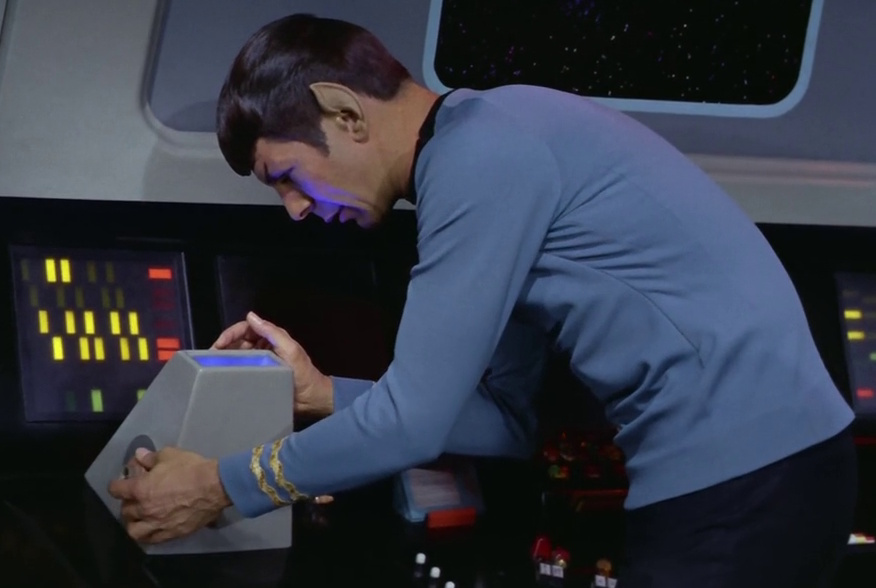
Captain Proton? No thanks…

Spoiler Warning: There are spoilers ahead for Star Trek: Picard Season 1, Star Trek: Lower Decks Season 2, and Star Trek: Voyager.

There have been a number of interesting-sounding pitches and concepts over the years for potential Star Trek series and feature films, and we recently looked at the possibility of a Starfleet Academy series. That sounds like something with potential, and you can check out my thoughts by clicking or tapping here.

But not all Star Trek pitches are created equal, and another potential series has been touted in the last few months by former Star Trek: Voyager actor and director Robert Duncan McNeill. He recently confirmed on social media that he’s pitched a Captain Proton show to ViacomCBS, though details about what the potential project would entail are light. Having touched on this idea on a couple of occasions in other contexts, I wanted to give the pitch more of an airing and put my thoughts in order.

A Captain Proton show has been proposed.

You’ve probably already figured out from the title of this piece where I come down on a Captain Proton show: I’m not in favour of it and I can’t really see a way to bring it to screen successfully. I’d even go so far as to say that I highly doubt ViacomCBS will consider this pitch for very long, despite the known name attached to it, and though there are a few reasons why – which we’ll go into detail about – it boils down to one simple question for Trekkies. And here it is:

Out of everything in Star Trek, is Captain Proton the one thing you want more of?

There are many characters, locations, starships, and themes that the franchise could return to one day. Off the top of my head here are five: a visit to the Enterprise era to see more of the Federation’s early years, the return of Benjamin Sisko from the realm of the Prophets, Neelix’s adventures at the Talaxian colony, Pavel Chekov’s days as an admiral or elder statesman, and John Harriman’s missions as captain of the Enterprise-B.

Maybe one day…

You can probably think of dozens more; characters and concepts that the Star Trek franchise could happily revisit. I would bet actual money that, for 99% of Trekkies, Captain Proton wouldn’t even enter the top fifty on their lists of things that they’d be interested in returning to. And I’m in that same boat. The ten Voyager episodes which either featured or made reference to Captain Proton were fun – but the concept is simply not strong enough nor memorable enough to carry an entire series on its own.

I like retro sci-fi – the likes of Flash Gordon, Forbidden Planet, and other older shows and films from long before Star Trek: The Original Series was even conceived are what Captain Proton paid homage to and gently parodied so well in Voyager. As one element of a larger series, a series with a much bigger picture and broader scope, Captain Proton worked. It slotted in well and gave the cast something different to do – and a chance to really ham it up and over-act.

Captain Proton was a pastiche of classic sci-fi films and serials like Flash Gordon.

But that’s the nicest thing I can say about the Captain Proton stories and sequences that we saw in Voyager. Out of that show’s 170 episodes, Captain Proton is far from being the most memorable aspect even among stories set on the holodeck; I’d go so far as to suggest that the Irish village featured in Fair Haven and Spirit Folk left more of a lasting impression. Those episodes certainly had far more depth than any Captain Proton story.

There’s a lot that we aren’t privy to when it comes to the recent Captain Proton pitch. Is it intended to be a 1930s-inspired black-and-white series, featuring the cardboard sets and overacting we’d expect from such a sci-fi serial? If the show wants to be purely about Captain Proton, either treating him as if he were real or showing us as the audience a kind of “show-within-a-show” look at Captain Proton through the eyes of a holodeck audience, then it has to be considered dead on arrival. A retro-inspired sci-fi aesthetic might be cool, but every other aspect of such a show would feel so terribly out-of-date that it would become a laughing stock.

A laughing stock indeed…

On the other hand, if the Captain Proton series is actually intended to be a look at Tom Paris as he writes new Captain Proton holo-novels years after the USS Voyager returned to Earth, then perhaps there’s a bit more meat there; more of an actual concept with the potential for characterisation and drama.

I’m still not sure that it would work, but at least the latter concept has a bit more going for it. Firstly, it could be developed as a tie-in or crossover with Star Trek: Picard – or any other show or film set in that era. With Seven of Nine now a regular member of the Picard cast, the potential for a reunion with Tom Paris and perhaps B’Elanna Torres as well would be of some interest. Paris and Seven didn’t have a lot to do together during Voyager’s run, but Seven clashed frequently with B’Elanna, especially during her first year or so aboard the ship. There’s potential, perhaps, to revisit that relationship and see how things have evolved over the years – we know from Picard Season 1 that Seven of Nine has changed and become far more human in that time.

Seven of Nine has returned in Star Trek: Picard.

But I think that’s about as far as a Captain Proton show could go, and I don’t think we necessarily need a standalone project in order to bring back characters like Tom and B’Elanna. Perhaps they wouldn’t be the best fit for Picard, but they could certainly make an appearance in a future episode or film. Tom Paris has already had a cameo in Lower Decks, and while that was a bit of a nothing-burger from my perspective, I’m not totally against the idea of the character making future appearances in Lower Decks or any other Star Trek project.

When Michael Dorn revealed he’d pitched a Captain Worf series a while ago, I felt that the character might not be strong and well-rounded enough to carry an entire series on his own. And unfortunately Tom Paris is in that same category. Paris was an excellent character, don’t get me wrong, and I enjoyed what he brought to Voyager. But he was frequently used as comic relief – making a joke to lighten the mood in a tense situation. The spotlight episodes he got showed off the altruistic side of his personality, his love of retro things, and his piloting skills. And we also got to see his relationship with B’Elanna develop over the show’s run.

B’Elanna Torres and Tom Paris eventually got married.

Tom Paris is far from one-dimensional. But he’s also not the kind of character who could easily play the main role – and if the intention behind this pitch is to create a Tom Paris series I fear it would end up meeting the same fate as Joey, the short-lived spin-off from popular sitcom Friends.

Tom Paris has a satisfying character arc already. Voyager began with him at rock bottom – a prisoner and an abject failure. He failed as a Starfleet officer, then failed on his first mission as a member of the Maquis. Out of everyone on Captain Janeway’s crew, Paris had the least to lose and the most to gain after getting stranded in the Delta Quadrant, but even so he rose to the occasion to become a dependable and honourable member of the crew, quite literally guiding the ship home.

Tom Paris has had a truly satisfying character arc already.

So we’ve already seen Tom Paris’ character arc. By getting lost in the Delta Quadrant he found meaning and purpose in his life, he found the love of his life, and he gained redemption for his past misdeeds against Starfleet, against the Maquis, and even against his father. If his career path glimpsed in Endgame is any guide, his future is one of artistry and leisure, putting his adventures behind him to focus on doing the things he loves.

In short, we know Tom Paris quite well, and any addendum to the story that we’ve already seen play out would risk feeling tacked-on. At worst it could upset and even undermine aspects of his character arc across Voyager’s run depending on what direction the story was taken. Having spent seven years with Tom Paris – albeit in a supporting role – I’m quite content to say that his time in Starfleet ended with Voyager’s return to Earth and he’ll spend the rest of his days happily married, working on holo-novels and playing with classic cars. I don’t think we need to see any of that to believe that it happened – and it’s deeply satisfying after the long and arduous journey that the USS Voyager took to know that at least some of the characters we came to know and love did in fact get their “happily ever after.”

Promotional photo of Tom Paris.

Unlike Seven of Nine, who had so much to gain personality-wise as she spent more time away from the Borg Collective, Tom Paris’ characterisation feels settled. As we saw in scenes set in the future in Endgame, he didn’t change much in the years after his return from the Delta Quadrant – and we wouldn’t have expected him to.

All of this assumes that Tom Paris was supposed to play a role in this pitched series at all, and that may not be the case. But regardless I think it’s worth considering that what makes for an enjoyable and lovable character – which Tom Paris certainly was – doesn’t necessarily translate to a character being suited to take a lead role. This is true of Worf and it’s true of Tom Paris – both played outstanding supporting roles, but neither should be tapped to lead their own spin-off.

Worf is another character about whom a series has been proposed.

After having spent years playing the same characters, I can fully understand why Robert Duncan McNeill and the rest of the Voyager cast enjoyed their sojourns to the world of Captain Proton. It was a chance to take on a different acting challenge, and to revel in a style of cinematography, acting, and storytelling that just doesn’t get produced anymore.

But there’s a reason why the likes of Forbidden Planet and Flash Gordon were superseded: technology, acting skills, and storytelling improved. Some of those improvements in the world of sci-fi actually came from Star Trek: The Original Series blended different genres and styles together, kept a tight focus on its main characters, told stories with real-world parallels and morals that audiences could relate and respond to, and depicted a vision of the future and outer space that was far more positive and hopeful than negative and fearful.

These kinds of serials were outdated by the middle of the 20th Century.

Retro can be fun. But to make a straight-laced Captain Proton television series wouldn’t just feel retro – it would feel regressive. Such a show would be a massive backwards step, trying to ignore multiple generations’ worth of improvements in everything from narrative and world-building to acting skills and cinematography.

More than that, a Captain Proton series would have incredibly limited appeal. Many fans of Voyager would be hard-pushed to remember Captain Proton, and even those that do and have fond memories of the episodes would be surprised at the very least to hear talk of a Captain Proton spin-off show. Beyond that minuscule niche, a Captain Proton series might appeal to fans of classic, retro sci-fi. But such folks are few and far between, and when Captain Proton already felt incredibly dated in the 1990s, the number of viewers who would genuinely appreciate the parodies and references is positively microscopic.

It almost certainly is for Captain Proton.

Even if Captain Proton were less about the retro sci-fi and more about Tom Paris, I don’t think that would work well either. There must be a queue of characters from past iterations of Star Trek lining up for their prospective returns to the franchise, and while Paris was a fun character during Voyager’s run, he simply isn’t strong enough or deep enough to carry a whole series. His recent cameo in Lower Decks kind of embodies that – the character could have been swapped out for any other, or a generic stand-in, and the episode would have been functionally the same.

At the end of the day, this concept comes down to the simple question I posed at the beginning of this article: out of everything in Star Trek, is Captain Proton the one thing you want more of? Or to put it another way: if you could choose only one thing from a past iteration of Star Trek to bring back, is Captain Proton what you’d choose? For the vast, vast majority of Trekkies, the answer would be a resounding “no.”

I don’t believe ViacomCBS will do more than give this pitch a cursory glance out of respect to its creator. Both possible formulations have major drawbacks, and from a corporate point of view neither seems to hold much appeal even to Star Trek’s fanbase – let alone a wider television audience. At the end of the day that’s what sells companies on making a new film or television series: how much money would it make? An incredibly niche project focusing on either a single character or one tiny aspect of a show from the 1990s (that ViacomCBS hasn’t even been bothered to upscale to full HD) doesn’t fit the bill. Captain Proton is dead on arrival – and I’m sorry to say that it’s for the best.

The Star Trek franchise – including Star Trek: Voyager and all other titles and properties mentioned above – is the copyright of ViacomCBS. This article contains the thoughts and opinions of one person only and is not intended to cause any offence.
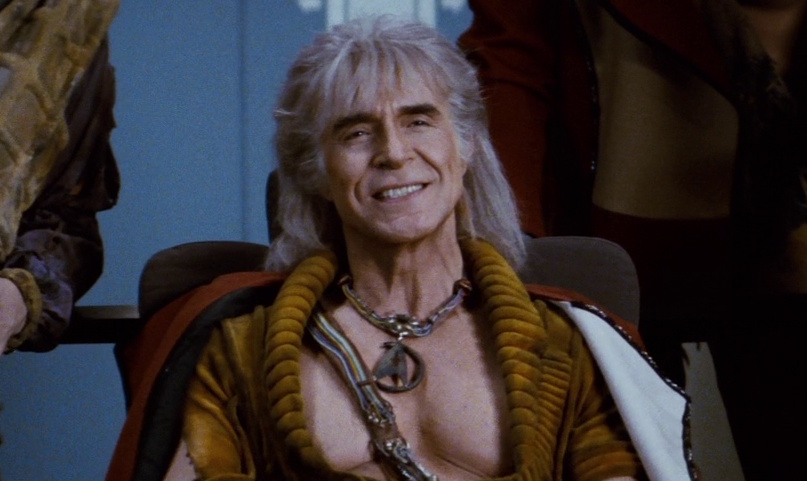
What If…? Star Trek Edition!

Spoiler Warning: There are spoilers ahead for the following Star Trek productions: The Search for Spock, The Next Generation Season 3, Nemesis, Deep Space Nine, Voyager, and Star Trek 2009.

Over on Disney+, Marvel has recently put out a series of animated short films with a very interesting premise. These shorts asked what might’ve happened in the Marvel universe if circumstances had changed, characters had taken different actions, or things had ended differently.

Alternate history has always been a subject that fascinated me! So with that in mind, we’re going to consider a few “what ifs” from the Star Trek franchise – from an in-universe point of view, naturally! There are more than 800 Star Trek stories at time of writing, meaning that there are literally hundreds of potential scenarios where a different decision or different outcome could have radically changed the Star Trek galaxy.

Inspired by Marvel’s What If…? series, we’re going to put a Star Trek spin on this concept!

As always, please keep in mind that all of this is one person’s subjective opinion! I’m indulging in fan-fiction and pure speculation based on my own thoughts about how some of these scenarios might’ve unfolded. If you hate all of my ideas, or something you like wasn’t included, that’s okay! Within the Star Trek fandom there’s enough room for different opinions.

With that out of the way, let’s consider some Star Trek “what ifs!”

Number 1: What if… Captain Picard couldn’t be saved after being assimilated?

Locutus of Borg.

This isn’t going to go the way you might be expecting! In this scenario, the events of The Best of Both Worlds play out as we saw on screen: Picard is captured, the Borg defeat the Federation at Wolf-359, Riker and the Enterprise race to confront them over Earth, and Captain Picard is able to communicate to Data how to defeat them. The Borg cube explodes, and the Federation lives to fight another day! But unfortunately Captain Picard then dies – severing his connection to the Collective and/or removing his Borg implants was too much for his body and mind to take, and he doesn’t survive beyond the end of The Best of Both Worlds, Part II.

As Starfleet and the crew of the Enterprise-D mourn the loss of Captain Picard, Captain Edward Jellico is assigned to the ship as his replacement, and many of the events later in The Next Generation proceed unaltered. As Q would tell Picard in the episode Tapestry, even without him in command the Enterprise-D and Starfleet would be fine.

Captain Edward Jellico.

The Federation, armed with new knowledge of the Borg, developed new ships like the Defiant-class and Sovereign-class, and were even able to defend against a second Borg incursion a few years later – albeit at great cost. But the loss of Captain Picard would have a huge impact later, in the year 2379. A coup on Romulus brings a human clone to power – Shinzon. Shinzon’s plot to destroy the Federation was only stopped because of his personal connection to Picard, a connection that fascinated him and that he hoped could save his life.

Without that obstacle in the way, Shinzon sees no reason to wait or to play nice with the Federation before implementing his plan. He takes his flagship, the Reman warbird Scimitar, and heads straight for Earth before the Federation even has time to respond diplomatically to the change in government on Romulus. Under cloak, the Scimitar deploys its thalaron radiation weapon – massacring all life on planet Earth and crippling the Federation government and Starfleet command.

Without Captain Picard to pose a distraction, Shinzon was able to launch his attack on Earth.

With war now assured between the Romulans and Federation, Romulan commanders who had been sceptical of Shinzon rally to the cause. All-out war breaks out between the Romulan Empire and the residual Federation, but without a government or command structure to provide a coordinated response, and seriously demoralised from the attack on Earth, things don’t go well for Starfleet. The Scimitar proves to be an unstoppable force all on its own, and its thalaron radiation weapon is able to devastate multiple other planets: Betazed, Andoria, Alpha Centauri, Mars, and others. The Federation is forced to sue for peace on very unfavourable terms.

However, Shinzon wouldn’t live to see the Romulan victory. Without the original Picard, there was no way to save his life from the DNA degradation that he was suffering from, and shortly after the Federation’s defeat Shinzon dies. His Reman viceroy would succeed him as the new leader of the Romulan Empire, an empire which now incorporated large swathes of what had once been Federation space. Whether the Romulans could hold all of this territory, and whether their empire would accept a Reman leader, are now open questions…

Number 2: What if… Spock wasn’t resurrected on the Genesis Planet?

Spock’s empty coffin on the Genesis Planet.

This scenario sees the events of The Wrath of Khan unfold exactly as we saw on screen. Khan stages an attack on the Enterprise, steals the Genesis device, and is defeated at the Battle in the Mutara Nebula. Spock sacrifices his life repairing the Enterprise’s warp drive, allowing the ship to outrun the blast of the Genesis device. But in our alternate world, Captain Kirk doesn’t give Spock a Starfleet funeral. Instead Spock’s remains are returned to Vulcan, in line with his and his family’s wishes. There is no chance for a resurrection because Spock never came into contact with the Genesis Planet.

Spock would indeed prove instrumental in several key events later in his life that now can’t happen. But we’re going to focus on the Kelvin timeline today. Spock’s actions in the Kelvin timeline saved Earth from Nero’s attack – but without his presence there’s no one to stop the crazed Romulan commander.

Nero.

Assuming that Nero arrived in the Kelvin timeline thanks to Red Matter (presumably deployed by someone else from the Federation as part of a plan to save Romulus), he has no reason to wait for Spock before enacting his revenge plan. After destroying the USS Kelvin (killing the infant Kirk in the process), Nero races to Vulcan and destroys the planet in the year 2233 – decades earlier than he would during the events of Star Trek 2009. Before the Federation even has time to realise what’s happening, and with Vulcan still collapsing, Nero heads to Earth and deploys his weapon for the second time – destroying the planet.

Nero then moves on quickly, targeting Tellar Prime and other Federation member worlds and colonies. The devastating losses mean it takes Starfleet a while to reorganise, but eventually the remaining fleet comes together to make a last stand over Andoria – the last remaining Federation member world. The battle against Nero’s powerful flagship is long and incredibly difficult, but Starfleet eventually prevails through sheer numerical advantage – despite suffering huge losses.

The Narada and the USS Kelvin.

Nero’s defeat wouldn’t mark the end of the rump Federation’s problems, though. With many planets and colonies destroyed, more than half the fleet lost, and millions of people turned into refugees, the Federation is an easy target. First the Klingons come, seizing planets and systems near their borders. Then the Gorn, the Tholians, and the Romulans also join in, picking off star systems that the Federation could no longer manage to defend. Federation space shrinks to a small area in the vicinity of Andoria.

The Andorians were not happy with the large numbers of refugees who sought them out, though. Plans were put in place to resettle humans, Vulcans, Tellarites, and others on new colony worlds, even though doing so would leave them vulnerable. After being kicked out by the Andorians, the remaining Federation members maintained their alliance more out of fear and necessity than anything else. How long these small populations can survive in a hostile galaxy is unknown…

Number 3: What if… the USS Voyager went the other way?

The USS Voyager.

The events of Voyager’s premiere episode, Caretaker, play out much the same as they did on screen in this scenario. But after that, things take a very different turn – literally! The Maquis raider Val Jean, under Chakotay’s command, is transported to the Delta Quadrant by an entity known as the Caretaker. The USS Voyager is likewise transported by the Caretaker’s Array, and after the death of the Caretaker and a short battle with the Kazon, Captain Janeway orders the destruction of the Array. Voyager must find a way home.

Instead of taking the most direct route to Earth, Captain Janeway and the crew of Voyager consider an alternative idea – heading for the Gamma Quadrant, and the far side of the Bajoran Wormhole. From there it would only be a short journey back to Earth! The crew debate the ideas for a while, and there isn’t a clear consensus. No starship has ever undertaken such a long journey before, so there really aren’t ground rules for route planning when it comes to long-distance interstellar travel.

A non-canon map of the Star Trek galaxy.
Image Credit: Star Trek Star Charts (2002) via Memory Beta

Using the map above (which is non-canon) as a guide, the crew quickly figure out that both a direct route home via the Delta and Beta Quadrants or an indirect route via the Gamma Quadrant and Bajoran Wormhole are roughly the same length and would take roughly the same amount of time.

The two crews can’t agree at first. Chakotay and the Maquis, keen to avoid going anywhere near Cardassian space and fearing being turned over to Cardassian authorities upon their return, firmly advocate for the Delta Quadrant route. Neelix claims to be familiar with space in both directions and along both routes, but ultimately the decision falls to Captain Janeway.

The choice of route ultimately falls to Captain Janeway under the “my ship, my decision” principle.

Somewhat ironically when considering her actions in Endgame, Janeway chooses the Gamma Quadrant route. Why? She’s fearful of the Borg, naturally. Whatever dangers and obstacles may await Voyager in the Gamma Quadrant, she tells her crew, Starfleet has known for years that the Borg’s home territory is the Delta Quadrant. Taking that path seems positively suicidal in comparison, so Voyager will instead head for the Gamma Quadrant terminus of the Bajoran wormhole.

Voyager’s superior technology makes battling the Kazon sects in the area around the Caretaker’s Array relatively easy, but they have to be careful to avoid space claimed by the Haakonian Order – the conquerors of Neelix’s people, the Talaxians. After they leave their starting region, though, the truth is that we simply don’t know very much at all in canon about this area of space. Would Voyager find a faster way home through some technological means or natural phenomenon? Or would the ship and crew have to undertake a slow, decades-long journey to reach the wormhole? Would they even survive at all, or instead fall victim to some villainous faction or dangerous anomaly present in this unexplored region?

Number 4: What if… the USS Discovery didn’t go into the far future?

Michael Burnham and the USS Discovery at the mouth of the time-wormhole.

I already have a theory discussing in detail why I think the USS Discovery didn’t need to go into the far future based on the outcome of the battle in Such Sweet Sorrow, Part 2 – and you can find that one by clicking or tapping here. For the sake of this scenario, though, all we’re going to say is that somehow Captain Pike, Burnham, and Saru figured out a way to defeat the Control AI without sending the USS Discovery into the 32nd Century.

Obviously some changes wouldn’t appear until the 32nd Century. Without the USS Discovery and Michael Burnham, no one is able to discover the source of the Burn or the huge cache of dilithium in the Verubin nebula. Without the USS Discovery and its Spore Drive to fight over, the Emerald Chain doesn’t stage a bold attack on Starfleet HQ. Su’Kal would almost certainly die alone when the KSF Khi’eth is destroyed – whether that event would trigger a second Burn is unclear.

A second Burn could occur.

But more substantial changes could have taken place in the Star Trek galaxy centuries earlier. With the Spore Drive still in existence in the 23rd Century, it stands to reason that Starfleet would have continued to explore the technology – it works, after all, so if a new way of navigating the mycelial network could be discovered, the Spore Drive would be an absolute game-changer for the Federation.

At some point, Starfleet scientists would hit upon the idea of using empaths to connect to the mycelial network in place of augmenting human DNA. After promising test flights using Betazoid and even Vulcan navigators, in the late 23rd Century Starfleet is able to begin a wider rollout of the Spore Drive. At first a handful of ships are kitted out as rapid-response vessels, able to jump across Federation space at a moment’s notice to assist with emergency situations.

Starfleet is able to kit out a whole fleet of Spore Drive-enabled starships.

The Spore Drive would soon attract the attention of other factions, however. Unwilling to allow the Federation a massive tactical advantage, particularly in the aftermath of the Federation-Klingon war, the Klingon Empire begins development on their own Spore Drive programme. The Romulans follow suit, and by the early part of the 24th Century the Spore Drive has become a mainstay of interstellar travel in the Alpha and Beta Quadrants.

No longer limited by geography or travel time, Starfleet is able to jump to interesting-looking phenomena across the galaxy with ease, initiating dozens of first contacts decades ahead of schedule. On one unfortunate occasion, however, a Spore Drive ship jumps to the Delta Quadrant… right into the heart of Borg space. The Borg quickly assimilate the vessel, taking the Spore Drive technology for themselves and putting a target on the Federation’s back. Due to the distances involved, Starfleet remains unaware of what happened, merely recording the USS Discovery-C as “missing in action…”

Number 5: What if… Benjamin Sisko wasn’t the Emissary of the Prophets?

Commander Benjamin Sisko.

Ignore for a moment the revelation from Image in the Sand about Benjamin Sisko’s Prophet-induced conception! For this scenario, we’re considering that there were two occupants of the Runabout which first discovered the Bajoran Wormhole: Sisko and Jadzia Dax. Though the Prophets would choose Sisko as their Emissary, they could just as easily have chosen Dax instead.

Jadzia Dax returns from the wormhole having been anointed by the Prophets as their Emissary, and receives much respect and adoration from the Bajorans. Meanwhile, Sisko makes good on his threat and quits Starfleet, returning to Earth. Jadzia is promoted to the rank of commander and given “temporary” command of DS9, due in no small part to the way the Bajorans feel about her.

Jadzia Dax assumes command of Deep Space Nine.

First contact with the Dominion occurs, and shortly afterwards the Dominion and Cardassians form an alliance – the work of Dukat, formerly the commander of Bajoran occupying forces on Bajor. The Dominion Cold War begins. Behind the scenes, Dukat is researching the Pah-wraiths, the ancient noncorporeal enemies of the Prophets. In disguise he travels to Deep Space Nine with a lone Pah-wraith, and in the course of unleashing the entity into the wormhole, kills Jadzia.

With no Emissary on the outside to come to their aid, the Prophets are fighting a losing battle against the Pah-wraiths while the Dominion War rages. The loss of Dax, though distressing to the crew of DS9 and her husband Worf, doesn’t appear to matter to the Federation war effort… not at first. In fact, the wormhole’s closure appears to provide the Federation alliance a reprieve, as the threat of Dominion reinforcements is reduced.

Jadzia is killed by the Pah-wraiths.

However, without the Orb of the Emissary re-opening the wormhole and expelling the Pah-wraiths, things go badly for the Prophets. When Dukat is able to implement the next phase of his plan and release the rest of the Pah-wraiths from the Fire Caves, there’s no one to stop him. The Pah-wraiths seize control of the wormhole, and as a thank you to Dukat they destroy the Federation minefield, allowing a massive fleet of Dominion reinforcements through the wormhole. The Dominion conquer DS9 and Bajor with ease.

With no way to stop Dominion reinforcements pouring in through the wormhole, the Federation alliance moves into attrition mode, trying to hold the existing front line for as long as possible against repeated Dominion attacks. Though the Pah-wraiths don’t actively take part in the fighting, their involvement allowed Dukat and the Dominion to swing the balance of the war back in their favour. By controlling Deep Space Nine and the wormhole, the Cardassian-Dominion alliance has the Quadrant’s most significant asset. It seems like only a matter of time until the Federation will have to sue for peace, if the Dominion would even accept…

So that’s it! Five Star Trek “what ifs!”

There are many more “what if” scenarios in the Star Trek universe!

I can already think of more, so watch this space. I might return to this concept in future. I hope this was a bit of fun, and a chance to consider some alternative outcomes to some of the events we’ve seen across Star Trek’s history. I tried to pick a few different ideas from different productions – otherwise this could’ve been “five Captain Picard what ifs!”

As always, this was really just an excuse to spend a little more time in the Star Trek galaxy. It’s totally fine if you disagree with any of the storylines I’ve suggested today, or if you think this whole concept was a silly idea! None of this will ever make it to screen, and it was more of a thought experiment and creative writing project than anything else. I had fun putting this together – and I hope you enjoyed reading it.

What If…? and the logo for the series are the copyright of Marvel and The Walt Disney Company. The Star Trek franchise – including all films and series mentioned above – is the copyright of ViacomCBS. This article contains the thoughts and opinions of one person only and is not intended to cause any offence.
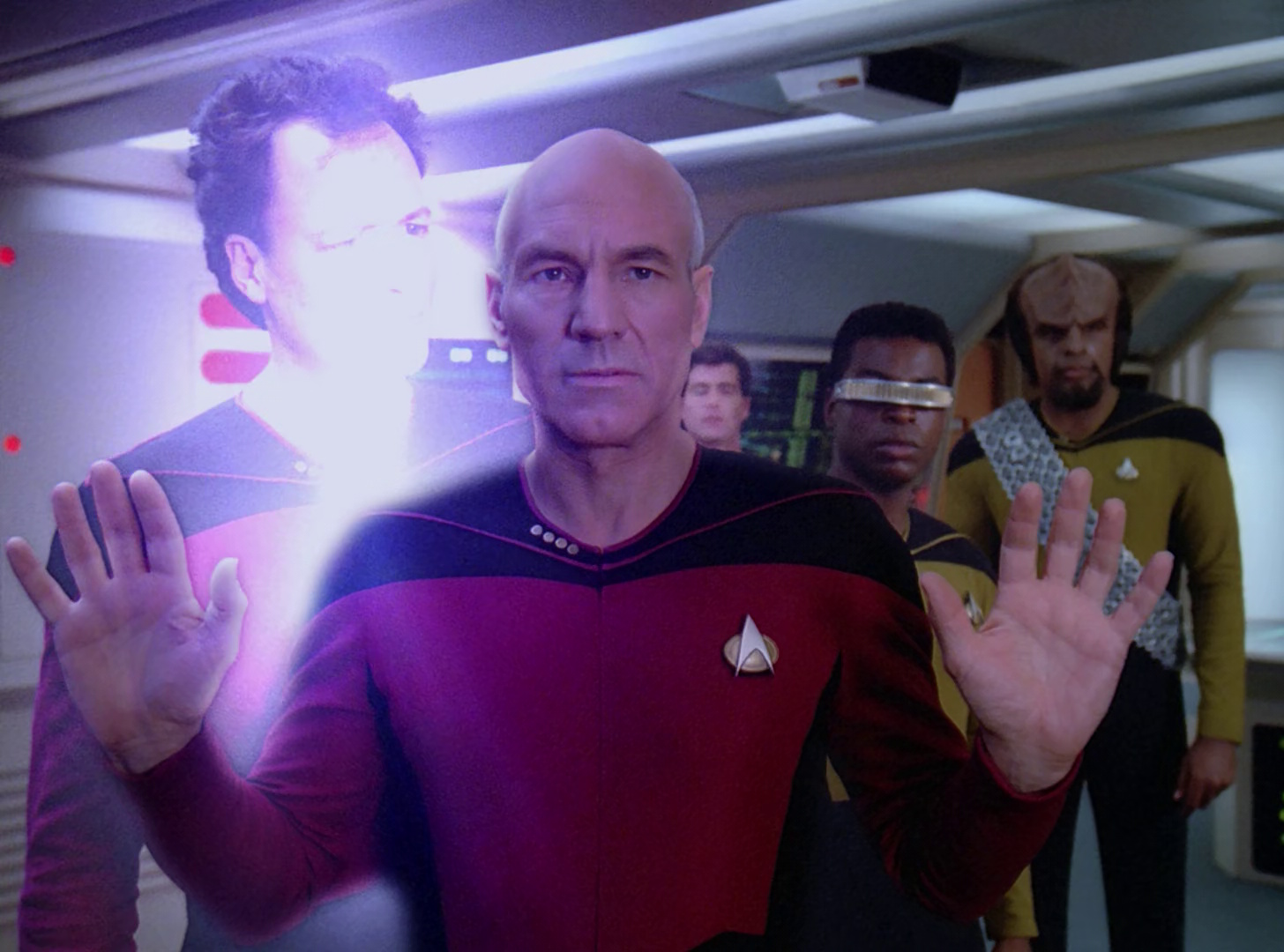
Five underappreciated television series

Spoiler Warning: Minor spoilers may be present for some of the entries on this list.

As many television shows approach their summer break, perhaps you’re looking for something to watch while you wait for new series and seasons to debut later in the year. Late spring and summer have historically been the “off season” for prime-time television series, with the main television season running from September/October through to April/May. The rise of streaming services has gone some way to breaking that up, which is good news, but there are probably still fewer big television productions on the air at this time of year.

With that in mind, I thought it could be fun to take a look at five television series that you might’ve missed – or just not seen for a while! All five are, in my opinion, underappreciated today, even if they were big hits at the time they were originally broadcast. Some series end up living long lives even after they go off the air – these ones, despite picking up some attention, aren’t quite at that level.

We’ve got a mix of different genres today, from action and drama to horror and even a documentary. So hopefully you’ll find something worthy of your time this summer!

Number 1: Jericho (2006-2008)

Protagonist Jake Green.

Between the mid-2000s and the mid-2010s there seemed to be a lot of interest in the post-apocalyptic genre. We’d see The Walking Dead premiere in 2010, as well as Survivors, Battlestar Galactica, and films like Children of Men and Contagion. Arriving on our screens in 2006 was Jericho, a post-apocalyptic drama series about the inhabitants of small-town America as they endure the aftermath of a nuclear attack on the country.

Jericho featured some wonderful characters, including the hot-headed Jake, his level-headed brother Eric (played by Star Trek: Discovery’s Kenneth Mitchell) and father Johnston, and the enigmatic Robert. The interactions between the residents of the town – and other characters they met along the way – was really the core of the show, and Jericho dived headfirst into exploring how ordinary, everyday people would confront such a major, nationwide calamity.

One of the nuclear bombs exploding.

As always in post-apocalyptic works, some people respond better than others! Characters like protagonist Jake and mayor Johnston rose to the occasion, demonstrating the kind of selflessness and leadership necessary to help their community through the difficult times that lay ahead. Other characters descended into villainy, trying to shake down or scam the town, or violently attack people. This dichotomy, while hardly unique to Jericho, was put to screen exceptionally well.

While there was a storyline which focused on the bombings themselves – something that was explored further in the show’s short second season – for me the main draw of Jericho was its character-driven post-apocalyptic narrative, spending time with these folks as they tried to process what had happened.

Number 2: The Terror (2018-2019)

Promo image for The Terror Season 1.

The Terror could be a great show to watch in October to mark Halloween – if you can wait that long! This anthology series so far only consists of two seasons, but both were interesting in their own ways. Season 1 is definitely the better of the two, focusing on the ill-fated Franklin Expedition to the Arctic in the mid-19th Century.

Sometimes I’m a little uncomfortable with shows that take real-life people – even historical figures – and fictionalise them, and I think that will have to be the subject of a future essay! But despite that, The Terror Season 1 was an incredibly well-done piece of character-centric drama. The horror elements came into play over the course of the story, but like with classics of the monster horror genre like Jaws, the creature stalking the surviving members of Franklin’s arctic expedition was better for being largely unseen. The tension and stress that was built up over the course of ten episodes was truly riveting to watch.

George Takei in Season 2.

The second season picked up a completely different story, taking place in a Japanese internment camp during the Second World War. This story focused on a vengeful spirit, and likewise did a good job of building tension, though overall it was a more horror-centric season compared to the first. Star Trek: The Original Series star George Takei, who was himself interned during the war, had a co-starring role.

There was scope to continue The Terror as an anthology series, with new stories produced under the same banner. However, the lacklustre reception to Season 2 appears to have put the show on ice – pun intended – at least for now. Even though horror is far from my favourite genre, I had a good time with both seasons, and it feels like a lot of folks missed this one when it was first broadcast.

Number 3: Star Trek: Voyager (1994-2001)

The Voyager Season 2 cast.

It wouldn’t be one of my lists without at least some Star Trek, right? I feel that Voyager tends to be overlooked by at least some in the Star Trek fandom. The Original Series kicked things off and is a classic, The Next Generation is, for many folks of my generation at least, the high-water mark of the franchise, and Deep Space Nine has a fandom of its own. Modern Star Trek has picked up a following of new and old Trekkies alike, but Voyager can feel underappreciated.

I think a big part of the reason why is that Voyager struggled to find its own identity at the height of Star Trek’s ’90s “Golden Age.” The Next Generation introduced fans to the 24th Century, and during Voyager’s run its cast were starring in feature films. Deep Space Nine was something altogether different: set on a space station with a big cast of secondary characters, and dealing with darker themes. Voyager could feel, at times, a little too close to copying The Next Generation’s formula, and thus “just another Star Trek show.”

The USS Voyager during the show’s title sequence.

That sells it short, in my view, and there’s a lot to love about Voyager. It’s certainly true that not every element worked as intended – the “one ship, two crews” idea being the biggest, but even the overall story of a journey home could feel overlooked at points. But Voyager had a wonderful cast led by a fantastic captain.

Perhaps we could entertain the argument that Voyager could have done more to stand out. But re-watching it now, more than twenty years after its finale, it’s still a wonderful series. It’s just such a shame that it hasn’t been remastered yet!

Number 4: The World At War (1973)

Title card for The World At War.

There are a huge number of World War II documentaries floating around out there, with outlets like the History Channel making more all the time. Many modern documentaries make use of fully-acted dramatic recreations and use CGI and special effects to bring history to life. By those standards, The World At War might feel out-of-date and rather stuffy. But for my money there’s no documentary as interesting.

The World At War was produced at just the right moment, and I’ll explain what I mean by that! It’s difficult – if not impossible – to make a fair and balanced documentary during or immediately after the events it covers; feelings are too raw, some of those involved have careers to consider, and for all manner of reasons, getting to the raw unvarnished truth can be impossible if done too quickly. But on the other hand, waiting too long can mean that too many of the main people involved in an event have died or become too unwell to share their recollections. The World At War was produced almost 30 years after the end of World War II – long enough for passions to have faded and for people to share their opinions honestly, but also not too long after the event.

Albert Speer, former German armaments minister and one of the documentary’s interviewees.

As such, The World At War was able to interview many significant people from World War II, including British foreign secretary (and future Prime Minister) Anthony Eden, British RAF leader Arthur Harris, German Admiral (and Hitler’s designated successor) Karl Dönitz, German armaments minister Albert Speer, and a number of others. Getting these individuals on record to share their views, and to be able to see and hear them, is absolutely priceless from an historical perspective.

Beyond that, though, The World At War was incredibly well-made. With narration provided by Lawrence Olivier, plenty of footage from the era, and the aforementioned interviewees providing a direct eyewitness account to the war, it’s a unique production that aimed to be comprehensive, and a must-watch for any history buff.

Number 5: The Last Ship (2014-2018)

The USS Nathan James – the titular “last ship.”

It’s possible that, with the pandemic raging, now isn’t the best time to watch a series about the world being brought to its knees by a virus! But The Last Ship is a fun, action-packed show and something truly different in a post-apocalyptic genre that was being milked dry in the 2010s.

Some post-apocalyptic fiction uses military characters and settings, and that can be fun. But very few have a strictly naval focus, and the addition of that setting is really what makes The Last Ship so different from the likes of The Walking Dead and others. The USS Nathan James is a home base for most of the main characters, and a safe space away from the chaos engulfing the world around them. Some Star Trek fans say that the starship is like an additional character, and the Nathan James definitely fills that role in The Last Ship.

Captain Tom Chandler.

There are some fantastic character moments in what is a very tense and dramatic series. All of the main cast put in fantastic performances, and there are some villains who genuinely inspire hatred! Writing a truly nasty character whose motivations are still believable is no mean feat, yet The Last Ship managed it on more than one occasion.

Despite the dire straits the world finds itself in in The Last Ship, the series tells a positive, uplifting, and hopeful story, showing off humanity at its best as well as at its worst. This is one aspect of post-apocalyptic fiction that I really like, and The Last Ship uses the backdrop of the virus to reach for something good instead of merely revelling in showing us the bad.

So that’s it!

Did I give you any inspiration for what to watch?

We took a short look at five television shows that I think are underappreciated right now. Some failed to make much of an impact when they were first broadcast and simply fizzled out, others have been eclipsed by other productions made in the years since they went off the air. But all five are absolutely worth a watch – or a re-watch – in 2021.

I had fun putting this list together, and I hope you’ll stay tuned for more lists and other articles coming up soon! We’re almost halfway through the year, so check back at the end of the month for my look ahead to the entertainment experiences that we’ll be enjoying before 2021 is over. Until next time!

All shows mentioned above are the copyright of their respective broadcaster, studio, distributor, production company, owner, etc. Availability to stream or purchase on Blu-ray or DVD may vary by region. This article contains the thoughts and opinions of one person only and is not intended to cause any offence.
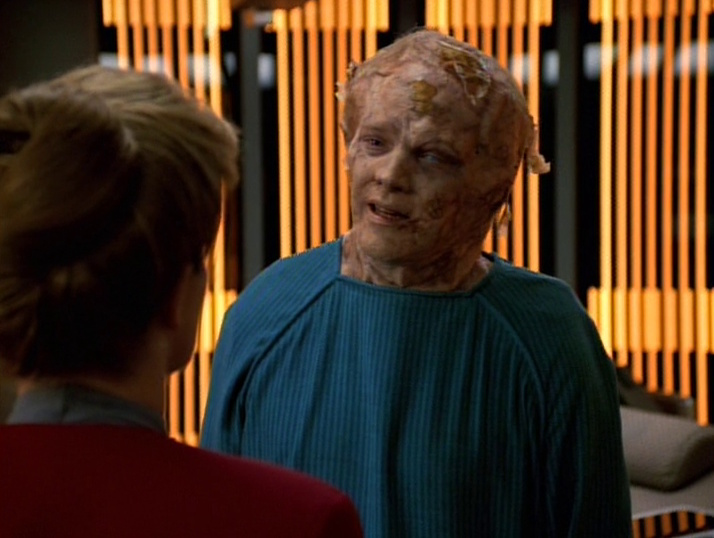
Did Admiral Janeway do the right thing in Endgame?

Spoiler Warning: There are spoilers ahead for Star Trek: Voyager, Star Trek: Picard, and for other iterations of the franchise.

Twenty years ago today saw the premiere of Endgame, bringing Star Trek: Voyager to an end after seven seasons and 172 episodes. It was a feature-length episode with a complicated story involving time travel and two versions of Janeway! To mark the anniversary, I wanted to look back at the episode – specifically at one of its key storylines. Endgame saw Admiral Janeway travel back in time from the year 2404 to 2378 – and deliberately using her knowledge of the future to radically change events for the crew of Voyager. But did she make the right decision by doing so? And was it even her decision to make?

Those are the questions on my mind on Endgame’s 20th anniversary! It seems like a great opportunity to finally dig into these issues and consider some pretty deep points from an in-universe point of view. I’ve explained on a few occasions already that time travel stories both within Star Trek and outside the franchise aren’t always my favourites, but despite some of my in-universe criticisms of Janeway and her actions (or maybe because the episode is so morally ambiguous) Endgame is an example of a time travel story that I actually like. It was an exciting and explosive way to bring Voyager to an end – and I can hardly believe it’s been twenty years already!

Admiral Janeway in Endgame – which premiered twenty years ago today.

Time travel stories in Star Trek typically don’t proceed like Endgame. If our characters go back in time to undo some event, it’s usually with a view to preserving or repairing the timeline, not deliberately changing it. That’s the crucial difference, and it’s why Admiral Janeway’s actions are, at best, morally ambiguous. At worst I’d argue we should condemn what she did.

It’s worth acknowledging that time travel in Star Trek has not always been clear-cut. The Original Series in particular took a more liberal attitude to travelling back in time, with episodes like Assignment: Earth and the film The Voyage Home showing the crew much more able to freely interact and change things than we’d seen in later stories of The Next Generation era. But Endgame arrived after the establishment of the Temporal Prime Directive, and after several episodes in The Next Generation, Deep Space Nine, and Voyager itself had all established that time travel is regulated and the timeline itself monitored by agencies of the Federation.

Time travel has not always been consistently depicted in Star Trek!

The Federation and Starfleet, through the Temporal Prime Directive and organisations like the Department of Temporal Investigations, was dedicated to maintaining and preserving the timeline, and to ensuring that no one would change or manipulate events for their own purposes. Starfleet in the 29th Century – as we saw in Voyager – spent at least part of its time enforcing these laws.

When Admiral Janeway travelled back in time in Endgame, she didn’t merely change the lives of the surviving crew of the USS Voyager. By bringing the ship home decades earlier than it otherwise would have made it, and by attacking the Borg, she changed and even erased countless lives, both inside the Federation’s borders and outside of it. Films like The Butterfly Effect demonstrate the flaw in this approach – showing how changing one or two things which seem to only affect a handful of people can have massive unintended consequences.

Starfleet set up the Department of Temporal Investigations – and other organisations – dedicated to preserving the timeline and preventing exactly the kind of thing Janeway did.

We can talk specifics in a moment, but first let’s consider, as a moral question, whether Admiral Janeway had any kind of right to meddle in the timeline to this extent. By changing the course of history, and undoing events that happened almost thirty years in the past from her perspective, she radically changed the future for countless people – including, of course, everyone on Voyager’s crew.

Although she had once been their commanding officer and thus bore a degree of responsibility for their lives, this was categorically not Janeway’s choice to make – certainly not decades later, when most of the crew were no longer serving under her command. And the implications of what she did for the wider Federation and for every race and empire in the galaxy cannot be overstated. Time can be weaponised; this is something we know from dozens of other Star Trek stories. So there can be only one term for what Admiral Janeway did in Endgame – it’s a war crime.

Admiral Janeway took it upon herself to radically alter the lives of all of these people – and more – without consulting them. Regardless of her intentions, it was not her choice to make.

Two examples come to mind. First is the Borg attack on Earth in Star Trek: First Contact, in which the Borg attempted to assimilate humanity by travelling to the past. And the second is the Voyager two-part episode Year of Hell from Season 4, in which a time traveller named Annorax attempted to force multiple changes in the timeline to save someone he cared about. In both cases, Starfleet was on the side of preserving the timeline and fighting back against the criminals who attempted to bend the timeline to their will. What Admiral Janeway does in Endgame is the complete opposite.

Not only that, but her motivations seem to be primarily about saving the life of one person – Seven of Nine. Though there was a sub-plot involving Tuvok suffering from an illness that was only curable if he got back to Federation space, saving Seven’s life was Janeway’s main objective. So all of the damage and destruction wrought upon the timeline was for the sake of one person. On an individual level we can understand and even sympathise with Janeway’s desire to save Seven’s life. But when stacked up against countless other lives it pales into insignificance.

Was Seven of Nine’s life worth all the erased lives, changed lives, and other unintended consequences? Are they just collateral damage? Did Janeway have the right to decide that for herself?

The early part of Endgame briefly introduced us to Sabrina, the daughter of Naomi Wildman and an unnamed individual. By travelling back in time, Janeway completely changed Naomi Wildman’s future and thus almost certainly erased Sabrina from existence. Star Trek has never been a franchise that talks up things like fate and destiny, so unless we’re going to try to inject that here and say that Naomi Wildman was always going to meet Sabrina’s father at exactly the right time and place… then I’m sorry, but there’s no doubt that Sabrina was wiped out by Admiral Janeway.

We have another point of comparison: the Deep Space Nine Season 5 episode Children of Time. In that story, the USS Defiant crash-landed on a planet in the Gamma Quadrant and Sisko and co. found themselves stranded in the past. The crew’s descendants were later wiped out of existence by the intervention of Odo – who desired to save the life of Major Kira. Once again, the story encourages us to understand Odo’s motivations on an individual level, but condemn him for what he did – erasing 8,000+ people from existence.

Sabrina and Harry Kim. Janeway’s actions almost certainly erased Sabrina from existence – and changed Harry’s life dramatically.

If the future from which Janeway had originated seemed awful, perhaps we could judge her actions less harshly. Her desire to attack the Borg would be far more understandable if, for example, the Borg had conquered much of the Federation. But there was no indication that there had been any Borg activity in Federation space in the preceding decades, let alone the kind of war or invasion that might conceivably justify this kind of action.

If the whole crew had died it still wouldn’t justify her actions, but it would certainly make them more sympathetic. However, again the episode does not give us this justification. Tom Paris, B’Elanna Torres, the Doctor, Harry Kim, Barclay, and others all seem to be doing well in the early 25th Century, having moved on and put their Voyager days behind them.

B’Elanna survived her experiences aboard Voyager and seemed to be doing great a decade after the ship’s return, as did many other members of the crew.

Admiral Janeway’s justifications are thus wearing thin. Chakotay had died in this era, but there’s no evidence that travelling back in time would have saved his life. The only two lives that would be positively affected that Endgame shows us are Seven of Nine and Tuvok; the entire rationale for her plan hangs on these two individuals. And as I said earlier, when pitted against countless other lives, that can’t possibly be acceptable.

Janeway herself took the opposite view in Year of Hell, fighting back against Annorax’s attempts to use time travel to manipulate events to achieve his desired outcome. And Star Trek has several other great examples of our heroes stepping up to preserve the timeline or using time travel to prevent exactly the kind of thing Janeway tried to do. Going all the way back to The City on the Edge of Forever in the first season of The Original Series, this is how Starfleet has generally viewed time travel. In Enterprise we saw that taken to its logical conclusion, with Crewman Daniels representing a human faction – which may or may not have been associated with the Federation – dedicated to protecting the timeline from exactly this kind of interference.

Captain Kirk intervened to protect the timeline in The Original Series – doing the opposite of what Janeway does in Endgame.

Sticking with the theme of this being akin to a war crime, I would posit that Admiral Janeway used time itself as a weapon. In this case she used it to suit only her own selfish ends, with the potential side-effect of harming the Borg Collective, but as stated above the knock-on effects and consequences are unpredictable. There’s simply no way to know if Janeway’s interference made the galaxy better or worse.

For me, the biggest case in point is her attack on the Borg. There was no evidence that the Borg had attempted another attack or invasion as of 2404, and I’d present Barclay’s class as evidence that there had actually been no major attack or incursion in those years. Barclay showed the class of cadets a hologram that looked very much like a Borg drone encountered by the crew of Voyager or the Enterprise-E, suggesting Starfleet had no major Borg contact since those events. So here’s a hypothetical scenario: what if the Borg had turned their attention away from the Federation after suffering repeated defeats?

Janeway, Barclay, and a holographic Borg drone.

After the Borg were soundly beaten by Species 8472, they appear to have abandoned their attempts to assimilate them and their fluidic space realm, refocusing their efforts on further expansions of their space in the Delta Quadrant. It’s at least possible, then, that the Borg had put their plans to assimilate the Federation and make large-scale incursions into the Alpha Quadrant on hold, perhaps even indefinitely. Until Admiral Janeway came along.

Though we don’t have absolute confirmation of this, the existence of the Artifact (the abandoned Borg cube) in Picard Season 1 very strongly hints at the Borg Collective surviving Admiral Janeway’s attack in Endgame – and if they did, perhaps her attack changed the Borg’s perspective. No longer content to ignore humanity and focus on the Delta Quadrant, they may have spent the next few years plotting a major attack. The consequence of Janeway’s efforts to save Seven of Nine could thus be a full-scale Borg invasion!

Could Janeway’s actions have led the Borg to renew their focus on assimilating the Federation?

That’s pure speculation on my part, of course, but it serves as an example of everything I’ve been saying: altering the timeline in this extreme fashion carries unprecedented levels of risk, and with no way to predict all of the possible outcomes, Janeway was absolutely wrong. She did the wrong thing for the wrong reasons, and may well have made life worse for untold numbers of people across the galaxy, including in the Federation. At the very least we can say she wiped Sabrina from existence; that little girl will be just one among millions whose lives were changed completely – or ended – by the actions Janeway took.

Star Trek is a franchise that encourages its viewers to think. Endgame is, in large part, a fun and action-packed episode – and one I really enjoy – but we can also break down Janeway’s choices and see them for what they are. In a way, Admiral Janeway is a deeply tragic character, scarred by the loss of someone she cares about deeply and willing to do anything to get them back. Mortality is something we all face, or have faced, and anyone who’s lost a loved one can sympathise with her on a personal level. Wanting to bring a loved one back from death is a theme in literature going all the way back to ancient times. Star Trek’s sci-fi setting – like religion and fantasy before it – allows for stories that explore that concept, and whether we’re dealing with Ancient Greek legends of Thanatos or Harry Potter and the Deathly Hallows, one thing stories of all kinds agree on is that resurrecting the dead comes at a terrible price.

Janeway immediately before she went back in time and changed the past.

In Endgame, Janeway pays the price with her own life. But I would argue that is barely the beginning. Her actions changed or erased the lives of countless people, and the real price for Seven of Nine’s “resurrection” – thanks to the timeline being changed – is the erasure of an altogether different timeline, and 26 years’ worth of people’s lives.

So to answer the question I posed at the beginning: Admiral Janeway undoubtedly did the wrong thing by travelling back in time and undoing more than a quarter of a century of history. While we can understand her reasons and even sympathise with her, in my view there’s no doubt that she violated Starfleet principles, committed a truly heinous crime that had the consequence of erasing and changing countless lives, and triggered all manner of consequences that she could not foresee.

Events in Star Trek: Picard, including the attack on Mars and the Zhat Vash’s victory in their crusade to end synthetic life, may be influenced by what Janeway did, and that’s just one example. The big threat that remains unresolved is the Borg – not only have they been given a new reason to target humanity, but she gave them a head-start on assimiliating knowledge and technology that the Federation wouldn’t develop on its own for a quarter of a century. Time travel has unintended consequences, and Janeway’s refusal to accept Seven of Nine’s fate, while understandable and even noble in some respects, led her to commit an action that is unforgivable. As we get ready to welcome Janeway back to Star Trek in the upcoming series Prodigy, let’s keep in mind what she’s capable of.

Endgame, the finale of Star Trek: Voyager, premiered 20 years ago today and is available to stream now on Paramount+ in the United States, and on Netflix in the United Kingdom and elsewhere. The Star Trek franchise – including Voyager and all other properties mentioned above – is the copyright of ViacomCBS. This article contains the thoughts and opinions of one person only and is not intended to cause any offence.
Star Trek: Discovery – eight “gravitational anomaly” theories

Spoiler Warning: There are spoilers ahead for Star Trek: Discovery Seasons 1-3 and the teaser trailer for Season 4. Further spoilers are present for the following: Star Trek: Picard Season 1, Star Trek: The Next Generation, Star Trek: Generations, Star Trek: Voyager, and Star Trek: Enterprise.

Star Trek’s First Contact Day virtual event has given us an awful lot to digest! We got teasers for Picard Season 2, Lower Decks Season 2, Discovery Season 4, and more details about Prodigy. If you missed the event, I wrote up my impressions of everything we saw, and you can find that article by clicking or tapping here.

This time, I want to look at the teaser for Discovery’s impending fourth season in more depth, and in particular start making some guesses about what may be going on! The teaser was barely ninety seconds long, and with the show at least six months away it may be futile to speculate about pretty much anything! But that hasn’t stopped me in the past, so let’s jump in!

Sonequa Martin-Green plays Captain Michael Burnham in Discovery, and introduced the Season 4 teaser during the First Contact Day event.

My usual disclaimer applies: I don’t have any “insider information.” I’m not offering up these suggestions saying any are unequivocally true. This is nothing more than speculation from a fan – and a chance to spend some more time talking about Star Trek, which I absolutely adore.

In the run-up to Season 3 last year, I spent a lot of time speculating about the event that ultimately turned out to be the Burn. When we first heard its name I put together a list theorising a number of possible connections to past iterations of Star Trek – but as you know by now, none came to pass!

Michael Burnham in Season 3, trying to figure out what caused the Burn.

Discovery has had an on-off relationship with Star Trek’s broader canon. Season 1 sidestepped a lot of things, redesigning the Klingons, visiting the Mirror Universe years before Kirk’s first crossing, and fighting a major war. Season 2 tied itself much closer to canon, bringing in Captain Pike, Spock, and revisiting Talos IV. Season 3 shot forward into the future, and told a story that touched on past iterations of the franchise at points, but had an overall narrative that stood on its own two feet.

In short, trying to guess whether Season 4’s main storyline will be related to something we’ve seen in the past or not is a crapshoot. Maybe it will be, maybe it won’t. Regardless, if it’s going to be something brand-new then naturally the details become impossible to predict! So in this list I’m going to look at eight possibilities from Star Trek’s past that could explain what we saw in the teaser.

A determined-looking (and armoured) Burnham in the Season 4 teaser.

First of all, let’s explain what exactly we saw! Stamets described a “gravitational anomaly” that’s at least five light-years in diameter. This anomaly appears to be incredibly destructive, and if Burnham is correct, it’s appearing and disappearing at random. As a result, it could potentially strike any Federation or non-Federation world or starship without warning.

Assuming that this anomaly is the main problem facing Captain Burnham and her crew in Season 4, I’ve got a few ideas for what it could be, or what it may be related to. I quite like the idea of Discovery sticking with the “natural disaster” concept from Season 3. It worked well last time, and presenting the crew with a puzzle, mystery, or challenge that’s more scientific in nature than military could be wonderful to see. As long as such a storyline manages to avoid feeling either repetitive or anticlimactic, I think it works in principle.

Stamets in the Season 4 teaser. He told us about the “gravitational anomaly.”

One final point of note is that, due to disruption caused by the pandemic, Discovery Season 4 began filming back in November, well before Season 3 had finished airing – and crucially, before the creative team had time to process any feedback they were getting about the season’s themes and storylines. As a result of that, it may be the case that Season 4 doesn’t make as many changes from Season 3 as some fans would have wanted to see. But once again, that’s speculation on my part!

So let’s consider this “gravitational anomaly,” then. What could it be? What have we seen in past iterations of Star Trek that could potentially be involved? Will there be any tie-ins to other ongoing series, such as Picard, or will the show set up something we’ll see return in a future project, such as Strange New Worlds? Let’s jump into the list and see if we can make some reasonable guesses!

Number 1: The Nexus

The Nexus approaching the planet Veridian III.

When I first saw the teaser, my mind immediately went to the Nexus, the energy ribbon seen in Star Trek: Generations. The Nexus was large, more than large enough to engulf an entire planet, and while it may not have been light-years in diameter when we saw it in that film, it’s possible it grew… somehow! The Nexus was incredibly destructive, causing the destruction of two transport ships and seriously damaging the Enterprise-B, not unlike some of the damage suffered by the USS Discovery in the teaser.

There are two crucial points which made me think of the Nexus, though. The first is that the energy ribbon was said to contain a “gravimetric field,” which sounds an awful lot like Stamets’ “gravitational anomaly.” Both seem to be connected to gravity, and as we saw in the teaser, the USS Discovery appears to lose its artificial gravity at one point.

The Enterprise-B trying to manoeuvre inside the Nexus.

The second point I consider key to the Nexus being a possibility is that we already know it’s something that recurs. The Nexus returns to the Milky Way galaxy every 39.1 years (according to Data in Generations) and unless something major happened in the intervening centuries, this force of nature should still be present, periodically crossing through the galaxy.

At a couple of points in the teaser we saw members of Discovery’s crew looking dazed and confused, not unlike how Soran and Guinan appeared after being transported out of the Nexus by the crew of the Enterprise-B. Perhaps we can infer from their demeanours that they’re not quite sure where they are or what just happened – maybe that means they’ve just spent time inside the Nexus’ paradise-like realm.

Though the stated size of the anomaly relative to what we saw in Generations may count against it, I like the idea of revisiting the Nexus. Would Discovery bring aboard a Soran-like villain, someone hell-bent on getting to “paradise?” Maybe!

Number 2: The super-synths from Picard Season 1

The super-synths in Picard Season 1.

It’s absolutely true that I also suggested the super-synths could’ve been the cause of last season’s disaster! But that doesn’t mean I’m done suggesting ways for this unnamed faction to reappear in Star Trek, especially considering that the teaser for Picard Season 2 suggested that series is moving away from them.

At the end of Picard Season 1, we learned that there is a race of super-synths that exist somewhere out in deep space – perhaps many thousands of light-years away from the Milky Way galaxy. They offered to come to the aid of any synths that ask for their help, though whether this offer was genuine or not was not clear – as indeed was very little about the faction!

Jean-Luc Picard managed to prevent the arrival of the super-synths, along with Soji.

Soji and Sutra, two of the synths from Coppelius, attempted to make contact with the super-synths, but despite opening a beacon and a portal to their base, Soji was ultimately convinced to shut it down and cut off her attempt to communicate. We thus learned precious little about who the super-synths are or what their objectives may be. They seemed menacing, and may harbour an anti-organic hatred that could make them diametrically opposed to the Federation.

We know that, in principle, this faction can open portals in space to allow for travel far faster than warp drive. Perhaps getting too close to one of their portals causes the kind of damage seen to the USS Discovery, and their portals may appear to be “gravitational anomalies” when detected on sensors. The super-synths clearly have a powerful understanding of gravity, such that they were literally able to move stars and create a stable eight-star octonary system. It’s thus at least possible that they use gravity or gravitational anomalies as some kind of weapon.

One thing that Picard Season 1 left unresolved was the fate of the super-synths. Having been contacted, were they now aware of the Milky Way and the Federation? Might they be hell-bent on attacking the Federation? If their offer of help wasn’t genuine, might they arrive to attack the synths who live in the Milky Way? There are a lot of unknowns, but it’s at least plausible that they could be involved. As I’ve said numerous times, finding a way for Picard and Discovery to work together, using similar themes, factions, or even characters would be fantastic and something truly worth doing. This may not be the way it happens… but it could be!

Number 3: A graviton ellipse

The USS Voyager once encountered a graviton ellipse.

The Voyager Season 6 episode One Small Step introduced the graviton ellipse, a fast-moving anomaly that can travel through subspace, normal space, and even other dimensions. The ellipse was drawn to electromagnetic energy – such as that emitted by spacecraft! One ellipse appeared in the Sol system in 2032, during an early manned mission to Mars, and “swallowed” the Ares IV ship. It later attempted to do the same to the USS Voyager.

The graviton ellipse was smaller than five light-years across, so again we have to contend with size. But there are points in its favour! Firstly, the ellipse was specifically drawn to spacecraft and other future technology. Though we didn’t see it attempt to “eat” anything on a planet’s surface, it stands to reason that similar technologies used in power generation may emit the same kind of electromagnetic radiation that an ellipse would be drawn to.

The Delta Flyer inside a graviton ellipse.

Secondly, the ellipse moved essentially at random, disappearing into subspace to reappear many thousands of light-years away. One single ellipse was known to have visited both the Alpha and Delta Quadrants. This seems to fit with what we know of Discovery’s “gravitational anomaly” – specifically the part Captain Burnham told us about its random, unpredictable appearances.

Finally, the graviton ellipse was known to cause damage to spacecraft, draining their power, as well as gravity-related disturbances in space. An encounter with an ellipse may not have destroyed Ares IV or the Delta Flyer, but they were known to be very difficult to escape from.

The drawbacks of this option are that graviton ellipses were relatively well-understood as early as the 24th Century, and with Discovery Season 4 set over 800 years later, it stands to reason that the Federation would be well-equipped to at least know what they’re up against if an ellipse seemed to be in the vicinity. Secondly, there was no indication that the ellipse would stay in one area, causing widespread damage in the way Discovery’s fourth season teaser suggested. Despite those negative points, however, I think it’s at least a possibility. Perhaps post-Burn technology has drawn an ellipse to Federation space, or it’s even possible that someone has found a way to weaponise one to attack the Federation.

Number 4: The Sphere-Builders from Enterprise

A Delphic Expanse sphere.

Discovery’s third season had a couple of interesting references to Enterprise, specifically the “Temporal Cold War” arc. One faction involved in the Temporal Cold War were the so-called Sphere-Builders: extradimensional beings who were attempting to convert part of the Milky Way galaxy to match their native realm so they could colonise it.

Though the time-travelling agent Daniels told Captain Archer that the Sphere-Builders were definitively defeated in the 26th Century, Daniels was from a time period before Discovery Season 4 is set, so he may not have been aware of any future involvement they had in galactic affairs!

Captain Archer looks at a projection of spheres in the Delphic Expanse.

The Sphere-Builders, as their name implies, built spheres. These moon-sized objects were spread throughout a region of space known as the Delphic Expanse, and emitted huge amounts of gravimetric energy, causing the entire region to become unstable and peppered with anomalies.

The spheres were also able to cloak, concealing them from 22nd Century human and Vulcan ships. The region of space a single sphere could affect was huge, and in the mid-22nd Century there was a large network of them, perhaps consisting of over 75 individual spheres. A hidden anomaly-generating piece of technology with a connection to the Temporal Wars? That sounds like something that could cause the problems afflicting Captain Burnham’s ship as seen in the teaser!

If a rogue sphere were on the loose, if the Sphere-Builders were returning, or if a single sphere had been left in the Milky Way, forgotten about since the 22nd or 26th Centuries, it stands to reason based on what we know of them that it could be the cause of the “gravitational anomaly.” This concept is potentially interesting; a leftover “doomsday weapon” unattended for centuries could make for a fun story. It would also be great to see a tie-in with Enterprise!

Number 5: Tyken’s Rift

Data explains how a Tyken’s Rift works to the crew of the Enterprise-D.

A Tyken’s Rift was mentioned in the Picard Season 1 episode Nepenthe, but before that one had been seen in more detail in The Next Generation fourth season episode Night Terrors. It was described as a rare spatial anomaly, one capable of encompassing entire star systems.

Unlike some of the other entries on this list, size isn’t a problem for a Tyken’s Rift! If a whole binary star system (i.e. a system with two stars) was able to fit inside, it’s more than possible such an anomaly could be five light-years in diameter!

A Tyken’s Rift was mentioned by Kestra Troi-Riker in Picard Season 1 last year.

The Enterprise-D wasn’t badly damaged by its encounter with the rift, but it was trapped inside and unable to escape. The Tyken’s Rift was also said to drain power, trapping ships inside. Perhaps the damage to the USS Discovery was not caused by the anomaly itself, but by pushing the ship past its limits trying to escape?

The drawback to a Tyken’s Rift being the cause of Discovery’s anomaly is twofold. Firstly, aside from a slow but steady power drain it didn’t seem to be harmful, and we saw nothing in Night Terrors to suggest this anomaly could or would cause catastrophic damage to a ship. And secondly, the Tyken’s Rift that the Enterprise-D encountered appeared to be stationary. It was even included on stellar maps, so it would be easily avoided.

I don’t think either of these points totally rule it out, and as one of the relatively few named anomalies in Star Trek that are massive enough, it seems fair to still include a Tyken’s Rift as a possibility.

Number 6: Species 8472 and Fluidic Space

A member of Species 8472.

One of Voyager’s most interesting adversaries was Species 8472, known only by their Borg designation! This powerful extradimensional faction were able to outwit even the Borg, fighting a very successful war against them for a time.

Species 8472 were native to a realm filled with an organic compound. Voyager’s crew named this region “fluidic space,” and it seemed as though Species 8472 based much of their technology on this organic material, including their spacecraft.

The USS Voyager being pulled toward a fluidic space portal.

The Borg became aware of fluidic space some time in the mid-late 24th Century, and attempted to travel there and assimilate it. But Species 8472 proved resistant to assimilation, and waged a war on the Borg, eventually travelling through to normal space to continue the fight. The intervention of the USS Voyager gave the Borg an advantage, but it seemed shortly thereafter as though the war ground to a stalemate.

Species 8472 made one further incursion, but after an agreement with the USS Voyager, agreed to return to their own dimension, content that the Federation proved no threat. However, that was 800 years ago! A lot can change, and perhaps Species 8472 have decided to make a return.

This would change the “natural disaster” concept, making it perhaps a precursor to invasion. Whether that would be good or not depends on how well it was executed – as well as your personal preferences for storylines! Given what we know of Species 8472 and their technology, I think it’s at least possible they could be the cause. Perhaps Stamets’ anomaly is some kind of gateway to fluidic space.

Number 7: The Borg

Borg drones seen in First Contact.

On the other side of the war with Species 8472 were the Borg! I also suggested Star Trek’s iconic cybernetic villains as a possible cause of the Burn last season, and despite seeing some ex-Borg in Picard Season 1, we haven’t really seen the faction proper in Star Trek since Enterprise Season 2 in 2003. Perhaps now is the right time?

Borg technology outpaced the Federation in the 24th Century by a considerable margin, and I’ve seen nothing to suggest that wouldn’t continue to be the case. The anomaly Stamets and Burnham discussed in the teaser may well be a natural phenomenon, but if it turns out to be a weapon, I can think of few other factions capable of creating and wielding one so massively powerful. Other Borg technology, such as their transwarp network, was known to have gravitational effects as well, so perhaps that’s another sliver of evidence.

The Borg were known to possess powerful technology.

This doesn’t really fit with the Borg’s usual modus operandi, and that is certainly a mark against it! But then again, the Borg are very adaptable, and travelling back in time several centuries is not exactly standard procedure for assimilating a planet either, yet that’s what they tried to do in First Contact! The gravitational anomaly could be the opening salvo of an attack; the artillery barrage to soften up the Federation before the Borg drones rush in to assimilate the survivors. The Borg certainly seem capable of doing something like this, and with the Federation having been on the back foot for more than a century as a result of the Burn, the Borg may have been using that time to build up and prepare for a large-scale invasion attempt.

We don’t know for sure if the Borg are still around in the 32nd Century, or if they still hope to one day conquer and assimilate the Federation. After more than 800 years, anything could have happened to them! However, it’s plausible that they still exist in similar form to how we last saw them.

The anomaly seemingly “attacking” both Federation and non-Federation targets could be indicative of an intelligence at work behind it. Space is huge after all, and the chances of it hitting a target as small as a starship, starbase, or planet regularly seems unlikely without some kind of explanation. Is it a force of nature drawn to energy, like the graviton ellipse mentioned above? Or is it a Borg weapon deliberately targeting Starfleet? The latter may seem unlikely, but it’s not impossible!

Number 8: The Burn

The Burn.

I certainly hope that Discovery Season 4 doesn’t just drop the Burn and proceed as though it never happened. After the cataclysm caused huge disruption to the Federation and the wider galaxy for over a century, I think we need to see a lot more of the consequences of that event before we even consider a “reset” of the Federation!

Perhaps what this anomaly will be is some kind of “mini-Burn,” affecting a smaller area. It could be a ripple effect of the original event, or otherwise connected to it in some way. Hopefully it won’t be caused by poor Su’Kal, who’s been through enough over the last 125 years! Though the Burn was presented as a unique event, perhaps it had lingering effects that are only just becoming known.

Su’Kal caused the Burn.

Season 4 needs to walk a line between acknowledging the events of Season 3 without dwelling on them the whole time. I understand that the writers and producers have other stories to tell in the 32nd Century beyond the Burn, but given how catastrophic it was I feel strongly that we need to see at least some of its lingering impact. Connecting the Burn to this new problem would create a degree of separation, allowing the season to go in new directions but without dropping the massive event entirely.

The Burn was a disaster which “caused dilithium to become inert,” and which caused active warp cores to explode. It wasn’t known to have gravitational effects, instead being some kind of shockwave that travelled through subspace. That could certainly count against it!

However, if this event were connected to the Burn in some other way, rather than being a direct result of Su’Kal’s outburst, perhaps it could be explained. I couldn’t even guess how such a connection could be made; it would be some kind of technobabble connecting the anomaly to dilithium and/or subspace. But it could be done, and it could be made to fit!

So that’s it. Eight very early theories about Discovery Season 4 and the mysterious “gravitational anomaly!”

Yes, Season 4 is scheduled to premiere this year!

As mentioned at the beginning, I quite like the idea of the series going down a “natural disaster” route, allowing the crew to solve a puzzle and unravel a mystery, rather than simply pitting them against a Federation-threatening adversary. Perhaps that will be what ultimately happens, but I think it’s at least possible we’re seeing some kind of attack or weapon as well. Time will tell!

The teaser was action-packed, and the new season looks to be in great shape. I think that there are possible downsides to another “huge galactic disaster” storyline so soon after resolving the Burn, in that it risks feeling tacked-on, derivative, or even anticlimactic if it’s an event smaller in scale. But despite that, if this anomaly is going to be one of the main storylines in Season 4, there’s a huge amount of potential.

Star Trek’s past didn’t provide the key to understanding the Burn last season. Will something we’ve seen before come into play in Season 4? Maybe!

Star Trek: Discovery Season 4 will debut on Paramount+ in the United States, and on Netflix in the United Kingdom and elsewhere, sometime later this year. Star Trek: Discovery Seasons 1-3 are available to stream now. The Star Trek franchise – including Discovery and all other properties mentioned above – is the copyright of ViacomCBS. This article contains the thoughts and opinions of one person only and is not intended to cause any offence.
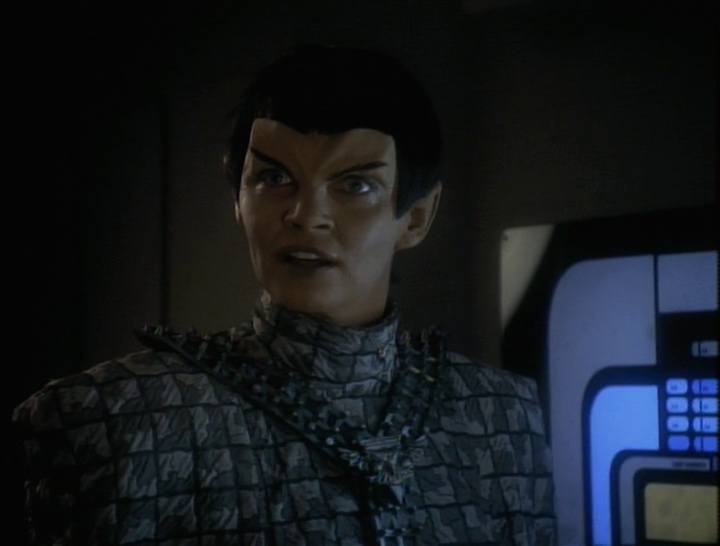
Five secondary characters from Star Trek’s past that I’d bring back

Spoiler Warning: There are spoilers ahead for Star Trek: Picard Season 1, Star Trek: Lower Decks Season 1, Star Trek: Discovery Seasons 1-3, and the casting of Star Trek: Prodigy. There are further spoilers for older iterations of the Star Trek franchise.

A few days ago I took you through a short list of five main characters from past iterations of Star Trek that I’d love to see come back. This time, in a similar vein we’re going to look at five secondary or recurring characters that likewise could make for interesting returns to the franchise. Though most Star Trek shows have primarily focused on a main cast of characters, every series to date has featured at least one or two recurring characters as well.

For this list, I’m counting characters who appeared on more than one occasion – not one-off guest stars. And as with my previous list on this topic, these are characters I’d like to see return to the franchise in a general sense, not characters I’m predicting will appear in any specific upcoming show or film.

As always, I have no “insider information!” This is purely for fun and a chance to highlight some of these characters, as well as speculate about what their futures (or pasts) might be like beyond what we saw of them in their original appearances.

Number 1: Shran

We don’t know for sure how long Andorians live, but it’s at least a possibility that Shran – who appeared in Enterprise as an antagonist and later ally to Captain Archer – could still be alive in the 23rd Century. If he is he’d be well over 100 years old, but that doesn’t necessarily count against characters in Star Trek!

Jeffrey Combs played Shran, and also played recurring characters Brunt and Weyoun on Deep Space Nine. As someone who has close ties to the franchise, it would be wonderful to bring him back. It was amazing to hear JG Hertzler’s voice in Lower Decks last year, and it would be amazing to welcome back Jeffrey Combs as well.

Shran offers the Star Trek franchise an opportunity to tie in Enterprise in a significant way. At the moment, Enterprise is very much an outlier in the Star Trek canon; cut off all on its own in the 22nd Century. Despite there being opportunities in the three films and two seasons of television set in the 23rd Century, only the briefest references to Enterprise have been made since it went off the air in 2005.

Strange New Worlds is the prime candidate for Shran to reappear, but if the untitled Section 31 series uses a 23rd Century setting, he could potentially appear there as well. Shran was depicted primarily as a soldier, but the passage of time could have softened that side of him, and I would love to see him occupy a less-aggressive role, perhaps as a Federation ambassador. However, if there were a story featuring the Andorians in a major way, we could certainly see him included there as well.

Number 2: Garak

We got to know Garak very well across the latter part of Deep Space Nine, and his backstory as a spy was given plenty of attention. What we don’t know, of course, is what came next – what happened to Garak after the Dominion War was over?

Sooner or later, I hope Star Trek takes us back to Bajor and Cardassia in a major way, looking at the aftermath of that conflict. I know that the Dominion War wasn’t wildly popular with everyone – some of my Trekkie friends regard it as the worst part of ’90s Star Trek! But it was a major event in the fictional history of the franchise, one which seriously impacted the Federation. Exploring its aftermath, and looking at how the Federation managed to rebuild, would be worth doing.

Garak was last seen on Cardassia Prime at the end of the Dominion War. With Damar dead and the Dominion withdrawing, it’s possible he would have been in some kind of leadership role, at least temporarily. His years living with the Federation on DS9 would have put him in a unique position to liaise between Cardassia and the Federation alliance.

However, I don’t think Garak would have necessarily stayed in a leadership position. As a former agent of the Obsidian Order he represents Cardassia’s past – an empire governed from the shadows. Having fought hard to overthrow their Dominion oppressors, the Cardassians may have wanted to look to civilian leadership. I doubt Garak would have been re-exiled or returned to DS9, but may have gone into quiet retirement instead.

Number 3: Morn

Morn was really just a background character in Deep Space Nine, but the fun alien design was unique and made him instantly recognisable. As a result he became a somewhat ironic fan favourite, and ultimately got his own episode in Season 6: Who Mourns for Morn? Though he never spoke a line in the series, Morn was a significant character at points, and during the Dominion War smuggled information to the Federation from the occupied station, allowing for the success of Operation Return.

In at least one future timeline, Morn took over Quark’s bar, so perhaps a story that revisited DS9 could see him in that role. If Quark’s is still around, perhaps Morn is simply seen there as a regular patron – he appeared to be semi-retired, after all. Even if a return to DS9 simply saw him in his familiar background role, that would be good enough!

Who Mourns for Morn already explained a lot of his backstory, so there really isn’t a lot of room to go into more detail in that regard. A story that brought back almost any of the Deep Space Nine cast could include Morn, though, perhaps as a trusted confidante. With Picard and the crew of La Sirena operating outside of Starfleet, if they found themselves in Bajoran space perhaps they’d need someone like Morn – he seems like the type who could be very helpful at flying under the radar!

Maybe this would completely ruin things, but I would dearly love to see Morn speak if he did return. Even a single line of dialogue would be more than enough! I’m sure some fans will scream and say “no! Leave Morn alone!” but I think it could be a really sweet moment if done well. If we did return to DS9, seeing Morn sitting on his usual barstool would feel like a homecoming of sorts – almost as though no time had passed.

Number 4: Naomi Wildman

Naomi Wildman made 19 appearances across Voyager, the majority of which came in Seasons 5 and 6. The show tried to explore the idea of her being the only child on a ship full of adults, but only really managed to land that kind of story once – in the episode Once Upon A Time. The introduction of Icheb and the other ex-Borg children potentially gave Naomi playmates, but we never truly saw much of this. And on at least one occasion, Naomi was not included in a story that focused on the Borg children – the episode The Haunting of Deck Twelve.

As a character who quite literally grew up in space, and aboard the lost USS Voyager no less, Naomi may have a rather unique perspective after growing up. How did she react to Voyager’s return to Earth – which would have happened when she was around six years old? In at least one future timeline she’d joined Starfleet, but whether she’d do so in the prime timeline is unknown.

Naomi had a close relationship with Seven of Nine, who is currently a recurring character in Picard. She was also close with Icheb, who we know was killed a few years prior to the events of Picard. Exploring her post-Voyager relationships with those two characters could prove very interesting. If Picard Season 2 – or any future seasons of the show – spend more time with Seven, we could be reintroduced to Naomi and learn what she’s been up to.

The death of Icheb, if explored in more detail, could also be an opportunity to bring her back. Did they remain in touch after returning to the Alpha Quadrant? Icheb joined Starfleet – did Naomi join too? If so, maybe they served together before Icheb’s untimely demise. Otherwise we could see Naomi return in any story featuring main cast members from Voyager. So perhaps an appearance in Prodigy – where Captain Janeway is set to return – is on the cards?

Number 5: Jack Crusher

Jack Crusher was the deceased husband of Dr Beverly Crusher and father to Wesley Crusher. He served on the USS Stargazer under Captain Picard’s command, and that’s about all we know. He was killed during an away mission, and it was at least implied that Picard bears a degree of responsibility for that, either through something he did or didn’t do.

As a deceased character, Jack Crusher could only come back via a flashback, time-travel story, or story set in the past. But where I think there’s scope to see more of him is in Star Trek: Picard, particularly if Beverly and/or Wesley Crusher return. We could learn the circumstances of his death, and it could be a very interesting story if Jack Crusher’s death were somehow connected to some event taking place in the current Picard era.

For example, Picard, Dr Crusher, and the crew of La Sirena may have to travel to the world where Jack was killed, only to learn that the beings responsible for his death were the super-synths, the Zhat Vash, or someone else that we met in the new series. There would be something cyclical about bringing back, even if just in flashback form, Jack Crusher.

In the future timeline shown in The Next Generation’s finale, Picard had married Dr Crusher. While there was no evidence for or against that outcome in Picard Season 1, any story that explores Picard and Dr Crusher’s post-Nemesis relationship could be made to include flashbacks to Jack. He was a significant character in both of their lives, and in addition, his legacy may have been a factor in Picard and Dr Crusher never taking their relationship beyond friendship in the prime timeline. A story that took them back to his death could be interesting for both of them.

So that’s it! Five recurring or secondary characters who I believe could be welcomed back to the Star Trek franchise in some form.

This was the second part of a two-part miniseries looking at the possibility for certain characters to reappear in the franchise. It’s unlikely to be the last time we talk about such things – with so many different Star Trek projects on the go, practically anyone from the past could come back in some capacity!

Aside from those who have been definitively killed off within the prime timeline, I would argue that basically any character could return. Not all of them would be suitable for the current crop of shows, but if the franchise continues its renaissance… who knows? Maybe we’ll finally get Star Trek: Morn after all!

The Star Trek franchise – including all series mentioned above – is available to stream now on Paramount+ in the United States and other territories where the service exists, and on Netflix in the United Kingdom and elsewhere. The Star Trek franchise – including all properties mentioned above – is the copyright of ViacomCBS. This article contains the thoughts and opinions of one person only and is not intended to cause any offence.
Five main characters from Star Trek’s past that I’d bring back

Spoiler Warning: There are spoilers ahead for Star Trek: Picard Season 1, Star Trek: Discovery Season 3, and for other iterations of the franchise.

This is going to be the first part of a short two-part series in which I look at a few significant characters from past iterations of Star Trek that I would love to see return. Rather than tying these characters to a specific series, film, or ongoing project, this list is more general. I’m not advocating, for example, for any of these characters to necessarily appear in Picard or Strange New Worlds, but rather to return to the franchise at some point, when a suitable story could be written.

The Original Series Season 2 cast (without George Takei).

It goes without saying that practically every major character (at least those who weren’t killed off) could be brought back in some capacity, and with the franchise continuing to expand I think it’s increasingly likely that we’ll get some significant moments where characters reappear. For the sake of this list I’m not counting characters who are starring in shows that are currently in production, so I’ll be limited to characters from The Original Series, The Next Generation, Deep Space Nine, Voyager, Enterprise, and the films.

The Next Generation cast in Season 4 – plus Whoopi Goldberg as Guinan.

By my count there are 42 characters across those five series that we could call “major” – i.e. they regularly had their names listed in the main credits, and weren’t considered guest stars or just recurring secondary characters. This time I’m picking on just five, and my usual caveat applies: I don’t have any “insider information!” This is just a short list of characters that I think could be fun to bring back in some capacity, nothing more.

The Deep Space Nine cast in Season 4.

Of the 42 characters that occupied major starring roles in at least one season of the five aforementioned shows, I’m excluding five: James T Kirk from The Original Series, Data and Tasha Yar from The Next Generation, Jadzia Dax from Deep Space Nine, and Trip Tucker from Enterprise. All the exclusions are for the same reason: those characters have died in-universe. While there could be convoluted ways to bring back alternate versions (such as we saw with Sela, for instance) the original character can’t return after death.

The Season 2 cast of Voyager.

Though it may be controversial, I don’t believe that the death of an actor necessarily excludes a character from returning. The Kelvin films recast the entire main cast of The Original Series, and Star Trek: Picard recently recast a couple of legacy characters as well. So characters whose primary actors have passed away are still in contention.

Now that we’ve laid down the ground rules, let’s take a look at my choices.

Number 1: Chakotay

This one is inspired by the return of Seven of Nine in Season 1 of Picard. I’ve written about this before, but Seven’s return to Star Trek was cathartic for me, because the passage of time allowed her to be a very different, more emotional, and much more human character than she ever was in Voyager. Seven was sometimes annoying and difficult to root for, especially toward the end of Voyager’s run, and basically the reason was that she’d always seem to “reset” after learning what should have been a big and important lesson in how to be human. It made her character bland and repetitive. But we’re not here to talk about Seven of Nine!

Chakotay didn’t have a lot to do in Voyager, despite being the first officer. There were a handful of episodes in which he was given a storyline, but a lot of the time he was just a presence, someone there for other characters to bounce ideas off or to tell Captain Janeway he didn’t recommend she do something we all knew she’d end up doing anyway. In short, bringing back Chakotay is something I would see as a chance for his character to get a Seven of Nine-like “redemption,” with some genuine development and a significant storyline.

One thing Voyager touched on briefly but never really explored was the way Chakotay felt about the deaths of the Maquis. The episode Extreme Risk focused on B’Elanna as she struggled to come to terms with what happened to their former colleagues, but Chakotay never really got a similar moment. As part of a larger story looking at the aftermath of the Dominion War, learning what happened to the Maquis’ colonies in the aftermath of that conflict could include Chakotay, as one of those worlds was his home.

We could also learn that Chakotay was allowed to remain in Starfleet following Voyager’s return to the Alpha Quadrant, and may even have been given his own command. Given that Voyager quite quickly dropped the Maquis angle, I’m not sure this is the route I’d go down because it doesn’t seem like it offers a lot of development or growth potential for his character, but it’s a possibility.

The final few episodes of Voyager’s seventh season saw a burgeoning relationship building between Chakotay and Seven of Nine. With Seven now a recurring character in Picard, and with the possibility of her entering into a relationship with main character Raffi, we could potentially explore what happened between Seven and Chakotay. Voyager’s finale certainly suggested that he had strong feelings for her, even after her death in that timeline.

Unfortunately, for reasons that aren’t especially clear, the producers of Voyager lost interest in – or didn’t know what to do with – the “one ship, two crews” concept that had been part of the show’s inception. Chakotay and the rest of the Maquis were absorbed into the crew by midway through Season 1, and while lip service was paid to Chakotay’s Maquis past at numerous points, I think that’s one aspect of his background that would be ripe for exploration. In any 24th or early 25th Century story that looked at Bajor, Cardassia, and the aftermath of the Dominion War, I’d spend at least an episode or two considering the legacy of the Maquis, and Chakotay could play a major role in such a story.

Number 2: T’Pol

I’ve mentioned T’Pol before in relation to Strange New Worlds, and that series is certainly one where we could see her crop up. Because of Enterprise’s place in the timeline, unless Star Trek plans on returning to the 22nd Century for some other story, there aren’t many characters who could realistically still be active and able to play a major role. The 23rd and 24th Centuries (as well as Discovery’s 32nd Century) are where current Star Trek projects are focused – and I have to say I think that’s the right call. Enterprise was an interesting experiment, but I see no pressing need to return to the 22nd Century at this stage.

The story I’d include T’Pol in would go something like this: she’s a senior Federation ambassador by the mid-23rd Century, and accompanies Captain Pike on a diplomatic mission. The mission would make first contact with a race we met in The Next Generation era, such as the Cardassians. We’d thus tie together all three of Star Trek’s eras in one story! I think an episode like that would be incredibly rewarding for longstanding fans of the franchise; a “love letter” to the fans.

But there are many other roles T’Pol could occupy. Having spent so long with humans during those early days of humanity striking out into space, she could prove an invaluable guide or advisor to a young Spock. Whether Spock is “the first Vulcan in Starfleet” is a point of contention without an obvious answer, but even if he wasn’t it’s clear that the Vulcans continued to operate an independent fleet into the 23rd Century, and thus Vulcans serving in Starfleet seem to have been rare. T’Pol is well-placed to be a kind of mentor to Spock for this reason.

However, both of those story concepts take T’Pol out of her usual scientific role, and perhaps a story could be devised which would be better-suited to her career as a scientist. I’m still thinking of a 23rd Century story, but one which perhaps requires high-ranking Federation scientists to work on a mystery or puzzle.

Number 3: Dr Pulaski

I’ve never met a fan of The Next Generation who likes Dr Pulaski as much as I do. I understand why she wasn’t popular with fans, replacing Dr Crusher after one season and especially because of her early run-ins with Data that amounted to anti-android bigotry. But where Dr Crusher could be fairly bland, Dr Pulaski had a really strong personality that shone through.

On another occasion we’ll talk about Dr Pulaski and how her introduction in Season 2 of The Next Generation was an attempt to shake up the new series and bring in a Dr McCoy-type character. But for now I want to consider how she could return, and what sort of role she could have.

Picard Season 1 missed an opportunity to bring back Dr Pulaski – or another medical officer from The Next Generation like Alyssa Ogawa – in the second episode. Picard receives bad news from a doctor he knew while serving aboard the USS Stargazer, Dr Benayoun. This was a new character created for Picard, and if I’d been writing it I might have chosen to bring back Dr Pulaski at this moment instead. I don’t know if that was ever suggested, because it’s well-known that actress Diana Muldaur didn’t have a great time working on The Next Generation. But it would have been neat to see!

One series that has been doing great with references to less well-known parts of canon is Lower Decks, and perhaps that means Dr Pulaski would be a good fit to return there. I don’t know if Diana Muldaur is still working, nor whether she’d be well enough or willing to reprise the role. But it was at least a little sad that Dr Pulaski was dropped in The Next Generation Season 3 with no explanation. There’s scope, I feel, to learn what came next for her – even if the character has to be recast.

Almost any medical story or story involving characters from The Next Generation Season 2 could see Dr Pulaski return, and of course Star Trek: Picard has to be the prime candidate of the shows currently in production. She could, for example, be one of the chief medical officers assigned to help the surviving ex-Borg now that they’re (presumably) under Federation protection. Or how about this: in a storyline that clearly shows how much she’s changed her attitude to synthetic life, she could be the head of a Federation medical team sent to Coppelius to help the synths. This would cement her “redemption” from her earlier interactions with Data, and would perhaps provide a suitable epilogue to her role in The Next Generation Season 2.

Number 4: Benjamin Sisko

Captain Sisko is probably the character whose return I’ve touted the most! Because of the unique nature of his disappearance in the Deep Space Nine finale – vanishing into the realm of the Bajoran Prophets – he could return literally anywhere, in any time period. The Prophets don’t experience time in the same linear manner as humans, so they could send him to a point in his future, his past, or anywhere along the Star Trek timeline.

This is why I’ve proposed Sisko as a character who could appear in Picard, Strange New Worlds, and Discovery – because he could be sent back by the Prophets at any moment in time. I would argue he would have more to do in a story set in the late 24th or early 25th Centuries than he might in the 23rd or 32nd, but in any story that brought back Bajor, Sisko could play a major role.

He could also be part of a story looking at the aftermath of the Dominion War, at Cardassian relations with the Federation, and of course at Deep Space Nine itself. I think Sisko has the potential to be a useful character too. If he joined the story right at the moment of his return to normal spacetime, he could potentially be a point-of-view character, and an excuse for a film or episode to dump a lot of exposition that could otherwise feel clunky and out-of-place. This would be done under the guise of other characters bringing Sisko up to speed on what he’s missed – and we could catch up on galactic affairs right along with him!

Of all the characters on this list, Sisko is the one whose story feels the most unfinished. There was almost a cliffhanger ending to his role in Deep Space Nine, with a tease that one day he’ll be coming back. Whether we’ll ever see that on screen is another matter, of course, and Avery Brooks has seemed less willing to reprise the role than some other Star Trek actors. But you never know!

Number 5: Montgomery Scott

It would be relatively easy for Scotty to crop up in Strange New Worlds as a junior engineer – or in any other 23rd Century series, for that matter. But that’s not really what I’m proposing this time. That idea has merit, and I think I included Scotty in one of my character ideas lists for Strange New Worlds. However, this time what I’m suggesting is Scotty in the 24th Century.

Relics, the Season 6 episode of The Next Generation, established that Scotty had been kept alive in a form of transporter stasis of his own devising for over eighty years, finally rematerializing when the crew of the Enterprise-D encountered his crashed ship. After working briefly with Geordi La Forge, Captain Picard, and others, Scotty was given a shuttle and set out to explore the new century on his own. We would later learn in 2009’s Star Trek that Scotty had gone back to work, developing a method of “transwarp beaming” that became important to the plot of that film.

After that, however, what became of Scotty is a mystery. He had initially intended to retire, so did his stint with Starfleet continue? Or did he resume his planned retirement in the 24th Century, catching up on the eight decades of galactic history that he’d missed? He reunited with Spock, apparently, and it’s at least possible he would have been able to visit the elderly Dr McCoy as well.

Scotty offers a “coming out of retirement” story, perhaps prompted by some horrible event or disaster that requires an engineering solution. We could learn, for example, that he’d worked alongside Geordi La Forge in preparing the Romulan rescue fleet, or even that he was helping to rebuild the Mars shipyards after the attack by the Zhat Vash. Those are two ideas based on events from Picard Season 1, but of course there are many, many other ways Scotty could have contributed to Starfleet and the Federation in the late 24th Century.

So that’s it… at least for now. The second part of this short series will look at five secondary or recurring characters who I also think could be fun to bring back!

With so many ongoing and upcoming Star Trek projects occupying different places in the timeline, there really is scope to bring back almost any major character, and I hope the creative team don’t feel constrained! As a Trekkie I think I’d be happy with literally any of them making an appearance, though of course it would have to make sense in-universe as well as not be offputting for casual viewers.

The cast of Enterprise during Season 1.

We mentioned the episode Relics, and I think that story manages to walk that line exceptionally well. For fans of The Original Series, Scotty’s return was an amazing treat. But for folks who weren’t familiar with the older series, his inclusion in the episode still managed to make sense. The story was well-written, and while knowing more about who Scotty was and where he’d come from certainly added to it for Trekkies, it didn’t put off casual viewers by demanding a lot of knowledge of Star Trek canon. That’s the kind of model any future episode, film, or story that brings back a character should try to emulate.

We can also point to If Memory Serves, from the second season of Discovery. That episode began with a short recap of the events of The Cage, establishing what happened to Captain Pike on Talos IV, who the Talosians were, who Vina was, and so on. By beginning an episode which features a returning character with a clip or compilation of their past Star Trek exploits, almost any character could be integrated into an ongoing production.

The Discovery Season 1 cast (without Wilson Cruz).

The Star Trek franchise has been running for over five decades, and has a huge roster of wonderful characters. The fact that there are too many to put on the list – or the fact that the list could literally include every single one – is testament to the quality of the franchise and the creative teams who’ve contributed to it over the years.

Stay tuned for the next part in this series, where I’ll look at five secondary or recurring characters who I’d also love to see come back!

The Star Trek franchise – including all series mentioned above – is available to stream now on Paramount+ in the United States and other territories where the service exists, and on Netflix in the United Kingdom and elsewhere. The Star Trek franchise – including all properties mentioned above – is the copyright of ViacomCBS. This article contains the thoughts and opinions of one person only and is not intended to cause any offence.
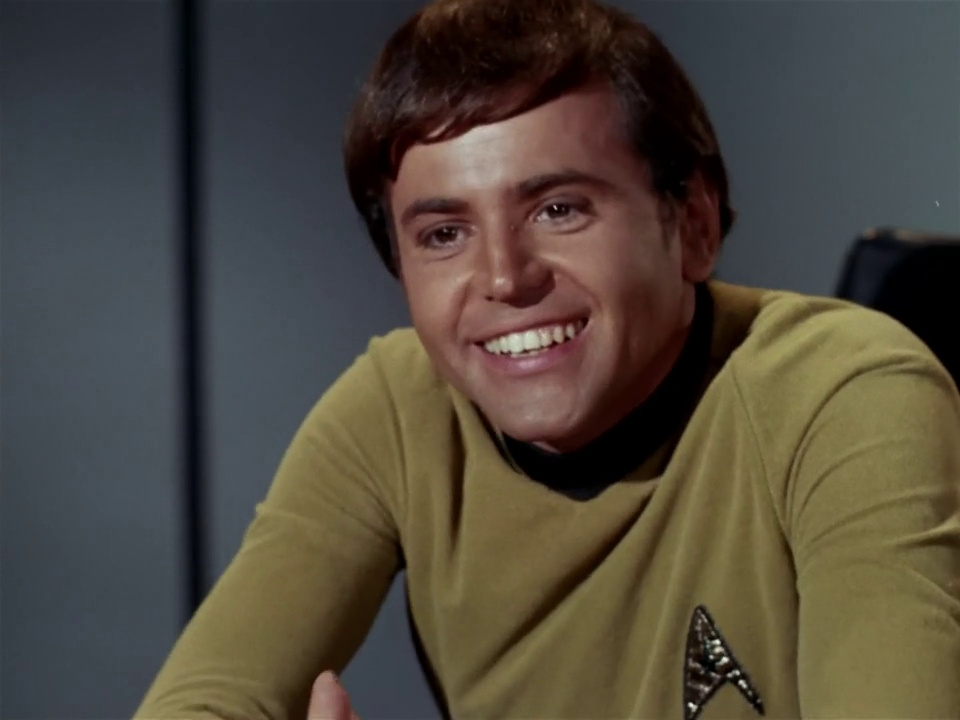
Could AI be the key to a Deep Space Nine and Voyager remaster?

The most popular article I’ve written here on the website is about Star Trek: Deep Space Nine and Star Trek: Voyager, and how neither series has been remastered. In the late 2000s and early 2010s, The Original Series and The Next Generation were given a complete overhaul and rebroadcast, then re-released on Blu-ray (and HD DVD, if anyone remembers that failed format!)

For a number of reasons, though, The Next Generation in particular didn’t see great sales numbers on Blu-ray. Because of the significant cost involved in upscaling and remastering it, and the lack of a significant return on that investment, ViacomCBS hasn’t been willing to spend money on Deep Space Nine or Voyager. As a result, both series remain in “standard definition,” a.k.a. DVD quality. On today’s ever-larger television screens, the difference between a remastered episode of The Next Generation and a non-remastered episode of Deep Space Nine is incredibly noticeable.

Captain Picard in The Next Generation remaster (left) and Deep Space Nine DVD quality (right). Even allowing for image compression, the difference in quality is easy to spot.

Star Trek has been one of the big franchises that ViacomCBS has used to push its rebranded Paramount+ streaming service. Paramount+ is now the digital home of all things Star Trek – yet two of its flagship series that many folks remember with fondness from the 1990s don’t look great. As I noted last time, that’s a problem. It makes Paramount+ look cheap, as though ViacomCBS simply can’t be bothered to put in the effort.

Netflix runs some shows in DVD quality, but by far the majority of its content is in high definition. As Paramount+ attempts to position itself as a competitor to Netflix, Disney+, and other platforms in a very crowded market, having two big flagship shows in low quality standard definition is not a good look, and it’s something that needs to be addressed.

But last time the company made a significant investment in remastering Star Trek it didn’t pay off, so how should they proceed?

The Next Generation did not sell particularly well on Blu-ray.

There are a few factors at play here. The first is that ViacomCBS (and its predecessor, CBS) measured the success of the remastered Star Trek series purely by Blu-ray sales. The problem with this approach is that, even by the early 2010s, optical media in general was in decline. Fewer people had made the switch to Blu-ray than DVD, and with the rise of on-demand streaming platforms it seemed only a matter of time before Star Trek would be available to watch. I owned a number of The Next Generation stories on VHS, I’d also bought the entire series on DVD, and in the early 2010s I just wasn’t prepared to spend that money all over again on the same show – especially when it seemed inevitable that eventually the series would be available online. I was right.

Physical media sales are a poor measure of success in the days of on-demand streaming, and the value in investing in any project – be it a remaster or the commissioning of a new series – is less about pure sales numbers and more about the number of subscribers it will drive to your streaming platform. ViacomCBS has invested in Paramount+, so why not go the extra mile and remaster these classic shows for the service too?

One of the commercials for Paramount+ focused on Star Trek.

That’s the first aspect of this issue – the business side and how to calculate a return on investment. Raw sales numbers are less and less valid as a metric of success in a world that’s moved on to streaming, so making that calculation isn’t easy. But I bet that remastering Deep Space Nine and Voyager would drive new subscribers to Paramount+, as well as convince wavering subscribers that it’s worth sticking around. Both of those things are what any streaming service needs to survive.

The second point to consider is that the cost of remastering any television series is dropping all the time. There is software that uses AI that can produce creditable results from DVD-quality sources, such as the existing versions of Deep Space Nine and Voyager. Consumer-grade versions of this software exist, and can be bought for less than $100. You can even find homemade upscaled clips of Deep Space Nine and Voyager on YouTube and elsewhere online – and they look pretty darn good.

There are many fan-made upscales of clips from Deep Space Nine and Voyager online.

As software continues to improve and come down in price, the cost of a project like this drops dramatically, and we may only be a few years away from fans being able to fully upscale their DVD collections at home. In some ways, we’re arguably there already. Rather than ViacomCBS having to spend huge sums of money recruiting new artists and animators to recreate whole sequences from scratch, it’s going to be possible to run entire episodes of the show through software and just have a small team of people make tweaks on the resultant upscaled version to knock it into shape. It’s far less of a project than it was ten years ago – so there are fewer and fewer reasons not to do it.

With ViacomCBS having the original tapes of these shows, it should be even easier to get a good result than it is for someone using the DVD version. I’m not saying it can all be done from home for a few dollars – the project will still cost money – but it’s a far less significant expense than it was last time the company chose to send Star Trek to the remastering suite, and waiting even just a couple of years could see those costs fall yet further.

Sisko and O’Brien in Emissary, the Deep Space Nine premiere.

I really hope that ViacomCBS will consider giving both shows a proper remaster at some point in the future. It’s something that would undoubtedly provide Paramount+ a boost, especially if the service were the only place to access the newly-upgraded shows. And it surely would be, because why bother with a Blu-ray release? Physical media continues its decline, with fewer people than ever upgrading to the latest 4K Blu-ray standard, so there’s almost no point. Remaster the shows, stick them on Paramount+, and enjoy a nice subscriber boost.

I truly believe AI and software offer a path to remastering these shows – and a lot of others, too. There are a few other series from the ’80s and ’90s that are yet to be properly remastered, and the same solution potentially exists for those as well. I’m not a tech expert, but I think the results speak for themselves. When I’ve seen upscaled clips online, created incredibly inexpensively by amateurs using commercially-available software, it really feels like ViacomCBS is missing a trick. Maybe upscaling the series this way wouldn’t be as good as spending huge amounts of money to do it from scratch, but it would be something – and the result would almost certainly be a better-looking show than the currently-available SD version.

Paramount+ would get a boost if both shows were remastered.

As I mentioned at the beginning, the most popular article I’ve written is about Deep Space Nine and Voyager needing a remaster – so there is clearly huge interest there from both Trekkies and casual fans. People who watched the shows years ago may want to rewatch them. New Star Trek fans who’ve joined the fandom since the release of the Kelvin films or Discovery may want to go back and watch older Star Trek shows. And of course us Trekkies would love nothing more than to see the two series get an overhaul. There’s a sizeable audience out here asking for a remaster, an upscaling, or whatever you want to call it. AI could be a good solution – saving money while giving fans what we’ve been asking for for years!

At the very least, I think it’s worth considering. And if ViacomCBS never does it… maybe someone else will. These pieces of software get better and cheaper all the time, and we could be in a position in a very short span of time where fan-made remasters of whole episodes, not just clips, will be widely available.

Deep Space Nine and Voyager were a big part of Star Trek’s most successful era to date, and a lot of casual viewers and Trekkies remember them with fondness. While there’s nothing wrong with the DVD versions, as screen technology improves and televisions get larger, what viewers expect from their programming has changed. For a lot of people in 2021, standard definition isn’t good enough – especially on a streaming service that costs $9.99 per month. If ViacomCBS is serious about continuing to invest in the Star Trek franchise, a portion of that investment needs to be directed backward, to remastering these two shows that have been sidelined. Part of the marketing for Paramount+ highlighted that it was the place to watch every episode of Star Trek – some fans will have been disappointed to learn that over 300 of those episodes don’t look great.

AI and software offer a solution to this problem, one ViacomCBS should take advantage of as soon as possible.

Star Trek: Deep Space Nine and Star Trek: Voyager are available to stream now (in SD quality only) on Paramount+ in the United States, and on Netflix in the UK and other countries and territories. Both series are also available on DVD. This article contains the thoughts and opinions of one person only and is not intended to cause any offence.
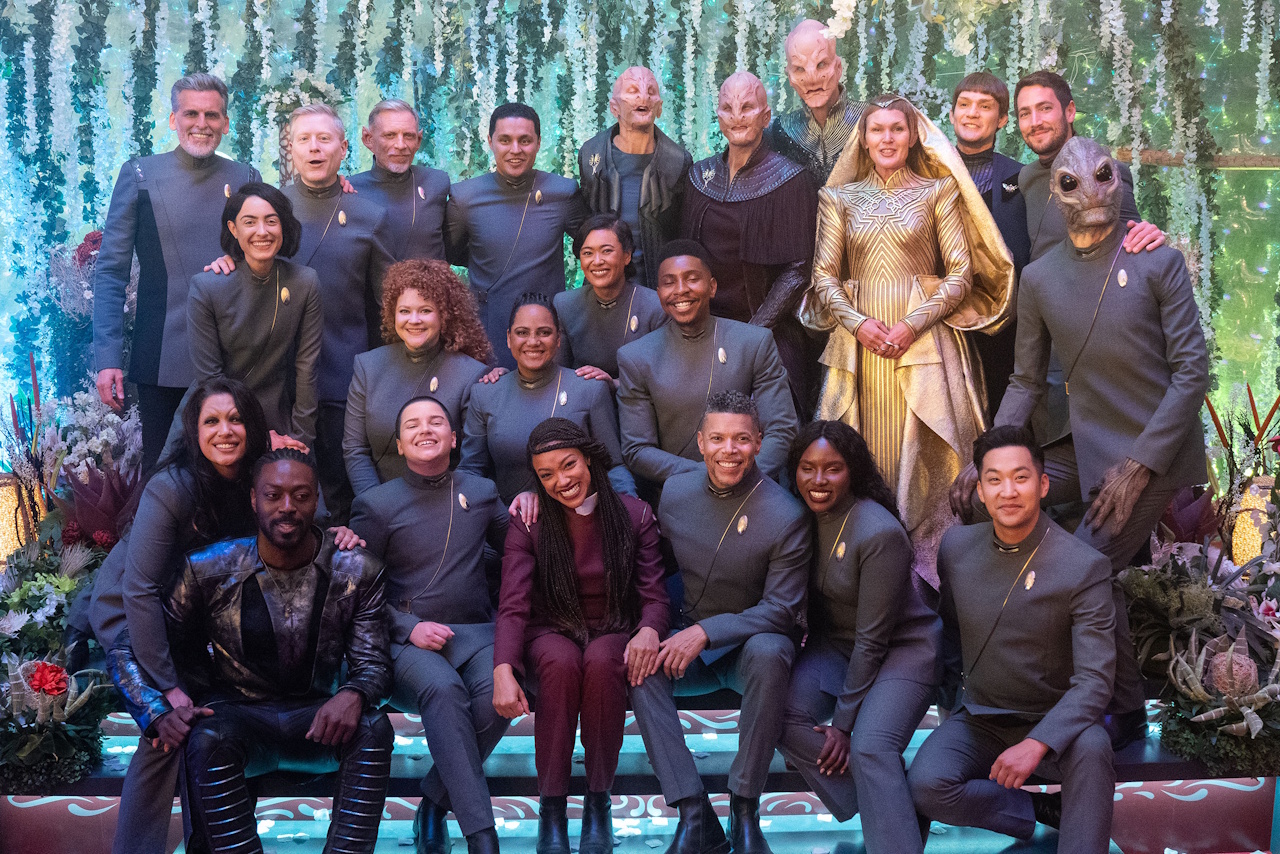
Star Trek: Voyager – The torpedo and shuttle “problem”

Spoiler Warning: There are spoilers ahead for Star Trek: Voyager and Star Trek: Discovery.

If you’ve been around the Star Trek fan community for a while, you might’ve heard some fans complaining about the “problem” of the USS Voyager’s use of shuttlecraft and torpedoes in Star Trek: Voyager. Perhaps this particular point of criticism was more biting in the late 1990s when Voyager was still on the air, but in some corners of the community it’s still talked about.

In short, fans have argued that, because Voyager was trapped in the Delta Quadrant and thus unable to be resupplied by Starfleet, they should have run out of torpedoes and shuttles. The number of shuttlecraft and torpedoes depicted in the series fluctuates, and some episodes focus on the need to conserve or seek out supplies, while in others, Captain Janeway and the crew seem to use these limited resources with abandon. Some fans have tried to calculate how many torpedoes and shuttles were used across all seven seasons of Voyager’s run – presenting it as a “gotcha” moment when those numbers seem larger than they should be.

Did Voyager fire too many torpedoes?

There are two ways to approach this, in my opinion. The first is to use an argument that I generally dislike: “it’s just a story.” I’ve written about this before, but one of the most important things when creating an ongoing story – especially one that has to fit into an existing franchise – is internal consistency. If it was established that the USS Voyager has, for example, four shuttles, and then a future episode arbitrarily changes that, then the show is not being internally consistent – i.e. consistent with itself. That, to me, has the potential to be immersion-breaking.

In some cases, “it’s just a story” is a perfectly valid excuse. In comedies like The Simpsons, for example, pretty basic things like which character’s bedroom is behind which door can change depending on which episode you’re watching – and on what the writers need it to be for the sake of a punchline or story. And in shows which have a floating timeline and are inherently un-serious, that isn’t really an issue. But other stories – those that want to be taken more seriously – do have to hold themselves to a higher standard, and thus the “it’s just a story” excuse generally doesn’t work in Star Trek to excuse inconsistencies and mistakes – at least in my opinion.

One of the torpedo tubes of the USS Enterprise-A in Star Trek VI: The Undiscovered Country.

On a basic level it is of course true that many inconsistencies and “goofs” within Star Trek are there because the writers either deliberately chose to go in a specific direction or to ignore a previously-established fact in order to make a particular storyline work. That can be said to be an explanation for what happened – but not an excuse!

The second way to approach the issue of shuttles and torpedoes in Voyager is to use the franchise’s own internal canon, and particularly established facts from within Voyager itself. A simple count of the number of torpedoes shown on screen or the number of shuttlecraft mentioned early in the show’s run is only one part of a bigger picture, and there are ways that we can interpret other canonical events within the series or within Star Trek as a whole to explain what appear, on the surface, to be inconsistencies.

One of Voyager’s torpedoes was beamed aboard a Borg vessel in the episode Dark Frontier.

There are two big points to consider when discussing Voyager’s shuttlecraft and torpedo complements, and how they could be replenished from an in-universe point of view. The first is trading and harvesting. On a number of occasions, Voyager depicted the crew visiting planets and moons to gather resources – everything from food to metals. And on a number of other occasions, the crew were able to make trades with Delta Quadrant factions in order to acquire resources that they were short of.

Weapons were only ever mentioned in the context of trading when Captain Janeway refused to sell Voyager’s weaponry to other races, but just because we didn’t see on screen the crew of Voyager bartering for someone else’s weapons – or more likely, weapon components and materials – doesn’t mean that it didn’t happen. Trading to acquire weapons or components wouldn’t contradict Janeway’s orders and adherence to Federation values. If the crew were able to get the basic parts needed to make more torpedoes, then there’s no reason why those parts couldn’t be used. Nothing I know of within Star Trek suggests that torpedoes can only be manufactured at specific facilities, or that they’re even especially difficult to build or modify.

Captain Janeway and her crew traded with many different cultures and factions during Voyager’s seven years in the Delta Quadrant.

What is a torpedo made of? We’ve actually seen torpedoes up close on a few occasions within Star Trek, and we have a reasonably good idea as to how they work. A torpedo uses antimatter as its main explosive element, creating a matter-antimatter explosion when detonated. There are also references to plasma and ion radiation, and in addition the torpedo casing and other internal components are made from metal – perhaps the same kind of tritanium as used in the construction of starship hulls.

The main component that the crew of Voyager would need to get, as far as I can see, is the right kind of antimatter to be used in the warhead. Every other aspect of the torpedo should be fairly easy to come by – or to manufacture, which we’ll look at in a moment. Antimatter is not naturally occurring, so the crew would probably need to trade for it, unless it could be scavenged from wrecked or abandoned ships.

Spock and Dr McCoy perform “surgery” on a torpedo in Star Trek VI: The Undiscovered Country.

Shuttles are obviously less easy to trade for, but in the episode Alice we see this exact thing happen. Paris falls in love with a shuttlecraft he sees at a junkyard and convinces Chakotay to trade for it, acquiring a new shuttle for Voyager. In that episode it would backfire, of course, but the principle remains!

As above, it would be possible to trade for and harvest components and materials necessary to repair or build shuttles. The basic metals needed for the hull would be perhaps the most important, as well as components necessary for systems like warp drive, but I can see no reason why it should be impossible for the crew to get enough components and material together to replace a lost or damaged shuttlecraft.

Neelix, Kim, and Chakotay on an away mission to collect resources.

So now we come to the second major way that the Voyager crew could resupply themselves: replicating and/or manufacturing their own torpedoes and shuttles. To me, the single biggest piece of evidence in favour of this argument is the creation of not one but two Delta Flyers. The ship had the capability to replicate large components and the crew had the necessary engineering expertise to build a spaceworthy craft from scratch. It stands to reason that, contained within Voyager’s databanks, are the designs and schematics for both torpedoes and shuttles.

Voyager was designed for long-range tactical and exploration missions, meaning that the possibility of the ship operating outside of Federation space and far from the nearest Starbase had to be taken into consideration when it was built. Logically that would include the ability to be self-sufficient for long periods of time, being able to repair and build components on the fly. It doesn’t mean Voyager’s resources are unlimited – but it does mean that the ship clearly has the ability to build new components and presumably a stockpile of raw materials for doing so.

The Delta Flyer under construction. This alone proves that Voyager and the crew had the capability to manufacture and/or replicate practically anything.

Augmenting that supply is something we see the crew engage in numerous times, chasing down sources of energy, antimatter, food, metal, and so on. While food and power are arguably the most urgent and immediate concerns, ensuring that they have enough components and raw materials to repair the ship, build replacement parts, etc. are all important too. How many times did we see Voyager undergo repairs or suffer damage that wasn’t present in the next episode? The ship clearly has the capability to build replacement parts – and there’s no reason why that can’t apply to torpedoes and shuttles too.

Something we learned in Star Trek: Discovery could be relevant here too, and while it’s certainly up for debate I think it’s worth mentioning as part of this conversation. In the third season episode There Is A Tide, Admiral Vance – the head of Starfleet – told us a little more about the way replicators work. The replicators at Federation HQ in the 32nd Century used a base of matter that was repurposed into new configurations. In the case of Federation HQ, bodily waste was repurposed into food – presumably with other matter thrown in there too! But the principle that you could feed any old matter into a replicator and use the technology to repurpose it seems to be how replicators (and earlier synthesisers) work in Star Trek.

Admiral Vance eating a replicated apple in There Is A Tide. This episode gave us a little tidbit of information about replicators and how they work.

This is also, at a very basic level, how warp nacelles work. The Bussard collectors on the front of a starship’s warp nacelles collect particles of hydrogen and deuterium while the ship is in flight, using the collected molecules as a way to augment the ship’s fuel supply. Insert one kind of matter, transform it into fuel, and use that fuel to fly.

The specifics of exactly how these technologies work is deliberately kept somewhat vague, but replication and collecting resources seem to me to offer an in-universe explanation as to how the crew of Voyager could replenish their supplies of expendable items like torpedoes, as well as replace destroyed shuttlecraft and even make complete repairs to the ship.

One of Voyager’s shuttlecraft.

When you combine what we see on screen just within Voyager itself – the many times the crew are scavenging and harvesting resources from planets and nebulae, all the times they traded with Delta Quadrant factions, the ship’s replicators, the ability to build the Delta Flyer twice – I think we can reasonably say that it adds up. Voyager had the ability to produce new torpedoes, repair damage to its hull and systems, and even build new shuttlecraft. There is no plot hole!

I understand why some fans feel that this is a problem. Some episodes do seem to contradict some of what I’ve said, and especially in the early part of the show’s run, the supply of torpedoes in particular was mentioned more than once. Captain Janeway did once say that there was “no way” to replace the ship’s 40-odd torpedoes – but given everything we know about replicators and the crew’s ingenuity, perhaps that was either a misunderstanding on her part or something that the crew were able to overcome at a later time.

Voyager firing tricobalt devices at the Caretaker’s Array in Caretaker.

The ship started out with 40 torpedoes (and a few tricobalt explosive devices). But by the end of the series almost 150 torpedoes had been fired – at least, according to the sources I can find online! There were also at least eight shuttlecraft used on the show across its seven-year run. The only way to make this internally consistent is using some combination of trading, harvesting resources, and building/replicating replacement parts. Given that we see Voyager is capable of this when building the Delta Flyer, I don’t see it as a plot hole.

So that’s my solution to this longstanding “problem.” The crew were very resourceful, willing and able to make trades with different factions, to think outside the box when it came to how best to use what they had to make it home. The ship itself is powerful, designed for long missions, and kitted out for exactly these kinds of issues. Though it may not have been shown on screen outright, it seems like the best fit based on everything we know is simply that the crew figured out a way to build more torpedoes, shuttles, and repair kits at some point relatively early into their journey home.

Problem solved. Right?

Star Trek: Voyager ran from 1995-2001 and is available to stream in its entirety on CBS All Access (soon to be rebranded as Paramount+) in the United States, and on Netflix and/or Amazon Prime Video in the UK and elsewhere. The series is also available on DVD. The Star Trek franchise – including Star Trek: Voyager and all other properties mentioned above – is the copyright of ViacomCBS. This article contains the thoughts and opinions of one person only and is not intended to cause any offence.
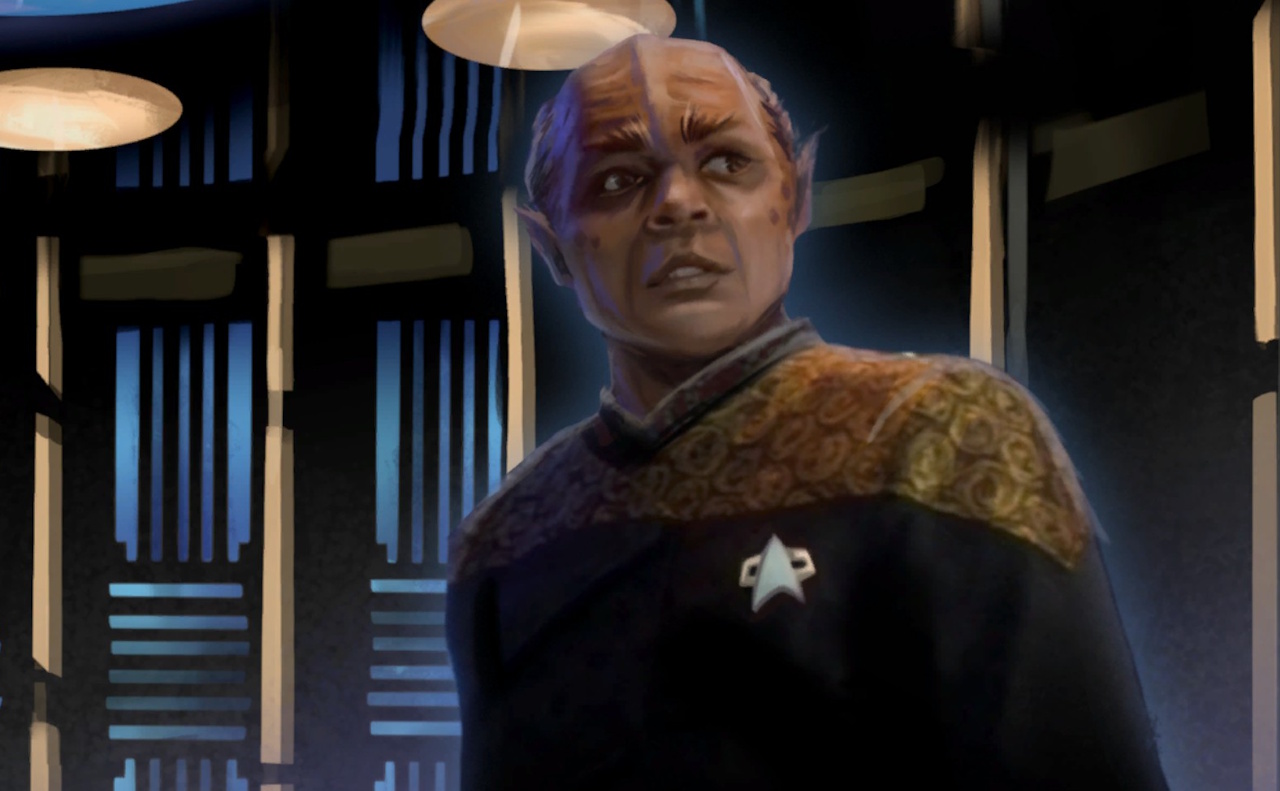
Five Star Trek episodes for Valentine’s Day!

Spoiler Warning: There are minor spoilers ahead for the episodes on this list.

Love is in the air! Happy Valentine’s Day – even though 2021 promises to be the strangest in a long time. If you have a special someone to spend today with, I bet you’re wondering what to watch to put you both in the mood. And if you don’t… perhaps you’re just wondering what to watch. So without further ado, here are a few Star Trek episodes worth watching on the most lovey-dovey day of the year – or at least tangentially related to it! As always, the list is in no particular order.

Number 1:
The Dauphin (Star Trek: The Next Generation)

Wesley’s first love is the story of The Dauphin.

It’s been a while since we talked about The Next Generation’s most controversial major character: Wesley Crusher! He’s the main focus of this episode, falling in love with the ruler of a war-torn planet. In a classic case of “bad timing,” Salia and Wesley’s relationship wasn’t to be. He learned a valuable lesson about love along the way, though, and while the episode has some cute moments and some awkward ones, it manages to be distinctly “Star Trek” all the while.

Number 2:
Choose Your Pain (Star Trek: Discovery)

Dr Culber and Stamets in Choose Your Pain.

I often call the relationship between Stamets and Dr Culber the “emotional core” of Discovery, yet looking back on the show’s 42 episodes, there are relatively few in which they are the main focus. Choose Your Pain has a lot going on, but one of the most significant points is how Hugh and Paul clash over the tardigrade – the space-dwelling lifeform that appears to be the key to making the Spore Drive work as intended. They’re able to resolve things, of course, but only when Stamets does something life-changing to himself in order to save the tardigrade’s life.

Number 3:
Threshold (Star Trek: Voyager)

Ah, Threshold.

When we think about Tom Paris, who’s his romantic partner? B’Elanna Torres, of course. But in Threshold – widely regarded as one of Voyager’s worst episodes – Paris and Janeway get together and even have kids! Had you forgotten about that? After passing the Warp 10 barrier and experiencing “hyper-evolution,” Paris kidnaps Janeway and flees to an uninhabited planet. The two hyper-evolve into lizards and apparently “do the nasty,” resulting in at least three offspring. The crew of Voyager opted to leave the hyper-evolved children behind when they rescued Paris and Janeway, though, and for some reason the events of Threshold were never mentioned again. I wonder why?

Number 4:
Amok Time (Star Trek: The Original Series)

One of the most memorable fights in all of Star Trek.

Amok Time is certainly one of the most iconic Star Trek episodes, having been imitated and parodied many times. It focuses on Spock and introduces us to the concept of pon farr – the Vulcan biological mating need. The Vulcans evidently practice arranged marriage, and when Spock’s betrothed chooses another man, Kirk and Spock must engage in a ritual fight to the “death.” As one of the first episodes to explore the Vulcans in depth, as well as our first visit to the planet Vulcan, Amok Time is incredibly important within the history of Star Trek. And as a love story, well there’s something kind of romantic about T’Pring choosing to escape her arranged marriage to be with someone she cares about… right?

Number 5:
Change of Heart (Star Trek: Deep Space Nine)

Jadzia and Worf in Change of Heart.

Workplace romances are bound to cause problems! After Worf arrived on the station at the beginning of Deep Space Nine’s fourth season, he and Jadzia Dax struck up a relationship. They eventually got married in the episode You Are Cordially Invited, and continued to work closely together. In Change of Heart they’re assigned a dangerous mission to evacuate a Federation spy at the height of the Dominion War. But when Jadzia is injured, Worf is forced to choose whether to save her life or complete the mission.

So that’s it. Five somewhat Valentine’s Day-related Star Trek episodes! Try not to take it too seriously; this was just a bit of fun to mark the occasion!

On a more serious note, Valentine’s Day can be difficult. It can be a day that brings home feelings of loneliness, that we aren’t loved or even that we’re unworthy or undeserving of finding someone special. If you feel that way, listen to me: it’s bullshit. You’re a King, a Queen, or non-binary Royalty and you are amazing. If you haven’t found somebody yet, that’s okay. There’s no pressure or time limit. I know people who found love well into their seventies and eighties, and a few years ago attended the wedding of a neighbour of mine who finally was able to marry his boyfriend – at the age of 85! Just because some people manage to find their special somebody early in life doesn’t mean you have to conform to that too. One thing I wish I’d learned a lot sooner is that it’s better to be single than to be in a bad relationship! So please try not to worry or let Valentine’s Day become an excuse to feel rotten. Your time will come. Until then, I wish you a very happy Valentine’s Day – platonically, of course!

The Star Trek franchise is available to stream now on CBS All Access (soon to be rebranded as Paramount+) in the United States, and on Netflix and/or Amazon Prime Video in the United Kingdom and elsewhere. Star Trek and all episodes and series listed above are the copyright of ViacomCBS. This article contains the thoughts and opinions of one person only and is not intended to cause any offence.
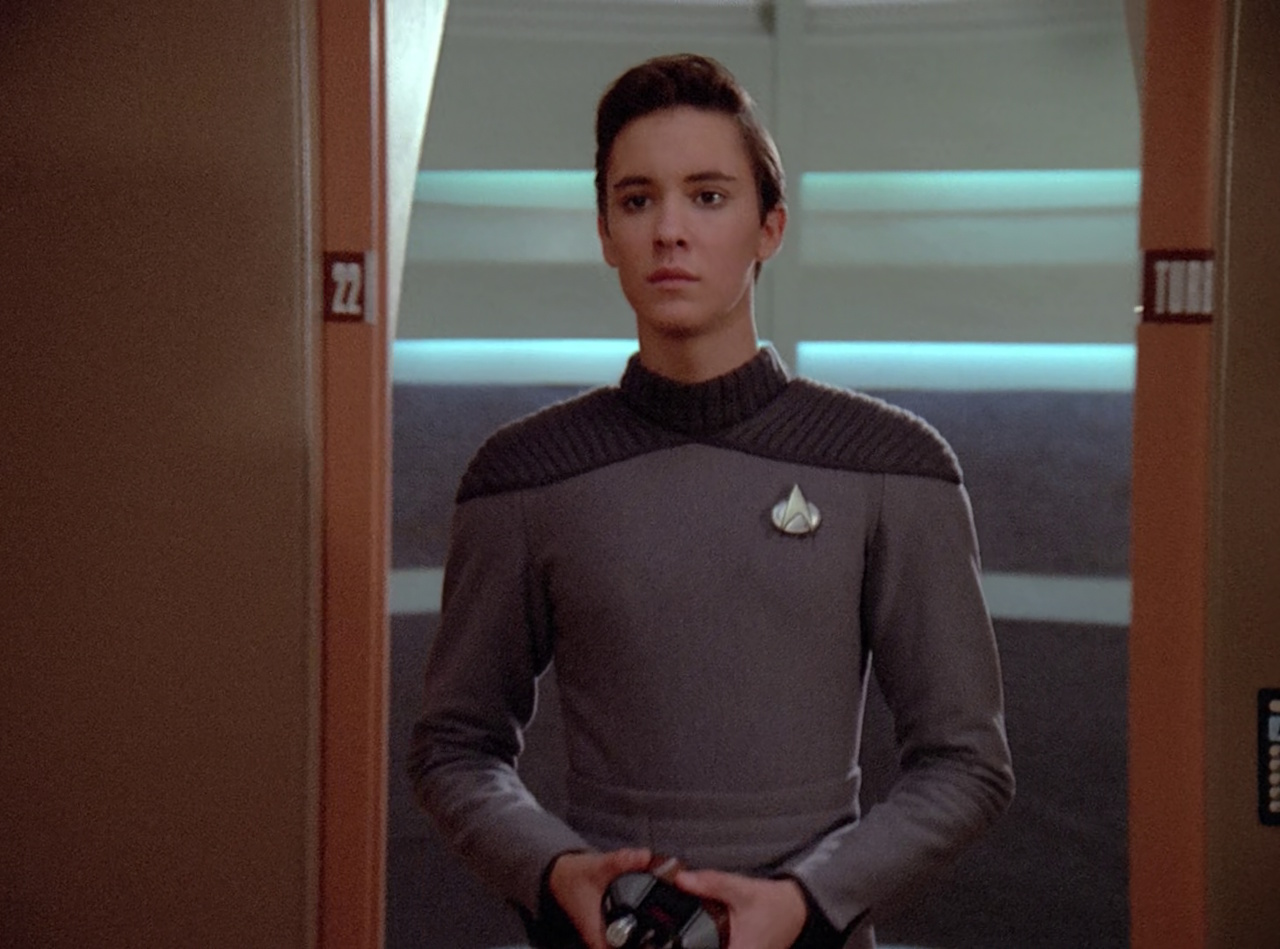
Star Trek: Voyager re-watch – The Haunting of Deck Twelve

Spoiler Warning: There are spoilers ahead for Star Trek: Voyager, Star Trek: Picard, and for other iterations of the Star Trek franchise.

Happy Halloween! With the scariest day of the year upon us, I thought it could be fun to delve into Star Trek’s spooky side for a change! The Haunting of Deck Twelve was the penultimate episode of Voyager’s sixth season, and premiered in the United States on the 17th of May 2000. It’s framed as a campfire ghost story, with Neelix recounting the supposedly-true story of spooky goings-on aboard the ship to the Borg children: Icheb, Mezoti, Azan, and Rebi. Naomi Wildman, the USS Voyager’s other child, is conspicuously absent.

When it was announced earlier this month that Kate Mulgrew will reprise her role as Captain Janeway in the upcoming animated series Star Trek: Prodigy, I wanted to write up a Voyager episode here on the website. Despite being up and running for almost a year now I haven’t done so, though I did pick out ten great episodes from the series. Voyager is, to many fans, a less-favoured series than The Next Generation or Deep Space Nine, and can sometimes feel like an also-ran among Star Trek’s canon. However, I definitely feel that the show got a lot of things right, had some excellent characters, and told some unique and interesting stories. Many of Voyager’s alien races were different from what we’d seen before (due to the Delta Quadrant setting) and have yet to be revisited in any detail.

The episode’s title card.

Voyager is certainly a series I enjoy. I find ranking the different Star Trek shows very difficult, because each one really brings something different to the table. Voyager is comparable in many ways to The Original Series and The Next Generation in that it’s set aboard a moving starship and the crew routinely conduct missions of exploration. However, its overarching story of the ship being stranded a long way from home makes it something different. Not every aspect of Voyager was perfect – the “one ship, two crews” storyline never really took off, and in later seasons especially, I found Seven of Nine to be a pretty boring, flat character – but as a series it tried to do some different things and succeeded in telling some excellent stories.

Is The Haunting of Deck Twelve one of them? Well, that’s an interesting question!

The episode begins with a beautiful shot of the ship in flight. The usual inspiring musical score immediately sours, however, and we get a horror-style minor chord sting as the camera fades in to Neelix in an empty mess hall. Neelix walks around looking concerned – an expression that can’t be easy to convey under such heavy prosthetic makeup – and nervously straightens a chair before turning out the lights. He’s then startled by Seven of Nine as he turns to leave, and tells her he’s feeling jumpy “after what happened last time.” A suitably mysterious line!

A nervous Neelix prepares to leave the mess hall.

Seven explains that main power will soon be shut down, interrupting the Borg children’s regeneration (remember that Borg don’t “sleep,” but rather regenerate in alcoves) and she wants Neelix to keep them company. This is the setup for the frame narrative that much of the rest of the episode would use.

On the bridge we get a comparatively rare example of a starship powering down its engines and using inertia to continue moving. In Star Trek, ships at warp don’t seem able to do this (presumably for reasons related to subspace) but there’s no reason why a ship traveling at sublight speeds shouldn’t be able to fire its engines and then coast! Yet for some reason it isn’t mentioned very often. As Voyager drifts toward a nebula, Tom Paris and Harry Kim comment on its spooky appearance; the nebula is depicted in shades of brown, orange, purple, and blueish-grey, but I wouldn’t have said it looks any more frightening than any of the other nebulae the ship has visited. Perhaps the officers’ overactive imaginations (which Tuvok is happy to point out) stem from the fact that they know what’s coming. As the audience, we still don’t!

The nebula on Voyager’s viewscreen.

Harry confirms that the ship is ready – and we soon see what for. Main power is deactivated ship-wide; the bridge goes dark, a corridor soon follows, and the Doctor deactivates himself in sickbay. The shot of two background crew members in the hallway was particularly well put together. Filmed from a low angle, the lights in the hallway went out in sequence, and the pair of officers then activated their wrist-mounted torches. Seven of Nine’s astrometrics lab goes dark too, save for a single computer panel on the wall. Seven was oftentimes a rule-breaker, and on first viewing I wondered if she had unilaterally decided her work was too important to stop!

In the cargo bay, Neelix greets the Borg children as they’re shocked awake by the shutting down of their Borg alcoves. And it was my first time seeing Icheb since his reappearance in the episode Stardust City Rag from Star Trek: Picard Season 1 earlier in the year. In main engineering, Torres and the crew shut down the warp core, presumably completing the process of turning off everything aboard the ship, which is now illuminated only by wrist-mounted torches and lanterns. Spooky stuff.

B’Elanna Torres and her team switch off the warp core.

There are many things we can consider iconic within Star Trek, and for my money the warp core is absolutely one of them. The concept of the warp core as an upright glowing column first appeared in Star Trek: The Motion Picture in 1979 and has carried through the franchise in some form ever since, even reappearing in Lower Decks and Short Treks. Though the way this vital piece of technology functions has always been deliberately ambiguous, its design and aesthetic are emblematic of Star Trek, and when you see a warp core you know you’re aboard a Federation starship.

Back on the bridge, Harry confirms every deck is without power. Janeway signals Seven of Nine with the cryptic message “we’re ready.” And after a neat shot of the unpowered ship coasting into the nebula – which suddenly appears a much brighter shade of purple than it had on the viewscreen – the opening titles roll.

Is this the same nebula we saw a minute ago?

Voyager followed on from Deep Space Nine in having a slower-tempo, softer theme. The themes for The Original Series and The Next Generation were upbeat, representing the excitement of adventure and exploration. Voyager’s stands in contrast to that, but is nevertheless a beautiful piece of music in its own right. The title sequence itself is a representation of the long journey the ship and crew will take; no one scene lingers, and Voyager moves past different planets and nebulae before going to warp.

When the action resumes we’re back in the cargo bay with Neelix and the kids. Icheb immediately demands to know about the loss of main power, and seems dissatisfied with Neelix’s explanation. Neelix tries to distract the kids with various campfire supplies, but they aren’t buying it. The way this scene was set up and shot was clever; there’s only one light source (a lantern) which serves as the “campfire” analogue, leaving the rest of the cargo bay in darkness. There’s just enough light to illuminate Neelix and the kids, but that’s all.

Neelix in the cargo bay.

Icheb insists that Neelix be more forthright about what’s happening, and Mezoti asks if what’s going on is related to deck 12, which she has heard is haunted. It’s clear that, with part of the deck under lockdown and inaccessible without a high security clearance, something is going on!

After very little persuasion, Neelix relents and agrees to tell the kids about what’s happening and how it connects to deck 12. In a way, this is just as cathartic for him as it is for them, as he’s nervous about Voyager’s mission to the nebula. And I think we get a showcase in how great a character Neelix can be in episodes like this. Though the “one ship, two crews” concept never really worked in Voyager, as the Maquis had been wholly assimilated into the Starfleet crew even as early as the first season, Neelix always stood apart. At times he would bend the rules because he isn’t from a Starfleet background, and here, with the kids, he’s quite happy to go against what he was asked to do and tell them a story about what’s going on.

Sitting around the “campfire.”

We get a “Borg take things too literally” joke when Neelix tells the kids that the story isn’t suitable for “the faint of heart,” which was funny. Contrary to what some folks wanted to tell you in the run-up to the release of Star Trek: Lower Decks earlier in the year, the franchise has always had these moments of humour. And this one was on point – even if the “Borg takes things too literally” joke was generally overdone on Voyager thanks to Seven of Nine!

As the children insist Neelix tell them everything, he gives them a final warning that it’s a spooky story! It all began with a routine deuterium-collecting mission to a nebula several months ago… and thus begins the bulk of the episode, told in flashbacks with occasional narration from Neelix, who seems more than happy at the chance to tell a story!

Neelix and Tuvok in a flashback.

Neelix tells Tuvok that he’s concerned about “crew morale,” despite Tuvok noting that the crew in the mess hall seem perfectly fine. Neelix wants to know how long the ship will be in the nebula – so he can reassure everyone else, of course. Tuvok, very perceptively, realises that it’s Neelix who’s on edge, and his suspicions are confirmed when Neelix seems to snap at him in the middle of the mess hall. Clearly the stress of the nebula has been getting to him.

It will take days before the deuterium collection work is finished, though, and all Tuvok can suggest is that Neelix put up some curtains. A truly helpful and empathetic response from Voyager’s resident Vulcan! Neelix seems happy with this, however, and dashes off to find some material with which to make curtains.

Tuvok speaks with Neelix in the mess hall.

Meanwhile on the bridge, the turbulence is getting worse. Harry suggests to the captain a technobabble explanation for why the nebula is “destabilising,” and then we get a jump-cut back to Neelix and the kids in the cargo bay. Icheb accuses Neelix of misleading them on the specifics, noting that “bussard collectors do not emit nadeon emissions.” Neelix tells him that the specifics aren’t important to the story – and we have another part of the setup, the “unreliable narrator.”

Using this term might be a bit of a stretch, but it’s important for the remainder of the story. Neelix’s recollections are imperfect, and while the main thrust of the episode’s narrative is ultimately revealed to be true, it’s not unfair to think that Neelix has embellished certain other elements for the sake of storytelling! I liked the way this was set up, and for a story with a frame narrative like this one, it works really well.

Neelix’s recollection of what Harry Kim said was not accurate – according to Icheb, at least.

Neelix wasn’t on the bridge during this moment, so how could he have known everything that was said? Again, this is something we’ll keep in mind during any scene where Neelix isn’t physically present! As Neelix prepares to hand out a plate of snacks to the kids in the cargo bay, we jump back to the action on the bridge.

A minor inconsistency, perhaps, as Janeway contacts Torres to tell her they’re going to stop the “dilithium” collection – not deuterium, which is what everyone else had been talking about – but this could simply be another of Neelix’s misremembrances. Before the ship can successfully leave the nebula, however, it’s struck by some kind of electrical discharge! The kids pipe up, asking if this was the ghost.

Voyager is zapped!

On the bridge, the crew report minor damage and some power outages, but nothing serious and no injuries. Voyager resumes its course having harvested as much dilithium/deuterium as it could, and everyone seems to think that they got away with it. However, as Neelix explains, the ship had picked up a “mysterious stowaway.” At the same time, we see a CGI rendition of the ship leaving the nebula, complete with a glowing ball of lightning that slips through the hull – just like a ghost would!

The late 1990s and early 2000s weren’t a great time for CGI. However, on the small screen it looks a lot better – or at least less bad – than it does in some big-screen productions made around the same time. I’m looking at you, Star Wars prequels. Star Trek had been experimenting with CGI since The Next Generation was on the air, and while I’d absolutely love nothing more than for Voyager to be properly remastered, which would include redoing almost all of these CGI effects, I have to admit that it doesn’t look too bad here.

The stowaway.

The kids ask a bunch of questions about the stowaway, and Neelix confirms that it was a space-dwelling creature. However, they keep trying to press him to tell what exactly the life-form was, but when offered the choice between debating what the creature was and resuming the story, the kids ultimately choose – after exchanging glances – to continue with the story. Thank goodness, I want to know how it ends!

After leaving the nebula, Voyager begins to suffer some unusual malfunctions. Chakotay reports to Captain Janeway some of the damage done by the “zap” as the ship escaped the nebula, including the loss of artificial gravity on one deck. That would’ve been fun to see! We so rarely see a loss of gravity on Star Trek – due, of course, to the practical difficulties in filming such a sequence. The artificial gravity systems aboard a starship are invariably the last things to fail even when every other system is compromised, so for it to have been damaged here is, I would argue, a major issue.

Chakotay in the captain’s ready-room.

As Chakotay explains his findings, the captain’s replicator malfunctions, and I just love Janeway’s nonchalant response as she tells Chakotay he can “add replicators to [his] list.” Even when annoyed she manages to be in control, and I have no doubt she’ll make a great captain in the upcoming series Star Trek: Prodigy.

As Janeway speaks to the ship, Chakotay tells her that he used to have similar chats with his Maquis vessel – something I think we saw him do in Caretaker, the series premiere. Either way, it was a fun acknowledgement of Chakotay’s Maquis past. Chakotay didn’t get many scenes, let alone stories of his own, during the latter part of Voyager’s run, so it was nice to see him here alongside Captain Janeway. Though he lost his Maquis side pretty quickly as the show got going, he found a role as Janeway’s older and more seasoned advisor, as well as her moral compass. Those roles suited him. Looking out the ready-room window Janeway spots a meteorite cluster – and thinks it’s the same one Voyager has already been past. Is the ship now flying in circles?

Chakotay and Janeway spot the meteorites.

Not to nitpick, but technically a “meteorite” is something that falls to Earth, not something in space! On the bridge, Tom Paris insists the ship hasn’t been traveling backwards or in circles, yet the presence of the meteors suggests otherwise. Tuvok runs a (very fast) diagnostic that reveals a problem – Voyager is heading back the way it came.

As the captain orders an all-stop, Paris begins to launch into a speech about how the ship relies too much on sensors and technology. Before he can say too much, however, the warp engines activate by themselves and can’t be shut down. The malfunctions suddenly get a lot worse. The communications system goes down. The computer, when asked to locate B’Elanna, lists the locations of every officer aboard the ship, and Chakotay’s turbolift to engineering takes him to the mess hall instead.

Tom Paris at his post – just before the warp engines malfunction.

As Chakotay steps back into the turbolift and, once again, asks it to go to engineering, we get a rare look inside the turbolift shaft. As Neelix explains in a voiceover that the turbolift was falling, we see a neat CGI sequence of the turbolift itself, including the inside of the turboshaft, complete with horizontal tubes. This is a rarity, and for us nerds, a bit of a treat to catch a glimpse of the inner mechanisms of one of the franchise’s staple technologies.

Chakotay’s turbolift inside the turboshaft.

Another jump-cut back to the cargo bay sees Neelix teasing the kids by pausing his story, offering them snacks. Mezoti informs him that “snacks are irrelevant!” and insists he continue the story. I loved this line, it was very “Borg,” but also a typical reaction from a little girl who wants her story. Not to mention that it was funny.

Here I think we see the frame narrative working well. The story of the malfunctions is interesting, as is the idea of a nebula-dwelling life-form, but Neelix and the kids give the episode a kind of light-hearted brevity that stands in contrast to the serious goings-on, yet somehow works really well.

“Snacks are irrelevant!”

The frame narrative also allows The Haunting of Deck Twelve to still tell us as the audience about some dramatic events – like Chakotay being pinned to the ceiling of the turbolift as it fell – but without having to go to the expense of filming them! Chakotay storms into engineering, but B’Elanna says she’s pinpointed the problem and is on her way to fix it.

Crewman Celes – who appeared in Good Shepherd a few episodes previously – makes a welcome return. One thing Voyager lacked was a Deep Space Nine-style secondary cast, yet its “lost in space” narrative would have allowed for that. Some background officers like Vorik, Chell, and Carey got to make repeated appearances, but none had a major impact on the story in the same way as Deep Space Nine’s secondary characters did.

Crewman Celes with Seven of Nine.

Seven of Nine accuses Crewman Celes of causing a power failure, despite her having only just opened a panel. It was clear, despite Seven’s rush to judgement, that this was connected to the ongoing malfunctions aboard the ship. Seven of Nine presses a few buttons on the exposed panel, and the lights in the hallway begin to flicker.

Chakotay and B’Elanna have arrived at their destination – some damaged gel-packs. Voyager uses “bio-neural circuitry” in its systems, something that was set up way back in Season 1. These systems are supposedly faster and more reliable, but more difficult to replace. The aesthetic used for the gel-packs – which are a neon blue colour – was pretty neat, and I think still holds up today as a fun and suitably futuristic piece of technology.

The gel-packs.

The problem has “jumped” from one set of gel-packs to another, this time near Seven of Nine’s cargo bay 2. With no communications, Neelix explains in voiceover, B’Elanna and Chakotay couldn’t contact her to warn her something was going on! As the camera focuses in on Seven, who is working at her console in the cargo bay, the mysterious stowaway appears to materialise behind her…

Seven of Nine and the nebula life-form.

The Borg kids are shocked and alarmed – this was happening in this very cargo bay! Mezoti once again insists on Neelix telling the rest of the story, and shuts down Icheb when he tries to interrupt! The life-form jumped into the Borg alcoves near to Seven of Nine, and then released a strange gas into the cargo bay; gas that looked a lot like the nebulae we’ve seen!

Unable to escape the cargo bay – as forcefields have been set up outside the main doorway – Seven is trapped and begins to choke on the gas. The lantern in the cargo bay suddenly goes out, just as the kids are beginning to get excited and anxious about the story and what happened to Seven of Nine. Neelix is able to fix it easily – I wonder if he did that on purpose!

Seven of Nine chokes on the gas.

Chakotay and B’Elanna arrive just in the nick of time, and after phasering the forcefield control panel manage to get Seven of Nine to sickbay. Malfunctions increase across the ship, including in the mess hall where Neelix is cooking and Harry Kim is having a meal.

Kim – despite being just an ensign – orders everyone to report to their stations. The lights continue to flicker, and Neelix nervously asks if he can tag along with Harry. However, Kim reminds him that the mess hall is his post before departing, leaving a nervous Neelix alone in the mess hall – as the lights go out.

Neelix and Harry.

Neelix says to the kids that Voyager was “dead in space,” though gravity and life-support still seem to be working! The bridge is overheating, and we got a cute moment with Paris and Tuvok as the latter explains the Vulcans don’t sweat unless the temperature reaches a staggering 350°K – about 77°C or 170°F.

Following the earlier scene with Chakotay in the ready-room, Captain Janeway once again tries talking to the ship. This time, she offers to make a deal, a maintenance overhaul in exchange for no more malfunctions! I like this side to her character; it took a serious story but gave it another light-hearted aspect that I think worked well in conjunction with Neelix’s frame narrative.

Janeway tries to bargain with Voyager.

Her bargaining seems to have worked – helm control has been restored! But as soon as Paris steps up to the console to plot a course he’s zapped by an energy discharge – leaving him with some nasty-looking burns. As Janeway and another bridge officer try to help Paris, the bridge is suddenly deprived of oxygen and they must all evacuate. The practical makeup effects for Paris’ burns were gruesome – and come as quite a shock.

Paris is brought to sickbay – where it seems that injuries are becoming a problem across the ship. The Doctor immediately diagnoses Paris as the victim of an EM surge, similar to the electrical discharge that struck Seven of Nine when she was trapped with the nebula gas. Standing around Tom’s bio-bed, Seven, Chakotay, B’Elanna, the Doctor, and Captain Janeway come to a typical Star Trek realisation – there’s an alien intelligence at work.

The group in sickbay.

The alien is trying to use Voyager’s systems to make an environment for itself – just like the nebula. And it’s attacking anyone who tries to interfere or undo its work, as all of the crew it’s hit have been doing precisely that. I called this a “typical Star Trek revelation” because it’s not uncommon in the franchise when something unusual or unexplained happens for the reason to ultimately be “life, Jim, but not as we know it!” That line, by the way, was used in the song Star Trekkin’.

The Doctor suddenly goes off-line (though no one seemed to move when Janeway ordered his programme to be transferred to the mobile emitter) and power fails in sickbay. In voiceover, Neelix explains how power was failing across the ship, deck by deck. In a dark hallway, lit only by the intermittent red alert/emergency lights, Harry Kim gets a scare – and so do we! It turns out he’s just bumped into Crewman Celes, and neither of them know what’s happening. This sequence was very atmospheric, with the intermittent red lights and Harry’s wrist-mounted torch being the only sources of illumination. It felt very eerie, and meant that when Celes appears, it’s hard not to jump even if you know what’s coming!

Harry in the dark hallway.

Celes starts rambling about Borg and Hirogen and the ship being under attack, and Harry tries his best to calm her down. The two set off for engineering, where Kim assumes the captain will have set up a command post due to the environmental failure on the bridge.

Neelix, meanwhile, has been stuck at his post in the mess hall. He’s lit a fire under one of the pans which provides some additional light alongside his torch, and we hear the doors hiss open. This music across the episode has been fantastic, horror-inspired and very atmospheric. Here it reaches another high, adding tension to an already-tense moment as Neelix looks around the deserted mess hall.

The Haunting of Deck Twelve uses light in imaginative ways to build tension.

As Neelix exits the mess hall, with no one answering his calls, he sees the source of the noise: a malfunctioning door opens and closes repeatedly at the end of a hallway. This shot was another that builds up that sense of fear; Neelix is all alone, and I think many ghost stories have some kind of door opening or closing of its own volition, meaning the episode plays off that trope. It was very spooky indeed!

When Tuvok wordlessly appears behind Neelix as he investigates the door, all of the tension from the mess hall through the hallway scene boils over, and we get the second of two jumpy moments! Tuvok has come to the mess hall to evacuate Neelix, and is wearing some kind of portable oxygen mask. Neelix admits to the kids that he was very frightened as he and Tuvok must crawl through the jeffries’ tubes and descend eight decks to make it to the captain’s command post.

Tuvok in his mask.

In a break from the flashbacks, Neelix gives the kids a lesson in fear. Icheb tells him he shouldn’t be afraid, but Neelix retorts that fear can be good thing – keeping people safe. For kids especially, I think this is a very important message. Not only because it shows that it really is okay to be scared and that everybody gets scared sometimes, but that there’s nothing to be ashamed or embarrassed about with showing fear. Fear, as Neelix rightly says, can be useful, and it’s an important emotion. The Borg kids need to know this as they rediscover their emotions, but many of Star Trek’s younger viewers would do well to remember this too!

After Mezoti elaborates on her first experience with being afraid, Neelix gets back to the story. Aside from Collective, the episode which introduced us to the Borg kids, I’d argue that The Haunting of Deck Twelve is one of the most important for their development, particularly as they wrangle with the feelings and emotions they have after being disconnected from the Borg collective. This is precisely for the reasons we discussed – learning to show and handle emotions is vital. In the flashback, Neelix tells the kids that he was stuck with only Tuvok for company.

Tuvok and Neelix on their journey.

Neelix attempts to make small-talk, but Tuvok isn’t having it. While crawling through the tubes, Neelix begins to tell a story-within-a-story: that of a Talaxian ship that similarly underwent a systems failure, leading to the crew drawing lots to see who would survive. Mezoti and Icheb pipe up, wondering what the bodies of the dead Talaxians looked like, and whether they resorted to cannibalism, before Neelix resumes his story. This moment definitely felt like “ghost stories around the campfire” in the way the episode was going for!

Neelix and Tuvok encounter a jeffries’ tube slowly filling with nebula gas and can’t progress any further. Tuvok opens a panel and plans to vent the gas – but we know that anyone doing so has been attacked! There is an alternate route, but Tuvok says it will take hours to reach engineering that way. I was still nervous for Tuvok as Neelix jumps the story to engineering…

Tuvok attempts to use environmental controls to vent the gas.

In main engineering, Harry expresses regret at leaving Neelix in the mess hall. The nebula life-form has gotten into the main computer, and is now unable to be contained. However, the life-form uses the communications network to contact the captain. She responds to its attempts to communicate, assuming the life-form has learned how to use the systems to communicate.

Using the ship’s computer, the life-form summons the captain to astrometrics, and it’s worth taking a moment to remember Majel Barret-Roddenberry, who was the voice of Starfleet’s computers from The Original Series all the way through The Next Generation era and even up to 2009’s Star Trek. She was the wife of Gene Roddenberry, Star Trek’s creator, and has almost certainly appeared – in voiceover form – in more Star Trek episodes than anyone else. Here, as the life-form attempts to communicate, it’s her voice it uses.

Janeway decides to go to astrometrics.

Despite Chakotay’s concern about a trap, Janeway proceeds to astrometrics. There isn’t much of a choice, as the alternative appears to be letting the life-form take over the ship. Back in the jeffries’ tube, Tuvok works on the panel while attempting to calm Neelix down. We get a flashback-within-a-flashback, as Neelix remembers with fondness his birthday party.

However, the memory turns sour as Neelix imagines himself attacked by the nebula gas! This was another well-executed deception, taking what should have been a safe moment for Neelix, and for us as the audience, and turning it into something scary. I loved the visual before that moment as Neelix sat down with the crew all around him. He clearly has great fondness for all of them – and they for him.

Neelix’s birthday dinner.

Tuvok jumps as Neelix yells out, and the kids ask what happened. In astrometrics, the life-form points Janeway to the nebula and restores helm control. Seven of Nine objects, thinking it may be a precursor to an invasion. However, Janeway believes the life-form just wants to return to its home and agrees. The malfunctions are not as random as they appeared; all were designed to push Voyager back to the nebula.

Janeway can empathise strongly with the desire to return home – after all, that’s what she and the crew are doing too. Perhaps with that in mind she agrees to return the ship to the nebula. It allows her access to the bridge as Neelix tells us in voiceover that the relationship between them was “fragile.”

Captain Janeway makes a breakthrough in communicating with the life-form.

Upon returning to the nebula, however, there’s a problem: there is no longer a nebula! Whatever happened to destabilise it earlier has caused it to dissipate entirely, leading to the life-form throwing a major tantrum! It tries to turn off life support and tells the crew to abandon ship, but luckily Captain Janeway is able to talk it down.

This is classic Janeway – she’s an explorer and a scientist, but also a diplomat. When the life-form threatens her crew, she steps up and shows her diplomatic abilities, saving the ship and crew. This is the climax of the storyline, as Janeway must act to save the ship, and it shows why she’s such an amazing captain.

Janeway on the bridge trying to talk to the life-form.

Neelix explains to the kids that this was Voyager’s only chance, but it doesn’t go well at first. The life-form refuses to communicate or unlock any more systems, and Janeway appears to be out of options.

Back in the tube, Tuvok is – perhaps predictably – shocked by a discharge from the panel he was working on. Neelix describes this as one of his worst fears. Again we see great makeup work to represent Tuvok’s grisly plasma/EM burns. Neelix uses the story of the Talaxian ship from earlier as a bad example, saying that he won’t leave the injured Tuvok to his fate despite nebula gases pouring into the tube. Tuvok attempts to order Neelix, but in an uncharacteristic moment of bravery, Neelix disobeys and lifts Tuvok to his feet. Neelix can certainly be a scaredy-cat, and at times Voyager derived humour from that. But here he, like the captain, steps up and does what’s needed. Fear may be important, as we discussed earlier, but so is overcoming it.

Neelix carries Tuvok away from the nebula gas.

The two share the single oxygen mask as they make their way through the gas. Why Tuvok didn’t bring a second mask with him on his mission to retrieve Neelix is, well… unknown. But it makes the story more exciting, so perhaps it’s best not to nitpick!

Janeway is making her way back through the deserted ship, continuing to reason with the life-form. She tells the life-form to run a diagnostic, confirming that systems will fail aboard the ship. This means that the life-form cannot survive aboard Voyager without the crew, and it’s this revelation which turns the tide.

Janeway continues to negotiate.

Neelix and Tuvok reach main engineering just as the captain has given the order to abandon ship. The crew race to the escape pods, though B’Elanna’s warning that the pods may not be able to be ejected felt ominous. The reply that “we’ll push them out if we have to” feels unhelpful here too, and little more than hyperbole!

Chakotay is the second-to-last to reach a shuttlebay/escape pod, but before Capain Janeway can join him the door is sealed. The life-form seems to think it can keep the captain as its slave to maintain the ship’s systems, but she refuses, telling the life-form that they will die together. The life-form, however, was bluffing, and realising it cannot survive aboard Voyager without the crew, relents. Kate Mulgrew’s performance as the pained and asphyxiating captain was riveting, and I couldn’t look away from the horrifying scene.

Janeway suffocates in the nebula gas.

As Neelix explains, the creature’s bluff had been called. The crew were able to return and all systems were restored. However, one section of deck 12 was set aside for the creature to live, and the captain pledged to return it to a suitable nebula as soon as the ship detected one. Mezoti turns to Icheb to gloat; she told him there was a monster on deck 12!

It was no monster, of course, just a lost creature that wanted to return home. Moments later, main power is restored and the lights are back on. As the kids head back to their alcoves, Neelix says he made the whole thing up, and had this been the end it would have been a disappointment on par with “it was all just a dream.” Icheb in particular seems content to believe Neelix made it up, and the kids step back into their alcoves and begin regenerating.

The kids get into their alcoves.

However, this wasn’t the end of the episode! In the final scenes, Neelix returns to the bridge. The whole trip to the nebula took three hours, and he reassures the captain that the kids weren’t frightened. He told them a story, he says, to pass the time.

Neelix then asks if everything is alright. Harry activates the viewscreen, showing the nebula from the beginning of the episode. It now seems to crackle with lightning or some kind of electrical energy – the life-form is home. Neelix says he hopes it “lives happily ever after” in its new nebula.

Neelix delivers the final line of the episode.

So there we go. Star Trek: Voyager’s campfire ghost story! The life-form, despite Neelix’s claim at the end, was indeed real. But how much of his story was, and how much did he embellish or exaggerate for the sake of making it engrossing for the kids? I suppose we’ll never know, but I choose to believe that it was largely accurate.

It was a truly fun piece of television, something different from Star Trek’s usual output while, at the same time, being very familiar. The “it wants to communicate” trope is something we see a lot, particularly in older Star Trek shows, and it’s a trademark of the franchise at this point! But the manner in which The Haunting of Deck Twelve uses this familiar theme makes it stand out. We could have just had the story from the flashbacks, but instead it was chosen to use Neelix and the kids around their “campfire” as a frame, and I really think that worked. It made the episode something different from Star Trek’s past offerings, and I like that.

The campfire frame narrative made The Haunting of Deck Twelve something different.

So I hope this was a bit of fun for Halloween! Whatever you’re doing today or tonight, I hope you have a great time and some spooky fun. I will be writing up this week’s episode of Discovery, so don’t worry. But I didn’t want to let Halloween pass unmarked, and The Haunting of Deck Twelve ticked a lot of boxes for being a fun Star Trek story to re-watch at this time of year.

Star Trek: Voyager is available to stream now on CBS All Access in the United States, and on Netflix in the United Kingdom and elsewhere. The series is also available on DVD. The Star Trek franchise – including Star Trek: Voyager – is the copyright of ViacomCBS. This article contains the thoughts and opinions of one person only and is not intended to cause any offence.
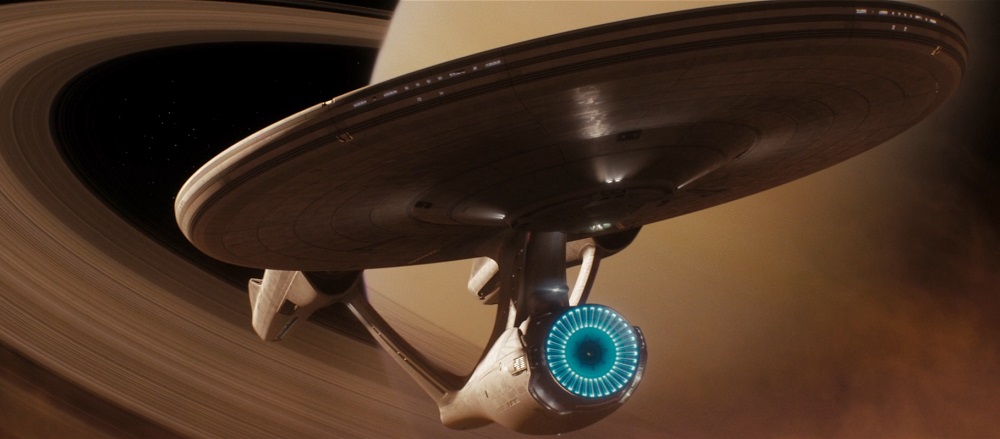
Star Trek: Voyager – Elite Force (Twenty Years Later)

Spoiler Warning: There are minor spoilers ahead for Star Trek: Voyager – Elite Force and for Star Trek: Voyager.

On the 20th of September 2000, Star Trek: Voyager – Elite Force was released. That’s twenty years ago – to my great shock – so it seems like a great opportunity to take a brief look back at what is arguably one of Star Trek’s best and most successful video game adaptations.

The Star Trek franchise hasn’t had a lot of luck in the video game arena, despite the fact that there’s a good deal of crossover between Trekkies and gamers. Most Star Trek games really only appealed to existing fans, and failed to either cross over and win support among a wider gaming audience, or to bring in any new fans. Elite Force was – for a time, at least – an exception to that. As a result it’s fondly remembered not only by Trekkies but by many fans of first-person shooters in the early 2000s.

Star Trek: Voyager – Elite Force was released twenty years ago!

Elite Force was the first game released that was made using the Quake III engine (also known as id Tech 3) except for the original Quake III Arena, and many first-person shooter fans just after the millennium were excited to see what this new game engine would bring to the table. Elite Force also offered local and online multiplayer on PC at a time when the idea of playing games via LAN or online was becoming a bigger and bigger deal in the PC gaming sphere; it was certainly the first such game I ever played at a LAN party!

Using the tagline “Set phasers to frag!” – where “frag” is (or was) a gaming term for “kill” – Elite Force became a moderate success for its multiplayer mode. Gaming as a hobby was much smaller around the turn of the millennium than it is today, and also skewed younger in terms of the average age of gamers. Most players at the time were aware of Star Trek, which had been on a roll through the ’90s, and where Elite Force truly broke new ground for a Star Trek game was in reaching out beyond the franchise’s usual fanbase to appeal to non-fans. It’s unfortunate that the game’s release coincided with the end of The Next Generation’s era; I think if it had been released earlier in Voyager’s lifetime it might have been able to retain some of those new players and convert them to Trekkies. The idea of the “box set” hadn’t really materialised in 2000, so with Voyager already into its final season, and with The Next Generation and Deep Space Nine already over, there wasn’t much Star Trek content for those who did enjoy the game and its setting to get stuck into.

A cut-scene set in the briefing room.

In that sense, Elite Force was released at a time when the Star Trek franchise was entering a period of decline, and the end of Voyager’s run a few months after the game was released meant that the franchise wasn’t able to keep many of the players who gave Star Trek a chance. That’s a shame, but it can’t be helped!

Beyond its multiplayer mode, Elite Force told a really interesting story. The game begins with the explanation that Captain Janeway and Tuvok have created a specialist “Hazard Team” for the USS Voyager, of which the player character is a member. Elite Force was one of the first games I played that allowed players to choose their character’s gender; Ensign Munro could be male or female. It was groundbreaking in the sense that the game didn’t change at all depending on the player’s decision – if Ensign Munro was a woman she was just as capable as if she were a man, and no one aboard the ship would behave differently. That decision alone represents Star Trek’s vision of an equal future. Gender representation in games is getting better, and there are some great female protagonists. But some franchises and series have still never offered players a female lead, and others struggle with writing a female protagonist successfully. Elite Force got this right twenty years ago, so there’s no excuse!

Elite Force let players choose to play as a female or male character. Both were fully-voiced.

To get back to the story, Hazard Team has been assembled in response to the threat of the Borg and other dangers the ship faces in the Delta Quadrant. The first level of the game is set aboard a Borg vessel – which soon turns out to be a holodeck simulation! I liked the creative use of Star Trek’s technology to explain some in-game features; players were said to have a personal transporter buffer which contained their inventory, explaining how it was possible to carry so many items at once. That was a neat little addition!

The USS Voyager itself was recreated using the aforementioned Quake III engine, and remains one of the best in-game depictions of any Starfleet vessel. It was such a shame when fan project Stage 9 was forcibly shut down by ViacomCBS a few months ago, as their recreation of the Enterprise-D was stunning. Elite Force did something similar with Voyager, and in between missions several large areas of the ship were able to be explored. This was a complete novelty at the time, and it was amazing to be able to wander around the ship looking at every little detail that developers Raven Software had built.

The bridge of the USS Voyager was one of many locations on the ship that could be explored.

When the USS Voyager is pulled into a rift in space, it comes under attack by scavengers who reside there. The Hazard Team is deployed on a number of missions to recover supplies, defeat opponents, and find a way for the ship and crew to escape. Interestingly, some Alpha Quadrant races (including humans) are present in the “graveyard,” along with Delta Quadrant races like the Malon.

I don’t want to spoil the story too much, because it is still possible to find copies of the game both for PC and PlayStation 2 second-hand if you want to try it for yourself. Suffice to say that I found the story of the single-player campaign to have a solid Star Trek feel to it. Fans of the franchise might find a couple of nitpicks here and there, but generally it was great fun. Voyager would use a somewhat similar premise – getting sucked into a rift in space populated by scavengers – in the seventh season episode The Void, which was broadcast a few months after the game was released.

The USS Voyager in the “graveyard.”

Almost the whole Voyager cast stepped in to voice their characters. The main two in terms of the storyline and in terms of who Ensign Munro interacted with were Tuvok – who is the head of security and nominal leader of the Hazard Team – and Captain Janeway. Aside from Jeri Ryan, who was unable to voice Seven of Nine, and Jennifer Lien, whose character of Kes was not part of the game, the entire main cast were present. A couple of Voyager’s minor recurring characters (Chell and Vorik) were also voiced by their television series actors, which was a nice touch. The game was certainly far better for having the proper voice cast!

A darling of early-2000s LAN parties and a pioneer of first-person shooters in the online multiplayer space, Elite Force is a rare example of a Star Trek video game that broke the mould and expanded beyond the fandom. It’s also one of the better Star Trek video games both in terms of gameplay, where the Quake III engine provided a rock solid first-person shooter experience, and in terms of storyline, which for the most part felt like players were taking part in a real episode of Voyager. It’s a wonderful game, well worth playing for any Trekkie, and it would have been a shame to let its twentieth anniversary pass by unnoticed.

So here’s to Star Trek: Voyager – Elite Force! Happy anniversary!


Star Trek: Voyager – Elite Force probably remains the copyright of Activision-Blizzard. Star Trek: Voyager – Elite Force is available for purchase on PC via GOG. The Star Trek franchise – including Star Trek: Voyager – is the copyright of ViacomCBS. This article contains the thoughts and opinions of one person only and is not intended to cause any offence.
Could Voyager’s Doctor appear in Star Trek: Discovery?

Spoiler Warning: There are spoilers ahead for Star Trek: Picard Season 1, Star Trek: Discovery Season 2, Star Trek: Voyager, and other iterations of the franchise.

Star Trek: Discovery’s premiere brought back Sarek, Spock’s father who had been first introduced in The Original Series. Season 2 saw Spock himself as well as Captain Pike and Number One make appearances, so Discovery is a series that has no qualms about reintroducing legacy characters. But its 23rd Century, pre-The Original Series setting precluded the use of most of Star Trek’s characters, as the bulk of the franchise’s 780+ episodes and films take place later in the timeline.

Discovery’s move forward in time should also mean that no legacy characters could have significant roles. After all, who could possibly still be alive more than eight centuries after the events of Star Trek: Picard? I can think of one character, but not in the way you might expect!

Voyager’s Doctor – or at least a version of him – could be alive in the 32nd Century.

As a hologram who doesn’t age, we could definitely argue that The Doctor – played by Robert Picardo for all seven seasons of Star Trek: Voyager – might have survived this long. But that isn’t the angle I’m taking.

The 23rd episode of Season 4 of Star Trek: Voyager, Living Witness, takes place in the 31st Century. After the USS Voyager had an encounter with a species called the Kyrians in the 24th Century, some pieces of technology were left behind, including a backup copy of The Doctor. Reawakened in the 31st Century, he stayed with the Kyrians for a number of years, righting the wrongs in their historical records about Voyager and its crew.

The episode is interesting in itself, and well worth a watch, but from our point of view today what I want to consider is the episode’s ending. After living with the Kyrians for years – perhaps decades – The Doctor took one of their ships and left the planet, hoping to retrace Voyager’s path and return to the Alpha Quadrant.

A photo of The Doctor in a museum at the end of Living Witness.

We know from later seasons of Voyager that it only took them another three years or so after leaving Kyrian space to make it home – though that did involve the use of the Borg transwarp network, among other helping hands – so the journey is definitely achievable. The Doctor, unlike us mere humans, doesn’t need food or any other supplies personally, so as long as his ship was functional, even if it took him decades he would have been able to make it back to Federation space – and if it took him several decades, the timeline starts to line up for a crossover with Discovery.

One thing that I’m cautiously interested in when it comes to Discovery’s third season is the potential to learn more about what happened to some of the characters we knew in other Star Trek shows. Perhaps we won’t learn the specifics of what happened to individuals, but we may learn broad strokes about what happened to their planets and cultures, and we could infer from that what may have happened to them. The series looks – if we take its trailer at face value – as if part of the story will be about restoring a declining or defeated Federation. Characters who originated in an era where the Federation was strong and just would be well-suited to that task, and they may find an unlikely ally in this version of The Doctor.

Restoring the Federation may be part of Discovery’s third season storyline.

On the production side of things, Star Trek has recently had great success bringing back Brent Spiner as Data and Sir Patrick Stewart as Jean-Luc Picard. Spiner’s role as Data is a great comparison, because both Data and The Doctor are artificial, and thus not susceptible to ageing. Brent Spiner had said as early as the mid-2000s that he felt he’d “aged out” of the role of Data, yet the makeup and visual effects used in Star Trek: Picard worked very well. Obviously if you try to compare the way he looked earlier this year to the way he looked in 1987’s Encounter at Farpoint there’s a difference, but it’s not immersion-breaking. All this is to say that there’s no reason why Robert Picardo couldn’t reprise his role too.

Digital de-ageing effects have been used more and more often in recent years, even on television, and while the technology isn’t cheap, it shouldn’t be prohibitively expensive either. So that option would be viable for the team behind Star Trek as well.

But the big question is what kind of role The Doctor could play in a 32nd Century Discovery story.

Robert Picardo in a 2017 episode of Lucifer.

If I were writing it, the way I’d see him involved would be working alongside Burnham, Saru, and the crew of Discovery to restore the Federation. They’re looking at things from a 23rd Century viewpoint, but The Doctor could fill in more than a century’s worth of gaps in their knowledge. The Federation in the 24th Century is very similar to how it was in the 23rd in terms of morals and outlook, so I could absolutely see them working in common cause.

Rebuilding or reinvigorating the Federation is a noble task, and while I’ve documented my misgivings about Star Trek taking on a kind of post-apocalyptic setting previously, one way I think it could be made to work is if at the end of the season the Federation was back up and running. The Doctor could be invaluable to Discovery’s crew in accomplishing such a task, and with Data now permanently gone from the Star Trek universe, there aren’t many others who could still be around in this era.

The Doctor could help the crew of Discovery in the 32nd Century.

Perhaps after Season 2, which brought back several legacy characters for major roles, Discovery wants to stand on its own two feet again. Indeed, part of the reason for shifting the show’s timeline so far into the future is specifically because the producers and showrunners wanted to get away from the constraints of the 23rd Century – and the fan criticisms that came as a result of using that setting. So perhaps bringing back a legacy character in Season 3 isn’t on the agenda.

But The Doctor could still appear in Season 4 – and reports suggest that pre-production is underway on Discovery’s next adventure. While I think that The Doctor could be a good fit for a “rebuilding” type of storyline for the reasons already mentioned, if Season 4 takes the show in a different direction, perhaps that would be something more suited to his medical expertise, such as curing a disease. For all we know at this stage, a disease could be involved in damaging the Federation in this time period!

If not The Doctor, there are a few other characters who could – in theory – still be active in the 32nd Century. Let’s look at them briefly:

Number 1: Soji

Spoiler warning for Star Trek: Picard Season 1, but Soji is synthetic; an android. At the end of the season, Picard was told that his new synthetic body wouldn’t keep him alive for centuries, but there’s no reason Soji should have the same limitation. In many ways, Soji would make for a better crossover character than almost anyone else, as she’s a main character in an ongoing series. The crossover would thus be between two Star Trek shows that are currently in production, providing a link between them.

We could also add into the mix the other synths from Coppelius, including Sutra (aka Evil Soji) and even Dr Soong, if he was successful in creating himself a new synthetic body (and there’s no reason why he wouldn’t have been).

Number 2: Lore

Lore was said to have been disassembled after his final appearance in The Next Generation, but we learned nothing of his fate after that. I speculated during Star Trek: Picard’s first season that Dr Maddox may have had access to Lore’s components while working on Soji and the other synths, but this was never confirmed on screen. It’s at least possible that Lore survived in disassembled form until the 32nd Century.

However, with Star Trek having gone out of its way to write Data out of the franchise, and to give Brent Spiner a new character in Dr Soong, I think any re-emergence of Lore is highly unlikely.

Number 3: Benjamin Sisko

I’ve mentioned Captain Sisko so often in relation to characters who could re-appear that you may think he’s become an obsession of mine! However, his story as of the end of Deep Space Nine was deliberately written in such a way that he could come back at literally any point in the Star Trek timeline. After being saved by the Bajoran Prophets, Sisko went to stay with them for a while – and they exist outside of linear time, meaning he could essentially travel to any point in time, including the 32nd Century.

Avery Brooks, who played Sisko, hasn’t always seemed willing to reprise the role, and recently declined to appear in the documentary What We Left Behind. However, there’s no reason why the character couldn’t be recast for future appearances.

Number 4: The Dax symbiont

While still arguably unlikely, this seems perhaps the least-unlikely of all the characters we’ve looked at so far. The trailer for Discovery’s third season showed Trill characters as well as what looked like a scene set on the Trill homeworld. We know, thanks to Deep Space Nine, that Trill symbionts can live for centuries; how many centuries exactly has never been stated as far as I’m aware. That leaves an opening for Discovery to bring back Dax – as well as an excuse to recast the character.

With centuries of knowledge, Dax could be a huge help to the crew of Discovery for the same reasons we’ve already talked about. Rebuilding the Federation will be a huge task, and it will take people who knew how it worked to help out.

So that’s it. A handful of other characters to go along with The Doctor who could – but probably won’t – appear in Star Trek: Discovery’s 32nd Century setting. As the show gets nearer to being broadcast (mid-October, in case you missed that announcement) my optimism is growing. Season 2 was decent, and despite my misgivings about taking the series away from its setting and into the far future, I think it has potential to tell interesting stories. I’m cautiously optimistic!

It seems unlikely that The Doctor, or any of the other characters mentioned, will make an appearance, but from an in-universe perspective it’s not entirely impossible. We’ve seen with Star Trek: Picard that bringing back legacy characters and referencing events that took place in a past episode or story are both things that the people in charge of Star Trek are willing to consider, so it’s at least possible to think we could see someone from the past reappear in Discovery.

Most of all, this was a bit of fun. We got to look back at Living Witness, which was a unique entry in Star Trek: Voyager, as well as speculate on the fates of The Doctor and some other well-known characters from past and present iterations of Star Trek. I’ll take any excuse to spend more time in the Star Trek galaxy!

Star Trek: Voyager is available to watch now on CBS All Access in the United States, and on Netflix in the United Kingdom and elsewhere. Star Trek: Discovery Season 3 will be available to stream beginning on the 15th of October 2020. The Star Trek franchise – including all properties mentioned above – is the copyright of ViacomCBS.

Ten great Star Trek episodes – Part 4: Voyager

Spoiler Warning: In addition to the spoilers for the Voyager episodes on this list, minor spoilers may be present for other iterations of the Star Trek franchise, including Star Trek: Discovery and Star Trek: Picard.

Welcome back to the “Ten great episodes” series! In the first three entries, we looked at The Original Series, The Next Generation, and Deep Space Nine, so now it’s Voyager’s turn under the microscope. In the run-up to Star Trek: Picard premiering earlier this year, I looked at a few episodes and story points from Voyager, especially regarding Seven of Nine and the Borg, as she was scheduled to appear in the new series.

Voyager premiered in 1995, a spin-off from The Next Generation and Deep Space Nine occupying the same mid/late-24th Century setting. Voyager’s premiere episode, Caretaker, had scenes set aboard DS9 and featured Armin Shimerman’s character of Quark as a guest-star, tying the show to the expanded Star Trek franchise. Though The Next Generation had gone off the air six months before Voyager began, its cast were still together making films – Star Trek: Generations was still in cinemas at the time of Voyager’s US premiere. The show therefore joined a growing fictional universe, one which now saw two television series and a film series sharing a setting. There was potential for characters and themes to cross over, as indeed we would see with the Maquis – a faction of Federation rebels who debuted in The Next Generation and featured in multiple episodes of Deep Space Nine.

Where Deep Space Nine had been successful with the idea of a mixed crew of Federation and non-Federation personnel, one of Voyager’s weaker aspects was its attempt to use a similar formula. Chakotay and B’Elanna Torres were the two Maquis main characters, but aside from a few early episodes, and a couple of attempts to revisit the Maquis later on, Voyager’s crew quickly became an homogeneous group that was, for all intents and purposes, a Starfleet crew not dissimilar to what we’d seen on The Next Generation. In that sense, that aspect of Voyager’s story was wasted, or at the very least got lost in its “voyage home” storyline.

Voyager was the first Star Trek series to have a very definite goal or endgame in mind, and though it wasn’t strictly a serialised affair like later Deep Space Nine seasons would be, its one overarching story was the quest to return to the Alpha Quadrant. We’d seen Starfleet ships taken a long way from home before, in episodes like Where No One Has Gone Before, but by the end of the episode they’d always manage to make it home again. Voyager took that storyline but changed it up – leaving the ship and crew stranded on the far side of the galaxy, having to make it home on their own. That was a new direction for Star Trek, and allowed for a show that could be similar to Kirk and Picard’s voyages of exploration, but with a twist. The premise also meant that Voyager could introduce new factions and races without having to return to the Alpha Quadrant’s familiar Klingons, Cardassians, and Romulans, which would allow for more variety and for the show to remain distinct from both Deep Space Nine and The Next Generation and its films.

Star Trek: Voyager’s opening title.

Sadly, as with Deep Space Nine, Voyager has not been remastered, and remains in its original 1990s broadcast format. As a result, it doesn’t look as good on modern screens as the remastered versions of The Original Series and The Next Generation, nor Enterprise, Discovery, and Star Trek: Picard. This difference is noticeable, especially if you’ve got a decent HD or 4K television and are used to watching content in HD or on Blu-ray. I consider this to be a major mistake on ViacomCBS’ part, and I have an article calling on them to rectify the situation, which you can find by clicking or tapping here.

Just to recap this format, I’m not presenting this as a “Top Ten” list of the absolute best episodes. Instead, these are simply ten great episodes that I consider to be thoroughly enjoyable and well worth a watch – especially if you find yourself with lots of time on your hands at the moment. The episodes are not ranked, they’re just listed in order of release. I’ve tried to pick at least one episode from each of Voyager’s seven seasons.

Without further ado, let’s jump into the list – and this is your final warning that there will be spoilers!

Number 1: State of Flux (Season 1)

Janeway, Chakotay, and Tuvok in State of Flux.

One of the potentially interesting elements included in the premise of Voyager was the concept of “one ship, two crews”. Both a Starfleet crew, headed by Capt. Janeway, and a Maquis crew, headed by Chakotay, would have to work together on a single ship – and that scenario could lead to conflict and tension. Deep Space Nine had used a similar idea, bringing together Federation and non-Federation main cast members. However, even at this early stage in Voyager’s run, it was apparent that the writers and producers didn’t really know how to make this format work without one side or the other becoming antagonists.

Seska shook up that formula somewhat. Where Chakotay and B’Elanna Torres had largely settled into their roles as First Officer and Chief Engineer, Seska had failed to do so in her appearances across the first season.

Exposing her as a spy is a great story – because it shows a real conflict between Starfleet and non-Starfleet principles. Seska was willing to trade Voyager’s technology to the aggressive Kazon, not caring that doing so would shift the balance of power in the region because she doesn’t care one iota about the Prime Directive. Janeway would stick to this doctrine throughout Voyager – even though it could be argued that destroying the Caretaker’s station was interference in itself! But not everyone on the crew agreed, and certainly not all of Chakotay’s Maquis did.

Seska isn’t a Maquis, though. Like Tuvok, she was a plant on Chakotay’s crew; a Cardassian spy. By this point in the Star Trek timeline, the Cardassians were well-established as villains, so making Seska a Cardassian too was in keeping with that. It does mean, however, than within ten episodes, Chakotay has discovered that two of his senior crewmen were spies. I liked the way he angrily confronted Tuvok about this toward the end of the episode, furious with himself for not realising he was being spied on and manipulated.

Seska’s recurring role as a villain was established in State of Flux, and it was arguably the last good episode where the concept of “one ship, two crews” was genuinely in play, with the idea of a Maquis rebellion a possibility. From this point on, the Maquis would behave like any other Starfleet crew, and while it would be given lip service numerous times across the show’s run, any real conflict or tension between the two groups was gone with the departure of Seska.

Number 2: Tattoo (Season 2)

Tattoo sees Chakotay learn more about the history of his own people – from the aliens who once contacted them.

Robert Beltran played Chakotay in all seven seasons of Voyager, and has been vocal, both at the time and subsequently, about how he didn’t really enjoy it, especially in the latter part of the show’s run. Episodes focusing on Chakotay were infrequent, especially after Seven of Nine joined the crew – and this was a major reason why Beltran was dissatisfied. But Tattoo, from Season 2, is a great example of a Chakotay episode, and how good of an actor Beltran can be when given enough material to work with.

The basic premise of the story is that Chakotay’s Native American tribe had been contacted in the distant past by “sky spirits” – who were in fact aliens from the Delta Quadrant. After finding a clue to their existence on a moon where Voyager’s crew is collecting resources, Chakotay tracks them down.

Representations of Native Americans on television as of the mid-1990s hadn’t always been great. Chakotay’s role, at times, could lean into the trope of the “noble savage” – a character archetype going back centuries, presenting Native Americans as being inherently virtuous, especially prior to European contact. This story leans into that at points – the “sky spirits” claiming to have visited Chakotay’s people because they “respected the land”, and the overall portrayal of the “sky spirits” can both be seen as stereotyping.

Beyond that, however, Tattoo sees Chakotay rediscovering his faith and establishing a connection with his deceased father that he never had in his youth. In that sense, it’s a great character piece, looking at backstory to Chakotay as well as giving him a genuinely emotional arc.

The secondary plot of this episode looks at the Doctor and Kes – the Doctor learns about empathy by Kes putting him through a holographic illness. Kes was a character that I wish had more time on the series – she left the show at the beginning of Season 4, just as she was learning to develop her telepathic abilities.

Number 3: Basics, Parts 1 & 2 (Season 2-3)

In Basics, Maje Culluh and his band of Kazon capture Voyager and maroon the crew.

The Kazon had been antagonists since the very first episode of Voyager, but by this point in the series, the journey the ship was undertaking would soon have to leave their region of space behind – the Kazon, after all, did not span the entire Delta Quadrant. Seska’s decision to defect, as well as Crewman Jonas feeding them secret information, built up what was really a multi-episode story across Seasons 1 and 2 that needed a big payoff – and Basics, which ended the second season on a cliffhanger, definitely achieved that!

The Kazon formulate a plan, aided by Seska and the information from Jonas, to capture Voyager – and they’re successful, boarding the ship and capturing the crew. As punishment for refusing to share Voyager’s technology with the less-advanced Kazon, their leader, Maje Culluh, maroons the crew on a barren planet, forcing them to survive with nothing.

The resolution to this arc brought back Tom Paris (who had briefly disappeared from the ship as part of a ruse) and Neelix’s people, the Talaxians. As a duology of episodes which wrapped up the Seska storyline and was the last major engagement with the show’s first villains, Basics is fantastic. My only critique would be to say that it would have been potentially interesting to see the story last more than two episodes, and focus more on the crew surviving without much technology.

There was also a very funny moment involving the Doctor being holographically projected to the wrong location – in case you don’t remember I’ll leave you to spot it when you watch!

Number 4: The Q and the Grey (Season 3)

Q returns in The Q and the Grey, and Voyager is pulled into a Q civil war.

Bringing Q into Voyager posed a unique problem – as someone who is as close to omnipotent as any character in Star Trek, Q could have easily sent Voyager and its crew home. While his appearances throughout the series struggled, at points, to get around that obvious fact, Q did still manage to be an interesting recurring character for Janeway and co. to deal with.

The American Civil War is one of the periods in history that, for a variety of reasons, I find absolutely fascinating, and The Q and the Grey uses that setting and aesthetic to great effect. Depicting a war between two different factions of the Q Continuum, The Q and the Grey presents the familiar Q – the one we met in The Next Generation – as being on the side of the rebels, with those who supported the status quo opposing his faction.

Quinn, the renegade member of the Q Continuum that Capt. Janeway met in the second season episode Death Wish, was ultimately successful in committing suicide – spoiler warning for that episode. But his death shocked the Q Continuum and led to the outbreak of war. Q wants to have a child – initially with Janeway – as a way to bring about peace, but he’s too late and the crew of Voyager are dragged into the war.

The Q and the Grey built on Q’s previous appearance in the series and simultaneously set the stage for his return, but it was also an interesting episode in itself, and as a history buff I appreciated the reference to a time period I’ve long had an interest in.

Number 5: The Raven (Season 4)

Seven of Nine and Tuvok discover the final resting place of the USS Raven in The Raven.

LeVar Burton, who of course played Geordi La Forge in The Next Generation, stepped up to direct The Raven. After a trilogy of episodes had introduced Seven of Nine at the end of Season 3 and the beginning of Season 4, this was the first big Seven-centric episode in Voyager. I’ve written about this previously, but I wasn’t particularly a fan of Seven of Nine, especially by the time Voyager entered its final couple of seasons. Her character was incredibly static and one-dimensional, and I just found her to be repetitive and boring – probably not helped by the fact that many of Voyager’s later episodes gave her a large role. But we’re getting off topic! The Raven gets a pass as a Seven of Nine episode for two reasons – the first is that, as mentioned, it’s the first one. And the second reason is that this was taking place only a few days or weeks after her separation from the Borg Collective.

Because Seven of Nine experiences flashbacks ultimately caused by Borg technology, I often find myself confusing the events of this episode with the fifth season episode Infinite Regress, which sees Seven of Nine exposed to Borg technology and taking on the personae of assimilated individuals. However, in The Raven, Seven of Nine rediscovers her parents’ ship – the place where she was first assimilated by the Borg.

The Raven is thus the first episode to begin to dig into her background and humanise her for us as the audience. Having an ex-Borg crew member posed questions and issues for Voyager – most notably, how should she behave? Rediscovering all of her humanity and going on to act like any other human crew member would have been a waste, acting logical and aloof would have been too Vulcan (a role already filled by Tuvok), and so instead the producers chose this formula where Seven of Nine would be somewhat of a renegade among the crew while at the same time being taken under the wing of Capt. Janeway and the Doctor in particular to learn lessons in being human. She’d always seem to forget those lessons by the next episode, however, and that’s where my problem with her and the repetitiveness of her storylines begins!

Jeri Ryan is a great actress, though, and The Raven gave her an opportunity to take Seven of Nine away from being cold and methodical – we see her go through an emotional rollercoaster that lets Ryan show off her acting abilities in a way most other episodes don’t. The episode would also establish the existence of Seven’s parents – Magnus and Erin Hansen – who would be mentioned several times in Voyager and ultimately make an appearance.

Number 6: Message in a Bottle (season 4)

The USS Prometheus – a Starfleet vessel the Doctor visited in the Alpha Quadrant.

Message in a Bottle is a funny episode, despite its serious setting and the major change it offers to the overall story of Voyager. Robert Picardo’s portrayal of the Doctor often walked a line between serious character and comic relief, but in this episode he’s joined by Andy Dick, who portrays a different version of the Emergency Medical Hologram. The two must contend with a ship that has been captured by Romulans, and some slapstick comedy ensues.

Aside from the amusing script that gave Picardo a chance to run wild with the character, Message in a Bottle marks a significant turning point in the overall “voyage home” narrative of the series. After several prior attempts to contact Starfleet met with no success, the Doctor is finally able to inform Starfleet Command in the Alpha Quadrant that Voyager and her crew are alive and well, and headed home. This would not only change the way the crew approached their situation, it also set the stage for future episodes, including several appearances by Dwight Schultz’s character of Barclay, who was a key part of the project to establish communication with Voyager.

While this shake-up may not have been as major for Voyager as the introduction of Seven of Nine and the departure of Kes had been at the beginning of Season 4, it was another significant development for the show. The crew, from this point on, would know that Starfleet was looking for them and trying to find ways to stay in communication, as well as bring them home. That optimistic streak wouldn’t be present in every subsequent story, but it remained part of the background and lore of the series as it entered the second half of its run.

Number 7: Night (Season 5)

Harry Kim playing his clarinet in Night.

Night is fascinating for two reasons: firstly, and most importantly, it forces Capt. Janeway to reexamine and relive her decision to strand her ship and crew in the Delta Quadrant. We’ll look more at this in a moment. Secondly, it shows Voyager traversing a region of space with no stars – a void. Voids exist in nature, across the galaxy and of course in between galaxies. But Star Trek’s depiction of the Milky Way has usually been that it’s a busy, almost crowded place with plenty of star systems and plenty of aliens to meet. Changing that up entirely, and sending the ship into what seems to be dead space with nothing to explore is a fascinating concept. Personally I feel that it could have been something that lasted longer than half of an episode, and I would have liked to have seen a season or at least a multi-episode arc of Voyager in this kind of setting. There was scope, I feel, for it to have been fascinating as this kind of setting would have forced episodes to be set solely on the ship and we could have seen more interaction between different characters. But that’s a separate point!

Janeway squirrels herself away in her quarters, depressed. Looking back on a decision she took five years ago which left Voyager stranded, she’s wondering if she did the right thing after all. It seems like, in this moment, Janeway had been expecting the journey home to be easier and quicker than it has been, that some other way home would have presented itself by now. Five years is a long time – and Voyager is facing the prospect of still having decades to go. The starless void didn’t cause her to feel this way, it simply robbed her of her everyday distractions of exploring space and managing the running of the ship, leaving her with lots of time to think. This can be a bad thing for someone dealing with mental health (as I can attest).

The episode later introduces the Malon, a species who would reappear several more times and be minor antagonists in the fifth season. The Malon continue Star Trek’s long history of using science fiction to parallel real-world issues, in this case pollution and the emitting of greenhouse gases. Not only do the Malon pollute their environment and the environment of the native life forms, they’re unwilling to change when offered better technology – because changing the way they do things would lead to less profit and for waste exporters going out of business. I love the aesthetic of the Malon too; the dirty, grimy way that they and their ships appear was just perfect.

Number 8: Equinox Parts 1 & 2 (Season 5-6)

Capt. Ransom, from the two-part episode Equinox, is probably my favourite antagonist in all of Voyager.

I’m split on one of the story points in Equinox. While I adore the two-part story overall, the fact that it’s established that the Caretaker from Voyager’s premiere is responsible for bringing Capt. Ransom and the Equinox to the Delta Quadrant was, in my opinion at least, lazy and verging on nonsensical. To very briefly summarise why, Capt. Janeway destroyed the Caretaker’s space station, and that was the only reason Voyager couldn’t be sent back home. The story of Equinox ignores that, and says that the Caretaker would drag ships to the Delta Quadrant and then just leave them to find their own way home when it had already been established that that was not the case. Inconsistencies like this bug me, and while it did come over five years on from Caretaker, as an in-universe point it’s contradictory, and I feel that it would have been easy to find an alternative explanation for the Equinox’s presence.

What I love about Equinox is that it shows how bad things could have been for Voyager had circumstances been different. We got a glimpse of this in Year of Hell, but the Equinox is badly damaged and in far worse shape than Voyager, and the story Capt. Ransom tells of how they were starving and running out of fuel is indicative of just how difficult a journey like this can be.

Morality has long been at the heart of Star Trek, and the moral argument between Capt. Ransom, who believed he was justified in killing a large number of aliens to help his crew get home, and Capt. Janeway, who was outraged by his actions, was engaging and thrilling to watch. A sympathetic villain – which Ransom clearly is – can be absolutely fascinating, and this is an episode which asks us, the audience, the question: “what would you have done in his place?” As Ransom himself says: “It’s easy to cling to your principles when you’re standing on a vessel with its bulkheads intact, manned by a crew that’s not starving.” He isn’t mad, he isn’t evil, he’s a desperate man who was willing to do anything to save himself and those under his command. The responsibility of command, on a ship not suited for the kind of voyage it was being forced to undertake, pushed him to that point, and he’s absolutely one of Voyager’s most interesting antagonists as a result.

The entire premise of Voyager meant that encountering Federation ships would be incredibly unlikely, and while we had seen, by this point in the show’s run, familiar Alpha Quadrant races like the Ferengi, Klingons, and Romulans, this was the first time we got to see Voyager meet other humans and another Starfleet vessel. I’m glad it came late into the show’s run, when it had already found its feet, because I think an Equinox-type episode in Season 1 or 2 might have been too soon.

Number 9: Good Shepherd (Season 6)

Good Shepherd features Capt. Janeway teaming up with some of Voyager’s underperforming crewmen.

Good Shepherd uses a comparable setting to The Next Generation’s seventh season episode Lower Decks, focusing on three crew members who have fairly menial roles on the ship. When Seven of Nine points out that these three junior officers are “inefficient”, Janeway feels like she has personally let them down, that they’ve slipped through the cracks on her ship because of the situation she put them in.

In that sense, the episode is as much about Janeway as it is about the three younger officers. She decides to take them on an away mission to give them a chance to shine, as well as to give them some personal bonding time since she barely knows them. Naturally, not everything goes to plan while away from the ship, and luckily, Janeway and the trio rise to the challenge.

It can be great in any show to take a break from the main cast and focus on someone different. In a Star Trek show, we obviously know that there are more people involved in running the ship than just the bridge crew, so taking a step back and acknowledging that worked great, as it had done in The Next Generation too. Not all tasks on a starship can be epic in scale and heroic, and it was interesting to see the ship from the point of view of three characters in that position. I would have liked to see them return for future episodes, but unfortunately they never did.

The actual story of the away mission, pitting underperforming officers against dark matter aliens, was interesting enough, but Good Shepherd is really a character piece looking at them and their reactions to being thrown head-first into a situation they weren’t prepared to experience.

Number 10: Critical Care (Season 7)

The Doctor is forced to work aboard an alien hospital ship in Critical Care.

Star Trek has always had episodes with a message – and Critical Care takes a critical look at the healthcare system in the United States, particularly the influence of money in the system determining who can get the best care. Money in Critical Care is represented by a patient’s “treatment coefficient”, a complicated, impersonal representation of their perceived “value” to society, allocated to them by a computer. If a patient’s TC was too low, they would be refused medication.

When the Doctor is kidnapped and forced to work aboard a hospital ship using this system, he rebels, trying to force the higher-ups to change the system to provide life-saving care to poorer patients. The whole episode is a send-up of the US healthcare system.

As a character piece looking at the Doctor, Critical Care is great too. He’s come a long way from when he was first activated at the beginning of the show’s run, and the story puts his humanity front and centre – including the ability to be aggressive and devious. He makes the hospital’s administrator sick, deliberately infecting him with a virus. And then he denies the administrator treatment until he agrees to treat all of the poor patients as well.

When Voyager finally recovers him – their tracking him down was the secondary plot of the episode – he wonders if something happened to his ethical programming to allow him to behave that way, but nothing was out of place. He has to live with the fact that he was capable of breaking his own hippocratic oath in order to affect the changes he felt were important, and as a character point for a hologram, that’s very interesting.

So that’s it. Ten great episodes from Voyager’s seven seasons that are well worth a look if you have time. I was an avid viewer of Voyager during its original run, and it was the second Star Trek show I collected on DVD in the early 2000s. While it wasn’t perfect, and some characters and story elements didn’t work in the way the producers intended, it was a great show. Voyager took Star Trek to a wholly different region of the galaxy, one that has yet to be revisited. While it is very much tied to The Next Generation and Deep Space Nine in terms of its timeline, it’s also a unique show in that respect.

Capt. Janeway is definitely one of Star Trek’s best commanding officers. Her determination to lead her crew home, even through difficult circumstances, while maintaining her dedication to Starfleet’s original mission of exploration is admirable. I would love to see her return in some way in Star Trek: Picard or another future series or film.

Voyager would be the last new series set in the 24th Century until Star Trek: Picard premiered earlier this year. In fact, with the exception of Star Trek: Nemesis, everything produced between Voyager’s finale and Picard would be a prequel. Some prequels can be good, but I’ve never been fully sold on them as a broader concept. Voyager was thus the last Star Trek show of the “golden age” in my opinion.

Stay tuned, because up next we’ll pull ten great episodes from Star Trek: Enterprise!

Star Trek: Voyager is available to stream now on CBS All Access in the United States, and on Netflix in the United Kingdom and other countries and territories. The series is also available on DVD. The Star Trek franchise – including Star Trek: Voyager – is the copyright of ViacomCBS. This article contains the thoughts and opinions of one person only and is not intended to cause any offence.
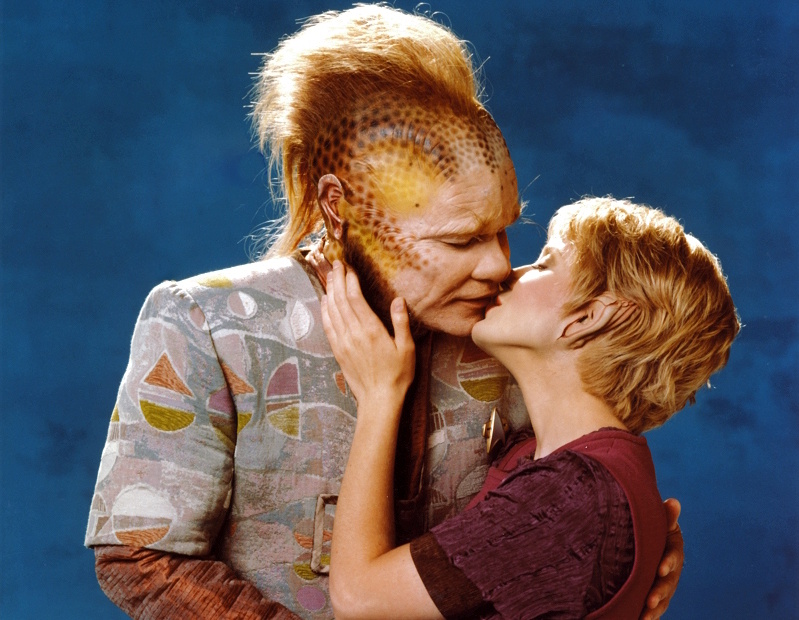
It’s time for Deep Space Nine and Voyager to get the HD treatment

Star Trek is divided right now. No, I don’t mean the divisions in the fanbase – though you can read my thoughts on that by clicking or tapping here – instead I’m referring to the fact that The Original Series, The Next Generation, Enterprise, all of the films, and all of the new series are in HD, while Deep Space Nine and Voyager aren’t.

Streaming has quickly become the biggest thing in home entertainment, replacing our DVD collections. Even ViacomCBS realised this, and set up their own streaming service. It’s thanks to the existence of CBS All Access, and the need to provide that new platform with original content, that Star Trek has been renewed at all. But before Star Trek found a new digital home, The Original Series and The Next Generation were remastered in high definition and got Blu-ray releases. Blu-ray, in case you didn’t know, is the optical disc format which was supposed to replace DVD a few years ago. Blu-ray discs can store much more digital data – 25GB as opposed to a mere 4.7GB for DVDs – meaning that full HD video content was possible.
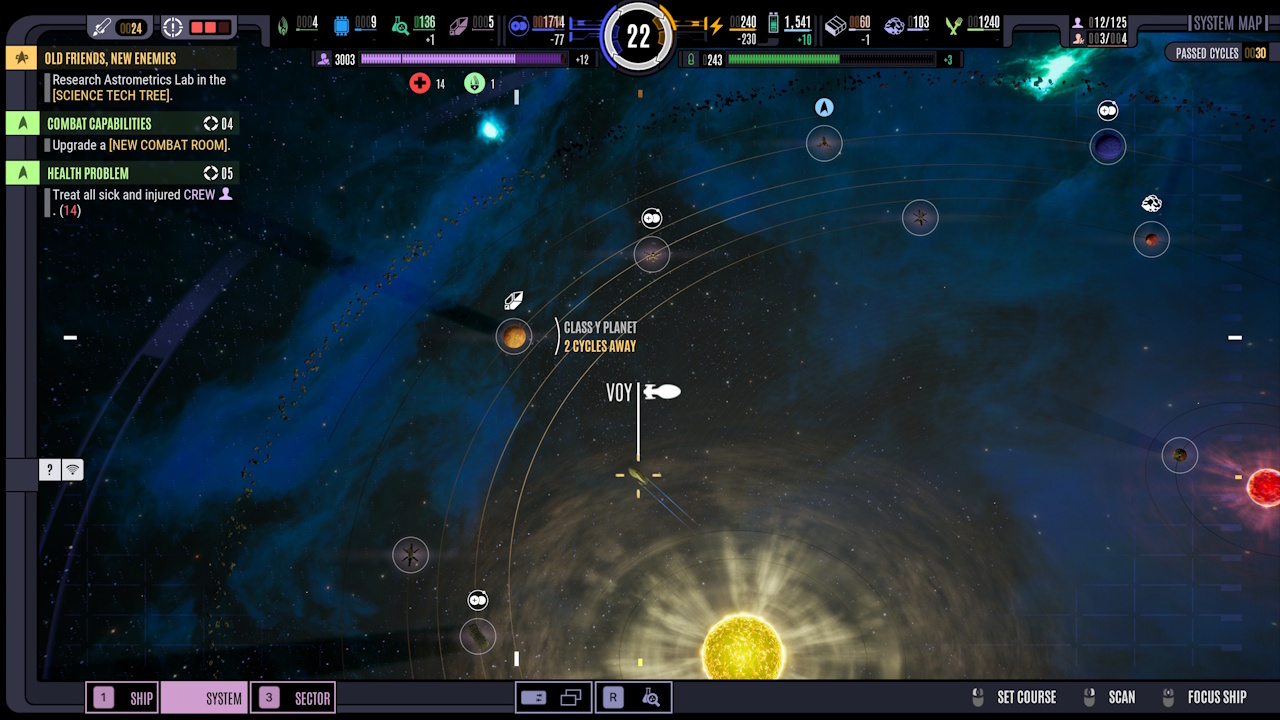
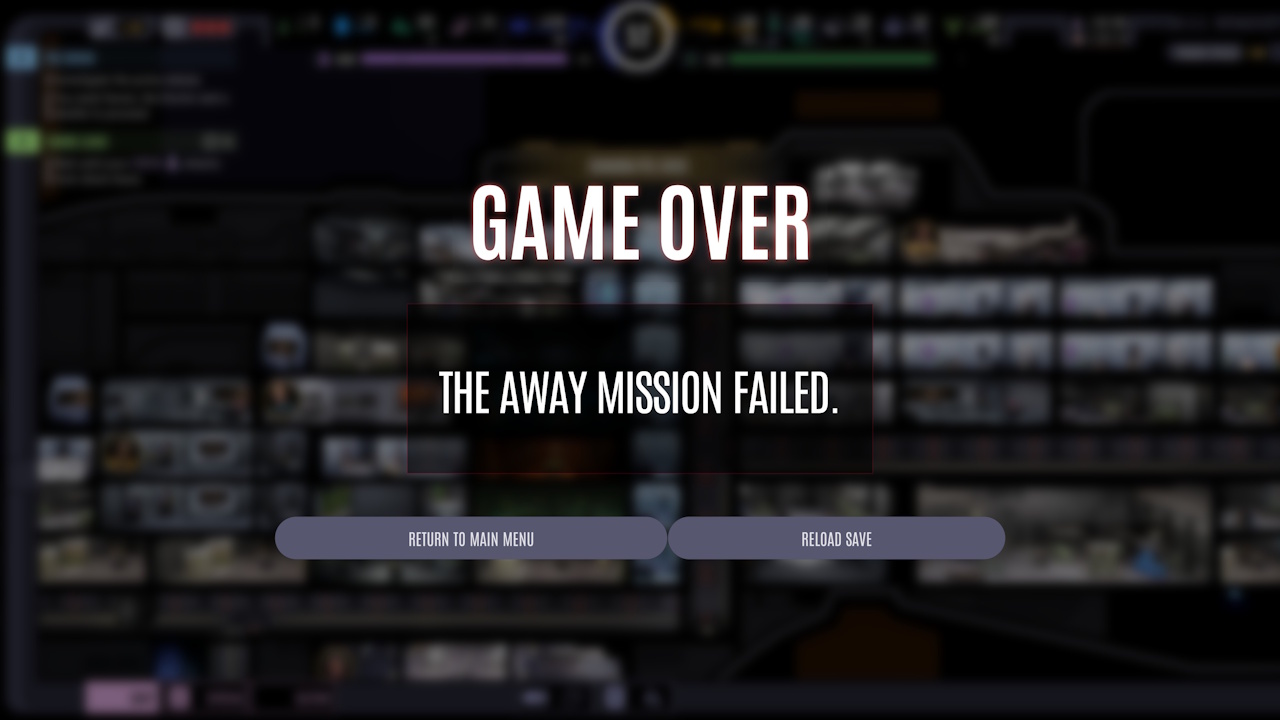
The opening sequence of Star Trek: Deep Space Nine.
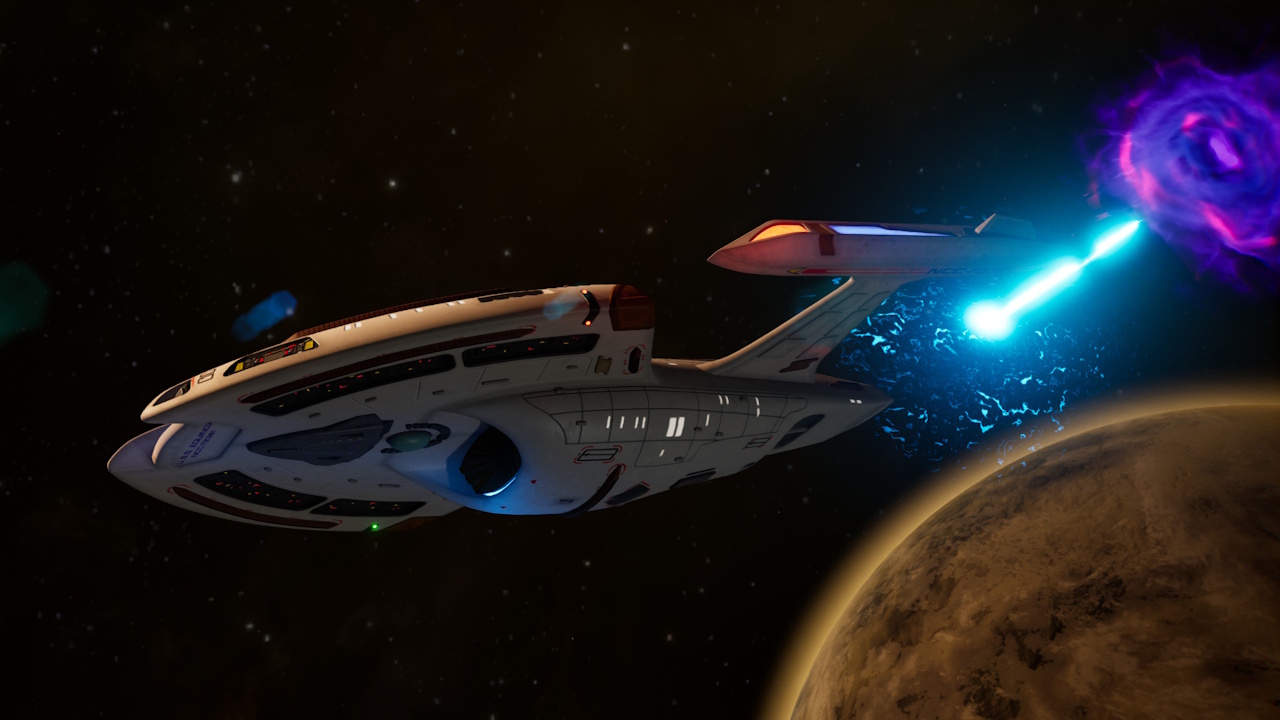
The resulting change from DVD-quality video, which had a resolution for digital video of 720×480 pixels, to Blu-ray, which offers a resolution of 1920×1080 pixels, meant that older episodes of Star Trek, filmed for television in the 1960s and 1980s-90s, had to be remastered. The remastering process exposed lower-quality special effects, which had to be entirely redone in order to look presentable at the higher resolution offered by Blu-ray. This was especially notable with some of The Next Generation’s early-90s CGI, which had been designed to be broadcast on the smaller screens of that era. Therefore the remastering process was far less straightforward than simply copying all of the broadcast episodes, upscaled, onto Blu-ray discs. Each episode had to be worked on, and new special effects and digital effects created from scratch, adding to the cost of the work.

By the time The Next Generation’s final season released on Blu-ray in 2014, a combination of factors came together to leave sales underwhelming from CBS’ perspective. Firstly there was the move by many consumers to online video streaming. Blu-ray had seemed exciting in the mid-late 2000s when it was new, but as platforms like Netflix gained traction in the 2010s, Blu-ray just never took off in the same way as DVD had a decade prior. Secondly, many people already owned The Next Generation in full either on VHS, DVD, or both. And despite the promise of remastered episodes with all-new digital effects, we were being asked to essentially buy the same product again for a second or third time. This combination of many fans already owning the full series plus Blu-ray and optical media as a whole feeling decidedly “last-gen” in a world of digital streaming meant many folks, myself included, didn’t pick up The Next Generation on Blu-ray.
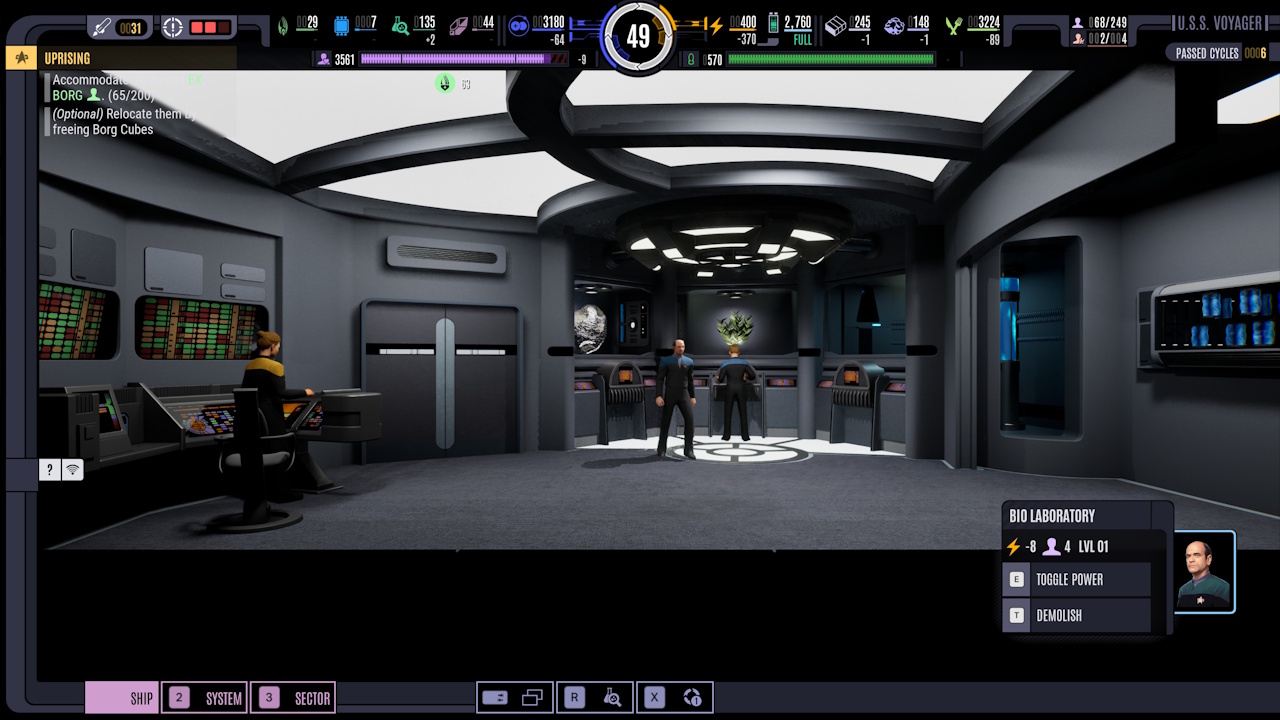
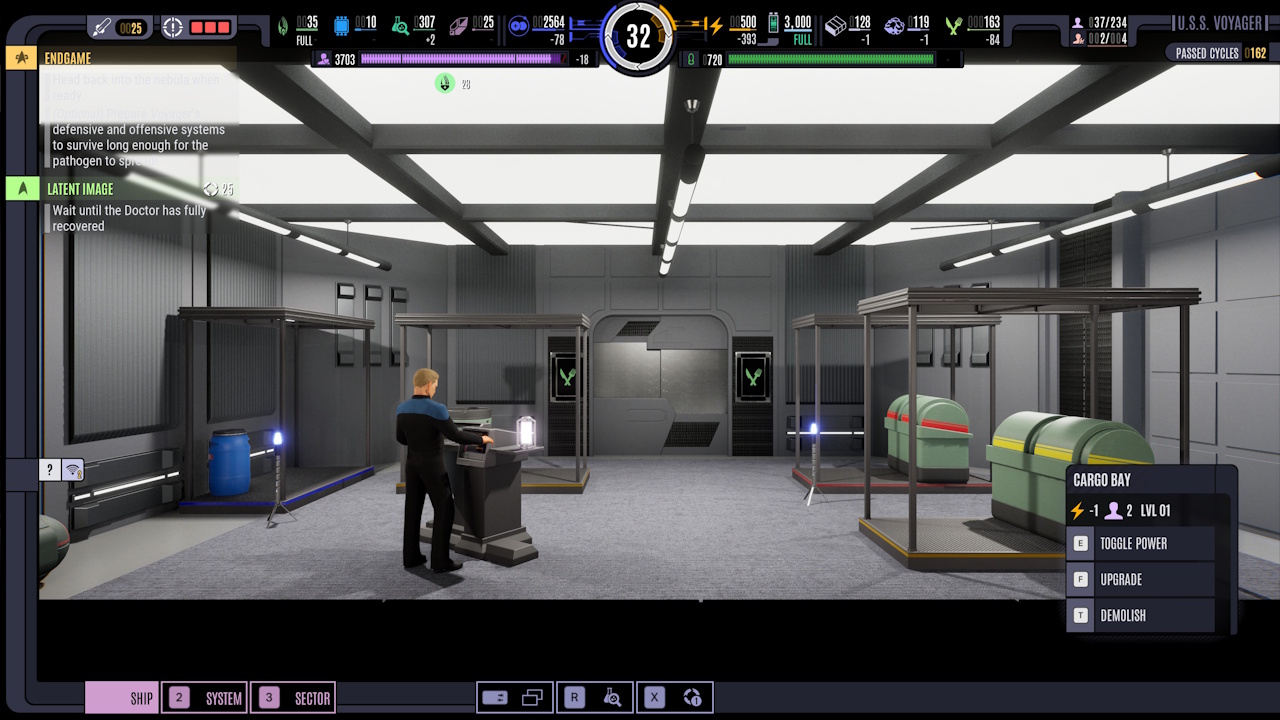
I certainly felt, in the mid-2010s, that sooner or later Star Trek would join one of these new streaming platforms and that I could simply watch the HD versions at that time. As someone who had been collecting Star Trek on DVD since the early 2000s (when The Original Series came in chunky plastic boxes), I already had the full collection by the time Blu-ray was out – I even had Enterprise, despite that being my least-favourite Star Trek show! The idea of having to re-start my Star Trek collection on a new format just wasn’t something I was keen on, so I waited it out. And, to be fair, the remastered episodes of both The Original Series and The Next Generation are now available for streaming – on CBS All Access in the US, or on Netflix in the rest of the world (though I wouldn’t be surprised if Amazon Prime Video snaps up the international rights now that they also have Star Trek: Picard).

Star Trek: Voyager ran from 1995 to 2001.

Unfortunately, though, the lack of interest in The Next Generation on Blu-ray has meant that Deep Space Nine and Voyager never made it to the remastering suite. They remain in their original format, in what we’d call “standard definition” or DVD quality. And there’s nothing wrong with that – they are, still, perfectly watchable on DVD or on streaming. But as television screens get larger and better, the difference in quality between a remastered episode of The Next Generation and an episode of Deep Space Nine, unchanged since its early-90s television debut, is incredibly obvious and offputting.

An increasing number of viewers expect HD content nowadays. With some shows – like Netflix’s The Witcher or Amazon Prime Video’s The Grand Tour – being broadcast in 4K resolution, which is one step higher even than Blu-ray, standard/DVD-quality content just doesn’t look good enough for a lot of people, and they don’t enjoy watching it. On a modern 4K television that could easily have a screen size of fifty inches or more, such content looks mediocre at best, and pretty crappy when compared to anything in HD.

ViacomCBS have their own streaming service now – CBS All Access – which is billed as the new home of Star Trek. However, two of those flagship shows, which people remember with fondness from the 1990s, are not up to current standards when it comes to visual quality, and that’s something ViacomCBS should address.

The remastering of Deep Space Nine and Voyager, combined with their permanent home online, would pull in subscribers to CBS All Access. Even fans who haven’t been moved by Discovery or Picard could be convinced to sign up to the platform if it would be the only place to watch their favourite series in HD. And I’m sure many of them would also give Discovery or Picard a try while they were there – it wouldn’t cost anything extra, after all. There would be no need for an expensive Blu-ray release, with the cost of printing thousands of discs and shipping them all over the world no longer necessary. And I’m sure Netflix and/or Amazon Prime would happily snap up the rights to a newly-remastered “classic” of the 1990s. Nostalgia is a big deal in today’s media landscape, after all.

A lot of folks seem to have given up on the idea of ever seeing those series in HD given the move toward online streaming and The Next Generation’s lacklustre performance on Blu-ray, but CBS All Access should be Deep Space Nine and Voyager’s ticket to a full-HD remaster. The Star Trek brand would then be all together, all remastered, all fully in HD ready for new and old fans to join the party. I’m absolutely certain that, in the long run, ViacomCBS would find it worthwhile. What We Left Behind, the recent documentary about Deep Space Nine, included some remastered scenes, and its successful crowdfunding campaign should demonstrate that there is a viable market for such content.

The CBS All Access logo.

From a branding point of view, it isn’t a great look for CBS All Access to be offering some of its content for its flagship franchise in DVD quality. Netflix doesn’t do that, Amazon Prime Video doesn’t do that, and Disney+ certainly doesn’t do that. CBS All Access is the only paid-for streaming platform in the world right now offering two full seven-season series in low quality, and that’s bad for the brand. It makes it seem like ViacomCBS can’t be bothered to put in the effort; it makes CBS All Access look cheap. And for fans who don’t follow all the ins and outs of Star Trek, it could be an unexpected disappointment: they sign up, log in for the first time, and choose their favourite episode – only to find that it looks poor on their big-screen TV.

So come on ViacomCBS! Remaster Deep Space Nine and Voyager. Bring the final two Star Trek shows into the 2020s and give your own platform a nice little boost in the process.

The Star Trek franchise – including all titles mentioned above – is the copyright of ViacomCBS. This article contains the thoughts and opinions of one person only and is not intended to cause any offence.