Spoiler Warning: Beware of spoilers for the following Star Trek productions: The Next Generation Season 1, Deep Space Nine Season 6, Voyager Season 1, Generations, Star Trek ’09, Discovery Season 2, and Picard Season 2.
Almost four years ago I had a lot of fun writing a piece here on the website called “What If…? Star Trek Edition!” I took the basic concept behind the then-new Marvel miniseries What If…? and applied it to several storylines from the Star Trek franchise that I found interesting. Speculating and getting creative was a blast, so… let’s do it again!
If you missed the miniseries (or my earlier post), I’ll briefly explain how this works! We’re going to look at five stories from across the Star Trek franchise and ask a simple question: what if things went differently? What would the consequences be for Starfleet, the Federation, and some of the characters we’ve come to know and love if, for example, Spock wasn’t resurrected on the Genesis Planet or Captain Janeway and the USS Voyager tried to reach the Gamma Quadrant terminus of the Bajoran wormhole? I covered both of those topics in my post from 2021, by the way, so be sure to check it out – you can find it by clicking or tapping here.
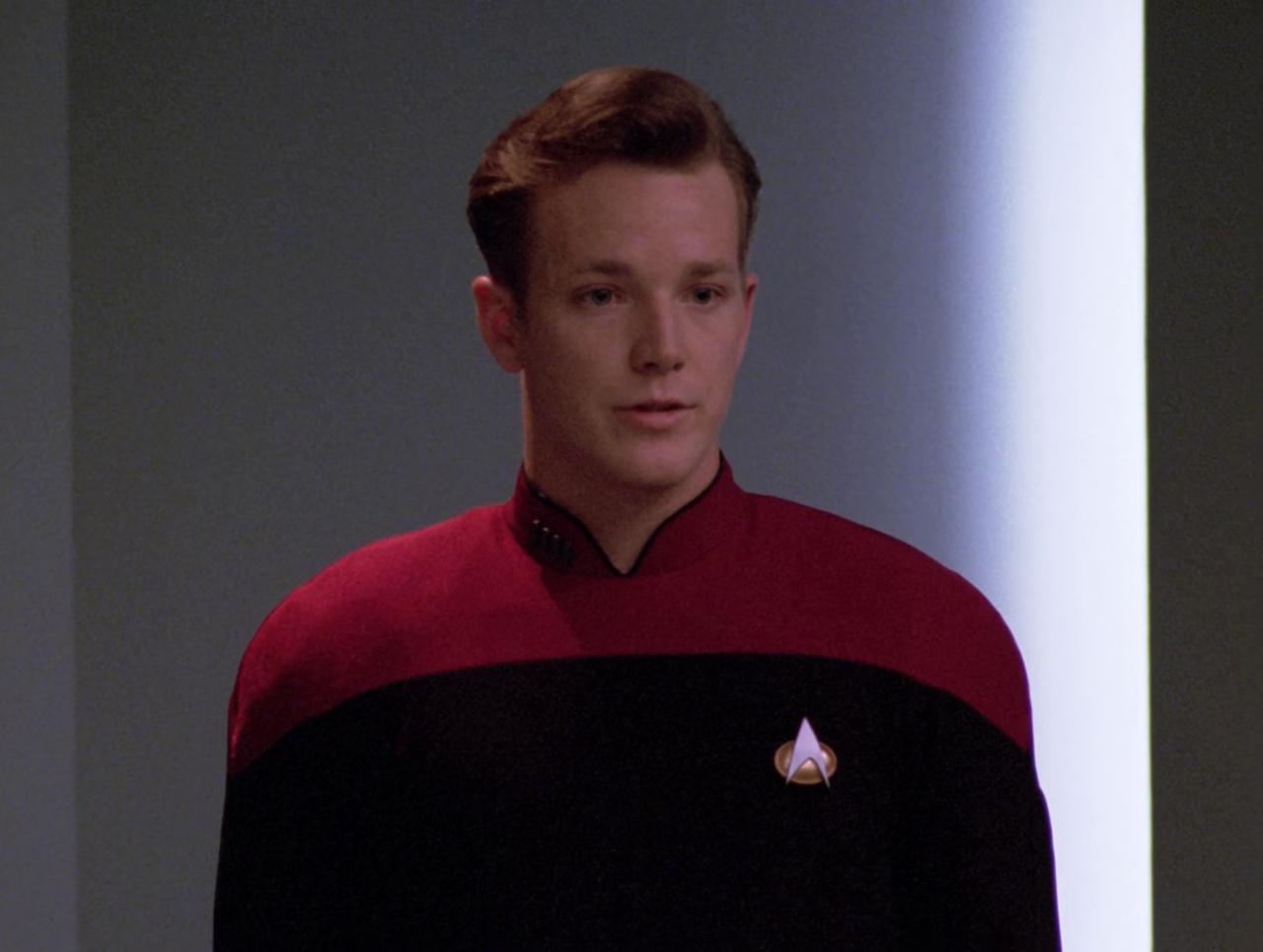
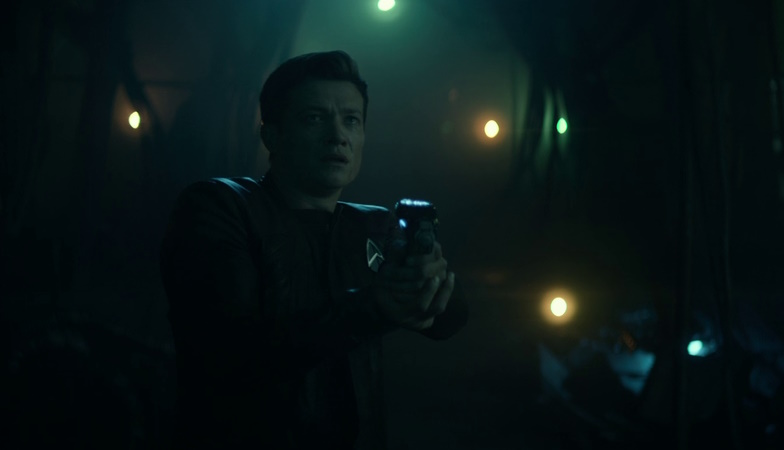
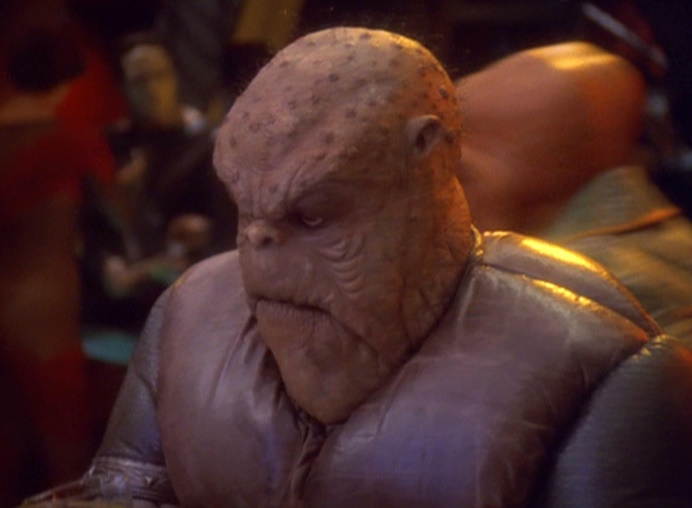
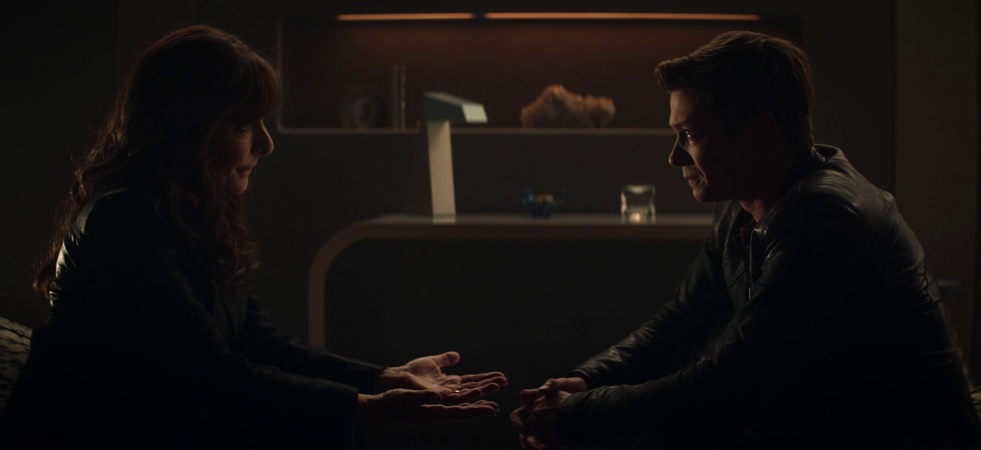
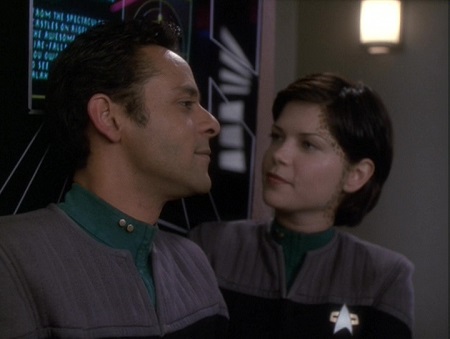
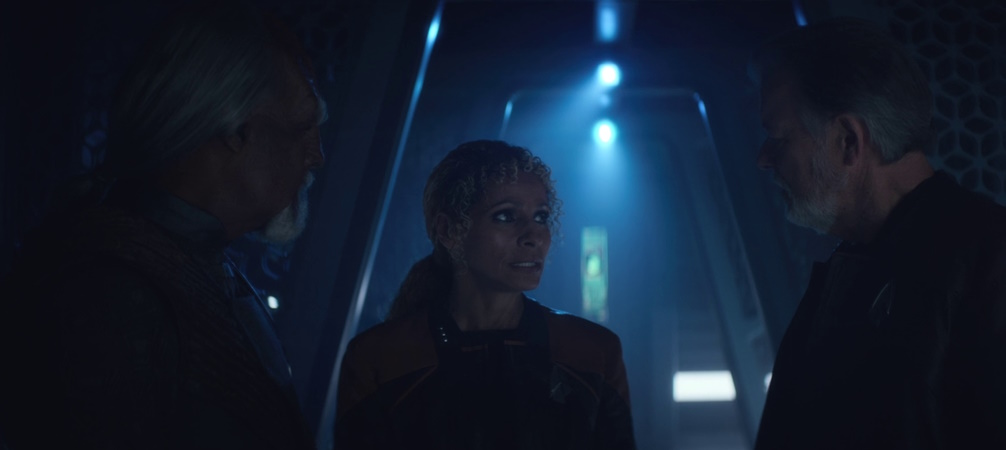
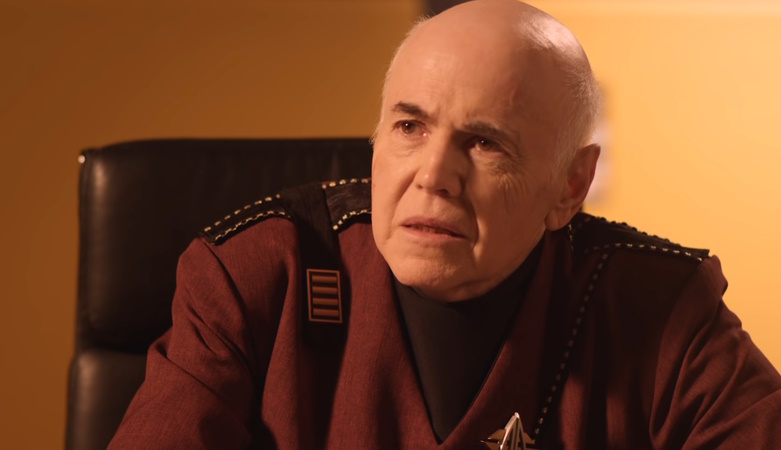
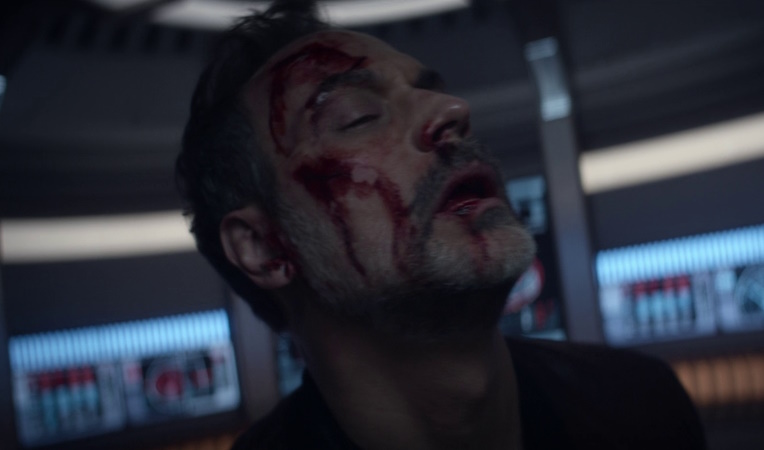
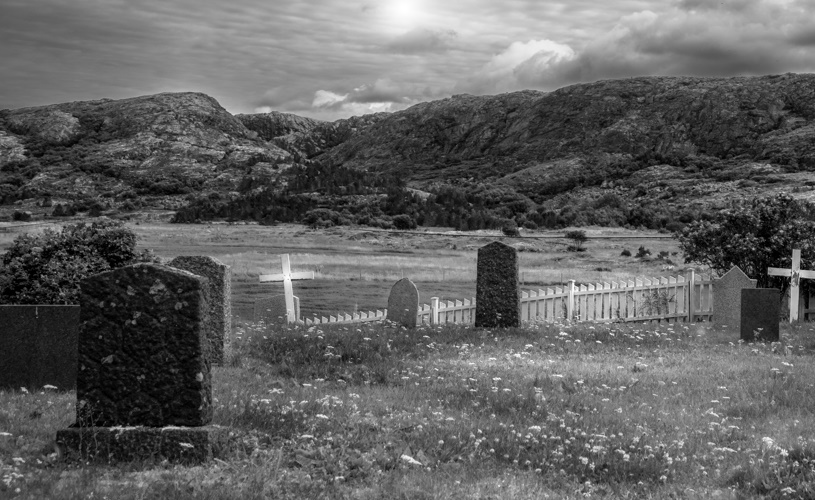
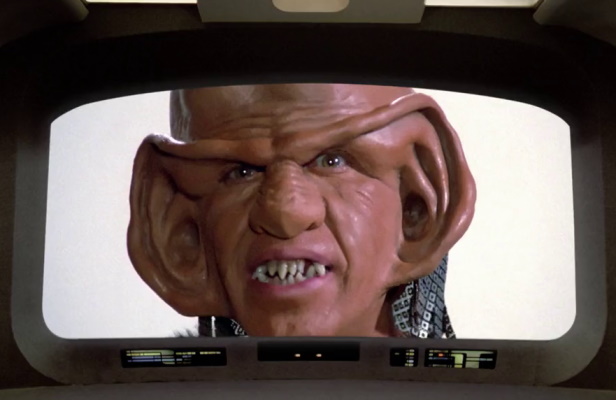
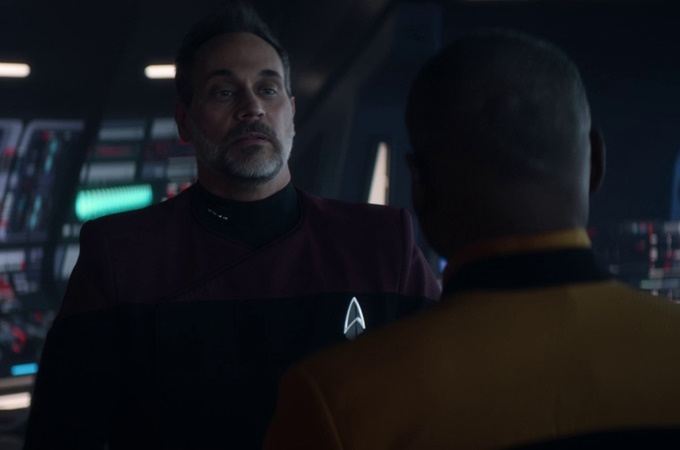
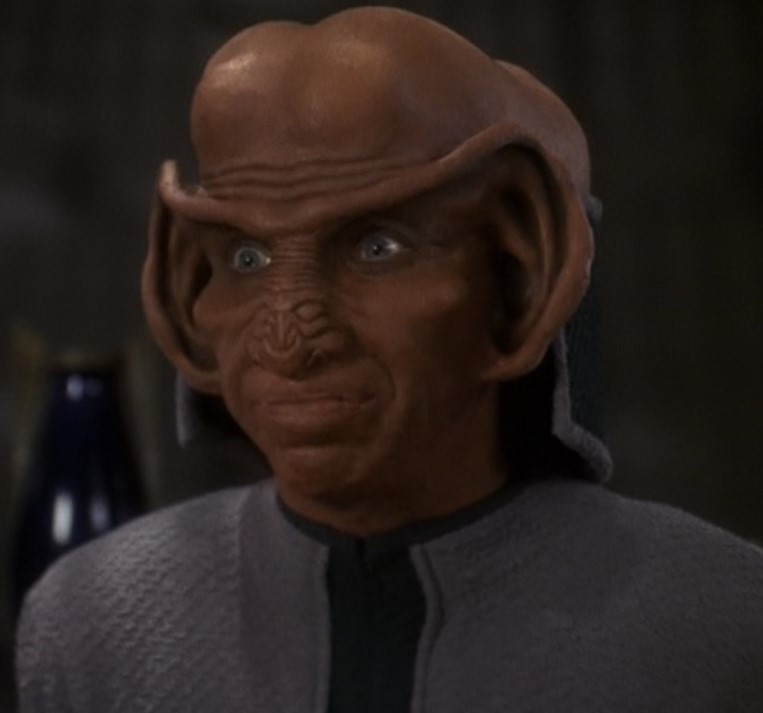
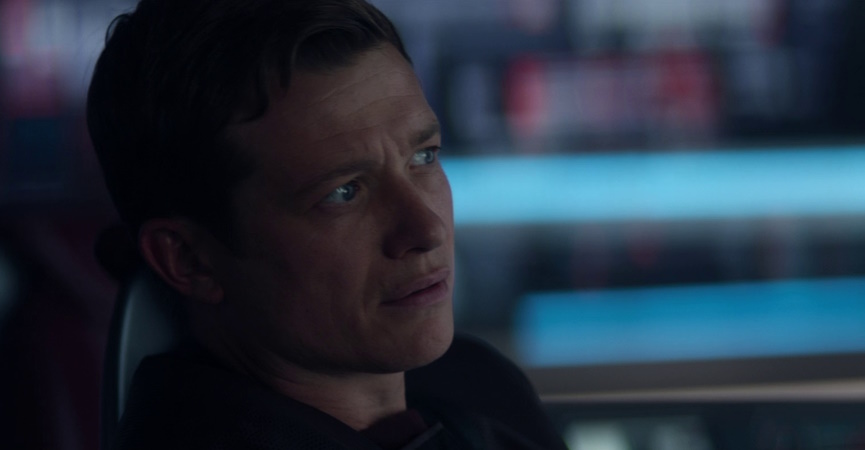
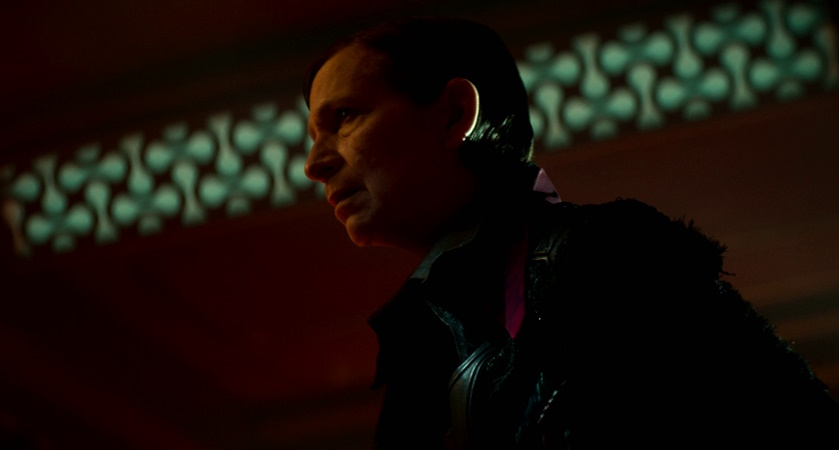
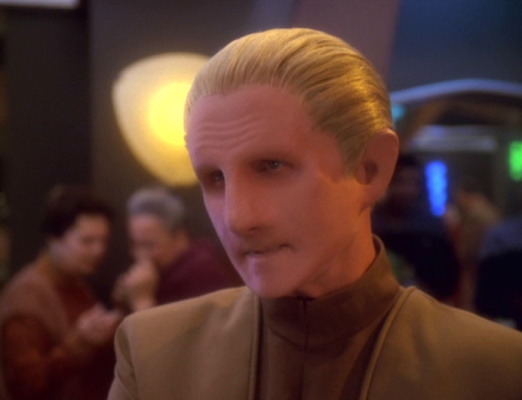
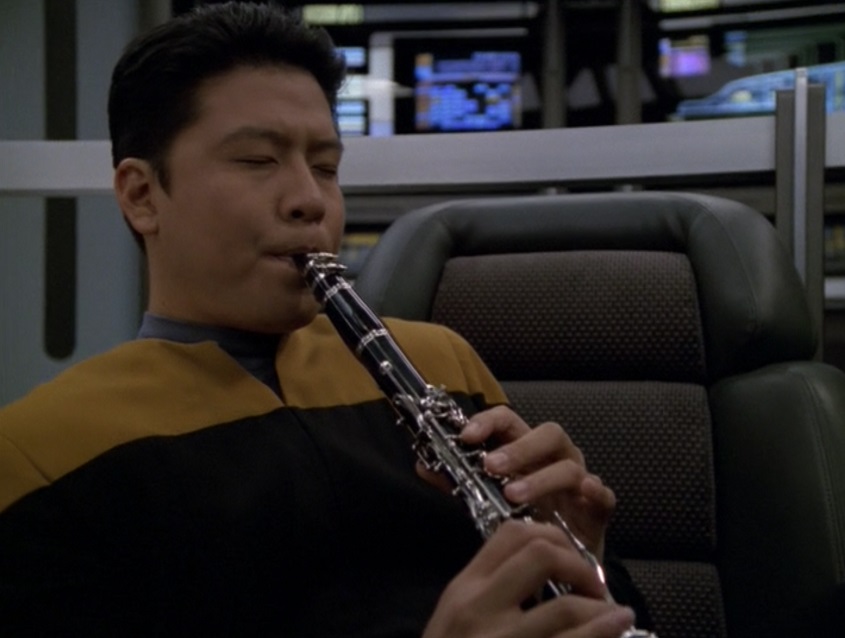
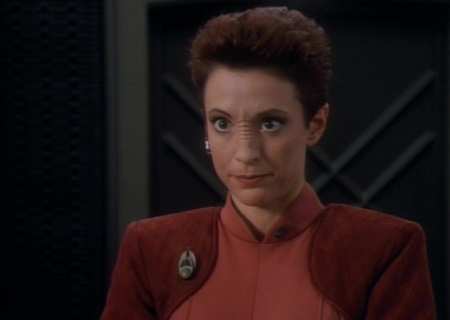
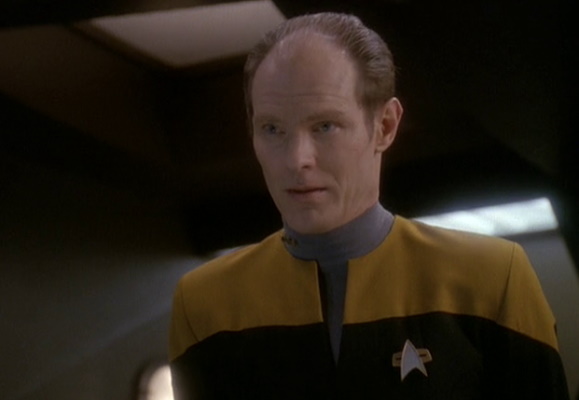
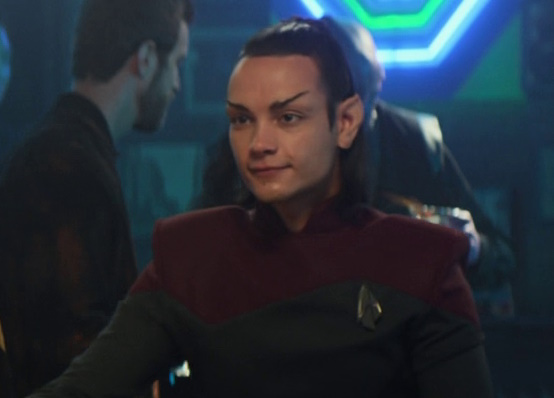
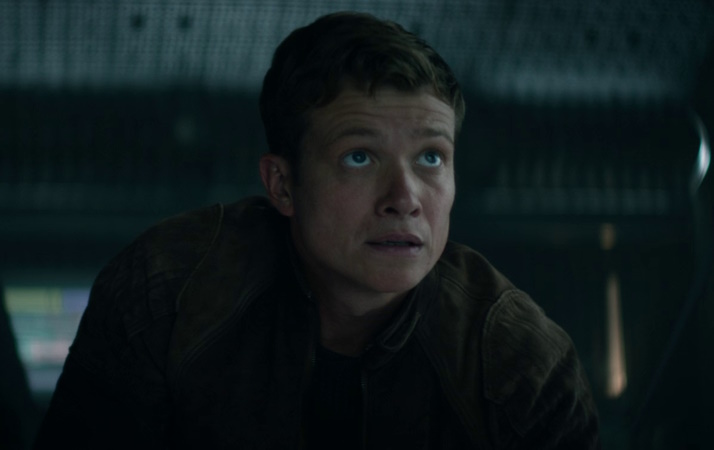
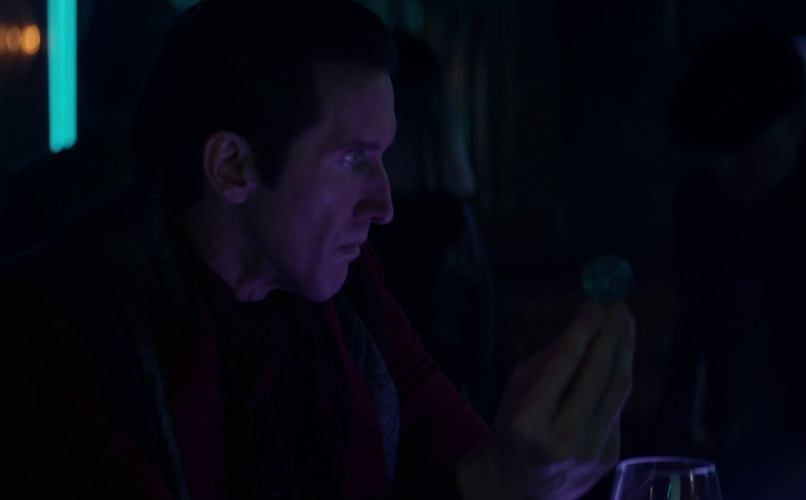
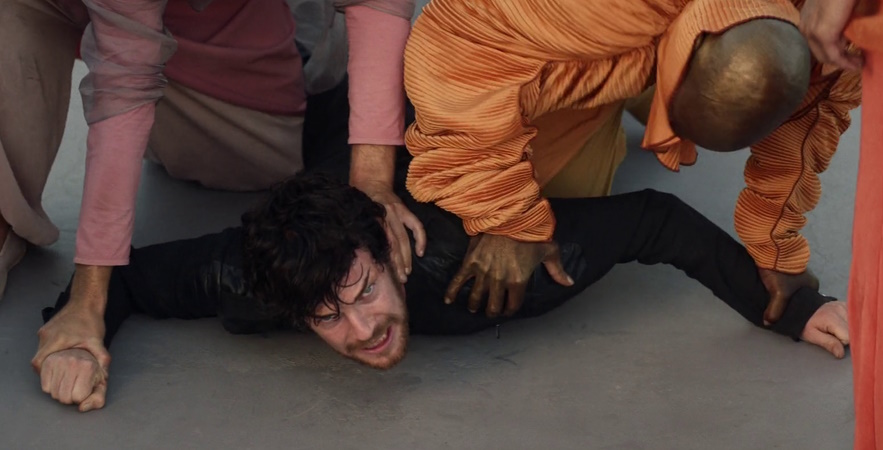
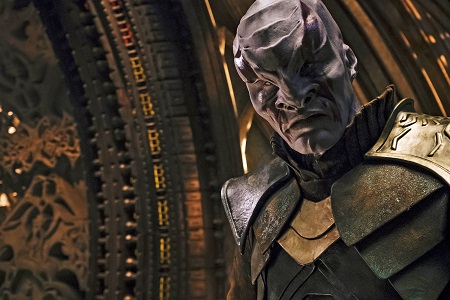
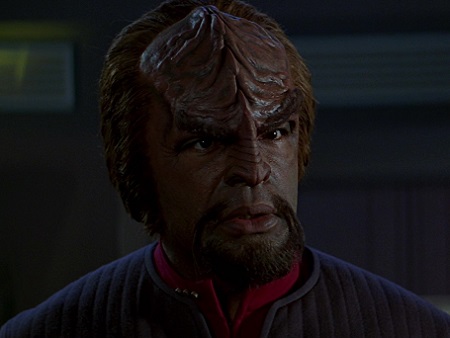
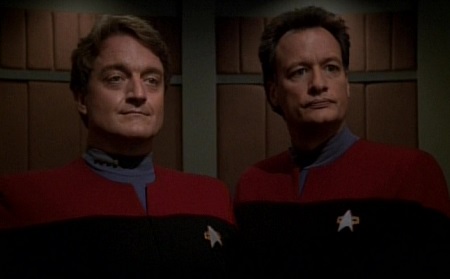
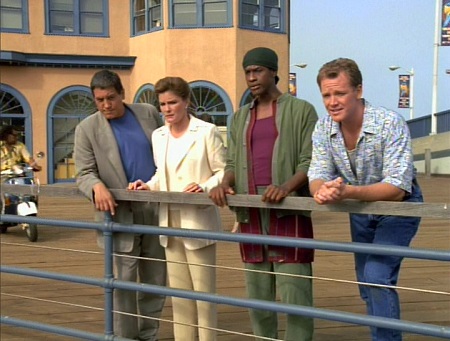
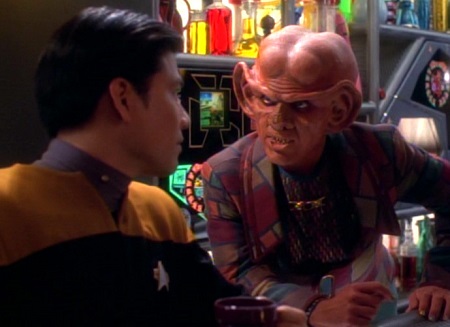
Harry Kim and Quark.
Alternate history has been an interest of mine for a long time – so we can consider this an “alternate history of the future,” if you like! With the Star Trek franchise slowly but surely heading toward the 1,000-story mark, there are a lot of places where narratives could branch, and where the Star Trek galaxy could end up in very different situations! As a Trekkie, and as someone who likes to spend time in this setting, it’s a ton of fun to come up with these ideas and consider how they might play out.
As always, a couple of important caveats! All of this is the entirely subjective take of one old Trekkie. If you hate all of my ideas, think I’ve got the wrong end of the stick, or if I miss something that seems totally obvious to you… that’s okay! There ought to be enough room in the Star Trek fan community for differences of opinion. None of this is close to being “canon,” anyway, so there’s even less of a reason to get upset about completely made-up Star Trek stories that will never be seen on screen!
Alright, let’s jump into the “what if” scenarios!
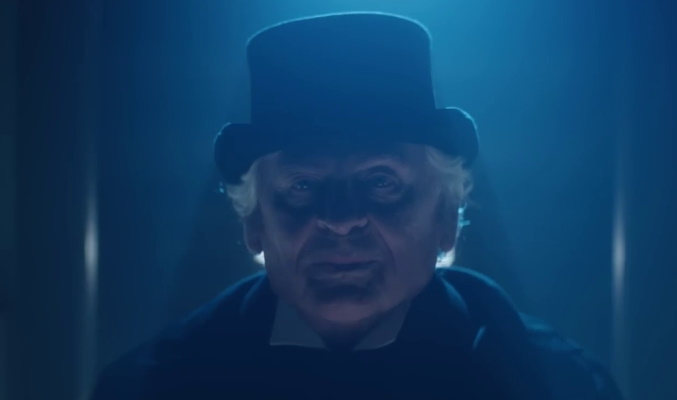
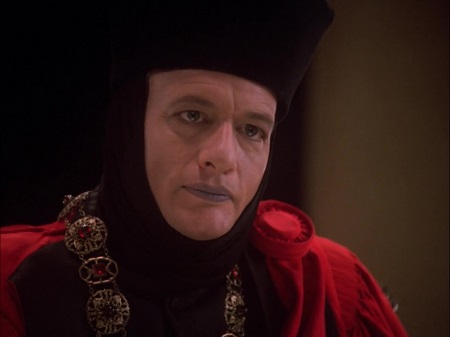
What If…? #1: What if… Captain Picard and Q never met? The Next Generation, Picard Season 2
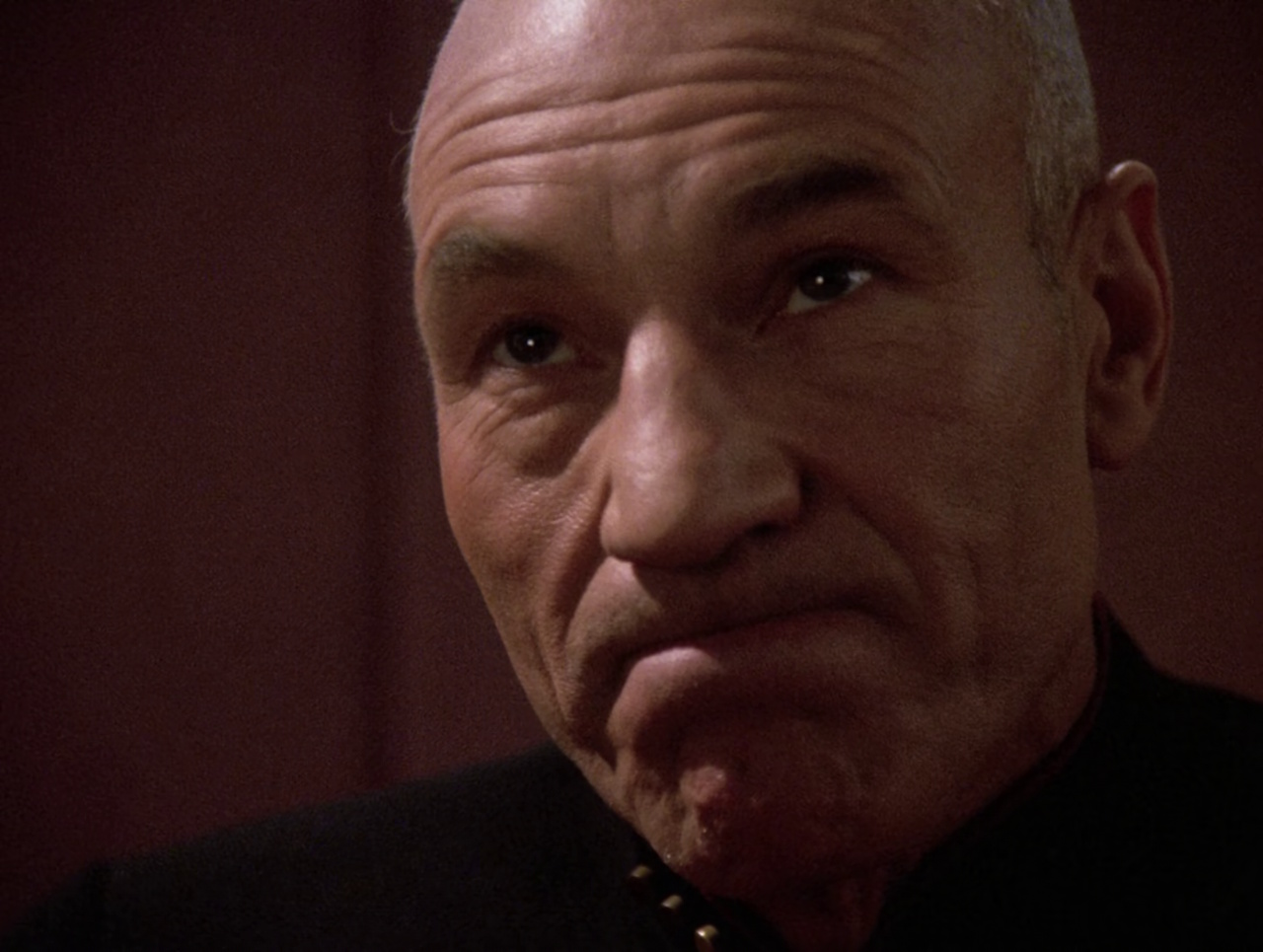
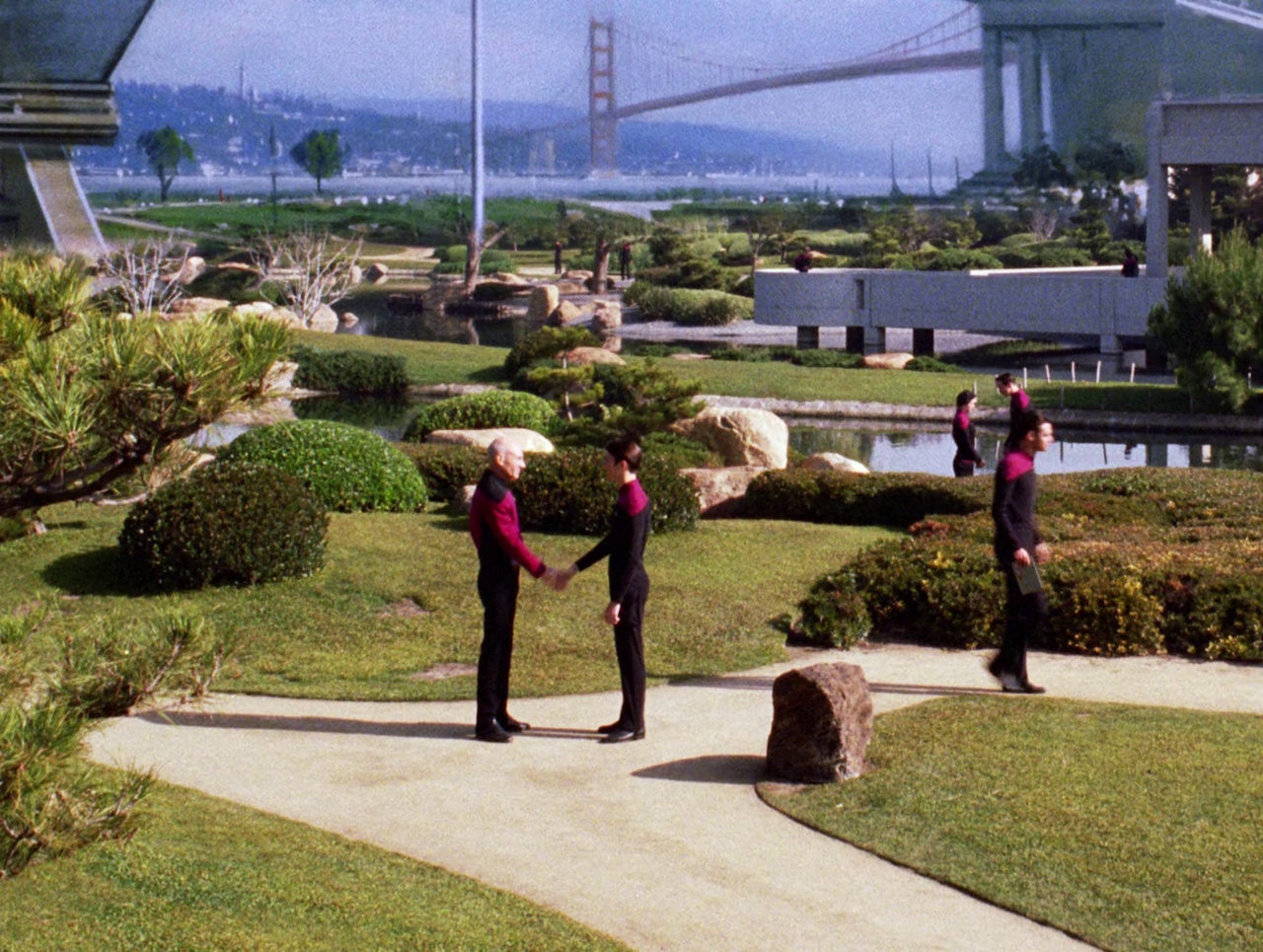
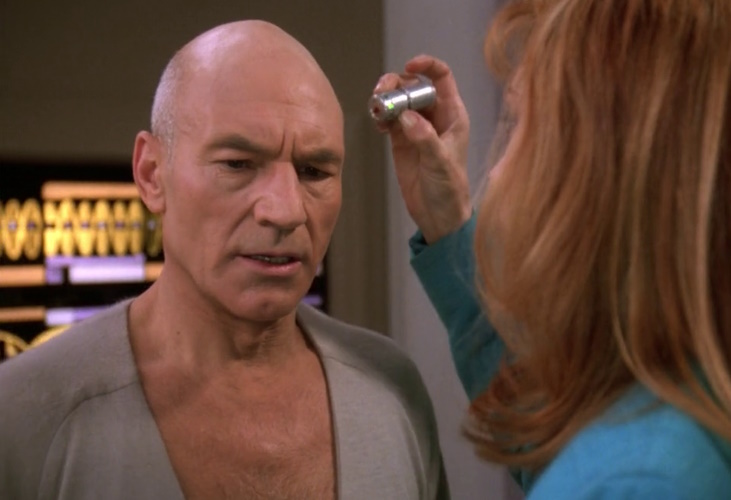
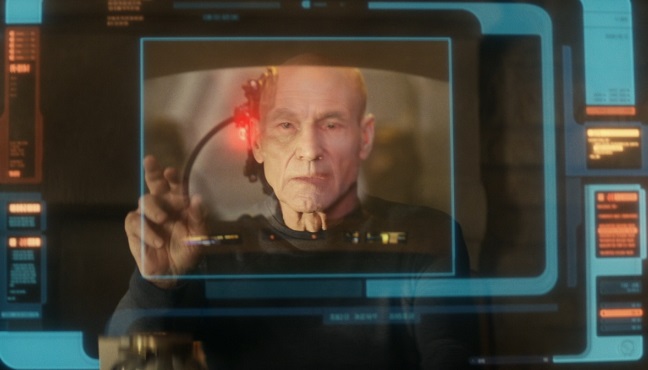
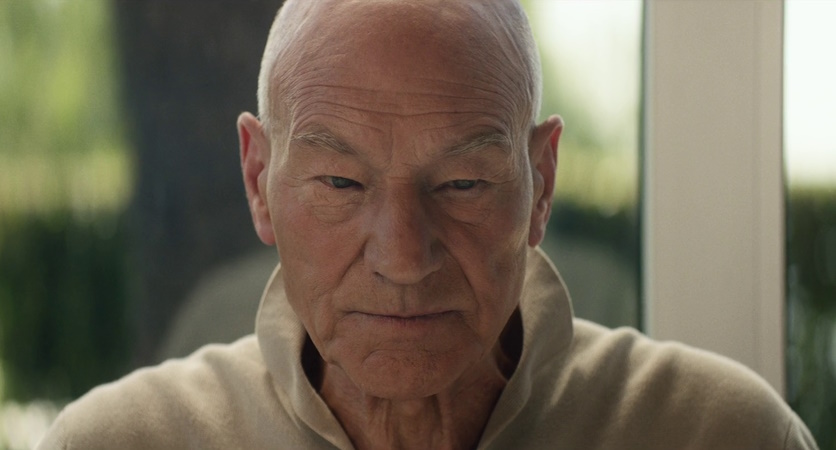
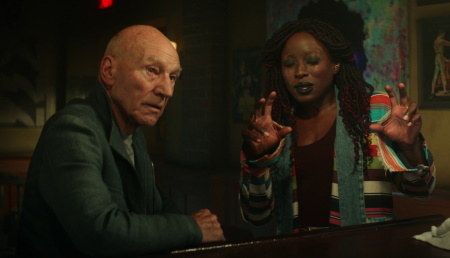
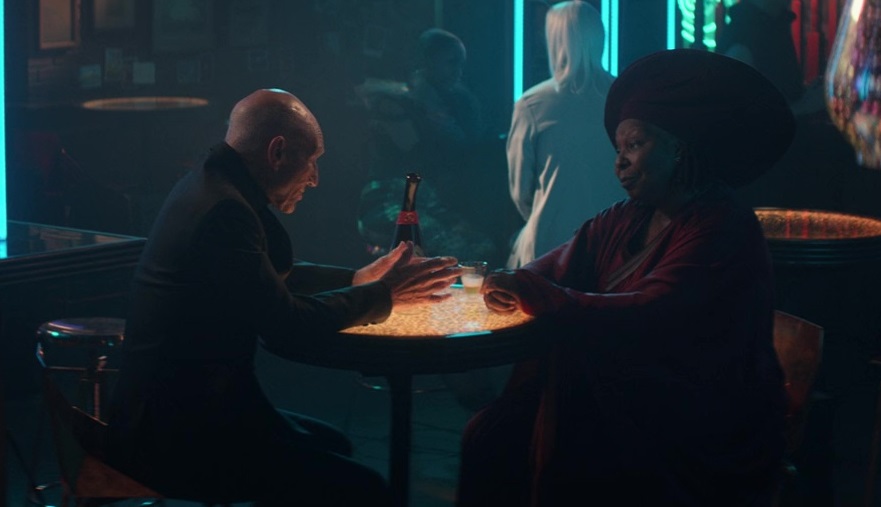
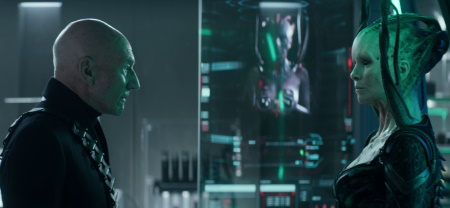
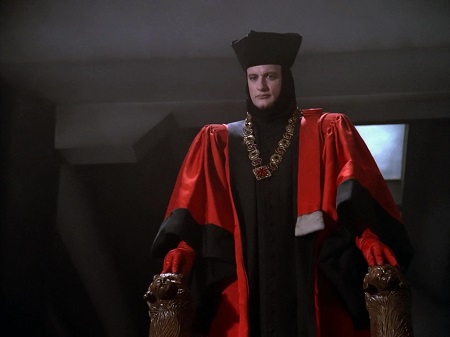
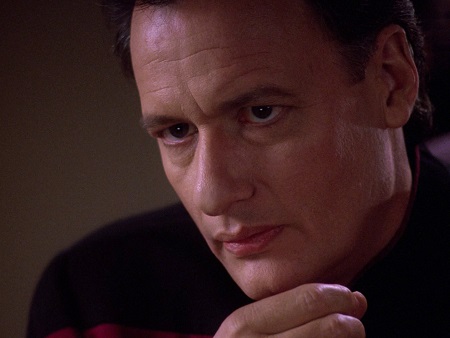
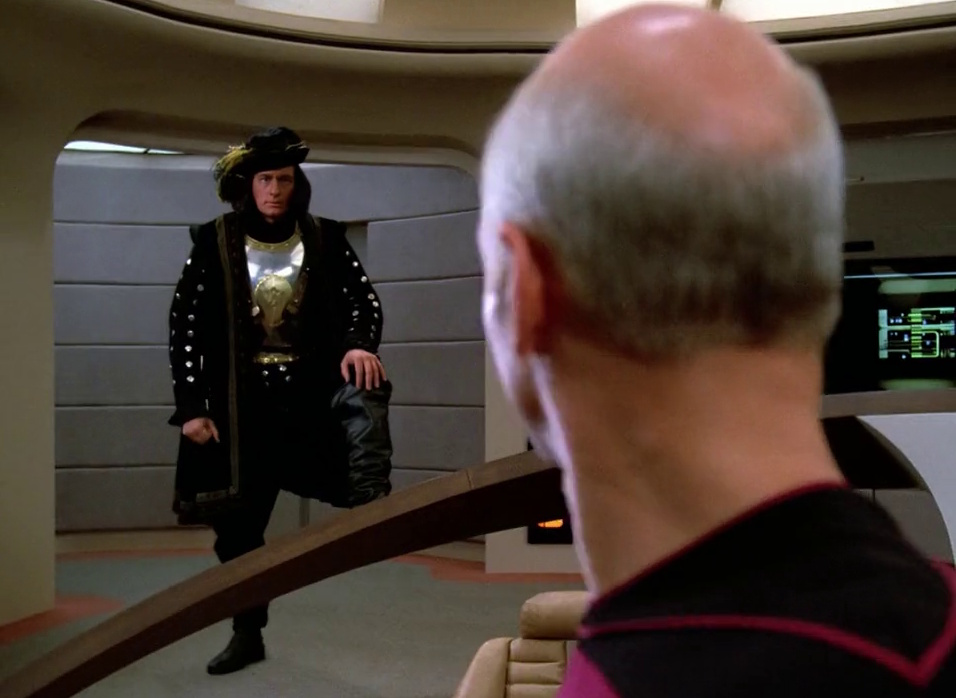
Picard’s first encounter with Q.
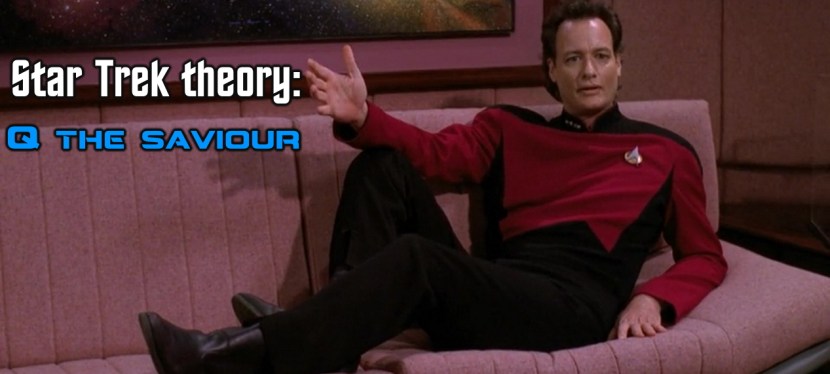
This is a really interesting one – and it might not go the way you think! Looking back over Picard’s run-ins with Q during The Next Generation, there really aren’t many places where we could say that their interactions had wide-ranging consequences. I have my pet theory that Q deliberately saved Picard and the Federation by making them aware of the Borg threat (click or tap here for that one, it’s one of my favourite Star Trek theories!) but that’s not the angle I’m gonna take today. In this case, we’re going to say that – for whatever reason – Picard and Q never met, never developed their complex relationship, and Q never set any puzzles for Picard to solve. In fact, Q stayed away from humanity and Starfleet altogether in this alternate timeline.
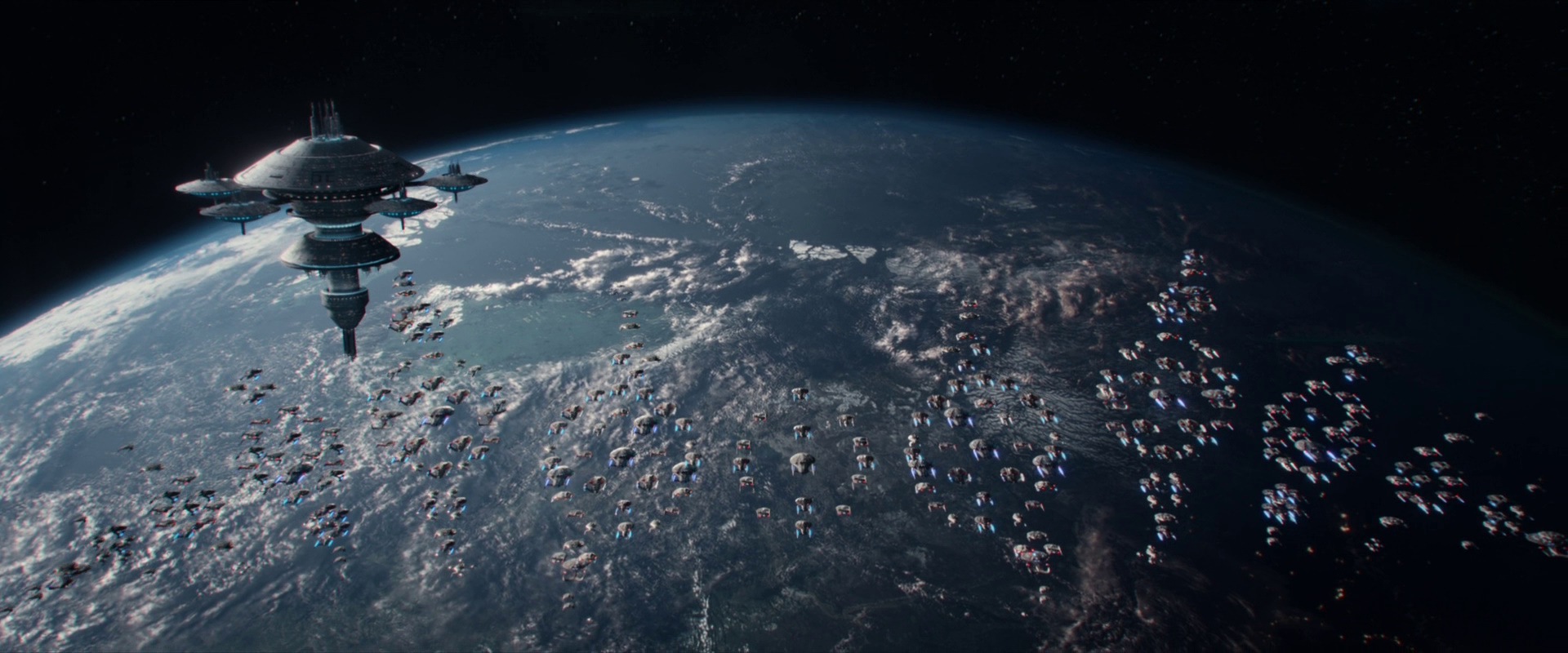
As noted, Q’s interactions with Picard and the crew of the Enterprise-D almost always involved problems or scenarios of his own devising. So without Q on the scene, the Enterprise-D’s mission actually proceeds slightly more smoothly than it did in the series; the absence of Q doesn’t matter in a big way to the seven-year cruise. Every other episode and story plays out more or less the same, from the mystery at Farpoint Station to the ship’s destruction over Veridian III. Picard assumes command of the Enterprise-E, then the Romulan rescue armada, before retiring from Starfleet.
The voyages of the starship Enterprise would proceed in exactly the same way… just without Q’s occasional shenanigans!
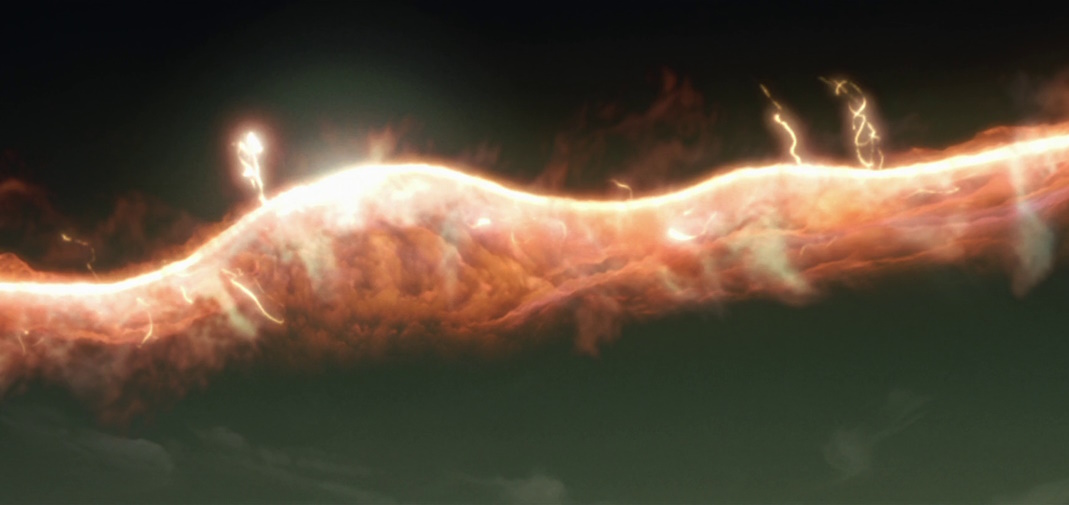
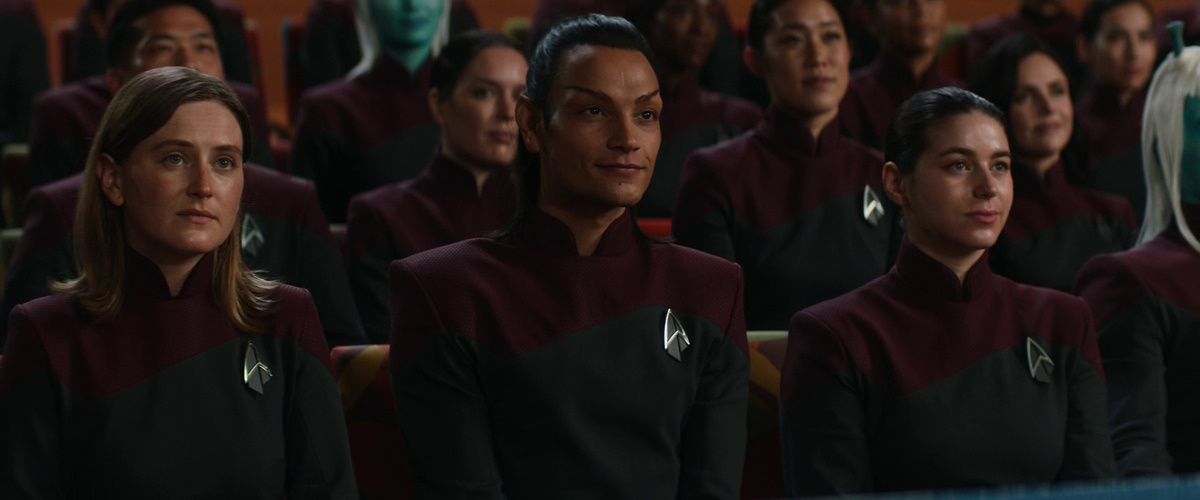
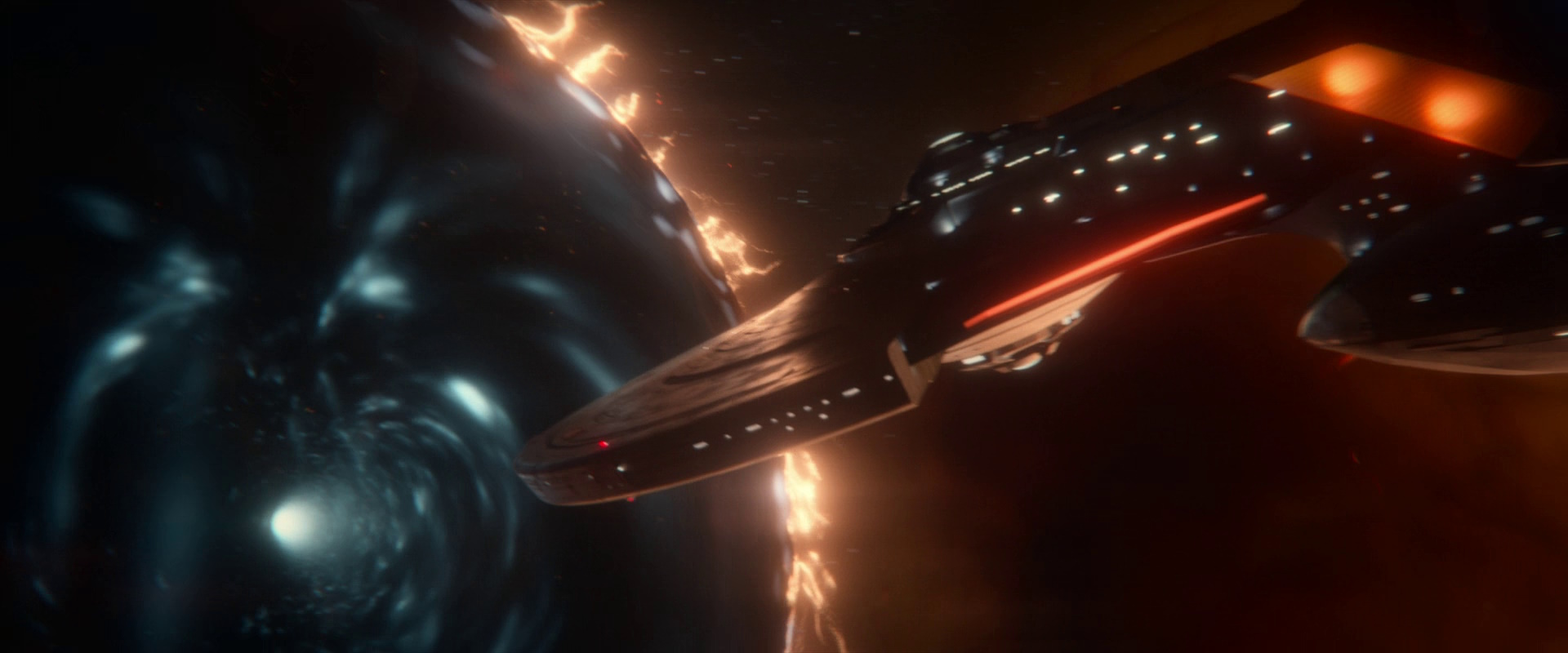
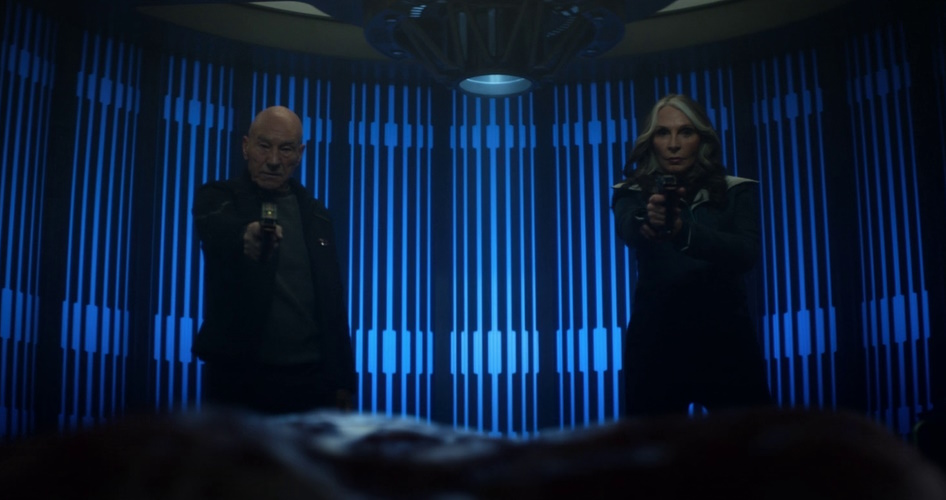
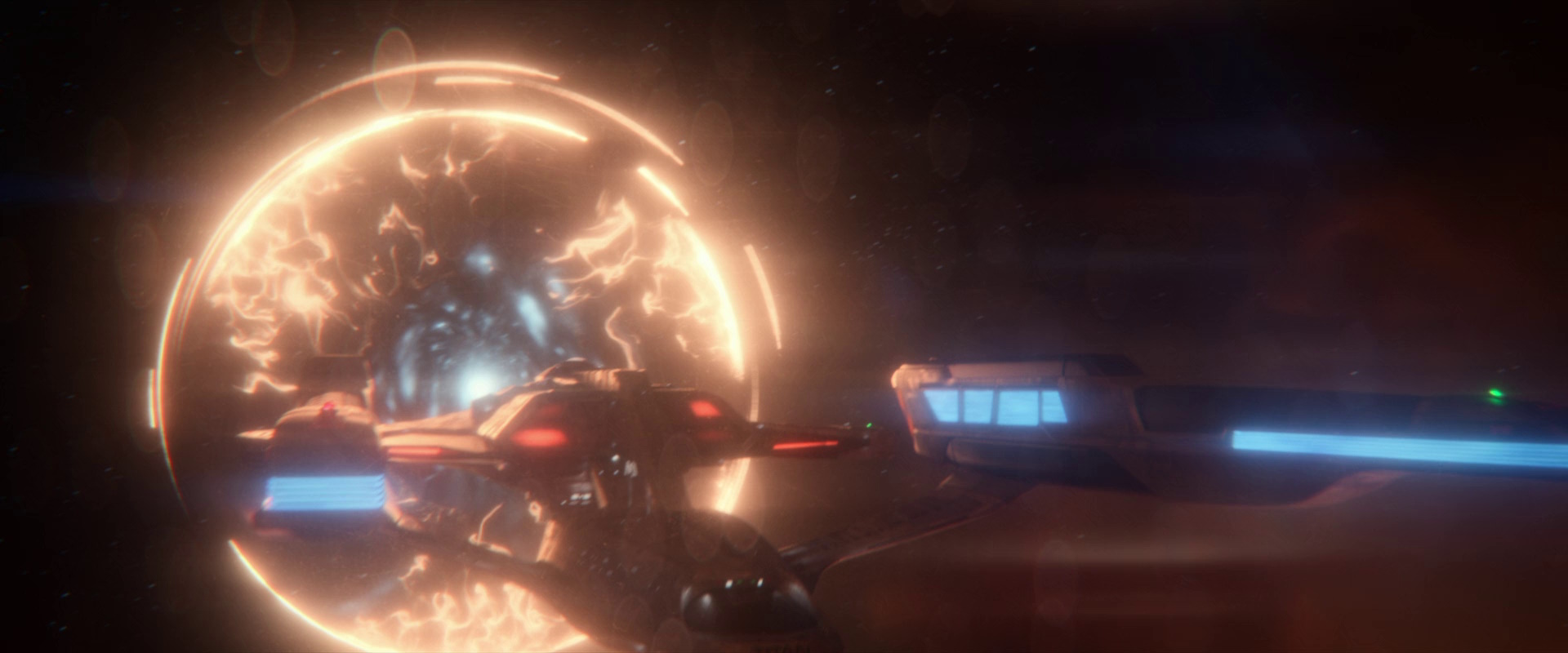
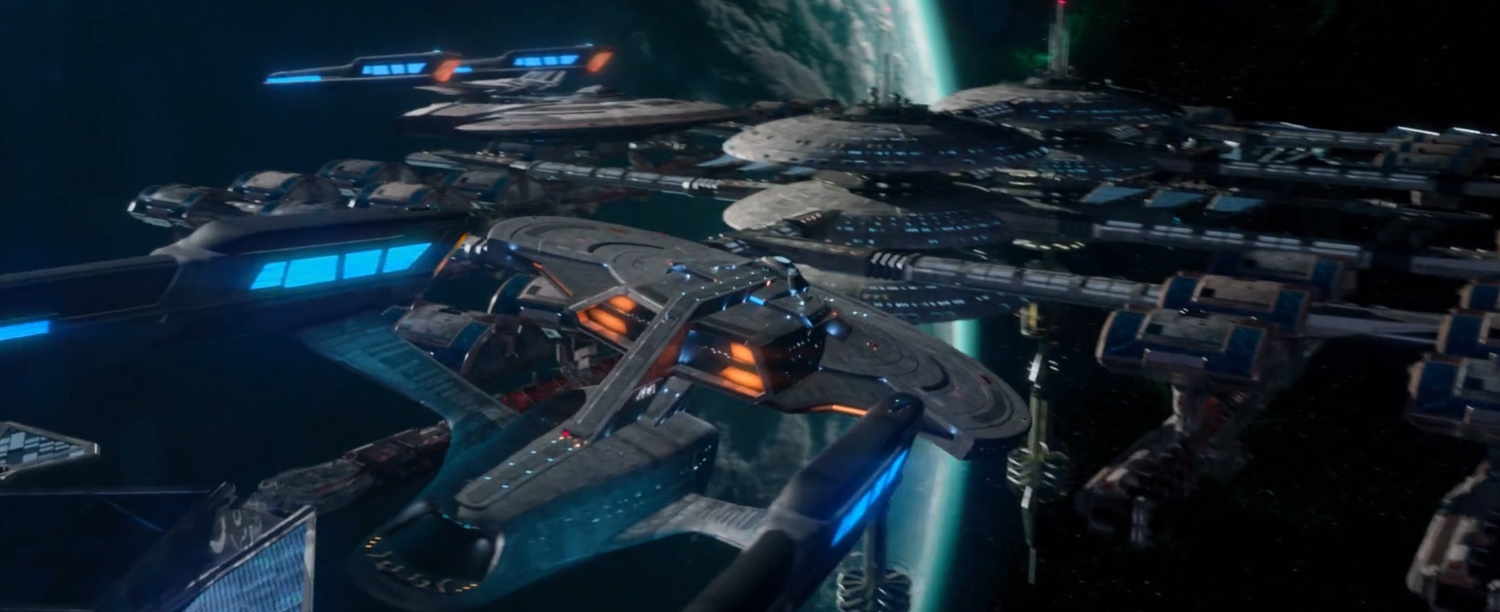
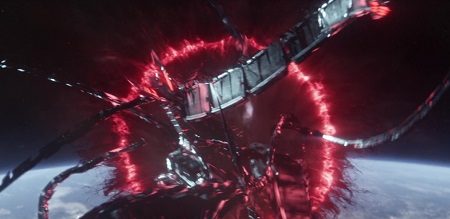
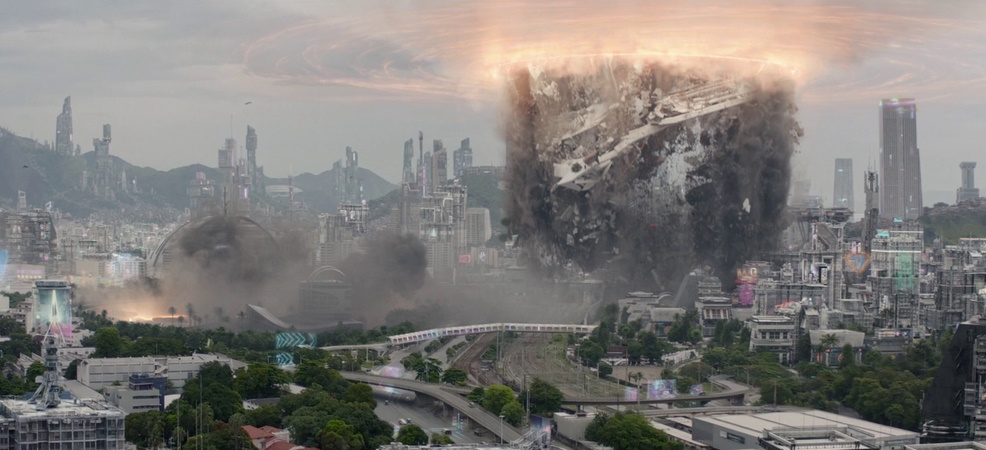
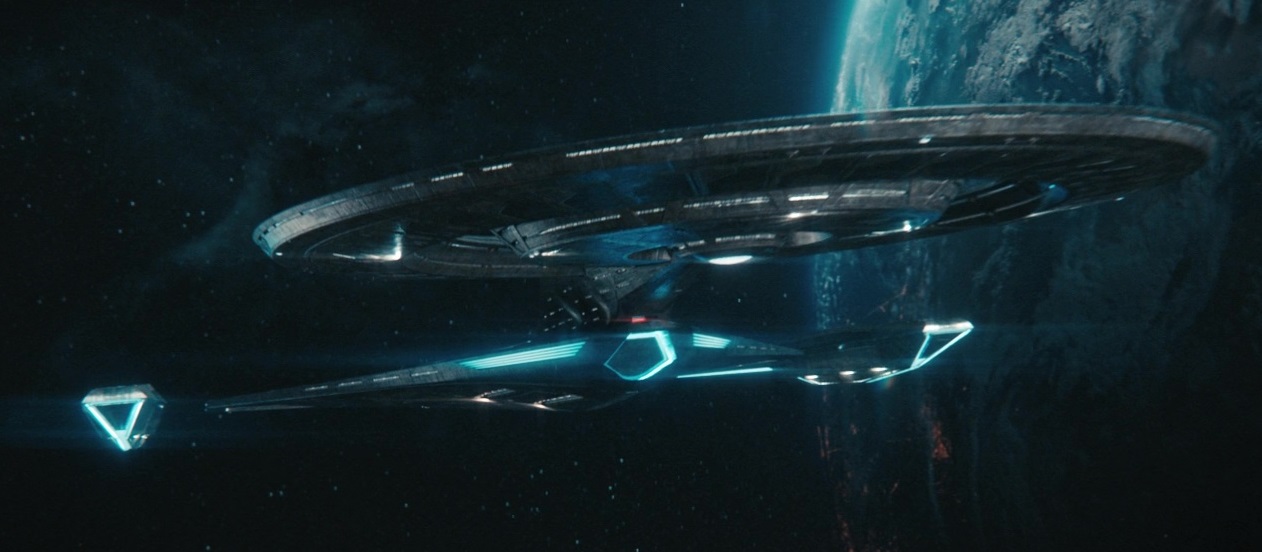
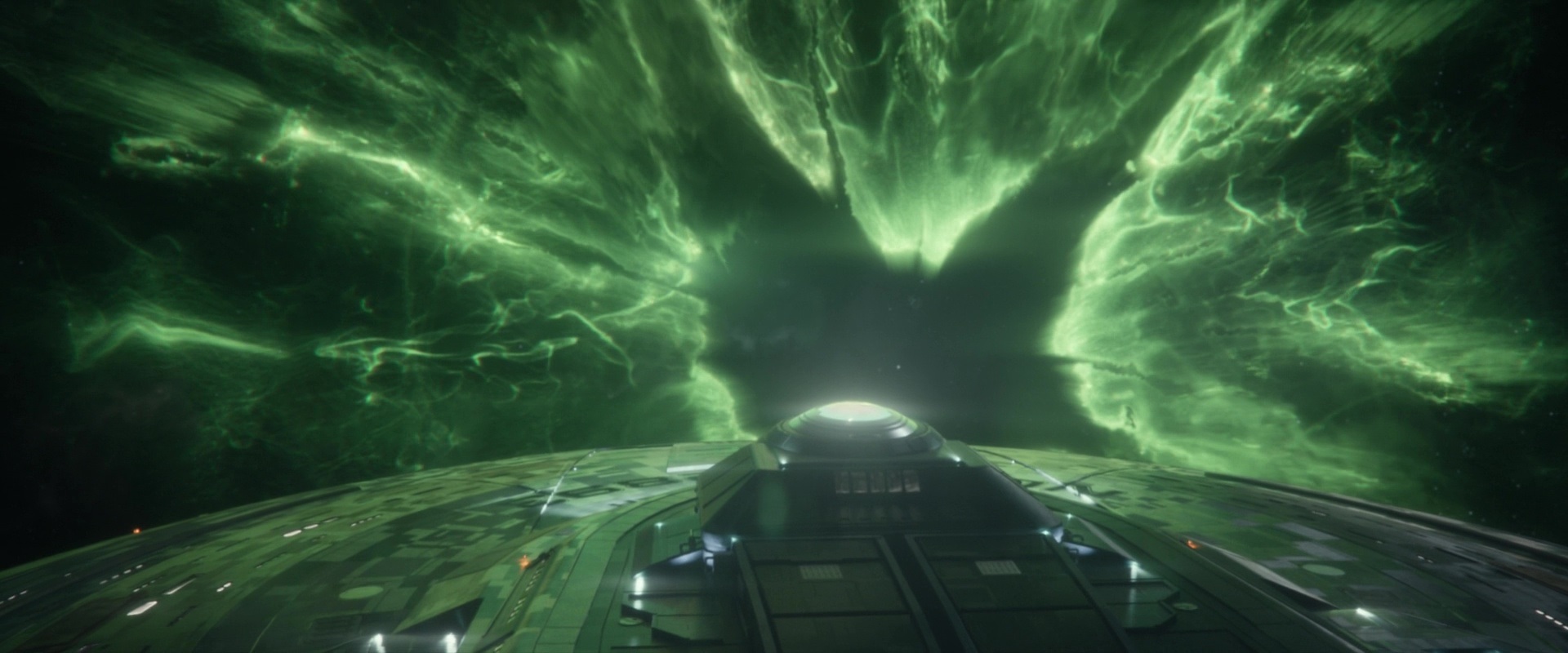
But here’s where things change. After the mission to rescue Soji and being named Chancellor of Starfleet Academy, Admiral Picard is aboard the USS Stargazer when a mysterious anomaly is detected. The Stargazer, the Excelsior, and a handful of other ships race to the scene, where they’re confronted by a massive subspace anomaly that Seven of Nine thinks could be a huge transwarp conduit. Attempts at communication fail, and with only a handful of Starfleet ships on the scene, there’s no way to prevent the conduit from unleashing its triquantum waves.
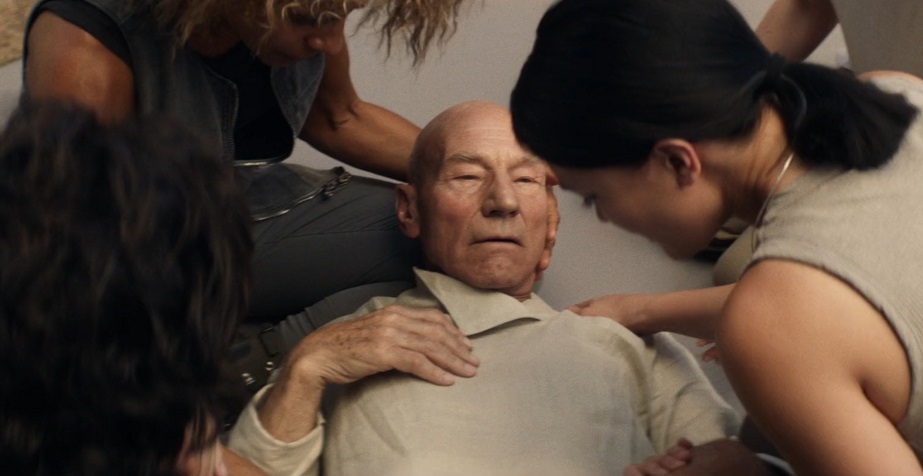
Aboard the Stargazer, Picard and the crew look desperately for solutions – but there are none. Without the Borg, their vessel, and their knowledge of the situation, there’s no way to stop the transwarp conduit from doing what it was designed to do: launching a massive attack on the Federation. Its triquantum waves blast across several sectors of space, destroying the Starfleet ships as they attempt to escape, as well as several starbases and Federation colonies. Having expended its initial wave of energy, the conduit then falls eerily silent, as if waiting for instructions… or for its operators to emerge.
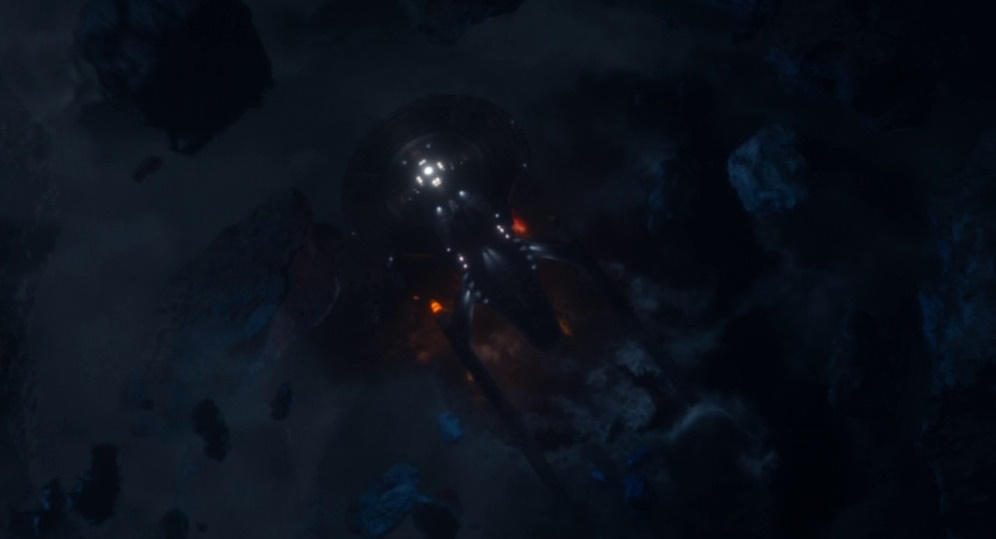
This time, there’s no one to stop the transwarp anomaly…
Because Star Trek: Picardwas a jumbled mess of a show, we don’t know who made the transwarp anomaly. My pet theory is that it’s something to do with Season 1’s super-synths, but it could also be the Borg, the Dominion, or any one of a number of Star Trek baddies! In this timeline, though, the anomaly’s initial attack would be successful – because there’d be no Q to throw Picard and his friends into the alternate reality that eventually led to Dr Jurati’s assimilation and the creation of a Borg splinter group. Without the Jurati-Borg’s presence at the site of the transwarp anomaly, there was no way to stop its energy from being unleashed.
What would happen next? I’d imagine that whoever made the anomaly would be pleased with its success, and if it was a transwarp conduit – as Seven theorised – then it could serve as a gateway for any ships that the attacker had. With a devastated sector and no intact ships remaining in the area, any invader would quickly be able to establish a massive bridgehead right in the heart of Federation territory, and if they have more transwarp conduit weapons… who knows? The next target could be Earth.
What If…? #2: What if… Section 31 and the Federation accidentally created the Borg? Deep Space Nine, First Contact, Discovery Season 2
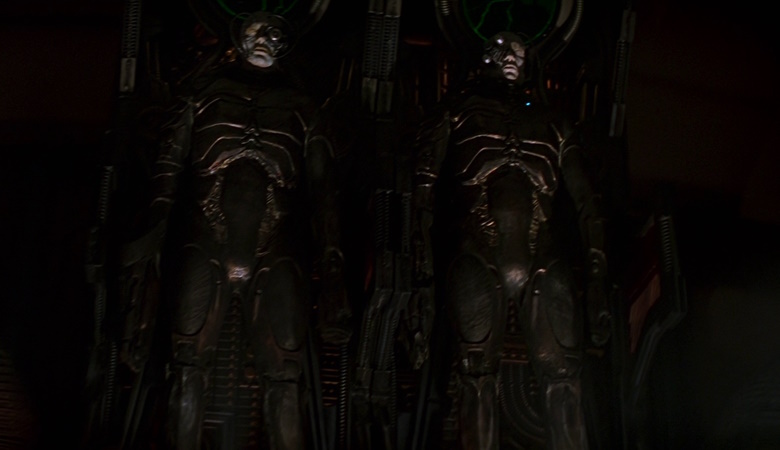
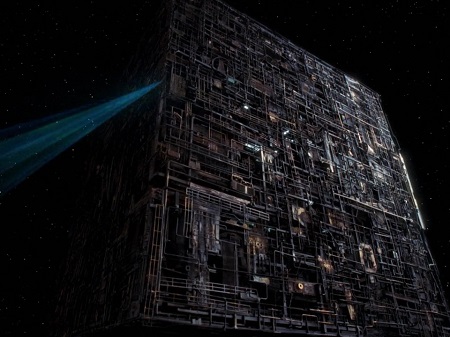
Early concept art of the Borg.
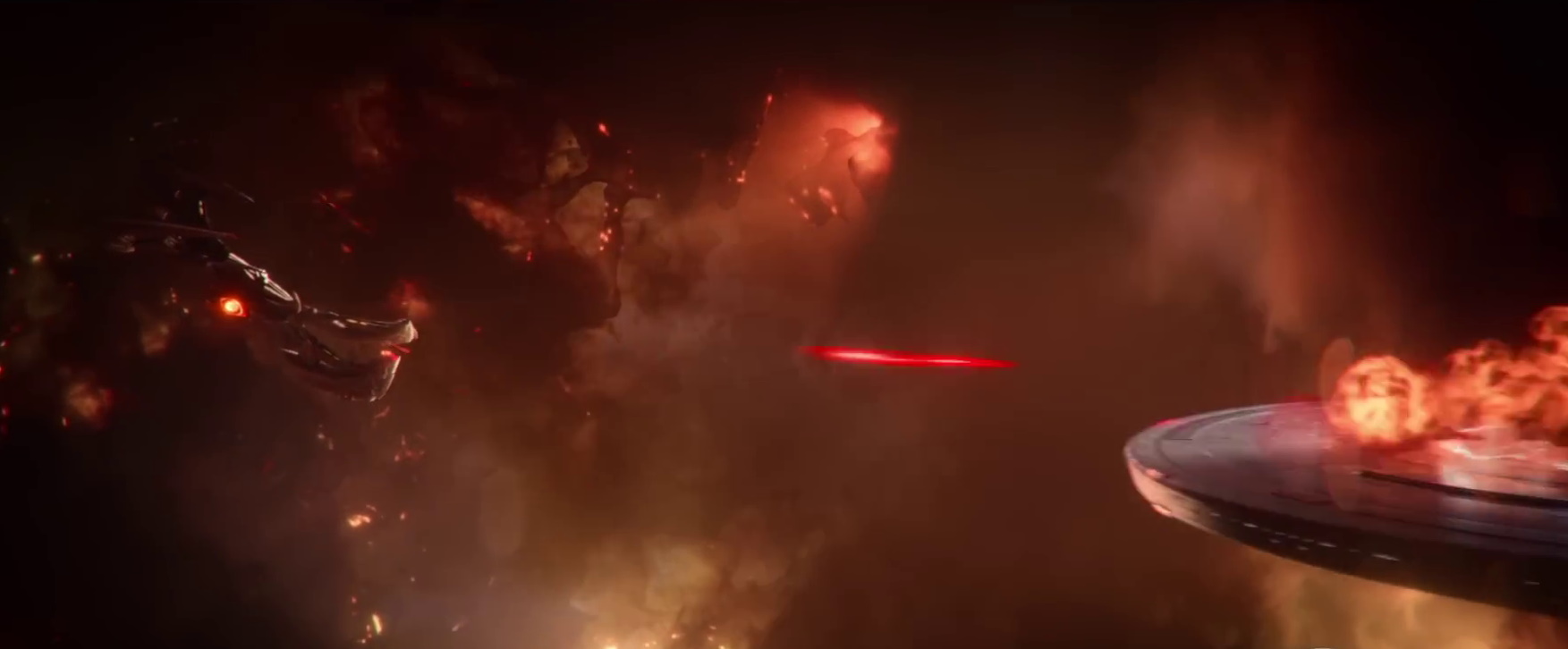
If you’re a regular reader, you might remember my theory that Discovery’s second season – which featured a time-travelling spacesuit and an AI that could “assimilate” humans using nano-bots – was originally pitched as a “Borg origin story.” So what if that’s actually what happened? In this timeline, Section 31 and the Control AI are going to be uncovered as the true progenitors of the Borg!
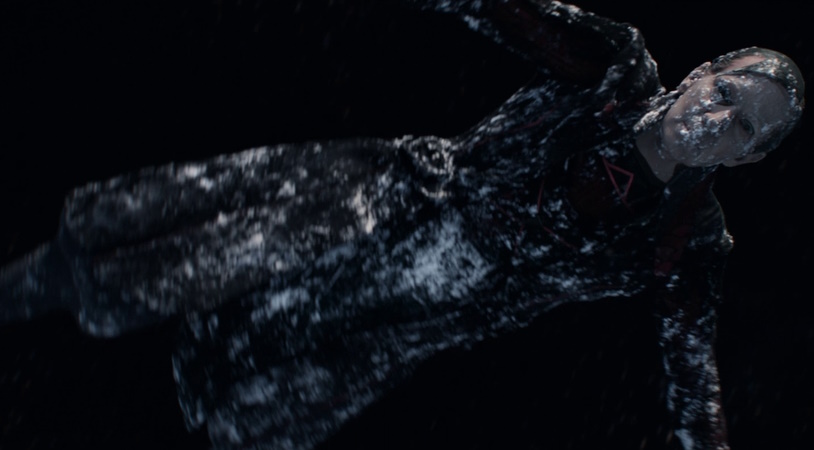
Here’s how it went down: after chasing Captain Pike and the USS Discovery all over the quadrant, Control and its fleet of automated drone-ships finally have them cornered. Using the assimilated body of Captain Leland, Control boards Discovery and attempts to seize the all-important Sphere Data that it needs – but the battle in space is going poorly, and Control seems to be on the verge of defeat. Not wanting to give up, Control switches tactics. Instead of the Sphere Data, Control races to the science lab and steals the Red Angel suit that Burnham and the crew have finished working on.
The “assimilated” Captain Leland.
Staring down an armada of allied ships in space and Discovery’s security team just outside the doors, Control is trapped. With no other options, Control uses the Red Angel suit to escape – but because the suit is malfunctioning, Control ends up in the distant past. Trapped on a planet in the far-flung Delta Quadrant, anchored in time the same way Gabrielle Burnham was, Control surveys its surroundings. The planet is primitive, populated by humanoids in an early stage of development – with no spacefaring technology. Control has some nano-bots remaining, and the Red Angel suit… but that’s it. It decides that the best course of action is to assimilate some of the local humanoids and work on producing more technology – hoping to one day return to Federation space and finish what it started.
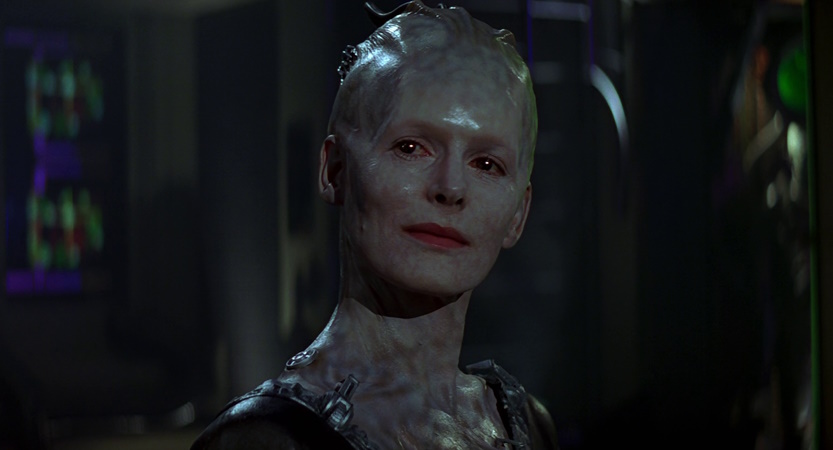
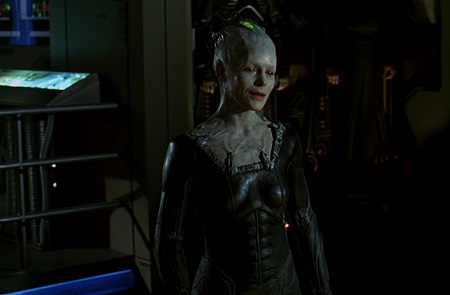
For me, the biggest question is this: does the Borg Collective still know all of this as of the late 24th Century? Or has the passage of time and countless assimilations over the millennia led to this information being forgotten, buried somewhere in the depths of the Collective’s knowledge? My personal take is that this is something the Borg Queen would know – but in the Collective’s run-ins with Starfleet, it’s gone out of its way to avoid revealing this truth.
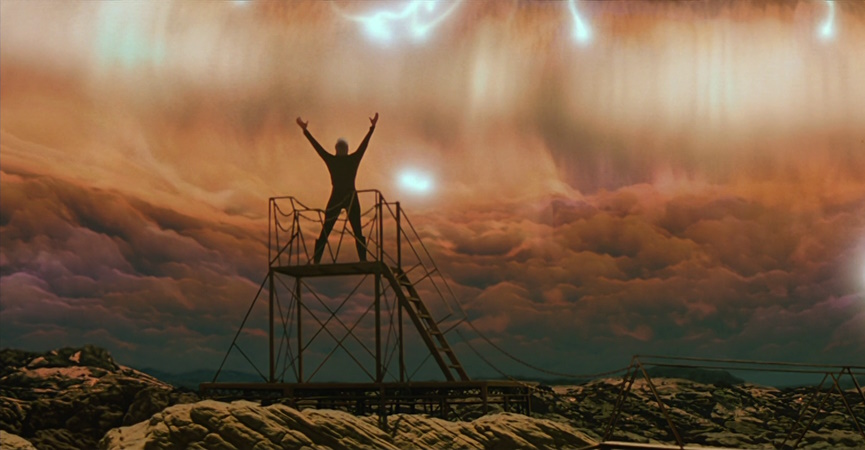
The Red Angel suit can be used to travel through time.
But the Borg Queen is clearly not the same as Control – so what happened there? Perhaps the Queen regards Control as her “ancestor,” in a sense, or maybe Control merged with a particularly strong personality that it assimilated early on. Dr Jurati, in Picard’s second season, merged with the Borg Queen rather than simply becoming a Borg drone, so the same principle could apply here. It does beg the question, though, as to why the Borg Collective didn’t set its sights on Earth and humanity decades earlier if Control’s desire for revenge is hard-coded into the Collective’s DNA!
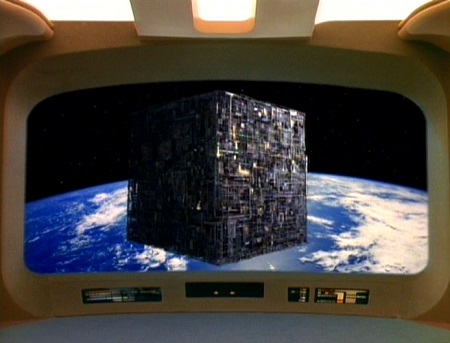
More interestingly, I wonder what Starfleet would make of this revelation. Let’s say that, after the Battle of Sector 001, Starfleet was able to analyse the remains of the Borg Cube and found remnants of 23rd Century Federation programming in the Borg’s systems. Further analysis eventually led to one inescapable conclusion: the Control AI is the basis for the Borg, making the biggest threat to the galaxy an accidental Federation creation. Perhaps that knowledge could be used by Starfleet’s Borg experts to find a weakness or a way to communicate… but it would also be a serious blow to morale.
What If…? #3: What if… the USS Voyager was destroyed over Ocampa? Voyager Season 1
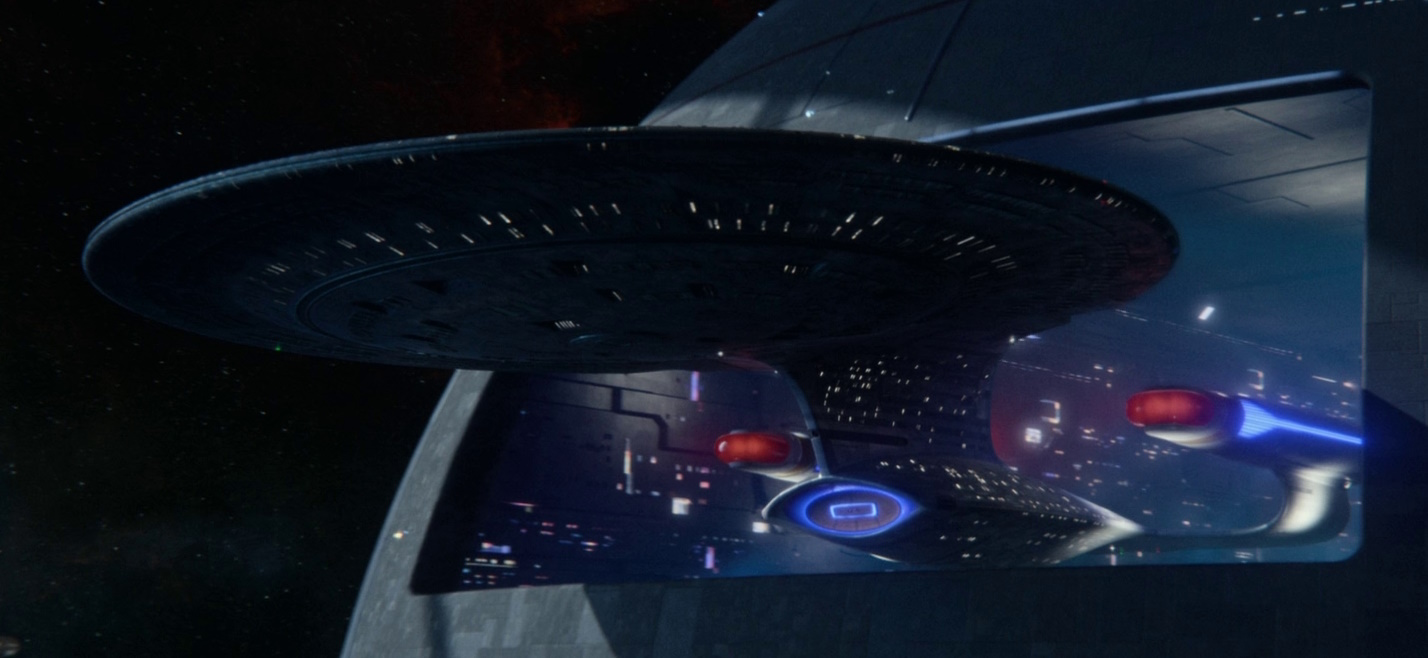
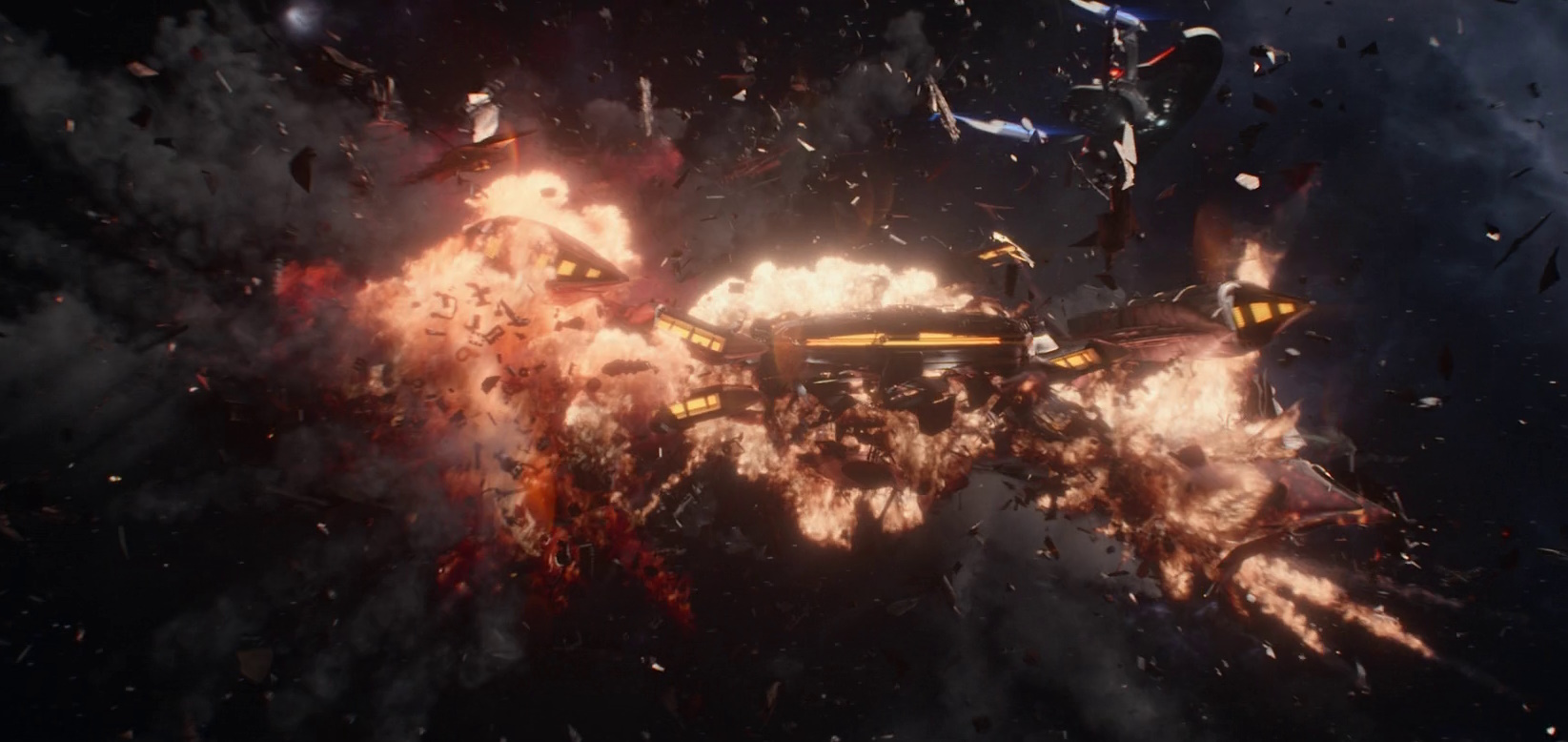
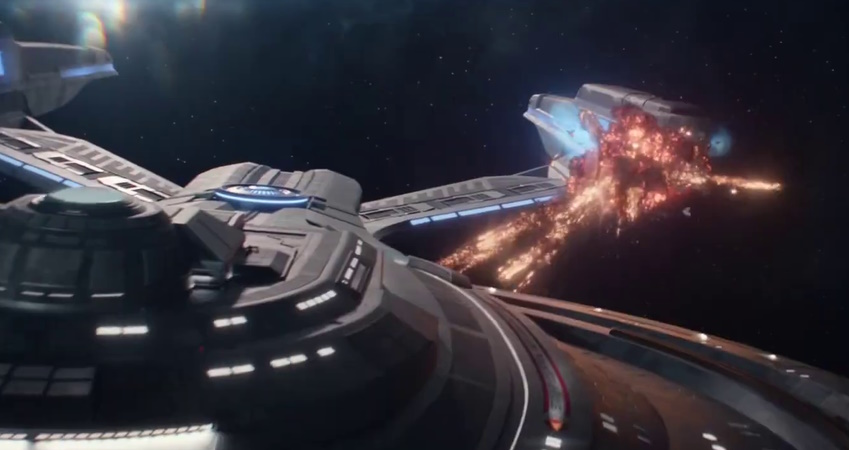
The destruction of the USS Voyager!
In this alternate timeline, we’re going to say that the USS Voyager and the Val Jean – Chakotay’s ship – were both transported to the Delta Quadrant as we saw in Caretaker. But during the battle for the Caretaker’s Array, it’s Voyager, not the Val Jean, that ended up being destroyed by the Kazon. Some survivors made it to the escape pods and were taken aboard by the Maquis, with Chakotay ordering B’Elanna to fire up the engines and get the ship out of range of the Kazon as quickly as possible!
The first character we’d miss would be the Doctor – and with no surviving medical staff (and apparently no medically-trained Maquis, either) that would quickly become a problem for the crew of the Val Jean. I’m also going to suggest that Neelix and Kes wouldn’t be a part of this crew – or if they were involved, they’d remain aboard Neelix’s ship rather than try to cram aboard the already-overcrowded and cramped Maquis raider. As to what else would be different… well, it depends on who survived the destruction of Voyager.
Chakotay’s Maquis raider – the Val Jean.
I’m going to assume that Captain Janeway went down with the ship – as she once told Naomi Wildman that it’s part of a captain’s duty. That was half-joking, perhaps, but I can’t see Janeway abandoning the ship while any members of the crew were still aboard, so I’m gonna say she was lost with Voyager. Among the survivors, though, would be Tuvok, Harry Kim, Tom Paris, and B’Elanna Torres, as well as Seska, Ensign Wildman, and engineer Carey. There’d likely be a clash between Tuvok and Chakotay over command decisions, but Chakotay would pull rank – figuratively speaking – and remind the Starfleet survivors that they’re aboard his ship, so he’s in charge. However, as a concession given the difficult situation, he’d offer senior roles to Tuvok and Carey, and Kim would take up a role on the bridge.
Living conditions would be difficult, though. Voyager was kind of inconsistent with this, but we got hints in several episodes that there might’ve been about twenty-five or so Maquis aboard Voyager. If we assume that there’d be at least forty survivors from Voyager’s original complement of 150, the Starfleet personnel would outnumber the Maquis – which could lead to a lot more tensions aboard a Maquis ship than it did aboard Voyager. The small raider – which probably wasn’t equipped for a long voyage – would struggle to accommodate so many people, and with fewer replicators (if they even worked at all) the ship would have to make many more stops to forage and hunt for food and supplies.
Chakotay would remain in command of his Maquis vessel.
Equinox offers an excellent look at how a ship less well-equipped than Voyager might’ve handled being stranded in the Delta Quadrant. Despite the Val Jean’s personnel being arguably better prepared to survive than Captain Ransom’s crew, the limitations of the ship, the difficult living conditions, and the constant danger would all take a toll on the survivors. Morale would be low among the Starfleet personnel after Janeway’s death, and the reality of the situation would sink in for them over the first few days as they struggled to adapt. Having to share bunk beds and malfunctioning replicators would lower morale even further.
Chakotay would do his best to avoid the Kazon, and without the technologically-advanced Voyager to pursue, I daresay they’d be less interested in chasing the Val Jean, so the ship would make slow but steady progress toward the Alpha Quadrant. After several months (or perhaps a year) of planet-hopping, the Val Jean would encounter something strange: an old Earth automobile floating in space. This would lead them to a planet with a human settlement; the descendants of abductees from Earth. Most of the Starfleet personnel would disembark here, choosing to stay on the planet rather than remain aboard Chakotay’s ship. Chakotay and the Maquis would stay for a while, too, enjoying the friendly atmosphere and making repairs to their ship. After an extended stay, though, would anyone want to re-join the mission back to the Alpha Quadrant on a ship dangerously unsuited for such a voyage?
What If… #4: What if… the Romulans figured out what Sisko and Garak did? Deep Space Nine Season 6
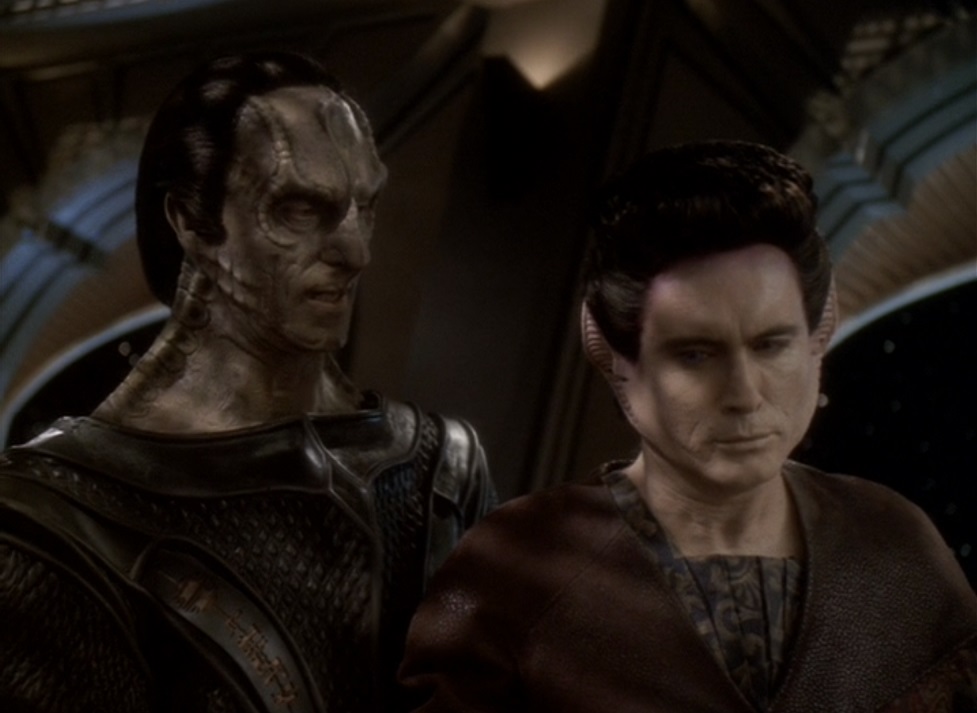
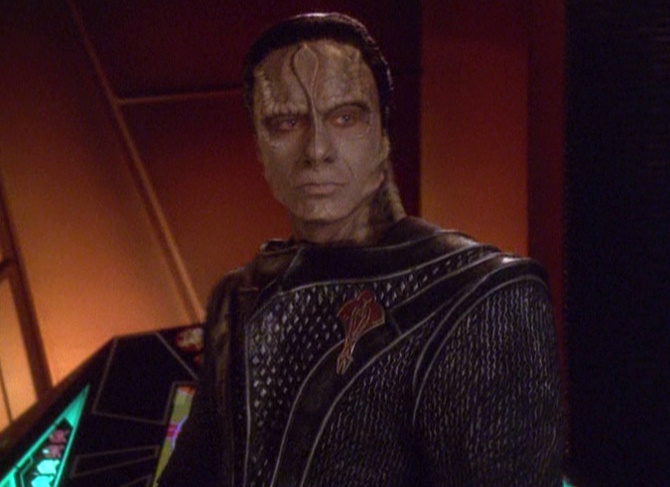
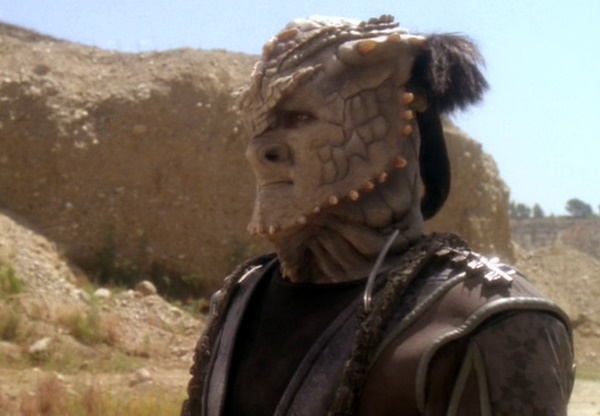
Garak.
Perhaps this one won’t always be a “what if!” One of my fantasy Star Trek episodes is a follow-up to the outstanding Deep Space Nine episode In The Pale Moonlight, and I’d really love to see a sequel of sorts one day. But for now we’re going to make up our own version – and connect it to other parts of Star Trek, too!
There are two time slots for this, and both are interesting – so this is kind of two “what ifs” in one!
Firstly, we have the obvious question: what if the Romulans figured out what happened before the end of the Dominion War?
The Romulans have figured out that “it’s a faaaaaake!”
Shortly after the Breen joined the Cardassians and the Dominion, the Tal Shiar uncovers the truth behind the assassination of Senator Vreenak. How they figured it out doesn’t matter; all we need to know is that the proof is irrefutable. As a result, the Romulans terminate their alliance with the Federation and Klingons at the worst possible moment – just as Breen weapons are proving to be a tactical and technological hurdle for the allies to overcome. Worse, a few days later the Romulans announce a non-aggression pact with the Dominion, shortly followed up by an official alliance. In short, the Romulans have switched sides.
It’s no secret that the Romulans have long coveted Federation systems, and promises from the Dominion about ownership of Vulcan combined with a need for revenge swayed the Romulan senate. They began collaborating openly with the Dominion, sharing technology like cloaking devices with their new allies. The Cardassian rebellion led by Damar would be quickly crushed by the combined might of the Dominion, Breen, Romulans, and Cardassian collaborators, and would be far less effective and far-reaching. With the axis shored up and bolstered by Romulan troops and Romulan intelligence, they’d be back on the front foot ready to press home their advantage. The obvious first targets are Bajor and DS9; control of the wormhole would be vital. From there, it could be a very short war indeed…
Garak and Captain Sisko.
The second scenario is the one I still hope to see on screen one day. In this timeline, the Romulans discover what happened – but only years after the war is over. The destruction of their homeworld took a toll, and the Romulan Empire is in a difficult position. Romulan leaders demand the extradition of those responsible, but with Sisko “missing in action” and apparently residing with the Prophets, there’s really no one to prosecute. Garak’s involvement remains unknown, and he wouldn’t stick his head above the parapet!
But the Romulans would make a fuss, doing whatever they could to make life difficult for Starfleet. One action the Romulan government takes is cutting off Federation researchers from a derelict Borg vessel that they control, and ordering all Romulans to leave Federation space. The result? Soji doesn’t head to the Artifact, Laris and Zhaban leave Earth, and the synths at Coppelius Station remain hidden from Starfleet. But not necessarily hidden from everyone…
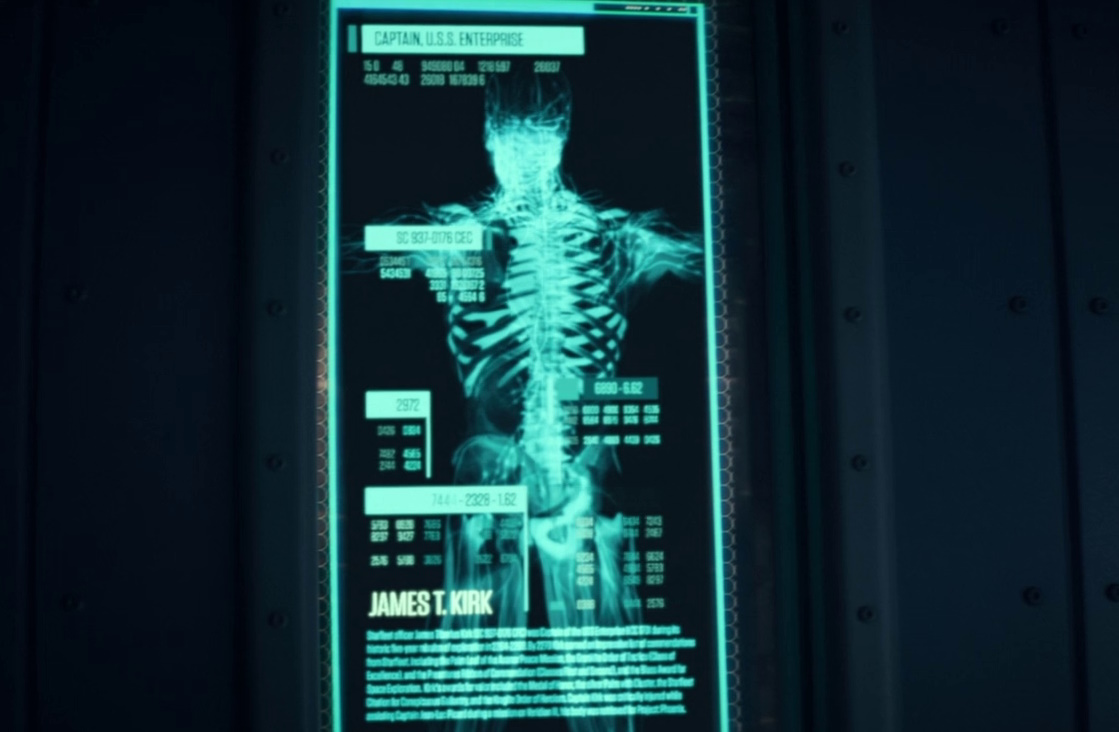
What If…? #5: What if… Captain Kirk didn’t die on Veridian III? Generations
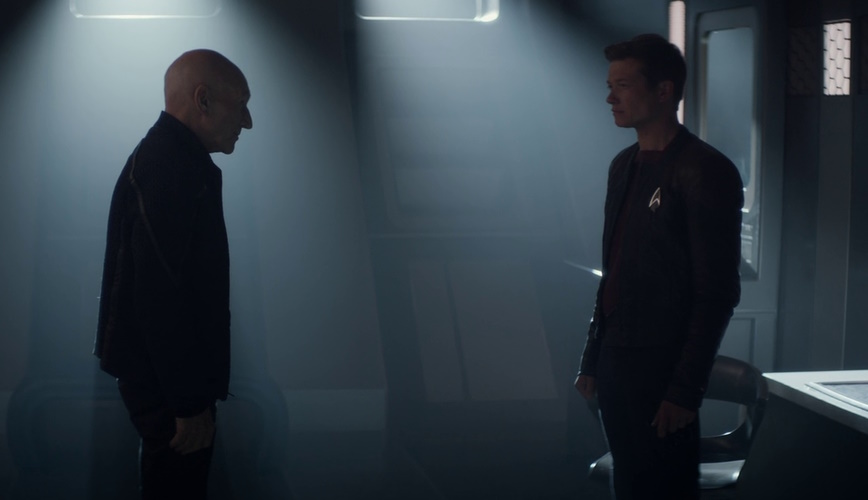
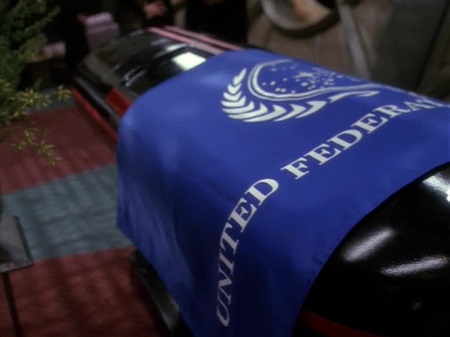
Picard stands over Kirk’s grave.
This is one of the biggest “what-ifs” in Star Trek – at least for fans of a certain age! Kirk’s death in Generations was controversial, though I’d argue it was at least fitting for his character that he gave his life in an act of sacrifice, saving the crew of the Enterprise-D and the population of Veridian III from the Nexus. But in this alternate timeline, Kirk and Picard are able to stop Soran without Kirk losing his life.
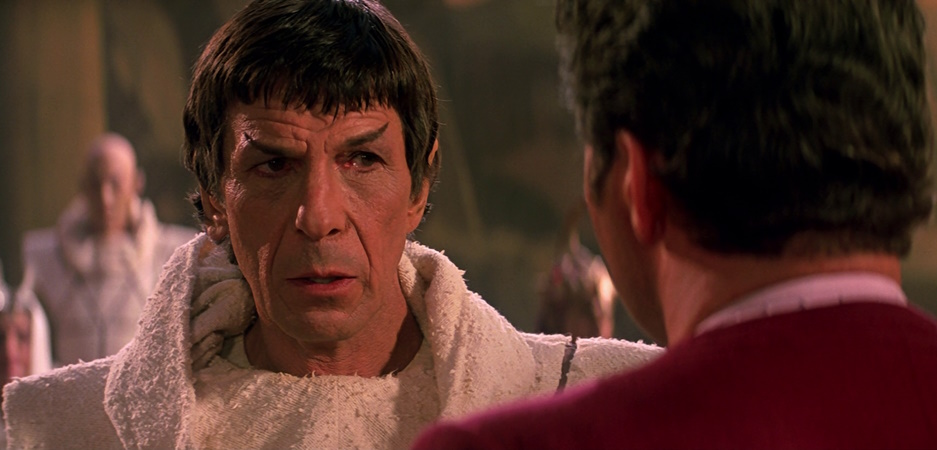
Kirk would reunite with Picard and then meet up with the crew of the crashed Enterprise-D, before boarding a rescue ship bound for Federation space. Upon reaching a starbase, Kirk would be absolutely stunned to disembark only to be greeted by Spock and Montogomery Scott! Scotty had survived to the 24th Century in a transporter buffer (as seen in the episode Relics) and of course, Vulcans live longer lives than humans so we know that Spock is also still alive. This reunion would be incredibly touching, and Kirk would spend time with his old friends, catching up on almost eighty years of Spock’s life and also learning of Scotty’s 24th Century adventures.
Kirk would board a rescue ship and return to Earth.
Kirk would be debriefed by Starfleet Command about his time in the Nexus and would also seek out other members of his crew. Dr McCoy would have passed away, but at least one other member of the Enterprise’s bridge crew – someone like Uhura or Chekov – could still be alive in this time period, though they’d be very old! Kirk would visit them at their home, catching up on the events of their lives after he’d last seen them. Having decided to retire from Starfleet around the time the Enterprise-B was commissioned, Kirk would consider returning to his home – which has been preserved as a museum by Starfleet for the last eighty years – but I’m not so sure that that’s what he’d do.
We know that, in between the events of Relics and Star Trek ’09, Scotty was still working in some capacity – it’s in this era that “transwarp beaming” is invented. I’m going to say that, for the purposes of this alternate timeline, Kirk would return to Starfleet. In an unofficial capacity at first, he’d work with Scotty and Spock, and might also be visited by an old rival: the Klingon Captain Kor, now a Dahar master. Kor would invite Kirk to Qo’noS, where he’d see the results of his work to bring about peace between the Federation and the Klingon Empire.
Kirk could still have some adventures and new experiences in the 24th Century.
Kirk would also be present at the launch of the Enterprise-E, reuniting with Picard as the ship undertook her first cruise. Scotty would also be present, having opted to join his former captain at the launch of the latest ship to bear the name Enterprise. Kirk and Scotty would have departed the ship shortly before the Battle of Sector 001, though. Kirk would be offered a promotion back to the rank of Admiral, and he’d join Starfleet Command in an advisory role; many senior Starfleet officers and admirals would call upon the famed officer for advice.
Where I think Kirk could be most influential, though, is in the aftermath of the synths’ attack on Mars. In the prime timeline, Picard was unable to convince Starfleet to proceed with their plan to help the Romulans, but I think Kirk would be on Picard’s side here. As a living legend and someone of such high standing in Starfleet Command, Kirk’s word would carry a lot of weight. As a result, Picard’s rescue armada would be rebuilt, and many more Romulan lives could be saved before the Hobus supernova. Among the evacuees would be Nero’s family – meaning Nero never attacks Spock’s ship, the two are never pulled into a black hole, and the alternate reality seen in Star Trek ’09 would never begin.
So that’s it!
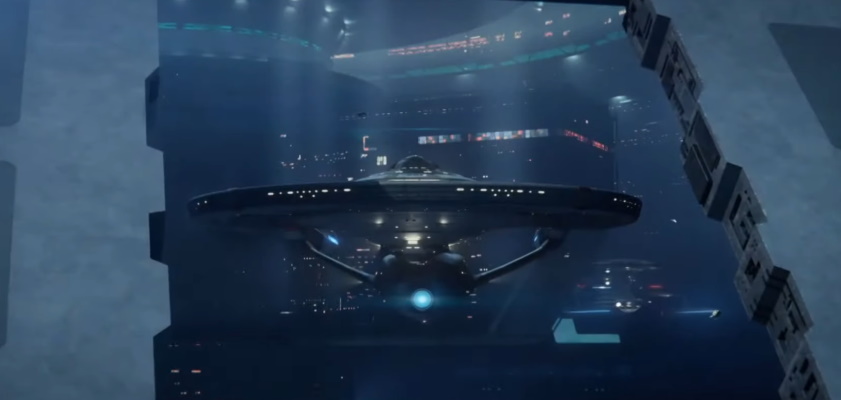
Concept sketch of the USS Enterprise in drydock from The Motion Picture.
We’ve taken a look at five “what if” scenarios set in the Star Trek universe. I hope this has been interesting – and perhaps a bit of fun, too!
There are a lot of places in Star Trek where things could’ve gone very differently, and something as small as the absence (or presence) of a single individual has literally changed the course of history for the Federation and the entire galaxy. I can already think of plenty of other “what ifs,” so stay tuned! I’d love to revisit this idea again one day.
There’s plenty more Star Trek content coming up here on the website. So far in 2025 we’ve talked about some of my head canon, as well as some Star Trek stories that I wish weren’t canon at all! I’ve also reviewed the Section 31 film and finally caught up with Season 2 of Strange New Worlds. Season 3 will premiere later this year and I’ll definitely have something to say about it when it’s here! Until then, see you… out there.
Most Star Trek series and films discussed above are available to stream now on Paramount+ in countries and territories where the service is available. The Star Trek franchise is also available on DVD and Blu-ray. The Star Trek franchise – including all films, shows, and properties discussed above – is the copyright of Paramount Global. This article contains the thoughts and opinions of one person only and is not intended to cause any offence.
Spoiler Warning: There are spoilers ahead for Star Trek: Picard Seasons 1-3.
It’s been more than a year since Star Trek: Picard finished its run, but the series has been on my mind again. With Paramount seemingly focused on more Star Trek prequels in the immediate term, and the Legacy spin-off idea dead and buried in its original form, Picard could be our only live-action look at the early 25th Century for a long time. That got me thinking about the show’s successes… but also a few places where I would have made changes if I’d been in charge!
See, Picard was far from the perfect production – at least in my subjective opinion. I’ve already drawn attention to several places where storylines and plot points seemed to overwrite one another – which is strange, particularly in a series that only ran to thirty episodes across three seasons. You can find that article by clicking or tapping here, by the way! But today I wanted to consider five changes I’d have made that I believe would’ve improved the series.
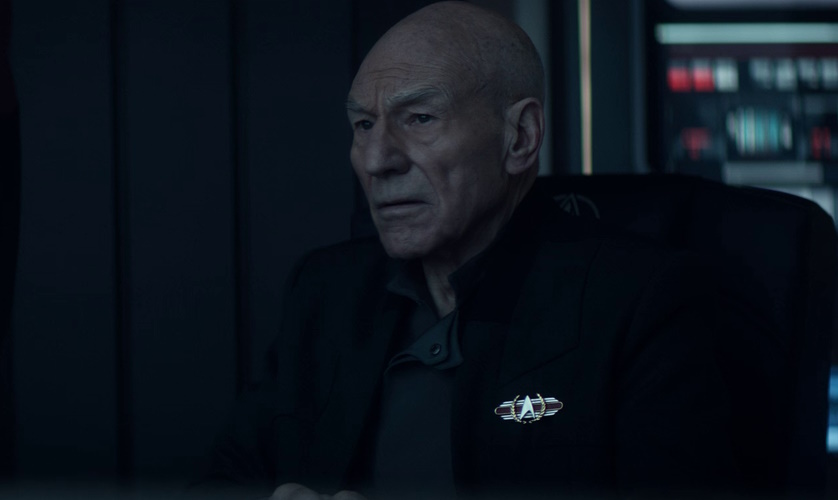
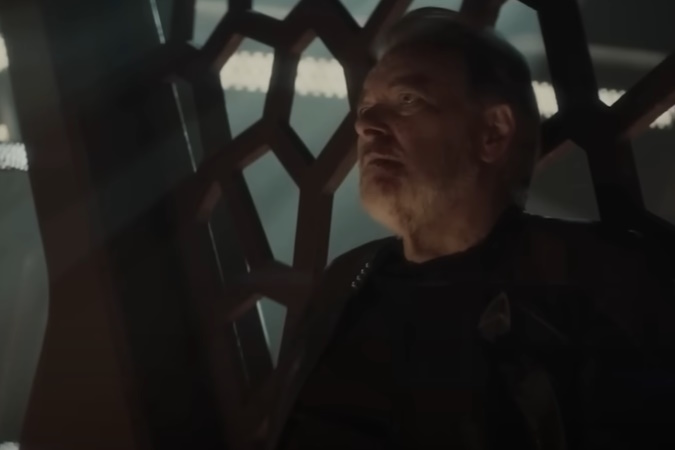
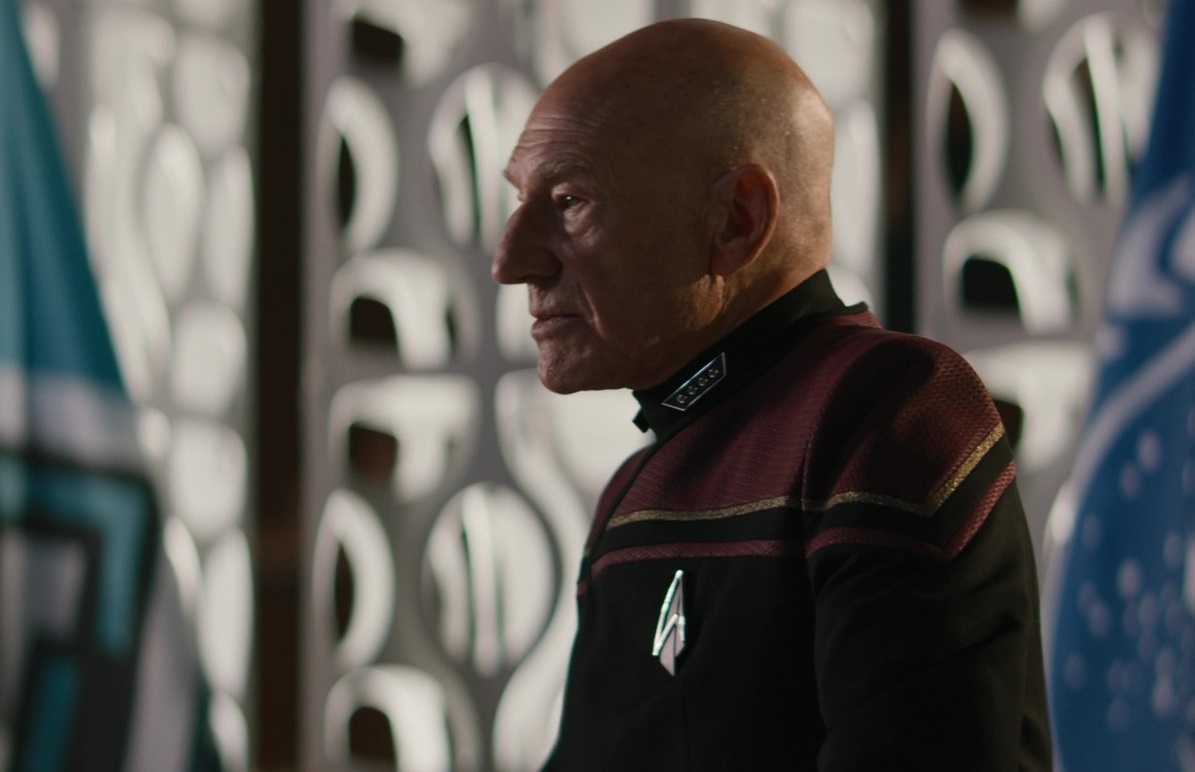
Jean-Luc Picard in Season 3.
As always, a couple of important caveats! A couple of these points are contradictory, meaning one idea or the other might’ve worked in the series, but probably not both! That’s okay, and I’m happy to consider the merits of both as standalone ideas. I’m not trying to claim that Picard’s writers should have implemented all of these changes exactly as I’m proposing them! For a variety of reasons, both in-universe and on the production side of things, it may not have been possible to do some or all of these things even if the writers’ room had wanted to. So to re-emphasise that last point: I know that some or all of these ideas may not have been practical. This is all a moot point now anyway; the series is over. This list is a mix of fantasy and speculation from an old Trekkie – and nothing more!
I also want to say that, while I had some issues with the way Picard was written, by and large I’m a supporter of the series. In fact, I’d like to see more Star Trek set in the time period that Picard introduced us to – and one of the reasons why I think continuing to talk about the show is important is to make that point to Paramount. It also can’t hurt to point out some inconsistencies and other points that future writers and producers might be able to learn from! So that’s my mindset as I put together this list.
With all of that out of the way, let’s get started!
Change #1: Replace Dr Benayoun with Dr Pulaski in Season 1.
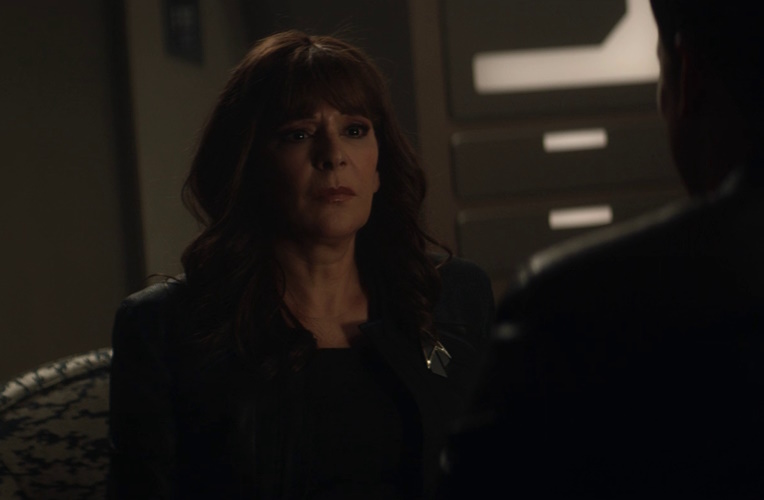
Picard with Dr Benayoun in Season 1.
The second episode of Season 1 saw Picard consulting a doctor who was also an old friend as he prepared to return to space for the first time in several years. The character we ultimately got was someone brand-new: Dr Benayoun. In a way, this character could have been interesting if his role had been expanded upon; he served on the USS Stargazer with Picard, presumably prior to the events of The Next Generation, and I’m always going to be interested in storylines that expand upon the backstories of our favourite characters! But Dr Benayoun’s role was pretty small and he didn’t really give us any new information about Picard’s life prior to assuming command of the Enterprise-D, unfortunately.
If I had been writing this scene, I’d have moved heaven and earth to bring back Diana Muldaur as Dr Pulaski. At this point in the series, we’ve only seen Picard himself and a dream version of Data, so there’s absolutely a case to be made that bringing back a legacy character would have been perfect for this moment. There could have been a slightly extended conversation between the two, perhaps with Dr Pulaski commenting on how she saved Picard’s life when she performed surgery on him, or recounting another of their shared adventures in Season 2 of The Next Generation.
Diana Muldaur, who played Dr Pulaski in Season 2 of The Next Generation.
I said before Picard premiered that I didn’t want the series to try to be The Next Generation Season 8, but moments like this would have been perfect for small cameos from established characters. With Dr Crusher being held in reserve for a possible future role, Dr Pulaski would have been the perfect fit for this sequence. We could have learned a little about why she left the Enterprise-D, with that perhaps having been a sore spot in her relationship with Picard. Or we could’ve learned what she’s been up to in the intervening years – did she return to work at Starfleet Medical, perhaps, or take another assignment on a starship?
I’ve been a fan of Dr Pulaski for a long time, and I think this sequence could’ve been an opportunity to right a thirty-year wrong and give the character the closure and send-off she never got. Diana Muldaur has still been active as an actress in recent years – despite being well into her eighties at time of writing – appearing in the trailer for a film called Finding Hannah in 2022. Despite some negative feelings on both sides, it may have been possible to bring her back during production on Picard’s first season in 2018 and 2019. I think it could have added a fun extra dimension to the sequence in that second episode, especially for older Trekkies.
Change #2: Leave Data dead after Season 1.
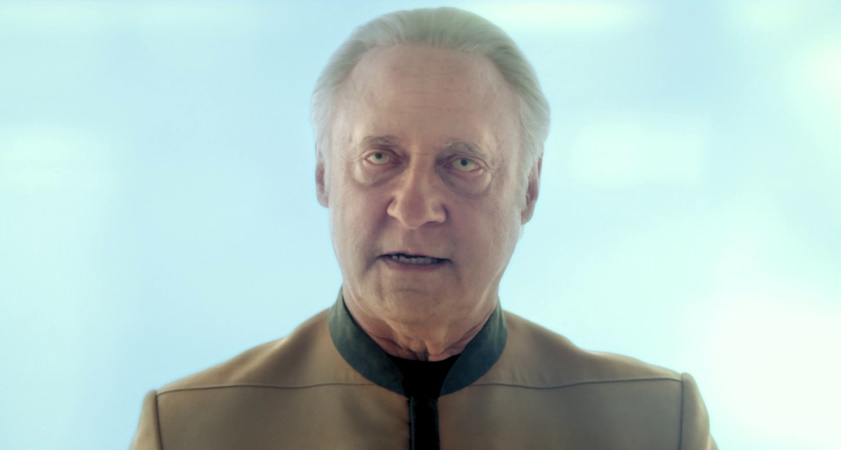
Data in the “digital afterlife.”
One of the few redeeming features of an otherwise disappointing finale to Season 1 was the storyline involving Data. Data had been killed years earlier during the events of Star Trek: Nemesis, but that film arguably didn’t take enough time to give the character the send-off he deserved. As I wrote when reviewing Picard’s first season, the scenes involving Picard laying Data to rest were beautiful, emotional, and just what the episode needed – and I could finally see why, eighteen years on from Data’s first death, they were necessary for the character.
Season 3, however, undid all of that. Not only did that decision detract from one of the only decent parts of the Season 1 finale, but it was actually a pretty convoluted plot point that was difficult to follow and relied on a lot of technobabble and “magic.” It never really found a narrative justification beyond showrunner Terry Matalas’ desire to reunite all of the main characters from The Next Generation – no matter the cost.
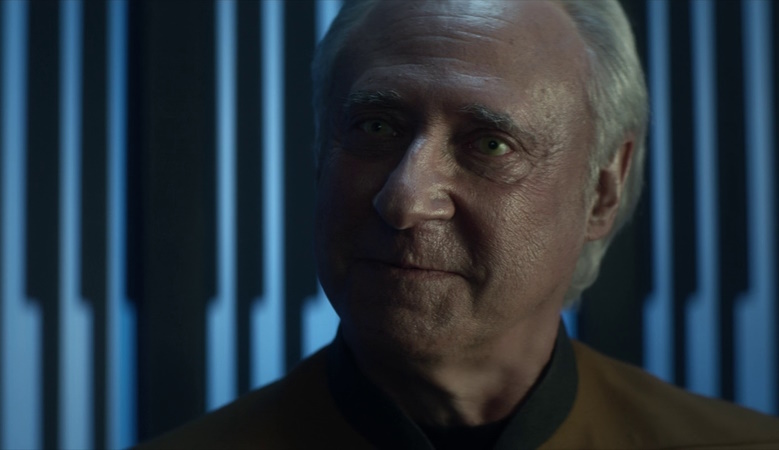
Data at his post in Season 3.
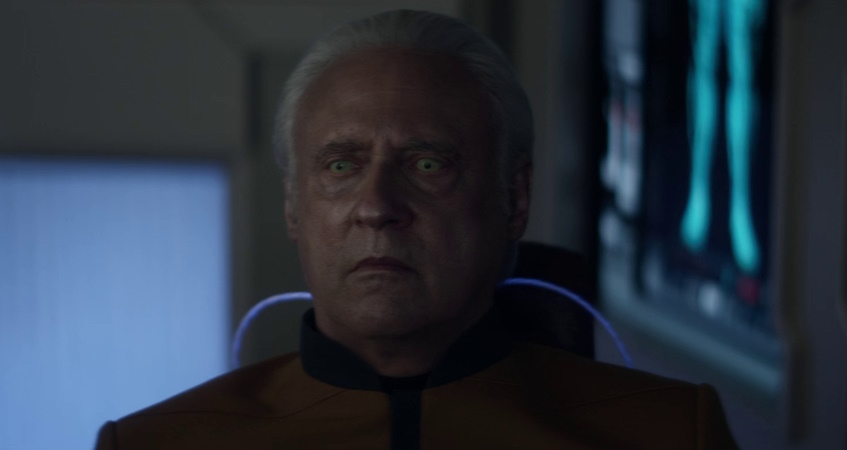
In Star Trek’s universe, Data was as dead as it was possible to be. His body had been destroyed years earlier, and Season 1 saw the final shutdown of the residual part of his mind that had been preserved – at Data’s own request. With both body and mind gone, there should have been absolutely no way back for Data. But thanks to the magical deus ex machina of a backup body and a backup mind… Data was resurrected in Season 3. That never sat right with me, but if there had been a significant narrative role for the character in those final episodes, perhaps I could’ve come to terms with it. There really wasn’t, though, and aside from one scene in which Data technobabbled his way to regaining control of the Titan, we didn’t really get a lot more from him for the rest of his time on screen.
I believe Data would have been better-served in Season 3 by being memorialised by his friends. Leaving alone the touching moments between he and Picard in what I termed the “digital afterlife” in Season 1 would have made those moments more powerful to revisit… instead of feeling like a storyline that’s been overwritten. Of all the dead characters in Star Trek, Data was the hardest to bring back because he’d “died” twice, both in body and soul. I don’t think the decision to resurrect him just a few episodes after that intensely emotional send-off was the right one, and I don’t think it was done for the right reasons, sadly.
Change #3: Either leave Elnor dead or include him in Season 3.
Elnor in a promo photo for Season 2.
This is a storyline that I’ve said several times that I genuinely do not understand. Let’s keep in mind that Seasons 2 and 3 went into production back-to-back, with the same creative team in control. Early in Season 2, Elnor was killed – and while I wasn’t thrilled with that at first, as the season unfolded, the way in which Raffi came to terms with his loss made it matter. In fact, I’d go so far as to call the Raffi-Elnor storyline in Season 2 one of the few high points of a season that had relatively few of those.
It was always going to feel strange, then, when Elnor was resurrected at the last second by Q. The fact that Elnor didn’t get much to do in the second half of the Season 2 finale hammered that feeling home; a sight gag showing Elnor disgusted by a beverage was basically his only moment of note after his return. Was it worth undoing that powerful story for an overdone bit of slapstick? He barely got any screen time nor even a proper reunion with Raffi. But nevertheless, as the credits rolled on Season 2 I thought Elnor’s return could find a narrative justification in Season 3.
Elnor at the end of Season 2.
Elnor, however, was totally absent from Season 3 and wasn’t even mentioned. If I was writing the season, I’d have dropped one of the La Forge sisters and included Elnor instead, having him aboard the Titan in a secondary role and ultimately becoming one of the young officers who gets assimilated. That moment could’ve actually felt stronger and more powerful with Elnor’s inclusion, as we’d be confronting a threat to a character we’d been with for three seasons instead of someone brand-new.
However… given Elnor’s absence from Season 3, I can’t help but feel that leaving him dead would have been the least-bad option. At least that way Raffi’s story of coming to terms with her grief would have meant something, and we could’ve talked about the bold decision to kill off a new, young character in a Star Trek series – something that the franchise isn’t really known for doing. While I absolutely feel that there could have been room for Elnor in Season 3, his death was such a big part of the story of Season 2 that I think undoing it would have probably been a mistake regardless.
Change #4: Connect the anomaly in Season 2 to either Season 1’s “super-synths” or Season 3’s Borg incursion.
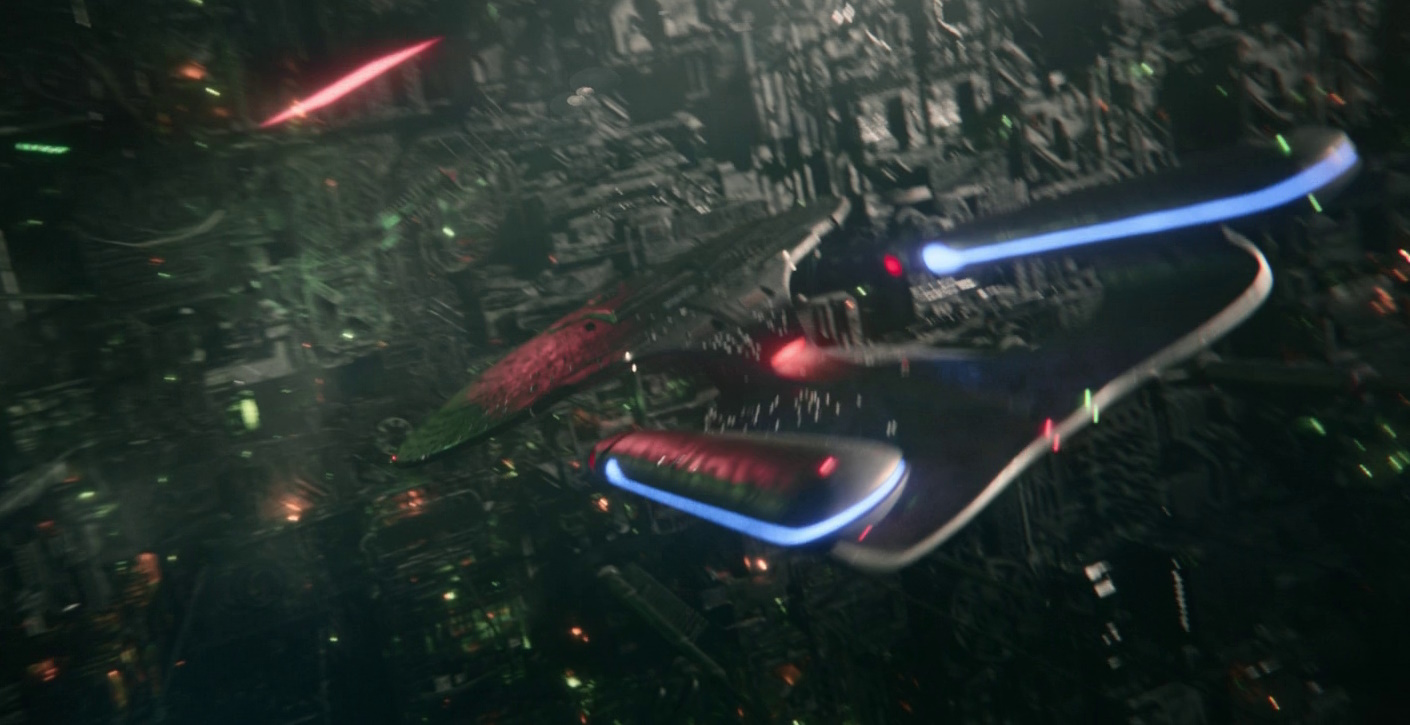
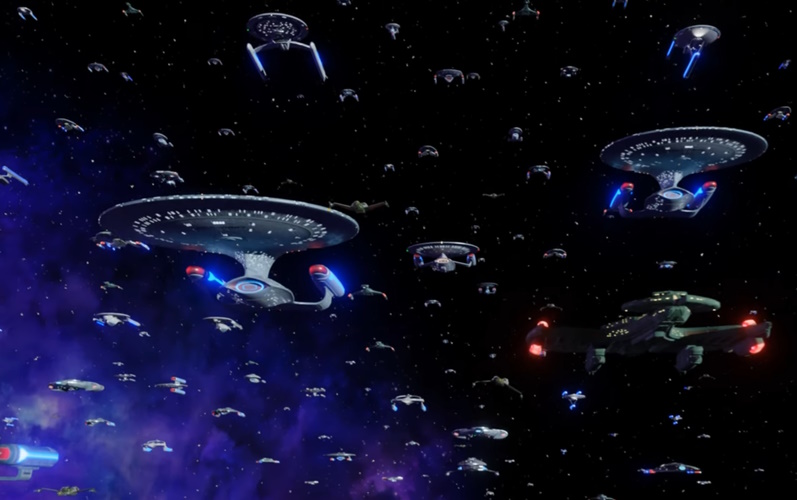
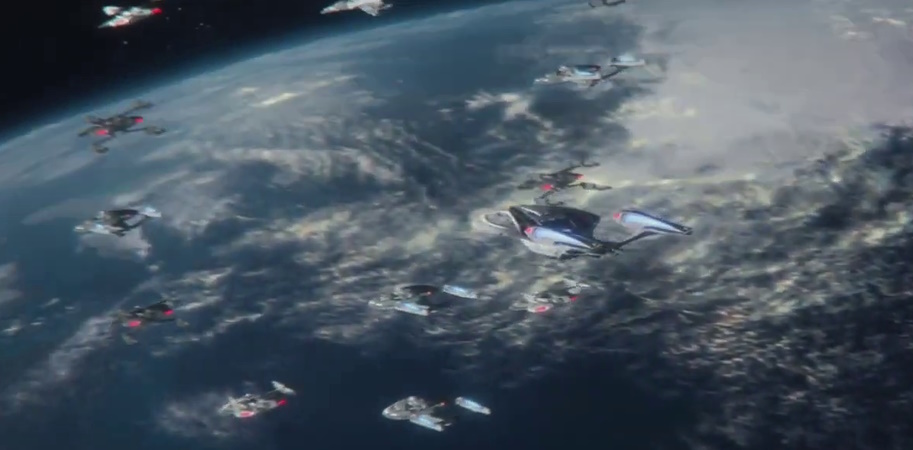
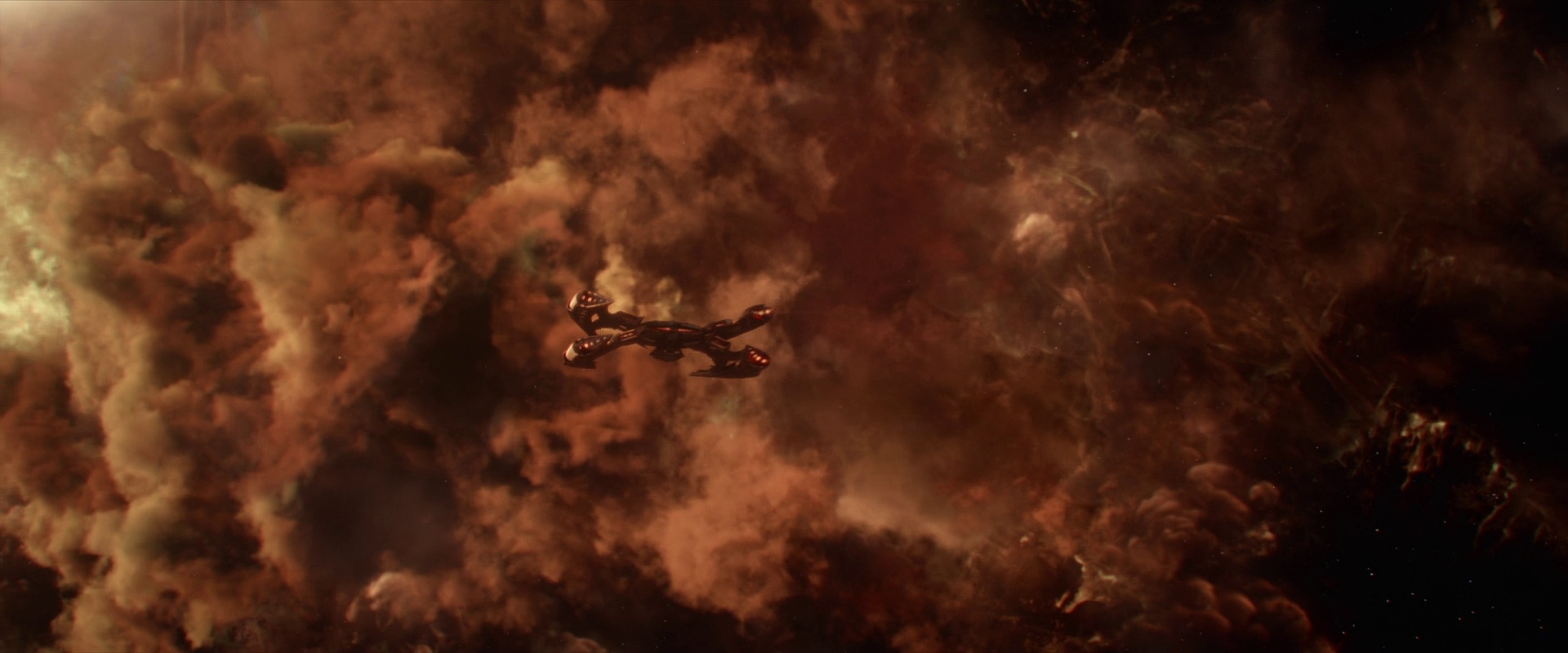
The Borg-Federation fleet defends the Alpha Quadrant against the mysterious anomaly.
One thing that modern Star Trek has never managed to get quite right is serialisation. This will have to be the subject of a longer article one day, but for now suffice to say that Discovery, Picard, and to a lesser extent Strange New Worlds too all rely on season-long storylines that don’t carry over from one season to the next. There are reasons for this in Discovery’s case – the series flirted with cancellation more than once. But, as I understand it, Picard was planned from day one as a three-season show… so why were none of its storylines picked up in subsequent seasons?
There are two choices here, and they’re probably mutually-exclusive (without some major rewriting) so realistically we’d have to settle on one or the other! But I think the Season 2 anomaly is an interesting narrative idea that could have connected with either the super-synths from Season 1 or the Borg incursion in Season 3. Either of these powerful factions could have been responsible for the attempted attack on the Alpha Quadrant that Picard and co. prevented at the climax of Season 2 – and I think it would have been far better than just leaving this incredibly important event without a proper explanation.
The mechanical noodles of the Season 1 super-synths.
The mysterious anomaly bookended the story of Season 2, and connected to Picard, his friends, and the adventure they had in the intervening episodes. Unlike in many Star Trek stories, the anomaly was explicitly identified as an “attack,” meaning that there must be some faction or powerful force behind it. The Borg and the super-synths from Season 1 would fit the bill as being powerful enough to launch an attack of that magnitude.
Tying one of these factions into the anomaly story would have helped Picard feel a bit more cohesive. Given the abundance of overwritten plot points, dropped characters, and abrupt changes in direction across the series, having something to tie disparate story threads together would be a good thing. If I had to pick one, I’d say that the super-synths would be the ideal faction to include here, simply because we know relatively little about them, and a super-synth attack could set up a future Star Trek series or film. But given that the Borg would return in Season 3, dropping a hint or two that they could be responsible could have been a great cliffhanger to end on at the end of Season 2.
Change #5: Have the Enterprise-A and Enterprise-D fighting alongside one another at the end of Season 3.
The Enterprise-A’s final voyage.
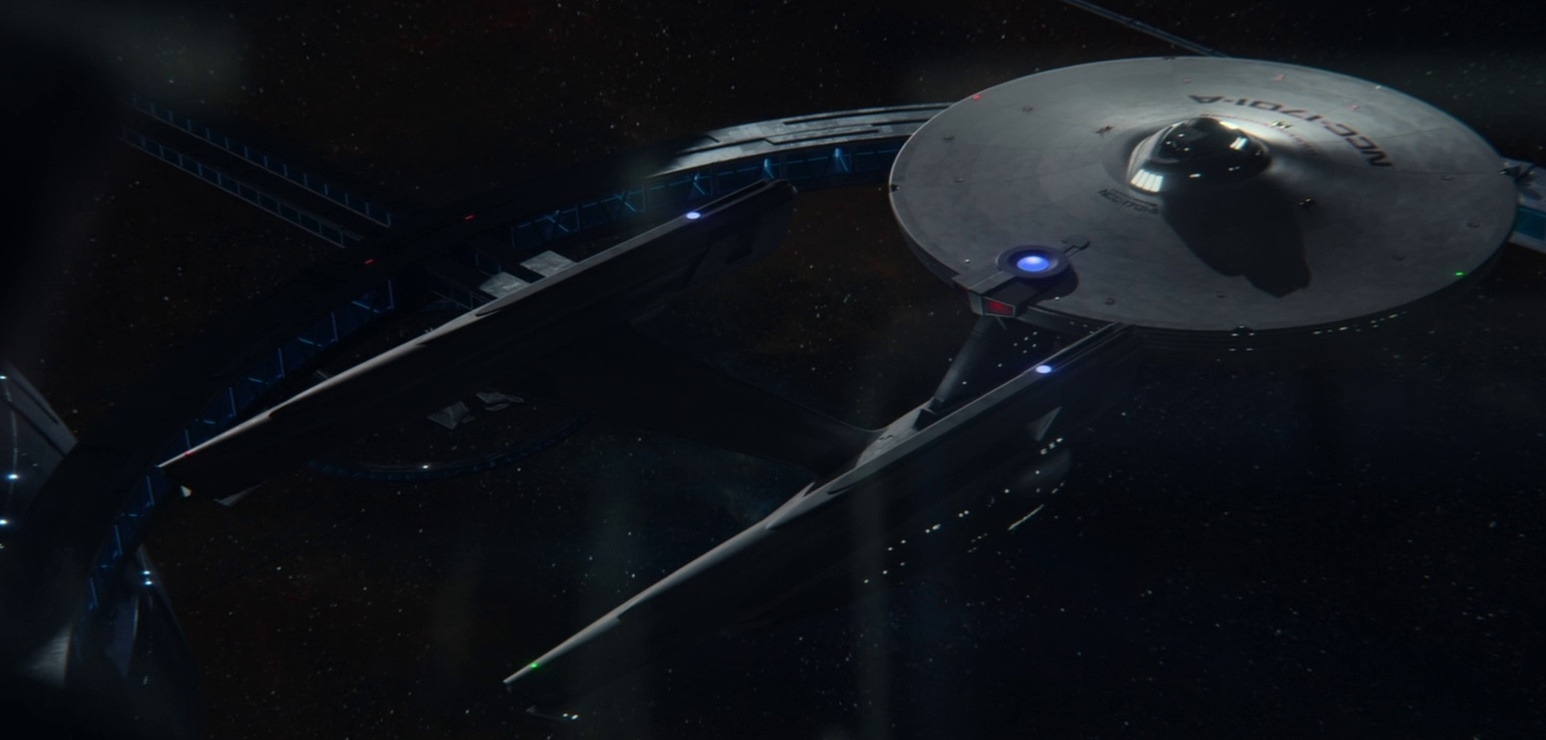
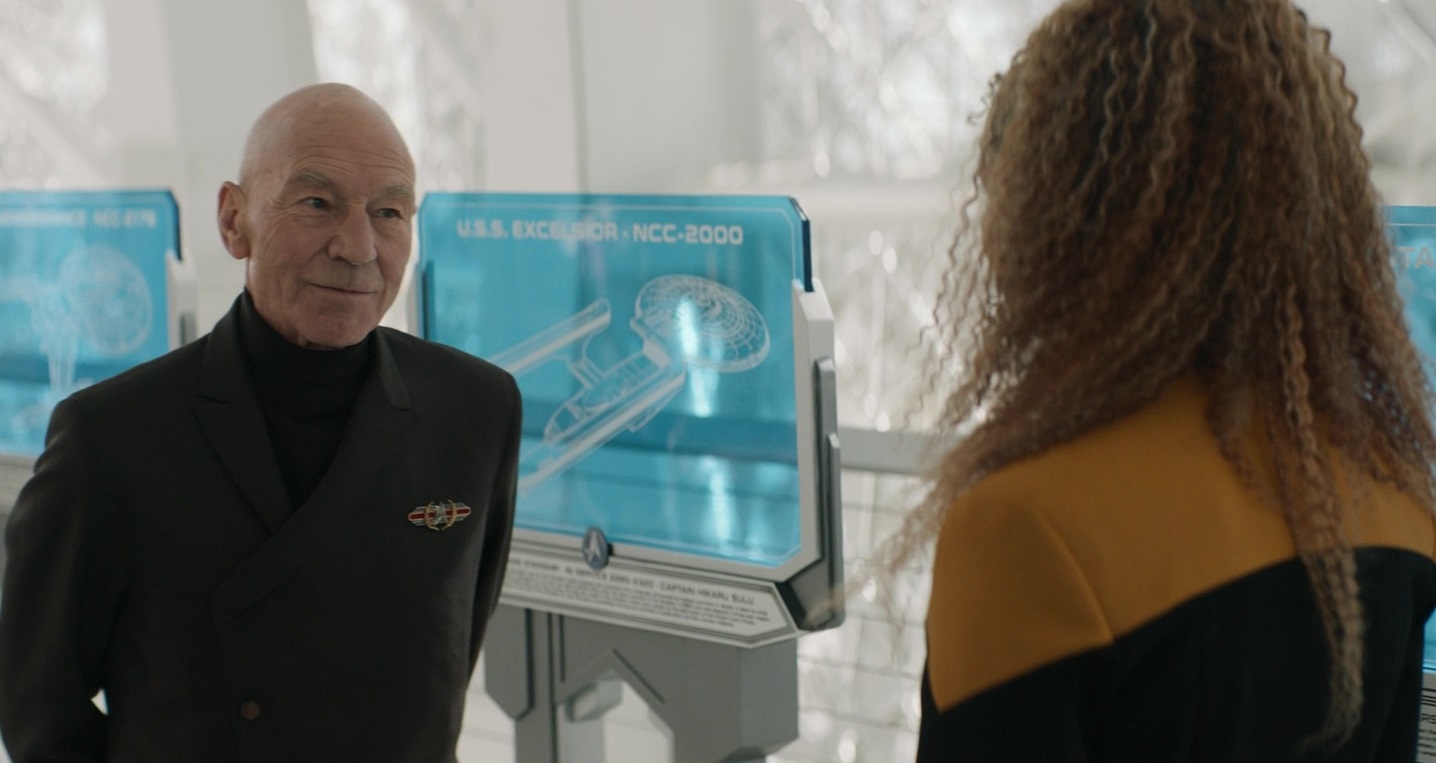
Season 3 introduced us to the Fleet Museum, which is a really interesting idea that I enjoyed. It was also a Trekkie’s dream, as multiple vessels from past iterations of the franchise were present. Along with Geordi’s pride and joy – the restored Enterprise-D – was the Enterprise-A, Captain Kirk’s ship that we saw in The Final Frontier and The Undiscovered Country. How cool would it have been if, along with the Enterprise-D, Picard and co. found some friends or allies to crew the Enterprise-A and join them as they took the battle to the Borg?
I know that Picard’s third season was a “love letter” to The Next Generation, and I can absolutely understand not wanting to detract from seeing the Enterprise-D and her crew back in action. But as a Trekkie, one of the fantasies that I’ve always had has been to see different crews and different ships standing shoulder-to-shoulder – especially in a story like this one, where the battle lines have been drawn and the Federation seems to be on the cusp of defeat!
Wouldn’t it have been cool to have the Enterprise-A here for this moment?
Bringing the Enterprise-A along would fit narratively, too. Part of the story was about older people still having something to offer; stepping back into the fray to save their younger colleagues. The Enterprise-D and her crew were one way to embody that storyline, but including the Enterprise-A would have been in the same narrative ballpark. There could have even been some technobabble about how the Borg wouldn’t know what to do with a ship that old, making the Enterprise-A a useful addition to the battle. If this point in the story had been reached a little earlier – say with three episodes left instead of one-and-a-bit – I’d have absolutely found a way to include the Enterprise-A.
A digital model had already been created – albeit a static one for the Fleet Museum – but I’m sure with relatively little work it could have been transformed into a moving, flying model. And as for the bridge… I don’t think an entire set would need to be built. For brief scenes shown on the Enterprise-D’s viewscreen, perhaps a redress of the Strange New Worlds or Discovery sets would have sufficed. This would’ve also been a great way to include a character or two from The Next Generation era – perhaps someone like Ezri Dax or Captain Jellico – to take command. Seeing two Enterprises riding into battle side by side… I can’t think of anything more exciting in that kind of story.
What might have been, eh?
So that’s it!
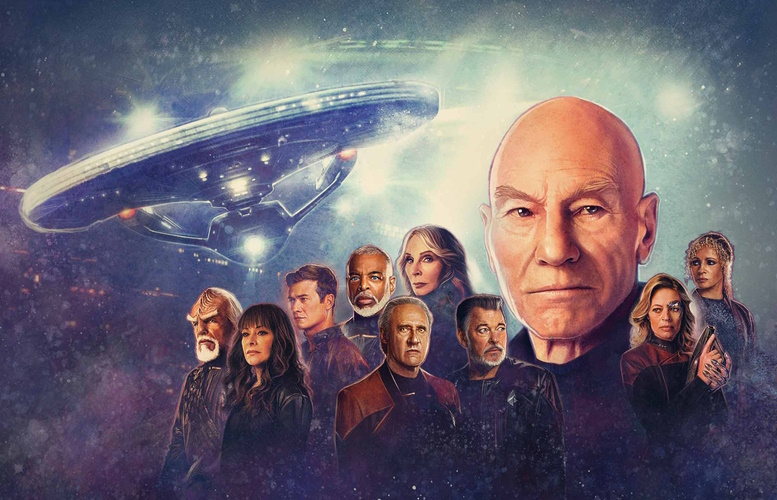
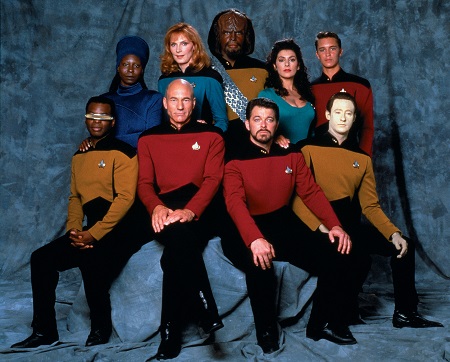
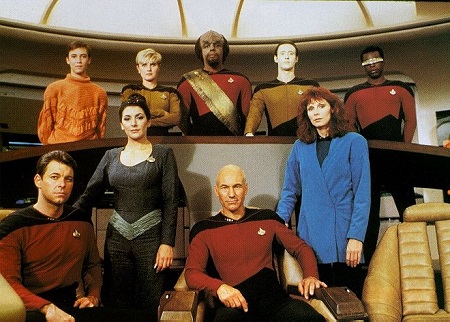
Picard and his crew.
We’ve looked at five changes I’d have made to Star Trek: Picard.
I’m still holding out hope that a new series, film, or other project set in the Picard era will be announced, but with Paramount’s financial troubles and other Star Trek shows being cancelled… I’m not sure when or even if that’ll happen. If it does, though, I hope lessons can be learned from Picard, both in terms of narrative and on the production side of things. As good as the series could be when everything was working right, there are some definite low points that detract from its successes.
The points on this list are pure fantasy at this stage, of course! But as Picard was being broadcast, I couldn’t help but feel that a few tweaks or changes here and there might’ve improved things – so I’m glad to finally put metaphorical pen to paper and make a few of my suggestions. I hope these ideas have been interesting, at any rate – and not something to get too worked up or upset over! If you hate all of these ideas, you can take solace in the fact that none of them were or ever will be included in Star Trek: Picard!
I still have a few pieces about Picard in the pipeline, including a longer retrospective/post-mortem of the series as a whole. I don’t know when I’ll get around to writing all of those, but I hope you’ll stay tuned. It’s bound to happen eventually! Until next time… live long and prosper!
Star Trek: Picard is available to stream now on Paramount+ in countries and territories where the platform is available. The series is also available to purchase on DVD/Blu-ray. The Star Trek franchise – including Picard and all other properties discussed above – is the copyright of Paramount Global. This article contains the thoughts and opinions of one person only and is not intended to cause any offence.
Spoiler Warning: There are spoilers ahead for all three seasons of Star Trek: Picard – including the series finale and post-credits scene.
For a series that only ran to thirty episodes across three seasons, Star Trek: Picard spent a lot of time overwriting itself! Across all three seasons of the show there were these weirdly contradictory moments where new storylines would appear from nowhere, completely changing what came before. One or two of these instances might pass by relatively unnoticed, or could feel like little more than nitpicks. But for a relatively short series to have so many… it speaks to something bigger, I feel.
I hope in future we’ll get a Chaos on the Bridge-type of documentary or exploration of what went on behind-the-scenes on Star Trek: Picard, because to say that production was “difficult” feels like an understatement. There were clearly major problems on the production side of the series, and I don’t just mean its pandemic-enforced delays. The evidence for this is the contradictory nature of the series itself, and how at the very least there was clearly no overall plan for how the story should be structured. Consistency is an important element of any good story – and Picard absolutely fails on that measure.
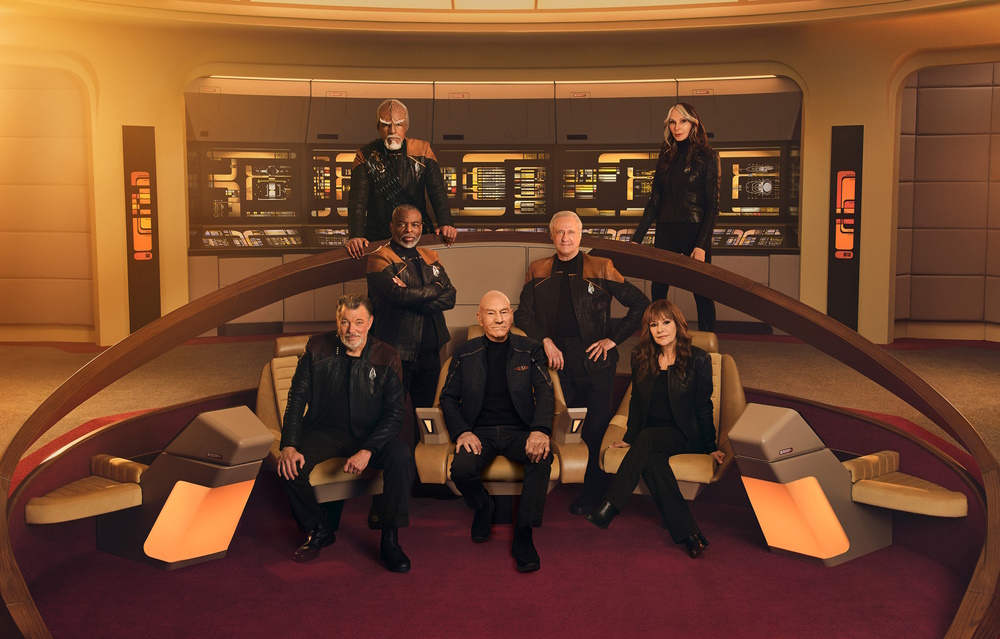
Seasons 2-3 showrunner Terry Matalas with Sir Patrick Stewart and the rest of the cast of The Next Generation.
I have a longer piece in the pipeline about Picard’s abandoned and unfinished storylines, but today I thought it could be interesting to take a short look at ten storylines that ended up being overwritten by some pretty sloppy, messy writing that failed to build on the foundations that had been laid in earlier episodes and seasons.
As always, a few caveats. If you loved all of these stories and felt they were perfectly-executed, or if you hated the original setup and feel that it was right and fitting to overwrite or ignore it, that’s okay! We all have different opinions about what makes for a good Star Trek story, and I’m not trying to claim that I’m somehow objectively right and that’s the end of the affair. In several cases, I’d actually agree that the overwrite or retcon was better than what had been previously established. This is all just the opinion of one old Trekkie, and as I always say, there ought to be room in the Star Trek fan community for polite discussion and disagreement! Although I have my issues with Picard, particularly when it comes to the show’s second season, by and large I’m a fan not a hater.
So with all of that out of the way, let’s take a look at some of Picard’s weirdly contradictory storylines.
Contradictory story #1: Seven of Nine is a captain! Oh wait, no she isn’t…
Seven in the captain’s chair at the end of Season 2.
At the end of Season 2, Seven of Nine was breveted into Starfleet by Picard as Captain of the Stargazer. This story point was already a bit… odd. Firstly, it raises the question of why, if offering a brevet position to someone outside of Starfleet is so simple, Admiral Janeway didn’t do that for Seven years ago. It also seemed unnecessary, as with Picard on the bridge, the Stargazer already had a senior officer present who could give orders.
But this already flimsy setup ended up being overwritten by the very next episode – when Seven was bumped down to the rank of commander and found herself serving as first officer of the Titan. There are a lot of contradictions in Picard, but this one feels even more peculiar because it’s something that literally changes from one episode to the next – episodes that, in spite of being one season apart, were produced and filmed at the same time.
Contradictory story #2: Data’s dead. Deader than dead. Lol jk, he’s alive again!
Data awaits his final shutdown.
One of the few redeeming features of the two-part Season 1 finale was the laying to rest of Data, and giving him the emotional send-off that Nemesis didn’t have time to do justice to. It went a long way to making up for other deficiencies in the rushed and muddled end to Season 1, and the sequences with Picard and Data in the “digital afterlife” were powerful and deeply emotional.
But despite Data being as dead as it’s possible to be in Star Trek, with both his physical body and the surviving part of his consciousness having been destroyed and shut down respectively, Season 3 resurrected Data. We’ll have to go into this storyline in more detail in the future, because there’s a lot more to say. But for me, Data’s resurrection never really found a narrative justification, and it felt like the showrunner and writers wanted desperately to reunite the cast of The Next Generation – at any cost.
Contradictory story #3: Welcome aboard the Stargazer! Wait, I mean the Titan…
The USS Titan.
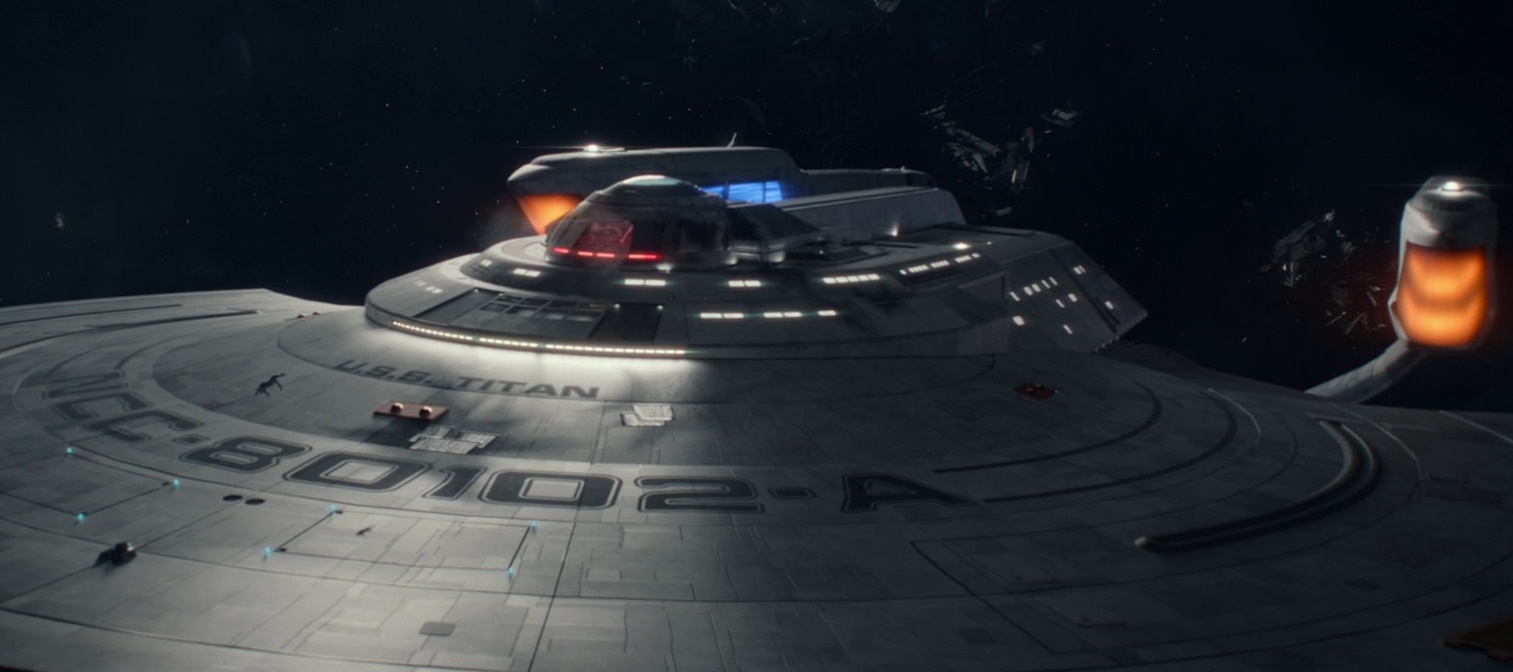
In Season 2, the ship that Picard and co. didn’t spend enough time aboard was the USS Stargazer. In Season 3, they jumped over to the Titan – even though the sets were all the same (with a few minor tweaks here and there). I don’t really understand why this happened. What was the point of setting Season 3 aboard a nominally different starship? The exact same setup could have brought Riker and Picard to the Stargazer as it did to the Titan.
If the two ships had significant aesthetic differences, maybe it would be okay. And compared with some of the other points on this list, I admit it’s relatively minor. But it still feels odd to introduce the new Stargazer, build CGI models for it, and only use it in one-and-a-bit episodes.
Contradictory story #4: Q’s dying… oh wait, no he isn’t.
Q at the end of Season 3.
I know what you’re thinking: Q already explained his “return” by telling Jack Crusher not to think about time in a linear fashion. While that’s a perfectly rational in-universe explanation for Q’s return at the end of Season 3, it doesn’t get around the fact that Q, whose death was such a vital part of the entire plot of Season 2, is a profoundly odd choice of character to use for that one epilogue scene.
Picard’s writers pinned the convoluted and disappointing story of Season 2 on Q, and Q’s entire motivation was his imminent death. To undo that – even if there’s a technical explanation for it – only a few episodes later feels wrong. It undermines the already-weak story of Season 2 and makes me wonder what the point of it all was.
Contradictory story #5: The Borg are back! The Borg are back! The Borg are back!
A Borg Cube.
However you look at it, and whatever nitpicky excuses there may be about who are and aren’t the “real” Borg, there’s no getting away from the fact that across its three seasons, Picard re-introduced the Borg three times. All three of the stories rely, either in whole or in part, on the Borg, and while Picard himself has a connection with the Borg after the events of The Best of Both Worlds and First Contact… there’s a whole galaxy out there filled with alien races that the show’s writers and producers could have used.
While Season 3’s Dominion/changeling rug-pull is probably the worst example of this, it really speaks to a broader problem with the show’s production. Picard’s writers, especially in Season 3, were unwilling to abide by what the show had already set up. The Borg are great fun, don’t get me wrong, but by the time we got to yet another Borg story in Season 3, I was feeling burned out.
Contradictory story #6: The mysterious anomaly has set up a fascinating story! Let’s never mention it again.
Led by the Borg, a Federation fleet stops the anomaly.
The story of Season 2 was bookended by a mysterious anomaly that the Jurati-led Borg faction believed could be an attack against the Alpha Quadrant. Once the anomaly had been stopped, the Jurati-Queen promised to take her Borg faction and stand watch over the anomaly as a “guardian at the gates.” Her Borg faction were even granted provisional membership in the Federation as they did so.
This story felt like it had huge potential. Who could have been powerful enough to create a weapon on that scale? How would Picard and his friends be able to defeat them? What would it be like to see a Federation-Borg alliance? But alas, this storyline was dumped, orphaned, and never mentioned again. Was no explanation ever written? Why end Season 2 on this cliffhanger if it was never going to be resolved?
Contradictory story #7: Soji’s a massively important character… let’s dump her.
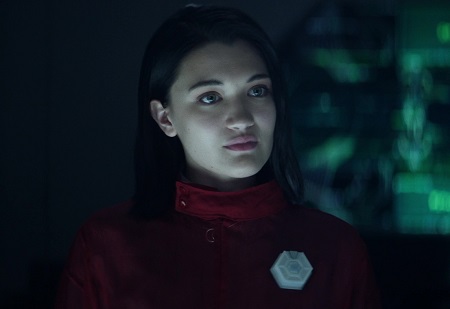
Promo photo of Isa Briones as Soji.
Soji played a huge role in Season 1, serving as both the reason for Picard’s mission and later as someone who needed to be talked down from making a mistake. We spent a lot of time with her in the show’s first season, watching as she was manipulated by Narek, as she learned the truth of her own origin and who her people were, and as she came to work with and respect Picard.
It was disappointing that Soji was essentially forgotten after the end of Season 1, with a barebones cameo appearance and nothing more. Isa Briones got to play a minor role in Season 2 as the daughter of antagonist Adam Soong, but this storyline was samey and boring. As a new, young character – and a synthetic life-form – Soji had huge potential. It’s such a shame that a role couldn’t be written for her after Season 1.
Contradictory story #8: Picard has a new relationship with Laris! No wait, Laris has fucked off and now he has a kid with Dr Crusher.
Laris and Picard at the end of Season 2.
The entire story of Season 2 – its raison d’être, at least according to Q – was that Picard was alone, prevented by his childhood trauma from being able to find love. At the end of the season, after ten episodes of shenanigans in the 21st Century, Picard finally returned to his vineyard – and to Laris. The two seemed ready to embark upon a new relationship together.
But nope! Laris made a small cameo appearance at the beginning of Season 3, and was never mentioned again. Picard’s story in Season 3 focused on his past relationship with Dr Crusher, a relationship that led to him having a son he’d never met. The season’s epilogue even showed Picard and Dr Crusher jointly escorting their son to his first Starfleet assignment – with Laris nowhere to be found. As I said above: Season 2 was already a weak, flimsy story. Undermining its ending like this was a poor decision.
Although I wasn’t thrilled to see Elnor killed off in the first half of Season 2, as time went on, it seemed to be working. Raffi’s story of coming to terms with loss and grief was one of Season 2’s stronger elements, and while I would’ve still said I was disappointed in Elnor’s wasted potential, at least his loss had mattered. Until it was all undone with seconds to spare.
If Elnor had a major role to play in Season 3 – and there was absolutely space for him – then I could at least have understood this reversal. But after Elnor was resurrected, he got one very brief scene in which he looked confused on a viewscreen, and another in which his dislike of a beverage made him the butt of a joke. After that, Elnor disappeared from Picard never to be seen or mentioned again. What was the point? Why undo a powerful story for the sake of an overdone sight gag?
Contradictory story #10: Riker and Troi are happy and settled on Nepenthe. Just kidding, they hate it there.
Picard approaches Riker’s outdoor kitchen.
Nepenthe might be my favourite episode of Season 1. It slowed things down, stepped away from some of the drama, and reintroduced us to Riker and Troi – now happily married and living peacefully outside of Starfleet. In spite of the loss of their son, Riker and Troi seemed settled on Nepenthe with their daughter in a home that was important to their son and their family. It was a surprise, to say the least, when Season 3 tried to undo all of that.
In the episode Surrender, Riker and Troi were reunited as captives aboard Vadic’s ship. And while imprisoned, they both spoke about how they hated the “creaky old cabin” that had been their home. The end of the season implied that one or both of them may be back in Starfleet, and all the emotional storytelling present in Nepenthe was taken away.
So that’s it!
Dr Jurati on stage in Season 2.
Although there were some interesting stories – and some complete ones – overall, it’s not unfair to call Star Trek: Picard a contradictory series, one that either intentionally or unintentionally overwrote or ignored key characters and storylines. We’ll talk about some of these in more detail on another occasion, but for now I think we’ve covered the basics.
Picard was clearly a troubled production, one that jumped from one writing and production team to another, and that’s part of why the series as a whole feels so contradictory. I think I could overlook one or two of these things – and I might even support the decision to drop a character or change a storyline that wasn’t working or that failed to resonate with audiences. But for a series that ran to a mere thirty episodes across three seasons… we shouldn’t be able to pull out ten large contradictions like this.
Stay tuned, because I have a lot more to say about Picard even though the series has concluded! A longer retrospective is in the pipeline, and I’ll also be taking a look at abandoned and unfinished storylines, too.
Star Trek: Picard Seasons 1-3 are available to stream now on Paramount+ in the United States and other countries and territories where the service is available, and on Amazon Prime Video in the UK and around the world. The Star Trek franchise – including Picard and all other properties discussed above – is the copyright of Paramount Global. This article contains the thoughts and opinions of one person only and is not intended to cause any offence.
Spoiler Warning: There are spoilers ahead for Star Trek: Picard Seasons 1-3. Spoilers are also present for the following Star Trek productions: The Wrath of Khan, The Search for Spock, The Next Generation, Deep Space Nine, Voyager, Discovery, and Prodigy.
So this is it, then! This is the last theory update for Season 3, the last ever theory update for Star Trek: Picard in general, and the final part of a series of theory-crafting articles that I began writing when Picard’s first season kicked off in January 2020. Are you as emotional as I am?
There were two pretty big theory culls earlier in the season, so we arrived at the finale with only eleven theories that remained on the list. Of these, one counts as confirmed, but the rest were debunked – or simply ignored entirely. With no more Picard on the schedule, we’ll have to retire all of these theories.
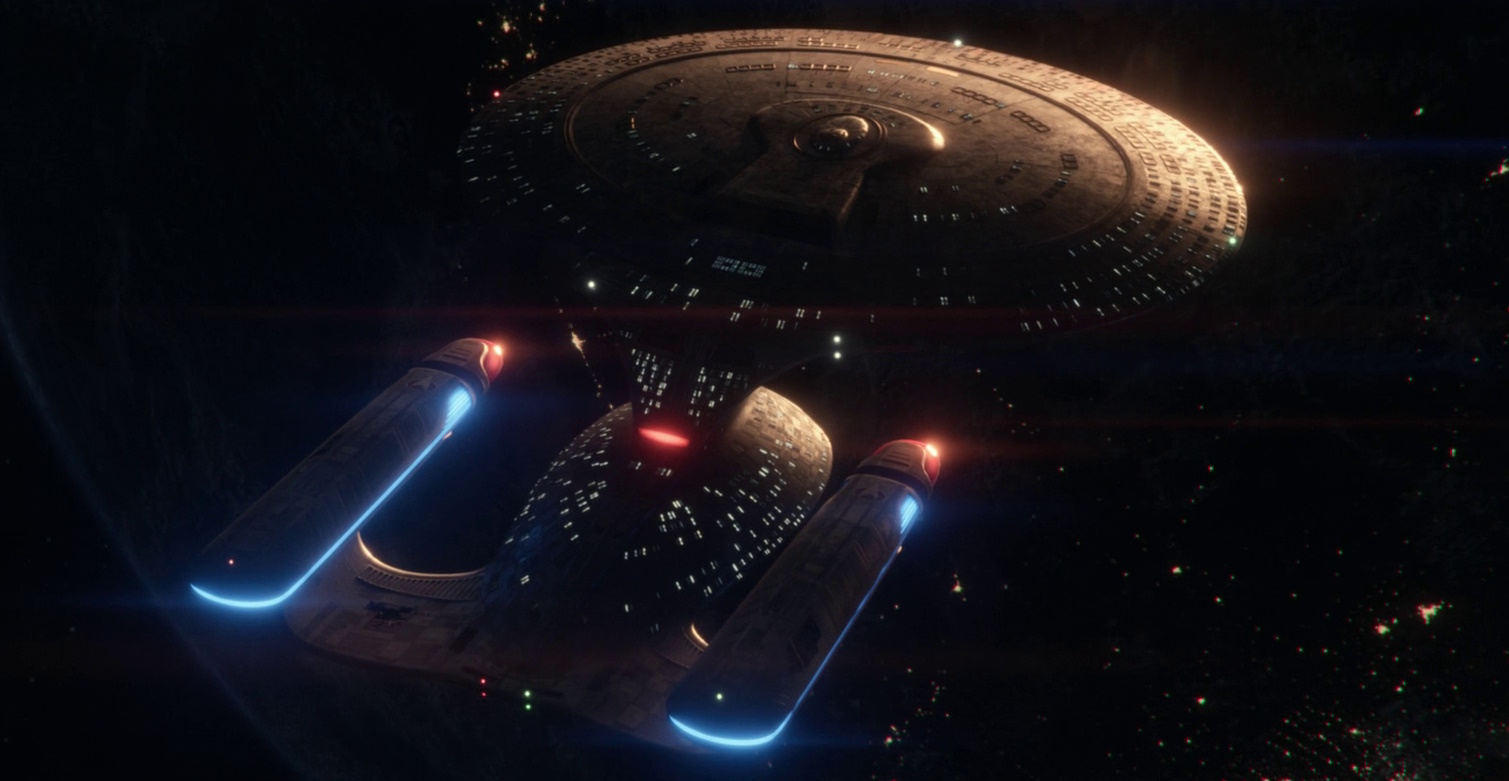
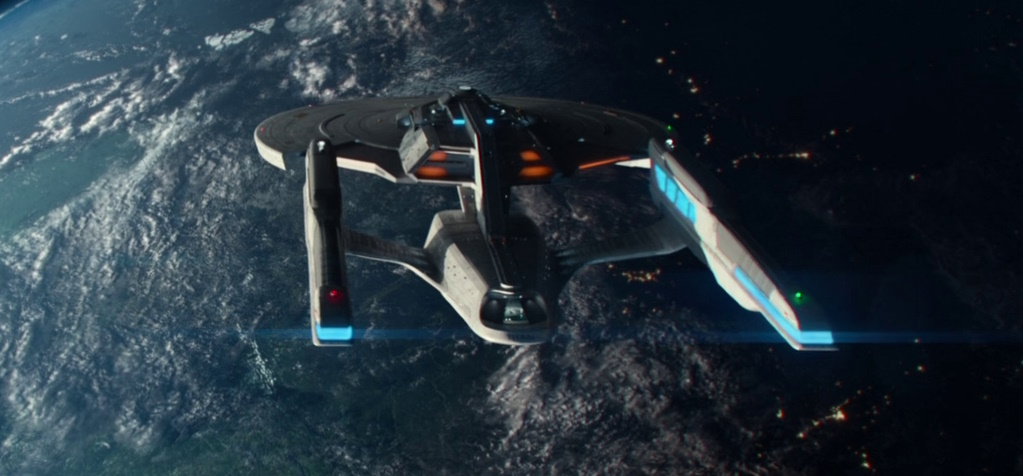
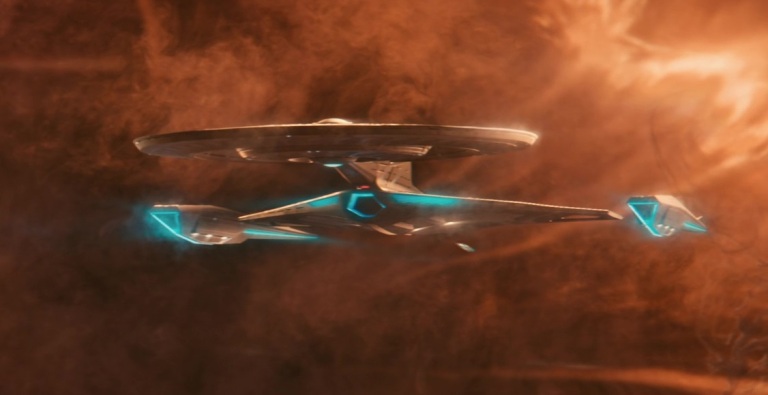
The Enterprise-G.
If Star Trek returns to the 25th Century in the next couple of years – perhaps with a Picard spin-off that fans have been asking for – it’s possible, I suppose, that such a series might revisit characters, locations, and factions from Season 3. But I wouldn’t bet on it… and some of the things we were hoping to see resolved from Season 2 (and even Season 1) are all but certain to be abandoned now.
One of the disappointing things about Picard as a whole series is the abandonment of certain characters and storylines, particularly main characters and story points that appeared to be major. Although the way Season 3 was structured always meant that it was a remote possibility that any of that could be addressed in the final episode, there are still things I’d wanted to see resolved!
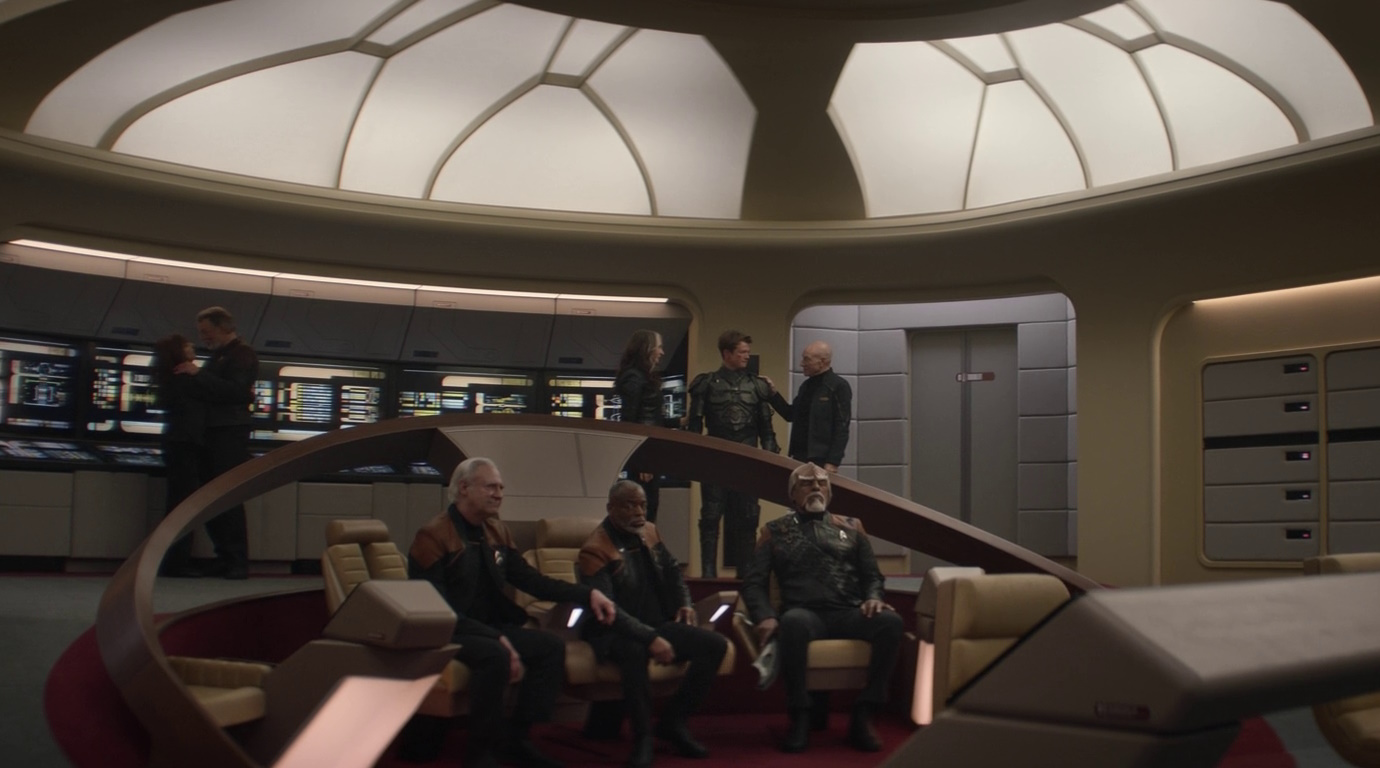
Riker, Picard, and Geordi bid farewell to the Enterprise-D.
But all of that is for the birds now! Our task today is to wrap up the remaining theories so we can draw a line under this series of articles. Although we netted some big theory wins this season, we’re finishing up with a whole lot of theories that didn’t pan out. I wouldn’t say I was overly attached to any of them – but several would’ve been fun had they come to pass.
As I always say, this has just been a bit of fun! Serialised storytelling has its drawbacks, but one thing I’ve enjoyed across all three seasons of Picard has been that the show has lent itself to this kind of theory-crafting and speculation.
Without any further ado, let’s jump into the list for one final time!
Confirmed theory: At least one more unannounced character will appear.
An emergency transmission from a familiar voice!
I’m claiming this one as a win for both Q’s appearance in the epilogue and for Walter Koenig’s audio-only role as Anton Chekov! The son of Pavel Chekov, Anton was the Federation President whose message was heard as the crew of the Enterprise-D raced to Jupiter to confront the Borg. It’s fantastic to think that, more than fifty-five years after his first Star Trek appearance, Walter Koenig was able to return and play a role in the finale of Picard.
However, I was disappointed that we didn’t get to see anyone else. There were multiple mentions of Admiral Janeway in earlier episodes, and a perfect opportunity presented itself in the epilogue for Guinan to appear at her bar. A returning character could’ve also joined the crew of the Enterprise-G under Seven’s command, or we could’ve seen a familiar face battling the assimilated fleet over Earth. Picard did well with cameos and returning characters across Season 3 as a whole, though.
Debunked theory #1: The absences of characters from Seasons 1 and 2 will be explained.
Elnor in a promo photo for Season 2.
I held out hope all season long that someone, somehow, in some way, might’ve explained why Elnor, Soji, and the Borg Queen-Dr Jurati hybrid weren’t joining Picard’s mission or taking part in the story. However, none of these characters – who played major roles in Seasons 1 and 2 of the series – were so much as mentioned. The finale was the last chance for it to happen, but it didn’t.
In the future, when we dissect the troubled, disjointed production of Picard in more detail, I think we’ll have to talk about the waste of characters like Soji and Elnor – characters who absolutely could have been included here. Think how much more impactful it might’ve been to see Elnor as one of the assimilated youngsters, having spent three whole seasons with him, instead of the relative newcomers that we got in the story. There’s a lot more to say about this – but we’ll leave it for another time when we can discuss it in more detail.
Debunked theory #2: The Borg and/or the rogue changelings are responsible for the mysterious anomaly seen in Season 2.
The anomaly at the end of Season 2.
Another abandoned idea that Season 3 didn’t revisit was the mysterious anomaly from Season 2. This storyline – like others from both Seasons 1 and 2 – is now orphaned, unlikely to be revisited. Though it was long past time for the mysterious anomaly to have been incorporated into the plot in a big way, I still felt there was a possibility that it might be mentioned. Someone might’ve explained that it was the Borg’s first attempt to attack the Federation, for example.
Getting more detail on the mysterious anomaly was one of my requests of Season 3, and it’s disappointing that this storyline was abandoned with no resolution. The anomaly kick-started the plot of Season 2, and it was one of the few potentially interesting narrative points from an otherwise disappointing season. Being left with no explanation for something so seismic is disappointing – and another piece of evidence for how poorly-managed Picard’s overall production has been.
Debunked theory #3: Picard will donate his golem body to Jack.
Jack with Picard in the season finale.
I came up with this idea when Jack was first misdiagnosed with Irumodic Syndrome earlier in the season. Even though that diagnosis was later proven to be incorrect, the brain abnormality that Picard and Jack shared still had the potential to prove fatal – as it did for Picard in Season 1. With that in mind, I wondered if the only way Jack could be saved would be for him to be transferred into a golem body.
Picard could have made the ultimate sacrifice for his son, donating his golem to Jack as a final act of parental love. There had been speculation for years that the series would end with Picard’s death, but after the fake-out in Season 1 I felt it would have been hard to pull off killing Picard for a second time. This was one way it could have happened, though! However, the epilogue explained that Dr Crusher came up with a cure for the Borg modification, and that’s that.
Debunked theory #4: At least one main character will be killed.
The main cast of The Next Generation Season 2.
As much as I’d been expecting this, in the end it turned out that the finale and Season 3 as a whole were a bit of a throwback! Television storytelling has gone through a significant evolution since The Next Generation premiered in 1987, and main characters should no longer be considered “safe” just because of their status. With a dangerous mission at hand – and the Borg involved – it seemed plausible to think that at least one of our heroes would be killed off.
Season 3 did find time to kill off Ro Laren and Captain Shaw, but none of the main characters from The Next Generation found themselves on the chopping block. In fact, the season actually resurrected the long-dead Data and even the Enterprise-D, meaning that by the time the credits rolled the death toll for main characters stood at -2!
Debunked theory #5: The Jurati-Borg will ally with Picard and the Federation.
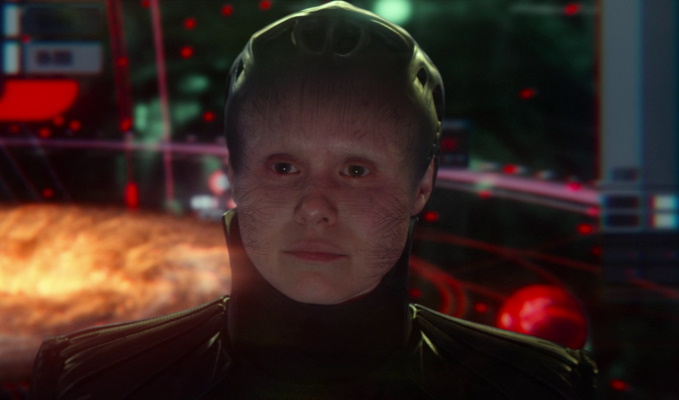
The Borg Queen-Dr Jurati hybrid.
At the end of Season 2, Dr Jurati’s Borg faction asked for provisional membership of the Federation and promised to watch over the unexplained anomaly. With the Federation seemingly staring defeat in the face as a huge assimilated fleet attacked Earth, I wondered whether Dr Jurati’s Borg might show up to render assistance. The anomaly seemed to be relatively close to Earth, based on its Season 2 depiction, so it seemed possible that she might’ve been able to help.
We knew going into Season 3 that Alison Pill wouldn’t be reprising her role – so that always meant that this theory was unlikely, I guess. But even so, it feels incredibly wasteful to have abandoned that Borg faction and the mysterious anomaly, especially when they could have been incorporated into the story in some way. Even if they showed up too late, after Picard had already saved the day, it would’ve been a fun addition.
Debunked theory #6: Deanna Troi will use her “pain removal” skill on Jack.
Troi in The Last Generation on the bridge of the Enterprise-D.
Earlier in the season, it had been established that Troi had the ability to “enter” someone’s mind and remove pain – a skill superficially similar to Sybok’s, I suppose. With Season 3 dedicating time to this revelation, I wondered whether it might come into play at a crucial moment later on, with Troi using this skill to aid Jack in some way. She might’ve been able to sever his connection to the Borg or even cure him of his Borg-induced brain abnormality.
None of that came to pass, however. In fact, Troi’s role in The Last Generation was one of the episode’s least impressive and most clichéd moments, as seemingly from nowhere, as if by magic, she was able to use her empathic ability to pinpoint the location of Riker and the rest of the away team. I’m not disappointed that this “pain removal” angle wasn’t included… but I am a tad disappointed in the way Troi was used in the finale.
Debunked theory #7: Floaty McFloatface will be back.
Nope.
Because of the truly abrupt way in which Vadic’s story ended, I wondered if we might get to learn a little more about Floaty McFloatface – the nameless character who may have been some kind of envoy or go-between for Vadic and the Borg Queen. Although Vadic had died and the Shrike had been destroyed, we hadn’t seen Floaty McFloatface killed – nor was it even clear what Floaty McFloatface was – so it seemed possible, at least, that we might’ve got some kind of resolution to this partial character.
The Last Generation barely mentioned the changelings at all, with a very brief appearance of a rogue changeling being detained in the epilogue being all we got. There was definitely more to say about this faction, including how they came to work with the Borg and what will happen to the surviving members of the conspiracy.
Debunked theory #8: Floaty McFloatface isn’t a changeling.
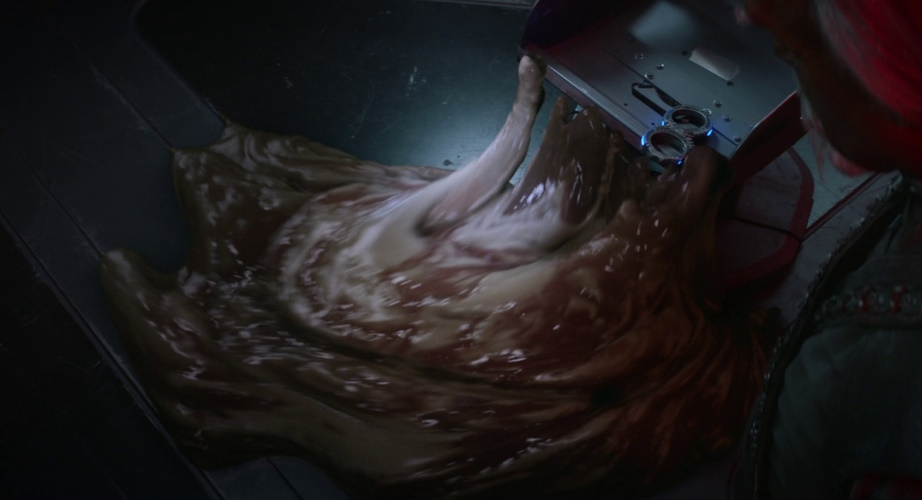
Floaty McFloatface in its goo form.
As above, I speculated that Floaty McFloatface may not be a changeling itself, but might’ve been a Borg or some kind of representative of the Borg sent to Vadic by the Queen to keep an eye on her. Floaty McFloatface clearly had power over Vadic – both in a figurative and literal sense – and I’d have liked to know at least a little more about how all of that worked.
We’ll have to discuss Vadic in more detail on another occasion now that the season has ended, because there are some pretty big issues with the way her involvement in the story ultimately landed. But for now, suffice to say that this theory is debunked and we can assume that Floaty McFloatface either died with Vadic or died when the Shrike was destroyed a few moments later.
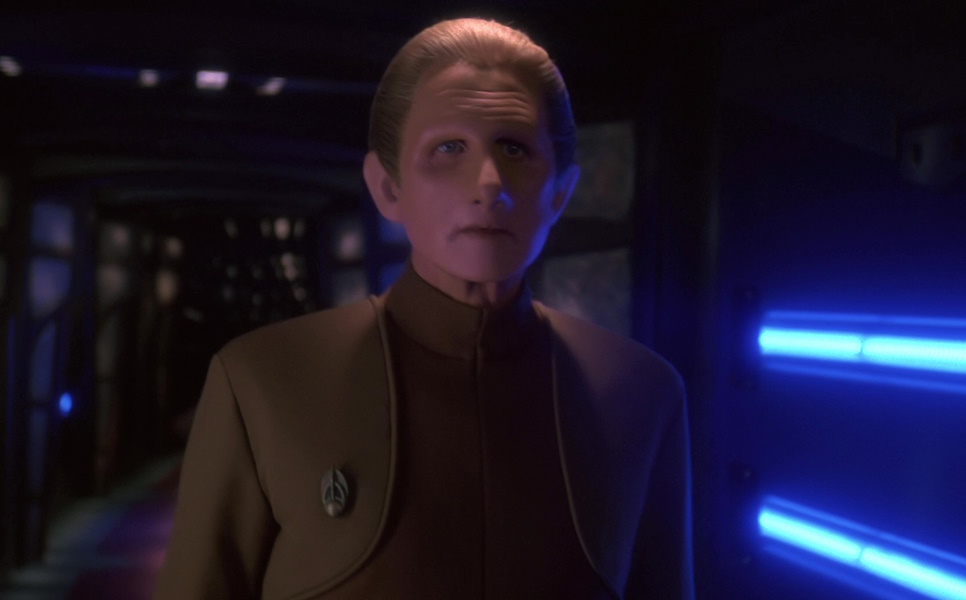
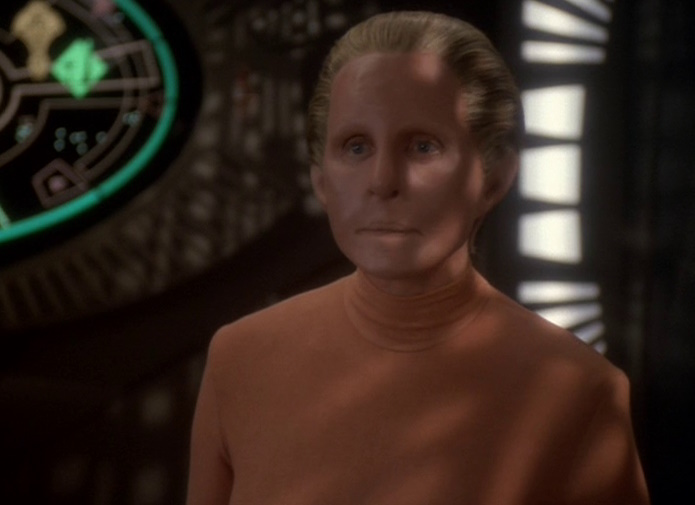
Debunked theory #9: Odo will make an appearance – somehow.
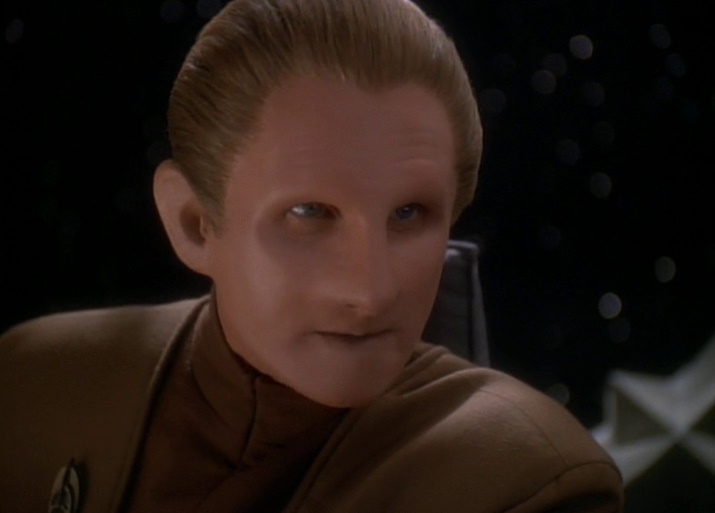
Odo in Deep Space Nine.
Odo had been mentioned by Worf – albeit rather obliquely – earlier in the season, and with the changelings playing a significant role in the story that, in spite of Vadic’s death, was yet to be wrapped up, I felt it was at least possible that the show’s writers might’ve included Odo in some kind of epilogue sequence. It didn’t happen, though – and I’m actually really glad about that!
Season 3 didn’t lean into Deep Space Nine as heavily as I’d expected after the first two or three episodes, and all of the returning characters were from The Next Generation or Voyager. There was scope to do more with the Deep Space Nine and Dominion War angles, but I’m glad that Odo wasn’t digitally recreated or recast on this occasion.
Debunked theory #10: Other old/classic starships will join the Enterprise-D to face off against the Borg.
The Enterprise-A.
As cool as it was to see the Enterprise-D standing alone against the Borg… imagine how much fun it could’ve been if the ship had been joined by other older vessels. We could’ve seen some of the ships from Geordi’s fleet museum, for example, with the Enterprise-D and Enterprise-A fighting alongside one another for the first time ever. Now that would have been spectacular!
I’m a sucker for the “desperate last stand” story trope no matter how it’s written, and The Last Generation did its thing pretty well. But it would have been amazing if Picard and the Enterprise-D could have been joined by even just one or two other classic/retired starships for this final fight. There must be other ships in Starfleet that weren’t upgraded in addition to those at the museum. Oh well!
So that’s it!
The “Death Star trench run!”
We’ve wrapped up our remaining Picard theories now that the season has come to an end. Although there were a lot of debunkings, across the season I did manage to make a few successful predictions! And above all, I had fun speculating about where the story might go. That was the point of all of this, really, and I’m glad to have been able to follow along with Picard from beginning to end, sharing my theories and speculation with you.
So what’s next? Although my theory lists and episode reviews are over, there’s still a lot to say about Picard’s third season and the series as a whole. When the dust has settled I’d like to re-watch all three seasons of the show in one hit to see how well it works (or doesn’t work) in that format. And I already have a few articles and essays that I’m tentatively sketching out in my head, talking about the third season, some of its narrative decisions, potential spin-off ideas, and much more. So although Picard has come to an end, I hope you’ll check back to see some of that!
All together on the bridge, safe and sound.
And of course there’s more Star Trek to come! Strange New Worlds Season 2 will premiere in June, and we have Discovery’s fifth and final season in early 2024 – plus Prodigy, Lower Decks, Starfleet Academy, and Section 31 to look forward to as well!
For now, though, I’ll end by saying that I hope you had fun following along with my theories this season – and across Seasons 1 and 2, too. I had a great time keeping the theory list up-to-date, coming up with ideas, and speculating about the story that Picard was telling. And who knows… if a certain Legacy pitch gets picked up by Paramount, maybe some of my theories will return in the future! Watch this space, and live long and prosper!
Star Trek: Picard Seasons 1-3 are available to stream now on Paramount+ in the United States and other countries and territories where the service is available, and on Amazon Prime Video in the UK and around the world. The Star Trek franchise – including Picard and all other properties discussed above – is the copyright of Paramount Global. This article contains the thoughts and opinions of one person only and is not intended to cause any offence.
Spoiler Warning: There are spoilers ahead for Star Trek: Picard Seasons 1-3. Spoilers are also present for the following Star Trek productions: The Wrath of Khan, The Next Generation, Deep Space Nine, Voyager, and Discovery.
It only really hit me when I was sitting at my desk, creating the header image for this review: this is the final episode of Star Trek: Picard. This will be the last time I crop still frames, the last time I have to warn you about spoilers… the last time I review a brand-new episode of this series. There will be plenty of opportunities in the weeks, months, and years ahead to look back at Picard – and I have no doubt we’ll do just that. But for now, suffice to say that I already feel a swirling mass of emotions as the series comes to an end.
I’d waited more than eighteen years for Remembrance– the premiere episode of Season 1. In all of that time, Star Trek had looked backwards. Prequels, spin-offs, and and alternate timeline had all told some fun stories and kept the franchise going, but my Star Trek era – the late 24th Century – had been sidelined. Picard was the show that brought it back, and that brought back Jean-Luc Picard and other incredible characters. I was so passionately excited when I sat down to watch Remembrance a little over three years ago… and it’s been a journey, to say the least!
The Last Generation got its own poster.
If you read my review of Võx last time, you can probably skip this one! I’m going to say more or less the same thing about The Last Generation as I did about Võx: this was a flawed episode, hamstrung by clichés, contrivances, and a badly-paced second half of the season… but I liked it anyway because of the deeply emotional storytelling that it managed to get right.
For a good hour or more after I’d first watched The Last Generation, I found myself sitting around wearing a big stupid grin – because despite the obvious flaws and issues with the episode that we’ll get into in a moment, by far my biggest takeaway was how it made me feel. That’s the success of The Last Generation – and, in a broader sense, of the final chapter of Picard’s third season as a whole. I didn’t expect to feel this way, and if you write out on paper the elements that were dumped into the story at this late stage, how they came together, how rushed much of it felt, and more, I’d have expected to come away from The Last Generation feeling disappointed. But… I don’t.
Showrunner/director Terry Matalas with the main cast.
And that’s in spite of The Last Generation being a deeply flawed outing from multiple angles. I’d go so far as to say that the episode doesn’t even feel like a finale or an ending… let alone a definitive one for a crew who should be ready to enter retirement. Think about where everyone ended up at the end of the story: Dr Crusher has been reinstated in Starfleet, Seven, Raffi, and Jack are about to head off on a new adventure, Riker and Troi appear ready to leave Nepenthe behind and find a new home, Data is just beginning to get used to his new body and newfound humanity, and the only characters who might be ready to return to their pre-Season 3 lives are Worf, Geordi, and Picard… though we didn’t see much of an indication of that in the episode itself.
And that’s before we get into the strange implications of the mid-credits scene.
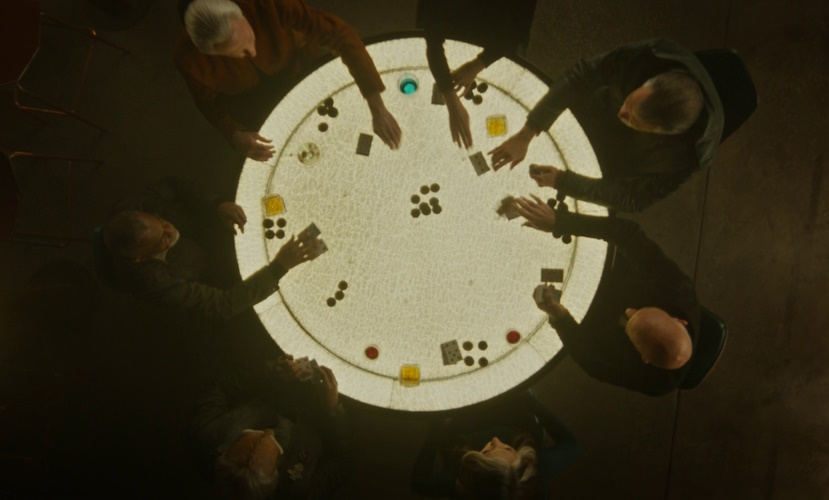
You did stick around for the mid-credits scene, right? After the credits roll over the lingering overhead shot of Picard and the crew playing poker – a callback to All Good Things at the end of The Next Generation – we got one final scene. Go back and watch it if you haven’t! I’ll wait here.
You stuck around after this, right?
I guess we’ll start with what The Last Generation got wrong, as well as talk about the decisions that led to the story reaching this particular ending.
This was a rushed episode, one in which the main villain of the entire season was outsmarted and defeated in a matter of minutes. There were gripping moments of explosive action and tense drama along the way – but practically all of them would’ve benefitted from a few extra minutes. I stand by what I said last week: the decision to change track from the changelings to the Borg came too late, and there wasn’t enough time remaining to have the kind of climactic final battle that the writers wanted.
If this exact pacing problem hadn’t also afflicted Seasons 1 and 2 of Picard, it would still be deeply disappointing to see it here. But given the criticisms that both of the previous seasons of this series received for precisely this issue… quite frankly it’s unforgivable. This isn’t strictly a problem with The Last Generation, but rather with the pacing and structuring of the season as a whole. If showrunner Terry Matalas is to be trusted with a spin-off – as he and some fans are pushing hard for at the moment – then lessons have to be learned. Matalas helmed Seasons 2 and 3 of Picard, and both seasons came to a close in a mad rush, without enough time to fully explain everything.
The Enterprise-D in action.
As the dust settles, it isn’t even clear whether Vadic and her rogue changelings actually knew who they were working with, or the extent of the damage done to the Borg Collective. That side of the story evaporated with Vadic’s death a couple of weeks ago, and was barely touched in the epilogue after the Borg’s defeat. For a story that supposedly brought together two of Star Trek’s most powerful villainous factions – the Founders and the Borg – to come to an end without any on-screen interaction between them… again, it’s very odd. Something is missing here.
Realistically, if both the rogue changelings and the Borg were to be included, we needed this revelation to have come earlier. There would still have been secrets to keep – such as the inclusion of the Enterprise-D – but had the Borg reveal come sooner, and been explained better, other story elements that came to a head in The Last Generation would have flowed better and more naturally.
Behind-the-scenes on The Last Generation.
The Last Generation relies heavily on a story from two decades ago that wasn’t explained and only got the most oblique of references earlier in the season. In the Voyager finale, a time-travelling Admiral Janeway infected the Borg Collective with a “neurolytic pathogen,” devastating it. It was this event that the Borg Queen said was the cause of the decrepit state of the Collective – but for such an important story point, this needed far more explanation than it received.
Although the latter part of Picard’s third season has the feel of a production that was “made for fans,” it isn’t just hard-core Trekkies who watch the show. I have friends who aren’t immersed in the world of Star Trek who have enjoyed Picard for the sci-fi series it is on its own merit – and I suspect that a lot of more casual viewers, those who either don’t recall or didn’t watch Voyager, would have been left baffled by the Borg Queen and the Collective in general being in such a state. That this presentation of a different Borg Queen is now the third distinct version of the character to appear in Picard just adds to the confusion.
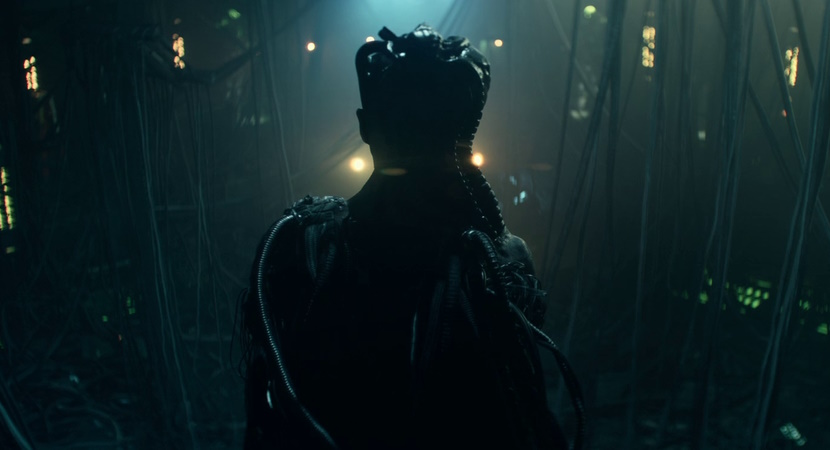
The Borg Queen.
Again, this isn’t a problem with The Last Generation on its own, nor even just of Season 3. Picard’s showrunner and writers chose to bring the Borg into focus in each of the show’s three seasons, offering different and contradictory presentations of the Collective and its leader each time. Given that the changeling storyline had worked so well for the first three-quarters of this season… perhaps a different ending could have been written, one that kept the Borg out of things. Or, alternatively, given that Seasons 2 and 3 went into production together with the same team at the helm, Season 2 could’ve been changed if this Borg ending to the series had already been decided upon.
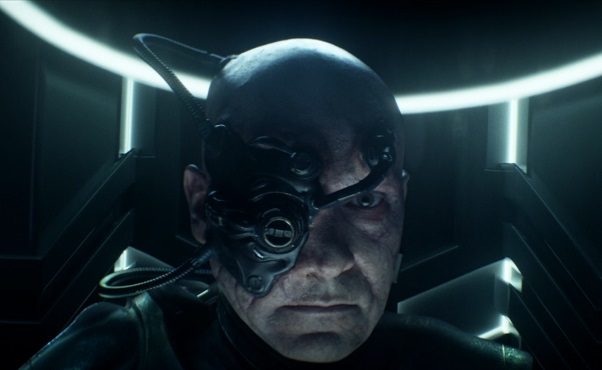
Though we can argue it’s fitting, in a way, for Picard to be present at what appears to be the final demise of the Borg, given that he was present when the faction was introduced and was assimilated by them, the way this story unfolded doesn’t actually have that much to do with Picard. The Borg’s defeat came at the hands of Janeway, who was mentioned by name several times but didn’t even make a cameo all season long. Picard himself was just sort of… there. As has been the case more or less all season long, Picard – the show’s title character and main protagonist, lest we forget – was swept along by a narrative current that was almost entirely out of his control.
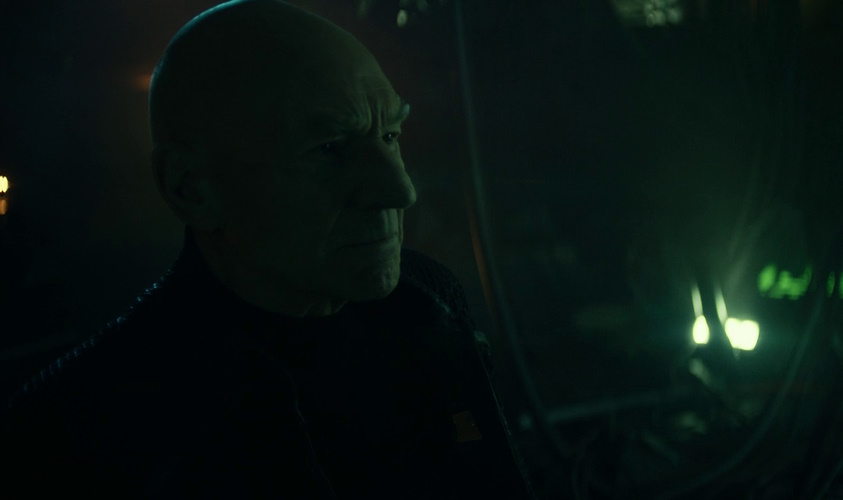
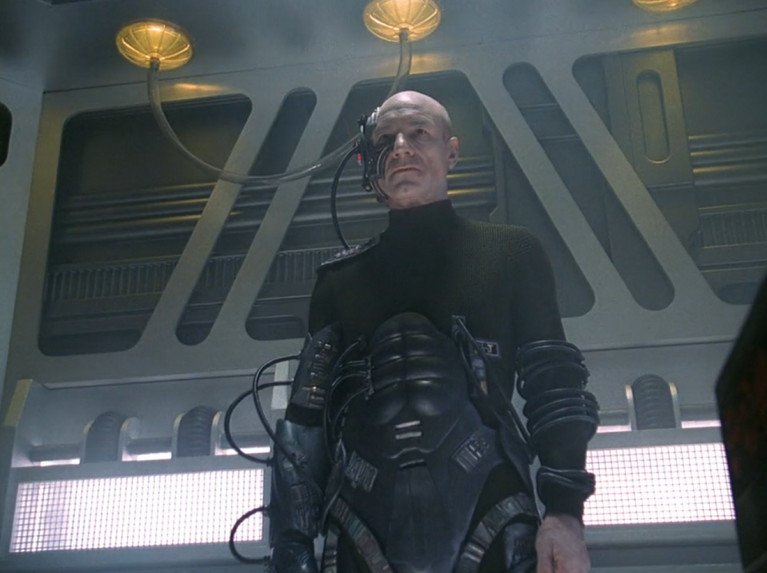
Picard in the Borg Queen’s chamber.
Because the reveal of the Borg’s involvement came so late in the story – partway into the ninth episode of a ten-episode season – Jack’s “defection” to the Collective already felt like it was built on shaky ground. There was the kernel of a good idea here, but again I feel the pacing issue causing a stumbling block. Jack’s powers manifested slowly earlier in the season, and in fact it wasn’t until several episodes in that we saw any indication that he was anything other than human at all. His decision to run away last week was blitzed through in a matter of seconds, and his reconciliation in The Last Generation was likewise rushed.
Reaching out to someone and using “love” to bring them back from a dark place is a bit of a cliché, but it’s hardly the worst that Season 3 has offered up. The way it was handled worked well enough in the moment – though I would argue that Dr Crusher, rather than Picard, would surely have been better-placed to try to convince Jack to stand down. Although we’ve seen a developing relationship between Picard and his son, the events of Season 3 have taken place over a few days at most, meaning the connection between Jack and Dr Crusher is going to be far stronger.
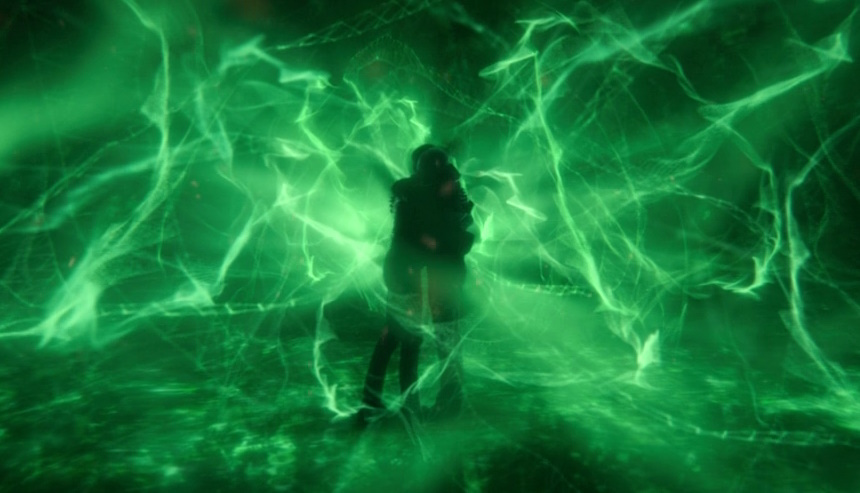
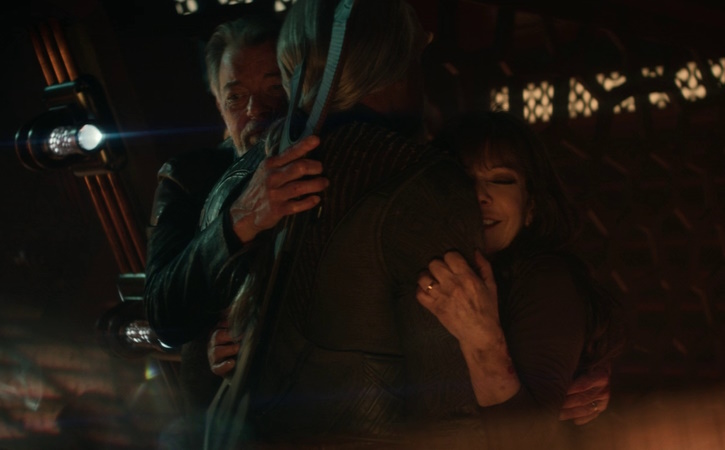
Picard and Jack embrace inside the Borg Collective.
Given the remarkably similar premise between Jack’s story here at the end of Season 3 and Dr Jurati’s toward the end of Season 2, it’s a shame that she and her Borg faction couldn’t appear. In fact, the whole end of Season 2, with the mysterious, unexplained anomaly attacking the Federation, has now passed its last chance to get any kind of resolution. At this late stage I wasn’t expecting that to happen – but it’s again indicative of Picard as a whole being a deeply troubled and poorly-managed production. Lessons need to be learned going forward so that future Star Trek projects don’t suffer similar shortcomings.
As I said last week when discussing the Borg, Jack’s story would feel stronger – and certainly more original – were it not basically a re-hashing of Dr Jurati’s story from last season. Dr Jurati felt lonely, isolated, and without friends – and found those things in the Borg. Jack felt lonely, isolated, and without friends… and also sought out those things from the Borg. Jack’s defection feels weaker, in some respects, because of the way it was set up, and the fact that it’s no longer an original idea further diminishes it.
Jack was able to break free of the Borg Collective thanks to Picard.
Several characters displayed skills in The Last Generation that are either perfectly aligned with things we’ve seen them do in the past, or that felt like natural evolutions based on the story the season has told. Dr Crusher manning the Enterprise-D’s weapons is a case in point: after two decades away from Starfleet, operating outside of the Federation under dangerous conditions, she knows her way around a phaser bank and torpedo launcher!
But Deanna Troi exhibited a telepathic skill that we’ve never seen her use before, being able to pinpoint Riker’s location as if by magic. There were opportunities earlier in the season to set this up, such as the conversation Troi and Riker had while imprisoned aboard the Shrike. As it is, this newfound ability felt like a magical solution to a story that had rather written itself into a corner – a cheap way to allow the Enterprise-D to swoop in and save everyone at the last second.
Deanna Troi on the bridge.
Unlike some of the other points I’ve raised, this one isn’t even a question of timing or pacing. It would’ve required an extra handful of lines of dialogue in an earlier episode, explaining that Troi had been honing her abilities or that when she used her “pain removal” skill on Riker she’d done so at a distance. That small amount of setup would’ve allowed this moment to flow far more naturally, and wouldn’t have led to me rolling my eyes quite so much!
A clever and well-executed misdirect can add a lot to a story, particularly if the stakes are high. But even with that caveat, I have to say that the excessive “foreshadowing” of the deaths of Riker and Picard in particular fell very flat for me in The Last Generation. The episode dedicated an inordinate amount of time to setting up that the away team wouldn’t be returning from the sojourn to the Borg Cube… only for everyone to survive. Stripping some of this out would’ve still allowed The Last Generation to keep the tension high, but would’ve blunted the impression that it was deliberately deceitful. Not only that, taking a few of these scenes away would’ve opened up other possibilities, such as spending a bit more time with the Borg Queen.
There was a lot of foreshadowing that wasn’t paid off.
There’s nothing wrong with an episode feeling like a throwback to an earlier style of storytelling – especially in a story with such a strong nostalgic component. But even with that in mind, the fact that all of the main characters survived the story was a bit of a surprise. Television storytelling has changed a lot since The Next Generation premiered in 1987, and main characters should no longer consider themselves to be safe just because of their status. To the episode’s credit, it genuinely felt like Picard, Riker, and Worf were all in danger during their mission… but nothing substantial came of that, and we even got a deus ex machina rescue right at the end.
Killing off a legacy character was always going to be controversial, and I’m sure that if someone hadn’t survived, there’d have been criticism from some quarters. But a well-timed character death can feel right, conveying how high the stakes are, paying off a character arc, or making an heroic sacrifice. Star Trek has done all of these things before in different ways, and I feel it would have strengthened not only The Last Generation but Season 3 as a whole if a well-written end could’ve come for one of our main characters.
Jack and Picard were both saved at the last second.
Part of the reason for that is that, for all the buildup, The Last Generation doesn’t really feel like an ending. It feels more like All Good Things than The Undiscovered Country, with a new chapter for some or even all of these characters seemingly ready to be written. I’m all for leaving the door ajar, with possibilities on the table… but this season was supposed to be the “final” outing for this crew. Only Picard seems ready to enter retirement – and even that feels questionable as he reunited with Dr Crusher to escort Jack to his first ever Starfleet posting.
All Good Things was clearly part of the inspiration for the epilogue at the end of the episode, particularly the poker sequence. But All Good Things was written and produced at a time when the cast and crew knew that Generations was literally days away from entering production. It didn’t need to be a definitive end… because it was never meant to be. Season 3 as a whole, and The Last Generation in particular, was billed as the final voyage of this crew. And yet it ended in such a way as to suggest that practically everyone has at least one more adventure yet to come.
Riker, Picard, and La Forge on the Enterprise-D.
The final fight against the Borg Queen brought with it a lot of tropes. The Enterprise-D blasted its way along the surface of the Queen’s oversized vessel almost like an X-Wing running the Death Star trench in Star Wars, and though this sequence was visually exciting – and technically perfect from an animation point of view – it was again something that was rushed. The buildup to this sequence was blitzed through, thanks in part to the decision to spend so much time setting up character deaths that ultimately didn’t come.
Starships and the way they operate have always been vague; adaptable to different kinds of stories. Given the size discrepancy between the Enterprise-D and the Borg Queen’s mega-cube, I don’t think it’s any kind of “problem” to see the Enterprise-D move as quickly as it does and with such fluidity – and this sequence felt like an updated, modernised version of the starship’s clashes with Borg vessels in episodes like Q Who and The Best of Both Worlds.
The “Death Star trench run!”
I think my biggest eye-roll in The Last Generation came as the Enterprise-D swooped down for a last-second rescue, literally appearing in the “sky” above the Borg Queen’s chamber. Both in terms of narrative and visual presentation, this was just such an overdone trope. Across the sci-fi genre and into action, adventure, and more… we’ve seen this kind of ending so many times.
Part of the reason why this moment fell so flat for me was, I suspect, because The Last Generation hadn’t made good on any of its foreshadowed character deaths. The rescue of the survivors might’ve been more impactful had one or two of these characters lost their lives along the way. But a combination of the trope itself, its previously-unseen telepathic “magic” setup, and the fact that it rescued all of the main characters from a supposedly impossible situation… it all came together to feel like a clichéd ending.
The Enterprise-D saves the day!
I stand by what I said last time: the presentation of the Borg Queen feels quite diminished in light of what we saw in Season 2. The idea of a decrepit, weakened Borg Queen was an interesting one – but not one that The Last Generation found much time to explore. She leaned very heavily into the “I’m evil for the sake of it” villain trope, far more so than earlier presentations of the Borg Queen, who seemed to have an overarching goal in mind for the Collective. However, I can forgive that trope in light of the collapse of the Borg Collective; the idea that she’d use the last of her power to seek revenge on Starfleet makes sense.
As Jack was liberated from the Collective, and particularly as the Enterprise-D came racing in to save the day, though, the characterisation of the Borg Queen fell apart. Another huge part of why this sequence felt so clichéd was the Borg Queen’s screams of “noooo!” as her plan unravelled. This is the kind of thing that you expect to see from the supervillains of children’s comic books, or the bad guys in a Saturday morning cartoon, as their evil scheme is defeated. Again, this whole sequence was so much less interesting than it could’ve been.
“Nooooooo!” screams the defeated villain.
But now we have to contend with a question that I asked last week: does any of that matter? The clichés, the overused tropes, the basic, formulaic story, the cookie-cutter plot, the poor pacing, the underused yet also played-out villain… none of it really feels like it gets in the way of a fantastic, thoroughly enjoyable romp with Picard and the crew.
Even though The Last Generation absolutely fails to feel like an ending in any sense of the word for basically any of its characters, it’s still a more enjoyable send-off and final mission than the crew of the Enterprise-D got in Nemesis. If this is to be their final outing (and I wouldn’t bet against Paramount considering some kind of Picard TV movie or even theatrical release, given the strong reception to Season 3) then we can finally say that this crew went out on a high.
All safe and sound on the bridge.
And it’s a high because of the emotional storytelling that manages to play the nostalgia card in a way that works. This was another “made for fans” outing, one that leaned heavily into The Next Generation, Voyager, and really all of Star Trek’s past. If you’d told me at the start that the season finale would be like this, I’d have been sceptical – fearing that it would come across as a nostalgia overload. And frankly that’s what The Last Generation is: an episode that sacrifices narrative integrity for the sake of nostalgia.
Maybe it’s the blinkers of nostalgia speaking, as The Next Generation was my way into the Star Trek fandom more than thirty years ago, but I can’t hold that against Picard. It worked for me – and if that’s because I’m a basic bitch, blinded by nostalgia to the obvious flaws and gaping holes of a mediocre story… then so be it! I’ll be a basic bitch all day long.
The Enterprise-D arrives at Earth.
There’s more to storytelling than canon, consistency, and even logic. These things all matter, don’t get me wrong – but in a story like The Last Generation, it’s just that they matter far less than how the episode makes us feel. And for me at least, though I recognise with a critical (some might say cynical or jaded) eye that the episode and its narrative have flaws, almost the entire time I was on the edge of my seat, truly going through all of the emotions with Picard, Riker, and the rest of the crew as their mission unfolded.
As happened last week, that’s my real takeaway from The Last Generation. The fact that I was roped in, entertained, and went through a rollercoaster of emotions with Jean-Luc Picard and the crew more than makes up for any logical inconsistencies or narrative missteps that the episode made.
Picard toward the end of the episode.
The idea that Picard, Riker, Worf, or anyone else might actually be killed – as was extensively foreshadowed and hinted at – was gripping, and more than a little upsetting. Death felt like it was stalking the members of the away team – and those on the bridge of the Enterprise-D or trying to remain in control of the Titan scarcely felt much safer, either. This feeling persisted for much of the episode, and though the way in which it ended was ultimately a little unsatisfying because of everyone surviving, in another way that’s very “Star Trek.” Heroes like Captain Kirk famously didn’t believe in no-win scenarios – and Picard managed to pull off the impossible task of saving everyone.
Animation brought these stories to life in spectacular form – and thinking back to the finale of Picard’s first season just three years ago, it’s amazing how far Paramount and Star Trek have come. The fleets and ships seen in The Last Generation were beautiful and diverse, and seeing Spacedock as Earth’s last line of defence against a massive, imposing armada was a truly stunning sight.
Spacedock and the assimilated fleet.
Both the Titan and Enterprise-D were beautiful, too, and both ships performed incredible feats as they battled their foes. Seeing the Titan in action, taking on the entire assembled fleet, was spectacular to see – and it found another narrative justification for the cloaking device that Jack and Sidney “borrowed” a few episodes ago!
Seven and Raffi hadn’t had as much to do this season as I’d hoped – but the moments they got in The Last Generation showed both characters at their best. Part of the reason fans are so hyped up for a potential spin-off is to see more from Seven of Nine, and The Last Generation added to and rounded out her arc across all three seasons of Picard by placing her, once again, in the captain’s chair. This time, we got to see her people skills – being able to inspire and protect the motley crew of survivors on the bridge was pitch-perfect.
This was a good episode for Seven of Nine.
Again, my only real criticism of this part of the story is that I could’ve happily spent more time with Seven of Nine and the crew of the Titan! As Picard and his crew worked to stop the Borg Queen, Seven and hers provided essential covering fire – and the way that this came across was outstanding. Seven, Raffi, and their assembled survivors felt in danger practically the entire time, especially as the Titan’s cloak was destroyed and its assimilated youngsters made their way back to the bridge.
As unsold as I’ve been on Data’s resurrection this season, the character dynamic between Data and Geordi has been cute – and this trend continued in The Last Generation. Geordi sat beside Data on the bridge of the Enterprise-D – as he had in The Next Generation’s first season – and they had some fun and exciting moments together.
Data.
Likewise Riker and Worf! These two characters had a great relationship during The Next Generation era, serving together and often taking part in away missions. It was a treat to see them teamed up once again, and the dynamic they had aboard the Borg vessel added a lot of comedy to what was an otherwise serious story. Jonathan Frakes and Michael Dorn have great chemistry and comedic timing together, and the moments of lightheartedness through what was a dangerous mission really elevated the sequences aboard the Borg vessel.
Picard’s act of sacrifice required him to “jack in” to the Borg Collective – voluntarily assimilating himself. As the culmination of Picard’s arc with the Borg, this was a fascinating idea. Picard had already come to terms with aspects of his Borg experience in First Contact and in Seasons 1 and 2 of this series, so it wasn’t totally original or new – and that might’ve improved it, perhaps. But making this sacrificial move was clever, and fits right in with themes that the entire series has touched upon in different ways.
Picard jacks in.
I’m glad that Tuvok survived his ordeal with the changelings – though I would’ve liked to have seen how he and others may have been rescued. Again, this is something a longer season might’ve been able to include. But his scene with Seven, in which she was promoted to captain, was a very sweet part of the epilogue.
I’m not sure how I feel about the return of Q. As I said last year after Q had been “killed” in Season 2, bringing him back to life – especially with the kind of hand-wavey explanation of “don’t think in such linear terms” – undermines one of the few remaining narrative points propping up the entirety of Picard’s disappointing second season. For the sake of such a brief cameo… I wouldn’t have included Q here, I think.
Q is back.
One cameo that I adored was Walter Koenig – who sadly only appeared in audio form – as Anton Chekov, the son (or grandson) of Pavel Chekov. I jokingly said a few weeks ago in one of my theory updates that Chekov would be an unlikely inclusion this season… but it turns out I’m rather prophetic!
The name Anton was presumably chosen in memory of Anton Yelchin, who portrayed the character of Chekov in the Kelvin timeline films. This was a sweet way to memorialize him. Bringing Walter Koenig in for a cameo really brings together all of Star Trek. This finale began last week with a callback to Enterprise, Koenig represents The Original Series, and we have main characters from across The Next Generation era. It really was a celebration of all things Trek!
Data and Geordi listening to President Chekov.
There’s more to say – but we’ll have to return to The Last Generation and Season 3 on another occasion.
This review took me a long time to finish, having started it on the day the episode premiered. I had an original draft ready by last weekend, but I wasn’t happy with it so I ended up deleting and re-writing large parts of it. Keeping up with Picard this season has been a struggle, and I think I’m ready for a bit of a break from these reviews! Thankfully, the Star Trek franchise seems to be better-paced this year, and there’s a break before Strange New Worlds Season 2 arrives in June.
I enjoyed The Last Generation – in spite of its shortcomings. It was a great way to end the season, and it potentially sets up a spin-off set in this same time period, which is something I truly hope can happen.
So long, Captain Picard!
So we come to the end of Season 3… and of Star Trek: Picard. In the weeks and months ahead we’ll return to The Last Generation and to Season 3, perhaps taking a deeper look at some of the individual characters, narrative points, and themes – and dissecting them! But for now, I’m about ready to put this review to bed and move on to other topics!
I’ll round up my theory list sometime soon, too. But for now, I hope you enjoyed following along with my Picard reviews this season. Season 3 was an improvement on Season 2, without a doubt, and for the most part I had a good time with it.
Stick around, because the website isn’t going anywhere! There’s Strange New Worlds to come this summer, the video game Star Trek: Resurgence, and Discovery’s final season in early 2024. In between I’ll be re-watching older films and episodes, crafting theories, previewing upcoming projects, and talking about other franchises, too. Thanks for bearing with me while I was writing this review, and I hope to see you soon!
Star Trek: Picard Seasons 1-3 are available to stream now on Paramount+ in the United States and other countries and territories where the service is available, and on Amazon Prime Video in the UK and around the world. The Star Trek franchise – including Picard and all other properties discussed above – is the copyright of Paramount Global. This article contains the thoughts and opinions of one person only and is not intended to cause any offence.
Spoiler Warning: There are spoilers ahead for Star Trek: Picard Seasons 1-3. Spoilers are also present for the following Star Trek productions: The Wrath of Khan, The Search for Spock, The Next Generation, Deep Space Nine, Voyager, Discovery, and Prodigy.
I had a tough old time figuring out what to say about Võx this week. It was simultaneously an incredibly emotional episode that hit all of the right nostalgic notes… and a flawed, trope-laden outing that literally had me rolling my eyes and even laughing out loud. But as Picard and the crew boarded the Enterprise-D and the dust settled… it’s also an episode that has completely decimated our theory list!
You can find my review of Võxby clicking or tapping here – and I hope you’ll check it out if you have time. I’ve shared my thoughts as best as I can… but I’ll be genuinely curious to see how the episode holds up in a year’s time when we’ve had time to process everything that happened this season, and to move on. Will those deeply nostalgic moments still cover up the episode’s flaws?
Jack aboard a shuttle in Võx.
This week we have five debunked theories, three further theories that I’m choosing to retire, and five fully confirmed theories. We also have three theories that I’m calling “semi” confirmed – and the reason for that status is the same in every case: something I’d proposed might be a changeling idea was actually a Borg idea. I got the basic outline more or less right – but called it a changeling plan not a Borg plan. But it’s my list so I’m still calling those “semi” confirmed!
I had a lot of fun last week theorising about what the “ancient evil” surrounding Jack might be – as well as knocking over a couple of popular fan theories that I’d spotted on social media. There’s no such bonus theory to come this week… and as we strike so many theories off of the list, we’ll be going into the finale with only a few remaining on the table!
As always, we’ll start with theories that were confirmed or debunked this week.
Debunked theory #1: Jack has changeling/Founder DNA.
Jack in this week’s episode.
Until we saw the Borg hiding inside Jack’s mind this week, which began the process of unravelling the Borg’s involvement in the story, the “big bad” that Picard and the crew were facing appeared to be a group of rogue changelings. With their focus on Jack, and Vadic appearing to have some kind of personal interest in him or connection to him, it seemed a reasonable guess that Jack might have somehow got changeling DNA mixed in with his human DNA.
Võx debunked this idea, though, explaining that Jack’s condition is in fact the result of Borg biotechnology – something that he inherited from Picard at the moment of his conception.
Debunked theory #2: The rogue changelings are attempting to reach the Nexus.
The Nexus.
This was a total wildcard, and I freely admit that! When we saw James T. Kirk’s body at Daystrom Station in the episode The Bounty, I wondered if that might’ve been a hint at the Nexus – the powerful energy ribbon seen in Star Trek Generations. The Nexus was a gateway to a paradise-like realm… but it also offered the opportunity to travel through time, something that Picard and Kirk both took advantage of.
With no other references to the Nexus or the events of Generations, it always felt like a bit of a long-shot. And if it had come so late in the season, it might’ve felt like a bolt from the blue! But the idea of the rogue changelings looking to use time travel to avenge or prevent their defeat in the Dominion War is an interesting one. Perhaps a future Star Trek story will consider an idea like this one day… or find another reason to return to the Nexus.
Debunked theory #3: Jack has Borg nanoprobes in his system.
Borg nanites as seen in Season 2.
This was completely debunked by Dr Crusher in Võx, as she stated outright that scans of Jack had confirmed that he has no Borg nanites or technology in his system. This revelation makes the Borg even more frightening, in my view, as their biotechnology is clearly light-years ahead of anything the Federation has… and proved to be completely undetectable, too!
Although I wasn’t certain that there was a Borg connection to Jack, it felt like a solid possibility – especially as we headed into Võx. With that in mind, Borg nanoprobes seemed like a reasonable explanation – but it didn’t pan out that way!
Debunked theory #4: Irumodic Syndrome is important to the rogue changelings.
Picard was first told about his susceptibility to Irumodic Syndrome in All Good Things…
The rogue changelings – who we now know were being controlled and/or directed by the Borg – couldn’t care less about Irumodic Syndrome. Picard and Jack don’t actually have the condition after all, it would seem! They wanted Picard’s old corpse and Jack because the anomaly in their brains was latent Borg biotechnology.
The Borg needed Jack to broadcast and amplify their signal, which they did during the Frontier Day event. Irumodic Syndrome was never part of their plan – it was a misdiagnosis by Starfleet doctors who didn’t understand what they were dealing with.
Debunked theory #5: The rogue changelings are planning to cripple Starfleet.
The assembled fleet in orbit of Earth.
Although being assimilated and controlled by the Borg is a crippling blow to Starfleet, that isn’t really what I meant by this theory! In short, I suggested that the rogue changelings’ scheme involved destroying either key front-line ships within Starfleet or blowing up large numbers of ships indiscriminately. When we saw that some rogue changeling operatives had powerful explosives with them, that possibility seemed likely!
We now know, of course, that the plan was for the Borg to assimilate younger Starfleet officers and hack into the connected Federation fleet. It doesn’t seem like the Borg plan to destroy any of the ships under their control – though they did destroy a vessel that managed to escape!
Retired theory #1: Someone on the crew is a changeling imposter.
Picard and the crew aboard the Enterprise-D.
Even though there’s one episode remaining in which I fully expect twists and turns, I’m choosing to belatedly strike this theory from the list. After the deeply emotional reunion at the end of Surrender, and Picard and the crew taking their posts aboard the Enterprise-D this week, I no longer feel that this kind of storyline would work. With less than an hour left to wrap up all of the storylines in play, adding something like this into the mix would also complicate the story unnecessarily.
As Võx has moved away from the rogue changelings to re-orient the story around the Borg, I suspect we won’t hear much more about them at all. There really ought to be something to wrap up that side of the story… but with the Borg planning a conquest of Earth, this theory now feels beyond the realm of possibility.
Retired theories #2 and #3: The rogue changelings are also planning attacks on the Klingons, Romulans, Bajorans, and Cardassians.
A joint Federation-Klingon task force during the Dominion War. Image Credit: JTVFX on YouTube
These two theories are also being retired now that we know the Borg are the ones directing this conspiracy. In short, I’d suggested that if the changelings were on the march, they might be seeking revenge for their defeat in the Dominion War. If so, it seemed logical to think that they might also be targeting other factions beyond the Federation who fought alongside them.
The Klingons and Romulans were the main ones, as they’d been part of the anti-Dominion alliance. But the Cardassians turned on their Dominion allies near the close of the war, and while officially neutral, Bajor clearly sided with the Federation, too. But now that we’ve seen the truth behind the conspiracy, this idea seems to be busted!
Semi-confirmed theory #1: The rogue changelings didn’t want Jean-Luc Picard, they wanted Locutus.
Locutus of Borg.
The conspiracy necessitated the use of Jean-Luc Picard’s corpse… but not for any reason to do with Picard himself! Borg biotechnology that had been installed or generated inside of Picard’s brain while he was assimilated was key to the conspiracy, meaning that the rogue changelings really needed the body of Locutus.
It seems as if this DNA/brain modification isn’t something that all Borg receive, otherwise the conspiracy could’ve targetted someone like Seven of Nine – or simply used any other Borg drone or ex-Borg. So it really was Locutus who was the key to the success of this scheme.
Semi-confirmed theory #2: Jack is a “sleeper agent.”
Jack in Võx.
The Borg clearly knew of Jack and his potential long before this conspiracy got started. They didn’t necessarily “plan” his conception – and it remains unclear whether any other child of Picard’s would have been similarly useful to them. But when the Borg learned that Picard had a child, they realised they could take advantage of his abilities.
In that sense, Jack is a “sleeper agent;” an asset that the Borg had within humanity unbeknownst to anyone in Starfleet – or even to Jack himself. Jack would never have voluntarily participated in the plot – though his decision to seek out the Borg Queen had the unintended consequence of the scheme succeeding – but the Borg Queen planned to use him for that purpose.
Semi-confirmed theory #3: The Borg hacked into the connected Federation fleet.
The USS Titan.
Having a connected fleet that could operate as a single entity always felt like a dangerous idea – and so it proved! The Borg were able to tap into Starfleet’s connected armada and turn the entire fleet against the Federation – even destroying ships that broke formation and tried to escape. This had been set up by comments about the connected nature of newer Starfleet vessels earlier in the season.
The Borg are a fascinating warning about the dangers of out-of-control technology, and if we extend that metaphor to their takeover of the fleet, there are some very interesting real-world parallels as we continue to work on artificial intelligence out here in the real world!
Confirmed theory #1: The “ancient evil” was the Borg Queen.
Well, look who it is!
I tackled this question in last week’s theory update, and expanded it in a standalone piece in which I considered a few other ideas – and debunked a few theories that I felt certain weren’t correct! It never seemed plausible to me that Species 8472, the Romulans, or the Pah-Wraiths could have been introduced into the story at such a late stage – not without any kind of hint or suggestion that they were implicated in the conspiracy. The Borg – and the Borg Queen specifically – seemed the most likely “ancient evil” to me, and so it proved!
There had been hints and teases all season long; a trail of breadcrumbs to follow that led to this revelation. While we can (and will) criticise the decision to bring the Borg into play for the third season in a row, the timing of this revelation coming so late in the season, and myriad other issues with this storyline, I can’t really find fault in the setup.
Confirmed theory #2: Jack’s hallucinations, red eyes, and superpowers came from the Borg.
Jack’s glowing red eyes.
There was a bit of a misdirect here, as the colour red isn’t one we’d really associate with the Borg. Nor are Jack’s other abilities, come to that! But given that I was always suspicious of some kind of Borg involvement or connection to the events of the season – going all the way back to before the season premiere – it seemed plausible that what was happening to Jack was caused by the Borg.
The biotechnology deployed by the Borg is unlike anything we’ve ever seen them use – but that’s a pretty cool idea, and it shows once again just how much more advanced the Borg are when compared with the Federation. In addition to tapping into combat prowess he didn’t know he had – which may have come from assimilation victims, if you think about it – Jack also heard the voice of the Borg Queen and possessed the ability to “assimilate” other humanoids, albeit only briefly. The glowing eyes were just a symptom.
Confirmed theory #3: Captain Shaw died.
Captain Shaw meets his end.
Poor Captain Shaw! After surviving far longer than I’d expected, he was finally killed off in Võx, with his death buying time for Picard and the others (sans Seven and Raffi, for some reason) to escape the Titan. Captain Shaw had been an interesting character in the first three or four episodes of the season, but had felt superfluous for a long time. I’d been expecting his death from the very first episode, initially wondering if he might be killed off to allow Picard, Riker, or Seven to sit in the captain’s chair.
At this late stage in the story, Shaw feels like the easiest main character to have killed. And while his death had an impact and showed the danger faced by Picard and everyone else in Starfleet… it came a bit late in the game for me. As a character who hadn’t had much to say or do for several episodes, Shaw’s death was perhaps less significant than it could’ve been. But regardless – I got this prediction right!
Confirmed theory #4: Another unannounced character returned!
Admiral Shelby!
After Ro Laren and Tuvok had appeared earlier in the season (and of course Lore and Professor Moriarty, who had been teased in pre-season trailers, appeared too), we got to see Admiral Shelby this week. Shelby appeared in the classic episode The Best of Both Worlds, where she was one of Starfleet’s biggest experts on the Borg. In an episode in which the Borg returned, there was something fitting about bringing her back – as indeed there was at having her (apparently) killed by the Borg.
There were also name-drops of a couple of other characters, including a starship seemingly named after Dr Pulaski – the doctor who joined the crew of the Enterprise-D for one year. This one is going to be recycled back into the main theory list, though… because there’s still time for another surprise or two before the season is over!
Confirmed theory #5: The Borg are involved.
Called it!
After the season premiere, in which there were a handful of Borg references, this theory was added to the list. And it turns out that those hints and teases actually were intended to jump-start the process of setting up the Borg to be the season’s main antagonist. We can argue that this reveal came too late in the story, and with only one episode left it might not be the most satisfying conflict, but at the end of the day it’s still pretty cool to have Picard and the crew facing off against the Borg once again!
As above, this is something I feel was pretty well-established by earlier episodes in the season, even as the main story seemed to focus on Vadic and the changelings. There are issues with the way this was done, particularly in terms of timing and pacing, and we’ll have to unpack all of that in the future. But for now we can call this one confirmed!
So those theories were confirmed, debunked, or have been retired.
Phew, that was a lot! There are still a few theories that remain in play, though – and Võx threw up a couple of new ideas, too. So let’s jump into the main theory list!
Theory #1: The Jurati-Borg will ally with Picard.
The Dr Jurati-Borg Queen hybrid.
The events of Season 2 were briefly mentioned earlier in the season, but it’s worth remembering that the Jurati-Borg are still out there, potentially as provisional Federation members in relatively close proximity to Earth. Maybe they will ride to Starfleet’s aid and help protect Earth against their Borg brethren.
We still need to get closure on Dr Jurati’s story, which ended with a kind of “see you later” as she promised to watch over the mysterious anomaly at the end of Season 2. Perhaps the final episode of the series could bring her back – along with her Borg offshoot faction.
Theory #2: Other old/classic starships will join the Enterprise-D to face off against the Borg.
The Enterprise-D departing the Fleet Museum.
One starship against the entire Federation fleet? The Enterprise-D will be obliterated in a furious storm of quantum torpedoes the moment it arrives at Earth. Galaxy-class ships aren’t especially manoeuvrable, either… so if Picard is going to take a stand and defeat the Borg, he’s going to need allies.
Perhaps there are other ships in the fleet that weren’t upgraded, or other mothballed vessels that could join the Enterprise-D. Ships with primarily older crews, or vessels whose transporters hadn’t been meddled with could all – in theory – join in. We’ve already seen some beautiful CGI recreations of ships like the USS Voyager and Enterprise-A… maybe they could join the party?
Theory #3: At least one more unannounced character will make an appearance.
I don’t think we can rule out Morn…
We’ve already seen characters from The Next Generation and Voyager this season – but aside from Worf, there hasn’t been anyone from Deep Space Nine. Could that change? Someone like Miles O’Brien, for example, could make for a great inclusion in the story. We could also get another cameo or two from guest stars from that era – older Starfleet officers who may rush to the Federation’s defence and take a stand against the Borg with Picard.
There are many possibilities for how this could play out – and after the shocking appearance of Wesley Crusher last year, I’m not ruling anyone out as we head into the final episode of the season!
Theory #4: At least one main character will be killed.
Rest in peace…
The demise of Captain Shaw has proved one thing: this is a dangerous, life-threatening situation! As I said before the season began, television storytelling has changed a lot since The Next Generation first aired, and main characters should no longer be considered to be “safe” simply because of their status.
As we approach what seems to be a climactic battle, practically everyone could be in danger! I’d posit that most of the officers who had been “assimilated” are still salvageable, though.
Theory #5: The Borg and/or the rogue changelings are responsible for the mysterious anomaly seen in Season 2.
The anomaly.
With their plot now exposed and out in the open, could we finally learn that the mysterious anomaly from Season 2 was also a Borg/rogue changeling attack? Perhaps it was intended to be a precursor to their scheme, or the thwarting of their attack is what led them to develop this more underhanded plan.
I hope that the series won’t just end without explaining this anomaly… even though I fear that will be the case! It was an important point in the story of Season 2, and is actually one of the few elements from last time that might’ve worked. I’d like to know more about it at any rate – even if the Borg and rogue changelings had nothing to do with it.
Theory #6: Picard will donate his golem body to Jack.
Picard with Jack.
Even if the Borg can be stopped and Jack can be recovered safely from the Borg Queen’s clutches, he still has a brain anomaly that is likely to prove fatal. Although Picard and Jack are not afflicted by Irumodic Syndrome, the Borg biotechnology in their brains is still an issue – and it “killed” Picard back in Season 1.
With that in mind, perhaps Jack could be saved the way Picard was – by being transferred into a golem body. Picard could step up and donate his golem to Jack, saving the life of his son in one final act of parental love.
Theory #7: Deanna Troi will use her “pain removal” skill on Jack.
Deanna with Jack.
A couple of weeks ago we learned that Troi was able to “enter” Riker’s mind and remove from him the pain he felt at the death of their son. This skill feels like it could come in handy for removing something malicious from someone’s brain – and Jack is just the person who might need that kind of help!
Even if Troi can’t physically remove the Borg’s biotechnology, perhaps she will be able to use this skill to prevent the Borg from using Jack in this way again, or at least cover up the symptoms so Jack can live a normal life.
Theory #8: Floaty McFloatface will be back.
Floaty McFloatface.
We haven’t seen Vadic’s boss for a couple of episodes now, and it’s plausible to think that her death means this unnamed character won’t be back. But if the finale is to explain the alliance/relationship between the Borg and the rogue changelings in any degree of detail, it’s at least possible that Floaty McFloatface could be part of that – either by having survived or via a flashback sequence.
I’d quite like to know how the Borg were able to either assimilate or ally with Vadic and her group, and there’s only one episode left for this to be explained!
Theory #9: Floaty McFloatface isn’t a changeling.
Vadic with Floaty McFloatface.
It seems plausible, if not downright likely, that Floaty McFloatface is a Borg, perhaps a representative sent by the Queen to keep Vadic in line. However, Floaty McFloatface always appeared to have changeling-like qualities, and the exact nature of who and what they are hasn’t been fully explored.
As above, it’s possible we’ll get none of this, and that the season will end without going into detail on this half-baked character. But I hope we’ll get to know something about how the Borg and changelings came to work together, at the very least.
Theory #10: The absences of characters from Seasons 1 and 2 will be explained – or at least mentioned.
Soji in Season 1.
Was Elnor aboard the USS Excelsior when it was destroyed? Because that was the ship he was assigned to in Season 2. Where are Soji and her friends from Coppelius? And is the Dr Jurati-Borg Queen hybrid still watching over the mysterious anomaly? These characters were all important in earlier chapters of the story, and while Laris briefly appeared in the season premiere, the others have yet to be so much as mentioned.
It would be a shame if the series were to end without at least mentioning some of these characters – even if they don’t appear in person. They were all important in Seasons 1 and 2, and while Picard seems to have given up on the idea of introducing brand-new characters, developing them, and giving them a chance to take the franchise forward… I’d still like to know why some of these folks couldn’t have joined Picard’s mission on this occasion.
Theory #11: Odo will make an appearance – somehow.
Odo in Deep Space Nine.
I don’t know how I feel about this one. It was sweet to see Worf make reference to Odo in Seventeen Seconds – though the connection could have been clearer, especially for more casual viewers – but I’m not convinced that we need to see Odo for ourselves. The reason for that is simple: the only way we could see Odo is either by re-casting the character or recreating him through some kind of CGI process.
Star Trek has successfully re-cast many characters over the years, so I don’t really take exception to that. But the death of actor René Auberjonois is still recent and fresh in our minds, so bringing Odo back without him just feels… uncomfortable. Although Odo is well-suited to a story in which the changelings are back, I think I’d rather he didn’t appear in person on this occasion. But I wanted to acknowledge that it’s at least a plausible development for the story.
So that’s it!
The Enterprise-D is en route to Earth…
As we head into the final episode of Star Trek: Picard, the theory list has been slimmed down! I’m sure that there will be twists, turns, and unpredictable moments as Picard and the crew of the Enterprise-D battle the Borg for one last time. I have absolutely no idea how they’ll pull it off or turn this dire situation around… so I guess the only way we’ll find out will be to watch The Last Generation when it airs!
I’ll be trying very hard to avoid spoilers before I watch the episode – and I hope you’ll manage to do the same. The finale of Picard is bittersweet, and to think that this is the last time I’ll be writing theories about an upcoming episode of this show… it’s an emotional moment!
As a final note: I always like to end these theory lists by saying that I do this just for fun. I enjoy writing, I enjoy Star Trek, and spending more time in this world is an escape and an enjoyable distraction for me. But for some folks, fan theories can become frustrating or unenjoyable, especially if they get very attached to a plausible-sounding theory that ultimately doesn’t pan out. I have no “insider information” and I’m not trying to claim that anything suggested above can, will, or must be part of Picard Season 3. I fully expect many of these theories to be debunked and for the season to go in wildly unpredictable directions!
Star Trek: Picard Seasons 1-3 are available to stream now on Paramount+ in the United States and other countries and territories where the service is available, and on Amazon Prime Video in the UK and around the world. The Star Trek franchise – including Picard and all other properties discussed above – is the copyright of Paramount Global. This article contains the thoughts and opinions of one person only and is not intended to cause any offence.
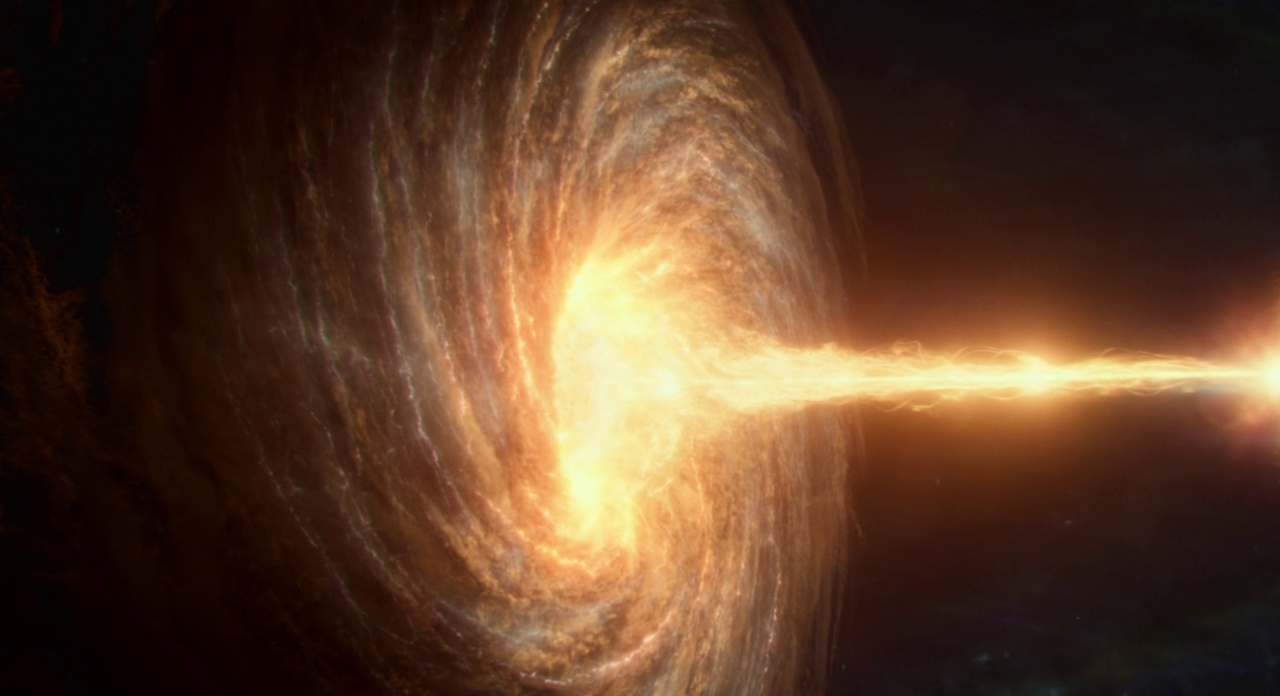
Spoiler Warning: There are spoilers ahead for Star Trek: Picard Seasons 1-3. Spoilers are also present for the following Star Trek productions: The Wrath of Khan, The Search for Spock, The Next Generation, Deep Space Nine, Voyager, Discovery, and Prodigy.
Phew! Surrender has finally killed off a whole bunch of theories as we gear up for the final two episodes of Star Trek: Picard. There are still twists and turns to come, of that I’m certain, but this week marks the definitive end for a whole host of theories – several of which have been running for all or almost all of the season!
Quite a few of the debunked or retiring theories were to do with Vadic – and as she died this week, so do they. Vadic’s death was unspectacular, at least in my opinion, and also it feels premature. Vadic died without telling us much of anything, aside from her tortured backstory, and several of these theories still feel like they could have been plausible had we spent more time with the season’s only named villainous character.
Vaporising a dead changeling.
But you can check out my review for my thoughts on Vadic, Surrender in a more general sense, and my unease at the concept of killing the only named villain in the eighth episode of a ten-episode season. You can find my review of Surrenderby clicking or tapping here.
This week we have one confirmation, one semi-confirmation, a whopping five debunkings, and two theories that – while not debunked outright by the events of Surrender – I’m choosing to retire from the list. They now seem completely implausible based on the direction taken by the story. As always, we’ll take a look at all of these first!
Confirmed theory: The rogue changelings are keeping their most important prisoners alive.
Riker and Troi in a prison cell aboard the Shrike.
I have to say that it never seemed to be a realistic prospect that Riker would simply have been murdered after being kidnapped by Vadic – not before he could rejoin the crew and participate in the TNG reunion that pre-season marketing heavily pushed! But the fact that Riker and Troi were being kept alive by Vadic’s crew may also bode well for Tuvok – and possibly for other characters, too.
We saw in earlier episodes that the rogue changelings were killing at least some of the individuals that they replaced – but with all the talk of blood and DNA, it seemed at least plausible that they might keep some of their more important targets alive. Hopefully that includes Tuvok!
Semi-confirmed theory: Worf and Raffi saved Riker and Troi.
A hug for a job well done!
I had also included Tuvok in this theory last week, so we can only call it “semi” confirmed! But as expected, Worf and Raffi successfully tracked down Riker after his capture and were able to free him – along with Deanna Troi – from captivity aboard the Shrike.
Raffi played less of a role in this story in some ways, but she got her explosive action sequence after boarding the Titan.
Debunked theory #1: Picard and the crew will commandeer the Shrike.
The destruction of the Shrike.
There were multiple narrative routes to Picard and the crew of the Titan stealing the Shrike – a powerful warship that could have proved useful in the fight that may lie ahead! I wondered if Vadic may have been trapped in the holodeck, for example, or if Picard would use her takeover of the Titan to covertly slip his forces aboard her vessel somehow.
Regardless, this idea was shot down in flames – literally! The Titan blew up the Shrike shortly after Vadic’s death, and although it might’ve made sense to try to capture the vessel instead, its destruction is kind of symbolic of the story of the past eight episodes being brought to a close ahead of the finale.
Debunked theory #2: Vadic and/or the rogue changelings got to Lore before Picard.
Lore in Surrender.
For me – speaking as someone who has admittedly never been the biggest fan of Lore – the return of Data’s “brother” fell rather flat. His lack of connection to the main story made the sequences in which he appeared feel like little more than padding; an unnecessary bump in the road as a relatively thin story was stretched to breaking point.
One way in which I felt Lore could have made a more positive contribution to the plot is if he’d been connected to Vadic and the rogue changelings somehow. With Vadic’s people having boarded Daystrom Station at least once – to steal the portal-weapon and Picard’s body – it seemed plausible to think that they might’ve somehow tampered with Lore, reprogramming him to be on their side. But it didn’t pan out that way!
Debunked theory #3: Vadic is the female changeling from Deep Space Nine.
Vadic shifting between forms.
While I wouldn’t say I was ever “sold” on this theory, it seemed like a possibility for a while. The female changeling who directed the Dominion’s war effort in Deep Space Nine was one of only a handful of changeling characters that we met, and as of the end of the Dominion War she was in Federation custody.
The story of Season 3 has touched on Deep Space Nine in more ways than one – but the female changeling hasn’t been so much as mentioned all season long. It would have felt like a bolt from the blue if this connection had been made at such a late stage… but it could have been interesting if it had been handled well.
Debunked theory #4: Deanna Troi is a changeling.
Oh no she isn’t!
In a story involving a changeling-led conspiracy, I think it’s all too easy to become “paranoid” and to see changelings behind the face of practically every character! That being said, Troi’s first appearance in the season – outside of minor cameos – came aboard the Shrike… a vessel crewed by changelings.
It didn’t seem like much of a leap to think that she may have been replaced, and that this imposter was designed to trick Riker into betraying Picard or revealing the location of the Titan.
Debunked theory #5: Vadic will be killed by her own portal-weapon.
Vadic was ejected into space.
In the first part of the season, Vadic’s portal-weapon was a big plot point. In fact, Vadic’s theft of the powerful device was basically the only thing we knew about her for several episodes! In stories like these, it’s not an uncommon trope for the villain to be killed by their own weapon; hoisted by their own petard.
After Vadic jettisoned the portal-weapon before taking the Shrike into the nebula a few weeks ago, I felt sure she’d pick it back up. It seemed like too powerful a weapon to just abandon. But the portal-weapon disappeared from the plot – and Vadic’s ultimate end was entirely unrelated to it.
Retired theory #1: Not all of Raffi’s messages were from Worf.
The encrypted communications panel aboard La Sirena.
This theory hasn’t been debunked – but with two episodes left and a conspiracy to defeat, it feels all but certain that the story is going in a completely different direction. In short, I had suggested that there was a reason why Raffi’s messages from her handler came in the form of text and a disembodied digital voice, and that perhaps Vadic or other rogue changelings hacked into her messages and relayed her false information.
Raffi’s relatively minor role over the past few episodes, and the story leaving behind the criminal underworld, had already made this one feel increasingly unlikely. I’m choosing to pull it from the list at this point, since it doesn’t seem like a story beat that will be revisited.
Retired theory #2: Vadic has assembled a “rogues’ gallery” of Star Trek villains.
Vadic in Surrender.
This theory had been barely hanging on for several weeks – but I was still wondering if other characters from past iterations of Star Trek might’ve been allied with the rogue changelings and included in their conspiracy. The fact that the crew of the Shrike were all wearing strange masks led me to wonder whether there might be familiar faces hidden behind the masks – but the Shrike was destroyed this week, and its crew were all killed.
As a concept, the idea of Picard having to face an alliance of all of his most powerful adversaries from across The Next Generation was a fascinating one – and while we won’t see it in this series now, perhaps it’s an idea that could be revisited one day. It would make a fun 60th Anniversary special, for example, if a combined crew from across The Next Generation era had to face down a rogues’ gallery of villains!
So those theories were confirmed, debunked, or have been retired!
Now we’ll move into the main theory list, beginning with theories that are brand-new or that saw significant movement in the episode Surrender.
Theory #1: Troi will use her “pain removal” skill on Jack.
Troi and Jack.
While Riker and Troi were imprisoned, their conversation turned to something that Troi had done to Riker: she used her Betazoid abilities to “enter” his mind and remove the pain he felt at his son’s death. She did so with the best of intentions – but as always, these things have unintended consequences!
But why bring up this episode in their past? We didn’t see any of this happen, after all, and Surrender seemed to linger over this idea. Could it be that this sequence has established Troi’s pain removal skill for a reason? If so, who might need something removed from their mind? Jack Crusher, who has been struggling with hallucinatory experiences, seems like the most likely candidate!
Theory #2: The rogue changelings didn’t want Jean-Luc Picard… they wanted Locutus.
Picard comes face-to-face with Locutus in Season 1.
Did Picard’s old body just get blown to smithereens when the Shrike was destroyed? Regardless, it seems as if the rogue changelings took part of Picard’s brain – the part that may have been affected by Irumodic Syndrome. But why would they want that? My theory is that they were harvesting not something organic, but rather a Borg device that was left over from Picard’s assimilation experience.
We saw in Season 2 that Starfleet has used Borg tech in its latest generation of starships – and how the Borg were able to take advantage of that. Maybe the rogue changelings’ plot involves using parts from Locutus in order to commandeer, hack into, or damage Starfleet vessels. They didn’t need Jean-Luc Picard’s body… they needed Locutus.
Theory #3: The rogue changelings are planning to hack into the entire connected Federation fleet.
A Starfleet armada as seen in Season 2.
Connected to the idea above, perhaps part of the rogue changelings’ plans for Frontier Day involve hacking into Starfleet. We learned earlier in the season that all of the ships in the fleet can communicate with one another – so perhaps the rogue changelings want to take advantage of this. They could instruct the ships to fire on one another, perhaps.
I would say that it’s kind of frustrating at such a late stage to not know what exactly the rogue changelings are planning! This feels like a plausible idea based on what we’ve seen on screen so far, though.
Theory #4: Jack’s eyes, combat skills, and hallucinations are connected to the Borg.
Jack’s eyes.
If Picard’s Irumodic Syndrome may have been misdiagnosed, then perhaps the same has happened to Jack. If Picard’s brain was actually affected by Borg implants, perhaps Jack somehow inherited these Borg changes from Picard. If so, his skills, eyes, and hallucinations may all be connected to the Borg.
Red isn’t a colour we typically associate with the Borg – but if Jack’s eyes glowed green, perhaps that would be too much of a giveaway! In past Star Trek stories, characters who had previously been assimilated have been shown to “hear” Borg voices, or the voice of the Borg Queen, so that could also connect with this theory.
Theory #4-A: Jack has Borg nanoprobes in his body.
Borg nanoprobes.
If Jack has a Borg brain (or a Borg brain implant) then it stands to reason that he also has Borg nanites in his system. Given the connection to Picard, it seems likely that he would have inherited these from Picard at the moment of conception, but I suppose it’s also possible that he picked them up somewhere along his travels.
These latent nanoprobes may be the key to his hallucinations – explaining how Jack can hear a voice that isn’t his own.
Theory #5: Jack’s “ancient” voice is the Borg Queen.
The original Borg Queen.
At the end of Surrender, Deanna Troi explained that Jack is hearing an “ancient” voice that is not his own, and that this voice is tied to the darkness swirling around him. In earlier episodes, a voice that Jack could hear had a feminine quality to it, so my thoughts have immediately turned to the Borg Queen. If, as suggested, Jack has Borg nanites in his system that he inherited from Picard, maybe he’s hearing the voice of the Borg Queen.
Presumably, if this theory were to pan out, we’d be talking about the original Queen, not the Dr Jurati hybrid that was created in Season 2. There are certainly other ancient evils that I can think of in Star Trek, but none are as connected to Picard – and possibly to Jack – as the Borg Queen. This connection could also pay off the multiple Borg mentions earlier in the season.
Theory #6: The Borg are involved.
A Borg cube in The Next Generation.
There have been multiple references to the Borg this season – and to Picard’s assimilation experience in particular. We’ve just looked at a couple of possible ways in which the Borg could be brought into the story, but there are others. I suspect that, if there is to be a Borg connection, it will involve Borg technology rather than the Collective itself – especially with only a couple of episodes remaining.
However, we can’t rule out some kind of alliance between the rogue changelings and the Borg. Floaty McFloatface may have been the Borg’s “representative,” for example, directing the rogue changelings to carry out the Collective’s orders.
Theory #7: Jack Crusher has changeling DNA… somehow.
A strand of DNA from the closing credits.
Whatever is going on with Jack is implied to also be tied to Picard, so would this mean that Picard also has changeling DNA? That’s something to think over! But for now, suffice to say that Vadic knew a lot about Jack, including the specific details of one of his hallucinatory experiences. How could she possibly know that – unless it’s something that she and/or other changelings have experienced?
I don’t believe that Jack is a changeling – and at this late stage, the story couldn’t get away with going down that route. However, it seems possible that Jack has somehow got a small amount of changeling DNA in his system – explaining why the rogue changelings have been so interested in him, and how they’ve come to know so much about him.
Theory #8: Jack is a “sleeper agent.”
Jack holding a thermal detonator.
Jack may or may not have Borg nanites or changeling DNA… but either way, perhaps he’s a “sleeper agent.” He could be either a Dominion sleeper agent or a Federation one, who has been programmed or brainwashed – perhaps while away from Beverly attending school – and designed to be “activated” at a later time.
Jack’s birth came after the end of the Dominion War, so he wasn’t – as I had originally guessed – programmed to participate in that conflict. But this kind of deep cover intelligence asset is something that Section 31 might use, as well as other factions.
Theory #9: Floaty McFloatface will be back.
Floaty McFloatface with Vadic.
Argh, I hate this one. But it seems at least possible that Floaty McFloatface – who appeared to be Vadic’s boss – may not be as dead as we think. We didn’t see Floaty McFloatface in Surrender, and while Vadic seemed to have both of her hands when she died, it’s possible that this unnamed character may have survived, or may have never been a true part of Vadic to begin with.
I don’t like this idea because bringing a character back in this kind of fake-out way is usually not very satisfying. But another part of me wants to know who Floaty McFloatface was and what they hoped to achieve – things I can hardly believe that we still don’t know at this late stage in the story!
Theory #10: Floaty McFloatface isn’t a changeling.
Who (and what) is Floaty McFloatface?
If we haven’t seen the last of Floaty McFloatface, perhaps we’ll learn who they really are – and I suspect that they may not be a changeling, or at least not a Founder. The way in which Floaty spoke to Vadic, and specifically the way in which he talked about her “kind,” seemed to imply that they may not be the same race.
Vadic also appeared to fear Floaty McFloatface, which could suggest a power imbalance. If Floaty was a representative of the Borg, for example, Vadic may have feared their power. Vadic’s death throws this theory into doubt, but I don’t think we should strike it from the list just yet.
Theory #11: Captain Shaw will be killed.
He’s lasted longer than I expected…
I’m tempted to strike this one off the list, to tell you the truth! But I’ve held onto this theory for the whole season, and with two episodes left it still seems possible – despite the fact that Captain Shaw has survived two major injuries so far. I maintain that Shaw feels superfluous – decisions appear to be taken on board his ship without his input, and that doesn’t really pass muster as a narrative point. But at the same time, opportunities to kill him off have come and gone.
It would have been far more impactful for Vadic to have killed Shaw in Surrender than to have killed the relatively minor character of T’Veen, for example. If the writers want the impact of killing a major character but don’t want the controversy of killing a legacy character, Shaw and Raffi are the only real choices. With two episodes left – in which Picard and the crew must confront the remaining changelings – Shaw could still be in danger, even if the impact of his possible death would be lesser at this point in the story.
Theory #12: Someone on the crew will turn out to be a changeling imposter.
Picard and the crew in The Next Generation Season 5.
At this point in the story, it seems as if we should be able to rule out all of The Next Generation characters as changeling imposters. But part of me still feels suspicious – there may yet be a twist in someone’s story that we’re not supposed to see coming!
It might be difficult to pull this off now, especially after a touching reunion between the old friends at the end of Surrender. But when the changelings are involved… as I said earlier, it can be tempting to feel paranoid and see changelings hiding everywhere! Perhaps a changeling has been hiding in plain sight all along, pushing Picard and the crew to a specific place to benefit their overall conspiracy.
Theory #13: The rogue changelings are planning to cripple Starfleet.
Federation vessels seen in a pre-season trailer.
Frontier Day is now just hours away… and we still don’t know what the rogue changelings are hoping to accomplish. Having replaced dozens or perhaps hundreds of well-placed Starfleet personnel, it seems plausible that they may be planning to destroy or disable a significant number of Federation starships. We’ve already seen on two separate occasions that rogue changeling operatives were equipped with bombs. Perhaps blowing up the fleet is their ambition.
A coordinated strike against dozens of ships could cripple the Federation’s ability to defend itself, especially if the rogue changelings pick their targets carefully and select the right ships! This could even be a backup plan of sorts – something that the rogue changelings will do if their main plan involving Jack Crusher can’t be carried out.
Theory #14: At least one main character will be killed.
Spock’s funeral at the end of The Wrath of Khan.
As we approach the end of the story, there’s still at least one battle to come. I suspect that not everyone will make it to the end in one piece – and a well-timed character death could really seal the deal when it comes to raising the stakes and/or paying off a character arc. It would be shocking and tragic, of course, to have to bid farewell to someone we may have known for more than thirty years… but it’s a distinct possibility.
I’m a tad surprised at this point in the season that we haven’t seen more death. Ro Laren’s death was the most significant so far… but there’s still time! I wrote a list before the season premiere outlining who I thought could be in danger, and you can find it by clicking or tapping here.
Theory #15: At least one more unannounced character will make an appearance!
Could it be Julian Bashir or Ezri Dax?
In addition to the characters we knew would be returning, there have been two big surprises: Tuvok and Ro Laren. But there’s still time for at least one more character from the past to make a welcome return to Star Trek. Admiral Janeway’s name has been mentioned more than once, and we know that Kate Mulgrew is still involved with Star Trek as she’s appeared in Prodigy, so she has to be a contender!
But there are a whole host of characters – major and minor – from The Next Generation era and beyond who could potentially appear. There isn’t time now for anyone to play a major role, but cameos are a distinct possibility. We saw in both Seasons 1 and 2 that the final episodes included surprises… so be on the lookout for familiar faces!
So those theories are new or moved significantly this week.
Now, as always, I’ll recap the remaining theories that are still in play. I find it helps to keep everything in one place!
Theory #16: The rogue changelings are planning attacks on the Klingon Empire and the Romulans.
A joint Federation-Klingon task force during the Dominion War. Image Credit: JTVFX on YouTube
It wasn’t only the Federation that opposed the Founders during the Dominion War. The Klingons, Romulans, and later a Cardassian resistance movement all played significant roles in preventing the Dominion from conquering the Alpha Quadrant – so it stands to reason that the rogue changelings would be looking to get revenge on these powers, too.
Despite having had two full seasons of Picard already – one of which had a major Romulan theme – we still don’t know much about the state of the galaxy in political terms. Are the Federation, Romulans, and Klingons on friendly terms in this era, or has the Dominion War alliance of necessity fallen apart? After the Zhat Vash plot was exposed, what happened to Federation-Romulan relations? All of these things would be interesting to explore, and the rogue changelings’ plot could lead to such a storyline. For now, though, suffice to say I suspect that the Federation may not be the only target that the rogue changelings have in mind!
Theory #17: The rogue changelings may also be targeting the Bajorans and Cardassians.
Gul Dukat with Weyoun in Deep Space Nine.
These two factions played smaller roles during the Dominion War in some respects, with the Cardassians serving as Dominion allies (and members of the Dominion), and Bajor signing an official non-aggression pact with the Dominion. However, both the Bajorans and Cardassians later opposed the Dominion, and the Prophets – who are strongly aligned with Bajor – arguably turned the tide of the entire war.
If the rogue changelings are on the move, I would suspect that the Federation, Romulans, and Klingons would be their main targets as it was these powers who played the biggest and most obvious roles in the conflict. But Bajor and Cardassia may not be safe.
Again, we don’t know enough about the geopolitics of this era! Bajor may have joined the Federation, and even Cardassia could be under Federation protection. If so, that changes the dynamic.
Theory #18: The rogue changelings are responsible for the mysterious anomaly seen in Season 2.
The anomaly in the Season 2 finale.
It didn’t escape my notice that the events of Season 2 were referenced – albeit incredibly briefly – by Captain Shaw in No Win Scenario. That being said, this theory still feels like somewhat of a long-shot just based on how Picard seems to have moved on from what happened last year.
In short, what I’m suggesting is that the mysterious anomaly that was a big part of the story of Season 2 will turn out to be a weapon of some kind deployed by the rogue changelings, either as part of or as a precursor to their plan to attack Starfleet and the Federation. This would explain Dr Jurati’s comment that the anomaly seemed to be artificial in nature – and it would tie up a massive loose end from last season.
Theory #19: Picard will donate his golem body to Jack.
Picard in his golem body at the end of Season 1.
The revelation that Jack has the terminal and incurable Irumodic syndrome was a surprising inclusion in The Bounty – and it tied into that episode’s theme of the relationship parents have with their children, and what kinds of things children inherit from their parents. Irumodic syndrome was the most obvious example of a “flaw” passed from parent to child.
But this story could have also set up the endgame – not only for Season 3, but for Jean-Luc Picard himself. In short, I’m suggesting that Picard will donate his golem to Jack, sacrificing himself to save his son’s life in one final act of parental love. This will come after the rogue changelings have been defeated – and will mark the definitive, conclusive end of both Star Trek: Picard and the show’s title character.
Theory #20: The rogue changelings are trying to reach the Nexus.
Dr Soran excitedly awaits the Nexus.
One of the easter eggs in The Bounty showed us a glimpse of Captain Kirk’s body – or a readout on a screen, at least. As far as we know, only two corpses were stored at Daystrom Station: Picard’s and Kirk’s. Aside from both being captains of the Enterprise, what else do these two characters have in common? They both used the Nexus to travel through time. Picard travelled only a few hours, but Kirk jumped forwards in time by decades.
The Nexus hasn’t been mentioned since Generations, and it would be a less well-known part of Star Trek to bring back in some ways. But the timelines could kind of sync up here: if it’s been 30+ years since the events of Generations, and the Nexus returns every 39.1 years, that could work! The Nexus could also be phenomenally useful for the rogue changelings – if they wanted to travel back in time to prevent the Dominion’s defeat, for example.
Theory #21: Irumodic syndrome is important to the rogue changelings.
Irumodic syndrome “killed” Picard… briefly.
As Picard noted in The Bounty, he “died” of Irumodic syndrome back in Season 1. Irumodic syndrome is a big link between Jack and Picard right now – and because these two characters are the ones who seem to have gotten most of the rogue changelings’ attention, that fact could be significant!
Perhaps Irumodic syndrome can be used by changelings to mask their presence, or maybe it can somehow cure the genetic disease that Section 31 created. Irumodic syndrome could also be an indication that an individual possesses changeling DNA – or some other attribute that’s important to changelings.
Theory #22: The absences of characters from Seasons 1 and 2 will be explained.
Elnor with his fellow cadets in Season 2.
I was pleasantly surprised to see Laris was included in the season premiere, and while she won’t have a big role in the story of the season, it was great that the story didn’t just dump her as it raced ahead. Due to her importance to the story of Season 2, Laris was perhaps the character who I felt it was most important to include in some way, and I’m glad we got to see her.
But there are still several characters from Seasons 1 and 2 who haven’t been mentioned. Elnor and Soji could easily be name-dropped; a line or two of dialogue could clear up where they are, what they’re doing, and why they can’t join Picard on his current mission. The Borg Queen-Dr Jurati hybrid is a bit more complicated; her self-appointed role as “guardian” of the mysterious anomaly makes it a bit harder to just wave away her disappearance.
I hope we’ll get something that will acknowledge these characters’ absences. All were important in the first two seasons of the show, and simply abandoning them without any kind of goodbye was disappointing at the end of Season 2. If Season 3 could do something to rectify that, I’d appreciate it!
Theory #23: Odo will make an appearance – somehow.
Odo in Deep Space Nine.
I don’t know how I feel about this one. It was sweet to see Worf make reference to Odo in Seventeen Seconds – though the connection could have been clearer, especially for more casual viewers – but I’m not convinced that we need to see Odo for ourselves. The reason for that is simple: the only way we could see Odo is either by re-casting the character or recreating him through some kind of CGI process.
Star Trek has successfully re-cast many characters over the years, so I don’t really take exception to that. But the death of actor René Auberjonois is still recent and fresh in our minds, so bringing Odo back without him just feels… uncomfortable. Although Odo is well-suited to a story in which the changelings are back, I think I’d rather he didn’t appear in person on this occasion. But I wanted to acknowledge that it’s at least a plausible development for the story.
So that’s it!
Vadic’s disappointing demise.
It’s still all to play for as we approach the final pair of episodes, and there are still many different routes that the story could take. I desperately hope that whatever comes next will feel natural, and will feel connected in some way to the story elements that have already been introduced. The last thing Picard needs is yet another deus ex machina-type ending! In spite of my disappointment with Surrender and the premature death of Vadic, I’m crossing my fingers and hoping for an ending to the story that is, at the very least, narratively coherent.
As a final note: I always like to end these theory lists by saying that I do this just for fun. I enjoy writing, I enjoy Star Trek, and spending more time in this world is an escape and an enjoyable distraction for me. But for some folks, fan theories can become frustrating or unenjoyable, especially if they get very attached to a plausible-sounding theory that ultimately doesn’t pan out. I have no “insider information” and I’m not trying to claim that anything suggested above can, will, or must be part of Picard Season 3. I fully expect many of these theories to be debunked and for the season to go in wildly unpredictable directions!
Star Trek: Picard Seasons 1-3 are available to stream now on Paramount+ in the United States and other countries and territories where the service is available, and on Amazon Prime Video in the UK and around the world. The Star Trek franchise – including Picard and all other properties discussed above – is the copyright of Paramount Global. This article contains the thoughts and opinions of one person only and is not intended to cause any offence.
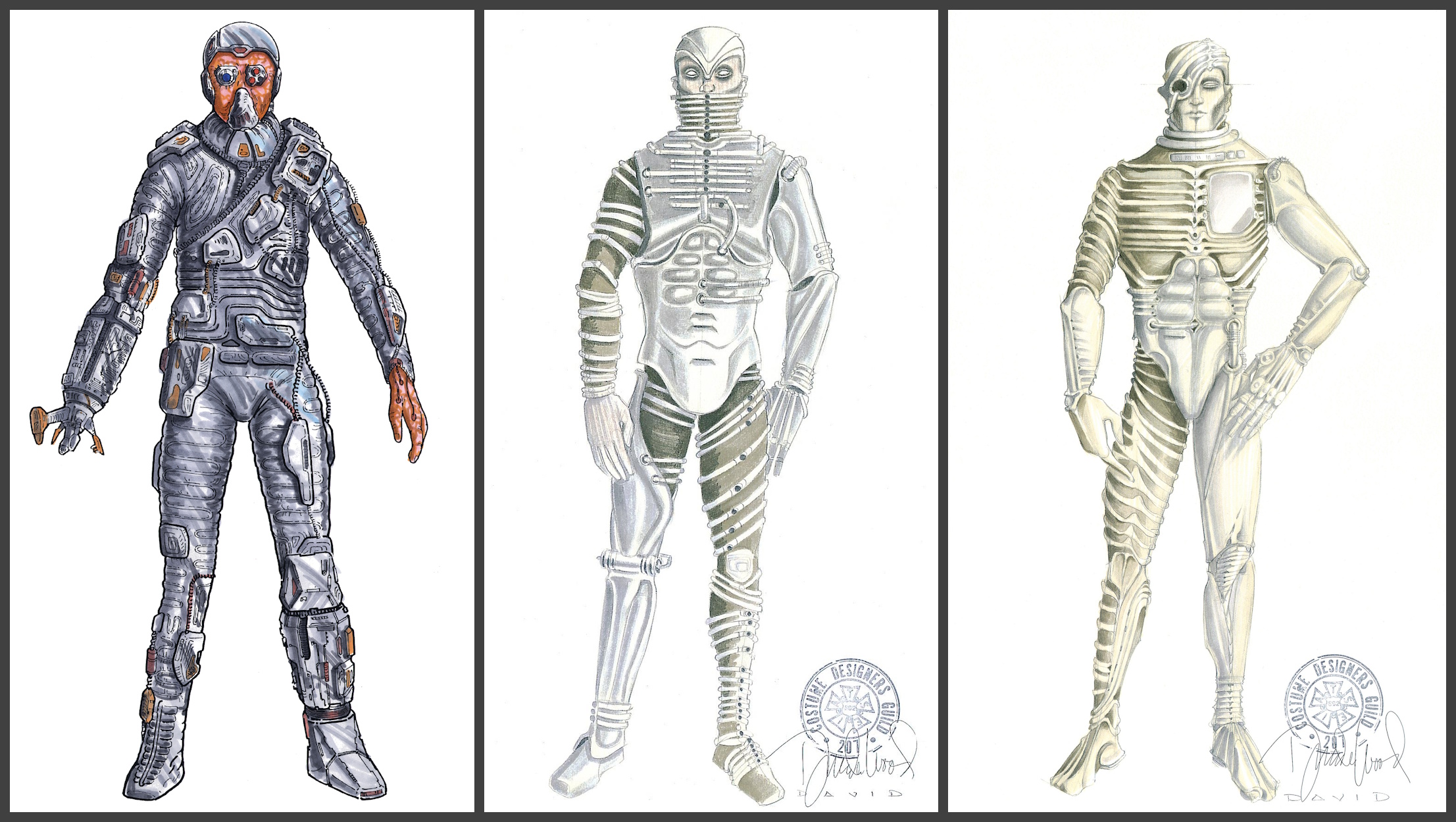
Spoiler Warning: There are spoilers ahead for Star Trek: Picard Seasons 1-3. Spoilers are also present for the following Star Trek productions: The Wrath of Khan, The Search for Spock, The Next Generation, Deep Space Nine, Voyager, and Discovery.
If you’ve already checked out my review of Dominion, you’ll know it’s an episode that I have mixed feelings about! It was tense and exciting, with some truly fantastic acting performances and clever use of lighting – but it’s also an episode that, narratively speaking, wasn’t particularly original and that didn’t take the main story of the season to an especially fun place.
After last week’s theory massacre, Dominion didn’t actually move the needle very much! Most of the theories on the list remain relatively unchanged, in spite of a lot of running around and shooting at changelings! There are a few changes, of course – but perhaps fewer than I’d been expecting at this relatively late stage. There are just three episodes left, after all!
The Titan and the Shrike in Dominion.
I was pleasantly surprised to see Tuvok’s face this week – and I hope that we’ll see the real Tuvok before the season ends. It’s great to see Picard leaning into Voyager and Deep Space Nine as well as The Next Generation – it feels like Season 3 is trying really hard to celebrate the legacy of the 24th Century Star Trek shows. This was “my” era of Star Trek through my adolescence and young adulthood – so I’m trying really hard to keep a positive attitude and get on board with this festival of Trek!
This week we have two theories that I’m calling “semi” confirmed, one outright confirmation, and one sole debunking. As always, that’s where we’ll begin!
Semi-confirmed theory #1: Lore betrayed Picard and the crew.
Lore in Dominion.
I’m probably going to rework part of this theory and keep it on the list – so check that out below! But for now, suffice to say that I was right about Lore messing things up for Picard and the crew. His ill-timed interventions, just as the crew of the Titan were trying to trap Vadic and her crew, seem to have allowed Vadic and her followers to break out of confinement and seize control of the ship – as well as endangering Jack and Sidney in the process.
I have to be honest here: I didn’t like how this played out on screen. It felt contrived, and it made the main thrust of Dominion’s story feel like a succession of random, unlikely coincidences. But nevertheless, I was right about Lore betraying Picard.
Semi-confirmed theory #2: A spin-off has been announced!
The official announcement graphic.
Okay, okay. If you want to get all technical about it, Starfleet Academy probably isn’t a true spin-off from Picard. The show’s rather threadbare announcement seemed to imply that the new series will be set in Discovery’s far future era, perhaps picking up threads from the backdoor pilot All Is Possible, which aired during Discovery’s fourth season.
But I’m claiming victory on this one nonetheless! This is the first announcement of a new Star Trek series since Strange New Worlds was greenlit three years ago, and it came during Picard’s third season – as I hoped an announcement would! Part of me is tempted to stick this theory back on the list and hope for an announcement of a “Seven of Nine show” or Star Trek: Titan… but I suspect that Starfleet Academy will be the last big announcement for some time.
Confirmed theory: Another unannounced character made an appearance!
Mr Vulcan!
Tim Russ returned to Star Trek for the first time in more than two decades to play Tuvok… or rather, Tuvok’s changeling impersonator. It was a bold move to try something like this, and I think Dominion pulled it off remarkably well. I’m holding out hope that we’ll see the real Tuvok before the season ends, though.
The sequence between Seven and Tuvok was tense, and a great way to begin the episode. Seven poked and tested Tuvok while Captain Shaw and the Titan’s science officer tried to analyse his responses, and it seemed at first as if Tuvok may have been the real deal. But that was ripped away when it was revealed that he was an imposter. A clever sequence, and a fun way to welcome back one of the stars of Voyager.
This theory is going to stick around, though… I don’t think Picard is done with surprise characters yet!
Debunked theory: Vadic is a veteran of the Battle of Wolf-359.
Vadic at the end of Dominion.
Dominion finally gave us Vadic’s missing backstory, and began the process of putting both her quest and her eccentric characterisation into some kind of context. This theory was already hanging by the tiniest of threads after we got confirmation that Vadic was a changeling – but I felt that multiple references to the Battle of Wolf-359 and Picard’s assimilation could have indicated that she was present at the battle, and perhaps was traumatised by the events that unfolded.
It remains to be seen whether the lack of a connection between Vadic and Picard will be an issue. Her current scheme has roped in Picard; she stole his corpse, she’s chasing his son, and she’s captured at least two of his friends. But it would have been interesting in more ways than one if Vadic had some kind of tie to Picard from the past.
So those theories were confirmed and debunked in Dominion.
Up next we’ll jump into the main theory list, beginning with those theories that saw movement this week or that are brand-new.
Theory #1: Picard and the crew will commandeer the Shrike.
The Shrike with the SS Eleos.
I don’t like the old “the heroes’ ship is captured” trope – but one way that the next episode could put a totally different spin on that tired concept would be to reveal it as a kind of double-bluff. In short, Picard and the crew allowed Vadic to think she had captured the Titan and taken them all prisoner… but they then beamed aboard the Shrike at the last moment. Maybe that’s why Geordi was so concerned about the transporters!
The Shrike is a powerful warship and could prove to be a valuable asset to Picard and the crew. With Riker and Troi potentially imprisoned there, too, such a storyline could reunite the crew. It would be a bold plan – but it could be a fun, unexpected twist in what isn’t the most original of storylines.
Theory #2: The rogue changelings are keeping most of their important prisoners alive.
Is Riker as “dead” as the rogue changeling claimed?
Picard suspected that his corpse was stolen from Daystrom Station so that the rogue changelings could replicate his DNA. If they need actual bodies for that, that could bode well for the likes of Tuvok. Maybe the changelings need to periodically drain some of their captives’ blood, maybe they need to keep them around to “refresh” their DNA, or maybe there’s some other technobabble reason for it – but one way or another, I suspect that they aren’t just murdering all of the people they replace.
Perhaps this is a theory born of hope: hope that the likes of Riker, Troi, and Tuvok will survive their captivity! But there are reasonable pathways to making it happen.
Theory #3: Vadic and the rogue changelings got to Lore first.
The golem at Daystrom Station.
Lore hasn’t said much about changelings since awakening in the golem body, but could his actions aboard the Titan this week be taken as evidence that Vadic and her gang tampered with him? We know that at least some of the rogue changelings visited Daystrom Station, where the Data-Lore golem was being held. And we know that synths can be reprogrammed – that’s something we saw in Season 1. Lore’s actions this week also benefitted Vadic in a huge way – trapping Picard’s friends, allowing her to break out of confinement, and paving the way for her to seize control of the Titan.
As I said above, this sequence of events feels pretty contrived right now. But if it were revealed that Lore had been somehow convinced, programmed, or brainwashed into doing Vadic’s bidding, it would go a long way to making that aspect of Dominion feel a lot more natural.
Theory #4: Jack is a Dominion War-era “sleeper agent.”
Jack used his powers to “possess” Sidney.
As Jack’s superpowers continue to manifest and grow, we’re getting more and more evidence that everything is not as it seems! I suggested last week that Jack may be a kind of “sleeper agent” – an intelligence asset that has been programmed and was designed to be “activated” at a later date. Jack could be a Federation or Section 31 sleeper agent – or he could be a changeling/Dominion sleeper agent.
Jack certainly has no idea what’s going on – though this week we saw him seemingly make the conscious choice to use his powers for the first time. Vadic, however, has promised to spill the beans… so we might not have long to wait to find out what’s going on with Jack!
Theory #5: Vadic is the female changeling from Deep Space Nine.
The female changeling.
This theory feels very unlikely now that we’ve seen Vadic tell us about her backstory… but nothing in that story entirely contradicted the idea that Vadic and Deep Space Nine’s female changeling – the Founder who led the Dominion’s forces during the Dominion War – are one and the same. In fact, we could make the case that as the only changeling known to have been in Federation custody, the female changeling is actually a good candidate here!
I’d be surprised if the story goes in this direction now, and it would come close to treading on the toes of the ending of Deep Space Nine. But this theory remains in play, at least for now.
Theory #6: Worf and Raffi will save Riker, Troi, and Tuvok.
Riker with Worf and Raffi.
Where did Worf go? If he was trying to track Vadic and the Shrike to rescue Riker, he isn’t doing a very good job! This week, Picard and the Titan caught up to the Shrike, but Worf and Raffi were nowhere to be found. Although it was implied that Riker and Troi were imprisoned aboard the Shrike, perhaps they’ve been transferred to another rogue changeling ship or facility – and that’s where Worf is going. Or maybe Worf was just a long way behind Vadic, and will show up this week – perhaps at the last second.
Either way, I hope to see Worf and Raffi make some kind of rescue attempt! If they come across a prison camp, perhaps other characters like Tuvok might be there, too – and could be saved.
Theory #7: Floaty McFloatface isn’t a changeling.
Floaty McFloatface.
The way Floaty McFloatface spoke to Vadic this week seemed to suggest that they don’t see themselves as being part of the same group or even race as Vadic. Floaty McFloatface spoke down to Vadic, telling her that her kind are “malleable,” and that line could be taken as the two characters being from different races. We’ve also only ever seen Floaty in this one singular form, which could mean that they are unable to shapeshift.
The nature of Vadic’s relationship with Floaty McFloatface isn’t clear, though she seems to be very much the junior partner in whatever their scheme may be.
Theory #8: At least one more unannounced character will make an appearance!
It probably won’t be Chekov…
There have been two big surprises so far this season: Ro Laren and Tuvok. But there’s still time to include other unannounced characters! Admiral Janeway’s name has been mentioned more than once, for example, and in a story about rogue changelings, it’s possible that a main character from Deep Space Nine could emerge.
In Seasons 1 and 2, there were surprises all the way up to and including the final episodes… so there’s still plenty of time for someone truly unexpected to make a shocking – but welcome – return to Star Trek!
Theory #9: Captain Shaw will be killed.
Captain Shaw was injured (again) this week.
Captain Shaw didn’t have much to do in Dominion, but his main scene saw him beaten up and captured by Vadic and one of her goons. With Shaw held captive on the bridge of the Titan, he seems to be in a lot of danger! I could see Shaw making an heroic sacrifice, perhaps saving the life of Seven or one of the bridge officers.
Narratively speaking, Shaw has complicated things in Season 3. He served a purpose at first, don’t get me wrong, but the story hasn’t always been well-served by concentrating so many senior officers on one ship. Shaw has felt superfluous now for several episodes – really since his big blow-up with Picard about Wolf-359 – and doesn’t seem to be involved in any real way in the decision-making process aboard his own ship. I’ve been predicting his death all season long… but could the moment have finally come for the “dipshit from Chicago?”
So those theories are new or saw significant movement in Dominion.
As always, I’ll now recap all of the other theories that are currently in play. These theories didn’t change based on what we saw this week – but I find it helps to keep the whole list together in one place!
Theory #10: At least one main character will be killed.
Who could it be?
The death of Ro Laren has shaken Picard and the crew… but it’s also shaken up this theory! The fundamental question is this: is Ro’s death a harbinger of things to come? Or is it simply a narrative device used to show how high the stakes are? I think there’s a solid case to make that Picard and the crew are in danger.
Television storytelling has changed a lot since The Next Generation premiered, and even main characters can no longer consider themselves to be safe if they wind up in dangerous situations! It would be a challenge to kill off a legacy character in a way that would be satisfying and would feel right – but it would be incredibly bold, and if such a story beat stuck the landing it could pay off a character arc that’s been running for well over three decades.
I made a list of who I thought could be in danger before the season began, and you can find it by clicking or tapping here.
Theory #11: The rogue changelings are planning attacks on the Klingon Empire and the Romulans.
A joint Federation-Klingon task force during the Dominion War. Image Credit: JTVFX on YouTube
It wasn’t only the Federation that opposed the Founders during the Dominion War. The Klingons, Romulans, and later a Cardassian resistance movement all played significant roles in preventing the Dominion from conquering the Alpha Quadrant – so it stands to reason that the rogue changelings would be looking to get revenge on these powers, too.
Despite having had two full seasons of Picard already – one of which had a major Romulan theme – we still don’t know much about the state of the galaxy in political terms. Are the Federation, Romulans, and Klingons on friendly terms in this era, or has the Dominion War alliance of necessity fallen apart? After the Zhat Vash plot was exposed, what happened to Federation-Romulan relations? All of these things would be interesting to explore, and the rogue changelings’ plot could lead to such a storyline. For now, though, suffice to say I suspect that the Federation may not be the only target that the rogue changelings have in mind!
Theory #12: The rogue changelings may also be targeting the Bajorans and Cardassians.
Cardassia Prime as it appeared in Deep Space Nine.
These two factions played smaller roles during the Dominion War in some respects, with the Cardassians serving as Dominion allies (and members of the Dominion), and Bajor signing an official non-aggression pact with the Dominion. However, both the Bajorans and Cardassians later opposed the Dominion, and the Prophets – who are strongly aligned with Bajor – arguably turned the tide of the entire war.
If the rogue changelings are on the move, I would suspect that the Federation, Romulans, and Klingons would be their main targets as it was these powers who played the biggest and most obvious roles in the conflict. But Bajor and Cardassia may not be safe.
Again, we don’t know enough about the geopolitics of this era! Bajor may have joined the Federation, and even Cardassia could be under Federation protection. If so, that changes the dynamic.
Theory #13: The rogue changelings are planning to cripple Starfleet.
The Titan and the Intrepid.
The precise number of ships that Starfleet has has always been a tad vague, adaptable to different stories. But I think we can safely assume that there are several hundred ships in Starfleet at any one time. Many of these, though, will be science vessels, ships of exploration, or even transport ships. The number of tactical vessels and combat-ready front-line ships is going to be a lot smaller.
With that in mind, a coordinated strike against these ships could cripple the Federation’s ability to defend itself. We already know that the rogue changeling aboard the Titan had a bomb that they used to severely damage the ship – if other rogue changeling operatives are similarly equipped, they could potentially take out Starfleet’s best and most powerful vessels in one fell swoop.
Theory #14: The rogue changelings are responsible for the mysterious anomaly seen in Season 2.
The anomaly in the Season 2 finale.
It didn’t escape my notice that the events of Season 2 were referenced – albeit incredibly briefly – by Captain Shaw in No Win Scenario. That being said, this theory still feels like somewhat of a long-shot just based on how Picard seems to have moved on from what happened last year.
In short, what I’m suggesting is that the mysterious anomaly that was a big part of the story of Season 2 will turn out to be a weapon of some kind deployed by the rogue changelings, either as part of or as a precursor to their plan to attack Starfleet and the Federation. This would explain Dr Jurati’s comment that the anomaly seemed to be artificial in nature – and it would tie up a massive loose end from last season.
Theory #15: Someone on Picard’s crew will turn out to be an imposter.
The crew in a Season 3 promo collage.
I think we can safely say that Picard, Riker, the Crushers, Captain Shaw, and Seven of Nine aren’t changelings. But that still leaves several major characters who could potentially have been replaced!
With changelings on the move, basically anyone could have been replaced, and it won’t always be easy to tell. It seems possible that someone like Geordi, Troi, or perhaps even Raffi could’ve been replaced by changeling infiltrators before they linked up with Picard and the crew of the Titan, and it may not be possible to know who to trust.
With two “changeling imposter” storylines having already played out, though, it will have to be handled carefully so as not to feel repetitive! Still, I can’t help but wonder if a main character having been replaced might turn out to be a big revelation in a future episode.
Theory #16: Not all of Raffi’s messages were from Worf.
Could someone have hacked Raffi’s comms?
As the changeling infiltration story deepens, I think it’s not beyond the realm of possibility that someone involved in the conspiracy – Vadic, perhaps – was sending messages to Raffi claiming to be her handler. These messages may have been false leads, irrelevant information, or other attempts to throw her off the trail. If so, it worked – Raffi wasn’t able to stop the attack on the Federation facility in time.
Narratively speaking, there was a good reason to keep Worf hidden until the end of Disengage: it made his last-second appearance all the more dramatic. But could there be another reason why Raffi’s messages came through in text form, read aloud by a disembodied digital voice? I wonder.
Theory #17: Picard will donate his golem body to Jack.
Picard awakens in his golem body at the end of Season 1.
The revelation that Jack has the terminal and incurable Irumodic syndrome was a surprising inclusion in The Bounty – and it tied into that episode’s theme of the relationship parents have with their children, and what kinds of things children inherit from their parents. Irumodic syndrome was the most obvious example of a “flaw” passed from parent to child.
But this story could have also set up the endgame – not only for Season 3, but for Jean-Luc Picard himself. In short, I’m suggesting that Picard will donate his golem to Jack, sacrificing himself to save his son’s life in one final act of parental love. This will come after Vadic and the rogue changelings have been defeated – and will mark the definitive, conclusive end of Picard and the show’s title character.
There has been speculation ever since Picard was announced that the series would end with his death – and while I’ve said it would be hard to pull off after the fake-out death at the end of Season 1, this kind of sacrifice could be one way to make that story work.
Theory #18: The rogue changelings didn’t want Jean-Luc Picard… they wanted Locutus.
Locutus of Borg.
Why did the rogue changelings abscond with Picard’s corpse? And for that matter, why was Section 31 holding onto it to begin with? Perhaps the reason is that Picard was once Locutus of Borg – and his body may contain some residual Borg implants or nanoprobes that the rogue changelings want. If Jack Crusher also has Borg nanites in his system that could explain their interest in him, too.
We know that Starfleet has incorporated Borg technology into some of their newer vessels, and in The Bounty we learned that the entire fleet can automatically link up and communicate – which could be Borg tech. In Season 2, the Borg Queen seemed to be able to seize control of one Federation ship and then use that to command an entire fleet. Could that explain why the rogue changelings need Borg nanoprobes?
Theory #19: The rogue changelings want to hack the entire Federation fleet.
The Borg Queen used her mechanical tentacles to hack into the USS Stargazer’s systems in Season 2.
Tied to the theory above is the idea that the changelings may not want to destroy Starfleet outright, but rather hack into the ships and use them in some other way – perhaps to attack Federation or allied targets, or even to attack each other. If the ships are connected somehow, and the changelings could take over that connection, maybe they could seize control of the entire fleet at once.
This would be an interesting idea, as it would potentially connect the story to what happened at the beginning of Season 2. With many advancements in AI out here in the real world, it could prove to be quite a timely story, too!
Theory #20: The rogue changelings are trying to reach the Nexus.
The Nexus.
One of the easter eggs in The Bounty showed us a glimpse of Captain Kirk’s body – or a readout on a screen, at least. As far as we know, only two corpses were stored at Daystrom Station: Picard’s and Kirk’s. Aside from both being captains of the Enterprise, what else do these two characters have in common? They both used the Nexus to travel through time. Picard travelled only a few hours, but Kirk jumped forwards in time by decades.
The Nexus hasn’t been mentioned since Generations, and it would be a less well-known part of Star Trek to bring back in some ways. But the timelines could kind of sync up here: if it’s been 30+ years since the events of Generations, and the Nexus returns every 39.1 years, that could work! The Nexus could also be phenomenally useful for the rogue changelings – if they wanted to travel back in time to prevent the Dominion’s defeat, for example.
Theory #21: Vadic has put together a “rogues’ gallery” of Star Trek villains.
Characters like DaiMon Bok could be involved… somehow!
This theory is barely hanging in there right now, especially now that we know that Vadic’s crew are changelings. However, I still think it’s a possibility that there could be other players involved in the rogue changelings’ conspiracy, and some of those could be familiar characters from past iterations of Star Trek.
I originally came up with this idea after we saw Lore and Moriarty in pre-season trailers, and made the assumption that they would be on Vadic’s side. Now that we know that isn’t the case, this idea feels another step further away! But there’s still a chance – so I’m not striking it off the list just yet.
Theory #22: Jack’s eyes, combat skills, and hallucinations are connected to the Borg.
Why do Jack’s eyes glow red?
I feel that there’s more to Jack’s story than a diagnosis of Irumodic syndrome. The theft of Picard’s body – a body that was once assimilated by the Borg – could come into play here too. The feminine voice Jack has heard on more than one occasion could be the Borg Queen reaching out to him – and while Dr Crusher has given him medication that may treat his symptoms, if there’s a Borg connection here all that might do is mask it.
We don’t know whether there will be a greater Borg connection in the story – but it feels like there could be. There have been mentions and references to the Borg, and specifically to Picard’s assimilation experience, going all the way back to the season premiere. Jack could be the key to understanding why!
Theory #22-A: Jack has Borg nanoprobes in his body.
Borg nanoprobes.
If Jack’s symptoms are connected to the Borg in some way, it stands to reason that he may have Borg nanites in his system. The question of how this could have occurred is still an open one – perhaps they came from Picard at the moment of conception, or perhaps Jack encountered Borg technology during one of his medical missions.
Again, this could explain the rogue changelings’ interest in him. We saw in Season 1 that many ex-Borg had been killed; butchered for parts. There may not be many individuals in the quadrant with any Borg technology in their systems – and that could account for the rogue changelings both stealing Picard’s body and chasing after Jack.
Theory #23: The Borg are involved.
The first Borg drone ever seen in Star Trek.
We’ve talked a fair bit about the Borg already, and looked at a couple of ways in which they could be included. This theory has come about largely because of the frequent mentions of the Borg and the Battle of Wolf-359 in the story so far. The theft of Picard’s body could also be connected to this idea, as Picard had once been assimilated by the Borg. But why keep bringing up these Borg references if there’s no bigger connection?
It’s possible, but perhaps unlikely, that the rogue changelings have formulated some kind of deal or alliance with the Borg, as both factions would benefit from the Federation collapsing or being severely damaged. This seems less likely than a more subtle connection, perhaps, but it’s worth acknowledging the possibility!
Even if I haven’t figured out the exact way in which the Borg will be woven into the story, some kind of Borg connection feels like a distinct possibility.
Theory #24: Jack Crusher has changeling DNA… somehow.
Is this Jack’s DNA?
We learned a couple of weeks ago that changelings can mimic humanoid DNA well enough to pass scans and screenings – so even though Jack was recently investigated by Dr Crusher, his being diagnosed with Irumodic syndrome shouldn’t rule out some kind of changeling DNA being present in his system. If Jack were a “sleeper agent,” as suggested above, that could explain why he has some changeling DNA. Or it could be as a result of something that happened to Jack and Dr Crusher during one of their medical missions.
I don’t think that the story could get away with saying that Jack is a changeling – and that he was never truly the son of Picard and/or Dr Crusher. That would be too hard a pill to swallow, especially after episodes like The Bounty focused extensively on the themes of family and relationships between children and parents. But Jack could still possess changeling DNA somehow – and that may account for the rogue changelings’ obsession with catching him.
Theory #25: Deanna Troi is a changeling.
A captive Troi. But is she who she appears to be?
The final scene of The Bounty saw Riker taken into custody aboard the Shrike – where he encountered a captive Deanna Troi. But is this the real Troi, or is the fact that she’s on a ship crewed by changelings a hint that she might not actually be who she appears to be?
It’s very easy in a story like this to become almost paranoid, and to see changelings behind every character’s mask! But right now, of all the characters currently in play, Deanna Troi aboard the Shrike feels like the most likely candidate for being a changeling imposter. Perhaps she will try to get information out of Riker, pressing him to choose between his family and his friends – only to reveal that it was all a ruse.
Theory #26: Irumodic syndrome is important to the rogue changelings.
Irumodic syndrome “killed” Picard… briefly.
At this point in the story, we know that the rogue changelings want Jack Crusher badly. And we’ve just learned that they’ve stolen Picard’s corpse from Daystrom Station. As Picard noted in The Bounty, he “died” of Irumodic syndrome back in Season 1. Irumodic syndrome is a big link between Jack and Picard right now – and because these two characters are the ones who seem to have gotten most of the rogue changelings’ attention, that fact could be significant!
Perhaps Irumodic syndrome can be used by changelings to mask their presence, or maybe it can somehow cure the genetic disease that Section 31 created. Irumodic syndrome could also be an indication that an individual possesses changeling DNA – or some other attribute that’s important to changelings.
Theory #27: The absences of characters from Seasons 1 and 2 will be explained.
Soji in Season 1.
I was pleasantly surprised to see Laris was included in the season premiere, and while she won’t have a big role in the story of the season, it was great that the story didn’t just dump her as it raced ahead. Due to her importance to the story of Season 2, Laris was perhaps the character who I felt it was most important to include in some way, and I’m glad we got to see her.
But there are still several characters from Seasons 1 and 2 who haven’t been mentioned. Elnor and Soji could easily be name-dropped; a line or two of dialogue could clear up where they are, what they’re doing, and why they can’t join Picard on his current mission. The Borg Queen-Dr Jurati hybrid is a bit more complicated; her self-appointed role as “guardian” of the mysterious anomaly makes it a bit harder to just wave away her disappearance.
I hope we’ll get something that will acknowledge these characters’ absences. All were important in the first two seasons of the show, and simply abandoning them without any kind of goodbye was disappointing at the end of Season 2. If Season 3 could do something to rectify that, I’d appreciate it!
Theory #28: Vadic will be killed by her own portal-weapon.
The USS Titan and one of the portals.
This idea is a pretty simple one: as often happens to villains in stories like these, Captain Vadic will end up being killed by her own powerful weapon. We saw the portal-weapon used against the Titan in Seventeen Seconds, and I can absolutely see a pathway to Picard and the crew capturing it or gaining control of it, and turning it against Vadic.
There can be something poetic about an evil villain being destroyed by their own weapon, so I can’t help but feel that Vadic may meet her end by being spliced through one of her own portals!
Theory #29: Odo will make an appearance – somehow.
Odo in Deep Space Nine.
I don’t know how I feel about this one. It was sweet to see Worf make reference to Odo in Seventeen Seconds – though the connection could have been clearer, especially for more casual viewers – but I’m not convinced that we need to see Odo for ourselves. The reason for that is simple: the only way we could see Odo is either by re-casting the character or recreating him through some kind of CGI process.
Star Trek has successfully re-cast many characters over the years, so I don’t really take exception to that. But the death of actor René Auberjonois is still recent and fresh in our minds, so bringing Odo back without him just feels… uncomfortable. Although Odo is well-suited to a story in which the changelings are back, I think I’d rather he didn’t appear in person on this occasion. But I wanted to acknowledge that it’s at least a plausible development for the story.
So that’s it!
Picard’s phaser pistol.
With three episodes remaining, we have quite a long list of theories that are still in play! Dominion side-stepped most of them, and didn’t really move the needle in a big way. But there’s still plenty of time to debunk every last one of them, so don’t worry! Even though I wasn’t wild about some of the storytelling decisions taken in Dominion, I’m still very much looking forward to the next episode of Picard.
As a final note: I always like to end these theory lists by saying that I do this just for fun. I enjoy writing, I enjoy Star Trek, and spending more time in this world is an escape and an enjoyable distraction for me. But for some folks, fan theories can become frustrating or unenjoyable, especially if they get very attached to a plausible-sounding theory that ultimately doesn’t pan out. I have no “insider information” and I’m not trying to claim that anything suggested above can, will, or must be part of Picard Season 3. I fully expect many of these theories to be debunked and for the season to go in wildly unpredictable directions!
Star Trek: Picard Seasons 1-3 are available to stream now on Paramount+ in the United States and other countries and territories where the service is available, and on Amazon Prime Video in the UK and around the world. The Star Trek franchise – including Picard and all other properties discussed above – is the copyright of Paramount Global. This article contains the thoughts and opinions of one person only and is not intended to cause any offence.
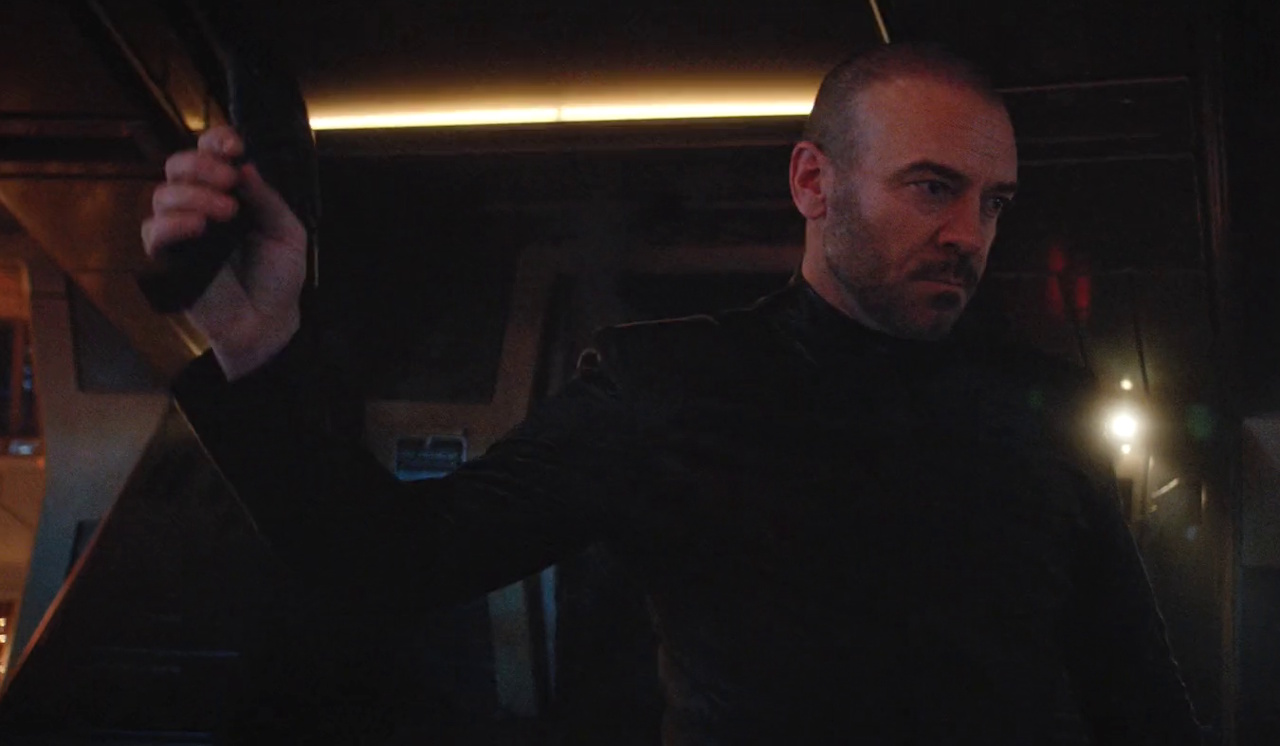
Spoiler Warning: There are spoilers ahead for Star Trek: Picard Seasons 1-3. Spoilers are also present for the following Star Trek productions: The Wrath of Khan, The Next Generation, Deep Space Nine, and Voyager.
Dominion was undeniably a fun, fast-paced, exciting episode; a thrill ride that kicked Picard’s third season into a higher gear as the plot builds to its climax. It was also an episode that shone a light in some very dark places, and did what Star Trek has always done so well: used its science-fiction setting to think about some of the issues facing us out here in the real world.
Having sat with Dominion for a couple of days, though… it isn’t actually an episode that I particularly enjoyed. It had some explosive moments of action, some engrossing moral quandaries, a sequence between two of my favourite characters from The Next Generation that was tense and emotional, and was backed up all the way by some great writing and some truly outstanding acting performances. But I didn’t actually like much of what the episode brought to the table from a narrative standpoint.
The USS Titan in a scrapyard.
As we discussed last week, the decision to resurrect Data is not one that I would have made. There are some deceased Star Trek characters who, for one reason or another, didn’t get a proper send-off – and I argued just last year that the main characters from Seasons 1 and 2 of Picard are themselves in that category. But Data, more so than practically any other Star Trek character, had been laid to rest. His resurrection not only undid all of that, but it takes away one of the few successful moments from the finale of Season 1 – one of the very few threads keeping the ending of that season together.
And this week, I’m sorry to say that despite incredible performances from both Brent Spiner and LeVar Burton as they wrangled with Data’s apparent return… this storyline hasn’t yet justified itself. I can buy technobabble explanations in Star Trek for all manner of things – that comes with the territory in sci-fi. But you have to admit that few characters in the franchise had been killed as definitively – and as often, in different ways – as Data, so any rebirth or resurrection has a significant obstacle to overcome. I wouldn’t have even attempted it – the technobabble excuse feels like something straight out of fan-fiction – but now that it’s happened, there has to be some kind of narrative or storytelling justification for it. And there isn’t.
The resurrection of Data (and Lore) continues to be a drag on the story.
The resurrection of Data has also brought back Lore – and Lore’s intervention this week led to a storytelling trope that I’ve never enjoyed: the “heroes’ base is captured and they’re all taken prisoner” cliché. Discovery did this a couple of seasons ago, we’ve seen it in Deep Space Nine, too, and on countless other occasions in sci-fi and beyond. To me, these storylines always feel so incredibly forced, as if a particularly uncreative writer couldn’t find a better way of adding tension to a story. And that’s how Vadic’s capture of the Titan feels to me.
If the premise underlying this takeover was stronger, perhaps some of that frustration would’ve melted away. But it came about as a combination of a poorly-defined plan from Picard and Dr Crusher – a plan that was executed terribly, too – and Lore’s shenanigans. What was already a disappointingly overused trope ended up feeling even less appealing as a result.
Vadic in the captain’s chair of the USS Titan.
I’ve never been much of a Lore fan. The “evil twin” angle was an interesting one in some ways… but even after a mere four appearances in The Next Generation, spread out over several years… Lore had already worn out his welcome, at least for me. He’s as one-dimensional as they come, feeling akin to a Mirror Universe character in some respects, and I’ve just never found him to be of much interest. Stories in which he would attempt to take Data’s place or convince his brother to betray his friends just never stood out to me as being among The Next Generation’s best.
And I think I should be up-front about that – I have a bias against this character that’s been running for some thirty years or more! When it was teased that Lore would play a role this season, this feeling being dragged back up is precisely what I feared would happen – and so it proved in Dominion. As we’ve said in earlier episodes about Vadic: a villain needs some kind of motivation. Lore is “evil for the sake of it,” and I find that deeply unsatisfying. It was unsatisfying in The Next Generation and it was unsatisfying in Dominion, too.
I’ve never been the biggest fan of stories that included Lore.
The saving grace on this side of the story should’ve been Geordi – and the wonderfully emotional performance that LeVar Burton put in as Geordi tried to reach out to his long-dead friend. Burton deserves an award for his scenes this week, as they were absolutely riveting to watch. In fact, in just two episodes, Geordi has quickly become one of the best characters in Picard, and LeVar Burton has been hitting all of the right notes consistently. But it’s a scene that just… didn’t need to happen, at least not this way.
We’ve basically had this conversation and this scene before: it came between Data and Picard at the end of Season 1. Geordi’s reunion with Data, and his attempt to reach out to him and break through Lore’s control, feels like a rehashing of those conversations between Picard and Data. In spite of what has to be one of the single best acting performances in all of modern Star Trek, these scenes just don’t add much to the story. Geordi could have expressed his sorrow at Data’s death to Picard, or to Altan Soong if the character hadn’t been unceremoniously killed off. Bringing back Data still isn’t sitting right with me.
This was a masterful performance from LeVar Burton.
I’ve talked before about the “snowball” in media criticism: a few big or fundamental criticisms of a story get things rolling, and before you know it, the “snowball” is picking up speed, finding more and more elements of a narrative to pick on and single out for criticism. And because of how the Data-Lore resurrection has landed for me, I find myself pulling at threads on this side of the story that would have probably passed unnoticed otherwise.
For example: how was Lore able to break out and effectively seize control of the ship? The answer seems to be “because plot,” and that’s just never a very satisfying explanation – especially given the high stakes. It’s hard to see how Vadic would have been able to take control of the ship had Lore not intervened, so the main thrust of Dominion’s narrative now appears to unfold thanks to a succession of unlikely, unpredictable coincidences one after another.
Lore’s escape wasn’t well-explained.
Alright, enough about my gripes about Data’s resurrection and my dislike of Lore! There’s no denying that LeVar Burton’s performance this week was outstanding, and when watching his big emotional scene with Data in particular, it was easy to put all of those concerns and criticisms out of my mind. Burton has made this older, more mature version of Geordi a real tour de force, and he’s brought far more to the table than I could have expected. If there are to be any future Star Trek projects set in this time period, they’d damn well better find a way to include Geordi – because I’m not ready to say goodbye!
It made sense for Geordi to be the one working with the Data-Lore golem, given his experiences with Data in The Next Generation, and I felt the setup for this story was handled about as well as it could’ve been. Geordi’s line that this golem is significantly more complicated than Data was also a helpful bit of exposition! Given that we’ve heard these new generation synths referred to as “flesh-and-blood” creations, maybe Dr Crusher, not Geordi, should have been examining the golem? Food for thought, at least!
Geordi was working on the Data-Lore golem.
I have to admit that I was sceptical about Mica Burton – LeVar Burton’s real-life daughter – playing Geordi’s on-screen daughter Alandra. I’d been vaguely familiar with Mica Burton’s work as a presenter from Star Trek Day a couple of years ago, and her stint on a YouTube gaming channel a couple of years before that. But I felt that she was untested as an actor, having only had a couple of bit-parts before now. This felt to me like “stunt casting;” bringing an actor into the series not on merit, but due to a combination of her parentage and a desire to make headlines. A “nepo baby,” to use some contemporary slang.
And… well, I’m not wrong about that. But I’ve been pleasantly surprised to see that Mica Burton has put in two solid, perfectly creditable performances in the episodes in which she’s appeared so far. The character of Alandra La Forge, while not exactly front-and-centre, adds something to this story, and has given Geordi both an assistant and a dependent, all while managing to feel like a rounded character in her own right. We’ve started to see some great things from Sidney La Forge over the last couple of episodes – and I hope that there will be time before the season ends to give Alandra a moment in the spotlight, too.
Geordi and Alandra La Forge.
Before we get into other big stories, let’s talk briefly about another surprising character: Tuvok! Or should that be “the changeling formerly known as Tuvok,” because after what had been a great sequence between Tuvok and Seven of Nine, this character reunion was ripped apart. It was dramatic and exciting – but perhaps not how I’d have chosen to bring back an actor for what may turn out to be their final Star Trek appearance.
As a moment of pure shock value, I think the revelation that Tuvok was a changeling worked incredibly well. And I’m holding out hope that the real Tuvok might make an appearance before the end of the season – I mean, the changelings have to be keeping all of these prisoners alive somewhere, right? Maybe we should save the speculation on that for my next theory update!
The changeling formerly known as Tuvok.
It was a bold move to bring back a character in this way, perhaps even more so than killing off the likes of Hugh and Icheb in Season 1. Tuvok was a main character for all seven seasons of Voyager, and aside from a tiny voiceless cameo in Lower Decks last year, this is the first time we’ve seen him since. Bringing back Tim Russ to play a changeling imposter feels like a very brave call – one that could’ve backfired. I think Dominion managed to make it work, though – and it was a real twist to bring back Tuvok and seem to set him up as an ally, only to rip it away mere moments later in the same sequence.
I’d love to see more from Tuvok, though – and get a genuine reunion with Seven of Nine. In a story with Worf, there’s also scope to put these two characters together. Worf and Tuvok were both security chiefs and tactical officers – but they were very different characters who had conflicting approaches to the role! Even now that Worf has entered his transcendental meditation phase, it could still be a lot of fun to put him together with Tuvok for a scene or two. A Trekkie can dream, eh?
The scene between Seven and Tuvok was bold… and a lot of fun.
Speaking of Worf, he was absent this week – along with Raffi, Riker, and Troi. There are now only three episodes left for Deanna Troi to make any kind of impact on the story, having had only a couple of blink-and-you’ll-miss-it cameos so far, so I really hope that she’ll have something major to say and do soon.
Despite being billed as a reunion for the characters, there hasn’t yet been a single scene or sequence in which Picard and his old crew are back together – with different characters or pairs of characters largely in their own narrative boxes, not really interacting with one another. Before the season is over, I hope that there will be something for everyone to do – but perhaps more importantly, their effort to stop Vadic and the rogue changelings should feel like a collaborative effort. In Season 2, splitting up the main characters for much of the story led to a number of issues – and I sincerely hope that won’t be the case this time around. But it’s noteworthy, at this stage, that the promised reunion still hasn’t materialised, and that several main characters haven’t gotten as much to do as I’d hoped.
Is Riker, as the changeling claimed, already dead?
As Jack’s superpowers continue to manifest, it’s now more than obvious that there’s more going on with him than we’ve learned so far. This week, we saw him “take over” Sidney La Forge, using his newfound combat skills to defeat a nameless goon who appears to serve as Vadic’s second-in-command.
This sequence, by the way, was exceptionally well choreographed. It must have been one heck of a challenge for actors Ed Speleers and Ashlei Sharpe Chestnut (or their stunt doubles) to perform these difficult acrobatic moves in total synchronisation, but the way it came across on screen was just fantastic. Few sequences in modern Star Trek have managed to feel truly new – but this was something that the franchise hasn’t ever done before, at least not as far as I can remember! It was fantastic to watch, and while it may not have been the most intense action sequence ever brought to screen, it was incredibly clever – and it marks the beginning of a new phase in the stories of both of these characters.
This sequence was exceptional.
The exciting and beautifully choreographed fight was almost enough to make me forget the horrible contrivances that led to it. Almost! I stand by what I said before: Lore’s involvement in this story, messing with forcefields and transporters at precisely the right moment, was one heck of a contrivance. While we got an exciting sequence with Jack and Sidney as a result, that alone isn’t enough to justify it – and too many forced coincidences like this make for a particularly weak narrative foundation.
As the fight simmered down, one moment really stuck with me. As Sidney looked at Jack, she had a mixture of fear and shock in her eyes; that moment, as Sidney realised that she’d just been – for want of a better term – “possessed” by Jack, was exceptionally well done. Once again, Ashlei Sharpe Chestnut excelled.
Dominion was a great episode for Sidney La Forge’s characterisation.
There was potential in the “let’s lure the baddie into a trap” idea that was posited by Dominion, but it quickly fell apart. The writing on this side of the story failed to set up a narratively coherent plan, and when we’re dealing with experienced officers like Picard, Seven, Dr Crusher, and even Captain Shaw, the fact that their plan was so flimsy, and fell apart so easily, doesn’t make for a satisfying presentation. There were other ways to have Vadic commandeer the Titan – if that was the episode’s required outcome – without going through this long and convoluted rigamarole.
Splitting up their forces, having poorly-armed ensigns with little combat experience literally running around the deserted hallways of the ship, and allowing the much more powerful Shrike to transport a group of changelings aboard the Titan are all indicators of a poorly-formulated – and poorly-written – plan, one that was clearly written in order to arrive at a particular outcome. Some of the specifics of this plan feel incredibly flimsy, too: where did the Titan’s crew acquire the wreck of a Vulcan ship, and how were they able to convince Vadic of its authenticity?
This plan was neither well-conceived nor well-executed.
All of this, however, led to two interesting revelations about Vadic. The smaller revelation concerns the character I’ve dubbed Floaty McFloatface (Star Trek: if you don’t want fans to give silly names to your characters and factions, name them yourself). It now seems as if Floaty McFloatface may not be a changeling – or at least, not the same kind of changeling as Vadic herself. We won’t get too deep into speculation here – and I’ve been wrong about Vadic and Floaty McFloatface before – but suffice to say that there’s a complexity to their relationship that was spoken to, albeit rather briefly, this week.
I’ve been saying for weeks that we need to spend more time with Vadic, and to come to understand what’s been driving her all this time. It still seems as if Vadic’s desire to capture Jack Crusher stems from orders from Floaty McFloatface – and not, as Picard and Dr Crusher repeatedly assumed, in order to steal his DNA to make a copy of Picard. But we found out a lot more in Dominion about where Vadic came from – and it was in equal parts incredibly dark and absolutely riveting.
Vadic and Floaty McFloatface have a difficult relationship.
By coincidence, I’ve recently been re-watching Ken Burns’ documentary The Vietnam War, and with all the talk this week of torture and rogue military operations, I felt echoes of that conflict – as well as more recent wars in Afghanistan and Iraq. I think we can absolutely see Vadic’s story in Dominion as a cinematic response to American foreign policy over the past few decades, and a reflection of how the country is coming to terms – or failing to come to terms, in some cases – with its own recent history.
One of the lessons of Vietnam that was sadly not learned by the time of Afghanistan was an oft-repeated line that America was “creating its own enemies.” Every house burned down, every village raided, every bomb dropped… all of these things created more Viet Cong or Taliban fighters, and this is the lens through which I see Vadic’s story. By torturing and experimenting upon Vadic and the other changelings – implied to be the crew of the Shrike – Starfleet has inadvertently created another enemy for itself.
Starfleet (or Section 31, at least) is responsible for making Vadic into the villain she became.
However, there are a couple of queries I have about this revelation. They aren’t yet “problems,” let alone “plot holes,” but parts of this backstory for Vadic seem to come dangerously close to contradicting what we know of the rogue changelings and their scheme from earlier episodes. Worf, for example, specifically told us that this group of changelings had departed the Great Link following a schism, implying that these rogue changelings may be those who rejected Odo’s path of peace.
Secondly, the number of changelings involved in this conspiracy feels massively inflated based on what Vadic told us. She said that she was one of ten changelings being experimented upon, yet there are clearly far more than that. We’ve already seen at least seven killed – and that doesn’t account for Vadic and her crew. While she did say that she could pass along the abilities that she had developed to other changelings, it still doesn’t seem to add up. Ro seemed to think that all of Starfleet was compromised, and that there could be changeling infiltrators aboard multiple ships. If the original group consisted of just ten members, where have all the others come from?
Vadic and her crew.
I’ve always felt that there was a conscious effort on the part of the writers and producers of Deep Space Nine to present the Dominion War as a conflict akin to the Second World War – something we see quite prominently in the show’s finale at the signing of the Treaty of Bajor. But there were definitely Vietnam War influences during Deep Space Nine’s run, too. Episodes like Change of Heart, which prominently featured a “jungle” setting, spring to mind – as does The Siege of AR-558, which was directed by Vietnam veteran Winrich Kolbe.
But there was an even darker tone to the story Vadic told us this week, something that echoed less the Afghanistan War and more the human experiments performed in concentration camps. We’ve always known that Section 31 was willing to go to extreme lengths on behalf of the Federation – even violating Federation law. But when we saw the virus they created in Deep Space Nine, we only saw its effects. This time, we saw the process – the torture that Vadic and her fellow changelings endured.
Vadic’s torturer.
Since its emergence in Deep Space Nine more than twenty years ago, Section 31 hasn’t sat right with a lot of Trekkies – and I get that. This organisation is about as far from Gene Roddenberry’s vision of a more idealistic and enlightened humanity as it’s possible to get. But the idea that Section 31 represented has always been a fascinating one for me: that there’s someone in the background, working behind the scenes, to preserve the enlightened future that humanity has struggled to build. Section 31 sees itself as defending the Federation – even if it has to violate every single Federation principle and law in the process.
In this case, the question is perhaps a bit less interesting. It feels a lot easier to say that Vadic’s torture was wrong – because it was ultimately unnecessary. It was designed, at least according to Vadic, to allow the creation of a weapon – changelings who could bypass all the typical tests and who would report to Section 31 and Starfleet. The virus, in contrast, has always posed much more of an interesting moral question: when faced with conquest and possible extinction, should that kind of biological weapon be off the table?
The experiments that Section 31 performed were intended to create a weaponised changeling.
It’s easy to condemn Vadic’s torturer – and by extension, to feel a pang of sympathy for what Vadic herself has been through. There’s no denying that Vadic is a far more complex and interesting character coming out of Dominion than she was before the episode began – and that’s a good thing. We don’t need to agree with a villain or sympathise with them to understand them – but in order to really get invested in their story, we need something to give them motivation and to explain who they are. Vadic had been lacking this all season long – but we finally got the details this week, and it puts her characterisation into context.
The one disappointing thing, though, is that Vadic lacks any meaningful connection to Picard – and to anyone else on the crew, for that matter. Her torturer was a nameless Section 31 operative, she wasn’t even involved in the Dominion War as far as we can tell, and she certainly didn’t know Picard or any of the others prior to this conspiracy getting underway. They’ve definitely formed an adversarial relationship – but it comes quite late in the story. Contrast this with the likes of Khan or Gul Dukat: characters who had burning, passionate hatred for their Starfleet adversaries.
We know a lot more about Vadic now.
In a series called Star Trek: Picard, that could be the missing piece. In both Seasons 1 and 2, for better or worse, Picard was at the centre of the story. The Zhat Vash conspiracy disrupted Picard’s armada, and he was the one to unravel it years later. Picard’s relationship with Q led to the whole Confederation/time travel plot. And while Vadic’s determination to kidnap/capture Picard’s son gives her some kind of connection to him… I’m still not feeling the personal side of it.
I will say, though, that we’ve seen moves in that direction not just this week, but over the past several episodes. As Picard has gotten deeper into the conspiracy, his determination to do anything to stop it has grown. And there are personal stakes for him: the death of Ro, the capture of Riker, and the threat to the son he didn’t know that he had. All of those things are positive, and while we still don’t have all of the details, we have more than enough to understand Picard’s decision-making process – and his ability to cross a line that we might never have expected him to cross.
Dominion presented Picard with a moral dilemma.
Star Trek has a fantastic collection of morality tales going all the way back to The Original Series. But for me – and I daresay for many fans of my generation, too – fewer hit harder than Deep Space Nine’s Season 6 classic In The Pale Moonlight. That episode, told through flashbacks and a frame narrative, sees Captain Sisko wrangling with breaking all of the rules in order to manipulate an outcome that he and the Federation needed. It was life-or-death, and Sisko took it upon himself to place the Federation’s survival ahead of his conscience – and ahead of following the law.
Dominion sees Picard and Dr Crusher confront the same basic moral quandary. There are laws against the killing of prisoners – yet killing Vadic (and unbeknownst to them, Floaty McFloatface too) would have thrown a spanner in the works of the conspiracy ahead of its targetted date of Frontier Day. We see them agonise over the decision, especially in light of Vadic’s backstory… but they ultimately decide to go for it.
Picard and Dr Crusher ultimately decide to break the law – and their own moral code.
Dominion tries to present this as a choice with a time-limit – it will only be a matter of time before Vadic escapes or before someone breaks her out, so they have to decide relatively quickly. The episode also worked hard to show how conflicted Picard in particular felt about violating one of the foundational laws of war. And in the moments we got with Picard and Dr Crusher, this question of morality versus practicality worked well, and I could feel through the screen how painful it was for Picard to even have to consider a course of action like this.
However, this side of the story was split up at points by Jack and Sidney running around the hallways of the Titan, and by Geordi and Alandra working on Lore and the ship’s systems. I’m not sure that Dominion dedicated enough time to what was meant to be the key dilemma for the show’s title character – because after Vadic had explained where she came from and we’d gotten all of the other scenes and sequences with other characters… the ultimate decision seemed to be reached by Picard and Dr Crusher pretty quickly. It felt, in that moment, as if they’d already decided what they were going to do before we saw them confirm it.
This moment was arrived at rather quickly.
And I’d also like to point out another unenjoyable trope that came out of this side of the story. We saw in Seventeen Seconds a few weeks ago how easily Worf was able to kill a changeling in their liquid state. Seven and Jack were also able to relatively easily kill changelings in their humanoid states, too. But this week – as soon as it became convenient for the story – both Vadic and her second-in-command were able to survive multiple phaser blasts under what appeared to be similar circumstances.
There was a pathway to allow both characters to survive without doing this, and it’s really just a worn-out cliché at this point. There was some fantastic acting and choreography on both sides of the story here – but it all led to such a bland and oft-repeated outcome.
The old “you thought he was dead” cliché…
And I guess that last line kind of encapsulates my thoughts on Dominion as a whole, really. Patrick Stewart, Gates McFadden, and LeVar Burton all absolutely excelled… with the material that they had in the confines of a fairly uninspired story. This was a tense, exciting episode that moved along the plot on the Titan – while ignoring the stories of Worf, Raffi, Riker, and Troi – but that just didn’t take the season’s main narrative to a particularly exciting or original place.
There was scope to make more of Dominion, and there’s a risk, I fear, that its “captured starship” outcome will be easily undone next week, rendering much of the episode a bit… well, pointless. I’m glad we got to learn more about Vadic, and to put her conspiracy and quest into some kind of personal context for her. That was desperately needed as the season passes its three-quarter point. And there were some wonderful performances along the way, both in terms of acting and in terms of a well-choreographed sequence that felt like something new to Star Trek. But overall, I’m not thrilled with where the story went this week.
The Shrike and the Titan.
With three episodes left, there’s still plenty of time for Season 3 to recover, to deepen its mysteries, and to throw in some more twists and turns. And despite my criticisms, I don’t hate Dominion. It told the story it wanted to tell about as well as it possibly could. It can be hard to judge mid-season episodes fairly when the final destination is still unclear – and it’s to Dominion’s credit, in some respects, that the story’s endgame is still obscured through a thick narrative fog.
So I’m trying to stay positive! I’m loving the fact that we’re getting a look at some familiar faces from Star Trek’s past, that Section 31 is in play, and that it feels like Picard is finally taking a look at the broader state of the galaxy in this 25th Century time period. Dominion also put a morality question at its heart, harkening back to some of my favourite complex episodes from Star Trek’s past. There’s potential to build on what was delivered here – and maybe to take the story to a more enjoyable place next time!
A few scattered final thoughts:
Repeated mentions of Admiral Janeway – could she appear in the season finale?
Vadic didn’t confirm what she wanted with Picard’s corpse… but a look in her eye seemed to suggest he was wrong in his assumption.
I’m sure that Geordi’s partner won’t appear now… but I hope it isn’t supposed to be Leah Brahms!
Jack is wielding a 23rd Century phaser pistol – which is pretty cool!
Tuvok has been promoted – good for him!
Captain Shaw is, to my immense surprise, still alive.
A reference to the Chin’Toka system – the site of two major battles in Deep Space Nine – did not pass unnoticed!
Star Trek: Picard Seasons 1-3 are available to stream now on Paramount+ in the United States and other countries and territories where the service is available, and on Amazon Prime Video in the UK and around the world. The Star Trek franchise – including Picard and all other properties discussed above – is the copyright of Paramount Global. This article contains the thoughts and opinions of one person only and is not intended to cause any offence.
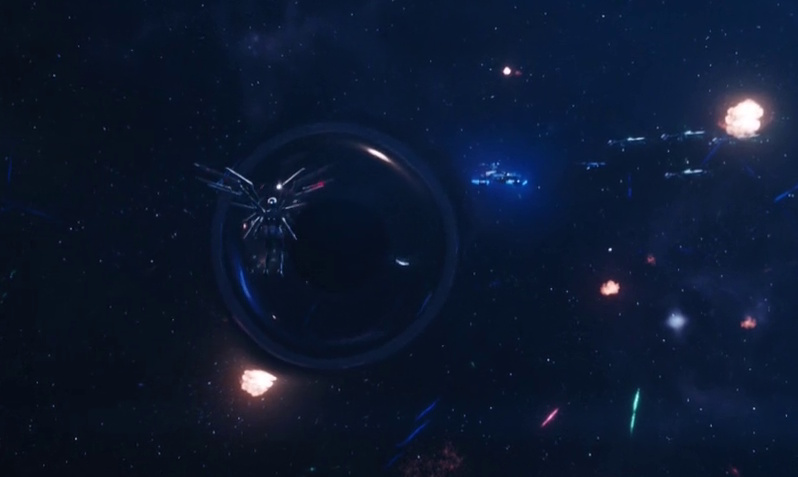
Spoiler Warning: There are spoilers ahead for Star Trek: Picard Seasons 1-3. Spoilers are also present for the following Star Trek productions: The Wrath of Khan, The Search for Spock, The Next Generation, Deep Space Nine, and Voyager.
Right off the bat, here’s perhaps my biggest theory ahead of the next episode of Picard: it’s going to be a big one! Why do I say that? Well, ahead of Season 3 being broadcast, quite a lot of reviewers, critics, fans, and even some YouTubers were treated to the first six episodes – as you may have gathered if you check out other fan sites and social media channels. But they weren’t able to see the rest of the season beyond episode six… so that could mean that the next episode is going to introduce something big, perhaps an unexpected character or surprising twist!
Yours truly, however, was not invited by Paramount to check out the season ahead of time. I wonder why that could be? Surely it isn’t because I’ve spent several years writing articles criticising the corporation for its mismanagement of Paramount+ and Star Trek, at least one of which included the phrase “useless bag of dicks” to describe the executives and board members? Now that I think about it, maybe that does explain it…
What a useless bag of dicks.
As the second half of the season gets underway, we still have a bunch of theories in play. The Bounty took several big ones off the board… but it also added several new theories to take their place! It’s a merry-go-round at the moment – but that’s to be expected from some of these mid-season episodes.
This week we have a whopping eight debunked theories and one theory that I’m rather generously calling “semi” confirmed! And as always, that’s where we’ll begin.
Semi-confirmed theory: Picard and the crew re-activated Lore.
It’s a projec-ta! Get it? Projector + Data… projec-ta… ah, forget it.
This didn’t go quite the way I’d expected, but nevertheless it fell to Picard’s crew to re-activate the golem containing Dr Soong, Lore, B4, Lal, Data, and possibly other Soong-type androids. I had initially speculated that Picard and the crew might have been seeking out synthetic allies – perhaps because they felt they needed trustworthy friends in light of the rogue changelings seemingly being all over Starfleet.
The final pre-season trailer seemed to hint at Lore being aboard the Titan, and it was based on those clips that I first put this theory on the list. Earlier it had seemed plausible to think that Lore might’ve been on Vadic’s team – which could have been interesting in and of itself. But then the final trailer came along and seemed to blow that away. I didn’t get the specifics right, and I was wrong that Professor Moriarty would be included here as well. But I was close enough to call this one “semi” confirmed!
Debunked theory #1: Picard and the crew need to find synthetic/AI allies.
The Data-Lore golem.
When both Lore and Moriarty appeared in pre-season trailers, I wondered what role they might play. It seemed plausible to think that the fact that they were both artificial life-forms could have been relevant, and that feeling only grew when the rogue changelings were revealed as part of the story. With the rogue changelings crawling all over Starfleet, and Picard and the crew not knowing who to trust, it didn’t seem like much of a reach to think that they might turn to synthetic life-forms for help.
As far as we know, changelings have never been seen to mimic synthetic life-forms, so it seemed a logical guess – at least to me! But we learned in The Bounty that Picard and the crew didn’t even know that Data/Lore was present at Daystrom Station, and that Moriarty was (disappointingly, I must say) not even real. I’m glad this didn’t pan out, though, as it would have made the absence of Soji and the other Coppelius synths incredibly glaring and obvious. But it was an interesting, plausible theory for a while there!
Debunked theory #2: Professor Moriarty is the “sophisticated AI” at Daystrom Station.
Moriarty.
Based on what we glimpsed of Daystrom Station ahead of The Bounty, and combined with Moriarty’s clips in pre-season trailers, it seemed like a sure thing that we’d encounter him this week – and so it proved. But as noted, Moriarty’s role was much less than it could have been – and much less than I’d personally been expecting based on his appearances in the trailers.
It seemed plausible, based on what we’d seen, that Moriarty could have been the sophisticated AI that Raffi and Worf mentioned – essentially filling the role that we now know was taken by the Data-Lore golem. It could have been interesting to see Picard and co. come face to face with Moriarty after all these years – and perhaps having to apologise for trapping him in a simulation. Freeing Moriarty from Section 31’s control could have been a fun story, and a way for Picard to make up for imprisoning Moriarty in the first place. Regardless, it didn’t happen!
Debunked theory #3: Ex-Terran Empress Georgiou will be found at Daystrom Station.
Not this time, unfortunately!
There were easter eggs aplenty at Daystrom Station – and seemingly multiple corpses being kept there, too. But my theory that the Section 31-operated facility might lead to Picard and the crew coming face-to-face with Georgiou wasn’t to be!
In truth, this always felt like a heck of a long-shot. Newly-minted Oscar winner Michelle Yeoh has spoken of a desire to return to Star Trek since leaving Discovery a couple of years ago, but no announcement has been made as of yet. It could have been a heck of a surprise and a really fun way to tee up the Section 31 show’s escape from development hell, though!
Debunked theory #4: Vadic’s crew are Jem’Hadar.
Vadic with a couple of her crewmates.
In a short (and unimpressive) scene at the beginning of The Bounty, Vadic spoke to her crew and seemed to confirm that the masked characters are all changelings – seemingly removing any possibility of an appearance by Jem’Hadar or Vorta. If these are rogue changelings then it makes sense that the Dominion’s troops would have remained loyal to the Founders… but it seemed possible that some might have followed the renegades, or that they’d been able to establish a cloning facility somewhere.
I think it’s still possible that we might encounter Jem’Hadar or Vorta this season, especially if the rogue changeling plot is the precursor to an all-out assault on the Federation. But as far as we can tell right now, Vadic’s crew are changelings.
Debunked theory #5: Several members of La Sirena’s crew have joined Captain Vadic.
The crew of La Sirena at the end of Season 1.
As above, we can now safely assume that Vadic’s crew are changelings. However, when we first saw that the crew of the Shrike were all wearing face-concealing masks, I wondered if the reason could have been that at least some of them were familiar characters. The crew of La Sirena came to mind first and foremost as they’re no longer involved on Picard’s side of the story.
This theory was always unlikely because of announcements from most of the actors that they weren’t involved in Season 3. And as the rogue changelings storyline unfolded, its likelihood decreased even more! But it was a fun idea to consider for a moment – that Picard might find himself, somehow, caught between his old crew and his new friends.
Debunked theory #6: Lore and Moriarty were stolen from Daystrom Station.
The Shrike at Daystrom Station.
Going into The Bounty, this theory still felt plausible. Vadic is still the only named villain on that side of the story – and no, Floaty McFloatface doesn’t count! To give the villains a bit more interest, having Lore and Moriarty on their team would have been an interesting idea. Perhaps Vadic and the rogue changelings could have been looking for allies – or for entities that were familiar with Picard.
Vadic did steal someone from Daystrom Station – but not Lore or Professor Moriarty! Instead, we now know that she stole the original body of Jean-Luc Picard. And don’t worry, I have an idea or two as to why she and the rogue changelings might want a Frenchman’s corpse!
Debunked theory #7: Vadic is not a changeling.
Vadic shifts into her more familiar form.
When we first saw Vadic cut off her hand and speak with Floaty McFloatface, I felt certain that meant she wasn’t a changeling – but rather a humanoid who had some kind of changeling appendage. I was wrong about that, though, and The Bounty provided final confirmation that Vadic is indeed a changeling.
However, I maintain that she’s unlike any other changeling we’ve ever encountered! Her relationship with Floaty McFloatface is intriguing, and the role she may play in the rogue changelings’ scheme is still up in the air. She’s a powerful changeling, yes… but she isn’t top dog. Her eccentric personality (and over-the-top performance) are still aspects of her characterisation that the series needs to explain.
Debunked theory #8: Other background ideas for Vadic.
Vadic.
Before Season 3 aired, I put together a list of ideas for who Vadic could be – and crucially, what her relationship could be to Jean-Luc Picard in a series all about him! Now that we know Vadic is one of the rogue changelings, that seems to rule out all of the remaining ideas that were still in play.
I had suggested that Vadic might’ve been a member of Picard’s crew – perhaps someone who had been injured or left for dead while serving under his command. I liked this idea the most, to be honest, because it would have given Vadic a powerful connection to Picard, and a real reason for hating him. But there were other plausible ideas, too, including connections to the Romulans and Sela, DaiMon Bok, Insurrection’s Son’a, and even the weird parasite-aliens from the episode Conspiracy!
So those theories were (semi) confirmed and debunked.
Phew, that was a lot of debunkings! But this kind of theory massacre was always going to happen sooner or later – and there are still plenty of other theories on the list to be similarly debunked in the weeks ahead!
Up next we’ll jump into the main theory list, beginning with theories that are new or that saw significant movement as a result of events that transpired in The Bounty.
Theory #1: Picard will donate his golem body to Jack.
Picard awakens in his golem body at the end of Season 1.
The revelation that Jack has the terminal and incurable Irumodic syndrome was a surprising inclusion in The Bounty – and it tied into that episode’s theme of the relationship parents have with their children, and what kinds of things children inherit from their parents. Irumodic syndrome was the most obvious example of a “flaw” passed from parent to child.
But this story could have also set up the endgame – not only for Season 3, but for Jean-Luc Picard himself. In short, I’m suggesting that Picard will donate his golem to Jack, sacrificing himself to save his son’s life in one final act of parental love. This will come after Vadic and the rogue changelings have been defeated – and will mark the definitive, conclusive end of Picard and the show’s title character.
There has been speculation ever since Picard was announced that the series would end with his death – and while I’ve said it would be hard to pull off after the fake-out death at the end of Season 1, this kind of sacrifice could be one way to make that story work.
Theory #2: Jack is a Dominion War-era “sleeper agent.”
Jack in The Bounty.
As I noted in my review of The Bounty, Jack’s diagnosis of Irumodic syndrome feels like only part of the explanation of what’s been going on with him. His hallucinatory experiences and general feelings of aggression may be able to be waved away now that he’s been diagnosed – but how do we explain his glowing red eyes and his sudden combat mastery? Jack was able to defeat four changeling operatives at once – something that, as Captain Shaw noted, seems remarkable.
There was something about the way Jack’s combat prowess seemed to suddenly emerge, as if a switch had been flipped, that made me think of stories involving “sleeper agents.” Such an operative would be brainwashed, placed into a population, and could then be “activated” via a code phrase or some other method. This is a trope of spy fiction going way back – and a lot of the indicators seem to apply to Jack. If he is a sleeper agent, that could explain not only his combat abilities, but the rogue changelings’ interest in him.
Theory #3: Vadic is the female changeling from Deep Space Nine.
The female changeling as she appeared in Deep Space Nine.
One unnamed changeling spearheaded the Dominion war effort in Deep Space Nine – and now that we have definitive proof that Vadic is a changeling, my left-field theory is that the two characters are one and the same! The last time we saw the female changeling, Odo had cured her of the genetic disease that had been created by Section 31, and she was due to stand trial for war crimes after the Dominion’s final defeat over Cardassia. She didn’t return with Odo to the Great Link, and it was assumed that she would remain in custody for some time.
If the female changeling escaped – or was released after serving her sentence – perhaps she had been changed by her time in prison. She could have been lying to Odo, pretending to go along with his plan in order to receive the cure. She could also have suffered some kind of nervous breakdown after being away from the Great Link for such a long time – which could explain why Vadic is so eccentric!
I’m not sure about this one, to be honest, but it’s an interesting idea that would tie Picard even closer to Deep Space Nine.
Theory #4: The rogue changelings didn’t want Jean-Luc Picard… they wanted Locutus.
An updated look at Locutus as seen in Season 1.
Why did the rogue changelings abscond with Picard’s corpse? And for that matter, why was Section 31 holding onto it to begin with? Perhaps the reason is that Picard was once Locutus of Borg – and his body may contain some residual Borg implants or nanoprobes that the rogue changelings want. If Jack Crusher also has Borg nanites in his system that could explain their interest in him, too.
We know that Starfleet has incorporated Borg technology into some of their newer vessels, and in The Bounty we learned that the entire fleet can automatically link up and communicate – which could be Borg tech. In Season 2, the Borg Queen seemed to be able to seize control of one Federation ship and then use that to command an entire fleet. Could that explain why the rogue changelings need Borg nanoprobes?
Theory #5: The rogue changelings want to hack the entire Federation fleet.
The Borg Queen used her mechanical tentacles to hack into the USS Stargazer’s systems in Season 2.
Tied to the theory above is the idea that the changelings may not want to destroy Starfleet outright, but rather hack into the ships and use them in some other way – perhaps to attack Federation or allied targets, or even to attack each other. If the ships are connected somehow, and the changelings could take over that connection, maybe they could seize control of the entire fleet at once.
This would be an interesting idea, as it would potentially connect the story to what happened at the beginning of Season 2. With many advancements in AI out here in the real world, it could prove to be quite a timely story, too!
Theory #6: Lore will betray Picard and the crew.
Will Lore seize control of the golem and turn on Picard?
Although Data is back, he isn’t alone. Data is sharing a golem body with Dr Soong, Lore, B4, Lal, and possibly other androids, too. It was noted in The Bounty that no personality was dominant, and we caught glimpses of all of them at the end of the episode. But if one personality – Lore’s – were able to take control of the body, even just for a short period of time, he could end up betraying Picard and the crew.
Lore has always been a wildcard, but as we saw in his stories in The Next Generation, he’s also someone who considers himself superior to organic life. Having been deactivated and shut down for decades, Lore might want to seek revenge against Picard and the crew – or he might reckon his chances are better with the changelings than the Federation. There are multiple routes to a potential Lore betrayal!
Theory #7: The rogue changelings are trying to reach the Nexus.
The Nexus.
One of the easter eggs in The Bounty showed us a glimpse of Captain Kirk’s body – or a readout on a screen, at least. As far as we know, only two corpses were stored at Daystrom Station: Picard’s and Kirk’s. Aside from both being captains of the Enterprise, what else do these two characters have in common? They both used the Nexus to travel through time. Picard travelled only a few hours, but Kirk jumped forwards in time by decades.
The Nexus hasn’t been mentioned since Generations, and it would be a less well-known part of Star Trek to bring back in some ways. But the timelines could kind of sync up here: if it’s been 30+ years since the events of Generations, and the Nexus returns every 39.1 years, that could work! The Nexus could also be phenomenally useful for the rogue changelings – if they wanted to travel back in time to prevent the Dominion’s defeat, for example.
Theory #8: Vadic has put together a “rogues’ gallery” of Star Trek villains.
Characters like Sela could be involved… somehow!
This theory is barely hanging in there right now, especially now that we know that Vadic’s crew are changelings. However, I still think it’s a possibility that there could be other players involved in the rogue changelings’ conspiracy, and some of those could be familiar characters from past iterations of Star Trek.
I originally came up with this idea after we saw Lore and Moriarty in pre-season trailers, and made the assumption that they would be on Vadic’s side. Now that we know that isn’t the case, this idea feels another step further away! But there’s still a chance – so I’m not striking it off the list just yet.
Theory #9: Vadic is a veteran of the Battle of Wolf-359.
The Enterprise-D and debris from the Battle of Wolf-359.
I know, I know. We’ve just spent a long time debunking Vadic backstory ideas – and knowing that she’s a changeling should invalidate this one, too. But I can’t shake the feeling that all of these references to Locutus and Wolf-359 are setting up some kind of bigger connection – possibly involving Vadic.
If Vadic was one of the hundred changelings that had been sent out by the Founders, it’s not impossible that she might’ve been present at the battle. She could have been injured there or even partially assimilated – and the trauma from that event could account for her eccentricity. It could also explain why she wanted to steal Picard’s corpse from Daystrom Station.
Unlikely? Undoubtedly! But not impossible… not yet.
Theory #10: Jack Crusher has changeling DNA… somehow.
Is this Jack’s DNA?
We learned a couple of weeks ago that changelings can mimic humanoid DNA well enough to pass scans and screenings – so even though Jack was recently investigated by Dr Crusher, his being diagnosed with Irumodic syndrome shouldn’t rule out some kind of changeling DNA being present in his system. If Jack were a “sleeper agent,” as suggested above, that could explain why he has some changeling DNA. Or it could be as a result of something that happened to Jack and Dr Crusher during one of their medical missions.
I don’t think that the story could get away with saying that Jack is a changeling – and that he was never truly the son of Picard and/or Dr Crusher. That would be too hard a pill to swallow, especially after episodes like The Bounty focused extensively on the themes of family and relationships between children and parents. But Jack could still possess changeling DNA somehow – and that may account for the rogue changelings’ obsession with catching him.
Theory #11: Jack’s eyes, combat skills, and hallucinations are connected to the Borg.
Why did Jack’s eyes glow red?
As I said above, I feel that there’s more to Jack’s story than a diagnosis of Irumodic syndrome. The theft of Picard’s body – a body that was once assimilated by the Borg – could come into play here too. The feminine voice Jack has heard on more than one occasion could be the Borg Queen reaching out to him – and while Dr Crusher has given him medication that may treat his symptoms, if there’s a Borg connection here all that might do is mask it.
We don’t know whether there will be a greater Borg connection in the story – but it feels like there could be. There have been mentions and references to the Borg, and specifically to Picard’s assimilation experience, going all the way back to the season premiere. Jack could be the key to understanding why!
Theory #11-A: Jack has Borg nanoprobes in his body.
Borg nanoprobes.
If Jack’s symptoms are connected to the Borg in some way, it stands to reason that he may have Borg nanites in his system. The question of how this could have occurred is still an open one – perhaps they came from Picard at the moment of conception, or perhaps Jack encountered Borg technology during one of his medical missions.
Again, this could explain the rogue changelings’ interest in him. We saw in Season 1 that many ex-Borg had been killed; butchered for parts. There may not be many individuals in the quadrant with any Borg technology in their systems – and that could account for the rogue changelings both stealing Picard’s body and chasing after Jack.
Theory #12: The Borg are involved.
Borg drones as seen in First Contact.
We’ve talked a fair bit about the Borg already, and looked at a couple of ways in which they could be included. This theory has come about largely because of the frequent mentions of the Borg and the Battle of Wolf-359 in the story so far. The theft of Picard’s body could also be connected to this idea, as Picard had once been assimilated by the Borg. But why keep bringing up these Borg references if there’s no bigger connection?
It’s possible, but perhaps unlikely, that the rogue changelings have formulated some kind of deal or alliance with the Borg, as both factions would benefit from the Federation collapsing or being severely damaged. This seems less likely than a more subtle connection, perhaps, but it’s worth acknowledging the possibility!
Even if I haven’t figured out the exact way in which the Borg will be woven into the story, some kind of Borg connection feels like a distinct possibility.
Theory #13: Deanna Troi is a changeling.
A captive Troi. But is she who she appears to be?
The final scene of The Bounty saw Riker taken into custody aboard the Shrike – where he encountered a captive Deanna Troi. But is this the real Troi, or is the fact that she’s on a ship crewed by changelings a hint that she might not actually be who she appears to be?
It’s very easy in a story like this to become almost paranoid, and to see changelings behind every character’s mask! But right now, of all the characters currently in play, Deanna Troi aboard the Shrike feels like the most likely candidate for being a changeling imposter. Perhaps she will try to get information out of Riker, pressing him to choose between his family and his friends – only to reveal that it was all a ruse.
Theory #14: Irumodic syndrome is important to the rogue changelings.
Irumodic syndrome “killed” Picard… briefly.
At this point in the story, we know that the rogue changelings want Jack Crusher badly. And we’ve just learned that they’ve stolen Picard’s corpse from Daystrom Station. As Picard noted in The Bounty, he “died” of Irumodic syndrome back in Season 1. Irumodic syndrome is a big link between Jack and Picard right now – and because these two characters are the ones who seem to have gotten most of the rogue changelings’ attention, that fact could be significant!
Perhaps Irumodic syndrome can be used by changelings to mask their presence, or maybe it can somehow cure the genetic disease that Section 31 created. Irumodic syndrome could also be an indication that an individual possesses changeling DNA – or some other attribute that’s important to changelings.
Theory #15: A spin-off series will be announced.
The executive producers of Picard Season 1.
The sad news of Discovery’s cancellation, which was announced earlier this season, seemed to suggest that Paramount might be slowing things down for Star Trek – perhaps as a result of financial pressures. But we learned recently that Strange New Worlds has been picked up for a third season, and that Lower Decks has also been renewed for a fifth season – so there’s still hope for Star Trek’s future after all!
Furthermore, Alex Kurtzman has suggested that more announcements may be in the offing “soon,” potentially including new series, mini-series, or even films. I’m still crossing my fingers for a Picard spin-off – or at least a project set in this same early 25th Century time period!
The 5th of April is “First Contact Day,” and in the past Paramount has marked the day in some way. Could an announcement be coming soon, then? I guess we’ll have to watch this space!
So those theories are new or saw significant movement in The Bounty.
Now, as always, we’ll recap the other theories that are still on the board. I find it helpful to keep the list all together in one place – even though these theories didn’t see much movement or attention this week.
Theory #16: Odo will make an appearance – somehow.
Odo in Deep Space Nine.
I don’t know how I feel about this one. It was sweet to see Worf make reference to Odo in Seventeen Seconds – though the connection could have been clearer, especially for more casual viewers – but I’m not convinced that we need to see Odo for ourselves. The reason for that is simple: the only way we could see Odo is either by re-casting the character or recreating him through some kind of CGI process.
Star Trek has successfully re-cast many characters over the years, so I don’t really take exception to that. But the death of actor René Auberjonois is still recent and fresh in our minds, so bringing Odo back without him just feels… uncomfortable. Although Odo is well-suited to a story in which the changelings are back, I think I’d rather he didn’t appear in person on this occasion. But I wanted to acknowledge that it’s at least a plausible development for the story.
Theory #17: Vadic will be killed by her own portal-weapon.
The USS Titan and one of the portals.
This idea is a pretty simple one: as often happens to villains in stories like these, Captain Vadic will end up being killed by her own powerful weapon. We saw the portal-weapon used against the Titan in Seventeen Seconds, and I can absolutely see a pathway to Picard and the crew capturing it or gaining control of it, and turning it against Vadic.
There can be something poetic about an evil villain being destroyed by their own weapon, so I can’t help but feel that Vadic may meet her end by being spliced through one of her own portals!
Theory #18: The absences of characters from Seasons 1 and 2 will be explained.
Could we learn where Elnor went?
I was pleasantly surprised to see Laris was included in the season premiere, and while she won’t have a big role in the story of the season, it was great that the story didn’t just dump her as it raced ahead. Due to her importance to the story of Season 2, Laris was perhaps the character who I felt it was most important to include in some way, and I’m glad we got to see her.
But there are still several characters from Seasons 1 and 2 who haven’t been mentioned. Elnor and Soji could easily be name-dropped; a line or two of dialogue could clear up where they are, what they’re doing, and why they can’t join Picard on his current mission. The Borg Queen-Dr Jurati hybrid is a bit more complicated; her self-appointed role as “guardian” of the mysterious anomaly makes it a bit harder to just wave away her disappearance.
I hope we’ll get something that will acknowledge these characters’ absences. All were important in the first two seasons of the show, and simply abandoning them without any kind of goodbye was disappointing at the end of Season 2. If Season 3 could do something to rectify that, I’d appreciate it!
Theory #19: Not all of Raffi’s messages were from Worf.
Could someone have hacked Raffi’s comms?
As the changeling infiltration story deepens, I think it’s not beyond the realm of possibility that someone involved in the conspiracy – Vadic, perhaps – was sending messages to Raffi claiming to be her handler. These messages may have been false leads, irrelevant information, or other attempts to throw her off the trail. If so, it worked – Raffi wasn’t able to stop the attack on the Federation facility in time.
Narratively speaking, there was a good reason to keep Worf hidden until the end of Disengage: it made his last-second appearance all the more dramatic. But could there be another reason why Raffi’s messages came through in text form, read aloud by a disembodied digital voice? I wonder.
Theory #20: Someone on Picard’s crew will turn out to be an imposter.
The crew as they appear on the Season 3 promo poster.
I think we can safely say that Picard, Riker, the Crushers, Captain Shaw, and Seven of Nine aren’t changelings. But that still leaves several major characters who could potentially have been replaced!
With changelings on the move, basically anyone could have been replaced, and it won’t always be easy to tell. It seems possible that someone like Geordi, Troi, or perhaps even Raffi could’ve been replaced by changeling infiltrators before they linked up with Picard and the crew of the Titan, and it may not be possible to know who to trust.
With one changeling infiltrator storyline having already played out, though, it will have to be handled carefully so as not to feel repetitive! Still, I can’t help but wonder if a changeling imposter may be a big revelation in a future episode.
Theory #21: Captain Shaw will be killed.
Captain Shaw with Geordi La Forge in The Bounty.
Now that Shaw has had his explosive moment with Picard, revealing his involvement at the Battle of Wolf-359, the end could be near for the “dipshit from Chicago.” We’ve already seen how the Titan having multiple captains on board complicates the story, and if there is to be any kind of “Seven of Nine show” as a spin-off, it makes sense that Shaw might need to be removed from the captain’s chair in order to make that happen.
There’s still a lot of potential in Shaw, and he certainly could have more to contribute to the story. However, there are other potential reasons why killing him off could be on the agenda! If the writers want the impact of killing a major character, but don’t want the controversy of killing off a legacy character, then Captain Shaw could be on the chopping block. His death could raise the stakes significantly as the story has passed its halfway point.
Theory #22: The rogue changelings are planning to cripple Starfleet.
A Starfleet armada seen in Season 2.
The precise number of ships that Starfleet has has always been a tad vague, adaptable to different stories. But I think we can safely assume that there are several hundred ships in Starfleet at any one time. Many of these, though, will be science vessels, ships of exploration, or even transport ships. The number of tactical vessels and combat-ready front-line ships is going to be a lot smaller.
With that in mind, a coordinated strike against these ships could cripple the Federation’s ability to defend itself. We already know that the rogue changeling aboard the Titan had a bomb that they used to severely damage the ship – if other rogue changeling operatives are similarly equipped, they could potentially take out Starfleet’s best and most powerful vessels in one fell swoop.
Theory #23: The rogue changelings are planning attacks on the Klingon Empire and the Romulans.
A joint Federation-Klingon task force during the Dominion War. Image Credit: JTVFX on YouTube
It wasn’t only the Federation that opposed the Founders during the Dominion War. The Klingons, Romulans, and later a Cardassian resistance movement all played significant roles in preventing the Dominion from conquering the Alpha Quadrant – so it stands to reason that the rogue changelings would be looking to get revenge on these powers, too.
Despite having had two full seasons of Picard already – one of which had a major Romulan theme – we still don’t know much about the state of the galaxy in political terms. Are the Federation, Romulans, and Klingons on friendly terms in this era, or has the Dominion War alliance of necessity fallen apart? After the Zhat Vash plot was exposed, what happened to Federation-Romulan relations? All of these things would be interesting to explore, and the rogue changelings’ plot could lead to such a storyline. For now, though, suffice to say I suspect that the Federation may not be the only target that the rogue changelings have in mind!
Theory #24: The rogue changelings may also be targeting the Bajorans and Cardassians.
Cardassia Prime as it appeared in Deep Space Nine.
These two factions played smaller roles during the Dominion War in some respects, with the Cardassians serving as Dominion allies (and members of the Dominion), and Bajor signing an official non-aggression pact with the Dominion. However, both the Bajorans and Cardassians later opposed the Dominion, and the Prophets – who are strongly aligned with Bajor – arguably turned the tide of the entire war.
If the rogue changelings are on the move, I would suspect that the Federation, Romulans, and Klingons would be their main targets as it was these powers who played the biggest and most obvious roles in the conflict. But Bajor and Cardassia may not be safe.
Again, we don’t know enough about the geopolitics of this era! Bajor may have joined the Federation, and even Cardassia could be under Federation protection. If so, that changes the dynamic.
Theory #25: The rogue changelings are responsible for the mysterious anomaly seen in Season 2.
The anomaly in the Season 2 finale.
It didn’t escape my notice that the events of Season 2 were referenced – albeit incredibly briefly – by Captain Shaw in No Win Scenario. That being said, this theory still feels like somewhat of a long-shot just based on how Picard seems to have moved on from what happened last year.
In short, what I’m suggesting is that the mysterious anomaly that was a big part of the story of Season 2 will turn out to be a weapon of some kind deployed by the rogue changelings, either as part of or as a precursor to their plan to attack Starfleet and the Federation. This would explain Dr Jurati’s comment that the anomaly seemed to be artificial in nature – and it would tie up a massive loose end from last season.
Theory #26: At least one main character will be killed.
A coffin adorned with the Federation flag.
The death of Ro Laren has shaken Picard and the crew… but it’s also shaken up this theory! The fundamental question is this: is Ro’s death a harbinger of things to come? Or is it simply a narrative device used to show how high the stakes are? I think there’s a solid case to make that Picard and the crew are in danger.
Television storytelling has changed a lot since The Next Generation premiered, and even main characters can no longer consider themselves to be safe if they wind up in dangerous situations! It would be a challenge to kill off a legacy character in a way that would be satisfying and would feel right – but it would be incredibly bold, and if such a story beat stuck the landing it could pay off a character arc that’s been running for well over three decades.
I made a list of who I thought could be in danger before the season began, and you can find it by clicking or tapping here.
Theory #27: At least one more unannounced character will make an appearance!
Could it be Rom?
It was fantastic to see Ro Laren make a return to Star Trek in Imposters. But will she be the only unannounced character to appear? I’m not so sure!
There were surprises in both of Picard’s first two seasons, so I’m not convinced that we won’t see at least one more character making a return. There have been rumours, theories, and guesses from Trekkies for months as to who may or may not be included… and all I can really say is that Ro’s surprise return has increased the likelihood of this happening.
With the changelings involved in a big way, characters from Deep Space Nine would be perfect to include – but practically anyone from The Next Generation era could show up.
So that’s it!
The HMS Bounty.
As episode seven approaches, we have a pretty busy theory list – even as this week saw a significant culling of debunked theories! I think this could be a big week for the story, potentially with some explosive revelations or even a shocking death to really shake things up as the season – and the series – gets ready for its final act.
As a final note: I always like to end these theory lists by saying that I do this just for fun. I enjoy writing, I enjoy Star Trek, and spending more time in this world is an escape and an enjoyable distraction for me. But for some folks, fan theories can become frustrating or unenjoyable, especially if they get very attached to a plausible-sounding theory that ultimately doesn’t pan out. I have no “insider information” and I’m not trying to claim that anything suggested above can, will, or must be part of Picard Season 3. I fully expect many of these theories to be debunked and for the season to go in wildly unpredictable directions!
Star Trek: Picard Seasons 1-3 are available to stream now on Paramount+ in the United States and other countries and territories where the service is available, and on Amazon Prime Video in the UK and around the world. The Star Trek franchise – including Picard and all other properties discussed above – is the copyright of Paramount Global. This article contains the thoughts and opinions of one person only and is not intended to cause any offence.
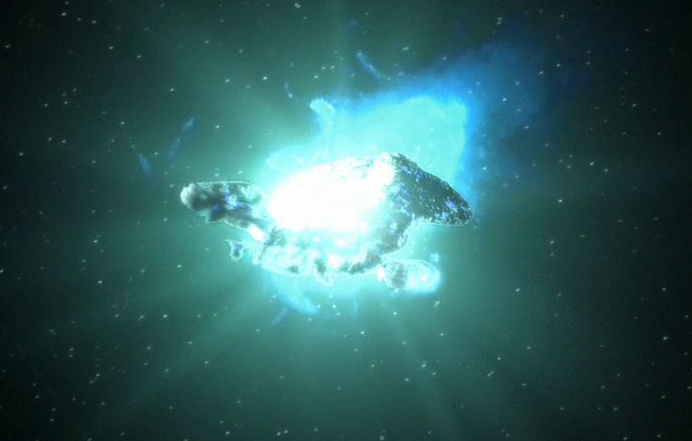
Spoiler Warning: There are spoilers ahead for Star Trek: Picard Seasons 1-3. Spoilers are also present for the following Star Trek productions: The Wrath of Khan, The Search for Spock, The Next Generation, Deep Space Nine, Voyager, and Discovery.
The Bounty feels like an episode that was made for fans. More than any other episode of Picard – at least since Season 1’s Nepenthe – I felt that the writers were leaning as heavily as they could into the lore and history of the Star Trek franchise, plucking some of those nostalgic chords for no other reason than to harken back to classic episodes, films, and stories that Trekkies will remember with fondness. There were some incredibly powerful emotional moments as a result, and I will never tire of seeing close-up shots of some of the franchise’s most beautiful starships!
Despite that, however, The Bounty was an imperfect outing overall – an episode with a couple of story beats that felt incomplete or just abrupt, and that resurrected a character who I felt had been appropriately and perfectly laid to rest. Moments of nostalgia spread throughout The Bounty felt absolutely magical… for the most part. But I fear this side of things was overdone and may have tried to carry the episode just a little too far. There will be repercussions for the story as a whole as the second half of the season – and the final act of Picard – gets underway.
The USS Titan.
Let’s talk first about something that had been teased in pre-season trailers and had got a lot of Trekkies chattering excitedly: the “return” of Professor Moriarty. For me, the way this ultimately came across in The Bounty was a let-down; a textbook example of how not to over-hype a character. Moriarty, in my view, should never have appeared in trailers and marketing material for two reasons. Firstly, his cameo here was incredibly brief, with Moriarty getting only a couple of lines and one very short moment of action. Secondly, and perhaps most significantly, this isn’t actually Moriarty.
This version of Moriarty was revealed to be a projection; an illusion created from the decaying remnants of Data’s memories. And that’s totally fine in the context of the story. Had I gone into the episode not expecting to see Moriarty nor knowing he was going to be included in the season, I’d have almost certainly been surprised and impressed. But the build-up to Moriarty’s return had been a significant moment in pre-season trailers going back several months… and seen through that lens, I felt more than a little let down – as if the promised return was nothing more than a bait-and-switch.
Moriarty’s cameo in The Bounty was minor.
Ro Laren’s surprise return to Star Trek last week had been kept secret – and it worked phenomenally well as a result. I can’t help but feel that Daniel Davis’ return as Moriarty should have been treated the same way, as keeping Moriarty out of pre-season trailers would have made his return feel impactful rather than underwhelming. There was scope to do more with Moriarty – and having wondered for months why he might be involved and what kind of a role he could play… I just feel like this cameo was over-hyped. Partly that’s my own fault… but partly it’s Paramount’s marketing, which deliberately over-inflated Moriarty’s role in pre-season trailers.
Trying to assess this inclusion on its own merit, though, I think it would’ve been a lot of fun were it not for being basically spoiled ahead of time. Visiting a black site like Daystrom Station only to encounter a dangerous foe from the past, having to figure out what was going on and how to defeat him, while at the same time he’s unable to be harmed… it was a setup that should have been tense and exciting, while at the same time being a great deal of fun to welcome back a character that I don’t think anyone could’ve truly expected. But unfortunately it didn’t stick the landing – and that’s all because this surprise was spoiled by pre-season trailers.
Moriarty’s return had been spoiled by pre-season trailers.
Let’s get all of the disappointments out of the way up front and look at another let-down! I always like to caveat these particular kinds of criticisms by noting that Paramount doesn’t have unlimited financial resources, and that it isn’t fair to compare Star Trek to productions from the likes of Disney or HBO that have significantly more money to play with. But even with that caveat… I felt that there was a scene or sequence that was sorely missing from The Bounty.
Jack Crusher and Sidney La Forge teamed up to “borrow” a cloaking device from the titular Bounty – the Klingon Bird-of-Prey used by Captain Kirk and co. during the events of The Voyage Home. But this daring heist took place entirely off-screen… and I just feel disappointed by that.
The titular HMS Bounty.
Even with the caveat that Paramount doesn’t have unlimited money, let’s consider this story beat and see how it could’ve played out. First up, there are only two characters involved, which obviously makes it a lot more manageable from a practical point of view. Secondly, it wouldn’t necessarily have required the construction of multiple sets. Between the AR wall (which I know is in Toronto, not California where Picard is produced) and pre-existing sets, surely it must’ve been possible to recreate a small portion of a Bird-of-Prey – even if it wasn’t the bridge. Just a corridor or something where we could’ve seen Jack and Sidney beaming aboard. Alternatively, the episode could’ve seen Jack and Sidney take the USS Defiant’s cloaking device, and a small part of that ship could’ve been created.
Although some creative(ish) storytelling and writing tried to present this aspect of the story as a bit of a surprise, it was actually pretty clear what Jack hoped to do, and even though I know we don’t always need to see every moment unfold in order for a story to be entertaining… we absolutely could have in this instance. In an episode that was already leaning heavily on the crutch of nostalgia, think how much fun it could have been if we’d actually been able to visit one of the ships at the museum instead of just seeing their recreated CGI husks.
So I’m afraid to say that this aspect of The Bounty feels like it has a pretty glaring omission.
Jack formulated a plan… but his plan took place entirely off-screen.
I can’t wait any longer to talk about Data! This is a huge point, not just for Season 3 and potentially not only for Picard, either, but for Star Trek as a whole. The resurrection of seemingly-dead characters is something the franchise has done before – and done quite well, at least in some instances. Technobabble can be used to excuse and justify these things in a sci-fi setting, so from a technical standpoint there really isn’t much to say about the whole “Data, Lore, B4, and other androids are all stuck inside the same ‘golem’ body” idea that The Bounty introduced. I think it clears the bar from that point of view.
But I can’t forgive it as a narrative point.
One of the few highlights of the two-part Season 1 finale was how poignant and beautiful the scenes between Picard and Data were. Eighteen years after Data’s death in Nemesis hadn’t really been given a sufficiently emotional payoff, Et in Arcadia Ego righted that wrong, and Data was finally laid to rest as Picard entered the digital afterlife. Those scenes did so much to elevate what was an otherwise disappointing finale – but more than that, they felt final and conclusive; a definitive but also appropriate end for a character we first met way back in 1987.
Data’s resurrection is a difficult storyline to get behind.
By allowing Data to permanently die, Picard helped him achieve his lifelong goal of becoming more human – because what could possibly be more human, for an artificial life-form who doesn’t age, than dying? This was one of the most impactful moments in all of Season 1 for me, and seeing Data come to the definitive end of his life, even as Picard was being reborn in a new body, went a long way to making the journey feel worthwhile.
The Bounty has now undermined and even overwritten that powerful emotional moment – and I fear that it has no reason for doing so other than the selfish desire of some of the show’s producers to play with the character of Data once more. I feel like I’m watching children playing with action figures; sure, Data was “dead,” but that doesn’t matter now. Pretend it didn’t happen, pick up the doll, and start playing a new game.
He even kind of resembles an action figure in a box…
One of my biggest concerns going into Season 3 – and really going back a whole year to the announcement of these actors returning – is that the story would end up feeling not only tacked-on and unnecessary, but like a childish mess. Bringing back these characters has to serve a purpose, but it also has to make narrative sense within a long-established world. More than that, it has to feel like it’s being done for more than just nakedly commercialised nostalgia – and the resurrection of Data, who had been permanently killed off twice, has crossed that line for me.
As we saw in both Seasons 1 and 2, there are ways to include Brent Spiner – if that had been deemed necessary – without resurrecting the character of Data. Pre-season trailers seemed to indicate that Spiner would be playing Lore, and while I wasn’t wild about that as I’ve never been a huge Lore fan, it seemed like a passable compromise if the show’s producers wanted to get as close as possible to a TNG reunion.
Data the projector.
I have no doubt that there will be some kind of narrative payoff to Data being “back,” and I’m crossing my fingers and hoping that it will be something I find at least bearable. But based on what we got in The Bounty, I’m sceptical. This resurrection feels like it serves two purposes: the desire of the showrunner and writers to play with their favourite action figures, and the commercial wishes of Paramount as it hopes to offset some of its huge losses by nakedly playing the nostalgia card. Neither excuse, quite frankly, is good enough – and neither comes close to justifying a pretty clunky technobabble explanation for resurrecting this long-dead character.
I keep thinking back to The Wrath of Khan and The Search for Spock as a point of comparison, because I think that may be another factor in Data’s resurrection here; it’s intended to mirror Spock’s. But in that story, Spock’s resurrection had been teed up at the end of The Wrath of Khan in a scene that showed Spock’s coffin lying, undamaged, on the surface of the Genesis Planet. Not only that, but these two stories were told one after the other. Data’s death happened back in 2002 – and his supposedly final end came more than a full season ago. While there are echoes of the Spock story here… that one feels a lot stronger, and seems to have been written with more of a sense of purpose. Data’s story, in contrast, feels muddled and disjointed; the consequence of different writers and writing teams having fundamentally contradictory ideas for where to take the character – and how and even whether to end his life.
A glimpse behind-the-scenes during The Bounty’s production.
Star Trek can successfully pull off a death-and-rebirth narrative, so I don’t think that is a problem in and of itself. We got one such example involving Jean-Luc Picard in the Season 1 finale of Picard – and another even more recently with Book at the end of Discovery’s fourth season. But here, with Data, having seen him so beautifully and sensitively laid to rest in Season 1, and with his death in Nemesis having come more than twenty years ago… it doesn’t work, at least not for me.
Rather than feeling like Spock’s rebirth, or even Picard’s in Season 1, Data’s resurrection reminds me a lot more of Elnor’s, which came at the very end of Season 2. Elnor was, like Data, definitively dead. And like Data, his death had a significant emotional impact. Raffi’s entire Season 2 storyline saw her grieving and coming to terms with his death – and that storyline was, for much of the season, one of the few that seemed to be working. Elnor’s last-second resurrection undid all of that, damaged the overall narrative of the season, felt unearned, unnecessary, and just plain stupid. And many of those same points – particularly those about undermining an emotional storyline and feeling ultimately unnecessary – are present here as well.
As much fun as it could be to have Data back and to get reunions with Geordi, Picard, and the rest of the crew, I’m struggling with this storyline.
Though it may have been intended to echo Spock’s rebirth from The Search for Spock… Data’s resurrection didn’t work anywhere near as well.
Data did tell us something very interesting, though: the “real” theft from Daystrom Station that the rogue changelings wanted to cover up was that of Jean-Luc Picard’s corpse. Precisely why Section 31 wanted to keep Picard’s body, and what they might’ve done with it for the past couple of years, wasn’t made clear… and that’s already kind of odd, when you think about it. Could there be a reason why Picard’s and Kirk’s bodies were both kept at Daystrom Station? Perhaps something connected to the Nexus or the events of Generations?
One thing that we learned from The Bounty that Picard and Jack have in common is a diagnosis of Irumodic syndrome. Given that the rogue changelings are also chasing after him, perhaps that has something to do with it – but we’ll save the speculation for my next theory post. Suffice to say it was an interesting development, and one that brings the conspiracy several steps closer to Picard himself.
Apparently the rogue changelings have absconded with Picard’s corpse.
But all of that came at the end of the episode, and there were plenty of fun or at least interesting moments before we reached those revelations. As I said, The Bounty really feels like an episode that was made for fans – or at least that had moments of pure fan-service that I absolutely lapped up.
Visiting the Fleet Museum was an opportunity to show off some beautiful CGI recreations of some of Star Trek’s most well-known ships. The USS Defiant, the Enterprise-A, and of course the titular Bounty were all present. Seven of Nine and Jack taking a closer look at the USS Voyager was an especially sweet moment, and several familiar musical stings accompanied these ships as they were shown on screen. I adore much of the music of Star Trek – especially the films from the ’80s and the shows of the ’90s – so hearing these short clips was enough, as Scotty once said, to bring a tear to my eye.
The Fleet Museum.
This sequence was a perfect “made for the fans” moment. It was a total nostalgia overload, but one that made sense in the context of the story and that was just the right length. Given what we’ve just been talking about, there must’ve been a temptation to drag this out and perhaps go overboard with the nostalgia plays, talking about each ship in more detail. But here, less was more – and the sequence, which only lasted about three minutes, came across beautifully as a result.
Since reappearing as the Titan’s second-in-command, I hadn’t really been blown away by Seven of Nine’s inclusion in the story of Season 3 so far. She served a narrative function on a couple of occasions – by rerouting the Titan against Captain Shaw’s orders and by identifying the first changeling infiltrator by using her real name – but she hadn’t had that much to say, nor many scenes in which she took centre-stage. Pairing her up with Jack on this occasion was fun – and we got to see how two individuals who are very different from one another, yet have a connection as Starfleet “outsiders,” were able to find some common ground.
Seven became emotional when thinking back to her time aboard the USS Voyager.
Seven’s line to Jack about the USS Voyager having been her home was incredibly touching, and it’s great to see Picard embracing the legacy of Voyager in such an overt way. I’ve said this before going all the way back to Season 1, but Seven’s transformation has been wonderful to see and more than a little cathartic. Seeing her in uniform, geeking out about starship designs with Jack, was another example of this.
Sticking with Jack, I spoke last week about how his hallucinatory experiences were something that hit close to home for me, and I don’t really want to get into all of that again; it isn’t an easy thing to think about or talk too much about! But suffice to say that I’m convinced that there must be more to what’s going on with Jack than simply “Irumodic syndrome” – though the connection between Jack’s hallucinations and the genetic disease that affected Picard was handled well in the story.
Is there more going on with Jack?
Jack’s glowing red eyes from a couple of episodes ago would seem to serve as the best argument for there being more to this story than an illness, as would Jack’s out-of-nowhere combat prowess last week. And that’s before we account for the changelings’ desire to capture him… for some reason. We’ll go into specific ideas about where Jack’s story could go in my next theory update, but for now I think it’s enough to say that there’s more going on here than we’re aware of at this juncture.
I actually really liked Jack in The Bounty. His conversations with both Picard and Seven were great, but for me his standout scenes actually came with Sidney La Forge, who was also excellent in this episode. Like their parents before them, they make a great team – and who knows, maybe romance could be in their future!
Sidney and Jack make a great pair!
Sticking with the La Forge family, I think we’ll briefly talk about Geordi’s other daughter. And “briefly” is all we’ll need, because unfortunately Alandra La Forge didn’t get much to say or do in this episode. There’s potential in the “sibling rivalry” idea that Sidney and Alandra seemed, at first, to embody – but if that’s going to be basically dumped now that the girls are both firmly on the same team… without wanting to be unkind, I just don’t see where Alandra is going to fit.
Sidney La Forge got a genuinely great storyline this week as she confronted her father for both his unwillingness to help with the mission at hand and, by extension, for favouring her sister as she was more inclined toward engineering. Ashlei Sharpe Chestnut, who plays Sidney, absolutely excelled in the scene with the far more experienced LeVar Burton, and genuinely sold me on this family argument. Most of us can relate, in some way I daresay, to having this kind of conversation with a parent or relative, and I was beyond impressed with the performance that she gave.
For the first time in the season so far, Sidney got a lot to do.
As for Geordi himself, I can see some fans potentially taking umbrage with the idea that he’d be unwilling to help Picard, or that he’d be so fearful of repercussions that he’d put his family first. It isn’t necessarily a fun story for Geordi, nor is it one that presents him in the best or most heroic, selfless way. But what I’d say in defence of this story is that it’s very human, and is again something that feels incredibly relatable.
One of the themes of Season 3 that we’ve seen through Picard’s conversations with Dr Crusher and Captain Shaw in particular is the idea that Picard himself is a kind of maelstrom; a figure around whom danger, disaster, war, and even death have a tendency to swirl and coalesce. Geordi’s initial reluctance to throw himself and his family into another Picard adventure is a continuation of this theme – and it fits not only with what’s been established before, but with what we’ve seen of Picard over the course of some thirty-five years.
Geordi was initially reluctant to join Picard’s mission.
Because past iterations of Star Trek were primarily episodic affairs, the franchise hasn’t always been able to take a look at some of the longer-term consequences of the adventures and misadventures that some of its key characters have had. There have been attempts to do so: episodes like Family in The Next Generation, for example, or Worf’s scenes with Ezri Dax in Deep Space Nine’s seventh season. But until Discovery and Picard came along, these were limited to a few episodes or character arcs, and didn’t get to go into as much detail.
Parts of Picard haven’t gotten this quite right, particularly in the show’s lacklustre second season. But here, the idea that even some of Picard’s closest friends would struggle to rejoin his cause because of the danger they know it’ll put them in feels surprisingly natural. Having worked with Jean-Luc Picard for fifteen years or more, Geordi saw first-hand the danger many of Picard’s missions posed, and wanting to keep his children away from that is a perfectly valid and understandable reaction – even if we may not like or agree with it on the surface!
Geordi felt that teaming up with Picard would endanger his family.
There was a danger that this part of the story could’ve felt like an artificial speedbump; a delay to slow down the Titan’s progress so other storylines could unfold at Daystrom Station or with the heist at the Fleet Museum. And part of me wants to call it that – to say that Geordi’s rather abrupt turnaround after an entire episode of dragging his feet makes the whole thing redundant. But actually, having had some time to think about it, the positives outweigh the negatives and Geordi’s storyline not only made narrative sense, but played into key themes that have been running for the duration of the season so far.
It isn’t always fun to see an heroic character behaving in a more rational, self-preserving, and more human way. And I get that – Geordi doesn’t feel like the selfless hero for much of The Bounty. But if every main character was totally virtuous, selfless, and pure of heart… well, that would make for a pretty bland and one-dimensional story, wouldn’t it? Geordi has family considerations here, and the idea of wanting to keep one’s children safe – even if that means risking some big, nefarious scheme being able to unfold… it’s relatable and understandable.
Geordi was very relatable in The Bounty.
Although we’ve had some wonderful adventures and powerful emotional moments with all of these characters over the years, here in Picard is where we’re seeing them at the most human and relatable that they’ve ever been – and Geordi encapsulated that feeling for me in The Bounty. I’d defend his characterisation here as not straying from his presentation in The Next Generation – but rather being an evolution of it, showing how conflicted he feels between the fear he has for his family’s safety and his loyalty to Picard and desire to help.
It almost goes without saying that LeVar Burton nailed this complex presentation. It was always going to be wonderful to welcome him back to Star Trek after such a long absence – but to see such a masterful and nuanced performance from the veteran actor was truly astonishing. The character of Geordi La Forge was cast perfectly in 1987 – and as one of the stars of Roots, LeVar Burton was one of the best-known actors in the cast as The Next Generation entered production on its first season. Geordi got some great spotlight episodes across The Next Generation’s run – The Enemy, I Borg, The Next Phase, and Relics all being examples that jump to mind. But here, in The Bounty, we really got to see what LeVar Burton can do with this wonderful character. And it was riveting.
LeVar Burton gave an outstanding performance and was a joy to watch.
Geordi’s inclusion in the story was also an opportunity for the rather superfluous Captain Shaw to have a fun and light-hearted scene. Having set up Shaw as a former engineer a couple of episodes back, that backstory got a truly cute payoff in The Bounty as the Titan’s captain found himself tongue-tied and starstruck when coming face to face with one of his engineering heroes. I felt echoes of Lower Decks’ protagonist Boimler in the way Shaw reacted to Geordi – and it was a nice change of pace for a character who’s been standoffish.
However, I maintain that the story of Season 3 is not well-served by having so many senior officers concentrated aboard the Titan. Riker’s (surely temporary) absence may have alleviated that for now, but the Titan is still blessed with an Admiral, at least one Captain, and now a Commodore as well. Captain Shaw repeatedly draws the short straw – understandably, perhaps. But as we saw yet again this week, big decisions aboard his ship are taken without much input from him.
Captain Shaw with Geordi.
Here’s a question to ponder: are there too many changelings in the plot?
That might sound silly given that the rogue changelings are our main adversaries, but hear me out. Changelings are, if you think about it, kind of overpowered from a narrative standpoint – and their new ability to mimic humanoids in far more detail than ever before has only increased their relative power. We’re at a point in the story where it’s difficult to know who is and isn’t a changeling – and that could make for an exciting and tense mystery… or a frustrating experience!
Past stories involving changeling infiltrators were more cautious, and I mentioned last time that the Deep Space Nine duology Homefront and Paradise Lost made sure to include the detail that there were only four active changeling infiltrators. If, as Ro Laren told us, Starfleet is compromised and there may be multiple changelings aboard many ships in the fleet, it risks making the story hard to follow, and throwing an uncomfortable cloud of suspicion over practically every character arc and plot point. I don’t think we’re at a stage yet where it’s a huge problem… but it could make the story difficult to follow and needs to be handled with a degree of care.
We aren’t always going to be able to know who is and isn’t a changeling in a story like this one…
That only leaves us with the away mission to Daystrom Station. It was fantastic to see Riker and Worf teaming up for an away mission once again! Worf was often one of Riker’s go-to officers when putting together an away team during their adventures aboard the Enterprise-D, so it felt incredibly appropriate and fitting for them to work together again on this occasion.
Raffi was an interesting inclusion here, and after she and Worf had worked over the past few episodes to uncover the Daystrom connection, it made sense for her to join the mission along with them. But after they accessed the chamber where Data was being held, Raffi kind of felt like a bit of an unnecessary addition. She didn’t have the connection to Data, nor the history with him that Riker and Worf had, to give her much to say, and the few lines she got at this point felt more like exposition than anything else.
The away team at Daystrom Station.
Raffi’s reunion with Seven of Nine was also cut short, and I hope it’s something we’ll see more of before the season ends. As disappointing as Season 2 was, and in spite of the problems Raffi’s storyline ran into in the final episode, the developing relationship between Seven and Raffi was one of the season’s stronger storylines. It humanises both characters, gives each of them something to fight for and reach for, and if there is to be any kind of “Captain Seven” show in Star Trek’s future, this relationship, one way or another, will be part of it. With both characters aboard the Titan, I hope there’ll be time in the remaining episodes to reunite Seven and Raffi for a scene or two.
There are already breakdowns and lists of all of the miscellaneous objects and items that were being stored at Daystrom Station that fans have compiled, so I won’t just list all of them here! But some of these little easter eggs were great fun, and in an episode that was all about callbacks to past iterations of Star Trek, this kind of storage facility was a great way to include many smaller references. I doubt very much that any of the stored items at Daystrom Station will prove to be important to the plot, but it was a cute way for Picard to pay homage to characters and stories from across the franchise’s 850+ episodes and films.
Captain Kirk’s body is apparently stored at Daystrom Station too.
The away mission to Daystrom Station felt tense and exciting – but the sets used for the station were, once again, seriously under-lit and far too dark. This has been a problem that’s been running all season long, but the especially dark corridors of Daystrom Station were perhaps the worst example so far. It wasn’t easy to follow all of the action as Worf, Raffi, and Riker were sneaking around and battling their way into and out of the station’s central chamber.
The fight sequences themselves, despite the aforementioned lighting problem, were decent, though. I genuinely felt that Riker was in danger as he raced off to buy time for the others to escape – and that’s really the first time so far this season that Picard has managed to give me that feeling. After Ro’s death the stakes have been raised significantly, and as I said before the season aired, it’s possible that not all of our heroes will make it to the end in one piece! Riker escaped… this time. But it was touch-and-go for a minute there in an incredibly tense and well-performed fight sequence.
Riker genuinely seemed to be in danger.
I confess that Vadic being a changeling is still something I’m getting to grips with. I said last time that I interpreted her scene with Floaty McFloatface as Vadic being a humanoid who had some kind of symbiotic relationship with a changeling… but it seems, instead, that she’s somehow two changelings in one body? The mechanics of it bug me, at least from an in-universe perspective. We know that changelings can communicate by linking, and we’ve seen in Picard that they also seem to have developed a clicking language of their own – so why does Vadic physically cut Floaty McFloatface off of herself and have a chat with them in English? Obviously the answer is “to make it a more interesting story.” But that isn’t always a satisfying explanation!
But still, we got absolute, indisputable proof this week that Vadic is a changeling. I’m excited to see her finally being able to interact with someone other than her silent crew and Floaty McFloatface, and there’s definitely potential in her interrogations of Riker and Troi – assuming it is the real Troi! I’m a tad disappointed, however, that Vadic now doesn’t seem to have any personal connection to Picard. Something may yet be revealed in that regard, but if she’s a changeling it would seem to rule it out.
Vadic at the end of the episode.
Vadic is clearly based on characters like Khan, and that kind of villain can be truly delicious to watch. But so far, Vadic hasn’t managed to capture much of that feeling for me. Her over-the-top performance actually feels out of place right now, and while I still want to see her defeated and her plan stopped, on a personal level I think there’s a disconnect between Vadic and the audience. Six episodes in and we’ve only had a few short moments with her, we’ve already seen her defeated once, and her over-the-top characterisation feels more like it’s treading water than going anywhere.
But now that she’s captured and assaulted Riker, perhaps we’ll finally start to get some of that burning, passionate dislike that Vadic hasn’t managed to garner so far. I certainly hope so! A villain so maniacal should be able to drum up that sort of a reaction – and now that she’s captured not just one but perhaps two of our heroes… there’s the potential, at least, for an improvement on the villainous side of the season.
The Shrike leaves Daystrom Station.
So I think I’ve touched on all of the points I had in my notes for this outing. The Bounty was a beautiful, nostalgic romp through Star Trek’s past in more ways than one… but an episode that didn’t stick the landing on a couple of key points. It can be difficult to fairly judge these mid-season episodes, though, until we know how character arcs and storylines that have been set up will ultimately be paid off – something I’m especially aware of in Picard, given the way Seasons 1 and 2 both ended. So perhaps we’ll be able to look back at some elements of The Bounty a little more kindly in retrospect.
With Troi, Geordi, and the Data-Lore-Soong-B4 golem now in the picture, the cast is complete and the reunion has finally happened. Was the tail end of the sixth part of a ten-episode season the right moment… or should most of the rest of the characters have gotten back together sooner? I guess that’s another point where only time will tell!
There are four episodes left for this story to come to an explosive and exciting conclusion – and it feels as if most of the pieces are now in play. In spite of The Bounty’s shortcomings, I’m keeping my fingers crossed!
A few scattered final thoughts:
For such an important facility, it’s kind of silly that Daystrom Station isn’t fully staffed and well-guarded – especially considering it’s already been attacked and robbed once.
What could Section 31 possibly want with Kirk’s dead body? And what is “Project Phoenix?”
This is the first mention of Section 31 in Picard – could that be a hint at a resurrection of the Section 31 series that’s been languishing in development hell?
I’d have given anything to see Picard and the crew beam aboard the Enterprise-A…
Geordi was very concerned about his kids… but was perfectly fine with ditching his wife!
Including a sequence from Encounter at Farpoint – and finding a way to make it relevant to the story – was incredibly sweet.
Star Trek: Picard Seasons 1-3 are available to stream now on Paramount+ in the United States and other countries and territories where the service is available, and on Amazon Prime Video in the UK and around the world. The Star Trek franchise – including Picard and all other properties discussed above – is the copyright of Paramount Global. This article contains the thoughts and opinions of one person only and is not intended to cause any offence.
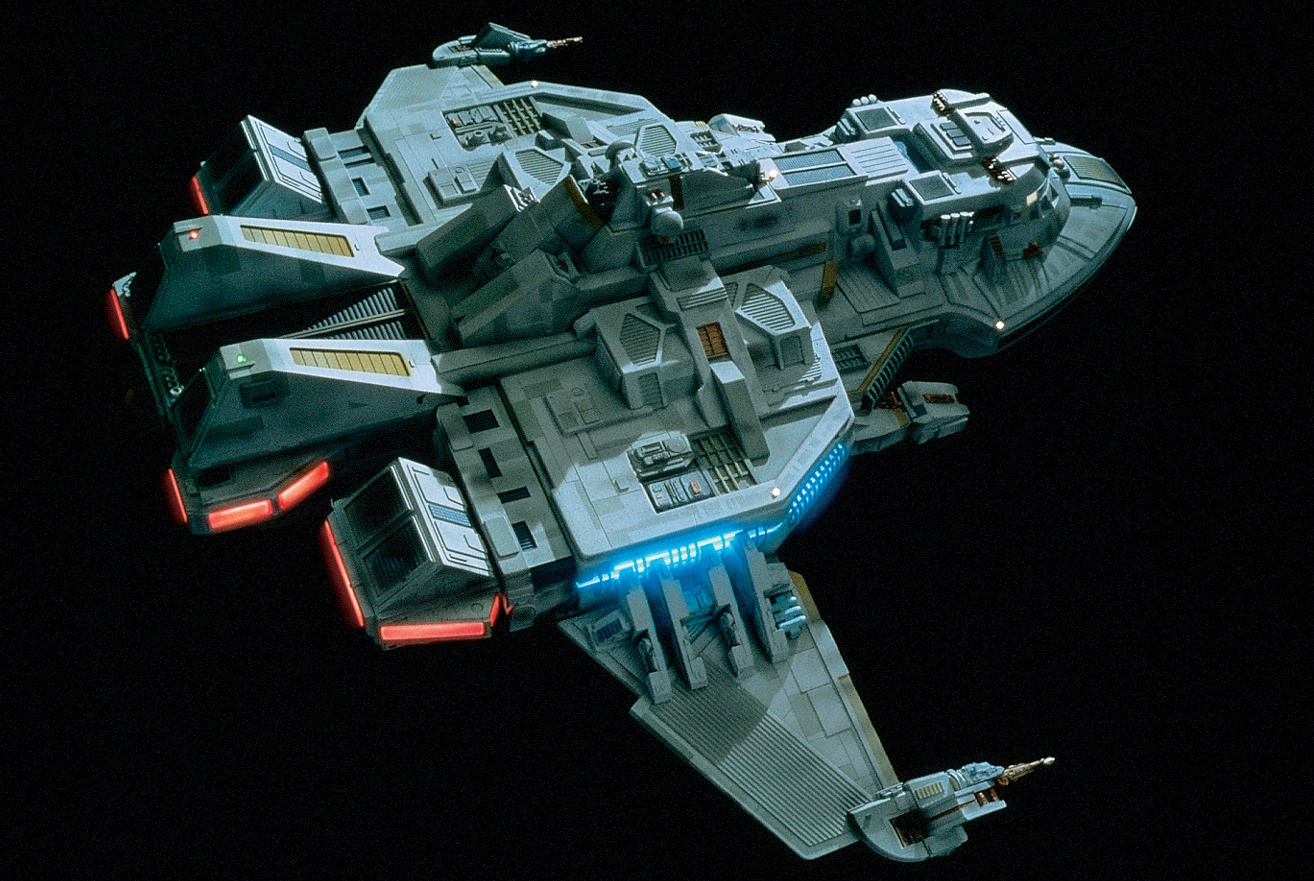
Spoiler Warning: There are spoilers ahead for Star Trek: Picard Seasons 1-3. Spoilers are also present for the following Star Trek productions: The Wrath of Khan, The Next Generation, Deep Space Nine, Voyager, and Discovery.
We’re a bit late with this week’s theory update – but the latest episode of Picard isn’t out for another couple of hours at least… so I think we got away with it! Barely!
I enjoyed Imposters, and felt that it was a great episode – one of the best that the season has had to offer so far. It was fantastic to welcome back Michelle Forbes as Ro Laren – albeit for the final time! And as the conspiracy angle really ramps up, it feels as though the story could potentially go in some very different directions. And that’s great news for our theory list!
A glimpse behind the scenes!
There are several big changes to the theory list this week – including one “zombie” theory that is coming back from the dead! We’ve also got a couple of confirmations and one debunking to get through.
And as always, that’s where we’ll start.
Confirmed theory #1: There are changeling infiltrators aboard other vessels.
Two rogue changeling infiltrators.
This one felt obvious as the conspiracy seemed to be growing, but it was still possible that there were only one or two changelings out in the wild! The Deep Space Nine duology Homefront and Paradise Lost saw a changeling infiltrator explain to Captain Sisko that there were only four well-placed changelings… and we saw in other stories that the changelings were less about numbers and far more interested in replacing well-positioned individuals.
This time, however, we learned that there are rogue changelings throughout Starfleet to such an extent that Ro Laren described the entire organisation as being “compromised.” There were at least four changelings aboard the Intrepid – perhaps more – and I think that speaks to there being dozens, hundreds, or perhaps even thousands of changelings spread throughout Starfleet across many ships. Even the admiralty could be compromised.
Confirmed theory #2: An unannounced character returned!
Ro Laren in Imposters.
I felt it was a solid possibility that we’d get a surprise character inclusion, especially as the crew of the Enterprise-D made a return, and so it proved in Imposters. Ro Laren, who hadn’t been seen since The Next Generation Season 7 episode Preemptive Strike, made a triumphant return to Star Trek – and to Starfleet, too!
Ro’s return isn’t the end of this theory, though, and you can expect to see it remaining on the list. There are dozens of other characters from The Next Generation era that I’d love to welcome back to Star Trek – and in a story with such a strong Deep Space Nine component, characters from that series seem like an especially good fit.
Confirmed theory #3: Ro Laren was the “prodigal crewman.”
Picard and Ro in The Next Generation.
This was a late addendum to the theory list, as Paramount chooses not to make all of its marketing material available to viewers and fans outside of the United States. Fuck you, Paramount. You useless, “America First” dicks.
Suffice to say that Ro Laren was on my list – along with a dozen others! But she seemed to fit the bill as a “prodigal” crewman with a strong connection to Picard, so I’m claiming this one as a win!
Debunked theory: All of the other “prodigal crewmen.”
It wasn’t Elnor…
Although I put Ro Laren on my list, she wasn’t the only character I thought seemed plausible to fill that role. I suggested characters like Sela, Thomas Riker, and Lore… and even the possibility that Picard would end up creating a brand-new character to fill this role, as has happened on more than one occasion in the series so far.
There were several characters who felt genuinely plausible – not least those played by actors who we know (or are heavily rumoured) to be involved this season. There were cases to be made for a handful of characters… and cases that I tried hard to make for a few others to round out the list!
So those theories were confirmed and debunked this week.
Now let’s jump into the main theory list, beginning with theories that are brand-new or that saw significant movement as a result of the events of Imposters.
Theory #1: Vadic is not a changeling.
Vadic’s changeling-hand.
The inverse of this theory was originally on my list, and I called it debunked last week. But I seem to be in a minority of one in interpreting Vadic as not being a changeling, with other outlets seeming to see her changeling appendage and conversation with Floaty McFloatface as confirmation of her own changeling status.
I would like to put forward several points to support this theory!
First of all, Vadic’s eccentric demeanour is unlike anything we’ve seen from changelings so far in Star Trek.
Secondly, Vadic’s facial scars would be something that wouldn’t happen to a changeling. If they did happen, they’re something we’d expect a changeling would be able to conceal.
Thirdly, Vadic hasn’t been seen speaking the clicking language of her crew or the Intrepid changelings.
Fourth, if Vadic was a changeling, why would she need to physically cut Floaty McFloatface off her body to have a conversation? They could simply communicate via linking.
Fifth, Vadic seems genuinely frightened of Floaty McFloatface.
Theory #2: Jack Crusher’s hallucinations are connected to the Borg.
Jack is troubled by hallucinations.
At this point, it seems like Jack’s hallucinatory experiences must be connected to the changelings and their conspiracy. But I would like to suggest an alternative explanation: they’re from the Borg, and the feminine voice Jack has been hearing is the Borg Queen’s voice.
There have been multiple references this season to Picard’s assimilation at the hands of the Borg, and so far there isn’t an apparent connection between these references and the changelings’ conspiracy. But why keep bringing it up if it won’t be important? I feel all but certain that there is some kind of greater Borg connection to be revealed – and Jack’s hallucinations could be the key.
Theory #2-A: Jack Crusher has Borg nanoprobes in his body.
Borg nanoprobes in Season 2.
If I’m right, and Jack’s hallucinations are connected to the Borg, one possible explanation could see Jack having Borg nanites in his system. There are plenty of technobabble ways this could have happened – perhaps they were present from the moment of his conception; dormant nanoprobes from Picard’s body. Or maybe Jack and Beverly used Borg technology aboard their ship, or during one of their medical missions.
We wouldn’t usually associate the colour red with the Borg – and that could count against this theory. Then again, if Jack’s eyes glowed green and his visions were of green tentacles and a green door, perhaps the Borg connection would be too unsubtle!
Theory #3: The Borg are involved.
Borg drones in First Contact.
We’ve just looked at one possible way in which the Borg could be brought into the story – via Jack Crusher. But there are plenty of other ways to connect the story to the Borg. Firstly, we have the mysterious weapon or technology stolen from Daystrom Station. This could easily be Borg tech, as we know that Starfleet has been heavily involved in researching the Borg, even deploying Borg-derived technology aboard some of their newest starships. Secondly, there could be a changeling-Borg alliance of some kind, as both factions have a vested interest in stopping the Federation.
Again, this comes back to the heavy-handed insertion of Borg stories, particularly about Picard and his assimilation. Why should a story about rogue changelings keep coming back to Locutus and the Battle of Wolf-359 if there isn’t going to be some kind of bigger connection to be made?
Theory #4: Jack Crusher has changeling DNA… somehow.
Is this Jack’s DNA?
Jack’s story this week delved a little deeper into his hallucinatory experiences, but what was perhaps even more interesting is that we saw two physical changes in him, too. Firstly, Jack’s eyes glowed red for a split second, and secondly, Jack seemed to have a moment of incredible physical strength and fighting prowess.
Jack clearly has no idea what’s going on or why any of this is happening to him. And the question of how Jack might’ve come to have a combination of human and changeling DNA is an open one! Perhaps something happened to him while on one of his medical missions. Regardless, if I’m right then maybe the strand of DNA shown off in the closing credits will be Jack’s.
Theory #5: Professor Moriarty is the “sophisticated AI” at Daystrom Station.
Professor Moriarty.
Based on the glimpses that we caught of Moriarty in pre-season trailers and images of Daystrom Station seen in Imposters, it seems likely that we’ll encounter Moriarty in the upcoming episode. Access to Daystrom Station is said to be controlled by a “sophisticated AI,” and that description could also apply to Moriarty himself!
Put two and two together and I think we can make the case that Moriarty is the AI, and that somehow he came to be employed as the guardian of Daystrom Station. Whether he’s in that capacity voluntarily… well, I think that’s still to be revealed!
Theory #6: Daystrom Station is operated by Section 31… and ex-Terran Empress Georgiou will be found there.
Is this just a silly idea?
This one is definitely “out there,” at least in terms of its second part! But I think it would make for a fascinating story if it were to unfold. During Discovery’s third season, Georgiou entered the Guardian of Forever’s portal, being sent to an unknown destination and time period. What if she emerged in the late 24th Century and resumed her work with Section 31? Or perhaps Section 31 didn’t know what to do with Georgiou and placed her in some kind of stasis… aboard Daystrom Station.
Despite the two shows running alongside one another for two full seasons apiece, there hasn’t been a single solid connection between Discovery and Picard… and time’s running out to make one. The shock return of Georgiou could not only be a wonderful crossover, but could prove that there’s still a pathway to dragging the Section 31 series out of development hell.
Theory #7: At least one more unannounced character will make an appearance!
My money’s on Morn…
It was fantastic to see Ro Laren make a return to Star Trek in Imposters. But will she be the only unannounced character to appear? I’m not so sure!
There were surprises in both of Picard’s first two seasons, so I’m not convinced that we won’t see at least one more character making a return. There have been rumours, theories, and guesses from Trekkies for months as to who may or may not be included… and all I can really say is that Ro’s surprise return has increased the likelihood of this happening.
With the changelings involved in a big way, characters from Deep Space Nine would be perfect to include – but practically anyone from The Next Generation era could show up.
Theory #8: At least one main character will be killed.
Spock’s funeral in The Wrath of Khan.
The death of Ro Laren has shaken Picard and the crew… but it’s also shaken up this theory! The fundamental question is this: is Ro’s death a harbinger of things to come? Or is it simply a narrative device used to show how high the stakes are? I think there’s a solid case to make that Picard and the crew are in danger.
Television storytelling has changed a lot since The Next Generation premiered, and even main characters can no longer consider themselves to be safe if they wind up in dangerous situations! It would be a challenge to kill off a legacy character in a way that would be satisfying and would feel right – but it would be incredibly bold, and if such a story beat stuck the landing it could pay off a character arc that’s been running for well over three decades.
I made a list of who I thought could be in danger before the season began, and you can find it by clicking or tapping here.
So those theories are new or saw significant movement this week.
Next, as always, I’ll recap all of the other theories that are currently in play. Despite not seeing much attention in Imposters, all of these theories remain on the table as we head into the second half of the season.
Theory #9: Vadic is a veteran of the Battle of Wolf-359.
The Battle of Wolf-359.
One thing that has confused me about the story so far is that there have been multiple Borg references, and specifically references to the events of The Best of Both Worlds. These references have come in a story about changelings and Dr Crusher’s son – a story that doesn’t have a readily apparent Borg angle.
One way in which this circle could be squared, and these references made to feel meaningful, is if Vadic was herself a veteran of the Battle of Wolf-359. This would give her an immediate connection not only to Picard, Riker, and the crew of the Enterprise-D, but also to Captain Shaw. We could learn, perhaps, that Vadic had been a low-level Starfleet officer or crewman, and that she’d left Starfleet after being traumatised by the events of the battle. She could even turn out to be one of the other survivors of the USS Constance – meaning she’d once served alongside Shaw.
Theory #10: The rogue changelings are responsible for the mysterious anomaly seen in Season 2.
The anomaly in the Season 2 finale.
It didn’t escape my notice that the events of Season 2 were referenced – albeit incredibly briefly – by Captain Shaw in No Win Scenario. That being said, this theory still feels like somewhat of a long-shot just based on how Picard seems to have moved on from what happened last year.
In short, what I’m suggesting is that the mysterious anomaly that was a big part of the story of Season 2 will turn out to be a weapon of some kind deployed by the rogue changelings, either as part of or as a precursor to their plan to attack Starfleet and the Federation. This would explain Dr Jurati’s comment that the anomaly seemed to be artificial in nature – and it would tie up a massive loose end from last season.
Theory #11: The rogue changelings are planning attacks on the Klingon Empire and the Romulans.
A joint Federation-Klingon task force during the Dominion War. Image Credit: JTVFX on YouTube
It wasn’t only the Federation that opposed the Founders during the Dominion War. The Klingons, Romulans, and later a Cardassian resistance movement all played significant roles in preventing the Dominion from conquering the Alpha Quadrant – so it stands to reason that the rogue changelings would be looking to get revenge on these powers, too.
Despite having had two full seasons of Picard already – one of which had a major Romulan theme – we still don’t know much about the state of the galaxy in political terms. Are the Federation, Romulans, and Klingons on friendly terms in this era, or has the Dominion War alliance of necessity fallen apart? After the Zhat Vash plot was exposed, what happened to Federation-Romulan relations? All of these things would be interesting to explore, and the rogue changelings’ plot could lead to such a storyline. For now, though, suffice to say I suspect that the Federation may not be the only target that the rogue changelings have in mind!
Theory #12: The rogue changelings may also be targeting the Bajorans and Cardassians.
Legate Damar led a Cardassian resistance movement against the Dominion.
These two factions played smaller roles during the Dominion War in some respects, with the Cardassians serving as Dominion allies (and members of the Dominion), and Bajor signing an official non-aggression pact with the Dominion. However, both the Bajorans and Cardassians later opposed the Dominion, and the Prophets – who are strongly aligned with Bajor – arguably turned the tide of the entire war.
If the rogue changelings are on the move, I would suspect that the Federation, Romulans, and Klingons would be their main targets as it was these powers who played the biggest and most obvious roles in the conflict. But Bajor and Cardassia may not be safe.
Again, we don’t know enough about the geopolitics of this era! Bajor may have joined the Federation, and even Cardassia could be under Federation protection. If so, that changes the dynamic.
Theory #13: The rogue changelings are planning to cripple Starfleet.
The Enterprise-F and other Federation starships as seen in a pre-season trailer.
The precise number of ships that Starfleet has has always been a tad vague, adaptable to different stories. But I think we can safely assume that there are several hundred ships in Starfleet at any one time. Many of these, though, will be science vessels, ships of exploration, or even transport ships. The number of tactical vessels and combat-ready front-line ships is going to be a lot smaller.
With that in mind, a coordinated strike against these ships could cripple the Federation’s ability to defend itself. We already know that the rogue changeling aboard the Titan had a bomb that they used to severely damage the ship – if other rogue changeling operatives are similarly equipped, they could potentially take out Starfleet’s best and most powerful vessels in one fell swoop.
Theory #14: Vadic backstory ideas.
We still don’t know who Vadic is.
If I’m correct and Vadic isn’t a changeling, then I have some other possible origins in play for the season’s only named villain. I wrote a list months ago, after Vadic first made her debut in pre-season marketing material, and suggested several ways that Vadic could be connected to Star Trek’s past. We looked at one such idea above – that Vadic may be a veteran of Wolf-359 and an ex-Starfleet officer or crewman, but there are a handful of others.
A former member of Picard’s crew, perhaps someone who was injured or left for dead while serving under his command,
An ex-Borg, either someone who was assimilated while serving on Picard’s crew or perhaps someone from the Artifact in Season 1,
An augment, potentially tied to Season 2’s Adam Soong or even Khan himself,
A Romulan or ally of the Romulans, with a potential tie to Sela.
Theory #15: Vadic has put together a “rogues’ gallery” of Star Trek villains.
Vadic with two members of her crew.
I’m close to retiring this theory, to tell the truth, but until we’ve spent a bit more time with Vadic and the masked crew of the Shrike, there’s still a slim chance that it could pan out.
When we first saw Moriarty and Lore in pre-season trailers, I wondered whether they might be members of Vadic’s crew. If so, I theorised that they may just be the tip of the iceberg, and that Vadic may have allies from across The Next Generation era – particularly people who hated Picard and could conceivably want to seek revenge against him. I suggested characters like Sela, Toral, Commodore Oh, and even Thomas Riker as possible candidates.
Another theory that may not pan out! If Vadic is a Founder, she may have brought Jem’Hadar with her, or perhaps the rogue changelings were breeding their own Jem’Hadar. The clicking language spoken by both Vadic’s crew and the changelings aboard the Intrepid could count against this theory – or be a point in its favour!
It stands to reason that, if a group of rogue changelings are making moves against the Federation, that at least some Jem’Hadar could be involved as well. I’d actually quite like to see what an updated Jem’Hadar design could look like in 2023!
Theory #17: Captain Shaw will be killed.
Shaw in Imposters.
Now that Shaw has had his explosive moment with Picard, revealing his involvement at the Battle of Wolf-359, the end could be near for the “dipshit from Chicago.” We’ve already seen how the Titan having multiple captains on board complicates the story, and if there is to be any kind of “Seven of Nine show” as a spin-off, it makes sense that Shaw might need to be removed from the captain’s chair in order to make that happen.
There’s still a lot of potential in Shaw, and he certainly could have more to contribute to the story. However, there are other potential reasons why killing him off could be on the agenda! If the writers want the impact of killing a major character, but don’t want the controversy of killing off a legacy character, then Captain Shaw could be on the chopping block. His death could raise the stakes significantly as the story has passed its halfway point.
Theory #18: Someone on Picard’s crew will turn out to be an imposter.
Picard and the crew of the Enterprise-D in a promo photo for Season 5 of The Next Generation.
I think we can safely say that Picard, Riker, the Crushers, Captain Shaw, and Seven of Nine aren’t changelings. But that still leaves several major characters who could potentially have been replaced!
With changelings on the move, basically anyone could have been replaced, and it won’t always be easy to tell. It seems possible that someone like Geordi, Troi, or perhaps even Raffi could be replaced by changeling infiltrators before they link up with Picard and the crew of the Titan, and it may not be possible to know who to trust.
With one changeling infiltrator storyline having already played out, though, it will have to be handled carefully so as not to feel repetitive! Still, I can’t help but wonder if a changeling imposter may be a big revelation in a future episode.
Theory #19: Not all of Raffi’s messages were from Worf.
Could someone have hacked Raffi’s comms?
As the changeling infiltration story deepens, I think it’s not beyond the realm of possibility that someone involved in the conspiracy – Vadic, perhaps – was sending messages to Raffi claiming to be her handler. These messages may have been false leads, irrelevant information, or other attempts to throw her off the trail. If so, it worked – Raffi wasn’t able to stop the attack on the Federation facility in time.
Narratively speaking, there was a good reason to keep Worf hidden until the end of Disengage: it made his last-second appearance all the more dramatic. But could there be another reason why Raffi’s messages came through in text form, read aloud by a disembodied digital voice? I wonder.
Theory #20: The absences of characters from Seasons 1 and 2 will be explained.
Could we learn what Dr Borgati is up to?
I was pleasantly surprised to see Laris was included in the season premiere, and while she won’t have a big role in the story of the season, it was great that the story didn’t just dump her as it raced ahead. Due to her importance to the story of Season 2, Laris was perhaps the character who I felt it was most important to include in some way, and I’m glad we got to see her.
But there are still several characters from Seasons 1 and 2 who haven’t been mentioned. Elnor and Soji could easily be name-dropped; a line or two of dialogue could clear up where they are, what they’re doing, and why they can’t join Picard on his current mission. The Borg Queen-Dr Jurati hybrid is a bit more complicated; her self-appointed role as “guardian” of the mysterious anomaly makes it a bit harder to just wave away her disappearance.
I hope we’ll get something that will acknowledge these characters’ absences. All were important in the first two seasons of the show, and simply abandoning them without any kind of goodbye was disappointing at the end of Season 2. If Season 3 could do something to rectify that, I’d appreciate it!
Theory #21: Several members of La Sirena’s crew have joined Captain Vadic.
The crew of La Sirena at the end of Season 1.
Although we’ve had it confirmed that most of the actors from Seasons 1 and 2 won’t be reprising their roles this time around, when I first saw the masked crew of the Shrike I couldn’t help but wonder… could some of these people be Picard’s friends? Could that explain why Dr Crusher warned Picard to “trust no one” and simultaneously explain their absences?
It would be a stunning revelation indeed if, when the masks are inevitably removed, Picard and the crew find themselves confronting the likes of Soji and Elnor. Maybe this one is a no-hoper because of what we’ve been told by the actors involved… but you never know!
Theory #22: Picard and his crew will reactivate Lore and Professor Moriarty.
Lore.
Although it seemed at first as though Lore and Professor Moriarty might be on Captain Vadic’s team, the final trailer for Season 3 was cut together in such a way as to suggest that it might be Picard and his crew that are responsible for re-awakening them. I have an idea as to why that might be the case (and we’ll take a look at that in a moment), but for now let’s just say that it seems possible that the story will go down this road.
Last time we saw both Lore and Professor Moriarty, neither posed a threat. Lore had been fully shut down, and Moriarty had been trapped in a holographic storage module, believing himself to be free to explore the galaxy. How either of them could come back is an open question – but they are coming back in some form!
Theory #23: Picard and his crew need to find synthetic allies/crewmates.
Professor Moriarty.
This theory seems to have moved significantly now that we know the changelings are involved! In brief, I’d suggested that Picard and the crew might be unable to trust organics, and that could explain why they may turn to artificial life forms like Lore and Professor Moriarty to aid them. With the inclusion of the Founders in the story, that possibility feels as if it could’ve just moved one step closer.
If it’s hard or even impossible to detect a changeling infiltrator, then synthetic life-forms may be the only ones that Picard can be certain are who they say they are. That could explain why Picard and the crew might re-activate these one-time enemies. It does raise a pertinent question, though: if Picard needs help from artificial life-forms, why not ask Soji and the Coppelius synths for help?
It does seem like one heck of a coincidence that Lore and Professor Moriarty – both of whom are synthetic – are involved in this story!
Theory #24: Vadic will be killed by her own portal-weapon.
The USS Titan and one of the portals.
This idea is a pretty simple one: as often happens to villains in stories like these, Captain Vadic will end up being killed by her own powerful weapon. We saw the portal-weapon used against the Titan in Seventeen Seconds, and I can absolutely see a pathway to Picard and the crew capturing it or gaining control of it, and turning it against Vadic.
There can be something poetic about an evil villain being destroyed by their own weapon, so I can’t help but feel that Vadic may meet her end by being spliced through one of her own portals!
Theory #25: Odo will make an appearance – somehow.
Odo in Deep Space Nine.
I don’t know how I feel about this one. It was sweet to see Worf make reference to Odo in Seventeen Seconds – though the connection could have been clearer, especially for more casual viewers – but I’m not convinced that we need to see Odo for ourselves. The reason for that is simple: the only way we could see Odo is either by re-casting the character or recreating him through some kind of CGI process.
Star Trek has successfully re-cast many characters over the years, so I don’t really take exception to that. But the death of actor René Auberjonois is still recent and fresh in our minds, so bringing Odo back without him just feels… uncomfortable. Although Odo is well-suited to a story in which the changelings are back, I think I’d rather he didn’t appear in person on this occasion. But I wanted to acknowledge that it’s at least a plausible development for the story.
Theory #26: Lore and/or Professor Moriarty were stolen from Daystrom Station.
The Titan at Daystrom Station as seen in an episode trailer.
I don’t think it’s been confirmed that the Daystrom Institute and Daystrom Station are one and the same, but it’s certainly implied that they’re two parts of the same organisation. The Daystrom Institute, where Dr Jurati worked prior to the events of Season 1, is involved in the development of computer technology within the Federation, and was where Dr Bruce Maddox wanted to disassemble and study Data. We saw in Season 1 that B-4 (an early Data prototype) had been disassembled and was being stored at the Daystrom Institute… and when I heard that “something” had been stolen from there, my thoughts immediately turned to Lore.
Both Lore and Professor Moriarty had been deactivated when we last saw them, and the question of how either will fit into the story of this season is still an open one. I also can’t be sure what Vadic and/or the rogue changelings would want with Lore and/or Moriarty – but given how we saw that synths could be reprogrammed in Season 1, perhaps that could be part of it? Either way, these malevolent artificial life-forms could be dangerous if they allied themselves to the rogue changelings.
Theory #27: A spin-off series will be announced.
Alex Kurtzman is currently in charge of Star Trek over at Paramount. Image Credit: StarTrek.com
Sad news came out from Paramount shortly after the episode Seventeen Seconds aired: Star Trek: Discovery has been cancelled and will end after its upcoming fifth season. This moment would have been a good time to announce a new Star Trek project; something to replace Discovery in the line-up. But it didn’t happen.
With Picard also ending, and no confirmation as yet of new seasons beyond what has already been announced for any of the other shows, Star Trek’s future beyond 2024 feels as if it’s hanging in the balance.
I’d already said that this was as much a hope as a theory; I’d love Paramount to announce a new Star Trek series of any kind, but a 25th Century project that would potentially tie in with Picard would be at the top of my list. There are options: a series focusing on Seven of Nine, a revived Section 31 show, or the Starfleet Academy series that has been the subject of many rumours. But so far, nothing has been announced. With all eyes on the Star Trek franchise right now, making such an announcement before Picard comes to an end would be good timing… so watch this space, I guess!
So that’s it!
Dr Crusher performed an autopsy on a dead changeling this week…
As we enter the second half of the season, we sure do have a long and unwieldy list of theories! But that’s okay: there’s plenty of time left to see them all debunked as the story goes in a wildly unpredictable direction! I was thrilled to see Ro Laren come back this week… and sad to see her meet her end. But her death has really communicated the scale of the danger Picard and the crew are facing – and that could mean that not all of them will make it to the end of the season alive and unharmed.
As a final note: I always like to end these theory lists by saying that I do this just for fun. I enjoy writing, I enjoy Star Trek, and spending more time in this world is an escape and an enjoyable distraction for me. But for some folks, fan theories can become frustrating or unenjoyable, especially if they get very attached to a plausible-sounding theory that ultimately doesn’t pan out. I have no “insider information” and I’m not trying to claim that anything suggested above can, will, or must be part of Picard Season 3. I fully expect many of these theories to be debunked and for the season to go in wildly unpredictable directions!
Star Trek: Picard Seasons 1-3 are available to stream now on Paramount+ in the United States and other countries and territories where the service is available, and on Amazon Prime Video in the UK and around the world. The Star Trek franchise – including Picard and all other properties discussed above – is the copyright of Paramount Global. This article contains the thoughts and opinions of one person only and is not intended to cause any offence.
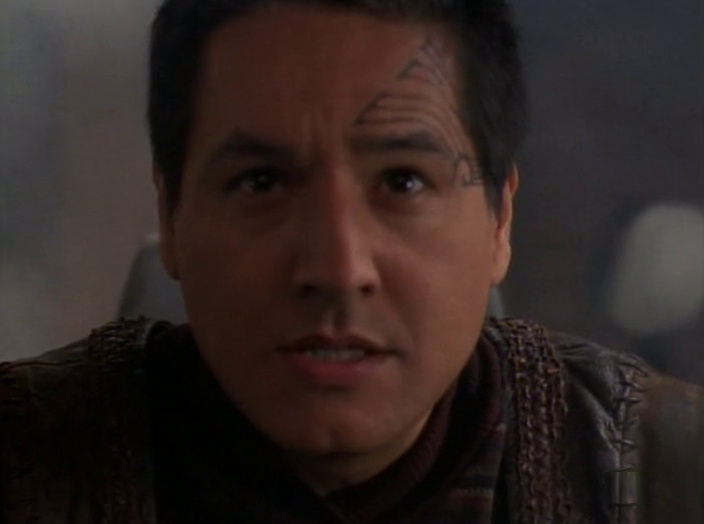
Spoiler Warning: There are spoilers ahead for Star Trek: Picard Seasons 1-3, including the trailers, teasers, and marketing material for upcoming episodes. Spoilers are also present for the following Star Trek productions: The Next Generation, Deep Space Nine, Voyager, and Discovery.
For some utterly inexplicable reason, Paramount doesn’t make all of its marketing material available to viewers outside of the United States. Trailers, teasers, clips, posters, and even Paramount’s own press website are geo-blocked, meaning fans and viewers who aren’t American can’t access them – at least, not officially. This is just another example of Paramount’s stupid, dangerous, and obviously damaging “America First” fetish that we’ve talked about here on the website on more than one occasion in the last few years.
But we’ll have to give Paramount another stern talking-to, clearly.
Fuck you too, Paramount.
Because I don’t have access to that, I missed something potentially huge about the upcoming fifth episode of Star Trek: Picard Season 3 that was revealed in the episode’s official press release. Here’s the full blurb so you can read it for yourself:
“Caught by Starfleet and facing court martial, paranoia grows as Picard struggles to uncover whether a prodigal crewman from his past has returned as an ally – or an enemy hellbent on destroying them all.”
One part of this in particular jumped out at me: the “prodigal crewman.” Who could this character be? And more importantly: might it be someone we’ve met before; a returning legacy character?
There are quite a lot of characters who could potentially return!
I would have included this as part of my theory list if I’d spotted it in time! I don’t like going back to posts I’ve already published and adding whole paragraphs and chunks of text, so instead of doing that, I’ve decided to write this one up as a standalone theory.
The use of the word “prodigal” is very interesting here, as it could absolutely be argued to imply that we’re dealing with a character we’ve already met. A “prodigal” son or daughter is someone who returns home, so I think we’ve got a case – albeit not a watertight one – to make in favour of this character being someone we’ve already met. And you better believe that I have a few ideas for who they could be!
Prodigal Crewman #1: Tasha Yar
Tasha Yar at her post.
Denise Crosby, who originated the role of Tasha Yar in The Next Generation’s first season, has been heavily rumoured to be involved with Picard Season 3 for months, and it’s primarily for that reason that she’s in contention here. Yar was, of course, famously killed off toward the end of The Next Generation Season 1, but that didn’t stop Crosby from making occasional returns to Star Trek – either as Tasha Yar herself or as her half-Romulan daughter Sela.
Perhaps part of what Picard will have to figure out is whether Tasha Yar survived her injuries at the hands of Armus, or whether this version of Tasha Yar might be the mother of Sela – someone detained and imprisoned for years by the Romulans. Such a storyline could even cross over with a potential Section 31 series; Tasha’s survival may have been hushed up by the shadowy black-ops organisation.
Tasha Yar was killed off early in The Next Generation’s run.
Most fans of The Next Generation would instantly assume that Tasha Yar couldn’t possibly be real – because we know that she died a long time ago. That would potentially set up a kind of double-bluff, where the show leans into the idea that Tasha Yar is a changeling… only to perhaps rip that away at the last moment and say that she’s actually for real.
A good rule in Star Trek (and fiction in general!) is that if you haven’t seen the corpse, a character may not be truly dead. But we did see Tasha’s body, we watched her die, and we even saw her friends attend her memorial service. It would be difficult, narratively speaking, to find a way around that… and I don’t think it’s something that can just be hand-waved away or ignored. So there’s a potential pitfall here, I fear.
Prodigal Crewman #2: Sito Jaxa
Ensign Sito Jaxa.
Ensign Sito Jaxa made two appearances in The Next Generation. She debuted in the episode The First Duty, where, as a cadet at Starfleet Academy, she played a role in covering up the death of a colleague during an unsanctioned flying manoeuvre. Later she appeared in the episodeLower Decks, having been assigned to the Enterprise-D at Picard’s explicit request.
Ensign Sito was presumed to have died during a mission to aid a Cardassian spy – but her body was never recovered, so it’s possible, perhaps, that she wasn’t killed in action as we were led to believe.
Sito with Picard.
Sito definitely qualifies as a “prodigal” crewman, I think! But as a character who only made a couple of appearances, she may not be as recognisable to the audience. The story would also have to find a way to explain what happened to Sito after her disappearance in a satisfactory way, telling us how and why she disappeared and allowed her friends to assume the worst.
Even with those issues, though, I think Sito could make for a fascinating character to bring back. And as a relatively unknown character, there’s scope to tell a different kind of story unconstrained by too much prior canon.
Prodigal Crewman #3: Dr Pulaski
Dr Kate Pulaski.
I gotta be honest: I don’t really think that Dr Pulaski is a strong contender here. But as you’ll know if you read my in-depth look at her character, I truly like Dr Pulaski, and she’s a character that I wish we’d gotten to spend more time with. Giving her an epilogue after all these years would be fantastic – even if it seems quite unlikely!
So that’s the truth of Dr Pulaski’s inclusion on this list. But I still think we can build a case for her return. First and foremost, Dr Pulaski never got a conclusive goodbye after Season 2 of The Next Generation. She simply disappeared when Dr Crusher returned at the beginning of Season 3, and while there was supposedly a mention of her over a tannoy in the background during the events of the Voyager series finale Endgame, implying that she may have worked at Starfleet Medical, I don’t think that really counts!
Dr Pulaski, ready for a trip to the holodeck!
It would be genuinely interesting to see some kind of on-screen interaction between Drs Crusher and Pulaski, as that’s something we never got during The Next Generation’s run. How would these two very different doctors react to one another, and would their styles completely clash? It could certainly be a bit of fun to see that!
Dr Pulaski also had a burgeoning friendship with Worf, and has a strained relationship with Riker as she had once been involved with his father. She’s also a character who knew Professor Moriarty, who we know is coming back soon; she was present during his creation on the holodeck. There are good reasons to want to see more of Dr Pulaski – even though I think her return on this occasion isn’t the most likely.
Prodigal Crewman #4: Ro Laren
Ro betrayed Riker and Picard the last time we saw her.
The former Ensign Ro is someone who could be absolutely fascinating to bring back. Her defection to the Maquis at the end of The Next Generation was something that clearly stung Picard, so there’d immediately be a loss of trust between them. Ro is also a character who could tell us a great deal about relations between the Federation and the Cardassians, as well as the potential survival of some members of the Maquis.
One interesting idea that hasn’t been explored fully in Star Trek since the Dominion War is the idea that characters like Ro and even Michael Eddington were, in a roundabout way, right. They predicted Cardassian aggression years before it happened, and were willing to fight back at a time when the Federation was pursuing what amounted to a policy of appeasement; peace at any cost.
Picard with Ensign Ro at a Bajoran refugee camp.
If Ro were to return, we could see her take Picard to task for failing to recognise signs that the Cardassians would once again make offensive moves against the Federation – and hearing what Picard may have to say in defence of his actions in that era could be fascinating, particularly in light of what happened in the Dominion War.
We could also see Ro as the returning “prodigal” crewman, perhaps having suffered years of imprisonment at the hands of the Cardassians, and lamenting the loss of many of her Maquis friends. I’m sure Riker would have a thing or two to say to her, too, because the last time he saw her she was pointing a phaser at him!
Prodigal Crewman #5: Lore
Lore as he appeared in The Next Generation.
Is Lore a “crewman” in the strict sense of the term? I’m not so sure… but he’s also the only character on this list that we know for a fact will be included in the season’s story! That alone should mean he’s in contention.
It seems to have been hinted in pre-season marketing material that Lore may have changed since we last encountered him, and that he may have become more of a friend/ally to Picard and the crew. If so, perhaps that will be what Picard figures out over the course of this upcoming episode.
Lore in the final Season 3 trailer.
Is it possible that Lore might have been “repurposed” to somehow resurrect Data? That could also give Picard a puzzle to figure out: is he dealing with the genuine resurrection of his dead friend, or is Lore once again trying to take everyone for a ride by posing as his brother? After a prominent sequence at the end of Season 1 in which Data was laid to rest, I’m not sure this is the route I’d want to see the story go down – but you never know.
I’m not really sold on Lore’s return, to tell the truth. The “evil twin” angle was a fun one on a couple of occasions during The Next Generation’s run, but with Data seemingly out of the picture, Lore’s return seems to be more to do with wanting to reunite actor Brent Spiner with his co-stars rather than for any narrative reason. And with Spiner having already appeared in both Seasons 1 and 2 of Picard… maybe that’s just not something that will turn out to have been necessary. Regardless, this feels like it could plausibly be the moment of Lore’s return.
Prodigal Crewman #6: Elnor
Season 2 promotional photo of Elnor.
I know, I know: actor Evan Evagora has stated that he isn’t coming back for Picard’s third season. However, we heard similar words from Orla Brady, who plays Laris, and she actually did appear in the season premiere. Perhaps Elnor could be back for a one-off appearance after all!
Would we call Elnor a “prodigal” crewman? And what reason might Picard have to suspect that he’s dangerous – other than the obvious changeling infiltration possibility? Also, what kind of role might Elnor have in prosecuting Picard at a potential court-martial? All of these questions would have to be answered if Elnor is indeed to return!
Cadet Elnor at the end of Season 2.
However, it would be an unexpected and fun twist in the story. We could learn that Elnor has graduated from Starfleet Academy and is now a fully-fledged Starfleet officer, perhaps serving in the security division. He could even enable Picard and Riker to escape their potential arrest, proving that he’s on their side.
Elnor’s return could also lead to a reunion with Raffi, as the two clearly had a strong bond. It must’ve been difficult for Raffi to leave Elnor behind to go undercover – especially as he’s the closest thing to family she has left after alienating and estranging herself from her ex-husband, son, and daughter-in-law. Elnor’s story, perhaps more so than any other new character, is arguably the most unfinished – and finding a genuinely good reason for his last-second resurrection at the end of Season 2 should be a priority, too.
Prodigal Crewman #7: Sela
Sela in The Next Generation.
We mentioned Sela above when talking about Tasha Yar, but could she turn out to be the “prodigal crewman” herself? Depending on the state of Romulan-Federation relations in this era, it’s possible, I suppose, that other Romulans might follow in Elnor’s footsteps and join Starfleet – or at least work alongside Starfleet in some capacity as allies.
Sela could also emerge not as a member of the crew, but in some other role, perhaps as a fellow prisoner if Picard and Riker are placed under arrest. She could return offering to break Picard out of jail, only for Picard to have to stop to consider whether she’s doing so to help – or because she has some other nefarious goal in mind.
Picard and Sela have crossed paths before…
This would allow Denise Crosby to return but without having to, for want of a better expression, dig up Tasha Yar. Given the adversarial nature of Sela’s relationship with Picard, it would make sense why he wouldn’t know whether or not to trust her – and why he’d need to figure out whether she’s an ally or an enemy.
I definitely think that there’s scope to bring back Sela in some form this season – though whether this would be the right way to do it is still an open question!
Prodigal Crewman #8: Vadic
Vadic in Seventeen Seconds.
This one is a bit “out there,” so bear with me! I’ve had a theory that has been running for as long as we’ve known Vadic would be a part of the season’s story in which I’ve suggested that she could be a former Starfleet officer – someone who once served under Picard’s command. The inclusion of multiple connections to the Battle of Wolf-359 – including most prominently Captain Shaw’s presence at the battle that was revealed in No Win Scenario – could also be a potential origin story for Vadic: she was a Starfleet officer or enlisted crewman present at the battle.
Perhaps Vadic will return in the upcoming episode, relatively unscathed after Riker’s asteroid attack, and will reveal herself as a former crewmate of Picard’s. She may offer some tantalising piece of information pertaining to the rogue changelings and their conspiracy that Picard will need to investigate – and determining whether Vadic’s offer is genuine or a trap could be a big part of the story.
Who is Vadic?
If Vadic truly is someone who served in Starfleet, I’m not sure if this is how that revelation might come. But it feels like a possibility, at least, and now that we’re relatively certain that Vadic isn’t actually a changeling herself, but is merely working for them in some capacity, the question of her origin is once again an open one.
It would be a shocking twist in the story if Vadic essentially “turned evil” because of something that Picard did or didn’t do. She might blame him for her injuries if she once served aboard the Stargazer or Enterprise-D, or she might hold Picard accountable for her assimilation if she was captured and assimilated by the Borg, for example. There are multiple ways to tie Vadic to Picard’s past – including as a “prodigal crewman.”
Prodigal Crewman #9: Reg Barclay
Barclay with a medical tricorder.
Barclay would be a fun and interesting character to include in Season 3, and a potential story in which he plays a role could also see him interacting with Seven of Nine. Barclay was instrumental in helping the USS Voyager communicate with Starfleet while the ship was stranded in the Delta Quadrant, so a kind of reunion between him and Seven could be a ton of fun!
Although Barclay was arguably not Picard’s favourite officer during his tenure aboard the Enterprise-D, he was always an ally – so the question of why Picard might mistrust him is an open one. As an engineer, there’s also the question of what role Barclay might play during a potential arrest and court-martial – he clearly isn’t going to be a security officer or advocate.
Barclay in Star Trek: Voyager.
Again, Barclay could be someone who shows up, seemingly out of nowhere, offering Picard and Riker a potential way out. Determining whether that offer of assistance is genuine could be what the blurb of the episode is hinting at, and it could be fun to see Picard and Riker trying to “test” Barclay to see whether he’s the genuine article.
Barclay is another character that I think could make a welcome return to Star Trek, and could link up with Picard, Geordi, Seven, and others in Picard’s third season in different and fun ways. Whether this would be the right way to do it… I’m not 100% sure. But it’s at least a possibility!
Prodigal Crewman #10: Miles O’Brien
O’Brien in The Next Generation.
Chief O’Brien is basically the only person on this list who meets the strictest definition of “crewman!” O’Brien was never a commissioned officer, instead holding the rank of chief petty officer – a non-commissioned rank that essentially makes him a senior crewman. Could that complicated work of semantic gymnastics be a hint at the return of Chief O’Brien?
I’d absolutely love to see Miles O’Brien come back. He’d certainly have a lot to say to Worf – the two worked together for years during the Dominion War. He’s also a character with a strong connection to Picard, having served aboard the Enterprise-D before transferring to DS9.
Chief O’Brien.
O’Brien is also a great character to include in a story all about the rogue changelings. As a kind of epilogue to Deep Space Nine seems to be unfolding, bringing back other characters from that series makes a lot of sense – and if it’s someone like O’Brien that Picard hasn’t seen for a long time, it would be understandable if trust is hard to come by at first. Worf could be the point of connection here, proving to Picard that O’Brien is on their side.
I doubt that the question of “crewman” versus “officer” will ultimately matter; that was just a bit of fun. It would be great to think that we might see Chief O’Brien again, though, and that he might have a role to play in a story that brings back the changelings and makes reference to the Dominion War – a war in which he played a major role.
Prodigal Crewman #11: Wesley Crusher
Wesley after his field commission.
Another character who would arguably fit the definition of “prodigal” is Wesley Crusher, who has been off with the Travelers for a number of years. We saw at the end of Season 2 that Wesley has settled into that role, so the question of why he might choose to make himself known to Picard at this time is unclear.
However, as the blurb hints, it could be possible that a changeling is impersonating Wesley to try to catch Picard and Dr Crusher off-guard. This imposter could be trying to get to Jack through Dr Crusher, using the image of Wesley to worm their way into the Crushers’ trust.
Wesley with Kore Soong at the end of Season 2.
Having seen Wesley at the end of last season, though, and seemingly in a pretty conclusive scene, I’m not certain that he’ll be back again so soon. There are good reasons to do it, both narratively speaking and for the fun of including another legacy character, but there are also some pretty solid counterpoints, too.
Still, Wesley would certainly fit the definition, and would be an interesting character to include. His inclusion could set up a kind of double-bluff, where we’re led to believe there’s a high likelihood of his being a changeling, only for the story to prove at the last moment that he actually is Wesley Crusher. I think a lot of fans would like to see a reunion between Wesley and Beverly – and it could be fun to see Wesley meeting his half-sibling for the first time, too!
Prodigal Crewman #12: Thomas Riker
Thomas Riker.
Thomas Riker – a transporter-created clone of William Riker – would be an interesting character to bring back. Last we saw him, Thomas was being arrested by the Cardassians, having exposed a secret fleet that the Obsidian Order was building. This took place in the years prior to the Dominion War – so what became of him after his arrest was never seen on screen.
If Thomas survived the war, he may have been returned to the Federation, or perhaps liberated from a Cardassian prison camp during the course of the conflict. If so, perhaps he was able to rejoin Starfleet at some point.
Could this be Thomas Riker? Or did Thomas somehow replace the real Riker?
The presence of Thomas Riker could tie into the theme of an “imposter” without going down the obvious route of having another changeling hiding out in Starfleet. It could fall to Picard to figure out whether he’s sitting with the original Riker or his clone – and as the two men are indistinguishable by scans and sensors, it might only be Picard’s insight into his former number one that could find out the truth.
This could also potentially explain why we saw a clip in one of the pre-season trailers that seemed to show Riker trapped or imprisoned. If Thomas is involved, could he be working with Vadic? He was actually one of the characters I suggested could be part of her team when I put together a list back in November. You can find the full list by clicking or tapping here.
Bonus Prodigal Crewman: Someone entirely new.
Will it be someone we’ve never met?
In Season 1, the super-synths and Zhat Vash were entirely new creations. In Season 2, Star Trek’s past likewise didn’t factor into either the mysterious anomaly or Picard’s own backstory. There have been moments in both seasons where characters from the past could have been included: multiple admirals and senior Starfleet personnel could have been replaced by the likes of Admiral Janeway, for instance, or Dr Benayoun in Season 1 could have been subbed out for someone like Dr Pulaski or Dr Bashir.
So there are good reasons to think that, once again, Picard will create an entirely new character to fill this space. Such a character could be said to have served under Picard’s command aboard the Enterprise-D, the Enterprise-E, the Stargazer, or during the Romulan rescue mission, and they could be tailor-made to fill a particular role in this new narrative.
In Season 1, the new character of Dr Benayoun was created.
I’d suggest that this reference to a “prodigal crewman” hasn’t exactly been a massive part of the marketing or promotional material for either the season as a whole or even for this episode – so if it turns out not to be relevant, I don’t think we can really accuse Paramount of getting our hopes up too much! On several occasions in recent seasons of Star Trek, there arguably have been teases that hinted at potential returning characters or factions that ultimately didn’t pan out. We could point to Tarka’s friend and Unknown Species 10-C in Discovery Season 4, the Burn in Discovery Season 3, and the super-synths in Picard Season 1 as examples of this… but this reference to a “prodigal crewman” feels minor in comparison.
In short, what I’m trying to say is this: don’t be surprised if this character turns out to be someone brand-new. Although we’ve had fun (I hope) speculating wildly about possible returning characters, a brand-new creation is at least as likely – if not more so – than anyone on this list!
So that’s it!
The Titan will rendezvous with another Starfleet vessel…
We’ve considered twelve possible characters who could be the “prodigal crewman” mentioned in the blurb for Imposters, the upcoming fifth episode of Picard Season 3. Will we look back at this list in a few days’ time and think how brilliant and insightful it was? Or will we instead think how silly it was to speculate about a bunch of characters who clearly had no role to play? Only time will tell! But even if I’m completely wrong on this, it was a bit of fun to speculate about who may or may not be coming back.
I’d be hard-pressed to pick a favourite on the list above. For production-side reasons, characters played by actors who we know to be involved in the season – like Thomas Riker or Lore – feel plausible, as do characters like Sela and Tasha Yar as Denise Crosby has been heavily rumoured to be playing a role this time. But Star Trek has kept some wonderful surprises – Wesley Crusher’s role at the end of Season 2 hadn’t been leaked or even hinted at, making it a great inclusion in the episode Farewell. What I’m saying is that a complete shock shouldn’t be entirely disregarded; it’s possible, at least, that a truly unexpected character could be about to make a return.
As a final note: I always like to end these theory posts by saying that I do this just for fun. I enjoy writing, I enjoy Star Trek, and spending more time in this world is an escape and an enjoyable distraction for me. But for some folks, fan theories can become frustrating or unenjoyable, especially if they get very attached to a plausible-sounding theory that ultimately doesn’t pan out. I have no “insider information” and I’m not trying to claim that anything suggested above can, will, or must be part of Picard Season 3.
Star Trek: Picard Seasons 1-3 are available to stream now on Paramount+ in the United States and other countries and territories where the service is available, and on Amazon Prime Video in the UK and around the world. The Star Trek franchise – including Picard and all other properties discussed above – is the copyright of Paramount Global. This article contains the thoughts and opinions of one person only and is not intended to cause any offence.
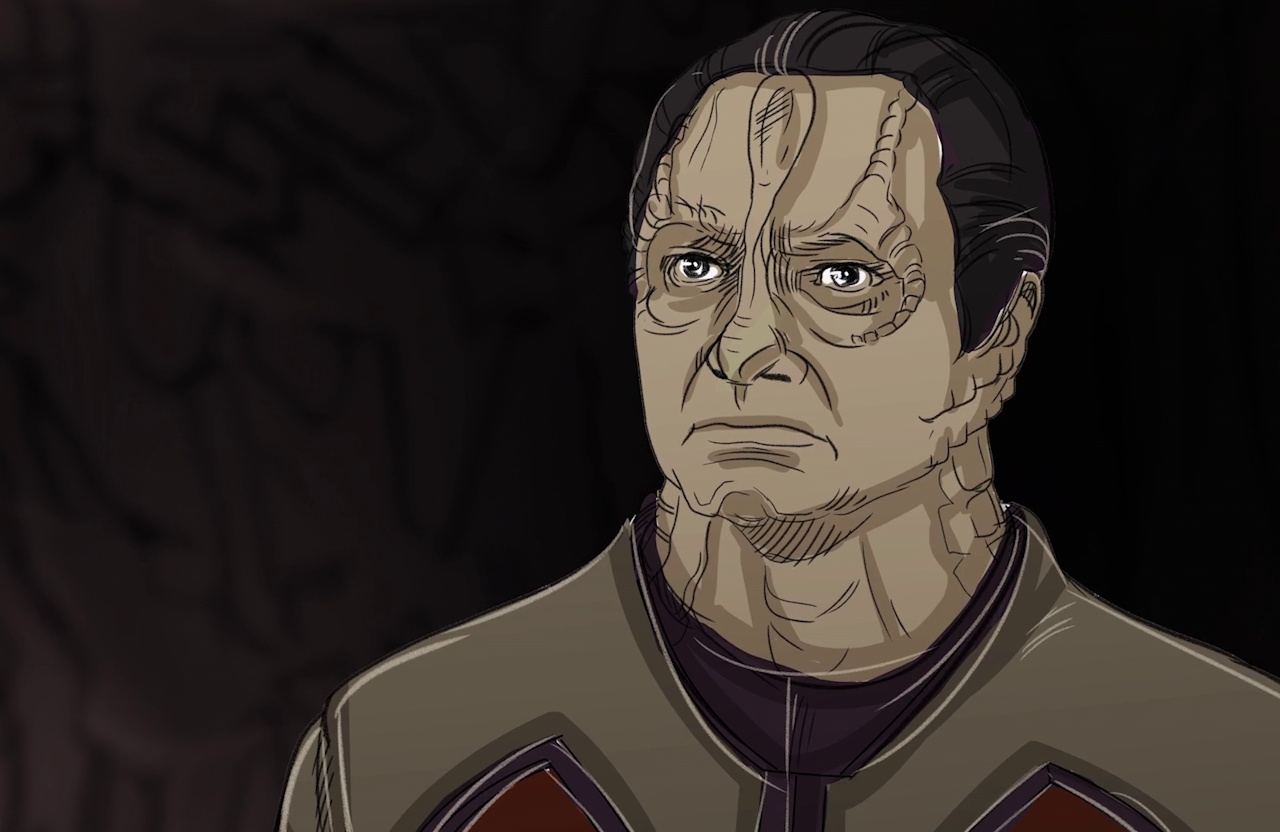
Spoiler Warning: There are spoilers ahead for Star Trek: Picard Seasons 1-3. Spoilers are also present for the following Star Trek productions: The Wrath of Khan, The Next Generation, Deep Space Nine, Voyager, and Discovery.
No Win Scenario has certainly shaken up the theory list! Although I’d argue it wasn’t quite as enjoyable an episode as Seventeen Seconds had been last week, there were still plenty of fun and exciting moments. The first chapter of Season 3 has now drawn to a close, but in terms of mysteries, the story is just getting started!
If you missed it, I hope you’ll go back and check out my review of No Win Scenario, as I go into detail about different elements of the episode. Some worked exceptionally well, one sequence in particular was incredibly emotional and cathartic, and some others… well, let’s just say there were a few moments that weren’t as enjoyable as the rest! You can find my review by clicking or tapping here.
A cute spacefaring critter.
There are some big changes this week for the theory list! We have four debunkings, one semi-confirmation, and two confirmations, as well as a couple of brand-new theories that are joining the party!
As always, we begin with confirmations and debunkings.
Confirmed theory #1: Vadic has an additional reason for chasing Jack and the Titan.
Vadic in this week’s episode.
I felt certain that “money” couldn’t possibly be Vadic’s sole motive for chasing Jack Crusher, and while we still don’t know the details, we at least got confirmation this week that there’s more going on here. Vadic is doing the bidding of a changeling for some reason, and the changeling has a particular interest in Jack.
I’m glad that there’s more to Vadic than something as bland and uninspired as looking for a big paycheck. There’s potential now to explore her character a lot more, really flesh out what’s going on and what her connection to the rogue changelings could be, and provide a satisfying end to the mysteries that have been set up so far.
Confirmed theory #2: Captain Shaw lost someone to the Borg.
Debris in the aftermath of the Battle of Wolf-359.
Or rather, several someones. Captain Shaw saw the crew of the USS Constance – many of whom will have been friends and colleagues – killed during the Battle of Wolf-359 almost forty years prior to the events of Picard Season 3. This explains his characterisation in the show thus far, and particularly the prejudice he’s shown toward Seven of Nine and Picard.
His anger toward ex-Borg is certainly misdirected, especially insofar as Seven is concerned, and I don’t think we can simply give Shaw a pass because of what he went through. The trauma clearly played a huge role in shaping who he is, though, and while it doesn’t justify his treatment of Picard and Seven, at least now we know he isn’t just being a jerk for no reason at all.
As I said in my review, though: I’m not exactly blown away by this revelation, and it feels very familiar to anyone who’s seen Deep Space Nine.
Semi-confirmed theory: Jack has a connection to Vadic.
Jack in No Win Scenario.
I’m calling this one “semi-confirmed,” because while I didn’t get the details exactly right, there is still a connection of some kind between Jack and Vadic, as noted above. Vadic’s changeling boss is directing her to pursue and capture Jack – for reasons that are still unclear – so there’s more to this chase than simply trying to cash in on a bounty.
At the moment, Vadic is mostly off to one side in her own little narrative box, and has only been able to interact with the crew of the Titan via viewscreen a couple of episodes ago. I hope that there will be time in the episodes ahead to have more interaction between Vadic and Jack in particular.
Debunked theory #1: The changelings are hiding in the nebula.
It wasn’t changelings after all…
When the Titan’s science officer flagged up “organic” elements present in the nebula, I wondered if that could indicate that at least some of the changelings are nearby. We saw in Deep Space Nine that the changelings’ homeworld was hidden inside a nebula, so it seemed like a reasonable assumption that the rogue changelings might also use a nebula to keep their base out of sight.
However, it didn’t pan out – and I think it would have felt like quite the contrivance if the Titan had stumbled on the changelings’ hideout seemingly by accident!
Debunked theory #2: The changelings are the nebula.
The nebula.
For the same reason given above, it didn’t seem impossible to think that the changelings could have actually formed the nebula themselves. We saw in Deep Space Nine that changelings are able to exist in a gaseous state, and appearing as a random, unwelcoming phenomenon on the outskirts of a minor star system could have been a great hiding place!
The story that we got, however, was truly excellent, and one that managed to recapture that occasionally elusive sense of “Star Trek.” Seeing the spacefaring life-forms being born was an incredibly sweet moment, and far better than if the nebula had turned out to be a group of linked changelings!
Debunked theory #3: Riker is a changeling.
Captain Riker at the end of No Win Scenario.
I wondered about this last week, based mostly on random pieces of evidence that had been scattered across the trailers and the first couple of episodes. In short, I wondered if Riker may have been replaced by a changeling while beaming back to the Titan from the Eleos. We caught a glimpse of Riker seemingly imprisoned in an earlier trailer, and since we know there’s a bigger conspiracy in the offing, it seemed possible that the changelings might seek to replace a starship captain.
However, Riker’s story in No Win Scenario clearly disproves this idea! Riker was dejected for much of the episode, and spent a long time trying to find the right words to leave behind in the event that the Titan didn’t make it.
Debunked theory #4: Vadic is a changeling.
Vadic on the bridge of the Shrike.
Vadic has a changeling appendage – but I think it’s pretty clear now that she isn’t a changeling herself. This shakes things up in more ways than one, as the relationship between Vadic and the rogue changelings’ conspiracy isn’t cut and dry; there may be conflicting ideas and motivations here.
Still, when we knew that the changelings were involved – and that Vadic was in contact with a changeling spy embedded aboard the Titan – it seemed like a reasonable assumption that she could’ve been a changeling herself!
So those theories have been debunked or confirmed.
Now it’s time for the main event: the theory list! We’ll start with new theories and theories that saw movement as a result of events in No Win Scenario.
Theory #1: Vadic is a veteran of the Battle of Wolf-359.
The Borg cube that was involved in the battle.
One thing that has confused me about the story so far is that there have been multiple Borg references, and specifically references to the events of The Best of Both Worlds. These references have come in a story about changelings and Dr Crusher’s son – a story that doesn’t have a readily apparent Borg angle.
One way in which this circle could be squared, and these references made to feel meaningful, is if Vadic was herself a veteran of the Battle of Wolf-359. This would give her an immediate connection not only to Picard, Riker, and the crew of the Enterprise-D, but also to Captain Shaw. We could learn, perhaps, that Vadic had been a low-level Starfleet officer or crewman, and that she’d left Starfleet after being traumatised by the events of the battle. She could even turn out to be one of the other survivors of the USS Constance – meaning she’d once served alongside Shaw.
Theory #2: Jack Crusher has changeling DNA… somehow.
Whose DNA is this?
Why do the changelings want Jack so badly? Why does Jack have strange visions of blood-red vines and an opening door? And why do we prominently see what appears to be a strand of DNA in the closing credits? If I’m right, then Jack will – somehow – have a combination of human and changeling DNA. How this happened… well, he and Dr Crusher have spent years on the front lines delivering medical supplies and taking risks. Perhaps something that happened to them on their travels brought Jack into contact with a changeling.
I don’t think that Jack knows what’s going on, and if such a connection were revealed, it would probably be as much of a surprise to him as it will be to us as the audience!
Having established Jack as the son of Dr Crusher and Picard, it would be difficult to say that he is a changeling; an imposter. But maybe that’s the direction the story will go. I suspect it may be subtler than that, though, and just like Vadic has a changeling hand, Jack may have some kind of changeling DNA without actually being a changeling himself.
Theory #3: The rogue changelings are responsible for the mysterious anomaly seen in Season 2.
The anomaly in the Season 2 finale.
It didn’t escape my notice that the events of Season 2 were referenced – albeit incredibly briefly – by Captain Shaw in No Win Scenario. That being said, this theory still feels like somewhat of a long-shot just based on how Picard seems to have moved on from what happened last year.
In short, what I’m suggesting is that the mysterious anomaly that was a big part of the story of Season 2 will turn out to be a weapon of some kind deployed by the rogue changelings, either as part of or as a precursor to their plan to attack Starfleet and the Federation. This would explain Dr Jurati’s comment that the anomaly seemed to be artificial in nature – and it would tie up a massive loose end from last season.
Theory #4: The rogue changelings are planning attacks on the Klingon Empire and the Romulans.
A joint Federation-Klingon task force during the Dominion War. Image Credit: JTVFX on YouTube
It wasn’t only the Federation that opposed the Founders during the Dominion War. The Klingons, Romulans, and later a Cardassian resistance movement all played significant roles in preventing the Dominion from conquering the Alpha Quadrant – so it stands to reason that the rogue changelings would be looking to get revenge on these powers, too.
Despite having had two full seasons of Picard already – one of which had a major Romulan theme – we still don’t know much about the state of the galaxy in political terms. Are the Federation, Romulans, and Klingons on friendly terms in this era, or has the Dominion War alliance of necessity fallen apart? After the Zhat Vash plot was exposed, what happened to Federation-Romulan relations? All of these things would be interesting to explore, and the rogue changelings’ plot could lead to such a storyline. For now, though, suffice to say I suspect that the Federation may not be the only target that the rogue changelings have in mind!
Theory #5: The rogue changelings may also be targeting the Bajorans and Cardassians.
Legate Damar led a Cardassian resistance movement against the Dominion.
These two factions played smaller roles during the Dominion War in some respects, with the Cardassians serving as Dominion allies (and members of the Dominion), and Bajor signing an official non-aggression pact with the Dominion. However, both the Bajorans and Cardassians later opposed the Dominion, and the Prophets – who are strongly aligned with Bajor – arguably turned the tide of the entire war.
If the rogue changelings are on the move, I would suspect that the Federation, Romulans, and Klingons would be their main targets as it was these powers who played the biggest and most obvious roles in the conflict. But Bajor and Cardassia may not be safe.
Again, we don’t know enough about the geopolitics of this era! Bajor may have joined the Federation, and even Cardassia could be under Federation protection. If so, that changes the dynamic.
Theory #6: There are changeling infiltrators aboard dozens of Starfleet vessels.
A Starfleet armada seen in Season 2.
No offence to Captain Shaw and Commander Seven… but the Titan isn’t exactly the most important ship in the fleet. Prior to Picard and Riker commandeering it for their off-the-books rescue mission, it was a minor exploratory vessel that doesn’t seem to have played a significant role in any major event, nor is it at the heart of the Federation’s defensive strategy.
Despite the ship’s relative unimportance, however, the rogue changelings still planted a spy aboard the Titan. If a ship like the Titan has an embedded changeling, it stands to reason that other ships do, too – perhaps a great many others. Their missions may be to sabotage the ships, either subtly, as we saw with the Titan, or more explosively…
Theory #7: The rogue changelings are planning to cripple Starfleet.
A clip from a pre-season trailer showed a Federation starship suffering damage to one of its nacelles.
The precise number of ships that Starfleet has has always been a tad vague, adaptable to different stories. But I think we can safely assume that there are several hundred ships in Starfleet at any one time. Many of these, though, will be science vessels, ships of exploration, or even transport ships. The number of tactical vessels and combat-ready front-line ships is going to be a lot smaller.
With that in mind, a coordinated strike against these ships could cripple the Federation’s ability to defend itself. We already know that the rogue changeling aboard the Titan had a bomb that they used to severely damage the ship – if other rogue changeling operatives are similarly equipped, they could potentially take out Starfleet’s best and most powerful vessels in one fell swoop.
Theory #8: Vadic backstory ideas.
We still don’t know who Vadic is.
We’ve ruled out the idea that Vadic is a changeling, but I still have some other possible origins in play for the season’s only named villain. I wrote a list months ago, after Vadic first made her debut in pre-season marketing material, and suggested several ways that Vadic could be connected to Star Trek’s past. We looked at one such idea above – that Vadic may be a veteran of Wolf-359 and an ex-Starfleet officer or crewman, but there are a handful of others.
A former member of Picard’s crew, perhaps someone who was injured or left for dead while serving under his command,
An ex-Borg, either someone who was assimilated while serving on Picard’s crew or perhaps someone from the Artifact in Season 1,
An augment, potentially tied to Season 2’s Adam Soong or even Khan himself,
A Romulan or ally of the Romulans, with a potential tie to Sela,
A member of Insurrection’s Son’a.
Theory #9: Vadic has put together a “rogues’ gallery” of Star Trek villains.
Vadic with two members of her crew.
I’m close to retiring this theory, to tell the truth, but until we’ve spent a bit more time with Vadic and the masked crew of the Shrike, there’s still a slim chance that it could pan out.
When we first saw Moriarty and Lore in pre-season trailers, I wondered whether they might be members of Vadic’s crew. If so, I theorised that they may just be the tip of the iceberg, and that Vadic may have allies from across The Next Generation era – particularly people who hated Picard and could conceivably want to seek revenge against him. I suggested characters like Sela, Toral, Commodore Oh, and even Thomas Riker as possible candidates.
Another theory that may not pan out! Now that we know Vadic is almost certainly not a changeling, the likelihood of this one seems to have dropped dramatically. In short, I speculated last time that if Vadic is a Founder, she may have brought Jem’Hadar with her, or perhaps even that the rogue changelings were breeding their own Jem’Hadar.
Given that there is a connection, though, and that Vadic has a changeling (or part of a changeling) aboard her vessel, we could still potentially see some Jem’Hadar warriors amongst her crew.
Theory #11: The Borg are involved.
The first Borg drone ever seen in Star Trek.
With a surprisingly large portion of No Win Scenario taken up with telling stories about the Borg, perhaps the chances of a bigger Borg connection have just increased! After all, why should the narrative keep returning to the Borg if there isn’t something else going on to make such inclusions relevant?
Last week, I suggested two possibilities for Borg involvement. Firstly, the rogue changelings may have stolen Borg technology from Daystrom Station – tech that could even be from the Artifact. This technology may be part of how they plan to attack Starfleet. Secondly, it doesn’t seem entirely impossible for the rogue changelings to have allied themselves with the Borg – after all, both factions would have reasons for wanting to see the Federation and Starfleet weakened or defeated, and the Borg have shown a willingness to make alliances before.
Theory #12: Captain Shaw will be killed.
Shaw in No Win Scenario.
Now that Shaw has had his explosive moment with Picard, revealing his involvement at the Battle of Wolf-359, the end could be near for the “dipshit from Chicago.” We’ve already seen how the Titan having multiple captains on board complicates the story, and if there is to be any kind of “Seven of Nine show” as a spin-off, it makes sense that Shaw might need to be removed from the captain’s chair in order to make that happen.
There’s still a lot of potential in Shaw, and he certainly could have more to contribute to the story. However, there are other potential reasons why killing him off could be on the agenda! If the writers want the impact of killing a major character, but don’t want the controversy of killing off a legacy character, then Captain Shaw could be on the chopping block. His death could raise the stakes significantly as the story approaches its halfway point.
Theory #13: Someone on Picard’s crew will turn out to be an imposter.
Picard and the crew of the Enterprise-D in a promo photo for Season 2 of The Next Generation.
So we’ve ruled out the likes of Riker and Vadic being changelings, and I think we can safely say that Picard, the Crushers, Captain Shaw, and Seven of Nine aren’t changelings either. But that still leaves several major characters who could potentially have been replaced! The title of the upcoming episode is Imposters, which could also be a hint!
With changelings on the move, basically anyone could have been replaced, and it won’t always be easy to tell. It seems possible that someone like Geordi, Troi, or perhaps even Raffi could be replaced by changeling infiltrators before they link up with Picard and the crew of the Titan, and it may not be possible to know who to trust.
With one changeling infiltrator storyline having already played out, though, it will have to be handled carefully so as not to feel repetitive! Still, I can’t help but wonder if a changeling imposter may be a big revelation in a future episode.
Theory #14: Not all of Raffi’s messages were from Worf.
Could someone have hacked Raffi’s comms?
As the changeling infiltration story deepens, I think it’s not beyond the realm of possibility that someone involved in the conspiracy – Vadic, perhaps – was sending messages to Raffi claiming to be her handler. These messages may have been false leads, irrelevant information, or other attempts to throw her off the trail. If so, it worked – Raffi wasn’t able to stop the attack on the Federation facility in time.
Narratively speaking, there was a good reason to keep Worf hidden until the end of Disengage: it made his last-second appearance all the more dramatic. But could there be another reason why Raffi’s messages came through in text form, read aloud by a disembodied digital voice? I wonder.
So those theories are new or moved significantly in No Win Scenario.
Now, in order to keep the theories all in one place, I’ll recap everything else that’s currently in play. These theories weren’t touched in this week’s episode.
Theory #15: The absences of characters from Seasons 1 and 2 will be explained.
Could we learn why Soji isn’t going to join Picard this time around?
I was pleasantly surprised to see Laris was included in the season premiere, and while she won’t have a big role in the story of the season, it was great that the story didn’t just dump her as it raced ahead. Due to her importance to the story of Season 2, Laris was perhaps the character who I felt it was most important to include in some way, and I’m glad we got to see her.
But there are still several characters from Seasons 1 and 2 who haven’t been mentioned. Elnor and Soji could easily be name-dropped; a line or two of dialogue could clear up where they are, what they’re doing, and why they can’t join Picard on his current mission. The Borg Queen-Dr Jurati hybrid is a bit more complicated; her self-appointed role as “guardian” of the mysterious anomaly makes it a bit harder to just wave away her disappearance.
I hope we’ll get something that will acknowledge these characters’ absences. All were important in the first two seasons of the show, and simply abandoning them without any kind of goodbye was disappointing at the end of Season 2. If Season 3 could do something to rectify that, I’d appreciate it!
Theory #16: There will be at least one unannounced character returning!
Could it be Harry Kim?
There have been theories and guesses from Trekkies for basically a whole year about which other characters from The Next Generation era could appear in Season 3. I don’t claim to know who might be included – but it feels like a pretty solid guess to say that someone from The Next Generation, Deep Space Nine, and/or Voyager will put in an appearance.
This could be a simple cameo, or an appearance similar to those seen in episodes like Encounter at Farpoint and Caretaker. Or there could be a real hidden surprise, with a character basically joining Picard’s mission. We didn’t really know the extent of Seven of Nine’s involvement in Season 1 until it happened, nor the extent of Brent Spiner’s roles in Seasons 1 and 2… so there’s at least the possibility of some kind of big surprise!
Theory #17: Several members of La Sirena’s crew have joined Captain Vadic.
The crew of La Sirena at the end of Season 1.
Although we’ve had it confirmed that most of the actors from Seasons 1 and 2 won’t be reprising their roles this time around, when I first saw the masked crew of the Shrike I couldn’t help but wonder… could some of these people be Picard’s friends? Could that explain why Dr Crusher warned Picard to “trust no one” and simultaneously explain their absences?
It would be a stunning revelation indeed if, when the masks are inevitably removed, Picard and the crew find themselves confronting the likes of Soji and Elnor. Maybe this one is a no-hoper because of what we’ve been told by the actors involved… but you never know!
Theory #18: At least one main character will be killed.
A Starfleet coffin.
It feels like a solid possibility that at least one main character won’t make it to the end of the season. Television storytelling has changed a lot since The Next Generation premiered, and even main characters can no longer consider themselves to be safe if they wind up in dangerous situations!
It would be a challenge to kill off a legacy character in a way that would be satisfying and would feel right – but it would be incredibly bold, and if such a story beat stuck the landing, it could succeed at either setting up the story or paying off a season-long character arc.
I made a list of who I thought could be in danger before the season began, and you can find it by clicking or tapping here.
Theory #19: Picard and his crew will reactivate Lore and Professor Moriarty.
Lore is coming back…
Although it seemed at first as though Lore and Professor Moriarty might be on Captain Vadic’s team, the final trailer for Season 3 was cut together in such a way as to suggest that it might be Picard and his crew that are responsible for re-awakening them. I have an idea as to why that might be the case (and we’ll take a look at that in a moment), but for now let’s just say that it seems possible that the story will go down this road.
Last time we saw both Lore and Professor Moriarty, neither posed a threat. Lore had been fully shut down, and Moriarty had been trapped in a holographic storage module, believing himself to be free to explore the galaxy. How either of them could come back is an open question – but they are coming back in some form!
Theory #20: Picard and his crew need to find synthetic allies/crewmates.
Professor Moriarty.
This theory seems to have moved significantly now that we know the changelings are involved! In brief, I’d suggested that Picard and the crew might be unable to trust organics, and that could explain why they may turn to artificial life forms like Lore and Professor Moriarty to aid them. With the inclusion of the Founders in the story, that possibility feels as if it could’ve just moved one step closer.
If it’s hard or even impossible to detect a changeling infiltrator, then synthetic life-forms may be the only ones that Picard can be certain are who they say they are. That could explain why Picard and the crew might re-activate these one-time enemies. It does raise a pertinent question, though: if Picard needs help from artificial life-forms, why not ask Soji and the Coppelius synths for help?
It does seem like one heck of a coincidence that Lore and Professor Moriarty – both of whom are synthetic – are involved in this story!
Theory #21: Vadic will be killed by her own portal-weapon.
The USS Titan and one of the portals.
This idea is a pretty simple one: as often happens to villains in stories like these, Captain Vadic will end up being killed by her own powerful weapon. We saw the portal-weapon used against the Titan in Seventeen Seconds, and I can absolutely see a pathway to Picard and the crew capturing it or gaining control of it, and turning it against Vadic.
There can be something poetic about an evil villain being destroyed by their own weapon, so I can’t help but feel that Vadic may meet her end by being spliced through one of her own portals!
Theory #22: Odo will make an appearance – somehow.
Odo in Deep Space Nine.
I don’t know how I feel about this one. It was sweet to see Worf make reference to Odo in Seventeen Seconds – though the connection could have been clearer, especially for more casual viewers – but I’m not convinced that we need to see Odo for ourselves. The reason for that is simple: the only way we could see Odo is either by re-casting the character or recreating him through some kind of CGI process.
Star Trek has successfully re-cast many characters over the years, so I don’t really take exception to that. But the death of actor René Auberjonois is still recent and fresh in our minds, so bringing Odo back without him just feels… uncomfortable. Although Odo is well-suited to a story in which the changelings are back, I think I’d rather he didn’t appear in person on this occasion. But I wanted to acknowledge that it’s at least a plausible development for the story.
Theory #23: Lore and/or Professor Moriarty were stolen from Daystrom Station.
Lore in his first appearance.
I don’t think it’s been confirmed that the Daystrom Institute and Daystrom Station are one and the same, but it’s certainly implied that they’re two parts of the same organisation. The Daystrom Institute, where Dr Jurati worked prior to the events of Season 1, is involved in the development of computer technology within the Federation, and was where Dr Bruce Maddox wanted to disassemble and study Data. We saw in Season 1 that B-4 (an early Data prototype) had been disassembled and was being stored at the Daystrom Institute… and when I heard that “something” had been stolen from there, my thoughts immediately turned to Lore.
Both Lore and Professor Moriarty had been deactivated when we last saw them, and the question of how either will fit into the story of this season is still an open one. I also can’t be sure what Vadic and/or the rogue changelings would want with Lore and/or Moriarty – but given how we saw that synths could be reprogrammed in Season 1, perhaps that could be part of it? Either way, these malevolent artificial life-forms could be dangerous if they allied themselves to the rogue changelings.
Theory #24: A spin-off series will be announced.
Alex Kurtzman is currently in charge of Star Trek over at Paramount.
Sad news came out from Paramount shortly after the episode Seventeen Seconds aired: Star Trek: Discovery has been cancelled and will end after its upcoming fifth season. This moment would have been a good time to announce a new Star Trek project; something to replace Discovery in the line-up. But it didn’t happen.
With Picard also ending, and no confirmation as yet of new seasons beyond what has already been announced for any of the other shows, Star Trek’s future beyond 2024 feels as if it’s hanging in the balance.
I’d already said that this was as much a hope as a theory; I’d love Paramount to announce a new Star Trek series of any kind, but a 25th Century project that would potentially tie in with Picard would be at the top of my list. There are options: a series focusing on Seven of Nine, a revived Section 31 show, or the Starfleet Academy series that has been the subject of many rumours. But so far, nothing has been announced. With all eyes on the Star Trek franchise right now, making such an announcement before Picard comes to an end would be good timing… so watch this space, I guess!
So that’s it!
What’s going on here?
Those are all of the theories that we have in play as we approach the midpoint of the season. There’s still a lot of time for the story to go in completely different directions, though, and even to introduce new characters and factions if it’s done right. We’ve started to see the beginnings of some mysteries being unravelled – but others, such as what may be causing Jack’s mysterious hallucinations, are just getting started!
As a final note: I always like to end these theory lists by saying that I do this just for fun. I enjoy writing, I enjoy Star Trek, and spending more time in this world is an escape and an enjoyable distraction for me. But for some folks, fan theories can become frustrating or unenjoyable, especially if they get very attached to a plausible-sounding theory that ultimately doesn’t pan out. I have no “insider information” and I’m not trying to claim that anything suggested above can, will, or must be part of Picard Season 3. I fully expect many of these theories to be debunked and for the season to go in wildly unpredictable directions!
Star Trek: Picard Seasons 1-3 are available to stream now on Paramount+ in the United States and other countries and territories where the service is available, and on Amazon Prime Video in the UK and around the world. The Star Trek franchise – including Picard and all other properties discussed above – is the copyright of Paramount Global. This article contains the thoughts and opinions of one person only and is not intended to cause any offence.
Spoiler Warning: There are spoilers ahead for Star Trek: Picard Seasons 1-3. Spoilers are also present for the following Star Trek productions: The Wrath of Khan, The Next Generation, Deep Space Nine, Voyager, and Discovery.
I had a great time with Seventeen Seconds this week – in fact, I’d say it’s almost certainly the best episode of Picard since the Season 2 premiere last year. It was also an episode that shook up our theory list in a pretty big way, with a major revelation that seems to have uncovered the real “big bad” of the narrative.
But we’re only three episodes into a ten-episode season… so it’s all still to play for! I’m sure we haven’t seen all of the twists and turns yet, and that there’s much more to be revealed.
Worf in this week’s episode.
I hope you’ll read my review of Seventeen Seconds if you haven’t already, as I go into a lot more detail about what was a fantastic episode. I found a few nitpicks, as I always do, and I offered my thoughts on some potentially controversial story points, too! You can find my review by clicking or tapping here.
This week we have two confirmations, two theory retirements, and one debunking. There are also a few theories that are barely hanging in there! As always, we’ll look at the theories that are departing the list first.
Debunked theory: Jack Crusher was conceived during the events of Star Trek: Insurrection.
Picard on the Ba’ku planet in Insurrection.
Based on Jack’s apparent age, Dr Crusher’s absence, and the metaphasic radiation at the centre of Insurrection’s story, I suggested that Jack may have been conceived during or shortly after the events of that film. However, we learned in Seventeen Seconds that Jack was actually conceived sometime after Nemesis, shortly before Picard and his remaining crew left the Enterprise-E. As stated in earlier episodes, this is about twenty years before the events of Picard Season 3, meaning Jack Crusher is supposedly in his early twenties.
Actor Ed Speleers, who plays Jack, is in his mid-thirties… and without wishing to be unkind, I don’t think he readily passes for a twenty-year-old. In addition, I’d suggest that Jack’s backstory of criminality and confidence trickery also better suits a character at least slightly older. But this is Jack’s true origin, so I guess we’ll just have to accept it!
Retired theory #1: The super-synths from Season 1 are involved.
A device designed by the super-synths to open a portal to their realm.
I feel bad about having to let this one go, but it now seems all but certain that Star Trek won’t be revisiting the super-synths from Season 1: the so-called “alliance of synthetic life” that left behind a beacon and potentially threatened all life in the galaxy.
I proposed a theory shortly after the end of Season 2 that could have tied together all three seasons of the show. In short, I posited that the super-synths created the mysterious anomaly seen in Season 2 as some kind of weapon, and that they’d return as the “big bad” in Season 3. Vadic could have been one of their pawns or devotees, someone obsessed with ensuring their arrival in the galaxy.
But all of that is for the birds now, as the story is clearly going in a different direction by bringing back the Founders.
Retired theory #2: Captain Vadic and her crew are hosts for the parasite-aliens first encountered in the episode Conspiracy.
The only sign that an individual was playing host to a parasite-alien was this spike at the back of the neck.
This idea was pretty wild, and I was surprised to see that I wasn’t the only one who’d been talking about it! As above, now that we’ve seen the Founders, it seems clear that Picard Season 3 is going in a very different direction – and considering the origins of this particular theory, I suspect that may be for the best!
The parasite-aliens from the episode Conspiracy sprang to mind when we heard Dr Crusher talking about how Picard should “trust no one” in pre-season trailers, and the idea that they might have returned was, in some ways at least, a potentially interesting one. But with Conspiracy being a more-or-less forgotten part of The Next Generation’s first season, one whose story was never revisited and had no influence over the rest of the show, I daresay it would have been a hard sell to bring this particular storyline back. Maybe it’s something better saved for a show like Lower Decks!
Confirmed theory #1: Vadic has an ally within Starfleet.
Vadic’s spy aboard the Titan.
Though it’s still possible that Vadic has additional spies or allies within Starfleet – either aboard the Titan or elsewhere – we got confirmation this week that she has at least one ally embedded aboard the Titan.
I stand by what I said in my review, though: it would have been more impactful had we met this character before it was revealed that they were a changeling infiltrator!
Confirmed theory #2: Vadic is not the real “big bad” of the Season.
We now know who else is involved!
We don’t currently know the specifics of Vadic’s relationship with the changelings. Is she a Founder herself, for instance, or does she merely work for them as a “sub-contractor?” There’s clearly more to be revealed about Vadic, but Seventeen Seconds confirmed what I had suspected: that she isn’t the only villain Picard and the crew will have to deal with.
We learned in Seventeen Seconds of the existence of a rogue faction of Founders; a schism in the Great Link has occurred, with followers of Odo’s peaceful path on one side, and a seemingly more aggressive, violent group of changelings on the other. What their specific goals may be, beyond chaos and revenge, is yet to be revealed – but we now know that Vadic isn’t working alone, and that she is either part of or working for this faction. I’m terming them the “rogue changelings” for now – but that may change if they’re given a proper on-screen name.
So those theories have been retired, debunked, or confirmed!
Now we’ll jump into the main theory list, beginning with theories that are either new or saw significant movement this week.
Theory #1: Lore and/or Professor Moriarty were stolen from Daystrom Station.
Lore will be appearing soon!
I don’t think it’s been confirmed that the Daystrom Institute and Daystrom Station are one and the same, but it’s certainly implied that they’re two parts of the same organisation. The Daystrom Institute, where Dr Jurati worked prior to the events of Season 1, is involved in the development of computer technology within the Federation, and was where Dr Bruce Maddox wanted to disassemble and study Data. We saw in Season 1 that B-4 (an early Data prototype) had been disassembled and was being stored at the Daystrom Institute… and when I heard that “something” had been stolen from there, my thoughts immediately turned to Lore.
Both Lore and Professor Moriarty had been deactivated when we last saw them, and the question of how either will fit into the story of this season is still an open one. I also can’t be sure what Vadic and/or the rogue changelings would want with Lore and/or Moriarty – but given how we saw that synths could be reprogrammed in Season 1, perhaps that could be part of it? Either way, these malevolent artificial life-forms could be dangerous if they allied themselves to the rogue changelings.
Theory #2: Vadic is a changeling.
Vadic in Seventeen Seconds.
The events of Seventeen Seconds did not confirm this – but it seems like a very likely outcome right now! While Vadic and her crew could be bounty hunters, as they claimed to be, merely working with the rogue changelings, there’s also a distinct possibility that she is herself a changeling.
When Jack Crusher told us in earlier episodes that the people chasing him looked like Klingons one moment, then Starfleet personnel the next, it seemed at least possible that they were shape-shifters – and now we know that one of Vadic’s spies aboard the Titan is a changeling it would make a lot of sense that she and at least some of the members of her crew are too. Not confirmed, but I feel like we’re potentially edging toward some kind of confirmation on this one!
Theory #3: A few other Vadic origin ideas.
The bridge of the Shrike.
So we’ve ruled out Vadic and her crew playing host to the parasite-aliens from Conspiracy, but as above, her identity has not yet been confirmed. If she isn’t a Founder, there are still a few possible explanations that would tie her into Star Trek’s past. I put together a longer list before the season aired, and here are the possibilities that I consider to still be in play:
A former member of Picard’s crew, perhaps someone who was injured or left for dead while serving under his command,
An ex-Borg, either someone who was assimilated while serving on Picard’s crew or perhaps someone from the Artifact in Season 1,
An augment, potentially tied to Season 2’s Adam Soong or even Khan himself,
A Romulan or ally of the Romulans, with a potential tie to Sela,
A member of Insurrection’s Son’a.
Theory #4: Riker is a changeling.
Is this the real Riker?
To be more specific, I’m not saying that Riker has been a changeling the entire time, but that he has been since partway through episode 2, when he beamed aboard the Titan from the Eleos. Let’s break down the evidence in favour of this theory!
Firstly, we have the clip from the extended Season 3 trailer, in which Riker appears to be trapped or imprisoned somewhere. As seen in Deep Space Nine, the Founders would imprison people they replaced – such as Martok and Dr Bashir. Secondly, we know that the crew of the Shrike already have a changeling ally aboard the Titan. Third, the changeling Raffi and Worf confronted said that his people (or rather, his faction of rogue changelings) had plans to attack multiple planets in the Federation and beyond – implying a big conspiracy involving multiple people being replaced. And finally, we could make the case that Riker’s conflict with Picard was out-of-character for him – or at the very least, a convenient way to get the Admiral off the bridge so he could consolidate his power as the ship’s commander.
Theory #5: Someone on Picard’s crew will turn out to be an imposter.
Picard and the crew on a promotional poster for Season 3.
Now that we know the changelings are involved, suspicion should fall on basically everyone! Aside from Picard himself, Jack Crusher, Beverly Crusher, and the wounded Captain Shaw, I think we should be suspicious of practically everybody! I already singled out Riker, and explained in brief several reasons why I think he’s a potential changeling candidate, but there are others, both on the crew of the Titan and beyond.
This would connect with the idea of not knowing who to trust, something Dr Crusher warned Picard about right at the start of the season. We already know that there’s at least one changeling aboard the Titan – but could there be more? Or could the changelings have abducted and replaced the likes of Troi or Geordi?
In Deep Space Nine episodes like Paradise Lost, we saw that the Federation was working on methods to identify changelings or even force them to reveal themselves. It would be interesting to see these make a return.
Theory #6: Odo will make an appearance – somehow.
Odo in Deep Space Nine.
I don’t know how I feel about this one. It was sweet to see Worf make reference to Odo in Seventeen Seconds – though the connection could have been clearer, especially for more casual viewers – but I’m not convinced that we need to see Odo for ourselves. The reason for that is simple: the only way we could see Odo is either by re-casting the character or recreating him through some kind of CGI process.
Star Trek has successfully re-cast many characters over the years, so I don’t really take exception to that. But the death of actor René Auberjonois is still recent and fresh in our minds, so bringing Odo back without him just feels… uncomfortable. Although Odo is well-suited to a story in which the changelings are back, I think I’d rather he didn’t appear in person on this occasion. But I wanted to acknowledge that it’s at least a plausible development for the story.
Theory #7: A spin-off series will be announced.
Alex Kurtzman is currently in charge of Star Trek over at Paramount.
My thoughts on this have shifted somewhat this week, and not because of anything that happened on-screen! Sad news came out from Paramount shortly after this week’s episode of Picard aired: Star Trek: Discovery has been cancelled and will end after its upcoming fifth season. This moment would have been a good time to announce a new Star Trek project; something to replace Discovery in the line-up. But it didn’t happen.
With Picard also ending, and no confirmation as yet of new seasons beyond what has already been announced for any of the other shows, Star Trek’s future beyond 2024 feels as if it’s hanging in the balance.
I already said that this was as much a hope as a theory; I’d love Paramount to announce a new Star Trek series of any kind, but a 25th Century project that would potentially tie in with Picard would be at the top of my list. There are options: a series focusing on Seven of Nine, a revived Section 31 show, or the Starfleet Academy series that has been the subject of many rumours. But so far, nothing has been announced. With all eyes on the Star Trek franchise, making such an announcement before Picard comes to an end would be good timing… so watch this space, I guess!
Theory #8: Vadic will be killed by her own portal-weapon.
The USS Titan and one of the portals.
This idea is a pretty simple one: as often happens to villains in stories like these, Captain Vadic will end up being killed by her own powerful weapon. We saw the portal-weapon used against the Titan this week, and I can absolutely see a pathway to Picard and the crew capturing it or gaining control of it, and turning it against Vadic.
There can be something poetic about an evil villain being destroyed by their own weapon, so I can’t help but feel that Vadic may meet her end by being spliced through one of her own portals!
Theory #9: Captain Shaw will be killed.
Captain Shaw was badly injured this week.
I almost retired this theory this week, because Captain Shaw survived his injuries. With him off the bridge and out of the way in sickbay, that seems to have resolved the possible “clutter” problem that I talked about; I feared that it might be too complicated, narratively speaking, for the Titan to have an Admiral, a Commodore, and three captains all working together on the bridge.
But Captain Shaw is clearly seriously injured, and while he may have a contribution to make to the story – as we saw this week through his interaction with Jack – there’s still the possibility that he won’t survive to the end of the season. If some kind of “Captain Seven” spin-off series is even a remote possibility, killing off Captain Shaw is one way in which Seven could ascend to the captain’s chair.
Theory #10: Captain Vadic has put together a “rogues’ gallery” of Star Trek villains.
Vadic with two masked members of her crew.
Another theory that feels as if it’s barely hanging in there! In short, I came up with this idea before the season aired, when we first learned of the involvement of Lore and Professor Moriarty. Having assumed they’d be on Vadic’s side – something I’m no longer sure of, by the way – I wondered if Vadic may have put together an entire team comprised of Picard’s enemies.
The revelation that the changelings are involved – and are the season’s main villainous faction – has massively reduced the likelihood of this theory, but until we can say with certainty who Vadic is, what her objectives are, and how she connects to the rogue changelings… the possibility exists, in my view at least, that some of her crew and allies will be characters we’ve met before; villains who are seeking revenge on Picard and the crew of the Enterprise-D.
To see a list of who I thought could potentially be involved, click or tap here.
Theory #11: The Founders are living in the nebula.
The nebula.
In Deep Space Nine, the Founders’ homeworld was inside a nebula. Obviously the Ryton system isn’t where the Founders lived, nor is it even in the Gamma Quadrant (as far as we know), but I can’t help but wonder whether this nebula could be concealing either a new homeworld for the Founders or a base of operations for this faction of rogue changelings.
Although it feels like a bit of a long-shot, this could explain why Vadic broke off her pursuit of the Titan after it was damaged. Driving the ship deep into the nebula, toward the changelings’ base, could have been her objective.
Theory #12: The Founders are the nebula.
T’Veen.
Why did Seventeen Seconds prominently feature the Titan’s science officer telling Captain Riker that there are “organic” elements to the nebula that she couldn’t identify? Obviously this is going to be part of the story somehow, but with changelings on the loose… is it too far-fetched to think that they could actually be a nebula?
In the Deep Space Nine episode Chimera, the changeling Laas was able to exist as a cloud of fog on DS9’s promenade, so existing in a gaseous form isn’t beyond the power of changelings. Why they’d seek to do so is, of course, an open question – but it feels like a possibility nevertheless.
Theory #13: Captain Vadic’s crew are Jem’Hadar.
A Jem’Hadar warrior in Deep Space Nine.
If Captain Vadic is a changeling, then it stands to reason that her crew could be Jem’Hadar – the genetically-engineered Dominion warriors seen in Deep Space Nine. We don’t know how Jem’Hadar would react to a schism in the Great Link, but it seems plausible that either some Jem’Hadar would have followed the rogue changelings, or that the rogue changelings might have set up a new facility to create their own Jem’Hadar warriors.
With the crew of the Shrike being masked, I can’t help but feel that there’s a reason for that. Either we’re dealing with familiar characters or perhaps a race like the Jem’Hadar. Keeping their faces covered keeps the mystery going, anyway!
Theory #14: Vadic has an unrevealed reason for chasing the Crushers and the Titan.
Captain Vadic in Seventeen Seconds.
If Vadic is a changeling, that could explain why she’s so interested in the Crushers, the Titan, and the Federation. But as above, we don’t have absolute confirmation on that as of yet, so I don’t think we can say with certainty that Vadic has an additional reason for hunting Jack Crusher beyond what she told us in the episode Disengage. I said at the time that I didn’t feel that “money” was a good enough motive for a character who seems to be so over-the-top… so I certainly hope that there will be more to Vadic than that!
The introduction of the changelings into the story – and the fact that Vadic has at least one changeling ally – has certainly shaken up this theory, and I think we can see light at the end of the tunnel! But as we didn’t get to spend a ton of time with Vadic this week, we still don’t know for sure what her motivation is.
Theory #15: Picard and his crew will reactivate Lore and Professor Moriarty.
Lore is coming back…
Although it seemed at first as though Lore and Professor Moriarty might be on Captain Vadic’s team, the final trailer for Season 3 was cut together in such a way as to suggest that it might be Picard and his crew that are responsible for re-awakening them. I have an idea as to why that might be the case (and we’ll take a look at that in a moment), but for now let’s just say that it seems possible that the story will go down this road.
Last time we saw both Lore and Professor Moriarty, neither posed a threat. Lore had been fully shut down, and Moriarty had been trapped in a holographic storage module, believing himself to be free to explore the galaxy. How either of them could come back is an open question – but they are coming back in some form!
Theory #16: Picard and his crew need to find synthetic allies/crewmates.
Professor Moriarty.
This theory seems to have moved significantly now that we know the changelings are involved! In brief, I’d suggested that Picard and the crew might be unable to trust organics, and that could explain why they may turn to artificial life forms like Lore and Professor Moriarty to aid them. With the inclusion of the Founders in the story, that possibility feels as if it could’ve just moved one step closer.
If it’s hard or even impossible to detect a changeling infiltrator, then synthetic life-forms may be the only ones that Picard can be certain are who they say they are. That could explain why Picard and the crew might re-activate these one-time enemies. It does raise a pertinent question, though: if Picard needs help from artificial life-forms, why not ask Soji and the Coppelius synths for help?
It does seem like one heck of a coincidence that Lore and Professor Moriarty – both of whom are synthetic – are involved in this story!
Theory #17: The Borg are involved.
An incredulous-looking Borg…
I came close to retiring this theory for the same kinds of reasons I gave for removing the super-synths from the theory list, but for now I think I’m going to hang onto the idea that there may be some kind of Borg involvement. We’re only three episodes in, after all, and the details of the rogue changelings’ plan is still totally unclear.
A couple of ways the Borg could be involved have already come to mind. Firstly, the rogue changelings may have stolen Borg technology from Daystrom Station. Secondly, the rogue changelings’ plan could involve an alliance with the Borg – both groups have reason to want to attack the Federation, after all.
Even if we don’t get a major appearance by the Borg this season, their influence may still be felt.
So those theories are new or saw movement this week.
As always, in order to keep the theory list intact and all in one place I’m going to recap the remaining theories that we have in play. These theories didn’t move one way or the other in Seventeen Seconds.
Theory #18: Not all of Raffi’s messages were from Worf.
Was Raffi always talking to Worf?
There was a good narrative reason to keep Worf hidden until the end of Disengage: it made his last-minute appearance to save Raffi all the more dramatic. But could there be another reason why his messages came through in the form of text with a disembodied digital voice?
Raffi wasn’t able to prevent the attack on the Federation facility, having spent a long time chasing leads in the underworld. But could someone – perhaps one of the rogue changelings – have been feeding her false information to throw her off? This could tie into the idea of not being able to trust anyone in Starfleet that Dr Crusher warned us about – perhaps this conspiracy runs very deep indeed!
Theory #19: Jack Crusher is connected to Vadic… somehow.
Jack in Disengage.
I originally proposed this theory a couple of weeks ago, speculating that if Picard isn’t Jack’s father, someone on Vadic’s crew might be – or he might be a relative of hers. That didn’t pan out, but there still exists the possibility of a connection between the two. It would explain Vadic’s single-mindedness in chasing him down over a period of weeks or months.
This could be as simple as Jack having stolen from Vadic… but I wonder if such a connection may go deeper. Jack has clearly done bad, criminal things over the course of his life… could his criminal behaviour have brought him alongside, or into conflict with, someone like Vadic? Perhaps he’s responsible for killing someone she cared about – or not saving someone in time.
Theory #20: Captain Shaw lost someone to the Borg.
The Battle of Sector 001.
Vadic alluded to Captain Shaw’s psychological profile in Disengage, and seemed to suggest that he may have been unwell at some point in his career. This could tie into Shaw’s anti-Borg attitude, which he has mistakenly directed at Seven of Nine and Picard.
In short, Captain Shaw seems old enough to have been serving in Starfleet during at least one of the Borg incursions of the 24th Century, and he may have lost someone – a spouse or close relative, perhaps – during one of those battles. That could explain both Vadic’s comment and his barely-disguised antipathy toward Picard and Seven.
Theory #21: At least one main character will be killed.
Spock’s funeral in The Wrath of Khan.
It feels like a solid possibility that at least one main character won’t make it to the end of the season. Television storytelling has changed a lot since The Next Generation premiered, and even main characters can no longer consider themselves to be safe if they wind up in dangerous situations!
It would be a challenge to kill off a legacy character in a way that would be satisfying and would feel right – but it would be incredibly bold, and if such a story beat stuck the landing, it could succeed at either setting up the story or paying off a season-long character arc.
I made a list of who I thought could be in danger before the season began, and you can find it by clicking or tapping here.
Theory #22: Several members of La Sirena’s crew have joined Captain Vadic.
The crew of La Sirena at the end of Season 1.
Although we’ve had it confirmed that most of the actors from Seasons 1 and 2 won’t be reprising their roles this time around, when I first saw the masked crew of the Shrike I couldn’t help but wonder… could some of these people be Picard’s friends? Could that explain why Dr Crusher warned Picard to “trust no one” and simultaneously explain their absences?
It would be a stunning revelation indeed if, when the masks are inevitably removed, Picard and the crew find themselves confronting the likes of Soji and Elnor. Maybe this one is a no-hoper because of what we’ve been told by the actors involved… but you never know!
Theory #23: There will be at least one unannounced character returning!
Could it be Kira Nerys?
There have been theories and guesses from Trekkies for basically a whole year about which other characters from The Next Generation era could appear in Season 3. I don’t claim to know who might be included – but it feels like a pretty solid guess to say that someone from The Next Generation, Deep Space Nine, and/or Voyager will put in an appearance.
This could be a simple cameo, or an appearance similar to those seen in episodes like Encounter at Farpoint and Caretaker. Or there could be a real hidden surprise, with a character basically joining Picard’s mission. We didn’t really know the extent of Seven of Nine’s involvement in Season 1 until it happened, nor the extent of Brent Spiner’s roles in Seasons 1 and 2… so there’s at least the possibility of some kind of big surprise!
Theory #24: The absences of characters from Seasons 1 and 2 will be explained.
The new Borg Queen/Dr Jurati hybrid at the end of Season 2.
I was pleasantly surprised to see Laris was included in The Next Generation, and while she won’t have a big role in the story of the season, it was great that the story didn’t just dump her as it raced ahead. Due to her importance to the story of Season 2, Laris was perhaps the character who I felt it was most important to include in some way, and I’m glad we got to see her.
But there are still several characters from Seasons 1 and 2 who haven’t been mentioned. Elnor and Soji could easily be name-dropped; a line or two of dialogue could clear up where they are, what they’re doing, and why they can’t join Picard on his current mission. The Borg Queen-Dr Jurati hybrid is a bit more complicated; her self-appointed role as “guardian” of the mysterious anomaly makes it a bit harder to just wave away her disappearance.
I hope we’ll get something that will acknowledge these characters’ absences. All were important in the first two seasons of the show, and simply abandoning them without any kind of goodbye was disappointing at the end of Season 2. If Season 3 could do something to rectify that, I’d appreciate it!
So that’s it!
The USS Titan falls into the nebula’s gravity well…
That’s the state of the theory list as we head into the fourth episode of the season, which will air later this week. It’s still all to play for, and we’ve netted several theory wins already! There are still plenty of unrevealed story beats to come, I’m certain of that, and some of my theories are only barely hanging on. But we’ll have to wait and see what the next episode has in store for us!
As a final note: I always like to end these theory lists by saying that I do this just for fun. I enjoy writing, I enjoy Star Trek, and spending more time in this world is an escape and an enjoyable distraction for me. But for some folks, fan theories can become frustrating or unenjoyable, especially if they get very attached to a plausible-sounding theory that ultimately doesn’t pan out. I have no “insider information” and I’m not trying to claim that anything suggested above can, will, or must be part of Picard Season 3. I fully expect many of these theories to be debunked and for the season to go in wildly unpredictable directions!
Star Trek: Picard Seasons 1-3 are available to stream now on Paramount+ in the United States and other countries and territories where the service is available, and on Amazon Prime Video in the UK and around the world. The Star Trek franchise – including Picard and all other properties discussed above – is the copyright of Paramount Global. This article contains the thoughts and opinions of one person only and is not intended to cause any offence.
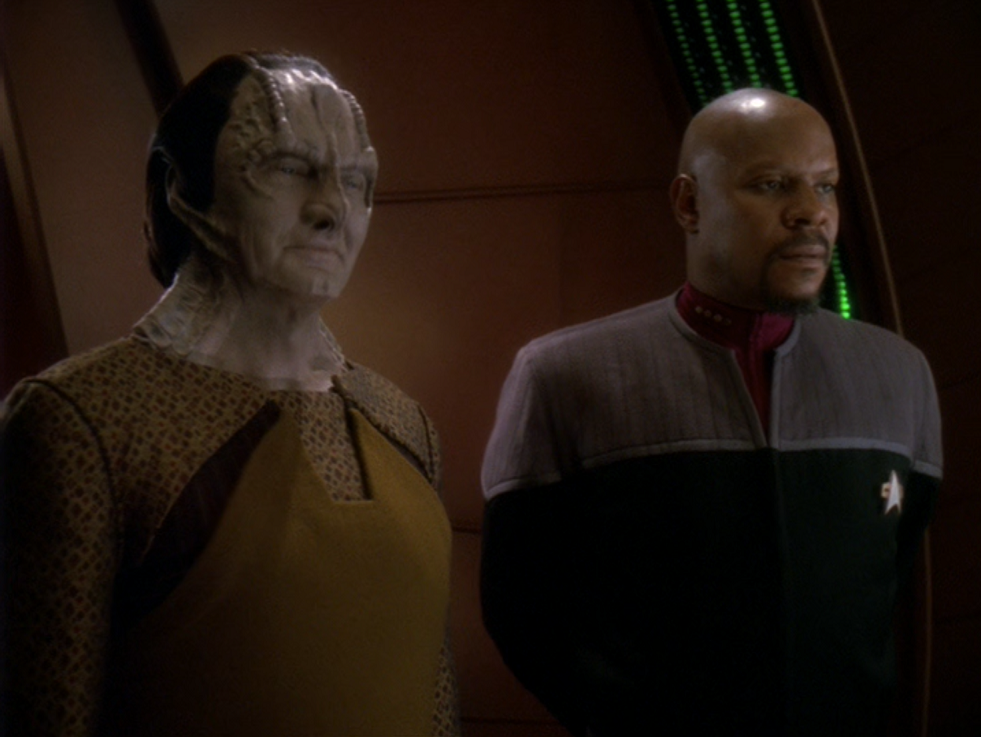
Spoiler Warning: There are spoilers ahead for Star Trek: Picard Seasons 1-3. Spoilers are also present for the following Star Trek productions: The Wrath of Khan, The Next Generation, Deep Space Nine, and Discovery.
For the first time since the beginning of Season 2, I had a genuinely wonderful time with Star Trek: Picard. This week’s episode, Seventeen Seconds, had none of the pacing concerns that were present earlier in the season, and practically every moment was tense, exciting, and thoroughly enjoyable. Season 3 is finally hitting its stride, and if the next seven episodes reach the high bar set by Seventeen Seconds, we’ll be able to consider it a rousing success by the time the curtain falls.
But as the dust settles on Seventeen Seconds, there’s a question burning at the back of my mind that I can’t seem to shake. And here it is: did Picard blow its big reveal too early? I mean, we’re only three episodes into a ten-episode season, and it now feels like we know who the “real” big bad of the season is going to be: the rogue changelings. Should this have been dragged out for another episode or two, perhaps with Worf and Raffi taking longer to figure things out?
Worf was instrumental in finding out what was going on.
So let’s talk about this big revelation, because it’s something that a lot of fans had been wondering about. Pre-season interviews with members of the cast and crew had promised a connection with Deep Space Nine – the one Star Trek show from the ’90s that hasn’t gotten as much attention or love from the modern franchise. This connection came with the inclusion of the changelings, seemingly a rogue faction; an offshoot of the Founders who are bent on causing havoc for Starfleet and the Federation.
This angle is a genuinely interesting one to explore – but it has to be handled delicately in more ways than one! Similar to the Borg, the Founders can be completely overpowered as a faction if the story isn’t well-balanced – and we saw how, in Deep Space Nine, the idea of changeling infiltrators was used sparingly. Too many changelings in too many positions of power will completely throw the story off-balance, and risks making a win for our heroes feel like a bit of a deus ex machina!
Changeling infiltrator Titus Rikka.
Also, a story bringing back the Dominion and the Founders has to be careful not to tread on the toes of the truly wonderful ending to Deep Space Nine. It was incredibly touching to hear Worf speaking so highly of Odo – his friend in the Great Link – especially in light of the sad passing of René Auberjonois in 2019. But a huge part of Odo’s story in that final chapter involved communicating to his people that peace was an option and that the Federation didn’t pose a threat, so undoing that would obviously not be my preference.
And I think that’s where the real genius of this “rogue” faction of Founders could come into play! Rather than saying the Dominion are on the march, what Worf and Raffi have uncovered seems to suggest that only some members of the changeling race are involved – that a schism has been created in the Great Link between followers of Odo’s peaceful path and those who disagreed.
Seventeen Seconds paid homage to Odo.
In short, the line to walk here is a tricky one. It requires the story to keep Odo’s reputation intact, with the touching end to his story not being in any way damaged, undone, or overwritten. But at the same time, it has to find ways to make the rogue Founders engaging and menacing – and to give them motivation for their actions that doesn’t merely boil down to “we’re evil for the sake of it.” On the evidence presented in Seventeen Seconds, there’s reason to hope that the writers and producers have struck the right balance.
Having changelings on the loose also raises the stakes in terms of mystery! We know that Picard isn’t a changeling, and it seems safe to assume that Jack and Dr Crusher aren’t, either. But practically everyone else should fall under some degree of suspicion – and perhaps that could explain why Picard will turn to synthetic beings like Lore and Professor Moriarty: they may be the only ones he can be certain haven’t been replaced by changelings! But we’ll save the speculation for my next theory update.
*ahem*
I’m a huge Deep Space Nine fan – it could well be my favourite Star Trek series, all things considered. So bringing back a major faction from that series is fantastic, and it feels like Picard is leaning into Deep Space Nine in a way that modern Star Trek really hasn’t until now. Sure, there have been appearances in Lower Decks and a couple of obscure references in Discovery… but this feels like our first real opportunity to add some kind of epilogue to the Deep Space Nine story. The inclusion of Worf – who was, of course, a main character in the second half of DS9′s run – means that Picard can make these connections in a way that the series really wouldn’t have been able to before, and I guess my only real concern is that this clear fan-service won’t be too offputting or confusing for people who enjoyed The Next Generation but either haven’t seen Deep Space Nine in a while or who may have skipped it during its original run!
Making content “for fans” always carries this kind of risk. As Trekkies, you and I have almost certainly seen every episode of Deep Space Nine multiple times – even the irredeemably crap ones like Move Along Home. But Picard is trying to appeal not only to Trekkies like us, but to a more casual audience, including people who may not have liked Deep Space Nine or who didn’t stick with it for its entire run. I know several people in my personal life who are in that category – fans of The Next Generation and even of Voyager, but who for whatever reason didn’t stick with Deep Space Nine.
Seventeen Seconds provided just enough of a recap of the events of Deep Space Nine to inform viewers without getting in the way of the story.
In Seventeen Seconds, we got enough exposition and backstory to cover the basics. The show can’t spend all of its runtime bringing viewers up to speed on what happened in 175 episodes of Deep Space Nine, but what it has to do now is convey the basic points so that the story will be understandable for folks who didn’t watch or don’t remember those narrative arcs. Seventeen Seconds got this right, providing enough of an explanation without wasting too much time getting bogged down in it.
Again, Worf was well-used here. He didn’t simply drop heavy-handed exposition, he explained who the Founders were and who this rogue group may be in a brief but informative sequence. This older version of Worf, having had many off-screen experiences over the past thirty-plus years of in-universe time since we last saw him, feels like a mentor or elder statesman – precisely the kind of character to provide this kind of exposition in a way that feels natural. And natural is exactly how it felt!
We got an older, calmer presentation of Worf this week.
Sticking with returning classic characters, pre-season marketing focused on the return of the Enterprise-D’s crew for almost a year… so it’s odd, in a way, that three episodes in we still haven’t seen all of them, and that those we have seen aren’t all working together. Seventeen Seconds gave us Dr Crusher’s first significant on-screen interaction with Picard, and of course we’ve had Picard and Riker teamed up for three episodes now. But Worf is still off in his own little narrative box with Raffi, and there’s no sign of Geordi or Lore. Deanna Troi was briefly seen via a flashback, but again, that was hardly a major appearance.
One of the criticisms fans have made in the years since The Next Generation and its films were on the air is that not every character got enough to do. Everyone got spotlight episodes, of course, but genuine ensemble pieces where everyone made a significant contribution to the story were relatively uncommon, and in some episodes, characters like Dr Crusher would only get a handful of lines. Picard Season 3 was an opportunity to fix that – or at least to give these characters a final mission in which they could all collaborate and work together across a single, ten-episode-long narrative. I’m acutely aware that this is Picard’s final outing, and with basically one-third of the season already over, time is running out to make good on those pre-season promises of major roles for all of the returning characters. I’m hopeful that there will be enough time to have an enjoyable reunion with everyone – but it’s at least worth noting that it hasn’t happened yet!
Geordi still hasn’t made an appearance this season.
Another character who played a big role in pre-season marketing was Amanda Plummer’s Vadic. I said last week that I was a little concerned about Vadic, and how her claim to only be interested in Jack Crusher for the sake of money didn’t really justify her over-the-top presentation. As we learned in Seventeen Seconds, Vadic has at least one changeling ally: the spy embedded aboard the Titan. That ties her in some way to the rogue changelings and their conspiracy – and the portal-weapon that she used was similar (or identical?) to that used against the Federation base at the beginning of the season. But the extent of Vadic’s involvement is still up in the air – and I don’t think we have enough evidence at this stage to say that she is definitely a changeling herself!
In fact, I was struck by Vadic’s absence in Seventeen Seconds. She had a couple of moments in which we saw her happily deploying her portal-weapon, but we didn’t get to spend much time with her at all, which is certainly an interesting decision. As the main named villain of the season so far, I think it’s important to get to see her side of the story – and not merely to hear it second-hand via Worf or some other character. Obviously that doesn’t mean we need to have a lot of scenes with her in every episode, nor that her side of the story needs to be told at such an early stage… but it should happen some time!
Captain Vadic didn’t get much screen time this week.
Since I’ve already mentioned Vadic’s portal-weapon, let’s talk about that for a moment. I… was not blown away by this new piece of tech, to be honest. Don’t get me wrong, it’s far from the worst macguffin that Star Trek has thrown at us, but I felt that there was a considerable disconnect between its visual appearance and the way in which the narrative presented it.
In brief: the way the portals appeared on screen made it look like they should be relatively easy to avoid, even for a starship like the Titan. In this specific case, where Vadic’s goal appeared to be to force the Titan to remain inside the nebula, it makes sense to use a portal in this fashion… but that’s a very niche use case, and the military applications of such a device, especially in three-dimensional battles in outer space, don’t seem readily apparent – which also calls into question parts of Worf and Raffi’s story. It’s a powerful weapon, as we’ve seen, but one that I’d argue has some pretty big limitations.
The Titan encounters a portal.
The portal-weapon is also kind of unoriginal, with similar designs having appeared in everything from hard sci-fi all the way through to the likes of Who Framed Roger Rabbit. The most readily apparent point of comparison is to the video game Portal, which shares a name with this device. Again, I don’t necessarily hate it – and I concede that my criticisms are rather nitpicky – but I really feel a disconnect between the relatively small portals that appeared on screen and the way in which the crew of the Titan seemed to respond to them!
But there may be more to the portal-weapon that is yet to be revealed, and it may have additional uses later in the season. I can certainly see it being a useful tool… perhaps it could be used at the last second to transport characters away from danger, for example. I also suspect that Captain Vadic may meet her end by being spliced through her own portal-weapon! But maybe we should save that for my theory update.
The Titan and a portal aperture.
After a couple of weeks in which Picard looked faded, washed-out, and far too dark, I was pleased to note that this week, Seventeen Seconds only looked far too dark! The problems with colour temperature that had been present in the first two episodes of the season appear to have been fixed, at least on Amazon Prime Video, and I hope that particular issue won’t reoccur. It was a shame that it happened in the first place – and it makes Paramount look pretty unprofessional and incapable, let’s be honest – but at least it has been belatedly repaired.
The darkness issue is still ongoing, though, and this one feels much more like a creative choice. The lights on the Shrike, the Titan, the Eleos, La Sirena and in flashbacks in Guinan’s bar too, were all turned down, and the low brightness is noticeable even when compared to Seasons 1 and 2. With the colour temperature being corrected, there weren’t any scenes this week that I felt were unwatchably dark, or where main events couldn’t be perceived, but there are details in the periphery that I’m sure are functionally invisible as a result of this very deliberate choice of cinematography.
Picard Season 3 is still very dark – even now that the faded, washed-out look has been corrected.
CGI and visual effects were good in Seventeen Seconds, though, and I felt none of the dreaded “uncanny valley” that I flagged up in the season premiere. Whether that’s because there’s been any kind of change in the visual fidelity of Picard or whether I’m just getting reacclimated to the way Paramount and the Star Trek franchise handle their animation and visual effects… well, who can say, really? I’m just satisfied that I’m not being pulled out of the immersion every time the action cuts to the ships in space!
One particular sequence that I’d like to draw your attention to came right at the end of Seventeen Seconds. The moment where the disabled Titan appeared to “fall” – i.e. be dragged – into the nebula’s gravity well was spectacular, and successfully conveyed a sense of helplessness as the ship appears to be headed to its destruction. The effect was akin to a watercraft “sinking” under the surface – and that point of comparison feels apt. It was incredibly well done, and the perfect way to set up a cliffhanger ending.
The Titan falls into a gravity well.
One visual effect that could have been difficult to pull off was that of the changelings in their liquid form. In the 1990s, when Deep Space Nine was on the air, the effect used for Odo and other changelings looked good – by the standards of the time. In 2023, however, that “smooth and shiny” CGI effect is outdated, and the way in which it was brought up to modern spec was solid. The new “changeling goo” feels like a natural progression, and the kind of look that a remastered Deep Space Nine might want to adopt!
There are subtle changes, though. The Deep Space Nine effect was an amber, almost honey colour, whereas the new animation created for Seventeen Seconds had a duller, slightly greyer tone, perhaps closer to an organic compound than anything we’d seen in Deep Space Nine. In addition, the new visual effect feels much more substantial and textured, seeming to flow or ooze in a natural way. I like it, and I think it’s a great update to a classic visual effect!
The updated visual for a changeling in their liquid form.
As mentioned, I feel that the visual effect created for the Shrike’s portal-weapon may have clashed somewhat with the way the weapon was talked about and presented on-screen. But despite that, the effect itself was a clever one, and the way it seemed to unnaturally “bend” the light around it was really neat to see. It reminded me a little of Discovery’s black hole effects in Seasons 1 and 2 – a visual style influenced by the film Interstellar.
The battle sequences between the Shrike and the Titan were great, too, and the technobabble of the nebula “blinding” the Titan’s sensors really amped up the tension. Seventeen Seconds channeled the Battle of the Mutara Nebula from The Wrath of Khan in some of these sequences – but with the addition of forty years’ worth of improvements in visual effects!
The Titan’s crew had to be on lookout duty!
The only thing I’d say about the battle as a negative point is that – to quote Mr Spock from that same film – it “indicates two-dimensional thinking.” The Shrike and the Titan seemed, for the most part, to operate on a two-dimensional plane, not a three-dimensional space, and that was apparent particularly toward the end of the episode as the Shrike was able to “block” the Titan’s escape from the nebula by basically getting in the way. A line or two explaining how the Shrike could accelerate faster than the Titan, or some similar technobabble, could have negated part of this, perhaps.
This was also apparent in the operation of the portal-weapon, at least as presented visually. The relatively small portals opened in front of the Titan, but the ship had multiple routes to avoid it: up, down, left, right, or even simply coming to a halt. Again, this seems to clash with the way the weapon was emphasised in dialogue. Are these nitpicks? Absolutely!
Parts of this battle felt rather “2D.”
It would have been more impactful had we met the Titan’s changeling infiltrator before he was revealed. This anonymous character may go on to be a bigger part of subsequent episodes, but the revelation that there was a spy aboard the ship was blunted, at least a little, by the fact that it was an anonymous “extra” in that role. Had the officer been someone we’d met, even briefly, it would have been more exciting – especially if we’d never suspected that there was anything unusual about him!
This is, I suspect, a consequence of the relatively short ten-episode season. However, I really do believe it would have been worth doing – it’s something that would have turned up the surprise factor in the episode if it had been done well. A short scene or two featuring this character in his role as a Starfleet impostor would have been good enough to achieve this effect.
The changeling spy.
Star Trek has told stories that deal with impostors within Starfleet on many occasions, from episodes like Conspiracy and films like The Undiscovered Country through to the changeling stories in Deep Space Nine like Homefront – and, of course, Discovery’s first season. These stories usually work well and manage to be tense and exciting – but a common hallmark is that we’ve gotten to know the impostor or impostors, at least a little, before the truth of who they are is revealed. In fact, I’d argue that this is a big part of the way this narrative framework is intended to operate; it’s nowhere near as satisfying to say “there’s a spy in our midst!” and then reveal that the spy is just some anonymous background character that we’ve never met.
Look at how well the Michael Eddington story worked in Deep Space Nine, because that’s probably the best example of this kind of storyline in the Star Trek franchise. We got to know Eddington over the course of half a dozen episodes prior to his big reveal, so when he turned out to be a Maquis operative, it was a heck of a shock! The way the changeling infiltration storyline unfolded in Seventeen Seconds worked well, and there was some clever direction and editing to have Worf and Raffi’s uncovering of the plot followed up immediately by Jack’s confrontation with the changeling… but the sequence overall could have been improved, in my view anyway, if we’d met this spy ahead of time.
Michael Eddington was a Maquis infiltrator/rogue Starfleet officer in Deep Space Nine.
When the Titan’s science officer repeated multiple times that the nebula the ship was trapped in was behaving abnormally, my first thought was simply this: I sincerely hope that the story isn’t going to say that this whole thing is one elaborate trap! It’s too much of a contrivance to say that Vadic was purposefully trying to trap Picard and the Titan in the Rykon system given the difficulty involved in getting there and the seemingly obscure location of this nebula.
On the other hand, the fact that this isn’t a normal nebula – and could even be “life, Jim, but not as we know it” – could open up some genuinely interesting story ideas! I feel certain that the “organic” elements of the nebula wouldn’t have been emphasised so prominently were they not going to be significant to the plot later on – but how, exactly, is shrouded in mystery right now.
What’s going on with this nebula?
There were two conflicts central to the character stories present in Seventeen Seconds: one between Picard and Dr Crusher and a second between Picard and Riker. We’ll talk about each in turn, but I think that both worked well in the context of the story.
It was interesting to see Picard and Dr Crusher having this deep and intense conversation about their son – and before we get into specifics, there’s one thing that jumped out at me. Here we have two older characters engaged in what is typically a storyline we’d associate with younger characters: pregnancy, paternity, and raising a child. It wasn’t lost on me that Sir Patrick Stewart is now in his 80s and that Gates McFadden is in her 70s, yet here they were having a discussion that would suit characters a generation younger!
Picard and Dr Crusher had a difficult conversation.
One of the themes that we’ve started to see in Picard’s third season is that of age – something that was also present in The Wrath of Khan, which serves as part of the season’s inspiration. Entering retirement, leaving friends and colleagues behind, and coming to terms with changes to both oneself and the wider world have all been touched upon – though not to quite the extent I’d been expecting, perhaps.
But this storyline – and especially Picard’s conversation with Dr Crusher – felt like it rolled back the years for both of them significantly. The intense discussion of whether Dr Crusher should have told Picard about her pregnancy is something we might’ve expected from far younger characters, so to see it handled – and handled so well – in Seventeen Seconds was great. It completely twisted the expected theme of age, and arguably also reinforces the notion that, in Star Trek’s advanced and optimistic future, humans can live longer, healthier, and more active lives.
Dr Crusher had a child later in life.
There was also a moment in the turbolift after Jack’s injury – the titular “seventeen-second” ride that Riker had talked about in a flashback sequence – in which Picard felt very much the new father, which again gives his story a far more youthful edge than I’d been expecting. Although the focus was on Jack’s injury and survival, those seconds with Picard in the turbolift felt akin to watching an anxious soon-to-be dad in the delivery room, waiting on the birth of his son.
There was deliberate symmetry to the turbolift ride that cut through the Picard-Riker fight, and perhaps has set the stage for their potential reconciliation next week. It’s also noteworthy that Riker was hardly youthful when he became a father – and as someone whose parents were older when I was a child, I appreciate that Star Trek is putting older characters into this position. Not every child is born to young parents – increasingly so, in some communities and cultures – and while many television shows and films do a wonderful job of highlighting the particular problems and issues facing teen parents, for example, it’s actually really nice – and dare I say a little cathartic, personally speaking – to see Star Trek acknowledging that some people become parents later in life. That wasn’t the main focus of Seventeen Seconds in any way, but it’s something that I personally can take away from the story.
Picard’s turbolift ride echoed Riker’s.
Before we get into the weeds too much, let me just say this: I suspect that the decision to pit Picard against both Dr Crusher and Riker in the same episode may not go down well with every fan! Part of the appeal of Picard Season 3 was in reuniting the cast of The Next Generation, and while the characters had disagreements during that show’s run, by and large they were on great terms. Some might say their friendships were a little too perfect, which is why Deep Space Nine and Voyager tried to insert more disputes between characters, and created characters from different backgrounds who had conflicting motivations.
But if the draw of an Enterprise-D reunion was bringing people back together for one last adventure, there’s a danger that these kinds of conflicts – especially if they drag on for multiple episodes – could detract from that, and I understand that argument even if I’m not personally fully signed-up with it. I hope that both conflicts will come to a satisfying conclusion, and that in fairly short order we can see Picard and his crew back on friendly terms – after all, that is a big part of what made this season interesting as a concept in the first place!
Picard and Riker on the bridge of the Titan.
My take on the first conflict is this: Dr Crusher is both correct in her belief that the son of Jean-Luc Picard would be in danger, while also being horribly inept when it comes to keep him “safe.” By leaving Starfleet and the Federation behind to go on a twenty-year unsanctioned medical mission, Dr Crusher has placed Jack in at least as much danger – if not more – than she ever would have if she’d remained in Starfleet. And that’s where this argument and this whole storyline could come unstuck.
Based on everything we know about Starfleet and the Federation, it’s generally a very safe environment. I could absolutely entertain the idea that Dr Crusher would feel a need to resign her commission in order to dedicate herself to raising Jack full-time… but the idea that she felt she had to do so beyond the borders of the Federation, in what is clearly a very complex and dangerous galaxy, risks undermining this aspect of the story. At best I guess we’ll have to call it a contrivance, something necessary to drive this part of the plot forward. At worst… well, it makes Dr Crusher look like a bit of an idiot. A dangerous idiot.
Did Dr Crusher get it wrong? Or are her reasons understandable?
This side of the story also feels as if it’s chafing uncomfortably against a massive part of the main plot from Season 2 – which was on our screens less than a year ago. The entire reason for the Confederation timeline, the mission back in time, and Q’s scheme was, at least as Q explained it, because Picard himself had been unable to let go of childhood trauma enough to settle down in a relationship. We’ve learned in Seventeen Seconds that he and Dr Crusher were once again pursuing a romantic relationship in the months or years after Nemesis, and Picard even stated that he would have been willing to be a husband and father, and that his reasons for not fully committing to Beverly were more to do with Jack Crusher Senior – his deceased best friend.
The story of Season 2 was already a terribly convoluted one that was on shaky ground, so anything that undermines it is a problem. And unfortunately, there’s no escaping the fact that parts of this storyline, as presented in Seventeen Seconds at least, are in that position. The writers tried to throw a bone to this, with Picard making an oblique reference to last season’s events, but that didn’t really go far enough and certainly hasn’t saved this aspect of the story.
Picard’s complicated romantic history with Dr Crusher treads on the toes of last season’s story.
We’ll have to go into more detail about this on another occasion – perhaps after having seen the entirety of Season 3 – but there are actually quite a few areas where these two productions seem to grate against one another. What’s so surprising about that, of course, is that Seasons 2 and 3 went into production back-to-back, with the same production team and showrunner present for both. I’m not saying I wanted or expected Seasons 2 and 3 to form a single ongoing story – though they certainly could have if a suitable story had been written – but it feels odd to see so many small and large points of conflict.
But we’re drifting off-topic! Picard’s second conflict was with Riker, and while the two men seemed to work together seamlessly at first, a radical difference in approach became apparent as the episode wore on.
Picard and Riker had different ideas about how to tackle Vadic and the Shrike.
So there’s a dichotomy here for me. On the one hand, I don’t particularly dislike this idea, and I feel that Seventeen Seconds handled it well. The conflict felt organic and natural, and it was presented as exactly what it was: a genuine difference of opinion and approach. The episode didn’t frame either Picard or Riker as being right or wrong, and there are interpretations as to how to approach a battle of this nature.
But on the other hand… the more I think about it, I can’t escape a simple reality: pitting Picard and Riker against one another would not be my choice, if for no other reason than the story, at least at this point, doesn’t seem to need it. I’ve spoken about this before, particularly in relation to Discovery, but it feels as if this extra element of drama has been concocted and then forced into a story that was already so tense and dramatic that it didn’t need it. Picard, Riker, and the rest of the crew of the Titan were already in a life-or-death, impossibly high-stakes confrontation, so throwing in a personal spat between two main characters didn’t really ramp that up; the tension and drama were already turned all the way up to eleven.
I think a lot of people were surprised by this conflict…
That being said, I have a theory about Riker that, were it to pan out, would completely explain this and basically negate all of those points of criticism. Even if my theory is wrong, the disagreement may end up resolved within the next episode, and that would set the season back on what feels like the “right” path: the path where these characters get back together for one final mission.
Just because I wouldn’t have chosen to tell a story in which Picard and Riker find themselves at loggerheads doesn’t mean that it didn’t work well in Seventeen Seconds, and the way in which their disagreement was built up and then spilled over into argument was well handled. By the time Riker banished Picard from the bridge, we had a solid understanding of both men’s positions and perspectives – and under the circumstances, that’s the most we could have asked from this storyline!
Riker at the end of the episode.
So let’s wrap things up!
Seventeen Seconds was a tense, exciting, and thoroughly enjoyable ride from start to finish, and probably the best episode of Picard since the Season 2 premiere last year. There are nitpicks, as there almost always are, but they melt away when confronted with such an outstanding episode of television.
I’d felt that Season 3 had gotten off to a slow start, but the pacing this week felt perfect. There were no truncated or cut-down moments, and practically everyone got something significant to do. All in all, a great episode!
A few scattered final thoughts:
I liked the interaction between Seven and Ensign La Forge, showing how Seven has won respect and friendship from her colleagues, even if she doesn’t get it from Captain Shaw. After the “deadnaming” over the past couple of episodes, it was great to see La Forge call her “Seven!”
Captain Shaw is injured – but not dead! Will he remain in sickbay for the next few episodes… or will he come roaring back, take command of the ship back from Riker, and find a way out of the nebula?
Surely we’ve gotta see Geordi and Troi next week, right?
Worf and Raffi were able to track their target pretty easily… is that because of Worf’s skill, or because the story has its focus elsewhere?
With the Titan disabled, why did Vadic abandon her pursuit? Is capturing Jack no longer her objective?
Time is a bit of an issue: Dr Crusher says she found out about her pregnancy shortly after she last saw Picard – circa twenty years ago. And I don’t mean to be unkind, but actor Ed Speleers, who plays Jack, is clearly not twenty. A poor casting choice, or are we okay with giving a bit of “soap opera ageing” flexibility here?
Star Trek: Picard Seasons 1-3 are available to stream now on Paramount+ in the United States and other countries and territories where the service is available, and on Amazon Prime Video in the UK and around the world. The Star Trek franchise – including Picard and all other properties discussed above – is the copyright of Paramount Global. This article contains the thoughts and opinions of one person only and is not intended to cause any offence.
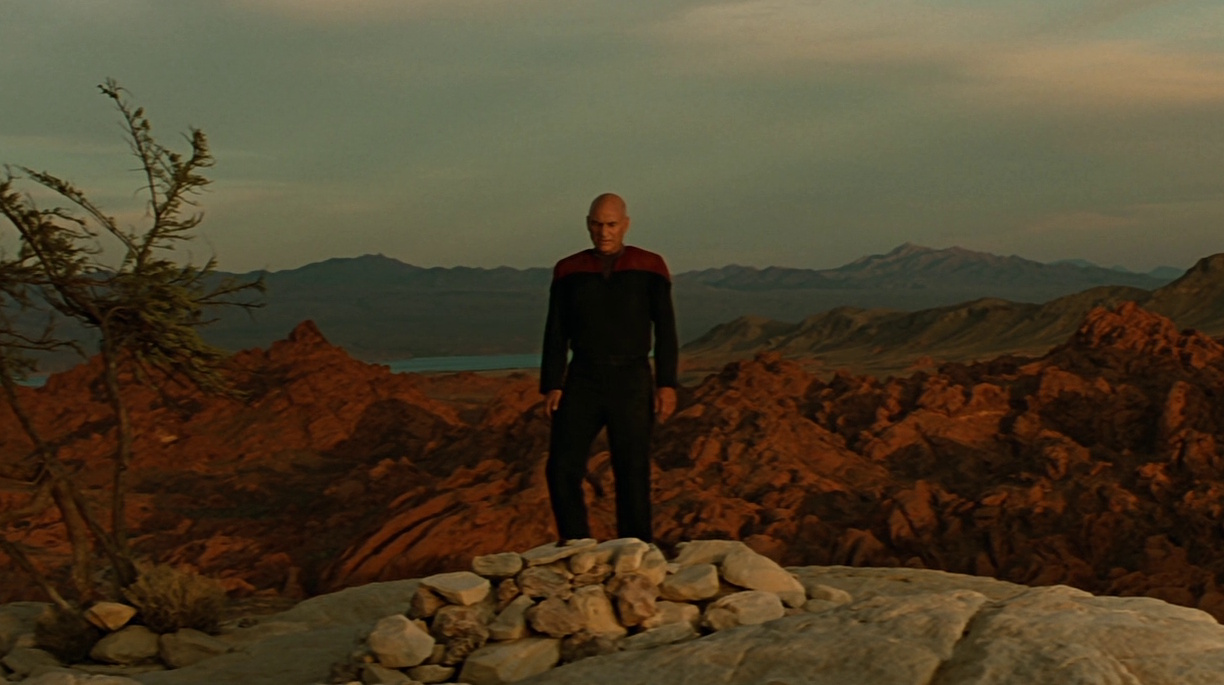
Spoiler Warning: There are spoilers ahead for Star Trek: Picard Seasons 1-3. Spoilers are also present for the following Star Trek productions: The Wrath of Khan, The Next Generation, Insurrection, Deep Space Nine, and Voyager.
Disengage was a solid episode – or rather, I hope that’s what I’ll think of it when the season is over! I have a specific concern about Captain Vadic that we’ll talk about in a moment, but other than that my biggest criticism of the episode was its faded, washed-out, unnecessarily dark visual presentation. Perhaps it looked okay on a fancy OLED television set, but for the rest of us? Let’s just say that I hope Paramount can tweak the visuals going forward.
In terms of our ongoing Season 3 theory list, Disengage certainly shook things up! The episode has given me several ideas for brand-new theories, outright confirmed two theories from last time, and has led me to retire one theory, too. That’s in addition to adding new elements into the mix that may have increased the likelihood of some theories panning out… and massively decreased the chances for several others!
Picard and Riker in this week’s episode.
Be sure to check out my review of Disengage if you haven’t already, as I go into more detail about some of the story points, as well as talk about some elements of the episode that I felt worked well – and a few things that I felt needed a bit more time in the spotlight. Literally as well as metaphorically, in this case!
This week, we have two confirmed theories and one theory that I’m choosing to retire. While not outright “debunked” by the events of Disengage, it feels as if the story is almost certainly moving in a different direction, so I’m striking it from the list. We’ll take a look at those first before we jump into the main theory list.
Retired theory: The crew of the Titan will mutiny against Captain Shaw.
The USS Titan.
I came up with this idea last week based on a couple of presuppositions. The first was that the command structure of the Titan would feel too complicated, narratively speaking, if Admiral Picard, Commodore La Forge, Captain Riker, Captain Worf and Captain Shaw all had to coexist on the bridge. And secondly, Shaw’s own abrasive, unpleasant personality.
When faced with a potential choice between following Picard and Shaw, I wondered whether the Titan’s crew might’ve chosen the former, mutinying against their captain. But Shaw’s actions in Disengage seem to have softened him, at least a little, and at the end of the episode he – albeit somewhat begrudgingly – ended up doing the right thing. There will still be clashes with Picard and the crew ahead, no doubt, but I no longer see a mutiny like this befalling the captain of the Titan.
Confirmed theory #1: Picard is the father of Jack Crusher.
Dr Crusher wordlessly confirmed this revelation to Picard.
Although it took him the whole episode to come to terms with this revelation, Disengage confirmed what a lot of us had already sussed out: that Picard is Jack’s father. The details of how that came to happen are still up in the air – and we’ll look at one possibility in a moment – but for now, we can chalk up our second theory win of the season!
This is definitely an interesting storyline, one that has the potential to really shake things up as the season rolls on. The ramifications for Picard, Dr Crusher, Jack and the rest of the crew will be significant!
Confirmed theory #2: Worf is Raffi’s “handler.”
This one seemed pretty obvious, especially when Raffi’s nameless handler started using words like “warrior,” but there was always the possibility that the story could have thrown another character into the mix. I suspect there may be a reason why Worf was kept hidden last week, and why his messages to Raffi were conveyed by text and a digital voice… but we’ll look at that in a moment.
I’d have liked to have spent a little more time with Worf in Disengage – his appearance in the episode was brief. But there will be time in the episodes ahead to rectify that!
So those theories were confirmed!
Two episodes down and we’ve already claimed three theory victories! Surely that can’t last… especially given how outlandish (and contradictory) some of the others on the list are!
Up next, we’ll take a look at the main theory list, beginning with brand-new theories and theories which moved significantly as a result of the events that unfolded in Disengage.
Theory #1: Vadic is not the real “big bad” of the season.
Who else could it be?
One thing that put me off Vadic in Disengage was the apparent disconnect between her over-the-top presentation and her seemingly banal motivation: money. One thing that isn’t clear at this stage, though, is who may have placed such a large bounty on Jack Crusher’s head – and if this theory is correct, it will be that individual who will turn out to be the true villainous mastermind of Season 3.
Think about it: Vadic is a bounty hunter, and she claims that her interest in Jack Crusher is purely financial. So someone else is bankrolling her – and potentially providing her and her crew with the weapons and supplies that they have, or at least paying for those supplies. Can it be a coincidence that Jack Crusher – the son of Jean-Luc Picard and Beverly Crusher – is this person’s most-wanted target?
Theory #2: Vadic has a hidden reason for chasing Dr Crusher.
Vadic lighting a cigarette.
This idea could be connected to the theory above, and it certainly comes from the same starting point. Not only did Vadic seem incredibly over-the-top for someone solely motivated by money, but in pre-season trailers we heard her talking about “vengeance.” Is she seeking revenge on Picard, Jack, and Dr Crusher personally – or the wider Federation?
In either case, this speaks to an additional, hidden motivation that hasn’t been revealed thus far. If Vadic is also the terrorist responsible for the attack on the Federation facility that Raffi and Worf were investigating, that also raises the question of why she’d do such a thing. Even if her interest in Jack is financial, the attack on the Federation base clearly wasn’t motivated by money.
In short, I think we’ve only scratched the surface with Vadic!
Theory #3: Not all of Raffi’s messages were from Worf.
Was Raffi always talking to Worf?
There was a good narrative reason to keep Worf hidden until the end of Disengage: it made his last-minute appearance to save Raffi all the more dramatic. But could there be another reason why his messages came through in the form of text with a disembodied digital voice?
Raffi wasn’t able to prevent the attack on the Federation facility, having spent a long time chasing leads in the underworld. But could someone have been feeding her false information to throw her off? This could tie into the idea of not being able to trust anyone in Starfleet that Dr Crusher warned us about – perhaps this conspiracy runs very deep indeed!
Theory #4: Jack was conceived during the events of Star Trek: Insurrection.
Picard in Insurrection.
At some point in the last… thirty-ish(?) years, Dr Crusher and Captain Picard hooked up. They did the nasty. They bumped uglies. She gave him his tea, earl grey… hot. That’s a disturbing mental picture for someone who’s asexual, but it raises a pertinent question: when did this smooshing together of genitals take place?
If we’re assuming that Picard Season 3 takes place in the early 25th Century, perhaps a year or so after the events of the Season 2 finale, that potentially places Jack’s conception in the early or mid 2370s – during Picard’s captaincy of the Enterprise-E. One event in that time period sticks out when it comes to thinking about one-night stands and sexual encounters: the Enterprise-E’s mission to the Ba’ku planet – a planet with strange age-defying radiation that caused the crew to regress somewhat and behave like teenagers. Could the metaphasic radiation of the Ba’ku planet have played a role in Jack’s conception? If so, how did Dr Crusher keep that a secret while continuing to serve on the ship? There are questions… but you have to admit, the timing seems right!
Theory #5: Someone in Starfleet is working with Vadic.
It wouldn’t be the first time…
Connected to the theory above about Vadic having a paymaster, I wonder if Dr Crusher’s belief in a conspiracy within Starfleet could turn out to be correct. If so, perhaps a shady “badmiral” is actually Vadic’s boss, the person directing her to target Jack and presumably Picard, too.
If so, it would be a much more impactful storyline, at least in some respects, if this were a character we’d met before! Even if that isn’t the case, though, there’s still the possibility that Vadic is getting her information about the likes of Captain Shaw and Picard from a contact or ally within Starfleet itself.
Theory #6: Jack Crusher is connected to Vadic… somehow.
Jack in Disengage.
I originally proposed this theory last week, speculating that if Picard isn’t Jack’s father, someone on Vadic’s crew might be – or he might be a relative of hers. That didn’t pan out, but there still exists the possibility of a connection between the two. It would explain Vadic’s single-mindedness in chasing him down over a period of weeks or months.
This could be as simple as Jack having stolen from Vadic… but I wonder if such a connection may go deeper. Jack has clearly done bad, criminal things over the course of his life… could his criminal behaviour have brought him alongside, or into conflict with, someone like Vadic? Perhaps he’s responsible for killing someone she cared about – or not saving someone in time.
Theory #7: Captain Vadic once served under Picard’s command.
Captain Vadic.
I’m keeping this one on the list for now, as Vadic’s true motive seems to be obscured. But it now comes with the major caveat that neither Picard, Riker, nor anyone else seemed to recognise her either by appearance or by name. That’s definitely a mark against this theory… but as Picard had more than 1,000 people just aboard the Enterprise-D, it’s not impossible to think he would forget a few faces over the years!
In short, Picard has no shortage of “victims” from his tenures in command of the Stargazer, the Enterprise-D, Enterprise-E, and the Romulan rescue fleet. Perhaps Captain Vadic was one such officer, and she may hold Picard responsible for being assimilated by the Borg, or otherwise injured in the line of duty.
Theory #8: Vadic is a Founder.
One of the Founders in Deep Space Nine.
I don’t think Disengage moved the needle on this one particularly, except to say that Vadic doesn’t really have the calmness we’ve come to expect from the Founders of the Dominion, seeming to be a lot more chaotic. However, her being a Founder would potentially explain how she and some of her crew were able to resemble different alien races in their pursuit of the Crushers.
We’ve been promised some kind of connection to Deep Space Nine this season, so I can’t help but wonder if the villain of the piece could be a changeling. If the Dominion and their shape-shifting Founders are on the march once more, that could explain why Picard wouldn’t know who to trust – as we saw in Deep Space Nine, changelings were able to infiltrate Starfleet, the Klingon Empire, and the Tal Shiar, replacing a handful of well-placed leaders as part of a plan to destabilise the major factions of the Alpha Quadrant.
Theory #9: Captain Vadic and her crew are hosts for the parasite-aliens first encountered in the episode Conspiracy.
One of the parasite-aliens.
This one is quite “out there,” and I freely admit that! It would be a very bold (i.e. odd) decision for Star Trek to return to the plot of Conspiracy, as it’s hardly one of the best-remembered episodes of The Next Generation. But something about the idea of being unsure of who to trust within Starfleet, having to turn to old friends for help, and the possibility of a conspiracy that could be targeting the Federation all flagged up the plot of Conspiracy for me… so it would be unwise to entirely rule it out!
The end of the episode seemed to suggest that the parasite-aliens had been able to send a message into deep space, hinting at a possible return one day. Could that day finally have arrived?
Theory #10: A few other Vadic origin theories.
The Eleos and the Shrike.
I put together a list back in November about who Vadic may be and what kind of connection she could have to Picard. The three possibilities above seem like the most plausible to me, but I’ll briefly summarise the others here:
An ex-Borg, either someone who was assimilated while serving under Picard’s command, or perhaps someone from the Artifact in Season 1,
An augment, potentially tied to Season 2’s Adam Soong or even Khan himself,
A Romulan or ally of the Romulans, with a potential tie to Sela,
A member of Insurrection’s Son’a,
A devotee of the super-synths from Season 1.
Theory #11: Captain Shaw lost someone to the Borg.
The Battle of Sector 001.
Vadic alluded to Captain Shaw’s psychological profile in Disengage, and seemed to suggest that he may have been unwell at some point in his career. This could tie into Shaw’s anti-Borg attitude, which he has mistakenly directed at Seven of Nine and Picard.
In short, Captain Shaw seems old enough to have been serving in Starfleet during at least one of the Borg incursions of the 24th Century, and he may have lost someone – a spouse or close relative, perhaps – during one of those battles. That could explain both Vadic’s comment and his barely-disguised antipathy toward Picard and Seven.
So those theories are new or moved significantly this week.
As always, for the sake of keeping everything in one place, I’ll now run through the rest of the theory list. The fact that certain characters, factions, etc. didn’t appear in Disengage could mean that some or all of these are now a lot less likely… but I’m content to keep them on the list at least for now!
Theory #12: Someone on Picard’s crew will turn out to be an imposter.
The crew of The Next Generation Season 2.
Two lines that we first heard in pre-season trailers leapt out at me: Dr Crusher warning Picard to “trust no one,” and her son asking Picard whether anyone he knew “is still the person [he] knew.” These lines could hint at someone having infiltrated the crew, potentially replacing or brainwashing them.
Additionally, it’s possible that someone on the crew is who they appear to be – but is secretly working for Captain Vadic and/or some other villain. We saw this with Dr Jurati in Season 1, so it wouldn’t be a wholly original story beat. But it would fit in with the idea of Picard not knowing who to trust.
Theory #13: Picard and his crew will reactivate Lore and Professor Moriarty.
Lore is coming back…
Although it seemed at first as though Lore and Professor Moriarty might be on Captain Vadic’s team, the final trailer for Season 3 was cut together in such a way as to suggest that it might be Picard and his crew that are responsible for re-awakening them. I have an idea as to why that might be the case (and we’ll take a look at that in a moment), but for now let’s just say that it seems possible that the story will go down this road.
Last time we saw both Lore and Professor Moriarty, neither posed a threat. Lore had been fully shut down, and Moriarty had been trapped in a holographic storage module, believing himself to be free to explore the galaxy. How either of them could come back is an open question – but they are coming back in some form!
Theory #14: Picard and his crew need to find synthetic allies/crewmates.
Professor Moriarty.
Connected to the theory above is the idea that, for some reason, Picard and the crew will not be able to trust or rely on almost any organic. Not knowing who to trust – perhaps because something is going on that only affects organic minds – could explain why they chose to reactivate both Lore and Professor Moriarty: they might be immune to whatever’s happening.
I don’t think it can be a coincidence that Lore and Professor Moriarty are involved. Both are sentient artificial life-forms, so surely that connection has to be relevant!
If this theory is even close to being true, though, it would raise an interesting question: why didn’t Picard also turn to Soji for help?
Theory #15: Captain Vadic has put together a “rogues’ gallery” of Star Trek villains.
Captain Vadic with a couple of her allies.
When we first met Captain Vadic and learned that both Lore and Professor Moriarty would be returning, I speculated that the villain of Season 3 might have put together a crew comprised of past Star Trek villains and adversaries. There’s no shortage of baddies who might want to seek revenge on Picard, the crew of the Enterprise-D, and the Federation as a whole.
The crew of Vadic’s ship – the Shrike – have their faces concealed by bird-like masks… and I can’t help but wonder if there’s a reason why these characters can’t be seen or even heard. It seems at least possible that some of Vadic’s crewmates and allies could be characters that we’ve met in past iterations of the Star Trek franchise.
I suggested the likes of DaiMon Bok, Sela, and even Nicholas Locarno as possible candidates – and you can find a longer list by clicking or tapping here.
Theory #16: At least one main character will be killed.
A Starfleet coffin, adorned with the flag of the Federation.
It feels like a solid possibility that at least one main character won’t make it to the end of the season. Television storytelling has changed a lot since The Next Generation premiered, and even main characters can no longer consider themselves to be safe if they wind up in dangerous situations!
It would be a challenge to kill off a legacy character in a way that would be satisfying and would feel right – but it would be incredibly bold, and if such a story beat stuck the landing, it could succeed at either setting up the story or paying off a season-long character arc.
The Borg have already been seen in Star Trek: Picard…
Several moments in the season premiere referenced or called back to the Borg – and while we know that Captain Vadic is set to star as an antagonist, there’s still the possibility of Borg involvement in some shape or form. First of all, Dr Crusher was reviewing one of Picard’s logs from his first engagement with the Borg in The Best of Both Worlds. Secondly, Riker referenced Picard’s assimilation experience, and used what he remembered from rescuing him from the Borg in that same episode to decode part of Dr Crusher’s message – something Picard wouldn’t have been able to do on his own as he wasn’t privy to that information at the time. Finally, Captain Shaw seems to have a major chip on his shoulder about the Borg, talking down to both Seven and Picard about their status as ex-Borg.
These could be nothing more than references – little callbacks to Star Trek’s past that are there to tie the events of this story into the franchise’s past. And that’s totally okay if that turns out to be the case! But it’s at least possible, in my view, that some greater Borg connection is going to be revealed. Remember, Season 2 introduced us to a new Borg faction… and the mysterious anomaly that they were intent on stopping is still unexplained.
Theory #18: The super-synths are involved.
The super-synths’ mechanical noodles.
This theory would tie together the events of Seasons 1 and 2 with Season 3. In short, I’ve suggested that Captain Vadic may be a devotee of the super-synths – the “alliance of synthetic life” outside of the Milky Way galaxy who left the beacon on Aia and kicked off the plot of Season 1. To add to this theory, I posited that the mysterious anomaly in Season 2 was also a super-synth creation, perhaps one designed to attack the Federation or to open up a gateway.
If Captain Vadic had encountered the beacon on Aia (or another similar beacon elsewhere), it could have driven her mad, as we saw it do to Zhat Vash initiates in Season 1. If Vadic became obsessed with the super-synths, instead of becoming obsessed with stopping them, she might blame Picard for preventing their arrival. Furthermore, she might be trying to open a new portal for them, and that could be what Picard and the crew need to stop.
Theory #19: Several members of La Sirena’s crew have joined Captain Vadic.
La Sirena in the season premiere.
Although we’ve had it confirmed that most of the actors from Seasons 1 and 2 won’t be reprising their roles this time around, when I saw the masked crew of the Shrike I couldn’t help but wonder… could some of these people be Picard’s friends? Could that explain why Dr Crusher warned Picard to “trust no one” and simultaneously explain their absences?
It would be a stunning revelation indeed if, when the masks are inevitably removed, Picard and the crew find themselves confronting the likes of Soji and Elnor. Maybe this one is a no-hoper because of what we’ve been told by the actors involved… but you never know!
Theory #20: There will be at least one unannounced character returning!
Could it be Miles O’Brien?
There have been theories and guesses from Trekkies for basically a whole year about which other characters from The Next Generation era could appear in Season 3. I don’t claim to know who might be included – but it feels like a pretty solid guess to say that someone from The Next Generation, Deep Space Nine, and/or Voyager will put in an appearance.
This could be a simple cameo, or an appearance similar to those seen in episodes like Encounter at Farpoint and Caretaker. Or there could be a real hidden surprise, with a character basically joining Picard’s mission. We didn’t really know the extent of Seven of Nine’s involvement in Season 1 until it happened, nor the extent of Brent Spiner’s roles in Seasons 1 and 2… so there’s at least the possibility of some kind of big surprise!
Theory #21: Captain Shaw will be killed.
Captain Liam Shaw.
I half-expected Captain Shaw to meet his demise in the season premiere – but it didn’t happen! With Seven of Nine having disobeyed orders, and the Titan now outside of Federation space with an imposing enemy vessel close by, that could still happen – and soon! But it’s also worth noting that Captain Shaw appears to be a more nuanced and potentially complex character than I’d initially expected. His anti-Borg prejudice is just one aspect of his characterisation, and this by-the-book, rather acerbic captain may have a bigger role to play than I thought at first.
Regardless, if for no other reason than pure practicality, I think he has to be gotten rid of… right? How can the Titan operate with a disloyal first officer, an ex-Admiral, and at least one other captain on board? From a story perspective it just seems cluttered, and while I hope we learn more about Captain Shaw and his past, I still don’t see him making it all the way to the end of the season.
Theory #22: The absences of characters from Seasons 1 and 2 will be explained.
Soji in Season 2.
I was pleasantly surprised to see Laris was included in The Next Generation, and while she won’t have a big role in the story of the season, it was great that the story didn’t just dump her as it raced ahead. Due to her importance to the story of Season 2, Laris was perhaps the character who I felt it was most important to include in some way, and I’m glad we got to see her.
But there are still several characters from Seasons 1 and 2 who haven’t been mentioned. Elnor and Soji could easily be name-dropped; a line or two of dialogue could clear up where they are, what they’re doing, and why they can’t join Picard on his current mission. The Borg Queen-Dr Jurati hybrid is a bit more complicated; her self-appointed role as “guardian” of the mysterious anomaly makes it a bit harder to just wave away her disappearance.
I hope we’ll get something that will acknowledge these characters’ absences. All were important in the first two seasons of the show, and simply abandoning them without any kind of goodbye was disappointing at the end of Season 2. If Season 3 could do something to rectify that, I’d appreciate it!
Theory #23: A spin-off will be announced.
Alex Kurtzman is in charge of the Star Trek franchise for Paramount.
This one is just as much a hope as it is a theory, but it would be fantastic if a spin-off from Picard were to be announced before the season ends. At present, no new Star Trek projects are in production, and with Season 3 being Picard’s last, it seems like there could be an opening!
A Star Trek show set in this early 25th Century time period could pick up story threads from The Next Generation, Deep Space Nine, Voyager, or even Lower Decks and Prodigy, so there’s a lot of potential. A direct spin-off could follow Captain Shaw on the Titan, or Seven of Nine and Raffi, or could even bring back Elnor at Starfleet Academy. With the introduction of new characters in the La Forge family, one or both of them could also take a leading role in a new Star Trek production.
As I’ve said on more than one occasion, this era is where I’d love Star Trek to stay. It feels like there’s so much untapped potential in this time period, with many Trekkies wanting to return to characters, settings, and storylines from Star Trek’s “golden age.” I put together ten of my own 25th Century series concepts, and you can find that list by clicking or tapping here.
So that’s it!
The Shrike can use its tractor beam as a weapon…
Despite a retirement and two confirmations, the theory list continues to grow. I suspect we’ll start to see some debunkings soon, as the story really gets going. So far, it feels as if we’ve only just moved off the starting line – so there are eight episodes to go to really whittle down the theory list! Picard continues to lend itself to this kind of theory-crafting, and it’s fun to try to predict what may or may not be coming.
As a final note: I always like to end these theory lists by saying that I do this just for fun. I enjoy writing, I enjoy Star Trek, and spending more time in this world is an escape and an enjoyable distraction for me. But for some folks, fan theories can become frustrating or unenjoyable, especially if they get very attached to a plausible-sounding theory that ultimately doesn’t pan out. I have no “insider information” and I’m not trying to claim that anything suggested above can, will, or must be part of Picard Season 3. I fully expect many of these theories to be debunked and for the season to go in wildly unpredictable directions!
Star Trek: Picard Seasons 1-3 are available to stream now on Paramount+ in the United States and other countries and territories where the service is available, and on Amazon Prime Video in the UK and around the world. The Star Trek franchise – including Picard and all other properties discussed above – is the copyright of Paramount Global. This article contains the thoughts and opinions of one person only and is not intended to cause any offence.
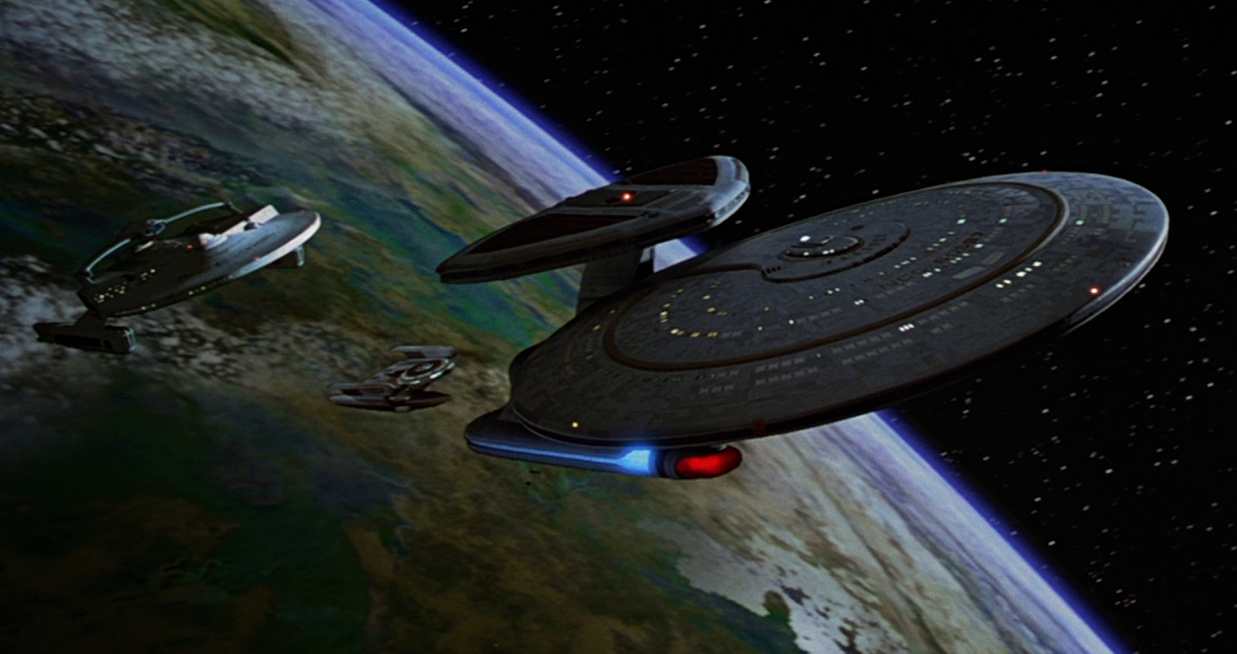
Spoiler Warning: There are spoilers ahead for Star Trek: Picard Seasons 1-3. Spoilers are also present for the following Star Trek productions: The Wrath of Khan, The Search for Spock, The Undiscovered Country, The Next Generation, Deep Space Nine, and Voyager.
If you read my review of the season premiere last week, there’s almost no need to read this! In short, many of the points I made last time are the same this time: Disengage was an episode with the same contradictory feel as The Next Generation, one in which the main storyline seemed to edge along at a very slow pace while several story beats rushed past too quickly, or else didn’t get enough time dedicated to them.
And those story beats are more or less the same ones as last time, too: Raffi’s undercover mission seemed to race by, some of the scenes between Picard and Jack could have been extended, Riker didn’t get a lot of time to shine, and even the intrigue on the Titan with Captain Shaw and Seven didn’t get a lot of time in the spotlight. As I said last week, it’s a story with a contradictory feel.
The Shrike looms over the Eleos.
Let’s talk visuals. Both last week and this week, Picard looked incredibly washed-out and faded on my 4K HDR display. I tried adjusting my screen manually, but I could either get the default faded, washed-out look or I could get a horribly over-corrected, over-saturated look. Neither is right or natural, and the colour temperature of the season so far feels off. I hope this is something that Paramount can fix – but I doubt it.
In addition to the colour temperature issue, both episodes of the season so far have been incredibly dark. In multiple scenes and sequences – particularly those set in Raffi’s underworld city, but it wasn’t entirely restricted to that setting – it hasn’t always been easy to see what’s going on. Areas that should be in focus are poorly illuminated, and the washed-out effect doesn’t help here either. Again, this is something I’d hope Paramount would have been able to correct behind-the-scenes when it became apparent… but so far, no luck. I did manage to, shall we say, “source” a second copy of Disengage, but this was also plagued by the same issues.
Picard Season 3 has a dark, faded look in many scenes.
There are really two parts to this complaint. The first is that this is a deliberate choice of cinematography, presenting scenes in a dark, under-illuminated way to try to achieve a certain visual effect. The limitations of this are apparent, and one need only look at similar complaints in other television shows to see why turning the brightness down isn’t a good idea.
Secondly we have the way episodes are compiled and compressed for streaming, and I think there’s a technical issue here that Paramount has yet to get to grips with. Because the episodes were dark to begin with, compressing them down for streaming may have contributed to this faded, washed-out look. My screen isn’t a cheap model by any means, but it’s a problem if the only time Picard can look reasonable is when it’s seen on an expensive, high-end OLED television set.
For illustrative purposes, here’s a promo photo for Disengage featuring Seven of Nine and Captain Shaw…
…and here’s the photographed scene as it appeared in the episode. Note the radical difference in brightness, colour temperature, and tone.
So let’s take a step back. Where are we in terms of story? After two complete episodes – a full 20% of the season – it still feels like we’re at the beginning. The main events of both The Next Generation and Disengage appear to have taken place, for the most part, over the span of a few hours; the exception being Raffi’s sequences, which, despite being rushed, actually seem to take place over a longer spell of time.
This episode focused on Jack Crusher, the character who many of us had guessed was the son – somehow – of Jean-Luc Picard and Beverly Crusher. This focus on Jack’s identity and backstory was worth doing, and although some moments didn’t quite stick the landing, it’s an interesting and engaging story – one that has me wanting to learn more. But again, in terms of the overall narrative arc of the season, it feels as though Disengage crawled along at a pretty slow pace.
Is the main story progressing at the right pace? Or am I overthinking things?
Two episodes in and we’ve barely gotten off the starting line. Dr Crusher’s plea for help and Picard and Riker’s off-the-books rescue was the starting point for this story, yet after two entire episodes have passed, we haven’t moved much beyond that yet. It makes me feel as though some of the moments in Disengage could and perhaps should have been included last week.
The ten-episode seasons of modern television shows are a double-edged sword. On the one hand, Picard would almost certainly never have been made if Paramount insisted on twenty episodes or more per season! And the serialised nature of these stories makes a ten-episode season akin to a ten-part movie, which is a great thing in many ways. But on the other hand, these truncated seasons don’t have as much room for manoeuvre, so getting bogged down at the starting line – or spending too long on side-quests – can end up having a serious knock-on impact. We saw this with Picard in both its first and second seasons… and I can’t shake the feeling, even at this relatively early stage, that the same problem is about to reoccur.
Captain Vadic and her crew on the Shrike.
Now for the contradiction! At several points, I felt that all we were getting of Riker were clips; cut-down snippets of what should’ve been longer scenes. There was scope to spend a lot more time with Riker as he tried to convince Picard of what he already knew: that Jack is his son. Having Riker realise that first was a genuinely great story point – one that showed just how close these two old friends are, and how Riker has a perceptiveness, even years later, that Picard can rely on. But it was blitzed through so quickly that there wasn’t enough time to really showcase this angle, and that’s a shame.
Re-establishing and evolving the relationship between Riker and Picard has been one of the best things about Star Trek: Picard, and feels like a real, solid justification for providing these characters with new storylines after such a long time. But it’s only really when the action slowed down in Season 1’s Nepenthe that the show truly excelled in terms of this kind of character-focused storytelling.
Picard and Riker had an all-too-brief chat about Jack.
I’d have wanted to spend a bit more time with Riker this week, and the moments we got with him felt somehow cut-down. The problem, as I’ve said before in Picard, isn’t that the core idea is in any way bad, it’s that it needed more screen time to properly unfold. There was merit in Riker seeing the obvious, and using him as the point-of-view character to convey the truth of Jack’s parentage; revealing to us as the audience something Picard couldn’t – or wouldn’t – see. But that got lost because of how short most of Riker’s scenes were, unfortunately.
We continue to rush through Raffi’s story to such an extent that certain elements, such as the inclusion of her ex-husband, felt almost gratuitous; the story clearly doesn’t have time to delve into this relationship in a big way. I wouldn’t be surprised if this is the last we see – or even hear – of Raffi’s ex, and as I’ve said about narrative elements in Picard more than once: good idea, not enough time to do anything meaningful with it.
Raffi with her ex-husband.
Once again, Michelle Hurd excelled – but she did so in spite of the way the season has been scripted and/or edited. And despite jumping from point to point as she tried to chase down the terrorist or terrorists responsible for the attack, her storyline again feels like it hasn’t made a lot of progress from its start point.
Last week, Raffi was desperately trying to hunt down the person who stole “experimental weapons,” and this week she continued to do that. She found the broker who arranged the sale – but that’s all. Again, all of this could turn out to be okay… but I’m just worried about the pacing of the story in light of what happened in Seasons 1 and 2.
Parts of Raffi’s story continue to feel rushed.
All that being said, the moments we got with Raffi this week were among my favourites in the episode – and are probably among Raffi’s most interesting scenes, from a narrative point of view, that we’ve gotten in the entire series to date. It’s absolutely true that Raffi’s underworld planet borrows a lot both visually and thematically from Star Wars and dystopian sci-fi, but I think there’s more than enough room in the Star Trek galaxy for places like this to exist. We’ve caught glimpses of such worlds in past iterations of the franchise, too, so I think it works well.
The scenes with Sneed – the Ferengi broker – were fantastic. At first, I wondered if there might be some kind of connection to Quark or perhaps DaiMon Bok with the introduction of a Ferengi character, but Sneed was perfectly interesting on his own. And the last-minute arrival of Worf to save the day – revealing himself as Raffi’s “handler” – capped off this story in pitch-perfect fashion. There are nitpicks here, sure, but overall I felt it worked well.
Worf is back!
Let’s talk about Vadic, who made her first appearance of the season. I’m convinced that there’s more to Vadic than has been revealed so far – though it was noteworthy in Disengage that no one recognised her, or had even heard of her. That certainly calls into question some of the ideas that I and others may have had for who she could be and how she may be connected to Picard and the crew… but I don’t think it totally destroys all but the most outlandish of fan theories, so we’ll come back to that perhaps in my next theory update.
My concern about Vadic’s presentation in Disengage comes down to a single factor: her motivation. A villain this over-the-top (and Vadic was, for better or worse, certainly over-the-top in Disengage) needs to have a reason for being so. Khan – the character I and others compared Vadic with after her initial appearance in pre-season trailers – had a single-minded quest for vengeance. Like Captain Ahab in Moby-Dick, he was willing to do anything and sacrifice anything to get his revenge on Kirk for years of being abandoned in a desolate wasteland, and that came across in his on-screen presentation.
Vadic lighting a cigarette.
If Vadic is motivated solely by money – as she claims – that seriously undermines her characterisation. Sure, Jack Crusher may be a valuable target – but does that justify the kind of “Khan meets the Wicked Witch of the West mixed with Dr Doofenshmirtz” presentation? Amanda Plummer really dialled it up to eleven with her villainous performance, letting every word, every syllable, drip with malice, and throwing in a wonderful cackle for good measure. But if Vadic only cares about money… I just feel there’s a disconnect between the character and the performance if that’s the case.
But there are still eight episodes left for Vadic’s story to unfold, and for her to become more than just a one-dimensional villain trope. I’d hoped we might’ve seen the beginnings of that in some way this week, and going into the episode I was probably more excited to meet Vadic than I was about any other character. While I wouldn’t describe her as a “let-down,” she’s definitely a character I think we need to see more of before we can really assess whether or not she’s going to work, and whether her inclusion will end up being a positive thing for the season… or might end up detracting from it.
If we’re to see Vadic as something more than a bog-standard villain trope, we need to know more about her and what’s driving her.
What we’ve heard about Vadic and her crew from Jack – as well as a couple of remarks of a rumoured ship matching the Shrike’s design from Seven of Nine – tells us that she has resources at her disposal. The Shrike was armed to the teeth, and more than outmatched the Titan – which Captain Shaw described this week as a vessel of exploration, which I thought was interesting. But that doesn’t really speak to who Vadic is or what her overall motivation might be – especially if, as the season seems to be suggesting, she’s the terrorist mastermind that Raffi and Worf have been chasing and who attacked the Federation facility last week.
So again, we need to learn more about this character. We obviously weren’t going to get her entire backstory and an explanation of her mission in a single episode, and I wasn’t expecting to. But I was expecting to at least see the beginnings of that – and so far, it feels that Vadic’s true identity and motivation is rather obscured. I don’t believe that “money” will be all there is to it… but just in case I’m wrong about that, let me say right now that it will be monumentally unsatisfying if that somehow were to be the case.
The Shrike’s tractor beam attack was neat, though.
In The Wrath of Khan, Kirk learned that he had a son: David Marcus. Continuing the theme of Season 3 being “Picard does The Wrath of Khan,” we have Jack Crusher being Picard’s own son. This revelation – that at least some fans saw coming – is an interesting one, though I hope the mechanics of how it came to be will be explained… somehow. I don’t need a detailed, no-holds-barred flashback sequence (please no) but some kind of explanation of the events surrounding Jack’s conception wouldn’t go amiss.
As I said last week: there’s a question of timing that I find particularly interesting. According to Riker, Dr Crusher has been absent from her friends’ lives for approximately twenty years, but Jack is clearly not twenty years old or younger – no offence to actor Ed Speleers! – which means he had to have been around before her unannounced departure. Could we learn that a threat against Beverly, Jack, or perhaps against Picard might’ve prompted her to take him and leave?
Why did Dr Crusher take Jack and leave everyone behind?
The question of safety is also a pertinent one. Based on one of Dr Crusher’s lines from pre-season trailers, in which she says something to Picard about “attempts on [his] life,” I’d been wondering whether Dr Crusher may have taken her son as far away as possible in order to keep him safe. But Jack’s long list of criminal offences and the huge bounty seemingly placed on his head would seem to run completely counter to that; at the very least, if this was Dr Crusher’s intention, she hasn’t done a very good job of it!
If we’re sticking with comparisons to The Wrath of Khan, will Jack Crusher end up meeting the same fate as David Marcus? And if so, will his death have the same kind of effect on Picard as David’s did on Kirk? It would be cruel to introduce this character and begin to explore his background and his relationship with both his mother and Picard only to see him killed off – but it could be poetic symmetry, too.
What will become of Jack in the end?
We’ve already seen Jack offering himself to Vadic in an attempted act of self-sacrifice – something not incomparable to how David stepped in to save Saavik’s life in The Search for Spock. Saavik’s name was seen, briefly, this week – used for the doomed shuttle that Picard and Riker piloted to the Eleos. According to background details released by Paramount, Saavik was the commanding officer of the original USS Titan in the late 23rd Century.
These references could be to honour the late Kirstie Alley, the first actress to play the role of Saavik, who passed away late last year. They could also just be coincidental references to tie Picard Season 3 into past iterations of Star Trek. But there’s also a very deliberate connection to The Wrath of Khan once again… and in light of what happened with David Marcus and Saavik, I can’t help but wonder whether the season is setting up Jack Crusher for a similarly sacrificial end.
Debris from the shuttlecraft Saavik…
…and Kirstie Alley as Saavik in The Wrath of Khan.
I hope that there will be time to explore some of what Dr Crusher and Jack have been doing. Jack’s crimes can’t and shouldn’t just be hand-waved away by the story; such an important part of his background needs to be fleshed out. It won’t be enough to say “Jack’s a criminal,” and leave it at that – we need to know some of the details of why he broke the law, whether some or all of it could be morally justifiable, and why, when he’s supposedly on a “mission of mercy,” such law-breaking was required in the first place.
As with Raffi’s criminal underworld, I think there’s scope to show off a side of the Star Trek galaxy that hasn’t always been front-and-centre, and there’s definitely a pathway to explain Jack’s criminality in a way that feels natural and even sympathetic. Saying that he “did what he had to do” in order to provide medical assistance is going to be part of that, for sure – but I hope there will be time to go into a bit more detail.
Jack has an extensive criminal record… and a list of aliases.
There’s also clearly more to Captain Shaw than meets the eye. Vadic alluded to his “psychological profile,” and I think that could potentially connect with his anti-Borg prejudice that we saw in last week’s episode. If Captain Shaw had lost someone to the Borg, such an event could have had an impact on him – and could explain why he’s so openly hostile to Picard and Seven of Nine in particular. I keep expecting Captain Shaw to be killed off – but there may be more of an arc for this character than I’d been expecting.
What I liked about Shaw’s story this week was the moral ambiguity of it. It’s tempting to portray Shaw as being cowardly; turning over Jack to Vadic in order to save himself. But there’s clearly more to it than that – he takes the responsibility of command very seriously, and his number one overriding priority seems to be to keep his crew safe. He’s outside Federation space, with no immediate hope of backup, facing an opponent that clearly outmatches him in terms of firepower… so risking the lives of everyone on his ship to save a wanted criminal is a big ask – even if we as the audience would want to see the son of Jean-Luc Picard and Beverly Crusher kept safe.
Captain Shaw is growing on me.
Am I warming up to Captain Shaw?! That’s certainly not something I expected! But under the rude, unpleasant, and even bigoted exterior, I think we’ve seen glimpses of a good, upstanding captain. Putting aside the anti-Borg prejudice, Shaw reminds me, as I said last time, of the likes of The Search for Spock’s Captain Stiles, Discovery’s Captain Lorca, and The Next Generation’s Captain Jellico. Shaw isn’t wrong in his read on Picard and Riker – who snuck aboard his ship and took it on an unsanctioned mission. His anti-Borg attitude may be extreme, and targeting the wrong people, but I feel we may be on the verge of finding out how it came about. And finally, when he realised the true circumstances he was faced with, Shaw did the right thing – albeit at the last possible moment.
So Captain Shaw has turned out to be more complex than I expected. What’s more, he’s different enough from Chris Rios to provide some kind of justification for the latter’s departure from the series. These storylines wouldn’t have worked with Captain Rios, and while others could have been created to get the rest of the characters to similar narrative places, it would have been a lot more friendly and less adversarial. That’s more “Star Trek” in some ways – but perhaps less interesting in others!
Captain Shaw in the briefing room.
Picard seemed to be struggling with the idea of Jack being his son, and only really came to accept it at the end of the episode. As mentioned, I think there was scope to do a bit more with this idea – explaining why Picard felt that way, and whether he was trying to push those questions aside simply as a point of practicality given the time constraint, or whether it was because he feared the truth. The way Disengage presented Picard left it open as to which it might’ve been – I can see clear cases for both explanations, and the episode doesn’t seem to have picked a side.
The scene in which an injured Dr Crusher wordlessly conveyed the truth, though, was spectacularly well done, and the emotional high point of Disengage. The wordless scene was set to a fantastically evocative piece of music, and told us what I think most viewers already knew: that Jack is Picard’s son.
This was a fantastic scene all around.
Though this story was, overall, a tad rushed, and I’d have liked to have spent more time with Picard, Riker, and Jack in the moments leading up to it, there’s no faulting the final “reveal” itself. This moment also cemented Captain Shaw as an albeit begrudging ally, and has set the stage for the next chapter of the story as the Titan fled into a dangerous nebula.
A battle in a sensor-blind nebula? That sounds like yet another story beat from The Wrath of Khan! This season really is going all-in with the Khan comparisons… and so far, I’m really into that! It isn’t a straight copy; there are enough differences that we can consider it a variation on a theme. But the overt callbacks to one of the best things Star Trek has ever done are not going unnoticed – and after two muddled, lacklustre seasons, maybe this kind of big all-action blow-out is just what the doctor ordered.
The Titan opens fire on the Shrike.
Aside from the danger of coming across as repetitive – which Season 3 has thus far avoided, I have to say – the other potential pitfall here is that this story just feels a bit… safe. Not safe for our characters – not all of whom will make it to the end alive and unscathed, I’m fairly confident of that – but in terms of how the story comes across. This narrative framework is one that Star Trek has used before, and that could mean that we’ll end the season feeling it played things a bit too safe. We’ll have to see – but it’s worth keeping in mind.
So let’s start to wrap things up! Disengage finally saw the season move beyond its starting point, and we now have some idea of how the two main narrative arcs may come together. It was a treat to see Worf again after so long – but a shame he was on screen so briefly. The same can be said for Riker, whose contributions to the episode were a little too rushed for my liking.
Ensign La Forge.
Visually, Disengage was a bit of a disappointment due to a washed-out, faded look that didn’t suit an already dark episode. However, the CGI and other effects work was perfectly okay, and unlike last week I didn’t feel too much of the dreaded “uncanny valley” in CGI sequences featuring the Shrike and the Titan.
Whether Disengage did enough to advance its two main narratives is still an open question, and one that I feel particularly attuned to after the disappointments of Seasons 1 and 2. I’m crossing my fingers that it will all be alright, and that the next eight episodes will see the story advance and unfold at just the right pace. Both this week’s episode and last week’s have left me worried, though.
Time will tell…
Overall, I had a good time with Disengage. I don’t think it’s the best episode of the series or anything, but it feels like there’s the potential to consider it a solid addition, one that advanced key storylines just far enough. I certainly hope so, anyway!
Aside from pacing, my biggest point of concern – or rather, my biggest question-mark – coming out of Disengage has to do with Vadic and the way she’s both written and presented on screen. I feel that we’re going to learn something significant about Vadic in the weeks ahead that will completely reframe her characterisation, and give meaning and purpose to someone who feels a bit out-of-place right now. “Money” can’t be all there is – at least, I hope not!
So that was Disengage. Let’s see what Season 3 has in store for us next time.
Star Trek: Picard Seasons 1-3 are available to stream now on Paramount+ in the United States and other countries and territories where the service is available, and on Amazon Prime Video in the UK and around the world. The Star Trek franchise – including Picard and all other properties discussed above – is the copyright of Paramount Global. This article contains the thoughts and opinions of one person only and is not intended to cause any offence.
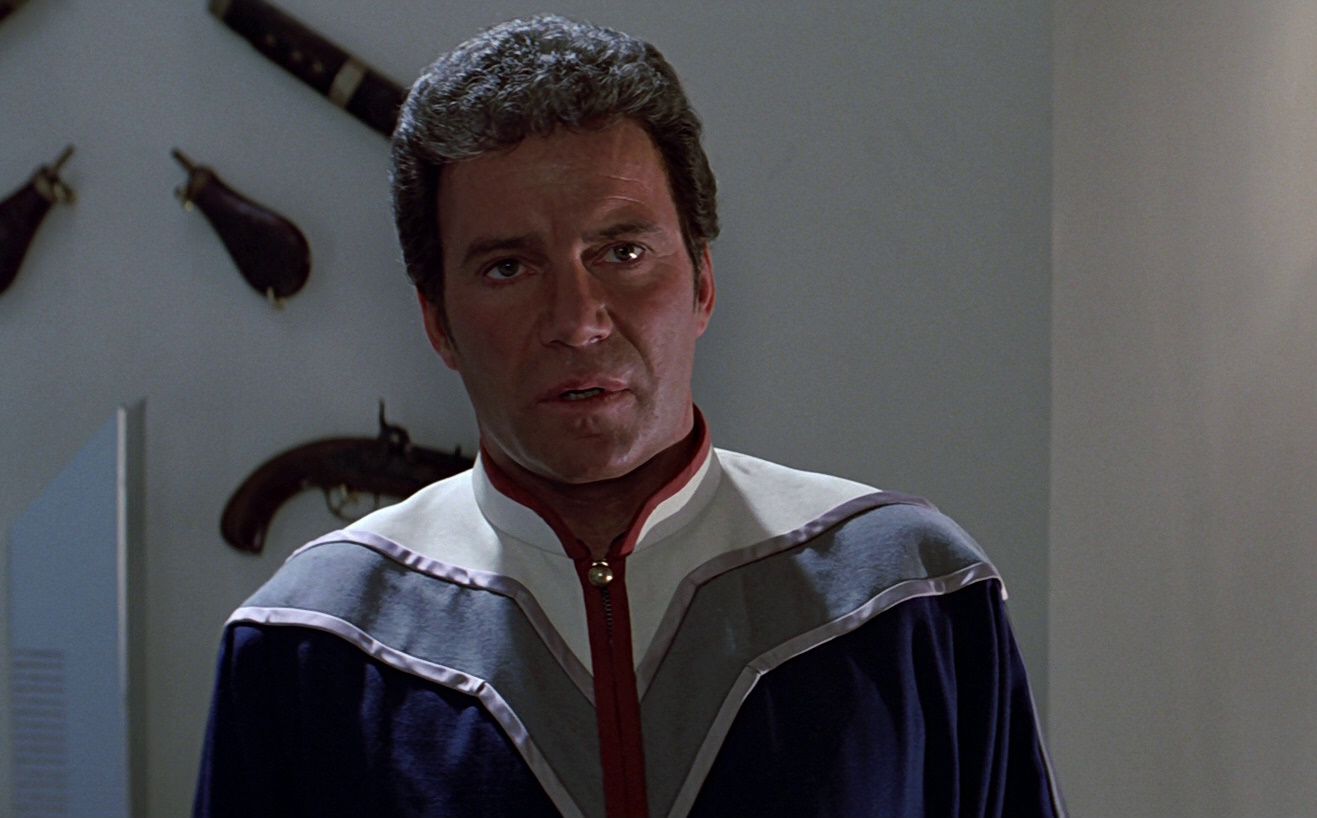
Spoiler Warning: There are spoilers ahead for Star Trek: Picard Seasons 1-3. Spoilers are also present for the following Star Trek productions: The Next Generation, Deep Space Nine, and Voyager.
With the first episode of Picard Season 3 under our belts, it’s time to update my theory list! If you read my review of The Next Generation (the episode, not the series!) then you’ll know I thought that the season got off to a solid start. Perhaps The Next Generation didn’t quite reach the same level as Season 1’s Remembrance or Season 2’s The Star Gazer, but it was enjoyable.
To my surprise, I must admit, none of the theories that were in place going into the season were outright destroyed by The Next Generation, meaning everything technically remains in play – though some theories are, as I said last time, pretty unlikely to pan out! There were a couple of new theories that I’ve concocted that will be added to the list – and one theory got confirmed right out of the gate. So that’s at least one check mark in the “win” column this season! Will it be the only one, though?
Dr Crusher firing her phaser rifle.
Although I generally enjoyed what The Next Generation brought to the table as the starting point for this new story, I do have a few concerns – especially having gone back to watch it a couple of times. First is the pacing. A couple of big story beats seemed to race past awfully quickly: Raffi’s Federation base being destroyed and Picard and Riker learning the identity of Dr Crusher’s shipmate. But at the same time, the episode didn’t feel like it made a ton of progress in terms of the main narrative arc of the season – I called it a contradiction in my review. Whether these points will be important or not as the season wears on… who can say? But after two seasons where pacing issues contributed to some major disappointments, I’m more keenly aware of this particular issue this time around!
But you can check out my review if you want more details on what I thought of the episode itself. You can find it by clicking or tapping here.
As always, we begin the theory list with confirmations and debunkings. No theories were debunked this week, and we have one confirmation, so before we get into the main list let’s take a look at that!
Confirmed theory: Dr Crusher’s shipmate is her son.
Crusher Jr.
This character piqued my interest in pre-season trailers, and I wasn’t alone in speculating that he might be Dr Crusher’s son. Although she was unconscious in a medical pod and unable to completely confirm the connection, I think it’s safe to take him at his word. Crusher Jr. wasn’t named in the episode itself, but Paramount has since announced that his name is Jack – a reference to Beverly’s husband Jack Crusher, a friend of Picard who was killed while Picard was in command of the USS Stargazer.
This revelation has raised just as many questions as it answered, and with Crusher Jr. being on screen for only a couple of minutes right at the end of the episode, we didn’t get many answers. I have a theory about who his father may be – and we’ll look at that in a moment. For now, I’m claiming my first successful theory prediction of Season 3!
So that theory was confirmed.
Up next we’ll take a look at the main theory list, beginning with brand-new theories as well as any existing theories that saw significant movement this week. Finally we’ll wrap up by going over the theories that remain unchanged.
Theory #1: Picard is the father of Crusher Jr.
Picard with another “son” in the episode Bloodlines.
In a series called “Star Trek: Picard,” a connection like this seems like it would be blindingly obvious! Not only that, but Picard’s past romantic relationship with Dr Crusher was referenced in this very episode, with Laris – Picard’s new partner – commenting on it. In addition, Crusher Jr. sports a similar accent to Picard, something that can be used in works of fiction to imply a familial tie between characters.
There also aren’t any other obvious candidates – at least, not among the main cast that we know of at this stage. Crusher Jr’s father clearly isn’t Worf or Geordi, nor could it be Data. That only leaves Riker – and as far as we know, he and Dr Crusher never bumped uglies. Although… Riker did indicate that his marriage has hit a rough spot. Could that be because Deanna figured out he and Crusher once had an affair? I think that’d be pretty silly!
Picard remains the obvious candidate for now, although there is another possibility.
Theory #2: Crusher Jr. is related or otherwise connected to Vadic.
Captain Vadic and several of her crew.
We have no idea at this stage why the Shrike – which we assume is commanded by Captain Vadic at this point in the story, though that isn’t confirmed – is so intent on chasing Dr Crusher and Crusher Jr. specifically. If they wanted Picard, his retirement on Earth didn’t exactly appear to be something top-secret, so why go for Dr Crusher unless she is the subject of Vadic’s ire?
If so, perhaps the reason for Vadic being so obsessed with catching Dr Crusher is that she’s related to Crusher Jr. He could be a nephew or other close relative, or he could be the son of one of her crewmates. He could even be her child – though that seems like an outside possibility at best. In short, if Crusher Jr’s father is someone on Vadic’s crew, that could explain why she’s chasing them: she wants to reclaim her family member.
Obviously this theory and the one above can’t both be true. If you asked me to place a bet, I’d definitely say that Picard being the father is the most likely outcome based on what we know so far – but this possibility exists right now, and I wanted to acknowledge it.
Theory #3: Worf is Raffi’s “handler.”
Promo photo of Worf.
Raffi’s storyline didn’t get quite enough time centre-stage for my liking, but what we saw was intriguing. Raffi is working undercover, trying to track a stolen weapon in the seedy underworld of the Star Trek galaxy that we see so rarely. As part of her assignment, she has a handler – a higher-ranking intelligence officer with whom we saw her communicate.
There are several reasons to think that this character may be Worf. Firstly, we saw a couple of clips of the two of them on what seemed to be the underworld planet in pre-season trailers. Secondly, pre-season character bios released by Paramount stated that Raffi’s location was “unknown” and that Worf’s was “classified.” Finally, the handler Raffi spoke with used the word “warrior” to describe her – a term we’ve often associated with Worf and heard him use.
If Worf is Raffi’s handler, all I can say is that I hope there’s a reason for keeping his role a secret!
Theory #4: The Borg are involved.
The Borg have already been seen in Star Trek: Picard…
Several moments in this week’s episode referenced or called back to the Borg – and while we know that Captain Vadic is set to star as the season’s primary antagonist, there’s still the possibility of Borg involvement in some shape or form. First of all, Dr Crusher was reviewing one of Picard’s logs from his first engagement with the Borg in The Best of Both Worlds. Secondly, Riker referenced Picard’s assimilation experience, and used what he remembered from rescuing him from the Borg in that same episode to decode part of Dr Crusher’s message – something Picard wouldn’t have been able to do on his own as he wasn’t privy to that information at the time. Finally, Captain Shaw seems to have a major chip on his shoulder about the Borg, talking down to both Seven and Picard about their status as ex-Borg.
These could be nothing more than references – little callbacks to Star Trek’s past that are there to tie the events of this story into the franchise’s past. And that’s totally okay if that turns out to be the case! But it’s at least possible, in my view, that some greater Borg connection is going to be revealed. Remember, Season 2 introduced us to a new Borg faction… and the mysterious anomaly that they were intent on stopping is still unexplained.
Theory #5: Captain Shaw lost someone to the Borg.
The Battle of Sector 001.
Why is Captain Shaw so anti-Borg? Sure, we know that the Borg are a threat to Starfleet and the Federation… but it feels like there’s more to it than that. His treatment of Seven and the way he aggressively challenged her and Picard about being former Borg made it seem personal to him, and I can’t shake the feeling that he’s come up against the Borg in the past.
Captain Shaw seems old enough to have been in Starfleet certainly by the time of First Contact, and the Battle of Sector 001 took a toll on Starfleet. Did Captain Shaw lose a friend, a shipmate, a relative, or even an entire crew that day? Or did he find himself facing off against the Collective on some other occasion? Perhaps he was responsible for relocating the survivors of the Artifact after the events of Picard Season 1.
Theory #6: The absences of characters from Seasons 1 and 2 will be explained.
Cadet Elnor at the end of Season 2.
I was pleasantly surprised to see Laris was included in The Next Generation, and while she won’t have a big role in the story of the season, it was great that the story didn’t just dump her as it raced ahead. Due to her importance to the story of Season 2, Laris was perhaps the character who I felt it was most important to include in some way, and I’m glad we got to see her.
But there are still several characters from Seasons 1 and 2 who haven’t been mentioned. Elnor and Soji could easily be name-dropped; a line or two of dialogue could clear up where they are, what they’re doing, and why they can’t join Picard on his current mission. The Borg Queen-Dr Jurati hybrid is a bit more complicated; her self-appointed role as “guardian” of the mysterious anomaly makes it a bit harder to just wave away her disappearance.
I hope we’ll get something that will acknowledge these characters’ absences. All were important in the first two seasons of the show, and simply abandoning them without any kind of goodbye was disappointing at the end of Season 2. If Season 3 could do something to rectify that, I’d appreciate it!
Theory #7: Captain Shaw will be killed.
Captain Liam Shaw.
I half-expected Captain Shaw to meet his demise in the season premiere – but it didn’t happen! With Seven of Nine having disobeyed orders, and the Titan now outside of Federation space with an imposing enemy vessel close by, that could still happen – and soon! But it’s also worth noting that Captain Shaw appears to be a more nuanced and potentially complex character than I’d initially expected. His anti-Borg prejudice is just one aspect of his characterisation, and this by-the-book, rather acerbic captain may have a bigger role to play than I thought at first.
Regardless, if for no other reason than pure practicality, I think he has to be gotten rid of… right? How can the Titan operate with a disloyal first officer, an ex-Admiral, and at least one other captain on board? From a story perspective it just seems cluttered, and while I hope we learn more about Captain Shaw and his past, I still don’t see him making it all the way to the end of the season.
Theory #8: The Titan’s crew will mutiny.
The USS Titan in Spacedock.
An unpleasant man like Captain Shaw can’t be nice to serve under, and with another captain and an admiral on board who have already butted heads in a big way, perhaps the crew of the Titan will mutiny against Shaw. Shaw could be locked in the brig with Picard, Riker, and Seven taking over on the bridge. This would leave open the possibility of Shaw continuing to play a role and interact with the rest of the characters… but without getting in the way.
We didn’t spend much time with the Titan’s crew, but Seven and Ensign La Forge would surely side with Picard and Riker if it came to that. Perhaps the other bridge officers might feel the same way, especially if Captain Shaw treats the rest of them as badly as he treats Seven of Nine!
So those theories are new or saw movement this week.
Finally, so as to keep everything in one place, we’ll recap all of the other theories that are currently in play. This week’s outing didn’t move the needle on any of these theories in a significant way – though we could argue that the total absence of any mention of certain characters, factions, etc. is indicative of the fact that they won’t appear this season. But I’m content to keep them all in play for now!
Theory #9: A spin-off will be announced.
Alex Kurtzman is in charge of the Star Trek franchise for Paramount.
This one is just as much a hope as it is a theory, but it would be fantastic if a spin-off from Picard were to be announced before the season ends. At present, no new Star Trek projects are in production, and with Season 3 being Picard’s last, it seems like there could be an opening!
A Star Trek show set in this early 25th Century time period could pick up story threads from The Next Generation, Deep Space Nine, Voyager, or even Lower Decks and Prodigy, so there’s a lot of potential. A direct spin-off could follow Captain Shaw on the Titan, or Seven of Nine and Raffi, or could even bring back Elnor at Starfleet Academy. With the introduction of new characters in the La Forge family, one or both of them could also take a leading role in a new Star Trek production.
As I’ve said on more than one occasion, this era is where I’d love Star Trek to stay. It feels like there’s so much untapped potential in this time period, with many Trekkies wanting to return to characters, settings, and storylines from Star Trek’s “golden age.” I put together ten of my own 25th Century series concepts, and you can find that list by clicking or tapping here.
Theory #10: There will be at least one unannounced character returning!
Could it be DaiMon Bok?!
There have been theories and guesses from Trekkies for basically a whole year about which other characters from The Next Generation era could appear in Season 3. I don’t claim to know who might be included – but it feels like a pretty solid guess to say that someone from The Next Generation, Deep Space Nine, and/or Voyager will put in an appearance.
This could be a simple cameo, or an appearance similar to those seen in episodes like Encounter at Farpoint and Caretaker. Or there could be a real hidden surprise, with a character basically joining Picard’s mission. We didn’t really know the extent of Seven of Nine’s involvement in Season 1 until it happened, nor the extent of Brent Spiner’s roles in Seasons 1 and 2… so there’s at least the possibility of some kind of big surprise!
Theory #11: Several members of La Sirena’s crew have joined Captain Vadic.
La Sirena in this week’s episode.
Although we’ve had it confirmed that most of the actors from Seasons 1 and 2 won’t be reprising their roles this time around, when I saw the masked crew of the Shrike I couldn’t help but wonder… could some of these people be Picard’s friends? Could that explain why Dr Crusher warned Picard to “trust no one” and simultaneously explain their absences?
It would be a stunning revelation indeed if, when the masks are inevitably removed, Picard and the crew find themselves confronting the likes of Soji and Elnor. Maybe this one is a no-hoper because of what we’ve been told by the actors involved… but you never know!
Theory #12: The super-synths are involved.
The super-synths’ mechanical noodles.
This theory would tie together the events of Seasons 1 and 2 with Season 3. In short, I’ve suggested that Captain Vadic may be a devotee of the super-synths – the “alliance of synthetic life” outside of the Milky Way galaxy who left the beacon on Aia and kicked off the plot of Season 1. To add to this theory, I posited that the mysterious anomaly in Season 2 was also a super-synth creation, perhaps one designed to attack the Federation or to open up a gateway.
If Captain Vadic had encountered the beacon on Aia (or another similar beacon elsewhere), it could have driven her mad, as we saw it do to Zhat Vash initiates in Season 1. If Vadic became obsessed with the super-synths, instead of becoming obsessed with stopping them, she might blame Picard for preventing their arrival. Furthermore, she might be trying to open a new portal for them, and that could be what Picard and the crew need to stop.
Theory #13: Captain Vadic once served on Picard’s crew.
Could Vadic have served under Picard’s command?
Captain Vadic’s desire for vengeance seems very personal, and I wonder if that’s because she once served under Picard’s command. In short, Picard has no shortage of “victims” from his tenures in command of the Stargazer, the Enterprise-D, Enterprise-E, and the Romulan rescue fleet. While we know he always did everything he could to help his crew and see them make it safely home, a lot of people died, were injured, or went missing while serving.
Perhaps Captain Vadic was one such officer. She may blame Picard for being assimilated by the Borg, imprisoned by the Romulans, or being maimed by the Breen – and that’s why she wants to get revenge on him and his crew. This would explain why she appeared to be familiar with Picard, knowing not only his name but seemingly his personality, too.
For a few other ideas about who Captain Vadic might be, click or tap here.
Theory #14: At least one main character will be killed.
A Starfleet coffin, adorned with the flag of the Federation.
I don’t necessarily expect this to happen right at the start of the first episode, but I feel it’s a solid possibility that at least one main character won’t make it to the end of the season. Television storytelling has changed a lot since The Next Generation premiered, and even main characters can no longer consider themselves to be safe if they wind up in dangerous situations!
It would be a challenge to kill off a legacy character in a way that would be satisfying and would feel right – but it would be incredibly bold, and if such a story beat stuck the landing, it could succeed at either setting up the story or paying off a season-long character arc.
Theory #15: Captain Vadic and her crew are hosts for the parasite-aliens first encountered in the episode Conspiracy.
One of the parasite-aliens.
This one is quite “out there,” and I freely admit that! It would be a very bold (i.e. odd) decision for Star Trek to return to the plot of Conspiracy, as it’s hardly one of the best-remembered episodes of The Next Generation. But something about the idea of being unsure of who to trust within Starfleet, having to turn to old friends for help, and the possibility of a conspiracy that could be targeting the Federation all flagged up the plot of Conspiracy for me… so it would be unwise to entirely rule it out!
The end of the episode seemed to suggest that the parasite-aliens had been able to send a message into deep space, hinting at a possible return one day. Could that day finally have arrived?
Theory #16: Captain Vadic is a Founder.
One of the Founders of the Dominion.
We’ve been promised some kind of connection to Deep Space Nine this season, so I can’t help but wonder if the villain of the piece could be a changeling. If the Dominion and their shape-shifting Founders are on the march once more, that could explain why Picard wouldn’t know who to trust – as we saw in Deep Space Nine, changelings were able to infiltrate Starfleet, the Klingon Empire, and the Tal Shiar, replacing a handful of well-placed leaders as part of a plan to destabilise the major factions of the Alpha Quadrant.
Perhaps Vadic’s drive for revenge stems from the Dominion’s defeat, and while Picard wasn’t heavily involved in that, she might be targeting Starfleet and the Federation more broadly.
Theory #17: Captain Vadic has put together a “rogues’ gallery” of Star Trek villains.
Captain Vadic with a couple of her allies.
When we first met Captain Vadic and learned that both Lore and Professor Moriarty would be returning, I speculated that the villain of Season 3 might have put together a crew comprised of past Star Trek villains and adversaries. There’s no shortage of baddies who might want to seek revenge on Picard, the crew of the Enterprise-D, and the Federation as a whole.
In both of the trailers that featured Captain Vadic, the crew of her ship – the Shrike – were concealed. In the most recent trailer, the Shrike’s crew were seen wearing bird-like masks… and I can’t help but wonder if there’s a reason why these characters had their faces covered. It seems at least possible that some of Vadic’s crewmates and allies could be characters that we’ve met in past iterations of the Star Trek franchise.
I suggested the likes of DaiMon Bok, Sela, and even Nicholas Locarno as possible candidates – and you can find a longer list by clicking or tapping here.
Theory #18: Picard and his crew will reactivate Lore and Professor Moriarty.
What’s going on with Lore?
Although it seemed at first as though Lore and Professor Moriarty might be on Captain Vadic’s team, the most recent trailer for Season 3 was cut together in such a way as to suggest that it might be Picard and his crew that are responsible for re-awakening them. I have an idea as to why that might be the case (and we’ll take a look at that in a moment), but for now let’s just say that it seems possible that the story will go down this road.
Last time we saw both Lore and Professor Moriarty, they were no longer a threat. Lore had been fully shut down, and Moriarty had been trapped in a holographic storage module, believing himself to be free to explore the galaxy. How either of them could come back is an open question – but they are coming back in some form!
Theory #19: Picard and his crew need to find synthetic allies/crewmates.
Professor Moriarty.
Connected to the theory above is the idea that, for some reason, Picard and the crew will not be able to trust or rely on almost any organic. Not knowing who to trust – perhaps because something is going on that only affects organic minds – could explain why they chose to reactivate both Lore and Professor Moriarty: they might be immune to whatever’s happening.
I don’t think it can be a coincidence that Lore and Professor Moriarty are involved. Both are sentient artificial life-forms, so surely that connection has to be relevant!
If this theory is even close to being true, though, it would raise an interesting question: why didn’t Picard also turn to Soji for help?
Theory #20: Someone on Picard’s crew will turn out to be an imposter.
The crew of The Next Generation in Season 5.
Two lines from the trailers leapt out at me: Dr Crusher warning Picard to “trust no one,” and her son asking Picard whether anyone he knew “is still the person [he] knew.” These lines could hint at someone having infiltrated the crew, potentially replacing or brainwashing them.
Additionally, it’s possible that someone on the crew is who they appear to be – but is secretly working for Captain Vadic and/or some other villain. We saw this with Dr Jurati in Season 1, so it wouldn’t be a wholly original story beat. But it would fit in with the idea of Picard not knowing who to trust.
So that’s it!
Admiral Picard “inspecting” the crew of the Titan…
Those are all of the theories currently in play as we await the second episode of the season. So far, I’ve found quite a few things in Season 3 to speculate about – but as the story progresses, I expect we’ll begin to strike some of them off the list! Even when Picard hasn’t been at its best it’s still been a series that lends itself to this kind of theory-crafting and speculation, so hopefully there will be new theories to come in the weeks ahead.
As a final note: I always like to end these theory lists by saying that I do this just for fun. I enjoy writing, I enjoy Star Trek, and spending more time in this world is an escape and an enjoyable distraction for me. But for some folks, fan theories can become frustrating or unenjoyable, especially if they get very attached to a plausible-sounding theory that ultimately doesn’t pan out. I have no “insider information” and I’m not trying to claim that anything suggested above can, will, or must be part of Picard Season 3. I fully expect many of these theories to be debunked and for the season to go in wildly unpredictable directions!
Star Trek: Picard Seasons 1-3 are available to stream now on Paramount+ in the United States and other countries and territories where the service is available, and on Amazon Prime Video in the UK and around the world. The Star Trek franchise – including Picard and all other properties discussed above – is the copyright of Paramount Global. This article contains the thoughts and opinions of one person only and is not intended to cause any offence.
Spoiler Warning: There are spoilers ahead for Star Trek: Picard Seasons 1-3. Spoilers are also present for The Next Generation and Voyager.
Before I’d even watched a single second of Star Trek: Picard Season 3, I was sceptical. In both Seasons 1 and 2, incredible premiere episodes gave way to stories that either failed to pull out a decent ending… or just failed across the board. Regardless of how The Next Generation landed, it’s the first chapter of a season-long story where success or failure will ultimately be determined over the next nine weeks. Having been burned by Picard twice now, I’m afraid that I begin this new season feeling more than a little jaded.
Taking the episode on its own merit, however, The Next Generation feels like a solid start. I wouldn’t say it was perfect – it’s an episode of contradictions, where a couple of story beats seemed to rush past in a heartbeat whilst its contribution to the overall narrative of the season may turn out to be too slow. But there were points of high excitement, fun little character moments, and more than enough intrigue spread across two distinct – yet surely connected – narrative threads to drive things forward and keep me engaged.
The new season has officially launched!
I said as Season 2 came to a close that I was bitterly disappointed to see most of the main cast being jettisoned in order to bring back characters from The Next Generation, and how I hoped their absences would be addressed somehow. Perhaps the most important of these characters was Laris, who, despite making only a handful of appearances across Seasons 1 and 2, was absolutely essential to last season’s story. Although we didn’t get to spend a great deal of time looking at Picard’s new relationship with her, I was pleased that Laris was able to be included and that we got to spend a little time with her before the main story took over.
I said in Season 1 that Laris and Zhaban served a similar role in the story to the residents of Hobbiton in The Lord of the Rings – being the familiar and comforting faces of home that Picard had to leave behind as he set out on his adventure. And Laris once again seems to serve a similar function in Season 3 as Picard sets off on a new quest. It was great to welcome back Orla Brady, and to catch a glimpse of Picard’s newfound home life with Laris before the main story kicked off. I’m glad there was time to include those sequences – and it gives me hope that we might get to hear something of Elnor, Soji, and the Borg Queen-Dr Jurati hybrid as well.
We got to catch a glimpse of Picard’s life with Laris before the main story got underway.
One of the biggest problems that has tripped up Star Trek: Picard in both of its seasons so far has been pacing. This is something that we won’t be able to judge fairly until we’ve seen most of the rest of the season, but there are causes for concern at this early stage – at least in my opinion. The Next Generation introduced us to some kind of mysterious threat that seems to be hunting Dr Crusher… but after setting up that she was in danger, the main story arc of the season didn’t really progress beyond that. Picard and Riker arrived at her ship, the Eleos, but there wasn’t any time left to go into detail about who might be hunting her or what they want.
And that could be okay… if the rest of the season has time to explain all of these points and tie together the different character arcs and narrative threads. But it’s also worth noting that The Next Generation didn’t bolt out of the gate. We met several new characters, but not the villain hunting Dr Crusher, and the episode ended more or less in the same place as it began: with Dr Crusher having fended off an attack, and the help she had called for – Riker and Picard – having only just arrived. In both Seasons 1 and 2, pacing issues across much of the season meant that too much story was left on the table, with whole storylines and characters literally ignored and dumped as time ran out. I sincerely hope that this problem hasn’t been repeated, and that The Next Generation hasn’t set up the season for a disappointingly familiar end.
In terms of the main story of the season, I’m not sure how far we’ve progressed.
Conversely, parts of The Next Generation seemed to race through – or rush past – potentially-interesting story beats. There were quite a few different elements crammed in to kick off storylines and character arcs, and the result was that not all of them seemed to get enough time in the spotlight – even though the episode as a whole wasn’t in a horrible rush.
It’s a contradiction! Raffi’s story in the criminal underworld was a bit of a whirlwind, taking her from off-the-wagon junkie to undercover operative in a heartbeat, and then culminating mere moments later in her failure (or what she will undoubtedly see as her failure) to stop an attack against a Federation facility. This storyline didn’t necessarily need more time, but it certainly could have had longer to play out. In past iterations of Star Trek, a story like this could have been an episode (or even a two-parter) in itself; Picard’s own undercover mission in Gambit comes to mind!
Raffi on her undercover assignment.
I would have liked to have spent more time with Raffi. Although she and her nameless “handler” made mention of stolen weapons, I didn’t really feel that The Next Generation properly conveyed the stakes. It was only when the Federation facility was destroyed (a moment that had been shown in pre-season trailers) that the extent of the threat that Raffi was staring down became apparent – and by then this part of the episode was pretty much over.
If this storyline had a few more minutes dedicated to it, we could have had a bit more of a conversation about what this missing weapon was, why it was so dangerous, how long it had been since it was stolen… and more background that could have set up the attack on the base. As it is, it’s hard to get too invested in this story. We never saw the base, nor met anyone who might’ve been stationed there, and we don’t know if the weapon used to destroy it was the only one stolen or one of many. Without more information to put these points into some kind of context… it just feels a tad rushed.
The attack on the base and missing weapons could’ve used a bit more context.
That being said, Michelle Hurd did everything she could with the material she had and the limited screen time afforded her to really sell this storyline, and her emotional performance was deeply impressive. Given that she was working on her own for practically the entire time, it wasn’t an easy challenge to really sell the idea of Raffi being in this dark place, but Hurd rose to the occasion.
In terms of visual effects, The Next Generation had a couple of unspectacular moments. Generally, the quality of the animation work was high – and far better than the lacklustre visuals we saw in parts of Season 1. But there were a few moments with the USS Titan that I felt were just a bit “last-gen” and not quite up to modern standards, especially when we look at what other sci-fi series and franchises are doing.
The Titan in spacedock.
This is a consequence of Paramount and Star Trek not having the budget or resources that the likes of Disney and Star Wars do, and that’s okay. In a season in which a big return to space is clearly on the agenda, though, it’s at least noteworthy that not all of the CGI moments in The Next Generation stuck the landing.
At first I couldn’t quite figure out what it was about a couple of shots of the USS Titan that I didn’t like, but I think I’ve finally nailed it down. In short, the ship is in the “uncanny valley,” looking real, but not quite real enough. Between the “lens” and the “model” there was just a bit too much smoothness; panels and lines don’t have the textural variation we’d expect to see on a real object. This problem plagued CGI through the 2000s, and if you look at Enterprise or the Star Wars prequels you’ll see far more extreme examples. While it wasn’t terrible, it was noticeable enough to pull me out of the immersion on more than one occasion – and to leave me lamenting the loss of physical starship models!
Picard and Riker’s shuttle leaves the Titan.
Aside from the heavy-handed nostalgia play, I’m genuinely not sure what the title of this episode was supposed to be about. The characters who were in focus for the vast, vast majority of the time were very decidedly not the titular “next generation,” and those who arguably might be – Sidney La Forge and the character who identified himself as Dr Crusher’s son – were only on screen for a couple of minutes at the most.
This isn’t a big deal really, but when the title of the episode clearly indicates the same kind of passing of the torch that we got back in 1987, we didn’t really feel any of that as the story unfolded. Perhaps someone cleverer than I am might be able to pick up on what the writers and producers were going for here, but I’m struggling to see it!
Ensign Sidney La Forge.
A few points that The Next Generation glossed over could’ve used some additional clarification. The last time we saw Admiral Picard he’d just taken up a new role as Chancellor of Starfleet Academy, and the pin/combadge he wore during this episode was the same one we saw him wearing on the bridge of the Stargazer in Season 2. Yet Captain Shaw made the point that Picard had now retired from Starfleet – and used that to deny his request to change course. So did Picard cease to be Chancellor of the Academy in between Seasons 2 and 3? I guess he must’ve – perhaps while deciding to move to a new planet with Laris – but it wasn’t clear.
If he did retire, how was Captain Shaw convinced to allow him and Riker to “inspect” the Titan? Captain Shaw clearly didn’t want the two of them to be there, and wouldn’t have voluntarily allowed them on board, so the question of exactly what status a retired ex-Admiral and ex-Captain occupy is a bit up in the air. The episode seemed to want to have it both ways: to tell the story of the retired old guard, but also make sure they had a pathway to commandeering a starship.
The specifics of Picard’s place in Starfleet weren’t made clear.
Captain Shaw is a great character – though I’m still convinced he won’t last very long, one way or another! I noted influences from the likes of Captain Stiles from The Search for Spock and Edward Jellico from Chain of Command, as well as perhaps a dash of Discovery’s Gabriel Lorca, in his characterisation. The strict, rigid, no-nonsense approach that we’ve often seen other characters come up against was on full display, and where Captain Shaw could have come across as a bit of a wet blanket – an unnecessary bump in the road as our protagonists set out on their journey – I think it worked well in context. Starfleet is bound to be populated by career officers like Shaw, and while he comes across as unsympathetic and even malicious due to his treatment of Seven, Riker, and Picard… in a way he isn’t wrong. These two were trying to take his ship and crew on an unsanctioned, dangerous, clandestine mission, and he was right to be suspicious of them and call them out on it.
In terms of the narrative of this first chapter of the story, though, I can’t help but wonder whether it might’ve been better for Picard and/or Riker to have called in a different favour! Instead of sneaking aboard the Titan and trying to secretively reroute the ship, couldn’t they have called in a favour from someone else in Starfleet – someone who could have hooked them up with a ship, or at least gotten them a spot aboard a ship with a captain who likes and respects them? I know that Dr Crusher warned them not to involve Starfleet – but they did anyway, and so I guess my question is: was this their only option? Maybe that’s a bit of a nitpick… and if I’m wrong and Captain Shaw sticks around, perhaps he’ll have a contribution to make to the story that will be more than worthwhile. Time will tell!
Captain Shaw may be an unpleasant man… but he was right, in a way, to be suspicious of Picard and Riker.
So let’s talk about Dr Crusher’s son. As of the last time we saw her, Dr Crusher only had one son: Wesley. And as we saw at the end of Season 2, he’s off doing his own thing with the Travellers and Supervisors. So who is this new character really – and if he is Dr Crusher’s son, will we learn who his father might be?
The obvious connection – especially in a show called Star Trek: Picard – is that he’s Picard’s son, and especially considering that Laris mentioned earlier in the episode that Picard and Dr Crusher had “tried” to become lovers, that could very well play out. We’ll take a look at this in more detail when I update my theory list, but for now suffice to say that this seems to be the most likely outcome.
I’m sure we’ll find out a lot more about Crusher Jr. in the episodes ahead!
But even if we’ve figured out this character’s parentage, there are still a lot of unanswered questions. Riker and Picard both noted that it’s been about twenty years since they last saw or heard from Dr Crusher… but her son is clearly not twenty years old or younger, so he must’ve been around during the years before she disappeared. That doesn’t mean she would have told her friends about having another child – but it does raise questions. If he’s Picard’s son, and Picard seemed to be in danger, could that explain why Dr Crusher chose to leave her friends behind? Was it all for his sake?
Again, that’s something we can consider in more detail in my theory update. This revelation of Dr Crusher’s colleague being her son raised a lot of questions – but it was also a story point that was blitzed past pretty quickly in The Next Generation. The character emerged, pointing a phaser at Riker, revealed his connection to Dr Crusher, and then it was time for a close-up look at the Shrike before the credits rolled. There was definitely scope to spend a minute or two more on this revelation – both for the sakes of Riker and Picard and for us as the audience. This bombshell didn’t get more than a few seconds in the spotlight before the episode rushed to its next point.
We could – and perhaps should – have spent a couple of minutes more on this moment.
Last season, I argued that an apparent studio-mandated decision to have every single episode end on a cliffhanger was to the story’s detriment, and with The Next Generation ending with not only one but arguably four shocking moments, I feel a tad worried that that trend might continue. In retrospect, Season 2 feels like it was chopped up quite artificially, with a strong focus on these cliffhanger endings to such an extent that it didn’t serve the story, splitting up storylines across multiple episodes unnecessarily. We’ll have to judge this aspect of Season 3 when it’s over, but it’s certainly noteworthy at this early stage that The Next Generation also ended in similar fashion.
Who was the mysterious stranger eavesdropping on Riker and Picard? It seems a safe assumption that he’s some kind of friend or ally of Vadic – the season’s main villain who was teased in pre-season trailers but is yet to make an appearance. He could also be a Starfleet operative, or perhaps someone aligned with Dr Crusher. But it felt like quite a played-out trope to have Riker and Picard meeting up in a bar to have their private chat about secretive and sensitive issues. I know it’s another nitpick – but couldn’t Riker have met up with Picard at the vineyard? If this character’s spying is going to be relevant to the story later on – and surely it will be in some form – it just feels a bit clichéd to have him overhear them speaking in such a public setting.
The stranger in Guinan’s bar.
One of the best things Picard did in its first season was re-establish the relationship between Riker and Picard, taking it beyond anything we ever saw in The Next Generation and the films of that era. No longer serving together opened up the possibility of a genuine and deep friendship between the two, and the episode Nepenthe was the perfect way to revisit Picard, Riker, and Troi and establish a new, post-Starfleet dynamic for them.
And The Next Generation picked up that thread from Season 1 and has begun the process of exploring it further. Picard turned to his old friend for help – and with both men being retired or no longer on active duty, there was the opportunity to really examine how well they work together and how close they’ve become. Although Riker and Picard worked well together, and there was trust and mutual respect between them really from the first season of The Next Generation, it’s only in Picard that we’ve seen this friendship genuinely blossom and come into its own. It’s been great to see – and it feels like the perfect and natural evolution of this relationship.
This episode did great things with the Riker-Picard relationship.
The themes of age and how we treat older people were present in The Next Generation, though perhaps not quite to the extent that I’d been expecting. We got a moment where Picard was unaware of the closure of a starbase and had to be corrected, and a comment from Riker about how both men were past their physical peak, but Riker’s story seems to be teeing up some kind of relationship or family dysfunction angle between himself, Troi, and their daughter Kestra. Jonathan Frakes seemed to suggest in a pre-season interview that Riker has felt unsettled and has been keen on returning to Starfleet, and that could be the source of the tension there.
Having seen Riker and Troi in semi-retirement in Season 1, seemingly doing the best that they could to have a happy family life and provide for their daughter, I hope that this story doesn’t end up coming across as a kind of gratuitous and unnecessary shake-up. I’d have been happy, quite frankly, to have left Troi and Riker behind, with Nepenthe serving as their post-The Next Generation epilogue. With them returning this time, I just hope that if there is to be a relationship dispute, it won’t feel tacked-on or overplayed.
Riker seemed to suggest that all may not be well in his marriage.
But we’ll have to wait for Troi’s return before we can assess how that particular storyline will land! For now, suffice to say it’s enough to cause a little concern, because undoing or otherwise overwriting what we got in Season 1 would not be my choice – especially if it seems only to be there to inject a sense of drama into an already-dramatic season of television.
I was surprised to see how heavily The Next Generation leaned on visual and musical callbacks to The Original Series films. The Wrath of Khan, The Search for Spock, The Undiscovered Country, and even The Motion Picture were all influential, with everything from fonts to musical motifs being directly lifted from those titles. I said before the season aired that I was getting a kind of “Picard does The Wrath of Khan” vibe from some of the clips we’d seen in trailers, but I wasn’t expecting to see the series lean so heavily on the feature films of the ’80s for inspiration. Don’t get me wrong – as a child of the ’80s, that style of sci-fi is exactly my kind of thing! And it worked well in The Next Generation. I just wasn’t expecting it!
There was a real ’80s flair to parts of The Next Generation.
Dr Crusher didn’t always get a lot to do in The Next Generation and the films that followed. She had some episodes in the spotlight, and we saw her take on a commanding role on the bridge in later episodes like Descent and All Good Things, but for the most part her role as the ship’s doctor was a limiting factor. Stories with medical mysteries or where characters had to visit sickbay were where we saw her most often.
With that in mind, where The Next Generation excelled was in ensuring that Dr Crusher stayed true to her characterisation, but took on much more of a leading role in an action-packed storyline. Traits like her courage, that we remember from her earlier appearances, came to the fore in a new way, and this bold direction for her character didn’t feel in any way forced. On the contrary, it felt like the natural evolution for her – especially if she’s been operating independently for such a long time.
Dr Crusher firing her phaser rifle.
The semi-automated Eleos was an interesting vessel, and I hope we get to spend a little more time with this starship. Dr Crusher and her son seem to rely on the ship’s computer for things like propulsion, where in past iterations of Star Trek we’d have expected to see people operating those stations and departments. But, as Seven reminded Picard aboard the Titan, it seems that Starfleet is embracing more and more automation. An analogy for things happening here in the real world, no doubt!
The “deadnaming” of Seven of Nine by Captain Shaw was something I was uncomfortable about at first, especially after Seven’s arc in Season 2 was all about embracing the Borg side of herself. Captain Shaw clearly has a chip on his shoulder about the Borg, as he made clear in a comment to Picard, so perhaps that’s something we’ll learn more about next time. He might’ve lost someone to the Borg, or even aboard the Artifact.
Commander Seven… uh, I mean Commander Hansen.
That being said, this kind of deadnaming – forcibly referring to someone by an old name with which they no longer identify – may have been a way of quickly communicating to us as the audience that Captain Shaw is someone we should dislike, and that kind of shorthand can work well in a story with time constraints. But in a broader sense, when we step back and think about Star Trek’s positive, progressive future and how far we’d have expected society to advance by the dawn of the 25th Century… surely something like deadnaming would be socially unacceptable, even for someone in a position of power like Captain Shaw.
In short, I can see why the writers chose to include this aspect of Shaw’s character. Seeing how uncomfortable it made Seven of Nine was a quick and relatively easy way to get across the message that this character isn’t someone we should be rooting for – and I get that. But it has an implication for the Star Trek galaxy as a whole that feels a little uncomfortable. I hope we’ll learn that the rest of the crew of the Titan have more respect for Seven and are willing to treat her better!
Captain Shaw is being set up as an antagonist.
So let’s start to wrap things up.
Season 3 is off to a solid start. My scepticism about the pacing of the episode is probably more to do with the muddled and mismanaged first and second seasons and the way those stories ended. I certainly hope that The Next Generation has set up this new story for success, and if nothing else it was nice to spend some more time with Riker and Picard, as well as Dr Crusher, Seven of Nine, and Raffi.
Seeing how these stories will come together is genuinely interesting, and while we could’ve spent a bit more time on Raffi’s side of things, with some more context provided about the stolen weapons and attack on the Federation outpost, it worked well enough. Captain Shaw was the only new character that we got to spend a lot of time with, and while I don’t like him, I can see where he’s coming from and can certainly appreciate that an organisation such as Starfleet must be populated with people just like him. Dr Crusher’s son and Ensign La Forge were on screen so briefly that we didn’t really get a good read on either – but there’s more than enough time in the episodes ahead to rectify that.
The final shot of the episode: the Eleos and the Shrike.
As I said a couple of weeks ago: it’s probably time to watch The Wrath of Khan if you haven’t seen it in a while! That film seems to be serving as inspiration for Season 3 right now, though the story is far from identical.
I had a good time with The Next Generation, taken on its own merit. It wasn’t perfect, and I don’t think it hit the same high notes as Season 1’s Remembrance or Season 2’s The Star Gazer – but if the story that it’s set up has been meticulously planned and will reach a better, more definitive end point than either of the show’s past outings managed, then none of that will ultimately matter. I’m keeping my fingers crossed that that will turn out to be the case.
Star Trek: Picard Seasons 1-3 are available to stream now on Paramount+ in the United States and other countries and territories where the service is available, and on Amazon Prime Video in the UK and around the world. The Star Trek franchise – including Picard and all other properties discussed above – is the copyright of Paramount Global. This article contains the thoughts and opinions of one person only and is not intended to cause any offence.
Spoiler Warning: There are spoilers ahead for Star Trek: Picard Seasons 1-3. Spoilers are also present for the following Star Trek productions: The Next Generation, Deep Space Nine, and Voyager.
By the time you read this, the first episode of Star Trek: Picard Season 3 may already be available in the United States. But lest you think I’m trying to cheat and make up theories after having already seen the first episode, it won’t be available to stream until tomorrow here in the UK! And for some reason, Paramount didn’t send me the first batch of episodes to review ahead of time. I wonder why?
Although Season 2 had some pretty serious faults, I still found plenty to speculate about as it rolled along! So I hope that this will be the first part of a weekly series in which we can dig a little deeper into some of Picard’s storylines. In both Season 1 and Season 2 I actually netted a few goals; successfully predicting where characters and stories ended up going.
Dr Crusher in Picard Season 3.
But I had many, many misses to go along with those few hits! In Season 1 I theorised that Soji and Dahj might not actually be synthetic, in Season 2 I speculated that the Borg Queen might be an assimilated Captain Janeway, and those are just two of the times that I was completely and utterly wrong. So I guess what I’m saying is that you need to take everything on this list with a very healthy pinch of salt!
Based on pre-season marketing material, trailers, and announcements, I’ve already concocted a handful of theories about Picard Season 3 – several of which I’ve written up in detail in other posts here on the website. It’s these theories that we’ll look at today!
This is your last chance to nope out if you want to avoid any chance of spoilers.
Theory #1: Captain Liam Shaw is going to die.
Promo photo of Captain Shaw.
The last time we talked about the captain of the USS Titan, the character didn’t have a name. But his name has since been disclosed: he’s Captain Liam Shaw. As I said when I took a look at the final pre-season trailer, though… Captain Shaw is giving me major redshirt vibes!
As a purely practical point, it’s hard to see how the USS Titan could operate with an admiral, a commodore, and at least two other captains on board… so something tells me Captain Shaw isn’t long for this world. Will he survive the season premiere? Will he make it a couple of episodes into the season? I’m not sure!
I would say that I like Todd Stashwick as an actor; he’s someone I remember from a series called 12 Monkeys a few years ago. He seems to have the right temperament to take on the role of a Starfleet captain, and in a way it’d be a shame to lose someone like that. But my gut tells me that Captain Shaw won’t be sticking around for very long!
Theory #2: Someone on Picard’s crew will turn out to be an imposter.
The crew of The Next Generation in Season 2.
In a minute we’ll take a look at a couple of different ideas for how an imposter might infiltrate Starfleet, but for now suffice to say that I can’t help but wonder if one of Picard’s old crewmates might not be who they appear to be!
Two lines from the trailers leapt out at me: Dr Crusher warning Picard to “trust no one,” and her assistant asking Picard whether anyone he knew “is still the person [he] knew.” These lines could hint at someone having infiltrated the crew, potentially replacing or brainwashing them.
Additionally, it’s possible that someone on the crew is who they appear to be – but is secretly working for Captain Vadic and/or some other villain. We saw this with Dr Jurati in Season 1, so it wouldn’t be a wholly original story beat. But it would fit in with the idea of Picard not knowing who to trust.
Theory #3: Captain Vadic has put together a “rogues’ gallery” of Star Trek villains.
Captain Vadic with a couple of her allies.
When we first met Captain Vadic and learned that both Lore and Professor Moriarty would be returning, I speculated that the villain of Season 3 might have put together a crew comprised of past Star Trek villains and adversaries. There’s no shortage of baddies who might want to seek revenge on Picard, the crew of the Enterprise-D, and the Federation as a whole.
In both of the trailers that featured Captain Vadic, the crew of her ship – the Shrike – were concealed. In the most recent trailer, the Shrike’s crew were seen wearing bird-like masks… and I can’t help but wonder if there’s a reason why these characters had their faces covered. It seems at least possible that some of Vadic’s crewmates and allies could be characters that we’ve met in past iterations of the Star Trek franchise.
I suggested the likes of DaiMon Bok, Sela, and even Nicholas Locarno as possible candidates – and you can find a longer list by clicking or tapping here.
Theory #4: Picard and his crew will reactivate Lore and Professor Moriarty.
What’s going on with Lore?
Although it seemed at first as though Lore and Professor Moriarty might be on Captain Vadic’s team, the most recent trailer for Season 3 was cut together in such a way as to suggest that it might be Picard and his crew that are responsible for re-awakening them. I have an idea as to why that might be the case (and we’ll take a look at that in a moment), but for now let’s just say that it seems possible that the story will go down this road.
Last time we saw both Lore and Professor Moriarty, they were no longer a threat. Lore had been fully shut down, and Moriarty had been trapped in a holographic storage module, believing himself to be free to explore the galaxy. How either of them could come back is an open question – but they are coming back in some form!
Theory #5: Picard and his crew need to find synthetic allies/crewmates.
Professor Moriarty.
Connected to the theory above is the idea that, for some reason, Picard and the crew will not be able to trust or rely on almost any organic. Not knowing who to trust – perhaps because something is going on that only affects organic minds – could explain why they chose to reactivate both Lore and Professor Moriarty: they might be immune to whatever’s happening.
I don’t think it can be a coincidence that Lore and Professor Moriarty are involved. Both are sentient artificial life-forms, so surely that connection has to be relevant!
If this theory is even close to being true, though, it would raise an interesting question: why didn’t Picard also turn to Soji for help?
Theory #6: Captain Vadic and her crew are hosts for the parasite-aliens first encountered in the episode Conspiracy.
One of the parasite-aliens.
This one is quite “out there,” and I freely admit that! It would be a very bold (i.e. odd) decision for Star Trek to return to the plot of Conspiracy, as it’s hardly one of the best-remembered episodes of The Next Generation. But something about the idea of being unsure of who to trust within Starfleet, having to turn to old friends for help, and the possibility of a conspiracy that could be targeting the Federation all flagged up the plot of Conspiracy for me… so it would be unwise to entirely rule it out!
The end of the episode seemed to suggest that the parasite-aliens had been able to send a message into deep space, hinting at a possible return one day. Could that day finally have arrived?
Theory #7: Captain Vadic is a Founder.
One of the Founders of the Dominion.
We’ve been promised some kind of connection to Deep Space Nine this season, so I can’t help but wonder if the villain of the piece could be a changeling. If the Dominion and their shape-shifting Founders are on the march once more, that could explain why Picard wouldn’t know who to trust – as we saw in Deep Space Nine, changelings were able to infiltrate Starfleet, the Klingon Empire, and the Tal Shiar, replacing a handful of well-placed leaders as part of a plan to destabilise the major factions of the Alpha Quadrant.
Perhaps Vadic’s drive for revenge stems from the Dominion’s defeat, and while Picard wasn’t heavily involved in that, she might be targeting Starfleet and the Federation more broadly.
Theory #8: Dr Crusher’s “assistant” is actually her son.
Who’s this?
This character, played by actor Ed Speleers, is shrouded in mystery at the moment! We don’t even know his name, yet we’ve been told he works closely with Dr Crusher. Could there be a reason for keeping this character’s name hidden? Perhaps his last name is “Crusher”… or even “Picard!”
It might seem like a bit of a trope to go down this route, but it could work if handled well. It would give the character a solid connection to the rest of the crew, and that could be a point in its favour.
Theory #9: At least one main character will be killed.
But who will it be?
I don’t necessarily expect this to happen right at the start of the first episode, but I feel it’s a solid possibility that at least one main character won’t make it to the end of the season. Television storytelling has changed a lot since The Next Generation premiered, and even main characters can no longer consider themselves to be safe if they wind up in dangerous situations!
It would be a challenge to kill off a legacy character in a way that would be satisfying and would feel right – but it would be incredibly bold, and if such a story beat stuck the landing, it could succeed at either setting up the story or paying off a season-long character arc.
Theory #10: Captain Vadic once served on Picard’s crew.
Vadic on the viewscreen.
Captain Vadic’s desire for vengeance seems very personal, and I wonder if that’s because she once served under Picard’s command. In short, Picard has no shortage of “victims” from his tenures in command of the Stargazer, the Enterprise-D, Enterprise-E, and the Romulan rescue fleet. While we know he always did everything he could to help his crew and see them make it safely home, a lot of people died, were injured, or went missing while serving.
Perhaps Captain Vadic was one such officer. She may blame Picard for being assimilated by the Borg, imprisoned by the Romulans, or being maimed by the Breen – and that’s why she wants to get revenge on him and his crew. This would explain why she appeared to be familiar with Picard, knowing not only his name but seemingly his personality, too.
For a few other ideas about who Captain Vadic might be, click or tap here.
Theory #11: The super-synths are involved.
A portal above the planet of Coppelius.
This theory would tie together the events of Seasons 1 and 2 with Season 3. In short, I’ve suggested that Captain Vadic may be a devotee of the super-synths – the “alliance of synthetic life” outside of the Milky Way galaxy who left the beacon on Aia and kicked off the plot of Season 1. To add to this theory, I posited that the mysterious anomaly in Season 2 was also a super-synth creation, perhaps one designed to attack the Federation or to open up a gateway.
If Captain Vadic had encountered the beacon on Aia (or another similar beacon elsewhere), it could have driven her mad, as we saw it do to Zhat Vash initiates in Season 1. If Vadic became obsessed with the super-synths, instead of becoming obsessed with stopping them, she might blame Picard for preventing their arrival. Furthermore, she might be trying to open a new portal for them, and that could be what Picard and the crew need to stop.
Theory #12: Several members of La Sirena’s crew have joined Captain Vadic.
The crew of La Sirena at the end of Season 1.
Although we’ve had it confirmed that most of the actors from Seasons 1 and 2 won’t be reprising their roles this time around, when I saw the masked crew of the Shrike I couldn’t help but wonder… could some of these people be Picard’s friends? Could that explain why Dr Crusher warned Picard to “trust no one” and simultaneously explain their absences?
It would be a stunning revelation indeed if, when the masks are inevitably removed, Picard and the crew find themselves confronting the likes of Soji and Elnor. Maybe this one is a no-hoper because of what we’ve been told by the actors involved… but you never know!
Theory #13: The absences of main characters from Seasons 1 and 2 will be explained.
The main cast of Picard Season 1 c. 2019.
If the likes of Soji and Elnor aren’t involved in any way – which seems all but certain to be the case – then it’s my firm hope that, somehow, their absences will be acknowledged. This one is perhaps more of a hope than a full-on theory… but I really don’t want Season 3 to just pretend that these characters don’t exist.
We’ve spent twenty episodes with these characters, or versions of them at least, and several of them played massive roles in the main storylines of Seasons 1 and 2. For Season 3 to just drop Laris, for instance, after she was absolutely central to kicking off the story last time, would be an unforgivable mistake – especially when we consider that Seasons 2 and 3 entered production back-to-back, with the same team working on both.
This doesn’t have to mean that Season 3 will be a direct continuation of Season 2, nor even that these characters will be discussed for very long or in a big way. But somehow, key absences need to be addressed for the sake of continuity – and I hope that will happen. The best time to do this would be in the premiere, but even if it comes later in the story I think it must be at least mentioned.
Theory #14: There will be at least one unannounced character returning!
Denise Crosby as Sela in The Next Generation.
There have been theories and guesses from Trekkies for basically a whole year about which other characters from The Next Generation era could appear in Season 3. I don’t claim to know who might be included – but it feels like a pretty solid guess to say that someone from The Next Generation, Deep Space Nine, and/or Voyager will put in an appearance.
This could be a simple cameo, or an appearance similar to those seen in episodes like Encounter at Farpoint and Caretaker. Or there could be a real hidden surprise, with a character basically joining Picard’s mission. We didn’t really know the extent of Seven of Nine’s involvement in Season 1 until it happened, nor the extent of Brent Spiner’s roles in Seasons 1 and 2… so there’s at least the possibility of some kind of big surprise!
Theory #15: A spin-off will be announced.
Will Alex Kurtzman announce a new Star Trek project sometime soon?
This one is also much more of a hope than a theory, but it would be fantastic if a spin-off from Picard were to be announced before the season ends. At present, no new Star Trek projects are in production, and with Season 3 being Picard’s last, it seems like there could be an opening!
A Star Trek show set in this early 25th Century time period could pick up story threads from The Next Generation, Deep Space Nine, Voyager, or even Lower Decks and Prodigy, so there’s a lot of potential. A direct spin-off could follow Captain Shaw on the Titan, or Seven of Nine and Raffi, or could even bring back Elnor at Starfleet Academy. With the introduction of new characters in the La Forge family, one or both of them could also take a leading role in a new Star Trek production.
As I’ve said on more than one occasion, this era is where I’d love Star Trek to stay. It feels like there’s so much untapped potential in this time period, with many Trekkies wanting to return to characters, settings, and storylines from Star Trek’s “golden age.” I put together ten of my own 25th Century series concepts, and you can find that list by clicking or tapping here.
So that’s it!
The crew of the Enterprise-D are about to return!
Those are the main theories that I currently have in play as we get ready for Season 3. I fully expect the season premiere to shake up the theory list, so check back in the days ahead to see which theories get struck off and whether any new ones will join the party!
After I’ve watched The Next Generation on Friday, I’ll get to work on my episode review, so be sure to tune in for that in the next few days as well. I wish I wasn’t feeling quite so jaded and burned out… but after two mismanaged and disappointing seasons, Picard has a lot of work to do to impress me. Even if the premiere is fantastic, I think I’m still going to have those concerns and worries about mistakes being repeated. I want to have a good time with this show – and to craft a few theories as the season rolls along. I’ll try my best to judge Season 3 on its own merits and not get bogged down worrying and wondering!
As a final note: I always like to end these theory lists by saying that I do this just for fun. I enjoy writing, I enjoy Star Trek, and spending more time in this world is an escape and an enjoyable distraction for me. But for some folks, fan theories can become frustrating or unenjoyable, especially if they get very attached to a plausible-sounding theory that ultimately doesn’t pan out. I have no “insider information” and I’m not trying to claim that anything suggested above can, will, or must be part of Picard Season 3. I fully expect many of these theories to be debunked and for the season to go in wildly unpredictable directions!
Star Trek: Picard Season 3 will premiere on Paramount+ in the United States on the 16th of February 2023, and on Amazon Prime Video in the United Kingdom and around the world on the 17th of February 2023. Seasons 1 and 2 are already available to stream or buy on DVD/Blu-ray. The Star Trek franchise – including Picard and all other properties discussed above – is the copyright of Paramount Global. This article contains the thoughts and opinions of one person only and is not intended to cause any offence.
Spoiler Warning: There are spoilers ahead for Star Trek: Picard Seasons 1-2 and the trailers and teasers for Season 3.
This essay touches on the subjects of mental health and suicide and may be uncomfortable for some readers.
It’s taken me a long time to get around to dissecting Season 2 of Star Trek: Picard. This was something I’d initially planned to do last year, shortly after the season wrapped up, but the truth is that every time I started writing, going back to re-watch what was a thoroughly disappointing season of Star Trek just felt incredibly unappealing. It’s only now, with the imminent debut of Season 3 spurring me on, that I’ve finally been able to put metaphorical pen to paper.
There are many words we could use to describe Picard Season 2, but if you stuck with my episode reviews last year as the season rolled on, you might remember me using this one: “catfished.” By midway through the season, I genuinely felt catfished by Picard, because an absolutely wonderful premiere episode had quickly given way to a confused, poorly-paced, convoluted story.
An exciting premiere gave way to a mediocre season.
This might be controversial, but my suspicion is that Picard Season 2 suffered at least in part due to the involvement of Sir Patrick Stewart in the creative process. Not unlike what happened with William Shatner and The Final Frontier, some of Stewart’s ideas simply didn’t work well on screen, or ended up contradicted or overwritten by other story beats as the season unfolded. Perhaps the most obvious example of this would be Jean-Luc Picard’s trauma and how that storyline was in focus for such a long time, but we could also point to Chris Rios’ character arc – in which he had to simultaneously hate the 21st Century and fall in love with it.
Sir Patrick Stewart is a fantastic actor, don’t get me wrong, and he’s inhabited the role of Jean-Luc Picard on and off for more than thirty-five years, becoming almost inseparable from his most famous role. But not every actor is a great writer or creator, even those who truly put their all into their roles and feel that they know their characters inside and out. We were told from the moment of Star Trek: Picard’s announcement that Sir Patrick Stewart was working closely with the writers and contributing his ideas… but after two muddled, meandering seasons of television, that may not have been to the series’ advantage.
Sir Patrick Stewart in the writers’ room for Star Trek: Picard Season 1 c. 2018.
Despite a pandemic-enforced delay giving Paramount and the creative team behind Star Trek: Picard plenty of time to process the reaction to Season 1, it’s disappointing to see that some of the same issues reoccured. My biggest criticism of Season 1 was that the story ran out of time and ran out of road; the season plodded along at too slow a pace and left the finale with too much work to do. Although there are other criticisms this time around, the same problem of a glacial pace in early episodes leading to a rushed, overburdened finale was present once again.
It remains to be seen whether Season 3 – which, lest we forget, was filmed back-to-back with Season 2 – will pick up any of these wayward story threads… but my suspicion is that, sadly, it will not. If Season 3 does continue some of these storylines, the mysterious anomaly most notably, then perhaps we can look on this side of things a little more kindly in retrospect. But that will have to be a conversation for another day.
It seems as though Season 3 will set out to tell a new story.
The reason why I fear Season 3 will simply ignore things like the new Borg faction and the mysterious anomaly is, of course, because Season 2 ignored all of the storylines that had been left on the table as Season 1 stumbled across the finish line. Especially given the deliberately slow pace of most of the episodes, you’d think it would have been possible to at least acknowledge, even if in the most barebones of ways, what happened to Narek, the ex-Borg, the settlement on Coppelius, and what Starfleet may have planned to do about the Zhat Vash and Aia.
Even just picking one or two of these points and throwing in a line of exposition-heavy dialogue would have been something, and while I can understand some fans who may not have enjoyed the first season’s story saying it’s better to just move on, for me, I’d have liked to have seen some kind of attempt to bring closure to some of the biggest points that Season 1 ran out of time for.
I guess we’ll never know what became of Narek…
In terms of main stories, side stories, main characters, secondary characters, complicated themes, and even the settings used for the majority of its episodes, Picard Season 2 came up short and failed to deliver. There were lofty ambitions here, and the most disappointing thing isn’t that all of these ideas were bad – though some were, I’m sorry to say – but that the season couldn’t find a way to make them work.
Season 2 manages to feel simultaneously overburdened with too many ideas and half-finished stories and also as if its main narrative was an overstretched two-parter; a story that could have worked a lot better in a shorter format without so much extraneous fluff and padding. And that kind of sums up other parts of the season, too: it’s an incredibly contradictory affair, feeling as if two very different teams of writers were actively working against one another, overwriting or undermining story beats from one episode to the next.
A behind-the-scenes photo from Season 2.
A big part of the story of Season 2 – at its core in more ways than one – were themes of mental health involving multiple characters. Mental health can be difficult to depict in fiction, and unfortunately in Star Trek: Picard we have yet another example of how things can go wrong.
Yvette Picard’s condition was left unnamed, and the way her suicide came across on screen felt that it was being played more for shock value than anything else. Exploring mental health is absolutely worth doing in works of fiction, and dissecting how characters both respond to and live with trauma is likewise a noble idea – in Picard’s case, he was living with trauma that extended all the way back to his childhood. But the inclusion of these elements has to be handled sensitively, and just as importantly, it should serve some kind of narrative purpose. Star Trek: Picard may just scrape a passing grade on that latter point – though even then it comes with the caveat that this was an incredibly convoluted and muddled story – but on the former, the way in which this mental health story unfolded on screen was shockingly poor.
Yvette Picard’s suicide.
I’ve said this before both as a criticism of the Star Trek franchise and of other properties, but here we go again: if there isn’t enough time to properly explain and sensitively depict a mental health condition in a work of fiction, I’d honestly rather it was skipped altogether. A stereotyped, trope-laden, over-acted presentation of an unnamed “mental illness” added nothing to a story that had its focus and attention elsewhere. While there seemed to be the kernel of a good idea in Yvette’s story, the way it came to screen leaned into decades-old stereotypes. It did nothing whatsoever for the cause of mental health, and these shoddy depictions in the Star Trek franchise have to stop. I’ve commented on this in Picard’s first season and in Discovery, too, and while I respect the creators and writers for wanting to include these themes, if there isn’t time to do justice to them, it’s better, in my view at least, to cut them out and do something else.
While Yvette’s story served a narrative function, it stands alongside the presentation of Su’Kal in Discovery’s third season and the really awful stereotypical presentation of ex-Borg in Picard Season 1 as being an unacceptable throwback; something I might have expected to see on television forty or fifty years ago. Better understanding of mental health has led to some truly wonderful and inspired representations across all forms of media in recent years, and it’s disappointing to see the Star Trek franchise continually failing to get this right.
Picard had lifelong trauma resulting from his mother’s suicide.
Speaking as someone with diagnosed mental and physical health conditions, one of the things I’ve always found most appealing about Star Trek’s optimistic take on the future is the notion that, one day, many of the illnesses and conditions facing people in the 20th and 21st Centuries can be cured or overcome. The Star Trek franchise has depicted people suffering from mental health issues in a variety of ways going all the way back to The Original Series, but even in episodes with problematic elements, like Whom Gods Destroy, this theme of hope for a cure was present.
In Picard Season 2, the way Yvette’s illness was handled felt incredibly “20th Century.” While again that served a narrative function, it was hardly something that we’d want or expect to see in the Star Trek franchise, and the idea of locking away someone who was clearly suffering from a very complex condition is already an outdated one today – let alone three centuries from now. To then see Jean-Luc Picard not only come to accept the way his father behaved, but to forgive him for it and even respect it, perhaps feeling he’d have acted the same way, was deeply disappointing and felt incredibly out-of-character.
Maurice and Jean-Luc Picard.
There were also issues with the way Renée’s story worked from a mental health point of view. Picard’s ancestor was struggling with anxiety and, I guess, a kind of “imposter syndrome,” not feeling up to the task of taking a leading role on the Europa Mission. But at key points in the story, it felt as if, once again, this mental health angle was little more than tokenistic. The season brought this up when it served the narrative, only to drop it moments later when the focus of the story switched. We didn’t get anything close to a realistic portrayal of anxiety as a result.
The most obvious example of this came in the episode Two of One, where Renée had been given a pep talk by Picard. Almost being hit by a car – and seeing someone who had just spoken so kindly and reassuringly to her moments earlier being badly injured saving her – is something that you’d think would have had some kind of effect on Renée… but the story just dumped her as it raced to do a weird coma-dream sequence populated by amateur-looking B-movie monsters in the next episode.
The old “knocked unconscious by a car” cliché…
Renée, despite her importance to the plot, feels insignificant and one-dimensional; less a real person than a plot device that the story could use when it was necessary and ignore the rest of the time. Despite the Federation’s very existence supposedly hinging on her presence aboard the Europa Mission, and Q’s entire scheme being based on stopping her, we spent remarkably little time with Renée. After being introduced, she was absent for several episodes before showing up again – briefly – in the season finale.
A character who’s so important to the plot shouldn’t be treated this way. And unfortunately, it feels as if Picard Season 2 almost took advantage of anxiety and anxiety disorders, using this very real and debilitating illness as a mere plot device. Renée’s story certainly had very little to say about mental health that was in any way positive.
Renée Picard.
The truth is that I’d almost forgotten about Renée. She’s far from the worst thing about the season, but the fact that such an important character, and someone on whose actions the entire plot turned ended up being so thoroughly forgettable should certainly stand as a comment on the way this character was both conceived and brought to screen.
Star Trek needs to aim higher when it comes to mental health stories, and I think that’s one of the biggest takeaways for me personally from Picard Season 2. Both Yvette and Renée ended up feeling tokenistic and outdated in the way they came across on screen.
Renée with Tallinn in the season finale.
On this side of the story we also got an amateur Freudian analysis of Picard himself and his mental health. As I said, there was the kernel of an interesting idea in looking at Picard and how he may have carried some hidden trauma for a long time – but it didn’t really succeed on screen. A story like this needs to explain in some fundamental way an aspect of a character or their personality… and I just didn’t get that at all. We certainly know more about Jean-Luc Picard, in a strictly factual sense, than we did before the story began, but none of what we learned informs us about him in any meaningful way. There was no “aha!” moment, where some aspect of Picard’s personality, behaviour, or characterisation suddenly felt better-understood.
Picard had romantic entanglements during The Next Generation era, and references were made to past romantic liaisons in several episodes, too. The fact that Picard had never settled into a long-term relationship wasn’t something that I ever felt was crying out to be addressed or explained, so this entire story was built on very weak foundations.
Picard had romantic entanglements on more than one occasion during The Next Generation era.
Picard’s close relationship with Dr Crusher in The Next Generation also stands in contrast to this. Yes, there was something stopping Picard and Crusher from “crossing that line,” but it was always suggested that what stopped them was Picard’s friendship with Jack Crusher. And of course, in at least one future timeline, he and Dr Crusher actually did take their relationship further. His relationship with Nella Daren, in the episode Lessons, likewise wasn’t hampered by some kind of innate fear of relationships, but rather that he struggled with the idea of being involved with someone under his command, for whose life he was responsible, and whom he might have to place in danger.
Then there’s the fact that, to be blunt, not everyone wants a relationship… and that’s totally okay! Plenty of folks are asexual and/or aromantic, neither seeking nor desiring a relationship beyond friendship. I’m not saying that Picard was ever written that way, and the relationships and romantic entanglements he had across The Next Generation would seem to rule it out. But, speaking as someone who is asexual myself, this idea that “everyone” should want to have a relationship, and that anyone who doesn’t want to be in a relationship must offer some kind of justification – such as childhood trauma – to explain or justify themselves is an outdated and regressive concept.
A young Jean-Luc Picard.
Season 2 told a story that put this aspect of Picard’s character at its core, but it was such a weak premise that it was ultimately unsatisfying. Add into the mix the fact that practically every theme of mental health that the season attempted to discuss failed for one reason or another – Raffi’s came the closest to success before being horribly undermined right at the end – and the entire thing feels like one massive misfire.
To be blunt, there are far better mental health stories out there. The themes that Picard Season 2 included touched on grief, childhood trauma, self- confidence, anxiety, one’s sense of identity, and even apathy and a lack of faith in humanity. But the story did justice to none of these, and fell back on overused and outdated tropes on too many occasions. It’s possible to include themes of mental health in ways that are relevant to a story like this, but the way in which they came across in Picard was poor across the board.
Picard firing a 20th Century pistol.
In terms of the other main characters, I think we have to view most of their arcs in Season 2 through the lens of their departures from the show. This news, which was hinted at midway through the season when we learned that the main cast of The Next Generation would be coming back, was finally confirmed shortly after the season finale, and it’s something I was very disappointed to learn. Of the new characters introduced in Season 1, only Raffi will be coming back in Season 3, so we need to consider this fact when we assess the rest of their arcs.
The only character who got a conclusive goodbye was Rios. And regrettably, Rios’ story was the worst and most confused in the whole season. There were clearly two very different, contradictory notions being used here: the first was that it had been determined that Rios was to be written out of the show ahead of Season 3, necessitating some kind of exit for the character, and the second was that at least some of the show’s writers and creatives wanted to use his story (and the fact that he’s Hispanic) to shine a light on the problems and abuses within America’s immigration system.
We bade “farewell” to Rios in the season finale.
Because of the way in which Rios was written out of Star Trek: Picard, these two stories grated against one another for the entire season, and conflicted at a fundamental level. It’s impossible to watch Rios’ arc across the season and not be left with the distinct impression that two very different groups of writers with irreconcilable ideas for where to take the character simply could not agree on what he should do – leading him to both love and hate his time in the 21st Century.
Rios’ story undermined itself as the season wore on. What could have been a powerful message about the way the United States treats immigrants and refugees was completely lost, essentially overwritten by an abrupt turnaround in Rios’ characterisation as the need to jettison his character from the series became apparent.
Rios in the captain’s chair of the USS Stargazer.
And all of this came against the backdrop of Rios having completely regressed in his characterisation. I wrote in my review of the season premiere that a spin-off set aboard the Stargazer with Rios in the captain’s chair felt like a legitimate possibility… but having seen how he’d recovered, rejoined Starfleet, and was living his best life, Picard Season 2 dragged Rios backwards to the person he was at the beginning of Season 1: the roguish, “Star Trek does Han Solo but worse” type.
As captain of the Stargazer, the people under his command should have been Rios’ priority… but he didn’t once mention his ship or crew after the first episode of the season. After leaving them on the brink of assimilation and death, Rios seemed to forget that his crew even existed, and to me that’s an unforgivable storytelling mistake. Again, this is a consequence of Rios being written out of the series; it would have felt odd if his decision to remain in the 21st Century and not get home to his crew had come after he’d continually expressed his dedication to them. But all that does is reaffirm to me that this side of Rios’ story was completely wrong. There were ways to get him out of the show, if that’s what was needed, without dragging him through this utterly regressive arc.
Part of Rios’ story looked at the way migrants are treated in the United States.
Sticking with character failures, we have Elnor. As disappointed as I was to see Elnor killed off, as the season wore on, this character death began to feel right – or at least like a bold move that had positive repercussions for at least one other character on the show. This culminated in a powerful and deeply emotional sequence in the penultimate episode of the season in which Raffi’s season-long arc of coming to terms with loss and grief came to a head.
But for some inexplicable reason, Elnor didn’t stay dead. His death defined Raffi’s arc, and by extension Seven of Nine’s, too, but it was completely and utterly undermined by the decision to resurrect him with a few minutes to spare in the finale. Elnor got two very short scenes – clips, basically – after his resurrection, one in which he looked confused on a viewscreen and another at Guinan’s bar, where his disgust at a drink became the butt of a joke.
Was it really worth undoing an entire season-long storyline for this moment?
Given that actor Evan Evagora has confirmed that he won’t be reprising his role in Season 3, this resurrection is completely indefensible. It renders that deeply emotional sequence in the preceding episode impotent and meaningless, and ruins not only Elnor’s story, but Raffi’s too. Why bother spending eight episodes with Raffi going through the stages of grief only to rip it away for the sake of a gag that’s been done before countless times?
I like Elnor, and he was one of the new characters that I felt had a lot of potential when his inclusion in the series was first announced. But having decided to write him out of the show ahead of Season 3, the best option here was to leave him dead. His death, while not exactly fun, was something meaningful. It mattered, and while we can and should criticise the show’s writers for failing to really show the impact his loss had on Picard and the rest of the crew, it was at least the driving force for Raffi’s entire storyline. To undo that for no reason only to see Elnor disappear again at the beginning of Season 3? I just can’t get over how stupid a decision this was.
Elnor defined Raffi’s character arc.
Another part of Raffi and Seven’s story bugged me in Season 2, and it wasn’t because of something the show did include. Rather, it was what felt like a glaringly obvious omission! In Season 1, we saw Seven of Nine having to cope with the loss of Icheb, someone she had come to view as a surrogate son. Icheb’s death had a massive impact on her life, leaving her with feelings of guilt in addition to the grief and loss.
In Season 2, we see a very similar situation play out with Raffi. She’d taken Elnor under her wing as he enrolled in Starfleet Academy, perhaps viewing him as a surrogate son as well. But neither Seven nor Raffi acknowledged this as their story unfolded. You’d have thought that Seven might have been able to draw on her own experience of dealing with Icheb’s death to empathise with Raffi or to at least have told her that she was in a better position than most to understand what that kind of loss feels like. It’s mind-boggling to me that the show’s writers could put these two women into such similar situations just one season apart, pair them up for almost the entirety of the story – and as a romantic couple, no less – but completely ignore this blindingly obvious and potentially incredibly useful point of comparison.
How could the writers ignore such an obvious point of comparison?
Imagine a scene or two like this: Seven tells Raffi that she understands what she’s going through because she had lost Icheb in comparable circumstances. Raffi lashes out, saying words to the effect of “no one could understand” and that Elnor’s death was Picard’s fault where Seven was responsible for Icheb’s death. This argument shakes up their relationship, leaving them both feeling hurt and angry. An episode or two later, Raffi apologises for what she said, and after a conversation, they share their memories of Icheb and Elnor, leading to their relationship growing and strengthening under the most awful of conditions.
How many minutes or lines of dialogue would need to be dedicated to something like that? In the context of a ten-episode season, hardly any time at all. And in the context of the plodding, muddled Picard Season 2… it would have been a great improvement.
Seven and Raffi.
So we come, inevitably, to Q and his plan to help Picard. In principle, I like the idea of Q wanting to help, and I like the idea of Q using the last of his “life force” in an act of kindness. But even by the standards of other Q stories in Star Trek, his plan this time was incredibly convoluted and hard to follow. Such a plan was already on pretty thin ice, but because of the way the season was structured, there wasn’t sufficient time dedicated to its explanation – and no explanation was even given for why Q might have been coming to the end of his life in the first place.
Even in episodes with complex and heavy themes, Q’s plots and schemes almost always served a purpose, and there was a clear line from action to explanation. In Picard Season 2… well, let’s try to explain it in words.
Q’s plan was… not great.
Q wanted to help Picard embrace the person he is, overcome his childhood trauma, and learn to fall in love. Aww. And he decided that the best way to accomplish this objective was by travelling back in time to the 21st Century, giving an ancestor of Data’s creator technology that could cure genetic diseases and mitigate climate change, and prevent a spaceflight involving one of Picard’s ancestors. This in turn led to the creation of a totally different timeline in the Star Trek universe, one in which humanity developed into a xenophobic, fascist state called the Confederation of Earth. Q then transported Picard – and several of his friends – into this alternate timeline shortly before their starship was set to self-destruct. Q knew that Picard would then have to travel back to the 21st Century to stop him, leading to his ship crash-landing at his family home in France, forcing him to re-live and confront those traumatic memories, finally overcoming them and learning how to fall in love with Laris, his Romulan friend. Who won’t be returning in Season 3 anyway.
Did I miss a step?
Picard and Q in the season finale.
There’s nothing wrong, in theory, with a plan that’s complex or that requires multiple steps to get from beginning to end. And as a super-being with knowledge and foresight far beyond a human’s, we can give Q a bit of a pass in that regard if we’re feeling generous. But even then, Q’s plan was difficult to follow and feels more convoluted than complex. As the story meandered along, it wasn’t always clear what was Q’s fault and what wasn’t, and which characters were involved and why.
The biggest example of this is the team-up between Q’s 21st Century ally Adam Soong and the partially-assimilated Dr Jurati. These two characters had entirely opposite objectives: the Borg Queen wanted to prevent the Confederation from destroying the Borg in the 25th Century, and Soong wanted to make sure that the Confederation was established so he’d go down in history. Their aims may have aligned for a moment insofar as they both wanted to stop Picard… but there was no reason for them to remain allied, and after Adam Soong had served his purpose and given the Borg Queen an army of pseudo-drones, it made no sense for them to continue to work together.
The continued alliance between Adam Soong and the Borg Queen fails as a logical story beat.
Sticking with Adam Soong, his character arc is kind of Season 2 in microcosm: it started great, but quickly fell apart. In his first appearance, there was genuine nuance in Soong’s characterisation. His apparent desire to help his daughter could have led to a sympathetic, complex presentation of a man who was so desperate that he was willing to do anything – even something nefarious – to help his family. But that feeling lasted barely a single episode, and Soong quickly fell into the trap of being a bland, one-dimensional villain.
Some stories work well with that kind of out-and-out “baddie” who needs to be stopped at all costs – but this one didn’t. When there was the opportunity to present Adam Soong more sympathetically or at least understandably, perhaps as someone who didn’t realise that what he was doing would have ramifications beyond his own lifetime, it’s really quite disappointing that the writers would so quickly drag him back to that same overplayed trope. Brent Spiner can play villains incredibly well, and there’s nothing to fault in the performance. But the characterisation of Adam Soong left a lot to be desired.
Adam Soong.
To return to Q’s plan, it was something that needed a lot more screen time. By the time we arrived at the finale, there was – for the second season in a row – too much to do and not enough time left to do it. As a result, Q’s explanation for his actions, his death, and crucially, Picard’s reaction to all of it, was blitzed through in a matter of moments. Realistically, given the convoluted nature of Q’s scheme and the fact that he was dying, we needed more or less a full episode on just this topic – or Q needed to have a simpler, more easily-understood objective.
The way in which Picard responded to Q really bugged me. Not only did he accept, in an instant, that all of this death, destruction, assimilation, and drama was all being done for his sake, but he didn’t ask Q to undo any of it. When Q announced that he was dying, Picard didn’t even ask the most basic of questions: why?
Why was Q dying? We never found out.
In Star Trek, the Q as a race are essentially god-like: functionally immortal and with powers and abilities far beyond any humanoid race or any other race ever encountered by the Federation. Figuring out what could cause a seemingly immortal being like Q to die seems like something Picard should have at least been curious about. And on a personal level as well, Picard seemed finally ready to accept the friendship that Q was offering – so wouldn’t he have wanted to find out why his friend was dying?
The most-read piece that I published here on the website in 2022 was all about Q’s death, and I put together a handful of different theories about what could have caused it. The fact that so many Trekkies and viewers of Picard needed to seek out something like that speaks volumes: this should have been explained in the show itself, but it wasn’t.
Q’s final snap.
Unlike some other storylines that seemed to run out of road or just hit the wall, this one was deliberately left unexplained. No explanation was written nor even conceived for Q’s death – and yet this point is a massive one in the overall continuity of Star Trek. As fans, and even for casual viewers, getting some kind of explanation for this, even if it would ultimately be little more than technobabble, would have been worthwhile, and would have made this side of the story feel closer to complete.
Although Q’s motivation for this entire convoluted plot was to help Picard, it was also his impending death that spurred him on, as he confessed to Guinan. Such an important part of what drove him for basically the entire story needed more explanation than “just because,” but the writers didn’t have one.
Guinan with Q.
The decision to spend eight-and-a-half episodes out of a truncated ten-episode season in the 21st Century was a mistake. It was an experiment, an idea that someone at Paramount had – perhaps to save money – that had never been tried before in the franchise to such an extent… but there’s clearly a reason for that. What makes Star Trek, well, “Star Trek” is its optimistic look at the future. There’s always been scope to step back in time to see parts of how that future came about, or to “save the future” from some cataclysm or villain, but stories that involve travelling to the modern day have to serve a purpose. When the story was so contradictory, muddled, and just plain difficult, any sense of purpose that Picard Season 2 had got lost in the already underwhelming setting.
There seemed to be a desire, or perhaps a studio-mandated requirement, to end each of the ten episodes on some kind of cliffhanger – but this didn’t always work well, and caused issues of its own. Breaking up the story in this artificial manner was intended to keep fans hanging on, waiting for next week’s outing to see the resolution to the cliffhanger. But when the whole season operated like this, it soon wore out. Worse, it meant that several storylines that should have been one-and-done affairs ended up stretched out over more than one episode, adding to the pacing and timing problems that eventually contributed to the rushed finale.
Why did every episode need to end on a cliffhanger?
The end of the episode Penance was an unnecessary cliffhanger, one that the next episode resolved within literally a couple of minutes. But those minutes took time away from travelling to the 21st Century, and this chain of cliffhanger upon cliffhanger as the season rolled on ended up wasting time. One or two of these instances could be forgiven, perhaps – and in a better story or one without such pacing issues, they surely would have been. But in Picard Season 2, circumstances conspired to make these cliffhanger endings more than just annoyances – they actively contributed to storylines running out of road.
There were key storylines and sections of the plot that relied on some pretty awkward contrivances, and as I wrote at the time, when one small push is enough to send the whole thing crashing down, that makes for a very unsatisfying feeling. To give perhaps the most egregious example: 90% of the plot of Watcher could have been skipped if the Borg Queen simply shared what she knew about the Watcher and where to find her.
We could’ve skipped 90% of the plot of Watcher.
At that point in the story, the objectives of the Borg Queen and Picard’s crew were in complete alignment: both needed to prevent the creation of the Confederation timeline by stopping Q. Yet for seemingly no reason whatsoever, the Borg Queen suddenly became evasive and uncooperative after arriving in the 21st Century, leading to one of the season’s slowest, least-interesting episodes as Picard had to slowly track down the Watcher. If this story beat accomplished something, and if the rest of the season had been stronger and better-paced, it would still be an annoyance. But considering other story failures and the rushed finale in particular, the fact that basically this entire episode ended up being little more than padding is utterly ridiculous.
Likewise, Seven of Nine and Raffi spent a significant amount of time on an overblown side-quest as they tried to track down Rios following his arrest and incarceration. That storyline got so little payoff before Rios had to make his abrupt switch that spending more than a few minutes on it – let alone dragging it out across several episodes – felt incredibly wasteful, and even more so in retrospect. Time wasted on these insignificant and overwritten narrative threads could have been reallocated to get Picard and the crew back to the 25th Century sooner, allowing for more time with the Borg and the mysterious anomaly.
Raffi and Seven of Nine in a stolen car…
Kore Soong was a non-entity in the season, a character who seems to have been created basically to throw a bone to actress Isa Briones when Soji had been cut – or a role for her couldn’t be found. Although Kore seemed to serve a purpose at first – to give motivation to Adam Soong – this quickly fell away when, as mentioned, Adam’s characterisation was switched to be a typical “mad scientist” trope. We’ve seen that kind of character so many times before in Star Trek that it fell flat.
But Kore’s story also felt incredibly repetitive, especially in the episode Two of One midway through the season. In Season 1, a huge part of Soji’s arc across multiple episodes was uncovering and then coming to terms with her synthetic nature and the fact that parts of her life and memories were a lie. Kore goes through a nigh-on identical storyline, learning that she’s a clone, a genetic construct, and the fact that the same actress played both parts just one season apart really hammered home its recycled nature.
Promo photo of Isa Briones as Kore Soong.
All of the main characters (and most of the secondary characters too, come to that) were split up, disconnected from one another for most of the season. After getting together in the premiere and briefly reuniting in the Confederation timeline, the main characters were basically all in their own little boxes the rest of the time. There didn’t seem to be much communication between these characters or pairs of characters, with seemingly massive decisions being taken by one or two that affected the entire group – and this would happen with seemingly no consultation whatsoever.
Although there are dozens of examples of this, perhaps the biggest one came in the penultimate episode of the season: Seven of Nine and Raffi handed over control of La Sirena to the Dr Jurati-Borg Queen hybrid. Without so much as a word to Picard, they agreed to give her the ship – despite the fact that defending the ship was basically the whole team’s objective prior to that moment.
La Sirena blasts off from 21st Century Earth.
These disconnected character groups seemed to all be doing their own thing, with Rios transporting Teresa and Ricardo to La Sirena seemingly without telling anyone, Raffi and Seven of Nine taking off to chase after Dr Jurati without telling Rios and Picard, and earlier in the season, Dr Jurati being left to fend for herself with the Borg Queen.
Splitting up the characters meant that we hardly got any on-screen interactions between some of them, and that had an impact at points, too. For example, I never really felt that Rios and Picard were especially close. They were “work friends,” but not real friends, if that makes sense. So when Rios said that he’d come to view Picard as a kind of father figure, that bolt from the blue felt unearned. “Show, don’t tell” is a piece of advice often given to new writers or students taking their first creative writing class… and that seems to apply here.
Rios told Teresa how he felt about Picard.
So let’s start to wrap things up.
In Season 1, an enjoyable enough story was ruined by a poor ending. In Season 2, things started incredibly well before taking a nose-dive, and by the halfway point I found myself watching Picard more out of a sense of obligation than for any enjoyment. There were still highlights, moments within practically every episode that worked well, achieved an objective, or got me to crack a smile for a minute or two. But taken as a whole, for all sorts of reasons the season fell apart.
Whether we’re looking at the surface narrative or deeper themes, and for both main and secondary characters, Picard Season 2 had some interesting ideas – but couldn’t make them work. The season was muddled, confused, and seemed to work against itself. Its deliberately slow, almost glacial pace led to the mistakes of Season 1 being repeated, with a rushed conclusion to a story that, to put it bluntly, didn’t have enough actual narrative content to warrant something like that happening.
Concept art of Admiral Picard’s uniform.
There were some outdated depictions of mental health, which was disappointing enough in itself, but what bugged me even more was that a character I respect and admire in Jean-Luc Picard came to accept the mistreatment of his mother’s condition at the hands of his father. Only Raffi’s story of coming to terms with grief was handled delicately and seemed to be working – until the last-second resurrection of Elnor massively and catastrophically undermined practically all of it.
Because it had been determined that, for production-side reasons, almost all of the main cast were to be dumped, several characters ended up going down disappointing paths. Rios’ presentation was the worst in the season, taking him from such a strong starting point that I genuinely felt he could carry his own spin-off through a total regression to a disappointing end. But he wasn’t the only character to suffer, and there were issues with practically all of the main and secondary characters that either took them to the wrong place or didn’t give them enough to do.
The main cast of Star Trek: Picard c. 2019.
Picard Season 2 teased us with a tantalising mystery: the return of the Borg and a mysterious anomaly. This presentation of the Borg was genuinely terrifying, and seemed to update one of the Star Trek franchise’s most iconic villains, readying them for perhaps one final encounter. But this tease went nowhere, with the Borg Queen ultimately revealed to be an assimilated Dr Jurati, and the mysterious anomaly got so little screen time that it ultimately didn’t matter to a story that firmly fixed its gaze elsewhere – on elements and characters that were far and away less interesting and engaging.
Star Trek is a franchise that has never been afraid to experiment, and this season was a bold experiment in more ways than one. That’s something praiseworthy, and it’s great that Paramount is accommodating to the idea of telling new, different, and experimental stories in the Star Trek universe. But Season 2 is ultimately an experiment that didn’t work, and I sincerely hope that lessons will be learned so that these mistakes can be avoided in future.
The season teased a potentially incredible story of a strange anomaly and an alliance with the Borg… then ignored it for nine-and-a-half episodes.
Star Trek: Picard is going to end after its third season. With that in mind, the fact that Season 1 is a difficult watch because of how poorly it ended and the fact that Season 2 was a meandering, muddled mess… it leaves me feeling truly dejected. Seeing Star Trek return to the late 24th Century and pick up the stories of characters from that era was something I’d wanted to see for close to twenty years – but Picard hasn’t been able to do justice to that wonderful concept. A season that spent most of its runtime either in an alternate timeline or the 21st Century offered scarcely any opportunities to tell the kinds of stories that I want and expect from Star Trek… and perhaps that’s why I disliked it so much. Picard Season 2 just didn’t feel like Star Trek for the most part.
Having re-watched the season partly for the purpose of writing this and partly because Season 3 is right around the corner, I have no plans to ever go back to it. There are practically no other stories in all of Star Trek that elicit that kind of a reaction, and even episodes and films that I don’t enjoy every aspect of I still find worthy of taking a look at from time to time. Unless something major comes along in Season 3 that could retrospectively change how Season 2 is perceived, this could well be the last time I’ll ever watch it. I didn’t want or expect to be in that position, especially with only three seasons of Picard being offered. To have to write off one-third of the show as essentially being unwatchable garbage is really disappointing to an old Trekkie who wanted desperately to have a good time with it.
Jean-Luc Picard.
Star Trek’s future feels less certain than ever right now, with Paramount+ seriously struggling in a very competitive market and under difficult economic conditions. While there are two more animated seasons to come that will look at the late 24th Century, when Picard’s third season comes to an end in just a couple of months’ time, there won’t be any more live-action stories in this time period. Picard Season 2 was ultimately a waste – a navel-gazing story that spent far too much time away from practically everything that makes Star Trek what it is. There were interesting concepts, but they got buried under a slow, confused, contradictory narrative that failed to make them work. And the unhelpful mental health tropes that dominated key storylines just adds to the disappointment.
Despite a poor ending to Season 1, I still felt hopeful that Season 2 could pick up the pieces and tell an interesting and engaging story. For the most part, it was neither of those things, and it wasn’t particularly fun or entertaining, either. The aspects of the story that could have provided points of interest or entertainment value were sidelined or ignored, and the season as a whole feels bitterly disappointing.
What a disappointment.
Can Season 3 save the day? Can a creditable ending be salvaged from amidst the wreckage? On the one hand, it feels like a tall order – and even if Season 3 is fantastic, the disappointment of Season 2 won’t be entirely expunged. But on the other hand, Season 3 actually has a pretty low bar to clear. Even if it’s not that great, it will still be hard for it to be as disappointing as Season 2.
And perhaps that’s the best thing we can say about Picard Season 2. For future Star Trek projects, it can teach lessons by serving as the clearest example of what not to do, while also providing an easy win. After all, it will be difficult indeed for any future Star Trek series or film to fail as comprehensively and catastrophically as Picard Season 2.
Star Trek: Picard Season 3 will premiere on Paramount+ in the United States on the 16th of February 2023, and on Amazon Prime Video in the United Kingdom and around the world on the 17th of February 2023. Seasons 1 and 2 are already available to stream or buy on DVD/Blu-ray. The Star Trek franchise – including Picard and all other properties discussed above – is the copyright of Paramount Global. This article contains the thoughts and opinions of one person only and is not intended to cause any offence.
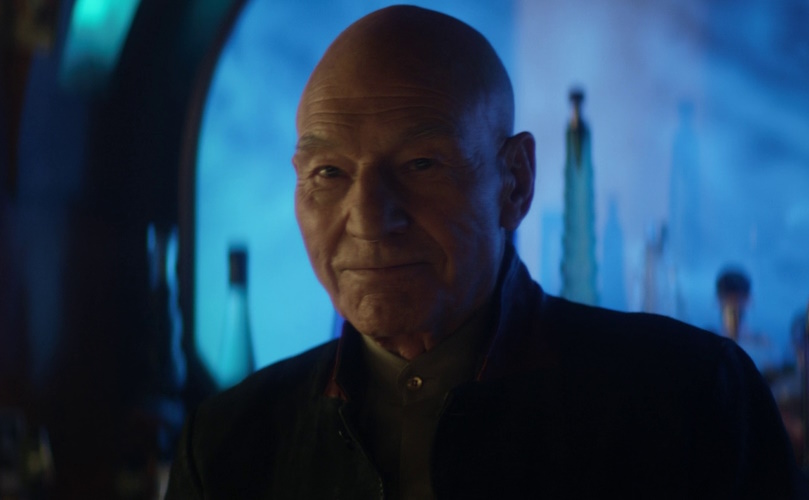
Spoiler Warning: There are spoilers ahead for Star Trek: Picard Seasons 1-2 and the trailers, teasers, and announcements for Season 3. Spoilers are also present for the following Star Trek productions: The Next Generation, Deep Space Nine, Voyager, and Prodigy.
A few days ago I picked out a dozen Star Trek episodes (and a couple of films) that I thought would make good background viewing ahead of Star Trek: Picard’s upcoming third and final season. Since then, we’ve been treated to the final Season 3 trailer, and while I wasn’t exactly blown away by the trailer itself, it raised a couple of potentially interesting points that made me think of a few more Star Trek episodes. So on this occasion we’re going to add five more Star Trek episodes to the list!
I had quite a lot to say about the final Season 3 trailer, so if you missed my thoughts and analysis you can find that piece by clicking or tapping here. And to see the first part of this list, containing other episodes and films that I think will be good to watch ahead of Picard Season 3, click or tap here.
The USS Titan in Spacedock.
There’s still an awful lot that we don’t know about Picard Season 3. Although we have a sense of who the main characters will be, there are still some question-marks about how they will all work together – and even which side everyone will be on. There are also, in my opinion at least, a couple of potentially-open character slots on the villainous side of the season – particularly if Captain Vadic has, as I have posited, put together a kind of “rogues’ gallery” of past Star Trek baddies!
A couple of caveats before we get started. First of all, I have no “insider information,” and I’m not trying to claim that any of the episodes listed below definitely will have a bearing on the storyline of Picard Season 3. This is guesswork on my part – and nothing more! Secondly, all of this is simply the subjective take of one person. I’ve picked a few episodes that I think could be relevant, but if you disagree with my picks or if I exclude something you think is blindingly obvious, that’s just the way it goes! This is just one person’s opinion – and it’s meant to be taken in the spirit of fun.
With that out of the way, let’s get started!
Story #1: Coming of Age and Conspiracy The Next Generation Season 1
Admiral Quinn, Riker, and Picard at Starfleet Headquarters.
Coming of Age is primarily about Wesley Crusher and his first attempt to get accepted into Starfleet Academy. However, the episode’s secondary plot sets up the story of Conspiracy, the penultimate episode of The Next Generation Season 1. In Conspiracy, a race of parasitic aliens infiltrate Starfleet Command, taking over senior officers, including admirals, as part of a plot to subjugate the Federation. Though the parasitic aliens would claim that they sought “peaceful coexistence,” their actions clearly showed that they planned to take over Starfleet – perhaps as a first step to conquering the Federation.
Before their “mother creature” was killed it was able to send a signal into deep space, and Data believed that the parasite-aliens would one day return. This story was originally intended to set up the Borg storyline in Season 2, but I think everyone can agree it’s for the best that that didn’t happen! For our purposes, there was something about Captain Vadic in the Season 3 trailer, and particularly Dr Crusher’s line about Picard being unable to trust anyone within Starfleet, that made me think of Conspiracy. I think it would be an incredibly bold and unexpected move to return to what was, let’s be honest, not one of The Next Generation’s finest or best-remembered stories. But at the very least, the episode’s concept of a conspiracy within Starfleet itself could be worth checking out… even if the parasite-aliens aren’t going to make a comeback!
Story #2: The Enemy The Next Generation Season 3
Geordi on the planet Galorndon Core.
The Enemy is a great Star Trek episode, and an absolutely classic example of how the franchise uses its sci-fi setting to tell stories that reflect the real world. When considering what may be to come in Picard Season 3, it’s also a strong Geordi La Forge story, and one that sees him interacting with a Romulan. The Romulans were a big deal in Picard Season 1, and if we take Geordi’s role in the spin-off comics and novels that have been released in recent years, he may have been present on Mars when the Zhat Vash caused the synths to attack. He may feel he has unfinished business with the Romulans, or lingering trauma over those events, so stepping back to see Geordi’s first big meeting with a Romulan could be worthwhile.
Geordi is one of the characters whose role in Season 3 feels totally ambiguous. All we know at this stage from the trailers and teasers is that he seems to have been promoted to the rank of commodore and that he may have a senior position on board Spacedock or another similar starbase. I like the idea of revisiting an earlier Geordi story to see how far he’s come – and The Enemy is one of his best episodes in The Next Generation.
Story #3: You Are Cordially Invited, Change of Heart, and Tears of the Prophets Deep Space Nine Season 6
Worf and Jadzia Dax on their wedding day.
This trio of episodes, spread across Deep Space Nine’s fantastic sixth season, focus in large part on Worf’s relationship with Jadzia Dax. Worf and Jadzia got married at the height of the Dominion War, not long after the Federation had re-taken DS9 from the Cardassians and the Dominion, but their marriage was, sadly, not to last – Jadzia was killed at the end of the season. I remember Jadzia’s death coming as a huge shock when I first watched Tears of the Prophets; although we knew actress Terry Farrell would be leaving the series, the decision to outright kill Jadzia was still a bold one – the first main character death in Star Trek since Tasha Yar at the beginning of The Next Generation a decade earlier.
With Worf coming back in Season 3, there’s a chance, at least, that his marriage to Jadzia will be referred to. Showrunner Terry Matalas has suggested that part of Worf’s arc will connect back to his experiences not just on Deep Space Nine, but specifically to his service in the Dominion War – and although Worf did a lot for the war effort, the biggest emotional moment for him has to be his marriage and the subsequent death of his wife. Although Deep Space Nine’s seventh season explored this through Worf’s conversations with Ezri Dax, there’s definitely scope to see how Worf would have processed his grief and loss after the war’s end.
Story #4: What You Leave Behind Deep Space Nine Season 7
Odo and Colonel Kira on the Founders’ homeworld.
Picking up that same Dominion War theme, we come to the finale of Deep Space Nine and the final engagement of the conflict. The episode ends with the Dominion’s defeat and Odo choosing to return to the Founders’ homeworld to share his knowledge of living in the Alpha Quadrant – as well as Captain Sisko’s departure to the realm of the Prophets! There’s a lot to unpack in this complex and emotional feature-length episode, but for our purposes we’re focused on the Dominion War and its ending.
It’s possible that Captain Vadic will have some connection to the war – she certainly seems old enough to have potentially served in it. She could be a Founder, perhaps, and if the changelings are once again on the move, that could explain why Dr Crusher warned Picard about not trusting anyone. Or Vadic’s connection to the war could come from the other side: she could be a Federation or even Romulan officer who served. Either way, some kind of Dominion War connection has been teased – so seeing how the war came to an end could be important.
Story #5: Human Error Voyager Season 7
Seven of Nine with the Doctor.
I didn’t really pick any Seven of Nine episodes on my last list – which is kind of an oversight, given that she will be returning in Picard Season 3! Voyager’s later seasons included quite a few Seven-focused episodes (if you’d have asked me at the time, I’d have definitely said there were too many!) but for today, I want to take a look at Human Error.
Part of Seven’s story this time around is sure to focus on her new role within Starfleet, and although Picard’s first two seasons already gave her a deeply cathartic arc and plenty of development, her change of circumstances this time around could be very interesting. Human Error shows Seven of Nine trying to hone her social skills on the holodeck, as well as setting the stage for a potential romance with Chakotay. Of all the “Seven of Nine learns how to be human” stories – of which there were a lot – Human Error is one of the more interesting, and perhaps some of the themes it touches on will be relevant this time around… even if the main plot points themselves are unlikely to be!
Bonus: Star Trek: Prodigy Season 1
The wreck of the USS Protostar.
I almost included this as an “official” entry on the list, but I’m not sure I could justify saying that all of Prodigy’s first season is going to make for necessary or even relevant background viewing ahead of Picard Season 3! But there are a few points of note that, while unlikely to come up in a big way, would be worth keeping in mind – especially for Seven of Nine’s story. Prodigy’s first season serves as a sequel, of a sort, to Voyager – and we learn what happened to Chakotay and Admiral Janeway in particular over the course of twenty episodes.
This isn’t Prodigy’s main focus, but it’s a story that’s weaved through the entire season, setting up the story and taking it to its end point. Seven of Nine may or may not know all of the details of what happened, and the events of Prodigy take place almost fifteen years before Picard. But as someone who was close with Janeway and Chakotay, Seven may have come to know about their adventures with the USS Protostar. I really doubt that there will be a major connection, but there could be a name-drop or some other hint at the events of Prodigy through Seven’s story arc.
So if you have time and you haven’t seen Prodigy yet… now could be the right moment!
So that’s it!
Geordi La Forge looking rather cross in the most recent trailer.
Unless I think of any more episodes – or come up with any of my patented (and usually wrong) theories – I think this is it! Between this list and the one I published a few days ago, these are all the stories that I think could make for useful background viewing ahead of Picard Season 3.
As I said last time, I’m less “excited” for this new outing than I want to be. Two difficult, muddled, mismanaged seasons of Picard have been, on the whole, a pretty big disappointment, especially when I consider that this was the series – and the Star Trek concept – that I was most interested in and had waited almost twenty years to see. Season 3, rather than being one more fantastic adventure, feels more like the last chance saloon – not only the final opportunity for Picard to tell a decent, well-paced, exciting story, but perhaps the last good opportunity for the Star Trek franchise as a whole to demonstrate to parent company Paramount that it’s worth investing in this early 25th Century setting in a big way.
Promotional photo of Worf.
I have concerns already, particularly surrounding the way the main cast from Season 1 was handled and how they were jettisoned from the series with most of them not getting so much as a “goodbye.” And I can’t shake the feeling that the new season may be rushing headfirst into exactly the kind of nostalgia overload that has continually tripped up the modern Star Wars franchise.
But despite all of that, I’ve vowed to give Picard Season 3 a fair shake when it debuts in a couple of weeks’ time. Whether any of the stories and episodes we’ve talked about today will be relevant or not, I still think they’re all enjoyable and well worth a watch. If nothing else, they can give us a bit of a baseline to see where these legacy characters were in their prime.
Don’t forget to check out the first part of this list, which contains another batch of Star Trek stories that I think could make for useful background viewing ahead of Picard Season 3. You can find it by clicking or tapping here. And when Season 3 premieres, I hope you’ll check back for weekly episode reviews – and perhaps even a few theories!
Star Trek: Picard Season 3 will premiere on Paramount+ in the United States on the 16th of February 2023, and on Amazon Prime Video in the United Kingdom and around the world on the 17th of February 2023. Seasons 1 and 2 are already available to stream or buy on DVD/Blu-ray. The Star Trek franchise – including Picard and all other properties discussed above – is the copyright of Paramount Global. This article contains the thoughts and opinions of one person only and is not intended to cause any offence.
Spoiler Warning: There are spoilers ahead for Star Trek: Picard Seasons 1-2 and the trailers, teasers, and announcements for Season 3. Spoilers are also present for the following Star Trek productions: The Next Generation, Nemesis, Deep Space Nine, and Voyager.
Is everyone going to survive the upcoming season of Star Trek: Picard? I think there are reasons to doubt that! So today I’m going to take a look at the show’s main and secondary characters and speculate about who may or may not be killed off before the curtain falls. Is that a bit macabre?
Picard hasn’t been shy when it comes to killing off legacy characters. In Season 1 we lost Hugh the Borg, Icheb, Bruce Maddox, and if you want to get technical about it, Picard himself – or at least his original body! We also saw the villainous Rizzo killed off in the season finale. And in Season 2, we said goodbye to Q most notably, but also saw Tallinn killed off as the story reached its conclusion.
Season 2 saw the death of Q.
In addition, several comments from showrunner Terry Matalas and others involved in the production of Season 3 have seemed to hint at the possibility of character deaths. So I think we have reason enough to speculate about who may or may not make it to the end of the story!
A well-timed character death can do wonders for a story, raising the stakes significantly. In the aftermath of television shows like The Walking Dead and Game of Thrones – pioneers of what I call the “disposable cast” model, where no main character can reasonably be assumed to be safe – audience expectations have shifted, and throwing characters into life-or-death situations definitely feels more dangerous than it ever used to!
Icheb was one of several legacy characters to die in Season 1.
A character death can also be the right move for a story. If a character has completed their arc or storyline, it can feel right – at least in some cases – if the way their story ends is with their death. So for all of those reasons, I think it’s at least a possibility that Star Trek: Picard will go down this route in Season 3.
When we’re dealing with legacy characters, this does get a bit more complicated. The main characters from The Next Generation are iconic and beloved, and need to be handled with care! But it could still feel right for the story, the character themselves, or both, if one or more were killed off. This season is being billed as the “final” adventure for this crew – and I can’t help but feel that “final” could really mean “final” for at least one of them!
Several of the main cast and crew at a recent panel.
Before we get started, a couple of caveats. First of all, I’m not necessarily advocating for any of these characters to be killed off. I adore The Next Generation and its characters, and while I could accept the loss of one or more of them if it came at the right moment and was handled well, I don’t really want to have to say goodbye to anyone!
This is also just the subjective opinion of one person. I’m going to look at each of the characters in turn and share my thoughts – but if you think I’m completely wrong or if I miss something you consider obvious, just keep in mind that it’s only my opinion… and although this is a dark subject in some ways, it’s supposed to be a bit of fun!
Finally, I have no “insider information.” I’m not even certain that all of the characters we’re going to look at will appear or even be mentioned in Season 3, let alone that they’ll have fully-fledged arcs, so please remember to take all of this in that spirit.
With all of that out of the way, let’s get started!
Character #1: Jean-Luc Picard
Status: Safe
Star Trek: Picard has, as mentioned, already “killed” Jean-Luc Picard – and it would feel very strange if the show were to do so again! I know that a lot of folks speculated that Picard would be permanently killed off in this series, especially in the run-up to Season 1 when it wasn’t clear if the series would be renewed, but having already done a fake-out death, it would be difficult, I feel, for the show to kill off Picard for a second time.
It’s primarily for that reason that I consider Picard to be safe. If we hadn’t gone through that death-and-rebirth narrative at the end of Season 1, I’d almost certainly feel that he was in danger. And I could be wrong about that – if the series is the final chapter of his story, it makes a lot of sense for it to end with his death. But I really feel that it would be a struggle to kill off Picard for the second time in a way that would be impactful, emotional, and that would carry the necessary weight to say a permanent goodbye to such an iconic character who has been such an important part of the Star Trek franchise.
Character #2: Laris
Status: Killed Off-Screen?
Laris was central to Picard’s story in Season 2 – serving as the “love interest” that he struggled to begin a relationship with. Picard’s inability to settle into a romantic relationship was what caused Q to set the entire season’s story in motion, and by the time Picard returned to his vineyard at the end of the season, he finally seemed ready to embrace a potential new relationship with Laris, something Guinan called his “one final frontier still to come.”
But unfortunately, Laris actress Orla Brady is one of the main cast members who won’t be returning for Season 3, something she confirmed shortly after the Season 2 finale had aired. Although Picard and Laris seemed to be on the verge of becoming a couple, Brady’s absence from the new season seems to suggest that it won’t happen. One reason for that could be Laris’ death – and after Zhaban was killed off-screen in between Seasons 1 and 2, I wouldn’t be stunned to see the series treat her the same way. Either way, given Laris’ importance last season her absence will have to be addressed somehow.
Character #3: William Riker
Status: In Danger
When considering potential character deaths, one factor to consider is the impact a particular loss would have on the people around them. While all of the main characters are friends, the bond that Riker had with both Picard and Troi – his wife – would make his potential death incredibly significant for those characters in particular.
Riker has also reached a point where we could at least make the case that his story feels somewhat complete. Having served as Picard’s loyal “number one” for fifteen years, he finally accepted his own command, got married to the person he loves, had a family, and retired. If Season 3 is to be an epilogue of sorts for Riker… maybe it won’t end well for him!
Character #4: Elnor
Status: Killed Off-Screen?
I genuinely do not understand the decision to grant Elnor a last-second stay of execution at the end of Season 2. His death, while tragic in more ways than one, served a narrative function, and was of particular importance to Raffi. After a deeply emotional sequence in the penultimate episode of the season, I felt certain that Elnor was truly gone – until Q resurrected him.
Why, then, do I suspect that Elnor may have been killed off-screen? It isn’t just the confirmed absence of actor Evan Evagora, though that is a part of it, but that we seemed to see Raffi looking angry and distraught in the trailer. It would arguably be repetitive if Raffi were forced to deal with Elnor’s death for the second season in a row… but then again, it worked well as the driving force for her arc last time. Elnor’s absence will have to be explained somehow, and unless he’s being secretly tapped for a role in the long-rumoured Starfleet Academy series, he might end up dead for the second time.
Character #5: Captain Vadic
Status: Deader than dead. 101% dead.
If anyone is going to die this season, surely it will be the villain of the piece! Somehow, some way, by the time the credits roll on the season finale, Captain Vadic will have been killed – I am practically certain of that. Her defeat and death may end up costing Picard and the crew dearly, but these kinds of villains really only end one way.
I just hope that, along the way, we truly come to learn who Vadic is and what’s driving her. Seasons 1 and 2 both left a lot on the table in terms of unexplained or unclear narrative threads, and whilst we’re having fun reuniting with the crew of the Enterprise-D, I truly want to spend time with Vadic to figure out what’s going on with her.
Character #6: Dr Beverly Crusher
Status: In Danger
Because of the nature of her close relationship with Picard – regardless of whether they ever “crossed that line” and became more than just friends – Dr Crusher’s death would hit him especially hard. For that reason alone, in a show called Star Trek: Picard, Dr Crusher is absolutely in danger!
Not only that, but based on what little we know so far, Dr Crusher is going to have a significant role to play in jump-starting the story, sending a distress signal of some kind to Picard while on an assignment in deep space. We’ve already seen clips in the trailers that confirm she will be reunited with Picard, so that mission won’t prove fatal. But Dr Crusher seems to be connected to whatever’s going on – perhaps in a big way. She could be one of Captain Vadic’s targets.
Character #7: Lore
Status: 50/50
I could see Lore’s story going one of two ways. Either he really leans into the “evil twin” angle from The Next Generation, allowing Brent Spiner to put in yet another delicious villainous performance, or there’s some kind of pathway to redemption for him – perhaps even one that might lead to a resurrection or restoration of Data.
So I’m calling this one 50/50. If there’s more to Lore’s story this season than just pure villainy, I think he’s in with a chance of survival. If he remains true to his mission and is loyal to Vadic, I wouldn’t be surprised at all to see him meet his end – maybe at the hands of Geordi!
Character #8: Soji
Status: Killed Off-Screen?
Soji made scarcely more than a cameo appearance in Season 2, and didn’t even join the others for a drink at Guinan’s bar at the end of the story. If the story of Season 3 will involve some kind of attack or invasion, such as by the Season 1 super-synths as I’ve previously theorised, we could learn that Soji has been killed. However, after being absent last time, her death wouldn’t have as big an impact on either the characters on the show or on us as the audience – so that could be a reason not to do it.
Either way, I hope some reference is made to Soji to explain her absence from the season’s story. She was such a big part of Season 1 that it would be a shame to hear absolutely nothing about her in the show’s final season.
Character #9: Worf
Status: In Danger
Of all The Next Generation characters, it seems from the trailers that Worf may be the one who’s changed the most from when we last saw him. Worf seemed to suggest that he has become a “pacifist,” something that could really shake up his characterisation. After a long arc across not only The Next Generation, but the back half of Deep Space Nine too, maybe Worf’s story is finally at an end. He might even be at peace with that idea!
Worf is the character that we’ve spent the most time with in all of Star Trek, so his exit – if indeed there is to be one – will have to be handled with care. But for Worf, dying in battle to save his friends (and maybe the Federation, too) would actually be a good way to go. So maybe it will finally be a good day to die for our favourite Klingon!
Character #10: Seven of Nine
Status: Safe
I’m calling Seven “safe” because I’m not convinced that the Star Trek franchise is done with her just yet! I know I wasn’t the only one in the aftermath of Season 2 to suggest that some kind of “Captain Seven” series could be an interesting direction to take for the next Star Trek production, but even if that doesn’t happen, the development that Seven’s character has gone through in Picard so far has set the stage for further appearances in some form.
While we’re still waiting to hear what (if anything) is coming up next for Star Trek, any future 25th Century series would do well to include Seven of Nine either as a main or recurring character. Her arc in Picard has been utterly transformative, taking one of my least-favourite characters from Voyager and getting her to a point where I could legitimately see her as the lead in her own spin-off.
Character #11: Deanna Troi
Status: In Danger
As above with Riker, Troi has to be considered in danger because of the emotional weight her death would carry. This would pack a punch for Riker in particular, as they’re married, but Troi was also close with Dr Crusher and Worf too. Like Riker, Troi has also arguably come to the end of her story: serving in Starfleet, retiring, and becoming a parent.
The loss of Troi would also deprive the crew of a particularly useful talent: her empathic abilities. As an empath, Troi has been able to get a sense of all kinds of adversaries – and in one of the trailers we saw her become deeply alarmed at what she sensed from Vadic. Losing Troi would weaken Picard’s crew in a potentially significant way – and that could provide a narrative reason for killing her off.
Character #12: Raffi Musiker
Status: In Danger
If there’s going to be any kind of “Seven of Nine show,” surely Raffi would be a part of that? But even with that caveat in mind, I can’t shake the feeling that Raffi could be in danger. If Picard’s writers and producers want the impact of killing off a main character – but don’t want the controversy of killing a legacy character – then Raffi is really their only option.
With the rest of the new characters already gone, it would be a great shame to lose Raffi as well. One of the things I hoped that Picard would do was serve as a kind of launchpad for new stories set in this time period – and for that to happen, at least some new characters need to be introduced, developed, and stick around. Raffi is the last new character standing, so if there is to be any kind of “passing of the torch,” as the show’s producers have suggested, she needs to survive!
Character #13: Geordi La Forge
Status: In Danger
One of the few things we know at this stage about Geordi in Season 3 is that he has two daughters – both of whom are set to appear in the show. As above with Troi and Riker, Geordi’s story could feel complete or close to complete in some ways, which could mean he’s in danger. His death would not only hit the main characters, but also these two new characters – and if it’s played well, the emotional impact of that could be huge.
Although I don’t think this is canon, at least one tie-in novel for Season 1 stated that Geordi had worked with Picard on the Romulan rescue plan prior to the attack on Mars. Dialogue in Season 1 confirmed the two are still friends, but I wonder if there could be unfinished business there. If so, that could give Geordi a reason to stick around – or it could set the stage for an arc that ends with his death.
Characters #14 and #15: Sidney and Alandra La Forge
Status: In Danger
Geordi’s daughters – who seem to have been given the names Sidney and Alandra – will be joining the mission, but despite their connection to him, at this point in the story they’re little more than redshirts… and we all know what can happen to characters like that!
If Picard’s writers and producers wanted to kill off a character in a way that would pack an emotional punch, Sidney and/or Alandra could be in the firing line. Their deaths would have a huge impact on Geordi, which could become a big part of his arc and characterisation across the season. It would be especially cruel to kill off both of these characters… but plenty of television shows have done exactly that kind of thing!
Character #16: Professor Moriarty
Status: In Danger
At this stage, I genuinely don’t know whether Professor Moriarty will have a significant role or if his appearance will be more of a cameo. Regardless, I think he’s in danger – and he could be one of the first villains on the chopping block, with Lore and Vadic keeping up the fight after his defeat/destruction.
Although Moriarty was programmed to be “evil” because of the source material upon which his characterisation was based, he’s a surprisingly sympathetic character – or at least he feels that way to me. His existence isn’t his fault, and the fact that he was trapped by the limitations of his technology feels strangely relatable. Could there be a redemption arc for Moriarty?
Character #17: The Borg Queen-Dr Jurati hybrid
Status: Killed Off-Screen?
The Borg Queen-Dr Jurati hybrid didn’t get a “goodbye” at all in Season 2, promising to stand watch over the mysterious anomaly that was part of that season’s story. I really hope that Season 3 will address this somehow – and I have a theory as to how the mysterious anomaly could connect not only to Season 3, but to the events of Season 1 as well!
Regardless of whether that pans out, though, we know that Alison Pill won’t be reprising her role in Season 3, which leads to the question of the Borg Queen’s survival. If the mysterious anomaly were to erupt again, could it have destroyed her ship? Or might her Borg faction have been one of Vadic’s targets?
Character #18: Sela (or Tasha Yar?)
Status: Unknown
At time of writing, we don’t know whether Denise Crosby’s rumoured appearance in Season 3 is for real. Some outlets have reported it as if it were fact, but I can’t find anything official on that! But let’s assume she is coming back for a moment. If her character of Sela is involved, somehow, I think she’s in serious danger. If there’s some kind of attempt to bring back Tasha Yar, then all bets are off!
Sela tangled with Picard and the crew of the Enterprise-D on two occasions, being defeated both times. If someone like Vadic were putting together a revenge mission, I can absolutely see Sela jumping at the chance to be part of it. Her story could also connect in some way to the Romulan storylines in Season 1. But if she’s coming back as a villain and part of Vadic’s team, I definitely think that puts her in the firing line.
Character #19: Another familiar face
Status: In Danger
One of the most shocking sequences in the trailer was the apparent destruction of Starfleet HQ (or some other major Federation building). If this is real, and isn’t some kind of vision or dream sequence, it stands to reason that a lot of Starfleet folks might be killed. Among them could easily be a familiar face or two from Star Trek’s past – either a recurring character or perhaps even a major character from The Next Generation, Deep Space Nine, or Voyager.
As we saw in Season 1, Picard hasn’t been shy when it comes to reintroducing a legacy character only to kill them off. Icheb’s death is perhaps the most noteworthy example, and it could be significant if a familiar character or two were to be killed by Vadic or someone working with her. If this happens, though, I hope we’re reintroduced to the character in some way, and that their death isn’t merely included as a line of dialogue.
So that’s it!
Those are all of the characters we know of at this stage, and I’ve made some wild guesses and perhaps even a couple of logical, educated guesses about who may or may not make it to the end of the season.
At the end of the day, when you throw characters into a high-stakes, high-tension, high-danger story, it stands to reason that they won’t all make it out alive. As television storytelling has progressed, the risk to even beloved main characters has become greater than it ever was, and although we have seen some pretty heavy plot armour in some parts of the Star Trek franchise (looking at you, Discovery) I can’t shake the feeling that someone significant is going to be killed before Season 3 is done.
But hey, maybe I’m wrong about that! In any case, we don’t have long left to wait before we’ll find out! As I said last time, I’m planning to write individual episode reviews as Season 3 is broadcast, and I’ll also craft a few theories if the series lends itself to that – so be sure to stop by when Season 3 arrives!
Star Trek: Picard Season 3 will premiere on Paramount+ in the United States on the 16th of February 2023, and in the United Kingdom and around the world on the 17th of February 2023. Seasons 1 and 2 are already available to stream or buy on DVD/Blu-ray. The Star Trek franchise – including Picard and all other properties discussed above – is the copyright of Paramount Global. This article contains the thoughts and opinions of one person only and is not intended to cause any offence.
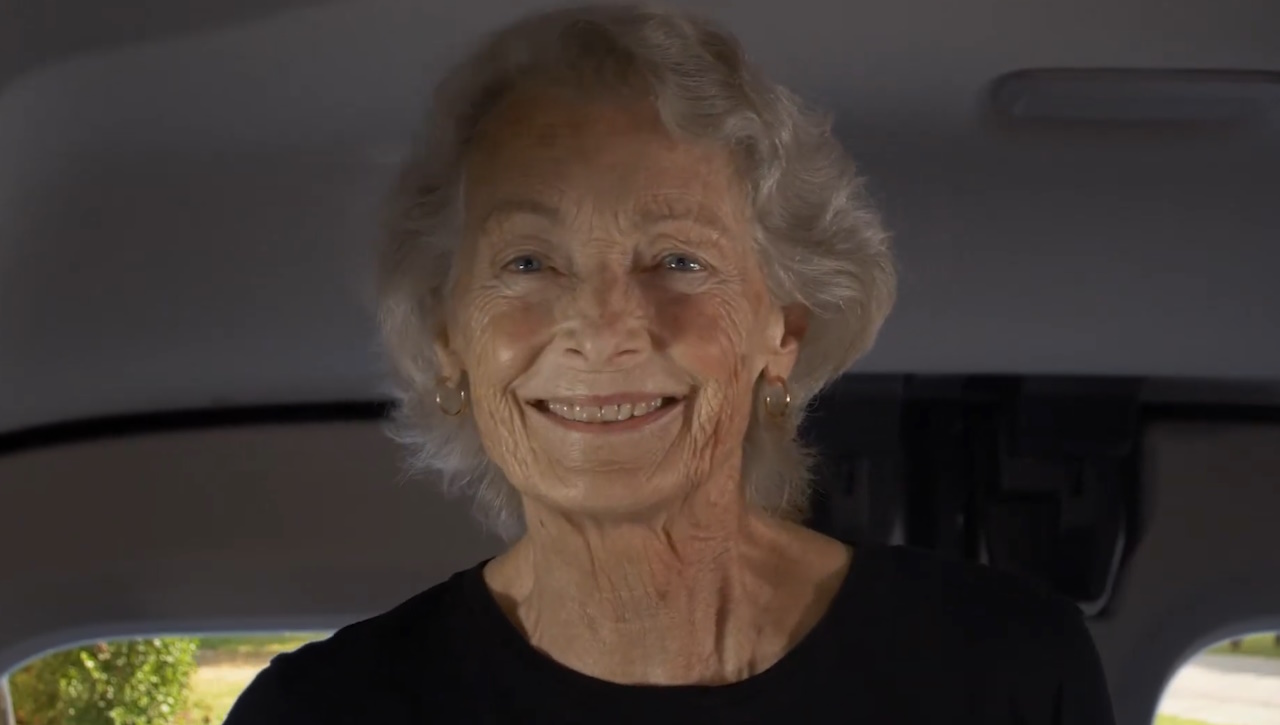
Spoiler Warning: There are spoilers ahead for the entire Star Trek franchise, including the most recent seasons of Discovery, Picard, Lower Decks, Prodigy, and Strange New Worlds.
I’ve seen a lot of posts on social media where fans try to construct their “ultimate” Star Trek crews with characters from across the franchise, including one that popped up a few weeks ago. For whatever reason, this latest one – which was put out by the official Star Trek Twitter account – captured my imagination. So today I thought it could be fun to show off the characters that I’d pick to be in my “ultimate” Star Trek crew!
Let’s start by laying down some ground rules…
The social media post which inspired this article.
First of all, I don’t want to pick more than a couple of characters from a single series. If you’re just going to pick the entire crew of the Enterprise-D, what’s the point? We might as well just go and watch The Next Generation!
Secondly, the fact that characters come from different eras or timelines is entirely irrelevant. This is pure fantasy – though who knows, maybe one day Star Trek will do some kind of massive crossover event featuring characters from all over the place!
Third, characters have to occupy a role that we saw them fill on screen; i.e. Captain Picard can’t be a tactical officer, nor could Michael Burnham be assigned as the ship’s Chief Medical Officer!
Fourth, I want to include all of the major roles that we’ve seen main characters occupy on Star Trek – something that the Twitter post that inspired this piece didn’t do!
Finally (and most importantly), I want this to be taken light-heartedly and in the spirit of fun!
So let’s get started building the USS Trekking with Dennis!
Starship Class: Excelsior
The USS Excelsior in The Search for Spock.
One thing that a lot of these lists miss is the ship that the crew will be serving aboard. As many Trekkies have pointed out over the years, a starship is akin to a member of the crew; not merely a setting but a living, breathing entity in its own right. Many starship designs have become iconic parts not just of the Star Trek franchise, but of sci-fi and popular culture in general, and many Star Trek starships are instantly recognisable even to folks who aren’t fans.
The Excelsior-class has been one of my favourites ever since I first saw it. It’s a beautiful design that took the classic look of the Constitution-class and updated it, becoming an iconic piece of ’80s sci-fi in the process. It’s clearly a Starfleet ship – the design retains the saucer, neck, body, and nacelles on pylons that continue to define Federation starships, but it mixed things up for a new era. Excelsior-class ships became workhorses for Starfleet, remaining in use for decades. Picard Season 2 recently debuted an updated design, showing that the ships were still being used at the dawn of the 25th Century!
Admiral/Mission Commander: Jean-Luc Picard
Admiral Picard.
In overall control of our mission at Starfleet Command is Admiral Picard! He’s level-headed, diplomatic, and willing to try to negotiate even with the fiercest adversaries. He’s also a skilled tactician in his own right, and someone who I’d trust to plan operations that involve entire fleets of starships.
Admiral Picard was initially chosen by Starfleet to spearhead the Federation’s efforts to evacuate the Romulan homeworld. While that plan ultimately fell apart due to events beyond his control, the fact that he was the right man to take charge of such a massive assignment shouldn’t be in dispute. Admiral Picard – with support from his team – will be co-ordinating our mission back at headquarters!
Captain: Benjamin Sisko
Sisko in Deep Space Nine Season 7.
Although the question of “absolute favourite captain” is an incredibly difficult one, if I were placed under duress Benjamin Sisko is probably the individual I’d name! A battle-hardened commander who transformed a minor, obscure posting into one of the most significant strategic locations in the entire Alpha Quadrant, Captain Sisko led the charge against the Dominion during one of the Federation’s darkest hours.
As a commanding officer, Sisko inspired his crew to follow him, but he was also well-versed in dealing with alien cultures and could be both a diplomat and a deal-maker. I also feel that Captain Sisko would work well with Admiral Picard; he would command the ship while Picard was in control of the overall mission, but could also offer advice and input as we saw him do for Admiral Ross during the Dominion War.
First Officer: Jack Ransom
Commander Jack Ransom.
At the top we have two very serious people – so we need someone like Commander Ransom to balance things out! Although he can be laid-back and make jokes, when the chips are down we’ve seen Commander Ransom absolutely excel, putting the needs of his shipmates first and stepping up to tackle whatever the cosmos throws at him.
The role of a first officer in Star Trek has varied from show to show, with some taking on more away missions and others serving as advisors and confidantes. The best first officers are a mix of both, and Jack Ransom seems like someone his commanding officer can rely on to give honest, sound advice – and then lead a dangerous mission independently.
Helm: Tom Paris
Promo photo of Tom Paris.
The role of helm officer has been part of Star Trek since The Original Series. But it wasn’t until Tom Paris took over at the helm of the USS Voyager that I felt there was someone in the driving seat who was a bona fide pilot. Paris truly loves piloting Voyager – and any other ship or shuttle that he can get his hands on, too. That’s an impression that I never really got from Sulu, Wesley Crusher, or really anyone else who had sat in the chair before him; they seemed to see the role as a job or duty, where Paris revels in his work.
Not only does Tom Paris enjoy what he does, but he guided the USS Voyager safely home across an impossible distance. Whether it was wormholes, slipstream drives, spatial catapults, the Borg transwarp network, or a warp 10 shuttle that accidentally mutated him into a salamander, Paris navigated them all – and found redemption for his past misdeeds in the process.
Chief Engineer: Hemmer
It’s Hemmer Time!
As the first Aenar to be a major character, Hemmer had a lot of potential. The no-nonsense attitude he had stands in stark contrast to some other engineers we could think of, but when he was off-duty he was personable and friendly with his shipmates – and a guiding light to young cadets who found themselves under his wing. Hemmer’s love of science was cute, too, and he was able to take in his stride all kinds of different events that befell the USS Enterprise.
As Hemmer once told Uhura, he believed that his purpose was to fix what is broken – and he did that in more ways than one while serving as the Enterprise’s chief engineer. Hemmer helped the Enterprise survive major damage during battles against dangerous enemies, and he’s the person I’d want to rely on to keep my starship flying!
Chief Medical Officer: Dr T’Ana
Dr T’Ana.
Dr T’Ana is unapologetically my favourite Lower Decks character. Her gruff and grumpy bedside manner conceals genuine medical skill, and we’ve seen her treat patients with all kinds of horrible sci-fi ailments without so much as batting an eyelid. Despite her acerbic attitude, though, Dr T’Ana manages to strike up friendships with her shipmates – and has proven herself to be someone they can rely on.
We’ve also seen how Dr T’Ana is unflappable and doesn’t crack when put under pressure – something that could be important depending on how badly our mission goes! She may not be the politest doctor in the fleet, but no matter what was wrong – disease, injury, or random sci-fi shenanigans – I’d trust Dr T’Ana to patch me up. Plus she’s a Caitian, something that I appreciate as a cat-fanatic!
Nurse/Sickbay Assistant: Kes
Promo photo of Kes.
While Dr T’Ana can be grumpy and even abrasive, Kes has a wonderful bedside manner that has a way of putting patients at ease. Although she didn’t have much by way of formal medical training when she joined the crew of the USS Voyager, she soon grew into her role as the Doctor’s assistant in sickbay. I still think it’s a shame that Kes had to leave Voyager after the show’s third season, just as she was hitting her stride and learning more about her telepathic abilities.
Kes provides a sharp contrast to Dr T’Ana, and for that reason I think the dynamic in sickbay would be a lot of fun. But Kes has also demonstrated a willingness to learn and a keen medical intuition of her own, so if Dr T’Ana (and the rest of the medical staff) were busy or indisposed, Kes is more than capable of treating patients on her own.
Counsellor: Dr Hugh Culber
Dr Culber in Discovery Season 4.
Although Dr Culber is the USS Discovery’s chief medical officer, in recent seasons we’ve also seen him take on the role of ship’s counsellor to a greater degree. Not all doctors would make for good counsellors, but Dr Culber has grown into the role, taking on the extra burden of caring for his shipmates’ mental health in addition to his duties in sickbay.
In The Next Generation, Counsellor Troi had a pretty big advantage when it came to reading her patients and understanding them! Dr Culber doesn’t have that same empathic ability, meaning he has to do things the old-fashioned way! But his advice has proven invaluable to Captain Burnham, Saru, and even Book. Dr Culber throws himself into his work, prioritising his patients ahead of himself on occasion.
Tactical: Tuvok
Tuvok in Voyager’s first season.
Tactical has often overlapped with security on Star Trek, but if you think about it, they’re really two distinct roles that require different approaches. As fun as it might be to see Worf getting angry as the Enterprise races into battle, if my back’s against the wall and I’m facing defeat, I want the cool-headed, logical Tuvok aiming the phasers and firing the photon torpedoes.
Tuvok’s temperament makes him incredibly well-suited to a position at tactical – and not only in the heat of battle, either. As a strategist who has mastered the difficult Vulcan game of kal-toh – a strategy game he’s been playing for well over a century – Tuvok is also someone I’d trust to draw up plans for everything from small away missions to large battles.
Security Chief: Odo
Constable Odo.
As above, we’re separating the roles of tactical officer and security chief. For the latter, there’s no one I can think of who’s better-suited to the role than Odo! Odo is Star Trek’s first real “policeman;” a dedicated officer of the law who was trusted by the Cardassians, Bajorans, and the Federation to be impartial when it comes to justice.
That impartiality – ensuring that no one is above the law – is exactly what our crew needs. Odo will maintain order, but he’ll do so fairly. He’ll also be able to strike up friendships with the crew while retaining that impartiality. Everyone aboard our ship – Starfleet, non-Starfleet, guests, diplomats, or anyone else we meet along the way – will know that Odo will treat them fairly. And I gotta be honest about this last point: having a changeling on the crew could come in handy in a lot of situations!
Communications: Hoshi Sato
Ensign Hoshi Sato.
Hoshi Sato had not only mastered forty languages – including some very alien ones – in the days before universal translators existed, but she contributed in a major way to making the universal translator itself work in the way we’ve come to expect in Star Trek. Real-time, instant translation of previously-unheard alien languages wouldn’t have been possible without Hoshi’s work.
Hoshi Sato also showed an incredible aptitude for picking up languages very quickly – notably translating languages like Romulan and both Xindi-Insectoid and Xindi-Aquatic. If there was ever a problem with the universal translator – or our mission encountered an alien race whose language and form of communication was difficult to understand – Hoshi Sato is the linguist I’d want on our crew to handle things!
Science Officer: Spock
Spock at his post in The Original Series Season 1.
Could it really be anyone else in this role? Although Spock would go on to be a captain, an ambassador, and a diplomat, it’s his role as the Enterprise’s science officer where he’s best-remembered and most iconic. Spock has a genuine interest in uncovering the secrets of space and the universe, and his raised eyebrow and proclamation that something is “fascinating” have become legendary parts of the Star Trek franchise!
Spock’s logical analysis of sensor readings helped out – and saved – the Enterprise on multiple occasions. Taking his time to analyse unknown phenomena, Spock would present his findings based on the available evidence, and was instrumental in missions as diverse as discovering new forms of life and shutting down ancient super-weapons. On a mission of exploration – or any mission that needs good, solid scanning and sensor work, I want Spock manning that post!
Operations: Data
Data in Tin Man.
Although the role of operations or ops officer isn’t always well-defined in Star Trek, the role can involve things like power management, sensor control, deflector control, and oversight of the internal workings of the ship. We’ve seen senior officers like Data and junior officers like Harry Kim and Nog assigned to operations roles, and I’m choosing to bring Data along on this mission.
Data is an android, and he has super-human abilities and reflexes as a result. When it comes to things like systems maintenance and keeping the ship in good working order, someone like Data is ideally-suited to the role, and he’s also proven himself to be more than capable of overseeing departments and even entire crews. Data can also provide valuable insight into unfolding situations almost entirely free from bias, making him incredibly useful to have on the bridge as an advisor.
Transporter Chief: Montgomery Scott
Scotty shortly before his first retirement.
Although Scotty is best-remembered as the Enterprise’s chief engineer, I’m assigning him the role of transporter chief this time. One of the most iconic (and misquoted) lines from The Original Series is “beam me up, Scotty,” so I think we’re on safe ground here! Scotty is nothing short of an engineering genius, and when things go wrong – as they often do with Starfleet transporters – he’s the man I’d want to fix things and keep them running smoothly.
Transporter chief is a role that can be overlooked, especially considering that transporting is a fairly quick process when everything runs smoothly. But everything doesn’t always run smoothly, and the right transporter chief with the right technical know-how can mean the difference between beaming up and having your molecules scattered across half a sector of space. Or worse!
Cadet: Rok-Tahk
Rok-Tahk.
It’s not unusual for a starship to have several cadets assigned as they complete their courses at Starfleet Academy, so I’m picking Prodigy’s Rok-Tahk for that role (even though she isn’t formally a Starfleet cadet!) Across the first ten episodes of Prodigy, I felt we got to see some genuine character growth from Rok-Tahk that I hadn’t really expected, and I think she’ll continue to develop into a truly excellent Starfleet officer one day.
We’ve seen cadets like Uhura in Strange New Worlds and Tilly in Discovery moving between departments to try their hand at basically everything aboard a starship. Perhaps Rok-Tahk will do something similar during the course of our mission, giving her a range of new experiences, and potentially bringing a different point of view to all of the departments aboard our ship.
Bartender: Guinan
Guinan in Picard Season 2.
Although Quark is a worthy contender to bring along, I think it’s not unfair to say he’s a bit of a troublemaker! Guinan can be relied upon to create a welcoming environment in her bar for when our crew need some time to relax, but she’s also far less likely to cause problems during our mission!
Guinan can draw upon the experiences of her centuries-long life to offer advice and support to all members of the crew, and we’ve seen moments where her words to Captain Picard ended up completely transforming the outcome of a story. As someone who not only tends the bar but also listens and occasionally has something of value to add, Guinan is the perfect complement to any Starfleet crew.
Non-Starfleet Crewmate: Garak
In The Pale Moonlight was one of Garak’s best episodes.
Since The Next Generation premiered, most Star Trek crews have included at least one non-Starfleet or non-Federation crewmate. When I think back over these characters, few stand out more than Deep Space Nine’s Garak. Garak also brings a lot to the table for our crew! His previous life as a spy saw him develop a completely unique set of skills ranging from technical to combat and beyond – and in a pinch, he could be very useful.
However, Garak will need to be carefully monitored during our mission, as he can be rather slippery and self-serving. Although his service toward the end of the Dominion War saw him firmly allied with the crew of DS9 and the Federation, Garak has gone off-script on a number of occasions. He doesn’t always willingly share everything that he knows, so having someone else on board who knows how to handle him and how to get the best out of him could be important! But when a crisis looms, I think Garak can be counted on to find unconventional – and often un-Starfleet – ways to solve problems.
Villain: The Borg
The first Borg drone seen in Star Trek.
There have been some wonderfully iconic villains in Star Trek, like Khan or Gul Dukat, and it can be hard to pick an absolute favourite. Purely in terms of the scale of the threat they pose, though, few Star Trek adversaries can compare to the Borg Collective. A vast army of billions or perhaps trillions of assimilated drones, a fleet of thousands of identical cube-shaped ships… the Borg are a faction that could wipe out the Federation in a matter of days without seriously overtaxing themselves.
We’ve seen Starfleet ingenuity and individuality overcome the Borg on a handful of occasions, but I’ve always wondered what it would look like if the Borg ever tried to invade en masse. Would a one-sided rout be inevitable… or will our cobbled-together crew find a way to save the day?
So that’s it!
Star Trek’s first crew.
Those are the characters that I’m choosing for my “ultimate” Star Trek crew.
There are no right answers to the question of which characters make for the “best” crew, and in addition to individual characteristics it’s worth considering how different characters would interact with one another and how well they’d work together. For my two cents, practically every Star Trek show has managed to get a good balance of characters and deployed them successfully. There are a handful of characters who didn’t really get enough time in the spotlight to truly shine, but even so, the franchise as a whole has done a fantastic job – and there are plenty of wonderful characters to choose from when making a list like this one!
I hope this was a bit of fun – and not something to take too seriously or get upset over! I was inspired a few weeks ago by that post from the official Star Trek social media team, and this is my (lengthy) response. It took a while to put this list together and really think about which characters I’d want to include – and which I’d have to exclude. For practically every position on the list above, there was at least one and often two other characters that I strongly considered including. I hope that the final list feels balanced between different shows and different eras, and was, if nothing else, a bit of fun to read!
Until next time!
The Star Trek franchise – including all characters, television series, and films mentioned above – is the copyright of Paramount Global. This article contains the thoughts and opinions of one person only and is not intended to cause any offence.
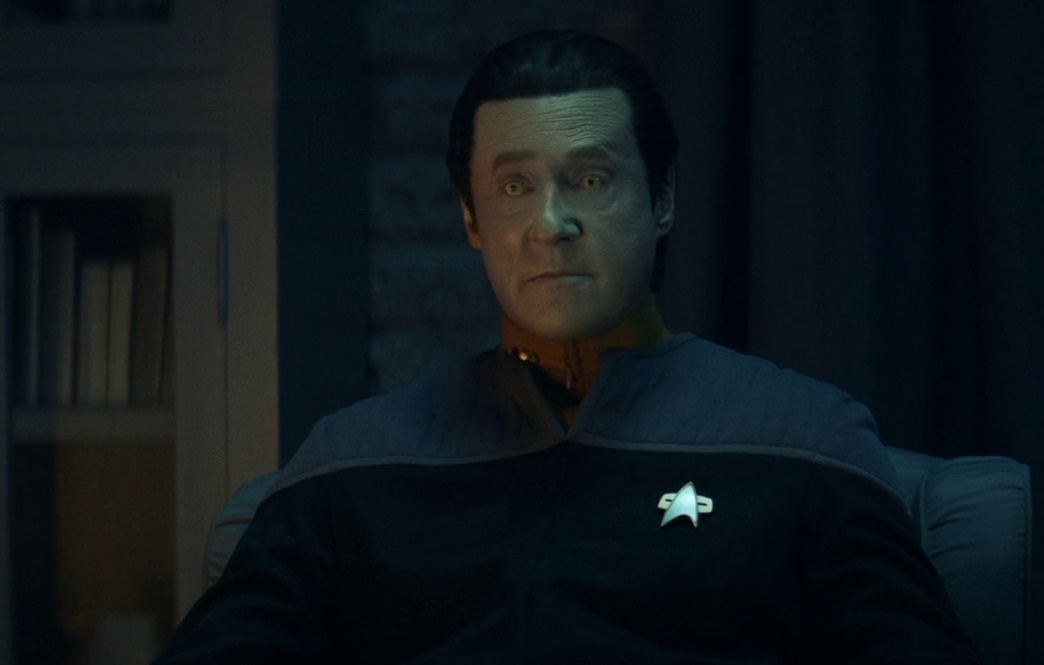
Spoiler Warning: There are spoilers ahead for Star Trek: Picard Seasons 1-2 and the trailers, teasers, and announcements for Season 3. Spoilers are also present for Star Trek: The Next Generation, Star Trek: Deep Space Nine, and Star Trek: Voyager.
At New York Comic-Con back in September, Paramount showed off a new trailer for the upcoming third season of Star Trek: Picard, and I’m finally getting around to taking a look at it! This time, I’m going to give my thoughts and analysis of what was shown off in the trailer, as well as speculate a little about what the plot of Picard’s final season might end up looking like.
The first thing to say is that Season 3 appears to be another standalone story, one that doesn’t follow on directly from the events of Season 2. Does that mean that we’ll never know who or what caused the anomaly that was so central to kicking off (and resolving) last season’s main story? And does it mean that the dangling story threads from Season 1 will also be left unresolved when Picard comes to an end? I hope not – but I have to say that, based on what we know of Season 3 at this stage, my hopes of the unresolved storylines from Seasons 1 and 2 being addressed are fading fast.
Will Season 3 provide a conclusion to unresolved stories from Seasons 1 and 2?
And before we go any further, I want to address that. Picard, despite having a lot of promise when it was announced and when it premiered, has been hit-and-miss so far; a rather disconnected series that has boldly tried some new and potentially-interesting ideas, but that hasn’t always managed to pull them off successfully. I still haven’t written up my full thoughts on Season 2 as a whole, but suffice to say that there were some pretty significant problems that seriously hampered my enjoyment. If Season 3 is, as I suspect, leaving all of that behind to rush off into another new story, for me that’s a double-edged sword. On the one hand, spending too much time looking back at the underwhelming elements of Season 2 isn’t what I’d want to see… but on the other, Season 3 represents Star Trek’s last chance – at least in this iteration – to make more of some of those unresolved storylines. Season 2 could end up looking better in retrospect if it turns out to be one piece of a greater whole… but if Season 3 drops those stories to do its own thing, it will remain a disappointment.
I’ve already shared my thoughts on the way the casting situation has been handled, but as we’re diving back into Picard Season 3, I think it’s worth pointing out again that the return of The Next Generation’s main characters – all of whom got some screen time in the new trailer – has come at the expense of several genuinely interesting characters from Seasons 1 and 2 of Picard that we were only just beginning to get to know. As it seems unlikely that most of them will be seen in the franchise again – at least, not for a long time – I think it’s worth reiterating just how much potential has been squandered.
The cast of Star Trek: Picard Season 1 – most of whom are not returning this time around.
If the Star Trek franchise is to survive long-term, it can’t simply coast on nostalgia. Trying new things, innovating, and introducing new characters has been what the franchise has done since the 1980s, but the current crop of Star Trek shows all seem to be falling back on nostalgic crutches in a way that they really shouldn’t. Picard Season 3 may be the epitome of this backwards-looking take on the franchise, but it’s certainly not the only example.
But that’s enough about that for now! We’re here to look at the trailer rather than talk about Picard or the franchise in a general sense, and the New York Comic-Con trailer definitely raised a lot of interesting (or potentially-interesting) points!
The USS Titan at warp.
First of all, the season’s main villain, played by veteran actress Amanda Plummer, will be called Captain Vadic. Vadic was seen briefly in the trailer, and seems to have an almost Khan-like obsession with getting revenge on Picard and his former Enterprise-D crewmates. Exactly what her beef is with the retired admiral is unclear… but given who else is involved, surely there has to be a connection to The Next Generation, right?
Well, not so fast! In both Seasons 1 and 2, key storylines were ultimately not connected in a major way to Picard’s past… or at least, not to elements of his past that we were already familiar with. Speculation abounded regarding the Coppelius synths, the mysterious super-synths, the Borg Queen, the anomaly, and Q, but ultimately in both seasons the writers chose to go in a different and new direction. Captain Vadic could be connected to Picard either because she’s a returning character utilising a nom de guerre or because she’s related to or otherwise connected to a classic character. And don’t worry, I have plenty of ideas in that vein that we’ll talk about on another occasion! But I think we have to consider the very real possibility that this character, as well as whatever may have caused her to hate Picard and his crew, will be something entirely new to us as the audience.
The mysterious Captain Vadic.
I liked what I saw of Amanda Plummer’s performance in the trailer. She brought a ferocity to Captain Vadic that straddled the line between dedication and obsession, and had an almost animalistic or beastly quality that echoed not only Khan, but other great Star Trek villains too. Vadic has been described as an “alien,” though what species she could be if not human wasn’t clear. Could her scars suggest some kind of ex-Borg origin, perhaps?
Vadic’s ship, the Shrike, seemed to draw inspiration from Nemo’s Narada that we saw in 2009’s Star Trek reboot film, as well as perhaps from the Romulan vessels seen in Nemesis, which could all hint at a Romulan (or Reman) origin or connection. The sweeping, blade-like lines of the Shrike give the vessel a genuinely threatening appearance, and if what we saw from Picard and Riker in the trailer depicts them and their vessel in combat against the Shrike, Vadic’s ship seems to have the weapons to back up its intimidating look!
The Shrike, Captain Vadic’s ship.
Speaking of starships, we got a closer look at the USS Titan in the new trailer – and it looks absolutely fantastic! One of the criticisms some fans have had of Picard – especially with last season’s 21st Century story – has been the lack of starships, and in addition to the Titan we also caught a glimpse of Star Trek Online’s Enterprise-F. Though I dabbled briefly in Star Trek Online, MMO games aren’t really “my thing,” but I’m nevertheless happy to see the creative team take inspiration from the game on this occasion. Fans of Star Trek Online will be thrilled, undoubtedly!
La Sirena was also present, and may be being used by Raffi and/or Seven of Nine. I like the design of La Sirena and I hope the story will find a way to include the smaller vessel alongside bigger ships like the Titan and Enterprise-F. Rounding out the “starship porn” in the trailer was a beautiful shot of Earth Spacedock – bringing back memories of both The Next Generation and some of the Star Trek films in which the massive station was featured. Could a Search for Spock-inspired starship heist be on the cards? I guess we’ll have to wait and see!
The Enterprise-F, with a design borrowed from Star Trek Online.
Although the producers are keeping a pretty tight lid on the season’s story, the trailer did actually give us quite a lot to go on. Captain Vadic seems to be chasing Dr Crusher – perhaps to get to Picard or get his attention – and her reason for doing so seems to be connected to her hatred of Picard and his Enterprise-D crewmates. As I said, we’ll speculate more about her possible reasons in the days ahead.
As part of her anti-Picard vendetta, Captain Vadic appears to have put together what I’d describe as something of a “rogues’ gallery” of The Next Generation’s villains. We saw Professor Moriarty – the sentient hologram created in the Season 2 episode Elementary, Dear Data – as well as Lore, Data’s “evil twin.” Could there be more villains from The Next Generation era who’ll be brought on board? I think that’s a distinct possibility!
Professor Moriarty joins a “rogues’ gallery” for an anti-Picard vendetta.
Captain Vadic was seen speaking to a group of characters – most of whom had their faces covered or obscured – promising “vengeance,” so I think it’s at least possible that we haven’t seen the last big or surprising announcement of a returning villain! Several of the characters with Vadic seemed to be aliens, and I can think of no shortage of alien adversaries that Picard and the crew of the Enterprise-D tackled during their adventures. Could the promise of revenge combined with Captain Vadic’s powerful personality have convinced them all to work together?
Any time a television show brings back a number of past characters all at once, there’s a risk of some of them being overshadowed. If, as I suspect, Captain Vadic is someone wholly new connected to a hitherto-unseen event in Picard’s past, her dominant role as the leader of the rogues’ gallery could end up relegating the likes of Lore and Professor Moriarty to smaller cameos. Depending on how it’s handled that could be fine – or it could be a little underwhelming. Paramount is promising big things from this “explosive” final season of Picard… so I hope the series can deliver!
Lore makes a return!
We saw quite a lot of Riker in the new trailer, more than almost anyone else aside from Picard himself. The relationship between Riker and Picard was, in my view anyway, beautifully restored in the Season 1 episode Nepenthe, which saw the two men reuniting for the first time in almost twenty years (at least on screen). After seeing Riker out of uniform enjoying his family life and retirement, it’ll be great to see him back in action once more.
I feel that Worf’s appearance has the most potential to cause controversy out of all of the returning cast members. His statement in the trailer that he “prefers pacifism” and has abandoned the way of violence was played for laughs at first, but it represents a major departure from the character we knew through seven seasons of The Next Generation and four of Deep Space Nine. It’s definitely something that could feel like a natural progression if it’s suitably well-explained – some older Klingon characters, like Kor, for instance, seemed to mellow with age and become less quick to anger – but it’s definitely a move that could be controversial in some quarters. Could this be the producers and creators potentially setting up a calmer, more level-headed Worf for a leading role in his own series or film?
Worf in the trailer.
We didn’t see too much of either Dr Crusher or Deanna Troi, though the former seems to be a major driving force in kicking off the storyline. I expect we’ll hear of her distress signal in the season premiere, and that could be the moment where an off-duty Picard was approached by two Starfleet officers (was that scene in Guinan’s bar? I couldn’t tell!) As for Troi, she seems to be along for the ride with Riker, and her Betazoid senses were put to use describing the mood on what could be the Shrike as an “all-consuming darkness.” This ties into the themes of obsession and revenge that I touched on earlier.
Seeing Dr Crusher in some form of stasis pod was interesting; could her distress signal have been the lure to get Picard (and the others) back out into space? If Dr Crusher was the only one of the Enterprise-D crew who was on a deep space assignment, she would seem to be the logical target – as bait in a trap!
Dr Crusher seems to kick off the story.
Raffi also seems to be being hunted – can we assume it’s by the same adversary? If so, Captain Vadic may be doing more than simply targeting the crew of the Enterprise-D – she may be trying to get to Picard by attacking anyone he’s worked closely with in the past. As his former aide-de-camp from his time as an Admiral, Raffi certainly fits the profile!
But there could be more to it than that. We’re getting into some seriously speculative territory, but if the story of the new season involves a villain (and/or a rogues’ gallery of villains) trying to hurt Picard by targeting those close to him, we could potentially learn of the deaths of some friendly faces. Elnor and Soji spring to mind as possible victims – both worked closely with Picard and neither are scheduled to make a major appearance this time around. Could one or both of their deaths have sent Raffi into hiding? Or put her on the revenge trail?
Who is Raffi hiding from?
Finally we have Geordi La Forge. In the trailer his main moment came when he seemed to criticise Picard for dragging Worf and Riker into whatever crisis is going on… but it doesn’t end there. We know from casting – and briefly from an appearance at the Titan’s helm in the trailer – that Geordi will be joined by two of his children. One of his daughters will be played by LeVar Burton’s real-life daughter Mica, which is neat. Mica Burton hosted Star Trek Day 2021 alongside Wil Wheaton, and has been a fixture in the expanded Star Trek community ever since the franchise returned to the small screen.
Having covered the main characters – and speculated a little about some of them – we still have a few disjointed clips and images to assess from the trailer before we wrap things up! Starfleet Academy or Starfleet HQ appears to be attacked and destroyed at one point, but for some reason my gut instinct is to say that that may not happen in the real world. We could be looking at a simulation, dream, or plan rather than an actual attack. I don’t know exactly why I feel that way… but I do!
Is this moment real, or does it take place in a dream or fantasy sequence?
Amongst some wreckage in space we caught a glimpse of a derelict or abandoned starship. Could this be Dr Crusher’s ship – the one from which she sent the distress signal to Admiral Picard? The name and registry number was hard to make out from the trailer, and the design seemed similar to the USS Titan. The field of debris in which the ship was drifting seems too large to all have come from one (largely intact) vessel, so could this be the aftermath of a larger battle in which other ships were destroyed?
As mentioned, I can’t quite tell if the trailer’s opening shot sees Picard at Guinan’s bar on Earth (“Ten” on Forward Avenue in Los Angeles’ historic district that was featured in Season 2), but it certainly could be. Starting Season 3 in a location that was central to the story of Season 2 would go some way to tying the stories together if there isn’t a bigger connection between what seems to be two separate stories.
Is Picard dining at Guinan’s bar in this scene?
Some of the shots of the Shrike and Titan chasing one another and battling seem to be reminiscent of the Briar Patch from the film Insurrection, so could that be a clue? Starship battles that take place in nebulae have been a part of the franchise from The Wrath of Khan all the way through to Discovery’s most recent outing, so it’s by no means a cast-iron statement. But the colour and appearance of the clouds in the nebula certainly brought back memories of Insurrection for me.
The Shrike having the power to outgun the Titan could mean that the ship is incredibly powerful – like Nero’s Narada or Shinzon’s Scimitar, for example – but it could also speak to the Titan potentially being an older vessel, perhaps one that has been recently taken out of mothballs and potentially with only a skeleton crew aboard. While the Shrike definitely has the appearance of a warship or a hunter, it could be worth keeping in mind the Titan’s potential condition!
The Shrike engages the Titan.
After being given a field commission last season and assuming command of the USS Stargazer, Seven of Nine appears to wear the rank pips of a commander rather than a captain, though she does still seem to be on the command track. It wouldn’t be the first time that an officer below the rank of captain has been given a command, though, so Seven may yet prove to be in command of a vessel. Geordi, meanwhile, appears to hold the rank of either a commodore or perhaps a one-star admiral based on the single pip seen on his uniform collar.
I find it interesting, too, that Seven has chosen to remain in Starfleet while Raffi appears to have taken La Sirena on a mission of her own. Is this something that we’ll see her do during the season, or is this where her story will begin? If so, what could have caused her to abandon Seven, Elnor, and her role in Starfleet? And could this connect with my theory above about Captain Vadic potentially having attacked, kidnapped, or killed the likes of Elnor and Soji?
Seven of Nine wielding a phaser pistol.
By far my biggest question at this stage is this: who else, besides Moriarty and Lore, might be joining Captain Vadic’s rogues’ gallery? I feel all but certain that we’re going to see other villains of The Next Generation era coming on board if this is a quest for vengeance against Picard and the crew of the Enterprise-D. From the Duras family and Sela to DaiMon Bok and even the Maquis, Picard and his crew thwarted the nefarious schemes of many villains during their adventures – and if Captain Vadic is indeed putting together a crew of her own to seek revenge, there must be no shortage of applicants!
If Picard and the crew are going to go out with a bang, as we’ve been promised, facing off against a team of their most powerful and feared adversaries could absolutely make for an exciting, tense, and explosive season of Star Trek. After the slower pace of Season 2 and its focus on Picard’s innermost thoughts and his personal family history, something a bit more action-oriented this time around could be just what the doctor ordered. Although I’m still upset about the decision to ditch most of the main cast members from Seasons 1 and 2 in favour of this return to The Next Generation’s characters, I’m hopeful that what we’ll get will be a fun ride and a great way to say goodbye.
Season 3 is purportedly the final voyage for Picard and the crew.
The trailer shown off at New York Comic-Con looked action-packed and exciting, so hopefully that’s representative of the new season. Although Picard has its problems and I have some gripes, the trailer itself has raised my hopes, and I’m now definitely looking forward to the new season.
So that’s it for now! Although this summer and autumn has seen me writing less and making fewer posts here on the website, when Picard Season 3 kicks off in February I still plan to review each episode in turn, as well as crafting a few theories and giving my thoughts on how the season as a whole shapes up. So I hope you’ll stay tuned and join me for that in the new year!
Star Trek: Picard Season 3 will stream on Paramount+ in the United States and on Amazon Prime Video around the world beginning on the 16th of February 2023. Seasons 1 and 2 are available to stream now and are also available on DVD and Blu-ray. The Star Trek franchise – including Picard and all other properties mentioned above – is the copyright of Paramount Global. This article contains the thoughts and opinions of one person only and is not intended to cause any offence.
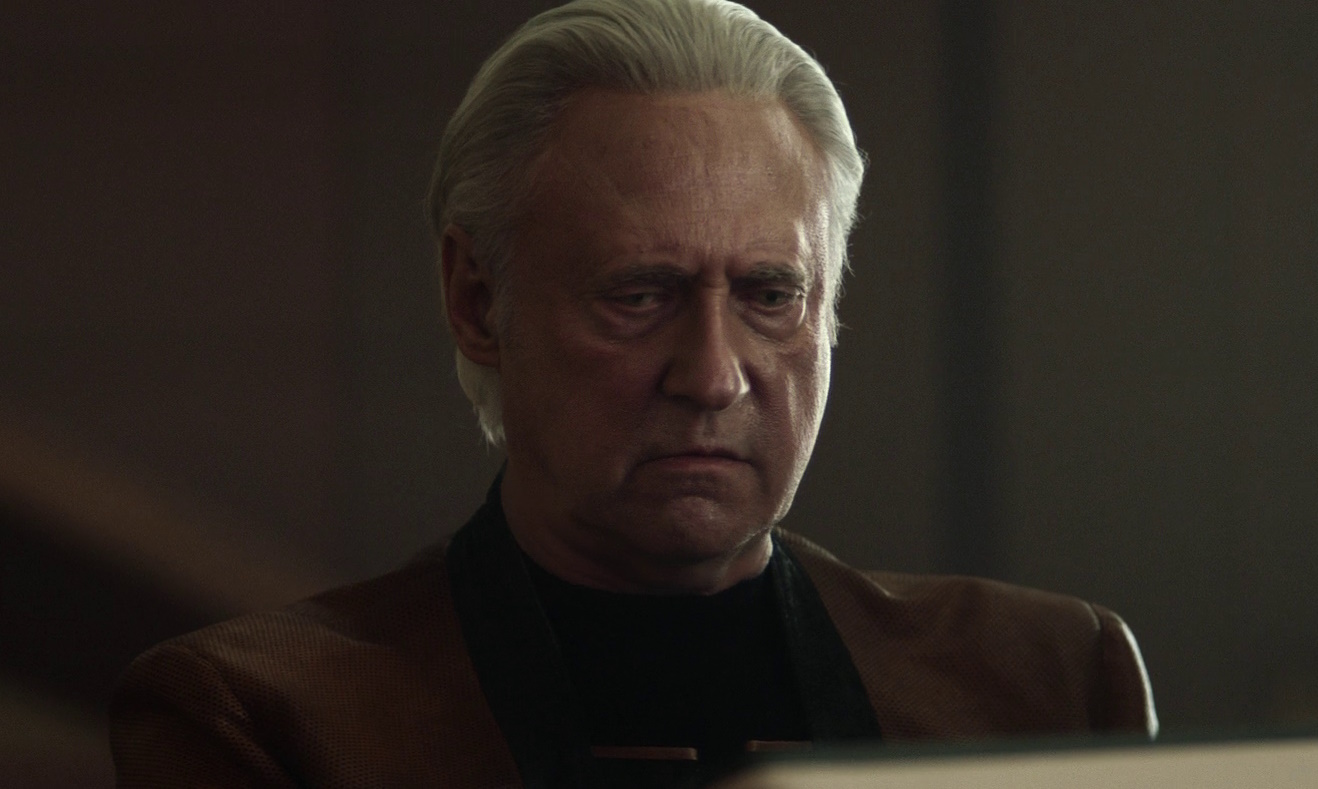
Spoiler Warning: There are spoilers ahead for Star Trek: Picard Seasons 1 and 2, as well as the teaser trailer and casting announcements for Season 3. Further spoilers are present for Star Trek: Discovery Seasons 1-4, Star Trek: The Next Generation, and other iterations of the Star Trek franchise.
Even as we continue to wind down from Season 2 of Star Trek: Picard, my thoughts have already turned to Season 3! Although the new season is still in production and is probably a year away, I wanted to get one of my big pre-season theories written down ahead of time. This one ties together events in all three seasons of the show – and I think that could make it a satisfying story if it were to unfold.
There are some legitimate concerns about Picard Season 3, at least from where I’m sitting. The fact that most of the new cast members have been unceremoniously dumped in order to make way for the returning characters from The Next Generation really stings, and I’m truly disappointed that we won’t get to spend more time with the likes of Elnor and Soji next time around. I wanted to acknowledge that before we proceed with the theory, because both the cutting of characters and the fact that several of them have disappeared without a proper goodbye is poor form from Picard’s producers and creative team.
Most of the Picard cast are not returning for Season 3.
So let’s talk about this theory, then! In short, what I’ve come up with connects events in both Seasons 1 and 2 with what has been teased about Season 3, potentially meaning that Picard will turn out to be one long connected story after all. We’re taking the mysterious anomaly encountered at the end of Season 2 as a starting point and asking “who could have created something like that?” The Borg Queen-Dr Jurati hybrid believed it was artificial in nature and had the potential to wipe out all life in an entire sector of space. That seems like the first phase of an invasion or attack – so who can we think of in Star Trek who could create a weapon on that scale?
We could absolutely pick on factions like the Dominion, Enterprise’s Sphere-Builders, or Species 8472. All of those – and many more – were potential suspects when it came to another mysterious anomaly in Discovery’s fourth season, too, and for good reason! But when we consider the elements that have already been introduced in Star Trek: Picard in particular, one faction more than any other appears to stand out: the super-synths from Season 1.
The super-synths as glimpsed in Season 1.
To briefly recap if it’s been a while since you watched Et in Arcadia Ego: the super-synths claimed to be “an alliance of synthetic life,” and it was implied that they resided far beyond the Milky Way galaxy. I nicknamed them the “Mass Effect Reapers” for their similarities to that video game faction! The super-synths literally moved stars to point to a beacon that they’d left behind on the planet of Aia, and in a vision that seemed jumbled and terrifying to organic minds they promised to come to the aid of any synths who requested their help.
The super-synths believed that all organics would eventually attack and destroy their synthetic creations; that war between synthetic and organic life was inevitable. The plans they left behind could open a portal to their home in dark space, allowing the super-synths to show up anywhere in the galaxy at a moment’s notice. It was left ambiguous as to whether their offer to help synths in their fight against organics was actually genuine or whether it was some kind of elaborate trap.
The super-synths’ portal over Coppelius.
Although Admiral Picard was able to convince Soji to close the portal she had opened before the super-synths could arrive at the planet of Coppelius, the portal was open for a significant amount of time. In that time the super-synths would’ve seen a civilisation of synthetics on Coppelius asking for their help, and two massive fleets of starships engaged in a stand-off over the planet. Whatever their intentions may have been, Soji and Sutra’s actions have ensured that the super-synths are now aware of the Milky Way, the Federation, the Romulans, and the Coppelius synths.
The super-synths then disappeared from the plot and weren’t mentioned again. It isn’t clear what happened to them, what their goals may have been, nor how they would have reacted to the portal being closed at the last moment. What we do know is that the super-synths possess powerful technology – technology that seems to allow them to hop from one part of the universe to another in an instant.
The super-synths left a beacon on the planet of Aia.
This brings us to the anomaly encountered by the Borg and the Federation at the end of Season 2. The strange anomaly was described by Seven of Nine as being akin to a “transwarp conduit.” The Borg Queen-Dr Jurati hybrid was unsure of who created it, but considered them to be “a threat” requiring close observation. The anomaly was also described as being one piece of a larger puzzle – something that could tie in with a theory like this one!
Given what we know of the super-synths based on their appearance in Season 1, creating something on this scale seems well within their capabilities. They left behind instructions on how to create a portal to their domain, and what is a transwarp conduit if not a portal between two points in spacetime? Then there’s the scale of the attack: the initial outpouring of energy was enough to destroy an entire sector of space, something that hardly seems impossible for a faction that can literally move entire stars.
A joint Federation-Borg fleet defends against the anomaly at the end of Season 2.
So I think we have enough evidence based on what we saw on screen in the Season 2 finale to make the case that the anomaly may have been created by the same faction of super-synths that very nearly arrived at Coppelius in Season 1. But what of Season 3?
Not much has been officially teased so far about Picard’s upcoming third season – but we have a little to go on. Besides the announcement of returning cast members, we heard a few new lines of dialogue and caught a glimpse of both Admiral Picard and Captain Riker in a teaser trailer released to mark First Contact Day last month, and nothing there contradicts anything I’ve suggested above.
In fact, we could try to build a case for the Season 3 teaser hinting at this theory!
Captain Riker in the Season 3 teaser.
Firstly, the clips we saw of Admiral Picard and Captain Riker showed them readying themselves for combat, wielding some kind of phaser pistol (possibly the kind seen briefly in Seasons 1 and 2). At least part of the season, then, is going to involve a fight of some kind against a hitherto-unseen enemy! That’s hardly conclusive, of course, but it doesn’t contradict the idea that the main enemy is the super-synths.
Secondly, we have a handful of lines heard in voiceover. Geordi talked about “rushing into danger” during his time aboard the Enterprise. Worf speaks, saying that “sacrifice is required.” Dr Crusher spoke directly to Picard, telling him that “the galaxy comes calling.” In typical understated style, Riker talked about a “good old-fashioned road trip,” before Troi rounded things out by letting Picard know that he “will not be alone.” Again, nothing conclusive there – but also nothing contradictory. All the characters seem to be talking about gearing up for a big mission or battle.
Admiral Picard with a phaser pistol in the Season 3 teaser.
But the most interesting line in the trailer – and one that could perhaps be pointing to some kind of connection to synthetic life – came from Brent Spiner’s currently-unknown character. Spiner’s inflection sounded very emotive, definitely not like Data or B4. My first thought was that he could be portraying Lore (Data’s “evil twin” from The Next Generation), but he could also be portraying Dr Altan Inigo Soong – the son of Data’s creator who was a major character at the end of Season 1.
The line that stood out to me was this: “Evolution is not an act of preservation; it’s addition.” That line is ambiguous, naturally, but if we assume that Spiner’s character has something to do with synthetic life and synthetic research, he could very well be talking about the creation of new synths or the search for new synthetic life. He could also be talking about some kind of fusion between organic and synthetic life – perhaps Borg assimilation.
Will Brent Spiner’s Dr Altan Inigo Soong be a villain next season?
We don’t know what goals or objectives the super-synths might have, but if they view organic life as a threat it’s possible that they plan some kind of assimilation-like process to forcibly convert organics to become partially synthetic. That could be what Dr Soong is referring to – and he could be the super-synths’ advocate if they arrive in force and broadcast their intentions. Akin to someone who has been “indoctrinated” by the Reapers in the Mass Effect series, Dr Soong may be doing the super-synths’ bidding. That could set up Brent Spiner’s character to be one of the season’s main villains (again).
Am I clutching at straws? Well, that’s possible. But because of how deliberately coy the writers and producers of Picard have been about several key aspects of the storylines of both Seasons 1 and 2, I think this idea is a solid possibility. We don’t know what the super-synths wanted, but we do know they’re technologically very powerful and more than capable of creating portals and anomalies. We don’t know where the mysterious anomaly in Season 2 came from, nor why the Dr Jurati-Borg Queen hybrid considered it and its creators to be a threat. There’s enough ambiguity in those two points alone to reasonably connect them.
The Borg Queen-Dr Jurati hybrid.
Ever since Season 1 came to a rather unspectacular conclusion, I’ve been hoping that Star Trek will do something more with this faction of super-synths. I suggested that they could be involved with the main storylines in both Seasons 3 and 4 of Discovery, as they seemed to be a faction with the technological power to do something like the Burn or to create something like the DMA. Those theories didn’t pan out, of course, but it’s possible that things will come full-circle and we’ll see them again before Picard comes to an end.
What we’d get, if this theory were to pan out, would be a transformation in the way Star Trek: Picard has operated. Rather than being three essentially standalone seasons with three distinct, separate stories, everything would be connected. What happened on Mars that sent Picard into a decade-long depression would be connected to the final fight against the super-synths; they’d be responsible for all of it. It would bring together the stories of Seasons 1, 2, and 3 in a neat way. The first two seasons could still be enjoyed as standalone affairs; nothing in Season 3 would overwrite any of that. But for fans who want to see a broader connection, this theory would deliver it!
The anomaly in Season 2.
Setting this theory aside for a moment, one of the concerns I have about Season 3 is that the events of Seasons 1 and 2 will be ignored. The fact that most main cast members aren’t returning has really ramped up the sense that Picard Season 3 may try to ignore everything that’s just happened – or relegate it to a couple of short scenes at the beginning of episode 1 – and rush ahead to become The Next Generation Season 8.
In particular, the mysterious anomaly that was shown off at the end of the season could be ignored as part of this push to get to a new story. I truly believe that would be a mistake; not only was the anomaly massively important to the plot of Season 2, but it was also very deliberately unexplained. Who could create something like that? Why would someone do that? Was it meant to be an attack against the Federation? How did the Borg know it was coming? There are many questions like this that Season 2 chose not to answer; if Season 3 ignores them as well then it’ll be very disappointing.
Will the dangling story threads of the anomaly and the Borg be concluded in Season 3?
Regular readers may recall from my Picard Season 2 reviews and commentary that I wasn’t wild about many of the storytelling decisions made last time. This new season is an opportunity to build on what came before; to make some of the first two seasons’ underwhelming events matter in a way that they currently don’t. If the Season 2 anomaly, for example, was just a naked plot device to give the Borg Queen-Dr Jurati hybrid something to do then it’ll remain a disappointing element of an already underwhelming season. But if it turns out that Season 3 revisits it in a big way and builds on what we saw last time, it has the potential to transform this aspect of Season 2 and make it matter.
So I think that’s all there is to say this time. To briefly recap my theory: the super-synths from Season 1 were responsible for creating the mysterious anomaly that almost destroyed an entire sector of space at the end of Season 2. They will use this anomaly – and perhaps others like it – to travel to the Milky Way galaxy, where they will become one of the main villains of Season 3.
The beacon used to summon the super-synths.
I quite like this idea of bringing the story of Star Trek: Picard full circle, as well as bringing together the seemingly disconnected events of Seasons 1 and 2 in a natural, understandable way. Nothing we’ve seen on screen would prevent the Season 1 super-synths from also creating the dangerous anomaly in Season 2 – so if Season 3 ignores both of those things to go in a different direction… well, this might just have to become my own personal head-canon!
It’s always worth saying that no fan theory, no matter how fun or plausible it may seem, is worth getting too worked up over. This is an idea that I came up with to bind together events in Star Trek: Picard that may ultimately be unrelated. This theory may go nowhere – and that’s okay! I like it when Star Trek can surprise me and take me to different and unexpected places, so I always like to caveat my theories by saying that I have no “insider information,” I’m not trying to claim that anything we’ve talked about today will ever be seen on screen, and I hope you’ll join me in welcoming the story of Season 3 – whatever direction it ultimately goes.
Having touched on this theory briefly the other day I wanted to give it a full write-up here on the website. I hope you’ll stay tuned for more Star Trek content in the weeks and months ahead – including a look at any major news or trailers for Picard Season 3. Until next time!
Star Trek: Picard Season 3 will stream on Paramount+ in the United States and on Amazon Prime Video around the world some time next year. Seasons 1 and 2 are available to stream now and are also available on DVD and Blu-ray. The Star Trek franchise – including Picard and all other properties mentioned above – is the copyright of Paramount Global. This article contains the thoughts and opinions of one person only and is not intended to cause any offence.
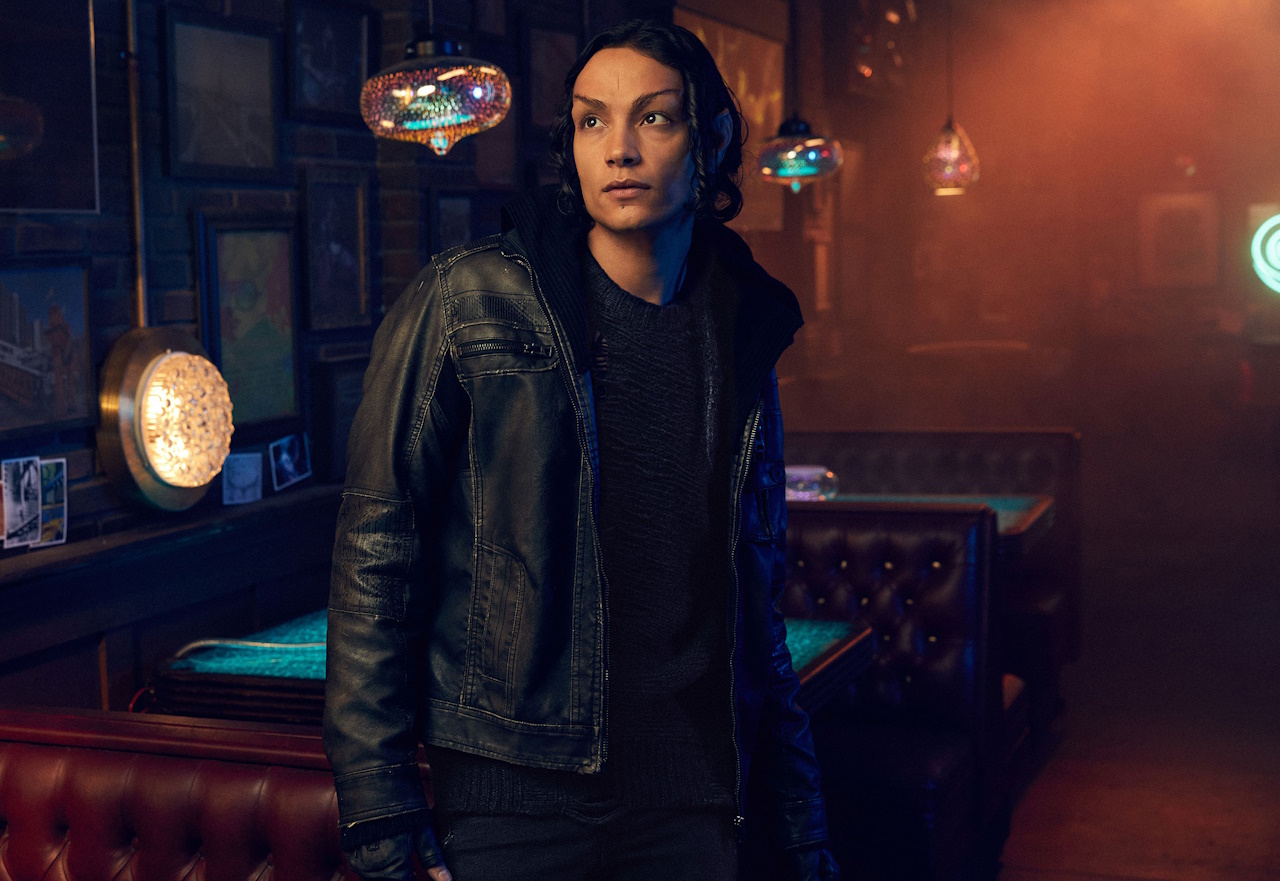
Spoiler Warning: There are spoilers ahead for the entire Star Trek franchise, including Picard Season 2, Discovery Season 4, Prodigy Season 1, Strange New Worlds Season 1, and more.
With Season 3 of Star Trek: Picard purportedly being the series’ last, I’m not ready to give up the 25th Century! Ever since Nemesis in 2002, I’d been desperately keen to see Star Trek show us what happened next; to move its timeline along. After the briefest of glimpses in 2009’s Star Trek, it was Picard that finally scratched that itch! Although Discovery is still in production with a fifth season being worked on, that show’s 32nd Century is far removed from the characters, factions, and themes of The Next Generation era. That’s why today I wanted to consider ten possibilities or concepts for shows that could pick up the baton from Picard.
For me, The Next Generation era – i.e. the late 24th Century setting that also includes Deep Space Nine and Voyager – is the franchise’s “golden age.” These shows – and the four films made during that time, too – represent the bulk of Star Trek’s 800+ episodes, and while there are definitely points of interest in the 22nd Century and 23rd Century that the franchise could revisit, for me it’s this time period that I’d like to see picked up for more adventures.
Captain Picard.
With Star Trek: Picard having established the dawn of the 25th Century as its setting, I really do feel that there’s scope to build on what’s been created so far. Season 3 may spend more time with Starfleet, but as of the end of Season 2 at least, there’s a lot we haven’t seen of this era. Picking up some of the characters, factions, storylines, and themes from past iterations of Star Trek is a big part of why spending more time in this era is worthwhile, but that doesn’t mean that every potential 25th Century project has to be a straight-up sequel to something that’s come before. I’d be thrilled to see a Strange New Worlds-style semi-episodic exploration-focused series with a brand-new cast, for example, set in this time period.
Although Picard Season 3 is still being worked on and likely won’t hit our screens until next year, I sincerely hope that the creative teams over at Paramount have already considered their next move. Alex Kurtzman (who is in charge of the Star Trek franchise for Paramount) has stated that there are other concepts in early development, and that as the current shows come to the end of their runs, these new shows would begin to be worked on. Whether any of the series concepts that he was referring to are going to be set in the 25th Century is unknown – but there are significant advantages to doing so.
Alex Kurtzman was interviewed by Wil Wheaton for Star Trek Day back in September and commented on the potential Starfleet Academy series.
I would wager that a significant portion of the Star Trek fan community would rank at least one of The Next Generation, Deep Space Nine, or Voyager in their top two favourite shows. And fans under the age of forty literally won’t be able to remember a time before The Next Generation! Most fans of my age will have either come to Star Trek during The Next Generation era or will have encountered it soon after becoming a fan; The Next Generation era was dominant from 1987 to 2002.
Fans who were invested in storylines like the Dominion War, the Maquis, Voyager’s journey home, and many, many more are interested to know what came next for their favourite characters. Picard has shown us a little of this – with a focus on Admiral Picard himself, naturally – and there have also been teases and glimpses in Lower Decks, Prodigy, and potentially in Discovery’s 32nd Century, too. But there’s a heck of a lot of room to do more.
The new USS Stargazer.
With Strange New Worlds flying the flag for the 23rd Century, and Discovery off doing its own thing in the far future, there’s a gap in live-action Star Trek that at least one 25th Century project needs to fill. Having established a few interesting details about what we must now call the Picard era, it would be positively criminal for Paramount to just abandon it. There are so many characters who we could catch up with, so many incomplete storylines to resume, and so many codas and epilogues still to be written.
Time is marching on, too – a sad reality for all of us. It won’t always be possible to bring back original actors and the characters that they portrayed, so it’s really a case of “if not now, when?” Wait too long to greenlight projects set in this time period and it may be too late to bring back certain characters.
So with all of that in mind I’ve put together a list of a few Star Trek projects that I personally think could be interesting and could pick up the baton from Picard. Although I feel confident that conversations are happening about future projects set in this era behind closed doors, my usual caveat applies: I have no “insider information.” I’m not trying to claim that any of these ideas will be picked up and make it to screen. This is a wishlist from a fan, and nothing more! It’s also entirely subjective, so if you hate all of my ideas or I don’t include something that you think should obviously be included, then that’s okay! There’s plenty of room within the Star Trek fan community for respectful disagreement and civil conversations!
Concept #1: Starfleet Academy
The emblem of Starfleet Academy.
When Lieutenant Tilly departed the USS Discovery early in Season 4, she became an instructor at Starfleet Academy in the 32nd Century. With her departure episode feeling like somewhat of a backdoor pilot thanks to introducing us to a handful of cadets, I’m sure I’m not alone in assuming that the heavily rumoured Starfleet Academy series will be set in the 32nd Century with Tilly as a major character. So that’s a big caveat to this potential project!
But a 25th Century Starfleet Academy series has a lot of potential, too. As a direct spin-off from Picard it could bring back characters like Raffi and Elnor, the latter of whom has already been established as a Starfleet cadet. That could even give meaning to Elnor’s unexpected survival at the end of Season 2.
Cadet Elnor in Picard Season 2.
A 25th Century Starfleet Academy series would be perfect for bringing back all sorts of characters from Star Trek’s past. We could learn, for instance, that Miles O’Brien is still at the Academy teaching engineering – as was established at the end of Deep Space Nine. Even if Chief O’Brien wasn’t a major character he could still make occasional appearances in that role.
One of the big advantages to a Starfleet Academy series right now is how it could serve as a kind of soft landing for new, younger fans who’ve been enjoying Prodigy. A series starring young adult cadets (or featuring cadets in major roles even if they aren’t the exclusive focus) would be a natural next step in so many ways, and could be a gateway into the Star Trek fandom for legions of newcomers. Just as holo-Janeway has been a guide in Prodigy, a returning character could fill a similar role here.
Concept #2: The Seven and Raffi show
Seven of Nine and Raffi in the Picard Season 2 finale.
When Season 2 of Picard premiered, I really thought that a USS Stargazer spin-off with Captain Rios in command would be a fantastic new series. That can’t happen now (and after Rios’ disappointing regression in Season 2, I don’t think I’d want it anymore anyway), but there is still the possibility to see a direct spin-off. This version would feature Seven of Nine and Raffi.
Although Seven of Nine’s captaincy of the USS Stargazer in Farewell felt very much like a brevet or a temporary thing, I feel there’s potential to see her given a commission in Starfleet. Raffi certainly felt that she would make an excellent captain! So maybe the next Star Trek series could be Star Trek: Stargazer with Captain Seven and XO Raffi taking the USS Stargazer on all kinds of adventures.
Captain Seven.
Seven of Nine is particularly well-suited to feature in stories that focus on the Borg, but there’s more to her character than that. I’m not sure whether a traditional exploration-focused series would be the best fit; maybe Seven and Raffi’s ship would be a rapid-response vessel designed for combat and tactical missions. An overtly action-oriented series would be new to Star Trek, so this could be a fun experiment to see how well it could work.
I’ve thoroughly enjoyed Seven of Nine’s arc across the first two seasons of Picard. It’s been cathartic to see a character I once disliked for her dull and repetitive storylines undergo genuine and lasting growth, and we might just be reaching a point where Seven of Nine is a strong enough character to take on the challenge of headlining a brand-new series of her own… supported by Raffi, of course!
Concept #3: Captain Sisko’s return
Captain Sisko.
Perhaps better-suited to being a miniseries or limited series, I really love the idea of Captain Sisko finally returning to the galaxy after spending time with the Prophets. At the end of Deep Space Nine, Sisko promised us that he wasn’t really gone and that he would return “one day.” After more than twenty years, could “one day” finally be just around the corner?
It’s worth acknowledging that Avery Brooks has seemed less willing than some other former Star Trek actors to reprise his role, and although there has been speculation as to why that may be, there’s never been any definitive statement from the man himself. I wouldn’t want to see Sisko recast at this moment in time (nor recreated through some kind of CGI process), so if Avery Brooks isn’t interested, the project won’t get off the ground.
In The Pale Moonlight is one of my all-time favourite Star Trek episodes.
One massive advantage to bringing back Captain Sisko is that he’d make a wonderful point-of-view character for us as the audience. As someone who’s spent decades away from the galaxy, Sisko would be just as interested as we are to learn what happened to his friends, to Deep Space Nine, to the Cardassians and Dominion, and so on. A Sisko-focused series could get away with dropping a lot of exposition in a way that feels natural, bringing us up to speed on the events of the past couple of decades without it feeling out-of-place.
More than that, though, I want to spend more time with Captain Sisko. Although picking favourites is hard, Sisko has always been one of the best and most interesting characters of The Next Generation era, and one of the best captains in the Star Trek franchise. Bringing him back would be just as impactful as bringing back Picard has been, and providing an epilogue and closure to Sisko’s story would be absolutely worth doing.
Concept #4: Section 31
A black Section 31 combadge in the mid-23rd Century.
The untitled Section 31 series was announced in 2019, shortly before Season 2 of Discovery aired. But since then, the supposedly ready-to-go project has been sidelined. Lack of interest from fans was part of the equation, perhaps, but Strange New Worlds certainly stole its thunder too!
The proposed series was to follow ex-Terran Empress Georgiou as she worked with the shadowy organisation that was first introduced in Deep Space Nine, and after Georgiou went through some significant character growth in Discovery’s third season, she finally seemed to get to a place where she could potentially take on the role of a morally ambiguous Section 31 leader without feeling like someone who resorts to violence and literal genocide at the drop of a hat.
Empress Georgiou’s departure.
To briefly recap, Georgiou had to leave the 32nd Century due to suffering from a technobabble illness that appeared to be fatal, and she was permitted to do so by the Guardian of Forever. If a suitable explanation could be found, Georgiou could potentially emerge in the 25th Century, setting the stage for her to play a role in Section 31 in this time period.
Alternatively, a Section 31 show set in this era could drop Georgiou altogether and focus on new characters instead. With Borg, Romulans, super-synths, strange anomalies, and other potential threats to the Federation that we’ve glimpsed in Picard, Section 31 could have a lot of work to do in this era!
Concept #5: A new exploration-focused series
The original USS Enterprise.
Strange New Worlds is currently flying the flag for semi-episodic “old school Star Trek” with a big focus on exploration. But this is the foundation of Star Trek; the franchise’s roots. Returning to this format in the 25th Century could be absolutely fantastic – and it could be a fun way to include a mix of new and legacy characters.
One of the limitations faced by Strange New Worlds is that it’s set a decade before The Original Series. There’s still a lot of wiggle room in that time period, and we could see Captain Pike make first contact with new and familiar alien races alike. But there are still constraints on which alien races can be included and how, and what stories Captain Pike and the crew could reasonably take part in.
Captain Pike.
In contrast, a new exploration series set in the 25th Century would basically have free rein to hop all across the galaxy, meet brand-new aliens, and bring back classic factions without treading on anyone’s toes. As long as such a series avoided Unknown Species 10-C (basically the only major new faction introduced in Discovery’s far future that Captain Burnham made first contact with), a show like this one could do what The Original Series, The Next Generation, and to an extent Voyager all did: set out on a mission of exploration with a blank canvas.
Seeking out strange, new worlds is where Star Trek began; it’s the core mission of Starfleet and the main goal of the Federation. Strange New Worlds is already proving that fans enjoy a series with that kind of focus, so picking up that concept and reworking it to be set in the Picard era absolutely could work.
Concept #6: Hospital ship
The USS Pasteur – a Federation medical ship.
In the ’90s, when I was watching and enjoying the shows of The Next Generation era, this was a concept that I thought could be a ton of fun! I imagined “ER in space,” with a hospital ship like the USS Pasteur being the show’s main setting and a chief medical officer as the main protagonist. My original version of this concept would’ve seen characters like Dr Pulaski and Dr Bashir return; a team-up of some of my favourite medical characters from other Star Trek shows.
Although Dr Pulaski is unlikely to be part of such a series now, there’s definitely scope to bring back the likes of Dr Bashir or Voyager’s EMH, as well as secondary medical staff like Nurse Ogawa, as part of a series that also introduces new characters.
Nurse Alyssa Ogawa.
The hospital ship would travel around the Federation and beyond, lending its services to planets, bases, and starships in need. There’d be illnesses and diseases to cure, natural disasters to bring aid to, and the ship could even be part of major military engagements and battles, tending to wounded soldiers and crewmen. Star Trek has shown us all of these basic concepts before, but this time they’d have an overtly medical focus.
There’s a huge audience for shows like House, ER, and Grey’s Anatomy, and a medical Star Trek series could have an appeal that extends far beyond the franchise’s typical sci-fi niche. Without the constraints of the real world, and with numerous aliens as both staff and patients, there’s almost unlimited potential in terms of creativity as well. We could see new deadly diseases created that could be timely reflections of our pandemic-afflicted world, and we could even take a deeper dive into diseases and medical conditions that have been referenced in past iterations of Star Trek.
Concept #7: Captain Kim
Ensign Harry Kim.
It’s become a bit of a joke in the Star Trek fan community: Harry Kim spent seven years as an ensign without being promoted. Perhaps he could finally get the command he’s always wanted and headline a new Star Trek show in the process!
Harry Kim would be the second major character from Voyager to play a role in this era of Star Trek, and that could lead to crossovers. It could be a lot of fun to see an older and more mature Harry Kim reunite with Seven of Nine – perhaps for the first time in many years. The series could even feature a Voyager reunion of the kind seen in Endgame. And of course, any time we’re talking about Voyager these days there’s the potential to tie in with themes and ideas present in Prodigy.
An older Harry Kim (from an alternate future) in the episode Timeless.
Captain Kim could show us a different side of Starfleet. Perhaps he’s in command of a hospital ship as we were discussing above, or perhaps his vessel is much more scientific in its mission; charting anomalies and stellar phenomena rather than making lots of first contact missions. A series like that would be more personality-driven and serialised rather than episodic with a “monster-of-the-week” to engage with, and I think someone like Harry Kim would excel in that kind of role.
Out of everyone on Voyager, I’d suggest that Harry Kim has perhaps the most potential for growth if he were to return. Considering that we met him on his first mission after graduating – and that he stuck with that “young and eager” characterisation for a long time during Voyager’s run – there’d be something rather cathartic about being reintroduced to an older, more mature Captain Kim.
Concept #8: A Klingon series
General Martok, a 24th Century Klingon leader.
This one would be quite a radical departure from anything that Star Trek has tried before. Leaving the Federation and Starfleet behind, this show would be set aboard a Klingon vessel. A Starfleet officer could be present as a point-of-view character and a way to help us as the audience find both a way in and a frame of reference, but the rest of the characters would be Klingons.
With Worf returning for Picard Season 3, he could become a recurring character on a Klingon-focused series. A character like Worf bridges the gap between the Klingon Empire and Starfleet, and along with a Starfleet officer aboard the ship he could also help ground the series.
Kol, a 23rd Century Klingon who recently appeared in Discovery.
What I like about this idea is that it would be something genuinely bold and different. We’ve spent a lot of time with the Klingons across various iterations of Star Trek – they’re probably the faction we know the most about after the Federation itself. But there’s still plenty of room to expand our understanding of the Klingons, and to show us the next chapter for their Empire in the aftermath of the Dominion War and their alliance with the Federation.
What kind of mission would a Klingon vessel have? If it’s exploration, how different would their approach be to what we’d expect from Starfleet? A Klingon series could also show off different roles for Klingons beyond that of “warrior.” How does a Klingon crew treat its engineers, scientists, and medical personnel, for example? Far from being one-dimensional “baddies,” there’s plenty of room for nuance and to show us a different side to the Klingons, and different Klingon personalities.
Concept #9: Captain Worf
Could Michael Dorn finally get his Captain Worf series?
Sticking with the Klingons, Michael Dorn has been talking about his pitch for a Captain Worf series for the better part of a decade at this point! Although I confess that I remain sceptical of the proposal for a number of reasons, with Worf’s imminent return in Picard Season 3, it has to be considered at least a possibility that there’ll be some kind of backdoor pilot or an attempt to test the waters to see if a Captain Worf series could be viable.
As the character who’s made the most Star Trek appearances (280+, not counting upcoming appearances in Picard Season 3), I feel that we’ve seen more than enough of Worf! We’ve seen his inner conflict between his Klingon and Starfleet identities, his struggles with fatherhood, his marriage and the grief he felt at losing Jadzia… and I’m just not sure where else there is to go.
Worf as he appeared in Season 1 of The Next Generation.
But despite my personal reservations, a Captain Worf series could prove me wrong and be the right move for Star Trek once Picard ends. Like Picard itself, a Captain Worf series would be anchored by its familiar face but perhaps rounded out with a fun group of new characters. There would be potential, perhaps, depending on how things go in Season 3, to bring in someone like Raffi as Worf’s first officer, tying the show to Picard in an even greater way.
As with Seven of Nine and Raffi above, a Captain Worf series could go all-in on action, with Worf commanding a tactical vessel and rushing into dangerous situations and combat missions. Or, in an attempt to put a completely different spin on the character, maybe Captain Worf would be in command of a lightly-armed science vessel on a mission of exploration! That could be a fun way to go and a twist on the expected premise of the series.
Concept #10: Super-synth invasion
The mechanical noodles of the super-synths.
Spoiler alert for a future theory article, but one of my guesses about Picard Season 3 is that the Admiral and his friends will have to face off against the super-synths from Season 1 – and that they’re responsible for the anomaly in Season 2. That would be a neat way to tie all three seasons of the show together!
But assuming that doesn’t happen, I’d love to revisit the super-synths that we only caught a glimpse of in the Season 1 finale. Assuming that their intentions were hostile, and that they planned to attack organic life in the Alpha Quadrant, could a new spin-off revisit that concept and perhaps show the super-synths making their invasion attempt?
Did Soji paint a target on the Alpha Quadrant thanks to her beacon?
This is a reworking of another concept that I’ve had kicking around for some time: a Borg invasion series. But with the Borg having already played a big role in Season 2, perhaps the super-synths could be subbed in to become the antagonists of a series (or miniseries) that sees the Federation involved in a war for its very survival.
This kind of existential threat has been used and re-used in Discovery, and I could understand if some fans wouldn’t want to see it brought back so soon! As I’ve said recently, it’s my hope that Discovery will try something different in Season 5! But it would be fun to bring back the super-synths and to revisit the Federation at war for the first time since Enterprise’s conflict with the Xindi – and it could be a great way to bring in a mix of new and legacy characters.
So that’s it!
Admiral Picard.
Those are ten concepts for Star Trek shows that I think could pick up the baton from Star Trek: Picard in the years ahead, sticking with the early 25th Century and potentially expanding on what Picard has already done.
My “first contact” with Star Trek back in the early 1990s was The Next Generation, and I was a big fan of Deep Space Nine and Voyager during their original broadcast runs as well. With live-action Star Trek series set in the 23rd and 32nd Centuries, it seems to me that Picard’s eventual finale is going to leave a pretty significant hole in the franchise. Even if every major character from The Next Generation returns and gets an amazing goodbye, there are still characters, themes, storylines, and more from Deep Space Nine and Voyager that I’ve been longing to see picked up for more than two decades!
Deep Space Nine.
If it were up to me, the early 25th Century would probably be the main setting that I’d want to use for the majority of new Star Trek projects. There was even scope a couple of years ago to bring Captain Burnham and Discovery into this time period, and I think that could’ve worked exceptionally well too. I don’t think that Picard necessarily needs a direct spin-off, bringing back main characters in a huge way, but I’d dearly love to see the setting and time period re-used in future.
I’m hopeful that Season 3 will be a fun adventure with the crew of The Next Generation, and that it can serve as a launchpad for one or more new Star Trek projects set in this era. Whether any of my own ideas will make it… well, I doubt it. But who knows! More than ever it feels like Paramount is listening to Star Trek fans; without a massive fan campaign we would never have seen Strange New Worlds. So there’s a possibility, perhaps, if Picard Season 3 is well-received that a spin-off or follow-up could indeed make it. Time will tell!
Star Trek: Picard Season 3 will be broadcast on Paramount+ in the United States and on Amazon Prime Video around the world sometime in the next year or so. The Star Trek franchise – including Picard and all other properties discussed above – is the copyright of Paramount Global. This article contains the thoughts and opinions of one person only and is not intended to cause any offence.
Spoiler Warning: There are spoilers ahead for Star Trek: Picard Seasons 1-2 and casting information for Season 3. Spoilers are also present for the following Star Trek productions: Discovery, Enterprise, Voyager, First Contact, and The Next Generation.
After a plodding and occasionally frustrating season, Star Trek: Picard wrapped up this week. Going into the season finale we still had more than twenty theories on the table – though some were definitely beginning to feel unlikely! This week we’re going to conclude my Season 2 theory list and take a look at how some of those remaining theories landed.
Across the season as a whole, I had some theory successes – as well as more than a few misses! But as I always say, all of this is just for fun – so the theories that ended up being completely wrong are totally fine by me! It was enjoyable to spend the extra time thinking about where the story of Picard Season 2 could be headed, and even when I was wide of the mark it was still a great excuse to dive deeply into the Star Trek galaxy.
So without any further ado, let’s start wrapping up the theory list. We’ll begin with the theories that were confirmed, then take a look at the ones that were debunked. There are also a couple of theories that may survive going into Season 3, so stay tuned in the days and weeks ahead for a preliminary Season 3 theory list!
Confirmed theory #1: A character from The Next Generation made an appearance.
Wesley Crusher!
Wesley Crusher’s return was one of the high points of the season finale for me! After a thirty-year absence from the role, Wil Wheaton stepped back into the shoes of Wesley Crusher and showed us a glimpse of his life as a Traveler. The fact that this was kept secret and not spoiled ahead of time made it one of the biggest surprise moments in the finale – and while I had been speculating that at least one character from The Next Generation would appear all season long, I would’ve never guessed that it would be Wesley!
With the rest of The Next Generation crew reuniting next season, it’s incredibly sweet that we got this moment with Wesley before Picard wrapped up. It would’ve been amazing to see him reunite with Picard himself, of course, but just seeing Wesley back in action, knowing that he’s living an amazing life and that he still exists in the Star Trek timeline was absolutely fantastic.
Wesley’s appearance also tied together the Travelers from The Next Generation with the Watchers and Supervisors from The Original Series – and connected in a big way with Tallinn’s role this season. It was an incredibly creative way to bring these storylines together and to connect with over fifty years’ worth of Star Trek’s history. All in all, one of the season finale’s best moments.
Confirmed theory #2: Seven of Nine was given a Starfleet commission.
Captain Seven!
Maybe it would be fairer to call this one “semi-confirmed,” as Seven’s commission from Admiral Picard in Farewell seemed very much like a brevet; a less-than-official or impermanent role that came about as a result of the unique circumstances of working with the Borg. But regardless, I had speculated that Seven would join Starfleet before the end of the season, and technically that happened!
It was a fun moment to see Seven assume command of the USS Stargazer, but moreover I was impressed with the way her season-long arc took her from a place where she hated the Borg (and the Borg side of herself) and was advocating for shooting first and asking questions later all the way to placing her trust in the Borg Queen-Dr Jurati hybrid. Seven’s growth got her to a place where her trust and her actions allowed her to play a definitive role in saving the entire quadrant from the mysterious anomaly.
Confirmed theory #3: The Borg’s request for help from the Federation turned out to be genuine.
This is the disaster that the Borg wanted to prevent.
It was implied in The Star Gazer at the beginning of the season that the Borg’s message may have been a ruse; a deception that was intended to be the pretext for a new Borg invasion of the Federation. However, just because some of our characters believed that to be true didn’t mean it was true, and I wondered whether the story might end up saying that the Borg were genuinely asking for the Federation’s help.
That turned out to be correct – in a roundabout way, of course. The Borg weren’t fleeing from some unknown assailant, as I had speculated, nor were they crippled following the events of Voyager’s finale. Their intention was to help – to join with the Federation and use their technology to prevent the attack on the Alpha Quadrant by whoever sent the mysterious anomaly.
Confirmed theory #4: The masked, hooded Borg was not the “real” Borg Queen.
The Borg Queen, unmasked.
I daresay this one had been increasingly obvious for at least half of the season, and especially after the way Hide and Seek had ended a week earlier, it seemed all but certain that the Borg Queen on the bridge of the Stargazer would turn out to be the Dr Jurati hybrid as opposed to the original Borg Queen. This turned out to be true – although why Farewell attempted to treat this as a big, shocking revelation is something I’m not sure of!
Ever since we first saw the masked Borg Queen at the beginning of the season I felt sure we’d find out who was behind the mask. Along with Dr Jurati, earlier in the season I’d suggested Admiral Janeway, Soji, and Renée Picard as possible candidates.
Confirmed theory #5: Elnor was restored to life in the 25th Century.
Cadet Elnor aboard the USS Excelsior.
I’m afraid that I don’t like the way that Elnor’s story was handled as the season wrapped up. On the one hand, I’m pleased that a character like Elnor – who has a lot of potential as someone young and from a unique background – hasn’t been permanently killed off. However, his survival undermines Raffi’s season-long arc of coming to terms with guilt and grief, as well as renders one of the best and most emotional moments in Hide and Seek entirely impotent.
Regardless of all that, I had been speculating that Elnor would be saved ever since he was killed, and as I said last time, I wasn’t prepared to drop the theory with only one week remaining in the season. I’m glad I didn’t – because it turns out I was right and this is another one I can place in the “win” column for Season 2!
Confirmed theory #6: Rios chose to remain in the 21st Century with Teresa and Ricardo.
Rios chose to stay behind.
This was another disappointing storyline, unfortunately. As I’d been saying all season long, the way Rios regressed as a character from his presentation as a Starfleet captain at the beginning of the season was ridiculously poor, and his choice to stay in the 21st Century really just capped off what has been a truly disappointing season for him.
Rios spent most of his time in Season 2 disconnected from all of the other main characters, spending his time only with Ricardo and Teresa, so even his goodbye with the other characters didn’t hit as hard as it could’ve. As I said last time, I never really felt that Rios and Picard were anything more than acquaintances; work friends, not real friends. Also, I guess Rios must’ve not been paying attention in history classes at Starfleet Academy, because World War III is about to break out, followed by the post-atomic horror. He’s about to live through the worst fifty years in all of human history in the Star Trek timeline. So… good job, idiot.
Confirmed theory #7: Q shielded Picard and the crew from the changes to the timeline.
Oh, Q.
The season finale finally saw us get an explanation from Q as to what he’d done and why. As part of a plan to help Picard overcome trauma and grief from his childhood and his mother’s death, Q set a very elaborate plan into motion, changing the past and ensuring that Picard and the crew of La Sirena were the only ones unaffected.
As we saw in the finale, Q’s powers could be used to send people’s consciousnesses through time or even across the divide between different realities, meaning that must’ve been what he did in the first place to set up this puzzle. It had seemed all but certain that this was the case, but until we heard from Q himself and gave him the chance to explain what had happened I wasn’t ready to call it confirmed.
So those theories were confirmed.
We have one theory that I’m calling “semi-confirmed,” but we won’t be sure about its status until we start to learn more about Season 3.
Semi-confirmed theory: The season will end on a cliffhanger.
The mysterious anomaly.
What’s going on with the anomaly? We didn’t get any kind of explanation for what it was, where it came from, or who might be responsible for attempting to destroy the entire Alpha Quadrant… so I think that this is setting up at least part of next season’s story. If that’s correct, then this theory that I’d been running all season long will, in a roundabout way, turn out to be correct!
However, if the anomaly isn’t revisited next time, we’ll have to call this one debunked. At the moment it feels like we’ll have to come back to the anomaly in some way, just based on its mysterious and unexplained nature, but then again the Season 1 super-synths (and other Season 1 plot threads) didn’t come back into play in any way during Season 2… so I guess we’ll have to wait and see. Regardless, I’m calling it “semi-confirmed” for now.
So that theory was semi-confirmed.
Now we’ll go through the theories that were debunked by Farewell and definitely won’t be returning for Season 3!
Debunked theory #1: Some or all of the main characters from The Next Generation will rescue Picard from 2024.
The main cast of The Next Generation in Season 5.
I had wondered if, with Picard stranded in the 21st Century, some or all of the main characters from The Next Generation would show up to rescue him. Given that Q’s powers seemed to be in decline, and with few other options for getting back to the 25th Century, it seemed like a plausible idea, one that could’ve potentially set the stage for Season 3. It would’ve also tied in thematically with what we saw at the end of Season 1, where Acting Captain Riker arrived at the last minute to save the day.
However, it didn’t happen. Q was able to use the last of his energy to get Picard home, and the only character from The Next Generation to appear was the aforementioned Wesley Crusher.
Debunked theory #2: The “two Renées” comment refers to Picard’s nephew.
René Picard – not to be confused with Renée Picard.
Though it would’ve been somewhat of a bolt from the blue, I was wondering if the Borg Queen’s cryptic comment in Hide and Seek about there being “two Renées” might’ve been referring to Picard’s nephew. In the prime timeline, René Picard was the son of Jean-Luc’s brother Robert. The two were killed in a fire at the vineyard during the events of Star Trek: Generations, and I wondered if the Borg Queen may have been referring to that moment as it was another significant one for Picard and his family.
As it turned out, “two Renées” were required to complete the mission. With Dr Adam Soong on the prowl, Tallinn disguised herself as Renée and allowed Dr Soong to kill her in order for the real Renée to board the Europa Mission spacecraft, setting up her significant discovery and the role she would ultimately play in creating the brighter future that we’ve come to know in Star Trek.
Debunked theory #3: An alternate reality is about to be created.
“An alternate reality?”
With the Dr Jurati-Borg Queen hybrid departing Earth in the 21st Century, and a cryptic message about “two Renées” to consider, I wondered if the end of the season might’ve seen some kind of permanent divergence in the timeline. One timeline may have been the familiar one, but the other could’ve been completely different either because of a very different Borg Collective or even because of the actions of Dr Adam Soong.
That didn’t happen, however, and it seems as though the prime timeline has been restored without the Confederation timeline – or indeed any other alternate reality – coming into existence. That keeps things nice and simple, at least!
Debunked theory #4: The loose ends from Season 1 will be tied up.
What happened to Narek?
I’m disappointed that Picard Season 2 did basically nothing at all to wrap up any of the loose ends from Season 1 – and there were quite a few. A rushed finale last time around left significant chunks of story still on the table, and there were some pretty sizeable unanswered questions remaining. Even just a few lines of dialogue would’ve been something, but we didn’t get that.
It’s possible that Season 3 may bring back a faction like the super-synths, in which case we may learn more about them or see other connections to events from Season 1, so I’m not entirely giving up on this one. But explanations for what happened to Narek, what became of the surviving ex-Borg, the fate of the beacon on Aia, and so on could’ve been addressed this time. It’s a shame that there wasn’t time to do so.
Debunked theory #5: Picard and the crew will “borrow” Renée’s Europa Mission spacecraft to get home.
The Europa Mission launch.
With La Sirena having been surrendered to the Borg Queen, the question of how Picard and the surviving crew might make it home came up. I wondered if part of the reason for making Renée an astronaut with access to a spacecraft might be so that Picard and the others could use it to return to their own time period. Comments earlier in the season about how records of the Europa Mission had been lost could’ve also fed into this theory.
As above, it was ultimately Q who saved the day, sending Picard and the crew home using what remained of his power. I wasn’t especially fond of the Renée and Europa Mission storylines, so this could’ve been a way to make them feel more directly relevant to the plot.
Debunked theory #6: Q is not responsible for changing the timeline.
Q’s final snap.
This is a theory that I put together before the season had even aired a single episode! In short, I felt that making Q the direct antagonist of the season would go against his established characterisation, and that there didn’t seem to be a plausible reason why Q might want to punish Picard in such extreme fashion. It also seemed odd that pre-season marketing had essentially revealed one of the season’s biggest narrative points months in advance, so I wondered if there might be more going on than we had been led to believe.
Whatever we might think of Q’s reasoning, it turned out that he was responsible for changing the timeline after all – something that had been seeming increasingly likely as the season wore on. The resolution to this story was undeniably rushed, and I would question the idea of putting so many lives at risk – as well as getting people killed and transforming the destinies of others – but ultimately this is how Q decided to help Picard learn to let go of his trauma and grief and choose to become the person he has been. In a sense, there were echoes of Tapestry – a Season 6 episode of The Next Generation – in the way this came about, making it feel in line with other Q stories at least to a degree.
In retrospect, clinging on to this theory for as long as I did may have been a mistake, and it could have arguably been debunked at an earlier stage.
Debunked theory #7: Other candidates for changing the timeline.
The super-synths.
Earlier in the season I’d proposed a few other candidates who might’ve been responsible for changing the timeline if, in fact, Q had been innocent! Though there are many factions in Star Trek that could potentially possess time travel technology and might wish to mess with the Federation, based on what we knew about Picard I proposed three candidates: the Zhat Vash, the secretive Romulan sect who were the main antagonists in Season 1, the super-synths from the Season 1 finale, and the Borg. By the time we got to Farewell this week, only the Borg seemed even slightly plausible.
But with the revelation that Q was responsible for changing the timeline and setting everything up, none of that came to pass! It could’ve made for an interesting story in some respects, with Q being less an outright antagonist and more of a helpful force, guiding Picard to the conclusion of the mystery. But that would have been an entirely different story!
Debunked theory #8: The Borg are fighting a war – and they’re losing.
The Borg ship in Farewell.
The Borg’s cry for help at the beginning of the season led to a lot of speculation! Why might the Borg be asking for help, and why from Picard specifically? One possibility seemed to be that the Borg may be on the losing side of a war. We’d seen this story play out in the Voyager episode Scorpion – in which Seven of Nine was first introduced – when the Borg bit off more than they could chew by trying to assimilate Species 8472! It seemed at least possible that something similar could have happened this time around.
As above, we learned that the Borg’s motive was significantly more altruistic. Led by the Dr Jurati hybrid, this version of the Collective aimed to prevent an anomaly from causing a destructive event that would’ve wiped out the Alpha Quadrant.
Debunked theory #9: Kore Soong will team up with Picard and the crew of La Sirena.
Kore Soong.
Although the arrival of Wesley Crusher (one of the finale’s best moments) salvaged an ending for Kore, her storyline this season was one of the absolute worst and most meaningless. Kore was repetitive, and her story felt like a cheap recycling of the Soji and Dahj stories from Season 1. She mainly existed to prop up the otherwise entirely one-dimensional Dr Adam Soong, and while at first it seemed like her existence and mysterious health condition could’ve led to a nuanced and interesting antagonist, that went out the window pretty quickly.
One way to have potentially made something of Kore would’ve been to have her work with Picard and the others to stop her father. It didn’t happen, and that meant that there was literally no on-screen interaction between Isa Briones and the rest of the cast, which was a real shame.
Debunked theory #10: The Q Continuum has been attacked.
Picard and Q.
While not technically “debunked” outright, Q’s apparent death means that revisiting the Q Continuum is incredibly unlikely in the near future. And as we learned in Discovery Season 4, there’s been no Federation-Q Continuum contact for hundreds of years as of the 32nd Century, so again it seems highly unlikely that spending any more time with other members of the Q Continuum is on the cards.
Earlier in the season it seemed plausible that the explanation for Q’s declining powers could be that the entire Q Continuum had come under attack. If something that Picard had done – or hadn’t done – was responsible, that could have explained both Q’s desire to change the timeline and the angrier, more aggressive presentation of the character.
It didn’t happen, though, and although Q himself seems to be gone, as far as we know the rest of the Continuum is okay!
Debunked theory #11: Q is angry with Picard for “giving up.”
Grumpy Q.
This is again connected to the angrier presentation of Q that we saw in episodes like Penance. I wondered if Q’s motivation for putting Picard through a punishment might be because he was angry with the way Picard gave up and recused himself from galactic affairs in the decade leading up to Season 1. Because we know Q considered Picard as a friend and a favourite, seeing him depressed might’ve been something that angered Q.
Q saw potential in Picard in The Next Generation – including the potential for humanity to one day achieve a similar level of understanding as the Q themselves, so seeing Picard’s fall from grace could have been part of why Q was so upset.
Ultimately it didn’t turn out that way – and I think I’m glad that it didn’t. Though there are definitely issues with the story as it was written, this presentation of Q would have been much more antagonistic and vengeful.
Debunked theory #12: The Borg are aware that Picard is now a synth – and his synthetic status is part of the reason why they waited until now to make contact.
Robo-Picard.
In short, I wondered if the reason for the Borg’s re-emergence at the beginning of the season might’ve been connected in some way to Picard becoming a synth at the end of Season 1. Because we know that the Borg seek “perfection” through the merging of organic and synthetic life, Picard’s new synthetic body might’ve been something that they desired to assimilate.
As above, the story of Season 2 was a standalone affair that didn’t connect to Season 1 in a major way. Aside from one mention by Q in the episode Penance and one by Rios in Assimilation, Picard’s synthetic status wasn’t brought up and had no bearing on the plot.
Debunked theory #13: The Borg ship from The Star Gazer crossed over from the Confederation timeline.
The Borg vessel identified as “Legion.”
Because we didn’t know why the Borg were asking for help, I wondered if their vessel might’ve somehow found a way to punch through from the Confederation timeline to the prime timeline. This might’ve been able to happen if an alternate reality had been created, one in which the Confederation became dominant.
We now know the Borg vessel’s true origin: it was the flagship (or possibly the only ship) of the Borg faction led by the Borg Queen-Dr Jurati hybrid, placing it firmly in the prime timeline.
Debunked theory #14: Rios will bring Teresa and Ricardo to the 25th Century.
Teresa and Rios aboard La Sirena.
An inversion of what actually happened with Rios and Teresa, this story would’ve mimicked that of Kirk and Dr Gillian Taylor in Star Trek IV: The Voyage Home. Dr Taylor accompanied Kirk and the others to the 23rd Century at the conclusion of their mission, and I wondered whether Rios might offer Teresa and Ricardo the same opportunity.
As noted above, Rios ultimately chose to stay in the 21st Century. Though we don’t know whether Q even had the power to send two extra people, it seems possible at least. But for whatever reason, Rios chose to remain behind.
Debunked theory #15: Teresa and Ricardo are Rios’ ancestors.
That could’ve been awkward…
One way to potentially resolve the Rios-Teresa romance could’ve been to make Teresa and Ricardo his distant ancestors! This would’ve also tied in thematically with a season in which Picard met one of his own ancestors, and it could’ve provided some entertainment value, similar to comparable storylines in the likes of Back to the Future.
Debunked theory #16: Rios will be killed and Picard will assume command of the new USS Stargazer.
Rios in the captain’s chair of the USS Stargazer.
As Rios’ storyline progressed and his relationship with Teresa deepened, I wondered if he might’ve ended up dead as a way to write him out of the show. Picard hasn’t pulled any punches when it comes to killing off characters, and with a need to free up space in the cast ahead of Season 3, Rios definitely seemed in danger after a story that cut him adrift from the rest of the crew.
Rios would ultimately end up staying in the 21st Century, and the captaincy of the Stargazer has fallen, in the short-term at least, to Seven of Nine. Whether she’ll still be in the chair when Season 3 arrives is anyone’s guess, though!
So those theories were debunked.
We have two theories that Farewell seems to have neither confirmed nor debunked, and those remain possibilities going into Season 3. It depends on what we see in terms of pre-release trailers and the like, but these two might just sneak back in next time. Watch this space!
Returning theory #1: The Borg Collective was badly damaged in the Voyager episode Endgame and has been unable to recover.
Admiral Janeway and the Borg Queen.
It seemed to be suggested by Dr Jurati in the season premiere that the Borg have been in a weakened state, and I wondered if that might be because of the actions of a time-travelling Admiral Janeway in Voyager’s finale. Janeway introduced a virus into the Borg Queen that severely damaged her, her base of operations, and dozens of Borg vessels on the way to helping Voyager make it back to Earth. Those events have never been addressed on screen, and with the return of the Borg it seemed possible that we might be about to learn more.
It didn’t happen in Season 2, but with the Borg back – at least, one faction of Borg – maybe we’ll discover the extent of the damage to the Collective in Season 3. I’ve long assumed that the Borg were adaptable and clever enough to eventually recover from the damage inflicted upon them, but I guess we’ll have to wait and see!
Returning theory #2: There will be a Borg civil war between a faction inspired by the Borg Queen-Dr Jurati hybrid and the rest of the Collective.
The Dr Jurati-Borg Queen hybrid.
We don’t know exactly how the Dr Jurati-led Borg and the rest of the Collective have interacted in the four centuries since she left Earth. At one point it seemed to be implied that this faction would replace the Borg Collective, but doing so would effectively wipe out the entire prime timeline. So I have to assume that the Dr Jurati-led Borg are distinct and separate from the main Collective – but would the rest of the Borg be okay with that?
I had speculated that we might learn that the Jurati-Borg were fleeing from a civil war, one in which the regular Borg had somehow gained the upper hand. That could have accounted for their request for help from the Federation. However, that didn’t happen in Farewell… but I don’t think we can rule out the idea of these factions being at odds just yet.
So those theories may return in time for Season 3!
The USS Excelsior.
That concludes this season’s theory list. In addition to the pair of stragglers directly above, Farewell did actually inspire a couple of other Season 3 theory ideas, so perhaps in the days or weeks ahead I’ll put together a very preliminary Season 3 theory list. Watch this space for that!
Picard Season 2 wasn’t the best that modern Star Trek has had to offer. Its modern-day setting hampered it to a great degree, and while there were occasional flashes of brilliance, overall the story felt quite disjointed, with individuals or pairs of characters seemingly embroiled in their own distinct narratives for the most part, with only occasional link-ups between different storylines.
The USS Stargazer.
That being said, it was fun to speculate and theorise about the season while it was rumbling along. I had some interesting ideas along the way – some of which would’ve made for a radically different story! At the end of the day, this is all just for fun; a chance to spend more time in the Star Trek galaxy. And I had fun coming up with these theories and writing them down while the season was ongoing.
Season 3 already has some issues – and if you want to see me talk about some of my criticisms of the casting in particular, click or tap here for that. However, the return of The Next Generation characters is a tantalising idea, and I’m hopeful that Picard Season 3 – supposedly the show’s swansong – will be exciting, dramatic, and fun.
Over the weeks and months ahead, stay tuned. There’s plenty more Star Trek content to come here on the website, and when we get trailers or news about Season 3 I’ll do my best to take a look at it and give my thoughts. Until next time!
Star Trek: Picard Season 2 is available to stream now on Paramount+ in the United States, Scandinavia, Latin America, and Australia, and on Amazon Prime Video in the United Kingdom and the rest of the world. The Star Trek franchise – including Picard and all other properties mentioned above – is the copyright of Paramount Global. This article contains the thoughts and opinions of one person only and is not intended to cause any offence.
Spoiler Warning: There are spoilers ahead for Star Trek: Picard Seasons 1-2 and casting announcements for Season 3. Spoilers are also present for the following Star Trek productions: The Next Generation, First Contact, and Voyager.
So here we are! Although it seems like only yesterday that we were settling in for The Star Gazer after a two-year wait for Picard Season 2, it’s time to bid “farewell” to Admiral Picard and the (remaining) crew of La Sirena. At least the wait for Season 3 – which has already begun filming – shouldn’t be quite as long!
Season 2 took a meandering and frustrating route to reach this end point, and while Farewell had some real emotional highlights and moments of excitement, I can’t shake the feeling that the lessons of Season 1 weren’t heeded. Just as happened last time around, there were a lot of underdeveloped moments, stories that needed longer in the spotlight, and narrative threads that missed the mark not because they were bad, but because the season wasted time getting here. While I can happily say that I enjoyed Farewell, it wasn’t as good as it might’ve been.
Admiral Picard on the bridge of the USS Stargazer.
Most of the story complaints that I have really aren’t Farewell’s fault on its own. They’re actually the consequence of a slow, muddled season that dedicated too much time in earlier episodes to what ultimately ended up as extraneous fluff. The episode Watcher, for example, spent a huge amount of time tracking down Rios and Tallinn – and those sequences could have been massively shortened to move the story along at a more reasonable pace. That would’ve allowed last week’s episode, Hide and Seek, to have fully wrapped up the Europa Mission and Renée stories – stories that Farewell had to blitz through to get Picard and the crew to meet Q and get back to the 25th Century.
Farewell felt like a busy episode from the first moment, and considering how much story was left to cram in, I think that’s to be expected. I will give credit where it’s due and say that the director and editors did a good job; the best they could with the material they had, I suspect. Although several storylines were undeniably rushed as the season raced toward its end, the cinematography and production values remained high.
The USS Excelsior.
Perhaps you might think this is unfair criticism, but it feels to me as though Picard Season 2 blew most of its budget – in terms of both set-building and CGI – on The Star Gazer and the second half of Farewell. That’s where we got back to the new sets that had been built for the USS Stargazer and that’s where we saw a return of the outstanding animation work seen in the season premiere. The Federation fleet that faced down the Borg – and later the strange anomaly – looked absolutely fantastic, and seeing a big, beautiful Federation fleet in action will be something that I never tire of.
I’m sure that we’ll be seeing the new USS Stargazer back in action in Season 3 (and maybe even a spin-off series one day), so that’s definitely something to look forward to. I talked about this in my review of the premiere, but the design of the Stargazer inside and out felt like the perfect natural evolution of the aesthetic and design philosophy of The Next Generation era shows and films. Seeing more of that ship would be a request of mine – and it’s my hope that Picard will serve as a springboard for more adventures in the early 25th Century.
The Borg vessel and the Federation fleet stop the anomaly.
So let’s start with the shortest and least-interesting of the storylines in Farewell. Kore Soong was a non-entity this season. Her presence served only to provide Dr Adam Soong with some degree of motivation – motivation which at first had me thinking he might be a complex and nuanced character, but that quickly fell away. She didn’t do much of consequence, she was flat and uninteresting, and aside from being a supporting character to prop up the very one-dimensional Adam Soong, her presence seems to have been Picard’s producers throwing a bone to Isa Briones, whose main character of Soji hasn’t been present all season long (and didn’t even show up in the little epilogue when the characters got together in Guinan’s bar).
Kore choosing to hack into and delete her dad’s files was something and nothing. It makes sense – I guess – but it doesn’t feel like it accomplished anything for the story other than finding something for Kore to do after walking out on her home and her life. She doesn’t seem to feel conflicted in any way about that decision, even though she appears to have spent her entire life living with her father in that carefully-shielded house.
Kore’s story also came to an end.
However, I was more than happy to forget all about Kore’s wasted storylines because of the totally unexpected arrival of Wesley Crusher. Tying the Travelers into the same organisation that Tallinn and Gary Seven worked for was a masterstroke; I was totally blindsided by something that I genuinely did not anticipate. Having seen more than 800 Star Trek stories over the span of more than thirty years, the fact that the franchise can still pull off genuinely shocking moments like that – moments that also tie into over fifty-six years’ worth of lore – is amazing. Moments like that are why I love Star Trek, and they can go a long way to redeeming even the most mediocre of stories and flattest of characters.
I had been feeling frustrated that, six episodes on from her introduction, Tallinn appeared to have died without her storyline going into any detail at all about the mysterious organisation she worked for. Going all the way back to Season 2 of The Original Series, there had been questions about this faction and what their objectives might be; I felt disappointed that we weren’t going to get any further explanation. But to my delight, the totally unexpected arrival of Wesley Crusher provided at least a partial answer – and tied together The Original Series, his own role in The Next Generation, and the events of this season in absolutely wonderful fashion.
Wesley Crusher made an unexpected but thoroughly welcome return to Star Trek.
As a moment of pure fan-service, I can totally understand why Farewell didn’t spend more time with Welsey and Kore – as much as I’d have loved it. It would’ve been wonderful to see Wesley reunite with Picard, but in an episode that was very busy I can understand why it didn’t happen. And I don’t interpret this moment as setting up a major new spin-off following Wesley, Kore, and other Travelers and Supervisors – again, as fun as that might be for fans! It was simply a cute cameo; a way to both include a classic character from The Next Generation while also providing closure of a sort to Kore’s story.
There are many questions that I have about what might happen next for Wesley and Kore – as well as why he chose to reach out to her. I assume that the Supervisors and Travelers pick individuals who are both brilliant and somewhat out-of-place – Kore won’t be missed if she vanishes from Earth in 2024 in the way that someone else might, for example. But I guess we should save the speculation for a future theory article!
Wesley and Kore.
Captain Rios’ story has been a disappointment all season long, and the explanation why is simple: we caught a glimpse of him in the season premiere living his best life, but the series stripped that away from him and regressed him back to his Season 1 presentation. If Rios had been not the captain of the USS Stargazer but even just its first officer, at least some of that would’ve abated. But because we’d seen him as a Starfleet captain, the way he seemed to forget about his ship and those under his command had been really grating on me since Penance. The conclusion to his story this time, which saw him written out of the series, just capped off that disappointment.
If it hadn’t been for seeing him in command of the USS Stargazer, I think I could’ve let slide much of what Rios went through – although I would still have some questions. The culmination of his arc this time feels less like a natural decision for either him or Teresa to make and more like one driven by a writers’ room desperate to get rid of main cast members in anticipation of the return of The Next Generation characters in Season 3. Along with Dr Jurati, Rios drew the short straw.
Rios’ story was disappointing this season.
I said in my review of The Star Gazer that I’d be happy to see a spin-off following Captain Rios’ adventures, and had he stuck to the new characterisation that we saw back then, I would’ve absolutely been down for that. Unfortunately Rios’ departure now means that can’t happen – but after seeing the way he regressed as a character this season, I was already less keen on spending more time with him and less confident that he could carry a new series.
As with other narrative threads in Farewell, Rios’ departure was rushed. The episode dedicated less than two minutes of its runtime to Rios saying his goodbyes, and whatever decisions or discussions he’d had with Teresa appear to have happened entirely off-screen. Did Rios, for example, offer to take Teresa and Ricardo to the 25th Century? Did he consider the consequences of staying – both for the timeline and for himself? I mean… World War III is literally right around the corner (in Star Trek, not in the real world… I hope), and the first three-quarters of the 21st Century is arguably one of the worst and most difficult parts of Earth’s entire history in the Star Trek timeline. I know that Rios stayed “because he was in love,” but even so… couldn’t he have thought of something else? Maybe he skipped history class.
Rios chose to stay with Teresa and Ricardo.
As the culmination of a season-long arc, one that took Rios away from much of the rest of the action and that marks his final end as a Star Trek character, the send-off Rios got was poor. So much more could have been made of this moment – but at the same time, with Rios having been so disconnected from almost everyone else all season long, it’s perversely fitting that his goodbye was brief and to the point. Despite what he said in an earlier episode about viewing Picard as a “father figure,” and the words they shared as he prepared to remain behind, I never felt that Rios and Picard were especially close. They were acquaintances; business colleagues. Work friends but not real friends.
One of the things that I wanted from Picard, going all the way back to the show’s initial announcement, was to meet some new characters and spend time with them. Obviously in a series with a clear protagonist there’s going to be a limit on the number of characters that can be included and how much detail their story arcs can receive, but there was so much potential in someone like Rios. It was never mentioned in a big way, but Rios is only one of a handful of Hispanic characters to have appeared in a big way in Star Trek, and the first major Hispanic character to be given the rank of captain and to command a starship. There was so much scope to do more with Captain Rios, and I guess I’m just disappointed that a character with potential – perhaps even spin-off potential – was sidelined, regressed, and kind of wasted in this mad rush to bring back The Next Generation characters in Season 3.
So long, Captain Rios…
Another character who fell victim to this need to trim the main cast was Dr Jurati, but in her case at least she seems to have had more of a substantial arc this season. Although I would be remiss not to point out that in both seasons of the show Dr Jurati ended up causing massive, catastrophic problems for Picard! She didn’t do so on purpose, of course, but it’s interesting to see that the writers chose to follow up her murder of Bruce Maddox by transforming her into the new Borg Queen!
It was obvious, of course, by the time Picard and the crew returned to the bridge of the USS Stargazer that Dr Jurati would be the face behind the mask, and so it proved. I was a little surprised that Farewell seemed to treat this as some kind of big revelation; I can’t imagine that even the most casual and uninterested of viewers wouldn’t have been able to put two and two together long before Picard set up Dr Jurati’s unmasking.
The Borg Queen unmasked.
As above, Dr Jurati was a character with potential. She was also someone who felt closer to Picard in terms of friendship than Captain Rios, and there was certainly scope to see her continue in her un-assimilated role in future stories. Unlike with Rios, though, there’s definitely a substantial season-long arc for Dr Jurati that worked well enough. She felt lonely and isolated, never being able to hold down a relationship or partnership, and through a strange marriage with the Borg Queen ended up with hundreds, thousands, or perhaps even millions of friends. She also got the chance to become partially synthetic – which I have to assume she would approve of based on what we saw of her last time.
Since we’re dealing with the Borg, the reason for their appearance at the beginning of the season was paid off. The sudden appearance of an unexplained anomaly that threatened the quadrant meant that the Borg wished to team up with the Federation to save lives, and generally I liked this angle and I think there’s potential in it. My initial thought was that it could be connected to the Season 1 super-synths, but again that’ll be something to discuss in a future theory article.
What is this strange anomaly? And crucially… will we revisit it next time?
My concern on this side of the story stems from the fact that we know that Alison Pill, who plays Dr Jurati and the new Borg Queen, doesn’t seem to be returning for Season 3. If the Borg chose to remain at the anomaly as a “guardian at the gate,” as Borg-Jurati put it, that seems to imply we won’t have anything to do with her next time around – and thus we may not be revisiting this anomaly. I certainly hope that won’t be the case, because if we don’t get back here it will seriously jeopardise this season’s entire story by making it feel meaningless. Thirty seconds of screen time for a weird anomaly that one character believed could be damaging doesn’t really justify an entire season wandering in the past, nor the loss of two (or three) major characters.
The question of what the Borg wanted loomed large over the entire season, even while Picard and the crew scrambled to save the future from their base in 2024. Now that we have an answer to that question – they wanted help to stop the anomaly from harming the Alpha Quadrant – we need to go deeper. There needs to be some greater story arc that can tie into the closing moments of Season 2, even if it isn’t the main storyline of Season 3.
The Borg vessel and the strange anomaly.
One thing that Farewell didn’t have time to explain was the relationship between the Jurati-led Borg and the Borg Collective that we’ve seen elsewhere in Star Trek. Is the Jurati-Borg faction separate from the Borg or did they somehow replace the rest of the Collective? Are there now two distinct Borg Collectives? It seems like there must be – because everyone involved seems to believe that the prime timeline has been restored, and that couldn’t have happened if the Jurati-Queen took over the entire Borg Collective. Events like the Battle of Wolf 359 and the attempted assimilation of Earth in First Contact wouldn’t have happened – or would have been changed entirely – if the Jurati-Queen was leading the whole Collective. But this is something that should’ve been given more of an explanation – and it’s indicative of the fact that Farewell was overstuffed with story threads.
The season also ended without detailing in any way how the Confederation were able to defeat the Borg using 25th Century technology. While this may not have been important for wrapping up the stories that were in play, it was a pretty big point earlier in the season. There was the potential for something that the Confederation had developed to come into play, even at this late stage, and although I’d pretty much given up on learning anything more about the Confederation several weeks ago, the way the season ended now leaves the entire Confederation timeline feeling like one massive contrivance.
The Borg Queen-Dr Jurati hybrid.
The Confederation timeline existed as a spur for other storylines, and if we had never seen it and only heard about it in passing, maybe that would be fine. But for those of us invested in the Star Trek universe, creating an entirely new setting, populating it with characters, and telling us that those characters did something as monumental as defeating the Borg, only to leave all of the hows and wherefores unexplained is disappointing. With no return to the Confederation timeline on the agenda – and the question of whether it still exists in any form in serious doubt – it feels like it served the story but in an unrealistic way.
Presumably Adam Soong had to survive because with Kore taking off with Wesley and the Travelers, there needs to be some way for his family line to continue in order to reach Data’s creator and the other Soongs we’ve met. Villains don’t need to be killed off in order for their defeats to feel satisfying, and seeing Adam Soong realise that he’d been beaten was a well-done sequence overall. I also appreciated the Khan reference – and the date-stamp.
Is this merely an Easter egg… or could it be a tease of something yet to come?
Star Trek’s internal timeline can feel inconsistent if you go all the way back to The Original Series and watch episodes that reference events in the late 20th or early 21st Centuries. I’ve always assumed that Star Trek and the real world diverged sometime around the 1960s, and the reference to “Project Khan” being in 1996 ties in with what we know from Space Seed and The Wrath of Khan about legendary villain Khan’s origins. I’m glad that Star Trek isn’t trying to overwrite any of this – and it makes me wonder if there may yet be a reprieve for the proposed Ceti Alpha V miniseries! At the very least, Adam Soong looking up “Project Khan” seems to imply that he’ll be returning to his work on genetic engineering – tying in with the appearance of another Dr Soong in Enterprise.
As a character who we’ve only just started getting to know and who has great potential, I’m glad that Elnor survived the season and I look forward to his continued participation in Picard – and hopefully in future Star Trek productions as well. However… his survival renders one of the best and most emotional moments from last week completely impotent, and I’m left wondering why Hide and Seek even bothered to include it.
Elnor’s survival makes one of last week’s biggest emotional moments entirely irrelevant.
One of the things driving Raffi all season has been Elnor’s death – and after speaking with a holographic recreation last week in one of the season’s best and most powerful emotional sequences, she seemed ready to come to terms with it and let go of the guilt she’d been feeling. That was one of the highlights of last week’s episode, and a significant moment that seemed to signal that the shocking decision to kill off Elnor in Assimilation would indeed be permanent.
However, that moment now feels like wasted time, even more so considering that several of the storylines present in Farewell could’ve used a few extra minutes. Had holo-Elnor’s role been cut from Hide and Seek, replaced with literally anyone else to fill the “combat hologram” role, the wasted moment with Raffi and the now-gratuitous sequences that seemed to be bidding goodbye to the character could’ve been reallocated to other, more pressing stories. Seeing how Raffi dealt with Elnor’s death earlier in the season isn’t undermined by his survival – but the scene in which she came to terms with it absolutely is. As deeply emotional as that moment was, it now feels like a total waste.
Raffi was relieved to see Elnor again.
Perhaps this is my dislike of the 21st Century storylines showing, but I never really felt all that invested in Renée and the Europa Mission. For the supposedly-most important event in the show that our characters had to protect, the Europa Mission and Renée herself had been absent for several episodes as the season’s story continued its slow plod to this rushed conclusion. I wasn’t mad that the rocket launch was raced past to allow Farewell to get to other storylines… but it wasn’t exactly a spectacular ending for what has been the driving force in the story of the season since the third episode.
There were some moments of tension as Adam Soong’s drones appeared to be in danger of blowing up Seven, Rios, and Raffi, and again when he’d managed to successfully infiltrate the Europa Mission launch. I stand by what I said a couple of weeks ago, by the way: that Adam Soong having been kicked out of the scientific community should be a pretty serious barrier to his involvement in something like the Europa Mission… but his status and finances are something that, once again, Picard Season 2 didn’t find time to go into any detail on.
How Adam Soong was able to buy his way into Europa Mission HQ wasn’t really explained.
This part of Farewell secured Renée’s mission – one which seems to have been beneficial for Earth itself and set humanity on a path that would eventually lead to first contact and the creation of the Federation. It was also an opportunity to kill off Tallinn – her death being the “price” for Renée’s survival rounds out her arc in a reasonable way.
I didn’t understand why Q believes that Tallinn always dies at this stage in “every” timeline; it seems to me that the only threat to Renée came about because of Q’s interference, and thus had Q not intervened there’d be no reason for Adam Soong or the Borg Queen to go after her or try to prevent the Europa Mission at all. So I guess I don’t get that line – it was included, perhaps, to make Tallinn’s sacrifice feel more justifiable, but it raises as many questions as it answers (if not more!)
Why does Tallinn die in “every” timeline?
This sets up a discussion about the nature of Q’s intervention. Although establishing a Jurati-Borg seems to have prevented some kind of cataclysm in the 25th Century, that isn’t why Q did it – at least, not based on what he told Picard in Farewell. This was all about Picard learning to come to terms with his past and his loss and because Q considered him a friend and a favourite.
But there are some pretty notable problems with this setup – and with Picard’s ultimate reaction to it. People died as a result of Q’s actions, and whether directly or indirectly he’s responsible for that. Q was able to wave away Tallinn’s death and resurrect Elnor – so from the point of view of main characters I guess he gets somewhat of a pass. But what about the dozen or more assimilated semi-Borg who died last week? They were human beings; people whose lives were cut short as a direct result of Q’s intervention. Picard was clearly willing to forgive Q for this extended Tapestry redux – but even if we assume that there are no timeline consequences from the loss of those individuals… they’re still people who died and who won’t be resurrected as a result of what Q did. The morality of it bugs me.
Q’s actions cost lives – and Picard seems okay with it.
So we’ve come to the purpose of the entire story: Q wanted to teach Picard to overcome the traumatic moment in his own past. He wanted Picard to learn to embrace the person that he is; to choose to become that person. That’s a familiar theme that we’ve seen from Q in the past, most notably in the episode Tapestry. In that story, Q gave Picard the opportunity to change mistakes in his past – but he did so in order to demonstrate to him that the mistakes are what made him the person he is. It’s not exactly the same story, because in this instance Picard had to embrace a dark and traumatic event that was beyond his control, and recognise that he can’t always save everybody. But it’s close – and I like that. It means that at least thematically, Q stayed true to his characterisation.
In terms of the wider lore of Star Trek, including the role of the Q Continuum in potential future productions, I wish we’d learned why Q was dying. Although Q wasn’t a main character for most of the season, his impending death spurred him on and served as the main motivation for why he was intervening in Picard’s life at this moment – and for that to end without being explained, and without Picard so much as offering to help, feels a bit hollow.
Q’s final snap.
However, on the flip side there’s something very relatable – and dare I say very human – about not knowing what’s happening and finding no explanation for it. Speaking as someone with health conditions, I can relate to what Q has been going through. Knowing that things will only get worse, losing abilities that you’d once taken for granted, and being acutely aware that – as Picard once put it – “there are fewer days ahead than there are behind,” these are all very understandable feelings, and the idea that Q took inspiration from his own failing health to use his remaining time to help someone who he has always considered to be a friend… there’s something sweet about that.
From an in-universe point of view, Q has always been a wildcard. The schemes and puzzles that he concocts can seem incredibly random, but they usually have a point. Riker was given the powers of the Q as a test, Picard was given just enough information to solve the Farpoint mystery, Q helped Picard move through three different time periods to solve the anti-time eruption, and so on. In this case, the point Q wanted to make was served by the actions that he took… but in a very disconnected way. While we eventually got to Q’s point – that Picard needed to let go of his trauma, embrace who he is, and learn to love – it took a very long time through a very jumbled sequence of events. And unlike in stories such as Tapestry, Q’s actions this time had a significant impact on other people.
Q did it all for Picard.
Whatever we may think of the new Jurati-Borg Queen hybrid, would that have been a destiny that Dr Jurati would have chosen for herself? Was it where she needed to end up, or could she have led a perfectly happy life as a 25th Century human? Q stripped that choice from her, and Picard seems content to roll with it. While Renée did ultimately make it onto her spacecraft, Q screwed with her mental health in a major way, sabotaging her therapy and doing what he could to undermine her. Q’s actions directly led to Tallinn’s death, as well as the deaths of a dozen or more humans that had been partially-assimilated. Q also stranded Rios in the 21st Century – and again, while Rios was happy enough to make that choice, he could have also lived a happy life in the 25th Century had Q not interfered.
In short, other Q stories across Star Trek haven’t been so destructive. If there was a bigger purpose – such as the Jurati-Borg stopping some galactic catastrophe – and that was Q’s main objective, perhaps we could overlook it. The scale would be tipped in such a way that, to quote Spock, “the needs of the many outweigh the needs of the few.” But Q did it all for Picard’s sake – so the needs of the many were, in Q’s view, outweighed by the needs of the one.
Picard with Q.
Maybe that makes sense to Q, but is Picard okay with it? He seems to be fine with learning that Q did all of this, made all of these changes for his sake and his alone – and I’m not sure I buy it. Maybe Q is right – maybe Tallinn always dies in every conceivable timeline. But does Dr Jurati always become a Borg? Does Rios always quit Starfleet to live through World War III? Do all of those paramilitary people die in 2024? Q might be fine with changing people’s lives, but I’m struggling to accept that Picard would be, especially if he knows that Q was doing it all for his sake.
It also raises another question: was there really no other way for Picard to process his trauma? Did it truly require establishing the Confederation timeline, killing all those people, and spending all that time stranded in the 21st Century? Couldn’t Q have just… got Picard into therapy? Or given him those dreams of his mother in the 25th Century?
Picard prepares to embrace Q.
These points may seem nitpicky, but this is the foundation of the story. Everything Picard and the others have been through over the past ten episodes hinges on this explanation. Q set all of this up because Picard couldn’t let go of a trauma he’s been carrying since childhood, and Q felt that trauma was holding him back and preventing him from learning to love and being happy. And because of that, Q decided that the best way to get through to Picard and get him to work through his mental health issues was by changing centuries’ worth of history and forcing Picard to travel back in time.
In a way, it’s a very “Q” thing. But at the same time, where past Q stories have felt at least vaguely connected to the goals he had, this one requires more than a few leaps to get from point A to point B. Maybe you can suspend your disbelief, get lost in this presentation of Q, and happily accept this explanation. For me… I’m struggling a little.
Q’s plot feels quite convoluted this time around.
However, that isn’t to detract from a wonderfully emotional sequence between Q and Picard. Recognising what Q had done and understanding why he did it, Picard found himself willing to embrace the friendship that Q had been offering him for decades. Picard was able to set aside the animosity he had for Q – allowing Q to spend what appear to be his final moments with a friend. As Picard said, he won’t die alone.
Does that make the whole story worthwhile? It was definitely a beautiful sequence, and after clashes, conflicts, and an ongoing “trial,” it was nice to see Picard and Q reconcile as Q reached the end of his life. Themes of love, of letting go, and of acceptance were weaved through these moments, and while we didn’t get an explanation for everything – including why Q is dying and what may have become of other members of his species – it was satisfying enough as we bid what seems to be a final farewell to a character who was first introduced in the very first episode of The Next Generation.
Picard meets with Q for the final time.
Q giving what remained of his life force or energy to send Picard home was likewise a sweet moment; a final act of kindness that, while it arguably doesn’t redeem Q for everything he’s done, went some way to making his final moments positive, and showed that he has perhaps learned a thing or two from Picard along the way. I did enjoy Q’s line that Picard was his “favourite,” along with the implication that, of all the many beings that Q must’ve met over his many years of life, Picard was someone special to him – special enough to spend his final moments with.
I wonder if in a future Star Trek story – perhaps even in Season 3 – we’ll learn what became of Q and why he was dying. As I said above, for the purposes of this story the exact reason (which would likely have been technobabble) doesn’t matter in a narrative sense, but as Trekkies, I think we have a curiosity about the world of Star Trek and a desire to know these things! I would certainly be interested to know why, after seeming to have been alive for billions of years, Q suddenly found himself dying.
An emotional farewell.
That only leaves us with Seven of Nine to talk about – and her field commission as a Starfleet captain that she seemed to receive during the Borg mission. Seven has been one of my favourite characters in both seasons of Picard; the growth and development that she’s received has completely changed my opinion of someone who was once my least-favourite character from Voyager. After seeing how she’d become much more human, how she’d come to terms with the loss of Icheb (something I’m surprised wasn’t mentioned to Raffi as part of the Elnor story, I must say), this season she got to reconcile her history with both the Borg and Starfleet.
Consider where Seven was at the beginning of the season. Like Michael Burnham in Discovery’s premiere episode, Seven wanted to shoot first the moment the Borg emerged. The idea of listening to anything they might have to say was unfathomable to her. Yet by the season finale, after what she went through with Dr Jurati, she was willing not only to listen, but to follow the Borg’s lead. She put her trust in the Borg, overcoming decades’ worth of hostility that she’d been holding onto.
Seven of Nine in the captain’s chair.
Could we see more from Seven in future? The idea of her and Raffi having their own adventures – either within Starfleet or outside of it – is an enticing one, but I guess we’ll have to see what Season 3 has in store for them first. With potentially three departures from the main cast, there’s room for Seven of Nine to stay on board, particularly if the story of Season 3 continues to involve the Borg. At the same time, though, unlike the new characters who won’t be returning, Seven’s arc across both seasons of the show leaves her in a pretty good place. If this is going to be her swansong, she ends the series in a strong position.
Having had a run-in with Q in the Voyager Season 7 episode Q2, it was a shame that Farewell didn’t see Seven and Q say so much as a single word to each other, and again this is the consequence of a season finale that was left with a lot of work to do to wrap everything up. It wasn’t essential, but it would’ve been nice to at least acknowledge that they’d met each other before racing ahead with the rest of the plot.
Seven of Nine and Raffi.
So that was Farewell. It was the best episode since the season premiere, but that’s damning with faint praise. We’ll have to take a broader look at Season 2 as a whole in the days or weeks ahead, because I have to say that, despite an outstanding premiere and a solid final half-episode, this meandering stroll through the 21st Century was far from my favourite season of Star Trek.
Taken on its own merits, though, Farewell tied together as many of the narrative threads as it could. There weren’t huge gaping holes left behind, but a number of story beats weren’t as well-developed as they could’ve been, and the slow, plodding pace of much of the rest of the season meant that we arrived at this point with the season finale having to do a lot of heavy lifting to get across the finish line. Farwell did what it could in the confines of its runtime, but realistically, much of the damage had already been done and there was a limit on how much a single episode could do to redeem an underwhelming season.
The USS Stargazer.
There were some genuinely heartwarming moments along the way. Wesley Crusher’s surprise appearance (which thankfully wasn’t spoiled in advance) may actually be the highlight for me, and I enjoyed seeing Seven of Nine step up to work with the Borg after returning to the 25th Century as well. Picard and Q’s reconciliation feels incredibly sweet – but it isn’t a storyline free from questions. As the season’s main driving force, it ended in a way that left some points feeling unexplained or underdeveloped, and despite the emotional highs, that taints things a little for me.
Where Picard Season 1 was generally a fun ride that was spoiled by an underwhelming ending, Season 2 has been an underwhelming and occasionally frustrating story that somehow managed to pull out a passable ending. Farewell didn’t hit the same high notes as The Star Gazer had ten weeks ago, but by the time Picard and the crew were back home, it came close. If the second half of the episode had been given more time and was stretched out over forty-five minutes instead of twenty-five, perhaps we’d be able to consider it a bit more favourably.
So that’s it for now. I won’t be publishing any reviews or theories for Strange New Worlds over the next few weeks, because unfortunately the series is “officially” unavailable here in the UK. But stay tuned for more Star Trek content here on the website, including the conclusion of my Picard Season 2 theories, some initial thoughts about Season 3, and eventually a proper retrospective-review of Season 2 as a whole. Until next time!
Star Trek: Picard Season 2 is available to stream now on Paramount+ in the United States, Scandinavia, Latin America, and Australia, and on Amazon Prime Video in the United Kingdom and the rest of the world. The Star Trek franchise – including Picard and all other properties mentioned above – is the copyright of Paramount Global. This article contains the thoughts and opinions of one person only and is not intended to cause any offence.
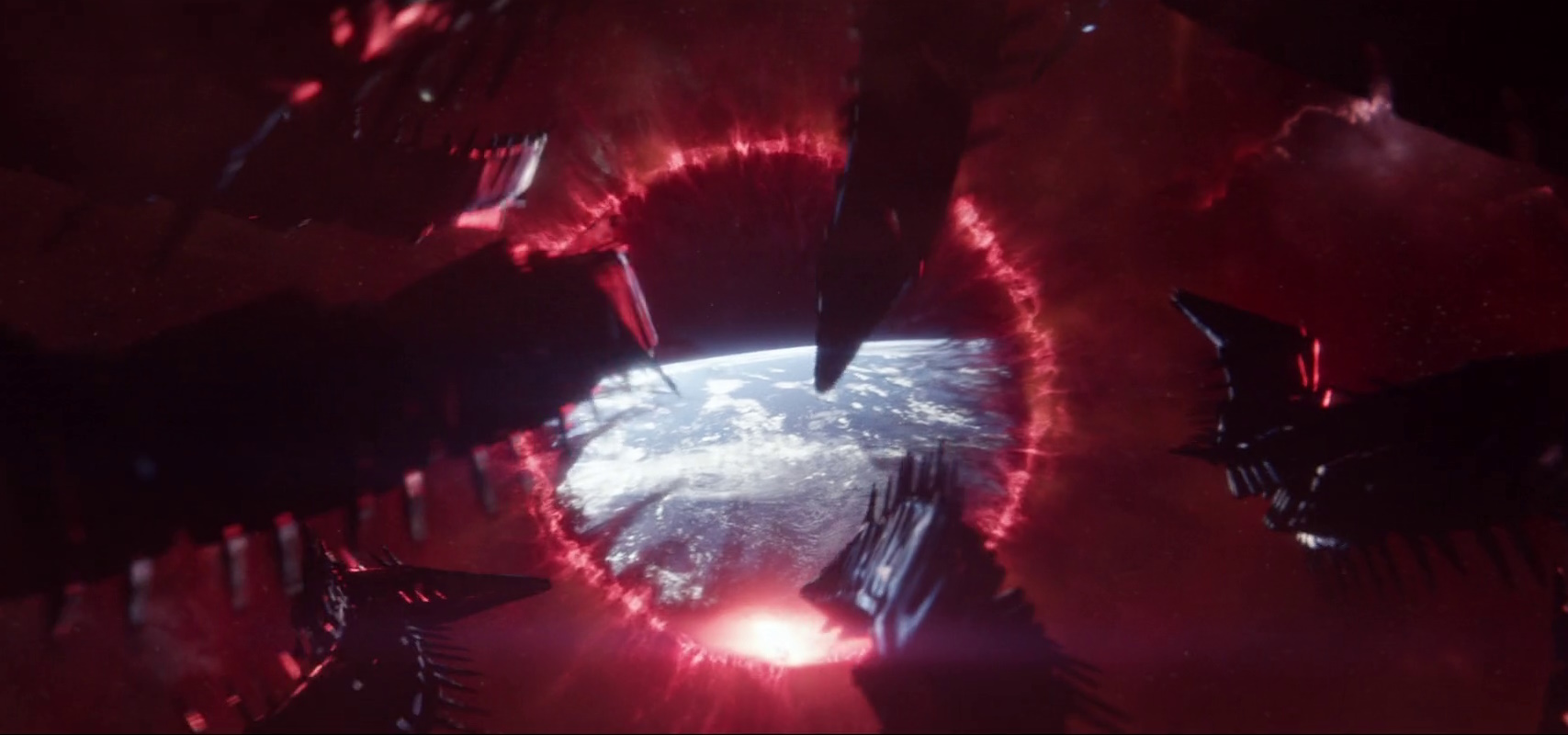
Spoiler Warning: There are spoilers ahead for Star Trek: Picard Seasons 1-2 and casting information for Season 3. Spoilers are also present for the following Star Trek productions: Discovery, Enterprise, Voyager, First Contact, and The Next Generation.
After taking a rather meandering route to get there, Hide and Seek wrapped up one of Picard Season 2’s main storylines – that of Dr Jurati and the Borg Queen in the 21st Century. I’m still fully expecting an epilogue or coda to that story, though, so perhaps it wasn’t quite as conclusive as it appeared to be.
With that in mind, the season finale has a lot of heavy lifting to do if we’re to see all of the main narrative elements from Season 2 brought to a satisfactory conclusion. Even to conclude a simple majority of the remaining storylines and arcs feels like a pretty big ask, and while I’m sure we’ll be in for a feature-length extended episode to round out the season, I’m at least a little anxious as I look ahead. The possibility exists, though, that Season 3 will pick up any loose ends left behind – so there’s hope in that regard.
Pew! Pew!
This week the theory list has been trimmed quite significantly! In addition to one theory that’s been confirmed (or at least “close enough” to count as confirmed), we have one that’s been outright debunked. Then there are six theories that I’m choosing to retire! While not entirely “debunked” by anything that we saw on screen in Hide and Seek, with just one episode remaining the season’s story has clearly gone in a different direction making those theories feel impossible at this juncture.
So let’s get started, shall we? As always, we’ll take a look at the theories leaving the list first of all.
Debunked theory: Q and Picard will team up to stop the Borg Queen.
Q with Picard in Penance.
I have to confess that I rather liked this idea! Though I always caveat all of my theories by warning “don’t get too attached,” I was quite taken by the idea that something Q had started as a test or trial ended up going so far off the rails that he’d have no choice but to work with Picard in order to resolve it. In this case, I wondered whether the Borg Queen being on the loose on Earth in the 21st Century might’ve been so far outside of Q’s plans that, somehow, he and Picard would end up working together.
This theory felt like it could’ve brought together the main story threads: the Borg Queen assimilating Dr Jurati, Picard and the crew needing allies to defend La Sirena, and Q’s declining powers meaning that he couldn’t just snap his fingers and undo it all. There was scope, perhaps, for a more weak and vulnerable presentation of Q; for Picard and Q to need one another’s help equally. There was also the potential to show off Q’s knowledge of the Borg – and maybe even tie in some kind of Borg attack on the Q Continuum into the story to explain what’s happened to Q.
La Sirena’s crash site.
As it turned out, Q was entirely absent from Hide and Seek. Though his influence looms large over the season’s story, we haven’t actually spent that much time with him so far. His biggest role to date came in Penance – and that’s also the last time he had a run-in with Picard. We’ve seen Q deal with Dr Soong and Guinan in subsequent episodes, but I can’t be the only one longing to get Q and Picard back together – even if it isn’t for a team-up!
Of all the theories I’ve concocted about Season 2, this is probably the one I liked best. It seemed to be a genuinely good fit based on what we knew about the story at the end of Mercy, and had the season’s endgame been planned out differently, I think it could’ve worked really well. There’s still time for Q and Picard to reunite, and spend time together in a less-adversarial way… and it’s even possible, I suppose, that we could see Q return in Season 3. I’ve always felt that there’d be something poetic about Q bookending Picard’s story – he appeared in Encounter at Farpoint, so maybe he’ll appear in whichever episode marks Picard’s final end as a Star Trek character.
So that theory was debunked.
Next, we have six theories that I’m choosing to retire from the list. They now seem impossible based on where Hide and Seek ended.
Retired theory #1: The USS Stargazer will make an appearance.
Picard on the bridge of the USS Stargazer in The Next Generation Season 1 episode The Battle.
For a long time – too long, perhaps – I’d been hanging onto the idea that the mission to the 21st Century wouldn’t be all that Season 2 had to offer, and with time travel on the agenda I wondered if we might visit other eras or other moments from Picard’s past. When a brand-new USS Stargazer debuted at the start of the season, that felt like it could’ve been a hint; why bring it up otherwise, right? It also seemed possible, as Picard wrangled with past traumas, that something from his time in command of the Stargazer might’ve come up. As I mentioned in my review of Hide and Seek, the death of Jack Crusher (husband to Beverly and father to Wesley) was one significant event that was mentioned in The Next Generation but never expanded upon. I always inferred that Picard felt responsible for Jack’s death; there was scope, perhaps, to learn why.
With one episode remaining, this now seems impossible – at least in Season 2. If we get back to a ship named Stargazer before the credits roll, it’ll surely be the new vessel that Captain Rios commanded in the season premiere!
Retired theory #2: Seven of Nine will choose to remain in 2024.
Seven of Nine has been re-Borgified.
When Seven of Nine found herself in the Confederation timeline, she caught a glimpse of a life she’d never known and saw what it might’ve been like had she never been assimilated by the Borg. After arriving in 2024, it was clear that she was thoroughly enjoying the sense of freedom that not having any Borg implants gave her. I had speculated that, when faced with the prospect of returning to the prime timeline and her old body, Seven might choose not to.
That concept was shot down by Hide and Seek, as Seven was saved by the Borg Queen in a way that restored her implants. The technobabble side of how this worked and why she ended up looking exactly the same as before is something that the episode could’ve dedicated an extra couple of minutes to, but overall this side of the story worked well enough. Although the metaphor was perhaps buried a little deep, the idea of learning to accept oneself and one’s appearance is a good one. It’s also a story well-suited to the franchise, and one that was told in a very “Star Trek” way.
Retired theory #3: Picard and the crew will have to trigger World War III to save the future.
World War III saw the use of nuclear weapons.
This is one of the longest-running theories on the list! I came up with it months ago, when the concept of time travel to the 21st Century was first teased in one of the pre-season trailers. Even as the Europa Mission and other elements came into play I clung onto it – perhaps for a little too long, in retrospect. There’s been no mention of World War III all season, aside from a couple of very oblique references to the “years leading up to first contact,” so it had felt ever more like a long-shot.
With the Borg Queen having warped away to parts unknown, and World War III not being in any way part of Q’s plan, it now seems certain that triggering the conflict won’t be part of how Picard and the crew restore the timeline.
I stand by what I said when I first posited this theory, though: it would have been one heck of a moral dilemma.
Retired theory #4: Picard and/or the Federation will use information from the Confederation timeline to defeat the Borg.
The Magistrate – a senior Confederation official.
It seems increasingly likely that we’ll never learn how the Confederation was able to beat the Borg, nor what technological tricks or weapons they may have developed during their conquest of the Collective. I feel a pang of disappointment about that; it was perhaps the one thing from the Confederation timeline that I could’ve happily spent an episode exploring.
Now that the Borg Queen has taken La Sirena – complete with all of its Confederation technology and databanks – there’s no way for Picard and the crew to use anything that the Confederation developed to fight the Borg. And if, as Dr Jurati hopes, the Borg will be convinced to take a different path, there may not be a need to go to war with them in the first place. For those reasons I’m retiring this theory – but with the caveat that if the Borg somehow return as major antagonists in Season 3, I may reprise it!
Retired theory #5: Dr Adam Soong will create the Borg.
Dr Adam Soong.
I thought an interesting twist on the Borg side of the story could’ve come either from Q or the Borg Queen working with Dr Adam Soong to create the Borg. Although Dr Soong seems to have assisted the Borg Queen by giving her access to resources and a squad of soldiers, the story ultimately went in a very different direction.
Knowing that one of Data’s ancestors had a role in creating the Borg – one of the biggest threats that the Federation has ever faced – could’ve been a story worth exploring, and had it been handled well there was the potential to inform not only Borg stories, but also the characterisations of Data, Soji, and the whole Soong family.
Retired theory #6: The Federation created the Borg.
The first Borg drone ever seen in Star Trek.
As above, there’d be a delicious irony to learning that the Federation – and perhaps even Picard, inadvertently – had created their own worst nightmare in the Borg Collective. I even wondered if the story taking this route might’ve explained why Discovery Season 2 abruptly abandoned a story with the Control AI that could likewise have been a Borg origin story. However, it didn’t come to pass on this occasion.
The early history of the Borg could absolutely be worth exploring, and despite the fact that the Borg definitely began to feel stale and overused by the latter part of Voyager’s run, the faction still has more to contribute to Star Trek in the future – I’m certain of that. In addition to a story that could explore the Borg’s origins (regardless of whether or not there’s a Federation connection), I’ve also proposed a “Borg Invasion” concept for a Star Trek series, and I think something like that could work exceptionally well as a sci-fi-action-horror hybrid.
On this occasion, though, despite input from Dr Jurati to this incarnation of the Borg Queen, and despite this story taking place in the past, we didn’t get that elusive Borg origin story!
So those theories have been retired.
There was one confirmation this week – or at least a theory that I got “close enough” with that I’m going to call it confirmed. I can do that – it’s my list!
Confirmed theory: The Borg Queen departed aboard La Sirena, leaving Picard and the crew in the past.
The Borg Queen-Dr Jurati hybrid.
So the Borg Queen didn’t ultimately steal La Sirena as I’d proposed in my initial formulation of this theory! But I did correctly predict that the Borg Queen would successfully gain possession of the ship, and that she’d leave Picard and the rest of the crew stranded in 2024. We saw that play out in Hide and Seek thanks to the deal struck between Dr Jurati, the Borg Queen, Raffi, and Seven of Nine.
As I said in my review, I would’ve liked this sequence to have been expanded. I could’ve happily enjoyed an entire episode just on the negotiation, discussing and debating with the Borg Queen how changing her entire philosophy and guiding principles could be the solution she’s been missing. I would’ve also loved to see Picard himself included on this side of the story.
The Borg Queen took La Sirena and left Earth.
Despite those shortcomings, though, what we did get to see was outstanding, and everyone involved deserves a lot of credit for the way they handled this sequence. The concepts here are genuinely interesting, and the idea of a Borg Collective – or a Borg faction – that implements this new guiding principle could be worth exploring. If Picard picks up this story, I hope we get to see it for longer than just a single episode!
The way the Borg Queen departed raises a lot of questions, though. Setting aside the obvious ones like “will she actually keep her word,” we come to more immediate concerns for Picard and the crew. How will they make it home? Can they even make it home? Will someone need to rescue them? Read on, because I have a few ideas on that front…
So that theory was confirmed!
Now we’ll jump into the main theory list, beginning as always with theories that are either new or saw significant movement in Hide and Seek this week. Several of these theories are, I freely admit, looking less and less likely to pan out. But others feel quite plausible as we head into the season finale, and when the story is so unpredictable… who knows what could happen?
Theory #1: There will be a Borg civil war between a faction inspired by the Borg Queen-Dr Jurati hybrid and the rest of the Collective.
Could the Borg be fighting amongst themselves?
How do we connect the events that have just unfolded back to what we saw at the beginning of the season? In The Star Gazer, the Borg sent a message asking for Picard and the Federation to help them. If their message was genuine it suggests that the Borg who sent the message are in danger or under threat. One possibility is that the Borg are fighting a losing war against an external power – and that’s something we’ll consider momentarily. But another possibility, in light of what transpired this week, is that there’s a Borg civil war.
Dr Jurati (and the others) appear to have convinced the Borg Queen to entirely change her philosophy and guiding principles, and this could lead to the creation of a radically different Borg Collective. If the Jurati-Queen hybrid contacts the Borg Collective and tries to get them to join her, there’s a distinct possibility that some or all of them won’t. It might be possible to create a new Borg Collective, but even in the 21st or 22nd Centuries the existing Collective would be difficult to sway. Furthermore, the Borg Collective that already exists may see the Jurati-Queen hybrid as a threat, or may simply want to conquer and assimilate the faction. There are several routes to the same end point: a war between different factions of Borg.
The anomaly encountered in The Star Gazer was said to have some kind of “temporal” signature – so this could be a conflict that took place in the 21st or 22nd Century, almost directly after the Jurati-Queen left Earth.
Theory #2: Some or all of the main characters from The Next Generation will rescue Picard from 2024.
Acting Captain Riker to the rescue?
How will Picard and the crew make it home? That’s one of the biggest questions I have as we go into the season finale! One way to get Picard and the others home safely would be for someone from The Next Generation – or possibly everyone – to show up at the last minute to rescue Picard. Perhaps Picard was able to leave a message or clue hidden somewhere for them to find, so they’d know where and when to pick him up.
With Season 3 bringing back The Next Generation characters, I’m half-expecting to see some or all of them included toward the end of the Season 2 finale to set up the next chapter of the story. This could be a fun and exciting way to do it. It would also be quite a symmetrical ending to the season, as Acting Captain Riker (and his copy-paste fleet) saved the day in the Season 1 finale, too!
Theory #3: The “two Renées” comment refers to Picard’s nephew.
Could the Borg Queen be talking about this chap?
The character above is René Picard – not to be confused with Renée Picard! René was Picard’s nephew, the son of his brother Robert. In Generations, Picard learned that his brother and nephew had died in a fire at the vineyard, leaving him the sole surviving member of his family. Family became more important to Picard thereafter, and it seems like it was Robert and René’s deaths that led Picard to choose his family home for his self-imposed exile after the events of Children of Mars.
My theory is that the cryptic comment that the Jurati-Queen made about there being “two Renées” in Picard’s life actually refers not to Renée the astronaut somehow being cloned or copied or sent to an alternate reality, but simply to the existence of young René, Picard’s nephew, and the influence he had on his life.
Theory #4: Rios will choose to stay with Teresa and Ricardo in 2024.
Rios with Teresa in Hide and Seek.
As Teresa and Rios have progressed their romance, I think that now opens up the very real possibility that Rios might choose to remain behind in 2024 when Picard’s mission is complete. Some people are willing to make big sacrifices for the people that they love, and if Rios truly loves Teresa, maybe he’d be willing to abandon the 25th Century to stay with her – helping to build that future from his position in the past.
In Hide and Seek, Rios seemed to be seconds away from saying “I love you” to Teresa, and for her part she was pushing him to stay with her. I haven’t been enjoying Rios’ story this season for the most part, and the “love story” angle is a bit of a cliché, unfortunately. But in light of the decision to bring back the main cast of The Next Generation in Season 3, we’ve already seen Picard make efforts to slim down its cast and shuffle off main characters like Elnor and Dr Jurati. Rios could be next – and if he survives the season finale, he may choose not to head back to the 25th Century.
Theory #5: An alternate reality is about to be created.
“An alternate reality?”
With the Borg Collective potentially being pacified and a cryptic message about “two Renées,” I wonder if we might be on the cusp of a permanent divergence in the timeline. One path may lead to the Confederation timeline, the other to the prime timeline – and both may be able to coexist in much the same way as the prime timeline coexists with the Kelvin timeline.
As far as we know based on what Q told Picard in Penance, the Confederation timeline replaced the prime timeline. That seems to have come about by the sabotage or failure of the Europa Mission combined with Dr Soong’s inventions that saved the Earth from an ecological collapse – but is it possible that things aren’t what they seem? Could Q have lied, for example, about the Confederation timeline? Or could something that Picard and the crew are about to do end up creating another alternate reality?
If so, I hope it’ll be possible to revisit the Confederation timeline in future. Though it was very similar in many respects to the Mirror Universe, there were some differences. Having only spent a single episode in that setting, and with tantalising details like the Confederation’s defeat of the Borg remaining unexplained, there’s scope to go back and learn more about this very different timeline.
Theory #6: The loose ends from Season 1 will be tied up.
Initiates of the Zhat Vash on the planet Aia.
With only one episode left in which to conclude all of Season 2’s storylines, it feels less and less likely that we’ll get closure on all of the points that Season 1’s rushed finale left on the table. However, there’s still a glimmer of hope that we might get some inclusions, even if just by way of a line or two of dialogue.
Here are the main unresolved points as I see them:
What will become of the synths on Coppelius, and will they have to be relocated for safety?
Did Starfleet attempt to visit Aia and shut down the beacon at the centre of the Zhat Vash’s prophecy? Leaving it out in the open seems dangerous.
Will Starfleet contact the super-synths and attempt to make peace or convince them that they pose no threat?
Why did Bruce Maddox go to Freecloud?
The Artifact’s crash site on Coppelius.
With the Zhat Vash plot exposed, what will become of their crusade against synthetic life?
Did Federation-Romulan relations suffer as a result of the Zhat Vash’s attack on Mars and attempted attack on Coppelius?
What happened to Narek after he was captured by the Coppelius synths?
Who controls the Artifact and what will happen to the surviving ex-Borg?
Theory #7: Elnor will be restored to life when the crew make it back to the 25th Century.
Holo-Elnor in Hide and Seek.
After Raffi got a cathartic goodbye with holo-Elnor in Hide and Seek, I’m no longer convinced that this theory will pan out. If Elnor is alive again in the 25th Century, it would actually rob that emotional moment of much of its power. As above, with The Next Generation’s main characters returning in Season 3, it may turn out that Elnor was just another casualty of the need to make room for them.
However, as I said in my review of Hide and Seek, a big part of me hopes to see Elnor saved. Elnor’s story feels incomplete, and he’s a character that we never really had the chance to get to know all that well. Even in Season 1, his impact on the story was limited compared with other characters, and having just been given a new arc as a Starfleet cadet at the beginning of this season, there’s so much potential for him to develop into a wonderful Star Trek character. If the franchise is to survive in the longer-term it’ll need characters like Elnor to stick around.
Theory #8: The season will end on a cliffhanger.
I first propsed this theory before Season 2 had even premiered based in large part on the fact that Seasons 2 and 3 entered production back-to-back. However, as the season has worn on with many different story threads still in play, it’s seemed even more plausible to think that we won’t see everything neatly tied up by the time the credits roll. That feeling has been amplified by the events of Hide and Seek.
While Hide and Seek concluded the Dr Jurati-Borg Queen story – at least the parts set in the 21st Century – there’s still a heck of a lot left on the table. Even assuming that the season finale will be a feature-length outing, we still have to get through all of the stuff with Q, including finding out why he set Picard this puzzle and what may or may not be killing him, Teresa and Rios’ romance, Picard and Laris’ unresolved romance, the Europa Mission, stopping Dr Soong, explaining the whole “two Renées” thing, tying in recent events to Picard’s past and trauma, and connecting everything to the season premiere.
That might be too much to ask from a single episode – so some or all of it may be left open for Season 3 to pick up next year.
Theory #9: The masked, hooded figure from The Star Gazer is not the real Borg Queen.
The Borg Queen from the season premiere.
We can’t call this one “confirmed” just yet, but the assumption I’m sure a lot of folks have after the events of Mercy and Hide and Seek is that the masked, hooded Borg from the season premiere is, in fact, the Borg Queen-Dr Jurati hybrid. Even if the season ends on a cliffhanger, I would expect that this point will be clarified; it could even be the final scene of the season!
I had previously proposed other “Borg Queen” candidates, but unless there’s going to be some colossal twist in the story’s final act I think we can probably rule them out. Earlier in the season I suggested Admiral Janeway (from the Voyager finale), Renée Picard, and Soji as possibilities for this role – along with Dr Jurati.
So we’ll have to see what comes next. If Picard finds himself back on the bridge of the Stargazer, will the Borg Queen remove her mask?
Theory #10: Picard and the crew will “borrow” Renée’s Europa Mission spacecraft to get home.
Renée Picard.
Now that La Sirena is gone, Picard finds himself stranded – along with Seven, Raffi, and Rios – in 2024. It’s possible that Tallinn or Q could help them get home, but one way that they could do it independently would be to gain control of Renée Picard’s spacecraft. This could tie in with the “two Renées” comment that we’ve already discussed – perhaps with one version of Renée making it home and another being transported to the 25th Century.
Alternatively, this could tie into Picard’s comment earlier in the season that the details of Renée’s mission are lost to history. After making an important discovery, it seems that no one really knows what happened to Renée – so her disappearance from the 21st Century may not impact the history of the prime timeline at all.
If Picard and the crew could find a way to use Renée’s spacecraft to slingshot around the sun, just like they did with La Sirena earlier in the season, it could carry them home.
Theory #11: The Borg’s request for help from the Federation is genuine.
The USS Stargazer’s communications officer first received the garbled transmission.
If the Borg Queen-Dr Jurati hybrid stuck to her commitment and was successful at establishing a new Borg Collective, one with a fundamentally different guiding principle, then maybe that version of the Queen and Collective were genuinely asking for help. Whatever their problem may be, turning to Picard would make sense if the Borg Queen-Dr Jurati hybrid was in control.
This could also explain things like the Borg Queen stunning the Stargazer’s crew rather than killing them; preventing them from interfering but doing so in a non-lethal way. It could also explain what she was trying to accomplish by hacking into the Stargazer’s systems.
The Borg Queen’s mechanical tentacles hacked into the USS Stargazer.
The Borg Queen also seemed to accept what was about to happen in her final moments, playing Non, je ne regrette rien and speaking with familiarity to Picard, telling him to “look up.” If the Borg Queen’s plan was to reach Picard at just the right moment – perhaps to set off this whole time travel saga in the first place – that could explain why.
It does raise the very alarming question of what could possibly have the Borg running scared, though! As mentioned above it could be another Borg faction – the original Collective versus the upstarts. But it could also be someone else… maybe the Season 1 super-synths?
Theory #12: Q is not responsible for changing the timeline.
Q’s powers are failing.
Although Q was absent from Hide and Seek, we’ve seen enough from him earlier in the season to know that his powers are far more limited than we’ve ever seen before. That could mean that Q simply lacks the ability to make such a complete change to the timeline – even though he seems to have been scrambling around trying to do so.
This would certainly be a twist on the way we expect the remainder of the story to unfold! But with no explanation from Q so far as to why he might’ve wanted to change the entire timeline – save for an ambiguous comment to Guinan about “the escape” from traps being what matters – there’s definitely still scope to say that someone else intervened, and that Q was less involved that we’ve been led to believe all season long.
I have a longer article that goes into more detail about this theory that I wrote before the season premiere, and you can find it by clicking or tapping here.
Theory #13: Q shielded Picard and the crew of La Sirena from changes to the timeline.
Q in Mercy.
Regardless of who changed the timeline and why, it seems clear that Q is responsible for ensuring that Picard and the crew of La Sirena were the only ones unaffected by the change. If his goal was to change the timeline to punish Picard that makes sense – but it also leaves open the possibility that Picard will be able to figure out what happened and prevent it. That could be Q’s goal.
I’m not quite ready to call this one “confirmed,” though. I think we need to spend more time with Q to understand what he’s done, what he hopes to achieve by it, and why.
Theory #14: Who is responsible for damaging the timeline, then?
The Borg Queen-Dr Jurati hybrid.
Though I had proposed a number of suspects earlier in the season who could’ve potentially been responsible for setting up this whole time travel saga, at this stage it feels like there’s only one remaining realistic candidate: the Dr Jurati-Borg Queen hybrid. This would set up a kind of temporal paradox, but it could be one that has an escape hatch.
If the timeline splits and an alternate reality is created, perhaps the Borg Queen from that reality could be responsible for the attack on the USS Stargazer and for setting into motion the events of the season. The only thing she’d have to rely on Q to do would be to ensure that Picard, Dr Jurati, and the others would be aware that things had changed.
Theory #15: The Borg are fighting a war – and they’re losing.
Could the Borg be fighting a war against the super-synths?
As posited above, the creation of a Borg Queen-Dr Jurati hybrid, and the plans she had for establishing a new kind of Borg, could’ve led to a conflict with the rest of the Collective. That would be one potential explanation for why the Borg vessel in The Star Gazer was supposedly seeking help. Alternatively, however, the Borg could be fighting a war against someone else.
One way to connect the two seasons of the series would be for the Borg to be fighting against one of the antagonists from Season 1. The Zhat Vash could, perhaps, have taken the Romulans’ anti-synthetic crusade and targetted the Borg. Or the Borg could be facing off against the super-synths from the Season 1 finale. There are other options within Star Trek’s broader canon, of course, but it starts getting pretty speculative at that point!
Theory #16: Seven of Nine will join Starfleet.
Seven of Nine wearing a Starfleet uniform in the Voyager Season 7 episode Human Error.
Hide and Seek gave us some additional information about what happened to Seven of Nine in between Voyager and Picard. Apparently she applied to join Starfleet, but even with the backing of Captain Janeway, her application was denied. Seven believes that her Borg background is why the Federation rejected her, and that could explain some of her remarks in The Star Gazer about feeling uncomfortable and unwanted aboard a Starfleet vessel.
However, Hide and Seek also saw Raffi telling Seven that she would make an excellent Starfleet captain – so could that kind of role be in her future? If Seven survives the season (which it seems like she will after her brush with death this week), then maybe she’ll be permitted to join Starfleet at the second time of asking. She could even be assigned to serve under Admiral Picard’s command – potentially setting her up for a role next season. Or she could be given a ship of her own, perhaps with Raffi as a member of her crew. That could tee up an exciting spin-off series!
Theory #17: The Borg Collective was badly damaged in the Voyager episode Endgame and has been unable to recover.
Admiral Janeway and the Borg Queen.
This theory is certainly looking less and less likely. Aside from a single ambiguous reference to the Borg potentially being in a weakened state all the way back at the start of the season, there hasn’t been any mention of or reference to the events of Endgame all season long. Although Endgame was an important episode, the fact that it hasn’t been brought up could mean that it would feel like a bit of a bolt from the blue if a major revelation connected to this episode were to appear in the season finale. All that being said, this theory has been there in the background all season long and I’m not ready to drop it with just one episode remaining. There’s still time for a connection – even if the connection is smaller than I initially imagined it could be!
Endgame, the final episode of Voyager, depicted a time-travelling Admiral Janeway introducing a neurolytic pathogen – a type of virus – into the Borg Queen, seriously damaging her, her base of operations, and several Borg vessels in the vicinity. Because the Borg hadn’t been seen since – until The Star Gazer, that is – we never got to learn just how deadly Admiral Janeway’s actions were.
Admiral Janeway and Reg Barclay with a holographic Borg drone in Endgame.
I’ve always assumed that the Borg Collective is vast enough, powerful enough, clever enough, and most importantly adaptable enough that Admiral Janeway’s actions weren’t going to strike a fatal blow. Whatever damage she had done seemed like something the Borg could eventually fix – and their existence 25 years later during the events of The Star Gazer seems to prove that. The Borg’s technology and weapons are still streets ahead of anything Starfleet has at its disposal… but even so, it’s still possible that the Borg are on their last legs facing defeat.
If that’s the case, maybe we’ll discover that it was Admiral Janeway who’s responsible – that her actions in Endgame are either wholly or partly to blame for the Borg’s weakened state. Dr Jurati seemed to know that the Borg Collective isn’t as strong as it once was, so that could be another clue pointing to this theory.
So those theories are new or saw movement this week.
There are still several other big theories in play that Hide and Seek didn’t debunk, confirm, or advance in any significant way. To keep the theory list intact and all in one place, we can take a look at those now.
Theory #18: Kore Soong will team up with Picard and the crew of La Sirena.
Kore Soong.
I haven’t been thrilled with the depiction of Kore Soong so far. Her story feels like a bland repeat of Soji and Dahj’s from Season 1, and she appears to exist in Season 2 more for the purpose of informing us about Dr Adam Soong than to do anything meaningful in her own right. I’m hopeful that that will change, however!
Mercy saw Kore Soong take the antidote or cure for her genetic condition, granting her freedom from her father. She left Dr Soong’s house and struck out on her own for what seems to be the first time – and I wonder if she’ll either seek out Picard or if they’ll run into one another. Kore may know something about Dr Soong that could be useful to the crew of La Sirena… so watch this space. Her story may not be done yet.
Theory #19: The Q Continuum has been attacked.
Captain Janeway, Tuvok, Quinn, and Q in the Q Continuum.
Following Guinan’s chat with Q in Mercy, this theory feels a little less plausible. However, as we still don’t know what’s going on with Q, I’m keeping it on the table for now. Earlier in the season I felt increasingly sure that whatever had caused Q to lose his powers was something that wasn’t just affecting him personally, and there’s definitely been evidence to that end across the season so far – and beyond.
In Mercy, Guinan reminded us that members of the Q Continuum can kill one another, and that seemed like a very deliberate line to include. Was it just there to avoid nitpicking Trekkies saying “but what about the Q civil war in Voyager?!” or is there a hint there about something else? I don’t believe that the El-Aurians would be to blame if the Q Continuum has been attacked, but with the Borg in the story, they could certainly be a suspect.
Guinan and Q in Mercy.
In earlier episodes we had talk of a “cold war” between the Q and El-Aurians, a conflict that you’d imagine would be fantastically one-sided unless the El-Aurians know of some kind of weakness that the Q have. Then we had Guinan’s failed attempt to summon a Q – not the Q, but any Q. Q suggested that he basically had to walk from wherever he was to the FBI office because Guinan summoned him – but why didn’t another Q respond to the summons? Picard also suggested, after awakening from his coma, that Q may be weaker and more vulnerable than he had previously considered. And going back to Discovery Season 4, the episode The Examples told us that the Federation hadn’t seen any members of the Q Continuum in over 600 years as of the 32nd Century.
All of the pieces of evidence above could suggest that something is happening to the Q Continuum as a whole rather than just to Q himself. If the El-Aurians discovered a weakness, and then were assimilated by the Borg, perhaps the Borg came into possession of a way to harm the Q – attacking them and wiping them out.
In any case, if something that Picard did or didn’t do is connected to those events, that could explain why Q is so angry and why he felt the need to punish Picard. It could even explain Q’s desire to radically alter the timeline.
Theory #20: Q is angry with Picard for “giving up.”
Grumpy Q.
Over the course of The Next Generation, Q took a particular interest in Picard. More so than anyone else, Q seemed to see potential in Picard as a representative of the human race, someone who potentially showed him what humanity could be… with a little prompting and guidance. Q seemed fascinated by that idea, so seeing Picard’s fall from grace may have shocked him and left him feeling disappointed and bitter.
Picard spent more than a decade away from galactic affairs, retiring to his vineyard and seemingly just waiting around to die. Someone like Q might take that personally; he might feel that Picard was not living up to the potential he had. Perhaps Picard’s absence had some kind of unknown consequence, something that harmed Q or the Q Continuum. In any case, Q’s animosity to Picard seems to be personal – could disappointment at Picard’s attitude in the years prior to Season 1 be the cause?
Theory #21: At least one character from The Next Generation will make an appearance.
Picard with Dr Crusher in The Next Generation.
In a way, this theory was knocked off-course by the announcement a few weeks ago that Season 3 will be featuring the main characters from The Next Generation in a big way. I had wondered if Season 2 might’ve returned to Nepenthe to see Riker and Troi, for example, but for weeks that has felt very unlikely!
However, there are still ways that one or even all of these characters could be included. Above I suggested that they could rescue Picard from 2024, and that’s one possibility. It’s also possible that the final act of the season finale will begin the process of setting up the story of Season 3, in which case the final moments of the episode could see some or all of these characters return. Although time is running out, I’m keeping this one on the list as we head into the finale!
Theory #22: The Borg are aware that Picard is now a synth – and his synthetic status is part of the reason why they waited until now to make contact.
Picard awakened in a new synthetic body in Et in Arcadia Ego, Part 2.
The timing of the new Borg incursion is interesting, especially considering that they asked for Picard by name. Are they aware of his newfound synthetic status? And if so, could Picard’s transition to a new synthetic body be the reason why the Borg chose to launch their attack?
The Borg seek “perfection” through a synthesis of organic and synthetic components, and while Picard’s new synthetic body is a far cry from the Borg drones we’ve seen, the idea of an organic mind in a synthetic body isn’t a million miles away from that same basic idea. Although Picard’s body was said to be comparable in practically every way to his original one, synthetics can have enhanced abilities that allow them to easily overpower humans – and, as we’ve seen with Data on more than one occasion, they can outmatch individual Borg drones as well.
A Borg drone losing a fight against Data.
Perhaps the Borg want to re-assimilate Picard now that he’s synthetic. If the Collective is still reeling from the damage inflicted upon it by Admiral Janeway or if they’re on the losing side of a war, perhaps they hope to use fully-synthetic bodies like Picard’s to replace damaged or destroyed drones, or as cannon fodder on the front lines. There are many reasons why the Borg might be interested in synthetic technology, and that could explain their re-emergence.
Even if the Borg don’t plan to assimilate Picard or the Coppelius synths, the timing of their appearance is certainly interesting and there could be a connection.
Theory #23: The Borg ship from The Star Gazer crossed over from the Confederation timeline.
The Borg vessel identified as “Legion.”
As far as we know at this stage, the Confederation timeline replaced the prime timeline thanks to the past being changed. But timelines and parallel universes often go hand-in-hand in Star Trek, and after we learned about the Borg’s defeat in the Confederation timeline, I wonder if their ship from the season premiere might have found a way to punch through or cross over into the prime timeline.
If the Borg were facing defeat, as their message seemed to suggest, perhaps that could explain why. Also, the anomaly that the ship emerged from was not a typical transwarp conduit; we’d seen transwarp corridors as recently as Season 1. Finally, the Borg Queen of the Confederation timeline was aware of Picard and the history of the prime timeline. If the masked Borg Queen turns out to be the Dr Jurati hybrid, she would have known about the prime timeline and may have considered it her best chance for survival.
Theory #24: Rios will bring Teresa and Ricardo to the 25th Century.
Teresa and Rios at the clinic.
This is an inversion of the theory above about Rios potentially remaining in 2024. Rios has clearly abandoned the idea of making as little impact on the timeline as possible! Just like Kirk did for Dr Gillian Taylor in The Voyage Home, perhaps Rios will seek to bring Teresa and Ricardo forwards in time. Teresa may have her clinic to attend to – although its status is in doubt after it was raided by ICE earlier in the season – but she may want to leave the world of the 21st Century behind to head into a more optimistic future.
If Teresa and Rios continue to pursue a romantic relationship, and Rios begins to offer himself as a father figure to Ricardo, maybe the stage will be set for Teresa heading to the 25th Century. It wouldn’t be the weirdest or wildest possibility, especially not now that Teresa and Ricardo are both aware of Rios’ true identity and the existence of La Sirena.
Theory #25: Teresa and Ricardo are Rios’ ancestors.
Teresa with Rios in Mercy.
This could be a heartbreaking end to Rios and Teresa’s burgeoning romance! In true Back to the Future style, perhaps Rios will learn that Teresa and Ricardo are his distant ancestors, bringing their relationship to a screeching half and preventing either of them from taking things further.
We’ve seen Star Trek deal with time travel on many occasions, including fixed moments in time and people too important to be changed or killed. And in a story in which Picard has already met a distant ancestor of his own – Renée – there could be a kind of poetic symmetry if Rios were to discover a connection to Teresa and Ricardo. If this pans out, I hope Rios and Teresa discover the truth before they… y’know!
Theory #26: Rios will be killed and Picard will assume command of the new USS Stargazer.
Rios in the captain’s chair of the USS Stargazer.
One thing I can’t figure out at the moment is what sort of role the new cast will have in Season 3. If you somehow missed the cack-handed announcement, it’s been revealed that the main cast of The Next Generation (sans Wil Wheaton and Denise Crosby) will be reuniting in Season 3, and that they will have major roles to play. If that’s the case it seems all but certain that the main cast of Picard will be sidelined. We’ve already seen that happen this season with Elnor killed, Dr Jurati assimilated, and Soji missing in action, so that really only leaves Raffi, Seven, and Rios.
If the teases and hints about Season 3 that we’ve heard so far prove to be true, it seems as though Picard and the crew will need a ship… so could that ship be the new USS Stargazer?
New sets were built from scratch for the Stargazer, including a conference room, bridge, turbolift, and corridors, yet those sets were only used in a single episode at the start of the season. Even if the crew make it back to the 25th Century next time, that’s still a massive investment for relatively little screen time! So my theory is that the new sets will be used more extensively in Season 3 when Admiral Picard assumes command of the USS Stargazer. Why would there be a vacancy in the captain’s chair? Because Captain Rios is going to be one of the characters shuffled out of the way to make room for the returning crew of The Next Generation.
So that’s it!
Dr Jurati and the Borg Queen.
As we head into the season finale, a lot of questions remain unanswered. I won’t be upset if none of these theories pan out – but I could find myself saying that the season ended in disappointing fashion if questions about Q, Renée, the Europa Mission, and the Borg aren’t resolved satisfactorily. The only exception to that might be if the season ends on a cliffhanger, clearly establishing that Picard’s next outing will continue these storylines.
So it really is all to play for in the final episode of the season. The more I think about the events leading up to this point, the more convinced I am that some of the extraneous fluff should have been cut from several mid-season episodes. That would’ve allowed us to spend more time on things like the negotiation with the Borg Queen-Dr Jurati hybrid, as well as potentially more time with Q and Picard to explain what Q did, why he did it, and how whatever’s happened to him is related to Picard. It’s possible that the season finale and/or Season 3 will do justice to all of the narrative threads that remain in play – but I’m certainly a little nervous as the season runs out of track.
Los Angeles at night, circa 2024.
Despite that, I’m trying to stay optimistic! The season finale will likely be a feature-length outing, and there are some potentially exciting and explosive storylines that remain in play. Stopping Dr Soong is one of the big ones, and that could certainly be a source of drama and conflict, but there’s more. Seeing Q and Picard back together and getting a proper explanation for what’s been going on with him would be one of my big requests – and I think we’ll get that, even if it means that other story points will have to wait.
I always like to end these theory lists by saying that I do this just for fun. I enjoy writing, I enjoy Star Trek, and spending more time in this world is an escape and an enjoyable distraction. But for some folks, fan theories can be frustrating or unenjoyable, especially if they get very attached to a plausible-sounding theory that ultimately doesn’t pan out. I have no “insider information” and I’m not trying to claim that anything suggested above can, will, or must be part of Picard Season 2. I fully expect many of these theories to be debunked and for the season to go in wildly unpredictable directions!
Star Trek: Picard Season 2 is available to stream now on Paramount+ in the United States, Scandinavia, Latin America, and Australia, and on Amazon Prime Video in the United Kingdom and the rest of the world. The Star Trek franchise – including Picard and all other properties mentioned above – is the copyright of Paramount Global. This article contains the thoughts and opinions of one person only and is not intended to cause any offence.
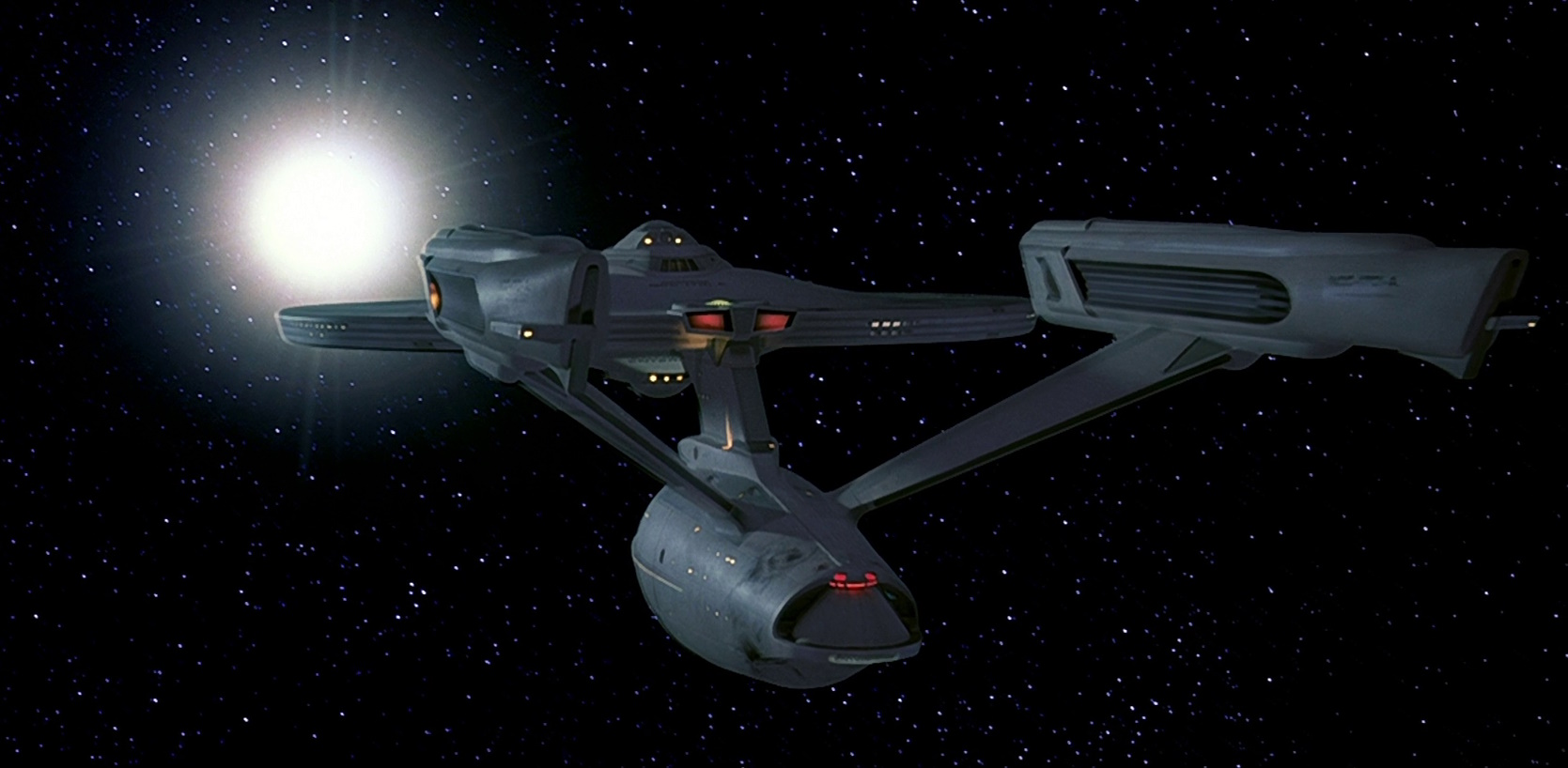
Spoiler Warning: There are spoilers ahead for Star Trek: Picard Seasons 1-2. Spoilers are also present for the following Star Trek productions: The Next Generation, First Contact, and Voyager.
This review deals with the sensitive topics of mental health and suicide and may be uncomfortable for some readers.
If I’ve done my counting right, then I believe Hide and Seek is Jean-Luc Picard’s 200th Star Trek appearance. It gets a little fuzzy when we look at two-part episodes that are occasionally considered as feature-length outings, but if we go in broadcast order then I’m pretty sure that the character of Jean-Luc Picard has now appeared in 200 Star Trek productions (including four films). So that’s pretty neat!
Hide and Seek was an exciting episode that focused on the Borg side of the story in a big way. But it was also an episode that fell into the trap of some pretty clichéd storytelling, something that definitely detracted from some of the impact that the story had. There were some emotional highlights – including some wonderful performances from Alison Pill, Michelle Hurd, and Jeri Ryan – but overall, I’m left feeling that the season has taken a slow and meandering route to reach this point, and that more time could’ve been spent on some of these interesting storylines and powerful moments had some of the extraneous fluff been cut out from earlier episodes.
It was a dark and stormy night…
For the first time this season, I wasn’t wild about some of the cinematography in Hide and Seek. Parts of the episode were coloured with a dark blue hue – something not uncommon on television to indicate darkness – but I found that it gave those sequences a washed-out look. Though we aren’t anywhere close to the failures of something like The Long Night in Game of Thrones’ eighth season, the colour palette did not flatter the scenes set at Château Picard, and the episode suffered for this creative choice.
Hide and Seek doubled-down on exploring the trauma that Picard faced in his youth, and it was revealed that the memory he’s been repressing was his mother’s suicide and discovering her body. As in Monsters a couple of weeks ago, though, I’m struggling to see how this story connects with what’s happening in the rest of the season, and why the series has decided that this hitherto unknown chapter of Picard’s life warranted so much time dedicated to it.
Hide and Seek delved once again into Picard’s youth.
In a general sense, I’m not averse to the idea of taking an established character and fleshing them out, giving more detail to their background and history. And as stated earlier in the season, I can’t recall anything from Picard’s past Star Trek appearances that would’ve explicitly ruled out something like this happening to him in his youth. However, when dealing with a character who’s made as many appearances as Picard, these kinds of stories have to serve some greater purpose – and right now, this story of Picard’s youth and his mother’s death doesn’t appear to do that.
As I asked in my review of Monsters: what aspect of Picard’s character, personality, temperament, or personal philosophy does this revelation explain? How do we as the audience feel that we understand Picard any better in light of this season spending a significant chunk of its runtime on this story? We know more about Picard’s past in a factual sense – but the facts that have been brought to light don’t inform his characterisation in any way, neither here in Picard nor in The Next Generation. There’s no “aha!” moment where the way Picard has behaved, or his stance on life, suddenly seems to click.
It doesn’t feel like this moment informs Picard’s character in any significant way.
If the story itself had been handled differently, perhaps in a season with fewer other things going on, I think I could forgive it. But during two out of the season’s ten episodes now, a significant amount of time has been taken away from other, more interesting and engaging stories to flesh out an aspect of Picard’s backstory that feels unnecessary.
A character like Picard, who has made so many Star Trek appearances, has unexplored moments in his past that a story like this could’ve told. We could’ve learned, for example, that a similar trauma stems from his time in command of the USS Stargazer – the death of Jack Crusher springs to mind as an unexplained event that would be both traumatic and ripe for a deep dive. But this story shone a light on a part of Picard’s past that none of us could’ve anticipated – and when there are events in his past that feel like they could’ve been more interesting, I guess I’m left wondering what might’ve been.
Other events in Picard’s past could’ve taken us on a similar journey.
Picard’s story also had a very “20th Century” feel to it, and as I’ve said on more than one occasion, that doesn’t feel very Star Trek-y. We know from The Next Generation that Picard had an upbringing on a vineyard and that his family weren’t in favour of him joining Starfleet, so in that sense none of it is contradictory. But from the point of view of someone sitting down to watch Star Trek and not some other contemporary drama series, it’s a tad disappointing when the series spends so much time either in the modern-day or in a setting that feels also very much like the modern-day.
And again we come to the mental health side of the story. I was deeply disappointed with what we saw in Monsters, and while nothing in Hide and Seek sank to that level, Yvette’s mental health condition was again underdeveloped and fell into the trap of stereotyping. Continuing our theme of feeling like a story from contemporary times, not three centuries in the future, we saw no attempt made to use the technology of the early 24th Century to help Yvette. Did her husband do anything to help her? Locking away someone with mental health issues “for their own safety” is the kind of thing that the Victorians did – and although Picard seemed to get to a place in Monsters where he could understand the burden his father carried and forgive him, the way Maurice treated Yvette raises some seriously disturbing questions.
Maurice Picard.
As someone who is disabled and who has diagnosed mental health conditions, one of the things that I’ve always found inspirational about Star Trek’s future is this idea that many of the ailments people today have to live with will one day be curable. Medical technology that’s akin to magic has been present in the Star Trek franchise since the beginning, and while mental health hasn’t often been depicted in a particularly sympathetic way (look at episodes like Whom Gods Destroy or Statistical Probabilities, for example) I’ve always liked the concept Star Trek proposes: that one day, cures for many health issues – including mental health conditions – will be discovered.
Hide and Seek chose to ignore that, and if it had done so for a better reason, I might be able to overlook it, or at least reduce my negative feelings toward it. But because the story of Yvette’s suicide and its impact on Picard feels so disconnected from everything else going on this season, it just hammers home for me that many of the narrative decisions on this side of the story were, at best, odd. At worst I’d call the whole thing pretty poor.
Yvette Picard’s suicide.
One final note on this aspect of Hide and Seek: for the first time, I felt Star Trek: Picard fall into a storytelling trap that has tripped up sister show Discovery on multiple occasions. Picard and Tallinn were on an incredibly dangerous, time-sensitive mission, with half-assimilated Borg shooting at them, yet Picard allowed himself to become distracted by this event in his past. Being thrown into the room where something bad once happened is, of course, a trigger for post-traumatic stress, and I get that. But even with that understanding and that caveat, I found myself wanting to shout at the episode in frustration that there isn’t time for this right now!
This is something that Discovery does far too often – characters bringing their own personal issues to the fore in a way that clearly interferes with the missions at hand. Picard had never had this issue – not even in Monsters when Picard’s trauma was one of the main storylines – but because of the circumstances of the Borg attack on La Sirena this time, it really did feel that Picard didn’t have the time for such indulgent reminiscing. It’s only through sheer luck that he and Tallinn survived.
Picard allowed himself to become distracted in the middle of a very dangerous situation.
Despite being a relatively long episode at almost fifty minutes, there were a few points, especially as Hide and Seek drew to a close, where I felt some important scenes may have been left on the cutting-room floor. For example, how did Rios know exactly where to transport to save Picard and Tallinn? And how did Picard know that Seven and Raffi had let La Sirena escape when he reunited with them? These questions could’ve been answered, and while they may not feel hugely substantial in terms of the way things turned out, the fact that we didn’t see everything as it unfolded left the final part of the episode feeling rather cut-down and perhaps a little contrived.
I’m glad that Dr Jurati was able to not only wrestle some control back from the Borg Queen, but also talk her down from the most extreme version of her plan. This was Hide and Seek’s emotional high point, and Alison Pill put in an outstanding performance. It was nice to welcome back Annie Wersching as the Borg Queen, too.
Dr Jurati and the Borg Queen.
However, I’m left feeling that this sequence was shorter than it could’ve been, and more importantly that key characters were missing. This is the emotional crux of Dr Jurati’s story this season, and the end of the 21st Century side of the Borg’s story, at least. In a series called Star Trek: Picard, shouldn’t Picard himself have been present? He only showed up after this had happened, seemingly already aware of what had transpired even though we never saw him find out on screen.
After what Picard went through with the Borg from The Next Generation through to First Contact and Season 1 of Picard, there was scope for his inclusion here to wrap up his inner conflict with the Borg; to take the argument he expressed in The Star Gazer about wanting to hear out what the Borg had to say and going one step further. Picard could, in this moment, have come to forgive the Borg Queen and arrive at a place where he’d be willing to give her the opportunity to chart a new path and do things differently.
This sequence was undeniably well done. But it feels like Picard should’ve been involved.
In order for that to have happened, though, this episode – and realistically, much of the season leading up to it – would have needed to be structured very differently. This could even have become the “lesson” that Q had been pushing Picard to learn; that forgiving one’s greatest adversaries and giving them a chance to change is worth doing. Is that something Q might want to teach Picard? I don’t know, but it could’ve worked.
Instead it fell to Raffi, Seven of Nine, and Dr Jurati to strike a deal with the Borg Queen – and while this sequence was emotional and well-constructed, as it ended and the deal was honoured, I felt that, if I were in their shoes, I wouldn’t be convinced that the Borg Queen would stick to her commitments. She basically promised, over the span of a few short minutes, that she’d entirely change her philosophy and worldview, and would build a Borg Collective based on an entirely different guiding principle. Because we’ve seen the Borg on a number of previous occasions, I think this moment needed more to be convincing.
Can we feel certain that the Borg Queen will stick to the agreement she made?
Think back to episodes in Voyager such as Scorpion and Dark Frontier. We saw the Borg’s duplicity and deceitfulness on full display in those stories, and we saw how Captain Janeway and others were absolutely correct not to trust the Borg to uphold their end of whatever deal had been struck. Although Dr Jurati felt that she had extracted a solid commitment from the Borg Queen, and I could quite see Raffi being willing to go along with it in exchange for saving Seven’s life, looking in from the outside I have a lot of reservations that Hide and Seek simply didn’t do enough to placate.
The Borg Queen got what she wanted – and everything we know about her from all of her past appearances tells us that she’s the kind of single-minded, domineering character who would say and do whatever was necessary to get the right outcome. Dr Jurati was standing in her way; appearing to concede to her proposal and saving the life of one single individual would be a negligible price to pay – from the Queen’s perspective – if it meant gaining control of La Sirena and the possibility of reuniting with the Borg Collective in the Delta Quadrant.
The Borg Queen ended up getting what she wanted – control of La Sirena.
In short, this concept was an interesting one. The idea of Dr Jurati and the Borg Queen “merging,” rather than Dr Jurati losing her entire personality, is a clever twist on the way the story could’ve gone, and one that had been set up well in Mercy last week. The broader idea of a Dr Jurati-Borg Queen hybrid potentially taking the Borg Collective in a different and perhaps less aggressive direction is likewise a fascinating concept. But neither of these ideas, great as they are, feel complete. It’s true that there’s one more episode of the season remaining – but as the Borg Queen has now warped away in what felt like a pretty conclusive departure, and with a lot of other storylines still in play, it doesn’t seem as though Picard will be able to revisit these ideas right now.
There was potential in the idea of Dr Jurati pacifying the Borg Queen and lending her unique perspective to the Collective. There was potential in the idea of the Borg Queen listening to such a proposal and giving it some degree of consideration. And there was potential in the idea of a negotiated peace (of a sort) at the end of an episode that had these moments of battling and violence. But I don’t feel that Hide and Seek – and Season 2 as a whole – left enough time to really do justice to any of them, at least not as things currently stand.
A powerful moment as Dr Jurati and the Borg Queen discussed the fate of the Borg Collective… but it needed more.
Negotiations with the Borg Queen could’ve been an entire episode in itself – and I’d certainly be up for a story with that kind of diplomatic focus. We’ve seen Star Trek – and Jean-Luc Picard himself – do those kinds of stories exceptionally well, and it could’ve been an interesting coda to the Borg story that has been running this season. Maybe the season finale will bring more of that, but taken on its own, Hide and Seek had some clever concepts and lofty ambitions – but ultimately failed to fully deliver on them.
That isn’t to detract from some wonderfully evocative performances, though. Alison Pill deserves so much credit for the way she inhabited two very different roles in Hide and Seek, and in particular the way she managed to capture the mannerisms, style, and essence of Annie Wersching’s Borg Queen. That kind of acting challenge – playing a different character in someone else’s body – is a Star Trek trope going all the way back to The Original Series, and some actors are better at it than others! Alison Pill really managed to be convincing as the partially-assimilated Borg Queen, and the moment where she donned the iconic outfit was a special effects home run to boot.
The new Borg Queen looks down at her old body.
As mentioned, the idea of a Borg Queen-Jurati hybrid (Borgati? Jurorg?) is an interesting one, and everyone involved did their best to sell it. To me, the fact that this “negotiation” sequence was too short doesn’t negate those wonderful performances. However, the scene immediately afterward, in which Seven of Nine and Raffi agree to honour their deal felt just a little odd. One of Star Trek’s biggest ever villains just kind of… stood around on the bridge of La Sirena, and the way the ship was then turned over to her felt not only rushed, but also rather anticlimactic.
Dr Soong, who had seemed so interesting when we first met him in Fly Me To The Moon, had already lost all pretence of nuance or complexity prior to the events of Hide and Seek. Although the suitably over-the-top performance from Brent Spiner was absolutely delicious to watch – as his villainous performances always have been – I don’t really understand Dr Soong’s inclusion on this side of the story.
Dr Adam Soong.
Q wanted to shut down the Europa Mission to create the Confederation timeline, but to the Borg Queen that outcome isn’t a good one – it’s what she allied herself with Picard and came to the 21st Century to prevent. Despite the fairly weak protestation that the Borg are now “aware” of the danger the Confederation may pose, I don’t buy that she’d remain allied to Dr Soong – especially not after gaining access to several dozen goons that she partially assimilated.
I guess in that sense the Borg Queen acted out-of-character, not by allying herself to Dr Soong but by maintaining her end of the deal even after he’d served his purpose. Perhaps we could argue that it ties in with the merging of Dr Jurati and the Borg Queen; that the Queen’s personality was already showing signs of being altered. But why should the Borg Queen care about Dr Soong? And if Dr Jurati’s influence is present to excuse that contrivance… shouldn’t she be even more inclined to break their deal and stop him?
Dr Soong ultimately escaped to fight another day.
Despite a performance from Brent Spiner that I will unashamedly admit to having thoroughly enjoyed, I don’t find Dr Soong a particularly interesting villain, and when the story has to contort itself into knots to pull out contrived ways to keep him relevant and engaged, it just falls flat for me. Dr Soong may have been an interesting ally for Q, but the way in which he was included this week, and the way in which the Borg Queen stuck to her agreement with him, stretches credulity to breaking-point for me.
Jeri Ryan had some wonderfully emotional and insightful moments as Seven of Nine this week. We got to learn more of Seven’s post-Voyager history, including that she attempted to join Starfleet, but had her application denied. Seven ascribes this to her Borg past, but it raises the interesting question of why Starfleet permitted Icheb to join (as we saw in Season 1), but not her.
We got some interesting information about Seven of Nine’s life during the years in between Voyager and Picard.
Seven’s story this season has now come full-circle, and she’s regained her Borg implants and appearance thanks to the deal Raffi and Dr Jurati struck with the Borg Queen. It’s sad for Seven, who had been enjoying her newfound appearance, to be forced back to the way she had previously been. However, after what she’s been through over the past few episodes, perhaps Seven has reached a place where she can accept herself, despite what she sees as imperfections. There’s a metaphor there, perhaps, albeit one that’s buried quite deeply in the story.
I felt that there was the potential for this new presentation of Seven of Nine to have carried forward, and although it’s perhaps early days to be thinking about spin-offs and future Star Trek projects, one centred around Raffi and Seven of Nine would certainly find supporters! But if Seven of Nine isn’t going to be a huge part of the series in future – and spoiler alert for Season 3 if you missed the announcement, but with the main cast of The Next Generation set to reprise their roles next time around, there may not be as much of a place for her – then her story this season has a cyclical feel to it; she returns to where she began, albeit having been changed somewhat by the experience.
Has Seven’s story come full-circle?
Raffi got two very powerful emotional moments this week, and Michelle Hurd gave her best performance of the season to bring them to screen wonderfully. Dealing with the fatally-wounded Seven of Nine was the latter of the two, and I really felt the pain that she went through in that moment. But the more powerful moment had come a few minutes earlier as Raffi came face-to-face with the “ghost” of Elnor.
It wasn’t exactly made clear how the holographic version of Elnor worked, nor how it came to have the memories of his last moments, and that was something that could’ve been technobabbled a bit better. Again, we’re feeling the constraints of an episode – and a season – that has to make cuts and creative choices in order to fit into a limited timeslot. However, setting that minor gripe aside, the conversation between the two of them was one of the episode’s emotional highlights.
Raffi was able to get closure for Elnor’s death.
Both Michelle Hurd and Evan Evagora excelled as holo-Elnor provided Raffi with the closure and forgiveness that she needed, and the moment was sad but beautiful. Elnor’s death has been one of the things driving Raffi this season, and it felt for a time as if it was something that could be reversed. Raffi now seems ready to accept Elnor’s passing, however, and I think that’s a signal to us as the audience that Elnor’s death is indeed going to be permanent.
On this point – if indeed it comes to pass – I’m not so sure that Picard got it right. Spoiler alert again for Season 3, but as a point of practicality given the return of the main characters from The Next Generation, I can understand why the show is doing everything it can to shuffle its current crop of main characters out of the way. But as I said when that decision was announced, that in itself is something I have mixed feelings about, and Elnor in particular is a character that I feel we never really got the chance to know very well. Aside from his spotlight episode in Season 1 – Absolute Candor – Elnor’s impact on the story of both seasons has been, at best, limited. The decision to enrol him in Starfleet Academy and to give him a new parental figure in Raffi worked well, especially in light of the beautiful scene where Raffi comforted him at the end of Season 1. But there’s so much potential in a young character like Elnor – the first Romulan in Starfleet. If the Star Trek franchise is to survive long-term, characters like him need to stick around.
Is this the end of the road for Elnor?
Despite my great dislike of Rios’ story this season, and the way in which he has regressed as a character from the season premiere, his role in Hide and Seek was largely inoffensive. For the first time I felt that Picard genuinely cared about Rios – he told Tallinn to turn off the transporter to prevent Rios from returning to the battle after he was injured. If I was being cruel I might say that moment felt unearned given the lack of interaction between Rios and Picard for practically the entire season, but we know Picard as a character well enough to know that he does truly care about those under his command.
The Rios-Teresa romance progressed, getting him to a place where he was one transporter beam (or transporter puff) away from saying “I love you” to her. I had wondered, prior to Hide and Seek, if Rios was being groomed for an heroic death. That still could happen in the season finale, but the developing romance with Teresa, combined with Seven’s return to her Borg status, now has me wondering if Rios will choose to stay in 2024 if and when the moment comes to go home. Teresa seemed to be pushing him in that direction this week.
Rios told Teresa he had to go and save the future.
Having talked about everyone present in Hide and Seek, we now turn to one significant absence: Q. Q has been the season’s driving force, seemingly setting up the Confederation timeline and thus also the trip to the 21st Century. But as the story reaches what should be its endgame, Q was once again absent. There’s now just one episode left not only to put a stop to the next phase of Q’s plan, but also to explain what drove him to do all of this in the first place.
As mentioned, it might’ve been possible for Q to be included here – to say that one of his plans or part of his plan was to see how Picard would react to the merging of the Borg Queen with one of his friends. Though a story about mercy, forgiveness, and a willingness to move beyond animosity wouldn’t be as grand in scale as something like learning to perceive time in a non-linear way – as happened in All Good Things at the end of The Next Generation – in another way it’s kind of in line with what Q tried to show Picard in the episode Tapestry. In that story, Q showed Picard an alternate life that he might’ve led, and guided Picard through events in his past that led him to become the person he is. In this story, Q might’ve been showing Picard, in a similar way, that he can grow and learn to let go of the anger, hate, and fear he has toward the Borg and the Borg Queen.
All of this might’ve been part of Q’s grand plan.
But that doesn’t seem to be what this story is trying to say. With Q entirely absent from Hide and Seek, there isn’t much time left to wrap up his story and provide a satisfactory explanation not only for Q’s behaviour, but in a broader sense for the entire story of the season. Why Q did whatever he did, and what his goals and objectives are, are still concealed by the plot – and if they aren’t given a proper moment in the spotlight next week the entire season could fall apart.
As much as I enjoyed a tense story about a battle against modern-day semi-Borg, and as great as those emotional moments were with Raffi, Elnor, Seven, and Dr Jurati, Hide and Seek feels like it has a gaping hole due to the absence of Q. With Q’s henchman Dr Soong still at large and also needing to be stopped, and the Europa Mission still to save, the season finale has been left with a lot of work to do and a lot of story to wrap up – and that’s before we even consider getting Picard, Seven, Rios, and Raffi back to the 25th Century.
The eerie green glow of Borg transporter beams.
Hide and Seek raises a lot of questions – not least of which has to be what will become of the Borg if the new Borg Queen-Dr Jurati hybrid makes good on her promise to effectively restructure the entire Collective and implement a wholly new guiding philosophy. If such a change to the Borg were to happen in the 21st or 22nd Centuries, that could be transformative for the entire prime timeline. Guinan’s people may never have been attacked, Picard may never have been assimilated, the events of The Best of Both Worlds and First Contact may be erased, Captain Janeway’s run-ins with the Borg may have been averted or turned out completely differently, Seven of Nine may never have been assimilated… heck, even Captain Sisko would be affected, with his wife never dying at the Battle of Wolf 359. If Picard and the crew set out to preserve the timeline, then changing more the three centuries’ worth of Borg history means that they very definitely failed!
Setting those implications to one side for now, I think we’ll have to return to Hide and Seek when the season is over and reassess how some of these story points are ultimately borne out. There’s potential for some of them to become better in light of a successful finale – and likewise there’s the potential for some of them to seem disappointing if the season doesn’t wrap up in a neat way.
La Sirena takes flight.
So that was Hide and Seek. A complicated episode, all things considered, with some significant weaknesses and flaws, but one that managed to be exciting and action-packed with a focus on the Borg that I did appreciate.
The Star Trek franchise continues to try some very different ideas, but not all of them stick the landing. The mental health side of storytelling, not just in Hide and Seek, nor even just in Picard Season 2, but in a much broader sense across the franchise, remains an area of concern and disappointment. Star Trek can do mental health stories well, but the producers have to allow enough time to really do justice to big and complex topics. For me at least, Hide and Seek didn’t succeed at that.
I’m anxiously awaiting the season finale. Having seemingly concluded one of its big storylines – at least the part set in the 21st Century – Picard has left itself with two villains to defeat, a mission to save, a cryptic message about “two Renées” to explain, a return to the 25th Century to facilitate, potentially two love stories to bring closure to, and finding a way to connect the events of the past eight episodes to what we saw in the season premiere. There’s a lot of work to do… and I really hope that the season finale will be up to the task.
Star Trek: Picard Season 2 is available to stream now on Paramount+ in the United States, Scandinavia, Latin America, and Australia, and on Amazon Prime Video in the United Kingdom and the rest of the world. The Star Trek franchise – including Picard and all other properties mentioned above – is the copyright of Paramount Global. This article contains the thoughts and opinions of one person only and is not intended to cause any offence.
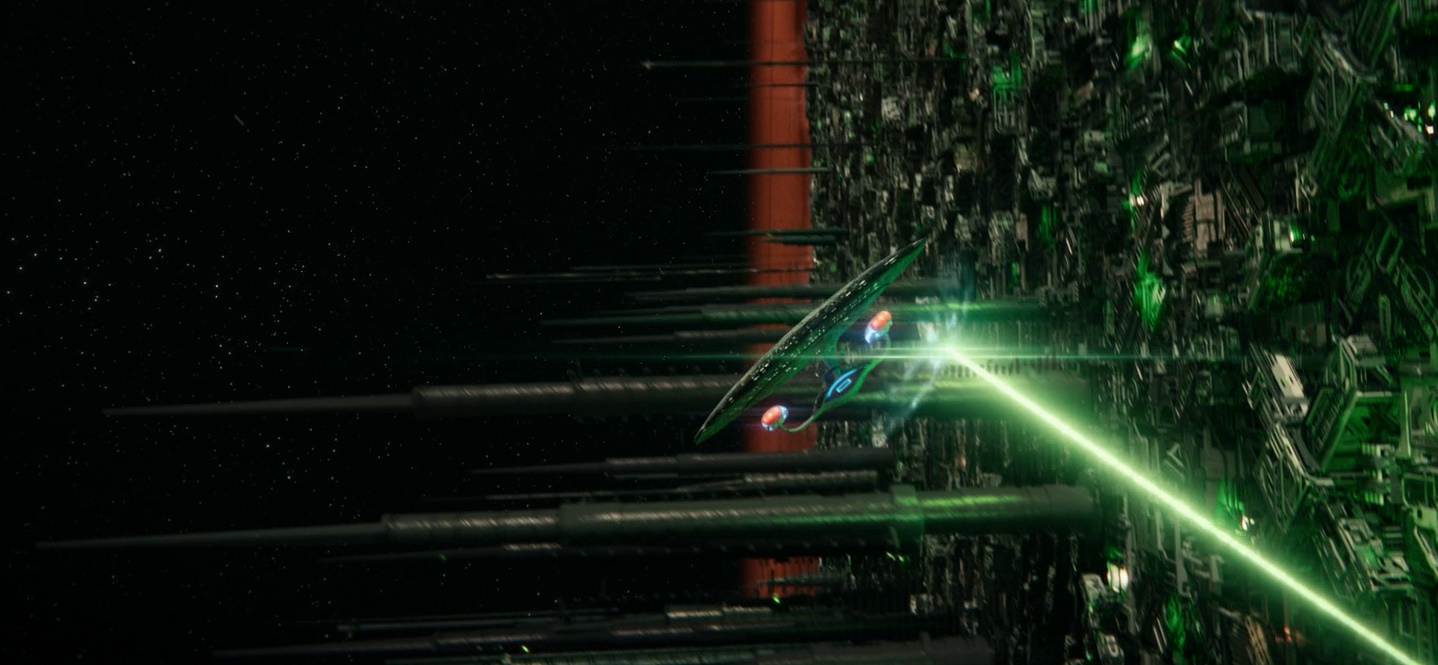
Spoiler Warning: There are spoilers ahead for Star Trek: Picard Seasons 1-2 and casting information for Season 3. Spoilers are also present for the following Star Trek productions: Discovery, Enterprise, Voyager, First Contact, and The Next Generation.
Mercy was an interesting episode, one that finally spent a bit more time advancing what I personally consider to be the more exciting part of the season’s story. Some of my big theories are rapidly running out of road, and this week three have been debunked outright. We got a couple of confirmations as well, so this week the theory list will shrink!
With only two episodes of the season remaining, there isn’t a lot of time for everything to be neatly wrapped up so that the story can move on in time for Season 3. I know I’m not the only one wondering about a possible cliffhanger ending!
So let’s take a look at the theories that were confirmed and debunked in Mercy, before moving on to the main theory list.
Debunked theory #1: Agent Wells is a Starfleet officer or temporal agent.
Picard being interrogated by Agent Wells.
I wondered if we might learn that Agent Wells, the FBI Agent who apprehended Guinan and Picard, wasn’t who he seemed to be. We’ve seen Starfleet operating as a kind of temporal police in previous iterations of the franchise, and there was also the faction from Enterprise that employed Crewman Daniels.
This theory was given additional energy by the fact that the actor portraying Agent Wells, Jay Karnes, had appeared in the Voyager Season 4 episode Relativity, where he played a 29th Century Starfleet officer.
However, it turned out that that was just a coincidence! Agent Wells was a 21st Century native, albeit one who’d had an encounter with Vulcans in his youth.
Debunked theory #2: Romulans are spying on Earth… and could be time-travelling Zhat Vash.
Young Agent Wells encounters the Vulcans.
When we caught a glimpse of young Agent Wells interacting with Vulcans in one of the pre-season trailers, I wondered if they might actually be Romulans, and possibly members of the secretive Zhat Vash organisation. If the Zhat Vash had a major role to play in the story – which it now seems like they don’t – perhaps that could’ve lined up.
However, with Season 2 seemingly leaving behind practically all of the main story threads from Season 1, that wasn’t the case.
Debunked theory #3: The mission back in time won’t last all season.
Los Angeles, 2024.
This one has been as much a wish as a theory, because time travel episodes that visit the modern-day have never been my favourites in Star Trek. I wondered whether we might see Picard and the crew find a way back to the 25th Century sooner, but with only two episodes remaining it’s now not plausible. Even if the next episode sees them make it home, they’ll still have spent the majority of Season 2 in 2024.
So those theories were debunked!
There’s one two-part theory that I’m choosing to retire at this stage, too. Although it hasn’t been firmly “debunked,” the events of Mercy now seem to have taken the story in a different direction.
Retired theory #1: The Confederation is run by augmented humans.
Dr Soong’s legacy.
The question of why the Confederation seemed to celebrate Dr Adam Soong centuries after his death was an open one… until Mercy. The Borg Queen told Dr Soong that his invention – seemingly a scaled-up version of the drones that protected Kore from sunlight – would save the Earth from ecological collapse in that timeline. That explains his legacy and why he’s so famous in the Confederation.
This seems to rule out another possibility for his fame: that he created human augments. There were two parts to this theory, really. The first came from Dr Soong himself; that his work was focused on genetics. The second came from his family legacy – Dr Arik Soong, presumably a descendant of his, had worked on creating human augments in the 22nd Century.
Although the Borg Queen is hardly what you’d call a “reliable source,” I don’t believe that there’s room now, at this late stage, for there to be the kind of augment connection that I’d been theorising about.
Retired theory #2: There will be a connection between the augments and Strange New Worlds.
La’an Noonien-Singh.
Inextricably tied to the theory above was a possible Strange New Worlds connection. In short, the character of La’an Noonien-Singh seems to be related to iconic villain – and famous augmented human – Khan Noonien Singh. If Picard Season 2 has no connection to genetic engineering and the creation of augments, though, this theory won’t pan out.
So those theories have been retired.
We have a couple of confirmations this week, so we’ll take a look at those next.
Confirmed theory #1: Vulcans are on Earth… as hinted at by Discovery Season 4.
A Vulcan expedition to Earth.
In the Discovery Season 4 episode The Galactic Barrier, a seemingly-innocuous line from the enigmatic Dr Kovich stood out to me. He noted that the Vulcans had been present on Earth for “decades” prior to official first contact taking place in 2063. That line kick-started this theory… though to be fair, the pre-season trailers had already revealed a character who could only really be a Vulcan or Romulan!
As noted above, we finally got to see this flashback sequence for ourselves. Young Agent Wells encountered a Vulcan expedition to Earth sometime in the 1960s or 1970s (based on Wells’ age in Mercy) and that’s that. Though Picard and Discovery really ought to do more to connect with one another, I do like that this line that we heard in an episode a couple of months ago seems to tie in to the events we saw unfold on screen this week.
Confirmed theory #2: Q is dying.
Q in Mercy.
After wondering for weeks what might be going on with Q, he seemed to finally confirm to Guinan that he’s approaching the end of his life. There’s still scope, in my view, for this to be expanded upon – or even changed entirely – but for now it’s safe to say that Q certainly believes that he’s dying.
The language used in Mercy to communicate this was excellent, and gave us an interesting glimpse into how members of Q’s species view time and the universe. Q spoke of a “temporal horizon,” and how it had grown dark and unknowable. Combined with his failing powers, the stage seems to be set for Q’s life coming to an end.
So those theories were confirmed!
Now we’re going to jump into the main theory list, beginning with those theories that are either new or that saw movement in Mercy.
Theory #1: The Borg’s request for help from the Federation is genuine.
Dr Jurati decoded the Borg message.
If Dr Jurati is going to be fully assimilated and potentially incorporated into a new incarnation of the Borg Queen, could her stewardship of the Borg Collective mean that their desire for help from Picard and the Federation – that we saw in The Star Gazer at the beginning of the season – is actually for real? It’s possible, of course, that the Borg’s message was a plain and simple trap, but there are elements from the Borg Queen’s appearance on the Stargazer’s bridge that we still can’t explain.
Setting aside her identity for a moment, regardless of whether there’s Dr Jurati or someone else underneath the mask, the Borg Queen’s actions were not what we’d expect. Why did she stun the Stargazer’s crew instead of killing them – and why did the episode draw attention to that fact and make sure it registered with us as the audience? What were her goals on “assimilating” the ship? She claimed she needed “power” – but to what end?
What did the Borg Queen want?
The Borg Queen also seemed to accept what was about to happen in her final moments, playing Non, je ne regrette rien and speaking with familiarity to Picard, telling him to “look up.” What was that all about?
In short, I’m positing that the Borg’s plea for help was genuine – but that raises a very interesting and alarming question in and of itself. What could be so deadly and so terrifying that it has the Borg Queen running in fear? And what does all of this have to do with Q and Picard?
Theory #2: Kore Soong will team up with Picard and the crew of La Sirena.
Kore Soong.
I haven’t been thrilled with the depiction of Kore Soong so far. Her story feels like a bland repeat of Soji and Dahj’s from Season 1, and she appears to exist in Season 2 more for the purpose of informing us about Dr Adam Soong than to do anything meaningful in her own right. I’m hopeful that that will change, however!
Mercy saw Kore Soong take the antidote or cure for her genetic condition, granting her freedom from her father. She left Dr Soong’s house and struck out on her own for what seems to be the first time – and I wonder if she’ll either seek out Picard or if they’ll run into one another. Kore may know something about Dr Soong that could be useful to the crew of La Sirena… so watch this space. Her story may not be done yet.
Theory #3: The Q Continuum has been attacked.
Captain Janeway, Tuvok, Quinn, and Q in the Q Continuum.
Following Guinan’s chat with Q in Mercy, this theory feels a little less plausible. However, as we still don’t know what’s going on with Q, I’m keeping it on the table for now. Last week I was increasingly sure that whatever had caused Q to lose his powers was something that wasn’t just affecting him personally, but the entire Q Continuum, and there’s definitely been evidence to that end across the season so far – and beyond.
In Mercy, Guinan reminded us that members of the Q Continuum can kill one another, and that seemed like a very deliberate line to include. Was it just there to avoid nitpicking Trekkies saying “but what about the Q civil war in Voyager?!” or is there a hint there about something else? I don’t believe that the El-Aurians would be to blame if the Q Continuum has been attacked, but with the Borg in the story, they could certainly be a suspect.
Guinan and Q.
In earlier episodes we had talk of a “cold war” between the Q and El-Aurians, a conflict that you’d imagine would be fantastically one-sided unless the El-Aurians know of some kind of weakness that the Q have. Then we had Guinan’s failed attempt to summon a Q – not the Q, but any Q. Q suggested that he basically had to walk from wherever he was to the FBI office because Guinan summoned him – but why didn’t another Q respond to the summons? Picard also suggested, after awakening from his coma, that Q may be weaker and more vulnerable than he had previously considered. And going back to Discovery Season 4, the episode The Examples told us that the Federation hadn’t seen any members of the Q Continuum in over 600 years as of the 32nd Century.
All of the pieces of evidence above could suggest that something is happening to the Q Continuum as a whole rather than just to Q himself. If the El-Aurians discovered a weakness, and then were assimilated by the Borg, perhaps the Borg came into possession of a way to harm the Q – attacking them and wiping them out.
In any case, if something that Picard did or didn’t do is connected to those events, that could explain why Q is so angry and why he felt the need to punish Picard. It could even explain Q’s desire to radically alter the timeline.
Theory #4: Q and Picard will have to work together to stop the rogue Borg Queen.
Yummy batteries.
Whatever Q’s plan was for changing the timeline in the 21st Century, unleashing a rogue Borg Queen upon humanity or setting one loose in the Alpha Quadrant was categorically not on the agenda! I think that’s a fairly safe assumption, and while Q has messed around with humanity and the Borg before – such as in the episode Q Who – it’s never been his goal to see humanity assimilated.
With his full powers at his disposal, presumably it would be relatively easy for Q to stop the Borg Queen who’s now in possession of Dr Jurati’s body, but without them, Q may need to work with Picard to ensure that the Borg Queen is stopped. Although the Borg Queen seems to weirdly have the same goal as Q – to stop the Europa Mission – their objectives beyond that don’t align in the slightest.
Could Q team up with Picard?
If the Borg Queen were to interfere in Q’s plans, or if Q were to learn of the threat to Picard, perhaps he will voluntarily involve himself, make a truce with Picard, and work with him to stop the Borg Queen. Alternatively, Picard could realise that his options are limited and try to reach out to Q to ask for help, setting aside his pride and his anger at his old adversary.
Q’s knowledge, even without his powers, could be invaluable to Picard and the crew of La Sirena. He clearly knows a lot more about the Borg than anyone else, and he may know how best to counteract the Borg Queen’s coming attack. If the Borg have attacked the Q Continuum, as theorised above, maybe Q will even have a personal reason to get involved.
Theory #5: The Borg Queen/Dr Jurati will steal La Sirena, stranding Picard in the past.
La Sirena’s crash site in France.
I was tempted to slap this one on my “confirmed” list, because I successfully predicted that stealing La Sirena would be the Borg Queen’s plan going all the way back to Watcher earlier in the season! However, she hasn’t actually enacted her plan yet, so let’s hang fire for now. At least I can say I got the idea right even if the Borg Queen’s plan is defeated!
However, the Borg Queen has a formidable army on her side thanks to Dr Soong’s (highly convenient) military connections. Despite being banned from the scientific establishment, Dr Soong apparently continues to have a lot of sway over the right people, and as a result he’s been able to hire a private military company – one that the Borg Queen promptly began to assimilate.
New Borg drones.
Whether she plans to head to the Delta Quadrant to link up with the Borg Collective in this era or whether she plans to head to the 25th Century, stealing La Sirena is the Queen’s best move. Picard and the crew will struggle to defend the ship, especially considering that the Borg Queen had a lot of time while alone to install rogue code in the computer that both Seven of Nine and Rios have struggled to purge. With only Rios, Teresa, and Ricardo there right now, the ship is also largely undefended.
Even if Picard and the others make it in time, they’ll still be outnumbered and outgunned. The Borg Queen and her forces could easily take possession of the ship and fly away, stranding Picard (and anyone else who survives the confrontation) in the 21st Century.
Theory #6: Picard and the crew of La Sirena will “borrow” Renée’s Europa Mission spacecraft to get back to the 25th Century.
Renée in training for the Europa Mission.
If La Sirena is stolen by the Borg Queen – or otherwise damaged and rendered unusable – Picard and the rest of the crew will need to find another way to get back to the 25th Century. Could they hitch a ride on Renée’s Europa Mission spacecraft?
Earlier in the season, Picard seemed to imply that no one really knows what happened to Renée and the Europa Mission ship after she discovered signs of life in the outer solar system, so does that mean it would be possible for her ship to simply disappear without corrupting the timeline? Perhaps the reason why history has no record of what happened to Renée after the Europa Mission isn’t because of World War III and the loss of that information, but because she and the ship simply disappeared while in space.
There’s nothing that we know of to suggest that the slingshot manoeuvre can’t be performed by a ship like Renée’s, and the fact that she’s an astronaut at all with her own spacecraft could open up a vital doorway for Picard and the crew if they suddenly find themselves in need of a new way home.
Theory #7: The masked, hooded figure from The Star Gazer is not the real Borg Queen.
The Borg Queen?
The Borg Queen – the hooded figure who materialised on the bridge of the Stargazer – was absolutely terrifying, evoking feelings for me that the Star Trek franchise hasn’t hit in decades. The way this character was presented, with her shrouded face, flowing robes, monochromatic aesthetic, and blend of humanoid and decidedly non-humanoid mechanical features was simultaneously riveting and frightening!
This character was presented as the Borg Queen in the episode, and the Borg have no reason that we know of to lie about that. But at the same time, she was very different not only from how we’ve seen the Borg Queen in past iterations of Star Trek, but also from the Borg Queen that Picard and the crew met in the Confederation timeline. Could this character actually be someone else – perhaps someone that the Borg have assimilated?
Since Two of One, the story seems to be setting up Dr Jurati for this role. The Borg Queen has almost completely taken over her body as of the end of Mercy… but some part of her still remains. Could there be another possible candidate?
“Borg Queen” Candidate #1: Dr Jurati.
Dr Jurati and the hallucinatory Borg Queen.
The Borg Queen has well and truly sunk her tentacles into Dr Jurati, taking over her body and creating new nanoprobes. If the Borg Queen’s plan to steal La Sirena succeeds, that could easily set the stage for the events of The Star Gazer to unfold. With no obvious way to un-assimilate her, Dr Jurati has to be the number one Borg Queen candidate right now.
“Borg Queen” Candidate #2: Renée Picard.
Renée at the gala.
Renée could be the Borg Queen if she’s assimilated. Perhaps she will be attacked and assimilated during the course of the Europa Mission, or maybe the Queen will try to get to her to gain possession over the Europa Mission’s spacecraft. If La Sirena is damaged and unusable, the Europa Mission vehicle could be the best option for the Queen to get into space in this time period. Renée being the masked, hooded Borg could explain why the Borg were asking for Picard by name, and why Non, je ne regrette rien played shortly before the Stargazer’s self-destruction.
“Borg Queen” Candidate #3: The time-travelling Admiral Janeway from Endgame.
Admiral Janeway and the Borg Queen.
Admiral Janeway was assimilated by the Borg Queen as part of her plan to introduce a neurolytic pathogen into the Collective, and appeared to have been killed when the Borg Queen’s complex exploded. But is there a way she could have survived?
Her assimilation could have been a turning point for the Borg. She did untold damage to the Collective, but also potentially gifted them knowledge and information about future events and technologies that were decades ahead of their time. Just like the Borg once chose Captain Picard to become Locutus – their “spokesperson” or representative – perhaps they might have chosen Admiral Janeway to fill a similar role during this latest incursion. Admiral Janeway could even have been incorporated as part of the Borg Queen.
“Borg Queen” Candidate #4: Soji.
Soji in The Star Gazer.
The Borg seek “perfection” through the synthesis of organic and synthetic parts; if Coppelius synths like Soji have something that the Borg want, perhaps we’ll learn that they assimilated her to get it. The anomaly from which the Borg vessel emerged was not a standard transwarp corridor, and was specifically noted to emit some kind of temporal radiation. Thus the Borg vessel could be from a future date after Soji has already been assimilated. We could even learn that the super-synths from the Season 1 finale are actually the Borg; that could be how they first became aware of Soji and the Coppelius synths.
Theory #8: Q is not responsible for changing the timeline.
Q’s powers no longer work…
With Q’s powers seemingly all but gone, the question of what happened to the timeline has to be considered. I’ve been running some form of this theory all season long, and with no explanation from Q as to why he wanted to change the timeline being forthcoming, it’s still on the table right now.
Yes, it’s possible that parts of Q’s conversation with Guinan in Mercy could count against this theory, particularly the parts where Q talked about the “escape” from the traps he set being what he’s interested in. But I really do believe that there’s more going on here than meets the eye. Add into the mix Q’s inability to use his powers, and I think the stage could be set for a big surprise before the season wraps up.
I have a longer article that goes into more detail about this theory that I wrote before the season premiere, and you can find it by clicking or tapping here.
Theory #9: Q shielded Picard and the crew of La Sirena from changes to the timeline.
A very young-looking Q!
Regardless of who changed the timeline and why, it seems clear that Q is responsible for ensuring that Picard and the crew of La Sirena were the only ones unaffected by the change. If his goal was to change the timeline to punish Picard that makes sense – but it also leaves open the possibility that Picard will be able to figure out what happened and prevent it. That could be Q’s goal.
I’m not quite ready to call this one “confirmed,” though. I think we need to spend more time with Q to understand what he’s done, what he hopes to achieve by it, and why.
Theory #10: Who is responsible for damaging the timeline, then?
Dr Adam Soong in Mercy.
For much of the season I’ve been proposing a few different candidates who could be responsible for changing the timeline. However, as we’re getting closer to the end of the story I’m actually going to strike most of them from that list.
The Zhat Vash and the Romulans both seemed plausible earlier in the season, partly because we still don’t know what happened after Season 1 to either the Zhat Vash or with relations between the Romulan government and the Federation, but also partly because there was still that unexplained Romulan or Vulcan figure from the trailers. With no Romulan involvement anywhere else in the season, and no mention of the Zhat Vash at all since Season 1, I’m striking those from the list. The Season 1 super-synths are also gone from the list because they likewise haven’t been mentioned all season long.
That only leaves us with the Borg, and with the Borg Queen manipulating Dr Soong into helping her, he could set in motion a chain of events that leads to the failure of the Europa Mission and the creation of the Confederation timeline. That is, unless someone can stop them in time…
Theory #11: Picard and the crew will have to actively trigger World War III to save the future.
World War III soldiers as glimpsed in Discovery Season 2.
This one is now on its last legs! Since well before Season 2 aired, I’d been proposing that one of the points of divergence in the timeline – and thus the event that Picard needs to preserve – could be World War III. In Star Trek’s timeline, World War III began in the late 2020s and ran through to the mid-2050s, with first contact with the Vulcans taking place a few years after it ended. It’s an incredibly important event in the history of humanity, and without it Star Trek’s entire future is in doubt.
It’s still possible that Dr Adam Soong’s story could connect with the outbreak of war, and Picard may have to commit to the war starting by ensuring that Dr Soong – or one of his inventions – is in the right place at the right time. However, with the story having focused on the Europa Mission, Renée Picard, and now this Borg Queen confrontation, there isn’t much time left for a World War III connection.
Theory #12: Picard and/or the Federation will use information from the Confederation timeline to defeat the Borg.
A battle over the planet Vulcan in the Confederation timeline.
If Picard and the crew manage to make a stand aboard La Sirena, information contained within the Confederation starship’s computers could help them defeat the Borg. Somehow the Confederation was able to beat the Borg in their timeline, and if Picard and the others could understand how that happened, perhaps they will be able to form an effective defence against the Borg Queen’s attack.
Alternatively, I originally pitched this theory as a way to explain how the Federation could potentially stop the Borg incursion that began during the events of the season premiere. If Picard and the crew manage to survive and make it back to the 25th Century, they may bring with them crucial tactical information from the Confederation timeline that will help the Federation stop the Borg.
The very first Borg drone seen in Star Trek.
This would be a great way to include what has been one of the season’s most interesting and least-explained narrative elements: how the Confederation, which supposedly had technology comparable to the 25th Century Federation, was able to do something as massive as defeating the entire Borg Collective.
There are a couple of ways that Picard and the crew could potentially use information about the Borg that may be stored in La Sirena’s computer banks, so let’s wait and see if anything comes of it!
Theory #13: Dr Adam Soong will create the Borg.
Dr Adam Soong.
Although Dr Soong’s research seems to be mainly on the genetic side of things, such as the creation of Kore and possible human cloning, his alliance with the Borg Queen could lead to him becoming instrumental in creating the Borg Collective. The Borg already exist as of the 21st Century, but as we seem to be seeing the Borg Queen creating a new Collective on Earth, there are open-ended possibilities for how this story could go.
With time travel on the agenda, it’s possible to imagine a situation in which Dr Soong and the Borg Queen are thrown backwards in time, perhaps emerging millennia in the past. Dr Soong could thus become one of the progenitors of the Borg Collective.
Theory #14: The Federation is responsible for creating the Borg.
A rather incredulous-looking Borg seen in The Next Generation.
This is a total wildcard, but I’m just throwing it out there!
The Borg Queen – and the Borg in general – appear to have a fascination with humanity and with Picard. Could it be that the explanation for that is that the Federation and/or humanity are somehow responsible for their creation? As mentioned above, with time travel on the cards, anything seems possible.
Nanites used by the Control AI.
As above, this could be the end result of the alliance between Dr Soong and the Borg Queen. The Borg could therefore be a human creation, the offspring of one of Data’s ancestors. Could that link be the key to defeating them? Maybe that preserved knowledge and the veneration of Dr Soong is how the Confederation was able to defeat the Borg in their timeline!
Discovery Season 2 ran a story with the Control AI that could have also been a Borg origin story. Was it known as early as 2018-19 that Picard wanted to tell a story like this, and if so, could that explain why the Control storyline ended the way it did? I have a write-up of Discovery’s abandoned Borg origin story that you can find by clicking or tapping here.
Theory #15: The season will end on a cliffhanger.
The announcement a few weeks ago that the cast of The Next Generation will be back in Season 3 seems to suggest that a new story will unfold next time. But there’s still the possibility of a connection between Seasons 2 and 3, or that the final act of Season 2 will set up the story of Season 3.
I originally proposed this theory because Seasons 2 and 3 went into production back-to-back, but now there’s an additional reason to consider this possibility. In short, many of the narrative threads introduced in Season 2 feel a long way from being concluded, and with just two episodes left there may not be time to wrap up everything. A cliffhanger ending may be on the cards after all!
So those theories are new or saw movement this week.
Now, as always, I’ll run through the other theories that are still potentially in play. I find that it helps to keep the entire theory list intact and in one place!
Theory #16: Rios will bring Teresa and Ricardo to the 25th Century.
Teresa and Rios at the clinic.
Rios has clearly abandoned the idea of making as little impact on the timeline as possible! Just like Kirk did for Dr Gillian Taylor in The Voyage Home, perhaps Rios will seek to bring Teresa and Ricardo forwards in time. Teresa may have her clinic to attend to – although its status is in doubt after it was raided by ICE earlier in the season – but she may want to leave the world of the 21st Century behind to head into a more optimistic future.
If Teresa and Rios continue to pursue a romantic relationship, and Rios begins to offer himself as a father figure to Ricardo, maybe the stage will be set for Teresa heading to the 25th Century. It wouldn’t be the weirdest or wildest possibility, especially not now that Teresa and Ricardo are both aware of Rios’ true identity and the existence of La Sirena.
Theory #17: Teresa and Ricardo are Rios’ ancestors.
Teresa with Rios in Mercy.
This could be a heartbreaking end to Rios and Teresa’s burgeoning romance! In true Back to the Future style, perhaps Rios will learn that Teresa and Ricardo are his distant ancestors, bringing their relationship to a screeching half and preventing either of them from taking things further.
We’ve seen Star Trek deal with time travel on many occasions, including fixed moments in time and people too important to be changed or killed. And in a story in which Picard has already met a distant ancestor of his own – Renée – there could be a kind of poetic symmetry if Rios were to discover a connection to Teresa and Ricardo. If this pans out, I hope Rios and Teresa discover the truth before they… y’know!
Theory #18: Rios will be killed and Picard will assume command of the new USS Stargazer.
Rios in the captain’s chair of the USS Stargazer.
One thing I can’t figure out at the moment is what sort of role the new cast will have in Season 3. If you somehow missed the cack-handed announcement, it’s been revealed that the main cast of The Next Generation (sans Wil Wheaton and Denise Crosby) will be reuniting in Season 3, and that they will have major roles to play. If that’s the case it seems all but certain that the main cast of Picard will be sidelined. We’ve already seen that happen this season with Elnor killed and Soji missing in action, so that really only leaves Dr Jurati, Raffi, and Rios.
If the teases and hints about Season 3 that we’ve heard so far prove to be true, it seems as though Picard and the crew will need a ship… so could that ship be the new USS Stargazer?
New sets were built from scratch for the Stargazer, including a conference room, bridge, turbolift, and corridors, yet so far those sets were only used in a single episode. Even if Season 2 sees the crew make it back to the 25th Century in the next episode, that’s still a massive investment for relatively little screen time! So my theory is that the new sets will be used more extensively in Season 3 when Picard assumes command of the USS Stargazer. Why would there be a vacancy in the captain’s chair? Because Captain Rios is going to be one of the characters shuffled out of the way to make room for the returning crew of The Next Generation.
Theory #19: The Borg ship from The Star Gazer crossed over from the Confederation timeline.
The Borg vessel identified as “Legion.”
As far as we know at this stage, the Confederation timeline replaced the prime timeline thanks to the past being changed. But timelines and parallel universes often go hand-in-hand in Star Trek, and after we learned about the Borg’s defeat in the Confederation timeline, I wonder if their ship from the season premiere might have found a way to punch through or cross over into the prime timeline.
If the Borg were facing defeat, as their message seemed to suggest, perhaps that could explain why. Also, the anomaly that the ship emerged from was not a typical transwarp conduit; we’d seen transwarp corridors as recently as Season 1. Finally, the Borg Queen of the Confederation timeline was aware of Picard and the history of the prime timeline – perhaps the Confederation timeline Borg knew of the prime timeline and this was a last-ditch effort to survive.
Theory #20: The Borg are fighting a war – and they’re losing.
The Borg vessel using its transporter-weapon on the USS Stargazer.
Possibly connected to the theory above, one explanation for the Borg’s message and appearance in The Star Gazer is that in the prime timeline the Collective has found itself on the losing side of a war. Penance told us that the Confederation had been able to defeat the Borg using technology that Dr Jurati believed was roughly equivalent to the Federation’s in the prime timeline – so clearly it’s possible to fight and beat the Borg.
Could mentions of Gul Dukat or Martok in Penance be hints at something to come later in the story? Both characters were major players during Deep Space Nine’s Dominion War arc; maybe the Cardassians and/or the Dominion have been aggressively attacking the Borg in the late 24th Century. The other big culprit is the Confederation – assuming that it’s possible for the two timelines to mix!
Theory #21: The Borg are aware that Picard is now a synth – and his synthetic status is part of the reason why they waited until now to make contact.
Picard awakened in a new synthetic body in Et in Arcadia Ego, Part 2.
As mentioned above with Soji, the timing of the new Borg incursion is interesting, especially considering that they asked for Picard by name. Are they aware of his newfound synthetic status? And if so, could Picard’s transition to a new synthetic body be the reason why the Borg chose to launch their attack?
The Borg seek “perfection” through a synthesis of organic and synthetic components, and while Picard’s new synthetic body is a far cry from the Borg drones we’ve seen, the idea of an organic mind in a synthetic body isn’t a million miles away from that same basic idea. Although Picard’s body was said to be comparable in practically every way to his original one, synthetics can have enhanced abilities that allow them to easily overpower humans – and, as we’ve seen with Data on more than one occasion, they can outmatch individual Borg drones as well.
A Borg drone losing a fight against Data.
Perhaps the Borg want to re-assimilate Picard now that he’s synthetic. If the Collective is still reeling from the damage inflicted upon it by Admiral Janeway or if they’re on the losing side of a war, perhaps they hope to use fully-synthetic bodies like Picard’s to replace damaged or destroyed drones, or as cannon fodder on the front lines. There are many reasons why the Borg might be interested in synthetic technology, and that could explain their re-emergence.
Even if the Borg don’t plan to assimilate Picard or the Coppelius synths, the timing of their appearance is certainly interesting and there could be a connection.
Theory #22: Q is angry with Picard for “giving up.”
Grumpy Q.
Over the course of The Next Generation, Q took a particular interest in Picard. More so than anyone else, Q seemed to see potential in Picard as a representative of the human race, someone who potentially showed him what humanity could be… with a little prompting and guidance. Q seemed fascinated by that idea, so seeing Picard’s fall from grace may have shocked him and left him feeling disappointed and bitter.
Picard spent more than a decade away from galactic affairs, retiring to his vineyard and seemingly just waiting around to die. Someone like Q might take that personally; he might feel that Picard was not living up to the potential he had. Perhaps Picard’s absence had some kind of unknown consequence, something that harmed Q or the Q Continuum. In any case, Q’s animosity to Picard seems to be personal – could disappointment at Picard’s attitude in the years prior to Season 1 be the cause?
Theory #23: The USS Stargazer will make an appearance.
The original USS Stargazer.
Okay, technically the USS Stargazer has already appeared, but not in the way I expected! Captain Rios is (or was) in command of a new USS Stargazer, and not only that but he had a model of the original vessel in his conference room! So that’s it. Theory confirmed, everybody can move on to the next one!
Just kidding. The inclusion of a brand-new USS Stargazer brings the ship and its legacy back to the fore. Picard himself commented in The Star Gazer that the original vessel was his first command, and as far back as Season 1 we had a reference to his time in command through the character of Dr Benayoun. All of these things could be leading to some bigger role for the original USS Stargazer – and with a story that seems to include time travel and a strong focus on Picard’s own personal history, a flashback or even a visit to the ship could be on the agenda!
Theory #24: The Borg Collective was badly damaged in the Voyager episode Endgame and has been unable to recover.
The USS Stargazer’s communications officer first encountered the Borg’s message.
In The Star Gazer, it seemed as if the Borg Collective was reaching out, asking the Federation – and Picard specifically – for help. If so, the question is why? Was it just a shallow ploy to launch another attack on Starfleet? Or is there at least a degree of truth to the Borg’s request?
Endgame, the final episode of Voyager, depicted a time-travelling Admiral Janeway introducing a neurolytic pathogen – a type of virus – into the Borg Queen, seriously damaging her, her base of operations, and several Borg vessels in the vicinity. Because the Borg hadn’t been seen since – until The Star Gazer, that is – we never got to learn just how deadly Admiral Janeway’s actions were.
Admiral Janeway in Endgame.
I’ve always assumed that the Borg Collective is vast enough, powerful enough, clever enough, and most importantly adaptable enough that Admiral Janeway’s actions weren’t going to strike a fatal blow. Whatever damage she had done seemed like something the Borg could eventually fix – and their existence 25 years later during the events of The Star Gazer seems to prove that. The Borg’s technology and weapons are still streets ahead of anything Starfleet has at its disposal… but even so, it’s still possible that the Borg are on their last legs facing defeat.
If that’s the case, maybe we’ll discover that it was Admiral Janeway who’s responsible – that her actions in Endgame are either wholly or partly to blame for the Borg’s weakened state. Dr Jurati seemed to know that the Borg Collective isn’t as strong as it once was, so that could be another clue pointing to this theory.
Theory #25: Elnor will be restored to life when the crew returns to the 25th Century.
Raffi and Elnor aboard La Sirena in a flashback.
The decision to kill off Elnor so early in the season certainly succeeded as a shocking story point… but I’m not so sure he’ll stay dead. Is Raffi’s belief that restoring the timeline will save his life something that the series has carefully set up so it can be paid off later? Or was it simply part of her reaction to his death; the bargaining stage of the grieving process? I’m not sure!
Elnor is a character who had potential – the first Romulan to be a main character on a Star Trek series (or the second, after Narek) and the first Romulan to enlist in Starfleet. If the Star Trek franchise were to stick around, I could happily follow his adventures as a Starfleet officer over the course of several years, giving him an arc somewhat comparable to someone like Tilly in Discovery, growing into his new role.
But Elnor is also a character who was underused in Season 1, and the decision to make him a Starfleet cadet at the beginning of Season 2 was only the beginning of a new arc for him. His death didn’t hit as hard as it could’ve because we don’t know Elnor very well – and I wonder if that could be a reason to bring him back later in the season.
Theory #26: Seven of Nine will choose to remain in 2024.
Seven of Nine in Los Angeles.
For the first time in her life, Seven of Nine is feeling a sense of freedom. Not only is she free from her Borg implants, changing the way she looks, but she’s also unencumbered by her Borg past. No one she meets in 2024 will be aware of the Borg, and she’s clearly enjoying the way that makes her feel.
In The Star Gazer, Seven spoke to Picard about feeling judged by the ship’s crew – and in a broader sense, by practically everyone in the 25th Century. Her Borg past is a hurdle for her; she feels the weight of unspoken criticisms and judgements made against her. Her Borg implants are the biggest physical manifestation of this, but the fact that most people she meets in the 25th Century know who she is and where she came from is a burden – one she no longer feels in 2024.
With that in mind, could Seven choose to remain behind when Picard and the crew of La Sirena are ready to leave? Even if she’s ultimately talked out of it (or even forced out of it), I wonder if she’ll try to stay in the past.
Theory #27: At least one character from The Next Generation will make an appearance.
The main cast of The Next Generation Season 2.
As above, this theory has been knocked by the Season 3 announcement. It seems less likely now that we’ll see major roles for any of the characters announced for Season 3. However, the final act of Season 2 could bring back some or all of these characters if it’s going to set up the next phase of the story, and cameos and smaller appearances still feel possible.
Theory #28: The loose ends from Season 1 will be tied up.
The Zhat Vash on Aia.
The Star Gazer already crossed off two things from the list of Season 1 leftovers! Dr Jurati’s legal status was clarified, as was her relationship with Captain Rios. There are still a number of points that I’d like to see addressed before the season ends, though, as Season 1 unfortunately left quite a lot of story on the table thanks to a rushed and underwhelming finale.
Here are the main ones:
What will become of the synths on Coppelius, and will they have to be relocated for safety?
Did Starfleet attempt to visit Aia and shut down the beacon at the centre of the Zhat Vash’s prophecy? Leaving it out in the open seems dangerous.
Will Starfleet contact the super-synths and attempt to make peace or convince them that they pose no threat?
The super-synths in the Season 1 finale.
Why did Bruce Maddox go to Freecloud?
With the Zhat Vash plot exposed, what will become of their crusade against synthetic life?
Did Federation-Romulan relations suffer as a result of the Zhat Vash’s attack on Mars and attempted attack on Coppelius?
What happened to Narek after he was captured by the Coppelius synths?
Who controls the Artifact and what will happen to the surviving ex-Borg?
So that’s it!
La Sirena’s transporter in action!
As we head into the final two episodes of the season we’ve cleared a few theories off the list – one way or another – but there are still a lot that remain in play! After two or three episodes in which Picard Season 2 got bogged down in an unexciting time travel story, Mercy seems to have begun to refocus the story on a much more interesting and exciting conflict. I have high hopes for next week’s outing, which may be titled Hide and Seek.
I always like to end these theory lists by saying that I do this just for fun. I enjoy writing, I enjoy Star Trek, and spending more time in this world is an escape and an enjoyable distraction. But for some folks, fan theories can be frustrating or unenjoyable, especially if they get very attached to a plausible-sounding theory that ultimately doesn’t pan out. I have no “insider information” and I’m not trying to claim that anything suggested above can, will, or must be part of Picard Season 2. I fully expect many of these theories to be debunked and for the season to go in wildly unpredictable directions!
Star Trek: Picard Season 2 is available to stream now on Paramount+ in the United States, Scandinavia, Latin America, and Australia, and on Amazon Prime Video in the United Kingdom and the rest of the world. The Star Trek franchise – including Picard and all other properties mentioned above – is the copyright of Paramount Global. This article contains the thoughts and opinions of one person only and is not intended to cause any offence.
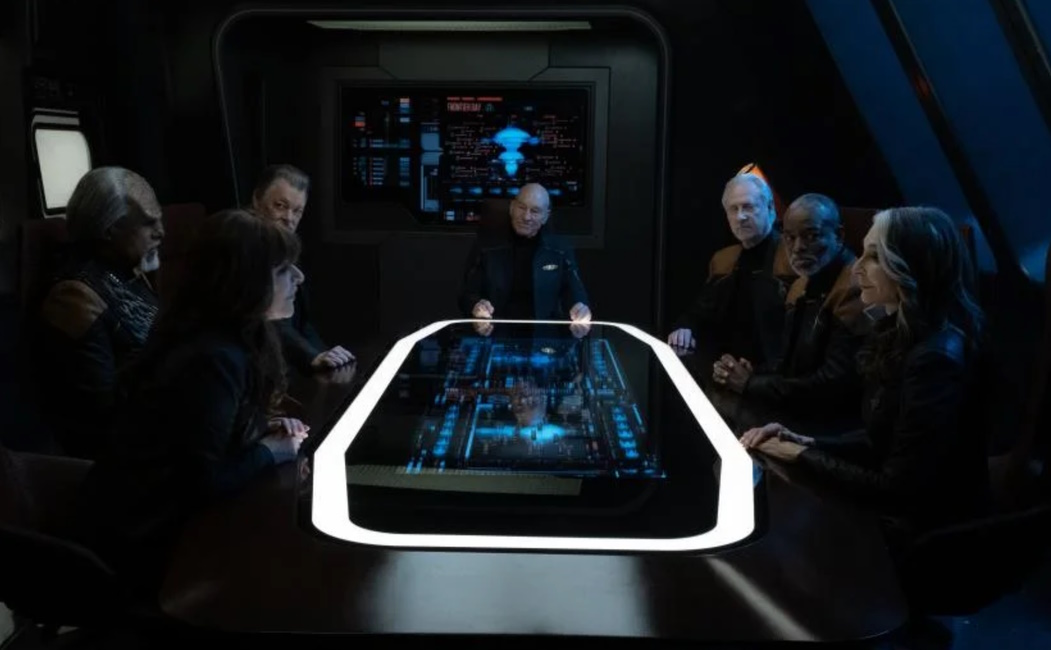
Spoiler Warning: There are spoilers ahead for Star Trek: Picard Seasons 1-2 and casting information for Season 3. Spoilers are also present for the following Star Trek productions: Discovery, Voyager, First Contact, and The Next Generation.
Monsters was not my favourite episode of Star Trek: Picard. It wasn’t irredeemably awful, but it didn’t seem to bring a lot to the table in terms of advancing the main (and most interesting) narrative threads of the season, and its attempt at depicting Yvette Picard’s unnamed mental health condition was poor. Despite that, though, we have a few changes on the theory list this week!
In addition to one confirmed theory and one debunking, we have several theories that saw significant movement – either because of events that unfolded on screen or, in a couple of cases, because of things that we didn’t see!
As always, we’ll start off with the theories that are making their exit from the list this week.
Debunked theory: My various Watcher candidates.
Picard and Tallinn.
I had speculated about the Watcher’s identity before Picard met her at the end of the episode Watcher. After Picard met Tallinn and it was revealed that she worked for the same mysterious faction as Gary Seven had in The Original Series episode Assignment: Earth, several of those possibilities seemed to remain in play.
However, Monsters revealed to us that Tallinn is a Romulan, and unless we get any further information about the organisation she works for, I think that’s as far as her identity goes. She may be an ancestor of Laris, but she isn’t Laris herself – and she clearly isn’t a Q, a Prophet, or anything like that!
Confirmed theory: Teresa learned the truth about Rios.
Teresa after arriving aboard La Sirena.
We can debate Rios’ decision to tell Teresa (and her son Ricardo) the truth about who he is and where/when he’s from. But I successfully predicted that Teresa would find out the truth one way or another – and this week she did!
I enjoyed Rios’ “I just work in outer space” line in Monsters; a riff on the lines spoken by Dr Gillian Taylor and Captain Kirk in Star Trek IV: The Voyage Home. That film ended with Kirk bringing Dr Taylor with him to the 23rd Century… so is it possible that there’s more to come from Rios and Teresa? Read on to find out!
So those theories were debunked and confirmed.
Now let’s jump into the main theory list, beginning with those theories that are either new or that saw movement in Monsters this week.
Theory #1: The Q Continuum has been attacked.
Guinan and Picard attempted to summon a Q.
There are several pieces of evidence that Monsters gave us that can arguably be used in support of this theory. Firstly, Guinan mentioned a “cold war” between her people – the El-Aurians – and the Q Continuum. Given that the El-Aurians appear to be a humanoid race who were conquered by the Borg, the fact that they were able to pose any kind of threat whatsoever to the Q could suggest that the Continuum is not entirely impenetrable.
Secondly, the fact that Guinan’s attempt to summon a Q failed. One interpretation of what Guinan said about the magic bottle/ritual could be that it would’ve summoned Q himself – but a more likely use for that item, at least in my view, is that it would make the entire Q Continuum aware that an El-Aurian wants to speak to them, and they would send a representative. Rather than just Q himself being affected, the fact that no one from the Continuum was able to be summoned could mean that they’re all losing their powers – or that many of them are already dead.
The Q Continuum as it appeared in Star Trek: Voyager.
We also have the conversation between Picard and Tallinn after the former awoke from his coma. Picard suggested that Q had put him in a coma deliberately, hoping to use the traumatic memories he re-lived as some aspect of the “trial.” But Picard turned that concept on its head and suggested that maybe there’s something in his past or his mind that could indicate a weakness or vulnerability in Q – something that Picard had never considered before.
There’s also a line from Discovery’s fourth season that could be relevant: Admiral Vance noted that the Federation hadn’t encountered the Q Continuum in 600 years as of the 32nd Century… could that be because the Q have either gone extinct or recused themselves from galactic affairs as a result of the events currently unfolding in Picard Season 2?
Although from our perspective Q and the Q Continuum appear godlike, it no longer seems impossible that someone – perhaps the Borg – could’ve discovered an exploitable weakness. If so, maybe the entire Q Continuum has come under attack, and if something Picard did or didn’t do is connected to those events, that could explain why Q is so angry and why he felt the need to punish Picard. It could even explain Q’s desire to radically alter the timeline.
Theory #2: The FBI Agent who apprehended Guinan and Picard is a temporal agent or Starfleet officer.
Agent Wells, FBI.
Monsters continued a season-long trend of individual cliffhanger endings when Picard and Guinan were arrested by the FBI. Agent Wells, the man who led the operation to bring them in, had uncovered evidence of Picard using a transporter to beam into Los Angeles, and understandably wants to figure out who Picard is and what’s going on!
But the actor who plays Agent Wells – Jay Karnes – is not a newcomer to Star Trek. In the Voyager episode Relativity, he played Lieutenant Ducane, a 29th Century Starfleet officer aboard the Federation timeship Relativity. Is it possible that Agent Wells and Lieutenant Ducane are the same person, and that Ducane is on a mission of his own to the 21st Century?
If so, perhaps this could line up with Discovery’s temporal war arc, or even connect to Enterprise’s temporal cold war. We’ve seen Starfleet acting as a kind of temporal police before, as well as the organisation that employed Daniels also attempting to police the timeline. Perhaps one of these organisations is aware of Picard’s temporal transgression and they dispatched Agent Wells to figure out what’s happening.
Theory #3: Rios will bring Teresa and Ricardo to the 25th Century.
Teresa and Rios at the clinic.
Rios has clearly abandoned the idea of making as little impact on the timeline as possible! Just like Kirk did for Dr Gillian Taylor in The Voyage Home, perhaps Rios will seek to bring Teresa and Ricardo forwards in time. Teresa may have her clinic to attend to – although its status is in doubt after it was raided by ICE earlier in the season – but she may want to leave the world of the 21st Century behind to head into a more optimistic future.
If Teresa and Rios continue to pursue a romantic relationship, and Rios begins to offer himself as a father figure to Ricardo, maybe the stage will be set for Teresa heading to the 25th Century. It wouldn’t be the weirdest or wildest possibility, especially not now that Teresa and Ricardo are both aware of Rios’ true identity and the existence of La Sirena.
Theory #4: Teresa and Ricardo are Rios’ ancestors.
Teresa with Rios in Monsters.
This could be a heartbreaking end to Rios and Teresa’s burgeoning romance! In true Back to the Future style, perhaps Rios will learn that Teresa and Ricardo are his distant ancestors, bringing their relationship to a screeching half and preventing either of them from taking things further.
We’ve seen Star Trek deal with time travel on many occasions, including fixed moments in time and people too important to be changed or killed. And in a story in which Picard has already met a distant ancestor of his own – Renée – there could be a kind of poetic symmetry if Rios were to discover a connection to Teresa and Ricardo. If this pans out, I hope Rios and Teresa discover the truth before they… y’know!
Theory #5: Rios will be killed and Picard will assume command of the new USS Stargazer.
Rios in the captain’s chair of the USS Stargazer.
One thing I can’t figure out at the moment is what sort of role the new cast will have in Season 3. If you somehow missed the cack-handed announcement, it’s been revealed that the main cast of The Next Generation (sans Wil Wheaton and Denise Crosby) will be reuniting in Season 3, and that they will have major roles to play. If that’s the case it seems all but certain that the main cast of Picard will be sidelined. We’ve already seen that happen this season with Elnor killed and Soji missing in action, so that really only leaves Dr Jurati, Raffi, and Rios.
If the teases and hints about Season 3 that we’ve heard so far prove to be true, it seems as though Picard and the crew will need a ship… so could that ship be the new USS Stargazer?
New sets were built from scratch for the Stargazer, including a conference room, bridge, turbolift, and corridors, yet so far those sets were only used in a single episode. Even if Season 2 sees the crew make it back to the 25th Century relatively soon, that’s still a massive investment for relatively little screen time! So my theory is that the new sets will be used more extensively in Season 3 when Picard assumes command of the USS Stargazer. Why would there be a vacancy in the captain’s chair? Because Captain Rios is going to be one of the characters shuffled out of the way to make room for the returning crew of The Next Generation.
Theory #6: Q is dying.
Q’s powers seem to be failing.
This theory could tie in with the one above about the entire Q Continuum having been attacked – or it could be something that only affects Q himself. Regardless, one possible interpretation for Q’s apparent loss of powers and his comment to Dr Soong about running out of time could be that he’s dying.
Picard had noted as far back as Penance that there’s something different or off about Q, and the generally darker, angrier, and more aggressive presentation of the character could all be indicators that Q is reaching the end of his life.
Q while posing as Renée’s therapist.
This could explain the apparent loss of Q’s powers – or the decreasing control he has over them. If he wanted to prevent Renée Picard’s mission, for example, Q should simply be able to snap his fingers and turn her spaceship into a block of cheese, or make it so that Renée was never born, or change her desire to become an astronaut into a lifelong passion to become a pro YouTuber. Instead, he’s resorted to trying to talk her out of it and trading favours with Dr Soong. Why? Could it be that Q’s declining power is indicative of his declining health?
If one of the defining characteristics of the Q as a race is immortality, what might have caused Q to be approaching death? Is it a punishment inflicted on him by his own people, or the result of some other outside force? Is it natural or artificial in nature? And what does it have to do with Picard?
Theory #7: Q and Picard will have to work together to stop the rogue Borg Queen.
The Borg Queen is in control of Dr Jurati’s body.
I said in my review of Monsters that I felt the episode kind of had the wrong focus. The fact that the Borg Queen is slowly assimilating Dr Jurati’s body, and is now on the loose in 21st Century Los Angeles, feels like a much more exciting story – and one that’s incredibly urgent for Picard and the rest of the crew to deal with!
The Borg Queen could begin assimilating humans in this time period, and that would wreak havoc with the timeline. Whatever Q’s objective was by preventing Renée’s mission and establishing the Confederation timeline, the total assimilation of humanity in the 2020s wasn’t part of his plan – and that could lead to a big twist in the season’s storyline with three episodes remaining.
Q and Picard together in Penance.
Instead of Q being the “big bad” of the season for Picard and the crew to defeat, a weakened, less powerful Q might have to team up with Picard to stop the Borg Queen. This could happen either because the Borg Queen interfered with part of Q’s plan, or Picard could be the one to reach out and ask Q for help.
Without his powers, or with his powers in a weakened and/or unreliable state, Q wouldn’t just be able to snap his fingers and unassimilate Dr Jurati! But his knowledge of the Borg and how they operate could be invaluable to Picard and the crew of La Sirena if the mission parameters change!
Theory #8: The masked, hooded figure from The Star Gazer is not the real Borg Queen.
The Borg Queen?
The Borg Queen – the hooded figure who materialised on the bridge of the Stargazer – was absolutely terrifying, evoking feelings for me that the Star Trek franchise hasn’t hit in decades. The way this character was presented, with her shrouded face, flowing robes, monochromatic aesthetic, and blend of humanoid and decidedly non-humanoid mechanical features was simultaneously riveting and frightening!
This character was presented as the Borg Queen in the episode, and the Borg have no reason that we know of to lie about that. But at the same time, she was very different not only from how we’ve seen the Borg Queen in past iterations of Star Trek, but also from the Borg Queen that Picard and the crew met in the Confederation timeline. Could this character actually be someone else – perhaps someone that the Borg have assimilated?
The events of Two of One and Monsters in particular could be argued to be setting up Dr Jurati for this role – but there are other candidates that we could consider.
“Borg Queen” Candidate #1: Dr Jurati.
Dr Jurati and the hallucinatory Borg Queen.
Dr Jurati’s assimilation has progressed over the past few episodes, and the Borg Queen has really sunk her claws (and tentacles) into her. This new “endorphin rush” angle is an interesting one, and Seven of Nine believes that it could be key to the creation of a new Borg Queen. Putting two and two together would seem to make Dr Jurati the obvious Borg Queen candidate.
“Borg Queen” Candidate #2: Renée Picard.
Renée at the gala.
Renée could be the Borg Queen if she’s assimilated. Perhaps she will be attacked and assimilated during the course of the Europa Mission, or maybe the Queen will try to get to her to gain possession over the Europa Mission’s spacecraft. If La Sirena is damaged and unusable, the Europa Mission vehicle could be the best option for the Queen to get into space in this time period. Renée being the masked, hooded Borg could explain why the Borg were asking for Picard by name, and why Non, je ne regrette rien played shortly before the Stargazer’s self-destruction.
“Borg Queen” Candidate #3: The time-travelling Admiral Janeway from Endgame.
Admiral Janeway and the Borg Queen.
Admiral Janeway was assimilated by the Borg Queen as part of her plan to introduce a neurolytic pathogen into the Collective, and appeared to have been killed when the Borg Queen’s complex exploded. But is there a way she could have survived?
Her assimilation could have been a turning point for the Borg. She did untold damage to the Collective, but also potentially gifted them knowledge and information about future events and technologies that were decades ahead of their time. Just like the Borg once chose Captain Picard to become Locutus – their “spokesperson” or representative – perhaps they might have chosen Admiral Janeway to fill a similar role during this latest incursion. Admiral Janeway could even have been incorporated as part of the Borg Queen.
“Borg Queen” Candidate #4: Soji.
Soji in Season 1.
The Borg seek “perfection” through the synthesis of organic and synthetic parts; if Coppelius synths like Soji have something that the Borg want, perhaps we’ll learn that they assimilated her to get it. The anomaly from which the Borg vessel emerged was not a standard transwarp corridor, and was specifically noted to emit some kind of temporal radiation. Thus the Borg vessel could be from a future date after Soji has already been assimilated. We could even learn that the super-synths from the Season 1 finale are actually the Borg; that could be how they first became aware of Soji and the Coppelius synths.
Theory #9: The Borg Queen/Dr Jurati will steal La Sirena, stranding Picard in the past.
La Sirena on approach to the sun in Assimilation.
The Borg Queen’s next move isn’t clear, although the events of Monsters seem to suggest that she needs to continue to trigger endorphins in Dr Jurati’s body in order to speed up or complete the assimilation process. She may not be fully ready for an armed confrontation with Picard and the crew just yet, so she may need to bide her time and prepare.
But once she is prepared, what next? She certainly could stick around in the 21st Century, assimilating modern-day humans and establishing a new Borg outpost. But she has no way to contact or connect with the Borg Collective in this time period, as they’re thousands of light-years away in the Delta Quadrant. If restoring the Collective is part of the Queen’s plan, then surely she’ll want to get back in touch with the rest of the Borg as soon as possible.
The Borg Queen as she appeared in Assimilation.
One way she could do this would be to steal La Sirena. Borg code has already been planted in the ship’s computer, and it’s possible that the Queen managed to hide even more malicious code that Seven of Nine hasn’t been able to find and purge. Part of the reason for doing that could be in preparation for commandeering the ship!
Whether the Queen plans to head off-world to the Delta Quadrant to link up with the 21st Century Borg Collective or whether she plans to return to the 25th Century, armed with new knowledge about humanity, stealing La Sirena is her best bet – and with most of the crew no longer aboard, it could be relatively easy for her to do so.
Theory #10: Picard and the crew of La Sirena will “borrow” Renée’s Europa Mission spacecraft to get back to the 25th Century.
Renée in training aboard a Europa Mission simulator.
If La Sirena is stolen by the Borg Queen – or otherwise damaged and rendered unusable – Picard and the rest of the crew will need to find another way to get back to the 25th Century. Could they hitch a ride on Renée’s Europa Mission spacecraft?
Earlier in the season, Picard seemed to imply that no one really knows what happened to Renée and the Europa Mission ship after she discovered signs of life in the outer solar system, so does that mean it would be possible for her ship to simply disappear without corrupting the timeline? Perhaps the reason why history has no record of what happened to Renée after the Europa Mission isn’t because of World War III and the loss of that information, but because she and the ship simply disappeared while in space.
There’s nothing that we know of to suggest that the slingshot manoeuvre can’t be performed by a ship like Renée’s, and the fact that she’s an astronaut at all with her own spacecraft could open up a vital doorway for Picard and the crew if they suddenly find themselves in need of a new way home.
So those theories are new or saw movement this week.
Up next, I’ll recap all of the other theories that are still in play. Some of these may seem less and less likely as the season’s storylines evolve, but for now I’m not striking any off the list.
Theory #11: Q is not responsible for changing the timeline.
Q at Château Picard.
Q is clearly trying to affect some kind of change to the timeline by interfering with Renée Picard’s mission. But his declining powers could suggest that he isn’t as directly involved with the change and the creation of the Confederation timeline as he implied. Q may no longer be capable of doing something on this scale – and even if he was, we still have no idea what his motivation for doing so would be.
The Confederation timeline and the 21st Century don’t seem like typical Q puzzles. He described sending Picard to the Confederation timeline as a “penance,” but what exactly he’s punishing Picard for and why is still not clear. In short, we still don’t know why Q would want to do something like this, and as of Fly Me To The Moon, it’s no longer clear that Q has the ability to do so either.
I have a longer article that goes into more detail about this theory that I wrote before the season premiere, and you can find it by clicking or tapping here.
Theory #12: Q shielded Picard and the crew of La Sirena from changes to the timeline.
A very young-looking Q!
Regardless of who changed the timeline and why, it seems more and more clear that Q is responsible for ensuring that Picard and the crew of La Sirena were the only ones unaffected by the change. If his goal was to change the timeline to punish Picard that makes sense – but it also leaves open the possibility that Picard will be able to figure out what happened and prevent it. That could be Q’s goal.
I’m not quite ready to call this one “confirmed,” though. I think we need to spend more time with Q to understand what he’s done, what he hopes to do next, and why.
Theory #13: Who is responsible for damaging the timeline, then?
Did the super-synts do it?
If Q isn’t the one who changed the timeline, the obvious question that raises is “who did it?”
In theory, it could be any one of a number of different Star Trek factions. We’ve seen the Klingons having access to time travel in the early 25th Century, for example, in the Voyager episode Endgame, and various time travel stories and stories depicting powerful alien races could all theoretically yield suspects. But considering what we know about Star Trek: Picard specifically, in my view the main suspects are as follows:
The Borg. The Borg could be one of the season’s main antagonists after their emergence in The Star Gazer, and we’ve seen in past iterations of Star Trek that they can travel through time.
The Zhat Vash. While the Zhat Vash may not have been shown to possess time travel tech, they were the primary antagonist last season, and arguably were not defeated in the Season 1 finale.
How about the Zhat Vash?
The super-synths. The super-synths from the Season 1 finale are a wildcard; we don’t know much about them except that they seem to be technologically powerful. Travelling back in time might be on their agenda – but erasing the prime timeline could result in the erasure of the Coppelius synths.
The Romulan government or the Tal Shiar. With or without the support of the Zhat Vash, the Romulan government could have taken action against the Federation in response to the events of Season 1.
There are undoubtedly other Star Trek factions who could be implicated, and if we had a free choice we could suggest the likes of the Dominion or the Sphere-Builders. But I think those are far less likely when considering the elements Picard has brought on board.
Theory #14: Kore Soong will team up with Picard and the crew of La Sirena.
Kore Soong.
I wasn’t wild about Kore’s storyline in Two of One. It felt repetitive and derivative of the story we saw Isa Briones bring to screen so well as both Dahj and Soji in Season 1, as Kore learned that parts of her life may be a lie and that her “father” – Dr Adam Soong – is a mad scientist who seems to have somehow created her through artificial means.
However, this story could set the stage for Kore to team up with Admiral Picard. If she feels betrayed and realises the extreme lengths that Dr Soong has been going to by teaming up with Q and trying to sabotage the Europa Mission, Kore may start to work against him and his interests. If she somehow became aware of Picard’s presence, she could join up with the crew for the remainder of the mission.
Theory #15: The Confederation is run by augmented humans.
A recording that Kore found of Dr Soong in which he discussed his genetic experimentations.
After an enjoyable and complex presentation when he first appeared, Dr Adam Soong feels like he’s close to slipping into being a “mad scientist” archetype, someone who’s been messing around with forbidden science for years. I feel that’s not a great way for the story or the character to go, but his genetic experiments could be crucial to explaining how the Confederation was so different to the Federation of the prime timeline.
As we saw with augments like Khan, genetic engineering can lead to despotism and a sense of superiority. We saw that first-hand in the leadership of the Confederation, with its xenophobic anti-alien ideology. However, it wasn’t clear how the Confederation managed to conquer so much of the galaxy, defeating races like the Klingons, Cardassians, and even the Borg. Augmentation could be the answer and could explain how humanity in the Confederation timeline was so powerful.
This could be another part of the divergence in time: Q helps Dr Soong perfect augmentation, and augmented humans go on to conquer the galaxy. This would also explain why Dr Soong appears to be a revered figure in the Confederation – being celebrated presumably centuries after his death.
Theory #15-B: There will be a connection between the augments and Strange New Worlds.
La’an Noonien-Singh, a new character in Strange New Worlds.
One of the few things we know about Strange New Worlds at this early stage is that there will be a character named La’an Noonien-Singh. This new character seems to be related in some way to the iconic villain Khan, and if Khan or Khan-inspired augments play some kind of a role in the Confederation’s power structure, perhaps that will set up a connection between Picard Season 2 and Strange New Worlds.
As things stand right now, Strange New Worlds Season 1 will premiere on the same day as the finale of Picard Season 2, at least in the United States. Could a crossover be on the cards?
Theory #16: Dr Adam Soong will create the Borg.
Dr Adam Soong.
Dr Soong’s research seems to be primarily on the genetic side of things, and that could tee up a storyline about human augmentation – as we’ve already discussed. However, now that Q has become involved, we have to question what his motives are and what he might be pushing Dr Soong to do. Could Q give Dr Soong nanotechnology, perhaps, in an attempt to save or prolong his life?
If so, maybe Dr Soong’s experiments will somehow lead to the creation of the Borg Collective.
Theory #17: The Federation is responsible for creating the Borg.
A rather incredulous-looking Borg seen in The Next Generation.
This is a total wildcard, but I’m just throwing it out there!
The Borg Queen – and the Borg in general – appear to have a fascination with humanity and with Picard. Could it be that the explanation for that is that the Federation and/or humanity are somehow responsible for their creation? With time travel on the agenda, it’s not impossible to imagine a scenario in which the progenitor of the Borg – perhaps even the Queen herself – is able to travel back in time, founding the Collective.
Nanites used by the Control AI.
As suggested above, this could be what Q is manipulating Dr Soong into doing in the 21st Century. The Borg could therefore be a human creation, the offspring of one of Data’s ancestors. Could that link be the key to defeating them? Maybe that preserved knowledge and the veneration of Dr Soong is how the Confederation was able to defeat the Borg in their timeline!
Discovery Season 2 ran a story with the Control AI that could have also been a Borg origin story. Was it known as early as 2018-19 that Picard wanted to tell a story like this, and if so, could that explain why the Control storyline ended the way it did? I have a write-up of Discovery’s abandoned Borg origin story that you can find by clicking or tapping here.
Theory #18: The mission back in time won’t last all season.
Los Angeles, 2024.
We’re beginning to run out of time for Picard and the crew to figure out what happened and repair the damage to the timeline, but it’s still possible it’ll happen! Perhaps this one is as much a wish as a theory – time travel stories that visit the modern-day have never been my favourites in Star Trek – but I wonder if there could be something truly unexpected coming up.
As suggested above, it’s possible that the next phase of the season’s story will see Picard and the crew wrangling with the Borg Queen – and if she escapes back to the 25th Century, they’ll have to follow her. There are other ways that the mission back in time could end, though… and with the glimpse of the 25th Century that we saw at the beginning of the season being so tantalising, I hope it happens soon!
Theory #19: The Borg ship from The Star Gazer crossed over from the Confederation timeline.
The Borg vessel identified as “Legion.”
As far as we know at this stage, the Confederation timeline replaced the prime timeline thanks to someone or something changing the past. But timelines and parallel universes often go hand-in-hand in Star Trek, and after we learned about the Borg’s defeat in the Confederation timeline, I wonder if their ship from the season premiere might have found a way to punch through or cross over into the prime timeline.
If the Borg were facing defeat, as their message seemed to suggest, perhaps that could explain why. Also, the anomaly that the ship emerged from was not a typical transwarp conduit; we’d seen transwarp corridors as recently as Season 1. Finally, the Borg Queen of the Confederation timeline was aware of Picard and the history of the prime timeline – perhaps the Confederation timeline Borg knew of the prime timeline and this was a last-ditch effort to survive.
Theory #20: The Borg are fighting a war – and they’re losing.
The Borg vessel using its transporter-weapon on the USS Stargazer.
Possibly connected to the theory above, one explanation for the Borg’s message and appearance in The Star Gazer is that in the prime timeline the Collective has found itself on the losing side of a war. Penance told us that the Confederation had been able to defeat the Borg using technology that Dr Jurati believed was roughly equivalent to the Federation’s in the prime timeline – so clearly it’s possible to fight and beat the Borg.
Could mentions of Gul Dukat or Martok in Penance be hints at something to come later in the story? Both characters were major players during Deep Space Nine’s Dominion War arc; maybe the Cardassians and/or the Dominion have been aggressively attacking the Borg in the late 24th Century. The other big culprit is the Confederation – assuming that it’s possible for the two timelines to mix!
Theory #21: The Borg are aware that Picard is now a synth – and his synthetic status is part of the reason why they waited until now to make contact.
Picard awakened in a new synthetic body in Et in Arcadia Ego, Part 2.
As mentioned above with Soji, the timing of the new Borg incursion is interesting, especially considering that they asked for Picard by name. Are they aware of his newfound synthetic status? And if so, could Picard’s transition to a new synthetic body be the reason why the Borg chose to launch their attack?
The Borg seek “perfection” through a synthesis of organic and synthetic components, and while Picard’s new synthetic body is a far cry from the Borg drones we’ve seen, the idea of an organic mind in a synthetic body isn’t a million miles away from that same basic idea. Although Picard’s body was said to be comparable in practically every way to his original one, synthetics can have enhanced abilities that allow them to easily overpower humans – and, as we’ve seen with Data on more than one occasion, they can outmatch individual Borg drones as well.
A Borg drone losing a fight against Data.
Perhaps the Borg want to re-assimilate Picard now that he’s synthetic. If the Collective is still reeling from the damage inflicted upon it by Admiral Janeway or if they’re on the losing side of a war, perhaps they hope to use fully-synthetic bodies like Picard’s to replace damaged or destroyed drones, or as cannon fodder on the front lines. There are many reasons why the Borg might be interested in synthetic technology, and that could explain their re-emergence.
Even if the Borg don’t plan to assimilate Picard or the Coppelius synths, the timing of their appearance is certainly interesting and there could be a connection.
Theory #22: Q is angry with Picard for “giving up.”
Grumpy Q.
Over the course of The Next Generation, Q took a particular interest in Picard. More so than anyone else, Q seemed to see potential in Picard as a representative of the human race, someone who potentially showed him what humanity could be… with a little prompting and guidance. Q seemed fascinated by that idea, so seeing Picard’s fall from grace may have shocked him and left him feeling disappointed and bitter.
Picard spent more than a decade away from galactic affairs, retiring to his vineyard and seemingly just waiting around to die. Someone like Q might take that personally; he might feel that Picard was not living up to the potential he had. Perhaps Picard’s absence had some kind of unknown consequence, something that harmed Q or the Q Continuum. In any case, Q’s animosity to Picard seems to be personal – could disappointment at Picard’s attitude in the years prior to Season 1 be the cause?
Theory #23: Picard and the crew will have to actively trigger World War III to save the future.
World War III soldiers as glimpsed in Discovery Season 2.
Although the Bell Riots are the main event of 2024 that we know about in Star Trek’s internal timeline, the 21st Century was arguably dominated by another event: World War III. The war may have kicked off as early as 2026 (as suggested in The Original Series) and concluded by the mid-2050s as seen in First Contact. The “post-atomic horror” that followed was the backdrop for Q’s trial in Encounter at Farpoint.
World War III is integral to Star Trek because without it, it’s hard to see how warp drive would’ve developed and how humanity would’ve made peaceful first contact with the Vulcans. Just like the end of the Second World War brought about major technological and societal changes that ultimately made the world a better place, Star Trek’s World War III is integral to the events that led to the founding of the Federation. If it were prevented, the timeline would change dramatically.
We now know that Renée Picard’s mission seems to be the divergence in time. But her mission could be connected, somehow, to the outbreak of hostilities. By sending her on her way and preserving the timeline, Picard and his crew may be committing to the outbreak of war. You can find a full write-up of this theory by clicking or tapping here.
Theory #24: Romulans are spying on Earth in the 21st Century… and could be time-travelling Zhat Vash.
A young boy encounters a Romulan or Vulcan.
In the third pre-season trailer, a young boy wearing what seemed to be 21st Century clothing was seen encountering a Romulan or Vulcan. If the Zhat Vash are involved in the story somehow, perhaps this individual is a Zhat Vash operative. This could confirm that the Zhat Vash were able to travel through time, or send a message back in time to their 21st Century counterparts. The Romulans had achieved interstellar flight centuries earlier, so travelling to Earth to spy or place operatives seems plausible for them.
Theory #25: The Vulcans are on Earth in the early 21st Century… as stated in Discovery Season 4.
A meeting of senior Federation and allied officials in Discovery Season 4.
Another theory about the unnamed Romulan or Vulcan is tied into the Discovery Season 4 episode The Galactic Barrier. This could easily be a complete overreaction to a throwaway line, but at the beginning of the episode, the enigmatic Federation leader Dr Kovich stated that Vulcans were on Earth for decades prior to official first contact taking place.
This one line could be a reference to Carbon Creek, an episode of Enterprise that saw Vulcans crash-land on Earth in the 1950s. But the timing seems odd given the scene mentioned above from the Picard Season 2 pre-season trailers! If the character seen above is a Vulcan, perhaps there will be a connection of some kind between Discovery and Picard.
Theory #26: The USS Stargazer will make an appearance.
The original USS Stargazer.
Okay, technically the USS Stargazer has already appeared, but not in the way I expected! Captain Rios is (or was) in command of a new USS Stargazer, and not only that but he had a model of the original vessel in his conference room! So that’s it. Theory confirmed, everybody can move on to the next one!
Just kidding. The inclusion of a brand-new USS Stargazer brings the ship and its legacy back to the fore. Picard himself commented in The Star Gazer that the original vessel was his first command, and as far back as Season 1 we had a reference to his time in command through the character of Dr Benayoun. All of these things could be leading to some bigger role for the original USS Stargazer – and with a story that seems to include time travel and a strong focus on Picard’s own personal history, a flashback or even a visit to the ship could be on the agenda!
Theory #27: The Borg Collective was badly damaged in the Voyager episode Endgame and has been unable to recover.
Dr Jurati decoded the Borg message in The Star Gazer.
In The Star Gazer, it seemed as if the Borg Collective was reaching out, asking the Federation – and Picard specifically – for help. If so, the question is why? Was it just a shallow ploy to launch another attack on Starfleet? Or is there at least a degree of truth to the Borg’s request?
Endgame, the final episode of Voyager, depicted a time-travelling Admiral Janeway introducing a neurolytic pathogen – a type of virus – into the Borg Queen, seriously damaging her, her base of operations, and several Borg vessels in the vicinity. Because the Borg hadn’t been seen since – until The Star Gazer, that is – we never got to learn just how deadly Admiral Janeway’s actions were.
Admiral Janeway in Endgame.
I’ve always assumed that the Borg Collective is vast enough, powerful enough, clever enough, and most importantly adaptable enough that Admiral Janeway’s actions weren’t going to strike a fatal blow. Whatever damage she had done seemed like something the Borg could eventually fix – and their existence 25 years later during the events of The Star Gazer seems to prove that. The Borg’s technology and weapons are still streets ahead of anything Starfleet has at its disposal… but even so, it’s still possible that the Borg are on their last legs facing defeat.
If that’s the case, maybe we’ll discover that it was Admiral Janeway who’s responsible – that her actions in Endgame are either wholly or partly to blame for the Borg’s weakened state. Dr Jurati seemed to know that the Borg Collective isn’t as strong as it once was, so that could be another clue pointing to this theory.
Theory #28: Elnor will be restored to life when the crew returns to the 25th Century.
A hallucinatory Elnor.
The decision to kill off Elnor so early in the season certainly succeeded as a shocking story point… but I’m not so sure he’ll stay dead. Is Raffi’s belief that restoring the timeline will save his life something that the series has carefully set up so it can be paid off later? Or was it simply part of her reaction to his death; the bargaining stage of the grieving process? I’m not sure!
Elnor is a character who had potential – the first Romulan to be a main character on a Star Trek series (or the second, after Narek) and the first Romulan to enlist in Starfleet. If the Star Trek franchise were to stick around, I could happily follow his adventures as a Starfleet officer over the course of several years, giving him an arc somewhat comparable to someone like Tilly in Discovery, growing into his new role.
But Elnor is also a character who was underused in Season 1, and the decision to make him a Starfleet cadet at the beginning of Season 2 was only the beginning of a new arc for him. His death didn’t hit as hard as it could’ve because we don’t know Elnor very well – and I wonder if that could be a reason to bring him back later in the season.
Theory #29: Seven of Nine will choose to remain in 2024.
Seven of Nine in Los Angeles.
For the first time in her life, Seven of Nine is feeling a sense of freedom. Not only is she free from her Borg implants, changing the way she looks, but she’s also unencumbered by her Borg past. No one she meets in 2024 will be aware of the Borg, and she’s clearly enjoying the way that makes her feel.
In The Star Gazer, Seven spoke to Picard about feeling judged by the ship’s crew – and in a broader sense, by practically everyone in the 25th Century. Her Borg past is a hurdle for her; she feels the weight of unspoken criticisms and judgements made against her. Her Borg implants are the biggest physical manifestation of this, but the fact that most people she meets in the 25th Century know who she is and where she came from is a burden – one she no longer feels in 2024.
With that in mind, could Seven choose to remain behind when Picard and the crew of La Sirena are ready to leave? Even if she’s ultimately talked out of it (or even forced out of it), I wonder if she’ll try to stay in the past.
Theory #30: The season will end on a cliffhanger.
Because Seasons 2 and 3 went into production back-to-back, that made me wonder if they might form one continuous story – or if the final act of Season 2 might set up the story for Season 3. That still seems plausible to me, but the ill-timed announcement about the return of the main cast of The Next Generation in Season 3 may make it less likely.
However, it’s still possible that the two seasons will form one continuous story, or that the final act of Season 2 will lay the groundwork for the story of Season 3. There could also be a minor cliffhanger that is connected to just one character, or that is unrelated to the main story.
Theory #31: At least one character from The Next Generation will make an appearance.
The main cast of The Next Generation Season 2.
As above, this theory has been knocked by the Season 3 announcement. It seems less likely now that we’ll see major roles for any of the characters announced for Season 3. However, the final act of Season 2 could bring back some or all of these characters if it’s going to set up the next phase of the story, and cameos and smaller appearances still feel possible.
Theory #32: The Federation will use information from the Confederation timeline to defeat the Borg.
A battle over the planet Vulcan in the Confederation timeline.
Depending on how the end of the season shapes up, this may be a theory we’ll need to come back to next year! But for now, suffice to say that the Confederation’s defeat of the Borg in their timeline is one of the most intriguing unexplained events in the entire series. How did the Confederation – an organisation with technology comparable to the 25th Century Federation – manage to defeat the Borg Collective?
If a Borg invasion is coming – as we seemed to see in The Star Gazer at the beginning of the season – the Federation will need every advantage at their disposal to fight back. Technology, tactics, and information from the Confederation’s own battle against the Borg could prove invaluable, and if Picard and the crew manage to take La Sirena back to their own time, maybe they’ll bring with them just what they need.
Theory #33: The loose ends from Season 1 will be tied up.
Whatever happened to Narek?
The Star Gazer already crossed off two things from the list of Season 1 leftovers! Dr Jurati’s legal status was clarified, as was her relationship with Captain Rios. There are still a number of points that I’d like to see addressed before the season ends, though, as Season 1 unfortunately left quite a lot of story on the table thanks to a rushed and underwhelming finale.
Here are the main ones:
What will become of the synths on Coppelius, and will they have to be relocated for safety?
Did Starfleet attempt to visit Aia and shut down the beacon at the centre of the Zhat Vash’s prophecy? Leaving it out in the open seems dangerous.
Will Starfleet contact the super-synths and attempt to make peace or convince them that they pose no threat?
Dr Bruce Maddox in Season 1.
Why did Bruce Maddox go to Freecloud?
With the Zhat Vash plot exposed, what will become of their crusade against synthetic life?
Did Federation-Romulan relations suffer as a result of the Zhat Vash’s attack on Mars and attempted attack on Coppelius?
What happened to Narek after he was captured by the Coppelius synths?
Who controls the Artifact and what will happen to the surviving ex-Borg?
So that’s it!
Picard and Guinan in Monsters.
With three episodes remaining, the theory list has grown again! Right now, the story feels like it could go in several different directions, and I’m curious to see whether Q or the Borg Queen will turn out to be the “big bad” of the next phase of the story. The season feels like it took a while to reach this point, and with so much story to potentially resolve and only three episodes left to do it, I’m at least a little concerned that the mistakes of Season 1 will be repeated. Let’s hope not, though!
I always like to end these theory lists by saying that I do this just for fun. I enjoy writing, I enjoy Star Trek, and spending more time in this world is an escape and an enjoyable distraction. But for some folks, fan theories can be frustrating or unenjoyable, especially if they get very attached to a plausible-sounding theory that ultimately doesn’t pan out. I have no “insider information” and I’m not trying to claim that anything suggested above can, will, or must be part of Picard Season 2. I fully expect many of these theories to be debunked and for the season to go in wildly unpredictable directions!
Star Trek: Picard Season 2 is available to stream now on Paramount+ in the United States, Scandinavia, Latin America, and Australia, and on Amazon Prime Video in the United Kingdom and the rest of the world. The Star Trek franchise – including Picard and all other properties mentioned above – is the copyright of Paramount Global. This article contains the thoughts and opinions of one person only and is not intended to cause any offence.
Spoiler Warning: There are spoilers ahead for Star Trek: Picard Seasons 1-2. Spoilers are also present for the following Star Trek productions: The Next Generation, Voyager, First Contact, and Discovery.
I found Monsters to be a frustrating experience – with the odd moment of sheer brilliance. While the story edged along in incremental steps, overall this side-mission inside Picard’s mind seemed to drag just a little too long. That being said, when the amateur Freudian psychoanalysis let up, we got some interesting moments with Seven of Nine and Raffi as they hunted for Dr Jurati, and from Picard and Guinan as the episode drew to a close.
Despite having mixed feelings about the season overall – particularly its time travel story – some of the promotional images released for Monsters looked intriguing, so after a couple of weeks where I’d been uninterested to the point of near-apathy in Picard, this time around I managed to work up some excitement and interest for the latest outing. To summarise, I guess I’d say that Monsters didn’t deliver what I’d hoped for, and the show’s 21st Century setting continues to be a drag, but there were some genuinely insightful and interesting moments, especially as the episode neared its end.
The final few minutes of the episode were the best.
As last week’s episode drew to a close, I felt that there was potential in a story that explored some of Picard’s psyche, and that seemed to be borne out by a couple of the promotional images released before the episode aired. These pictures showed Picard sitting aboard a 24th Century vessel, meeting with a new character who was wearing what looked like a new Starfleet uniform variant. Based on those pictures and that setup, I was hopeful that a season which has been content to stay in the modern-day for the most part might actually show us a little more of Star Trek’s future – the part that I find a thousand times more interesting, exciting, and inspiring.
Unfortunately we didn’t really get any of that – at least, not in the way I had hoped. We returned to the château of Picard’s childhood, and spent a lot of time running around in the dungeons while monsters from low-budget horror films chased after Picard, his mother, and later Tallinn. I think the problem with this story is more fundamental than just its B-movie horror aesthetic, though. If a decision is made to psychoanalyse a character in this fashion, diving deeply into their subconscious mind and buried memories, by the time we reach the end we should feel like we learned something – anything, really – that could inform and educate us about why the character behaves a certain way or has a particular personality trait. We came to the end of this coma-dream with Picard awakening… and I don’t feel like I understand him any better than I did before watching this entire drawn-out storyline.
Tallinn was attacked by one of the B-movie monsters.
We’ve spent a lot of time with Picard over the past thirty-five years, and in that time we’ve seen him go through many significant and traumatic events. There are more things from his past that we’ve only heard about in passing; lines of dialogue in The Next Generation that informed a story or gave us a tidbit of information about the man and his personal history. This episode, and the framework it used, could have explored any of those. Just off the top of my head, we could’ve seen Picard wrangle with the death of Jack Crusher – husband of Beverly Crusher – during his time in command of the Stargazer. We could’ve seen him dealing with the trauma of Tasha Yar’s death, or the loss of his family in a fire at the château that we heard about in Generations.
Instead, Monsters chose to introduce a wholly new backstory element to Picard’s character, giving him a moment in his youth in which he was traumatised by being trapped in the passageways below his family’s château, as well as his mother’s mental health condition. I can deal with the fact that this seems to clash with depictions of Picard’s mother in The Next Generation; the two shows are very different, and while there’s definitely a major difference in tone, there’s nothing that stands out to me as being wholly contradictory. But what I find difficult to get on board with is the fact that this entire sequence feels meaningless to the story overall – we didn’t learn anything significant about Picard, nor did we unlock anything that might be key to understanding the story of the season.
A faded memory from Picard’s youth.
I don’t recall it ever being mentioned prior to Monsters that Picard had a fear of confined spaces. I can recall many occasions in the past where we’d seen him in the Jeffries’ tubes, for example, and that never seemed to bother him. If it had been mentioned even an episode or two ago we could’ve at least said that Season 2 was trying to set it up, but even that didn’t happen, so I find it being brought up here particularly odd. Not only that, but this supposed claustrophobia didn’t even feature in a big way in the story at all – there was no moment where Picard was in a confined space either in reality, in his mind, nor in his memories. The dungeon was certainly a frightening place, but young Picard seemed to be trapped in a pretty large room.
Obviously trauma and the development of phobias is a more complicated thing than that, and I get that. But even so, this attempt to depict Picard’s supposed trauma feels weak. More importantly, though, it doesn’t seem to have accomplished much of anything, certainly not enough to justify producing an entire episode dedicated to it.
Picard and Tallinn inside his subconscious mind.
Star Trek: Picard promised to show us the beloved character in his later years, going on new adventures with a new crew but still fundamentally the same man we remembered from his debut thirty-five years ago. There was scope in a story about memory and digging into someone’s trauma and psyche to draw on something from Star Trek’s past – either something that was underdeveloped during The Next Generation era or something merely referenced – to flesh out some unknown or unseen part of Picard’s character. This episode took that open goal and missed it by a country mile by telling a disconnected and just plain odd story that feels functionally and narratively irrelevant. A ten-episode series can’t afford to waste time – something Picard learned to its cost in Season 1 – so Monsters feels not only like a disappointment, but an episode that could potentially be a weight around the neck of the entire season.
When I deconstructed the failings of Et in Arcadia Ego (the two-part Season 1 finale) a few weeks ago, I concluded by saying that I hoped the lessons of that rushed pair of episodes had been learned. Whole storylines ran out of road, characters disappeared, new factions came and went in the blink of an eye, and narrative threads that could’ve been weaved together had there been more time ended the season just dangling, unresolved. With three episodes remaining in Season 2 to resolve this new story, I feel a sense of anxiety. The past three episodes essentially revolved around the astronauts’ party and its aftermath, without much input from Q or significant progression of the season’s main story arcs. There isn’t a lot of time to get back on track – especially if we get any more short episodes like the half-hour Two of One last week.
We’ve spent a significant chunk of the season’s runtime dealing with Picard’s comatose mind.
To return to the dungeon and the monsters, when this storyline kicked off with young Picard and his mother, it seemed like it had potential. As someone with mental heath issues myself, I briefly felt some of what I’ve experienced being reflected in the depiction of Yvette Picard. There was scope to expand upon this – and perhaps a future episode will tell us more about her nameless condition. Unfortunately, though, what we got in Monsters may have began in a relatable way – so much so that, for a brief moment, it felt uncomfortably close to my own personal experience – but it quickly descended into pantomime and farce.
Mental health conditions are not easy to depict in fiction. It takes time, it needs a nuanced portrayal, and it requires a creative team who all understand the condition in question and what the purpose of its depiction is. Yvette’s condition wasn’t shown for its own sake, and wasn’t even trying to be a sensitive or sympathetic depiction of whatever unnamed condition she suffered from. It existed purely to attempt to inform us as the audience about the trauma Picard himself feels from those events, and that already relegates it to a kind of secondary status that perhaps was always going to prevent a nuanced or at least decent attempt to portray it.
Yvette Picard’s mental health condition was basically a backdrop for other parts of the story.
The Star Trek franchise hasn’t always dealt with mental health particularly well. I noted as recently as Season 1 of Picard how the franchise can lean into unhelpful one-dimensional stereotypes, and Yvette feels barely a step ahead of that. The decision to include hallucinatory elements was potentially an interesting one – but to then turn around and make those hallucinations B-movie horror monsters rendered any impact it could’ve had utterly meaningless.
I’ve tried to be an advocate for better depictions of mental health in fiction, but more than once I’ve found myself exasperatedly saying that if a story can’t get it right – or at least make an effort to do better with the way mental health is depicted – then maybe it’s preferable to leave it alone. If there isn’t time in a series like Picard – which understandably has its focuses elsewhere – to show Yvette’s mental health condition in more detail and more sympathetically, then maybe this angle shouldn’t be included. With a few rewrites, the story could get to the same place while skipping over a pretty uninspired and occasionally problematic one-dimensional depiction of an unnamed but somewhat stereotypical “mental illness.” Otherwise it feels like the series is paying lip service to an important subject; touching on it in the most basic and meaningless of ways.
The nature of Yvette’s condition wasn’t revealed or explained.
So what was this story trying to say? That Picard’s desire to explore strange, new worlds is connected to trauma related to his mother? That seems incredibly clichéd and basic, even by the generally poor standards of mental health stories that we’ve just been talking about. I want to believe that this story has more to give; some twist or turn that will pull out a passable ending to a narrative thread that will otherwise be disappointing in the extreme. I’ve jumped the gun before with these kinds of things and been too quick to criticise, so I guess we need to wait and see what comes next. On its own merits, though, this part of Monsters – the part that took up the majority of the episode’s runtime – was poor.
There was a glimpse of something better (or at least something different) at the close of the episode. Picard visited Guinan’s bar to try to “summon” Q (or another member of the Q Continuum, this wasn’t 100% clear). I liked that we got callbacks to past iterations of Star Trek; Guinan’s “claw” pose that we saw in Q Who made a comeback, for example. And this part of the story filled in a blank from all the way back in The Next Generation’s second season, potentially explaining the animosity between Guinan and Q, or at least the El-Aurians and the Q Continuum.
We learned a little about the relationship between the El-Aurians and the Q Continuum this week.
This is the kind of thing I’d hoped Picard Season 2 would do more of. Season 1 had a fairly narrow focus on the Romulans and synths, and while we got a deeper dive into one aspect of Romulan culture in particular, there was a lot more that the last season could’ve done to connect its narrative threads to Star Trek’s broader canon. Because of how it quickly stepped out of the prime timeline and then shot back in time, Season 2 hasn’t really had much of an opportunity to do this, and when elements from Star Trek’s past have been introduced they haven’t really been explored or fleshed out in a substantial way; take Tallinn and the mysterious organisation she works for as a case in point. So I greatly appreciated the Guinan-Q connection here.
Picard and Guinan being apprehended may yet have a deeper significance to the story – if the “FBI Agent” isn’t who he claims to be, for example. Stay tuned for my theory post for more on that! But if it really is the FBI and 21st Century Earth authorities, I’m actually kind of glad that the story went down this road! Picard and the crew, despite their best intentions, have made a lot of noise since arriving in the 21st Century – so it makes perfect sense that, in the highly-surveilled world of 2024, the authorities would be attempting to track them.
Agent Wells, FBI.
We got several cute moments this week with Seven of Nine and Raffi. Their relationship, which had been teased at the end of Season 1, hadn’t developed as much as I’d hoped or expected this season, and with Seven being sidelined for the entirety of last week’s outing, I’m glad that the show’s writers haven’t entirely forgotten about this angle. We caught snippets of their conversation aboard La Sirena that suggested that their relationship is built on solid foundations, even if they don’t always have time to acknowledge it to each other, and I think in a busy episode with a lot of storylines on the go, I can accept such moments of exposition.
What I would say, though, is that we’re really feeling the impact of modern Star Trek’s shorter seasons, and I noticed that in particular with Seven and Raffi this week. After they returned to La Sirena, tracking down Dr Jurati, figuring out how the Borg code got into the ship’s computers, and coming up with a plan to counteract it and figure out what happened could’ve been an entire episode in itself during The Next Generation and Voyager eras. As it is, we got a couple of lines of dialogue and a cut-down sequence. That isn’t bad, but it’s definitely something that could’ve been expanded upon.
Raffi and Seven of Nine discovered that Dr Jurati has been assimilated.
Rios now officially irks me. His regression from the Starfleet captain we were reintroduced to in The Star Gazer to the Han Solo-inspired rogue that we met at the beginning of Season 1 had been bugging me all season long, but now it feels like there isn’t time to do anything about it. If we hadn’t seen Rios in such a different – and arguably better – state in The Star Gazer, I guess I’d just roll with his storyline. But because we’d got a glimpse of Rios at his best and seen what he can be, this Season 1 presentation feels wrong. The fact that he doesn’t seem to care at all about the ship and crew he left behind (on the brink of self-destruction and death, no less) is the icing on a particularly unpleasant cake.
One of Rios’ lines this week also felt unearned. He referred to Picard as a “father figure” that he had been seeking, but I just don’t feel that from Rios in any way. I can’t actually remember a significant moment that the two characters have shared in either season of the show, aside perhaps from Picard’s remark all the way back in Season 1 that Rios kept his ship to Starfleet standards. They’ve just been on different narrative trajectories, and while they seem quite happy to work together, I’ve never felt that Rios saw Picard that way.
Rios told Teresa how he feels about Picard.
“Show don’t tell” is the advice that creative writing teachers often give their students; show the audience how a character feels, what they’re thinking, etc. through their actions and behaviour, don’t just try to dump clumsy lines of expository dialogue and assume that’s good enough. And that’s basically the Rios situation. I’d seen nothing from him to make me feel he saw Picard as a father figure, so this line of dialogue didn’t land in the way it should’ve.
One of Rios’ lines this week was pitch-perfect, though, and continues a season-long trend of making references to Star Trek IV: The Voyage Home. When Teresa was figuring out the truth about who Rios is, we got a riff on the lines spoken by Dr Gillian Taylor and Captain Kirk in that film when Rios told her that he’s from Chile, but works in outer space. It was an incredibly neat reference, and I genuinely wasn’t expecting to see The Voyage Home called back to in so many different and unexpected ways this season.
Rios probably got the episode’s best line while speaking to Teresa.
Was Rios right to tell Teresa the truth? And then, having done so, was taking her and Ricardo to La Sirena a good idea? Part of me feels that Rios will bring Teresa and Ricardo to the 25th Century with him – as Kirk did with Gillian Taylor – so stay tuned for my theory update for my thoughts on that! Regardless of whether it was a smart idea, the moment where Teresa materialised on La Sirena’s transporter pad was pitch-perfect, and Sol Rodriguez captured that moment wonderfully.
Dr Jurati was only glimpsed this week, but the Borg Queen’s influence is clearly growing. The “endorphin rush” concept is an interesting one, with the Borg Queen needing to trigger endorphins in order to speed up or help the assimilation process. I certainly hope we learn more about how this works, as well as what exactly the Borg Queen is doing. Is this, as Seven seemed to think, the “birth” of a new Borg Queen? If so, that presumably tees up Dr Jurati (or rather, her assimilated body) for being the masked Borg Queen seen in The Star Gazer at the beginning of the season! There’s also the possibility on this side of the story to learn more about the Borg and how Borg Queens work in a general sense.
Will Dr Jurati become the new Borg Queen?
I would’ve liked Monsters to spend more time on this side of the story. With the bulk of the story dealing with the coma-dream that Picard was experiencing, it feels as if the episode had its focus in the wrong place. Whatever’s happening with Q is clearly still important – but the potential for a Borg Queen to be loose in the 21st Century and growing in power should bring everything to a screeching halt. Picard and the crew need to tackle this problem, and they need to do so urgently! But as far as we know based on what we saw on screen this week, Seven of Nine and Raffi haven’t even told Rios or Picard what they’ve learned about Dr Jurati.
As I suggested in my last theory post, there’s all sorts of ways that this story could go. A Q-Picard truce or even a temporary alliance is one possibility, with a weakened Q working with Picard to prevent the assimilation of Earth. But it feels like the season is running out of road to tell all of the stories that have been set up. We didn’t get any advancement this week of Kore or Dr Soong’s stories, for example, and Q himself – despite being mentioned – was also absent. If we’re to see this Borg Queen story play out in anywhere close to as much depth as it deserves, a change in focus is urgently needed.
Picard in Monsters.
So I guess that was Monsters. It was an episode that dragged in places, one that feels like an unnecessary sojourn in a short season that really doesn’t have time for such indulgences. Yes, it’s possible that the story of Picard’s youthful trauma will come back later in the season in a way connected with Q. But even assuming that will be the case, Monsters feels like a gratuitous and self-indulgent look at this part of Picard’s backstory and psyche that simply ran too long.
I’m reminded in a way of Nepenthe and, to a lesser extent, Absolute Candor from Season 1. These two episodes advanced the main story of Season 1 in increments, but given the way the story ran out of road by the time we got to Et in Arcadia Ego, they feel somewhat like wasted time in retrospect. Monsters feels like it could end up the same way – but unlike the two Season 1 outings mentioned, it wasn’t a strong or particularly enjoyable episode in its own right. If we look back on the season later and feel that more time was needed to allow things like the Borg Queen story, Q’s story, or Kore and Dr Soong’s stories to play out, Monsters will feel like the standout example of what should’ve been cut.
There were interesting ideas here, and if the same framework or story concept had been used in a different way, I think we could’ve been looking at the episode in more of a positive light. But the barebones and clichéd depiction of Yvette’s mental health condition, the uninspired “haunted castle” and B-movie monsters, and the more interesting storylines being sidelined makes it one of the season’s most disappointing outings so far.
Star Trek: Picard Season 2 is available to stream now on Paramount+ in the United States, Scandinavia, Latin America, and Australia, and on Amazon Prime Video in the United Kingdom and the rest of the world. The Star Trek franchise – including Picard and all other properties mentioned above – is the copyright of Paramount Global. This article contains the thoughts and opinions of one person only and is not intended to cause any offence.
17.04.22 Additional thought:
It only occurred to me as I was re-reading this review, but one thing to say about Monsters – and the season overall by extension – is that the season’s main characters, as well as important secondary characters all feel disconnected from one another. They don’t seem to be communicating at all, with Rios taking Teresa and Ricardo to La Sirena seemingly without consulting Picard or anyone else, and Raffi and Seven of Nine chasing Dr Jurati also without a word to Picard or Rios. This is in addition to Q doing his own thing away from everyone else, and Kore and Dr Soong off on their own, too. There are occasional bridges between these groups of characters; meetings or pairings in which they get together. But for the most part, everyone feels like they’re in their own little narrative box, taking part in their own story that’s disconnected from everything else. This is a very odd way to structure a season of television in a show like Star Trek: Picard.
Spoiler Warning: There are spoilers ahead for Star Trek: Picard Seasons 1-2. Spoilers are also present for the following Star Trek productions: Discovery, Voyager, First Contact, and The Next Generation.
In my review of Two of One, I said that the episode had some highlights, such as Picard’s speech to Renée and the continuing interplay between the Borg Queen and Dr Jurati, but that it wasn’t the best episode of the series overall. Season 2’s time travel to the modern-day chapter is really beginning to drag, and a story that was set up so perfectly by The Star Gazer at the beginning of the season has become bland and even, in parts, downright unenjoyable.
That being said, Two of One raised some interesting points from a theory-crafting point of view! We have one theory that has been outright debunked, one more that I’m choosing to retire, a couple of new additions, and movement on some of our other theories.
As always, we’ll start with the debunked and retired theories before we jump into the main list.
Debunked theory: Dr Jurati hasn’t been assimilated.
Dr Jurati’s assimilation in Fly Me To The Moon.
I posited this one last time as a kind of twist on the expected direction of the story. Rather than being assimilated by the Borg Queen at the end of Fly Me To The Moon, I suggested that the extremely traumatic events that Dr Jurati has been through could be causing her to hallucinate or otherwise believe that the Borg Queen – whom she had just killed – was still alive and part of her.
What we saw this week seems to debunk that, as the Borg Queen demonstrated abilities that Dr Jurati simply doesn’t possess: extreme feats of strength, sending out an electronic-disrupting pulse, and so on. The end of the episode also saw the Borg Queen assume control of Dr Jurati’s body, potentially taking the story in a very different direction.
Retired theory: The Watcher will be aware of Sisko and the USS Defiant in this time period.
The USS Defiant in orbit of 21st Century Earth in Past Tense.
After we got several overt references to Sanctuary Districts, UHC cards, and the like after the crew arrived in the 21st Century, I wondered if we might get more of an explicit reference to the events of Past Tense – the two-part Deep Space Nine episode that saw Sisko and his crew also visit California in 2024. I didn’t expect to see Sisko or anyone make an appearance in person, of course, but there could’ve been a connection between the Watcher and Sisko.
As it is, the Watcher – a.k.a. Tallinn – hasn’t mentioned anything from Past Tense. Now that we know more about her mission and her focus on Renée, it seems as though we won’t get that kind of reference or connection. Hence I’m striking this one off the list!
So those theories are officially off the list!
Now let’s take a look at the theories currently in play, beginning with those that are new or that saw significant movement in Two of One.
Theory #1: Kore Soong will team up with Picard and the crew of La Sirena.
Kore Soong.
I wasn’t wild about Kore’s storyline in Two of One. It felt repetitive and derivative of the story we saw Isa Briones bring to screen so well as both Dahj and Soji in Season 1, as Kore learned that parts of her life may be a lie and that her “father” – Dr Adam Soong – is a mad scientist who seems to have somehow created her through artificial means.
However, this story could set the stage for Kore to team up with Admiral Picard. If she feels betrayed and realises the extreme lengths that Dr Soong has been going to by teaming up with Q and trying to sabotage the Europa mission, Kore may start to work against him and his interests. If she somehow became aware of Picard’s presence, she could join up with the crew for the remainder of the mission.
Theory #2: Q and Picard will have to work together to stop the Borg Queen.
The Borg Queen is now on the loose!
At the end of the episode, it was revealed that the Borg Queen has been able to take control of Dr Jurati’s body. That means she’s now on the loose in 21st Century Los Angeles, and if she’s able to regenerate some or all of her abilities, there’s basically nothing to stand in her way. She could begin assimilating 21st Century humans in droves, not only radically altering the timeline but potentially wreaking havoc.
Whatever Q has been trying to do in the 21st Century and with the Confederation timeline, it wasn’t this. His plan wasn’t to unleash a rogue Borg Queen upon 21st Century Earth – the consequences that would have for humanity and the wider galaxy are unknowable. If both Q and Picard realise what has happened to Dr Jurati, they may need to make a truce.
Q’s powers seem to be failing him, leaving him in a weaker and more vulnerable state than usual. He may need to enlist Picard’s help to stop the Borg Queen – or Picard could be the one to reach out.
Theory #3: The masked, hooded figure from The Star Gazer is not the real Borg Queen.
The Borg Queen?
The Borg Queen – the hooded figure who materialised on the bridge of the Stargazer – was absolutely terrifying, evoking feelings for me that the Star Trek franchise hasn’t hit in decades. The way this character was presented, with her shrouded face, flowing robes, monochromatic aesthetic, and blend of humanoid and decidedly non-humanoid mechanical features was simultaneously riveting and frightening!
This character was presented as the Borg Queen in the episode, and the Borg have no reason that we know of to lie about that. But at the same time, she was very different not only from how we’ve seen the Borg Queen in past iterations of Star Trek, but also from the Borg Queen that Picard and the crew met in the Confederation timeline. Could this character actually be someone else – perhaps someone that the Borg have assimilated?
The events of Two of One could be argued to be setting up Dr Jurati for this role – but there are other candidates that we could consider.
“Borg Queen” Candidate #1: Dr Jurati.
Dr Jurati and the hallucinatory Borg Queen.
With Dr Jurati having seemingly been assimilated, she would appear to be the top candidate for being the masked Borg Queen! The anomaly from which the Borg vessel emerged was said to be giving off temporal radiation, which could explain how an assimilated Dr Jurati is a Borg Queen while a younger Dr Jurati is present on the bridge of the Stargazer in the same moment.
“Borg Queen” Candidate #2: Renée Picard.
Renée at the gala.
Renée could be the Borg Queen if she’s assimilated. Perhaps she will be attacked and assimilated during the course of the Europa mission, or maybe the Queen will try to get to her to gain possession over the Europa mission’s spacecraft. If La Sirena is damaged and unusable, the Europa mission vehicle could be the best option for the Queen to get into space in this time period. Renée being the masked, hooded Borg could explain why the Borg were asking for Picard by name, and why Non, je ne regrette rien played shortly before the Stargazer’s self-destruction.
“Borg Queen” Candidate #3: The time-travelling Admiral Janeway from Endgame.
Admiral Janeway and the Borg Queen.
Admiral Janeway was assimilated by the Borg Queen as part of her plan to introduce a neurolytic pathogen into the Collective, and appeared to have been killed when the Borg Queen’s complex exploded. But is there a way she could have survived?
Her assimilation could have been a turning point for the Borg. She did untold damage to the Collective, but also potentially gifted them knowledge and information about future events and technologies that were decades ahead of their time. Just like the Borg once chose Captain Picard to become Locutus – their “spokesperson” or representative – perhaps they might have chosen Admiral Janeway to fill a similar role during this latest incursion. Admiral Janeway could even have been incorporated as part of the Borg Queen.
“Borg Queen” Candidate #4: Soji.
Soji in Season 1.
The Borg seek “perfection” through the synthesis of organic and synthetic parts; if Coppelius synths like Soji have something that the Borg want, perhaps we’ll learn that they assimilated her to get it. The anomaly from which the Borg vessel emerged was not a standard transwarp corridor, and was specifically noted to emit some kind of temporal radiation. Thus the Borg vessel could be from a future date after Soji has already been assimilated. We could even learn that the super-synths from the Season 1 finale are actually the Borg; that could be how they first became aware of Soji and the Coppelius synths.
Theory #4: Teresa will discover the truth about Rios (and the crew of La Sirena).
Teresa with Rios in Two of One.
I’m glad that we got to spend a little more time with Teresa in Two of One. I’m not sure a romantic entanglement between her and Rios is something the season needs to have, but as a character I feel that she brings a lot to the story. As a 21st Century native, she could be a valuable ally to the crew as their mission enters its next phase.
Rios came closer to letting Teresa know the truth in Two of One than he had so far. As she tended to Picard at her clinic, his synthetic form caused a defibrillator to short-circuit, so she clearly knows that there’s something going on. There’s also the issue of Rios’ missing combadge – it was last seen at Teresa’s clinic and could be in her possession, or perhaps the possession of her son.
In order for Teresa to help Picard, or in order for her to be of assistance to Rios and the crew as they remain in the 21st Century, she may end up learning the truth about Rios – including where (and when) he is originally from.
Theory #5: The Confederation is run by augmented humans.
A recording that Kore found of Dr Soong in which he discussed his genetic experimentations.
After an enjoyable presentation a week ago, Dr Adam Soong feels like he’s close to slipping into being a “mad scientist” archetype, someone who’s been messing around with forbidden science for years. I feel that’s not a great way for the story or the character to go, but his genetic experiments could be crucial to explaining how the Confederation was so different to the Federation of the prime timeline.
As we saw with augments like Khan, genetic engineering can lead to despotism and a sense of superiority. We saw that first-hand in the leadership of the Confederation, with its xenophobic anti-alien ideology. However, it wasn’t clear how the Confederation managed to conquer so much of the galaxy, defeating races like the Klingons, Cardassians, and even the Borg. Augmentation could be the answer and could explain how humanity in the Confederation timeline was so powerful.
This could be another part of the divergence in time: Q helps Dr Soong perfect augmentation, and augmented humans go on to conquer the galaxy. This would also explain why Dr Soong appears to be a revered figure in the Confederation – being celebrated presumably centuries after his death.
Theory #5-B: There will be a connection between the augments and Strange New Worlds.
La’an Noonien-Singh, a new character in Strange New Worlds.
One of the few things we know about Strange New Worlds at this early stage is that there will be a character named La’an Noonien-Singh. This new character seems to be related in some way to the iconic villain Khan, and if Khan or Khan-inspired augments play some kind of a role in the Confederation’s power structure, perhaps that will set up a connection between Picard Season 2 and Strange New Worlds.
As things stand right now, Strange New Worlds Season 1 will premiere on the same day as the finale of Picard Season 2, at least in the United States. Could a crossover be on the cards?
Theory #6: The Borg Queen/Dr Jurati will steal La Sirena, stranding Picard in the past.
La Sirena on approach to the sun in Assimilation.
What is the Borg Queen’s next move? She’s successfully gained control of Dr Jurati’s body, but can she remain in control? If she can, what would be her best option for returning to her own time and restoring the Borg Collective? All of these questions are open right now!
One option that I think the Borg Queen has is to steal La Sirena. She alone possesses the ability to guide the ship through a slingshot manoeuvre back to the 25th Century, and that would seem to be the easiest and quickest way home for her. The ship is currently empty, as Picard and the rest of the crew are still in Los Angeles at the clinic, so if the Borg Queen were to act fast she could be back aboard the ship and on her way before anyone realised what she’d done.
This would leave Picard and the rest of the crew trapped in the 21st Century… how would they get home?
Theory #7: Who is Tallinn, a.k.a. the Watcher?
Picard with Tallinn shortly before the mission to the gala.
Tallinn works for the same mysterious organisation that Gary Seven did in The Original Series episode Assignment: Earth. But that doesn’t fully explain who she is or what the exact nature of her mission is. It will be disappointing if we get to the end of the story without learning more about her identity and the faction she works for. It feels like we may be getting closer, but Two of One didn’t really make a lot of progress in that regard.
I have several possible Watcher identities still in play, and we’ll look at each of them in turn.
Watcher Candidate #1: A younger version of Laris.
Laris at the beginning of Season 2.
Perhaps the obvious answer really is the right one: the Watcher is simply Laris as she appeared in the 21st Century. That doesn’t solve every question, nor does it rule out all of the other entries on this list. In fact, it arguably raises just as many questions as it answers! But there was one moment in Two of One that could’ve been a hint that Tallinn and Laris are one and the same: Tallinn appeared to speak in the Romulan language at one point, and subtitles even identified what she was saying as being “Romulan.” Could that be an indication that Tallinn and Laris are the same person?
Watcher Candidate #2: A member of the Q Continuum.
There’s more than one Q!
Given Q’s role in the story, one possibility has to be that the Watcher is a member of the Q Continuum. Perhaps they’re aware of the important role that Picard will play in the future and are watching over his family, or perhaps their objective is to meet Picard himself, knowing that he would journey to this moment in the past. If there’s some kind of internal conflict between different Q factions – as we saw in the Voyager episode The Q and the Grey – perhaps the Watcher is another Q who is trying to stop the Q we know from doing too much harm.
There are many different ways for this theory to pan out!
Watcher Candidate #3: A Temporal Agent from the Temporal Wars.
Crewman Daniels was a Temporal Agent.
Is it possible that the Watcher is a Temporal Agent, someone whose intention is to prevent anyone meddling with the timeline? If so, this story could connect with the ban on time travel that was established in Discovery Season 3 but not elaborated on. It still wouldn’t explain why the Watcher looks like Laris – but again, perhaps she has taken a particular interest in Picard or the Picard family for some reason?
Watcher Candidate #4: A Borg (or Borg ally).
A Borg Cube over Earth in The Next Generation.
Considering who it was that told Picard about the Watcher’s existence, some kind of Borg connection cannot be ruled out! Despite having spent a lot of time with the Borg over the past thirty years, there’s still a lot we don’t know about them – for example, do they send scouts to planets they hope to assimilate to watch over them? That could be the Watcher’s purpose, and considering we already know that the Borg are capable of time travel, it seems possible that the Watcher is one of theirs!
So those theories are new or saw movement this week.
Up next I’ll recap all of the other theories that I currently have in play. I find that it helps to keep everything in one place! The rest of these theories saw little or no movement in Two of One, but remain plausible as we head into the remainder of the season.
Theory #8: The Federation will use information from the Confederation timeline to defeat the Borg.
A battle over the planet Vulcan in the Confederation timeline.
Depending on how the end of the season shapes up, this may be a theory we’ll need to come back to next year! But for now, suffice to say that the Confederation’s defeat of the Borg in their timeline is one of the most intriguing unexplained events in the entire series. How did the Confederation – an organisation with technology comparable to the 25th Century Federation – manage to defeat the Borg Collective?
If a Borg invasion is coming – as we seemed to see in The Star Gazer at the beginning of the season – the Federation will need every advantage at their disposal to fight back. Technology, tactics, and information from the Confederation’s own battle against the Borg could prove invaluable, and if Picard and the crew manage to take La Sirena back to their own time, maybe they’ll bring with them just what they need.
Theory #9: Dr Adam Soong will create the Borg.
Dr Adam Soong.
Dr Soong’s research seems to be primarily on the genetic side of things, and that could tee up a storyline about human augmentation – as we’ve already discussed. However, now that Q has become involved, we have to question what his motives are and what he might be pushing Dr Soong to do. Could Q give Dr Soong nanotechnology, perhaps, in an attempt to save or prolong his life?
If so, maybe Dr Soong’s experiments will somehow lead to the creation of the Borg Collective.
Theory #10: Q is dying.
Q in Fly Me To The Moon.
What did Q mean when he said that he didn’t have a lot of time left? One interpretation is that he’s coming to the end of his life. Picard noticed that there was something wrong with Q as far back as Penance, and Q’s attitude in general seems to have shifted to something darker and more overtly antagonistic than we remember. One possible explanation for this is that Q is dying.
This could also explain the apparent loss of Q’s powers – or the decreasing control he has over them. If he wanted to prevent Renée Picard’s mission, for example, Q should simply be able to snap his fingers and turn her spaceship into a block of cheese, or make it so that Renée was never born, or change her desire to become an astronaut into a lifelong passion to become a pro YouTuber. Instead, he’s resorted to trying to talk her out of it. Why? Could it be that Q’s declining power is indicative of his declining health?
If one of the defining characteristics of the Q as a race is immortality, what might have caused Q to be approaching death? Is it a punishment inflicted on him by his own people, or the result of some other outside force? Is it natural or artificial in nature? And what does it have to do with Picard?
Theory #11: The season will end on a cliffhanger.
Because Seasons 2 and 3 went into production back-to-back, that made me wonder if they might form one continuous story – or if the final act of Season 2 might set up the story for Season 3. That still seems plausible to me, but the ill-timed announcement about the return of the main cast of The Next Generation in Season 3 may make it less likely.
However, it’s still possible that the two seasons will form one continuous story, or that the final act of Season 2 will lay the groundwork for the story of Season 3. There could also be a minor cliffhanger that is connected to just one character, or that is unrelated to the main story.
Theory #12: At least one character from The Next Generation will make an appearance.
Most of the main cast of The Next Generation in Season 1.
As above, this theory has been knocked by the Season 3 announcement. It seems less likely now that we’ll see major roles for any of the characters announced for Season 3. However, the final act of Season 2 could bring back some or all of these characters if it’s going to set up the next phase of the story, and cameos and smaller appearances still feel possible.
Theory #13: Q is not responsible for changing the timeline.
Q looking very young!
Q is clearly trying to affect some kind of change to the timeline by interfering with Renée Picard’s mission. But his declining powers could suggest that he isn’t as directly involved with the change and the creation of the Confederation timeline as he implied. Q may no longer be capable of doing something on this scale – and even if he was, we still have no idea what his motivation for doing so would be.
The Confederation timeline and the 21st Century don’t seem like typical Q puzzles. He described sending Picard to the Confederation timeline as a “penance,” but what exactly he’s punishing Picard for and why is still not clear. In short, we still don’t know why Q would want to do something like this, and as of Fly Me To The Moon, it’s no longer clear that Q has the ability to do so either.
I have a longer article that goes into more detail about this theory that I wrote before the season premiere, and you can find it by clicking or tapping here.
Theory #14: Q shielded Picard and the crew of La Sirena from changes to the timeline.
Q and Picard in Penance.
Regardless of who changed the timeline and why, it seems more and more clear that Q is responsible for ensuring that Picard and the crew of La Sirena were the only ones unaffected by the change. If his goal was to change the timeline to punish Picard that makes sense – but it also leaves open the possibility that Picard will be able to figure out what happened and prevent it. That could be Q’s goal.
I’m not quite ready to call this one “confirmed,” though. I think we need to spend more time with Q to understand what he’s done, what he hopes to do next, and why.
Theory #15: Who is responsible for damaging the timeline, then?
Did the Borg do it?
If Q isn’t the one who changed the timeline, the obvious question that raises is “who did it?”
In theory, it could be any one of a number of different Star Trek factions. We’ve seen the Klingons having access to time travel in the early 25th Century, for example, in the Voyager episode Endgame, and various time travel stories and stories depicting powerful alien races could all theoretically yield suspects. But considering what we know about Star Trek: Picard specifically, in my view the main suspects are as follows:
The Borg. The Borg could be one of the season’s main antagonists after their emergence in The Star Gazer, and we’ve seen in past iterations of Star Trek that they can travel through time.
The Zhat Vash. While the Zhat Vash may not have been shown to possess time travel tech, they were the primary antagonist last season, and arguably were not defeated in the Season 1 finale.
How about the Zhat Vash?
The super-synths. The super-synths from the Season 1 finale are a wildcard; we don’t know much about them except that they seem to be technologically powerful. Travelling back in time might be on their agenda – but erasing the prime timeline could result in the erasure of the Coppelius synths.
The Romulan government or the Tal Shiar. With or without the support of the Zhat Vash, the Romulan government could have taken action against the Federation in response to the events of Season 1.
There are undoubtedly other Star Trek factions who could be implicated, and if we had a free choice we could suggest the likes of the Dominion or the Sphere-Builders. But I think those are far less likely when considering the elements Picard has brought on board.
Theory #16: The Federation is responsible for creating the Borg.
A rather incredulous-looking Borg seen in The Next Generation.
This is a total wildcard, but I’m just throwing it out there!
The Borg Queen – and the Borg in general – appear to have a fascination with humanity and with Picard. Could it be that the explanation for that is that the Federation and/or humanity are somehow responsible for their creation? With time travel on the agenda, it’s not impossible to imagine a scenario in which the progenitor of the Borg – perhaps even the Queen herself – is able to travel back in time, founding the Collective.
Nanites used by the Control AI.
As suggested above, this could be what Q is manipulating Dr Soong into doing in the 21st Century. The Borg could therefore be a human creation, the offspring of one of Data’s ancestors. Could that link be the key to defeating them? Maybe that preserved knowledge and the veneration of Dr Soong is how the Confederation was able to defeat the Borg in their timeline!
Discovery Season 2 ran a story with the Control AI that could have also been a Borg origin story. Was it known as early as 2018-19 that Picard wanted to tell a story like this, and if so, could that explain why the Control storyline ended the way it did? I have a write-up of Discovery’s abandoned Borg origin story that you can find by clicking or tapping here.
Theory #17: The loose ends from Season 1 will be tied up.
A Zhat Vash/Romulan armada at warp in Season 1.
The Star Gazer already crossed off two things from the list of Season 1 leftovers! Dr Jurati’s legal status was clarified, as was her relationship with Captain Rios. There are still a number of points that I’d like to see addressed before the season ends, though, as Season 1 unfortunately left quite a lot of story on the table thanks to a rushed and underwhelming finale.
Here are the main ones:
What will become of the synths on Coppelius, and will they have to be relocated for safety?
Did Starfleet attempt to visit Aia and shut down the beacon at the centre of the Zhat Vash’s prophecy? Leaving it out in the open seems dangerous.
Will Starfleet contact the super-synths and attempt to make peace or convince them that they pose no threat?
Dr Bruce Maddox in Season 1.
Why did Bruce Maddox go to Freecloud?
With the Zhat Vash plot exposed, what will become of their crusade against synthetic life?
Did Federation-Romulan relations suffer as a result of the Zhat Vash’s attack on Mars and attempted attack on Coppelius?
What happened to Narek after he was captured by the Coppelius synths?
Who controls the Artifact and what will happen to the surviving ex-Borg?
Theory #18: Seven of Nine will choose to remain in 2024.
Seven of Nine in Los Angeles.
For the first time in her life, Seven of Nine is feeling a sense of freedom. Not only is she free from her Borg implants, changing the way she looks, but she’s also unencumbered by her Borg past. No one she meets in 2024 will be aware of the Borg, and she’s clearly enjoying the way that makes her feel.
In The Star Gazer, Seven spoke to Picard about feeling judged by the ship’s crew – and in a broader sense, by practically everyone in the 25th Century. Her Borg past is a hurdle for her; she feels the weight of unspoken criticisms and judgements made against her. Her Borg implants are the biggest physical manifestation of this, but the fact that most people she meets in the 25th Century know who she is and where she came from is a burden – one she no longer feels in 2024.
With that in mind, could Seven choose to remain behind when Picard and the crew of La Sirena are ready to leave? Even if she’s ultimately talked out of it (or even forced out of it), I wonder if she’ll try to stay in the past.
Theory #19: Elnor will be restored to life when the crew returns to the 25th Century.
A hallucinatory Elnor.
The decision to kill off Elnor so early in the season certainly succeeded as a shocking story point… but I’m not so sure he’ll stay dead. Is Raffi’s belief that restoring the timeline will save his life something that the series has carefully set up so it can be paid off later? Or was it simply part of her reaction to his death; the bargaining stage of the grieving process? I’m not sure!
Elnor is a character who had potential – the first Romulan to be a main character on a Star Trek series (or the second, after Narek) and the first Romulan to enlist in Starfleet. If the Star Trek franchise were to stick around, I could happily follow his adventures as a Starfleet officer over the course of several years, giving him an arc somewhat comparable to someone like Tilly in Discovery, growing into his new role.
But Elnor is also a character who was underused in Season 1, and the decision to make him a Starfleet cadet at the beginning of Season 2 was only the beginning of a new arc for him. His death didn’t hit as hard as it could’ve because we don’t know Elnor very well – and I wonder if that could be a reason to bring him back later in the season.
Theory #20: The Borg Collective was badly damaged in the Voyager episode Endgame and has been unable to recover.
Dr Jurati decoded the Borg message in The Star Gazer.
In The Star Gazer, it seemed as if the Borg Collective was reaching out, asking the Federation – and Picard specifically – for help. If so, the question is why? Was it just a shallow ploy to launch another attack on Starfleet? Or is there at least a degree of truth to the Borg’s request?
Endgame, the final episode of Voyager, depicted a time-travelling Admiral Janeway introducing a neurolytic pathogen – a type of virus – into the Borg Queen, seriously damaging her, her base of operations, and several Borg vessels in the vicinity. Because the Borg hadn’t been seen since – until The Star Gazer, that is – we never got to learn just how deadly Admiral Janeway’s actions were.
Admiral Janeway in Endgame.
I’ve always assumed that the Borg Collective is vast enough, powerful enough, clever enough, and most importantly adaptable enough that Admiral Janeway’s actions weren’t going to strike a fatal blow. Whatever damage she had done seemed like something the Borg could eventually fix – and their existence 25 years later during the events of The Star Gazer seems to prove that. The Borg’s technology and weapons are still streets ahead of anything Starfleet has at its disposal… but even so, it’s still possible that the Borg are on their last legs facing defeat.
If that’s the case, maybe we’ll discover that it was Admiral Janeway who’s responsible – that her actions in Endgame are either wholly or partly to blame for the Borg’s weakened state. Dr Jurati seemed to know that the Borg Collective isn’t as strong as it once was, so that could be another clue pointing to this theory.
Theory #21: The USS Stargazer will make an appearance.
The original USS Stargazer.
Okay, technically the USS Stargazer has already appeared, but not in the way I expected! Captain Rios is (or was) in command of a new USS Stargazer, and not only that but he had a model of the original vessel in his conference room! So that’s it. Theory confirmed, everybody can move on to the next one!
Just kidding. The inclusion of a brand-new USS Stargazer brings the ship and its legacy back to the fore. Picard himself commented in The Star Gazer that the original vessel was his first command, and as far back as Season 1 we had a reference to his time in command through the character of Dr Benayoun. All of these things could be leading to some bigger role for the original USS Stargazer – and with a story that seems to include time travel and a strong focus on Picard’s own personal history, a flashback or even a visit to the ship could be on the agenda!
Theory #22: Romulans are spying on Earth in the 21st Century… and could be time-travelling Zhat Vash.
A young boy encounters a Romulan or Vulcan.
In the third pre-season trailer, a young boy wearing what seemed to be 21st Century clothing was seen encountering a Romulan or Vulcan. If the Zhat Vash are involved in the story somehow, perhaps this individual is a Zhat Vash operative. This could confirm that the Zhat Vash were able to travel through time, or send a message back in time to their 21st Century counterparts. The Romulans had achieved interstellar flight centuries earlier, so travelling to Earth to spy or place operatives seems plausible for them.
Theory #23: The Vulcans are on Earth in the early 21st Century… as stated in Discovery Season 4.
A meeting of senior Federation and allied officials in Discovery Season 4.
Another theory about the unnamed Romulan or Vulcan is tied into the Discovery Season 4 episode The Galactic Barrier. This could easily be a complete overreaction to a throwaway line, but at the beginning of the episode, the enigmatic Federation leader Dr Kovich stated that Vulcans were on Earth for decades prior to official first contact taking place.
This one line could be a reference to Carbon Creek, an episode of Enterprise that saw Vulcans crash-land on Earth in the 1950s. But the timing seems odd given the scene mentioned above from the Picard Season 2 pre-season trailers! If the character seen above is a Vulcan, perhaps there will be a connection of some kind between Discovery and Picard.
Theory #24: Picard and the crew will have to actively trigger World War III to save the future.
World War III soldiers as glimpsed in Discovery Season 2.
Although the Bell Riots are the main event of 2024 that we know about in Star Trek’s internal timeline, the 21st Century was arguably dominated by another event: World War III. The war may have kicked off as early as 2026 (as suggested in The Original Series) and concluded by the mid-2050s as seen in First Contact. The “post-atomic horror” that followed was the backdrop for Q’s trial in Encounter at Farpoint.
World War III is integral to Star Trek because without it, it’s hard to see how warp drive would’ve developed and how humanity would’ve made peaceful first contact with the Vulcans. Just like the end of the Second World War brought about major technological and societal changes that ultimately made the world a better place, Star Trek’s World War III is integral to the events that led to the founding of the Federation. If it were prevented, the timeline would change dramatically.
We now know that Renée Picard’s mission seems to be the divergence in time. But her mission could be connected, somehow, to the outbreak of hostilities. By sending her on her way and preserving the timeline, Picard and his crew may be committing to the outbreak of war. You can find a full write-up of this theory by clicking or tapping here.
Theory #25: The Q Continuum has been attacked.
The Q Continuum, as seen in Voyager.
What’s wrong with Q? That was a question Picard asked that went unanswered in Penance, but there’s clearly something different about Q this time. Though at times he has the same impish charm that we remember from his earlier appearances in the franchise, at other moments he seemed incredibly angry – even hitting Picard at one point.
Perhaps there’s something going on in the Q Continuum – the Continuum could have come under attack, for example, and Q could be one of the few survivors. If something that Picard did or didn’t do is partly to blame, that could explain Q’s antagonistic behaviour.
Though the Q Continuum and the Q species seem god-like from our perspective, it’s not impossible to think that someone found a weakness to exploit. Could it be the Borg, perhaps? Q’s anger could stem from the fact that Picard didn’t do enough to stop them.
Theory #26: Q is angry with Picard for “giving up.”
Grumpy Q.
Over the course of The Next Generation, Q took a particular interest in Picard. More so than anyone else, Q seemed to see potential in Picard as a representative of the human race, someone who potentially showed him what humanity could be… with a little prompting and guidance. Q seemed fascinated by that idea, so seeing Picard’s fall from grace may have shocked him and left him feeling disappointed and bitter.
Picard spent more than a decade away from galactic affairs, retiring to his vineyard and seemingly just waiting around to die. Someone like Q might take that personally; he might feel that Picard was not living up to the potential he had. Perhaps Picard’s absence had some kind of unknown consequence, something that harmed Q or the Q Continuum. In any case, Q’s animosity to Picard seems to be personal – could disappointment at Picard’s attitude in the years prior to Season 1 be the cause?
Theory #27: The Borg are aware that Picard is now a synth – and his synthetic status is part of the reason why they waited until now to make contact.
Picard awakened in a new synthetic body in Et in Arcadia Ego, Part 2.
As mentioned above with Soji, the timing of the new Borg incursion is interesting, especially considering that they asked for Picard by name. Are they aware of his newfound synthetic status? And if so, could Picard’s transition to a new synthetic body be the reason why the Borg chose to launch their attack?
The Borg seek “perfection” through a synthesis of organic and synthetic components, and while Picard’s new synthetic body is a far cry from the Borg drones we’ve seen, the idea of an organic mind in a synthetic body isn’t a million miles away from that same basic idea. Although Picard’s body was said to be comparable in practically every way to his original one, synthetics can have enhanced abilities that allow them to easily overpower humans – and, as we’ve seen with Data on more than one occasion, they can outmatch individual Borg drones as well.
A Borg drone losing a fight against Data.
Perhaps the Borg want to re-assimilate Picard now that he’s synthetic. If the Collective is still reeling from the damage inflicted upon it by Admiral Janeway or if they’re on the losing side of a war, perhaps they hope to use fully-synthetic bodies like Picard’s to replace damaged or destroyed drones, or as cannon fodder on the front lines. There are many reasons why the Borg might be interested in synthetic technology, and that could explain their re-emergence.
Even if the Borg don’t plan to assimilate Picard or the Coppelius synths, the timing of their appearance is certainly interesting and there could be a connection.
Theory #28: The Borg ship from The Star Gazer crossed over from the Confederation timeline.
The Borg vessel identified as “Legion.”
As far as we know at this stage, the Confederation timeline replaced the prime timeline thanks to someone or something changing the past. But timelines and parallel universes often go hand-in-hand in Star Trek, and after we learned about the Borg’s defeat in the Confederation timeline, I wonder if their ship from the season premiere might have found a way to punch through or cross over into the prime timeline.
If the Borg were facing defeat, as their message seemed to suggest, perhaps that could explain why. Also, the anomaly that the ship emerged from was not a typical transwarp conduit; we’d seen transwarp corridors as recently as Season 1. Finally, the Borg Queen of the Confederation timeline was aware of Picard and the history of the prime timeline – perhaps the Confederation timeline Borg knew of the prime timeline and this was a last-ditch effort to survive.
Theory #29: The Borg are fighting a war – and they’re losing.
The Borg vessel using its transporter-weapon on the USS Stargazer.
Possibly connected to the theory above, one explanation for the Borg’s message and appearance in The Star Gazer is that in the prime timeline the Collective has found itself on the losing side of a war. Penance told us that the Confederation had been able to defeat the Borg using technology that Dr Jurati believed was roughly equivalent to the Federation’s in the prime timeline – so clearly it’s possible to fight and beat the Borg.
Could mentions of Gul Dukat or Martok in Penance be hints at something to come later in the story? Both characters were major players during Deep Space Nine’s Dominion War arc; maybe the Cardassians and/or the Dominion have been aggressively attacking the Borg in the late 24th Century. The other big culprit is the Confederation – assuming that it’s possible for the two timelines to mix!
Theory #30: The mission back in time won’t last all season.
Los Angeles, 2024.
There are still four episodes remaining for Picard and the crew to figure out what happened and repair the damage to the timeline. Perhaps this is as much a wish as a theory – time travel stories that visit the modern-day have never been my favourites in Star Trek – but I wonder if there could be something truly unexpected coming after Picard and the crew accomplish their goal.
With Q involved in the story, he could send Picard and the crew to another alternate timeline or parallel universe, for example. Or after the timeline is repaired, we could see Picard and the crew engage in a battle against the Borg – we still don’t know what was going on with the new Borg Queen and the Legion ship from The Star Gazer. In short, there are many different ways that the season could go after a jaunt to the past.
The season already kept a lid on some pretty big surprises – could there be more to come?
So that’s it!
Raffi and Rios in Two of One.
As we approach the seventh episode of the season – which will premiere in the United States in just a few hours’ time – there’s still a lot on the table! Despite my criticisms of the time travel aspect of the story, I’m hopeful that the season will continue to go in unexpected directions, and will bring more of those wonderful moments of characterisation to the table. We didn’t see much from Q or Seven of Nine this week – maybe Monsters will give one or both of them more to do!
I always like to end these theory lists by saying that I do this just for fun. I enjoy writing, I enjoy Star Trek, and spending more time in this world is an escape and an enjoyable distraction. But for some folks, fan theories can be frustrating or unenjoyable, especially if they get very attached to a plausible-sounding theory that ultimately doesn’t pan out. I have no “insider information” and I’m not trying to claim that anything suggested above can, will, or must be part of Picard Season 2. I fully expect many of these theories to be debunked and for the season to go in wildly unpredictable directions!
Star Trek: Picard Season 2 is available to stream now on Paramount+ in the United States, Scandinavia, Latin America, and Australia, and on Amazon Prime Video in the United Kingdom and the rest of the world. The Star Trek franchise – including Picard and all other properties mentioned above – is the copyright of Paramount Global. This article contains the thoughts and opinions of one person only and is not intended to cause any offence.
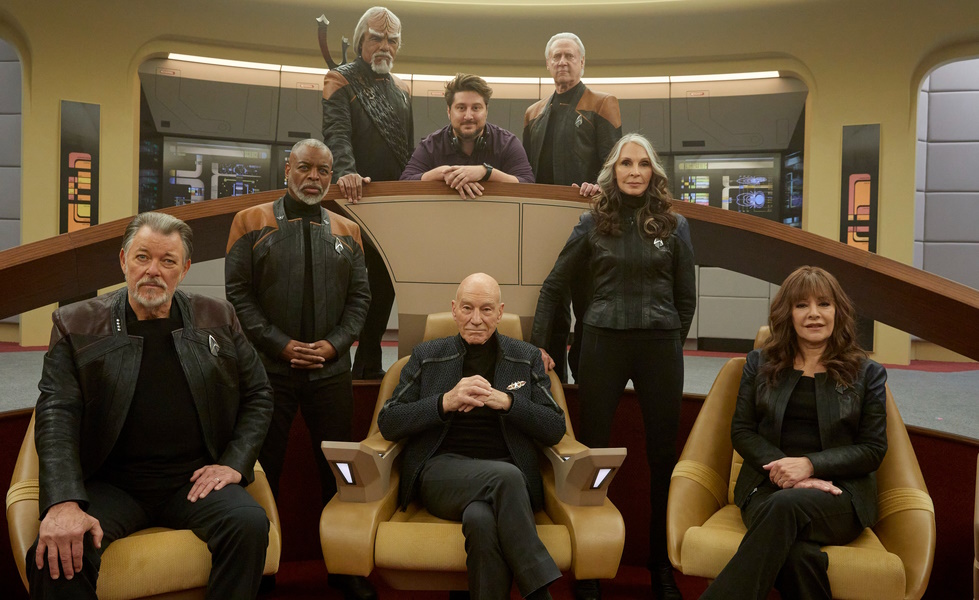
Spoiler Warning: There are spoilers ahead for Star Trek: Picard Seasons 1-2. Spoilers are also present for the following Star Trek productions: Discovery, Voyager, First Contact, and The Next Generation.
Fly Me To The Moon was a solid mid-season episode that moved key storylines along – not always in predictable ways! There has been a fair amount of movement on the theory list, though. In addition to developments in the episode itself, a poorly-timed announcement about Picard’s third season – which most likely won’t be broadcast for at least a year – has given us new points to consider as well.
I know I’m a little late with this week’s theories. If you’re in the United States, the next episode is probably already available to stream! Here in the UK we’re 24-ish hours behind, so I haven’t yet seen episode 6. There’s no “cheating” on these theory lists!
This week we have two confirmations, three debunkings, and two more theories that I’m choosing to retire. As always, we’ll start with those before we dive into the main list!
Confirmed theory #1: The Borg Queen attacked someone from the 21st Century.
The Borg Queen using her tentacle appendages on a French police officer.
Though we still haven’t seen the figure from a pre-season trailer who I said looked like they might be in the early stages of assimilation, I’m calling this one confirmed after the Borg Queen attacked a French police officer! I still think that one of the pre-season trailers showed us at least one other person undergoing Borg assimilation – so watch this space, I guess!
Confirmed theory #2: Dr Jurati has been assimilated.
Dr Jurati has been assimilated by the Borg Queen.
Currently, Dr Jurati is displaying no outward signs of assimilation. She may not have even realised that the Queen, in her dying moments, managed to assimilate her; it wasn’t clear from what we saw on screen whether Dr Jurati was aware of the assimilation tubules penetrating her skin.
However, the Borg Queen – or at least some part of her – now exists within Dr Jurati. That’s the very essence of Borg assimilation, and while the Queen may be keeping at least part of Dr Jurati’s mind intact for now, the direction of travel seems locked in! Unless Picard and the crew realise what’s happened and are able to reverse the process, Dr Jurati will ultimately end up as one of the Borg.
Debunked theory #1: Dr Jurati will unleash the Borg Queen.
Dr Jurati did not willingly unleash the Borg Queen, and even tried to prevent that from happening.
I had speculated prior to the season premiere that Dr Jurati’s love of all things synthetic might lead to her having a great deal of sympathy for the Borg Queen, particularly if the Queen were a captive. Surprisingly, however, that didn’t really pan out – Dr Jurati was quite content to leave the Borg Queen locked up, to lie to her, steal from her, and ultimately even kill her.
I think if Dr Jurati had willingly gone along with the Borg Queen, or had been far more easily manipulated thanks to her innate synthetic sympathies, the story would’ve been less enjoyable. A big part of the fun over the past three weeks in particular has been watching the evolving dynamic between Dr Jurati and the Queen as it unfolded.
Debunked theory #2: Picard and the crew will have to prevent Donald Trump’s re-election.
The White House.
This was always a semi-serious “theory,” but I thought it was funny! In short, I wondered if the divergence in time – i.e. the event that ruins Star Trek’s optimistic future – could be the election of Donald Trump. The season is set in 2024 – the year of the next U.S. presidential election, an election in which Mr Trump is rumoured to be a candidate. And one part of the Confederation timeline played into this too: the fact that in that timeline, climate change was never fixed in the way it was in the prime timeline.
All in all, this one was a bit of fun! But it was debunked by the divergence in time seeming to centre on Renée Picard.
Debunked theory #3: Rios’ missing combadge is the divergence in time.
Rios’ Confederation timeline combadge.
At this point in the season, it isn’t clear what’s happened to Rios’ combadge. When he was arrested we lost track of it, and it was last seen on a table at Teresa’s clinic. I speculated that the combadge falling into the wrong hands could be the beginnings of the divergence in time – but I also pointed out that this would effectively create a time-loop paradox.
I’m glad that the story didn’t go down this road, all things considered. There’s still scope for Rios to retrieve his badge from Teresa, and I hope that the story manages to tie up this loose end! Leaving the combadge behind in the 21st Century, even if it isn’t the point of divergence, would still be a mistake! Luckily it should be relatively easy to track down the combadge’s location!
Retired theory #1: Soji exists in the Confederation timeline.
Sutra in Season 1.
I’ve been saying for a couple of weeks that this theory was on its last legs, and the introduction of Kore Soong, played by Soji actor Isa Briones, has now prompted me to remove it from the list. In short, I had speculated that Soji may exist in the Confederation timeline – and may even be aboard La Sirena. However, I theorised that, in line with other Confederation timeline synths, she may look very different to how she did in Season 1!
It doesn’t seem like the story of the season will return to the Confederation timeline, at least not based on where we are right now. And that means that it seems unlikely that we’ll learn anything more about Soji – she may have never even been constructed in the Confederation timeline. If the story of the season takes us back there, however, I may bring this theory back!
Retired theory #2: By restoring the timeline, Picard – and everyone aboard the Stargazer – will die.
The USS Stargazer explodes.
As things stand, if Picard and the crew of La Sirena were able to successfully restore the timeline and undo everything that has happened, they’d be returned to the bridge of the USS Stargazer (and the USS Excelsior for Raffi and Elnor) with a couple of seconds to go before the ship self-destructs in the midst of a Borg attack. Surely that would mean they’d all be killed?
It seems logical to me, and if the story we’re currently watching were a two-season arc, the finale could well have ended this way. However, the recent announcement and teaser for Season 3 clearly showed Picard alive and back home, presumably in the aftermath of Season 2’s story. That seems to suggest to me that the main storylines in play right now – the mission back in time, the Borg, and the Confederation timeline – will be wrapped up in time for Season 3. There could still be a season-ending cliffhanger, but I think the main stories look set to be concluded. That would seem to rule out this theory – though I may bring it back in future depending on how the next few episodes unfold!
So those theories are off the list!
Now let’s look at the main theory list, beginning with theories that are new or which saw movement in Fly Me To The Moon.
Theory #1: Who is the Watcher?
Tallinn and Picard.
We learned this week that the Watcher’s name is Tallinn, and that she works for the same mysterious organisation as Gary Seven from The Original Series episode Assignment: Earth. But that doesn’t fully explain who the Watcher is!
I can’t help but wonder if we’re on the verge of learning more about Tallinn, her mission, and the identity of the organisation she works for. Doing so could even provide interesting context to Assignment: Earth. Several of my original Watcher candidates – such as the Vulcans and Romulans – are now off the list, but others remain in play. We’ll briefly consider them in turn.
Watcher Candidate #1: A younger version of Laris.
The Watcher at the end of this week’s episode.
Perhaps the obvious answer really is the right one: the Watcher is simply Laris as she appeared in the 21st Century. That doesn’t solve every question, nor does it rule out all of the other entries on this list. In fact, it arguably raises just as many questions as it answers! How could Laris live so long, was she able to travel through time, and what is her connection to Picard – and those are just three off the top of my head.
Regardless, one possibility is that the Watcher is simply Laris.
Watcher Candidate #2: A member of the Q Continuum.
There’s more than one Q!
Given Q’s role in the story, one possibility has to be that the Watcher is a member of the Q Continuum. Perhaps they’re aware of the important role that Picard will play in the future and are watching over his family, or perhaps their objective is to meet Picard himself, knowing that he would journey to this moment in the past. If there’s some kind of internal conflict between different Q factions – as we saw in the Voyager episode The Q and the Grey – perhaps the Watcher is another Q who is trying to stop the Q we know from doing too much harm.
There are many different ways for this theory to pan out!
Watcher Candidate #3: A Prophet.
The Bajoran Wormhole – home of the Prophets.
The Prophets – noncorporeal aliens who live inside the Bajoran Wormhole – exist outside of linear time. They’ve demonstrated an ability to travel through time, emerging centuries in the past. Given that Sisko also visited the year 2024, could a Prophet have followed him to keep an eye on him? Maybe the Watcher isn’t watching Earth or the timeline, but is instead keeping tabs on Sisko – the Emissary.
Watcher Candidate #4: A Temporal Agent from the Temporal Wars.
Crewman Daniels was a Temporal Agent.
Is it possible that the Watcher is a Temporal Agent, someone whose intention is to prevent anyone meddling with the timeline? If so, this story could connect with the ban on time travel that was established in Discovery Season 3 but not elaborated on. It still wouldn’t explain why the Watcher looks like Laris – but again, perhaps she has taken a particular interest in Picard or the Picard family for some reason?
Watcher Candidate #5: A Borg.
The Borg Queen.
Considering who it was that told Picard about the Watcher’s existence, some kind of Borg connection cannot be ruled out! Despite having spent a lot of time with the Borg over the past thirty years, there’s still a lot we don’t know about them – for example, do they send scouts to planets they hope to assimilate to watch over them? That could be the Watcher’s purpose, and considering we already know that the Borg are capable of time travel, it seems possible that the Watcher is one of theirs!
Theory #2: The Federation will use information from the Confederation timeline to defeat the Borg.
A battle over the planet Vulcan in the Confederation timeline.
Depending on how the season shapes up, this may be a theory we come back to next year! But for now, suffice to say that the Confederation’s defeat of the Borg in their timeline is one of the most intriguing unexplained events in the entire series. How did the Confederation – an organisation with technology comparable to the 25th Century Federation – manage to defeat the Borg Collective?
If a Borg invasion is coming – as we seemed to see in The Star Gazer at the beginning of the season – the Federation will need every advantage at their disposal to fight back. Technology, tactics, and information from the Confederation’s own battle against the Borg could prove invaluable, and if Picard and the crew manage to take La Sirena back to their own time, maybe they’ll bring with them just what they need.
Theory #3: Dr Adam Soong will create the Borg.
Dr Adam Soong.
Dr Soong’s research seems to be primarily on the genetic side of things, and that could tee up a storyline about human augmentation that we’ll look at in a moment. However, now that Q has become involved, we have to question what his motives are and what he might be pushing Dr Soong to do. Could Q give Dr Soong nanotechnology, perhaps, in an attempt to save or prolong his life?
If so, maybe Dr Soong’s experiments will somehow lead to the creation of the Borg Collective.
Theory #4: Q is dying.
Q in Fly Me To The Moon.
What did Q mean when he said that he didn’t have a lot of time left? One interpretation is that he’s coming to the end of his life. Picard noticed that there was something wrong with Q as far back as Penance, and Q’s attitude in general seems to have shifted to something darker and more overtly antagonistic than we remember. One possible explanation for this is that Q is dying.
This could also explain the apparent loss of Q’s powers – or the decreasing control he has over them. If he wanted to prevent Renée Picard’s mission, for example, Q should simply be able to snap his fingers and turn her spaceship into a block of cheese, or make it so that Renée was never born, or change her desire to become an astronaut into a lifelong passion to become a pro YouTuber. Instead, he’s resorted to trying to talk her out of it. Why? Could it be that Q’s declining power is indicative of his declining health?
If one of the defining characteristics of the Q as a race is immortality, what might have caused Q to be approaching death? Is it a punishment inflicted on him by his own people, or the result of some other outside force? Is it natural or artificial in nature? And what does it have to do with Picard?
Theory #5: The masked, hooded figure from The Star Gazer is not the real Borg Queen.
The Borg Queen?
The Borg Queen – the hooded figure who materialised on the bridge of the Stargazer – was absolutely terrifying, evoking feelings for me that the Star Trek franchise hasn’t hit in decades. The way this character was presented, with her shrouded face, flowing robes, monochromatic aesthetic, and blend of humanoid and decidedly non-humanoid mechanical features was simultaneously riveting and frightening!
This character was presented as the Borg Queen in the episode, and the Borg have no reason that we know of to lie about that. But at the same time, she was very different not only from how we’ve seen the Borg Queen in past iterations of Star Trek, but also from the Borg Queen that Picard and the crew met in the Confederation timeline. Could this character actually be someone else – perhaps someone that the Borg have assimilated?
“Borg Queen” Candidate #1: Dr Jurati.
Dr Jurati.
With Dr Jurati having seemingly been assimilated, she would appear to be the top candidate for being the masked Borg Queen! The anomaly from which the Borg vessel emerged was said to be giving off temporal radiation, which could explain how an assimilated Dr Jurati is a Borg Queen while a younger Dr Jurati is present on the bridge of the Stargazer in the same moment.
“Borg Queen” Candidate #2: The time-travelling Admiral Janeway from Endgame.
Admiral Janeway.
Admiral Janeway was assimilated by the Borg Queen as part of her plan to introduce a neurolytic pathogen into the Collective, and appeared to have been killed when the Borg Queen’s complex exploded. But is there a way she could have survived?
Her assimilation could have been a turning point for the Borg. She did untold damage to the Collective, but also potentially gifted them knowledge and information about future events and technologies that were decades ahead of their time. Just like the Borg once chose Captain Picard to become Locutus – their “spokesperson” or representative – perhaps they might have chosen Admiral Janeway to fill a similar role during this latest incursion. Admiral Janeway could even have been incorporated as part of the Borg Queen.
“Borg Queen” Candidate #3: Soji.
Soji in The Star Gazer.
The Borg seek “perfection” through the synthesis of organic and synthetic parts; if Coppelius synths like Soji have something that the Borg want, perhaps we’ll learn that they assimilated her to get it. The anomaly from which the Borg vessel emerged was not a standard transwarp corridor, and was specifically noted to emit some kind of temporal radiation. Thus the Borg vessel could be from a future date after Soji has already been assimilated. We could even learn that the super-synths from the Season 1 finale are actually the Borg; that could be how they first became aware of Soji and the Coppelius synths.
“Borg Queen” Candidate #4: Renée Picard.
Renée in her therapy session.
Renée could be the Borg Queen if she’s assimilated. Perhaps that’s part of Q’s plan, or perhaps Renée will be captured by Dr Jurat/the Borg Queen at the gala (or afterwards). Renée being the masked, hooded Borg could explain why the Borg were asking for Picard by name, and why Non, je ne regrette rien played shortly before the Stargazer’s self-destruction.
Theory #6: Dr Jurati hasn’t been assimilated.
Dr Jurati with the Borg Queen.
Maybe this is a silly idea, but something struck me about the way the Borg Queen’s death was handled in Fly Me To The Moon. Dr Jurati was clearly very traumatised by what had transpired, and this comes atop her prior trauma from the death of Dr Maddox and her brainwashing in Season 1. Could she be experiencing some kind of psychotic episode, merely hallucinating the presence of the Borg Queen?
Hallucinations can seem incredibly real, and while as the audience we might assume that Dr Jurati is seeing and feeling the Borg Queen’s presence because the Borg Queen did something to her, we also have to keep in mind that the Borg Queen seemed incapable of assimilating anyone; her nanites, according to the Confederation, had been destroyed or rendered unusable. So one possibility could be that Dr Jurati is experiencing a lot of trauma, leading her to believe she’s been assimilated and that she can see and hear the Borg Queen.
Theory #7: The season will end on a cliffhanger.
Because Seasons 2 and 3 went into production back-to-back, that made me wonder if they might form one continuous story – or if the final act of Season 2 might set up the story for Season 3. That still seems plausible to me, but the announcement a couple of days ago about the return of the main cast of The Next Generation in Season 3, and the accompanying clip, may make it less likely.
However, it’s still possible that the two seasons will form one continuous story, or that the final act of Season 2 will lay the groundwork for the story of Season 3. There could also be a minor cliffhanger that is connected to just one character, or that is unrelated to the main story.
Theory #8: At least one character from The Next Generation will make an appearance.
The main cast of The Next Generation.
As above, this theory has been knocked by the Season 3 announcement. It seems less likely now that we’ll see major roles for any of the characters announced for Season 3. However, the final act of Season 2 could bring back some or all of these characters if it’s going to set up the next phase of the story, and cameos and smaller appearances still feel possible.
Theory #9: Q is not responsible for changing the timeline.
Q looking very young!
Q is clearly trying to affect some kind of change to the timeline by interfering with Renée Picard’s mission. But his declining powers could suggest that he isn’t as directly involved with the change and the creation of the Confederation timeline as he implied. Q may no longer be capable of doing something on this scale – and even if he was, we still have no idea what his motivation for doing so would be.
The Confederation timeline and the 21st Century don’t seem like typical Q puzzles. He described sending Picard to the Confederation timeline as a “penance,” but what exactly he’s punishing Picard for and why is still not clear. In short, we still don’t know why Q would want to do something like this, and as of Fly Me To The Moon, it’s no longer clear that Q has the ability to do so either.
I have a longer article that goes into more detail about this theory that I wrote before the season premiere, and you can find it by clicking or tapping here.
Theory #10: Q shielded Picard and the crew of La Sirena from changes to the timeline.
Q and Picard in Penance.
Regardless of who changed the timeline and why, it seems more and more clear that Q is responsible for ensuring that Picard and the crew of La Sirena were the only ones unaffected by the change. If his goal was to change the timeline to punish Picard that makes sense – but it also leaves open the possibility that Picard will be able to figure out what happened and prevent it. That could be Q’s goal.
I’m not quite ready to call this one “confirmed,” though. I think we need to spend more time with Q to understand what he’s done, what he hopes to do next, and why.
Theory #11: Who is responsible for damaging the timeline, then?
Did the Borg do it?
If Q isn’t the one who changed the timeline, the obvious question that raises is “who did it?”
In theory, it could be any one of a number of different Star Trek factions. We’ve seen the Klingons having access to time travel in the early 25th Century, for example, in the Voyager episode Endgame, and various time travel stories and stories depicting powerful alien races could all theoretically yield suspects. But considering what we know about Star Trek: Picard specifically, in my view the main suspects are as follows:
The Borg. The Borg could be one of the season’s main antagonists after their emergence in The Star Gazer, and we’ve seen in past iterations of Star Trek that they can travel through time.
The Zhat Vash. While the Zhat Vash may not have been shown to possess time travel tech, they were the primary antagonist last season, and arguably were not defeated in the Season 1 finale.
How about the Zhat Vash?
The super-synths. The super-synths from the Season 1 finale are a wildcard; we don’t know much about them except that they seem to be technologically powerful. Travelling back in time might be on their agenda – but erasing the prime timeline could result in the erasure of the Coppelius synths.
The Romulan government or the Tal Shiar. With or without the support of the Zhat Vash, the Romulan government could have taken action against the Federation in response to the events of Season 1.
There are undoubtedly other Star Trek factions who could be implicated, and if we had a free choice we could suggest the likes of the Dominion or the Sphere-Builders. But I think those are far less likely when considering the elements Picard has brought on board.
Theory #12: The Borg Queen/Dr Jurati will steal La Sirena, stranding Picard in the past.
The crash site of La Sirena in France.
If the Borg Queen has infected Dr Jurati’s mind, she may be able to control her – either through manipulation or through good old-fashioned Borg assimilation! If so, the Queen’s next move could be to steal La Sirena.
The Borg Queen’s alliance with Picard was one of convenience and the realisation that shared interests exist. The divergence in time led to the Confederation destroying the Borg Collective, and the Queen needs to prevent that from happening for her own sake. But once she’s accomplished that goal, all bets are off. There’s no reason for the Queen to stick with Picard and help him get back to the 25th Century; stealing the ship and returning without him could be her next move.
Theory #13: The Confederation is run by augmented humans.
A monument to Adam Soong in the Confederation timeline.
I enjoyed the presentation of Dr Adam Soong. Rather than an out-and-out villain, he comes across as someone willing to go to extreme lengths to save the life of someone he loves. He’s clearly willing to cross moral and ethical lines in the process – and it’s at least possible that something he does could lead to the creation of augmented humans: Khan-like “supermen” who will conquer the world.
The divergence in time caused by Renée Picard’s mission could play into this as well – Renée was said to have found evidence of life during the course of her mission to the outer solar system. Perhaps Dr Soong will use that to develop augmentation, or his alliance with Q will lead to the creation of augments. Maybe that’s the next part of Q’s plan.
If so, human augmentation could be widespread by the time of the Confederation. That could even explain how the Confederation was able to defeat the Borg!
Theory #14: There will be a connection between the augments and Strange New Worlds.
One of the few things we know about Strange New Worlds at this early stage is that there will be a character named La’an Noonien-Singh. This new character seems to be related in some way to the iconic villain Khan, and if Khan or Khan-inspired augments play some kind of a role in the Confederation’s power structure, perhaps that will set up a connection – or even a crossover – between Picard Season 2 and Strange New Worlds.
Theory #15: The Federation is responsible for creating the Borg.
A rather incredulous-looking Borg seen in The Next Generation.
This is a total wildcard, but I’m just throwing it out there!
The Borg Queen – and the Borg in general – appear to have a fascination with humanity and with Picard. Could it be that the explanation for that is that the Federation and/or humanity are somehow responsible for their creation? With time travel on the agenda, it’s not impossible to imagine a scenario in which the progenitor of the Borg – perhaps even the Queen herself – is able to travel back in time, founding the Collective.
Nanites used by the Control AI.
As suggested above, this could be what Q is manipulating Dr Soong into doing in the 21st Century. The Borg could therefore be a human creation, the offspring of one of Data’s ancestors. Could that link be the key to defeating them? Maybe that preserved knowledge and the veneration of Dr Soong is how the Confederation was able to defeat the Borg in their timeline!
Discovery Season 2 ran a story with the Control AI that could have also been a Borg origin story. Was it known as early as 2018-19 that Picard wanted to tell a story like this, and if so, could that explain why the Control storyline ended the way it did? I have a write-up of Discovery’s abandoned Borg origin story that you can find by clicking or tapping here.
So those theories are new or moved this week.
Up next, as always, I’ll recap the remaining theories that I have in play. These didn’t see any significant movement this week, but remain on the table for later in the season – or possibly even for Season 3!
Theory #16: The loose ends from Season 1 will be tied up.
Will we learn more about the super-synths?
The Star Gazer already crossed off two things from the list of Season 1 leftovers! Dr Jurati’s legal status was clarified, as was her relationship with Captain Rios. There are still a number of points that I’d like to see addressed before the season ends, though, as Season 1 unfortunately left quite a lot of story on the table thanks to a rushed and underwhelming finale.
Here are the main ones:
What will become of the synths on Coppelius, and will they have to be relocated for safety?
Did Starfleet attempt to visit Aia and shut down the beacon at the centre of the Zhat Vash’s prophecy? Leaving it out in the open seems dangerous.
Will Starfleet contact the super-synths and attempt to make peace or convince them that they pose no threat?
A crowd of synths on Coppelius.
Why did Bruce Maddox go to Freecloud?
With the Zhat Vash plot exposed, what will become of their crusade against synthetic life?
Did Federation-Romulan relations suffer as a result of the Zhat Vash’s attack on Mars and attempted attack on Coppelius?
What happened to Narek after he was captured by the Coppelius synths?
Who controls the Artifact and what will happen to the surviving ex-Borg?
Theory #17: Teresa will find out the truth about Rios.
Rios and Teresa in Watcher.
We didn’t spend a lot of time with Teresa in Watcher, but it’s possible she’ll come back later in the story. With Rios’ combadge still missing, at the very least I’d expect him to tie up that loose end – even if the lost combadge has no real bearing on the rest of the story. Teresa’s clinic is where it was last seen, and she may know where it is or may be willing to help.
During the course of such a storyline, it seems at least possible that Teresa will learn that Rios is from the future. This would see her stand alongside characters like Voyager’s Rain Robinson and Dr Gillian Taylor from Star Trek IV, and it could be a fun twist for the character. As a native of 21st Century Los Angeles, Teresa could be a valuable asset to the team as they try to stop the timeline from being shattered.
Theory #18: The Watcher will be aware of Sisko and the USS Defiant in this time period.
Captain Sisko in Past Tense.
I’m not expecting to see Sisko or anyone else from Past Tense appear in person! But maybe when Picard and the crew inevitably meet the Watcher, they will make reference to or acknowledge that the USS Defiant has also passed this way. It would be a fun little connection to Past Tense, and just because we’ve seen references to things like UHC cards and Sanctuary Districts, that doesn’t mean there isn’t room for another line or two of dialogue to tie Picard to Deep Space Nine!
Theory #19: Seven of Nine will choose to remain in 2024.
Seven of Nine in Los Angeles.
For the first time in her life, Seven of Nine is feeling a sense of freedom. Not only is she free from her Borg implants, changing the way she looks, but she’s also unencumbered by her Borg past. No one she meets in 2024 will be aware of the Borg, and she’s clearly enjoying the way that makes her feel.
In The Star Gazer, Seven spoke to Picard about feeling judged by the ship’s crew – and in a broader sense, by practically everyone in the 25th Century. Her Borg past is a hurdle for her; she feels the weight of unspoken criticisms and judgements made against her. Her Borg implants are the biggest physical manifestation of this, but the fact that most people she meets in the 25th Century know who she is and where she came from is a burden – one she no longer feels in 2024.
With that in mind, could Seven choose to remain behind when Picard and the crew of La Sirena are ready to leave? Even if she’s ultimately talked out of it (or even forced out of it), I wonder if she’ll try to stay in the past.
Theory #20: Elnor will be restored to life when the crew returns to the 25th Century.
Raffi believes that restoring the timeline could save Elnor.
The decision to kill off Elnor so early in the season certainly succeeded as a shocking story point… but I’m not so sure he’ll stay dead. Is Raffi’s belief that restoring the timeline will save his life something that the series has carefully set up so it can be paid off later? Or was it simply part of her reaction to his death; the bargaining stage of the grieving process? I’m not sure!
Elnor is a character who had potential – the first Romulan to be a main character on a Star Trek series (or the second, after Narek) and the first Romulan to enlist in Starfleet. If the Star Trek franchise were to stick around, I could happily follow his adventures as a Starfleet officer over the course of several years, giving him an arc somewhat comparable to someone like Tilly in Discovery, growing into his new role.
But Elnor is also a character who was underused in Season 1, and the decision to make him a Starfleet cadet at the beginning of Season 2 was only the beginning of a new arc for him. His death didn’t hit as hard as it could’ve because we don’t know Elnor very well – and I wonder if that could be a reason to bring him back later in the season.
Theory #21: The Borg Collective was badly damaged in the Voyager episode Endgame and has been unable to recover.
Dr Jurati decoded the Borg message in The Star Gazer.
In The Star Gazer, it seemed as if the Borg Collective was reaching out, asking the Federation – and Picard specifically – for help. If so, the question is why? Was it just a shallow ploy to launch another attack on Starfleet? Or is there at least a degree of truth to the Borg’s request?
Endgame, the final episode of Voyager, depicted a time-travelling Admiral Janeway introducing a neurolytic pathogen – a type of virus – into the Borg Queen, seriously damaging her, her base of operations, and several Borg vessels in the vicinity. Because the Borg hadn’t been seen since – until The Star Gazer, that is – we never got to learn just how deadly Admiral Janeway’s actions were.
Admiral Janeway in Endgame.
I’ve always assumed that the Borg Collective is vast enough, powerful enough, clever enough, and most importantly adaptable enough that Admiral Janeway’s actions weren’t going to strike a fatal blow. Whatever damage she had done seemed like something the Borg could eventually fix – and their existence 25 years later during the events of The Star Gazer seems to prove that. The Borg’s technology and weapons are still streets ahead of anything Starfleet has at its disposal… but even so, it’s still possible that the Borg are on their last legs facing defeat.
If that’s the case, maybe we’ll discover that it was Admiral Janeway who’s responsible – that her actions in Endgame are either wholly or partly to blame for the Borg’s weakened state. Dr Jurati seemed to know that the Borg Collective isn’t as strong as it once was, so that could be another clue pointing to this theory.
Theory #22: The USS Stargazer will make an appearance.
The original USS Stargazer.
Okay, technically the USS Stargazer has already appeared, but not in the way I expected! Captain Rios is (or was) in command of a new USS Stargazer, and not only that but he had a model of the original vessel in his conference room! So that’s it. Theory confirmed, everybody can move on to the next one!
Just kidding. The inclusion of a brand-new USS Stargazer brings the ship and its legacy back to the fore. Picard himself commented in The Star Gazer that the original vessel was his first command, and as far back as Season 1 we had a reference to his time in command through the character of Dr Benayoun. All of these things could be leading to some bigger role for the original USS Stargazer – and with a story that seems to include time travel and a strong focus on Picard’s own personal history, a flashback or even a visit to the ship could be on the agenda!
Theory #23: Romulans are spying on Earth in the 21st Century… and could be time-travelling Zhat Vash.
A young boy encounters a Romulan or Vulcan.
In the third trailer, a young boy wearing what seemed to be 21st Century clothing was seen encountering a Romulan or Vulcan. If the Zhat Vash are involved in the new season’s story somehow, perhaps this individual is a Zhat Vash operative. This could confirm that the Zhat Vash were able to travel through time, or send a message back in time to their 21st Century counterparts. The Romulans had achieved interstellar flight centuries earlier, so travelling to Earth to spy or place operatives seems plausible for them.
Of all the scenes we’ve glimpsed so far from Season 2, the one with the young boy and the Romulan or Vulcan is the one that I’m least sure about! It doesn’t seem to fit naturally into a story about the Borg, Q, and time travel… but this is one theory that could make sense, and would connect to the theory above about Q not being to blame.
Theory #24: The Vulcans are on Earth in the early 21st Century… as stated in Discovery Season 4.
A meeting of senior Federation and allied officials in Discovery Season 4.
Another theory about the unnamed Romulan or Vulcan is tied into the Discovery Season 4 episode The Galactic Barrier. This could easily be a complete overreaction to a throwaway line, but at the beginning of the episode, the enigmatic Federation leader Dr Kovich stated that Vulcans were on Earth for decades prior to official first contact taking place.
This one line could be a reference to Carbon Creek, an episode of Enterprise that saw Vulcans crash-land on Earth in the 1950s. But the timing seems odd given the scene glimpsed in the Picard Season 2 trailers! If the character seen above is a Vulcan, perhaps there will be a connection of some kind between Discovery and Picard.
Theory #25: Picard and the crew will have to actively trigger World War III to save the future.
World War III soldiers as glimpsed in Discovery Season 2.
Although the Bell Riots are the main event of 2024 that we know about in Star Trek’s internal timeline, the 21st Century was arguably dominated by another event: World War III. The war may have kicked off as early as 2026 (as suggested in The Original Series) and concluded by the mid-2050s as seen in First Contact. The “post-atomic horror” that followed was the backdrop for Q’s trial in Encounter at Farpoint.
World War III is integral to Star Trek because without it, it’s hard to see how warp drive would’ve developed and how humanity would’ve made peaceful first contact with the Vulcans. Just like the end of the Second World War brought about major technological and societal changes that ultimately made the world a better place, Star Trek’s World War III is integral to the events that led to the founding of the Federation. If it were prevented, the timeline would change dramatically.
We now know that Renée Picard’s mission seems to be the divergence in time. But her mission could be connected, somehow, to the outbreak of hostilities. By sending her on her way and preserving the timeline, Picard and his crew may be committing to the outbreak of war. You can find a full write-up of this theory by clicking or tapping here.
Theory #26: The Q Continuum has been attacked.
The Q Continuum, as seen in Voyager.
What’s wrong with Q? That was a question Picard asked that went unanswered in Penance, but there’s clearly something different about Q this time. Though at times he has the same impish charm that we remember from his earlier appearances in the franchise, at other moments he seemed incredibly angry – even hitting Picard at one point.
Perhaps there’s something going on in the Q Continuum – the Continuum could have come under attack, for example, and Q could be one of the few survivors. If something that Picard did or didn’t do is partly to blame, that could explain Q’s antagonistic behaviour.
Though the Q Continuum and the Q species seem god-like from our perspective, it’s not impossible to think that someone found a weakness to exploit. Could it be the Borg, perhaps? Q’s anger could stem from the fact that Picard didn’t do enough to stop them.
Theory #27: Q is angry with Picard for “giving up.”
Grumpy Q.
Over the course of The Next Generation, Q took a particular interest in Picard. More so than anyone else, Q seemed to see potential in Picard as a representative of the human race, someone who potentially showed him what humanity could be… with a little prompting and guidance. Q seemed fascinated by that idea, so seeing Picard’s fall from grace may have shocked him and left him feeling disappointed and bitter.
Picard spent more than a decade away from galactic affairs, retiring to his vineyard and seemingly just waiting around to die. Someone like Q might take that personally; he might feel that Picard was not living up to the potential he had. Perhaps Picard’s absence had some kind of unknown consequence, something that harmed Q or the Q Continuum. In any case, Q’s animosity to Picard seems to be personal – could disappointment at Picard’s attitude in the years prior to Season 1 be the cause?
Theory #28: The Borg are aware that Picard is now a synth – and his synthetic status is part of the reason why they waited until now to make contact.
Picard awakened in a new synthetic body in Et in Arcadia Ego, Part 2.
As mentioned above with Soji, the timing of the new Borg incursion is interesting, especially considering that they asked for Picard by name. Are they aware of his newfound synthetic status? And if so, could Picard’s transition to a new synthetic body be the reason why the Borg chose to launch their attack?
The Borg seek “perfection” through a synthesis of organic and synthetic components, and while Picard’s new synthetic body is a far cry from the Borg drones we’ve seen, the idea of an organic mind in a synthetic body isn’t a million miles away from that same basic idea. Although Picard’s body was said to be comparable in practically every way to his original one, synthetics can have enhanced abilities that allow them to easily overpower humans – and, as we’ve seen with Data on more than one occasion, they can outmatch individual Borg drones as well.
A Borg drone losing a fight against Data.
Perhaps the Borg want to re-assimilate Picard now that he’s synthetic. If the Collective is still reeling from the damage inflicted upon it by Admiral Janeway or if they’re on the losing side of a war, perhaps they hope to use fully-synthetic bodies like Picard’s to replace damaged or destroyed drones, or as cannon fodder on the front lines. There are many reasons why the Borg might be interested in synthetic technology, and that could explain their re-emergence.
Even if the Borg don’t plan to assimilate Picard or the Coppelius synths, the timing of their appearance is certainly interesting and there could be a connection.
Theory #29: The Borg ship from The Star Gazer crossed over from the Confederation timeline.
The Borg vessel identified as “Legion.”
As far as we know at this stage, the Confederation timeline replaced the prime timeline thanks to someone or something changing the past. But timelines and parallel universes often go hand-in-hand in Star Trek, and after we learned about the Borg’s defeat in the Confederation timeline, I wonder if their ship from the season premiere might have found a way to punch through or cross over into the prime timeline.
If the Borg were facing defeat, as their message seemed to suggest, perhaps that could explain why. Also, the anomaly that the ship emerged from was not a typical transwarp conduit; we’d seen transwarp corridors as recently as Season 1. Finally, the Borg Queen of the Confederation timeline was aware of Picard and the history of the prime timeline – perhaps the Confederation timeline Borg knew of the prime timeline and this was a last-ditch effort to survive.
Theory #30: The Borg are fighting a war – and they’re losing.
The Borg vessel using its transporter-weapon on the USS Stargazer.
Possibly connected to the theory above, one explanation for the Borg’s message and appearance in The Star Gazer is that in the prime timeline the Collective has found itself on the losing side of a war. Penance told us that the Confederation had been able to defeat the Borg using technology that Dr Jurati believed was roughly equivalent to the Federation’s in the prime timeline – so clearly it’s possible to fight and beat the Borg.
Could mentions of Gul Dukat or Martok in Penance be hints at something to come later in the story? Both characters were major players during Deep Space Nine’s Dominion War arc; maybe the Cardassians and/or the Dominion have been aggressively attacking the Borg in the late 24th Century. The other big culprit is the Confederation – assuming that it’s possible for the two timelines to mix!
Theory #31: The mission back in time won’t last all season.
Los Angeles, 2024.
There’s still a lot of the season remaining for Picard and the crew to figure out what happened and repair the damage to the timeline. Perhaps this is as much a wish as a theory – time travel stories that visit the modern day have never been my favourites in Star Trek – but I wonder if there could be something truly unexpected coming afterwards.
With Q involved in the story, he could send Picard and the crew to another alternate timeline or parallel universe, for example. Or after the timeline is repaired, we could see Picard and the crew engage in a battle against the Borg – we still don’t know what was going on with the new Borg Queen and the Legion ship from The Star Gazer. In short, there are many different ways that the season could go after a jaunt to the past.
I’d also point out that, aside from a few clips from the 21st Century, the first two episodes of the season seem to have included most of the clips from pre-season trailers and teasers, which could mean that the latter part of the season is hiding something big!
So that’s it!
Picard in the recently released Season 3 teaser.
Those are all of the theories I currently have in play as we head into Two of One – which I’ll be watching in just a few hours’ time! The season continues to find ways to surprise me, even though I have to confess that I’m about ready for Picard and the crew to leave the 21st Century behind and get back to the future. Star Trek, at least for me, is never at its best with these modern day time travel stories.
I always like to end these theory lists by saying that I do this just for fun. I enjoy writing, I enjoy Star Trek, and spending more time in this world is an escape and an enjoyable distraction. But for some folks, fan theories can be frustrating or unenjoyable, especially if they get very attached to a plausible-sounding theory that ultimately doesn’t pan out. I have no “insider information” and I’m not trying to claim that anything suggested above can, will, or must be part of Picard Season 2. I fully expect many of these theories to be debunked and for the season to go in wildly unpredictable directions!
Star Trek: Picard Season 2 is available to stream now on Paramount+ in the United States, Scandinavia, Latin America, and Australia, and on Amazon Prime Video in the United Kingdom and the rest of the world. The Star Trek franchise – including Picard and all other properties mentioned above – is the copyright of Paramount Global. This article contains the thoughts and opinions of one person only and is not intended to cause any offence.
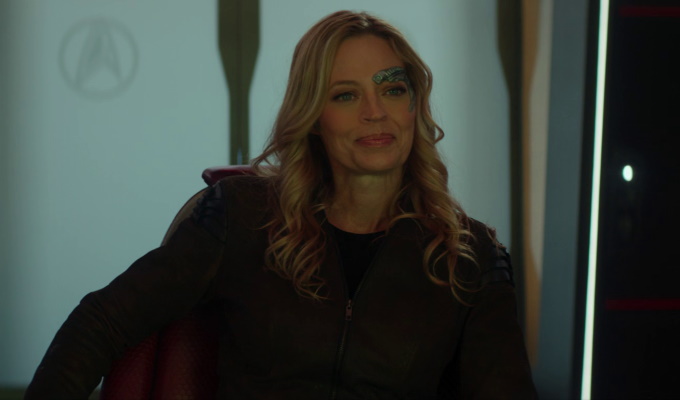
Spoiler Warning: There are spoilers ahead for Star Trek: Picard Seasons 1-2. Spoilers are also present for the following Star Trek productions: Discovery, Voyager, First Contact, and The Next Generation.
I had another enjoyable outing with Admiral Picard and the crew of La Sirena this week. Though I feel that the limitations of a 21st Century setting are beginning to bite on one side of the story, there was plenty to enjoy in Watcher – and the episode has gifted us a few new theory ideas to boot!
This week we have two theories that I’m calling “semi-confirmed.” In those cases I got the broad outlines right, but I was quite a long way off in terms of the way they panned out. And we also have one theory that I’m choosing to retire.
Semi-confirmed theory #1: Guinan will be aware of changes to the timeline.
Shifts in time can make some people rather unwell!
I had no idea that we’d be meeting a younger version of Guinan during Picard Season 2. After Picard sat down with Guinan in the season premiere and then she didn’t return, I began to wonder if we’d seen all we were going to see from her – but it seems that her younger self has a role to play!
I had initially speculated that Guinan would be aware of the timeline shifting, as she had demonstrated this ability during the events of The Next Generation Season 3 episode Yesterday’s Enterprise. I wondered if we might meet Guinan in the Confederation timeline, and even whether she might be the instigator of Picard’s journey back to the 21st Century.
As it turned out, Guinan was aware of a change to the timeline, but only after meeting with Picard in the 21st Century. I can’t take full credit for predicting this, but there was enough of a conversation about El-Aurians and the way they understand time for me to feel that it wasn’t a million miles away from my original theory! Hence I’m calling this one “semi-confirmed!”
Semi-confirmed theory #2: Laris will join Picard’s mission back in time.
Laris?
I had predicted – or should that be “hoped” – that we’d see Laris again before the end of the season, and speculated that she could be revived somehow in the Confederation timeline, perhaps thanks to Q’s abilities. I was not expecting Laris – or at least someone using her appearance – to turn out to be the titular Watcher, though!
Perhaps it might be more accurate at this point to suggest that Picard has joined whatever mission Laris is on, rather than the other way around! Guinan seemed to suggest that the name Jean-Luc Picard was familiar to her, and that could mean that Laris knows who Picard is. She may even have been placed in the 21st Century in anticipation of this very meeting.
I guess we’ll have to see what’s going on when we get to the next episode, but for now I’m happy to call this one “semi-confirmed” as well.
Retired theory: There will be a crossover with Star Trek: Discovery.
The USS Discovery at warp in Season 4.
This theory came about thanks to the just plain stupid decision from Paramount Global to have Discovery Season 4 and Picard Season 2 overlap one another by three weeks. I wondered if that might mean some kind of crossover event could be on the agenda – and with time travel being a big part of Picard, it seemed at least plausible.
However, it now seems that the reason for the nonsensical scheduling is nothing more than the random illogical spasms from Paramount Global, a corporation that seems to have no clue how to run a major franchise or a streaming platform. Given that Strange New Worlds now seems certain to be denied to international fans because Paramount+ still isn’t available, the scheduling decision seems infinitely worse in retrospect.
Delaying Picard Season 2 by three or four weeks and Strange New Worlds by an extra couple of weeks on top of that would’ve provided the corporation with more time to get Paramount+ ready for the next phase of its international rollout – and might’ve meant that more Star Trek fans could enjoy Strange New Worlds. But alas, Paramount Global seems to be run by utterly incompetent morons.
So those theories were semi-confirmed and retired.
Next let’s jump into the main theory list, beginning with those theories that are brand-new or saw movement in this week’s episode.
Theory #1: The Borg Queen will assimilate people from the 21st Century.
Who could this be?
As I wrote in my review of Watcher, I’m loving the dynamic between Dr Jurati and the Borg Queen at the moment! We saw in one of the pre-season trailers a couple of people who seemed to be in the early stages of Borg assimilation, and I wonder if those people could be 21st Century humans who stumble upon La Sirena’s crash site. Dr Jurati may even unleash the Borg Queen on them in order to protect the ship and avoid too much damage to the timeline.
This could be tied in with another theory we’ll look at in a moment – that Dr Jurati herself may be on the verge of assimilation following her encounter with the Borg Queen. If Dr Jurati is compromised, the Borg Queen may be able to command her – or even use her to perform the assimilations herself!
Theory #2: Who is the Watcher?
The Watcher and Picard teleporting.
This is an easy one: the Watcher is Laris, right? Well, not necessarily! The Watcher has certainly assumed Laris’ form, but that may be an illusion or something done for Picard’s benefit. We don’t know for certain right now that Laris and the Watcher are 100% the same character – but we will almost certainly learn more in the next episode!
Watcher Candidate #1: A younger version of Laris.
The Watcher at the end of this week’s episode.
Perhaps the obvious answer really is the right one: the Watcher is simply Laris as she appeared in the 21st Century. That doesn’t solve every question, nor does it rule out all of the other entries on this list. In fact, it arguably raises just as many questions as it answers! How could Laris live so long, was she able to travel through time, and what is her connection to Picard – and those are just three off the top of my head.
Regardless, one possibility is that the Watcher is simply Laris.
Watcher Candidate #2: A member of the Q Continuum.
There’s more than one Q!
Given Q’s role in the story, one possibility has to be that the Watcher is a member of the Q Continuum. Perhaps they’re aware of the important role that Picard will play in the future and are watching over his family, or perhaps their objective is to meet Picard himself, knowing that he would journey to this moment in the past. If there’s some kind of internal conflict between different Q factions – as we saw in the Voyager episode The Q and the Grey – perhaps the Watcher is another Q who is trying to stop the Q we know from doing too much harm.
There are many different ways for this theory to pan out!
Watcher Candidate #3: A Prophet.
The Bajoran Wormhole – home of the Prophets.
The Prophets – noncorporeal aliens who live inside the Bajoran Wormhole – exist outside of linear time. They’ve demonstrated an ability to travel through time, emerging centuries in the past. Given that Sisko also visited the year 2024, could a Prophet have followed him to keep an eye on him? Maybe the Watcher isn’t watching Earth or the timeline, but is instead keeping tabs on Sisko – the Emissary.
Watcher Candidate #4: A Temporal Agent from the Temporal Wars.
Crewman Daniels was a Temporal Agent.
Is it possible that the Watcher is a Temporal Agent, someone whose intention is to prevent anyone meddling with the timeline? If so, this story could connect with the ban on time travel that was established in Discovery Season 3 but not elaborated on. It still wouldn’t explain why the Watcher looks like Laris – but again, perhaps she has taken a particular interest in Picard or the Picard family for some reason?
Watcher Candidate #5: A Borg.
The Borg Queen.
Considering who it was that told Picard about the Watcher’s existence, some kind of Borg connection cannot be ruled out! Despite having spent a lot of time with the Borg over the past thirty years, there’s still a lot we don’t know about them – for example, do they send scouts to planets they hope to assimilate to watch over them? That could be the Watcher’s purpose, and considering we already know that the Borg are capable of time travel, it seems possible that the Watcher is one of theirs!
Watcher Candidate #6: A Romulan or Vulcan.
A Romulan or Vulcan seen in a pre-season trailer.
I can’t figure out whether the character shown above is a Romulan – perhaps a Zhat Vash – or a Vulcan. However, if either faction is present on Earth in the 21st Century, perhaps one of their number could be the Watcher. Given that Laris knew about the Zhat Vash from her time as a Tal Shiar operative, could we perhaps learn that a mission to Earth’s past was one of her assignments?
Theory #3: Rios’ lost combadge is the divergence in time.
Rios’ 25th Century Confederation combadge.
Despite visiting the clinic in Watcher, Seven of Nine and Raffi didn’t seem to locate Rios’ combadge, and after speaking briefly with one of the nurses they left empty-handed – and without taking further tricorder scans to locate it. As things stand right now, Rios’ combadge is lost in the 21st Century – and could pollute the timeline if it were to fall into the wrong hands.
This theory, were it to bear out, would set up a kind of temporal paradox. Rios would only have travelled to the past from the Confederation timeline because he’d already been present in the past and lost his combadge – there’s no clear beginning or end point to such a story, and personally I find time-loop paradoxes to be somewhat irksome in science fiction.
Theory #4: Dr Jurati will be assimilated.
Dr Jurati in Watcher.
I really enjoy the dynamic between Dr Jurati and the Borg Queen that has developed so far this season; it’s been one of the most unexpectedly interesting and riveting parts of the story for me. The Borg Queen is both impressed with Dr Jurati and annoyed with her for the way she’s been ignored, and as the two continue to talk over and around each other that unusual relationship has grown.
Dr Jurati plugged herself into the Borg Queen in Assimilation, and any kind of connection like that seems to carry a lot of risk. Furthermore, Dr Jurati is now alone with the Borg Queen following Picard’s departure, leaving her in a vulnerable position. If she were to unshackle the Borg Queen, even with the best of intentions, she could wind up assimilated.
The Borg Queen is plotting – this is an alliance of convenience for her at the very most, and she will seize any opportunity to come out ahead.
Theory #5: Dr Jurati will unleash the Borg Queen.
The Borg Queen.
If Dr Jurati doesn’t wind up assimilated, she could still take action to unshackle the Borg Queen – intentionally or unintentionally. If, for example, someone were to discover the crash site of La Sirena, Dr Jurati may need to enlist the Borg Queen’s help to stop them – potentially leading to people being killed or assimilated.
Once the Borg Queen is on the loose, there’s no guarantee that she’ll willingly go back to her captive status, and she might try to escape. She’s impressed with Dr Jurati – but after the events of Watcher, I’m positive that she doesn’t trust her at all. If the chips are down and Dr Jurati is in trouble, only the Borg Queen is there to help – and unleashing her could lead to even worse problems!
Theory #6: The Borg Queen (possibly assisted by Dr Jurati) will steal La Sirena, stranding Picard in the past.
La Sirena.
From the Borg Queen’s point of view, she isn’t in a good position. Allying herself with Picard and the crew of La Sirena was the only way to save the Collective – undoing the events of the Confederation timeline. But if Picard is successful, she’s still a prisoner, and presumably would be turned over to the Federation upon Picard’s return to be studied. That’s only a small improvement over Confederation captivity!
It stands to reason that the Borg Queen would take any opportunity to escape, and right now, La Sirena is her best bet. She’s already partly integrated with the ship’s systems, and if she’s able to make repairs she might be able to use the ship to escape, heading back to the 25th Century. Doing so would almost certainly mean stranding Picard and everyone else in the past – though if Dr Jurati is on board, willingly or unwillingly, she might be swept along for the ride!
Theory #7: The masked, hooded figure from The Star Gazer is not the real Borg Queen.
The Borg Queen?
The Borg Queen – the hooded figure who materialised on the bridge of the Stargazer – was absolutely terrifying, evoking feelings for me that the Star Trek franchise hasn’t hit in decades. The way this character was presented, with her shrouded face, flowing robes, monochromatic aesthetic, and blend of humanoid and decidedly non-humanoid mechanical features was simultaneously riveting and frightening!
This character was presented as the Borg Queen in the episode, and the Borg have no reason that we know of to lie about that. But at the same time, she was very different not only from how we’ve seen the Borg Queen in past iterations of Star Trek, but also from the Borg Queen that Picard and the crew met in the Confederation timeline. Could this character actually be someone else – perhaps someone that the Borg have assimilated?
“Borg Queen” Candidate #1: Dr Jurati.
Dr Jurati.
As suggested above, Dr Jurati could be about to be assimilated by the Borg Queen. It’s also possible that the Borg Queen will be able to escape her confinement – possibly using Dr Jurati’s body. If any of these theories pan out, they could set the stage for Dr Jurati being the “Borg Queen” figure seen in The Star Gazer.
“Borg Queen” Candidate #2: The time-travelling Admiral Janeway from Endgame.
Admiral Janeway.
Admiral Janeway was assimilated by the Borg Queen as part of her plan to introduce a neurolytic pathogen into the Collective, and appeared to have been killed when the Borg Queen’s complex exploded. But is there a way she could have survived?
Her assimilation could have been a turning point for the Borg. She did untold damage to the Collective, but also potentially gifted them knowledge and information about future events and technologies that were decades ahead of their time. Just like the Borg once chose Captain Picard to become Locutus – their “spokesperson” or representative – perhaps they might have chosen Admiral Janeway to fill a similar role during this latest incursion. Admiral Janeway could even have been incorporated as part of the Borg Queen.
“Borg Queen” Candidate #3: Soji.
Soji in The Star Gazer.
The Borg seek “perfection” through the synthesis of organic and synthetic parts; if Coppelius synths like Soji have something that the Borg want, perhaps we’ll learn that they assimilated her to get it. The anomaly from which the Borg vessel emerged was not a standard transwarp corridor, and was specifically noted to emit some kind of temporal radiation. Thus the Borg vessel could be from a future date after Soji has already been assimilated. We could even learn that the super-synths from the Season 1 finale are actually the Borg; that could be how they first became aware of Soji and the Coppelius synths.
“Borg Queen” Candidate #4: It’s just the Borg Queen!
Is the Borg Queen the Borg Queen?
Instead of some complicated time-loop involving different versions of Dr Jurati, or an unexpected callback to Voyager, maybe the solution to this “puzzle” is staring us right in the face: we’ve already met the Borg Queen. The version of the character introduced in Penance may be behind the mask, and all of this speculation may seem silly when we reach the end of the story!
Theory #8: Teresa will find out the truth about Rios.
Rios and Teresa in Watcher.
We didn’t spend a lot of time with Teresa in Watcher, but it’s possible she’ll come back later in the story. With Rios’ combadge still missing, at the very least I’d expect him to tie up that loose end – even if the lost combadge has no real bearing on the rest of the story. Teresa’s clinic is where it was last seen, and she may know where it is or may be willing to help.
During the course of such a storyline, it seems at least possible that Teresa will learn that Rios is from the future. This would see her stand alongside characters like Voyager’s Rain Robinson and Dr Gillian Taylor from Star Trek IV, and it could be a fun twist for the character. As a native of 21st Century Los Angeles, Teresa could be a valuable asset to the team as they try to stop the timeline from being shattered.
Theory #9: Q is approaching the end of his life.
Q trying to “snap.”
Did Q’s powers fail him at the end of Watcher? If so, could that be another indication that Q is perhaps coming to the end of his life? There’s clearly something different about Q; Picard told us as much in Penance. But why Q has become so seemingly angry, and why he’s choosing to direct that anger toward Picard, remains a mystery.
The assumption has always been that Q is timeless and immortal – but that may not be the case. Whether through natural or unnatural means, perhaps the reason for Q’s belligerence – and his inability to use his powers at key moments – is that he’s dying.
So those theories are new or saw movement this week.
Now, as always, I’ll recap all of the other theories that I currently have in play. None of these saw any significant development this week, but they remain possibilities, at least in my opinion!
Theory #10: The Watcher will be aware of Sisko and the USS Defiant in this time period.
Captain Sisko in Past Tense.
I’m not expecting to see Sisko or anyone else from Past Tense appear in person! But maybe when Picard and the crew inevitably meet the Watcher, they will make reference to or acknowledge that the USS Defiant has also passed this way. It would be a fun little connection to Past Tense, and just because we’ve seen references to things like UHC cards and Sanctuary Districts, that doesn’t mean there isn’t room for another line or two of dialogue to tie Picard to Deep Space Nine!
Theory #11: Seven of Nine will choose to remain in 2024.
Seven of Nine in Los Angeles.
For the first time in her life, Seven of Nine is feeling a sense of freedom. Not only is she free from her Borg implants, changing the way she looks, but she’s also unencumbered by her Borg past. No one she meets in 2024 will be aware of the Borg, and she’s clearly enjoying the way that makes her feel.
In The Star Gazer, Seven spoke to Picard about feeling judged by the ship’s crew – and in a broader sense, by practically everyone in the 25th Century. Her Borg past is a hurdle for her; she feels the weight of unspoken criticisms and judgements made against her. Her Borg implants are the biggest physical manifestation of this, but the fact that most people she meets in the 25th Century know who she is and where she came from is a burden – one she no longer feels in 2024.
With that in mind, could Seven choose to remain behind when Picard and the crew of La Sirena are ready to leave? Even if she’s ultimately talked out of it (or even forced out of it), I wonder if she’ll try to stay in the past.
Theory #12: Elnor will be restored to life when the crew returns to the 25th Century.
Raffi believes that restoring the timeline could save Elnor.
The decision to kill off Elnor so early in the season certainly succeeded as a shocking story point… but I’m not so sure he’ll stay dead. Is Raffi’s belief that restoring the timeline will save his life something that the series has carefully set up so it can be paid off later? Or was it simply part of her reaction to his death; the bargaining stage of the grieving process? I’m not sure!
Elnor is a character who had potential – the first Romulan to be a main character on a Star Trek series (or the second, after Narek) and the first Romulan to enlist in Starfleet. If the Star Trek franchise were to stick around, I could happily follow his adventures as a Starfleet officer over the course of several years, giving him an arc somewhat comparable to someone like Tilly in Discovery, growing into his new role.
But Elnor is also a character who was underused in Season 1, and the decision to make him a Starfleet cadet at the beginning of Season 2 was only the beginning of a new arc for him. His death didn’t hit as hard as it could’ve because we don’t know Elnor very well – and I wonder if that could be a reason to bring him back later in the season.
Theory #13: Soji exists in the Confederation timeline – but she’ll look very different.
Could Confederation timeline Soji resemble Sutra?
This is the other theory that’s officially on its last legs! If we don’t get back to the Confederation timeline, we’ll have to remove this from the list. However, I think it’s possible that, if Soji existed in the Confederation timeline, she wouldn’t look the same as she does in the prime timeline. That’s based on how synths like Harvey appeared, as well as the generally different aesthetic present in that setting.
Unless someone stashed a deactivated or disassembled Soji aboard La Sirena, though, it seems like we’re not going to find out any time soon. Soji has been absent for two episodes now, and I’m really not sure what’s going on there. The season premiere set her up in a role that took her far away from Picard and the rest of the crew; it’s possible that she may not reappear until they return to the 25th Century, and even then, she may not have a huge role to play.
Theory #14: The loose ends from Season 1 will be tied up.
Will we learn more about the super-synths?
The Star Gazer already crossed off two things from the list of Season 1 leftovers! Dr Jurati’s legal status was clarified, as was her relationship with Captain Rios. There are still a number of points that I’d like to see addressed before the season ends, though, as Season 1 unfortunately left quite a lot of story on the table thanks to a rushed and underwhelming finale.
Here are the main ones:
What will become of the synths on Coppelius, and will they have to be relocated for safety?
Did Starfleet attempt to visit Aia and shut down the beacon at the centre of the Zhat Vash’s prophecy? Leaving it out in the open seems dangerous.
Will Starfleet contact the super-synths and attempt to make peace or convince them that they pose no threat?
A crowd of synths on Coppelius.
Why did Bruce Maddox go to Freecloud?
With the Zhat Vash plot exposed, what will become of their crusade against synthetic life?
Did Federation-Romulan relations suffer as a result of the Zhat Vash’s attack on Mars and attempted attack on Coppelius?
What happened to Narek after he was captured by the Coppelius synths?
Who controls the Artifact and what will happen to the surviving ex-Borg?
Theory #15: The Borg Collective was badly damaged in the Voyager episode Endgame and has been unable to recover.
Dr Jurati decoded the Borg message in The Star Gazer.
In The Star Gazer, it seemed as if the Borg Collective was reaching out, asking the Federation – and Picard specifically – for help. If so, the question is why? Was it just a shallow ploy to launch another attack on Starfleet? Or is there at least a degree of truth to the Borg’s request?
Endgame, the final episode of Voyager, depicted a time-travelling Admiral Janeway introducing a neurolytic pathogen – a type of virus – into the Borg Queen, seriously damaging her, her base of operations, and several Borg vessels in the vicinity. Because the Borg hadn’t been seen since – until The Star Gazer, that is – we never got to learn just how deadly Admiral Janeway’s actions were.
Admiral Janeway in Endgame.
I’ve always assumed that the Borg Collective is vast enough, powerful enough, clever enough, and most importantly adaptable enough that Admiral Janeway’s actions weren’t going to strike a fatal blow. Whatever damage she had done seemed like something the Borg could eventually fix – and their existence 25 years later during the events of The Star Gazer seems to prove that. The Borg’s technology and weapons are still streets ahead of anything Starfleet has at its disposal… but even so, it’s still possible that the Borg are on their last legs facing defeat.
If that’s the case, maybe we’ll discover that it was Admiral Janeway who’s responsible – that her actions in Endgame are either wholly or partly to blame for the Borg’s weakened state. Dr Jurati seemed to know that the Borg Collective isn’t as strong as it once was, so that could be another clue pointing to this theory.
Theory #16: The season will end on a cliffhanger.
Because Seasons 2 and 3 went into production back-to-back, that made me wonder if they might form one continuous story – or if the final act of Season 2 might set up the story for Season 3. Star Trek has a long history of season-ending cliffhangers, such as The Best of Both Worlds in The Next Generation, Equinox in Voyager, and Such Sweet Sorrow in Discovery, to give just three examples.
Something in The Star Gazer could be relevant, though. If the story we’re going to see is all about restoring the correct timeline and undoing whatever damage has been done, then assuming Picard and co. succeed in their objective… won’t that place them back on the bridge of the Stargazer just as it’s about to self-destruct? If that’s the case, maybe it won’t happen this season and will instead be the finale of Season 3, with Season 2 ending on a cliffhanger at the story’s halfway mark.
Theory #17: By restoring the timeline, Picard – and everyone aboard the Stargazer – will die.
The USS Stargazer self-destructs.
As far as we know based on what’s been teased and shown off in various clips and trailers, a big part of the storyline this season will be undoing whatever damage was done in the 21st Century and restoring the true timeline. But if that happens, and the timeline is fully restored, that means that Picard, Captain Rios, Dr Jurati, and Seven of Nine will be on board the USS Stargazer when it self-destructs. Raffi and Elnor will be aboard the USS Excelsior in the same moment – and their ship could be destroyed as well.
If this story turns into a two-season arc, perhaps the final episode of Season 3 – which is going to be the end of the series entirely – will see Picard and the crew restore the timeline, only to spend their final seconds aboard the Stargazer before it’s destroyed. This would be a bittersweet ending – to say the least!
Theory #18: The USS Stargazer will make an appearance.
The original USS Stargazer.
Okay, technically the USS Stargazer has already appeared, but not in the way I expected! Captain Rios is (or was) in command of a new USS Stargazer, and not only that but he had a model of the original vessel in his conference room! So that’s it. Theory confirmed, everybody can move on to the next one!
Just kidding. The inclusion of a brand-new USS Stargazer brings the ship and its legacy back to the fore. Picard himself commented in The Star Gazer that the original vessel was his first command, and as far back as Season 1 we had a reference to his time in command through the character of Dr Benayoun. All of these things could be leading to some bigger role for the original USS Stargazer – and with a story that seems to include time travel and a strong focus on Picard’s own personal history, a flashback or even a visit to the ship could be on the agenda!
Theory #19: The Federation is responsible for creating the Borg.
A rather incredulous-looking Borg seen in The Next Generation.
This is a total wildcard, but I’m just throwing it out there!
The Borg Queen – and the Borg in general – appear to have a fascination with humanity and with Picard. Could it be that the explanation for that is that the Federation and/or humanity are somehow responsible for their creation? With time travel on the agenda, it’s not impossible to imagine a scenario in which the progenitor of the Borg – perhaps even the Queen herself – is able to travel back in time, founding the Collective.
Nanites used by the Control AI.
The idea that the Federation is responsible for creating its own worst nightmare could be an interesting one if executed well, as could the cyclical nature of such a story. It would have to be handled in just the right way to avoid treading on the toes of previous Borg stories, but it feels like a lot of the pieces exist for this theory to seem plausible. The return of the Borg, the inclusion of Q, and even the talk of Picard and humanity needing to pay a “penance” could all be connected.
Discovery Season 2 ran a story with the Control AI that could have also been a Borg origin story. Was it known as early as 2018-19 that Picard wanted to tell a story like this, and if so, could that explain why the Control storyline ended the way it did? I have a write-up of Discovery’s abandoned Borg origin story that you can find by clicking or tapping here.
Theory #20: At least one character from The Next Generation will make an appearance.
The cast of The Next Generation in Season 1.
With the return of Guinan and Q, as well as Voyager’s Seven of Nine, there are already a lot of returning characters in Picard Season 2! But that doesn’t mean that there isn’t room for a well-placed cameo or two, or even an episode like Season 1’s Nepenthe that steps away from the main story to revisit classic characters. We could even have a bit of fun with some alternate timeline versions of them!
There are so many characters from Star Trek’s past that I would love to spend more time with; listing them all here would be impossible! But if Picard is to end with Season 3, as some outlets have been reporting, it would be fantastic if the crew of The Next Generation could reunite one last time.
I have a list of possible character crossovers that I wrote back in 2020, before we got to see any teasers or trailers, and you can find it by clicking or tapping here.
Theory #21: Romulans are spying on Earth in the 21st Century… and could be time-travelling Zhat Vash.
A young boy encounters a Romulan or Vulcan.
In the third trailer, a young boy wearing what seemed to be 21st Century clothing was seen encountering a Romulan or Vulcan. If the Zhat Vash are involved in the new season’s story somehow, perhaps this individual is a Zhat Vash operative. This could confirm that the Zhat Vash were able to travel through time, or send a message back in time to their 21st Century counterparts. The Romulans had achieved interstellar flight centuries earlier, so travelling to Earth to spy or place operatives seems plausible for them.
Of all the scenes we’ve glimpsed so far from Season 2, the one with the young boy and the Romulan or Vulcan is the one that I’m least sure about! It doesn’t seem to fit naturally into a story about the Borg, Q, and time travel… but this is one theory that could make sense, and would connect to the theory above about Q not being to blame.
Theory #22: The Vulcans are on Earth in the early 21st Century… as stated in Discovery Season 4.
A meeting of senior Federation and allied officials in Discovery Season 4.
Another theory about the unnamed Romulan or Vulcan is tied into the Discovery Season 4 episode The Galactic Barrier. This could easily be a complete overreaction to a throwaway line, but at the beginning of the episode, the enigmatic Federation leader Dr Kovich stated that Vulcans were on Earth for decades prior to official first contact taking place.
This one line could be a reference to Carbon Creek, an episode of Enterprise that saw Vulcans crash-land on Earth in the 1950s. But the timing seems odd given the scene glimpsed in the Picard Season 2 trailers! If the character seen above is a Vulcan, perhaps there will be a connection of some kind between Discovery and Picard.
Theory #23: Picard and the crew will have to actively trigger World War III to save the future.
World War III soldiers as glimpsed in Discovery Season 2.
Although the Bell Riots are the main event of 2024 that we know about in Star Trek’s internal timeline, the 21st Century was arguably dominated by another event: World War III. The war may have kicked off as early as 2026 (as suggested in The Original Series) and concluded by the mid-2050s as seen in First Contact. The “post-atomic horror” that followed was the backdrop for Q’s trial in Encounter at Farpoint.
World War III is integral to Star Trek because without it, it’s hard to see how warp drive would’ve developed and how humanity would’ve made peaceful first contact with the Vulcans. Just like the end of the Second World War brought about major technological and societal changes that ultimately made the world a better place, Star Trek’s World War III is integral to the events that led to the founding of the Federation. If it were prevented, the timeline would change dramatically.
So my theory is that the point of divergence is the outbreak of World War III – meaning that it will fall to Picard to trigger one of the worst wars in human history in order to save the future. Talk about a moral dilemma! You can find a full write-up of this theory by clicking or tapping here.
Theory #24: The Confederation is run by augmented humans.
Who is Adam Soong, and could he be responsible for creating genetically engineered humans?
Another theory that may not go anywhere now we’ve left the Confederation timeline, but I wonder if we’ll learn more as Brent Spiner’s new character is introduced. In short, the Soong family had a long association with genetic engineering – so I wonder if one of the points of divergence leading to the creation of the Confederation timeline could be the introduction of genetically augmented humans. “Super-men” like Khan were given enhanced strength and intelligence – but also enhanced ambitions. Khan set out to conquer the planet… could the Confederation timeline be one in which someone like him succeeded?
I’d have expected to see some evidence for this theory in Penance if it were true, but because we’re yet to meet the Watcher, Brent Spiner’s new character, or really learn anything about the divergence in time, I think it remains a possibility.
Theory #25: There will be a connection between the augments and Strange New Worlds.
One of the few things we know about Strange New Worlds at this early stage is that there will be a character named La’an Noonien-Singh. This new character seems to be related in some way to the iconic villain Khan, and if Khan or Khan-inspired augments play some kind of a role in the Confederation’s power structure, perhaps that will set up a connection – or even a crossover – between Picard Season 2 and Strange New Worlds.
Theory #26: Q is not responsible for changing the timeline.
Q hit Picard!
This theory is definitely feeling less and less likely… but as of Assimilation, the role Q has actually played in what happened is still not certain. The events of the past couple of episodes can certainly be interpreted as Q being the one who deliberately and willingly changed the timeline, and that’s certainly the assumption that Picard has made. However, Q himself didn’t admit responsibility, and while he certainly knows a lot about the Confederation timeline, there may be more going on than we’re currently assuming.
Given the more angry, aggressive presentation of Q that we saw in Penance, what would his goal or objective be if he changed the timeline? It doesn’t seem as though he’s setting up a puzzle for Picard to solve, and if he wanted to punish him for some perceived slight or wrongdoing, would this be how he’d do it? I can think of a million-and-one creative ways that a being with Q’s powers could punish or torture someone, and changing the timeline in a way that could be fixed, while also ensuring Picard could find his friends, doesn’t seem like the best option from Q’s point of view.
Q at the vineyard in Penance.
Someone like Q doesn’t make for a good villain from a storytelling perspective, either. Q’s powers would essentially mean that he could undo any victory that Picard could hope to win – he could fling them forwards in time if they approached the 2020s, for example, ensuring they would never be able to undo whatever changes had been made. Or Q could snap his fingers and leave the crew isolated on a desert island with no way to escape. In short, Picard was able to solve Q’s previous puzzles because Q allowed him to – or wanted him to. If Q really wants to change the timeline to punish Picard, there’s less than nothing Picard could do to stop him.
I have a longer article that goes into more detail about this theory that I wrote before the season premiere, and you can find it by clicking or tapping here.
Theory #27: Q shielded Picard and the crew from changes to the timeline.
Q in General Picard’s study.
One way in which Q could be involved would be to have protected Picard – and his new crew – from changes to the timeline. There are many reasons why he might do this, and it could apply regardless of whether Q changed the timeline himself or not. If the entire timeline has been changed going back centuries, there has to be a reason why Picard and the crew of La Sirena are seemingly the only ones unaffected – and one explanation for that could be “Q’s magic.”
This would be in line with how we’ve known Q to operate. Episodes like Tapestry and All Good Things saw him use his powers to place Picard in an alternate life while retaining his original memories, and to move between three different time periods. Such a power is something we know Q can use, and it would explain two key things: how Picard and the crew of La Sirena remained unaffected, and how Q is involved in the story.
Theory #28: Who is responsible for damaging the timeline, then?
Did the Borg do it?
If Q isn’t the one who changed the timeline, the obvious question that raises is “who did it?”
In theory, it could be any one of a number of different Star Trek factions. We’ve seen the Klingons having access to time travel in the early 25th Century, for example, in the Voyager episode Endgame, and various time travel stories and stories depicting powerful alien races could all theoretically yield suspects. But considering what we know about Star Trek: Picard specifically, in my view the main suspects are as follows:
The Borg. The Borg could be one of the season’s main antagonists after their emergence in The Star Gazer, and we’ve seen in past iterations of Star Trek that they can travel through time.
The Zhat Vash. While the Zhat Vash may not have been shown to possess time travel tech, they were the primary antagonist last season, and arguably were not defeated in the Season 1 finale.
How about the Zhat Vash?
The super-synths. The super-synths from the Season 1 finale are a wildcard; we don’t know much about them except that they seem to be technologically powerful. Travelling back in time might be on their agenda – but erasing the prime timeline could result in the erasure of the Coppelius synths.
The Romulan government or the Tal Shiar. With or without the support of the Zhat Vash, the Romulan government could have taken action against the Federation in response to the events of Season 1.
There are undoubtedly other Star Trek factions who could be implicated, and if we had a free choice we could suggest the likes of the Dominion or the Sphere-Builders. But I think those are far less likely when considering the elements Picard has brought on board.
Theory #29: The Q Continuum has been attacked.
The Q Continuum, as seen in Voyager.
What’s wrong with Q? That was a question Picard asked that went unanswered in Penance, but there’s clearly something different about Q this time. Though at times he has the same impish charm that we remember from his earlier appearances in the franchise, at other moments he seemed incredibly angry – even hitting Picard at one point.
Perhaps there’s something going on in the Q Continuum – the Continuum could have come under attack, for example, and Q could be one of the few survivors. If something that Picard did or didn’t do is partly to blame, that could explain Q’s antagonistic behaviour.
Though the Q Continuum and the Q species seem god-like from our perspective, it’s not impossible to think that someone found a weakness to exploit. Could it be the Borg, perhaps? Q’s anger could stem from the fact that Picard didn’t do enough to stop them.
Theory #30: Q is angry with Picard for “giving up.”
Grumpy Q.
Over the course of The Next Generation, Q took a particular interest in Picard. More so than anyone else, Q seemed to see potential in Picard as a representative of the human race, someone who potentially showed him what humanity could be… with a little prompting and guidance. Q seemed fascinated by that idea, so seeing Picard’s fall from grace may have shocked him and left him feeling disappointed and bitter.
Picard spent more than a decade away from galactic affairs, retiring to his vineyard and seemingly just waiting around to die. Someone like Q might take that personally; he might feel that Picard was not living up to the potential he had. Perhaps Picard’s absence had some kind of unknown consequence, something that harmed Q or the Q Continuum. In any case, Q’s animosity to Picard seems to be personal – could disappointment at Picard’s attitude in the years prior to Season 1 be the cause?
Theory #31: The Borg are aware that Picard is now a synth – and his synthetic status is part of the reason why they waited until now to make contact.
Picard awakened in a new synthetic body in Et in Arcadia Ego, Part 2.
As mentioned above with Soji, the timing of the new Borg incursion is interesting, especially considering that they asked for Picard by name. Are they aware of his newfound synthetic status? And if so, could Picard’s transition to a new synthetic body be the reason why the Borg chose to launch their attack?
The Borg seek “perfection” through a synthesis of organic and synthetic components, and while Picard’s new synthetic body is a far cry from the Borg drones we’ve seen, the idea of an organic mind in a synthetic body isn’t a million miles away from that same basic idea. Although Picard’s body was said to be comparable in practically every way to his original one, synthetics can have enhanced abilities that allow them to easily overpower humans – and, as we’ve seen with Data on more than one occasion, they can outmatch individual Borg drones as well.
A Borg drone losing a fight against Data.
Perhaps the Borg want to re-assimilate Picard now that he’s synthetic. If the Collective is still reeling from the damage inflicted upon it by Admiral Janeway or if they’re on the losing side of a war, perhaps they hope to use fully-synthetic bodies like Picard’s to replace damaged or destroyed drones, or as cannon fodder on the front lines. There are many reasons why the Borg might be interested in synthetic technology, and that could explain their re-emergence.
Even if the Borg don’t plan to assimilate Picard or the Coppelius synths, the timing of their appearance is certainly interesting and there could be a connection.
Theory #32: The Borg ship from The Star Gazer crossed over from the Confederation timeline.
The Borg vessel identified as “Legion.”
As far as we know at this stage, the Confederation timeline replaced the prime timeline thanks to someone or something changing the past. But timelines and parallel universes often go hand-in-hand in Star Trek, and after we learned about the Borg’s defeat in the Confederation timeline, I wonder if their ship from the season premiere might have found a way to punch through or cross over into the prime timeline.
If the Borg were facing defeat, as their message seemed to suggest, perhaps that could explain why. Also, the anomaly that the ship emerged from was not a typical transwarp conduit; we’d seen transwarp corridors as recently as Season 1. Finally, the Borg Queen of the Confederation timeline was aware of Picard and the history of the prime timeline – perhaps the Confederation timeline Borg knew of the prime timeline and this was a last-ditch effort to survive.
Theory #33: The Borg are fighting a war – and they’re losing.
The Borg vessel using its transporter-weapon on the USS Stargazer.
Possibly connected to the theory above, one explanation for the Borg’s message and appearance in The Star Gazer is that in the prime timeline the Collective has found itself on the losing side of a war. Penance told us that the Confederation had been able to defeat the Borg using technology that Dr Jurati believed was roughly equivalent to the Federation’s in the prime timeline – so clearly it’s possible to fight and beat the Borg.
Could mentions of Gul Dukat or Martok in Penance be hints at something to come later in the story? Both characters were major players during Deep Space Nine’s Dominion War arc; maybe the Cardassians and/or the Dominion have been aggressively attacking the Borg in the late 24th Century. The other big culprit is the Confederation – assuming that it’s possible for the two timelines to mix!
Theory #34: The mission back in time won’t last all season.
Los Angeles, 2024.
There’s still a lot of the season remaining for Picard and the crew to figure out what happened and repair the damage to the timeline. Perhaps this is as much a wish as a theory – time travel stories that visit the modern day have never been my favourites in Star Trek – but I wonder if there could be something truly unexpected coming afterwards.
With Q involved in the story, he could send Picard and the crew to another alternate timeline or parallel universe, for example. Or after the timeline is repaired, we could see Picard and the crew engage in a battle against the Borg – we still don’t know what was going on with the new Borg Queen and the Legion ship from The Star Gazer. In short, there are many different ways that the season could go after a jaunt to the past.
I’d also point out that, aside from a few clips from the 21st Century, the first two episodes of the season seem to have included most of the clips from pre-season trailers and teasers, which could mean that the latter part of the season is hiding something big!
Theory #35: Picard and the crew will have to prevent Donald Trump’s re-election.
The White House.
So if you’re new here, you’re probably thinking that I’ve officially lost my marbles. I totally have, by the way, but that’s incidental. When I write up my theories, I like to include some real left-field ones if I think of them. It’s fun, and while this theory would certainly be something completely different, Picard as a whole has been a different kind of Star Trek show. So why not court controversy and bring a real-life political figure into the story?
Q explained to Picard that one of the differences in the Confederation timeline is that Earth failed at preventing climate change, instead finding ways to paper over the cracks. Donald Trump’s energy policies were very pro-fossil fuels during his tenure, and he’s a known climate change “sceptic.” Secondly we have the date that Picard and the crew have travelled to: 2024. That’s the date of the next United States presidential election – an election in which Donald Trump is rumoured to be a candidate.
So could it be that the point of divergence that started the Confederation timeline and ruined the entire Star Trek galaxy is… Donald Trump’s election as president?
So that’s it!
The punk on the bus.
Those are the theories that I currently have in play as the season edges closer to the halfway point. I’m enjoying what Picard Season 2 has to offer, but in truth I’m also quite ready for the story to move on from the 21st Century. There seems to be a lot going on in the 25th Century with the Borg, and I’m also quite interested to catch up with Soji, to learn more about the Confederation timeline, and see if there’ll be time to find out what became of Narek and the Coppelius synths! There’s a lot I’d like to see from Picard… but I’m content to go along for the ride.
I always like to end these theory lists by saying that I do this just for fun. I enjoy writing, I enjoy Star Trek, and spending more time in this world is an escape and an enjoyable distraction. But for some folks, fan theories can be frustrating or unenjoyable, especially if they get very attached to a plausible-sounding theory that ultimately doesn’t pan out. I have no “insider information” and I’m not trying to claim that anything suggested above can, will, or must be part of Picard Season 2. I fully expect many of these theories to be debunked and for the season to go in wildly unpredictable directions!
Star Trek: Picard Season 2 is available to stream now on Paramount+ in the United States, Scandinavia, Latin America, and Australia, and on Amazon Prime Video in the United Kingdom and the rest of the world. The Star Trek franchise – including Picard and all other properties mentioned above – is the copyright of Paramount Global. This article contains the thoughts and opinions of one person only and is not intended to cause any offence.
Spoiler Warning: There are spoilers ahead for Star Trek: Picard Seasons 1-2. Spoilers are also present for the following Star Trek productions: Discovery, Voyager, First Contact, and The Next Generation.
I had a good time with Assimilation this week, an episode that took Picard and the crew of La Sirena to their third new setting of the season so far. There were some interesting new elements added to the story, and at this relatively early stage it feels very open; I’m not sure where we’re going to end up!
In terms of the theory list we have one confirmation and no debunkings – but there are several theories that feel increasingly unlikely as time goes by! We’ll look at the confirmed theory first before we jump into the main list.
Confirmed theory: There will be a reference to Gabriel Bell or Sanctuary Districts.
A sign showing the regulations for a Sanctuary District in Los Angeles, 2024.
When it was revealed that Picard and the crew of La Sirena were going to end up in the year 2024, I speculated that there might be some kind of connection to the Deep Space Nine episode Past Tense, which was also set in the same year. In Assimilation we got references to Sanctuary Districts and UHC cards, both of which were introduced in Past Tense.
In some ways, the dystopian presentation of Earth in Past Tense feels uncomfortably close to reality. The growth of homelessness – particularly in California, where Season 2 of Picard is set – has created encampments of homeless people that don’t look too far removed from Past Tense’s Sanctuary Districts, and it doesn’t seem implausible to think that a political leader might emerge who has policies of “rounding up” homeless people and pushing them away, out of sight. Picard had to acknowledge this somehow, given the setting, and we may get more references – or even a larger connection – in the episodes ahead.
So that theory was confirmed.
Now let’s jump into the main list, beginning with theories that are brand-new or that saw movement in Assimilation.
Theory #1: Who is the Watcher?
Is this character the Watcher?
I have a few different ideas about who the mysterious “Watcher” could be. Given their connection to the Borg Queen, I think Picard and the crew need to tread very carefully indeed when it comes to this character; they could prove to be dangerous or even a villain.
Watcher Candidate #1: A member of the Q Continuum.
Two Qs.
There are multiple members of the Q Continuum, and not all of them are as belligerent as the Q we’ve come to know and love! Given that this Watcher appears to be someone aware of changes to the timeline, perhaps we’ll learn that they’re a member of the Q Continuum, possibly even someone who is trying to prevent Q from doing… whatever it is that Q may or may not be doing.
Watcher Candidate #2: A Prophet.
The Bajoran Wormhole – home of the Prophets.
The Prophets – noncorporeal aliens who live inside the Bajoran Wormhole – exist outside of linear time. They’ve demonstrated an ability to travel through time, emerging centuries in the past. Given that Sisko also visited the year 2024, could a Prophet have followed him to keep an eye on him? Maybe the Watcher isn’t watching Earth or the timeline, but is instead keeping tabs on Sisko – the Emissary.
Watcher Candidate #3: A Temporal Agent from the Temporal Wars.
Crewman Daniels was a Temporal Agent.
This could potentially set up a tie-in with Discovery or even Enterprise. One of the most likely candidates, perhaps, would be a Temporal Agent from the time of the Temporal Wars. These individuals worked to protect the timeline and prevent anyone from using time travel to make unauthorised or damaging changes.
Watcher Candidate #4: A Borg.
The Borg Queen.
Considering who it was that told Picard about the Watcher’s existence, some kind of Borg connection cannot be ruled out! Despite having spent a lot of time with the Borg over the past thirty years, there’s still a lot we don’t know about them – for example, do they send scouts to planets they hope to assimilate to watch over them? That could be the Watcher’s purpose, and considering we already know that the Borg are capable of time travel, it seems possible that the Watcher is one of theirs!
Watcher Candidate #5: A Romulan or Vulcan.
A Romulan or Vulcan seen in a pre-season trailer.
I can’t figure out whether the character shown above is a Romulan – perhaps a Zhat Vash – or a Vulcan. However, if either faction is present on Earth in the 21st Century, perhaps one of their number could be the Watcher.
Theory #2: The Watcher will be aware of Sisko and the USS Defiant in this time period.
Dr Bashir and Captain Sisko in Past Tense.
I’m not expecting to see Sisko or anyone else from Past Tense appear in person! But maybe when Picard and the crew inevitably meet the Watcher, they will make reference to or acknowledge that the USS Defiant has also passed this way. It would be a fun little connection to Past Tense, and just because we’ve seen references to things like UHC cards and Sanctuary Districts, that doesn’t mean there isn’t room for another line or two of dialogue to tie Picard to Deep Space Nine!
Theory #3: Seven of Nine will choose to remain in 2024.
Seven of Nine in Los Angeles.
For the first time in her life, Seven of Nine is feeling a sense of freedom. Not only is she free from her Borg implants, changing the way she looks, but she’s also unencumbered by her Borg past. No one she meets in 2024 will be aware of the Borg, and she’s clearly enjoying the way that makes her feel.
In The Star Gazer, Seven spoke to Picard about feeling judged by the ship’s crew – and in a broader sense, by practically everyone in the 25th Century. Her Borg past is a hurdle for her; she feels the weight of unspoken criticisms and judgements made against her. Her Borg implants are the biggest physical manifestation of this, but the fact that most people she meets in the 25th Century know who she is and where she came from is a burden – one she no longer feels in 2024.
With that in mind, could Seven choose to remain behind when Picard and the crew of La Sirena are ready to leave? Even if she’s ultimately talked out of it (or even forced out of it), I wonder if she’ll try to stay in the past.
Theory #4: Rios’ lost combadge is the divergence in time.
Rios’ 25th Century Confederation combadge.
This theory, were it to bear out, would set up a kind of temporal paradox. Rios would only have travelled to the past from the Confederation timeline because he’d already been present in the past and lost his combadge – there’s no clear beginning or end point to such a story, and personally I find time-loop paradoxes to be somewhat irksome in science fiction.
But regardless, the possibility exists right now! Rios’ combadge is abandoned at Teresa’s clinic, and what will happen to it next is unclear. If it were to be seized by the authorities, Rios might get lucky and the combadge could be ignored. But if he’s unlucky and people start poking around and figuring out how it works… that could set the stage for a divergence in the timeline.
Theory #5: Elnor will be saved when the crew returns to the 25th Century.
Elnor is dead… for now.
The decision to kill off Elnor so early in the season certainly succeeded as a shocking story point… but I’m not so sure he’ll stay dead. Is Raffi’s belief that restoring the timeline will save his life something that the series has carefully set up so it can be paid off later? Or was it simply part of her reaction to his death; the bargaining stage of the grieving process? I’m not sure!
Elnor is a character who had potential – the first Romulan to be a main character on a Star Trek series (or the second, after Narek) and the first Romulan to enlist in Starfleet. If the Star Trek franchise were to stick around, I could happily follow his adventures as a Starfleet officer over the course of several years, giving him an arc somewhat comparable to someone like Tilly in Discovery, growing into his new role.
But Elnor is also a character who was underused in Season 1, and the decision to make him a Starfleet cadet at the beginning of Season 2 was only the beginning of a new arc for him. His death didn’t hit as hard as it could’ve because we don’t know Elnor very well – and I wonder if that could be a reason to bring him back later in the season.
Theory #6: Dr Jurati will unleash the Borg Queen.
The Borg Queen.
I had theorised before the season began that Dr Jurati would somehow unleash the Borg Queen, based on clips we saw of her in a couple of the pre-season trailers. This week we saw one of the clips of the Borg Queen on the loose, and rather than attack anyone she simply strapped herself in to La Sirena, so a connection in that scene can be ruled out! But there’s more to the relationship between Dr Jurati and the Borg Queen, and we saw a lot of movement in that direction this week.
As we learned in Season 1, Dr Jurati isn’t just a cyberneticist by profession – synthetic life is her passion. For her, the Borg are less frightening than fascinating, and she’d love to learn more about them. That gives her a natural sympathy to synthetic life, and that sympathy could extend to the Borg Queen. If a situation developed where the two of them were alone aboard La Sirena, I could see the Borg Queen talking Dr Jurati into aiding her.
In addition, this week we saw Dr Jurati plug herself into the Borg Queen. This meeting of the minds was not a one-way street, and the Borg Queen has learned a lot from Dr Jurati – including, perhaps, something that she could use to manipulate or even blackmail her into aiding her escape.
Theory #7: Dr Jurati will be assimilated.
Dr Jurati confronted the Borg Queen.
Plugging oneself into not only a Borg but the literal Borg Queen, embodiment and/or leader of the Collective… that seems like an all-around bad idea. Yes, there were mitigating circumstances – the need to acquire the location of the Watcher – but even so, this dangerous assignment feels like it has huge potential to backfire.
As established, the connection allowed the Borg Queen access to Dr Jurati’s body while they were connected, and if even one single Borg nanoprobe survived inside the Queen and was able to enter her body, it seems plausible to think that Dr Jurati could soon find herself in the early stages of assimilation.
Theory #8: Teresa will find out the truth about Rios.
Teresa in Assimilation.
Teresa – the doctor at the clinic who treated Rios – is a fun new character for the series. In the vein of characters from past time travel stories, like Dr Gillian Taylor from Star Trek IV or Rain Robinson from Future’s End, I wonder if she’ll learn the true nature of Rios’ time-travelling origins.
This could be an interesting angle, and it would potentially set up Teresa for being a bigger force in the story, at least in the parts in the 21st Century. As a native of Los Angeles in this era, she could provide a lot of help and support to Picard and the crew as they seek out the Watcher and try to prevent the timeline from being damaged – but she seems like the sort of person who’d want to know the truth before getting involved.
Theory #9: The masked, hooded figure from The Star Gazer is not the real Borg Queen.
The Borg Queen?
The Borg Queen – the hooded figure who materialised on the bridge of the Stargazer – was absolutely terrifying, evoking feelings for me that the Star Trek franchise hasn’t hit in decades. The way this character was presented, with her shrouded face, flowing robes, monochromatic aesthetic, and blend of humanoid and decidedly non-humanoid mechanical features was simultaneously riveting and frightening!
This character was presented as the Borg Queen in the episode, and the Borg have no reason that we know of to lie about that. But at the same time, she was very different not only from how we’ve seen the Borg Queen in past iterations of Star Trek, but also from the Borg Queen that Picard and the crew met in the Confederation timeline. Could this character actually be someone else – perhaps someone that the Borg have assimilated?
“Borg Queen” Candidate #1: Dr Jurati.
Dr Jurati.
As suggested above, it’s possible that Dr Jurati’s connection to the Borg Queen in Assimilation has set the stage for her possible assimilation into the Borg Collective. If so, perhaps the Borg Queen will take over her body as her own is incomplete. This could set the stage for Dr Jurati becoming the Borg Queen who beams aboard the Stargazer.
“Borg Queen” Candidate #2: The time-travelling Admiral Janeway from Endgame.
Admiral Janeway.
Admiral Janeway was assimilated by the Borg Queen as part of her plan to introduce a neurolytic pathogen into the Collective, and appeared to have been killed when the Borg Queen’s complex exploded. But is there a way she could have survived?
Her assimilation could have been a turning point for the Borg. She did untold damage to the Collective, but also potentially gifted them knowledge and information about future events and technologies that were decades ahead of their time. Just like the Borg once chose Captain Picard to become Locutus – their “spokesperson” or representative – perhaps they might have chosen Admiral Janeway to fill a similar role during this latest incursion. Admiral Janeway could even have been incorporated as part of the Borg Queen.
“Borg Queen” Candidate #3: Soji.
Soji in The Star Gazer.
The Borg seek “perfection” through the synthesis of organic and synthetic parts; if Coppelius synths like Soji have something that the Borg want, perhaps we’ll learn that they assimilated her to get it. The anomaly from which the Borg vessel emerged was not a standard transwarp corridor, and was specifically noted to emit some kind of temporal radiation. Thus the Borg vessel could be from a future date after Soji has already been assimilated. We could even learn that the super-synths from the Season 1 finale are actually the Borg; that could be how they first became aware of Soji and the Coppelius synths.
Theory #10: Guinan will be aware of changes to the timeline.
Guinan and Picard.
This theory is on its last legs, and if we don’t get back to the Confederation timeline next week I think I’ll set it aside. But for now, with some kind of return to the Confederation timeline still an outside possibility, I had theorised that Guinan has a unique ability to sense when the timeline has been changed or damaged. We saw this in The Next Generation Season 3 episode Yesterday’s Enterprise, and I had wondered if we might see it again here.
It’s possible that Guinan’s role in the season was always going to be fairly small; she may just have appeared in the premiere, or maybe she’ll return to bookend the season if Picard and the crew make it home. But in a story that has this kind of focus, I really did wonder if what we saw in Yesterday’s Enterprise might’ve come back into play.
Theory #11: Soji will appear in the Confederation timeline – but she’ll look very different.
Could Confederation timeline Soji resemble Sutra?
This is the other theory that’s officially on its last legs! If we don’t get back to the Confederation timeline, we’ll have to remove this from the list. However, I think it’s possible that, if Soji existed in the Confederation timeline, she wouldn’t look the same as she does in the prime timeline. That’s based on how synths like Harvey appeared, as well as the generally different aesthetic present in that setting.
Unless someone stashed a deactivated or disassembled Soji aboard La Sirena, though, it seems like we’re not going to find out any time soon. Soji has been absent for two episodes now, and I’m really not sure what’s going on there. The season premiere set her up in a role that took her far away from Picard and the rest of the crew; it’s possible that she may not reappear until they return to the 25th Century, and even then, she may not have a huge role to play.
Theory #12: Laris will join the mission back in time.
Laris.
Picard and the crew arrived in 2024 without Laris, who was dead in the Confederation timeline. I think it’s possible that Picard could ask Q to bring her back, though, so I’m not totally convinced that we’ve seen the last of Laris just yet.
As above, though, this theory is on thin ice.
So those theories are new or saw movement this week.
Next, I’ll recap all of the other theories that I currently have in play. I find it helps to keep the theory list intact and all in one place, even if this week we didn’t see a lot of movement for many of the extant theories!
Theory #13: The loose ends from Season 1 will be tied up.
Will we learn Narek’s fate?
The Star Gazer already crossed off two things from the list of Season 1 leftovers! Dr Jurati’s legal status was clarified, as was her relationship with Captain Rios. There are still a number of points that I’d like to see addressed before the season ends, though, as Season 1 unfortunately left quite a lot of story on the table thanks to a rushed and underwhelming finale.
Here are the main ones:
What will become of the synths on Coppelius, and will they have to be relocated for safety?
Did Starfleet attempt to visit Aia and shut down the beacon at the centre of the Zhat Vash’s prophecy? Leaving it out in the open seems dangerous.
Will Starfleet contact the super-synths and attempt to make peace or convince them that they pose no threat?
The Artifact’s resting place on Coppelius.
Why did Bruce Maddox go to Freecloud?
With the Zhat Vash plot exposed, what will become of their crusade against synthetic life?
Did Federation-Romulan relations suffer as a result of the Zhat Vash’s attack on Mars and attempted attack on Coppelius?
What happened to Narek after he was captured by the Coppelius synths?
Who controls the Artifact and what will happen to the surviving ex-Borg?
Theory #14: The Borg Collective was badly damaged in the Voyager episode Endgame and has been unable to recover.
Dr Jurati decoded the Borg message.
In The Star Gazer, it seemed as if the Borg Collective was reaching out, asking the Federation – and Picard specifically – for help. If so, the question is why? Was it just a shallow ploy to launch another attack on Starfleet? Or is there at least a degree of truth to the Borg’s request?
Endgame, the final episode of Voyager, depicted a time-travelling Admiral Janeway introducing a neurolytic pathogen – a type of virus – into the Borg Queen, seriously damaging her, her base of operations, and several Borg vessels in the vicinity. Because the Borg hadn’t been seen since – until The Star Gazer, that is – we never got to learn just how deadly Admiral Janeway’s actions were.
Admiral Janeway in Endgame.
I’ve always assumed that the Borg Collective is vast enough, powerful enough, clever enough, and most importantly adaptable enough that Admiral Janeway’s actions weren’t going to strike a fatal blow. Whatever damage she had done seemed like something the Borg could eventually fix – and their existence 25 years later during the events of The Star Gazer seems to prove that. The Borg’s technology and weapons are still streets ahead of anything Starfleet has at its disposal… but even so, it’s still possible that the Borg are on their last legs facing defeat.
If that’s the case, maybe we’ll discover that it was Admiral Janeway who’s responsible – that her actions in Endgame are either wholly or partly to blame for the Borg’s weakened state. Dr Jurati seemed to know that the Borg Collective isn’t as strong as it once was, so that could be another clue pointing to this theory.
Theory #15: The season will end on a cliffhanger.
Because Seasons 2 and 3 went into production back-to-back, that made me wonder if they might form one continuous story – or if the final act of Season 2 might set up the story for Season 3. Star Trek has a long history of season-ending cliffhangers, such as The Best of Both Worlds in The Next Generation, Equinox in Voyager, and Such Sweet Sorrow in Discovery, to give just three examples.
Something in The Star Gazer could be relevant, though. If the story we’re going to see is all about restoring the correct timeline and undoing whatever damage has been done, then assuming Picard and co. succeed in their objective… won’t that place them back on the bridge of the Stargazer just as it’s about to self-destruct? If that’s the case, maybe it won’t happen this season and will instead be the finale of Season 3, with Season 2 ending on a cliffhanger at the story’s halfway mark.
Theory #16: By restoring the timeline, Picard – and everyone aboard the Stargazer – will die.
The USS Stargazer self-destructs.
As far as we know based on what’s been teased and shown off in various clips and trailers, a big part of the storyline this season will be undoing whatever damage was done in the 21st Century and restoring the true timeline. But if that happens, and the timeline is fully restored, that means that Picard, Captain Rios, Dr Jurati, and Seven of Nine will be on board the USS Stargazer when it self-destructs. Raffi and Elnor will be aboard the USS Excelsior in the same moment – and their ship could be destroyed as well.
If this story turns into a two-season arc, perhaps the final episode of Season 3 – which is going to be the end of the series entirely – will see Picard and the crew restore the timeline, only to spend their final seconds aboard the Stargazer before it’s destroyed. This would be a bittersweet ending – to say the least!
Theory #17: The USS Stargazer will make an appearance.
The original USS Stargazer.
Okay, technically the USS Stargazer has already appeared, but not in the way I expected! Captain Rios is (or was) in command of a new USS Stargazer, and not only that but he had a model of the original vessel in his conference room! So that’s it. Theory confirmed, everybody can move on to the next one!
Just kidding. The inclusion of a brand-new USS Stargazer brings the ship and its legacy back to the fore. Picard himself commented in The Star Gazer that the original vessel was his first command, and as far back as Season 1 we had a reference to his time in command through the character of Dr Benayoun. All of these things could be leading to some bigger role for the original USS Stargazer – and with a story that seems to include time travel and a strong focus on Picard’s own personal history, a flashback or even a visit to the ship could be on the agenda!
Theory #18: The Federation is responsible for creating the Borg.
A rather incredulous-looking Borg seen in The Next Generation.
This is a total wildcard, but I’m just throwing it out there!
The Borg Queen – and the Borg in general – appear to have a fascination with humanity and with Picard. Could it be that the explanation for that is that the Federation and/or humanity are somehow responsible for their creation? With time travel on the agenda, it’s not impossible to imagine a scenario in which the progenitor of the Borg – perhaps even the Queen herself – is able to travel back in time, founding the Collective.
Nanites used by the Control AI.
The idea that the Federation is responsible for creating its own worst nightmare could be an interesting one if executed well, as could the cyclical nature of such a story. It would have to be handled in just the right way to avoid treading on the toes of previous Borg stories, but it feels like a lot of the pieces exist for this theory to seem plausible. The return of the Borg, the inclusion of Q, and even the talk of Picard and humanity needing to pay a “penance” could all be connected.
Discovery Season 2 ran a story with the Control AI that could have also been a Borg origin story. Was it known as early as 2018-19 that Picard wanted to tell a story like this, and if so, could that explain why the Control storyline ended the way it did? I have a write-up of Discovery’s abandoned Borg origin story that you can find by clicking or tapping here.
Theory #19: At least one character from The Next Generation will make an appearance.
The cast of The Next Generation in Season 1.
With the return of Guinan and Q, as well as Voyager’s Seven of Nine, there are already a lot of returning characters in Picard Season 2! But that doesn’t mean that there isn’t room for a well-placed cameo or two, or even an episode like Season 1’s Nepenthe that steps away from the main story to revisit classic characters. We could even have a bit of fun with some alternate timeline versions of them!
There are so many characters from Star Trek’s past that I would love to spend more time with; listing them all here would be impossible! But if Picard is to end with Season 3, as some outlets have been reporting, it would be fantastic if the crew of The Next Generation could reunite one last time.
I have a list of possible character crossovers that I wrote back in 2020, before we got to see any teasers or trailers, and you can find it by clicking or tapping here.
Theory #20: Romulans are spying on Earth in the 21st Century… and could be time-travelling Zhat Vash.
A young boy encounters a Romulan or Vulcan.
In the third trailer, a young boy wearing what seemed to be 21st Century clothing was seen encountering a Romulan or Vulcan. If the Zhat Vash are involved in the new season’s story somehow, perhaps this individual is a Zhat Vash operative. This could confirm that the Zhat Vash were able to travel through time, or send a message back in time to their 21st Century counterparts. The Romulans had achieved interstellar flight centuries earlier, so travelling to Earth to spy or place operatives seems plausible for them.
Of all the scenes we’ve glimpsed so far from Season 2, the one with the young boy and the Romulan or Vulcan is the one that I’m least sure about! It doesn’t seem to fit naturally into a story about the Borg, Q, and time travel… but this is one theory that could make sense, and would connect to the theory above about Q not being to blame.
Theory #21: The Vulcans are on Earth in the early 21st Century… as stated in Discovery Season 4.
A meeting of senior Federation and allied officials in Discovery Season 4.
Another theory about the unnamed Romulan or Vulcan is tied into the Discovery Season 4 episode The Galactic Barrier. This could easily be a complete overreaction to a throwaway line, but at the beginning of the episode, the enigmatic Federation leader Dr Kovich stated that Vulcans were on Earth for decades prior to official first contact taking place.
This one line could be a reference to Carbon Creek, an episode of Enterprise that saw Vulcans crash-land on Earth in the 1950s. But the timing seems odd given the scene glimpsed in the Picard Season 2 trailers! If the character seen above is a Vulcan, perhaps there will be a connection of some kind between Discovery and Picard.
Theory #22: Picard and the crew will have to actively trigger World War III to save the future.
World War III soldiers as glimpsed in Discovery Season 2.
Although the Bell Riots are the main event of 2024 that we know about in Star Trek’s internal timeline, the 21st Century was arguably dominated by another event: World War III. The war may have kicked off as early as 2026 (as suggested in The Original Series) and concluded by the mid-2050s as seen in First Contact. The “post-atomic horror” that followed was the backdrop for Q’s trial in Encounter at Farpoint.
World War III is integral to Star Trek because without it, it’s hard to see how warp drive would’ve developed and how humanity would’ve made peaceful first contact with the Vulcans. Just like the end of the Second World War brought about major technological and societal changes that ultimately made the world a better place, Star Trek’s World War III is integral to the events that led to the founding of the Federation. If it were prevented, the timeline would change dramatically.
So my theory is that the point of divergence is the outbreak of World War III – meaning that it will fall to Picard to trigger one of the worst wars in human history in order to save the future. Talk about a moral dilemma! You can find a full write-up of this theory by clicking or tapping here.
Theory #23: There will be some kind of crossover with Star Trek: Discovery.
My original formulation of this theory looked at the very strange scheduling of Discovery Season 4 and Picard Season 2 – the shows overlapped by three weeks. This didn’t make any sense – and still doesn’t – but it now seems that the reason for it was the usual inexplicable nonsense from Paramount Global.
Regardless, it would still be neat to get some kind of crossover or tie-in with Discovery this season. There are already smaller thematic connections, such as the theme of grief, which was a big part of Discovery Season 4 and has now become part of Picard Season 2. But I’m thinking bigger – some kind of character crossover, an explicit use of a piece of technology first introduced in Discovery, or some kind of explanation or development of a plot point from that show.
Modern Star Trek hasn’t been great at tying together the shows that are currently in production, and Picard Season 1 essentially ignored Discovery altogether. Season 2 could make that right.
Theory #24: The Confederation is run by augmented humans.
Who is Adam Soong, and could he be responsible for creating genetically engineered humans?
Another theory that may not go anywhere now we’ve left the Confederation timeline, but I wonder if we’ll learn more as Brent Spiner’s new character is introduced. In short, the Soong family had a long association with genetic engineering – so I wonder if one of the points of divergence leading to the creation of the Confederation timeline could be the introduction of genetically augmented humans. “Super-men” like Khan were given enhanced strength and intelligence – but also enhanced ambitions. Khan set out to conquer the planet… could the Confederation timeline be one in which someone like him succeeded?
I’d have expected to see some evidence for this theory in Penance if it were true, but because we’re yet to meet the Watcher, Brent Spiner’s new character, or really learn anything about the divergence in time, I think it remains a possibility.
Theory #25: There will be a connection between the augments and Strange New Worlds.
One of the few things we know about Strange New Worlds at this early stage is that there will be a character named La’an Noonien-Singh. This new character seems to be related in some way to the iconic villain Khan, and if Khan or Khan-inspired augments play some kind of a role in the Confederation’s power structure, perhaps that will set up a connection – or even a crossover – between Picard Season 2 and Strange New Worlds.
Theory #26: Q is not responsible for changing the timeline.
Q hit Picard!
This theory is definitely feeling less and less likely… but as of Assimilation, the role Q has actually played in what happened is still not certain. The events of the past couple of episodes can certainly be interpreted as Q being the one who deliberately and willingly changed the timeline, and that’s certainly the assumption that Picard has made. However, Q himself didn’t admit responsibility, and while he certainly knows a lot about the Confederation timeline, there may be more going on than we’re currently assuming.
Given the more angry, aggressive presentation of Q that we saw in Penance, what would his goal or objective be if he changed the timeline? It doesn’t seem as though he’s setting up a puzzle for Picard to solve, and if he wanted to punish him for some perceived slight or wrongdoing, would this be how he’d do it? I can think of a million-and-one creative ways that a being with Q’s powers could punish or torture someone, and changing the timeline in a way that could be fixed, while also ensuring Picard could find his friends, doesn’t seem like the best option from Q’s point of view.
Q at the vineyard in Penance.
Someone like Q doesn’t make for a good villain from a storytelling perspective, either. Q’s powers would essentially mean that he could undo any victory that Picard could hope to win – he could fling them forwards in time if they approached the 2020s, for example, ensuring they would never be able to undo whatever changes had been made. Or Q could snap his fingers and leave the crew isolated on a desert island with no way to escape. In short, Picard was able to solve Q’s previous puzzles because Q allowed him to – or wanted him to. If Q really wants to change the timeline to punish Picard, there’s less than nothing Picard could do to stop him.
I have a longer article that goes into more detail about this theory that I wrote before the season premiere, and you can find it by clicking or tapping here.
Theory #27: Q shielded Picard and the crew from changes to the timeline.
Q in General Picard’s study.
One way in which Q could be involved would be to have protected Picard – and his new crew – from changes to the timeline. There are many reasons why he might do this, and it could apply regardless of whether Q changed the timeline himself or not. If the entire timeline has been changed going back centuries, there has to be a reason why Picard and the crew of La Sirena are seemingly the only ones unaffected – and one explanation for that could be “Q’s magic.”
This would be in line with how we’ve known Q to operate. Episodes like Tapestry and All Good Things saw him use his powers to place Picard in an alternate life while retaining his original memories, and to move between three different time periods. Such a power is something we know Q can use, and it would explain two key things: how Picard and the crew of La Sirena remained unaffected, and how Q is involved in the story.
Theory #28: Who is responsible for damaging the timeline, then?
Did the Borg do it?
If Q isn’t the one who changed the timeline, the obvious question that raises is “who did it?”
In theory, it could be any one of a number of different Star Trek factions. We’ve seen the Klingons having access to time travel in the early 25th Century, for example, in the Voyager episode Endgame, and various time travel stories and stories depicting powerful alien races could all theoretically yield suspects. But considering what we know about Star Trek: Picard specifically, in my view the main suspects are as follows:
The Borg. The Borg could be one of the season’s main antagonists after their emergence in The Star Gazer, and we’ve seen in past iterations of Star Trek that they can travel through time.
The Zhat Vash. While the Zhat Vash may not have been shown to possess time travel tech, they were the primary antagonist last season, and arguably were not defeated in the Season 1 finale.
How about the Zhat Vash?
The super-synths. The super-synths from the Season 1 finale are a wildcard; we don’t know much about them except that they seem to be technologically powerful. Travelling back in time might be on their agenda – but erasing the prime timeline could result in the erasure of the Coppelius synths.
The Romulan government or the Tal Shiar. With or without the support of the Zhat Vash, the Romulan government could have taken action against the Federation in response to the events of Season 1.
There are undoubtedly other Star Trek factions who could be implicated, and if we had a free choice we could suggest the likes of the Dominion or the Sphere-Builders. But I think those are far less likely when considering the elements Picard has brought on board.
Theory #29: The Q Continuum has been attacked.
The Q Continuum, as seen in Voyager.
What’s wrong with Q? That was a question Picard asked that went unanswered in Penance, but there’s clearly something different about Q this time. Though at times he has the same impish charm that we remember from his earlier appearances in the franchise, at other moments he seemed incredibly angry – even hitting Picard at one point.
Perhaps there’s something going on in the Q Continuum – the Continuum could have come under attack, for example, and Q could be one of the few survivors. If something that Picard did or didn’t do is partly to blame, that could explain Q’s antagonistic behaviour.
Though the Q Continuum and the Q species seem god-like from our perspective, it’s not impossible to think that someone found a weakness to exploit. Could it be the Borg, perhaps? Q’s anger could stem from the fact that Picard didn’t do enough to stop them.
Theory #30: Q is approaching the end of his life.
Q and Picard.
A simpler explanation could be that Q, like Picard, is coming to the end of his life. From Picard’s perspective it’s been 20+ years since he last saw Q, but Q could have lived thousands or even millions of years before choosing to re-visit his “old friend.” Maybe the Q are not entirely timeless and immortal, and perhaps Q is aware that he’s coming to the end of his life. Or if there’s something wrong with the Q Continuum, Q could be dying as a result.
This would potentially open up the Q-Picard relationship, giving the two a chance to discuss what it means to come to the end of one’s life. Picard could even help Q as he faces this new and unsettling turn of events.
Theory #31: Q is angry with Picard for “giving up.”
Grumpy Q.
Over the course of The Next Generation, Q took a particular interest in Picard. More so than anyone else, Q seemed to see potential in Picard as a representative of the human race, someone who potentially showed him what humanity could be… with a little prompting and guidance. Q seemed fascinated by that idea, so seeing Picard’s fall from grace may have shocked him and left him feeling disappointed and bitter.
Picard spent more than a decade away from galactic affairs, retiring to his vineyard and seemingly just waiting around to die. Someone like Q might take that personally; he might feel that Picard was not living up to the potential he had. Perhaps Picard’s absence had some kind of unknown consequence, something that harmed Q or the Q Continuum. In any case, Q’s animosity to Picard seems to be personal – could disappointment at Picard’s attitude in the years prior to Season 1 be the cause?
Theory #32: The Borg are aware that Picard is now a synth – and his synthetic status is part of the reason why they waited until now to make contact.
Picard awakened in a new synthetic body in Et in Arcadia Ego, Part 2.
As mentioned above with Soji, the timing of the new Borg incursion is interesting, especially considering that they asked for Picard by name. Are they aware of his newfound synthetic status? And if so, could Picard’s transition to a new synthetic body be the reason why the Borg chose to launch their attack?
The Borg seek “perfection” through a synthesis of organic and synthetic components, and while Picard’s new synthetic body is a far cry from the Borg drones we’ve seen, the idea of an organic mind in a synthetic body isn’t a million miles away from that same basic idea. Although Picard’s body was said to be comparable in practically every way to his original one, synthetics can have enhanced abilities that allow them to easily overpower humans – and, as we’ve seen with Data on more than one occasion, they can outmatch individual Borg drones as well.
A Borg drone losing a fight against Data.
Perhaps the Borg want to re-assimilate Picard now that he’s synthetic. If the Collective is still reeling from the damage inflicted upon it by Admiral Janeway or if they’re on the losing side of a war, perhaps they hope to use fully-synthetic bodies like Picard’s to replace damaged or destroyed drones, or as cannon fodder on the front lines. There are many reasons why the Borg might be interested in synthetic technology, and that could explain their re-emergence.
Even if the Borg don’t plan to assimilate Picard or the Coppelius synths, the timing of their appearance is certainly interesting and there could be a connection.
Theory #33: The Borg ship from The Star Gazer crossed over from the Confederation timeline.
The Borg vessel identified as “Legion.”
As far as we know at this stage, the Confederation timeline replaced the prime timeline thanks to someone or something changing the past. But timelines and parallel universes often go hand-in-hand in Star Trek, and after we learned about the Borg’s defeat in the Confederation timeline, I wonder if their ship from the season premiere might have found a way to punch through or cross over into the prime timeline.
If the Borg were facing defeat, as their message seemed to suggest, perhaps that could explain why. Also, the anomaly that the ship emerged from was not a typical transwarp conduit; we’d seen transwarp corridors as recently as Season 1. Finally, the Borg Queen of the Confederation timeline was aware of Picard and the history of the prime timeline – perhaps the Confederation timeline Borg knew of the prime timeline and this was a last-ditch effort to survive.
Theory #34: The Borg are fighting a war – and they’re losing.
The Borg vessel using its transporter-weapon on the USS Stargazer.
Possibly connected to the theory above, one explanation for the Borg’s message and appearance in The Star Gazer is that in the prime timeline the Collective has found itself on the losing side of a war. Penance told us that the Confederation had been able to defeat the Borg using technology that Dr Jurati believed was roughly equivalent to the Federation’s in the prime timeline – so clearly it’s possible to fight and beat the Borg.
Could mentions of Gul Dukat or Martok in Penance be hints at something to come later in the story? Both characters were major players during Deep Space Nine’s Dominion War arc; maybe the Cardassians and/or the Dominion have been aggressively attacking the Borg in the late 24th Century. The other big culprit is the Confederation – assuming that it’s possible for the two timelines to mix!
Theory #35: The mission back in time won’t last all season.
Los Angeles, 2024.
There’s still a lot of the season remaining for Picard and the crew to figure out what happened and repair the damage to the timeline. Perhaps this is as much a wish as a theory – time travel stories that visit the modern day have never been my favourites in Star Trek – but I wonder if there could be something truly unexpected coming afterwards.
With Q involved in the story, he could send Picard and the crew to another alternate timeline or parallel universe, for example. Or after the timeline is repaired, we could see Picard and the crew engage in a battle against the Borg – we still don’t know what was going on with the new Borg Queen and the Legion ship from The Star Gazer. In short, there are many different ways that the season could go after a jaunt to the past.
I’d also point out that, aside from a few clips from the 21st Century, the first two episodes of the season seem to have included most of the clips from pre-season trailers and teasers, which could mean that the latter part of the season is hiding something big!
Theory #36: Picard and the crew will have to prevent Donald Trump’s re-election.
The White House.
So if you’re new here, you’re probably thinking that I’ve officially lost my marbles. I totally have, by the way, but that’s incidental. When I write up my theories, I like to include some real left-field ones if I think of them. It’s fun, and while this theory would certainly be something completely different, Picard as a whole has been a different kind of Star Trek show. So why not court controversy and bring a real-life political figure into the story?
Q explained to Picard that one of the differences in the Confederation timeline is that Earth failed at preventing climate change, instead finding ways to paper over the cracks. Donald Trump’s energy policies were very pro-fossil fuels during his tenure, and he’s a known climate change “sceptic.” Secondly we have the date that Picard and the crew have travelled to: 2024. That’s the date of the next United States presidential election – an election in which Donald Trump is rumoured to be a candidate.
So could it be that the point of divergence that started the Confederation timeline and ruined the entire Star Trek galaxy is… Donald Trump’s election as president?
So that’s it!
Dr Jurati’s tricorder.
That’s the theory list as we head into episode 4. There are a lot of interesting things going on, and a lot of different ways they could play out! I’m hoping that the exciting start to the season will continue, and that the episodes that lie ahead will debunk a lot of my theories – making room on the list for plenty of new ones!
I always like to end these theory lists by saying that I do this just for fun. I enjoy writing, I enjoy Star Trek, and spending more time in this world is an escape and an enjoyable distraction. But for some folks, fan theories can be frustrating or unenjoyable, especially if they get very attached to a plausible-sounding theory that ultimately doesn’t pan out. I have no “insider information” and I’m not trying to claim that anything suggested above can, will, or must be part of Picard Season 2. I fully expect many of these theories to be debunked and for the season to go in wildly unpredictable directions!
Star Trek: Picard Season 2 is available to stream now on Paramount+ in the United States, Scandinavia, Latin America, and Australia, and on Amazon Prime Video in the United Kingdom and the rest of the world. The Star Trek franchise – including Picard and all other properties mentioned above – is the copyright of Paramount Global. This article contains the thoughts and opinions of one person only and is not intended to cause any offence.
Spoiler Warning: There are spoilers ahead for Star Trek: Picard Seasons 1-2. Spoilers are also present for the following Star Trek productions: Discovery, Voyager, First Contact, and The Next Generation.
I had fun with Penance. It didn’t have the same charm that The Star Gazer had a week earlier – which had brought back so many different design elements from The Next Generation era that I was in heaven! – but it was a very interesting episode nevertheless. I admired the ties to Deep Space Nine in particular, as that’s a part of the franchise that we don’t see referenced very often, and I also enjoyed exploring the Confederation timeline – a riff on the Mirror Universe that managed to avoid many of the storytelling traps that such a setting has presented in the past.
In terms of the theory list, this week we have three solid debunkings, one more that feels almost certainly debunked, and one confirmation. There are several other theories that are barely hanging on, but with the story at such an early stage – and many things unexplained or only having the barest bones of an explanation – I’m choosing to keep those on the list at least for now.
As always, we’ll start with the debunkings before we jump into the main theory list.
Debunked theory #1: The captive Borg Queen is the same one from First Contact.
The remains of the Borg Queen.
Jumping over to the Confederation timeline meant that this theory was looking less likely, and so it proved. There are still open questions about the nature of the Borg Queen – such as whether every Borg Queen is essentially the same individual – but in terms of this theory, I consider it to be debunked.
I had originally posited that the Federation may have saved and even reactivated the remains of the Borg Queen that Picard and Data defeated at the climax of First Contact, and that individual could be the same one that Picard and the crew of La Sirena met. But we can now strike it off the list!
Debunked theory #2: In the Confederation timeline, Picard is not a synth.
A recording of the Confederation timeline version of Picard.
It wasn’t clear, as of the end of The Star Gazer, whether Picard would keep his synth body when he hopped over to the Confederation timeline. It seemed reasonable to assume that he might not – the circumstances in which he became a synth were unique, and if Dr Culber was correct in Discovery Season 4, the mind-transfer process was difficult to recreate. Thus I speculated that Picard might be human – and could even be suffering from Irumodic Syndrome.
If Picard lost his synth body, not much would change necessarily – but it could have added an extra dimension to the mission. If Picard knew that he didn’t have long left to live, fixing the timeline could have taken on a very personal angle; a timer that was running out for Picard. As it turned out, Q explained that Picard did in fact acquire a synthetic body in the Confederation timeline thanks to a battle against Gul Dukat.
Debunked theory #3: The Confederation is an isolationist power.
Earth in the Confederation timeline.
When we saw what looked like a shield grid protecting Earth in the pre-season trailers, I wondered if we’d see an isolationist Earth rather than an all-conquering empire. This would be very similar to how Earth has appeared in Discovery’s 32nd Century, and there could have been interesting allegories about certain nativist and isolationist political movements in the real world.
As it turned out, the Confederation has set out to conquer the galaxy – and seems to be doing a pretty good job of it! They’ve managed to beat the Borg – somehow – and subjugate races like the Cardassians and Klingons despite possessing technology comparable to the Federation of the prime timeline. The Confederation is still xenophobic and human-centric, but it isn’t the isolationist Earth that I had speculated about.
Almost certainly debunked theory: Elnor will be assimilated.
Raffi and Elnor in a pre-season trailer.
When we saw in the pre-season trailers an injured Elnor and a very upset Raffi bathed in the eerie green light that we so often associate with the Borg, I put two and two together and speculated that we could see Elnor attacked by the Borg Queen. It seemed plausible to suggest that he was in the early stages of assimilation – but the closing seconds of Penance have changed my mind!
Elnor was shot by one of the Magistrate’s goons when they beamed aboard La Sirena, and I think what we’re about to see is that the clip from the trailers was taken from the next episode with Elnor being treated for that phaser or disruptor injury. I certainly hope he’ll be okay!
So those theories have been debunked (probably)!
We also have one confirmed theory, so let’s briefly look at that before we get into the main list.
Confirmed theory: The Borg Queen will be necessary for time travel.
The Borg Queen in Penance.
Before the season got going I speculated that the Borg Queen could be used as a kind of time machine, and we got confirmation of that in Penance. Dr Jurati believes that the Borg Queen will be able to make the necessary calculations to send La Sirena back to the 21st Century, something that the ship and crew would be unable to do without her, apparently.
I had initially speculated that the Borg Queen may possess some unique technology that allowed her to travel through time, something that could have accounted for her appearance in First Contact, but it seems that the real reason is somewhat simpler! Still, we can count this theory as officially confirmed – our first confirmation of the season!
So that theory was confirmed.
Now let’s get into the main theory list, beginning with theories that are new or saw significant movement in Penance.
Theory #1: Laris will join the mission back in time.
Picard and Laris at the start of the season.
This theory is officially on very thin ice! Laris is dead in the Confederation timeline, killed by General Picard’s forces some years previously. Every other main character (except Soji, who we’ll come to in a moment) awoke in the Confederation timeline in the bodies of their counterparts; if Laris has no Confederation timeline counterpart, presumably she is dead or else can’t exist in this timeline.
It’s certainly possible that Laris will become a driving force for Picard, spurring him on to find a way to restore the timeline. If he reconsiders his position on love, he could want to return to her, or his adventure could give him a new appreciation for her. But Orla Brady, who plays Laris, had been promoted to a main cast member at the beginning of the season, and I’m pretty sure we saw at least one clip of her in one of the pre-season trailers that we didn’t see in The Star Gazer. How could she come back? Well, isn’t it obvious? Q’s magic! Q could bring her back, allowing her to join the mission.
Theory #2: Picard and the crew will have to prevent Donald Trump’s re-election.
The White House.
So if you’re new here, you’re probably thinking that I’ve officially lost my marbles. I totally have, by the way, but that’s incidental. When I write up my theories, I like to include some real left-field ones if I think of them. It’s fun, and while this theory would certainly be something completely different, Picard as a whole has been a different kind of Star Trek show. So why not court controversy and bring a real-life political figure into the story?
Q explained to Picard that one of the differences in the Confederation timeline is that Earth failed at preventing climate change, instead finding ways to paper over the cracks. Donald Trump’s energy policies were very pro-fossil fuels during his tenure, and he’s a known climate change “sceptic.” Secondly we have the date that Picard and the crew will travel to: 2024. That’s the date of the next United States presidential election – an election in which Donald Trump is rumoured to be a candidate.
So could it be that the point of divergence that started the Confederation timeline and ruined the entire Star Trek galaxy is… Donald Trump’s election as president?
Theory #3: Soji will appear in the Confederation timeline – but she’ll look very different.
Could this be how Soji appears in the Confederation timeline?
Where’s Soji? She wasn’t aboard the Stargazer or Excelsior when they confronted the Borg, and she wasn’t seen at all in Penance. But if synth-building techniques are good enough to create a golem for Picard, then the same process could have been used to create the Confederation timeline version of Soji, right?
Synths look a lot more basic in the Confederation timeline, with Harvey appearing to be much closer to the prime timeline’s F8 than even someone like Data, so it’s possible that if Soji does exist, she looks quite different. She could even look similar to Sutra – her “evil twin” from the Season 1 finale. If that’s the case, though, I hope the makeup is done better this time! I don’t think I could take a whole season of the awful gold makeup from Season 1…
Theory #4: The mission back in time won’t last all season.
Los Angeles, 2024.
If Picard and the crew make it back to 2024 in the next episode, that still leaves a lot of the season remaining for them to repair the damage to the timeline. Perhaps this is as much a wish as a theory – time travel stories that visit the modern day have never been my favourites in Star Trek – but I wonder if there could be something truly unexpected coming afterwards.
With Q involved in the story, he could send Picard and the crew to another alternate timeline or parallel universe, for example. Or after the timeline is repaired, we could see Picard and the crew engage in a battle against the Borg – we still don’t know what was going on with the new Borg Queen and the Legion ship from The Star Gazer. In short, there are many different ways that the season could go after a jaunt to the past.
I’d also point out that, aside from a few clips from the 21st Century, the first two episodes of the season seem to have included most of the clips from pre-season trailers and teasers, which could mean that the latter part of the season is hiding something big!
Theory #5: The Q Continuum has been attacked.
The Q Continuum, as seen in Voyager.
What’s wrong with Q? That was a question Picard asked that went unanswered in Penance, but there’s clearly something different about Q this time. Though at times he has the same impish charm that we remember from his earlier appearances in the franchise, at other moments he seemed incredibly angry – even hitting Picard at one point.
Perhaps there’s something going on in the Q Continuum – the Continuum could have come under attack, for example, and Q could be one of the few survivors. If something that Picard did or didn’t do is partly to blame, that could explain Q’s antagonistic behaviour.
Though the Q Continuum and the Q species seem god-like from our perspective, it’s not impossible to think that someone found a weakness to exploit. Could it be the Borg, perhaps? Q’s anger could stem from the fact that Picard didn’t do enough to stop them.
Theory #6: Q is approaching the end of his life.
Q and Picard.
A simpler explanation could be that Q, like Picard, is coming to the end of his life. From Picard’s perspective it’s been 20+ years since he last saw Q, but Q could have lived thousands or even millions of years before choosing to re-visit his “old friend.” Maybe the Q are not entirely timeless and immortal, and perhaps Q is aware that he’s coming to the end of his life. Or if there’s something wrong with the Q Continuum, Q could be dying as a result.
This would potentially open up the Q-Picard relationship, giving the two a chance to discuss what it means to come to the end of one’s life. Picard could even help Q as he faces this new and unsettling turn of events.
Theory #7: Q is angry with Picard for “giving up.”
Grumpy Q.
Over the course of The Next Generation, Q took a particular interest in Picard. More so than anyone else, Q seemed to see potential in Picard as a representative of the human race, someone who potentially showed him what humanity could be… with a little prompting and guidance. Q seemed fascinated by that idea, so seeing Picard’s fall from grace may have shocked him and left him feeling disappointed and bitter.
Picard spent more than a decade away from galactic affairs, retiring to his vineyard and seemingly just waiting around to die. Someone like Q might take that personally; he might feel that Picard was not living up to the potential he had. Perhaps Picard’s absence had some kind of unknown consequence, something that harmed Q or the Q Continuum. In any case, Q’s animosity to Picard seems to be personal – could disappointment at Picard’s attitude in the years prior to Season 1 be the cause?
Theory #8: The Borg ship from The Star Gazer crossed over from the Confederation timeline.
The Borg vessel identified as “Legion.”
As far as we know at this stage, the Confederation timeline replaced the prime timeline thanks to someone or something changing the past. But timelines and parallel universes often go hand-in-hand in Star Trek, and after we learned about the Borg’s defeat in the Confederation timeline, I wonder if their ship from the season premiere might have found a way to punch through or cross over into the prime timeline.
If the Borg were facing defeat, as their message seemed to suggest, perhaps that could explain why. Also, the anomaly that the ship emerged from was not a typical transwarp conduit; we’d seen transwarp corridors as recently as Season 1. Finally, the Borg Queen of the Confederation timeline was aware of Picard and the history of the prime timeline – perhaps the Confederation timeline Borg knew of the prime timeline and this was a last-ditch effort to survive.
Theory #9: The Borg are fighting a war – and they’re losing.
The Borg vessel using its transporter-weapon on the USS Stargazer.
Possibly connected to the theory above, one explanation for the Borg’s message and appearance in The Star Gazer is that in the prime timeline the Collective has found itself on the losing side of a war. Penance told us that the Confederation had been able to defeat the Borg using technology that Dr Jurati believed was roughly equivalent to the Federation’s in the prime timeline – so clearly it’s possible to fight and beat the Borg.
Could mentions of Gul Dukat or Martok in Penance be hints at something to come later in the story? Both characters were major players during Deep Space Nine’s Dominion War arc; maybe the Cardassians and/or the Dominion have been aggressively attacking the Borg in the late 24th Century. The other big culprit is the Confederation – assuming that it’s possible for the two timelines to mix!
Theory #10: The masked, hooded figure from The Star Gazer is not the real Borg Queen.
The Borg Queen?
The Borg Queen – the hooded figure who materialised on the bridge of the Stargazer – was absolutely terrifying, evoking feelings for me that the Star Trek franchise hasn’t hit in decades. The way this character was presented, with her shrouded face, flowing robes, monochromatic aesthetic, and blend of humanoid and decidedly non-humanoid mechanical features was simultaneously riveting and frightening!
This character was presented as the Borg Queen in the episode, and the Borg have no reason that we know of to lie about that. But at the same time, she was very different not only from how we’ve seen the Borg Queen in past iterations of Star Trek, but she also looked very different to clips we’ve seen in trailers and teasers for Season 2. Could it be that this character will be revealed to be somebody else?
Theory #11: The masked, hooded Borg is Admiral Janeway.
A Borgified Janeway as seen in Voyager.
This theory could apply whether the Borg on the Stargazer is the Queen or not! Admiral Janeway was assimilated by the Borg Queen as part of her plan to introduce a neurolytic pathogen into the Collective, and appeared to have been killed when the Borg Queen’s complex exploded. But is there a way she could have survived?
Her assimilation could have been a turning point for the Borg. She did untold damage to the Collective, but also potentially gifted them knowledge and information about future events and technologies that were decades ahead of their time. Just like the Borg once chose Captain Picard to become Locutus – their “spokesperson” or representative – perhaps they might have chosen Admiral Janeway to fill a similar role during this latest incursion. Admiral Janeway could even have been incorporated as part of the Borg Queen.
Theory #12: The masked, hooded Borg is Soji.
Soji in The Star Gazer.
Soji represents a different kind of synthetic life, and may be of interest to the Borg as a result. If the Borg are aware of what transpired in Season 1 on Coppelius, one possible reason for their re-emergence could be to target the synths. The Borg seek “perfection” through the synthesis of organic and synthetic parts; if Coppelius synths like Soji have something that the Borg want, perhaps we’ll learn that they assimilated her to get it.
The anomaly from which the Borg vessel emerged was not a standard transwarp corridor, and was specifically noted to emit some kind of temporal radiation. Thus the Borg vessel could be from a future date after Soji has already been assimilated. We could even learn that the super-synths from the Season 1 finale are actually the Borg; that could be how they first became aware of Soji and the Coppelius synths.
Theory #13: The Borg are aware that Picard is now a synth – and his synthetic status is part of the reason why they waited until now to make contact.
Picard awakened in a new synthetic body in Et in Arcadia Ego, Part 2.
Continuing in the same vein, the timing of the new Borg incursion is interesting, especially considering that they asked for Picard by name. Are they aware of his newfound synthetic status? And if so, could Picard’s transition to a new synthetic body be the reason why the Borg chose to launch their attack?
The Borg seek “perfection” through a synthesis of organic and synthetic components, and while Picard’s new synthetic body is a far cry from the Borg drones we’ve seen, the idea of an organic mind in a synthetic body isn’t a million miles away from that same basic idea. Although Picard’s body was said to be comparable in practically every way to his original one, synthetics can have enhanced abilities that allow them to easily overpower humans – and, as we’ve seen with Data on more than one occasion, they can outmatch individual Borg drones as well.
A Borg drone losing a fight against Data.
Perhaps the Borg want to re-assimilate Picard now that he’s synthetic. If the Collective is still reeling from the damage inflicted upon it by Admiral Janeway or if they’re on the losing side of a war, perhaps they hope to use fully-synthetic bodies like Picard’s to replace damaged or destroyed drones, or as cannon fodder on the front lines. There are many reasons why the Borg might be interested in synthetic technology, and that could explain their re-emergence.
Even if the Borg don’t plan to assimilate Picard or the Coppelius synths, the timing of their appearance is certainly interesting and there could be a connection.
Theory #14: Q is not responsible for changing the timeline.
Q hit Picard!
This theory is definitely feeling less and less likely… but as of Penance, the role Q has actually played in what happened is still not certain. The events of the past couple of episodes can certainly be interpreted as Q being the one who deliberately and willingly changed the timeline, and that’s certainly the assumption that Picard has made. However, Q himself didn’t admit responsibility, and while he certainly knows a lot about the Confederation timeline, there may be more going on than we’re currently assuming.
Given the more angry, aggressive presentation of Q that we saw in Penance, what would his goal or objective be if he changed the timeline? It doesn’t seem as though he’s setting up a puzzle for Picard to solve, and if he wanted to punish him for some perceived slight or wrongdoing, would this be how he’d do it? I can think of a million-and-one creative ways that a being with Q’s powers could punish or torture someone, and changing the timeline in a way that could be fixed, while also ensuring Picard could find his friends, doesn’t seem like the best option from Q’s point of view.
Q at the vineyard in Penance.
Someone like Q doesn’t make for a good villain from a storytelling perspective, either. Q’s powers would essentially mean that he could undo any victory that Picard could hope to win – he could fling them forwards in time if they approached the 2020s, for example, ensuring they would never be able to undo whatever changes had been made. Or Q could snap his fingers and leave the crew isolated on a desert island with no way to escape. In short, Picard was able to solve Q’s previous puzzles because Q allowed him to – or wanted him to. If Q really wants to change the timeline to punish Picard, there’s less than nothing Picard could do to stop him.
I have a longer article that goes into more detail about this theory that I wrote before the season premiere, and you can find it by clicking or tapping here.
Theory #15: Q shielded Picard and the crew from changes to the timeline.
Q in General Picard’s study.
One way in which Q could be involved would be to have protected Picard – and his new crew – from changes to the timeline. There are many reasons why he might do this, and it could apply regardless of whether Q changed the timeline himself or not. If the entire timeline has been changed going back centuries, there has to be a reason why Picard and the crew of La Sirena are seemingly the only ones unaffected – and one explanation for that could be “Q’s magic.”
This would be in line with how we’ve known Q to operate. Episodes like Tapestry and All Good Things saw him use his powers to place Picard in an alternate life while retaining his original memories, and to move between three different time periods. Such a power is something we know Q can use, and it would explain two key things: how Picard and the crew of La Sirena remained unaffected, and how Q is involved in the story.
Theory #16: Who is responsible for damaging the timeline, then?
Did the super-synths do it?
If Q isn’t the one who changed the timeline, the obvious question that raises is “who did it?”
In theory, it could be any one of a number of different Star Trek factions. We’ve seen the Klingons having access to time travel in the early 25th Century, for example, in the Voyager episode Endgame, and various time travel stories and stories depicting powerful alien races could all theoretically yield suspects. But considering what we know about Star Trek: Picard specifically, in my view the main suspects are as follows:
The Borg. The Borg could be one of the season’s main antagonists after their emergence in The Star Gazer, and we’ve seen in past iterations of Star Trek that they can travel through time.
The Zhat Vash. While the Zhat Vash may not have been shown to possess time travel tech, they were the primary antagonist last season, and arguably were not defeated in the Season 1 finale.
How about the Zhat Vash?
The super-synths. The super-synths from the Season 1 finale are a wildcard; we don’t know much about them except that they seem to be technologically powerful. Travelling back in time might be on their agenda – but erasing the prime timeline could result in the erasure of the Coppelius synths.
The Romulan government or the Tal Shiar. With or without the support of the Zhat Vash, the Romulan government could have taken action against the Federation in response to the events of Season 1.
There are undoubtedly other Star Trek factions who could be implicated, and if we had a free choice we could suggest the likes of the Dominion or the Sphere-Builders. But I think those are far less likely when considering the elements Picard has brought on board.
Theory #17: Guinan will be aware of the shifting timelines.
Picard and Guinan in The Star Gazer.
In The Next Generation Season 3 episode Yesterday’s Enterprise, Guinan demonstrated a unique awareness of changes to the timeline. The Borg Queen seemed to have a similar ability in Penance, and I wonder if the Confederation timeline version of Guinan is aware that something is wrong. If so, perhaps she will seek out Picard before he travels back in time.
This was one of my pre-season theories, as it seemed to fit with what we know of Guinan. However, it’s possible that Guinan’s role in the season won’t be particularly big, and what we saw of her conversation with Picard in The Star Gazer could be all there is! If we don’t see her before Picard travels back in time, we can probably strike this theory from the list – but as of the end of Penance, it remains in play.
Theory #18: The Confederation is run by augmented humans.
Who is Adam Soong, and could he be responsible for creating genetically engineered humans?
We didn’t get confirmation of this in Penance, so perhaps this theory should be struck from the list. But it’s possible, at least in my view, that the Confederation timeline represents one in which human genetic engineering was never outlawed. Khan-like “supermen” may have come to dominate the human race, and we could learn that humans of this timeline – like General Picard – were genetically engineered.
The inclusion of a new character played by Brent Spiner – who may or may not be named Adam Soong – could be connected to this, as we know that the Soong family was involved in human augmentation in the prime timeline. Khan is perhaps Star Trek’s best-known augment, and he intended to govern in the kind of militaristic, dictatorial style that the Confederation has adopted.
If this theory were true I think I’d have expected to see more direct evidence of it in Penance… but with Picard and the crew still in the Confederation timeline, perhaps there’s still time to learn that augments are involved in its governance. That could even be the point of divergence that created this alternate timeline.
So those theories are new or saw movement this week.
Next, as always, I like to recap all of the other theories that are still in play. These theories didn’t move at all in Penance, but remain possibilities for later in the season.
Theory #19: There will be a connection between the augments and Strange New Worlds.
One of the few things we know about Strange New Worlds at this early stage is that there will be a character named La’an Noonien-Singh. This new character seems to be related in some way to the iconic villain Khan, and if Khan or Khan-inspired augments play some kind of a role in the Confederation’s power structure, perhaps that will set up a connection – or even a crossover – between Picard Season 2 and Strange New Worlds.
Theory #20: Dr Jurati will unleash the Borg Queen.
The Borg Queen and Dr Jurati.
Sticking with the Borg Queen, we’ve seen several teases and clips that seem to show her on the loose. If this version of the Borg Queen was originally a captive – as the trailers have seemed to suggest – the question of how she was able to break free raises its head. It’s of course possible that she’s smart enough and powerful enough to break out of her confinement on her own, but she might also be able to convince someone to help her.
Dr Jurati is the cyberneticist that we met in Season 1, and she has a real love for all things synthetic. She seems to know a lot about the Borg, including the status of the Collective, and as we saw in Season 1 her fascination and sympathy for synthetic life is a very powerful motivating factor for her – so much so that she was able to break out of her Zhat Vash brainwashing and didn’t harm Soji. Given all of that, perhaps the Borg Queen is going to be able to convince Dr Jurati to let her guard down or even loosen her restraints.
Theory #21: There will be a reference to Gabriel Bell or Sanctuary Districts.
Gabriel Bell.
According to the trailers, Picard Season 2 will be paying a visit to the year 2024… but it isn’t the first Star Trek production to visit that specific year! If Picard Season 2 wanted to visit “the modern day,” why not pick 2022 – or 2021 or 2023? 2024 feels like it could hold some kind of significance, and though there have been a couple of other references to events in the 2020s, the Deep Space Nine third season two-part episode Past Tense has already taken us to 2024.
The biggest event that we know of took place in California – the Bell Riots. I don’t necessarily expect to see the Bell Riots depicted all over again, but we could get some kind of reference to Gabriel Bell – the man who led the riots. There could also be mentions of “Sanctuary Districts,” which were areas built to house homeless people that became overcrowded prisons. Given that Picard Season 2 is going to visit the California area, some kind of reference seems plausible.
Considering the current problem with homelessness in some American cities – including in California – it could be an interesting point of social commentary to revisit some of the themes tackled by Past Tense. That episode’s depiction of the 2020s feels a little too close for comfort to the state of the real world, in some respects!
Theory #22: There will be some kind of crossover with Star Trek: Discovery.
One thing that I find a little odd right now is the scheduling of Picard and Discovery. For three weeks, the two shows will be broadcast on the same day, which doesn’t make a lot of sense when you consider that 1) they’re shows with relatively short seasons, and 2) Paramount+ is a streaming platform. Does that mean there’s a glimmer of hope for some kind of larger-scale crossover than either show has attempted so far?
I suspect I’ll be proven wrong on this one, and that it’s simply due to the inexplicable nonsense that we’ve come to expect from Paramount+ and parent company Paramount Global. Someone has evidently decided that “Thursday is Star Trek day,” and that’s inflexible no matter what. That still doesn’t explain why Picard Season 2 couldn’t be delayed by a measly three weeks, though – especially with the constipated international rollout of Paramount+ potentially meaning that Strange New Worlds will premiere in the USA weeks or months before Paramount+ arrives in Europe. But we’re off topic!
In short, one possible explanation for the odd scheduling could be because the two shows are planning some kind of crossover event; if so, I’d love to see it! And with time travel on the agenda, anything is possible, right? At the very least, I hope that Picard Season 2 will put in more of an effort to connect with Discovery than happened in Season 1.
Theory #23: Picard and the crew will have to actively trigger World War III to save the future.
World War III soldiers as glimpsed in Discovery Season 2.
Although the Bell Riots are the main event of 2024 that we know about in Star Trek’s internal timeline, the 21st Century was arguably dominated by another event: World War III. The war may have kicked off as early as 2026 (as suggested in The Original Series) and concluded by the mid-2050s as seen in First Contact. The “post-atomic horror” that followed was the backdrop for Q’s trial in Encounter at Farpoint.
World War III is integral to Star Trek because without it, it’s hard to see how warp drive would’ve developed and how humanity would’ve made peaceful first contact with the Vulcans. Just like the end of the Second World War brought about major technological and societal changes that ultimately made the world a better place, Star Trek’s World War III is integral to the events that led to the founding of the Federation. If it were prevented, the timeline would change dramatically.
So my theory is that the point of divergence is the outbreak of World War III – meaning that it will fall to Picard to trigger one of the worst wars in human history in order to save the future. Talk about a moral dilemma! You can find a full write-up of this theory by clicking or tapping here.
Theory #24: Romulans are spying on Earth in the 21st Century… and could be time-travelling Zhat Vash.
A young boy encounters a Romulan or Vulcan.
In the third trailer, a young boy wearing what seemed to be 21st Century clothing was seen encountering a Romulan or Vulcan. If the Zhat Vash are involved in the new season’s story somehow, perhaps this individual is a Zhat Vash operative. This could confirm that the Zhat Vash were able to travel through time, or send a message back in time to their 21st Century counterparts. The Romulans had achieved interstellar flight centuries earlier, so travelling to Earth to spy or place operatives seems plausible for them.
Of all the scenes we’ve glimpsed so far from Season 2, the one with the young boy and the Romulan or Vulcan is the one that I’m least sure about! It doesn’t seem to fit naturally into a story about the Borg, Q, and time travel… but this is one theory that could make sense, and would connect to the theory above about Q not being to blame.
Theory #25: The Vulcans are on Earth in the early 21st Century… as stated in Discovery Season 4.
A meeting of senior Federation and allied officials in Discovery Season 4.
Another theory about the unnamed Romulan or Vulcan is tied into the Discovery Season 4 episode The Galactic Barrier. This could easily be a complete overreaction to a throwaway line, but at the beginning of the episode, the enigmatic Federation leader Dr Kovich stated that Vulcans were on Earth for decades prior to official first contact taking place.
This one line could be a reference to Carbon Creek, an episode of Enterprise that saw Vulcans crash-land on Earth in the 1950s. But the timing seems odd given the scene glimpsed in the Picard Season 2 trailers! If the character seen above is a Vulcan, perhaps there will be a connection of some kind between Discovery and Picard.
Theory #26: At least one character from The Next Generation will make an appearance.
The cast of The Next Generation in Season 1.
With the return of Guinan and Q, as well as Voyager’s Seven of Nine, there are already a lot of returning characters in Picard Season 2! But that doesn’t mean that there isn’t room for a well-placed cameo or two, or even an episode like Season 1’s Nepenthe that steps away from the main story to revisit classic characters. We could even have a bit of fun with some alternate timeline versions of them!
There are so many characters from Star Trek’s past that I would love to spend more time with; listing them all here would be impossible! But if Picard is to end with Season 3, as some outlets have been reporting, it would be fantastic if the crew of The Next Generation could reunite one last time.
I have a list of possible character crossovers that I wrote back in 2020, before we got to see any teasers or trailers, and you can find it by clicking or tapping here.
Theory #27: The Federation is responsible for creating the Borg.
A rather incredulous-looking Borg seen in The Next Generation.
This is a total wildcard, but I’m just throwing it out there!
The Borg Queen – and the Borg in general – appear to have a fascination with humanity and with Picard. Could it be that the explanation for that is that the Federation and/or humanity are somehow responsible for their creation? With time travel on the agenda, it’s not impossible to imagine a scenario in which the progenitor of the Borg – perhaps even the Queen herself – is able to travel back in time, founding the Collective.
Nanites used by the Control AI.
The idea that the Federation is responsible for creating its own worst nightmare could be an interesting one if executed well, as could the cyclical nature of such a story. It would have to be handled in just the right way to avoid treading on the toes of previous Borg stories, but it feels like a lot of the pieces exist for this theory to seem plausible. The return of the Borg, the inclusion of Q, and even the talk of Picard and humanity needing to pay a “penance” could all be connected.
Discovery Season 2 ran a story with the Control AI that could have also been a Borg origin story. Was it known as early as 2018-19 that Picard wanted to tell a story like this, and if so, could that explain why the Control storyline ended the way it did? I have a write-up of Discovery’s abandoned Borg origin story that you can find by clicking or tapping here.
Theory #28: The USS Stargazer will make an appearance.
The original USS Stargazer.
Okay, technically the USS Stargazer has already appeared, but not in the way I expected! Captain Rios is (or was) in command of a new USS Stargazer, and not only that but he had a model of the original vessel in his conference room! So that’s it. Theory confirmed, everybody can move on to the next one!
Just kidding. The inclusion of a brand-new USS Stargazer brings the ship and its legacy back to the fore. Picard himself commented in The Star Gazer that the original vessel was his first command, and as far back as Season 1 we had a reference to his time in command through the character of Dr Benayoun. All of these things could be leading to some bigger role for the original USS Stargazer – and with a story that seems to include time travel and a strong focus on Picard’s own personal history, a flashback or even a visit to the ship could be on the agenda!
Theory #29: By restoring the timeline, Picard – and everyone aboard the Stargazer – will die.
The USS Stargazer self-destructs.
As far as we know based on what’s been teased and shown off in various clips and trailers, a big part of the storyline this season will be undoing whatever damage was done in the 21st Century and restoring the true timeline. But if that happens, and the timeline is fully restored, that means that Picard, Captain Rios, Dr Jurati, and Seven of Nine will be on board the USS Stargazer when it self-destructs. Raffi and Elnor will be aboard the USS Excelsior in the same moment – and their ship could be destroyed as well.
If this story turns into a two-season arc, perhaps the final episode of Season 3 – which is rumoured to be the end of the show entirely – will see Picard and the crew restore the timeline, only to spend their final seconds aboard the Stargazer before it’s destroyed. This would be a bittersweet ending – to say the least!
Theory #30: The season will end on a cliffhanger.
Because Seasons 2 and 3 went into production back-to-back, that made me wonder if they might form one continuous story – or if the final act of Season 2 might set up the story for Season 3. Star Trek has a long history of season-ending cliffhangers, such as The Best of Both Worlds in The Next Generation, Equinox in Voyager, and Such Sweet Sorrow in Discovery, to give just three examples.
Something in The Star Gazer could be relevant, though. If the story we’re going to see is all about restoring the correct timeline and undoing whatever damage has been done, then assuming Picard and co. succeed in their objective… won’t that place them back on the bridge of the Stargazer just as it’s about to self-destruct? If that’s the case, maybe it won’t happen this season and will instead be the finale of Season 3, with Season 2 ending on a cliffhanger at the story’s halfway mark.
Theory #31: The Borg Collective was badly damaged in the Voyager episode Endgame and has been unable to recover.
Dr Jurati decoded the Borg message.
In The Star Gazer, it seemed as if the Borg Collective was reaching out, asking the Federation – and Picard specifically – for help. If so, the question is why? Was it just a shallow ploy to launch another attack on Starfleet? Or is there at least a degree of truth to the Borg’s request?
Endgame, the final episode of Voyager, depicted a time-travelling Admiral Janeway introducing a neurolytic pathogen – a type of virus – into the Borg Queen, seriously damaging her, her base of operations, and several Borg vessels in the vicinity. Because the Borg hadn’t been seen since – until The Star Gazer, that is – we never got to learn just how deadly Admiral Janeway’s actions were.
Admiral Janeway in Endgame.
I’ve always assumed that the Borg Collective is vast enough, powerful enough, clever enough, and most importantly adaptable enough that Admiral Janeway’s actions weren’t going to strike a fatal blow. Whatever damage she had done seemed like something the Borg could eventually fix – and their existence 25 years later during the events of The Star Gazer seems to prove that. The Borg’s technology and weapons are still streets ahead of anything Starfleet has at its disposal… but even so, it’s still possible that the Borg are on their last legs facing defeat.
If that’s the case, maybe we’ll discover that it was Admiral Janeway who’s responsible – that her actions in Endgame are either wholly or partly to blame for the Borg’s weakened state. Dr Jurati seemed to know that the Borg Collective isn’t as strong as it once was, so that could be another clue pointing to this theory.
Theory #32: The loose ends from Season 1 will be tied up.
Will we learn Narek’s fate?
The Star Gazer already crossed off two things from the list of Season 1 leftovers! Dr Jurati’s legal status was clarified, as was her relationship with Captain Rios. There are still a number of points that I’d like to see addressed before the season ends, though, as Season 1 unfortunately left quite a lot of story on the table thanks to a rushed and underwhelming finale.
Here are the main ones:
What will become of the synths on Coppelius, and will they have to be relocated for safety?
Did Starfleet attempt to visit Aia and shut down the beacon at the centre of the Zhat Vash’s prophecy? Leaving it out in the open seems dangerous.
Will Starfleet contact the super-synths and attempt to make peace or convince them that they pose no threat?
The Artifact’s resting place on Coppelius.
Why did Bruce Maddox go to Freecloud?
With the Zhat Vash plot exposed, what will become of their crusade against synthetic life?
Did Federation-Romulan relations suffer as a result of the Zhat Vash’s attack on Mars and attempted attack on Coppelius?
What happened to Narek after he was captured by the Coppelius synths?
Who controls the Artifact and what will happen to the surviving ex-Borg?
So that’s it!
Harvey the synth.
We have a lot of theories in play at this early stage, but there’s plenty of time for more to develop over the next few episodes. It seems as though Picard and the crew of La Sirena will soon begin their mission to the year 2024, and we could soon learn more about what exactly happened in that year that set humanity and Earth on a very different, very dark path.
I always like to end these theory lists by saying that I do this just for fun. I enjoy writing, I enjoy Star Trek, and spending more time in this world is an escape and an enjoyable distraction. But for some folks, fan theories can be frustrating or unenjoyable, especially if they get very attached to a plausible-sounding theory that ultimately doesn’t pan out. I have no “insider information” and I’m not trying to claim that anything suggested above can, will, or must be part of Picard Season 2. I fully expect many of these theories to be debunked and for the season to go in wildly unpredictable directions!
Star Trek: Picard Season 2 is available to stream now on Paramount+ in the United States, Scandinavia, Latin America, and Australia, and on Amazon Prime Video in the United Kingdom and the rest of the world. The Star Trek franchise – including Picard and all other properties mentioned above – is the copyright of Paramount Global. This article contains the thoughts and opinions of one person only and is not intended to cause any offence.
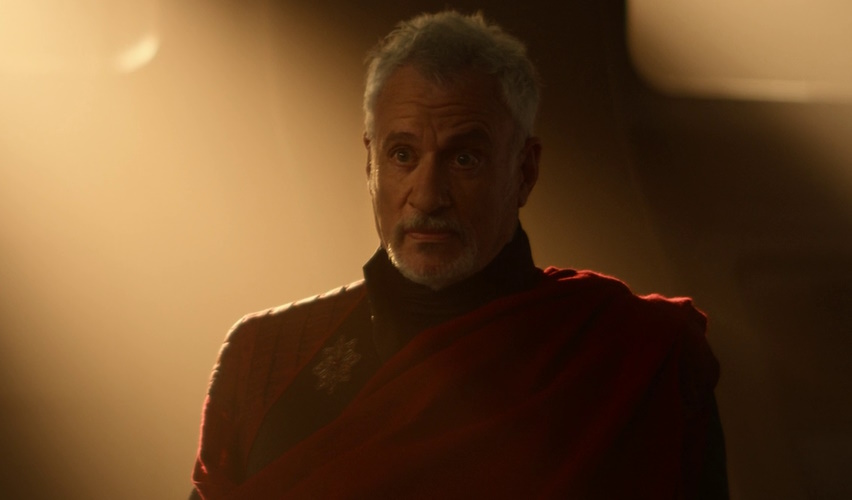
Spoiler Warning: There are spoilers ahead for Star Trek: Picard Seasons 1-2. Spoilers are also present for the following Star Trek productions: The Next Generation, First Contact, Nemesis, and Voyager.
After such an incredibly strong start to Season 2 last week, there was almost nowhere left for Penance to go in terms of action and excitement! But the season continues in strong form with another excellent episode, one with a very different tone to its immediate predecessor.
After the explosive end to last week’s episode, Picard and the crew of the Stargazer found themselves transported – as if by magic – to a strange, twisted reality, one in which the human-centric Confederation reigns. But the surprising thing they learned (which had essentially been explained already in the trailers and teasers) is that this isn’t some alternate reality or parallel universe, but rather the prime universe after something or someone had changed the past.
Seven, Elnor, Raffi, and Picard reunited in the Confederation timeline.
The Confederation definitely strayed into Mirror Universe territory with its militaristic aesthetic, demagoguery, and clear love of violence, but I actually found it more interesting to watch as a viewer than practically any story set in the Mirror Universe. There’s one key reason for that, I think: practically all of the characters we spent time with in Penance were from the original timeline, meaning that the actors were playing their familiar, more complex and nuanced roles.
One of my primary complaints about the Mirror Universe in practically all of its appearances, from The Original Series right through to Discovery, is that it feels like hammy, over-the-top pantomime. It’s a setting that’s written in such a way that it tricks even great actors like Sonequa Martin-Green into putting in incredibly poor, one-dimensional performances as their Mirror Universe counterparts, and I think if we’d had to spend a lot of time with Confederation Picard or Confederation Rios, we could’ve been in a similar position in Penance.
Sticking with our established characters – and not their alternate counterparts – was good for Penance.
Luckily that didn’t happen, so what we got is a genuinely interesting setting – it’s the Mirror Universe but also not the Mirror Universe at the same time. Q even used the familiar expression “through a mirror, darkly” (a riff on a similarly-titled Enterprise episode!) to describe the Confederation timeline, and similar themes of presenting our characters with a dark, twisted version of reality are present here, just as they are in the Mirror Universe.
In this case, though, it’s arguable that Picard and the crew might feel worse about how things have turned out. In the Mirror Universe, we’re dealing with similar-looking but very different people; dark counterparts to our familiar characters. But the Confederation timeline aims to say that Picard – our familiar Picard – would have behaved this way if he’d been born and raised here. Picard is confronted not with a doppelgänger, but with an alternate version of himself.
A recording of the Confederation timeline version of Picard.
This isn’t the first time we’ve been here with Picard, if you think about it! In Nemesis, Picard had to deal with a clone of himself, and at one point in the film he came to the realisation that, if he had led the life that Shinzon had, he’d have turned out exactly the same way. Here, in the Confederation timeline, Picard must deal with the fact that this version of himself has been such an all-conquering general, subjugating alien races and bringing a xenophobic, human-centric ideology to the galaxy.
Speaking of “all-conquering,” something I’d be very interested to learn more about is the Confederation’s conquest of the Borg. Dr Jurati specifically stated in Penance that the Confederation’s technology is comparable to the Federation’s in the prime timeline, and we saw just last week how completely overpowering the Borg were when facing the Federation. So how did General Picard beat the Borg? And having destroyed literally the entire Borg Collective, why does the Confederation seem to be having such a problem keeping the planet Vulcan under control?
Rios watches the Battle of Vulcan from La Sirena.
It’s possible that this will be explored in more detail in the episodes ahead, and there could be a connection here between the Borg of the Confederation timeline and the Borg in the prime timeline that we saw in The Star Gazer, perhaps. I’d certainly be interested to see a conversation between the captive Borg Queen and Picard on this subject; if she is the sole survivor of her entire people, she would certainly have a thing or two to say to him!
It’s also possible, of course, that the Confederation’s conquest of the Borg won’t be referenced again – and personally, I think that would be a bit of a disappointment. Maybe Picard’s trip back in time – which seems to be coming in the next episode, despite the cliffhanger ending this week – will wipe out the Confederation timeline, and what we saw of it in Penance will be all we ever see. But as I’ve said before, as Trekkies who feel a connection to the Star Trek galaxy, we always want to dig deeper and learn more about this wonderful setting. To brush aside something as potentially huge as the Borg being defeated would be a shame.
Picard comes face to face with the Borg Queen.
Like The Star Gazer before it, Penance revelled in the lore and history of Star Trek. We got our first major references to Deep Space Nine since live-action Star Trek returned to the small screen thanks to mentions of Gul Dukat (also known in this timeline as “Skull Dukat!”) and General Martok; two of General Picard’s defeated adversaries. There was also a reference to one General Sisko, which was awesome! As a big fan of Deep Space Nine, it’s wonderful to see modern Star Trek make reference to it.
I doubt that we’ll see anyone from Deep Space Nine on screen this season, but the callbacks were definitely appreciated. Aside from Sarek, though, the conquests Q showed to Picard weren’t really characters or villains that I’d have associated very strongly with Picard himself. There was scope to reference someone like Dathon, the Tamarian captain from the episode Darmok, who has a stronger association with Picard than the likes of Gul Dukat or General Martok – characters we never saw him meet on screen. That’s not to be critical, though – I adored the Deep Space Nine references and for something relatively minor that most viewers won’t have thought twice about, it was a great way to include a couple of references to this part of Star Trek!
Confederation Picard was quite the collector of skulls, apparently!
Was it a little bit of a contrivance that the characters were all able to find each other so soon after their arrival in this new timeline? And if we get really nitpicky about it, shouldn’t they have considered the possibility that someone else might’ve found themselves transported there too? Captain Rios didn’t seem to even consider looking for any of his officers or crew from the Stargazer, for example. It didn’t cross my mind during my first time watching Penance, but as I was going through it for a second time it gave me a moment’s pause.
That being said, I liked very much that the characters were all split up after their arrival in the Confederation timeline. Although we can call it somewhat of a contrivance that they were able to contact one another and get back together within a single episode, the fact that they all found themselves in different places, occupying very different roles, was something that Penance pulled off very well considering that it all had to be done in the runtime of a single episode.
Elnor, shortly after his arrival in the Confederation timeline.
Around the 23-minute mark, when Elnor has been cornered by Confederation security forces, there was a very odd visual moment where one brief shot looked very different – and of significantly lower quality – to the others. It hardly ruined the episode, but it was noticeable even on a first viewing that this one shot of Elnor didn’t look right. It seemed as if it was using a green screen and the shot had been spliced into the episode at the last minute.
Other than that, though, the visuals, CGI, and other special effects in Penance were outstanding. The battle Rios found himself engaged in over Vulcan was one of the most fast-paced that the Star Trek franchise has ever shown, and it had almost a Star Wars starfighter feel, as other ships of La Sirena’s class fought against Vulcan ships that drew on designs from Enterprise for their visual inspiration.
La Sirena and other Confederation ships battling Vulcans.
So let’s talk about Q: what could be going on with him? Picard seemed to think that there was something wrong; the implication being that Q, like Picard, is coming to the end of his life, perhaps? I’m not sure if this is the route the story will go, though, and I have a couple of theories that I’ll expand on in my next theory post. It was definitely a change to see a more aggressive, less jovial characterisation of Q, though. For all the puzzles and tricks Q has laid for Picard in the past, he never treated any of them in the same way as he did here. If I didn’t know better, I’d say that Q was angry.
Could the root of this anger be a sense of disappointment that Q feels in Picard? When Season 1 kicked off, Picard had been in self-imposed isolation on his vineyard for more than a decade, having chosen to resign from Starfleet and cease participating in Federation and galactic affairs. As someone Q had taken a very strong personal interest in, could Q have taken that decision personally? Could he have felt that Picard was failing to live up to the potential that Q initially believed him to have? If so, perhaps that might explain Q’s attitude in Penance.
Why is Q so grumpy?
When I put together a list of episodes that I felt could be good background viewing for Picard Season 2, I deliberately included stories like Q Who, Tapestry, and All Good Things. These episodes I feel encapsulate the Q-Picard relationship; the adversarial but not villainous nature of Q, the way Q sees himself as a guide, the way Q has even tried, in his own twisted way, to help Picard. All of these things feel quite far removed from the way Q appeared in Penance, but as we almost certainly haven’t seen the last of him this season, I’m sure we’ll learn more about Q’s role and motivations.
We don’t even know for certain at this stage that it was Q who damaged the timeline. At most, I think we can say with reasonable certainty that Q used his powers to ensure that Picard and the rest of the crew were aware of the change that transpired, but the question of his guilt – or the extent of his complicity in these strange events – is still open.
Q and Picard at Château Picard.
Just like Sir Patrick Stewart makes it feel as if The Next Generation never ended, John de Lancie stepped back into the role of Q seamlessly. Yes, there’s a noticeable change in the way Q was characterised in Penance, but the performance was outstanding and hit all of the right notes for bringing back the Q that we remember. I’m thrilled to have Q back, and right now I’m genuinely curious to see where this new timeline and history-changing event go!
Dr Jurati provided some darkly comedic moments in Penance, and was strangely relatable. We’ve seen her anxious babbling before in Season 1; in a similar vein to characters like Discovery’s Tilly she has a tendency to overshare or not know when to stop talking! Those moments with Seven and the Magistrate were funny, but where I found Dr Jurati at her most relatable were her moments of vulnerability. The Borg Queen rounded on her, sensing how she feels like an outsider no matter what timeline she’s in – and I think that’s something a lot of people can relate to.
Dr Jurati provided both comic and relatable moments this week.
Feeling like an outsider, feeling like your “friends” aren’t really your friends, and so-called imposter syndrome are all things that any of us can feel at different points in our lives, but speaking as someone who is neurodivergent, I think it hits home in a different way. It seems like Penance is setting up a story about manipulation using Dr Jurati’s natural insecurities as a base, and we could see a very interesting allegory play out in future episodes, taking this complex dynamic between Dr Jurati and the Borg Queen to different thematic places.
Notable by her absence was Soji. If this Confederation timeline only has basic F8-type synths (as we saw with Harvey at Picard’s vineyard, for example) then it’s not inconceivable to think that Soji may not exist at all. However, if Q’s statement to Picard about him being given a synthetic body in this timeline is correct – and we have no reason to think he’s lying about that, necessarily – then obviously the synth-creating process had reached the same level, and thus Soji may exist!
Harvey the synth.
With Picard and the crew being prevented from going back in time in the closing seconds of Penance, I wonder if next week we’ll see Soji make an appearance. Otherwise she seems set to miss the entire adventure – and that would be a shame. Soji was a huge part of Season 1, but noticeably didn’t appear in a big way in any of the pre-season trailers and teasers. I wonder if that’s because she’s going to take on a different appearance, or whether there’s something even bigger going on with her that we don’t know at this stage. Time will tell!
Where The Star Gazer had deliberately embraced many different 24th Century Star Trek design elements, Penance was striking out in its own direction, trying something new. There was a definite “Mirror Universe” feel to some of it, but even then the Confederation felt distinct. The scenes with Raffi and Elnor definitely honed in on a very specific kind of dystopia – the police state – that we haven’t really explored in the Mirror Universe before, and it felt shocking and frightening as a result. The way that the sequence with Elnor immediately preceding his arrest was filmed was incredibly claustrophobic, and did an excellent job at communicating just how different this new timeline is.
Elnor and Raffi.
Penance leaned into the “fish out of water” angle with most of its characters, too. Seven’s husband – the Magistrate – seemed to catch on very quickly that something wasn’t right, and kept her and everyone else under suspicion the entire time. Having him watching over her shoulder, and getting too close for comfort to Dr Jurati, Picard, and everyone else was successful at keeping the tension high, and Jon Jon Briones – father of Isa Briones, who plays Soji – put in a riveting performance as a villain. He was perfect for the role, and when he materialised on La Sirena at the end of the episode, it felt like the culmination of a wonderful performance that managed to be menacing and disconcerting but without ever falling into the Mirror Universe trap of hammy over-acting.
As a cat lover, Spot-73 was incredibly cute! Actor and comedian Patton Oswalt brought a lot of life to the cute animated critter, and although we didn’t get a lot of time with Spot-73, those moments were cute, funny, and also set up the apparent loneliness and isolation felt by this timeline’s version of Dr Jurati – something that, as noted, the Borg Queen was able to hone in on.
Tell me I’m not the only one who wants a Spot-73!
Does Laris’ apparent death in this timeline mean she won’t accompany Picard back in time? I had thought we might see more from her this season! It was clearly a moment that affected Picard greatly, and really hammered home just how different – and evil – this timeline’s version of the character is. Laris’ death also gives Picard an added motivation; he now has someone to save, and someone to get back to if he can save the future. Establishing their closeness last week was paid off in a very different and unexpected way here.
Overall, I had a great time with Penance. I don’t think it’s necessarily fair to compare it directly with The Star Gazer; the two episodes are doing entirely different things, and both achieve the feelings and objectives that they were clearly aiming for. Purely subjectively, because of things like the design of the USS Stargazer and the excitement of the Borg’s return, I would probably say I had more fun last week – but Penance was an interesting exploration of a very different timeline, and also managed to include a lot of Star Trek references!
The Magistrate at the end of Penance.
I have so many questions – and the story feels very unpredictable right now. Two episodes in and we’ve seen most of the scenes from the trailers already, with the exception of some of the 21st Century clips. The pre-season marketing did a great job of teasing just enough about the story to get fans interested and excited, but without spoiling big reveals like the Federation fleet, the USS Stargazer, and other key story elements.
There’s a lot to look forward to as Picard Season 2 finds its feet! Will Elnor survive his injury? What will the Magistrate do next? I can hardly wait to find out!
Sorry for the delay in getting to this review! With two episodes of Star Trek premiering within hours of each other (on Fridays in the UK, remember) writing two big reviews is a lot. This weekend I was also building my new computer, something that cut into my writing time quite a bit too. But it’s here now – and stay tuned for my weekly theory updates, too!
Star Trek: Picard Season 2 is available to stream now on Paramount+ in the United States, Scandinavia, Latin America, and Australia, and on Amazon Prime Video in the United Kingdom and the rest of the world. The Star Trek franchise – including Picard and all other properties mentioned above – is the copyright of Paramount Global. This article contains the thoughts and opinions of one person only and is not intended to cause any offence.
Spoiler Warning: There are spoilers ahead for Star Trek: Picard Seasons 1-2. Spoilers are also present for the following Star Trek productions: The Next Generation, Deep Space Nine, First Contact, Voyager, and Discovery.
Wow. What an amazing season-opener The Star Gazer was! Usually I watch each new Star Trek episode once, then once more while working on my review, and then I set it aside for the time being – there are other things to watch, after all! But I’ve seen The Star Gazer five times already; I can’t stop myself going back and watching it over and over again!
Last week I kicked off the Picard Season 2 theory list, bringing together all of my main pre-season theories. I had expected The Star Gazer to debunk some of them right off the bat, but to my surprise I don’t think any of them were. There are certainly some theories that now seem very unlikely, and one that may be debunked in the next episode when we spend more time with Q, but for now, all of them remain in play.
There were a few new theories that The Star Gazer kicked off, too, so they will be added to the list this time.
Theory #1: The Borg Collective was badly damaged in the Voyager episode Endgame and has been unable to recover.
Dr Jurati decoded the Borg message.
In The Star Gazer, it seemed as if the Borg Collective was reaching out, asking the Federation – and Picard specifically – for help. If so, the question is why? Was it just a shallow ploy to launch another attack on Starfleet? Or is there at least a degree of truth to the Borg’s request?
Endgame, the final episode of Voyager, depicted a time-travelling Admiral Janeway introducing a neurolytic pathogen – a type of virus – into the Borg Queen, seriously damaging her, her base of operations, and several Borg vessels in the vicinity. Because the Borg hadn’t been seen since – until The Star Gazer, that is – we never got to learn just how deadly Admiral Janeway’s actions were.
Admiral Janeway in Endgame.
I’ve always assumed that the Borg Collective is vast enough, powerful enough, clever enough, and most importantly adaptable enough that Admiral Janeway’s actions weren’t going to strike a fatal blow. Whatever damage she had done seemed like something the Borg could eventually fix – and their existence 25 years later during the events of The Star Gazer seems to prove that. The Borg’s technology and weapons are still streets ahead of anything Starfleet has at its disposal… but even so, it’s still possible that the Borg are on their last legs facing defeat.
If that’s the case, maybe we’ll discover that it was Admiral Janeway who’s responsible – that her actions in Endgame are either wholly or partly to blame for the Borg’s weakened state. Dr Jurati seemed to know that the Borg Collective isn’t as strong as it once was, so that could be another clue pointing to this theory.
Theory #2: The Borg are fighting a war – and losing.
The Borg vessel identified as “Legion.”
This theory could go hand-in-hand with the one above, but it could also stand on its own. In short, an alternative explanation for why the Borg are in a weakened state at this moment in time is that they’re fighting a war – perhaps against a race like the super-synths from Season 1 – and are being badly beaten. Their request for help could be genuine if they’re facing an existential threat, and the super-synths from Season 1 are one of the very few factions in all of Star Trek that could be more powerful than the Borg.
We’ve seen a similar narrative play out in Voyager with the Borg-Species 8472 war. That conflict served as Seven of Nine’s introduction, and it could be interesting if a similar story were in play here, given Seven’s involvement in the story. If the Borg are being attacked, that would also raise a number of questions for Starfleet: who is attacking the Borg? Why are they doing it? And could they be coming for the Federation next?
Theory #3: The Borg are aware that Picard is now a synth – and his synthetic status is part of the reason why they waited until now to make contact.
Picard awakened in a new synthetic body in Et in Arcadia Ego, Part 2.
The timing of the new Borg incursion is interesting, especially considering that they asked for Picard by name. Are they aware of his newfound synthetic status? And if so, could Picard’s transition to a new synthetic body be the reason why the Borg chose to launch their attack?
The Borg seek “perfection” through a synthesis of organic and synthetic components, and while Picard’s new synthetic body is a far cry from the Borg drones we’ve seen, the idea of an organic mind in a synthetic body isn’t a million miles away from that same basic idea. Although Picard’s body was said to be comparable in practically every way to his original one, synthetics can have enhanced abilities that allow them to easily overpower humans – and, as we’ve seen with Data on more than one occasion, they can outmatch individual Borg drones as well.
A Borg drone losing a fight against Data.
Perhaps the Borg want to re-assimilate Picard now that he’s synthetic. If the Collective is still reeling from the damage inflicted upon it by Admiral Janeway or if they’re on the losing side of a war, perhaps they hope to use fully-synthetic bodies like Picard’s to replace damaged or destroyed drones, or as cannon fodder on the front lines. There are many reasons why the Borg might be interested in synthetic technology, and that could explain their re-emergence.
Even if the Borg don’t plan to assimilate Picard or the Coppelius synths, the timing of their appearance is certainly interesting and there could be a connection.
Theory #4: The masked, hooded figure from The Star Gazer is not the real Borg Queen.
The Borg Queen?
The Borg Queen – the hooded figure who materialised on the bridge of the Stargazer – was absolutely terrifying, evoking feelings for me that the Star Trek franchise hasn’t hit in decades. The way this character was presented, with her shrouded face, flowing robes, monochromatic aesthetic, and blend of humanoid and decidedly non-humanoid mechanical features was simultaneously riveting and frightening!
This character was presented as the Borg Queen in the episode, and the Borg have no reason that we know of to lie about that. But at the same time, she was very different not only from how we’ve seen the Borg Queen in past iterations of Star Trek, but she also looked very different to clips we’ve seen in trailers and teasers for Season 2. Could it be that this character will be revealed to be somebody else?
Theory #5: The masked, hooded Borg is Admiral Janeway.
A Borgified Janeway as seen in Voyager.
This theory could apply whether the Borg on the Stargazer is the Queen or not! Admiral Janeway was assimilated by the Borg Queen as part of her plan to introduce a neurolytic pathogen into the Collective, and appeared to have been killed when the Borg Queen’s complex exploded. But is there a way she could have survived?
Her assimilation could have been a turning point for the Borg. She did untold damage to the Collective, but also potentially gifted them knowledge and information about future events and technologies that were decades ahead of their time. Just like the Borg once chose Captain Picard to become Locutus – their “spokesperson” or representative – perhaps they might have chosen Admiral Janeway to fill a similar role during this latest incursion. Admiral Janeway could even have been incorporated as part of the Borg Queen.
Theory #6: The season will end on a cliffhanger.
Because Seasons 2 and 3 went into production back-to-back, that made me wonder if they might form one continuous story – or if the final act of Season 2 might set up the story for Season 3. Star Trek has a long history of season-ending cliffhangers, such as The Best of Both Worlds in The Next Generation, Equinox in Voyager, and Such Sweet Sorrow in Discovery, to give just three examples.
Something in The Star Gazer could be relevant, though. If the story we’re going to see is all about restoring the correct timeline and undoing whatever damage has been done, then assuming Picard and co. succeed in their objective… won’t that place them back on the bridge of the Stargazer just as it’s about to self-destruct? If that’s the case, maybe it won’t happen this season and will instead be the finale of Season 3, with Season 2 ending on a cliffhanger at the story’s halfway mark.
Theory #7: By restoring the timeline, Picard – and everyone aboard the Stargazer – will die.
The USS Stargazer self-destructs.
As far as we know based on what’s been teased and shown off in various clips and trailers, a big part of the storyline this season will be undoing whatever damage was done in the 21st Century and restoring the true timeline. But if that happens, and the timeline is fully restored, that means that Picard, Captain Rios, Dr Jurati, and Seven of Nine will be on board the USS Stargazer when it self-destructs. Raffi and Elnor will be aboard the USS Excelsior in the same moment – and their ship could be destroyed as well.
If this story turns into a two-season arc, perhaps the final episode of Season 3 – which is rumoured to be the end of the show entirely – will see Picard and the crew restore the timeline, only to spend their final seconds aboard the Stargazer before it’s destroyed. This would be a bittersweet ending – to say the least!
Theory #8: In the changed timeline, Picard is no longer a synth.
Picard in the new timeline.
The circumstances leading to Picard becoming a synth seem like they’re unique to the prime timeline. The mission to Coppelius, the development of synths in secret by a small group of cyberneticists, and the way in which Picard befriended synths from Data to Soji all contributed to his “rebirth” in a new synthetic body at the end of Season 1. It’s not impossible for something similar to have happened in the alternate timeline in which he now finds himself… but I’m not sure how likely it is, either.
This could be an interesting inclusion – Picard was dying due to an unnamed brain condition, and if he isn’t a synth in the new timeline, he may not have very long left before he succumbs. This could add a timer to his new mission – if he can’t figure out a way to restore the proper timeline, it could cost him his life, and if he dies, it may never be possible to “save the future.”
Theory #9: The USS Stargazer will make an appearance.
The original USS Stargazer.
Okay, technically the USS Stargazer has already appeared, but not in the way I expected! Captain Rios is (or was) in command of a new USS Stargazer, and not only that but he had a model of the original vessel in his conference room! So that’s it. Theory confirmed, everybody can move on to the next one!
Just kidding. The inclusion of a brand-new USS Stargazer brings the ship and its legacy back to the fore. Picard himself commented in The Star Gazer that the original vessel was his first command, and as far back as Season 1 we had a reference to his time in command through the character of Dr Benayoun. All of these things could be leading to some bigger role for the original USS Stargazer – and with a story that seems to include time travel and a strong focus on Picard’s own personal history, a flashback or even a visit to the ship could be on the agenda!
Theory #10: Q is not responsible for changing or damaging the timeline.
Q.
Right now, this theory feels like it’s on thin ice! But I don’t believe it’s been debunked just yet, so we’ll keep it on the list for now. As the USS Stargazer self-destructed, Picard awoke back at his vineyard – but in a different timeline, one that seemingly has seen a “totalitarian state” rise on Earth. Q appeared almost immediately, and given his abilities, changing the timeline is something he’s more than capable of doing.
But I’m not convinced – at least, not yet. What would Q’s endgame be if he did change the timeline? Q has often been challenging and even adversarial, but as I’ve argued in the past, the role of an out-and-out villain doesn’t suit him nor describe his past appearances in Star Trek. I feel that there must be more to the story – after all, we can’t have had the entire premise explained before the first episode even aired, can we?
Picard and Q have a complex relationship.
Q has previously seen himself as a friend, guide, and ally to Picard – even though the feeling is clearly not mutual! But even if Q wanted to hurt Picard or get back at him, would he do it in this manner? Would he completely change and even erase centuries’ worth of history for the sake of one person? There are a million ways that Q could mess with Picard without changing literally the entire timeline.
There are also other factions who might want to change the timeline for their own purposes. Last season’s antagonists, the Zhat Vash, are just one possible candidate. In short, I think there could be more to Q’s role than we’ve been led to believe, and that he may not be responsible for whatever change or damage has been done.
I have a longer article that goes into more detail about this theory that I wrote before the season premiere, and you can find it by clicking or tapping here.
Theory #11: Q shielded Picard and the crew from changes to the timeline.
Q with Picard in one of the pre-season trailers.
One way in which Q could be involved would be to have protected Picard – and his new crew – from changes to the timeline. There are many reasons why he might do this, and it could apply regardless of whether Q changed the timeline himself or not. If the entire timeline has been changed going back centuries, there has to be a reason why Picard and the crew of La Sirena are seemingly the only ones unaffected – and one explanation for that could be “Q’s magic.”
This would be in line with how we’ve known Q to operate. Episodes like Tapestry and All Good Things saw him use his powers to place Picard in an alternate life while retaining his original memories, and to move between three different time periods. Such a power is something we know Q can use, and it would explain two key things: how Picard and the crew of La Sirena remained unaffected, and how Q is involved in the story.
Theory #12: Who is responsible for damaging the timeline, then?
Did the Borg do it?
If Q isn’t the one who changed the timeline, the obvious question that raises is “who did it?”
In theory, it could be any one of a number of different Star Trek factions. We’ve seen the Klingons having access to time travel in the early 25th Century, for example, in the Voyager episode Endgame, and various time travel stories and stories depicting powerful alien races could all theoretically yield suspects. But considering what we know about Star Trek: Picard specifically, in my view the main suspects are as follows:
The Borg. The Borg could be one of the season’s main antagonists after their emergence in The Star Gazer, and we’ve seen in past iterations of Star Trek that they can travel through time.
The Zhat Vash. While the Zhat Vash may not have been shown to possess time travel tech, they were the primary antagonist last season, and arguably were not defeated in the Season 1 finale.
How about the Zhat Vash?
The super-synths. The super-synths from the Season 1 finale are a wildcard; we don’t know much about them except that they seem to be technologically powerful. Travelling back in time might be on their agenda – but erasing the prime timeline could result in the erasure of the Coppelius synths.
The Romulan government or the Tal Shiar. With or without the support of the Zhat Vash, the Romulan government could have taken action against the Federation in response to the events of Season 1.
There are undoubtedly other Star Trek factions who could be implicated, and if we had a free choice we could suggest the likes of the Dominion or the Sphere-Builders. But I think those are far less likely when considering the elements Picard has brought on board.
Theory #13: The loose ends from Season 1 will be tied up.
Will we learn Narek’s fate?
The Star Gazer already crossed off two things from the list of Season 1 leftovers! Dr Jurati’s legal status was clarified, as was her relationship with Captain Rios. There are still a number of points that I’d like to see addressed before the season ends, though, as Season 1 unfortunately left quite a lot of story on the table thanks to a rushed and underwhelming finale.
Here are the main ones:
What will become of the synths on Coppelius, and will they have to be relocated for safety?
Did Starfleet attempt to visit Aia and shut down the beacon at the centre of the Zhat Vash’s prophecy? Leaving it out in the open seems dangerous.
Will Starfleet contact the super-synths and attempt to make peace or convince them that they pose no threat?
The Artifact’s resting place on Coppelius.
Why did Bruce Maddox go to Freecloud?
With the Zhat Vash plot exposed, what will become of their crusade against synthetic life?
Did Federation-Romulan relations suffer as a result of the Zhat Vash’s attack on Mars and attempted attack on Coppelius?
What happened to Narek after he was captured by the Coppelius synths?
Who controls the Artifact and what will happen to the surviving ex-Borg?
Theory #14: Laris will join Picard’s mission back in time.
Laris in The Star Gazer.
I feel a bit sorry for Zhaban, who died off-screen in between Seasons 1 and 2. But with Picard and Laris growing closer and having a complicated relationship, I don’t think she’ll just be left behind as she was last time. Orla Brady, who plays the character, is now credited as one of the main cast, so I think we’ll see a lot more from her this season.
Trailers and teasers seem to show that Picard and the crew of La Sirena from Season 1 are unaffected by the changes to the timeline. Perhaps Laris will be similarly unaffected and will be able to reunite with Picard – or maybe Picard will have to ask Q to snap his fingers and bring her back to him. With a mission back in time on the agenda – and possible Zhat Vash or Romulan involvement – Laris could be an important ally to bring along.
Theory #15: The Federation is responsible for creating the Borg.
The Borg vessel using a transporter-weapon on the USS Stargazer.
This is a total wildcard, but I’m just throwing it out there!
The Borg Queen – and the Borg in general – appear to have a fascination with humanity and with Picard. Could it be that the explanation for that is that the Federation and/or humanity are somehow responsible for their creation? With time travel on the agenda, it’s not impossible to imagine a scenario in which the progenitor of the Borg – perhaps even the Queen herself – is able to travel back in time, founding the Collective.
Nanites used by the Control AI.
The idea that the Federation is responsible for creating its own worst nightmare could be an interesting one if executed well, as could the cyclical nature of such a story. It would have to be handled in just the right way to avoid treading on the toes of previous Borg stories, but it feels like a lot of the pieces exist for this theory to seem plausible. The return of the Borg, the inclusion of Q, and even the talk of Picard and humanity needing to pay a “penance” could all be connected.
Discovery Season 2 ran a story with the Control AI that could have also been a Borg origin story. Was it known as early as 2018-19 that Picard wanted to tell a story like this, and if so, could that explain why the Control storyline ended the way it did? I have a write-up of Discovery’s abandoned Borg origin story that you can find by clicking or tapping here.
So those theories are new or saw movement this week.
To keep the theory list easier to manage and update, I’ll recap all of the other theories that are still in play. These theories saw little or no movement in The Star Gazer, but remain possible.
Theory #16: At least one character from The Next Generation will make an appearance.
The cast of The Next Generation in Season 1.
With the return of Guinan and Q, as well as Voyager’s Seven of Nine, there are already a lot of returning characters in Picard Season 2! But that doesn’t mean that there isn’t room for a well-placed cameo or two, or even an episode like Season 1’s Nepenthe that steps away from the main story to revisit classic characters. We could even have a bit of fun with some alternate timeline versions of them!
There are so many characters from Star Trek’s past that I would love to spend more time with; listing them all here would be impossible! But if Picard is to end with Season 3, as some outlets have been reporting, it would be fantastic if the crew of The Next Generation could reunite one last time.
I have a list of possible character crossovers that I wrote back in 2020, before we got to see any teasers or trailers, and you can find it by clicking or tapping here.
Theory #17: Guinan will be aware of the shifting timelines.
Picard and Guinan in The Star Gazer.
The pre-season trailer and clips of Guinan all seemed to be taken from the sequence in The Star Gazer in which she and Picard shared a drink and discussed his love life. That could be Guinan’s sole appearance, but it’s also possible that she could have a role to play later on in the story.
The Next Generation Season 3 episode Yesterday’s Enterprise showed us that Guinan has an ability to perceive changes to the timeline. She can’t always put her finger on exactly what’s changed, but she is more likely than anyone else to be aware that something has changed. Given the similarities between the Yesterday’s Enterprise situation and what seems to be going on this season, perhaps Guinan will be aware of what’s happened and will be able to advise Picard.
Theory #18: Romulans are spying on Earth in the 21st Century… and could be time-travelling Zhat Vash.
A young boy encounters a Romulan or Vulcan.
In the third trailer, a young boy wearing what seemed to be 21st Century clothing was seen encountering a Romulan or Vulcan. If the Zhat Vash are involved in the new season’s story somehow, perhaps this individual is a Zhat Vash operative. This could confirm that the Zhat Vash were able to travel through time, or send a message back in time to their 21st Century counterparts. The Romulans had achieved interstellar flight centuries earlier, so travelling to Earth to spy or place operatives seems plausible for them.
Of all the scenes we’ve glimpsed so far from Season 2, the one with the young boy and the Romulan or Vulcan is the one that I’m least sure about! It doesn’t seem to fit naturally into a story about the Borg, Q, and time travel… but this is one theory that could make sense, and would connect to the theory above about Q not being to blame.
Theory #19: The Vulcans are on Earth in the early 21st Century… as stated in Discovery Season 4.
A meeting of senior Federation and allied officials in Discovery Season 4.
Another theory about the unnamed Romulan or Vulcan is tied into the Discovery Season 4 episode The Galactic Barrier. This could easily be a complete overreaction to a throwaway line, but at the beginning of the episode, the enigmatic Federation leader Dr Kovich stated that Vulcans were on Earth for decades prior to official first contact taking place.
This one line could be a reference to Carbon Creek, an episode of Enterprise that saw Vulcans crash-land on Earth in the 1950s. But the timing seems odd given the scene glimpsed in the Picard Season 2 trailers! If the character seen above is a Vulcan, perhaps there will be a connection of some kind between Discovery and Picard.
Theory #20: Picard and the crew will have to actively trigger World War III to save the future.
World War III soldiers as glimpsed in Discovery Season 2.
Although the Bell Riots are the main event of 2024 that we know about in Star Trek’s internal timeline, the 21st Century was arguably dominated by another event: World War III. The war may have kicked off as early as 2026 (as suggested in The Original Series) and concluded by the mid-2050s as seen in First Contact. The “post-atomic horror” that followed was the backdrop for Q’s trial in Encounter at Farpoint.
World War III is integral to Star Trek because without it, it’s hard to see how warp drive would’ve developed and how humanity would’ve made peaceful first contact with the Vulcans. Just like the end of the Second World War brought about major technological and societal changes that ultimately made the world a better place, Star Trek’s World War III is integral to the events that led to the founding of the Federation. If it were prevented, the timeline would change dramatically.
So my theory is that the point of divergence is the outbreak of World War III – meaning that it will fall to Picard to trigger one of the worst wars in human history in order to save the future. Talk about a moral dilemma! You can find a full write-up of this theory by clicking or tapping here.
Theory #21: The “totalitarian state” will be run by Khan and the augments.
Picard in the alternate timeline.
The alternate timeline that is established in Picard Season 2 will see the Federation replaced by a “totalitarian state.” This faction appears to be superficially similar to the Terran Empire from the Mirror Universe (though I hope not too similar, as I’m not the biggest Mirror Universe fan!) At the very least, this faction is not as genteel as the Federation and may be governed in an autocratic, dictatorial style.
Based on his appearances in The Original Series and The Wrath of Khan, we know that this is how Khan governed – or intended to govern – when he held power. It’s possible, then, that the totalitarian state that we’ve glimpsed in the trailers and teasers is led or inspired by Khan, and may be a society in which augmented humans hold power.
This could be supported by the introduction of a new member of the Soong family – played by Brent Spiner. The Soongs were known to have researched and studied human augmentation prior to the 22nd Century. Augmentation could also explain how Picard’s unnamed brain condition hasn’t killed him yet if he isn’t a synth in this timeline.
Theory #22: There will be a connection between the augments and Strange New Worlds.
One of the few things we know about Strange New Worlds at this early stage is that there will be a character named La’an Noonien-Singh. This new character seems to be related in some way to the iconic villain Khan, and if Khan or Khan-inspired augments play some kind of a role in the “totalitarian state,” perhaps that will set up a connection – or even a crossover – between Picard Season 2 and Strange New Worlds.
Theory #23: The “totalitarian state” is an isolationist power.
A portrait of the alternate timeline version of Picard.
Rather than being one part of a Federation, or the conquering force behind an Empire, it seems possible based on what we’ve seen so far that the “totalitarian state” is only comprised of humans on Earth. This could mirror Discovery’s isolationist Earth in the 32nd Century, and it would be interesting to look at the state of the galaxy if humanity remained isolationist and refused contact with other races. There could also be an allegory about some of our current political movements.
It will be very interesting to learn more about this faction. Who exactly it is, how it rose to power, and what role the alternate timeline version of Picard played in its power structure are all open questions at this stage, and I’m very curious to see how it will all unfold!
Theory #24: There will be some kind of crossover with Star Trek: Discovery.
The USS Discovery in the Season 4 episode Anomaly.
One thing that I find a little odd right now is the scheduling of Picard and Discovery. For three weeks, the two shows will be broadcast on the same day, which doesn’t make a lot of sense when you consider that 1) they’re shows with relatively short seasons, and 2) Paramount+ is a streaming platform. Does that mean there’s a glimmer of hope for some kind of larger-scale crossover than either show has attempted so far?
I suspect I’ll be proven wrong on this one, and that it’s simply due to the inexplicable nonsense that we’ve come to expect from Paramount+ and parent company Paramount Global. Someone has evidently decided that “Thursday is Star Trek day,” and that’s inflexible no matter what. That still doesn’t explain why Picard Season 2 couldn’t be delayed by a measly three weeks, though – especially with the constipated international rollout of Paramount+ potentially meaning that Strange New Worlds will premiere in the USA weeks or months before Paramount+ arrives in Europe. But we’re off topic!
In short, one possible explanation for the odd scheduling could be because the two shows are planning some kind of crossover event; if so, I’d love to see it! And with time travel on the agenda, anything is possible, right? At the very least, I hope that Picard Season 2 will put in more of an effort to connect with Discovery than happened in Season 1.
Theory #25: There will be a reference to Gabriel Bell or Sanctuary Districts.
Gabriel Bell.
According to the trailers, Picard Season 2 will be paying a visit to the year 2024… but it isn’t the first Star Trek production to visit that specific year! If Picard Season 2 wanted to visit “the modern day,” why not pick 2022 – or 2021 or 2023? 2024 feels like it could hold some kind of significance, and though there have been a couple of other references to events in the 2020s, the Deep Space Nine third season two-part episode Past Tense has already taken us to 2024.
The biggest event that we know of took place in California – the Bell Riots. I don’t necessarily expect to see the Bell Riots depicted all over again, but we could get some kind of reference to Gabriel Bell – the man who led the riots. There could also be mentions of “Sanctuary Districts,” which were areas built to house homeless people that became overcrowded prisons. Given that Picard Season 2 is going to visit the California area, some kind of reference seems plausible.
Considering the current problem with homelessness in some American cities – including in California – it could be an interesting point of social commentary to revisit some of the themes tackled by Past Tense. That episode’s depiction of the 2020s feels a little too close for comfort to the state of the real world, in some respects!
Theory #26: The Borg Queen will be necessary for time travel.
The Borg Queen in one of the Season 2 trailers.
The Borg Queen who appeared on the Stargazer’s bridge may not be the same version of the character that Picard and the crew were seen tangling with in pre-season trailers. One theory I have about the Borg Queen is that she’s a time machine: she was physically present during the events of First Contact, and Borg cubes seem to have a special room with advanced technology specifically for the Queen.
My theory is that the Borg Queen has a unique ability to travel through time, and that this is why Picard and the crew of La Sirena will capture and/or use her. In some clips from pre-season trailers, we seem to see the Borg Queen aboard La Sirena, as well as La Sirena potentially using the “slingshot method” of time travel.
Theory #27: Dr Jurati will unleash the Borg Queen.
The Borg Queen and Dr Jurati.
Sticking with the Borg Queen, we’ve seen several teases and clips that seem to show her on the loose. If this version of the Borg Queen was originally a captive – as the trailers have seemed to suggest – the question of how she was able to break free raises its head. It’s of course possible that she’s smart enough and powerful enough to break out of her confinement on her own, but she might also be able to convince someone to help her.
Dr Jurati is the cyberneticist that we met in Season 1, and she has a real love for all things synthetic. She seems to know a lot about the Borg, including the status of the Collective, and as we saw in Season 1 her fascination and sympathy for synthetic life is a very powerful motivating factor for her – so much so that she was able to break out of her Zhat Vash brainwashing and didn’t harm Soji. Given all of that, perhaps the Borg Queen is going to be able to convince Dr Jurati to let her guard down or even loosen her restraints.
Theory #28: The captive Borg Queen is the same one from First Contact.
The Borg Queen in First Contact.
With the jump to a new timeline, it’s quite possible that First Contact didn’t play out as we remember it! But if there was a Borg incursion led by the Borg Queen, it’s possible that she was captured or her remains were reactivated after her death.
At the end of First Contact, the Queen’s organic components were destroyed by plasma coolant in the Enterprise-E’s main engineering, but her synthetic parts – including her skull and part of her spine – remained intact. Picard appeared to break them at the end of the film, signifying the “death” of the Borg Queen.
However, the Borg Queen returned on several occasions, most notably in Voyager, seeming to confirm that there are multiple Borg Queens, or that the Queen is able to move her consciousness into a new body at will. It’s possible, then, that the captive Borg Queen in Picard Season 2 was found elsewhere, such as aboard the Artifact. But it’s also possible that the Queen from First Contact was not totally dead, and has been revived or reactivated in the years following the events of the film.
Theory #29: Elnor will be assimilated.
Raffi and Elnor.
This theory stems entirely from a clip glimpsed in two of the recent trailers! In the image above, Elnor can be seen clearly injured with Raffi by his side. What’s interesting to note, though, is the eerie green light – green is a colour that has a strong association with the Borg. Could it be that Elnor has been attacked by the Borg Queen and is in the early stages of being assimilated?
That was definitely how I interpreted the clip on first viewing! I can’t tell if it’s taking place in La Sirena’s sickbay or somewhere else, though. Regardless… I hope that poor Elnor survives whatever’s happening to him! There are ways of surviving or reversing Borg assimilation, so there’s hope for Elnor even if the worst comes to pass.
So that’s it!
The Borg Queen.
Season 2 got off to an incredible and explosive start, and I have high hopes for an excellent and thoroughly enjoyable sci-fi story over the next nine weeks. The Star Gazer set up plenty of mysterious elements, some of which I have absolutely no idea about right now. Will Picard and Laris get together? Is the Borg Queen somehow Picard’s mum? I doubt it on the latter point (or it would be on the theory list) but you never know!
I always like to end these theory lists by saying that I do this just for fun. I enjoy writing, I enjoy Star Trek, and spending more time in this world is an escape and an enjoyable distraction. But for some folks, fan theories can be frustrating or unenjoyable, especially if they get very attached to a plausible-sounding theory that ultimately doesn’t pan out. I have no “insider information” and I’m not trying to claim that anything suggested above can, will, or must be part of Picard Season 2. I fully expect many of these theories to be debunked and for the season to go in wildly unpredictable directions!
Star Trek: Picard Season 2 is available to stream now on Paramount+ in the United States, Scandinavia, Latin America, and Australia, and on Amazon Prime Video in the United Kingdom and the rest of the world. The Star Trek franchise – including Picard and all other properties mentioned above – is the copyright of Paramount Global. This article contains the thoughts and opinions of one person only and is not intended to cause any offence.
Spoiler Warning: There are spoilers ahead for Star Trek: Picard Seasons 1-2. Spoilers are also present for the following Star Trek productions: The Next Generation, First Contact, and Voyager.
It’s been a long road… getting from there to here. Picard Season 1 wrapped up two years ago this month, but thanks to the pandemic it’s taken until now for the show’s second season to be ready. I said over and over again in late 2019 and early 2020 that Picard was the series I’d been waiting for for eighteen years! As a Trekkie who first fell in love with the franchise thanks to The Next Generation, returning to that era and spending more time with Jean-Luc Picard (and other familiar faces) will always be something that gets me excited!
The Star Gazer was beyond fantastic, and by the time the credits rolled I was sitting there with a big stupid grin plastered across my face. Though there were a couple of slightly clunky lines of expository dialogue, the episode was an incredible ride from start to finish, and I’m so pleased that the season’s pre-release marketing managed to keep such a big secret. I went into The Star Gazer completely unprepared for what I was about to experience – and what I found was one of the best episodes of live-action Star Trek that I’ve seen in a long time.
Picard and Laris relaxing at Château Picard.
Picard Season 1 had received some criticism for stepping away from the familiar 24th Century aesthetic that had defined the fifteen-year span that we call The Next Generation era, and the producers and designers have clearly taken all of that on board when crafting Season 2. The brand-new USS Stargazer recaptured that look, moving it along in subtle, incremental ways rather than throwing it out or trying to radically overhaul it. And both the CGI and practical designs used to bring that 24th Century look to life were absolutely perfect. Whether it was the design of the captain’s chair with its trademark cushion gap, the sleek lines of the helm and operations consoles at the front of the bridge, or the return to physical LCARS-based screens instead of an overreliance on holographic interfaces, this ship absolutely oozed “Star Trek” from every pore.
The fleet that assembled to face down the anomaly was also absolutely perfect. The Starfleet armada seen in the Season 1 finale was a copy-and-paste job, a large fleet but one comprised of only a single starship design. Again, the creators and producers took on board feedback provided by fans all around the world and changed things up, bringing to screen a smaller but far more visually impressive assortment of ships. The new design of the USS Stargazer is going to become iconic, I have no doubt, but there were also callbacks to past iterations of the franchise! I spied a Sovereign-class ship, a variant of the Excelsior-class, and at least one other that may have appeared either in Deep Space Nine’s Dominion War or possibly First Contact – alongside several new starships that I didn’t recognise. These ships all looked beautiful, with outstanding animation work used to bring them to life.
The beautiful and diverse Starfleet armada.
I don’t play Star Trek Online, so I don’t have the same connection that some fans of that game will have to some of the ships that appeared in the new fleet, but I’m so glad that the creatives reached out to the Star Trek Online team – the game even received a credit at the end of The Star Gazer. I’ve seen on social media that Star Trek Online has done a great job at designing ships – they’re one of the big in-game collectables – so it makes a ton of sense to work together on a project like this. The inclusion of Star Trek Online ships will mean a lot to fans of the game, and I’m so happy to see different parts of the Star Trek franchise linking up in this manner.
The biggest narrative beat that pre-release marketing had managed to conceal was the extent of the Borg’s return. Though the Borg vessel that subtitles identified as “Legion” was seen in the opening titles before it appeared on screen, the way in which the story unfolded was truly spectacular. Firstly, the emergence of a green-tinged anomaly set the scene. Green is a colour we’ve associated with the Borg since their early appearances, so this was the first hint that there could be Borg involvement. I also got just a hint – a feeling, maybe – that the anomaly had a vague resemblance to the beacon/portal that the super-synths used last season. Something about the edges of the anomaly, which were green here, looked at least slightly similar to the red portal seen in Et in Arcadia Ego, though that could just be a standard visual/CGI effect.
The USS Stargazer with the anomaly.
Next came the message being transmitted through the anomaly. It fell to Dr Jurati to clean up the message, which was in fact dozens of identical messages being broadcast all at once, but when she managed to isolate part of it, the voice that came through sounded eerily Borg-like. The distorted, mechanical voice had an inhuman quality, and reminded me of when we’ve heard the Borg send hails in past iterations of the franchise. No one acknowledged that in the moment, but it definitely felt like our second hint!
After Picard responded to the message, a large ship emerged. I’m glad it wasn’t a typical Borg cube; the design of this “Legion” vessel was phenomenal. The mechanical arms and insect-like design made it feel immediately threatening, like some kind of nightmarish monster, and its metallic grey exterior bathed in green light meant that we knew it was Borg long before Seven of Nine confirmed it.
The Borg vessel identified in subtitles as “Legion.”
I absolutely adore the design of this “Legion” ship. There were echoes of the Borg Queen’s complex that we saw in episodes like Dark Frontier and Endgame in the latter part of Voyager’s run, and although the design itself was new, it immediately felt “Borg” to me, and I would think that most longstanding Trekkies would have similar reactions. As with many Borg vessels, “Legion” is huge, towering over the entire Federation fleet that had been sent to meet it, employing a sense of scale that we seldom see in Star Trek outside of the Borg.
While we’re talking about designs, let’s also celebrate the brand-new USS Stargazer! The new ship borrowed from the original Constellation-class design which debuted in The Battle, a Season 1 episode of The Next Generation, but evolved it and took it forward. The familiar saucer-plus-four-nacelles design is still present, but the ship incorporates a number of aesthetic elements seen on vessels like the Prometheus- and Sovereign-classes. Not only that, but it shoots forward beyond those to feel like a brand-new design that’s even more highly advanced than those ships, both of which are now 25 years behind the times!
A front view of the new USS Stargazer.
It’s wonderful that the creative team was able to build new sets for the Stargazer instead of relying on redresses of Discovery’s. On re-watching Et in Arcadia Ego, for example, the bridge of the USS Zheng He is noticeable as Discovery’s bridge – the captain’s chair in particular. So to see a brand-new set making full use of 24th Century design elements was absolutely fantastic. As mentioned, I loved the return to LCARS screens in place of holographic interfaces, and the Stargazer’s bridge felt like what I’d expect and want to see from the bridge of a Starfleet ship of this new era.
There were new uniforms to accompany the new ships and other aesthetic changes, but they were similar enough to last season’s design that I didn’t feel the change was too obtrusive. I had placed the Picard Season 1 designs on my list of my favourite Starfleet uniforms, and this new variant keeps most of the aesthetic elements that I found most appealing about them.
Raffi sporting the gold variant of the new uniforms.
When I first saw the new uniforms shown off in a couple of promotional images, I wondered if they might’ve been a dress variant; they seemed to employ a style that didn’t seem out-of-place when compared to The Next Generation’s dress uniforms, and the fact that the couple of promo images that I saw seemed to feature officers at Starfleet Command could’ve meant that they weren’t the usual uniforms! But it seems that this design has been widely adopted by Starfleet as their main uniform as of the year 2400 (or is it 2401?)
Strange as it may sound, I actually get a bit of a Lower Decks vibe from the uniform jackets. I doubt that was intentional, and the idea of a uniform jacket over an undershirt is something we’ve seen going all the way back to The Wrath of Khan’s “monster maroon” uniforms! The mostly-black affair with coloured shoulders to denote division is neat, and it’s perhaps Star Trek’s most commonly-seen uniform design, having been seen in several seasons of Deep Space Nine, all of Voyager, and the film Generations. The Season 1 uniforms updated that basic concept, and the Season 2 uniforms feel like another iterative step from the same starting position.
The blue science variant as worn by the USS Stargazer’s communications officer.
Of course, having dedicated all of this time to talking about the Borg, the Stargazer, and new Starfleet uniforms, we’re not actually going to be spending a lot of time with them – at least as things stand! So let’s take a look at the episode’s story – because I think it’s one of the strongest season-openers in the Star Trek franchise.
Last season, I wrote that Remembrance was almost certainly the strongest premiere episode of any Star Trek show. It probably even eclipsed Emissary – the premiere of Deep Space Nine – which had been the previous high-water mark. Remembrance was a slow-burn episode with some fast-paced moments. It kicked off the story, but it didn’t introduce every character or every narrative thread, and it played its cards close to its chest. The Star Gazer, in contrast, started with a bang! The sequence at the beginning of the episode was explosive and action-packed, and really gave us a taste of what was to come.
The opening shot of the episode.
The action then jumped back by 48 hours, and it was here that we slowed down and got more of those Remembrance vibes. Picard and Laris at the vineyard, a trip to Starfleet Academy, Picard’s dreams or reminiscences about his mother… all of those slower-paced moments felt great, and stood in stark contrast to the thrilling conflict with the Borg that bookended the episode.
I don’t want to compare The Star Gazer and Remembrance and try to say which was better. I don’t think there’s an answer to a question like that – as with other “which was better” questions in Star Trek, the answer to me is that they’re both fantastic in their own ways and both represent different kinds of stories. There’s a time when I want the slower pace of a story like Remembrance, just like there are times when I want other slower episodes or films. Then there are times where I want action and excitement like The Star Gazer delivered, and I don’t think it’s fair to say “this one was better than that one.” Both season openers do what they do exceptionally well, and trying to choose between them is always going to be something subjective. Not only that, but the answer will depend on what I’m in the mood for at a given moment!
Sparks flying and a phaser blast during the action-packed episode.
In terms of The Star Gazer itself, the episode naturally put Picard at its centre, but all of the other main cast members got something to do. The only character who felt somewhat off to one side was Soji, who seemed to be taking part in some kind of diplomatic mission. I couldn’t tell if her Federation emblem combadge – which, by the way, is an awesome concept – means that she’s working for the Federation directly, or whether her mission to the planet Raritan IV was on behalf of the synths from Coppelius.
The callback to the Deltans – a race not seen since The Motion Picture over forty years ago – was a neat one, and it was nice to see them make a return. Like the reference to the Kzinti last season, Picard is drawing on some of the lesser-known parts of Star Trek’s canon. It’s possible that Soji is looking for a permanent home for the synths; she mentioned that “we” – i.e. she and someone else or a group – had been touring the galaxy since the ban ended, and with the unclear status of the Zhat Vash and Romulan attitudes to synths, it’s at least possible, in my opinion, that the synths might’ve had to leave Coppelius in order to keep themselves safe.
Soji and the Deltans.
After their adventures with Admiral Picard, and the discovery of what really happened during the attack on Mars and aboard the USS Ibn Majid, both Raffi and Rios have rejoined Starfleet. Raffi’s last name – Musiker – was heard aloud for what I believe is the first time, which was pretty neat, and I like the way that Starfleet appears to have accepted them both. Both characters had fallen quite far as a result of what happened to them, but being proven right in Raffi’s case and discovering the truth for Rios seems to have settled them both, and set them on a pathway to rejoining the organisation.
In that sense, both characters have had comparable arcs across the series so far – with significant events taking place in the year or so of time that passed off-screen! In both cases, though, seeing them doing well, feeling stable, and having jobs with responsibility that they could take pride in was incredibly sweet; we saw both at such a low ebb, at points, that it feels fantastic to see how the events of Season 1 ultimately led to something positive for both of them.
Captain Rios and Commander Musiker spoke very briefly.
Dr Jurati’s role is a little less clear; she was wearing a similar Federation emblem to Soji and was clearly working with her as part of her synth-adjacent mission, but in what capacity I’m not sure. She doesn’t seem to have continued to work with Dr Soong building new synths, and the question of whether it’s even possible to continue to build synths without Data’s neurons wasn’t addressed – and may not be any time soon.
Dr Jurati probably got the least successful lines of dialogue in The Star Gazer – her scene at the bar with the unnamed Deltan was very heavy on exposition. Such lines are necessary sometimes, though, and we did get a fair amount of information about Dr Jurati and Rios having broken up and how she’s not in legal jeopardy for killing Dr Maddox, both of which were open questions as the new season began. Given the time-jump (and just how long it’s been in between seasons for casual viewers who may not remember everything that happened) I guess some exposition was inevitable, and it was a short enough conversation to be inoffensive.
Dr Jurati at the bar.
When Dr Jurati and Rios were together on the bridge of the Stargazer, I didn’t really feel the whole “never speak to me again” vibe that she and Soji had just been discussing. Santiago Cabrera and Alison Pill have great chemistry together, but in their moments together on the bridge leading up to the Borg or “Legion” message being received I didn’t really buy that they’ve just been through what sounded like an acrimonious split. Of course it’s possible for couples who have broken up to work together and maintain a level of civility and professionalism – but this seemed to be more than just that; they felt rather like friends. Perhaps it’s teeing up something that will be featured later in the season!
Is it a nitpick to ask why Captain Rios asked Dr Jurati to decode the message instead of giving the Stargazer’s literal communications officer time to do her job? I guess it probably is! And I liked the way the scene unfolded, with Dr Jurati clambering across the bridge in a very non-Starfleet way – still feeling the effects of the drinks she’d been having at the diplomatic reception! The way she cleared up the message and was able to pull out an intelligible voice was pure Star Trek, and reminded me of similar scenes with characters like Uhura and Worf in past iterations of the franchise. The only difference was we got to see a fairly detailed look at what she was doing this time, thanks to a holographic display.
Dr Jurati decoding the message from “Legion.”
Elnor joining Starfleet reminds me of the Nog storyline in Deep Space Nine, and I think it has potential. It certainly wasn’t a direction that I was expecting for his character, but it definitely beats returning to Vashti with the nuns – both as a story beat and, I’m sure, from Elnor’s point of view too! Being the first of his race to enlist could pose unique challenges – particularly in light of the difficult relationship between the Federation and the Romulan Empire/Romulan Free State following the attacks on Mars and Coppelius – and it will be interesting to see if we learn much more about his decision to apply to the Academy, what role he sees for himself in Starfleet, and how his studies at the Academy are progressing in the episodes that lie ahead. Nog found Academy life difficult, at first, as a Ferengi; there’s scope for an interesting story about a clash of cultures, perhaps.
Nog’s journey from petty thief to Starfleet officer was one of the best character arcs in Deep Space Nine – and in all of Star Trek, certainly up to that point in the franchise’s history. Elnor doesn’t start from quite such a lowly place, but it still feels like development for his character. Elnor was occasionally comedic in Season 1 – thanks in no small part to his rather sheltered and unique upbringing – but going to Starfleet Academy and learning new skills could set him up for having more to do in Season 2.
Cadet Elnor.
The only character who arguably regressed at the start of Season 2 was Seven of Nine. She hadn’t fallen back to her Voyager characterisation (thank goodness), but she was definitely back in her role as a Fenris Ranger; a vigilante operating outside of Starfleet’s jurisdiction and with much of the same passion – and anger – that we saw in Season 1. After the mission to Coppelius, I might’ve expected her to be working with the ex-Borg; there were still a number of survivors after the Artifact landed on the planet, and without Hugh or Soji they don’t really have an advocate. Seven of Nine seemed to be moving toward that role at times in Season 1, particularly in episodes like Broken Pieces and Et in Arcadia Ego – but if she did spend time with the xBs, that part of her life seems to be over.
With the Borg returning in what seems to be a pretty major way, there’s scope for the story to return to the Artifact and the xBs. The question of what happened to them is an interesting one that I’d be happy to see explored, and we now also have the idea of Starfleet using Borg technology in their new ships. That particular plot point has already proven to be very important, and I wonder whether we’ll go into more detail about that at some point this season.
Seven of Nine watching the Borg ship emerge.
When I first saw First Contact at the cinema in 1996, the Borg Queen was certainly a villain that I found intimidating. But whether it was in First Contact or her appearances in Voyager, I never had quite the same visceral, fearful reaction as I did to her appearance in The Star Gazer. The cloaked, hooded figure, dressed all in black, was absolutely terrifying, and the designers deserve so much credit for bringing a completely new style to this character. After more than thirty years as a Trekkie, I love that the Star Trek franchise can still evoke such reactions from me – even when returning to themes and characters we’ve seen before. There was something of the Grim Reaper in this robed design, and I think it combined with the mechanical elements to create a truly scary presentation.
The Borg work so well as villains because of how oversized, overpowered, and unstoppable they seem – and The Star Gazer punched us in the face with all of those things. The scale of the “Legion” ship, as previously mentioned, and its design were big parts of that, but the way the Borg Queen herself appeared – how her transporter beam could cut through the shields with ease, depositing her on the bridge, and then how she used her mechanical tentacles to seize control of the ship – all of these things ramped up the fear factor, and for the first time really since Enterprise’s second season episode Regeneration I felt that our heroes were in real danger from the Borg.
The Borg Queen.
Mechanical tentacles are new for the Borg Queen, but they make perfect sense. The Borg are organic-machine hybrids, so giving them abilities and tools that humanoids wouldn’t have is perfectly logical – when you think about it, it’s surprising we haven’t seen something like it before! The look of the Queen’s appendages reminded me of oversized assimilation tubes – the kind we’d often see shooting out of Borg drones’ hands or wrists to assimilate unlucky crew members. And that makes sense given what the Queen was doing – she was basically trying to assimilate the ship.
In the days ahead I’ll have to write up some theories about what’s going on with the Borg. It was implied that the Collective has been weakened – perhaps as a result of the actions of Admiral Janeway in the Voyager series finale, but that wasn’t made explicitly clear. It seems as if the Federation has been able to observe or spy on the Borg since the events of Endgame, at least enough to know that they’re in a weakened state, but whether there’s been any further Borg-Federation contact wasn’t clear either. Have we seen the first hints that the Borg might be on their last legs, though? That’s an interesting thought to consider…
The Borg vessel’s transporter beam attack on the USS Stargazer.
There was definitely something amiss with the Borg, and not just their claim to wish to speak with Picard or to join the Federation – a ludicrous idea, surely? I got the sense that this was some kind of desperation play on the Borg’s part, not only because of what their message said, but because of the way the Borg Queen was said to be stunning, rather than killing, the crew of the Stargazer. Whatever she was trying to do, she wanted to stop the security team interfering – but either lacked the will or the strength to kill them. Were they being stunned to be assimilated later? Or were they being stunned, not killed, as some kind of gesture of goodwill?
Even if we are dealing with a vastly weakened Borg Collective, they still possess technology that can outdo anything the Federation has. And we got a payoff, of a sort, to one of the big storylines from last season – the use of Borg “parts” and Borg technology. Apparently it was a bad idea to incorporate Borg tech into Federation ships… who knew?
Seven of Nine explained how the USS Stargazer has Borg-based technology.
There’s actually a very interesting real-world parallel here, and it’s one that harkens back to the original presentation of the Borg. As I wrote in my essay The Borg: Space Zombies a while ago, the Borg draw on many of the same ideas that inspired zombie fiction. The frightening idea at the core of an enemy like the Borg is our innate fear of losing ourselves and suffering a fate worse than death. Metaphorically, the Borg can be argued to represent an extreme form of brainwashing, something that here in the west we always accused the communists in the east of doing to their citizens. The Borg, created in the late 1980s at a time when Cold War jingoism had made a comeback, can be read as an American view of Soviet communists – brainwashed to all think alike, having no volition, no independence, and no freedom.
Here in The Star Gazer, we get to see how the Federation used Borg technology in their ships, and how that led to a “backdoor” for the Borg Queen to exploit. In recent years we’ve heard accusations levelled at companies like Huawei that they’re doing something similar. Popular social media app TikTok was even criticised for this, and there’s been a fear for the last few years of granting Chinese companies “too much” access to communications and technology here in the west. In the UK, for example, Huawei was recently denied the opportunity to construct the nation’s 5G mobile network, and another Chinese company was set to be replaced as an investor in a large nuclear power plant, with similar concerns being cited.
Moments like this draw on past and present socio-cultural phobias and anxieties.
This is Star Trek at its best – using a sci-fi lens to touch on (or at least glance at) real-world issues. The idea of foreign companies or agencies potentially having “backdoor” access to important infrastructure is a very contentious one, as governments try to balance the need for investment with their concerns about hacking and cyber-warfare. In this most recent depiction of the Borg, we got to see a very “Star Trek” take on this concept. The Borg can certainly be seen as a manifestation of western fears about communism, so to include them in this kind of story about hacking, cyber-warfare, and technological “backdoors” based on their technology is one I take an interest in!
The music in The Star Gazer is worthy of a mention! It included a number of familiar musical motifs and melodies from past iterations of the franchise. I heard parts of the familiar theme from The Next Generation as well as figures and stings from The Original Series and First Contact. The episode also made great use of classical music to open Soji’s reception, a funky jazz number to set the scene at Guinan’s bar, and a haunting rendition of the classic French ballad Non, je ne regrette rien in the moments before the Stargazer’s self-destruct sequence was activated.
Picard, moments before the destruction of the USS Stargazer.
Speaking of the self-destruct, was it odd that Captain Rios didn’t order the crew to abandon ship? With a ten-second countdown, maybe most of them wouldn’t have had time – and those on the bridge would have stayed regardless – but perhaps some of those down on the lower decks, if they were lucky enough to be near an escape pod, might’ve been able to escape if they’d heard the order. It’s a very minor point in some respects in the context of the story, but it struck me as odd that the order wasn’t given.
I did like, though, that Picard’s authorisation code was exactly the same as Kirk’s in The Search for Spock. That callback was a really neat one, and one that seems to confirm that all admirals – even newly-reinstated ones – have the authority to set a ship to self-destruct. As the flag officer, the destruction order fell to Picard, even though the Stargazer was under Rios’ command, which is another point of note.
The Borg Queen with her new tentacles.
The discussion in the conference room was a genuinely interesting one, showing different perspectives on the Borg. If we assume that the Borg are in a weakened state because of what happened in Endgame, this meeting could be years in the making. The question I have is one of timing – are the Borg making this move now, singling out Picard by name, because they know he’s now a synth? Perhaps that’s something to save for my next theory post!
Seven of Nine was arguing for attacking the Borg ship outright, whereas Picard and Dr Jurati were seemingly willing to hear what they had to say. For Picard, who had been aggressively anti-Borg during the events of First Contact, and who was still processing his Borg trauma in Season 1, this feels like a pretty big step. Perhaps he’s pushing his feelings down, trying to remain objective and level-headed, willing to give the benefit of the doubt, even for a second, to an old and very personal enemy. I’m not sure. I think it worked well, though, and this felt like the Picard we remember – he wouldn’t sanction exterminating an enemy while they asked for help. He couldn’t support the Federation’s decision to withdraw and stop helping the Romulans, and he wouldn’t consider firing first on the Borg here for the same fundamental reason.
Seven of Nine, Dr Jurati, Captain Rios, and Admiral Picard in the Stargazer’s conference room.
Picard’s other role the story was an interesting one. The setup for The Star Gazer used Picard’s lack of romantic entanglements during The Next Generation as its basis, asking the question: “why?” Why has Picard remained unattached throughout his life? Even going as far back as his time as an ensign, as shown in the episode Tapestry, Picard’s story mostly avoided sex and relationships – though he did strike up relationships with an officer under his command, Nella Daren, in the episode Lessons, with Anij in Insurrection, and of course came close with Dr Crusher.
It seems as though an exploration of Picard himself is going to be part of the story, figuring out why it is that he’s remained single and unattached throughout most of his life. We’ve seen Picard as someone dedicated to his work, but it seems as though The Star Gazer is suggesting there’s more to it than that. It would be very interesting if the answer was that Picard is asexual – perhaps even aromantic or on the aromantic spectrum – but I somehow doubt that’s the direction the story is going! It seems as though his unwillingness to commit to a relationship might be anchored to an event in his past, possibly something to do with his mother.
Picard’s mother, Yvette, seen in a dream.
It was this idea – of embracing a new relationship and learning to love – that Guinan called Picard’s “one final frontier yet to come.” At least part of Picard’s story is going to be tackling whatever this past trauma is and overcoming it. Laris seems to be waiting in the wings for him if he can get to that point, which is certainly an interesting development in and of itself! I’d assumed that Guinan must have been referring to time travel when we heard that line in one of the recent trailers, so it was interesting that The Star Gazer took things in a very different direction.
Guinan also said that this was one of the few things that she and Picard had never discussed. It was great to see her back in this kind of unofficial counsellor role; the shoulder to cry on for Picard as he considered the situation between himself and Laris. We’ve seen Guinan willing to listen and offer advice to many characters – from Wesley Crusher to Data – on subjects like romance, so she felt like a natural fit for this side of the story.
Picard talked with Guinan.
The one thing I’m trying to put out of my mind, speaking as someone who’s asexual, is the idea that Picard is going down a somewhat familiar path. By saying that everyone must want a romantic and presumably sexual relationship, and that if they don’t they must offer some reason or justification – such as past trauma – to explain themselves, some stories in this mould can feel a tad uncomfortable sometimes. It depends how it plays out, and of course I never say that any character must be openly made to be asexual or aromantic! But it’s a trope that some stories can fall into.
As I was struggling with my own asexuality, television shows like The Next Generation and others in the Star Trek franchise held such an appeal for me specifically because the characters didn’t seem to spend all day every day trying to hook up or have sex. The idea that a character like Picard could be “like me” was an appealing one then, and even though he had relationships and near misses over the course of the show’s run, there was a distinction between him and Captain Kirk in that respect, or with other characters like Riker who were much more forward in their romantic liaisons. I’m absolutely interested to see what happened in Picard’s past that might’ve dissuaded him from pursuing a relationship, though, and I think such a story could go far deeper than a potential relationship with somebody like Laris.
Picard with Laris.
As we saw in Season 1, Picard has a tendency to disappear from peoples’ lives. Whether it was Raffi, Elnor, the Romulans on Vashti, Hugh, or even Riker and Troi to an extent, Picard left them to their own devices when he encountered a problem he couldn’t solve; when his diplomatic skills failed him. We also saw as far back as The Next Generation that Picard kept most of his crew at arms’ length, trusting them but not being as close or friendly with them as Captain Kirk had been or as we’d see Captain Janeway be.
These things could be explained by a deeper dive into Picard’s past and his psyche. It could be connected to something in childhood – something to do with his mother. Or it could be something that’s tied to other events in his past, such as his time aboard the original USS Stargazer. We know that Dr Crusher isn’t going to appear in Season 2, so that seems to rule out the most significant event from the Stargazer that we know of – the death of Beverly’s husband Jack Crusher – but it’s certainly very interesting that the new season has brought back the name Stargazer. Is that a coincidence, or will there be some connection to the original ship?
Will Laris be a love interest for Picard going forward?
There’s a lot to unpack, and my amateur hour Freudian analysis won’t do the trick! We’ll have to wait and see how this side of the story plays out – or whether it will be sidelined as Picard has to deal with Q’s shenanigans!
Speaking of Q, his inclusion in The Star Gazer was small, coming right at the end, but it was one of my favourite moments in the entire story. The dynamic between Q and Picard has real nuance and depth that takes it far beyond a simple “good-guy-versus-bad-guy” conflict. Q, despite his attitude and provocations, often seems to act out of curiosity – and even, as I’ve theorised, to be helpful. In his own way, Q sees himself as Picard’s friend and ally – and while we’ve seen hints that that might change, I certainly hope that there’s more to Q than just being a straight villain during Season 2.
When Q was first teased sometime last year, I wrote a piece here on the website saying that his appearance can change at will. In that piece I argued that, although the Star Wars franchise and others were doing fun things with digital de-ageing, I didn’t see a need for it in Star Trek, and that an older Q was fine with me. But when I saw the de-aged face of Q standing behind Picard I almost lost my mind. It looked fantastic, and although Q soon aged himself up to catch up with Picard, those few seconds of digital de-ageing made such a tremendous impact on the episode.
The de-ageing of Q is one of my favourite moments in the whole episode!
As this kind of technology continues to become more accessible, the potential for using CGI characters or de-aged characters becomes practically limitless, as we’ve seen over in the Star Wars franchise with shows like The Book of Boba Fett. Q was absolutely the perfect character to use this technique with, because he can change his appearance in any way he chooses. It fits with his impish sense of humour, too, that he’d want to look older to match with Picard – so to see him appear as we last saw him and then voluntarily age himself up was the perfect way to use this complicated visual effect. I absolutely loved it – it was one of the moments that won the biggest smile from me in The Star Gazer!
There were plenty of smaller references and callbacks to past iterations of Star Trek. The Star Gazer crammed an awful lot into its fifty minutes – and I wonder if that’s because the jump to a different timeline and the mission back in time will mean that fewer such overt references will be possible in the episodes that lie ahead. The display at Starfleet Academy included a number of different familiar ships – and Raffi and Elnor were assigned to the USS Excelsior, which may be a new, refitted, or updated version of the ship first seen in The Search for Spock and later commanded by Captain Sulu.
Picard and Raffi by the starship displays – the USS Excelsior can be seen behind Picard.
The speech that Picard gave at the Academy felt like it was one he could’ve delivered at any time in The Next Generation, and really confirmed that he was back to his old self after a decade away from Starfleet and galactic affairs. I loved seeing his story in Season 1 – a story that shows us how heroes can fall, how depression can strike anyone, and how there is hope to find better days ahead. That story was a powerful one, and one absolutely worth telling. But this speech felt like it was drawing a line under that particular chapter of Picard’s life.
After his “rebirth” in a new synthetic body, Picard seems to have fully regained his passion for Starfleet, and while the whole Laris situation has definitely thrown him – as we saw through his conversation with Guinan – it was wonderful to see him getting back to his old self, enjoying his time with Starfleet again. Taking up a role as Chancellor of Starfleet Academy feels like the perfect next move for Picard in terms of his career, and again I felt this was handled perfectly within the story. Raffi said it was an excuse for Picard to get stuck into his work and ignore working on himself – but we all need things to do, sometimes, to distract ourselves! That doesn’t have to be the wholly negative thing it was presented as.
Back in uniform!
The Borg Queen’s intervention has completely changed things, though. Was it, as Seven of Nine suggested, simply an act of deception on the Borg’s part, using their technology to attempt to assimilate Federation ships in order to get back on their feet? Or is there something more going on? My gut says the latter – that we wouldn’t have heard from people like Dr Jurati, nor seen Picard willing to consider what the Borg had to say, if ultimately the story was going to be one of Borg deception and another attack on the Federation. But those questions are open right now, and the story could go in all manner of different directions from this point.
Though there can be mitigating circumstances, I’m never wild about a character being killed off-screen, which was unfortunately the fate that befell Zhaban. I don’t recall it being stated outright in Season 1 that he and Laris were married; I certainly didn’t get that impression. But if they were, it makes sense that he’d need to be shuffled out of the way to free up Laris and set up this romantic sub-plot and/or this dive into Picard’s past and personality. I would have liked to get a better goodbye with Zhaban, though, as he was an interesting character in his appearances last time.
Laris walking away from Picard.
I think we need to wrap things up – or I’ll never get anything else written! I adored The Star Gazer. It was the return to the world of Star Trek: Picard that I so desperately wanted, washing away the underwhelming end to Season 1 and setting the stage for what I hope will be a new and exciting story. It was dripping with nostalgia – but not so overloaded with it that it drowned out the plot. There’s a balancing act between doing something new and relying on what came before – and The Star Gazer nailed it.
There were so many fun callbacks and references to Star Trek’s past – not only from The Next Generation, but practically the entire franchise! I’m sure I’ve missed many of them, even after re-watching the episode a couple of times.
Picard in a new timeline…
In terms of the look, sound, and feel of The Next Generation-era of Star Trek, I cannot fault The Star Gazer. The diversity of ships, the inclusion of ships from Star Trek Online, the design of the Stargazer’s bridge, the familiar musical motifs, the LCARS screens and panels, even the angled walls to the ship’s hallways – all of it felt absolutely pure Star Trek, and I adored every second I spent with Picard and the crew.
The Star Gazer also set up a story of inner conflict for Picard – one that interests me and has me curious to learn more. What happened to him in the past; what shaped his life to bring him to this point? And is it about to be changed or meddled with somehow – either by Q or someone else? Why did he seem to hear his mother’s voice speaking to him through the Borg Queen moments before the Stargazer blew up? Was it because the Borg had assimilated his mind in the past and were trying to manipulate him… or is there some other connection that will be revealed?
I cannot wait for the next episode – titled Penance. After such a strong start, I hope it can reach the high bar that The Star Gazer has set. If the rest of the season is this good then we’re in for one of the best sci-fi adventures I’ve ever seen.
Star Trek: Picard Season 2 is available to stream now on Paramount+ in the United States, Scandinavia, Latin America, and Australia, and on Amazon Prime Video in the United Kingdom and the rest of the world. The Star Trek franchise – including Picard and all other properties mentioned above – is the copyright of Paramount Global. This article contains the thoughts and opinions of one person only and is not intended to cause any offence.
Spoiler Warning: There are spoilers ahead for Star Trek: Picard Season 1 and the trailers and teasers for Season 2. Spoilers are also present for the following Star Trek productions: The Next Generation, First Contact, Deep Space Nine Season 3, Voyager Season 7, and Discovery Seasons 3-4.
The new season of Star Trek: Picard kicks off later this week! After a two-year wait since Season 1 ended, it feels so good to finally be just days away from another adventure with the crew of La Sirena. During Picard Season 1 I wrote up a list of theories that was updated after each new episode, and this season I wanted to do something similar. Because news, information, and teasers have trickled out about Picard Season 2 over the past couple of years, I have a few theories already – and this week we’re going to start my Picard Season 2 theory list by looking at each of them in turn.
Several of these theories have had longer write-ups elsewhere on the website, and you’ll find links to some of those articles as we go. As always, a caveat: I have no “insider information,” nor am I trying to claim that anything listed below will be part of Picard Season 2! If you followed along last season, or if you’ve been keeping up to date with some of my Discovery theories, you’ll know that I get things wrong! For me, that’s part of the fun, and taking time away from the real world to dive a little more deeply into Star Trek is something I find enjoyable. But no fan theory is worth getting too attached to or too upset over!
With all of that out of the way, let’s jump into the list.
Theory #1: The season will end on a cliffhanger.
This one really comes from what we know about the production side of things! Picard Season 3 is already in production, and filming appears to have kicked off almost the minute work was done on Season 2. That leads me to think that the two seasons could form one continuous story – or, at the very least, that the final act of Season 2 will set up the story of Season 3.
Star Trek has a track record of cliffhangers going all the way back to Season 1 of The Original Series with the two-part episode The Menagerie. There have also been a number of season-ending cliffhangers, including in The Next Generation, with the most famous, perhaps, being The Best of Both Worlds. So I think it’s at least possible that Picard Season 2 will draw to a close in this fashion!
Theory #2: The USS Stargazer will make an appearance.
A model of the USS Stargazer.
This is a theory that the very first Season 2 teaser kicked off almost a year ago! The image above, taken from that teaser, was a lingering shot of a model of the USS Stargazer in Picard’s study, and while we’ve seen glimpses of what appears to be a new USS Stargazer in some of the most recent clips and teasers, I think it’s still plausible that the original vessel will show up at some point.
Time travel is on the agenda, and while we know for a fact that Picard and the crew of La Sirena plan to visit the year 2024, that may not be their only destination. If the damage to the timeline is connected, somehow, to an event in Picard’s past, maybe it will be necessary to visit his time as captain of the Stargazer as part of that storyline. The Stargazer could also be seen in flashbacks, or even as a museum ship!
Theory #3: There will be some kind of crossover with Star Trek: Discovery.
The USS Discovery in the Season 4 episode Rubicon.
One thing that I find a little odd right now is the scheduling of Picard and Discovery. For the next three weeks, the two shows will be broadcast on the same day, which doesn’t make a lot of sense when you consider that 1) they’re shows with relatively short seasons, and 2) Paramount+ is a streaming platform. Does that mean there’s a glimmer of hope for some kind of larger-scale crossover than either show has attempted so far?
I suspect I’ll be proven wrong on this one, and that it’s simply due to the inexplicable nonsense that we’ve come to expect from Paramount+ and parent company Paramount Global. Someone has evidently decided that “Thursday is Star Trek day,” and that’s inflexible no matter what. That still doesn’t explain why Picard Season 2 couldn’t be delayed by a measly three weeks, though – especially with the constipated international rollout of Paramount+ potentially meaning that Strange New Worlds will premiere in the USA weeks or months before Paramount+ arrives in Europe. But we’re off topic!
In short, one possible explanation for the odd scheduling could be because the two shows are planning some kind of crossover event; if so, I’d love to see it! And with time travel on the agenda, anything is possible, right? At the very least, I hope that Picard Season 2 will put in more of an effort to connect with Discovery than happened in Season 1.
Theory #4: There will be a reference to Gabriel Bell or Sanctuary Districts.
Dr Bashir and Commander Sisko in Past Tense.
According to the latest trailer, Picard Season 2 will be paying a visit to the year 2024… but it isn’t the first Star Trek production to visit that specific year! If Picard Season 2 wanted to visit “the modern day,” why not pick 2022 – or 2021 or 2023? 2024 feels like it could hold some kind of significance, and though there have been a couple of other references to events in the 2020s, the Deep Space Nine third season two-part episode Past Tense has already taken us to 2024.
The biggest event that we know of took place in California – the Bell Riots. I don’t necessarily expect to see the Bell Riots depicted all over again, but we could get some kind of reference to Gabriel Bell – the man who led the riots. There could also be mentions of “Sanctuary Districts,” which were areas built to house homeless people that became overcrowded prisons.
Given the current problem with homelessness in some American cities – including in California – it could be an interesting point of social commentary to revisit some of the themes tackled by Past Tense. That episode’s depiction of the 2020s feels a little too close for comfort to the state of the real world, in some respects!
Theory #5: The Borg Queen will be necessary for time travel.
The Borg Queen in one of the Season 2 trailers.
One aspect of the Picard Season 2 story that I can’t place right now is the inclusion of the Borg Queen. In a story that seems not to be all about the Borg, what role might she play? To answer this question I wonder if we need to step back to the events of First Contact. In that film, the Borg Queen was present during a mission to assimilate Earth in the 21st Century… so could it be that Borg Queens have a special ability to travel through time that other Borg lack?
If so, perhaps the Borg Queen will be necessary to facilitate time travel, or at least to precisely calculate a destination in time. The explanation could be that time travel is possible but imprecise, and the Borg Queen has some kind of unique ability to hone in on a specific point in space-time that makes precise jumps through time possible. This wouldn’t be entirely inconsistent with the way time travel post-The Original Series has been depicted… so watch this space.
When the Borg Queen was initially teased, I had a bunch of ideas for ways that the Borg as a whole could be included. But when the season’s time travel story seemed to take up such a significant part of the marketing campaign I dropped most of them in favour of this one!
Theory #6: Dr Jurati will unleash the Borg Queen.
The Borg Queen and Dr Jurati.
Sticking with the Borg Queen, we’ve seen several teases and clips that seem to show the Borg Queen on the loose. If the Borg Queen was originally a captive – as the trailers have seemed to suggest – the question of how she was able to break free raises its head. It’s of course possible that the Borg Queen is smart enough and powerful enough to break out of her confinement on her own, but she might also be able to convince someone to help her.
Dr Jurati is the cyberneticist that we met in Season 1, and she has a real love for all things synthetic. She wasn’t able to carry out her mission of harming Soji because her love and curiosity about synthetic life overwhelmed her Zhat Vash mind-meld, and I wonder if her innate fascination and sympathy for synthetic life could make her a target of the Borg Queen.
If so, perhaps Dr Jurati is able to be convinced to (literally or metaphorically) loosen the Borg Queen’s restraints, accidentally letting her loose on La Sirena.
Theory #7: The captive Borg Queen is the same one from First Contact.
The Borg Queen in First Contact.
At the end of First Contact, Picard and Data managed to stop the Borg Queen. The Queen’s organic components were destroyed by plasma coolant in the Enterprise-E’s main engineering, but her synthetic parts – including her skull and part of her spine – remained intact. Picard appeared to break them at the end of the film, signifying the “death” of the Borg Queen.
However, the Borg Queen returned on several occasions, most notably in Voyager, seeming to confirm that there are multiple Borg Queens, or that the Queen is able to move her consciousness into a new body at will. It’s possible, then, that the captive Borg Queen in Picard Season 2 was found elsewhere, such as aboard the Artifact. But it’s also possible that the Queen from First Contact was not totally dead, and has been revived or reactivated in the years following the events of the film.
Theory #8: Elnor will be assimilated.
Raffi and Elnor.
This theory stems entirely from a clip glimpsed in two of the recent trailers! In the image above, Elnor can be seen clearly injured with Raffi by his side. What’s interesting to note, though, is the eerie green light – green is a colour that has a strong association with the Borg. Could it be that Elnor has been attacked by the Borg Queen and is in the early stages of being assimilated?
That was definitely how I interpreted the clip on first viewing! I can’t tell if it’s taking place in La Sirena’s sickbay or somewhere else, though. Regardless… I hope that poor Elnor survives whatever’s happening to him! There are ways of surviving or reversing Borg assimilation, so there’s hope for Elnor even if the worst comes to pass.
Theory #9: Q is not responsible for changing or damaging the timeline.
Did Q really damage the timeline?
The teasers and trailers for Season 2 seem to place the blame for whatever’s going on firmly at the feet of Q. But I would argue that the role of an out-and-out villain doesn’t really fit with Q’s prior characterisation, where he’s been challenging and adversarial, but usually to make a point or to push Picard to solve a mystery. Q’s god-like powers would also make him ill-suited to fill the role of the season’s overarching villain; with a snap of his fingers he could undo any victory Picard could hope to win.
I’ve always felt that Q sees himself as a friend, ally, and guide to Picard – and to humanity in general. That doesn’t fit with becoming a super-villain, and with so much teased about Q in pre-release marketing material, I have to assume that there’s more going on than meets the eye. We can’t have been introduced to the entire plot already, surely?
I have a longer article that goes into more detail about this theory, and you can find it by clicking or tapping here.
Theory #10: Q shielded Picard and the crew of La Sirena from changes to the timeline.
Q in one of the trailers for Season 2.
One way in which Q could be involved would be to protect Picard – and his new crew – from changes to the timeline. There are many reasons why he might do this, and it could apply regardless of whether Q changed the timeline himself or not. If the entire timeline has been changed going back centuries, there has to be a reason why Picard and the crew of La Sirena are seemingly the only ones unaffected – and one explanation for that could be “Q’s magic.”
This would be in line with how we’ve known Q to operate. Episodes like Tapestry and All Good Things saw him use his powers to place Picard in an alternate life while retaining his original memories, and to move between three different time periods. Such a power is something we know Q can use, and it would explain two key things: how Picard and the crew of La Sirena remained unaffected, and how Q is involved in the story.
Theory #11: Who is responsible for damaging the timeline, then?
Did the Borg do it?
If Q isn’t the one who changed the timeline, the obvious question that raises is “who did it?” In the days ahead I might put together a longer list of suspects, but for now I have a few suggestions!
In theory, it could be any one of a number of different Star Trek factions. We’ve seen the Klingons having access to time travel in the early 25th Century, for example, in the Voyager episode Endgame, and various time travel stories and stories depicting powerful alien races could all theoretically yield suspects. But considering what we know about Star Trek: Picard specifically, in my view the main suspects are as follows:
The Borg. We know the Borg have the ability to travel through time, and that they’ve weaponised that ability on more than one occasion.
The Zhat Vash. While the Zhat Vash may not have been shown to possess time travel tech, they were the primary antagonist last season, and arguably were not defeated in the Season 1 finale.
How about the Zhat Vash?
The super-synths. The super-synths from the Season 1 finale are a wildcard; we don’t know much about them except that they seem to be technologically powerful. Travelling back in time might be on their agenda – but erasing the prime timeline could result in the erasure of the Coppelius synths.
The Romulan government or the Tal Shiar. With or without the support of the Zhat Vash, the Romulan government could have taken action against the Federation in response to the events of Season 1.
There are undoubtedly other Star Trek factions who could be implicated, and if we had a free choice we could suggest the likes of the Dominion or the Sphere-Builders. But I think those are far less likely when considering the elements Picard has brought on board.
Theory #12: Picard and the crew will have to actively trigger World War III to save the future.
World War III soldiers as glimpsed in Discovery Season 2.
Although the Bell Riots are the main event of 2024 that we know about in Star Trek’s internal timeline, the 21st Century was arguably dominated by another event: World War III. The war may have kicked off as early as 2026 (as suggested in The Original Series) and concluded by the mid-2050s as seen in First Contact. The “post-atomic horror” that followed was the backdrop for Q’s trial in Encounter at Farpoint.
World War III is integral to Star Trek because without it, it’s hard to see how warp drive would’ve developed and how humanity would’ve made peaceful first contact with the Vulcans. Just like the end of the Second World War brought about major technological and societal changes that ultimately made the world a better place, Star Trek’s World War III is integral to the events that led to the founding of the Federation. If it were prevented, the timeline would change dramatically.
So my theory is that the point of divergence is the outbreak of World War III – meaning that it will fall to Picard to trigger one of the worst wars in human history in order to save the future. Talk about a moral dilemma! You can find a full write-up of this theory by clicking or tapping here.
Theory #13: The “totalitarian state” will be run by Khan and the augments.
Picard in the alternate timeline.
The alternate timeline that is established in Picard Season 2 will see the Federation replaced by a “totalitarian state.” This faction appears to be superficially similar to the Terran Empire from the Mirror Universe (though I hope not too similar, as I’m not the biggest Mirror Universe fan!) At the very least, this faction is not as genteel as the Federation and may be governed in an autocratic, dictatorial style.
Based on his appearances in The Original Series and The Wrath of Khan, we know that this is how Khan governed – or intended to govern – when he held power. It’s possible, then, that the totalitarian state that we’ve glimpsed in the trailers and teasers is led or inspired by Khan, and may be a society in which augmented humans hold power.
This could be supported by the introduction of a new member of the Soong family – played by Brent Spiner. The Soongs were known to have researched and studied human augmentation prior to the 22nd Century.
Theory #14: There will be a connection between the augments and Strange New Worlds.
One of the few things we know about Strange New Worlds at this early stage is that there will be a character named La’an Noonien-Singh. This new character seems to be related in some way to the iconic villain Khan, and if Khan or Khan-inspired augments play some kind of a role in the “totalitarian state,” perhaps that will set up a connection – or even a crossover – between Picard Season 2 and Strange New Worlds.
Theory #15: The “totalitarian state” is an isolationist power.
A portrait of the alternate timeline version of Picard.
Rather than being one part of a Federation, or the conquering force behind an Empire, it seems possible based on what we’ve seen so far that the “totalitarian state” is only comprised of humans on Earth. This could mirror Discovery’s isolationist Earth in the 32nd Century, and it would be interesting to look at the state of the galaxy if humanity remained isolationist and refused contact with other races. There could also be an allegory about some of our current political movements.
It will be very interesting to learn more about this faction. Who exactly it is, how it rose to power, and what role the alternate timeline version of Picard played in its power structure are all open questions at this stage, and I’m very curious to see how it will all unfold!
Theory #16: Romulans are spying on Earth in the 21st Century… and could be time-travelling Zhat Vash.
A young boy encounters a Romulan or Vulcan.
In the third trailer, a young boy wearing what seemed to be 21st Century clothing was seen encountering a Romulan or Vulcan. If the Zhat Vash are involved in the new season’s story somehow, perhaps this individual is a Zhat Vash operative, and could confirm that the Zhat Vash were able to travel through time, or send a message back in time to their 21st Century counterparts. The Romulans had achieved interstellar flight centuries earlier, so travelling to Earth to spy or place operatives seems plausible for them.
Of all the scenes we’ve glimpsed so far from Season 2, the one with the young boy and the Romulan or Vulcan is the one that I’m least sure about! It doesn’t seem to fit naturally into a story about the Borg, Q, and time travel… but this is one theory that could make sense, and would connect to the theory above about Q not being to blame.
Theory #17: The Vulcans are on Earth in the early 21st Century… as stated in Discovery Season 4.
A meeting of senior Federation and allied officials in Discovery Season 4.
Another theory about the unnamed Romulan or Vulcan is tied into the most recent episode of Discovery. This could easily be a complete overreaction to a throwaway line, but at the beginning of The Galactic Barrier, mysterious Federation leader Dr Kovich stated that Vulcans were on Earth for decades prior to official first contact taking place.
This one line could be a reference to Carbon Creek, an episode of Enterprise that saw Vulcans crash-land on Earth in the 1950s. But the timing seems odd given the scene glimpsed in the Picard Season 2 trailers! If the character seen above is a Vulcan, perhaps there will be a connection of some kind between Discovery and Picard.
Theory #18: Guinan will be aware of the shifting timelines.
Picard with Guinan in the Season 2 trailer.
Though clips with Guinan that we’ve seen so far seem to suggest that she and Picard will meet prior to his new mission or during the very early stages of it, one thing we know for sure about Guinan is that she has a sense of when the timeline has been changed or damaged. We saw this in The Next Generation Season 3 episode Yesterday’s Enterprise most prominently, and it could come into play again here.
This could set up Guinan to be an advisor to Picard; she could be the one to tell him, for example, roughly when she thinks the timelines were changed or when the point of divergence was – potentially setting up the entire mission to the past!
Theory #19: Laris and Zhaban will join Picard’s new mission.
Laris and Zhaban in Season 1.
Laris and Zhaban – Picard’s Romulan friends who lived with him at his vineyard – didn’t accompany him on the mission to track down Bruce Maddox and Soji, despite their skills potentially being very useful. If there’s another dangerous mission in the offing, will they be left behind again? I hope not!
We’ve already glimpsed Laris in some of the trailers for Season 2, and it seems as though she will have an expanded role, which is great. Although she and Zhaban filled a narrative role in Season 1 (being the familiar faces of home that Picard had to leave behind on his adventure, similar to the residents of Hobbiton in The Hobbit and The Lord of the Rings) it never sat right that Picard had two ex-Tal Shiar operatives on his side and just… ditched them! So maybe Season 2 will right that wrong.
Theory #20: The loose ends from Season 1 will be tied up.
The crashed remains of the Artifact.
Because of the rushed nature of its final two episodes, Season 1 left a lot of unfinished story elements behind. Some of these will be solvable with a line or two of dialogue, and it would be great if Picard Season 2 could at least make an effort to draw a line under some of the unresolved, underdeveloped points at the end of Season 1.
Here are the main ones, as I see it:
What will become of the synths on Coppelius, and will they have to be relocated for safety?
Did Starfleet attempt to visit Aia and shut down the beacon at the centre of the Zhat Vash’s prophecy? Leaving it out in the open seems dangerous.
Will Starfleet contact the super-synths and attempt to make peace or convince them that they pose no threat?
The super-synths’ mechanical noodles.
Why did Bruce Maddox go to Freecloud?
With the Zhat Vash plot exposed, what will become of their crusade against synthetic life?
Did Federation-Romulan relations suffer as a result of the Zhat Vash’s attack on Mars and attempted attack on Coppelius?
What happened to Narek after he was captured by the Coppelius synths?
Who controls the Artifact and what will happen to the surviving ex-Borg?
Were there legal consequences for Dr Jurati?
Theory #21: At least one character from The Next Generation will make an appearance.
The cast of The Next Generation Season 4.
With the return of Guinan and Q, as well as Voyager’s Seven of Nine, there are already a lot of returning characters in Picard Season 2! But that doesn’t mean that there isn’t room for a well-placed cameo or two, or even an episode like Season 1’s Nepenthe that steps away from the main story to revisit classic characters.
There are so many characters from Star Trek’s past that I would love to spend more time with; listing them all here would be impossible! But if Picard is to end with Season 3, as some outlets have been reporting, it would be fantastic if the crew of The Next Generation could reunite one last time.
I have a list of possible character crossovers that I wrote back in 2020, before we got to see any teasers or trailers, and you can find it by clicking or tapping here.
So that’s it!
La Sirena is warping onto our screens very soon!
With Picard Season 2 now just days away, those are my main pre-season theories. I have no doubt, though, that Picard Season 2 will bring new and unexpected storylines into play, so I hope you’ll tune in every week to see which theories get debunked and which new ones emerge as the story gets rolling!
I’m excited to see ex-Admiral Picard and the crew of La Sirena return. Getting back to the 24th Century had been my biggest Star Trek wish for almost twenty years, and we’ve now got three different shows in that time period! Whatever happens this season, and regardless of whether any of my theories pan out, I’m hopeful and optimistic that we’ll get a fun, engaging story.
Star Trek: Picard Season 2 will premiere on the 3rd of March on Paramount+ in the United States and on the 4th of March on Amazon Prime Video in the United Kingdom and around the world. The Star Trek franchise – including Picard and all other properties mentioned above – is the copyright of Paramount Global. This article contains the thoughts and opinions of one person only and is not intended to cause any offence.
Spoiler Warning: There are spoilers ahead for Star Trek: Picard Season 1 and the trailers and teasers for Season 2. Spoilers are also present for the following Star Trek productions: The Original Series Season 1, The Next Generation, Deep Space Nine Season 3, Voyager Seasons 2, 3, and 7, and First Contact.
It seems an age ago that we were eagerly anticipating Season 1 of Star Trek: Picard. In those sunlit, rosy days before the pandemic hit, this website was brand-new, and I spent a lot of time in December 2019 and January 2020 looking ahead and wondering what we’d see when the Star Trek franchise finally returned to the 24th Century – after an eighteen-year wait!
With Season 2 of Picard now only days away, I thought it could be fun to revisit a concept from the early days of the website: a list of episodes that I think could make for interesting background viewing, potentially informing story points and characterisations in the new season of Picard. In the run-up to Season 1 I focused on episodes of The Next Generation that strongly featured Captain Picard himself, as well as a few stories about the Romulans, and a few more stories which could’ve potentially led to big changes in the two decades following the events of Endgame and Nemesis.
We’ll soon be on another adventure with Jean-Luc Picard!
This time, we have a little bit more information to go on! Season 2 will tell a story that involves (to a greater or lesser degree) the following elements: the Borg Queen, Guinan, Q, time travel, and, of course, Admiral Picard himself. On this occasion, then, I thought it could be fun to pull out twelve stories from Star Trek’s past that might just be useful background viewing for Season 2 of Picard. It goes without saying that Season 1 is mandatory viewing, so I’m not putting any of those episodes on this list! You should really watch, or re-watch, all ten before the season kicks off!
My usual caveats apply, as they always do! Firstly, everything listed below is entirely subjective. If I miss out an episode that you think is incredibly important, or you hate all of my picks, that’s okay! We all have different opinions about Star Trek, and there’s no need to fight about it. Secondly, I don’t claim to have any “insider information.” I’m basing my theories and guesses about Season 2 on publicly released material, such as trailers and interviews. And finally, the episodes are not ranked; they’re merely listed below in the order in which they were originally broadcast.
With all of that out of the way, let’s jump into the list!
Number 1: Tomorrow is Yesterday The Original Series Season 1 (1967)
I’m pretty sure this violates the Temporal Prime Directive…
Though The City on the Edge of Forever is perhaps the best-known of The Original Series’ time travel stories, Tomorrow is Yesterday preceded it by several months. It was the first episode of the Star Trek franchise where time travel played a major role in the story, and it was also the first in which the crew paid a visit to the modern day. Tomorrow is Yesterday established what went on to become a mainstay in terms of the franchise’s time travel story tropes: being sent back in time by accident!
Aside from being a fun episode in its own right and well worth a watch, Tomorrow is Yesterday is also the episode which introduced the Star Trek franchise to something that appears to be making a return in Picard Season 2: the slingshot method of travelling through time, referred to in this episode as the “light-speed breakaway factor.”
The USS Enterprise using the “light-speed breakaway factor” to travel through time.
Almost every Star Trek series has included the occasional time travel story, and we can look to episodes like Tomorrow is Yesterday for creating that premise. Visiting the modern world would go on to be significant later in The Original Series, in Star Trek IV, and on several other significant occasions in the franchise. For me, some of these stories can feel rather dated, but I think Tomorrow is Yesterday largely avoids that trap!
As we get ready for Picard Season 2 and the franchise’s latest foray into time travel, stepping back to see where it all began during the first season of The Original Series is no bad thing. Tomorrow is Yesterday has a fairly straightforward premise that should be easy enough to follow even for fans who aren’t as familiar with The Original Series, and is well worth a watch on its own merits.
Number 2: Encounter at Farpoint The Next Generation Season 1 (1987)
Judge Q.
In the first teaser trailer for Picard Season 2, we heard Q’s voice proclaiming that “the trial never ends.” Encounter at Farpoint is the episode in which Captain Picard first encountered Q, and the episode in which the referenced “trial” began. Q accused humanity (and by extension, the Federation) of being a “dangerous, savage, child-race” who are unfit to travel the stars. Picard and his crew defended themselves against the accusation.
The task Q set for Picard was to unravel the mystery of Farpoint Station, which he and the crew of the Enterprise-D were en route to. However, figuring out the puzzle wasn’t the end of the trial, and even after bringing the Farpoint saga to a successful conclusion, Q departed in ambiguous fashion, hinting that he would return. He did, of course, on a number of occasions!
Worf, Picard, and La Forge on the bridge of the Enterprise-D.
Encounter at Farpoint was the premiere of The Next Generation and established the characters of Picard and Q (as well as many other familiar faces). As we approach Picard Season 2, it’s worth going back to see where it all began. This was the first big puzzle that Q tasked Picard with solving, and seeing how Q operates and what the point of it all is, from his perspective, is well worth taking into consideration.
This is also the beginning of “the trial.” We don’t know to what extent the idea of Picard – and humanity – being on trial will feature in Picard Season 2, but if Q has returned to set up a new mystery there could be a connection – and there could be consequences if Picard and the crew of La Sirena can’t figure it out. Q has toyed with Picard on a number of occasions; Encounter at Farpoint was the first.
Number 3: Q Who The Next Generation Season 2 (1989)
Q threw Picard and the Enterprise-D into danger.
Q Who is the episode that introduced us to the Borg – and it’s a pretty scary one by Star Trek’s standards! Captain Picard and the crew of the Enterprise-D have never faced a villain like this, and the Borg represent an existential threat. Q made good on his promise to show Picard that there are dangers in the galaxy that he couldn’t even imagine… and eighteen members of the Enterprise-D’s crew paid the ultimate price.
In a way, Q Who shows Q at his most aggressive, devious, and villainous. By throwing the Enterprise-D into the path of the Borg, he proved his point to Picard about the Federation’s unpreparedness in the most painful way possible. But I don’t believe that’s all there is to the story.
The first Borg seen in Star Trek.
I have a theory about Q Who that you can find by clicking or tapping here. To briefly summarise: Star Trek has made a mess of the history of Borg-Federation contact, and it seems likely that the Borg were already aware of humanity and Earth long before the events of this episode. They may have already been preparing for an attack or assimilation attempt, and Q hoped to prevent that by giving the Federation advance warning.
My theory goes into much more detail! But suffice to say the complicated history of contact between humanity and the Borg makes it seem plausible, at least to me, and shows off an aspect to Q’s character that I think could come into play in Picard Season 2. Q Who also establishes the existence of history between Q and Guinan – something that may come up in Picard Season 2 given that both characters are returning.
Number 4: Yesterday’s Enterprise The Next Generation Season 3 (1990)
The Enterprise-C.
Though it’s a fantastic episode in its own right, Yesterday’s Enterprise is on this list for one reason: Guinan. When a rift in the space-time continuum sends the Enterprise-C forward through time, decades’ worth of history are changed, leaving the Federation in a very bleak timeline in which it’s fighting a losing war against the Klingons.
Aboard the warship Enterprise-D, Captain Picard and the rest of the crew are completely oblivious to the change; this version of the characters have only ever known the war timeline. But Guinan alone realises that something has gone wrong, and argues with Captain Picard about how to set things right.
Guinan presents her case to Captain Picard.
Despite a recent controversy, Whoopi Goldberg will be reprising the role of Guinan in Picard Season 2, bringing the character back for the first time since Generations in 1994. Given that we know Season 2 also features a radically changed timeline, not dissimilar to the one seen in Yesterday’s Enterprise, perhaps Guinan will be aware of the change.
Guinan could be the one to talk to Picard about the possible point of divergence, as we know she’d visited Earth in the 19th Century. She may also be one of the only people other than the crew of La Sirena to be aware that something has changed. Guinan also has a history with Q, as we saw in the episode Q Who – so that could also come into play!
Number 5: Time’s Arrow Parts I-II The Next Generation Seasons 5-6 (1992)
R.I.P. Data…
Guinan also plays a key role in the two-part episode Time’s Arrow. Thanks to time travel, this is the episode where she and Captain Picard actually have their first meeting, and although the nature of their relationship is still shrouded in mystery, we get a little bit more information about how they came to meet in the first place.
Guinan’s fascination with Earth appears to date back to at least the 19th Century, as she visited undercover during that time period. We know from the most recent Picard Season 2 trailer that Guinan appears to be running a bar on Earth at the dawn of the 25th Century, giving her an association with Earth and humanity that stretches back over five hundred years.
Guinan and Picard in the 19th Century.
Time’s Arrow is an interesting story that mostly focuses on Data, who was of course a huge part of the story of Picard Season 1. It seems as though Brent Spiner will be playing a new role in Season 2 – perhaps another ancestor of the Soong family – so getting a bit of extra data on Data could be worthwhile, too!
One thing I’m personally curious about in Picard Season 2 is if we’ll get any further backstory on the Picard-Guinan relationship. Although Time’s Arrow depicts their first meeting from Guinan’s perspective, we’ve still never learned how they came to meet in the 24th Century from Picard’s point of view. All we know is that it likely happened prior to his assuming command of the Enterprise-D. I don’t know if Picard Season 2 will expand on that in any way… but it would be interesting!
Number 6: Tapestry The Next Generation Season 6 (1993)
Q and Picard.
Tapestry is a really interesting episode that deals with the dynamic between Q and Picard, and specifically looks at the nuances present in their relationship. Picard has always viewed Q as an adversary, but I’ve argued in the past that Q doesn’t see himself that way. He views Picard as a friend, and himself as a guide or even an ally – and the way Tapestry unfolds kind of shows why that is.
When Picard is injured on an away mission, he finds himself close to death. At that moment, he encounters Q – who claims he’s already dead. Q gives Picard a chance to avert his death by changing a key event in his past – getting stabbed shortly after graduating from Starfleet Academy – but doing so sets Picard’s life and career on a completely different path.
Lieutenant Picard in an alternate 24th Century.
The important thing here is how Q views the whole affair. We can entertain debates on whether or not Q actually sent Picard back in time or whether it was all an elaborate illusion, but that’s entirely beside the point. Q genuinely believed that he was helping – that by showing Picard an alternate life, he gave him an appreciation for the life he had actually led, even if that meant it was about to end.
I firmly believe that there’s more going on with Q in Season 2 than meets the eye. It’s possible that he didn’t change the timeline at all, and is merely responsible for shielding Picard and the crew of La Sirena from it. It’s also possible that he did change it as part of an elaborate puzzle, one which he hopes and expects that Picard will be able to solve. Speaking of which…
Number 7: All Good Things… The Next Generation Season 7 (1994)
Q and Picard in the distant past.
All Good Things is the best example of this aspect of the dynamic between Picard and Q, and could – in theory – be a template for the events of Picard Season 2. In All Good Things, the Q Continuum sets a puzzle for Picard – an eruption of “anti-time.” Thanks to the time-travelling interventions of Q, Picard is able to hop between three different periods of his own past to solve the mystery.
The solution to the anti-time eruption required Picard to challenge his own way of thinking, specifically his linear perception of cause-and-effect. Being able to recognise that events in the future had a causal link to events in the past greatly impressed Q, who seemed to suggest that it was the first step on a path that could one day see humanity evolve into beings comparable to the Q themselves.
Q in his judge’s robes.
All Good Things was also Picard’s last dalliance with Q prior to the events of Picard Season 2. As far as we know at this stage, Q hasn’t been to see Picard in the approximately twenty-five years since the events of All Good Things – but that could change as we get into the new season. It’s possible, at least in my opinion, that Q might’ve been interested to see Picard at his lowest ebb, possibly showing up to see if he could provoke him into action. But we’ll save a detailed explanation of that for my next theory post!
It’s possible that the trailers and teasers for Season 2 have already revealed the nature of Q’s involvement in the story: that he is directly responsible for changing the timeline, he did so on purpose, and he will be the main villain of the season. But I would argue that the “villain” monicker does not fit with Q’s past characterisation, and thus I suspect that there’s much more going on than meets the eye. All Good Things is both a piece of evidence in favour of that argument, as well as a potential blueprint for how a time travel puzzle set by Q could unfold.
Number 8: Past Tense, Parts I-II Deep Space Nine Season 3 (1995)
Dr Bashir and Commander Sisko.
We know, thanks to a voiceover in the most recent trailer, that at least some of the events of Picard Season 2 take place in the year 2024. But Picard Season 2 isn’t the first Star Trek production to visit that specific year! In Deep Space Nine’s third season, Commander Sisko and the crew of the USS Defiant found themselves accidentally sent back in time to the exact same year.
Past Tense is an interesting story, as it will mark the first time that any episode of Star Trek set in “the future” at the time it was broadcast will be reached, and I’m sure I won’t be alone in doing a full write-up of its story when we hit the end of August 2024! We could talk for hours about how its depressing presentation of the 2020s seemed a long way from reality once upon a time, but with the growth of homelessness and other economic issues, today’s society feels far too close for comfort to the world of the Bell Riots.
The USS Defiant in orbit over Earth.
I’m not sure how much of Deep Space Nine’s presentation of a fictionalised 2024 will make it into Picard Season 2. It’s possible that the new series will entirely ignore this two-part episode… but I think we should keep an eye open for references or callbacks to some of the characters, events, or even things like brands and products.
Regardless, this will be the first time that two very different Star Trek productions have travelled back in time to the same year, and it might be interesting and informative to take a look at Past Tense to see how Deep Space Nine told us that the year would unfold. It seems as though Picard Season 2 will be set, in part, in California – which is also where Past Tense was set, so that’s another point of connection. I’m not expecting a huge crossover with this one single Deep Space Nine story, but there could easily be references made to it.
Number 9: Death Wish Voyager Season 2 (1996)
Two Qs?!
Captain Picard wasn’t the only Starfleet officer to tangle with Q. After making a sole appearance in Deep Space Nine, Q hopped over to the Delta Quadrant, where he had several run-ins with Captain Janeway during Voyager’s journey home. Q presented a bit of a puzzle for Voyager; his abilities mean that he could have sent the ship and crew back to Earth with a snap of his fingers. But if we can look beyond that narrative hurdle, Q’s appearances in Voyager added a lot to his characterisation.
In Death Wish, we got our best look to date at the Q Continuum itself. Depicted in a manner that humans could comprehend, the Continuum resembled a rather dilapidated roadside house in the middle of the desert. For the first time, we got to see more members of the Q Continuum as well, and got a glimpse of how Q himself is a bit of a radical by the standards of his people.
Captain Janeway and Tuvok visit the Q Continuum.
The idea that the Q Continuum is not an entirely stable, homogeneous place is an interesting one, and was explored in more detail in the episode The Q and the Grey. But Death Wish also presented a very complex moral question – in the longstanding tradition of Star Trek! This episode can be a difficult watch for some folks because of its discussion of suicide, and it’s absolutely fine to skip it if that subject hits too close to home. If the debate around suicide and end-of-life care is something you’re interested in, though, this is a uniquely “Star Trek” attempt to tackle it.
Q emerges from this story as a reformer – or even a radical – by the standards of his people. We also know, thanks to a line in All Good Things, that he was responsible for assisting Picard when the Continuum set the anti-time puzzle. It’s stories like this that make me think that there’s a goodness in Q; that he isn’t just a trickster or a pure villain.
Number 10: Future’s End, Parts I-II Voyager Season 3 (1996)
Chakotay, Janeway, Tuvok, and Paris on Earth.
The two-part time travel story Future’s End sees Captain Janeway and the crew of the USS Voyager sent back in time to Earth, circa 1996. It’s another story set in the California area, and I think it’s an interesting episode – albeit one that I feel has become very dated by Star Trek standards!
If Picard Season 2 sticks with things like the Borg and the slingshot method, it seems that the kind of time travel depicted in Future’s End won’t be a factor. But there are still interesting points to consider, such as the Temporal Prime Directive and how Starfleet in the future would come to police the timeline, watching out for changes.
It’s Los Angeles – where Picard and the crew of La Sirena appear to be headed!
There aren’t a great many Star Trek episodes that visit the modern day, and as I’ve already explained I feel that a modern setting can make such stories feel very out-of-date very quickly. Future’s End definitely falls into this trap; its depiction of Southern California has a very ’90s flavour. But it’s a bit of fun, and dare I say almost a guilty pleasure!
I’m including Future’s End here for its modern day time travel story and its focus on California, both of which are elements that we know will be part of Picard Season 2. As with Past Tense, I don’t expect to see a huge tie-in between the new season and the events of this episode, but there may be smaller callbacks and references to some of the characters and events it depicted.
Number 11: Star Trek: First Contact Film (1996)
The Borg Queen.
First Contact introduced us to the Borg Queen for the first time, and went into a lot more detail about Picard’s assimilation experience. The Borg Queen was presented as the embodiment of the Borg rather than their leader, and she became a fearsome adversary for Picard and Data over the course of the story.
Season 1 of Picard saw the retired Admiral face his lingering Borg assimilation trauma when he beamed aboard the Artifact in the episode The Impossible Box, but Season 2 will see him come face to face with a Borg Queen for the first time in twenty-five years. For someone who’s clearly suffering from some form of post-traumatic stress, we don’t know what effect that could have.
Data and Picard lead the battle against the Borg.
Picard was violently anti-Borg in First Contact, and we saw hints of that in Picard Season 1 as well. His conversation with Dr Jurati and Elnor in The Impossible Box, as well as the way he responded to some of the xB’s in later episodes, was in line with his attitude to the Borg in First Contact – and I wonder how encountering a Borg Queen will make him feel!
Many Trekkies hold up First Contact as one of the absolute best Star Trek films, and it’s hard to disagree. As an action-packed work of sci-fi with some truly scary elements thanks to the way the Borg are depicted, it’s an exciting ride from start to finish. It also goes into a little more detail about World War III – an event in the history of the Star Trek timeline that could play a role in Picard Season 2. Check out my full World War III theory by clicking or tapping here!
Number 12: Endgame Voyager Season 7 (2001)
Some of Voyager’s crew in an alternate 25th Century future.
Almost five years after First Contact depicted the Borg’s biggest attack on Earth to date, Endgame brought back the Borg Queen in a significant way. The interventions of a time-travelling Admiral Janeway from the future saw the USS Voyager make it home to Earth, and in the process dealt a significant blow to the Borg Collective.
Even though it’s been more than twenty years since Endgame, we don’t actually know what became of the Borg in the aftermath of Admiral Janeway’s attack. I’ve always assumed that the Borg Collective was large enough, clever enough, and adaptable enough to survive the neurolytic pathogen that she introduced into the Borg Queen… but because the Star Trek franchise has yet to return to the Borg post-Endgame, we can’t be certain of that.
Admiral Janeway and the Borg Queen.
Even Season 1 of Picard, which depicted the disabled Borg Cube known as the Artifact, didn’t settle the issue. So it’s an open question at this juncture whether the Collective survived, whether it was significantly damaged by Admiral Janeway’s pathogen, or whether it was able to easily shake off the attack. It seems as though no major Borg activity occurred in Federation space in the twenty-plus years after Endgame, though.
Endgame makes this list because of the Borg Queen’s role in Picard Season 2, and I think it could be very useful background viewing, possibly even setting up a story about the Queen herself or the state of the Borg Collective at the dawn of the 25th Century. On a vaguely related note, I took a deeper look at Admiral Janway’s actions in Endgame, and you can find that article by clicking or tapping here.
So that’s it!
Admiral Picard is coming back in just a few days’ time!
Those are twelve episodes (alright, eleven episodes and a film) that I think might make for useful or interesting viewing prior to Picard Season 2! I think we’ve hit most of the key subjects – at least, those that we’re aware of at this early stage – and got a good mix of stories focusing on Captain Picard, Q, Guinan, time travel, and the Borg Queen.
At the end of the day, though, Star Trek’s past didn’t prove all that important to unravelling the events of Picard Season 1 – nor to recent storylines in Discovery, either. So it’s quite likely, in my view, that Picard Season 2 will bring plenty of brand-new characters and story elements into play. That doesn’t mean it isn’t worth going back to these stories and others, but my suspicion at this stage is that the new story won’t rely excessively on what came before.
When Picard Season 2 arrives at the end of next week, I hope you’ll stay tuned for individual episode reviews, theories, and more. Despite the somewhat underwhelming end to Season 1, Picard Season 2 has been one of my most-anticipated shows for almost two years, and I can’t wait to jump in and have another adventure with Jean-Luc Picard and the crew of La Sirena.
Star Trek: Picard Season 2 will premiere on Paramount+ in the United States on the 3rd of March 2022, and on Amazon Prime Video in the United Kingdom and elsewhere 24 hours later. The Star Trek franchise – including Picard and all other properties mentioned above – is the copyright of Paramount Global. This article contains the thoughts and opinions of one person only and is not intended to cause any offence.
Spoiler Warning: There are spoilers ahead for the following Star Trek productions: The Original Series and its films, The Next Generation and its films, and Picard Season 1.
“The only question I ever thought was hard / Was do I like Kirk, or do I like Picard?” So sang “Weird Al” Yankovic on his 2006 parody hit White & Nerdy. In those two lines, the comedy singer encapsulated a debate that has rumbled on in the Trekkie community since The Next Generation premiered in 1987! This is a question I’ve thought about many times, and today I’m finally going to put (metaphorical) pen to paper and lay out my thoughts on this classic Trekkie debate.
Though there have been at least a further six captains or protagonists who’ve joined the Star Trek franchise over the years – or more, depending on how you count things – the classic debate has always surrounded Picard versus Kirk, and I think that’s probably because the contrasts between the two characters and their approaches to leadership are so extreme. Most Star Trek captains who have followed embody elements of both Kirk and Picard’s styles of management and leadership while remaining distinct characters, but when it comes to the franchise’s first two captains, there seems to be a major clash of personalities.
Just like “Weird Al” did, we’re going to consider this difficult question!
My first contact with the Star Trek franchise was The Next Generation in the early 1990s. It was only later that I went back to watch The Original Series and its films, encountering Captain Kirk and his crew for the first time. The Next Generation made me a Star Trek fan, and while I can appreciate what The Original Series did and how entertaining it was, I just don’t have the same connection to it – or to any other Star Trek show, frankly – as I do to The Next Generation. So that’s my own bias stated up front as we go into this discussion!
I’ve always found this debate to be fascinating, but I try not to take it too seriously. Some fans can turn genuine and heartfelt passion into toxic or even aggressive negativity sometimes, attacking others who don’t share their precise views on the nature of Star Trek (or other franchises). Fandoms shouldn’t be a place for division, negativity, or toxicity; they should be a place where we can all come together to share something we love. It’s in that spirit that I enter this discussion – and I encourage everyone to keep in mind that all of this is subjective, and it’s supposed to be light-hearted fun!
So let’s get started, shall we? For reasons both alphabetical and chronological, Captain Kirk gets to go first!
The Case For Kirk
Captain Kirk in his first appearance.
Captain Kirk will forever be Star Trek’s first captain, and thus he should be the yardstick that Trekkies use to judge the successes of any subsequent captain – Picard included. Without Kirk, there would never have even been Picard – because there would quite literally have been no Star Trek. Just look at the failure of The Cage, the first pilot shot for The Original Series, as a case in point: Star Trek only became successful when Captain Kirk was in command.
But Kirk isn’t the best just because he was first. James T. Kirk is a man of action: a tough-talking, villain-punching, decisive commander who stops at nothing to get the job done and protect his ship and crew. He’s not above a bit of rule-breaking, either; when you’re alone on a mission of exploration far beyond Federation space, what’s the point in Starfleet orders or the Prime Directive?
Captain Kirk wasn’t above getting into a proper fight.
On board his ship, Captain Kirk made friends. He didn’t see his crew as mere underlings, but as people he actually liked spending time with. He even developed Star Trek’s first ever cross-species friendship, bridging the gap between emotional humans and stoic, logical Vulcans in the best way possible. His friendship and partnership with Spock became legendary – and frankly, Picard has no friends… or at least, he has no friendships that come anywhere close to matching the closeness between Kirk and Spock. This pair literally created the genre of slash fiction!
It wasn’t until the finale of The Next Generation that Picard was prepared to sit down with Riker and play a round of poker, but Kirk had those friendships from the start. His closeness with Spock has rightly become legendary, but he was also firm friends with Dr McCoy, Sulu, Uhura, Scotty, and even the young Chekov. Kirk’s crew would even risk their Starfleet careers to steal the USS Enterprise and follow him on a dangerous mission to the Genesis Planet in The Search For Spock.
Captain Kirk was loved by his crew… not grudgingly respected.
As Star Trek’s first captain, Kirk made first contact with many different races and factions – including practically all of the franchise’s best-known and most famous aliens. He also introduced us as the audience to races like the Vulcans and the Klingons – two of Star Trek’s most iconic alien races. It’s through Kirk’s eyes that we first came to perceive many of the franchise’s classic factions; he gave us his perspective and allowed us as the audience to meet these aliens through his interactions with them.
Captain Kirk developed rivalries with some of Star Trek’s biggest and most notorious villains. The Romulan commander from Balance of Terror, Garth of Izar, who went on to inspire an entire fan-series, Dr Tolian Soran in Generations, and even “God” himself in The Final Frontier. Most significantly, of course, Kirk found his arch-enemy in one of the greatest villains ever put to screen in the whole of cinema: Khan. Picard’s enemies simply aren’t in the same league.
“Khaaaaaan!”
Captain Kirk recognised the dangers of space travel, and he blazed a trail that Picard and others merely followed. He knew that it wasn’t going to be possible to find a negotiated settlement to every problem, and wasn’t shy about pulling out his phaser – and his fists – to settle disputes. Do you think Captain Kirk would have been bossed around by the Sheliak, or by the Edo and their Mediators? Or would he have punched those alien menaces in the face and told them where to shove it?
In conclusion, Captain Kirk is a bona fide action hero, a man’s man, and the embodiment of the very best of Starfleet in the 23rd Century. He would consider peaceful options where they were available, but wasn’t above punching aliens in the face when he needed to. He would go above and beyond for the sake of his crew, even being reduced in rank by Starfleet for having the audacity to save Spock. He saved Earth on many occasions – and even saved the life of his rival, Captain Picard, and the entire crew of the Enterprise-D in his final act before dying a hero.
The Case For Picard
Captain Picard in Encounter at Farpoint.
Let’s calm down, leave the toxic masculinity in the ’60s where it belongs, and let a grown-up take charge. Captain Picard is the Joe Biden to Captain Kirk’s Donald Trump – he’s level-headed, diplomatic, and professional. Captain Kirk may have been the archetypal action hero of the ’60s, but by the late ’80s, things had moved on. What fans wanted to see from someone in a position of authority was not someone who was quick to pull out their phaser or punch an alien in the face, but someone who could be diplomatic, courteous, and who could resolve situations without needing to resort to such barbarity. Embodying all of those traits was Captain Picard.
A new era of Star Trek not only needed a new face, but a whole new style of leadership, and Captain Picard delivered. If the 23rd Century had been the “wild west,” where anything was allowed and rules were made to be broken, the 24th Century saw Starfleet evolve and move beyond that. Civility could finally replace cowboys like Captain Kirk.
Captain Picard is a more civilised leader perfect for a new era.
Did Captain Kirk ever pilot his own ship? In the episode Booby Trap, we saw for ourselves just how skilled Captain Picard was, and how intimately he knew his ship. Where someone like Kirk would have ordered maximum warp until the power was drained, Picard and his crew came up with a complex solution, then executed it perfectly. Picard made the Enterprise-D dance like a ballerina; Kirk could never have done anything like that.
Where is Star Trek: Kirk? Oh, that’s right: they never made that series. But they did make Star Trek: Picard, such was the overwhelming response from fans to this wonderful character. 176 episodes of The Next Generation and four films weren’t enough – fans were eager for more Captain Picard, and thus he became the first character in Star Trek’s history to get a new show named after him. More than thirty years after we first met Captain Picard, new adventures with the character are still being created, with at least two more seasons of the show in production.
Captain Picard got his own spin-off show because fans love the character so much.
While Kirk may have had fun with some villains like Khan, he never had to stare down the biggest, most devastating threat that the Federation ever faced. Captain Picard beat the Borg… and he did it twice. He even survived being assimilated and was able to push through his Borg programming to give his crew a piece of vital information that ultimately saved Earth. In First Contact, Picard brought the Enterprise-E to the Borg’s second invasion attempt, saving the day in the 24th Century and then again in the past. Forget the Klingons, the Gorn, the Romulans, and the people on that weird planet who all pretended it was Chicago in the ’20s: Captain Picard fought and defeated the most dangerous threat that the Federation has ever encountered.
Captain Picard realised that he can be on good terms with those under his command, but that as the captain he has to put the needs of the ship first. In the episode Lessons, he learned first-hand that having close relationships with subordinates is difficult for any commanding officer, and maintaining a friendly but respectful distance from his crew – even those whose advice he relied upon – was necessary to keep everyone safe and to allow him to be able to make the tough calls.
Captain Picard and the crew of the Enterprise-D.
Captain Kirk got to make many first contacts – but he did so by default because he was first. Captain Picard actually made more first contacts than Kirk did – including with some very different forms of life. Whether it’s the Microbrains, the Exocomps, or the Q Continuum, Captain Picard was prepared to treat everyone he met with courtesy and respect, staying true to Starfleet’s mission of seeking out new life. But it doesn’t end there. Captain Picard introduced us as the audience to alien races like the Bajorans, Cardassians, and of course the Borg – and these would go on to be just as important to the Star Trek franchise overall as any of the aliens we met in The Original Series.
In conclusion, Captain Picard is a calm diplomat, the level-headed manager of a large crew, and the personification of the very best of 24th Century Starfleet. He guided his crew through some incredibly difficult and dangerous missions while maintaining his composure. He learned lessons about loss and grief that Kirk never had to learn. And he saved the lives of at least two of Kirk’s crew: Spock and Scotty. He also saved Earth from the Federation’s greatest threat, and even learned to perceive time in a non-linear fashion thanks to Q.
So Who Wins?
Kirk or Picard?
You’re going to hate me for this – but they both win. Everything I said above is true (in a roundabout, tongue-in-cheek way), but that doesn’t mean that one captain is better than the other! Like all of us, Kirk and Picard have strengths and weaknesses; things they do well and areas where they need to rely on others. There isn’t a definitive answer to a question like this, because the answer will always be “it depends on the circumstances.”
There are times when Captain Kirk’s approach to leadership is needed, and times when the way Picard approached a situation would lead to the best chance of success. As we saw in Generations, there was even a time when the only way to save the day was for both men to team up. The fact that each captain has his own set of skills and his own style of leadership isn’t a weakness – it’s a strength, one which benefits Star Trek as a whole.
Kirk and Picard meeting for the first time.
I mentioned in my introduction that subsequent captains have incorporated elements from both Kirk and Picard, and that’s because both men have so many positive, upstanding qualities that Star Trek’s writers were keen to give to new characters as the franchise has continued to grow. Kirk was always ready for action, but that never came at the expense of being thoughtful and considering non-violent solutions. And Picard’s diplomatic, polite style could give way to ordering his crew to “fire at will” when the situation called for it. Both captains are adaptable, able to rise to meet the needs of all manner of incredibly difficult situations – even if that meant setting aside their usual ways of doing things.
No one can doubt Kirk or Picard were absolutely dedicated to their ships and crews, either. They may have shown that dedication in slightly different ways, and they may have expressed their appreciation and love for their friends and crewmates in different forms as well, but both of them were quite literally willing to lay down their lives and go down with the ship if necessary. Both men ultimately lost their ships – the original USS Enterprise and the Enterprise-D were both destroyed. But they both bounced back to take over new commands and go on to even greater things.
There are times when I’m in the mood for watching Captain Kirk get into a fist-fight with a Gorn or for seeing his epic stand-off against Khan. And there are moments where I want to see Picard use diplomacy to win an argument with the Sheliak or watch him wrangle with one of Q’s puzzles. But there are also times where I want to see Picard grab his phaser rifle and kick some Borg butt, and times where I can think of nothing better than seeing Kirk solve a scientific mystery like that of V’Ger. Both captains have given all of us so much enjoyment and entertainment over the years that I simply can’t crown one of them a winner and leave the other a loser. To me, they’ll always both be winners.
The Star Trek franchise – including The Original Series, The Next Generation, and every episode and film mentioned above – is the copyright of ViacomCBS. This article contains the thoughts and opinions of one person only and is not intended to cause any offence.
Spoiler Warning: There are spoilers ahead for Star Trek: The Next Generation.
This is the first in what I hope to be a weekly series over the next few months. In the wake of the Star Trek: Discovery Season 4 disaster – the series has been withheld from fans outside of North America, if you somehow missed the news – I won’t be covering the show at all. Instead I’ll be writing up re-watches of some of my favourite episodes from Star Trek’s extensive back catalogue. This week we’re visiting The Next Generation’s final season to look at the episode Masks.
First up, a brief introduction to this format. I’m not calling these articles “reviews.” It wouldn’t be fair to do so because I’ve seen Masks – and all of the other episodes we’ll be looking at over the next few weeks – more times than I care to remember! This won’t just be a recap of the plot of the episode – I will be giving my thoughts and analysis as we go. But it can’t really be an objective “review,” strictly speaking.
The episode’s title card (from the remastered version).
Masks was one of the last episodes produced for The Next Generation before production shifted to Star Trek: Generations. At this stage we’ve been with the crew of the Enterprise-D for almost seven years and we know them well – so we think we know what to expect. Season 7 tried to shake things up at various points – like in Genesis where the crew all de-evolved! And Masks is kind of in a similar vein. We’ll see the ship transformed, and Data in particular will take on several different personalities.
Masks is one of those episodes that sticks in my mind. The Enterprise-D and her crew found themselves in many wacky and unpredictable situations over the years, but there’s something about the Aztec-inspired aesthetic that really makes what’s going on in Masks feel ancient and otherworldly. It’s a story that feels at home in the Star Trek franchise; the kind of episode no other sci-fi series would even attempt.
Picard and Troi examine a D’Arsay obelisk.
The episode is also a great one for Data actor Brent Spiner, who gets a chance to show off his range as an actor. There’s always seemed to be a disconnect between the character of Data and the personality of the man who plays the role! Data is cool and logical, but Brent Spiner has an almost chaotic energy to him, full of life and with a great sense of humour. Masks isn’t the only episode of Star Trek to give him more to do – look at his roles as Lore and as various members of the Soong family for more examples – but it’s certainly an episode that gives Spiner many opportunities to shake up his regular role.
Data is such a wonderful character, and his series-long quest to become more human saw him attempt to mimic a variety of different behaviours. At the beginning of Masks we see him taking an art class, learning to sculpt and to use his imagination. Because of the largely episodic nature of The Next Generation, even in Season 7 Data is still chasing his ambition of becoming human in much the same way as he had been earlier in the show’s run. The character saw evolution across the series as a whole, but moments like these at the beginning of Masks could sometimes feel like a reset, reinforcing Data’s android nature and showing how he doesn’t fully understand some element or other of what it means to be human.
Data learning about imagination at the beginning of the episode.
I wouldn’t try to argue that Masks is an especially important episode, either for The Next Generation or Star Trek as a whole. It’s great, don’t get me wrong, but it isn’t groundbreaking or transformative for the franchise in the way certain stories can be – it doesn’t introduce new characters, factions, or themes that would carry over to future projects, for example, nor is it a transformative event in the lives of any of the main characters.
But that doesn’t mean it isn’t a fun episode with an interesting premise. In a way, what we have in Masks is an examination of computer viruses and the major cultural and technological differences that exist between cultures. After encountering the D’Arsay archive inside of what appears to be a comet, it transmits its information to the Enterprise-D, but that computer code plays havoc with the ship’s systems – and with Data. Though this computer virus analogy isn’t the episode’s message or primary focus, it’s not a coincidence that a story like Masks was created at this time.
There’s a timely message about rogue computer software buried in Masks.
In 1994, when the episode was initially broadcast, home computing was growing exponentially. Along with the rise of the PC came fears of computer viruses, and antivirus software was becoming a big business. Though Masks mainly considers cultural themes within the story itself, I’d argue very strongly that the premise – disruptive or even malicious software being beamed to the Enterprise-D – is a reaction to the way the home computer market was shaping up at the time.
Computer viruses continue to plague systems today, of course, but with improvements in antivirus software and better computer education, the fears most folks have of viruses has diminished. In that sense, this aspect of Masks feels like a step back in time a quarter of a century – which it is, of course! The idea of rogue computer code harming – or in this case transforming – one’s computer was certainly a relevant concern at the time, though, and although it’s one that the episode doesn’t feature prominently it’s still an interesting aspect.
Riker, Data, and Geordi tried to make sense of the mysterious symbols that began appearing on the Enterprise-D’s computer screens.
Masks also looks at how we deal with cultures very different from our own, and how we need to be careful when interpreting history. Captain Picard is at his best in episodes like Masks, getting the chance to show off one of his real passions – history. Picard is well-placed to jump into the story and find a use for his skills, and is supported at various points by Riker, Troi, and perhaps the most unusual choice – Worf. One of Worf’s lines about the sun and moon proves crucial to unlocking the mystery of the archive, and while Captain Picard definitely needed others around him in these scenes, I’m not sure I’d have chosen Worf!
The struggle that Picard and the others had of trying to interpret an unfamiliar culture is one that historians and anthropologists have long dealt with. And to me, Masks is an example of Star Trek doing what it has always done: using a sci-fi lens to examine a real-world subject. Usually the stakes aren’t so high, of course, but putting a kind of ticking clock and threat in the background gave the story an impetus it would’ve otherwise lacked; had Picard and the crew simply been trying to learn about the D’Arsay symbols and characters out of curiosity, the story wouldn’t have gone anywhere.
Picard had to draw on his knowledge of history and anthropology to solve the mystery of the D’Arsay archive.
On the technical side of things, Masks was one of the first Star Trek episodes to use computer-generated imagery (CGI), using the new technology for the comet and D’Arsay archive. The remastered version, which is what you’ll find on blu-ray and streaming – didn’t preserve the original CGI model, recreating the archive from the ground up based on the original design. The DVD version, however, and other older copies (like VHS) do still have this piece of Star Trek’s history. You can also find images of the original CGI model online, of course.
A few times across The Next Generation, sped-up shots would be used to show Data working or moving faster than a human could. Out of everything present in Masks, this short sequence (which shows Data sculpting a treble clef in his art class) is perhaps the only part that feels dated in 2021. The rest of the episode’s effects hold up remarkably well, and the remastered CGI sequences look great even on a modern 4K display.
This shot of the Enterprise-D melting a comet with its phasers is pretty darn cool.
Many times across Star Trek’s long history there have been so-called “bottle shows.” These are episodes which primarily use existing sets and often don’t bring in many new characters or guest-stars, focusing on just the main cast. Though there was a set built for Masks – the temple, which would later be re-used in Deep Space Nine – the episode is mostly a bottle show, or perhaps a semi-bottle show! It focuses on a handful of characters, mostly re-uses existing Enterprise-D sets – with a few additions and changes to reflect the transformation the ship is undergoing – and feels like a very self-contained story in that respect.
Given Data’s prominent role, Brent Spiner is the star of Masks. And while we see elements of his portrayal of Lore in one of the personas that Data assumes, for the most part he makes each of the D’Arsay characters feel unique and distinctive. For an actor who spent most of The Next Generation’s run playing a very unemotional, unreactive character, I can quite understand why Brent Spiner would describe Masks as one of his biggest acting challenges on the show. I think he rises to the occasion and shows off a range that any actor would be proud of; making each persona feel separate despite only minor costuming changes is no mean feat, and he pulled it off very well. There was a risk, perhaps, that in order to differentiate each of the D’Arsay personas in such a short runtime each would have to be exaggerated to the point of pantomime caricature, but that didn’t happen in the final episode. That alone should be testament to Brent Spiner’s talents and hard work.
Data actor Brent Spiner had to take on several different personas in Masks.
There are a few lines from Masks that resonate with me from a mental health standpoint. Though the episode isn’t intended as an examination of mental illness, Data developing an android version of “multiple personalities,” as Troi puts it, does bring up some comparisons. When Data asks Geordi what it feels like to lose one’s mind is a line that very much struck a chord with me, not least because it’s a question I’ve asked myself (and doctors) in the past.
Data’s line as the episode draws to a close about feeling “empty” following the removal of the D’Arsay personalities likewise felt very relatable. It isn’t always easy to tell where the line is between one’s own personality and aspects of oneself that might be better characterised as manifestations of mental illness, and even the removal or lessening of a mental health symptom can, in some cases, bring with it a feeling of emptiness or of feeling incomplete. That’s definitely a second thing I find relatable – and I think it shows how stories which only touch on themes of mental health can still be impactful even if mental health isn’t the focus.
Data on Masaka’s throne.
The only real criticism I have of Masks is that its ending feels a little too quick – almost abrupt, really. After a slow buildup which sees the Enterprise-D progressively transformed to resemble the D’Arsay culture, Picard has a short conversation with Masaka, and then after a quick “woosh” everything is un-transformed and back to normal. A quick epilogue with Data and Picard in the ready-room closes the episode, and the final few minutes just feel a little rushed, especially considering the deliberately slow pacing of the rest of the episode.
Despite that, I enjoy Masks. It isn’t my all-time favourite episode of The Next Generation, but it’s one of those solid standalone stories that Star Trek does far fewer of since the move to serialised story arcs and shorter seasons. Masks shows off a different kind of science fiction with its slightly wacky concept of an archive transforming the ship into stone artefacts, but at the same time it’s a story that’s grounded in real-world parallels of history and anthropology. Brent Spiner puts in one of his finest performances, taking on a variety of personas that force him to step well outside of his normal bounds as Data.
So I hope this was a bit of fun. My objective at the moment is to remain connected to Star Trek and the Star Trek fan community but without providing any support or coverage of Discovery in light of the awful decision from ViacomCBS. Later this week I hope to look at an episode from Star Trek: Enterprise, and I already have dozens of other ideas for episode re-watches as we move through the holidays and into 2022.
Star Trek: The Next Generation is out now on blu-ray and DVD, and is available to stream on Netflix outside of the United States (at least for the time being). The Star Trek franchise – including The Next Generation and all other properties mentioned above – is the copyright of ViacomCBS. This article contains the thoughts and opinions of one person only and is not intended to cause any offence.
Spoiler Warning: There are spoilers ahead for the trailers and teasers for Star Trek: Picard Season 2. Spoilers are also present for the following Star Trek productions: The Next Generation, First Contact, Voyager, and Enterprise.
Today we’re going to take a look at Q, the immortal trickster who has tangled with Captains Picard, Sisko, and Janeway – and who will soon be returning to the Star Trek franchise! Q is an unusual character in many ways. He seems to have practically unlimited knowledge of the galaxy, and may have been alive for billions of years. Yet he has an impish, almost childish sense of humour that sees him tease and mess with Starfleet – and many other people too.
I wouldn’t call Q a “villain” in any of his appearances to date. In fact, I would argue very strongly that Q sees himself as a friend, an ally, and a guide to Captains Picard and Janeway in particular, having offered his services more than once. He’s certainly selfish – forcing Starfleet officers to undergo tests and trials of his own devising – but there’s usually more to his games than meets the eye.
Q in his judge’s robe.
On several occasions – going all the way back to his first appearance – Q has presented Starfleet with puzzles to solve. These puzzles can be dangerous, and more than once Q has gotten people killed. But even so, I wouldn’t characterise him as a typical “villain” for Captain Picard or Captain Janeway to “defeat.”
The puzzles Q has presented – especially to Captain Picard – have actually proven to be deeply satisfying, and arguably helped Picard and Starfleet grow. Recognising that life can take very different forms – as Q helped Picard to see in Encounter at Farpoint – is one such puzzle he presented. He also taught Picard how to view time in a non-linear fashion – understanding that events in the future could have a causal link to events in the past in All Good Things.
All Good Things saw Q present Picard with another puzzle to solve.
Even the teasers and trailers for the upcoming second season of Star Trek: Picard may not be all they seem. Picard says he blames Q for disrupting or changing the timeline, but I think we’ll have to see that story play out before we can assign all the blame to Q. Even if Q is responsible, the question of motivation comes up. Is it really just a game; a trick to mess with Picard? Or is there something bigger going on?
That’s one of my big Picard Season 2 theories! But I’ll save the full write-up for another day. Today we’re not looking ahead to future Star Trek, we’re going to look back at past iterations of the franchise and try to answer a deceptively simple question: did Q save the Federation?
Q will soon be returning to Star Trek…
Star Trek has made a mess of the early history of Borg-Federation contact. The Raven, from Voyager’s fourth season, told us that the Borg assimilated humans and a Federation vessel in the 2350s. Regeneration, from Enterprise Season 2, showed the Borg battling against Captain Archer and his crew – and sending a message to the Delta Quadrant that would be received in the 24th Century. So the question of how the Borg first became aware of the Federation is an open one. Did they receive a message from across the galaxy? Did they first discover humanity when they assimilated Seven of Nine and her family?
Either of these explanations could account for the Borg’s interest in the Alpha and Beta Quadrants in the mid-late 24th Century. Season 1 of The Next Generation first teased the Borg’s appearance with the episode The Neutral Zone, in which both Federation and Romulan colonies had gone missing – “carried off” the surface of their planets, as Romulan commander Tebok put it. The Borg’s responsibility for these attacks would be confirmed in The Best Of Both Worlds – though the connection is easily missed, in my opinion, as it doesn’t take up much screen time.
The Borg were responsible for the destruction of several Federation colonies in the 2360s.
Regardless, one thing is certain: the Borg knew of the Federation’s existence well before the Federation knew of theirs. They had even begun to send scouting vessels relatively close to Federation space; system J-25, where the Enterprise-D first encountered a Borg Cube, was a mere two-and-a-half years away from Federation space at high warp, placing the Borg tens of thousands of light-years away from their Delta Quadrant home.
Were the Borg actively scouting for the Federation, or was it just a coincidence that one of their vessels was operating so far away from their own space? We may never know the answer to that, but someone almost certainly does: Q.
Q was responsible for this encounter.
In brief, here’s my theory: the Borg and the Federation were already on a collision course, but the Federation didn’t know it. Whether it was because of the First Contact–Regeneration time travel loop, the assimilation of the USS Raven, the attacks along the Neutral Zone, or simply the Borg’s continued exploration of the Alpha and Beta Quadrants, they had humanity and the Federation firmly in their sights long before Starfleet was aware that there was a problem.
Recognising this, and seeing potential in humanity thanks to his earlier run-ins with Captain Picard and the crew of the Enterprise-D, Q chose to intervene. He knew that if the Federation became aware of the threat the Borg posed, their ingenuity would lead to better defences and they’d be able to protect themselves, so he chose to deliberately introduce them to the Borg for that reason.
A Borg Cube hovering ominously over Earth. The Borg came very close to assimilating humanity’s homeworld.
The events of The Next Generation Season 2 episode Q Who can be reinterpreted through this new lens. Rather than Q trying to frighten Picard for the sake of it or to prove his own superiority, he was – in his own twisted way – helping Picard and the Federation. The events of Q Who led the Federation to begin serious preparations for a Borg incursion, and without that tactical readiness it seems likely that the Borg would have been able to cruise to victory during the events of The Best of Both Worlds.
This fits with how Q operates. In stories like Encounter at Farpoint, Tapestry, and All Good Things, as well as Voyager’s The Q and the Grey, Q never explains everything he knows. Instead he obfuscates, talks around the issue, and forces Starfleet figure out what’s going on for themselves. Sometimes he pushes Picard or Janeway in a certain direction to get things moving, or even devises a puzzle or test of his own, like he did in Hide and Q. But what he never does is simply communicate – he doesn’t just sit down with Picard and tell him about Farpoint Station or the anti-time problem. He pushes Picard to figure those things out for himself.
Q appeared in Season 1 of Lower Decks.
And so it is with the Borg – according to this theory. Rather than contacting Picard and explaining what he knows about the Borg and their intention of targetting Earth, he sends the Enterprise-D to a location where he knows a Borg vessel will be and allows the crew to discover the threat for themselves. He does so knowing that the consequences will be Starfleet ramping up their defences in preparation of a Borg attack.
In All Good Things, Q told Picard that the Q Continuum saw potential in humanity – the potential to one day understand more about the universe than they ever thought possible. From Q’s point of view, perhaps he believed that seeing the Federation attacked and humanity assimilated would be a net loss to the galaxy because that potential would never be realised.
Q has his reasons for “testing” Picard and humanity – even if he chooses not to explain himself.
Q’s motivation for putting Picard and humanity “on trial” seems to be connected to this. In Encounter at Farpoint he accused humanity of being “a dangerous, savage, child race.” Yet even by the end of the episode, Q appeared to be impressed rather than disappointed that Picard and the crew could solve his puzzle. Rather than believing humanity to be dangerous and savage, as he asserted, Q almost certainly sees humanity as something more than that – and thus would feel humanity’s assimilation by the Borg would be a loss. His desire to avoid that fate could have motivated him in Q Who.
All of this could tie into Picard Season 2. Q may feel that Picard and the Federation are ungrateful for his “assistance” over the years, and he could cite the events of Q Who as one example of how his intervention saved the Federation from assimilation. While the latter part is up for debate, I definitely believe that Q feels underappreciated by Picard in particular, and sees his interactions with the former captain of the Enterprise-D as helpful rather than antagonistic.
Q looks annoyed with Picard in the trailer for Star Trek: Picard Season 2.
So let’s recap! The Borg became aware of the existence of the Federation by the mid-24th Century. The Federation had technology and resources that the Borg considered valuable, and they began targetting outlying Federation colonies, including those near to the Romulan Neutral Zone. All the while, the Federation remained ignorant of the Borg’s existence – considering them to be little more than rumour.
Foreseeing disaster and either the total assimilation of humanity or the devastation of the Federation such that humanity could not achieve its full potential, either the Q Continuum or Q independently decided to intervene. Instead of simply contacting the Federation to share his knowledge, Q transported the Enterprise-D to the star system J-25, where they encountered the Borg. This encounter led to the Federation developing anti-Borg strategies and defences that would ultimately save them from assimilation.
Unusually, Q has never taken credit for this. However, it’s at least possible that he considered Picard and the Federation as a whole to be ungrateful for his help, and this could tie in somehow to the events of Picard Season 2 where Q will be making a return to the Star Trek franchise.
Did Q save the Federation from assimilation?
What I like about this theory is that everything feels like it fits together. This theory connects the message sent in Regeneration and the early assimilation of Seven of Nine’s family to the events of The Neutral Zone, giving the Borg a reason to be operating so far outside of their territory. It also fits in perfectly with the way Q behaves – never sharing everything he knows and presenting dangerous and often deadly puzzles to Picard and Starfleet.
Whether it’s true or not is open to interpretation! I would say that Q Who wasn’t written with any of this in mind, and a straight watch of the episode strongly suggests that Q’s motivation is simply to frighten Picard and the crew of the Enterprise-D after his offer to join the crew was rejected. Q felt that Picard was arrogant in assuming that Starfleet could handle any threat the galaxy contained, and wanted to prove him wrong. While that explanation works in the context of the episode, it doesn’t preclude anything included in this theory from also being true; Q could still have been annoyed at Picard’s assertion that the Federation was prepared for anything while also intending to provide them with advance warning of the Borg.
So that’s it for this one! As with all fan theories, anything we see on screen in a future episode or film could render the whole thing invalid. But for now, I think it’s at least plausible that the events of Q Who represent Q trying – in his own unique and twisted way – to help Picard and the Federation. Q has always seen himself as a friend of Picard’s, and based on what we know of both Q and the history of Borg-Federation contact, it seems to me that everything arguably fits together!
The Star Trek franchise – including all episodes and other properties mentioned above – is the copyright of ViacomCBS. This article contains the thoughts and opinions of one person only and is not intended to cause any offence.
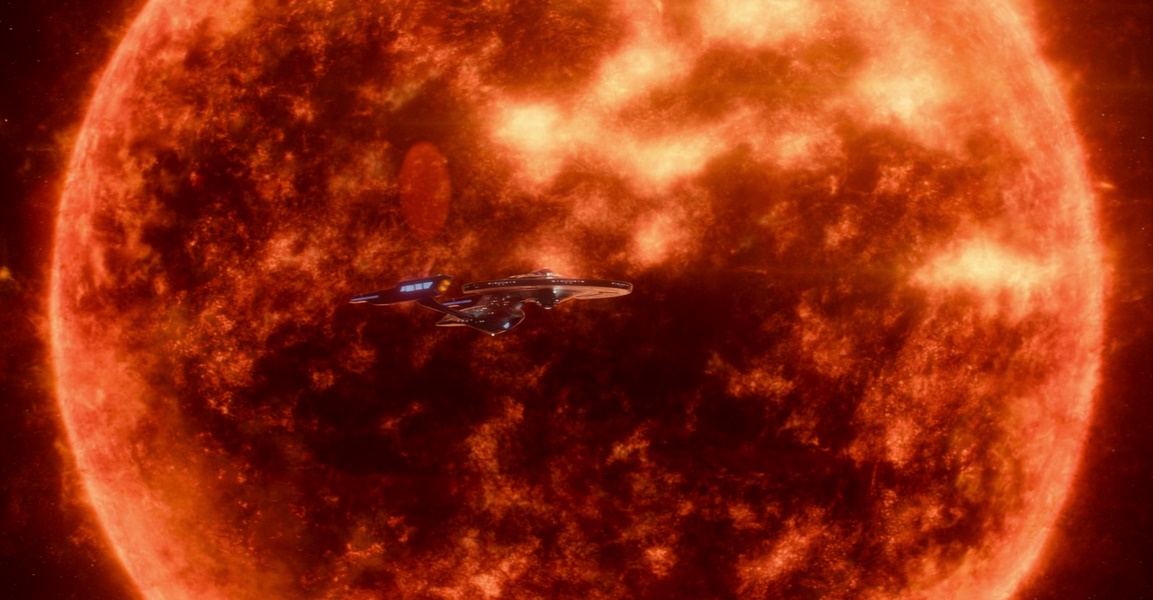
Spoiler Warning: There are spoilers ahead for Star Trek: Picard Season 1 and all of the trailers and teasers for Season 2. Spoilers are also present for Star Trek: The Next Generation and Star Trek: First Contact.
As the dust settled on Star Trek Day, the Picard Season 2 trailer stuck in my mind. As exciting as it was to see the crew back in action, and to get a real tease of some of the upcoming season’s story elements, I was left with an unfamiliar and somewhat upsetting feeling. It took me 24 hours to really think it through, but I’m finally able to put it into words: I’m less excited for Season 2 of Star Trek: Picard than I had been before the Star Trek Day trailer.
This isn’t something I expected nor wanted from Star Trek Day. Picard Season 2 had been right at the top of my list when it came to the shows I’m most excited about – as I’ve said on more than one occasion. But the trailer showed off what are really two of my least-favourite Star Trek story tropes, and in its aftermath I’m finding it hard to remain as excited for the season as I was. None of this is to disparage the hard work all of the actors, directors, producers, and behind-the-scenes crew have put into the upcoming season of the show. I’m capable of separating my thoughts about individual story threads from the folks tasked with bringing them to the screen!
Seven of Nine in the new trailer.
More than once I’ve talked about how time travel – and in particular, time travel to the modern day – as well as Mirror Universe stories are among my least favourites in Star Trek. With a big disclaimer that what we saw in the trailer doesn’t seem to be the actual Mirror Universe, it borrowed from that setting both thematically and in terms of aesthetic, and combined with a time travel plot that will see Picard and the crew of La Sirena head to the modern day… suffice to say I was underwhelmed.
Star Trek is a franchise about the future, but more than that, it feels like it’s at least a semi-realistic future; that humanity could one day achieve many of the social and technological advancements that we see in the various shows and films. Stepping out of that to do a story set in the modern world has never sat right with me primarily for that reason, but I’d also add that any return to contemporary times naturally dates a story very quickly. Episodes like Enterprise’s Carpenter Street, the two-part Voyager episode Future’s End, and even Star Trek IV: The Voyage Home are stories which feel significantly more out-of-date than others made around the same time simply because they took Star Trek to what was, at the time, the modern day.
Visiting modern-day Los Angeles is on the cards in Season 2.
When it comes to the Mirror Universe – which, again, I’m not saying the “totalitarian state” shown in the trailer actually will be – the setting has long lent itself to over-the-top pantomime. Even recent Discovery episodes set in the Mirror Universe – like Season 3’s two-part story Terra Firma – fell victim to this, as actors seem almost encouraged or emboldened to over-act every scene and play up all of the villain tropes they remember from middle school drama classes.
Characters in the Mirror Universe have no nuance. The entire setting seems to be populated largely by violent sociopaths, with the occasional submissive alien thrown in for contrast. Though I believe that what we saw in the trailer isn’t the Mirror Universe, the “totalitarian state” borrows a great deal in terms of its aesthetic from that setting, and my fear is that Star Trek: Picard is going to fall into the familiar Mirror Universe trap of pantomime-level over-acting.
Picard will have to blend in as a senior figure in the “totalitarian state.”
In a nutshell, then, those are my concerns based on the latest Season 2 trailer. The season feels as though it may lurch from the excess of a Mirror Universe-inspired setting to the drab reality of the modern world – and unfortunately I’m finding it hard to get excited about either side of the story as things stand. I want to give Picard Season 2 a chance, and when it premieres in February I certainly will, but at the moment I can’t escape the sinking feeling of losing at least some of the excitement that I had for the project.
Though we were treated to a glimpse of the Borg Queen in the trailer, an alternate timeline (Mirror Universe or not) and a jaunt to the past don’t seem like settings where we’ll get to explore much of the 25th Century. I had hoped that the show might spend a little more time with Starfleet in Season 2, or perhaps take a look at one or more of the factions we remember from past iterations of Star Trek. Picard made many first contacts with alien races on The Next Generation, and has deep connections with the Klingons, for example, as well as the likes of the Bajorans.
Picard examines a portrait of his alternate timeline counterpart.
There was even the hope that an as-yet unannounced character might reprise their role in Season 2. Though Gates McFadden had ruled out Dr Crusher’s return a few weeks ago, there were characters like Riker, Troi, Wesley Crusher, Worf, or someone else who could yet make a welcome return to the franchise. That’s still possible, but the presence of an alternate timeline and a story involving time travel cuts into the potential screen time that any returning character could have.
Past iterations of Star Trek, which were primarily episodic, could do Mirror Universe or time travel stories relatively inoffensively from my point of view. The odd episode here or there that used one of those settings was gone within a week or two, even if I really didn’t enjoy it, so I wasn’t as upset to see such a story as one small part of a season with twenty-plus episodes to enjoy. But Picard isn’t an episodic series, and not only that it’s a shorter one (Season 1 clocked in at a mere ten episodes) so a time travel-meets-Mirror Universe story could run for practically the whole season. As the foundation for an entire season-long story arc… as I said above it’s just one that I personally don’t find particularly appealing.
Elnor, Raffi, and Picard in the “totalitarian state.”
I recognise that, so far, all of this must seem like whining. “Star Trek: Picard isn’t doing exactly what I want!” screams the petulant crybaby! But as an independent critic, I always say that I reserve the right to express my honest feelings on any of the shows, games, and films that I talk about; despite being an avid Trekkie and a fan of modern and classic Star Trek I’m not going to blindly sing the franchise’s praises when there are points of criticism or things that I don’t like. None of this means that Picard Season 2 is somehow invalid in my mind; despite my initial impressions from the trailer I will give it a chance to impress me. But I also want to share my honest thoughts, and right now I feel that the trailer seems to show a season-long story that rolls two of my least-favourite Star Trek tropes into one.
Having got all of that out of the way, let’s look at some of the points from the trailer that are more positive – or at the very least potentially interesting!
First up, the Borg Queen herself. I had half-written a bunch of Borg theories for Picard Season 2 following the announcement that the Borg Queen would be returning – almost all of which now feel extremely unlikely! The Borg Queen that we saw in the trailer appears to be a captive – my first thought was that it could be the reactivated remains of the Queen killed by Picard in First Contact. Episodes of Voyager and also Season 1 of Picard suggested that there may be more than one Borg Queen, or that she is capable of changing bodies with ease, so it could be a different Borg Queen altogether. Regardless, she seems to be a captive – how Picard came to capture her or know about her captive status is a story I’d quite like to follow!
Is the Borg Queen being held captive?
If the Borg Queen shown on screen is from after the timeline has been changed, perhaps we’ll see Picard and the crew of La Sirena lead a mission to capture her in order to facilitate their passage back in time. It seemed as though the Borg Queen is going to be used by Picard as a kind of time machine – though exactly how this would work isn’t clear. Perhaps the Borg Queen possesses unique knowledge of time travel, as we know she was personally present during the mission to Earth in First Contact. Maybe her presence is required for the Borg to travel through time?
As mentioned, the “totalitarian state” seems to me like it isn’t the Mirror Universe’s Terran Empire, but rather a fascistic state that emerged – somehow – in place of the United Federation of Planets in the Prime Timeline. Picard ascribes its rise by the 25th Century as being caused by something Q did to change the past, so in my opinion we’re looking at an alternate version of the Prime Timeline and not the Mirror Universe. This is backed up by something Q said in the previous trailer – that Picard and his crew had come to “the very end of the road not taken.”
Q and Picard face off in the new trailer.
So that brings us to Q’s role in the season. During First Contact Day back in April, Sir Patrick Stewart hinted that Q may not be the cause of the event that shattered the timeline – but this seems to be contradicted by what we saw and heard in this new trailer. Q made reference to “the trial” – he put Picard and all of humanity on trial in Encounter at Farpoint and has periodically returned to provoke and tease him ever since. Though episodes like Q Who saw Q deliberately interfering and putting Picard and the Enterprise-D in danger, I would very much argue that other episodes like All Good Things saw Q assume a less antagonistic role. He didn’t cause the anti-time eruption, but he did give Picard just enough clues and a little bit of a push toward finding a solution.
Q is a trickster – and not someone to be trusted. But I’ve often got the impression that, in his own twisted way, he sees himself as a friend, ally, and mentor to Picard. He didn’t introduce Picard to the Borg in Q Who with a view to getting him killed or assimilated; he wanted to demonstrate that Picard and the Federation were unprepared for the dangers lying in wait out in the galaxy. He was pleasantly surprised to see Picard solve the Farpoint mystery in Encounter at Farpoint and the anti-time puzzle in All Good Things. In short, though Q’s methods may be extreme, and while he does have an impish sense of humour, he’s never been an out-and-out villain. For him to go back in time and break the timeline so severely is, perhaps, somewhat out of character.
Q and Picard in All Good Things.
So my inclination at this stage is still to say that there’s more to Q’s role than meets the eye. Picard may blame him for the changes to the timeline initially, but part of the mystery of the season’s storyline may be figuring out that Q isn’t to blame – someone or something else is. I’d argue this better fits with Q’s characterisation – but it wouldn’t be completely strange to see him as the season’s antagonist as well. So I guess we’ll find out!
Notable by her absence was Guinan. Guinan has knowledge of and history with both the Borg and Q, so bringing her back could have made a lot of sense for the story of the season. Guinan could have taken on an advisory role, as we see her do in episodes like Q Who, Time’s Arrow and in Star Trek: Generations. It’s possible she will still appear and that her role will be revealed at a later date. It’s also possible that she will make an appearance in Season 3 – which we now know is officially confirmed and in production – or that her role was ultimately cut and she won’t be coming back.
Picard and Guinan in The Next Generation Season 2 episode The Measure of a Man.
We didn’t get a good sense of what any of the crew of La Sirena are up to in the trailer, really. All we can say is that there don’t appear to have been any legal consequences for Dr Jurati for murdering Bruce Maddox in Season 1 – perhaps the fact that she had been essentially brainwashed has meant that she won’t face prosecution for that act. We did see Jurati and the Borg Queen seemingly sharing a “moment” – could Dr Jurati’s love for all things synthetic give her a reason to feel sympathy for the captive Borg?
We saw very little of Soji, though she was present, and likewise not much from Elnor – though at one point he seemed to be in a medical facility possibly injured or sick. The green light of this scene could imply that the Borg are involved – perhaps the Borg Queen breaks out of her confinement, or perhaps Elnor was injured by the Borg somehow.
What has happened to Elnor?
The trailer seems to suggest an expanded role for Laris – one of Picard’s Romulan friends who stayed behind to look after the vineyard in Season 1. She spoke in voiceover at the beginning of the trailer and later appeared alongside Picard and Rios in what could be the past. It’s at least possible, then, that Laris will join Picard’s mission back in time.
At first I thought that an explosion and the collapse of a skyscraper was taking place in the future, but looking at that moment more carefully I think it’s actually something taking place in the 21st Century. Could that explosion mark the moment that everything changed? It could be that Picard and the crew have to prevent that from happening – or ensure that it does happen, which could lead to a dark, morally difficult storyline.
What is this explosion, and how does it connect to the story of the season?
Seven of Nine appeared – without her trademark Borg implants – along with Raffi. There wasn’t much of a hint at their relationship, but this is something that seems like it will be explored across the season, and I’m really quite excited to see how that comes across. They seemed to be having a disagreement when it came to driving a modern-day car, but that was played more as a comic moment than as a kind of dramatic fight between the pair.
And I think that’s all I have to say – at least for now. My head is already swimming with proto-theories, some of which may get the full write-up treatment in the weeks ahead. Despite feeling underwhelmed by the season’s premise, I’m still hopeful that Picard Season 2 will deliver enjoyment, entertainment, and drama. The underlying mystery of what happened to the timeline, what 21st Century event changed things for the worse, and what role Q played in all of that is interesting, and I’m curious to learn exactly what happened and why.
If I ultimately find Season 2 to be less enjoyable on the whole because of some of the things we’ve talked about today, at least I can look forward to Season 3! If Picard follows a similar path to Discovery then Season 3 will set aside much of what happened in Season 2 and tell a new self-contained story, so even in the worst case scenario there’s still much to be hopeful for when it comes to Star Trek: Picard.
Star Trek: Picard Season 2 will be broadcast on Paramount+ in the United States and on Amazon Prime Video in the UK and around the world beginning in February 2022. Season 1 is available to stream now. The Star Trek franchise – including Picard and all other properties mentioned above – is the copyright of ViacomCBS. This article contains the thoughts and opinions of one person only and is not intended to cause any offence.
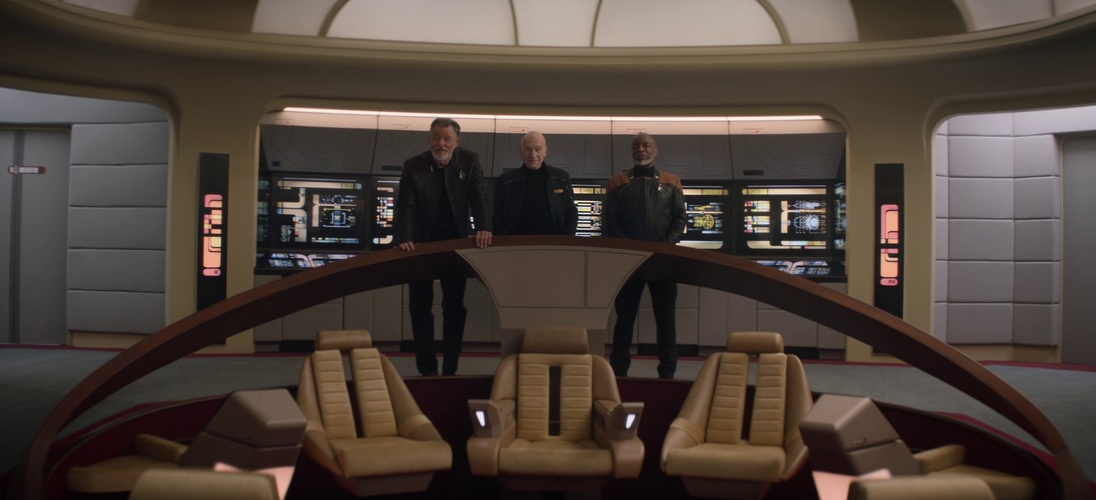
Spoiler Warning: There are spoilers ahead for upcoming Star Trek productions, including: Star Trek: Picard, Star Trek: Discovery, Star Trek: Prodigy, and Star Trek: Strange New Worlds.
Just a short one today! Star Trek Day is coming up in a couple of days’ time, and we’re promised news and discussion of all things Trek straight from the horse’s mouth! Why is September the 8th designated as “Star Trek Day?” Good question, and here’s the answer: it was on that day in 1966 that The Man Trap premiered, kicking off Star Trek: The Original Series Season 1 and laying the groundwork for a franchise that’s still going strong today.
As an aside, last year I wrote a piece looking at the villainous creature at the heart of The Man Trap’s story, and you can find that article by clicking or tapping here. Worth a read at this time of year – if I do say so myself!
The Man Trap is where the franchise began – almost fifty-five years ago.
As much as Star Trek Day is an opportunity to look back at the franchise’s fifty-five years of history, this digital event hosted by Wil Wheaton and Mica Burton is also an excuse to look ahead to some of the Star Trek projects that are coming up over the next few months and years. There will undoubtedly be some news – and keep your fingers crossed because it’s even possible that we could get a big, unexpected announcement!
I’ve got a few ideas for what might be coming our way when Star Trek Day kicks off. Please keep in mind, as always, that I don’t have any “sources” nor any “insider information.” This is just a little educated guesswork – and a reminder, in case you’d forgotten, that Star Trek Day is imminent! All of the panels will be available to watch online on the official Star Trek website, so be sure to check in on the 8th to see what they have to say. Or just come back here a day or so later because I daresay I’ll summarise what I consider to be the most important points!
Let’s jump into the list!
Number 1: Official confirmation of Star Trek: Picard Season 3.
A third season is already being worked on!
This one is a bit of a cheat, as we’ve already heard from a number of reliable sources that Season 3 was in development alongside Season 2, and the two seasons are being filmed back-to-back. In fact, it seems as though some Season 3 scenes may have already been filmed – but that’s not confirmed at this stage.
What’s also unconfirmed, at least from ViacomCBS and Star Trek officially, is the existence of Season 3 at all. Though in the past we’ve seen the company wait until a season is almost being broadcast to confirm that the next one is in development, on this occasion it would make sense to announce Picard Season 3 way ahead of time. It’s already an open secret, so why not? It seems like a great way to drum up even more excitement!
Number 2: A trailer for Star Trek: Strange New Worlds.
Anson Mount recently appeared as Captain Pike in a series of trailers for Paramount+.
Since Strange New Worlds introduced us to five members of its main cast in mid-March, there really hasn’t been a lot of news about the series. We heard last month that production was drawing down on Season 1, only to later learn that some scenes outside of Toronto (where the show is based) were still being worked on. If it’s true that the season is finished, though, the time could be right for a trailer!
Along with Picard Season 2, Strange New Worlds has to be the series that I’m most curious about. Not only will it be fantastic to welcome back Anson Mount as Captain Pike, but the semi-episodic format that has been suggested feels like it could really be the best of both worlds – a return to Star Trek’s past without entirely stepping away from the modern feel of recent productions.
There is a Strange New Worlds panel that will be taking place during Star Trek Day, and a trailer would be a great way to wrap it up!
Number 3: A premiere date for Star Trek: Discovery Season 4.
The USS Discovery is ready to warp away to her next adventure!
At time of writing, all we know about Discovery’s impending fourth season is that it’s due before the end of the year. Maybe that’ll change and we’ll see the show fall back to early 2022, or maybe Discovery is still on track for a broadcast kicking off in mid-October after Lower Decks Season 2 has concluded. (That was what happened last year.)
Either way, I think Star Trek Day would be a great opportunity for ViacomCBS to drop the date of the new season’s premiere with a lot of attention on the franchise.
Number 4: A teaser trailer for Star Trek: Picard Season 2 featuring the Borg.
The Borg Queen is returning to Star Trek!
Soon we’re going to talk and theorise about the Borg in Picard Season 2. If you missed this, there’s been a casting announcement for the upcoming second season that caught me off-guard: the Borg Queen is returning! Not only that, but she may appear in as many as six of the season’s ten episodes, indicating that the Borg may play a significant role in the story.
It’s been more than eighteen years since the last Star Trek story featuring the Borg: Enterprise’s second-season episode Regeneration. After such a long time it’ll be fantastic to bring the faction back into play in a big way – assuming that’s even the plan! For all we know the Borg Queen may play an altogether different role in flashbacks or in an alternate timeline!
Regardless, following this casting announcement I’d think ViacomCBS would want to tease something about the Borg – without giving away too many potential spoilers.
Number 5: A second trailer for Star Trek: Discovery Season 4.
Captain Burnham in the first Discovery Season 4 teaser.
We got our first look at Season 4 of Discovery back in April, where a trailer showed Captain Burnham and the crew facing down a “gravitational anomaly” – whatever that could be! With the season coming up before the end of the year – all being well, that is – it would be a good time for a second trailer to get fans excited.
It can be hard to get the balance right when it comes to producing a trailer for a brand-new season, especially when a series has a mystery at its core like Discovery does. Show too little and it’ll be hard for fans and prospective viewers to get excited, but show too much and you risk spoiling major plotlines. Cutting the perfect trailer under such circumstances is a real skill!
Number 6: A release date for Star Trek: Prodigy.
Prodigy is coming soon… but how soon?
I’ve all but given up on Prodigy getting an international broadcast when it premieres this autumn – at least outside of countries and territories where Paramount+ already exists. Though the series has been co-developed alongside Nickelodeon, it seems as though ViacomCBS is intent on keeping the show exclusively on its streaming service, so it seems unlikely to arrive here in the UK until Paramount+ does some time next year.
For everyone who’s lucky enough to live somewhere with Paramount+ already, though, keep an eye out for a release date for Prodigy. Earlier in the year the series was officially announced for “Fall 2021” – and the beginning of September basically marks the start of autumn, as I recently noted! So we could see Prodigy literally any time from now until the end of November, and I think the Prodigy panel at Star Trek Day would be a great place to announce the specific date.
Number 7: A big, surprising announcement!
I’m always up for a surprise!
What could it be? Is the untitled Section 31 series finally on the verge of entering production? Has ViacomCBS backed down after years of being pestered by Michael Dorn and decided to greenlight a Captain Worf series after all? What about the live-action series that Alex Kurtzman had previously said was in development – could we finally learn more about that?
Though I don’t think we should get too excited about this one, there’s always the possibility for a surprise announcement of some kind. One thing we know for certain is that more Star Trek is in development – so it’s not impossible to think we could see something announced this week.
So that’s it!
All of the panels for 2021’s Star Trek Day!
Star Trek Day will be upon us before you know it, so stay tuned here on the website for coverage and analysis of any major announcements, as well as for a review/roundup of the event itself. I’m looking forward to Star Trek Day very much; it’ll be a great excuse to geek out for hours on end!
I hope this list of predictions has got you suitably excited for the main event!
Star Trek Day panels will be available to watch on Paramount+ and on the official Star Trek website on the 8th of September 2021. The Star Trek franchise – including all properties and titles mentioned above – is the copyright of ViacomCBS. This article contains the thoughts and opinions of one person only and is not intended to cause any offence.
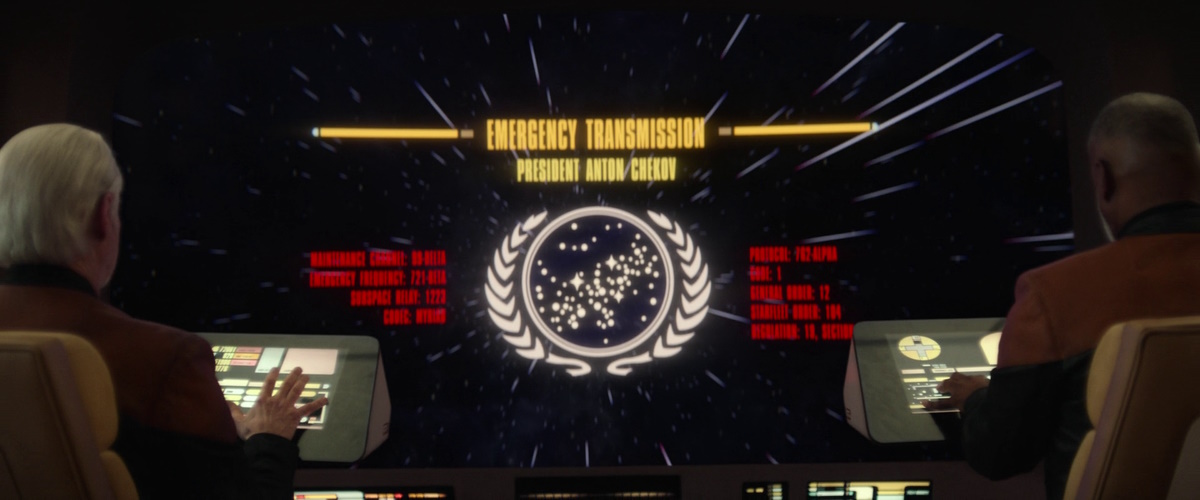
Spoiler Warning: There are spoilers ahead for Star Trek: Picard Season 1 and the trailers for Season 2. Spoilers are also present for the following: Star Trek: The Original Series, Star Trek: Voyager, Star Trek: First Contact, Star Trek: Discovery Season 2.
Star Trek’s internal timeline gets a little inconsistent when it comes to the late 20th and early 21st Centuries. If we take a “canon purist” approach, we have to say that the Star Trek timeline diverged from our own around the 1960s, with events like Khan ruling a large portion of the world taking place in the ’80s or early ’90s, before the Eugenics Wars saw him defeated. Obviously that doesn’t line up with stories like Star Trek IV: The Voyage Home, the Voyager two-part episode Future’s End, or even Enterprise’s Carpenter Street, all of which depicted the modern world unchanged by those events.
The Third World War is a part of Star Trek’s internal timeline that was first introduced in The Next Generation’s premiere episode, Encounter at Farpoint. Episodes of The Original Series had talked about the Eugenics Wars and other conflicts on Earth, but Gene Roddenberry had been keen to avoid mention of World War III during the show’s run in the 1960s. Some episodes, such as Season 2’s The Doomsday Machine, actively went out of their way to say that such a conflict had never happened on Earth – an apparent contradiction to what would come later.
Spock and Kirk at the end of The Doomsday Machine, during their discussion of nuclear weapons.
It was the film First Contact that elaborated on some of the ideas first posited in Encounter at Farpoint and thus gave us a better look at Earth in this era. Though we knew that nuclear attacks were part of the conflict, it was First Contact that first showed that some of these attacks had impacted North America, and that the conflict was fought between the United States and her allies on one side and the so-called “Eastern Coalition” on the other. Some of these moments would be shown or explored further in Enterprise’s fourth season, and most recently World War III has appeared in Discovery’s second season.
Although the Third World War has been an integral part of Star Trek’s fictional history for more than thirty years, that’s about the extent of what we know. There was a major conflict which occurred in the first half of the 21st Century, it killed hundreds of millions, there was a limited exchange of nuclear weapons (i.e. the planet wasn’t completely destroyed), and it took Earth a generation to recover – with more than a little help from the Vulcans. But this article isn’t just a history of the conflict within Star Trek’s timeline – because something in the promotional material for Star Trek: Picard Season 2 could suggest a return to this era.
The trial which Q presided over in Encounter at Farpoint was said to take place during the “post-atomic horror” after World War III.
When I took a look at the second Star Trek: Picard Season 2 trailer a couple of weeks ago I also looked at a newly-released poster which appears to show a modern-day city – probably Los Angeles in the United States. If the poster is supposed to represent Los Angeles circa 2021, well the timeline starts to line up for a possible World War III story.
In the real world, it’s impossible to overstate the importance of technological advancements made in wartime. The First World War saw the invention of tanks and the further development of aircraft. The Second World War gave us computers, rockets, and splitting the atom. Even recent conflicts like the Iraq and Afghanistan wars saw incredible developments in medical technology. Taking inspiration from the real world, Star Trek’s World War III is similarly an incredibly important event. The Third World War led directly to the development of warp drive in the 2060s, and thus to first contact with the Vulcans and to humanity becoming an interstellar species. The Federation would not exist without it – at least, not in a form we would recognise.
Zefram Cochrane’s ship would never have broken the warp barrier were it not for the Third World War.
And that’s at the heart of this theory. In order for everything we know of in Star Trek’s internal history to have come to pass, World War III needed to happen. It was a devastating conflict that resulted in the deaths of hundreds of millions of people, but what emerged from the wreckage was United Earth and ultimately the Federation.
In the first teaser trailer, we heard Picard say in voiceover that “time can turn even our most impulsive, ill-considered actions into history.” He also spoke in a regretful way about “what could have been” and tells us that time does not offer “second chances.” In the second trailer, Q told Picard that he had come to “the very end of the road not taken.” We also saw what appeared to be significant changes to the timeline for Picard, Raffi, Rios, and Seven of Nine, as well as possible changes for Soji as well.
Seven of Nine… without her trademark Borg implant!
It seemed from the first teaser as though Picard was talking about events in his own past – that teaser also featured prominently a model of the USS Stargazer, from which I derived a few other theories! Picard is someone who we know cares about history a great deal and has studied it in depth, but nothing from the first teaser gave me the impression that he was talking about anything outside of his own personal experience. Whatever he was lamenting or regretting seemed to be within his own past – not an event from centuries earlier to which he had no significant emotional connection.
Although Picard did spend several days in the 21st Century, shortly after the end of World War III, he doesn’t exactly have a strong tie to the war or even to that time period, certainly not enough to have any motivation to change or undo events in that era. Picard is as far removed from the events of World War III in the 24th Century as we are from the events of the early 1700s – and I can’t imagine anyone nowadays would feel strongly about the Jacobite Rising or the War of the Spanish Succession. Those events – and many others – are just too far in the past to be something we care about, even if the impact is still felt today in some respects.
It’s hard to imagine that Picard would have voluntarily changed the past.
So I’m not suggesting that Picard would deliberately seek to prevent World War III – even if he found himself able to do so, somehow. But the second trailer showed off some pretty significant changes to the timeline, and combined with a poster that appears to be teasing a contemporary setting, the possibility of a World War III storyline has come up.
It seems like the story of Picard Season 2 will deal with some kind of alternate timeline – that’s what I infer from Q’s “road not taken” line, as well as the changes to characters like Seven of Nine and Rios. Picard was also heard in voiceover promising his new crew that they can “save the future,” which seems to add to this idea of something going wrong in the past causing things to change.
Q spoke of the “road not taken” in the teaser trailer.
When we deal with alternate history and alternate timelines, practically every story hinges on a so-called “point of divergence.” This is the moment at which the real timeline and the alternate one separated. In alternate history novels, popular points of divergence include the American Civil War, with a Confederate victory being a common one, as well as World War II, with an Axis victory being similarly used. In Star Trek, a point of divergence between the Prime Timeline – the one which runs from Enterprise to Picard and beyond – could be World War III. What would the timeline look like if it didn’t happen, or happened in a different way?
It could be that the poster is teeing this up. In the background, behind the skyscrapers in the centre of the city, is a glow. That glow could be a sunrise or sunset – it looks like the right colour. But it could also be something far more sinister – the afterglow of a nuclear bomb, perhaps? Maybe that’s a stretch! But it would definitely tie into this World War III theme.
The Season 2 teaser poster.
There are still two big questions, even if we assume that this theory is true and that the point of divergence has something to do with World War III. Firstly, what happened to cause the divergence in the first place? In Star Trek, these things don’t just happen naturally! Every change in the timeline that we know of had a cause – the intervention of some nefarious time-traveller. Secondly, and perhaps most importantly, why are Picard and the crew of La Sirena seemingly immune to these changes in the timeline? Q’s intervention is a possible explanation for the second point, perhaps, presenting Picard with another time-mystery to solve. But I’m not convinced that’s how the story will go.
All of this leads to an interesting moral conundrum for Picard. If we’re right and, somehow, World War III was prevented and that’s the reason for changes to the timeline, it could fall to Picard and the crew of La Sirena to trigger the worst war in history in order to restore the timeline. How’s that for a horrible decision?! Imagine being told that you had the power to prevent the First World War, and all of the misery and death that resulted from it, but that doing so would make the world worse. Instead, you have to actively choose to cause this horrible conflict in order to preserve the timeline and “save” the future. That could be Picard’s choice in Season 2 if this theory is correct.
A World War III-era soldier as seen in Discovery Season 2.
Aside from the poster with its seemingly-modern city and some dialogue about time and changing the past, there’s no real evidence for this theory yet! Much of what we saw in the second trailer – which is the only time we’ve seen Picard and the others – may very well suggest that any changes to the timeline take place closer to the 24th Century than the 21st. But it’s interesting to consider the possibilities, especially in light of the Season 2 poster.
To summarise, then, here’s the theory in a couple of sentences: for an as-yet unknown reason, the timeline was changed to prevent World War III. This had major consequences for humanity and the Federation, and the only way to restore the timeline and save the future is to ensure World War III happens – and this is what Picard and the crew of La Sirena will have to do.
Something has changed the timeline – and it seems like Picard and the crew of La Sirena are immune.
It would be quite a dark story if Season 2 goes down this road – or anywhere close to it. But it would be very interesting to see the crew wrangling with these big moral questions and issues. It could lead to quite a lot of drama! Q’s inclusion in the season would make sense, not as the cause of changes to the timeline, but as the figure who steps in to guide Picard in his understanding of those changes. It would also explain the poster, which came completely out of left-field!
Having had two teasers already, with the latest dropping only a couple of weeks ago, it may be some time before we hear anything more out of Star Trek: Picard Season 2. So all we have to go on right now is the poster and the first couple of teaser trailers! It’s not a lot, and there are certainly many different ways to interpret things. In this theory I’ve focused on how the poster could be depicting the 21st Century, but that may not be the case. Changes to the timeline could have caused the 24th Century to become less technological, and the poster could instead depict Los Angeles in the year 2399!
I’m very much looking forward to Picard Season 2, and I’m still hopeful that we’ll eventually see spin-offs and other Star Trek projects set in the same era. If and when we get any more news or another poster or trailer, check back as I’m sure I’ll have more to say!
Star Trek: Picard Season 2 will be broadcast on Paramount+ in the United States (and on Amazon Prime Video in the UK and elsewhere) in 2022. The Star Trek franchise – including Picard and all other properties mentioned above – is the copyright of ViacomCBS. This article contains the thoughts and opinions of one person only and is not intended to cause any offence.
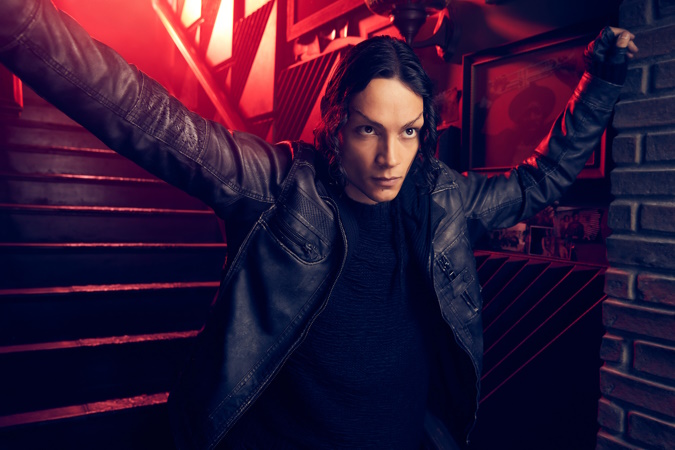
Spoiler Warning: There are spoilers ahead for Star Trek: Picard Season 1, and both of the trailers for Season 2.
As I logged on to social media yesterday evening, I was surprised to see a new trailer for the upcoming second season of Star Trek: Picard! Season 2 entered production back in February following months of pandemic-enforced delays, and when it came to Star Trek’s big digital event for First Contact Day in April, there wasn’t much to show from the series except for a stylised teaser and a voiceover. Despite that, however, I managed to pull out a handful of theories!
I wasn’t expecting to see anything much from Picard Season 2 for a while. With production rumbling on for the next few months, I had perhaps thought we might get to see something later in the year when either Lower Decks Season 2 or Discovery Season 4 are being broadcast, so it was a nice surprise to get a trailer this early! Season 2 is still probably ten to twelve months away from being broadcast, but this was a nice little tease to get fans in the mood.
In addition to the trailer a new poster was also revealed, and both are interesting and worth talking about. We’ll start with the poster, then move on to the trailer.
The brand-new Season 2 poster. Picture Credit: Star Trek/ViacomCBS
Using a similar basic concept to the first teaser poster for Season 1, the new poster uses the environment to form a Starfleet delta emblem. In this case, as you can see above, several roads or highways cross over to form the familiar logo. The city depicted in the poster appears to be Los Angeles – based on the straight concrete-sided river, the mountains in the background, and the downtown skyscrapers surrounded by a sprawl of shorter buildings. I could be wrong, but I’m going to say it’s Los Angeles.
The obvious thing to say is that there are cars on the roads. Though we have seen wheeled vehicles in Star Trek’s 24th Century – Picard drove a dune buggy in Nemesis, for example – Earth in the 24th Century has never been depicted in this manner. The cars look modern, the city looks modern, and I think everything we can see in the poster connects to themes from both the earlier teaser and the new trailer: time travel and changing the past.
The first teaser a couple of months ago told us that time travel was on the agenda.
The first teaser trailer, the one from First Contact Day, had Picard telling us in a voiceover that “the true final frontier is time.” That trailer had a lot of different imagery connected to Picard’s past, including the USS Stargazer, but one thing I couldn’t quite figure out was the book Paradise Lost. I speculated that the series might be connected in some way to a literal reading of the title – something Picard did or didn’t do in the past caused the future to be worse. That theme seems to be present in the new trailer.
We’re reintroduced to Q in the new trailer, and he uses a very interesting phrase – arguably the most prominent in the whole thing: “welcome to the end of the road not taken.” Combined with what Picard said in the first teaser about wishing to have done things differently in the past, I think we can start to see the building blocks of the Season 2 narrative.
Q has returned!
Q’s arrival seems to happen after whatever event damages the timeline. In the trailer, Picard was already in a different outfit with a different Starfleet badge, and it seems as though Laris is missing – could she be a casualty of shifting timelines? Regardless, it was only at this point that Q appeared, seemingly for the first time, and this ties into comments from both Sir Patrick Stewart and John de Lancie that Q will play a role in the storyline of the season but isn’t the cause of these events.
So this isn’t going to be an All Good Things redux, where Q sets Picard a puzzle. If anything, I interpreted Q’s arrival as a friend or even an ally showing up to help – perhaps we’ll see more of a Q-Picard alliance develop over the course of the season. Q certainly seemed happy to see Picard again – though the feeling was clearly not mutual. So maybe, at the very least, that’s how Q sees himself: a friend, a helper, and an ally.
Does Q see himself as Picard’s ally? If so, perhaps they will work together.
We saw Seven of Nine toward the end of the trailer, and she was featured more prominently than any of the main cast from Season 1. In Seven’s scene, I think we get even more evidence of this shifting or changed timeline, as Seven seems to wake up in an unfamiliar place – without her Borg implant. It’s possible, of course, that her implants had been removed, but as we saw with poor Icheb in Season 1, that’s a painful and often fatal process.
So the logical conclusion for Seven missing her implants is because she was never assimilated by the Borg in this timeline. But why? And what else has been changed? When we talk about alternate history – which is a fascinating genre in itself – almost every story hinges on a so-called “point of divergence.” This is the moment at which the fictional or alternate timeline separated from our own. Star Trek contains examples of this: the Kelvin timeline being the most prominent example, with a point of divergence on the day of Captain Kirk’s birth.
Where’s Seven’s implant?
If all we saw was Seven missing her implants, we could say that the point of divergence might be in the 2350s – either she didn’t travel to the Delta Quadrant aboard the USS Raven with her family, or that whole voyage never happened. But there’s so much imagery in the trailer and poster that seems to hint at something more than that.
The 21st Century vehicles on the poster could suggest that Picard and the crew will visit our time period during the course of the series – which may or may not be a good thing, but that’s a whole other article! But their presence could also suggest that whatever event or series of events changed the timeline began in the modern day, with ripples flitting along the timeline, changing all manner of things in their wake.
Picard at the vineyard in the opening shot of the trailer.
Picard and Raffi were seen in uniform in the trailer, albeit very briefly. Picard appeared to be giving a speech or making a statement to Starfleet Command, and I wonder in what context he was making that address. I initially thought Picard was wearing his Season 1 flashback uniform in that scene – the one we saw prominently at the start of the episode The End Is The Beginning. But on closer inspection, both he and Raffi are in different uniforms – not the flashback ones, nor the 2399 ones that Riker and Commodore Oh wore. Also, Picard was wearing a 2399-style combadge, not the First Contact–Voyager one that he wore with his Admiral’s uniform in Season 1. So the plot thickens!
It’s possible that this scene is taking place at modern Starfleet, and that there has simply been a tweak to the uniforms since the events of Season 1. Starfleet does love arbitrary uniform changes, after all, and what we saw Picard and others wearing wasn’t so radically different that it couldn’t have been a dress variant, for example. But given everything else going on with Q, Seven of Nine, and potential changes or damage to the timeline, I can’t help but think that this is connected to that.
Picard in a new uniform variant. He seemed to be giving a speech at Starfleet Command.
Perhaps what we’re seeing is an alternate timeline in which Picard and Raffi didn’t resign from Starfleet, and thus in which the Coppelius synths were not saved? That would tie in with Season 1. But at the same time, I’m not sure that’s the route the show is going to follow. There are questions about the Starfleet delta – the silver badges we see Picard and Rios wear are oversized and have a cross or sword shaped indent, which reminds me more than a little of the Mirror Universe. I don’t think we’re going to see a Mirror Universe story, but the symbolism is interesting. What does it mean?
In voiceover, we hear Picard speaking – presumably to the crew of La Sirena – telling them that “we can save the future” and promising to get them home safely. Whatever is going on, the crew of La Sirena are seemingly immune to changes in the timeline – we see Rios react with shock upon discovering his new badge, and Seven similarly stunned by her missing implant. Picard’s voiceover could imply that La Sirena and the crew are themselves stuck in the past – otherwise why use the word “future?”
Captain Rios on the bridge of La Sirena. What’s with his new badge? And why is there a Starfleet emblem on the chair?
To me, the big question is this: is Picard the one responsible for disrupting the timeline? If Q isn’t to blame, and Picard and La Sirena appear to be unaffected and right in the middle of this mysterious event, could we learn that Picard is to blame? The first teaser trailer saw him express almost regret at being unable to change the past – desperately wishing that he’d done something differently. Perhaps he found a way to do it, and thus he triggered the changes to the timeline that we see in the new trailer.
That would be an interesting way for the story to go, and it would play on themes we saw early in Season 1 of Picard being a flawed hero; someone who’s only human and who has limits. The return of Q is interesting – perhaps Q will facilitate Picard’s changes to the timeline, but I suspect he’s going to be helpful in fixing things. The use of the phrase “the road not taken” suggests that this is a timeline that could have come to pass had Picard taken different actions at some point in his past. Combined with the previous teaser, I wonder again if this is referring to his time in command of the USS Stargazer?
Are the changes to the timeline connected, somehow, to Picard’s time aboard the USS Stargazer?
Though we didn’t see the rest of the cast prominently in the trailer, some of what we glimpsed was interesting. Soji appeared to be all dressed up in a fancy outfit, and the expression on her face reminded me of Sutra. Perhaps she’s putting on an act or trying to deceive someone – something akin to the “heist” in Season 1’s Stardust City Rag, for example. But it could also indicate a darker direction for Soji’s character – or even the return of Sutra.
Raffi and Elnor were glimpsed briefly, seemingly running away from someone or something. The neon lights in the background of their scene could suggest they’re on the planet Freecloud, but I wouldn’t bank on that. I have no idea what Dr Jurati was doing as we only saw a close-up of her face, but something about her outfit suggested to me that she could be in prison. She did murder Dr Maddox in Season 1, after all! We also got a glimpse of Laris, who appeared to be staring in surprise or alarm at something behind the camera. Given that Picard was looking for her unsuccessfully at the beginning of the trailer, I wonder if she’s been killed off, or perhaps even removed from the timeline.
What is Laris looking at here? I wonder if it’s connected to her being missing, or the changes in the timeline.
The scene at Starfleet Command, where Picard appeared to be giving a speech, featured the flags of several known factions: the Klingons, Vulcans, Bajorans, and Ferengi were the ones I recognised, along with flags representing the Federation, Starfleet Command, and Starfleet Academy. I don’t think we can infer too much from that – the flags may mean these factions are Federation members or allies, but it could simply mean that they’re present at this event, which could be a diplomatic meeting akin to something we’d see at the G7 or United Nations.
I’m unsure about the other voice heard only in voiceover, the feminine voice saying that “time has been broken.” It sounded a little like Commodore Oh, but I don’t think she would be working with Picard in any timeline! The voice sounds familiar, though… but I can’t place it, nor figure out if it’s someone connected with a past iteration of Star Trek or not. It’s likely that this is a new character, in my opinion.
A mysterious-looking Soji.
The absence of Guinan was noteworthy, as we know she will be making an appearance at some point in Season 2. In The Next Generation episode Yesterday’s Enterprise, Guinan showed a unique awareness of changes to the timeline, and considering Season 2 seems to be all about that kind of thing, bringing her back makes a lot of sense. She also has a history with Q that could be explored in more detail given his return.
And with that, I think we’ve come to the end of my analysis and guesswork! It was great fun to see a glimpse of Season 2, which now has a good three months’ worth of filming and production work under its belt. Despite events out here in the real world, production seems to be moving along well, and I have no doubt at the moment that Picard Season 2 will hit its scheduled release next year. I would guesstimate that it will premiere sometime after Discovery’s fourth season and before Strange New Worlds’ first season, so I think within ten to twelve months we’ll be sitting down to watch the first episode of Season 2.
Why are Elnor and Raffi running?
It was wonderful to see John de Lancie back as Q, and to see him tangle with Picard once again. A trailer can only do so much with a runtime of around one minute, but there seemed to be a heavy emphasis on classic characters: Picard obviously, but also Q and Seven of Nine. This came at the expense of the new characters we met in Season 1 who we only got to see very briefly. Hopefully future marketing material can show off those characters a little more.
The mysteries of Season 2 deepen. What’s the connection to the present day? If the city from the poster is Los Angeles, what connection does that have to Picard and Starfleet? As far as I know he’s never been to the city, and no major Starfleet or Federation organisation is based there. The only Star Trek story to have spent any time in Los Angeles was the Voyager two-parter Future’s End, which was before Seven of Nine came aboard the ship. In that episode, the city of Los Angeles was said to have been destroyed by an earthquake in the mid-21st Century.
If time itself has been “broken,” who is responsible? Is it a natural phenomenon? And why are the crew of La Sirena immune? Did Q or Guinan have something to do with the changes to the timeline? And what did Q mean by “the road not taken?” I have a lot of questions… but can only guess as to the answers right now!
Star Trek: Picard Season 2 will be broadcast on Paramount+ in the United States and on Amazon Prime Video internationally in 2022. Season 1 is available to stream now. The Star Trek franchise – including Picard and all other properties mentioned above – is the copyright of ViacomCBS. This article contains the thoughts and opinions of one person only and is not intended to cause any offence.
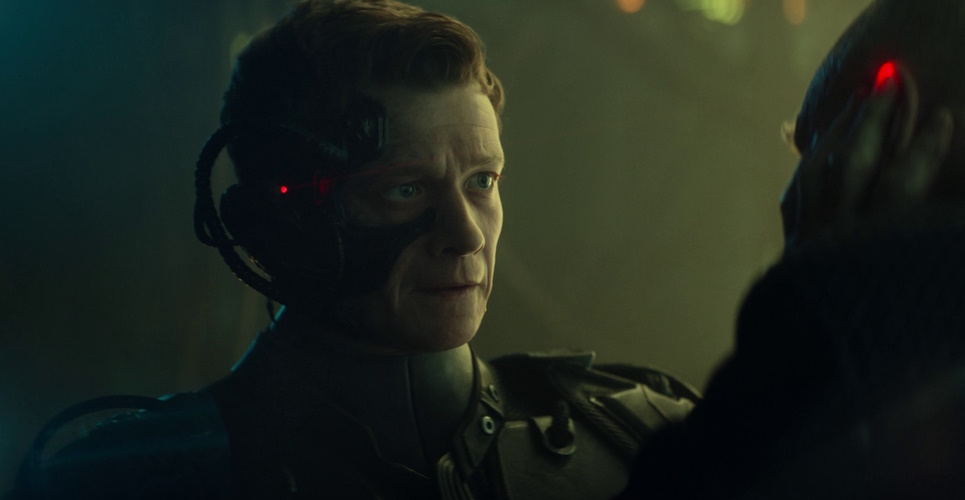
Spoiler Warning: There are spoilers ahead for Star Trek: Picard Season 1, Star Trek: Discovery Seasons 1-3, as well as the teaser trailers for Star Trek: Picard Season 2 and Star Trek: Discovery Season 4. Further spoilers may be present for other iterations of the Star Trek franchise.
During Season 1 of Star Trek: Picard last year, I kept holding out hope that the show would make a serious attempt to connect or cross over – somehow – with Discovery, its sister show. Aside from a couple of throwaway lines, however, that didn’t happen. We have since seen Discovery pick up a major faction that had been present in Picard, though, so clearly there’s some intention over at ViacomCBS to link up the two shows. Hopefully this will continue into their next seasons – and that’s what today’s theory is all about!
Discovery Season 4 will premiere months before Picard Season 2, and while I’m hopeful it will be able to include some kind of cameo or crossover like Season 3 did, where I’m going to focus much of my attention this time is on Picard Season 2, so we’ll be shooting past Discovery Season 4 for the most part. In short, there was a line in the Picard Season 2 teaser which stood out to me, and it could be interpreted as setting up some kind of crossover. At the beginning of the short teaser, we hear Picard say in voiceover that “the true final frontier is time.”
Picard Season 2 seems to have a time travel focus.
Beginning with Season 3, Discovery shot forward into the future, with Seasons 3 and 4 taking place almost 800 years after the events of Picard Season 1. That should preclude any major character crossovers… but not if time travel is somehow involved. By the 32nd Century, Admiral Vance and Starfleet believe time travel has been completely outlawed and that no way to travel through time exists. But at the dawn of the 25th Century, the Federation (and other factions) are just beginning to dip their toes in this untapped “final frontier.”
Picard himself has travelled through time on several occasions, both to the future and to the past. And while much of what we saw in the Season 2 teaser suggests that Picard and/or his new crew will travel backwards in time, if time travel is involved, all bets are off. The future and the past blend together in many time travel stories, and it’s possible – at least in my opinion – that Picard and his new crew could find themselves in Discovery’s 32nd Century at some point during their adventures.
Could Picard Season 2 visit the 32nd Century?
Another point we could argue is in favour of this theory is the re-emergence of Q. Because of Q’s nature as a trickster, and an incredibly powerful being, practically anything is possible. In the Voyager Season 2 episode Death Wish, for example, a member of the Q Continuum was able to send the USS Voyager back in time to the moment of the big bang – 13 billion years in the past. The 32nd Century is nothing compared to that!
I’ve spoken before on a number of occasions about the need for Star Trek as a whole to get some threads of consistency going between the shows currently in production. There is a link between Strange New Worlds and Discovery, of course, but Picard and Discovery are almost entirely disconnected right now. Bringing the two crews together – even just for a one-off special episode – would be absolutely fantastic and a great way to celebrate all things Star Trek.
Maybe Admiral Picard will meet Captain Burnham!
If Picard Season 2 is going to focus on travelling backwards through time instead of forwards, perhaps looking to preserve the future by righting wrongs in the past, that still doesn’t necessarily preclude the appearance of Discovery and her crew. Before Burnham, Saru, and the rest of the crew headed into the 32nd Century they were, of course, present in the 23rd, and although we’d be seeing these characters as they were in the past – and thus the storyline could become complicated – it would be possible, at least in theory, for Picard and his new crew to meet up with someone from Discovery if they visited the 23rd Century.
Given the complicated nature of the Control AI storyline in Season 2, anyone from Discovery having been aware of meeting someone from the Picard era could open up a plot hole, so it would have to be handled carefully. Perhaps Picard or someone from La Sirena is able to blend in and disguise themselves as a member of Starfleet in the 23rd Century, for example, allowing them to interact with the likes of Saru or Michael Burnham without the latter being aware of their true origins. That kind of crossover would be a lot of fun, and I think everyone involved would enjoy it!
Visiting the 23rd Century could allow Picard and the crew of La Sirena to meet up with Michael Burnham, Saru, and the crew of Discovery before they headed to the future.
One image that was prevalent in the Picard Season 2 teaser was the USS Stargazer – Picard’s first command. He first sat in the captain’s chair in the 2330s – about 75 years after the events of Discovery Seasons 1-2. That’s quite a long time, but considering the extended lifespans we know are present in Star Trek, it’s not so long that characters from Discovery couldn’t still be alive. Spock, obviously, is still alive in this era. And Dr McCoy was present at the launch of the Enterprise-D, despite being 137 years old. This opens up the possibility to see “aged up” versions of characters from the 23rd Century that we met in Discovery, such as Ash Tyler, L’Rell, or Saru’s sister Siranna.
Even just a short cameo from someone like that would be an amazing way to tie the shows together. Ash Tyler could have risen through the ranks to become a senior officer in Starfleet Intelligence by this era, and he could be someone Picard speaks with upon assuming command of the Stargazer, just as one idea off the top of my head. The introduction of Q and time travel into Picard Season 2 has opened up the possibility of such crossovers in a way that I hadn’t previously considered possible.
Ash Tyler could conceivably still be alive in the early 24th Century.
There is one other possibility, and it’s an inversion of a theory I had in the months before Discovery Season 3 premiered. Back then I theorised that something would go wrong with Burnham and Discovery’s jump into the future, leading them to arrive not in the 32nd Century but at the dawn of the 25th, leading to a crossover with Picard. That didn’t happen, of course, but right now there exists the possibility of this happening in reverse – for Picard and La Sirena to find themselves in the 32nd Century.
Maybe I’m in the minority, and both casual fans and Trekkies love to see the various Star Trek shows and films split up along the timeline – and in parallel universes! But I really do believe that consistency and stability are the hallmarks of a successful franchise, and if Star Trek wants to build on recent successes, picking a single time period to focus on for a majority of its shows and films makes a lot of sense. It makes following the franchise as a whole easier, and it makes it simpler for casual viewers to hop from one series to another without needing to read whole encyclopaedia articles about Star Trek lore to understand who’s where and what’s what. Perhaps bringing Picard into the 32nd Century could be a way to cut down on the franchise’s ongoing time periods.
If La Sirena travels through time, a crossover could be on the cards!
This would be bittersweet, in my opinion. While it would be great for Star Trek to replicate its ’90s heyday by picking an era and sticking with it, taking Picard out of the 25th Century would make future character returns significantly more difficult. It was great fun to see the likes of Data, Riker, Troi, and Seven of Nine again, and I think one thing a lot of Trekkies are hoping for is that Season 2 of Picard will reintroduce more characters from The Next Generation era. Shooting the show forward by more than eight centuries would make that much more difficult.
We’d also miss out on finding out more about the state of the galaxy as the 25th Century dawns. We spent some time with the Romulans in Season 1, but we know next to nothing of the Klingon Empire, the Cardassians, the Bajorans, and so many others. In my opinion, if Star Trek is going to pick one era to be the main focus for upcoming projects, I’d rather it was the 25th Century than the 32nd. Jumping forward in time by a generation instead of centuries is what the Star Wars sequel trilogy tried to do, allowing for the return of classic characters alongside new ones. That’s one reason why I wondered if Discovery was going to end up in this time period too!
In 2019 I wondered if Saru and the crew of Discovery might end up in the 25th Century!
At the end of the day, time travel in Star Trek allows for many different possibilities. Even if Picard just visits the 23rd or 32nd Centuries briefly, during a single episode, the potential for using this technobabble as an excuse for a major crossover exists. If Season 2 is going to have a major focus on time travel, it would almost be a wasted opportunity if the show didn’t include some kind of crossover with Discovery!
The inclusion of Q almost certainly means that some wacky shenanigans are afoot in Picard Season 2. Whether he’s responsible for Picard travelling through time or not, he certainly has the potential to be a disruptive influence, and I could absolutely see Q sending La Sirena spiralling into the path of the USS Discovery – either the refitted 32nd Century version or the older 23rd Century variant! Heck, this could even be how the Short Treks episode Calypso gets resolved… though maybe that’s too much to hope for!
So that’s my theory. A rather disjointed and vague theory, I grant you, but a theory nevertheless. Somehow, the time travel storyline in Picard Season 2 will lead to a crossover with Discovery. Regardless of whether it happens or not, I’m really looking forward to Picard Season 2. It’s been over a year since Season 1 wrapped up, and despite the ending of the first season not quite hitting the highs of its premiere episode, I cannot wait to find out what will come next for Picard and the crew of La Sirena.
Star Trek: Picard Season 1 is available to stream now on Paramount+ in the United States and on Amazon Prime Video in the United Kingdom and elsewhere. Star Trek: Discovery Seasons 1-3 are available to stream now on Paramount+ in the United States and on Netflix in the United Kingdom and elsewhere. Star Trek: Picard Season 2 is currently targeting a 2022 broadcast, and Discovery Season 4 is scheduled to premiere before the end of 2021. The Star Trek franchise – including Picard, Discovery, and all other properties mentioned above – is the copyright of ViacomCBS. This article contains the thoughts and opinions of one person only and is not intended to cause any offence.
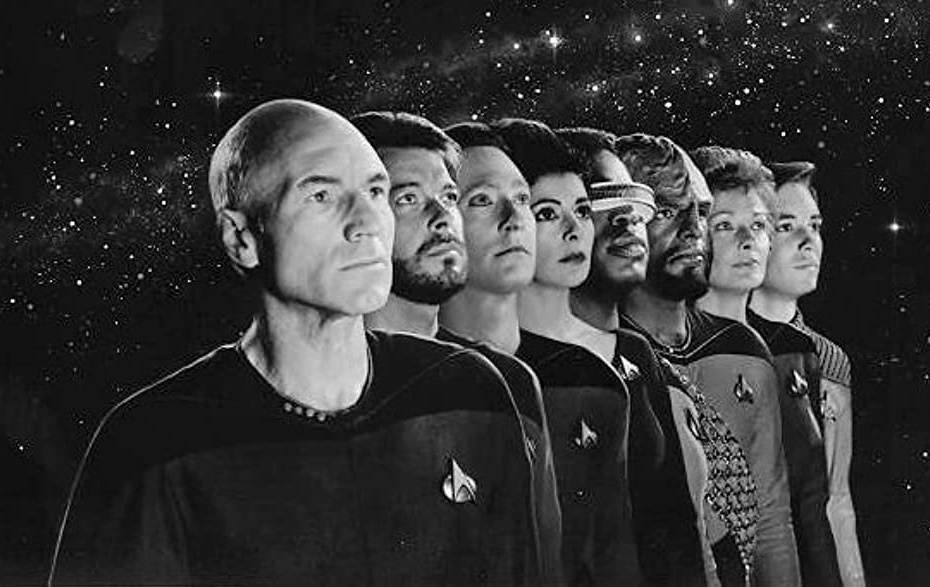
Spoiler Warning: There are spoilers ahead for Star Trek: Picard, including the entirety of Season 1 and, most significantly, casting information for Season 2. There are also spoilers for Star Trek: The Next Generation.
Over the course of Star Trek: Picard Season 1, we learned a little about some of Picard’s former crewmates from his time aboard the Enterprise-D. We saw Riker and Troi appear in person in the episode Nepenthe, as well as a version of Data. In the episode Maps and Legends, new character Zhaban – an ally of Picard’s – mentioned La Forge and Worf by name, seemingly confirming that both are still alive… at least as of the early part of Season 1! The only main characters from The Next Generation whose fates were not confirmed, and who were not even mentioned, were Dr Beverly Crusher and her son Wesley.
I don’t necessarily expect to see Wesley Crusher return, though I would suggest that actor Wil Wheaton’s continued involvement with Star Trek means it’s a possibility, at least on the production side. But given the close relationship between Picard and Beverly Crusher, I wasn’t alone in wondering what her absence from Season 1 might mean.
Wesley and Beverly Crusher in Star Trek: Nemesis – their last appearance in canon to date.
The teaser for Picard Season 2, which debuted at last month’s First Contact Day digital event, included a lingering shot over a model of the USS Stargazer – the ship Picard commanded prior to the events of The Next Generation. This, combined with Picard discussing the possibility of time travel in voiceover, seems to hint that the ship may play a role in Season 2. This is significant for the Picard-Crusher conversation, because while Picard was in command of the Stargazer, Dr Crusher’s husband Jack was killed. This event was mentioned a couple of times in The Next Generation, and it was arguably hinted at that Picard felt responsible for Jack’s death.
It may even have been the death of Jack Crusher that stopped Dr Crusher and Picard taking their relationship any further, at least in events we saw on screen. So a return to the USS Stargazer could potentially have brought back memories for Picard of Beverly Crusher, and there was scope for us to learn more about what happened to her after we last saw her in Star Trek: Nemesis.
Picard with Dr Crusher in Remember Me from Season 4 of The Next Generation.
However, recent comments by Gates McFadden – the actress who played Dr Crusher in The Next Generation and four films – seem to rule that out, at least in Season 2. Though no character return should be seen as guaranteed, after Riker and Troi came back in Season 1, and with Season 2 seeming to at least acknowledge areas of Picard’s past that may be connected to his relationship with Dr Crusher, it wasn’t an unreasonable guess to think she might appear, and thus I’m a little surprised to hear Gates McFadden ruling it out with the season still in relatively early production.
Though we should be careful about assigning motivations, McFadden is about to launch her own podcast, and it was in that capacity that she spoke to website TrekMovie. Generating attention drives clicks and brings in listeners, and while I don’t doubt that McFadden was being honest about her non-appearance in Picard Season 2, we also have to consider in context what she’s saying and what she’s trying to do by talking about it so openly.
Gates McFadden is plugging her new podcast!
Ever since Star Trek: Picard was announced, practically every former Star Trek actor under the sun has expressed interest in reprising their role, and some have outright lobbied ViacomCBS and the creative team in charge of the franchise to make it happen. In short, by discussing her non-appearance in Season 2, McFadden may be hoping to generate buzz around a future return to the role in Season 3, or in another potential Star Trek project. And again, as with the launch of the podcast, we have to take into account why she chose this moment to talk about it.
In a way this is a pretty big spoiler, because now we know that Dr Crusher won’t be appearing in Season 2 – at least, not in any form we’d recognise. Given the season’s apparent time travel aspect and possible return to the USS Stargazer, I’m at least a little surprised by that. But perhaps there’s still scope to learn more about Dr Crusher and what became of her after the events of Star Trek: Nemesis, even if she doesn’t appear in person.
Dr Crusher in Nemesis.
During The Next Generation’s second season, Gates McFadden’s absence was explained away by saying that Dr Crusher was working at Starfleet Medical on Earth. It seems plausible that she might’ve returned to that role following the disbanding of the Enterprise-E’s crew. If she continued to work with Picard in the years before the attack on Mars, there’s the possibility that their relationship took a romantic turn. It’s a shame we won’t get to see for ourselves in Season 2, though.
There is, of course, the possibility that Dr Crusher will be mentioned, as La Forge and Worf were in Season 1. If that’s the case, her presence wouldn’t be necessary in order for us to know at least whether she’s still alive in this era – I’m assuming she is until I hear anything to the contrary! And it’s also possible that, if the series is going to indulge in some serious time travel, that the role of a younger Dr Crusher will be recast for the new season. The supporting roles of Bruce Maddox and Icheb were recast in Season 1, and we’ve seen Discovery win a great deal of praise for the recasting of Captain Pike and Spock in Season 2, so the possibility of the role being recast certainly exists. I would think, though, that unless Gates McFadden has somehow talked herself out of returning to the role, if Picard Season 2 wanted Dr Crusher circa 2399-2400, the producers would approach her to reprise the role.
Dr Crusher in the future timeline seen in All Good Things…
So it was a bit of a surprise, as I keep saying! However, with John de Lancie returning as Q and Whoopi Goldberg coming back as Guinan, perhaps the producers decided that the show risked being overwhelmed with too many classic characters, or that there wasn’t enough time to do justice to Dr Crusher’s return. As with Riker and Troi last season, Dr Crusher would really need at least one entire episode in which she and her relationship with Picard could be a major story element. In a ten-episode season that has a lot of other storylines running, perhaps the producers decided that was too much.
And if that’s the case, I have to say I’m pleased – because it means the writers and producers have learned a lesson from Season 1. I’ve mentioned on a few occasions that I felt Season 1 of Picard did not conclude in particularly strong fashion. Too many storylines were abruptly dropped or not given any meaningful conclusion, and while Et in Arcadia Ego, Part 2 in particular was a very emotional episode with some fantastic moments, the finale as a whole left a lot on the table.
Picard with his new crew at the end of Season 1.
Dr Crusher could be essential to the story of a future season of Picard. Or, like Riker and Troi last season, she could simply be incidental. If the latter is true, the season as a whole needs to be structured in such a way that taking an episode off to visit her doesn’t have implications for the remainder of the story. And if it happens to be the case that the story of Season 2 is too full to fit Dr Crusher in, then that’s okay. I’d rather wait and see her return in a truly meaningful way than either have a rushed cameo or feel that the episode in which she featured was detrimental to the main story of the season overall – which, sorry to say because it’s an outstanding episode in its own right, is kind of how I feel about Season 1’s Nepenthe.
As always, I encourage you to check out Gates McFadden’s full comments (which can be seen on TrekMovie and appear in their podcast) for context, and to see for yourself exactly what she had to say. This is just my take on the situation! Given that Dr Crusher was very close to the top of my list of characters I considered plausible for Picard Season 2, and considering how amazing it would be to spend some more time with the dancing doctor, it’s a bit of a surprise – and perhaps even a little disappointing – that she isn’t returning.
Regardless, I hope that Dr Crusher can return to Star Trek in future, when a suitable role can be found for her. Hopefully there will be more seasons of Picard to come, and perhaps even more shows and/or films set in this era. Any such project could bring Dr Crusher back, and she would be very welcome!
Star Trek: Picard Season 1 is available to stream now on Paramount+ in the United States, and on Amazon Prime Video in the United Kingdom and elsewhere. Season 2 is currently filming and is targeting a 2022 broadcast. Gates McFadden was speaking exclusively to the website TrekMovie and the full interview may be found there. This article contains the thoughts and opinions of one person only and is not intended to cause any offence.
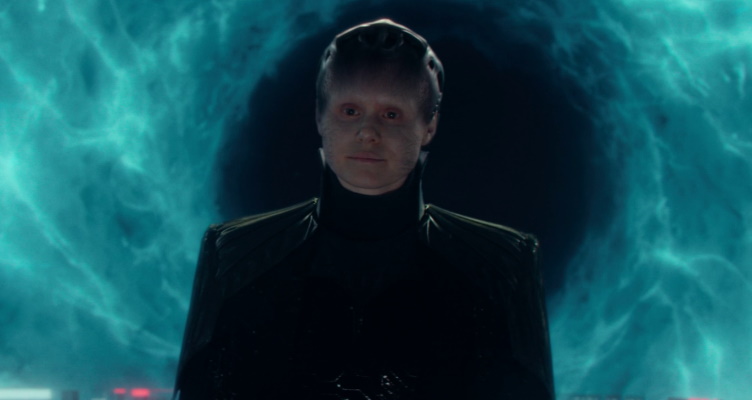
Spoiler Warning: There are spoilers ahead for Star Trek: Picard Season 1, the teaser for Season 2, and for the following: Star Trek: The Next Generation, Star Trek: Deep Space Nine, and Star Trek: Voyager.
Star Trek’s First Contact Day event a few days ago provided a lot of information and teases for upcoming projects in the franchise! Yesterday I took a look at one element from the Discovery Season 4 teaser, and today it’s Picard’s turn to go under the microscope! I wrote up my thoughts on the entire First Contact Day event, by the way, and if you missed that article you can find it by clicking or tapping here.
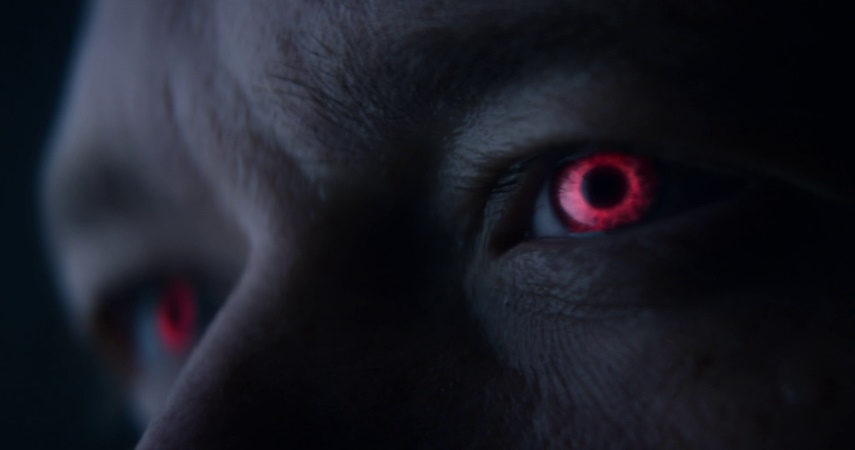
Both Discovery Season 4 and Lower Decks Season 2 are well into production – in fact, we now know that Lower Decks will be broadcast beginning on the 12th of August! Both shows were able to compile teaser trailers that incorporated a number of different scenes, probably from multiple episodes, and thus we had quite a lot to pick through for each! Picard Season 2, however, only entered production at the end of February, so naturally there wasn’t much to show.
There was a lot more to see from Discovery’s upcoming fourth season!
Instead what we saw was a stylised teaser, which I assume was deliberately filmed for First Contact Day. It seemed to include a shot of Château Picard – the Picard family vineyard – that was part of Season 1; a recycled shot to set up the rest of the teaser. The rest of the teaser comprised a shot of Picard’s study/office at the vineyard, with the camera lingering over a handful of items in the empty room.
The item most confusing to me at the moment is the book Paradise Lost! It’s an epic poem that I once had to read at school, written in the 1600s. And it’s all about Satan and God. Given what Picard is heard to say in voiceover about travelling through time and not knowing what might have been had different actions been taken, perhaps the meaning of Paradise Lost is less to do with the content of the poem than a literal reading of the title – something Picard did or didn’t do in the past changed the present, making things worse. That could be his “paradise lost.” This is frustrating!
How does Paradise Lost connect to the story of Season 2?
But Paradise Lost is not what we’re talking about today. In the teaser, Picard spoke of time as “the true final frontier,” and combined with the teaser focusing both on clocks and a backwards-running hourglass, time travel seems to be on the agenda! That’s before we get to Q, who is returning to tangle with Picard once more. Q is quite capable of time travel, as we’ve seen numerous times. Sir Patrick Stewart seemed to at least hint that Q isn’t responsible for whatever happens to Picard, but he’s clearly involved to some degree.
In addition to all of the time-related imagery, one thing from the trailer really leapt out at me: a model of the USS Stargazer. It’s the Stargazer that we’re going to talk about today, as the teaser seemed to at least hint at the possibility of revisiting this chapter of Picard’s life – something I predicted Season 2 might do a few weeks ago!
The USS Stargazer model as seen in the Season 2 teaser.
So let’s consider a few possibilities for how the USS Stargazer could be included in Season 2 of Picard. We’ve already heard the ship mentioned in Season 1; Dr Benayoun referenced Picard’s time aboard the ship in the episode Maps and Legends. Perhaps that was a hint at things to come in Season 2, and perhaps Dr Benayoun himself will make a return. We’ll have to wait and see what happens when the season airs next year!
My usual caveat applies: I have no “insider information.” I’m not claiming any of the things on this list will definitely happen in Season 2. This is just speculation and guesswork; a bit of fun and a chance to spend a bit more time talking and theorising about Star Trek. That’s all! So with that out of the way, let’s take a look at my six USS Stargazer theories.
Number 1: Picard’s “death” and a redux of The Next Generation Season 6 episode Tapestry.
Picard was given the option to make changes in his life in the episode Tapestry.
When I think of Q, Picard, and time travel, one of the first episodes that comes to mind is Tapestry. Given that Picard has faced death in Season 1, perhaps the stage is set for some kind of redux of this episode, or at least a story which uses a similar premise. In Tapestry, Picard was given a chance by Q to go back to his past and make changes in his life, choosing to use the wisdom of age to be more cautious and less impulsive. At first it seemed to save his life, but the changes made his life far worse and unliveable.
What wasn’t clear in Tapestry is whether Q and Picard were truly travelling through time or whether it was an elaborate illusion. I choose to think it was the former; Q had the power to do all of those things, after all! So maybe he will give Picard a chance to do so again.
Q in Tapestry.
At this stage we don’t know why Picard wants or needs to travel through time. It may be connected to the Zhat Vash, Coppelius, the super-synths from the season finale, or something else that happened last season. It may be connected to something from The Next Generation. Or it may simply be a new storyline written for the show as happened in Season 1. But if he did want to go back in time to change the past, perhaps he would enlist the help of Q, setting up a story similar to Tapestry.
If Picard were to go back in time to his Stargazer days, there are a lot of things he could potentially do differently, and thus a lot of different ways that the story could go. You’d think that, after what happened in Tapestry, Picard would have learned his lesson about changing the past. But if Q showed him a very different, far better future, perhaps he could be convinced to make such a change.
This might connect to the “paradise lost” concept that I touched on at the beginning. Perhaps Q is able to convince Picard that his best option, or the only option, to get a particular outcome in the future is to change the past?
Number 2: The Cardassian Border Wars.
Picard has had run-ins with the Cardassians before.
Though only mentioned briefly in The Next Generation, Picard was in command of the USS Stargazer during the Cardassian Border Wars. Not to be confused with Deep Space Nine’s Dominion War, this conflict took place in the mid-24th Century, prior to the events of The Next Generation. Picard made reference to one encounter in which a Cardassian ship fired on the Stargazer while the shields were down, causing him to have to flee!
One of the interesting things about choosing the Stargazer for part of Season 2’s setting as opposed to the Enterprise-D is that we know relatively little of Picard’s exploits while in command of the ship. Picard was in command of the Stargazer for around twenty years (from the 2330s to the 2350s) yet we only got brief hints at what he did in all that time. That makes it a relatively blank slate as far as the writers and producers of Season 2 are concerned.
A Cardassian Galor-class ship attacks the Enterprise-D in the episode The Wounded.
We do know, however, that Picard and the Stargazer saw action during the Cardassian Border Wars, and perhaps this could be a way for Star Trek to revisit the faction we got to know so well in Deep Space Nine. As one of the few known events during Picard’s time in command of that vessel, it’s at least possible that we’ll see it mentioned!
The Next Generation Season 4 episode The Wounded saw Picard work with the Cardassians, so it doesn’t seem as though he harbours any lingering feelings toward them; certainly not like the trauma he carries after his experiences with the Borg. So I don’t think that revisiting the Cardassian Border Wars would lead to the kind of powerful moment that we saw when Picard visited the Artifact in Season 1. But there could be something from those days that Picard has to confront, or perhaps he’s been hiding or repressing his feelings about the Cardassians since then?
The advantage to bringing the Cardassian Border Wars into play, at least from my point of view, would be that it would allow the series to revisit some of the events seen in Deep Space Nine and Voyager. Picard may not have much connection to those events, but other characters do. Seven of Nine, for example, served with and was once in a relationship with Chakotay, and his Maquis friends were killed by the Cardassians. Perhaps some kind of story related to Cardassia and the Cardassian Border Wars is on the cards.
Number 3: Assuming command in the 2330s.
Picard served in Starfleet for decades.
One of the things that Picard inadvertently changed during the events of Tapestry was that he never assumed command of the USS Stargazer. All we know of this event is that, following the death of the ship’s captain, Picard boldly assumed command. Doing so was a risk, one that the less cautious young Picard was willing and able to take. Following this event, he was appointed as the ship’s permanent commander and (presumably) promoted to the rank of captain.
The death of a ship’s captain is a significant moment, one that we haven’t seen often within Star Trek. Presumably the Stargazer’s captain was killed violently or during some kind of disaster or emergency; if he’d simply died of natural causes Picard’s tale of assuming command would be far less grand! So whatever happened, I think it’s fair to say it came at a difficult moment for the ship and crew.
Picard hallucinates the Stargazer crew in the episode The Battle.
This event may turn out to have some connection to Q or to something from Season 1 of the show. We could learn, for example, that the Zhat Vash or the super-synths were responsible for the attack on the Stargazer, and thus for Picard’s ascent to the captain’s chair. It may then be the Zhat Vash who want to go back in time to undo something, changing events so that Picard wouldn’t be in a position to help Soji and the Coppelius synths.
Maybe that’s a stretch and a reach, but the idea of undoing a mistake and trying to alter the future seems to be a theme of the season, according to the teaser. Picard himself was heard in voiceover saying that time never offers second chances – so perhaps the person or faction hoping to change the past is not Picard and his new crew, but some other nefarious faction. Picard and the crew of La Sirena may even be travelling back in time to preserve the timeline, not change it.
When it comes to factions we know of within Picard that could be interested in changing the past, the Zhat Vash have to be right up at the top. They’re fanatics, and after their recent defeat both at Coppelius and with the repeal of the ban on synthetic life they may try to travel back in time to exact their revenge. Going back to prevent Picard ever becoming a captain, changing his career and stopping him interfering in their plans, may be what they have in mind. One of the neat things about revisiting this era would potentially be a return of the red Starfleet uniforms!
Number 4: The Battle of Maxia.
The “Picard Manoeuvre” – Picard’s tactic at the Battle of Maxia.
At the opposite end of Picard’s time in command was the Battle of Maxia. At this battle, in which Picard faced a Ferengi ship, he devised the “Picard Manoeuvre” – a tactic that allowed his ship to appear to be in two places at once, and which was later taught at Starfleet Academy. In the aftermath of this battle, however, the Stargazer was lost. Presumed to have been destroyed, the ship was actually salvaged by the Ferengi.
The “Picard Manoeuvre” was referenced in Season 1, during the episode Et in Arcadia Ego, Part 2. As with the earlier reference to the USS Stargazer, perhaps this was setting up something that will become important in Season 2, or at least reminding us of its existence! These little crumbs could form a trail for us to follow, perhaps informing us of planned events in Season 2. Or I could be reading too much into individual lines, as I always seem to be!
Picard on the bridge of the Stargazer.
The Battle, the ninth episode of The Next Generation, explored the Battle of Maxia in more detail. It’s probably the one event involving the USS Stargazer that has been most closely examined on screen. That could mean it’s a good place for Season 2 to go, as it’s something we’re at least a little familiar with. Or it could mean that, as Picard has already confronted his actions at the battle and their consequences, there isn’t much left to explore.
In any case, it remains a possibility. Returning to the Battle of Maxia could see the return of the Ferengi in some capacity, though their involvement was not known at the time. As above, it could be a chance either for Picard to correct a mistake, or for someone nefarious to attempt to change the past – his past – by changing the outcome of the battle.
Number 5: The death of Jack Crusher.
Jack Crusher died while serving on the Stargazer.
Jack Crusher – husband to Beverly and father to Wesley – died while serving under Picard’s command aboard the USS Stargazer. It was at least implied that Picard bears a degree of responsibility for his death, or at least feels responsible for what happened. Perhaps that’s simply because of how he is as a commanding officer – but could there be more to it than that?
Of the main cast of The Next Generation, only Dr Crusher’s fate was left unconfirmed in Season 1. We saw Riker and Troi of course, and Data we know has died. Zhaban also confirmed that Geordi La Forge and Worf are still alive, so that only leaves Dr Crusher. In at least one future timeline, she and Picard had married – we saw no evidence for or against this idea in Season 1, so perhaps it could be explored in Season 2.
Jack Crusher in hologram form.
In the teaser, Picard spoke about how we often wish we’d acted differently during a crisis, and perhaps one thing he wishes he had been able to change was whatever led to Jack Crusher’s death. We could also learn that the Zhat Vash, super-synths, or some other faction or entity from Season 1 is involved in the events that led to him being killed, forming a kind of circular story going back to Picard’s past.
If Dr Crusher were to be involved in Season 2, she would undoubtedly have something to say about the possibility of revisiting the moment of Jack’s death! Maybe she would try to talk Picard out of it, saying that changing an event more than fifty years in the past would have huge ramifications for them both. Or maybe she’d be in favour of going back in time to prevent it from happening if his death set in motion a series of events that led to horrible consequences at the dawn of the 25th Century.
It’s also possible that Jack Crusher’s death may simply be the backdrop for the story – an event connected to something else in the series, but not something Picard hopes to undo.
Number 6: Anti-time and All Good Things…
Q and Picard in All Good Things…
In the finale of The Next Generation, Q set Picard a puzzle to solve that required him to think outside the box. In short, events in the future were – somehow – having a causal effect on events in the past. Figuring that out, and learning for the first time that time is not necessarily linear and moving only in one direction was what Picard learned.
As above with Tapestry, when I think of Q and time travel, I also think of All Good Things. The teaser made reference to “the trial,” and I believe even used a line spoken by Q in All Good Things as it drew to a close. Q told Picard in that episode that his and humanity’s trial in the eyes of the Q was ongoing, so perhaps the return of Q will mean revisiting some of these concepts.
Q in his “judge” guise in All Good Things…
Something that will be potentially interesting to explore are Q’s views on mortality. In the Voyager Season 2 episode Death Wish, Q helped a fellow member of the Q Continuum to die, but has never had to confront mortality himself. In many ways, Q seemed to regard Picard as something akin to a friend, and watching him age and confront death might be something that would interest and bemuse him.
In the panel that immediately followed the teaser, Sir Patrick Stewart appeared to refer to Q appearing in only a single episode, so perhaps his influence over the season won’t be as significant as we’re assuming. It was also implied that Q is not the cause of whatever the main event of the season is. However, if Picard needed to travel back in time for some reason – such as to prevent something catastrophic from happening in the present – he may voluntarily call upon Q. After all, how many other methods of time travel is Picard aware of?
All we can say for sure at this stage is that Q is involved somehow. But given the teaser’s focus on time travel, maybe his involvement will be in sending Picard and his new crew back in time, perhaps to the time he served aboard the Stargazer.
So that’s it. Six theories about Picard Season 2 and the USS Stargazer!
At this stage, with the second season perhaps as much as a year away from being broadcast, we have very little to go on. As mentioned, the teaser didn’t include a single character or completed scene or sequence, so I’m reading an awful lot into a few lines of voiceover and the imagery presented! We don’t even know for sure that the USS Stargazer will be included in any form, let alone visited through time travel!
The USS Stargazer being towed by the Enterprise-D.
Despite that, however, it’s great fun to speculate and theorise about what might be happening. The series is currently in production, with filming ongoing at time of writing, and while we’re unlikely to see another teaser or trailer any time soon, I’ll be keeping an eye out for any tiny tidbits of news that may come our way!
Discovery has shot forward into the 32nd Century; the far future. As such, it’s less easy for that show to bring back characters, themes, and storylines from Star Trek’s past – though that didn’t stop me making a few guesses about what may be going on in Season 4! But Picard is only set twenty years on from the events of the 24th Century Star Trek shows, and as such we could potentially see the inclusion of all manner of characters and other story elements – as indeed we saw happen in Season 1.
Regardless, I’m excited to see where Picard Season 2 takes the story next. The return of Q promises to be great fun, and while the season is a way off yet, I think it’s okay to make a few tentative guesses about what may be going on!
Star Trek: Picard Season 1 is available to stream now on Paramount+ in the United States and other regions where the platform is available. It may be streamed on Amazon Prime Video in the United Kingdom and other countries and territories. Star Trek: Picard Season 2 is scheduled to premiere on Paramount+ and/or Amazon Prime Video next year. The Star Trek franchise – including Picard and all other properties mentioned above – is the copyright of ViacomCBS. This article contains the thoughts and opinions of one person only and is not intended to cause any offence.